World Bank Urges States to Prioritise Better Jobs, Human Capital, Services Amid 93% Revenue Rise Says reforms create unique opportunity to upgrade infrastructure, education, healthcare, water Oyedele says economic growth not yet inclusive
Ndubuisi Francis and James Emejo in Abuja
The World Bank, yesterday, tasked state governments to convert the substantial fiscal space created
by recent economic reforms into better jobs, public services, and living standards.
The bank said increased revenues would have limited development impact if not matched by more
efficient and accountable spending. World Bank Country Director for Nigeria, Mathew Verghis, gave the
charge in Abuja while presenting Continued on page 8
NGE Replies The Nation, Rejects Partisanship Allegation, Demands Apology... Page 31
Friday 9 October, 2026 Vol 31. No 11506. Price: N400
www.thisdaylive.com TR
UT H
& RE A S O
N
INEC Insists on Supreme Court Verdict, Says Erring Parties Won’t Field Candidates Insists those not in party registers at the close of regulatory time will be affected Seeks stakeholders’ support as voters’ register display begins Oct 9 in Sokoto
Chuks Okocha, Adedayo Akinwale in Abuja and Onuminya Innocent in Sokoto
The Independent National Electoral Commission (INEC), has warned that political parties fielding candidates whose names
were not in the registers submitted to the commission at the close of regulatory time will not be allowed to participate in the 2027 elections.
The Supreme Court had in a September 24, 2026 judgement affirmed the constitutionality of Sections 77(5), 77(6) and 77(7) of
the Electoral Act 2026 and upheld INEC’s revised timetable and schedule of activities for the 2027 general election.
Those whose nominations might have attracted attention included Continued on page 8
Fuel Price: FG Offers 30-day Discount at NNPC Stations NLC gives two-week ultimatum to return to 2024 price Atiku: Tinubu’s new measure is panic move, publicity stunt ADC accuses government of attempting to bribe Nigerians Makinde Campaign: Fuel discount announcement deceitful
Story on page 8
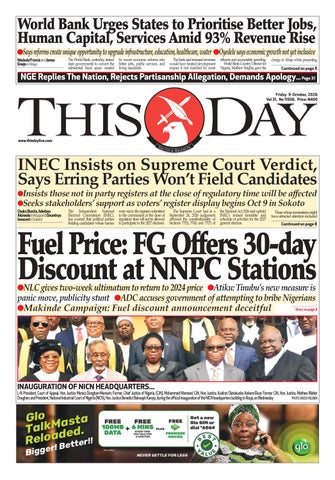
INAUGURATION OF NICN HEADQUARTERS...
L-R: President, Court of Appeal, Hon. Justice Monica Dongban-Mensem; Former, Chief Justice of Nigeria, (CJN), Mohammed Mamood; CJN, Hon. Justice, Kudirat Olatokunbo Kekere-Ekun; Former CJN, Hon. Justice, Mathew Walter Onoghen; and President, National Industrial Court of Nigeria (NICN), Hon. Justice Benedict Bakwaph Kanyip, during the official inauguration of the NICN headquarters building in Abuja, on Wednesday PHOTO: ENOCK REUBEN
2
FRIDAY, OCTOBER 9, 2026 • T H I S D AY
FRIDAY, OCTOBER 9, 2026 • T H I S D AY
3
FRIDAY, OCTOBER 9, 2026 • T H I S D AY
4
Pay for Dangote Refinery Shares through Access Bank
ooer price
Please read the Prospectus on ipo.dangote.com and, where in doubt, consult your stockbroker, fund/portfolio managers, accountant, banker, solicitor or any other professional adviser registered by the SEC for guidance before subscribing. Payment does not guarantee or automatically result in the allotment of shares. Allotment is subject to the applicable terms and conditions.
Multiple channels. One opportunity.
Scan for:
• Risk Disclosures • Terms & Conditions • FAQs
07030000000
5
THISDAY • FRIDAY, OCTOBER 9, 2026
Group News Editor: Goddy Egene Email: Goddy.egene@thisdaylive.com, 0803 350 6821, 0807 401 0580
NEWS
BVNDLE REWARDS FESTIVAL PRESS CONFERENCE...
L-R: Executive Director VFD Group Plc, Folajimi Adeleye; Director, Bvndle Rewards Festival, Nicole Asinugo; Chairman Bvndle Rewards Festival, Adeniyi Adenubi; Managing Director, Bvndle Rewards Festival, Elmer Aluge; Founder, KON10DR Gaming, Sidney Esiri; Communications Associate, NGX Group Plc, Vivian Eke, and Managing Director, VFD Microfinance Bank, Nonso Okoye, at the Bvndle Rewards Festival press conference in Lagos...recently
$1 Trillion Economy: FG Targets 10.34% Growth By 2030
Private sector expected to finance 72% of investment, govt admits infrastructure, productivity challenges Minister insists economic transformation must translate into jobs, higher incomes, improved living standards
Festus Akanbi The federal government has set a target of 10.34 per cent annual economic growth by 2030 under the proposed National Development Plan 2026–2030, as it works towards building a $1 trillion economy, with the private sector expected to finance about 72 per cent of cumulative investment. The Minister of State for Budget and Economic Planning, Dr. Doris Uzoka-Anite, disclosed this yesterday, saying the proposed plan envisages average annual growth of 7.79 per cent, rising from 4.68 per cent in 2026 to 10.34 per cent by 2030. She said the plan also projects gross capital formation to rise to 40 per cent of GDP by 2030, while acknowledging that achieving the targets would require improvements in infrastructure, energy supply, access to finance, productivity, regulatory efficiency and policy predictability. Uzoka-Anite, whose keynote address was delivered by the Statistician-General of the Federation and Chief Executive Officer of the National Bureau of Statistics (NBS), Adeyemi Adeniran, spoke at the sixth DataPro International Credit
Rating Webinar, themed, “Credit Rating as a Catalyst for Economic Transformation.” The minister said the proposed National Development Plan 2026–2030 was designed to move the economy beyond macroeconomic stabilisation towards sustained productivity and investment-led growth. She, however, disclosed that Nigeria recorded average real GDP growth of 3.11 per cent under the National Development Plan 2021–2025, against the 4.65 per cent target. She said: “Nigeria’s experience under the recently concluded National Development Plan 2021–2025 reflected both economic resilience and persistent structural challenges.” The minister continued: “Real GDP growth averaged approximately 3.11 per cent during the plan period, compared with the target of 4.65 per cent.” According to her, “This performance highlighted constraints relating to fiscal space, infrastructure deficiencies, low productivity and vulnerability to external shocks.” The admission provides important context for the administration’s latest development ambitions, particularly as manufacturers continue to contend
with unreliable electricity supply, high financing costs, logistics difficulties and weak consumer demand. Outlining the government’s proposed development strategy, Uzoka-Anite said the National Development Plan 2026–2030 was designed to move Nigeria beyond macroeconomic stabilisation toward sustained productivity and investment-led expansion.
She added: “Its preferred development scenario envisages nominal economic output approaching $1 trillion by 2030.” However, the minister cautioned against measuring economic transformation solely by the size of national output. “Achieving this ambition will require more than GDP expansion. It will demand increased productive
Says Africa should not remain only a consumer of AI systems developed elsewhere
Oluchi Chibuzor Centre of Intelligence of Things (CIoTh), University of Greater Manchester, has announced the latest international recognition of Professor Celestine Iwendi, Head of CIoTh, following his inclusion in the Scholarly Index Top1000 Scholar 2026 rankings for Artificial Intelligence in Healthcare. The recognition came as Iwendi said Africa should not remain only a
consumer of AI systems developed elsewhere, but must invest in their own universities, young researchers, data infrastructure, and innovation ecosystems. In the 2021–2025 impact window, Iwendi was ranked 57th globally, second in Great Britain, and placed within the Top 0.69 per cent worldwide. The ranking certificate also records an impact score of 96.93, a category D-index of 6, and an H-index of 36 for the period.
MD says service excellence, technology, stronger processes central to depositor protection Managing Director/Chief Executive, Nigeria Deposit Insurance Corporation (NDIC), Mr. Thompson Oludare Sunday, yesterday disclosed it has paid N1.48 billion to 10,312 depositors of 47 recently closed microfinance banks (MFBs). He said payment, which had been made as of July 31, 2026, covered depositors of the 47 failed MFBs following the revocation of their operating licences by the Central Bank of Nigeria (CBN). He spoke at the 2026 Customer Service Week celebration in Abuja, with
the theme, “The Extra Mile” which was hosted at the NDIC headquarters in Abuja. Sunday said the payout was facilitated by the deployment of Bank Verification Number (BVN) validation through the Nigeria Inter-Bank Settlement System (NIBSS) to identify affected depositors and locate their alternative accounts in other banks, enabling payments without the cumbersome processes traditionally associated with claims. According to him, the corporation’s responsibility went beyond policies and procedures, stressing that the quality
energy supply, access to finance, regulatory efficiency and policy predictability,” she said. “The government cannot finance Nigeria’s development requirements alone.” She added: “Its responsibility is to create an enabling environment for private investment, strengthen domestic value chains and support productivity-enhancing sectors.”
Nigerian-Born AI Professor Earns Global Recognition in Artificial Intelligence in Healthcare
NDIC Disburses N1.48 Billion to 10,312 Depositors of Failed Microfinance Banks Deji Elumoye in Abuja
capacity, greater investment, employment generation and improved welfare for Nigerians,” she stated. The minister said gross capital formation was projected to rise to 40 per cent of GDP by 2030, with the private sector expected to account for about 72 per cent of cumulative investment. “These ambitious targets will require improvements in infrastructure,
of its engagement with depositors and other stakeholders was equally critical to sustaining confidence in the financial system. He said NDIC’s role was ultimately about ensuring that individuals and businesses could continue to have confidence in financial institutions to safeguard their funds, facilitate transactions and support investment and economic activity. He said, “The importance of our role extends beyond the banking sector as a stable and dependable financial system is essential to the health of the
wider economy.” The NDIC boss said the corporation had therefore embraced the concept of going the extra mile by continuously reviewing its processes and adopting technology to improve the experience of depositors and other stakeholders. He identified the recent NDIC ASCENDS restructuring programme as one of the initiatives designed to strengthen the corporation’s structures, improve processes, enhance collaboration and leverage technology and data to make its operations more efficient and responsive.
For the Lifetime impact window, he was ranked 125th globally, sixth in Great Britain, and within the Top 0.83 per cent worldwide, as the lifetime certificate recorded an impact score of 96.20, a category D-index of 7, and an H-index of 46. The recognition highlights Iwendi’s growing international research footprint in Artificial Intelligence, digital health, intelligent systems, cybersecurity, and emerging technologies, and reflects the expanding profile of research being developed through CIoTh and the wider University of Greater Manchester community. Iwendi, a Nigerian-born academic, has built a career around applying artificial intelligence to practical societal challenges, particularly in healthcare, intelligent systems, and secure digital technologies. His work has focused on how AI can move beyond theory into real-world applications that improve decision-making, efficiency, accessibility, and human wellbeing. Speaking on the recognition, Iwendi said the ranking should be viewed not only as a personal achievement but also as evidence of the growing importance of sustained collaboration in research. He stated, “I am deeply grateful for this recognition. Research is never a solitary journey. I owe a great deal to my mentors, collaborators, colleagues and students whose ideas,
commitment and support continue to shape the work we do.” He added that his motivation remained centred on impact rather than ranking. According to him, “For me, the most important question is not simply where one is ranked, but whether the research is solving real problems. In Artificial Intelligence in Healthcare, we have a responsibility to ensure that innovation translates into better outcomes for patients, stronger health systems, improved diagnostics, safer technologies and greater access to quality care.” Iwendi also stated that the recognition came at a time when African countries, including Nigeria, must become more intentional about building capacity in artificial intelligence. He said, “Africa should not remain only a consumer of AI systems developed elsewhere. We must invest in our universities, our young researchers, our data infrastructure and our innovation ecosystems. “Nigeria has the talent to become a major contributor to global AI research, but that potential must be matched with sustained investment, stronger university-industry collaboration and policies that support responsible innovation.” Iwendi said AI in healthcare presented a particularly significant opportunity for Nigeria and other developing economies.
6
FRIDAY, OCTOBER 9, 2026 • THISDAY
NEWS
ANTHONY CARDINAL OKOGIE FOUNDATION ANNUAL LECTURE...
L-R: Chairman, 2026 Anthony Cardinal Okogie Foundation (ACOF), Annual Lecture Planning Committee, Mr. Joseph Alegbesogie; Chairman, Globus Bank and Chairman, Board of Trustees, ACOF, Mr. Peter Amangbo; Catholic Archbishop of Lagos Archdiocese, His Grace, Most Rev. Dr. Alfred Adewale Martins; and President, Catholic Men Organisation, Lagos Archdiocese, Mr. Kingsley Ekwem, during the 2026 ACOF Annual Lecture held in Lagos, yesterday
Samsung Profit Surges Nearly Ninefold to $80bn on AI Chip Demand Emmanuel Addeh in Abuja Samsung Electronics has projected a nearly ninefold surge in third-quarter operating profit to Won107.4 trillion ($80.2 billion), driven by soaring demand for memory chips used in artificial intelligence infrastructure. The forecast, which represents a record quarterly profit for the South Korean technology giant, compares with Won12.2 trillion recorded in the
same period last year and exceeded the Won106 trillion estimate compiled by LSEG SmartEstimate. Samsung also estimated thirdquarter sales at Won195 trillion, representing a 126.6 per cent increase from a year earlier. The company issues preliminary profit and sales figures before releasing its full quarterly results, the Financial Times reported. The latest guidance marks the
fourth consecutive quarter of record performance for Samsung and underscores the prolonged shortage of memory chips as AI companies compete aggressively for supplies, pushing up prices. Samsung said the result made it the first technology company to record more than Won100 trillion in quarterly operating profit. Strong demand for memory chips, a critical component of data
centres powering AI applications, has generated record earnings and boosted the share prices of major chipmakers. Samsung’s stock has more than doubled this year, lifting the company’s market value to about $1.3 trillion, the FT reported. The boom in AIrelated demand, however, has created difficulties for other memory-chip buyers, including smartphone and computer manufacturers, which are
Northern Stakeholders Support ACReSAL’s $500m Additional Financing Linus Aleke in Abuja
The proposed $500 million additional financing for the Agro-Climatic Resilience in Semi-Arid Landscapes (ACReSAL) project has received broad support from stakeholders across northern Nigeria, according to Think Nigeria First Initiative (TNFI). Speaking during a press conference in Abuja, Director General of TNFI, Alhaji Abubakar Tsanni, said governors, traditional rulers, farmers, herders, and women’s groups had thrown their weight behind the next phase of the project because of the tangible results recorded in their communities. Tsanni identified the governors
of Bauchi, Borno, Gombe, Kebbi, Kaduna, Jigawa, Benue and Plateau states among those who had personally commissioned, inspected, or flagged off ACReSAL interventions. He added that Bauchi State had publicly committed its counterpart funding to the proposed next phase. Tsanni said, “Traditional institutions, including the palaces of the Shehu of Borno, Emir of Argungu and Emir of Zazzau, work handin-hand with the project. “In Wurno, a farmer of 27 years on the irrigation scheme says hope has returned. In Nguru, herders and fishermen have returned to a wetland that was dry for 12 years.” According to him, women account for 47 per cent of the project’s
4.4 million direct beneficiaries, while university students in Kogi, Kebbi and Plateau states are being trained in modern greenhouse farming on their campuses. He said the federal ministers of environment, water resources and agriculture had jointly participated in the project’s mid-term review in Kaduna. Tsanni maintained that stakeholders were not seeking charity, but sustainable financing built around continuity, shared responsibility, and self-reliance. He disclosed that participating states had so far released N22 billion in counterpart funding, while the $9.5 million Community Revolving Fund disbursed to 381
communities was being repaid and re-lent. He also stated that Benue and Nasarawa states had established state agencies to ensure the sustainability of the project’s assets. The TNFI director general urged governors, traditional rulers, legislators, and community leaders across the north, who had witnessed the impact of ACReSAL, to “say so publicly, and say so now.”
The Director-General and Chief Executive Officer of the Industrial Training Fund (ITF), Dr. Afiz Oluwatoyin Ogun, has highlighted the institution’s achievements over the past three years, reaffirming its commitment to skills development and human capital advancement as the Fund marked its 55th anniversary in Jos. Speaking at the anniversary celebration, Ogun said the ITF had sustained its relevance since its establishment in
1971 by adapting to the changing needs of the Nigerian economy and workforce. He noted that under his administration, the Fund had expanded skills acquisition programmes, strengthened local and international partnerships, digitised key operations, improved staff welfare and upgraded training infrastructure across the country. The ITF boss identified the Skill-Up Artisans (SUPA) programme as one of the institution’s flagship interventions, designed to train, certify and professionalise artisans nationwide.
He added that the Fund had also advanced Nigeria’s global skills competitiveness through strategic collaborations and the establishment of structures that align vocational training with international standards. In a goodwill message, Managing Director and Chief Executive Officer of the Oil and Gas Free Zones Authority (OGFZA), Alhaji Bamanga Usman Jada, described the ITF as one of Nigeria’s most strategic agencies, given its central role in developing the nation’s human capital.
the upcycle can continue next year and the year after next,” Albert Yong, managing partner at Seoul-based Petra Capital Management, told the FT. The FT also reported that Samsung remains relatively undervalued compared with US chipmakers, with its price-to-earnings ratio at about 12, against nearly 40 for the Philadelphia Semiconductor Index. Analysts expect Samsung’s full results to show the impact of the sharp appreciation of the South Korean won, which gained more than 14 per cent against the dollar during the third quarter, its biggest quarterly rise since early 1998. The stronger currency could weigh on earnings because Samsung generates most of its revenue outside South Korea. Besides, rising memory-chip costs have put further pressure on Samsung’s consumer electronics operations, which have struggled to pass the higher costs on to customers. Analysts estimate that the company’s smartphone and home-appliance businesses recorded combined operating losses of more than Won1 trillion in the third quarter, the report stated.
Adedokun: BPP Working to Digitise Procurement Process, Improve Access to Information
Adedayo Akinwale and Amina Hassan in Abuja
of Bureau of Public ITF Marks 55 Years of Driving Director-General Procurement (BPP), Dr. Adebowale Adedokun, said the bureau was working to digitalise procurement Skills, Industrial Growth processes and improve access to Yemi Kosoko in Jos
facing higher input costs. Contract prices for conventional dynamic random-access memory chips, which provide short-term data storage in electronic devices, are expected to rise by between 10 and 15 per cent in the fourth quarter, according to market researcher TrendForce. Analysts expect tight supply conditions to continue into next year, with the industry’s margins increasingly supported by long-term supply agreements with AI companies. In advanced AI hardware, Samsung has also recently made progress in developing next-generation HBM4 chips, narrowing a gap with rival SK Hynix after years of struggling to compete in the high-end market. Despite the record profit outlook, however, investors remain concerned about the sustainability of the AIdriven chip boom. Samsung shares fell 2.4 per cent yesterday, even as the company announced the record profit forecast, and remained more than a quarter below their June peak. “Investors are looking beyond the company’s quarterly figures and waiting for clearer signals that
information. Adedokun made this known yesterday in Abuja, at a stakeholders’ engagement with CSOs on public procurement reforms. He added that the bureau was also developing a classification system and database for contractors based on their capacity and experience. The measure, he said, would help prevent companies from securing contracts they lacked the capacity to execute.
The BPP boss also disclosed that the agency was developing a database of procurement officers as part of efforts to professionalise the procurement process. He said price intelligence mechanisms were being developed to provide benchmarks for public projects and flag possible cases of inflated costs. Adedokin emphasised that the bureau was developing a BPP-CSO Public Procurement Partnership Framework to give civil society a more structured role in monitoring public procurement. He said the framework would cover capacity building, access to procurement information and data, reporting and feedback, monitoring of procurement processes and citizen engagement.
He stated, “The bureau is working to digitalise procurement processes and improve access to information. “BPP is developing a platform where registered CSOs would be able to access information on projects in their areas and provide feedback on their implementation. “The aim is to move public procurement beyond compliance with procedures and ensure that government spending translated into projects and services that improved the lives of citizens.” The BPP boss said CSOs had an important role to play in monitoring public projects, particularly in communities where poor procurement decisions could directly affect access to schools, hospitals, roads, electricity, and other public services.
7
THISDAY • FRIDAY, OCTOBER 9, 2026
NEWS
HONOURED BY CHEMICAL ENGINEERS SOCIETY...
L-R: Managing Director, NLNG, Adeleye Falade; Managing Director, Renaissance Africa Energy Company, Tony Attah; and Managing Director, Aradel Holdings Plc, Adegbite Falade, after receiving Honorary Fellowships of the Nigerian Society of Chemical Engineers (NSChE) in Lagos, yesterday
NES#32: FG to Explore Innovative Ideas for Jobs, Shared Prosperity Amid Reform Gains NESG laments unemployment, cost pressures, infrastructure gaps, insecurity, others
James Emejo in Abuja Minister of State for Budget and Economic Planning, Dr. Doris UzokaAnite, has tasked stakeholders at the 32nd Nigerian Economic Summit (NES#32) to move beyond diagnosing the country’s economic problems and forge actionable solutions capable of creating opportunities and improving citizens’ welfare. Uzoka-Anite spoke at a World Press Conference ahead of the summit in Abuja. She said the annual economic gathering must focus on identifying solutions, building consensus, and defining practical pathways towards an economy that delivered broader prosperity following recent macroeconomic success in the country. The minister said the summit, which had evolved into a major platform bringing together government, the private sector, labour, academia, development partners, and civil society, should ultimately be judged by the extent to which its recommendations translated into measurable economic outcomes. She said, “The 32nd summit will therefore not be simply about discussing Nigeria’s economic challenges. It will be about identifying solutions, building consensus and defining actionable pathways towards an economy that creates opportunities and improves the welfare of our citizens.”
Summit Targets Growth That Works
This year’s summit, with the theme, “Growth that Works: Delivering Jobs, Productivity and Shared Prosperity,” is scheduled for October 26–27 in Abuja. According to the minister, the theme reflects the central economic challenge of ensuring that growth translates into productive employment, higher incomes, improved living standards, and wider prosperity. The summit will be structured around three strategic pillars — productivity, human capital and resilience — alongside cross-cutting issues, including digital transformation, political economy, transparency and accountability, and macroeconomic stability. Its five major thematic areas include Work Nigeria, Produce Nigeria, Invest Nigeria, Scale Nigeria, and Secure Nigeria. Work Nigeria will focus on expanding productive employment and linking education and skills development to economic opportunities; Produce Nigeria will address productivity, industrialisation and value addition; while Invest Nigeria will examine how to attract capital and strengthen human capital. Scale Nigeria will focus on unlocking the economic potential of states and sub-national governments, while Secure Nigeria will examine the relationship between security, economic resilience, production, and investment. Uzoka-Anite said the summit
would seek to unlock opportunities in agriculture, manufacturing, infrastructure, and the digital economy, while raising competitiveness through better infrastructure, innovation, skills and regulatory efficiency.
Building on NES#31 Outcomes Uzoka-Anite said the summit would also build on recommendations from NES#31, stating that several proposals contained in its Green Book have already found expression in government policies and programmes. She cited ongoing work on the National Development Plan 2026–2030, alignment of development planning with annual budgets, and results-based monitoring under HOPE-GOV. On industrialisation, she said the Nigeria Industrial Policy launched
in February 2026 prioritised agroprocessing, petrochemicals, pharmaceuticals, textiles and technology-driven industries. The minister added that government had also signed an agreement with the International Finance Corporation (IFC) to develop a pipeline of bankable public-private partnership projects in transport, energy, ICT, and sanitation, while the Infrastructure Concession Regulatory Commission (ICRC) had reported over 97 PPP projects valued over N9 trillion.
NESG: Growth Must Produce Jobs In his remarks, Chief Executive, Nigerian Economic Summit Group (NESG), Dr. Tayo Adeloju, said recent reforms, including subsidy removal, exchange-rate unification, fiscal restruc-
Signature Bank has pledged to provide banking services that combine the convenience and efficiency of technology with the personal touch, responsiveness and trust that customers expect from a relationship-driven bank. The Board Chairman of Signature Bank Limited, Alhaji Tijjañí M. Borodo represented by Mr. Shedrack Odo made the pledge at the opening of the branch of the bank in Uyo, Akwa íbom state capital. “Our digital channels are designed
to make banking more accessible, while our physical branches provide the human connection that remains important for many customers, particularly businesses that require deeper financial conversations and tailored solutions. “We believe customers should not have to choose between technology and human service. They should have both. “Uyo is a growing commercial, administrative and investment centre with a population of entrepreneurs, professionals, traders, public-sector stakeholders and businesses whose
offered significant opportunities amid a fragmenting global economy. He warned that those advantages would only translate into growth if the country could produce competitively and attract productive capital. He said NES#32 was designed to ask not only what needed to change, but who must act, what it would take to deliver, and how success would be measured. According to him, the summit’s ultimate objective is to move Nigeria from stability to investment, investment to productivity, productivity to jobs, and jobs to shared prosperity. He urged the media and other stakeholders to scrutinise the commitments emerging from the summit, insisting that its success should not be measured by attendance but by better policies, stronger businesses and improved livelihoods.
Air Peace Boosts Fleet Expansion with Acquisition of Another Embraer 190 Chinedu Eze Nigeria’s leading carrier, Air Peace Limited has boosted its operation with the acquisition of another Embraer 190, thus bringing the airline’s Embraer fleet to 18 aircraft.
Air Peace in a statement said this is another significant step in its strategic fleet acquisition and expansion programme, noting that its Embraer fleet includes the latest technology-driven E195-E2 series. “The beautiful 96-seat Embraer
Signature Bank Assures Customers of Convenience, Efficiency of Technology Okon Bassey in Uyo
turing, and bank recapitalisation, had helped restore macroeconomic discipline, strengthen external buffers, and improve investor confidence. However, he warned that stabilisation alone was insufficient. “Stabilisation is necessary; it is not sufficient,” Adeloju said, stressing the need to establish a stronger transmission from reforms to investment, productivity, jobs, and, ultimately, shared prosperity. He identified high production costs, infrastructure deficits, low productivity, and insecurity as persistent constraints, stating that over 90 per cent of employment remains informal. He said, “The task is not to grow faster, but to grow differently — raising productivity and creating jobs at scale.” Adeloju said Nigeria’s large market, natural resources, youthful population, and position within the African Continental Free Trade Area (AfCFTA)
financial needs are evolving. “Akwa Ibom State possesses enormous economic potential. From agriculture and tourism to hospitality, real estate, construction, transportation, professional services, manufacturing and the broader SME ecosystem. “As a financial institution, we see those opportunities, but more importantly, we see the people behind them. We see the entrepreneur who needs working capital, we see the established business seeking to expand,” Borodo stated. He pointed out that sustainable
development requires collaboration between government, businesses, financial institutions and the people. “The state government has also continued to emphasize private sector partnerships as an important part of achieving its development objectives. We therefore see our presence in Uyo as complementary to the broader economic aspirations of Akwa Ibom State.” He assured the people of the state that Signature Bank is committed to being a responsible corporate citizen. We will contribute to the development of the state.
190 jet touched down at the Murtala Muhammed International Airport Terminal 2, Lagos, at approximately 5:00 p.m. on Wednesday, October 7, 2026 and was flown into Lagos by Captain Mrs. Ibironke RotimiOlajide. The arrival marks the eighth aircraft acquired by Air Peace in 2026, underscoring the pace and scale of the airline’s continuing fleet expansion. “The aircraft is named after Mrs. Eka Sunmonu, wife of Mr. Mutiu Sunmonu, former Managing Director of Shell Petroleum Development Company (SPDC). This naming marks the first time Air Peace is naming an aircraft outside the Onyema family,” the airline stated. The airline also noted that the growing Embraer portfolio forms part of Air Peace’s wider and diverse fleet, which also includes Boeing aircraft deployed across its domestic, regional and international operations. The airline has also acquired 5 Boeing 737-800 aircraft this year, further reinforcing its fleet acquisition and network expansion strategy. Configured with 12 Business
Class and 84 Economy Class seats, the latest Embraer 190 combines operational versatility with a passenger-focused cabin. Its 1-2 Business Class configuration offers greater personal space and privacy, while the 2-2 Economy Class layout eliminates the middle seat. Passengers also benefit from generous legroom, a spacious cabin environment and in-seat power sockets. Commenting on the development, Air Peace Spokesperson, Mr. Osifo-Whiskey Efe, described the latest addition as another demonstration of the airline’s deliberate investment in fleet growth and network development. “The arrival of another Embraer 190 is an important milestone in our strategic fleet expansion programme. We are deliberately building a diverse and versatile fleet that gives us the operational flexibility required to strengthen our network, improve schedule resilience and provide greater connectivity across the markets we serve.
8
FRIDAY, OCTOBER 9, 2026 • THISDAY
EIGHT
Cardoso Woos Asian Capital, Seeks to Deepen Financial Links, Payment Connectivity Apex bank steps up enforcement across banking sector, warns against regulatory breaches, reckless offshore investments
James Emejo in Abuja and Nume Ekeghe in Lagos Governor of Central Bank of Nigeria (CBN), Mr. Olayemi Cardoso, yesterday, said the bank was moving to deepen the country’s access to Asian capital, adding that the real test of recent reforms remains whether they can make foreign investment stay, return, and grow. Cardoso, now on his way to the IMF-World Bank Annual Meetings in Bangkok, made the case for stronger Nigeria-Asia financial ties during a series of high-level engagements in Singapore involving the Monetary Authority of Singapore (MAS), Global Finance and Technology Network (GFTN), and major Nigerian and international financial institutions. The apex bank also said it had
stepped up enforcement across the banking sector, warning that bank directors and major shareholders could face removal where persistent insider credit breaches undermine corporate governance and financial stability. The warning followed the bank’s earlier directive requiring banks to make 100 per cent provisions for specified insider-related credit exposures over an 18-month period, as part of measures to strengthen capital buffers and safeguard depositors’ funds.
Building New Channels for Investment, Trade, Payments
Cardoso’s engagements, which included the signing of a Memorandum of Understanding (MoU) with GFTN, were aimed at building institutional cooperation, strengthening financial-
market infrastructure, and creating new channels for investment, trade, payments, and financial innovation. Speaking at the Nigeria-Asia Financial Connectivity Dialogue, hosted by J.P. Morgan, in Singapore, Cardoso said Nigeria’s reforms were designed not merely to attract episodic capital inflows but to establish the confidence required for investors to remain committed to the economy. He said, “The real test of reform is not whether you can attract capital once; it is whether you create the confidence for capital to stay, return and grow.” The governor said the reforms in the foreign exchange market were intended to eliminate distortions, improve transparency, and provide clearer rules for market participants. He stressed that monetary stability,
sound governance and predictable market rules were essential to transforming Nigeria into a more attractive destination for long-term institutional capital. According to him, stabilising the financial system should not be viewed as an end in itself but as the foundation for deeper markets, stronger market infrastructure and greater participation by domestic and international investors. At the Singapore engagements, the CBN delegation held discussions with MAS on financial-sector development, regulation, market connectivity and innovation, with both sides exploring areas for continued institutional cooperation. According to a statement issued by the bank, the central bank also signed an MoU with GFTN to establish a framework for collaboration on
financial innovation, including connections between relevant institutions and innovation ecosystems in Nigeria and Singapore. The agreement is expected to provide a platform for identifying practical areas of cooperation in financial technology and other emerging areas of the financial system.
CBN Targets Stronger NigeriaAsia Financial Connectivity
Beyond investment flows, Cardoso said the country’s engagement with Asia was being positioned around broader financial and commercial connectivity, including stronger relationships between Nigerian and Asian banks and financial-market institutions. He also pointed to opportunities for
FUEL PRICE: FG OFFERS 30-DAY DISCOUNT AT NNPC STATIONS
Ndubuisi Francis, Chuks Okocha and Onyebuchi Ezigbo in Abuja
The federal government yesterday unveiled a 10-point intervention to cushion the impact of rising petrol prices and the wider energy crisis, offering a 30-day discount at Nigerian National Petroleum Company Limited (NNPC) filling stations nationwide, with public transporters to receive priority. The measures, announced by the Minister of Finance and Coordinating Minister of the Economy, Mr. Taiwo Oyedele, also included a negotiated N1,350 per litre ceiling on the ex-gantry or landing cost of petrol, forward sales of crude to domestic refineries as well as removal of illegal levies. Besides, the government said it was hastening the deployment
of Compressed Natural Gas (CNG), increasing support for vulnerable Nigerians and the introducing a National Strategic Fuel Reserve. Oyedele, who announced the measures at a press conference in Abuja, said the intervention was neither a return to fuel subsidy nor an attempt to impose price controls, but rather a mechanism to moderate the effect of global energy shocks on Nigerian consumers and businesses. He said the federal government had taken several steps since the removal of fuel and foreign exchange subsidies to cushion the resulting hardship, but was compelled to introduce the new measures following the sharp increase in global energy prices arising from the conflict in the
Middle East. “We are offering a discount on petrol dispensed by NNPC Limited for the next 30 days, with priority for public transporters nationwide. As production rises and previously committed crude is freed up, this would shield pump prices from volatility in the global market,” Oyedele stressed. On the proposed N1,350 ceiling, the minister said the arrangement would prevent domestic petrol prices from responding immediately to every movement in international crude prices and the exchange rate. “Pump prices should not have to follow every swing in global crude or the exchange rate. The government is negotiating a ceiling of N1,350 a litre on the ex-gantry or landing cost of petrol, to keep pump prices stable.
“Where costs rise above the ceiling, refiners and importers will carry the shortfall and recover it later, when crude prices or the exchange rate allow, without breaching the ceiling,” he said. Similarly, Oyedele said the ceiling would be reviewed monthly and the figures published to ensure transparency.
FG: Move Not Subsidy, Price Control
The minister added: “This is neither a subsidy nor a price control: it is designed to smooth prices over time rather than suppressing them. The reasoning is simple. N1,400 a litre today and N1,400 tomorrow is better than N1,500 today and N1,300 tomorrow, because volatility itself adds to uncertainty and cost. And when fares go up sharply,
they rarely come down as fast.” Oyedele also announced plans to remove illegal levies that contribute to higher transportation and logistics costs, saying the federal government would work with state governments under the 2025 tax reform laws to tackle such charges. “Working with the states under the 2025 tax reform laws, we are reining in the road taxes and levies that inflate fares and logistics costs,” he said. On direct intervention for vulnerable Nigerians, Oyedele said the government would increase funding for cash transfers to the poorest households while expanding subsidised credit for small businesses and consumers. “We are increasing funding for cash transfers to the most vulnerable households, and for subsidised credit
INEC INSISTS ON SUPREME COURT VERDICT, SAYS ERRING PARTIES WON’T FIELD CANDIDATES
Rivers State governorship candidate of All Progressives Congress (APC), Kingsley Chinda; Delta Central senatorial candidate of Nigeria Democratic Congress (NDC), Ovie Omo-Agege; former Cross River State Governor and Peoples Redemption Party (PRP) presidential candidate, Donald Duke; and a former Delta State House of Assembly Speaker, Victor Ochei. INEC National Commissioner for Information and Voter Education, Mohammed Haruna, explained the implications of the judgement while speaking on Trust TV’s Daily Politics programme, yesterday.
Haruna said the affected parties would also not be allowed to substitute such candidates, stating that parties should not benefit from violations of the law. He said the commission was expected to make a definite pronouncement on the implications of the Supreme Court judgement by next Tuesday. Haruna stated, “It’s like you committed an offence. And then, you come and benefit from it. You remember cases that we had of some in Zamfara, you remember Plateau? The same thing happened. “The parties, because they did
the wrong thing, they thought they could now steal through the candidates. “And the law was very clear. Once you do that kind of thing, you cannot benefit from it. You are benefiting from it, if you are able to substitute a candidate.” According to him, depending on when the commission concludes its review, some political parties may be unable to field candidates for some other elective positions. Haruna stated, “All the candidates, all the way to the Houses of Assembly, we interviewed them. If their names are not on the party
register, they were not members of the party at the time that they contested for those tickets.” He explained that the delay in INEC’s final position was due to the need to obtain legal advice after receiving the Certified True Copy of the Supreme Court judgement. Haruna said the commission had to exercise caution because forged copies of court judgements had been presented in the past. He said, “You can’t be too careful with these things because even when you see copies and they tell you it’s a CTC, it may be forged. We’ve seen instances
where people have even gone, have the audacity to forge a Supreme Court judgement. “So, we have to be very careful to make sure that we take the right decision .”
Amupitan: Unverified Electoral Fraud Claims Could Damage Public Confidence
In another development, the Chairman of the Electoral Commission (INEC), Professor Joash Amupitan, warned yesterday that Continued on page 33
Olayemi Cardoso more efficient payment and settlement channels and increased participation by Nigerians living and working across Asia. The Nigeria-Asia dialogue brought Continued on page 34
to small businesses and consumers,” he said. He also announced a faster rollout of CNG, saying the federal government would scale up deployment in partnership with state governments and encourage transport operators to transfer the savings to passengers through lower fares. The government, he said, is also considering an excess profit tax on operators that take undue advantage of consumers during the current energy crisis. Oyedele said the proposed tax could apply anywhere along the energy value chain, with proceeds dedicated to cushioning the effect of high fuel prices. “We will consider this for operators who take undue advantage of consumers, anywhere along the energy value chain. The proceeds will be used exclusively to cushion the impact of fuel prices, through transport support or vouchers for urban minimum wage earners who are the most vulnerable,” he said. The minister further disclosed that the government would work with the National Assembly to provide enhanced tax relief for low-income earners under the 2027 Finance Bill. “We are cutting regulatory costs that feed into the cost of doing business and, indirectly, into higher prices of goods and services,” he said. Under the National Strategic Fuel Reserve, Oyedele stated that the government intends to protect households and businesses from Continued on page 35
WORLD BANK URGES STATES TO PRIORITISE BETTER JOBS, HUMAN CAPITAL, SERVICES AMID 93% REVENUE RISE
the latest Nigeria Development Update (NDU), titled, “Beyond the Federal Purse: How Higher Revenues Reshaped State Priorities.” Verghis said the reforms had substantially increased fiscal revenues available to states, creating a “unique opportunity” to expand critical economic and social infrastructure. He stated, “The bold macroeconomic reforms have substantially increased fiscal revenues at the state level, providing a unique opportunity to improve infrastructure, education, healthcare, and water services, which are critical to creating more and better jobs. “Strengthening spending efficiency, accountability, and service delivery will be essential to ensuring that public resources improve the lives of Nigerians.” According to the update, gross
federation revenues increased by 69 per cent in real terms between 2023 and 2025, while state revenues rose by about 93 per cent over the same period. State expenditure also increased by about 92 per cent. But the surge in resources had so far been channelled more aggressively into economic infrastructure and fiscal consolidation than human-capital development. World Bank said the share of capital expenditure in total state spending rose from 46 per cent to 61 per cent between 2023 and 2025, with transport infrastructure recording the largest increase. Presenting the report, World Bank Chief Economist for Nigeria, Dr. Fiseha Haile, said spending priorities had shifted towards economic infrastructure in 29 of the 33 states for which data were available. “Transport, particularly road
infrastructure, experienced the largest increase in spending across more than 30 states out of the 35 states for which we have data,” Haile said. While spending on health, education and social protection also increased in absolute terms, they expanded more slowly than economic infrastructure, the report said. The share of education in total state expenditure consequently declined from 14.9 per cent in 2021 to 12.1 per cent in 2025, while health spending remained broadly stable at seven per cent. Social protection performed better, with its share rising from 1.4 per cent to 4.4 per cent. World Bank said the pattern underscored the need for states to use their improved fiscal positions to strengthen human capital
and service delivery, particularly if Nigeria was to translate economic growth into sustained poverty reduction and employment.
21 States Cut Debt Burden
Beyond infrastructure spending, higher revenues also strengthened state balance sheets. The report disclosed that 21 states significantly reduced their debt-to-GDP ratios between 2021 and 2025, supported largely by stronger federation transfers. However, Haile cautioned that the aggregate improvement concealed substantial differences among states, with some recording strong fiscal surpluses while others posted deficits, as expenditure outpaced revenues. He said the policy challenge was no longer simply to increase revenues but to ensure that the
additional fiscal space generated measurable development outcomes. States also recorded progress in internally generated revenue, with about 14 states posting increases of more than 50 per cent. Enugu, Abia and Osun were among the leading performers. The bank urged states to deepen domestic revenue mobilisation, particularly through personal income and property taxation, in order to reduce exposure to volatile federation transfers. It also noticed significant improvements in fiscal transparency, with nearly all states now publishing budgets, quarterly budget implementation reports, audited financial statements, and debt reports. Haile said the next challenge was to translate improved fiscal information into better spending
decisions. “Building on these significant gains, the next step is to strengthen fiscal institutions to turn better information and improved fiscal data into better results,” he said. He identified persistent weaknesses in the alignment between budgeted and actual capital expenditure, cash and commitment controls, public investment management and fragmented financial management systems. The bank called for stronger own-source revenue mobilisation, credible budgeting, improved public investment management, and closer alignment between expenditure and development priorities. It urged stronger federal-state fiscal coordination to reward reforming states, improve resource Continued on page 36
FRIDAY, OCTOBER 9, 2026 • T H I S D AY
9
10
FRIDAY, OCTOBER 9, 2026 • THISDAY
NEWS
70TH POSTHUMOUS BIRTHDAY COLLOQUIUM FOR THE LATE GOVERNOR AKEREDOLU...
L-R: Wife of the late former Governor of Ondo State, Mrs. Betty Akeredolu; Ogun State Governor, Prince Dapo Abiodun; Ondo State Governor, Mr. Lucky Aiyedatiwa; wife of the Ondo State Governor, Mrs. Esther Aiyedatiwa; former Governor of Ekiti State, Dr. Kayode Fayemi; and son of the late former Governor and Chairman, Oluwarotimi Akeredolu Foundation, Mr. Oluwarotimi Akeredolu (Jnr.), during the 70th Posthumous Birthday Colloquium for the late Governor Akeredolu, in Ibadan, yesterday
2027: Alausa Chairs APC Education Mobilisation Group, Eyes 10m Sector Votes Targets students, teachers, lecturers, councils, professional bodies Says it’s in Nigeria’s interest to re-elect Tinubu
Emmanuel Addeh in Abuja
The Minister of Education, Dr Tunji Alausa, has said the education sector will mobilise 10 million votes for President Bola Tinubu’s re-election in the 2027 presidential election. Alausa made the declaration at the inaugural meeting of the APC
Presidential Campaign Committee Education Sector Mobilisation Working Group, which he chairs, urging members to extend the campaign beyond educational institutions to communities across the country. The minister said the education sector, with its network of students, teachers, lecturers, administrators,
governing councils, counsellors and professional bodies, was strategically positioned to contribute significantly to Tinubu’s re-election bid. “Nigeria needs continuity. This country, this President, President Bola Ahmed Tinubu, has changed the fortunes of Nigeria. It is in our interest, and in the interest of the present
and future generations, that we elect him to continue the transformative agenda he has embarked upon in the last three years,” he said. Alausa said many of the reforms being implemented by the administration required sustained implementation to deliver long-term results, arguing that a second term
Lagos Deploys GIS, AI, LiDAR to Tackle Land, Planning Crisis As CFL Group alleges ‘Title Laundry’, demands reform of state’s land registry
Bennett Oghifo and Funmi Ogundare The Lagos State Government has moved to overhaul land administration and urban planning with digital mapping, LiDAR technology and artificial intelligence, as government seeks to curb land-related bottlenecks, improve infrastructure planning and make public services more data-driven. This crucial move is coming as the Group Managing Director of CFL Group, Lai Omotola, yesterday raised alarm over alleged sophisticated land fraud scheme in the state, which he described as ‘land title laundry’, warning that forged property documents are allegedly being inserted into the state’s land registry to make them appear genuine. Addressing journalists, Omotola, who spoke on the development, alleged that some individuals, working with insiders in the Lagos State land registry, now target abandoned and high-value properties, particularly in Ikoyi, Victoria Island and other prime areas, and use forged documents to establish ownership of the properties. Meanwhile Lagos State’s new geospatial push was unveiled yesterday at the inaugural Lagos GIS Day, where Governor Babajide Sanwo-Olu inspected a range of digital systems designed to provide government with accurate information on land, properties, roads, communities and physical development across the state. The development could have significant implications for millions of
Lagos residents, particularly property owners, prospective buyers, developers and communities, as more reliable spatial data is deployed to support land administration, development control, infrastructure provision and government decision-making. The event, themed “The Lagos Experience,” was organised by the Office of the Special Adviser to the Governor on e-GIS and Urban Development, with Global Infoswift Consulting Limited providing programme management. At the Land Archive of the Lands Bureau, Sanwo-Olu inspected the archiving of manual land records, highlighting the state’s efforts to move away from dependence on traditional paper-based records. The governor later visited the Ikeja Regional eGIS Centre, where officials presented plans for regional centres covering Epe, Ikorodu and Badagry. At the Lagos GIS Centre, he inspected GIS facilities and received a briefing on the ABAT III eGIS Data Centre, while officials unveiled the Lagos Property Bank and showcased the completed digital mapping project. The mapping project includes orthophotos and LiDAR imagery capable of providing highly detailed information about the physical environment. Officials also demonstrated artificial intelligence applications being developed around the data. The technology is expected to strengthen government’s ability to identify development patterns,
monitor physical changes and plan infrastructure based on current spatial information rather than fragmented or outdated records. For residents, the wider impact could extend to property transactions, road and drainage planning, urban expansion, environmental monitoring and public-service delivery. Accurate digital land information could also help government and relevant agencies better understand property locations and land use, while providing a stronger information base for planning and development decisions. From e-GIS to LAGIS: Lagos began developing its e-GIS capability in 2016 as part of efforts to improve the collection and use of spatial information across government. The Lagos e-GIS Office was formally established in 2021 to coordinate the development and integration of the state’s geospatial systems. With the expansion of the technology and datasets, the state moved to establish a broader institutional framework. In 2025, the Lagos State House of Assembly adopted recommendations on the Lagos Geographic Information Service Bill, which was subsequently assented to by Sanwo-Olu on October 6, 2025. The law established the Lagos Geographic Information Service, LAGIS, while October 6 was declared Lagos GIS Day in perpetuity. Yesterday’s event therefore marked the first official celebration of the
day and another major step in the state’s decade-long development of its geospatial infrastructure. Speaking at the event, the Special Adviser to the Governor on e-GIS and Urban Development, Olajide Abiodun Babatunde, said Lagos faced the difficult task of managing a city defined by its size, complexity and rapid transformation.
would help consolidate the gains, strengthen the economy, attract investment and create more opportunities for Nigerians. “ We will work assiduously to ensure that President Bola Tinubu is re-elected come 2027,” Alausa said, urging the members to go deep into their communities to mobilise support for the President. He urged members of the working group to mobilise stakeholders across their constituencies and build broad-based support for the President ahead of the election. Already, the committee has established sub-groups covering universities, polytechnics, colleges of education, teachers, governing councils, counsellors, technical and vocational education and training stakeholders, among other segments of the education sector. Alausa said the structure was designed to harness the nationwide reach of the education sector and create a coordinated campaign capable of delivering substantial electoral support for Tinubu. “If we work hard, we should be able to mobilise 10 million votes
from the education sector alone for Mr President,” he said. Alausa also reaffirmed his personal commitment to the campaign, pledging to work closely with members of the committee and its sub-groups to pursue the 10-million vote target. He said the mobilisation was aimed at ensuring continuity in ongoing reforms and supporting policies designed to strengthen human capital development, economic growth and national development. The Minister of State for Education, Prof. Suwaiba Ahmad, is the Deputy Chairman of the working group, while the Executive Secretary of the Almajiri and Out-of-School Commission, Dr Muhammad Idris, serves as secretary. Other members include: The Senior Special Assistant to the President on Student Engagement, Sunday Asefon; the minister’s Special Adviser on Political Engagement, Adedeji Demola; National Coordinator of the Special Programmes Operations and Implementation Unit, Adebayo Onigbanjo; and the Registrar of the Teachers Registration Council of Nigeria (TRCN), Dr Ronke Soyombo.
NIPR Tasks Practitioners on Innovation to Drive Nigeria’s Socio-Economic Transformation Blessing Ibunge in Port Harcourt The Nigerian Institute of Public Relations (NIPR), Rivers State Chapter, has challenged public relations practitioners to embrace emerging technologies, innovation and strategic communication tools to drive development and socioeconomic transformation. The charge was given by the chapter’s Chairman, Rev. Francis Asuk, at the opening of the Rivers Public Relations Week 2026, held on yesterday at the Rivers State University, Port Harcourt. Asuk said the rapid evolution of the information ecosystem had fundamentally altered the practice of public relations, stressing that practitioners could no longer afford to operate within the traditional confines
of publicity and media relations. According to him, digital platforms had accelerated the spread of information and transformed public discourse, while organisations were increasingly judged by the quality of their communication, stakeholder engagement and ability to manage their reputations. He said the changing environment presented both challenges and opportunities which practitioners must strategically exploit to achieve sustainable development. “We must move beyond publicity and embrace the strategic dimensions of our profession. We must become stronger advisers, better listeners, ethical practitioners and more effective managers of reputation and relationships. “The Rivers State Chapter has,
over the past period, deliberately pursued a culture of innovation, inclusion and professional development,” Asuk said. He described Rivers State as a strategic economic and cultural hub with a diverse population and significant corporate presence, noting that practitioners had a crucial responsibility in shaping narratives about the state and strengthening relationships among government, businesses, communities and other stakeholders. In her keynote address, titled “Raising the Next Generation of Public Relations Professionals,” Prof. Adaeze Oreh, urged practitioners to adopt a proactive strategy in managing communication crises rather than waiting until controversies had escalated.
FRIDAY, OCTOBER 9, 2026 • T H I S D AY
11
PUBLIC NOTICE PRE-DISCONNECTION NOTICE
MADE PURSUANT TO THE NIGERIAN COMMUNICATIONS ACT 2003 AND THE GUIDELINES ON DISCONNECTION OF COMMUNICATIONS OPERATORS 2025
The Nigerian Communications Commission hereby notifies the General Public that approval has been granted for the disconnection of Realife Telecommunications Limited (Realife) from MTN Nigeria Communications Plc (MTN) as a result of nonsettlement of interconnect charges. Realife was notified of the application and was given opportunity to comment and state its case. The Commission has examined the application and circumstances surrounding the indebtedness, including Realife’s failure to comply with the terms of an Undertaking of repayment in line with the provisions of the Guidelines. The Commission has determined that Realife does not have sufficient reason for nonpayment of the interconnect charges. The general public is, therefore, requested to TAKE NOTICE that: 1. The Commission has approved the Disconnection of Realife to MTN in accordance with Section 100 of the Nigerian Communications Act 2003 and the Guidelines on Disconnection of Communications Operators 2025. 2. At the expiration of 7 (Seven) days from the date of this notice, MTN will discontinue passing voice and data traffic through Realife and will thereafter utilize alternative channels in interconnecting with other Network Service Providers. Please note that this disconnection will subsist until otherwise determined by the Commission. Dated this 9th Day of October, 2026
Signed: Nnenna Ukoha Director, Public Affairs Department Plot 423 Aguiyi Ironsi Street, Maitama, Abuja, Tel: +234-8-61-7000-29 fax: +234-9-461-7514 Toll Free No: 622. E-mail: ncc@ncc.gov.ng
www.ncc.gov.ng www.ncc.gov.ng KHALEESI
arpa6429
12
FRIDAY, OCTOBER 9, 2026 • T H I S D AY
FRIDAY, OCTOBER 9, 2026 • T H I S D AY
13
14
FRIDAY, OCTOBER 9, 2026 • T H I S D AY
FRIDAY, OCTOBER 9, 2026 • T H I S D AY
15
T H I S D AY FRIDAY OCTOBER 9, 2026 16 TR
UT H
& RE A S O
Friday October 9, 2026 Vol 27. No 11498
N
opinion@thisdaylive.com
www.thisdaylive.com
NIGERIA’S DIPLOMATIC GAINS AT UNGA The UN platform gave an opportunity to articulate our national and continental priorities, contends SAMSON OLAOLUWA
See page 17
THE RULE THAT WORKS FOR EVERYBODY ELSE
While FIFA should be consistent with its rules, Nigeria should play to win, argues JOSHUA J. OMOJUWA
See page 17
EDITORIAL
MENTAL HEALTH AND PUBLIC AWARENESS
See page 18
1
This requires a convergence of physical and cyber defences, argues KABIR ADAMU
SECURING THE 2027 ELECTIONS
Securing Nigeria’s 2027 elections will require a convergence of physical and cybersecurity defences capable of mitigating threat elements to the elections that span both physical and cyber domains. While physical security has traditionally been the focus of election planning, the digital domain is now equally critical, and the two must be integrated if Nigeria is to maintain a mature level of security preparedness for the elections. Current threat estimates show both physical and cyber threats to be at varying assessed levels that if not adequately mitigated will affect the Independent National Electoral Commission’s ability to conduct free, fair and credible elections in Nigeria come January and February, 2027. The physical security challenges are complex and multifaceted and include terrorism and insurgency, banditry, gang violence and cultism, armed ethnic militia among others. According to data from Beacon Security and Innovations Limited (BSIL) a company I founded and run, and the international platform, Armed Conflict and Event Location Data (ACLED) from January – September, 2026 an average of 700 people are killed and another 500 abducted monthly across Nigeria, despite ongoing security forces operations that have successfully targeted and killed a significant number of the leadership of the violent actor groups operating in Nigeria. This is even as livelihoods continue to be destroyed by this threat actors with huge humanitarian and development consequences for communities where they remain active. Similarly, Nigeria’s cyberspace has a multitude of institutional and structural challenges that manifest in diverse threats as the country increasingly digitizes its election infrastructure for the scheduled January and February 2027 national elections. Nigeria is currently facing an average of 4,906 cyberattacks per organisation every week, more than twice the global average of 2,422, and a 45 per cent yearon-year increase, according to Check Point Research’s August 2026 threat intelligence. That volume eased only slightly from 4,975 weekly attacks in July, and leaves Nigeria second only to Angola among the African markets tracked. Across the continent, INTERPOL’s 2026 African Cyberthreat Assessment estimates at least $5 billion in direct economic damage from cybercrime in 2025, with reported losses more than doubling from $192 million in 2024 to $484 million. The measurable losses are concentrated in payments: banks and customers lost ₦52.26 billion to fraud
in 2024 and ₦25.85 billion in 2025, for a cumulative ₦134.48 billion between 2020 and 2025 (CBN/NIBSS). An earlier multi-sector estimate put losses at about ₦1.1 trillion between 2017 and 2023 across banking, telecommunications and government. Nigeria also recorded 5,822 ransomware detections in 2025, including an August 2025 attack on the Nigeria Customs Service that froze cargo clearance and generated an estimated $18 million in storage costs. Critical digital infrastructure is increasingly being probed by state-aligned Advanced Persistent Threats. ngCERT and NCC-CSIRT have flagged SideWinder against maritime, government, telecommunications and financial targets, and a wider espionage pattern, including the UNC2814/ GRIDTIDE campaign against telecom and government networks, aimed at long-term access to telecommunications backbones rather than immediate financial gain. In the aftermath of the 2023 elections, the then Ministry of Communications and Digital Economy issued a statement where it indicated that in the lead up to the 2023 General Elections, its monitoring of threat intelligence revealed what it described as “an astronomical increase in cyber threats to Nigerian cyberspace”. The Ministry noted that “threats to public websites and portals averaged around 1,550,000 daily” and that “this skyrocketed to 6,997,277 on Presidential Election Day”. These statistics are a glaring warning about the fragility of Nigeria’s physical and digital borders. But as we look toward the 2027 General Elections, the stakes are existential to our democracy. A significant effort has already been achieved in physical election security risk management. INEC has internal capabilities for election risk management. It also has the Inter-Agency Consultative Committee on Election Security, which comprises several security sector players and supports election security functions.
However, the cyber security function is not so mature compared to the physical security functions despite our democratic infrastructure now being almost entirely digitised. The Bimodal Voter Accreditation System (BVAS), the Result Viewing Portal (IReV), the National Register of Voters, and the vast digital communication networks used by political parties and the media are platforms that add additional exposure points and the new battlegrounds. We are no longer just looking at the risk of financial theft; we are looking at the very real potential for state-sponsored disruption, voter data manipulation, and AI-driven disinformation campaigns designed to undermine public trust in the electoral process. Yet, as a nation, we are still flying with a fragmented radar. Currently, our cybersecurity capabilities and evaluations are trapped in regulatory silos. The Central Bank of Nigeria (CBN) mandates rigorous assessments for banks; the MCIDE supports several initiatives for securing the Nigerian cyberspace, including Cybersecurity Centers such as National Information Technology (NITDA)’s Computer Emergency Readiness and Response Team (CERRT), the Nigerian Communications Commission (NCC)’s Computer Security Incident Response Team (CSIRT), and Galaxy Backbone (GBB)’s Security Operations Centre (SOC). It is worth noting that in the while these sector-specific efforts are commendable, they do not provide a consolidated, holistic view of our national cyber posture. More critically, there is no unified framework mapping the crosssector, national threat to our democratic infrastructure. We cannot secure what we do not comprehensively measure. It is time to institutionalise a unified National Cyber Threat Assessment (NCTA) and specifically tailor our national cyber capabilities to protect the 2027 elections. This requires the Office of the National Security Adviser (ONSA), the Independent National Electoral Commission (INEC), and the Federal Ministry of Communications, Innovation and Digital Economy to take the lead and advance a unified capability effort. Ad-hoc task forces and post-incident reactions will not suffice. Here is what intentional, institutionalised action must look like: Dr. Adamu is the Managing Director of Beacon Security and Innovations Limited.
T H I S D AY
317
FRIDAY OCTOBER 9, 2026
The UN platform gave an opportunity to articulate our national and continental priorities, contends SAMSON OLAOLUWA
NIGERIA’S DIPLOMATIC GAINS AT UNGA Nigeria’s participation in the 81st Session of the United Nations General Assembly has placed several defining questions about the country’s international standing and Africa’s future firmly on the global agenda. Through President Bola Ahmed Tinubu’s address, delivered by Vice President Kashim Shettima in New York, Nigeria articulated a broad diplomatic agenda centred on equitable global governance, economic transformation, technological advancement, climate responsibility and collective security. The significance of the address lies not simply in the issues raised, but in the effort to position Nigeria as a country prepared to participate more actively in shaping solutions to global challenges. At a time when developing countries continue to demand greater influence over institutions that affect their economic and political futures, Nigeria used the UN platform to insist that Africa’s contributions must be matched by meaningful representation and decision-making authority. These are important diplomatic gains in terms of visibility, agenda-setting and the articulation of national and continental priorities. Their lasting value, however, will depend on how effectively Nigeria translates its international advocacy into partnerships, investment, institutional reforms and measurable domestic benefits. The most prominent element of Tinubu’s address was Nigeria’s demand for at least two permanent African seats on the United Nations Security Council, with the same rights and responsibilities as other permanent members, including veto powers for as long as the veto remains part of the Council’s structure. Nigeria also called for five non-permanent African seats. This demand goes to the heart of a longstanding debate about the legitimacy and representativeness of global governance. The Security Council’s permanent membership reflects the distribution of power that emerged from the Second World War. More than eight decades later, African countries remain without permanent representation, despite the continent’s importance to international peace, security, development and diplomacy. Tinubu argued that the world of 2026 could no longer be governed indefinitely by the power arrangements of 1945. His position aligns with the African Union’s Ezulwini Consensus and Sirte Declaration, which call for stronger African representation in the Council. The importance of Nigeria’s intervention is that it reinforces the demand for institutional reform from an African country with a longstanding record of
participation in peacekeeping and regional diplomacy. Nigeria has contributed to peacekeeping and stabilisation efforts in Liberia, Sierra Leone, Darfur, Mali and The Gambia. It has also worked through the Economic Community of West African States, the African Union and Gulf of Guinea partnerships on mediation, counter-terrorism, democratic governance and maritime security. The President’s argument was therefore that Africa should not be expected to shoulder responsibilities for international peace and security while remaining excluded from the Council’s permanent decision-making structure. This is a significant diplomatic position. Nevertheless, the demand is not itself a reform of the Security Council. Achieving that outcome would require sustained negotiations and the agreement of the relevant UN member states. Nigeria’s immediate contribution is to keep the issue prominent and press for a global governance system that reflects contemporary realities. Another major theme was reform of international financial architecture. Tinubu identified inadequate financing as a major obstacle to sustainable development and called for wider access to concessional financing and debt-sustainability frameworks that recognise the development needs of poorer countries. For Nigeria, this issue has direct economic relevance. Governments seeking to expand infrastructure, strengthen healthcare and education, improve energy access and create jobs must balance development spending with debt obligations and competing public priorities. The President also advocated innovative financing mechanisms, including private capital, blended finance, South-South cooperation and strategic partnerships. The underlying message was that developing countries need financing arrangements that support growth rather than constrain their capacity to invest in their people. Olaoluwa writes from Abuja
While FIFA should be consistent with its rules, Nigeria should play to win, argues JOSHUA J. OMOJUWA
THE RULE THAT WORKS FOR EVERYBODY ELSE In Rabat last November, Lionel Mpasi saved two penalties and denied Nigeria the last pathway to the World Cup. He played all the minutes of that playoff final. The match finished one apiece, Congo won the shootout, and the Super Eagles missed a second consecutive World Cup. It was a clean defeat and most of us accepted it as one. This week the New York Times and Le Monde published what FIFA's own officials had already concluded. Mpasi, who holds French and Congolese nationality and played for France at youth level, had not completed the paperwork required to switch his international affiliation. By FIFA's own finding, he should not have been on that pitch. FIFA has not denied any of it. Nigeria filed a complaint in December. FIFA's internal review considered four courses of action. Award the match to Nigeria. Fine the Congolese federation. Replace Congo with Nigeria in the intercontinental playoff against Jamaica. Or dismiss the complaint on the ground that Nigeria had filed it late. It chose the fourth. Congo beat Jamaica by a single goal in extra time and went to the World Cup. Ibrahim Musa Gusau, who led the federation at the time, says he was told the complaint had been dismissed for technical reasons and was never informed that FIFA had found a problem with the goalkeeper's eligibility. So the governing body reached a finding on the substance, declined to act on it, and communicated only the procedural outcome to the party that had asked the question. Nigeria discovered the substance from a newspaper ten months later. Whether the dismissal was correct is arguable. Deadlines exist for good reasons, and the NFF must take responsibility for its own tardiness. What is not arguable is that you cannot find a breach, decline to disclose it to the complainant, and then describe the process as independent. In September last year, in the same qualifying cycle, FIFA sanctioned South Africa for fielding an ineligible player against Lesotho. Teboho Mokoena had accumulated yellow cards that should have suspended him. FIFA stripped South Africa of the points and awarded Lesotho a three nil victory. Nigeria, incidentally, was a direct beneficiary of that ruling. It reopened our group and it is part of how we reached the playoff at all. What we are entitled to ask is why the same regulation produced a sanction in one case and a procedural dismissal in the other, and why one of those outcomes was announced while the other was withheld. FIFA says its committees operate independently and that Gianni Infantino had no role in the decision. I have no evidence to the contrary and I will not manufacture any. The question is not whether he inter-
vened. The question is whether an institution applies its own rules consistently, and on the available record it did not. On the other hand, we are terrible plaintiffs. Two days before the semi-final against Gabon, the entire Nigerian squad, players and officials together, refused to train in Morocco because they had not been paid. Not a dispute over bonuses for winning. Money already owed. Our players went into a World Cup knockout tie having spent the preceding week arguing about whether they would be paid for playing it. They won that match anyway, which tells you something about the players and nothing good about the federation. After the Congo defeat, the entire NFF board resigned. That is not the action of an organisation that had been running competently and was then robbed. It is the collapse of an administration that had been failing at the basics for years, and the Punch editorial at the time named it: a culture of incompetence, breached contracts and unpaid obligations that undermined the national team at every significant moment. So both things are true, and Nigerians should be able to hold them at the same time. FIFA found an ineligible player, said nothing to us about it, and let the result stand. That is a failure of governance at the highest level of world football, and it deserves the investigation the former federation president is now asking for. FIFA is simply bad run and this is one of many proofs of that. We arrived at that tribunal as a country that cannot pay its own footballers on time, cannot keep a board in place, and filed its complaint late. There is a longer pattern here. In 2006 we went out of a World Cup on head- tohead, level on points with Angola. In 2022 we went out on away goals, a rule UEFA had already abolished as indefensible. In 2026 we went out on a filing deadline. Twenty years, three eliminations, and on each occasion the football itself could not separate us from the team that qualified. Omojuwa is chief strategist, Alpha Reach/BGX Publishing
18 4
T H I S D AY FRIDAY OCTOBER 9, 2026
EDITORIAL
Editor, Editorial Page PETER ISHAKA Email peter.ishaka@thisdaylive.com
T
MENTAL HEALTH AND PUBLIC AWARENESS The authorities could do more to contain the scourge
he overriding objective of the World Mental Health Day being marked tomorrow is not only to raise awareness of a challenge that afflicts hundreds of millions but also to mobilise efforts in support of the afflicted. Sadly, this is a challenge being treated with levity in Nigeria. Observed on 10th October every year, the 2026 official theme announced by the World Federation for Mental Health is "Lived experiences heard: real voices, real change." The primary focus is to highlight the importance of listening to people who share personal experiences that could help drive policy change, reduce stigma, and improve care systems. With only nine federal neuropsychiatric hospitals in the country, serious budget constraints and the exodus of many experts in the field who seek greener pastures abroad, it comes as no surprise that mental illness is on the rampage in Nigeria. For years, the Association of Psychiatrists in Nigeria (APN) has been raising the alarm that no fewer than 60 million Nigerians live with one form of mental disorder or the other. More unfortunate is that of these numbers, about 90 per cent have been reported not to have access to appropriate mental care. But the number of Nigerians suffering from one mental illness or the other – from the mild to the severe - is likely to grow because there is no commensurate plan in place to address it. On 5th January 2023, the late President Muhammadu Buhari signed the National Mental Health Bill 2021 into law. The act repealed the Lunacy Act of 1958 which considered mental illness as an embarrassment and a disturbance to the society and therefore recommends that people with such health conditions be kept away in asylum without specific care. The new Act prohibits forced treatment, seclusion, or restraint without proper safeguards and allows patients to help create their medical plans. But to suc-
cessfully address the challenge, the authorities must do more to address the issue of stigma while an awareness campaign is also important for the prevention of social habits that are detrimental to mental health, especially among young people. As many experts have repeatedly said, mental illness is nothing to be ashamed of. Like diabetes and heart disease, it is a medical condition which is treatable. Many people with mental health illness return to a productive and fulfilling life after promptly seeking help. But the country is not doing enough to tackle this public health emergency, and it is responsible for the growing cases of suicides. Stemming the tide requires a multi-sectoral and multi-disciplinary approach involving various government ministries, agencies, and departments, (MDAs) especially that of health, labour and employment, and social services. According to health professionals, mental health includes the emotional, psychological, and social wellbeing of people, and they affect the way such individuals think, feel, and behave. There are more than 200 classified forms of mental illness, but the more common disorders are depression, bipolar disorder, dementia, schizophrenia, and anxiety disorders. They attribute the cause of mental illness to three factors: biological, which include genes or brain chemistry; life experiences, such as trauma or abuse, and family history. Considering that mental disorder is becoming a growing epidemic in the country, we encourage authorities at both federal and the states to, as a matter of urgency, create a statutory budget line for mental health in the annual budgetary allocation, as this would ensure funding for the public health issue is protected. This fund should be used for the integration of mental care into primary health across local governments in the country, as well as to ensure that every general hospital has a department for mental health with accompanying psychiatrists, psychiatric nurses and psychologists running the department.
The number of Nigerians suffering from one mental illness or the other – from the mild to the severe - is likely to grow because there is no commensurate plan in place to address it T H I S D AY
EDITOR SHAKA MOMODU DEPUTY EDITOR WALE OLALEYE MANAGING DIRECTOR ENIOLA BELLO DEPUTY MANAGING DIRECTOR ISRAEL IWEGBU CHAIRMAN EDITORIAL BOARD OLUSEGUN ADENIYI EDITOR NATION’S CAPITAL IYOBOSA UWUGIAREN THE OMBUDSMAN KAYODE KOMOLAFE
T H I S D AY N E W S PA P E R S L I M I T E D
EDITOR-IN-CHIEF/CHAIRMAN NDUKA OBAIGBENA GROUP EXECUTIVE DIRECTORS ENIOLA BELLO, KAYODE KOMOLAFE, ISRAEL IWEGBU DIVISIONAL DIRECTORS SHAKA MOMODU, PETER IWEGBU, ANTHONY OGEDENGBE DEPUTY DIVISIONAL DIRECTOR OJOGUN VICTOR DANBOYI SNR. ASSOCIATE DIRECTOR ERIC OJEH ASSOCIATE DIRECTOR PATRICK EIMIUHI CONTROLLERS ABIMBOLA TAIWO, UCHENNA DIBIAGWU, NDUKA MOSERI DIRECTOR, PRINTING PRODUCTION CHUKS ONWUDINJO TO SEND EMAIL: first name.surname@thisdaylive.com
Letters to the Editor
Letters in response to specific publications in THISDAY should be brief (150-300 words) and straight to the point. Interested readers may send such letters along with their contact details to opinion@thisdaylive.com. We also welcome comments and opinions on topical local, national and international issues provided they are well-written and should also not be longer than (750- 1000 words). They should be sent to opinion@thisdaylive.com along with photograph, email address and phone numbers of the writer.
LETTERS TEACHERS NEED THEIR REWARD ON EARTH In Nigeria, there is a popular saying which states that teachers' reward is in Heaven. This literarily means that no matter the amount of money one pays to a teacher it will never be enough as compensation to a teacher when compared with the value of the services he or she renders to society. In my view, teachers should be paid as much as bankers in order to attract the best brains into the profession. They deserve to be well compensated. Indeed, teachers deserve their rewards both "here" on earth and in the "hereafter". It is sad to note that, the welfare of the Nigerian teacher is generally poor, especially, at the primary school level. No one is anymore attracted to the profession. Something needs to be done urgently! The profession that used to be the first choice of the best brains in the society is now seen as the last option for the jobless.
In the past the status of a teacher is next to that of the District Head and or a Village Head in the society. Teachers were highly admired and cherished. Sadly, the profession is no longer cherished by the people. It no longer attracts the best brains. Year- in- year- out, teachers' welfare continues to deteriorate. It baffles me to note that primary education which is the foundation of education is largely being handled by the most dysfunctional tiers of government. Both the federal and state governments intervention shows little or nothing. No building stands without a sound and or a solid foundation. For us to get it right, we must build a solid foundation in our educational system. We must get well motivated and qualified teachers to manage the system. Local governments or state governments cannot adequately maintain primary education anymore. The lo-
cal governments, due to lack of financial autonomy and poor IGR, lack the financial capacity to efficiently and effectively fund primary education. Primary school teachers in virtually all the states of the federation are among the worst hit in terms poor and unpaid salaries. Their working conditions are poor. Even at that they are not being paid as and when due. Their employers pay little or no attention to their training and retraining. The teaching profession has become an "all- comers job". It is now a platform for political patronage or compensation to political thugs. The financing model of primary education in Nigeria needs a rethink. It is high time the federal government paid more attention to primary education. Nurudeen Dauda, Kaduna State
19
THISDAY • FRIDAY, OCTOBER 9, 2026
PERSPECTIVE
Nigeria: Stewarding the Hope of a Continent Nigeria can deploy its rich reservoir of soft power to advance Africa’s quest for a more equitable and representative United Nations, but it must first put its own house in order. Vincent Obia writes.
V
ice President Kashim Shettima cut a commanding figure inside the General Assembly Hall at the United Nations Headquarters in New York on September 24 during the 81st UN General Assembly (UNGA). He stood at the centre of international attention as he delivered a message that carried the aspirations—and hope—of a continent. Shettima made the case for Africa to have permanent representation on the UN Security Council, including veto power for its permanent members for as long as the veto itself remains part of the council’s decision-making structure. There are currently five permanent members of the United Nations Security Council (Russia, United States, China, United Kingdom, and France), and 10 non-permanent members elected on a two-yearly basis. Representing President Bola Tinubu, the vice president called for a comprehensive reform of the UN. He stated, “The reform of this institution must begin with the reconstitution of the Security Council, for the world of 2026 cannot remain captive to the distribution of power in 1945. “Africa cannot continue to fill the council’s agenda while remaining absent from its permanent membership.” Shettima then declared, “Nigeria demands, in accordance with the Ezulwini Consensus and the CFTA Declaration, at least two permanent seats for Africa, with all the rights and responsibilities of permanent membership, including the veto, for as long as it exists, and five non-permanent seats in total.” It was the third consecutive time that the vice president had carried the African message to the world, having made a similar case at the 79th and 80th UNGA sessions. The message enjoyed considerable support, but it was hardly warmly received by the powers that be within the UN system. Other African leaders supported the quest as they addressed the theme of the 81st session of the General Assembly, “Restoring Trust, Managing Transformation: A United Nations That Delivers for All.” Kenyan President William Ruto told the world leaders, “The crisis of multilateralism is not a crisis of cooperation, it is a crisis of rules and institutions that have not kept pace with the world they are expected to govern.” Ruto condemned a situation where international law served as “a shield for some and a restraint for others”. He stated, “Principles can be permanent, while institutions should evolve. “Africa cannot remain the only continent without permanent representation in the institution entrusted with international peace and security.” Ethiopia’s President Taye Atske Selassie asked, “How can a world led with a right conscience justify the denial of 1.6 billion Africans the right to equal representation?” Liberian President Joseph Nyuma Boaki said the historical injustice could not continue. Boaki said changing “the imbalance is not a favour for Africa,” but, “It is necessary to restore United Nations trust, credibility, and legitimacy.” Ghana’s President John Mahama spoke in a similar vein. “Security Council reform is not a favour to Africa; it is an imperative for the legitimacy, credibility and survival of the United Nations,” Mahama said. Other African leaders, including President Duma Boko of Botswana, President Netumbo Nandi-Ndaitwah of Namibia, President Julius Maada Bio of Sierra Leone, and President Hassan
Vice President Kashim Shettima at the UN
Sheikh Mohamud of Somalia equally called for permanent African representation on the UN Security Council. They were supported by UN Secretary-General António Guterres, who tended to put it more bluntly, “A 21st century Security Council without permanent African seats is unjust and indefensible. These must change.” The calls for Africa’s permanent representation on the UN Security Council are made more urgent by conflicts in the continent and geopolitical tensions that have continued to attract disproportionately high global attention. A February 2026 report by Oxfam said about 80 per cent of UN Security Council resolutions over the past decade focused on African situations. Oxfam in Africa Director, Fati N’zi-Hassane, said, “Many of the world’s most deadly and protracted conflicts are taking place in Africa, yet the continent continues to be denied a permanent seat at the table, underscoring a long-standing imbalance in global decision-making on peace and security. “Without the right voices being heard, resolutions are being passed that are not implementable and are out of touch with what people need or want.” The United States had in 2024 hinted support for Africa’s UN reform quest. But that was under President Joe Biden. The reform pursued by Nigeria and the rest of Africa is, admittedly, a difficult demand to make at a time when global powers appear increasingly preoccupied with expanding and deploying hard power. Yet Africa’s quest for a greater voice in global
decision-making cannot be abandoned simply because the geopolitical environment is difficult. Nigeria can leverage its enormous reservoir of soft power—its diplomatic influence, cultural reach, historical standing, and relationships across the continent—to rally African hearts and minds behind the push for UN reform. The objective is clear: to move Africa from the position of a largely helpless spectator in international decision-making to that of a meaningful participant with a powerful seat at the table. Among the leading African countries, including South Africa, Egypt, and Morocco, Nigeria stands out, given its enormous resource and population base. Nigeria has a booming creative economy, anchored on Nollywood and Afrobeats, alongside a vibrant literal, diaspora, and diplomatic peacekeeping footprint. The country has a long history of sending troops to stop wars. It has spent money and lost soldiers to keep peace in places like Liberia, Sierra Leone, and Mali. Nollywood and Afrobeats have acted as a unifying force shaping the African narrative, with Nigerian writers framing the intellectual and moral perception of the continent. But Nigeria also needs to fix its own internal challenges. Professor of Communications at the Baze University, Abuja, Abiodun Adeniyi, tells Arise TV that fundamental rethinking of the UN system, designed when much of Africa was under colonial rule, is necessary. Adeniyi agrees that Nigeria’s UN pursuit
must be complemented by strong domestic fundamentals in the political, economic, and social spheres. It is common knowledge that all politics is local. That maxim, popularised by former Speaker of United States House of Representatives, Tip O’Neill, also holds true in international politics. A country’s global influence depends heavily on its domestic strength. There is no denying that Nigeria’s internal political and economic challenges remain a constraint on its ability to convincingly lead a continental campaign for a more equitable global order. To effectively communicate Africa’s message to the world, Nigeria must demonstrate at home the stability, institutional strength, and economic capacity that can give its diplomacy greater credibility and weight abroad. “A nation’s global reputation is defined largely by domestic policies, domestic stability, and sustainability,” Adeniyi says. He adds, “We need to strengthen our own internal configuration. Our economy has to be better, how we strive to meet the aspirations of the people must be enhanced, and issues like insecurity have to be addressed so the world can see us in a better light.” Nigeria’s ability to lead the African UN-reform campaign is tied to how effectively it addresses its own domestic challenges. In carrying the hope of the continent, Nigeria must go beyond acting as the continent’s diplomatic voice; it must actively project its soft power, and build the internal strength to shoulder such responsibility.
20
FRIDAY, OCTOBER 9, 2026 • T H I S D AY
FRIDAY, OCTOBER 9, 2026 • T H I S D AY
21
22
FRIDAY, OCTOBER 9, 2026 • T H I S D AY
23
T H I S D AY • FRIday, October 9, 2026
BUSINESSWORLD R A T E S
MONEY MARKET
A S
REPO
A T
Group Business Editor Eromosele Abiodun Email oriarehu.eromosele@thisdaylive.com
08056356325, 07034471123
O ctober
S & P INDEX
8 , 2 0 2 6
S & P INDEX
EXCHANGE RATE
OPR
25.34%
CALL
23.25%
INDEX LEVEL
595.26
1/4 to daTE
0.24%
N1,358/ 1 US DOLLAR*
OVERNIGHT
25.18%
1-MONTH
21.37%
1-DAY
0.10%
YEAR TO DATE
-10.99%
*AS AT THUR, October 8, 2026
3-MONTH
22.41%
MONTH-TO-DATE
0.24%
Oduwole Lists FMITI’s Contributions Toward Attaining Nigeria’s Aspiration for $1trn Economy
Dike Onwuamaeze The Federal Ministry of Industry, Trade and Investment’s (FMITI) implementation of Nigeria’s quest to attain a $1trillion economy by 2030 has increased the country’s capital importation from $3.91 billion in 2023 to $23.22 billion in 2025 and increased foreign direct investments inflow to Nigeria to $.92 billion in 2025 from $.38 billion and $.68 billion in 2023 and 2024 respectively. These figures were disclosed in a presentation to the Economic Management
Team by the Minister of Industry, Trade and Investment Dr. Jumoke Oduwole, on October 6. The presentation was titled, “Industry, Trade and Investment: Our Contribution to the $1 Trillion Economy.” According to the presentation, the non-oil share of Nigeria’s export earnings grew from 11.7 per cent in 2024 to 14.5 per cent in 2025. It stated that Nigeria recorded N12.36 trillion nonoil export revenue in 2025 across over 120 countries as well as 21 per cent increase in Nigeria’s intra-African
trade in 2025 and 500 per cent increase in Certificates of Origin issued in 2025. Other milestones recorded by the FMITI under the leadership of Oduwole were 40.6 per cent increase in the quantity of vehicles assembled in Nigeria in 2025 and 474.74 per cent increase in cassava starch production in 2025. The country also recorded 16.67 per cent increase in light electronics production in 2025, achieved 24,668 tonnes traded volume on the Nigeria Commodity Exchange (NCX), in 2025 up from 3,942 tonnes and N4 billion traded value on
the NCX in the same period up from N1.9 billion. In addition, 96,035 documents were processed in the National Single Window between March and July 2026. The minister of FMITI said that the ministry’s strategic direction is to, “Unlock global and regional demand to drive non-oil exports and industrial productivity at scale; strengthen domestic industrial capacity and productivity for the supply of export-ready goods and services; mobilise strategic and inclusive investment for productive infrastructure,
innovation, and industrial transformation as well as leveraging data, AI, digital infrastructure and strategic communication to enable target.” She stated that productive investments in the country’s economy have helped existing businesses to expand and convert credible projects into operating capacity. According to her, the ministry’s strategic direction has also helped non-oil exporters to, “reach buyers, meet standards and use market-access opportunities and improved the price, quality and availability of
Nigerian goods to serve domestic demand.” Oduwole said that progress achieved in the implementation of strategies to achieve the $1 trillion economy included modernisation of regulatory architecture through, “advanced modernisation of investment rules and institutions to attract quality investment.” She noted that bilateral investment frameworks have strengthened government-togovernment support through frameworks such as US CIP, UK ETIP and UAE CEPA. The story continues online on www.thisdaylive.com
FlyDubai: Experts Call for Stringent Security Audit of Aviation Personnel to Avert Insider Threat Chinedu Eze
Shocked by the averted terror incident involving FlyDubai air operations from Dubai to Tell-Aviv, experts in the aviation industry have called for more stringent scrutiny of aviation personnel. An insider threat is a malicious threat to an organisation that comes from people within the organisation, such as employees, former
employees, contractors or business associates, who have insider information concerning the organisation’s security practices, data and computer systems. In the aviation sector, industry personnel who work at sensitive areas of the airport or the airlines are profiled regularly and are even monitored to know what they do outside work and the kind of relationships they keep.
Industry security consultant and CEO of Centurion Securities, Group Capt John Ojikutu (rtd) observed that major security challenge is caused by insider threat in which aviation security officials could be recruited by terrorists to carry out maximum damage at airport facilities. “Insider threats can come from airport staff when and where there are no sufficient background checks on them before employment. There
are others who have been disengaged but whose ID cards and On Duty Card (ODC) have not been retrieved from them and they somehow gain access to security-controlled areas. There are also issues of workers or contractors who are not adequately processed for access into to security-controlled areas. “There are many accesses into the security-controlled areas that need to be fortified, outside the 23km perimeter
fence, especially around the cargo terminals, the general aviation operation terminals,” Ojikutu said. In a telephone interview with THISDAY, Ojikutu identified ways insider threats could be averted in civil aviation. According to him, there are about six primary defence layers in aviation security principally for passengers and those close to air flights “These include prepassenger ticketing
screening. This requires your background checks or profiling before tickets can be sold to you: how many airlines do this? It is from here that the passengers on watchlist are separated from those on No-fly-list. Passengers on watchlist are given enhanced screening at all layers but those on No-fly-list are handed over to the State Security Services immediately,” he said.
The story continues online on www.thisdaylive.com
M a r k e t d ata A s at T h u r s d ay, O c t o b e r 8 , 2 0 2 6 BONDS Description Price ^13.98 23FEB-2028 ^21.00 20MAR-2028 ^14.55 26APR-2029 ^14.55 26APR-2029 ^18.50 21FEB-2031
97.80 106.62 106.08 97.82 105.99
Change Updated Time (%) October 0.00 8, 15.78 2026 October 15.70 0.00 8, 2026 October 16.26 0.00 8, 2026 October 15.60 0.00 8, 2026 October 16.50 0.00 8, 2026
Yield
BILLS Maturity NTB 5-Nov26 NTB 3-Dec26 NTB 7-Jan27 NTB 4-Feb27 NTB 4-Mar27
Discount Yield 17.30
17.54
17.01
17.47
16.55
17.27
16.79
17.77
16.60
17.80
CPs
Change (%) Updated Time
Maturity
October -0.01 8, 2026 October -0.01 8, 2026 October -0.01 8, 2026 October -0.01 8, 2026 October -0.01 8, 2026
AGRO CP IV 7-DEC-26 DAIL CP II 26-NOV-26 JVIL CP XXIV 29-DEC-26 EMZO CP II 14-JAN-27 SKIS CP II 1-APR-27
Discount Yield 22.27
23.13
20.81
21.42
21.51
22.61
20.93
22.19
20.35
22.56
CLEARED NAIRA-SETTLED NDFS Change (%)
Updated Time
October -0.01 8, 2026 October 0.00 8, 2026 October -0.01 8, 2026 October -0.01 8, 2026 October 0.03 8, 2026
Contract Tenor Contract (Month)
Current Rate ($/₦)
Updated Time
–
–
–
–
–
–
–
–
–
–
–
–
–
–
–
–
–
–
–
–
24
FRIday, October 9, 2026 • T H I S D AY
BUSINESSWORLD
FAAN, CCECC Mark Completion of MMIA Land-side Bridge Concrete Works
Stories by Chinedu Eze The Federal Airports Authority of Nigeria (FAAN), in collaboration with the China Civil Engineering Construction Corporation (CCECC) and project consultant, ARUP, today marked a significant milestone in the ongoing rehabilitation and modernisation of Terminal 1 at the Murtala Muhammed International Airport (MMIA), Lagos. The agency said the milestone was marked by the final concrete pouring for the inbound and outbound
landside bridges, effectively connecting the entire bridge structure from its starting point to its endpoint. The occasion, attended by the Managing Director/ Chief Executive of FAAN, Mrs. Olubunmi Kuku, alongside key FAAN directors, representatives of CCECC and ARUP, provided an opportunity to physically demonstrate the steady progress being recorded on the Terminal 1 upgrade. Speaking at the event, the FAAN MD/CE described the milestone as another important step in moving
the project “from plans to visible delivery,” noting that the transformation of Terminal 1 is increasingly becoming tangible for Nigerians and international travellers. The FAAN MD/CE also acknowledged the efforts of CCECC, ARUP, FAAN’s technical teams and other stakeholders whose collective work continues to drive the project forward. FAAN, however, clarified that the milestone does not signify the immediate opening of the bridges for use. The occasion marks the completion of the concrete works.
Air watch
A i r Watch
Infrastructural Transformation of Lagos Int’l Airport
UNHCR, ASKY Partner to Expand Refugee Access to Jobs UNHCR, the UN Refugee Agency and ASKY airline, a Pan-African airline based in Lomé, announced a threeyear partnership to expand refugees’ access to skills development, employment and entrepreneurship opportunities in West and Central Africa. Initially covering Senegal, Ghana, Benin, Togo, Nigeria and Côte d’Ivoire, the agreement combines ASKY’s aviation expertise and regional network with
UNHCR’s protection and solutions mandate. UNHCR Regional Director for West and Central Africa, Abdouraouf Gnon Konde, said: “When displacement lasts for years, access to skills, markets and decent work is essential to restoring choice and dignity. Our ambition is to help half of refugees in protracted situations across the region move from long-term aid dependency towards selfreliance and lasting solutions
by 2035. Partnerships with African businesses such as ASKY can turn that ambition into practical opportunities, especially for women and young people, while strengthening the communities and economies that host them.” Chief Executive Officer of Compagnie Aérienne ASKY, Esayas Hailu, said: “As a pan-African airline, we see a direct link between our business and Africa’s development.
N o r t h - e a s t Governors R a ise N10.8bn to Form Regional Airline The North East Governors’ Forum (NEGF) has concretised its plan to establish a regional carrier by raising N10.8 billion in counterpart funding for the airline already named, ‘North East Airline. The chairman of the forum and Governor of Borno State, Babagana Zulum, disclosed this recently during the opening ceremony of the 10th meeting of the North East Governors’ Forum in Maiduguri. Addressing the other governors of member states and other regional leaders, Zulum stated that the balance
of the counterpart fund would be remitted before the end of the month to enable the immediate rollout of the flight operations. “The establishment of the North East Air Shuttle is a significant step towards improving connectivity within the sub-region, and we look forward to the commencement of these operations soon,” Zulum said. “To this end, N10.8 billion has been realised as counterpart contributions from
CIoD’s Conference to Discuss Technological Challenges, Economy
Dike Onwuamaeze
Group Business Editor Eromosele Abiodun Deputy Business Editor Chinedu Eze Comms/e-Business Editor Emma Okonji Asst. Editor, Energy Emmanuel Addeh Asst. Editor, Money Market Nume Ekeghe Correspondents KayodeTokede(CapitalMarkets) James Emejo (Finance) Ebere Nwoji (Insurance) Reporter Peter Uzoho (Energy)
the governors of the Northeast region. Insha Allah, the remaining counterpart funds shall be received before the end of this month, this year, with a view to actualising our dream of having the North East Air Shuttle,” Zulum further said. He urged member states—Adamawa, Bauchi, Borno, Gombe, Taraba, and Yobe—to consolidate their commitments and work in unison to ensure the smooth take-off of the regional carrier.
The President of Chartered Institute of Directors (CIoD) Nigeria, Mr. Adetunji Oyebanji, has announced that the “2026 Annual Directors Conference” would be a platform for directors, business leaders, policymakers, entrepreneurs and other stakeholders to discuss the technological changes and issues that are shaping today’s economy. Oyebanji disclosed this during a press conference to announce the conference whose themed, “Reimagining the Boardroom for Inclusive
and Sustainable National Prosperity in the New Economy.” He said that the theme reflected the changing responsibilities confronting boards and directors. “The economy is being influenced by technological advancement, artificial intelligence, changing patterns of investment, entrepreneurship, sustainability concerns, and developments in the global business environment. These developments require boards to continually examine how they provide leadership, oversight and direction.
Chinedu Eze The ongoing infrastructural transformation at the Murtala Muhammed International Airport (MMIA) in Lagos, is giving the country’s major gateway a new look with international standard. Anyone who last visited the international wing of the Murtala Muhammed Airport (MMIA), Lagos in 2023, will certainly not recognise it at the current stage of its development. The landscape has totally changed and the structures have totally transformed. Although the remodeling programme is still in progress but what is on ground can encapsulate the planned state-of-the-art, modern facility, which Nigerians familiar with many beautiful airports in the world have yearned for over the years. The old international terminal, now known as Terminal 1, which got burnt in February this year, has been stripped and work is going on with its transformation. The nearly 50-year-old Terminal 1 was completely closed for a complete overhaul that commenced in March 2026. The building has been stripped from up to down, up to its concrete frame to rebuild structural components, a new glass façade of smart Heating, Ventilation, and Air Conditioning(HVAC) systems, and high-tech baggage handling. To keep flights running during the Terminal 1 closure, operations have shifted to a temporary departure hall equipped with 20 check-in counters. Work is actively underway on the redesign and expansion of Terminal 2, which will be linked to Terminal 1 via connecting skywalk and building to create a unified aviation complex. The master plan expands total annual capacity across the terminals to 17.6 million passengers (roughly 7,040 passengers per hour), alongside upgraded electrical/ mechanical systems, automated e-passport gates, and enlarged aircraft aprons. Construction includes new access and ring roads to ease traffic congestion around the gateway, alongside a 14.6 km perimeter security system and runway lighting upgrades. The massive transformation by the China Civil Engineering Construction Corporation (CCECC), is physically reshaping how the airport operates. Now, it can be compared to those major airports in the world and not many can match its capacity in Africa. Plans have been concluded on the expansion of the ramp of the new terminal, known as Terminal 2, so that large-body aircraft
can taxi to the right wing of the terminal to use the avio-bridges which are currently underutilised. This is why the expansion of the ramp is inevitable. The Federal Government of Nigeria has slated that the Dominion Aviation Centre, Evergreen Apples Nigeria (EAN), and Caverton Helicopters hangars have been earmarked for relocation and demolition to facilitate the airside expansion of the ramp of the new terminal. During the inspection of the facility on Tuesday, the Managing Director, Federal Airports Authority of Nigeria (FAAN), Mrs. Olubunmi Kuku, expressed satisfaction with the on-going work at the expansion of Terminal 2 and expressed hope that work on the upper level of the terminal would be completed before the December passenger traffic surge. Fielding questions from journalists after the inspection, Kuku said when the work is completed it would reduce the vehicular traffic congestion occasioned by the massive construction going on and also gave details of what was being done to transform the terminals into modern, state-of-the-art facility. “We have embarked on expansion project both in Terminal 1 as well as expansion of the fingers in Terminal 2. And of course, the transit hub. Today is especially important because this was the last concrete quarry for the overhead bridge that would allow us to link T1 and T2. I know Nigerians have expressed sincere displeasure in terms of the traffic. We continue to ask them to bear with us. I am extremely excited to see the level of progress, to see that this is the last concrete quarry. I’ve just engaged some of the consultants and the engineering team on the project and I’ve been informed that the facade of the existing building (Terminal 2) is going on as well. “Over the last couple of weeks, we spent a lot of time looking at the technology, infrastructure and some of the modernized equipment, including the baggage handling equipment; some of the technology systems that will be used for check-in, as well as the retail layout, and of course, the overall passenger experience to ensure that it will be improved. I, of course, want to thank Mr. President, President Bola Ahmed Tinubu, for his dedicated support and the investment he’s made in the aviation sector. I want to, of course, thank the Honorable Minister of Aviation,” kuku said. The story continues online on www.thisdaylive.com
25
FRIday, October 9, 2026 • T H I S D AY
BUSINESSWORLD
Interview
Sanusi: Aero Contractors will Increase Maintenance Capabilities Recently, Nigeria’s foremost airline, Aero Contractors Limited, marked 67 years since it started operation in the aviation sector. The Managing Director and Chief Executive Officer of the airline, Captain Ado Sanusi, spoke to newsmen during the ceremony to mark the event. Chinedu Eze brings the excerpts: What is the impact of the intervention of this administration on the aviation industry, and what other things can be done to grow the aviation sector? hank you so much for that very important question. In my speech I said that we believe this administration has done well in the area of infrastructure and has done well in some policy areas. But we are asking and we are telling the administration that policies and infrastructure must address the specific challenge of the industry. So, we have a very specific challenge in the industry. We do understand and we appreciate government’s efforts. I have been in this industry for the past three decades or more. So, I do understand the peculiar challenges that are affecting the industry. So, if policies are not geared towards addressing those challenges, particularly as the Minister of Aviation and Aerospace Sanusi Development acknowledged in his speech that over 100 airlines died since the history soon, and we intend to grow it up. All what of aviation in Nigeria. We should address is in the future for us is to be adaptive to that. Why are they dying? It is not normal. the yearnings of our customers and also We should not accept the fact that there to be innovative and also to ensure that are 115 airlines dying in Nigeria and say we give our customers, either in the MRO, it is normal. I think there is a particular or in the airline, a seamless and efficient challenge that needs to be addressed. And it and reliable service. Most importantly for is that challenge, I believe, that the industry us is to remain safe, and that is what we should focus on. are doing. What do I mean by industry focus? A careful study of the challenges that we In the area of aircraft maintenance, are facing will help to address them. Let how many countries outside Nigeria me give you an example. Infrastructure is are patronising you, and what have a very simple thing to take care of. Very you been doing for Nigerian airlines? simple, because if you have the money, In no particular order, we have performed you know what you want to build. You maintenance for Spanish airline. We go ahead and build it. Take for example, performed maintenance for an airline in the coastal highway being built by the Tajikistan. We performed maintenance for Tinubu administration. Yes, you do the an airline in that country near Russia, study. You have the money, you build it. Mongolia. But the aviation industry presents more Then if you come down to Africa, complex challenges. This is an industry we are performing high maintenance that for the past 100 years, we cannot currently for Royal Air Maroc. Then to remember when airlines had robust net the West of Africa, from Senegal to Mali to profit. And this is an industry that is the Ghana, and then Central Africa, we have pride of the nation. Nigeria Airways was performed maintenance for Democratic shut down, liquidated, and everything Republic of Congo, and Congo Brazil, went down. and we are planning to expand to more This is an industry where the fastest-growing African countries. airline in Nigeria and in West and Central It does not happen overnight, but in Africa; in fact, in Africa, arguably, was allowed nine years, what we have achieved is to go down. These are specific challenges massive. If you go to MROs that are that the industry faces. And I believe it is 70 years old, you will notice that when not a challenge that should be shifted to the they were nine, they didn’t achieve what private sector to solve. we have achieved today in nine years. After all, when we had the banking crisis, That gives us hope that in the coming the federal government stepped in. We don’t years, we will do much more. Currently, need to have an aviation crisis before the we are planning to train engineers on federal government steps in. Yes, fine, we are the Boeing 787, and we want to be an doing a lot. The federal government is doing Embraer service centre. a lot in airport infrastructure. The federal If you observe, you will notice that the government is doing a lot in policies. But there B737 Classics are going out of fashion, are specific challenges affecting the airlines, and then Embraer are coming in. We the parastatals, and the support services. There are in the best place to be the service are specific challenges affecting them that provider for those aircraft types. need to be addressed. So many airlines are considering cutting After 67 years of operation in the down on flight services to routes that are aviation sector, what should Nigerians not profitable. Is your airline planning expect from Aero Contractors, being the to do same, or is there anything you oldest airline in Nigeria? want to do differently? Of course, we have more routes coming Yes, globally, airlines are reducing flights, up. We intend to renew our fleet. We also or cutting off routes that are not profitable. intend to increase our capability list for the Aero contractors is probably going to do the Maintenance, Repair and Overhaul (MRO). reverse because we look out for opportunities Meaning we are buying equipment, we are in the time of crisis. The management will buying tooling, and very soon we will be look and see opportunities building up. an Embraer centre where we will repair Embraer. We are also looking at enhancing The story continues online on our training capability. www.thisdaylive.com We are opening a new training facility very
T
26
FRIday, OCTOBER 9 • T H I S D AY
business/MOnEYGUIDE
Nigeria-India Export: LFZ Calls for Shift fromTrading to Local Manufacturing Oluchi Chibuzor Lagos Free Zone, has called for a shift from trading with Nigeria to manufacturing in Nigeria, urging Indian businesses to deepen their investments in local manufacturing and develop export-oriented value chains that can serve Nigeria, the wider African market, and global destinations. The call was made by the Managing Director/ Chief Executive Officer, Lagos Free Zone, Adesuwa Ladoja, at the Nigeria-India Export Summit, themed, “Driving Sustainable Export Growth through Trade, Investment and Market Access between Nigeria and India,” held in Lagos. Delivering her keynote address, Ladoja stated that the longstanding relationship between Nigeria and India provided a strong foundation for a new phase of economic cooperation, with investment,
manufacturing, and value addition playing a greater role in future trade. She noted that while energy would remain an important part of the relationship, sustainable growth would require both countries to look beyond commodity exchange and build businesses that create products and value locally. “For many businesses, the most important step is to move from selling in Nigeria to making in Nigeria. That shift is already underway, and this is where the next wave of value will come from. Investing here, building a strong local presence, and developing a supply chain that manages inputs and outputs locally is critical to sustainable success,” she said. She explained that Nigeria’s market size, natural resources, and access to the wider African market, combined with India’s manufacturing and
technological capabilities, presented opportunities to develop competitive production and export value chains. She added that Lagos Free Zone provides an integrated platform with the infrastructure and connectivity to support manufacturing, trade, and exports, enabling businesses to create competitive products while retaining more value within Nigeria. In his welcome address, the Host of the Nigeria-India Export Summit, Puneet Arora, explained that the summit provided an opportunity to strengthen commercial ties between Nigeria and India and to explore opportunities in trade, infrastructure, agriculture, market access, and investment. He noted that sustainable export growth would depend on stronger supply chains, investment, and lasting commercial relationships between businesses in both markets.
FCMB Marks Customer Service Week with Digital Upgrades, Rewards Kayode Tokede
First City Monument Bank (FCMB) has introduced digital banking enhancements and customer engagement initiatives ahead of Customer Service Week 2026, highlighting its focus on improving service delivery and customer experience. The annual event theme, “The Extra Mile,” comes as banks increasingly deploy technology and service innovations to improve customer interactions and strengthen digital adoption. Among FCMB’s recent
enhancements are expanded authentication options through its Temi chatbot and the integration of transaction e-tokens into customer receipts, allowing customers to access transaction verification details without relying solely on SMS delivery. The bank said the initiatives aim to make banking services more accessible, responsive, and convenient. “At FCMB, customer service is a continuous commitment that shapes how we design our products, deploy technology and engage with our customers,” said
Yemisi Edun, Managing Director of FCMB. “We remain focused on listening to customers and improving the solutions we provide to meet their evolving needs.” Executive Director, Corporate Services and Service Management, Felicia Obozuwa, said the bank aims to build a culture in which employees consistently seek opportunities to improve customer experiences. “Our goal is to ensure customers feel heard, valued and supported at every interaction,” she said.
Wowbii Strengthens Partnership, Promotes Tech-Driven Learning Sunday Ehigiator Interactive technology company, Wowbii, has strengthened its partnership with school owners and education leaders in Kano, reaffirming its commitment to promoting technologydriven and transformative learning across Nigeria. The company hosted a select group of school owners and education stakeholders at an exclusive dinner in Kano, where participants discussed the changing education landscape and the growing role of technology in creating more engaging and effective learning environments. Speaking at the event, the General Manager of
Wowbii, Ipoola Morakinyo, who represented the Group Chief Executive Officer, Sir Gbolahan Olayomi, said the company viewed its relationship with schools as more than a commercial engagement. “Our partnerships with schools are built on a shared commitment to improving the learning experience. We are here not only to provide technology, but to work alongside school leaders as they build learning environments that prepare students for the future,” he said. Morakinyo said the company would continue to engage education stakeholders across Kano and other parts of the country to better understand their needs and provide
technology solutions capable of creating practical value. He said Wowbii’s approach was focused on supporting schools as they respond to changes in education and adopt innovative tools to improve teaching and learning. The event featured networking, discussions and entertainment, providing school owners and education leaders with an opportunity to exchange ideas and perspectives on the future of education. The Kano engagement is part of Wowbii’s broader effort to strengthen relationships with school communities and promote the adoption of technologydriven approaches to transformative learning across Nigeria.
MARKET INDICATORS MONEY AND CREDIT STATISTICS (MILLION NAIRA) October 2025
Month
Money Supply (M3)
119,037,577.07
-- CBN Bills Held by Money Holding Sectors
9,291.49
Money Supply (M2)
119,028,285.58
Quasi Money
79,681,419.97
-- Narrow Money (M1)
39,346,865.60
---- Currency Outside Banks
4,646,794.28
---- Demand Deposits
34,700,071.33
Net Foreign Assets (NFA)
34,804,442.84
Net Domestic Assets(NDA)
84,233,134.23
-- Net Domestic Credit (NDC)
99,199,655.08
---- Credit to Government (Net)
24,787,980.96
---- Memo: Credit to Govt. (Net) less FMA
0.00
---- Memo: Fed. and Mirror Accounts (FMA)
0.00
---- Credit to Private Sector (CPS)
74,411,674.12
--Other Assets Net
2,603,854.03
Reserve Money (Base Money)
36,641,142.21
--Currency in Circulation
5,057,881.01
--Banks Reserves
31,583,261.21
--Special Intervention Reserves
284,361.95 • Source - CBN
Money Market Indicators (in Percentage) Month
October 2025
Inter-Bank Call Rate
October 2025
Minimum Rediscount Rate (MRR) Monetary Policy Rate (MPR)
27.00
Treasury Bill Rate
15.07
Savings Deposit Rate
7.43
1 Month Deposit Rate
11.37
3 Months Deposit Rate
11.32
6 Months Deposit Rate
11.12
12 Months Deposit Rate
11.78
Prime Lending rate
18.89
Maximum Lending Rate
29.56
NSE MARKET INDEX CAP
0.75%(52%YoY)
Index
0.9% (29%Y/D) • Monetary Policy Rate - 27%
OPEC DAILY BASKET PRICE As At 24TH NOVEMBER , 2025
The price of OPEC basket of twelve crudes stood at $63.14 a barrel on Monday, according to OPEC Secretariat calculations. The OPEC Reference Basket of Crudes (ORB) is made up of the following: Saharan Blend (Algeria), Djeno (Congo), Zafiro (Equatorial Guinea), Rabi Light (Gabon), Iran Heavy (Islamic Republic of Iran), Basrah Medium (Iraq), Kuwait Export (Kuwait), Es Sider (Libya), Bonny Light (Nigeria), Arab Light (Saudi Arabia), Murban (UAE) and Merey (Venezuela).
27
FRIday, OCTOBER 9 • T H I S D AY
mARKET NEWS
Awodein: Bank Recapitalisation Supports Market Quest for Long-term Capital Kayode Tokede The President, Association of Issuing Houses of Nigeria (AIHN), Kemi Awodein said.the recent banking sector recapitalisation process has created a pathway for new capitalraising and reinforced the market’s role in mobilising long-term funding for
economic development. Speaking during AIHN’s 2026 Annual General Meeting and presentation of the 2025 financial results in Lagos, she said market capitalisation approached N95trillion at the end of last year, demonstrating the resilience and growing importance of Nigeria’s capital market. According to her, members of issuing houses
P R I C E S MaiN Board
F O R DEALS
remained central to these transactions, advising issuers, structuring offerings and facilitating access to capital. “Simultaneously, the introduction of the Investments and Securities Act 2025 ushered in a modern legal framework aimed at strengthening investor protection, supporting innovation and enhancing market integrity.
S E C U R I T I E S Market Price
quantity traded
“Through our advocacy and the expanding activities of the AIHN Academy, the association continued to promote professionalism, market development and capacity building across the investment banking industry,” she said. She disclosed that the association also continued to promote the interests of issuing houses by advocating a better
T R A D E D
value traded ( N )
MaiN Board
A S
O F
business environment, improved transaction processes and the adoption of global best practices in capital market activities. Also, through strategic stakeholder engagement, AIHN strengthened its position as the leading voice of investment banking professionals in Nigeria, she added. Awodein disclosed
that the AIHN executive committee’s report on the financials captured its 2025 performance, including N193.3million in total income, higher than the N123.67 million recorded in the preceding year. Further analysis of the results showed that current assets stood at N605.4million in 2025, higher than the preceding year’s N510.19 million.
octo b er 0 8 / 2 6 DEALS
Market Price
quantity traded
value traded ( N)
This
Weekend FRIday, OCTOBER 9 • T H I S D AY
Group Features Editor: Chiemelie Ezeobi chiemelie.ezeobi@thisdaylive.com
07010510430
TR
N
Weekly Magazine UTH
& R E ASO
How Dr. Seinye Lulu-Briggs Turned a Widow’s Promise Into a Lifeline for 2.12 Million Nigerians
29
FRIday, OCTOBER 9 • T H I S D AY
Cover
How Dr. Seinye Lulu-Briggs Turned a Widow’s Promise Into a Lifeline for 2.12 Million Nigerians It began as a widow’s quiet promise to keep her husband’s compassion alive. Twenty-five years later, that promise has become a lifeline for 2.12 million Nigerians. On Monday, September 21st, at the Chapel of God International Worship Centre, Port Harcourt, Dr. Seinye O. B. Lulu-Briggs led family, beneficiaries, partners, and well-wishers in a Thanksgiving service to celebrate 25 years of the O.B. Lulu-Briggs Foundation - 25 years of transforming lives, building communities, and creating lasting impact. Writes MARY NNAH
T
here was no better way to mark 25 years of service than with thanksgiving, and that was exactly what happened on Monday, September 21st, at the Chapel of God International Worship Centre, Port Harcourt, as the O.B. Lulu-Briggs Foundation celebrated 25 years of transforming lives, building communities and creating lasting impact. White handkerchiefs waved. Old women danced. Doctors, lawyers, traditional rulers, students and widows drawn from every part of the Niger Delta had gathered for one reason. For its Founder and Chairman, Dr. Seinye O. B. Lulu-Briggs, FoID, it was not just an anniversary. It was an altar. “I welcome you all with great joy and a heart full of thanksgiving to God Almighty,” she began in her Chairman’s Statement, her voice steady with emotion. She anchored the entire journey on a single scripture: 2 Corinthians 9:12 - “For the administration of this service not only supplies the needs of the saints, but also is abounding through many thanksgivings to God.” A Widow, A Vow, And A Legacy That Lives Twenty-five years ago, there was no office, no staff bus, no budget of billions. There was only a conviction. “Our Grand Benefactor, the High Chief O.B. Lulu-Briggs, my husband of blessed memory, believed that the true worth of a person could be seen in how that person treated people in need,” Dr. Lulu-Briggs told the distinguished guests. She quoted Proverbs 19:17: “He who has pity on the poor lends to the Lord, and He will pay back what he has given.” She said: “A legacy is not preserved merely by speaking about it. It lives when its values continue to produce good in the lives of others.” In a hall where many of the beneficiaries sat, she explained what that legacy looks like in flesh and blood: “It lives in the older person who receives a daily meal and companionship. It lives in the patient who receives medical treatment, the student who gains access to education, the widow who receives legal support, and the community that can obtain safe drinking water. This is the legacy we celebrate today.” N3.52 Billion, 2.12 Million Lives: The Math Of Mercy For this Foundation, every number has a name, a face, a prayer answered. From 21st September 2001 to date, Dr. Lulu-Briggs revealed, the Foundation has expended more than N3.52 billion in service to humanity. Its interventions have recorded a direct reach of 281,937 people and a total reach of approximately 2.12 million people. “These figures are more than statistics. Each represents a human life and a story of need, care and renewed aspiration for living,” she said. Consider Madam Comfort, 82, from Buguma, who had not seen clearly in 11 years because of cataracts. During one of the Foundation’s 50 Free Medical Missions, she had surgery. Today she can thread a needle again. She is one of 171,752 people reached through the missions, which have included 1,723 surgeries and specialised screenings, as well as the distribution of 35,133 eyeglasses. “Behind every surgery is someone who received another chance at life. Behind every pair of eyeglasses is a person who can see more clearly. Behind every consultation is a family relieved that a loved one could receive care,” the Chairman said. Then there is Pa. Tamuno, 76, whose children live abroad. Loneliness was his loudest illness until he was enrolled in the Care for Life
Dr. Mrs. Seinye O. B. Lulu-Briggs, FIOD, presents a special L - R: Dr. Adhiambo Odaga, Rev. Amaechi Okwuosa, Chief Ovunda recognition award to Dr. Ernest Karibo, pioneer medical Akarolo, Dr. Mrs. Seinye O. B. Lulu-Briggs, Mrs. Solate Ovundahvolunteer of the foundation, at the Award presentation Akarolo, Mrs. Nana Bedell and Mrs. Victoria Sergeant-Awuse.
Programme - the Foundation’s very first programme. Since 2001, 781 older persons have been enrolled. Today, 69 elders continue to receive comprehensive care - weekly medical visitation, monthly food supply, stipends, and daily caregivers for some who don’t have caring family members in their homes. At the purpose-built Biokpo Recreational Centre for the Elderly, 191,345 weekday meals have been served. The programme has also built 10 homes for older persons and established recreational centres where they receive care, companionship and respect. “The care of our elders remains especially close to my heart. Too many older people who spent their lives raising families and contributing to their communities find themselves without adequate support. They are not invisible. Our elders deserve security, companionship and dignity,” Dr. Lulu-Briggs said, quoting Psalm 71:9: “Do not cast me off in the time of old age; Do not forsake me when my strength fails.” From The Classroom To The Courtroom The Foundation’s love has not stopped at the sick bay. In education, it has reached 33,437 people. It has awarded 974 Nigerian Law School scholarships - creating a new generation of lawyers and supported 1,634 students through WAEC and JAMB preparation programmes. It has constructed, renovated and upgraded schools, provided science laboratories and constructed a National Youth Service Corps lodge for young graduates posted to remote communities. For livelihoods, 1,076 people have benefited from microcredit, vocational training, entrepreneurship support and agricultural assistance - from fishing nets to sewing machines that became small businesses.For water, a major challenge in the Niger Delta, its clean water and sanitation interventions include drilling boreholes and installing mono pumps across four community locations and supplying water purifiers to 21 communities.For justice, through partnerships supporting access to justice, 15,350 people have been reached, including widows and other vulnerable people who might otherwise have been left without a voice against disinheritance and abuse. And when hunger knocked, the Foundation answered: 1,069 beneficiaries through unconditional cash transfers and 35,700 people through direct humanitarian assistance. “This could only have been God. Yes, it is God,” Dr. Lulu-Briggs declared to
applause. Beyond The Celebration: A Week Of Service The 25th anniversary was not marked with only speeches and songs. It was marked the Foundation way - by serving. Activities for the anniversary included a free medical mission from September 14th to 16th at the Rivers State University, Port Harcourt, where hundreds of indigent residents received free consultations, drugs, eye tests and surgeries. Then, on September 22nd at La Sien Pavillion Royale, Port Harcourt, the Foundation raised the intellectual bar for the nation when it hosted its 1st International Peace Haven Brain Health Conference, tagged: “The Dignity of Aging: Brain Health, Changing Societies and the Future of Care in Nigeria.” In her Welcome Address at that conference, Dr. Lulu-Briggs delivered what many described as the most profound statement on aging in Nigeria in recent years. “Ageing is one of God’s gifts to humanity. Yet living longer also brings responsibilities for families, communities, healthcare systems and governments,” she said. She noted that the Care for Life Programme taught her a crucial lesson: “Our experience has taught us that care must go beyond food, shelter and medicine. The wellbeing of an older person also includes memory, emotional health, human connection, independence and the ability to participate meaningfully in family and community life. When brain health begins to decline, the consequences are felt not only by the individual, but also by spouses, children, caregivers and the wider community.” She painted a picture of a changing Nigeria: Families are changing. Communities are changing. Younger people increasingly live and work far from their parents. Traditional systems of extended family care are under pressure. At the same time, people are living longer and the need for appropriate care will continue to grow. “We must therefore begin to think ahead. How do we build systems that allow people to age with dignity? How do we recognise changes in brain health early enough to provide appropriate support? How do we equip families and caregivers with the knowledge they need? How do we ensure that older persons remain valued members of society rather than becoming isolated because of age or illness?” she asked. The conference, she said, was convened to move beyond awareness towards practical
action - to encourage new research, stronger partnerships, better support for caregivers, improved approaches to brain health and a deeper national conversation about how Nigeria cares for its ageing population. The Heart Of The Niger Delta Distinguished guests at the Thanksgiving listened as Dr. Lulu-Briggs spoke of the region that has been the Foundation’s primary constituency - the Niger Delta, Nigeria’s oil and gas producing region. “Despite its abundant natural resources, the region continues to grapple with chronic underdevelopment, environmental pollution, oil-related conflict, and insecurity. Living conditions are difficult,” she said. For a growing and increasingly young population, she noted, these conditions are not merely persistent but deepening. Access to healthcare, education, and economic opportunity remains severely constrained, and the gap between the region’s resource wealth and the lived reality of its communities continues to widen. “From inception, our overarching goal has been to reach underserved communities and improve quality of life by complementing the work of government and other development partners.” She attributed the breadth and depth of accomplishments to solidarity with communities and direct engagement with traditional and civic leaders, evangelists, men, women, and youth at the grassroots. “Their resilience and optimism in the face of hardship continue to inspire our work.” We Will Not Grow Weary At the 10th Anniversary in September 2011, she was asked what she considered the Foundation’s greatest achievement. Her answer then remains her answer now: being of service to our communities. “We are called by our Lord Jesus Christ to love our neighbour as ourselves. Each household that gains access to clean water, and each person who receives medical care, represents a practical expression of that calling. These are the achievements we choose to count.” She reminded the congregation that alongside material support, the Foundation offers spiritual comfort. In all activities, evangelists are present to share the Good News. “What greater achievement could there be?” she asked. But she also held up a mirror to Nigeria. According to the Multidimensional Poverty Index published by the National Bureau of Statistics, over 183 million Nigerians are multidimensionally poor. The story continues online on www.thisdaylive.com
18
T H I S D AY • FRIday OCTOBER 9, 2026
Politics
Acting Group Politics Editor DEJI ELUMOYE Email: deji.elumoye@thisdaylive.com 08033025611 sms only
Mefor: Anambra Shopping for Partners to Boost Off-Grid Electricity Generation
Anambra State Commissioner for Information and Value Reorientation, Dr. Law Okwu Mefor, in this interview, speaks on move by the state government to get investors and partners to develop off-grid electricity generation to drive industrialisation. He also talks on agriculture and investment policies of the Governor Charles Soludo-led administration. Onyebuchi Ezeigbo brings excerpts.
W
hat is the government doing to boost agricultural development in Anambra State? Yes, the agricultural sector represents one of the priority areas of the state government and the Soludo administration has paid sufficient attention to the sector, and we are doing so in a very intentional and specialized manner. Intentional in the sense that we are not just approaching agriculture generically, we are approaching agriculture from some perspectives that will address some specifics. For example, where it comes to the recovery, recovery of certain economic trees for which the state was once reputed that are now disappearing. Government in the last two to three years has been procuring these seedlings and distributing to people to plant Seedlings like palm, you know, specific palm like coconut, bitter cola, you know, such rare economic plant or cush crops. Yes, the cash crop that are going into extinction, the Solution government is trying to recover them, and because they are rare and very important economic trees, is also envisaged by the time the government achieves that target, those who planted the economic trees - once they start harvesting, it will help them combat poverty itself. Apart from the recovery of these economic trees and stopping them from going into extinction, agriculture is also part and parcel of the programme we are running that we call “One Youth, Two Skills”. We are encouraging the youths to go into agriculture in all its ramifications. You know, apart from cash crops, animal husbandry, and all aspects of it, people are now, particularly the youths, are now encouraged seriously to go into all of these. How we do it is that they are trained in their chosen areas of farming, and then they are empowered by giving seed money to be able to practicalize and go into the practice of what they trained in. They want youths to have two skills. Agriculture is not the only thing. There are other aspects, but I just wanted you to know that it is an integral part of the programme - One Youth, Two Skills. There is another way we deal with agriculture here - through cooperatives, because one of the major hindrances of agriculture anywhere, not just in Anambra State, is that produce is not having off-takers- that you produce you can’t sell. You know, you produce you don’t have access to the market, you know. So, through cooperative societies, they are encouraged to group themselves according to the sub sectors, so that they are able to access seedlings, fertilizer, access the market and off-takers. Government is doing this. In fact, to solidify that approach even further, government is working on a law now to formalize the operations of cooperatives in Anambra State, cooperatives and a law for it is now in the making. On the other hand, the government is intentionally developing rural roads. Most of these farmers are not within urban centers, and their access to urban centers with their produce is what the governor is intentionally tackling by providing access roads to the areas we consider as Anambra food baskets. You know, places like Anyaemelum, Nzam and so on and so forth, places that never had even one meter of hard roads since Anambra state was created. They now have access roads because the governor wants the people there to have access, because if they are able to bring their produce to urban markets, they make more money, and of course, it helps in increasing food supplies
have Anambra rice. In fact, we now have more of it. Last month, there was an exhibition, a kind of Trade Fair by the Ministry of Commerce and all the produce- things made in Anambra. Much of the exhibition was rice from different parts of Anambra State. In fact, it is such that even areas, areas that hit out to where it did rice production, a number of them towards the Anambra South, never really believed that Anambra South will have much to do. But they came into the exhibition, so the rice is there. Anambra rice is there, and I don’t know whether it is the Ada or other rice. Good, you know, there are other brands. There are now serious industrialists that are even coming into it. Someone like Coscharis Group has now made rice production in Anambra one of his major business concerns. So we are not dropping the ball when it comes to rice production. No, we are doing fairly well in rice production. The only thing that I think we haven’t done well in is processing. So when you produce all these things, you don’t process. If you don’t process, you are not able to go to bank. Yes, the processing has started, but it hasn’t gotten to the level one would say that we are comfortable, because if we process enough we should be able to service the local market and then export the surplus even beyond Nigeria. generally. And by so doing, prices of these things come down. We used to have rice as a major produce
from Anambra state. What is happening to that sector? No, no, no. Nothing is happening. We still
NOTE: Interested readers should continue in the online edition on www.thisdaylive.com
2027: Tinubu’s Track Record as an Edge over Other Presidential Candidates The City Boy Movement has set machinery in motion towards actualising the ultimate goal of getting President Bola Tinubu re-elected during the January, 2027 poll.
D
irector-General of the City Boy Movement (CBM), Francis Shoga, has declared that no candidate is better positioned than President Bola Tinubu to advance Nigeria’s development beyond 2027. He cited far-reaching gains in infrastructure, agriculture, energy and economic reforms since the President assumed office on May 29, 2023 Shoga, who made this disclosure while speaking with newsmen in Abuja on Thursday, stated that the scale of projects and reforms undertaken by the Tinubu government showed that the President deserved the opportunity to consolidate them. According to him, Nigerians should assess the administration on the basis of measurable interventions across critical sectors rather than political rhetoric. He specifically mentioned the LagosCalabar Coastal Highway and the 1,068-kilometre Sokoto-Badagry Superhighway as evidence of an unprecedented infrastructure push under the administration. According to him, government is “building the two longest highways in our history,” alongside rehabilitation and construction works on several federal roads across the country. Federal Ministry of Works said the first 30 kilometres of the Lagos-Calabar Coastal Highway was inaugurated by Tinubu on May 31, 2025, out of the 40.7-kilometre portion then being delivered under Phase One, Section One. The broader Section One corridor was originally designed to cover about 47.47 kilometres.
The ministry also described the SokotoBadagry Superhighway as a 1,068-kilometre corridor running from Sokoto through Kebbi, Niger, Kwara, Oyo and Ogun states before terminating in Lagos, with construction proceeding in sections. On agriculture, Shoga said the administration had embarked on mechanisation on what he described as a historic scale, pointing to the deployment of 2,000 tractors and other equipment as well as the $1.1 billion Green Imperative Programme being implemented with Brazil. “We are mechanising agriculture at a historic scale,” he said. The President had formally launched 2,000 tractors under the Renewed Hope Agricultural Mechanisation Programme in June 2025, while Nigeria and Brazil had earlier signed the
commercial phase of the $1.1 billion Green Imperative Project to provide machinery, technical support and service centres aimed at raising agricultural productivity. Shoga also cited as example the creation of a standalone Federal Ministry of Livestock Development, expansion of cultivated land for rice and wheat and increased financing for agricultural production as evidence that the government was attempting to tackle food insecurity structurally rather than through temporary interventions. The CBM DG while commenting on the petroleum industry, said government had recorded improvements in crude production and attracted fresh investments into the upstream sector. He recalled the commencement of commercial operations by the Dangote Refinery as well as the restart of operations at the Port Harcourt and Warri refineries in late 2024. Official Nigerian Upstream Petroleum Regulatory Commission data showed that crude production reached 1.56 million barrels per day in June 2026, before settling at about 1.50 million barrels per day in August, when Nigeria met its OPEC quota for the fourth consecutive month. Shoga further defended the administration’s response to the hardship arising from the removal of petrol subsidy, pointing to the Presidential Compressed Natural Gas Initiative as one of the measures designed to provide cheaper alternatives for transportation. NOTE: Interested readers should continue in the online edition on www.thisdaylive.com
31
THISDAY • FRIDAY, OCTOBER 9, 2026
NEWS
SIGNING OF AN INSTITUTIONAL PARTNERSHIP AGREEMENT BETWEEN INSURANCE MEETS TECH AND CIIN...
L-R: Registrar/CEO and Secretary to Council, Chartered Insurance Institute of Nigeria (CIIN), Abimbola Tiamiyu; President/Chairman of Council, CIIN, Mr. Akinjide Orimolade, FIIN; CEO, Creato Urban and Convener, Insurance Meets Tech (IMT), Odion Aleobua; and Chief Operating Officer, Creato Urban, Oluwafemi Victor-Afolabi, during the signing of an institutional partnership agreement between Insurance Meets Tech (IMT) and the Chartered Insurance Institute of Nigeria (CIIN), ahead of IMT 5.0, in Lagos ...recently
NGE Replies The Nation, Rejects Partisanship Allegation, Demands Apology Says invitations sent to APC, ADC, NDC leaders Insists platform also given to officials from Tinubu’s government Emmanuel Addeh in Abuja The Nigerian Guild of Editors (NGE) yesterday rejected allegations of partisanship made against it by The Nation newspaper over the participation of the presidential candidate of the Nigeria Democratic Congress (NDC), Peter Obi, and renowned political economist, Prof. Pat Utomi at the recently concluded All Nigeria Editors Conference (ANEC) in Enugu. The group maintained that the conference only provided a professional platform for engagement with political and public actors across the divide, insisting that aside from the NDC and its candidate, other key players in the run-up to the 2027 poll were also invited. The Guild, in a statement signed by its President, Eze Anaba, and General Secretary, Onuoha Ukeh, also demanded an apology from The Nation’s editorial board over what it described as misleading impressions created by the newspaper’s October 8 editorial, titled “Journalists Failed Journalism”. The NGE said the editorial made serious allegations against the Guild and its leadership, particularly the suggestion that it acted in a partisan manner by allowing Obi, and Utomi, a chieftain of the NDC, to address editors at the conference. However, the Anaba-led group pointed out that the conclusion was not supported by the facts surrounding the organisation and conduct of the conference. According to the NGE, the programme specifically provided for
an ‘executive session’ on the second day, with governors, political party chairmen, heads of government agencies and parastatals and other stakeholders expected to participate. It said the purpose of the session was to provide a platform for interaction between the media and key actors in Nigeria’s political and public space, arguing that isolating the appearance of one political figure from the wider programme and character of the conference was misleading. The Guild said it had, in fact, formally invited the leadership of the three political parties at the centre of the 2027 political contest. “For the avoidance of doubt, the Guild officially invited political parties, including the chairmen of the All Progressives Congress (APC), Prof. Nentawe Yilwatda; African Democratic Congress (ADC), Senator David Mark and Nigeria Democratic Congress (NDC), Senator Cleopas Moses Zuwoghe to participate in the relevant engagement. The invitations were not simply sent and abandoned, but reminders were also sent,” it said. The Guild added that its leadership made personal efforts to ensure wider political representation at the conference. It said Anaba personally spoke with Yilwatda and the ADC vice presidential candidate, Chibuike Amaechi, in connection with participation at the conference, while Ukeh followed up with Paul Ibe, media aide to the ADC presidential candidate, Atiku Abubakar, to encourage the participation of the party and its leaders. “These are verifiable facts. They
fundamentally undermine the central premise of The Nation’s editorial. If the Guild duly invited the political parties, sent reminders and personally followed up with their leaders and representatives, and some of those invited chose not to attend, should it prevent a candidate who was available and willing to attend from participating?” the Guild asked. It also rejected the suggestion that the conference was tilted towards opposition political voices, pointing to the participation of senior officials and representatives of the President Bola Tinubu administration. The NGE said that Tunde Rahman, media adviser to the President, spoke at the conference on the administration, while the Minister of Information and National Orientation, Mohammed Idris, was represented by the Managing Director of the News Agency of Nigeria (NAN). It added that Vice President Kashim
Shettima also addressed the editors virtually from the United States. “These engagements demonstrate the very opposite of the partisan picture painted by the editorial,” the Guild said. The NGE equally rejected The Nation’s description of Obi’s appearance at the conference as an “ambush”, stressing that he attended a professional gathering at which hundreds of editors, journalists and other stakeholders were present. It said there was a clear distinction between providing an opportunity for political engagement and endorsing a political position. “The description of Mr Peter Obi’s appearance as an ‘ambush’ is therefore misplaced. He attended a professional conference at which hundreds of editors and stakeholders were present. There is a fundamental distinction between providing a platform for engagement and supporting a political position,” the Guild said.
Governor Dikko Umaru Radda of Katsina State has disclosed that the state’s domestic debt has dropped from N62 billion in 2022 to N14 billion in 2025, representing a reduction of N48 billion under his administration. He made the disclosure on Thursday while speaking as a panelist at the launch of the Nigeria Development Update by the World
Bank at the Sheraton Hotel, Abuja. The event, themed ‘Beyond the Federal Purse: How Higher Revenues Reshaped State Priorities’, brought together key economic policymakers and stakeholders to discuss revenue generation, fiscal management and development at the sub-national level. Radda said the reduction in domestic debt was achieved alongside a significant improvement in the state’s internally generated revenue (IGR), which increased from about
full facts of an event. “The NGE remains committed to its professional responsibilities and to the principles of journalism that have guided it throughout its history. It will continue to provide platforms for robust and independent engagement with political actors, public officials, civil society organisations, electoral institutions and other stakeholders, without fear or favour. That is not partisanship. That is journalism,” it said. Besides, the Guild called on The Nation editorial board to acknowledge what it described as ‘omissions’ in its editorial and correct the impressions it said were created by the publication. “Now that the facts have been placed on record, the NGE expects The Nation newspaper’s Editorial Board, to acknowledge the omissions in its editorial, correct the misleading impressions, and offer an apology to the Guild and its leadership,” it said.
Innovation Minister: FG Seeking Legal Backing for Sustained Funding of Research, Development Emmanuel Ugwu-Nwogo in Umuahia The persistent lamentations from Nigerian universities and research institutions about poor funding of research and development (R&D) would soon become a thing of the past. This is because the federal
government has initiated a new vista of sustained funding of research and development that would ensure a steady flow of funds for R&D in the quest for industrial growth and economic diversification. The Minister of Innovation, Science and Technology, Dr. Kingsley Tochukwu Udeh, SAN, said the goal
Katsina Domestic Debt Drops from N62bn to N14bn Francis Sardauna in Katsina
The Guild also took exception to the editorial’s characterisation of its conduct as an “impunity of silence”, arguing that the conference was neither secret nor conducted outside the knowledge of the media. “The conference was a public professional gathering attended by hundreds of editors, journalists and stakeholders. The fact that The Nation or another newspaper chose not to report an occurrence does not make that occurrence secret, nor does it establish professional misconduct,” it said. The NGE said it recognised the right of The Nation and other media organisations to scrutinise its activities and express editorial opinions on the conduct of the conference, describing such scrutiny as an important aspect of accountability expected of professional institutions. It nevertheless maintained that criticism should be based on the
N600 million monthly in 2023 to over N3 billion monthly in 2026. “Our commitment to prudent financial management is reflected in the significant reduction of Katsina State’s domestic debt, from N62 billion in 2022 to N14 billion in 2025. This represents a reduction of N48 billion and demonstrates our deliberate effort to strengthen the state’s fiscal position while prioritising resources for critical development”, he said.
He said the improved revenue position had strengthened the state’s capacity to fund critical development programmes while maintaining prudent financial management under his watch. He attributed the increased resources available to the state to improved allocations from the Federation Account Allocation Committee (FAAC), following economic reforms introduced by President Bola Tinubu.
of achieving sustained funding of research and development would be achieved through the establishment of the National Research and Innovation Development Fund and Council. He made this known during an interview on Arise News Prime Time, saying that FG was already seeking a legislative framework for the National Research, Innovation Fund, Council. According to him, the FG has sent a bill to the National Assembly which when passed into law and assented by Mr. President would give legal backing for the establishment of the National Research and Innovation Development Fund and Council. Udeh said that the Federal Executive Council had given approval for the establishment of the Fund and Council before FG came up with the bill now before the National Assembly, in order to provide the necessary statutory backing for the initiative.
The minister explained that proposed legislative framework was aimed at creating sustainable funding for research and development, particularly research with commercial potential. He stated the proposed legislation would provide for a dedicated and consolidated source of funding for research and development, with emphasis on projects capable of being commercialised. Udeh said the FG was keen on encouraging private-sector investment in research and development, stressing that the private sector would have to play a major role in funding innovation. He pointed out the tax law also contains provisions that allow companies and institutions to devote part of their taxable income or revenue to research and development. Citing Turkey as an example, the minister said that 60 percent of that country’s R&D funding comes from the private sector.
32
FRIDAY, OCTOBER 9, 2026 • THISDAY
NEWS
GCUOBA 12TH NATIONAL DINNER...
L-R: Representative of the Delta State Governor, Delta State Commissioner for Higher Education, Professor Johnbull Tonukari; Representative of the Edo State Governor, the Deputy Governor, Dennis Idahosa; President-General Worldwide (PGWW), Government College Ughelli Old Boys Association (GCUOBA), HRM Albert Akpomudje, SAN; Chairman National Annual Dinner Committee, Mr. Spencer Onosode; Chairman of the Occasion, Prof. Micheal Diejomaoh; and the President GCUOBA Benin Branch, Sir Felix Ahonsi, Esq, at the Government College Ughelli Old Boys Association 12th National Dinner in Benin City, Edo State...recently
Yilwatda: FG’s Digital Project to Deliver 90,000km of Fibre Across 36 States by 2028 Adedayo Akinwale in Abuja
National Chairman of All Progressives Congress (APC), Professor Nentawe Yilwatda, has said the federal government’s digital initiative is scheduled to deploy and deliver over 90,000 kilometres of open-access fibre across the 36 states of the federation by 2028. Yilwatda added that when completed, the project was expected to take Nigeria’s combined backbone from about 35,000 kilometres to around 125,000 kilometres and connect more than 200,000 schools, health facilities, and other public institutions in the country. He disclosed the plan on Wednesday in Abuja during a virtual executive session with Chief Executive Officers of the information technology industry.
The chairman, in a statement by his Special Adviser of Media and Information, Abimbola Tooki, described digital infrastructure as fundamental to Nigeria’s economic transformation. He stated that the country’s ambitions in artificial intelligence, cloud computing, digital inclusion, and a technology-driven economy could not be achieved without robust and affordable connectivity infrastructure. Yilwatda stressed that the federal government’s Project BRIDGE, designed to deploy 90,000 kilometres of open-access fibre across the country, represented one of the most significant infrastructure interventions in Nigeria’s digital space. According to him, the federal government incorporated Bridge Open Access in August as an
independent company to deliver the network, with the government, through the Ministry of Finance Incorporated, expected to hold between 25 and 49 per cent, while private investors will hold between 51 and 75 per cent, and retain operational control. Yilwatda emphasised that the structure was deliberately designed to ensure that government provided the necessary de-risking and strategic support while the private sector brought operational discipline, investment, and efficiency to the project. He disclosed that about $800 million in sovereign financing had already been secured for the initiative, comprising $500 million from World Bank, $100 million from European Bank for Reconstruction and Development, and $200 million
from African Development Bank, in addition to a €22 million grant from the European Union. The chairman said physical rollout of the project was scheduled to commence in October 2026, with the delivery period reduced from five years to three years and completion now targeted for 2028. “When completed, the project is expected to take Nigeria’s combined backbone from about 35,000 kilometres to around 125,000 kilometres and connect more than 200,000 schools, health facilities and other public institutions,” Yilwatda said. He, however, cautioned that the success of the initiative would depend on moving beyond policy announcements to actual implementation. “Announcements do not lay
After Uber’s Exit, Moove Leaves Nigeria, Offers N35 Billion Cars to Customers Over 9,000 customers to receive full ownership of vehicles Firm exiting Nigeria after six years
Emmanuel Addeh in Abuja Moove, the mobility financing company founded in Lagos, is winding down its operations in Nigeria, offering eligible customers full ownership of vehicles valued at about N35 billion as it brings its six-year Nigerian journey to an end. The decision makes Moove the latest major mobility company to leave the Nigerian market, coming barely a month after ride-hailing giant Uber announced the shutdown of its operations in the country. Uber is an investor in Moove. Under Moove’s exit arrangement, customers who qualify for the vehicle transfer programme will become the outright owners of the cars they currently operate, without making any further payment to the company for the vehicles from October 1, 2026. The company also announced a separate gesture for its employees, saying every staff member would be rewarded with a free car. Moove did not give a specific reason for its decision to discontinue its Nigerian operations. Instead, it
described the country as the foundation of its growth and said its exit package was designed to recognise the contribution of customers and employees to the business. The company’s CO-Founder, Co-CEO and Advisory Board Chairman, Ladi Delano, said Nigeria remained central to the company’s identity despite its expansion into international markets. “Nigeria is where Moove began, and everything we have built since carries something of Lagos with it,” Delano said. He recalled that the company’s earliest customers took a chance on Moove when it was still an idea, describing their support as the foundation on which the company built its international operations. According to Moove, more than 9,000 customers have used its Drive to Own and rental products in Nigeria since the company began operations, while vehicles financed through its platform have generated about N57 billion in revenue. Delano said the figures represented more than business transactions, as the vehicles had
enabled customers to earn incomes, support families and build livelihoods. He described the decision to transfer the vehicles to customers as an emotional one, saying it was intended to reflect the company’s appreciation for those who helped build its Nigerian business. Moove said it would engage directly with affected customers and employees throughout the process of winding down its Nigerian operations and transferring eligible vehicles. The company was founded in Lagos in 2020 by Delano and Jide Odunsi after identifying difficulties faced by mobility entrepreneurs who wanted to drive for a living but could not access vehicle financing. Starting with just 76 vehicles in Lagos, Moove developed its Drive-to-Own and rental models, allowing drivers to access vehicles while providing a route towards ownership. The company subsequently expanded outside Nigeria and now operates about 42,000 vehicles across 29 cities globally.
Its Nigerian exit comes only months after Moove raised $250 million in a Series C funding round that valued the company at $2.1 billion, making it one of Africa’s unicorns.
cable,” the national chairman said. He stressed that about $1.2 billion was still required from private capital to complete the financing needs of the project. The chairman also stated that fibre deployment alone would not automatically translate into digital inclusion without complementary investments in electricity, affordable devices, affordable data services, towers, backhaul infrastructure, and last-mile connectivity. Yilwatda observed that fibre infrastructure remained heavily concentrated in major urban centres, with Lagos and the Federal Capital Territory accounting for more than 18 per cent of deployed fibre, while fibre-to-the-home penetration remained relatively low, with approximately 265,000 subscribers nationwide. He called for stronger collaboration between political leadership, governments at all levels, and the private sector to remove the obstacles slowing down digital infrastructure The national chairman identified right-of-way charges and inconsistent regulatory requirements as some of the major impediments confronting telecommunications operators. He said operators continued to face varying right-of-way charges, multiple permits and, in some instances, the destruction of already-installed telecommunications infrastructure by state and local
government authorities. According to him, APC, as the governing party at the federal level and in many states, possesses a unique political platform that can be deployed to address the challenge. He announced that the APC national secretariat would work with the Progressive Governors’ Forum and APC state chapters to promote harmonised and cost-reflective right-of-way terms, as well as practical measures to protect telecommunications infrastructure in APC-governed states. He also extended the invitation to governors elected on the platforms of other political parties, stressing that digital infrastructure is a national development issue that should transcend partisan politics. Yilwatda said, “Infrastructure has no party. Our objective should be to create an environment in which every Nigerian, regardless of political affiliation or location, can benefit from the digital economy.” He called for the protection of fibre-optic infrastructure as Critical National Information Infrastructure, stating that vandalism and accidental damage to fibre cables could undermine major public and private investments in digital connectivity. The national chairman also advocated stronger coordination between road construction and telecommunications infrastructure development.
Marwa Commends Security Agencies Over Rescue of 20 Kidnapped Corps Members
Michael Olugbode in Abuja
The Chairman/Chief Executive of the National Drug Law Enforcement Agency (NDLEA), Brig. Gen. Buba Marwa (rtd.), has commended the Nigerian Army, Nigeria Police Force, Department of State Services (DSS) and other security agencies for the successful rescue of 20 prospective National Youth Service Corps (NYSC) members and another victim abducted in the South-east. Marwa, in a statement issued on Thursday by the Director, Media and Advocacy, NDLEA, Femi Babafemi, described the rescue
operation as a victory for the country and evidence of what coordinated and intelligence-driven operations could achieve in the fight against criminality. He said the safe return of the prospective corps members to their families demonstrated the courage, professionalism and unity of purpose among Nigeria’s security agencies. “Our corps members are the nation’s best, serving their fatherland with hope and idealism. Nigeria owes them protection, and today our gallant men and women have delivered,” he said. Marwa, who is a retired military
officer, said it was important to draw public attention to the achievements of security agencies and commend them for their efforts in protecting Nigerians. He also acknowledged other successful rescue operations conducted by security agencies across the country in recent months, saying the operations had freed abducted victims and restored hope to affected families. “Every life rescued is a triumph for our collective resolve. These operations show that criminals cannot outrun a determined and united security architecture,” he said.
33
THISDAY • FRIDAY, OCTOBER 9, 2026
NEWS
RECEPTION HOSTED BY LSSC TO CELEBRATE THE OUTSTANDING PERFORMANCE OF YOUNG GOLFERS...
L-R: Members of the young golfers from Lagos Schools, Mr. Oluwamayomile Orungbeja; Mr. Fireyimi Aina; Director General, Lagos State Sports Commission (LSSC), Hon. Lekan Fatodu; Ms. Tiaraoluwa Ahmadu; and Ms. Toluwalashe Balogun, during a reception hosted by LSSC at Teslim Balogun Stadium to celebrate the outstanding performance of the young golfers from Lagos Schools at the World Schools Games in Scotland... recently
Osinbajo to Nigerians: Hold Leaders Accountable, Demand Compliance With Rule of Law Adewale Martins urges leaders to obey laws, serve the people
Oluchi Chibuzor Former Vice President, Prof. Yemi Osinbajo, yesterday called on Nigerians to hold political leaders accountable and demand strict compliance with the rule of law, warning that the country will continue to move in cycles unless citizens unite to elect credible leaders and insist on accountability. Osinbajo spoke in Lagos as the guest speaker at the 2026 Annual Lecture of the Anthony Cardinal Okogie Foundation (ACOF), with the theme, “Rule of Law in Nigeria: The Challenges of Leadership Compliance,” organised by the Lagos Archdiocese Catholic Men Organisation of Nigeria (LACMON). He said although politicians everywhere were known to over-promise during election campaigns, citizens had a responsibility to challenge their promises and ensure that those elected were capable of delivering on their commitments. “Generally speaking, if you look at politicians everywhere, of course they always over-promise. It is the duty
of the electorates to challenge them and demand accountability,” he said. According to him, Nigeria’s major challenge was compounded by the tendency of citizens, including members of the elite, to divide themselves along ethnic and religious lines rather than confront the real issues affecting the country. He said such divisions often influenced voting patterns, with citizens choosing candidates because of their ethnic identity rather than their competence, character or ability to address national challenges. “Unfortunately, we find ourselves divided, even among the elites, along tribal and religious lines, rather than facing the real issues that confront us,” Osinbajo said. He added that Nigerians must move beyond identity politics and unite in voting for the right leaders while scrutinising campaign promises and demanding that elected officials fulfil them after assuming office. “I think the issues that confront our nation are very real. But we must be
able, in a united way, to vote for the right people, ensure that whatever they are saying now during campaigns are things they can do when they get to office,” he said. The former Vice President stressed that accountability must remain a continuous responsibility rather than an obligation limited to election periods. “So, we must hold leadership accountable and demand accountability always, otherwise we are going to keep moving in cycles,” he said. Earlier in his keynote address, Osinbajo argued that the rule of law must ultimately be measured by its ability to protect ordinary citizens and deliver practical justice, rather than
merely by the existence of laws and judicial institutions. He said majority of cases before Nigerian courts did not involve government but were disputes between individuals and organisations, making the enforcement of judgments one of the most important challenges facing ordinary Nigerians. “The majority of cases that go to our courts are not cases involving government. The vast majority are cases between individuals and organisations,” he said. According to him, the critical question for citizens who obtain judgments is whether they can actually enforce those judgments.
“The big question is whether, when you obtain a judgment, you are still able to enforce that judgment, whatever that judgment may be,” he said. Osinbajo said the challenge required Nigeria to adopt a people-centred approach to justice, which would design the justice system from the perspective of the people who depend on it rather than solely from that of lawyers and legal institutions. He asked whether the justice system actually served the people for whom it was created and, if not, what should be done to correct the situation. He illustrated the challenge with stories of ordinary Nigerians who had encountered the justice system after
suffering the loss of property, land, livelihoods and family support. According to him, for a widow dispossessed of her home and car after the death of her husband, justice would simply mean recovering her property and protecting her children. For a teacher who had saved money to purchase land only for another person to take possession of it, justice would mean an effective court order restoring the land and protecting her from further dispossession, he stressed. Similarly, for the widow of a bricklayer killed in an accident, justice would mean obtaining appropriate compensation to enable her to care for herself and her six children, he added.
Mark to Inaugurate ADC Presidential Campaign Council Today Chuks Okocha in Abuja
National Chairman of African Democratic Congress (ADC), Senator David Mark, is set to inaugurate the party’s Presidential
Campaign Council (ADC-PCC) today. The inauguration ceremony is scheduled to take place at Shehu Musa Yar’Adua Centre, Abuja, at 4pm.
In a statement, yesterday, Special Adviser to the National Chairman on Media and Publicity, Kola Ologbondiyan, said the event would bring together leaders of the party and candidates participating
in the 2027 general election. According to Ologbondiyan, all ADC leaders, governorship candidates, National Assembly and House of Assembly candidates are expected to attend the ceremony.
INEC INSISTS ON SUPREME COURT VERDICT, SAYS ERRING PARTIES WON’T FIELD CANDIDATES
unverified allegations of electoral fraud could inflict lasting damage on confidence in the electoral process, even when subsequently corrected. Amupitan gave the warning in Lagos while speaking at the 10th Annual Conference of the Guild of Corporate Online Publishers (GOCOP), with the theme, “2027 Elections: Trust, Transparency and Shared Responsibilities.” The INEC chairman was represented by Resident Electoral Commissioner, Lagos, Professor Ayobami Salami. Amupitan, in a statement by his Chief Press Secretary, Adedayo Oketola, urged online publishers to place accuracy above the pressure to break stories ahead of competitors, warning against the use of clickbait headlines and unverified information in election reporting. He said, “While INEC carries the legal mandate to conduct elections, the wider democratic health of Nigeria and, indeed, West Africa depends on the information infrastructure maintained by the
media, particularly online publishers. This is where the core concept of Shared Responsibility becomes operational. “We live in an era where the velocity of digital information frequently outpaces the verification of truth.” Amupitan stated, “Across our sub-region, election windows are increasingly targeted by coordinated information warfare, political violence narratives, synthetic media, and AI-generated deepfakes designed to inflame ethnic divides or passion and undermine institutional legitimacy. “Fake news, unverified leaks, and sensationalised reports directly destroy public trust, incite civil unrest, and induce voter apathy. “When an unverified claim regarding electoral fraud is published, the damage to public confidence is immediate and enduring; subsequent retractions or fact-checks rarely repair the injury.” Amupitan said the media had a critical responsibility in shaping
public perception of the electoral process, stressing that inaccurate reports could have consequences beyond the immediate news cycle. He urged publishers to provide proper context when reporting operational challenges during elections, rather than presenting isolated incidents as evidence of systemic failure. The INEC chief said responsible journalism would require media organisations to verify claims with the commission and other credible sources, particularly when reporting polling-unit results, electoral irregularities and allegations of manipulation. Responding to the issue of result declaration, Salami explained that the 1999 Constitution specifically vested the authority to return an election result to the Returning Officer. Salami clarified that being an INEC official did not automatically confer the constitutional authority to return election results. He stated that even as a Resident
Electoral Commissioner, he did not have the constitutional power to announce or return an election result. He explained that Returning Officers were appointed by the commission and the officials constitutionally empowered to return the results of the elections assigned to them. In his opening remarks, Conference Chairman, Dr. Olisa Agbakoba, SAN, underscored the people’s constitutional right to vote, urging INEC to ensure that the 2027 elections are free, fair, and credible. Agbakoba raised key issues expected to shape political discourse ahead of the elections, particularly the future of fuel subsidy. He challenged presidential candidates to explain their positions on the subsidy regime and what they would do differently if elected.
INEC Seeks Stakeholders’ Support as Voters Register Display Begins October 9
INEC in Sokoto State is billed
to commence the display of the Preliminary Register of Voters for claims and objections, alongside the distribution of Permanent Voter Cards (PVCs), from October 9 to 15. Resident Electoral Commissioner (REC) in the state, Hon. Umar Garba, disclosed this during a press briefing at the commission’s headquarters in Sokoto, yesterday. Garba said the seven-day exercise would take place at the Registration Area (RA) level across the state, particularly in areas without security concerns, to enable voters verify their details ahead of the general election. He said the commission had already taken delivery of newly produced PVCs for the exercise, and had put in place necessary logistics for a hitch-free conduct of the display and distribution. According to the REC, the PVCs currently available for collection are exclusively for newly registered voters captured during the first phase of the last Continuous Voter Registration (CVR) exercise.
He, however, clarified that PVCs for requests relating to lost or damaged cards, updates, transfers, as well as those who registered during the second and third phases of the CVR, were not yet ready for collection. Garba assured the people that the commission would issue further information once the outstanding categories of PVCs were received and ready for distribution to their owners. He added that at the conclusion of the RA-level exercise on October 15, the distribution of PVCs would continue at INEC Local Government Area (LGA) offices across the 23 LGAs of the state for those who could not collect at the RA centres. He encouraged all registered voters in the state to visit their designated display locations within their respective Registration Areas between October 9 and 15 to crosscheck their names, photographs, and other details, and report any errors or omissions through the prescribed channels.
34
FRIDAY, OCTOBER 9, 2026 • THISDAY
NEWS
10,000 STEPS WALK TO COMMEMORATE WORLD HEART DAY...
L-R: Matron, Iwosan Lagoon Hospitals, Mrs. Patricia Osegi; Managing Director, Iwosan Lagoon Hospitals, Victoria Island, Dr. Ayobami Kuyoro; Chief Executive Officer, Iwosan Lagoon Hospitals, Dr. Olubisi Oyeniran; Group Head, Marketing and Communication, Mrs. Foluso Adeyemi; and Head Human Resources, Iwosan Lagoon Hospitals, Mrs. Funmilola Adedeji, during the 10,000 steps walk to commemorate World Heart Day held in Lagos... recently
NAF Crash: No Stone Will Be Left Unturned, Says Air Chief as Another Disaster Averted Orders probe, warns against speculation, hails Ondo govt, Igbokoda residents for efforts Aero sympathises with bereaved families
Chinedu Eze in Lagos, Fidelis David in Akure and Linus Aleke in Abuja
Chief of Air Staff, Air Marshal Sunday Aneke, has ordered a comprehensive investigation into the Nigerian Air Force (NAF) ATR-42 aircraft crash in Igbokoda, Ondo State, warning against speculation over the cause of the tragedy until aviation safety experts complete their inquiry. Aneke, who visited the crash site yesterday as recovery operations continued, said the investigation would involve military and civilian aviation safety experts, including representatives of the Nigerian Safety Investigation Bureau (NSIB), accident and emergency management authorities, retired senior military officers, and experienced Air Force personnel. The air force chief, who said he personally knew all the occupants of
the ill-fated aircraft, described the crash as a devastating loss to the military and the families of the victims. He assured the bereaved families that the Nigerian armed forces would provide the necessary support. Aneke said, “I basically knew everyone on that flight. I’ve flown on this aeroplane. My family has flown on this aeroplane. I know each of the crew personally.” He described the deceased crew members as “highly trained, professional and intelligent officers”, saying their sacrifice in the service of the country must be honoured. “The best we can do is to honour the sacrifice they have put in,” he said. Aneke, who said his visit was primarily to assess the welfare of those affected and ensure accountability, said the air force would not leave any stone unturned in determining
what caused the accident. He stated, “I had informed my Superintendent of Safety and Evaluation to come up with a high-level delegation comprising both military and civilian safety experts, NTSB, Accident and Emergency Management Board, retired senior officers and experienced Air Force officers, to sit down and get to the bottom of what happened.” Aneke urged the public to resist the temptation to draw conclusions about the crash before the investigation was completed, stressing that aviation accidents require specialised technical examination. He said, “This is not the time to start speculating, and I plead with you, the general public. We’ve lost people who are fighting for the nation. The best we can do for them is to be a little bit patient and let those who
are the specialists get to the bottom of what has happened.” He said the air force placed a high premium on safety, adding that its operational environment requires constant vigilance because increased aviation activities could also increase the possibility of incidents. He stated, “If you know the aviation environment, you understand that the more activities you have, the more likelihood you have of incidents like this. We in the air force, we leave no stone unturned. When it comes to safety, everything is ensured. “It’s a very big loss, and no amount of words we put can bring so-called understanding to those who have lost. I understand how it feels. “The Nigerian Air Force is putting everything possible to ensure that the families get the necessary support they need.”
CARDOSO WOOS ASIAN CAPITAL, SEEKS TO DEEPEN FINANCIAL LINKS, PAYMENT CONNECTIVITY
together investors, financial institutions, businesses and members of the Nigerian diaspora, with discussions focused on Nigeria’s reform trajectory and the implications for capital formation and international market participation. The panel, moderated by J.P. Morgan’s Chief Economist for Africa, Gbolahan Taiwo, included Group Managing Director/CEO of Nigerian Exchange Group (NGX), Temi Popoola; Group Managing Director/CEO of FMDQ Group, Zeal Akaraiwe; CBN Director of Trade and Exchange, Aderinola Shonekan; and Special Adviser to the Governor on Financial Markets and Economic Policy, Olumayokun Ajibade. The discussions examined the development of deeper and more liquid Nigerian markets, foreign-exchange confidence, capital formation, and the infrastructure required to sustain international participation. Cardoso also highlighted financial technology and artificial intelligence as increasingly important to the next phase of financial-sector development, particularly in improving financial services, strengthening risk management, expanding inclusion and enhancing regulatory capacity. The Singapore engagements formed part of a wider CBN programme of institutional and market outreach across Asia, with the governor and his delegation scheduled for further engagements
in Beijing.
Akinwunmi: Insider Lending Could Trigger Fresh Banking Crisis
CBN Director, Banking Supervision, Dr. Olubukola Akinwunmi, at a conference in Abuja, disclosed that the regulator was determined to ensure that the stronger capital base created by the banking sector recapitalisation was not weakened by excessive risk-taking, insider lending, or other prudential breaches. Insider credit refers to loans granted by banks to their directors, significant shareholders, and related parties. Such exposures are subject to strict regulatory limits to prevent conflicts of interest, excessive risk-taking, and the misuse of depositors’ funds. Akinwunmi said, “From the insider credit circular that was released in February 2025, you would have seen that some owners of banks or some shareholders of banks and maybe some of the board members have exited the banking system because the bank is strictly monitoring that. “We have had occasions where we had to point out to banks, if this insider credit persists, this person can no longer continue to be on the board of your bank, because corporate governance is the bedrock of resilience. “If there is poor corporate governance, if insider credit pervades the
industry, in a short time, we will all live to see a repeat of the problem that we have battled or we have dealt with through recapitalisation. So, a lot of focus is on ensuring that we enforce the rules that used to be observed in breach.” The disclosure marks a tougher phase of banking supervision, with the CBN moving beyond recapitalisation to enforce more strictly the rules governing how banks lend, invest, and are managed.
CBN Ends Forbearance, Insists Banks Must Follow Rules
Akinwunmi said the current supervisory approach was not necessarily about introducing new restrictions, but about ensuring that existing rules were actually followed. He said, “The Central Bank of Nigeria, under the leadership of Mr. Olayemi Cardoso, has made it clear to the banking system that we will follow the rules to the letter, and it’s all in the interest of the banking system and its resilience.” He cited single-obligor limits as one area where banks had previously benefited from regulatory forbearance. According to him, CBN has now moved to close that avenue as part of efforts to ensure that banks maintain prudent lending structures. Akinwunmi stated, “As we speak, unlike previous times when it was easier for banks to obtain forbearances over such things, you don’t get that
again because we want to ensure banks play strictly by the rules.” He added that the enforcement drive was necessary because prudential rules were designed to prevent individual exposures from becoming large enough to threaten the stability of an institution. He stated, “There could have been a lot of information you are getting about what is going on in the banking industry at the moment. But one thing you have to know is that enforcement is at a level, is at an unprecedented level.”
CBN Enforces 10% Cap On Offshore Subsidiary Investments
The banking supervision director also addressed recent developments involving Nigerian banks’ investments in foreign subsidiaries, clarifying that CBN had not introduced a new rule preventing banks from expanding into other African countries. Rather, he said, the regulator was enforcing an existing requirement under the Banks and Other Financial Institutions Act (BOFIA), which limited the amount banks could invest in offshore subsidiaries. Akinwunmi stated, “There was no new rule. What simply happened was that we enforced the existing rule because BOFIA already stipulated that a maximum of 10 per cent of share capital shareholders’ funds is what a bank can, you know, invest in foreign or offshore subsidiaries.”
The chief of air staff also commended Ondo State Government and Governor Lucky Orimisan Aiyedatiwa for committing resources and personnel to the recovery operation. He said the response demonstrated the importance of cooperation between government agencies, the military, and local communities during emergencies. Aneke said, “I have inspected the crash cycle programme zero, and I want to use this opportunity to thank, first, the good people of Ondo State and our governor. They have committed resources, time and energy.” He reserved particular praise for residents of Igbokoda, who he said were among the first responders after the aircraft went down. He stated, “The locals here, the residents here, were the first responders. I’ve been briefed by the commander of the navy here. Words cannot describe how we Nigerians come together when things go south.”
Another Tragedy Averted as NAF Helicopter Makes Precautionary Landing
Barely 48 hours after the ATR-42 crash in Ondo State, another NAF helicopter made a precautionary landing in Benue State during an air interdiction operation in Ogbadigbo, a border town between Benue and Enugu states. The incident occurred barely 24 hours after Aneke and Minister of Aviation and Aerospace Development, Festus Keyamo, SAN, called for joint aviation safety measures to prevent air mishaps involving military aircraft. According to eyewitnesses, the pilot made a precautionary landing, prompting residents to rush to the scene to assist the officers on board. All those on board reportedly survived and exited the helicopter safely. In a statement, the Nigerian Air Force, through its Director of Public Relations and Information, Air Commodore Ehimen Ejodame, said the helicopter had successfully provided close air support to ground forces during an operation targeting suspected kidnappers in the Ogbadigbo area of Benue State, near the Enugu–Benue boundary. According to Ejodame, the operation disrupted the activities of the suspected criminal elements and supported the advance of ground forces. Responding to reports of the precautionary landing, he said, “Fol-
lowing the successful completion of the mission, the pilot, on return to base, exercised his professional discretion to execute a precautionary landing approximately 10 nautical miles from the airfield. “This is in accordance with established operational and safety procedures following combat missions. The helicopter has returned to base.” Although the service did not disclose the specific reason for the precautionary landing, the statement stressed that NAF remained committed to sustaining pressure on criminal elements, providing close air support to ground forces, and protecting communities through coordinated air and ground operations.
Aero Sympathises with Families of NAF Plane Crash Victims
Nigeria’s foremost carrier, Aero Contractors, expressed sympathy with families of the Nigerian Air Force plane crash victims. The airline paid a condolence visit to the Nigerian Air Force following the tragic loss of personnel and pas-sengers in the ATR-42 aircraft. A team of Aero Contractors officials made a solemn walk to the Nigerian Air Force Base along Murtala Muhammed Airport Road, Lagos, where the airline for-mally conveyed its deepest sympathies to Chief of the Air Staff, Nigerian Air Force, and the families, col-leagues and loved ones of those who lost their lives in the tragedy. The visit took place during Aero Contractors’ ongoing Customer Service Week activities, which the airline paused as a mark of respect and solidarity with Nigeri-an Air Force and the nation during this period of mourning. Aero Contractors said the gesture reflected its belief that service and humanity extended beyond the cus-tomer experience and that, particularly within the avi-ation community, organisations must stand together in moments of both achievement and profound loss. Managing Director and Chief Executive Officer of Aero Contractors, Captain Ado Sanusi, said, “Going the extra mile is not only about how we serve our customers. It is also about showing up, standing with one another, and being present when it matters most.” In his condolence message, Sanusi expressed his per-sonal sympathy to the bereaved families and the Nige-rian Air Force.
35
THISDAY • FRIDAY, OCTOBER 9, 2026
NEWS
BOOK LAUNCH...
L-R: A guest, Engr. Dapo Akinsanya; Co-founder, Guaranty Trust Bank, Mr. Fola Adeola; Managing Partner, Oyagbola Chambers and Poet/The Author, Bayo Oyagbola; and Founder, WISCAR, Amina Oyagbola, at the book launch entitled ‘The Sky’s Forgotten Prayers - Echoes of River, Drum and Heaven’ by Bayo Oyagbola held in Lagos... recently
Peter Obi Media Office, Makinde/Daura Campaign Allege Manipulations in PVCs Chuks Okocha and Sunday Aborisade in Abuja
Peter Obi Media Office (POMR) has raised the alarm over what it described as an alleged attempt by some political actors to induce Nigerians to surrender their Permanent Voter Cards (PVCs) ahead of the 2027 general election. Makinde-Daura Presidential Campaign Organisation (MD-
PCO) also called on Independent National Electoral Commission (INEC) to address allegations in the public domain of plans by some of its officials to furtively hand over millions of unclaimed PVCs to agents of All Progressives Congress (APC) ahead of the 2027 general election. The Peter Obi media office, in a statement by its spokesman, Idris Zekeri Jnr., urged Nigerians to reject any offer of money or
other inducements in exchange for their PVCs or votes. The warning came exactly 100 days before the January 16, 2027 presidential and National Assembly elections scheduled by INEC. POMR alleged that the ruling party was exploiting widespread economic hardship by offering money to Nigerians in exchange for their PVCs. It also alleged that reports
from some states indicated that some governors were collecting PVCs from citizens, including civil servants, allegedly in connection with the payment of their legitimate salaries and allowances. For its part, MakindeDaura Presidential Campaign demanded that INEC should address allegations that its compromised officials were opening the way for APC to
use unclaimed PVCs to infiltrate polling centres in order to use the cards to sway the outcome of the elections to APC’s advantage in some mapped out locations. In a statement, Director of Strategic Communications of the campaign, Richard Ihediwa, said, ‘’This allegation puts a huge burden on the management of INEC as it portends a serious breach on the integrity of the coming election and threatens
FUEL PRICE: FG OFFERS 30-DAY DISCOUNT AT NNPC STATIONS
future energy shocks. According to him, refined products would be released into the market under clearly published rules whenever global disruptions or hoarding threatened supply and price stability. He added that the reserve would prevent artificial scarcity, deter market manipulation and provide a stronger foundation for long-term energy security. In the same vein, Oyedele said the current pressure on petrol prices was largely the result of a global shock originating from the Gulf, where the conflict had entered its eighth month. He said shipping through the Strait of Hormuz had fallen to roughly 13 per cent of its pre-war level by mid-September, while Brent crude was trading above $100 a barrel, almost 50 per cent higher than its pre-war level. For Nigeria, he said, higher crude prices presented a mixed situation because, while they increased the cost of refined petroleum products, they also supported the federal budget and Federation revenue. “Despite the hardship occasioned by subsidy removal, there is one thing Nigerians have not faced through these months, queues,” he said. He warned against proposals to return to fuel subsidy, arguing that such a move would ultimately expose the government to an openended financial burden and distort the foreign exchange market. According to him, a return to subsidy would effectively require the government to subsidise foreign exchange because crude oil, freight and refining inputs are dollar-priced.
NLC Gives FG Two-week Ultimatum
Still in the rising fuel prices, the
Nigeria Labour Congress (NLC) yesterday issued the federal government a two-week ultimatum, beginning tomorrow, October 9, to reduce the price of petrol to the level at which the current national minimum wage was negotiated in 2024. The ultimatum was contained in a communiqué issued after the joint meeting of the National Executive Council (NEC) and Central Working Committee (CWC) of the NLC held in Abuja on October 7, 2026, at Olaitan Oyerinde Hall, Labour House. The communiqué, signed by NLC President, Joe Ajaero, also demanded immediate commencement of negotiations for a new national minimum wage and implementation of outstanding agreements with organised labour. “The joint meeting issues a two-week ultimatum to the federal government, beginning from Friday, the 9th day of October, 2026 within which it is expected to, among other things, take measures to reduce the price of petrol across the nation to what it was at the signing of the current national minimum wage in 2024 to cushion the impact of the energy crisis on workers and masses as being done by other nations of the world,” the communiqué stated. Petrol sold for N668.30 per litre in January 2024 when the minimum wage was being negotiated, before rising to N1,214.17 per litre in November of the same year. The NLC also demanded implementation of the terms of settlement reached with the Joint Health Sector Unions and Assembly of Healthcare Professionals (JOHESU) on February 5, 2026, as well as the demands of the Joint Public Sector Negotiating Council. It demanded that the federal
government begin renegotiation of the national minimum wage before the end of October, insisting that the current wage had been eroded by the depreciation of the naira and rising cost of living. The congress said the government should approve a living wage that reflected the true cost of living and dignity of Nigerian workers. It warned that failure to meet the demands within the two-week period would compel it to take “remedial steps” as directed by its relevant organs. The labour movement said its NEC and CWC had deliberated on the state of the nation and the “existential threats” confronting workers and the masses, expressing concern over the deteriorating living conditions of Nigerians. “Inflation continues to soar unabated, the Naira remains traumatised, wages have been rendered worthless, and cost of living has become unbearable. The ruling elite, acting as enforcers of global monopoly capital, have demonstrated worrying indifference to the suffering of the people,” it said. The NLC further demanded tax relief for workers as agreed and immediate provision of wage awards to cushion the rising cost of living, describing the measures as the bare minimum required to restore the dignity of Nigerian workers.
Atiku: Tinubu’s 30-day Fuel Discount Driven by Panic
In the same vein, former Vice President and presidential candidate of the African Democratic Congress (ADC), Atiku Abubakar, yesterday rejected the federal government’s proposed 30-day fuel discount, describing it as a temporary
measure that could not address the underlying cost-of-living crisis. In a statement issued by the Director of Strategic Communication of the ADC Presidential Campaign Council, Phrank Shaibu, Atiku said the administration had watched Nigerians endure prolonged hardship before suddenly introducing the intervention. He said the measure amounted to dangling temporary relief before Nigerians as the 2027 election approached. “Now, as the election draws closer, President Tinubu is dangling a temporary discount at the very epicentre of the cost-of-living crisis that has tormented households and businesses. “Atiku totally rejects this calendarscheduled, election-laced subsidy package. Nigerians are not fools to be offered a month of discounted fuel after years of punishing prices and then expected to forget the hardship when the discount expires. This is shameless and heartless,” he said. Atiku questioned what would happen after the 30-day period. “What happens on Day 31? Nigerians wake up to the same brutal prices, the same punishing transport fares and the same rising cost of food. The government cannot manufacture relief for one month and expect Nigerians to applaud while the hardship remains,” he said. He also questioned the scope of the measure, noting that it was limited to NNPC stations and that the government had yet to state how much motorists would save per litre or guarantee that savings accruing to transport operators would be passed on to passengers through lower fares. According to him, the government’s sudden shift in policy
amounted to an admission that alternative measures to address fuel prices were possible. “This volte-face proves that the production-support proposal I have advanced is workable, achievable and not complicated. The Tinubu government and its spin doctors have tried to make it sound impossible, yet they are now reaching for a temporary subsidy-style intervention because the pain has become impossible to ignore,” Atiku said. He reiterated his proposal for capped and budgeted production support tied to petrol refined in Nigeria, with safeguards to ensure the benefit reaches consumers while supporting local refining. “Nigerians need lasting relief, not a countdown to the return of hardship. Tinubu’s government cannot spend years telling Nigerians to endure, then offer 30 days of relief and call it a solution,” he said.
ADC to Tinubu: Nigerians Will Reject Your Fuel ‘Bribe’
Meanwhile, the ADC Presidential Campaign Council (ADC-PCC) yesterday also condemned the federal government’s planned petrol discount, describing it as an attempt to bribe Nigerians ahead of the 2027 general election. In a statement in Abuja, the Director of Media and Publicity of the ADC-PCC, Kola Ologbondiyan, said the announcement amounted to an admission that the government had inflicted severe hardship on Nigerians through its economic policies. “After over three years of subjecting Nigerians to excruciating pain through the reckless removal of fuel subsidy, the collapse of the naira and suffocating economic policies, the Tinubu administration now thinks it
the very core of democracy in Nigeria. ‘’Our campaign insists that an unclaimed PVC must neither be a disposable property nor a political asset to the enemies of credible elections. It must not be at the mercy of electoral manipulation but a strictly controlled electoral instrument, whose compromise, in any way, opens the door to electoral fraud.’’
can bribe Nigerians with 30 days of cheaper fuel. “Nigerians will reject your one-month bribe,” he said. The council said the announcement had vindicated Atiku’s position that fuel prices could be moderated while supporting domestic refining. “We commend our presidential candidate, Alhaji Atiku Abubakar, for boldly exposing the failures of this oppressive government and for promising to restore a humane and responsible approach to fuel subsidy management in the interest of the Nigerian people. “The government has now, albeit belatedly, come to terms with the reality that subsidy removal without adequate safety nets was a grave policy error. “Atiku was right all along. This half-hearted 30-day gimmick is proof that the government has finally acknowledged the truth, although it has done so too late and in a deceitful manner,” the council said. Ologbondiyan further questioned why the government had waited until the present crisis before introducing measures aimed at reducing the burden on transport operators and consumers. “If the government can reduce the burden of fuel costs for 30 days, with priority given to public transport operators, why did it allow Nigerians to suffer for more than 800 days? “This proves that the government has always had the capacity to make life easier for Nigerians but chose not to do so and only remembers the suffering masses when elections are around the corner,” he said. The ADC-PCC said no temporary concession could erase the wider economic difficulties facing Nigerians, including rising inflation, declining purchasing power, high transportation costs and the increasing cost of basic necessities.
36
FRIDAY, OCTOBER 9, 2026 • THISDAY
NEWS
OBOREVWORI VIEWS AERIAL DRONE FOOTAGE OF THE AIR DEFENCE REGIMENT OF THE 83 DIVISION...
Delta State Governor, Hon. Sheriff Oborevwori (middle), flanked by the Chief of Army Standards and Evaluation, Major-General Thompson Bobby Ugiagbe (right), and Commander, 63 Brigade, Nigerian Army, Brigadier-General Ibrahim Buhari (left), viewing an aerial drone footage of the temporary site of the Air Defence Regiment of the 83 Division of Nigerian Army during a visit to the site at Okuodiete, Okpe Local Government Area, yesterday
Wike: How God Used Daniel Orbih to Make Me Governor of Rivers State Chuks Okocha and Olawale Ajimotokan in Abuja
Minister of the Federal Capital Territory (FCT), Nyesom Wike, has recalled how the late Peoples Democratic Party (PDP) chieftain, Daniel Orbih, resisted pressure and inducements to support his bid for Rivers State governorship in 2015. Orbih was the vice national chairman of PDP in the South-south geopolitical zone. Wike said Orbih remained behind him at a crucial point in the race, despite attempts by
political opponents to persuade him to withdraw his support. He spoke on Wednesday at a night of tributes held in Abuja for Orbih, who died on August 31 at the age of 64. Wike said, “Today, I am a Minister of the FCT; yesterday I was a governor. Who did God use for me to become governor? It was Dan.” He said Orbih was subjected to intense pressure during the period leading to the election, including attempts to induce him with political and material offers.
The minister stated, “There was nothing in this world that was not done to induce him. My governor then sent people to Dan, offered him everything in this world, but Dan stood firm and said, ‘No, I will not accept, I will not agree.’” Wike said Orbih’s support went beyond publicly backing his ambition, adding that the late politician donated two bulletproof Mercedes-Benz buses to his campaign for security purposes and helped mobilise political structures in the South-south. The FCT minister said what he
valued most was that Orbih never sought personal benefits from their political relationship. He said, “Dan is not a typical Nigerian politician. Throughout my eight years as governor, he never came for one day — either by phone or coming to my house to say, ‘I need this contract.’ Never.” He described Orbih as a politician whose loyalty was tested during periods of crisis, saying the late PDP leader remained dependable when political relationships came under strain. Wike said, “The only way I can
identify a politician that is reliable is when that politician has stood in times of crisis. Loyalty, commitment to friendship, and being a brother’s keeper run in Dan’s family.” Wike also credited Orbih with influencing the political careers of several politicians in the South-south and supporting political bridgebuilding in Edo State. He called on stakeholders in Edo to honour the late politician with a state burial, citing his contributions to the state’s political development. He stated, “I will continue to keep my relationship with Dan’s
family. I think I will also discuss with the family on how to keep the legacies of Dan.” Former Edo State Governor and incumbent senator for Edo North, Adams Oshiomhole, also paid tribute to Orbih, saying their political disagreements ultimately made him a more accountable governor. Oshiomhole said Orbih’s position as an opposition leader made him consider how the late politician and his supporters would scrutinise his decisions before taking major actions.
WORLD BANK URGES STATES TO PRIORITISE BETTER JOBS, HUMAN CAPITAL, SERVICES AMID 93% REVENUE RISE utilisation, and reduce exposure to revenue volatility. At the broader economic level, World Bank said the Nigerian economy remained resilient in the face of renewed global shocks, with real GDP expanding by 4.2 per cent in the first half of 2026, compared with 3.9 per cent and 3.5 per cent in the corresponding periods of 2025 and 2024, respectively. The bank said the expansion was driven largely by services, alongside stronger contribution from agriculture. It added that the improvement in growth had stabilised the poverty rate for the first time since 2019. The Middle East conflict, however, produced mixed effects on the economy. Higher oil prices boosted export earnings and helped expand the current account surplus to $12 billion, equivalent to 7.1 per cent of GDP, in the first half of 2026, from $8.6 billion or 6.7 per cent of GDP a year earlier. Gross external reserves also rose above $55 billion in September, supported significantly by foreign portfolio inflows, while reforms continued to improve the functioning of the foreign exchange market. Haile said the premium between the parallel and official foreign exchange markets had remained marginal at less than two to three per cent for an extended period.
Infrastructure Spending Rises Faster Than Social Sectors
The report examined how higher public revenues were changing state finances between 2023 and 2025. It stated that gross federation revenues
increased by 69 per cent in real terms over the period, driven largely by exchange-rate reforms, the removal of the petrol subsidy, and stronger revenue administration, with states receiving the biggest boost through higher statutory allocations, refunds, intervention funds and stronger VAT collections. As aggregate state revenues rose by about 93 per cent rose in real terms between 2023 and 2025, the World Bank report said expenditures increased by about 92 per cent. Capital spending expanded and its share of total expenditure climbed to 61 per cent, from 46 per cent, led by transport infrastructure as well as higher spending on housing, agriculture, and other growth-related investments. Spending on health, education and social protection also increases, but at a slower pace than economic infrastructure. Education’s share of total expenditure falls to 12.1 per in 2025 from 14.9 per cent in 2021, health spending stays broadly stable at around 7 per cent, and social protection’s share rises to 4.4 per cent. from 1.4 per cent.
Inflation Still Weighs on Households
Despite the improved external position, inflation remained a major constraint on household welfare and business activity. World Bank said headline inflation had fallen sharply from 27.6 per cent in January 2025 to 15.2 per cent in December 2025, supported by tight monetary policy and reduced exchange-rate volatility. However, higher fuel prices
following the Middle East conflict, coupled with lean-season food pressures, had slowed the disinflation process. Haile said higher energy costs were feeding into food and transportation prices while raising production costs for businesses and financing pressures for governments. He stated that Nigeria’s inflation remained high compared with several peer economies, citing Ghana’s decline from above 50 per cent in 2023 to about five per cent by August 2026.
Fiscal Gains Face Electionyear Test
World Bank also reported an improvement in Nigeria’s fiscal position during the first half of 2026. The federal fiscal deficit narrowed from five per cent to four per cent of GDP, while the aggregate fiscal surplus of states increased from 0.7 per cent to 0.9 per cent of GDP, reflecting stronger federation transfers. The public debt-to-GDP ratio consequently declined from about 40 per cent in 2025 to an estimated 38 per cent in 2026. However, Haile warned that spending pressures could intensify in the second half of the year due to faster project execution, development expenditure, and election-related spending. He identified the Middle East conflict, possible global monetary tightening and El Niño-related shocks as key downside risks. World Bank projected average economic growth of 4.4 per cent between 2026 and 2028, while inflation was expected to decline
gradually to about 12 per cent by 2028. Haile stressed, however, that growth alone would not be enough, stating that jobs, particularly betterquality jobs, should remain the “North Star” of Nigeria’s reform agenda. He called for sustained macroeconomic stability, increased investment in energy and human capital, improved regulation, stronger market competition and greater mobilisation of public and private capital. Haile said Nigeria’s experience over the past three years had demonstrated that difficult reforms were possible. “The task going ahead is to carry the same level of ambition into the structural reforms,” he said. Essentially, the report disclosed that the country’s revenue reforms had delivered a substantial fiscal windfall to state governments, stating, however, that the bulk of additional resources has been channelled into economic infrastructure and debt reduction rather than a commensurate expansion of education and other human-capital investments. The report stressed that state revenue windfall, occasioned by fuel subsidy removal, among other reforms, had triggered a major reallocation of spending towards economic infrastructure, while human-capital spending had not kept pace. Haile said transport spending, particularly road infrastructure, accounted for the sharpest increase, rising from 13 per cent of total state expenditure to about 27 per cent in 2025.
“Transport, particularly road infrastructure, experienced the largest increase in spending across more than 30 states out of the 35 states for which we have data,” Haile said. The shift followed a 69 per cent increase in gross federation revenues in real terms between 2023 and 2025, driven largely by the removal of the petrol subsidy, foreign exchange reforms, and stronger revenue administration. States benefited from higher statutory transfers, improved VAT collections, refunds, intervention funds, and the settlement of longstanding federal obligations. However, World Bank warned that the increase in public resources had yet to translate fully into stronger human-capital outcomes. According to the report, although state capital expenditure increased significantly, the share of education in total expenditure fell from 14.9 per cent in 2021 to 12.1 per cent in 2025. Health expenditure remained broadly stable at seven per cent, while social protection increased from 1.4 per cent to 4.4 per cent. The bank said the spending pattern presented both an achievement and a policy challenge, particularly as Nigeria sought to convert economic recovery into sustained poverty reduction and job creation.
Oyedele Says Per Capita Income Has Grown by About 15 Per Cent
In a panel discussion, Minister of Finance and Coordinating Minister of the Economy, Mr. Taiwo Oyedele,
stated that reforms had helped stabilise the economy and put it on a path to faster growth. Oyedele said Nigeria’s economy was growing faster than its population, adding that with better navigation, inclusive growth was foreseeable. He added that with the trend, if sustained, poverty reduction would be achieved. He, however, pointed out that Nigeria’s improving economic indicators were not a sign of full recovery. The minister said the government recognised the improvement in key economic indicators but insisted that the real test was whether stronger growth would translate into jobs, higher incomes, and improved living standards. The minister said, “The fact that the economy is growing does not mean that we have arrived. We must avoid complacency.” While insisting that stability was the foundation and not the destination, he stressed the need for Nigerians to allow ongoing reforms to establish a stronger economic foundation. He said the government was targeting growth that would have a direct impact on Nigerians rather than simply pursuing higher headline growth figures. Oyedele said, “We want growth, but not growth for the sake of it. We want growth that creates jobs.” The minister also pointed to rising government revenue relative to population growth as an indication of improvement in Nigeria’s per capita income, saying per capita income has grown by about 15 per cent in 2026.
37
FRIday october 9, 2026 • T H i s d ay
NEWS
BVNDLE REWARDS FESTIVAL PRESS CONFERENCE…
L-R: Executive Director VFD Group Plc, Folajimi Adeleye; Director, Bvndle Rewards Festival, Nicole Asinugo; Chairman Bvndle Rewards Festival, Adeniyi Adenubi; Managing Director, Bvndle Rewards Festival, Elmer Aluge; Founder, KON10DR Gaming, Sidney Esiri; Communications Associate, NGX Group Plc, Vivian Eke, and Managing Director, VFD Microfinance Bank, Nonso Okoye, at the Bvndle Rewards Festival press conference in Lagos...recently
Oyebanji Maps Out 30-year Blueprint for Innovation-led Economic Growth
Gbenga Sodeinde inAdoEkiti
Ekiti State Governor, Mr. Biodun Oyebanji, last Wednesday unveiled an ambitious 30-year development blueprint aimed at transforming the state into a knowledge-driven, innovationpowered economy by 2056, declaring that the state’s future prosperity would depend more on ideas, technology, enterprise and innovation than on certificates. The governor unveiled the long-term vision while delivering the keynote address at the Ekiti at 30 Future Summit in Ado Ekiti, a flagship event marking the 30th anniversary of the creation of Ekiti State.
Speaking on the theme: ‘Ekiti: Celebrating the Past, Creating the Future’, Oyebanji said the summit was deliberately conceived to shift attention from merely celebrating the state’s achievements to designing a practical roadmap for sustained economic growth over the next three decades. He said the blueprint envisions Ekiti State becoming a leading centre of the knowledge economy, where education, innovation, technology, agriculture, tourism and entrepreneurship would combine to create jobs, attract investments and improve the quality of life of the people. According to him, the
future belongs to economies that can transform knowledge into wealth, stressing that certificates alone can no longer build industries, mechanise
agriculture, create employment, expand tourism or compete in a rapidly changing global economy. The governor urged young
people to become creators of solutions rather than seekers of government jobs, charging them to embrace technology, acquire practical skills, identify
challenges within their communities and develop innovative ideas capable of creating wealth and driving economic prosperity.
Ex-IYC President Urges Govs to Heed Tinubu’s Cheaper Transport Directive
Blessing Ibunge in Port Harcourt
Former President of the Ijaw Youth Council (IYC) Worldwide, Mr. Udengs Eradiri, has challenged state governors to urgently comply with President Bola Tinubu’s directive to reduce transportation costs.
Eradiri said Nigerians should begin to feel the impact of government interventions through cheaper fares. Tinubu had directed state governments to accelerate the implementation of the National Affordable CNG Transit Programme, with the objective of delivering measurable reductions
in transportation costs to Nigerians. The president said the 36 governors had agreed on the target following their August 27 meeting. Reacting to the directive, Eradiri said the governors should take the initiative seriously and deploy the increased resources available to their states to cushion the
effect of high transportation costs. Eradiri said: “We welcome the president back from his vacation. We can see that he is fit for the task ahead. The president met with the governors and called on them to invest more in reducing the cost of transportation across the country.”
Kwara North APC Elders Caution Monarchs against Partisan Politics
They said that the gathering The signatories of the statement the state. ShittuinIlorin Alli Condemns Attacks on Hammed The elders made the call in are Senator MohammedAhmed was convened by traditional and members of the All a statement issued in Ilorin (Baruten Local Government rulers from the senatorial Progressives Congress(APC) yesterday against the backdrop Area); Alhaji Zakariyau Saba district to deliberate on the APC Oyo APC Candidates Elders in the Kwara North senatorial of the present political situation (Patigi); Ahmed Kpatako (Edu); governorship candidature for the
The Senator Sharafadeen Alli Campaign Organisation (SSACO) has condemned the attacks on Alhaja Tawakalitu Alli, wife of the Oyo State All Progressives Congress (APC) governorship candidate, Sen. Sharafadeen Alli, and two candidates of the party in Ibadan on Wednesday. Mrs Alli was attacked during a medical outreach she organised at Ibikunle House, Ayeye, Ibadan while the Oyo South APC senatorial candidate, Aderemi Oseni, and Ibadan North West/Ibadan South-west Federal Constituency candidate, Folake Olunloyo-Oshinowo’s campaign trains were attacked during separate campaign events at Agbaje Market, Orita-Merin, and Idi-Arere, Ibadan on Wednesday. The campaign organisation, in a statement by its Director of Media and Publicity Bisi Oladele, described the attacks as unwarranted, barbaric, and deliberate efforts to drag Oyo State back to the dark days of violence. The statement read in part: “The Senator Sharafadeen Alli Campaign Organisation
(SSACO) is at the least miffed by the unwarranted and barbaric attacks by Allied People’s Movement (APM) hoodlums on Alhaja Tawakalitu Alli during a medical outreach she organised at Ibikunle House, Ayeye, Ibadan, on Wednesday. Sponsored hoodlums also attacked the APC candidate for Oyo South Senatorial District, Hon. Aderemi Oseni; and the party’s candidate for Ibadan North-West/Ibadan South-West Federal Constituency, Hon. Folake Olunloyo-Oshinowo, during separate campaign events at Agbaje Market, Orita-Merin, and Idi-Arere, Ibadan on the same Wednesday. “The SSACO calls on Governor Seyi Makinde who is the APM promoter in Oyo State, and the party’s governorship candidate, Hon. Bimbo Adekanmbi, to rein in on their hoodlums. APC candidates and supporters in Oyo State will not surrender our inalienable rights to freely associate, gather and campaign within the ambits of the law. And no amount of threats will deter the party from campaigning across Oyo State.
district of Kwara State yesterday cautioned royal fathers from the zone and other parts of the state to desist from actions capable of threatening the present peaceful coexistence, unity and progress of the state on the alleged partisanship in the politics of
in the state. The statement was jointly signed by five members of the Otoge Progressives (TOP) from the five local government areas that make up the senatorial district, and made available to journalists in Ilorin.
Abdulmumin Katibi (Moro), and Alhassan Bagudu (Kaiama). The stakeholders also dissociated themselves from a proposed gathering of Kwara North stakeholders in Bode Saadu, headquarters of Moro council area of the state.
2027 general election. While stressing the need for traditional rulers to avoid being drawn into partisan politics so as not to ridicule the revered institution, the group noted that royal fathers occupy a unique and sacred position in society.
Anosike Plans to Industrialise Umuahia, Make It True State Capital
The Governorship Candidate of the Peoples Democratic Party (PDP) in Abia State, Dr. Kelechi Anosike, has unveiled plans to develop and industrialise Umuahia to make it a cosmopolitan city befitting of a state capital. Anosike spoke when a group known as Umuahia Urban Men paid him a
courtesy visit in Umuahia to declare their support for his governorship ambition. He lamented that Umuahia, the state capital, has remained underdeveloped because successive governors who relocated governance to their home areas. “Umuahia is not developing. Part of the reason is that every
state governor moves the state capital to his area. Anywhere the governor comes from is where the state capital moves. This has made businesses in Umuahia to be dying, instead of growing,” Anosike said. According to him, the lack of commitment to the capital city is evident in the fact that former governors do not even
own homes in Umuahia. “The former governors, none has a home in Umuahia. They don’t have any house. In Umuahia, all the former governors have no joy and pride to own a house in the state capital. It is a plan not to develop Umuahia. So, we will put an end to it,” he declared.
Bvndle Rewards Festival Returns with N200m Prizes, Others The Bvndle Rewards Festival (BRF) will return for its second edition on 11th and 12th of December 2026 in Lagos, with N200 million worth of rewards, prizes, gadgets and experiences available through participating brands and festival activities. The announcement was made at the BRF 2026 Press
Conference held at Mìlíkí, Lagos, where organisers unveiled this year’s theme, “Be The Moment,” and outlined plans for a bigger celebration of customer loyalty, brand engagement and Nigerian culture. According to a statement, the festival builds on its successful debut in December
2025, which welcomed over 5,000 attendees and 26 participating brands, including MTN, NGX, UBA and VFD Bank. The inaugural edition demonstrßated the growing appetite for experiences that bring consumers and businesses together beyond everyday transactions.
For 2026, BRF will once again transform the Bvndle loyalty ecosystem into a two-day experience where consumers can discover brands, participate in interactive activities, earn and redeem rewards, enjoy exclusive offers and connect with the businesses they engage with throughout the year.
FRIday october 9, 2026 • T H i s d ay
38
NEWS xtra
Lawyer Urges Tinubu to Prioritise Rail Expansion to Ease Road Congestion Amby Uneze in Owerri
Abuja-based constitutional lawyer and human rights advocate, Ikenna Ahumibe, has urged President Bola Tinubu to make the expansion and modernisation of Nigeria’s railway(rail transport system) a national priority, saying the country can no longer depend on roads to move most of its passengers and freight. In an open letter dated October 7, Ahumibe said the federal government has rightly focused on rehabilitating and building roads, but rail deserves equal, if not greater,
attention. He described roads and rail as complementary parts of a modern transport system, not competitors. “Nigeria cannot realistically continue to move the overwhelming volume of passengers and heavy cargo exclusively by road. “The consequences are already before us: incessant traffic congestion, rapid deterioration of roads, increased transportation costs, road accidents, and an enormous burden on the national economy,” he said. He cited the recent gridlock on the BeninAgbor-Asaba road, which left motorists stranded for several days, saying that in
Founder of the Tunji Olowolafe Foundation and Chancellor of Ekiti State University (EKSU), Dr. Tunji Olowolafe, has unveiled an ambitious development blueprint for Ekiti State, calling for a deliberate transition from its reputation as a centre of learning to an economy driven by skills, technology, industrial production, and wealth creation. Olowolafe, who delivered the lead paper at the Ekiti at 30 Future Summit held at the Obafemi Awolowo
Civic and Convention Centre in Ado-Ekiti, said the state must now convert its formidable intellectual capital into measurable economic prosperity. Speaking on the theme: ‘The Path to Ekiti’s Greatness: Opportunities, Choices, and Imperatives for the Next 30 Years’, Olowolafe identified reliable power, practical vocational skills and direct access to industrial supply chains and global markets as three critical requirements for the state’s economic
his view, a functional rail network would have spared many of them the ordeal. “At least 70 per cent of those motorists could have been spared,” he said. Ahumibe said cement, agricultural produce, petroleum products, minerals and containerised
cargo could be moved by rail, easing pressure on roads, protecting public investment in them and lowering the cost of goods. He pointed to China’s investment in high-speed and freight rail; India’s dedicated freight corridors, and Japan’s continued rail
modernisation. He also argued that rail would offer a safer, cheaper alternative to road and air travel at a time of rising airfares. “Rail transportation can become an important instrument for reducing the cost of living and easing the
economic hardship currently experienced by millions of Nigerians,” he said. Commuter and inter-city lines, he added, would let people live in neighbouring towns and travel to work by train, easing congestion, overcrowding and housing pressure in major cities.
UNICEF Launches ‘Neem Tree Dialogue’ to Protect Children
John Shiklam in Kaduna
Kaduna State. rights, dignity, potential, and listen to one another, challenge Speaking at the launch voices that deserve to be harmful practices, and agree The United Nations Children’s yesterday in Zaria, UNICEF’s heard,” she said. on practical actions to protect Fund (UNICEF) has launched She also called on traditional their children. ‘The Neem Tree Dialogue’, an Chief of Field Office, Kaduna, “When we invest in positive initiative aimed at preventing Dr. Gerida Birukila, said the institutions to use their violence against children and initiative would strengthen influence to challenge harmful parenting, we invest in children. and mobilise practices and promote child When we protect children, promoting positive parenting families we strengthen families. And in five communities in Zaria, communities to protect protection. children from abuse, neglect Birukila maintained that when we strengthen families, and exploitation. the protection of children we build peaceful and resilient “We cannot build peaceful, is not the responsibility of communities,” she said. prosperous and resilient government or development Also speaking on the transformation. communities while children organisations alone, but a initiative, the UNICEF Child He proposed an immediate continue to experience violence, shared responsibility of families, Protection Specialist, Dr Willy technical audit of Ekiti’s 177 neglect, exploitation, and communities, traditional Mamah, said the project is political wards with a view deprivation,” she said. and religious institutions, expected to engage at least to establishing renewableBirukila said positive government and society as 1,000 parents in Gelesu, Tudun energy microgrids capable parenting requires families a whole. Wada, Zaria City, Samaru and of powering schools, health to recognise children as She described the ‘Neem Kongo communities through centres, workshops, and small individuals with rights, dignity, Tree Dialogue’ as a platform storytelling, dialogue, parenting businesses. potential, and voices. for communities to discuss sessions and other creative According to him, solar “Positive parenting is not harmful practices and agree approaches. microgrids of between 300 and simply about changing how on practical actions to protect Mamah said the initiative 500 kilowatts could serve many parents discipline their children. children. was inspired by a book written of the wards, describing such It is about transforming the “Let this Dialogue similarly by a grassroots lawyer and projects as bankable and within way families understand become a space where advocate, Maryam Marwa the state’s capacity to execute children, as individuals with communities come together, Abdu. with support from the Rural Electrification Agency (REA). USMANU DANFODIYO UNIVERSITY, SOKOTO
Olowolafe Unveils Devt Blueprint for Ekiti
Business of Health 2026 to Convene Leaders on Medical Tourism
Sunday Okobi
The organisers of Business of Health 2026, an inaugural conference focused on reversing medical tourism and positioning Nigeria as a destination for high-quality healthcare, have said that Nigeria’s healthcare conversation must move beyond what the country lacks and
CHANGE OF NAME
I, whose documents were wrongly spelt as Genevive Edu Omoregie, now wish to be known and addressed as Grace Genevive Ipele Edu. All documents remain valid. The general public should please take note I, whose documents were wrongly spelt as David Dickson Omoregie, now wish to be known and addressed as Prince David Nnang. All documents remain valid. The general public should please take note I formerly known and addressed as SOEWU Aderonke Abosede now wish to be known and addressed as OGUNMOWO Aderonke Abosede Morenike. All former documents remain valid. The general public should please take note.
Confirmation of Name This is to certify that BONIFACE -ONUOHA ANDREW UKANWA and ANDREW UKANWA ONUOHA refers to one and the same person. Now wish to be known and addressed as BONIFACE -ONUOHA ANDREW UKANWA. All former documents remain valid. General public take note. This is to certify that BONIFACEONUOHA NGOZI STEPHINA and NGOZI STEPHINA ONUOHA refers to one and the same person. Now wish to be known and addressed as BONIFACE-ONUOHA NGOZI STEPHINA. All former documents remain valid. General public take note.
towards what it can build. Scheduled for October 17, 2026 in Lagos, from 10.00 a.m. to 3.00 p.m., the event will convene more than 350 healthcare professionals, investors, entrepreneurs and business leaders in person and online. The conference will be convened by Luxe Dental and Smile Doctor Foundation with the theme: ‘Reversing Medical Tourism: Building the Infrastructure That Brings the World to Nigeria for Care’. Among the speakers for the conference are Professor Folasade Ogunsola, the first female VC of UNILAG; Dr. Omiete Charles Davies, Founder,
Drugs and Medicaments Nigeria Limited; Mr. Chidi Okoro, the Founder, Health Tracka; Dr . Seyi Abioldun; and the Group Head, Health Finance, Sterling Bank, Dr . Oluwafemi Olaleye; Dr. Yemi Osinaike; and the Founder and Clinical Director of Luxe Dental Clinic, Dr. Funmi Adeniyi. The organisers stated that Business of Health 2026 would examine the practical steps required to build a healthcare ecosystem capable of retaining Nigerian patients, serving regional and international markets, and generating jobs, investment and innovation across the country.
Yinka Babalola Convenes All Nigeria Rotary Peace Summit in Lagos Rotary International President Olayinka Hakeem Babalola will convene the All Nigeria Rotary Peace Summit 2026 in Lagos on Saturday, 7 November 2026. According to a statement, the summit will bring together Rotarians, leaders, peace advocates and key stakeholders for what is expected to be an important national conversation on building sustainable peace in Nigeria. With the theme, “Good Governance, Justice and Equity: Foundations for Sustainable Peace,” the summit will hold in Lagos, beginning at 9:00 a.m. The message behind the gathering is simple but urgent: peace cannot be separated from the conditions in which people live.
For President Yinka Babalola, the summit reflects Rotary’s conviction that peace is not merely the absence of conflict. It must be built deliberately; through dialogue, understanding, stronger communities and institutions that give people confidence in the future. Commenting, Babalola said: “Peace must become more than something we wish for. It must be something we deliberately build in our communities, through our institutions and in the way we treat one another.” The summit therefore moves beyond speeches to a deeper question: What must Nigeria do differently to create the conditions in which sustainable peace can flourish?
(Office of the Vice-Chancellor)
DIRECTORATE OF INVESTMENT
INVITATION FOR EXPRESSIONS OF INTEREST AND PROPOSALS FOR THE LEASING AND MANAGEMENT OF UNIVERSITY PROPERTIES
Usmanu Danfodiyo University, Sokoto hereby invites Expressions of Interest and Proposals from suitably qualified, reputable and financially capable individuals, corporate organizations, hospitality companies, investors and other competent entities for the lease, management, operation and development of the following University properties: LOT 1: USMANU DANFODIYO UNIVERSITY GUEST INN LIMITED, SOKOTO, NO. 1 GIDADO ROAD, MABERA AREA, SOKOTO SOUTH LOCAL GOVERNMENT, SOKOTO STATE The Usmanu Danfodiyo University Guest Inn Limited, located at Mabera Area, Sokoto State, is offered for lease to a competent and experienced operator with demonstrable technical, managerial and financial capacity to operate, manage, maintain and develop the facility as a viable and sustainable hospitality establishment.
LOT 2: USMANU DANFODIYO UNIVERSITY KADUNA PROPERTY, NO. 11 BADIKKO CLOSE, OFF GRAY INTERNATIONAL COLLAGE, GWABNA ROAD, KADUNA, KADUNA STATE The University also invites Expressions of Interest and Proposals from suitably qualified and financially capable individuals, corporate organizations, investors and other interested entities for the lease, development, management and utilization of the University property located in Kaduna State, subject to the terms and conditions to be contained in the relevant bidding/lease documents. Interested applicants may submit proposals for either Lot 1 or Lot 2, or both Lots, provided that they satisfy the eligibility and other requirements stipulated in the relevant bidding/lease documents. 1. ELIGIBILITY REQUIREMENTS Interested applicants/bidders shall be required to: Be a legally registered individual, company, firm, organization or other duly recognized business entity, as applicable; Possess demonstrable technical, professional and managerial capacity relevant to the property being proposed for lease; Provide evidence of registration with the Corporate Affairs Commission (CAC), where applicable; Provide evidence of valid tax registration and compliance with applicable tax obligations; Provide verifiable evidence of relevant experience in the operation, management, development or utilization of properties of comparable nature and scale; Demonstrate adequate financial capacity to undertake the proposed lease and effectively operate, maintain and/or develop the property; Submit a clear, viable and sustainable management, operational and/or development plan, as applicable to the property; Provide evidence of relevant previous projects or investments successfully undertaken; and Submit such other documents and information as may be specified in the bidding/lease documents. 2. INSPECTION OF PROPERTIES Interested applicants are advised to inspect the property or properties for which they intend to submit proposals and satisfy themselves as to the location, physical condition, existing facilities, development potential and other relevant attributes before submitting their proposals. The date, time and arrangements for inspection shall be communicated by the University.
3. AVAILABILITY OF BIDDING/LEASE DOCUMENTS Detailed bidding/lease documents containing the terms and conditions of the proposed lease, description of the properties, eligibility requirements, submission requirements, evaluation criteria and other relevant information shall be obtainable from: The Director, Directorate of Investment, Usmanu Danfodiyo University,
P. M. B 2346, Sokoto, Nigeria.
Interested applicants are required to obtain and carefully study the relevant bidding/lease documents and ensure that their proposals fully comply with the requirements contained therein. 4. SUBMISSION OF PROPOSALS Proposals shall be submitted in sealed envelopes, clearly indicating the Lot being applied for, as follows:
LOT 1: “PROPOSAL FOR THE LEASING AND MANAGEMENT OF USMANU DANFODIYO UNIVERSITY GUEST INN LIMITED, SOKOTO” LOT 2: “PROPOSAL FOR THE LEASING AND DEMANAGEMENT OF USMANU DANFODIYO UNIVERSITY KADUNA PROPERTY”
Where an applicant wishes to submit proposals for both Lots, separate proposals shall be submitted for each Lot, unless otherwise provided in the bidding/lease documents. All proposals shall be addressed to:
The Director, Directorate of Investment, Usmanu Danfodiyo University, P. M. B 2346, Sokoto, Nigeria.
Each proposal shall, among other requirements specified in the bidding/lease documents, contain: Proposed lease terms and financial offer; Management, operational and/or development plan; Relevant experience and track record; Technical and managerial capacity; Financial capacity and evidence of funding capability; Proposed duration and terms of the lease; and Proposed strategies for the sustainable development, effective utilization and maintenance of the property. 5. DEADLINE FOR SUBMISSION
All completed proposals, together with the required supporting documents, must be received not later than 12:00 noon on Friday, 31 October 2026. Late submissions shall not be considered. 6. RESERVATION OF RIGHTS The University reserves the right to: accept or reject any proposal, in whole or in part, without assigning any reason; annul, suspend or discontinue the leasing process at any stage without incurring any liability to any applicant; verify the authenticity of any information, document or claim submitted by any applicant; seek clarification or additional information from any applicant where considered necessary; and select a proposal that, in the University's assessment, best satisfies the requirements, objectives and terms of the proposed lease.
The University shall not be liable for any cost, expense or loss incurred by any applicant in connection with the preparation, submission or consideration of its proposal. SIGNED
DIRECTOR, DIRECTORATE OF INVESTMENT USMANU DANFODIYO UNIVERSITY, SOKOTO FOR: VICE CHANCELLOR
T H I S D AY • FRIDAY, OCTOBER 9, 2026
39
BACK PAGE CONTINUATION THE AUDACITY OF ENUGU’S EDUCATION TRANSFORMATION
learning; from memorising the answer towards understanding the problem; towards collaboration, critical thinking, digital capability and the practical application of knowledge. We put our money behind that conviction. For three successive budget cycles, approximately one-third of our state budget has gone to education. This is an extraordinary commitment of public resources. But it came from an equally strong conviction: if we are serious about ending poverty, we have to get to its roots. For us, one of those roots is lack of knowledge; lack of know-how; lack of the capabilities through which people create wealth, find employment, build enterprises, participate intelligently in society and determine the direction of their own lives. And the brutal calculation we made was that whatever education costs us today, ignorance will cost us far more tomorrow. Of course, none of this exists in isolation. A child cannot flourish in a school surrounded by a failing society. So, while we were transforming education, we were also confronting insecurity, rebuilding roads, expanding healthcare, restoring water, modernising transport and creating the conditions in which investment could return. Over 1,500 kilometres of roads have now been constructed or reconstructed. Across the same 260 wards in which we have placed our Smart Green Schools, we have been building 260 Type-2 Primary Healthcare Centres. And critically, we have had to find the resources to sustain that scale of ambition. In 2022, before our administration came into office, Enugu State generated approximately N27 billion internally. In 2025, our internally-generated revenue exceeded N400 billion. While tax revenue accounted for N51.5bn or 12.6 per cent, N355.2bn or 87.4 per cent of the total sum came from non-tax revenue, mainly from our investments and the revival, optimisation, and monetisation of our hitherto moribund assets. Again, this remarkable income growth has not occurred in isolation. We must recognize and compliment the Federal Government’s macroeconomic adjustments and reforms that have created fiscal strength, improved public financing and external buffers. The result is adequate fiscal capacity at the sub-national level. The point here is straightforward: Transformation cannot survive on aspiration alone. Eventually somebody has to pay for it. What we have attempted in Enugu is therefore not a collection of education projects. It is a change in the entire development model – a quantum leap. There are moments when incremental improvement is responsible. There are other moments when incremental improvement simply preserves the distance between where you are and where the world is going. We concluded that education in Enugu had reached such a moment. But let me also say this: building schools is the visible part. Changing an education system is much harder. That’s because, ultimately, a school is only as transformative as what happens between a teacher and a child. And no education system can rise above the quality of its teachers. That may be the single greatest challenge in everything we are attempting. We are asking teachers who themselves grew up within a particular educational tradition to help us create a different one. For decades, the dominant method was familiar: the teacher stood at the front; knowledge travelled in one direction; children copied, repeated, memorized and reproduced. Now we are asking something very different of
what we mean by inclusion. The talent was always there; The intelligence was always there. What was missing was access. Yet, Distinguished guests, evident transformations do not necessarily erase doubts. I understand such doubts. If you live in a community where the road is poor, where you need running water, where your immediate concern is feeding your family, a Smart Green School can sound like an elitist luxury. If you are a teacher who has worked in one way for twenty years, transformation can sound suspiciously like somebody telling you that everything you know is obsolete. And if you are responsible for public finances, committing one-third of a state budget to education raises a perfectly reasonable question: can we afford this? I would turn that question around: can we afford not to? If we fix the road today but fail to educate the child who will maintain it tomorrow, how sustainable was our investment in the road? If we build factories but lack the skilled people capable of running increasingly sophisticated production systems, where is our own Industrial Revolution going to come from? If Nigeria is to become a creation economy rather than a consumption economy — a knowledge economy able to compete, collaborate and contribute to the world — then we must equip our young people not simply to use what the world creates, but to research, design, engineer and create what the world needs. And if millions of young people reach adulthood without the knowledge and capabilities to participate meaningfully in the economy, what exactly do we imagine the social cost of that will be? I have never regarded our investment in education as discretionary spending. It is preventative investment in the future stability and prosperity of our society. There is also something that’s unusual – politi-
cally – about education. Much of what governments build can be commissioned within a term of office. Education does not give you that satisfaction. Some of the three-year-olds entering our schools today will not reach the height of their productive lives for another 20 years. I will not be Governor then. Most of us sitting in this hall will never know the full return on the investments we are making now. I described this recently as a labour of love. We are investing enormous resources belonging to the people in outcomes that may fully reveal themselves only after you have left government. But that is precisely what leadership sometimes requires. Our responsibility cannot end at the boundary of our tenure. A child’s education lasts far longer than the tenure of a governor or commissioner. So, I return to the title of this address: “The Audacity of Enugu’s Education Transformation.” Yes. The turn should be that audacity and necessity are not opposites. The deeper you understand the necessity, the more audacious the response has to become. I’d reshape it like this: yes, perhaps it took some audacity to commit a third of our budget to education. Perhaps it took audacity to attempt 260 Smart Green Schools simultaneously across every ward. Perhaps it takes audacity to ask an entire education system—government, teachers, parents and children—to step beyond familiar methods and embrace something fundamentally different. But audacity does not mean acting recklessly. Sometimes it means having the courage to recognise what is necessary — and then acting at the scale that necessity demands. Because what was the alternative? Nigeria has one of the largest populations of young people on earth. We have enormous ambitions to become a creation economy rather than a consumption economy; a knowledge economy able to compete, collaborate and contribute to the world. We want to eradicate poverty, create wealth, and enable our young people to build meaningful futures here. How do we achieve any of those things without the knowledge base to research, design, produce and create? That is the connection we must make. And once we make it, audacity becomes necessity. I believe Nigeria has reached the point where we must treat education as a national emergency. Not rhetorically, but in our budgets, our teacher development, our infrastructure, the standards we demand, and the partnerships we build between the Federal Government, states, development agencies, communities and the private sector. Our future prosperity depends upon the knowledge and capabilities of our people, after all. And that means every Nigerian child, wherever they are born, must have access to an education capable of preparing them for the world they are entering. Once we understand that, the question changes. It is no longer: can we afford to make this quantum leap? It becomes: What will happen to us if we do not? Our demographic dividend could be extraordinary. But that future will not simply arrive. We have to build it. And if Enugu’s experience offers one lesson, I hope it is this: when the scale of the challenge demands a quantum leap, audacity is not a luxury. It is a necessity. Thank you. •Mbah, Governor of Enugu State, delivered the keynote address at the 2026 Enugu State Education Summit themed “Transforming Education for the Future: Leadership, Innovation, Partnership, Financing and Sustainable Reform”
money. A manufacturer who must borrow at commercial rates over three years cannot compete with one who borrows affordably over ten. Factories, machinery and production lines pay for themselves over many years, and they cannot be financed with money that must be repaid in a few. That is why the Industrial Revolution Working Group devoted its second Ministerial Roundtable, held in Lagos on 11 September, to one question: how do we make long-term finance affordable for Nigerian industry, and design incentives that make industrial investment bankable? Government, finance and industry met at one table with one purpose, and the outcomes of that Roundtable will shape our financing agenda in the months ahead. Several of the steps that will set the pace of the next phase require action across Government, not by my Ministry alone: financial close on large programmes such as the AfDB-supported MSME Industrial Clusters Programme, the financing framework for our sugar estates, and a modern legal framework for special economic zones. Our report sets out twelve such enabling actions, and we are taking each of them forward with our partners across Government. President Bola Ahmed Tinubu’s Renewed Hope Agenda treats industrialisation as the work of the whole of Government, and that is how we are approaching it.
It is also the work of more than Government. Much of what this report records was delivered by our agencies, our development partners, the Manufacturers Association of Nigeria and the organised private sector. Their partnership is the reason there is progress to report. I would ask Nigerians to read this report as they would read the accounts of any enterprise in which they hold a stake, because they do hold a stake in this one. Look at what was promised, what was delivered and what was not. Where we have fallen short, we have said so, and the next report will show whether we have closed the gap. That is what accountability means in practice: not a single moment of judgement, but a record kept in public, quarter after quarter, against which every institution can be measured. Industrial renewal is not a sprint. It is built one estate, one standard, one certified artisan and one production line at a time. The next ninety days must convert commitments into production. That is the standard to which we hold ourselves, and it is the standard to which Nigerians are entitled to hold us. •Senator John Owan Enoh is the Honourable Minister of State for Industry, Federal Ministry of Industry, Trade and Investment, and Chairman of the Industrial Revolution Working Group.
Dr. Tunji Alausa both teacher and learner. This is a profound cultural change that requires us to build the human capacity to sustain it. That is why teacher development, continuous professional learning and the work of the Centre for Experiential Learning and Innovation are so important to us. The buildings may be new. But unless the culture of learning changes with them, we will simply have recreated the old system inside more beautiful walls. Occasionally, however, something happens that allows you to glimpse what all this might become. I had one of those moments recently. Let me share a riveting story: There is a young boy at our Smart Green School in Owo. He has been there for about two years. Owo is not in metropolitan Enugu. It is the sort of community where, until very recently, a child could have gone through most of his basic education without meaningful contact with a computer. This boy was recently invited to help train students from other schools. I watched the video. He was standing in front of boys from schools in the city, encouraging them as much as teaching them. In barely two years, he had learned to use technology confidently, build websites, work with digital platforms and understand how Artificial Intelligence could make him more productive. Now he was passing that confidence on, sort of prodding his audience: “you can do this too. Believe in what you are capable of.” I had goosebumps watching him. Here was a young boy from Owo, from a community where this kind of access would once have been unimaginable, now showing students from the city what was possible. Education had not simply given him digital skills. It had changed his sense of his own possibility – and already he was enlarging the possibilities for others. That, for me, is the transformation in action. We must judge the system by what our children know, what they can do, and who they become. And perhaps it also answers something about
ON THE NIP SECOND 90-DAY REPORT
that an employer in Lagos or a buyer in Accra can trust is worth more to a young artisan than any number of attendance lists. Young Nigerians are graduating as mechatronics technicians in Gusau and Birnin Kebbi, ready for the CNG and electric vehicles now arriving on our roads. One hundred of those electric buses were assembled here, in Nigeria. But I want to dwell on the one constraint every manufacturer raises with me, without exception: power. No industrial policy survives an unreliable supply of electricity. In September, together with the Honourable Minister of Power, I broke ground on a 50-megawatt dedicated power project for the Idu Industrial Estate in Abuja, delivered with Welbeck Electricity Distribution, the Abuja Electricity Distribution Company and Shell Gas. For the first time, a Nigerian industrial estate will be ring-fenced with its own dedicated supply. The first 10 megawatts are due in December. I will be honest. Fifty megawatts is a start, not a solution; Idu alone needs several times that. We had hoped to deliver gas to the estate by August, and we did not. But Idu matters beyond its megawatts. It is a model, with industrial demand aggregated, supply dedicated and private capital engaged, that we intend to replicate in industrial clusters across the Federation. Energy remains the thinnest area of delivery in our report, and we have said so plainly.
President Bola Tinubu A progress report that hides its weakest point is not worth reading. The second constraint is the cost and tenor of
T H I S D AY • FRIDAY, OCTOBER 9, 2026
Price: N400
BACK PAGE LEAD PHOTOGRAPH
NIGERIAN ECONOMIC SUMMIT GROUP (NESG #32 PRESS CONFERENCE...
L-R: CEO, Nigerian Economic Summit Group (NESG), Dr Tayo Aduloju; Co-chair Private sector, Central Organising Committee 32nd Nigerian Economic Summit (NES#32) Dr Aisha Umar;Minister of State for Budget and Economic Planning, Dr. Doris Uzoka-Anite; Permanent Secretary, Ministry of Budget and Economic Planning - Dr Deborah Udoh; with Executive director Policy and programmes, Dr Nonny Ugboma; during the Nigerian Economic Summit Group (NESG #32 Press Conference in Abuja ... yesterday PHOTO: KINGSLEY ADEBOYE
PETERMBAH The Audacity of Enugu’s Education Transformation GUEST COLUMNIST
I
am fascinated by the word – “Audacity”. It suggests courage and a willingness to attempt something that seems unreasonable. So, I want to begin with the circumstances that made our choices in Enugu necessary. Nigeria is one of the youngest countries in the world. Almost two-thirds of our population is under 30. In that fact lies an extraordinary possibility. This generation could become the greatest engine of growth, creativity and productivity Nigeria has ever known. But there is another possibility. That youth bulge, as I have said before, can become a demographic dividend. Or it can become a demographic catastrophe. And we should be clear about what will determine the difference. Today, the Nigerian statistics in relation to the world’s out-of-school children is unflattering. Equally worrying is a recent UNICEF report arising from proficiency tests in basic subjects for children at Junior Secondary 2. The report shows that pupils are,
Minister of Education, Dr. Tunji Alausa more or less, merely going through the motions of learning – without actually imbibing any knowledge.
Think about that. We are not simply dealing with an access crisis. We are dealing with a learning crisis. And it is playing out against a world in which knowledge is becoming more valuable by the day; in which technology is transforming work before our eyes; in which the countries that prosper will increasingly be those capable of creating, applying and adapting knowledge. That is the world into which this enormous generation of young Nigerians is coming. So, when we talk about transforming education, we are not having an abstract conversation about schools. We are talking about the future productive capacity of this country. When we came into government in Enugu, we had to look at that reality very closely. We could have repaired the existing system. We could have renovated some classrooms, supplied some desks, put computers into a few schools and called it reform. But we had to ask ourselves a more difficult
question: would it be enough? Would an education system essentially designed for the world of 40 years ago prepare an Enugu child for the world of 20 years from now? Our answer was “no.” And once we accepted that, the scale of our response had to change. This is where the idea of audacity begins to acquire some meaning. We did not decide simply to improve the old classroom. We decided to rethink the nature of education in Enugu entirely. We committed ourselves to building 260 Smart Green Schools, one in every ward of Enugu State. So far, that’s more than 7,000 classrooms built. And we deliberately took them beyond the urban centres, into communities where children had too often inherited the quality of education that geography and circumstance happened to give them. We moved from rote learning towards experiential
first time, eight agencies, from the Bank of Industry and the Industrial Training Fund to the Standards Organisation of Nigeria and the National Automotive Design and Development Council, report in their own voice on what they did, what it achieved and what stands in their way. I asked for this deliberately. A Ministry summary can flatter. An account given by the institutions that carry the Policy into the economy is harder to dress up, and more useful for it. So what does the record show? It shows capital beginning to move through markets as well as budgets. The Bank of Industry’s inaugural Development Bond was oversubscribed and upsized to N274.18 billion, a clear signal that domestic investors will lend long to Nigerian industry when the vehicle is credible. That matters because no budget, however generous, can by itself finance the scale of industrial investment Nigeria needs. Our task is to build vehicles that private savings can trust. It shows value addition moving from aspiration to obligation. Our three sugar refiners have concluded a binding agreement to produce no less than 1.22
million tonnes of sugar a year by 2030. That is not a target announced in a conference hall. It is a commitment with annual milestones attached, and thosemilestones will be reported on in the same way as everything else in this Policy. Every tonne grown and processed at home is a tonne we no longer import, and work created in our own rural communities. It shows our quality infrastructure scaling. The Standards Organisation of Nigeria approved 217 Nigerian Industrial Standards and expanded from three testing laboratories to eight. A Nigerian manufacturer cannot sell into the African Continental Free Trade Area, or win a government contract under Nigeria First, without proof that its products meet a standard. Standards are not bureaucracy. They are market access. And it shows a skills system rebuilding itself around certification that employers and foreign markets recognise. More than 200,000 artisans have registered for training and certification. A certificate
Continued on page 39
JOHNOWAN ENOH On the NIP Second 90-Day Report GUEST COLUMNIST
The Factory Floor Is Where Industrial Policy Is Judged Two progress reports in, the test of the Nigeria Industrial Policy is no longer what we promise, but what we produce.
T
here is a temptation in public life to measure progress by the number of policies launched, communiqués signed and conferences convened. I have resisted that temptation, and I have asked the institutions I supervise to resist it too. When we presented the first 90-Day Progress Report on the Nigeria Industrial Policy in June, I made a simple commitment: the Policy would be judged by what it delivers on factory floors, on farms and in markets, not by what it promises on paper. That is why we chose to report every ninety days. A quarterly cycle is uncomfortable by design. It leaves little room for vague intentions to sit unexamined, and it obliges every institution to show movement, or to explain why there has been none, while there is still time to correct course.
President Bola Tinubu Our second report, published this month, is the first real test of that commitment. It also differs from the first in one important respect. For the
Continued on page 39
Printed and Published in Lagos by THISDAY Newspapers Limited. Lagos: 35 Creek Road, Apapa, Lagos. Abuja: Plot 1, Sector Centre B, Jabi Business District, Solomon Lar Way, Jabi North East, Abuja . All Correspondence to POBox 54749, Ikoyi, Lagos. EMAIL: editor@thisdaylive.com, info@thisdaylive.com. TELEPHONE Lagos: 0802 2924721-2, 08022924485. Abuja: Tel: 08155555292, 08155555929 24/7 ADVERTISING HOT LINES: 0811 181 3085, 0811 181 3086, 0811 181 3087, 0811 181 3088, 0811 181 3089, 0811 181 3090. ENQUIRIES & BOOKING: adsbooking@thisdaylive.com (ISSN 1117-871X)