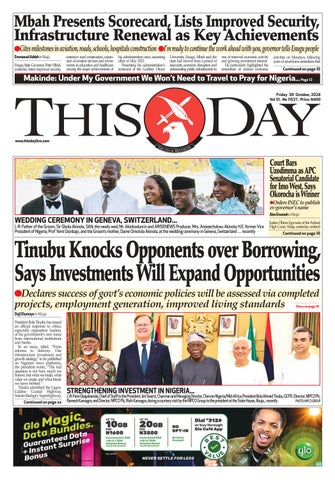
Mbah Presents Scorecard, Lists Improved Security, Infrastructure Renewal as Key Achievements Cites milestones in aviation, roads, schools, hospitals construction I’m ready to continue the work ahead with you, governor tells Enugu people
Emmanuel Addeh in Abuja Enugu State Governor, Peter Mbah, yesterday listed improved security,
extensive road construction, expansion of aviation services and investments in education and healthcare among the major achievements of
his administration since assuming office in May 2023. Presenting his administration’s scorecard at the Godfrey Okoye
University, Enugu, Mbah said the state had moved from a period of insecurity, economic disruption and deteriorating public infrastructure to
one of renewed economic activity and growing investment interest. He particularly highlighted the restoration of normal economic
activities on Mondays, following years of sit-at-home restrictions that Continued on page 10
Makinde: Under My Government We Won’t Need to Travel to Pray for Nigeria... Page 12 Friday 30 October, 2026 Vol 31. No 11527. Price: N400
www.thisdaylive.com TR
UT H
& REASO
N
Court Bars Uzodimma as APC Senatorial Candidate for Imo West, Says Okorocha is Winner
Orders INEC to publish ex-governor’s name
WEDDING CEREMONY IN GENEVA, SWITZERLAND...
L-R: Father of the Groom, Sir Gbola Akinola, SAN; the newly wed, Mr. Akinbodunrin and ARISENEWS Producer, Mrs. Aniezechukwu Akinola; H.E. former Vice President of Nigeria, Prof Yemi Osinbajo, and the Groom’s mother, Dame Omotola Akinola, at the wedding ceremony in Geneva, Switzerland … recently
Alex Enumah in Abuja Justice Obiora Egwuatu of the Federal High Court, Abuja, yesterday, ordered Continued on page 10
Tinubu Knocks Opponents over Borrowing, Says Investments Will Expand Opportunities Declares success of govt’s economic policies will be assessed via completed projects, employment generation, improved living standards Story on page 10
Deji Elumoye in Abuja President Bola Tinubu has issued an official response to critics, especially opposition leaders, of his government’s new loans from international institutions and banks. In an essay, titled, “From reforms to delivery: Our infrastructure investment and growth strategy,” to be published on Nigerian news platforms, the president wrote, “The real question is not how much we borrow, but what we build, what value we create, and what future we leave behind.” Tinubu identified the LagosCalabar Coastal Highway, Sokoto-Badagry Superhighway, Continued on page xx
STRENGTHENING INVESTMENT IN NIGERIA...
L-R: Femi Gbajabiamila, Chief of Staff to the President; Jim Swartz, Chairman and Managing Director, Chevron Nigeria/Mid-Africa; President Bola Ahmed Tinubu, GCFR ; Director, NIPCO Plc, PHOTO: NIPCO GROUP Ramesh Kansagra; and Director, NIPCO Plc, Rishi Kansagra, during a courtesy visit by the NIPCO Group to the president at the State House, Abuja... recently
2
FRIDAY, OCTOBER 30, 2026 • T H I S D AY
FRIDAY, OCTOBER 30, 2026 • T H I S D AY
3
4
FRIDAY, OCTOBER 30, 2026 • T H I S D AY
5
THISDAY • FRIDAY, OCTOBER 30, 2026
Group News Editor: Goddy Egene Email: Goddy.egene@thisdaylive.com, 0803 350 6821, 0807 401 0580
NEWS
OPEYEMI BAMIDELE ADMIRING A PLAQUE AFTER DELIVERING THE 2026 SENIOR EXECUTIVE COURSE LECTURE AT THE NIPSS, KURU...
L-R: Chairman, Senate Committee on Tourism,Senator Pam Dachungyang; Director of Studies, National Institute for Policy and Strategic Studies (NIPSS), Mrs. Nima Salman Mann; Leader of the Senate, Senator Opeyemi Bamidele; Director-General of the Institute, Prof. Ayo Omotayo and Chairman, Senate Committee on Employment, Labour and Productivity, Senator Diket Plang and former President, Nigerian Institution of Estate Surveyors and Valuers, Mr. Adekunle Alonge after delivering the 2026 Senior Executive Course Lecture at the NIPSS, Kuru, Plateau State …yesterday PHOTO: OFFICE OF THE LEADER OF THE SENATE
Seplat Discovers 157 Billion Cubic Feet of Gas, Grows Revenue to $2.76bn Cuts debt by 65%, Q3 production climbs 13% to 155,801 bpd Clears all debt raised for $1.3bn MPNU acquisition Gets first ANOH gas sales through OB3 pipeline Company’s emissions intensity falls 14%
Emmanuel Addeh in Abuja and Peter Uzoho in Lagos Seplat Energy Plc yesterday announced an oil and gas discovery at its Aku01 exploration well in Nigeria, with preliminary internal estimates indicating a humongous 157 Billion Cubic Feet (BCF) of gas and 19 million barrels of oil in place. The company also said its total revenue grew to $2.76 billion, even as Profit After Tax (PAT) rose 174 per cent to $260.2 million in the first nine months of 2026. The hydrocarbon discovery, made in five reservoir intervals in Petroleum Prospecting Licence (PPL) 2A25 after the end of the reporting period, also de-risked four adjacent prospects, one of which Seplat said it plans to test through a second exploration well in the Aku area in 2027. Seplat, which holds a 40 per cent operating interest in the licence, said the oil discovery was not part of the original well plan. The well is being completed as a potential future production well that could be connected to existing infrastructure, enabling early monetisation of the hydrocarbons. The company disclosed the discovery in its unaudited results for the nine months ended September 30, 2026, released to the public. The results
showed that profit after tax increased from $95.1 million in the corresponding period of 2025, while revenue climbed 27 per cent to $2.76 billion from $2.18 billion. In the same vein, operating profit rose 50 per cent to $1.07 billion, while adjusted earnings before interest, taxes, depreciation and amortisation (EBITDA) increased 38 per cent to $1.53 billion from $1.11 billion. Seplat’s average realised oil price rose 34 per cent to $96.19 per barrel from $71.93 per barrel a year earlier. The company achieved an average realised price of $100.44 per barrel in the third quarter, a premium of $10.21 to the average Brent price during the period. The improved financial performance came alongside stronger production. Average working-interest production for the nine months increased 7 per cent to 144,999 barrels of oil equivalent per day (boepd), compared with 135,636 boepd in the corresponding period last year. Production in the third quarter averaged 155,801 boepd, up 13 per cent from 137,888 boepd a year earlier and five per cent above the second-quarter level. Besides, onshore production rose 22 per cent year-on-year to 67,445 boepd during the nine-month period, supported by improved output from the company’s assets and the ramp-up of the Assa North-Ohaji South (ANOH) gas project.
Following the stronger operational performance, Seplat narrowed its 2026 production guidance to between 145,000 and 155,000 boepd, from the previous range of 135,000 to 155,000 boepd. The company’s balance sheet also strengthened considerably. Net debt fell 65 per cent to $234.9 million at the end of September, compared with $673.3 million at the end of 2025. Its net debt-to-EBITDA ratio improved to 0.14 times from 0.53 times. Seplat said it repaid the outstanding $100 million balance on its advance payment facility on October 27, complet-
ing the repayment of all debt raised to finance its 2024 acquisition of Mobil Producing Nigeria Unlimited (MPNU), subsequently renamed Seplat Energy Producing Nigeria Unlimited. Cash at bank increased to $556.9 million at the end of September from $332.3 million at the end of 2025. Cash generated from operations rose six per cent to $1.48 billion, although free cash flow declined 10 per cent to $749 million. The company declared a thirdquarter dividend of 19 cents per share, comprising a core dividend of five cents and a special dividend of 14
The Executive Secretary and Chief Executive Officer of the National Sugar Development Council (NSDC), Mr. Kamar Bakrin, has said President Bola Tinubu’s macroeconomic reforms have made local sugar production more attractive to investors and strengthened Nigeria’s prospects of achieving sugar self-sufficiency. Bakrin, who spoke at the 32nd Nigerian Economic Summit (NESG #32) during a panel session on ‘Strengthening Policy Coordination for the Non-alcoholic Drink
Sector Competitiveness’, said the reforms had brought greater stability to the economy, adding that the next priority was to translate that stability into economic growth that benefits ordinary Nigerians. He identified job creation, particularly for young people, rural livelihoods, security, foreign exchange pressures, food security and the cost of living as pressing national priorities, noting that the sugar value chain could contribute to addressing several of these challenges simultaneously. “Our most pressing priorities are well known: jobs, especially
through the OB3 pipeline began on September 1. The project averaged gross output of 164 million standard cubic feet per day during the third quarter and was operating at between 70 and 80 per cent of capacity. The company also said restoration work on the Yoho production platform had been technically completed, but the restart was delayed after a leak was identified in the 14-inch pipeline connecting the platform to the floating storage and offloading vessel. Production was expected to resume in the fourth quarter.
Civil Service Strategic for Nigeria’s $1 Trillion Economy Target by 2030, Says Abel Olawale Ajimotokan in Abuja
Head of the Civil Service of the Federation, Mr. Olumuyiwa Abel, has underscored the strategic role of the Federal Civil Service as a catalyst for Nigeria’s economic transformation and the actualisation of President Bola Tinubu’s target of a $1 trillion economy by 2030. Abel made the assertion at the 2026 Council of Retired Federal
Permanent Secretaries (CORFEPS) Week Colloquium and the unveiling of the CORFEPS Journal on Public Policy and Governance, held at the Rotunda, Tafawa Balewa House, Ministry of Foreign Affairs, Abuja. Abel maintained that achieving the ambitious economic target would require a capable, innovative, productive, and results-driven civil service capable of translating government policies into measurable outcomes,
Tinubu’s Reforms Make Nigeria’s Sugar Self-Sufficiency Achievable, Says NSDC Boss, Kamar Bakrin Sunday Ehigiator
cents. Its full-year dividend guidance remains $270 million, equivalent to 45 cents per share. Commenting on the results, Seplat’s Chief Executive Officer, Effiong Okon, said the company’s third-quarter production averaged more than 155,000 boepd, placing it on course to achieve the upper half of its full-year production guidance. He described the Aku-01 discovery as evidence of the quality of Nigeria’s subsurface and the potential within Seplat’s exploration portfolio. On gas development, Seplat reported that commercial gas sales from ANOH
for young people; rural livelihoods; security, pressure on foreign exchange; food security; and the cost of living. “Every government must make choices among competing priorities. Our contribution as a Council is to make sure that, when those choices are made, the full economic picture of the sugar value chain is on the table. This is because very few sectors touch all of these priorities at once the way sugar does.” According to him, Nigeria’s sugar and beverage industries should be viewed as interconnected parts of a single value chain, from sugarcane
cultivation to the production of bottled drinks. He noted that the beverage industry was Nigeria’s largest industrial consumer of sugar, arguing that policies that strengthen domestic sugar production would also improve the competitiveness of beverage manufacturers. Under the Nigeria Sugar Master Plan (NSMP) 2.0, the country aims to achieve self-sufficiency in sugar production, a target Bakrin said would save approximately $1 billion in foreign exchange annually and generate about 110,000 direct jobs, predominantly in rural communities.
improved service delivery, and sustainable national development. He stated that prevailing economic uncertainties, fiscal pressures, and technological disruptions had made institutional efficiency, professional competence and effective policy implementation more critical to national development. According to him, the success of Tinubu’s Renewed Hope Agenda depended not only on the formulation of sound policies but also on the ability of the civil service to provide objective policy advice, implement government decisions efficiently, and remain accountable to citizens. He explained that the Federal Civil Service Strategy and Implementation Plan 2026-2030 (FCSSIP30) would build on the achievements of the preceding FCSSIP25, with renewed emphasis on digital transformation, simplified administrative processes, and improved performance management. Abel, however, emphasised that delivering on the objectives of FCSSIP30 would require a fundamental shift in the mind-set, work ethics, and institutional culture of public servants. He called for a workforce that embraced innovation, professionalism, accountability, and a strong
commitment to results, stating that an efficient civil service remains indispensable to the successful implementation of government policies and programmes. In his remarks, Vice President Kashim Shettima, represented by Special Adviser to the President on Power and Infrastructure in the Office of the Vice President, Mr. Sadiq Wanka, observed that national aspirations could only be achieved when public institutions effectively translated government policies into tangible results. He commended CORFEPS for providing a platform for experiencesharing, policy reflection, and institutional learning in support of Nigeria’s development. Delivering the keynote address, former Secretary to the Government of the Federation, Mr. Boss Mustapha, highlighted the indispensable role of the civil service in maintaining administrative continuity, strengthening inter-institutional coordination, and sustaining governance across successive administrations. Mustapha maintained that good governance required merit-based recruitment and career progression, stronger alignment between performance and promotion, objective and evidence-based policy advice, as well as accountability for results.
6
FRIDAY, OCTOBER 30, 2026 • T H I S D AY
7
THISDAY • FRIDAY, OCTOBER 30, 2026
NEWS
INDUCTION OF HELICOPTERS AND INAUGURATION OF NEWLY CONSTRUCTED PRESIDENTIAL AIR FLEET HANGER...
L-R: Minister of state for Defence Dr. Bello Muhammad Matawalle; President Bola Ahmed Tinubu; Chief of Air Staff, Air Marshal Sunday Aneke; National Security Adviser, Alhaji Nuhu Ribadu; Chief of Defence Staff, Gen. Olufemi Oloyode; Chief of Army Staff, Lt.-Gen. Waidi Shaibu; Chief of the Naval Staff, Vice Admiral Idi Abbas, and Director-General of the Department of State Services (DSS), Oluwatosin Adeola Ajayi, PHOTO: GODWIN OMOIGUI during the induction of 2x Airbus H-125 Helicopters 3x Austa 109 Trekker B Helicopters and inauguration of newly constructed Presidential Air Fleet Hanger in Abuja, yesterday
Olusegun Adesokan: 92% of Taxpayers Pay Zero or Lower Taxes Under New Act Declares 21 states have adopted harmonised tax, levy legislation, as authorities seek to dismantle multiple charges amid 27% rise in revenue FG, states plan joint audits to cut compliance costs, disruption to businesses, seeks to end roadside tax collection, others
James Emejo in Abuja
Adesokan said data obtained from 23 states showed that about 92 per cent of income earners covered by the assessment now paid lower or zero personal income tax under the new framework. He said the changes were intended to leave more money in the hands of lower-income earners while ensuring that individuals with greater financial capacity contributed a fairer share. Under the revised personal income tax structure, the first N800,000 of annual taxable income is taxed at zero per cent, while higher income bands attract progressively higher rates, reaching 25 per cent for the top band. Adesokan stressed that the reform was guided by the principle of taxing prosperity rather than poverty, adding that the government has not introduced new taxes through the framework. He acknowledged concerns about
traders and small businesses who continued to complain about tax demands despite the exemptions provided under the new rules. According to him, inadequate public awareness and the persistence of unauthorised collectors has contributed to the confusion. He said the board would continue its public education campaign to clarify which taxpayers were exempt from personal income tax and distinguish legitimate taxes from other authorised charges. However, the 92 per cent figure relates to the personal income tax assessment presented by the board and does not qualify as an exemption from every form of taxation, including applicable consumption taxes.
Alli Assures Workers of Prompt Payment of Entitlements as Oyo Doctors, LAUTECH ASUU Begin Strike
Adesokan said the National Tax Identification system was another major component of the reform, providing a common means of identifying taxpayers across federal and state jurisdictions. The system is expected to link existing taxpayer records and enable authorities to verify tax compliance without requiring individuals and businesses to repeatedly establish their status in different states. He said the arrangement would reduce administrative bottlenecks, particularly for individuals conducting business or property transactions outside their state of residence. He stated that JRB was also promoting uniform tax administration guidelines and information-sharing arrangements to improve transparency and voluntary compliance.
Executive Secretary, Joint Revenue Board (JRB), Mr. Olusegun Adesokan, on Wednesday declared that the implementation of the new tax regime had yielded early fruits with a 27 per cent increase in tax revenue from 23 states in the first half of the year (H1 2026), compared to the corresponding period of 2025. Adesokan said the performance reflected a shift towards bringing more high-income earners into the tax net while reducing the burden on lower-income taxpayers. The JRB boss spoke during an engagement with journalists in Abuja. He said the reform was also beginning to improve revenue administration through the harmonisation of taxes and levies, introduction of a National
Tax Identification system, and closer coordination among federal and state tax authorities. Adesokan said 21 states had adopted the harmonised taxes and levies legislation as of October 27, with the National Economic Council (NEC) identifying the initiative as one of its priorities for implementation within a 90-day action plan. The figures provide an early indication of the reform’s potential to improve domestic revenue mobilisation without imposing additional tax burdens on low-income households and businesses. However, the board acknowledged that multiple taxation, unauthorised collections, and confusion over legitimate government charges remained a challenge.
21 States Move to Harmonise Levies
Adesokan said the harmonisation initiative was designed to consolidate numerous taxes, levies, and charges imposed by subnational authorities into nine broad categories, reducing duplication and making compliance more predictable for businesses and individuals. He said the board developed the framework in collaboration with the Presidential Committee on Fiscal Policy and Tax Reforms and had circulated it to states for adoption. He acknowledged that unauthorised roadside collections remained a problem, including demands by individuals and groups claiming to represent government authorities. Adesokan said the JRB was working with the police and state revenue authorities on a coordinated enforcement mechanism to address the practice. He said the board also planned
Knocks Makinde for insensitivity
The All Progressives Congress (APC) governorship candidate in Oyo State, Senator Sharafadeen Alli, has assured all categories of workers in the state employ of prompt payment of salaries, allowances and all other entitlements, if elected in the 2027 election. His assurance came on the heels of industrial actions embarked upon by medical and dental officers in the state employ and lecturers at the Ladoke Akintola University (LAUTECH), Ogbomoso. While medical workers’ strike commenced on Monday, members of LAUTECH branch of the Academic Staff Union of Universities (ASUU), started an indefinite strike on Thursday. The strike has left patients in public hospitals helpless and essential healthcare services unavailable to the people of the state. Condemning Governor Seyi Makinde for ignoring doctors’ and lecturers’ strike and continuing with his presidential campaign, Alli accused him of insensitivity to the
plight of the masses and thousands of students attending the Ladoke Akintola University (LAUTECH), Ogbomoso. A statement by Bisi Oladele, Director of Media and Publicity, Senator Sharafadeen Alli Campaign Organisation (SSACO), said Senator Alli described the industrial actions as deeply troubling, particularly against the backdrop of persistent complaints about inadequate medical personnel, poor equipment and deteriorating facilities in government-owned hospitals across the state. Assuring prompt payment of workers’ salaries and entitlements when elected, Alli, according to the statement, questioned how a government that repeatedly proclaims workers’ welfare as its priority could allow disputes involving payment of allowances and implementation of the 2025 FG-ASUU agreement to degenerate into industrial disputes, thus hampering critical healthcare and education service delivery. The SSACO noted that the demands made by members of the
Association of Medical and Dental Officers (AMDO) are not unreasonable as they concern the payment of outstanding allowances and the restoration of salaries of medical personnel transferred from field assignments to the Ministry of Health. Neither are the demands for implementation of the FGN-ASUU agreement, payment of outstanding entitlements including promotion arrears and provision of facilities for LAUTECH ASUU members. The organisation said Alli is particularly concerned that the industrial action involves the already overstretched medical workforce in the state, warning that the withdrawal of their services will further worsen healthcare delivery in public hospitals. “At a time when Oyo State government hospitals are struggling with shortages of medical personnel, inadequate equipment and other operational challenges, the state can ill-afford the prolonged withdrawal of services by its doctors and dental officers. “The consequences are borne not
to intensify efforts to eliminate illegal collections affecting transport operators and traders. Although Adesokan did not give a definitive commencement date for the proposed enforcement measures. He urged businesses to verify suspicious demands with the relevant tax authorities and ensure that payments were made into authorised government accounts rather than accounts belonging to private consultants or collectors. He listed the states set to harmonise taxes and levies to include Kebbi, Niger, Kaduna, Plateau, Ekiti, Benue, Zamfara, Enugu, Kogi, Abia and Kwara. Others are Nasarawa, Anambra, Gombe, Akwa Ibom, Adamawa, Bayelsa, Delta, Yobe, Ondo and Borno.
Low-income Earners Get Tax Relief
by government officials who can afford private medical care, but by ordinary citizens, particularly pregnant women, children, pensioners and low-income families who depend on public healthcare facilities. Eveey additional day of this strike raises serious concerns about access to emergency treatment, continuity of care and the welfare of vulnerable patients. “Worse still, Governor Makinde has chosen the comfort of a political jamboree in the South East over the urgent responsibility of safeguarding the health and lives of his people and education of future leaders. Rather than remain at his duty post to resolve a crisis that has further crippled an already struggling public healthcare and education system, the governor is busy chasing the mirage of an illusory presidential ambition. “It is the height of misplaced priorities for a governor who endlessly trumpets his commitment to workers’ welfare. For Makinde, the allure of presidential power appears to have eclipsed the solemn obligations of his present office. Oyo State deserves a governor focused on governance,
not one distracted by the intoxicating but increasingly unrealistic dream of occupying Aso Rock.” The statement said. The campaign organisation appealed to the striking medical personnel and lecturers to remain open to meaningful dialogue while recognising their right to pursue legitimate employment demands through lawful means. It further called for immediate contingency arrangements to protect patients requiring emergency and life-saving medical attention for the duration of the industrial action, stressing that health and lives of Oyo State residents must remain paramount. “Unlike Governor Makinde, Senator Alli will place the welfare of healthcare professionals, education and the wellbeing of the people at the heart of his administration. His government will prioritise prompt payment of salaries and allowances, constructive engagement with medical personnel and the provision of modern equipment and essential facilities in public hospitals,” the statement concluded.
National Tax ID to Curb Multiple Taxation
Joint Audits Planned for Businesses
In furtherance of measures to reduce the cost of compliance, Adesokan said JRB was preparing to facilitate joint tax audits involving NRS and state internal revenue services. He said the arrangement would enable relevant authorities to coordinate their examinations of businesses rather than visiting the same companies separately at different times. Under the proposed approach, state authorities could examine personal income tax compliance, including employers’ obligations, while the federal revenue service would address the company’s relevant federal tax obligations.
8
FRIDAY, OCTOBER 30, 2026 • THISDAY
NEWS
INSURANCE INDUSTRY LEADERS FORUM...
L-R: Director, FBS Reinsurance Limited, Mr. Steve Kyerematen; Director, Mr. Wole Oshin; Chairman, Bala Zakariyau; Head of Lagos Control Office, National Insurance Commission (NAICOM), Dr. Julius Odidi; Director, FBS Reinsurance Limited, Mr. Fola Daniel; and Managing Director/CEO, FBS Reinsurance Limited, Mr. Ganiyu Musa; at insurance industry leaders forum organised by FBS Re in Lagos... recently
Tinubu Assures Retirees of Dignity, Security with N758bn Pension Bond Oloworaran forecloses June 2027 recapitalisation deadline for pension administrators, custodians Laments 70% of private sector retirees earn below minimum wage, risk poverty PenCom targets 3 million funded pension accounts
Olawale Ajimotokan and James Emejo in Abuja
President Bola Tinubu has assured Nigerian retirees that no citizen who served the country will be forgotten in retirement, declaring that his administration is committed to restoring dignity and financial security to pensioners through the N758 billion Federal Government Pension Bond and other pension reforms. Tinubu gave the assurance yesterday at the inaugural National Pension Week Leadership Summit in Abuja, where he reaffirmed his administration’s commitment to addressing outstanding pension obligations and improving the welfare of retirees. That was as Director-General of National Pension Commission (PenCom), Ms Omolola Oloworaran, ruled out any extension of the June 30, 2027 recapitalisation deadline for Pension Fund Administrators (PFAs) and Pension Fund Custodians (PFCs). Oloworaran urged operators to strengthen their financial capacity or risk falling short of the regulator’s requirements. Speaking at the summit, she stressed that the commission would not shift the deadline, adding that the next phase of pension reform would prioritise institutional resilience, stronger investment performance, and improved
retirement benefits over the growth in industry assets alone. Tinubu, who was represented at the summit by Secretary to the Government of the Federation (SGF), Senator George Akume, said pension benefits were not privileges granted by the government, but entitlements earned through years of service to the nation. He stated, “A pension is not a favour granted by government. It is a wage earned, deferred and held in trust. It is a promise. And this administration has resolved that the promise will be kept.” The president said his administration inherited pension obligations that had remained unsettled for years, leaving many retirees waiting for their accrued pension rights. He maintained that the approval of the N758 billion Federal Government Pension Bond was a major step towards settling the outstanding obligations and strengthening the Pension Protection Fund. Tinubu said, “That was not an accounting exercise. It was an act of restitution to Nigerians who served their country and were made to wait for what they had earned.” The president added that the bond formed part of broader efforts to restore confidence in the Contributory Pension Scheme and ensure that workers who devoted their productive years to national
service could retire with greater peace of mind. He also announced that his administration would implement the Minimum Pension Guarantee provision of the Pension Reform Act 2014, which he stated had remained unimplemented since the law was enacted more than 11 years ago. “Since enactment, that promise has never been honoured. Under President Tinubu, it will be,” he said. Tinubu unveiled PenCare, a national retiree wellbeing programme designed
Kuni Tyessi in Abuja
The Alliance for a Green Revolution in Africa, AGRA, in partnership with the Small and Medium Enterprises Development Agency of Nigeria, SMEDAN, and the Enterprise Development Centre, EDC, Business School, is working to improve the Nigerian Business Development Services, BDS, ecosystem to enhance access to finance for agricultural Small and Medium Enterprises, SMEs.
Adopts OHOPRS to address duplication, gaps in assistance
The Federal Executive Council (FEC) has approved the One Humanitarian One Poverty Response System (OHOPRS), a national framework designed to integrate humanitarian assistance, social protection and poverty reduction under a coordinated system. The approval was secured on Wednesday following the presentation of a memorandum by the Minister of Humanitarian Affairs and Poverty Reduction, Dr. Bernard M. Doro, at the Council meeting in Abuja. According to a statement issued by the ministry yesterday, the framework is a key component of President Bola Tinubu’s Renewed Hope Agenda and is intended to provide a coordinated approach to lifting millions of Nigerians
out of poverty. The ministry said humanitarian interventions, social protection programmes and poverty reduction initiatives had operated largely in isolation across government agencies, development partners and humanitarian organisations, resulting in duplication of efforts, gaps in coverage and limited pathways for vulnerable households to achieve long-term recovery. It explained that OHOPRS was designed to address these challenges by placing households at the centre of planning, service delivery and impact measurement. Under the framework, households affected by emergencies, including conflict-related displacement, would continue to receive immediate as-
Commission (PenCom) to enforce pension laws without fear or favour, while urging public and private sector employers to remit pension contributions fully and promptly. “To deduct a worker’s contribution and fail to remit it is not an administrative lapse. It is a breach of trust,” he warned. He also called on Pension Fund Administrators and Custodians to improve their investment strategies, reduce costs and ensure that retirement savings delivered meaningful returns
to contributors. According to him, pension fund investments must balance the security of contributors’ savings with disciplined growth, particularly in an economy where inflation can erode the purchasing power of retirement benefits. Tinubu directed a renewed push to extend pension coverage to workers in the informal sector, including traders, artisans, farmers, transport workers, and self-employed Nigerians, through the Personal Pension Plan and improved distribution channels.
AGRA, SMEDAN, EDC Move to Bridge Financing Gap for Agric SMEs, Targets 40% Women, 10% PWDs, 10,000 Youths
FEC Approves Framework to Unify Humanitarian Aid, Poverty Reduction Initiatives Sunday Ehigiator
to provide low-income retirees with access to essential healthcare services, signalling a broader approach to retirement security beyond the payment of pension benefits. He said a sustainable pension system must protect retirees against financial hardship while ensuring that their healthcare and welfare needs received adequate attention. The president stressed that achieving the objectives required the cooperation of all stakeholders in the pension industry. He charged the National Pension
sistance such as food, shelter and healthcare, while also being connected to social protection programmes, education, skills acquisition and livelihood support. The ministry said the approach was intended to ensure that emergency relief served as the starting point for recovery, resilience and eventual economic self-reliance. “For too long, humanitarian assistance, social protection and poverty reduction have operated as separate interventions. “OHOPRS brings them together, so that vulnerable Nigerians are not simply assisted during emergencies but supported along a structured pathway towards recovery, resilience and economic independence,” Doro said.
The BDS ecosystem project is focused on solving challenges limiting agric SMEs from scaling their businesses and is currently being implemented in Kaduna, Niger and Nasarawa States as pilot states, with plans to extend to other states in future programmes. Disclosing this during the final pitching contest for youth agripreneurs in Abuja on Thursday, the Program Officer of AGRA, Dr. Godswill Aguiyi, said agricultural SMEs, particularly youth-led enterprises, find it difficult to access finance compared to other sectors like oil and gas and importation, despite their critical role in food security. “The obvious problem is that agric
SMEs do not have access to finance as it were compared to what you see in other sectors, for example oil and gas, people who do importation get more access to finance from banks, micro finance institutions and stuff like that, but the agriculture practitioners, agric youth SMEs find it difficult to get access to the financing they need to improve their businesses,” Dr. Aguiyi said. According to him, one of the activities under the project is the identification of young entrepreneurs doing outstanding work in the agriculture sector, with over 10,000 youths applying for the competition which was rigorously screened to about 30 finalists.
“Under the BDS ecosystem project that we are doing with SMEDAN business school and EDC, we are trying to solve some of the problems that are limiting agric SMEs to improve their businesses. We are working in Kaduna State, Niger and Nasarawa State,” he said. He said the initiative is also aimed at encouraging youths to embrace agriculture at a time many are moving away from the sector. “It’s more like an encouragement to youths that are doing agriculture because many youths are running away from this particular sector, not interested to do agriculture because of the obvious reasons,” Dr. Aguiyi added.
RHI Extends Food Relief Items to Persons with Disabilities In Ogun First Lady reiterates commitment to vulnerable Nigerians Deji Elumoye in Abuja In a sustained move to reach out to the vulnerable nationwide, The Renewed Hope Initiative (RHI)has presented assorted food items to Persons with Disabilities and other Vulnerable Individuals in Ogun State making it the 32nd State to benefit from the scheme The Food Outreach Program designed under the social investment scope of RHI to provide food assistance to those with disabilities, widows and other vulnerable individuals to cushion
their immediate needs by supplying two truckloads of food items monthly for onward distribution by wives of governors who are the State Coordinators of RHI. The program supported by an Anonymous Donor and the Abdul Samad Rabiu Africa Initiative have remained consistent in this area since inception in 2024 Making the formal presentation in Abeakuta, Ogun State capital on behalf of the First Lady, Senator Oluremi Tinubu, wife of the Vice President, Hajiya
Nana Shettima said the intervention reflects the RHI continued commitment to providing nutritional support to vulnerable Nigerians Mrs Shettima reiterated that the Renewed Hope initiative is committed to the welfare of vulnerable groups in line with President Bola Ahmed Tinubu’s Renewed Hope Agenda . While announcing Akwa Ibom as the next beneficiary State, Mrs Tinubu identified the ASR Africa as the supplier of the food items handed over to Ogun State.
FRIDAY, OCTOBER 30, 2026 • T H I S D AY
9
10
FRIDAY, OCTOBER 30, 2026 • THISDAY
TEN
Omokri Targets Mexican Market for Nigerian Refined Petroleum, Fertiliser
Envoy plans Dangote Refinery tour for Mexican officials Seeks stronger trade ties, as Akpabio pledges legislative support
Sunday Aborisade in Abuja Nigeria’s Ambassador to the United Mexican States, Reno Omokri, has unveiled plans to deepen economic relations between Nigeria and Mexico through increased export of refined petroleum products and urea fertiliser, as the federal government seeks to expand the country’s non-crude export earnings. Omokri spoke after a meeting with President of the Senate, Godswill Akpabio, at the National Assembly in Abuja on Wednesday. He said arrangements were already underway for Mexican officials to visit Dangote Petroleum Refinery to explore opportunities for bilateral cooperation. The ambassador said Nigeria must move beyond exporting raw materials to producing and exporting finished goods, stressing that the country has
the capacity to become a major supplier of industrial products to Mexico. He disclosed that Nigeria was already exporting urea fertiliser to Mexico but maintained that the volume remained relatively small compared with the country’s potential. Omokri said, “What President Bola Ahmed Tinubu wants to do is to ensure that the products coming out of Nigeria are refined. We do not just want to be a resource country. “We want to be a productive country, a country that manufactures what it consumes and also exports.” He added that Nigeria could strengthen its position in the Mexican market by supplying urea fertiliser at competitive prices, particularly as some existing suppliers operate in regions affected by insecurity and armed conflicts. He said, “We are already exporting
urea fertiliser to Mexico. A lot of people do not know that. But the thing is, we are really doing very little. “We are in a better position to supply urea fertiliser at an affordable rate to Mexico.” The envoy stated that relative stability in the Gulf of Guinea could also strengthen Nigeria’s prospects as a dependable supplier of industrial and petroleum products to the Mexican market. According to him, the region has enjoyed more than two decades of uninterrupted peace, providing an important advantage for maritime trade and the movement of goods. Omokri disclosed that he had toured the Dangote refinery and held discussions with its owner, Aliko Dangote, on possible areas of cooperation between the Nigerian industrial facility and Mexican businesses.
“There is already an invitation for the Mexicans to visit the refinery for a tour,” he said, indicating that the proposed visit could provide an opportunity to explore commercial relationships between the two countries. The ambassador’s remarks came as the senate leadership pledged to support efforts to strengthen Nigeria’s international economic relations through legislative diplomacy and closer cooperation with foreign legislatures. Akpabio, who received Omokri alongside Deputy President of the Senate, Barau Jibrin; the Senate Leader, Opeyemi Bamidele; and other members of the leadership, congratulated the ambassador on his appointment and wished him success in his diplomatic assignment. He commended Tinubu for appointing Omokri and said Senate
had facilitated his confirmation in the interest of executive-legislative cooperation and Nigeria’s international standing. Akpabio stated, “Let me congratulate my brother, His Excellency, Reno Omokri, Ambassador-designate to the Republic of Mexico. We want to wish you well and thank President Bola Ahmed Tinubu for standing by you.” The senate president described Tinubu as a leader committed to national unity and capable of identifying people with the experience and qualifications required for public service. He said, “This president does not harbour hatred. This president loves all Nigerians, and particularly has a knack for fishing out the square pegs for the square holes.” Akpabio said the senate was impressed by Omokri’s credentials when the president submitted his
Reno Omokri nomination and, therefore, ensured that the confirmation process was completed promptly. He said, “When you were announced by him as his choice for the ambassadorial seat, the Senate of the Federal Republic of Nigeria was Continued on page 35
TINUBU KNOCKS OPPONENTS OVER BORROWING, SAYS INVESTMENTS WILL EXPAND OPPORTUNITIES
Trans-Sahara Superhighway, electricity grid upgrades, and the modernisation of key commercial ports in Lagos as major projects expected to strengthen Nigeria’s productive capacity. The Lagos-Calabar Coastal Highway is expected to cut logistics costs along its corridor by 15 to 20 per cent. It could add up to two per cent to Nigeria’s GDP through expanded trade, tourism, and industrial activity. The project is also projected to generate about 100,000 direct jobs in construction and engineering, alongside more than 150,000
indirect jobs in logistics, materials, and related services. According to the president, the projects, alongside investments in healthcare, education, and vocational training, would connect economic regions, reduce logistics costs, unlock agricultural and industrial potential, and attract private investment. Tinubu disclosed, “We are not simply building highways. We are opening economic corridors, connecting markets, unlocking industries and reshaping Nigeria’s economic geography.” He said the administration’s
ambition to build a $1 trillion economy by 2030 would require sustained infrastructure investment to support higher productivity, industrialisation and trade. “We cannot build a USD 1 trillion economy with infrastructure designed for an economy a fraction of that size,” Tinubu said. He wrote that improving economic indicators and growing international investor confidence were creating opportunities for Nigeria to attract long-term investment and expand critical infrastructure.
COURT BARS UZODINMA AS APC SENATORIAL CANDIDATE FOR IMO WEST, SAYS OKOROCHA IS WINNER
the governor of Imo State, Hope Uzodinma, to immediately stop parading himself as the candidate of All Progressives Congress (APC) for the Imo West Senatorial election slated for January 16, 2027. Egwuatu issued the order after holding that Uzodinma did not win the May 18 primary election conducted by APC and monitored by the Independent National Electoral Commission (INEC). The judge, in his judgement, held that evidence presented before the court proved that former Governor Rochas Okorocha actually won majority of the votes cast at the poll, and he should be declared the candidate of APC in the Imo West Senatorial election. Okorocha had dragged INEC, APC, and Uzodinma to court following the substitution of his name with that of Uzodinma as candidate of APC in the senatorial election. The former governor, in the suit marked: FHC/ABJ/CS/1854/2026, queried why his party should submit the name of the incumbent governor as its candidate, and why INEC should publish same after announcing him as winner of the May 18 primary election. Among the reliefs he sought from the court included an order nullifying and setting aside the submission of the name of Uzodinma and publishing of same, for being unlawful, unconstitutional, and in breach of the electoral laws. Okorocha also prayed the court to declare him as candidate of APC in the said election and sought an order to the electoral umpire to publish his name as the rightful candidate of APC.
Responding, INEC, APC and Uzodinma, while claiming that Uzodinma won majority of the votes cast, urged the court to dismiss the case for being statute barred. However, delivering judgement on the matter, yesterday, Egwuatu held that the case by Okorocha was filed within the 14 days required by law. He explained that contrary to the submissions of the defendants, the date of the cause of litigation was August 1, when INEC published the name of Uzodinma as APC’s candidate, and not May 18, when the primary election was conducted, or July 14, when APC forwarded Uzodinma’s name to INEC. The court also dismissed the defendants’ argument that Okorocha ought to have appealed the outcome of the primary, wondering how a person who won an election should challenge his own victory. Having held that the case was justiciable and that the court had jurisdiction to entertain the suit, the court then delved into the issue of who won the primary election. Egwuatu stated that after a thorough examination of all documents presented by the applicant and the defendants, it was obvious that Okorocha won the May 18 primary but was denied the victory. According to the judge, the documents presented by the defendants showing Uzodinma won the primary election were “fabricated”. The court, in addition, described the action of the defendants as “an afterthought”, because the “respondents’ documents were made up after it became clear that the applicant won the primary”. Egwuatu said, “Majority of
the documents tendered by APC to support the purported nomination of Uzodimma (3rd respondent) contradicts each other, indicating that they were clearly fabricated for the unlawful purpose of nominating the 3rd respondent as candidate. “In view of the doubt cast on the authenticity of the documents, the court cannot ascribe probative value to the purported documents.” Dismissing allegations that Okorocha forged INEC documents, the court observed that the respondents did not present the authentic documents to substantiate the allegation Continued on page 34
The president said the economic reforms his administration introduced in May 2023 helped restore macroeconomic stability, strengthen public finances, and improve the country’s standing in international financial markets. He said a $1 trillion economy would not emerge by declaration alone but must be built through sustained investment, higher productivity, industrialisation, and trade, stressing that infrastructure development would be critical to achieving the target by 2030. Tinubu said real Gross Domestic Product growth reached 4.43 per cent in the second quarter of 2026, while headline inflation fell to 14.63 per cent in September, from 20.98 per cent a year earlier. He also said gross external reserves rose to $55.1 billion as of October 9, 2026, including about $46 billion in net reserves, while the tax-to-GDP ratio increased to 12.5 per cent, from seven per cent. The president attributed the improvements to measures, including petrol subsidy removal, exchange rate unification, tax reforms, and coordinated efforts to tackle inflation. “The decisions taken since 2023 were difficult but necessary,” he said. Tinubu said the gains had strengthened Nigeria’s ability to attract investment and finance
projects that support long-term economic growth. “Confidence has a price; our cost of borrowing is going down, and the country risk premium has drastically decreased,” he said. The president cited positive assessments by international credit rating agencies as evidence of improved confidence in the economy. He stated, “These are not political endorsements; they are independent assessments by global rating agencies, index providers, regulators and investors, recognising stronger external reserves, improved macroeconomic management and greater financial credibility.” According to the president, the improved standing could help Nigeria attract more institutional investors, secure longer-term financing, and reduce borrowing costs. He said the administration was shifting public borrowing away from financing short-term fiscal pressures towards investments that would generate economic returns, create jobs, and expand opportunities for future generations. Tinubu said the government was also pursuing longer-term financing arrangements to match the lifespan of infrastructure assets, reduce refinancing pressures,
and secure more competitive funding for productive investments. He said Nigeria must convert renewed international confidence into capital expenditure, completed infrastructure, and lasting economic benefits for citizens. He identified five priorities for the next phase of the Federal Executive Council’s economic strategy: food affordability and energy price stability, budget harmonisation and fiscal discipline. completion of high-impact projects and investment in critical infrastructure, an improved economic policy framework and regulatory efficiency, and targeted household support alongside investment in human development. Tinubu stressed that the success of the current administration’s economic schemes would be measured by completed projects, increased investment, employment generation, and improved living standards. He stated, “Securing financing is not the achievement. Completing the project, delivering value and improving the lives of Nigerians is the achievement.” The president added that the country’s economic ambition must be supported by responsible borrowing and investments that create lasting opportunities for future generations.
MBAH PRESENTS SCORECARD, LISTS IMPROVED SECURITY, INFRASTRUCTURE RENEWAL AS KEY ACHIEVEMENTS had crippled businesses, disrupted education and deprived residents of their daily earnings. “There was a time when Monday was no longer an ordinary working day in Enugu. Shops remained closed. Roads were deserted. Parents were afraid to send their children to school. People who depended on their daily earnings had to surrender an entire day’s income because others had decided they should remain indoors,” he said. Recalling the economic consequences, the governor said that for women selling food in the market the development meant that customers were at home, while her produce was deteriorating, and the money she needed to support her family would not be earned that day. He added: “Today, people are going about their business with a freedom that had been denied to them for far too long. A trader can plan a full working week. Children can attend school. Businesses can
receive customers, move goods and keep their employees working.” According to him, the restoration of normal activities was one of the most important foundations for the state’s economic recovery. “It may seem strange that we should celebrate something as ordinary as being able to go to work on Monday. But anyone who lived through those years understands its importance,” he stated. On infrastructure, Mbah said his administration had undertaken substantial road development and was introducing a more organised transport system, including new buses and terminals, to improve connectivity and make movement across the state safer and more dependable. He explained that the administration’s infrastructure programme was designed not merely around kilometres of roads constructed but also the economic opportunities that improved connectivity could unlock
for residents. “Most people experience it rather differently. They know the road that used to damage their vehicles, the journey that took too long, or the difficulty of getting produce from a farm to a market. These are the experiences that matter,” he said. In aviation, the governor disclosed that Enugu had moved from barely two incoming flights daily when he assumed office to more than 15 in the administration’s recent review. “When we assumed office, Enugu had barely two incoming flights a day. In our recent review, we counted more than 15. That change tells us something about the renewed interest in our state,” he said. He said the establishment of Enugu Air and the administration’s wider aviation plans were intended to strengthen connections between the state, other parts of Nigeria and international markets. On education, Mbah said his administration was investing in 260
Smart Green Schools, designed to bring improved learning facilities and opportunities to every ward in the state. He described education as one of the most important investments required to secure Enugu’s future, arguing that children must be equipped with skills to navigate an economy increasingly shaped by technology and changing patterns of employment. “This is the thinking behind our 260 Smart Green Schools, designed to bring a new standard of education to every ward in Enugu State,” he said. “We want children in our rural communities to have access to the kind of learning opportunities that parents might once have believed were available only in the most privileged schools,” he added. He said the investments were intended to prepare young people for opportunities in engineering, software Continued on page 31
FRIDAY, OCTOBER 30, 2026 • T H I S D AY
11
12
FRIDAY, OCTOBER 30, 2026 • THISDAY
NEWS
NBCC–LAGOS STATE EXECUTIVE BUSINESS BREAKFAST MEETING...
L-R: Deputy President & Chairman, Membership, Nigeria-British Chambers of Commerce (NBCC), Mr. Nnamdi Okonkwo; President/Chairman of Council, NBCC, Prince Abimbola Olashore; Governor of Lagos State, Mr. Babajide Sanwo-Olu; Deputy President & Chairman, Financial & General Purpose Committee, Mr. Akin Osuntoki; and Asiwaju (Dr.) Michael Olawale-Cole, during the NBCC–Lagos State Executive Business Breakfast meeting themed “The Future of Lagos: Business, Investment & Global Competitiveness”, at the NBCC Plaza in Lekki, on Wednesday
Makinde: Under My Government We Won’t Need to Travel to Pray for Nigeria Tinubu departs for Makkah, to pray for nation’s peace, stability
Deji Elumoye, Chuks Okocha in Abuja and Gideon Arinze in Enugu The presidential candidate of the Allied People’s Movement (APM), Seyi Makinde, yesterday said his administration will focus on addressing Nigeria’s challenges rather than leaving the country to seek solutions abroad. Makinde spoke in Enugu during the Southeast town hall meeting of the Makinde-Daura 2027 presidential campaign, where he
also announced that the party’s manifesto would be unveiled on November 4, 2026. He was reacting to a statement by the Special Adviser to the President on Information and Strategy, Bayo Onanuga, that President Bola Tinubu was travelling to Saudi Arabia to pray for Nigeria. “Prayers are answered even in the country. Under my administration, we will stay here and fix the country. Leaders need to stop all the deceit and tell the people the true
situation of things so that we will not be praying in vain,” he said. Makinde questioned the country’s continued borrowing despite what he described as sufficient external reserves and revenue generation, adding that his administration would reset the economy, security architecture, education system and socio-political space, while creating opportunities and tackling poverty. The presidential candidate also announced a partnership
with Skill Reset Nigeria to train one million youths in skills that would improve their employment prospects. He added that his administration would create an enabling environment for businesses to thrive, describing this as essential to boosting the economy. In his address, the vicepresidential candidate, Lawal Daura, said the party was not just coming to try. “We are coming to fix the country and the many issues bedevilling it. With your
Court Stops EFCC from Pursuing Criminal Case Against Chappal Energies Founder Says commission should have appealed subsisting court order
Wale Igbintade
The High Court of the Federal Capital Territory (FCT), Abuja, has restrained the Economic and Financial Crimes Commission (EFCC) from taking further steps in a criminal case against the founder of Chappal Energies Limited, Ufoma Joseph Immanuel, and Intermediate Investments Limited, holding that the Commission should have challenged a subsisting court order through an appeal rather than proceed with the prosecution. Justice Josephine Obanor, in a ruling delivered on October 16, 2026, held that the EFCC could not lawfully disregard an existing order of court and proceed with criminal charges against the applicants as though the order did not exist. The ruling arose from a suit instituted by Chappal Energies Mauritius Limited, Intermediate Investments Limited and Immanuel against the Attorney-General of the Federation, the EFCC, the Nigeria Police Force, R28 Limited, Biswal Limited and Adebisi Adebutu. The applicants were represented by Oluseun Awonuga, SAN, and E. B. Aigbe. Richard E. Dauda appeared for the EFCC, while Muhammad Saidu Lawal represented the fourth to sixth defendants. In granting the applicants’ reliefs, the judge restrained the
EFCC from taking further steps in, continuing with or prosecuting Charge No. ID/27000C/2025, Federal Republic of Nigeria v. Ufoma Joseph Immanuel and Intermediate Investments Limited, pending the hearing and determination of the substantive suit. The court also restrained the commission from relying on specified documents already tendered in the criminal proceedings. Justice Obanor stressed that the EFCC’s proper course, if dissatisfied with the earlier order, was to challenge it through the appellate process. “The 2nd Defendant, (the EFCC), if aggrieved by the decision of this Court, ought to have challenged it through the lawful process of appeal to the Court of Appeal. No such appeal was filed,” the judge held. She added: “It was not open to the 2nd Defendant to disregard the order and proceed to charge the 2nd and 3rd Claimants to court as though the order did not exist.” Emphasising the binding nature of judicial orders, the court stated: “A subsisting order of court remains binding until it is set aside or otherwise lawfully discharged.” The judge further declared: “No party is entitled to determine unilaterally that an order of court should not be obeyed.”
According to the court, allowing parties to disregard subsisting orders would undermine judicial authority and weaken the administration of justice. “This Court has a solemn duty to preserve its sanctity, protect the authority of its orders and ensure that its judicial processes are not rendered ineffective,” Justice Obanor said. The court’s decision followed an application by the applicants challenging the EFCC’s decision to proceed with the criminal case despite the earlier order made on
September 11, 2025. The criminal charge, filed before the Lagos State High Court, Ikeja Division, on October 7, 2025, accused Immanuel and Intermediate Investments Limited of offences including obtaining property by false pretence and forgery. The EFCC opposed the application, relying on its statutory powers to investigate and prosecute alleged financial crimes. It maintained that the criminal proceedings concerned allegations that warranted prosecution.
support, we will end the sufferings of the Nigerian people,” he said. The Southeast Zonal Director of the Makinde-Daura Campaign Organisation, Daniel Obiechima, said the turnout at the meeting demonstrated public support for the ticket and readiness to back the candidates in the 2027 presidential election. Meanwhile, Tinubu on Thursday afternoon departed the nation’s capital, Abuja for Makkah, Saudi Arabia, to perform Umrah pilgrimage. During the exercise also known as lesser Hajj, Tinubu said he will offer prayers for Nigeria’s peace, national unity, stability and sustained development. The President’s plane, Nigeria Air Force 1, took off from the presidential wing of the Nnamdi Azikiwe International Airport, Abuja, at approximately 2:20 p.m, after a brief departure ceremony attended by state governors and some top government officials who were on ground to see him off. Ahead of his departure, the Saudi Arabian Ambassador to Nigeria, Yousef Bin Mohammed Al-Balawi, presented the President with a Bisht, a traditional Arabian ceremonial cloak, on behalf of the Crown Prince of Saudi Arabia. Also on ground at the airport to see the President off were Secretary to the Government of the Federation, Senator George
Akume; Kwara State Governor, Abdulrahman Abdulrazaq; his Yobe and Borno states counterparts, Mai Mala Buni; and Babagana Zulum respectively. Others were Governors of Kaduna, Uba Sani; Jigawa, Umar Namadi; Ahmad Aliyu Sokoto; Attorney-General of the Federation and Minister of Justice, Prince Lateef Fagbemi; Coordinating Minister of Health and Social Welfare, Professor Muhammad Ali Pate; and the member representing Ikorodu Federal Constituency in the House of Representatives, Hon Babajimi Benson. The Nigerian Ambassador to Mexico, Honduras, Guatemala and Nicaragua, Ambassador Reno Omokri, and Director of Protocol at the Federal Ministry of Foreign Affairs, Ambassador Ibrahim Sule Dan Agundi, also attended the departure ceremony. Presidential spokesperson, Onanuga, had on Wednesday confirmed the planned journey via a statement issued indicating that Tinubu was due back in Nigeria next week upon completion of the religious exercise. He said Tinubu’s visit will provide him an opportunity for spiritual reflection and devotion, while he undertakes the religious rites associated with Umrah and seeks divine guidance and blessings for Nigerians.
Schoolgirls Build AI Tools for Menstrual Health, Safety, Flood Alerts as AfroTechxcel Pushes Child-Safe AI Policy to FG
Kuni Tyessi in Abuja
From AI classifiers for menstrual health to WhatsApp bots, school registries, flood alerts and digital safety tools, secondary school girls in the FCT are building Artificial Intelligence, AI, solutions for problems in their own communities. The innovations were showcased at the AI for Her Showcase 2026 at Model Secondary School, Maitama, Abuja, yesterday, where technology initiative, AfroTechxcel, announced it has trained 772 girls
from 16 government schools and submitted a child-centred AI education policy memorandum to the National Information Technology Development Agency, NITDA, and the FCT Secondary Education Board. Founder and Executive Director of AfroTechxcel, Emerald Akhaumere, said the 772 girls completed 8,301 learning activities, made 1,138 quiz attempts, averaged 73 per cent against a 70 per cent progression benchmark, and developed over 700 projects that received more than 4,980 rounds of feedback
from human mentors. According to her, the girls are not doing class assignments, but building deployable solutions aligned with the Sustainable Development Goals, SDGs, with financial projections and user-testing. “Too often, we take curricula designed elsewhere, for children living in entirely different circumstances, and place them in Nigerian classrooms as though context is a detail. It is not a detail. It is fundamental. A girl in Mpape needs the tools to understand and solve the
problems around her, not simply the problems somebody else has chosen for her,” she said. A breakdown of the projects shows over one-third focused on digital innovation including AI classifiers, WhatsApp community bots and school registries, nearly 30 per cent addressed healthcare including menstrual and maternal health, almost one-fifth focused on safety, consent and digital rights, while others tackled climate resilience through flood alerts and agric tracking tools.
FRIDAY, OCTOBER 30, 2026 • T H I S D AY
13
14
FRIDAY, OCTOBER 30, 2026 • T H I S D AY
FRIDAY, OCTOBER 30, 2026 • T H I S D AY
15
T H I S D AY FRIDAY OCTOBER 30, 2026 16 TR
UT H
& RE A S O
Friday October 30, 2026 Vol 27. No 11519
N
opinion@thisdaylive.com
www.thisdaylive.com
IS THIS NIGERIA’S STRUCTURAL TRANSFORMATION? The country is moving in the right direction, reckons JOSHUA J. OMOJUWA
See page 17
EMPLOYMENT IN THE AGE OF AI Education should cultivate professional understanding alongside technical competence, argues SONNY IROCHE
See page 17
EDITORIAL
ADDRESSING THE CRISIS OF HOME OWNERSHIP
See page 18
1
BOLAJI ADEBIYI examines the possibility of the high cost of living swaying the voters
THE RECOURSE TO AN ACHING STOMACH Ali Bello sells bread and fried eggs beneath the expansive Kawo Bridge in Kaduna, the North’s regional capital. Depending on the time of day and their pocket, his customers wash down their meal with either water or tea. With that clientele, he cannot earn enough to feed his family. Married to a petty trader and with three children, Ali has had a hard life. “Times are tough,” he said. “Customers have declined because they say they don’t have money. Sometimes they buy only bread and eat it with just tea,” the bread seller said, his voice laced with helplessness, adding, “This regime has been hard for us.” Ali’s experience mirrors that of many ordinary citizens facing the country’s harsh living conditions, driven by the high prices of food and other essentials. “I think the government needs to do something about this or else…,” he said. Or else what? “It may be in trouble when we vote in January,” the father of three said firmly. The Kaduna bread seller may be right, as opposition politicians are making a mountain out of the country’s high cost of living, which has left many households struggling. The African Democratic Congress presidential candidate, Atiku Abubakar, and his National Democratic Congress counterpart, Peter Obi, have capitalised on this, making it the centrepiece of their campaign. This is expected in electioneering, as opposition politicians seek to make political capital from the incumbent's policy shortcomings. For instance, Atiku has been vocal about the high cost of living, promising to restore the petrol subsidy, which many Nigerians have identified as the root cause of high food and other essential prices. Although President Bola Tinubu and his All Progressives Congress have acknowledged the dire situation, explaining it as the corollary of the economic reforms, which are necessary to stabilise the economy and attract the desired investments needed for sustainable development and inclusive growth, Atiku and Obi insist that the ruling party’s mismanagement of the reforms is responsible for the people’s suffering. Interestingly, while President Tinubu cites internationally recognised indices showing that the economy has been pulled out of the doldrums and stabilised as evidence of his achievements and support for his second-term bid, Atiku and Obi argue that indices will not fill people’s stomachs. The opposition’s persistent reference to the stomach aims
to appeal to people’s lived experience, hoping to incite them against the ruling party at the poll. However, this expectation may be misplaced, given the nation’s electoral history. Opposition politicians pose the rhetorical question: Is your life better than it was in 2023? For many people, the answer is clearly no. The figures support that response. Following the 2023 reforms, petrol prices surged from N198 per litre to an initial N400, then to N700, and now hover around N1,450. The Naira plummeted from $460 (official) and $760 (parallel) to almost $1,900, but has since stabilised around $1,350. Together, these two factors pushed inflation from 22.41% to 33.24%. Inflation has since decelerated to 15.91% after the National Bureau of Statistics rebased the Consumer Price Index. The impact on the market households patronise is real, as essential food prices have risen significantly. A kilogram of beans rose from N630 to N1,345; tomatoes from N498 to N1,5661; white garri from N371 to N802; and 50 kg of rice from N41,000 to N68,000. Cooking gas rose from N9,000 to N22,000. These increases average between 100% and 250%, well above the 133.3% minimum wage increase from N30,000 to N70,000. It is this quantum leap in prices, combined with low purchasing power, that has reduced the standard of living for the people Atiku and company hope to mobilise to push Tinubu out of office. Interestingly, the President’s body language suggests he is unperturbed, while his minders exude confidence that the 16 January 2027 presidential contest will be a walk in the park. The nation’s recent electoral history may bear out the President. While the harsh cost of living could be weaponised against an incumbent, framing it as the main issue in the electioneering might not achieve the desired result of winning at the poll. Other issues might undermine the opposition's ability to unseat the incumbent. Indeed, if the cost of living and a claim that the
incumbent has underperformed alone could do the trick, it is doubtful whether President Muhammadu Buhari would have won the 2019 re-election. Elected in 2015 on a platform of fighting corruption, reviving the economy, and securing the country, Buhari came with great promise. His predecessor, President Goodluck Jonathan, had been overwhelmed by a coalition of opposition parties that dubbed him clueless and incapable of managing the declining economy and the rising insecurity ravaging the country's North-East. At the centre of this coalition and the massive propaganda that swept Jonathan out of power was Tinubu, who coordinated the political strategy. However, four years later, Buhari’s stewardship was widely suspect. On the opposing side was Atiku, who flew the flag of the Peoples Democratic Party. He argued that the incumbent had failed on all fronts. The PDP candidate didn’t exaggerate the President’s poor record. Buhari inherited an economy with appreciable indicators. Inflation was 9.01%, and the Naira was paired with the US Dollar at N193. The GDP rate was about 7%. Within 11 months, the economy entered a recession, the first in 32 years, and it would do so again during his first tenure. By 2019, when Buhari returned to the ballot, inflation stood at 11.9%; the Naira had depreciated to N361.40/$, while GDP growth remained at 2.55%. Petrol prices rose from N87 to N145/litre. Food prices followed the inflationary trend, with 50kg of rice selling for N19,500, up from N10,000. Insecurity, which had been a problem in the North-East, had spread to the North-Central and North-West, encompassing banditry, kidnapping for ransom, and widespread violent clashes between herders and farmers. Atiku, Buhari's erstwhile ally in the APC, sought to use this abysmal four-year record against his former collaborator in the 2019 election. The outcome showed that the electorate were not swayed by his appeal to their aching stomachs, as he was comprehensively defeated, scoring 11,262,978 votes to the incumbent’s 15,191,847. The figures showed that Buhari attracted 55.56% of the votes to Atiku’s 44.2%, clinching victory in four of the nation’s six geopolitical zones. Will Atiku’s strategy work this time? Only time will tell. Adebiyi, a Fellow of the Nigerian Guild of Editors, writes from Abuja.
T H I S D AY
317
FRIDAY OCTOBER 30, 2026
The country is moving in the right direction, reckons JOSHUA J. OMOJUWA
Education should cultivate professional understanding alongside technical competence, argues SONNY IROCHE
IS THIS NIGERIA’S STRUCTURAL EMPLOYMENT IN THE AGE OF AI What should a young person learn TRANSFORMATION? today to remain employable tomorrow? Structural transformation is not a synonym for growth, even though the two are routinely confused by some people. An economy grows when it produces more of what it already produces. It transforms when it begins to produce what it previously could not. One speaks to quantity whilst the other addresses capability. Nigeria has spent three years producing a great deal of the first, and the honest question is whether any of the second has followed. Growth has returned, and it is coming from the part of the economy that employs Nigerians. The National Bureau of Statistics put expansion at 4.43 per cent in the second quarter of this year, the strongest quarterly print in five years. Non-oil growth was 4.31 per cent, in a non-oil sector that is roughly 96 per cent of output. Crude production recovered to 1.72 million barrels a day over the same period without becoming the engine. A commodity economy that grows on its non-commodity side has done something more interesting than get lucky with a price. The currency has one price. The naira has traded in a band around N1,358 to N1,380, and the parallel market premium that defined the previous decade has effectively closed. That premium was not merely an exchange rate inconvenience. It was a transfer, from the public purse to whoever held access to the official window, and it rewarded proximity to allocation over production. The state can now pay for itself. Federal revenue rose from N12.3 trillion in 2023 to N28.3 trillion in 2025, with N21.6 trillion collected in the first half of this year alone. Tax to gross domestic product moved from 10.3 per cent to about 13 per cent. None of that came from a new headline tax rate. It came from collection, from the closed arbitrage, and from ending a subsidy that was paid before anything else was paid. Roughly 76 per cent of collections are now non-oil. And Nigeria mostly refines at home the fuel it used to import. In the first quarter of this year, petrol imports fell to 965.52 million litres from an estimated 2.43 billion litres in the same quarter of 2025, a decline of 60 per cent. Domestic refinery supply rose 59 per cent to 3.18 billion litres, taking the refineries’ share of total petrol supply from 45 per cent to nearly 77 per cent. In value terms, refined petroleum imports fell 87.5 per cent, to 310 million dollars from 2.48 billion. Over that same quarter, Nigeria exported 2.37 billion dollars of refined petroleum. The same product, moving in opposite directions, inside twelve months. That is the one item on the list which is structural in the technical sense. The others are price corrections, and a price
correction is reversible by the same stroke that made it. A refinery is not. It is physical capital, running at capacity, displacing an import bill that had been Nigeria’s single largest claim on foreign exchange for decades. Everything else on the list describes an economy that stopped doing something foolish. This one describes an economy that started being able to do something. On the measure economists actually use for structural transformation, Nigeria has started to move. The Harvard Growth Lab ranks countries by economic complexity, which is the diversity of what they make weighted by how few others can make it. Nigeria sits near 150th, in the lowest tenth of measured economies. In essence, plenty room for growth. Oil and oil products were about 88 per cent of exports in 2024, in a year when the oil sector was about 5 per cent of real output. Everything Nigeria sells abroad that is not crude came to over 6 billion dollars in 2025. A record. The current account tells the same story in a different context. The surplus is real and it is large, 7.5 per cent of output in 2024 and more than 12 billion dollars in the first half of this year. But consider what produced it. Diaspora transfers were 24 billion dollars in 2024 and 11.12 billion dollars in the first half of this year. Strip them and the account is in deficit. The services deficit, meanwhile, has not budged. Nigerians still buy foreign education, foreign medical care, foreign freight and foreign insurance at a rate that three years of currency adjustment has not touched. So the answer to the question in the headline is no, not yet. Not on the definition. But we are going in that direction. Transformation is not something a fiscal instrument delivers. It is built inside firms, over a decade or more, from accumulated capability. What policy decides is whether building it is rational. For most of the last twenty years it was not. When the currency had two prices, the highest return in Nigeria was arbitrage. When petrol was subsidised, the highest return was smuggling it. Capital went where the returns were, and the returns were in extraction rather than production. Omojuwa is chief strategist, Alpha Reach/BGX Publishing
This question deserves urgent attention from parents, educators, employers and governments. Artificial intelligence is changing how knowledge is accessed, tasks are performed and value is created. Preparing young people for employment must therefore go beyond awarding certificates. We must equip them to solve problems, exercise judgement and work confidently with technologies that will continue to evolve throughout their careers. An account of Jensen Huang’s recent question-and-answer session at NVIDIA’s GTC Berlin conference captures this challenge. Asked what he would do as a new graduate seeking work, Huang reportedly advised becoming exceptionally skilled at using AI. His emphasis was practical: experiment, understand how agents operate, discover their limitations and develop mastery through use. I regard this as a call to purposeful learning, rather than a promise that familiarity with a chatbot guarantees employment. No, it doesn’t. Huang’s engineering background provides useful context. In his No Priors interview, he recalled designing microprocessors at AMD before moving to LSI Logic during the emergence of electronic design automation. Software was enabling engineers to design chips using computers rather than relying on manual methods. He described joining that technological transition as one of the best developments of his career. His experience illustrates the advantage of recognising a powerful new tool and learning to work with it. Electronic design automation (EDA) concerns software used to develop and check chip designs; manufacturing concerns physically producing those chips. The distinction matters, but the broader lesson travels beyond engineering. As tools become more capable, professional value can shift towards defining problems, selecting approaches, testing results and accepting responsibility. Young people should understand the purpose of their chosen profession deeply enough to recognise how new technology can improve its contribution. An accountant’s contribution, for example, extends beyond entering figures. It includes interpreting performance, detecting inconsistencies and explaining financial implications. A teacher does more than deliver information; the teacher recognises misunderstanding, encourages curiosity and supports development. An engineer must consider safety, cost and practical constraints. These examples suggest why education should cultivate professional understanding alongside technical competence. Knowing which button to press is useful. Knowing whether the resulting answer makes sense is indispensable. Nevertheless, optimism must be accompanied by honesty. Automating tasks
can reduce demand for particular roles, and new opportunities may require different skills or arise elsewhere. Huang’s own 2026 shareholder letter acknowledges that AI will reshape jobs, eliminate some and create others. We should therefore resist assurances that everyone will benefit automatically. Institutions must prepare for disruption through retraining, thoughtful job redesign and credible routes into new work. For Nigeria, and other African countries, I believe the starting point is foundational education. Literacy, numeracy, scientific reasoning and clear communication remain essential. A student who cannot evaluate evidence will struggle to challenge an inaccurate AI response. A graduate who lacks basic statistical understanding may accept an impressive-looking analysis without recognising its weaknesses. AI can support learning, but educational policy should ensure that students develop the intellectual independence required to question it. Alongside these foundations, every discipline should introduce practical AI literacy. Agriculture students could explore crop information and market analysis. Business students could examine forecasting and customer service. Engineering students could compare designs and investigate maintenance problems. These exercises should require students to document their methods, verify outputs and explain their conclusions. Assessment should reward demonstrated understanding, including the ability to identify when an AI-generated answer is unreliable. Employability also requires evidence of application. I would encourage every student to build a portfolio addressing a real problem. A young graduate might help a small business organise inventory, develop an accessible educational resource or analyse publicly available transport data. The strongest portfolio would explain the problem, the tools used, the checks performed and the outcome achieved. It would demonstrate competence more convincingly than a collection of certificates unsupported by practical work. Iroche is the Founder and CEO of GenAI Learning Concepts Ltd, a Nigerian finance executive and AI strategist advocating responsible AI adoption, governance and capability development across Africa.
18 4
T H I S D AY FRIDAY OCTOBER 30, 2026
EDITORIAL
Editor, Editorial Page PETER ISHAKA Email peter.ishaka@thisdaylive.com
ADDRESSING THE CRISIS OF HOME OWNERSHIP
I
Government needs to be more attentive to the challenge
n December 2013, the United Nations General Assembly designated October 31 as World Cities Day to focus global attention on urbanisation and sustainable development. The 2026 theme being marked across the world, ‘Regenerating the City: Adequate Housing for All’, should resonate in a country with a massive housing deficit of roughly 14.9 million units, alongside over 15 million structurally inadequate homes. The challenge is compounded by high construction costs, low mortgage access, and rapid urbanisation. But the plan by the federal government to increase mortgage disbursements through the Federal Mortgage Bank of Nigeria (FMBN) to 5,000 annually by 2028, is in the right direction. Apparently in response to the housing challenge, the federal government recently unveiled a non-interest housing finance scheme designed to expand homeownership opportunities for millions of low-income earners across the country. But the devil is in the details. We hope it is not another political gambit. “We are not here to add one more product to a shelf. We are here to open another door, so that no Nigerian has to choose between the desire to own a home and deeply held financial or ethical convictions,” said the Minister of Housing and Urban Development, Muttaqha Rabe Darma, who expressed concern that despite having more than six million contributors to the National Housing Fund, fewer than 500 individual mortgages are usually processed annually. Created under the National Development Plan in 1973, the Federal Housing Authority (FHA) is essentially mandated to coordinate, drive, and execute government housing agenda to the low, medium, and high-income groups. Over the years, FHA has been able to deliver thousands of housing units across the nation, despite obvious challenges. However, what is worrying is that many of its old estates are not only in bad shape, but they are also ill-kept and
ill-maintained. Many are increasingly falling into slums. The issue is not only about standards but poor conception, as well as the manner in which the houses were allocated in the past and whether the current approach could not be different. As part of the efforts to deepen access to affordable housing across the country, the FHA said earlier this year that it has secured prime land in 28 states. “We have also commenced the process of construction in some of the states, having procured the contracts,” said FHA Executive Director, Estate Services, Ezekiel Etuk, at the groundbreaking ceremony for the FHA Green City Estate in Abuja. He said the FHA Estate, Bwari, Abuja, would be commissioned at the end of this year. We have always advocated the empowerment of both the FMBN and the Nigeria Mortgage Refinance Company (NMRC) for the task of providing affordable housing to Nigerians. There are already existing examples to draw from. At the industry level, there are houses built and owned by private people and companies. These constitute the housing stock and determine the supply and demand of housing in an open market. But they are very expensive with short-term mortgages being financed by banks. This is an area the FHA should work on with other stakeholders if it is to fulfill its mandate. Labour impact assessment studies in countries with similar demographics and economies as Nigeria estimate that no fewer than five direct jobs can be generated with every new home, and two indirect jobs in housing-related expenditure. Developments in Nigeria contrast with some other climes where public housing contributes largely to social engineering. Beyond the job prospects, public housing in the country accounts for less than 10 per cent as most depend on the informal sector for their housing needs. We must begin to change that narrative.
Public housing in the country accounts for less than 10 per cent as most depend on the informal sector for their housing needs T H I S D AY
EDITOR SHAKA MOMODU DEPUTY EDITOR WALE OLALEYE MANAGING DIRECTOR ENIOLA BELLO DEPUTY MANAGING DIRECTOR ISRAEL IWEGBU CHAIRMAN EDITORIAL BOARD OLUSEGUN ADENIYI EDITOR NATION’S CAPITAL IYOBOSA UWUGIAREN THE OMBUDSMAN KAYODE KOMOLAFE
T H I S D AY N E W S PA P E R S L I M I T E D
EDITOR-IN-CHIEF/CHAIRMAN NDUKA OBAIGBENA GROUP EXECUTIVE DIRECTORS ENIOLA BELLO, KAYODE KOMOLAFE, ISRAEL IWEGBU DIVISIONAL DIRECTORS SHAKA MOMODU, PETER IWEGBU, ANTHONY OGEDENGBE DEPUTY DIVISIONAL DIRECTOR OJOGUN VICTOR DANBOYI SNR. ASSOCIATE DIRECTOR ERIC OJEH ASSOCIATE DIRECTOR PATRICK EIMIUHI CONTROLLERS ABIMBOLA TAIWO, UCHENNA DIBIAGWU, NDUKA MOSERI DIRECTOR, PRINTING PRODUCTION CHUKS ONWUDINJO TO SEND EMAIL: first name.surname@thisdaylive.com
Letters to the Editor Letters in response to specific publications in THISDAY should be brief (150-300 words) and straight to the point. Interested readers may send such letters along with their contact details to opinion@thisdaylive.com. We also welcome comments and opinions on topical local, national and international issues provided they are well-written and should also not be longer than (750- 1000 words). They should be sent to opinion@thisdaylive.com along with photograph, email address and phone numbers of the writer.
LETTERS NNAMDI ONYIRE: AN HONOUR FOR A ROLE MODEL
The traditional ruler of Obosi kingdom, HRM, Igwe Chidubem Iweka (Eze Iweka III), bestowed a special and revered traditional chieftaincy title on Prof. Nnamdi Benson Onyire, a professor of medicine at the Alex Ekwueme Federal University, Abakaliki, Ebonyi State. Igwe Iweka, who is also the chairman of the Anambra State traditional rulers' council, gave Prof. Onyire the traditional chieftaincy title, Akadire Obosi, when he celebrated his 15th Iwaji/Obiora festival at the Obosi township stadium on October 24, 2026. The revered title was given to him for his successful medical career, mentorship of younger colleagues in the area of medicine, conduct of researches that produced solutions to medical challenges, unexampled philanthropic deeds, and numerous leadership achievements. For example, it is a known fact that Prof. Onyire (Akadire Obosi) re-built the Obosi Development Union (ODU), Enugu branch when he served as its first president. And, now, he is serving as the chairman of the BOT
of Obosi Village Square (OVS) Whatsapp group, an elite think-tank group that partners the political and traditional institutions in Obosi for leadership purposes and developmental initiatives. Besides, he has helped a great number of people to achieve their careers' objectives, acquire quality education, and secure employments in government and private organizations. Not less important is the fact that his sob story of deprived childhood, from which he was rescued, has continued to inspire people not to give up on their academic, business, literary, and artistic pursuits. In fact, he is the symbol of these philosophical sayings: "where there is the will, there is a way" and "God makes a way where there is no way". And he has become a role-model to the younger generations of Obosi people, who are working assiduously to attain great heights in their chosen fields of specialization. And long before Igwe Chidubem Iweka gave him the traditional title, Akadire Obosi, HRM, Eze John Nwosu
of Isiokwu-Ihioma community in Imo State had given him the same traditional chieftaincy title name, Akadire. More so, true to his character, Akadire Obosi has remained thankful to Igwe Chidubem Iweka for that gesture of respect, which is according him recognition in the ancient town of Obosi. Obosi is the home town of such great personages as Chief Emeka Anyaoku, a former secretary general of the Commonwealth of Nations; the late Chief Chimezie Ikeazor, a legal luminary and founder of the free legal aids council; Chief Mike Ajegbo, a former Nigerian senator; Chief Osita Chidoka, former aviation minister, and others. The three recipients of the traditional chieftaincy titles share the common denominator of deploying their skills, knowledge, and financial resources in working for the development of Obosi and the betterment of its people. Chiedu Uche Okoye, Obosi, Anambra State
19
T H I S D AY • FRIday OCTOBER 30, 2026
Politics
Acting Group Politics Editor DEJI ELUMOYE Email: deji.elumoye@thisdaylive.com 08033025611 sms only
Kaduna: The Road to Continuity and Prosperity Stanley Nkwocha writes that last Saturday’s flag off of the re-election of President Bola Tinubu and Vice President Kashim Shettima in Kaduna signifies road to continuity and prosperity ahead of the January 16, 2027 presidential poll in the country.
H
istory does not merely look at Kaduna; it waits for it. On Saturday, October 24, 2026, this legendary crucible of Nigerian politics became the epicentre of a looming national showdown. Before a roaring sea of party faithful, President Bola Tinubu, flanked by Vice President Kashim Shettima, officially drew the battle lines for the 2027 general elections. Igniting the All Progressives Congress (APC) presidential campaign on the very soil where empires and republics have been forged, the Tinubu administration sounded a definitive battle cry: the march to tomorrow has officially begun. The campaign flag-off became an epicentre of raw political parley as governors, ministers, and lawmakers converged with party faithful from every corner of the federation. In that charged political atmosphere, the sheer scale of the APC’s machinery was undeniable. Fuelled by a roaring base, the administration sent an unmistakable message to the nation: as the next electoral storm gathers, the governing party is mobilised, locked in, and ready to consolidate its democratic gains for the future. Beyond the crowds, colours and excitement, Kaduna offered an opportunity to demonstrate how the Tinubu administration is connecting difficult but necessary economic reforms with infrastructure development, improved public services and the long-term prosperity of Nigerians. The Renewed Hope Agenda has entered a phase in which the foundations laid through reform are increasingly being complemented by investments and programmes with direct implications for citizens’ livelihoods. That is the work of national development, and it is the responsibility to which the administration has committed itself. One of the most significant highlights of the presidential campaign flag-off was President Tinubu’s symbolic inauguration of the completed 81-kilometre section of the Abuja–Kaduna–Zaria–Kano Dual Carriageway. The project marks an important milestone in the administration’s commitment to improving Nigeria’s transport infrastructure and strengthening economic connectivity. For decades, the Abuja–Kaduna corridor has served as a major route connecting the Federal Capital Territory with commercial and agricultural centres across Northern Nigeria. Farmers depend on the corridor to transport produce to markets. Manufacturers rely on it to move raw materials and finished goods, while traders, transport operators and other businesses require efficient road networks to sustain their activities. The President’s decision to inaugurate the project during the campaign flag-off brought infrastructure delivery into the national political conversation. It demonstrated the place of transport connectivity in the administration’s strategy for building a more productive and competitive economy. President Tinubu assumed office in May 2023 amid serious economic challenges, including fiscal pressures, foreign exchange distortions, infrastructure deficits, and longstanding structural weaknesses. His administration responded with reforms designed to address these difficulties and establish a more sustainable foundation for growth. The removal of petrol subsidies and changes to the foreign exchange system were among the most consequential decisions. While these sweeping policies demanded painful sacrifices from families and enterprises alike, the administration remains unyieldingly committed to a singular mission: ensuring the hard-won victories of reform directly transform Nigerian lives with revitalised services, soaring investment, and unprecedented economic opportunity. Today, the latest economic indicators offer undeniable proof—the tide is turning, and
under which businesses can invest, governments can plan, and citizens can pursue opportunities with greater confidence. Progress is also taking shape through interventions across critical sectors. The Nigerian Education Loan Fund (NELFUND) is expanding access to tertiary education financing, while the Nigerian Consumer Credit Corporation (CREDICORP) is working to improve access to consumer credit. The Presidential Initiative on Compressed Natural Gas is supporting the transition to alternative transportation fuels, with the potential to reduce operating costs for transport providers and commuters. In healthcare, the administration is pursuing the revitalisation of primary healthcare facilities, improved financing and expanded access to essential services. Agricultural interventions, investments in food production and ongoing road projects, including the Lagos–Calabar Coastal Highway and Sokoto–Badagry Superhighway, form part of a broader effort to strengthen domestic productivity, connect markets and create economic opportunities across the federation. The task ahead is to consolidate these gains while addressing the cost-of-living pressures that continue to affect many families. This explains the emphasis the Renewed Hope Agenda places on infrastructure, agriculture, healthcare, education, transportation and other sectors with direct consequences for household welfare. progress is real. Nigeria’s economy recorded growth of 4.43 per cent in the second quarter of 2026, compared with 4.23 per cent in the corresponding period of 2025. The Federal
Ministry of Finance also reported headline inflation of 15.39 per cent in August 2026, while external reserves reached approximately $54.7 billion in September. These developments strengthen the conditions
-Nkwocha, Media Assistant to the Vice President, writes from Abuja. NOTE: Interested readers should continue in the online edition on www.thisdaylive.com
Ugwu: Could Nsukka Hold Key to Enugu’s 2027 Guber Poll?
Can grassroots mobilisation, regional dynamics and Peter Ugwu’s humanitarian appeal in the vote-rich Nsukka zone upset the calculations and turn Governor Peter Mbah of Enugu State’s re-election bid into a fiercely contested battle? Jonathan Eze writes.
A
s political permutations ahead of the 2027 governorship election in Enugu State begin to take shape, the emergence of Chief Uche Nnaji and Chief Ugwu Chijioke Peter on the platform of the opposition Peoples Democratic Party (PDP) presents a contest that could be more complicated than prevailing political calculations suggest. Challenging Governor Peter Mbah, whose administration has made significant investments in infrastructure over the last three and a half years, might appear daunting. Roads, public infrastructure and other development projects have given the incumbent a formidable record. Yet, the visibility of projects does not automatically translate into an unassailable electoral advantage. Elections are ultimately contests over public perception, political alliances, regional interests and grassroots mobilisation. By this measure, the Nnaji-Ugwu ticket cannot be dismissed as a mere footnote in Enugu’s emerging political equation. The choice of Ugwu as deputy governorship candidate introduces a potentially consequential dimension to the contest, particularly in Enugu North Senatorial District, popularly known as Nsukka zone, which remains central to the state’s electoral arithmetic. The coming election may therefore become a test of whether an incumbent’s development record can withstand a challenger offering a different political narrative and a candidate whose appeal is rooted in humanitarian service and grassroots relationships.
The challenge beyond infrastructure Infrastructure will undoubtedly feature prominently in arguments surrounding Mbah’s re-election bid. His administration’s projects provide tangible talking points and an opportunity to present himself as a leader committed to physical development. However, voters also evaluate their economic circumstances, employment opportunities, access to essential services, security and the extent to which government policies improve their daily lives. This distinction creates an opening for the opposition. The Nnaji-Ugwu ticket can build its campaign around the proposition that development must extend beyond impressive structures to the people who inhabit them. Ugwu’s political philosophy, as expressed in his acceptance
statement, places human welfare, economic opportunity, dignity and collective responsibility at the centre of governance. His declaration that Enugu should be measured not merely by its structures but by the quality of lives improved offers the opposition a framework for engaging voters who want infrastructure to translate into broader economic and social benefits. The effectiveness of this argument will depend on its credibility and the candidates’ ability to connect policy promises to everyday experiences. Nevertheless, the opposition does not have to deny the incumbent’s achievements. It needs to convince voters that more remains to be done and that it possesses the competence and organisational capacity to deliver. Why the deputy governorship choice matters In Enugu politics, the deputy governorship candidate can carry considerable political significance when the individual brings regional credibility, personal relationships and an established network of supporters to the contest. Ugwu Chijioke Peter appears to offer the PDP that opportunity. A humanitarian and philanthropist, he could help the party broaden its appeal beyond conventional political alignments by presenting himself as a figure associated with community engagement, compassion and service. NOTE: Interested readers should continue in the online edition on www.thisdaylive.com
20
FRIDAY, OCTOBER 30, 2026 • T H I S D AY
FRIDAY, OCTOBER 30, 2026 • T H I S D AY
21
22
RIGHT OF REPLY
FRIDAY, OCTOBER 30, 2026 • THISDAY
Atiku’s Fate Will Be Decided by Voters, Not Osuntokun’s Tales by Moonlight
By Paul Ibe
A
kin Osuntokun’s latest intervention, titled “Atiku Abubakar Cannot Heckle His Way to the Presidency,” published in THISDAY on October 16, 2026, is a curious mixture of selective history, political prejudice and recycled allegations masquerading as informed commentary. It is remarkable that at a time when Nigerians are grappling with unprecedented economic hardship, insecurity and growing uncertainty about their future, Osuntokun considers it more important to excavate alleged private conversations from over two decades ago in an attempt to disqualify former Vice President Atiku Abubakar from seeking the presidency. Of particular interest is his resurrection of a story attributed to former Cross River State Governor Donald Duke, who claimed that former military President Ibrahim Babangida once told President Olusegun Obasanjo that Atiku could not rule Nigeria. This is precisely the sort of tale by moonlight that should have no place in serious political analysis. According to the account, Babangida allegedly pretended to have forgotten his keys, returned to Obasanjo’s private study and whispered a warning about Atiku. We are then invited to treat this extraordinary recollection of a supposed private exchange as a definitive assessment of Atiku’s presidential suitability. But where is the independent corroboration? Has Babangida publicly authenticated those precise words? Even assuming, without conceding, that the conversation occurred exactly as narrated, since when did an alleged private judgment made over twenty years ago become a permanent disqualification from democratic leadership? The irony is that Osuntokun chooses to dwell on what Babangida allegedly said in private while conveniently sidestepping what Obasanjo subsequently declared in public. On October 11, 2018, Obasanjo openly endorsed Atiku for the presidency. He acknowledged their past disagreements, reconciled with his former deputy and offered an unambiguous assessment of his leadership credentials. His words deserve to be recalled: “You surely understand the economy better.” Obasanjo went further, praising Atiku’s business experience, national and international reach, accessibility and capacity to provide leadership superior to that of the incumbent administration. These were not anonymous whispers behind closed doors. They were public declarations made before political leaders, religious figures and the Nigerian media. Indeed, Obasanjo acknowledged that there had once been an understanding for Atiku to succeed him. That documented admission is considerably more relevant than Osuntokun’s speculative reconstruction of conversations from another political era. One would have expected a commentator concerned with historical accuracy to reconcile these facts rather than cherry-pick episodes that reinforce his preferred conclusion. As for Babangida, any serious examination of his assessment of Atiku must account for the full history of their political relationship, including subsequent engagements, rather than elevate an uncorroborated remark into an eternal verdict. Neither Obasanjo nor Babangida holds a hereditary franchise to determine who may govern Nigeria. Whatever they may have thought about Atiku at different points in their political lives, the final authority belongs to the
Alhaji Atiku Abubakar Nigerian electorate. Osuntokun also suggests that Atiku’s age and repeated presidential contests should persuade him to surrender his ambition and become a mentor to younger politicians. This argument is as selective as it is unpersuasive. If age, experience and repeated electoral contests are legitimate subjects of political scrutiny, they must apply equally to all candidates, including President Bola Ahmed Tinubu. They cannot suddenly become disqualifying considerations simply because the candidate under examination is Atiku Abubakar. Age does not confer competence, but neither does it automatically extinguish it. The appropriate questions concern judgment, capacity, policy, integrity and the ability to assemble a credible governing team. Atiku has offered Nigerians his experience in public administration, economic management, enterprise development and national leadership. These credentials are open to legitimate scrutiny, just as Tinubu’s performance after more than three years in office must be subjected to rigorous examination. On zoning, Osuntokun advances the argument that another northern presidency would violate an expectation that power should remain in the South for eight years. Regional balance is important to national cohesion. But zoning is a political arrangement, not a constitutional prohibition against qualified Nigerians seeking elective office. More importantly, it cannot become an instrument for shielding an incumbent from accountability.
Nigerians are entitled to consider regional equity alongside competence, performance, national security and economic survival. It is for voters, not columnists, to decide how these considerations should influence their ballots. Osuntokun’s attempt to portray Atiku as the principal architect of opposition fragmentation is equally simplistic. The crisis within the opposition cannot credibly be attributed to one individual while ignoring the ambitions, choices and conduct of other political actors. Political parties are collective institutions, and responsibility for their successes and failures must be assessed accordingly. Atiku has participated in efforts to build a broader opposition coalition and now leads the ADC presidential ticket alongside Rotimi Amaechi. Whether that coalition persuades Nigerians is a matter to be settled democratically, not through predetermined assertions about his supposed unelectability. Then there is Osuntokun’s fascination with Atiku addressing the President as “Bola.” When did addressing a public official by his given name become a constitutional offence or a measure of political desperation? Bola is the President’s name, not an insult. Those who regard its use as an affront should explain why the substance of public accountability matters less to them than presidential titles. The real political pollution is not calling a president by his name. It is the growing tendency to treat legitimate criticism of public officeholders as an act of disrespect. What Nigerians require from political commentators is a searching examination of governance. How have the administration’s
economic policies affected household incomes? What has happened to the purchasing power of wages? How secure are communities? What measurable relief has reached ordinary Nigerians? These questions deserve more attention than an alleged conversation about misplaced keys in Aso Rock more than twenty years ago. Osuntokun is entitled to his preferences, prejudices and political conclusions. He is even entitled to believe that Atiku should not be President. What he is not entitled to is the pretence that his personal judgment constitutes the verdict of the Nigerian people. In a democracy, presidential ambition is neither granted nor extinguished by the approval of political columnists. On January 16, 2027, Nigerians will have the opportunity to examine the competing candidates, evaluate their records, consider their proposals and exercise their constitutional right to determine who governs them. They will not be required to consult Osuntokun’s preferred political history before casting their ballots. Atiku Abubakar does not require Akin Osuntokun’s permission to seek the presidency, any more than Bola Tinubu requires his endorsement to pursue re-election. Both must submit themselves to the sovereign judgment of Nigerians. Ultimately, Atiku’s presidential fate will be determined by the votes of Nigerians, not by Akin Osuntokun’s biases, recycled anecdotes or tales by moonlight. That is democracy. And that is the verdict that matters. •Paul Ibe, Media Adviser to Atiku Abubakar, writes from Abuja.
23
T H I S D AY • FRIday, October 30, 2026
BUSINESSWORLD R A T E S
MONEY MARKET
A S
A T
REPO
Group Business Editor Eromosele Abiodun Email oriarehu.eromosele@thisdaylive.com
08056356325, 07034471123
O ctober
S & P INDEX
2 9 , 2 0 2 6
S & P INDEX
EXCHANGE RATE
OPR
25.34%
CALL
23.25%
INDEX LEVEL
595.26
1/4 to daTE
0.24%
N1,358/ 1 US DOLLAR*
OVERNIGHT
25.18%
1-MONTH
21.37%
1-DAY
0.10%
YEAR TO DATE
-10.99%
*AS AT THUR, October 29, 2026
3-MONTH
22.41%
MONTH-TO-DATE
0.24%
IATA: Rejection Rate of Nigerian Visa Application Highest among African Travellers Chinedu Eze
A report by the International Air Transport Association (IATA) has revealed that African travellers face so much barriers in international travel, with records indicating that Nigerians face the highest international travel barriers with over 40 per cent rejection level from major countries of the world.
According to the report, African travellers are the most likely to have been discouraged from visiting destinations, based on immigration requirements. IATA explained that complexity, followed by cost, remained the main concern among those deterred by entry requirements and biometric adoption is among the lowest across the regions,
but interest in digital travel solutions is among the strongest of all regions. The research records showed that the overall UK visa refusal rate for Nigerian applicants stood at 33.1 per cent historically (2005 through the first quarter of 2026), which is more than double the UK’s global average refusal rate of 14.8 per cent. Recent records showed that
in 2024, UK rejected about 77,706 Nigerian applications; rejected at a 33.5 per cent refusal rate. In 2025, about 77,571 Nigerian applications refused at a 33.1 per cent refusal rate; while in first quarter of 2026, refusal rate climbed to 35.4 per cent. It was learnt that the rejection rate of standard visitor visa was at the rate of 30 per cent to 38 per cent
and out of more than 4.06 million total visa decisions involving Nigerians over the 21-year period, 1,344,595 applications were refused. According to official US Department of State data, the adjusted refusal rate for Nigeria B1/B2 (business and tourism) visitor visa applicants is 57 per cent for the fiscal year 2025, which is up from 46.51 per cent
in fiscal year 2024. These are as follows: fiscal year 2025, 57 per cent and fiscal year 2024, 46.51 per cent. Common reasons for rejection are the failure to overcome the legal presumption of immigrant intent (that is proving you have strong economic and social ties to return to Nigeria).
The story continues online on www.thisdaylive.com
DIGITALIZATION & PORT-HINTERLAND CONNECTIVITY…
L–R: Senior Trade Facilitation specialist World Bank, Satya Prasad Sahu; Managing Director /CEO Nigerian Ports Authority (NPA), Dr. Abubakar Dantsoho; Trade Specialist, World Bank, Ruchita Manghnani and Senior Economist Finance, Competitiveness & Investment, Rodrigo Andrade, after a meeting with the World Bank representatives at the NPA Corporate Headquarters, Marina, Lagos … yesterday
Shipping Experts Berate Banks, NIMASA Over Slow Pace of CVFF Disbursements Eromosele Abiodun
Shipping experts yesterday in
Lagos blamed the Nigerian Maritime Administration and Safety Agency (NIMASA) poor regulatory framework and banks stringent conditions for the persistent delays in the cabotage vessel financing fund disbursements.
The experts, who spoke at the annual summit of the Shipping Correspondents Association of Nigeria (SCAN), said that regulatory uncertainty continues to drive up investment costs, severely discouraging long-term financial commitments needed to build a robust domestic maritime fleet.
The experts highlighted that Nigeria’s maritime sector urgently requires a stable and transparent operational framework to thrive. A Maritime Lawyer, Founding Partner, AOL, and former President, Nigeria Bar Association, Dr Olisa Agbakoba, said regulatory uncertainty
increases investment costs and discourages long-term financing. To restore investor confidence and unlock critical funding, Agbakoba called for consistent enforcement of maritime regulations, transparent administrative procedures, clearly defined institutional responsibilities,
and a predictable system for administering applicable waivers. Agbakoba said that without proactive intervention from the agency, indigenous operators will continue to lose lucrative opportunities in coastal trade to foreign competitors. He emphasised the need
for effective coordination between NIMASA and key government bodies, including the Federal Ministry of Marine and Blue Economy, the Nigerian Ports Authority (NPA), and the Nigerian Ports Economic Regulatory Agency (NPERA).
The story continues online on www.thisdaylive.com
M a r k e t d ata A s at T h u r s d ay, O c t o b e r 2 9 , 2 0 2 6 BONDS Description Price ^13.98 23FEB-2028 ^21.00 20MAR-2028 ^14.55 26APR-2029 ^14.55 26APR-2029 ^18.50 21FEB-2031
97.51 105.83 105.78 97.89 104.40
Change Updated Time (%) October 0.00 29, 16.10 2026 October 16.10 0.00 29, 2026 October 16.35 0.00 29, 2026 October 15.60 0.00 29, 2026 October 16.99 0.24 29, 2026
Yield
BILLS Maturity NTB 5-Nov26 NTB 3-Dec26 NTB 7-Jan27 NTB 4-Feb27 NTB 4-Mar27
Discount Yield 17.90
17.96
17.01
17.29
16.50
17.04
16.79
17.58
16.60
17.61
C Ps
Change (%) Updated Time
Maturity
October -0.01 29, 2026 October -0.01 29, 2026 October -0.01 29, 2026 October -0.01 29, 2026 October -0.01 29, 2026
AGRO CP IV 7-DEC-26 DAIL CP II 26-NOV-26 JVIL CP XXIV 29-DEC-26 EMZO CP II 14-JAN-27 SKIS CP II 1-APR-27
Discount Yield 22.58
23.13
20.98
21.32
21.98
22.82
21.44
22.46
20.61
22.56
CLEARED NAIRA-SETTLED NDFS Change (%)
Updated Time
October -0.01 29, 2026 October 0.00 29, 2026 October 0.00 29, 2026 October 0.00 29, 2026 October -0.01 29, 2026
Contract Tenor Contract (Month)
Current Rate ($/₦)
Updated Time
–
–
–
–
–
–
–
–
–
–
–
–
–
–
–
–
–
–
–
–
24
FRIday, October 30, 2026 • T H I S D AY
BUSINESSWORLD
Report: Payments Cost A i r Airlines $24.5bn in 2025 Watch
Chinedu Eze
The International Air Transport Association (IATA) has released new data showing that airlines globally incurred $24.5 billion in payment costs to process $1.05 trillion in sales in 2025. According to the global body, the new data has confirmed the rising cost burden of payment processing in airline ticketing purchase. The aforementioned figure is a 10.4% increase in total costs compared to 2023 and IATA said this far exceeds the overall growth in travel sales over the same period, which was up 7.7% from $977 billion in 2023. IATA noted that the average cost per transaction was $5 per passenger. In comparison,
the Association forecasts that airlines will make a net profit of $4.50 per passenger in 2026. “The airline industry is hyper competitive, capital intensive and famously low margin (in profit). In such an environment every cost item needs to be looked at carefully. The fact that payment transaction costs are increasing faster than industry revenues is unsustainable and, despite significant technological advances, highlights the critical need for greater cost efficiency,” said, IATA’s Interim Director General and CFO, Sandrine Le Borgne. Further analysis of the $24.5 billion cost of payments in 2025 revealed that $20.7 billion (84.5% of the total) was related to payment
fees or the direct cost of completing each transaction; $2.9 billion (11.8% of the total) was related to airline operating costs, including various payment systems, delayed cashflow, staff, and compliance; $0.9 billion (3.7% of the total) was lost due to fraud or uncollected sales and Cards accounted for the highest cost per transaction with average payment fees at 2.53%, higher than the estimated overall average of 1.97%. The lowest-cost payment options were at 0.01%. IATA stated that it is exploring several solutions and guidance that will bring efficiency to payments to airlines including introducing alternative, lower-cost forms of payment for passengers.
Experts Call for Integration, Protection of Nigeria’s Fragmented Transport System
Chinedu Eze
have advocated for the integration of Ex-Nigeria Airways Staff Visits Experts Nigeria’s transport system, including road, aviation and maritime to develop policies Skypower to Process Severance Benefit rail, that will synergize the movement of good
The ongoing final severance payment process for the former workers of the defunct Nigeria Airways has attracted a large crowd of the ex-staff and their next-of-kin at the Skypower premises at the Murtala Muhammed Airport (MMA), Lagos. The process, which is in its last stage, is expected to benefit over 5,000 staff of the defunct Nigeria Airways. Speaking during the exercise, the Director, Presidential initiative Continuos Audit (PICA) in the Ministry of Finance, Mr. Seldam Dangin, said they were making a huge payment to the former workers, while claims involving deceased workers
and their next-of-kin are still undergoing verification. It was gathered that verification of the next-of-kin of deceased former employees commenced last week across the six geopolitical zones of the country. Dangin further disclosed that the verification exercise is aimed at establishing the identities and eligibility of the next-of-kin before the processing and payment of the outstanding severance benefits due to them. He said the exercise is coordinated by the Federal Ministry of Finance as part of efforts to conclude the long-running payment process and ensure that all eligible
beneficiaries receive their entitlements. A beneficiary of the exercise, said that the government was committed to ensuring that both surviving former employees and the rightful next-of-kin of deceased beneficiaries were covered, subject to the completion of the required verification and documentation. In response to a question, Dangin further said that the Ministry of Finance, through this action, was determined to conduct the exercise in a transparent, orderly, and accountable manner to facilitate the successful conclusion of the final payment process.
SAHCO Secures Air Algeria Ground Handling Contract for Lagos, Abuja Airports Skyway Aviation Handling Company Plc (SAHCO) has strengthened its dominance in Nigeria’s aviation ground handling sector with the award of the Air Algeria
Group Business Editor Eromosele Abiodun Deputy Business Editor Chinedu Eze Comms/e-Business Editor Emma Okonji Asst. Editor, Energy Emmanuel Addeh Asst. Editor, Money Market Nume Ekeghe Correspondents KayodeTokede(CapitalMarkets) James Emejo (Finance) Ebere Nwoji (Insurance) Reporter Peter Uzoho (Energy)
ground handling contract for Lagos and Abuja, reinforcing its position as a trusted partner to leading international airlines. The company said the contract represents another significant milestone in SAHCO’s growth trajectory, reinforcing the confidence international airlines continue to place in the Company’s operational capabilities, service quality and commitment to global aviation standards. Under the agreement, SAHCO will provide full ground handling services to Air Algeria at both the Murtala Muhammed International airport in Lagos and the Nnamdi Azikiwe International Airport in Abuja leveraging its highly trained workforce, modern ground support equipment and operational expertise to deliver safe, seamless and efficient services in line with
international best practices. The partnership further strengthens SAHCO’s growing portfolio of international airline clients and underscores its capacity to deliver consistent, highquality ground handling services across multiple airport locations in Nigeria. Commenting on the development, the Chairman of SAHCO Plc, Barr. Taiwo Afolabi CON expressed delight at the partnership, describing the contract as a testament to the Company’s growing reputation for operational excellence and dependable service delivery. He stated, “We are delighted that Air Algérie has chosen SAHCO as its ground handling partner in Lagos and Abuja. This confidence reflects our unwavering commitment to safety, operational efficiency and service excellence.
Air watch
and services across the nation. The experts who converged last week in Lagos at the second Nigeria Transport Summit with the theme: ‘Navigating Global Disruptions and the Road Ahead: Mobility, Energy and Trade Facilitation for a Resilient Future,’ also called for the adoption of multifaceted security apparatus to protect the multi--modal transportation system. Looking at the critical role the maritime sector plays in the transportation of goods, the Nigerian Ports Economic Regulatory Agency (NPERA) advocated for the use of evidence-based regulation and stakeholder engagement to eliminate avoidable logistics costs, lower the cost of trade, and streamline cargo clearance operations across Nigeria’s ports. In his presentation at the summit, the Director-General and Chief Executive Officer of NPERA, Akutah Pius Ukeyima, stated that trade bottlenecks, unpredictable port charges, and fragmented infrastructure continue to harm the country’s commercial competitiveness. “Through effective stakeholder engagement, appropriate regulatory measures and evidence-based decision-making, NPERA is committed to supporting a port system that reduces avoidable costs, improves operational efficiency, encourages fair competition and strengthens Nigeria’s position as a competitive maritime and trade destination,” Akutah said. Highlighting the economic impact of logistics challenges, Akutah noted that seamless trade facilitation is indispensable to national growth. “Delays in cargo clearance, excessive or unpredictable charges, inadequate infrastructure and weak coordination among stakeholders can increase logistics costs and undermine the competitiveness of Nigerian businesses,” he warned. To address these hurdles, the NPERA chief emphasized that economic regulation must protect the commercial interests of all operators—including importers, exporters, shipping companies, and freight forwarders—while fostering predictable investment conditions. “Effective economic regulation is essential to ensuring that charges are reasonable, service delivery is efficient, stakeholders are treated fairly and the interests of port users are adequately protected within the applicable regulatory framework,” he explained. Addressing the systemic challenges
beyond maritime gates, Akutah urged federal authorities and private operators to accelerate integration across roads, rail lines, and inland waterways. “The development of an efficient transport system cannot be achieved through ports and roads alone. It requires effective integration of road, rail, inland waterways and other transport modes to facilitate the seamless movement of cargo from the ports to inland markets and production centres,” Akutah noted. He added that dry ports and supporting transit infrastructures play a strategic role in expanding access for hinterland businesses, provided connection bottlenecks are resolved. “We must therefore continue to address bottlenecks affecting rail freight services, road transport costs, cargo documentation, shipping arrangements and the effective utilization of inland transport infrastructure,” he urged. Looking at insecurity in his presentation at the summit, the Executive Director of Operations and Technical at Tantita Security Services Nigeria Limited, Warredi Enisuoh, called for the integration of security awareness in school curriculum to prepare young Nigerians to protect their society in the face of insecurity ravaging the country. Enisuoh who is a seasoned airline captain, ship master, and maritime security expert emphasized that criminal elements systematically exploit public unawareness and outdated infrastructure. Enisuoh warned that the nation can no longer afford a reactive approach to security threats, noting that widespread indifference exposes citizens to preventable dangers. “When it comes to security, the problem is people have to be aware. It is awareness or unawareness that your assailants take advantage of. If people know that you are aware, it helps douse down the insecurity because those who carry out threats always take advantage of the fact that you are not aware. So awareness is key,” Enisuoh stated. He stressed that the reality of kidnapping and security risks must be directly countered through early childhood and adolescent education. “The amount of insecurity that has somehow inflicted this country is not reflected in the day-to-day education of our children in school. We should start teaching insecurity in school now,” Enisuoh asserted. “Because those who will be kidnapped tomorrow are free today. Everybody seems to feel it’s not their business or ‘not my portion,’ but the person who was taken yesterday felt the same way. The story continues online on www.thisdaylive.com
FRIDAY, OCTOBER 30, 2026 • T H I S D AY
25
LEGAL PRACTITIONERS’ PRIVILEGES COMMITTEE SUPREME COURT OF NIGERIA
THREE ARMS ZONE, SUPREME COURT COMPLEX, P.M.B, 308, ABUJA – NIGERIATEL: 09-2344762
2027 AWARD OF THE RANK OF SENIOR ADVOCATE OF NIGERIA
CALL FOR APPLICATIONS 1.
By the combined provisions of Section 5 (2) of the Legal Practitioners Act, Cap L11 Laws of the Federation of Nigeria 2004 and Paragraph 10 (1)-(4) of the 2022 Guidelines for the Conferment of the Rank of Senior Advocate of Nigeria ('the Guidelines'), the Legal Practitioners' Privileges Committee ('the LPPC' or 'the Committee') hereby makes a formal call for applications preparatory to the award of the rank for the year 2027. In commencing the year 2027 exercise, application shall only be made online and prospective Applicants are directed to visit www.lppconline.com
2.
DIRECTIVES TO PROSPECTIVE APPLICANTS' ON SUBMISSION OF THEIR RESPECTIVE APPLICATIONS
2.1
The application portal, www.lppconline.com will be open to the general public at 12:00am on November 1st 2026.
2.2 · ·
Applicants are required to pay a non-refundable processing fee as follows: ₦5,000,000.00 (Five Million Naira) for Legal Practitioners in private practice. ₦2,500,000.00 (Two Million Five Hundred Thousand Naira) for Legal Practitioners employed in government service. Payments should be made to any of the following accounts in favour of the Legal Practitioners' Privileges Committee (SAN): Zenith Bank PLC – Account Number: 1014103141 GT Bank PLC – Account Number: 0213662834
· · 2.3
Upon conclusion of payment, Applicants' should upload a copy of the evidence of payment on the application portal. Applicants' will receive a confirmatory email from the LPPC Secretariat and shall then proceed with the application process online.
2.4
All applicants whether Advocates or Academics must upload clear and legible copies of all mandatory and supporting documents as specified in the Guidelines, via the application portal. In accordance with Paragraph 9(2) of the 2022 Guidelines, only clear copies will be accepted by the Secretariat. Academic applicants, in addition to uploading scanned copies of their published works online, are required to submit seven (7) photocopies each of their Curriculum Vitae and Impact Statement. These must be submitted alongside the flash drives referenced in Clause 2.5 below.
2.5
After uploading copies of all mandatory or supporting documents online, all applicants' shall also submit five (5) flash drives containing a copy of their completed application form (downloaded from the online portal) as well as copies of all the mandatory and supporting documents uploaded on the online platform to the LPPC Secretariat.
2.6
Any application and supporting documents submitted in a manner contrary to the directives of the LPPC as enumerated above will be rejected by the Secretariat.
2.7
All applications and their mandatory or supporting documents shall be submitted online at www.lppconline.com before 12:00am (midnight) on the 31st January, 2027 whilst the flash drives referred to in clause 2.5 above must be delivered to the LPPC Secretariat before 4:00pm on the 1st February, 2027.
2.8
Any submission made after the deadlines stipulated in clause 2.7 above shall be treated as a non-submission.
For further enquires, Applicants should send an electronic mail to the Secretariat, Legal Practitioners' Privileges Committee, via: lppcsecretariat@courts.gov.ng
KABIR ENIOLA AKANBI, ESQ
CHIEF REGISTRAR OF THE SUPREME COURT OF NIGERIA / SECRETARY LEGAL PRACTITIONERS' PRIVILEGES COMMITTEE.
26
T H I S D AY • FRIDay, OCTOBER 30, 2026
business/MOnEYGUIDE
UBA Breaks New Ground with Google Pay for Visa, Mastercard Users Kayode Tokede
United Bank for Africa (UBA) Plc, has set new standards in digital banking by being the first to enable Google Pay for eligible Visa and Mastercard users, reinforcing its commitment towards delivering innovative, secure and convenient payment solutions. With this development, eligible customers can now make fast and convenient digital payments using compatible devices, further enhancing their banking experience and expanding access to modern payment technologies. UBA’s Directorate Head, Cards, Orry Seem, highlighted the importance of making
everyday banking and payments simpler for customers. “Our customers live busy lives, and the way they pay should make those lives easier. For many of them, the phone is the first thing they reach for, so it makes sense for it to become their wallet too,” she said. She added, “Being the first bank in the country to be enabled on Google Pay reflects our commitment to enabling customers to transact locally and internationally, wherever Google Pay is accepted. At UBA, putting the customer first means bringing the best of global innovation home.” UBA’s Group Head, Brands, Marketing and Corporate Communications, Alero
Ladipo, said the move reflects the Bank’s broader ambition to lead the adoption of innovative digital payment solutions and deliver greater value to customers. “Digital payment in Nigeria is growing fast, and customers expect more ways to pay. Making Google Pay available to our Visa and Mastercard cardholders gives them a simple, fast option for everyday purchases, backed by the security of their UBA cards,” Ladipo said. She noted that embracing global payment platforms early gives customers more choice while strengthening UBA’s position as a leader in digital banking across its markets.
FCMB, Mastercard Launch Digital Platform to Expand Financing for Farmers First City Monument Bank (FCMB) and Mastercard have launched AgroPass, a digital platform designed to expand access to finance, markets and agricultural services for smallholder farmers across Nigeria. The platform, developed by Mastercard, connects farmers with input suppliers, buyers, lenders, agribusinesses, and other participants in the agricultural value chain, aiming to strengthen financial inclusion and improve productivity in one of Nigeria’s most important economic sectors. Speaking at the launch event in Lagos, Yemisi Edun, Managing Director, FCMB, represented by Obaro Odeghe, Executive Director, Wholesale
Banking, said: “Supporting farmers means more than offering credit. It is about building connections to finance, markets, technology, knowledge and opportunity. AgroPass is a platform that empowers farmers to become more productive, resilient and commercially successful. By bridging critical gaps across the value chain, we can help build a more sustainable future for agriculture.” Edun said FCMB provided more than 364.6 billion naira ($236 million) in financing to Nigeria’s agricultural sector last year and supported more than 196,000 smallholder farmers nationwide. Nearly half of the beneficiaries were women and young people. Executive Vice President,
Growth Segments, Mastercard, Tara Nathan said: “Smallholder farmers are at the heart of food systems, rural livelihoods and economic growth across Africa, yet many remain disconnected from the services and opportunities that can help them thrive. AgroPass is designed to bridge those gaps by connecting farmers to financial services, suppliers, buyers and digital tools that support productivity and resilience. Through our collaboration with FCMB, we are helping create a more connected agricultural ecosystem where farmers can build stronger businesses, participate more fully in the economy and unlock new opportunities for growth.”
Union Bank’s Ayeni Named Among Nigeria’sTop Marketing Communications Professionals Bukola Ayeni, Team Lead, External Communications at Union Bank of Nigeria Plc, has earned a place among Nigeria’s outstanding young marketing communications professionals following her recognition at the 2026 BrandComm 35 Under 35 Awards. The honour recognises her contributions to corporate communications, brand development, public relations and reputation management, marking another milestone in a career spanning nearly a decade. Ayeni has built a strong professional background in integrated marketing communications, business
strategy, digital marketing, crisis communication and stakeholder engagement, combining creativity with practical business solutions. At Union Bank, she has contributed to major communication campaigns, executive visibility, stakeholder relations and initiatives aimed at strengthening the bank’s reputation. One of her notable contributions was providing communications and public relations support for the bank’s Endless Possibilities campaign, which highlights Union Bank’s commitment to supporting the ambitions of Nigerians.
Speaking at the event, the convener, Joshua Ajayi, emphasised the importance of trust and meaningful relationships between brands and consumers. “You cannot buy connection with volume alone. You earn it through relevance, honesty and respect,” he said. The keynote speaker, Dr Victor Gbenga Afolabi, Group Chief Executive Officer of Hazon Holdings and GDM Group, said successful brand building must go beyond advertising and public relations to include quality products, effective service delivery and positive customer experiences.
MARKET INDICATORS MONEY AND CREDIT STATISTICS (MILLION NAIRA) October 2025
Month
Money Supply (M3)
119,037,577.07
-- CBN Bills Held by Money Holding Sectors
9,291.49
Money Supply (M2)
119,028,285.58
Quasi Money
79,681,419.97
-- Narrow Money (M1)
39,346,865.60
---- Currency Outside Banks
4,646,794.28
---- Demand Deposits
34,700,071.33
Net Foreign Assets (NFA)
34,804,442.84
Net Domestic Assets(NDA)
84,233,134.23
-- Net Domestic Credit (NDC)
99,199,655.08
---- Credit to Government (Net)
24,787,980.96
---- Memo: Credit to Govt. (Net) less FMA
0.00
---- Memo: Fed. and Mirror Accounts (FMA)
0.00
---- Credit to Private Sector (CPS)
74,411,674.12
--Other Assets Net
2,603,854.03
Reserve Money (Base Money)
36,641,142.21
--Currency in Circulation
5,057,881.01
--Banks Reserves
31,583,261.21
--Special Intervention Reserves
284,361.95 • Source - CBN
Money Market Indicators (in Percentage) Month
October 2025
Inter-Bank Call Rate
October 2025
Minimum Rediscount Rate (MRR) Monetary Policy Rate (MPR)
27.00
Treasury Bill Rate
15.07
Savings Deposit Rate
7.43
1 Month Deposit Rate
11.37
3 Months Deposit Rate
11.32
6 Months Deposit Rate
11.12
12 Months Deposit Rate
11.78
Prime Lending rate
18.89
Maximum Lending Rate
29.56
NSE MARKET INDEX CAP
0.75%(52%YoY)
Index
0.9% (29%Y/D) • Monetary Policy Rate - 27%
OPEC DAILY BASKET PRICE As At 24TH NOVEMBER , 2025
The price of OPEC basket of twelve crudes stood at $63.14 a barrel on Monday, according to OPEC Secretariat calculations. The OPEC Reference Basket of Crudes (ORB) is made up of the following: Saharan Blend (Algeria), Djeno (Congo), Zafiro (Equatorial Guinea), Rabi Light (Gabon), Iran Heavy (Islamic Republic of Iran), Basrah Medium (Iraq), Kuwait Export (Kuwait), Es Sider (Libya), Bonny Light (Nigeria), Arab Light (Saudi Arabia), Murban (UAE) and Merey (Venezuela).
27
T H I S D AY • FRIDay, OCTOBER 30, 2026
mARKET NEWS
BUA Cement Grows Profit by 60% to N463.1bn in Nine Months
Kaode Tokede
BUA Cement Plc, yesterday released its unaudited financial statements for the nine months ended September 2026, with profit after tax at N463 billion, about 60 per cent growth from N289.6 billion reported in nine months ended September 2025. Also, Profit before tax
closed nine months of 2026 at N556.7 billion, a 64.4 per cent growth from N338.6 billion in nine months of 2025. The nine months of 2026 reflected three consecutive quarters of volume growth compared with the corresponding periods in 2025, despite heavy rainfall and poor road conditions. The performance also highlights the Company’s
P R I C E S MaiN Board
F O R DEALS
continued focus on operational and financial efficiencies. Despite challenges in the last quarter, revenue moved to N1.1 trillion in nine months of 2026, about 26.5per cent increase from N858.7 billion in nine months of 2025, driven by continued growth in bulk cement sales. Cost of sales closed nine months of 2026 ay N466.4 billion, up by 8.8per cent
S E C U R I T I E S Market Price
quantity traded
from N428.6 billion in nine months of 20245, partly due to an adverse energy mix, operational challenges, and elevated prices linked to geopolitical tensions in the Middle East. Nevertheless, gross profit and EBITDA margins improved by 7.0 and 6.3 percentage points to 57.1per cent and 52.7per cent, respectively, supported by lower O&M service
T R A D E D
value traded ( N )
MaiN Board
A S
O F
charges and cost savings from the introduction of LNG-powered trucks. Return on Equity and Asset of 63per cent and 27.4per cent, respectively, reflecting further improvements in operating margin, asset turnover, and interest burden. Speaking on the results, the Managing Director/CEO, Yusuf Binji in a statement said: I am delighted with
octo b er DEALS
our performance, which demonstrates resilience despite challenging conditions, particularly on account of the heavy rainfall and its impact on road infrastructure. “We surpassed our quarterly performances of 2025 through the addition of bulk customers, the acquisition of LNG trucks, and the further restructuring of our logistics operations.
2 9 / 2 6 Market Price
quantity traded
value traded ( N)
This
Weekend
T H I S D AY • FRIday, october 30, 2026
Group Features Editor: Chiemelie Ezeobi chiemelie.ezeobi@thisdaylive.com
07010510430
TR
N
Weekly Magazine UTH
& R E ASO
General Dagvin Anderson: Advancing Nigeria-US Counterterrorism Cooperation through AFRICOM
29
T H I S D AY • FRIday, october 30, 2026
Cover
General Dagvin Anderson: Advancing Nigeria-US Counterterrorism Cooperation through AFRICOM General Dagvin R.M. Anderson, the seventh commander of U.S. Africa Command (AFRICOM), has described the security partnership between Nigeria and the United States as strong and productive, citing the impact of joint counterterrorism efforts, including a reported increase of more than 200 per cent in ISIS defections following a May 2026 operation. In an exclusive interview with THISDAY on the sidelines of the just concluded Africa International Defence Exhibition (AFRIDEX) 2026 in Lagos, General Anderson discussed the gains from intelligence sharing and operational cooperation between the two countries, the need to strengthen regional security collaboration and the importance of addressing governance and development challenges alongside military operations in the fight against terrorism. Chiemelie Ezeobi brings excerpts: How would you assess the current security partnership between the United States and Nigeria, particularly in the fight against terrorism, insurgency and banditry? think we’ve got an exceptionally good relationship right now, and we’ve been able to work together very well. I know the most public operation was what happened in May, but the partnership with the Nigerian Armed Forces and Nigerian intelligence was exceptional, and that’s what really enabled that partnership to happen and to take out the number two terrorist in the world for ISIS, and probably one of the most active terrorists in the world. And that, to me, the importance of that is the impact that’s had on the global ISIS network, and then the continued partnership that we’ve been able to build with Nigeria afterwards, and the incredible operations that Nigeria has continued to prosecute against ISIS post-operation. So I think right now, the relationship is very strong, and I look forward to continuing to develop it.
I
What specific support is the United States providing Nigeria to combat Boko Haram, ISWAP and other terrorist groups operating in the North-East and North-West? So really, we look at what are those unique capabilities that the United States can bring. So some of it is intelligence, but also understanding of the terrorist network globally. And so Nigeria brings the regional and local understanding, while we bring the global network understanding, and together that becomes very powerful. And then there’s some specialized capabilities that the U.S. can help provide, and then just the experience. We’ve been fighting terrorism for over 20 years. We’ve learned a lot about how to integrate intelligence and operations, and how to make those operations more effective. And so that’s really what we’ve brought to Nigeria, because Nigeria has a very capable and professional military. And so it’s been very easy for us to partner with them and engage in a very constructive way, and then look at some areas where, from our experience over several decades of fighting terrorism, we can help with the training and expertise for Nigeria. But the ultimate goal is to help Nigeria to take care of the issue and be able to defend their own borders. And I think what we bring is just a very small piece, but it’s an important piece. Nigeria has received international security assistance for years, particularly under the Trump administration. However, terrorism, banditry and mass kidnappings remain persistent threats. What, specifically, must change in the US–Nigeria security partnership to deliver more tangible results for Nigerians? So, some of it is what we provide in the military is the security foundation and some of the basic security. But ultimately, for terrorism and insecurity, it needs to be an investment in governance, an investment in development. And to me, one of the things we’re exploring is how do we talk to commerce and industry more to look at what are those commercial opportunities that can create a market-driven development that
General Anderson during the exclusive interview at the sidelines of the just concluded Africa International Defence Exhibition (AFRIDEX)
can create sustainable growth and sustainable opportunity? And just the demographics of the entirety of the continent and Nigeria, the number of youth is growing rapidly. And so how do we look at ways to create opportunity so they don’t have to turn to terrorism or illegal activity? And so that’s not really what we in the military do directly. We can help with that security foundation to set conditions for that stability, because the stability is what allows investment and eventual prosperity.
we’ve been working with the Nigerian Armed Forces, really, where they see the best benefit. So where we’ve been working is primarily up in the North-East and in the North-West. And then part of it is how do we look at the transit of the terrorists and interdict that? And so working with the local authorities as well to stop the flow of terrorist activity and movement.
Given the evolving security threats in the Sahel and the withdrawal of Mali, Burkina Faso and Niger from ECOWAS, how is AFRICOM working with Nigeria to prevent terrorist groups from exploiting the regional security gaps created by these withdrawals? So, we are continuing to try to open dialogue with the AES states in the Sahel. So previously, we had very good relationships with Mali, Niger, and Burkina Faso. We are looking to reopen that dialogue because we have a common threat. I’m very heartened by what’s happened recently in Senegal, where ECOWAS and the AES states have met. I think that dialogue is going to be critical to bring them back into the fold of the West African community. And then for AFRICOM, again, what is it we can bring that’s unique from the U.S. and be able to engage with these partners to help provide some of the intelligence and understanding, and then to help them with some of the training as we’ve done in the past? So, I do think there’s an opportunity, but we need to reestablish the dialogue and communications first.
Beyond operational support, what additional assistance can AFRICOM provide to disrupt terrorist financing, arms trafficking and the movement of foreign fighters across Nigeria’s borders? That’s a very difficult challenge. That is a big one, and that’s probably one of the most critical areas to look at: how do we cut off the financing or interdict that financing? And so, again, this is where the partnership is really important, because we understand some things from a global scale and how ISIS and al-Qaeda move their money, and we have some cyber capabilities to look at that. But then it’s really understanding locally how are they moving the money, how are they laundering the money, or where is that money moving? And so that information sharing and that dialogue is absolutely critical to start interdicting and disrupting their finances. In practical terms, we bring expertise and understanding from across the global enterprise. And then we have unique cyber tools that we can apply to the global networks. And then working with Nigeria to help them accentuate or improve the impact of those capabilities here locally. So I think it’s a two-fold effort.
US military assistance to Nigeria covers intelligence-sharing, surveillance technology, military equipment and specialised training. Are there new areas of cooperation being considered to help Nigeria address growing insecurity in the North-West and North-Central regions, beyond the traditional focus on the North-East? Yes. So, the raid in May was in the North-East, in Borno State. That was in the Lake Chad Basin. And so
Given Nigeria’s strategic position in the Gulf of Guinea, what additional support can AFRICOM provide to the Nigerian Navy and other security agencies to tackle maritime insecurity, protect critical offshore infrastructure and prevent criminal networks from exploiting the region’s waters? So in maritime domain awareness, understanding what’s happening out in not just the territorial waters, but out in the economic zone, is I think
critical. We see many illicit activities happen out there, from piracy to smuggling, to drug trafficking. We also see illegal fishing and other things that are taking livelihoods away from the local populations. So just having an understanding of what’s happening out there, we think is critically important. We have, from the United States government, invested or helped invest across West Africa in that maritime domain awareness, from maritime operation centres to radars, to also harnessing some of the new technologies and tools that can help create an awareness of what’s happening in that space. And then, once you understand what’s in that space, what needs to be developed in order to disrupt it or to interdict it? And then that’s where we can partner with individual nations to see what can be most effective. How will the United States and Nigeria measure the effectiveness of their security cooperation? Is there a mechanism for assessing progress, identifying gaps and adjusting their joint strategy when expected results are not achieved? Sometimes they’re easier to measure, sometimes they’re harder. But there’s a gamut, I think. You need to look across different indicators to see if you’re having success. So one: how many folks are joining these organisations? The second, that we’ve seen since the operation in May, is over a 200 per cent increase in the number of defectors from ISIS. So I think that’s a measure of success, that folks are looking at this and saying, “This organisation, I don’t want to be a part of it anymore.” And the fact that Nigeria has a programme to bring them back into society and reintegrate them is important. And so those are areas of success. Obviously, reduction in attacks and violence, reduction in criminality—all of that are indicators, but a lot of those take time, and they lag the actual events. So I think part of it is being patient and understanding what are the things we need to look at holistically, and then measure that success. Looking ahead, what measurable security outcomes should Nigerians expect from the US–Nigeria defence partnership over the next 12 months I think one of the things we have really, we have limited resources at AFRICOM, and so how do we maximise those capabilities? And it’s really concentrating on those areas that have the most impact, primarily for what the threats are to our United States homeland, which is terrorism, and then finding partners who are willing and capable. And I think that’s been one of the reasons the relationship with Nigeria has grown so well, is because Nigeria has been very willing and very capable to take on this fight. And it’s just a little bit of help from the United States in some key areas. The story continues online on www.thisdaylive.com
30
TRIBUTE
FRIDAY, OCTOBER 30, 2026 • THISDAY
For Ayo Bamgbose, Eulogy to the Orisa By Olu Obafemi For you, It is not only a eulogy but praises in prose chant. Chants in celebration of the Iroko; For Ayo Bamgbose It is not an elegy, not a mournful lyric Nor refrains of melancholy. We sing a song of praise For a hero Whose exploits keep us at the shores As we dance To the rhythm of harvest. hen Baba Bamgbose turned a nonagenarian, some four years ago, I had written a tribute in his honour in which I regretted that I did not have the fortune of schooling directly at his feet, in a walled classroom. I had said, inter alia: “It grievously defrays from my fortunes that I did not school directly and physically in Professor Emeritus Ayo Bamgbose’s classrooms even for a moment during my school life. But I must quickly add, as this will reflect in this very short tribute for the huge, (in literal and metaphorical terms,) foremost academic linguist in Nigeria, and proponent of language and linguistic scholarship on the African continent with international and global pre-eminence, that the disadvantage made me a special ‘pupil’ at his feet, outside the classroom.” Now, as it turned out, it will never happen again, that this mental colossus will live, from now on, only in our dreams. We will remember the ‘living ancestor’ as I coined the term, many years ago, for him and his late soulmate, Emeritus Professor Ayo Banjo, only in our memories, in interminable thought closets. He will be alive, of course, in our minds, in my mind, forever. I continued to say, in that tribute, that I sought him out, after being stupefied by his awesome name and colossal reputation, met him and modestly acquired what some of my closest friends in Ibadan especially, probably took for granted and got on the platter of marble, almost in the character of our nation’s independence which many truthful but unkind critics refer to as ‘flag independence.’ Because we did not ‘struggle’ in direct bloody combat, like in the cases of Amilcar Cabral’s Guinea Bissau, Samora Machel’s Mozambican Liberation Movement, Agostinho Neto’s Angola/MPLA and so on, countries which gained liberation from the trenches, through blood and sweat. We took our independence for granted, somewhat. In a similar vein, Emeritus Professor Ayo Bamgbose’s direct students did not need the kind of search that I embarked upon to become a mentee of his. My friends in the Ibadan-Ife axis certainly valued and will continue to value him greatly, even more now that he has left us to join his ancestors, and former playmates who left before him. But they did not have to search far to encounter him as ‘virtual’ students like me had to do for many years before having physical encounters with him in our later life. There is nothing to warrant gloating, now that Baba Bamgbose is no more, over the fact that all of us can now only clutch to him, in our minds’ eyes, in reverent nostalgia, now that the huge Iroko has fallen. Eulogy to the Orisa who cut the path that our feeble feet tread with ululation Back to my narration of my search for the great mentor. When the privilege came, and I could shake hands with him, sit in meetings with him and ‘drink,’ directly and invaluably from his fount, especially since the last 20 years or so in the fold of the Nigerian Academy of Letters, where he is the ultimate father-figure, patriarch and, that phrase again, ‘living ancestor’, I could hold discourse with him with the carefreeness that his Ibadan acolytes could hardly do, more out of respect than fear. But come to think of it, because of his towering figure, overpowering,
W
Ayo Bamgbose
authoritative tone of speech and seemingly austere disposition, you need to be sure of your grounds, to engage him in any form of dialogue. But as we all came to find out and discovered, Emeritus Professor Bamgbose was a man of amazing candour, humorous, and very humane. He led me by the hand, along with his ‘twin’ brother, Professor Emeritus Ayo Banjo, nurtured me through the furnace of leadership as Public Orator, Vice President and President of the Nigerian Academy of Letters. Those were like dream years, ‘leading’ those who I had sought after all these years, just to behold their faces and walk with cautious timidity, behind their towering personalities This elegiac tribute to Baba, the Foundation President of the Academy of Letters, pioneer Nigerian and African Professor of Linguistics, Professor Emeritus Ayo Bamgbose, will therefore be an excursion into my discovery/encounter with his pioneering works in Linguistics and Literature, and I dare say his builder’s role in the humanities, especially in the Nigerian Academy of Letters, the apex organization in the humanities, where he had served more than any other person living and dead in founding, nurturing and sustaining the organization. Baba Bamgbose was the spirit, the memory, the breathing archive, and memory source of the Academy. His versatility, energy and commitment to the Academy, and any intellectual bodies he was involved in, is wondrous. A firm believer in continuity as essence of institutional sustenance and growth, this departing giantwas inimitably vibrant, frighteningly active in meetings, mentally alert and profuse in discourses, supportive of leadership, submitting himself as a ‘follower’ to the peers of his nephews and children. He led us, perennially, the body of elders of past presidents in sustaining the tradition and on-going development of the Academy. I have also observed him giving compulsive energy to the Nigerian National Merit Award (NNMA) since 1990 when he had been an early awardee/ laureate of the Nigerian National Order of Merit
(NNOM). His participatory leadership has had tremendous impact and influence on me, and I feel passionate in expressing my indebtedness and gratitude to him. This is an expression of his impactful and prescient presence in our lives while he was alive, and I will continue to recount the depth of my gratitude to Baba Bamgbose. Before my later life encounter with this great and prominent academic and intellectual leader, I had, in my search for mentoring under him, found solace in some of his authoritative land-marking studies and I have benefitted immensely from and influenced by his work in language, linguistics and literature. For all these I owe this great man immeasurable gratitude and unrepayable debt. These works include Language and Nation Building (1985), Language and the Nation (1991) in which he ruminated over the various strategies of deploying indigenous languages for national integration, reconstruction and the national question. In specific terms, he had pondered over two possible models—the single language model and the multi-language model in which he considered the one-language model more attractive. Actualizing this model remains a mirage in our search for an authentic lingual franca in Nigeria. In one of his fundamental submissions on the importance of language to technological development, and from which I have learnt a great deal, he drew the conclusion that science and technology are cultural phenomena; they are the superstructures of culture to which language is the base. Hence, Bamgbose aptly and profoundly averred indisputably, that ‘unless there is a technology culture, the seed of transferred technology will fall on barren ground and it will not germinate’ (1994). The nation is yet to fashion a policy of science and technology with a cultural base. This is despite the grudging inclusion of Art in the Science, Technology, Engineering and Mathematics (STEM) to now read: STEAM We have come to identify our patriarch, Ayo Bamgbose, solely, with the development of language, especially Yoruba language and its
structures, meta-language systems and contents, forgetting that the compass of his scholarship transcends linguistics. In his generous tribute to me on my 70+1 birthday published in a Festschrift, titled Larger Than His Frame II, (eds, Duro Oni and Sunday Ododo: 2021), our mammoth, now transited ancestor referred to ‘the common interest we have in the Yoruba novelist, Chief D.O. Fagunwa on whom I have written a book’ (p.707). This is an instructive statement on his literary scholarship upon which not much has been said or written. In my essay in the book put together by Adeleke Adeeyo and Akin Adesokan titled Celebrating D.O. Fagunwa: Aspects of African World Literary History (2017), I have referred to Professor Ayo Bamgbose as ‘the foremost scholar of Fagunwa literature’ who ‘established the profound influence of Fagunwa on the development of the novel in Yoruba.’ (234) What I did not go as far as revealing is the tangential inspiration I received from Bamgbose’s critical resources evident in his book, The Novels of D.O. Fagunwa (1974) on my translation of Fagunwa’s last novel, Adiitu Olodumare, as The Mysteries of God (2012). I discovered the very invaluable and pioneering work that Professor Emeritus Ayo Bamgbose edited in 1982 on Yoruba metalanguage, a pioneer glossary of ‘English and Yoruba Technical Terms in Language, Literature and Methodology when I was writing a slim chapter of a book on performance stages. And I found the book incredibly useful in accessing various English equivalents of the Ode stage concept. It must be obvious by now that my indebtedness to our patriarch predates what he generously referred to as our ‘intensive interaction’. I had been with him on the Executive Committee of the Nigerian Academy of Letters’, a period which marked a significant period of my mentoring under this father-figure of the studia humanitas at its classical and contemporary best. Professor Emeritus Ayo Bamigbose represented/s exemplified/s today, as in many decades ago, the ideal cultivated, educated and refined, civilized man. For these lofty attributions and incredible accomplishments, Baba is/was manifestly a man who has/had seen it all and has been so recognized nationally, continentally and globally. It is therefore a matter of great joy that Professor Bamgbose lived a remarkable life of indomitable accomplishments. He has been and will remain for us, long after his glorious but painful demise, a beacon of hope, a moral and value yardstick for this and coming generations. In his chequered and treasured aegis, he has won all the notable honours and colours available in the field of the Humanities. His biodata is writ large and merely reading it swells the head: Foundation President of the Academy of Letters, sole recipient of the highest national honours of merit—the Nigerian National Order of Merit NNOM; 1990); first honoree of the membership of the Linguistic Society of America; first African President of the International Association of World Englishes (2000); first African to be named 2nd Vice-President of the Permanent International Committee of Linguists(2003); In 2009 he became, by election, the Foundation President of the Assembly of Academicians of the African Academy of Languages, and on and on…! Your life had been an awesome, un-die-able and imperishable monument and legacy: one that cruel death cannot touch, cannot take away from us. All of us, from your dear close-knit family, and we on the extended beneficiaries of your sprawling sojourn, have an abundant inheritance and heritage to nurture and to relish. Goodnight Baba Bamgbose, patriarch of the humanities. Goodbye then, till paths cross and crisscross paths, in the world beyond. Baba: Saunter steadily Beyond the Agemo phase Into waiting ancestry. •Obafemi is Emeritus Professor of English, University of Ilorin and a former president, the Nigerian Academy of Letters.
31
THISDAY • FRIDAY, OCTOBER 30, 2026
NEWS
AREWA GROUP’S VISIT TO AKPABIO...
L-R: Chairman, Senate Committee on Appropriations and Ogun State APC governorship candidate, Adeola Olamilekan; Deputy Senate Whip, Onyekachi Nwaebonyi; Senate Leader, Opeyemi Bamidele; Deputy Senate President, Jibrin Barau; Abubakar Abdullai; President of the Senate, Godswill Akpabio; Project Coordinator, Arewa Revival Project, Mutaka Ibrahim; Shittu Abdulai; Umar Yau and Adamu Ibrahim, during a courtesy visit of the Arewa group to the Senate President in his office on Wednesday PHOTO: SENATE PRESIDENT’S OFFICE
Ajaero: TUC Has No Right to Reject N70,000 Transport Allowance Insists TUC cannot reject agreement it didn’t negotiate Labour plays down division, says united on quest for living wage NECA urges fair deal for employers Emmanuel Addeh and Onyebuchi Ezigbo in Abuja The President of the Nigeria Labour Congress (NLC), Joe Ajaero, yesterday faulted the Trade Union Congress of Nigeria (TUC) for rejecting the federal government’s N70,000 monthly transport intervention for workers, arguing that the union cannot oppose an agreement it did not negotiate. Ajaero, who spoke yesterday on Channels Television, said the TUC had withdrawn from the negotiations that produced the six-month intervention and should instead push for a higher allowance rather than reject the arrangement secured by the NLC. “The agreement was not signed by the Trade Union Congress; you don’t kick against something you did not negotiate or never asked for,” he said. President Bola Tinubu had on Tuesday approved the transport intervention for workers across all levels for six months, beginning in November 2026, following a conciliation meeting with the NLC leadership. The TUC subsequently rejected the arrangement, calling on Tinubu to increase workers’ salaries and implement the agreement reached with the Joint Health Sector Unions (JOHESU). But Ajaero said the TUC had opted out of the process and could not reasonably oppose the outcome of negotiations in which it did not participate. He said he would have preferred
the TUC to negotiate for a higher intervention than the amount proposed by the NLC, allowing the federal government to harmonise the demands of both labour centres. Ajaero also disputed the position attributed to the TUC president that the minimum wage would be due for renegotiation in August 2027, insisting that the claim did not reflect the position of the law. “They threatened us and said they are not part of it,” he said, adding that the NLC was surprised by the TUC’s opposition to an intervention secured for workers. The NLC president argued that the TUC should focus on improving the
welfare of its members by pressing for a higher allowance rather than rejecting the existing arrangement. “He left them and never came out to say they needed one or two naira, and now that we are done with this negotiation, he is still free to agitate for one million naira but not to reject what we have gotten,” Ajaero said. He described the intervention as a significant achievement, given the rising cost of living and energy prices, arguing that an additional N70,000 for six months would provide some relief to workers ahead of the next minimum wage negotiations. Ajaero said organised labour had secured the intervention after years of
A suit challenging the enthronement of Obi Prof Epiphany Azinge (SAN) as the 14th Asagba of Asaba in 2024, has been thrown out for incompetence by a Delta State High Court sitting in Asaba. The dismissal of the suit was made public via a verified official social media (Facebook) handle operated by the Palace of His Royal Majesty (HRM), Asagba of Asaba. According to the report, the High Court sitting in Asaba and “presided over by Honourable Justice P.N.
negotiations, insisting both centres are united in demand for living wage for Nigerian workers. The position of the two labour centres came just as the employer’s umbrella body - Nigeria Employers Consultative Association (NECA) has said that for any new minimum wage to be effective, the government must ensure that it is negotiated in a transparent and fair atmosphere. The body said that conditions must also be made conducive for private sector businesses to thrive and be able pay any agreed wage increase. Speaking at 3rd Annual Labour Conference of Labour Correspondents Association of Nigeria (LACAN) in
Abuja yesterday, with the theme: “Future of Work, Minimum Wage, Economic Reform and 2027 Elections”, NLC and TUC leaders said no politician can shortchange workers in 2027 polls. Presenting a goodwill message on behalf of NLC President, Ajaero, Mr. Chris Onyeka said the future of work is not merely a forecast of technologies but interrogation of who owns the future and whether workers will remain subjects or become objects. He said the Nigerian worker is already living in a dystopian version of the future, casualised, underpaid and invisible in the digital economy that extracts value while denying rights.
MBAH PRESENTS SCORECARD, LISTS IMPROVED SECURITY, INFRASTRUCTURE RENEWAL AS KEY ACHIEVEMENTS development, agriculture, technology and other emerging industries. On healthcare, Mbah said his administration was working to improve primary healthcare facilities and strengthen medical services across the state, while acknowledging that more needed to be done to ensure that the improvements reached every community. He added that healthcare investments must ultimately be measured by whether residents could access quality treatment without travelling unreasonable distances or placing an unbearable financial burden on their families. The governor also identified agriculture, industrial development, tourism and electricity as critical components of his administration’s
economic transformation agenda. Speaking on electricity supply, the governor said reliable power supply was essential to improving the productivity of small businesses, attracting manufacturers and reducing the cost of doing business. “A tailor can work more efficiently. A food processor can preserve produce. A manufacturer can operate equipment without constantly depending on expensive alternative power,” he said. He said the administration had set ambitious targets for increasing electricity generation and attracting industrial investments, stressing that some of the initiatives would take time to deliver their full benefits. Mbah also reiterated his administration’s ambition to grow Enugu’s
Court Throws Out Suit Challenging Asagba Azinge’s Enthronement
Omon-Julius Onabu in Asaba
pressure on the government, including threats of industrial action. He added that he would have preferred both labour centres to negotiate for better terms. “I would have preferred a situation whereby if NLC was asking for one naira, TUC would be asking for 10 naira. “TUC never asked for intervention as a result of the rising cost of transportation. On the issue of asking for a wage increase, does the government gift wage increase? There must be a process put in place,” he maintained. But meaning to play down the division, organised labour has dismissed reports of disunity between NLC and TUC over minimum wage
Obanor, on Tuesday, the 27th Day of October, 2026, upheld the Preliminary Objection brought by the 3rd Defendant, Asagba Prof. Epiphany Azinge, OON, SAN, FNIALS, the Asagba of Asaba, challenging as incompetent, devoid of jurisdiction and locus standi, Suit No. DTHC/ ASB/CV/213/2024 brought by Obi Ikechukwu Nwajei, Ogbueshi Iweanya Nwajei and Ogbueshi Amechi Akpoku challenging his selection and installation as the 14th Asagba of Asaba.” It said the court, after reviewing the arguments canvassed in support of the Preliminary Objection by the Lead
Counsel to the 3rd Defendant, Chike George Onyemenam (SAN) and the arguments canvassed in opposition to the Preliminary Objection by the Claimants’ lead counsel, Chief Emeka Ofodile (SAN), upheld the Preliminary Objection. The court therefore terminated the suit for being incompetent and for want of jurisdiction of the High Court to entertain same, for failure of the claimants to fulfill the mandatory condition precedent before filing an action to challenge the selection and installation of a Traditional Ruler under the Chieftaincy Laws of Delta State.
economy from approximately $4.4 billion to at least $30 billion within eight years, with the ultimate objective of making the state one of Nigeria’s three leading economies. He said the administration’s original Statement of Purpose was built around security, education, healthcare, infrastructure, productive industries and stronger public institutions. According to him, achieving the targets would require simultaneous investments in infrastructure, human capital, electricity and productive sectors rather than isolated interventions. He also highlighted opportunities in agricultural processing, arguing that local value addition would create jobs beyond primary production and enable farmers to earn more from their investments. “We want to build an agricultural economy in which more of that value remains here,” he said, explaining that processing agricultural produce locally would create employment in equipment operations, maintenance, packaging, transportation and marketing. The governor further identified tourism and hospitality as areas with significant economic potential, noting that major investments could generate business for smaller enterprises and service providers. “A new hotel can bring visitors and create demand for food, transport, maintenance, laundry, construction and many other services. A tourism destination can support local businesses. Better electricity can make investment in manufacturing more attractive,” he said.
However, he stressed that the government must ensure that the benefits of large investments spread to ordinary residents through skills acquisition, access to finance and opportunities for smaller businesses. Mbah acknowledged that some communities were still waiting for promised infrastructure and improved public services, insisting that the administration would continue to listen to complaints and address areas where delivery had fallen short. “I know that some people listening today are already experiencing the benefits of the changes we have made. Others are still waiting for a road to be completed, a facility to become fully operational, or a new economic opportunity to reach their community. “I understand that frustration. A government must be judged by the experiences of all its citizens, including those who have yet to see the full benefit of its work,” he pointed out. He said the next phase of the administration’s programme would focus on deepening existing investments, completing projects and extending their benefits to communities still waiting for improved services. The governor also called for greater citizen participation in governance, urging residents to demand accountability while contributing ideas and skills to the development of their communities. “Government can create the conditions for progress, but the energy that sustains it comes from
the people. It also comes from citizens who ask difficult questions, demand accountability and contribute their ideas to the decisions that affect them,” he explained. Mbah, who described the present period as a defining moment in Enugu’s development, said the state had an opportunity to consolidate the foundations already established and accelerate its economic transformation. He urged residents, businesses, investors and community leaders to work with his administration to realise its development ambitions. “My fellow citizens, the morning is upon us. There is much work ahead, and I am ready to continue that work with you,” he said. Earlier, the Vice Chancellor of Godfrey Okoye University, Prof. Christian Anieke, recalled that Mbah had presented his manifesto at the same venue in 2022, ahead of the 2023 governorship election, which he subsequently won. Anieke commended the governor for returning to the university to render an account of his stewardship nearly four years into his administration. He urged other political leaders entrusted with public office to emulate the practice of returning to the people to explain their performance and account for their promises. The vice chancellor said the accomplishments of the Mbah administration were evident and verifiable, arguing that many of the projects and interventions were visible to residents.
32
FRIDAY, OCTOBER 30, 2026 • THISDAY
NEWS
PWC OIL AND GAS ACADEMY 2026...
L-R: Associate Director, Assurance, PwC, Omotunde Ademowo; Commercial Advisor, Savannah Energy, Nigeria, Ibifiri Alabo; Commercial Manager, Savannah Energy, Nigeria, Edigheji Omowawa; Communications Manager, Savannah Energy, Nigeria, Okwudili Onyia; Commercial Analyst, Savannah Energy, Nigeria, Pelumi Ajayi; and Senior Manager, Audit and Assurance, PwC, Henry Odogwu, during the PwC Oil and Gas Academy 2026 held in Lagos on Tuesday
NERC: W’Bank Must Reconsider Investment of $750m Fund Solely on Off-grid Power MAN: 30% of members off grid, 25% planning exit, self-generation hits N1.3tn Stakeholders meeting on powering manufacturing underway
Peter Uzoho
The Chairman of the Nigerian Electricity Regulatory Commission (NERC), Dr. Musiliu Oseni, has questioned the concentration of World Bank funding to off-grid rural electrification projects while grid-connected industrial centres suffer poor supply, calling for a split of the facility to support both rural access and industrial electrification. Oseni spoke in Lagos at the Nigeria Energy Exhibition and Conference 2026 during a panel on: “Distribution Sector Reform: The Case for Recapitalisation, Consolidation or Franchise Restructuring”. The intervention under scrutiny is
the $750 million Distributed Access through Renewable Energy Scale-up (DARES) programme managed by the Rural Electrification Agency (REA), approved by the World Bank in December 2023 to provide new or improved access to 17.5 million Nigerians through 1,350 mini-grids including 250 interconnected minigrids. But speaking at the session, Oseni said the fund was good but priorities must be interrogated when industries yearn for quality supply to industrialise the economy. “There is a need for us as a country to look at repurposing some funds we are getting from the World Bank. Currently, we
have fund for rural electrification and so on. It’s good, but when you have your connected population suffering poor quality of supply, you definitely need to step back and say, which ones would come first to industrialise my economy,” Oseni said. “You have the industries that are demanding or that are yearning for improvement in quality of supply. Can we divide that money and say, half should go to rural electrification while half is used to solve both the transmission and the distribution bottleneck to the industrial center,” he added. He said that conversation must happen nationally.
He noted that Lagos which should take 1,300-1,400 megawatts of supply on a normal day is now getting about 700MW due to transmission tripping, masked because transmission has no direct interface with public. He said investors have walked away even from some of the best Distribution Companies (Discos) in Nigeria after looking at their books showing significant losses, with no clear recovery pathway. “If I’m to put my money down, what is in it for me? What is the risk of recovery... Without addressing the risk of investment facing the sector, it is going to be a bit difficult,” Oseni said, noting N500 billion minimum investment by Discos would have
Nigeria Targets 840,000 Jobs from Climate Transition, Seeks Investment at COP31 NCCC says climate pledges must translate into projects, businesses and incomes
Michael Olugbode in Abuja Nigeria will seek to attract climate investment and unlock up to 840,000 net new jobs by 2060 as it heads to the 31st United Nations Climate Change Conference (COP31), with the National Council on Climate Change (NCCC) insisting that global climate commitments must translate into tangible economic benefits for Nigerians. The country’s strategy is to convert climate finance pledges into deployable capital, attract investors into energy transition projects and expand opportunities in green industrialisation, carbon markets and emerging green value chains. The Director-General of the NCCC, Tenioye Majekodunmi said at a pre-COP31 media briefing in Abuja on Thursday that Nigeria would use the conference in Antalya, Türkiye, to demonstrate its readiness to move from climate commitments to implementation, investment and measurable development outcomes. She said Nigeria had strengthened its climate policy framework through its updated Nationally Determined Contribution, known as NDC 3.0, and its broader climate action and energy transition agenda, but stressed that the real test would be the delivery of results. “Capital follows certainty,” the Director-General said, explaining that investors needed predictable policies, credible institutions, bankable projects
and confidence that the rules would support long-term investments. Nigeria’s opportunity at COP31, she said, was not merely to present its financing needs but also to showcase viable projects and partnerships through which investors and development partners could participate in the country’s climate transition. The NCCC outlined a four-stage pathway for turning climate finance into economic benefits: “Dollars. Deals. Deliveries. Dividends.” She explained that under the framework, finance commitments must translate into investment agreements, signed deals must result in projects delivered on the ground, and those projects must generate jobs, businesses and incomes for Nigerians. The Director-General said the country’s climate transition must be judged not only by reductions in carbon emissions but also by its contribution to economic growth and improved livelihoods. “Nigeria’s climate transition will not be measured only in tonnes of carbon avoided. It will be measured in jobs created, businesses built and incomes improved,” the official said. Nigeria’s Energy Transition Plan estimates about 340,000 net new jobs by 2030, rising to 840,000 by 2060, with opportunities concentrated in power, clean cooking and transport. The NCCC said the projections underscored the economic potential of climate action, particularly for young
Nigerians seeking employment and businesses looking to participate in emerging green industries. The country will also pursue investment opportunities in green industrialisation, value addition and economic diversification, including those linked to critical minerals and emerging green value chains. It intends to strengthen opportunities under Article 6 of the Paris Agreement, which provides mechanisms for international cooperation on emis-
sions reductions, while maintaining environmental integrity. She said Nigeria would also advocate stronger access to climate finance and more effective pathways for converting global funding commitments into capital that developing countries can deploy to implement climate projects. She added the country would push for a just transition that recognises its development needs and energy-access realities, rather than treating climate action solely as an environmental issue.
tariff implications. He argued that consolidation as in banking is difficult in power sector under the Electricity Act 2023 which has further disaggregated Discos along state lines. He cited Ibadan Disco covering five states but now broken into five or six states, making the talk about merger of Ibadan with Eko or Ikeja Discos impractical. “So that means that probably we talk about restructuring more now or maybe capital injection,” he said. He said he sees more opportunity in franchising, citing two approved transactions for Kaduna Disco in Zamfara and Southern Kaduna with Access Power which mapped enumeration and investment needs. Oseni challenged manufacturers on willingness to pay premium for reliable grid against diesel alternative. “The representative from the manufacturers’ association quoted a figure of N1.3 trillion they spent on diesel in 2025... if it is N1,500 per litre, that means fuel cost per kilowatt hour is N500. Will the manufacturer’s association be willing to pay a little premium on grid supply for better quality of service?” He called for closed-door stakeholder discussion on powering industrial clusters, noting many industrial customers connected at 132kV transmission lines still suffer outages. “Many industrial customers are connected at 132kv lines which is a transmission line, but some of them
still experience supply issues. So, it goes beyond distribution. It’s about us locking ourselves in the room and talking sense to ourselves,” he said, adding government may need to transparently focus money on transmission to industrial sector. Speaking earlier, Director of Research and Economic Policy, Manufacturers Association of Nigeria (MAN), Dr Oluwasegun Osindipe, said cost-reflective, not servicereflective tariff currently exists in the power sector. “From the users’ perspective, what we have currently is not servicereflective tariff. The regime we’re experiencing now is cost-reflective tariff. Because we have a situation where other costs, even transmission losses, are built into,” Osindipe said. He said in 2025 alone manufacturers spent over N1.3 trillion on self-generated energy excluding grid bills, driven by incessant outages and grid collapses that disrupt production, damage sensitive machines and create waste. “Just 2025 alone, manufacturers expended over N1.3 trillion on alternative energy... It’s because of incessant power outages... Any blink on some majority of the machines will lead to disruption in production,” he said. He cited tariff shock from banding system, with Band A moving from N68 to N209 per kilowatt, over 230 per cent increase, without promised hours, and with members experiencing six to eight outages daily.
UK-funded Education Programme, PLANE Closes After Reaching 2m Nigerian Children As five northern states vow to sustain programme education reforms Partners face test of sustaining learning gains as £-backed initiative ends after seven years Michael Olugbode in Abuja and John Shiklam in Kaduna More than two million Nigerian children have been reached by a United Kingdom-funded education programme that also supported the training of over 25,000 teachers, raising the stakes for federal and state governments to sustain the learning gains following its closure. The Partnership for Learning for All in Nigeria (PLANE), which worked to improve foundational literacy and
numeracy and strengthen education systems across northern Nigeria, formally ended its programme at a close-out event in Kaduna on Wednesday. Although the UK and its Nigerian partners celebrated the achievements, the central challenge is whether the government can sustain and expand the interventions after the programme’s closure, particularly in communities where children face barriers to quality education. Meanwhile, in a related devel-
opment, five northern states have pledged to sustain education reforms introduced under PLANE as the programme came to an end. The commitment was made by education commissioners from the beneficiary states - Kaduna, Kano, Jigawa, Borno and Yobe at the programme’s close out in Kaduna. The programme was funded by the UK and implemented by DAI, UNICEF, Save the Children and consortium partners Speaking at the event, the com-
missioners commended PLANE for its contributions to teacher development, access to education and the strengthening of education systems and urged the states to build on the gains recorded under the programme. On his part, the British High Commissioner to Nigeria, Pete Vowles, said the programme had demonstrated how collaboration among governments, teachers, communities and development partners could improve children’s access to education and the quality of learning.
33
THISDAY • FRIDAY, OCTOBER 30, 2026
NEWS
2026 NOOR PARTNERS ENGAGEMENT...
L-R: Chief Business Development Officer, Noor Takaful Insurance Ltd., Ismaeel Ayanlere; Award recipient/Group Chairman, First Adequate Benefits Insurance Brokers Ltd, Dr. Bola Azeez; Managing Director, Noor Takaful Insurance Ltd., Rilwan Sunmonu; and General Manager, Operations, Noor Takaful Insurance Ltd., Taofik Sholabi, during the 2026 Noor Partners’ Engagement Forum held in Lagos, on Wednesday
2027: Tinubu Has No Competence, Energy to Rule, Says Peter Obi in Anambra, Enugu
Benjamin Nworie in Abakaliki and Gideon Arinze in Enugu
Presidential candidate of the Nigeria Democratic Congress (NDC), Peter Obi, has said President Bola Tinubu did not have the competence and energy to rule the country, saying it was the reason Tinubu could not spend up to 36 days to go around the country to campaign for his 2027 general election. Speaking at a town hall in Abakaliki, the former governor of Anambra State, noted that he didn’t want people of Ebonyi State to vote for him because he was an Igbo person but because he was qualified to be the president of the country. He further challenged Tinubu to visit the state and explain what he has achieved and what he used the money he has been borrowing to do for the past three years. “President Tinubu does not have the competence to run Nigeria. He does not have the energy to run Nigeria. He should pack his things, go home and rest. “Let nobody divide the South East. I don’t want the people of Ebonyi to vote for me because I am from the South East. I don’t want you to vote for me because I am an Igbo person.
“My dear people, I want you to vote for me because I am qualified to be the President of this country. I want you to vote for me because I am the leading candidate. “I want President Tinubu to come to Abakaliki to tell the people what he has done in the past three years. I want him to come to Abakaliki to tell you what he used the money he has been borrowing to do for the past three years. “I want him to come to Abakaliki to tell Nigerians what he has used their money to do. He said he will not come for campaign. “President Tinubu has stayed over 260 days out of Nigeria yet, he cannot spend up to 36 days to go round Nigeria to tell the people what he has been doing for the past three years. We will not do that.”
‘Tinubu Should Go Round and Tell Nigerians What He Has Done or Go Home’
Also, at a townhall in Enugu, Obi challenged Tinubu to tour the country and account for his performance in office before seeking another term in 2027. Obi, who spoke at the Hall Meeting, attended by his running mate,
Rabiu Kwankwaso, said Nigerians deserved to know what the president had achieved with the funds borrowed and revenue generated by his administration. “Let other candidates move around and tell Nigerians what they will do for them. Your president said he will not campaign across Nigeria. He must come and campaign and
tell the people what he has to offer. “He has been travelling outside the country. Let him take 36 days and go round and say what he has done with billions of dollars borrowed and the ones we earned. “Whoever wants to be president must go round and account for his time. The job requires energy and time. Let him say what he has done
before we give him another one. “I will unite Nigeria as president. I will secure Nigeria. I will not be president and someone will kidnap our children, and we will not enter the bush together,” he said. In his remarks, a former presidential adviser, Pat Utomi, said Nigeria could become one of the best places to live if genuine
change was achieved. “The time is now for genuine change to happen. We need to ensure that people come out massively, vote and defend their votes,” Utomi said. The senator representing Anambra Central, Victor Umeh, described Obi and Kwankwaso as leaders ready to serve the country, urging supporters to mobilise for the election.
Wike Queries Atiku’s Role in Privatisation, Cites Obasanjo’s Remarks on His Integrity Olawale Ajimotokan in Abuja
Minister of the Federal Capital Territory (FCT), Nyesom Wike, has challenged former Vice President Atiku Abubakar to account for his role in the privatisation of Nigeria’s national assets during the administration of former President Olusegun Obasanjo, questioning his record as he prepares for another presidential contest in 2027. Wike spoke yesterday at a Rainbow Coalition meeting in Oyigbo Local Government Area of Rivers State, where he stated that Atiku’s eight
years as vice president between 1999 and 2007 should form a critical part of the assessment of his presidential ambition. He said Atiku, the presidential candidate of African Democratic Congress (ADC), wielded considerable influence in the administration, particularly over federal government’s privatisation programme, which involved the transfer of government-owned enterprises to private interests. Wike said, “Atiku was vice president from 1999 to 2007. How many years? He was not just a vice president, but a very powerful vice
president. He was in charge of privatisation and everything concerning companies and industries owned by the government.” The FCT minister questioned the impact of Atiku’s time in office, saying, “Can anybody tell me, do you see the impact of Atiku Abubakar? No!” He urged Nigerians to look beyond political promises and examine the outcomes of policies implemented by those seeking to lead the country, insisting that previous records in public office should determine their credibility. He also invoked Obasanjo’s
past criticism of his former deputy, referring to the former president’s reported expression of regret over supporting Atiku’s emergence as vice president. Wike stated that Obasanjo’s assessment of their political relationship should not be ignored as Nigerians evaluated Atiku’s suitability for the presidency. The minister also questioned ADC’s capacity to present a convincing alternative, stating that former Rivers State Governor, Chibuike Amaechi’s entry into the party has complicated its presidential ticket.
Falana Demands Accountability for FG Inaugurates Committee to Review Billions Allocated to Local Govts National Security Strategy 2026
Funmi Ogundare
Human rights lawyer and Senior Advocate of Nigeria (SAN), Femi Falana, yesterday called for greater accountability in local government administration, accusing state governments of undermining local councils’ autonomy and frustrating the delivery of essential services through the diversion and mismanagement of their funds. Falana also urged Nigerians to hold local and state governments accountable for public resources, stressing that the country’s development challenges could not be addressed by focusing solely on the federal government. He made this known at DevReporting documentary screening of ‘LG Billions in the Dark’, an investigative documentary examining local governance in Osun State, held at the University of Lagos.
In his keynote, ‘Accountability, Resources and Citizen Voices: Building Local Government that Works the People’, Falana said local governments, which should be the closest tier of government to the people, had been weakened by political interference, poor electoral practices and the failure of state authorities to comply with court judgments guaranteeing their autonomy. He cited the July 2024 Supreme Court judgment affirming the financial autonomy of local governments, which prohibited state governments from withholding funds allocated to democratically elected councils and from dissolving such councils and replacing them with caretaker committees. According to him, “despite the landmark judgment, some state governments have continued to disregard the court’s decisions, undermining the constitutional status of local governments.”
He argued that disobedience to court judgments had become a growing threat to the rule of law, insisting that all authorities and individuals must comply with judicial decisions in a constitutional democracy. He recalled earlier Supreme Court pronouncements emphasising that the rule of law must prevail once a country chooses constitutional governance over arbitrary rule. The human rights lawyer questioned the whereabouts of substantial allocations accruing to local governments, noting that the absence of visible development in many communities raised serious concerns about how public funds were being utilised. He challenged citizens to demand explanations from their local councils and state governments, rather than concentrating their attention exclusively on the federal government.
Linus Aleke in Abuja
The federal government, yesterday, inaugurated a 33-member committee to review the 2019 National Security Strategy and develop a new framework for addressing emerging security threats. Speaking at the inauguration ceremony in Abuja, the National Security Adviser, Nuhu Ribadu, urged the committee members to produce a comprehensive, realistic and actionable document that reflects the country’s changing security environment. Represented by the committee chairman, Major General Sarkin Bello, the NSA said Nigeria’s domestic, regional and global security landscapes had changed significantly since the last review in 2019, necessitating a
reassessment of the country’s security priorities. “Our national security landscape is undergoing rapid and profound transformations. Since the last review of our strategy in 2019, the domestic, regional and global security environments have changed dramatically in intensity,” he said. Ribadu identified terrorism, banditry, kidnapping, cyber threats, misinformation, economic challenges, food insecurity and environmental problems as some of the threats the new strategy must address. Against this backdrop, he said the National Security Strategy 2026 would provide an overarching framework for coordinating national security, resilience and sustainable development. “The National Security Strategy 2026 will serve as an overarching
compass for coordinating national security, resilience and sustainable development for Nigeria. “It must reflect our current realities, anticipate future disruptions and directly support the realisation of our national objectives amid the President’s Renewed Hope Agenda, particularly in the areas of human security, economic transformation and national cohesion,” Ribadu said. He further urged committee members to engage relevant institutions and stakeholders in developing a strategy that could be effectively implemented. “Engage robustly with our resource institutions and strategic stakeholders to produce a comprehensive, realistic and actionable document. Nigeria demands a strategy that is realistic and implementable,” he said.
34
FRIDAY, OCTOBER 30, 2026 • THISDAY
NEWS
GITEX AI LAGOS...
L-R: Deputy Chief of Staff to the Lagos State Governor, Mr. Sam Egube; a guest in the ministry; Executive Vice President, Dubai World Trade Centre, Trixie LohMirmand; Lagos State Deputy Governor, Dr Obafemi Hamzat; Director-General/CEO, National Information Technology Development Agency, (NITDA), Kashifu Inuwa Abdullahi; CEO, National Identity Management Commission (NIMC), Bisoye Coker Odusote, and Commissioner for Innovation, Science and Technology, Olatunbosun Alake, at GITEX Ai Nigeria held in Lagos...recently
Nigeria, Benin Step Up Talks to Resolve 770km Boundary Issues Adaji seeks community engagement, stronger cross-border security, trade
Emmanuel Addeh in Abuja
Nigeria and the Republic of Benin have renewed efforts to resolve outstanding boundary issues along their approximately 770-kilometre shared land border, with both countries seeking to strengthen security, facilitate legitimate trade and promote economic development in border communities. The Director General of the National Boundary Commission (NBC), Adamu
Adaji, said this at the opening of a meeting of the Joint Standing Committee on the Nigeria-Benin International Boundary in Lagos, which began on October 28 and ends today, October 30. Adaji said the process of resolving boundary disputes must be guided by applicable legal instruments, available evidence and technical procedures, while taking into account the legitimate interests of communities living along the boundary.
He noted that the two countries shared longstanding social, cultural and economic relationships across the border, which traverses six Nigerian states, stressing that effective boundary management required more than the technical demarcation of territory, a statement by the organisation’s spokesperson, Chinwe Udouwem, said. “The management and resolution of boundary issues must be guided by applicable legal instruments, available
evidence and technical procedures, while also taking into account the legitimate interests of border communities,” he said. The NBC director general called for adequate sensitisation and engagement of affected communities as the demarcation process progressed, emphasising that their involvement was necessary to sustain peaceful coexistence and cooperation. He explained that the current meeting
Tinubu Spokesperson’s Confession Exposes APC, Nigerians Must Reject Him, Says ADC
Chuks Okocha in Abuja
African Democratic Congress Presidential Campaign Council (ADC-PCC) has urged Nigerians to reject All Progressives Congress (APC) in the 2027 general election, warning that another four years under the ruling party would deepen the country’s economic hardship, poverty, and insecurity. ADC-PCC gave the advice while reacting to the defence mounted by APC National Publicity Secretary, Felix Morka, following remarks attributed to President Bola Tinubu’s spokesperson, Alwan Hassan, suggesting that ministers paid to secure appointments to their respective ministries. ADC-PCC accused APC of attempting to mislead Nigerians rather than address the serious questions raised
by the allegation. In a statement, Director of Media and Publicity of ADC-PCC, Kola Ologbondiyan, said the remarks attributed to Hassan raised troubling questions about the integrity of ministerial appointments and the administration’s commitment to accountability. Ologbondiyan stated, “The APC is not honest with Nigerians. If the party has nothing to say, it should keep quiet and stop this deception. The confession attributed to Alwan Hassan is patriotic, and its unmistakable target was the administration of President Bola Ahmed Tinubu.” He lamented what he described as widespread corruption and institutional failure under the APC administration, alleging that ministries, directorates, and government agencies were struggling to function effectively.
He declared, “There is so much corruption going on around this government. Ministries are not functioning, directorates are not functioning, and agencies are in the same dire straits. Nigeria is comatose. APC has failed woefully.” The ADC-PCC spokesman accused the Tinubu administration of failing to deliver on its promises, stating that Nigerians have endured years of hardship without commensurate improvements in governance and public service delivery. He said, “They came into power without blueprints. In the last three and a half years, there is nothing except unfulfilled promises.” Ologbondiyan also questioned the implementation of the federal budgets under the Tinubu administration, alleging that poor budget execution has
SDN Donates Digital Tracker to Help Oil Regulators Detect Methane Emissions
Emmanuel Addeh in Abuja
The Stakeholder Democracy Network (SDN) has handed over a digital platform to Nigeria’s oil and gas regulators to strengthen the monitoring of methane emissions, independently verify operators’ reports and improve environmental enforcement. The platform, known as the Nigerian Oil and Gas Industry Emission Tracker (NOGIET), integrates satellite-based methane detection, maps of oil blocks and pipelines, and emissions data submitted by facility operators. SDN Board Chairman, Inemo
Samiama, presented the platform to the Nigerian Upstream Petroleum Regulatory Commission (NUPRC) in Abuja, describing it as a major step towards strengthening environmental accountability in the oil and gas industry. He said the technology would enable regulators to compare satellite observations with emissions data reported by operators, identify discrepancies, trace emissions to specific facilities and prioritise inspections. “Methane is one of the most powerful drivers of near-term climate change. Over 20 years, a tonne of methane warms the planet more than 80 times as much as a
tonne of carbon dioxide,” Samiama said. He noted that Nigeria had committed to reducing methane emissions by 30 per cent by 2030, stressing that effective regulation depended on reliable monitoring and access to accurate data. “Regulators cannot enforce what they cannot see,” he said. Samiama said NOGIET was developed with support from the Global Methane Hub to provide both the NUPRC and the Nigerian Midstream and Downstream Petroleum Regulatory Authority (NMDPRA) with a clearer picture of methane emissions across the oil and gas sector.
contributed to the country’s worsening economic conditions. “President Bola Ahmed Tinubu has never implemented a full budget in the last three years of his administration,” Ologbondiyan alleged. ADC-PCC challenged the presidency to publicly address the remarks attributed to Hassan, stating that the absence of a response has heightened public concerns.
built on deliberations at previous sessions held in Abuja in 2022 and Cotonou in 2024, as well as recommendations from a meeting of the Joint Technical Team held in Kétou, Benin Republic, from June 2 to 8, 2026. The technical discussions followed field completion exercises conducted by the two countries along the IlloBorgu axis. Adaji urged both delegations to accelerate the resolution of outstanding issues and agree on practical, timebound measures to advance the demarcation process. He also called for the effective implementation of the Memorandum of Understanding (MoU) on Local Cross-Border Cooperation, following undertakings signed by chairmen of border local governments in Nigeria and their counterparts in the communes of Benin Republic. He said translating the agreement into action through regular consultations, joint action plans and community-based initiatives would strengthen border security, promote cultural integration, facilitate legitimate cross-border trade and improve the socio-economic conditions of border
communities. Adaji commended the government of Benin for its continued commitment to bilateral boundary mechanisms and acknowledged the support of the German government through the German Agency for International Cooperation (GIZ) in promoting peaceful boundary management and cross-border cooperation. In his remarks, the Director General of Benin’s Agency for Integrated Management of Border Spaces and leader of the country’s delegation, Adam Youssoufou, thanked the Nigerian government and people for their hospitality and commended GIZ for supporting efforts to resolve boundary issues and facilitate cooperation between the neighbouring countries. Youssoufou said the lack of clear boundary demarcation had created challenges for security, economic development and cooperation along international borders. He urged both delegations to work together to achieve final demarcation, expressing confidence that the meeting would produce positive outcomes and renew their commitment to resolving outstanding issues.
COURT BARS UZODIMMA AS APC SENATORIAL CANDIDATE FOR IMO WEST, SAYS OKOROCHA IS WINNER of forgery. Egwuatu further faulted APC for refusing to provide Okorocha with the INEC form to complete as candidate of APC for Imo West Senatorial District, despite several requests by the applicant. The judge stated that the failure of the party to issue Okorocha the said form was a “calculated attempt to deny the applicant his hard won victory”, adding that “the substitution of the applicant’s name with that of the 3rd respondent is not in conformity with the law and APC’s constitution”. Egwuatu stated, “Once an election is validly held and a winner emerged, the party cannot cancel... or refuse to forward the name of the winner to INEC”. He added that the refusal to submit Okorocha’s name was a breach of the law. The judge subsequently declared that it was unlawful for APC to substitute the name of Okorocha with that of Uzodinma and for INEC to go ahead to publish same.
The court also declared as unconstitutional INEC’s reception of Uzodinma’s name from APC and recognition of the governor as the party’s candidate, “when it was not the 3rd respondent that emerged winner of the May 18 primary election for Imo West Senatorial election. “The applicant being winner of the primary election is the person lawfully entitled to have his name forwarded and published by INEC.” Egwuatu, citing Section 183 of the 1999 Constitution, held that the publication of Uzodinma’s name as winner of the poll was wrongful. The court stressed that Okorocha was the lawfully nominated candidate of APC, having scored the highest votes cast at the poll. The judge subsequently made an order setting aside the declaration of Uzodinma as candidate for Imo West, saying that in his place, INEC should restore the
name of Okorocha. Egwuatu made the following orders, “An order directing the name of the applicant forwarded to INEC as candidate of the APC in the Imo West Senatorial election and publishing of same by INEC. “An order prohibiting the 3rd respondent from parading himself as candidate of the APC in the Imo West Senatorial election.” Okorocha’s son, Amen Rochas, who is also his (Okorocha’s) Special Adviser on Political Matters, commended the judiciary for what he called its fair judgement, despite alleged attempts to arm-twist the courts, using fake news. He stated, “I must salute the judiciary. With all this fake news that happened just recently, I’m sure it was to arm-twist the judiciary, but they stood firm.” He also commended his father for remaining focused on President Bola Tinubu’s campaign, despite overwhelming pressure arising from the dispute.
35
THISDAY • FRIDAY, OCTOBER 30, 2026
NEWS
78TH PZ CUSSONS NIGERIA ANNUAL GENERAL MEETING...
L-R: Non-Executive Director, PZ Cussons Nigeria Plc, Richard Walker; Chief Financial Officer, Ebenezer Elusakin; Chief Executive Officer, Oghale Elueni; Chairman, Ifueko M. Omoigui Okauru, MFR; Company Secretary, Oghenekevwe Ogefere; Non-Executive Director, Dr. Anthony Idigbe; and Non-Executive Director, Oluwatoyin Odutayo, during the PZ Cussons Nigeria Plc’s 78th Annual General Meeting of the company held at Fraser Suites, Abuja, yesterday
Nigeria Takes Over Renewable Energy Certificate Issuance from UK Firm Lagos targets $14bn-$33bn power investment by 2030 Nigeria records 522 issuances since 2020, 236 in first 9 months of 2026 Emmanuel Addeh in Abuja Nigeria has secured a foothold in the international renewable energy certificate market, following the accreditation of EF Market Solutions Nigeria Limited (EFMS) as the issuer of internationally recognised renewable energy certificates in Lagos State, replacing a United Kingdom-based company that previously handled the business in Nigeria. The accreditation by the Netherlands-based I-TRACK Foundation makes EFMS the first and only Nigerian company authorised to issue International Renewable Energy Certificates (I-REC(E)) in the country, creating an opportunity for local renewable energy operators to earn additional revenue in foreign currency from the electricity they generate. The development comes as Lagos State seeks between $14 billion and $33 billion in new power generation investment by 2030, while businesses and households continue to depend heavily on petrol and diesel generators to supplement inadequate electricity supply from the national grid. Under the arrangement, EFMS will issue the certificates through the Lagos
Carbon Initiative, an environmental market infrastructure and climate finance platform developed in partnership with the Lagos State Government, the company said in a statement. The certificates represent one megawatt-hour of verified renewable electricity generation and can be purchased by companies seeking to substantiate claims about their use of clean energy and report indirect greenhouse gas emissions under international accounting standards. The system allows owners of eligible solar installations and other renewable energy facilities to earn additional income by selling certificates to international buyers, alongside revenue from electricity generation. The company said the accreditation would enable Nigeria to retain more of the expertise, data and oversight associated with the emerging market, while connecting local renewable energy projects to international buyers seeking verified clean electricity attributes. The I-TRACK Foundation operates the I-REC Standard, a system for tracking and certifying energy attributes outside Europe and North
America. The organisation operates in more than 70 countries, with certificates carrying unique serial numbers recorded on its global registry and traded across borders. EFMS Chief Executive Officer, Ibukun Adebayo, said the accreditation represented an important step in developing the institutional infrastructure required for a transparent electricity market in Lagos. “Lagos State is building the institutional infrastructure for a modern, transparent electricity market. Being accredited as the I-REC(E) issuer is a foundational part of that work,” Adebayo said. “For the first time, the certificates that prove clean energy was generated in Lagos will be issued by a Nigerian company, under the supervision of Nigerian regulators, in service of Nigerian climate and energy policy,” Adebayo added. The I-TRACK Foundation’s Executive Director, Jard Braslawsky, said the availability of local issuers would support market participants and strengthen the infrastructure for tracking and substantiating renewable electricity consumption. “The approval of EF Market Solutions is a welcome development
for the continued expansion of the I-REC(E) system,” Braslawsky said. “The availability of local issuers plays an important role in supporting market participants and strengthening the infrastructure needed to track and substantiate renewable electricity consumption,” Braslawsky explained. The scale of the opportunity is reflected in the growth of the global market. According to figures cited in the company’s announcement, about 270 million renewable energy certificates were issued worldwide in 2024, while approximately 346 million were issued in 2025. The broader renewable energy certificate market is projected to expand from $27.99 billion in 2025 to $45.45 billion by 2030, according to MarketsandMarkets. The projection covers the wider certificate market and not exclusively I-REC(E) transactions. Nigeria’s market, however, remains relatively small. Data from the I-TRACK Foundation’s registry, as cited by EFMS, showed that 522 certificate issuances had been recorded in Nigeria between 2020 and September 2026. The number increased from 27 in 2024 to 218 in 2025 and 236 in
the first nine months of 2026. All the issuances recorded during the period were attributed to The Green Certificate Company, the UK-based firm that previously held the role. EFMS’s accreditation introduces a Nigerian issuer into the market, although the commercial value that local renewable energy operators will ultimately derive will depend on project registration, verification, buyer demand and the prices secured for the certificates. The company’s appointment received a letter of no objection from the Lagos State Ministry of Energy and Mineral Resources, whose Commissioner, Biodun Ogunleye, has supported the development of the state’s decentralised electricity market. The Lagos Carbon Initiative was announced by Governor Babajide Sanwo-Olu at the Lagos Climate Summit in November 2025. The initiative is being developed through a joint venture involving EFMS, the Lagos State Environmental Protection Agency and IBILE Holdings Limited, the state government’s investment
“We also believe strongly in executive-parliamentary cooperation for the sake of Nigeria and for the promotion of Nigeria. “So we were able to clear you timeously, and today you have your letters of appointment and you are on your way to resume.” The senate president urged the ambassador to make economic diplomacy a central feature of his assignment, stressing that Nigeria’s diplomatic missions must deliver tangible benefits to the country rather than concentrate solely on conventional political relations. “As you have said, we are now on what we call economic diplomacy, for the purpose of making sure that you bring economic benefits to your country through this appointment,” Akpabio said. He also disclosed that the National Assembly was considering legislative diplomacy as another avenue for strengthening Nigeria’s international partnerships. Akpabio said the senate leadership
establish a Nigerian-Mexican parliamentary friendship group that could promote legislative exchanges, deepen bilateral relations, and support the ambassador’s efforts. He explained, “We are also most likely going to visit you in Mexico and start a Mexican-Nigerian parliamentary friendship group in order to make your job easier and join you in promoting Nigeria. “We want to bring the two countries together in terms of cooperation, exchange of ideas and the making of laws for the good governance of our country.” The proposed parliamentary initiative, according to Akpabio, would complement diplomatic engagements by providing a platform for lawmakers from both countries to exchange ideas and explore areas of mutual interest. He also commended the federal government’s efforts to improve maritime security in the Gulf of Guinea, stating that safe shipping routes are essential to the movement of Nigerian products to international markets.
security and expanding domestic refining capacity could reinforce each other in the drive to improve exports and generate foreign exchange. The senate president praised the Dangote refinery, describing it as a major Nigerian industrial investment that has attracted international attention. He said the National Assembly had supported measures intended to sustain the refinery’s operations and strengthen the domestic refining industry. According to him, the legislature’s engagement with the facility helped the introduction of the naira-for-crude arrangement, designed to facilitate access to crude oil for domestic refiners and reduce their exposure to the difficulties associated with sourcing foreign exchange. Akpabio said the federal government was also committed to increasing crude oil production to ensure that local refineries could obtain sufficient feedstock while Nigeria continued to earn foreign exchange from exports. He urged Omokri to use his dip-
economic, political and commercial interests in Mexico. “Go there and be a good ambassador economically, politically and otherwise. I assure you that God will help you,” he said. Omokri, in his remarks during the meeting, expressed appreciation to the senate leadership for confirming his appointment and acknowledged the contributions of Akpabio, Bamidele, Barau, and other lawmakers to the promotion of Nigeria’s interests. The proposed engagement with Mexico forms part of the broader effort to strengthen Nigeria’s economic diplomacy by identifying export markets, attracting investment, and expanding commercial relationships beyond traditional diplomatic exchanges. For Nigeria, the planned refinery visit and the existing fertiliser trade offer potential avenues for expanding exports of value-added products, although the scale of future transactions will depend on commercial negotiations, demand, and the competitiveness of Nigerian supplies.
Omon-Julius Onabu in Asaba
arm. The platform is expected to provide environmental market infrastructure, a climate finance platform and a carbon registry system. Certificates issued for eligible Nigerian renewable energy projects registered through the platform will also carry a verification mark known as the Lagos Standard. Lagos provides a significant potential market for such projects. Figures from the state government’s 2025 Economic Development Update indicate that the national grid supplies about 1,000 megawatts to the state, while petrol and diesel generators provide approximately 15,000 megawatts. The state estimates that the cost of generator-powered electricity adds N5.3 trillion annually to the expenses of residents and businesses. The federal government has also estimated that implementing Nigeria’s energy transition plan could save the country $121 billion in fuel costs, although achieving the transition would require an additional $10 billion in investment annually.
Delta’s 13th-Month Salary, Four Other OMOKRI TARGETS MEXICAN MARKET FOR NIGERIAN REFINED PETROLEUM, FERTILISER Bills Signed into Law by Gov Oborevwori Akpabio said the country’s maritime lomatic position to advance Nigeria’s really impressed with your résumé. would consider visiting Mexico to Governor Sheriff Oborevwori of Delta State on Wednesday signed into law the Thirteenth Month Salary Law, 2026 Bill intended to improve the welfare of workers under the state government employ. The governor also signed into law four other bills designed to strengthen the judiciary, protect property rights and reform the state’s tax administration. Governor Oborevwori, who appended his signature on the five bills at the Executive Council Chambers if the Government House Asaba, described the development as part of his administration’s commitment to reforms under the M.O.R.E. Agenda. He expressed optimism the laws would strengthen public institutions, improve service delivery and promote economic development. On the Thirteenth Month Salary Law, the governor said the initiative would boost workers’ morale, reward their contributions and improve productivity. He also signed amendments increasing High Court judges from 46 to 50 and
Customary Court of Appeal judges from nine to 12 to improve justice delivery. The governor said the Public and Private Properties Protection Amendment Law would strengthen safeguards against unlawful occupation and destruction of properties. On the Delta State Revenue Service (Consolidated) Law, 2026, he said it would harmonise tax administration, curb multiple taxations and promote investment. Oborevwori said development went beyond infrastructure to include policies that improve lives. He commended the Assembly and urged relevant agencies to ensure effective implementation of the laws. Presenting the bills, Speaker of the Delta State House of Assembly, Hon. Emomotimi Guwor, said that the laws would “strengthen governance, improve justice delivery and protect investments.” “The Thirteenth Month Salary Law provides for the benefit for eligible public servants, while the judicial amendments would enhance court efficiency and the property law to safeguard public and private assets”, the Speaker noted.
36
FRIDAY, OCTOBER 30, 2026 • THISDAY
NEWS
NIGERIAN ECONOMIC SUMMIT 32...
Chief Executive Officer, National Sugar Development Council, Mr. Kamar Bakrin; Chief Data Analyst, Nigeria Governors’ Forum, Razaq Fatai; Honourable Minister of state for Industry, Trade and Investment, Senator John Owan Enoh; Director-General of the Presidential Enabling Business Environment Council, PEBEC, Princess Zahrah Mustapha-Audu; Director-General of the Nigeria Employers’ Consultative Association, NECA, Mr. Wale-Smatt Oyerinde; Chairperson, MAN Non-Alcoholic Drinks Subsector, Dr. Oluwasoromidayo George; and the Director-General of the Manufacturers Association of Nigeria, Mr. Segun Ajayi-Kadir, at the NAD-Sector Industry Session hosted by the Nigerian Bottling Company (NBC) and themed “Nigeria’s Industrial Policy: Sector Reforms, Measurable Economic Outcomes” during the Nigerian Economic Summit 32 held in Abuja...recently
INEC Reinstates 66 Candidates, Drops Others After Review of Final List for 2027 Gov’ship, Assembly Polls Adedayo Akinwale in Abuja The Independent National Electoral Commission (INEC) has announced that it has reinstated 66 governorship and state Houses of Assembly candidates after the review of the final list for the 2027 general election. The Commission had published the final lists on 10th October, 2026, and later issued a press statement on 13th October, 2026, promising to look into all petitions. INEC National Commission and Chairman of Information and Voter Education Committee (IVEC), Mohammed Haruna in a statement issued Thursday said it received complaints bordering on omission of political parties, wrongful inclusion of candidates whose names were not in the membership registers submitted by their parties, and alleged multiple nominations. He explained that after reviewing the complaints in line with relevant
records and legal provisions, it found merit in some petitions and approved the inclusion of the affected candidates and parties, while others were declined for lacking merit. Haruna confirmed that some names wrongfully published in the final list have been removed after verification showed they were not on their party registers, while other candidates were removed for non-compliance with legal requirements for nomination. Giving a breakdown, he revealed that a total of 69 petitions were received from 12 political parties across 26 states in respect of the Governorship election, out of which 41 succeeded and 28 failed. The National Commissioner noted that for the State Houses of Assembly, 61 petitions were received from 11 political parties across 11 states, with 25 succeeding and 36 failing. He stated: “Following a review of the complaints, relevant records and applicable legal provisions, the
Commission found merit in some representations and approved the inclusion of affected candidates and their political parties, while complaints found to be without merit were declined. “In addition, some names that were wrongfully published in the final list were removed after verifying that their names were not on the register.
“The Commission also approved the removal of candidates whose nominations were found to be inconsistent with the applicable legal requirements. In particular, the decisions affecting State Houses of Assembly candidates sponsored by political parties were informed by specific complaints received and determined in accordance with the
The Police Service Commission (PSC) has approved the promotion of more than 3,800 senior police officers, including two Deputy InspectorsGeneral of Police (DIGs), 10 Assistant Inspectors-General of Police (AIGs), and 17 Commissioners of Police (CPs), following their successful performance in promotion examinations and oral interviews conducted by the commission. According to a statement issued by Head of Protocol and Public Relations of the Police Service Commission, Torty Njoku Kalu, the approvals were granted at the commission’s plenary meeting held on Thursday in Abuja. The statement read, “AIG Olaolu Adegbite, Head of the INTERPOL National Central Bureau, Abuja, and AIG Dankombo F. Morris, who currently heads Zone 4 Headquarters, Makurdi, have both been elevated to the rank of Deputy Inspector-General of Police. “AIG Adegbite holds a BA in Russian Language from the University of Lagos and an MA in Philology from the Pushkin Institute, Moscow. A recipient of the national honour of Member of the Order of the Federal Republic (MFR), he is a member of the FBI
National Academy Associates and an alumnus of Harvard Kennedy School. He previously served as Director of Operations at the Economic and Financial Crimes Commission (EFCC). “AIG Morris, who was born in Gombe State, holds a BA in History from the University of Maiduguri and a Diploma in Police Science. He has served as Commissioner of Police in Adamawa State and currently heads Zone 4 Headquarters, Makurdi.” Njoku disclosed that the 10 officers elevated from the rank of Commissioner of Police to Assistant Inspector-General of Police were Omosanyin Olusegun (CP Admin, FCID Annex, Ikoyi, Lagos); Ogbodo Ugobueze (CP Anti-Fraud, FCID Annex, Enugu); Ohagwu Felix Ndukwe (CP, Ondo State); Taylor Lennox Olanrewaju (AIG/ES, Nigeria Police Cooperative); Regina Cosmas Udoette (CP GI, FCID Annex, Enugu); Afolabi Wilfred Olutokunbo (CP, Abia State Command); Nwogoh Martin, fdc (CP, Airwing); Shetima Jauro Mohammed (CP, Nasarawa); Ibrahim D. Gotan (former CP, Osun State); and Danjuma I. Yahaya (CP GI, FCID, Kaduna). The statement added, “The 17 officers promoted to the rank of Commissioner of Police are DCP Nache Bashir Liman (DC, ZCID); Sirajo
states. Twenty-five succeeded while 36 failed.” The commission stressed that the affected candidates, political parties and states would be reflected in the updated list on the Commission’s website. The Commission assured the public of its commitment to transparency and the credibility of the electoral process.
Shettima: Fake AI Content Threatens Institutional Credibility, Public Trust Emeka Anyaoku warns against premature disclosure in conflict resolution
James Emejo in Abuja
Vice President Kashim Shettima, yesterday, warned that Artificial Intelligence (AI)-enabled misinformation was making reputation management
increasingly difficult. Shettima cautioned that fabricated videos, cloned voices, and manipulated images could undermine public trust before the truth is established. Shettima spoke at the opening of
PSC Elevates Over 3,800 Senior Police Officers to Their Next Ranks
Linus Aleke in Abuja
law and the Commission’s established criteria. “In summary, a total of 69 petitions were received from 12 political parties across 26 states for the governorship election. Forty-one of the petitions succeeded while 28 failed. “Similarly, for the State Houses of Assembly, 61 petitions were received from 11 political parties across 11
Lawal Salihu (DC, FMIU); Ayeleye Adegboyega E. (DC, AHTU, FCID); Isiaka O. Salau (DC, SID, Ibadan); Usman Shaik Adamu (DC, CID, Jos); Aminu Maiwada Garba (DC, DFA, NGS); Abdulkarim Musa Waziri (DC, DFA, Yobe); Muhammad Yusuf Adamu (DC Admin, FCID); Sani Adamu Nufawa (DC Inter School, Kwara State); Bello M. Adamu (DCA, Zone 2); Okezie Chikezie C. (DC Anti-Fraud, FCID, Abuja); Aminu Usman Gusau (DC, DFA, Katsina); Abiodun Onuoha (DC, DFA, Oyo); Salisu Bello Fago (DC, DFA, Zamfara); Adegoke A. Alani (DC, CID, Delta); Wuwa Auwal Muhammad (DC, Airwing); and Benedict U. Agbo (DC, Forensic).” Among the 85 officers promoted from Assistant Commissioner of Police (ACP) to Deputy Commissioner of Police (DCP) were ACP Dr Ruth Oyinmearelu Okunbo (MBBS, FWACP), Medical Director of MD Abubakar Police Hospital, Deidei, and ASR Police Reference Hospital, Utako, Abuja; ACP Isah Adejoh, psc(+), Assistant Director, Liberal Studies, Police Staff College, Jos; and ACP Mannir Yusuf Gafai of the Kano State Command, among others. Njoku disclosed that 49 officers had been promoted from Chief Superintendent of Police (CSP) to Assistant Commissioner of Police (ACP). They
included CSP Danjuma Ribah (SFU, Lagos); CSP Peter Ajah Oluohu (Cross River State Command); CSP Effiom Okon (Anambra State Command); CSP Emmanuel Kayode (Lagos State Command); and CSP Mohammed Bello Goshe (DPO, Madalla Division). He also announced the promotion of 245 officers from Superintendent of Police (SP) to Chief Superintendent of Police (CSP). They included SP Josephine Adeh (Police Public Relations Officer, FCT Command); SP Suleiman Yahaya Nguroje (Police Public Relations Officer, Adamawa State); SP Abah James (Rivers State Command); SP Okere Romanus (DPO, Isiowulu Division, Anambra State); SP Ugochukwu Ozoude Alex (Officer-in-Charge, Monitoring Unit, Zone 9, Umuahia); SP Vincent Elekwa (Second-in-Command, VCRU, Rivers State Command); SP Umar Sani (FCT Command); and SP Mustapha Mohammed. In addition, 498 officers were promoted from Deputy Superintendent of Police (DSP) to Superintendent of Police (SP). They included DSP Isa Osu (Border Patrol Force Headquarters, Abuja); DSP Samaila Amadu Bangajiya (12 PMF Squadron, Minna); and DSP Akadu Godwin (TIU, Force Headquarters, Abuja).
the Duke Masterclass on Definitive Strategies in Robust Crisis Management in Abuja. He said the speed at which false information spread in the digital age had raised the stakes for government institutions, businesses, and public figures. Former Commonwealth SecretaryGeneral, Chief Emeka Anyaoku, in his preliminary remarks at the event, warned that mistimed public communication could undermine negotiations and frustrate efforts to resolve conflicts. Anyaoku urged mediators to exercise caution over what they disclose and the timing. Represented by Special Adviser to the President on Economic Affairs in the Office of the Vice President, Dr. Tope Fasua, Shetimma said the growing sophistication of digital manipulation required institutions to strengthen their capacity to verify information and respond to crises without sacrificing accuracy. He stated that false information could reach millions of people within minutes, sometimes before the individual or institution concerned had an opportunity to respond. “If a photograph can be manipulated, if a voice can be cloned, and a video can be fabricated, just wait a simple prompt on social media to make an individual appear to have said or done something that never happened,” he said. Shettima observed that Nigeria’s expanding digital ecosystem had widened access to commerce, financial services, information, and public participation, but also increased the responsibility of citizens and institutions to distinguish credible information from deliberate manipulation. He warned that reputation management could no longer be
treated as an exercise undertaken only after a crisis had erupted. According to him, organisations must establish systems for verifying claims, correcting false information promptly, and communicating through channels that the public recognises and trusts. He added that speed must not take precedence over accuracy, stating that a hasty response could be as damaging as a delayed one. “The strongest defence against misinformation is a consistent record of openness, competence and integrity,” he said. The vice president also stated that effective crisis communication must go beyond announcing government policies to building public understanding of their implications and demonstrating progress with credible evidence. He said the success of economic reforms depended partly on the ability of government, the media, professionals, and citizens to engage constructively with the changes taking place. While urging professionals and the middle class to help explain complex economic issues, Shettima cautioned against uncritical defence of government actions or dismissing citizens’ concerns. He said constructive scrutiny and informed public participation were essential to strengthening governance, sustaining confidence, and broadening the benefits of economic reforms. Shettima identified Nigeria’s financial sector, creative industries, agriculture, oil and gas, real estate, and digital economy as areas with significant opportunities for investment and job creation. But he stressed that their potential would depend on improvements in electricity supply, security, transport, education, access to finance, and institutional capacity.
FRIday october 30, 2026 • T H i s d ay
37
NEWS xtra
Borno Parents Seek Tinubu’s Intervention as 78 Children, Teacher Remain in Captivity
Amina Hassan inAbuja
Parents in the Margi community of Askira/Uba Local Government Area of Borno State have appealed to President Bola Tinubu to intensify efforts to secure the release of 78 schoolchildren and a teacher abducted from Mussa and Lassa communities in separate incidents. Speaking at a press briefing in Abuja yesterday, the Chairman of the Margi community, Malla Gadzama, said 42 children were abducted from Mussa on May 15, 2026, while 36 children and a teacher were taken from Lassa on June 29 during the National Examinations Council (NECO)
examinations. The community said the victims had remained in captivity for months despite repeated appeals to the government and other relevant authorities. Another community member, Frank Kudla, said the abductors
had communicated with the government but had not contacted the victims’ families directly. He noted that the community understood that the government was the only party aware of the kidnappers’ demands, leaving the families without direct
but they were still awaiting their release months later. Gadzama said the community had previously held press conferences in Maiduguri, the state capital, and at the National Assembly to draw attention to the abductions, but the efforts had yet to secure the victims’
Police Charge Abia Man over Fraudulent Allegations against Benjamin Kalu
AlexEnumahinAbuja
The Inspector-General (IG) of Police, has filed a six count criminal charge against one Emenike
Okorie, an indigene of Amazu, Umuhu Ezechi, Bende Local Government Area of Abia State, for making fraudulent allegations and questioning the record of the
Guinness Promo Turns Ordinary Purchases into Life-Changing Wins
Consumer of Guinness Nigeria Plc’s products are savouring life-changing experiences as the company’s “Open For More” promo has made many of them millionaires. For over ten weeks, the Guinness National Consumer Promotion put 1,075 winners in the spotlight, from N100,000 alerts to a N150 million Toyota Land Cruiser Prado. It started with a code under a cork.
information about the situation. “We asked the government to resolve quickly so that our children can be released,” he said. Kudla added that the families had received assurances from the Borno State Government that the children would be returned,
For consumers who bought Guinness Foreign Extra Stout during the promotion, a simple purchase became a chance at something extraordinary. What followed was a string of unforgettable moments: disbelief, relief, laughter and joy, from Enugu to Lagos and from Rivers to Akwa Ibom. For instance, in Enugu, Mr. Collins was at his shop when
a Guinness representative walked in with an oversised cheque for N1 million, drawing cheers from the people around him. Collins had first seen the promotion in a Facebook advert. After buying Guinness Foreign Extra Stout, he spotted a code inside the can’s cork and entered, though he Admitted he doubted it was genuine.
Deputy Speaker of the House of Representatives, Benjamin Kalu. The six count charge dated October 26 was filed on behalf of the Police by Anthony Egwu of the Police Directorate of Legal Services. The Police in the charge marked: FHC/ ABJ/ CR/710/2026, alleges that Okorie circulated messages on the Umuhu Ezechi Development Union WhatsApp group in violation of provisions of the Cybercrimes (Prohibition, Prevention, Etc.) Act 2015, as amended in 2024. According to the prosecution, the messages contained information Okorie allegedly knew to be false and were transmitted for purposes including bullying, threatening or harassing the Deputy Speaker. The disputed posts reportedly contained allegations relating to
a N348 million garri-processing project in Umuhu Ezechi, as well as criticisms of Kalu’s representation of Bende Federal Constituency. According to the police, the defendant intended to cause reputational damage to Kalu. Count one of the charge reads:That you Emenike Okorie ‘M’ 49 years old of Amazu, Umuhu Ezechi, Bende, Abia State did knowingly and intentionally transmit or cause the transmission of communication in the form of a post through computer system or network on the Umuhu Ezechi Development Union Whstsapp Grouwp wherein you stated, “ yes, OUK is a striker, but I can’t say the same thing about a man that used the name of Umuhu Ezechi to steal N348 million in the name of an inexistent Garri Processing Plant in Umuhu Ezechi.
freedom.
CHANGE of name
I,formerly known and addressed as MISS UKPABI O. COMFORT, now wish to be known and addressed as MRS TAMUNOKURO IKECHUKWU COMFORT. All documents remain valid. The general public and other relevant authorities should please take note I, Formerly known and addressed as
LATEEF ABAYOMI EMMANUEL LAMIDI, now wish to be known and
addressed as OLUWATOMISIN
OLUWAKEMI EMMANUEL OLUYOMI-LORDS. All former
documents remain valid. The general public should take note
I formerly known and addressed ANIKWE CHIKODI COLEMAN now wish to be known and addressed as AIMUAN CHIKODI COLEMAN. All former documents remain valid. The general public should please take note. I formerly known and addressed as ADEOTI ADEJOKE SHUKURA now wish to be known and addressed as AIMUAN ADEJOKE STEPHANIE SHUKURA. All former documents remain valid. The general public should please take note. I formerly known and addressed as Damilola Elizabeth Akano, now wish to be known and addressed as Damilola Elizabeth Fadiran. All former documents remain valid. The general public should please take note.
38
FRIDAY, OCTOBER 30, 2026 • THISDAY
FRIDAYSPORTS
Group Sports Editor: Duro Ikhazuagbe Email: duro.ikhazuagbe@thisdaylive.com
0811 181 3083 SMS ONLY
Nigeria’s Flamingos Sink Mexico, Set up Venezuela Q’final Clash on Sunday Duro Ikhazuagbe Nigeria’s Flamingos yesterday defeated their Mexican counterparts 2-1 to reach the quarter-finals of the ongoing FIFA U17 Women’s World Cup finals in Rabat, Morocco. Now, the Flamingos are to play Venezuela in the quarterfinals on Sunday. Venezuela edged Germany to reach the quarter final stage.
After the cadet Nigerian girls started on a strong foot, pressing harder against the Latin Americans, it was the opponents that made quick attempts from Citlalli Reyes and Natalia Perez in the 4th and 7th minute of play. The Flamingos were not ruffled, as Kanyinsola Yusuf and Mary Dunstan made efforts at goal in the 29th and 30th minute of play. The deadlock was broken in the
Kenyans, Ethiopians Among 13,700 Entrants for 2026 Ikogosi Marathon Olawale Ajimotokan in Abuja
The growing national and international appeal of the fourth edition of the Ikogosi Marathon, scheduled for tomorrow, October 31, 2026, in Ekiti State has been highlighted with Kenyan and Ethiopian nationals among the more than 13,700 registered participants for the race. The organisers stated yesterday that the number of participants was a 109 per cent increase from the 6,569 participants registered for the 2025 race. The 17.5-kilometre race will begin at 7:00 a.m. at the Ilawe-Ekiti Roundabout and finish at the iconic Ikogosi Warm Springs Resort, one of Ekiti State’s major tourism attractions. Speaking ahead of the event, Araoye said the marathon was established to harness sports as a tool for youth development, economic empowerment, tourism promotion and community transformation. “The Ikogosi Marathon was founded on the belief that sports can drive youth development, economic empowerment,
tourism and community transformation. What began as a community race has grown into a platform for showcasing Ekiti State to Nigeria and the world,” he said. Araoye added that the organisers were working towards establishing a full 42.195-kilometre international marathon by 2027. The 2026 competition will feature male and female elite categories, alongside dedicated races for indigenes of Ekiti State, with substantial cash prizes available to the leading finishers. Winners in the male and female elite categories will each receive N2.5 million, while the leading male and female athletes from Ekiti State will each earn N2 million. The participation of Kenyan and Ethiopian nationals further strengthens the event’s international profile, with athletes from both countries also taking part in the 2025 edition. Different individuals from the two East African countries have registered for this year’s competition.
Ikpeme Hails Samson Adamu on Confirmation as CAF General Secretary The Nigeria Football Federation (NFF) has congratulated Mr. Samson Adamu on his confirmation on Thursday as the substantive General Secretary of the Confederation of African Football (CAF). The confirmation makes Adamu, who joined the Cairo-based Africa’s supreme football-governing body as Director of Competitions, the first-ever Nigerian to serve as the body’s Chief Operating Officer in its 70-year history. NFF’s Acting General Secretary, Dr Emmanuel Ikpeme MON, said: “This is, indeed, very good news. I am so happy for Samson Adamu on his confirmation and I know he is going to make Nigeria and Africa proud. He is a highlyknowledgeable individual who has never stopped improving himself, and he is well-rounded in the business of football administration. “The NFF is delighted and very pleased with this appointment, and we will give him all the necessary support as a Member Association under CAF. We wish him tremendous success in the job.” After serving as CAF’s Director of Competitions, Adamu was appointed as CAF’s Director of Tournaments and Events. On Sunday, 29th March this year, he was named as CAF’s Acting
General Secretary, following the resignation of Swiss-Congolese Veron Mosengo-Omba.
Samson Adamu...confirmed as substantive CAF General Secretary
U 1 7 W O M E N ’S W O R L D C U P 40th minute after a solo effort by Oluebube Umejiaku who took the ball in the midst of three defenders and slotted it past goalkeeper Lopez. The first half ended with the Flamingos on the front foot, dominating the game and full of confidence. The second half began with Flamingos still on the ascendancy. Head Coach Hakeem Busari made his first substitution of the game bringing in Precious Oscar for
Oluwakemi Adegbuyi who suffered a knock in the first half. Flamingos doubled their lead in the 71st minute of play through Mary Dunstan, who slotted in beautifully from close range for her first goal of the tournament. The Mexicans refused to give up and made a strong statement by pushing for a consolation goal, and the effort paid off in the 10th minute of added time in the second period, when Camila Campos shot
past the brilliant Jane Ijirigho in goal for Nigeria. The goal made for a tense finish, but the Flamingos closed out the game without any anxiety, and will now take on Venezuela in one of the last-8 matches of the tournament on Sunday. Venezuela edged Germany earlier in their Round of 16 encounter on Wednesday. The Senior Special Assistant to Mr. President on Grassroots Sports Development, Mr. Anthony Adeyinka Adeboye pledged the sum of N2
million for the ladies for the victory, while the NFF Acting General Secretary, Dr Emmanuel Ikpeme also pledged the sum of N1 million. Elsewhere, Ghana reached the quarter-finals of the FIFA U-17 Women’s World Cup after beating Argentina 5-4 on penalties following a 1-1 draw, but fellow African representatives Morocco were eliminated following a heavy defeat by DPR Korea. Ghana will face the winners of the last-16 encounter between Kenya and Japan in the quarter-finals.
Nigeria’s Flamingos celebrating their victory over Mexico in Morocco...yesterday
Kuti, Ojo, Join Africa’s Table Tennis Stars to Chase Historic Medals As the table tennis competition at the Dakar 2026 Youth Olympic Games serves off on Saturday, October 31, 15 of Africa’s brightest young talents will join the global field of 64 players at the Dakar Expo Centre in Diamniadio, Senegal, with hopes of making history for the continent. Nigeria will look to Matthew Kuti, the reigning African Youth Cup champion, to lead its medal charge. The Lagos-born player won the U19 boys’ singles title at the 2026 ITTF Africa Youth Cup in Accra, Ghana, and was named ITTF Africa’s Most Improved Player in 2025. Known for his attacking style, Kuti has set his sights on two gold medals in Dakar. On the girls’ side, Nigeria’s Favour Ojo brings valuable international
2026 YOUTH OLYMPIC GAMES
experience from the WTT Contender Lagos and ITTF-Africa Championships. The 16-year-old is among the emerging talents seeking to establish herself on the global stage. The tournament marks a historic moment as Dakar hosts the first-ever Olympic event on African soil. For the seven boys and eight girls selected to represent Africa, the competition offers an opportunity to showcase their talents against the world’s best young players while pursuing the continent’s maiden Olympic table tennis medal. Selected by the International Table Tennis Federation (ITTF), the African
contingent comprises players who have distinguished themselves at continental, regional and international competitions. Their performances have raised expectations as they prepare to compete in the singles and mixed doubles events. Among the boys is Algeria’s Aylan Goudjil, who has demonstrated his potential in the Under-15 category. He won silver in the boys’ doubles with compatriot Bilel Zouitene at the ITTF Africa Youth Championships and in the mixed doubles with Jade Morice at the WTT Youth Contender Tunis. He also claimed bronze at the WTT Youth Open in Cairo.
With a mixture of continental champions, emerging prospects and experienced youth competitors, Africa’s representatives arrive in Dakar carrying the hopes of their respective nations and the wider table tennis community. Beyond individual ambitions, the Games offer a significant opportunity to inspire a new generation of African players and demonstrate the continent’s growing strength in the sport. As the competition unfolds, the 15 youngsters will seek to turn years of dedication and international experience into memorable performances. For Africa, the ultimate prize is clear: a historic Olympic medal that would mark a new chapter in the continent’s table tennis journey.
Edo Queens Petition CAF, Request Annulment of Ampem Darkoa Victory The last has not been heard about the WAFU Zone B Qualifying final as the management of Nigeria’s Edo Queens has formally petitioned the Confederation of Africa Football (CAF) over the outcome of the rescheduled final 30 minutes played in Cairo, Egypt yesterday. Ghana’s Ampem Darkoa won the encounter 1-0 to progress aggregate 3-2 over Nigeria to the CAF Women’s Champions League starting on November 1. However, a statement from the office
WA F U B Q UA L I F Y I N G F I N A L of the Executive Chairman, Edo State Sports Communication, Edo Queens are seeking for the annulment of the rescheduled final due to unfair treatment to Edo Queens. The Nigerian club anchored the protest on three-ground they said were skewed against them. The team lamented that the match was moved from Ouagadougou to Cairo, Egypt, without the club receiving the
required confirmation from WAFU B In accordance with CAF’s decision. Edo Queens alleged that they were prevented from fielding eligible players who had participated in the original match. The club also raised concerns about its delegation being accommodated in a military base rather than a conventional team hotel. The Edo team also claimed that clear and timely information about the venue,
kick-off time and match arrangements were not provided, potentially undermining their preparations. In view of these grouse, Edo Queens are seeking CAF to suspend final confirmation of the WAFU Zone B qualification place pending its determination of the petition, declare the 29 October continuation null and void, direct WAFU B to produce the required venue confirmation, match sheets, substitution records, player eligibility lists and disciplinary records, order a full 90-minute replay under
properly regulated conditions, with eligible players and at the original venue. The petitioner said in the alternative, “if a replay cannot be completed before the CAF Women’s Champions League begins on November 1, 2026, declare Edo Queens the winner of the WAFU Zone B tournament.” The original final was played on September 5, 2026 in Ouagadougou, Burkina Faso, and ended 2-2 after 90 minutes. Edo Queens won the subsequent penalty shoot-out 4-1.
T H I S D AY • FRIDAY, OCTOBER 30, 2026
39
BACK PAGE CONTINUATION FROM REFORMS TO DELIVERY: OUR INFRASTRUCTURE INVESTMENT AND GROWTH STRATEGY
Lagos–Calabar Coastal Highway; improvements to the power sector and electricity grid; the Sokoto–Badagry Superhighway; the Trans-Sahara Superhighway; and upgrades to Nigeria’s major commercial ports in Lagos. Together with other priority projects, the rehabilitation of key hospitals, and investment in education and vocational training, these investments are game-changing. They will connect entire economic regions, unlock agricultural and industrial potential, reduce logistics costs, attract private investment and create hundreds of thousands of direct and indirect employment opportunities over time. Delivery is already visible on the Lagos-Calabar highway as a major transport infrastructure project as of August 2026. Lot 2 was reported to be over 80% complete, while Calabar–Akwa Ibom works were over 30% complete. This increased emphasis on investment is also evident at the subnational level, where the share of state spending devoted to capital expenditure rose from 46% in 2023 to 61% in 2025. This is not simply about building infrastructure. It is about reshaping Nigeria’s economic geography, unlocking new sources of growth and creating the productive capacity to achieve a USD 1 trillion economy. The debt is finite; the economic value these assets can generate will endure for generations.
ii. Value for money and impact on growth: The legacy projects are selected and financed on value addition: what they return to the economy for every Naira spent. They connect production to markets, ports to the hinterland and Nigeria to its neighbours. The Lagos–Calabar Coastal Highway alone is expected to reduce logistics costs by 15–20% along the corridor and could add up to 2% to Nigeria’s GDP through new industrial zones, trade and tourism. These projects are also among the largest job creators in the country. The Coastal Highway is expected to generate around 100,000 direct jobs in construction and engineering and more than 150,000 indirect jobs in logistics, materials and services. Across the Sokoto–Badagry and Trans-Sahara corridors, the same logic applies to the enhancement of the power grid, ports, rail lines, and social infrastructure: jobs during construction, and lasting employment in the industries, farms, and businesses that grow along the routes once they open. Lower transport costs mean lower food prices, more competitive exports and stronger revenue for the State. That is value for money: assets that pay back through growth, jobs and revenue, financed over a horizon that matches their life, and each one a step towards the USD 1 trillion economy.
iii. Long-term commitments for longterm assets: The structure of Nigeria’s debt now matches the nature of what it finances. The government is extending the maturity profile and shifting from short-term borrowing to long- and very long-term maturities at lower cost. Infrastructure built to last forty years should be financed over a horizon consistent with its life. International investors are willing to commit to Nigeria over ten, fifteen years and beyond, which is the clearest signal of confidence in the country’s trajectory. The broader financing environment is also benefiting from monetary easing: the Monetary Policy Rate was cut by 350 basis points on 22 September 2026, from 26.5% to 23%. Yet lending rates remain above 30%, reinforcing the need to secure longer-tenor, more competitive financing for productive investment.
iv. Credibility recognised by international markets: The international financial community has delivered a clear and unprecedented convergence of positive signals on Nigeria. All three major credit rating agencies (S&P, Fitch and Moody’s) have taken positive rating actions, with S&P upgrading Nigeria’s sovereign rating and Fitch and Moody’s raising their outlooks to Positive. FTSE Russell has restored Nigeria to Frontier Market status, reopening its visibility to global institutional investors, while the FATF has removed Nigeria from its grey list, recognising progress in financial transparency and compliance. Nigeria’s successful Eurobond issuance, attracting strong international demand, further demonstrates renewed investor appetite for Nigerian sovereign risk. The specific rating actions reinforce this convergence: Fitch rates Nigeria B with a Positive outlook as of 9 October 2026; Moody’s rates it B3 with a Positive outlook; and S&P upgraded Nigeria to B on 15 May 2026 with a Stable outlook. Nigeria’s exit from the FATF Grey List in October 2025 and the EU list in January 2026 further supports improved financial transparency and compliance. These are not political endorsements; they are independent assessments by global rating agencies, index providers, regulators and investors, recognising stronger external reserves, improved macroeconomic management and greater financial credibility. The implications are transformative: broader access to international capital, greater investor participation, and the potential for lower financing costs and longer maturities. Every improvement in Nigeria’s cost of capital creates additional capacity to finance infrastructure, accelerate growth and deliver my government’s economic transformation agenda.
NOBODY BEWITCHED THE YORUBA
recognised his own mission. His difficulty in finding a northern running mate in 1979 illustrated the scale of the challenge. Admiration for his achievements should not prevent us from acknowledging the political conditions under which he operated. Nor should nostalgia for an age of fearless opposition become a demand that every prominent Yoruba figure perform dissent on command. Consider Professor Wole Soyinka, a veteran of dissent whose public interventions have helped define Nigeria’s intellectual life. At 92, he has earned the right to decide when and how he speaks. Yet some of his critics treat any perceived reduction in his public commentary as evidence that he has compromised his principles. That is an unfair burden to place on a person, however distinguished. Soyinka’s long career of criticism has created expectations no individual could satisfy indefinitely. What some are experiencing may be less a failure on his part than a kind of Soyinka withdrawal syndrome on theirs. If his voice is no longer as constantly present as they wish, the more useful question is who is prepared to carry forward the demanding tradition he represents. Soyinka himself has objected to the suggestion that he has fallen silent. In an open letter to an unnamed friend, he wrote: “You urge me to say something, anything at all to silence the recent caterwauling – my own deliberate choice of words — by our familiar custodians and adjudicators of the public weal. I repeat – I have already spoken, and clearly, only I remain inaudible, which is hardly surprising. At this age, one tends to speak more and more to oneself, that being the most dependable, and rationally responsive listener one can hope for in a rapidly changing – some would even claim – disintegrating world.” The complaint is revealing. It suggests that speaking is not always enough; one must also say what an expectant audience wants to hear. That is hardly a sound measure of independence. In the spirit of the season, Soyinka has himself in the unlikely company of former President Olusegun Obasanjo. Critics point to his daughter Iyabo’s stated interest in seeking the Ogun State governorship on the platform of the All Progressives Congress. They also point to Obasanjo’s appearance among those who welcomed Tinubu at the commissioning of the Gateway Airport, dressed in an aso ebi bearing the president’s image. From these public details, some have concluded that Obasanjo has aligned himself with Tinubu. It is simply not true. A family member’s political choice does not necessarily establish the position of a former president, any more than attendance at a state event proves an electoral pact. Nigerian politics invites speculation, but speculation should not be mistaken for
Chief Obafemi Awolowo knowledge. I was especially taken aback when an Arise News anchor suggested to me that Obasanjo was backing a Peter Obi–Rabiu Kwankwaso ticket to weaken Atiku Abubakar and clear a path for Tinubu’s victory. Having been privy to Obasanjo’s role in efforts to bring Obi and Kwankwaso together, I categorically state there was no such ulterior motive. My understanding was that he had no interest whatsoever in advancing the fortunes of either Tinubu or Atiku. There is, of course, another reason people are reading meaning into Obasanjo’s conduct. Since leaving office in 2007, he has cultivated the practice of issuing open letters assessing presidents and presidential contenders. These interventions have often carried weight in public debate. His failure, so far, to make a comparable intervention in this cycle has therefore been interpreted by some as a deliberate favour to Tinubu. Perhaps it is simply silence. We should be careful about assigning a single political purpose to every action—or omission—of a public figure. The same caution applies to the position of Afenifere. That the foremost Yoruba sociopolitical organisation, diminished though it may be from its former stature, publicly supports Tinubu is politically significant. It does not mean that every Yoruba person agrees with the president’s record, nor that criticism within the region has ceased.
v. What the international community expects: The message from international investors, global banks and development institutions is unequivocal: Nigeria has undertaken the reforms; now is the time to invest, build and deliver at scale. International capital increasingly sees Nigeria as a major infrastructure investment opportunity, with lenders showing a growing appetite to finance our growth projects (Roads, Railways, Electricity, Water and Agriculture, Transport, and Social Infrastructure) and support the country’s long-term development. Improving market confidence is creating opportunities for more competitive financing terms and greater access to long-term capital. Nigeria must seize this window of opportunity. The greatest risk is no longer simply the cost of borrowing, but the economic cost of failing to invest. Every year of delayed infrastructure means lost growth, higher logistics costs, missed investment and jobs that are never created. The international financial community is ready to support credible, bankable projects. Nigeria must now convert this confidence into capital expenditure, completed infrastructure and lasting economic value. The reforms have opened the door to capital; delivery is what will turn that capital into prosperity. The delivery agenda is reflected in the five priorities FEC identified for the next stage: food affordability and energy price stability; budget harmonisation and fiscal discipline; high-impact project completion and investment in critical infrastructure; an economic policy framework and regulatory efficiency; and targeted household support and investment in human development. At this point, it must be clearly stated that we did not undertake difficult reforms merely to stabilise the economy. We undertook them to unlock Nigeria’s economic potential and build lasting prosperity. These reforms laid the foundation for economic recovery, while infrastructure investment will drive growth, create jobs and improve living standards. The next phase of Nigeria’s economic transformation must be defined by projects completed on the ground and tangible results for Nigerians, not policy documents alone.
Borrowing and long-term investment
investing in infrastructure for the next 50 years, and our financing strategy must reflect that ambition. We must also weigh the cost of borrowing against the cost of inaction because every delayed project means lost opportunities for growth, employment and investment.
Infrastructure and economic impact We are building more than highways. We are opening economic corridors, connecting markets, supporting industries and reshaping Nigeria’s economic geography. The value of a road extends beyond the completed construction to the farms, factories, businesses and communities it connects. Every kilometre of infrastructure creates jobs during construction and opens opportunities for decades. Infrastructure provides the foundation for private investment, industrial development, trade and employment. We are therefore building an interconnected national economy in which roads, railways, ports and power infrastructure work together to improve productivity and strengthen Nigeria’s competitiveness in global markets.
International confidence and access to capital International confidence gives Nigeria an opportunity to secure better financing, accelerate investment and deliver tangible results for its citizens. We must take advantage of our renewed access to international markets by turning investor confidence into productive investment. That investment must translate into economic growth, job creation and improved living standards.
Accountability and delivery Securing financing is only the beginning. The real achievement lies in completing projects, delivering value for money, and improving Nigerians’ lives. Every Naira borrowed must be justified by the economic value it creates, and we must measure every project by its results. Our ambition is not simply to announce a large infrastructure programme, but to deliver projects that transform Nigeria’s economy. We must pursue our development goals with urgency while maintaining the discipline required for responsible public financial management.
Building a $1 trillion economy
We are moving from borrowing to bridge fiscal gaps to borrowing to build the productive capacity of our nation. The key question is not how much we borrow, but what we build, the value we create and the future we leave behind. Although loans must be repaid, the roads, ports, railways and economic opportunities they finance can serve generations. We cannot build a $1 trillion economy with infrastructure designed for an economy a fraction of that size. We are
A $1 trillion economy will not emerge through declarations alone. We must build it through investment, higher productivity, industrialisation and trade. Nigeria’s greatest asset is its economic potential, and we must provide the infrastructure to turn that potential into prosperity. We are not borrowing against our children’s future. We must invest responsibly to expand opportunities available to them. •President Tinubu is the Commander-in-Chief of the Armed Forces of the Federal Republic of Nigeria
Still, the broad observation cannot be dismissed: by pulling its punches where Tinubu is concerned, a substantial section of Yoruba opinion is offering him support. In the context of Nigerian politics, this should surprise no one. Regional loyalty has always shaped how Nigerians judge those in power and those seeking it. A Yoruba saying speaks to the sentiment: Omo eni kò sèdí bebere, ká fi ìleke sí ìdí omo elòmíràn. However ill-fitting the waist beads may be on your own child, you do not give them to another person’s child. It is an expression of attachment, not a claim that the child has no faults. Attachment, however, is only part of the explanation. Many Yoruba voters also judge Tinubu against the available alternatives. Atiku Abubakar’s candidacy, for instance, faces an objection rooted in the principle of North–South power rotation. For those who believe power should have returned to the South after a northern presidency, another northern candidacy was unacceptable from the outset. My own view of rotation is even more specific. Before becoming Director-General of Peter Obi’s presidential campaign in 2022, I had argued repeatedly that the South East deserved the opportunity to produce Nigeria’s president. If North–South rotation makes sense as a means of sustaining a diverse federation, then rotation among the South’s three geopolitical zones deserves the same consideration. I did not conceal that conviction. In 2022, I went to see Tinubu and told him that I would support a candidate from the South East. I also told him I would state that position in my column the next day. It was a decision I made openly, despite pushback from family and friends whose political outlook had been shaped by the long history of Yoruba–Igbo antipathy. The 2023 elections exposed how fragile efforts to move beyond that antipathy remained. Obi won the presidential vote in Lagos. In the two weeks before the governorship election, tensions between Yoruba and Igbo communities intensified. Some level-headed friends who had voted for Obi changed their minds, saying they feared a resurgent Igbo chauvinism. Such fears should have been met with reason and restraint. Instead, ethnic identity became an increasingly prominent weapon in the campaign. What I saw at my neighbourhood polling station was disturbing. Voters were being segregated according to their ethnic identities. People identified as coming from the South East were roughed up and prevented from voting unless they were prepared to support the APC candidate, Babajide Sanwo-Olu. Gbadebo Rhodes-Vivour, the Labour Party candidate, was branded an “Igbo candidate”, partly because his mother is Igbo. When I attempted to intervene, community leaders threatened me with physical assault.
That experience must not be softened into an abstract account of political rivalry. Intimidating voters on ethnic grounds is wrong, regardless of which party benefits. It also shows why appeals to regional grievance can so quickly become dangerous. The tentative steps taken by Yoruba elites away from interregional hostility faltered in the heat of that contest. Tinubu’s eventual ascent also produced a measure of Yoruba triumphalism. At gatherings of friends, my arrival was sometimes greeted with the teasing remark, kì í se ara wa—“he is not one of us.” The joke had an edge. It reflected the ease with which a political choice can be recast as a test of communal belonging. None of this places Tinubu beyond criticism. His first year in office was marked by the shock of his inauguration-day declaration that “subsidy is gone”. Removing the fuel subsidy was, in my judgment, a courageous and necessary step. But a measure with such immediate consequences for household costs should have arrived alongside a credible package of protections. The government needed to demonstrate, at the moment it imposed hardship, that it understood who would bear the heaviest burden. Many Nigerians are unhappy with Tinubu, and they have good reason to demand better from his administration. Yet many are also exhausted by the condition of Nigeria itself. Their dissatisfaction is older than this presidency and older than the administrations that preceded it. The historian Anthony Kirk-Greene observed that the seeds of the 1967 civil war were sown not merely in the coups of 1966 but, depending on one’s reading, in the 1950s, in 1914 or even earlier. The point remains relevant: Nigeria’s recurring crises cannot be explained solely by the choices of the person occupying the presidency. This is why I return to the constitutional question. The distribution of power, the incentives governing competition among regions and the persistent fear that one group’s victory must mean another’s defeat all shape the decisions societies make. A new president may make better choices than an old one, and voters are entitled to seek that change. But a change of personnel will not, by itself, resolve the structural weaknesses of the federation. The Yoruba do not have to pretend that Tinubu has governed flawlessly. Nor should they be expected to oppose him simply to satisfy an image of themselves as Nigeria’s permanent opposition. Their response may be informed by regional loyalty, disappointment with alternative candidates, memories of recent ethnic conflict and a conviction that the country’s deeper problem lies beyond any one administration. Those judgments can—and should—be debated. But the debate will be more honest if it begins with the political realities people face, rather than the suggestion that an entire people have somehow been bewitched.
T H I S D AY • FRIDAY, OCTOBER 30, 2026
Price: N400
BACK PAGE LEAD PHOTOGRAPH
UNVEILING OF THE ELEVATE AFRICA TRADE DESK...
L-R: Former President of Mauritius, Dr. Ameenah Gurib-Fakim; First Lady of Sierra Leone, Dr. Fatima Maada Bio; President of Sierra Leone, Dr. Julius Maada Bio; Olu of Warri Kingdom, His Majesty Ogiame Atuwatse III; Queen Consort of Warri Kingdom, Her Majesty Olori Ivie Atuwatse III; Former President of Malawi, Dr. Joyce Banda; and Former President of Nigeria, Dr. Goodluck Ebele Jonathan, during the unveiling of the Elevate Africa Trade Desk at the 2026 Elevate Africa Convening, themed “Africa: Defining Her Future,” in Accra, Ghana Wednesday
BOLAAHMEDTINUBU GUEST COLUMNIST
From Reforms to Delivery: Our Infrastructure Investment and Growth Strategy
S
ince 2023, we have made difficult but necessary decisions: removing the petrol subsidy, unifying the exchange rate, modernising the tax framework, and coordinating action on inflation. These reforms have restored macro balance, quadrupled federation revenue since 2021 and rebuilt the credibility of the State’s balance sheet. The results are now visible: real GDP growth reached 4.43% in Q2 2026 and 4.2% in H1, up from 2.74% in 2023, while headline inflation fell to 14.63% in September 2026 from 20.98% a year earlier. Food inflation, while still elevated, stood at 19.59%. Gross external reserves reached USD 55.1 billion as of 9 October 2026, including about USD 46 billion in net reserves, an 18-year high. The NFEM exchange rate stood
at N1,333/US$, with the market spread below 5%, and public debt remains low compared to peers. Nigeria’s cost of borrowing keeps falling. Confidence has a price, our cost of borrowing is going down, and the country risk premium has drastically decreased. This changes the purpose of public borrowing. The objective is to increasingly direct new borrowing towards productive capital investment, while maintaining fiscal discipline, reducing refinancing pressures and ensuring that public debt translates into measurable economic value. Nigeria borrows to invest in roads, ports, rail and power that will generate growth, revenue and jobs for decades. Every Naira and every dollar raised goes to assets that create value, and that value repays the debt. This is
how Nigeria will reach the objective of a USD 1 trillion economy by 2030: not through consumption, but through investment in the infrastructure that makes growth possible. This shift is being supported by a stronger fiscal position: tax-to-GDP has risen to 12.5% from 7%, net FAAC increased by 44% from N15.2 trillion in 2024 to N21.9 trillion in 2025, and Nigeria recorded a N20.1 trillion trade surplus in H1 2026, almost double the N10.2 trillion recorded in H1 2025.
Borrowing to build, not to bridge, not for consumption: Nigeria is fundamentally changing the purpose of public borrowing: from financing short-term fiscal pressures to
AKINOSUNTOKUN DIALOGUE WITH NIGERIA
investing in assets that will transform the economy for generations. This shift is taking place with public debt at 35.75% of GDP in Q2 2026 and debt service at about 65% of revenue in H1 2026, underscoring why investment must remain anchored in fiscal discipline. The Federal Executive Council economic strategy is clear on this point: no deficit monetisation and no unfunded commitments during the pre-election period. At the heart of this disciplined shift towards productive borrowing are our administration’s legacy projects: The administration is focusing productive borrowing on financing major infrastructure projects, including the Continued on page 39
akin.osuntokun@thisdaylive.com
Nobody Bewitched the Yoruba
F
rom the contemplative to the theatrical, criticism of the Yoruba benign indifference towards President Bola Ahmed Tinubu has grown throughout this electoral cycle. On social media, where political disagreement readily becomes an accusation of moral failure, one question has been asked with unwarranted vitriol: “Who bewitched the Yoruba?” Nobody did. The question assumes that Yoruba people have abandoned a settled political tradition and therefore owe the country an explanation. There is some merit in asking why a community long associated with opposition politics appears reluctant to confront a president from its own ranks. But that question deserves more than a charge of collective
hypocrisy. It calls for an examination of history, political interest, the alternatives on offer and the nature of the Nigerian federation itself. Experience has taught me to make haste slowly whenever I encounter an especially fierce denunciation of a political position. Before accepting its terms, I try to distinguish genuine disappointment from criticism driven by ulterior agenda. Some who lament the Yoruba response to Tinubu are sincere. They believe the Yoruba should be among the first to hold what they deem an errant government to account. Others seem less interested in the principle of accountability than in securing Yoruba opposition to a particular president. The Yoruba reputation for opposition did not emerge
in a vacuum. The role expectation is closely bound to the political career of Chief Obafemi Awolowo. In the First and Second Republics, he led the opposition with discipline, conviction and formidable competence. A charismatic leader, his primary constituency, the Yoruba, stood with him through decades of struggle, up to his death in 1987. So closely was the Yoruba political imagination identified with his project that opposition came to be seen, almost mistakenly, as an inherited ethnic duty. Yet, in certain respects, Awolowo’s circumstances were particular to him. His repeated pursuit of the presidency raised a question I have long considered: was there a basis for him to believe that all sections of the country would embrace the modernisation standards he set in the
Western Region? It is on record that core to the colonial agreement between Lord Frederick Lugard and the Sokoto caliphate was the objection to the secular educational development model of Southern Nigeria that Awolowo spearheaded. As Ruth First observed, “In land policy, in a dozen different fields of colonial government, the administration reinforced not the unity of the colony, but the differences between North and South.” Even if Awolowo had reached the presidency, he would have needed alliances strong enough to govern. Without them, the pressure to bend to the prevailing order might have been so great that he would scarcely have Continued on page 39
Printed and Published in Lagos by THISDAY Newspapers Limited. Lagos: 35 Creek Road, Apapa, Lagos. Abuja: Plot 1, Sector Centre B, Jabi Business District, Solomon Lar Way, Jabi North East, Abuja . All Correspondence to POBox 54749, Ikoyi, Lagos. EMAIL: editor@thisdaylive.com, info@thisdaylive.com. TELEPHONE Lagos: 0802 2924721-2, 08022924485. Abuja: Tel: 08155555292, 08155555929 24/7 ADVERTISING HOT LINES: 0811 181 3085, 0811 181 3086, 0811 181 3087, 0811 181 3088, 0811 181 3089, 0811 181 3090. ENQUIRIES & BOOKING: adsbooking@thisdaylive.com (ISSN 1117-871X)