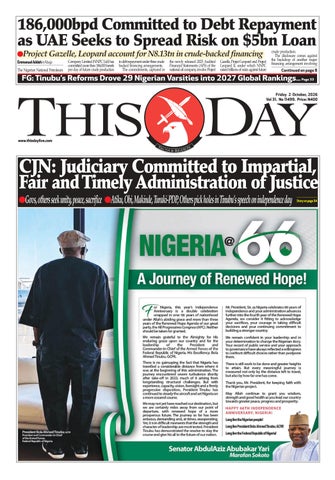
186,000bpd Committed to Debt Repayment as UAE Seeks to Spread Risk on $5bn Loan Project Gazelle, Leopard account for N8.13tn in crude-backed financing
Emmanuel Addeh in Abuja The Nigerian National Petroleum
Company Limited (NNPC Ltd) has committed more than 186,000 barrels per day of future crude production
to debt repayment under three crudebacked financing arrangements. The commitments, captured in
the newly released 2025 Audited Financial Statements (AFS) of the national oil company, involve Project
Gazelle, Project Leopard and Project Leopard II, under which NNPC raised trillions of naira against future
crude production. The disclosure comes against the backdrop of another major financing arrangement involving Continued on page 8
FG: Tinubu’s Reforms Drove 29 Nigerian Varsities into 2027 Global Rankings... Page 33
Friday 2 October, 2026 Vol 31. No 11499. Price: N400
www.thisdaylive.com TR
UT H
& RE A S O
N
CJN: Judiciary Committed to Impartial, Fair and Timely Administration of Justice Govs, others seek unity, peace, sacrifice Atiku, Obi, Makinde, Turaki-PDP, Others pick holes in Tinubu’s speech on independence day
Story on page 34
2
FRIDAY, OCTOBER 2, 2026 • T H I S D AY
FRIDAY, OCTOBER 2, 2026 • T H I S D AY
3
FRIDAY, OCTOBER 2, 2026 • T H I S D AY
4
Pay for Dangote Refinery Shares through Access Bank
ooer price
Please read the Prospectus on ipo.dangote.com and, where in doubt, consult your stockbroker, fund/portfolio managers, accountant, banker, solicitor or any other professional adviser registered by the SEC for guidance before subscribing. Payment does not guarantee or automatically result in the allotment of shares. Allotment is subject to the applicable terms and conditions.
Multiple channels. One opportunity.
Scan for:
• Risk Disclosures • Terms & Conditions • FAQs
07030000000
5
THISDAY • FRIDAY, OCTOBER 2, 2026
NEWS
Group News Editor: Goddy Egene Email: Goddy.egene@thisdaylive.com, 0803 350 6821, 0807 401 0580
UNVEILING OF A BOOK ON BAYELSA AT 30...
L-R: Children of late Gen. Sani Abacha, former Head of State- Fatima Gumsu Abacha and Mohammed Abacha; Bayelsa State Deputy Governor, Dr. Peter Akpe; Former First Lady, Dame Patience Jonathan; Former President Goodluck Jonathan; Bayelsa Governor, Senator Douye Diri; his wife, Dr. Gloria Diri; Former Deputy Governor, Rear Admiral Gboribiogha John-Jonah; and the state’s former Historian and Archivist, Prof. Stephen Olali, during the unveiling of a book on Bayelsa at 30 at the DSP Alamieyeseigha Memorial Banquet Hall, Government House, Yenagoa, on Wednesday
Kyari: Nigeria Can’t Achieve Food Security by Solely Expanding Farmland Declares extension must drive farm productivity
James Emejo and Aminat Hassan in Abuja Minister of Agriculture and Food Security, Senator Abubakar Kyari, has warned that the country cannot meet the food needs of its projected 400 million population by simply expanding the amount of land under cultivation. Kyari stressed that productivity gains must increasingly come from knowledge, technology, and stronger agricultural extension systems. He spoke at the opening of Africa Agribusiness Extension Summit (AAES) 2026. The minister said agricultural extension should be treated as critical infrastructure capable of delivering productivity improvements across millions of farms. He stated that the country’s rapidly growing population made it imperative to move beyond fragmented agricultural interventions and build an extension system that could continuously deliver the right information to farmers. Kyari stated, “Nigeria reflects that reality. We are home to more than 240 million people, with our population projected to approach 400 million by 2050. “Most of the food required by Africans still must be produced from the farms that are already here with us now. We cannot feed that future on more land alone.” With agriculture accounting for
about 34 per cent of total employment in Nigeria, Kyari said the effectiveness of extension services would have implications not only for food production but also for household incomes, resilience and livelihoods. He cited evidence showing that access to extension services was associated with lower food insecurity and significantly higher household assets, while mobile agricultural advisory services had been found to improve yields and increase adoption of recommended farm inputs. According to him, the implication is that relatively small improvements in farm-level knowledge can translate into significant productivity gains when deployed across millions of farmers. “Extension must be treated as infrastructure,” he said, comparing agricultural advisory systems with roads and power infrastructure that must remain functional and deliver economic value over the long term. He said, “A project can deliver advice for three seasons. Infrastructure must deliver for 30 years. For Africa, that distinction matters.” Kyari said the federal government was already shifting extension from conventional face-to-face services towards digital platforms capable of reaching farmers more quickly and in forms they could use. He disclosed that more than 100,000 farmers across six states received weekly text messages on rainfall expectations and crop protection, while a digital agricultural extension platform was
being rolled out to provide advisory services through text and voice in Hausa, Igbo, Yoruba and Pidgin. The government, he added, had deployed more than 1,000 digital extension agents equipped
with tablets through the National Agricultural Development Fund, while 774 agricultural desk officers were being positioned across local government areas. The minister also disclosed that he
had approved a steering committee to harmonise the ministry’s various digital extension initiatives involving its departments and agencies. He said the move was intended to prevent the emergence of compet-
ing information systems as more agricultural services moved online. “The farmer should hear one trusted message, not many competing ones,” Kyari said, adding that the government would also work with the Nigerian Meteorological Agency (NiMet) to integrate climate information into advisory services.
ECOWAS Calls for Collective Action to Curb Trans-border Security Issues Kuni Tyessi in Abuja
The Economic Community of West African States (ECOWAS) has said West Africa is confronting increasingly complex security threats that are spilling across national borders and require stronger regional cooperation. ECOWAS listed violent extremism, terrorism, political tensions, organised crime and humanitarian pressures as interconnected challenges confronting the region. The Director of Political Affairs, ECOWAS Commission, Dr. Babatunde Afolabi, said this at the Pre-west Africa Peace and Security Dialogue (WAPSeD) 2027 Strategy and Review Meeting held in Abuja. The meeting, convened by the Building Blocks for Peace Foundation with the theme: “From Dialogue to Action: Reflecting on WAPSeD 2025 Commitments and Setting the Agenda for WAPSeD
2027,” brought together policymakers, peacebuilders, researchers, youth and women groups. Afolabi, who was represented by Gnacabja Constant, said sustainable peace cannot be achieved by one institution or government alone. He said ECOWAS remains committed to providing platforms for regional institutions, civil society organisations, development partners and peace practitioners to deliberate on emerging challenges. “If we want to achieve sustainable peace, we need to work on three Ps: People, prevention and partnership,” he said. Afolabi said peace and security must go beyond crisis response, with prevention at the core of regional efforts. For ECOWAS, peace and security is not only about responding to crises; it is also about preventing crises,” he said, admitting that the Commission is learning from criticisms over poor communication.
He stressed the need to move from dialogue to action, noting that good analysis must translate into implementable recommendations. “We recognise that the existence of initiatives is not enough. We need to act. How do we process the recommendation for action? That is the main essence of us being here,” he said. In his keynote, Board Chair of the Building Blocks for Peace Foundation and Professor of International Relations at Obafemi Awolowo University, Charles Ukeje, urged stakeholders to ensure meaningful participation of women, youth, minorities and marginalised groups. “If civil society claims to represent communities, then communities must actually have a voice in the processes that affect them. We cannot speak about participation while excluding the people most directly affected by insecurity and poor governance,” Ukeje said.
He called for mobilisation of local resources and capacities, warning against over-reliance on external actors “in an increasingly uncertain global environment.” On his part, Executive Director of the Building Blocks for Peace Foundation, Rafiu Lawal, said the security landscape is rapidly changing. Lawal identified disinformation, information manipulation, drug trafficking and illicit economies as new threats eroding public trust and social cohesion. “The geography of insecurity is changing, the nature of insecurity is changing, the actors are also changing, and therefore the tools required to prevent and respond to insecurity must also change,” he said. Lawal said WAPSeD, established in 2024, provides a safe and inclusive platform to examine evolving challenges and develop practical conflict prevention approaches.
At EY Alumni Week, Experts Seek Responsible AI Adoption Emmanuel Addeh in Abuja
Business leaders and technology experts have urged organisations to embrace agentic artificial intelligence (AI) responsibly, warning that the shift from AI tools that assist employees to systems capable of executing tasks and making decisions requires clear governance, defined limits and sustained human oversight. The experts spoke at a virtual webinar organised by the EY Nigeria Alumni Association as part of the EY Global
Alumni Week. The session, themed: “Leading with Confidence in the Age of Agentic AI,” examined how increasingly autonomous AI systems could reshape business operations, decision-making, customer service and the workforce. The webinar featured Wilfred Mamah, Partner and Digital Transformation Services Leader at EY West Africa; Tomiwa Adefokun, Senior Manager, Technology Consulting at EY; and Ashish Bakhshi, Partner and Head of Markets at EY West Africa. The session was moderated by Bisi
Onasanya, former Group Managing Director of FirstBank. Mamah said agentic AI represented a fundamental shift from conventional software that primarily supports users to systems capable of pursuing defined goals, planning tasks, using digital tools and executing approved actions. According to him, the defining change was not simply improved content generation but the transfer of specific tasks, decisions and actions to software. “The defining shift is not simply
better content generation; it is the delegation of tasks, decisions, and actions to software,” he said, adding that organisations should therefore view agentic AI as a transfer of clearly defined decision rights rather than merely an enhanced chatbot. He identified banking, insurance and public services as sectors where agentic AI could have immediate applications, including credit and service orchestration, claims triage and settlement support, as well as citizen-service fulfilment.
Mamah explained that AI agents could gather evidence, coordinate approvals, identify exceptions and communicate the next steps, potentially changing not only how individual tasks are performed but also how organisations structure work. He said the wider impact of agentic AI could be organisational, with work moving away from departmental silos towards business outcomes, routine execution increasingly giving way to exception management and decisionmaking becoming more continuous
and responsive. Adefokun, however, stressed that the degree of autonomy granted to AI agents should be determined by the level of risk and potential impact associated with their actions. He said organisations should consider factors including risk, reversibility, confidence and business impact when determining whether an AI system should merely recommend an action, prepare it for human approval, execute it independently while notifying a human, or escalate the matter for intervention.
6
FRIDAY, OCTOBER 2, 2026 • THISDAY
NEWS
DELEGATION OF NORTHERN ARTISTES’ VISIT TO APC CAMPAIGN COUNCIL...
L-R: Director General, 2027 APC Presidential Campaign Council, Abdulaziz Yari; Vice President Kashim Shettima; Former Governor of Kano State, Dr. Abdullahi Ganduje; and Former Governor of Kastina State, Aminu Bello Masari, during the visit of delegation of Northern Nigerian Artistes to the secretariat of the 2027 APC Campaign Council in Abuja on Wednesday PHOTO: GODWIN OMOIGUI
IFC: Less than 5% Commercial Bank Lending Going to Agriculture is Serious Devt Gap Mobilises Nigerian financial institutions for African Finance Summit
Dike Onwuamaeze
International Finance Corporation (IFC) says with less than five per cent of commercial banks’ lending in Nigeria going to agriculture, the country suffers a serious development gap. IFC made the statement yesterday in Lagos during a press briefing to mobilise Nigerian financial institutions to attend the oncoming “African
Financial Summit 2026,” scheduled to hold in November in Luanda, Angola. The theme of the summit is, “Making Capital Count: Unlocking Growth Through African Finance.” Speaking during the press briefing, Divisional Director, Nigeria and Central Africa, IFC, Mr. Oliver Buyoya, said the corporation was developing a value chain analysis that would address the barriers hindering the flow of credit
to agriculture. This became necessary because less than five per cent of commercial bank lending went to agriculture, Buyoya said. Buyoya stated, “So I used that as an example of a serious development gap that we are facing in Nigeria, and frankly, across the whole continent. “We have in Nigeria probably one of the most sophisticated banking sectors in Africa.
“And yet, one of the most important sectors of the economy receives less than five per cent of lending from commercial banks. That is a fact. “We need to understand why that situation has been there for decades. “Commercial banks are financial intermediaries and if a sector is being considered risky, then it is going to be extremely difficult to expect that a
NCC, ALTON Roll Out Zero Rated Access to Educational Platforms Emma Okonji
Nigerian Communications Commission (NCC), in collaboration with Association of Licensed Telecommunications Operators of Nigeria (ALTON), yesterday, rolled out the Zero-Rated Data Access to Approved Educational Platforms and Content Initiative. The programme supports NCC’s mandate to promote modern, universal, efficient, reliable, affordable, and accessible communications services across Nigeria. Under the initiative’s OperatorSponsored Model, eligible users will receive up to 100 megabytes of free daily data allowance to access designated educational platforms. This means a learner receiving the full 100MB allowance would have access to about 700MB of educational data each week, roughly 3GB every month, and up to 36.5GB annually. The initiative is designed to reduce the cost of data for digital learning, enabling eligible learners to use approved platforms for studying, research, online courses, and other academic activities. NCC revealed the initiative in a statement it issued yesterday, jointly signed by its Director, Public Affairs, Nnenna Ukoha, and Chairman of ALTON, Gbenga Adebayo. Speaking on the October 1, 2026 rollout of the initiative, Executive Vice Chairman/Chief Executive Officer of NCC, Dr. Aminu Maida, said the initiative, which provides
learners with free access to approved educational platforms, formed part of broader government efforts to equip Nigerians with digital skills, knowledge, and advanced human capital development. Maida stated that the programme aligned with President Bola Tinubu’s vision of building a $1 trillion economy, which depended significantly on investing in people through education, skills acquisition, and access to learning opportunities. He said the significance of the initiative should be viewed beyond the daily 100MB allocation, particularly when considered over time and across the millions of learners expected to benefit from it. He stated, “One hundred megabytes of data might sound a little, but when you look at it over a month and over a year, and cumulatively over the millions of learners and students that are going to access it, it’s really a significant investment by the industry towards the future of this country.” Maida added that increased connectivity would help bridge disparities in access to educational resources across different parts of the country by connecting students to teachers, learning materials, and knowledge resources, irrespective of location. For his part, Adebayo, said the telecommunications and wider technology industry had demonstrated significant commitment to the Zero-Rated Access initiative through financial and in-kind contributions
amounting to almost N200 billion for the initial pilot involving 5,000 learners. According to Adebayo, the aggregate value considers the daily 100MB connectivity allocation, network resources, devices, terminals, and other supporting contributions provided by industry stakeholders, which he says is a demonstration of the industry’s commitment to supporting the federal government’s education
and digital inclusion agenda. Adebayo explained that telecommunications operators were absorbing the cost of providing the connectivity and network capacity required to deliver daily access to approved educational platforms. He added that this represented a substantial commitment of network resources over the duration of the programme and was being undertaken in support of a national development objective.
commercial bank will deploy money in that sector. “That is the problem we are trying to solve. You need to look at that sector (agriculture) from a value chain standpoint. How do you move goods that are produced to markets?” He said AFIS 2026 was an occasion to bring stakeholders in the financial service sub-sectors in the room and co-create solutions, whether for agriculture or infrastructure financing. Buyoya said, “We are working, putting together platforms, programmes that would mobilise funding from different sectors. “We partner to help accessing finance from commercial banks to agriculture because on average less than five per cent of commercial bank lending go to agriculture. “And that cannot continue if we want to ensure food security for our population and create jobs.” In his remarks, Director of AFIS, Mr. Hicham El Morabet, said the paradox about Africa was that return on regional equity for financial institutions was about 90 per cent, while the cost of finance was so high that operators in the real sector struggled to finance their businesses.
El Morabet said the six strategic priorities of the summit were finance that reached the real sector; scale with purpose; technology on African terms; turning African savings into African investments; integration that made scale possible; and urgency in the rules of finance. According to him, AFIS 2026 will move from dialogue to implementation since the first five years of the summit were focused more on how to make the African financial industry stronger for the future. He said, “We are moving from how to make the industry stronger to how to make this industry a way to channel investments and financing to the real economy. “I think we already know this diagnosis, but maybe some figures are important here to keep in mind. “For the African banking sector, for example, the average return on regional equity is around 90 per cent, and it is the double of the global average. “Also, in terms of number of assets under management for African institutional investors, there are more than $2 trillion assets under management.
DSVA Honours Sanwo-Olu, Others for Fight Against Domestic, Sexual Violence Gov receives Champion Against SGBV Award for supporting prevention, response initiatives Sunday Ehigiator Lagos State Domestic and Sexual Violence Agency (DSVA) has honoured Governor Babajide Sanwo-Olu and other individuals, institutions, and organisations for their contributions to the prevention and response to domestic and sexual violence in the state. The honours were presented at the Governor’s Commendation Night organised by the agency as part of activities marking the 2026 Domestic and Sexual Violence Awareness Month. The event brought together government leaders, law enforcement stakeholders, healthcare providers, civil society organisations, development partners and survivors to recognise
efforts towards strengthening Lagos State’s response to domestic and sexual violence. A major highlight of the ceremony was the presentation of Lagos State Champion Against SGBV Award to Sanwo-Olu in recognition of his “immense support, unwavering commitment, and invaluable contributions towards the prevention and elimination of Sexual and Gender-Based Violence in Lagos State”. The governor, represented at the ceremony by the founder of Oasis Mediation and Solicitors, Mrs. Tawakalitu Toriola, commended frontline workers and institutional partners for their efforts in protecting survivors, holding perpetrators accountable, and building safer communities.
He said the evening was “not only about celebrating past milestones but also about inspiring all sectors of society to actively take responsibility for ending domestic and sexual violence”. In his welcome address, AttorneyGeneral and Commissioner for Justice, Mr. Lawal Pedro, SAN, who was represented by Director of Advisory Services, Lagos State Ministry of Justice, Mrs. Folashade AnibabaBossman, commended the awardees and partners for their commitment to strengthening the state’s response to domestic and sexual violence. Pedro stressed “the importance of sustained collaboration among government institutions, law enforcement agencies, healthcare providers, civil
society and other stakeholders in protecting survivors and ensuring access to justice”. Executive Secretary of DSVA, Mrs. Titilola Vivour-Adeniyi, expressed “deep appreciation to the awardees, partners, and state leadership” for their contributions to the fight against gender-based violence. Vivour-Adeniyi said, “Combating gender-based violence requires a seamless, multi-sectoral approach connecting police units, health facilities, justice systems, social services, and civil society, with survivors remaining at the centre of all interventions.” The agency also honoured institutions and individuals for outstanding contributions across key response sectors.
7
THISDAY • FRIDAY, OCTOBER 2, 2026
NEWS
PRESENTATION OF ACCA APPROVED EMPLOYER CERTIFICATE TO OANDO...
L-R: Deputy Division Manager, Employee Relations, Oando Energy Resources, Ayodele Peregrino, and Country Head, Association of Chartered Certified Accountants (ACCA), Tom Isibor, at the presentation of the ACCA Approved Employer certificate to Oando at the company’s Head Office in Lagos, on Tuesday, September 29, 2026
BoI Digitises Credit Process, Cuts Funding Delays for Businesses Eyes 30% rise in credit applications with new ‘MyBOI’ portal Olusi: faster financing process critical to investment, business growth, says platform to cut friction, improve transparency in development finance
James Emejo in Abuja and Nume Ekeghe in Lagos Bank of Industry (BoI) has unveiled a fully digital lending portal, MyBOI, to cut barriers to credit and make financing more accessible to Nigerian businesses. The end-to-end lending portal seeks to simplify credit process for Nigerian enterprises and ease access to business finance, shortening the path to credit, and expanding access for productive activity. Managing Director/Chief Executive, BoI, Dr. Olasupo Olusi, said access to finance should not be measured only by the amount of money available to businesses, but also by how efficiently they could navigate the process of obtaining it. Olusi said, “Access to finance is not only about the availability of funding; it is also about making the journey to that funding simpler and more efficient.” According to him, MyBOI would use technology to “reduce unnecessary friction, improve visibility and give our customers a more seamless way to engage with BOI,” while retaining the security and rigour required of a development finance institution.
In a statement, Olusi said, “MyBOI portal represents an important step in our commitment to making development finance more accessible, transparent and responsive to the needs of businesses. “We recognise that access to finance is not only about the availability of funding; it is also about making the journey to that funding simpler and more efficient.
“Through MyBOI Portal, we are using technology to reduce unnecessary friction, improve visibility and give our customers a more seamless way to engage with BoI, while maintaining the security, rigour and developmental purpose for which the Bank is known.” The initiative, according to the bank, is designed not merely to digitise its lending process, but to also remove bottlenecks that can delay viable
The National Association of Nigerian Students (NANS) has declared unwavering support for the ongoing transformation agenda in the insurance sector and condemned attempts to derail the recapitalisation exercise. Speaking yesterday at a press brief-
track their applications digitally throughout the credit lifecycle. The move seeks to address persistent concerns over the cost, speed, and complexity of accessing finance, particularly for businesses that depend on timely working capital and investment funding to expand operations. The platform replaces significant elements of the traditionally manual
and branch-dependent financing journey with automated workflows, digital authentication and real-time application tracking. Essentially, the portal is expected to improve data accuracy, reduce human interface, strengthen compliance, and support faster decision-making, and provide the bank with enhanced reporting and analytics to improve the management of the credit process.
JICA Warns Energy Inefficiency Drains Productive Economy Advocates mandatory standards, enforcement to curb costly energy waste
James Emejo in Abuja
Japan International Cooperation Agency (JICA) has identified energy inefficiency as a major drag on Nigeria’s productive economy. It said businesses could significantly cut operating costs and improve productivity by investing in energyefficient technologies. JICA stressed that energy inefficiency was quietly inflating business costs and weakening productivity.
Chief Representative of JICA in Nigeria, Ishigame Keiji, described energy efficiency as the “first fuel”, stating that the cheapest unit of energy is the one that does not have to be produced. Keiji spoke at a two-day national workshop on energy efficiency and conservation organised by JICA and Energy Commission of Nigeria (ECN), with the theme, “Accelerating Energy Efficiency and Conservation in Nigeria: From Policy to Implementation,
NANS Declares Support for Insurance Sector Reform, Condemns Attempt to Derail Recapitalisation Kuni Tyessi in Abuja
businesses from converting financing opportunities into investments, production and jobs. Under the new platform, Micro, Small and Medium Enterprises (MSMEs); large businesses; cooperatives; associations; and other eligible customers can initiate financing applications, complete onboarding, undertake impact and sustainability assessments, submit documents, and
ing, NANS National President said the apex student body representing over 40.1 million Nigerian students across universities, polytechnics and colleges of education stands firmly behind the reforms reshaping the industry. He said it recognises the strategic importance of a strong, modern and resilient insurance sector to
national economic development and commended the leadership of the federal government under President Bola Ahmed Tinubu, for initiating bold economic reforms. President of the association noted the recapitalisation exercise is critical to strengthening the financial capacity, stability and global competitiveness of insurance institutions in Nigeria.
Regulation and Measurable Impact.” The agency said the economic burden extended beyond electricity consumption, as industries were forced to spend heavily on self-generated power while households, businesses, and public institutions continued to operate inefficient appliances and systems. He said improving efficiency across buildings, industries, transportation, and appliances could lower energy costs, increase productivity, and strengthen the country’s energy security. “By adopting energy efficiency technologies in buildings, industries, transportation and appliances, Nigeria can reduce energy costs, improve productivity and enhance energy security,” he said. He added that Japan’s development experience demonstrated that energy efficiency could serve not merely as an environmental intervention but also as a driver of economic growth and industrial competitiveness. Keiji said, “JICA remains committed to supporting Nigeria’s efforts towards sustainable and inclusive energy development, and we hope this
workshop will produce a practical roadmap to guide future investment and institutional collaboration.” The economic cost of energy inefficiency was further highlighted by Director General/Chief Executive Officer of ECN, Dr. Mustapha Abdullahi, who disclosed that industrial energy expenditure in Nigeria ran into trillions of naira annually. A significant portion of the expenditure, he said, went into diesel-powered self-generation, which he described as one of the most expensive and least efficient sources of energy available to Nigerian industries. Abdullahi said the scale of spending meant that energy inefficiency was effectively diverting resources that could otherwise be deployed into production, expansion, employment and investment. “Inefficiency in the energy chain is money leaving the productive economy for no productive return,” he said. He said the workshop was intended to move the country beyond policy formulation by bringing policymakers, regulators, and implementers together to agree on specific actions
and timelines. “Energy efficiency policy that is not backed by clear standards, and standards not backed by institutions able to enforce them, do not change outcomes on the ground,” Abdullahi said. Meanwhile, former Minister of Science and Technology, Professor Abubakar Sambo, identified another cost channel in the country’s energyefficiency challenge—the continued inflow of inefficient appliances through the country’s porous borders. Sambo said Nigeria lacked sufficient decentralised testing capacity to verify the energy ratings of appliances entering through its ports, creating an enforcement gap that could lock consumers and businesses into higher energy costs for years. He called for a shift from voluntary compliance to mandatory, customsenforced energy-efficiency standards at the point of entry. He said, “We must integrate compliance between the Standards Organisation of Nigeria and the Nigeria Customs Service to flag high-energy intensity imports at the ports.”
8
FRIDAY, OCTOBER 2, 2026 • THISDAY
EIGHT
EU Expends $21 Billion on Fuel Subsidies Amid Nigeria’s Exit Brent rises above $100 as China curbs fuel exports
Emmanuel Addeh in Abuja The European Union governments have spent €17.9 billion, equivalent to about $21 billion, this year to cushion households and businesses from the impact of higher oil and gas prices, even as Nigeria has largely exited its long-standing petrol subsidy regime. The European Commission, in a note prepared for discussions by euro zone finance ministers on October 8, disclosed that 25 member states had introduced fiscal measures since the outbreak of the Middle East conflict to mitigate the impact of rising energy prices. The measures represent about 0.1 per cent of the EU-27’s Gross Domestic Product (GDP). The disclosure comes against the
backdrop of renewed volatility in global energy markets, with Brent crude yesterday climbing back above $100 a barrel as concerns over refined fuel supplies added to the pressure created by the conflict in the Middle East. The commission, however, cautioned that more than two-thirds of the $21 billion intervention consisted of untargeted price measures, arguing that future support should be directed more specifically at vulnerable households and businesses, while limiting fiscal costs and remaining consistent with the bloc’s efforts to decarbonise its energy system. However, the contrast with Nigeria is significant. President Bola Tinubu announced the removal of the country’s petrol subsidy in May 2023, shortly after assuming office,
with the government subsequently defending the decision as necessary to end what it described as an expensive and distortionary system. In a July 2023 national broadcast, Tinubu said the subsidy had outlived its usefulness and acknowledged that its removal had pushed up fuel costs, with food and other prices subsequently rising. The pronouncement has subsequently raised petrol prices to about N1,500 per litre. But unlike Nigeria’s approach, the measures adopted by EU governments in response to the latest energy shock have included fiscal interventions intended to shield consumers and businesses from higher energy costs. The European Commission said, however, that such measures should be temporary and carefully
designed rather than broad-based price interventions. The commission also urged member states to increase investment in electricity grids and adjust energy taxation so that electricity is taxed less heavily than gas. The measures, it said, would provide incentives for consumers and businesses to shift away from fossil fuels while strengthening the bloc’s power infrastructure. The latest European intervention follows a renewed increase in global oil prices. Brent crude, the international benchmark, rose 2.9 per cent to $100.87 a barrel, while US West Texas Intermediate gained 1.4 per cent to $91.72. The rise followed reports that PetroChina, China’s state-owned oil company, had cancelled a number
of gasoline and jet fuel shipments scheduled for October, raising concerns about refined-product availability as the global market continues to adjust to disruptions in the Middle East. Although crude flows from the region have been recovering towards pre-war levels, refined fuel supplies, particularly gasoline, have remained tighter. The resumption of Saudi Arabian tanker loadings from its Red Sea port of Yanbu has provided some relief after the kingdom restarted operations on its East-West Pipeline, offering an alternative route for moving crude from the Gulf. The recovery in crude flows had previously helped moderate oil prices, but traders remain focused on the possibility of prolonged disruption to fuel supplies as the conflict continues.
Ursula von der Leyen, President European Commission For Europe, the renewed energy shock is also complicating the economic outlook. The European Commission said euro zone growth this year was likely to be somewhat stronger than its previous 0.9 per cent forecast, but projected weaker growth next year than its earlier estimate of 1.2 per cent.
Tinubu, First Lady, Akpabio, Barau, Kalu, Others Watch Premiere of Documentary on MKO Abiola Deji Elumoye in Abuja
President Bola Tinubu on Thursday evening led top government officials to watch the premiere of the documentary on winner of June
12, 1993 presidential poll, Chief Moshood Kashimawo Olawale Abiola entitled MKO at the Wole Soyinka Centre for Culture and the Creative Arts in Iganmu, Lagos. The President was joined at the
event by the First Lady, Senator Oluremi Tinubu; President of the Senate, Senator Godswill Akpabio; Lagos State Governor Babajide Sanwo-Olu; his Ogun State counterpart, Dapo Abiodun and
that of Kwara State, AbdulRahman AbdulRazaq. Others present included Deputy Senate President, Senator Jibrin Barau; Deputy Speaker of the House of Representatives, Hon.
Families Panic Over Imo Abduction of NYSC Members Travelling from Oyo Kemi Olaitan in Ibadan
Families of 19 prospective National Youth Service Corps (NYSC) members travelling from Ibadan to the orientation camp in Abia State were thrown into panic on Thursday after suspected kidnappers reportedly intercepted two buses conveying the youths along the Onitsha-Abia axis. Most of the prospective corps members are graduates of the University of Ibadan (UI), Ladoke Akintola University of Technology (LAUTECH), Ogbomoso, and other tertiary institutions in Oyo State. The incident triggered anxiety at the Ibadan office of Udua King Transport Services in the Samonda area, where distraught parents and relatives gathered to demand information on the whereabouts of their children and the steps being taken by the transport company to secure their release. It was gathered that four buses were deployed by the company to convey the prospective corps members to the NYSC permanent orientation camp in Abia State. Two of the buses reportedly escaped the suspected kidnappers’ ambush, while the other two were allegedly forced to stop by the gunmen. According to information obtained from the transport company, 11 passengers and the drivers of the two affected buses managed to escape, while 15 others were reportedly taken away by the attackers. The transport company’s manifest listed those allegedly abducted as Akande Kehinde, Olaleye Mary, Oladosu Greatness, Obafunsho Rhoda, Abdulrof Anifat, Esther Oyede, Hassan Usman, Ayomide Isa, Mary Makinde, Azeez Adejoke, Abdulrazaq Anifat,
Sarah Temilolu, Adeoye Elizabeth, Eniola Samuel and Usman Temi. A representative of the transport company, who declined to disclose his name, said the prospective corps
members were allegedly abducted around Ihiala in the early hours of Thursday. One of the parents, Mrs Alimot Akande, whose daughter, Kehinde
Akande, a LAUTECH graduate, was among those reportedly abducted, said the journey had appeared uneventful until the family received a brief and frightening message from her.
Benjamin Kalu; Chief of Staff to the President, Hon. Femi Gbajabiamila; Minister of Art, Culture, Tourism and the Creative Economy Hannatu Musawa; former Ogun State Governor, Aremo Segun Osoba and other top government officials. The documentary, MKO, directed by Nigerian-American filmmaker Ose Oyamendan, chronicles the life, political journey and legacy of the late Chief MKO Abiola, with particular focus on the June 12, 1993 presidential election, its annulment, subsequent detention and the pro-democracy struggle that followed. The film, which had its international premiere at the Sheffield
International Documentary Festival in the United Kingdom in June 2026, features archival materials and first-hand accounts from key personalities connected to the period With its national premiere in Lagos on October 1, the documentary is scheduled for release in cinemas nationwide on October 2, 2026 Late Chief MKO Abiola occupies a prominent place in Nigeria’s democratic history as the winner of the June 12, 1993 presidential election, which was annulled by the then military government of General Ibrahim Badamasi Babangida.
186,000BPD COMMITTED TO DEBT REPAYMENT AS UAE SEEKS TO SPREAD RISK ON $5BN LOAN Nigeria and the United Arab Emirates, as First Abu Dhabi Bank (FAB), the UAE’s largest lender, is seeking to spread its exposure to Nigeria’s $5 billion financing by bringing other international banks into the transaction. The move would allow FAB to retain its role as the principal counterparty while sharing the economic exposure with other lenders, according to people familiar with the $5 billion transaction. THISDAY learnt that the three arrangements (projects) form part of NNPC’s wider financial obligations, with the company having settled only N2.886 trillion out of an aggregate N12.083 trillion commitment across crude oil forward-sale arrangements, gas supply agreements and upstream project funding obligations as of December 31, 2025. This left about N9.8 trillion in commitments outstanding, according to the financial statements, as NNPC continues to manage obligations entered into to provide liquidity for its operations and upstream investments. The largest of the crude-backed arrangements are Project Gazelle and Project Leopard, which together account for about N8.13 trillion in financing. Under Project Gazelle, NNPC entered into a five-year forwardsale agreement in December 2023, committing 90,000 barrels of crude
oil per day. The company drew N4.9 trillion from the N5.1 trillion facility and had repaid N2.09 trillion in principal by the end of 2025, leaving N2.81 trillion outstanding. Similarly, Project Leopard involved a N3.05 trillion facility, which was fully drawn by February 2025. NNPC had repaid only N420 billion in principal by the end of last year, leaving N2.47 trillion outstanding. The repayment obligation is further compounded by Project Leopard II, under which NNPC obtained N3.03 trillion against a commitment of 61,250 barrels of crude oil per day. The facility was fully drawn by December 31, 2025, but no principal had been repaid as of that date. Repayment was scheduled to commence in June 2026 after a six-month moratorium, leaving the entire N3.03 trillion principal outstanding at the reporting date. Taken together, the three crudebacked arrangements commit more than 186,000 barrels of crude oil per day to debt repayment, effectively earmarking a portion of NNPC’s future crude receipts for servicing the facilities. Beyond the crude-backed arrangements, NNPC’s financial statements showed significant commitments tied to gas supply and upstream asset development. For instance, under an incremental gas agreement between NNPC Exploration and Production Limited
and Nigeria LNG Limited, NNPC has drawn N535 billion from a N772 billion arrangement, while gas worth N312 billion has been recovered, representing 40.41 per cent. The upstream portfolio also carries substantial funding commitments. Under the OML 42 arrangement, only N44.98 billion has been provided against an estimated N1.54 trillion funding commitment, leaving about N1.49 trillion to be funded. For OML 65, N13.93 billion had been drawn from a N957.65 billion facility, leaving about N943.72 billion outstanding. Similarly, under OPL 809/810, NNPC has provided N88.16 billion out of a total commitment of about N430 billion, leaving approximately N341.85 billion yet to be funded. NNPC also reported an uncalled capital commitment of N95.99 billion relating to its Class B shares in Afreximbank, after subscribing N159.98 billion and paying N63.99 billion, representing 40 per cent of the subscribed amount. Despite the substantial commitments, during the period, NNPC reported a 33 per cent increase in Profit After Tax (PAT) to N7.2 trillion in 2025, from N5.4 trillion in 2024, while revenue stood at N34.5 trillion. Remittances to the federal government through taxes, royalties and other statutory payments also increased by 39 per cent to N22.3 trillion. On the operational front,
crude oil and condensate production reached a five-year peak of 1.77 million barrels per day, while natural gas supply rose to a three-year high of 7.2 billion standard cubic feet per day. The disclosure comes as Nigeria is also seeking to raise dollar liquidity through structured sovereign financing, with First Abu Dhabi Bank (FAB), the United Arab Emirates’ largest lender, seeking to bring other international banks into its $5 billion financing arrangement with Nigeria. People familiar with the matter told Bloomberg that FAB was sounding out potential lenders on their appetite to take portions of its economic exposure to the Nigerian deal, in a move that would spread its risk while allowing it to retain its position as the principal counterparty to the transaction. The discussions are private and do not represent an intention by the Abu Dhabi-based bank to withdraw from the transaction, according to a source. If concluded, the arrangement would enable FAB to distribute part of its financial exposure among other lenders, while potentially earning fees for arranging the syndication. The development adds another dimension to Nigeria’s efforts to access dollar liquidity through structured financing rather than conventional external borrowing. The federal government accessed
$1.5 billion of the $5 billion facility in June. The transaction is structured as a total-return swap under which Nigeria provides naira-denominated government securities as collateral. The securities are valued at about 133 per cent of the amount financed, providing substantial collateral backing for the lender while giving Nigeria access to foreign currency. The proposed syndication is expected to broaden the number of international financial institutions carrying exposure to the Nigerian government through the structure, while reducing the concentration of the transaction on FAB. The transaction had earlier attracted scrutiny from credit analysts because of the complexity of derivative-based sovereign financing and questions about how such obligations could be treated in any future restructuring of Nigeria’s debt. Fitch Ratings, while recognising that such instruments could provide sovereigns with greater financing flexibility and access to hard-currency liquidity, warned in June that the arrangement could make Nigeria’s debt risks less transparent and potentially complicate any future restructuring. The development comes against the backdrop of rising public debt and the government’s continued search for funding to meet expenditure and refinance existing obligations.
9
THISDAY • FRIDAY, OCTOBER 2, 2026
NEWS
UNVEILING OF ARAMANDA 4.0, THE YOUTH CULTURE AND TRENDS REPORT...
L-R: Executive Vice President, Chain Reactions Africa, Mr. Franklin Ozekhome; Managing Director and Chief Strategist, Chain Reactions Africa, Mr. Israel Opayemi; Public Relations Manager, Tecno, Temi Iwalaye; President and CEO, Upticom Marketing Company, Mr. Segun McMedal; and Head, Market Sourcing and Procurement, Tecno, Mr. Tuga Olatunde, during the unveiling of Aramanda 4.0, The Youth Culture and Trends Report by Chain Reactions Africa, Ikeja, Lagos on Wednesday
Mambilla: SPI-LAW Petitions LPDC to Initiate Disciplinary Proceedings Against Ex-AGF Malami Wale Igbintade The Society of Public Interest Lawyers in Nigeria (SPI-LAW) has petitioned the Legal Practitioners Disciplinary Committee (LPDC) of the Body of Benchers to initiate disciplinary proceedings against former Attorney-General of the Federation and Minister of Justice, Abubakar Malami,
SAN, over findings contained in an International Chamber of Commerce (ICC) arbitration arising from the Mambilla Power Project dispute. The petition, filed in Abuja on September 28, 2026, and registered as BBLPDC/2196/2026, asked LPDC to investigate allegations of professional misconduct and infamous conduct in a profes-
sional respect against the former attorney-general. The petition was filed through lawyers, including Olukunle O. Edun, SAN, John AikpokpoMartins, and Olajide A. Abiodun. Affidavits in support of the petition were deposed to by Aikpokpo-Martins, President of SPI-LAW, and Edun, its Vice President.
SPI-LAW said its complaint was based principally on findings contained in the ICC tribunal’s September 16, 2026 Final Award in Sunrise Power and Transmission Company Limited & Anor v. Federal Government of Nigeria, arising from the long-running dispute over the Mambilla Power Project. The group is asking the LPDC
Concerned Indigenes, Stakeholders Call for Accountability of Funds from Oil Companies Felix Omoh-Asun in Benin City
Indigenes and stakeholders of Orogho Dukedom in Edo South have raised the alarm over alleged activities of some oil companies and traditional rulers of the community. Some indigenes of the community, who spoke to the journalists in Benin City, the Edo State capital, on Wednesday, said the oil companies in cohort with some of their leaders were cornering the resources meant to develop the community. According to the representatives of the seven communities that make up the dukedom, their area has remained largely underdeveloped despite millions of naira that have been channelled through a particular monarch. Osahon Imaru, the convener, alleged that misappropriation of funds meant for seven communities in the Dukedom, namely Orogho, Uwuo, Obagie Nunuamen, Iwevbo, Ugbigun, Obanakhoro and Ekhigbe,
by the Enogie, Prince Patrick Osayande Akenzua, had been the order of the day. Imaru stated that since the ascension of the present Enogie, several concerns had been raised by the stakeholders across the seven communities concerning the administration of the dukedom. The convener also said one of the most worrisome concerns was the introduction of Enogie Representatives or Sub-Enogie in each of the seven communities, which he said had allegedly taken advantage of those positions to oppress the people whom the Enogie was expected to protect. They expressed their worry over the alleged misappropriation of N38.5 million that was disbursed among ancestral land owners and the dukedom communities that NEW CROSS Petroleum’s pipeline transverse. The group equally raised concerns regarding the alleged disposal of a
large parcel of land in the Savannah area of Ere-Egwa farm without the knowledge or consent of the community leaders or the wider communities within the dukedom. The people further stated that the land was subsequently recovered after well-meaning indigenes of the Orogho and Owuo communities intervened and stopped Ere-Egwa Farm from securing a Certificate of Occupancy (Cof O) from Edo State Ministry of Lands and Survey in respect of the land. The group reiterated that the issues raised were not mere allegations made without basis, as relevant documents were in their possession and available for verification by the appropriate authorities. They said having exhausted several avenues to resolve the issue internally, they decided to seek the intervention of the Palace of the Oba of Benin as the highest traditional authority relevant to the matter, which they said was followed
FG Empowers 70 Digital Media Managers with Tablets for Grassroots Outreach Sunday Ehigiator
The Federal Government (FG), through the Office of the Senior Special Assistant to the President on Technical, Vocational and Entrepreneurship Education (OSSAP-TVEE) has empowered 70 digital media personnel with tablets to strengthen grassroots communication and awareness of Federal Government vocational and entrepreneurship programmes.
The initiative, unveiled in Abuja, is aimed at improving information dissemination on the National Poverty Reduction with Growth Strategy (NPRGS), as well as government’s vocational, entrepreneurship and digital empowerment programmes. The Senior Special Assistant to the President on TVEE, Dr Abiola Arogundade, presented the tablets during a media information and empowerment meeting with digital media managers.
Arogundade said the engagement was designed to provide media practitioners with first-hand information on government initiatives and strengthen their capacity to connect potential beneficiaries with available opportunities. She explained that the office would subsequently engage print and broadcast media practitioners to ensure that all segments of the media ecosystem were carried along in its grassroots outreach.
by a letter submitted through the Secretary to the Benin Traditional Council. The group added that having discovered that the Enogie resorted to the oppressive and autocratic style of administration, which he exercised through the Enogie Representatives or Sub-Enogie, they were compelled to seek the intervention of Edo State Ministry of Local Government and Chieftaincy Affairs and Orhionmwon Local Government Council.
to examine whether the conduct attributed to Malami in the arbitral proceedings and related matters amounted to professional misconduct warranting disciplinary action under the applicable rules governing legal practitioners. According to the petition, the tribunal found that Malami and the then Minister of Power lacked actual and apparent or ostensible authority to execute the January 21, 2020 Settlement Agreement and March 25, 2020 Addendum on behalf of Nigeria. The petition also cited the tribunal’s finding that the settlement instruments were “a product of corruption” and unenforceable for violating Nigerian public policy. SPI-LAW further alleged that the tribunal accepted evidence that Malami directly solicited a bribe and claimed a share of the settlement sum payable to Sunrise. It said the tribunal drew an adverse inference that “a corrupt deal was in fact reached” between Malami and Mr. Adesanya, involving an alleged promise to pay the former AGF a share of the settlement sum in exchange
for committing Nigeria to the settlement instruments. The petition also relied on the tribunal’s finding that Malami, as Nigeria’s chief law officer, “deliberately acted against the best interests of Nigeria” and was negotiating not for Nigeria but for Sunrise, allegedly motivated by “other incentive(s)”. SPI-LAW said the tribunal further described the relationship between Malami and Adesanya as “an inappropriate relation”, marked by “a high degree of trust” and “a lack of moral compass”, while identifying red flags it considered indicative of a corrupt relationship. Another allegation concerns Malami’s conduct during the arbitration. SPI-LAW said the former AGF, despite being in Paris during the hearing and meeting former President Muhammadu Buhari, declined to appear for cross-examination as a witness called by Nigeria. The tribunal, according to the petition, expressed “serious dissatisfaction” with the disregard allegedly displayed by Malami for the administration of justice.
US Mining Pact: HOMEF Demands Safeguards for Host Communities Says Nigeria must not replicate challenges associated with oil extraction Blessing Ibunge in Port Harcourt The Health of Mother Earth Foundation (HOMEF) has urged the government to ensure that increased mining activity does not come at the expense of host communities, ecosystems and environmental safeguards. In a statement yesterday, HOMEF’s Executive Director, Dr Nnimmo Bassey, said the agreement should be implemented with stringent environmental and social protections to ensure that communities benefit from mineral development. Bassey spoke against the recent signing of a Memorandum of Understanding (MoU) aimed at attracting American investment into Nigeria’s estimated $700 billion mining sector. The agreement was signed on September 23, 2026, on the sidelines of the United Nations General Assembly
by the Minister of Solid Minerals Development, Dele Alake, and the US Deputy Secretary of State, Christopher Landau. “We must not reproduce the environmental challenges associated with oil extraction by replacing oil with minerals while sacrificing lives, lands and ecosystems,” Bassey said. He added that Nigeria’s experience in the Niger Delta underscored the need for effective oversight and accountability in the development of natural resources. “Without stringent safeguards, this MoU risks leaving behind degraded landscapes and impoverished communities rather than sustainable development,” he said. Bassey also expressed concern that growing international demand for critical minerals, including lithium, cobalt, nickel and copper, could increase pressure on land and water resources if mining operations are
not subject to rigorous environmental assessments. He urged the government to ensure that mineral development respects the rights and livelihoods of communities in mining areas. “We are deeply concerned that the rush to feed global demand for critical minerals will be prioritised over the livelihoods, health and sovereignty of Nigerian communities,” he said. According to HOMEF, the government should make the full details of the MoU available to the public and civil society organisations, particularly provisions relating to environmental protection, labour standards, fiscal obligations and community benefits. The organisation further called for strict compliance with applicable environmental impact assessment requirements and Community Development Agreements between mining companies and host communities.
10
FRIDAY, OCTOBER 2, 2026 • T H I S D AY
FRIDAY, OCTOBER 2, 2026 • T H I S D AY
11
12
FRIDAY, OCTOBER 2, 2026 • T H I S D AY
FRIDAY, OCTOBER 2, 2026 • T H I S D AY MONDAY, SEPTEMBER 28, 2026 • T H I S D AY
13 13
14
FRIDAY, OCTOBER 2, 2026 • T H I S D AY
FRIDAY, OCTOBER 2, 2026 • T H I S D AY
15
16
T H I S D AY • FRIday OCTOBER 2, 2026
Politics
Acting Group Politics Editor DEJI ELUMOYE Email: deji.elumoye@thisdaylive.com 08033025611 sms only
Ododo Moves to Unlock Financing for Industrial Development, Education, Energy in Kogi Governor Usman Ododo has taken steps towards unlocking financing for industrial development, education, security, energy in Kogi State as he recently led a high-powered government delegation to Kuwait.
K
ogi State Governor, Alhaji Usman Ododo, has led a high-level delegation of the state government to Kuwait in a major push to attract affordable development financing, technical expertise and strategic partnerships for the implementation of the Kogi State Development Plan 2024–2056. The mission has opened a new development partnership between Kogi State and key Kuwaiti institutions, with technical teams now expected to move from high-level engagements to the preparation of priority projects for implementation. At the Kuwait Fund for Arab Economic Development (KFAED), Governor Ododo and his delegation met with the Acting Director-General, Mr. Rashaid A. Al-Bader, and senior officials of the Fund, where the governor presented Kogi’s development vision and outlined the state’s priority areas for international cooperation. The governor said Kogi was seeking a comprehensive, long-term development partnership capable of transforming the state’s natural and human resources into sustainable economic opportunities. He identified Kogi’s strategic location, extensive water resources, agricultural potential, solid minerals and emerging energy opportunities as assets that could support job creation, food security, industrialisation and improved living standards when backed by the right infrastructure and technical expertise. The Kuwait Fund expressed readiness, in principle, to work with Kogi State on priority development projects, subject to the required technical, financial and institutional appraisal processes. The emerging partnership will focus on water infrastructure, irrigation and agricultural transformation, power and renewable energy, solid minerals and beneficiation, agro-industrial development, transport, communications and ICT, education, and healthcare The proposed cooperation will also cover project preparation, feasibility studies, engineering designs, technical assistance, institutional capacity development, and environmental and social assessments. Ododo explained that the areas were interconnected, noting that improved water infrastructure would strengthen communities and agriculture, irrigation would expand allseason farming, reliable energy would support agro-processing and industrialisation, while mineral beneficiation would enable Kogi to retain greater value from its natural resources. Beyond development financing, the governor and his delegation held discussions with Kuwait University on collaboration in education, research, innovation, engineering, agriculture, water-resource management and technology. At the university, Governor Ododo met with its president, Prof. Dina Musaed Al-Mailem, with both sides exploring opportunities for knowledge exchange, research collaboration, and capacity development between Kuwait University and tertiary institutions in Kogi State. The delegation also met with the Governor of Al Ahmadi Governorate, Sheikh Humoud Jaber Al-Ahmad Al-Sabah, to explore a sistergovernment relationship and cooperation in infrastructure, investment, industry and development experience. In another major engagement, the delegation met with Kuwait’s Minister of Electricity, Water and Renewable Energy, Dr. Subaih Abdulaziz Al-Mukhaizeem, to discuss water infrastructure, irrigation, renewable energy, power development, and technical cooperation. The discussions are particularly relevant to Kogi’s plans to expand irrigation, promote all-
season agriculture, develop agro-processing, and establish reliable energy infrastructure to support industrial growth.
The mission also opened discussions around commerce, investment, industrial cooperation and value addition, with the state seeking
stronger economic linkages between Kogi and Kuwaiti businesses and institutions. A major outcome of the visit is the establishment of a technical process to drive the agreements and understandings reached during the engagements. The teams will undertake project documentation, feasibility and technical assessments and other preparatory work required to translate the discussions into concrete development projects. Governor Ododo expressed appreciation to President Bola Tinubu, for the federal government’s diplomatic support and enabling environment for subnational governments to engage development and investment partners internationally. He also commended the Nigerian Embassy in Kuwait, led by Ambassador (Dr.) Abubakar Sanusi Aliyu, for facilitating and supporting the engagements. The governor said the Kuwait mission represents a transition from high-level discussions to detailed technical work aimed at developing sustainable partnerships that will help Kogi unlock its potential in water, agriculture and irrigation, energy, education and research, solid minerals, commerce and industrial development. On the entourage of Governor Ododo were the Commissioners for Finance, Budget and Economic Planning, Asiwaju Asiru Idris; Works, Hon. Momoh Ozigi Deedat; Agriculture and Food Security, Hon. Timothy Ojomah; Water Resources, Hon. Farouk Danlami; State Auditor-General, Hon. Yakubu Yusuf Okala; and Chief Economic Adviser to the Governor, Hon. Nda Salami.
Heads of Federal Agencies Form Coalition for Tinubu’s Reelection
Chief Executive Officers of Federal Agencies and Parastatals have resolved to work tirelessly towards the reelection of President Bola Tinubu during the January, 2027 poll.
A
powerful coalition of federal agency chiefs has officially deployed to spearhead President Bola Tinubu’s 2027 reelection campaign. In a massive political mobilisation, these institutional heavyweights under the umbrella body, Forum of Chief Executives of Federal Parastatals, are uniting under a single umbrella to inject raw technical, strategic, and institutional muscle straight into the All Progressives Congress’ Presidential Campaign Council (PCC). Speaking in Abuja during their engagement with the APC National Chairman, Prof. Nentawe Yilwatda, and members of the party’s National Working Committee (NWC), the Chief Executives presented their vision for stronger collaboration between government institutions, political stakeholders, and the party. Accordingly, the agency chiefs have formed a complementary campaign structure with a focus on grassroots mobilisation, campaign messaging, election planning, monitoring, and management ahead of the 2027 general elections. Leading the coalition, Chairman of the forum and Director-General/Chief Executive Officer of the National Board for Technology Incubation (NBTI), Dr. Kazeem Kolawole Raji, said the forum was conceived as more than an association of heads of government agencies. He described it as a platform for collaboration, knowledge-sharing, coordination, and the exchange of ideas capable of contributing to national development. “We are here not merely as Chief Executives occupying strategic positions in the federal
government, but as professionals, public-sector leaders, political stakeholders and Nigerians deeply committed to the progress, stability and prosperity of our nation,” Raji said. He stressed the responsibility of public institutions to ensure Nigerians properly understand government programmes and achievements, adding that the Forum will continue encouraging cooperation among Chief Executives to advance national development. “Where government has delivered, we should communicate it,” Raji said, just as he expressed confidence that the APC leadership would continue to strengthen the party’s structures and deepen its engagement with Nigerians. He assured that the forum was prepared to work constructively with relevant stakeholders to improve public understanding of
government programmes, achievements and opportunities. On his part, Chairman of the forum’s Media and Publicity Committee, Otunba Biodun Ajiboye, gave a more detailed explanation of the Forum’s proposed role, describing its intervention as a technical partnership that could complement the work of the Presidential Campaign Council. Ajiboye, who is also the Executive Secretary/CEO of the National Institute for Cultural Orientation (NICO), noted that the forum has access to experienced professionals and administrators capable of contributing to various aspects of campaign organisation, including election planning and monitoring, mobilisation, media management, strategic messaging, and overall campaign coordination. He emphasised that the Forum was not seeking to duplicate or compete with the PCC, but to establish a complementary mechanism capable of extending its reach and providing additional technical capacity where necessary. Drawing a distinction between the communication challenge of the 2023 presidential campaign and what he believes will define the 2027 contest, Ajiboye said the central campaign message in 2023 was necessarily built around what the APC candidate intended to do if elected President. By 2027, he argued, the conversation would have fundamentally changed from “what we will do” to “what we have done.” NOTE: Interested readers should continue in the online edition on www.thisdaylive.com
FRIDAY, OCTOBER 2, 2026 • T H I S D AY
17
L-R: The Chief Financial Officer, IHS, Seye Dosunmu; Chief Technology Officer, MTN, Yahaya Ibrahim; panel moderator, Prof Olawale Ajai of the Lagos Business School; Director, Equinix West Africa, Oluwasayo Oshadami; Chief Executive Officer, Airtel Nigeria, Dinesh Balsingh; and Chief Operating Officer, Spectranet, Sumit Gambhir, at the NCC Digital Infrastructure Investment Forum with the theme: ‘Investing in Nigeria’s Digital Infrastructure’, in Abuja...recently
L-R: The Chief Economist, Dangote Group representing Alhaji Aliko Dangote, Hassan Mahmud; member, Board of Trustees and Vice Chairman, Crude Oil Refinery Owners Association of Nigeria (CORAN), Duchess Okulaja-Kotun; Lagos State Commissioner for Energy and Mineral Resources, representing Governor of Lagos State, Babajide Sanwolu, Biodun Ogunleye; Chairman, CORAN, Momoh Oyarekhua; Managing Director, Titanium Oil Corporation, Bertha Kalongelwa; and Chairman, Independent Petroleum Producers Group (IPPG)/CEO, Aradel Holdings Plc, Adegbite Falade, at the opening ceremony of Nigeria Oil Refining Summit 2026, hosted by CORAN in Lagos...recently
L-R: Mr. Muntasseer Kainat of Integraframe; Board of Trustee (BoT) member/Chief Executive Officer, Amelin Projects Limited and leader of Pipeline Professionals Association of Nigeria delegation, Dr. Eloho Amagada; Mr. Marcelino Guede Gomes of Pipeline Brazil; and Mr. Amandeep Singh of Integraframe, at the Canadian Trade Commissioner Service B2B matchmaking programme for international pipeline companies during the 2026 International Pipeline Conference and Expo, held at BMO Center in Calgary, Canada…recently
L-R: Permanent Secretary, Health District III, Lagos State, Dr. Monsurat Adeleke; Lagos State Commissioner for Energy and Mineral Resources, Hon. Biodun Ogunleye; Chairman, Ibeju-Lekki Local Government Area, Sesan Olowa; and Federal Representative for Ibeju-Lekki constituency, Hon. Adebayo Olusegun Balogun, during the Townhall Meeting and 2027 Budget Consultative Forum held at the Ibeju-Lekki Local Government Secretariat, Lagos…recently
L-R: The Secretary, Ejigbo Local Council Development Area (LCDA), Hon. L-R: The Rector, Ronik Polytechnic, Dr Abiodun Lafenwa; Chairmani, Oluwayemisi Otuyemi; the Vice Chairman, Hon. Mrs. Abimbola Nicholas-Ike; Ronik International Schools, Mr. Chris Alabi; and Chairman, Agboyi the Chairman, Aare Taoheed Adebayo Taiwo; and the Council Manager, Mr. Ketu LCDA, Hon Adetola Adunni Abubakar, during the 29th valedictory Olusegun Ajagunna, during the monthly environmental sanitation exercise and graduation ceremony of Ronik Comprehensive School held at the sports pavilion, Ronik Comprehensive School, Ejigbo, Lagos…recently held in Ejigbo LCDA, Lagos...recently
18
FRIDAY, OCTOBER 2, 2026 • T H I S D AY
WORLD PRESS CONFERENCE SORON IBE IJAW KINGDOMS – EGBEMA, OLODIAMA, OKOMU, GBARAN AND FURUPAGHA KINGDOMS OF EDO STATE – ON PERSISTENT DEPRIVATION AND BALKANIZATION BY THE GOVERNMENT OF EDO STATE IN CONNIVANCE WITH THE PALACE OF THE OBA OF BENIN & THREAT TO PEACEFUL COEXISTENCE: A RECIPE FOR INTER-ETHNIC CRISIS EXECUTIVE SUMMARY i. For far too long, the five Ijaw Kingdoms in Edo State have been subjected to untold inhuman treatment and deprivation by our neighbours, the Bini people, who are being aided and abetted by the Government of Edo State. The Edo State Government have persistently failed to be the Government (a protective umbrella) for all Citizens of the State, but instead, elected to be tied to the apron strings of the Oba of Benin. ii. The Oba of Benin and his subjects have persistently provoked the Ijaws of Edo State by calling them derogative names, such as “tenants”, “slaves” captured in some imaginary wars and settled in Bini lands. iii. They have balkanised the Ijaws into several Local Government Administrative Areas in order to deny them from having a collective political voice; they have made several attempts to annex and rename our God-given Communities. iv. At one time, a Bini Oba Solomon Erediauwa brazenly announced that he had appointed his brother as an Onogie (Duke) over sovereign Ijaw Communities that have their own customs, traditions and language. v. Yet historical accounts are clear that; a) The Ijaws of Edo State are indigenous to the land they occupy. b) We are living in our God given inheritance. c) The Bini people met us on the land. d) The Ijaws of Edo State have no cultural or linguistic affinity with the Bini people. e) We have our language, our customs, our Kings (traditional Rulers) and we have never played a second fiddle or paid allegiance to a Bini Oba. f) We, the Ijaws of Edo State, are a different people from the Bini. vi. These brazen acts of deprivation, oppression, name calling and dehumanization cannot continue forever; they must stop now. We need our freedom, our peace to live in our God-given land, the land of our inheritance. vii. In the circumstance, we demand the following from the Edo State Government: 1) The creation of Three Local Government Development Centers for the indigenous Ijaw in Edo State. 2) The immediate recognition of the Five Traditional Rulers of the Ijaw Kingdoms comprising, Egbema, Olodiama, Okomu, Furupagha and Gbaran, and presentation of Staff of Office to all of them. 3) Alternatively, all Ijaw Communities in Edo should be allowed peacefully to join their kit and kins in Delta and Ondo States for better integration, assimilation and development to avoid bad blood and the persistent acrimonies between the Binis and Ijaws. A stitch in time saves nine, as the Government is obliged to respond positively to our demands as quickly as possible. On behalf of the Traditional Rulers, Chiefs, the Amaokosuabu (Community Heads) and the good people of Egbema, Olodiama, Okomu, Furupagha and Gbaraun kingdoms with over Five Hundred (500) Communities balkanized into three (3) Local Government Areas of Ovia South-West, Ovia North East and Ikpoba-Okha LGAs of Edo State, we wish to state as follows: INTRODUCTION: 1. In recent times, the social and conventional media have been awash with various inflammatory, libelous, defamatory and repulsive posts against us by our neighbours of Bini extraction using unprintable labels like captives, settlers, slaves, tenants, etc, all of which were freely used during the SouthSouth Joint Committee Hearing in Calabar and Yenagoa on the proposed creation of states. 2. This proposal followed several publications by HON. OMOSEDE IGBINEDION, HON. MURPHY OSARO OMORUYI and HON. ESOSA IYAWE who conspired amongst themselves to move a motion in the House of Representatives rejecting the proposal for the creation of the State or ceding any part of Edo State to the proposed Toru-Ibe State. Several youth bodies like AIGUOBASIMWIN MOVEMENT, OTEDO YOUTHS, Benin Solidarity Movement and others followed suit with malicious publications threatening fire and brimstone on Ijaws of Edo State. 3. Again, Otedo Youths, Aiguobasimwin Movement and other marauding groups emerged this time threatening the very existence of the aboriginal Ijaw autochthons of Edo State. Eventually, a motion was moved by Hon. Billy Osawaru on the Floor of the House of Representatives, laced with malice, aimed at denting the hard-earned image of His Majesty, Asari Dokubo, by deliberately interpreting the statement out of context to mean actual violence to ignite further tension. The statement made by His Majesty Asari Dokubo was a general statement about the struggle for the liberation of the Ijaws of Edo State from the deprivation, marginalization, oppression and subjugation by successive governments of Edo State, which the Binis mischievously interpreted as a threat of war against their ethnic group. The Facebook and Tiktok videos posts by various Bini actors on social media from and within the shores of Nigeria are in the archives for future reference. 4. These and sundry reasons called for the statement of His Majesty Asari Dokubo, the Amayanabo of Elem Kalabari. We adopt in its entirety as a true reflection of the current reality of the modern-day slavery, marginalization, oppression, subjugation, balkanization and fragmentation of the Ijaws of Edo State. 5. Consequently, we want the general public, particularly the Edo State Government which has become an appendage of the Oba’s Palace to know that history is not only written in Palaces, and Courts but also in waters, in the creeks and in the cadence of the oldest tongues. 6. It is significant to raise the sacred point that Edo State today is not the inheritance of one Ethnic nationality. It is a federation of indigenous nations – Bini, Ijaw, Esan, Etsako, Usen, Owan, Igbanke and Akoko-Edo etc– none of whom were captured as slaves, or annexed as tenants to create the State. The Ijaws are aboriginal people with Kingdoms, genealogies that predate the military Fiat that drew the boundaries of 1991 between Edo, Delta and Ondo States. 7. States in Nigeria were not created by conquest. They were created by criteria: population, contiguity and economic viability. When Edo State was excised from Bendel in 1991, it did not invent its peoples. It recognized them. No ethnic nation was imported to serve another. Each was already resident, with ancestral stools, ancestral farms and ancestral creeks. States are therefore a constitutional creation as opposed to traditional monarchical hegemonies, where a traditional ruler sees himself as overlord. 8. Today, it has become so glaring that there exists a contested space between the Benin imperial imagination and Ijaw sovereignty. To call the Ijaw “tenants” in Edo State is to turn history on its head: to place the later claim of empire above the deeper fact of settlement. The central drama of this region is therefore not landlord and tenant, but between settlement and sovereignty – two political worlds meeting on the same land and water. Historical Context-The Binis met the Ijaws 9. The question of who inhabited the territories surrounding the Bini Kingdom before the consolidation of Bini political authority remains that the Ijaws occupation of the land predates the migration of the Binis from Ile-Ife.
10. Chief Dr. Jacob U. Egharevba, a member of the Royal Society of the House of Iwebo, the first curator of the Bini Museum, and hence of royal blood, admits this important historical fact. He submits thus: Many, many years ago the Binis came all the way from Egypt to found a more secure shelter in this part of the world after a short stay in the Sudan and at Ile-Ife which the Bini people call Uhe. Before coming here, a band of hunters was sent from Ife to inspect this land and the report furnished was very favourable. Tradition says that they met some people who were in the land before their arrival. (A short History of Benin, University Press, 1968, p.1). The “people who were in this land before their (the hunters) arrival” were the Ijaws, the most ancient people in Nigeria according to most historians. On page 6 of the same book Dr. Egharevba affirms: “…And he (i.e. Oranmiyan) succeeded in reaching the city after much trouble at Ovia river with the Ferryman” Obviously, the Ferryman was not Bini but an Ijaw man, the last ferry man was Pa. Awowo from Ikoro in Olodiama kingdom of Edo State and his lineage exists till date. 11. E. Alademomi Kenyo, a Yoruba author, agrees with the submission of Chief Dr. Egharevba. He writes; Up till that time the Oba of Bini and his people were pure Yoruba and did not understand the language of the Aborigines who usually saluted themselves and the new people thus: Ado O’, Dolo O’, and whenever the Oba’s people saw these Aborigines, they used to call them ‘Ados’. The Origin and Title of Yoruba Rulers, Lagos, nd. P. 3) This establishes a pre-Bini presence in what is now known as Edo State. 12. Before 1979, there was relative harmonious relationship between the Binis and the Five Ijaws kingdoms of Edo State particularly between the palace of the Agadagbas of Egbema and Olodiama whose kingdoms hosted Fourharbors (sea ports) Binidodogha (Boedoe), Arbor and Uloli (Ulogi) and Gelegelegbene during our trade with the Portuguese in the 14th to 17th centuries. 13. During the reign of Pere Ubula Oyighan (Agadagba of Egbema Kingdom Bini Pere II) who was installed in 1955 and published in Daily Times on the 24th of January, 1955. 14. During the installation ceremony of Pere Asulu Ogunoyibo, the Pere of Olodiama, at Ikoro then Prince Solomon Akenzua represented his father His Highness Akenzua II the then Oba of Benin to witness the ceremony as one of the guests. This was reported in Daily Times paper on the 27th of February 1958. 15. There have been landmark transactions and correspondences between the Palace of the Oba of Bini under His Highness Akenzua II, the Iyekovia District Council until 1983 and Ijaw Traditional Rulers in Edo State. The transactions and/or correspondences are not exhaustive but include: • A letter dated the 7th of May 1966 from the Iyekovia District Council to the Agadagba of Egbema on tax collection (Ref. I.A 27/1/VOLIII/53). • A 4th March 1985 directive of the Ovia Local Government of Bendel State (Ref. OVIA/G.209/T/9) placing Gbaramatu, Ogbe-Ijoh, Egbeoma (Egbema) and Isaba clans under Warri Local Government administration, copied to the Pere of Egbema kingdom. • An 11th September 1998 letter from the Agadagba of Egbema kingdom (Bini Pere III) to the Military Governor of Delta State demanding a separate local government for Egbema Kingdom, with headquarters at Ofunama. • The 1973 gazetted appointment of the Pere of Olodiama to the Iyekuselu District Council Chieftaincy Committee (Ref. MSLN 62 of 1973). • A 2nd June 2000 letter from the Oba of Benin to Chief S.P. Apohi where he was properly addressed as Amaokosuwei of Gelegele, on a meeting with NNPC officials. 16. Independent institutional history reinforces the pre-existing Ijaw presence: a Baptist church branch at Ikoro Town, Olodiama (1887), ten years before the infamous invasion of Bini in 1897; Gbelebu Primary School (1904); Iboro Baptist Church was founded in 1919, the Ofunama airstrip built for ShellBP’sfirst oil exploration in the region (1957); Okomu Oil Palm’s 10% community equity stake (1976); forest reserves at Okomu (1912), Ekewan (early 1920s) and Gelegele (early 1920s); native courts at Ekewan (1920), Siluko (1925), Ofunama (1925); and Philips Oil Company’s 1963 exploration at Gelegele field (OML 96, later Dubril Oil Company), whose well heads are named GG after Gelegele, the well head at Ughoton is named GG4 after Gelegele. These institutions were established by missionaries and colonial administrators who had contacts and trade relations with these coastal Ijaw communities by sea before accessing the hinterland. 17. Related Ijaw kingdoms that migrated from this area – the Apoi Kingdom in Ondo State migrated from Okomu Kingdom in Edo State. Furupagha and Tubutoru kingdoms (originally headquartered at Zide in Ovia South West) – are today fully recognized as distinct traditional and civic entities under Ondo State government. 1. Timeline of Key Events Period Event 14th–17th c: Portuguese trade through Egbema’s ports of Binidodogha, Arbor and Uloli which are all Ijaw territories. 1955 Installation of Pere Ubula Oyighan as Agadagba of Egbema (Bini Pere II). 1966–1998: Series of formal letters between the Oba’s Palace, Bendel/Delta State governments and Egbema/Olodiama Ijaw leadership on administration and local government status. 1988: Oba Erediauwa’s attempt to create an Enogie (Dukedom) title over riverine Ijaw communities in Ovia; met with fierce Ijaw resistance. 1988–1989: Constituent Assembly Report recommends review of a Toru-Ibe Local Government Area for Ovia Izon communities. 1989: Sole Administrator Col. Ogbeha mediates Bini–Ijaw talks; concludes the two groups are “like two parallel lines.” 1991: Edo State created from Bendel State; Toru-Ibe LGA not created. Ovia North-East LGA created instead, further splitting Ijaw communities. 2001: Motion moved in the Edo State House of Assembly in an attempt to rename Ijaw communities with Bini names. 2000s–present: Continued disputes over traditional headship at Gelegele; social-media hostilities; opposition to a proposed Toru-Ibe State. 18. The establishment of these churches shows that the missionaries had engagements with the Ijaw coastal communities having sailed through the coast before accessing the hinter land. WHERE THE PROBLEM STARTED 19. The turn of events started during the reign of Oba Solomon Erediawa before the creation of Edo State. In a letter Ref. MO. PALACE 23/2/302, dated 15th April, 1997 and addressed to the Chairman, Ovia
FRIDAY, OCTOBER 2, 2026 • T H I S D AY South-West Local Government Area, Iguobazuwa, the Oba of Benin, wrote as follows: “In 1988, I created Enogie title (Dukedom) for the riverine Ijaw Villages in Ovia Local Government Council Areas, and installed my brother, Prince UyiekpenAkenzua as the new Enogie of the area, with the title of Obayantor, with the traditional responsibility to look after those Riverine Communities. Oba Erediauwa II, Oba of Benin is the Oba who tried to do what his predecessors did not do. In October, 1988, he tried to create Enogie title (Dukedom) for the riverine Ijaw Communities in Ovia Local Government Council Areas of Edo State but was most fiercely and vehemently resisted by Ijaw people. 20. This was an unprecedented action and it took place during the sole administrator-ship of Col. J. Tunde Ogbeha (as he then was) of Bendel State. There was an unprecedented protest in Ijaw Communities and the sole Administrator arrested the situation by resorting to subtle diplomacy. On October 4th, 1989, Col. Ogbeha summoned a meeting of representatives of Benin opinion leaders and leaders of thought of the Ijaws of Edo State. The purpose of the meeting was to bridge the gap between the two ethnic groups the Ijaws of Edo State and the Bini oppressors. The conclusion of the Sole Administrator, Col. Ogbeha was that the Binis and the Ijaws were like two parallel lines, which do not meet and therefore it would serve no good purpose trying to impose the Enogies who were appointed by the Oba on the Ijaws in the Ovia Local Government Council Areas. 21. In like manner, earlier civilian government of Prof Ambrose Ali as governor of the then Bendel State created a conducive political atmosphere and a level playing field for all indigenes of Edo State. This gave rise to the election of Honorable Gold. O. E. Tiemo who later became BINI PERE III, the Agadagba of Egbema kingdom as member representing Ovia constituency in the then Bendel State House of Assembly and he represented both Binis and the Ijaws of the constituency in the House. 22. Professor Ambrose Alli also proposed the creation of 56 Local Government Areas for Bendel State out of which Two were proposed for the Ijaws of present Edo State in order to fully capture the interests of the ethnic nationalities for even representation but was opposed by the Bini monarch as regards the proposed local governments in Edo South under the mantra “DON’T DIVIDE MY KINGDOM’ which has today deprived Edo State of better political space, revenue and limited us to just 18 local governments inspite of its land mass and population compared to Delta State which got 25 Local Government Areas. 23. In May 2001, the then majority leader, One Matthew Iduoriyekemwen moved a motion in the Edo State House of Assembly to change all Ijaw Communities names in Edo State to Bini names as reported in page 6 of Vanguard Newspaper on the 2nd of May 2001. 24. Assuming these communities were Bini communities, would there be need for a motion to change their names having existed for centuries???? GELEGELEGBENE DISPUTE/JUDGMENT: 25. For several years now, the Oba of Benin has been attempting, without success to impose a Bini man as Odionwere (village head) and an Okao (whatever that means) on the Ijaw oil producing Community of Gelegelegbene which is one of the ancient Ijaw towns in the present day Olodiama Kingdom of Edo State. The case between John Ikinbor Dweye and Others from Gelegelegbene (Ijaw) and Joseph I. Iyomaham and Others from Ughoton(Bini) over a parcel of farmland in Court. The case was decided in the Supreme Court of Nigeria in Suit No. SC 131/1982. 26. The judgment was purely for TRESPASS on the said parcel of farmland in favour of Mr. Joseph I. Iyomaham. For purpose of clarity, the following POINTS came to the fore in respect of the judgment. I. IT WAS A JUDGMENT ON A PARCEL OF FARMLAND BETWEEN TWO INDIVIDUALS AND NOT BETWEEN GELEGELEGBENE COMMUNITY AND UGHOTON COMMUNITY NOR THE OBA. II. It was not a case between Gelegelegbene and Ughoton Communities. III. No other Ijaw Communities or Bini Communities were involved in the said case and certainly not between the Ijaws and the Binis. IV. One of the members of the team of justices that presided over the matter was Late Justice Otutu Obaseki, a Bini man who in fact read the lead judgment in a matter involving his people and a subservient subject of the Oba of Benin. V. The Supreme Court also declared that “the inhabitants of Gelegelegbene as well as Ughoton are occupiers of their respective lands within the meaning of Section 50 of the Land Use Decree, 1978”. 27. The above analysis is to guide those who want to maliciously rewrite history to misinform the general public. The Ijaws are peace-loving people and this disposition should not be misconstrued for weakness. THE NEED FOR THE CREATION OF LOCAL GOVERNMENT DEVELOPMENT CENTERS FOR THE IJAW COMMUNITIES OF EDO STATE. 28. The Ijaws have always clamored for the creation of a separate Local Government Area where they can develop at their own pace. It is therefore imperative to remind the Federal Government, Edo State Government and the palace of the Oba of Benin of the constituent assembly report of 1988-1989, specifically at page 462, which stated inter alia: “The review should be done now to places like Borgu in Kwara State, Biu in Borno State, Afikpo in Imo State, Ile-Oluji in Afesowapo, Ondo State, Oranmiyan in Oyo State, Toru-Ibe in Ovia Local Government Area in Bendel State, Akor in Bauchi State and other areas that are mentioned in our report. In this wise, the commitee accepts the criteria recommended by the Dasuki report as follows; A minimum population of between 100,000 and 150,000 A minimum tax paying population of 20,000, Geographical contiguity, Traditional association and wishes of the Community in the area. Financial viability of the area in question that is, ability to generate internally at least 50 percent of the revenue required to fund their Local Government’s annual recurrent expenditure and Administrative convenience.” The report further captures at page 492 as follows: “BENDEL STATE Ovia Local Government Area. The Ijaw people in Ovia Local Government deserve a Local Government Area. And the reasons for recommending the creation of Local Government Area for the Ijaws of the then Ovia Local Government Area (now Ovia South West and Ovia North East Local Government Areas) are that; 1. Riverine Location 2. Inaccessibility, 3. Not thoroughly assimilated by the Binis, 4. Denial of Development, 5. very rich in natural resources, 6. Population high.” 29. Upon adoption, Toru-Ibe Local Government Area was expected to be created for the Ijaw people of Ovia (now Ovia North East and Ovia South West) in 1991 during the creation of Edo and Delta States from the then Bendel State, but for the opposition of the Bini Palace, which led to the non-inclusion of Toru-Ibe Local Government Area as envisaged by the Report. Rather, Ovia North East Local Government Area was created with Headquarters at Okada to further balkanize the Ijaw People into three Local Government Areas which makes them travel across two or three local government areas to access the various local government headquarters sometimes between two and three days. 30. This omission has since produced sustained agitations to this day just like the statement of His Majesty Asari Dokubo. As a matter of fact, the 1963 population of Edo State Ijaws is as follows: a. Olodiama Clan (present day parts of Inikorogha ward in Ovia South West, Oduna, Utoka and Oghede Wards of Ovia North East Local Government Areas) 28, 479 b. Egbema Clan (Ofunama Ward, parts of Ologbo Ward, Ikpoba Okha LGA and parts of Inikorogha
19 Ward of Ovia South West Local Government Area) 52,579 c. Gbaran, Okomu and Furupagha Clans of Siluko and Umaza Wards in Ovia South West LGA) 28,047. d. This followed the earlier 1952 population census for Ijaws in Iyekuselu to be 47,962 while the Ijaws in Iyekovia was 39,711 making a total of 87,674. The taxpaying population was pegged at 10,588 for Iyekuselu and 6,697 for Iyekovia respectively. The projected population now stands at over one million (1,000,000). 31. The current reprehensible actions of the Binis against the Ijaws have a long history from the early 1980s to date and have been followed by resistance from the Ijaws which has gotten to an unbearable state because their actions are direct affronts on the Ijaw institutions and therefore become existential threat to the people. For Binis who are aqua phobic to lay claim to aboriginal coastal dwellers speaks volume as the British conquest and invasion of Bini kingdom was with the permission and consequent grant of RIGHTS OF PASSAGE by the autochthonous Ijaws who are natural Naval Force in the water ways. That was why the point of anchor (harbor) for the invasion of Bini kingdom in 1897 was Gelegele and not Ughoton which was deserted for fear of attack. If Gelegele was a Bini community it wouldn’t have been spared from bombardment. In fact, the Binis would have laid ambush for Philips and his men at Gelegelegbene as recorded in the Bini playlet OBA OVORANMWEN NÓ GBAISI. 32. The actions of the Benin Palace have become endemic as they affect the growth and development of the entire Edo State but more specifically Edo South Senatorial District where there are multiple ethnic nationalities including the Igbankes, Usen, Ijaws and the Binis. 33. Obviously, the reason why the Binis could sponsor negative motions against the Ijaws of Edo State in the State House of Assembly, National Assembly is because the Ijaws of Edo State do not have representatives in any of the legislative assemblies to present their cases; this is an aberration in the 21st century which needs urgent attention. 34. To say the right of the Ijaw people to self determination have been trampled upon is an understatement being a contravention of Articles 9, 20 and 22 of the African Charter on Human and Peoples Right (Ratification and Enforcement) Act, CAP A9, LFN 2004, Sections 14 (2) (a), 39, 40, 41 of the 1999 Constitution of the Federal Republic of Nigeria (as amended), Article 1(1) of the International Covenant on Civil and Political Rights (ICCPR) and International Covenant on Economic, Social and Cultural Rights (ICESCR). For avoidance of doubts Article 20 (2) and (3) of the African Charter provide for liberation from colonialism and oppression while Article 22 provides for right to economic, social and cultural development. If the Edo State Government can constitute government without the Ijaw ethnic nationality in the State, it is a flagrant breach of the Federal Character principle as enshrined in Section 14(3) of the 1999 constitution of Nigeria which provides as follows; 35. “the composition of Government of the federation OR ANY OF ITS AGENCIES and the conduct of its affairs shall be carried out in such a manner as to reflect the federal character of Nigeria and the need to promote national unity and also to command national loyalty, thereby ensuring that THERE SHALL BE NO PREDOMINANCE OF PERSONS FROM FEW STATES OR FROM A FEW ETHNIC SECTIONAL GROUPS IN THAT GOVERNMENT OR ANY OF ITS AGENCIES” Section 14 (4) says: “SAME APPLIES TO STATE AND LOCAL GOVERNMENTS” but this is not the case in Edo State which now has a fourth tier of Government (the Oba palace) more powerful than the State government in a supposedly democratic federal system of government. Like they say; You can fool some of the people some of the time; you can fool some of the people all the time; you can equally fool all the people some of the time, but you cannot fool all the people all the time. 36. We demand the following from Edo State Government; 1. The creation of Three Local Government Development Centers for the Ijaw indigenes of Edo State. 2. The immediate recognition of the Five Traditional Rulers of the Ijaw kingdoms comprising; Egbema, Olodiama, Okomu, Furupagha and Gbaran and presentation of Staff of Office to all of them. ALTERNATIVELY 3. All Ijaw Communities in Edo State should be allowed to join their kit and kins in Delta and Ondo States for better integration, assimilation and development to avoid the persistent crisis between the Binis and Ijaws. A stitch in time saves nine as the government is obliged to respond positively to our demands as quickly as possible.
T H I S D AY FRIDAY OCTOBER 2, 2026 20 TR
UT H
& RE A S O
Friday October 2, 2026 Vol 27. No 11491
N
opinion@thisdaylive.com
www.thisdaylive.com
DELTA AND HEALTHCARE INTERVENTIONS The state is investing heavily in the health sector, writes JAMES OBUKOWHO EMOEFE
See page 21
WHAT DOES PETER OBI STAND FOR?
Give different audiences different answers on same issue, reckons JOSHUA J. OMOJUWA
See page 21
EDITORIAL
THE RISE OF SOLAR ALTERNATIVES
See page 22
1
RAMCO represents a fundamental shift in the country’s management of renewable energy investments, reckons BASHIR HASSAN IBRAHIM
THE RURAL ELECTRICITY AGENCY AND ENERGY REVOLUTION
Nigeria has taken its most decisive step yet toward solving one of its most persistent development challenges: the chronic decay of publicly funded energy infrastructure. The launch of the Renewable Asset Management Company (RAMCO) on 26th August 2026 in Abuja represents a fundamental shift in how the country manages its renewable energy investments, moving from a decades-old pattern of commissioning and abandoning projects to a model built on professional stewardship, lifecycle planning, and measurable performance. The initiative, driven by the Rural Electrification Agency (REA) in partnership with the Ministry of Finance Incorporated (MOFI) and Infracorp and backed by the Ministry of Power, is designed to ensure that publicly funded solar and renewable energy installations in federal universities and teaching hospitals continue to deliver value long after they are built. It is, by any measure, the most structurally ambitious intervention Nigeria has attempted in the renewable energy space. The scale of the problem RAMCO is designed to solve cannot be overstated. Nigeria has invested billions of dollars across the electricity value chain. Billions have gone into building and privatising thermal and hydro plants, including Kainji, Egbin, Afam, Ikere Gorge, Jebba, Shiroro, Oyan, Kiri, and Zungeru. The Transmission Company of Nigeria has raised over $1.6 billion through the Transmission Rehabilitation and Expansion Program, backed by the World Bank, to upgrade substations and lines. Distribution companies have received $500 million under the World Bank's Distribution Sector Recovery Programme to deploy customer meters and curb commercial losses. The Federal Government recently launched a ₦4 trillion Power Sector Reset framework to clear historical debts and attract fresh private capital. From the era of the Electricity Corporation of Nigeria through the National Electric Power Authority and the Power Holding Company of Nigeria to the present, the sector has remained notorious for its inability to translate investment into reliable power. The World Bank notes that historic underfunding has left generation capacity capped at roughly half of installed potential. The concern has been that without addressing the root cause of infrastructure decay, even the most ambitious new investments will follow the same trajectory of failure.
RAMCO directly confronts that root cause. An internal REA assessment found that of seven university and hospital sites delivered under the first phase of its flagship Energising Education Programme, only three were in good or usable condition. The others had degraded solar panels, failing batteries, and non-functional inverters, expensive assets rendered useless within years of commissioning. But the evidence that professional asset management works is already compelling. The Alex Ekwueme Federal University in Ndufu-Alike stands as a powerful proof of concept. Four years after commissioning a solar-hybrid plant, roughly 9,500 staff and students draw reliable power from the facility. The university has saved approximately ₦1.8 billion by eliminating diesel costs and reducing grid bills, while preventing an estimated 2,367 tonnes of carbon emissions. The institution now operates with predictable energy costs and uninterrupted power for research and administration, a transformation that has repositioned it competitively within Nigeria's higher education landscape. RAMCO's mission is to make that success the rule rather than the exception. Incorporated under Nigeria's Companies and Allied Matters Act as a corporate entity rather than a government department, it is deliberately structured to operate with commercial discipline. The Federal Government's interest is held through MOFI and overseen by a professional board, insulating it from the bureaucratic inefficiencies that have historically undermined public asset management. Power Minister Joseph Olasunkanmi Tegbe set the tone at the launch, stating that RAMCO would bring "professional stewardship, governance discipline, sustainability, and measurable performance" to renewable energy assets. He described the REA as an institution
for expanding opportunity, noting that every mini-grid, solar home system, and electrified market, school, health centre, or farm represents an investment in human capital and economic inclusion. He assured the new REA board, constituted under Section 130 of the Electricity Act and chaired by former Ekiti State Governor Ayo Fayose, of the Ministry's continued partnership, underpinned by the conviction that "electricity is an instrument of inclusion, opportunity, and prosperity." REA Managing Director Abba Abubakar Aliyu, who has driven the RAMCO initiative with notable determination, was clear about the company's mandate and its boundaries. RAMCO will professionally manage publicly financed renewable energy assets by contracting competent operators through transparent, competitive processes. It is not designed to extract profit from the universities and hospitals it serves, where the government has already funded the capital cost of the plants. Its revenue model rests on efficiency gains, extended asset lifespans, and the value created through professional management. "One reason public institutions struggle with sustainability is that we do not always finish what those before us began," Aliyu said. "REA has chosen a different path." The model, however, requires buyin from beneficiary institutions. Aliyu addressed vice-chancellors and chief medical directors directly at the launch, making clear that while the government funded the assets and REA built them, institutions must now pay for the electricity they consume. He framed this as a substitution of costs, not a new burden: universities and hospitals currently spend significant portions of their budgets on diesel for generators, often at higher per-kilowatt-hour costs than RAMCO will charge for solar power. Properly managed, the transition should deliver net savings. Education Minister Tunji Alausa endorsed the approach emphatically, commending the Aliyu-led REA for what he described as transformative results. "We are seeing the genius in you, and the way you are managing REA is phenomenal," he said. "The proactivity shown in the last two years exceeds what was achieved in the entire previous decade cumulatively." Hassan writes from Abuja
T H I S D AY
321
FRIDAY OCTOBER 2, 2026
The state is investing heavily in the health sector, writes JAMES OBUKOWHO EMOEFE
DELTA AND HEALTHCARE INTERVENTIONS To assess the performance of any government in the healthcare sector, the most useful questions should be: Are hospitals better equipped? Are medical services more accessible? Are there enough medical personnel and professionals? Can ordinary citizens afford treatment? And, perhaps most importantly, are investments producing a health system capable of meeting the needs of the population? Against these benchmarks, the healthcare interventions under Delta State Governor, Sheriff Oborevwori, present a record that deserves applause. The Governor's Chief Press Secretary, Sir Festus Ahon, in a recent media appearance drew renewed attention to a sector that can sometimes be overshadowed by the administration's highly visible road, bridge and other infrastructure projects. Yet, as the evidence from the administration and independent reports indicates, healthcare has been receiving substantial attention from basic infrastructure to advanced diagnosis. Ahon disclosed that Delta now has three 1.5-Tesla, helium-free MRI machines, strategically located at Asaba Specialist Hospital, Central Hospital, Warri, and Delta State University Teaching Hospital, Oghara. This is important because sophisticated diagnostic equipment is one of the areas in which patients in Nigeria frequently encounter limitations. Where equipment is unavailable, patients are compelled to travel to other states or, in some cases, outside the country. The cost is not limited to the medical procedure itself; there are expenses for transportation, accommodation, logistics and, frequently, prolonged absence from work. The administration's stated objective, therefore, is to move sophisticated diagnosis closer to the patient. This development was not an overnight announcement. In March 2026, the Delta Commissioner for Health, Dr. Joseph Onojaeme, confirmed that the state had procured three 1.5-Tesla MRI machines. He also said the machines were helium-free and designed to address the state's diagnostic needs. The state has also expanded CTscan capacity. Its 2026 budget presentation recorded the procurement and installation of 32-slice and 64-slice CT scanners at Central Hospital, Warri, and DELSUTH, Oghara, after a needs assessment found that the facilities did not have functional CT scanners. That is a significant distinction. Healthcare infrastructure is not simply about erecting impressive buildings. A hospital without functional diagnostic equipment can remain incapable of providing the level of care its physical structure suggests. The investment in eight dialysis ma-
chines is equally noteworthy. According to reports, the machines were distributed among Asaba Specialist Hospital, Warri and DELSUTH, Oghara. The state also announced measures to reduce dialysis costs in government facilities, with treatment reported at about N45,000 in some centres, compared with substantially higher previous costs. For kidney patients, this is not an abstract policy issue. Dialysis is recurrent treatment, and cost can determine whether a patient continues treatment or abandons it. One of the more interesting components of the healthcare strategy is the distribution of 25 4D ultrasound machines across the state's 25 local government areas. That decision addresses an important weakness in healthcare delivery: concentration of advanced facilities in major urban centres. The reason is straightforward—each local government area is to have access to advanced ultrasound technology through its general hospital. This is particularly significant for maternal and child healthcare, where timely ultrasound examinations can assist in monitoring pregnancies and identifying complications. An MRI machine in a major city is valuable, but a diagnostic device located within reasonable reach of a pregnant woman in a rural community can have a very different practical impact. The same philosophy appears in the reported renovation of more than 150 primary healthcare centres across the state. Delta operates a wide network of primary healthcare facilities, and strengthening that first point of contact is essential if secondary and tertiary hospitals are not to become overwhelmed. There is another dimension to the Oborevwori healthcare intervention that arguably deserves as much attention as the machines: manpower. In March 2026, the state government approved the recruitment of more than 700 medical and non-medical personnel. The Commissioner for Health explained that the recruitment was connected to increasing demand and the expansion of health facilities. Emoefe Jnr, a good governance advocate, writes from
Give different audiences different answers on same issue, reckons JOSHUA J. OMOJUWA
WHAT DOES PETER OBI STAND FOR?
On Monday in Sokoto, Peter Obi told a town hall that his administration would bring back the petrol subsidy once corruption had been dealt with. His words were not ambiguous. He assured them that subsidy would return. Five weeks earlier, at the Nigerian Bar Association conference in Port Harcourt, he had said the opposite in language equally plain. He subscribed to the removal of subsidy and maintained that position. He argued then that the government's mismanagement of the savings was not a sufficient reason to bring the policy back. Port Harcourt in August. Sokoto in September. Same candidate, same question, two different answers. I want to be careful here, because a politician is entitled to change his mind and we should not make that a hanging offence. A man who holds a position for twenty years regardless of evidence is not principled, he is inflexible. What we are owed when a position changes is an account of what changed it. No such account has been offered. What we have instead is a subsidy that should stay removed when the audience is lawyers in the south-south, and a subsidy that will return when the audience is a town hall in the north-west. The new condition attached to it, that corruption must first be eliminated, is not a policy. It is a hedge with no date on it, and it happens to arrive in the same season that his running mate has promised to bring subsidy back in their own way, and that Atiku Abubakar has built a campaign around restoring it. That is the context that makes the reversal worth writing about. It did not follow new evidence. It followed Atiku. Now the pattern that a single reversal only illustrates. Peter Obi has been a member of five political parties, one of them twice. He was in APGA, having helped register it after leaving the PDP in 2001. He moved to the PDP and stood as its vice presidential candidate in 2019. He joined the Labour Party in May 2022 and contested the presidency on that platform. He joined the African Democratic Congress at the start of this year. He resigned from the ADC on 2 May 2026 and was ratified as the presidential candidate of the Nigeria Democratic Congress on 29 May. Three of those five platforms have carried him inside a single year. He has explained each departure, and the explanations are internally consistent. APGA became toxic after a disagreement with his successor. The PDP was transactional and ignored due process. The Labour Party was wrecked by orchestrated litigation. The ADC, he said on leaving it, was being infiltrated by the same state agents who had wrecked the Labour Party. Examine the shape of those four explanations rather than their content. In every case the party failed him. In every
case the failure was somebody else's doing. In no case is there a policy disagreement, a principle he could not accept, or anything a voter could use to work out what he actually believes about how Nigeria should be governed. A man may be unlucky with four consecutive institutions. It is also possible that a platform, to him, is transport rather than conviction, and that the question of what a party stands for has never been the question he was asking of it. There is a third thing, and it needs stating more precisely than it usually is. Obi has condemned the violence in the south-east. In July 2023 he described the sit-at-home as criminal activity that must be stopped. In June 2024 he condemned the killing of five soldiers by gunmen enforcing a sit-at-home order in Abia, and demanded investigation and punishment. In June last year he told Arise that he criticises every wrong act wherever it happens and is hard on everybody. Anyone who says he has never condemned it is simply wrong, and I will not make that argument. What he has consistently declined to do is name who is doing it. His position in July 2023 was that IPOB had publicly denied issuing the sit-at-home directive, and that what was happening in the region was therefore the work of criminals rather than of the organisation. He extended the group the benefit of its own denial, in a season when video of enforcers attacking market women and schoolchildren was circulating freely. He condemns the act but never identifies the actor. Condemnation without attribution costs a politician nothing, because nobody in the room has to feel accused. The same architecture appears in how his movement is defended. When supporters behave indefensibly online, the response is that those people are not really supporters. It is an unfalsifiable defence. Anybody who embarrasses the movement is, by definition, not of the movement, which means the movement can never be held responsible for anything done in its name. Omojuwa is chief strategist, Alpha Reach/BGX Publishing
22 4
T H I S D AY FRIDAY OCTOBER 2, 2026
EDITORIAL
Editor, Editorial Page PETER ISHAKA Email peter.ishaka@thisdaylive.com
THE RISE OF SOLAR ALTERNATIVES
In the face of unreliable electricity, individuals are switching to solar energy to light their homes
E
rratic electricity from the national grid is increasingly forcing many Nigerians to rely on solar energy to power their homes and businesses. At the launch of new solar energy products in Lagos recently, the technical lead for Mission 300 in Nigeria, Dayo Olowoniyi said the country recorded more than five million new-off grid electricity connections between 2025 and now. A joint initiative by the African Development Bank (AfDB) and the World Bank, the Mission is aimed at providing electricity access to 300 million people in Africa by 2030. “The government, through a programme, a World Bank programme called DARES, provides some level of capital subsidy to companies like Sun King, which reduces the burden and the cost to Nigerians,” Olowoniyi said. DARES, acronym for Distributed Access through Renewable Energy Scale-up, is being implemented by the Rural Electrification Agency (REA) as a key intervention supporting the deployment of solar equipment in rural and low-income communities. But besides these incentivised interventions, chronic power shortages and frequent collapses of the national grid have made the search for alternatives imperative. Individuals and businesses are switching to solar and inverter solutions, prompted largely by increasing cost of running petrol and diesel generators. In June, the Nigerian Electricity Regulatory Commission (NERC) introduced a new framework that now allows Nigerians to sell surplus power generated from solar systems to distribution companies (DisCos). “The Regulations establish a framework that enables eligible electricity customers (Prosumers) to generate electricity from renewable energy sources, primarily solar photovoltaic systems, for their own consumption and export surplus energy to the distribution network under a Net Billing Arrangement,” the commission said. The growing interest in solar and inverter installations is accentuated by changes in Nigeria’s electricity pricing structure.
From residential solar installations on rooftops to large-scale renewable energy projects, there is a significant shift to solar, a clean and quiet source of energy. Many are increasingly adopting hybrid solar setups, leading to an explosion of demands for solar panels, batteries, and inverters. In 2025, Nigeria reportedly imported around 2.9 million solar panels from China, valued at over N435 billion. Privately installed rooftop solar panels are now regular features of many homes, offices, and many businesses. Several commercial banks now use solar to cut down on high cost of diesel and reduce dependence on generators. Indeed, many of their ATMs are powered by solar energy, with some banks also offering loans to their customers to purchase solar appliances to light up their homes and power their businesses. Some hospitals and universities are also hooked to off-grid solar panels to power their daily activities. Many federal universities are powered by the federal government’s Energy Education Programme (EEP). The University of Maiduguri, for instance, has a massive 12 MW hybrid solar plant that also powers its teaching hospital. Even the seat of power is caught up in the solar frenzy. The Aso Rock Presidential Villa in Abuja is transitioning to solar power. Initial testing of the mini-grid system with battery started in late 2025 and is expected to be fully operational this year. The State House Medical Centre has been running on solar since May 2025. Solar panels have become a more convenient source of electricity because of the abundance of the sun. Meanwhile, switching to solar is not cheap. The cost of installation has continued to push solar energy out of reach of millions of Nigerians. The cost of solar panels, batteries and inverters is relatively high, running from hundreds of thousands to millions of naira depending on the size. And once installed, solar systems generate electricity at little to no cost, making them a financially attractive option. But experts have warned that the solar boom should be properly managed to avoid an environmental e-waste crisis.
From residential solar installations on rooftops to large-scale renewable energy projects, there is a significant shift to solar, a clean and quiet source of energy T H I S D AY
EDITOR SHAKA MOMODU DEPUTY EDITOR WALE OLALEYE MANAGING DIRECTOR ENIOLA BELLO DEPUTY MANAGING DIRECTOR ISRAEL IWEGBU CHAIRMAN EDITORIAL BOARD OLUSEGUN ADENIYI EDITOR NATION’S CAPITAL IYOBOSA UWUGIAREN THE OMBUDSMAN KAYODE KOMOLAFE
T H I S D AY N E W S PA P E R S L I M I T E D
EDITOR-IN-CHIEF/CHAIRMAN NDUKA OBAIGBENA GROUP EXECUTIVE DIRECTORS ENIOLA BELLO, KAYODE KOMOLAFE, ISRAEL IWEGBU DIVISIONAL DIRECTORS SHAKA MOMODU, PETER IWEGBU, ANTHONY OGEDENGBE DEPUTY DIVISIONAL DIRECTOR OJOGUN VICTOR DANBOYI SNR. ASSOCIATE DIRECTOR ERIC OJEH ASSOCIATE DIRECTOR PATRICK EIMIUHI CONTROLLERS ABIMBOLA TAIWO, UCHENNA DIBIAGWU, NDUKA MOSERI DIRECTOR, PRINTING PRODUCTION CHUKS ONWUDINJO TO SEND EMAIL: first name.surname@thisdaylive.com
Letters to the Editor Letters in response to specific publications in THISDAY should be brief (150-300 words) and straight to the point. Interested readers may send such letters along with their contact details to opinion@thisdaylive.com. We also welcome comments and opinions on topical local, national and international issues provided they are well-written and should also not be longer than (750- 1000 words). They should be sent to opinion@thisdaylive.com along with photograph, email address and phone numbers of the writer.
LETTERS
HOW LONG SHOULD AFRICA WAIT FOR JUSTICE?
Africa’s lack of permanent representation on the United Nations Security Council (UNSC) has continued to attract renewed attention amid longstanding calls for reform and sustained advocacy by African leaders. Seventeen years after Muammar Gaddafi’s controversial address to the United Nations, which criticised the structure and functioning of the Security Council, African leaders have continued to raise a fundamental question: can the existing global governance system remain dominated by five veto-wielding permanent members while Africa remains without permanent representation on the Council? Since the 1990s, African leaders have consistently advocated greater and permanent representation on the UNSC. Despite sustained diplomatic efforts, however, the demand remains unresolved. The persistence of the issue reflects a combination of historical, political, geopolitical and institutional factors. First, the historical structure of the UNSC reflects the international power configuration that emerged after the
Second World War. The five permanent members-the United States, Russia, China, France and the United Kingdom-occupy a privileged position within the Council. Africa, despite its demographic, political and strategic importance, has no permanent member. The existing composition has therefore generated sustained calls for reform to make the Council more representative of contemporary geopolitical realities. Second, resistance to Security Council reform among existing permanent members remains a significant challenge. Expanding permanent membership could alter the distribution of power and influence within the Council, making reform politically sensitive. Third, differences over the allocation of permanent seats can complicate the reform process. Africa has, however, developed a common position through the Ezulwini Consensus and the Sirte Declaration. The African position calls for no fewer than two permanent seats with the full prerogatives and privileges of permanent membership, including the veto if it continues to exist,
alongside five non-permanent seats. The African Union is expected to determine the continent’s candidates for permanent membership. Fourth, structural inequalities within the international system continue to shape debates over representation and decision-making. The concentration of institutional authority among a small number of powerful states has fuelled calls for a more representative and inclusive system of global governance. Recent UN discussions continue to recognise Africa’s under-representation as a central issue in Security Council reform. Fifth, competing geopolitical interests can affect collective African diplomacy. Individual African states may prioritise bilateral relationships and strategic interests with major powers, potentially complicating efforts to maintain a unified continental position on Security Council reform. Dr. Abdulrashid Sani Gimi, Kaduna State
23
T H I S D AY • FRIday, October 2, 2026
BUSINESSWORLD R A T E S
MONEY MARKET
A S
REPO
A T
Group Business Editor Eromosele Abiodun Email oriarehu.eromosele@thisdaylive.com
08056356325, 07034471123
O ctober
S & P INDEX
1 , 2 0 2 6
S & P INDEX
EXCHANGE RATE
OPR
25.34%
CALL
23.25%
INDEX LEVEL
595.26
1/4 to daTE
0.24%
N1,358/ 1 US DOLLAR*
OVERNIGHT
25.18%
1-MONTH
21.37%
1-DAY
0.10%
YEAR TO DATE
-10.99%
*AS AT THUR, October 1, 2026
3-MONTH
22.41%
MONTH-TO-DATE
0.24%
Aviation Fuel: Airlines to Cut Down Flight Operations to Servicing Profitable Routes Chinedu Eze
Nigerian airlines may cut down on their flight operations, servicing only profitable routes as the price of aviation fuel in Nigeria, known as Jet A1, has consistently remained high since February this year. Aside high cost of aviation fuel, the operators are also complaining about the failure
of oil marketing companies to get the product to many airports, including the major airports, hence its scarcity at these airports. As a way out, some airlines leave the luggage of passengers behind in other to carry more fuel to some airports where they cannot refuel. So, they are mandated to carry fuel for return flight in
addition to endurance fuel in case of emergency. Some airlines that spoke to THISDAY said they were incurring losses adding that the inadequate supply of the product is contributing to flight delays. At the peak of Middle East crisis, the price of aviation fuel peaked at N3, 500, from N900 per litre sold before the US-Israel attacks on Iran
at the end of February, but it came down to N2, 500, according to the Airline Operators of Nigeria (AON) and has remained around that price ever since. The airlines have said variously that fuel now accounts for 45 per cent to 50 per cent of total operating expenses for local carriers. Airline Chief executives, including Air Peace founder,
Dr. Allen Onyema, disclosed that a single flight that previously required N3 million worth of fuel now demands between N12 million and N13 million. The high cost has forced airlines into a tight cash-flow position. Some have accumulated substantial debts with fuel vendors. Consequently, marketers are increasingly
refusing to extend fuel on credit, triggering sudden groundings. The airlines said to keep planes in the air, they are borrowing billions of naira at steep commercial bank interest rates ranging from 29 per cent to 33 per cent, further destroying profitability.
The story continues online on www.thisdaylive.com
L–R: Chief Information Officer, Nigeria Security Printing and Minting Company, Inyang Ani; 1st Vice-President, Chartered Institute of Bankers of Nigeria (CIBN), Dr. (Mrs.) Mojisola Aseiru-Sweet; President/Chairman of Council, CIBN, Dr. Dele Alabi; Managing Director/ Chief Executive Officer, First Bank of Nigeria, Mr. Olusegun Alebiosu and The Registrar/Chief Executive Officer of CIBN, Mr. Akin Morakinyo at the Stream 2 Chartered Bankers Induction Ceremony and Prize 2026 in Lagos… recently
NPA Congratulates ANLCA on 72nd Anniversary, Reaffirms Support for Port Modernisation Sunday Ehigiator
The Nigerian Ports Authority (NPA) has congratulated the Association of Nigerian Licensed Customs Agents (ANLCA) on its 72nd anniversary, describing the association as a key player in Nigeria’s maritime logistics chain and international trade facilitation. The NPA Managing Director, Dr Abubakar Dantsoho, conveyed the
goodwill message on behalf of the management and staff of the authority in a letter to the ANLCA National Secretariat in Lagos. Dantsoho said ANLCA’s 72 years of continuous service since its establishment in 1954 was a testament to the association’s “resilience, professionalism, and enduring relevance” in facilitating international trade and contributing to national economic growth.
According to him, “Since your establishment in 1954, ANLCA has remained a cornerstone of Nigeria’s maritime logistics chain. Reaching over seven decades of continuous service is a testament to the resilience, professionalism, and enduring relevance of your association in facilitating international trade and driving national economic growth.” The NPA boss noted that licensed customs agents
remained “key trade facilitators and indispensable partners” at the nation’s port corridors, stressing their role in maintaining cargo fluidity, improving port operational efficiency and sustaining supply chains. According to him, “The NPA deeply values the strategic relationship, constructive engagement, and mutual cooperation our organisations have cultivated over the years.”
Dantsoho further reaffirmed the authority’s commitment to strengthening the operating environment for customs brokers and freight logistics providers. He said the NPA would continue to focus on modernising port infrastructure, enhancing digital port operations and maintaining an enabling business environment to support the growth of businesses operating within
the maritime sector. “As you commemorate 72 years of excellence, leadership, and service to the nation, we reaffirm our commitment to modernising port infrastructure, enhancing digital port operations, and maintaining an enabling business environment that empowers customs brokers and freight logistics providers to thrive,” he said. The story continues online on www.thisdaylive.com
M a r k e t d ata A s at T h u r s d ay, O c t o b e r 1 , 2 0 2 6 BONDS Description Price ^13.98 23FEB-2028 ^21.00 20MAR-2028 ^14.55 26APR-2029 ^14.55 26APR-2029 ^18.50 21FEB-2031
96.21 105.35 104.74 94.89 104.43
Change Updated Time (%) October 0.00 1, 16.98 2026 October 16.90 0.00 1, 2026 October 16.95 -0.10 1, 2026 October 17.00 0.20 1, 2026 October 17.03 0.01 1, 2026
Yield
BILLS Maturity NTB 8-Oct26 NTB 5-Nov26 NTB 3-Dec26 NTB 7-Jan27 NTB 4-Feb27
Discount Yield 17.00
17.28
17.30
17.83
17.79
18.62
18.54
19.81
17.10
18.43
C Ps
Change (%) Updated Time
Maturity
October -0.02 1, 2026 October -0.02 1, 2026 October -0.01 1, 2026 October -0.02 1, 2026 October -0.02 1, 2026
HAAI CP X 7-SEP-26 PCLL CP V 25-SEP-26 AGRO CP IV 7-DEC-26 DAIL CP II 26-NOV-26 JVIL CP XXIV 29-DEC-26
Discount Yield 22.86
22.92
22.80
23.11
22.82
24.26
21.22
22.31
22.20
23.89
CLEARED NAIRA-SETTLED NDFS Change (%)
Updated Time
October 0.00 1, 2026 October -0.01 1, 2026 October 0.01 1, 2026 October -0.01 1, 2026 October -0.02 1, 2026
Contract Tenor Contract (Month)
Current Rate ($/₦)
Updated Time
–
–
–
–
–
–
–
–
–
–
–
–
–
–
–
–
–
–
–
–
24
FRIday, October 2, 2026 • T H I S D AY
BUSINESSWORLD
‘Nigeria’s Progress Must Move from Macros to Micros’ A i r Watch
Stories by Chinedu Eze
Convener of Prosperous Naija I See, Abiodun Oshinibosi, has called for a new mindset of constructive patriotism in Nigeria, urging citizens to acknowledge measurable national progress while remaining committed to addressing the country’s economic and social challenges. Oshinibosi made the call on Wednesday at the Prosperous Naija I See Independence Countdown Finale, held on the eve of Nigeria’s 66th Independence Anniversary. Speaking to business leaders,
professionals, entrepreneurs, young Nigerians, media executives and other stakeholders, the convener said Nigeria’s development should be viewed as a house still under construction— one requiring continuous investment, maintenance, innovation and collective responsibility. According to him, the central message of the initiative is that “what we consistently see influences what we eventually become,” but optimism must be matched by responsibility and action. He said the initiative’s
“Prosperous House” metaphor was deliberately used throughout the Independence countdown to demonstrate the different elements required to build a prosperous nation—from laying the foundation and raising the pillars to identifying leakages, installing systems, furnishing the structure and ultimately ensuring sustainability. “The house itself is not prosperity. The people inside it are,” Oshinibosi said, stressing that the sustainability of any nation ultimately depends on the capacity and conduct of its citizens. The macros must become the micros’
Air watch
Dwindling Nigeria-South Africa Flight Operations
IATA: Africa’s Air Cargo Demand Up 3% Despite Capacity Surge
Africa’s air cargo market remained below the global year-on-year, recorded a three per cent year-on-year increase in demand in August 2026, but the growth was accompanied by a much sharper 14 per cent expansion in cargo capacity, according to the latest data released by the International Air Transport Association (IATA). The performance placed African airlines among the regions that recorded growth during the month, although Africa’s demand expansion
average of 4.4 per cent. IATA’s August 2026 global air cargo market report showed that worldwide demand, measured in cargo tonne-kilometres (CTK), increased by 4.4 per cent compared with August 2025, while international demand grew by 5.3 per cent. Global capacity, measured in available cargo tonnekilometres (ACTK), meanwhile, declined marginally by 0.1 per cent
although international capacity increased by 0.1 per cent. For Africa, the three per cent increase in demand came alongside a 14 per cent rise in capacity, the largest capacity expansion among all the regions tracked by IATA. The sharp increase in available capacity was reflected in the continent’s cargo load factor, which fell by 3.9 percentage points to 36.5 per cent.
Cargo Terminal: FAAN Plans Biometric, Vehicle Tracking System
The
Federal Airports Authority of Nigeria (FAAN), is tightening access and documentation at the Pilgrims and Cargo Terminal of Murtala Muhammed International Airport, Lagos. The move is aimed at reducing congestion, curbing unauthorised access and improving safety and security at the terminal. The Directorate of Cargo Development and Services, led by its Director, Mr. Lekan Thomas, recently engaged key government agencies operating at the terminal to sensitise them to the new
access control measures. The agencies include the Nigeria Customs Service, NDLEA, NAFDAC, Nigeria Agricultural Quarantine Service, Police EOD, DSS, Standards Organisation of Nigeria and Federal Produce Inspection Services. Under the proposed system, only registered, verified and authorised persons, businesses and vehicles will be allowed into designated areas of the terminal.
Tizel Global Wins Govt Cybersecurity Solutions Award
Kayode Tokede
Tizel Global, a Nigerian Group Business Editor Eromosele Abiodun Deputy Business Editor Chinedu Eze Comms/e-Business Editor Emma Okonji Asst. Editor, Energy Emmanuel Addeh Asst. Editor, Money Market Nume Ekeghe Correspondents KayodeTokede(CapitalMarkets) James Emejo (Finance) Ebere Nwoji (Insurance) Reporter Peter Uzoho (Energy)
FAAN’s Integrated Cargo Stakeholder Registry will serve as the main reference for verifying cargo operators, while biometric identification, facial recognition, fingerprint verification and electronic access records will be introduced. Phase One will also deploy Automatic Number Plate Recognition cameras and boom barriers on two of the four lanes at Gate One, while CCTV will support monitoring and investigation.
technology and cybersecurity company, has been honoured with the Government Cybersecurity Solutions Award at the Nigeria eGovernment Excellence Awards 2026, recognising the company’s contribution to advancing secure and technology-driven digital governance in Nigeria. The award was presented at the Nigeria eGovernment Summit 2026, held recently in Lagos. The summit, themed “Mainstreaming Technologies in Nigeria Election Management,”
brought together government stakeholders, technology experts, industry leaders and other key players to examine how technology can strengthen Nigeria’s digital governance and election management ecosystem. Beyond the award recognition, Tizel Global made a substantive contribution to the summit through a paper presentation by its Chief Executive Officer, Happiness Obioha, titled “Mainstreaming Technologies in Nigeria Election Management: A Cybersecurity and Digital Resilience Blueprint for Modern Elections.”
Chinedu Eze Stringent visa policy and restrictions placed between Nigeria and South Africa, negatively affected passenger movement between both countries, a development that led to the reduction in the number of Nigerians that travel to the southern African country. It affected South Africa Airways (SAA) operations in Nigeria, as the airline recorded significant drop in passenger traffic, just as it forced the Nigerian carrier, Air Peace to suspend flight service to the Rainbow Nation. The two countries had maintained robust relationship in the past with tour operators taking tourists to South Africa regularly and Nigerian corporates moving conferences to South Africa, but suddenly South Africa introduced constricting visa rules and even became highhanded and conceited in the way embassy officials in Nigeria were treating Nigerians who applied for visa. The numbers of Nigerians who travel to South Africa began to ebb and Nigerian carrier experiencing continued reduction in passenger traffic due to the failure of many Nigerians to secure South Africa visa, stopped flights to Johannesburg. In fact, international aviation industry analysis said the difficulty South Africa built around its visa for Nigerians was a way of forcing Nigerian carriers out of its market, as South Africans living in Nigeria constituted good load factor for the airline. Ten years ago, precisely in 2016, more Nigerians travelled to South Africa and more South Africans travelled to Nigeria than in 2026. The travel volumes between the two countries have drastically declined over the past decade due to strict visa bottlenecks, severe diplomatic tensions, and mass voluntary repatriation programmes triggered by renewed anti-immigrant protests in South Africa. In 2016 South Africa was a booming destination for Nigerian travellers. According to South African Tourism (SAT) 65,599 Nigerians officially arrived in South Africa in 2016. But in sharp contrast in 2026, monthly arrivals dropped significantly. For instance, data from Statistics South Africa, indicated that Nigeria only sent 1,459 tourists to South Africa in June 2026. Instead of an influx of new travellers, 2026 has been defined by the Nigerian government evacuating and repatriating
over 1, 500 citizens from South Africa due to safety deadlines imposed by anti-immigrant groups. Also, in 2016, general inbound migration from South Africa processed by the Nigeria Immigration Service was over 612,000 foreign arrivals into Nigeria. South African business executives, telecom workers, and tourists made up a highly robust portion of these numbers during this economic peak. But in 2026, diplomatic standoffs, retaliatory travel policies, and severe visa delays have severely restricted South African movement into Nigeria. Bilateral negotiations for visa-free agreements remain stalled, causing a drastic overall drop in corporate and leisure travel between the two regional giants. The prolonged diplomatic impasse has led to reduced passenger demand, lower flight frequencies, and diminished load factors for airlines operating the NigeriaSouth Africa route. South African Airways (SAA) cut its flight frequency on the lucrative LagosJohannesburg route down to three or four times a week instead of operating profitable daily services. Passenger loads on the route dropped significantly, often falling below 60 per cent capacity during peak periods of visa backlogs and restrictions. Industry stakeholders noted that visa bottlenecks disproportionately hurt Nigerian carriers (such as Air Peace), which faced low passenger numbers because travelers could not secure timely entry visas, forcing adjustments or suspensions on the route. Frustrated by visa delays and denials, many Nigerian business and leisure travelers redirected their trips to more accessible African destinations like Rwanda and Kenya. In 2025, Nigeria and South Africa agreed to resolve their visa issues. During high-level political consultations held in Abuja on October 21, 2025, the two African economic powerhouses formally reached an accord to dismantle long-standing visa bottlenecks. The meeting was co-chaired by the then Nigeria’s Minister of State for Foreign Affairs, Ambassador Bianca OdumegwuOjukwu, and South Africa’s Deputy Minister of International Relations and Cooperation, Thandi Moraka. The story continues online on www.thisdaylive.com
25
FRIday, October 2, 2026 • T H I S D AY
BUSINESSWORLD
News
L–R: Managing Director, DP World Market Access Consumer Nigeria, Ajit Nair; Managing Director, DP World Logistics Limited Nigeria, Andre Bresler; Chief Commercial Officer Logistics, DP World Africa, William Sears, Chief Executive Officer & Managing Director, DP World Africa, Mohammed Akoojee; Vice Chairman, TGI Group, Farouk Gumel; Group Executive Director, Financial Services, Mudassir Amray; Group Executive Director, Jamie Vink and Group Managing Director Rahul Savara, TGI Group, during the Partnership Signing Agreement between TGI Group and DP World’s global logistics in Lagos… recently
InfraCredit Secures $50m IFC Debt Facility for Local Currency Infrastructure Finance
Oluchi Chibuzor
Infrastructure Credit Guarantee Company Plc (InfraCredit), has announced the execution of a $50 million subordinated unsecured 10-year debt facility with the International Finance Corporation (IFC), a member of the World Bank Group and the world’s largest global development institution focused on the private sector in emerging markets. The agreement provides for a total committed Facility of $50 million, to be disbursed in two separate tranches of $25 million each. The subordinated Facility strengthens InfraCredit’s capital structure, enhancing its capacity to support a growing pipeline of
infrastructure transactions and mobilise long-term local currency financing across sectors including renewable energy, climatesmart agriculture, digital infrastructure and green growth, telecommunications, healthcare, transportation, and other productive sectors of the Nigerian economy. Beyond its financial value, the transaction reflects the continued evolution of InfraCredit’s institutional model and the depth of development finance support underpinning its role in Nigeria’s infrastructure financing ecosystem. “This investment reflects IFC’s commitment to strengthening Nigeria’s infrastructure financing ecosystem and mobilising
CAMCONIA Inaugurates New Executive Committee The Corporate Affairs
Managers Committee of the Nigerian Insurers Association (CAMCONIA) has officially inaugurated a new Executive Committee to steer its affairs following recent elections held at the NIA House in Victoria Island, Lagos. Bankole Banjo, Marketing & Corporate Communications Manager at SanlamAllianz Nigeria, emerged as the elected Chairman, succeeding Segun Bankole, whose tenure spanned from December 2023 to September 2026. In his valedictory address, outgoing Chairman Segun Bankole reflected on the strides achieved
during his tenure amidst a fast-evolving, digital first communications landscape. He charged the new executive committee to build on the collaborative ethos established over the years, reminding members that while they represent different companies, they must collectively tell one unified industry story of trust, innovation, and resilience. He also urged the incoming executive team to consider broadening CAMCONIA’smembership to officially integrate sales professionals, reinforcing the symbiotic relationship between brand management and commercial growth.
long-term private capital.” said Aliou Maiga, IFC’s Financial Institutions Group (FIG) Director for Africa. “By supporting InfraCredit’s
institutional capacity, we are helping mobilize domestic resources for infrastructure investments that can drive economic
growth, job creation and sustainable development across key sectors of the Nigerian economy. We are pleased to deepen
our partnership with InfraCredit as it continues to play a catalytic role in developing Nigeria’s local capital markets.”
DP World, TGI Partner to Strengthen Logistics Capabilities in Nigeria
Oluchi Chibuzor
DP World and Nigeriabased Tropical General Investments (TGI) Group, have joined forces to strengthen logistics capabilities in Nigeria, leveraging their combined expertise to support trade
and unlock future growth across West Africa. “DP World’s Nigeria entity, DP World Logistics Limited, will continue to serve its customers and partners without interruption, maintaining existing services, operations and
customer commitments as it builds additional capabilities. The company has a substantial footprint in Nigeria, particularly in market access across the healthcare and consumer sectors, alongside a growing logistics presence. “Combining DP World’s
global logistics and supply chain expertise with TGI Group’s strong market presence, extensive distribution network and operational experience, the business will be able to deliver a broader range of integrated supply chain solutions.
(ASA) 2026. Speaking during a panel session titled, “Climate Risk Management for Sustainability: Future-Proofing Africa’s Food System,” Global Head, Agricultural Risk Solutions, Leadway Assurance, Ayoola Fatona noted that against this backdrop,
Leadway often sought to address these challenges by building partnerships with organisations that share its commitment to advancing the livelihoods of smallholder farmers and strengthening their resilience to climaterelated risks. He said through these
collaborations, the underwriting firm has been able to mobilise funding to pre-finance insurance premiums, ensuring that farmers have the protection they needed in place from the onset of the planting season, when their risk exposure was at its highest.”
Experts Identify Affordability, Trust Deficit as Reason Why Small Holder Farmers Shun Insurance
Ebere Nwoji
Insurance experts have highlighted affordability and trust deficit as two key barriers to insurance adoption among smallholder farmers. The experts identified these at the 9th edition of Agriculture Summit Africa
Recapitalisation: Stanbic IBTC Insurance Reinforces Strength for Future
Ebere Nwoji
Stanbic IBTC Insurance, one of the first set of insurance companies to cross the recapitalisation huddle embarked by the National Insurance Commission (
NAICOM), said with the new capital it has reinforced strength for the future . The company said raising the new capital marked a significant milestone in the company’s growth journey and reaffirmed its position
as one of Nigeria’s leading life insurance providers. According to the Chief Executive, Stanbic IBTC Holdings, Chuma Nwokocha, meeting that bar required more than access to capital. It required the kind of financial
discipline, planning and governance that regulators were specifically screening for. Stanbic IBTC Insurance’s successful verification against the N10 billion threshold reflected the rigour of that preparation.
Firm Launches Financial Protection, Savings Awareness Campaign Ebere Nwoji
AXA Mansard has launched an all inclusive financial protection and savings awareness campaign tagged, “Culture of Care”. The campaign is aimed at promoting care and protection while highlighting the role
of insurance, healthcare and financial planning in securing the long-term well-being of Nigerians. The campaign, according to the company, seeks to deepen understanding of care as a shared responsibility across families, businesses and communities, while
repositioning insurance as more than a financial transaction. putting customers and their needs at the centre of its operations. In his address, the Chief Executive Officer, AXA Mansard Health, Tope Adeniyi, said the campaign
was a call for society to recognise the importance of caregiving and provide better support for both caregivers and those receiving care. “Our bodies, our souls, and our properties matter to us. And the culture of care is very important,” Adeniyi said.
26
FRIDAY, OCTOBER 2, 2026 • THISDAY
FACTFILE The Dangote Disconnect: Of Forbes Ratings And The Billionaire Vanity Game F with Lanre Alfred
…truth behind the headlines, conspiracies, cover-ups, trials and triumphs
or decades, the high-priests of global capitalism have built an altar of metrics out of thin air. They charted human achievement by the nervous, digital ticking of Western stock tickers. To those who view the world through such glossy panes of foreign wealth indices, fortune may seem like an abstraction, a numerical vapor that expands or contracts at the whim of retail sentiment in New York or London. But travel to the edge of the Atlantic, where the swamps of Lekki have been reshaped into a colossal monument of steel and fire, and you will find an empire that scoffs at such vacuous estimations. Here, Africa’s leading industrialist Aliko Dangote has constructed a reality too massive to fit into the narrow columns of a magazine page, exposing the profound blindspot of global wealth tracking: you cannot measure the destiny of a continent with an algorithm designed only to count paper. Yet, one cannot but marvel at the tranquil arrogance that depicts the core of the West’s attempts to quantify the titans of the global south. Every year, billionaire indices publish their real-time rankings with the precise decimals of mathematical certainty, reducing complex lifetimes of industrial conquest to a single, shifting digit. However, these charts suffer from a structural blindness, mistaking public equity for ultimate power. This informed why Dangote recently brushed aside a widely cited $38 billion valuation. He didn’t do so out of vanity, but out of a profound understanding of corporate wealth and finance. It took a casual street interview to puncture the carefully maintained myth of global wealth tracking. Standing before a smartphone camera, the richest man in Africa authoritatively dismissed the multi-billiondollar calculation that global financial magazines have attached to his name for a generation. The trackers, guided by superficial movements of listed stocks, had confidently declared his worth. But their calculators had missed the true scale of his business empire and failed to see a newly born refinery valued at $40 billion through private placements, and they had overlooked a torrent of private revenue that reached $10 billion in a single quarter. And even more troubling is their failure to factor in significant milestones, like the historic execution of Dangote Petroleum Refinery’s Initial Public Offering (IPO), which marks Africa’s largest-ever public equity sale, a landmark move aimed at raising N2.15 trillion ($1.6 billion) by offering 4.1 billion ordinary shares at N525 each. Touted as a “people’s IPO” to democratise wealth, the offering features a remarkably low entry threshold of N5,250 for 10 shares, targeting up to 10 million retail investors across Nigeria, the diaspora, and the broader continent. This monumental listing on the Nigerian Exchange (NGX) is a strategic mechanism to secure growth capital for a massive $14.3 billion expansion program. By doubling the refinery’s capacity from 700,000 to 1.4 million barrels per day by 2029, the public offering becomes a critical financial tool to restructure institutional debt and solidify the facility’s role as a dominant, self-sustaining global energy powerhouse. For Aliko Dangote personally, this public offering provides transparent market validation that fundamentally elevates his estimated financial worth and cements his position as Africa’s richest man. Prior to the official public subscription window opening on September 14, 2026, the mere formalisation of the IPO agreements injected immediate momentum into his valuation, pushing his estimated net worth upward by $1 billion to roughly $32.5 billion to $38 billion according to global wealth indices. Moving an asset of this scale from a private entity to a publicly-traded corporation replaces speculative valuations with real-time, liquidity-driven stock pricing, unlocking vast tranches of trapped equity. As the refinery records massive turnarounds, such as reporting a $1.82 billion after-tax profit in the first half of 2026 alone, the resulting market capitalisation is expected to dramatically increase Dangote’s broader wealth trajectory for years to come. In the light of this, Dangote’s recent dismissal and rebuke of the Forbes rating of his wealth, excites a supreme irony, showing how the world’s most famous financial indices could look directly at a continentspanning industrial empire and miss its true value entirely. More importantly, his defiance exposes a deeper truth known to genuine builders of empires: that the truest wealth is often kept deliberately in the dark, hidden away in private holdings and unlisted assets, completely invisible to the distant eyes of foreign accountants.
They typically use two highly flawed approaches in the sense that they look at the original money spent to build a facility years ago, completely ignoring asset appreciation, market capture, and future cash flow potential. Then there is what profound economics identifies as sector proxy disconnect: in this sense, global wealth trackers find a vaguely similar public company in the United States or Europe, look at its market valuation multiples, and apply a steep, arbitrary “discount” to the private African asset simply because it operates in an emerging market.
The Bloomberg vs. Forbes discrepancy
Dangote
Flaws of the global wealth tracking system There is no gainsaying that international business journalism has, for a long while, treated global wealth rankings with the reverence of holy writ. Every year, glossy magazine covers and real-time electronic tickers broadcast authoritative-looking numbers next to the names of the world’s financial elite. Yet, behind the slick graphics and precise decimals lies a massive structural flaw. The methodology used by these trackers is fundamentally incapable of measuring the true value of colossal, privately held industrial empires. This blindspot is particularly evident in emerging markets, where it distorts the true economic reality of those driving continent-scale development. The systemic failure of these conventional formulas became glaringly obvious recently when African industrialist Aliko Dangote openly dismissed the numbers assigned to his name. Confronted during a street interview by James Dumoulin, founder of the platform School of Hard Knocks, Dangote shrugged off the trackers’ top estimate of $38 billion. He pointed out that these published figures do not reflect his actual wealth because his most valuable, high-growth companies remain private and unlisted. His perspective matches a broader trend: across the globe, the truly wealthy often view these foreign wealth calculators with total amusement, recognizing them as flawed, incomplete, and highly inaccurate summaries of genuine financial power. To understand why these global wealth ratings are unreliable, one must examine the specific mechanics of how they are calculated. The core issue is that these trackers rely almost entirely on the public stock market to estimate value. When a billionaire’s wealth is concentrated in publicly listed equities, tracking it is simple. The software merely multiplies their total share count by the daily closing price on the New York Stock Exchange, the London Stock Exchange, or the Nigerian Exchange Group. This method creates an illusion of precision. It updates every minute, flashing red or green to signal slight changes in wealth. However, this calculation treats paper volatility as if it were actual, tangible value. A sudden panic among retail investors or a brief macroeconomic shift can wipe out billions on paper overnight, even when the underlying factories, land, and supply chains remain completely unchanged. The methodology breaks down entirely when evaluating large, unlisted private conglomerates. When a company does not trade publicly on an open exchange, wealth trackers are forced to guess its value.
Lest we forget the Bloomberg vs. Forbes ratings’ discrepancies. The guesswork identified in previous paragraphs has been known to often lead to a lack of consistency. Hence it is common to see a billionaire’s estimated net worth differ by several billion dollars between various trackers on any given day. If these tracking methodologies were genuinely scientific, their final valuations would align closely. Instead, their frequent contradictions reveal that these numbers are not solid, verified facts. They are merely soft estimates disguised as financial data. Dangote’s explicit rejection of these metrics, as advanced by Forbes for instance, is grounded in solid corporate finance. It is an open secret that his business empire is structurally insulated from the view of foreign financial journalists. And he presented a clear argument that exposed the huge gap between public estimates and actual asset values: that is, the invisibility of unlisted powerhouses. The core of Dangote’s argument rests on a simple reality: “They say I’m worth $38 billion, but most of our businesses are not listed yet.” While entities like Dangote Cement Plc are listed publicly, the highest-growth parts of his modern industrial portfolio operate entirely within private holding companies. This creates a massive information gap for outside trackers. Without access to private quarterly boards, internal ledgers, or audited cash flow statements, foreign tracking algorithms default to highly conservative baselines. They end up missing the enormous value being generated within these private entities.
The $40 billion refinery disconnect The clearest example of this miscalculation is the sprawling Dangote Petroleum Refinery and Petrochemical complex in Lekki, Lagos. For years, international wealth trackers valued this massive 650,000-barrel-per-day facility at roughly $20 billion, basing their calculation strictly on its historical construction costs. Dangote directly challenged this stale calculation, stating clearly: “Our refinery, I know, is worth over $40 billion, just the refinery.” This $40 billion asset value is not a random guess; it has been validated by real private equity transactions. The group successfully placed a small 6% private equity stake in the refinery with institutional buyers for approximately $2.5 billion. Simple math shows that if a 6% stake is worth $2.5 billion, the entire facility is valued at over $41 billion. This single private asset alone is worth more than the entire net worth global trackers have assigned to Dangote’s name, proving that their public models are vastly underestimating his wealth. When asked about his peak performance metrics during his interview, Dangote shared a striking detail: “Well, first quarter, we did about $10 billion.” For an industrial group to generate $10 billion in revenue in just three months reveals an incredible amount of operational velocity. The conglomerate’s total revenue has skyrocketed over the past five years. Static wealth formulas are built around mature, slow-moving Western consumer brands. They are simply not equipped to accurately measure an industrial giant that generates massive cash flows by supplying fundamental goods to the fastest-growing populations on earth.
Dangote’s legacy mindset vs. net-worth distractions Thus, it may be said that a major reason these external ratings miss the mark is a fundamental misunderstanding of the billionaire’s personal motivations. Foreign media outlets often assume that every tycoon is obsessed with their daily position on global wealth leaderboards. Dangote, however, dismissed this mindset completely, calling the trackers “very distractive.” He made it clear
that he has moved past the phase of running businesses purely to accumulate personal wealth. His primary focus now is on leaving a lasting legacy by driving the full industrial self-reliance of the African continent. He is focused on building long-term production capacity rather than managing his public image for foreign financial magazines. No doubt, Dangote is far from the first global titan to openly challenge these public wealth indices. Over the years, many of the world’s most successful entrepreneurs have privately laughed at or publicly criticized these lists, viewing them as inaccurate caricatures of their real financial standing.
Why true billionaires dismiss Forbes, others’ ratings Global billionaires of truly massive financial worth have overtime learned to dismiss of the estimations of global wealth trackers. Most instructive was the Saudi Prince Precedent; in 2013, Saudi Arabia’s Prince Alwaleed bin Talal famously cut ties with Forbes, filing a defamation lawsuit against the publication, accusing it of intentionally understating his net worth by billions because its methodology refused to properly value equities listed on the Saudi stock exchange (Tadawul). Icons like Elon Musk and Mark Zuckerberg have also regularly pointed out the absurdity of these real-time trackers. They note that their multi-billion-dollar paper wealth fluctuations are driven by volatile stock market sentiment rather than any actual change in the cash or assets held by their businesses. Also, major real estate magnates in New York, London, and Hong Kong routinely ignore these public billionaire lists knowing that because their vast property holdings are sheltered inside private LLCs, trust networks, and offshore funds, public journalists have no way of knowing their true net worth.
The impending realignment Yet, the big disconnect between public wealth ratings and Dangote’s actual financial scale will not last forever as the true value of his empire is set to become undeniable through a series of major public market listings including the mega refinery’s public listing. The group’s recent filing of the initial paperwork with the Securities and Exchange Commission (SEC) to launch a massive $5 billion Initial Public Offering (IPO) for the Dangote Petroleum Refinery & Petrochemicals, and its subsequent launching of the IPO manifests as a historic corporate listing for the African continent. And to attract global capital, the group is also pursuing a sophisticated dual-listing framework that involves a primary listing on the Nigerian Exchange Group (NGX) combined with cross-border shares or Global Depositary Receipts (GDRs) in key regional financial hubs, including Johannesburg, Cairo, and Nairobi. The group’s massive 3-million-metric-ton urea fertilizer facility is also being prepared for its own public carve-out and listing, separating it from the core holding company to highlight its distinct value. When these huge assets begin trading openly on public stock exchanges, global wealth tracking algorithms will no longer be able to rely on conservative guesses or outdated construction cost models. They will be forced to calculate Dangote’s net worth using real-time open-market stock prices. This transparency will likely spark a massive upward correction in his global billionaire ranking, exposing how deeply flawed the public estimates were for all those years. It will prove once and for all that true economic power is measured by industrial production and infrastructure, not by the surface-level metrics of foreign magazines.
The assets vanity game Interestingly, however, the real problem is not Forbes or Bloomberg, but the seriousness with which many a billionaire treat their rankings. A billionaire may “lose” billions overnight because a stock falls or a currency weakens, yet his factories remain standing, his workers remain employed and his businesses continue to produce. Yes, only the number changed. That is the vanity of the game. For a man like Dangote, the bigger question should no longer be how many billions a magazine says he is worth, but what he has built with that wealth. Markets will rise and fall. Rankings will change. But factories and industries endure. In the end, history will not remember whether Dangote was ranked 30th or 70th among the world’s richest men. It will remember what he built.
This
Weekend FRIday, OCTOBER 2 • T H I S D AY
Group Features Editor: Chiemelie Ezeobi chiemelie.ezeobi@thisdaylive.com
07010510430
TR
N
WEEKLy MaGaZiNE UTH
& R E ASO
Franklin Nechi: Building the African Family’s Global Future
28
FRIday, OCTOBER 2 • T H I S D AY
Cover
Franklin Nechi: Building the African Family’s Global Future
For Franklin Nechi, Chairman of Optiva Capital Partners, the conversation about second citizenship and global mobility is no longer about passports. It is about what African families can do with access - to build businesses, protect opportunity, create impact and leave a stronger legacy for the next generation, writes Victoria Ojiako
T
here is a moment in every successful person’s journey when the meaning of wealth begins to change. At first, it is about accumulation: buying the property, building the business, growing the investment portfolio, securing the family home. Then, perhaps gradually, the questions become different. Can my business operate beyond my home market? Can my children access the best opportunities available anywhere in the world? Can my family withstand an unexpected economic or geopolitical shock? Can the wealth I have built remain useful across generations? For Franklin Nechi, Chairman of Optiva Capital Partners, Africa’s foremost investment immigration firm, that evolution is at the heart of the new conversation about global mobility. Nechi is not particularly interested in the popular perception of a second passport as a status symbol or a convenient travel document. His interest is in what lies behind it: access, preparedness, opportunity and legacy. That perspective has shaped Optiva’s thought leadership throughout 2026, beginning with the theme “Global Mobility as the New Wealth” and evolving into “Driving Wealth, Access and Social Impact Across Africa.” As the year draws to a close, Nechi believes the conversation has reached its logical destination: “From Access to Legacy: Building the African Family’s Global Future.” The progression is deliberate. Access. Impact. Connection. Legacy. For Nechi, these are not four separate ideas. They are stages in a new African wealth philosophy. “Global mobility as the new wealth has not changed,” he says. “It has deepened. In Q1 we said it as a thesis. Today in Q3/4, we say it as a reality.” Then comes the sentence that perhaps best captures his thinking - “Wealth without access is stranded wealth.” He explains that during the year, Optiva encountered clients who possessed substantial assets but found themselves constrained when they needed to execute an international business transaction, respond to a medical emergency or secure an educational opportunity for a child. “In 2026, access proved more valuable than asset,” he says. “That reinforced our thesis completely.” FROM ACCUMULATION TO POSITIONING For decades, African conversations about wealth have largely revolved around ownership – Land, Buildings, Businesses, Cash, Shares. Nechi believes a new generation is asking a different set of questions. “The old philosophy was accumulation. The new philosophy is positioning,” he says. “The previous generation asked, ‘How much land do you own?’ The next generation will ask, ‘In how many markets can you operate? How many currencies can your family earn and save in? How many doors can your children walk through without a visa barrier?’” That, in his view, is the shift from ownership to access. But Nechi is quick to warn against confusing access with accumulation of travel documents. “Access for its own sake is vanity,” he says. “Access must be converted into three things: opportunity for your business, options for your family, and impact for your community.” It is a distinction that is important. A globally mobile African entrepreneur, in this framework, is
necessarily represent capital flight. Nechi strongly rejects that interpretation. “Global mobility does not mean capital flight; it means capital circulation,” he says. He argues that international access can allow African entrepreneurs and investors to create new channels for trade, partnerships and investment that ultimately benefit their businesses and communities at home. “Our clients are not moving money out to abandon Africa,” he says. “They are creating global access to bring money back in, through trade, through investment, through partnerships.” In this conception, being globally connected and being deeply African are not competing identities. They can reinforce each other.
Franklin Nechi
not simply someone who can travel easily. It is someone who can use international access to build supply chains, develop partnerships, attract investment, access knowledge and expand into new markets, while continuing to create value at home. WHEN A PASSPORT BECOMES A STRATEGY So when does a second passport become more than a travel document? Nechi’s answer is revealing. “The moment it stops being about you and starts being about your family.” He asks prospective clients to think beyond their next trip. “Where do I want my children to live, learn, work and thrive in the next 30 years, regardless of what happens in any one economy?” That changes the conversation entirely. In that context, international residency or citizenship can become part of a family’s broader planning architecture, alongside education, business expansion, investment diversification, succession and risk management. Nechi describes it as potentially an insurance policy, business tool and succession instrument. The underlying idea is simple: prepared families have options. And in an increasingly unpredictable world, options have value. THE WORLD IS TIGHTENING But the global mobility landscape is also changing. Governments are demanding greater transparency. Source-of-funds requirements are becoming more important. Due diligence is increasingly sophisticated. Immigration programmes evolve, and some pathways disappear or change their eligibility requirements. Nechi believes Africans entering 2027 must therefore approach global mobility with greater sophistication. He identifies three lessons from 2026. First, the era of what he calls “cheap, casual citizenship” is ending. Governments want transparency, credible applicants and legitimate sources of funds. Second, timing matters. “Windows open and close,” he says.
“Those who waited lost opportunities.” Third, professional advice matters more than ever. “In a tightening world, who files your application is as important as what you file.” For prospective investors, his warning is equally direct: beware of promises that appear too good to be true. “If it sounds too cheap and too fast, it will be too risky,” he says. “Credibility is the new currency.” He expects robust jurisdictions with credible legal frameworks, strong due diligence and genuine economic substance to remain important to globally minded Africans in 2027. THE ENTREPRENEUR WITHOUT BORDERS Perhaps nowhere is Nechi’s philosophy more visible than in his understanding of African entrepreneurship. The modern African company can be headquartered in Lagos, have customers in Houston, investors in London and a technology team in Nairobi. For such a business, mobility is no longer a luxury. “Mobility is the operating system,” Nechi says. “You can have your headquarters in Victoria Island, but your clients are in Houston, your investors are in London, and your tech team is in Nairobi. Without mobility, you cannot close deals, you cannot build trust.” It is this reality that is changing the profile of the African entrepreneur. The globally competitive entrepreneur of the next decade, Nechi believes, will be globally compliant, globally mobile and globally credible. Such entrepreneurs may operate international business structures and maintain access to multiple markets and currencies, but remain anchored to Africa. “They will be at home anywhere, but their wealth will have an African anchor,” he says. MOBILITY OR CAPITAL FLIGHT? One of the more contentious perceptions surrounding global mobility is that obtaining a second citizenship or establishing international assets
THE PATRIOTISM QUESTION Perhaps the most human dimension of the debate is the persistent suggestion that seeking another citizenship means wanting to leave Nigeria. Nechi sees it differently. He argues that many people who seek greater global mobility are successful precisely because they have built substantial businesses, careers and family lives in Nigeria, and now want to protect and expand those achievements. “Second citizenship is not about leaving Nigeria; it is about ensuring Nigeria does not leave you behind,” he says. For him, the choice is not between Nigeria and the world. It is about being Nigerian and being ready for the world. That sentiment provides a natural bridge to Optiva’s forthcoming Christmas feature in Airline inflight magazine. Its title is “Home for Christmas. Ready for the World.” The phrase captures the essence of Nechi’s philosophy: global ambition need not require disconnection from home. “You can be globally connected without being disconnected from home,” he says. BUILDING THE NEXT GENERATION Ultimately, however, Nechi’s conversation keeps returning to the family, the entrepreneur, the parent, the child, the future generation. That is why he believes the final measure of wealth should not simply be what today’s generation owns. It should be what tomorrow’s generation can do. The journey from access to legacy therefore becomes a much bigger proposition. Access gives families choices; connection links those choices to global markets and opportunities; impact turns opportunity into economic and social value; and legacy ensures that the benefits extend beyond one generation. As 2027 approaches, Nechi’s message is therefore less about acquiring a particular passport or choosing a particular destination than about adopting a new mindset. “Do not just build wealth. Build access. Do not just build access. Build impact. And do not just build for today. Build a legacy that will make your children proud to be Africans and ready for the world.” It is a fitting conclusion to Optiva’s 2026 conversation, and perhaps an appropriate question for every African family contemplating the future, not simply what have we built? But what possibilities have we built for those who come after us? For Nechi, that is where global mobility ultimately finds its meaning. Not in the document, not in the destination, but in the future that access makes possible.
29
FRIday, OCTOBER 2 • T H I S D AY
Entrepreneur
My Encounter With the Vice President of Nigeria: The Day I Felt the Diaspora Was Being Heard something positive about a public official automatically makes someone a political supporter or that criticizing a government decision automatically makes someone an enemy of government. I can say that Vice President Shettima treated me with humility and listened compassionately to my concerns while still believing that government must be held accountable for results. Both things can be true. I can acknowledge steps taken by President Tinubu’s administration toward SouthEast development while still insisting that implementation must be measurable. Both things can be true. And I can appreciate the Vice President’s willingness to hear the concerns of a diaspora investor while continuing to advocate strongly for the protection of Nigerian and foreign investors. That is not contradiction.
Engr. Stella Ifeoma Okengwu
S
ometimes you meet a political office. Sometimes you meet the human being occupying it. My encounter with Nigeria’s Vice President, Senator Kashim Shettima, GCON, at the 81st Session of the United Nations General Assembly in New York gave me an opportunity to experience both. I did not leave that encounter thinking merely about his title. I left thinking about his humility, his extraordinary energy, and most importantly the way he listened when our conversation moved from investment statistics to the real human consequences of what happens when members of the Nigerian diaspora bring their dreams and capital home and encounter roadblocks. Let me make something clear from the outset. I am not writing this because of political sentiment, partisan considerations or because I believe public officials should be praised merely for occupying office. I am writing about what I personally experienced. And what I experienced surprised me. WHEN A LEADER LISTENS One of the easiest things for a powerful person to do is to hear you. Listening is different. When I met Vice President Shettima, I encountered someone who was remarkably approachable despite the enormous demands surrounding his office during UNGA81. Our discussion covered Foreign Direct Investment, diaspora participation in Nigeria’s development, the enormous economic potential of Nigerians living abroad and the need to move diaspora engagement beyond remittances. But then our conversation became personal. I spoke about our own struggle as NigerianAmericans who believed in the promise of investing back home. Like many Nigerians abroad, we did not simply want to criticize Nigeria from a distance. We wanted to participate in building it. We brought investment opportunities home. We committed resources. We took risks. We believed that our success abroad could be connected to development and opportunities in the country of our heritage. And then we encountered roadblocks. I explained to the Vice President what that experience can mean to an investor particularly a diaspora investor who comes home believing that answering Nigeria’s call should be something celebrated and protected. He listened. Not casually. Not impatiently. Not as though he were waiting for the conversation to end so that he could move to the next engagement. He listened with what I experienced as genuine compassion. That moment stayed with me. Leadership is not demonstrated only by the ability to speak to millions of people. Sometimes leadership reveals itself in the willingness to listen carefully to one person. THE DIASPORA IS MORE THAN REMITTANCES Our conversation reinforced something I have believed for years: Nigeria must begin to look at its diaspora differently. We are not merely people who send money home. We are investors. We are engineers, doctors, entrepreneurs, academics, technology professionals, lawyers and business leaders. We have access to global capital, international markets, professional networks, technology and expertise. Most importantly, many of us still possess an emotional connection to Nigeria that no conventional foreign investor can replicate. But patriotism cannot replace investment
L-R: A Winhomes Canada-Based Investor Chukwujekwu Onwughalu; Vice President Kashim Shettima; Chief Executive Officer of Winhomes Global Services Limited, Stella Ifeoma Okengwu; and a US-based Nigerian Investor Ogheneovo Gbejewoh, at the 81st United Nations General Assembly (UNGA 81) in New York, United States of America…recently
protection. If a Nigerian-American brings capital home, builds a legitimate enterprise, creates employment and introduces foreign investment, that person should be able to trust the institutions responsible for protecting lawful investment. When diaspora investors encounter serious institutional obstacles, the consequences extend beyond one investor or one project. Stories travel. Investor confidence travels with them. And when confidence disappears, capital can disappear too. That is why I appreciated the seriousness with which the Vice President listened to my experience. WHAT I OBSERVED ABOUT HIS ATTITUDE TOWARD THE SOUTHEAST As an Easterner, another part of our interaction particularly caught my attention. I was struck by the Vice President’s disposition toward the South-East and by what I personally perceived as genuine interest in the economic possibilities of the region. That personal impression should, of course, be separated from the question of government performance. Nigerians have every right to judge any administration by measurable results. There are nevertheless concrete developments that deserve to be part of the discussion. Under President Bola Ahmed Tinubu’s administration, the legislation establishing the South East Development Commission was signed into law, creating an institution specifically intended to address development and infrastructure challenges in the region. The administration has also moved toward a longer-term economic framework for the South-East, including the South-East Vision 2050 initiative and an investment vehicle intended to help mobilise private, institutional and diaspora capital. These initiatives matter. But their ultimate significance will depend on implementation. The people of the South-East should be able to measure progress through infrastructure, investment, jobs, economic opportunities and improved confidence in institutions. THE TINUBU–SHETTIMA INVESTMENT QUESTION My conversation with Vice President Shettima also made me reflect more broadly on President Bola Ahmed Tinubu’s administration and its stated ambition to
attract investment into Nigeria. The President and Vice President have repeatedly presented Nigeria as a country seeking domestic and international capital. That ambition cannot succeed through speeches alone. Foreign Direct Investment has choices. Capital can go to Lagos or London, Abuja or Dubai, Enugu or Atlanta, depending on where investors believe their capital will be productive and protected. Therefore, one of the most important responsibilities of the Tinubu administration is not merely attracting investors. It is protecting investor confidence after the investment arrives. That distinction is crucial. The strongest advertisement Nigeria can give the international investment community is not another conference brochure. It is the testimony of an investor who can say: “I invested in Nigeria. The institutions worked. My rights were respected. My investment was protected. I would invest again.” Imagine thousands of Nigerians in the diaspora being able to make that statement. That would be more powerful than any investment roadshow. AND THEN I DISCOVERED THAT THE VICE PRESIDENT DOESN’T SEEM TO WALK There was also a lighter side to my encounter. I watched Vice President Shettima moving between engagements during an extraordinarily busy UNGA schedule, and something became almost impossible not to notice. This man does not seem to walk to meetings he practically runs! I found it amusing, but I also found it revealing. There was an unmistakable urgency about the way he moved from one responsibility to another. Of course, Nigerians will ultimately judge political leadership not by how quickly an official moves between meetings, but by how quickly government translates commitments into results. Still, the energy was remarkable. And it added another dimension to the man I encountered beyond the television screen and political headlines. PRAISE MUST NEVER CANCEL ACCOUNTABILITY There is something else I believe strongly. Nigeria’s political conversation should mature beyond the idea that acknowledging
That is citizenship. MY ENCOUNTER CHANGED SOMETHING I went into that meeting carrying more than a business conversation. I carried the frustration of an AmericanNigerian investor who had answered the call to bring opportunities home and encountered obstacles. I carried the concerns of diaspora investors who constantly ask themselves whether investing in Nigeria is worth the institutional uncertainty they may face. And I carried the hope that someone at the highest level of government would understand that behind every investment figure are human beings, families, employees and dreams. The Vice President listened. And sometimes, before a problem can be solved, someone with the authority to make a difference must first be willing to listen. That is why the encounter mattered to me. MY MESSAGE AFTER UNGA81 I came away from my encounter with Vice President Kashim Shettima with a different perspective. I saw humility. I witnessed extraordinary energy. I experienced attentiveness. And when I spoke about our struggle and the challenges associated with bringing investment opportunities back to Nigeria, I encountered what I perceived as genuine compassion. But my greatest hope is that encounters such as mine become more than memorable conversations. Let compassion become policy. Let listening become action. Let invitations to the diaspora be accompanied by institutional protection. Let Foreign Direct Investment be welcomed not only at the airport or conference hall, but protected when it reaches Nigerian soil. President Tinubu and Vice President Shettima have an opportunity to deepen that confidence and demonstrate that Nigerians abroad can participate meaningfully in rebuilding the country without fearing that answering the call to invest at home will become a punishment for believing in Nigeria. And for the South-East, as with every other part of our country, government initiatives should ultimately be measured by what ordinary people can see, experience and benefit from. Nigeria does not lack talent. Nigeria does not lack investors. And Nigeria certainly does not lack Nigerians abroad who desperately want their homeland to succeed. What we need is a bridge of trust between government, institutions, citizens and investors. At UNGA81, I had a conversation that made me believe that bridge is at least possible. Now, the challenge is to build it. •Engr. Stella Ifeoma Okengwu is an Nigerian-American Engineer, Entrepreneur and Diaspora Investor WINHOMES GLOBAL SERVICES LIMITED
30
FRIDAY, OCTOBER 2, 2026 • THISDAY
PERSPECTIVE
Ekiti is 30: From Fountain of Knowledge to Destination of Opportunities
From a land of farms and civil servants to a destination for travellers, researchers and investors, Ekiti turns 30 with its head high and its doors wide open for opportunities. Raheem Akingbolu reports.
T
hirty years ago, it had no oil. No seaport. No metropolis. It had teachers. Farmers. And an unshakable belief that knowledge was enough. Today, planes are landing where dreams once took off. The land that helped teach Nigeria is building a home for its own. Ekiti is 30, and the world is coming. There is music in Ekiti this October. It is in the drums, in the church choirs and in the buzz of AdoEkiti’s streets. It is in the sound of arrival, in aircraft touching down at the Ekiti Agro-Allied International Cargo Airport, visitors making their way to the warm and cold springs of Ikogosi, and researchers working in a new centre devoted to newborn health. It is also in the quiet confidence of a people looking at their state and recognising something they have waited years to see: movement. From the market woman to the professor, from the farmer to the civil servant, the celebration carries one unmistakable message. Ekiti is 30, and there is much to celebrate. When Ekiti was created on October 1, 1996 from the old Ondo State, its birth was the culmination of years of agitation by traditional rulers, academics, professionals, community leaders and political actors who sought a state that would bring government closer to the people and give the predominantly Ekiti-speaking communities greater recognition and influence. It was not simply a demand for another boundary on the Nigerian map. It was an argument about identity, belonging and the right to determine the direction of one’s own development. There is a remarkable symmetry in the fact that Biodun Oyebanji, who today occupies Government House in Ado-Ekiti, was himself part of that historic journey. As secretary of the committee chaired by Chief Deji Fasuan that worked for the creation of Ekiti State, he belonged to a generation that helped articulate the case for statehood. Nearly three decades later, he is presiding over another chapter in its evolution. The story, however, is larger than any individual governor. It belongs to the generations that carried the idea before the state existed and to those now giving physical form to its ambitions. For much of its early history, Ekiti was described in simple terms: a land of farms, schools and civil servants. Yet simplicity of description often concealed complexity of character. This was a society that produced doctors, professors, lawyers, engineers, journalists, teachers, administrators and scholars in remarkable numbers. Its reputation as the Fountain of Knowledge was not manufactured by public relations. It was earned in classrooms, lecture theatres, hospitals, courtrooms, newsrooms and professional institutions across Nigeria and beyond. Yet there was a paradox at the heart of that achievement. Ekiti produced people whose education gave them the confidence to compete anywhere, but the state often lacked the economic infrastructure to retain enough of them. Its brightest sons and daughters travelled to Lagos, Ibadan, Abuja and eventually London, New York and other cities in search of opportunity. The state supplied talent to the wider economy while frequently struggling to build an economy capable of absorbing the talent it produced. Today, another chapter is taking shape. The difference is increasingly visible in transport, connectivity, knowledge infrastructure, healthcare, agriculture and tourism. These developments do not erase the work still required, but they suggest that Ekiti’s longstanding assets are beginning to connect in ways that could give the state a stronger economic identity. The most dramatic symbol of that change may be the airport. On December 10, 2025, the Ekiti Agro-Allied International Cargo Airport received its first commercial flight, operated by United Nigeria Airlines from Lagos. The state government reported that more than N49.7 billion had been expended directly on the project. The inaugural occasion brought together political figures from different administrations, including four former governors, with three of them travelling on the maiden flight. An airport, of course, is not development by itself. Its real value will be measured by what moves through it and what follows it. Can agricultural produce reach markets faster? Can investors travel more easily? Can tourism become a more serious economic proposition? Can manufacturers and agro-processors reduce the distance between production and customers? Can professionals who once considered Ekiti too remote for regular business begin to see Ado-Ekiti differently? Those are the questions that will ultimately determine
Ekiti State Governor, Biodun Oyebanji the economic meaning of the runway. For the Ekiti professional living outside the state, however, the symbolism is already powerful. A consultant who once calculated the time and cost of travelling by road can now imagine flying in for a meeting. An entrepreneur can think differently about moving goods. A researcher can consider a project that requires regular movement between Ekiti and other parts of Nigeria. A member of the diaspora can begin to see home not merely as somewhere to visit during Christmas, but as somewhere to build. Perhaps even more significant than the aircraft was the political picture around it. Former governors who once occupied the same office at different times stood together at an event celebrating a project that had passed through several administrations. Governor Oyebanji publicly acknowledged the contributions of his predecessors, including Kayode Fayemi, who laid the foundation and advanced the airport project significantly. The gesture reinforced the idea that public development is often a relay, with successive administrations contributing to projects whose benefits ultimately belong to the people. It was an unusually powerful picture for a state whose political history has known intense competition. In Ikogosi, the warm and cold springs eventually flow together, each retaining its character while becoming part of the same stream. There is something instructive in that natural phenomenon. Political differences need not become permanent divisions, particularly when the object of public service is larger than the interests of any administration. Development, after all, is a relay. One administration starts something, another improves it, another completes it and the public inherits the result. The airport itself tells that story. Its journey involved successive administrations, federal intervention, private and institutional support, and years of political and technical effort before commercial operations finally began. That history is important because it changes the language of development from ownership to continuity. The same principle is visible on the roads. The state government says the Oyebanji administration has constructed more than 285 kilometres of inter-city and intra-city roads, including a 1.2-kilometre flyover, while another 135 kilometres of rural roads have been delivered through the Rural Access and Agricultural Marketing Project, or RAAMP. President Bola Tinubu also approved the reconstruction of the Ado-Ijan-Ilumoba-Ikole Road through the Federal Government’s Renewed Hope Infrastructure Project Fund. That corridor matters because it connects Ado-Ekiti with institutions and economic assets that increasingly
define the state’s emerging development geography, including Agbeyewa Farms, the largest cassava farm in the world, Afe Babalola University, the Federal Polytechnic, the airport, the Ekiti Knowledge Zone and the Federal Institute of Transport Technology. In a developing economy, a road is more than asphalt. It is a line connecting a farmer to a buyer, a student to an institution, a patient to a hospital, an entrepreneur to a market and an investor to a location. And then there is the idea that may eventually give Ekiti its most distinctive economic identity: the Ekiti Knowledge Zone. When its foundation was laid in 2026, the project was presented as a future hub for innovation, research and skills development. The state says the first phase is projected to create more than 20,000 jobs, while the full development could generate about 100,000 jobs across research, science, technology, industry and education. These are projections, not jobs already delivered, but they reveal the scale of the ambition. For decades, “Fountain of Knowledge” described what Ekiti people were. The Knowledge Zone asks a more demanding question: what can that knowledge produce? That question goes to the heart of Ekiti’s future. The state already possesses a deep reservoir of educated people. What it increasingly needs is an ecosystem capable of turning education into intellectual property, research into enterprise, skills into employment and ideas into companies. If laboratories, technology firms, universities, investors, training institutions and entrepreneurs can operate within the same environment, the old reputation for knowledge could acquire an entirely new meaning. The development of the Centre for Newborn Health Research and Innovation at Ekiti State University Teaching Hospital adds another dimension to that story. Commissioned in 2026, the centre is described by the state government as Nigeria’s first facility focusing solely on newborn health. Its mandate includes research, innovation, capacity building and clinical excellence in newborn care. Its importance extends beyond the walls of a hospital. For years, Ekiti’s human capital travelled elsewhere because that was where specialised institutions, equipment, funding and opportunities were concentrated. The emergence of institutions designed to conduct specialised research and build professional capacity at home offers another possibility: that expertise can increasingly find an institutional home within the state itself. The same argument applies to agriculture. Ekiti’s farming tradition is older than the state itself, but the modern economic question is no longer simply how
much the land can produce. It is how much value can be created around what the land produces. Processing, packaging, storage, transportation, market access and technology are the difference between agriculture as subsistence and agriculture as enterprise. Programmes encouraging young people into commercial farming reflect an effort to make agriculture part of that new economic equation. This is where the airport becomes more than an airport, the roads more than roads, and the Knowledge Zone more than another construction project. Each becomes part of a larger chain. A farmer needs a road. A processor needs logistics. An exporter needs market access. A researcher needs an institution. An investor needs connectivity. A tourist needs transport and accommodation. A young graduate needs an ecosystem in which education can become a livelihood. Ekiti’s natural attractions add another layer. The warm and cold springs of Ikogosi have always offered the state something that cannot be manufactured in a laboratory or reproduced by policy. What has often been missing is the scale of infrastructure, marketing, hospitality investment and connectivity required to convert natural attraction into sustained economic value. With better access, the question becomes how deliberately the state and private sector can build a tourism economy around its landscapes, culture, festivals and hospitality. That is why Ekiti at 30 is about more than age. Thirty is an occasion to look backward with gratitude, but it is also an appropriate moment to ask what comes next. The state has accumulated advantages over three decades: an educated population, respected institutions, agricultural potential, cultural depth, natural attractions and a growing network of infrastructure. The task ahead is to make those advantages reinforce one another. For Oyebanji, the significance of this moment is also personal and historical. He belongs to the generation that argued for Ekiti’s creation and now leads it at a point when some of the ambitions associated with that creation are becoming physical realities. The airport, the roads, the Knowledge Zone and the newborn research centre are not the work of one man or one administration, and the governor’s acknowledgement of earlier contributions has underscored that history. That is perhaps the more consequential political story in Ekiti today: not that competition has disappeared, but that the language of continuity has become increasingly visible around projects whose gestation extends beyond a single tenure. The presence of former governors at the airport offered a striking public image of that continuity. Whether such accommodation becomes a durable institutional culture will depend on what future administrations choose to preserve, improve and complete. The next decade will therefore test the foundations now being laid. The true measure of the airport will be the businesses it helps move. The true measure of the roads will be the economic activity they unlock. The true measure of the Knowledge Zone will be the researchers, companies, technologies and jobs it eventually produces. The true measure of agricultural policy will be whether farmers earn more from organised value chains. And the true measure of political continuity will be whether successive administrations can inherit projects without inheriting the instinct to start everything afresh. That is the unfinished promise of Ekiti at 30, and the opportunity before the state now is to build on these foundations until knowledge, infrastructure and enterprise translate into lasting prosperity for its people. Thirty years ago, Ekiti entered the federation with knowledge as its inheritance and determination as its currency. It now stands at a different threshold, with an airport linking it to the wider economy, roads opening new corridors, a Knowledge Zone seeking to turn intellectual capital into enterprise, a specialised health research centre expanding the boundaries of local expertise, agriculture looking towards value creation and tourism waiting for a larger audience. So let the drums beat and the choirs sing. Let Government House and the village square keep the same rhythm. Let the farmer look towards a wider market, the researcher towards a better laboratory, the entrepreneur towards a new customer and the young graduate towards a future that does not necessarily require departure. The Fountain of Knowledge has always had something to say. At 30, Ekiti is building the roads, institutions and connections that may finally allow the world to hear it more clearly. Ekiti is 30. Truly, there is much to celebrate.
31
THISDAY • FRIDAY, OCTOBER 2, 2026
NEWS
7-FIFTEEN CAPITAL PRIVATE DINNER WITH OBAFEMI HAMZAT AND YOUNG BUSINESS LEADERS...
L-R: Founder and CEO, 7-Fifteen Capital Limited, Mr. Tope Adekoya; Deputy Governor of Lagos State and APC Governorship candidate, Dr. Obafemi Hamzat; APC Deputy Governorship candidate, Princess Damilola Sonayon-James; Co-founder and Deputy CEO, 7-Fifteen Capital Limited, Adesuwa Belo-Osagie; and Managing Partner, Kolban Visions Limited, Mr. Segun Banjoko, at the 7-Fifteen Capital private dinner with Dr. Hamzat and young business leaders held in Ikoyi, Lagos... recently
2027: Shettima Mobilises Northern Artists’ Support for Tinubu’s Reelection Says president’s second term non-negotiable for Nigeria’s prosperity, national unity Northern-based professionals in creative industry pledge full support for Tinubu’s return, election of all APC candidates Deji Elumoye in Abuja Vice President Kashim Shettima on Wednesday urged northernbased professionals in the creative industry to support the re-election of President Bola Tinubu in the interest of fairness and unity of the Nigerian project. He said the president deserves the support of the North, assuring the group of Northern artists that the Tinubu administration will continue to support the growth of the entertainment industry in the region. Speaking during an audience with a delegation of Northern Performing Artists under the auspices of Triple-R For Renewed Hope at the All Progressives Congress (APC) campaign office in Abuja, Shettima emphasised the region stands to benefit significantly from the administration’s creative economy initiatives. According to him, the president deserves the collective support of the North, as the federal government under his watch was implementing policies designed to empower local talent, stimulate cultural preservation, and generate economic opportunities through the creative arts. Underscoring the importance of
reciprocal support from Northern stakeholders to ensure the seamless execution of the administration’s Renewed Hope Agenda, the Vice President assured the delegation that the federal government will continue to roll out targeted interventions to support regional artists, filmmakers, and musicians. On the gains of the reforms being undertaken by the Tinubu administration, Shettima urged the group to remain steadfast with the government and the APC as a party, maintaining that the benefits of its programmes and policies will continue to manifest across different sectors in the coming months and years. Earlier, Director-General of the Presidential Campaign Council, Sen. Abdulaziz Yari, said the re-election of President Tinubu in the 2027 general elections would be based on facts and achievements, while urging support groups and individuals to be guided by the performance of the administration. He also called on creative industry professionals to disregard claims by political opponents about the exclusion of the North in terms of appointments and projects, saying the region has been fairly treated by the current administration
and remains an integral part of the country’s democratic journey. In his remarks, Deputy Director General, Parliamentary Mobilization, APC Presidential Campaign Council and former governor of Katsina State, Hon Aminu Bello Masari, thanked the creative industry professionals for their resolve to support all APC candidates, including President Tinubu, in the forthcoming general elections.
He said the programmes of the Tinubu administration and its policies are positively impacting the fortunes of creative industries, urging professionals to leverage the opportunities enhanced by the administration to improve their lives and livelihoods. Also speaking, former Kano State governor and erstwhile APC National Chairman, Dr. Abdullahi Umar Ganduje, thanked the group
for their support and urged them to stand for justice, fairness, and inclusiveness to ensure the reelection of President Tinubu in 2027. Acknowledging the commitment, love and passion of the group in supporting the party’s candidates across all levels, Ganduje insisted that Triple-R For Renewed Hope remained one of the most organic support groups of the APC in the country.
He advocated the enhancement of the entertainment industry in Nigeria through the provision of infrastructure and training of upcoming artistes from the region. On his part, president of Triple-R For Renewed Hope, Alhaji Dauda Kahutu Rarara, pledged the support of the group for the reelection of President Tinubu and all other candidates of the party across the north.
2027: Court Dismisses Suit against Donald Duke’s Emergence as PRP Presidential Candidate Alex Enumah in Abuja Justice Mohammed Umar of a Federal High Court, Abuja, has dismissed a suit challenging the emergence of former Cross River Governor, Donald Duke as the presidential candidate of the People’s Redemption Party (PRP) for the 2027 general elections. Justice Umar dismissed the suit filed by an aggrieved aspirant, Yakubu Muhammed Kingsley, for being incompetent and lacking in merit.
Besides Duke, the PRP and the Independent National Electoral Commission (INEC) were the other defendants in the suit marked: FHC/ ABJ/CS/1234/2026. The plaintiff had asked the court to among others determine whether Duke was dully returned as the presidential candidate of PRP in the May 25 primary election, in which its results was declared on May 26, having not been a registered member of the party as at May 4, when the PRP’s membership register was submitted to INEC. Besides, Kingsley also asked the court to determine, “Whether
over voting in states like Bauchi, where the registered members of the 1st defendant in its membership database is 593 and the total votes cast was 760, in Gombe State the registered member was 348 and the votes cast was 1,431 and in Kwara State, the registered members is 55 while the vote cast was 82 votes, will not call for the nullification of the said primary election.” Delivering judgment in the case on Wednesday, the court held that the case of the plaintiff was without merit and subsequently dismissed it. Ruling in the preliminary objection filed by the PRP and Duke, the court
held that the case of the plaintiff was statute barred haven filed outside the time prescribed by the Constitution. In the same vein, the court also considered the substantive issues raised by the plaintiff and resolved them in favour of the respondents. On Duke’s alleged membership of the PRP, the court held that membership of a political party was an internal party matter and therefore outside the court’s jurisdiction. The court found that Kingsley failed to place before it the party guidelines, which he alleged had been breached during the party’s screening exercise.
Funmi Ogundare
Reset: Reinventing the Event Industry’, in Lagos. She urged stakeholders in the Nigerian events industry to demonstrate stronger leadership, professionalism and innovation in driving the sector’s growth. The three-day conference brought together industry practitioners, business leaders and emerging professionals for executive learning, talent development and recognition of excellence in the events sector. Ayiri said the event was more than an annual gathering but a
platform for shaping the future of the industry, adding that the conversations, knowledgesharing sessions and relationships established at the conference had reinforced the need for stakeholders to work collectively towards building a more professional, sustainable and globally competitive events industry in Nigeria. According to her, “ the responsibility of advancing the sector does not rest solely on industry associations but requires the active participation of professionals and businesses across the value chain.
Plateau Mining Row Escalates as Community Group Challenges Lease APPOEMN Urges Stronger Leadership, The association also raised withdrawal of security operatives Yemi Kosoko in Jos concerns over alleged arrests of from the site and the review of Sustainability, Professionalism in Events Industry The Berom Youth Moulders community members and the cases reportedly instituted against Association (BYM) has called on the federal government to revoke Mining Lease No. ML-129 covering the Latya community in Du District of Jos South Local Government Area of Plateau State, alleging irregularities in the issuance and administration of the lease. Addressing journalists in Jos on Wednesday, the group claimed the mining lease being utilised by Dr. Joshua Egbagbe was obtained without adequate consultation with landowners and members of the host community.
deployment of security personnel to the mining site. BYM urged the Federal Ministry of Solid Minerals Development, the Mining Cadastre Office and security agencies to investigate the circumstances surrounding the lease, verify its validity and review compliance with community development obligations required under Nigerian mining laws. The group further called for an investigation into the deployment of police and Nigeria Security and Civil Defence Corps personnel to the area, while demanding the
some community members. However, responding to the allegations, Dr. Egbagbe, Managing Director of Mining Technologies Company Limited, maintained that the lease was lawfully acquired and remains valid and subsisting. He said the company complied with statutory requirements and attributed the dispute to activities of alleged illegal miners operating within the lease area. According to him, security agencies became involved following complaints and investigations into illegal mining activities.
The Association of Professional Party Organisers and Event Managers of Nigeria (APPOEMN), yesterday called for greater focus on leadership, business sustainability, professional standards and the development of emerging talent. The President of the Association of Professional Party Organisers and Event Managers of Nigeria (APPOEMN), Ayiri Oluwadumoye, made this call at the 9th edition of The Events Industry Conference (TEIC 9.0), themed, ‘The Great
32
FRIDAY, OCTOBER 2, 2026 • THISDAY
NEWS
KPMG NIGERIA SMARTPHONE STUDY LAUNCH...
L-R: Head of Business Intelligence, Orange Group, Mr. Adegboyega Ajayi; Partner & Head, Technology, Media and Telecommunications, KPMG Africa, Mr. Lawrence Amadi; Chief Executive Officer, KPMG One Africa, Mr. Tola Adeyemi; Research Lead, Orange Group, Adetola Adesanoye; and Partner, Tax, Regulatory and People Services, KPMG West Africa, Mr. Dayo Adeniji, at the KPMG Nigeria Smartphone Study Launch held in Lagos... recently
South Africa Reaffirms Nigeria Ties, Says ‘We Choose Ubuntu’ Envoy recalls Nigeria’s role in ending apartheid, birthing democratic South Africa As Tourism, Nollywood, Music, Film remain bridges between two African powers
Michael Olugbode in Abuja South Africa has reaffirmed its enduring ties with Nigeria, declaring that the two countries must continue to draw strength from their shared history, culture and African identity despite challenges that have occasionally strained relations between their peoples. The Deputy High Commissioner of South Africa to Nigeria, Ambassador
Lindy Mminele, stated this in Abuja at the 2026 Heritage Day celebration hosted by the South African High Commission, where she said her country had chosen unity and Ubuntu as guiding principles for its relationship with Nigeria and the wider African continent. Mminele told diplomats, government officials, tourism stakeholders and South Africans resident in Nigeria that the philosophy of Ubuntu — broadly
expressed in the belief that “I am because you are” — remained central to South Africa’s national identity and its relations with other African countries. “Therefore, we choose unity. We choose Ubuntu. We choose the ties that bind us together,” she said. The celebration, held under the theme “Celebrating Our Living Heritage: Strengthening the Ties That Bind Us,” provided the envoy an opportunity to
highlight the historical, cultural and people-to-people connections between Nigeria and South Africa. Mminele recalled that Nigeria’s support for the struggle against apartheid predated the emergence of democratic South Africa, describing the relationship between the two countries as one rooted in a shared history of the continent. “South Africa’s bilateral relations with Nigeria predate our democracy,” she
INEC Registers 9.3m Youths During Continuous Voter Register Exercise Adedayo Akinwale in Abuja
The Independent National Electoral Commission (INEC) has revealed that a total of 9,324,349 young Nigerians were newly registered during the 2026 Continuous Voter Registration (CVR) exercises. INEC Chairman, Prof. Joash Amupitan, made the disclosure on Wednesday at the investiture ceremony of the newly appointed Youth Ambassadors in Abuja. The chairman who was represented by the National Commissioner, Prof. Rhoda Gumus, said the figure underscored the growing importance of youth participation in the electoral process. Amupitan in a statement issued yesterday INEC Director of Voter Education and Publicity, Mrs. Vic-
toria Eta-Messi, stressed the active involvement of young Nigerians was vital to strengthening and sustaining democracy. According to him, this figure reinforces the critical role of active youth participation in Nigeria’s electoral process, which also helps in shaping electoral outcomes and strengthening public confidence in the democratic process. The chairman explained that the appointment of the Youth Ambassadors was aimed at deepening the Commission’s engagement with young Nigerians and broadening their participation in the electoral process. He added: “The appointment of these distinguished young Nigerians as INEC Youth Ambassadors is therefore a deliberate step towards strengthening
the connection between the Commission and the youth population. “We believe that the youths are more likely to engage with electoral information when it is communicated through credible, relatable and influential voices within their communities and social networks.” The chairman urged the ambassadors to use their influence to raise voter awareness, promote peaceful and responsible participation, counter electoral misinformation and encourage young people to play an active role in shaping the nation’s democratic future. Earlier, the National Commissioner and Chairman, Outreach and Partnership Committee (OPC), Prof. Kunle Ajayi, urged the Youth Ambassadors to speak against electoral violence and manipulation.
Emir of Zazzau Tasks NAHCON to Ensure Efficiency in Hajj Administration Olawale Ajimotokan in Abuja The Emir of Zazzau, Amb. Ahmed Nuhu Bamalli, has called for continuous improvements and sustained efficiency in the administration of Hajj exercises for Nigerian pilgrims. He made the appeal when he paid a visit to the Chairman and Chief Executive Officer of the National Hajj Commission of Nigeria
(NAHCON), Ambassador Ismail Abba Yusuf at the commission’s headquarters in Abuja. The royal father assured NAHCON of the traditional institution’s support and commended the leadership of the commission for its ongoing efforts to reform Hajj operations, noting the strategic planning and monumental task involved in managing the logistics for tens of thousands of pilgrims.
The royal father emphasized that the Zazzau Emirate, and the traditional institution at large, remain a critical stakeholder in mobilizing and sensitizing intending pilgrims to ensure a seamless exercise. “Hajj is a significant spiritual journey, and the comfort, safety, and well-being of our people while fulfilling this religious obligation must remain paramount,” the Emir stated.
He also urged young people to protect their future and refuse to be used in activities that could endanger their lives or disrupt the electoral process. On his part, the Minister of Youth Development, Hon. Ayodele Olawande, represented by the Deputy Director, Network and Social Mobilisation Department, Mrs. Lami Bature, urged the ambassadors to promote electoral awareness, peaceful participation and responsible citizenship.
said, adding that the contribution of Nigeria, other African countries and international friends of South Africa ultimately helped in the emergence of the democratic South Africa of today. Her comments underscored the longstanding role played by Nigeria in opposing apartheid and supporting the liberation struggle in Southern Africa through diplomatic, political and material assistance. Mminele said the relationship had since evolved beyond political solidarity to encompass culture, entertainment, tourism and extensive people-to-people exchanges. She particularly identified Nollywood, Afrobeats, Amapiano, music and film as powerful contemporary bridges between Nigerians and South Africans. According to her, Nigerian films are widely appreciated in South Africa, while cultural institutions in both countries continue to collaborate under a Memorandum of Understanding on cultural cooperation. She said South Africa participates in Nigeria’s Zuma International Film Festival, while Nigerian filmmakers participate in South African festivals, including those held in Durban. Describing the relationship between
the cultural institutions as “tight and ongoing,” the envoy said the creative industries had become an important channel for strengthening relations between the two countries. She also described Nigeria’s cultural heritage as a vibrant mosaic comprising more than 250 ethnic groups, noting that Nollywood and Afrobeats had helped project Nigerian stories and cultural expressions to audiences across the world. The cultural exchange, she noted, was particularly visible among young people, with Nigerian Afrobeats enjoying popularity in South Africa while South Africa’s Amapiano has gained a substantial following in Nigeria. Artists from both countries have also increasingly collaborated, creating a shared entertainment space that cuts across national boundaries. On tourism, Mminele urged Nigerians to explore South Africa’s diverse attractions, including Table Mountain, the Garden Route and Kruger National Park, as well as the country’s beaches, cultural sites, cities and wine regions. She said South Africa also offered adventure activities ranging from hiking and surfing to safaris and shark cage diving.
2027: 37m Young Voters Could Shape Election Outcome, Chain Reactions Africa Says
Sunday Ehigiator
Chain Reactions Africa, a public relations and communications consulting firm, has warned Nigerian political leaders that the country’s young voters could play a significant role in determining the outcome of the 2027 general elections. The firm also urged politicians and government institutions to pay closer attention to evolving youth behaviour, expectations and attitudes towards leadership, governance and public institutions. It gave the warning yesterday in Lagos at the public presentation of its latest youth trends and culture intelligence report, ‘Youth Futures 2026: A Culture Intelligence Report on African Youth’, held in Lagos.
The report identified gaps in youth employment, mental health infrastructure, digital rights and online safety, as well as policies relating to the creative economy, as some of the areas with significant implications for young Nigerians. Speaking at the event, Managing Director and Chief Strategist, Chain Reactions Africa, Israel Opayemi, said young Nigerians could no longer be regarded merely as an electoral constituency to be courted during election periods. According to him, their changing experiences and choices around work, migration, identity, technology, relationships and meaning were increasingly shaping their expectations of leadership and institutions. “Young people are not simply
the audience of the future; they are already living through the future that the rest of society is only beginning to understand. “Their choices around work, migration, identity, technology, relationships, and meaning are not isolated youth behaviours. They are signals of where society itself is heading. “This insightful report by Chain Reactions Africa allows us to listen to those signals - not to speak for young people, but to understand what they are already learning to live with,” he said. Opayemi said data from the Independent National Electoral Commission (INEC) showed the scale of the youth electorate ahead of the 2027 elections.
33
THISDAY • FRIDAY, OCTOBER 2, 2026
NEWS
AWARENESS WALK IN COMMEMORATION OF 2026 PHARMACIST DAY CELEBRATION...
L-R: Director, Family Health and Nutrition, Lagos State Ministry of Health (LSMOH), Dr. Abosede Wellington; Director, Pharmaceutical Services, (LSMOH), Olabisi Okewole; Director, Lagos State Ambulance Services (LASAMBUS), Mrs. Wuraola Makinde; Assistant Chief Pharmacist, (LSMOH), Simisola Opanuga; and Head, Drug Quality Control Laboratory (DQCL), Dr. Olubukola Martins, during the Awareness Walk in Commemoration of 2026 Pharmacist Day Celebration, themed: “Empowering Pharmacists for Healthier Futures” held at the State Secretariat, Alausa- Ikeja ... recently
FG: Tinubu’s Reforms Drove 29 Nigerian Varsities into 2027 Global Rankings Five institutions join Times Higher Education rankings for first time Federal varsities account for 5 of Nigeria’s 7 institutions in top 1,200
Emmanuel Addeh in Abuja Nigeria has strengthened its presence in the global higher education landscape, with 29 Nigerian universities featuring in the 2027 Times Higher Education (THE) World University Rankings, the highest representation by any country in Sub-saharan Africa. The development, according to the Federal Ministry of Education, reflects the impact of ongoing reforms under the President Bola Tinubu administration and the ministry’s efforts to improve the quality, competitiveness and global visibility of the country’s tertiary education system. The number of Nigerian universities ranked globally rose from 24 in 2026 to 29 in 2027, with five institutions entering the rankings for the first time. Another 32 Nigerian universities were listed in THE Reporter category, bringing the total number of institutions engaged with the ranking exercise to 61. A statement by the ministry of education stated that federal universities recorded particularly strong performances, accounting for five of the seven Nigerian universities placed within the global top 1,200, representing 71.4 per cent of the country’s institutions in that band. The University of Ibadan and the University of Lagos retained their positions in the 801–1000 band, while Ahmadu Bello University and the University of Ilorin advanced into the 1001–1200 band, joining Bayero University, which retained its position. Covenant University also remained in the 801–1000 band. The ministry said federal universities also occupied all six Nigerian positions in the 1401–1600 band, while five of the seven Nigerian universities that recorded clear upward movement were federal institutions: Ahmadu Bello University, University of Ilorin, Nnamdi Azikiwe University, Obafemi Awolowo University and University of Benin.
It attributed the increased participation and improved performance to the Renewed Hope Agenda for Education and the Nigerian Education Sector Renewal Initiatives (NESRI), which it said places greater emphasis on research excellence, innovation, institutional performance and international competitiveness. The statement said the Education Minister, Dr Tunji Alausa, had also directed the Nigeria Tertiary Education Ranking Advisory Committee (NiTERAC), led by Prof. Peter Okebukola, to commence the 2026 national ranking of Nigerian universities, polytechnics and col-
leges of education. The exercise, being developed in consultation with stakeholders, will assess tertiary institutions using 22 indicators, with the ministry saying it is designed to stimulate healthy competition, enhance institutional visibility and strengthen the capacity of Nigerian institutions to compete globally. The 2027 THE rankings identified research quality as the strongest performance pillar for Nigerian universities, while research environment and teaching remained areas requiring further attention. The ministry said sustaining the
gains would require continued improvement in academic reputation, research outcomes and productivity, doctoral output, international collaboration and institutional data reporting. It described the growing participation of Nigerian universities in global rankings not merely as recognition, but as a mechanism for benchmarking institutional performance, identifying gaps and accelerating continuous improvement across the tertiary education sector. “The significant increase in the number of Nigerian universities and
notably federal universities being ranked by Times Higher Education (THE) World University Rankings is a clear manifestation that President Bola Ahmed Tinubu, Renewed Hope Agenda for Education being powered by the Nigerian Education Sector Renewal initiatives is now yielding significant results. “The NESRI reform direction is further reflected in the Federal Ministry of Education’s deliberate focus on strengthening evidencebased institutional performance, research capacity and healthy competition across the tertiary education system,” the release stated.
It added: “The Federal Ministry of Education welcomes the progress recorded by Nigerian universities and remains committed to reforms that advance research excellence, teaching quality, innovation, international engagement and institutional competitiveness.” The ministry said it views the growing participation of Nigerian universities in global rankings not merely as recognition, but as an important mechanism for benchmarking performance, identifying gaps and accelerating continuous improvement across Nigeria’s tertiary education sector.
Adewole Adebayo: Tinubu Only Wants to Stay in Aso Rock to Amass Wealth Predicts more economic challenges if Tinubu wins second term Urges Nigerians to stop electing thieves
Kemi Olaitan in Ibadan
The presidential candidate of the Social Democratic Party (SDP), Adewole Adebayo, yesterday accused President Bola Tinubu of being more interested in remaining in the Presidential Villa and amassing wealth than providing purposeful leadership and addressing the challenges confronting Nigerians. This is just as he alleged that Tinubu was not interested in the responsibilities of the presidency, including supervising ministers, engaging with citizens and providing essential services such as education and healthcare, but was only occupying the office to accumulate wealth. The SDP presidential candidate made the allegations in Ibadan, during the public presentation of his presidential blueprint, titled: “Farewell to Poverty and Insecurity,” where he also called on Nigerians to organise themselves and collectively reject what he described as a system of exploitation and bad governance. He said: “Tinubu doesn’t want to
be your president. He doesn’t care. He doesn’t like the job of president. Tinubu doesn’t want to stay in Aso Rock and serve the people. He doesn’t want to talk to you. He doesn’t want to supervise ministers. “Tinubu is only around because he wants to pack money. That is why he is not struggling for anything. He doesn’t even like the job of president. And he doesn’t want to talk like a president or behave like a president. He is only there because he wants to pack money,” Adebayo alleged. He further alleged that Tinubu’s initial political ambition was driven by the desire to sponsor individuals into political offices and profit from their positions, adding that the President eventually decided to seek the office himself when he felt the financial returns from sponsoring others were insufficient. “Tinubu’s business plan before was, ‘I will be sponsoring people to office and I will make profit out of it.’ Am I worried? Look, these people I am sponsoring, not enough money is coming back. Let me go and do
this by myself. “But to listen to you, to give you education, to give you healthcare, if you die, Tinubu doesn’t care. He will make money from your funeral,” he alleged. Adebayo, who urged Nigerians to look beyond personalities and examine the country’s leadership choices, said the nation’s recurring political challenges required citizens to take responsibility for the kind of leaders they elected. According to him, the country must break away from the pattern of repeatedly electing leaders who fail to meet the expectations of the people. “If you have one president who is a thief, you have a second president who is a thief, you have a third president who is a thief, something is wrong with you. Why are you always choosing thieves? What kind of bad luck is that?” he asked. He warned that allowing Tinubu to remain in office for another year would worsen the country’s economic difficulties, predicting that petrol could rise to N5,000 per litre, while
the purchasing power of Nigerians would deteriorate further. “Tinubu, if you allow him just four more years, if you allow him just one more year, four things are going to happen. You will buy fuel, petrol at N5,000 per litre. Because I predicted four years ago that you will buy it at N2,000 per litre. It is getting there,” he said. He added that the economy could grind to a halt, with Nigerians requiring millions of naira to afford basic necessities, while honest workers would find it increasingly difficult to earn a decent living. “The second thing that will happen, your economy will grind to a halt. You will see millionaires who cannot buy bread. All of you will become millionaires when Tinubu goes back because you will need one million naira to buy one loaf of bread. So you will be a millionaire in poverty,” he said. The SDP candidate also warned that the country’s economic situation could undermine the dignity of honest labour, as the earnings of artisans,
traders, mechanics and other workers would continue to lose value. Adebayo, who described Nigeria’s 66 years of independence as an unfulfilled promise for millions of citizens, said political independence had little meaning where people remained hungry, unemployed, sick and without adequate housing. “When you have independence on a piece of paper for 66 years and you are hungry, you are sick, you are unemployed, you are without housing and there is no prospect for your child that you are carrying in your hand, your independence is a lie,” he said. He also questioned the country’s development trajectory, comparing the progress made since independence with the achievements recorded by the University of Ibadan, which he said was established during the colonial era. According to him, Nigeria ought to have recorded significantly greater development decades after independence, rather than struggling with challenges that should have been addressed long ago.
34
FRIDAY, OCTOBER 2, 2026 • THISDAY
NEWS
INDEPENDENCE DAY PARADE AT THE MOBOLAJI JOHNSON SPORTS ARENA...
L-R: Senator Musiliu Obanikoro; Opeluwa of Lagos, High Chief Yusuf Aderibigbe; First Lady of Lagos State, Dr. (Mrs) Ibijoke Sanwo-Olu; the Governor, Mr. Babajide Sanwo-Olu; his Deputy and APC Governorship candidate, Dr. Obafemi Hamzat; APC Lagos Chairman, Pastor Cornelius Ojelabi; Head of Service, Mr. Olabode Agoro; a dignitary and Erelu Kuti IV of Lagos, Erelu Abiola Dosunmu, during the Independence Day Parade at the Mobolaji Johnson Sports Arena, Onikan, yesterday
CJN: Judiciary Committed to Impartial, Fair and Timely Administration of Justice Govs, others seek unity, peace, sacrifice Atiku, Obi, Makinde, Turaki-PDP, Others pick holes in Tinubu’s speech on independence day
Chuks Okocha, Michael Olugbode, Sunday Aborisade, Alex Enumah, Onyebuchi Ezigbo, Kuni Tyessi in Abuja, Kemi Olaitan in Ibadan, John Shiklam in Kaduna, Fidelis David in Akure, Okon Bassey in Uyo, Onuminya Innocent in Sokoto, Laleye Dipo in Minna, Hammed Shittu in Ilorin, Yemi Kosoko in Jos, Blessing Ibunge in Port Harcourt, Sylvester Idowu inWarri and Boniface Okoro in Umuahia Chief Justice of Nigeria (CJN), Justice Kudirat Kekere-Ekun, has reassured Nigerians that the nation’s judiciary remained committed to its responsibility of efficient and effective dispensation of justice. Kekere-Ekun gave the reassurance in a goodwill message to Nigerians on the occasion of the 66th independence anniversary of Nigeria. Equally celebrating the country’s independence, some state governors expressed confidence in both the government and the country, even as they sought unity, peace, and sacrifices among the people. But some prominent opposition leaders, yesterday, feasted on President Bola Tinubu’s 66th Independence Anniversary speech, picking holes in many of his submissions and suggesting what they would have done differently if they were in his shoes. Reflecting on the 66 years of Nigeria as a nation, Kekere-Ekun stated that the country was able to overcome and fix many of its challenges through the determination and resilience of its people. She said, “Through it all, the Nigerian spirit has remained a source of strength. The strength of a nation is ultimately measured not only by its economic or material progress, but by the quality of its institutions, the fairness with which its laws are administered and the trust that its people place in one another and in those entrusted with public responsibility.” While observing that the judiciary had a particularly important place in the national endeavour, the CJN stressed, “As the guardian of the rule of law and an essential pillar of our constitutional democracy, the Judiciary remains committed to the fair, impartial and timely administration of justice.” She stated that the leadership recognised that public confidence in the
justice system was determined by the integrity, independence, and humanity with which justice was administered. She called on all Nigerians to continue to cherish their common identity and to approach their differences with understanding, tolerance, and a shared commitment to the greater good. The CJN stated, “Our diversity, when guided by mutual respect and a sense of common purpose, should remain a source of strength rather than division. As we celebrate this anniversary, let us also remember those whose sacrifices, in different fields of national service, have helped to preserve our freedom and sustain our democracy. “Let us honour their contributions by doing our part, however modest, to leave Nigeria stronger, more just and more united for those who will come after us.” She added, “On behalf of the entire Nigerian Judiciary and on my own behalf, I wish all Nigerians a peaceful and memorable 66th Independence Anniversary. May the Federal Republic of Nigeria continue to prosper and may the hopes and aspirations of her people find greater fulfilment in the years ahead.”
Makinde Highlights Record, Seeks Unity Oyo State Governor ‘Seyi Makinde, yesterday, called on citizens to appreciate the sacrifices of Nigeria’s founding heroes and remain united in the face of current challenges, regardless of religious or ethnic differences. Makinde made the call during the 66th Independence Anniversary celebration held at Lekan Salami Sports Complex, Adamasingba, Ibadan. Speaking on the theme, “Dealing Decisively with Insecurity, Banditry and Terrorism Through Community Participation, Awareness and Policing,” Makinde, represented by Deputy Governor Bayo Lawal, stated that Nigeria’s independence in 1960 was earned through the sacrifices and relentless struggles of the country’s founding fathers. He stressed that the freedom enjoyed today was a product of the labour of heroes past and should inspire every citizen to be responsible and committed to nation-building. Makinde added that the anniversary offered an opportunity for sober reflec-
tion on the challenges confronting both Nigeria and Oyo State, stating that independence has taught Nigerians how to govern themselves within the principles of democracy and the rule of law. He emphasised that unity remained non-negotiable for Nigeria’s progress. With over 250 ethnic groups living together as one corporate entity, he said the country’s diversity should be a source of strength rather than division, urging Nigerians to cultivate the ability to stay united. Makinde stated, “We must appreciate our heroes past for what they did to achieve and attain independence in 1960. Independence was earned through their sacrifices and countless struggles. The freedom we enjoy today is a result of their labour. “As we reflect on our nation’s journey since 1960, we must acknowledge the challenges we face in all ramifications. As a state, we also have our own challenges in Oyo State. This day calls for sober reflection on the issues confronting us at both the national and state levels.” He added, “But we must also appreciate that independence teaches us—at both national and state levels—how to govern ourselves. And we cannot govern ourselves without upholding the rule of law and the tenets of democracy.”
In Spirit of Independence, Mbah Pardons, Commutes Sentences, Releases 13 Inmates In commemoration of Nigeria’s 66th independence anniversary, Enugu State Governor Peter Mbah approved the pardon, release, and commutation of sentences of 13 inmates of the Nigerian Correctional Centres, Enugu State. That was in exercise of his power of Prerogative of Mercy under Section 212 of the 1999 Constitution (as amended) and in consultation with the Advisory Council on Prerogative of Mercy, Enugu State. According to a statement by his media aide, Uche Anichukwu, the governor’s approval was conveyed to Comptroller, Nigerian Correctional Service, Enugu State Command, by Chief of Staff to the Attorney General and Commissioner for Justice, Osinachi Nnajieze. The beneficiary inmates were Kenneth Ozioko, Moses Saliyat, Promise Ndudim Olung, Chijioke Ugwu, Samuel Ani,
and Eugene Odo. Others were Celsus Emeachi, Caleb Jatto, Calistus Eze, Gabriel Onu, Timothy Ani, Ernest Okeke, and Ejike Nwodo. While some of the inmates were pardoned and released, some had their death sentences commuted to life imprisonment. Mbah’s decision was predicated on reports of ill health and proven reform in character, and following recommendation by the Correctional Services to the Advisory Council on Prerogative of Mercy, chaired by the state Attorney-General and Commissioner for Justice. Membership of the council comprised representatives of Nigerian Correctional Service, Carmelite Prisoners Interest Organisation (CAPIO), and Catholic Institute for Development, Justice and Peace (CIDJAP), among other reputable bodies in the justice sector. Section 212 (1) of the 1999 Constitution (as amended) provides, “The Governor may (a) Grant any person concerned with or convicted of any offence created by any law of a state a pardon, either free or subject to lawful conditions; (b) grant to any person a respite, of the execution of any punishment imposed on that person for such an offence; (c) substitute a less severe form of punishment for any person for such an offence; or (d) remit the whole or any part of punishment for any punishment imposed on that person for such any offence or of any penalty forfeiture otherwise due to the state on account of such an offence.” Section 212 (2), however, provides that the powers of the governor under Subsection (1) shall be exercised after consultation with an advisory council of the state on the prerogative of mercy as may be established by law of the state.
Better Nigeria Achievable through Sacrifice, Unity and Accountability, Declares Sani Kaduna State Governor, Senator Uba Sani, said a better Nigeria was achievable through unity, sacrifice, and accountability. In his message to mark Nigeria’s 66th Independence Anniversary, Sani urged Nigerians to work collectively towards building a country worthy of the sacrifices of its founding fathers. He said the country’s progress
depended on peace, security, responsible governance, and improved opportunities for citizens. The governor commended Tinubu’s leadership, under the Renewed Hope Agenda, stating that the collective efforts of citizens remains essential to achieving a better nation. He urged Nigerians to honour the sacrifices of the country’s founding fathers by making independence meaningful through peace, security, and improved opportunities. Sani stated, “This anniversary invites us to honour our founding fathers, whose courage transformed the yearning for freedom into the sovereign nation we proudly call our own. “Their enduring legacy entrusts every generation with the responsibility to make independence meaningful in the lives of our people.” Sani said Nigeria had recorded 27 years of uninterrupted democratic rule. He stressed, however, that democracy must deliver security, opportunity, and improved wellbeing to citizens. He assured that his administration would continue to work with the federal government to improve public safety in Kaduna State. He said, “Peace and stability are indispensable to the fulfilment of our aspirations. A farmer must be able to cultivate his land, a trader open her shop and a child attend school without fear.” The governor also urged Nigerians to reject division and embrace the country’s diversity, stressing that the country’s differences should be a source of strength rather than division. He stated, “To the people of Kaduna State, I reaffirm an abiding conviction: our diversity is our strength, and our shared humanity must guide our relationships. “Let us reject prejudices that weaken our bonds and resist attempts to turn our differences into instruments of division.”
He made the comments at the Gani Fawehinmi Freedom Arcade, Akure, during the state’s celebration of Nigeria’s 66th Independence Anniversary. The governor called for renewed faith in the country, patriotism, unity, and responsible citizenship. According to him, the generation that secured Nigeria’s independence 66 years ago did not bequeath a finished country to succeeding generations, but a responsibility to build, preserve and improve the nation. “Independence, therefore, is more than the memory of a date; it is a continuing responsibility to the past, the present and the future,” the governor said, challenging Nigerians to reflect on what they have done with the national inheritance entrusted to them. He said the country’s progress could not be achieved by government alone, stressing that citizens, irrespective of their political, religious, ethnic or social differences, have important roles to play in building a stronger and more prosperous Nigeria. “The Nigeria we desire will not be built by government alone, but by the collective efforts of its citizens,” Aiyedatiwa said. The governor also urged political leaders, party members, and young Nigerians to bring maturity and restraint to the unfolding electoral process. He warned against violence and appealed to political actors to embrace issue-based engagement and respect citizens’ right to participate peacefully. “I particularly appeal to our political leaders, party members and young people to eschew violence, embrace issue-based engagement and respect the right of every citizen to participate peacefully,” he said.
Aiyedatiwa: Nation-building Requires Collective Effort
Akwa Ibóm State Governor, Umo Eno, said in spite of the initial challenges of nation-building, Nigeria had made tremendous progress across all layers of national life. Eno, in a goodwill message to celebrate Nigeria’s 66th Independence Anniversary, congratulated Tinubu and all Nigerians on the anniversary.
Ondo State Governor, Lucky Aiyedatiwa, declared that building the Nigeria of citizens’ dreams required the collective efforts of all Nigerians. Aiyedatiwa urged citizens to take greater responsibility for the country’s development rather than leaving nation-building solely to government.
Eno: Despite Challenges, Nigeria is Making Steady Growth
Continued on page 35
35
THISDAY • FRIDAY, OCTOBER 2, 2026
NEWS
INTERFAITH PRAYER AND PRAISE VICTORY WITH GOD CONCERT...
L-R: The Deputy Governor of Ogun State, Engr. Mrs. Noimot Salako-Oyedele; Wife of the Governor of Ogun State, Chief Mrs. Bamidele Abiodun; All Progressives Congress (APC) Governorship Candidate for Ogun State, Senator Solomon Olamilekan Adeola (YAYI); the National Leader of the All Progressives Congress (APC) and former Governor of Ogun State, Chief Olusegun Osoba; the wife of the former Governor, Chief Mrs. Aderinsola Osoba; the wife of All Progressives Congress (APC) Governorship Candidate for Ogun State, Chief Mrs. Temitope Adeola; and All Progressives Congress (APC) Deputy Governorship Candidate for Ogun State, Mrs. Kudirat Abiodun Adegunwa-Balogun, during the Interfaith Prayer and Praise: Victory with God Concert held at the Ake Palace, Abeokuta, on Wednesday
CJN: JUDICIARY COMMITTED TO IMPARTIAL, FAIR AND TIMELY ADMINISTRATION OF JUSTICE
The message, signed by his Chief Press Secretary, Ekerete Udoh, said, “Today, we remain indivisible, united and dedicated to utilising our diversity as a source of strength rather than division. “As we celebrate our Independence Day today, I pray that we remain committed to the pursuit of our national aspirations anchored on justice, peace, tolerance and fair play. “Let us continue to support President Bola Tinubu, especially as he gets set to submit himself again to be returned to Aso Rock to deepen the economic reforms he has initiated over the last three years plus, which today are beginning to show tremendous results across all sectors.”
Aliyu, Idris Urge Nigerians to Sustain FG-State Synergy to Defeat Banditry, Others Sokoto State Governor, Ahmed Aliyu, and his Kebbi State counterpart, Nasir Idris, called for greater collaboration between the federal and state governments to defeat banditry and other forms of criminality bedevilling the country. Aliyu made the appeal in his goodwill message to the people of Sokoto State to mark the 66th independence anniversary. He commended the support of the federal government in the fight against banditry in the state and stressed the need for the support to be sustained. The governor expressed optimism that stronger synergy would make insecurity a thing of the past. “There is a strong synergy between the Sokoto State Government and the Federal Government of Nigeria in our collective commitment towards protecting the lives and property of our people,” he said. The governor listed some of the interventions by his administration to complement conventional security agencies, including the provision of over 200 patrol vehicles, two bulletproof vehicles for emirate councils, 100 Buffalo APCs, 200 motorcycles, 3,200 security hardware, 2,000 bulletproof vests, and 200 night-vision goggles. Other interventions, according to him, included 100 thermal-vision scopes, facilitating the full operationalisation of the Nigerian Air Force Base, Sokoto, upgrading the DSS tracker from 4G to 5G, and establishment of the Sokoto State Community Guard Corps. He added that the government procured 40 Hilux vans and 700 motorcycles for the corps and facilitated the establishment of a military barracks in Illela and a Police Mobile Barracks at Tara village in Sabon Birni Local Government Area. Aliyu reassured the people of the state of his administration’s determination to bring an end to banditry and appealed to citizens to support security agencies with useful information. For his part, Idris urged Nigerians
to keep hope alive, remain united, and continue to pray for leaders at all levels as the country marked its 66th Independence anniversary. Idris described Independence Day as a moment of national pride, sober reflection, and renewed hope for a stronger and more prosperous Nigeria. He stated, “Today, we honour our founding fathers whose sacrifices gave birth to Nigeria, while celebrating the resilience of our people, particularly the people of Kebbi State, who continue to uphold peace and productivity.” The governor said his administration had embraced people-centred governance, stating that Kebbi now paid N75,000 minimum wage, above the federal government benchmark. He also said the government had cleared more than N10 billion in gratuities and death benefits. He added that N2.11 billion was recently released to settle the entitlements of 772 retirees and bereaved families, while over 2,000 schools had been constructed and renovated and 2,000 professional teachers recruited. On healthcare, Idris said 22 general hospitals, 179 primary healthcare centres, and 63 dispensaries had been revitalised, with over 2,200 health workers recruited to strengthen delivery. On infrastructure, he cited the construction of the ultra-modern State Secretariat named after President Bola Ahmed Tinubu, dualisation of 88 roads, reconstruction of Kayan Gwari Market, and deployment of over 800 mass transit buses.
Bago Sues for Sustained Peace, Unity Niger State Governor, Alhaji Mohammed Bago, charged the people to build on the peace and unity existing in the state for its continued progress. Bago said without unity and peace the developments recorded in the state over the years would be eroded. In the independence message by his Chief Press Secretary, Bologi Ibrahim, Bago explained that Nigeria had made significant progress in its journey of nationhood from 1960 because the people demonstrated tolerance, resilience, strength, and unity, and by also sticking together as one entity, despite cultural diversity. “Nigeria is a blessed nation with abundant human, natural, and capital resources,” he said, adding that Niger State has experienced development by successive administrations. Bago said the present administration was working assiduously to ensure peace and tranquillity. “As we celebrate the 66th year of nationhood, I urge all residents of Niger State to reflect deeply on our success stories rather than discouraging ones,” he declared.
AbdulRazaq Tasks Nigerians to Reflect on Resilience, Renew Commitment to Nation Kwara State Governor and Chairman, Nigeria Governor’s Forum (NGF), AbdulRahman AbdulRazaq, charged all Nigerians to see Independence Day as a time to reflect on their resilience, diversity, and shared identity, and to renew commitment to building a nation of choice. AbdulRazaq stated this in Ilorin at the celebration of Nigeria’s 66th Independence Day held at Rasidi Yekinni Sports Stadium. The governor saluted the citizens for their manifest courage, enterprise, creativity, and determination against all odds. While congratulating President Bola Tinubu and the entire citizenry on the anniversary, he urged citizens to reject violence, criminality, hate speech, and embrace peace and collective security. He stated, “Today, as we celebrate Nigeria’s 66th Independence Anniversary, I warmly congratulate the people of Kwara State and Nigerians at home and abroad. “Independence Day is a time to celebrate our resilience, diversity and shared identity, but also to renew our commitment to building the Nigeria we desire. “Despite our challenges, Nigerians continue to demonstrate courage, enterprise, creativity and determination—our greatest national assets.” AbdulRazaq used the occasion to highlight his government’s scorecard, citing projects that impacted lives, most especially in education, agriculture, health sectors, and urban renewal. He said the government had continued to strengthen the agricultural value chains and livelihoods of farmers through the Kwara SAPZ, L-PRES and other interventions, which he said had continued to expand opportunities for over 100,000 farmers, agro-logistics hubs, rural roads, and mechanisation support.
Mutfwang Pardons 130 Inmates, Urges Renewed Faith in Nigeria at 66 Plateau State Governor, Caleb Mutfwang, congratulated Nigerians on the nation’s 66th Independence Anniversary and called for renewed commitment to unity, peace and national development. Mutfwang seized the opportunity to grant pardon to 130 inmates and commuted the death sentences of four others to life imprisonment. In a goodwill message marking the anniversary of Nigeria’s independence, the governor described the occasion as a moment for reflection on the country’s journey since 1960. He urged citizens to honour the sacrifices of the country’s founding fathers, while remaining steadfast in
building a stronger and more prosperous federation. Mutfwang said the anniversary offered Nigerians the opportunity to assess the country’s progress, acknowledge its challenges, celebrate its achievements, and renew collective faith in the promise of a united and thriving country. According to him, the responsibility of nation-building must be embraced by all citizens irrespective of ethnic, religious or political differences. He stressed the need to preserve Nigeria’s unity, sovereignty, and territorial integrity, stating that every generation has a duty to contribute to the growth and stability of the nation. The governor maintained that Nigeria’s greatest strength lay in the determination of its people to rise above divisions and work towards a society where every citizen felt a sense of belonging and had the opportunity to realise his or her aspirations. Mutfwang acknowledged Tinubu’s efforts in sustaining national unity and stability, commending the president’s focus on peace, economic development and national cohesion as essential ingredients for advancing the Nigerian project.
Political Differences Must Not Undermine Rivers’ Peace and Progress, Declares Fubara Rivers State Governor, Siminalayi Fubara, called on residents to embrace peace and unity, warning that political differences must not be allowed to undermine the development and collective interest of the state. Fubara made the call in a goodwill message to mark Nigeria’s 66th Independence Anniversary. He urged Rivers people to reflect on the country’s journey since independence in 1960 and renew their commitment to peaceful coexistence. He described peace and unity as indispensable pillars of socioeconomic development, stressing that Rivers State can only achieve meaningful progress in an atmosphere of stability and cooperation. According to him, Rivers, as the “Treasure base of the Nation” and a melting pot of diverse ethnic nationalities, had historically prospered when its people lived in harmony. “We may disagree as politicians, but we must never disagree on the peace and progress of Rivers State,” he said. Fubara maintained that rancour, division, and political hostility could frustrate development efforts, stressing that the interests of the state should remain paramount, irrespective of political affiliations. He said his administration had, since assuming office, made peace a central pillar of its governance philosophy, describing it as “the most invaluable infrastructure”. According to the governor, the relative peace in Rivers State has enabled his
administration to attract investments and execute development projects across the three senatorial districts. He appealed to youths, traditional rulers, political leaders, and other stakeholders to serve as ambassadors of peace in their communities, wards, and local government areas. “No one benefits when the State is in crisis,” the governor said, urging stakeholders to prioritise dialogue and peaceful coexistence in resolving political and social differences.
Atiku: My Administration Will Provide Welfare for Nigerians Presidential candidate of African Democratic Congress (ADC), Atiku Abubakar, yesterday, continued his attacks on Tinubu’s economic policies. Atiku said contrary to the present situation in the country, his administration, if elected president next year, would provide affordable welfare and protection of life and property for all Nigerians. He also asked Tinubu to explain how N750 billion was distributed to Nigerians without telephones. Atiku made the comments while addressing a press conference at the national secretariat of his party in Abuja, titled, “Bola Tinubu Calls It Prosperity, But Nigerians Can Barely Afford To Live.” The former vice president said, “From my first day in office, I will put affordability and the protection of life at the centre of government. We will begin bringing down the costs of food, fuel, and power, improving access to healthcare and education, and restoring security to communities living in fear. “I will account for public spending and measure progress by what Nigerians can afford and whether they can live safely.” Referring to what he called the unacceptable actions of the APC government, Atiku said, “Then there is your party chairman’s claim that more than 10 million Nigerians received N75,000 each in cash transfers—at least N750 billion in all. Professor Yilwatda says many beneficiaries have no phones. So how did your government identify, contact, and pay them, particularly in parts of Yobe and Borno, where insecurity makes access difficult? “Did officials deliver the money by hand? If so, who delivered it and where are the receipts? If it went into bank accounts, show the transaction records. Nigerians are not asking you to expose poor families. They are asking for an auditable account of how the money reached them. If you could find 10 million people to pay, you can account for the payments.” Atiku said, “Sixty-six years after independence, millions of Nigerians are fighting for things a free country should never put beyond their reach: food on the table, a wage that lasts the month, and a safe journey home. “The past three years under Bola
Tinubu have plunged Nigeria into the most severe cost of living crisis in our history. Families are not merely tightening their belts. They are skipping meals, delaying treatment and borrowing to survive until payday. “And what has this government asked of them? More patience. More sacrifice. More faith in figures they cannot eat. While Nigerians are lectured about hardship, those in power preside over brazen waste, corruption and a budget process that makes a mockery of fiscal discipline. The people are told there is no money to ease their pain, yet government always seems to find money for its own appetites.” Atiku added, “Tinubu removed the fuel subsidy with one announcement and no credible protection in place for the families who would bear the shock. Petrol, transport and the cost of moving food rose. He promised that the savings would benefit Nigerians. Three years later, the pain has an address in every home. Bola, where is the benefit? “And beyond the market, our nation is bleeding. Armed groups have killed thousands and driven families from their communities. Farmers fear their fields. Parents fear for children in their classrooms. “Families dread the call demanding ransom for someone they love. A government that cannot make life affordable and cannot protect life has failed the two tests that matter most to its people. “This is not the Nigeria our founders struggled to set free. But I will not ask you to surrender to despair. Despair is not a strategy. We have a path to recovery, and we must take it.” He stated, “Today, Bola Tinubu told us that the ‘emergency treatment is over’ and the ‘age of prosperity’ has begun. A president may announce a new chapter in a speech. He cannot announce food onto a family’s table or money into a worker’s pocket. Bola, where is this prosperity? “Bola says inflation has fallen. A slower rise in prices does not restore what families have lost. He cites growth and rising exports. Nigerian businesses deserve credit for what they have achieved. But growth must improve lives. It cannot be a certificate of success that government awards itself while citizens struggle to survive. “Bola, you call Nigeria a patient with cancer. After three years of your treatment, why is it harder for Nigerians to buy food, pay for medicine or even get to work? Why does your government have more money while the people can afford less?” Atiku also brought up the issue of allegedly unpaid local contractors, saying, “Local contractors who completed government projects remain unpaid. Many borrowed from banks to do the work and now face demands for Continued on page 36
36
FRIDAY, OCTOBER 2, 2026 • THISDAY
NEWS
DELTA MARKS NIGERIA’S 66TH INDEPENDENCE ANNIVERSARY...
Delta State Governor, Sheriff Oborevwori (sixth left); Wife of Deputy Governor, Ezinne Catherine Onyeme (fifth left); Speaker of the Delta State House of Assembly, Emomotimi Guwor (fourth left); Commissioner for Women Affairs, Pat Ajudua (fourth right); Chief Judge of Delta State, Justice Tessy Diai (third right); traditional rulers, service chiefs and other dignitaries, during the cutting of the cake to mark Nigeria’s 66th Independence Anniversary in Asaba, yesterday
CJN: JUDICIARY COMMITTED TO IMPARTIAL, FAIR AND TIMELY ADMINISTRATION OF JUSTICE
repayment on money the government owes them. “Some have lost their property; their representatives say some have died under the financial strain. Bola, why do your friends get huge contracts while Nigerian contractors have to protest to be paid for work they have already done? Pay the contractors. Publish what is owed and when it will be paid. Nigerians are entitled to know whose prosperity your government is building.” He said, “Nigeria’s public debt stood at N166.79 trillion at the end of June, and your government is now discussing another $1.5 billion in World Bank loans. Before you borrow another dollar in the people’s name, tell them what the money already borrowed has delivered. Name the projects. Show what they cost, who benefited and who was paid.”
by the end of 2026. On insecurity, the NDC candidate said terrorism, banditry, and kidnapping continued to threaten lives and livelihoods, while drug abuse and substance misuse were increasingly affecting young Nigerians. He stated that Nigeria’s life expectancy stood at 54 years, compared with a global average of 74 years, describing the country’s social conditions as requiring “serious, sober and honest reflection”. Obi rejected the suggestion that Nigeria was inherently cursed, stating that the country is “immensely endowed and blessed”. He stated, “Our greatest problem is not a lack of resources; it is the failure to convert our enormous resources into human development, productivity, security and shared prosperity.”
Nigeria’s Problem Is Leadership Failure, Not Lack of Resources, Peter Obi Declares
Tinubu’s Independence Speech Bereft of Solutions, Says Makinde/Daura Campaign
Presidential candidate of Nigeria Democratic Congress (NDC), Mr Peter Obi, declared that Nigeria’s greatest challenge was not a lack of resources but the failure of leadership to convert the country’s enormous wealth into human development, productivity, security, and shared prosperity. Obi stated this in his Independence Day address to journalists in Abuja to mark Nigeria’s 66th anniversary. He said the country had become weighed down by poverty, insecurity, hunger, unemployment, poor healthcare, and a large population of out-of-school children, despite its abundant human and natural resources. He said the anniversary should not be reduced to celebrations and patriotic speeches, but should provide an opportunity for Nigerians to critically examine the country’s journey since independence and determine whether it was still moving towards the vision of its founding fathers. According to him, Nigeria must confront three fundamental questions: “Where are we today? Where do we want to be? How do we get from where we are to where we want to be?” Obi said the questions had become particularly urgent because, despite the promises made by the All Progressives Congress (APC) government in 2023, Nigerians had continued to face severe difficulties across virtually every critical sector of national life. He listed poverty, out-of-school children, insecurity, hunger, maternal and infant mortality, unemployment, and substance abuse among the major challenges confronting the country. Obi said more than 140 million Nigerians were living in poverty and severe hardship, while more than 18 million children were out of school. He also stated that more than 35 million young Nigerians were unemployed or underemployed, while over 40 million Nigerians could face extreme hunger
The Makinde/Daura Presidential Campaign Organisation dismissed the 66th Independence Day address by President Bola Tinubu as a rhetorical exercise bereft of clear plans to address the crushing economic hardship, pervasive poverty, and widespread insecurity in the country. In a statement by Director of Strategic Communications, Makinde/Daura Presidential Campaign Organisation, Richard Ihediwa, the campaign group said, “It is, indeed, disappointing that the president’s address failed to present specific, measurable and binding economy and security policy commitments for which Nigerians can hold him accountable. Instead, the speech remained vague and failed to provide concrete answers or direction on major national issues. “This lack of binding policy commitment shows that the All Progressives Congress (APC) administration has no solution to the challenges facing our nation. In the four consecutive Independence Anniversary speeches presented by President Tinubu since he assumed office in 2023, Nigerians have listened to promises of a better future that never came.” Ihediwa said it was absurd for the president to claim in his speech that his administration’s reforms did not weaken the economy, when the abrupt removal of subsidy on petrol and the floating of the naira created a calamitous economic shockwave that led to astronomical rise in the pump price of fuel, from N187 per litre to N1,500 today, and the weakening of our currency from N460 to USD1 to about NI,380 today. He stated, “The undeniable negative impact of President Tinubu’s reforms is the crippling of our productive sector, closure of millions of businesses, high cost of transportation, food, medicare and other basic necessities of life, degraded purchasing power of citizens, widespread
poverty and utter hopelessness across the country. “Due to the negative impact of President Tinubu’s reforms, major multinationals including GlaxoSmithKline, Procter and Gamble, Kimberly-Clark, PZ Cussons, Equinor, Microsoft, Uber and a host of others have left our nation.” The campaign organisation’s spokesman stated, “It is also incongruous that the president’s speech promised prosperity to the citizens when it presented no decisive plans to address Nigeria’s infrastructure deficit which has hit an estimated $2.3 trillion; no concrete commitment for agriculture, industrialization and local manufacturing. “It presented no clear-cut strategy to repay the nation’s foreign debts which has accumulated to an upsetting N166.7 trillion under the current administration. “Is it not ironical that while Mr. President is promising prosperity to Nigerians, his government is still busy seeking for more foreign loans including the recent request for $1.5 billion loan from the World Bank?”
PDP Factions Disagree on State of Nation The Tanimu Turaki-led faction of Peoples Democratic Party (PDP) criticised President Bola Tinubu’s Independence Day message, accusing the president of presenting himself and his administration as “Moses” leading Nigerians out of economic hardship. But the faction loyal to Minister of the Federal Capital Territory (FCT), Nyesom Wike, said the future of the country remained bright, saying Nigerians must not despair. The Turaki faction described Tinubu as “the Pharaoh” pursuing Nigerians through a “Red Sea of economic pain”, stating that the hardship being experienced by citizens has worsened under the All Progressives Congress (APC) administration. National Publicity Secretary of the PDP Interim National Working Committee, Comrade Ini Ememobong, made the position known in an Independence Day statement. Reacting to the president’s Independence Day message, Ememobong said the reference to the Biblical Israelites’ journey through the Red Sea in the president’s message amounted to an attempt to portray Tinubu as Moses leading Nigerians from “slavery to freedom”. He said the economic realities facing citizens presented a different picture. PDP quoted the presidency as acknowledging that, by 2023, “poverty was rising, and hope was nearly gone,” but stated that many Nigerians now believed their circumstances had become worse since May 29, 2023. “Yes, Mr. President says Nigerians should not look back, because he knows that is where the truth is,” the party said, adding that citizens are instead confronted with higher costs of rent,
transportation and education. However, the Wike-led PDP, in a statement by its National Publicity Secretary, Jungudo Mohammed, urged Nigerians to continue to preach peace, unity, and national cohesion. It also charged Nigerians to honour the sacrifices of the country’s founding fathers and all those who had contributed to national development. It stated, “The PDP acknowledges that, as a nation and as a people, we are not yet where we aspire to be. However, we must not despair. The future of Nigeria remains bright, and our collective hope must remain stronger than our present challenges. “Nigeria is a blessed nation, endowed with enormous human and natural resources. Let us harness these resources, alongside our rich ethnic, cultural and religious diversity, into an instrument of unity, creativity and national progress. “The PDP, therefore, calls on all Nigerians to continue to preach peace, unity and national cohesion. Our leaders and followers alike must remain patriotic, reject violence and corruption, and always place the interests of Nigeria above personal and sectional considerations.” The Wike group said, “Above all, let us build a nation where our young people can dream, aspire and look to the future with confidence and hope,” the statement read in part.”
CAN: Prosperity Must Be Felt in Every Home Christian Association of Nigeria (CAN) called on the federal government to ensure that its promised prosperity was felt in every Nigerian home as the country marked its 66th Independence Anniversary. In an independence message by its President, Archbishop Daniel Okoh, yesterday, CAN said while it welcomed the shift from economic reforms to prosperity, progress must go beyond statistics. “The true test of progress is not in statistics alone. It is whether families can afford food, young people can find decent work, communities can live in safety and every child has a fair opportunity to build a future,” Okoh said. CAN called on government to make reduction in food, transport, and energy costs a measurable priority, stating that Nigerians who have endured years of economic pressure deserve tangible relief. It also demanded that social protection programmes should reach the most vulnerable, with support for families, education, healthcare, and affordable credit strengthened and transparently administered. “Prosperity that does not reach the ordinary Nigerian home remains incomplete,” the association said. On security, CAN said there could be no meaningful prosperity where citizens lived in fear. It stated, “There can be no meaningful prosperity where citizens cannot farm,
trade, travel or sleep peacefully because of fear. “We urge sustained action to protect lives, secure communities and restore confidence across the country.” Ahead of the 2027 elections, CAN cautioned political actors against weaponising faith, stressing that no politician is the Messiah. “Christians are free to support or criticise any candidate, but the name of Jesus Christ must not be dragged into partisan rivalry or used as a political weapon,” Okoh warned.
Catholic Secretariat Urges True Patriotism, Declares Nation Must Belong to Everyone Secretary General of the Catholic Secretariat of Nigeria (CSN), Abuja, Rev. Fr. Michael Banjo, charged Nigerians to exhibit true patriotism as the country marked its 66th Independence anniversary, saying the country would not be rebuilt by laws and symbols alone but by genuine love for one another. In an Independence Day statement, titled, “Patriotism as Responsibility for One Another,” Banjo said Nigeria needed a new kind of patriotism beyond affection for the flag and enthusiasm for the national anthem. He stated, “This is the patriotism Nigeria requires: not merely affection for the flag, enthusiasm for the anthem or support for those in power, but an unwavering commitment to the dignity and welfare of every Nigerian. “It refuses to excuse injustice because the offender is ‘one of us’ and recognises that no group can build lasting peace or prosperity upon the exclusion of another.” Banjo said the challenge of nationbuilding was shared and called on every Nigerian to make the culture of family visible in daily life.
No Ambition is Worth Setting Nigeria Ablaze, Senate Leader Warns Politicians Leader of the Senate, Senator Opeyemi Bamidele, warned political parties and their candidates against inflammatory rhetoric, hate speech, and actions capable of triggering political unrest and ethnoreligious violence ahead of the 2027 general election. Bamidele gave the warning in his Independence Day message to Nigerians. He urged political actors to conduct their campaigns peacefully and in strict compliance with the 1999 Constitution and Electoral Act 2026. The senate leader, in the statement by his media office, said political ambitions should be pursued with decorum, patriotism, and restraint, stressing that no political aspiration is worth jeopardising the peace and unity of the country. Bamidele said, “No ambition is worth setting the nation ablaze. As we mark our 66th anniversary of political freedom
and prepare for the 2027 elections, political parties and their candidates must conduct their activities within the ambit of the law.”
Dickson Urges Nigerians to Keep Faith in Nigeria, Backs Democratic Renewal Former Bayelsa State Governor and leader of Nigeria Democratic Congress (NDC), Senator Seriake Dickson, appealed to Nigerians to continue to keep faith in the country, saying its diversity remains a major strength that must be harnessed to build a stronger, united, and prosperous nation. Dickson, in a message to mark Nigeria’s 66th Independence Anniversary, called for renewed commitment to justice, equity, unity, democracy, and equal opportunities, stressing that these values must remain at the centre of efforts to achieve national renewal. He said the anniversary provided an opportunity for Nigerians to reflect on the country’s journey since independence and honour the sacrifices of the founding fathers and others who had contributed to the country’s development. According to him, despite the challenges confronting the country, the resilience of Nigerians and the enormous potential of the nation provide reasons to remain hopeful about its future. He stated, “Our independence reminds us of the enduring responsibility to honour the sacrifices of our founding fathers and all those who have contributed to the growth of our nation, while renewing our commitment to building a Nigeria founded on justice, equity, unity, democracy, equal opportunities, and respect for the dignity of every citizen.” Dickson, who represents Bayelsa West in the Senate, stressed that the principles must remain central to the country’s efforts at national renewal, urging citizens and leaders to work collectively towards strengthening democratic institutions. He said, “Despite the challenges we face, I remain confident in the resilience of our people and the great potential of our country.”
Natasha Urges Nigerians to Sustain Hope, Demand Accountability on Reforms The senator for Kogi Central, Natasha Akpoti-Uduaghan, called on Nigerians to sustain faith in the country, strengthen national unity, and demand accountability as the federal government implemented its economic and development reforms. Akpoti-Uduaghan, in a goodwill message, said the country’s journey since independence had demonstrated the resilience of its people and underscored the need for citizens and leaders to remain committed to building a more prosperous and inclusive nation. Continues online
FRIday october 2, 2026 • T H i s d ay
37
NEWS
DELTA POLICE COMMISSIONER VISITS GOVERNOR…
Delta State Governor, Sheriff Oborevwori (left), receiving a souvenir from the newly deployed Commissioner of Police, Delta State Command, Samuel Etaifo Erale, during the commissioner’s courtesy visit to the governor in Asaba…recently
IPCR Urges Nigerians to Shun Violence, Hate Speech ahead of 2027 Elections Michael Olugbode in Abuja The Institute for Peace and Conflict Resolution (IPCR) has called on Nigerians to reject violence, inflammatory rhetoric, misinformation and disinformation as the country marks its 66th Independence Anniversary and prepares for the 2027 general election. IPCR warned that sustainable national development could not be achieved in an atmosphere of violent conflict, intolerance, exclusion and mistrust, urging political leaders
and citizens to make peace building and peaceful coexistence a shared responsibility. The Director General of IPCR, Dr Joseph Ochogwu, made the call in a statement issued, in which the Institute felicitated the government and people of Nigeria on the October 1 anniversary. Ochogwu said the anniversary provided an opportunity for Nigerians to reflect on the country’s journey since independence, celebrate its achievements and renew their commitment
to building a peaceful, united, secure and prosperous nation. He said the resilience and determination of Nigerians who continued
to contribute to national development despite the country’s challenges deserved recognition, while stressing the need to strengthen
democratic institutions and national cohesion. With the 2027 elections approaching, IPCR urged political actors and their
supporters to ensure that political competition remained within the bounds of law and democratic principles.
FG Constructs New Control Centre to Boost Grid Reliability
The federal government has kicked off the construction of a new ultra-modern National Control Centre for the Nigerian Independent System Operator (NISO) in Osogbo, Osun State, to replace a 64-year-old facility that no longer meets the demands of running Nigeria’s grid. The groundbreaking was
performed by Vice President Kashim Shettima, supported by the Minister of Power Joseph Tegbe. Delivering a breakdown of the project, Tegbe explained that the upcoming facility will provide NISO with complete, real-time visibility across the entire national grid network, enabling rapid intervention during
system swings. He described the initiative as tangible proof of President Tinubu’s resolve to resolve systemic vulnerabilities across the electricity value chain. Upon completion and inaguaration, the complex will feature fully integrated Supervisory Control and Data Acquisition (SCADA)
systems, high-definition large-format display walls, and advanced grid analytics. These tools will enable system operators to identify emerging electrical faults before they escalate, schedule targeted preventive maintenance, and maximize the throughput of available generation and transmission assets.
The Convener of ‘The Alternative Movement,’ Otunba Segun Sowunmi, yesterday intensified his campaign for the re-election of President Bola Tinubu as he moved to Ijebu Igbo, headquarters of Ijebu North Local Government Area, urging voters in Ogun East senatorial district to mobilise
president in next year’s general election. Sowunmi, while addressing the gathering, said Ogun East senatorial district has benefitted a lot from the current term of Tinubu. According to him, President Tinubu deserves maximum votes from the people of Ogun East, considering those good
area from his administration, saying Ogun State has the voter population to produce numbers comparable to those of major northern states. Pointedly, Sowunmi said Ogun State has close to three million registered voters and should be capable of producing a significantly higher voter turnout than it has recorded
He said: “I have come to Ijebu North today to beg them, not only for victory for the president, but for maximum available votes. “The size of Ogun’s voting population made it possible for the state to produce figures capable of rivaling those recorded in states like Kano, Katsina and Kaduna.”
‘Yari ‘ll Deliver Victory for Campaign for Tinubu’s Re-election in Ogun East Tinubu, APC in 2027 Elections’ Sowunmi Intensifies massively for the incumbent things that had come to the in previous elections. Former Governor of Zamfara Yarima, has said Senator James Sowole inAbeokuta State, Senator Ahmad Sani
CHANGE OF NAME
I, formerly known and addressed as MISS NWAEHUJOR DORIS CHINENYE, now wish to be known and addressed as MRS TOMII DORIS CHINENYE. All documents remain valid. The general public should please take note I, formerly known and addressed as ADEBISI OPEYEMI LAMIDI, now wish to be known and addressed as ADEBISI OPEYEMI HAMID. All former documents remain valid. The general public should please take note. I formerly known and addressed as ADIKPEWUN JANET OLUWAREMILEKUN now wish to be known and addressed as ADIKPEWUN JANET OLUREMILEKUN. All former documents remain valid. General public, please take note.
I formerly known and addressed as NKECHI Desire Udeagwu now wish to be known and addressed as NKECHI Desire Charity Chijioke. All former documents remain valid. General public, please take note. I formerly known and addressed as Isaiah Ezekiel now wish to be known and addressed as Isaiah Ezekiel Bola. All former documents remain valid. General public, please take note.
Abdulaziz Abubakar Yari has all the political wherewithal and expertise to steer President Bola Tinubu’s campaign train to victory in 2027. Senator Yarima, who governed Zamfara between 1999 and 2007, said Senator Yari’s appointment as DirectorGeneral of the All Progressives Congress Presidential Campaign Council by President Tinubu was putting round pegs in round holes. A statement by a special assistant to Senator Yarima, Saifullahi Abubakar, said the former governor revealed this in Gusau yesterday on the sidelines of Zamfara at 30 anniversary celebrations. Yarima, a three-term senator, said President Tinubu’s choice of Senator Yari was due to his “pragmatic leadership, team spirit, exposure and appeal to various critical stakeholders across the country.” “Senator Yari is a pragmatist and goal-getter. I saw this 20 years ago when he led my re-election campaign in 2003. He is a shrewd and dynamic politician who deploys his energy, brain, time and resources to achieve set goals,” the statement quoted Mr Yarima as saying.
Pidomson: Rivers Voters Will Resist Imposition of Gov in 2027
Blessing Ibunge in Port Harcourt
The Rivers State governorship candidate of the African Democratic Congress (ADC), Dr. Gabriel Pidomson, has said the 2027 governorship election will be a decisive opportunity for voters to determine who governs
the state. Pidomson, who spoke on his campaign preparations and the political contest ahead, said the election should be determined by the wishes of Rivers voters rather than political influence or alliances. “The 2027 election is not just between Pidomson and the others. It is going to be
Rivers people versus others,” he said. He also said that Rivers State belonged to its citizens and not to any individual or political group. “Rivers State is nobody’s private estate. It is our common patrimony,” Pidomson said. On the emerging Rainbow
Coalition, the ADC candidate said his party was confident of building broad support across the state. “On the so-called Rainbow Coalition, well, they have the right to boast everywhere. I can assure you that the real people are not with them. And we shall eclipse their rainbow next year,” he said.
WAP: Superstory Thrilling Audiences across the Globe, with Amazing Feedback Sunday Okobi
Wale Adenuga Productions (WAP) has stated that the feedback and responses generated by the currently airing Superstory ‘Dangerous Love’ have been amazing and well received nationwide and beyond.
In a statement issued yesterday and made available to THISDAY, the management of WAPTv said the Superstory drama on a host of television stations around the world had gotten a wide range of amazing audience feedback, according to Media Planning
Services (MPS) and social media, adding that “the TV Drama is being well received by audiences nationwide and beyond the shores of Nigeria.” It noted that the amazing responses being received are due to the nature of its captivating story as well as its
star-studded cast, including: Akin Lewis; Ayo Adesanya; Charles Okocha; Sola Kosoko; Zark Orji; Deborah Anugwa; Sunny McDon; Jennifer Nnoruga; Norbert Young; Oluchi Amajuoyi; Funky Mallam; Iyke Mike; UG Okore; James Jibunma; Okey Jude, Eddy Oboh.
38
FRIDAY, OCTOBER 2, 2026 • THISDAY
FRIDAYSPORTS
Group Sports Editor: Duro Ikhazuagbe Email: duro.ikhazuagbe@thisdaylive.com
0811 181 3083 SMS ONLY
Super Eagles off to Moscow for Russia Friendly on Tuesday Duro Ikhazuagbe with agency report
Super Eagles whose egos were bruised by Guinea-Bissau’s Wild Dogs, in an AFCON 2027 qualifier in Bissau on
Tuesday, jet out of Abuja yesterday to Moscow for an international friendly with Russia. SCORENigeria reported yesterday that invited players from the domestic NPFL and Eagles backroom staff were
on the flight to the Russian capital where the friendly is billed to hold on Tuesday, October 6.
It was learnt that Coach Eric Chelle, who did not return with the team from Guinea Bissau where they lost
3-0 to the hosts, will now join them directly in Russia. Captain Wilfred Ndidi is one of
Clash of Conference Winners as Aso Sky Queens Battle Elephant Girls in Final 8 S’final It is going to be a clash of two winners of the two conferences of the 2026 NBBF/Zenith Bank Basketball League season in the semifinal stage of the Final 8 after Nigeria Customs, the winners of the Savannah Conference suffered their first defeat of the season thereby failing to top their group. Nigeria Customs won all their games in the two phases of the conference and started the Final 8 with wins against Air Warriors Warriors before losing their final group game 69-47 to First Bank’s Elephant Girls who finished top of Group B. In Group A, MFM maintained their winning streak against Aso Sky Queens beating their Savannah Conference opponent 60-48 points to finish top for a date against Nigeria Customs.
ZENITH BANK LEAGUE In the second semifinal, First Bank who finished top of Group B will be up against Aso Sky Queens with the sole aim of making it to the final and a step closer to their record 10th title. On Thursday, Air Warriors defeated Victoria Queens 60-47 to secure their first win of the Final 8 while Titans joined Victoria Queens as two teams without a win as they lost with a 43-39 points against Bayelsa Blue Whales. The first semis between MFM and Customs will take place at the Indoor Sports Hall of National Stadium, Surulere by 2pm today with the second game between First Bank and Aso Sky Queens happening at the same venue by 4pm.
Super Eagles players lost in thought on how they were reduced to nothing by Guinea-Bissau’s Wild Dogs …last Tuesday
the players who has since withdrawn from the friendly. The bulk of the call-ups will fly directly to Russia from their various bases, officials said. Eric Chelle plans to run the rule on several players ahead of the U23 AFCON qualifiers in November. In June 2025, the Super Eagles forced hosts Russia to a 1-1 draw thanks to an equaliser by striker Tolu Arokodare. Meanwhile, Super Eagles will receive $600,000 as match fees for the international friendly with Russia. The Nigeria Football Federation under Ibrahim Gusau received $1.2 million for the earlier match, which is double what they will now get. This may be so because the Super Eagles paraded Grade-A players for the first friendly, while for Tuesday’s rematch, Coach Chelle has assembled an experimental squad that include several uncapped players he hopes to observe at close quarters ahead of the qualifiers for the U23 AFCON in November. However, despite the huge match fee the NFF received from the Russians last year, the players were reported not paid any appearance fee.
Contec Global Donates Cricket Equipment NPFL Slams Ranchers to Government College, Ibadan Bees with N5m Fine
Ordered to identify player who attacked Rivers United player
Ranchers Bees FC have been ordered to pay a fine of N5 million for breaches of the Frameworks and Rules at the end of the Match-day 6 fixture against Rivers United. Additionally, the Kaduna-based club have been directed to disclose the identity of one of their players who was captured on video physically attacking a Rivers United player by Thursday, October 1 for disciplinary action. In a summary jurisdiction decision made after the match, signed by Dr. Ayo Abdulrahman, the Chief Operating Officer of the NPFL, and dated September 29, the club was cited for violations of Rules B13.52, C1.1 and C9. A fine of N2 million was imposed on the club for failure to provide adequate and effective security at the home match, which resulted in unauthorized persons gaining access to restricted areas of the stadium in breach of Rule B13.52.
Ranchers Bees also breached Rule C1.1 in not restraining some players and bench officials players who intimidated, threatened and harassed the appointed match officials on the field of play, thereby engaging in conduct capable of bringing the game into disrepute. It incurred a N1000,000 fine for the breach. The club was also fined N1million for failure to ensure the proper conduct of their supporters, who attempted to attack the match officials in breach of Rule C9. Another N1000,000 was imposed on the club for the holding of match officials hostage after the match. “In accordance with Rule C26 of the Frameworks and Rules, you are required, within 48 hours of the date of this notice, to either submit to the Summary Jurisdiction and accept the sanctions imposed herein; or elect in writing to be dealt with by a Disciplinary Panel.
23 Schools, Clubs Set for Season 8 of Dolphin Swimming League The Dolphin Swimming League, Nigeria’s premier inter-school swimming competition, is once again making waves as it prepares to launch its eighth season. What began in 2018 with just five schools has now blossomed into a nationwide platform, with 23 schools and clubs confirmed to participate this year. The season officially kicks off on Saturday, October 3, at Grange School, Ikeja, marking another milestone in the league’s steady rise. Among the participants are Grange School, Lagos Preparatory Secondary School, Damswimm Club, Temple School, St. Saviour’s School, Makosail Swimming Academy, Foreshore School Ikoyi, AQUA Sports World Academy,
The Learning Place, Greensprings School Lagos, Lagoon School, Whitesands School, Boken Aquatics Club, Children International School, C-Tribe Club, Greenwood School Ikoyi, Swimfinity Club Abuja, James Hope College, Meadow Hall, Corona Schools, Atlantic Hall, British International School, Riverbank School, and Rugby School Nigeria. Organised by Dynaspro Promotions Limited in collaboration with Advanta Interactive Limited, and sanctioned by the Nigeria Aquatic Federation, the Nigeria Olympic Committee, and the Lagos State Swimming Association, the league has become a cornerstone for discovering and nurturing young aquatic talent.
Duro Ikhazuagbe One of Nigeria’s premier traditional cricket-playing institutions, Government College Ibadan, on Wednesday received cricket equipment from Contec Global, Delhi, India to help sustain the growth of the sport at the college. Some of the donated equipment at the college’s historic Museum Building include; professional cricket bats, helmets, gloves and other training equipment. Speaking at the ceremony, an old boy of the college who facilitated the donation, Mr. Wilfred Ighodaro, expressed his profound gratitude to Contec Global. “We thank them (Contec Global) deeply. In fact, their donations were so well thought out, it was as if a professional consultant advised them. “They did not just bring bats. They brought wooden mallets, linseed oil for maintaining the bats, proper cricket shoes — things I had never seen before,” began Mr Ighodaro. The facilitator stressed further that to make the donation by Contec Global complete, he and some of his friends added coaching books and literature on laws of the game and DVDs of some great players from four Test nations like India, South Africa, West Indies and England. “Contec Global supplied more than just bats and balls. We added coaching books, books on the laws of the game, many practice balls, and DVDs of great players from four great nations — India, South Africa, West Indies and England. But this is not just about equipment. We want to use cricket to teach our boys to be gentlemen. To learn discipline, patience, honesty, respect for laws, and sportsmanship,” he noted. Mr Ighodaro who recalled that cricket is the second most watched sport in the world with 3.5 billion followers after football’s 4.5 billion, believes in the potential that it offers students of his alma mater. “It gives our boys a chance to travel, to get scholarships, and to work as
FOR THE LOVE OF CRICKET…
L-R: Mr Akin Dawodu and Mr John Omerua (GCIOB); Principal, Government College, Ibadan, Mr. Olugbemi Oresegun; Mr. Wilfred Ighodaro (GCIOB); Mr Chairman, Oyo State Cricket Association, Okon Ukpong; Contec Global representative, Mr Atul Saraf; Vice Chairman, GCI Cricket Council, Mr Ladipo Idowu; Vice President, Continental Transfer Technique Ltd, Mr Olatunde Ayansanwo; and Mr Yinka Adepoju (GCIOB) at the presentation of the cricket equipment to Government College Ibadan…on Wednesday players, coaches, umpires and trainers. GCI Old Boys have already produced over 13 national team players and 2 national captains.” With helmets now available for the students to train, he reeled out a new International Cricket Council (ICC) rule which forbids any player Under 18 years from batting without the equipment worn. “The ICC now directs that all players under 18 must wear helmets when batting. No helmet, no play. We don’t mind if a bat breaks hitting a six, or if balls get frayed in the nets. That is good use. What we will not accept is equipment left in the rain and sun, or used as hammers. I put it squarely in the hands of the Games Master, the coach and the captain to please make this equipment last for years,” the GCI old boy pleaded. Mr. Ighodaro further warned that on no account should the academics of the students suffer due to their participation in cricket. “We will monitor the boys’
schoolwork. Cricket must not lower their standards. In fact, any cricketer who gets 6 aggregates in WASCE, or First Class Honours in university, will be honoured with a special plaque in our pavilion.” He paid glowing tributes to some old boys of the college like Mr. Olubi Adejobi and the Falade family who have been supporting the GCI Cricket. “And they are still supporting us today. The Falades even organise and sponsor our annual Inter-House Cricket Competition.” While commending the President of the Nigeria Cricket Federation (NCF), Dr Uyi Akpata for the support to the college cricket and the sport in general, he hinted that the old boys have commenced the construction of an International Cricket Oval at GCI. “It will host school, regional and international matches. I appeal to all lovers of GCI and cricket to support us in cash or kind.” He thanked Mr. Tunde Ayansanwo, Vice President of Continental Transfert Technique Ltd, one of Contec’s sister
companies in Nigeria, who did immense work to put the handover ceremony together. Principal of the GCI, Olugbemi Oresegun, described the donation as timely and historic. He recalled how Government College Ibadan produced national team captains and stars in the past through a sustained cricket culture at the college. “Today’s donation marks a significant milestone in the history of the college. The students have been playing cricket without some of the protective items and I am sure that with these equipment donated today, will increase the passion for the sport,” stressed the principal. Last April at the Tafawa Balewa Square Oval in Lagos, Government College Ibadan Old Boys Association Cricket Club delivered a commanding performance to emerge champions of the 2026 Club Cricket Committee Lagos Premier League, dethroning Rising Stars Cricket Club by 117 runs in the final at the Tafawa Balewa Square Oval.
T H I S D AY • FRIDAY, OCTOBER 2, 2026
39
BACK PAGE CONTINUATION ARISE NEWS IS NOT ANTI-TINUBU
hall meeting for candidates competing in the off-season Osun state governorship election, the other day, we were met with a glancing allegation of a general (Arise News) bias against the All Progressives Congress, APC. The accusation was news to me. As a media veteran of sorts, I could not see a justification for the allegation other than the measure of one or two personal idiosyncrasies. I waved it aside until it became a random observation by friends and acquaintances on being apprised of my appointment as Director of politics of Arise News. What is true is this. President Bola Ahmed Tinubu and the APC are the personification of the dominant status quo powers in Nigeria today. And like all other status quo powers ante bellum, they are liable to be the focus of adversarial press.This is compounded by the aggravating governance style lapses of the government, by omission and commission. A crucial dimension to the liability are the long term economic stabilisation policies of the government which have inevitably fostered acute pains and deprivation on the vast majority of Nigerians-hopefully in the short term. Steeped in the immediate gratification and resource curse syndrome of the Nigeria, the introduction of these measures constitute a culture shock.
Against this background and at par with the pledge by former President Muhammadu Buhari to fix the naira at one to one parity with the dollar, was the pandering of some presidential candidates in the forthcoming election to restore the ruinous regime of oil subsidy if elected president. My oft stated view is that Nigeria is suffering from a systemic crisis and unless it is apprehended as such, all efforts to tame its surface manifestations are going to come short. Nigeria is grappling with an innate alienation and lack of empathy for the Nigerian state by the peoples comprising Nigeria. It is a rentier state crisis that has lent itself to the mockery of the country as “I Chop, You Chop” (I eat,you eat) society... who behave as though they were transients in a huge national boarding house and seem to believe in the “survival of the fastest” and place considerable social and political premium on gluttony’ President Bola Ahmed Tinubu’s administration governs at a particularly challenging time. The removal of fuel subsidy, exchange-rate reforms, rising food prices, unemployment, insecurity, and the general cost-of-living crisis have affected millions of Nigerians. These are matters of major public interest. Any credible media organisation is obligated to
report them, examine their consequences, and give citizens an opportunity to express how they are affected. ARISE News, like other broadcast platforms, regularly features debates involving government officials, policy analysts, civil society voices, opposition politicians, business leaders, and ordinary Nigerians. Naturally, some of these guests will be critical of the administration. Others will defend its policies and argue that the reforms, though painful, are necessary for long-term economic recovery. It is also necessary to distinguish news dissemination from the views of guests, columnists, analysts, and programme anchors some of who choose to channel the partisan distemper of opposition groups and views. These do not represent the editorial position of the television station. Government officials are often invited to explain policies, clarify decisions, and respond to allegations or public concerns. When they appear on air, they should expect serious questions. Many come unprepared and for whatever reasons, others are inexplicably reticent in joining issues. A journalist who asks difficult questions is not necessarily an enemy of the government. In fact, such questioning can help public officials communicate more clearly and address gaps in
policy implementation. The Tinubu administration deserves recognition where its policies produce positive outcomes. But it must also be held accountable where Nigerians experience hardship or where public concerns remain unanswered. This is not opposition; it is the normal responsibility of a free press. Equally, journalists have a duty to be accurate, balanced, and responsible, ensuring that criticism is rooted in facts rather than malice or political hostility. ARISE News should therefore be assessed by the balance, accuracy, and professionalism of its overall coverage—not simply by whether every report or an individual opinion is favourable to the government. Criticism is not hatred. Scrutiny is not sabotage. Whether ARISE News is “anti-Tinubu” should therefore be judged by its overall coverage: Does it air government responses and interviews with APC or administration representatives? Does it report positive developments and policy explanations as well as failures? Does it distinguish opinion by guests or anchors from verified news reporting? Does it allow differing political perspectives on its programmes?
NIGERIANS DISLIKE THEIR PRESIDENT, BUT MAY RE-ELECT HIM ANYWAY
incumbent does not look particularly worried about his re-election prospects. On September 29th Bola Tinubu (pictured), who expects to win a second term in January, returned from Paris after a month-long stay in Europe. He had previously extended his “working holiday” by several days, raising eyebrows at home. On the face of it, Mr Tinubu’s cool is surprising. Nigeria is suffering a worsening security crisis, with people kidnapped and killed by bandits or insurgents on a neardaily basis. His economic reforms, though lauded by investors, have yet to make life better for most of the country’s 240m people. Add to that political challengers who are more popular than him, especially in the northern states worst affected by violence and economic deprivation, and the president should be quaking in his suede loafers. That he is not says less about him and more about Nigeria’s complicated electoral dynamics. To understand the misery over which Mr Tinubu and his ruling All Progressives Congress (apc) have been presiding, consider Borno, in Nigeria’s north-east. The poor state, which the apc also runs, is in the grip of an insurgency that has raged unchecked for two decades. Jihadists fight both the government and each other. Rival factions make money by kidnapping schoolchildren and extorting or looting cash and grain from already poor farmers. Such violence has wrecked the economy, leaving young people jobless and traders without customers. One 27-year-old in Maiduguri, the capital, complains that he is forced to travel to neighbouring Chad to sell his grain, as locals cannot afford it. Youngsters “pack all their things and leave Borno state” for Chad, Cameroon or Ghana, he says, “because if you sit down here, there is no food in this country.” Mr Tinubu’s re-election pitch is focused on reforms, such as the abolition of a pricey fuel subsidy, that have brought a degree of stability to Nigeria. Inflation has fallen, government revenue is rising and investment is picking up. But in Borno the reforms—combined with a lean harvest, aid cuts and rising energy prices following the wars in Ukraine and Iran—have made life harder. The annual inflation rate in August was still around 15%, with food inflation closer to 20%. Few people can afford enough to eat, prompting a hunger crisis in Borno and in neighbouring states (see map). The un’s World Food Programme reckons malnutrition in the state is at its worst level for a decade.
President Bola Tinubu Dr Nura Tukur, who runs a clinic for the starving operated by Save the Children, a charity, says there has been a sharp increase in the number of malnourished women and babies admitted over the past three years. July was the worst month since the clinic opened in 2016. Aisha Umara, who arrived several months ago with two starving triplets (one had died on the way), is now healthy enough to breastfeed. But her two six-month-olds still weigh just 2.5kg each. They are unlikely to survive being discharged to a home with no food in a village ruled by jihadists. All this has hurt Mr Tinubu’s reputa-
tion in the north, where his party has traditionally done well, even though he personally lacks a base there. In the election in 2023 he won 54% of the vote in Borno. But recent polling by sbm Intelligence, a risk-advisory firm, suggests he is now less popular in the state than Peter Obi, another presidential candidate from the south, and Atiku Abubakar, a candidate with a big base in the north-east. Some of Maiduguri’s residents say they are prepared to “fight back” at the ballot box in January. Yet in general, Mr Tinubu’s unpopularity will probably not be enough to dislodge him from the
presidency. Incumbents, with access to the ruling-party machinery and plentiful cash to dole out goodies, have tended to have an advantage in recent Nigerian elections. It helps that the opposition is splintered and disorganised. Mr Obi has failed to form a coalition with Mr Abubakar. “Because it’s not a united ticket, that anti-apcvote is not coalesced into a single vote,” says Joachim MacEbong of Control Risks, a consultancy. In Maiduguri some people say they do not even know who else is on the ballot besides Mr Tinubu. No need to deliver It also helps that Mr Tinubu and his vice-presidential candidate (who is a former governor of Borno state) are both Muslim, as are most people in the north. “The fact that the president has stuck with the Muslim-Muslim ticket resonates with quite a number of people,” says Cheta Nwanze, the boss of sbm Intelligence. Even voters who like Mr Obi may rule him out because he is a Catholic; the fact that he has a Muslim running-mate may not be enough. Perhaps most significantly, voters in the north may not be too concerned by Mr Tinubu’s record because they already expect little from the government. “Many people are living where there has been no real security, no real health care, no real schools. Over time, people’s expectations get lower and lower,” says Mr MacEbong. One mother in Maiduguri says she will vote for Mr Tinubu as a “thank you” for the medicine at the government hospital. With their home state badly governed for so long, many people are more likely to trust God and their families to improve their lives than a government that rarely has. Such cynicism is not limited to Borno. As long as the security crisis remains unresolved and economic growth, which is expected to hit 4.1% this year, does not translate into concrete improvements in Nigerians’ daily lives, many voters will remain disappointed. Yet few will use the ballot box to express their disappointment. In Borno, where a journey to the polling station could easily entail an encounter with militants, most will probably not bother voting at all. In 2023 turnout in the state was below 20%, even less than the dismal 27% nationwide. In parts of the south, especially Mr Tinubu’s home of Lagos, plenty may swallow whatever bad feelings they have about their day-to-day struggles and vote for their “son”. No wonder Mr Tinubu feels safe enough to take extended holidays in Paris.
T H I S D AY • FRIDAY, OCTOBER 2, 2026
Price: N400
BACK PAGE LEAD PHOTOGRAPH
EY YOUNG TAX PROFESSIONAL YEAR AWARD 2...
L-R: Partner, Tax Services, EY, James Adeagbo; Chief Operating Officer, EY, Oluwabusiayo Layade; Heads of Markets, EY, Ashish Bakhshi; 500 Level Estate Management Student of University of Cross River State and overall winner of 2026 EY Young Tax Professional of the Year Award (YTPY), Miss. Oluwabukola Essien; Associate Partner, EY, and Coordinator of Award program, Akeem Ogunseni; Partner, Tax Services, EY, Audrey Obidike; and Partner, Tax Services, Temitope Samagbeyi at the grand finale of 2026 YTPF Award ceremony in Lagos ….yesterday
AKINOSUNTOKUN ARISE News Is Not Anti-Tinubu DIALOGUE WITH NIGERIA
I
n the autumn of 1994, while serving as a visiting editor at Deutsche Welle, I presented a paper on the June 12, 1993 presidential election annulment crisis and media partisanship. At the material time Nigeria was steeped in the polarising crisis of the annulment of the June 1993 presidential election. My argument was that the character of the Nigerian press could not be understood without its history. That history dates back to its origins in the pre-independence anti-colonial nationalist struggle. It was birthed as an instrument of agitation and propaganda against the imposition of colonial rule. Of the three
President Bola Tinubu leading figures of Nigeria’s independence (Nnamdi Azikiwe, Obafemi Awolowo and
akin.osuntokun@thisdaylive.com
Ahmadu Bello) for instance, two of them, Azikiwe and Awolowo started their political careers as journalists. This prescriptive role was captured in the foreword to “The path to Nigeria’s freedom” (authored by Chief Obafemi Awolowo), by the British colonialist pundit, Dame Margery Perham. While restating the responsibility of the British colonialists to play a guardianship role in piloting Nigeria to independence, she bristled “Britain will not do this successfully if Journalists and others use the immense powers and influence now in their hands, to destroy the goodwill and confidence between the British and Nigerian communities”.
After the Independence of Nigeria in 1960, the Nigerian press found itself replaying a similar role of opposition for much of the protracted rule of military dictatorship. In the absence of civil democratic rule, the media, inadvertently, expanded to fill the vacuum created by the suspension of institutional opposition. Beyond the conventional role of holding the government accountable, much of the radical populism of the contemporary Nigerian media is explained by this evolutionary path. On arrival at Osogbo to conduct a town Continued on page 39
THEECONOMIST VIEW FROM ABROAD
Nigerians Dislike Their President, But May Re-elect Him Anyway Political cynicism, a divided opposition and religion all play a role
W
ith just over three months to go until Nigerians vote for a president, the incumbent does not look particularly worried about his re-election prospects. On September 29th Bola Tinubu (pictured), who expects to win a second term in January, returned from
Paris after a month-long stay in Europe. He had previously extended his “working holiday” by several days, raising eyebrows at home. On the face of it, Mr Tinubu’s cool is surprising. Nigeria is suffering a worsening security crisis, with people kidnapped and killed by bandits or insurgents on a near-
daily basis. His economic reforms, though lauded by investors, have yet to make life better for most of the country’s 240m people. Add to that political challengers who are more popular than him, especially in the northern states worst affected by violence and economic deprivation, and the president should be quaking in his
suede loafers. That he is not says less about him and more about Nigeria’s complicated electoral dynamics. Listen to this story With just over three months to go until Nigerians vote for a president, the Continued on page 39
Printed and Published in Lagos by THISDAY Newspapers Limited. Lagos: 35 Creek Road, Apapa, Lagos. Abuja: Plot 1, Sector Centre B, Jabi Business District, Solomon Lar Way, Jabi North East, Abuja . All Correspondence to POBox 54749, Ikoyi, Lagos. EMAIL: editor@thisdaylive.com, info@thisdaylive.com. TELEPHONE Lagos: 0802 2924721-2, 08022924485. Abuja: Tel: 08155555292, 08155555929 24/7 ADVERTISING HOT LINES: 0811 181 3085, 0811 181 3086, 0811 181 3087, 0811 181 3088, 0811 181 3089, 0811 181 3090. ENQUIRIES & BOOKING: adsbooking@thisdaylive.com (ISSN 1117-871X)