ExxonMobil’s Ultra Deepwater Drillship Arrives Niger Delta as $1bn Usan Infill Project Begins Hope rises for additional 40,000bpd oil output in 18 months Peter Uzoho Nigerian affiliate of ExxonMobil,
Esso Exploration and Production Nigeria (Offshore East) Limited, operator of the Usan field located
in Oil Mining Lease (OML) 138, has announced the arrival of Noble Gerry de Souza, an ultra-deepwater
drillship, in Nigerian waters. The development marks a major milestone in the execution of the
Usan Infill Project, reinforcing the company’s commitment to investing in Nigeria’s deepwater
energy sector. In a statement issued yesterday, Esso said the arrival of the stateof-the-art ultra-deepwater drillship Continued on page 8
Australia Passes Law to Levy Tech Giants as Nigerian Media Awaits FG... Page 7
Friday 21 August, 2026 Vol 31. No 11457. Price: N400
www.thisdaylive.com TR
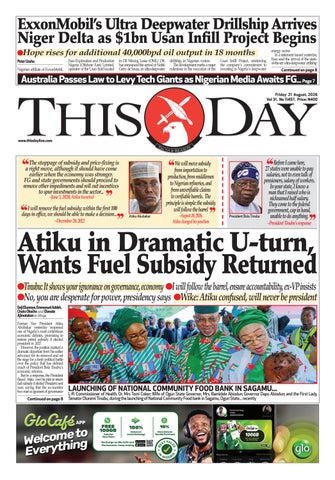
The stoppage of subsidy and price-fixing is a right move, although it should have come earlier when the economy was stronger. FG and state governments should proceed to remove other impediments and roll out incentives to spur investments in the sector...
–December 20, 2022
& RE A S O
N
We will move subsidy from importation to production, from middlemen to Nigerian refineries, and from unverifiable claims to verifiable barrels. The principle is simple: the subsidy will follow the barrel
–June 5, 2020, Atiku tweeted
I will remove the fuel subsidy; within the first 100 days in office, we should be able to make a decision...
UT H
Atiku Abubakar
–August 20, 2026, Atiku changed his position
Before I came here, 27 states were unable to pay salaries, not to even talk of pensioners, salary of workers. In your state, I know a man that I raised who is nicknamed half salary. They come to the federal government, cap in hand, President Bola Tinubu unable to do anything. –President Tinubu’s response
Atiku in Dramatic U-turn, Wants Fuel Subsidy Returned Tinubu: It shows your ignorance on governance, economy I will follow the barrel, ensure accountability, ex-VP insists No, you are desperate for power, presidency says Wike: Atiku confused, will never be president
Deji Elumoye, Emmanuel Addeh, Chuks Okocha and Olawale Ajimotokan in Abuja Former Vice President Atiku Abubakar yesterday reopened one of Nigeria’s most contentious economic debates, promising to restore petrol subsidy if elected president in 2027. However, the position marked a dramatic departure from his earlier advocacy for its removal and set the stage for a fresh political battle over the policy that has defined much of President Bola Tinubu’s economic reforms. But in a response, the President flayed Atiku over his plan to return fuel subsidy if elected President next year, saying that the ex-number two man is ignorant of governance Continued on page 8
LAUNCHING OF NATIONAL COMMUNITY FOOD BANK IN SAGAMU...
L-R: Commissioner of Health, Dr. Mrs Tomi Coker; Wife of Ogun State Governor, Mrs. Bamidele Abiodun; Governor Dapo Abiodun; and the First Lady, Senator Oluremi Tinubu, during the launching of National Community Food bank in Sagamu, Ogun State... recently
2
FRIday AUGUST 21, 2026 • T H I S D AY
FRIday AUGUST 21, 2026 • T H I S D AY
3
4
FRIday AUGUST 21, 2026 • T H I S D AY
5
THISDAY • FRIDAY, AUGUST 21, 2026
Group News Editor: Goddy Egene Email: Goddy.egene@thisdaylive.com, 0803 350 6821, 0807 401 0580
NEWS
VANGUARD AT 40 BOOK LAUNCH AND REUNION...
L-R: Chairman, Vanguard Alumni Association, Pastor Eyobong Ita; Former Editor-in-Chief, Newswatch, Ray Ekpu; Queen of Apomu Kingdom, Olori Janet Afolabi; President, Nigeria Labour Congress, Joe Ajaero; Commissioner for information and Strategy, Lagos State, Gbenga Omotosho; Former Minister of Foreign Affairs, Major General Ike Nwanchukwu (Rtd); Former Governor of Ogun State, Aremo Olusegun Osoba; Publisher, Vanguard Media, Pa Sam Amuka; Former General Manager, Vanguard Media, Ralph Ibiwoye; Former Rivers State Governor, Rotimi Amaechi; Representative of former military President Ibrahim Babangida, Prof. Muhammed Yahaya; Dr. Festus Okubor; and Convener, Centre for Values in Leadership, Prof. Pat Utomi, during the Vanguard at 40 book launch and reun-ion, held at Civic Center in Lagos, on Wednesday PHOTO: ABIODUN AJALA
Standard Bank Moves to Take Stake in OPay Ahead of US IPO Nume Ekeghe with agency reports
South Africa’s Standard Bank Group is in talks to acquire a stake in Nigerian fintech company, OPay Digital Services, ahead of the payments company’s planned listing in the United States, Bloomberg has reported. The proposed investment would give the banking group by assets a position in OPay before the fintech seeks to raise capital on the US market.
People familiar with the matter told Bloomberg that Standard Bank was seeking to acquire the stake ahead of the initial public offering, although the size of the proposed investment and the percentage stake being targeted remain unknown. The discussions come as OPay steps up preparations for what could be one of the biggest African fintech listings in the US. In May, Bloomberg reported that OPay had appointed Citigroup, Deutsche Bank, and JPMorgan
Chase to work on its planned US IPO, with the company targeting a valuation of about $4 billion. The listing could take place later this year, according to people familiar with the plans. OPay, which is backed by SoftBank Group and Sequoia Capital, has grown into one of Nigeria’s major digital payments platforms, offering transfers, payments, and other financial services to consumers and businesses. Bloomberg reported, “Standard
Bank Group Ltd. is in talks to buy a stake in Opay Digital Services Ltd., as the Nigeria-focused financial technology firm prepares for an initial public offering in the US, according to people with knowledge of the matter. “Opay, which is backed by Softbank Group Corp. and Sequoia Capital, is working with Citigroup Inc., Deutsche Bank AG and JPMorgan Chase & Co. to help list the company in New York, said the people who asked not to be
identified as the information is still private. Standard Bank is seeking to buy the stake before the IPO, the people said.” OPay’s strong operating performance has also strengthened the case for its planned US listing. The fintech processed $358 billion in gross transaction value (GTV) in 2025, more than double the $166.2 billion recorded in 2024, representing a 115 per cent increase in transaction value over the year. The growth was accompanied by
a sharp expansion in its user base, with monthly active users rising 57 per cent to 39.3 million in 2025, from 25.1 million a year earlier. Daily active users also climbed 50 per cent to 22.7 million in the fourth quarter of 2025, pushing the platform’s daily-to-monthly active user ratio to 57.8 percent. The figures highlight the scale of OPay’s business in Nigeria and come as the fintech prepares for a potential US IPO, which could value the company about $4 billion.
NMDPRA, PENGASSAN Harp on Regulatory FG Targets 3,500MW Power Supply Efficiency, Training to Grow Petroleum Industry
Onyebuchi Ezigbo in Abuja
The Nigerian Midstream and Downstream Petroleum Regulatory Authority (NMDPRA) and Petroleum and Natural Gas Senior Staff Association of Nigeria have expressed the need to ensure transparent and stable regulatory standards as a means of promoting safe, productive and sustainable oil and gas industry. On its part, PENGASSAN said there is need for collaboration between government, between regulators, the operators and the labour to promote growth and expansion. The Chief Executive of NMDPRA, Mr. Rabiu Umar, who was represented by Executive Director Corporate Services and Administration, Bashir Sadiq, at the 5th PENGASSAN Energy and Labour Summit in Abuja, said the organization has resolved to uphold the rules and enforce standards, protecting safety, and preserving the integrity of the market.
“We can focus our policy in paying the price we need to pay, we must operate in an industry that is safe, productive, and sustainable. At the end of the day, whatever we do, we want to make sure that members of our staff go back to their families safe and in good health. That is a non-negotiable for our industry. Our resolution today is part of NMDPRA’s resolution. And it is based on three simple principles. We want to be firm in our regulation, we want to be fair in our conduct, and we want to be impartial in our institutions. The purpose of the resolution is to uphold the rules, enforcing standards, protecting safety, and preserving the integrity of the market. Here in conduct, we apply the rules consistently, listening to stakeholders’ feedback, and ensuring that regulatory decisions are transparent, objective, and free from arbitrary changes.
to Lagos, to End Blackout Soon Segun James
The federal government has promised to end constant power outages in Lagos State, with a target of bringing in a new supply of 3,500 megawatts (MW) of electricity to the state. Minister of Power, Joseph Tegbe, disclosed the plan yesterday during a High-Level Strategic Power Town Hall held at Lagos House, Marina. The meeting had in attendance federal and state government officials, as well as regulators and power sector operators. Tegbe said through a series of coordinated actions on generation, transmission, distribution, and metering, the state will be power self-sufficient soon. The minister, represented by the ministry’s Director of Distribution Services, Mr. Baba Mustapha, said
Lagos required more than 6,000MW, but currently received far less from the national grid. He stressed that increased generation would have limited impact without adequate transmission and distribution infrastructure, identifying gas supply, generation, transmission capacity, distribution bottlenecks and metering as key priorities. Mustapha said Lagos had secured 400MW from private producers and should continue to explore gas-fired, embedded, and renewable generation. Lagos State Governor, Mr. Babajide Sanwo-Olu, called for stronger coordination, smart metering, better data management, enforcement, and revenue assurance, saying stakeholders must work together to build consumer confidence and attract investment. Sanwo-Olu proposed a review
meeting in five to six months to assess implementation of the commitments. Commissioner for Energy and Mineral Resources, Mr. Abiodun Ogunleye, said Lagos was determined to end a “culture of blackout”. Ogunleye said Lagos currently received less than one gigawatt from the national grid, despite the Transmission Company of Nigeria having about 3.5GW of wheeling capacity. He said the state’s immediate goal was to add about 2GW to existing supply, bringing available power closer to 3.5GW and enabling more feeders to serve homes and industries. He also said the state would develop clear action points and establish a baseline for measuring progress at the proposed six-month review. On tariffs, Ogunleye stressed that
improved electricity supply must accompany payment, insisting that consumers should not be made to pay for darkness. Special Adviser to the President on Power, and Chairman of the Presidential Taskforce on Power Sector Reset and Restoration, Dr. Rilwan Babalola, said the challenge went beyond adding megawatts. Babalola said Nigeria must move from managing electricity shortages to building a functioning electricity market where energy, contracts, and money moved predictably across the value chain. He described Lagos as a strategic testing ground for the Clean Lagos Electricity Market (CLEM), which proposes demand aggregation, bilateral contracting, open access, payment assurance, and transparent settlement.
Dangote Cement Vows to Strengthen Empowerment Programmes for the Youths in Kogi Ibrahim Oyewale in Lokoja
Dangote Cement Plc, Obajana, has marked International Youth Day with a renewed commitment to advancing youth development through its array of empowerment programmes, while strengthening its positive social impact. A statement issued by the company’s Corporate Communications Department said the event attracted more than 100 participants, com-
prising Sustainability Champions, graduate trainees, management trainees, NYSC Corps members and other invited guests. The statement said the event served as a platform for young people to showcase innovative ideas, exchange knowledge, and explore practical solutions to sustainability and workplace challenges. Presentations focused on topics ranging from recycling and
environmental sustainability to technology-driven solutions such as the use of drones to enhance safety in mining operations. Speaking at the event, the Head of Human Assets Management (HAM) & Administration, Mr. Adeniyi Azeez, commended the participants for their creativity and enthusiasm. He encouraged the youths to continue developing their skills, embrace innovation, and take
advantage of opportunities that support their growth and career development. Also addressing participants, the Head of Social Performance, Mr. Ademola Adeyemi, emphasized the importance of youth involvement in shaping a sustainable future. He urged young people to remain passionate about sustainability, community development, and responsible leadership, noting that today’s ideas can become
tomorrow’s impactful solutions. The programme featured innovation pitches, sustainabilityfocused presentations, poetry, music performances, games, and interactive sessions that kept participants engaged throughout the event. A documentary highlighting previous International Youth Day activities also inspired participants and reinforced the value of youth participation in driving positive
change. Participants described the event as inspiring and impactful, citing improvements in their confidence, public speaking abilities, and commitment to advancing sustainability initiatives within their communities. The statement said the successful celebration of International Youth Day 2026 shows Dangote Cement Plc’s commitment to youth empowerment, innovation, and sustainable development.
6
FRIDAY, AUGUST 21, 2026 • THISDAY
NEWS
INTELLECTUAL PROPERTY WORKSHOP...
U.S. Consul General Brandon Hudspeth delivering remarks at the closing ceremony of the three-day IP for Growth in Africa: Lagos Cross section of participants at the closing ceremony of the workshop Music Industry Workshop.
PWC: Nigeria’s H2 Growth to Hit 4.2% Buoyed By Stronger Oil Output Warns high food, energy costs may weaken reform gains Says growth hinges on turning reforms into jobs, investment
Emmanuel Addeh in Abuja Global professional services firm, PwC, has predicted that Nigeria’s economic growth is will reach 4.2 per cent in the second half of 2026, driven largely by the sustained rebound in domestic crude oil production and a gradual expansion in non-oil commercial activities. According to its latest macroeconomic projections titled: “Unlocking Nigeria’s Reform Dividend: From Macroeconomic Stabilisation to Inclusive Growth,” the firm observed that while top-line indicators are stabilising after months of volatility, persistent inflationary pressures on food and energy prices threaten to significantly erode the broader socioeconomic benefits of recent policy adjustments. “Higher crude prices could sup-
port Nigeria’s oil revenues and FX inflows, provided production gains are sustained and fiscal leakages are contained. However, higher refinedfuel, freight, fertiliser and transport costs may increase imported inflation and weaken household purchasing power, partly offsetting the fiscal benefits of higher oil prices,” it explained. The detailed report highlighted that the nation’s Gross Domestic Product (GDP) expanded by 3.89 per cent in the first quarter of 2026, representing a notable improvement from the 3.13 per cent growth rate recorded in the corresponding period of the previous year. This upward trajectory, PwC stated, reflects the early dividends of structural reforms, enhanced foreign exchange liquidity in official windows, and rising domestic crude
oil production, which peaked at 1.56 million barrels per day (mbpd) in June. However, despite these positive top-line growth indicators and the steady recovery in hydrocarbon output, PwC strongly cautioned that the elevated cost of living remains a severe and immediate headwind to household consumption, wage purchasing power, and general business operations across the country. According to the firm’s analysis, while headline inflation eased marginally to 15.91 per cent in June 2026, the core reality for citizens remains harsh. Prices for essential foodstuffs, daily transportation, and domestic power supply remain disproportionately high, it pointed out. This inflationary environment is severely affecting vulnerable populations, exacerbating poverty levels, and squeezing commercial profit margins
across primary, secondary, and tertiary market sectors as operating costs continue to soar, PwC explained. The report warned in stark terms that unless these high food and energy costs are decisively addressed through targeted supply-side interventions, robust agricultural protection mechanisms, and substantial local production incentives, the macroeconomic gains achieved under recent economic stabilisation policies could be completely undermined. “Sustaining disinflation and easing food and other household essential costs will provide greater relief to household budgets. This will strengthen purchasing power, support consumer spending and contribute to broader economic growth. “Government should strengthen food supply through support for higher farm productivity, better
US, Nigeria Deepen Music Industry Ties with Intellectual Property Workshop Emmanuel Addeh in Abuja
The United States and Nigeria are seeking to deepen commercial ties in the music industry, with the US Consulate General in Lagos convening creative industry stakeholders for a three-day workshop on strengthening Intellectual Property (IP) protection and unlocking investment in Nigeria’s music sector. The stakeholders included more than 120 IP policymakers, lawyers, music executives, artists, producers, distributors among others, a statement from the US Consulate in Lagos stated. The workshop, titled: “IP for Growth in Africa: Lagos Music Industry Workshop”, focused on how stronger copyright protection and enforcement could expand revenues, attract investment, create jobs and open new commercial opportunities for American businesses and Nigerian music companies. The event formed part of the US Mission’s activities marking 250 years of American independence and provided an opportunity for the United States to showcase its experience in building a globally
successful music industry while engaging with Nigeria’s fastgrowing creative sector. Speaking at the closing ceremony, the US Consul General, Brandon Hudspeth, said the growing global reach of Afrobeats was creating significant opportunities for deeper commercial cooperation between American and Nigerian music businesses. “The United States sees Nigeria’s music industry not only as a powerful cultural force, but as a significant trade and investment opportunity. As Afrobeats reaches more listeners around the world, we will continue to see more American music companies work with more Nigerian artists, labels, publishers, platforms, and other creative businesses,” he said. Hudspeth noted that American companies, including Universal Music Group, EMPIRE, Sony and Warner Music Group, as well as digital platforms such as YouTube, Meta and Apple Music, had contributed to taking Nigerian music to global audiences while generating revenue, attracting investment and creating jobs across the creative value chain. He stressed that stronger IP
protection was critical to giving American music companies the confidence to enter partnerships, finance projects, develop new markets and make long-term investments in Nigeria. “For Nigeria, strong IP protection gives U.S. investors greater confidence, gives creators greater control over their work, and creates the conditions for businesses on both sides of the Atlantic to invest, partner, and grow,” he added. The workshop was organised in partnership with the US Patent and Trademark Office, the US Mission in Geneva and Nigerian alumni of the American Music Mentorship Programme, a US government exchange programme implemented in partnership with the Recording Academy, the organisation behind the Grammy Awards. The 10 Nigerian alumni of the mentorship programme brought their experience, industry insights and professional networks from both the US and Nigerian music markets to the discussions. Participants also examined commercial partnerships involving American and Nigerian music companies, including Universal Music Group’s partnership with
Mavin and EMPIRE’s collaboration with YBNL, as examples of cross-border cooperation that have helped Nigerian Afrobeats reach international audiences and created new revenue opportunities.
storage and logistics, and selective temporary imports to ease shortages,” PWC added. Transforming this fragile macroeconomic stability into deeply inclusive growth, the publication argued, requires a deliberate pivot from mere policy formulation to turning structural reforms into direct job creation, poverty alleviation, and the attraction of long-term domestic and foreign direct investment. Examining the nation’s investment climate, PwC observed a concerning imbalance in capital flows. While total capital importation rose significantly to an impressive $10.37 billion in the first quarter of 2026, the overwhelming bulk of these financial inflows consisted of short-term Foreign Portfolio Investment (FPI). FPI, it pointed out, accounted for a massive 95.1 per cent of total capital imports. In stark contrast, Foreign Direct Investment (FDI), the type of capital necessary for building factories and creating jobs, accounted for a dismal 1.3 per cent, representing just $135.1 million during the same period. The report stressed that these portfolio flows, while highly beneficial for boosting immediate foreign exchange reserves and providing short-term currency defense for the Naira, remain highly volatile. According to the firm, they can easily reverse course during global
market shocks and, critically, they do not build physical infrastructure, enhance technological capacity, or create widespread, sustainable employment for Nigeria’s booming youth population. To achieve sustained domestic economic progress, the document emphasised, the federal government must urgently foster a predictable, secure, and transparent policy environment capable of attracting patient capital into labour-intensive and highly productive sectors such as manufacturing, commercial-scale agriculture, and robust power generation. On the monetary and currency front, the firm noted positive developments, highlighting that official foreign exchange reserves stood at 51.46 billion as of June 2026. This marks a robust 38.3 per cent increase year-on-year, providing the Central Bank of Nigeria (CBN) with a stronger buffer to defend the local currency. Furthermore, parallel and official exchange market rates have largely converged around N1,379.68/ and N1,385/$, respectively. This convergence, it stressed, has significantly reduced speculative arbitrage opportunities, minimised round-tripping, and stabilised foreign trade transactions for industrial importers who previously struggled with severe currency volatility.
Ogoni Oil Resumption: Rivers LGs Seek Clarity, Caution Against Derailment
Blessing Ibunge in Port Harcourt
The proposed resumption of oil production in Ogoniland after more than three decades may face fresh challenges following concerns raised by the four local government areas that make up the Ogoni area. The local governments raised concerns over alleged moves to commence oil-related activities while consultations with the federal government were still ongoing. The leadership of KAGOTE, an umbrella body representing Khana, Gokana, Tai, and Eleme local government areas, said the conduct of some members of the Ogoni Dialogue Committee (ODC) could undermine the credibility of the process.
The group said there was growing apprehension among the Ogoni that certain oil related activities might have commenced in parts of Ogoniland without adequate clarification from the leadership of the dialogue committee. It warned that the development could heighten distrust and undermine efforts by the federal government to rebuild confidence with the Ogoni people ahead of the proposed resumption of oil production. ODC was inaugurated by the federal government in January 2025 with a mandate to engage Ogoni stakeholders on the resumption of oil production in the area, while seeking to resolve longstanding concerns, rebuild trust, and strengthen relations
between the federal government and the Ogoni people. Speaking at a press briefing in Port Harcourt, President of KAGOTE, Chief Lesi Maol, commended President Bola Tinubu for his commitment to addressing the longstanding concerns of the Ogoni people. Maol said the establishment of the dialogue process and the decision to place its coordination under the National Security Adviser (NSA), Nuhu Ribadu, as the federal government’s chief negotiator, demonstrated the Tinubu administration’s seriousness about resolving the Ogoni question. He said the process offered an opportunity to promote reconciliation, peace, equity, transparency, and sustainable development in Ogoniland.
7
THISDAY • FRIDAY, AUGUST 21, 2026
NEWS
ADELEKE PRESENTS CERTIFICATE OF RETURN TO TINUBU...
Osun State Governor, Ademola Adeleke (L) presents his Certificate of Return to President Bola Ahmed Tinubu during his visit to the Presidential Villa Abuja, yesterday
PHOTO: GODWIN OMOIGUI
Australia Passes Law to Levy Tech Giants as Nigerian Media Awaits FG Emmanuel Addeh in Abuja
Australia passed legislation yesterday that will force tech giants to pay millions of dollars in levies if they fail to strike commercial deals with local media outlets for news on their platforms. The News Bargaining Incentive taxes the companies 2.5 per cent on their advertising revenues unless they strike agreements, a Reuters report stated. This comes as the push by Nigerian media owners to secure compensation from global technology companies has intensified as the digital platforms have become dominant channels for the distribution and consumption of news. Publishers in the country have argued that while they bear the cost of producing journalism through investments in reporters, investigations, editing, technology and distribution, platforms such as Google and Meta derive significant commercial value from the content without adequately compensating the organisations that produce it. The concerns have become
more pressing with the decline in traditional advertising revenue and the growing dominance of global technology companies in the digital advertising market. Media stakeholders have consequently called for a framework that would enable publishers to negotiate compensation with technology platforms for the use, aggregation and distribution of their content. In recent times, the campaign has attracted government attention, with
President Bola Tinubu directing the Federal Competition and Consumer Protection Commission (FCCPC) to investigate major technology companies over allegations relating to the exploitation of Nigerian media content and potentially anti-competitive practices. According to Reuters, proceeds from the scheme would be directed to local Australian news outlets, whose content helps drive user engagement and advertising revenue on the tech firms’ platforms.
Vice President Kashim Shettima and Rivers State Governor, Mr. Siminalayi Fubara, yesterday, inaugurated the newly constructed 33.5-kilometre EleleEgbeda-Omoku dual carriageway, describing the landmark project as a major boost to connectivity and economic development in the state. The dual carriageway, which traverses communities across Ikwerre, Emohua and Ogba-Egbema-Ndoni Local Government Areas, is expected to ease transportation, improve the movement of goods and people, and stimulate economic activities along the corridor. Shettima, who performed the official inauguration, commended the Rivers State Government for investing in infrastructure that
production of news content or relate to news content produced by the publishers being made available online by the platform, the legislation said. Spending with large publishers carries a 150 per cent offset, while spending with small and mediumsized outlets carries a 200 per cent offset. Any single deal is also capped at 25 per cent of a platform’s levy liability. “The legislation is here, and the
message to platforms to pursue commercial deals is clear. Deals will need to be finalised before the end of a digital platform’s financial reporting period to be used to offset their liability in that period,” the government said in a statement. “This is an important day for Australian news businesses and Australian journalism,” it added. The passage of the News Bargaining Incentive comes one day after parliament passed laws restricting gambling advertisements.
NELFUND Commends Tinubu as FG Directs EFCC Recovered Funds, Unclaimed Dividends to Student Loans
Kuni Tyessi in Abuja
Nigerian Education Loan Fund (NELFUND) has commended President Bola Tinubu for directing that eligible liquid assets recovered by the Economic and Financial Crimes Commission (EFCC) should be channelled to the fund to meet growing
student loan obligations. In a statement issued yesterday in Abuja by Director of Strategic Communications, Oseyemi Oluwatuyi, Chairman of NELFUND Board, Mr. Jim Ovia, also welcomed the Federal Executive Council’s approval to redirect unclaimed dividends from the Capital Market Trust Fund and
VP Shettima, Fubara Inaugurates 33.5km Elele-Egbeda-Omoku Dual Carriageway Blessing Ibunge in Port Harcourt
The levy applies to Meta, Alphabet, TikTok and Microsoft’s LinkedIn, covering companies with a “significant” social media or search service in Australia, and local advertising revenue exceeding A$250 million ($178 million). Platforms can avoid the charge by reaching agreements with at least eight different publishers by the end of their reporting period. The value of those deals would be offset against their levy liability, it said. The deals must support the
expands the nation’s road network and creates greater economic opportunities for citizens. According to the Vice President, roads remain “the most democratic instruments of development,” serving farmers taking produce to markets, traders seeking customers, workers travelling in search of employment, students going to school and patients seeking medical care. He said the newly inaugurated road would further strengthen economic integration and improve access to opportunities for communities connected by the corridor. Shettima recalled that the road being celebrated once stood as a warning rather than an invitation to commuters because of the deep gullies that made every journey a herculean task amidst security concerns. He applauded Governor Fubara
for the intervention made by his administration which has put the ugly memories people had of the road behind them. He said that by transforming the once deplorable route into a modern dual carriageway, illuminated for safer movement by day and night, Governor Fubara has left an indelible mark in the hearts of the people of Rivers State. In his address at the ceremony, Governor Fubara emphasised that the completion of the road has transformed a route previously plagued by avoidable man hour losses and insecurity into a fast and secure highway. According to him, the Elele - Omoku Road is not just a signature project but an eloquent testimony of his administration’s love and care for the people of the State, describing it as a promise kept.
funds from the Dormant Account Trust Fund to NELFUND. The announcement comes as the student loan scheme records significant expansion. According to NELFUND, the fund has disbursed over N322 billion to beneficiaries through more than 1.6 million loan applications as of August 2026. Ovia said the decision reinforced the Tinubu administration’s commitment to making access to higher education more inclusive and sustainable. NELFUND Managing Director/ Chief Executive, Mr. Akintunde
Sawyerr, also expressed appreciation to the president for prioritising education financing. Sawyerr said, “NELFUND deeply appreciates His Excellency, President Bola Ahmed Tinubu, for this significant intervention and for his unwavering commitment to ensuring that no Nigerian student is denied access to higher education because of financial constraints.” He added that the intervention demonstrated the president’s belief in the transformative power of education and strengthened confidence in building a sustainable financing
system for students. He stated, “On behalf of the Executive Management, staff of NELFUND, and millions of Nigerian students, we thank Mr. President for this confidence and assure him that we will continue to deploy every resource entrusted to the fund responsibly, transparently and in the best interest of Nigerian students.” NELFUND stated that the new funding directive will further strengthen the federal government’s commitment to sustainable education financing and expand access to more eligible Nigerian students.
Jigawa Partners Egyptian Firm on Date Palm, Potato Tissue Culture Technology Ibrahim Shuaibu in Dutse The Jigawa State Government has opened discussions with an Egyptian plant research and development company, EFC Plants, on a strategic partnership to introduce advanced plant tissue culture technology for date palm and Irish potato production in the state. In a statement issued to THISDAY on Thursday in Dutse by Hamisu Mohammed Gumel, spokesperson of the Governor, explainer Governor Namadi led a technical delegation to Cairo as part of the state’s efforts to transform agriculture through biotechnology, improve farmers’ access
to disease-free planting materials and attract private investment into priority agricultural value chains. The delegation inspected EFC Plants’ tissue-culture and biotechnology facilities, including climatecontrolled greenhouses, cold-storage facilities with capacity for up to six million plantlets, a plant pathology laboratory, sterilisation and preparation facilities, as well as specialised growth and incubation rooms. The team also received technical briefings on the tissue-culture production cycle, covering the selection and laboratory testing of mother plants, micropropagation, incubation, rooting, acclimatisation, greenhouse manage-
ment, storage and preparation for commercial distribution. The proposed partnership is expected to explore the establishment and commercialisation of plant tissue-culture technology in Jigawa, initially targeting date palm and Irish potato. It is also expected to facilitate technology transfer, specialist training, research collaboration and local production of certified, disease-free and high-yielding planting materials. Namadi said the proposed partnership was designed to establish a broader technological and investment relationship rather than simply secure access to planting materials.
8
FRIDAY, AUGUST 21, 2026 • THISDAY
EIGHT
China Sentences Evergrande Founder to Life Imprisonment after $300bn Default Confiscates all his personal property, fines firm $1.31bn 56 others also sentenced
Emmanuel Addeh in Abuja
The founder of China Evergrande Group, the world’s most-indebted property developer, Hui Ka Yan, was sentenced to life in prison by a Chinese court yesterday, five years after the firm’s collapse shook the nation’s economy and financial markets. Hui Ka Yan, once Asia’s richest man, pleaded guilty in April to eight charges, including misuse of funds, fundraising fraud, illegally taking public deposits, illegally extending loans, fraudulently issuing securities and bribery, a Reuters report stated. Evergrande, once China’s premier
developer, has defaulted on most of its $300 billion in liabilities, its troubles symbolising a crisis in the property sector that has long dragged on the world’s second-biggest economy. The sentence in the southern city of Shenzhen, which included confiscating all of Hui’s personal property, ends his rags-to-riches story but is unlikely to bring much solace to Evergrande’s domestic and foreign creditors. Evergrande’s liquidators declined to comment on the sentence. Reuters could not reach legal representatives for Hui, who had not been seen in public since Chinese authorities detained him in 2023, following
Evergrande’s default. “The criminal acts of Evergrande Group, Hengda Real Estate, and Hui Ka Yan ... involved particularly huge amounts and egregious circumstances, caused particularly significant economic losses and caused particularly serious social harm, and should be severely punished according to law,” the court said in a statement. Comments by Evergrande homeowners in a social media group included: “All ordinary citizens have paid the cost,” “Imprisonment is meant to protect him. If he comes out, his life is in jeopardy” and “What about our money?”
In addition to Hui’s sentence, the court said it had fined Evergrande 8.82 billion yuan ($1.31 billion) and its main subsidiary Hengda 7 billion yuan, and sentenced five other senior executives to fines and prison terms ranging from six to 18 years. Altogether, 56 people linked to Evergrande, other than Hui, received sentences on Thursday, state media CCTV reported. The company’s failure to repay billions of dollars in wealth-management products triggered protests that threatened social stability after ordinary investors, many of them on lower incomes, saw their holdings wiped out.
ATIKU IN DRAMATIC U-TURN, WANTS FUEL SUBSIDY RETURNED
and economy. Speaking yesterday evening while receiving in audience at the State House, Abuja, Governor Ademola Adeleke of Osun state, Tinubu declared that the move by Atiku to reintroduce petrol subsidy showed his high level of ignorance in governance and economy. Besides, the Presidency, in a statement by the Special Adviser to the President on Information and Strategy, Bayo Onanuga, rejected the proposal, describing it as retrogressive, fiscally unsustainable and a product of what it called Atiku’s desperation to win the presidency. It argued that Nigeria’s petroleum landscape had changed fundamen-
tally since Tinubu announced the removal of the petrol subsidy in his inaugural address on May 29, 2023, particularly with the emergence of significant domestic refining capacity. It said a return to subsidy would undermine the reforms already undertaken in the petroleum sector, create legal and fiscal complications and potentially discourage investment in domestic refining, including the Dangote Refinery and other modular refineries.
Atiku Explains Rationale for Planned Move Atiku insisted that every barrel of crude allocated under the scheme
would be targeted and tracked to ensure that Nigerians benefit from the intervention. The politician-cum businessman, who unveiled details of his proposed Atiku Economic Recovery Plan (AERP) 2027, argued that the government had failed to adequately account for the financial gains from the removal of the petrol subsidy and that a new intervention should be designed around domestic refining, with support capped, budgeted and tied to verifiable production and consumer benefits. Atiku maintained that his proposal was not a return to the opaque subsidy regime of the past, but a controlled mechanism that
would support Nigerian refineries while ensuring that the benefits of cheaper crude feedstock were transmitted to consumers. Under the proposal, qualifying domestic refineries would receive crude at preferential prices subject to strict conditions relating to production, efficiency, transparency and domestic supply. Atiku also pledged to track the crude from allocation to refining and ensure that any support translated into lower prices for consumers. The subsidy debate has recently assumed a political dimension, with the opposition seeking to make the hardship associated with the Tinubu administration’s economic
Licensing Round: Winners Move to Secure Blocks, Begin Bonus Payment NUPRC insists on 90-day compliance window Commission releases official list of winners
Emmanuel Addeh in Abuja
Successful bidders in Nigeria’s latest oil and gas licensing round have begun the process of securing their awarded blocks, with the Nigerian Upstream Petroleum Regulatory Commission (NUPRC) insisting on 90 days to complete statutory obligations, including payment of signature bonuses. Yesterday, the Commission released the official list of winners after the conclusion of the commercial bid conference in Abuja, with 31 corporate entities emerging successful for 37 prospective licences out of the 50 assets put up for bidding. The awards covered a wide range of prospective acreage, spanning the Niger Delta’s onshore and shallow water areas, deep offshore assets and frontier basins, including Anambra, Benue Trough, Benin and Chad. Under the Petroleum Industry Act (PIA) 2021, the provisional awards represent the stage preceding the formal grant of Petroleum Prospecting Licences (PPLs), subject to the successful bidders fulfilling prescribed post-award conditions. A major requirement is the payment of statutory signature bonuses, which range from $3 million to $7 million per block, alongside the execution of relevant contractual documentation and fulfilment of other regulatory obligations. The NUPRC therefore made clear that the 90-day compliance period is binding, with provisional winners that fail to meet the requirements within the stipulated period liable to lose their bid guarantees and the affected assets.
“Exactly a month ago, the NUPRC hosted the 2025 commercial bid conference in Abuja where 31 companies emerged winners of 37 oil and gas blocks. Having issued the winners with the provisional awards, compliance with the payment of signature bonuses has already begun. “Winners who fail to pay signature bonuses within the stipulated time frame in line with the Petroleum Industry Act will forfeit their bid guarantee and lose their provisional awards to the reserve bidders. Reproduced here is the full list of winners and reserve bidders,” the NUPRC stated yesterday. The Commission said it may subsequently offer such blocks to pre-qualified reserve bidders, in line with the licensing framework. A THISDAY review showed that the awards reflected a mixture of indigenous exploration companies and established industry operators. For instance, in the Niger Delta onshore and shallow water areas, SSonic Petroleum Limited secured PPL 2A29, while CFP Pipelines and Flowlines Company Limited won PPL 2A30. Dutchford Exploration and Production Company Limited secured PPL 2A32, Rosem Energy Limited won PPL 2A38, Network Exploration and Production Nigeria Limited secured PPL 2A40 and Lexoil Nigeria Limited won PPL 2A42. Other successful bidders in the region included Volonte Oil and Gas Limited, PPL 2A46; Clinton Oil Field Limited, PPL 2A48 and PPL 2A62; Nuway Oaklane Limited,
PPL 2A49; and Ramec Integrated Services Limited, PPL 2A50. Italia Company Limited secured PPL 2A53, Blueridge Exploration and Production Limited won PPL 2A54, UP Energies Limited secured PPL 2A56, while AYM Shafa Limited won PPL 2A57. Besides, Blackrock Energy Holdings Limited secured PPL 2A58, Funtay Integrated Business Limited won PPL 2A59 and Riparian Development and Production Limited secured PPL 2A60. In the deep offshore segment, Star Deep Water Petroleum Limited secured PPL 2010. Also, Gupsco Energy Limited emerged as a multiple-asset winner with PPL 2A44 and PPL 2A51, while Concept-Reel Petroleum Services Limited secured PPL 2A47 and PPL 2A55. The licensing round also recorded awards in Nigeria’s frontier basins, potentially opening new areas of exploration beyond the country’s traditional oil-producing zones. Dakoda and U Limited secured PPL 308 in Benin and PPL 800 in Benue, while Nikstallis Nigeria Limited won PPL 2A61 in the Niger Delta and PPL 900 in Anambra. Attabason Global Company Nigeria Limited secured PPL 2A33 in the Niger Delta and PPL 901 in Anambra, while Southborne Oil and Gas Limited and Lanaka Petroleum Limited secured PPL 902 and PPL 903 respectively. Highban Resources Limited won PPL 700 in the Chad Basin, while Eyrie Energy Limited secured PPL 801 in the Benue Trough. The outcome of the licensing round is expected to boost explora-
tion activity, attract fresh capital into the upstream sector and support efforts to increase Nigeria’s oil and gas reserves. The NUPRC had emphasised technical capacity, financial strength and credible work programmes in assessing bidders, with the objective of ensuring that successful companies move quickly from the award stage into exploration and development activities. The enforcement of the PIA’s “drill or drop” principle is also expected to limit the accumulation of dormant acreage and ensure that awarded blocks generate actual investment and exploration activity.
A former steel technician raised by his grandmother in a rural village in central Henan province, Hui founded Evergrande in 1996 and turned it into China’s biggest property developer by contracted sales, aggressively taking on debt. In 2017, Hui had a net worth of $45.3 billion, the highest in Asia, according to Forbes. A Hong Kong court ordered Evergrande liquidated in 2024, and the Hong Kong Stock Exchange delisted it last year, bringing an end to a tumultuous boom-to-bust saga. The liquidation process has moved at a glacial pace, according to its liquidators, with only about $255 reforms a central campaign issue, while the Presidency has continued to defend the reforms as necessary measures to restore fiscal stability and attract investment. The federal government’s position received fresh backing on Wednesday when the Minister of Finance and Coordinating Minister of the Economy, Taiwo Oyedele, said the removal of the petrol subsidy had generated N15.8 trillion in resources for the federation between June 2023 and December 2025. According to the government, N5.4 trillion accrued to the federal government while N10.4 trillion was shared among states and local governments. The petrol subsidy regime became one of Nigeria’s most contentious fiscal policies before Tinubu announced its removal in his inaugural address on May 29, 2023. The policy had kept petrol prices below market-related levels by requiring the government to absorb part of the cost of supplying the product, but it also attracted criticism over its huge fiscal burden, opaque administration, smuggling and alleged corruption. The removal immediately pushed up petrol prices and contributed to a sharp increase in transportation, food and other living costs, making the reform deeply unpopular among many Nigerians. The Tinubu administration has nevertheless maintained that eliminating the subsidy freed resources for the federation and helped restore government finances. But the ex-VP who unveiled details of his proposed petroleum subsidy reform, declared that his administration would replace
Hui Ka Yan million worth of assets sold as of last August, compared to creditors’ claims totalling $45 billion. Nigeria’s old import-subsidy architecture with a targeted, capped, transparently budgeted and independently audited production subsidy designed to lower energy costs while accelerating domestic refining. Atiku, in a statement issued by his Senior Special Assistant on Public Communication, Phrank Shaibu, said the AERP 2027 recognises that the choice before Nigeria is not simply between subsidy and no subsidy, but between an opaque intervention that breeds waste and a disciplined economic instrument that delivers measurable benefits to citizens. “My proposal is not to resurrect the old subsidy regime. We will move subsidy from importation to production, from middlemen to Nigerian refineries, and from unverifiable claims to verifiable barrels. The principle is simple: the subsidy will follow the barrel,” he explained. Under the AERP, Atiku pointed out that qualifying public and private Nigerian refineries would receive domestic crude at a preferential price, subject to strict production, efficiency, transparency and domestic-supply conditions. He acknowledged that supplying crude below its market-equivalent value represents a real opportunity cost to the Federation and said his plan would account for that cost openly rather than pretend it does not exist. “The cost will be known. The ceiling will be known. The beneficiaries will be known. And, most importantly, the benefit delivered Continued on page 43
EXXONMOBIL’S ULTRA DEEPWATER DRILLSHIP, ARRIVES NIGER DELTA AS $1BN USAN INFILL PROJECT BEGINS
signalled the commencement of a drilling campaign designed to unlock additional value from the Usan Field. As a short cycle investment, the company said the project was expected to deliver up to 40,000 barrels per day (bpd) of incremental oil production within 18 months, contributing quickly to Nigeria’s energy security and economic development. The Usan Infill Project is supported by a cumulative $1 billion investment by OML 138 partners and underscores Esso’s confidence in Nigeria’s improving investment environment. Chairman and Managing Director of ExxonMobil affiliates in Nigeria, Jagir Baxi, stated, “The arrival of the Noble Gerry de Souza marks the beginning of an
exciting new chapter for the Usan Field and reflects our continued focus on delivering short cycle deepwater production growth through disciplined investment, in deploying technologies and through operational excellence.” The company added that the advanced capabilities of the Noble Gerry de Souza will support the safe and efficient delivery of the drilling programme, helping maximise recovery from existing infrastructure while strengthening the long-term performance of the Usan asset. The milestone, according to the statement, is the result of years of planning, collaboration, and dedication by multidisciplinary teams across Esso and partner organisations in Nigeria. It maintained that their exper-
tise and commitment had been instrumental in transitioning the project from concept to operational readiness. As offshore activities commence, Esso said it remained focused on delivering the project safely and responsibly, in close partnership with government stakeholders, regulators, contractors, and coventurers. “The arrival of the Noble Gerry de Souza represents the start of a new phase of investment, innovation, and growth for the Usan Field and further demonstrates Esso’s commitment to supporting Nigeria’s energy future”, the company added. The Usan Infill Project is designed to enhance production from the existing Usan Field through additional drilling and subsea development.
9
THISDAY • FRIDAY, AUGUST 21, 2026
NEWS
UZODIMMA TOURS FACILITIES AT THE IMO ROBOTICS AND ONCOLOGY CENTRE...
Governor Hope Uzodimma of Imo State flanked left by Prof. Kingsley Ekwueme, Consultant Robotic and Laparoscopic Surgeon; and right by Imo State Commissioner for Health, Dr. Chioma Egu; and others during inspection of facilities at the Imo Robotics and Oncology Centre, at the Imo State Specialist Hospital, Owerri on Wednesday, ahead of robotic-assisted surgery Friday
Afrocentric Cultural Expo Targets $300m Economic Impact, to Showcase Nigeria’s Creative Potential James Emejo in Abuja
Founder/Chief Executive, Nigerian Chamber of Commerce-USA (NICOCUSA), Mr. Gregory Uche Ihenacho, has projected between $250 million and $300 million in economic impact from the forthcoming Afrocentric Cultural Expo scheduled to take place in Abuja. Organisers of the event seek to position Nigeria as a continental hub for culture, creativity, tourism, investment, and international partnerships. Addressing journalists ahead of the event, planned for November 7 to 18, Ihenacho said the expo was designed to go beyond cultural entertainment
by creating an economic platform capable of connecting Africa’s creative assets with global markets. The event is expected to bring together stakeholders across culture, business, investment, tourism, entertainment, technology and the creative industries. Ihenacho said the projected economic impact reflected the potential spending and commercial activities that the event could stimulate, stressing that the initiative is being developed as a long-term platform rather than a one-off gathering. According to him, the expo would provide the country with an opportunity to showcase its cultural
wealth while creating avenues for job creation, investment attraction, tourism development, trade, and greater international visibility. He said, “The economic impact based on our calculation is projected to be between $250 million to $300 million for this event.” Ihenacho explained that the original concept had been significantly more expensive, with plans to bring national teams from different countries to Nigeria. However, the organisers subsequently redesigned the programme to make it more sustainable and, importantly, to place greater emphasis on discovering and developing local
talents. Ihenacho said the new approach would enable Nigerian academies and universities to serve as a pipeline for identifying creative talents who could subsequently be packaged and exposed to international opportunities. The shift, he explained, was also aimed at ensuring that the event did not merely import foreign cultural content but created a platform through which Nigeria and Africa could develop and export their own creative talents. Ihenacho said the creative component would include a film festival involving students from different academies and universities, with
INT International Moves Africa’s Devt Agenda from Diagnosis to Delivery Virtual roundtable to hold August 25 ahead of October STEP Summit in Abuja Five-day gathering to produce fundable projects, launch 10-month mentorship scheme Sunday Aborisade in Abuja Institute for National Transformation International (INT International) will on August 25 open a national conversation on how Nigeria and other African countries could convert their abundant human and material resources into measurable economic development through science, technology, and innovation (STI). The engagement, a virtual Stakeholders’ Roundtable, will hold via Zoom, in collaboration with the LOVE AFRICA NOW STI Transformation Network (LANST-NET), as the official curtain-raiser to the 2026 INT International STEP Delegate Leadership Summit, scheduled to hold in Abuja in October. Founder and Director-General of INT International, Professor Vincent Anigbogu, disclosed the programme in a statement on Thursday. Anigbogu said the roundtable would interrogate practical strategies for harnessing Africa’s resources through science, technology, innovation, entrepreneurship, and disciplined execution. “This roundtable is not another talk-shop. It is a working session where stakeholders will get first-hand information about the October summit, understand how to participate, and help us shape the implementation
framework,” Anigbogu said. He said the session would open with a keynote address on the theme of the summit, “LOVE AFRICA NOW – Building STI-Driven Economies for the Africa We Want,” describing it as a rallying call for the continent to move from ambition to action. According to Anigbogu, participants at the roundtable will receive detailed briefings on the summit’s five-day programme, the delegate nomination process, and a proposed 10-month post-summit mentorship programme designed to sustain momentum after October. He stated, “We are not interested in a summit that ends with a communique and nothing else. The mentorship component will walk participants through structured support to develop and implement the projects that emerge from the summit, so that ideas do not die on paper.” He added that discussions at the roundtable would also address sponsorship, partnership and donation opportunities, and how organisations could align their programmes with the African Union’s Agenda 2063, the Sustainable Development Goals, the African Development Bank’s High 5s, and Nigeria’s national development priorities. Anigbogu listed expected par-
ticipants to include representatives of government agencies, businesses and industries, tertiary institutions, research organisations, professional bodies, civil society organisations, foundations, faith-based organisations, women and youth groups, traditional institutions, and members of the African diaspora. He stated, “Africa’s transformation cannot be the business of government alone. We need everyone at the table, including the private sector, academia, faith communities,
traditional institutions and our people in the diaspora.” Anigbogu described the October summit as an implementation-focused continental platform that will bring together institutional delegations to translate major African and global development frameworks. These, he said, included Agenda 2063, the SDGs, the African Continental Free Trade Area (AfCFTA), the AfDB High 5s, and national development plans into practical, measurable and fundable programmes.
participants submitting their works for consideration. He added that the initiative was intended to strengthen the creative ecosystem by identifying emerging talents and providing them with a platform to develop their skills and gain wider exposure. The NICOCUSA chief executive said the broader vision was to make African culture and creativity an important contributor to the global economy. He said the expo would provide an avenue for Africa to tell its own story, showcase its heritage and creative strength, promote intra-African and international trade, and deepen connections between the continent and the diaspora. He stressed that the event was deliberately designed as a non-political platform and would remain open to all participants irrespective of political affiliation. Ihenacho said the organisers were seeking legitimacy and institutional recognition for the initiative rather than government funding. He stated, “I came here last time looking for money. But this time around, I’m not going to be looking for money. Realistically, all we’re looking for is legitimacy.” Ihenacho said the organisers were prepared to bear the bulk of the costs associated with staging the expo, adding that their experience in event management has helped them identify ways of delivering the programme at significantly lower costs. He said the original version of the Afrocentric Cultural Expo could have required between $25 million
and $50 million, but the organisers had restructured the programme in a manner that could allow it to be delivered with a budget of about $2 million, particularly through collaboration with relevant government institutions. “We know how to get something that ordinarily would have cost $1,000 to get it done for maybe a fraction of that,” he said. The founder said the initiative was also being supported by a team of workers and strategic partners, stressing that the organisers have made the necessary preparations to fund their participation and operational commitments. Beyond the cultural showcase, the expo is expected to feature programmes designed to stimulate talent discovery, creative development, and international exposure. A major component will be the film festival, which will focus on students and emerging filmmakers from academies and universities rather than established international stars. Ihenacho said the organisers were deliberately looking to create a pipeline through which young talents could be discovered, developed, and eventually exported to international markets. He said the approach was inspired by the growing international success of Nigerian athletes and other talents who had established themselves outside the country. The event will also provide a platform for cultural, business and investment interactions, with tourism, technology, media, entertainment and international partnerships forming part of its broader programme.
Glo Unveils Campaign Line, ‘Never Settle For Less,’ New Products Total telecommunications solutions company, Globacom, on Wednesday unveiled a transformative campaign tagline, “Never Settle For Less,” at an event held at its corporate headquarters in Victoria Island, Lagos. The company, which is marking its 23rd anniversary this month, also used the occasion to unveil some life-changing products and services to help Nigerians strive for excellence and achieve their goals. “Never Settle For Less”, the exhortative brand campaign line, is a bold call on Nigerians to seek the best for themselves at all times and never to settle for less in the
pursuit of their ambition and goals. The company believes that this is the only way to attain new heights, achieve life goals, and excel in an increasingly competitive world with plenty of opportunities ready to be explored. The company’s representative, Uche Ogwuda, said at the media event that “digital services have become the magic tool to transform lives, and anyone who understands that success is aided by the application of transformative telecommunication products and services will understand never to settle for less”.
The products Glo showcased at the event to underscore its commitment to driving Nigerians to achieve excellence were Welcome Bonus, Talkmasta Reloaded, Magic Bundles, and its revamped self-service app, New Glo Café. All the products have been designed to give customers the best value for money. The widely popular Glo Talkmasta “6 for 6” has been reloaded with more benefits to make customers happier for making calls on the network. Hitherto, the product gave subscribers six free call minutes and 50 MB data for every 6 minutes
of talk. Now, apart from getting the free 6 minutes, they also get FREE 100MB (50 MB More). This offer is the best-value tariff plan for customers in Nigeria and reinforces Glo as the network that gives more talk time plus Free Data, on every six minutes of use. Glo has also enhanced its existing Welcome Bonus Offer, as it now rewards every new customer who purchases and activates a Glo SIM with benefits worth N2,100. These include 20 minutes of calls to all networks, 2GB free data and a free 1-month GloTv Premium subscription.
10
FRIday AUGUST 21, 2026 • T H I S D AY
12
FRIday AUGUST 21, 2026 • T H I S D AY
FRIday AUGUST 21, 2026 • T H I S D AY
13
FRIday AUGUST 21, 2026 • T H I S D AY
14
ABUJA
The Heart of Nigeria
FEDERAL CAPITAL TERRITORY ADMINISTRATION (FCTA) DEPARTMENT OF LAND ADMINISTRATION
CERTIFICATES OF OCCUPANCY
ISSUED IN THE FEDERAL CAPITAL TERRITORY (FCT) FROM 2010 TO DATE
a b c
The total number of Certificates of Occupancy (C-of-O) produced and signed by the Administration of
PRESIDENT GOODLUCK JONATHAN Between 2010 and 2015 (5.5 years)
5,500
The total number of Certificates of Occupancy (C-of-O) produced and signed by the Administration of
3,197
PRESIDENT MUHAMMADU BUHARI Between 2015 and 2023 (8 years)
The total number of Certificates of Occupancy (C-of-O) produced and signed by the Administration of
PRESIDENT BOLA AHMED TINUBU Between 2023 and 2026 (3 years)
26,272
A COMPARATIVE SUMMARY (2010-TO DATE) TOTAL C-OF-O ISSUED: 34,969
SIGNED: FCT Administration
Barr. Ezenwo Nyesom Wike, CON
Honourable Minister, Federal Capital Territory
FRIday AUGUST 21, 2026 • T H I S D AY
15
ABUJA
The Heart of Nigeria
FEDERAL CAPITAL TERRITORY ADMINISTRATION (FCTA) DEPARTMENT OF LAND ADMINISTRATION
MINISTER’S CONSENTS
GRANTED OVER LANDED PROPERTIES IN THE FEDERAL CAPITAL TERRITORY (FCT) FROM 2010 TO DATE
A
CONSENTS granted by the Administration of
PRESIDENT GOODLUCK JONATHAN Between 2010 and 2015 (5.5 years) i. CONSENT TO ASSIGN Total Number
753
B
C
ii. CONSENT TO MORTGAGE Total Number
180
CONSENTS granted by the Administration of
PRESIDENT MUHAMMADU BUHARI Between 2015 and 2023 (8 years)
I. CONSENT TO ASSIGN Total Number
ii. CONSENT TO MORTGAGE Total Number
684
162
CONSENTS granted by the Administration of
PRESIDENT BOLA AHMED TINUBU Between 2023 and 2026 (Three 3 years)
i. CONSENT TO ASSIGN Total Number
2,521
SIGNED: FCT Administration
ii. CONSENT TO MORTGAGE Total Number
177 Barr. Ezenwo Nyesom Wike, CON
Honourable Minister, Federal Capital Territory
16
FRIday AUGUST 21, 2026 • T H I S D AY
FRIday AUGUST 21, 2026 • T H I S D AY
17
18
FRIday AUGUST 21, 2026 • T H I S D AY
FRIday AUGUST 21, 2026 • T H I S D AY
19
T H I S D AY FRIDAY AUGUST 21, 2026 20 TR
UT H
& RE A S O
Friday August 21, 2026 Vol 27. No 11449
N
opinion@thisdaylive.com
www.thisdaylive.com
IN PRAISE OF ATIKU
ABDULLAHI MATO UMARU contends that the ADC Presidential candidate is committed to a restructured and economically modernised Nigeria
See page 21
DANCERS OF THE LIVING SPRING Osun governorship election holds lesson for Nigeria, writes BASIL AGBOARUMI
See page 21
EDITORIAL
IPCR AND THE QUEST FOR PEACE
See page 22
1
The retiring number one civil servant of the federation’s new books are thoughtful reflections on leadership, institution-building, public service and the enduring power of purposeful stewardship, writes SUNDAY DARE
WALSON-JACK DOCUMENTS A WORTHY LEGACY
I Planted – A Memoir of Purposeful Service is far more than a personal memoir. It is a thoughtful reflection on leadership, institution-building, public service and the enduring power of purposeful stewardship. Through a compelling blend of personal narrative, institutional history and leadership philosophy, Didi Esther Walson-Jack chronicles not only the remarkable trajectory of her career but also the evolution of some of the institutions she helped to build and strengthen. From the very title, the memoir immediately captures the reader's imagination. I Planted is memorable, evocative and metaphorical. Unlike many public service memoirs whose titles merely announce a career or catalogue appointments, this title introduces the central philosophy that sustains the entire work. Throughout the narrative, "planting" becomes a powerful metaphor for institution-building, leadership, mentorship, reform and legacy. This metaphor gives the memoir both coherence and emotional depth. With uncommon honesty and remarkable literary grace, the author demonstrates that meaningful public service is measured not merely by positions occupied, but by institutions strengthened, systems improved and lives transformed. She writes with quiet confidence, never overstating her achievements, but allowing her work to speak for itself. The result is a memoir that is as reflective as it is instructive. What begins as an autobiography gradually develops into something far more significant. As the narrative unfolds, the memoir evolves into an important contribution to Nigerian public administration literature, occupying the rare intersection of memoir, leadership philosophy, institutional history, governance case study and practical public administration. Few Nigerian public servants have documented their professional journeys with such clarity, intellectual depth and practical relevance. Above all, I Planted is a book about purpose, integrity and the enduring impact of those who willingly sow seeds whose harvest they may never personally enjoy. It deserves to be read not only by public servants, but also by policymakers, governance practitioners, students of leadership and every young Nigerian seeking to understand what purposeful public service truly looks like. This memoir is a fascinating read.
It segues seamlessly between personal reflection, institutional history, leadership philosophy and governance practice, allowing the reader to witness not only the author's professional journey but also the evolution of her leadership philosophy The opening chapters establish the philosophical and moral foundation upon which the entire memoir rests. Beginning with the compelling Introduction, I Planted, the author immediately introduces the central metaphor that binds the narrative together. "Planting" becomes more than a literary device; it represents a lifelong commitment to institution-building, stewardship, mentorship and purposeful service. Rather than commencing with titles or accomplishments, Didi Esther WalsonJack invites readers into the formative years of her professional life. Her early experiences in the Rivers State Civil Service, the legal profession and the establishment of Bayelsa State reveal a young public servant more concerned with building enduring institutions than pursuing personal recognition. The account of participating in the legal architecture of the newly created Bayelsa State offers an important historical perspective on state-building in Nigeria. Equally noteworthy are the chapters on the establishment of FIDA Bayelsa, which illustrate her commitment to expanding access to justice, particularly for women, and her documentation of the Odi crisis, where she demonstrates remarkable restraint and professionalism in preserving an important chapter of the state's history. These chapters successfully establish the author's credibility while introducing the values that would define the remainder of her career: discipline, integrity, faith, diligence and an unwavering commitment to public service. The second movement of the memoir
chronicles the author's transformation from a capable administrator into a determined institutional reformer. As Permanent Secretary in the Bayelsa State Ministry of Justice, she demonstrates that leadership is measured not by authority but by the ability to improve systems and expand access to justice. Readers are introduced to initiatives such as the daily strategy meetings with Law Officers, reforms in estate administration designed to reduce the burden on grieving families and vulnerable widows, and the publication of the Justice Gazette, Revised Laws of Bayelsa State, and the work of the Law Revision Committee and Quick Dispensation of Justice Committee. These reforms reveal an administrator committed to making justice more accessible, efficient and citizen-centred. One of the memoir's emotional high points is Persona Non Grata, where the author recounts the challenges of serving under a former subordinate who became Attorney-General. Her reflections on exclusion from decisionmaking, restricted access to official files and professional isolation are handled with admirable restraint. Rather than dwelling on personal grievances, she extracts broader lessons about leadership, professionalism and resilience. This section firmly establishes Didi Esther Walson-Jack as a reformer who consistently placed institutional progress above personal comfort. Chapters 14–20 – Transition, National Exposure and Expanding Influence These chapters mark an important transition in both the author's career and the scope of the memoir. Having demonstrated her capacity for institutional reform at the state level, the narrative expands to reflect broader questions of governance, leadership and national policy. The chapter The Courage to Step Aside provides one of the book's most valuable leadership lessons. In an era where public office is often viewed as an entitlement, the author demonstrates that leaving office with dignity and preparing comprehensive handover notes can itself be an act of leadership. The later account of how those records protected Senator Henry Seriake Dickson from allegations underscores the enduring importance of accurate documentation. Dare is former Minister of Youth and Sports
T H I S D AY
321
FRIDAY AUGUST 21, 2026
Osun governorship election holds lesson for Nigeria, writes BASIL AGBOARUMI
DANCERS OF THE LIVING SPRING
For a very long time, nothing has brought joy and hope to Nigerians quite like the just-concluded Osun State governorship election. It was a moment that reminded us that the voice of the people remains the voice of God - and that when citizens rise with courage, even Goliaths must flee. The election was like the case of David and Goliath. We saw the Goliaths gathering, and as they did, they announced their assemblage while they despised "David" in the State of the Living Spring - as seen in the unguarded utterances of the governor of Edo State and his team of "Philistines." As they stepped into the stage, they uttered words under the full glare and laughter of security agencies, too shameful to cite in this article. They came in the full glare of the day, leaving governance in their state to suffer while coming to another man's jurisdiction to cause "mayhem, destruction and death." But the people, like David, stood. They were not shaken, but rather advanced with courage. While the Goliaths approached the scene with tested instruments of confusion, pain and sorrows, David only had with him his God, "a sling and some few stones." Then the day came - August 15, 2026 - and it happened in the land of Osun, a land of the Living Spring. The people came out. They came like bees, stamping out with only one instrument at hand - their Permanent Voter Cards and their right to vote, be voted for, and ensure that their votes count. Their eyes were wide open, suspicious of what could happen. They were courageous, ready to give their all even at the threat of all battalions of security forces. They knew their course and they were ready to defend and attain it. The contest had crystallised into a three-horse race among incumbent Governor Ademola Adeleke of the Accord Party, Asiwaju Munirudeen Bola Oyebamiji of the All Progressives Congress (APC), and Dr Najeem Salam of the African Democratic Congress (ADC). Fifteen candidates were on the ballot, but the battle was always going to be decided by the people's will.
Then they cast their votes, but stood to defend them - to ensure that they didn't just vote, they followed every vote cast and ensured that it counted. The Goliaths came with incentives to deceive. The people collected yet followed the dictates of their hearts - stood by and did what was sustainable for their children yet unborn. They voted for their conscience. And the Independent National Electoral Commission (INEC) declared the results: Governor Ademola Adeleke secured 511,067 votes, defeating his closest challenger, Bola Oyebamiji of the APC, who scored 444,815 votes - a winning margin of 66,252 votes. Adeleke won in 19 of the state's 30 Local Government Areas, while Oyebamiji carried 11. The ADC's Najeem Salam finished a distant third with 17,180 votes. So, the Osun people voted for Imole. The Osun people voted for light. And indeed, darkness could not comprehend it. Then the light shined, and there was no darkness in the land - it fled! Then, all the Goliaths began to flee. Their flight was at night. Shame could not allow them to wait till the break of day. They ran when no man pursued. They were booed as they took their flight and covered their face in shame. Have we heard their voices again? Election observer organisation Yiaga Africa confirmed that the official results accurately reflected the ballots counted at polling units, falling within independent statistical projections. The consistency between their estimates and INEC's figures indicated that the results were not significantly altered at collation centres. Yet the election was not without its shadows. Reports of vote buying, voter inducement, and incidents of violence - including ballot box snatching, physical assaults, and disruptions - trailed the poll. The Socio-Economic Rights and Accountability Project (SERAP) called for investigations into alleged electoral offences. Lawmakers also demanded a comprehensive probe into the violence and deaths recorded before and during the election. Despite these challenges, the people's will prevailed. The Osun people have spoken. It was so loud and clear that even the blind could see, and the deaf could hear. "Vox Populi, Vox Dei" - the voice of the people is the voice of God. So, God has spoken, and there is joy in the land of Osun. Joy enough to allow Osun to be glad and resume its gladness, cheerful feast, and so dance it out for all to see. Dancing is for those who are joyful. The same way David in the Bible danced and the women sang when David defeated Goliath. There is dancing, laughter and singing in the Osun land, because the people of Osun spoke their mind and it counted. Agboarumi is a political commentator and writer
ABDULLAHI MATO UMARU contends that the ADC Presidential candidate is committed to a restructured and economically modernised Nigeria
IN PRAISE OF ATIKU
For more than three decades, Atiku Abubakar has been a fixture of Nigerian public life - first as Vice President from 1999 to 2007, and since then as a presidential contender. Supporters point to his tenure under former President Olusegun Obasanjo as the period when Nigeria's modern economic architecture was built, and argue that his record deserves closer attention as the country continues to wrestle with ill-conceived trial and error reforms. When Nigeria’s telecom sector opened to private competition in 2001, mobile phone penetration stood at less than 1%. Today, over 200 million lines are active. That shift, and others like it, trace back to a period of aggressive economic reform between 1999 and 2007, when Atiku Abubakar served as Nigeria’s Vice President. Atiku’s tenure coincided with Nigeria’s transition to democracy and its push to exit decades of state control and debt. As Chairman of the National Economic Council, he became the face of a government team that bet on liberalization, privatization, and fiscal discipline. The reforms were defined by three key policies: telecoms liberalization, banking consolidation and privatisation and debt relief. By issuing GSM licenses and ending the NITEL monopoly, Nigeria went from 400,000 landlines to becoming one of Africa’s largest mobile telephony markets in less than five years. The 2005 banking reform raised minimum capital requirements from two billion to 25 billion naira, forcing mergers that created stronger, more stable banks that were too big to fail. Through the Bureau of Public Enterprises, over 100 state-owned enterprises were privatized. The reforms also laid groundwork for the Paris Club debt deal that wiped out $18 billion of Nigeria’s external debt in 2006. The goal was simple: reduce the government's role in business and allow the private sector to drive growth. Atiku has a track record of resilience in policy which led to the creation of institutions that outlasted the administration. The mobile networks, the consolidated banks, and the culture of public-private partnership became fixtures of Nigeria’s economy. The results were impressive; between 2003 and 2007, Nigeria averaged over 6% GDP growth, attaining a peak real GDP growth rate of 15.3% to 15.8% in 2002. Foreign Direct Investment rose sharply. Poverty rates began to decline for the first time in a decade. More importantly, the reforms created jobs outside government in telecoms, banking and services and expanded access. It helped to pull Nigeria back from fiscal collapse and created the platform for the growth seen in the last 15 years. What is not in dispute is that Atiku’s
economic ideas helped pivot Nigeria from a closed, oil-dependent, debt-ridden state toward a more open, market-driven economy. Perhaps the most tangible legacy claimed on Atiku's behalf is the liberalization of Nigeria's telecommunications sector. The introduction of the GSM licensing regime in the early 2000s ended decades of stagnation under NITEL's monopoly and opened the door to mobile phone access for tens of millions of Nigerians, a shift that many credit with unlocking new economic activity, from mobile banking to small business logistics. Advocates argue that this single reform did more to connect ordinary Nigerians to the modern economy than any single policy before it. Since leaving office, Atiku has built a business portfolio spanning logistics, oil and gas services, real estate, agriculture, and education, including founding the American University of Nigeria in Yola. His camp frames this as proof that his economic philosophy hinged on private enterprise as a driver of jobs and opportunity extends beyond rhetoric into practice, citing tens of thousands of direct and indirect jobs across his companies. Atiku's team has also increasingly leaned on the theme of resilience itself: six presidential bids across over three decades, his many battles political and legal - in defence of democracy, all framed as evidence of unwavering commitment to a restructured, economically modernized Nigeria. In this telling, his persistence is less about personal ambition than a long campaign for policies of fiscal federalism, economic liberalization, and educational investment that he argues Nigeria still needs. And as Nigeria today grapples with runaway inflation, unemployment, and the need for diversification, the debate has returned to those same 1999-2007 reforms. Were they the right model? Can they be deepened? For Atiku, who has anchored his presidential runs on economic restructuring, the answer is clear: positive reform is the only path to lasting results. Umaru, a political analyst, writes from Abuja
22 4
T H I S D AY FRIDAY AUGUST 21, 2026
EDITORIAL
Editor, Editorial Page PETER ISHAKA Email peter.ishaka@thisdaylive.com
W
IPCR AND THE QUEST FOR PEACE It’s risky to rehabilitate repentant insurgents
hen in 2018 the military established a camp to ‘rehabilitate and reintegrate surrendered and repentant Boko Haram terrorist members’ via an exercise known as Operation Safe Corridor (OPSC), many Nigerians, including retired and serving military personnel, expressed their concerns. The fear was that these ‘repentant’ fighters could easily game the system by returning to the communities and reenacting their bloody orgies. Against the background of recent reports about the activities of some of these ‘repentant insurgents’, there is a growing consensus that the exercise be discontinued. This was part of the recommendations of a dialogue session in Abuja by the Institute for Peace and Conflict Resolution (IPCR). As many participants argued, rehabilitating ‘low risk repentant’ insurgents when the war had not ended is clearly counterproductive. With the peace and security landscape becoming more complex and hydra-headed, the emerging threats have raised new conflict actors, according to participants at the IPCR session. Violence is not only recurring but has also gone beyond the traditional conflict zones. In some rural communities, banditry has built an illicit economy that is seemingly difficult to dislodge. Hence, the shift from conflict to criminality demands a change of tool-box, participants admonished. These new threats and others from the digital domain and social media, environmental pressures and illegal resource extraction (mining lithium for clean energy industries) deserve to be captured in a comprehensive national peace policy. In 2012, the IPCR produced the draft of the National Peace Policy (NPP) with the support of the United Nations Development Programme (UNDP). The aim was to address the drivers of conflict across the country. The Economic Community for West Africa (ECOWAS) Vision 2050, the African Union’s ‘Silencing the Guns Initiative’ and ‘Agenda 2030’, as well as the United Nations 2030 Agenda for Sustainable Development have jointly provided a renewed momentum and frameworks for peacebuilding in contemporary times. Besides, the New Agenda for Peace promulgated in 2023 by the UN Se-
cretary General, Antonio Guterres, mandates Member states to prioritise “preventing conflict and violence and sustaining peace” considering that the “rising inequalities within and among nations, climate emergency and weaponisation of new technologies” have exacerbated tensions and armed conflicts. Last August, the IPCR partnered with some other stakeholders to organise the First Dialogue on the review of the national peace policy and came up with some recommendations. In the 2026 edition held recently, the resolutions were directed towards concretising peacebuilding. They include developing a dedicated and sustainable funding for peacebuilding; institutionalising infrastructure for peace at all levels of governance and defining roles for them while building conflict sensitivity into development programming and mainstreaming of emerging threats. After exhaustive deliberations, the stakeholders recommended that peacebuilding coordination platforms be established at the federal, state and local levels as well as a complementarity between peace builders and security agencies to upscale the prioritisation of human security and the establishment of a community of practice for peace. They also canvassed the framing of peacebuilding pillars to accommodate the roles of youth and women. In recognition of emerging patterns of conflict in mining communities, it was recommended that peacebuilders work with stakeholders in managing conflicts and resource governance. Participants also advocated strengthening of partnerships and enhancing the roles of traditional and religious leaders in mediation, social cohesion and prevention of violent extremism. There were suggestions about integrating peace education into all formal and informal learning systems; establishing strong accountability mechanisms, as well as embedding legal and legislative measures to protect the longevity and enforceability of the peace policy. It was also agreed that communication management should be prioritised in the implementation of the planned policy framework, just as mental health and psycho-social support and other victim support initiatives should form part of peacebuilding.
The shift from conflict to criminality demands a change of tool-box T H I S D AY
EDITOR SHAKA MOMODU DEPUTY EDITOR WALE OLALEYE MANAGING DIRECTOR ENIOLA BELLO DEPUTY MANAGING DIRECTOR ISRAEL IWEGBU CHAIRMAN EDITORIAL BOARD OLUSEGUN ADENIYI EDITOR NATION’S CAPITAL IYOBOSA UWUGIAREN THE OMBUDSMAN KAYODE KOMOLAFE
T H I S D AY N E W S PA P E R S L I M I T E D
EDITOR-IN-CHIEF/CHAIRMAN NDUKA OBAIGBENA GROUP EXECUTIVE DIRECTORS ENIOLA BELLO, KAYODE KOMOLAFE, ISRAEL IWEGBU DIVISIONAL DIRECTORS SHAKA MOMODU, PETER IWEGBU, ANTHONY OGEDENGBE DEPUTY DIVISIONAL DIRECTOR OJOGUN VICTOR DANBOYI SNR. ASSOCIATE DIRECTOR ERIC OJEH ASSOCIATE DIRECTOR PATRICK EIMIUHI CONTROLLERS ABIMBOLA TAIWO, UCHENNA DIBIAGWU, NDUKA MOSERI DIRECTOR, PRINTING PRODUCTION CHUKS ONWUDINJO TO SEND EMAIL: first name.surname@thisdaylive.com
Letters to the Editor Letters in response to specific publications in THISDAY should be brief (150-300 words) and straight to the point. Interested readers may send such letters along with their contact details to opinion@thisdaylive.com. We also welcome comments and opinions on topical local, national and international issues provided they are well-written and should also not be longer than (750- 1000 words). They should be sent to opinion@thisdaylive.com along with photograph, email address and phone numbers of the writer.
LETTERS
ABUJA FLOODING: IT’S NOT ALL ABOUT GREEN AREAS
The Nigerian Meteorological Agency (NIMET) had issued warnings of severe flooding and FCT was included among other states. Flood is a rise in the level of water above the permissible level. It could be flash flooding, river that is overflowing, coastal flooding, or urban activity induced flooding which can be caused by rainfall, overflow of rivers, storm, melting snow, or due to the nature of the terrain. Flooding and infrastructure are related. Looking at the human causes, there are sentiments all over about this Abuja flooding but we should know that flooding is a natural phenomenon. Abuja is just 340 meters averagely above sea level whereas a larger part of Lagos is just five meters above sea level. So if water rises by say 30 meters the entire Lagos will be wiped out. For Abuja, for flood to occur, water has to rise above 340 meters, so there is no cause for alarm. However, we should expect flooding from streams
that are within the Federal Capital City (FCC), and we have streams criss-crossing Abuja. These streams are from rocks within the northern fringes of the city. From Asokoro there is rivulet passing through Gudu; in the eastern part there is another river that starts from the rocks of Mpape and passes through Maitama and through Wuse. All these rivulets are supplying that river crossing Sauka before the Airport through to Kuje and Gwagwalada. These waters we see as injurious sometimes are also useful at the lower end of the ecosystem. Human factors can cause flooding. Also, improper development, blocked drains, deforestation and failure of infrastructure, all these can cause flood. But what actually caused this Abuja flood? One, we have to agree that it was flash, and not regular flood. Flash flood in the sense that the soil is already saturated so it can’t soak much water again, so the recent rainfalls
created a run-off. Two, most of Abuja's drainage systems are blocked, particularly the gullies on the road, their covers or manholes have been stolen, the pots have been silted with sand thus water cannot flow again. Lack of maintenance of the city’s infrastructure is therefore another cause. Another factor is that the city is becoming overpopulated as the capacity of the drainage system is being overstretched. On the allegations of culpability of authorities in land allocations and conversion, it is the government that knows what is legal or not, regarding cries that green areas are being allocated. But the supply of land cannot be increased horizontally, you can only increase land supply by building vertically, so there are constraints. Esv. Adamu Kasimu, Abuja
FRIday AUGUST 21, 2026 • T H I S D AY
23
24
FRIday AUGUST 21, 2026 • T H I S D AY
FRIday AUGUST 21, 2026 • T H I S D AY
25
FRIday AUGUST 21, 2026 • T H I S D AY
26
The Abuja Declaration Issued by the International Conference:
Diversity and Social Peace (A Partnership for a Promising Future) Organized by: Muslim World League In cooperation with: Jama’atu Izalatil Bid’ah Wa Iqamatus Sunnah (JIBWIS)
U
nder the gracious patronage of His Excellency President Bola Ahmed Tinubu, President of the Federal Republic of Nigeria, the Muslim World League (MWL), in cooperation with Jama’atu Izalatil Bid’ah Wa Iqamatus Sunnah (JIBWIS) in Nigeria, organized the international conference entitled: Diversity and Social Peace: A Partnership for a Promising Future, held in Abuja, the capital of Nigeria, on August 11 12, 2026. The conference brought together a broad spectrum of Muslim and Christian religious leaders, distinguished scholars and intellectuals, decisionmakers, representatives of official institutions, civil society organizations, regional and international bodies, as well as a number of influential figures from Nigeria, West Africa, and countries around the world. The conference was convened against the backdrop of growing global challenges affecting social peace, fueling hate speech, and inflaming religious and ethnic conflicts, with consequent threats to the cohesion of societies and disruption of the paths toward development and stability. Affirming that religious, cultural, and ethnic diversity represents a source of civilizational enrichment rather than a cause of conflict and division, the participants gathered to underscore the pivotal role of religions in fostering peace, entrenching the values of citizenship, promoting a culture of dialogue and cooperation, and harnessing shared human values to build a more secure and prosperous future for the peoples of Nigeria and West Africa, and for the entire human family.
The participants affirmed that the African continent, with its rich civilizational and human heritage, is capable of presenting an inspiring model for managing diversity when the efforts of religious leaders, official institutions, and civil society are integrated within a framework of national responsibility, mutual respect, and commitment to shared religious and ethical values, thereby strengthening stability, safeguarding human dignity, and fostering an environment conducive to sustainable development. Proceeding from the principles affirmed by Islamic Sharia and all divine messages in establishing justice, mercy, and mutual understanding among people; drawing inspiration from the provisions of the historic Charter of Makkah and the principles it established for coexistence and human cooperation; and recognizing the historic responsibility entrusted to religious and intellectual leaders to strengthen social harmony, the conference s scholarly sessions, substantive dialogue meetings, and high-level meeting between Muslim and Christian leaders culminated in a set of affirmations and resolutions, as follows: First: Affirmations:
1. Religious, ethnic, and cultural diversity is a universal reality, and its effective
management constitutes a solid foundation for strengthening national unity and building stable and cohesive societies. 2. Religion, in its essence, is a message of mercy and peace. Religious leaders bear the responsibility of highlighting the authentic values of religions and rejecting their exploitation to fuel conflicts or justify violence and extremism. 3. Social peace is a fundamental pillar of national security and can only be achieved through the concerted efforts of state institutions, religious leaders, educational institutions, the media, and civil society organizations. 4. Inclusive national dialogue is the most effective means of addressing the causes of tension, strengthening trust among diverse religious and ethnic communities, and fostering a culture of partnership in the service of the nation. 5. The importance of strengthening intellectual security, protecting societies from calls to extremism, fanaticism, and hatred, and promoting moderate religious discourse founded on wisdom, moderation, and the middle path. 6. The importance of empowering youth and women and engaging them in national initiatives aimed at promoting a culture of peace, strengthening a sense of social responsibility, and fostering the values of citizenship. 7. The pivotal role of educational and religious institutions in raising generations to respect diversity, fostering the values of tolerance and coexistence, and safeguarding national identity, while upholding and taking pride in religious identity. 8. Sustainable development is inseparable from social peace, while security and stability provide the enabling environment for societies to prosper and advance.
Second: Resolutions:
1. The religious leaders participating in this conference, representing various
religions and denominations, declare their commitment to continuing regular institutional dialogue and strengthening cooperation in all matters that serve the unity of society and safeguard its security and stability. 2. Establish a coordinating body for Muslim and Christian leaders and institutions in Nigeria, in cooperation with the Muslim World League (MWL), to coordinate joint initiatives and strengthen consultation and cooperation on matters of common interest. 3. Adopt the initiative of His Excellency the Secretary-General of the Muslim World League, Sheikh Dr. Mohammed Al-Issa, entitled Nigerian Youth for Peace, which works closely with the aforementioned body, carries out its activities across Nigeria s six geopolitical zones, and disseminates its findings and outcomes to international organizations. 4. Launch national public-awareness programs that strengthen the values of national belonging, foster a culture of respect for diversity, and counter hate speech and all forms of intolerance. 5. Call upon media and cultural institutions to adopt responsible discourse that promotes social peace, counters rumors and inflammatory rhetoric, and highlights successful national models of coexistence and harmony. 6. Support the development of educational curricula and training programs in ways that promote the values of citizenship, mutual respect, dialogue, and coexistence, and strengthen intellectual resilience among younger generations. 7. Adopt a joint action plan among government institutions, religious leaders, and civil society organizations to address the challenges of coexistence, strengthen intellectual security, and achieve social stability; follow up on the outcomes of the memoranda of understanding signed within the framework of the conference; and coordinate the programs and initiatives arising therefrom, thereby ensuring their effective implementation and the achievement of their objectives. 8. Strengthen partnerships in the areas of conflict prevention, safeguarding national cohesion, and fostering mutual trust. 9. Commend the efforts of the Muslim World League (MWL) in promoting dialogue among followers of religions and cultures; praise the principles enshrined in the historic Charter of Makkah and the Charter of Building Bridges between Islamic Schools of Thought and Sects; and call for the expansion of the MWL s scholarly, training, and media programs in ways that contribute to fostering the values of moderation, tolerance, and human and Islamic cooperation. In conclusion the participants expressed their profound thanks and appreciation to His Excellency the President of the Federal Republic of Nigeria for his gracious patronage of the conference, and to the Muslim World League (MWL) and Jama’atu Izalatil Bid’ah Wa Iqamatus Sunnah (JIBWIS) in Nigeria for their excellent organization and preparation, and for their sincere efforts to ensure the success of the conference and the achievement of its objectives. They also expressed their appreciation and gratitude to all cooperating Muslim and Christian organizations and institutions for their constructive efforts and active participation in contributing to the success of the conference and advancing its message and objectives. The participants also commended the positive spirit that prevailed throughout the conference sessions and the sincere commitment demonstrated by those in attendance to strengthening bridges of trust and understanding among the various religious and cultural communities. They affirmed that social peace is a collective responsibility and that genuine partnership among religious leaders, state institutions, and civil society represents the most effective path toward building a more secure, stable, and prosperous future. They further affirmed their determination to continue cooperation and coordination and to translate the outcomes of the conference into practical programs and sustainable initiatives that strengthen social harmony, foster a culture of dialogue, support security, stability, and development in Nigeria and West Africa, and contribute to building a more peaceful, just, and cooperative world. Issued in Abuja Federal Republic of Nigeria August 12, 2026
27
T H I S D AY • FRIday, August 21, 2026
BUSINESSWORLD R A T E S
MONEY MARKET
A S
REPO
A T
Group Business Editor Eromosele Abiodun Email oriarehu.eromosele@thisdaylive.com
08056356325, 07034471123
A ugust
S & P INDEX
2 0 , 2 0 2 6
S & P INDEX
EXCHANGE RATE
OPR
25.34%
CALL
23.25%
INDEX LEVEL
595.26
1/4 to daTE
0.24%
N1,358/ 1 US DOLLAR*
OVERNIGHT
25.18%
1-MONTH
21.37%
1-DAY
0.10%
YEAR TO DATE
-10.99%
*AS AT THUR, August 20, 2026
3-MONTH
22.41%
MONTH-TO-DATE
0.24%
Report: Manufacturing Remains Largest Contributor to Nigeria’s Industrial Output, Employment
Dike Onwuamaeze A report released by the Nigerian Economic Summit Group (NESG) has stated that the manufacturing sector has grown to become the largest contributor to industrial output, with its share rising significantly to 50.1 per cent in the first quarter of 2026 from 28.2 percent in 2010. The report, titled, “H12026 State of the Economy, Turning Potentials into Progress: Accelerating Nigeria’s Industrialisation for Economic Transformation
and Inclusion,” stated that manufacturing has continued to lead in job creation within the industrial sector, accounting for 76.5 percent of total industrial employment in 2023, up from 73.2 per cent in 2017. The Nigerian industrial sector is comprised of five broad subsectors, namely manufacturing, construction, electricity supply, water supply and mining and quarrying that is made up of oil and gas and other mining activities. The report said that
construction and oil & gas came next to manufacturing as largest contributors by accounting for 23.8 per cent and 21.1 per cent of industrial output, respectively, in 2025. It stated further that construction was the secondlargest employer within the industrial sector even though it recorded a decline in its employment share from 23.6 per cent to 21.1 per cent over the same period, while the remaining subsectors together contributed only 2.5 per cent to the total
industrial employment in Nigeria in 2023. NESG said: “This concentration of industrial output and employment highlights the need for Nigeria to prioritise manufacturing-led structural transformation, consistent with the experience of successful industrialised economies including China, South Korea, and Vietnam. “Manufacturing growth strengthened in Q1-2026 following several quarters of subdued performance, driven largely by a few
dominant subsectors. The manufacturing sector recorded quarterly growth of less than 2.0 per cent throughout 2024 and 2025. However, performance improved markedly in Q1-2026, with growth accelerating to 3.3 per cent.” The report, however, noted that despite this rebound in manufacturing output, its contribution to real GDP remained below 10.0 per cent throughout the period under review, which underscored the sector’s relatively small contribution to aggregate
output. “This weak contribution mirrors the sector’s persistently low capacity utilisation, which has consistently remained below 60 percent over the review period, as well as sluggish productivity growth, estimated at 0.4 per cent in 2024,” the report said. It added that the sector’s limited competitiveness was reflected weak manufacturing exports and share of intraAfrican trade. The story continues online on www.thisdaylive.com
Despite FX Stability, Jet Fuel Supply, Domestic Airlines Face Shrinking Market Chinedu Eze
In spite of the relative stability in foreign exchange and reliable supply of aviation fuel, Nigerian airlines still face shrinking market with progressive reduction of people who travel by air due to economic contraction, THISDAY investigation has revealed. It was learnt that although the supply of aviation fuel is stable, the cost is still relatively high, as airlines argue that while airfares are
considered high, they are not making profits because cost of ticket simply defrays their cost of operation. But despite the reduction of the travelling public in the domestic market, Nigerian carriers are not effectively servicing many routes. The Managing Director and CEO of Aero Contractors, Captain Ado Sanusi, attributed this to limited capacity. Sanusi said that Nigerian carriers have overcome two major hurdles that dogged
their service in the past, noting that foreign exchange is available; “unlike in the past and also aviation fuel supply is regular but comes at a high price.” Sanusi attributed stability in jet fuel supply to the Dangote Refinery, saying that with domestic production of the product, Nigerian carriers no more face hiccups in the supply of one of the most critical components in airline operation. At average fare of
about N120, 000/N100, 000 for one hour flight, Sanusi said that the fares were not reflective of the market, arguing that it can be lower if there are more aircraft and availability of more seats and also if the airlines are servicing all the domestic routes. He said some routes like Osubi, Akure, Ilorin, and Ibadan are being serviced but not effectively and there are other routes in the northern and south-eastern parts of the country that
are not effectively serviced. He pointed out that West and Central sub-regions in Africa were not effectively serviced by Nigerian carriers as the domestic airlines dominated the West Coast in the past. “Aviation fuel prices have stabilised. They have stabilised to a particular price. It is better now than during the war in Iran. I think we are stable because of the Dangote Refinery and they are producing to meet our request and far beyond.
So, the refinery can export what it wants to export and still meet the local needs. So, fuel prices have stabilised in the world market,” he said. However, the Public Relations Officer of United Nigeria Airlines, Chibuike Uloka, told THISDAY that aviation fuel price remained very high at N2000 per litre and he frowned at the fact that airlines do not charge the right pricing for their operation.
The story continues online on www.thisdaylive.com
M a r k e t d ata A s at T h u r s d ay, A u g u s t 2 0 , 2 0 2 6 BONDS Description Price ^13.98 23FEB-2028 ^21.00 20MAR-2028 ^14.55 26APR-2029 ^14.55 26APR-2029 ^18.50 21FEB-2031
95.04 104.60 102.64 92.76 101.44
Change Updated Time (%) August 20, 0.00 2026 17.58 August 20, 17.67 0.00 2026 August 20, 18.00 0.00 2026 August 20, 17.92 0.00 2026 August 20, 18.00 -0.02 2026
Yield
BILLS Maturity NTB 6-Aug26 NTB 3-Sep26 NTB 8-Oct26 NTB 5-Nov26 NTB 3-Dec26
Discount Yield 16.22
16.42
16.25
16.67
16.02
16.69
16.45
17.38
16.89
18.12
CPs
Change (%) Updated Time
Maturity
August 20, -0.01 2026 August 20, 0.00 2026 August 20, -0.21 2026 August 20, -0.07 2026 August 20, -0.01 2026
DANS CP XVI 14-JUL-26 HAAI CP X 7-SEP-26 PCLL CP V 25-SEP-26 AGRO CP IV 7-DEC-26 UACN CP II 16-JUL-26
Discount Yield 20.70
20.76
21.88
22.70
21.50
22.53
20.93
22.91
18.67
18.74
CLEARED NAIRA-SETTLED NDFS Change (%)
Updated Time
August 20, 0.07 2026 August 20, -0.10 2026 August 20, -0.16 2026 August 20, -0.43 2026 August 20, 0.07 2026
Contract Tenor Contract (Month)
Current Rate ($/₦)
Updated Time
–
–
–
–
–
–
–
–
–
–
–
–
–
–
–
–
–
–
–
–
28
FRIday, August 21, 2026 • T H I S D AY
BUSINESSWORLD
Why FAAN Banned Uber, Bolt at Lagos, Abuja Airports A i r Watch
Chinedu Eze
In an effort to streamline the operations of taxis at the Abuja, Lagos and other airports under its management, the Federal Airports Authority of Nigeria (FAAN) has temporarily banned Uber and Bolt e-hailing platforms, until talks are concluded among the parties. A lawyer who has been engaging with the taxi operators at the Lagos airport, Williams Ikem, told THISDAY that FAAN reorganised the activities of taxis at the nation’s two major airports, but would do everything possible to have full control of their activities and to determine the kind of services the taxis offer to air travellers who use the airports. “Over the years, FAAN had frowned at taxi association
like the then Airport Car Hire Association of Nigeria and has decided to recognise the operators as individual companies, in an effort to streamline taxi operation at the airports. The ones who formed the now defunct association have been there over the years. They are the traditional car hire service providers. “These car hire operators have made financial contributions to be operating at the airports, but Uber and Bolt are not complying with FAAN’s regulations. For example, FAAN wants relatively new vehicles as taxis. So, it directed that all vehicles used at taxis at the airport must not be older than 2012. Uber and Bolt have different criteria. Their inspectors want cars that have air conditioning
and meets all other conditions of road worthiness, but FAAN is interested in the age of the vehicles,” the lawyer said. He also explained that FAAN wanted to have agreement with Uber and Bolt, but the two e-hailing service providers did not agree with this, maybe because they have already registered with government. “Also, the taxis at the airport are monitored by FAAN and they have a tradition at the airport. If airport taxi takes you to your destinations, for example, to Victoria Island, it will drive empty without picking another passenger back to the airport. So, if the person that was taken to Victoria Island forgot anything in the vehicle, whatever he forgot, he will recover and it is a tradition among the operators.
Air watch
Flipside of Airport Disruption by Labour Unions
have forcefully gained access to the facility AFRACA-NIRSAL Masterclass Opens in Chinedu Eze to disrupt passenger processing and Last week’s picketing of airlines at the Murtala flight operation. In terms of regulatory Lagos, Builds Financial Institutions’ Capacity Muhammed International Airport (MMIA), oversight (Annex 19) that has to do with safety management, Adam alleged that
The African Rural and Agricultural Credit Association (AFRACA), in collaboration with NIRSAL Plc and other partners, has convened finance-sector professionals from across Africa in Lagos for the AFRACA Masterclass on Inclusive Finance for Climate Resilience and Artificial Intelligence for Financial Services and Agricultural Finance. The week-long programme brings together participants from Uganda, Ghana, Tanzania, the Democratic Republic of Congo, Kenya, Nigeria and other African countries, with four Central Banks represented.
Nigerian participants include commercial banks, insurance companies, development finance institutions, microfinance banks, and the Central Bank of Nigeria. Opening the programme, AFRACA Secretary-General, Ms. Ngo Bakang Anny Caroll, expressed delight at the return of AFRACA’s capacitydevelopment programme to Nigeria for the first time since 2017. Against the backdrop of climate change and stressed food systems, she drew attention to the responsibility of Africa’s financial institutions as custodians and allocators of capital, emphasising the
role they must play in strengthening the continent’s capacity to sustainably feed itself and improve its global competitiveness. NIRSAL Plc was represented by a delegation led by its Executive Director, Operations, Mr. Ewaen Imohe, who delivered a welcome address on behalf of the Managing Director/CEO, Mr. Sa’ad Hamidu. Hamidu situated the programme within a broader challenge confronting agricultural finance in Africa: the relationship between knowledge, risk, and financial institutions’ disposition towards the sector.
‘Nigeria’s Oil, Gas Growth Depends on Turning Reforms into Bankable Projects’ The Country Chair and Managing Director, TotalEnergies EP Nigeria Limited, Matthieu Bouyer has said Nigeria’s oil and gas industry must move beyond potential and convert
Group Business Editor Eromosele Abiodun Deputy Business Editor Chinedu Eze Comms/e-Business Editor Emma Okonji Asst. Editor, Energy Emmanuel Addeh Asst. Editor, Money Market Nume Ekeghe Correspondents KayodeTokede(CapitalMarkets) James Emejo (Finance) Ebere Nwoji (Insurance) Reporter Peter Uzoho (Energy)
ongoing reforms into concrete projects, production growth and long-term value for the country. Speaking at the 5th PENGASSAN Energy and Labour Summit (PEALS) 2026, held in Abuja, Bouyer said Nigeria had the resources, talent, industrial history, entrepreneurship and energy demand required to remain a major energy country, but warned that the real test was execution. Delivering a keynote address titled “Removing Barriers to Business Growth in Nigeria’s Oil and Gas Industry: TotalEnergies as a Case Study of E&P Expansion Amid Bureaucratic Bottlenecks and Regulatory Uncertainties,” Bouyer said Nigeria’s oil and gas industry must focus on turning its potential into concrete projects, higher production and real value. He added that gas resources
should be converted into power, LNG, industrial growth and exports, while reforms must translate into stronger investor confidence. “Nigeria does not lack potential,” Bouyer told the gathering of top government officials, regulators, operators, labour leaders and industry executives. “The real challenge is conversion.” According to him, barriers that slow down projects do not affect companies alone, but also national revenue, jobs, local content, host communities, workers and the confidence of future investors. The TotalEnergies chief executive said stability remained the first condition for growth in the sector. He noted that government creates stability through clear policy and effective regulation; regulators through predictable implementation; operators through disciplined investment and safe operations.
Lagos, and the Nnamdi Azikiwe International Airport, Abuja, by aviation unions, has continued to generate reactions from both the local and global communities. THISDAY learnt that the picketing, which was targeted at Air Peace, generally disrupted domestic flight operations on August 11, 2026, a development that prompted lessors and international financial institutions, in negotiations with some Nigerian carriers, to appraise the operating environment of the airlines’ safety standards and policy implementation in the sector. Experts described aviation as global because airlines do not stand alone. They abide by international standards regulated by the Intentional Civil Aviation Organisation (ICAO). Countries domesticate ICAO regulations to suit their economic and political realties but the standards remain the same. Therefore, infractions in any ICAO member country will always affect the disposition of the international aviation community. Industry analyst and stakeholder, who is into business aviation logistics and also former General Manager, Business Development, Federal Airports Authority of Nigeria (FAAN), Nuhu Adam, spoke exclusively to THISDAY on the implication of the industrial action on Nigeria’s aviation industry. According to Adam, the picketing represents more than an industrial dispute, leading to a breakdown of the safety, security and regulatory chain. “For investors, insurers, and lessors, the incident signals regulatory risk, security risk, and operational risk in Nigeria’s aviation sector. The damage to confidence is immediate and potentially irreparable,” he said. In his analysis, Adam identified applicable ICAO policies violated or breached by the disruption to include Safety of Operations: Annex 14 Vol I – Aerodromes, which states that movement area of the airport must be free of obstruction. So, such picketing ought not have gone as far as disrupting operations of airlines, he said. On security, which is Annex 17 that has to do with safeguarding civil aviation, protection of aircraft, passengers, crew, ground personnel and the public against acts of unlawful interference; he explained that obstruction of aircraft movement and unauthorised access to critical infrastructure were classified as “unlawful interference”. This means that the unionists shouldn’t
concerned authorities had prior warning but failed to prevent disruption, which, according to him, is a failure of state safety oversight. He noted that in the Civil Aviation Act 2022, NCAA remained the only safety and security regulator and also the economic regulator. So, failure to prevent foreseeable inference was a regulatory failure. In other words: “It is the responsibility of NCAA to protect civil aviation against acts of unlawful interference, which can be argued as regulatory failure.” Adam insisted that the regulation required protection of civil aviation against acts of unlawful interference, noting that airport access was compromised. He said there was no question about the obligation of the airlines to the NCAA on Ticket and Cargo Sales Charge because it is enshrined in the Civil Aviation Act 2022, Section 23. So, the airlines are obliged to pay the charges but it should be the regulatory authority that should enforce it; however, by using it to picket airlines, the unions usurped regulatory function, he explained. Adam also said that the Federal Airports Authority of Nigeria (FAAN) was responsible for airside security, access control, and protection of airport facilities, adding that the unauthorised vehicle/ personnel movement to the restricted area is a failure of the agency. “Perimeter control and escort procedures failed because the agency allowed such access. I learnt that when the report of the incident went viral, they were asking questions like, how porous are Nigerian airports. Aviation Security, the Nigerian police and airport security command are expected to secure the security at the airside. The violation of the rule enabled picketing to extend to airport entrances and movement areas. Sec 43(1B) Trade Unions Act prohibits preventing aircraft from flying. There should be no visible intervention to stop it,” he said. Looking at the implication of what happened and its implication on investment in the industry, he said the incident and similar incidents in the past, eroded market confidence. The story continues online on www.thisdaylive.com
29
T H I S D AY • FRIday, August 21, 2026
BUSINESSWORLD OIL AND GAS
Revisiting Anohu’s Financial Pathways for Decarbonisation in Global Growth Markets , Frontier Economies Financing fossil fuel transition requires thinking out of the box as charted by Chinelo Anohu, writes Oluchi Chibuzor
T
he London Climate Action Week 2026 had since come and gone several weeks now, but its significance continues to reecho. With over 100,000 participants drawn form over 100 nations and 25 governments across six continents, plus 1,300 events and 30 flagship events, it is no longer news that it lived up to its billing as a platform for the UN Global Climate Action Agenda. The discussion, “Beyond the Fossil Fuel Chokepoint: Financial Pathways for Decarbonisation,” anchored by the Oxford House and the University of Oxford Climate Alumni Network, (OxCAN) took the conversation to a new level. However, after all said and done, energy transition costs good money. And unless this money matter is gotten right, the conversations around climate action would remain a sheer grammar warehousing. This is why the keynote address, “Financial Pathways for Decarbonisation in Global Growth Markets and Frontier Economies,” presented by the Founder/CEO of Mutandis Africa, Chinelo Anohu, remains a subject for discussions in the relevant circles weeks after the London event. The former head of the African Development Bank’s Africa Investment Forum (AIF) began a deep dive into the subject: “The question is no longer whether the world must transition away from fossil fuels. The harder question is whether the world can finance the transition in a manner that is orderly, equitable, investable, and politically durable,” she began. The challenge, she said, is not simply technical. It is institutional. It is financial. It is political. And above all, it is moral. Anohu explained that there is no paucity of funds to actualise the energy transition targets, as “the world is awash with capital: pension funds, sovereign wealth funds, insurance pools, infrastructure funds, development finance institutions, climate funds, etc.” The problem, instead, is paucity of bankable instruments, credible project structures, and investable pathways. Funds hardly get to where they are needed most, not because the need is unclear or the opportunity is absent, but “because capital does not move on need alone.” “It moves on structure. It moves where risk is intelligible. It moves where projects are prepared. It moves where cash flows are credible. It moves where regulation is stable. It moves where public institutions and private capital can trust the rules of engagement. This is the central financing challenge for decarbonisation in global growth markets and frontier economies. “Too often, climate finance debates are trapped in the arithmetic of pledges. We ask how many billions have been promised, how many billions have been disbursed, and how many billions remain outstanding. Those questions are important. But they are insufficient. “The more important question is this: how many projects are truly bankable? How many grid projects are ready for institutional capital? How many renewable energy platforms have viable offtake arrangements? How many critical mineral projects are structured to capture value locally rather than export dependency? How many transition projects can absorb patient capital without transferring all risk to the public purse? If we cannot answer those questions, we will continue to have declarations without deployment,” she declared.
Framing is essential Meanwhile, in Anohu’s view, the fossil
fuel economy is not simply an energy system, as sometimes mistaken. It is a fiscal system. It is a revenue system. It is an employment system. It is an infrastructure system. And in many countries, it is also a political settlement. This is especially true in frontier economies and resource dependent states. For instance, fossil fuel revenues funds social services and infrastructure for some countries. Thus, phasing down fossil fuels without addressing revenue substitution is to ignore the state itself. “A transition that treats Africa and other frontier markets only as sites of extraction, rather than as partners in industrial transformation, will reproduce the very inequalities the climate agenda claims to overcome. This is where the concerns of the Global North and Global South must be brought into honest conversation. But the task before us is not to choose one set of concerns over the other. It is to design a financial architecture capable of reconciling them,” she stated.
Way Forward However, the London Climate Action Week is not just about discussing problems, but more importantly, about proffering solutions. The world, according to Anohu, has spent so much time discussing capital availability, but too little time funding the pre-investment architecture that makes capital deployment possible. She, therefore, proffered five financial pathways for decarbonisation in global growth markets. “For frontier economies, strong project preparation facilities are as important as the capital itself. A poorly prepared project cannot be rescued by good intentions. But a well-prepared project can mobilise capital far beyond the initial public contribution,” she explained. Second, instruments that match the risk profile of transition assets needs to be built, as they do not all carry similar risk.
“Renewable energy, grid infrastructure, battery storage, clean cooking, energy efficiency, critical minerals processing, and industrial decarbonisation do not all carry the same risks. They require different instruments. Some need concessional first loss capital. Some need guarantees. Some need local currency financing. Some need political risk insurance. Some need revenue stabilisation mechanisms. Some need blended finance. Some need regulatory reform before finance will move at all. “The problem is not that investors do not understand climate. The problem is that too many transition projects are offered to markets in forms that do not correspond to institutional mandates. Pension funds require long-dated, stable, risk adjusted returns. Banks require repayment certainty. Private equity requires exits. Sovereign investors require strategic alignment. Development finance institutions require impact and additionality,” she explained. Thirdly, discipline in the mobiliasation of domestic institutional capital is equally vital. Anohu described pension capital as one of the most important pools of long-term savings in any economy, yet there are good reasons for caution and protection. “But protection should not mean permanent retreat from productive investment. The solution is not to compel pension funds into unsuitable projects,” she stated. Fourth, Africa and other frontier economies must move from extraction to value creation. The danger, according to Anohu, is that the green transition reproduces the extractive logic of the fossil fuel age: raw materials leave, value is added elsewhere, jobs are created elsewhere, technology is owned elsewhere, and producing countries are left with environmental liabilities. Lastly, energy efficiency, she said, must be treated as a major financial pathway. And it means different
things to different sectors. “For businesses, efficiency is often the fastest route to lower emissions and stronger margins. For households, it reduces the cost of living. For governments, it reduces import bills and infrastructure pressure. Energy efficiency should therefore be financed as a serious investment class,” she stated. However, this requires a new compact between public and private finance, Global North and Global South, climate ambition and development necessity, and a compact between urgency and fairness. But these compacts mean different things to different players: the Global North, the Global South, multilateral development banks, private investors, philanthropies and catalytic funders. And taking everything into account and striking a balance are important. “And for all of us, it means rejecting the false comfort of slogans - just transition, blended finance, energy security, net zero. These phrases matter only if they are translated into balance sheets, contracts, institutions, and livelihoods,” Anohu maintained. Meanwhile, she was clear that the next phase of climate action would be judged less by announcements than by execution. All talks and no action makes energy transition a circus of talk shows. “The world does not lack communiqués. It lacks bankable pipelines. It lacks transition instruments designed for the real risk profile of frontier economies. It lacks sufficient local currency finance. It lacks enough regional aggregation. It lacks credible revenue replacement strategies for fossil fuel dependent states. It lacks institutional bridges between capital and projects. “These are solvable problems. But they require a change in mindset. We must stop treating Africa and other growth markets as peripheral to the transition. They are central to it. We must stop treating development as a concession to climate ambition. It is the condition of climate legitimacy. “We must stop treating private capital as a substitute for public policy. It is a partner that requires rules, signals, and structures. We must stop treating public finance as charity. It is the catalytic engine of a new investment architecture,” Anohu explained. The Mutandis CEO/Founder, also sees the transition as one of the great development opportunities of the 21st Century is gotten right. It can build grids, expand access, deepen capital markets, create jobs, support industrialisation, reduce import dependence, improve resilience, and give young people in frontier economies a stake in the future rather than a reason to distrust it. In rounding off, Anohu held that just as the fossil fuel age was built on a particular financial architecture - reserves, concessions, pipelines, shipping routes, insurance markets, offtake contracts, subsidies, and geopolitical protection - the renewable age will also require an architecture. But it will not emerge by accident. “It must be designed. And if it is designed without fairness, it will be resisted. If it is designed without bankability, it will remain underfunded. If it is designed without frontier economies, it will be incomplete. “We must finance decarbonisation not as an act of benevolence, but as an act of shared strategic intelligence. We must build instruments worthy of the scale of the transition. We must align capital with justice, and justice with execution. And we must remember that the purpose of finance is not merely to move money. It is to make the future possible,” she concluded amid applauses.
30
FRIday, August 21, 2026 • T H I S D AY
BUSINESSWORLD
news
MTN Nigeria Setting Up Infrastructure for Domestic Hosting of Data Dike Onwuamaeze As the January 1, 2027, deadline given by the Central Bank of Nigeria (CBN) for Nigerian financial institutions to host their data within the country approaches, MTN Nigeria Plc has said that it is setting up local infrastructure that would help these institutions to navigate the migration. This was disclosed by the Chief Enterprise Business Officer for MTN Nigeria, Ms. Lynda SaintNwafor. According to SaintNwafor, “Hosting locally means lower latency, faster response times, and compliance with Nigeria’s data regulations. More importantly, it gives Nigerian businesses control, keeping sensitive financial, health, and government data within national borders.” She explained that in order to mitigate these operational risks, MTN
are mobilising domestic capacity and technical insights tailored for the financial sector. “By offering sovereign cloud solutions and collaborative engineering frameworks, MTN is helping CIOs and startups navigate the migration path with minimal disruption. Their localised infrastructure serves as an operational bridge, providing the uptime and data sovereignty assurances that both institutions and regulators require,” she said. Saint-Nwafor explained further that MTN’s data centre and cloud offering was “about data sovereignty, scale, and sustainability. She said, “It is designed to keep Africa’s data in Africa while enabling businesses to scale securely. For MTN, it aligns with our vision to be the leading digital solutions provider across Africa, building infrastructure that supports long-term
economic transformation.” The CBN’s directive enjoined every licensed bank, fintech, mobile money operator, and payment processor in the country to ensure that payment transaction data generated within Nigeria is stored and managed within domestic borders. This regulatory directive would curtail an estimated $850 million currently leaving the country annually to power foreign cloud dependencies. It is estimated that the Nigerian financial ecosystem is processing an upward of 14 billion digital transactions each year, which experts believed that localising their storage will be far more complex than a standard vendor replacement. She said that to mitigate these operational risks, MTN is mobilising domestic capacity and technical insights tailored for the financial sector.
This
Weekend
FRIday, AUGUST 21, 2026 • T H I S D AY
Group Features Editor: Chiemelie Ezeobi chiemelie.ezeobi@thisdaylive.com
07010510430
TR
N
Weekly Magazine UTH
& R E ASO
Didi Walson-Jack: The Public Servant Who Planted Institutions Across Nigeria’s Civil Service
FRIday, AUGUST 21, 2026 • T H I S D AY
32
COVER
Didi Walson-Jack: The Public Servant Who Planted Institutions Across Nigeria’s Civil Service
Mrs. Didi EstherWalson-Jack, OON, mni, will onThursday , August 27, 2026, bow out of the Nigerian public service after more than three decades of meritorious service marked by institution-building, reform and an unwavering commitment to duty. From her early days as a State Counsel in the Rivers State Civil Service and her pioneering role in building the legal architecture of Bayelsa State, to her service across critical federal ministries and, ultimately, as Head of the Civil Service of the Federation,Walson-Jack’s career has been defined by a rare breadth of experience and a consistent drive to leave institutions stronger than she found them. Chiemelie Ezeobi writes
A
fter more than three decades of public service, Mrs. Didi Esther Walson-Jack, OON, mni, will on Thursday, August 27, 2026, retire as Head of the Civil Service of the Federation (HCSF), bringing to a close one of the most extensive administrative careers in Nigeria’s contemporary public service. Her journey to the apex of the Federal Civil Service did not begin in Abuja, nor was it defined by the titles she eventually accumulated. It began in 1992, when a young lawyer, fresh from the uncertainty of early legal practice, chose the Civil Service over a lucrative banking offer and embarked on a career that would take her from the legal drafting rooms of the newly created Bayelsa State to the highest administrative office in Nigeria. The philosophy that best captures that journey is contained in her memoir, I Planted – A Memoir of Purposeful Service, written by Mrs. Didi Esther Walson-Jack herself. Its central idea is captured in three simple words: “I planted, I believed, and I moved on.” It is a philosophy that runs through virtually every chapter of her professional life. For Walson-Jack, public service was never simply about occupying an office. It was about building systems, developing people, creating institutions and leaving behind structures capable of surviving the departure of their founders. Early Days in Rivers State A University of Lagos-trained lawyer and certified legislative drafter, Walson-Jack entered the Rivers State Civil Service in August 1992 as a State Counsel in the Ministry of Justice, after completing the National Youth Service Corps programme in 1988 and briefly practising law in Port Harcourt. The decision was significant. She had received an offer from Oceanic Bank with a monthly salary of N50,000, an exceptional sum at the time. She and her husband declined the offer for family reasons. That same week, she joined the Civil Service. Her first experience was hardly glamorous. She reported to a wooden desk and was initially given little meaningful work. Rather than allow frustration to define her, she identified a competence gap and sought to acquire the specialist skills she needed. A posting to Government House as Special Assistant to Justice Mary Ukaego Odili strengthened her professional confidence, while a Legal Drafting Course at the Nigerian Institute of Advanced Legal Studies in 1996 proved decisive. She graduated at the top of her class. Only months later, Bayelsa State was created on October 1, 1996, and the newly trained legal drafter found herself at the centre of the enormous task of giving the new state a functioning legal framework. Building Bayelsa From the Ground Up She was one of only seven pioneering Law Officers in the Bayelsa State Ministry of Justice. The ministry operated from inadequate premises, while officers often travelled from Port Harcourt to Yenagoa before dawn along untarred roads. Her legal drafting expertise became indispensable as the state moved from having a name and territory to possessing the laws and institutions required for governance. Walson-Jack helped draft foundational legislation, trained other officers in legislative drafting and, for a period, served both the Ministry of Justice and the State House of Assembly. She effectively became a legal architect of the new state, simultaneously supporting its Executive and Legislative branches.
of the Federation portfolios. Across these assignments, her profile reflects a career spanning labour relations, welfare, housing, inclusion, occupational safety, education, power, water and sanitation, as well as the complex development challenges of the Niger Delta. Her federal record also reflects a leader whose approach to administration was shaped by personal encounters with institutional weaknesses. A memoir endorsement by George Etomi, FNIALS, NPOM, Life Bencher, notes the arc from a career that began with a missing file and obstructed transfer to one that later helped drive the Civil Service towards paperless administration. That transformation captures much of what Walson-Jack has represented as a public administrator: converting the frustrations of inefficient systems into the motivation to reform those systems. Didi Walson-Jack
Her career in Bayelsa was also marked by moments that tested her integrity. During political turbulence in the early years of the state, she intervened to help the family of a displaced Speaker retrieve their belongings safely, even when doing so carried professional risks. She also contributed substantially to civil society and access to justice. She played a central role in establishing the Bayelsa branch of the International Federation of Women Lawyers (FIDA), which undertook legal education on customary and statutory marriage, promoted wills and estate planning and advocated for the protection of women and children. Following the Odi tragedy of 1999, FIDA Bayelsa documented the destruction and recorded women’s testimonies. The organisation also established a radio platform through which communities could communicate their needs, with some broadcasts subsequently prompting government action. Seven Years at the Apex of Bayelsa Justice Ministry In July 2002, Walson-Jack became Solicitor-General of Bayelsa State and Permanent Secretary of the Ministry of Justice. Her seven-year tenure transformed the pioneer ministry from seven Law Officers into an institution with 72 legal professionals across ten specialised departments. She drove reforms in access to justice, including the simplification of probate procedures for small estates, thereby reducing the burden on widows and other vulnerable beneficiaries. The ministry introduced The Justice Gazette, established a Committee on the Quick Dispensation of Justice, worked on the Revised Laws of Bayelsa State, produced the Bayelsa State Law Report and developed a practical handbook on official corruption for public officers. One of her most notable reforms involved criminal prosecution. Concerned about the quality of Police Prosecutors in Magistrates’ Courts, the ministry recruited and trained Law Officers and deployed 14 of them across the state’s Magistrates’ Courts. The initiative was recognised by the Nigerian Bar Association as a national first. Her professional thoroughness would later prove consequential. Before leaving the Ministry of Justice, she prepared a comprehensive handover note. Years later, that record helped clarify an allegation involving an approved but
undisbursed expenditure and assisted in clearing the name of Henry Seriake Dickson, who subsequently invited her into his administration after becoming Governor of Bayelsa State. From Legal Administration to Executive Leadership Between 2012 and 2014, Walson-Jack served successively as Deputy Chief of Staff, pioneer Commissioner for Science, Technology and Manpower Development, and Chief of Staff to Governor Dickson. As Commissioner, she was tasked with creating a ministry virtually from scratch. The portfolio combined science and technology with manpower development, employment generation and enterprise support. She championed a manpower needs assessment and database aimed at making opportunities more transparent and merit-based, prepared Bayelsans for Federal Civil Service recruitment and developed vocational and professional training partnerships. Twenty young Bayelsans were sent to Samsung Heavy Industries in South Korea for specialised training. She also developed an ambitious N1 billion education-technology blueprint involving computer laboratories, solar power, internet connectivity, ICT teachers, tablets, curriculum-based software and technology innovation. The Okaka Science and Technology Centre of Excellence and Innovation was another initiative conceived during this period. She left before its completion, but a subsequent administration continued the vision. That pattern of planting and moving on would become characteristic of her career. As Chief of Staff, she undertook a listening tour before restructuring Government House. She introduced systems for correspondence, scheduling, executive coordination and follow-up, while also supporting the development of Executive Bills from conception through Executive Council approval and legislative transmission. The Federal Journey and Sectoral Reforms In December 2014, she returned to the Federal Civil Service as a Director. Her subsequent federal career took her through some of the country’s most critical sectors. She served as Permanent Secretary in the Niger Delta Affairs, Power, Water Resources and Sanitation, Education and Office of the Head of the Civil Service
Reaching the Apex of The Civil Service In August 2024, President Bola Ahmed Tinubu appointed her Head of the Civil Service of the Federation, placing her at the helm of Nigeria’s federal bureaucracy and making her responsible for reforms, welfare and productivity affecting more than 100,000 public servants. At the apex of the Civil Service, her extensive experience across state and federal institutions became particularly relevant. She brought with her more than three decades of hands-on knowledge of law, policy implementation, institutional reform, human capital development and executive administration. A Career Built on Institutions Undoubtedly, her educational journey has been equally extensive because in addition to her legal training and certification as a legislative drafter, she attended the National Institute for Policy and Strategic Studies, Kuru, the London School of Economics and Harvard Business School, while also pursuing further executive education at the Mohammed Ibn Rashid School of Government. Her career has consequently developed into a body of expertise on building resilient public institutions, strategic human capital development, women in leadership, policy implementation, cross-sectoral governance and ethical public administration. Yet, the extensive profile of Walson-Jack is perhaps best understood not by the number of positions she has occupied, but by the institutions and people affected by her work. From the early legal architecture of Bayelsa State to the transformation of its Ministry of Justice; from legal advocacy through FIDA to executive coordination in Government House; from science, technology and manpower development to her federal assignments in power, water, education and the Niger Delta; and finally to the leadership of the Federal Civil Service, her career has consistently involved building capacity. As she retires next week Thursday to the loving embrace of her husband, Hon. Nimi Walson-Jack and their two children and a grandson, Walson-Jack, who has repeatedly acknowledged the role of family, mentors, colleagues and faith in sustaining her journey, leaves behind an illustrious career. With 34 years across two levels of government, and after reaching the highest administrative office in the country, Didi Esther Walson-Jack exits the Civil Service with a record built not merely around appointments, but around institutionbuilding, professional discipline, reform and the conviction that public service is ultimately about leaving something useful behind.
33
FRIday, AUGUST 21, 2026 • T H I S D AY
Entrepreneur
World Hepatitis Day: How Cerba Lancet Took Testing, Education, and Hope to the Streets of Mushin In commemoration of World Hepatitis Day, leading pathology company Cerba Lancet took its campaign off hospital grounds and into the heart of Mushin, offering free tests, health education, and referrals to hundreds of residents. The goal was simple: meet people where they are, break the silence around Hepatitis B, and give a community the tools to protect itself. Writes MARY NNAH
Stakeholders and beneficiaries during the health outreach
T
he plastic chairs were already full by 7:15 am. Outside the multi-purpose hall of Mushin Local Government, a line snaked down to the gate. Traders in wrappers, okada riders, students in uniform, and elderly men with walking sticks. All of them had come for one thing: to know. On Friday, August 7, 2026, Cerba Lancet, one of Nigeria’s leading pathology companies, turned the council hall into a clinic for a day. In partnership with Mushin LGA, they held a public enlightenment and free screening drive to mark World Hepatitis Day, observed globally on July 28. For many in the crowd, it was the first time they had ever heard “Hepatitis B” said outside of a hospital. We started here. We cannot forget this. Inside, nurses moved quickly. Registration. Blood pressure. Weight. Random blood sugar. Then the Hepatitis B test. Dr. Olayemi Dawodu, MD/CEO of Cerba Lancet, stood near the testing bay, greeting people in Yoruba and English. “What we are doing today is not just about giving results,” she said. “It’s about dignity. It’s about telling someone: this is your status, this is what it means, and this is where you can get help.” She explained the company decided to come to Mushin for two reasons: proximity and history. “This is where Cerba Lancet started. And we are just minutes from LUTH. If someone tests positive today, we can refer them immediately to a secondary facility for proper management. We are also giving palliatives - food and drugs - to those we can support.” The company had budgeted for 200
people. 247 showed up. A “Silent Killer” Hiding in Plain Sight Temitope Ambrose, Head of Business Development, said the delay from the global July 28 date was intentional. “We wanted to do it right, not rush it. When the council chairman, Hon. Tunbosun Haruna Aruwe, said yes, we knew Mushin was ready.” He walked through the hall pointing to different stations. “Look, we are not just doing Hepatitis. People need to know their BP, their sugar. But Hepatitis B is the one we don’t talk about. Unlike HIV or COVID, there is no daily news about it. Yet it kills.” He explained it simply for the crowd: Hepatitis B spreads through infected blood, unprotected sex, sharing needles, and unclean tools for piercings and tattoos. If left undetected, it can cause chronic liver damage and liver cancer. “And there is a vaccine,” he kept repeating into the microphone. “If you have taken it, you are covered. If you haven’t, go take it. But first, test.” He also addressed Hepatitis C. “People think they are the same. They are not. But they spread the same way. And you can have C without knowing you had B first. That is why screening matters.” Health Is Our Number One Priority The council turned out in full. Hon. Semiu Ishola Karaole, Vice Chairman and supervisor for health, said the chairman assigned him
health because “that’s where the people feel government most.” “In Mushin, we run monthly health programmes. We have seven primary health centres and four functional ambulances. When Cerba Lancet called, we didn’t think twice. Our people deserve this,” he said. Dr. Odufuwa Kayode, the council’s Medical Officer, called Hepatitis B “a silent killer.” “When it becomes chronic, it causes liver inflammation. The liver is the engine of the body. Once it is weak, other organs follow. That is why early screening is key.” He commended the Lagos State Government for investing in screening and treatment programmes. “The goal is simple: catch it early so the body’s antibodies can fight it.” Voices from the Line Mama Risikat Adebayo, 52, sells tomatoes at Mushin Market. She came with her two daughters. “I’ve been having stomach pain and tiredness for months. I thought it was typhoid or malaria,” she said, clutching her result slip. “Now I know. If I’m okay, I’ll thank God. If not, at least I know where to go.” A 24-year-old barber, Tunde, came because of a friend. “My guy died last year. Doctors said liver problem. Nobody said Hepatitis. Today I came to check so it won’t be me.” Many asked the same question: “Will you come back?” “Please come every three months,” one
woman pleaded. “Not just Mushin. Go to all the LCDAs too.” Beyond the Test By 2 pm, the hall was quieter. Volunteers were packing, but doctors were still counseling those with positive results, writing referral notes to LUTH and other secondary facilities. Dr. Dawodu said the bigger fight is education. “We need to do advocacy in Pidgin, Yoruba, Igbo, Hausa. In the market, in churches, in schools. If people understand how it spreads, we can prevent a whole generation from getting infected.”For Cerba Lancet, the day was also a reminder of purpose. “We are a lab company,” Ambrose said. “But labs don’t mean anything if the person never walks in the door. So we brought the lab to the people.” As residents left with bags of refreshments, fliers, and in some cases, hope, one message was clear: knowing is the first step to living. Why Knowing Matters Hepatitis B spreads quietly through infected blood, unprotected sex, shared needles, and unsterile piercing or tattoo tools, and in its early stages it often shows no symptoms at all until fatigue, body pain, or jaundice sets in. Left unchecked, it can lead to chronic liver damage and liver cancer, but the good news is that a safe and effective vaccine exists, and early testing can make all the difference. With more awareness, community education in local languages, and regular screening, thousands of Nigerians can avoid infection or get treatment in time, turning what is often called a silent killer into a condition that can be managed and prevented.
34
WEDNESDAY, 11, 2026 • T H21, I S2026 D AY T H I S D AYMARCH • FRIday, AUGUST
business/MOnEYGUIDE
NPERA Commences Operation,Targets Fair Tariffs, Faster Cargo Clearance Oluchi Chibuzor
The Nigeria Ports Economic Regulatory Agency (NPERA) has formally commenced operations as the statutory economic regulator of Nigeria’s ports, with a mandate to promote fair tariffs, faster cargo clearance, greater competition and a more predictable business environment. The commencement follows President Bola Ahmed Tinubu’s assent to the Nigeria Ports Economic Regulatory Agency Bill, 2026, which established NPERA as the dedicated authority responsible for the economic regulation of the nation’s ports. Chairman of the NPERA Governing Board, Dr. Ibrahim Shema, described the development as a “fundamental reform” of Nigeria’s port governance, saying the establishment of the agency was the culmination of nearly five decades of institutional evolution in port economic regulation. Shema traced the history of port economic regulation in Nigeria to the establishment of the Nigerian
Shippers’ Council in 1978 and the concessioning of port terminals in 2006. According to him, the Shippers’ Council was subsequently designated as the interim Port Economic Regulator in 2014, during which it performed key functions including tariff regulation, dispute resolution and protection of port users. With the enactment of the NPERA Act, Shema said those responsibilities now have a permanent statutory framework. He said the agency would regulate port tariffs and charges, licensing, service standards, fair competition, commercial disputes, trade facilitation and protection of port users. “This is not about creating competing authorities. It is about establishing a coherent system in which institutions work together, each within its statutory responsibilities,” Shema said. He stressed that NPERA’s emergence would not create rivalry with the Nigerian Ports Authority (NPA), which retains responsibility for port infrastructure and its landlord functions. According to him, the new regulator would focus on
reducing uncertainty and unnecessary regulatory barriers, while promoting faster cargo movement and strengthening Nigeria’s competitiveness as a trading and investment destination. Also speaking, the Executive Secretary/ Chief Executive Officer of NPERA, Dr. Pius Akutah, expressed optimism that the new law and agency would significantly clarify the regulatory environment governing Nigeria’s ports within the next one to two years. Akutah said NPERA would prioritise fair pricing, promote competition, improve trade facilitation and strengthen government revenue. He added that the NPERA Act gives the agency stronger powers to improve commercial dispute resolution and protect the interests and welfare of port users and other stakeholders. The commencement of NPERA marks a major shift in Nigeria’s port governance architecture, with economic regulation now placed under a dedicated statutory institution separate from the infrastructure and landlord functions of the NPA.
AfriGO Empowers Microfinance Banks to Accelerate Financial Inclusion Nume Ekeghe
Afrigopay Financial Services Limited, operators of Nigeria’s sovereign national payment card scheme, has called for greater collaboration and innovation in the microfinance sector as it engaged industry stakeholders at the 16th Annual General Meeting of the National Association of Microfinance Banks (NAMB) in Abuja. Held under the theme, “Beyond 20 Years: Engineering S u s t a i n a b l e Microfinance for the Next Generation,” the meeting brought together microfinance bank operators, regulators and payment ecosystem players
to discuss strategies for building a more sustainable and inclusive microfinance industry. Speaking at the event, Chief Commercial Officer and Executive Director at Afrigopay Financial Services Limited, Ugo Obasi articulated how the AfriGO card was intentionally engineered to advance financial inclusion. He highlighted that AfriGO offers underserved and unbanked Nigerians a simple, highly secure, and domestically built entryway into the formal payment ecosystem. Obasi outlined the compelling business case for microfinance banks adopting
HELLO Energy Bags Award President Bola Ahmed Tinubu has urged Nigerians in the diaspora to take advantage of the ongoing economic reforms and invest in Nigeria, stressing that the country remains a viable destination for investors. Speaking at the just concluded Nigeria Diaspora Investment Summit (NDIS) an annual hybrid event organised by the Nigerians in Diaspora Commission (NiDCOM) and the Nigeria Diaspora Summit Initiative (NDSI), in Toronto, Canada, President Tinubu further urged Nigerian investors in the diaspora and diaspora capital with local
entrepreneurs, startups and government leaders to promote economic growth and investment in Nigeria. Represented by his Chief of Staff, Mr. Femi Gbajabiamila, President Tinubu said the summit seeks to shift diaspora engagement from reliance on remittances to long-term, sustainable investments, while promoting indigenous businesses with the potential to attract diaspora capital. Also speaking at the summit, the DirectorGeneral of NiDCOM, Dr. Abike Dabiri-Erewa, said the meeting was focused on expanding partnerships and
the national card scheme, pointing to significant operational and transaction cost savings when compared to alternative card rails. He emphasized that AfriGO addresses the historic integration barriers faced by smaller financial institutions by offering turnkey support. In his remarks, the National President of NAMB, Dr. Adenrele Oni, acknowledged AfriGO’s strategic commitment to strengthening the microfinance sector, noting that institutional collaboration around secure payment rails remains critical to driving sustainable growth across the industry.
funding in high-potential sectors, including fintech, agriculture and energy. One of the major highlights of the summit was the recognition of HELLO Energy, a Nigerian based company, which clinched the Diaspora Community Impact and Infrastructural Development Award. Speaking after receiving the award, the Chief Executive Officer of HELLO Energy, Barrister Okhide Ezigbo, told newsmen that the recognition would spur the company to deepen its investment in the country as its investment potential remains enormous.
MARKET INDICATORS MONEY AND CREDIT STATISTICS (MILLION NAIRA) October 2025
Month
Money Supply (M3)
119,037,577.07
-- CBN Bills Held by Money Holding Sectors
9,291.49
Money Supply (M2)
119,028,285.58
Quasi Money
79,681,419.97
-- Narrow Money (M1)
39,346,865.60
---- Currency Outside Banks
4,646,794.28
---- Demand Deposits
34,700,071.33
Net Foreign Assets (NFA)
34,804,442.84
Net Domestic Assets(NDA)
84,233,134.23
-- Net Domestic Credit (NDC)
99,199,655.08
---- Credit to Government (Net)
24,787,980.96
---- Memo: Credit to Govt. (Net) less FMA
0.00
---- Memo: Fed. and Mirror Accounts (FMA)
0.00
---- Credit to Private Sector (CPS)
74,411,674.12
--Other Assets Net
2,603,854.03
Reserve Money (Base Money)
36,641,142.21
--Currency in Circulation
5,057,881.01
--Banks Reserves
31,583,261.21
--Special Intervention Reserves
284,361.95 • Source - CBN
Money Market Indicators (in Percentage) Month
October 2025
Inter-Bank Call Rate
October 2025
Minimum Rediscount Rate (MRR) Monetary Policy Rate (MPR)
27.00
Treasury Bill Rate
15.07
Savings Deposit Rate
7.43
1 Month Deposit Rate
11.37
3 Months Deposit Rate
11.32
6 Months Deposit Rate
11.12
12 Months Deposit Rate
11.78
Prime Lending rate
18.89
Maximum Lending Rate
29.56
NSE MARKET INDEX CAP
0.75%(52%YoY)
Index
0.9% (29%Y/D) • Monetary Policy Rate - 27%
OPEC DAILY BASKET PRICE As At 24TH NOVEMBER , 2025
The price of OPEC basket of twelve crudes stood at $63.14 a barrel on Monday, according to OPEC Secretariat calculations. The OPEC Reference Basket of Crudes (ORB) is made up of the following: Saharan Blend (Algeria), Djeno (Congo), Zafiro (Equatorial Guinea), Rabi Light (Gabon), Iran Heavy (Islamic Republic of Iran), Basrah Medium (Iraq), Kuwait Export (Kuwait), Es Sider (Libya), Bonny Light (Nigeria), Arab Light (Saudi Arabia), Murban (UAE) and Merey (Venezuela).
35
T H I S D AY • FRIday, AUGUST 21, 2026
mARKET NEWS
Sell-offs Persist as Stock Market Sheds N440bn Kayode Tokede The Nigerian stock market extended its downward momentum for the eighth consecutive session, its longest losing run so far in 2026, as the market capitalisation, yesterday dropped by N440 billion. The Nigerian Exchange Limited All-Share Index
(NGX ASI) lost 712.67 basis points or 0.30 per cent to close at 240,037.80 basis points. Also, market capitalisation shed by N440 billion to close at N154.977 trillion. The decline reflects sustained cautious sentiment as the market remained under pressure for a fifth consecutive session. Investor sentiment was negative as 28 decliners
P R I C E S MaiN Board
outpaced 14 advancers. Haldane McCall emerged the highest price gainer of 9.38 per cent to close at N3.85, per share. Trans-Nationwide Express followed with a gain of 8.90 per cent to close at N3.06, while McNichols advanced by 8.33 per cent to close at N5.20, per share. Cutix increased by 2.56 per cent to close at N2.40, while Veritas Kapital Assurance added 1.52 per
F O R
S E C U R I T I E S
DEALS
Market Price
quantity traded
cent to close at N1.34, per share. On the other side, International Energy Insurance led others on the losers’ chart with 9.85 per cent to close at N4.30, per share. Wapic Insurance followed with a decline of 9.84 per cent to close at N2.20, while Fortis Global Insurance shed 9.76 per cent to close at N1.85, per share. AVA Capital declined
T R A D E D
value traded ( N )
MaiN Board
A S
O F
by 7.89 per cent to close at N7.00, while Zichis Agro Allied Industries declined by 7.36 per cent to close at N17.00, per share. However, total traded volume surged by 140.7 per cent to 2.87 billion units, valued at N33.995 billion, and exchanged in 34,725 deals. Transactions in the shares of Fortis Global Insurance led the activity with 255.544
A U G U ST DEALS
million shares worth N5.238 billion. Sterling Financial Holdings Company followed with account of 28.070 million shares valued at N211.407 million, while Trans-Nationwide Express traded 21.649 million shares valued at N66.173 million. UBA traded 17.875 million shares worth N803.660 million, while First Holdco traded 15.659 million shares worth N2.029 billion.
2 0 / 2 6 Market Price
quantity traded
value traded ( N)
FRIday AUGUST 21, 2026 • T H I S D AY
36
BEYOND NOMINAL VALUE HEADLINE꞉ WHY BIGGER REVENUES WON'T BUY NIGERIA A BIGGER ECONOMY
Nigeria's public finances have never seen anything like the last three years. According to revenue and disbursement data published by the Office of the Accountant‑General of the Federation (OAGF), the Federation Account earned �29.04 trillion, which is more than they received in the entire previous administration, delivered in one year less. By 2025, monthly disbursements to the three tiers of gover nment were exceeding �29.07 trillion of the preceding four years. Nigeria Revenue Service records show company income tax rose 315 per cent in three years, while VAT rose 283 per cent. OAGF disb ursement figures show states and local governments shared �88.91 trillion between 2023 and 2025, more than three times the �1 trillion in some months. By any nominal measure, this is a revenue revolution. To understand what this windfall must achieve, it helps to recall where Nigeria stood before the reforms began. When the National Bureau of Statistics rebased the national accounts in 2014, Nigeria emerged as Africa's largest economy, with a GDP of US$510 billion, ahead of South Africa and every other economy on the continent. That crown was worn for nearly a decade. In the five years before exchange rate unification, Nigeria still ranked first in Africa at the official exchange rate, with a dollar GDP, on IMF data, of roughly US$421 billion in 2018 rising to about US$477 billion in 2022. On paper, the giant remained the giant. The nominal ranking, however, was doing a great deal of the work. Beneath the headline, the economy spent those years treading water. Real growth ran below population growth, so average incomes were quietly falling. Petrol subsidies absorbed about �10 trillion annually. Most importantly, the number one ranking rested on an administered exchange rate defended by rationing dollars. Nigeria was Africa's largest economy at a price at which dollars could not actually be bought. The ranking was real on paper and increasingly artificial in substance. Exchange rate unification in June 2023 ended the pretence. As the naira found its market level, Nigeria's GDP in dollar terms fell from $477 billion in 2022 to roughly $253 billion in 2024. The IMF's April 2024 rankings told the story꞉ South Africa first, Egypt second, Algeria third, and Nigeria fourth. Yet the fall measured currency honesty, not economic collapse. What the devaluation did was reveal the economy's true dollar size, which the NBS 2025 rebasing then refined to �372.8 trillion, approximately $243 billion. This is the honest baseline from which the one‑trillion‑dollar ambition must now be judged. It is not a modest step up from an inflated number one position. It is a climb from fourth place that requires the economy to roughly quadruple by 2030, an extraordinarily ambitious target by any measure.E This history explains why nominal measures are precisely the trap. A large share of the recent revenue surge is translational꞉ the same barrel of oil now earns three times as much naira after unification, and remittances that once vanished into subsidy deductions now arrive at the Federation Account. Money recounted is not wealth created, just as the old number one ranking was position held rather than prosperity earned. The uncomfortable truth is that revenue, by itself, contributes nothing to the trillion‑ dollar target. Economies are not measured by what their governments collect but by what their people produce, and public revenue matters only through what it is spent on. What role, then, does the revenue surge play in the journey from $243 billion to $1 trillion? Three clear ones. First, financing. The �88.91 trillion earned by the Federation Account between 2023 and 2025 pays for the physical and human capital investments that earlier governments could not afford, because fuel subsidies and the artificial exchange rate had swallowed the fiscal space. Second, credibility. A Federation Account that has delivered �88.91 trillion in three years with the majority now coming from non‑oil sources, signals to markets, rating agencies and investors that the fiscal foundation under the naira is solid. Currency stability matters here. The target is measured in dollars, and every sharp depreciation directly reduces the economy's dollar size. Third, insurance. Non‑oil revenue already accounts for 57.6 per cent of Federation accruals. Every further 10 per cent improvement in company income tax and VAT collection is worth roughly �3.2 trillion a year. This broader base can keep funding the investment programme even if oil prices fall. The revenue wave is not the destination. It is the bridge, the balance sheet and the shock absorber that allows the real economy to do the growing. That returns us to the central question꞉ what exactly should the money buy?
Rural feeder roads would let produce reach markets before it rots. Storage and processing capacity would rescue the substantial share of perishable harvests currently lost between farm and table, and extension services with functioning input systems would raise yields toward regional benchmarks.Every naira spent here works three times over꞉ it raises rural incomes where poverty concentrates, it lowers the food prices that dominate the consumption basket of every Nigerian household, and it feeds the agro processing industry that should be the first rung of Nigeria's manufacturing ladder. A trillion‑dollar economy with today's agricultural productivity is arithmetically possible but socially unimaginable. Layered on top is the digital economy. Services now constitute 55.5 per cent of Nigerian output, and the fastest growing layers of it, including fintech, e‑commerce, software and the creative industries, were substantially invisible to the old statistics. This is the sector where Nigerian comparative advantage is already proven and where the required public investment is comparatively cheap꞉ fibre backbone to close the broadband gap between Lagos and everywhere else, digital public infrastructure built on the National Identification Number for payments and service delivery, reliable power for data centres, and above all digital skills at scale. Beneath all of this is human capital. The World Bank's April 2026 Nigeria Development Update carries a pointed subtitle, 'The Case for Early Childhood Development', and it is a reminder that the 2030 workforce are already in primary school while millions of Nigerian children are not, that many who are enrolled learn far too little, and that childhood malnutrition quietly caps the cognitive potential of a generation. No infrastructure programme survives with an unskilled and unhealthy workforce. The best use of the �11.45 trillion going to local governments is making primary health centres work. Pair that with deliberate investment in education across all levels; from foundational literacy and numeracy right through to the skills the economy needs. The spending here is the least glamorous and the highest yielding on any honest accounting. Running through all of these is the enabler that multiplies every other return, which is security. Better pipeline security has already raised oil output from 1.2 million to 1.5–1.6 million barrels a day, adding trillions of naira yearly to the Federation Account. The same constraint holds across the economy꞉ farmers cut off from their fields, transporters paying protection money, and investors pricing in kidnap risk all produce far below capacity. No tax reform can solve that. Security spending that restores output for farms, transport corridors or energy assets should be judged like infrastructure, by the production it frees. India shows how trillion‑dollar economies are built. It crossed one trillion dollars in 2007 and reached roughly four trillion dollars by 2025 without an oil windfall. For most of that period it imported the very commodity Nigeria exports. Its rise was a sustained spending story꞉ the Golden Quadrilateral highways that linked its industrial regions, years of investment held near or above 30 per cent of GDP, a telecoms rollout that put phones then smartphones and digital public infrastructure into a billion hands, and the steady construction of a stronger tax base that culminated in the 2017 Goods and Services Tax (GST), a single nationwide tax that replaced a tangle of older levies. Sector by sector, India spent against its binding constraints for two decades. The milestone arrived as a by‑product. There is no excuse for lower ambition or slower delivery. The same disciplined focus on removing constraints is required now.I The trillion‑dollar economy will be mostly privately led. The windfall's job is to make private capital's arithmetic work. How the money is spent matters as much as where it goes. Public resources must be directed exclusively into the sectors that expand real output꞉ power, logistics, gas, agriculture, digital infrastructure, human capital and security. These are the binding constraints that keep every producer in the economy below capacity, and the evidence from successful large economies shows that sustained investment against precisely these constraints is what delivers lasting growth.
The answer is not a long list, but a short set of constraints that, if removed, would lift the entire economy. It begins with power. No single line of public spending would add more to Nigerian output than electricity that works. We have installed capacity of about 13,000 megawatts but deliver only a fraction through a fragile grid. So, factories, banks, hospitals and markets became their own power companies, running on diesel and petrol at several times the cost of the grid. That is a hidden tax on everything we produce, and a major reason our manufacturing cannot compete. Completing the transmission backbone, closing the metering gap, settling the debts paralysing generation companies, and extending the grid with solar mini grids would turn every reliable megawatt into a subsidy that creates output, jobs and taxes. If the trillion‑dollar economy has one physical prerequisite, it is measured in gigawatts.
A spending agenda is defined as much by its refusals as by its commitments. Foremost among them is the refusal of recurrent absorption. Nigerian governments have historically consumed 70 to 80 percent of revenue on salaries, overheads and debt service. If the additional �12 trillion now reaching states and local governments follows the same path, it will vanish without leaving any economic trace. Next comes the refusal of prestige capital, the airports without airlines and conference centres without conferences that swallowed previous windfalls. Every project must pass one simple test꞉ does this asset expand real output, or does it merely decorate the landscape for political applause in an election season? The government must equally refuse the quiet return of hidden or undeclared subsidies, those off budget supports that are never openly acknowledged or properly accounted for. Transparent, well‑targeted support for the vulnerable is one thing; opaque subsidies that quietly drain the fiscal space are another. Any slide back into the latter would reverse the very reforms that created the current room for productive investment. Finally comes the refusal of opacity. Spending that cannot be tracked cannot be defended. The strongest protection for this windfall is consistent, quarterly, public, project‑level reporting of exactly what every tier of government has bought with it.
From power, the next constraint is logistics. Nigerian goods pay twice for distance, once on roads that stretch every journey, and again in ports where clearing cargo takes weeks instead of hours. The result is that food rots between farm and market, and manufacturers pay a premium to move cement, fuel and containers across the country. Lekki Deep Seaport has shown what modern infrastructure looks like. We must now multiply it by automating legacy ports, completing the priority road corridors that carry the bulk of national freight, and extending rail for bulk cargo. But we must also fix the last mile꞉ rural feeder roads that connect farms to markets, cold storage to cut post‑harvest loss, and urban freight corridors that move goods inside our cities. With AfCFTA opening a market of more than a billion people, tariff‑free access means nothing if goods cannot reach a port affordably. And domestically, lower logistics cost means cheaper food on every Nigerian table. Logistics, in this sense, is export policy, industrial policy, and food policy all compressed into one.
A decade ago, Nigeria wore Africa's crown on the strength of an exchange rate it could not defend; today it sits fourth on the strength of numbers it can. That is progress of the most valuable kind, because a target measured honestly can be reached. The revenue transformation is real, and the reforms that produced it deserve their credit, but �88.91 trillion is not an achievement. It is an option, exercisable once, within roughly a five‑year window, before commodity cycles and politics narrow it. Spent on power, logistics, gas, agriculture, broadband, people and security, it purchases the productive base from which a trillion‑dollar economy becomes arithmetic rather than aspiration, and the climb from fourth place back to first becomes a staging post rather than a slogan. Spent as previous windfalls were spent, it purchases a larger payroll and a familiar regret. The money has been mobilised. The economy Nigeria wants must now be itemised, sector by sector and project by project, because a trillion‑dollar economy is not collected. It is built.
The third lever is gas, the bridge we already own. Nigeria holds Africa's largest reserves and still flares part of them. Completing the domestic gas backbone, from pipelines like Ajaokuta‑Kaduna‑Kano to processing plants and gas‑fired power, converts waste into three assets꞉ fuel for power, feedstock for industry, and dollar‑converts waste into three assets꞉ fuel for power, feedstock for industry, and dollar‑ earning LNG. Unlike oil, where the recent surge is mostly a currency effect, gas monetisation is genuinely new output. It is also our hedge. If oil falls to $50‑$60, Federation revenues drop by a quarter to a third. The insurance is not hope, but molecules of a different kind. Then comes agriculture, the sector where the poor and the price level meet. Agriculture employs more than half of poor Nigerians and remains the economy's productivity laggard, which is why food inflation near 40 percent in 2024 was both a welfare catastrophe and a macroeconomic one. The spending that changes this is known and unglamorous. Irrigation would allow farming to happen more than once a year on more than a sliver of arable land.
Dr. Victoria Hauwa Jatto is an Economist and Senior Lecturer at the Nasarawa State University, Keffi. All FAAC revenue and disbursement figures are drawn from the monthly reports of the Office of the Accountant‑General of the Federation (OAGF); internally generated revenue figures from the National Bureau of Statistics (NBS); federation revenue components from the Central Bank of Nigeria and the Nigeria Revenue Service; and international comparisons from the IMF and the World Bank. Email꞉ hauwavibrahim@nsuk.edu.ng
37
T H I S D AY • FRIday AUGUST 21, 2026
Politics
Acting Group Politics Editor DEJI ELUMOYE Email: deji.elumoye@thisdaylive.com 08033025611 sms only
2027: Mass APC Influx Reshapes Bauchi’s Political Battle Lines
Bauchi State’s political map may be shifting ahead of 2027, with the reported influx of over 150,000 new members giving the All Progressives Congress an expansionist momentum that could reshape the state’s electoral battle. But can this growing membership translate into votes and truly disrupt the People’s Democratic Party’s hold on the state? Jonathan Eze writes.
T
he reported defection and registration of more than 150,000 new members into the All Progressives Congress (APC) in Bauchi State may have opened a new chapter in the political contest for the state ahead of the 2027 general elections. On the surface, the development is another addition to the growing list of defections that usually accompany the approach of an election year. But beneath the numbers lies a more consequential political calculation: the APC appears to be deliberately building the structures, alliances and grassroots networks required to challenge the dominance of the Allied Peoples Movement (APM) and other parties, in a state currently controlled by Governor Bala Mohammed. The size of the reported movement is significant. More than 117,000 membership lists were initially presented, while the party subsequently put the number of new entrants at over 150,000, with further registrations reportedly ongoing. But perhaps more important than the numerical claim is the political diversity of those joining the APC. The new entrants are reportedly drawn from the Peoples Redemption Party (PRP), Allied Peoples Movement (APM), Social Democratic Party (SDP), African Democratic Congress (ADC) and New Nigeria Peoples Party (NNPP). They include former political office holders, about 20 former local government chairmen, community leaders, political organisers and grassroots supporters. That composition gives the development a different political meaning. The APC’s immediate objective appears to be straightforward: expand its political footprint sufficiently to make Bauchi a genuinely competitive state in 2027. For several election cycles, the PDP has maintained a strong political presence in Bauchi. Governor Mohammed’s administration has also benefited from the advantages of incumbency, an established party structure and networks that extend deep into the state’s political constituencies. The APC, therefore, cannot afford to rely solely on its traditional supporters if it wants to seriously challenge the PDP. The current mobilisation appears designed to change that equation. The entry of politicians with established local networks means that the APC may not necessarily have to build its grassroots machinery from scratch. A former local government chairman, for instance, may bring with him relationships with councillors, ward leaders, community influencers and political supporters. Multiply that across about 20 former council chairmen and several other political actors, and the APC could potentially be assembling a formidable network at the local government level. But that is where the first major permutation arises. If the reported 150,000 new members are successfully integrated into the APC’s ward structures and remain politically active, the party’s electoral strength could increase substantially. However, if the figures remain largely on membership sheets without corresponding grassroots organisation, the political impact may be considerably smaller. This is why the APC’s own decision to emphasise verification and integration is important. Bala Mohammed factor The development also presents Governor Mohammed and the PDP with an immediate political challenge. The governor remains one of the strongest political figures in Bauchi, and the PDP’s struc-
ture cannot simply be written off because of a wave of defections. Incumbency provides access to government structures, visibility and an established political network. The governor also has the advantage of having governed the state since 2019, giving him
a record around which the PDP can campaign. The question, therefore, is whether the APC’s new entrants can convert dissatisfaction, ambition or political realignment into actual votes. The 2027 contest could consequently become a battle between the PDP’s established structure
and the APC’s expanding coalition. That could be the central political storyline in Bauchi. Pate’s Emerging Political Importance The involvement of Coordinating Minister of Health and Social Welfare, Professor Muhammad Ali Pate, adds another important dimension. Pate is not merely a federal cabinet member. As a prominent Bauchi politician and senior member of President Bola Tinubu’s administration, his participation allows the APC to connect the state’s political contest with the performance and visibility of the Federal Government. His message at the reception was clearly political. By arguing that the movement into the APC reflects growing support for President Tinubu, Pate is attempting to establish a direct relationship between federal government performance, political defections and the President’s expected electoral fortunes in Bauchi. That argument could become increasingly important as 2027 approaches.The APC will likely campaign around federal projects, interventions and appointments involving Bauchi, while presenting Pate as an example of what the state can gain from having influential political actors within the federal administration. The political proposition is simple: if the APC wins greater support in Bauchi, the state could have a stronger voice at the centre. Whether voters accept that argument is another matter. 2027 presidential permutation There is an even bigger calculation behind the Bauchi mobilisation. The APC is not only interested in the governorship or National Assembly contests. Bauchi’s presidential vote will be strategically important in 2027. NOTE: Interested readers should continue in the online edition on www.thisdaylive.com
First Lady Inaugurates Food Bank Program for Malnourished Under-6 Children The First Lady, Senator Oluremi Tinubu, recently inaugurated a National Food Bank Programme for Malnourished Under-6 Children and Lactating Mothers in the South West.
W
ife of the President, Senator Oluremi Tinubu has launched the National Community Food Bank Programme for the South-West to support malnourished children under the age of six, pregnant women and lactating mothers with healthy and nourishing foods. The South West launch which is the fourth zone to be flagged off took place in Makun Sagamu, Ogun State. According to Mrs Tinubu, the national community food bank is in alignment with the Renewed Hope Agenda of President Bola Tinubu aimed at advancing food security, improve health outcomes, and build a more prosperous nation. She expressed her appreciation to the state Governor, Prince Dapo Abiodun, his wife, Mrs Bamidele Abiodun for already putting up three of the Food Banks in Sagamu, Yewa North and Abeokuta. The First Lady also acknowledged the Coordinating Minister of Health and Social Welfare, Prof. Muhammad Ali Pate, the Executive Director and Chief Executive Officer of the National Primary Health Care Development Agency, Dr Muyi Aina for driving the program in a big to ensure the
wellbeing of the most vulnerable children and lactating mothers. She explained that the program is a deliberate and sustainable response to food insecurity and malnutrition among vulnerable households across the country. Mrs Tinubu said the programme was designed to ensure that children under the age of six, pregnant
women, and lactating mothers have access to nutritious food easily. The First Lady then moved on to inaugurate the Muhammadu Buhari Housing Estate, Kobape in Ogun State describing the housing estate as a milestone in the journey towards providing decent, smart and affordable housing for the people of the state. The estate, comprising 108 housing units is situated along the Oke-Mosan-Kobape Express Road. Speaking during the inauguration, the State Governor, Prince Dapo Abiodun while appreciating the First Lady emphasized the importance of addressing the housing deficit in the state through the provision of decent and affordable accommodation that would improve the living conditions of the people. Abiodun assured that the present administration would continue to work tirelessly towards providing affordable housing units for its citizens until the very last day of the administration. Mrs Tinubu, who later inaugurated the Gateway Medical Center of Excellence also met with traditional rulers in the Gateway State.
T H I S D AY • FRIDAY, AUGUST 21, 2026 38
IMAGES
FRIday AUGUST 21, 2026 • T H I S D 29AY
Photo Editor Abiodun Ajala Email abiodun.ajala@thisdaylive.com
L-R: The Atayero of Aramoko of Aramoko Kingdom, His Royal Majesty Oba Olusegun Aderemi; Secretary-General, Cherubim and Seraphim Unification Church of Nigeria, Special Apostle Tayo Ajose; eldest son of the deceased, Pastor Tunde Alogbo; His Royal Majesty, Oba Michael Odunayo Ajayi, Arowotawaya II, the Elerinmo of Erinmo of Ijesa Kingdom, Osun State; SecretaryGeneral, Cherubim and Seraphim Movement Church Nigeria and Overseas AYO NI O, Prophet Olusesan Samayea; and Rev. Mother Kehinde Osoba Eritosin JP, during a condolence visit to His Most Eminence, Prophet Emmanuel Adewale Alogbo, Head of Cherubim and Seraphim Church Worldwide, at his residence at Ijaiye Ojokoro in Lagos… recently
L-R: Conference Supervising Secretary, Cherubim and Seraphim Movement Church Worldwide, Prophet (Dr.) Abiodun Ogunsakin; Conference Supervising Prophet, Dr. Joel Adeniran; and Leader in Charge, CSMC, Imole Ayo Modern Church Circuit, Prophet (Dr.) Tolani Adewale, during the 30th edition of seven-day and night Prayer Convention held in Igode Township, Ogun State…recently
L-R: Secretary, Board of Trustees (BoT), Unity Senior Secondary School Old Students Association (USSSOSA), Edith Nwankwo; acting Vice Principal, Unity Senior Secondary School, Mr. Olukoya F.J.; Chairman, BoT, USSSOSA, Sir Jude Chiedu; and President, USSSOSA, Pastor Nelson Azonobi, at the inauguration of the newly built USSSOSA secretariat at Unity Senior Secondary School, Lagos… recently
L-R: The Prime Minister of Tuomo Kingdom, High Chief Mike Loyibo Esq; former Presidential Adviser on Niger Delta and ex-Chairman, Presidential Amnesty Programme, Chief Kingsley Kuku; lawmaker representing Burutu federal constituency, Hon. Julius Pondi; member of the Delta State House of Assembly, Hon. Pereotu Oloye; Chairman, Burutu Local Government Area, Delta State, Chief Julius Takeme; Economic Adviser to the Governor of Delta State, Chief Barry Gbe; Commissioner for Local Government Affairs and chief mourner, Hon. Prince Kelly Penaowo; guest, Chief Boro Opudu; House of Representatives Minority Leader, Hon. Fredrick Yeitiemone Agbedi, and others at the burial ceremony of late Chief Isaac Firi Penaowo, who passed at 104 years at Akugbene, Bomadi Local Government Area of Delta State…recently
L-R: QHSE Advisor, Tamrose Limited, Victor Stephen; Offshore Logistics Superintendent, TotalEnergies, Odafe Omene; TLOG Operations Safety Leader, TotalEnergies, Daniel Oluwabiyi; Methods Engineer, TotalEnergies, Akoji Atanu; and QHSE Lead, Tamrose Limited, Leonard Keke, at the Tamrose Crew and Shorebase Safety Forum, held in Port Harcourt, Rivers State… recently
39
T H I S D AY • FRIDAY, AUGUST 21, 2026
VIEW FROM ABROAD
As Campaigns Begin in Nigeria, Tinubu’s Re-election Bid Puts His Party on Trial
By Elisha Bala-Gbogbo and Camillus Eboh of Reuters
The legacy is evident in Nigeria’s swelling debt burden which rose more than 12-fold to 159.35 trillion naira ($117.34 billion) by March 2026 from 12.6 trillion naira at end-2015, official data shows. Debt-service costs are forecast at $11.6 billion this year, almost half of projected revenue and more than twice the 2025 bill of $5.15 billion. If the economy is Tinubu’s biggest hurdle, security could prove his most damaging liability. The government says military operations have curbed attacks, made roads safer and allowed more farmers to return to their fields.
A
s campaigning for January’s elections begins on Wednesday, President Bola Tinubu’s pitch for a second term faces a politically fraught question: are Nigerians better off after more than a decade of rule by his All Progressives Congress? The answer could shape the presidential contest against former Vice President Atiku Abubakar and Peter Obi, who have built their appeal on widespread frustration over economic hardship and insecurity. The main challengers argue the APC’s nearly 12 years in power have left Africa’s most populous country poorer, more indebted and no safer than when the party swept into office in 2015, then under the leadership of Muhammadu Buhari.
ELECTION ABOUT SURVIVAL, SECURITY AND FOOD
NEARLY 80% SAY NIGERIA HEADING IN WRONG DIRECTION For Tinubu, nicknamed “T-Pain” by many Nigerians grappling with soaring living costs, the election will test whether voters are willing to endure short-term pain for the promise of longer-term gains. So far, many appear unconvinced. “The APC’s tenure from 2015 to 2026 makes for unhappy reading and Tinubu’s reforms have particularly brought severe pain,” Cheta Nwanze, a partner at Nigeria-based risk advisory SBM Intelligence, said. “Our voter tracker shows nearly 80 per cent of Nigerians say the country is headed in the wrong direction with 45 per cent citing economic hardship and insecurity as their top concern.” Few Nigerian presidents have moved as quickly on economic policy as Tinubu. He scrapped a costly decades-old fuel subsidy and twice devalued the naira. The reforms delivered changes long sought by investors and international lenders, but also unleashed a shock across households, fuelling protests and what many Nigerians describe as the worst cost-of-living crisis in a generation. Tinubu has defended the measures as necessary to unwind years of state intervention. His government cites higher revenues and stronger
President Bola Tinubu
investor interest as signs the reforms are working. “Since 2023, our reforms have restored stability and credibility to economic management,” he said during a recent broadcast. Many voters, however, judge the economy less by macroeconomic gains than by the cost of putting food on the table.
‘I USED TO SELL SIX GOATS A DAY’ At Abuja’s Garki market, butcher Abdullahi Sani said soaring costs had crushed demand. “Five years ago, I used to sell six goats a day. Now I struggle to sell two, sometimes just one,” he told Reuters. “It is difficult to make a profit and feed my family.” The gap between improving economic indicators and worsening household finances is likely to define the campaign.
Tinubu’s challenge is compounded by the risk that voters will not only judge him on his own record. They will also be looking back at his predecessor’s legacy. He inherited an economy moulded by Buhari, whom he helped propel to power. Buhari’s interventionist agenda included import curbs, currency controls, border closures and a fuel subsidy that cost the government $10 billion in 2022 alone. “The inequality gap between the haves and those that do not have is increasing,” Sulaimon Arigbadu, executive secretary of HEDA Resource Centre, said. Living standards have also deteriorated. GDP per capita fell 53 per cent to $1,224 currently from $2,586 in 2015, World Bank data show, highlighting a decade-long erosion of household prosperity.
Yet violence remains widespread. Amnesty International says at least 10,217 people have been killed by armed groups and around 15 mass abductions of schoolchildren have been recorded since Tinubu took office. Critics say threats have evolved rather than receded, with banditry widespread in the northwest, separatist unrest in the southeast and kidnappings for ransom now pervasive. “For ordinary Nigerians, this election is fundamentally about survival, security ... whether families can afford food, whether farmers can safely return to their farms,” Auwal Musa Rafsanjani, Head of CISLAC/Transparency International Nigeria, said. The APC swept to power more than a decade ago pledging to defeat Islamist insurgents, curb corruption, and revive an economy hit by low oil prices. Instead, Nigeria slipped into its first recession in 25 years under Buhari, while inflation hit record highs above 33 per cent and growth remained sluggish. Tinubu enters the election campaign weighed down by his record and his party’s, with the opposition arguing that after more than a decade in power, only results now matter. For many voters, the election may hinge on whether life is safer and more affordable now than when the APC first promised change in 2015. “The data tells us the odds are against Tinubu and the only way back is low voter turnout on election day,” Nwanze said. “However, the opposition remains disunited, which historically have favoured the incumbent.”
NEWS
Adeleke Congratulates Adherents on Isese Day, Urges Them on Sustained Tolerance Yinka Kolawole in Osogbo
Osun State Governor, Ademola Adeleke, yesterday, congratulated traditional religious worshippers in the state and beyond on the occasion of this year’s Isese Day celebration, reiterating his administration’s commitment to religious harmony in the state. Adeleke underlined the significance of Isese Day on identity and spirituality of adherents, saying the annual festival is a celebration of the faiths in traditional religion and reminds all that the diversity of faiths in Osun enriched everyone. He said, “I honour the rich tradition that defines this celebration, and congratulates every adherent, particularly in Osun State, on this remarkable occasion. “As governor, I have dem-
onstrated deep respect for the diversity in faiths of the people, tailoring our programmes and interventions to unite and not
divide.” Adeleke enjoined traditional religion worshippers to use the occasion of the celebration to
pray for peace and progress of Osun State, in particular, and Nigeria, as a whole, while admonishing them to
be modest and responsible in the cause of the celebration. He prayed for a joyous celebration and impressed it
on all Osun residents to remain assured that his administration would continue to deliver for the people.
2027: Police Unveil Campaign on Anti-thuggery in Katsina State, Warn Politicians Francis Sardauna in Katsina The Katsina State Police Command, has launched an anti-thuggery campaign aimed at preventing the recruitment and exploitation of youths for political violence ahead of the forthcoming 2027 general election. The campaign, tagged, “My Future is Greater Than Political Thuggery,” was unveiled on yesterday as part of activities marking the 2026 International Youth Day celebration at the command’s headquarters in Katsina. Unveiling the anti-thuggery campaign, the Commissioner of
Police, CP Aliyu Umar Fage, warned politicians and other individuals against sponsoring, recruiting or using youths to perpetrate violence before, during and after the election. Represented by the Deputy Commissioner of Police in charge of Finance and Administration, DCP Aminu Usman Gusau, the state police chief said the command would identify, investigate, arrest and prosecute offenders irrespective of their political status or affiliation. He said the campaign was designed not only to discourage physical violence and coordinated attacks, but also to tame digital
thuggery such as hate speech, cyber-harassment, blackmail and the spread of false information. He disclosed that the command’s cybercrime units and intelligence operatives were monitoring digital platforms to identify activities capable of undermining peace, democracy and national security. He further explained that perpetrators of online incitement and cyber-related offences would be arrested and prosecuted in accordance with the Cybercrimes Prohibition Act and other relevant laws of the country. Declaring the command’s
zero-tolerance stance against electoral violence and other forms of criminality, Fage urged youths to reject political thuggery and shun any act capable of truncating peaceful elections in the country. “Young people should not allow themselves to be used as instruments for violence by politicians seeking to advance their interests. Political thuggery is not employment; it is structured self-sabotage. Do not trade your future for temporary political patronage,” Fage said. He noted that politicians who recruit youths for violent activities often protect their own children from
such dangers, urging the youths to consider the long-term consequences of allowing themselves to be used for political violence. Fage admonished the youths to always verify the authenticity of information before sharing it online and use their digital platforms for innovation, entrepreneurship, education and other productive activities rather than political conflict. He said peaceful elections were essential to achieving the aspirations of Nigerian youths, particularly in the areas of employment, quality education, technological development, security and infrastructure.
40
FRIDAY, AUGUST 21, 2026 • THISDAY
NEWS
29TH AND 30TH CONVOCATION CEREMONY OF LASU...
L-R: Wife of the Deputy Governor of Lagos State, Mrs. Oluremi Hamzat; her husband, Dr. Obafemi Hamzat; Ooni of Ife, Oba Adeyeye Ogunwusi, Ojaja II; Governor of Lagos State, Mr. Babajide Sanwo-Olu; the Chancellor, Lagos State University (LASU) and the Alara of Ilara-Epe, Oba (Dr.) Olufolarin Ogunsanwo; his wife, Olori Bolanle Ogunsanwo; Vice Chan-cellor of LASU, Prof. Ibiyemi Olatunji-Bello and Pro-Chancellor and Chairman of the Gov-erning Council, Mr. Babatunde Ogala (SAN) during the 29th and 30th convocation cere-mony of LASU, at the Buba Marwa Auditorium, Main Campus, Ojo, on Wednesday
NDLEA Uncovers Fentanyl Production Threat in Ogun Forest as Agency Seeks More Help Opposes bail for 3 Mexicans, 7 Nigerians, court to rule Sept 2 over N480bn Ogun Meth lab Michael Olugbode in Abuja and Wale Igbintade in Lagos The discovery of a precursor chemical linked to fentanyl production in a clandestine drug laboratory deep inside a forest in Ogun State has exposed a potentially dangerous new dimension to Nigeria’s illicit drug trade. Against the background of that detection, National Drug Law Enforcement Agency (NDLEA) warned about the critical need for advanced forensic technology to stay ahead of emerging narcotics threats. Meanwhile, NDLEA opposed the bail applications filed by 10 defendants standing trial over alleged operation of a clandestine methamphetamine laboratory in a forest in Ogun State, describing them as flight risks who can evade trial if released. Justice Akintayo Aluko of the Federal High Court in Lagos, after hearing arguments from both sides, adjourned until September 2, 2026 for ruling on the defendants’ bail applications. NDLEA Chairman/Chief Executive Officer, Brig. Gen. Buba Marwa (Retd.), disclosed the discovery of the secret drug scheme on Thursday in Abuja while receiving Country Director of United States International Narcotics and Law Enforcement Bureau (INL) in Nigeria, Mr. Derek Tolliver.
Tolliver had led a delegation from the US Government Accountability Office to the agency’s headquarters. Marwa revealed that forensic equipment provided through the US-Nigeria law enforcement partnership enabled NDLEA officers to identify one of the precursor chemicals recovered from the illicit methamphetamine laboratory as a substance associated with fentanyl production. He described the discovery as particularly disturbing, stressing that the substance constitutes only a small part of the chemicals recovered from the clandestine laboratory and could have escaped detection without modern forensic tools. “We discovered one of the precursor chemicals was in fact for the production of fentanyl, which is bad news. Nobody wants to hear that word,” Marwa said. The revelation raises fresh concerns over the possible emergence of fentanyl-related production activities within Nigeria’s expanding illicit drug market, coming amid heightened international concern over the deadly synthetic opioid and the devastating public health consequences associated with its misuse. Marwa said the incident demonstrated that the fight against drug trafficking and clandestine drug production could no longer depend solely on conventional
enforcement methods. According to him, the USsupported forensic infrastructure has become central to the agency’s ability to identify dangerous substances, trace drug production processes, and dismantle sophisticated criminal operations. “Without these modern tools, that would have gone unnoticed because it was just a small part of the precursor chemicals. That was really very important,” he said. The NDLEA chief specifically credited INL with playing a significant role in the transformation of the agency’s operational and forensic capabilities. He recalled that when he assumed office in 2021, the agency had only one forensic laboratory in Lagos serving the entire country. With US support, the Lagos facility was modernised with new equipment and improved infrastructure, while additional forensic laboratories were established in Abuja and Enugu to expand the agency’s capacity across the country. Marwa also recalled that INLprovided operational vehicles were among the earliest resources distributed to NDLEA commands after he assumed leadership of the agency. He said, “Whatever successes that we have had in this agency, the INL is part of it. No question about it.”
KSJI Backs Catholic Bishops, Urges Presidency to Accommodate Opposing Views The Knights of St. John International and Ladies Auxiliary (KSJI), Nigeria, has urged President Bola Ahmed Tinubu and other government leaders to accommodate opposing views from credible and apolitical stakeholders in the interest of national development. The group made the call in an open letter to the President following controversy over the recent visit of the Catholic Bishops’ Conference of Nigeria (CBCN) to the Presidential Villa in Abuja. The letter, signed in Lagos by Chairman of the KSJI Strategic Communication Committee, Sir Peter Osamgbi, criticised what it described as the political and partisan
interpretation of the bishops’ visit by some presidential spokespersons. KSJI said the concerns raised by the bishops on the state of the nation should not be interpreted as political opposition or partisan intervention. “It is against the foregoing background that the KSJI received with concern the public reactions which appeared as if the bishops’ visit to the President had political undertone,” the group said. It added that the CBCN had, over the years, played an important role in Nigeria’s public life as a moral and religious institution, engaging successive governments on issues including peace, security, justice,
good governance, religious harmony and citizens’ welfare. According to KSJI, the bishops also acknowledged some actions of the Tinubu administration during their visit, including the release of abducted schoolchildren in Oyo State and the prosecution of arrested kidnappers and bandits. The group further said the bishops commended the administration’s efforts to improve access to education through the Students Loan Scheme and the Nigerian Education Loan Fund (NELFund). KSJI urged the Presidency to distinguish legitimate dialogue and constructive criticism from selfish or partisan interests.
Tolliver, who recently assumed office as INL Country Director in Nigeria, praised NDLEA for the remarkable operational achievements under Marwa’s leadership. He said the purpose of his visit was to establish a working relationship with NDLEA and build on previous INL programmes supporting Nigeria’s counter-narcotics efforts. Tolliver stated, “I want to say big congratulations on all the successes over the past months with your leadership and under your leadership. It is phenomenal how much this organisation has grown, the accolades that are now shown in the media. I do want to recognise that.” He assured NDLEA of his commitment to working with the agency and his team at the US Embassy in Abuja to advance shared programme objectives. While expressing appreciation for the assistance already provided by the United States, Marwa called for expanded support in logistics, training, and other operational areas. He acknowledged the contributions of other US agencies, including Drug Enforcement Administration (DEA), US Africa Command (AFRICOM), and Federal Bureau of Investigation (FBI), to the NDLEA’s counter-narcotics efforts. The chairman’s call comes as NDLEA continues to intensify its campaign against illicit drug trafficking, clandestine laboratories, and the diversion of pharmaceutical and industrial chemicals for illegal drug production.
The Ogun Forest laboratory discovery, according to Marwa, demonstrates why investment in forensic science, specialised training and modern operational equipment remain essential to preventing Nigeria from becoming a major production or transit hub for increasingly dangerous synthetic drugs. The meeting between NDLEA and the US delegation provided a fresh opportunity to deepen Nigeria-US cooperation at a time when drug trafficking networks were becoming more sophisticated and the threat from synthetic narcotics was evolving rapidly. For NDLEA, the message from the Ogun forest is clear: the country’s drug war is entering a more technologically demanding phase, and the ability to detect what criminals are producing may be just as important as the ability to seize what they are trafficking. The 10 defendants standing trial over the alleged operation of a clandestine methamphetamine laboratory in a forest in Ogun State are Anochili Innocent, Juan Carlos Meza Torrero, Nemecio Martinez Felix, Jesus Lopez Valles, Nwankwo Sunday Christian, Egwuonwu Uchenna Victor, Igwe Abuchi Remijus, Ifeanyichukwu Chibuike Joshua, Omonughwa Kingsley Orike, and Emeka Nwobum. They are being prosecuted by NDLEA over their alleged involvement in the production and trafficking of methamphetamine at a clandestine laboratory located at Iloti Village, in the Ijebu East Local
Government Area of Ogun State. The prosecution had earlier filed an 11-count charge against the defendants in suit No. FHC/ CR/430/2026 before Justice Musa Kakaki of the Federal High Court, Lagos. The charge centres on the alleged production and possession of 2,419.48 kilogrammes of methamphetamine, a controlled psychotropic substance, as well as the alleged acquisition, transportation and possession of precursor chemicals used in the production of the illicit drug. At the resumed proceedings on the bail application, counsel to the defendants, Chief Benson Ndakara, told Justice Aluko that he had approached the vacation court because of the urgency of the application, stressing that the matter concerns the liberty and fundamental rights of the defendants, who are currently being held in custody. Ndakara said the prosecution had been served with the bail application and had filed its response. In the affidavit supporting the application, the defendants argued that their continued detention was unjustified, particularly in the case of the first defendant, who they said was not found in possession of any hard drug. They also maintained that they were presumed innocent until proven guilty by a court of law. The defendants further argued that the alleged offences were bailable and expressed their readiness to provide reliable sureties and comply with any conditions that might be imposed by the court.
FG Grant: SMDF EMERGE Team to Field Applicants’ Questions in Live Sessions Folalumi Alaran in Abuja The Solid Minerals Development Fund (SMDF), an agency under the Ministry of Solid Minerals Development has announced two live information sessions for prospective applicants interested in grant funding under its EMERGE initiative. The sessions, scheduled for today and tomorrow, were designed to guide applicants on eligibility requirements, available funding streams, and the application process.
According to the Fund, the interactive sessions would be hosted by the EMERGE team and would provide a platform for prospective applicants to ask questions and receive clarifications before submitting their applications. The first session would focus on Exploration & Critical Minerals and will hold today, from 12pm to 1pm. The second session, dedicated to Research & Development, is scheduled for tomorrow, from 11am to 12pm. The Fund encouraged interested individuals, researchers, innovators, and
other eligible stakeholders to participate in order to better understand the grant programme and its requirements. Applications for the grant remain open, and prospective applicants are advised to visit a dedicated website for additional information and to submit their applications. The EMERGE programme forms part of the federal government’s broader efforts to promote investment, research, innovation, and sustainable development within Nigeria’s solid minerals sector.
41
THISDAY • FRIDAY, AUGUST 21, 2026
NEWS
NIGERIAN INSTITUTE OF MANAGEMENT 65TH COLLOQUIUM...
L-R: Deputy President, Nigerian Institute of Management (NIM), Dr. Umar Musa Mustapha; Guest Speaker, Otunba Bimbo Ashiru; President and Chairman of Council NIM, CDRE Abimbola O. Ayuba; Registrar/Chief Executive, Dr. Ganiyat Taiwo Olusesi; and National Treasurer, Mrs. Clara Ijeoma Okere, during presentation of plaque to Ashiru at the Nigerian Institute of Management 65th Colloquium held at the Management House, Victoria Island, Lagos State on Wednesday
EU Commits 820 Million Euros to Support Digital Ecosystem, Lauds Nigeria’s National Innovation Hub Standard Framework Oghenevwede Ohwovoriole in Abuja European Union (EU) is committing 820 million euros to support the Nigerian digital ecosystem in a bid to bolster the country’s digital economy through the National Innovation Hub Standard Framework (NIHSFI). Programme Officer for Green and Digital Economy at the European Union Delegation to Nigeria and ECOWAS, Ms. Tolba Ikram, disclosed the plan at the National Innovation
Hub Standard Framework validation workshop on Thursday, in Abuja. Ikram stated that innovation hubs were the connective tissues of digital economy. She said, “Innovation hubs are not a peripheral part of the digital economy as we know. They are a connective tissue of it. They are where a young engineer, for example, with an idea can meet its mentorship, build a strong workplace and turn its ideas into concrete business. They are where also digital skills once secure become
livelihoods for citizens. “This is exactly why the National Innovation Hub Standards Framework today matters a lot to us. What strikes us most is the framework design philosophy. It is built as an ecosystem development, as an instrument but not as a restricted tool for our partners. “And this section matters a lot for us. From the EU side we see this framework as part of a broader architecture we are supporting under the EU Nigeria Digital Package and the Global Gateway Strategy.”
She added, “We also see a real potential to connect this framework to the EU tech business so far and specifically to EU certification providers in Europe and research and development centres to ensure the partnership is strong. “This year, for example, we will start delivering certification with SAP, the German company, and hope we will be able to open this partnership to other EU and Nigerian companies.” Speaking on EU’s support for the Nigerian digital ecosystem, she
Amnesty: 1,844 Deaths in S’East Since 2021 Boniface Okoro in Umuahia
Amnesty International has re-launched two reports documenting alleged human rights violations in the SouthEast and called on governments and security agencies to end impunity, unlawful abductions, torture and killings. The reports, “A Decade of Impunity: Attacks and Unlawful Killings in South-East Nigeria” and “Tiger Base of Atrocities: Human Rights Violations by Nigeria Police Anti-Kidnapping Unit in Owerri,” were unveiled in Umuahia on Wednesday. Benedicta Ofili, Finance and Office Manager at Amnesty International Nigeria, said the organisation docu-
mented at least 1,844 deaths between 2021 and mid-2023 involving non-state armed groups, state-backed outfits and security operations. Ofili also highlighted allegations of arbitrary detention, enforced disappearances, extortion and deaths in custody, particularly at the AntiKidnapping Unit popularly known as Tiger Base in Imo State. She said Amnesty interviewed 23 former detainees, including 14 women, and recorded cases of torture and poor detention conditions. Three of those interviewed reportedly died after detention. The organisation said insecurity has caused displacement, disruption of education, loss of livelihoods and
restrictions on movement due to sit-at-home orders. Amnesty demanded independent investigations, prosecution of perpetrators, reparations for victims, and stronger accountability by state and federal authorities. The presentation was followed by emotional testimonies from tearful relatives of persons allegedly abducted by security operatives as they chorused, “we don’t know where they are.” Miriam Onyema, weeping, said her husband, Kingsley Chinedu, was arrested on April 25, 2021, at Hospital Junction, Imo State, and labelled an IPOB member. She said all efforts to locate him failed.
Esther Chinedu told the gathering that her husband, Pastor Godspower Chinedu, was arrested in 2022 and has not been seen since despite repeated searches at police detention facilities. Caroline Chukwuma said her husband, Chukwuma Nwokike, was allegedly abducted in 2021 at St. Paul Junction, Aba, and detained at CPS Aba. She said lawyers were denied access before he was allegedly transferred to Abuja. Chinwendu Chidiebere said her husband, Chidiebere Ekwe, was arrested at his workshop in Aba on June 22, 2021, and taken to CPS Aba where the family was denied access.
said, “Indeed, we are supporting the ecosystem as Team Europe with KMetro States with over 820 million euros for the period 2021-2027 and we hope to continue for the next multi-annual framework we are starting to discuss.” In his keynote address, Nigeria’s Minister of Communications, Innovation and Digital Economy, Dr. Bosun Tijani, said Nigeria was one of the countries with clarity in the area of technology deployment for national development. Tijani stated, “I can tell you today there are not that many countries in the world with clarity on what technology should be doing for their society and I am not talking just Africa. I can prove that. “In Nigeria, we have identified that there are three different layers to how technology is used to support any society and if you truly want to grow a country, you cannot ignore the role that technology is now playing in communities, because most of the sectors that you want to grow, technology is the core to growing them.” He said, “But for you to be able to do that, you need to understand those three layers: There’s the foundational layer which is where all the infrastructure sits. The next layer is where we have what you call the technology stack that actually
will allow people to build. And the third layer is where the innovators operate.” Speaking on the importance of NIHSF, Director-General of National Information Technology Development Agency (NITDA), Kashifu Inuwa Abdullahi, said, “We realise that hubs around the country have been served as an orchestrator of ecosystem; a place where people, innovators, students, entrepreneurs go and discuss ideas, try to take their ideas from inception to impact. So, to standardise it, we need to have a framework.” According to him, “It’s not every talented person that has the resources to spend and invest on growing that idea. So, we need people that can provide the capital and that also cannot be government always. It’s not going to be scalable for government to always provide safe funding for start-ups. “We need the large corporate organisations because when you build those ideas, innovative solutions, you need to take them to market.” National Coordinator, Office for Nigerian Digital Innovation (ONDI), Victoria Fabumi, said, “What this framework does is strengthen the mothers so that they are able to give the baby the required support to be able to grow and provide impact to the society at scale.
Visits Mangu, Condoles Families, APC National Chair, Yilwatda, Apologises Mutfwang to Aggrieved Oyo Members, Calls for Unity Pledges to Defend Plateau State’s Heritage Yemi Kosoko in Jos
Kemi Olaitan in Ibadan The National Chairman of the All Progressives Congress (APC), Prof. Nentawe Yilwatda, yesterday, apologised to aggrieved members in Oyo State over perceived wrongs during the party’s internal primaries, saying the National Working Committee (NWC) took responsibility for such actions. Yilwatda made the appeal in Ibadan, the state capital, during the launch of the APC Campaign Office,
where he appealed to aggrieved members to forgive the party and remain united ahead of the 2027 general election. He said the responsibility extended beyond Oyo State, stating that the committee that conducted the party’s primaries was constituted by the national leadership and therefore, any mistake committed by it amounted to a mistake by the party. “This is not for Oyo State alone. Anywhere anybody made a mistake in a state, it is our mistake because
the committee was set up by us and they are representing us. “If anybody is hurt, if anybody is injured, if anybody is prevented or excluded in any form or the other, we take responsibility. On TV, before Nigerians, we take responsibility of all that has happened. I appeal to everybody that we are sorry.” The APC Chairman urged members at polling units, wards and local government areas across the country to regard the matter as an internal family affair.
Plateau State Governor, Caleb Manasseh Mutfwang, yesterday, visited Bin Mper community in Kombun District of Mangu Local Government Area, where an attack on August 18, 2026 claimed several lives and left others injured. The governor described the assault as barbaric, senseless and unacceptable, declaring that the tragedy was “a direct attack on my person.” Mutfwang addressed grieving residents, particularly women, who gathered to receive him.
He said the killings struck at a time when the state had just strengthened its security architecture in collaboration with security agencies, including the new General Officer Commanding 3 Division of the Nigerian Army. “This is not an attack on the community alone, it is an attack on me. I pray that God will grant you peace and comfort. The police have said that some persons have been arrested, and we will follow the matter to its logical conclusion,” he said. Mutfwang assured the community that his administration would intensify intelligence driven operations and
adopt additional strategies to prevent further attacks on vulnerable areas. Vowing that no citizen would be displaced from ancestral land under his watch, he said, “We will do everything within our powers to ensure that you remain on your land. Nobody will take over your land.” The governor condoled with families, who lost loved ones and prayed for the recovery of the injured. He commended Plateau youths for their courage and patriotism in supporting community level security efforts, urging them to remain peaceful, vigilant and law abiding.
42
FRIDAY, AUGUST 21, 2026 • THISDAY
NEWS
36TH ANNUAL GENERAL MEETING OF THE COMPANY...
L-R: Executive Director, Technical, Anchor Insurance Company Limited, Mr. Adebisi Ikuomola; Non-Executive Director, Mr. Akin Taiwo; MD/CEO, Dr. Ebose Augustine; Chairman, Prof. Paul Udofot; and Company Secretary/Legal Adviser, Mr. Ime Umoh, at the 36th Annual General Meeting of the company in Lagos on Wednesday
INEC: We’ll Improve on the Osun Standard Opposition parties, ethnic, youth leaders urge FG, commission, security agencies to sustain benchmark ahead of 2027 It has renewed confidence in INEC, says group Adedayo Akinwale and Sunday Aborisade in Abuja Independent National Electoral Commission (INEC) has vowed to improve on the conduct of the August 15 governorship election in Osun State. INEC National Commissioner and Chairman of the Information and Voter Education Committee, Mohammed Haruna, gave the assurance on Thursday in Abuja during a solidarity march to the headquarters of the commission by African Centre for Justice and Human Rights. Haruna said the commission’s performance in elections had continued to improve, expressing confidence that subsequent elections would build on the Osun experience. The national commissioner stated that the conduct of the election was consistent with the commission’s commitment to conducting free, fair, and credible elections. He told the group, “We thank you very much that you are happy with what had happened in Osun State. But it is consistent with what INEC has always stood for, which is that we are committed to conducting free, fair and credible elections. “As you agree with me, all the by-elections we have had, each one has always been better than the one before. “So, consistent with that, God willing, the next general election—there are a few by-elections we will still have—there will be an improvement on Osun, and ultimately, the general election itself next year will be an improvement.” Haruna thanked the coalition and Nigerians for their continued participation in the electoral process, assuring that the commission would remain committed to improving the quality of elections in the country. Earlier, Coordinator of the group, Obed Agu, said the Osun State governorship election had renewed the confidence of many Nigerians in the electoral process ahead of the 2027 elections. The group maintained that if the standard demonstrated in Osun was sustained and improved upon, INEC could deliver a 2027 election that would strengthen the country’s
democracy. Agu said the group was a representative of political parties, ethnic youth organisations, community leaders, religious leaders, women leaders, civil society, and other democratic stakeholders, who participated in the National Post-Election Discourse convened by African Centre for Justice and Human Rights. The coordinator emphasised that the Osun election had given Nigeria a new democratic benchmark, saying Osun must not be an exception, rather it must be the standard. Agu stated, “For two days, we reviewed the Osun election. We examined the pre-election preparation. We examined election-day conduct. We examined security. We examined results management. We examined stakeholder engagement. “Today, therefore, we present our solidarity to INEC and express our confidence in Professor Amupitan’s ability to lead the commission towards an even more credible, transparent and inclusive 2027 General Election. “We examined the preparations already underway towards 2027. And we reached a clear conclusion. The Osun election has given Nigeria a
new democratic benchmark. Osun must not be an exception. Osun must be the standard. We have come today to say: “We have confidence in the electoral institution. And we have confidence that, if the standard demonstrated in Osun is sustained and improved upon, Nigeria can deliver a 2027 election that will strengthen our democracy.”
Opposition, Ethnic Youth Leaders Urge FG, INEC, Security to Sustain Osun’s Standard
Opposition political parties, ethnic youth organisations, and civil society groups passed a vote of confidence in President Bola Tinubu, Chairman of INEC, Professor Joash Amupitan, and the heads of security agencies over the conduct of the recent Osun State governorship election. The groups included the Arewa Consultative Youth Movement, Ohanaeze Youth Movement, Middle Belt Youth Forum, Oduduwa Consultative Youth Movement, PBAT Door-to-Door Movement, and African Centre for Justice and Human Rights (ACJHR).
They described the election as a significant victory for Nigeria’s democracy. The groups challenged the federal government and INEC to ensure that the standard they established in Osun was not an isolated achievement but the foundation for a more transparent, credible, and peaceful 2027 general election. Speaking at a press conference in Abuja yesterday, National Chairman of Action Peoples Party (APP), High Chief Uchenna Nnadi, who spoke on behalf of the groups, said the significance of the Osun election went beyond the victory or defeat of individual candidates and political parties. Nnadi said the most important test of any election was whether citizens were allowed to vote freely and whether their choices were respected. He stated, “The most important achievement of any election is not necessarily who wins or who loses. It is whether the people believe that they had a genuine opportunity to determine their leadership through the ballot.” The groups commended Amupitan and the INEC leadership for what they
described as courage, independence and integrity in conducting the election, urging the commission to consolidate the gains recorded in Osun. Nnadi stated, “Mr Chairman, you have demonstrated through the Osun election that the credibility of an electoral institution ultimately depends on the courage, independence and integrity with which its leadership performs its constitutional responsibilities.” The groups also described Amupitan as a “new democratic hero”, stressing that the recognition should spur him to ensure that subsequent elections met or surpassed the Osun standard. They said INEC must remain an impartial referee whose responsibility was to create conditions for voters to freely determine electoral outcomes rather than determine winners. Nnadi said, regarding Amupitan, “He allowed the electoral process to take its course. He allowed INEC to operate with the necessary independence. “He allowed political parties to compete and, most importantly, he demonstrated that the Federal
Government can permit a genuinely competitive electoral process without seeking to predetermine the outcome.” The groups declared Tinubu another “new democratic hero”, urging him to sustain the approach ahead of 2027. Nnadi said on behalf of the groups, “The Osun experience provides an opportunity for the president and the federal government to establish a clear democratic precedent: that electoral power belongs ultimately to the Nigerian people, and that government must respect the sanctity of their votes.” They also praised the security agencies, particularly the Nigeria Police, Nigerian Army, and Department of State Services (DSS), for their role in protecting voters, electoral officials, and materials. “Elections cannot be credible where voters are afraid to come out, electoral officials are threatened, materials cannot move safely, or political actors are allowed to intimidate their opponents,” they said. The groups urged the security agencies to maintain professionalism, neutrality and restraint in future elections.
Gbajabiamila: Seven-Week Timeline on Track, As National Policing Bill Drafting Sprint Begins
Deji Elumoye in Abuja
Chief of Staff to the President, Hon Femi Gbajabiamila has declared that the Presidential Working Group on the National Policing Bill remains firmly on track to deliver on the milestones set out in its seven-week workplan. This is just as the extended window for the submission of memoranda and position papers closes on Friday, August 21, 2026, at 5:00 p.m. (WAT). Gbajabiamila, who doubles as the Chairman of the Presidential Working Group, in a release issued yesterday, explained that since its inauguration, the Working Group has progressed from its initial organisational phase to
substantive policy and legislative work, with the first drafting sprint on the proposed National Policing Bill now underway. According to him, the Policy Advisory Committee (PAC), chaired by Justice Mohammed Abdullahi Liman, JCA (rtd.), has been convened and has completed the first stage of its oversight mandate, providing the policy direction required to guide the legislative drafting process. Legal Drafters nominated by the Federal Ministry of Justice have also commenced work under the first drafting sprint, in line with the approved workplan and timetable of the Working Group. He added that the national consultation process running alongside the drafting exercise has
recorded substantial engagement from institutions, professional bodies, civil society organisations, security stakeholders, experts and members of the public. The Working Group Chairman further stated: “Memoranda and position papers received through the consultation process are being systematically reviewed and analysed to ensure that relevant recommendations and perspectives are appropriately considered as work on the Bill progresses. “The extension of the submission deadline, which was granted to provide stakeholders with additional opportunity to contribute to the process, expires at 5:00 p.m. (WAT) on Friday, August 21, 2026. “The Working Group therefore
reminds interested institutions, organisations, professionals and members of the public who are yet to make submissions that the extended window closes at the stated time. “As the consultation window closes, the Working Group will intensify its focus on the next phase of the drafting process, while sustaining the pace established during the opening weeks of its seven-week assignment. “The Group expresses appreciation to all institutions, organisations, professionals, experts and members of the public who have submitted memoranda and position papers and contributed to the national consultation exercise. “The inputs received constitute an important part of the process
of developing a robust legislative framework capable of responding to Nigeria’s contemporary policing and internal security requirements. “The proposed National Policing Bill is being developed to provide the constitutional and legislative framework for a dual policing structure comprising a Federal Police Service and State Police Services, with appropriate institutional safeguards, accountability mechanisms and oversight arrangements. “The Working Group remains committed to a rigorous, inclusive and time-bound process that will produce a comprehensive legislative proposal for consideration by the President and subsequent transmission to the National Assembly.”
43
THISDAY • FRIDAY, AUGUST 21, 2026
NEWS
2026 REWARDS AND RECOGNITION AWARDS...
An Alumnus of the Aig-Imoukhuede Public Leaders Programme, Cohort 5, Anthony Okechukwu Ogwo (left) and Director of Programmes, Aig-Imoukhuede Foundation, Chioma Njoku, at the 2026 Rewards and Recognition Awards organised by the office of the head of the civil service of the federation in Abuja ... recently
Atiku: I Leaked the Information About Injection Meant to Kill Obasanjo in Prison Says ex-leader has no electoral value, Arewa made him president
Chuks Okocha in Abuja Presidential candidate of African Democratic Congress, Atiku Abubakar, has disclosed how he saved former President Olusegun Obasanjo in prison, saying he leaked information about an injection that could have killed him. Atiku said they did the same thing to the late General Shehu Musa
Yar’Adua, stressing that when he learnt about the plan, he warned Obasanjo not to allow the injection. Atiku made the disclosure while speaking with journalists, amid his renewed war of words with Obasanjo over their political relationship and their respective roles in the former president’s emergence in 1999. The former vice president stated, “I saved Obasanjo’s life in prison
by leaking information about an impending injection that could have killed him. “They did the same to Yar’Adua, and when I learnt they planned to do it to him, I warned him not to allow the injection. Today, he wants the world to hate me because I opposed his third-term ambition.” He dismissed Obasanjo’s electoral strength, saying he could not win
his own state or the South-west during the 1999 presidential election. Atiku stated, “In 1999, he could not even win his own state or the South-west; it was Arewa that made him President. He possesses no electoral value.” Atiku, who rejected Obasanjo’s account, accused him of rewriting history and attempting to use the past for political advantage ahead
ATIKU IN DRAMATIC U-TURN, WANTS FUEL SUBSIDY RETURNED
to Nigerians will be measurable. “We will determine what Nigeria can afford before we subsidise. We will not subsidise first and discover the bill afterwards,” the former Nigerian number two man emphasised. Atiku said the AERP would specifically prevent refinery owners from pocketing the benefit of preferential crude without passing it to consumers. He added: ‘’No refinery would receive subsidised crude without a corresponding, independently verified quantity of petroleum products being supplied to the Nigerian market under a transparent pricing formula reflecting the benefit of the preferential crude price. ‘’Crude allocation, refinery intake, production yields, inventories and domestic deliveries would be reconciled, ensuring that every subsidised barrel can be followed from allocation through refining to the Nigerian consumer. “No phantom cargoes. No fictitious imports. No unverifiable under-recoveries. No retrospective claims. “If you receive subsidised Nigerian crude, you must refine it in Nigeria, supply the agreed products to Nigerians and pass the benefit to Nigerians. Otherwise, you do not qualify.” Atiku said eligibility would be open and rules-based for all qualifying public and private refineries, thereby preventing the programme from becoming a vehicle for enriching any particular refinery or politically connected operator. According to him, allocation would be based on independently verified capacity, efficiency, domestic
supply and compliance rather than political discretion. The programme, he stressed, would also contain strict safeguards against arbitrage, while subsidised crude and products benefiting from the intervention could not simply be diverted to more profitable foreign markets while Nigerian consumers bear the fiscal cost. Any operator that diverts subsidised crude or products, manipulates production records, violates domestic-supply obligations or fails to pass the prescribed benefit to consumers, Atiku said, would lose eligibility, refund the subsidy benefit and face applicable regulatory and legal sanctions. “Nigeria will not subsidise anybody’s private profit. Public support must produce a measurable public benefit,” he reaffirmed. Atiku said the production subsidy would operate within a predetermined annual fiscal ceiling approved through the federal budget, ending the culture of open-ended subsidy liabilities. “No refinery gets unlimited support. No marketer brings government a surprise bill. No agency manufactures an under-recovery after the transaction. “The National Assembly will see the appropriation. Nigerians will know the maximum exposure. Independent auditors will see the barrels. And the public will see what was produced for every naira of support,” he insisted. Where oil revenues exceed the budget benchmark, a predetermined and legally appropriated portion of the additional revenue, he stressed, may be deployed within the established fiscal ceiling, while
no windfall would be assumed before it materialises, and weaker oil prices or production would not be used as justification for breaching the ceiling. Atiku said the fiscal framework would also disclose the opportunity cost and implications for revenues accruing to federal, state and local governments, rather than conceal the intervention through deductions from the Federation Account. Atiku noted that the AERP intervention would carry statutory sunset and periodic review provisions. As domestic refining capacity expands, utilisation improves, competition increases and production costs decline, support per barrel, he argued, would progressively reduce according to predetermined benchmarks. “Our objective is not permanent subsidy. It is to use temporary and disciplined support to build a refining industry strong enough eventually not to need subsidy. “We will measure the fiscal cost against refinery output, domestic prices, jobs, investment and benefits delivered to consumers. If the policy is not delivering value greater than its cost, it must be adjusted or terminated,” he said. Atiku said this approach would reduce petrol and diesel costs and transmit the benefits throughout the economy. Lower transportation costs, he maintained, would benefit commuters and farmers; lower energy and logistics costs, support manufacturers while falling production costs would help moderate inflation and restore purchasing power. He added: “The ultimate objective
is not merely cheaper petrol. It is cheaper transportation, cheaper food, stronger businesses, more Nigerian jobs and greater purchasing power. “Nigeria’s crude should first help build Nigerian refining capacity and Nigerian prosperity.” Atiku said the transparency built into his proposal stands in stark contrast to Tinubu’s handling of subsidy removal. “President Tinubu stood at Eagle Square on May 29, 2023 and declared that ‘subsidy is gone.’ Nigerians were immediately handed the bill. Petrol prices exploded, transportation costs multiplied, food prices soared and households were told that their suffering was the necessary price of reform. “But after Nigerians paid that price, the government’s own accounts created questions that President Tinubu has still not satisfactorily answered,” he said. Atiku cited NNPCL’s audited financial statements recording approximately N4.84 trillion in Energy Security Expenses in 2023 and N7.13 trillion in 2024, saying Nigerians deserve a precise explanation of the economic substance of those expenses and the extent to which they incorporate under-recoveries, pricing differentials or other costs associated with petroleum supply. “We are not interested in playing games with accounting terminology. If government continued absorbing differences between the economic cost of petroleum products and what was recovered from the market, then Nigerians are entitled to ask how that differs economically from the subsidy they were told had disappeared. “You cannot abolish subsidy at
of the 2027 elections. He also defended his role in their administration, saying he supported Obasanjo after his release from prison and helped build the political structure that facilitated their victory in 1999. Speaking further on the 2027 election, Atiku highlighted his record of creating opportunities for young Nigerians during his tenure as vice
president. He said some of those who benefited from such opportunities had gone on to become governors, ministers, directors, and other public officeholders. Atiku promised that, if elected president in 2027, his administration would continue to create opportunities for young Nigerians to serve and take up leadership positions.
Eagle Square and allow subsidy-like costs to resurface in government accounts without explaining the contradiction,” he stated. Atiku said Nigerians cannot be expected to bear market-level pump prices on the promise that subsidy has ended while Federation resources simultaneously bear petroleum-related costs that remain insufficiently explained. “Nigerians cannot pay for subsidy removal twice — through punishing pump prices and through unexplained subsidy-like costs against their commonwealth.” Atiku said the petroleum controversy must also be viewed within the wider questions surrounding the management of Federation revenues. “Our reconciliation of published Federation Account figures has identified approximately N30 trillion in revenues, deductions, savings, transfers and related funds requiring transparent reconciliation. “Let nobody misrepresent the argument. We are not saying N30 trillion is fuel subsidy or that N30 trillion has been proven stolen. We are saying that approximately N30 trillion reflected across Federation revenues, deductions, savings, transfers and related classifications requires a complete, month-bymonth public reconciliation,” he said. Atiku said Tinubu must therefore answer two separate questions: “First, if subsidy was removed, where is the subsidy-removal windfall and what precisely are the petroleum-related costs subsequently recorded in the government’s accounts? “Second, what accounts for the approximately N30 trillion in
Federation revenues, deductions, savings, transfers and related funds requiring reconciliation? “These are government figures. The accounts are in government’s custody. The burden cannot be transferred to Nigerians or the opposition. Publish every deduction. Identify every beneficiary. Show every transfer. Show every balance. Show the legal authority. If the money is properly accounted for, open the books and end the argument,” he said. Atiku also vowed that previous subsidy transactions would be subjected to lawful scrutiny and that any person found through due process to have fraudulently obtained or diverted public subsidy funds would face prosecution and asset recovery. “Anyone who stole subsidy money should prepare to return it. But we will not replace one opaque system with another.”
Tinubu: Plan To Return Fuel Subsidy Shows Atiku’s Ignorance President Tinubu yesterday flayed Atiku over his plan to return fuel subsidy if elected President next year, saying the ex-number two man is ignorant of governance and economy. Speaking while receiving in audience at the State House, Abuja, Governor Ademola Adeleke of Osun state, he declared that the move by Atiku to reintroduce petrol subsidy showed his high level of ignorance in governance and economy He said: “Let’s look at the trajectory of the history. I saw one of my opponents now say he will go Continued on page 44
44
FRIDAY, AUGUST 21, 2026 • THISDAY
NEWS
56TH ANNUAL GENERAL MEETING OF PRESTIGE ASSURANCE...
L-R: Managing Director/CEO, Prestige Assurance Plc, Mr. Umesh Rathod; Chairman, Mrs. Funmi Oyetunji; and the Company Secretary, Mrs. Chidinma Ibe-Louis, at the 56th annual general meeting of Prestige Assurance Plc held in Lagos, yesterday
ATIKU IN DRAMATIC U-TURN, WANTS FUEL SUBSIDY RETURNED
back to subsidy. I read it. That is demonstration of a serious ignorance on governance and economy.” The President buttressed his argument with the fact that before the removal of fuel subsidies by his administration over three years ago, no fewer that 27 state were unable to pay salaries of workers. According to him, the governors were always coming cap in hand to Abuja to beg for bailout from the government at the centre. His said: “Before I came here, 27 states were unable to pay salaries, not to even talk of pensioners, salary of workers. In your state, I know a man that I raised who is nicknamed half salary. “They come to the federal government, cap in hand, unable to do anything. Salary you pay for each families. They were at the local governments too. They are in the states. We are at the concentration of population.” Tinubu advised Osun governor who just secured a second term in office to reconcile with his opponents during last Saturday’s election in the state. He stressed that taking such step will show his appreciation to the people and not necessarily through singing.The President also used himself as an example saying it’s through the grace of God that he got to where he is at the moment. Said he: “All for the reconciliation, expand your coast. That is the only way you can give thanks to our people. Not the way you sang it or celebrated it. It’s the way you act it. Use me as an example. And I got here. God put me here. Where you are today, God put you there. Not the smartness of any of these people. ‘It’s just their support, not their smartness. It’s the wish of God that prevailed and the wish of the people for you. And you are in a very, very unique position to make history, promote unity, peace, and stability. “Use it. It started as a progressive. All you are doing now is progressive instinct. And you did a very good mobilization with your team. Very good job. You saw fear. You screamed. Promote democracy. Promote stability. Promotes rule of law. Don’t stigmatize any of your opponent.” Speaking with newsmen after the visit, Adeleke said he was at the Villa to appreciate the President for ensuring that people’s will prevailed during last Saturday’s election in Osun State. His words: “I’m here to thank Mr. President, the father of the
nation, because he fought for this democracy. That is why he allowed free and fair election, and that is the result. That is why I’m here, to say thank him for ensuring that democracy lives in Nigeria.”
His latest position, therefore, represents a significant shift in the political argument over the policy.
Ex-VP in Major Volte Face, Alters Past Views on Subsidy
But in a riposte, the Presidency stated that the ‘perennial candidate for the presidency of Nigeria,’ has finally revealed his economic plans to Nigerians, should he be elected as President by January next year. “Against expectations that he would announce a more creative and ingenious alternative to the programme being executed by the Tinubu administration, Atiku Abubakar behaved like a man from an archaic past who least comprehends the present economic dynamics and suggested that he would restore the much-abused, wasteful, pillaged, corruption-ridden fuel subsidy regime, which the Petroleum Industry Act made illegal from the end of June, 2023. “Even though he used to believe that the subsidy regime must be eliminated, a point he canvassed in the run-up to his defeat in the 2023 election, he has now opportunistically recanted the major plank of his economic doctrine and turned a renegade. “It is not difficult to explain why Atiku has latched onto the abandoned subsidy regime, five months to the election. Desperate for power, he needed to make a promise that he knew, if he were candid with our people, does not make fiscal sense, is retrogressive, and is against the genuine interest of the people. But before his suggestion hoodwinks the people, we must quickly subject the promise to a serious examination, especially in the context of Nigeria’s present economic and petroleum realities,” the Presidency stated. Stressing that it respects Atiku’s constitutional right to propose alternative policies, to seek the support of Nigerians and recant a major policy prescription, however the Tinubu administration said Nigerians also deserve to understand what the proposed restoration of subsidy would actually mean, how it would be funded, and whether it is compatible with the legal and structural changes that have taken place in the petroleum sector. “First, we must clear some ambiguities about the so-called subsidy. It is not some money sitting in the treasury to be disbursed to offer cheap fuel to Nigerians. It is the massive discount the NNPC offered the Nigerian government: selling
However, Atiku’s renewed promise to restore petrol subsidy has brought his past position on the controversial policy back into focus, with his earlier public statements showing that he once strongly backed the removal of subsidy and the liberalisation of the downstream petroleum sector. In a series of statements between 2020 and 2023, , Atiku welcomed the move to remove fuel subsidy, describing subsidy and price fixing as a source of corruption and a constraint on investment. Atiku’s position at the time was that the government should move away from regulating petrol prices and allow market forces to determine prices, while redirecting resources towards expanding domestic refining capacity and strengthening the economy. He had also argued that Nigeria could no longer afford to continue spending public funds to support petrol prices, particularly when the country lacked sufficient fiscal resources and domestic refining capacity. The former Vice President’s position was also rooted in his experience in the Olusegun Obasanjo administration, where he said he was involved in negotiations with organised labour over efforts to progressively withdraw fuel subsidy. “FG finally withdraws from the fuel subsidy and price-fixing bazaar that had been rife with corruption and stalling investments. This is something patriots have been calling for and for which I was demonised. “The Obasanjo government in which I served commenced a phased subsidy withdrawal. I was tasked with negotiating with then NLC Chairman and current APC Chairman who stood strongly against it. “The stoppage of subsidy and price-fixing is a right move, although it should have come earlier when the economy was stronger. “Nonetheless, we achieved two phases of subsidy removal of fuel and complete withdrawal of subsidy of diesel before we left office. -AA”, a review of his tweets in the past showed.
Presidency: Atiku Position from Nigeria’s Archaic Past
fuel it bought at N100 at N50 at the pump, leading to under-recovery of costs and massive losses. Somewhere in the NNPC books are still trillions of Naira in subsidy costs that the Nigerian government has not paid. Contrary to Atiku’s claim in his interview, no N30 trillion subsidy windfall or savings exists anywhere except in his imagination. “The petrol subsidy regime that Nigerians knew before May 2023 was dismantled as part of the country’s petroleum-sector reforms. The Petroleum Industry Act established a new framework for the downstream petroleum market. It removed the subsidy, as was previously done for diesel, kerosene and aviation fuel, ending a system that had placed a substantial and often unpredictable burden on public finances. The PIA scheduled the subsidy removal by the end of June 2023. President Tinubu only accelerated it by weeks to stop further bleeding before the due date. “Restoring the old arrangement therefore cannot simply be presented as a matter of announcing that government will once again pay part of the cost of petrol. It would require a clear legal, fiscal and administrative framework, including identifying the source of the funds and determining how such a policy would be implemented under the present petroleum-market structure,” Onanuga’s statement said. More importantly, it pointed out that Nigeria’s petroleum landscape has changed significantly since May 2023, explaining that for many years, the country relied heavily on imported petrol, with the government bearing the consequences of the gap between the regulated pump price and the cost of supplying the product. “Today, the emergence of substantial domestic refining capacity has fundamentally altered that equation. The Dangote Refinery has become a major source of locally refined petrol. Indeed, the Dangote Refinery would not have kickstarted production for local consumption were the subsidy regime operative. This is an important point that Atiku deceptively ignored. “Atiku’s proposal portends a reversal of current local production, and it will spell bankruptcy for smaller local refineries like Aradel’s, causing attendant job losses and a loss of foreign exchange. Because the sector is now market-driven, Nigeria now exports refined products to Europe, Asia, and the United States, restoring national pride. This
development is a sharp contrast to when Obasanjo and Atiku were in power: Nigeria’s largest import, costing about $10 billion, was refined products!. President Tinubu has flipped that to Nigeria’s advantage. “The N15 trillion that would have been borrowed and spent on selling discounted petrol has now significantly gone into the coffers of the three tiers of government. Now all states are fiscally stable and can pay salaries regularly and embark on infrastructure projects. In July, the three tiers shared about N3 trillion, a record, from the federation account. That is a major achievement, since the abolition of petrol price discount and distortions in the foreign exchange regime. “Nigeria is increasingly moving from a model in which scarce foreign exchange is used to import refined petrol to one in which crude oil, largely sold in Naira, can be processed domestically and supplied to the Nigerian market. That transition creates opportunities for greater energy security, foreign-exchange conservation, industrial development and ultimately a boost to employment generation,” it argued. The subsidy debate, it said, must therefore be grounded in the realities of today’s market rather than treated as though Nigeria’s petroleum sector has remained unchanged. The former petrol price discount arrangement, it pointed out, was not simply government handing out a harmless discount. “It involved the public sector absorbing the difference between regulated prices and the actual cost of supplying petrol, with substantial fiscal consequences. “At various points, the government financed or accommodated the burden through borrowing and other public-sector financing arrangements. Millions of barrels of crude oil had previously
Wike Attacks Ex-VP, Says He Will Never be President Minister of the FCT, Nyesom Wike, has lambasted former VicePresident Atiku, as a confused, voodoo economist, who would impress voters just because he wanted to become president. Wike made the remarks yesterday at an inspection of ongoing infrastructure projects in the FCT in relation to Atiku’s remarks that he would remove fuel subsidy within his first 100 days in office, if he
became the President. The FCT minister rebuked the candidate of the ADC in next year’s presidential election as an inconsistent politician, seeking to reverse a policy he previously condemned. “Atiku, who is confused, who acts like a voodoo economist, will say anything just to be president. This was a man in 2022 who said he was going to remove the fuel subsidy because it was a fraud. “Will Atiku, as President (which he will never be) pay subsidy on fuel produced by Dangote Refinery? Now, in 2026, he says he is not going to remove the fuel subsidy. Is he going back to the fraud, which he had alleged that fuel subsidy was?”, he said. Wike, who projected an easy run for Tinubu in the 2027 elections, stressed that political opposition was not defined merely by political parties fielding candidates, but by a cohesive front committed to offering genuine alternatives. “They have only one leading candidate, and that’s Bola Tinubu. I have told people this would be the easiest election. “I say so because we have no opposition that wants to wrestle power from the government. No opposition is united to say, ‘Really, we want to remove this government in power,” he said. The former governor of Rivers State accused the former vice president of having a tendency of arbitrarily changing his views to suit prevailing political circumstances. “Leadership is not you coming out, you say one thing now in the morning, in the afternoon you say a different thing, in the night you are talking of a different thing. That is not it,” he said. He accused Atiku of living in the past in relation to the implementation of the fuel subsidy regime, particularly with the commercialisation of the Nigerian National Petroleum Company Limited (NNPCL) and the emergence of the Dangote Refinery. He flayed Atiku of failing to come to terms that the NNPC is now fully commercialised with the Petroleum Industry Act and has transformed into a limited liability company (NNPC Limited), and no longer the sole importer or producer of fuel. “It shows that he (Atiku) is confused, having insisted in the past that he will remove subsidy, which he described as a fraud. Does it now mean that he will restore what he said was a fraud?”
FRIday August 21, 2026 • T H i s d ay
45
NEWS
BRASS & CASTLES HOMES INAUGURAL BOARD MEETING...
L-R: Managing Director, Hyphan Partners Limited, Mr. Adesola Adebawo; Executive Director, Brass & Castles Homes and Properties Limited, Mrs. Eunice Afolabi; Board Chairman, Brass & Castles Homes and Properties Limited and Founder, Homebase Mortgage Bank, Dr. Femi Johnson; Chief Executive Officer/Managing Director, Brass & Castles Homes and Properties Limited, Mr. Peacemaker Afolabi, and Founding Partner, Fifth Gear Plus Consulting Limited, Dr. Niyi Adesanya, during the inaugural board meeting of Brass & Castles Homes and Properties Limited held in Lagos…recently
Army’s Gwoza Recruitment: Group Demands Tough Vetting to Block Boko Haram, ISWAP Infiltration
Michael Olugbode in Abuja
The Northern Christian Youth Professionals (NCYP) has welcomed the Nigerian Army’s planned recruitment of about 1,000 indigenous youths from Gwoza Local Government Area of Borno State, but warned that the exercise must be backed by stringent security screening to prevent terrorists from infiltrating the military. The group said the recruitment, announced by the Theatre Commander during a visit by Senator Ali Ndume, representing Borno South senatorial district, could provide a major boost to counter-insurgency operations in Southern Borno and neighbouring areas if properly
implemented. In a statement signed by its Chairman, Isaac Abrak, and Borno State Coordinator, Daniel Halilu, yesterday, NCYP said the initiative was consistent with its longstanding advocacy for the recruitment, training and deployment of qualified local youths to strengthen Nigeria’s security architecture. According to the organisation, youths who are indigenous to communities affected by insurgency possess valuable knowledge of the local terrain, communities and movement patterns, making them potentially useful assets in intelligence gathering and counter-terrorism operations. NCYP cited the experience of the Civilian Joint Task Force
GKS Youth Assembly Holds at Zonal Level The 2026 annual youth assembly of the God’s Kingdom Society (GKS), the Church of the Living God, will be held at the zonal level from Saturday, August 22 to Sunday, August 23, 2026, across various zones in Nigeria, Ghana, the United Kingdom, Canada and the United States of America. The annual programme is being organised in accordance with the directive of the headquarters of the Church, located in Salem City, Warri, Delta State, Nigeria. The Chairman of the GKS
CHANGE OF NAME
I formerly known and addressed as Awolaja Tope Oluwatosin now wish to be known and addressed as Matan Temitope Oluwatosin. All former documents remain valid, and the general public should please take note. I formerly known and addressed as OGBONNA NGOZI BLESSING now wish to be known and addressed as JOB BLESSING NGOZI. All former documents remain valid, and the general public should please take note.
Youth Fellowship Central Committee (YFCC), Lagos Zone, Brother Pureheart Nwossah, in a statement, said that activities for the Lagos Zone commenced with sporting events held at E. T. Otomewo Square, GKS Egbe Branch, on Saturday, August 1, 2026. The Lagos Zone programme will continue with a Bible Quiz Competition involving the ten branches of the Church in the zone. The competition is scheduled to take place at the GKS Apapa Service Hall, Ora Street, Olodi-Apapa, Lagos, on Saturday, August 22, 2026. The highlight of the programme will be the Special Thanksgiving Service on Sunday, August 23, 2026, at the GKS Apapa Branch Service Hall. During the service, the address of the President of the Church, Brother Felix Ekundayo Adedokun, will be read to the congregation. The President’s address is centred on the theme, “Better Is The End Of A Thing Than The Beginning Thereof,” drawn from Ecclesiastes 7:8.
(CJTF), which emerged in 2012 at the height of the Boko Haram insurgency, as evidence of the strategic value of community participation in
the fight against terrorism. The group noted that CJTF members worked alongside security forces and contributed to efforts that pushed Boko
Haram out of Maiduguri and several other communities. “Indigenous youths understand their communities, terrain and environment
and can provide valuable intelligence when properly trained and integrated into the security architecture,” NCYP said.
N27.5tr Budget: Nigeria Tracks Spending, Not Results, Says Athena Centre
Michael Olugbode inAbuja
The Athena Centre for Policy and Leadership has warned that Nigeria’s public finance system has become increasingly effective at tracking government expenditure but remains poorly equipped to determine whether billions of naira spent annually are actually improving citizens’
lives, The warning is contained in the latest edition of the Athena Policy Pulse, titled: ‘Beyond Transparency: Building Results Accountability in Nigeria’s Public Finance System’, authored by Izuchukwu Anyanwu and Chinaza Igwe. The report argued that the central challenge confronting
Nigeria’s public-finance system is no longer simply how much government spends, but whether public expenditure produces verifiable and sustained public value. According to the report, Nigeria’s 2026 Federal Budget stands at N27.5 trillion, while about 41.6 per cent of federally retained revenue was
consumed by debt servicing in 2025. It noted that under the 2024–2026 Medium-Term Expenditure Framework, more than N5.9 trillion was allocated to health; N7.4 trillion to education; over N10 trillion to infrastructure, and approximately N5.8 trillion to defence and security.
A’Ibom Calls for Stronger Regulation of Digital Media to Curb Harmful Content
Okon Bassey inUyo
The Akwa Ibom State Government has stressed the need for stronger regulation of the digital media space to curb the spread of misinformation, disinformation, and other harmful content capable of undermining public trust and social cohesion. The state Commissioner for Information, Rt. Hon. Aniekan
Umanah, made the call at the maiden Southern Regional Advertising Conference of ARCON held at the Ibom Hotel and Golf Resort, Uyo. He charged stakeholders in the advertising, media and digital communication ecosystem to uphold professional and ethical standards, noting that the rapid expansion of digital platforms had created new challenges for effective
regulation and responsible information dissemination. The commissioner warned that the ease with which information is produced and circulated online has made it increasingly difficult to distinguish credible information from false and misleading content. This, he said, underscores the need for stronger regulatory mechanisms and greater
accountability among media practitioners, advertisers, content creators and digital platforms. Umanah emphasised that regulation should not be viewed as an attempt to stifle innovation or freedom of expression, but as a necessary framework for promoting responsible communication, protecting the public and maintaining confidence in the information ecosystem.
Binta International School Inaugurates Campus in Ibadan
Sunday Okobi
Binta International School has inaugurated a campus in Ibadan, Oyo State in its continued bid to provide essential and quality education to many Nigerians. Starting with Crèche, Playgroup, Nursery and Primary, the opening of Binta
International School in Ibadan is a highly welcome initiative because Binta has had over 30 years of experience providing premium education to pupils, with testimonies in the form of thousands of accomplished graduates and countless awards. The management of the school said the Ibadan campus would also be complete with
modern classrooms, computer labs, playgrounds, among others. According to the Proprietress of the school, Mrs. Ehimwenma Adenuga, “Binta’s track record of excellence is evident in the successes made out of the Ejigbo, Ajao Estate, and Mushin campuses in Lagos State. “It is on the backbone of these victories that we are opening a
campus in Ibadan, for residents of Oyo State and its environs. With our priceless experience over the years and innovative ideas, parents and pupils alike will be getting the educational enlightenment and exposure, both locally and internationally, that they truly deserve, as BINTA stands for: Best In Nurturing Talents and Academics.”
Ose Oyamendan’s MKO for October 1 Nigerian Premiere Filmmaker Ose Oyamendan’s documentary MKO is set for its Nigerian premiere on October 1, 2026, bringing renewed attention to the life, political struggle and controversial death of businessman and June 12 presidential election winner Moshood Kashimawo
Olawale Abiola. The 108-minute documentary had its world premiere at Sheffield DocFest 2026 in the United Kingdom. It examines the annulment of the June 12, 1993 presidential election, Abiola’s subsequent detention and the circumstances surrounding
his death in custody in 1998. Oyamendan, who was a young journalist with Weekend Concord during the June 12 crisis, draws on archival material and interviews with prominent figures connected to the events. Those interviewed include former military
rulers Ibrahim Babangida and Abdulsalami Abubakar, former President Olusegun Obasanjo, former electoral chief Humphrey Nwosu, Abiola’s running mate Baba Gana Kingibe, Nobel laureate Wole Soyinka, members of the Abiola family, journalists and diplomats.
46
FRIDAY, AUGUST 21, 2026 • THISDAY
FRIDAYSPORTS
Group Sports Editor: Duro Ikhazuagbe Email: duro.ikhazuagbe@thisdaylive.com
0811 181 3083 SMS ONLY
EFCC, ICPC, Investigating NFF over N12bn Released by FG for Players’ Allowances, Bonuses Duro Ikhazuagbe with agency report The malfeasance in the administration of football in Nigeria has come to a head as the country’s anti-graft agencies, the Economic and Financial Crimes Commission (EFCC) and the Independent Corrupt Practices and Other Related Offences Commission (ICPC), have started investigations into how funds released by the Federal
Government to the Nigeria Football Federation (NFF) were spent. Specifically, both EFCC and the ICPC are probing how the N12 billion Federal Government intervention fund released to the NFF for the clearance of backlog of players’ allowances and bonuses as well as the salaries of coaches in the employment of the federation was spent. According to a report by Sahara-
Osimhen Slammed with Fine for Traffic Violation in Turkey Super Eagles striker Victor Osimhen has reportedly been fined in Turkey for violating traffic rules after leaving training on Thursday ahead of Galatasaray’s second league game against Erzurumspor. According to allnigeriasoccer.com, the former Napoli striker reportedly left the training ground in his private car after the team completed preparations for the encounter at the Kazım Karabekir Stadium. Upon leaving the training facilities, the Nigerian international was reportedly captured driving through a red light without stopping following an incident which occurred outside the training ground. According to Turkish outlet Haberler, footage showed Osimhen’s vehicle crossing an intersection while the traffic light was red. Following the incident, the Galatasaray striker was reportedly charged with a traffic violation and fined 5,000 TL (approximately N141,000 in Nigerian currency) Despite the incident, Galatasaray included the Super Eagles star in the squad to face Erzurumspor as they look to secure their first victory of
the campaign. Osimhen started the new season in impressive fashion, scoring twice to rescue a point for the Yellow-Reds in their opening league fixture against newly-promoted Çorum. The Nigerian striker will now be keen to continue his impressive goal-scoring form and help Galatasaray secure their first win of the 2026/2027 campaign as they look to defend their league title.
Reporters and verified by THISDAY, all financial records and utilisation logs regarding the N12 billion Federal Government Intervention Fund released for players’ wages and bonuses are already with the EFCC and ICPC. The NFF now under fire for the free-fall of the country’s football that has seen the Super Eagles, Super Falcons, age-group teams like the U-17 and U-20 male and female teams failing to qualify for World Cups, admitted in a letter that it was under investigation by the two bodies. The disclosure was contained in a letter with reference number NFF/LEG/10/1/879 and signed by Onoja Joshua, Esq., on behalf of the General Secretary of the NFF, Dr Sanusi Mohammed, in response to a request for the disclosure of financial
records and utilisation logs relating to the fund. The letter, dated August 18, 2026, was addressed to the Principal Partner of Cromwell & Okeke, following a correspondence dated August 7, 2026, but received by the NFF on August 11. SaharaReporters claimed to be in possession of a copy of the letter written by the NFF in response to the enquiries, made under the Freedom of Information Act. The request sought access to financial records and other documents concerning the N12 billion Federal Government intervention fund reportedly released to the NFF for players’ wages and bonuses. However, the football federation said it could not release the requested records because the matter was
already under investigation by the two anti-corruption agencies. The latest focus on the NFF is as a result of the woeful performance of the Super Falcons in the just concluded 2026 Women Africa Cup of Nations (WAFCON) in Morocco. Super Falcons as cup holders were knocked out in the quarterfinal and failed in the playoff to qualify for the Women’s World Cup scheduled to hold next year in Brazil. It was the first time that 10-time champions Falcons will not reach the semifinal at least and also the first time since the inaugural edition of the Women’s World Cup in 1991 that Nigeria will fail to qualify for the Mundial. In the 2026 FIFA World Cup that was jointly hosted by USA, Canada and Mexico, the Super Eagles failed to make the cut. It was the second time
Eagles were missing the tournament back-to-back in 2022 and 2026. The country’s Flying Eagles and the Golden Eaglets also missed qualifications to the world stages despite the massive financial support the NFF has received from the Bola Tinubu administration. In the midst of these failures, the leadership of the NFF led by Ibrahim Musa Gusau is busy gallivanting the length and breadth of the country, soliciting for votes of members of the Elective Congress to be returned to office for another four years as president of the country’s football administration. An Elective Congress has been scheduled to hold in Lafia, Nasarawa State on September 27, where members of the congress, made up principally by State FA chairmen will rubber-stamp Gusau.
Ibrahim Gusau...President
Victor Osimhen...fined in Turkey for traffic rule violation
Nigeria Football Federation (NFF) Secretariat in Abuja
Mohammed Sanusi...General Secretary
US Open Offers Biggest Prize Arsenal Begin Title Defence as Premier Fund in Grand Slam History The US Open will offer the biggest prize fund in Grand Slam history with a total of $108 million (£79.2m) on offer - marking a 20% increase on last year. The singles’ champions will receive $5.5m (£4.03m) each in a 10% increase on 2025. First-round losers will take home $140,000 (£102,667) - which is $30,000 and 27% more than last year. The prize pool includes a $2m (£1.47m) contribution to a welfare fund, which leading players have been demanding from all the Grand Slams. The four Grand Slam tournaments have also jointly announced the formation of a Grand Slam Player Council. This was another key request from players, some of who limited media appearances at the French Open and
Wimbledon to 15 minutes to highlight their grievances. Their other main demand is for each Grand Slam to dedicate 16% of its revenue to prize money, with the figure rising to 22% by 2030. It is possible the US Open has become the first Slam to hit that target, but the US Tennis Association (USTA) has not yet published its financial statement for 2025. Player representatives have also not seen the figures. However, if you allow for 10% growth to the $559.7m (£410.5m) the US Open generated in revenue in 2024, then prize money of $98.5m would have be in line with player expectations. The USTA says the financial statement will be published before the start of the main draw.
League Kicks off Live on DStv/GOtv The Premier League season begins this weekend as defending champions Arsenal kickoff their title defence, while City, Liverpool, United and Chelsea also start their campaigns. All the action will be live on SuperSport on DStv and GOtv. Arsenal will open this Friday at 9:00 pm when they host newly promoted Coventry City. The Gunners begin their pursuit of consecutive league titles against a Coventry side making its return to the top flight and eager to start with a statement result. Manchester United will be in action on Saturday at 12:30 pm with a trip to Hull City. Both teams will
Sunday Dare Confirmed for NNL AGM Today The Annual General Meeting (AGM) of the Nigeria National League (NNL) got a big boost with the expected presence of President Bola Ahmed Tinubu’s Special Adviser on Media and Public Communications, Sunday Dare. Dare, a former Minister of Sports who has continued to lend his weight behind sports confirmed yesterday
that he would be in Owerri for the NNL AGM billed for the Rockview Hotel this Friday. “I will be in Owerri to support the NNL where George Aluo and his team are doing a great job,” Dare said. The Ogbomosho High Chief who is a communication expert was also full of praise for Imo State Governor, His
Excellency Senator Hope Uzodimma for investing in sports. “My friend and brother His Excellency Hope Uzodimma is doing well on all fronts. He is giving good attention to every sector including sports. I was recently in Imo State and whoever visits the state cannot but give kudos to the governor,” Dare said.
look to make a strong start. At 3:00 pm, Ipswich Town host Sunderland, while Everton welcome Crystal Palace in the other afternoon fixture at the same time. The Everton-Palace clash will be live on SuperSport Action (GOtv Ch. 66, DStv Ch. 206). Tottenham Hotspur then visit Brentford at 5:30
pm in an all-London contest. Sunday begins with Manchester City travelling to Bournemouth at 2:00 pm. The fixture marks City’s first Premier League game under new manager Enzo Maresca, following Pep Guardiola’s departure, giving the visitors an early opportunity to show what
the new era could bring. At 4:30 pm, Newcastle United host Liverpool in one of the weekend’s standout fixtures. Liverpool also begin a new chapter under head coach Andoni Iraola, while Newcastle will look to make home advantage count against the reigning Premier League challengers.
NSC Gives Reason for Picking Lagos as Host of Maiden National Intermediate Games The National Sports Commission (NSC) chose Lagos State to host the inaugural National Intermediate Games, EKO 2026, because of its established grassroots sports development structure, sporting infrastructure and proven capacity to organise major sporting events. The Games, conceived under the Commission’s Renewed Hope Initiative for Nigeria’s Sports Economy (RHINSE), are designed to bridge the gap between grassroots participation and elite sports by creating a structured pathway for athletes aged 15 to 18. According to the NSC, the age bracket represents a critical stage in
athlete development, when promising young talents require proper competition, monitoring and support to progress into the elite level. Beyond competition, the National Intermediate Games are expected to provide a platform for talent identification, performance assessment and the transition of emerging athletes into Nigeria’s high-performance sports system. Director-General of the NSC, Bukola Olopade, said Lagos was the natural choice to host the maiden edition because of the state’s ability to develop athletes from school and grassroots competitions
into elite performers. Speaking at the unveiling of the Games’ logo and mascot recently, Olopade said Lagos had consistently demonstrated the capacity to bridge the gap between grassroots sports and the top echelon of Nigerian sports. “Lagos will always put everything out to ensure things are done properly as we are about to kick-start what will be the best sports fiesta we will ever see in this country,” Olopade said. “Deliberately, Malam Shehu Dikko and I knew that the only state that could bail us out and bridge that gap that has been so obvious in our sports is Lagos.
T H I S D AY • FRIDAY, AUGUST 21, 2026
47
BACK PAGE CONTINUATION OSUN: AND THE CREDIT GOES TO THE…
In the fullness of the logic of Nigerian federalism, the displeasure of Onaiyekan is better addressed at the Nigerian constitution which has invested near totalitarian powers on whosoever manages to secure the Presidency of Nigeria. The display of such powers by any Nigerian President is a symptom not the cause of this malaise. With an increasing lopsided empowerment of the federal government and corresponding disempowerment of the subnational units (states) Nigeria is dangerously prone to the politics of winner takes all and the loser loses all. No pragmatic governor in this situation would not want to vicariously belong in the orbit of the political sovereign. This brings us to the topical issue of the day. How did Governor Ademola Adeleke win reelection in the governorship election in Osun state?. We must understand that winning has a peculiar Nigerian connotation of who is ultimately declared the winner by INEC. There can be a disparity between the actual votes cast and who gets declared as the winner of the polls. The accountable factors of Adeleke’s victory are as follows. More than any other factor he won because he was a charismatic figure who was uniquely relatable to the grassroots. Take his signature dancing impulse for instance. That is a demystication of his high office which symbolically brings him down to the level of his grassroots audience and forges a psychological bond between him and the commoner. He was averagely effective in governance especially in road infrastructure. And he was surprisingly articulate at the Town Hall Meeting we had for the governorship candidates. This was complemented by the benign disposition of the President towards him. In truth and realistic appreciation of prevalent Nigerian power politics context, grapevine had it, he offered to join the APC but the local Osun state chapter of the party personified by the President’s cousin and minister of the blue and marine economy, Gboyega Oyetola took umbrage and spurned the willingness of Tinubu to welcome Adeleke to the party. Wherein the latter laid down the law that Oyetola was on his own and would have to prove himself without an inkling
Governor Ademola Adeleke of Osun State of the intimidation of so called federal might and that was precisely what happened which ultimately translated into a credible election. The President must be commended for not succumbing to the seductive logic of power hawks within his political party, the All Progressives Congress, APC, who vented the seductive calculation that the loss of Osun state to the Accord party (a proxy for Adeleke’s effectively independent candidacy) would bolster the resolve of opposition parties. In the first instance, Adeleke was not hostile to the idea of truly supporting the President for reelection in or out of APC. Symbolically, the Presidential candidate of the Accord party, Hashim Olawepo, had withdrawn from participation in the Presidential election.
Apart from his overt actions such as overriding the partisan initiative of the Economic and Financial Crimes Commission, EFCC, Tinubu had read the riot act to the security agencies to desist from their hitherto aggressively partisan position in the cuase of the APC intimidation of Adeleke and his supporters. He probably realised that at the end of the day, it is better to have the enthusiastic support of a happy popular governor than the bitterness of a subverted governor and Osun state electorate. Presidents are at their most vulnerable (to the point of paranoia) when they are seeking reelection hence the inclination to want to overdetermine the outcome of the election. The President may or may not have taken the admonition of Onaiyekan into account, but his attitude towards the recent governorship election is commendable. I did not need to be physically present in Osun state to be conscious of the predatory political engagement of the APC, in the run up to the election. Driving through the state, the vandalisation of the campaign billboards of the Accord party was a common sight while the police looked the other way. Four days to the election, the Arise TV, where I now serve as Director of politics, hosted the candidates contesting in the elections to a town hall meeting. Prior to our departure for the state I raised misgivings with a close friend who doubles as a confidant of the President that with all the goings on in Osun state culminating in the tendentious intervention by the EFCC, it will be difficult to exonerate Tinubu from the abuse of federal power in the state. I was pleasantly surprised the following day when he overruled the EFCC with the admonition that ‘Osun State is only a few days away from its gubernatorial election. Therefore, nothing ought to be done to give an impression that the EFCC or indeed any other agency of the federal government is being used to interfere with the election’. Still I remained skeptical until the election unfolded in real time to the rating of a free and fair exercise. A grateful re-elected Adeleke wasted no time in reaffirming his support for the President and set the ball rolling. ‘Asked whether he would support
HOW ABIOLA WAS KILLED IN GOVERNNENT CUSTODY Radiologist at the Nigerian Army Defence Hospital, Sokoto, dated September 28, 1994, which had found that Abiola’s heart was enlarged with “right ventricular preponderance” consistent with hypertensive cardiac disease. Abubakar therefore argued that, “it was public knowledge that Abiola was managing certain medical conditions which could seriously affect the quality of life of any human being.” Even though, General Abubakar knew that Chief Abiola’s health was endangered during his 4-year de-humanizing incarceration by the maximum ruler, Abacha, he deliberately refused to accede to the re-quest to allow him to attend to his health. The request of Abiola’s personal physician, Dr. Ore Falomo to visit him was equally turned down. As if that was not enough, Abubakar subjected Abiola to unde-served mental torture to make him jettison his claim to the presidency. After the fruitless meetings held between Abiola and the service Chiefs on the mandate, Abubakar de-cided to involve the so-called international community in resolving the poitical logjam. The then Secre-tary General of the United Nations, Mr. Kofi Annan, and the Secretary General of the Commonwealth of Nations, Chief Emeka Anyaoku, were flown in to mount pressure on Abiola to renounce his mandate. In their separate meetings with Chief Abiola, they asked him to trade off the June 12 mandate for his re-lease from custody. Even though rejected the offer of conditional release, both diplomats gave the impression, in their press statements, that he had agreed to forgo the mandate. In a letter addressed to Chief Gani Fawehinmi SAN on July 6 1998, Abiola denied the claim of both diplomats. He said: “True, both Annan and Anyaoku (apparently working together, although I saw them separately), wanted me to sign a statement that I will not, once again, demand my mandate, once released...Both diplomats spoke of ar-ranging my UNCONDITIONAL release. With the demand for that sort of statement that would render me ‘a deserter’ Any release obtained on that basis would be the worst form of ‘capitulation.’ “ Chief Abiola further disclosed that he reviewed “the history of June 12, I told them that quite at the be-ginning, Obasanjo in July 1994 came to me with 26 traditional rulers to seek a similar statement. He was told off in no uncertain terms in the presence of the retinue of traditional fathers, after I had explained that the issue is one of God vs. a few ‘powerful elements’. The voice of the people is the voice of God, ‘Vox Populi Vox Dei’ a popular maxim long before Jesus Christ arrived.” It ought to be pointed out that the Americans were invited by Abubakar after the failed efforts of An-nan and Anyaoku to persuade Chief Abiola to renounce his mandate. Having regard to the facts
Late MKO Abiola and circumstances of the suspicious death of Abiola, Abubakar could not justify while he allowed the Ameri-can delegation to breach the prison regulations of both Nigeria and the United States during the visit. Specifically, under the Federal Bureau of Prisons (BOP) and state equivalents in the United States, visi-tors are totally prohibited from bringing food or beverages including tea into prisons. The purport of the rule is to prevent the smuggling of contraband, narcotics and poisons to prisons. Accordingly, all meals and beverages inside correctional facilities are supplied exclusively by the institution or pur-chased through the secure prison commissary. In Nigeria, visitors are permitted to bring outside food or water to inmates or detainees in police sta-tions, correctional centres and other detention facilities. But the visitors are absolutely required to taste the food or water in front of the officers on duty before serving it to the prisoners or detainees. The food or water must be tasted by the visitors to ensure that it is not poisoned or adulterated to harm the prison inmates or detainees in the custody of the government. Whereas visitors are strictly prohibited from bringing,
serving, or passing any outside food or beverages—including tea—to prisoners in the United States, the American visitors led by that visited Abiola on July 7, 1998 were allowed by the Abubakar military junta to bring a tea flask to the detention facility. And in utter breach of the rules of correctional centres in Nigeria, a member of the delegation, Susan Rice, who served the tea did not taste it before passing it to the detainee. ACP Zadok who had who guarded Chief Abiola from 1996-1998, testified before the Chukwudifu Oputa Panel. In his testimony, the police officer said that, in strict compliance with prison regulations, he tast-ed the food, water or tea prepared for Abiola before passing same to the detainee. However, on the fateful day, Zadok said that he was removed from his duty post by Major A. S. Aliyu, the Chief Security Officer to the head of the military junta. Aliyu had abandoned his own primary duty of protecting the head of state in order to attend to the American delegation. In his oral testimony at the Oputa Panel, Major Aliyu confirmed that Susan Rice did not taste the tea before serving it to Abiola.
Tinubu “all out” in the 2027 presidential election, Adeleke enthused, “Big time, I will.” Whenever Mr President, when it’s time for him to campaign and all that, whatever way he wants me to come in, I will do it,”. I hereby join Tinubu in wishing my friend, Adeleke, great success as he prepares to lead the state for the next four years. Now that he has won, Governor Adeleke must unite the people of Osun State and rally them for growth, stability, and social and economic progress, regardless of the political choices they made at the election Whatever reservations there are about the Tinubu Presidency, I cannot help but see the Osun state election as a sustenance of the momentum generated by the governance win he recorded with the accomplishment of the wholesome retrieval of the Orire kidnapped victims on the terms of the security forces, not ceding an inch to the calculations of the terrorists. More so, as it appears that the government has turned the corner and seized the initiative in taking the battle back to the renegades. Which is why, I feel compelled to revisit the sticky incredible dimension introduced by the incontinence of Oyo state governor, Mr Seyi Makinde, dealing in the abject conspiracy theory of somehow insinuating Tinubu’s collusion in the Orire kidnapping incident-’calling on the appropriate international human rights and accountability mechanisms, including those within the United Nations system, to closely examine the facts surrounding this abduction and the circumstances which are sufficiently grave and unusual to warrant independent scrutiny”. Hell indeed hath no fury than a woman spurned. If there was any government intervention in recent times that met the bar of transparency and accountability, it was the Orire school kidnap incident- which practically unfolded in real time in the public glare. The governor should learn that there can be virtue in silence and living to fight another day. I was aghast the other day when he was venting on the tragic wetie episode of the first republic as analogous of his experience in Oyo state. If he is not clueless he should know that it is those who buck regional consensus that tend to become the targets.
He agreed with Zadok that this was the first and the on-ly time that a foreign visitor was allowed to serve tea to a detainee in the custody of the government. Although Major Aliyu turned round to say that the tea in question was prepared by a villa staff, he could not name the staff during his highly misleading testimony. At the end of his the proceedings, it was crystal clear that Aliyu had set out to cover up the actual cause of Abiola’s death. Hence, he could not explain why Zadok was removed from the Akinola Aguda house and why he took charge of Chief Abiola’s security when the American delegation visited him. In his memoir titled, “Interventions (A Life in War and Peace)”, the late Kofi Annan revealed that he had warned Abubakar that “Abiola needed to be released if he was to obtain international goodwill—and mine. On this Abubakar wavered slightly. He pledged his willingness to release Abiola immediately, but under the condition that he made no attempt to reclaim the presidency.” Mr. Kofi Annan equally stated that even though the foreign pathologists had established that “it was the result of heart condition, and there was no foul play—other than the fact, I thought that Abiola had been denied adequate medical care throughout his incarceration. Either way, he was yet another casualty of the systematic violations of a whole range of human rights that are inevitable under personalised and oppressive regimes.” Before then, the Oputa Panel had, after a critical review of the evidence presented before it, stated thus, “In the case of Chief Moshood Abiola, we are of the view that the government of the day knows much more than it has admitted. We believe that the denial of Chief Moshood Abiola’s mandate was a violation of the rights of Nigerians to freely choose their leaders. We regard this as a serious infringe-ment.” Thus, the Oputa Panel came to the conclusion that, “Chief Moshood Abiola’s death was the result of his incarceration and the denial of access to adequate medical attention. The testimony of the Chief Security Officer to the then Head of State, General Abdulsalami Abubakar, was full of contradictions. From the evidence before us, Chief Abiola died in suspicious circumstances. The Commission therefore recom-mends a thorough investigation to throw light to and inform the Nigerian people on what killed Chief Moshood Abiola.” In view of the denial of Abubakar and the members of the American delegation of any involvement in the suspicious death of Abiola, the Federal Government should, without any further delay, reopen in-vestigation into the case. The fresh investigation will, as opined by the Oputa Panel, “throw light to and inform the Nigerian people on what killed Chief Moshood Abiola” in the custody of the Abubakar mili-tary junta. •Femi Falana SAN represented the M.K.O. Abiola family at the Oputa Panel on Human Rights Abuse
T H I S D AY • FRIDAY, AUGUST 21, 2026
Price: N400
BACK PAGE LEAD PHOTOGRAPH
FCT MINISTER’S INSPECTION OF ONGOING CONSTRUCTION OF THE ARTERIAL ROAD...
L-R: Executive Secretary, FCDA, Engr Richard Yunana Dauda, FCT Minister, Barr Nyesom Wike, Senator Philip Aduda, Director, Works and Projects, South South Development Commission, Hon. Markus Nle Ejii and Publisher, This Nigeria Newspapers, Chief Eric Osagie, during the Minister’s inspection of ongoing construction of the Arterial Road N16 in Gwarimpa District, Abuja on Thursday
AKINOSUNTOKUN DIALOGUE WITH NIGERIA
akin.osuntokun@thisdaylive.com
Osun: And The Credit Goes to The…
G
oing into reelection campaigns, incumbents are commonly burdened with propaganda deficit. Primarily, it has to do with the fact that opponents are the aspirational candidates running on the promises of meeting all public expectations. Whereas incumbents run on their records in office which are invariably a mixed bag of good and bad deeds, the effective and the ineffective policy initiatives. The non-incumbents of today are the incumbents of tomorrow who tend to fall short, some outlandishly so, of campaign bags of goodies, and come to terms with the reality and limitations of policy and day to day governance. Few incumbents have been burdened with the fallout of this tendency than President Ahmed Bola Tinubu and the media is inevitably awashed with the exposure of the gaps between what he promised and what he has been able to accomplish.This is a worldwide trend and it is the duty of critics to draw attention to the lapses and the gainful op-
President Bola Tinubu portunity of opponents to magnify them. But there are providential exceptions to the rule of incumbents
being encumbered with propaganda deficits. Those exceptions consist of those rare instances where they inadvertently stumble on spectacular propaganda coups like when President George Bush was gifted the 9/11 by Osama Bin Laden. There is also the logic that the tougher the challenge, the more bountiful the attendant rewards Think of the applause and plaudits that will attend a Nigerian President who actualises the potential of non-stop generation of electricity in Nigeria. A few weeks ago, I had the privilege of being preceded by Cardinal Francis Onaiyekan as a guest of the gifted Arise TV anchor, Charles Aniagolu on his prime time show. Charles was at his objective best and one line of his engagement particularly resonated with me. Onaiyekan and the Catholic Church bishopric had an audience with the President earlier in the day where he expressed displeasure at the drift of Nigeria towards a one party state for which he held Tinubu responsible.
The cardinal probably had it in mind that at the last count, from the baseline figure of twenty state governors, additional eleven state governors had decamped to the President’s party, the All Progressives Congress, APC, bringing the sum total to thirty one out of the total number of thirty sixty governors. In defence, Tinubu effectively countered that it was not his remit to do the work of the opposition parties for them and should thereby not be held accountable for their inadequacies. On the face of it, he was correct. Where he had questions to answer were the not so subtle subterranean pressures of power politics where he stands the undisputed king. But it takes two to tango. This would not be the case, were those governors not readily disposed to compromise their freedom at the altar of desperation, through means fair and foul, to win their bid for reelection. Continued on page 47
FEMIFALANA GUEST COLUMNIST
How Abiola was Killed in Governnent Custody O n June 12, 1994, Chief M. K.O. Abiola declared himself President on the basis of the June 12, 1993 presidential election, which he won fair and square. General Sani Abacha’s military junta arrested him and charged him with treasonable felony at the Federal High Court. While he was held incommunicado in a military custody for 4 years, Chief Abiola was subjected to horrendous psychological and mental torture. Even though Chief Abiola had severe health challenges, he was denied medical attention by the maximum dictator. His parlous medical state was confirmed on April 27, 1998 by Archbishop Desmond Tutu who had vis-ited Nigeria at the instance of President Nelson Mandela and met with the imprisoned Chief Abiola. The revered priest reported that Abiola’s health and living conditions were severely deteriorating and called for his urgent release to enable him to take care of his failing health. The call was ignored by the mili-tary regime. Following the controversial death of Abacha on June 8, 1998, he was succeeded by his Chief of
Late MKO Abiola De-fence Staff, General Abdusalami Abubakar as Head of State and Comnanderin-Chief of the Armed Forces of Nigeria.
The new military junta ordered the immediate release of all political prisoners including General Obasanjo (retd) and other convicted coup plotters from prison custody. However, the detained Abiola was not released by Abubakar on the ground that he refused to renounce his claim to the presidency. Nigerians were shocked when the American delegation announced that Abiola had passed away during a brief meeting with him on July 7, 1998. The Chukwudifu Oputa Panel instituted by the President Olusegun Obasanjo administration to investi-gate the egregious human rights abuse which defined military rule in Nigeria probed the death of Chief Abiola. Abubakar turned down the request of the Oputa Panel to explain his role in the entire saga as he did not want to be subjected to cross examination by lawyers. About 28 years later, the former mili-tary ruler has, in his autobiography entitled “Call of Duty,” dismissed claims that Abiola was poisoned, insisting that an autopsy conducted by foreign pathologists had attributed his death to natural causes. In dismissing the allegation that Chief Abiola was
poisoned, Abubakar did not react to the evidence led before the Oputa Panel that there are poisons that cannot be detected by autopsy. In washing off his hands like Pontius Pilate, Abubakar stated that, “As far back as 1994 when he was arrested by the Abacha Administration for declaring himself President, it was public knowledge that Abiola was manag-ing certain medical conditions which could seriously affect the quality of life of any human being.” Abubakar also relied on the text of the press conference of Thomas Pickering and the account of Susan Rice contained in her memoir titled, “Tough Love: My Story of the Things Worth Fighting For.” While denying that Abiola was poisoned, she confirmed that he had suffered medical neglect. According to her, she noticed that “Abiola’s ankles were swollen and that about five minutes into their conversation, Abiola started to cough, at first mildly and intermittently, and then wrackingly with consistency.’’ Abubakar further referred to a radiological report by Colonel (Dr) O. Awofeso, then Chief Consultant Continued on page 47
Printed and Published in Lagos by THISDAY Newspapers Limited. Lagos: 35 Creek Road, Apapa, Lagos. Abuja: Plot 1, Sector Centre B, Jabi Business District, Solomon Lar Way, Jabi North East, Abuja . All Correspondence to POBox 54749, Ikoyi, Lagos. EMAIL: editor@thisdaylive.com, info@thisdaylive.com. TELEPHONE Lagos: 0802 2924721-2, 08022924485. Abuja: Tel: 08155555292, 08155555929 24/7 ADVERTISING HOT LINES: 0811 181 3085, 0811 181 3086, 0811 181 3087, 0811 181 3088, 0811 181 3089, 0811 181 3090. ENQUIRIES & BOOKING: adsbooking@thisdaylive.com (ISSN 1117-871X)