Central Bank Assures on Integrity of Valid CCIs Obinna Chima The Central Bank of Nigeria (CBN) Governor, Mr. Godwin Emefiele, yesterday allayed concerns over the sanctions meted out on MTN Nigeria and any worry by foreign investors
on the integrity of Certificates of Capital Importation (CCIs) already issued. Emefiele, who spoke to THISDAY in China, assured the investment community, both local and international, as well as all financial institutions that it would
continue to honour and maintain the integrity of all valid CCIs, except those in violation of the extant laws and regulations of the Federal Republic of Nigeria, including the Foreign Exchange (Monitoring and Miscellaneous Provisions) Act, 1995, and the
Foreign Exchange Manual, 2006. A CCI is a certificate issued by a Nigerian bank confirming an inflow of foreign capital either in the form of cash (loan or equity) or goods. The CBN last week slammed a fine of N5.87 billion on four
banks over the violation of extant laws and regulations of the Federal Republic of Nigeria, including the Foreign Exchange (Monitoring and Miscellaneous Provisions) Act, 1995, and the Foreign Exchange Manual, 2006. Also affected was MTN
Nigeria, which the CBN directed to immediately refund $8,134,312,397.63, which was illegally repatriated by the telecoms company, to the coffers of the bank. Continued on page 8
At FOCAC, China Unfolds Fresh $60bn Financing for Africa
… Page 8
Tuesday 4 September, 2018 Vol 23. No 8539 Price: N250
www.thisdaylive.com TR
UT H
& RE A S O
N
APC Governors Explain Reservations over Direct Primary “The absence of a credible register of members and time limitation make the policy unrealistic and unworkable” Segun James Contrary to general belief, All
Progressives Congress (APC) governors are not opposed to direct primary for the selection
of candidates for the 2019 general election, some of them told THISDAY yesterday.
Rather, they are of the opinion that while direct primary will entrench internal democracy and
help to mobilise the rank and file of the party for the general election, time was too short for
it to be effectively and credibly Continued on page 8
Card Reader in Jeopardy, Buhari Rejects Electoral Act Amendment Bill Again PDP urges N’Assembly to override veto Iyobosa Uwugiaren, Deji Elumoye, Omololu Ogunmade, Adedayo Akinwale in Abuja President Muhammadu Buhari has for the third time vetoed the Electoral Act Amendment Bill 2018, putting in jeopardy the mandatory use of card readers and electronic transmission of results, the alteration proposals provided to engender a more transparent electoral process for the country. The president’s decision to veto the bill was announced yesterday by his Senior Special Assistant on National Assembly Matters, Senator Ita Enang, after keeping the country in suspense for several days. Enang said in a statement that Buhari’s decision was
contained in a letter dated August 30, 2018 addressed to the National Assembly. According to him, the president withheld assent to the bill because the federal legislators failed to effect the earlier observations he asked them to review. The veto drew the ire of the main opposition Peoples Democratic Party (PDP) yesterday, which said it was obvious all along that the president would not sign the bill because some of its provisions would inhibit the capacity of the All Progressives Congress (APC) to compromise the 2019 general elections. Enang stated that Buhari in his preparedness to assent to Continued on page 6
Gunmen Kill 13, Injure 12 in Fresh Plateau Attack … Page 6
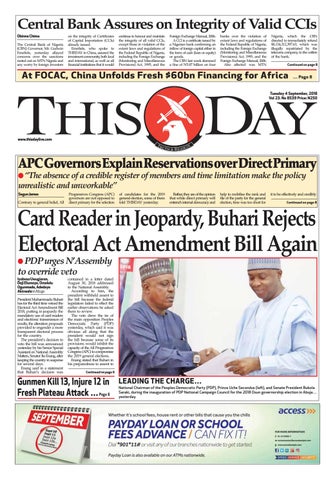
LEADING THE CHARGE… National Chairman of the Peoples Democratic Party (PDP), Prince Uche Secondus (left), and Senate President Bukola Saraki, during the inauguration of PDP National Campaign Council for the 2018 Osun governorship election in Abuja… yesterday.
2
T H I S D AY ˾ Ͳ˜ ͰͮͯͶ
T H I S D AY ˾ TUESDAY SEPTEMBER 4, 2018
3
4
T H I S D AY ˾ Ͳ˜ ͰͮͯͶ
T H I S D AY ˾ TUESDAY SEPTEMBER 4, 2018
5
6
Ëœ Í˛Ëœ ͺ͸͚͜ Ëž T H I S D AY
PAGE SIX
Gunmen Kill 13, Injure 12 in Fresh Plateau Attack Lalong commiserates with victims Seriki Adinoyi in Jos The orgy of violence revisited Plateau State on Sunday night as gunmen attacked Lopandet community in Dwei Du area of Jos South Local Government Area, killing 13 persons and injuring 12 others. Youths in the community responded yesterday with violent protest of the killings even as the state Governor, Mr. Simon Lalong, commiserated with the people over the heinous attack. The Peoples Democratic Party (PDP) in the state, however, condemned the attack and blamed the governor for embarking on a trip to China, which has no direct benefit to the people of the state. The youths, who defied pleas from women and the elderly in the community, destroyed a police van and
attacked journalists who had gone to the community to investigate the killings. An eyewitness from the community, who simply gave his name as Mr. Emmanuel, said 13 persons were killed. According to him, the gunmen invaded the community in a Hilux van at about 8.30 p.m. on Sunday night and opened fire on people at a relaxation spot in the premises of a hotel in the area. The gunmen also shot at several others outside the premises as they drove away. Confirming the incident, the spokesman of the Plateau State Police Command, Mr. Tyopev Terna, a Deputy Superintendent of Police (DSP), said, “On the 02/09/2018 at about 2030 hours (8.30 p.m.), the Plateau State Police Command, Jos, received a distress call to the effect that unknown
gunmen attacked Lopandet Dwei Du Area of Jos South Local Government Area of Plateau State. “The command immediately mobilised to the scene of the crime. On arrival, we discovered that some people were shot. The victims were immediately rushed to Jos University Teaching Hospital (JUTH) and Plateau Specialist Hospital. “As a result of the attack, 11 persons have been confirmed dead by doctors from both hospitals mentioned above while 12 persons were wounded and are now on admission receiving treatment. While the state Commissioner of Police, Mr. Undie Adie was expected to visit the scene of the event later yesterday, security men were also stationed about 1,000 metres away from the affected community, obviously for fear of a clash with the
youths.
Lalong Commiserates with Victims Meanwhile, the state governor has commiserated with the people of the state over the heinous attack. A statement signed by the state Commissioner of Information and Communication, Mr. Yakubu Dati, said the government condemns the attack in its entirety and has instructed the security agencies to fish out the perpetrators, and ensure the safety and security of the immediate environment and the entire state. He stated, "Members of the public are called upon to resist any temptation to resort to self-help as these will be playing to the script of these perpetrators whose ultimate aim is to return the state to the dark era of blood-letting.
"The Plateau State Government has ordered the security agencies to redouble their efforts in performing their constitutional responsibility of protecting lives and property." When contacted, the spokesman of the Special Task Force (STF), Major Umar Adam, said he was yet to gather sufficient details to give to journalists
PDP Condemns Attack, Blames Lalong In its reaction, the state chapter of the PDP said, “We are saddened by the event, which took place yesterday at Lopandet area close to Guratopp in Rayfield, Jos South Local Government Area, where 13 people were massacred by some militias believed to be Fulani.� The party blamed Lalong for embarking on a trip
to China with President Muhammadu Buhari when he was not supposed to be part of the trip. A statement signed by the party’s state Publicity Secretary, Mr. John Akans, stated, “These ugly and unwanted killings have been going on, even when we have security check points everywhere within and outside the state capital. This has become clear that the government has abandoned its responsibility of protecting its citizens. “While killings are going on in the state, tertiary institutions are embarking on strike as a result of failure of government policies, our dear governor is busy wasting our state resources on a foreign trip that will have no direct benefit to our people, even when he was not part of the president's China trip.�
C A R D R E A D E R I N J E O PA R DY, B U H A R I R E J E C T S E L E C TO R A L A C T A M E N D M E N T B I L L A G A I N the bill, had earlier called a meeting of both members of the Senate and House of Representatives, asking them to review some sections, which if retained would leave the Independent National Electoral Commission (INEC) with only nine days to compile the list of candidates. According to him, given the provision of Clause 87(14) in the bill, which gives political parties between 120 and 90 days to elections as the latest period to submit names of their candidates, INEC will be left with only nine days to compile the list of candidates of 91 political parties, which he felt would be insufficient for the electoral body. According to him, this is so because the bill did not amend Sections 31 and 34 of Electoral Act 2010, which give political parties 60 days to the elections as the latest date to submit the list of candidates and 30 days to elections respectively for the publication of names of candidates by INEC. He also cited what he described as drafting and referencing errors as parts of the reasons for rejecting the bill. He said the president was left without an option than to reject the entire bill because bills do not give room for any alteration but to either wholly accept them as they are or reject them. Enang said he was compelled
TOP GAINERS NGN NGN CONSHALLMARK 0.03 0.33 AIICO 0.08 0.90 CONTINENTALRE 0.13 1.50 NPFMFB 0.13 1.58 WAPIC 0.03 0.39 TOP LOSERS NGN NGN JAIZBANK 0.05 0.05 FLOURMILLS 2.35 2.35 TRANSCORP 0.10 0.10 PRESTIGEASSURE 0.04 0.04 VERITASKAP 0.02 0.02 HPE Nestle Nig Plc â‚Ś1,500.00 Volume: 131.531 million shares Value: N3.131 billion Deals: 3,080 As at 2/9/18 See details on Page 31
% 10 9.7 9.4 8.9 8.3 % 0.45 21.95 1.16 0.48 0.27
to make these clarifications to avert misinformation. The statement read: "President Muhammadu Buhari, GCFR, has by communication dated August 30, 2018, to the Senate and the House of Representatives declined Assent to the Electoral (Amendment) Bill, 2018. "I pray for leave, that in view of public interest, the fact of the National Assembly vacation, the imperative to avoid speculation and misinformation, that I give just a few of the rationale by Mr. President. ‘’Mr. President is declining assent to the Electoral Amendment Bill due to some
drafting issues that remain unaddressed following the prior revisions to the bill. "Mr. President invites the Senate and House of Representatives to address these issues as quickly as possible so that he may grant President Assent to the Electoral Amendment Bill. "A few of the outstanding issues are: There is a cross referencing error in the proposed amendment to Section 18 of the Bill. The appropriate amendment is to substitute the existing sub-section (2) with the proposed subsection (1A), while the proposed sub-section (1B)
is the new sub-section (2A).' ‘’The proposed amendment to include a new Section 87 (14) which stipulates a specific period within which political party primaries are required to be held has the unintended consequence of leaving INEC with only nine days to collate and compile lists of candidates and political parties as well manage the primaries of 91 political parties for the various elections. "This is because the Electoral Amendment Bill does not amend Sections 31, 34 and 85, which stipulate times for the submission of lists of candidates, publication of
lists of candidates and notice of convention, congresses for nominating candidates for elections.’ "For clarity, may I provide some details of the provisions referenced? Clause 87 (14) states: 'The dates for the primaries shall not be earlier than 120 days and not later than 90 days before the date of elections to the offices.' "The Electoral Act 2010 referred to herein states; in Section 31: ‘'That every political party shall not later than 60 days before the date appointed for a general election submit to the commission the list of
candidates the party proposes to sponsor at the elections. Section 34: ‘’That the Commission shall at least 30 days before the day of the election publish a statement of the full names and addresses of all candidates standing nominated. Section 85 (1): “That a political party shall give the commission at least twenty-one days’ notice of any convention, congress etc., for electing members of its executive committees or nominating candidates for any of the elective offices.’ Continued on page 8
Concern Mounts over Credible Elections Tobi Soniyi Hope that Nigeria will have a more transparent and improved elections in 2019 may have been dashed as President Muhammadu Buhari for the umpteenth time refuses to sign into law, amendments to the Electoral Act that would have ensured that the next general elections are more credible. The president had earlier refused to sign the first version of the bill into law. The re-considered bill was passed by the Senate on July 24, 2018 the same day that plenary was adjourned to September 25, 2018. The revised version of the Electoral Act (Amendment) Bill, 2018, with corrections by the National Assembly, and dated August 2, 2018, was received by the presidency on August 3, 2018. By virtue of section 58(4) of the 1999 Constitution, the president has 30 days from the date of receipt, to assent to or decline the bill. The presidency yesterday said the president had refused assent to the bill in a communication dated August 30, 2018 to the House of Representatives, citing unresolved drafting issues. Except both chambers of the National Assembly override
N E W S A N A LY S I S the president's veto, in accordance with the provisions of the constitution, there is little or no chance of the bill becoming a law. That will be disappointing especially for a president who has repeatedly pledged commitment to a more transparent election. Two weeks ago, the Senior Special Assistant to the President on Media and Publicity, Malam Garba Shehu, in a statement said the president was considering the Electoral Act Amendment Bill that was transmitted to him on August 3, 2018. He also said that the president, by virtue of the provisions of the Constitution had 30 days to go through the bill and that nothing had been done to suggest that he had withheld his assent to the bill. Shehu further stated that Buhari was a stronger believer of the use of card reader and PVC. The legislature had on June 7, 2018 passed the revised version of the bill, expunging the controversial clauses, including the one that re-ordered general elections sequence. On June 7, 2018, while adopting the report by the Senate Committee on
INEC, the Deputy President of the Senate, Senator Ike Ekweremadu, who presided over the session, noted that the controversial clauses in the bill had been removed from the new version. Ekweremadu said, “Before we go into the consideration, let me quickly make some quick clarifications. One is that when we passed the Electoral Act earlier in the year, the president returned it with observations. “From the report we have here, it means that those areas that appear to be controversial or where the president had some issues, no matter how we feel, whether we like it or not, whether we believe in what he said or not, that is not the issue now; what is important now is that to save the other provisions (clauses), our committee resolved to remove those aspects. They may come up maybe some other time but for now, they are not part of this process. That has been removed to make the rest non-controversial.� Ekweremadu said the amendment would enhance the credibility of the 2019 general elections. He also expressed the hope that INEC, politicians and the electorate would find the amendments
useful. The amendment bill, if it was signed into law, would have given legal teeth to the use of card readers. Again the president yesterday found fresh objections, largely drafting issues, which legal analysts feel could pass since they were not material and do not substantially outweigh the advantages the alteration bill seek to enthrone. The Supreme Court had in an appeal by Dr. Dakuku Peterside challenging the election of Mr. Nyesom Wike as Rivers State governor held that the fact that card reader machines were not used during the elections did not vitiate the elections. A seven-man panel of justices of the apex court, led by the then Chief Justice of Nigeria (CJN), Justice Mahmud Muhammed, said though INEC should be commended for the introduction of the card reader “to booster the accuracy and transparency of the accreditation process and to maintain the democratic norm of one man, one vote, by detecting multiple voting, “Section 49 (1) and (2) of the Electoral Act, which provides for manual accreditation of voters, is a stamp and remains
a vital part of our electoral law.� The court held that the card reader was only a technological innovation that was introduced to enhance the accreditation of voters for an election, with a view to identifying the actual owner of the voters’ card. In dismissing the contention of APC and Dakuku that the card reader being a certified public document represented the true position of what happened in Rivers State, the apex court placed reliance on its recent decisions in Shinkafi Vs. Yari and Okereke Vs. Umahi and declared that “in order to prove non-accreditation and over-voting, the 1st and 2nd respondents were bound to rely on the voters’ register in respect of all the affected local governments.� The federal legislature in incorporating card reader and other innovations had hoped to codify them to bring them in line with the position of the apex court. With the refusal of assent, the president has practically thrown the baby away with the bath water, abating the possibility of legalising the 14 critical features of the alterations, which sought to move the nation closer to cleaner and more transparent electoral process.
T H I S D AY ˾ TUESDAY SEPTEMBER 4, 2018
7
8
tuesDAY, september 4, 2018 • T H I S D AY
page eight
At FOCAC, China Unfolds Fresh $60bn Financing for Africa Omololu Ogunmade in Abuja The President of China, Xi Jinping, yesterday in Beijing, announced an extension of fresh $60 billion infrastructure financing for African countries. The Chinese president unfolded the plan while delivering a keynote address at the opening of the 2018 Beijing Summit of the Forum on ChinaAfrica Cooperation (FOCAC). A statement by Senior Special Assistant to President Muhammadu Buhari on Media and Publicity, Malam Garba Shehu, said Jinping explained that the financing would include $15 billion grants, interest-free and concessional loans.
According to him, the financing is expected to be provided both as government assistance to the region and investment by Chinese financial institutions and companies. He also said the amount would include $20 billion credit lines, setting up of a $10billion special fund for development financing and another $5 billion as special fund for financing imports from Africa. The statement also said Jinping encouraged Chinese companies to make at least $10 billion investment in Africa in the next three years. It added: "The Chinese President told the gathering of African leaders that with the
announcement of the $60 billion, his country has honoured its 2015 promise to the region. "All of these he noted, have been either delivered or arranged. He also said that China will exempt certain African countries from outstanding debts incurred in the form of interest-free Chinese government loans due by the end of 2018. "The exemption, he said, will be granted to Africa’s least developed countries, heavily indebted and poor countries, landlocked and small island developing countries that have diplomatic relations with China. "President Xi who also said China will implement eight major initiatives with African
countries in the next three years and beyond, noted that the initiatives cover fields such as industrial promotion, infrastructure connectivity, trade facilitation, and green development. "The decision of China to provide the funding support was taken at the FOCAC summit in Johannesburg, South Africa." The statement also said the Chinese president explained that funds being invested in Africa were not for 'vanity projects' but were meant to build infrastructure that could remove development bottlenecks. It also said Jinping at a business forum before the start of a triennial China-Africa summit, told Chinese firms that they also
had the responsibility to respect local people and the environment where they operate. He added that China’s investment in Africa would continue to flow without political strings attached. He quoted him as saying, “China does not interfere in Africa’s internal affairs and does not impose its own will on Africa. "What we value is the sharing of development experience and the support we can offer to Africa’s national rejuvenation and prosperity. “China’s cooperation with Africa is clearly targeted at the major bottlenecks to development. Resources for our cooperation are not to be
spent on any vanity projects but in places where they count the most." Furthermore, the statement said Jinping tasked Chinese firms doing business in Africa to be aware of their social responsibilities and ensure their investments serve the community of its operation and improve the wellbeing of the people. He was quoted as saying, “I hope that our entrepreneurs will act to fulfill social responsibilities and respect local culture and tradition. “I also hope you will do more in staff training and bettering lives for the local people and will put more emphasis on the environment and resources.”
election, saying that was possible because Governor Rauf Aregbesola had the financial resources and the viable political machine to mobilise the greater number in support of his candidate. The governor said Osun State also demonstrated the fallacy of the claim that direct primary would eliminate the rancour and disputations that attend indirect primary, pointing out that not only were there deafening complaint about the process, but that senior members of the party who lost out in the process left for other parties even as those who opted to stay behind have continued to agitate for the cancellation of its outcome. “Our position, therefore, is that we need to find a realistic and practical solution to this dispute that threatens to divide the party sharply into two, months before
a general election,” another governor told THISDAY. The issue, THISDAY learnt, was a major talking point at yesterday’s meeting of the NWC as the party struggled to roll back an emerging revolt against its leadership. Some state chairmen of the party, believed to have been backed by the governors, had met on Sunday in Abuja in spite of threat of sanction by the national secretariat of the party, and expressed opposition to the policy. They resolved to oppose the direct primary to the best of their ability, a position that immediately threatened the tenure of the NWC, as being the comfortable majority in the NEC, the chairmen could withdraw their confidence in the party executive, a situation that could force the resignation of the national chairman and his colleagues.
A P C G o v e r n o r s E x p l ai n R e s e rvati o n s o v e r D i r e ct P r i m a ry implemented. The party’s National Executive
Committee (NEC) had last week decided to use direct primary for the selection of its candidates in the impending elections. It, however, said states that, for special circumstances, would find indirect primary more suitable, could apply to the National Working Committee (NWC) for waiver, provided majority of their stakeholders concur. The governors were, however, believed to have opposed this resolution, and were also said to be working actively to overturn it. But governors that spoke to THISDAY on condition of anonymity yesterday explained that they believe the party did not have enough time to implement the policy, given the fact that the primaries are only two weeks away.
“We agree that direct primary would allow for greater participation of majority of members, bring us closer to the voters and help prepare our members for the general elections,” said a governor from the North-west, “But we think the party is not prepared for this policy given the limitation of time.” According to him, “First, we do not have available a register of members that is critical for a credible exercise. Second, we do not have the time to compile one.” The governor explained that although the party had done the registration of members twice, the data gathered had not been captured, adding that the company contracted to capture the data indicated that it would take not less than two months
to complete the compilation. “So, tell me, where are we going to get the two months when the primaries are, by law, barely two weeks away?” he asked, contending that it would be counterproductive to engage in an exercise that would not be credible. Supporting his colleague, a South-west governor told THISDAY that given the nation’s experience with the Independent National Electoral Commission’s (INEC) efforts to register voters and distribute the permanent voter card (PVC), it was clear that the task ahead was not only enormous but unrealistic given the limitation of time. “For us, the absence of a credible register of members and time limitation make the policy unrealistic and unworkable,” he said.
He dismissed the widely held claim that the governors were opposed to direct primary because it would limit their capacity to manipulate the selection process, saying instead, the incumbent chief executives have more resources and reach to influence the process than fresh aspirants who are new to the internal electioneering of the party. According to him, a governor that has had a structure in his control for four years is more likely to have easier access to the rank and file of the party than a challenger that does not have the advantage of the control of the important apparatus of state, critical to the distribution of patronage. He referred to Osun State, where Alhaji Gboyega Oyetola, the preferred aspirant of the incumbent, won the direct primary
C a r d R e ad e r i n J e o pa r dy, B u ha r i R e j e cts E l e cto r a l A ct A m e n d m e n t B i l l A g ai n "For the avoidance of doubt, neither the Constitution nor any written law allows a President or a Governor to whom a Bill is forwarded by the Legislature to edit, correct, amend or in any manner alter the provisions of any such Bill to reflect appropriate intent before assenting to same. He is to ASSENT in the manner it is or to withhold ASSENT. "On the under listed bills earlier transmitted, namely: National Agricultural Seeds Council Bill, 2018; The Advance Fee Fraud and Other Related Offences (Amendment) Bill, 2017; The Chartered Institute of Entrepreneurship (Establishment)
Bill, 2018: The Subsidiary Legislation (Legislative Scrutiny) Bill, 2018; National Institute of Hospitality and Tourism (Establishment) Bill, 2018; National Research and Innovation Council (Establishment) Bill, 2017; Nigerian Maritime Administration and Safety Agency (Amendment) Bill, 2017; "Mr. President has communicated his ACTION to the National Assembly." THISDAY reported recently that several critical stakeholders, including civil society groups, election monitoring groups, pro-democracy organisations and the PDP had expressed
their anger at the seemingly unfriendly disposition of Buhari to the alterations to the electoral law. Specifically, the opposition PDP had accused the president of refusing to sign to the bill because the proposed amendments make the use of card readers for accreditation for election and the transmission of results electronically mandatory, suspecting that the ruling APC was planning to rig the 2019 general election. With the veto, the National Assembly, which resumes on September 25, 2018 would have to decide either to correct the referencing errors cited by the
C e n t r a l B a n k A ss u r e s o n I n t e g r ity o f Va l id C C I s
The CBN governor, however, confirmed that MTN Nigeria would refund the money at the exchange rate at which they were remitted and not the current rate, leaving the telco with the potential loss of over $4billion in exchange rate. For the banks, the highest fine of N2,470,604,767.13 was slammed on Standard Chartered Bank, while Stanbic IBTC Nigeria was fined N1,885,852,847.45. Citibank also got fine of N1,265,541,562.31, just as Diamond Bank was directed to pay N250 million penalty. But responding to further questions, Emefiele said he was aware of all sorts of documents being paraded by different people with a view to misinform members of the public on the MTN Nigeria matter, saying the investigation of the telecoms company spanned over a period of 30 months, on several issues
and not just on the illegal capital repatriation. According to Emefiele, the central bank always held the view of supporting the telecoms company and indeed all foreign investors in the economy. He said owing to that, MTN Nigeria was in the past pardoned in a number of infractions that it was involved in. “However, the latest hammer came when they (MTN Nigeria) clearly took liberty for licence in flouting Nigeria’s foreign exchange laws in the manner of the funding of their equity investment into MTN and subsequent capital repatriation that resulted thereafter,” he said. “They brought in $402 million and said about $350 million of that was equity and the balance was loan, and they were issued CCIs for the equity. They later reversed that position when they reaslised that the loans
will not attract the kind of taxation equity investiment will attract. And they altered the structure of their funding in a clear violation of the spirit and intent of Nigeria’s foreign exchange regulations,” the CBN Governor explained. Emefiele disclosed that other infractions by MTN Nigeria with regards to shares by local shareholders and whether CCIs were issued within 24 hours were some of the contraventions by MTN Nigeria that were forgiven earlier, stressing that on this matter, MTN Nigeria manipulated the regulations for maximum profit and tax avoidance, without regards to the laws when they embarked on unauthorised conversion of loans to equity so as to game the system and exploit loopholes. Other CBN officials who spoke to THISDAY said that following further information
president or exercise its powers under S58 (5) of the Constitution, which states, “Where the President withholds his assent and the bill is again passed by each House by two-thirds majority, the bill shall become law and the assent of the President shall not be required.”
Reacting to the development yesterday, the PDP said the veto would not stop Nigerians from voting Buhari out of office in 2019. The National Publicity Secretary of the party, Mr. Kola
Ologbondiyan, in a statement, said the APC and Buhari were not ready for a free and fair election. He stated, “They are afraid of contesting the election. They are not prepared for a free and fair election. So, they don’t want INEC or the National Assembly to bring in amendments that will guarantee free and fair election; that is why the President has refused to sign the amendment bill into law. “Nigerians are ready to vote out Buhari under whatever guise he conducts that election. Whether he wants to guarantee a free and fair election or not, Nigerians are sick and tired of
him and they will vote him out.” He said that the clerical and drafting arguments put forward by the president could not in any way outweigh the importance of amendments meant to engender a free, fair, credible and transparent elections in 2019. Ologbondiyan stressed, "It is now manifestly clear to Nigerians that all the reasons adduced by President Buhari for withholding his assent in the past were lame excuses. "The PDP, therefore, charges the National Assembly to stand with Nigerians in the overall quest for credible elections by immediately overriding President Buhari on the bill."
from whistle blowers, the central bank is presently carrying out a more detailed examination on the operations of MTN Nigeria. A former Senior Executive of MTN Nigeria had at the weekend, advised the CBN to properly investigate MTN payments and to look deeper into the telecoms company's operations. The source who spoke with THISDAY on condition of anonymity, because of the non-disclosure and non-compete clauses of his termination benefits, claims had said there was a lot more with the payments than the MTN and banks want us to believe, calling for a forensic audit that would uncover much more. He had also chided the financial institutions involved in the matter over what he described as their failure to adhere to the Know-YourCustomers (KYC) policy of
the apex bank. He went on to make further allegations, saying, of the original $402million investment upon which the $8.1billion profit was remitted over a few years, a sizable chunk was treated in the books of MTN as “equipment finance”. He had asked which equipment finance? By whom? Who invoiced MTN? Are the vendors related parties? Are the vendors owned by MTN Directors? Why were some of the remittances of profit made to tax havens instead of to MTN headquarters accounts in South Africa? Who were the ultimate beneficiaries? He insisted that the capital inflow the telecoms company claimed to have brought into Nigeria as equipment finance were “over invoicing”. The source also said, “The
invoices from the transactions were from third parties and sub-companies related to some of MTN directors. Some of the invoices were not directly from MTN itself.” He said investors in the MTN Private Placement, which took place in February 2008, obtained foreign exchange loans from local banks for the purpose of investment in the telecoms company, only for them to subsequently repatriate foreign exchange as though they were foreign investors for FX which they sourced from Nigeria, at the official exchange rate. In plain language, investors took dollar loans from Nigerian banks to invest in MTN and eventually repatriated the money out of the country as if they were part of the capital importation originally, he said.
PDP Urges N’Assembly to override Veto
T H I S D AY ˾ TUESDAY SEPTEMBER 4, 2018
9
10
T H I S D AY ˾ Ͳ˜ ͰͮͯͶ
T H I S D AY ˾ TUESDAY SEPTEMBER 4, 2018
11
12
T H I S D AY ˾ Ͳ˜ ͰͮͯͶ
T H I S D AY ˾ TUESDAY SEPTEMBER 4, 2018
13
14
T H I S D AY Ëž Ëœ Í˛Ëœ 2018
COMMENT
Editor, Editorial Page PETER ISHAKA Email peter.ishaka@thisdaylive.com
WHY NIGERIA NEEDS TO BE RE-STRUCTURED
Atiku Abubakar argues that restructuring will foster the spirit of co-operation and consensus in a nation of diverse ethnic groups
I
n a recent interaction in the United States, Vice-President Yemi Osinbajo asserted that the “problem with our country is not a matter of restructuring‌and we must not allow ourselves to be drawn into the argument that our problems stem from some geographic re-structuringâ€?. It is a surprise that the vice-president would take such a position and, in particular, fail to appreciate the connection between Nigeria’s defective structure and its underperformance. It is unhelpful to reduce the construct of “restructuringâ€? to a geographical concept as VP Osinbajo does, which in itself demonstrates a lack of appreciation of the core tenets of the concept. For the avoidance of doubt, re-structuring is not about the re-drawing of state or regional boundaries. The restructured Nigeria that a large number of Nigerians talk about, is a Nigeria that not only provides opportunities for everyone to work but even more specifically challenges every layer of governance to demonstrate capacity to create wealth and jobs for the citizens. Restructuring is not just about the devolution of powers to the states, it is about transforming the respective roles of the federal, state and local governments to perform more efficiently in matters of territorial as well as economic governance. Above all, when we talk about restructuring, we are not talking about just constitutional tweaks, we are talking about a cultural revolution. It is not about re-shuffling a few responsibilities or resources, but about disrupting the authoritarian politics our democracy has inherited from its military and colonial rulers of past. Viewed this way, Nigeria needs to be restructured. Nigeria has operated a faulty system of federalism especially under military governments. Both economic and political structures are defective, resulting in weak economic management systems which, in turn, prevent all levels of the Nigerian government—federal, states and local governments, from operating at optimal levels. Faced with the reality of non-performance, Nigerians have clamoured for the restructuring of the economy towards a more diversified structure. To make this happen would require that we establish and sustain a model of governance which would nurture a spirit of participation and consensus on key national issues and accommodate all the diverse segments of the society. In other words, if we accept the wisdom
THE RESTRUCTURED NIGERIA THAT A LARGE NUMBER OF NIGERIANS TALK ABOUT, IS A NIGERIA THAT NOT ONLY PROVIDES OPPORTUNITIES FOR EVERYONE TO WORK BUT EVEN MORE SPECIFICALLY CHALLENGES EVERY LAYER OF GOVERNANCE TO DEMONSTRATE CAPACITY TO CREATE WEALTH AND JOBS FOR THE CITIZENS
behind calls for a restructuring of the economy, we must be ready to build a foundation for its success: we must, in other words re-structure the polity. The federal structure is so complex with a very strong centre that it has succeeded in accumulating many responsibilities, and along with these, huge resources, which belong to the other levels of government. It is all too obvious that the current arrangement does not respond to the needs of the people at the local level. We have all too often lied to ourselves that the politicians sitting in Abuja can effectively respond to the needs of a population in far remote locations as Kaura Namoda, Iseyin, Arochukwu or Bama. Only the autonomy of the local governments and the states both of which are closer to their people than the central government in Abuja can guarantee this and result in more effective decisions. Only when local administrations are on the saddle will there be greater accountability for decision making as well as improved flexibility, adaptability and ability to change as a result of a reduction in bureaucracy. I strongly believe that the restructuring of Nigeria will foster the spirit of co-operation and consensus in a nation of diverse ethnic groups, cultures and religions. It is desirable, in fact you may even say it is required to establish, nurture and sustain a strong and effective democratic government. In this continuous dialogue, we should remind ourselves that restructuring is not a new or strange phenomenon. A number of developing economies have had cause to restructure their economies, for greater efficiency or to correct imbalances or to reorient them towards, for example, more open and market-oriented systems with greater reliance on the private sector as engine of growth. Even the United Kingdom is restructuring its political and economic systems to enable a better union among its component parts. Businesses restructure for better performance. Even families do! Working with the National Assembly and all other stakeholders, we will lead the process of genuine and transparent constitutional amendments, in order to provide the necessary stimulus and focus on how to restructure Nigeria that would work for all. Atiku Abubakar, a former Vice-President, is a presidential aspirant of the Peoples Democratic Party
FOR A BETTER NIGERIA
Ike Nwachukwu canvasses the need to restructure the federation
T
he 1999 Constitution strengthens the already choking powers of the federal government and whoever is in the office of the President of the Federal Republic of Nigeria. This constitution, in truth, cannot be tagged a federal constitution, as it was before the advent of the military into Nigerian politics in January, 15th 1966. Today we practice our democracy in a more or less unitary system of governance. It leaves us in an illusionary federation. Several national conferences had been held since 1979, all in the quest to answer the National Question on whether or not we are a proper federation of peoples and to find equity and justice for all. I had the privilege of being a delegate at the 2005 National Political Reform Conference convened by President Olusegun Obasanjo, the recommendations of the report were jettisoned over the Third term issue. At the 2014 National Conference convened by President Goodluck Jonathan, I led the South East delegates. Both conferences made wholesome attempts to address the wrongs in the 1979 through to the present 1999 Federal Constitutions of Nigeria. It is my opinion that of the two National Conferences that I attended, the 2014 National Conference holistically made more far- reaching recommendations to address the wrongs of the past. They include; need to return the country to true federation, devolution of powers, states police, creation of more states, autonomy of the federating units and local governments, etc. Again the recommendations of the report at that conference are yet to be looked at talk- less of implementing them. I believe that, the present structure of Nigeria inhibits the development of the country. It is imperative that we restructure to what it was before the 1966 military coup, which encouraged healthy competition amongst various regions (the then autonomous federating units). Successive military governments created more states from the three regions. Those states should be the federating units within a zonal arrangement but they must have autonomy and control their
human, mineral and other resources. They shall pay taxes to the federal government. Should this happen, the federating units would be devoid of the choking powers of the federal government and therefore free to develop at their own pace. I predict that, failure to restructure back to pre-military government era, may cause Nigeria to head towards a situation in which peaceful co-existence will be difficult, if not impossible. The consequences could be dire for Nigerians and the West African sub- region if this were the case. In the same vein, I prefer representational democracy. This was snookered in 1999, when the party machinery was virtually taken over by the state governors thus making them more powerful than the party and a threat to our democracy. At present you cannot become party candidates for elections without the consent of state governors and the presidency. This situation undermines internal democracy and encourages nepotism and cronyism. It also denies the electorate at all levels, of the candidates of their choice. This trend frustrates our attempt at democratic governance and the electoral process. Political party leadership in cahoots with some powerful members in the society foists on the people their own preferred candidates, some of whom are their offsprings, in-laws, relations and cronies. It is curious that state governors after completing their tenures work themselves into the National Assembly as senators of the Federal Republic of Nigeria. Whereas this in itself is not undemocratic, some, including ministers and powerful politicians, have used their positions to interfere with governance in their states as they struggle for the control of party structures in the states and at national level at the expense of party internal democracy. This notwithstanding, I implore all Nigerians of voting age to make sure they go and register and collect their permanent voter cards (PVCs). Your PVC is your right to determine who represents you at all levels. It is your power to exercise your mandate in voting leaders of your choice. You must, therefore, guard this choice with your life.
The uncharitable manner in which we practice our faith in the country as Christians, Moslems and traditionalists seem to be fuelling acrimony and intolerance amongst our people; thus, breeding religious extremism and extremists in Nigeria - a major danger signal that must be dealt with decisively. We should not allow our people to be used or manipulated for the selfish interests of some religious and political leaders to cause unrest. Our religious and political leaders should be encouraged to preach peace, unity and love to the people. And to particularly speak out on the ills of our society. Further delay could be costly. On corruption, we should change the narrative that we are a corrupt people. Not all Nigerians are corrupt. Nigerians should not fight shy to defend the integrity of the majority of Nigerians that are not corrupt. While just a few Nigerians (compared to our teeming population) engage in corrupt practices, we must not all be tarred with the same brush. Those that are corrupt, like their counterparts in other parts of the world, should be found and decisively dealt with. Meanwhile, our new mantra should be that Nigerians are essentially excellent people with a few bad eggs. Those representing us are duty bound to carry the message of the goodness of the majority of our people to the world. We should tell the world who we truly are and of our determination not to spare defaulters. Democracy focuses on how countries select those who govern them while the rule of law is concerned with the application of the law and accountability. It is important to note that, respect for rule of law is paramount in any democratic dispensation. The underlying premise of rule of law implies that every citizen is subject to and accountable under the law, including lawmakers and those in government positions. In this sense, the rule of law is to encourage governance through democracy created for and by the people, as much as it stands in stark contrast to the concepts of dictatorship, autocracy and oligarchy where those in positions of power and governance conduct their affairs outside and
above of the purview of the law. Today, democratic governance is measured by adherence to the rule of law. Just as the constitution guarantees freedom of speech and movement and fundamental human right; so, the rule of law guarantees that power is exercised with accountability and respect for human kind. Human rights, equal rights, the rule of law and democracy are interlinked and mutually reinforcing. They belong to the universal and indivisible core values and principles of the United Nations. By strengthening the rule of law, we protect the rights of all people, advance inclusiveness, and limit the arbitrary exercise of power, which are the cornerstones of modern democracy. We must, therefore, uphold their tenets and guard them jealously. On separation of powers, Nigerians should support the doctrine of separation of powers with the legislature, the executive and the judiciary acting independent of each other yet compliments one another. It is only good, that, that should be so to check the abuse of power at all levels. In the same vein, there must be a clear separation between religion and governance. Our ability to manage these two main issues will ensure peace, better understanding and better representation as indeed better accountability in our country. Therefore, it is sad and unbelievable that, Nigeria that I was born into that was tolerant of our diversity, ethnicity and religious leanings and traditional values has degenerated, in my older age, into a country where ethnicity, religiosity and nepotism hold sway over the excellent values of good neighbourliness, tolerance, hard work, merit and loyalty upon which our progenitors had built our traditional societies. The upcoming generation must strive to correct the mistakes of the past in other to save our country from becoming a failed state. They should build a stronger and better society for all, regardless of ethnicity, religiosity, gender or creed. For, any threat to the common man is a threat to the common good. Nwachukwu is a retired general and politician
15
T H I S D AY TUESDAY, SEPTEMBER 4, 2018
EDITORIAL THE MENACE OF PIRACY IN NIGERIA The entertainment industry needs better regulation
T
network. The report also claimed that between 2011 and 2018, regulators confiscated 749,316,187 units of pirated works and impounded 28 containers of pirated copyright protected works valued at over N10 billion.
he exploitative activities of pirates have remained a serious problem for movie makers and music producers in the Nigerian creative industry. This violation of intellectual property rights has rendered many creative arts practitioners bankrupt and also inflicted devastating blows on the entertainment industry with the attendant revenue loss estimated at billions of naira. The authorities can therefore not continue to be indifferent while the pirates capitalise on weak regulations to pillage and sabotage the industry. Aside the producers and other artistes, government is also feeling the impact of this illicit activity through loss of tax revenue as those engaged in piracy do not pay tax from their sales. Besides, as a thriving sector with huge potential, the entertainment industry should be well regulated to enable it fully evolve and contribute to the Nigerian economy. A report by the International Monetary Fund (IMF), said the creative industry generated $7 billion in 2016. The report said the sector accounted for 1.4 per cent of the Nigeria’s Gross Domestic Product (GDP) and is responsible for direct employment NIGERIA HAS SINCE 2013 for over one million BEEN LOSING $1 BILLION people. PER ANNUM TO PIRATES, Unfortunately, WHO CLONE COPYRIGHT this growth is not as only WORKS INTO CDS, DVDS, encompassing a few individuals, VCD AND OTHER AUDIO- engaged in deleteriVISUAL FORMATS ous production of pirated and substandard materials, make a fortune at the expense of diligent movie makers and producers. We also find particularly disturbing a revelation made by the Nigerian Copyright Commission (NCC) concerning the effect of piracy on the creative sector. According to NCC, Nigeria has since 2013 been losing $1 billion per annum to pirates, who clone copyright works into CDs, DVDs, VCD and other audio-visual formats, and selling them at cheap prices through their distribution
H
T H I S DAY EDITOR BOLAJI ADEBIYI DEPUTY EDITOR DAVIDSON IRIEKPEN MANAGING DIRECTOR ENIOLA BELLO DEPUTY MANAGING DIRECTOR KAYODE KOMOLAFE CHAIRMAN EDITORIAL BOARD OLUSEGUN ADENIYI EDITOR NATION’S CAPITAL IYOBOSA UWUGIAREN MANAGING EDITOR JOSEPH USHIGIALE
T H I S DAY N E W S PA P E R S L I M I T E D EDITOR-IN-CHIEF/CHAIRMAN NDUKA OBAIGBENA GROUP EXECUTIVE DIRECTORS ENIOLA BELLO, KAYODE KOMOLAFE, ISRAEL IWEGBU, IJEOMA NWOGWUGWU, EMMANUEL EFENI DIVISIONAL DIRECTORS BOLAJI ADEBIYI, PETER IWEGBU, ANTHONY OGEDENGBE DEPUTY DIVISIONAL DIRECTOR OJOGUN VICTOR DANBOYI SNR. ASSOCIATE DIRECTOR ERIC OJEH ASSOCIATE DIRECTORS PATRICK EIMIUHI, SAHEED ADEYEMO CONTROLLERS ABIMBOLA TAIWO, UCHENNA DIBIAGWU, NDUKA MOSERI DIRECTOR, PRINTING PRODUCTION CHUKS ONWUDINJO
owever, in the face of this criminal act that portends grave danger for the economy, regulatory bodies are hamstrung in controlling copyright infringements and making violators accountable. Indeed our laws on piracy appear too lenient. Rather than deter the criminals from their unholy act, they have only heartened the pirates, who believe they will always be given a mere slap on the wrist. It is outrageous that section 18(1)(c) of the copyright act only imposes a jail term not exceeding five years or a fine of N1,000, or less on every pirated article, on a person convicted for pirating cinematographic films, musical works, sound recordings, among others. We propose that the National Assembly should pass the 2017 draft Copyright Bill approved in June 2017 by the Federal Executive Council, which provides stiffer punishment for any act of copyright infringement. Regulators should also introduce other institutional structures to block areas of leakages, make more revenues for government as well as the artistes to reap from their labour. We also propose the introduction of a compulsory bar code on all original works, to discern them from imitation, thus preventing buyers as well radio and television stations from patronising pirated works. In addition, regulators should register and license all filmmakers, marketers, distributors and film shops. They should also make meaningful arrests, enforce all anti-piracy laws and ban the sale of creative works on the streets and in the traffic. We also call on government to design a tax scheme on each copy of movie or music sold as a way of tracking all sales activities in the industry. Government should also transform the sector into a viable economy and encourage private sector investment in production and post-production studios as a deliberate effort to curb capital flight to countries with hi-tech production gadgets.
TO SEND EMAIL: first name.surname@thisdaylive.com
Letters to the Editor
TO OUR READERS Letters in response to specific publications in THISDAY should be brief (150-200 words) and straight to the point. Interested readers may send such letters along with their contact details to opinion@thisdaylive.com. We also welcome comments and opinions on topical local, national and international issues provided they are well-written and should also not be longer than (9501000 words). They should be sent to opinion@thisdaylive.com along with the email address and phone numbers of the writer.
CHINA-AFRICA ENGAGEMENT: BEYOND FOREIGN AID
O
n September 3, African leaders convened in Beijing to attend the 2018 Summit of the Forum on China-Africa Cooperation (FOCAC). The theme of the summit is to build a stronger community with a shared future through win-win cooperation. However, the realisation of the forum’s theme is dependent on China’s intention to further strengthen its relationships with Africa. For more than five decades, the key economic considerations that had shaped China-Africa relations include foreign direct investment (FDI), development assistance, debt cancellations and trade. According to Chinese Customs Department, the volume of trade between China and Africa increased from US$11 billion in 2000 to US$170 billion in 2017. This is encouraging but it is just about one-fifth of last year’s trade volume of US$515 billion between China and its Association of Southeast Asian Nations (ASEAN) trade partners, as recorded by the Chinese Ministry of Commerce. The proximity of China to its Asian neighbours is a factor to explain this. More important is the Free Trade Agreement (FTA) signed between China and its ASEAN partners in 2002. FTAs are mutually beneficial to countries that are signatories in terms of enhancing trade and foreign direct investment, and reducing tariff or non-tariff barriers amongst partners. China has signed hordes of FTAs with many countries across the world except Africa. Typically, China does not publicly articulate its FTA strategy. How its FTA partners are selected is best known to officials in Beijing. What is clear, to some
extent, is that China FTAs are tailored to its specific needs and considers the economic and strategic interests of partners. What is also evident is China has followed a narrower model of FTA, mainly economic integration that focuses on trade in goods only approach. The central criteria of China’s FTAs include, achieving “One China” policy designed to thwart Taiwan’s influence across the world; recognition of China as a market economy apparently to put trade partners in a weaker position to commence antidumping action as contained in the World Trade Organisation (WTO) rules; achieving access to raw materials to enhance its manufacturing base and free-up its labour from agriculture for manufacturing; and maintaining and strengthening its political and diplomatic relations. These criteria appear to have been evident in its FTAs over the years. Many African countries such as Kenya, Nigeria, Sudan, and South Africa, to mention a few, meet these criteria with which China signs FTAs. Signing FTAs has both benefits and costs. For African countries, the benefits will outweigh the costs, potentially. In addition to providing access to larger markets, increasing local capacity building and transferring of knowledge, FTAs with China will increase foreign direct investment just as it did in Chile and Peru, following FTAs with China. However China-Africa FTAs will need to overcome significant political and economic obstacles, even though African countries meet China’s FTAs ‘criteria’. Politically, the Politburo Standing Committee (PSC) is the supreme decision-making authority in China. The PSC must approve FTAs regarding specific countries
or regions of the world. Unfortunately, issues relating to Africa are rarely discussed at the PSC, except peace-keeping deployment or setting up of China military base in Africa. There is indeed evidence of growing economic links between China and Africa. China’s engagement strategies have been largely focused on the use of foreign aid, development assistance and debt cancellations but the trickle-down effects of these engagement strategies are rarely felt. In the era of Trump’s “America First”, African countries would have to create trade networks and sign trade agreements within and outside of the continent. The recent signing of African Continental Free Trade Area is a good step but trade agreement with China would also benefit Africa. Rather than focusing on the traditional means of engagement, African countries would have to set their priorities and develop strategies to actually engage China. The era of relying on China’s foreign aid and development assistance should give way to increasing trade for which FTAs are in good stead. African leaders should take advantage of the existing relationships as a leverage on China to seek strategic economic partnership with China through mutually beneficial trade, just the way its Asian neighbours are, not just in terms of foreign aid or development assistance. China-Africa FTAs are steps in that direction. Thompson Ayodele is a Senior Research Fellow with the Initiative for Public Policy Analysis, an independent think-tank based in Lagos
17
T H I S D AY • TUESDAY, SEPTEMBER 4, 2018
NEWS UPP Declares Free Form for Aspirants Nseobong Okon-Ekong The United Peoples Party (UPP) has declared that it will issue free nomination and express of interest forms to aspirants below 30 years. Physically challenged persons who pick the UPP ticket to contest various offices have also been exempted from paying any fee. The decision was reached at the party’s National Executive Council (NEC) meeting in Abuja, after which the Board of Trustees (BOT) members, Vice-Chairman and acting Chairman of UPP visited its Imo State governorship candidate, Hon. Tony Nwulu at his residence. The NEC UPP said it took the decision in to ensure that aspirants who have financial difficulties and are below 30 years can get free nomination forms to vie for the federal and state house of assembly. This decision is in line with the constitutional provision of
‘Not too young to run.’ This development was applauded by youths in Imo State as a move that has not been rivalled by any other political party. Reacting to the decision, Nwulu, stated that the UPP had a visionary approach to sustain the provisions of ‘Not to Young to Run’. He stressed that the removal of nomination/ expression of interest fee was an innovative approach by the UPP. He said the development has generated a huge demand from aspirants in that age bracket who are eager to fly the UPP flag. The party’s NEC also stated that nomination/expression of interest fee for all categories of aspirants have been slashed. Governorship fee has gone down to N3million. Senatorial aspirants will now pay N1million. Aspirants contesting to become federal and state legislators are required to pay N200,000 and N50,000 respectively.
ADC Presidential Aspirants to Pay N12m Picks Oloyede as Osun deputy governorship candidate Nseobong Okon-Ekong Expression of Interest and Nomination Forms for presidential aspirants contesting the 2019 general elections on the platform of the African Democratic Congress (ADC), which are being sold at N2 million and N10 million, respectively are now on sale. The party has also insisted that retired Justice Folahanmi Olamide Oloyede is its deputy governorship candidate in Osun State for the election. ADC’s National Publicity Secretary, Mrs. Yemi Kolapo, said the forms had been made affordable in line with commitment to a fair playing ground for all aspirants.
“For the governorship category, the nomination form goes for N5 million, and expression of interest, N1million, totalling N6 million. For Senate, nomination form is N2 million, and expression of interest, N500,000. This adds up to N2.5 million. Total (Expression of Interest and Nomination) for the House of Representatives is N1 million, and for State House of Assembly, N450,000,” the statement said. “The forms for the State Assembly can be purchased from either the State or National Secretariat. But for Presidential, Governorship, Senate, and House of Representatives aspirants,
forms are to be purchased at the National Secretariat, Abuja,” it added. The party said, while the nomination fee for female aspirants, physically challenged and vulnerable persons was voluntary, those under 30 years were expected to pay 50 per cent of the fee. The National Chairman of ADC, Chief Ralph Nwosu, said, “One of our guiding principles is inclusivity and full involvement of the youth, women, and physically challenged persons because they are indispensable partners in all our missions and we believe working together makes great things happen. “ADC is a vision driven grassroots political party with
Role-modelling Leadership Paradigm. Our party is not in the ridiculous and bizarre “harvest-bazaar” money politics and godfatherism. We are members financed; every member pays N200 for membership, renewable every four years.” The party leader added that aside from the over two million registered fee-paying members, ADC also has over 10 million persons on cue for registration in their various constituencies. On the coming election in Osun, the ADC noted that there had been protests over the omission of Oloyede’s name on the Independent National Electoral Commission’s candidates’ list for the September 22, 2018 governorship election.
APGA Kicks Against Moves to Sack Lawmaker Onyebuchi Ezigbo The All Progressive Grand Alliance (APGA) has vowed to resist attempts by the Nasarawa State Government and the Speaker of the State House of Assembly to declare the seat of a defecting lawmaker, Mr. Makpa Malla, vacant. The party described such an action as highly vindictive and uncalled for since the affected lawmaker who moved over to APGA from the All Progressives Congress (APC) had secured a court injunction to back his action. Nasarawa State House of Assembly recently declared the seat of Malla representing
Wamba constituency vacant. However, the National Chairman of APGA, Chief Victor Oye told journalists in Abuja that the move by the Speaker was without recourse to the rule of law. He said the party does not condone flagrant abuse and that it was urging President Muhammadu Buhari to call the state government to order. He also asked APGA supporters to remain calm as the party’s leadership takes the necessary steps to ensure that Malla’s retains his seat. “We appeal to all our members in Nasarawa State to remain law abiding and not to resort to self-help,” he said.
SDP Governorship Aspirant Pledges End to Corruption Onyebuchi Ezigbo in Abuja Governorship candidate of the Social Democratic Party (SDP) in Adamawa State, Chief Emmanuel Bello has promised to use new strategies to check misuse of public funds. He said his government will review the procurement process to make it free from manipulation. Bello told THISDAY in an interview in Abuja that past administrations in the state lacked the required knowledge to tackle the numerous challenges confronting the state. He said an SDP government in Adamawa will use employment generation to address the issue of insecurity, adding that if the people of the state were engaged in gainful employment, majority of the security challenges would have been addressed. He said, “Our government will have zero tolerance for corruption. People are talking about corruption, but are not proffering solutions. “The process of procurement in government must be reviewed in Adamawa state
because that is where the loophole is. When we form government, you will not see the money and when you don’t see the money, you will have nothing to steal. What they are doing now is that you can’t trace anything. To make accountability and accountability process transparent, you need to make sure that every money government generates is accounted for. “One of the reasons we have insecurity in the country is as a result of the insincerity of the government. They take what does not belong to them. They are stealing our money and Nigerians are angry. If you don’t steal, you would have addressed the problem by 30 percent. According to the aspirant the philosophy of the SDP is people oriented. The party is interested in the development of the youth, women and those who are unemployed and underprivileged. “We will embark on massive training of teachers to teach. We are not going to sack anybody because the SDP is about creating jobs,” he said.
CONSULTING THE PATRON
Former President, Chief Olusegun Obasanjo (m) with the National Chairman, African Democratic Congress, Chief Ralph Nwosu (3rd right) and members of ADC’s National Working Committee during a working visit to former President Olusegun Obasanjo, in Abeokuta recently
Amosun Has Lost Influence SDP Releases Dates For Primaries, in Ogun, says ADC Senatorial Slashes Cost Of Nomination Forms House of Representatives, Oghenevwede Ohwovoriole Aspirant N200,000 for expression of in Abuja
Femi Ogbonnikan
An aspirant for Ogun Central senatorial district on the platform of the African Democratic Congress (ADC), Dr. Femi Majekodunmi, has questioned the purported political influence of the state governor, Senator Ibikunle Amosun, describing it as being on the wane for concentrating a handful of new infrastructure within Ogun central senatorial district only, where the governor comes from. Speaking in Abeokuta at the official declaration of intent to vie for Ogun Central Senatorial district in the 2019 general elections, Majekodunmi who is a die-hard loyalist of President Olusegun Obasanjo said it was quite glaring that the All Progressives Congress (APC) would be defeated in the Ogun State in the 2019 general elections. On the governor’s rumoured bid to run for the Ogun Central
senatorial district in the elections, the ADC aspirant claimed that, there was no evidence. He expressed optimism that he would easily defeat Amosun in the contest for the senatorial district. “The situation with Amosun is unlike before, because people are leaving his party in droves, just like they are leaving the Peoples Democratic Party (PDP) too. Infact, it will be worst in the next few weeks. There is a major and continuous decline in everything about him. Though he built roads and bridges but all these projects are centralised only in Ogun Central alone. There are rumours that he wants to contest the Ogun Central Senatorial seat. In fact, some people said he won’t, that he will give the ticket to his SSG, Adeoluwa Taiwo, but if he (Amosun) contests against me, I will defeat him hands down.
The Social Democratic Party (SDP) has reviewed its price for nomination forms downward for all aspirants from presidential down to state houses of assembly. The party said it was in line with its oriented populist’s policies towards encouraging mass youths and women participation in politics and, mostly, elective posts. The decision was taken at the Parry’s National Working Committee (NWC) meeting in Abuja. The new purchasing rate for the nomination forms are: Presidential, N1million for expression of interest and N10million for form totalling N11million; governorship, N500,000 for expression of interest and N4.5million for the form totalling N5million; senate, N500,000 for expression of interest and N2million for the form total N2.5million;
interest and N800,000 for the form total-N1million; state Houses of Assembly, N100,000 for expression of interest and N400,000 for form total N500,000 All forms are to be obtained from the national secretariat of the party and also submitted in the National Secretariat for the presidential and governorship positions. Similarly, the NEC also approved the following dates for party primaries and other activities leading to its national convention: Sunday, September 9 screening of aspirants for State House of Assembly; Monday, September, 10, screening of aspirants for House of Representatives; Wednesday, September 12, screening of aspirants for Senate, Thursday, September 20, screening of aspirants for governorship, Saturday, September 22, screening of aspirants for presidential ticket.
T H I S D AY • TUESDAY, SEPTEMBER 4, 2018
16
POLITICS
Group Politics Editor NSEOBONG OKON-EKONG Email nseobong.okonekong@thisdaylive.com 08114495324 SMS ONLY
TRENDING NEWS
Tracing the Incessant Bloodbath in Brass Emmanuel Addeh traces the crises in Brass, Bayelsa State, noting that underneath the violence is a battle for control of the levers of power in the area
L
ast February, a violent confrontation between youths loyal to the two dominant political parties in Bayelsa State led to the death of one Ayebatonye Junior, who was reportedly shot in the neck by supporters of a rival gang. One month earlier, at least, three persons were seriously injured when youths loyal to the All Progressives Congress (APC) and supporters of the Peoples Democratic Party (PDP) engaged in an open confrontation. The survivors appear unaware that they are, perhaps, puns in the chessboard of a huge and bloody power play between two local political principalities. The identified rallying point are a chieftain of the APC, Mr. Israel Sunny-Goli, the only member of the party in the State House of Assembly and Mr. Victor Isaiah, the Caretaker Chairman of Brass Local Government, whose physical build literally bears testimony to the enormous political weight he is capable of exerting when the need arises. The battle appears to be a proxy war between former Governor Timipre Sylva, who has his roots in Brass and is aiming for a return to the government house and the current Governor of the State, Mr. Seriake Dickson, who is not willing to yield any ground to his arch-rival even as the politics leading to the of 2019 general elections gradually picks momentum. In the build-up to the 2015 elections in the state, Brass, an Island with a gory history of resistance to white colonial masters, leading to hundreds of death at the time, was a hotbed of violence. Not only was the house of the then Secretary to the State Government, King Serena Dokubo-Spiff, attacked and reportedly razed, but quite a number of persons from camps of the APC and the PDP were also severely affected in the imbroglio. Indeed, there are different versions of the
Sylva
Dickson
Sunny-Goli
Isaiah
cause of the latest brouhaha, which interestingly followed the same trend and pattern: heavily armed youths, always on the lookout in defence of their paymasters taking the law into their hands; killing and maiming in the process. By the time the dust settled, at least three persons had been felled by bullets from weapons used in the fight, while many more were left with life-threatening injuries. Nonetheless, Brass has always been a turf for war, but the tension was said to have heightened three years ago, after Sunny-Goli, who seemingly
throws everything into the ring during political fights, not minding the cost, beat Sam Ateki of the PDP, the Deputy Speaker in the state House of Assembly election and again held out for Sylva during the governorship election. In the latest incident, a clash between the familiar foes from both camps, was said to have led to the temporary displacement of the affected PDP youths from the small, but oil-rich island, leading to a retaliatory attack. In the end, one Peter George, Kelvin Ikurusi and one other lay dead, while many people
from both camps were wounded. The clashes have since become routine. But depending on whose camp is speaking, there have been diverse versions as well as finger-pointing even as each party fights hard to push back on allegations by the other. In the meantime, the camp of the Caretaker Chairman of the council, Isaiah, has been running with the story that the violence started when suspected armed cultists attempted to assassinate the local government boss. “From the reports available to us, the plan was to assassinate the council boss before the political season that is approaching. The APC lawmaker (Sunny-Goli) is responsible for the crises in Twon Brass. There is this thug (Ikurusi) that died in the incident. He was reported to have led the breaking of the Special Anti-Robbery Squad (SARS) cell in Yenagoa some months ago, an incident that led to the dismissal of four SARS officers. Since then, this thug and other cultists were used by the APC member to terrorise innocent people in Brass Island and neighbouring communities,” a source from Isaiah’s camp said. Taking almost the same position, a former Commissioner for Transport under Governor Dickson, who is now a chieftain of the PDP and a House of Representatives hopeful, Marie Ebikake, also believes that Mr Sunny-Goli, who is equally eyeing the lower chamber of the National Assembly, for the same seat, is the mastermind behind the violence in Brass, especially in Twon-Brass. Going down memory lane, Ebikake argued that since Sunny-Goli entered the political scene in Brass, the relative peace on the island no longer exists. NOTE: Interested readers should continue in the online edition on www.thisdaylive.com
Hope for Ogun West Governorship Ticket Becomes Unpredictable AstheleadershipoftheAllProgressivesCongressinOgunStatecomesclosetounveilingitsgovernorship candidate, Femi Ogbonnikan examines the possibility of the ticket going to Ogun West
A
fter a long wait, strong indications have emerged that the Ogun State leadership of the All Progressives Congress (APC) has finalised arrangements to unveil its preferred governorship candidate. Feelers from the state secretariat of the party hinted that the state leadership of the party was prepared to announce the successor to Governor Ibikunle Amosun from among the strong contenders to the exalted office. The decision would end the ‘hide and seek’ game the governor deployed in the recent past, ostensibly to buy time. Notwithstanding, recent events by the three major political parties, APC, Peoples Democratic Party (PDP) and the ‘third force’, African Democratic Congress (ADC) appear to be altering the political equation in Ogun. Following the withdrawal of an APC strong contender, (Sen Solomon Olamilekan Adeola), the chances of Ogun West (Yewa/Awori zone) presenting a consensus candidate is already shrouded in uncertainty. The initial aspiration of the Lagos West lawmaker had stirred the hornet’s nest and sought to strike a balance with whoever the incumbent governor is. The exit of Adeola, a formidable aspirant, may have sealed the chances of a Yewa candidate coasting home to victory in the 2019 governorship election in the state. With Adeola’s withdrawal, the coast is clear for Amosun to unilaterally appoints a successor,
Amosun
Kaka
without input from stakeholders from other zones. Lack of cohesion among the aspirants, has been identified as a major threat, to forging a common in order to come up with a consensus candidate. The development has signalled a repeat of the outcome of the 2011 Ogun State governorship where two Ogun West candidates (Prince Gboyega Isiaka and retired Gen Adetunji Olurin) emerged and contested against each other, thus making it an easy win for the incumbent governor, Amosun, an Action Congress of Nigeria (ACN)
Kashamu
candidate, who is from Ogun Central (Abeokuta). An Ogun East APC governorship aspirant, Otunba Jimi Lawal, said recently during his official declaration, “Ogun West lacks unity and the political strength to win the governorship in 2019. If APC wants to lose Ogun State governorship, they should insist on Ogun West. Ogun West has only five local government areas. They are already divided because ADC is fielding Gboyega Nasir Isiaka (GNI)”. No fewer than nine governorship aspirants (of Ogun West stock) on the APC platform
have signified interest in the plum job. They are Chief Kola Lawal (current Ogun State Commissioner for Forestry), Engr Tope Kuyebi, Prince John Adegbola, Hon. Adekunle Akinlade (lawmaker representing Yewa South/ Ipokia Federal Constituency), Hon. Abiodun Ishaq Akinlade (ex-lawmaker), Rt Hon. Suraj Adekunbi (Speaker, Ogun State House of Assembly), Chief Tolu Odebiyi (Ogun State Governor’s Chief of Staff), Prince Aderibigbe Tella and Chief Biyi Otegbeye. However, two aspirants, Kola Lawal and Tope Kuyebi, are said to be most favoured, standing tall high and wielding perceptible influence among the Yewa elders and leaders on account of their humility, acceptability, pedigree, clout, wealth of experience and educational qualification. The peace that has pervaded the ruling party until recent times, is predicated on the subtle delay the governor, has deployed in enthroning sanity, a development many political watchers have observed as a ‘postponement of the evil days’. Amosun had pledged to unveil the identity of his successor, shortly after the last Ramadan fast. On another occasion, the governor chose to make the announcement, immediately after the last July 14 Ekiti State Governorship poll. Subsequently, a new expectant date was slated after the Eid-el-Kabir festival. NOTE: Interested readers should continue in the online edition on www.thisdaylive.com
T H I S D AY Ëž Í˛Ëœ Í°ÍŽÍŻÍś
18
FEATURES
Group Features Editor: Chiemelie Ezeobi Email chiemelie.ezeobi@thisdaylive.com, 07010510430
Zeroing in on Nigerian Content Development Aligning with the vision of the Nigerian Oil and Gas Industry Content Development Act, Chevron is helping local businesses in Nigeria to build and grow capacity. Chiemelie Ezeobi writes
B
efore the enactment of the Nigerian Oil and Gas Industry Content Development (NOGICD) Act in 2010, only a few International Oil Companies (IOCs) had deliberately put in place policies to build, enhance and sustain the capacity of indigenous companies and contractors to enable them to fully participate in oil and gas industry.
Gains of the Act
Eight years after the Act was enacted, the situation has changed significantly, as recently emphasised by the Executive Secretary, the Nigerian Content Development Monitoring Board (NCDMB), Engr. Simbi Kesiye Wabote. Wabote stated, “Before the NOGICD Act, only three per cent of the marine vessels used in the industry belonged to Nigerians, but today, Nigerians control and own 36 per cent of vessels. From a zero active dry-dock facilities for vessels, the country now has four active dry-docking facilities and over 35,000 jobs have been created as a result of the NOGICD Act.� He went on to highlight Chevron’s NCD achievements during the 2017 passing out ceremony of earth science graduate-interns that were trained by the company. He stated, “In terms of fabrication, Chevron has done a lot. I am sure you heard about the Sonam project which was done in Nigeria. A lot of the fabrication happened here, a lot of the engineers that were on that project are Nigerians. "You also heard about the pipeline project Chevron is currently executing - the contractors are Nigerians and most of the vessels that are deployed for that project are owned by Nigerians. So, I think in human capacity, development-wise, they (CNL) have done a lot on fabrication as well as logistic services and trickling that down to community participation in their operations.� Local businesses have been empowered to handle fabrication of more than 60,000 tons; manufacturing of cables bolts, nuts and flanges and assembling of offshore Christmas trees as well as infrastructure for integration of Floating Production Storage and Offloading (FPSO) facilities.
ND HHI and CNL teams that worked on the Sonam topsides
Chevron's Success Story
Chevron Nigeria Limited (CNL), with its affiliates in the country, is one of the IOCs that had a pre-NOGICD policy in place and has in the post-NOGICD era remained committed to Nigerian Content Development (NCD) by partnering with the NCDMB to significantly grow Nigerian Content in the oil and gas industry. In its 2017 Corporate Responsibility Report, CNL states that the company’s investment in NC was approximately US$2 billion while procurement of materials through Local Community Contractors (LCC) and cost of services provided by indigenous companies were $74 million and $284 million respectively. CNL’s four-prong approach to NCD includes: selection of qualified local contractors; facilitation of partnerships and alliances between indigenous companies and foreign firms; capacity building; and development of local competencies. On their company's stance on NCD, Chairman/ Managing Director, CNL, Jeff Ewing, said: “At Chevron Nigeria Limited, we demonstrate our commitment to the socio-economic development of Nigeria by building mutually-beneficial partnerships, and supporting the policies of government on Nigerian Content Development. "We have helped in building the capacities of several Nigerian businesses by allocating substantial scopes of our major capital projects to Nigerian companies. Chevron is also helping to grow the Nigerian economy by contributing to the development of communities in the areas of our operation. We do all this, not just because it is required by the law, but because it is the right thing to do.� According to him, various areas in which Chevron implements the NOGICD Act in Nigeria include human capacity development, facility fabrication, construction and installation. Others include support for facility acquisition, facilitation of partnerships between local and foreign contractors, and provision of opportunities for local community contractors through work scope allocation in Chevron’s major capital projects in Nigeria.
Patronising Local Businesses
Ewing cited some of the highlights of CNL’s Nigerian Content success stories as the patronage of Oando Energy Services (OES) Limited and SOWSCO Well Services Nigeria Limited for cementing and pumping services for well drilling contracts. The company also supported Jemtech Global
Jeery Ewing -R-gray
SonamNWP jacket during the loadout at Nigerdock
Engineering Services Limited, a local community contractor to fabricate the wellhead jacket for the Abiteye Non-Associated Gas (NAG) Development Project and procured locally assembled desktops and laptops worth millions of naira from Task Systems Ltd and Zinox Systems. On human capacity development, the company in partnership with the Nigerian Content Human Capacity Development Initiative (NCHCDI) has continued to train and equip Nigerians to deliver value through executive and management training, technical and professional skills training, and onthe-job training during project execution. CNL in partnership with NCDMB and Idmon Engineering Services Ltd trained 26 Nigerians on its Sonam - Okan Pipeline Pig Receiver Fabrication Project.
The 12-month classroom and on-the-job training covered Health, Environment and Safety (HES); Information and Communication Technology; Project Management; Quality Management; Fabrication and Assembly processes; Fabrication Engineering; Welding/Fitting/Rigging/Scaffolding processes; Entrepreneurship; and Material Management. In addition, CNL awarded a contract to local consulting firm, Lonadek, to develop and pilot a Human Capacity Development Initiative training plan for CNL’s Drilling and Completions Unit. Chevron supported Marine Platforms Limited (MPL), to become a major player in the Subsea industry, an area previously dominated by international companies. MPL handled the Subsea Installation of flowlines, umbilicals and jumpers on Agbami Phase 3 project. On fabrication, construction and installation, Chevron facilitated the delivery by FMC Technologies of the first assembled-in-Nigeria Subsea Horizontal Xmas Tree, and the fabrication in Nigeria of Agbami production manifolds for the Agbami Phase 3 Project by FMC Technologies/Aveon Offshore Nigeria Limited. Chevron also facilitated the safe, timely and successful installation of subsea equipment such as flexible flowlines, umbilicals and jumpers on the Agbami Phase 3 project by a Nigerian Contractor – Marine Platforms Limited. CNL also facilitated the fabrication and load out of the Offshore Platform Topsides and Bridge Connection for the Sonam Non-Associated Gas Well Platform (NWP) by Nigerdock Plc; the fabrication and load-out of the Okan PRP Topsides; Bridge Fabrication of Okan PRP jacket by Globestar in partnership with Idmon Engineering and Construction Co. Limited; Installation of the 32km and 24� Sonam to Okan NWP pipeline by West African Ventures Limited; and the coating of the pipes used for the Sonam Development Project and Escravos Export System Project (EESP) by Pipe
At Chevron Nigeria Limited, we demonstrate our commitment to the socio-economic development of Nigeria by building mutuallybeneďŹ cial partnerships, and supporting the policies of government on Nigerian Content Development
Coaters Nigeria Limited. Chevron’s commitment to Nigerian Content development did not start today. The Agbami project set industry standards by fabricating more than 10,000 tonnes of steel with Nigerian fabrication companies, the highest ever recorded in Nigeria. Chevron also trained 105 Nigerian engineers from 21 engineering companies in South Korea. The Escravos Gas Project (EGP) has employed over 1,800 Nigerians and sourced millions of Dollars’ worth of services (engineering, procurement, fabrication, marine etc.) locally. The Escravos Gas-to-Liquids (EGTL) project also provided employment to more than 15,000 Nigerians during the construction phase of the project. In addition, the project awarded huge sub-contracts to local community contractors, sent 234 Nigerians on a 30-month training program in South Africa at the Synthetic Fuel Facilities of Sasol and trained over 7,000 Nigerians in Technical Skill Crafts, Plant Operation and Maintenance, Business and Project Management, Logistics and Supply Chain Management and Gas Tungsten Arc Welding (GTAW) processes. CNL demonstrated unprecedented support for the local barite mining industry by donating barite mining equipment worth $1.4 million and training to the Association of Miners and Producers of Barite (AMAPOB) to boost the supply and quality of local barite, reduce importation of barite and create jobs for the local communities. For CNL’s MD, Chevron will continue to “empower Nigerian service providers and suppliers through: human and business capacity development; local patronage and work scope allocation; fostering of business partnerships and sponsorship of research and development programmes to enhance the capacity of indigenous companies to participate in the oil and gas industry.�
T H I S D AY Ëž Í˛Ëœ Í°ÍŽÍŻÍś
19
FEATURES
Johnson: Blame Failure by Family, Institutions for Prevalence of Drug Abuse Deputy Provost of the Nigerian Institute of Journalism, Dr. Jide Johnson, in this interview with Ayodeji Ake, speaks on a number of societal problems, including the issue of substance abuse, especially among the youth, the inclusion of people living with disability in the school system, and the lackadaisical attitude of students’ toward learning. Excerpts: take to the hospital for a procedure and my son saw it and told me about it. He said it was same thing students of some Christian universities where they do drug test upon resumption take to flush all the drugs in their system, use prior to resumption. My son is a SSS3 student. I am throwing it as a challenge to any parent reading this, how many do have that intervention? When my son told me he wanted to go into music and video production, to become a producer, I told him the outcome of the lifestyle. I took him out one night to a club. They didn't want to allow him in, but I told them that it was a learning process. So, it's very important for us to let our children know the implication of any lifestyle they choose. Again, I challenge every parent that is reading this to become role models to their children, give them the opportunity to come to you. If you are talking about drugs purely for our generation it was alcohol, you know alcoholism is a dangerous thing too, so the reality of the matter is very simple, let every parent take responsibility for their child's upbringing. We should not be pretentious about it because these children watch movies and musical videos.
How long has the inclusive mechanism for people living with disability existed at the Nigerian Institute of Journalism? I cannot really talk about when, but since my assumption in this institution, that is far back as 2004, it has existed. This is because we believe in an all exclusive education that gives opportunity to every student regardless of their status, or regardless of them having one physical challenge or the other. We are here to allow and to provide opportunities for everyone to fulfill his or her dream because the right to education is a fundamental one that should not be denied anybody based on one form of disability or the other. So, we run an inclusive institution that gives opportunity to every student. I am sure virtually every institution in Nigeria does so too. I remember while I was still in UNILAG, we had guys that were visually impaired or have one form of disability or the other, but they were part and parcel of the educational program in UNILAG then. There is an increasing consumption of drugs among the youth. How would you rate its effect on the lives of youths? I think that the challenge every older generation have with the upcoming generation is that they see the latter as not being serious, rebellious, anti-establishment, and always quick to challenge the status quo, but they forget that every generation has its own peculiar problem. You talk about students now not being interested in education; I want to disagree with you in that. We have seen students that have left the shores of Nigeria even in this generation. We have loads of Nigerians traveling abroad to Ghana, Republic of Benin, United States of America, England, Australia, Cyprus, India and even Scandinavian countries like Norway, Sweden, Finland and Denmark. If you do your check in terms of educational tourism, the highest we have ever witnessed happened during this generation. So, how would you convince me that this generation is not interested in education with those facts that I have provided for you? However, what way have we locally modified our curriculum to suit the needs of this present generation and to meet the challenges of training students to cope with the challenges of the 21st century and beyond? What is the state of our curriculum? Now that we are in a digital age, how digitalised is our educational system? How many schools are teaching with smart boards? We want students to read hard copies when they are digitally involved. Every society much change to meet the needs of its people. While I was going to primary school we were using slate; from primary 1 to 2, we were using slat, but after that, we graduated to using exercise books. You know what children are using now? Ipads and the rest of it. Now, compare an average youth in Nigeria to an average youth in Britain that has unlimited access to internet, iPad, and information through use of Google and other forms of educational site like Kindle for children. Compare that with Nigerians that does not even have access to the internet. So, for us to solve the problem, we need to
Johnson
democratise the digital space so that people will have access to it. Until we do that, we are just wasting our time. Say, if the students are not interested in learning, rather, are into drugs or other things, I think there are social institutions that are responsible for the training of the children; the family, community, religious institution, schools, and the media. They all worked while we were growing up, but you know the order has been restructured now. So the question now is, what role do parents play in the training of their children? I have a 16-year-old son and I taught him from age 10 to never take a drink that is not opened in his presence. I also told him that when he goes to a particular place and he opens his drink before stepping out, he is not to take the drink once he returns. This is because my father used to tell me not to look for trouble I cannot solve by myself and to be careful of all my actions because every action has it own consequence. So, the blame for kids having problems with drugs
The blame for kids having problems with drugs is as a result of failure of the family, institutions, church and community...The role of parenting has been taken over by the need to survive
is as a result of failure of the family, institutions, church and community. While we were growing up, if my friend's parents see me not going to school, you know what they will do to me? They will cane me and send me home. We have lost those community values. Then every child belonged to the community and is not owned by a parent alone, so the community has a role to play in the upbringing of a child. But those value systems have collapsed, as virtually every parent now does 5am to 7pm or 5am to 9pm shift. The role of parenting has been taken over by the need to survive. Although the society has battled the issue of drug consumption, it seems to be on the increase of late. What is your take on that? A student of mine, Daniel Fayemi, over six years ago, wrote an article in Encomium magazine, on drug addiction and the youth. I have listened to different critics condemning Olamide's song 'Science Student' and I tend to disagree with them because the essence of pop culture is to draw your attention to existing culture that needs societal intervention, to talk about the reality of what goes on that people are making pretensions about. If you read Fayemi's article as far back as 2012 or there about, you will be shocked at the reality. I know of a school that banned the consumption of instant noodle on campus because the students were cooking it with Indian hemp. They didn’t come out to let anybody know why they banished the noodles, they were pretentious about it. We live in a society that is pretentious. I tell you this, my son can tell you all the different mix of these drugs, but how many parent do have one on one relationship with their children that they can afford to tell them? My wife bought something that she wanted to
What is your take on the disparity between the HND certificate and the university degree? Its absolute nonsense! One Jeniffa Iyademe left our school for abroad to run a master ’s programme. She left NIJ with Higher National Diploma (HND), she went to Columbia school of Journalism, the best school of journalism. University of Lagos (UI) and University of Lagos (UNILAG) would not take her. Another student, Segi Lola, I think went to Michigan School of Film for her master’s degree. People have travelled abroad with HND from our institution and do you know the interesting thing? Over there, they normally come out flying colours. I am a product of the university system but what my student learn within their four years HND program, I didn't learn throughout my four years in UNILAG. I didn't even visit any studio or any lab throughout my stay. You know in Nigeria, we are interested more in certificates, yet, there are a lot of people that have certificates that cannot justify theirs. Basically, I can tell you that students with HND are better prepared and equipped to dive into the industry than student with degrees, but the unfortunate thing is that the people that make policy in Nigeria are degree holders, hence, the dichotomy. Obasanjo wanted to end that dichotomy. What is the difference between the curriculum that we teach at National Diploma (ND)/ HND and that of the university? Let me shock you- I have published books, two to be precise, and they even sells more in universities than they sell in polytechnic and monotechnics, yet I work in a monotechnic. I have said this overtime and stand to be challenged on this even when our ND students goes to I.T, they outperform students that are coming from the university in 300level, so it is a dichotomy and I think we have to remove this distinction between HND and BSC, it doesn't make any sense.
20
IMAGES
L-R: President Muhammadu Buhari, APC National Chairman, Comrade Adams Aliyu Oshiomhole and National Secretary Mai Mala Buni during APC NEC meeting of APC held at Party Secretariat in Abuja...recently
T H I S D AY Ëž Í˛Ëœ Í°ÍŽÍŻÍś
Photo Editor ĂŒĂ“Ă™ĂŽĂ&#x;Ă˜ ÔËÖË Email Ă‹ĂŒĂ“Ă™ĂŽĂ&#x;Ă˜Ë›Ă‹Ă”Ă‹Ă–Ă‹ĚśĂžĂ’Ă“Ă?ĂŽĂ‹ĂŁĂ–Ă“Ă Ă?Ë›Ă?Ù×
FCT Minister, Malam Muhammad Musa Bello (left) being assisted by the FCT Permanent Secretary, Sir Chinyeaka Ohaa (right), during the decoration of the Minister’s Aide de Camp (ADC), Saidu Bala, with his new rank of Deputy Superintendent of Police (DSP) in Abuja...recently
Edo State Governor, Mr. Godwin Obaseki (standing), addressing leaders of the All Progressives Congress (APC) from Edo South Senatorial District, during a meeting with them in Benin City, Edo State...recently
L-R: 2 Face Innocent Idibia, Managing Director, Peugeot Automobile Nigeria Limited, Mallam Ibrahim Boyi; and Chief Executive oďŹƒcer, Brikwyld Media Network, Mr, Efe Omorogbe, during the courtesy visit to PAN on charity support in Kaduna...recently
L-R: Director General, Kogi State Bureau Public Procurement Dr. Stella Adejoh;Representative of Minister of Agricultural and Rura Development, MR. Itodo John; President, Agricultural Policy Research Network, Dr. Anthony Onoja and Mrs. Hasbiyallah Ahmed; during the 5th National Stakeholders Forum on Making Agricultural Policy Research Work in Abuja...recently
Executive Director, Business Development, First City Monument Bank (FCMB), Mrs. Bukola Smith (4th from left), anked by some of the winners at the ďŹ rst draws of the FCMB ‘’SME Race to China’’ promo in Lagos...recently
21
T H I S D AY • TUESDAY, SEPTEMBER 4, 2018
BUSINESSWORLD R A T E S MONEY MARKET OBB OVERNIGHT
A S
A T
A U G U S T
REPO 6.00 6.83
CALL 1-MONTH 3-MONTH
Group Business Editor Obinna Chima Email: obinna.chima@thisdaylive.com 08024557078, 08091152219
3 1 ,
2 0 1 8
S & P INDEX 5.10 5.25 5.50
INDEX LEVEL 1-DAY MONTH-TO-DAY QUARTER-TO-DAY YEAR-TO-DAY
EXCHANGE RATE 345.87% -0.72% -2.60% -2.35% 4.89%
N306.15/1US DOLLAR AS AT LAST FRIDAY
Quick Takes Agencies Urged to Use Web Portal The Ministry of Mines and Steel Development has charged its agencies to make use of the Integrated Automation and Interaction GIS Web Portal it had set up to showcase their operations and activities to the world. The Permanent Secretary of the Ministry, Dr. Abdulkadri Mu’azu, who made the appeal, noted that the portal is robust and can accommodate critical data information and lot more. Mu’azu, made the call in his remarks during his official visit to the mining office, in Abuja. According to him, “it is not only meant for the Ministry but for the agencies to be an integral part and showcase what they have.” He observed that one of the challenges facing the mining sector was the diminishing human capacity which, according to him, “is critical and as much as there is entry point in any system there is also exit point and the gap in human capacity has to be bridged.” Mu’azu, also encouraged the agencies to focus on succession planning, urging them to, “plan for succession and monitoring because it is the only thing that will guarantee the survival of an institution.” He, however, commended the Director-General and the management staff of MCO on revenue generation for the sector and encouraged them to do more.
Airtel Backs ‘Dating Game’
THIS IS OUR SCORE CARD
L-R: Secretary of The Fund Manager, FSDH Asset Management Limited, Miss Bolanle Meshida; Managing Director, UBA Trustees Limited, Mrs. Tokunbo Ajayi; Managing Director, FSDH Asset Management Limited/ Fund Manager of UPDC Real Estate Investment Trust (REIT), Mrs Mayowa Ogunwemimo and Chief Executive Officer, UACN Property Development Company Plc, Mr Fola Aiyesimoju, at the UPDC REIT’s fourth Annual General Meeting in Lagos…recently ETOP UKUTT
Stakeholders Put Size of Nigeria’s Artisanal Mining Sub-sector at 80% Stories by Chineme Okafor in Abuja Artisanal mining in Nigeria, mostly solid minerals, has grown to about 80 per cent, stakeholders in the sector have stated. The stakeholders included the Nigeria Extractive Industries Transparency Initiative (NEITI); the Global Rights and Miners Association of Nigeria. They disclosed this at a recent workshop in Abuja, where they called for the development and implementation of effective
ECONOMY fiscal regime for the practice of small scale mining in the country. The workshop was organised by Global Rights and it focused on the need to have artisanal miners structured and registered in a formal setup. According to them, it would be in the best interest of Nigeria to have the sub-sector organised, considering that the country reportedly loses a lot of revenue from the existing loose operational setup of the
miners. They said with such organised structure, the government would be able to implement an effective fiscal regime that would boost revenue earning from the sector, as well as protect the environment of host communities from operational hazards associated with such poor setups. Speaking in this regard, the Director of Communications, NEITI, Dr. Orji Ogbonnaya Orji, said there were huge revenue potentials in the mining sector for the government to tap in.
Orji explained: “From the scoping study conducted by NEITI in partnership with the World Bank, the size of the sector is very large, it is about 70 per cent or more and that was in 2007. “By now we think it should have expanded to about 80per cent or more of the sector. You find that those who are doing legitimate business in the sector is about 20 per cent.” He called for an end to the classification of artisanal Continued on page 22
Report: Nigerian Villages Can Pay for Power from Mini Grids Chineme Okafor in Abuja A new report on the potential for mini grid electricity deployment in rural communities in Nigeria, has disclosed that majority of villages in the country can afford to pay for electricity supplied to them from mini grid power systems. The report titled: ‘Mini grid Investment Report: Scaling the Nigerian Market,” focused on opportunities in mini grid systems - stand-alone power generation and distribution systems that provide electricity to multiple customers - to address rural electrification
ENERGY needs of Nigerian. Prepared by the Nigerian Economic Summit Group (NESG) and Rocky Mountain Institute (RMI), the market-based report also explained that with a population of over 186 million, Nigeria was well positioned to support a boisterous mini grid market due to its active economy and high demand for electricity. It stated that 65 per cent of this population which according to it amounted to over 100 million people do not have access to reliable electricity, and that
just about 36 per cent of people living in rural communities at the moment have access to centralised power source. According to the report, these people currently pay $0.71 per kilowatts (kWh) for unstable electricity they get while mini grid supplies could provide electricity to them at a competitive rate of $0.60 to $1.00 per kWh. “Mini grid systems in Nigeria can easily reach a load of several hundred kW, an appealing scale that is greater than many mini grids currently operating elsewhere in sub-Saharan Africa.
“Greater productive use of electricity - one indicator of Nigeria’s strong economy - also means that Nigerian communities can support commercially viable mini grid systems through high daytime power demand that leads to greater system capacity utilisation,” said the report THISDAY obtained from RMI. It further stated: “Customers in Nigeria are also clearly able to pay for power. Today, rural consumers pay a minimum of $0.71/kWh - and often much Continued on page 22
Airtel Nigeria has announced its partnership with EbonyLife TV to sponsor the maiden edition of the Dating Game, a show that has been airing in over 25 countries. Dating Game Nigeria will offer contestants who are single, a chance to find love by asking three hidden suitors a number of questions. Whoever the contestant thinks gave the best answers would be chosen and gets a chance to go on a date with the man or woman who asked the questions. In the following episode, the audience gets to see what happened on the date and whether the couple wants to see each other again. Airtel said it was excited about the new show because it would offer a credible and exciting platform to connect more Nigerians, deepen friendship bonds as well as offer real delight to television viewers. Commenting on the partnership with EbonyLife TV, Chief Commercial Officer, Airtel Nigeria, Dinesh Balsingh, said: “Connected people are inspired people. We connect our people to each other, empowering them to create opportunities, dream big and live well.
Shoprite Unveils Promo One of the leading South African store brands, Shoprite has commenced daily prize give away totalling N1 million to celebrate its anniversary among various in-store promotions. The promotion tagged, “the Birthday Jackpot” kicked off from 30 July and would end on 27 September 2018. According to Carl Erickson, General Manager, Shoprite Nigeria, “to participate, customers simply have to purchase three or more of the participating products.” He said, “Once all the items have been rung up at the till, the cashier will inform the customer if they have won and participants stand a chance to win from N5, 000, N50, 000 and N250,000. “With this promotion we want to reward our customers for their loyalty. It’s not only a celebration of Shoprite Nigeria’s birthday, but also the people - staff and customers - without whom our business would not exist.” According to him, customers can enter the Birthday Jackpot as often as they wish, provided a minimum of three participating products is purchased every time.
The transfer window will make the industry become very competitive, the operators will come up with so many innovations to attract and retain customers in the market
Acting DG, PenCom, Aisha Dahiru-Umar
22
T H I S D AY • TUESDAY , SEPTEMBER 4, 2018
BUSINESSWORLD STAKEHOLDERS PUT SIZE OF NIGERIA’S ARTISANAL MINING SUB-SECTOR AT 80%
Chevron: Our Commitment to Nigeria’s Local Content Now $2 Billion Chineme Okafor in Abuja
mining in the sector as an illegal activity, noting that countries which have organised their small-scale miners were reaping huge revenue from the sector and Nigeria could do same. “Because we regard these artisanal miners as illegal miners, we ignore the revenue streams that could have come from them if we come back to organise them. “So, we recommend that instead of chasing them away thinking that they are illegal miners, we need to engage them in robust discussion, we need to organise them because some of them are willing to engage in legitimate business,” added Orji. Similarly, the Country Director of Global Rights, Abiodun Baiyewu, called on the government to incentivise the formalisation of artisanal mining in the country to stop the miners from going underground or operating with loose systems. REPORT: NIGERIAN VILLAGES CAN PAY FOR POWER FROM MINI GRIDS
more - for alternative sources like small-scale diesel/petrol generation. “RMI estimates current mini grid costs at a competitive $0.60-$1.00/ kWh. With prepay models, collection rates are high and the collections process relatively simple. In addition, we believe costs can be reduced by up to 60 per cent by 2020, further unlocking market potential.” It noted that villages in Nigeria that do not have electricity from the national grid but rely on alternative expensive power sources have been assessed and adjudged viable to sustain commercial investments in mini grid electricity systems. It equally indicated that while a vast majority of Nigerians in rural communities today lack access to reliable and affordable electricity, they however do not lack the purchasing power to sustain investments in mini grid power systems.
Chevron Nigeria Limited (CNL) has said its financial commitment to the development of Nigeria’s local content law in the operations of the country’s oil and gas industry has now reached $2 billion. But the oil and gas company did not state the period the investment was made. CNL also stated that it had spent $74 million and $284 million respectively for procurement of materials through Local Community Contractors (LCC) and cost of services provided by indigenous companies, adding that it has adopted a four-prong approach to its implementation of the provisions of the Nigerian Content Development (NCD) law. These approaches it explained in a statement sent to THISDAY in Abuja, included selection of qualified local contractors; facilitation of partnerships and alliances between indigenous companies and foreign firms; capacity building; and development of local competencies. According to CNL, it had also supported local production of barite with its donation of barite mining equipment worth $1.4 million to indigenous miners. “CNL with its affiliates in the country, is one of the international oil companies (IOCs) that had a pre-NOGICD policy in place and has in the post-NOGICD era remained committed to Nigerian Content Development (NCD) by partnering with the NCDMB to significantly grow Nigerian Content in the oil and gas industry. “In its 2017 Corporate Responsibility Report, CNL states that the company’s investment in NC was approximately $2 billion while procurement of materials through Local Community Contractors (LCC) and
Group Business Editor
Capital Market Editor
Goddy Egene
AgriBusiness/Industry Editor
Jonathan Eze
Comms/e-Business Editor
Emma Okonji
Senior Correspondent
Raheem Akingbolu (Advertising) Correspondents
Chinedu Eze (Aviation) Linda Eroke (Labour) Eromosele Abiodun (Maritime) Ejiofor Alike (Energy) James Emejo (Nation’s Capital) Chineme Okafor (Energy) Reporters
Nume Ekeghe (Money Market) Nosa Alekhuogie (Cap Mkt)
cost of services provided by indigenous companies were $74 million and $284 million respectively,” said the statement. The statement equally quoted its Managing Director, Mr. Jeff Ewing, to have explained that the company’s stance on Nigeria’s local content was that of building partnerships that would remain mutually beneficial to the industry. “At Chevron Nigeria Limited, we demonstrate our commitment to the socio-economic development of Nigeria by
building mutually-beneficial partnerships, and supporting the policies of government on Nigerian Content Development. “We have helped in building the capacities of several Nigerian businesses by allocating substantial scopes of our major capital projects to Nigerian companies. Chevron is also helping to grow the Nigerian economy by contributing to the development of communities in the areas of our operation. We do all this, not just because it is required by the law, but because it is the right thing to do,” Ewing stated.
He further noted that: “Chevron will continue to empower Nigerian service providers and suppliers through human and business capacity development; local patronage and work scope allocation; fostering of business partnerships and sponsorship of research and development programmes to enhance the capacity of indigenous companies to participate in the oil and gas industry.” Chevron noted that it had supported the local content law to develop the human capacity of the industry; facility fabrication; and improve construction
and installation, as well as support for facility acquisition; facilitate partnerships between local and foreign contractors and provide business opportunities for local community contractors. It added for instance that the $1.4 million barite mining equipment it procured was for the Association of Miners and Producers of Barite (AMAPOB) which members also got trainings in this regard, to boost the supply and quality of local barite, reduce importation of barite and create jobs for the local communities.
UNVEILING LEADING BRANDS
L-R: Development Director, South Energy Nigeria Limited, Mr. Pirre Edde; CEO/ Lead Consultant, Lady Bird, Bunmi Oke; CEO, Top 5O Brand Nigeria, Mr. Taiwo Oluboyede and CEO, Jasek Communications, Mr. Joseph Okonma, at the Top 50 Brands Nigeria 2018 media briefing held in Lagos…recently SUNDAY ADIGUN
Elumelu Calls for Urgent Passage ‘Reliable Geoscience Data, Critical to Mining Sector’ of Healthcare Bill could have performed better ing today were through the Kasim Sumaina in Abuja Oluchi Chibuzor
Obinna Chima
NEWS
The Chairman of Heirs Holdings, Mr. Tony Elumelu has called for urgent passage of the healthcare bill into law. This, according to him, would help alleviate the enormous health challenges in the country. Speaking during the unveiling of Avon Dialysis Centre in Lagos recently, the Heirs Holdings boss, said with a proper health insurance scheme, more people would easily access healthcare. He argued that passing the bill into law would give affordable healthcare to the citizenry, promote tourism and increase the enormous potentials in the sector. The less than five per cent of the population that signed up to the National Health Insurance Scheme (NHIS), according to Elumelu, was poor. He added: “We need the legislature to pass the bill, and that will change the health sector. As more people cannot pay for medical services,
hospitals cannot invest more.” He appealed to the National Assembly to help deliver quality healthcare to Nigeria by ensuring that the healthcare bill is passed into law. On her part, the chief executive officer of Avon Medical Services Limited, Dr. Awele Elumelu, said Avon Dialysis Centre was a response to the increased rate of diabetes, saying reports had shown Nigeria has the highest number of diabetic patients in Sub-Saharan Africa. Lagos State Commissioner for Health, Dr. Jide Idris, who was represented by the Managing Director of Gbagada General Hospital, Dr. Tayo Lawal, attributed the high rate of kidney failure among youths to excessive drug abuse. Lamenting brain drain, which he said has been affecting every critical sector in the country, Idris disclosed that an average of 15 young Nigerian doctors migrate to Britain weekly, robbing Nigerian hospitals of human resources.
The Permanent Secretary, Ministry of Mines and Steel Development, Dr. Abdulkadir Mu’azu has said it is practically impossible to promote and achieve success in the sector without a functional, efficient and well-equipped geological survey data. To this end, he noted that the mandate of the Nigeria Geological Survey Agency (NGSA) was critical to the success of the Nigeria mining sector. Mu’azu stated this during his working visit to the NGSA in Abuja. According to him, “We have realised that without reliable geosciences data, it is difficult to attract the investors that we are looking for and it is in that light that for the first time, the government is investing so much money in exploration, that is to underscore critical role of the NGSA.” The Permanent Secretary in a statement by the ministry, acknowledged that the NGSA was the first organised national institution in the country which
compare with other Geological Surveys in Africa. “However, things are better now than they were years ago with increased focus and increased funding by the government. “This is not to say that the funding is enough, that the agency is where it is supposed to be but as you know there are a lot of efforts on the part of government, the ministry is committed to whatever is possible in assisting the NGSA to achieve its mandate,” he said. Mu’azu commended efforts and the success recorded so far by the agency while challenging the management and staff to use the opportunity of increased focus and investments to take the agency to greater heights. “I encouraged the NGSA to collaborate more with other geological survey agencies with the view to addressing some of its challenges.” Earlier in his opening remarks, the Director General, NGSA, Mr. Alex Nwegbu, stated that, “most of the discoveries Nigeria is enjoy-
activities of Nigeria geological survey agency as far back as 1919 following the disbandment of the Mineral Survey of Northern and Southern Nigeria in 1909 and 1913 respectively.” He said: “The Act of National Assembly that formally established the Agency was in 2006 with a vision to evolve as open, transparent and flexible organisation that would provide geosciences information and knowledge for wealth creation and national development.” The DG also disclosed that, “the agency has the statutory role of providing relevant and up-to-date geosciences information necessary for economic development of Nigeria.” This, he said was accomplished through a systematic process of gathering, collating, assessment and dissemination of all information related to rocks, minerals and groundwater resources of the country. While noting that the finances of the agency has been abysmal, however, canvassed for increased funding to enable the agency perform optimally and achieve its mandate.
T H I S D AY • TUESDAY, SEPTEMBER 4, 2018
23
BUSINESSWORLD
BeyondtheBeat CHIKA AMANZE-NWACHUKU
Tel: 08033294157, 08057161321 Email: chika.amanzenwachukwu@thisdaylive.com
Arms Proliferation and Nigeria Customs Public concern about unrestrained proliferation of small arms and light weapons (SALWs) in Nigeria has increased tremendously in recent years. But with the 2019 general election fast approaching, concerns have heightened about the impending danger lurking for our dear country owing to this ugly development. The extremely porous nature of the Nigeria’s borders, trigger transnational crimes such as drug trafficking, money laundering, arms and human trafficking, all of which are combining with several other factors to undermine the nation’s security. For too long, the Nigeria Customs Service (NCS) has failed to take appropriate actions to stem the influx of small arms and light weapons into Nigeria from other countries. These ‘merchants of death’ often bribe officials to smuggle their wares into the country through the borders and the ports. Due to corruption and institutional laxity, Nigeria has become the dumping ground for illicit weapons and substandard goods. In August 2015, Hameed Ibrahim Ali, a retired Nigerian Army Colonel was appointed the Comptroller General of NCS by President Muhammadu Buhari. The expectation was that he would bring his wealth of experience from his career in the Nigerian army in tackling the proliferation of illicit arms, which has become a major setback in government’s efforts to stem crime and insurgency in Nigeria. However, despite the leadership change, the rot in the customs service has continued unabated even as smuggling business has become a commonplace in Nigeria. The inability of the customs, under Ali’s watch to secure Nigerian borders and stem smuggling activities has become evident in the alarming rate illegal weapons and other illicit items are smuggled into the country. Besides, after his more than three years at the helm, nothing has changed as regards the bureaucracy and corruption in customs clearance processes, which have long posed significant challenges to the trading community in Nigeria. In 2016, the United Nations (UN) raised the alarm that over 350million SALWs (about 70%) out of the estimated 500million of such weapons said to be circulating in West Africa were domiciled in Nigeria. Director of UN Regional Center for Peace and Disarmament in Africa (UNREC), Mr. Anselme Yabouri, who released the startling statistics in Abuja, had expressed concern that Nigeria was being flooded with illicit weapons, which have found their way into unauthorised hands, noting the development was a threat to the existence of the country as well as lives and properties. But as the 2019 general election draws nearer, eminent Nigerians have renewed their call on the leadership of the Nigeria Customs and other agencies that man the borders and ports to take very urgent steps to address the problem. Speaking on the issue recently, a senator representing APC, Kaduna Central, Shehu Sani alleged that Nigerian politicians were behind the illegal firearms proliferation in the country. The Senator noted that the scale of arms in the country has the capability to bring an end to the nation as a Republic. He expressed sadness that the hitherto peaceful Nigeria “is fast becoming an AK-47 nation”. “People are killed every day and our country is becoming a failed state. It is a concern to every Nigerian today that the state is failing. People in rural areas and isolated places are being killed and all we can do is condole, condemn, deliberate, discuss and offer oneminute-silence and the silence continues,” he
Buhari said during a deliberation on arms proliferation. Sani noted: “Hardly, in this country, will you find a politician who does not have a reserve of arms which he deploys during congresses, primary and general elections. “Until we have a new national reorientation where people should not see politics as a do
For too long, the Nigeria Customs Service (NCS) has failed to take appropriate actions to stem the influx of small arms and light weapons into Nigeria from other countries. These ‘merchants of death’ often bribe officials to smuggle their wares into the country through the borders and the ports. Due to corruption and institutional laxity, Nigeria has become the dumping ground for illicit weapons and substandard goods
Ali or die affair but as an opportunity to serve, this problem may not end. We have seen violence in the North-east, North-central and it is about the proliferation of arms. We have seen theories, conjectures, and hypotheses saying all these arms come from Libya. What happened to our border guards, customs, military and immigration? What happened to the billions of naira spent on protecting our borders? He expressed regret that politicians are adopting the act of violence to retain their offices and/or assume office. Concerned about the ugly development, the Speaker of the House of Representatives, Hon. Yakubu Dogara stated recently that the influx of small arms and light weapons will get worse if it was not checked before the elections. Dogara explained that it was in an effort to protect our democracy that he sponsored a bill in the House, seeking to eliminate the proliferation of SALWs. The Speaker noted that “small arms and light weapons fuel conflicts, which in turn impale our societies, truncates development in any society and when introduced in politics, sets the nation back.” He said if the bill “is quickly translated into Law, as we are running into the 2019 general elections; if we are able to set up this Commission, we will combat this illicit dealing in weapons of war, we will be able to provide a very conducive environment for the 2019 elections to take place.” The bill, which had scaled a second reading at the House of Representatives, is a consolidation of two bills sponsored by Dogara and Nnenna Ukeje, from Abia state. It seeks to create the National Commission against Proliferation of Small and Light Weapons. The bill also promotes the removal of arms from the society, through the collection, storage, destruction, management and stockpiling of small arms. But as Nigerians await the passage of the
bill into law, beefing up security at the ports as well as the land borders, which serve as the routes for the influx of these illicit weapons, has become very essential. Also, practical measures should be put in place by the customs service to promote integrity and curb corruption, which has been the bane of its performance. Last year, the Senate had summoned the customs helmsman, all the service chiefs, the then Director General of the State Security Service, Lawan Daura and the National Security Adviser, Babagana Monguno, over the worrisome development. The upper legislative chamber had condemned in strong terms, the agency’s inability to control the proliferation of illicit firearms into the country; as well as the negligence from the departments of government entrusted with the responsibility to control how individuals, corporate entities can acquire and maintain firearms in Nigeria, particularly the free access by hoodlums to acquire firearms easily. It observed that thousands of innocent Nigerians had been killed in Benue, Kaduna, Kogi, Zamfara and other parts of Nigeria, with no meaningful efforts being made to stem the tide. The lawmakers warned that if the trend was not addressed and very fast through action by the government, it would certainly get to the extent that firearms would be secured by every household either in the name of protection or for some other purposes, which will not augur well for this country. But beyond the summons and blame game, experts reason that the federal government should take the bull by the horn and appoint capable hands at the helm of agencies, especially those responsible for securing the Nigerian borders as arms proliferation due to a weak customs service is a major threat to national security. To them, only a tested and proactive leader can provide the kind of leadership needed to win the war against SAWLs.
T H I S D AY • TUESDAY, SEPTEMBER 4, 2018
24
BUSINESSWORLD
ENERGY
PIGB: As Nigeria’s Oil Reform Hits Brick Wall Hopes that Nigeria would enact the much-needed reforms in her oil and gas industry may have been dashed once again with President Muhammadu Buhari’s refusal last week to assent to the Petroleum Industry Governance Bill (PIGB), an offshoot of the omnibus Petroleum Industry Bill (PIB), reports Chineme Okafor Prior to last week’s refusal by President Muhammadu Buhari to assent to the harmonised Petroleum Industry Governance Bill (PIGB) the National Assembly sent to him in June, experts and operators in Nigeria’s oil and gas industry were confident the bill if passed into law, would facilitate reforms long expected in the industry. At various fora and industry meetings where THISDAY spoke to these experts on their thoughts about the bill and process of getting it over the line, they had all expressed optimism that the president Buhari would sign the PIGB into law. But as the news broke that Buhari refused to assent to the bill for reasons allegedly due to fears that it would cut down his influence over the industry, his aide on National Assembly Matters, Mr. Ita Enang, released a statement to state that his reasons for the refusal was not as reported but basically on constitutional and legal grounds. Confirming the development, Enang, stated the bill the parliament sent to Buhari on June 8, for final assent into law would not become a law after all because the president had reservations about it. From Enang’s statement, it looked like Nigeria’s intention to reform her oil industry may have taken a familiar route considering that the country had been on the path to reform the industry for about 20 years now. Background to the PIGB Created as one of the four parts of the omnibus Petroleum Industry Bill (PIB), which sought to modernise obsolete provisions in Nigeria’s oil law with an all-inclusive law that aligns with current standards in the global oil industry, the PIGB was primarily set apart to address the governance issues in the industry. It amongst other objectives, sought to end the reign of individual manipulations of the country’s oil industry via discretionary decisions, and instead empower institutions which would act in the best interests of the country. It equally wanted to do away with bad governance practices which had contributed mostly to the inefficient, ineffective, rent-seeking, bias, and secret manner the country’s oil industry is run, and instead replace them with best practices which could engender the opposite of former irregularities. At the core of its desires was the proposal to reform the institutional frameworks of Nigeria’s oil industry by setting up a single independent regulatory agency, splitting the Nigerian National Petroleum Corporation (NNPC) into two independent limited liability companies, as well as ensuring the roles of the minister in charge of the industry was clearly spelt out to avoid cases of ambiguous intrusions in the operations of the industry. Apart from the PIGB which the National Assembly worked on first and passed to Buhari for assent, there were also the Petroleum Industry Administration Bill (PIAB); Petroleum Industry Fiscal Bill (PIFB); and Petroleum Host and Impacted Communities Bill (PHICB), al, of which are still within the parliament for legislative works. For clarity, the PIAB would according to the parliament, focus on setting up a transparent and efficient management process for exploration and production of oil and gas in Nigeria, while the PIFB will deal strictly with contentious fiscal term such as tax and other contractual regulations in the industry to help the industry and Nigeria optimise the values of the industry as done in other oil producing climes of the world. For the PHICB, it sought to address issues of rights and opportunities available to local host communities of oil-producing facilities. It amongst other things would serve as the standard for restoration of communities’ environment impacted by oil production, as well as compensation for the social costs of the communities. As a bill, experts had stated that the PIGB was not perfect, but represented a noble start-off point for Nigeria to quickly begin to reclaim what she had lost to her failure to reform and
Crude oil update her oil industry in the last 20 years. Significa B, a one-time Director of the Department of Petroleum Resources (DPR), Mr. Osten Olorunsola, had in an interview with THISDAY, explained how important it was for Buhari to sign the bill into law. Olorunsola, who worked with the parliament on the bills as its lead consultant, had explained that since oil remained the bedrock of Nigeria’s economy, the country would be short-changed if Buhari failed to sign the PIGN to law. “Firstly, the continued uncertainty for investors with respect to the legal framework will linger. Current estimates of direct investment losses is somewhere between $15 and 20 billion per annum. Although enough damage is already done, the earlier that trend is truncated, the better. “Secondly, the opportunity to plug loses due to inherent inadequacies and obsolescence of existing legal provisions and practices would again have been missed. So, the gross loses are quite huge, from missed investment opportunities to forfeited revenues simply because we have failed to manage our oil and gas resources in
a responsible manner,” said Olorunsola. He further stated: “Besides, what about costs? The cumulative effort and amount spent so far to put the reforms together including consultations is quite huge. To go through the whole process again would amount to unnecessary repetition and waste of resources. “Ultimately, government can simply say bye-bye to the Economic Recovery and Growth Plan (ERGP) 2017-2020. Mr. President is very much aware of this “road to Kinshasa”! Let us all pray and hope the reforms are concluded as quickly as possible and implemented as designed.” Perhaps indicative of Olorunsola’s thoughts on how the non-assent to the PIGB could affect Nigeria, economic data released last week by the National Bureau of Statistics (NBS), had shown that the country’s Gross Domestic Product (GDP), declined from about 1.95 per cent in the first quarter, to about 1.5 per cent in the second quarter, and in which the oil sector GDP contracted to -3.95 per cent, from about 14.77 per cent in the first quarter, and a growth of about 3.53 per cent in the corresponding period in 2017. Equally, the Managing Director of Shell Petroleum Development Company of Nigeria Limited (SPDC) and Country Chair of Shell Companies in Nigeria, Mr. Osagie Okunbor, had in a separate interview, highlighted the multinational corporation was keenly watching to see the final outcome of the PIGB, and from which it would decide on its next investment choices.
The continued uncertainty for investors with respect to the legal framework will linger. Current estimates of direct investment losses is somewhere between $15 and 20 billion per annum. Although enough damage is already done, the earlier that trend is truncated, the better
Buhari’s reasons for refusing assent But according to Enang, Buhari opted to refuse assent to the PIGB because the provision of the bill permitting the Petroleum Regulatory Commission to retain 10 per cent of the revenue generated unduly increases the funds accruing to the Commission to the detriment of the revenue available to the federal, states and local governments as well as the Federal Capital Territory to share. He also reportedly felt that expanding the scope of the Petroleum Equalisation Fund as contained in the bill was in deviation from his administration’s policy. According to him, there were some legislative drafting concerns which he felt if assented to in the form presented, would create ambiguity and conflict in interpretation of the final law. Reactions to development But reacting subsequently to the decision of
Buhari, a former vice president, Atiku Abubakar, appealed to him to reconsider his position on the bill. Atiku, in a statement from his media office, said it was unfortunate Buhari rejected the bill and stated: “I am of the opinion that this is a monumental mistake.” Atiku, explained: “The reason given by the President for rejecting the bill also betrays the fact that the current administration is out of tandem with global best practices,” while adding, that the PIGB will be “a great catalyst” for Nigeria’s oil and gas sector. Beside Atiku, civil society groups such as the Civil Society Legislative Advocacy Centre (CISLAC), described as ‘disappointing’ Buhari’s decision on the PIGB. According to CISLAC, Buhari’s refusal to assent to the bill was a big failure on the part of his government and a lost opportunity to reform and transform the sector to meet up with global standards. The CSO claimed it was worrisome that in spite of the established losses Nigeria incurs due to the absence of such law, and which the Nigeria Extractive Industries Transparency Initiative (NEITI) puts at $200 billion yearly and another $15 billion yearly in fresh investments, Buhari failed to consider it a matter of national importance to assent to the PIGB. Its Executive Director, Auwal Ibrahim Rafsanjani, noted that it was unfortunate Buhari failed to assent the bill in spite of his promise to reform the oil and gas sector in the country during his campaigns and repeatedly after his election. “We find it frustrating and disappointing that this government has spent its tenure without properly addressing this key important sector of our economy where corruption, inefficiency, community conflict and sabotage have been institutionalised. “CISLAC considers this refusal to assent as a big failure on the part of this government and a lost opportunity to reform the sector and transform to meet up with global standards,” said Rafsanjani in the statement. He further stated: “The president, who is also the minister for petroleum resources has only superficial reform to show under his leadership, as he was in the position to muster the political will to drive deeper reforms. “We find it even more worrisome that the passage of the bill had been due since 2016 according to the timeline contained in the 7-Big Wins released by the administration.”
T H I S D AY • TUESDAY, SEPTEMBER 4, 2018
24
BUSINESSWORLD
ENERGY
PIGB: As Nigeria’s Oil Reform Hits Brick Wall Hopes that Nigeria would enact the much-needed reforms in her oil and gas industry may have been dashed once again with President Muhammadu Buhari’s refusal last week to assent to the Petroleum Industry Governance Bill (PIGB), an offshoot of the omnibus Petroleum Industry Bill (PIB), reports Chineme Okafor Prior to last week’s refusal by President Muhammadu Buhari to assent to the harmonised Petroleum Industry Governance Bill (PIGB) the National Assembly sent to him in June, experts and operators in Nigeria’s oil and gas industry were confident the bill if passed into law, would facilitate reforms long expected in the industry. At various fora and industry meetings where THISDAY spoke to these experts on their thoughts about the bill and process of getting it over the line, they had all expressed optimism that the president Buhari would sign the PIGB into law. But as the news broke that Buhari refused to assent to the bill for reasons allegedly due to fears that it would cut down his influence over the industry, his aide on National Assembly Matters, Mr. Ita Enang, released a statement to state that his reasons for the refusal was not as reported but basically on constitutional and legal grounds. Confirming the development, Enang, stated the bill the parliament sent to Buhari on June 8, for final assent into law would not become a law after all because the president had reservations about it. From Enang’s statement, it looked like Nigeria’s intention to reform her oil industry may have taken a familiar route considering that the country had been on the path to reform the industry for about 20 years now. Background to the PIGB Created as one of the four parts of the omnibus Petroleum Industry Bill (PIB), which sought to modernise obsolete provisions in Nigeria’s oil law with an all-inclusive law that aligns with current standards in the global oil industry, the PIGB was primarily set apart to address the governance issues in the industry. It amongst other objectives, sought to end the reign of individual manipulations of the country’s oil industry via discretionary decisions, and instead empower institutions which would act in the best interests of the country. It equally wanted to do away with bad governance practices which had contributed mostly to the inefficient, ineffective, rent-seeking, bias, and secret manner the country’s oil industry is run, and instead replace them with best practices which could engender the opposite of former irregularities. At the core of its desires was the proposal to reform the institutional frameworks of Nigeria’s oil industry by setting up a single independent regulatory agency, splitting the Nigerian National Petroleum Corporation (NNPC) into two independent limited liability companies, as well as ensuring the roles of the minister in charge of the industry was clearly spelt out to avoid cases of ambiguous intrusions in the operations of the industry. Apart from the PIGB which the National Assembly worked on first and passed to Buhari for assent, there were also the Petroleum Industry Administration Bill (PIAB); Petroleum Industry Fiscal Bill (PIFB); and Petroleum Host and Impacted Communities Bill (PHICB), al, of which are still within the parliament for legislative works. For clarity, the PIAB would according to the parliament, focus on setting up a transparent and efficient management process for exploration and production of oil and gas in Nigeria, while the PIFB will deal strictly with contentious fiscal term such as tax and other contractual regulations in the industry to help the industry and Nigeria optimise the values of the industry as done in other oil producing climes of the world. For the PHICB, it sought to address issues of rights and opportunities available to local host communities of oil-producing facilities. It amongst other things would serve as the standard for restoration of communities’ environment impacted by oil production, as well as compensation for the social costs of the communities. As a bill, experts had stated that the PIGB was not perfect, but represented a noble start-off point for Nigeria to quickly begin to reclaim what she had lost to her failure to reform and
update her oil industry in the last 20 years. Significa B, a one-time Director of the Department of Petroleum Resources (DPR), Mr. Osten Olorunsola, had in an interview with THISDAY, explained how important it was for Buhari to sign the bill into law. Olorunsola, who worked with the parliament on the bills as its lead consultant, had explained that since oil remained the bedrock of Nigeria’s economy, the country would be short-changed if Buhari failed to sign the PIGN to law. “Firstly, the continued uncertainty for investors with respect to the legal framework will linger. Current estimates of direct investment losses is somewhere between $15 and 20 billion per annum. Although enough damage is already done, the earlier that trend is truncated, the better. “Secondly, the opportunity to plug loses due to inherent inadequacies and obsolescence of existing legal provisions and practices would again have been missed. So, the gross loses are quite huge, from missed investment opportunities to forfeited revenues simply because we have failed to manage our oil and gas resources in
a responsible manner,” said Olorunsola. He further stated: “Besides, what about costs? The cumulative effort and amount spent so far to put the reforms together including consultations is quite huge. To go through the whole process again would amount to unnecessary repetition and waste of resources. “Ultimately, government can simply say bye-bye to the Economic Recovery and Growth Plan (ERGP) 2017-2020. Mr. President is very much aware of this “road to Kinshasa”! Let us all pray and hope the reforms are concluded as quickly as possible and implemented as designed.” Perhaps indicative of Olorunsola’s thoughts on how the non-assent to the PIGB could affect Nigeria, economic data released last week by the National Bureau of Statistics (NBS), had shown that the country’s Gross Domestic Product (GDP), declined from about 1.95 per cent in the first quarter, to about 1.5 per cent in the second quarter, and in which the oil sector GDP contracted to -3.95 per cent, from about 14.77 per cent in the first quarter, and a growth of about 3.53 per cent in the corresponding period in 2017. Equally, the Managing Director of Shell Petroleum Development Company of Nigeria Limited (SPDC) and Country Chair of Shell Companies in Nigeria, Mr. Osagie Okunbor, had in a separate interview, highlighted the multinational corporation was keenly watching to see the final outcome of the PIGB, and from which it would decide on its next investment choices.
The continued uncertainty for investors with respect to the legal framework will linger. Current estimates of direct investment losses is somewhere between $15 and 20 billion per annum. Although enough damage is already done, the earlier that trend is truncated, the better
Buhari’s reasons for refusing assent But according to Enang, Buhari opted to refuse assent to the PIGB because the provision of the bill permitting the Petroleum Regulatory Commission to retain 10 per cent of the revenue generated unduly increases the funds accruing to the Commission to the detriment of the revenue available to the federal, states and local governments as well as the Federal Capital Territory to share. He also reportedly felt that expanding the scope of the Petroleum Equalisation Fund as contained in the bill was in deviation from his administration’s policy. According to him, there were some legislative drafting concerns which he felt if assented to in the form presented, would create ambiguity and conflict in interpretation of the final law. Reactions to development But reacting subsequently to the decision of
Buhari, a former vice president, Atiku Abubakar, appealed to him to reconsider his position on the bill. Atiku, in a statement from his media office, said it was unfortunate Buhari rejected the bill and stated: “I am of the opinion that this is a monumental mistake.” Atiku, explained: “The reason given by the President for rejecting the bill also betrays the fact that the current administration is out of tandem with global best practices,” while adding, that the PIGB will be “a great catalyst” for Nigeria’s oil and gas sector. Beside Atiku, civil society groups such as the Civil Society Legislative Advocacy Centre (CISLAC), described as ‘disappointing’ Buhari’s decision on the PIGB. According to CISLAC, Buhari’s refusal to assent to the bill was a big failure on the part of his government and a lost opportunity to reform and transform the sector to meet up with global standards. The CSO claimed it was worrisome that in spite of the established losses Nigeria incurs due to the absence of such law, and which the Nigeria Extractive Industries Transparency Initiative (NEITI) puts at $200 billion yearly and another $15 billion yearly in fresh investments, Buhari failed to consider it a matter of national importance to assent to the PIGB. Its Executive Director, Auwal Ibrahim Rafsanjani, noted that it was unfortunate Buhari failed to assent the bill in spite of his promise to reform the oil and gas sector in the country during his campaigns and repeatedly after his election. “We find it frustrating and disappointing that this government has spent its tenure without properly addressing this key important sector of our economy where corruption, inefficiency, community conflict and sabotage have been institutionalised. “CISLAC considers this refusal to assent as a big failure on the part of this government and a lost opportunity to reform the sector and transform to meet up with global standards,” said Rafsanjani in the statement. He further stated: “The president, who is also the minister for petroleum resources has only superficial reform to show under his leadership, as he was in the position to muster the political will to drive deeper reforms. “We find it even more worrisome that the passage of the bill had been due since 2016 according to the timeline contained in the 7-Big Wins released by the administration.”
25
T H I S D AY • TUESDAY, SEPTEMBER 4, 2018
BUSINESSWORLD
INDUSTRY
Ramping up Non-oil Exports Jonathan Eze writes on efforts by the federal government to enhance non-oil exports in the country The Nigerian economy has for decades precariously leaned on the fragile crude oil sector. Consequently, it has had a chequered growth trajectory driven by the vicissitudes of oil prices and has resulted to the jobless growth the country recorded over the years. Expectedly, attention has since shifted towards non-oil export as a remedial for this quagmire and it is being championed by the Nigerian Export Promotion Council (NEPC). The agency recently partnered two institutions, the Nigerian American Chamber of Commerce (NACC) and United Nations Industrial Development Organisation (UNIDO) in pursuit of the above. Prior to this development, the Chief Executive Officer of the NEPC, Mr. Segun Awolowo, had assured that he would intensify efforts at improving the contribution of non-oil exports to the Gross Domestic Product (GDP) of Nigeria. He also pledged to continue NEPC’s drive towards a zero-oil economy, hinged on the accelerated development of the country’s non-oil sector. “This will be enhanced by the implementation of the zero-oil pillar of the Economic Recovery and Growth Plan and buoyed by the recently launched National Economic Council Committee on Export Promotion”, he added. The recent partnerships were indeed steps in the right direction as they would facilitate the stated resolve. Affirming this, Awolowo, while speaking on the partnership with NACC said the initiative was to boost Nigeria’s non-oil export through the provisions of the African growth and Opportunity Act (AGOA). The NEPC boss said it was regrettable that non-oil export trade between Nigeria and the United States of America (USA) has remained abysmally low at two per cent but assured that with the partnership and different initiatives of the council, Nigeria would ramp up the non-oil export figures. Awolowo added: “There is still a lot to be achieved in driving the non-oil sector export, and the council has put up different initiatives to ensure that Nigeria optimises AGOA before its expiration.” He disclosed that the federal government has created a national committee for export promotion to drive its zero-oil plan, saying that the National Economic Council (NEC)-chaired by the Vice President- Prof. Yemi Osinbajo, with the 36 State Governors as members- would go a long way to boosting productivity in the nation’s non-oil export sector in a bid to get goods exported to the US. Justifying the partnership, Awolowo stated inter-alia: “We are here because the chamber is going to be important to increase our non-oil export to the US. We need you to explore the possibility of investment into priority areas for development of our export”. According to him, Nigeria has been a good receiver of Foreign Direct Investments (FDIs) from USA, but the FDIs may have gone into the financial services, telecommunications and ICT. He therefore stressed: “We need more investment in manufacturing and industry, because these are the real investments. This will be the major focus where we want your organisation to help us. We also need to improve the quality of our products, and we are also going to need your support to expose how we can meet the American standards,” he said. Also, the president, NACC, Oluwatoyin
Akomolafe, said the Chamber has been working very closely with the council to seek ways of adopting a prepared AGOA implementation strategy. He added that the Chamber would appreciate increased senior representation on the AGOA committee at the Ministry of Trade. Akomolafe stated further: “We want you to support us. There are plans to make Nigeria the center for AGOA in Africa. So, we need to really work very closely together.” The NACC president stressed that the need for partnership for promotion of AGOA through capacity building and awareness creation cannot be overemphasised, just as he canvassed the identification of clusters of local producers and benchmarking of successes made over time. He added that most of the African countries that have done well in AGOA have all
There is still a lot to be achieved in driving the non-oil sector export, and the council has put up different initiatives to ensure that Nigeria optimises AGOA before its expiration
implemented a well-articulated national AGOA strategy. “This is why we developed- over a year ago a national strategy for Nigeria. We want an implementable strategy. We call it a five-year strategy programme, where- on a yearly basis we measure the level of success we have made. “However, the Chamber cannot approve a national AGOA strategy; that is why we are seeking the support of the ministry of trade through this partnership with the council”, he stressed. Speaking on the partnership with UNIDO, Awolowo disclosed that it was part of series of capacity building and awareness programmes all targeted at ensuring that non-oil exports are globally competitive through quality assurance and hitch- free export. Specifically, he said at the sensitisation workshop on implementation of the Export Control Plan on Dried Beans Export, that the move was an additional effort by the council at reducing the incidence of rejection of agricultural exports to European Union and other parts of the world. The partnership, he explained further, had become imperative to address European Union’s EU) suspension of the export of Nigeria’s dried beans due to its high pesticide residue which he said was far above the Maximum Residual Level (MRL). He disclosed that UNIDO under the National Quality Infrastructure Project (NQIP) had so far been partnering the council on series of activities to address the ban. Awolowo listed the reasons why Nigeria’s agricultural exports have been encountering challenges of reject in the international markets. These, according to him, included nonadherence to sanitary and phytosanitary measures, non-compliance to administrative procedures, non-compliance to documentation, technical barrier issues such as poor packaging, labelling, insufficient information on nutritional content and prevalence of informal exports. He disclosed that the council had taken proac-
tive steps to address and stem the rising tide of rejection of Nigerian agricultural produce, by setting up a 21-member Inter-Agency Committee on non-oil exports in 2016. Also, a Quality and Business Excellence Expert with UNIDO, Simeon Umukoro, said both organisations have been working relentlessly on lifting the ban on the country’s dry beans since 2016. He disclosed that the partnership has also led to the development of an Integrated Export Document which he said is at its third tier to certify Nigerian farms. ‘‘Once all these efforts are in place, we believe the dry beans ban will be raised to help expand the export threshold of Nigeria,’’ he added. Significantly too, NEPC-in February, year- also facilitated the skill acquisition of 35 youths, in partnership with a private enterprise- Femi Hand Bags. The youths were trained on how to produce top quality leather products up to the level of export, and their graduation ceremony held in Ibadan, the Oyo State Capital. The Council partnered with Femi Hand Bags for an intensive two-week capacity workshop in the area of manufacturing handbags, corporate gifts, wallets and other leather items to enhance the development of the sector for export. That was the second batch of trainees on leather production to be graduated under the partnership- which had the aim of creating job opportunities for the unemployed by providing them with training in the field of finished leather products as well as strengthening the sector for domestic production and, eventually, for export purposes. With these collaborations and several other initiatives including many more to be unfolded in the weeks and months and years ahead, there is no gainsaying that NEPC is poised to sufficiently play expected roles in the nation’s quest for economic diversification by ensuring that local products are globally competitive.
‘Effective Policy Formulation to Drive Made-in-Nigeria Products’ Jonathan Eze The challenges of product quality, communication, reputation, perception and packaging affecting Made-in-Nigeria brands can be resolved with proper policy formulation and effective communication. This was disclosed by the Chief Executive Officer of
Caritas Group, Adedayo Ojo, while moderating a panel session at the 5th edition of Lagos Public Relations Stakeholders’ Conference organised by Lagos chapter of the Nigerian Institute of Public Relations (NIPR). The theme of the conference was: “Addressing Communication and Reputation Challenges of Made in Nigeria,” in Lagos.
Ojo encouraged Nigerians to patronise and consume made in Nigeria brands. “I am going to be the change. I will patronise made in Nigeria brands. All of us have a role to play as citizens. Let us defend everything that is Nigerian made”, he said. In her address, the Lagos State Commissioner for Commerce, Industry and Coop-
eratives, Olayinka Oladujoye, who was represented by Ayo Abiodun, said Lagos State has always been at the forefront of made in Nigeria brands by facilitating various initiatives by micro, small and medium scale enterprises (MSMEs) to boost local production, create jobs and contribute to the economic growth.The Chief
Executive Officer, Emerging Africa Capital Group, Toyin Sanni, emphasised the need to market Nigeria first, before marketing made-in-Nigeria brands. She added that positive perception and reputation of made-in- Nigeria brands must be effectively communicated. “We need to market Nigeria
first before marketing our brands. Communication is everything - it is a differentiator that shapes reality and power. “Communication shapes reputation better. A better business is the one that can communicate what they do, truly project their clients and engage in strategic direction,” she said.
26
T H I S D AY • TUESDAY, SEPTEMBER 4, 2018
BUSINESSWORLD
NEWS
Diamond Bank, Facebook to Train 28,000 on Online Marketing Bassey Inyang in Calabar As part of its contribution towards the growth of small and medium scale enterprises in Nigeria, Diamond Bank Plc in collaboration with Facebook has disclosed that is targeting to train about 28,000 entrepreneurs on the application of Facebook and its affiliates for online marketing. Already, part of the training for these categories of business people facilitated by Diamond Bank and Sheleads Africa, representatives of Facebook, took place in Calabar, Cross River State, recently, with over 120 participants in attendance. Explaining the importance of the training to journalists, Head, Emerging Business (SME Banking) of the bank, Ayodele Olojede, said it was to provide the necessary information on how SME operators, especially Diamond Bank customers, could expand their markets online, improve their turnover as well as profit through the application of Facebook in online marketing. Olojede said: “Diamond Bank is very focused on supporting SMEs, supporting them to grow their business and we recognised that access to market is a limiting factor to growing your business, to growing our businesses. “We also recognise the contributing factor of women to the growth of GDP (Gross
Domestic Products). SMEs contribute about 34 percent to GDP growth and then you have employment. “Women contribute about 50 per cent to the GDP. So, it therefore becomes important to continue to support them, enable them, empower them to scale up and improve their productivity. “What we are doing today is to create online visibility and then teaching them how leverage that online visibility to monetise it. “Just by being on Facebook and doing what it is that you want to do diligently, you actually can increase your sales by up to 83 per cent. “That is a goldmine that a lot of women are not aware of despite the fact that that you are there.” Continuing, she said “Facebook is already a market for 26 million Nigerians and yet business owners are not aware, women, more so, are not aware. So, what we are trying to do here today is to let them know that this market is just there for the taking. “Twenty-six million Nigerians are on this platform, so if you are not online, you are missing the opportunity to be able to scale up your businesses. That is the reason for this training- to support businesses to grow. If you are online and you are not diligently driving your business on that platform, you are also
Spectranet Restates Commitment to Customer Service Emma Okonji Spectranet, one of the Internet Service Providers (ISPs) in the country, has reiterated its commitment to deepen customer service and ensure that customers get high speed internet connectivity and still have value for their money spent on internet service delivery. The Chief Executive Officer of Spectranet, Mr. Ajay Awasthi, told journalists at a recent media briefing in Lagos, that Spectranet would remain committed to customer service in order to boost their experience in today’s technology world. According to him, definition of customer service extends beyond addressing customers’ complaints. “As a responsive organisation, we try to meet customer’s demands, and that is basic, being the fundamental level of customer service. “We regard customer engagement as a journey, thus we started working on what we refer to as improving the Customer Service Quotient (CSQ) of the organisation. “CSQ simply means how responsive and sensitive an organisation is towards the customer. It is not restricted to the customer service department only. It is about engaging with the customers and raising their values. CSQ should be a cultural issue. “If the culture is not properly communicated from the front
desk to various departments of the organisation, we will never succeed. A serious-minded organisation yearns to offer the best in terms of customer service, and this is the thrust of our journey as a company towards customers,” he explained. He further said Spectranet had created channels for customers to express themselves. “The world is in a digital era. In this era, we felt it was imperative to revamp our website. “We changed the look of our website to make the customer express himself/herself freely, purchase and get solutions without stress,” Awasthi said. Speaking on the company’s initiative on new customer services, Awasthi said the introduction of Spectranet express service outlets was hinged on the importance of customer engagement. “We believe it is very important for the company to excel in that regard. Spectranet embarked on this journey six months ago to uplift our customer service offerings from good to be the best-in-class in Nigeria. “We want to be up there as the best-in-class in addressing customers’ concerns. In the last six months, we have done a lot in terms of expanding arms-length service footprint. We are ensuring that there is a Spectranet shop resolving customer service issues, just within 2-3 kilometres,” Awasthi said.
missing the opportunity to be able to sell.” She said the target of the training was to empower customers of the bank who are SME operators across the country. Olojode, said Diamond Bank has a lot of technologies, partnerships, education etc to support businesses to grow. Also speaking, Head
Regional Businesses South, Diamond Bank, Mr. Nkem Okoro said: “We are one of the fastest growing retail banks in the country. So, we are leveraging technology with SME businesses. “The programme is about collaboration between Facebook and Diamond Bank. The idea behind the exercise is to give our SME customers the plat-
form to merge their business with their Facebook accounts.” One of the participants, Ruth Ntekim, who disclosed that she owns and runs a luxury perfume store said: “I have actually learnt how to market online as creating your audience and being able to give the direct information because sometimes when you go on Facebook and you are about to
do an advert for example, you don’t really give the specific details of what you need to do to get the targeted audience you want. “From today, I have been able to understand a lot of things about it, and I am going to start using Facebook to be able to market and create the audience that I want.”
CUSTOMER RELATIONS
L-R: Head, Operations and Maintenance, Ikeja Electric (IE), Mr. Joshua Okafor; General Secretary, Oworonshoki Youth Development Association, Mr. George Ikpe; Business Manger, Abule Egba, IE, Mr. Muhammed M. Abdullahi; Secretary Ogudu/Ojota, Mr. Lawal Abdulazeez and Head Strategic Revenue and Optimazation, Mr. Fidelis Okosi, during a meeting between Ikeja Electric and youth leaders from IE’s business districts in Lagos…recently KOLAWOLE ALLI
Interswitch Boss Identifies Basic Elements for Business Growth Raheem Akingbolu The Group Managing Director of the Interswitch Group, Mitchell Elegbe, has said although having a high intelligence quotient (IQ) is necessary, IQ alone is not enough to make a headway in life. He was speaking to the 81 finalists of the InterswitchSPAK National Science Competition during the InterswitchSPAK Masterclass 1.0, held in Lagos recently. Speaking on the topic ‘Emotional Intelligence and Leadership Responsibility of Youths,’ Elegbe stated that emotional intelligence has become a necessity in today’s world, explaining that many people are getting more interested in the ‘softer’ skills. He said: “Emotional Quotient or Emotional Intelligence is very necessary in today’s world. What this means is that your high scores and academic brilliance might have gotten you this far, but you need a lot more than that to be successful in life. “The reason is that Nigeria continues to churn out highly intelligent people every day, so the only thing that will stand you out in life is that extra quality. This is where emotional strength, which includes attitude, good character and so on, come into play.” He admonished the students not to set expectations that are too high for themselves and others, explaining that when people fail to meet set expectations, dissatisfaction was inevitable.
Elegbe challenged the students to break out of their cocoons and strive to be the best in their chosen careers, noting that challenges create opportunities for growth, as many innovators in the world today identified problems in the society and then proffered solutions to them. He said: “If you come from a poor home, you are in a better position to see problems that need to be solved because those challenges are always around you. So, my advice is just be focused and be the best you can be.” Also speaking at the event, the CEO of Stanbic IBTC Holdings Plc, Yinka Sanni, who spoke on the topic: ‘Social Innovation – The Power of Transformative Ideas’, noted that most of the wealthiest Nigerians made most of their money in the country. He said: “I hope you students will accept this challenge to generate ideas that will help the country solve real problems to improve the lives of your country men and women. “This country has real problems and social innovation starts with you seeing a specific problem and finding a solution to it.” Another speaker, MD Endeavor Nigeria, Eloho Omame, who spoke on ‘Entrepreneurship – A Tool to creating Impact in Our Society,’ urged the students to start businesses that would grow and have high impact by providing employment for many people, as this was the
only way to grow the economy. Following the Innovation Challenge was the TV quiz competition around STEM subjects for home viewers, targeted at students aged between 14 and 17 years in
SS 2. It aimed to encourage and guide the students on career paths that will help them achieve full optimisation of their potentials and dreams to become inventors or entrepreneurs.
Dana Gains Additional AircraftWithAskyPartnership Dana Air has introduced a Boeing 737-700 aircraft to its fleet to operate its ‘early bird’ flights between Lagos and Abuja from 10th September, 2018. The airline in a statement by its Media and Communications Manager, Kingsley Ezenwa, said the aircraft was the offshoot of its partnership with Togo-based regional airline, Asky. “We are pleased to announce the commencement of our ‘early bird’ flights from Abuja to Lagos on 10th of September, 2018. The service will be operated using a Boeing 737-700 aircraft from our partners, Asky. “The introduction of the Boeing 737-700 aircraft is part of our ongoing partnership with Asky airlines and it will operate two daily flights from Abuja to Lagos at 7.02hours and 16.11hrs and a return service from Lagos to Abuja at 8.55hrs and 18.03hrs,’’ Ezenwa explained. He said Dana Air passengers could now rely on the airline for multiple flights between Lagos and Abuja and can now visit Abuja or Lagos very early and return conveniently from
both destinations, “to the warm embrace of their families.’’ He said the early bird service was in response to the yearning of its esteemed guests who have continually requested for an efficient early morning flight option from Abuja to Lagos, saying the intervention was timed conveniently for its guests “We are glad to have been able to review our service to meet the demands of our teeming guests and we are also excited to announce the addition of a Boeing 737-700 aircraft from our partners Asky to our fleet. “Our route and fleet expansion plan is still on course and we are committed to maintaining our operational efficiency by providing seamless and world-class services to at all times.’’ According to him, the addition of the B737-700 aircraft to operate its newly- introduced flights between Abuja and Lagos only shows the airline’s commitment to providing its guests more options, convenient timings and more comfort.
T H I S D AY • TUESDAY, SEPTEMBER 4, 2018
27
BUSINESSWORLD Abuja Disco Raises Alarm on Energy Thieves Chineme Okafor in Abuja The Abuja electricity distribution company (Discos) has raised the alarm over alleged sophisticated methods of stealing electricity from its network by consumers under its network coverage areas. It said the practice of stealing its electricity has persisted despite massive investments in distribution assets improvement measures. Its Managing Director, Mr. Ernest Mupwaya, made this disclosure when he hosted members of the national executive council of the Nigerian Institute of Power Engineers (NIPE) recently in Abuja. A statement detailing what transpired at the meeting was sent to THISDAY by the Disco’s head of corporate communications, Mr. Oyebode Fadipe. Mupwaya. It stated that the Disco would welcome tactical collaborations with various industry stakeholders to curb electricity theft, vandalism, and other forms of electricity offences. According to him, it was specifically concerned about the increasing sophistication of electricity thieves, notwithstanding the investments of the Disco in technology to curb such cases. He said: “We’ll continuously adopt innovations, including putting in place facilities that would give us forensic evidence in our efforts to stop electricity theft and improve on our revenue collection.” Mupwaya reiterated the significance of the Disco’s call for partnership, saying though
NEWS
Contracts: Domestic Engineers to Wade Off Foreign Incursion Chineme Okafor in Abuja
it had made significant progress in terms of investments in infrastructure, including new information technologies, it still required such collaborations. The statement stated that he made a presentation to the NIPE, in which he disclosed the Disco has since taking over from the government in a 2013 privatisation exercise, introduced a metering system which has helped enhance retailing confidence between the Disco and its customers. He also said the Discos has done a lot of network capacity improvement which has now made it possible for it to deliver about 870 megawatts (MW) of electricity to consumers, as well as replaced and installed 630 transformers at the cost of N903 million. Mupwaya, further noted that the installation of automated meter reading (AMR) equipment which enables the Disco to monitor attempts to tamper with meters by some customers had also been done while it was on the verge of collecting vital data on its customers to speed up stakeholders’ engagement and information sharing, particularly during outages. He specifically disclosed that with the customer data obtained so far, the Disco has started notifying its customers about scheduled and unscheduled outages through their cell phones, adding that efforts to reduce the average technical, commercial and collection (ATC&C) losses of the Disco was still ongoing to enhance the Discos’ productivity.
Indigenous engineers will no longer allow governments in the country to expend exorbitant sums of money on contracts awarded to foreign engineering companies, the President of the Nigerian Society of Engineers (NSE), Mr. Adekunle Mokuolu, has said. According to him, engineers in the country would leverage the Presidential Executive Order 5, which President Muhammadu Buhari recently introduced to get more contracts from the government. Mokuolu said this recently at the conferment of fellowship to some members of the NSE in Abuja. He pointed out that the executive order which sought to prioritise the use of locally sourced resources in the execu-
tion of infrastructural projects in Nigeria was well-intentioned. He thus asked engineers in the country to make the most of it. According to him, local engineers would identify and go after existing opportunities in the country. He said it was through this way they would be able to ensure the presidential order was implemented in the country. He also stated that engineers in the country would not discriminate against their foreign counterparts, but would take the lead in implementing projects in the country, adding that they would henceforth discourage government’s award and payment of contracts to foreign companies. “It is high time we stopped deceiving ourselves in this
country. We do not have an economy that benefits and sustains all Nigerians; Nigeria’s economy sustains only a few Nigerians, especially those in the corridors of power, in collaboration with foreign contractors,” said Mokuolu. He further stated: “Our economy is dependent on export of our natural resources, and the prices and processes of extraction of these resources are not wholly determined by Nigerians. “Also, the process of our appropriation is so lopsided that it tilts more towards supporting recurrent expenditure and the expense of funding for capital projects and development of common engineering infrastructure.” Mokuolu, explained that while this was not helping indigenous engineers, the
enactment of the presidential order would however ensure that going forward, they would be considered priority in government’s award of contracts for infrastructure development. “I encourage Nigerian engineers and indeed all Nigerian professionals to take advantage of the opportunities thrown up and support the implementation of the directives of the Executive Order 5. “We must all rally round ourselves and ensure that Nigerian content gets priority consideration in all projects. “We are not saying that foreign professionals are not welcome in our country, but they must demonstrate that they truly love Nigeria by investing in establishment of industries in Nigeria, in active partnership with indigenous engineers as leads.
Samsung Launches Galaxy Note9 GONG CLOSING CEREMONY L – R: Group Executive Director, BUA Group, Kabiru Rabiu; Chief Executive Officer, Nigerian Stock Exchange (NSE), Oscar Onyema;
Emma Okonji
Samsung has introduced to the Nigerian market, its newest flagship smartphone, the Galaxy Note9, which has been described as the game changer because if it’s unique features that allow users to do more with their mobile phones. The Note9, according to the manufacturers, is packed with innovative features as well as aesthetically appealing modifications making the smartphone a stunning device. The smartphone is powered by technology set to revolutionise the functionalities of a phablet such as the stateof-the-art S Pen and a never before integrated intelligent camera. Speaking at the launch of the Note9, Managing Director, Samsung Electronics West Africa, Mr. Jingak Chung, said the Note9 raised the bar for smartphones considerably as it has exceeded all expectations and Nigerians are about to experience a new level of performance and power they will not be able to do without. “The Galaxy Note9 is a revolutionary smartphone that delivers the ultimate in performance; a new S Pen with connectivity for the first time ever; and Samsung’s most intelligent camera yet. “These are just some of the features that will allow users to do so
much more. An all day, longer lasting battery is just another reason why. Users can now talk, message, play games and watch movies for as long as they desire. “The Galaxy Note9 is bigger, better and so much stronger. For business or play, it’s a game changer,” Jingak said. The Galaxy Note9 device comes with creativity, innovation and a burning desire to match and exceed consumer needs in the world of mobile technology. While speaking on the functionality of the phone, Director, Information Technology and Mobile (IM), Samsung Electronics West Africa, Mr. Olumide Ojo explained that a lot of thought had gone into the creation of the Note9, a fascinating addition to the Galaxy family specifically crafted for the busy executives. “The S Pen is just one of the ways we have modified our consumer’s user experience. From a classic portable and functional design to a sleek multifaceted power tool, the pen-like device now features a Bluetooth chip that allows the pen function aside of its natural form. “With the S Pen, consumers can change slides during presentations, activate their cameras or skip songs on their playlists. The S Pen is truly a modern-day magic wand,” Ojo added.
Chief Finance Officer, Ladol, Jocelyn Nwaokenneya; Morayo Afolabi-Brown; Managing Director, Nigerian Ports Authority; Hadiza BalaUsman, CEO MIPAD, Kamil Olufowobi, Head, CNN Africa, Stephanie Busari and MD/Head of West Africa JP Morgan, Dapo Olagunju, during a closing gong ceremony to commemorate Nigerian honorees in the Most Influential People of African(MIPAD) 2018, at the NSE in Lagos…recently
Tunisia Raises Fuel Prices, Fourth Hike in 2018 Tunisia’s government has raised fuel prices by about four percent, the fourth hike this year, in an effort to rein in its budget deficit and meet reforms requested by the country’s international lenders. The price of a litre of petrol will rise to 1.985 Tunisian dinars from 1.925 dinars, starting last Sunday, Reuters quoted the industry ministry to have
said in a statement. The three previous increases this year were in March, January and June. Fuel subsidies this year will rise from an expected 1.5 billion dinars to 4.3 billion dinars with the rise of world oil prices, officials said. The IMF has been pressing Tunisia to trim its budget deficit and increase fuel and electricity bills to offset a rise
in oil prices that is pressuring already-strained public finances. “Staying the course on reducing the fiscal deficit this year and next is critical to stabilise debt and reduce excessive demand for imports given the recent increase in global oil prices,” the IMF said on Friday after a mission visited the country. The two sides reached an
initial, or “staff level”, agreement on the next reforms, the IMF statement added. Tunisia has forecast that the budget deficit will fall to 3.9 percent in 2019 versus 4.9 percent of gross domestic product expected in 2018. The country has dropped into a deep economic slump following the overthrow in 2011 of autocratic leader Zine El-Abidine Ben Ali.
Algeria’s Energy Earnings Lowers Aker Energy to Commence Trade Deficit Ghana Drilling in October Algeria’s energy earnings rose 15.23 percent in the first seven months of this year from the same period in 2017, reducing the trade deficit by 53.5 percent, official data seen by Reuters revealed. Oil and gas exports, which accounted for 93.09 percent of total sales abroad, reached $22.021 billion, up from $19.111 billion in January-July last year, according to customs figures. The overall value of exports reached $23.656 billion against
$20.205 billion in the first seven months of 2017, while imports fell 1.06 percent to $26.908 billion.The government has approved import restrictions for some goods in a bid to cut spending after a fall in oil prices since 2014. Algeria’s trade deficit had fallen to $856 million in the first four months after $3.87 billion in the same period last year. The sharp decline is mainly due to a rise in energy earnings as oil prices have risen.
Norwegian oil firm Aker Energy will delay submitting a plan for development of its block off Ghana until early next year in order to first complete appraisal drilling, expected to start in October, its chief executive said on Thursday. The unlisted firm, controlled by Norwegian billionaire Kjell Inge Roekke, bought a 50-percent stake in Ghana’s Deepwater Tano Cape Three
Points block from Hess for $100 million in February. Aker had initially intended to summit a development plan in the second half of 2018, but has since changed its mind. “The forecast now is to start drilling in October... Our goal is to identify the oil/water contact to update the reservoir model,” its Chief Executive, Jan Arve Haugan told Reuters on the sidelines of an energy conference.
28
T H I S D AY • TUESDAY, SEPTEMBER 4, 2018
PROPERTY & ENVIRONMENT NRC, Homeowners Disagree over Compensation for Buildings
T
hree owners of property at Adisa Housing Estate on Murtala Mohammed Way, Ebute Metta, Lagos have asked a Lagos High Court to prevent the federal government from demolishing their property until they were adequately compensated. Those involved, Alhaji Moruf K. Salami, Mrs. Uyo Nwajei and Alhaja Aisha Aminu Gwadabe, have secured a court order stopping the Nigeria Railway Corporation (NRC), Federal Ministry of Works, Power and Housing, China Construction & Electrical Investment Company Limited from demolishing their properties in order to build railway lines connecting Lagos to Abeokuta. The property owners said the compensation being offered
by the NRC was unacceptable to them. They said they had no problem with the Federal Government’s plans to build the railway lines but that they were insisting that due process must be followed by the NRC in acquiring the properties, including payment of adequate and commensurate compensation. Lawyers to the plaintiffs, A. O. Aponmade & Co had filed court action on their behalf against Nigerian Railway Corporation (NRC), Federal Ministry of Works, Power and Housing, China Construction & Electrical Investment Company Limited, Inspector General of Police and the Attorney General of the Federation in Suit NO: FHC/L/CS/901/2018. The Honourable Justice M.S. Hassan of the Federal High Court, Lagos had granted an
order of interim injunction restraining the defendants from further trespassing on the land and evicting the plaintiffs in order to build railway lines connecting Lagos to Abeokuta. In a statement, Alhaja Aisha Aminu Gwadabe said the NRC was determined to render her family and other property owners at the estate homeless despite court order of the Federal High Court, Lagos restraining the defendants. “It all started sometime late last year when residents of Adisa Housing Estate observed that trucks were being parked by the Nigerian Railway Corporation to block the entrance to the estate. At the same time, Chinese men were also seen forcibly entering the estate to carry out mapping and surveying exercises for the construction of new railway lines from Lagos to Abeokuta,”
she said. She alleged that the plan of NRC and China Construction & Electrical Investment Company Limited was to acquire the property without complying with the provisions of the law but insist on compulsory acquisition of people’s landed property and without paying commensurate compensation. Aisha Gwadabe also stated that the said properties were bought from federal ministry of works with adequate allocation paper and payments made to the prototype housing estate account of the federal ministry of works in 1996. “Both the constitution and the Act establishing NRC set out the minimum requirements that must be met by this agency if it intends to take over the immovable property of anyone. There must be a notice of its intention to
acquire, served on us. This would be followed by discussion on compensation and then payment,” she insisted. Aisha Gwadabe alleged in her statement that the defendants sent a valuer without notifying the property owners. “On June 22, 2018, the valuers came with a representative of NRC and Federal Ministry of Works and Housing to hold a meeting with the landlords at which they announced that our compensations were ready and they had come to pay us and give us two weeks to vacate our properties after payment. The valuers had written the property owners to vacate the premises not more than two weeks after compensation payment.” The plaintiffs said they had demanded to know how much compensation they would be paid, but that they were
advised to sign an agreement first before being shown the cheque due to them. The plaintiffs claimed that agents of NRC have begun heavy drilling activities on the estate. “They are doing this even though they are fully aware that we have a pending case in court. They are doing this in flagrant disobedience of a subsisting order of a court of competent jurisdiction. This is impunity and we will not stand by and allow it.” However, an official of NRC said, “The compensation is general, and there is no need to be selective on it,” adding “We know that the three plaintiffs are in court. They need to agree with us and come out of court. Just a few houses are still standing. It is a Federal Government project. We are pleading with them to collect the compensation money.”
Professionals in COP Insist on Standard Materials to Strengthen Church Building Standard materials and proper materials’ testing are adopted in a new building being constructed by the Church of the Pentecost, Anglican Communion on the premises of the over 40year old church, at the insistence of the Vicar and members of the building committee, most of whom are professionals in the nation’s construction sector. The new building, which is on three floors, will be used by the children and youth and will have some administrative offices and the Building Committee is headed by an Engineer, Laurence Olagunju. The committee includes building some Builders, Bldr Berkley, who was on the church premises when THISDAY visited, and other Structural Engineers, Architects, and Quantity Surveyors. The new Church Hall is being built through direct labour with the supervision of members of the Building Committee, according to the Vicar, Venerable Tunde Owoyele, who is the Archdeacon of FESTAC Archdeaconry in the Diocese of Lagos West Anglican
Communion, Church of Nigeria. Venerable Owoyele said had spent four eventful years as Vicar and that he keyed into the vision of the church, especially in its physical and spiritual development. “The church’s primary assignment is evangelism and to create a very good atmosphere to keep members informed, to be alive spiritually and at the same time be concerned about their wellbeing, because some of them are jobless, the businesses of some are not doing well, considering the present situation of the country’s economy. Our vision has always being to build the church and build the people of the Kingdom of God.” He said the vision of the church’s expansion had been on ground for about seven years before he became the Vicar but that he keyed into it and that with the support of the members, they were able to do it with a year and two weeks. “It was a project of over N148 million, but we spent less than a hundred million to do it
Venerable Owoyele
through direct labour and with different professionals doing the work.” Speaking about the new wing under construction, he said they realised the need for a befitting place of worship “for our children in the Sunday School, and also for our youth. Our youth go outside when there is no proper place for them to stay. They want to do things their own way, even the way they worship and if they don’t
have that atmosphere, they will find it elsewhere.” The foundation of this multipurpose building was laid last year to mark the COP’s 40th anniversary by the Lord Bishop. “It was a joint vision to build this new wing, because every member of the church was in support of its construction, even at this time when the economy is not too good and with the terrible traffic situation at the FESTAC axis of Lagos. He said the church resolved to build the new wing because the old Sunday School’ building that was being replaced was becoming too small for the children population. The Vicar said senior citizens in the church, 70 years and above would use the new structure, for free, to mark their special occasions, adding that he would appeal to the church to make this a norm. The Vicar appealed to members for financial support in the project and lauded the project committee for its dedication, stating that most of them are
retired like the Chairman. “He is always here putting in his time without being paid an allowance, not even money for telephone. It is the same thing with other members of the committee. They derive joy in doing it, and this has been a motivation for us leaders, giving us confidence to take on big projects.” The new building, he said is being funded by members and that because of the economic situation in the country, work has slowed otherwise they would have done the decking. “We still need iron rods; we have spent about N15 million on iron rods so far but we still need more, according to the committee. Our supplier said the rods we are using is the type they have to order; it is not what they can just buy in the open market. They are high quality iron rods that are used by construction companies, and these are the rods recommended by our building professionals in the committee and we are very happy about it.” They did
all the tests required for the building materials and took all the permits from government authorities, saying that the raft foundation they constructed was strong enough to take 10 floors but that they were not allowed to go beyond two floors, by planning authorities. The Chairman of the 16-member Building Committee, Engr. Olagunju said the ground floor would be for Sunday School and general use; first floor for offices and the last floor for the youth. “The committee, which also has church members who are not building professionals, was constituted in March this year to design and build the Church Hall. We gave the plan to the Church Council and regulatory authorities for approval before we started work in April; we did raft foundation, the first slab is being done and the form work, electrical and plumbing works are being done simultaneously. Our desire is to complete this building by November and December, this year.
Adegbenga Fashola (Director/ Chief Development Officer, Cube Square Concepts Limited), Godwin Okri (Menvo Limited) and Gbenga Subaru (Head of Sales and Marketing, Berger Paints). Each plenary discussion experienced the wealth of experience and deep thoughts from speaker like Jide Adekola (CEO HomeWorks Development), Emmanuel Odemayowa (CEO Global Property Partners), Uzo Oshogwe (MD Afriland Properties), Olumide Ayodele ( CEO Studio Stoone), Tosin Osinowo (Principal Architect cmDESIGN ATELIER), Michael Johnson (Co-Founder, Living Spaces), Femi Awofola (CEO Brickstone), Ayuli Jemide (Lead Partner, Detail Commercial
Solicitors), Adeniyi Falade (MD/CEO, Crusader Sterling Pension), Tayo Odunsi (CEO Northcourt), Donald George (Property Manager 9 Mobile), Rogba Orimalade (Chairman NIESV: Lagos Branch), Gbadebo Adejana (MD/ CEO Realtypoint), Tosin Ajose (Commercial Lawyer), Dolapo Omidire (Founder, Estate Intel), Oladipupo Bakare (Lead Property Management, Fildeco), Sita Banigo (Business Development Manager Landmark), Ayo Ibaru (Director - Real Estate Advisory, Northcourt), Erejuwa Gbadebo (CEO IREP), Dr. MKO Balogun (MD/CEO GPFI), Ann-Marie Onubogu-Opara ( COO Filmo Group), Olusanjo Fawole (Associate Partner, Ubosi Eleh & Co).
Lagos Supports Growth of Real Estate Sector, Says Ambode Fadekemi Ajakaiye Lagos State Governor, Mr. Akinwunmi Ambode has said that the government was doing all that was necessary to grow the real estate sector. Gov. Ambode stated this at the Africa Real Estate Conference and Awards (AFRECA), an initiative of PropertyPro.ng, a member of the ToLet Property Group, which held at Landmark event centre, Lagos recently. Ambode, represented by Prince Gbolahan Lawal, Commissioner for Works and Housing, Lagos State, stated that the present government was doing everything possible to ensure that the real estate sector experiences multifaceted
growth. The theme of AFRECA’18 was ‘Growing African Cities: The Reshaping Model’, and discussions were on the role of government and private sector in sustainable and equitable housing, automated security solutions for residential developments, optimising real estate funding to create a favourable investment climate in Africa. After a welcome address by the CEO and co-founder of ToLet Property Group, Fikayo Ogundipe, participants looked at the importance of risk management and insurance in re-shaping cities and boosting investor confidence, housing policies in Africa, urban planning and transformation and impact of the paints’ industry
Participants at Africa Real Estate Conference and Awards (AFRECA), in Lagos… recently
on real estate production. Presentations were also made by top key players in the real estate sector; Femi
Akintunde (CEO Alphamaed Group), Engr. Mustapha Lusty (CEO Kontz Engineering), Dr Olufemi Seyi (CEO Casafina),
26
T H I S D AY ˾ Ͳ˜ ͰͮͯͶ
T H I S D AY ˾ TUESDAY SEPTEMBER 4, 2018
27
T H I S D AY ˾ TUESDAY SEPTEMBER 4, 2018
29
T H I S D AY Ëž SEPTEMBER 4, 2018
30
BUSINESS/MONEYGUIDE
Nova Merchant Bank Appoints Duroha MD/CEO Nova Merchant Bank Limited has announced the appointment of Mr. Anya Duroha as the acting Managing Director / Chief Executive Officer of the bank. The appointment followed the exit of the erstwhile chief executive, Mr. Chinedu Ikwudinma, who decided to pursue another endeavour. While the bank in a statement, wished Ikwudinma success in his new engagement, it explained that Duroha’s appointment, which is subject to the approval of the Central Bank of Nigeria, became effective on August 30th 2018. Prior to the appointment of Duroha as the acting CEO of the bank, he was the Executive Director, Wholesale Bank, responsible for development and management of the bank’s corporate banking relationships. Speaking on the new appointment, the Chairman of the bank,
Mr. Phillips Oduoza in a memo to all staff said: “Mr. Duroha’s appointment marks the start of an exciting growth phase in the bank’s business, following the go live of its Intellect Digital Core (IDC) banking platform as the bank begins to leverage the benefits of its investment to deliver innovative solutions for its customers.� Prior to joining the bank as a pioneer staff, he was the Head, Business Banking at Stanbic IBTC, where he was responsible for Commercial Banking and SME businesses in Nigeria. In that role, he had the responsibility for both relationship and portfolio management. In this capacity, he designed and implemented interventions and strategies that ensured the rapid growth and profitability of the business. He started his banking career in banking operations
in Citibank and has 25 years banking experience spanning across many areas of banking. He was the Head Corporate Banking, United Bank for Africa Plc; Head Corporate Banking, Diamond Bank Plc and Head of Business Development (Designate), Diamond Bank, United Kingdom. In all these roles, he has managed portfolios in various sectors including manufacturing, agriculture, construction, oil & gas, infrastructure, aviation, power, maritime, telecommunications, FMCG and structured trade finance. Duroha holds an M.Sc. in Banking & Finance from the University of Benin and a B.Eng. in Civil Engineering from the University of Nigeria, Nsukka. He is an alumnus of Wharton Business School, University of Pennsylvania and Lagos Business School.
Access WhatsApp Banking Goes Live The days of brick and mortar banking are fast becoming a thing of the past as Access Bank Plc’s WhatsApp banking has gone live. Designed to provide customers with easy and reliable banking transactions, the WhatsApp banking service allows users to automate most parts of the banking experience, providing customers the ease of remote banking with the efficiency of the best personnel and the intimacy of a customized experience. “Access Bank continues to keep the pace as a leader in the digital banking revolution in Nigeria, with the launch of banking services on WhatsApp - one of the largest social media platforms. “This is yet another innovative way to connect customers to the plethora of services and banking options available to them from the comfort of their mobile phones,�
the bank’s Executive Director, IT & Retail Operations, Ade Bajomo, was quoted to have said in a statement. “Now Access Bank is bringing banking closer to its growing customers by leveraging on the WhatsApp Application. We are excited to see the rate at which the service is being adopted and we can’t wait to see more of our customers enjoy the experience,� he added. Access WhatsApp banking is a non-intrusive service which does not require users to download a new application or use extra data to access the options available. It works with the existing WhatsApp application and can be used immediately. According to the statement, to connect with Access Bank on the WhatsApp, all customers need to do is, add the mobile number- +234 9090 901
901 - as a contact in their phones, the same way they would any other number. “After saving the number on their phones all they need to do to activate the service is send a “Hi�. It is important to note that customers must use the number registered to their personal accounts with the bank. “All service requests on Access WhatsApp are treated instantly, and the speed of transaction is dependent only on the internet connection of the user. Services customers can access via the Access WhatsApp Banking platform include; BVN display, Balance Enquiry, Request Payday Loan and Account Opening. Life has gotten easier, now that Access Bank has brought banking closer to you, on WhatsApp,� the bank added.
UI Names Conference Centre after FCMB Founder The University of Ibadan (UI) recently honoured the Founder of the FCMB Group, Otunba Michael Olasubomi Balogun by naming its modern and multi-purpose conference centre after him. In a ceremony to be held on Thursday, the facility would be unveiled and renamed Otunba Subomi Balogun Conference Centre. According to the University, the decision was in recognition of Balogun’s numerous and significant contributions to the development of the institution, education and the country over the years. The Governing Council, University of Ibadan, in a letter
to the FCMB Founder, signed by the Registrar and Secretary to the Council, Mrs. Olubunmi Faluyi, said: “We acknowledge with gratitude, your prayers and goodwill for the continuous progress of the University.� Balogun was said to be the first Board Chairman of UI Ventures, who brought his business acumen into play to transform the organisation into a full-fledged business group. Today, UI Ventures whose hotel arm has about 110 rooms of quality standard, is into printing, landscaping and horticulture, consulting, bakery products, has a computer training center, petrol
station as well as a fast food business, among other interests. Commenting on the naming of the architectural masterpiece after him, Balogun said: “I thank you for appreciating my services and commitment to the University of Ibadan by this recent honour that you bestowed on me. I feel honoured by and I deeply appreciate the long and personal relationship I have had with the University of Ibadan over the years. It is my prayer that the University will continue to retain the position of a primusinter-pares among the tertiary institutions in Nigeria.’’
WorldRemit Launches Digital Money Transfer Services An international money transfer company WorldRemit has launched a new digital service within Africa, making it easier to send and receive money across the continent. The new digital service would reduce the cost of sending money across borders. The charges that individuals and businesses pay to transfer money within Africa are recognised as a major obstacle to the growing regional integration promoted by the continent-wide free-trade agreement signed by 44 countries in March 2018. The fast-growing economies of
the East Africa - Kenya, Rwanda, Tanzania and Uganda - are being targeted for the roll-out of this latest innovation. With its transfers to Africa growing by 80 per cent year-on-year, a statement explained that WorldRemit transfers more than $1.6 billion at an annualised rate to the region. The company trades in all major African currencies every day and has an extensive pan-African distribution network including bank, mobile money and cash pick-up points.
Commenting on the solution, the CEO and Cofounder of WorldRemit, Ismail Ahmed said:“Just as WorldRemit has revolutionised the way people send money from developed countries, our vision is to do the same within Africa. From the frequent traveler, who works in different countries, to the small business owner buying goods abroad, our new fast service will offer the benefits of lower cost and greater convenience.� WorldRemit customers send transfers from over 50 countries to over 145 destinations globally.
Duroha
MARKET INDICATORS MONEY AND CREDIT STATISTICS
(MILLION NAIRA)
MARCH 2018 Broad Money (M2)
24,303,049.86
-- Narrow Money (M1)
10,912,604.10
---- Currency Outside Banks
1,668,378.21
---- Demand Deposits
9,244,225.90
-- Quasi Money
13,390,445.76
Net Foreign Assets (NFA)
15,619,134.18
Net Domestic Assets(NDA)
8,683,915.68
-- Net Domestic Credit (NDC)
26,267,136.53
---- Credit to Government (Net)
3,823,345.45
---- Memo: Credit to Govt. (Net) less FMA
5,433,209.43
---- Memo: Fed. and Mirror Accounts (FMA)
-1,609,863.98
---- Credit to Private Sector (CPS)
22,443,791.08
--Other Assets Net
-17,583,220.85
Reserve Money (Base Money)
6,746,646.49
--Currency in Circulation
1,668,378.21
--Banks Reserves
4,357,551.58 Ëž Ă™Ă&#x;ĂœĂ?Ă? Ě‹
Money Market Indicators (in Percentage) Month
March 2018
Inter-Bank Call Rate
15.16
Minimum Rediscount Rate (MRR) Monetary Policy Rate (MPR)
14.00
Treasury Bill Rate
11.84
Savings Deposit Rate
4.07
1 Month Deposit Rate
8.82
3 Months Deposit Rate
9.72
6 Months Deposit Rate
10.93
12 Months Deposit Rate
10.21
Prime Lending rate
17.35
Maximum Lending Rate
31.55
Ëž Ă™Ă˜Ă?ĂžĂ‹ĂœĂŁ ÙÖÓĂ?ĂŁ Ă‹ĂžĂ? Ě‹ ͯ͹Ϲ
OPEC DAILY BASKET PRICE AS AT WEDNESDAY AUGUST 31, 2018
The price of OPEC basket of ďŹ fteen crudes stood at $75.74 a barrel on Friday, compared with $75.72 the previous day, according to OPEC Secretariat calculations. The OPEC Reference Basket of Crudes (ORB) is made up of the following: Saharan Blend (Algeria), Girassol (Angola), Djeno (Congo), Oriente (Ecuador), ZaďŹ ro (Equatorial Guinea), Rabi Light (Gabon), Iran Heavy (Islamic Republic of Iran), Basra Light (Iraq), Kuwait Export (Kuwait), Es Sider (Libya), Bonny Light (Nigeria), Qatar Marine (Qatar), Arab Light (Saudi Arabia), Murban (UAE) and Merey (Venezuela). SOURCE: OPEC headquarters, Vienna
31
T H I S D AY ˾ SEPTEMBER 4, 2018
MARKET NEWS
All-Share Index Falls Further as Markets Begins New Month Negatively Goddy Egene The stock market opened the month of September on negative note yesterday. As a result, the Nigerian Stock Exchange (NSE) All-Share Index shed 0.03 per cent to close at 34,837.50. Although it decline was lower than the 0.68 per cent recorded on the last day of August, analysts said the market remained under the strong control of the bears. The market had declined by 5.86
per cent in August reflecting prevailing negative investors’ sentiments. About 1.63 per cent of the decline in the month recorded last week. Although trading has been bearish over the months due continued sell down by foreign and domestic investors, analysts said the lower-than-expected gross domestic product (GDP) growth released last week sent negative signals to the market. “News of the apex Central
P R I C E S MAIN BOARD
F O R
DEALS
Bank of Nigeria (CBN)’s fine on Stanbic IBTC Bank and Diamond Bank Plc for illegally repatriating funds on behalf of telecommunications company MTN Nigeria also contributed to the market’s negative sentiments,” some analysts had said. It is expected that some level of bargain hunting will be seen this week, following the low prices of many stocks. However, that is yet to materialise as stocks continue to plummet.
S E C U R I T I E S
MARKET PRICE
QUANTITY TRADED
VALUE TRADED ( N )
Some other analysts had guided investors to trade cautiously in the short-to-medium term, saying the absence of a positive one-off catalyst and brewing political concerns, continue to cast a shadow on our outlook for risky assets. “However, the likelihood of recovery in the long term remains supported by stable macroeconomic fundamentals,” they said. A total of 19 stocks depreciated yesterday while 18 appreciated.
T R A D E D MAIN BOARD
A S
Jaiz Bank Plc led the price losers with 10 per cent, trailed by Flour Mills of Nigeria Plc with 9.6 per cent, while Transcorp Plc went down by 7.9 per cent. Prestige Assurance Plc, Veritas Kapital Insurance Plc and Mutual Benefits Assurance Plc dipped by 7.6, 6.9 per cent and 6.6 per cent in that order. On the positive side, Consolidated Hallmark Insurance Plc led the price gainers with 10 per cent, trailed by AIICO
O F
Insurance Plc with 9.7 per cent, just as Continental Reinsurance Plc garnered 9.4 per cent. NPF Microfinance Bank Plc, WAPIC Insurance Plc and Union Diagnostic and Clinical Services Plc appreciated by8.9 per cent, 8.3 per cent and 7.6 per cent respectively. Meanwhile, activity level waned as volume and value traded fell 65.8 per cent and 68.0 per cent to 131.5 million shares and N3.1 billion respectively.
3 / 0 9 / 2 0 1 8 DEALS
MARKET PRICE
QUANTITY TRADED
VALUE TRADED ( N)
A
WEEKLY PULL-OUT
04.09.2018
AKUFO-ADDO: AFRICAN STATES MUST BUILD SUSTAINABLE INSTITUTIONS
Pre President of the Republic of Ghana, His Ex Excellency, Nana Addo Akufo-Addo
2/DASHBOARD
04.09.2018
A Non-Existent or Dead Person: Whether can Sue or be Sued PAGE 4
Lagos Moves to Decongest Prisons through Plea Bargain PAGE 5
Lagos CJ Seeks Stakeholders’ Support for Justice Delivery PAGE 5
QUOTABLES ‘We are still very juvenile, in terms of our political development. We are trying to operate a Democracy without Democrats.These people are self-seekers and self-servers.’ – Professor Akin Oyebode, Professor of International Law & Jurisprudence
A2J: National Security Consistent with, not Exclusive of Rule of Law PAGE 5
‘....Even if any other meaning would be read into that provision, Sections 6 & 7 of the EFCC Act actually does not include a State Government, in the group of people or persons that can be investigated by the EFCC.’ – Emeka Etiaba, SAN, Counsel to Benue State Government in the Benue State matter against the EFCC
PCC is the Last Hope of the Common Man, says Chief Commissioner PAGE 6
COLUMNIST MICHAEL JONATHAN NUMA The word “Canvass” in legal parlance means to discuss thoroughly, to advance an issue, to examine a question in detail. This column attempts to critically analyse trending legal issues across several jurisdictions bordering on topics making the rounds at the material time, ranging from judicial decisions, to policy statements, guided political simulations, and socio-economic matters to statutory interpretations by commentators within and outside the legal profession, proffering constructive criticism based on different well thought out perspectives. The writer, Michael Numa obtained his LL.B (Hons) and LL.M (Hons) from Delta State University and Queen Mary College, University of London respectively. He is a member of the School of International Arbitration London, Member of the Chartered Institute of Arbitration UK, Member of the Chartered Institute of Patent Attorneys U.K. He is the Managing Associate of Messrs Karina Tunyan (SAN) & Co in the FCT, Abuja, Nigeria. He is an Intellectual Property and Private International Law Practitioner.
‘Aim to be the Most Indispensable Lawyer in the Firm’ PAGE 6
ONIKEPO BRAITHWAITE EDITOR JUDE IGBANOI DEPUTY EDITOR AKINWALE AKINTUNDE REPORTER TUNDE BUSARI GROUP HEAD OCHI OGBUAKU II ART DIRECTOR
/3
GUEST COLUMNIST DR. MIKE OZEKHOME, SAN
Unheard of: President Buhari’s Elevation of “National Interest” above the Rule of Law
I
humbly disagree with President Muhammadu Buhari, on his assertion that security and national interest should be elevated above the rule of law. He said this in his opening remarks during the 2018 NBA Annual General Conference in Abuja. Mr. President, with all due respect, is definitely wrong on this score.
“IT IS TANTAMOUNT TO EXECUTIVE LAWLESSNESS, GOVERNMENTAL CAPRICIOUSNESS AND WHIMSICALITY, TO SIT ON APPEAL OVER A COURT DECISION, TO DETERMINE WHAT AMOUNTS TO NATIONAL INTEREST. SUCH A STANCE, IS A CLEAR DESCENT INTO ANARCHY AND CHAOS”
Shock The declaration reminded me of the locust days of Decree Nos. 2 and 4, which decimated citizens’ rights and ousted the courts’ jurisdiction, to inquire into breach of such rights. I was shocked, when I beheld Lawyers, who ought to have protested loudly at this legal profanity, clapping, laughing and “applauding” President Buhari. It was, to me, a desecration of the dignity of man. Are we cursed, or are we under a spell or state of mental stupor and intellectual inebriety? Mr. President was literally suspending the Nigerian Constitution, by his statement. And Lawyers were cheering! Elements of the Rule of Law The rule of law, is the very anvil and foundation, on which any society is anchored. It precedes society itself, and predominates over national interest. Indeed, modern society itself, emerged from pristine stone age irrationality, through the operation of rule of law. It was the violation of the rule of law in the Garden of Eden by Adam and Eve, when they ate of the forbidden fruit, that so upset God, that he drove them out of this Eldorado, after giving them a fair hearing. Without the rule of law, there can be no Nation State. Without a Nation State, there can be no national interest. Rule of law, is the father of national interest. No society can exist without the rule of law. It is immutable, ineradicable, and unchangeable. Those deceiving Mr. President, and writing warped “legal opinions” and speeches for him on sensitive national matters that could snowball into serious cataclysmic miasma capable of consuming all of us, just to keep their cheap jobs and serve the insatiable bacchannalian appetites of their gods at the ephemeral corridors of power, must remember the immortal words of the Supreme Court in Military Governor of Lagos State v Odumegwu Ojukwu (2001) FWLR (part 50) 1779, 1802, coram erudite Obaseki, JSC: “The Nigerian Constitution is founded on the rule of law, the primary meaning of which is that, everything must be done according to law. Nigeria, being one of the countries in the world which professes loudly to follow the rule of law, gives no room for the rule of self-help by force to operate”. The Constitution of Nigeria is the supreme law, the ‘font et origo’, the grund norm (Section 1(1) of the 1999 Constitution).The rule of law doctrine, theorises, amongst others, that: all people and institutions are subject to and accountable to law; the principle of government of law. The rule of law, means that no person or government, is above the law; that there is restriction of arbitrary
“WITHOUT THE RULE OF LAW, THERE CAN BE NO NATION STATE. WITHOUT A NATION STATE, THERE CAN BE NO NATIONAL INTEREST. RULE OF LAW, IS THE FATHER OF NATIONAL INTEREST. NO SOCIETY CAN EXIST WITHOUT THE RULE OF LAW. IT IS IMMUTABLE, INERADICABLE, AND UNCHANGEABLE”
President Muhammadu Buhari at the NBA Conference
exercise of power, by subordinating it to well-defined and established laws. It means that no person, however highly placed, is above the law, whether law makers, law enforcement officials, Judges or persons in government. As propounded by Professor A. V. Dicey, the rule of law means equality of all persons before the law; observance of all laws by persons and authorities, irrespective of status. Of course, it encompasses obedience to orders made by competent courts of law. The rule of law, thus, presupposes that once a court of law has made an order for the release of a citizen on bail, for example, the President, Government, and all authorities, must obey the order of court. It is not for the Government, to pick and choose which order to obey and which not to obey, in the name of so-called "national interest" or “national security”. This is because, in arriving at a decision to release an individual on bail, the court must have first heard the facts and argument of the case of both the Government and the citizen. It is tantamount to executive lawlessness, governmental capriciousness and whimsicality, to sit on appeal over a court decision, to determine what amounts to national interest. Such a stance, is a clear descent into anarchy and chaos. The Nigerian Apex Court, in the case referred to by Mr. President, made its pronouncements based on the peculiar facts of the case before it, the case of Dokubo Asari v FRN (2007) 12 NWLR (Pt. 1048) 331. It was not a blanket statement, authorising Governments to disobey clear court orders. The case did not state that, rule of law should be subordinated to national interest or security. Justice Emmet Sullivan, District Judge of the District of Columbia Only recently, a Federal court in Washington D.C descended on the Trump administration, when President Trump reversed a deportation of an immigrant mother and daughter who were Plaintiffs in an asylum case that was pending before the Judge. The Judge, in anger, did something unusual. He ordered that the Trump administration turn around the plane which had already exited to Central America, and bring them back to the U.S. He indeed threatened to cite for contempt, the Attorney-General, Secretary of the Department of Homeland Security (DHS), Director of US Citizenship and Immigration Service (USCIS) and Executive Director, Office of Immigration Review (OIR), accompanied by their Lawyers. Although the plane
was not able to turn around, but the Department of Homeland Security ensured that the mother and child were not disembarked in El- Salvador, but were duly returned to the US as ordered by the court. The rule of law was thus, allowed to operate, to affirm this ruling of Justice Emmet Sullivan, Judge of the United States District Court of the District of Columbia. Even in India, Justice M. Venugopal, of the Madras High Court, once declared that “right or wrong, obey court orders, especially when the order is not appealed against or stayed”. Nigerian Case Law In the case of Oba Aladegbami v Oba Fasanmade (1988) 3 NWLR (PT. 81) 131; (1988) 6SCNJ. 103. Per I. F. Ogbuagu, J.S.C., it was held: “It is now firmly settled that, a court order, must be obeyed, even if such order, is perverse, until such a time that the order is set aside by a competent court. In the case of Labour Party v INEC (2009) LPELR1732(SC), the Apex Court held that: "It is now firmly settled that, a court order must be obeyed, even if such order is perverse, until such a time that the order is set aside by a competent Court. See the case of Oba Aladegbami v Oba Fasanmade (Supra), Per Ogbuagu, J.S.C (P. 25, paras. C-D). Also, in the case of AG Anambra State v AG FRN & ORS (2005) LPELR-13(SC), the Supreme Court held that: "The law in this instance, is clear that, it is settled that it is the unqualified obligation of every person against or in respect of whom an order is made by a court of competent jurisdiction, to obey it unless and until that order is discharged, and this the more so, where the person affected by the order believes it to be irregular or void. In so far as the order exists, it must be obeyed to the letter. See Military Governor of Lagos State v Ojukwu & Anor. (1986) 1 NWLR (Pt. 18) 621 SC. An order of court, no matter the fundamental vice attaching thereto, remains legally binding and valid until set aside by due process of law, Per Niki Tobi, J.S.C (P. 54, paras. C-F). Conclusion Nations are built on precepts, which clearly limit the scope of governmental involvement in the individual’s life and existence. Any violation of an individual’s rights and civil liberties, is tantamount to a clear subversion of the nation itself. This is because without liberty and fundamental rights, the nation ceases to exist as a coherent entity. “National Security” or “National Interest” is a veritable smokescreen under which a tyrannical and lawless Government hides, to promote its own dubious agenda against the hapless masses, thus, jettisoning all known provisions of the Constitution and the Bill of Rights. I hereby reject, such an illegal and unconstitutional theory. Dr Mike A. A. Ozekhome, SAN, OFR, FCIArb, Ph.D, LL.D., Constitutional Lawyer and Human Rights Activist
4/LAW REPORT
04.09.2018
A Non-Existent or Dead Person: Whether can Sue or be Sued
S
argued that the appeal at the Court of Appeal had already commenced when the dissolution order came into effect, and that the order was not retroactive. Therefore, it could not stop the proceedings at the Court of Appeal, which had validly commenced. He relied on Section 6(i) of the Interpretation Act, in contending that legal proceedings can be continued as if the enactment has not been repealed. He referred to the case of O.H.M.B. v Garba (2002) 14 NWLR 788 P. 538 and concluded that Ministry of the Federal Capital Territory is an agency of the Federal Government, and in the circumstances of the case, it is a valid party in view of section 6 (i) Interpretation Act .
Facts
ometime in 1985, the Appellant applied to the 2nd Respondent for a plot of land in Abuja. His application was successful, and the 2nd Respondent issued a certificate of occupancy to him. Based on an approval granted to him by the 2nd Respondent, the Appellant commenced development on the land. By 1994, the Appellant had completed the construction of a boys quarters, and the construction of the main building was at the lintel level. On 25th February, 1994, the Appellant read in the New Nigerian Newspaper, that his plot was slated for revocation. The 2nd Respondent purportedly revoked the Appellant’s certificate of occupancy under the provisions of the Land Use Act, 1978, and allocated same to the 1st Respondent. The 2nd Respondent also destroyed the structures built on the land, by the Appellant. Aggrieved by the actions of the Respondents, the Appellant commenced a suit against them at the High Court of the Federal Capital Territory, claiming inter alia, a declaration that the purported revocation is illegal, unlawful, irrational, unconstitutional, null and void. The trial court found that the revocation was wrongful, declared it null and void, and granted the Appellant’s reliefs. The Respondent appealed to the Court of Appeal, which held that the trial court had no jurisdiction to entertain the case, on the ground that 2nd Respondent is an agent of the Federal Government. Consequent upon the decision of the Court of Appeal, the Appellant appealed to the Supreme Court. Issue for Determination In determining the appeal, the Supreme Court considered the issue below: Whether the Court of Appeal had competence in respect of the appeal before it, to determine whether the Ministry of Federal Capital Territory, Abuja was an agency of the Federal Government, when at the time of the resolution of the point, the issue had become academic and/or hypothetical. Arguments Appellant’s counsel contended that by Federal Capital Territory (Establishment of Functionaries and Departments) and Ministry of the Federal Capital Territory (dissolution) order, No. 1 of 2004, the 2nd Respondent ceased to exist as at 31st December, 2004. Consequently, when the appeal was heard at the Court of Appeal on 5th May, 2005 and the Appellant’s counsel asked the Court to take judicial notice of this fact, the Court of Appeal no longer had jurisdiction. The Appellant’s counsel argued that since there was no application for substitution before the Court of Appeal, the Court wrongly imbued itself with jurisdiction. On this note, he asked the Supreme Court to set aside the judgement of the Court of Appeal. The counsel for the 1st Respondent, on the other hand, argued that the Appellant’s counsel neither raised the issue of the abolition of the 2nd Respondent at the Court of Appeal, nor produced the legal notice at the Court contrary to section 116 of the Evidence Act, 2011. He contended that the Appellant’s counsel meaninglessly asked the Court of Appeal to take judicial notice of the abolition of the Ministry of the Federal Capital Territory, without drawing the attention of the Court to the legal notice relating to the abolition. He cited the case of Comptoir Commercial & Ind. SPR Ltd v Ogun Water Corporation & Anor. (2002) 9 NWLR (Pt. 773) P. 629. He concluded that, since the issue was not raised at the Court of Appeal, the Appellant cannot raise it at the Supreme Court. The 2nd Respondent’s counsel submitted that, the Appellant’s contention that the 2nd Respondent had been abolished at the time the appeal was heard by the Court of Appeal on 5th May, 2005, is a fresh issue, since it was not raised at the Court of Appeal. He
Olabode Rhodes-Vivour, JSC
In the Supreme Court of Nigeria Holden at Abuja On Friday, the 11th day of May, 2018 Before Their Lordships Olabode Rhodes-Vivour Olukayode Ariwoola Musa Dattijo Muhammad John Inyang Okoro Amiru Sanusi Amina Adamu Augie Sidi Dauda Bage Justices, Supreme Court SC.213/2005 Between Alhaji Momoh Bajehson
.........Plaintiff
And 1. Captain Hakeen Oladapo Niyi Otiko ............Defendants 2. Ministry of the Federal Capital Territory, Abuja (Lead Judgement delivered by Hon. Olabode Rhodes-Vivour, JSC)
Court’s Judgement and Rationale The Supreme Court held that, jurisdiction is a threshold matter, and it is so fundamental, in that it can be raised at any stage of the proceedings, even on appeal at the Supreme Court for the first time without leave of the Court. In this regard, the Court relied on the case of Alhaji Saka Opobiyi v Layiwola Muniru (2011) 12 SC (Pt. III) P.83 The Court stated that a court is competent when – (i) it is properly constituted as regards members of the Bench, and no member is disqualified for one reason or another; (ii) the subject-matter of the case is within its jurisdiction, and there is no feature in the case which prevents the court from exercising its jurisdiction; and (iii) the case comes before the law and upon a fulfilment of any condition precedent to the exercise of jurisdiction. Further, the Apex Court stated that, a non-existent or dead person, cannot sue or be sued. Only proper persons, either natural or legal, can sue or defend an action. The Court held that, Section 3 of the Federal Capital Territory (Establishment of Functionaries and Departments) and Ministry of the Federal Capital Territory (Dissolution) Order, No. 1 of 2004, abolished the 2nd Respondent when it came into force on 31st December, 2004. Therefore, the 2nd Respondent was dead as at 31st December, 2004. The Supreme Court also referred to Order 3 Rule 30 of the Court of Appeal Rules 2002, which provides that, it is the duty of counsel representing a party to an appeal, to give immediate notice of the death of that party and apply to add or substitute a new party for the deceased. The Court stated that the Respondents did not comply with the provisions of Order 3 Rule 30 of the Court of Appeal Rules, therefore, the Court of Appeal should have struck out the 2nd Respondent’s appeal before it. The Supreme Court observed from the Record of Appeal, that the existence of the legislation abolishing the 2nd Respondent was brought to the attention of the Court of Appeal, but the Court disregarded the information. The Apex Court held that, at the time the appeal was heard on 5th May, 2005, the dissolution order had been in force for about five months. Since the judgement of the Court of Appeal dealt solely on whether the 2nd Respondent was an agency of the Federal Government, the judgement is a nullity. Based on the foregoing, the Supreme Court restored the judgement of the trial Court. Appeal Allowed. Representation: Lateef O. Fagbemi, SAN, O. I. Olorundare, SAN, H.O. Afolabi, SAN with P. A. Abah and O. Popoola for the Appellant.
“....THE APEX COURT STATED THAT, A NON-EXISTENT OR DEAD PERSON, CANNOT SUE OR BE SUED. ONLY PROPER PERSONS, EITHER NATURAL OR LEGAL, CAN SUE OR DEFEND AN ACTION”
Chief A. Olujinmi, SAN with O. Olujinmi, A. Olujinmi, A. Olujinmi and O. Ilori for the 1st Respondent. A. M. Kayode for with C. I. A. Ofoegbounam and W. Aroge the 2nd Respondent Reported by Optimum Publishers Limited (Publishers of Nigerian Monthly Law Reports (NMLR))
04.09.2018
NEWS/5
Lagos CJ Seeks Stakeholders’ Support for Justice Delivery
L-R: Assistant Directors, Lagos State Ministry of Justice - Ms Iyabo Oshodi and Mrs. Abiola Gbadamosi, Deputy Director in the Ministry, Mrs Bunmi Fagbayi, the State’s Director of Public Prosecutions, Mrs. Titilayo Shitta-Bey and Conptroller of Ikoyi Prison, DCP Tolu Ogunsakin during the awareness visit on Plea Bargain to inmates of Ikoyi Prison by officials of the State Government, recently
Lagos Moves to Decongest Prisons through Plea Bargain Stories by Akinwale Akintunde The Lagos State Government, has activated moves to considerably bring down the number of inmates on awaiting trial in prisons across the State, through the implementation of the plea bargain aspect of the Administration of Criminal Justice Law. Speaking at an awareness visit to Ikoyi Prison on the initiative, the State’s Attorney-General and Commissioner for Justice, Mr. Adeniji Kazeem, said the huge population of inmates in prisons in the State, was of serious concern to the State Government, adding that there was dire need to implement initiatives such as the plea bargain concept, to drastically
reduce the figures. Kazeem, who was represented by the State’s Director of Public Prosecutions (DPP), Mrs. Titilayo Shitta-Bey, specifically encouraged the inmates who are guilty of the alleged offence for which they were facing trial, to embrace plea bargain, and thereby save time, as well as serve lesser punishment. According to her, “Plea Bargain will help to reduce the punishment for inmates, save public funds and time, and that is the reason why the State Government, is purposely using the initiative to also decongest Prisons in the State.” Giving details on how the initiative works, Shitta-Bey said an applicant for Plea Bargain
has to state the reasons, and it would then be considered only on merit, and based on the seriousness of the offence which the applicant is to be sentenced for. Speaking further, she said: “The Lawyers would write their recommendations too, and the Attorney-General and Commissioner for Justice, would consider the facts of the matter and circumstances. “Also, the granting of the application for Plea Bargain, is at the approval of the AttorneyGeneral and Commissioner for Justice”, she said. In his response, the Controller in charge of Ikoyi Prison, DCP Tolu Ogunsakin, commended the State Government for the
proactive approach in decongesting Prisons in the State, just as he advised inmates to make use of the wonderful initiative by the Attorney-General and Commissioner for Justice, through the office of Director of Public Prosecutions. Addressing the inmates, Ogunsakin said: “You have always been praying for freedom, and Lagos State Government has brought you the opportunity, so embrace it and confess to the crime that brought you to Prison, instead of wasting your time and energy here”. Aside Ikoyi Prison, the team also visited Kirikiri Female Prison, Kirikiri Medium Prison and Kirikiri Maximum Prison, all in the State.
Attempt to Stop MCSN's N3.5b Counter-Claim Suit Fails Globe Broadcasting & Communications Ltd, Steam Broadcasting & Communications Ltd and Naija Info-FM Nigeria Ltd, the Parent companies of Cool FM,Wazobia FM, Naija Info and Chocolate Royale, have lost their bid to stop Musical Copyright Society Nigeria (MCSN) from pursuing its counterclaim of N3.5 billion against them, at the Federal High Court, Lagos Globe Broadcasting & Communications Ltd and others, have sued MCSN in Suit No: FHC/L/ CS/168/2012, asking the Court to restrain MCSN whether acting by themselves, their agents, privies, assigns, representatives or servant, from harassing, disturbing, intimidating and or demanding any licence fee from the Applicants, for the use of musical works for the running of their business pending the determination of this suit. In reaction to the suit, MCSN in a counter-claim, is demanding the sum of N3.5billion from the companies, for using the repertoire of MCSN in its business without licence or authorisation. Globe Broadcasting & Communications Ltd and Steam Broadcasting & Communications Ltd and Info Radio Nigeria Ltd, filed a Notice of Preliminary
Objection dated 13th February, 2017 against the counter-claim of MCSN. In the preliminary objection, the Plaintiff/Defendants to the counterclaim, argued that MCSN doesn't have the requisite locus standi to institute the counterclaim, as the Counter-Claimant is not approved as a collecting society or otherwise issued with a certificate of exemption, by the Nigerian Copyright Commission. That the approval or exemption by the Nigerian Copyright Commission (NCC), is a condition precedent to the Counterclaimant carrying out the business of negotiating and granting licences, as well as collecting and distributing royalties, in respect of Copyright works, thus, the Counterclaimant doesn't have a place of standing to commence and maintain the counter-claim. In opposing the application, the Defendant/Counterclaimant (MCSN) through its counsel, Dada Awosika & Partners, filed a written address on the 20th February, 2017 and a lone issue - Whether the Honourable Court ought to grant the prayers sought by the Applicant at an interlocutory stage, was formulated for determination. Dada Awosika & Partners submitted that, the Defendant/
Counter-claimant didn't institute its claim as a collecting society, but as an owner, assignee and exclusive licensee. It therefore, has the locus standi to counter claim. The Counsel was of the view that, the Defendant was wrongly ascribed as a collecting society by the Plaintiff/Applicant, and thereby misapplying the applicable law in this regard to wit: Sections 17 and 39 of the Copyright Act, whereas the Plaintiffs/Applicants deliberately omitted Section 16 of the same Act which the Defendant's status is deeply rooted in and which it is invoking in filing its counter-claim. According to Counsel, it is settled law that in determining the issue of locus standi, the Court is restricted to the processes filed by the Plaintiff, which consists of the Writ of Summons and Statement of Claim or other initiating process. On April 3rd, 2017, the Plaintiffs filed a Reply on Points of Law, wherein they maintained that the Defendant is a collecting society and therefore, required approval to so function. That it therefore, lacks the right to sue and also claim compensation, since it has not applied for and obtained approval from the NCC.
Ruling on the arguments on June 27th, 2018, Honourable Justice O.O.Oguntoyinbo, ruled in favour of the Defendant/ Counterclaimant, and dismissed the Preliminary Objection of the Plaintiffs/Defendants. Justice Oguntoyinbo said, "I find that the Defendant has filed his counterclaim in the capacity of owner, assignee and exclusive licensee of copyright, and not as a collective society. Put differently, the Defendant / Counterclaimant has described itself in its pleadings as owner, assignee and exclusive licensee of copyright in musical works. "I have considered the provisions of Section 16 of the Copyright Act Cap 28 LNF 2004, and it is obvious that an action for infringement of copyright may be brought by the copyright owner, or an exclusive licensee relating to the infringement. “It is trite and established law, that parties are bound by their pleadings filed in a suit. One cannot go outside his/her pleadings, but must be confined there within. No court can also make a case for a party. The Court thus, dismissed the preliminary objection of the Plaintiff/Defendants to the Counterclaim, and fixed hearing for the substantive suit in October.
Lagos State Chief Judge, Justice Opeyemi Oke, has solicited for the support of stakeholders in the Justice sector, to enable her deliver on the goal of ensuring an effective Justice system, in the State. Justice Oke made the appeal last week, at the unveiling of her commitment statement large banner, at Mba Magistrates Court located at Ajeromi Ifelodu Local Government Area, Lagos. Eleven similar commitment statements, have so far been unveiled, at both the High Court and Magistrates’ Courts, across the State by the Chief Judge. Speaking at the unveiling of the large banner at the Magistrates Court, Justice Oke, who was represented by Justice Hakeem Oshodi, stated that it is very important for various stakeholders to key into the commitment statement, as she alone cannot deliver on the promises in the statement, without their support. “I hereby call on all relevant stakeholders in the Judicial sec-
tor, to key into this commitment statement, in order to achieve its laudable aim for the common good and for posterity of residents of this State”, she said. According to Justice Oke, the commitment statement emphasises the hallmarks of accountability, transparency and efficiency, needed for effective discharge of duties within the State Judiciary. She stated that, the commitment statement should serve as a constant reminder of duties and obligations that must be professionally delivered to members of the public, and to also show her determination to bring a new dawn to the State judicial system. The Chief Judge also restated that, the Lagos judiciary would continue to be the hope for the common man, and prescribe justice without fair or favour to any party. She assured residents of the State, of her zero tolerance for corruption, and also promised to improve public access, transparency and accountability, to boost the confidence of the public in the Judiciary, during her tenure.
A2J: National Security Consistent with, not Exclusive of Rule of Law A Human Rights Advocacy Group, Access to Justice(A2J), has joined numerous other Nigerians, to fault the statement by President Muhammadu Buhari, subordinating rule of law to national security. In a statement signed by Joseph Otteh, Executive Director, A2J, and Daniel Aloaye, Programme Officer, the Group said President Buhari missed the mark, when he gave the impression that “national security” and rule of law are competing or exclusive notions, or that a State must prioritise one over the other. “In his speech at the Annual General Conference of the Nigerian Bar Association, President Muhammadu Buhari stated that, the rule of law must be subject to national security. “Nigeria’s President misses the mark when he gives the impression that “national security” and rule of law are competing or exclusive notions, or that a State must prioritise one over the other. This is a misrepresentation, of the relationship between the rule of law and national security. “National security and the rule of law do not contradict one another, neither are they mutually exclusive concepts. The rule of law embodies the principle of governance that all persons, institutions and entities, including the State itself, are bound by duly made laws, including laws on national security. A state of war or emergency, may be legitimate grounds for limiting the exercise of some human rights, but even then, the limitations have to be imposed in accordance with law. There
is, therefore, no conflict between the two notions. In any event, no state of emergency has been declared in Nigeria, neither is the country in a state of war with another country. “The President’s remarks, come against the background of his Government’s persistent disregard of court orders and judgements, repression of media freedom, gross human rights abuses by security and law enforcement agencies, intimidation of, and interference with the functions of other branches of Government. National security did not require the Government to behave the way it has done in all of these cases, and clearly did not require security forces to commit large scale extrajudicial killings, or for the Police to arrest and imprison female protesters for protesting! “The President must also resist the temptation to use rhetoric and euphemisms associated with brutal, despotic, non-democratic Governments in eras quite different from now, to define what National or State security is. State or National Security ought not to be the parochial interest of any Government, or the security, for that matter, of that Government; it is not the peculiar interest a Government has, with respect to specific people or their causes, or its interest of stifling political opposition. “Access to Justice urges President Buhari to respect the limits of executive powers, and not misuse those powers on the grounds of “national security”; indeed, to recognise that national security is compatible with, and could be better realised by adherence to the rule of law!”, it stated.
6/
04.09.2018
PCC is the Last Hope of the Common Man, says Chief Commissioner Akinwale Akintunde The Chief Commissioner of the Public Complaints Commission (PCC), Hon. Chile Igbawua, has urged Nigerians to patronise the Commission, because it is the last hope of the common man. Igbawua said the Judiciary is not immune from PCC investigation, adding that where any litigant is not satisfied with the decision of the court, the Commission would take the matter up, as long as it receives complaints or petitions from such persons. Speaking in Lagos last week during a visit to the State’s office at the old National Assembly Complex, Tafawa Balewa Square (TBS), the Chief Commissioner noted that, aside the Judiciary, the Act establishing the Commission empowers it to investigate all public institutions at all levels of Government, and the private sector. “We often say that the court is the last hope of the common man, but I’m saying that PCC is the last hope of the common man who has nothing to prosecute through adjudication, and even the last hope of the common man whose case is not properly handled by the court. “Who else is there that can question the court, and say look you have procedure errors, go back and try this case. If the Commission has the power, then the court will no longer just be the last hope, there will be some hope after the court, in case the court fails in the first place. “We also have very special jurisdiction, in the area of the court. We have the mandate to look into the decisions of courts, even when they had concluded. The matter may be final on the law, but we may discovered that it is not final on the facts, and we discover that there are procedural irregularities, we can investigate and bring to proper justice what ought to be done.
“That means, for instance, if there is an issue where there is a time bound within which you are supposed to file a case and you filed it within time, but there was an administrative connivance within the system, to ensure that they do not give you the date that you should have been heard, so that they will tell you you are out of time, and you are losing your case because they said you filed out of time. We have the mandate to investigate such cases, and where we discovered that that is the case, we will compel the court to look back at the matter and give a second opportunity to the litigant. So, these are the areas of special jurisdictions”, he stated. Igbawua, a Lawyer and a former member of the National Assembly, said the Commission’s service is available to all Nigerians and non-citizens resident in the country, stressing that they can always approach the PCC and receive justice from it, free of charge. According to him, the PCC has a mandate to deal with the issues of administrative injustice and bureaucratic corruption, adding that, the Commission, “in a way, is an anti-corruption or anti-graft agency, dealing with administrative corruption, bureaucratic inefficiencies and other matters”. The Chief Commissioner also warned that, it would no longer be business as usual for recalcitrant Respondents, as they would henceforth be arrested and prosecuted for ignoring the summons of the PCC, and for impeding its activities. He said that in the course of the last few cases treated by the Commission, they have made it known to Respondents that they could be prosecuted, if they do not deal with the matter they way we expect, “and I’m sure the message is being carried”. ”May be we have overlooked that in the past, and that is why I say, if you read
L-R: Director of Administration, Public Complaints Commission (PCC), Abuja, Mrs. Falilat Madaki, Federal Commissioner, PCC Lagos State, Mr. Abimbola Ayo-Yusuf and Chief Commissioner, PCC, Mr. Chille Igbawua at the event
and you do not take a second look at the punctuation in between lines, you may not know the powers that are in that Act. I’ve heard people say that the Act doesn’t contain sanctions, but it does. The mere fact that the Act says that you cannot impede the work of the Commission, is a general sanction for everybody. Because, if you don’t reply our letter, you are impeding our work, and that is a sufficient offence and the sanction is stated”, he said. Igbawua lamented that paucity of funds is hindering the investigation and resolution of cases its handling, but expressed happiness that the PCC offices in the States have been performing well and fighting injustices brought to their attention. He expressed conviction that, when the budget for 2018 is implemented, there will
be an improvement and that their work will be made easier. He disclosed that, in spite of limitations, each of the State offices received not less than 500 cases between January to date, and most of them have been resolved. Though the PCC has been in existence for over 43 years, the Chief Commissioner lamented that, not much is known about the Commission, in spite of its presence in the 36 States and all Local Government Areas, compared to agencies like Economic and Financial Crimes Commission (EFCC) and Independent Corrupt Practices and Other Related Offences Commission (ICPC), that came after it. He solicited the support of the media, to give exposure to the activities of the Commission.
Legal Personality of the Week Ifeatu Medidem
‘Aim to be the Most Indispensable Lawyer in the Firm’ I am Ifeatu Medidem, from Obosi, Anambra State. I am a Senior Associate and Practice Manager at Olisa Agbakoba Legal (OAL). I attended Obafemi Awolowo University, Ile- Ife, graduated in 2006 and I was called to the Bar in November, 2007. I did my NYSC in Ikom, Cross River State, at the law firm of Kanu Agabi & Associates. I was recently admitted as an Associate member of the Chartered Institute of Taxation of Nigeria (CITN) and I’m also an Associate member of the Business Recovery and Insolvency Practitioners Association of Nigeria (BRIPAN). I am a core member of the Commercial Litigation Team at OAL. My colleagues find me dependable and easy to work with. I am witty, creative and solution-oriented. Have you had any challenges in your career as a Lawyer, and if so, what were the main challenges? My first challenge as a Lawyer, was marrying Law in practice with University and Law School training. In my day, the Law School module was not quite as practical as it has gradually become. It was a bit difficult, to see legal problems with a practical eye. A major challenge I recall, however, was self- inflicted. I felt that it was time, to delve into a fresh area of law. I decided on Taxation, and having sparse experience, I thought it wise to do it the hard way, by writing the professional exams from scratch. It was very challenging to attend classes all my weekends for two years, and then study for the exams, alongside my engaging litigation tasks. At some point, I asked myself, “Atu, what have you got yourself into, this time?” Happily, that ended well. What was your worst day as a Lawyer? The day I almost passed out, in a most
and was subsequently sued for the action. The palpable tension whilst the Court read its judgement, was quite unnerving. Moreover, it could have marked the end of my litigation career, as I had resolved within me to give up litigation if we lost the case. Trial of that case had been very stressful, highly demanding, on fast track, and during court vacation when each member of the team sorely needed a break. We each threw ourselves into it, as we had our backs up against the proverbial wall.
Ifeatu Medidem
in-conducive courtroom at the Federal High Court, Lagos. We had been in court all day from 8am, but our matter wasn’t called till about 2pm. When I got up to conduct the matter, I felt quite faint, and it took all of my resolve to present my arguments to the court in that state. Honestly, something needs to be done about our courtrooms, and fast. What was your most memorable experience as a Lawyer? Easily, it was defending our client in relation to a N300 billion damages claim. It was memorable, because losing the case would have impacted negatively on our professional competence, as the client acted pursuant to our legal advice,
Who has been most influential in your life? My mother, Mrs. Esther Medidem (of blessed and most fond memory), had the first and most profound impact in my life. Even though she passed on when I was 10, she had already prepared me for life. She encouraged my creative side, to truly blossom. My father, Mr. Chuba Medidem, constantly inspires me to keep improving myself. Even with over 35 years’ experience as a Chartered Accountant, my father keeps taking professional courses to expand his areas of expertise. It is no surprise though, as he taught my sisters and me early on, the value of books and reading. At work, my boss Dr. Olisa Agbakoba, SAN schooled me on the fee earning side of law, which all said and done, is the point of all the hard work; the bottom-line. My amazing Managing Partner, Mrs. Priscilla Ogwemoh, has been a living lesson on client and people management. Why did you become a Lawyer? My father always thought I would be a Lawyer. When I was about 7 and asked him why he thought I should be a Lawyer, he said, “because you have such a big head” (laughs). Later on, he made sure Law was
my JAMB first choice, whilst I prayed I would be admitted to study my second choice, Fine Arts. That prayer wasn’t granted as prayed. Anyway, in my 300 level at OAU, I suddenly realised I was getting ‘it’. I understood the courses better, and my interest grew in leaps and bounds. I discovered that, Law literally opens your eyes, and affords one a vista of opportunities. What would be your advice to anyone wanting a career in Law? For Law students, I would recommend internship at Law Firms, to get the feel and vibe of Law in practice, early on. For young Lawyers, I would advice, from my experience, to aim to be the most indispensable young Lawyer, in the firm. Be abreast of every case/ file you work on, show yourself to be teachable and amenable to all tasks assigned to you, because Law grows on you. A career in Law is quite demanding, and, I daresay, jealous. An aspiring Lawyer, should be ready to put in the hard work, and ever ready to learn and improve self constantly. Law is ever evolving, and encompasses all walks of life. You never know it all at any point, and whatever you know is likely to be improved upon discussion with colleagues. If you had not become a Lawyer, what career would you have chosen? I certainly would have fully immersed myself in Art; pencil, and oil on canvas portraiture, has always been my specialty. At some point, I also considered dressmaking full time. I still make lovely dresses by hand, now and then. Where do you see yourself in ten years? I imagine that, I will be at the peak of my career in Law, in ten years.
04.09.2018
/7
THE CANVASS MICHAEL NUMA
mj.numa@canvasslegal.com
Propriety of Alienation of Title vide a Power of Attorney: Is UDE v UWARA still Good Law?
T
here have been controversies regarding the nature of a Power of Attorney within the context of conveyancing practice, and the scope of the authority the instrument conveys. Divergent opinions continue to emerge, which has created some confusion regarding the legality of some transactions that are consummated with the use of a Power of Attorney as a contractual instrument, not limited to mere delegation. This article is an attempt to succinctly examine the present trend, with respect of the propriety of this instrument especially in respect of alienation of title. The Nature of a Power of Attorney A fitting discussion on the subject, will require some context as to the true nature of what Power of Attorney denotes. It is now elementary law that, a Power of Attorney as the name implies, is an instrument that merely delegates, warrants, extends and offers limited powers to a person to do something or discharge an obligation on behalf and in the name of a donor. A Power of Attorney mirrors an agency relationship, but it is sui generis and differs from other commercial agencies. The prevalent position of the law was that, a Power of Attorney cannot and does not transfer, vest, confer or alienate the title and ownership of its donor. It is therefore, wrong to use, or have only a power of attorney, as proof of ownership of title. Though some States allow the registration of power of attorney, it is actually registered as an instrument allowing and authorising execution of another instrument for alienation, sale and transfer of ownership. So deed of assignment, deed of sale, deed of conveyance and deed of transfer are better options. See Section 2 of the Land Instrument Registration law Vol. 3 Law of Ogun State, 2006 and similar laws in other States of the Federation. This Position was clearly stated in UDE v NWARA (1993) 2 NWLR Part 278, 647 under review, and has been followed in a plethora of cases with unwavering consistency. To properly situate this argument, it is imperative to briefly highlight the unique dynamics of a Power of Attorney that sets it apart from other instruments or contract. A Power of attorney in its traditional nature, is usually not inter partes, only a party is the donor of the power. This explains why a Power of Attorney is at times referred to as a “deed Poll” – a deed Poll in which the only party making it, executes it or binds himself by it as a deed. The donee is not a party (in the sense of parties with corresponding right in a regular inter-party contract). The categorisation of DONOR v DONEE as
parties in the instrument of donation, is only convenient for descriptive purposes. Divergent Legal Position However, a divergent legal position, has been canvassed, which tends to create a similarity between a Power of Attorney and other instruments of alienation, when it is made for valuable consideration. In such instance, it is structured in an irrevocable fashion. It is the writer’s position that, it is only irrevocable to the extent that the consideration upon which it is given is unrealised. Where the consideration is realised, the power granted becomes revocable. What is contemplated under this circumstance, is that where a Power of Attorney authorises the execution of an instrument of transfer, such powers of attorney must be registered. Thus, a power of attorney on its own, without more, cannot alienate land since it cannot confer, transfer, limit, charge or extinguish any interest in land. See AMADI v NSIRIM (2004) 17 NWLR Part 901, Page 111 and OLORUNFEMI v NIGERIA EDUCATIONAL BANK LIMITED (2003) NWLR Pt 812. A recent survey conducted by The Canvass Legal (a legal resource clinic) in some southern States and the FCT, revealed that the reason for this practice is that real estate merchants (sometimes on advise of counsel) in an attempt to evade the requirement of seeking consent of appropriate authorities due to the accompanying statutory fees considered exorbitant, and to avoid violation of some provisions of the Land Use Act resort to this. In other words, this enables holders of right of occupancy who desire to dispose of their interest, not to go the normal route of conveyance, assignment, mortgage, or lease as the case may be. The ease and simplicity of the donating a power
“THIS DECISION (IBRAHIM V OBAJE), WILL CERTAINLY ELICIT SEVERAL PERSPECTIVES. IT IS A WELCOMED DEVELOPMENT, FOR REAL ESTATE PRACTITIONERS; IT WILL GREATLY EASE TRANSACTIONS, BY ABRIDGING THE UNNECESSARY FORMALITIES IN PERFECTING TITLE TO LAND, AND USING SAME FOR BANKABLE TRANSACTIONS”
of attorney to persons over land, makes the mode attractive- all that needs to be done is to register the instrument. The practice ensures that holders of the rights of occupancy who have no immediate need for them, transfer them to persons who would use them without many complexities. Judicial Precedents Now, the correctness or otherwise of this practice, is very arguable. In UDE v NWARA (Supra) under review, the Supreme Court of Nigeria restated clearly the timeless and fixed character of Power of Attorney, as only an instrument of delegation and not an instrument which confers, transfers, limits, charges or alienates any title to the donee, but a vehicle through which these acts could be done by the donee for and in the name of the donor to a third party. Contrariwise, only recently the Supreme Court of Nigeria took a radically different position in a case of ENGINEER YAKUBU IBRAHIM & ORS v SIMON OBAJE (2017) SC/60/2006 delivered on the 15th day of December, 2017, where the Apex Court per Nweze JSC suo moto raised the issue of the propriety of the Respondent’s title which was anchored on an unregistered power of attorney, and invited parties to address the court on same, by filing supplementary briefs of argument. Unfortunately, Justice Nweze was not on the panel that eventually heard and determined the appeal. The Apex Court was concerned about the criticism from academic journals, as to the position held by the Court in this regard, especially with the principle enunciated in UDE v UWARA. The IBRAHIM v OBAJE (Supra) decision, thus, presented a rare opportunity for the court to vary the law. The Appellant was challenging the concurrent findings of the two lower courts, on the grounds that the transaction upon which the Respondent relied on for claiming title to land, was void, since the instrument used to consummate the transaction was incapable of such alienation; therefore, the concurrent findings of the lower courts was wrong in law and should be set aside. The Appellant further contended that, the power of attorney relied upon, albeit improper for the purpose, equally lacked the Governor’ consent contrary to Section 22 of the Land Use Act, having not been registered. The Supreme Court in its lead judgement per Ogunbiyi JSC (Rtd), departed from the settled position of the law. The Court in displaying this age-long
position, carefully described the case as an exception to the general rule, to allow room for the fulfilment of the intention of the parties to an agreement. It is the writer’s submission that from the tenor of the judgement, the Court did not just create an exception, but outrightly overruled the prevalent position, albeit it’s strenuous attempt to label it an exception. The implication, in the writer’s opinion, is the same and far reaching. The raison d’etre for the decision, can be deduced at page 36-37 thus: “it is not the intendment of the legislature that Section 22 of the Land Use Act consent, would limit and deny parties of their right to use and enjoy land and the fruits thereof in a non-contentious transaction or alienation. The Section cannot be given a literal interpretation, as would be seen from the preamble. The preamble to the Land Use Act, if looked at carefully and relating it to the case at hand, would reveal that the provision for consent of the Governor must not be applied to transfer title or alienation of rights between private individuals where there is no overriding public interest or conflict between the parties. The application of the various sections and provisions of the land Use Act must be done with a view to the intendments of the drafters of the law, which is expressed often in the preamble. This position, lends credence to the position canvassed in the survey earlier referenced. To bolster this point, the Supreme Court relegated the consent clause as stipulated in Section 22 of the Land Use Act, as a mere technicality in the law, which should not defeat the intention of the parties transaction in whatever instrument they deem fit, as long as there is a meeting of the minds. The Court described the principle in reaching the decision, as considering “the true import of the document” as contained in the recital to the instrument irrespective of the nomenclature. The inspiration of this decision was drawn from the preamble to the Act and its interpretation in the earlier decision in ABIOYE v YAKUBU per Karibi-Whyte JSC, where the Court held that the essence of the Act is to preserve and protect the right of Nigerians to enjoy and use land and further enjoy the fruit of the land without inhibitions. It is imperative to quickly state that, the Supreme Court had earlier tamed the tyranny of Governor’s consent under the Land Use Act in SAVANNAH BANK v AJILO, by giving it an alternative interpretation given its inchoate label, saving land security from disaster in the commercial sector. Conclusion This decision (IBRAHIM v OBAJE), will certainly elicit several perspectives. It is a welcomed development for real estate practitioners; it will greatly ease transactions, by abridging the unnecessary formalities in perfecting title to land, and using same for bankable transactions. On the other hand, the consistency of our laws as a common law jurisdiction which prides itself on judicial precedents, becomes questionable; especially, when the reasons adduced departs from its settled position, is arguably not founded on strong legal basis, to create the kind of unpredictability it would attract.
8/COVER
04.09.2018
04.09.2018 test of time, have now found firm anchor in our body politic. Ladies and gentlemen, after my call to the English Bar, I went on to work in Paris, France, as a Lawyer with a then renowned international US law firm, Coudert Freres, for a period of five years. When I returned to Ghana in 1975, I was told by many, that I would have had a promising career ahead of me if I stayed in London or Paris. But I refused to believe that I could not have the same kind of opportunity back at home, even though Ghana was under military rule at the time. We fought attempts, in 1977, by the then military ruler, Gen. I. K. Acheampong, to re-introduce a one-party State to Ghana. We spent brief moments in the cells of the Bureau of National Investigations; we had to go into temporary exile, as a result of the threats on our lives. But we still persisted in our belief that, a Ghana fully imbued with the tenets of respect for individual liberties and human rights, rule of law and the principles of democratic accountability, was our surest bet towards accelerating development, improving the living conditions of our people and putting Ghana onto the path of progress and prosperity. I am proud to have been a part of Ghana’s transformation into a fully democratic State, and I am humbled when people say I had a role in leading those efforts.
Akufo-Addo: African States Must Build Sustainable Institutions
Poverty: The Greatest Challenge in Africa But, my learned friends, it is not enough to hold successful elections every four years, or to be able to criticise the government, and to have a choice of hundreds of radio and TV stations. The biggest challenge that we face on the continent today, is widespread poverty, and until we eradicate it, Ghana, Nigeria and, indeed, Africa, cannot really join the international comity of nations on an equal basis.
The Nigerian Bar Association (NBA) held its 58th Annual General Conference in Abuja last week, August 26-31, 2018, amidst several complaints and criticisms, over the elections that led to the emergence of the new Executive Committee led by Paul Usoro, SAN and the inadequacy of conference materials, despite the very high conference registration fees. THIS DAY LAWYER reports on the weeklong event
I
Keynote Address t is always a delight to come to Nigeria, my second home in the world. As some of you may remember, a decade ago, in March 2008, I honoured an invitation by the Nigerian Bar Association (NBA), to deliver the keynote address at its Annual Business Law Conference. At the time, I was the Presidential Candidate for my party, the New Patriotic Party, making my first attempt at the Presidency of Ghana. After that, I made two other attempts at the Presidency, being successful on my third. It is only proper that I honour the invitation from this institution, boasting of a membership of some one hundred and sixty thousand (160,000) Lawyers, that gave me the chance to address them when I was just a Presidential Candidate. To the leadership of the NBA, I say thank you for the opportunity of today. I came here with a delegation that includes Ghana’s strong-minded Attorney-General, Ms Gloria Akuffo, and the President of the Ghana Bar Association, Mr. Benson Nutsukpui. Similarities between Nigeria and Ghana Our two countries, Nigeria and Ghana, are like siblings. We were ruled by the same colonial power. Indeed, Lawyers in our two countries, were very prominent in the nationalist movements that sought to uproot colonial rule and gain us freedom and independence. The names of Herbert Macauley, H.O. Davies, Obafemi Awolowo, Remi Fani-Kayode and several others, are indelibly imprinted in the folklore of Nigeria’s history of struggle for freedom. So, in Ghana, the most active members of our first nationalist party, the United Gold Coast Convention, UGCC of blessed memory, who have gone down in Ghanaian legend as the “Big Six”, four of them – Joseph Boakye Danquah, Emmanuel Obetsebi Lamptey, Ebenezer Ako-Adjei, Edward Akufo-Addo – were Lawyers; one, William Ofori-Atta, subsequently became a Lawyer; and the sixth, Kwame Nkrumah, Osagyefo, was apparently prevented by the arcane mysteries of Roman law from becoming a Lawyer. It is not a surprise, that our development since attaining independence, has been extraordinarily similar. When the first Nigerian coup took place on 15th January, 1966, Ghana followed suit, six weeks later, on 24th February, 1966, with her first coup. You are in your 3rd Republic, we are in our 4th. We share a joint attachment to the received English common law, which informs our legal systems. You will notice that I have deliberately left out sports and culinary adventures, which even the most patriotic of Nigerians concede to Ghana. The latest installment of this similarity can be found in the example of the current
leaders of our two countries, where two septuagenarians finally made it to their respective Presidencies after repeated, unsuccessful attempts. The synergy continues. Members of the Bar, the theme for this year’s conference, “Transition, Transformation and Sustainable Institutions”, is extremely germane to the circumstances of many African countries, as we seek to reap the full benefits of our democratic journey. The Role of our Profession Since I am among friends, I hope you will let us do some frank discussion about our profession and those of us who practice it, and the role we occupy in our societies. Doubtless, the legal profession has a rarefied position in our societies, and Lawyers are assured of a special status. In both our countries, Nigeria and Ghana, it must be a source of pride for us, that Lawyers were in the forefront of the fight for liberation from colonialism. Indeed, since independence, Lawyers have moved seamlessly between politics and the legal profession. Whereas, we can say that we have a lot to be proud of in the role played by Lawyers in trying to promote democracy in our countries, it is also true that, we have not always done ourselves proud. The sad truth is that, there have always been Lawyers ready to find a way to justify some negative developments, no matter how bizarre. It is not surprising, therefore, that sometimes our profession has attracted the most cynical of comments. I hasten to add that, this is not a new phenomenon as the legal profession has been bashed throughout the ages; be it from Shakespeare and the much argued over, “first, let’s kill all the Lawyers” or the line from Charles Dickens’ Oliver Twist, “The law is an ass — an idiot”. Outside Literature, it is not uncommon in everyday life, to hear disparaging comments on the legal profession, our fees charged for our services being the regular source of unhappiness, or the judicial process, which many feel does not deliver justice to them. We need to be aware of these criticisms, and respond in a manner that asserts the integrity of the legal profession and its determination to uphold the rule of law. Members of the Bar, we have had a lot of difficulties with our politics and governance structures, but for the past two decades, both Nigeria and Ghana have had stable political systems. We have had regular elections, and sitting governments have been defeated, and there have been peaceful transfers of power. Our two countries, and, indeed, Africa, have certainly come a long way, but we should not take it for granted, that everybody has accepted democracy as the preferred mode of governance. There are those who would rather have authoritarian rule, because
COVER/9
President of the Republic of Ghana, His Excellency, Nana Addo Akufo-Addo
they claim Africa is underdeveloped and democracy is cumbersome, and we need to get things done in a hurry. There are some who still believe that, democracy is a luxury we cannot afford on the continent. We, undoubtedly, have some work to do, to convince such people that we are all safer under democracies. There are many of today’s youth, and certainly some young Lawyers present today, who do not know that
“....A GHANA FULLY IMBUED WITH THE TENETS OF RESPECT FOR INDIVIDUAL LIBERTIES AND HUMAN RIGHTS, RULE OF LAW AND THE PRINCIPLES OF DEMOCRATIC ACCOUNTABILITY, WAS OUR SUREST BET TOWARDS ACCELERATING DEVELOPMENT, IMPROVING THE LIVING CONDITIONS OF OUR PEOPLE, AND PUTTING GHANA ONTO THE PATH OF PROGRESS AND PROSPERITY”
there was a time in Africa when most countries were one-party States, and everybody had to belong to that party. Not so long ago, all the radio and television stations, and newspapers, were exclusively owned by the government. If you wanted to hear any voice in opposition, you would probably have to tune in to a foreign radio station, like the British Broadcasting Corporation. Many are unaware that, a culture of silence used to reign in most parts of the continent. It has taken us this long, for a consensus to emerge in our two countries, and, indeed, in Africa, that the democratic form of governance is preferable, and that rapid growth of the private sector in an open market, is the better route to the prosperity of our society. We are not quite there yet, but there is far more selfconfidence amongst Africans today, than there has been since the very early days of self-government. Freedom and the principles of democratic accountability, are strengthening the determination of Africans to build a new Africa, that is neither pawn nor victim of the global order. We have witnessed the longest period of stable constitutional governance in Ghanaian history, and the benefits are showing. For the first time in the history of West Africa, all 15 countries have democratically elected leaders. Today, the ballot, not the bullet, is the preferred way of changing governments. This is an indication that democracy, equality of opportunity and respect for human rights, ideals which have stood the
Trade and Job Creation We have a great battle to fight and win, and that is the battle to provide our people with a good quality of life. The structure of economies bequeathed to us by the colonialists was aimed at servicing their needs, essentially raw material exporting economies. We must transform our economies, to serve better our own needs. I am excited by the recent transformation of Nigerian agriculture that I read about, a development we are trying to emulate in Ghana by our programme, which we call “Planting for Food and Jobs”. The time has come for us to trade in the world economy, not on the basis of raw materials, but on the basis of things we make. Trade between us in Africa is minimal, and our share of world trade is negligible. We have to improve both, substantially. The good Lord has blessed our lands, and we should exploit these resources to benefit our peoples. Free Compulsory Education We must start with investing in our children and young people, as the surest way to guarantee a prosperous future. Nearly a year ago, I launched the Free Senior High School policy in Ghana, which is meant to ensure that all Ghanaian children attain a minimum of Senior High School education. In the first year of its implementation, ninety thousand (90,000) more Ghanaian children gained access to Senior High School in 2017, than in 2016. It is anticipated that in September this year, one hundred and eighty thousand (180,000) more children will be admitted into Senior High School. We want to make sure that every Ghanaian child, no matter the circumstances of their birth, no matter where they are born, are not denied an education. This is the only way we can create an educated workforce, to accelerate the process of development. I hesitate to prescribe policy initiatives for other countries, but, on the matter of education, I have no hesitation whatsoever, in recommending that all African countries adopt the policy of free compulsory education from Kindergarten to Senior High School. This is one of the most important things we have to do, if we are to make the transformation from our current state to prosperity. Infrastructure The other main issue that has preoccupied my attention, is the woeful state of our infrastructure. We need roads, railways, bridges, flyovers, ports, schools, hospitals, homes, we need to provide water to all communities, and we need to extend electricity to all communities and at affordable prices. Members of the Bar, none of these things can be done effectively, without engaging the long, octopus arms of the legal profession, in one way or the other. There are contracts to be drawn and awarded, there are finances to be negotiated, and they all need to be done efficiently and with speed; and at reasonable cost to the State. Exorbitant Construction Costs for States And that leads me to the next point on which I believe, we should turn our attention. The cost to the State, the public purse. I am an unabashed believer in business. But I believe there is money to be made in the private sector, and that is where it should be made. Unfortunately, many of our citizens now see the State as the main source of making money. The cost of public works, should shame us all. Our
“WE MUST START WITH INVESTING IN OUR CHILDREN AND YOUNG PEOPLE, AS THE SUREST WAY TO GUARANTEE A PROSPEROUS FUTURE. NEARLY A YEAR AGO, I LAUNCHED THE FREE SENIOR HIGH SCHOOL POLICY IN GHANA, WHICH IS MEANT TO ENSURE THAT ALL GHANAIAN CHILDREN, ATTAIN A MINIMUM OF SENIOR HIGH SCHOOL EDUCATION”
Architects, Engineers, Quantity Surveyors and, yes, Lawyers, surely have to answer why it costs more for the State to build everything in Ghana and Nigeria, than it does in other parts of the world. Why is the cost of building a simple classroom block so high, when the Government is doing it, and so remarkably different when it is being done by the private sector? We are making efforts in Ghana to deal with this phenomenon, by enhancing our procurement processes. Simply reviewing contracts brought before the Public Procurement Authority for approval, under either sole sourcing or restrictive tendering, we have, in the past 18 months, saved the country some GH¢1.6 billion, approximately $400 million. The whole of 2016, the year before I took Office, the Authority made zero savings. We will continue with this development. Business-Friendly Environment Members of the Bar, an effective way also to sustaining democracy and development in Africa, is to promote a business-friendly environment that rewards creativity and enterprise, and those who play by the rules. The way to that is to build an environment in which Government and regulatory policies enhance rather than inhibit or frustrate trade, commerce and investments. As apostles of the rule of law, our Governments must ensure the confidence of the investor community, that their investments would be safe. The urgent task ahead, is captured in the words of Mthuli Ncube, Chief Economist and Vice President of the African Development Bank, and I quote “Africa is growing, but there are risks. Urgent attention is needed to foster inclusive growth, to improve political accountability and address the youth bulge”. The angst and frustration that propelled the protests in North Africa in 2011 in Tunisia, Egypt and Libya, resonate deeply with many in sub- Saharan Africa. It is a sense of arrested opportunities. This young, hungry generation, with a global perspective on opportunities and the aspirations to match, expect their leaders to help deliver social and economic transformation, that will have a meaningful impact on their lives. And they have new tools to achieve their goals, with the continent having the second largest number of mobile phone users in the world. The pressing challenge for us in Africa, is how we negotiate successfully the interface between elections and democratic governance, institution- building and development, poverty and economic-growth and jobs, with the overriding objective, being enhancing the dignity of the African peoples. In the 18 months since I took office, the Ghanaian economy has witnessed a significant turning point. An economy that was growing at 3.6% in 2016, the lowest in 20 years, grew, last year, at 8.5%, and is projected to grow at 8.3% this year, which, according to the IMF, will make it the fastest growing economy in the world. All the other economic indices are pointing in the right direction, as the macroeconomic fundamentals of the economy grow stronger. It is by growing our economy, that we will create more jobs. Strengthening Institutions of Democracy I have stated before that “strong democracies are built by strengthening the institutions of democracy, rather than the power of men”, and that “the gains we have made in our democracy due to the sacrifices of great individuals, must be protected by great institutions.” In order for us to build a continent that meets the aspirations of the African peoples and opens up opportunities for all, we must prioritise our budgetary arrangements, to ensure that funds are available to strengthen key institutions of State, such as the Legislature, Judiciary, fiscal institutions, amongst others. In CONTINUED ON PAGE 10
10/COVER
04.09.2018
AKUFO-ADDO: AFRICAN STATES MUST BUILD SUSTAINABLE INSTITUTIONS
CONTINUED FROM PAGE 9
L-R: Chairman NBA-SLP, Mrs. Mia Essien, SAN, IsiakaOlagunju, Senator Udo Udoma, Dr Konyin Ajayi, SAN, NBA President, Paul Usoro, SAN, Nigeria’s Vice President, Prof Yemi Osinbajo, SAN, A.B. Mahmoud, SAN, Chief T.J. Okpoko, SAN, OCJ Okocha, SAN, Mallam Yusuf Ali, SAN and Caled Dajan
the case of Ghana, since I came into office, budgetary allocation to Parliament has been increased by 82%, using 2016 as the base year. The Judiciary, within the same period, has also seen its budget increased by 47%. It is important that, we promote and develop a culture of accountable governance, free of corruption, whereby these bodies see themselves as independent public entities serving the wider public interest, not the temporary conveniences of the governments of the day. That is why we have added to our architecture of accountability, the Office of Special Prosecutor to hold public officials, past and present, accountable for their stewardship of the public purse. A well-known anti-corruption crusader and Lawyer, indeed, a leading figure of the current opposition in Ghana, is the first occupant of this Office, from whom the Ghanaian people have much expectation in the fight against corruption. Independent Judiciary In so saying, an effective Judiciary, is one whose independence is guaranteed. In order to ensure accountable governance, the application of the laws of the land must occur without fear or favour, affection or ill- will, and, therefore, without recourse to the political, religious or ethnic affiliations of any citizen of the land. For us in Ghana, the independence of the Judiciary is critical, because of its constitutional jurisdiction, reason why appointments to Ghana’s Supreme Court, for example, come from different perspectives. As Attorney-General, from 2001 to 2003, under the Government of His Excellency John Agyekum Kufuor, I had the honour of nominating for appointment onto Ghana’s Supreme Court, distinguished jurists and academics such as Professor Samuel Kofi Date- Bah, the late Professor Tawia Modibo Ocran, and the late Professor A.K.P Kludze, three Judges whose works made such a significant impact on the growth of the Court’s constitutional jurisprudence. I have continued in this tradition, as President, by nominating the immediate past President of the Ghana Bar Association, Nene Amegatcher, the former Dean of the Faculty of Law, University of Ghana, Professor Emmanuel Nii Ashie Kotey, and two respected Court of Appeals Judges, as my first nominees to the Supreme Court. They are currently undergoing the process of parliamentary approval. This blend of persons on the Supreme Court, in my view, will strengthen the development of Ghana’s jurisprudence. We must also encourage African Union (AU) member Countries, to demonstrate a commitment to strengthening and protecting the institutions and culture of democratic governance; respecting human rights, religious freedom, and the rights of the individual, women and minorities; building strong market economies and facilitating the free movements of people, knowledge, goods and services across member States. Africa’s small countries will continue to struggle if they go it alone, but the accelerated economic integration of committed nations, will breathe new life into the AU, and deliver the benefits of African
integration to the doorsteps of the African peoples. Ratification of Continental Free Trade Area Agreement Hence, the critical importance of the Continental Free Trade Area Agreement, which has been signed by a majority of countries on the continent, but ratified only by a handful, including Ghana. It is imperative that the 22-minimum number of country ratifications, required to bring it into effect, be met as soon as possible. A major deficit of our economic development, has been the low level of intra- Africa trade that has characterised the performance of our economies up till now. In 2000, intra-regional trade accounted for 10% of Africa’s total trade, and increased marginally to 11% in 2015. Trading amongst members of the European Union, for example, amounted to 70% in 2015. I believe it is extremely important for the welfare of the 1.2 billion people of the continent, that we, the leaders, demonstrate strong political will to operationalise the African Common Market. It is my fervent hope that Africa’s largest economy, Nigeria, will very soon assent to this Agreement. Nigeria, with her dynamic population, sense of enterprise of her people, and the size of her economy, is an automatic leader of any regional or continental market. She has nothing to be afraid of, but, on the contrary, should be the major beneficiary of any such market. West Africa, with a current population of 350 million, is set to reach a population of 500 million in 20 years. Africa’s population, likewise, will increase from 1.2 million to 2 billion people in 20 years. This means that, genuine regional and continental markets in Africa, should be in the mutual interests of Ghana and Nigeria. These markets will present immense opportunities, to bring prosperity to our peoples with hard work, creativity and enterprise. The success of these markets is a function of the
“....AN EFFECTIVE JUDICIARY, IS ONE WHOSE INDEPENDENCE IS GUARANTEED. IN ORDER TO ENSURE ACCOUNTABLE GOVERNANCE, THE APPLICATION OF THE LAWS OF THE LAND, MUST OCCUR WITHOUT FEAR OR FAVOUR, AFFECTION OR ILLWILL, AND, THEREFORE, WITHOUT RECOURSE TO THE POLITICAL, RELIGIOUS OR ETHNIC AFFILIATIONS OF ANY CITIZEN OF THE LAND”
peace and security of the continent. All right-thinking persons must support the efforts that are being made to tackle the menace of terrorism, such as Boko Haram and the Jihadist insurgencies in the Sahel. It is a collective struggle for civilized governance that must engage us all. We do not have to look far back into history, to see that, stable period of constitutional government and intelligent management of the economy, leads to prosperity. Let us embrace the principles of democratic accountability, the rule of law, human rights and individual liberty and freedom, which some of us instinctively believe must form the bedrock of our national development and individual prosperity. Yet, alongside this freedom, we must, with the same passion and commitment, uphold our individual responsibility to contribute proactively toward the greater good of society. This, ladies and gentlemen, is the vision of a free society. No society can be truly free, unless its citizens feel the need to embrace both liberty and duty. One particular struggle in which we are engaged in Ghana, which I would commend to all, is the fight we are making to protect our environment, and reverse the decades of degradation of our lands and pollution of our water bodies, that threaten the existence of future generations. Our generation of Africans, is attempting something novel in human history. We are trying to use the instruments of democracy, to transform societies from poverty to prosperity. All previous successful efforts in this direction, have been made either by authoritarian regimes or by limited democracies. We, in Africa, are proceeding on the basis of full universal adult suffrage. If we succeed, which I am very confident we will, we would have done something unprecedented in human history. It would enable us to build a new, progressive African civilisation, which will make its own unique contribution to the growth of world civilisation. I believe in Ghana and Nigeria’s immense potential for greatness. I believe that stable democracies in Africa, can help unleash energies to drive the transformation of the continent. There is a lot of talk that this will be the Asian century, the Chinese century - but, do take it from me: the 21st century holds excellent prospects for Africa. This can be Africa’s century. We can claim it, if we believe in ourselves. It is time to hear the voice of the Lawyers, it is time to feel their presence; not by dragging cases on interminably and using technical ruses to make gains. The voice of the law that stands for justice, that brings order to our lives, and which gives confidence to the citizen that he or she is safe. It is time to stand up, for the oath that we swear on being called to the Bar. I thank, once again, the Nigerian Bar Association and the Technical Committee for Conference Planning, for inviting me to speak to at this year’s General Conference. I wish you fruitful deliberations. May God bless Nigeria, Ghana and Mother Africa, and may God bless us all. Thank you for your attention.
04.09.2018
COVER/11
NBA Annual General Conference 2018 Jude Igbanoi
said aid money laundering, urging the NBA to discipline its senior erring members. “Lawyers have been involved in money laundering; laundering of proceeds of crime. When they were asked to register with the Special Control Unit Against Money Laundering (SVUML) for regulation, they went to court. NBA said it could regulate itself. But, how far has NBA gone in regulating itself? That is the issue. “I think the NBA Disciplinary Committee, should be up and doing. I get embarrassed when NBA descends heavily on Lawyers who are not considered to be significant, but they turn a blind eye to what big-time counsel are doing. “I think they have to do their work without looking at faces, no matter whose ox is gored. That is the only way that we can have confidence and respect for the Disciplinary Committee,” the EFCC Chief said.
The Conference commenced on Sunday, August 26, 2018, with the traditional pre-Conference National Executive Committee meeting, which held at the NBA National Secretariat. It was at the NEC meeting, that Paul Usoro, SAN was presented with his Certificate of Return, as the duly elected NBA President, and then the meeting proceeded to deal with other matters thereafter. The same day witnessed the Opening Ceremony, which President Muhammadu Buhari declared open with the theme “Transition, Transformation and Sustainable Institutions’’. The Chief Justice of Nigeria The Chief Justice of Nigeria, Honourable Justice Walter Onnoghen, said that the Conference serves as an intellectual compass for the members. He said the choice of His Excellency, President Nana Akufo-Addo of Ghana as the main Speaker for this year’s Conference, and other notable local and internal resource persons, spoke volumes on how the NBA has expanded the frontier of the Conference. “President Nana Akufo-Addo is a vibrant Legal Practitioner of many decades, and had championed the cause of human rights for many years, before becoming a President. “He therefore reserves the right to speak to the theme, and it is our hope that the Conference will come out with salient outcomes, that will enrich our Association and country’’, CJN said. On the forthcoming general elections, Onnoghen said Democracy provides citizens the freedom to decide who governs them. “The significance of the ballot for sustaining democracy, must be protected by all and sundry. “The electoral members, must be thought to conduct themselves in the most acceptable manner. “In the event of election disputes, the Judiciary must be prepared to play its role, with substantial credibility’’, Onnoghen said. On the attempt to introduce flexibility in filing of appeals at the Supreme Court, the CJN said the deadline for the Nigeria Legal E-mailing System, would soon be activated. According to him, the system is deployed to end paper filing of processes in the Apex Court. He however, advised the lower courts across the country, to adopt similar measures, to forestall the present cumbersome nature of filing processes in courts. The Attorney-General of the Federation The Attorney-General of the Federation, Abubakar Malami, SAN, described the NBA as a premium Association that had assisted the country in various spheres. He said the country’s journey toward ensuring supremacy of laws was still in order, adding that, the government had in the last three years, strengthened the country’s prosecutorial agencies to perform better. A.B.Mahmoud, SAN, Outgoing NBA President Outgoing President of the NBA, A. B. Mahmoud, SAN, said the Association had, in the last two years, embarked on programmes to build the confidence of the public in the profession. Mahmoud said the Association was interested in the growth of the country, adding however, that, such growth could be stifled, if the rule of law was not in place. He stated that the choice of the Conference theme was deliberate, adding that, it was intended to cure the widespread disconnect and weakness in most of the country’s institutions. He said the Federal Government must increase its visibility in those trouble spots, to abate the ongoing killings by hoodlums. Mahmoud further said that, the practice where those State Governments used their allocations to fund Federal security agents, must be discouraged, as, according to him, the practice is draining State funds. Mahmoud said the three-day Conference
L-R: George Etomi, Paul Usoro, SAN, and Dr. Konyin Ajayi, SAN
would address Climate Change, Human Rights, Equality/Justice, Rule of Law, Security, Conflict Resolution, as well as Innovation in Technology. President Muhammadu Buhari Opening the Conference, President Muhammadu Buhari said the rights of individuals in the society, must always take a second place, where national security and public interests are threatened. He said although his administration subscribes to the rule of law as the foundation of the society, it is also guided by the belief that, the rule of law must be subject to the supremacy of the nation’s security and national interest. “Our Apex Court has had cause to adopt a position on this issue in this regard, and it is now a matter of judicial recognition that - where national security and public interest are threatened or there is a likelihood of their being threatened, the individual rights of those allegedly responsible, must take second place, in favour of the greater good of society”. Buhari urged Lawyers to join his administration, in achieving the core objective of enhancing Nigeria’s business environment and promoting social justice, by promoting respect for the Rule of Law; contributing to the law reform process, and putting national interest and professional ethics above self, in the conduct of their business. The President recalled the challenges faced by his administration since its inception in 2015, and efforts being made to put the country on a better footing. “Let me assure you, of the resolve of this administration to promote measures that will achieve a vibrant economy, under which the practice of law will thrive. “Through fiscal discipline, good housekeeping, we navigated the difficult days of economic transformation at the beginning of this Government in 2015, and have now come to improving economic indices, including the consistent increase in our foreign reserves; thirteen straight months of decreasing inflation.” He urged Lawyers to uphold and improve the sanctity and integrity of Nigeria’s judicial and electoral institutions, which play a fundamental role in the sustenance and growth of our democracy. “While we have made appreciable progress in several sectors, including public awareness of the need to challenge the corrupt and the brazen in our midst, we have also learnt useful lessons on the dynamism of our society. “However, elements within every society, including some Lawyers, can equally become unduly resistant to change, even where it is proven that such change is to serve the interest of the larger society. At worst, corruption fights back. “As we gradually move into another season of intense political activities preparatory to the 2019 General Elections, I enjoin you to remember that by reason of your profession, you all have a responsibility to work for national cohesion and unity, through your speeches and public positions, and most importantly, in your advocacy in court.’’ President Akufo-Addo to African Countries - “Prioritise Budgetary Arrangements
“THE NBA REJECTED PRESIDENT MUHAMMADU BUHARI’S STATEMENT THAT, THE RULE OF LAW, IS SUBJECT TO NATIONAL SECURITY AND INTEREST. IT SAID NATIONAL SECURITY AND INTEREST, ARE RATHER, SUBJECT TO THE SUPREMACY OF THE RULE OF LAW”
for Legislature, Judiciary” Ghanaian President, Nana Addo Dankwa Akufo-Addo, who delivered the Keynote Address, said, African countries must open up opportunities for all, and that priority must be given to key institutions of State. Describing the Judiciary as one whose independence must be guaranteed, the President explained that, in Ghana, the independence of the Judiciary is critical, because of its constitutional jurisdiction, the reason why appointments to Ghana’s Supreme Court, for example, come from different perspectives. This blend of persons in the Supreme Court, he said, “in my view, will strengthen the development of Ghana’s jurisprudence.” The President of Ghana, also called on African leaders, to address the hopeless state of infrastructure in the continent. According to him, “We need to build roads, rails and electricity. We need to provide drugs for poor communities and hospitals, at affordable prices. None of those things can be that effective, without the long arm of legal practitioners touching them one way or the other”. Falana SAN: NBA is too Docile Human Rights Lawyer, Mr. Femi Falana, SAN said Nigerian leaders have contempt for the rule of law. He blamed Lawyers, for not resisting disobedience of court orders. He said that the in the past, the NBA, would shut down the courts, when the Government disobeyed a court order. He said today, the NBA has become “comfortable” with the violation of the rule of law. Reacting to President Muhammadu Buhari’s statement at the Conference opening, that “the rule of law must be subject to the supremacy of the nation’s security and national interest”, Falana said the issue was about who defines national security. “What the President, with profound respect, was preaching on Sunday, is what they call in East Africa 'rule of rulers', not rule of law. We need to strike a balance, between the rule of law and national security. “State security, does not mean the security of the Government in power. It means the collective security of Nigerians. “When you disobey a court order, you are inviting anarchy and chaos, and that is subversive of national security”, Falana said. Falana said that he was detained over 13 times, between 1985 and 1998 by the military regimes, and that whenever a court ordered his release, it was obeyed. “I was once detained in Jigawa State, very close to the border, for 10 months. My wife obtained a court order in Lagos. The then Attorney-General who knew who I was, wrote a letter to the prison authority from his sick bed, telling them that the court order must be obeyed”, he said. Magu: We Don’t Really Know the Volume of Looted Funds The Economic and Financial Crimes Commission (EFCC) Acting Chairman, Ibrahim Magu, said it was difficult to give the exact figure, of how much has been looted from Nigeria. He blamed it on poor record keeping, adding that, previous administrations’ lack of political will, accounted for the poor rate of asset recovery from abroad. “It is difficult to estimate what Nigeria has lost, because we have a poor record keeping system”, he said. Magu criticised Lawyers, some of whom he
Phillip Hackett QC Phillip Hackett QC, said the United Kingdom may be reluctant to return Nigeria’s looted funds, because of fear that they could be re-looted. According to him, Nigeria has only recovered a fraction of its loot, hidden in the UK. “How much money has been recovered? Practically nothing. Nigeria has recovered so little,” said Hackett. He was the lead Speaker at a session with the theme: “Institutionalising the War Against Corruption – New Approaches to Assets Tracing and Recovery.” The session, which was chaired by Presidential Advisory Committee Against Corruption Executive Secretary, Prof Bolaji Owasanoye, featured Magu, represented by EFCC’s Director of Legal and Prosecution Department, Chile Okoroama. Also on the panel were Dr Mike Ozekhome, SAN, former Civil Liberties Organisation President, Mrs. Ayo Obe and a Lawyer, Ehi Esoimeme. According to Hackett, the UK’s attitude towards Nigeria, is that it cannot be relied on, to account for returned assets. “The UK position is that, Nigeria cannot be trusted with its own money. That’s what underpins it (poor asset return rate), and it has to be addressed”, he said. He, however, said UK laws have been reviewed, to make asset recovery and return easier. Prof Bolaji Owasanoye Responding to a question on why the Federal Government pays so little (five per cent) to Lawyers who help in asset recovery, Owasanoye said Lawyers who handled such cases in the past, were paid billions with nothing to show for it. He said the NBA also did nothing, to rein in such Lawyers who pocketed billions for doing no work. Owasanoye said: “The NBA as presently designed – its mindset – is not in a position to fight corruption, unless you want to deceive yourselves. I’m a member of the NBA. It’s my position, it’s not a secret. Every time I’ve had a chance to speak at NBA Conferences, I always make the point using facts. “If the NBA will not take a position and deal with the issue, we’re going to be going round in circles. And the implication is that, majority of the practitioners are going to be left on the fringes. They will not be able to survive. “It behooves the NBA, to create mechanisms that will assure the public that it is dealing with the issue. Otherwise you stigmatise the entire profession, for the sins of a few.” The PACAC Executive Secretary, denied Ozekhome’s allegations that money recovered from abroad was being re-looted, saying that all the cash recoveries are kept in a dedicated account, and that none is spent without appropriation. Owasanoye said anyone alleging that money has been re- looted under the Buhari administration, should provide evidence. Dr Mike Ozekhome, SAN Ozekhome accused the Federal Government of engaging in selective war against corruption, adding that the NBA has been silent in the face of abuses of rule of law. “The NBA has been sleeping. The NBA, to me, with all due respect, has been greatly compromised. And I think the time has come for us Lawyers, to make up our minds, that if the incoming Executive wants to go the way of the last NBA, there will be need to split the NBA from the old order, to a new one.
CONTINUED ON PAGE 15
12/NBA 2018 CONFERENCE IMAGES
04.09.2018
President Muhammadu Buhari and Immediate Past NBA President, A.B. Mahmoud, SAN
Emir of Kano, Mohammed Sanusi II and President Nana Addo Akufo-Addo
Governor of Awka Ibom State, Udom Emmanuel (left) and NBA President, Mr. Paul Usoro, SAN
Former NBA President, Mr. Augustine Alegeh, SAN (left) and NBA-SBL Chairman, Mr. Seni Adio, SAN
Alhaji Aliko Dangote, GCON (left) and Aigboje Aig-Imoukhuede
L-R: Mr. George Etomi, Chairman, Conference Planning Committee, Former Head of State, Genera Abdulsalam Abubakar and NBA - SLP Chair, Mrs. Mia Essien, SAN
L-R: Ms. Funke Adeleye, Chief Layi Babatunde, SAN and Mr. Emeka Albert of Legalpeadia
Bauchi State Governor Mohammed Abdullahi Abubakar (left) and Kano State Governor Abdullahi Ganduje
L-R: Mrs Mfon Usoro, Mrs Victoria Awolomo, SAN and Mallam Yusuf Ali, SAN
Dr. Mike Ozekhome, SAN (left) and Chief Ferdinand Orbih SAN
04.09.2018
NBA 2018 CONFERENCE IMAGES/13
L-R: George Etomi, Paul Usoro, SAN, Augustine Alegeh, SAN and Dr Mike Ozekhome, SAN
L-R: Augustine Alegeh, SAN, Paul Usoro, SAN, Attorney-General of the Federation and Minister of Justice, Abubakar Malami, SAN, A.B.Mahmoud, SAN, George Etomi
Hajia Hadiza M.A. Abubakar (left) and Justice P. Mahmoud
Mr. Augustine Alegeh, SAN, Justice Okorodas and Justice Jude Okeke
Princess Chukwuani (left) and Mrs Mfon Usoro
L-R: Joyce Oduah, Dr. Ekwueme and Aare Isiaka Abiola Olagunju
L-R: Mrs. Ada Obi Edozie, Mr. Rasaq Itsenalume and Ify Kachi
L-R: Pastor Kennedy Aseghie, Chief James Akhigbe, Sam Zibiri SAN and Fidelis Eireyi
Captain Tosin Ajayi and Sam Zibiri, SAN
L-R: Chief R.O. Balogun, Mr. Silas Joseph Onu and Mr. Kelechi Onwu
14/
04.09.2018
‘Yo’! Artiste....Sample with Sense! In this article, Yemisi Falaye, writes about music sampling, seeking to address the issue of sampling music, especially without permission, and the consequences of the act
S
Late Marvin Gaye
ampling, has always been an integral part of the process of making music. As a matter of fact, sampling helps keep old songs alive and known. But for sampling, a lot of old songs may have been long forgotten. Sampling has, therefore, without a doubt, helped the growth of the music industry, even financially. The purpose of this introduction, is to establish the fact that, music sampling is not a bad idea; it is the manner in which a song is sampled, that determines whether it is a bad idea or not. Definition Sampling in the music industry, can be simply described as reusing a portion of an already existing sound recording, as an instrument or part of a new recording. In other words, sampling is an act of ‘copying’ and pasting’ a part of an existing song, into a new one. Legality or Not As mentioned in the introduction, music sampling is not in its entirety, illegal. It is the act of sampling without proper clearance or approval of the owner(s) of the existing song, that is illegal. Sampling another person’s song without permission, is an outright copyright violation, and it is highly likely to make the unauthorised sampler liable for copyright infringement. However, where the sampler goes through proper procedure by obtaining permission from the rightful owner(s)
Robin Thicke
of the existing work, the sampler will most definitely exonerate himself from copyright infringement. While in the process of obtaining permission to sample a song, the sampler must bear in mind that there are two copyrights in a song, namely – sound recording and music composition. The sound recording, most times, is usually administered by a record label or the performing artist directly, while the music composition, typically, is administered by a music publishing company or the writer directly. The sampler must therefore, seek and obtain permission from both right owners and enter into an agreement with each of them, in order to avoid any form of illegality. This process is important and must be followed through in all instances where an artiste intends to sample a song, no matter the length or amount of use of the original work. Examples In the past, we have witnessed many performing artistes, failing to properly obtain permission before sampling an existing song. Unfortunately for these artistes, once the new song blows, the original owners of the sampled portion come knocking, and the wise or resourceful ones ensure that the sampler coughs out millions of Dollars or Naira, as compensation (most times through lawsuits). It will interest a performing artiste to know that in 2014, the family of Marvin Gaye (the late America soul singer) filed a lawsuit against Robin Thicke in relation
“SO FAR, IN NIGERIA, WE DO NOT HAVE A REPORTED AND/OR SUCCESSFULLY DECIDED COURT CASE ON MUSIC SAMPLING. RECENTLY, IT WAS WIDELY REPORTED THAT, CIARA HAD BLATANTLY SAMPLED TIWA SAVAGE’S ‘BEFORE NKO’ IN HER (CIARA’S) NEWLY RELEASED SONG ‘FREAK ME’. IT HOWEVER, CANNOT BE CONFIRMED, WHETHER TIWA SAVAGE AND HER TEAM HAVE SUED CIARA FOR COPYRIGHT INFRINGEMENT”
Pharrell Williams
to his (Robin Thicke) song, ‘Blurred Lines’. Pharrell Williams who produced and co-wrote ‘Blurred Lines’ was also joined in the suit. T.I (Rapper) and Universal Records, were not left out of the suit. Apparently, Robin Thicke’s ‘Blurred Lines’ violated Marvin Gaye’s ‘Give it Up’, and a Los Angeles jury found the former guilty of copyright infringement. The court awarded the sum of $5.3m and 50% of ‘Blurred Lines’ royalty against Robin Thicke and Pharrell Williams; and of course, in favour of Marvin Gaye’s family. Bear in mind that Gaye’s song was published in 1977 and Thicke’s in 2013. On the other hand, Drake through his legal team, was able to convince the Judge otherwise, in a case of copyright infringement filed against him by the Estate of James Smith for his (Drake) song, ‘Pound Cake’. Smith’s Estate sued Drake, amongst others, for sampling Smith’s 1982 spoken word recording titled ‘Jimmy Smith Rap’. The Judge however, held that the purpose of Drake’s use is ‘sharply different’ from that of Smith’s. The Judge added that, Drake’s use ‘adds something new, with a further purpose or different character, altering the first [work] with new expression, meaning or message’. Drake’s use of the phrase ‘only real music’s gonna last. All that other bullshit is here today and gone tomorrow’ was classified as fair use of Smith’s ‘jazz is the only real music that’s gonna last. All that other bullshit is here today and gone tomorrow. But jazz was, is and always will be’. So far, in Nigeria, we do not have a reported and/or successfully decided court case on music sampling. Recently, it was widely reported that, Ciara had blatantly sampled Tiwa Savage’s ‘Before Nko’, in her (Ciara’s) newly released song ‘Freak Me’. It however, cannot be confirmed, whether Tiwa Savage and her team have sued Ciara for copyright infringement. Sampling Legally The process of obtaining permission to reuse an existing song from the owner(s), is called Sample Clearance. Sample Clearance is necessary, as failure to obtain written permission to reuse a song, may lead to a bad legal tussle. It is therefore, advisable that artistes ensure that they obtain legal clearance from the rightful owner(s) of a work, before it (the existing work) is reused. Sample Clearance process should ordinarily be a seamless process, but this would ultimately depend on the song
and the owner(s). An artiste will require sample clearance, in a situation where he intends to use the new song for commercial purposes. However, where the sampler uses the song for a limited purpose such as educational, private use, or review purpose, he may not be required to clear the existing song before using it. Such use may be classified as fair use. Under the U.S Copyright Law for example, an artiste does not need to obtain sample clearance, if the sample is altered in a way that it does not infringe on the original, or it is fairly used. Remember that I mentioned above, that a song usually has two types of copyright – the composition right and the recording right. A sampler must not omit to obtain clearance from the owners of both copyrights, before using their works. For the composition copyright, it is advisable for the sampler to find out who is saddled with the responsibility of administering the song in terms of publishing, and request for a licence to sample the song. The sampler should also request for the licence of the song itself, when he seeks to use part of another person’s recording in his new recording. As compensation, it is likely that the owner(s) of an existing song may negotiate a flat fee, royalty in the new recording (mechanical rights), co-ownership in the new composition (publishing right), or all. It is important that, the sampler hires a Lawyer or an expert in the music industry, to assist in negotiating payment. Conclusion The consequences of illegally sampling a song, can be significant. It may attract a lawsuit (which may run into millions of Dollars or Naira), the sampler may be required to pay for damages, copies of the new recording may be pulled out from selling points, and the offender may be criminally prosecuted. Therefore, it is highly advisable that sampling is done legally. Further, as much as social media has become a useful platform to assert certain rights, it is not a profitable platform to pursue rights against illegal sampling. Artistes should be bold enough, to seek justice properly in law courts. Yemisi Falaye, Entertainment Lawyer, Lagos
04.09.2018
IMAGES/15
Last Tuesday, August 28th, 2018, Babalakin & Co. Legal Practitioners, hosted a cocktail party in Abuja themed, ‘An Evening with our Friends’. Here are some of the personalities that were in attendance....
Dr Wale Babalakin, SAN (left) and Deputy Managing Director of Addax Petroleum Exploration and Production Company Nigeria Ltd., Mr. Tunji Maiyaki
L-R: Mr. Wale Akoni, SAN, former Minister of Works, Senator Sanusi Daggash, Nigerian Ambassador to the UK, Justice Adesola Oguntade, Mr. Tairu Adebayo and Mr. Tola Oshobi, SAN
L-R: Mr. Tola Oshobi, SAN, Senator Andy Uba, Mr. Wale Akoni, SAN
L-R: Mr. Tola Oshobi, SAN, Mr. Tunji Maiyaki and Mr. Wale Akoni, SAN
NBA ANNUAL GENERAL CONFERENCE 2018 CONTINUED FROM PAGE 11 “We’re no longer having the NBA, championing the cause of the common man in this country. People cannot even speak. Everybody is looking over their shoulders”, he said. He decried the fact that All Progressives Congress welcomes people who had been previously accused of corruption, and declares them “sinless” once they decamp to the party. “In as much as I agree that once you catch a corrupt person you should prosecute the person, you cannot overlook the corruption in your own system,” Ozekhome said. Ayo Obe Mrs. Obe agreed with Dr Ozekhome, saying although corruption has become “brazen”, the anti-graft war should not be selective. Why Nigeria’s Judicial Process is Seemingly Slow - Onnoghen CJN The Chief Justice of Nigeria, Walter Onnoghen, blamed the slow pace of justice delivery, on the use of outdated manual methods. He said judiciary must adopt technology in all its processes, or it will be left behind. According to him, a digitalised society, cannot continue to tolerate an analog Judiciary. The CJN said: “Nigeria is a large country. Disputes will come up. They will multiply and explode. Can we handle those disputes by manual processes? No. “Indeed, you will be more surprised that, perhaps, the reason we have volume of cases, is because we have not been able to handle them appropriately, efficiently and speedily.” Chief Justice Onnoghen spoke during a “Special Session with the CJN on Acess to Justice”. He was of the view that, full adoption of technology would fast-track justice delivery, and restore confidence in the judicial system. “At any rate, the Judiciary needs to be ready; otherwise it will reach a breaking point, where the society will be moving fast, buying tickets at home and withdrawing money at ATM points, but only when they come to court will they find manual processes. “You don't expect such a society to tolerate such a legal system for long”, Chief Justice Onnoghen said. The CJN, represented by the Chief Judge of Borno State, Justice Kashim Zannah, said there is a judicial information technology policy, which is currently
being implemented, which will involve filing of court processes electronically. “It is important that we know this, because without the active involvement of the Bar, it cannot work or succeed. “It is clear that we are at a digital age, as an era where social, economic and political activities and processes, are driven by the application of information and communication technology or digital technology. “Because of that, agreements are digitally formed, and the evidence that will come will increasingly be in digital format. We are delivering justice in the digital age, for digital citizens and for digital aged disputes. “The just, efficient and effective resolution of these disputes, would have to be driven by the same technology”, Chief Justice Onnoghen said. Chief Wole Olanipekun, SAN Former NBA President, Chief Wole Olanipekun, SAN, who chaired the session, urged the Association to ensure access to justice and respect for rule of law. He regretted that NBA today “sees nothing, hears nothing and does nothing”. “When we talk about the rule of law, what is the role of the Bar Association? You are the anchor! We have to remind ourselves what NBA stands for, at all seasons. “It is not just for bread and butter, jamboree or picnics. We have to remind ourselves about the years of yore, and what NBA was doing. So, NBA must rediscover itself, when it comes to access to justice”, Olanipekun said. Given that the impact of technological disruption, on how we learn and practice law has come to stay, the NBA will have to play a leading role in preparing the members of the Bar, and indeed, the Bench, to overcome the obvious challenges that have arisen, and will undoubtedly arise. To chart the way forward, the NBA may have to do what the American Bar Association did, by setting up a Legal Technology Resource Centre. This Centre, will help Lawyers navigate our way in the years to come, training, to choosing appropriate technology, to content development and options available. IT and Future of Legal Practice Chief Lami Babatunde, SAN At the session on Information Technology chaired by Chief Layi Babatunde, SAN, he said
“there is the need to review the Law curriculum of our Universities and the Law School, by infusing more dynamic technological content into the syllabi. Also the Rules of Professional Conduct in the legal profession, will need a review to meet modern challenges. “Lastly the NBA needs to act quickly , in arresting the troubling menace of fake Laws and Law Reporting, some of which have recently shown their ugly faces even in a more aggressive manner, in the guise of infusing technology into the practice of Law.” NBA to Buhari: Rule of Law, Not Subject to National Security The NBA rejected President Muhammadu Buhari’s statement that the rule of law, is subject to national security and interest. It said national security and interest, are rather subject to the supremacy of the rule of law. NBA, in a communiqué issued at the end of its Annual General Conference in Abuja, condemned the disobedience of court orders by the Government. It also faulted the issuance of Executive Orders, over matters that are in court. President Buhari has been widely criticised, for his comments at the opening of the NBA Conference, which began last Sunday. He had said: “The rule of law, must be subject to the supremacy of the nation’s security and national interest.” But the NBA, in the communique read by its immediate past President, Abubakar Mahmoud, SAN, disagreed with the President. The Association said it “completely rejects the presidential statement subordinating the rule of law to national security”. NBA added: “The NBA restates that, the rule of law is central to democracy. Any national security concerns by the Government, must be managed within the perimeters and parameters of the rule of law. “As a corollary, the Conference frowns at the present growing trend, whereby Government decides on which court orders to obey. “The court has the exclusive duty under a democratic dispensation, to interprete the Constitution and other laws. Government and the citizenry, must comply with court orders at all times until set aside.” On Executive Orders, NBA said any such order
issued in respect of a matter pending in court, breaches the principle of separation of powers. “Executive orders should be issued for good governance, and to manage operations of Government, and not to encroach or usurp upon the constitutional powers of other arms of Government, lest Executive Orders become attempts at decree-making”, the communiqué said. New NBA President, Paul Usoro, SAN New NBA President, Paul Usoro, SAN, who was sworn in along with other officers, said the Association would continue to hold Government to account. “Lawyers and their Association, are not adversaries of Government, but partners with Government in the promotion and protection of the rule of law. “The NBA’s significant role in that partnership, is to serve as the watchdog of society, and in the process, call the Government to account. We shall not shirk our responsibilities in that regard”, Usoro said. He urged his rivals for the NBA Presidency, to join hands with him in moving the Association forward. “We are strong, only when united and together. Divided, we’re vulnerable and subject to external and devastating attacks – and these are the dangers we face daily. “My immediate task, would therefore be to heal these wounds, seal the cracks and unite our family of Lawyers. “I have already started the process of such integration and healing, by extending my hand of fellowship and brotherhood to my co-contestants, Prof Ernest Ojukwu, SAN and Chief Arthur Obi Okafor, SAN. But I will go beyond them, in the days ahead. “I’ll seek to heal the wounds of the 2016 NBA Elections by reaching out to my very good friend and brother, Chief J K Gadzama, SAN, and bring him back into the NBA family. I know that he has plenty to offer to our Association. The NBA President, among other plans, said he would hold monthly press briefings on the state of the nation, and issue quarterly financial account reports of NBA. Jude Igbanoi
16/
04.09.2018\
Ëœ ÍźËœ ͺ͸͚͜ Ëž T H I S D AY
32
Tuesday, September 4, 2018
THISDAY AFRINVEST 40 INDEX
THISDAY Afrinvest 40 Index Declines 10bps Yesterday, Monday 3rd September 2018, the dĹšĹ?Ć?ĚĂLJ Ä¨ĆŒĹ?ŜǀĞĆ?Ćš Ď°ĎŹ Ĺ?ŜĚĞdž ĨĞůů ĎĎŹÄ?ƉĆ? ƚŽ Ć?ĞƊůĞ Ä‚Ćš 1,405.33 points while YTD loss stood at â€“Ď´Í˜ĎľĐšÍ˜ The ŜĞĹ?Ä‚Ć&#x;ǀĞ Ć‰ÄžĆŒÄ¨Ĺ˝ĆŒĹľÄ‚ĹśÄ?Äž ŽĨ ƚŚĞ Ĺ?ŜĚĞdž Ç Ä‚Ć? ĚƾĞ ƚŽ Ć‰ĆŒĹ?Ä?Äž losses in NIGERIAN BREWERIES (-3.0%), ACCESS (0.4%) and UBA (-ĎłÍ˜ĎŽĐšÍż Ç ĹšĹ?Ä?Ĺš Ä?ƾžƾůĂĆ&#x;ǀĞůLJ Ä‚Ä?Ä?ŽƾŜƚ for 15.1% of the index.
Ć‹ĆľĹ?Ć&#x;ÄžĆ? DÄ‚ĆŒĹŹÄžĆš ÄžĹ?Ĺ?ĹśĆ? ƚŚĞ tĞĞŏ &ĹŻÄ‚ĆŤĆ?Ś͙ ASI down 3bps Ć? Ä‚ĹśĆ&#x;Ä?Ĺ?ƉĂƚĞĚ͕ ƚŚĞ ĞƋƾĹ?Ć&#x;ÄžĆ? ĹľÄ‚ĆŒĹŹÄžĆš Ä?ÄžĹ?Ä‚Ĺś ƚŚĞ ĆšĆŒÄ‚ÄšĹ?ĹśĹ? Ç ÄžÄžĹŹ ŽŜ Ä‚ Ć?ĹŻĹ?Ĺ?ŚƚůLJ ŜĞĹ?Ä‚Ć&#x;ǀĞ ŜŽƚĞ as the All ^ĹšÄ‚ĆŒÄž /ŜĚĞdž Íž ^/Íż ĚĞÄ?ĹŻĹ?ŜĞĚ ĎŻÄ?ƉĆ? ƚŽ ĎŻĎ°Í•Ď´ĎŻĎłÍ˜Ď˛Ďł ƉŽĹ?ŜƚĆ?͘ ŽŜĆ?ĞƋƾĞŜƚůLJ͕ zd ĹŻĹ˝Ć?Ć? Ć?ƚŽŽĚ Ä‚Ćš -8.9% while N3.9bn Ç Ä‚Ć? Ç Ĺ?ƉĞĚ Žč ĹľÄ‚ĆŒĹŹÄžĆš Ä?ĂƉĹ?ƚĂůĹ?njĂĆ&#x;ŽŜ Ç ĹšĹ?Ä?Ĺš ĚĞÄ?ĆŒÄžÄ‚Ć?ĞĚ ƚŽ EĎĎŽÍ˜ĎłĆšĹśÍ˜ WĆŒĹ?Ä?Äž Ä‚Ć‰Ć‰ĆŒÄžÄ?Ĺ?Ä‚Ć&#x;ŽŜ Ĺ?Ĺś bellwethers - ZENITH (+1.7%), GUARANTY (+1.4%) and E' D ÍžĐ˝ĎŹÍ˜ĎľĐšÍż Ç ÄžĆŒÄž ŽčĆ?Ğƚ Ä?LJ ĹŻĹ˝Ć?Ć?ÄžĆ? Ĺ?Ĺś NIGERIAN BREWERIES (-3.0%), GUINNESS (-5.3%) and DANGSUGAR (-Ď°Í˜ĎКͿ͕ ŚĞŜÄ?Äž ƚŚĞ ŜĞĹ?Ä‚Ć&#x;ǀĞ Ć‰ÄžĆŒÄ¨Ĺ˝ĆŒĹľÄ‚ĹśÄ?Ğ͘ /Ĺś ƚŚĞ Ć?ĂžĞ ǀĞĹ?Ŝ͕ Ä‚Ä?Ć&#x;Ç€Ĺ?ƚLJ ůĞǀĞů Ç Ä‚ĹśÄžÄš Ä‚Ć? ǀŽůƾžĞ ĂŜĚ ǀĂůƾĞ ĆšĆŒÄ‚ÄšÄžÄš ĨĞůů Ď˛ĎąÍ˜Ď´Đš ĂŜĚ Ď˛Ď´Í˜ĎŹĐš ƚŽ ĎĎŻĎÍ˜ĎąĹľ ƾŜĹ?ĆšĆ? ĂŜĚ EĎŻÍ˜ĎÄ?Ĺś ĆŒÄžĆ?ƉĞÄ?Ć&#x;Ç€ÄžĹŻÇ‡Í˜ dŚĞ ƚŽƉ ĆšĆŒÄ‚ÄšÄžÄš Ć?ƚŽÄ?ĹŹĆ? Ä?LJ ǀŽůƾžĞ Ç ÄžĆŒÄž NIGERIAN BREWERIES (19.1m), STANBIC (11.8m) and AIICO (11.2m) while NIGERIAN BREWERIES (N1.8bn), STANBIC ÍžEĎŹÍ˜Ď˛Ä?ŜͿ ĂŜĚ ZENITH (N0.1bn) were the ƚŽƉ ĆšĆŒÄ‚ÄšÄžÄš Ć?ƚŽÄ?ĹŹĆ? Ä?LJ Ç€Ä‚ĹŻĆľÄžÍ˜ DĹ?džĞĚ ^ÄžÄ?ĆšĹ˝ĆŒ WÄžĆŒÄ¨Ĺ˝ĆŒĹľÄ‚ĹśÄ?Äž WÄžĆŒÄ¨Ĺ˝ĆŒĹľÄ‚ĹśÄ?Äž Ä‚Ä?ĆŒĹ˝Ć?Ć? Ć?ÄžÄ?ĆšĹ˝ĆŒĆ? Ç Ä‚Ć? ĹľĹ?džĞĚ͕ Ä‚ĹŻÄ?ÄžĹ?Ćš Ć?ĹŹÄžÇ ÄžÄš ƚŽ ƚŚĞ ƉŽĆ?Ĺ?Ć&#x;ǀĞ Ä‚Ć? ĎŻ ŽĨ Ďą Ĺ?ŜĚĹ?Ä?ÄžĆ? Ç Äž ĆšĆŒÄ‚Ä?ĹŹ Ä?ĹŻĹ˝Ć?ĞĚ Ĺ?Ĺś ƚŚĞ Ĺ?ĆŒÄžÄžĹśÍ˜ dŚĞ /ĹśĆ?ĆľĆŒÄ‚ĹśÄ?Äž Ĺ?ŜĚĞdž Ç Ä‚Ć? ƚŚĞ Ä?Ĺ?Ĺ?Ĺ?ÄžĆ?Ćš Ĺ?Ä‚Ĺ?ĹśÄžĆŒÍ• ƾƉ ĎÍ˜ĎľĐš Ä‚Ć? Ĺ?ŜǀĞĆ?ĆšĹ˝ĆŒĆ? ĆŒÄ‚ĹŻĹŻĹ?ĞĚ Ĺ?Ĺś AIICO (+9.8%) and CONTINSURE ÍžĐ˝ĎľÍ˜Ď°ĐšÍżÍ˜ dŚĞ ĂŜŏĹ?ĹśĹ? ĂŜĚ /ŜĚƾĆ?ĆšĆŒĹ?Ä‚ĹŻ 'ŽŽĚĆ? Ĺ?ŜĚĹ?Ä?ÄžĆ? Ä¨Ĺ˝ĹŻĹŻĹ˝Ç ÄžÄš Ć?ĆľĹ?ƚ͕ ĆŒĹ?Ć?Ĺ?ĹśĹ? ĎŹÍ˜Ď˛Đš ĂŜĚ ĎŹÍ˜ĎąĐš ĆŒÄžĆ?ƉĞÄ?Ć&#x;ǀĞůLJ Ä¨Ĺ˝ĹŻĹŻĹ˝Ç Ĺ?ĹśĹ? Ä?ƾLJĹ?ĹśĹ? Ĺ?ĹśĆšÄžĆŒÄžĆ?Ćš Ĺ?Ĺś ZENITH (+1.7%), GUARANTY (+1.4%) and ETERNA ÍžĐ˝ĎŻÍ˜ĎŹĐšÍżÍ˜ KĹś ƚŚĞ ŇĹ?Ɖ Ć?Ĺ?ĚĞ͕ ĹŻĹ˝Ć?Ć?ÄžĆ? Ĺ?Ĺś NIGERIAN BREWERIES (-3.0%), GUINNESS (-5.3%) and &KZd (ĎŹÍ˜Ď´ĐšÍż ÄšĆŒÄ‚Ĺ?Ĺ?ĞĚ ƚŚĞ ŽŜĆ?ĆľĹľÄžĆŒ 'ŽŽĚĆ? ĂŜĚ KĹ?ĹŻ Θ 'Ä‚Ć? Ĺ?ŜĚĹ?Ä?ÄžĆ? ĎÍ˜Ď˛Đš ĂŜĚ ĎŹÍ˜ĎłĐš ĹŻĹ˝Ç ÄžĆŒ ĆŒÄžĆ?ƉĞÄ?Ć&#x;Ç€ÄžĹŻÇ‡Í˜ /ŜǀĞĆ?ĆšĹ˝ĆŒ Ć?ĞŜĆ&#x;žĞŜƚ ZĞžĂĹ?ĹśĆ? ^Ĺ˝ĹŒ /ŜǀĞĆ?ĆšĹ˝ĆŒ Ć?ĞŜĆ&#x;žĞŜƚ Ä‚Ć? žĞĂĆ?ĆľĆŒÄžÄš Ä?LJ ĹľÄ‚ĆŒĹŹÄžĆš Ä?ĆŒÄžÄ‚ÄšĆšĹš ͞ĂĚǀĂŜÄ?Ğ͏ĚĞÄ?ĹŻĹ?ŜĞ ĆŒÄ‚Ć&#x;ŽͿ ĆŒÄžĹľÄ‚Ĺ?ŜĞĚ Ć?Ĺ˝ĹŒ Ä‚Ćš ĎŹÍ˜ĎľÇ† Ä‚Ć? ĎĎ´ Ć?ƚŽÄ?ĹŹĆ? ĂĚǀĂŜÄ?ĞĚ Ä‚Ĺ?Ä‚Ĺ?ĹśĆ?Ćš ĎĎľ Ć?ƚŽÄ?ĹŹĆ? ƚŚĂƚ ĚĞÄ?ĹŻĹ?ĹśÄžÄšÍ˜ The top performers were in ,D Z</E^ (+10.0%), AIICO (+9.8%) and CONTINSURE (+9.5%) while JAIZ (-10.0%), &>KhZD/>> (-9.7%) and dZ E^ KZW (ĎłÍ˜ĎľĐšÍż ůĞĚ ĹŻÄ‚Ĺ?Ĺ?Ä‚ĆŒÄšĆ?͘ tÄž ĞdžƉĞÄ?Ćš Ć‰ÄžĆŒÄ¨Ĺ˝ĆŒĹľÄ‚ĹśÄ?Äž ƚŽ ĆŒÄžĹľÄ‚Ĺ?Ĺś Ä?ÄžÄ‚ĆŒĹ?Ć?Ĺš Ĺ?Ĺś ƚŚĞ ĹśÄžÄ‚ĆŒ ĆšÄžĆŒĹľ Ä‚Ć? Ć?ĞŜĆ&#x;žĞŜƚĆ? ĆŒÄžĹľÄ‚Ĺ?Ĺś Ç ÄžÄ‚ĹŹÍ˜
Afrinvest Securities Limited (RC 603 315) (A Dealing Member of the Nigerian Stock Exchange)
Fundamental Performance Metrics for THISDAY AFRINVEST 40 Index
Current Price
Ticker
THISDAY AFRINVEST 40
1,405.33
Price Price Previous Current Change Change Price Weightin YTD Index to Change g Date
-0.10%
-8.9%
40.5%
ROE
ROA
P/E
P/BV
19.8%
6.6%
6.0x
0.8x
Divinden Earnings d Yield Yield
6.3%
11.9%
1
Guaranty Trust Bank PLC
36.50
1.4%
21.1%
-10.4%
-10.0%
35.8%
5.4%
5.6x
2.2x
7.4%
17.9%
2
Zenith Bank PLC
21.35
1.7%
11.9%
-16.7%
-17.7%
25.6%
3.6%
3.6x
0.9x
12.9%
27.5%
3
Nigerian Brew eries PLC
4
Nestle Nigeria PLC
5
Dangote Cement PLC
6
FBN Holdings Plc
95.00
-3.0%
7.0%
-29.6%
-29.7%
15.9%
n
27.3x
4.4x
4.3%
3.7%
1,500.00
0.0%
8.5%
-3.6%
-3.6%
92.0%
23.0%
30.8x
26.7x
3.0%
3.2%
230.00
0.9%
6.8%
0.0%
0.0%
21.7%
9.9%
23.5x
5.5x
4.6%
4.3%
8.85
0.6%
6.1%
0.6%
0.7%
7.4%
0.9%
5.8x
0.5x
2.8%
17.2%
4.4%
-10.0%
-11.3%
13.3%
1.6%
4.3x
0.6x
6.9%
23.2%
10.6%
7
Access Bank PLC
9.40
-1.1%
8
United Bank for Africa PLC
7.90
-1.3%
3.7%
-23.3%
-24.1%
15.9%
1.9%
3.5x
0.6x
9
Ecobank Transnational Inc
20.00
0.0%
4.3%
17.6%
22.9%
12.2%
1.0%
6.5x
0.8x
28.4% 15.5%
10
SEPLAT Petroleum Development C
650.00
0.0%
3.5%
3.8%
3.8%
25.0%
14.6%
3.0x
0.7x
2.8%
33.5%
11
Stanbic IBTC Holdings PLC
48.00
0.0%
3.7%
15.7%
17.4%
35.4%
4.9%
7.4x
2.3x
2.1%
13.4%
12
Unilever Nigeria PLC
50.00
0.0%
3.4%
22.0%
24.3%
20.4%
8.7%
27.6x
3.6x
1.0%
3.6%
13
Guinness Nigeria PLC
90.00
-5.3%
2.4%
-4.3%
-4.3%
15.4%
6.1%
17.1x
2.3x
2.0%
5.8%
1.5x
6.4%
-38.3%
1.3x
0.3x
6.8%
78.5%
14
Lafarge Africa PLC
23.50
0.0%
0.9%
-47.6%
-47.6%
-54.0%
-10.1%
15
Fidelity Bank PLC
1.62
-1.8%
0.9%
-34.1%
-37.2%
10.4%
1.4%
16
Oando PLC
5.00
-5.7%
1.2%
-16.5%
-16.5%
10.3%
1.5%
4.4x
0.3x
17
Dangote Sugar Refinery PLC
15.10
-4.1%
1.0%
-24.5%
-25.8%
41.5%
18.1%
5.1x
1.8x
8.3%
19.6%
3.9%
12.0%
4.3%
18.5%
18
Okomu Oil Palm PLC
77.50
0.7%
1.4%
14.5%
14.5%
35.8%
26.6%
8.3x
2.7x
19
International Brew eries PLC
32.00
0.0%
0.5%
-41.3%
-41.8%
24.6%
7.4%
33.5x
7.6x
20
Flour Mills of Nigeria PLC
21.95
-9.7%
0.5%
-24.3%
-24.3%
9.8%
2.9%
5.4x
0.6x
22.7%
3.0%
21
Transnational Corp of Nigeria
1.16
-7.9%
0.5%
-20.5%
-21.6%
12.9%
2.8%
6.0x
0.7x
1.7%
16.7%
22
UAC of Nigeria PLC
12.10
0.0%
0.5%
-28.4%
-28.4%
1.4%
0.6%
21.6x
0.5x
5.4%
4.6%
23
Diamond Bank PLC
1.15
-6.5%
0.4%
-23.3%
-26.8%
-7.2%
-0.9%
24
Total Nigeria PLC
189.70
0.0%
0.5%
-17.5%
-17.5%
33.1%
6.9%
7.1x
2.2x
9.5%
25
FCMB Group Plc
1.84
2.2%
0.6%
16.5%
6.7%
1.0%
3.0x
0.2x
5.4%
33.0%
26
11 PLC
180.00
0.0%
0.5%
-7.5%
-7.5%
40.2%
16.0%
6.2x
2.2x
4.4%
16.2%
27
Forte Oil PLC
19.85
-0.8%
0.2%
-54.3%
-52.7%
29.7%
3.0%
28
PZ Cussons Nigeria PLC
15.00
0.0%
0.3%
-27.2%
-29.1%
10.7%
5.0%
14.2x
1.4x
1.0%
7.0%
29
Cadbury Nigeria PLC
10.05
0.0%
0.3%
-35.9%
-35.6%
5.9%
2.2%
29.8x
1.7x
1.6%
3.4%
30
Presco PLC
60.05
0.0%
0.4%
-12.3%
-12.3%
3.3%
39.7%
31
NASCON Allied Industries PLC
20.00
0.0%
0.4%
8.1%
4.1%
62.4%
20.6%
9.5x
5.4x
7.5%
10.5%
32
UPDC Real Estate Investment Tr
9.00
0.0%
0.3%
-10.0%
-10.0%
0.8x
7.8%
33
Union Bank of Nigeria PLC
5.85
0.0%
0.3%
-25.0%
-22.1%
9.3x
0.6x
34
Julius Berger Nigeria PLC
25.00
0.0%
0.3%
-10.7%
-10.7%
17.3%
1.8%
6.9x
1.1x
4.2%
14.4%
3.6x
0.4x
1.5%
28.0%
1.0x
2.5%
1.8x
57.3%
0.1x
-75.2%
1.5x
14.1%
-13.2%
2.5x
10.7%
35
Sterling Bank PLC
1.37
0.0%
0.4%
26.9%
21.2%
11.0%
1.1%
36
Dangote Flour Mills Plc
8.00
0.0%
0.2%
-34.2%
-34.2%
0.0%
0.0%
37
GlaxoSmithKline Consumer Niger
13.10
0.0%
0.2%
-39.4%
-39.4%
6.5%
3.6%
18.8x
38
Chemical and Allied Products P
28.35
0.0%
0.2%
-16.6%
-20.6%
66.2%
30.2%
13.2x
8.9x
7.0%
7.5%
39
Beta Glass PLC
78.00
0.0%
0.2%
52.0%
52.0%
17.7%
11.5%
9.5x
1.6x
1.4%
10.6%
40
Transcorp Hotels Plc
6.75
0.0%
0.1%
-6.4%
-6.4%
5.3%
2.9%
18.8x
0.9x
1.8%
5.3%
T o p 10 G a i n e r s T ic k er
T o p 10 T r a d e s b y V o l u m e
P ric e
P ric e C hg %
0.33
10.0%
T ic k er
H M A R KIN S A IIC O
0.90
9.8%
C ON T IN SUR E
1.50
9.5%
NP FM CRFB K
1.58
9.0%
WA P IC
0.39
8.3%
UN ION D A C
0.28
7.7%
H ON YF LOUR
1.60
SOVR EN IN S
0.25
ET ER N A FCM B
-3.0%
ST A N B IC
1 1 .8
0.0%
A IIC O
1 1 .2
9.8%
UB A
1 0.7
-1 .3%
7.3
1 .5%
A C C ESS
6.3
-1 .1 %
7.4%
FB NH
6.2
0.6%
4.2%
Z EN IT H B A N K
5.9
1 .7%
6.90
3.0%
ET ER N A
5.7
3.0%
1.84
2.2%
D IA M ON D B N K
4.7
-6.5%
T o p 10
P ric e C hg %
J A IZ B A N K
0.45
-10.0%
F LOUR M ILL
21.95
-9.7%
1.16
-7.9%
P R EST IGE
0.48
-7.7%
VER IT A SKA P
0.27
-6.9%
M B EN EF IT
0.28
-6.7%
1.15
D IA M ON D B N K OA N D O
P ric e C hg %
1 9.1
N EM
P ric e
T R A N SC OR P
Vo lum e
NB
T o p 10 L o s e r s T ic k er
5.3%
T ra de s by V a lue
T ic k er
Value
P ric e C hg %
NB
1 81 5.9
-3.0%
ST A N B IC
556.6
0.0%
Z EN IT H B A N K
1 25.5
1 .7%
D A N GC EM
96.1
0.9%
UB A
86.2
-1 .3%
GUA R A N T Y
78.1
1 .4%
-6.5%
A C C ESS
59.3
-1 .1 %
5.00
-5.7%
FB NH
54.8
0.6%
GUIN N ESS
90.00
-5.3%
ET ER N A
41 .5
3.0%
R EGA LIN S
0.22
-4.3%
N EST LE
26.1
0.0%
Investment Research
Brokerage Ayodeji Ebo | aebo@afrinvest.com
Robert Omotunde | romotunde@afrinvest.com
Bolaji Fajenyo | bfajenyo@afrinvest.com
Eronmosele Aziba | eaziba@afrinvest.com
33
T H I S D AY Ëž Ëœ ÍźËœ ͺ͸͚͜
MARKET NEWS
Prudential Zenith Life Extends Bank Sales Operations Goddy Egene Prudential Zenith Life Insurance Plc has announced the expansion of its sales operations to more branches of Zenith Bank Plc. The insurance firm had entered into an exclusive partnership with Zenith Bank Plc for the sale of life insurance in select branches of the bank in Lagos from May 1, 2018. However, the company said in a statement yesterday that it will be expanding its sales operations into an additional
68 branches of Zenith Bank in Lagos and 40 branches in Abuja. This brings the total number of Zenith Bank branches where customers can sign up for Prudential Zenith Life’s insurance products to over 170. According to the company, it is committed to providing Nigerians with an array of affordable insurance products designed to meet their protection and savings needs. Following the launch of Prudential Zenith’s
A Mutual fund (Unit Trust) is an investment vehicle managed by a SEC (Securities and Exchange Commission) registered Fund Manager. Investors with similar objectives buy units of the Fund so that the Fund Manager can buy securities that willl generate their desired return. An ETF (Exchange Traded Fund) is a type of fund which owns the assets (shares of stock, bonds, oil futures, gold bars, foreign currency, etc.) and divides ownership of those assets into shares. Investors can buy these ‘shares’ on the
bancassurance business on 21 May, the firm has recently a suite of new life insurance products. The new products include My Savings Plan and My Family Protection Plan. According to the company, My Savings Plan is designed to help customers meet their long-term savings needs and My Family Protection Plan provides peace of mind to customers and their loved ones by paying a lump sum on the death of the policyholder. The new product launches
floor of the Nigerian Stock Exchange. A REIT (Real Estate Investment Trust) is an investment vehicle that allows both small and large investors to part-own real estate ventures (eg. Offices, Houses, Hospitals) in proportion to their investments. The assets are divided into shares that are traded on the Nigerian Stock Exchange. GUIDE TO DATA: Date: All fund prices are quoted in Naira as at 3108-2018, unless otherwise stated.
are the latest development following the entry into Nigeria of Prudential Plc, one of the oldest and most capitalised life insurance companies in the world. Prudential Zenith said it aimed to redefine the Nigerian insurance sector by providing a range of affordable life insurance products that are designed to meet the protection and savings needs of Nigerian consumers – and the new products are the first step in enabling Prudential Zenith to
become a one stop shop for all your insurance solutions. Prudential Plc, one of the oldest and most strongly capitalised life insurance companies in the world, last year acquired a majority stake in Zenith Life Assurance, to form, Prudential Zenith Life. Alongside its entry into Nigeria, Prudential also formed an exclusive Bancassurance partnership with Zenith Bank in Nigeria and Ghana. The vision of the company is touching lives, providing access
to life insurance for everyone, while its mission is “ the face of insurance, giving you peace of mind and helping you plan for a better brighter future.� Its core values are: prudence, security, integrity, empathy and initiative. Prudential Zenith underwrites with the support of strong and viable reinsurance companies and brokers to ensure its risk management is always optimal. It also consults with reinsurance companies and brokers on technical issues/alliance.
Offer price: The price at which units of a trust or ETF are bought by investors. Bid Price: The price at which Investors redeem (sell) units of a trust or ETF. Yield/Total Return: Denotes the total return an investor would have earned on his investment. Money Market Funds report Yield while others report Year- to-date Total Return. NAV: Is value per share of the real estate assets held by a REIT on a specific date.
DAILY PRICE LIST FOR MUTUAL FUNDS, REITS and ETFS MUTUAL FUNDS / UNIT TRUSTS AFRINVEST ASSET MANAGEMENT LTD aaml@afrinvest.com Web: www.afrinvest.com; Tel: +234 1 270 1680 Fund Name Bid Price Offer Price Yield / T-Rtn Afrinvest Equity Fund 167.35 167.90 -5.87% Nigeria International Debt Fund 264.47 265.07 14.29% ALTERNATIVE CAPITAL PARTNERS LTD info@acapng.com Web: www.acapng.com, Tel: +234 1 291 2406, +234 1 291 2868 Fund Name Bid Price Offer Price Yield / T-Rtn ACAP Canary Growth Fund 0.83 0.84 0.69% ACAP Income Funds 0.63 0.63 4.88% AIICO CAPITAL LTD ammf@aiicocapital.com Web: www.aiicocapital.com, Tel: +234-1-2792974 Fund Name Bid Price Offer Price Yield / T-Rtn AIICO Money Market Fund 100.00 100.00 12.30% ARM INVESTMENT MANAGERS LTD enquiries@arminvestmentcenter.com Web: www.arm.com.ng; Tel: 0700 CALLARM (0700 225 5276) Fund Name Bid Price Offer Price Yield / T-Rtn ARM Aggressive Growth Fund 17.65 18.19 -3.38% ARM Discovery Fund 372.58 383.81 -4.24% ARM Ethical Fund 28.57 29.44 4.58% ARM Money Market Fund 1.00 1.00 12.32% AXA MANSARD INVESTMENTS LIMITED investmentcare@axamansard.com Web: www.axamansard.com; Tel: +2341-4488482 Fund Name Bid Price Offer Price Yield / T-Rtn AXA Mansard Equity Income Fund N/A N/A N/A AXA Mansard Money Market Fund N/A N/A N/A CHAPELHILL DENHAM MANAGEMENT LTD investmentmanagement@chapelhilldenham.com Web: www.chapelhilldenham.com, Tel: +234 461 0691 Fund Name Bid Price Offer Price Yield / T-Rtn Chapelhill Denham Money Market Fund 100.00 100.00 10.67% Paramount Equity Fund 11.78 12.08 6.23% Women's Investment Fund 102.81 105.44 2.16% CORDROS ASSET MANAGEMENT LIMITED assetmgtteam@cordros.com Web: www.cordros.com, Tel: 019036947 Fund Name Bid Price Offer Price Yield / T-Rtn Cordros Money Market Fund 100.00 100.00 12.16% CORONATION ASSEST MANAGEMENT investment@coronationam.com Web:www.coronationam.com , Tel: 012366215 Fund Name Bid Price Offer Price Yield / T-Rtn Coronation Money Market Fund 1.00 1.00 12.38% Coronation Balanced Fund 1.17 1.20 11.63% Coronation Fixed Income Fund 1.20 1.23 16.26% EDC FUNDS MANAGEMENT LIMITED mutualfundng@ecobank.com Web: www.ecobank.com Tel: 012265281 Fund Name Bid Price Offer Price Yield / T-Rtn EDC Nigeria Money Market Fund Class A 100.00 100.00 11.92% EDC Nigeria Money Market Fund Class B 1,000,000.00 1,000,000.00 12.65% FBNQUEST ASSET MANAGEMENT LTD invest@fbnquest.com Web: www.fbnquest.com/asset-management; Tel: +234-81 0082 0082 Fund Name Bid Price Offer Price Yield / T-Rtn FBN Fixed Income Fund 1,184.85 1,185.60 9.59% FBN Heritage Fund N/A N/A N/A FBN Money Market Fund 100.00 100.00 12.29% FBN Nigeria Eurobond (USD) Fund - Institutional $114.06 $114.42 3.47% FBN Nigeria Eurobond (USD) Fund - Retail $113.48 $114.24 3.38% FBN Nigeria Smart Beta Equity Fund 159.34 161.61 -0.26% FIRST CITY ASSET MANAGEMENT LTD fcamhelpdesk@fcmb.com Web: www.fcamltd.com; Tel: +234 1 462 2596 Fund Name Bid Price Offer Price Yield / T-Rtn Legacy Equity Fund 1.26 1.28 -2.80% Legacy Debt Fund 3.13 3.13 8.43% FSDH ASSET MANAGEMENT LTD coralfunds@fsdhgroup.com Web: www.fsdhaml.com; Tel: 01-270 4884-5; 01-280 9740-1 Fund Name Bid Price Offer Price Yield / T-Rtn Coral Growth Fund N/A N/A N/A Coral Income Fund N/A N/A N/A GREENWICH ASSET MANAGEMENT LIMITED assetmanagement@gtlgroup.com Web: www.gtlgroup.com ; Tel: +234 1 4619261-2 Fund Name Bid Price Offer Price Yield / T-Rtn Greenwich Plus Money Market Fund 100.00 100.00 12.13% Nigeria Entertainment Fund 102.51 104.12 2.85% INVESTMENT ONE FUNDS MANAGEMENT LTD enquiries@investment-one.com Web: www.investment-one.com; Tel: +234 812 992 1045,+234 1 448 8888 Fund Name Bid Price Offer Price Yield / T-Rtn Abacus Money Market Fund 1.00 1.00 11.99% Vantage Balanced Fund 2.12 2.14 0.53% Vantage Guaranteed Income Fund 1.00 1.00 14.17% Kedari Investment Fund (KIF) 121.19 121.46 5.33%
LOTUS CAPITAL LTD ďŹ ncon@lotuscapitallimited.com Web: www.lotuscapitallimited.com; Tel: +234 1-291 4626 / +234 1-291 4624 Fund Name Bid Price Offer Price Yield / T-Rtn Lotus Halal Investment Fund 1.19 1.21 3.70% Lotus Halal Fixed Income Fund 1,078.79 1,078.79 9.30% MERISTEM WEALTH MANAGEMENT LTD info@meristemwealth.com Web: http://www.meristemwealth.com/funds/ ; Tel: +234 1-4488260 Fund Name Bid Price Offer Price Yield / T-Rtn Meristem Equity Market Fund 11.87 11.98 -8.73% Meristem Money Market Fund 10.00 10.00 10.73% PAC ASSET MANAGEMENT LTD info@pacassetmanagement.com Web: www.pacassetmanagement.com/mutualfunds; Tel: +234 1 271 8632 Fund Name Bid Price Offer Price Yield / T-Rtn PACAM Balanced Fund 1.32 1.35 11.08% PACAM Fixed Income Fund 11.85 11.93 7.42% PACAM Money Market Fund 10.00 10.00 12.25% SCM CAPITAL LIMITED info@scmcapitalng.com Web: www.scmcapitalng.com; Tel: +234 1-280 2226,+234 1- 280 2227 Fund Name Bid Price Offer Price Yield / T-Rtn SCM Capital Frontier Fund 127.90 128.45 -1.34% SFS CAPITAL NIGERIA LTD investments@sfsnigeria.com Web: www.sfsnigeria.com, Tel: +234 (01) 2801400 Fund Name Bid Price Offer Price Yield / T-Rtn SFS Fixed Income Fund 1.64 1.64 10.19% STANBIC IBTC ASSET MANAGEMENT LTD assetmanagement@stanbicibtc.com Web: www.stanbicibtcassetmanagement.com; Tel: +234 1 280 1266; 0700 MUTUALFUNDS Fund Name Bid Price Offer Price Yield / T-Rtn Stanbic IBTC Balanced Fund 2,286.94 2,302.58 1.88% Stanbic IBTC Bond Fund 185.17 185.17 4.94% Stanbic IBTC Ethical Fund 0.98 0.99 -2.48% Stanbic IBTC Guaranteed Investment Fund 239.30 239.34 8.66% Stanbic IBTC Iman Fund 169.57 171.52 -5.31% Stanbic IBTC Money Market Fund 100.00 100.00 11.61% Stanbic IBTC Nigerian Equity Fund 8,807.93 8,914.49 -8.98% Stanbic IBTC Dollar Fund (USD) 1.09 1.09 2.37% UNITED CAPITAL ASSET MANAGEMENT LTD unitedcapitalplcgroup.com Web: www.unitedcapitalplcgroup.com; Tel: +234 803 306 2887 Fund Name Bid Price Offer Price Yield / T-Rtn United Capital Balanced Fund 1.17 1.18 -1.13% United Capital Bond Fund 1.54 1.54 8.20% United Capital Equity Fund 0.74 0.75 -3.59% United Capital Money Market Fund 1.00 1.00 11.54% United Capital Eurobond Fund 104.70 104.70 4.67% United Capital Wealth for Women Fund 1.07 1.07 2.54% ZENITH ASSETS MANAGEMENT LTD info@zenith-funds.com Web: www.zenith-funds.com; Tel: +234 1-2784219 Fund Name Bid Price Offer Price Yield / T-Rtn Zenith Equity Fund 12.30 12.50 -1.63% Zenith Ethical Fund 12.97 13.10 -6.21% Zenith Income Fund 20.83 20.83 10.06% Zenith Money Market Fund 1.00 1.00 11.52%
REITS NAV Per Share
Yield / T-Rtn
N/A 137.71 51.52
N/A 3.96% 1.36%
Bid Price
Offer Price
Yield / T-Rtn
11.50 127.67 98.45
11.60 130.38 100.31
-3.11% -10.62% -9.88%
Fund Name FSDH UPDC Real Estate Investment Fund SFS Skye Shelter Fund Union Homes REIT
EXCHANGE TRADED FUNDS Fund Name Lotus Halal Equity Exchange Traded Fund SIAML Pension ETF 40 Stanbic IBTC ETF 30 Fund
VETIVA FUND MANAGERS LTD Web: www.vetiva.com; Tel: +234 1 453 0697 Fund Name Vetiva Banking Exchange Traded Fund Vetiva Consumer Goods Exchange Traded Fund Vetiva GrifďŹ n 30 Exchange Traded Fund Vetiva Industrial Goods Exchange Traded Fund Vetiva S&P Nigeria Sovereign Bond Exchange Traded Fund
SPECIALIST FUNDS*
funds@vetiva.com Bid Price
Offer Price
Yield / T-Rtn
4.17 8.16 16.16 16.58
4.21 8.24 16.26 16.78
-12.08% -14.64% -7.56% -15.65%
142.23
144.23
5.79%
NAV Per Share
Yield / T-Rtn
105.44
17.63%
FOR HNI & PROFESSIONAL INVESTORS ONLY
Fund Name Chapel Hill Denham Nigeria Infrastructure Debt Fund
The value of investments and the income from them may fall as well as rise. Past performance is a guide and not an indication of future returns. Fund prices published in this edition are also available on each fund manager’s website and FMAN’s website at www.fman.com.ng. Fund prices are supplied by the operator of the relevant fund and are published for information purposes only.
TUESDAY SEPTEMBER 4, 2018 ˾ T H I S D AY
34
FOREIGN/DIPLOMATIC AFFAIRS
As Myanmar Jails Journalists, It Shocks the World Vincent Obia looks at Monday’s sentencing of two Reuters reporters
B
urma adopted a new name, Myanmar, in 1989 and elected a democratic government under Nobel laureate Aung San Suu Kyi in 2016, but colonial-era laws used by the British to oppress the natives have continued to be the weapon of choice for the country’s leaders when dealing with critical journalism. On Monday in the capital of the Southeast Asian country, Yangon, two Reuters journalists were jailed for seven years each after being found guilty of breaching an inherited official state secrets law. It was a landmark case that shocked democratic humanity and tainted Myanmar’s democracy and leader. Yangon northern district judge Ye Lwin said Wa Lone, 32, and Kyaw Soe Oo, 28, breached the colonial-era Official Secrets Act when they collected and obtained confidential documents during their reporting on the Rohingya massacre. “The defendants ... have breached Official Secrets Act section 3.1.c, and are sentenced to seven years,” the judge said, adding that the time served since they were detained on December 12 would be taken into account. The journalists pleaded not guilty to the charges and have insisted on their innocence. They said they were framed by the police for their reporting of a mass killing of Rohingya Muslims in Rakhine. Describing the verdict as “unfair” and “onesided”, Lone said the decision threatened Myanmar’s democracy. “It directly threatens our democracy and freedom of the press,” he was quoted as saying as he was driven away along with Kyaw Soe Oo to begin their sentence. “I would like to say it’s very disappointing as it’s destroyed the system [democracy] of our country and the way we would like to be. We will continue to face it.” The defence still have a chance to appeal the decision to a regional court and then the supreme court, but the world has condemned the verdict as a judgement against free speech. Reuters Editor-in-Chief Stephen J Adler said in a statement, “Today is a sad day for Myanmar, Reuters journalists Wa Lone and Kyaw Soe Oo, and the press everywhere. We will not wait while Wa Lone and Kyaw Soe Oo suffer this injustice and will evaluate how to proceed in the coming days, including whether to seek relief in an international forum.”
Reuters journalists Wa Lone (l) and Kyaw Soe Oo, who are based in Myanmar, pose for a picture at the Reuters office in Yangon, Myanmar December 11, 2017 Photo credit: REUTERS/Antoni Slodkowski/File Photo
Deputy Director of Human Rights Watch, Asia Division, Phil Robertson, called the verdict a “hammer-blow against media freedom”. Robertson told Al Jazeera Myanmar’s military, also known as the Tatmadaw, desired the guilty verdict as a way intimidating other journalists. “This is clearly a situation when the Tatmadaw has won the day,” Robertson said. “This is a court system that has been very close to the Burmese military, [and] has done its dirty work in the past. We do not really see the kind of independent judiciary that we would expect in a modern democracy.” The verdict comes amid mounting pressure on the government of Aung San Suu Kyi over a security crackdown sparked by attacks by Rohingya Muslim insurgents on security forces in Rakhine State in west Myanmar in August 2017. It also comes a week after the release of an explosive United Nations-led study into abuses in Rakhine, accusing Myanmar’s army chief of heading a campaign of “genocide” and “crimes against humanity” against the Rohingya. Many countries, including the US, UK, Denmark and Bangladesh, have called for the reporters’ release. The ordeal of the jailed journalists started on December 12, when they were handed a rolled up document by two police officers. They said they had just returned from Myanmar’s troubled Rakhine State, where over 700,000 Rohingya Muslims have fled a brutal military crackdown, sparked by rebel attacks on security forces. Upon leaving the restaurant, where the four men met, Wa Lone and Kyaw Soe Oo were quickly arrested
by seven policemen, who had patiently waited outside. One police witness testified during the trial that the restaurant meeting was a setup to entrap the journalists to block or punish them for their reporting of a mass killing of Rohingya Muslims in Rakhine. But Myanmar’s Ministry of Information said the two journalists “illegally acquired information with the intention to share it with foreign media”. The journalists testified they never solicited or knowingly possessed any secret documents. On January 10, Wa Lone and Kyaw Soe Oo were marched into a courtroom packed with concerned representatives from the United Nations, European Union, and several Western governments. They were formally charged under section 3.1c of the 1928 Official Secrets Act. Wa Lone and Kyaw Soe Oo are not the first journalists to be charged under a colonial-era law since last year. Both the 1908 Unlawful Association Act and 1934 Aircraft Act were employed in 2017 to detain journalists reporting on conflict in Myanmar. The army crackdown in Rakhine State has driven over 700,000 Rohingya into neighbouring Bangladesh. The United Nations has accused the army of genocide; the United States has called the military action ethnic cleansing. But the Myanmar government has defended the military operation as a move against rebels and terrorists. Aung San Suu Kyi has been widely criticised for her defence of the military, which has employed against the Rohingya strikingly similar draconian tactics to those used in 1988 to crush a pro-democracy uprising she had led.
TUESDAY SEPTEMBER 4, 2018 ˾ T H I S D AY
35
NEWS
News Editor Ejiofor Alike Email Ejiofor.Alike@thisdaylive.com, 08066066268
Navy Deploys 16 Warships to Critical Oil Installations in N’Delta, W’Africa Chiemelie Ezeobi The Nigerian Navy yesterday inaugurated 16 newly acquired warships and boats, and immediately deployed them to safeguard key oil installations in the oil rich Niger Delta region and the West African maritime domain. The deployment was to further solidify the presence of the Nigerian Navy around the Gulf of Guinea and to also curb activities of pirates’ attacks on key installations and merchant vessels disrupting economic activities at the West African maritime domain. The new acquisitions include two 110 MKII Fast Patrol Crafts (FPC)- NNS NGURU and NNS EKULU; four 72MKII Inshore Patrol Craft (IPC)- NNS GONGOLA, NNS OSE, NNS CALABAR, and NNS SHIRORO, and 10 Rigid Hull Inflatable Boats (RHIBS). These boats, the navy said, would be deployed to protect critical oil installations in the Niger Delta as well as for joint operations and patrols of the Economic Community of West African States (ECOWAS) maritime zone E. The two 110 MKII FPC, NNS NGURU and NNS EKULU, which were named after towns in Yobe and Rivers States, were put under the command of Commanders Emmanuel Fingesi and Andrew Zidon respectively. In his address, the Chief of the Naval Staff (CNS), Vice Admiral Ibok-Ette Ibas, said the latest additions have increased the navy’s platforms
acquisition in the last two years to over 200. Noting that the navy has the challenging task of safeguarding the country’s maritime interests, Ibas said the service, in keeping with the realities, conducts frequent re-invention. He said: “The acquisition of the six new OCEA FPC and 10 Rigid Hull Inflatable Boats (RHIBS) will narrow the capability gaps in enhancing security of the country’s maritime expanse. “Their commissioning and induction respectively into the service is therefore another operational milestone for the navy as they will complement existing Maritime Domain Awareness Capability in the face of its inherent need for a potent interdiction capability. “I must however be quick to observe that despite this commendable stride, we have barely scratched the outstanding deficit in the navy fleet. Capacity building therefore is a running priority of the navy. The navy continues to apply its double pronged approach of platform sourcing from both foreign shipyards and local manufacturing. “Domestically, local boat building associates like Messrs Epenal Boat Builders and John Holt Plc which have accounted for the delivery of over 200 boats in the past have continued to be patronised. The navy dockyard remains productively engaged as it is on course for the delivery of a third straight Seaward Defence Boat (SDB), now a 42 meter boat. “Furthermore, efforts are ongoing towards acquiring more
Nigeria, Volkswagen Sign Pact to Develop Automotive Industry James Emejo in Abuja In a landmark development that will revive the automotive industry, the Minister of Industry, Trade and Investment, Dr. Okey Enelamah, has signed a Memorandum of Understanding (MoU) with the Volkswagen Group to develop a joint vision for an automotive hub in the country. Volkswagen Head of the Sub-Saharan Region, Thomas Schaefer, signed the agreement on behalf of the group over the weekend, it was gathered. The deal required the German company to undertake the implementation of a phased approach in relation to the assembly of vehicles, initially from assembly kits with the long-term view of establishing Nigeria as an automotive hub in West Africa. This, accordingly, will include establishing a training academy in conjunction with the German Government, which will train the initial employees. The academy will also provide broader technical training in automotive skills. It is also intended that a comprehensive Volkswagen vehicle and service network is developed in the country subject to commercial viability. According to a statement issued by the minister’s Strategy and Communications Adviser, Mr. Bisi Daniels, the MoU includes
establishing a training academy in conjunction with the German Government, which will train the initial employees. The Nigerian Government on its part is committed to finalising the approval of the Nigerian Automotive Policy currently under consideration, including the gradual transition from the importation of used cars to the manufacture and distribution of new passenger vehicles. It’s further committed to providing a conducive legislative environment that will encourage the manufacturing of motor vehicles in the country. Commenting on the deal, Enalemah said: “The MoU is a major step in our journey towards the development of a robust automotive industry to achieve its potential contribution to the continuous economic development of the country. “We believe in the strategic and catalytic role of the automotive industry in the diversification of the Nigerian economy, and we remain committed to encouraging and partnering relevant stakeholders, especially investors and friends of Nigeria. ”We will meet our commitments and look forward to welcoming other Original Equipment Manufacturers (OEMs) interested in working with us to increase local production, local procurement, and exports.”
fast patrol vessels for littoral waters up to the EEZ, while the construction of a hydrographic vessel and landing ship would further reinforce the navy’s regional maritime dominance.” Also at the event were Defence Minister Mansur Dan-Ali; Minister of Niger Delta
Affairs, Usani Uguru Usani; Inspector General of Police (IG), Ibrahim Idris; Chairman, Senate Committee on Navy, Isa Misau; Chairman, House of Representatives Committee on the Navy, Abdulsamad Dasuki, and Director General, Nigerian Ports Authority (NPA), Hadiza
Bala-Usman, heads of military and paramilitary institutions in Lagos as well as captains of industries. Inaugurating the platforms, Dan-Ali said the country was challenged by multi-faceted threats from both continental and maritime fronts with grave
manifestations and increasing threats to maritime security. He said crimes such as piracy and attack on strategic oil installations have complicated the country’s maritime security environment and threatened with dire consequences, the overall wellbeing of Nigeria.
IT’S NICE MEETING YOU...
Director General, Nigeria Export Promotion Council (NEPC), Mr. Segun Awolowo (left), and British Prime Minister, Theresa May, during the visit of May to Nigeria...recently
NERC Issues 14 New Permits for 2,809.1MW Chineme Okafor in Abuja The Nigerian Electricity Regulatory Commission (NERC) has given fresh power generation licences to 14 operators to build and generate up to 2,809.1 megawatts (MW) of electricity, despite the lingering financial crisis rocking the country’s power sector, a quarterly report of the commission obtained by THISDAY has revealed. According to the 2017 third quarter regulatory report of NERC, which was recently released, the licences included nine on-grid generation plants with a total nameplate capacity of 2,738 MW and five captive power generation plants with a total capacity of 71.1 MW. The report also showed that the regulatory agency is concerned that the electricity distribution companies are hoarding market funds to the detriment of the
other members of the value chain and is working on a framework to stop the Discos from keeping more than their due income in the market. The report said the new licences brought the number of power generation licences so far issued by NERC to 132. It added that 93 of them were on-grid licences; 29 were off-grid and 10 were independent electricity networks. “During the quarter under review, the commission granted licenses, permits and certificates to a number of qualified applicants. The commission issued nine on-grid generation licenses with a total nameplate capacity of 2,738 MW, while five permits were issued for captive power generation with a total capacity of 71.1 MW. “This brings the total number of on-grid, off-grid issued by the commission since inception
up till the end of the third quarter of 2017 to 93, 29 and 10 respectively,” said the report. The report equally indicated that while the commission issued the new generation licences which would when completed increase Nigeria’s power generation capacity, it is however worried about the financial status of the sector. NERC’s report showed that the Discos were deliberately hoarding market funds to the detriment of the industry, noting that it was working on a framework to stop them from keeping more than their due income in the market. According to the report, the Discos were still inefficient in their revenue remittances to the sector. The report revealed that the Discos were issued a bill of N147 billion for energy received from the Nigerian Bulk Electricity
Trading Plc (NBET) and for the services provided by the market administrators but they remitted only N44 billion of the invoice, even after collecting N90.3 billion out of the total bill of N151.8 billion they issued to their customers. “The liquidity challenges in the industry continued to manifest within the quarter as evidenced in the Discos’ remittances relative to the invoice received for energy purchased from the Nigerian Bulk Electricity Trader (NBET) and the invoice received for administrative services from the Market Operator (MO). “In the third quarter of 2017, whereas Discos were issued an invoice of N147 billion for energy received from NBET and for the services provided by the market administrators, only N44 billion of the invoice was settled, creating a total shortfall of N103 billion,” it said.
2019: INEC Partners NCC to Send SMS to Owners of Uncollected PVCs The Independent National Electoral Commission (INEC) has said it is partnering the Nigerian Communications Commission (NCC) to send messages to owners of the uncollected Permanent Voter Cards (PVCs). A National Commissioner of INEC, Soyebi Adedeji, made this known yesterday in Abuja at the Nigeria Civil Society Situation Room Dialogue Session on Osun
Election. Adedeji said the measure became imperative in order to remind Nigerians of their civic duty so as to ensure a successful electoral process. He said the number of uncollected PVCs with the commission was of great concern, adding that this number could determine who wins or loses elections. “The Continuous Voter Registration has come to an end
and INEC has other things to concentrate on since election is a matter of a chain of events. “Before the end of the CVR, the commission as at last week had 10 million uncollected PVCs in its possession, now with the end of the CRV there are additional 14 million registrant cards to be processed within 165 days. “People need to come and collect their PVCs; it is not just about registering, collection is
the most important thing. When people register, the collection is always less than 50 per cent. “We need to find a way to see what we can do about collection so we have decided to partner with NCC to alert Nigerians on the status of their cards,’’ the commissioner said. Adedeji said 46 political parties out of the 91 registered had notified the commission about their primaries and when their
TUESDAY SEPTEMBER 4, 2018 ˾ T H I S D AY
36
NEWSEXTRA
EU Commits €138m to Fund Development in Lake Chad Region Donor countries pledge $2bn Alex Enumah in Abuja The European Union yesterday announced the release of the sum of €138 million to assist vulnerable communities in
Nigeria, Niger, Chad and Cameroon, saying the condition of people in the region has continued to get worse due to prolonged violence, insecurity and environmental degradation. This is coming as donor
Customs Intercepts N1.5bn Petrol in Ogun Creek Eromosele Abiodun The Nigeria Customs Service (NCS), Federal Operations Unit (FOU), Zone A, Ikeja has announced that it intercepted N1.5 billion worth of petroleum products from smugglers on their way to Benin Republic. The NCS in a statement yesterday said the petroleum product sandwiched in about 12 wooden speed boats had about 50,000 Jerry cans set to be smuggled from Ijofin creek under Ipokia Local Government Area (LGA) of Ogun State. Assistant ComptrollerGeneral of Customs, Zone A,
Aminu Dahiru, in the statement said he was accompanied by the Customs Area Controller of FOU Zone A, Mohammed Aliyu and controller of Ogun Command, Michael Agbara on the mission. He said the interception was product of intelligence gathering by officers of the unit. Exportation of petroleum products through the creeks, he stressed, is an illegal trade, adding that the service will continue to deal with it. According to him, “This is an unimaginable seizure. Since it is a petroleum product, we do not expect it to be smuggled into Nigeria.
countries yesterday pledged $2.17 billion to the droughtstricken area around Lake Chad, after a United Nations official warned that many millions in the African region still urgently needed help. At a conference in Berlin attended by more than 70 states, international organisations and non-governmental organisations, donors pledged this sum would be made available “over coming years”, according to a German Foreign Ministry statement. According to a statement from the Press Unit of the EU in Abuja, the amount which is a combination of humanitarian and development assistance is part of an overall EU aid package for the region worth €232million.
While speaking earlier yesterday at a high level conference on the Lake Chad region in Berlin, Germany, Commissioner for Humanitarian Aid and Crisis Management, Christos Stylianides, said: “The disastrous effects of armed conflict and violence in the Lake Chad basin have had a serious impact in an area already plagued by poverty and the extreme effects of climate change. “The EU is committed to continue to help the most vulnerable. Today, we are stepping up our humanitarian and development assistance. What is crucial is for all parties to the conflict to ensure full access throughout the region so that our aid can reach those in need.”
Meanwhile, donor countries yesterday pledged $2.17 billion to the drought-stricken area around Lake Chad. The donors pledged this sum would be made available “over coming years”, Reuters quoted a statement by German Foreign Ministry as saying. It would be supplemented by $467 million in cheap credits from development banks, the statement added. A famine was averted in the region last year largely thanks to international aid, but millions of people in Nigeria, Niger, Chad and Cameroon were still in dire need of help, UN humanitarian chief Mark Lowcock told reporters. “The crisis is not over. There are still 10 million people who
need lifesaving assistance,” he said. “A quarter of the people we are trying to reach are displaced from their homes and the only means of staying alive they have is what is provided by humanitarian organisations.” Germany, a leading destination for migrants including from Africa, pledged an extra 100 million euros ($116 million) for humanitarian aid in the region up to 2020. This was on top of 40 million euros in funding for stabilisation and conflict prevention efforts, Foreign Minister Heiko Maas said. His government has promised to help African nations improve conditions to keep people from embarking on dangerous journeys in the hope of reaching Europe.
Buhari’s Supporters Storm APC Headquarters, Demand Direct Primaries Onyebuchi Ezigbo inAbuja A group claiming to be supporters of President Muhammadu Buhari and Vice President, Prof. Yemi Osibanjo, yesterday held a protest at the national secretariat of the All Progressives Congress (APC) in Abuja, expressing their support for the adoption of direct mode of primaries for the 2019 elections. The group, which stormed the party premises at about 1 p.m. mounted pressure on the security men at the entrance gate before gaining entry into the place. They demanded to meet with the National Chairman of APC, Adams Oshiomhole, to submit a petition to him. Some of the protesters however displayed placards with contradictory inscriptions such as: Indirect primary we stand,” “We support direct primary” and “Power must go back to the people “.
Addressing its members, the leader of the Buhari supporters’ group, “the Grassroot Mobilisation for president Buhari/Osibanjo,” Hon. Yusuf Musa Ardo, said they came to show support for direct primaries because it will help return power to the people. Ardo, who was flanked by the group’s chairman, Hajia Fatimah Gohi, said: “We are Nigerians and supporters of this party, this is grassroots mobilisation for PMB/Osinbajo and we are not happy with the position of some of the governors and the National Working Committee (NWC) members. Oshiomhole was not available to receive the protesting group but his Chief of Staff, Hon. Abbas Braimah, was on hand to receive their petition. He told the protesters that the new party leadership is responsive to the yearnings of Nigerians and will do everything possible to satisfy their demands.
Tambuwal: I Won’t Quit PDP If I Fail to Get Presidential Ticket Sokoto State Governor and presidential aspirant on the platform of the Peoples Democratic Party (PDP), Aminu Waziri Tambuwal, has said he hoped to emerge the party’s standard-bearer in the coming election. He, however, added that he would not quit the party if he failed to get the presidential ticket. Tambuwal, who was responding to questions from journalists in Sokoto at the weekend, said he remained the most credible and favoured aspirant. “I am confident that the PDP presidential ticket will favour me, God willing,” he said. House of Representatives former Speaker, Tambuwal,
who picked his nomination form a few days ago, is contesting the presidential ticket with 11 others, including former Vice-President Atiku Abubakar, Senate President Bukola Saraki, Senator Ahmed Mohammed Makarfi, among others. PDP has zoned its presidential candidature to the North. The Sokoto State governor said going by his antecedent, PDP delegates would find him a suitable candidate. He said he joined the presidential race to serve the country, adding: “I have all it takes to be the president of this country. “My vision is to create a well-secure, buoyant and stable polity.”
ICT CAPACITY BUILDING
L-R: Administrator, Digital Bridge Institute (DBI), Dr. Ike Adinde; Head, Human Capacity Building Division, International Telecommunications Union (ITU), Dr. Susan Teltcher, and Mr. Vladimir Raduvonic of Diplo Foundation, Serbia, at the just-concluded ITU Regional Human Capacity Building Workshop in Abuja...recently
Saraki Heads 85-member Osun Campaign Committee Adedayo Akinwale in Abuja The Peoples Democratic Party (PDP) has appointed the Senate President, Dr. Bukola Saraki, to head the party’s 85-member campaign committee for the Osun State governorship election, and vowed not to allow the gubernatorial electio n scheduled for September 22, 2018, to be rigged by the ruling All Progressive Congress (APC) the “way Ekiti State election was rigged.’’ The National Chairman of the PDP, Prince Uche Secondus, disclosed this yesterday in Abuja, while inaugurating the 85-member campaign committee headed by
Saraki. Other members of the committee include Deputy Senate President, Ike Ekweremadu; all presidential aspirants of the party; former Minister of Aviation, Femi Fani-Kayode; Deputy National Publicity Secretary, Duran Odeyemi; Osun PDP Chairman, Soji Adagunodo, among others. Secondus said the committee would be charged with the responsibility to augment all activities of campaign and reach out to all the critical stakeholders mobilise all people in all the local government areas of Osun State, and to do everything necessary within the law to win the election. He stressed that PDP believes that the performance of the failed
APC government in the state had given the party an opportunity to win the election, so that the people could breathe in fresh air in the sense of constant salary payment, infrastructure and other needs of the people of the state. “Our advice to INEC, because INEC seems to be a parastatal of the APC, where they will do result exchange, where they collude with security to arrest the critical stakeholders of the PDP a day to election, as we witnessed in Ekiti State. If this continues, then, we don’t know where are we all heading to. Responding, the Senate President promised to ensure that the PDP wins the Osun election.
“The election is important because PDP has lost two governorship elections in the South-west - Ekiti and Ondo States. We must win Osun State to prove that the state is the home ground of the PDP.” Saraki noted that APC was no longer popular in Osun State, saying he hoped that President, Muhammad Buhari would live up to his promise to world leaders, that elections will be free and fair in Nigeria. He condemned the crude use of brutal force by security agencies by the APC government in the Ekiti election, stressing that Osun State election is crucial before 2019 general elections
2019: APC Will Not Impose Guber Candidate in Oyo, Says Ajimobi Oyo State Governor, Senator Abiola Ajimobi, has assured members of the ruling All Progressives Congress (APC) in the state that the party will not impose candidates for the various elective positions in the 2019 general election. The governor, who gave the assurance while speaking at the Oyo South senatorial district meeting of the party, held in Ibadan yesterday, said the party would
provide a level-playing ground for all the aspirants during the primary election. He also said the APC leadership would support the best among all the gubernatorial aspirants to become the next governor of the state. Ajimobi said the meeting was aimed at intimating members of what transpired at the National Executive Council (NEC) meeting
of the APC held in Abuja last week. He said the meeting was hinged on how to reposition the party for victory at the 2019 general election. “The meeting we held with President Muhammadu Buhari in Abuja last week was to fashion out ways of repositioning the party for victory in the 2019 general election. The meeting was also used to review the activities of our party.
“We also realised that some faceless people were behind the crisis that we experienced recently in our party in Oyo State that they were the one sponsoring the dissident group. “I am however happy that despite the insinuations that our party membership has been depleted because of the actions of the group, we still have this huge presence of members here.
TUESDAY SEPTEMBER 4, 2018 ˾ T H I S D AY
37
NEWSEXTRA
China to Provide 85% Funding for $2.8bn AKK Gas Line Project ExxonMobil: blockade threatens oil production Chineme Okafor in Abuja The Nigerian National Petroleum Corporation (NNPC) has received the assurance of China National Petroleum Corporation
(CNPC) that it was committed to helping it secure up to 85 per cent of $2.8 billion it requires to build the Ajaokuta-KadunaKano (AKK) pipeline project, a statement from the corporation
Benue PDP Hands over Party Structure to Ortom George Okoh in Makurdi The leaders of the Peoples Democratic Party (PDP) in Benue State yesterday handed over the leadership of the party in the state to Governor Samuel Ortom. The state Chairman of the party, Mr. John Ngbede, announced the decision of the leaders at an expanded caucus meeting held at the new Banquet Hall of the Benue Peoples House in Makurdi, the state capital. Ngbede stated that with the development, the party had been fused into one indivisible entity without factions. He announced the constitution of an integration committee which he said will ensure the
unification of all members both old and new with him as the Chairman and David Tsevende as Secretary. Other members of the committee, which cuts across the the senatorial districts of the state, according to him, are Professor Jacob Omenka; Mr. Solomon Agidani; Mr. Oklo Eneje; Jerry Iorhide, Hon. Mzenda Iho; Mr. Solomon Kachina; Godwin Donko and Timothy Iorchor. Speaking on the development, the former Senate President, Senator David Mark, stated that the leaders have also mandated the governor to restructure the party in order to accommodate all interest, particularly those who defected recently.
yesterday disclosed. This is coming as ExxonMobil yesterday raised the alarm that a blockade by former employees threatens crude production at oil facilities in Nigeria, adding that “disruptions to these operations have the potential to significantly impact revenues.” The statement which was signed by the Group General Manager, Public Affairs of the NNPC, Mr. Ndu Ughamadu, and sent to THISDAY in Abuja, explained that the Group Managing Director of NNPC, Dr. Maikanti Baru, got the
assurance from CNPC during a high-level meeting between both corporations. It stated that the meeting was held on the sidelines of the ongoing fßorum on China-Africa Cooperation (FOCAC) Summit in Beijing, China. According to it, the AKK gas pipeline would enable connectivity between the East, West and North that is currently non-existent. It would also enable gas supply and utilisation to key commercial centres in the northern corridor of Nigeria with the attendant positive
spin-off on power generation and industrial growth. The statement also added that financing for the 40-inch by 614 kilometres (km)AKK gas pipeline is expected to cost about $2.8 billion, and 85 per cent of the money is expected to be funded by the financiers which include Industrial and Commercial Bank of China (ICBC), Bank of China, and Infrastructure Bank of China with Sinosure, China’s Export Credit Agency (ECA) providing insurance cover, while the remaining 15per cent will be provided by the contractors
which include Oilserve/Oando consortium, as well as Brentex/ China Petroleum Pipeline (CPP) Bureau consortium. Meanwhile, ExxonMobil yesterday raised the alarm that a blockade by former employees threatens crude production at oil facilities in Nigeria, adding that “disruptions to these operations have the potential to significantly impact revenues.” The company made the announcement in a statement after a six-week blockade by former workers at the oil facilities.
Kwankwaso, Shekarau Groups Express Concerns over Kano PDP Crisis Iyobosa Uwugiaren in Abuja With few weeks to the commencement of the primaries to elect candidates of the Peoples Democratic Party (PDP) for 2019 general election, critical stakeholders in the Kano State branch of the party have expressed thoughtful concerns over the recent dissolution of the state party’s structures by Uche Secondus-led National Working Committee (NWC) of the party. Speaking with THISDAY in Abuja last night, some of the party’s state leaders, who pleaded anonymity, said Kano State is too strategic for the party in the coming elections, and advised the national leadership of the party to do everything within the shortest possible time to resolve
the brewing crisis. In a statement issued by the National Publicity Secretary of PDP, Mr. Kola Ologbondiyan, PDP announced the dissolution of the state party’s structures and promised to constitute interim organs to run the party’s affairs in the state. However, those who spoke with THISDAY said the crisis in Kano State PDP was a product of ‘’poor management’’ of dissatisfying issues, which cropped up as a result of the recent defection of Senator Rabiu Musa Kwankwaso and his huge followers from the ruling All Progressives Congress (APC) to PDP that expectedly, created disagreement between him and the former governor of Kano State, Mallam Ibrahim Shekarau.
I Regret Not Taking Lagos from Tinubu, AD in 2003, Says Atiku Segun James Former Vice President Atiku Abubakar yesterday said he regretted not doing much to help the Peoples Democratic Party (PDP) win in Lagos State when he had the opportunity in 2003. Atiku, a PDP presidential aspirant, spoke in Lagos while holding a meeting with members of the party in the state. The News Agency of Nigeria (NAN) reported that the meeting was part of his nationwide tour of state chapters to seek support for his aspiration ahead of 2019 general election. He revealed how his former boss, Olusegun Obasanjo, before the 2003 elections, gave him the task to deliver the six South-west states then governed by the Alliance for Democracy (AD) to the PDP. Atiku said in carrying out the task, he delivered all the states to PDP, except Lagos. The former vice president said he deliberately did not do much to win Lagos because of
his relationship with the former state governor, Bola Tinubu. He apologised to party members for what he called his mistake, saying Lagos would have been better off, if he had delivered it to the PDP then. “When we came to power in 1999, the entire South-western states were controlled by the AD. And when we were approaching the 2003 elections, I told my boss, give me the chance to take over the South-west “And he gave me that authority, and I took all the states with the exception of Lagos. Why? Because Senator Bola Tinubu and I came a long way from the SDP, PDM (Peoples Democratic Movement) and all of that, and I felt I should leave Lagos for him. In fact, I could easily have taken over Lagos, but I did not. “I have since regretted my decision; please, my sisters and brothers in the party, I want you to forgive me for taking Lagos out of that arrangement.
ANNUAL REUNION
L-R: Chairman, Class of 85 Nigerian Law School, Chief Emeka Ngige (SAN); Attorney General of the Federation and Minister of Justice, Abubakar Malami (SAN); Special Assistant to the President on National Assembly Matters, Senator Ita Enang; Chairman, NBA Section on Legal Practice, Mia Essien (SAN); and Director General, Nigerian Law School, Prof. Isa Chiroma, at the 2018 Annual Reunion of the Law School Class of 1985 in Abuja....recently
Despite Court Order, LADOL Blocks Samsung Heavy Industries from Integration Facility Chineme Okafor in Abuja LADOL free zone yesterday blocked Samsung Heavy Industries Nigeria Limited (SHIN) from accessing the SHI-MCI yard, which is a fabrication and integration facility, despite an existing court order requesting both parties to maintain status quo on their lingering disagreement over the non-renewal of SHI’s operating licence in the free zone. THISDAY in Abuja learnt that LADOL blocked SHIN officials from accessing the facility, despite a public notice published in THISDAY by SHIN cautioning the offshore logistics provider from violating the subsisting court order.
The development, it was learnt, would potentially threaten the completion of the Egina deepwater project which will add 200,000 barrels of crude oil per day to the country’s daily output. The fabrication and integration yard was built for the integration of the $3.3 billion Floating Production Storage Offloading (FPSO) unit for the Egina oilfield. THISDAY gathered that though the FPSO has sailed to the oilfield from the SHI-MCI yard, the ongoing offshore inauguration of the FPSO requires certain activities to be undertaken in the yard. In the public notice, SHIN stated that the claim that its licence to operate in the facility had expired
on September 2 was false, adding that any action in this regards by LADOL would be a breach of an existing court order. “By an application dated July 24, 2018, the companies sought interim orders of injunction and on July 31, 2018 obtained an interim order of the court against the defendants and their privies, agents or subsidiaries from withdrawing services to SHI-MCI FZE or suspending any of the service or legal rights due to SHIMCI as a free zone enterprise in the LADOL Free Zone, including but not limited to right to renew SHI-MCI’s license as a free zone enterprise, and adjourned the suit to 14th of August 2018 for hearing of the Plaintiff’s Motion
on Notice.” SHI added that on August 14, 2018, Hon Justice Chuka Austine Obiozor discharged the initial interim order obtained against LADOL by the plaintiffs on the condition that the parties shall maintain the status quo as existed before the unlawful restricted renewal of SHI-MCI‘s operating licence by GRMFZC, pending the hearing and determination of the Motion on Notice for Interlocutory Reliefs which was filed on July 24, 2018. “Anyone who does or continues to do so shall be liable as an accomplice for contempt of court, and the full weight of the law will be brought against that person as a contemnor,” the notice explained.
David Mark Joins 2019 Presidential Race, to Pick Form Today Former Senate President, David Mark, will today pick his presidential interest and nomination forms ahead of the 2019 presidential election. It was gathered that Mark, also known as ”the Okpokpowulu K’Idoma” would contest on the platform of the Peoples Democratic Party (PDP). Confirming the development yesterday, James Oche, the National Coordinator of Door2Door for David Mark, said
his principal, after a nationwide consultation has decided to join the presidential race to salvage the entity called Nigeria from a total collapse. “Yes, the last man standing has arrived. He would be picking his forms on Tuesday. It is time to save Nigeria from collapse,” Oche told our reporter yesterday. The former senate president, who performed the handing-over ceremony during the party’s stakeholders meeting in Makurdi,
further said that the meeting was the first of the harmonised PDP since Ortom came back to the party. He said that with the calibre of the people that had come back to PDP’s fold, it could win any election in the country. He said that both the old and new members of the party had equal rights in the party, stressing that it was on that basis that the party’s executive positions had to be reviewed so as to accommodate
the people that just defected to it. ”As they joined us we need to give them some positions thereby giving them a sense of belonging. ”We have constituted an Integration Committee which will work 24/7 to ensure proper harmonisation right from the council ward upwards,” he said. Also, Ortom promised that all the political leaders of the party in the state would continue to work together and it would be sustained.
38
TUESDAY SEPTEMBER 4, 2018 ˾ T H I S D AY
NEWSEXTRA
FG, BoI Launch TraderMoni in Osun Yinka Kolawole in Osogbo The federal government, through the Bank of Industry (BOI) and Government Enterprise and Empowerment Programme (GEEP), has launched the ‘Trader Moni’ in Osun State, a product through which traders could access loans of up to N10,000 at the first instance. Trader Moni was launched yesterday in Iwo, Iwo Local Government Area of the state by Vice President Yemi Osinbajo. Performing the official launch, Osinbajo said the Traders Moni programme was part of the federal government social intervention aimed at funding micro business in the country. Osinbajo, who said no
government in the history of the country has done such an economic boosting programme, said the All Progressives Congress (APC)-led government has done well in the area of people’s welfare. The vice president said Trader Moni programmes would help boost micro and small scale businesses as well as petty trading and commercial activities across the country. He noted that the beneficiaries would be given a sum of N10,000 each which is repayable within six months, adding that any of the beneficiaries that pays back the loan within the stipulated period would qualify for another bigger amount of N15,000.According to him, “Trader Moni scheme is targeted at petty traders, market women, artisans and small scale
business enterprises to cater for ultra-micro enterprises. “The policy of the federal government is to support businesses, not just big business but particularly small and mediumsized businesses as well as micro businesses. The whole idea is that we want to ensure that we give whatever support to the people to alleviate their businesses. “For instance, if we give you N10, 000 and refund within six months, then you are qualified to collect N15,000. If you pay back the sum of N15,000 you are qualified to get N20,000.”Commending President Muhammadu Buhari for giving priority to welfare of the people of the country, Osinbajo said there was the need for the people of the country to reciprocate the good work of President Buhari by re-electing him in 2019.
UBA’s Leo Launched on WhatsApp Emmanuella Igwe Pan-African Financial Institution, United Bank for Africa (UBA) has announced the commencement of its chat bank ‘Leo’ on the WhatsApp platform. With Leo on WhatsApp, customers who are users and lovers of the app can now perform basic banking services including checking their balances on the go, transferring funds, paying bills, among other services. The Group Managing Director/ Chief Executive Officer, UBA, Mr. Kennedy Uzoka, who expressed excitement about the development, remarked that the
bank is continuously working in line with customers’ demand to ensure that banking services are made convenient and without stress. He said: “This only goes to show that our resolve in continuing to deploy innovative solutions that place customers first, using cutting edge technology for their collective satisfaction and excellent banking experience is important to us. This recognition will further spur us to do more in meeting the needs of our customers with unrivalled services. “Our recent launch of Leo in 13 other African countries is evidence that UBA has on its agenda, the objective of digital
creativity especially in service for our trusted customer base across the African continent.” Also speaking on the new service, the Group Head of UBA’s Online Banking, Mr Austine Abolusoro, stated: “United Bank for Africa is a technology-driven institution with vast knowledge in the business that we do and Leo, being a tested dependable and intelligent personality, will replicate on WhatsApp, the success it has experienced on the Facebook Messenger platform. It is a solution that is from the customer’s standpoint, easy to use by anyone regardless of your demography.”
39
ÍźËœ ͺ͸͚΀ Ëž T H I S D AY
TUESDAYSPORTS
Group Sports Editor Duro Ikhazuagbe Email duro.ikhazuagbe@thisdaylive.com 0811 181 3083 SMS ONLY
I Want a Trophy with Eagles to Be FulďŹ lled, Says Ekong Duro Ikhazuagbe
Dependable Super Eagles defender, William TroostEkong, has said that will not be fulfilled as a footballer till he wins a major trophy with the Nigerian senior national team. The Udinese player who along with Leon Balogun formed Eagles’ famed ‘Oyinbo Wall’ insisted at the weekend that he was looking forward to winning a major honour with Nigeria. “I am proud of the medal we brought home to Nigeria from the Olympics Football Tournament in Brazil in 2016, but my big aim is to win something with the Super Eagles. I am really looking forward to that. With an Olympic football event bronze already in his
possession following Dream Team IV third place finish at Rio 2016, the hard-tackling defender said it was amazing representing Nigeria at the senior level. “It has been amazing to represent Nigeria for some years now, putting on the green-white-green with pride,� Ekong told the NFF official website. Months after the 2018 World Cup ended in Russia, Ekong is still wondering how Nigeria failed to progress from the Group D pairing that also had Argentina, Iceland and runner-ups, Croatia. “It was hard for all of us not to make progress from the group stage at the World Cup. But I still look back with pride about the team because our outing in Russia has definitely made us hungrier to qualify
for the 2019 AFCON and to go all the way there.� After Nigeria won the AFCON 2013 in South Africa and failed back-to-back to qualify for the 2015 and 2017 respectively, Ekong wants the coveted African trophy as compensation for not making appreciable impact at Russia 2018. Nigeria will reopen the campaign to qualify for the
AFCON 2019 with an away fixture against Seychelles on Saturday. Last year, Eagles fell 0-2 to South Africa in Uyo while Libya trounced Seychelles 5-1 to take the driver’s seat of the group B. After the away tie in Victoria, Seychelles Eagles will face Libya in back-to-back games in October before taking on South Africa. “It will be a hard job in the
next two months and I know the boys and staff are taking these games very serious. But of course, I believe if we perform at our optimum, we will garner the points from the remaining matches and qualify for the final tournament. “We have demonstrated now that when Nigeria plays at its best there aren’t many teams we have to fear,� stressed Ekong who switched from Turkey to Italy this summer window.
Ekong
Eaglets Crash in Niamey Golden Eaglets’ ambition to return to the summit of cadet football in the continent suffered a delay yesterday following the 2-3 loss to Burkina Faso in their opening game of the Zonal Under-17 Africa Cup of Nations qualifier in Niamey, Niger. The Manu Garba wards were poor at the beginning, going down 0-2 within 20 minutes of the first half. Eaglets however fought back to level at 2-2 before conceding
a late goal that won the match for Burkina Faso. The absence of the team’s captain Sani Abacha Suleiman who got disqualified at the weekend on the ground of failing the MRI test was very glaring. Nigeria’s next opponents Benin Republic has already exited the competition as a result of the disqualification of 10 of their players who failed the MRI test.
CAF CONFEDERATION CUP
Enyimba Draws Rwanda’s Rayon Sports in Qâ€™ďŹ nal Nigeria’s last team standing in continental campaign this season Enyimba FC has been drawn against Rayon Sports of Rwanda in one of the quarter final matches of the CAF Confederation Cup. Enyimba will play the away match in the first leg of the encounter with Rayon Sports on September 16. To get to the quarter final, Rayon Sports defeated Young Africans of Tanzania 1-0 in the final Group D match to seal a historical qualification to the quarterfinal round of the CAF Confederation Cup. In a game played on Wednesday at Stade de Kigali, Rayon Sports scored early in the 19th minute with a brilliant finish from Bonfils Caleb Bimenyimana, enabling the hosts to advance to the last eight of the lucrative club competition. The historical landmark for Rayon Sports started in May when Gor Mahia FC held them goalless in Kigali. It then went to Tanzania and also played a goalless draw two weeks later. In July, they lost 2-1 in Kigali at the hands of USM Alger before Rayon Sport and USM Alger played
out a 1-all stalemate in Algerian capital. Then on August 19, Robert Oliveira’s side registered a vital 2-1 victory over Gor Mahia to register a total of two wins, three draws and one defeat. Should Enyimba knocks out Rayon the possibilities of playing CARA Brazzaville of Congo in the semi final is very imminent. Enyimba grabbed a last-gasp winner against the hard fighting Congolese at the newly refurbished Aba Stadium last Wednesday to book this quarter final ticket. Before dreaming of an encore with Enyimba, CARA too will need to overcome Raja Club Athletic of Morocco who they are paired against in this quarter-final. In the other pairings, Egypt’s El Masry will face USM Alger of Algeria while AS Vita of DR Congo takes on RS Berkane of Morocco in the last quarter-final fixture. The semis are slated for between October 3 and 24, while the final is fixed for November 25 and December 2.
L-R: Funmi Bamkole, Chairman, Squash Section, Lagos Country Club; Tajudeen Akande, President; Niyi Olumide, winner 14th Cargolux Merchant Express Squash Tournament; Captain Shina Akinfenwa MD, Cargolux and sponsors of the event and Boye Oyerinde, President, Nigeria Squash Racket during the ďŹ nal of the Tournament in Lagos‌on Saturday
New Faces Emerge Winners at 14th Cargolux Squash Tournament US-based Niyi Olumide emerged champion in the Men’s (Veteran) category of the 14th Cargolux Merchant Express Squash Tournament which ended at the Squash Section of the Lagos Country Club, Ikeja over the weekend. Olumide who represented the University of Lagos (UNILAG) Club, beat Dele Rafiu of the Benin Club to win the tournament for the very first time. The duo of Rofiat Abdulazeez and Faidat Soliu, both from Kwara State clashed in the U-19 Girls category with an exciting display of vintage squash. At the end, Abdulazeez overcame t her opponent, Soliu to take home the top prize. In the U-19 Boys category, Michael John overcame Adegoke Onaopemipo in a keenly contested final to cart home the top prize in the category, while Sahid Khan, also of UNILAG ran away with the top prize after defeating Mike Nwabuzor of the Ikoyi Club in the Veteran Open Men’s category. The duo of Sodi Pepple (UNILAG) and Layo Olupitan (Ibadan Recreation Club) went home with the award as joint third place. Funmi Bankole had also won in the Closed Veteran category (the phase of the annual championship open to participation to only members of the Squash Section of the Lagos Country Club), beating
the likes of Ayo Ogunsusi (runner-up), and Taiwo Sanni/ Mike Adekoya who pocketed the joint third place awards respectively. Also distinguishing themselves were Bunmi Apata who emerged champion in the Closed Veteran (Men) category. He had beaten Haniel Hadison who picked the second place prize, while the duo of Tosin Olaniyan/ Fred Udo-Akagha emerged joint third place. Present to add colour to the event the President of the Nigerian Squash Federation, Boye Oyreinde, the tournament’s sponsor, Captain Oluwashina Akinfenwa, MD, Cargolux Merchant Express Nigeria, President, Lagos Country Club, Tajudeen Akande, Chairman of the section, Funmi Bankole, and a host of other dignitaries. Commenting on the championship, Nigeria’s Squash Federation President, Oyerinde said: “ To say that I’m impressed by what I have seen in this competition today is stating the obvious. It is an indication that the game of squash is not only an interesting sport, it is the fact that it has gained widespread acceptance across a broad spectrum of society. “I have also been staggered by the level of the Cargolux Merchant Express Tournament. I want to say to the sponsors, well done and keep it up,� he concluded.
Ronaldo, Modric, Salah Battle for FIFA’s Best Player Award
rMessi’s goal against Super Eagles
nominated for Puskas award Cristiano Ronaldo, Luka Modric and Mohamed Salah are the finalists for Best FIFA Men’s Player award for 2018. Barcelona and Argentina forward Lionel Messi, a five-time Ballon d’Or winner, missed out on a place in the top three. Messi’s opening strike against Nigeria at the World Cup in St Petersburg was nominated for the Puskas award for best goal of the season. There was also no place for any member of France’s World Cup winning squad. Lyon’s Champions League winning duo Ada Hegerberg of Norway and Germay’s Dzsenifer Marozsan are the finalists for Best FIFA Women’s Player, alongside Brazil forward Marta. Portugal winger Ronaldo, the 2016 and 2017 winner, won a fifth Champions League title with Real Madrid in May before joining Juventus for £99.2m. Real midfielder Luka Modric was named the World Cup 2018’s player of the tournament as Croatia reached the final against France. Egypt forward Salah scored 44 goals as Liverpool reached the Champions League final, losing to Real.
Salah
Ronaldo
Modric beat Ronaldo and Salah to win the UEFA Men’s Player of the Year last week. England striker Harry Kane, who won the World Cup Golden Boot and was on the original 10man shortlist, has also missed out. Didier Deschamps, who led France to the World Cup, is nominated for coach of the year, alongside Croatia’s Zlatko Dalic and former Real Madrid boss Zinedine Zidane. The awards are separate to the Ballon d’Or, after world football’s governing body ended its association with that honour in 2016. A panel of FIFA legends and experts drew up 10-man shortlists for each award and a jury consisting of national team captains, coaches, selected journalists and fans choose the winner, each group accounting for 25% of the vote. Ronaldo’s overhead kick against Juventus and Gareth Bale’s overhead kick against Liverpool in the Champions League final are among the 10 nominees for the Puskas award for best goal, which is voted for by the fans. The winners will be announced on 24 September at Royal Festival Hall in London.
Modric
Tuesday September 4, 2018
TR
UT H
& RE A S O
N
Price: N250
MISSILE South, Middle Belt Leaders to Buhari
“We ordinarily would have ignored the report on the removal of the acting Director General of the Department of State Service (DSS), Mr. Matthew Seiyefa but for the clannishness, sectional proclivity and exclusive handling of the security architecture of the country by President Buhari in the last three years.” – Southern and Middle Belt Leaders Forum calling on President Muhammadu Buhari to perish the thought of removing the acting Director General of DSS, Mr. Matthew Seiyefa.
TUESDAY WITH REUBENABATI abati1990@gmail.com
Buhari, 2019 Elections and the Law
P
resident Muhammadu Buhari reportedly declared in China, last Sunday, that he believes in the idea of free and fair elections, and that he is committed to this pillar of the democratic process. I don’t expect him to say anything otherwise. On the whole idea of free and fair elections, electoral integrity as it were, rests the political stability of our country and the legitimacy of democratic governments. Besides, President Buhari is a beneficiary of the framework of electoral integrity instituted by his predecessor in office. On account of the misgivings reported about the conduct of the 2007 general elections, President Goodluck Jonathan upon his assumption of office had declared that he hoped to leave a legacy of free, fair and credible elections. He tried to do this in 2011, even if there was an outbreak of violence in parts of the North, owing more to ethnic emotions rather than any far-reaching failings by the Independent National Electoral Commission (INEC). Between 2011 and 2015, President Jonathan remained committed to his promise. Whenever elections were held, gubernatorial elections or bye elections and the ruling party lost, he was always the first to congratulate the winner of the election and to call for due respect for the people’s choice. I recall when the Gubernatorial election in Edo State was held in 2012. The President characteristically congratulated the winner in that election - Adams Oshiomhole, now Chairman of the All Progressives Congress (APC). Some elements with the Edo State PDP had grumbled loudly that the President should not have congratulated Oshiomhole because they intended to reject the results and make trouble. I received one or two phone calls, as presidential spokesman, telling me I was stupid to have issued a statement so quickly congratulating Adams Oshiomhole. The President’s acceptance of the result of the election tied their hands. They didn’t make trouble, instead they went to the Tribunal and pursued their case all the way to the Supreme Court. The apex court in a lead judgement read by Bode Rhodes-Vivour (JSC) upheld Oshiomhole’s election. The rule of law prevailed. Again, in 2015, when the Presidential election did not favour President Goodluck Jonathan, he conceded victory to President Buhari and vacated office. He respected the Nigerian people’s right to choose. He chose to lead by example. If anyone is uncomfortable with this short narrative, let the person be further apprised of the fact that Professor Attahiru Jega, who served as the Chairman of the Independent National Electoral Commission (INEC) under President Jonathan, (2010 – 2015), remains today perhaps the most successful electoral umpire in Nigeria since independence. With probably the exception of Hon. Justice Ephraim O. I. Akpata, every other electoral commission chairperson before him, left office with a trail of controversy. The two general and other elections conducted by Attahiru Jega were widely regarded as credible. It may be too early to offer a final assessment of his successor, but it is safe to say that today’s INEC does not seem to be as strong and as prepared as Jega’s INEC. This is the more reason why President Muhammadu Buhari’s declaration as regards free and fair elections is important. The preparedness and integrity of the electoral commission have far-reaching implications for the outcomes of the 2019 electoral process. In a recent research essay by Mathew T. Page and Sola Tayo, titled “Countdown to February 2019: A Look Ahead at Nigeria’s Elections” (July 2018) legitimate concerns have been raised about “Nigeria’s volatile pre-election season” and the strategic importance of the
President Buhari National Electoral Commission. If the Gubernatorial elections conducted in Kogi, Ondo and Ekiti states can be used as signs of things to come, then, indeed, Nigerians have cause to worry and the government enough reason to reassure the people. In the face of all this, it is important that President Buhari matches his words with action. The series of double entendres coming from the Presidency in the past few weeks, increase anxiety, not confidence, about the promise of credible elections in 2019. It should be a matter of interest to us, for example, that barely six months to the 2019 general election, the National Assembly and the Presidency remain locked in a disruptive battle over the Electoral Act Amendment Bill 2018. In February 2018, the National Assembly forwarded an Electoral Act (Amendment) Bill to the President. This was vetoed. The President vetoed the Bill over disagreements on the issue of whether or not the National Assembly has the right to determine the sequence of elections. The lawmakers in re-ordering the 2019 elections had put the presidential election last, apparently to prevent the possibility of the elections being influenced by any bandwagon effect. The matter went to court and the Court of Appeal ruled in favour of the National Assembly. On June 27, 2018, the National Assembly sent another version of the amended Bill to the President for his assent. This was again vetoed on the grounds that it contained constitutional breaches. On July 24, 2018, the very day the National Assembly embarked on a recess till September 25, the National Assembly again passed another version of the Electoral Act (Amendment) Bill which purportedly reached the President on August 3, 2018. Pressures from National Assembly members to the effect that the Bill should be signed was rebuffed by the Presidency, with the argument that the President still had enough time, since the Constitution provides for a 30-day window within which the President can assent to a bill or he would be deemed to have vetoed it. That 30-day window closed on September 2. Meanwhile, the only explanation that was offered by the President’s Senior Special Assistant on National Assembly Matters (Senate), Senator Ita Enang, when I interviewed him on “The Morning Show” (Arise News, DSTV Ch. 416, GoTV, Ch. 44 and SKY Ch. 519), on September 3 is that “it is well with the Electoral Bill”. I couldn’t figure out what that means in plain English language. “It is well”? How? I tried to provoke Senator Enang to comment on the Electoral Bill and its amendment. He argued that we should wait till September 25 when the National Assembly resumes, for us to know
what the President has done with the Electoral Act (Amendment) Bill. I wondered: Why the secrecy? Why the mystery? I didn’t make much headway. Enang invoked his Miranda rights – a right that does not apply to him in the instance. But it is reassuring that before the close of work, on September 3, Enang had reconsidered his position and rightly taken the good step of providing clarifications. He reportedly disclosed that the President declined assent to the Electoral Bill on August 30 (which is the same as the President vetoing the Bill) on the ground that the Bill as proposed contains “some drafting issues.” Incidentally this is also one of the excuses that the Presidency gave to justify President Buhari’s rejection of the Petroleum Industry Governance Bill (PIGB) as presented to him by the National Assembly. Nonetheless, the fate of the Electoral Act (Amendment) Bill remains dangerously shrouded in mystery. Why is it so difficult for the Executive and the Legislature to agree on a legal framework for the 2019 elections? Sometime in August, both Enang and Garba Shehu, the president’s other spokesman, told us that there was still enough time for the President to sign the amended bill. We now know that he chose not to sign it. In response to allegations by the rival opposition party, the Peoples Democratic Party (PDP), that the President continues to veto the bill because it contains provisions that would block under-age voting, identity theft, the influx of alien voters, and the manipulation of results between the polling station and the collation centre, Shehu responded that the President believes in the card reader system and the use of Permanent Voters Cards. I consider the to-ing and fro-ing on this matter utterly contemptuous of the Nigerian people. If the matter is treated as important enough, the National Assembly should cut short its recess, and return immediately to take another look at the Bill and the earlier the better. For if the Bill continues to travel like a yo-yo between the National Assembly and the Presidency, it may be practically impossible to apply the recommended amendments to the 2019 electoral process. My suspicion however is that the Presidency probably does not want anything to tamper with the status quo, that is the Electoral Act 2010. It all gets curiouser because members of the National Assembly have protested that the supplementary budget of N143 billion for INEC that has been endorsed by the joint committee of the National Assembly on electoral matters, clearly off-season, I mean during recess time, cannot be accessed if the President refuses to sign the amended electoral bill. Their argument is that the Bill covers approvals for INEC to procure necessary equipment and logistics for the 2019 elections. Long before now, INEC itself had complained that any further delay over the enabling legislation for the 2019 elections could hamper its ability to conduct a hitch-free election. So I ask: with all of these plain-sight facts, is there something that Nigerians should know that is not yet in the public domain? Could there be a covert attempt to derail the 2019 elections? Do we face the possibility at some point, of INEC throwing its hands up in the air in despair saying it is not ready, and that the election should be postponed in national interest, followed by the trading of blames? Please place emphasis on “national interest”. It is also clear, so far, that there is no love lost between the National Assembly and the Presidency. Both arms of government even when the ruling party had a sure-footed majority in parliament have not been able to work together harmoniously due
to reasons not far from ego-conflicts, the conflict of sycophants on both sides, and the absence of a guiding, all-inclusive, shared vision and mission. Nigerians are also suffering the effect of the inability of the ruling party, a network of strange bedfellows, to transform into a political party. Those who sold the APC as the best thing since toothpaste have since departed the party, returning majorly to the Peoples Democratic Party, the party that ruled Nigeria for 16 years, which today, by the way, is also still struggling to get its groove back. On the question of the Electoral Bill, President Buhari should see the need to provide the necessary leadership to ensure that a consensus that works for all parties concerned is established. He needs to realize that his own integrity is at stake. The amount of energy that the Presidency has devoted to the argument over the Electoral Act (Amendment) Bill raises high suspicion and may be used against President Buhari, in the future, whichever way the 2019 Presidential election goes. The situation is not helped by the fact that the President most recently ran into murky waters with inappropriate and uninformed comments about the rule of law and national security, but perhaps he needs to worry more about these two issues within the context, not of power and might, but how best to ensure free, fair and credible elections in 2019. Respect for the rule of law will help to achieve that objective: and this would include: respect for the right of the Nigerian voter to make a free choice without threat or intimidation and for that choice to be respected and protected. No attempt should also be made to hijack the National Electoral Commission, and no one should see the 2019 election as a do-or die-election. Respecting the rule of law would mean putting Nigeria first, before, during and after the election. National security: this does not necessarily need to be at conflict with the rule of law, instead it must be operationalized within the context of the rule of law. This is the simple point that sycophants and intellectual marabouts do not seem to get. In the recent gubernatorial election in Ekiti State there were reports that the Nigeria Police deployed about 30, 000 policemen, other security agencies were also on ground with lorry-loads of men. Nigerians should not be made to vote under the rule of the gun and a climate of fear. It is a sign of our underdevelopment and the failure of institutions that in Ekiti, vote-buying was done in the open, by agents of the two major political parties involved, with security agents looking the other way. To have free and fair elections, President Buhari cannot also afford to tolerate the impunity of security chiefs who have turned themselves and their agencies into his campaign billboards. The politicization of public institutions in Nigeria on the grounds of religion, ethnicity and geography remains a serious threat to national progress, the professional political elite is collectively guilty; it only just got worse under President Buhari’s watch. What President Buhari does or does not do, in the next six months has serious implications for his own politics and political fortune and for the Nigerian polity. It is not for nothing that the international community seems for now to have shifted attention away from Nigeria’s Presidential politics and seem to be more concerned about trade, migration and security. But they are watching and waiting and listening. Nigeria is certainly under international searchlight. President Buhari should beware of those who tell him “all is well”. This is precisely the same kind of illusion that swept the PDP out of power in 2015.
Printed and Published in Lagos by THISDAY Newspapers Limited. Lagos: 35 Creek Road, Apapa, Lagos. Abuja: Plot 1, Sector Centre B, Jabi Business District, Solomon Lar Way, Jabi North East, Abuja . All Correspondence to POBox 54749, Ikoyi, Lagos. EMAIL: editor@thisdaylive.com, info@thisdaylive.com. TELEPHONE Lagos: 0802 2924721-2, 08022924485. Abuja: Tel: 08155555292, 08155555929 24/7 ADVERTISING HOT LINES: 0811 181 3085, 0811 181 3086, 0811 181 3087, 0811 181 3088, 0811 181 3089, 0811 181 3090. ENQUIRIES & BOOKING: adsbooking@thisdaylive.com