UBA Appoints Four New Board Members Nosa Alekhuogie The Board of Directors of the United Bank for Africa (UBA) at the weekend announced the appointment of four new members to its board. The new board members are Mrs. Erelu Angela Adebayo, Ms. Angela Aneke, Alhaji Abdulqadir Jeli Bello and Mr. Isaac Olukayode Fasola.
The bank, however, explained in a statement that the appointments are subject to the approval of the Central Bank of Nigeria (CBN). The appointments followed the retirement of Mrs. Rose Okwechime, Mr. Adekunle Olumide, Alhaji Ja’afaru Paki and Mr Yahaya Zekeri, with Continued on page 10
Bello
Aneke
Adebayo
Fashola
Monday 3 September, 2018 Vol 23. No 8538. Price: N250
www.thisdaylive.com TR
UT H
& RE A S O
N
Jim Ovia Launches New Book, Africa Rise and Shine, September 17 in Lagos Segun James The Chairman of Zenith Bank, Chief Jim Ovia, will on September 17, 2018, in Lagos, present his much awaited new book, ‘Africa Rise and Shine: How a
Nigerian Entrepreneur from Humble Beginnings Grew a Business to $16 billion.’ The book, published by Forbes Books and with forward by Richard Branson of VIRGIN, Aliko Dangote of Dangote Group, David
Applefield of Financial Times, Dominic Barton of McKinsey & Company and Matt Lilley of Prudential Africa, tells the story of Ovia’s business and banking success, and how he was able to create one of Africa’s largest banks.
Spanning decades of both world and Nigerian history, Africa Rise and Shine dives deep into the events that led to Ovia’s triumph. Drawing upon his educational experiences and relentless determination, Ovia
was able to overcome every hurdle that stood in the way of his bank becoming the national icon that it is today. Africa Rise and Shine outlines the tough, yet Continued on page 10
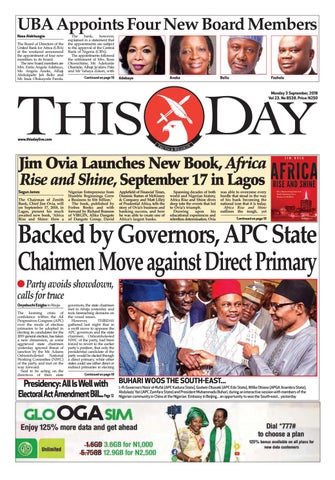
Backed by Governors, APC State Chairmen Move against Direct Primary Party avoids showdown, calls for truce Onyebuchi Ezigbo in Abuja The looming crisis of confidence within the All Progressives Congress (APC) over the mode of election primaries to be adopted in electing its candidates for the 2019 general election, has taken a new dimension, as some aggrieved state chairmen yesterday ignored threat of sanction by the Mr. Adams Oshiomhole-led National Working Committee (NWC) of the party, and met on the way forward. Said to be acting on the directives of their state
governors, the state chairmen met in Abuja yesterday and took far-reaching decisions on the vexed issues. However, THISDAY gathered last night that in a swift move to appease the APC governors and the state chairmen, Oshiomhole-led NWC of the party, had been forced to revert to the earlier party’s position, that only the presidential candidate of the party would be elected through a direct primary, while other states could use either direct or indirect primaries in electing Continued on page 10
Presidency: All Is Well with Electoral Act Amendment Bill... Page 12
BUHARI WOOS THE SOUTH-EAST... L-R: Governors Nasir el-Rufai (APC Kaduna State), Godwin Obaseki (APC Edo State), Willie Obiano (APGA Anambra State), Abdulaziz Yari (APC Zamfara State) and President Muhammadu Buhari, during an interactive session with members of the Nigerian community in China at the Nigerian Embassy in Beijing... an opportunity to woo the South-east... yesterday
2
T H I S D AY ˾ ͱ˜ ͰͮͯͶ
T H I S D AY ˾ MONDAY SEPTEMBER 3, 2018
3
4
T H I S D AY ˾ ͱ˜ ͰͮͯͶ
T H I S D AY ˾ MONDAY SEPTEMBER 3, 2018
5
6
T H I S D AY ˾ ͱ˜ ͰͮͯͶ
T H I S D AY ˾ MONDAY SEPTEMBER 3, 2018
7
8
T H I S D AY ˾ ͱ˜ ͰͮͯͶ
T H I S D AY ˾ MONDAY SEPTEMBER 3, 2018
9
10
MONDAY, ÍťËœ ͺ͸͚΀ Ëž T H I S D AY
PAGE TEN
Stock Market Investors Lose N897bn in Eight Months Goddy Egene Equities market investors have lost N897 billion as at the end of August as politics continues to impact negatively on the market. THISDAY checks showed that market capitalisation, which measures the worth of equities, has depreciated from N13.619 trillion at the beginning of the year to N12.722 trillion last Friday. This indicated a loss of N897 billion or 6.5 per cent in eight months. The Nigerian Stock Exchange (NSE) All-Share Index even recorded a higher decline of 8.88 per cent, having dipped from 38,243.19 at the beginning of the year to 34,848.45 last Friday. A further analysis of the
NSE year-to-date performance showed that the Nigerian bourse has delivered the worst decline among the leading African bourses. It was followed by Johannesburg Securities Exchange with a decline of about 0.11 per cent. Ghana Stock Exchange is leading with the best growth of 8.02 per cent, followed by Egypt with 6.5 per cent, Mauritius 1.06 per cent and Kenya 0.64 per cent. However, market analysts said the negative performance by the NSE was not a surprise considering the fact that foreign investors have been taking flight since the hike in rates in the United States. They added that some investors have also been selling down to guide
against negative impact of the forthcoming general elections. While some investors have remained confident in the strong fundamentals of the market, such confidence has been challenged by developments in the political scene in the last one month. The developments include defections from political parties and utterances capable of heating up the polity. The Association of Stockbroking Houses of Nigeria (ASHON), the umbrella body for the chief executive officers of stockbroking firms last week raised the alarm that the utterances of political class were causing the exit of more investors from the capital market. “For the umpteenth time,
we strongly appeal to the political class that rather than indulge in unwholesome activities, actions, attitudes and destructive utterances, they should support all efforts aimed at creating the much-needed enabling environment for accelerated economic growth and development,�ASHON warned. According to the association, the unguarded activities and unrestrained utterances of politicians are heating up the polity with dire consequences on the economy as a whole and the capital market in particular. “Perhaps we may remind the political class that uncertainties and all sorts of insecurities that currently pervade our country affect investors’ sentiments, asset
valuations, market and country risk profile and portfolio allocation decisions. “In recent times, trading statistics on the securities markets in Nigeria have been reflecting investors’ apathy to unprecedented level of tension that portends likely breakdown of law and order in the 2019 general elections,� it said. ASHON explained that it is an unassailable investorbehaviour that bad news trigger market panic and investors over react to such news, adding that innocent investors watch helplessly as their investments are plundered by the bearish market exacerbated by prevailing uncertainties in the polity created by the political class. Nigeria has continued
to reflect investors’ apprehensions to instability in the political and economic landscape through all their indices. “This has largely accounted for the inability of our market to fully recover from the effects of the 2008 financial crisis, notwithstanding the efforts made by the regulators and operators to fully revive the market. There is clear and present danger if the trend continues,� it said. The stockbrokers said foreign portfolio investors and their indigenous counterparts have embarked on massive sell down of shares and other financial instruments with attendant effect of gross erosion of values despite stellar performances of many listed securities.
the APC came when the party issued a statement contradicting what two governors told journalists on the outcome of the National Executive Committee meeting, held last week. THISDAY gathered that some governors and other stakeholders were not comfortable with the decision of the party to make direct mode of primaries almost compulsory, and had planned a meeting at the Transcorp Hilton Hotels yesterday afternoon. The aim of the meeting, THISDAY learnt, was to raise issues against the adoption of direct primaries and also to seek ways of stopping the NWC led by Oshiomhole from enforcing it. However, the leadership of APC got wind of the planned meeting and warned the conveners to desist from such or "they will be dealt with in line with the party's constitution at the appropriate time." The APC's statement reads: "The attention of the NWC of the APC has been drawn to an illegal meeting scheduled to hold on Sunday at Transcorp Hilton Hotel in Abuja by some members of our party organs, with a
view to fault the decisions made by the NWC followed by the National Executive Committee (NEC) as regards the mode of the party's primary elections. "We want to state clearly that the meeting, which has been fixed for 2p.m. is illegal and an attempt to puncture the sincere efforts being made by the Oshiomhole-led NWC to reposition our party ahead the 2019 general election and to ensure unity, equity and justice in the party." The statement said the outcome of such meeting which is already known, would be a nullity, adding that members should disregard such meetings in the interest of the party. It also said that it has identified those behind the meeting and would have them sanctioned unless they retrace their steps. "It is illegal to call such meetings outside the
purview of the constituted authority. The identities of those plotting such meetings have been identified and unless they desist from such, they will be dealt with in line with the party's constitution at the appropriate time,’’ the statement further stated. "The NWC will resist any attempt to disrupt the current peace and harmony prevailing in our great party after the exit of some members of our party. “We urge any member who is not satisfied with the decisions of the party to utillise channels provided by the party's constitution to air their views.’’ APC said it remains focused in delivering good governance to Nigerians and above all ensuring the victory for the party come 2019 and would not be intimidated by the antics of a few in ensuring success for the party.
with over 30 years cognate experience obtained from management and board positions covering banking operations, risk management, credit analysis, insurance, asset management, business strategy/development, performance management and corporate governance. Fasola previously served as an Executive Director of a commercial bank in Nigeria. He holds two MBAs and is pursuing a PhD in Business Administration. Also, Bello, a Chartered Accountant, has over 30 years’ corporate experience in the banking sector, during which period he held several senior management positions in various Banks. He also previously served as the Group Chief Credit Officer of UBA and thereafter as the Executive Director in charge of Risk Management for UBA Group. UBA is a leading panAfrican financial services
group, with presence in 20 African countries, as well as the United Kingdom, the United States of America and France. It was incorporated in Nigeria as a limited liability company after taking over the assets of the British and French Bank Limited who had been operating in Nigeria since 1949. The bank merged with Standard Trust Bank in 2005 and formed a single country operation founded in 1949 in Nigeria - Africa's largest economy. UBA has become one of the leading providers of banking and other financial services on the African continent. The bank provides services to over 15 million customers globally, through one of the most diverse service channels in subSaharan Africa, with over 1,000 branches and customer touch points and robust online and mobile banking platforms.
BACKED BY GOVERNORS, APC STATE CHAIRMEN MOVE AGAINST DIRECT PRIMARY candidates for various elective positions. The latest position of the party was contained in a letter said to have been written to the Forum of APC State Chairmen of the party, yesterday by the National Secretary of the party, Alhaji Mala Buni. In the letter, APC appealed to the chairmen and other aggrieved stakeholders to sheathe their sword as the matter would be resolved amicably. A party said Oshiomhole had also fixed a meeting with the state chairmen in order to sort out issues. The party's national secretariat had earlier yesterday raised the alarm over the meeting, which it said was an attempt to alter the party’s decision on mode of election primaries. In a statement issued early yesterday, by the party’s Acting National Publicity Secretary, Yekini Nabene, APC cautioned the members against going ahead with what it described as ‘’illegal meeting’’ or be ready to face sanction. However, sensing that the leadership of the party has noticed their plan, the aggrieved party men, made up of state chairmen across
the country, quickly moved their meeting to another venue, at Barcelona Hotel, Wuse II in Abuja. Apart from state chairmen, two ex-officio members also attended the yesterday's meeting. THISDAY gathered that most of those that attended the meeting were APC state chairmen. It was also learnt that the NWC of APC immediately reached out to the Borno State chairman, who was chairing the meeting of APC Forum of State Chairmen to clarify the position of the party on the issue of method of primaries. One of the state chairmen who spoke with THISDAY last night on condition of anonymity at the end of the meeting, said the party wrote a letter to them yesterday to clarify issues. Although he did not state the content of the letter, THISDAY learnt that the party might have caved in to pressure by the state chairmen and reversed its insistence on the use of only direct primaries mode to elect candidates for the 2019 elections. When THISDAY asked one of the chairmen what the outcome of their meeting
was, he brandished a letter written on APC's letterhead, saying it was sent to them by the national secretariat of the party. THISDAY also saw one of APC's National Vice Chairmen from the north emerging from the meeting. Although he did not want to be quoted, he told journalists that the meeting was essentially to protest the ‘’highhandedness’’ of the party leadership -- in imposing direct primaries on the members. An ex-officio member of the national leadership of APC, who also attended the meeting, said the state governors and even some national officers are not happy with the direct primaries option, adding as leaders of the party in the states they will do everything to protect their interest. The source added, "The state chairmen will do everything possible to resist the imposition of direct primaries on the party, including passing a vote of no confidence on Oshiomhole and his NWC members." Signs that there were still unresolved issues on the mode of primaries for
JIM OVIA LAUNCHES NEW BOOK, AFRICA RISE AND SHINE, SEPTEMBER 17 IN LAGOS necessary business decisions that were essential to Zenith’s prolonged success and is filled with valuable takeaways for every businessperson.
The book, according to Amazon, is a useful lesson tool for those who want to learn from one of the best in banking, what it takes to truly be successful.
UBA APPOINTS FOUR NEW BOARD MEMBERS effect from August 30, 2018. The Group Chairman of the bank, Mr. Tony Elumelu, welcomed the new board members saying, “I am pleased to welcome Erelu Adebayo, Angela Aneke, Abdulqadir Bello and Kayode Fasola to the Group Board. “These men and women bring a wealth of experience in their fields and will be tremendous assets, as we deliver on our mission to become the leading PanAfrican financial institution in all our countries of operation. “I am particularly pleased that two of the newly appointed non-executive directors are women, bringing the total number of women to four, a further demonstration of our commitment to ensuring equality for both men and women.� Elumelu thanked the retiring directors for their contribution, hard work and commitment to UBA.
“I would like to express my appreciation to our retiring Directors for their leadership and dedication to UBA and for their contribution to an already impressive 2018. I wish them the very best in their future endeavours,� he said. The announcement came on the heels of the bank’s strong first half 2018 performance with a profit before tax of $58.1 billion. With the successful expansion of its retail operations, UBA now operates in 20 countries in Africa, following its recent acquisition of a licence in Mali and the United Kingdom. The bank also has offices in New York City and in Paris. The profile of the new directors showed that Adebayo, who graduated with an M.Phil in Land Economy from Cambridge University, is the former First Lady of Ekiti State in Nigeria.
Adebayo previously served on the boards of several organisations, including the Dangote Foundation, DN Meyer Plc, Wemabod Estates. She is a council member of the Nigerian Stock Exchange and has worked extensively on real estate development and she is the Chairman of the Erelu Adebayo Foundation for the under-privileged. Also, Aneke is a board advisor, banker and a strategic thinker with over 30 years experience in financial services, in the areas of financial control, strategy, transaction banking, corporate banking, retail banking and governance. She has held executive management and board positions in several international and regional institutions, including Ecobank Transnational Incorporated and the United Bank for Africa. In the same vein, Fasola is a consummate professional
TOP GAINERS NEWRESTASL LASACO FIRSTALUM AIICO OKOMUOIL TOP LOSERS JAIZBANK CHAMS HONEYWELL
NGN NGN 0.50 5.50 0.03 0.33 0.03 0.34 0.07 0.82 5.75 76.95 NGN 0.05 0.50 0.03 0.31 0.13 1.49 ROYALEXCHANGE 0.02 0.24 JAPAUL 0.02 0.25 HPE Nestle Nig Plc â‚Ś1,500.00 Volume: 384.893 million shares Value: N9.790 billion Deals: 4,070 As at Friday 31/08/18 See details on Page 35
% 10 10 9.6 9.3 8.0 % 9.0 8.8 8.0 7.6 7.4
T H I S D AY ˾ MONDAY SEPTEMBER 3, 2018
11
12
MONDAY, ÍťËœ ͺ͸͚΀ Ëž T H I S D AY
NEWS
NNPC: FG Ignored Advice to Review Expired PSC Chineme Okafor in Abuja The Nigerian National Petroleum Corporation (NNPC) yesterday stated that it advised the federal government in 2008 to trigger the clauses in the 1993 Deep Offshore and Inland Basin Oil Production Sharing Contract (PSC) Act, and review the Act to enable Nigeria take more royalties but its advice was ignored by the government. NNPC’s claims was sequel to an ongoing investigation by the House of Representatives ad-hoc committee probing how the country failed to collect about $21 billion of revenue from oil produced overtime from oil fields in the deep water basins of the country because of the failure to activate a clause in the PSC Act. The committee had last week at an interactive session with stakeholders blamed the Department of Petroleum Resources (DPR) for the country’s losses in this regards, but top sources in DPR told THISDAY that it was not responsible for the losses. But in an interaction
with THISDAY on the issue in Abuja, NNPC’s Group General Manager Public Affairs, Mr. Ndu Ughamadu, stated the corporation did what was expected of it but the government at that time failed to sufficiently act on its recommendations. Ughamadu said the current government has, however, submitted an executive bill to the National Assembly for the review to be done. “NNPC’s responsibility was to advise the government and that was done in 2008. But the then government only issued a letter of intention to review the section. The current government has already forwarded an executive bill to the National Assembly for that purpose,� said Ughamadu. The contentious terms, which ought to have been triggered is contained in Section 16 (1) of the Act, and it stated that calculation of royalties due to the government from oil production as covered by the Deep Offshore and Inland Basin Production Sharing Contract (PSC) Act
should be reviewed once the price of oil got to $20 per barrel or after 10 years of the Act in practice. This was, however, not done, necessitating claims in 2017 by the Minister of State for Petroleum, Dr. Ibe Kachikwu, that Nigeria lost a whopping $21 billion to its failure to implement this premium element governing the PSCs. And, while the Chairman of the ad-hoc committee, Hon. Daniel Reyenieju, insisted that since it was the responsibility of the DPR to regulate Nigeria’s oil sector, it was equally mandated to follow up and trigger the clause. He maintained that the delay in activating the clause was chiefly the fault of the DPR. But top DPR sources who spoke to THISDAY said the DPR was only responsible for issues related to royalties on PSCs that were signed after 1999 and as such could not be held responsible for this. “NNPC is in charge of PSC contracts, it is their responsibility to review to ensure that government gets its beneficial stake.
Kachikwu The National Assembly is supposed to review the Deep Offshore and Inland Basins Act, which is
responsible for such things. PSCs that are pre-1999 are the ones that are affected by these royalties. The ones
that are post-1999 attract royalties based on DPR regulations,� said one of the sources.
Presidency: All is Well with Electoral Act Amendment Bill Period for assent lapses today Deji Elumoye in Abuja and Tobi Soniyi in Lagos The presidency yesterday allayed fears that President Muhammadu Buhari might withhold assent to the Electoral Act Amendment Bill 2018 passed by the National Assembly on July 24, 2018 and transmitted to the president on August 3.
By the provision of S58 (4) of the 1999 Constitution as amended, the president has 30 days within which to sign the bill into law. Consequently, the period of assent, according to lawyers THISDAY spoke to, technically lapsed yesterday. But the Senior Special Assistant to the President on National Assembly
Matters, Senator Ita Enang, took a cautious approach yesterday, indicating that there was still hope for the bill to be signed by Buhari. “All I can say is, today being a Sunday, all is well with the Electoral Bill,� he told THISDAY in a telephone conversation. Enang had said last week that Buhari would
act within the provisions of the Constitution, contending that the president was still within the 30-day window permitted for him to assent or withhold his signature to the bill, many of which provisions aimed at enhancing the nation’s capacity to deliver cleaner electoral processes. The bill had been returned
twice to the National Assembly without assent. The first was in March, on three grounds of objection, while the second was in July, because of what the presidency called clerical errors that could lead to constitutional infractions. If the president, who is on a working visit to China, does not append
his signature to the bill by 12 midnight, said lawyers spoken to by THISDAY, the period of assent would lapse and consent would be deemed to have been withheld, opening up the possibility of a veto override by the National Assembly in line with S58 (5) of the Constitution as amended.
Buhari: I’m Not Afraid of Free, Fair, Credible Polls Omololu Ogunmade in Abuja
President Muhammadu Buhari at the weekend in Beijing, the Chinese capital, said he was not afraid of free and fair elections in 2019 because he himself was a beneficiary of credible polls in 2015. He told the Nigerian community in China that he was committed to making sure that the 2019 polls, under his watch, would be credible, adding that Nigerians eligible to vote in the next general election would be allowed to freely elect candidates of their choice. ‘‘I have no fear about free and fair elections because that is what brought me to the present position. I know what I went through and very few Nigerians could boast of trying four times‌ ‘‘Those interested in participating in the elections must get their PVCs and register in their constituencies and elect anybody of their choice across ethnicity and religion. The Nigerian police, law enforcement agencies and INEC must respect the
wishes of the people,’’ he said. A statement by his Senior Special Assistant on Media and Publicity, Malam Garba Shehu, said the president, while citing recent elections in Bauchi, Katsina and Kogi States, said the country had made progress relative to elections conducted in the past years. According to him, the president reaffirmed that his government had succeeded in curtailing Boko Haram insurgents in the country, claiming that the terrorist group no longer controls any part of the country. He said the president attributed the success to operations of security agencies deployed to counter insurgency in the North-eastern part of the country. ‘‘You will all recall that we contested the last election basically on three issues, which includes security, especially in the North-east. The Boko Haram used to occupy quite a number of local governments in Borno State but they are not in any one now. "They have resorted to
a very dangerous way of terrorism by indoctrinating young people, mostly girls and attacking soft targets, churches, mosques and marketplaces,’’ he quoted him to have said. On herders and farmers clashes in Nigeria, the statement said Buhari told Nigerians in the Diaspora that while security agencies were doing their best to curtail the clashes, the Nigerian media needed to complement the efforts through objective and informed reportage. The statement also said Buhari expressed his disappointment in the Nigerian media, accusing them of failing to study the historical antecedents creating misunderstanding between herders and farmers. ‘‘To my disappointment, the members of the press in Nigeria do not make enough efforts to study the historical antecedents of issues that are creating national problems for us,’’ he said. The statement added: "According to the president, due to the effects of climate change, a farm that used to belong to five people
now belongs to 50 people, the weather condition; particularly the rainy season is now unpredictable. "The president partly blamed the farmer’s/herders’ controversy on the shrinking of the Lake Chad, which has forced many cattle nomads to seek greener pastures for their herds in other parts of the country." On Nigeria-China relations, he said the president applauded China’s generosity and contribution to the development of Nigeria, citing the successful completion of the AbujaKaduna railway line, built by the Chinese, and ongoing works on Lagos, Ibadan, Ilorin, Abuja, Kano railway routes. Noting that Nigeria and China were negotiating on the Mambilla project, the statement said Buhari also advised Nigerians planning to travel abroad for ‘‘greener pastures’’ to do so legitimately and not to expect too much from their countries of destination. ‘‘You cannot seek greener pastures in a place where you are not respected because of the colour of
your skin or your lack of education or other things. Personally, I think you will earn more respect when you remain at home and get a job,’’ he was quoted to have said. Acknowledging the material and intellectual support of Nigerians in the Diaspora to the development of the country, the president promised that his administration would remain focused and committed in providing the needed infrastructure and doing the needful for Nigeria’s prosperity. The statement added: "Earlier in his remarks, the Nigerian Ambassador to China, Baba Ahmed-Jidda, thanked the president for his support to the embassy, which led to the completion of the Ambassador’s residence. "The ambassador praised Nigerians resident in the various provinces of China for being law abiding with the exception of few. On consular matters, the envoy told the President, Nigerians still faced difficulties in the process of obtaining Chinese visas- an issue he thinks the
president should take up with the Chinese authority. "Also speaking, the President of the China Chapter of Nigerians in the Diaspora Organisation, Brian Akiti, while wishing the country successful elections in 2019 pledged the support of the organisation to the present administration’s development agenda. "In a separate event, the president also met with Nigerian students on scholarship in China. He told the students: 'I hope you will make the best use of this opportunity given to you. Nigeria is grateful to China for extending this generosity to us. The Chinese are helping Nigeria greatly with building infrastructure, it is very much appreciated. We are pleased with the training they are providing for our Nigerian students.' "President Buhari also met with the executives of China Civil Engineering Construction Corporation (CCECC), during which he lauded the construction group for their immense contributions to infrastructure development in Nigeria."
T H I S D AY ˾ MONDAY SEPTEMBER 3, 2018
13
14
T H I S D AY Ëž Ëœ ÍąËœ 2018
COMMENT
Editor, Editorial Page PETER ISHAKA Email peter.ishaka@thisdaylive.com
THE FUTURE OF CHINA-AFRICA COOPERATION
Charles Onunaiju urges African leaders to closely evaluate the contents of the ‘belt and road’ initiative
D
uring the gathering of China-African leaders at the 3rd summit of the Forum on China-Africa Cooperation (FOCAC) as from today in Beijing, the theme of “Belt and Road,� would feature very prominently. Proposed in 2013, the “Silk Road Economic Belt� and the “21st century Maritime Silk Road� was a global framework of connectivity spanning an integrated network of overland, maritime and digital infrastructure.
The “belt� is network of overland infrastructure of transport arteries consisting of highways, railways, airport terminals. The “road� consists of sea transport arteries that would span sea routes, sea ports and constructions of fiber optic cables to facilitate integrated digital network. The “21st Century Maritime Silk Road,� lays emphasis on ways and means to achieve ports renovations, boost shipping lines upgrades and improvement of shipping capacity in the 21st century that is considerably without the hegemonic designs of maritime expansion, confrontation and colonisation which largely characterised western maritime dominance. Rather, Beijing seeks to effectively avoid traditional risk of globalisation and usher in a new type of ocean civilisation featuring the integration of man and the ocean, harmonious existence of countries and sustainable development. The belt and road is essentially a global transport network, integrated and interconnected system that is composed of railways, highways, aviation, navigation, oil and gas pipelines, transmission lines and communication networks. Along these lines, would gradually emerge formation of industrial clusters and other wide range of economic activities, serving these networks. Through the deepening of industrial effects, an economic corridor featuring comprehensive development of construction, metallurgy, energy, finance, communication, information, logistics and tourism will be established. Remarkably, the belt and road framework of international cooperation will witness and accelerate a process in which China transfers quality production capacity down the global industrial value chain. In this respect, combining the existing mechanism of China-Africa Cooperation, that is the profoundly engaging FOCAC process with the belt and road initiative would accelerate the momentum of production and industrial capacity cooperation between China and Africa and give Africa a solid head-start in the role of the next workshop of the world and the industrial heartland of an emerging integrated globalisation. As the Africa’s leaders gather in Beijing, it will be in the best interests of the people of Africa, whom they represent, to closely and dispassionately evaluate core contents of the belt and road initiative which in its several respect and dimension is in full throttle now, take proactive stance to fully integrate in the process, using the underlying spirit of the belt and road value of extensive consultation, joint contributions and shared benefits to raise issues that demand clarifications from the initiators and engage the process more robustly on issues that are critically germane to Africa’s renaissance, inclusive and sustainable development. If there are
THE BELT AND ROAD IS ESSENTIALLY A GLOBAL TRANSPORT NETWORK, INTEGRATED AND INTERCONNECTED SYSTEM THAT IS COMPOSED OF RAILWAYS, HIGHWAYS, AVIATION, NAVIGATION, OIL AND GAS PIPELINES, TRANSMISSION LINES AND COMMUNICATION NETWORKS
however areas in which Africa felt that its concerns are not adequately reconciled to the belt and road process, the mechanism of diligent and routine consultations between China and Africa, generously offered by FOCAC process, especially at its highest level of leader’s summit, which the Beijing third Summit provides, is an excellent platform to compare notes with the Chinese leadership and forge ahead in the spirit of win-win cooperation. The opportunities of the belt and road framework bring an uncommon vigour to the existing cooperation between China and Africa in addition to extending its frontiers and deepening its contents. Africa’s development is at historic juncture, where it would have to cease a unique momentum, provided by a phenomenal international partnership to underwrite the strategic and practical contents of Pan-Africanism, which includes integrated network of infrastructural connectivity to boast trade, enhance people-to-people contacts and create integrated industrial network in the region and beyond. With enormous goodwill and all-weather friendly cooperation with Beijing, Africa can join the ride on the “belt and road� express, bring her accumulated wisdom of community resilience on board, give the full expression of her contemporary renaissance and integrate it to the Chinese dream of rejuvenation and jointly construct a community of shared future for all mankind. Having historically borne the brunt and pains of monumental injustice, perpetrated by colonial domination and imperialist plunder, China and Africa along with the vast numbers of countries in the global South are in strategic and vintage positions to engineer an inclusive international order of a human community of shared destiny. The belt and road paradigm is not a heavenly passage without challenges. The connectivity it seeks, which is embedded in the overland, maritime and digital transport arteries is also fraught with risks of all kinds, both traditional and non-traditional. But the innate strength of the belt and road process, consist essentially in the fact that security threats and development challenges are better confronted with sustainable development efforts to neutralise its most toxic effects and make it more routinely, manageable. Because, the belt and road process looks forward to tapping from the accumulated and diverse wisdom of humanity, spanning all countries and cultures, it proclaims its modest origins as China initiated but owned by the world and also depends on the world for vigour, sustainability and success. As the belt and road is a critical paradigm and harbinger of an emerging inclusive and participatory global order, Africa has a unique opportunity to make original contributions to a new world order, both in its architectural designs and real contents. The African leadership gathering in Beijing with their Chinese counterpart at the third summit of the forum must grasp the weight of the historic foresight that lay on their shoulders and appreciate that this is a gathering that is like no other in the international circuit but a defining moment that would shape the future of humanity. The world will be watching with all attention to see if the moment can be grasped.
OSINBAJO AND EASE OF DOING BUSINESS The demand for tax clearance certificate for registration of business is a big hindrance, argues Idang Alibi
O
ne of the things that has endeared Vice- President Yemi Osinbajo to many Nigerians is his apparent zest or determination to get this byzantine, serpentine, octopoidal and imperially aloof, lumberinglocomotive of a system that we have to ‘move’ like a supersonic jet so that we can quickly get results and get ourselves out of the economic wilderness we are in right now. I do not know why each time I am moved in my spirit to do a note to the Vepee, I find myself compelled to go Obahaigbonic, that is, adopt the use of high sounding and cascading adjectives in a manner that one of our former federal lawmakers, the one and only Hon. Patrick Obahaigbon, has become famous. Is it because the man is a politician, professor, lawyer and a pastor, a personification of professionals who love words and talk and so I feel instinctively drawn to try to use words that will draw his attention to what I am saying? And by the way, this is just by the way. Most concerned Nigerians have by now become aware of the country’s Number Two man’s tireless crusade to ensure that government clears most of the obstacles that were originally put in place to regulate conduct and promote honesty, transparency and accountability, but which have, ironically, become hindrances to doing business some of which require speed and timeliness. During his first stint as Acting President, the Buhari government came out with an Executive Order which focused on the theme of fast-tracking government machinery to make it easier for doing business which has become most identified with Osinbajo. But tried as the man, there are still several unintended obstacles to doing business with ease and speed in Nigeria, especially for small or #Too Young-to-Cope business outfits.
One area I want to cite here is the demand for Tax Clearance Certificate (TCC) for registration to bid for contracts from Federal ministries, departments and agencies (MDAs) or to obtain loans to expand or consolidate on one’s business. It is very alright that in a country where ordinary and corporate citizens are notorious for not being willing to discharge their basic obligation of paying appropriate tax to government, they are required to show evidence of being good citizens before they can be eligible for consideration in benefiting from any public largesse such as contracts or loans. But well-meaning as this requirement is, it has, in practical reality, become a great hindrance for doing business now in our country, especially for #Too-Young-to-Cope businesses. Why so? Sir, in case no one has drawn your attention to this yet, let me humbly do so. Before you can get a tax clearance certificate, the FIRS demands that you hire a chartered accountant to go through your company’s books and get audited accounts for three years or according to the number of years your company has been in business. This, ordinarily, should be quite an easy thing to do. But this is Nigeria, a country where the system seems designed to be like the hydra-headed monster called the octopus. When you try to decapitate one head another grows quickly and becomes even more dangerous than the one you had cut off. Nigeria is truly an amazing country. Every effort made to solve a simple problem always tends to complicate, compound and even confound the original simple problem. The demand for tax clearance certificate was meant to address the problem of tax dodging or avoidance and the loss of revenue by government. Yet, the requirement for TCC has now created some unintended very harmful effect on companies and individuals. It has, in fact led to the death of many young companies and is threatening
the lives of many more. Sir, when companies die they are no longer in a position to contribute to the economy or even pay tax, the original reason for the TCC. But how, exactly, is the institution of TCC causing the death of companies? you may ask. Sir, to be able to obtain this TCC from FIRS, you are required to approach a chartered accountant to look at your company’s books and come up with audited accounts for three years. When you do, the accountants will take one look at your records and ask for a hefty professional fee for each of the years in consideration which is quite often beyond the reach of those companies I have chosen to call #Too-Young-to- Cope. Sir, I always choose to go personal in order to provide practical, honest and believable evidence to support the point I seek to make. In order to key into this administration’s desire to diversify our economy through agriculture and other sectors, members of the Idang Alibi household set up a private limited liability company called Idang Alibi Farms Limited in September, 2015 to engage in plantation agriculture and processing. Having thrown in practically everything we have to get the business going, we decided to seek a facility from a bank. A vital part of the requirement before we can put up application for consideration is the almighty tax clearance certificate. We approached a chartered auditor who charged us a princely amount which I am too shy to mention here because our young company does not simply have the money to pay! If we are to bid for say a contract from the government, we shall also be required to show certificates of registration with PENCOM, NSTIF and BPP. A friend of ours with whom I shared our ordeal with the chartered accountant told me pointblank that we need nothing less than N500, 000 before we will be able go through all these
documentations. This, you can easily admit, sir, is an obstacle that is not in any way an ease to doing business. Note, sir, that this is just to be eligible to be considered for a contract or loan! Sir, to tell you the truth, if Idang Alibi Farms Limited were to earn an amount like N500, 000 for business year 2017, we will stage a thanksgiving party and humbly invite a personage like you to it, rather than give it to someone else in order to be able to obtain some document to qualify for anything that we are not even sure will guarantee our getting the facility or eligibility we are seeking. To my Bekwarra people of Northern Cross River State, using N500, 000 as a ‘non-refundable fee’ for preparing you to be eligible for a loan or grant or anything else you are not too sure of getting is like sacrificing an elephant hoping for a good hunting expedition! If my kinsmen hear that Idang Alibi Farms Limited led by me has done this, they will surely send a delegation to me in Abuja that I should go back to the village for spiritual cleansing or purification of the ‘bad cloud or air’ they are convinced must have enveloped us, caused, no doubt, by evil forces. What should his Excellency do in the circumstance? Society is dynamic. If a measure adopted to solve a particular problem fails, government, the superintendent of societal affairs, should have the courage to take action by modifying or altogether doing away with that failed or failing measure. Now our society has become digitalised. The tax office should have a platform where the particulars of all individuals and companies are stored which it should follow in demanding for tax. The demand for TCC is outdated. But more importantly, TCC is now not a spear against tax dodging but a tool that is killing the economy in a non-perceptible manner.
Alibi, a journalist and farmer wrote from Abuja
15
T H I S D AY MONDAY, SEPTEMBER 3, 2018
EDITORIAL CBN LIFELINE FOR THE REAL SECTOR The move by the central bank is commendable
T
he Central Bank of Nigeria (CBN) recently unveiled measures to increase the flow of credit to the real sector of the economy. The idea is to stimulate growth by propelling Deposit Money Banks (DMBs) to lend to companies that are doing new capital expenditures and expansion to factories. Loans to be given under the unfolding policy are facilities of seven years with two-year moratorium on principal and nine per cent interest per annum. If well implemented, the provisions in the revised guidelines for Accessing Real Sector Support Facility (RSSDF) through the Cash Reserves Requirement (CRR)/Corporate Bonds (CBs) may help revolutionise the real sector of the economy. Under the evolving policy, the DMBs will henceforth be incentivised to direct affordable, long-term credit to the manufacturing, agriculture, as well as other sectors considered as employment and growth- stimulating. Corporate/Triple-A rated companies will also be encouraged to issue long-term corporate bonds (CBs). Already, the CBs funding programme is in place, according to the CBN. The programme would FOR DECADES, THE encompass its own investment as well REAL SECTOR HAS as that of the general CONTINUED TO BE public in CBs issued HAMSTRUNG BY A by corporates subject MAJOR PROBLEM OF to the intensified GETTING CREDIT AT HIGH transparency requireINTEREST RATE AND AT ments for participating companies. SHORT TENOR While several critical stakeholders in the financial sector would rather watch to see the implementation, the consensus seems to be that the CBN got it right with the move to increase the flow of long-term credit to the real sector in such a strategic manner as to ginger growth in the manufacturing and agricultural sectors. But since the devil is always in the detail, many have decided to express cautious optimism as they await the guidelines.
Letters to the Editor
The idea of finding an enduring solution to the major challenges facing the real sector of the economy is quite commendable. For decades, the real sector has continued to be hamstrung by a major problem of getting credit at high interest rate and at short tenor. Repaying such loans with high interest and at short tenor has not only stifled their growth, but also sounded the death knell for many. While the nation’s fiscal and monetary authorities have at different times experimented with one form of measure or the other to stimulate growth without much success, we believe the new move by CBN is in the right direction.
H T H I S DAY EDITOR BOLAJI ADEBIYI DEPUTY EDITOR DAVIDSON IRIEKPEN MANAGING DIRECTOR ENIOLA BELLO DEPUTY MANAGING DIRECTOR KAYODE KOMOLAFE CHAIRMAN EDITORIAL BOARD OLUSEGUN ADENIYI EDITOR NATION S CAPITAL IYOBOSA UWUGIAREN MANAGING EDITOR JOSEPH USHIGIALE
T H I S DAY N E W S PA P E R S L I M I T E D EDITOR-IN-CHIEF/CHAIRMAN NDUKA OBAIGBENA GROUP EXECUTIVE DIRECTORS ENIOLA BELLO, KAYODE KOMOLAFE, ISRAEL IWEGBU, IJEOMA NWOGWUGWU, EMMANUEL EFENI DIVISIONAL DIRECTORS BOLAJI ADEBIYI, PETER IWEGBU, ANTHONY OGEDENGBE DEPUTY DIVISIONAL DIRECTOR OJOGUN VICTOR DANBOYI SNR. ASSOCIATE DIRECTOR ERIC OJEH ASSOCIATE DIRECTORS PATRICK EIMIUHI, SAHEED ADEYEMO CONTROLLERS ABIMBOLA TAIWO, UCHENNA DIBIAGWU, NDUKA MOSERI DIRECTOR, PRINTING PRODUCTION CHUKS ONWUDINJO TO SEND EMAIL: rst name.surname@thisdaylive.com
owever, lessons should be learnt from how such efforts failed in the past. We recall that the CBN had in August 2013 launched the N220 billion Medium, Small and Micro Enterprises (MSMEs) Development Fund. Ten per cent of the fund was devoted to developmental objectives such as grants, capacity building and administrative costs while 90 per cent commercial component was being released to Participating Financial Institutions(PFIs) at two per cent for on-lending to MSMEs at a maximum interest rate of nine per cent per annum. We are aware that the purpose was hugely defeated. The PFIs had cried out that lending at single-digit nine per cent interest per annum was a pipe-dream as the fund has remained largely unutilised. We also recall that the purpose of settling up a wholesale financial institution like the Development Bank of Nigeria (DBN) was to provide long-term single-digit interest financing. It is evidently clear that while it might be striving towards providing long-term financing, giving loans at single digit has for years been a mirage. We, therefore applaud the current innovative approach of the CBN to incentivise the DMBs which give long-term credit at single digit interest, using the CRR mechanism. All factors considered, it might just work this time, especially if all the relevant stakeholders, including the banks and the business managers, deploy the facilities in a transparent and accountable manner.
TO OUR READERS Letters in response to speci c publications in THISDAY should be brief (150 200 words) and straight to the point. Interested readers may send such letters along with their contact details to opinion@thisdaylive.com. We also welcome comments and opinions on topical local, national and international issues provided they are well written and should also not be longer than (950 1000 words). They should be sent to opinion@thisdaylive.com along with the email address and phone numbers of the writer.
BUDGETING FOR MATERNAL AND CHILD HEALTH
A
ccording to recent world health statistics released by the World Health Organisation (WHO), more than half of the births in Nigeria are not attended to by skilled health personnel. Maternal mortality ratio (per 100,000 live births) and under-five mortality ratio (per 1000 live births) amounts to 814 and 104.3 respectively, which are far below global standards. Proportion of married or in-union women of reproductive age who have their need for family planning satisfied with modern methods amounts to a paltry 26.3% while female life expectancy at birth amounts to just 55.7 years. Clearly, Nigeria is very far from attaining goal three of the Sustainable Development Goals (SDGs) which targets a reduction in maternal mortality ratio to less than 70 (per 100,000 live births) and a reduction in under-five mortality ratio to as low as 25 (per 1000 live births). While reforms within the health sector will go a long way to improve our odds, the need to ensure that our national budgets are in line with existing plans and policies cannot be overstated. The budget is the most potent tool through which good governance and improved maternal and child healthcare services can be bestowed on Nigerians, hence the need for all hands to be on deck to ensure that the annual budgets of the Federal Ministry of Health will translate into improved healthcare for Nigerian women and children. In the 2018 budget of the federal ministry of health, the appropriation of 20m for “maternal, infant and young child feeding in Nigeria” with budget code ERGP25112221 is commendable. The appropriation of 10m for “national cervical cancer screening scale up project” is also commendable. While there is need to increase the amount for these budget line items, it is recommended that the implementation of the above mentioned line items and the implementation of numerous other similar line items in the 2018 budget should be done judiciously. In the 2018 budget, the National Primary Healthcare Development Agency (NPHCDA) made provisions for construction/renovation of primary healthcare centres nationwide. The NPHCDA also made provisions for supply of drugs, medical outreach, operational vehicles, boreholes and
public conveniences, etc. The total capital vote of NPHCDA in the 2018 budget amounts to 23b. Clearly, this is not an amount of money that should be lost to frivolities. Women and children are the most direct beneficiaries of budgetary appropriations for primary healthcare, hence mainstreaming value for money in the procurements of NPHCDA will translate to improved healthcare services for Nigerian women and children. Also, in the 2018 budget of the federal ministry of health, the appropriation of 70m for “training of nurses and midwives with specialised skills” is commendable. The appropriation of 37m by the Nursing and Midwifery Council for “procurement of personal protective equipment for handling of infectious diseases” is also commendable. Women and children will be the biggest beneficiaries of the appropriations of the Nursing and Midwifery Council, hence civil society organisations are encouraged to monitor the implementation of the over 284 million capital vote of the council. The total capital votes of the National Obstetric Fistula Centres in Abakaliki, Bauchi and Katsina amount to 991m, 338m and 282m respectively. Since obstetric fistula is a purely maternal health challenge, individuals and groups dedicated to the welfare of women are encouraged to monitor the disbursements of these huge sums of money. In order to improve the quality of Nigeria’s annual budget for maternal and child health in subsequent years, there is need to increase budgetary allocations to family planning in accordance with Nigeria’s commitments at the London Summit and National Family Planning Scale up Plan 2014. The annual allocation to nutrition should be increased in line with Nigeria’s National Food and Nutrition Policy. Construction and rehabilitation of primary healthcare centres by the federal government across the country should be accompanied by commitments from the state and local governments to fund the recurrent expenditures of these healthcare centres. The funding gap in immunisation should be reduced while steps should be taken to enact the Nigerian Immunisation Trust Fund Bill in order to ensure sustainable funding of immunisation programmes. Martins Eke, Programme Officer, Centre for Social Justice, Abuja
BUHARI AND 2019 ELECTION
T
he 2019 presidential election is a strategic election that would determine the future of this country. Therefore, our choice of leadership must be borne out of genuine heart to rescue our country from the hands of the elite and political gladiators who parade themselves as democratic leaders. The choice is in our hands to vote true leadership that would cleanse this country of massive corruption promoted by the elite. The current administration is facing great challenge in repositioning Nigeria because of resistant from the elite.
The Presidency inherited a corrupt political, social and economic system from previous administrations under the PDP between 1999 and 2015. Its fight to eradicate the system of corruption is being resisted. This administration’s fight against corruption is perceived by the poor as insignificant and irrelevant because of the window of hardship, suffering and poverty that came with it. But the fight against corruption is critical to building a viable political, social and economic system in Nigeria. Majority of the poor who are largely determinant of who clinches the presidential election in 2019 are unhappy, worried and dissatisfied with this administration’s style. Therefore, a strategy must be adopted by the presidency to appease the poor before the election. Pedro Ukokobili, Lagos
16
T H I S D AY ˾ ͱ˜ ͰͮͯͶ
T H I S D AY ˾ MONDAY SEPTEMBER 3, 2018
17
18
T H I S D AY • MONDAY, SEPTEMBER 3, 2018
POLITICS
Group Politics Editor NSEOBONG OKON-EKONG Email nseobong.okonekong@thisdaylive.com 08114495324 SMS ONLY
M O N D AY D I S C O U R S E PIGB: Understanding the Politics Behind Buhari’s Refusal Nseobong Okon-Ekong and Segun James interrogate all the sides to the recent refusal of the President Muhammadu Buhari to sign the Petroleum Industry Governance Bill
W
hen the news came that President Muhammadu Buhari declined assent to the Petroleum Industry Governance Bill (PIGB), a framework of governance to determine and manage the Nigerian oil industry, it was an anti-climax of sorts. This Bill had been in the works for over 10 years. There was intense lobbying for and against it, including the harmonization of the version passed by the House of Representations with that of the Senate. The final version of the bill was finally approved by the National Assembly in March, 2018 and transmitted to President Buhari in July for acceptance. But Buhari rejected the bill. He hinged his refusal on the fact that the bill would subtract from his power as the Minister of Petroleum Resources. The Petroleum Act of 1969, from which the president derives his powers, grants all rights in grant of oil licenses and leases to the Minister of Petroleum Resources. The Act has since been viewed by many as not providing enough room for transparency. It is also seen as not being strong on accountability and specifying inadequate penalties for offenses. Because of the apparent enormous powers inherent in this Act, Nigerian leaders reserved to themselves the Minister of Petroleum Resources portfolio or appointed cronies who answered directly to them to oversee that ministry. It is the powers conferred by the Act that Buhari is unwilling to relinquish. The current administration has a Minister of State for Petroleum, Dr. Ibe Kachikwu. But he is constantly at war with the Geoup Managing Director of the Nigeria National Petroleum Corporation (NNPC), Dr. Maikanti Baru. In separate communications to the Senate President and the Speaker of the House of Representatives, Buhari took exception to the fact that the bill empowered technocrats in the petroleum industry. The bill, which was initiated by late President Umaru Yar’Adua and sent to the 6th National Assembly headed by Senator David Mark in 2008 had been enmeshed in controversy due to some of its provisions. The Senate had on March 28 passed the PIGB having adopted the report of the committee set up to harmonise the versions earlier passed by both Senate and House of Representatives. The harmonised version of the bill seeks to, among others, unbundle the NNPC and merge its subsidiaries such as Department of Petroleum Resources (DPR) and Petroleum Products Pricing Regulatory Agency, PPPRA, into one entity. Objectives of the PIGM The objectives of the PIGB include transforming the administration of the upstream, midstream and downstream sectors of the Nigerian petroleum industry. The bill creates a framework that will free up acreages that are not being developed by current license and lease holders, thereby creating opportunities for new investors. This will bring substantial new investment to the nation’s oil and gas industry; while also ensuring the effective management of the environment by petroleum operators and administrators. It provides a framework to unleash midstream activities which will open up the market for the supply of gas and other downstream products, for economic growth and provides much needed legal backing for the deregulation of the downstream sector of the petroleum industry. The refusal of the president to assent to the bill has generated adverse reactions, while
An Oil Tank Farm
the federal government has justified the president’s refusal to sign the bill. The Presidency cited constitutional and legal breaches as reasons Buhari withheld his assent to the bill. Senior Special Assistant to the President on National Assembly Matters, Senator Ita Enang, said the National Assembly empowered the Petroleum Regulatory Commission, one of the bodies created by the bill to unduly retain 10 per cent of the funds it generates to the detriment of the three tiers of government and the Federal Capital Territory (FCT). He also said the president vetoed the bill because it expanded the scope of the Petroleum Equalisation Fund (PEF) in a manner that is antithetical to the policy of his administration and consequently stipulating provisions that are in conflict with independent PEF. Enang also disclosed that the President opted to return the bill to the National Assembly because it consisted some legislative drafting concerns, which he said, had the capacity to create ambiguity and conflicting interpretation. “The provision of the bill permitting the Petroleum Regulatory Commission to retain as much as 10 per cent of the revenue generated unduly increases the funds accruing to the Petroleum Regulatory Commission to the detriment of the revenue available to the federal, states, Federal Capital Territory and local governments in the country. “Expanding the scope of Petroleum Equalisation Fund and some provisions in divergence from this administration’s policy and indeed conflicting provisions on independent petroleum equalisation fund. Some legislative drafting concerns which, if assented to in the form presented, will create ambiguity and conflict in interpretation.” Enang, who said it was inappropriate to make public statement on any executive communication that has not been read on the floor of legislative chambers, said he was compelled to make these clarifications because of some misrepresentations by the media on the president’s decision.
While appealing to the National Assembly for understanding of his action, the Presidential aide added that if such clarifications were not made, such misrepresentations could result in blackmail and pitch both the executive and the legislature against the public. He added that none of the reasons reported by the media for the president’s decision to return the bill represents the true situation. “By presidential communication of July 29, 2018 addressed to the Senate and House of Representatives, Mr. President did communicate decline of assent to the Petroleum Industry Governance Bill 2018 for constitutional and legal reasons stated therein. “By convention, it is inappropriate to speak on the content of executive communication addressed to the legislature until same has been read on the floor in plenary. “But I plead for the understanding of the legislature that due to the misrepresentations in the public domain and apparent deliberate blackmail which if not promptly addressed may set both the executive and the legislature against the public and even the international investment community, this be excused. None of the reasons for withholding assent by Mr. President adduced by the media is true.” Impact on the Economy According to KPMG, an international chartered accounting and auditing firm, what the PIGM will do is engender more professionalism in the management of the Nigerian oil industry. The bill will have no direct impact on the economy as the sale of oil is based on the vagaries of the market place. While the action of the President has come under strident criticism from environmentalists and oil producing communities; the Organised Private Sector (OPS) may indeed be in support of the presidential decision. The Major Oil Marketers Association of Nigeria (MOMAN) and the Organised Private Sector (OPS) wanted the President to create two regulators before appending his signature to the bill, but the PIGB created only one.
Femi Olawore, the Executive-Secretary of MOMAN said a single regulator was in place prior to the set-up of the Petroleum Product Pricing Regulatory Agency (PPPRA): “Our position is that one regulator is inadequate for the entire industry. From the beginning, we had one regulator, but we found out that the regulator was not able to police the industry very well. That was why PPPRA came up to deal with pricing. “The upstream deserves one regulator because the activities are very massive. The downstream deserves one regulator because activities in the downstream are quite different from the activities in the upstream. Each of them requires different specialists as the regulator. The two have little or nothing in common. “One regulator for both will lead to excessive bureaucracy. Having one regulator will be detrimental to the industry and the Nigerian economy.” According to MOMAN, the new regulatory commission will take over the work of the Petroleum Inspectorate (PI), the Department of Petroleum Resources (DPR) and PPPRA. This position was not contained in the bill. Reginald Odiah, Chairman of the Economic Policy Group of the Manufacturers Association of Nigeria (MAN), representing OPS, said the composition of the board of the regulatory commission, has no space for the private sector. “As OPS, we are interested in having two regulators for the oil and gas industry. The board of PPPRA has critical stakeholders as members and this gives OPS voice and capacity to make a contribution.” Political, Community and Environmental Stakeholders But the action of president has continued to come under the hammer of politicians, environmentalists and the oil producing communities. According to former Vice President Atiku Abubakar, the veto was “a monumental mistake,” adding that the reason given by the
19
T H I S D AY • MONDAY, SEPTEMBER 3, 2018
POLITICS
Buhari
president for rejecting the bill also betrayed the fact that the current administration was out of tandem with global best practices. The former vice president wondered why that the National Assembly in conjunction with the oil majors and host communities would be allowed to put in so much work and yet gain nothing. “The PIGB will be a great catalyst for Nigeria’s oil and gas sector and has the capacity of stabilising our host communities, boosting our reserves and creating the enabling environment that attracts the type of investment that will make Nigeria a world leader in the petroleum industry. “In recent months, Nigeria became the world headquarters for extreme poverty, having overtaken India as the nation with the most people living under $2 a day (81 million people). If we are to change the situation and bring our people out of poverty, we must support legislation such as the PIGB.” Afenifere chieftain, Chief Ayo Adebanjo, reacting to the veto, said the Nigerian leader was not only undemocratic; he was also not a man of his words.
Kachikwu
According to him, the development “is very unfortunate,” noting, “I am the last person you should be asking about Buhari. You know I told you I will be disappointed if he is democratic and that I am disappointed that he has not disappointed me. What is he doing now that I have not said before? He doesn’t want to rule, he wants to dominate.” The people of Niger Delta region, who are mostly affected by the impact of oil and gas activities in the country, reacted angrily to the president’s action, accusing him of not only being selfish, but also against the development of the region. Environmental rights activist, Mr. Nnimmo Bassey, an architect, who chairs Environmental Rights Action (ERA), a Niger Delta based advocacy group against environmental pollution; said the National Assembly should immediately override the presidential veto in the interest of the nation and the environment. “Although, I’m not a fan of a fragmented PIGB, it would be okay if the National Assembly overrides the presidential dissent. The petroleum sector needs a workable structure. The PIGB would comprehensively handle
Baru
the pressing problems of our devastated environment and communities. “The fact that the president stepped up to speak about the PIGB challenging his powers as the Minister of Petroleum Resources is important because we are reminded of a vital point: that this represents a sad commentary of the petroleum resources industry in Nigeria.” This position was also shared by a Bayelsa State-based environmental activist, Mr. Alagoa Morris, who wondered why the president had the belief that the bill would remove some of his powers as Minister of Petroleum Resources when the reverse was the case. “I don’t think the bill will reduce the powers of the president if signed into law; instead, it will retain it, if not increase it. The only thing that will change is that the technocrats will manage the system. Unfortunately, that is what the politicians don’t want. He should sign it in the interest of peace.” But for retired Colonel Tony Nyiam, another political and environmental activist in the Niger Delta region, “It is most sad that the PIGB, which has been in the works for many years now, has been shut down. It shows
that President Buhari is insensitive to things that are sensitive to the Niger Delta people.” Petroleum Act of 1969 The Petroleum Act is an Act to provide for the exploration of petroleum for the territorial waters and continental shelf of Nigeria and to vest the ownership of/and all onshore and offshore revenue from petroleum resources derivable there from/in the federal government. Strengths – Provides regulations for safe operations, protection of the environment, and conservation of natural resources. Weaknesses – Grants all rights to decide to the Minister. No provisions for transparency in grant of oil licenses and leases. Not strong on accountability. Inadequate penalties for offenses. An oil and gas lawyer, Mr. Uche Nwokedi (SAN), said since Buhari refused to assent to the bill, the country should continue to operate the Petroleum Act of 1969. Nwokedi noted that as far as he was concerned, nothing was wrong with the Petroleum Act of 1969, as the law had everything to effectively administer the industry.
QUICK FACTS The PIGB is the culmination of almost two decades of work by various stakeholders in the Nigerian petroleum industry. It is the first of the Petroleum Industry Bill (PIB) split by the current National Assembly (NASS) into four. • It was passed by both chambers, a joint committee of the NASS harmonised the bill on March 31, 2018 and the harmonized copy was then transmitted to the president for assent on April 25, 2018 • The bill when it becomes an Act will give clear demarcation of institutional roles in industry governance with respect to policy institutions - commercial and regulatory institutions. • Stakeholders agree that the battle to the transformation of oil and gas governance in Nigeria does not just end with presidential assent to the bill, in fact, that is when the story begins. • There is now widespread advocacy by civil society groups and well-meaning Nigerians for the president to immediately sign the bill because the long delay in passing it had cost the country enormous fortunes. • In 2013, then Country Chair of Shell Companies in Nigeria, Mutiu Sunmonu, said their upstream exploration and production arm, SPDC, put on hold investment decisions
Buhari
on two key offshore oil and gas projects that would have cost about $30 billion until the
new petroleum law was approved. • Two years later, chairman of the Petroleum Technology Association of Nigeria (PETAN), Bank Anthony Okoroafor, estimated that Nigeria lost $10 billion (N1.7 trillion) fresh investments due to the non-passage of the PIB. The Nigeria Extractive Industries Transparency Initiative (NEITI) in a policy brief later that year put annual losses due to the non-passage of the bill at $200 billion. The brief also alerted that another $15 billion is lost yearly in fresh investments to regulatory uncertainties. • The Energy Information Administration, the statistical arm of the US Energy Department, in one of its report said, “The amount of money that Nigeria loses every year from not passing the PIB is estimated to be as high as $15 billion.” • GlobalData, a leading data and analytics company, said in a new report that the delay in the passage of the PIB was threatening an average capital expenditure of $8.4bn per year expected to be spent on 249 oil and gas fields in Nigeria between 2018 and 2020. • Buhari currently doubles as petroleum minister and experts said if the harmonised version of the bill sent to him is anything to go by, the intent of the PIGB is to whittle down the power of the petroleum minister
thereby limiting him mostly to policy making while empowering the petroleum agencies. • The Energy and Natural Resource Partner, Streamsowers and Kohn, Chigozie Hilary-Nwokonko, said the bill if assented to, means that the president who doubles as minister of petroleum resources will no longer have powers to grant key authorisations like discretionary award of oil and gas licenses and permits. It means Buhari cannot arbitrarily fire any of the oil agency heads and most importantly • The President Nigeria Association for Energy Economics (NAEE), Prof Wumi Iledare, also said there were still some safeguards for the president. “The president has the right to review the PIGB before accenting to it for areas that may not be in tune with his policy objectives for the sector. But will Buhari consider national interest and the citizenry as bigger than individual benefit and therefore prove everyone wrong and sign the PIGB? • Buhari should sign the bill because his government has shown clear signs of commitment towards a private sector market-led economy. “Secondly, it is also a bragging right; if the president signs. It fits into the campaign tool box of what he has achieved,” said Dr. Amadi, an oil industry expert
20
T H I S D AY Ëž Ëœ ÍąËœ Í°ÍŽÍŻÍś
FEATURES
Group Features Editor: Chiemelie Ezeobi Email chiemelie.ezeobi@thisdaylive.com
The Rice Revolution in Cross River A dramatic change in rice farming is taking place in Cross River State with the state government’s vitaminised rice plant, reports Bassey Inyang
Ayade, Buhari, and others at the commissioning of Rice Seedlings Factory
T
hat the future of Nigeria's economy lies in diversification from oil to other sources of revenue generation, especially agriculture and solid minerals, is not in doubt. What is uncertain is the readiness of government at the various levels to forcefully and decisively take the apparently difficult steps that need to be taken to bring about the badly needed diversification. But in Cross River State, the government of Professor Ben Ayade is demonstrating uncommon readiness to take the bull by the horns in the effort to diversify the Nigerian economy. The Ayade government has established a rice production facility that is set to change the country’s economic story. For many decades, since the country’s oil boom era of the late 1960s to late 1970s, experts have advocated diversification to agriculture as the answer to the economic fragility occasioned by near-total dependence on oil. From the records and accounts of economic historians, the component parts of Nigeria depended heavily on agricultural produce to run their economies from the period of legitimate trade in the pre-colonial era up until the first half decade of Nigeria’s independence. Initial Dependence on Agriculture Before the discovery of crude oil, and the export of the first barrels of the commodity, commonly called ‘Black Gold', Nigeria depended to a large extent on locally produced, and processed food crops to feed its growing population. Cash crops such as groundnuts, oil palm, rubber, cocoa and a host of others were the source of revenue from which the former eastern, western, and northern regions built their economies, and also contributed a percentage of their revenue to the federal government. The 25-Story Cocoa House in Ibadan, University of Ibadan, University of Ife, University of Nigeria Nsuka, and the Ahmadu Bello University (ABU), Zaria and many others, were established with revenue derived from agricultural produce. However, the economy
started sliding downwards from the late 1970s when agriculture was abandoned for the rural peasant farmers, as majority of Nigerians developed an insatiable urge to import almost everything including food items, especially rice. “Operation Feed the Nation� a policy introduced by the Military regime of Gen. Olusegun Obasanjo, between 1976and 1979 aimed at revolutionising agriculture and restoring it as the main stay of the nation’s economy achieved very little towards getting more Nigerians back to the farm. A similar policy the “Green Revolution� propagated by the administration of President Shehu Shagari in the Second Republic attempted to promote agricultural activities in the country. But it ended woefully. In fact, the importation and consumption of rice produced in foreign countries, especially Thailand had assumed an official dimension to the extent that a Presidential Task Force on Rice was established by the Shagari administration under the headship of Dr. Umaru Diko. Unfortunately, the task force on rice did
When we assumed the rein of leadership of our dear country, our administration launched a zero-oil economic roadmap as a way of making our country less dependent on oil, while encouraging investments in other sectors of the economy, particularly agriculture
not encourage the cultivation of rice locally. Fast forward to October 26, 2017, while launching the brand of “Okun Rice� produced in Kogi State, at his Presidential Library in Abeokuta, Obasanjo blamed the Shagari administration for the nation’s failure to achieve self-sufficiency in rice production. “One of our problems in this country is inconsistency in policy. In 1979, we were getting to a place where we would be selfsufficient in rice production, but then a new administration came and set up a Presidential Committee on rice importation instead of a Presidential Committee on Exportation of rice. In no time, when the imported rice started arriving, those farmers who were cultivating rice gave up,� he said. As of 2014, imported rice from Thailand to Nigeria stood at 1.23 million metric tons. For a third world country as Nigeria with a growing population and scare foreign resources due to over depended on crude oil, a mono-economy, it had become apparent that the nation had to act fast, and at least be able to feed itself, as it seeks to reestablish agriculture as the most reliable source for its economic sustenance. Rice Revolution One of the policies introduced by the current administration in the country under President Muhammdu Buhari to encourage food production locally is the “Rice Revolution�. According to the Minister of Agriculture, Audu Odeh, the volume of rice importation dropped from 644,000 tons to 20,000 tons between 2015, and 2017, thus putting Nigeria’s rice production capacity in the year at 15 million metric tons. But, rice farmers in the country believe they have the capacity to increase rice production to 24 million metric tons of rice annually. National Treasurer of Rice Farmers Association of Nigeria (RIFAN), Alhaji Sadiq Daware, recently said: “Nigeria has over 12 million rice farmers cultivating an average of 0.5 hectare for two to three farming cycles annually, with an average output of four metric tons per hectare. What we need are commitment and the belief that
we can feed this country and also export." The Cross River Intervention Obviously, it is this yawning gap in rice production in Nigeria that the administration of Ayade in Cross River State has set out on a deliberate and practical mission to fill. This explains why Ayade has boldly inducted the state into the hall of 'Rice Revolution' in the country, with a view to placing it among the top rice producers in Nigeria. To demonstrate its seriousness, the state recently inaugurated the Cross River State Rice Seed and Seedlings Factory in Calabar, reputed to be the largest in Africa. Commissioning the over N3billion facility in June 26, this year, Buhari said the rice seedlings factory was a project inaugurated in tandem with his administration's zero oil economic roadmap. Buhari said Ayade had become a reference point in that vision. According to the president, “When we assumed the rein of leadership of our dear country, our administration launched a zero-oil economic roadmap as a way of making our country less dependent on oil, while encouraging investments in other sectors of the economy, particularly agriculture. I am happy that Governor Ayade keyed into that policy and has today become the reference point in our agricultural revolution effort. The factory, said to be the first in Africa, is an automated plant with a capacity to produce high yielding vitaminised, and disease resistant rice seedlings." At many fora, Ayade who has made it very clear that his vision is to establish the state as the leading producer of improved rice seedling not just in Nigeria, but in Africa, explained why his administration decided to set up the rice seedlings plant. “We needed to change, and bring agriculture into a digital age and nexus. It is against that background that Cross River State under my watch and based on your advice, we focused on automated rice seed and seedling factory. We are just not stopping at providing seeds and seedlings, we have gone further to also set up the first vitaminised rice plant,� Ayade said.
21
T H I S D AY Ëž Ëœ ÍąËœ Í°ÍŽÍŻÍś
FEATURES
Income Generation Apart from adding improved quality of rice to the pool of staple foods in Nigeria, and abroad, it is envisaged that at full production capacity, the proceeds from the seedlings would add to the state’s income generating profile. The state Commissioner for Agriculture, Professor Anthony Eneji, said recently that the state expects to make an annual turn-over of about N13 Billion when it starts operating at maximum capacity, adding that the expected turn-over was quite humongous taking into consideration that the factory, which is wholly owned by the state government, was constructed at an estimated cost of N3 Billion. He said the amount covered planning, design, construction and equipping the factory with machines, access roads, and the fields for cultivation of the seedlings. The commissioner said the production of the seedlings would commence on 1000 hectares of land. “It is expected to meet the hybrid seed demands of the entire South-south and South-east zone. If we get eight tons per hectare from each of these hectares, you multiply that by 1000 hectares, each harvest within three weeks or a month will yield a return of N1.2 billion. If you are selling one tone of hybrid rice at N150, 000, then you can use your calculator and do the arithmetic. You will know we are talking in billions of Naira,� he said. Eneji said at the moment, the factory is wholly owned and run by the state government, but from every indication it is a worthy investment. "This is a totally self-sustaining project. If we manage it the way we are going, it can pay back whatever we are putting into this investment in three to four years. For management reasons the state has created a special SUV called Cross River Rice Company and charged it with management responsibility. It is under the Ministry of Agriculture. It is a state project,� the commissioner added. Capacity He said the factory can handle rice seedlings of up to 200 or 300 hectares, adding that "the seedlings are raised on demand basis. You know they have to be taken off within three weeks. Our local rice; we are growing two tons per hectare at best. But with our hybrid seeds, we are aiming at minimum eight point five to nine tons per hectare. Actually, as we are making contacts we are going to bring some gem plasmas there that would help us advance even up to 13 tons per hectare, and so we would get the parent seeds from those centres of excellence, and be able to develop our local rice in our laboratory here in the rice centre. “This facility is for raising seedlings, but we have laboratory for planning and for doing things for hybrid seed production. Hybrid seeds here mean that it is a seed gotten from two pairs. One could be high yielding, and the other disease resistant,� Eneji told journalists who were on a guided tour of the facility. Eneje said the rice seedling factory would provide direct and indirect employment to thousands of people in the agriculture, and allied industries within and outside the state. “We would conservatively put the number
We needed to change, and bring agriculture into a digital age and nexus. It is against that background that Cross River State under my watch and based on your advice, we focused on automated rice seed and seedling factory. We are just not stopping at providing seeds and seedlings; we have gone further to also set up the ďŹ rst vitaminised rice plant
President Muhammadu Buhari commissioning the Cross River Rice Seedlings Factory
Machines at the rice seedlings factory
Cross River State Rice And Seedlings Factory
Machines for rice cultivation
of direct employment at 10, 000. But the indirect and other multiplier effects, those who
would be farming rice at the various local government, and the layouts they are going
to hire and everything, then the processors and so on, it is quite enormous,� he said.
22
T H I S D AY ˾ ͱ˜ ͰͮͯͶ
T H I S D AY • MONDAY, SEPTEMBER 3 , 2018
23
BUSINESSWORLD R A T E S MONEY MARKET OBB OVERNIGHT
A S
A T
A U G U S T
REPO 6.00 6.83
CALL 1-MONTH 3-MONTH
Group Business Editor Obinna Chima Email: obinna.chima@thisdaylive.com 08024557078, 08091152219
3 1 ,
2 0 1 8
S & P INDEX 5.10 5.25 5.50
INDEX LEVEL 1-DAY MONTH-TO-DAY QUARTER-TO-DAY YEAR-TO-DAY
EXCHANGE RATE 345.87% -0.72% -2.60% -2.35% 4.89%
N306.15/1US DOLLAR AS AT LAST FRIDAY
Quick Takes Oladele Appointed UAC Foods MD
UAC of Nigeria Plc recently announced the appointment of Dr. Oladele Ajayi as the Managing Director of UAC Foods Limited, a joint venture company between UACN and Tiger Brands Limited of South Africa. Ajayi holds a PhD in Mechanical & Process Engineering from the University of Strathclyde, United Kingdom and an alumnus of the Advance Management Programme of Harvard Business School In 1989, he joined Nigerian Breweries Plc as an Assistant Brewer and following several roles in technical, marketing and sales, both in Nigeria and overseas, was appointed Sales Director of Nigerian Breweries Plc. Thereafter, he was appointed Managing Director of Heineken, Hungary and later Managing Director, Central and East Africa sub-regions for Heineken International. Oladele has also served in many non-executive roles such as Chairman of Sierra Leone Brewery Ltd, Chairman of Brasserries et Limonaderies du Rwanda, External Director of Guinness Ghana Breweries Ltd and Director of Brasserrie de Bourbon, St Dennis, La Reunion. Prior to his appointment, he was the Special Adviser to the Federal Minister of Industry, Trade & Investment and NonExecutive Director of GZ Industries.
COURTESY VISIT
Azoji Becomes BVNL COO
L-R: Provost, Nigerian Defence Academy (NDA), Prof. Azubuike Nwankwo; Commandant, Nigerian Defence Academy, Maj. Gen. Adeniyi Oyebade and Executive Vice Chairman/CEO, Nigerian Communications Commission (NCC), Prof. Umar Garba Danbatta, during a courtesy visit by the NDA to the NCC in Abuja...recently
Mergers,AcquisitionsLoominInsuranceSector Obinna Chima Following the tier-based minimum solvency capital structure (TBMSC) that was introduced by the National Insurance Commission (NAICOM), analysts have predicted the adoption of mergers and acquisitions to scale the hurdle. Other corporate actions expected in the industry include rights issues; initial public offering and listing on the Nigerian Stock Exchange (NSE). Analysts at Anchoria Asset Management Limited, that stated this, based their view on the fact that a lot of insurers presently have low solvency capital or ratio. “We anticipate several corporate actions within the insurance space. Corporate actions ranging from mergers
INSURANCE & acquisitions (M&A); rights issues; initial public offer; public offers and introductions to the NSE,” the firm stated. The new NAICOM guidelines would become effective on 1st January 2019 with a stipulated deadline of 14th September 2018 for insurers to notify NAICOM on their choice of tier level. The current minimum required capital for Life Insurance Business is N2 billion, non-Life Insurance Business is N3 billion while Composite Insurance business is N5 billion. According to the report, with the introduction of tier-based minimum solvency capital, there is a shift of focus from shareholders’ fund to solvency capital as the basis for
the minimum required capital. Also, Life, Non-Life and Composite Insurance businesses now have different tiers. However, the present review does not extend to Reinsurance Companies as the minimum capital base remains N10 billion. For Life Insurance Business, the minimum solvency capital for tier 1 - N6 billion, tier 2 – N3 billion and tier 3 – N2 billion; for Non-Life Insurance Business, the minimum solvency capital for tier 1 N9billion, tier 2 – N4.5 billion and tier 3 – N3 billion; while for Composite Insurance Business, the minimum solvency capital for tier 1 - N15billion, tier 2 – N7.5billion and tier 3 – N5billion (For companies that decide to play in similar Tier of Life and Non-life insurance business i.e. Combination of
Tier 1 of Life Insurance and Tier 1 of Non-Life Insurance). According to the report by Anchoria Asset Management, the new regulation introduces four control levels based on the solvency ratio of the insurer and different actions required by the insurer and NAICOM at each level is established. In its assessment of firms likely to operate in composite insurance business segment, the report stated: “Leadway Assurance can operate within the tier 1 space as a result of its high solvency capital and a post implementation solvency margin of 282 per cent. However, despite a high shareholders’ fund of N16.6 billion for AXA Mansard which is above the proposed regulatory requirement for tier 1 Continued on page 24
FG Moves to Diversify NIPOST’s Revenue Base Nume Ekeghe The Minister of Communications, Mr. Adebayo Shittu has disclosed plan by the ffederal government to diversify revenue base of the Nigeria Postal Service (NIPOST). According to Shittu, the postal agency would soon diversify its operations into financial services, insurance, logistics real estate and eGovernment services, in a bid to enhance its revenue. The minister said this just as NIPOST launched its digital addressing system, which is expected to introduce special unique code for its customers.
ECONOMY Nigeria is the third to adopt this technology in Africa and the seventh in the world. Speaking on the plans to diversify the NIPOST’s revenue, Shittu said: “We hope to establish a NIPOST banking and insurance company so that everyone in this country would be financially included in our economic or financial situation. “We are also looking at establishing a NIPOST property and development company because in many postal facilities, you would see that NIPOST has extra land wasting away. “It is our plan as part of the
general reform to ensure that most of these lands which are currently vacant and unused are used to establish property development in general. “We are also establishing the NIPOST transport and logistics company and to add to this, is the establishment of NIPOST e-Commerce services, which will carter for e-Governance particularly with the application and delivery of driver’s licences, vehicle documents and international passports. “Also, we are looking at establishing a NIPOST egovernment services company to process licence or passport from his or local post offices.”
Speaking further on the digital addressing system that was introduced, Shittu said, “Now we can have every inch of Nigeria soil delineated digitally. The post master would therefore have the apparatus to know exactly where you are. “Going forward Nigerians would be taught how to address letters. Again, they would have numbers that would be attached to every area, and these numbers would not resemble each other. “This would assist not only vehicle registration, passport, personal identity and even Continued on page 24
Mr. Matthew Azoji has been appointed Chief Operating Officer/ Executive Director of Biovaccines Nigeria Limited (BVNL). Until his appointment, Azoji was the Managing Director/CEO of CHAN Medi-Pharm Ltd/Gte Jos, Plateau State. He is expected to lead the executive team and would be responsible for the day to day running of the business. The appointment became effective from September 1, 2018. BVNL is a joint venture between the federal government and May & Baker Nigeria Plc (MBN). It was incorporated in 2005 as the Special Purpose Vehicle to revive vaccines production activity in Nigeria. The company is owned 51 per cent by MBN and 49 per cent by the FGN. The objective BVNL is to produce safe and affordable human vaccines for Nigeria, create a regional center for vaccine production in West Africa and position Nigeria as a global player in vaccine business. Azoji graduated in 1985 with a first-class honours in Pharmacy from the Obafemi Awolowo University, Ile-Ife, and went on to obtain an MBA (Marketing), in 1999, from the Enugu State University of Science and Technology, Enugu. He was in the 2003 Advanced Management Programme (AMP) of the Lagos Business School. Azoji also holds certificates in Pharmaceutical Policy Analysis and Pharmacoeconomics from Utrecht University, The Netherlands, A WHO Collaboration Centre, as well as M.Sc. (Public Health) from the University of London, International Programmes.
Tecno Partners MTN
TECNO Mobile has gone into a partnership with MTN to introduce MPulse, which is an initiative to channel the work ethic of teenagers and create a template of optimal productivity. According to a statement, the platform was designed for youngsters between ages nine to 15, to enable them to learn and gain pragmatic skills while also having fun. The statement noted that the event which held at the Landmark Event Centre, Lagos, saw excited children brimming with eagerness as the venue was transformed into a wonderland called ‘Pulse Planet.’ It also provided the attendees lots of memorable attractions and activities. The statement also noted that the attractions included a Virtual Reality Master Class facilitated by a 13-year-old, Junior Secondary School (JSS3) student, Obaloluwa Odelana and the youngest African hyper-realism artist, Kareem Waris Olamilekan of Waspa Art, who inspired children at the event through their craft which had recently gained massive recognition through social media.
We can only get better in our determination to make the agency perform the functions for which it was set up and make it the leading maritime administration in Africa DG NIMASA, Dr. Dakuku Peterside
24
T H I S D AY • MONDAY, SEPTEMBER 3 , 2018
BUSINESSWORLD MERGERS, ACQUISITIONS LOOM IN INSURANCE SECTOR minimum solvency capital, the firm can only play within tier 3 space due to a low solvency capital of N6.2 billion as at 31st December 2017. “Meanwhile Cornerstone Insurance and Great Nigerian Insurance Plc will have to inject additional capital to enhance its capital base regardless of the tier they decide to operate. Their Solvency margin as at 31st December 2017 is 104 per cent and 111 per cent respectively. “AIICO, Lasaco Assurance and Niger Insurance Company fall within the control level of 1, hence no special action is required. However, in order not to lose big transactions in the oil & gas, aviation and annuity space the company may decide to shore up their capital to play in the tier 1.” For non-life insurance business, it noted that regardless of the tier they wish to adopt, due to low solvency margin, Royal Exchange (103%); Equity Assurance Plc (108%); and Guinea Insurance Plc (116%), would have to shore up their capital. FG MOVES TO DIVERSIFY NIPOST’S REVENUE BASE bank verification; every address would have a specific well-defined digital number which would make it traceable. “ “So, the whole purpose is to ensure Nigeria develops and we must have our own identity. So that is the effort government is making to ensure that correct addresses are part of the rights Nigerians have so if there is need for government to reach them it would be easy.” On his part, the Postmaster General, NIPOST, Mr Bisi Adegbuyi, said the technology was developed wholly in Nigeria. He described the digital addressing system as an ultra-specific system. “Addressing system is a worldwide problem and 65 per cent of the world is affected by that challenge. So, we are leveraging on advancing and evolving technologies to provide this state of the art addressing system.
Group Business Editor
Obinna Chima
Capital Market Editor
Goddy Egene
AgriBusiness/Industry Editor
Jonathan Eze
Comms/e-Business Editor
Emma Okonji
Senior Correspondent
Raheem Akingbolu (Advertising) Correspondents
Chinedu Eze (Aviation) Linda Eroke (Labour) Eromosele Abiodun (Maritime) Ejiofor Alike (Energy) James Emejo (Nation’s Capital) Chineme Okafor (Energy) Reporters
Nume Ekeghe (Money Market) Nosa Alekhuogie (Cap Mkt)
NEWS
“Strategic Partnerships, Investments Key to Africa’s Transformation, Says AfDB Boss The President of the African Development Bank (AfDB), Akinwumi Adesina has taken the case for expanded partnerships and investments in Africa to the Netherlands. The AfDB boss who was on a three-day visit last week, met with government officials and private and public sector business leaders and affirmed the accord between the Bank and the Dutch government’s development agendas and foreign policy. According to a statement, at a meeting with the Minister for Foreign Trade and Development Cooperation, in the Hague, Sigrid A.M. Kaag, Adesina spoke about investing in Africa and commended the Netherlands for its support, which had extended to legal systems, water, food and nutrition, and gender. He also congratulated the government for its development policy, which emphasises global fragility, gender and climate. “Africa is growing economically. Foreign direct investment is on the increase. This is due to political stability and improved governance. Africa is open and ready to do business,” Adesina said. Kaag said the adoption of renewable energy by a growing number of African countries was a key element to reducing fragility of countries and to fighting climate change and said this aligned closely with her government’s policy. “I am happy to see where we can work together on gender, fragility, and conflict prevention in countries in Africa”, the Minister said.
Making a similar point, the Chief Executive Officer of the Netherlands Development Finance Company (FMO), Peter van Mierlo, called for greater harmonisation between the work of FMO and the Bank in the area of energy, agriculture and institutional investment. Currently, joint projects between FMO and the Bank are estimated at US$ 55 million. Also, addressing a highlevel roundtable with Dutch Business Leaders, hosted at
Netherlands Enterprise Agency (RVO), Adesina presented the Africa Investment Forum (AIF), the Bank’s innovative marketplace scheduled for 7-9 November in Johannesburg, South Africa. The AIF will bring together project sponsors, lenders, fund managers and investors, to attract investment and capital for development, projects in Africa. “Our role is to mobilise capital for Africa. We have done this through the High 5
Agenda. In the energy sector, the African Development Bank is investing US$12 billion over the next five years, with the goal of leveraging US$40-50 billion. The Bank will also be investing US$ 24 billion, over ten years, in agriculture to implement its Feed Africa Strategy,” Adesina said, On 30 August in Wageningen, at the Sustainable Development Goal Conference, Adesina repeated the Bank’s call to end hunger on the
continent. “What Africa does with agriculture will determine the future of food in the world”, he said. “The greatest agenda we have is how to unlock Africa’s agricultural potential. If Africa can get the right technology to raise productivity, transform its savannahs, turn agriculture into a business and address the issue of nutrition. Africa can feed itself in 10 years and contribute to feeding the world in the years to come.”
STOCK TAKING
L-R: Group Managing Director/CEO, Flour Mills of Nigeria Plc, Mr. Paul Gbededo; Company Secretary, Mr. Joseph Umolu; and Chairman, Mr. John Coumantaros. at the 58th annual general meeting of the company in Lagos recently ETOP UKUTT
MAN: Lack of Incentives Discouraging Investments in South-east Amby Uneze in Owerri The Manufacturers Association of Nigeria (MAN) has identified lack of appropriate incentives and ineffective policies as factors affecting manufacturers in the South-eastern region of the country. This, according to him was also affecting the sector’s ability to create jobs as well as contribute to the growth of the region. This was stated by the president of MAN, Dr. Frank Udemba Jacobs during the 31st Annual General Meeting of Imo/Abia branch of the association held in Owerri, Imo State at the weekend. He also reminded the governors of Imo and Abia states, Chief Rochas Okorocha and Dr. Okezie Ikpeazu, to eadeavour to revise the trend that constitute lack of industrial development in the two states. According to him, efforts should be made to encourage more investment in manufacturing by providing appropriate incentives and infrastructure that would encourage investors as well as taking a closer look at the regulatory functions of Ministries, departments and agencies of government that discourage investors. “The manufacturing sector
has been acknowledged as the highest contributor to job and wealth creation, skill development and technology transfer. It is, therefore, imperative for the state governments to institute a more effective and efficient consultative mechanism with the MAN to ensure the continued sustenance of existing manufacturing companies, some of which are at the verge of collapse under the weight of overwhelming infrastructural and other challenges”, he said. Jacobs, who described the theme of the meeting “Facilitating industrial Development in South East Through Innovative Policy Making,” as apt, considering that attracting industrial policies entice investors, and in turn boosts industrial development, thereby engendering wealth creation, skill acquisition and technological development in the regions. Welcoming manufacturers and guests, the Chairman of MAN, Imo/Abia branch, MAN, Mr. Nwabueze Jones Anyanwu, decried the near absence facilities that engender job creation in the Imo and Abia States, especially as it relates to motor-able roads, functional railways, waterways and power and urged the two states to
intensify the Public Private Partnership (PPP) initiatives in critical areas that would have multiplier effect to the industrial development of the
states. He opined that there has not been any plan in place by the two state governments to improve on the infrastructure and operating environment that
NCC, Defence Academy Technology for Military Emma Okonji The Nigerian Communications Commission (NCC), in collaboration with the Nigerian Defence Academy (NDA) has concluded plan to deploy modern technology in order to help Nigerian soldiers fight battles and wars. The collaboration between NCC and NDA on technology tools for the military was agreed upon and sealed at the weekend, during a meeting by both bodies in Abuja. They agreed to collaborate to empower the military with high profile technology, conscious of the realities that battles no longer depend on military weapons alone but on technology tools. The Executive Vice Chairman of NCC, Prof Umar Garba Danbatta who held talks with the Commandant of NDA, Major General Adeniyi Oyebade, told
his guests from NDA including Academy Provost, Prof. Azubuike Nwankwo; Director of ICT, Air commodore A. S. Bulus; Dean of Military Science, Prof. F. N. Oguleka; Registrar, Brig. Gen. I. M. Jallo, among others, that his experience as a visiting Professor to the NDA had shown that, “The NDA University has the tradition of military precision and strict adherence to timelines on academic activities, but not exempted from checks and balances.” Danbatta, a Professor of Telecommunications Engineering told his guests that, “intervening in boosting NDA technology infrastructure is to ensure the future of our country,” adding that NCC would also assist in boosting cybersecurity programmes of the academy. He said although NCC had deployed and built two computer laboratories and optic
would make investors locate to their states from their comfort zones in the Western part of the country despite huge markets that abound.
to
Deploy
fibre links for the two campuses in Kaduna through the Commission’s Advance Digital Awareness Programme for Tertiary Institutions (ADAPTI), Danbatta assured the visitors of NCC’s readiness to collaborate with the management to make NDA a world class institution. The NDA Commandant told the NCC management led by Prof. Danbatta that the NDA which was founded in 1964 solely for military training has since 2007 metamorphosed into a degree awarding institution with several faculties where cadets are awarded degrees alongside their military trainings. Indeed, the NDA now offers Post graduate programmes in several disciplines. Oyebade admitted that the present and future military battles would depend on science and technology hence the need to hold talks with the NCC.
25
T H I S D AY • MONDAY, SEPTEMBER 3 , 2018
BUSINESSWORLD
MARKET REPORT
Stock Market Declines 5.9% in August on Continuing Negative Sentiments Goddy Egene The Nigerian equities market recorded a decline of 5.86 per cent in the month of August reflecting prevailing negative investors’ sentiments. About 1.63 per cent of the decline was recorded last week as the Nigerian Stock Exchange All-Share Index (NSE ASI) closed lower at 34,848.45. Although trading has been bearish over the past few months due continued sell down by foreign and domestic investors, analysts said the lower-than-expected gross domestic product(GDP) growth released last week sent negative signals to the market. “News of the apex Central Bank of Nigeria (CBN)’s fine on Stanbic IBTC Bank and Diamond Bank Plc for illegally repatriating funds on behalf of telecommunications company MTN Nigeria also contributed to the market’s negative sentiments,” analysts at Cordros Capital Limited said. Four out of the five trading days were negative leading to a week-on-week decline in the NSE ASI. Similarly, market capitalisation depreciated by 1.63 to close at N12.722 trillion. Similarly, all other indices finished lower with the exception of the NSE Consumer Goods and NSE Oil and Gas indices that rose by 0.34 per cent and 0.97 per cent respectively, while NSE ASeM Index closed flat. “We guide investors to trade cautiously in the short-to-medium term, as the absence of a positive one-off catalyst and brewing political concerns, continue to cast a shadow on our outlook for risky assets. However, the likelihood of recovery in the long term remains supported by stable macroeconomic fundamentals,” analysts at Cordros Capital stated. Daily Performance The market had opened the week with a decline of 0.32 per cent thereby failing to sustain the rebound recorded the previous week. The decline on the first day of the week was caused majorly by profit taking in Dangote Cement Plc. Ex-Dangote Cement, the market would have closed 0.43 per cent higher. The indication that the market would have closed with growth is also reflected in the number of price gainers that stood at 26 as against of 14 price losers. The price losers were led by First Aluminium with 10.0 per cent, trailed by Ikeja Hotel Plc with 9.6 per cent. Universal Insurance Plc followed with 9.0 per cent, while Japaul Oil and Maritime Services Plc shed 7.6 per cent. NSL Technology Plc and UAC of Nigeria Plc went down by 4.7 per cent in that order. On the positive side, Diamond Bank Plc and Niger Insurance Plc led the price gainers with 10 per cent apiece trailed by Flour Mills of Nigeria Plc with 9.7 per cent. Linkage Assurance Plc chalked up 9.4 per cent, just as Jaiz Bank Plc and Transcorp Plc garnered 8.3 per cent and 7.2 per cent respectively. Meanwhile, activity level on that day fell as volume and value traded dropped 66.7 per cent and 56.6 per cent to 175.8 million shares and N1.9 billion respectively. On that day, the top traded stocks by volume were NAHCO (19.2 million shares), Access Bank Plc (16.8 million shares), and Diamond Bank Plc (13.2 million shares), while Nestle Nigeria Plc (N270.7 million), Zenith Bank Plc (N230.4 million) and Beta Glass Plc (N197.9 million) were the top traded stocks by value. In terms of sectoral performance, four of indices closed higher led by the NSE Banking Index and NSE Insurance Index with 1.0 per cent apiece. The NSE Oil & Gas Index appreciated by 0.5 per cent, while NSE Consumer Goods Index gained 0.2 per cent. The Industrial Goods Index was the lone loser, shedding 0.8 per cent. But, the market rebounded on Tuesday on bargain hunting in banking and consumer goods counters. The positive performance of the equities market was buoyed by the price appreciation in banking and consumer good tickers particularly GTBank Plc, Access Bank Plc, United Bank for Africa (UBA), Dangote Sugar Refinery Plc. Commenting on the market performance on Tuesday, analysts at Meristem Securities Limited said as investors took advantage of
the relatively cheap prices of counters in the bourse, the market closed in the positive zone, with all sectors recording gains save for the Insurance sector. “However, we foresee the market closing negative this week, owing to projected profit taking activities on Dangote Cement Plc,” they had said. Similarly, analysts at SCM Capital Limited said in the interim, they maintain their conservative outlook, underpinned by continued apathy towards the market as the 2019 electoral cycle draws nearer amid sustained capital flow reversals in emerging/frontier markets. Meanwhile, a look at the price movement chart
showed that 33 gainers and 16 losers on that day. The gainers were led by Portland Paints with 9.7 per cent, trailed by Jaiz Bank Plc and Caverton Offshore with 9.6 per cent apiece. May & Baker Nigeria Plc, Livestock Feeds Plc and Cornerstone Insurance Plc garnered 9.2 per cent, 9.0 per cent and 8.7 per cent respectively. Top price gainers included: Japaul Oil and Maritime Services Plc (8.3 per cent); Diamond Bank Plc, Union Diagnostic and Clinical Services Plc ( 7.4 per cent); PZ Cussons Nigeria Plc (7.2 per cent); Honeywell Flour Mills Plc (7.2 per cent) and Mutual Benefits Assurance Plc (6.9 per cent).
Conversely, Ikeja Hotel Plc led the price losers on that day, with 9.9 per cent, trailed by NPF Microfinance Plc with 9.3 per cent. Linkage Assurance Plc shed 7.4 per cent, just as Glaxosmithkline Consumer Nigeria Plc went down by 6.6 per cent. Other top price gainers to Custodian Investment Plc (6.4 per cent); Skye Bank Plc (5.4 per cent); Regency Alliance Insurance Plc, A.G Leventis Nigeria Plc (4.5 per cent each). At the close trading, four of the five sectors appreciated led by the NSE Banking Index with 1.7 per cent. The NSE Oil & Gas Index gained 0.7 per cent. The NSE Consumer Goods Index rose 0.3 per cent. The market fell back to the bears’ territory on Wednesday with the NSE ASI depreciating by 0.44 pe rcent to close at 35,358.94, while market capitalisation shed N47.4 billion to close at N12.91trillion. The depreciation recorded in the share prices of some highly capitalised companies such as Dangote Cement, FBN Holdings, Unilever Nigeria Plc , Zenith Bank Plc, and UBA were mainly responsible for the decline. On the market fell further to settle lower on the back of the prevalent negative sentiment. The NSE ASI dropped by 0.77 per cent to settle the year to date(YtD) decline at 8.25 per cent. The market fell further on the last day of the week, shedding 0.68 per cent to close at 34,848.45. Market Turnover Despite the negative close, market total turnover improved to 1.533 billion shares worth N23.026 billion in 17,009 deals, up from 968.947 million shares valued at N10.246 billion that exchanged hands in 9,654 deals the previous week. The Financial Services Industry led the activity chart with 1.218 billion shares valued at N12.634 billion traded in 10,132 deals, thus contributing 79.42 per cent and 54.87 per cent to the total equity turnover volume and value respectively. The Conglomerates Industry followed with 70.807 million shares worth N120.611 million in 803 deals. The third place was occupied by Consumer Goods Industry with a turnover of 58.505 million shares worth N3.422 billion in 2,624 deals. Trading in the top three equities namely – N.E.M Insurance Plc, Diamond Bank Plc and United Bank for Africa Plc accounted for 512.615 million shares worth N1.928 billion in 1,818 deals. Also traded during the week were a total of 2,422 units of Exchange Traded Products (ETPs) valued at N3.752 million executed in 15 deals, compared with a total of 9,205 units valued at N201,119.15 that was transacted in four deals the previous week. Similarly, a total of 42,158 units of Federal and State Government Bonds valued at N42.397 million were traded in 25 deals compared with a total of 152,741 units valued at N179.381 million transacted in 13 deals last two weeks ago. Price Gainers and Losers Meanwhile, 37 equities appreciated in price last the week, higher than 15 in the previous week, while 34 equities depreciated lower than 45 equities of the previous week. Portland Paints & Products Nigeria Plc led the price gainers with 20.6 per cent, trailed by AIICO Insurance Plc with 17.1 per cent, just as PZ Cussons Nigeria Plc chalked up 14.9 per cent. Transnational Corporation of Nigeria Plc, N.E.M Insurance Plc garnered 14.5 per cent and 13.3 per cent in that order.
CORRIGENDUM In our publication on page 31 of Monday, August 6, 2018, we erroneously captioned a picture Ojiaku Kalu and attributed the article to Kalu as the Ag. Registrar-General, Corporate Affairs Commission (CAC). Kalu is not the Ag. Registrar General of CAC. Lady Azuka Azinge is the Ag. RegistrarGeneral, Corporate Affairs Commission. The mix up is deeply regretted -Editor
26
T H I S D AY • MONDAY, SEPTEMBER 3 , 2018
BUSINESSWORLD
MONDAY INTERVIEW
Usman: Concession Will Make Airports More Efficient Director-General of the Nigerian Civil Aviation Authority, Captain Muhtar Usman, in this interview, says Nigeria’s airspace is safer because the agency has taken stringent steps to ensure that all operational aircraft in the country are airworthy. Usman also says concrete measures have been adopted to secure the country’s airports against intrusion. Chinedu Eze provides the excerpts: The Nigerian Civil Aviation Authority (NCAA) recently intervened in the invasion of the Sokoto airport by the supporters of a political leader, what are the measures you are going to take to ensure that such doesn’t happen again? Well, as usual, with all incidences, especially this unfortunate incident where there was a breach of security by some persons who came in, though not with the intension of doing any damage, but because they came to receive their political mentor. From the regulatory agency, based on the International Civil Aviation Act, Annex 17, which covers aviation security, we regulate and we monitor those regulations for full implementation. And so, as soon as that came to our notice, we quickly intervened by launching investigation to determine the immediate and remote causes with a view of preventing such from happening. Luckily, we have been able to determine certain findings, we have made appropriate recommendations, and we are monitoring the implementation of those recommendations to prevent such from happening again; not only in Sokoto but in all the other airports of Nigeria. But specifically, we cannot say for security reasons what we have put in place but we want to assure Nigerians that we are alive to our responsibility and all agencies are working in concert to ensure that our aviation environment is secured. The few aircraft we have in operation in the country has made air fares high, as demand increases over supply, are you envisaging that a new airline or airlines will join the market soon? You know we have responsibility to ensure that any aircraft that flies within our airspace is airworthy. So, if an aircraft is on ground doing nothing, it is because it has not met the airworthiness level or standard for us to allow it to go. So, we will rather have fewer aircraft flying than to have so many that are not airworthy. Having said that, we have to recognise that the rule of demand and supply applies. When you have fewer seats available as against the demand that is high, certainly you are going to have increase in fares. This is because we have deficit in terms of number of seats that are available, that will not push us to certify operators that have not met the required standard. Regardless of the situation of seats availability, we will ensure that whatever or whichever operator that we approved has met all the international safety and security standards. But we are also working with prospective operators to ensure that they have met the standard for us to certify them, so that they can fill in and take care of the deficit in terms of availability of seats. Want has the NCAA been doing to ensure that safety standard continues to improve in the country? Again, I will talk about the standards that are set by the International Civil Aviation Organisation (ICAO), of which Nigeria is a signatory. We get audited based on that and, luckily, because we have insisted on that standard. ICAO standard guides our regulatory activities, and this has positively impacted on our operations. It is not something people can see physically, only when something bad happens that people see. But a lot happens behind the scene to ensure such things don’t happen. So, we insist on standard and also a lot of it is the effort we put in because we cannot fold our hand and start praying, so we have to work very hard behind the scenes to ensure this level of safety is being achieved. We thank God for the last three years we have not had any commercial schedule accident
Usman
that claimed any life. And we will continue to push for that and also pray to ensure that that is sustained. When oil price slumped few years ago, some member countries became indebted to the International Air Transport Association (IATA). Nigeria has paid off all its debts. What role did NCAA play in ensuring that the debts were paid? Well, we made a representation to government and a lot of the credit should go to the Honourable Minister of State for Aviation, Hadi Sirika he took it personal. He intervened. He
You know we have responsibility to ensure that any aircraft that flies within our airspace is airworthy. So, if an aircraft is on ground doing nothing, it is because it has not met the airworthiness level or standard for us to allow it to go
went to the Central Bank of Nigeria (CBN), Ministry of Finance and all agencies that will make it possible and thank God that the efforts were rewarded, and Nigeria so far is not owing the airlines. And the airlines did not face any difficulty in repatriating whatever is agreed, based on the Bilateral Air Services Agreement (BASA). Many Nigerians are looking up to the national carrier, Nigeria Air because it is expected that it would provide the platform for aviation development in the country. But some people are saying in order not to kill the domestic carriers that the national carrier should concentrate on international and regional routes. How is this possible? First of all, we have identified the deficit in the seats that are available within the country and even outside the country. We have also identified that Nigeria is losing a lot of foreign exchange because we don’t have carriers that are strong enough to take advantage of the bilateral air service agreements we have with those countries. The strong flag carrier or national carrier is envisaged to fill in the vacuum created. And it is our believe that there is enough market for everybody because with the population of at least 180 million people, highly mobile, also the location of Nigeria, natural location, I believe there is enough room for everyone to operate. On the issue of Nigeria airlines operating in ECOWAS region, there has been this issue of charges such that when the foreign airlines come to Nigeria, they are not charged as high as their countries charge our airlines that fly to their cities. Have you had a meeting with other ECOWAS countries on how to
have uniform charges or to moderate the charges to acceptable level? Some few months ago, there was a conference which was under the auspices of the ECOWAS which took place in Accra, Ghana, to address that those charges. A committee was raised, IATA which is the umbrella body for the airlines was also involved and the committee has submitted its result to ECOWAS with a view of harmonising those charges. In addition, even locally, a task force was setup by His Excellency, the Vice President who was then Acting President, on the harmonisation of the charges of which a report has already been submitted. So, we are trying to see if all those can be harmonised together so that we can have uniform charges to ensure a level playing field for all the operators within the sub-region. Many Nigerians have agreed that the facilities at the airports are obsolete and inadequate and airlines have attributed some flight delays and cancelations to poor airport infrastructure and have expressed support to the government’s plan. What could be the benefits if we concession the airports? First of all, we have to look at our airports, for example Murtala Muhammed International airport was built about 40 years ago, which was built for specific maximum number of passengers which it has exceeded now. So, for you to have a hub you need to have seamless connectivity; and Nigeria is a natural hub geographically. And we have what it takes to put in place to make a very efficient hub. We need to get the airport improved for facilitation and security and of course safety. Now we know the modern trend nowadays, government goes into partnership in form of concession so that private hands can come and invest and bring the airport to the international standards where there will be seamless connectivity. And along with the concession that the government is planning because it has already embarked on it through the transaction adviser, other facilities such as availability of fuel, maintenance repair and overhaul and of course, a national carrier. This is because you don’t build a facility without full utilisation, somebody has to take advantage and use it. And that is where the national airline or the flag carrier comes into play, to take advantage of the bilateral air service agreements that we have in place. Concession of airports would make possible efficient and modern airport facilities and other supporting facilities for efficient coordination such as the MRO, as I mentioned earlier and availability of fuel at reasonable prices. The advantage is that this will create more jobs. You will have employment because when you expand the airport facilities, certainly you will need people to work. When you establish maintenance, repair and overhaul (MRO) centre, you will also need people to work and they will all be Nigerians. The carrier is certainly going to employ a lot of people; the fuel facility will also create more jobs and make employment to go up, and the chain reaction continues in a positive trend. So, there are lots of things that we stand to benefit as Nigerians if we are able to concession those airports, put the MRO in place, make fuelling facility available and also establish MRO centre. Some people seem to oppose it even while some airlines are looking forward to it, does it mean that they are looking at the smaller picture? I believe people are looking at the smaller
Continued on page 27
27
T H I S D AY • MONDAY, SEPTEMBER 3 , 2018
BUSINESSWORLD
MONDAY INTERVIEW
USMAN: CONCESSION WILL MAKE AIRPORTS MORE EFFICIENT picture. If you look at the forecast the potential is there for the growth and like I said, in terms of the concession of the airports, you need to have an efficient hub for people to be able to use your hub. It is not about Nigeria being a destination, in addition it can also serve as a hub to other destinations, which include going to Europe, going to South Africa, to the Middle East and Far East and of course to South America. We are naturally placed where we can take advantage of all these destinations.
otherwise would have been lost. We targeted that the money saved would be used to take care of the claims. However, some of the claims were spurious. We verified them and those we were satisfied were genuine were paid and over time we stabilised. Since that time, we have been meeting our financial obligations, which include salaries, contractors, as at when due. We also worked on how we would improve on the collection of earnings that are due to us. It has been very challenging working on how to collect what is due to us without interrupting the services. It is also very difficult regulating in an economy that was going through recession. But we had to strike a balance where possible, reduced the wastage and leakages, tried to improve sources of income. We thank God that we are no more in recession. As you are aware, the civil aviation authority operates mainly on cost recovery. As you are also aware, NCAA is still being put as a revenue generating agency where we are expected to pay certain percentage of what comes in to the agency into the federation account. We have been working and government has quite understood. I believe we still have some small work to do in order to be able to overcome those issues.
For easy supply of aviation fuel, are you looking at the possibility of revamping the pipelines that connect Mosimi to the Lagos airport, then reawakening the hydrants at the airside of the airport? Again, government has been looking at those possibilities. Government is looking at the possibility of reactivating those lines wherever possible to curb flight delays and the high cost of aviation fuel. On the issue of MRO, there is birth of local maintenance facility now: Aero Contractors and there is 7 Stars Aircraft Maintenance hangar, do you think this will assuage the need for major aircraft maintenance facility in West Africa? Let me start by saying the more the merrier and what we want is an MRO that is strong, that is able to compete with MROs anywhere in the world. The MRO should be able to one: help Nigeria in saving foreign exchange, as the local facilities will accept naira for payment; two create employment because the companies will need both technical and administrative personnel and Nigerians will be the ones that will work there. Three, the facilities will attract other operators to come into Nigeria to maintain their aircraft thereby attracting more foreign exchange to Nigeria. This will also help Nigeria to develop technological advancement in the area of maintenance and also design of aircraft. Just like the passenger figure, the need to have that strong MRO with the capability to handle all the aircraft in Nigeria. We expect them to be competitive so that they can handle all the aircraft in West Africa and even in Africa and probably some parts of Europe and other continents of the world. This is because if our cost is lower and also, we have availability of spares and our standards are high in line with international standards, we will be able to attract other operators from outside the shore of Nigeria. The passenger traffic doesn’t seem to be growing in tandem with our population, what do you think is responsible for this? Don’t forget we had recession a few years back and thank God we have been able to recover from that recession. The economy is growing and correspondently we expect increase in air travel. The reason is because everybody accepts that the safest and the most secure means of transport, not only in Nigeria but in the whole, is aviation. Recently there were reported cases of demarketing among some airlines. It was expected that NCAA would make an announcement
Usman
or issue a statement to douse the tension given the misleading messages that have been peddled on social media? I believe we did and we also had discussion with the operators and also requested that there should be no unfair competition. We are talking about safety and security. We don’t do spiritual flights. Our flights are physical flights, we put a lot into it to ensure that they are safe and secure. If an aircraft is on ground and NCAA says they are not to operate, it is because they have not met the standard to operate. I want to call on Nigerians, especially the travelling public that we are here to ensure safety and security in the air and we are alive to our responsibility and we will continue to do what we need to do to ensure that our aircraft are safe and secure. Not only the aircraft but even the airspace and the airports are safe and secure. So, people should discountenance such social media messages when they see it because NCAA is live to responsibility. We will not allow any aircraft that is not airworthy to fly. Are you optimistic that interlining among domestic carriers will be a success? I believe that it is a possibility. Because if you remembered you mentioned one airline that lately that do not have flyable aircraft because they have gone for maintenance and they made arrangement with other operators to carry their passengers, that is the kind of spirit that we want to see. We expect that kind of corporation among the operators. If we have that we will have fewer problems. We want a situation whereby somebody buys one airline, he comes and for one reason or another he is not able to get on that plane he will be able to get on another airline plane going to his destinations and at the end accounts
NCAT Introduces New Courses for Pilots The Nigerian College of Aviation Technology (NCAT), Zaria has introduced new courses for pilots in training. The school management which made the announcement on Wednesday said it introduced four new courses on flight training, which include Airline Transport Pilot Licence (ATPL), Multi Crew Course (MCC), Jet Orientation Course (JOC) and ICAO English Proficiency Test. The College explained that while ATPL course takes a period of 10 weeks for online students, it takes regular students a period of 10 days to finish the programme. For those offering ATPL, there is
also provision for a one-week revision on what they have been taught earlier. Others such as MCC take one week while JOC also takes only one week training programme. The school advised interested flight officers to contact the head of Flying School, NCAT, Zaria The Nigerian College of Aviation Technology is funded by the Civil Aviation Department in the Nigerian Federal Ministry of Aviation. Formerly known as the Nigerian Civil Aviation Training Centre, the school was established in 1964. According to records from
the school, the College has a fleet of about 26 training aircraft. These consist of 14 single-engine TAMPICO TB9, 5 single TRINIDAD TB20, 3 twin-engine Beech 58, 2 BELL 206 Helicopters, a B737 aircraft for cabin crew training and 1 TBM 850 aircraft for flight training. NCAT said that as at 2010, about 6,500 students had graduated from the college, which offers course in flying, aircraft maintenance, air traffic control and aeronautical telecommunications. In 2010, the college was seeking to become a degreeawarding institution through affiliation with a foreign
reconciliations will be made. We are working towards that but as you said, the standards have to be the same both in terms of safety and security. We are working with the operators to ensure that this becomes a reality. How do you see international airlines’ operation in Nigeria? Well, the government identifies that people are in business to remain in business. Of course, we appreciate our friends and normally you know your friends when you are in need, and government appreciates those that stood by Nigeria during the hours of need. The others that took commercial decisions during the economic recession we faced in 2016 and let the country they started coming back when they saw the situation has improved. And that goes to testify that the economy has improved because you can now see those that have stopped operation in the past have come back and some are even asking for more routes and entry points into Nigeria and more frequency. So, it is a testimony that the economy is picking up. When you became the Director General of the Nigerian Civil Aviation Authority, the agency was facing financial challenges. What did you do to enhance its revenue? Financially when we took over, precisely on October 21, 2014, we witnessed a situation whereby the staff and third-party contractors were owed over a billion naira in claims and huge debt profile respectively. One, we sat down and discussed with the stakeholders and came up with a programme of schedule of payment. But most importantly, we had to look at the areas of leakages initially in order to stop or to reduce the leakages so that at least we would be able to save the funds that
When you were appointed, some of the workers were not happy about so many things, especially issue of overseas trainings that were stopped and there seemed to be a kind of clampdown on expenditure. Those measures you took to revamp the agency’s financials might have pitted the management against the workers? Well, as I mentioned earlier, in trying to address the financial issues, we had to reduce those wastages and also try to optimise the application of those funds. We prioritised mandatory things first before doing others. For example, in the area of training, it is not that we have reduced training; far from it; we did more training now than before. The only difference is that some of those overseas trainings that were costing us huge amount of money were domesticated. We domesticated some of those courses. And it also gave us an opportunity to monitor the quality of those courses because the training and studies were being and are still being done in Nigeria. This saves huge resources because the money you are going to use to train, maybe, two people outside Nigeria; you may be able to train about 10 people with it locally. So, far from it that we have reduced the trainings; we have really increased the trainings. This is because one of our major capital projects is training. In NCAA we invest in human beings. We are a regulatory agency and so the quality of the manpower and the quantity must be up to international standards. This is because the International Civil Aviation Organisation requires that we attract and retain qualified and experienced manpower in sufficient number and that is what we have been trying to do. The positive response we have been getting so far showed that we took the right decision and we are still working on that line and things are getting better.
Oracle Invest N300million to Boost Business Expansion Raheem Akingbolu One of the leading experiential marketing company in subSaharan Africa, Oracle Experience, has made a N300 million investments in human capacity development to deepen its growth in the market. Other areas the agency has made investment in are regional operation upgrade, new technovation drive and the establishment of a Consumers Engagement Centre (CEC), which is an intelligence gathering and sharing Portal unit. In a statement, the company said it also invested part of the N300 million on mobile solution technology, lights,
effects, among others. According to the agency, the investment in mobile solutions using geo tagging system would make Nigeria operations becomes easy to monitor real-time. “This technology helps agency put forward its transparency pledge of openness and partnership. With the set up base stations, Nigeria becomes a little village when we are on the field operations and monitored in partnership with the client.” On the nimbleness of the technology, Chief Executive Officer of the agency, Dr. Felix King, said the application would help to authenticate
its field operations. “With the system, we are able to verify field activities from our base station in Lagos.” He further said “the mobile solutions will help client increase field productivity and speed to market. With the system , it is easy for our client to measure productivity, POP compliance and shelf health, standardisation, enforce adherence , yet flexible . the technology enables field force to capture data at source and field force activities visible in real-time. “With seven regional operations, we have now increased regional operations to 12 functional local area operations.
28
T H I S D AY • MONDAY, SEPTEMBER 3 , 2018
BUSINESSWORLD
ANALYSIS
ERGP: Unlocking Private Sector Investments Peter Uzoho examines efforts by the federal government to mobilise private sector investment through the Economic Recovery and Growth Plan Although the federal government has continued to push through its Economic Recovery Growth Plan (ERGP), there appears to be limited understanding of the huge potential the initiative has for the country. When the ERGP was launched in 2016, it was aimed at stimulating the economy, activating growth of non-oil sectors and delivering a robustly diversified and sustainable economic growth and development. Also, it was designed to among others, sustain private sector growth, help businesses grow capacity, and remove bottleneck to business growth. In less than a year, the implementation of the plan has contributed to the positive momentum recorded by the country. For instance, in last year’s World Bank Doing Business index, Nigeria jumped 24 places and was listed among the 10 most reforming economies globally, feats that have attracted wide applause and commendation for the federal government’s economic policies. Also, there are noticeable improvements in key economic indicators including declining inflation, foreign exchange rate stability, rising foreign reserves and Nigeria’s improved ranking in ease of doing business index. Indeed, the federal government through the ERGP has demonstrated commitment to restoring growth and provide strategic economic direction for the country over the medium term, 2017-2020, with a target of seven per cent growth rate by 2020 and 15 million jobs over the plan period. The ERGP articulates government’s vision for the country and lays the foundation for long term growth. The underlying philosophy is to optimise local content and to empower local businesses. The three strategic objectives of the plan are to: restore and sustain growth; invest in the people; and build a globally competitive economy. The Focus Lab In line with the administration’s economic focus and direction, which includes restoring growth and building a competitive economy, the ERGP Focus Labs were inaugurated to drive new investments that would create hundreds of thousands of jobs for Nigerians across the 36 states of the federation and, in the long-term, continue to grow the economy. The ERGP Focus Labs constitute one of the many initiatives introduced to further facilitate the implementation of the plan and consolidate the economy’s recovery. “The Labs in Nigeria are designed as closeddoor investment platforms to identify and accelerate high-impact projects with significant impact on Gross Domestic Product (GDP) and job creation,” President Muhammadu Buhari had said. The initial focus areas of the Labs are: agriculture and transportation; manufacturing and processing and power and gas. The focus on agriculture and transport is to increase private sector investments in selected crops and products (agro-business) and to provide necessary transportation infrastructure that would enable transportation of agricultural products, so as to provide a major boost to the agricultural sector. On manufacturing and processing, the focus is to increase private sector investments in selected manufacturing sub-sectors and products and the processing of selected solid minerals in Nigeria; while on power and gas, the focus is to increase private sector investments in both sectors. That is, electricity generation across its value chain and energy mix, and the gas industries including expansion of the domestic market. Before now, investors in agriculture faced difficulty in accessing lands and occupancy related documentations. Other challenges they faced included non-existent of access roads to project sites (weathered roads, erosion etc), lack of power supply, lack of water supply, difficulty in accessing incentives prescribed
for agricultural projects, heavy import duty cost on agricultural equipment(s), difficulty in accessing loans from banks due to protracted processes and stringent requirements, and prize competitiveness of local farm produce like start when compared to the imported products due to low import duty. The Central Bank of Nigeria (CBN) through the Focus Labs created awareness for accessible financial options for investors. Also, investors were made aware of the availability of services in the supply of electricity, water and road networks by the ministry of Agriculture to the investors and the processes in enjoying thus. Also, through the Focus Labs, investors were made aware of incentives applicable to them within the agricultural sector. The federal government had disclosed that requests for permits on transportation were vetted and approved during the Focus Labs. Also, through consultations, agreements were made to increase the tariff on imported starch to be competitive in pricing with the local starch. Through networking at the Focus Labs, ideas shared helped in the maximal growth and utilisation of resources for investors within the sector. On power, findings also revealed that the focus Labs helped create a platform of engagement and direct discussions between the public sector representatives which included the Minister of Power, permanent secretaries, and key representatives alongside private investors. A major criticism that trailed past efforts at development planning in Nigeria has been the weakness of implementation. “I made a promise that this administration would be committed to full implementation of the ERGP,” President Buhari had said at the launch of ERGP Focus Labs. To further consolidate the improvements recorded in the economy, the federal government decided to conduct sector-specific labs as part of the implementation strategies of the ERGP. For instance, the Focus Lab which is a problem-solving platform that focuses on tackling issues faced by an entity through an iterative trouble-shooting process. Measuring Outcome The idea of adopting the Focus Labs to fast-track the attainment of the strategic
objectives of the ERGP was the outcome of the Federal Government Cabinet Retreat on ERGP Implementation held in Abuja in August 2017. After that, in February 2018, the federal government commenced Wave 1 of the ERGP Focus Labs to accelerate the implementation of the ERGP. For six weeks, the participants of the labs, made up of both public and private sector representatives, rigorously drilled down the issues with the projects presented, and brain-stormed on how to resolve these issues, and the bureaucratic reforms needed to fast-track the development of Nigerian economy. The ERGP Focus Labs, therefore, was intended to ramp up implementation and delivery of the strategic objectives of the ERGP by unlocking private sector capital in some key areas of the economy. “Government resources alone are insufficient to finance the projects/programmes in the ERGP. The conduct of the Labs is also consistent with the underlying principles of the ERGP to leverage the power of the private sector in driving economic recovery and sustained growth. “The progress we have witnessed during the gallery walk in the various labs reflects the enormous amount of work put in the past three weeks,” the Minister of Budget and National Planning, Udoma Udo Udoma said, adding that “data from the three labs show that we are on course to meeting our target of $25 billion investment commitment.” Significant progress was made at the end of the Labs. Generally, the Labs were able to identify 164 projects spread over the six geopolitical zones of the country with a total potential investment worth $22.5 billion and 513,981 jobs by 2020. Of this amount, $10.9 billion worth of private investments were categorised as ‘most ready’ to go. Specifically, disaggregating with respect to each of the work-streams, $4.73 billion worth of investment was identified in the agriculture and Transport Lab, with a potential to create about 129,000 jobs; $9.25 billion investments, with a potential of 378,000 new jobs, were identified in the Manufacturing and Processing Lab, while $8.57 billion worth of investments was expected from Power and Gas, with the potential to create 7,000 jobs. According to the government, the invest-
ment projects unlocked in this initial set of the ERGP Labs extend beyond 2020. By projection, the cumulative investment value of the identified projects is expected to reach $39.12 billion by 2025 and about 716,079 jobs would be created. In specific terms, the Labs were intended to: identify projects that would drive catalytic growth and impact and that have the capacity to contribute by increasing private investments and creating new jobs for Nigerians; unlock private investments that are stranded/ stalled due to red-tape and bureaucracy, breakdown ‘silos’ to harness private-public partnerships; develop clear, down-to-earth implementation plans for each Entry Point Project (EPP), with identified budgets, key individuals responsible for these activities and accountable lead ministers, along with key performance indicators (KPIs). On his part, Vice President Yemi Osinbajo, pointed out that the ERGP Focus Labs succeeded in identifying more than $22.5 billion in private investments from about 164 projects, which could be unlocked. “Of this amount, $10.9 billion of them are what we call ‘Most Ready’ projects, that is, we are almost sure to unlock these projects and accelerate their delivery by the private sector. “These projects are forecast to create more than half a million new permanent jobs for the people of Nigeria up until the year 2020, demonstrating the far-reaching impact of the ERGP Focus Labs in unleashing a brighter future for our country.” “The ERGP is unlike others introduced by governments in the past. At its core is a focused approach to its implementation, supported in particular, by the highest level of political will, from the President himself through to our civil servants on the ground… It is no longer business as usual for us in government”, Osinbajo said. He said following the six weeks of lab work, which included the participation of around 300 individuals from the government, working to resolve issues and problems presented by captains of industry, “we as a government are clearer today as to what we can do today to remove the regulatory and bureaucratic bottlenecks within the ambits of the law.” “The reality is that if we say that we are committed to improving the business environment and serious about making our economy more market-driven, we cannot but take the outcomes of the Labs very seriously.”
T H I S D AY • MONDAY, SEPTEMBER 3 , 2018
29
BUSINESSWORLD
NEWS
Council Boss Explains Interest in Agric, Establishes Shoe Factory Okon Bassey in Uyo Mkpat Enin Local Government Area (LGA) of Akwa Ibom State is now emerging as the food basket of Akwa Ibom State due to the huge investment in agriculture by the LGA. In addition, the LGA is presently counting gains from investment made in the establishment of a shoe factory that produces various brand of shoes. The Chairman of the Mkpat Enin Local Government Area, Mr Ekanem Brown who conducted journalists round the farmland set up by his administration and the refurbished shoe factory of the council, said his aim was ensure that the LGA relies less on the monthly federal allocation to survive. He explained that his venture into agriculture had caused the harvest of over 1,000 bags of cucumber from the council’s farms in the last one year. The produce, he said was sold to people within and outside the state. Besides cucumber plantation, he said the over seven hectares of farmland equally harboured pepper, water melon and tomatoes sites which turns the council to be unique LGA in the production of those products. Brown, noted that with the modernised farming method being employed, young unemployed youths were engaged, taught, encouraged and empower to go into farming using the modern farming techniques. Interestingly, the Council boss stated that the farms
are supervised by local government staff, maintaining that before the end of his tenure, more than 200 growers of cucumber, pepper, water melon and tomatoes would become profitable. “I was into rice farming in the north, I have rice farms, I knew I would be going into agric, but my challenge was on which area of farming would produce more result, at least my people would easily see result not planting to stay for two years before reaping, I was guided by AKEES led by Engr Ufot Ebong who advised me to go into water melon, cucumber and other fast yielding crops. “Soon I will shift from farming to off-taking. If I have 200 people going into this, the council will be boosting of billions of naira. I’ll give them seedlings and tractors, then you produce, I come and off take from you, many of them are learning. “I am taking this very seriously, this is still a demonstration farm, I intend to go into secondary schools to teach them how to farm, all I need is someone who is willing, and then we provide the market. All our farms are protected. We have different species of pepper, cucumber, water melon etc,”he stresseD According to the Council chairman his efforts were meant to complement that of the state Governor, Mr. Udom Emmanuel, who has not hidden his desire to transform the economy of the state by encouraging the growth of private owned businesses in the area. Speaking on the shoe fac-
Firm Launches Online Portal for Price Comparison Nume Ekeghe In a bid to enhance consumer experience through price comparison, Mybasket.ng recently launched a price comparison site. Speaking at the launch, the Consumer Advocate and Founder of MyBasket. ng Mrs. Ayodeji Olawoye, said inflation and households’ purchasing power made her to create the website. Olawoye added: “Nigeria’s recent economic challenges have resulted in high rates of inflation as well as significantly reduced household purchasing power. This has led consumers in Nigeria to explore alternative means of stretching the household budget and create more value for money.” “Mybasket.ng allows you to compare the price of groceries across different supermarkets in Nigeria starting with Lagos. It also allows you to compare the price of fresh produce sold in the major open-air markets in Lagos” He further said customers can either compare the price of an individual product across multiple supermarkets or compare the aggregated price of their shopping list.
“This enables you to determine the most cost-efficient supermarket to suit your shopping requirements. She further added: “The website also includes a supermarket directory with opening hours, deals from manufacturers of goods and supermarkets, delicious recipes and blog posts on grocery related matters.” Olawoye, believes that increased transparency in the consumer goods retail market would improve fairness for all stakeholders in the industry and lead to an improvement in the way the consumers in Nigeria are treated. “Consumer behavior is changing, with the Nigerian online retail sector forecasted to grow at average growth rate of 21.4 per cent to over $700 million by 2022. “An increasing number of people want to shop for their groceries online and find out the prices of their favorite brands prior to visiting supermarkets. “In the long-run, mybasket. ng, aims to be the largest consumer goods resource in Africa, providing a wide range of consumer-focused services across the continent,” she added.
tory, he said professional shoe makers had commenced work to revamp and reequip the moribund factory established by the former caretaker chair-
man of the council, Mr Ubong Ekefre. To bring the factory up to standard, he said the factory has been equipped
with state-of-the-art industrial shoe cutting machine, which cuts to specification, design machine for thread patterns, different sizes of sewing
machines, lasting to give size and shape, sole press machines, labelling machine, industrial filling machine to smoothen the edges.
FOSTERING BUSINESS RELATIONSHIP
L-R: UK’s Minister of State for Africa, Mrs. Harriet Baldwin and the Country Head, Nigeria, Commonwealth Enterprise and Investment Council, Mr. Obinna Anyanwu, during the UK Prime Minister’s visit to Nigeria…recently
Survey Rates Dangote Most Valuable Brand Raheem Akingbolu For the first time since the advent of the Top 50 Brands survey in Nigeria, Dangote, a wholly Nigerian brand, has been voted the most overall valuable brand in the 2018 Top 50 Brands, replacing MTN Nigeria at the top with 87.4 points against 80.8 point garnered by MTN. According to the organisers, Dangote, which, had in previous editions, held the position of most valuable Nigerian brand, having emerged the most valuable brand overall, has naturally emerged the most valuable Nigerian brand. However, MTN Nigeria dropped to the second place as the most valuable multinational. Others top brands apart from Dangote and MTN include Glo-77.94, GTBank- 77.59, Coca-Cola Nigeria- 73-69.2, First Bank Nigeria Limited- 69.2, Unilever Plc- 67.5, UBA- 66, Zenith Bank – 65.9 and Dufil Prima Foods- 65.1. Out of the fifty top brands in Nigeria, 23 of them were Nigerians while 37 were multinationals. This means that 46 per cent of wholly Nigerian brands mad the 2018 ranking, while multinationals amass 54 per cent. This year survey also saw Promasidor becoming the highest gainer by jumping 15 points upward, while second highest gainers are BUA, 9mobile and Olam with 12 points upward each. Another significant feature
in 2018 survey was the entry of Fidelity Bank for the first time in the survey. Also, Conoil, Channels TV, Union Bank of Nigeria, Access Bank Plc, Chi, Toyota and GTBank, all maintained 2017 positions in 2018. Meanwhile, Stallion Group returned to ranking after it previous absence. In a statement, the CEO, Top 50 Brands, Taiwo Oluboyede said: “In the selection and rating of the 50 top brands, we used the Brand Strength Model (BSM). It is a model that measures a brand’s ability to deliver its promise to the consumers from the consumer’s point of view. The model uses basic qualitative elements, including a survey to determine this. “It starts with a test of people’s knowledge and affinity with brands operational in Nigeria. We had a survey called ‘Top on the mind’ where people tell us brands that easily come to their mind or they can recall.” According to him, other variables in the model included innovation, which is a test of product/service delivery, Innovation in customer or media, Quality, which means checking some factors that enhance consumer’s confidence in product delivery and category leadership, and this means a classification of brands within their industry. He further stated that others are online engagements, national spread and expansion, and strength in corporate social responsibility.
Aero Expands Operations Chinedu Eze Nigeria’s oldest airline, Aero Contractors has expanded operations with the delivery of more aircraft in its fleet. According to statement from the airline, signed by its management, Aero Contractors has increased frequencies to Abuja from Port Harcourt, Sokoto, Asaba, Port Harcourt and Kano from Lagos. The airline said with the increase in the number of aircraft, it has increased its flight schedule, saying that from September 17, 2018, it would increase its Abuja-Port Harcourt-Abuja, which is now daily flight. The airline also operates three daily flights on the Lagos-Abuja-Lagos route and Lagos-Port Harcourt flights from three times weekly to daily flights. The airline has also increased its Lagos-Kano flights, which presently is five times a week, by adding another flight on Sundays, so from the above date it would be operating six times weekly to Kano from Lagos. Also, from September 15, 2018, Aero would increase its flights from Lagos to Asaba, which is presently six times weekly to daily flights. The airline explained that it operates Lagos-Asaba-Abuja-Lagos flights six times a week, but has added another flight on Saturday, scheduled for Lagos-Asaba-Lagos only. Aero operates daily LagosWarri flights and may in the nearest future add another frequency to fly twice a day for selected days.
So the newly expanded schedule is as follows: Abuja-Port Harcourt-Abuja (daily flights); Lagos-Port Harcourt-Lagos (daily flights Mon-Sun and twice daily Wednesday, Saturday, and Sun); Lagos-Abuja-Lagos (thrice daily weekdays and twice daily weekends); the introduction of Sunday flights on Lagos-Kano-Lagos and the introduction of Saturday flights on Lagos-Asaba-Lagos. Passengers can also know the airline’s flight update at www.flyaero.com for more information. The airline said increase in operation was made possible because it has increased the number of aircraft in its fleet. So, it now has two Boeing B737-500 series, Boeing B737-400 series (which would be rolled off C-check next week) and Bombardier Dash 8-300 series. Aero has added another aircraft in its rotary (helicopters), which is AW 139 Helicopter to Aero fleet. So it now has AW 139 and AS 365 which are fully operational. “We have expanded our schedule because we have additional aircraft and we are also expecting more. When we deliver more aircraft, we increase our destinations. What we have done largely now is to increase our frequencies as we increased capacity,” Aero management said. The company also said right now the rotary wing of the airline is doing well, “because we have deployed our helicopters to service in the oil and gas activities and we hope to add more helicopters soon.”
30
T H I S D AY ˾ ͱ˜ ͰͮͯͶ
T H I S D AY ˾ MONDAY SEPTEMBER 3, 2018
31
32
T H I S D AY ˾ ͱ˜ ͰͮͯͶ
T H I S D AY ˾ MONDAY SEPTEMBER 3, 2018
33
34
T H I S D AY • MONDAY, SEPTEMBER 3, 2018
BUSINESS/MONEYGUIDE
FIRS Harps on Expanding Nigeria’s Tax Net Peter Uzoho The Federal Inland Revenue Service (FIRS), has emphasised the need to widen the country’s tax net in order to enhance government’s revenue. The agency also said there was need to encourage the youth to embrace tax culture early in life. Speaking to journalists on the sidelines of the National Tax Debate organised by the University of Lagos Tax Club, held at the school’s campus, Akoka, Lagos, the Executive Director, Office of the Chairman, FIRS, Mr. Abolade Kehinde, also decried the country’s low tax base, compared to other countries. He noted that the current six per cent tax to Gross Domestic Product (GDP) ratio needed to be raised to 15 to 20 per cent, to drive growth in the country. He said: “So today where we have the reduced oil prices, we must consider taxes as a revenue generator for government otherwise no there’s no other source of revenue for government.
“In Nigeria, if we’re looking to extend the tax base, if we’re looking to develop a tax culture, we must deal with the youth. So, I’m very impressed by what University of Lagos are doing. “One of the debate topics here today was: Should we increase Consumption Tax/ VAT from five to 10 per cent? Now, I believe that Valued Added Tax is actually a very important tax. “From an economic perspective, we look at what sort of consumption do we want to tax as a country? In other countries for instance, they tax very heavily on cigarette, alcohol and some other things, and that produces huge amount of revenue for government. “We don’t necessarily do that in our country, although there are some talks about increasing tax on cigarette. But these are consumer goods that are not necessarily healthy that we can apply more tax, but on basic goods and goods that the poor rely on, you either reduce the rate or exempt the tax totally. “So, there’s a way in which
you can make more money on consumption, and VAT is often the highest amount of tax generator for countries in the world but Nigeria is lagging in that area.” On his part, the President of the UniLag Tax Club, Hilary Ekezie, explained that the National Tax debate features students from 20 universities across Nigeria who come together to debate on various issues on taxation and proffer solutions and policy recommendations on those issues for the government. He said: “Usually, the way the government is being run has been an issue for the youth because most times the youth feel like they’re not part of the administrative process of the government. “So, this debate comes up to like make the youth have a say on how the government is run. The youth are coming up to say if there’s no platform for us we’re going to organise a platform with the help of the government and with the help of other private parties, to have a platform to actually have a say on national issues.”
Shopmydoor Targets $20bn US Food Market Nume Ekeghe Shopmydoor.com, one of the leading shipping and mailing service company that complements e-Commerce, said it plan to tap into the organic food markets and has launched an easy and cheap initiative to promote exports for small and medium scale enterprises (SMEs). Speaking at the launch of Shopmydoor export services in Lagos at the weekend, the company’s Managing Director, Mr. Nduka Udeh, said the initiative was aimed at increasing export in Nigeria for fashion, solid mineral, cosmetics, article of wood and agricultural products. Udeh said: “We are offering to ship sample of products for potential small medium
companies free to the American market to give them access. There is so much Nigerians can do that we are not utilising and that is what we are trying to do.” Speaking on how much potential the Nigerian market has, he said: “The retail market for food in the US is valued at about $800 billion and how much of it is Nigerian which makes 100 per cent organic products? “You would see that we make up a very small quantity. If we get our acts right, we can tap into $10 billion to $20 billion of that food market. So those are the size of the market we are trying to see how we can open. “Even if we are able to open up only $100 million, it is still a huge opportunity
that would affect the lives of thousands if not millions of Nigerians.” On foods, he added: “We are going to start with dry food, not the fresh ones because the facility to ship fresh food is not really there so with the dry foods and processed foods, you would have longer shelf life. But because they are organic and not genetically modified, there is a huge demand for it in the US.” He further said: There is actually a lot of complexities in the Nigerian export process. And we are working with people like the NAPC to look at how to simplify it. “The process of export in Nigeria is one of the most complex in the world. The process of forms, inspections is out of this world.”
L-R: Director, Multilateral Surveillance and Trade Dept, West African Monetary Institute (WAMI), Mr. Tei Kitcher; Governing Council Member, Chartered Institute of Bankers of Nigeria (CIBN), Dr Gabriel Okenwa; President of Ghana, Nana Ado Dankwa Akufo- Addo; CIBN Registrar, Seye Awojobi, Director General, WAMI, Dr. Ngozi Egbuna and Chairman, Alliance of African Institutes of Bankers/CEO, Ghana Institute of Bankers, Mr Tony Yaw Oppong, at a stakeholders’ engagement in Ghana…recently
MARKET INDICATORS MONEY AND CREDIT STATISTICS
(MILLION NAIRA) 2018
Month
MARCH
Broad Money (M2)
24,303,049.86
-- Narrow Money (M1)
10,912,604.10
---- Currency Outside Banks
1,668,378.21
---- Demand Deposits
9,244,225.90
-- Quasi Money
13,390,445.76
Net Foreign Assets (NFA)
15,619,134.18
Net Domestic Assets(NDA)
8,683,915.68
-- Net Domestic Credit (NDC)
26,267,136.53
---- Credit to Government (Net)
3,823,345.45
---- Memo: Credit to Govt. (Net) less FMA
5,433,209.43
---- Memo: Fed. and Mirror Accounts (FMA)
-1,609,863.98
---- Credit to Private Sector (CPS)
22,443,791.08
--Other Assets Net
-17,583,220.85
Reserve Money (Base Money)
6,746,646.49
--Currency in Circulation
1,668,378.21
--Banks Reserves
4,357,551.58 • Source - CBN
MANAGED FUNDS
PTAD Enrols 24,000 NewlyVerified Pensioners for Payment
Inter-Bank Call Rate
Ebere Nwoji
Monetary Policy Rate (MPR)
14.00
Treasury Bill Rate
11.84
Savings Deposit Rate
4.07
1 Month Deposit Rate
8.82
3 Months Deposit Rate
9.72
6 Months Deposit Rate
10.93
12 Months Deposit Rate
10.21
Prime Lending rate
17.35
Maximum Lending Rate
31.55
The Pension Transitional Arrangement Directorate (PTAD) said it has in the past 10 months enrolled 24,000 newly verified pensioners into its pay roll. PTAD’s Executive Secretary, Sharon Ikeazor, said this while speaking at the South-west stakeholders’ forum held in Lagos recently. He said these pensioners emerged after the completion of the Civil Service verification exercise which brought in over 19,000 new pensioners, who had hitherto been denied their rights to pension under the Defined Benefit Scheme. She said in addition to this, the directorate had also successfully verified, computed and put on payroll nearly 5,000 pensioners of defunct/ privatised agencies such as Delta Steel Company (DSC),
Aladja, Federal Housing Authority of Nigeria (FHA), Nigeria Reinsurance, Nigerian Defence Academy (NDA) . Ikeazor, also disclosed that pensioners of NICON insurance would commence receiving monthly pension this month, adding that work on the enrolment of NITEL pensioners had reached advanced stages. “This singular achievement has lifted many families out of miseries that lasted for up to 13 years in some instances. The verification of other agencies under same category will be done alongside that of other parastatals beginning in the fourth quarter of 2018,” she stated. Ikeazor, however said in line with achieving its objective of ensuring regular payment of monthly entitlements to pensioners under the Defined Benefit scheme, PTAD met some drawbacks such as
lack of adequate resources to settle the legacy liabilities inherited from the old order as well as to meet its capital expenditure. PTAD, she also said is faced with the reocurring problem of presentation of enrolment of orders granted by customary courts in lieu of letters of administration. According to her, this constitutes a draw back because under the extant laws, these documents can’t be substituted. “Enrolment orders and similar documents issued by customary courts and such other courts of coordinate jurisdictions are not acceptable by the directorate for the payment of death benefits to next of kin,” she said. Unfortunately, this practice is prevalent and has caused unnecessary delay in computing and payment of benefits to next of kins.
Month
MARCH 15.16
Minimum Rediscount Rate (MRR)
• Monetary Policy Rate - 13%
OPEC DAILY BASKET PRICE AS AT, THUR, 30, AUGUST , 2018 The price of OPEC basket of fifteen crudes stood at $75.72 a barrel on Thursday, compared with $74.48 the previous day, according to OPEC Secretariat calculations.. The OPEC Reference Basket of Crudes (ORB) is made up of the following: Saharan Blend (Algeria), Girassol (Angola), Djeno (Congo), Oriente (Ecuador), Zafiro (Equatorial Guinea), Rabi Light (Gabon), Iran Heavy (Islamic Republic of Iran), Basra Light (Iraq), Kuwait Export (Kuwait), Es Sider (Libya), Bonny Light (Nigeria), Qatar Marine (Qatar), Arab Light (Saudi Arabia), Murban (UAE) and Merey (Venezuela). SOURCE: OPEC headquarters, Vienna
35
T H I S D AY • MONDAY, SEPTEMBER 3, 2018
MARKET NEWS
PZ Cussons Cuts Dividend to N596m on Lower Profit After Tax Goddy Egene PZ Cussons Nigeria Plc is to pay lower than dividend to shareholders for the year ended May 30, 2018, following a decline of 44 per cent in the company’s profit after tax (PAT). Unlike last year when shareholders shared N1.985 billion or 50 kobo per share, they will share N595.572
million or 15 kobo this year. According to audited results of the company just released, revenue stood at N80.553 billion, up by 3.0 per cent from N78.216 billion recorded in 2017. Cost of sale rose from N50.267 billion to N56.097 billion, bringing the gross profit to N24.455 billion compared with N27.947 billion the previous year.
Sales and distribution costs equally went up to N9.601 billion from N9.095 billion, while administrative expenses hit N6.626 billion compared with N5.637 billion in 2017. Net financing cost increased significantly by 234 per cent to N652 million, from N195 million in 2017. Consequently, profit before tax fell 52 per cent to N2.313
billion from N4.811 billion, the decrease in PAT was lower due to 66 per cent reduction in taxation, which was N386 million in 2018 compared with N1.125 billion in 2017. As a result, PZ Cussons posted PAT of N1.927 billion in 2018, showing a decline of 44 per cent compared with N3.686 billion in 2017. Hence, the directors recom-
mended a lower dividend of 15 kobo, which is 70 per cent lower than the 50 kobo paid the previous year. Explaining the performance, Chairman of PZ Cussons Nigeria Plc, Chief Kola Jamodu said the weaker revenue growth, increased operating expenses due to inflation resulted in a reduction in the group’s PAT. According to him, there ave
P R I C E S F O R S E C U R I T I E S T R A D E D A S AT
been no structural changes in the landscape of the segments in which the company operate and the market share of its brands remain strong. However, he said to buttress and sustain the position of the company in the market, improve efficiency and improve performance of the business into the future, a number of initiatives are being implemented.
30/08/2018
Price List (Equities) PRICES FOR PREMIUM BOARD SECURITIES FINANCIAL SERVICES
S/N 1 2 3 BANKING S/N 4 OTHER FINANCIAL INSTITUTIONS FINANCIAL SERVICES INDUSTRIAL GOODS S/N 5 6 BUILDING MATERIALS INDUSTRIAL GOODS OIL AND GAS S/N 7 EXPLORATION AND PRODUCTION OIL AND GAS PREMIUM BOARD TOTALS Price List (Equities) PRICES FOR MAIN BOARD SECURITIES AGRICULTURE S/N 8 9 10 CROP PRODUCTION S/N 11 FISHING/HUNTING/TRAPPING S/N 12 LIVESTOCK/ANIMAL SPECIALTIES AGRICULTURE CONGLOMERATES S/N 13 14 15 16 17 DIVERSIFIED INDUSTRIES CONGLOMERATES CONSTRUCTION/REAL ESTATE S/N 18 BUILDING CONSTRUCTION S/N 19 20 INFRASTRUCTURE/HEAVY CONSTRUCTION S/N 21 REAL ESTATE DEVELOPMENT S/N 22 23 24 REAL ESTATE INVESTMENT TRUSTS (REITS) CONSTRUCTION/REAL ESTATE CONSUMER GOODS S/N 25 AUTOMOBILES/AUTO PARTS S/N 26 27 28 29
BANKING ACCESS BANK PLC. UNITED BANK FOR AFRICA PLC ZENITH INTERNATIONAL BANK PLC OTHER FINANCIAL INSTITUTIONS FBN HOLDINGS PLC
MARKET CAP(Nm) 266,137.34
%CHANGE
TRADES
VOLUME
30 BEVERAGES--BREWERS/DISTILLERS S/N
9.20
-3.16
311
30,738,098
277,015.31
8.10
0.62
230
57,119,293
679,734.09
21.65
-1.59
253
5,465,849
31
794
93,323,240
32
MARKET CAP(Nm) 326,647.16
MARKET CAP(Nm) DANGOTE CEMENT PLC 3,885,235.69 LAFARGE AFRICA PLC. 205,560.25
BUILDING MATERIALS
EXPLORATION AND PRODUCTION SEPLAT PETROLEUM DEVELOPMENT COMPANY LTD
PRICE
PRICE
%CHANGE
TRADES
VOLUME
33
9.10
1.11
293
9,958,785
34
293
9,958,785
1,087
103,282,025
35 36
PRICE
%CHANGE
TRADES
VOLUME
228.00 23.70
-0.44 -7.06
28 53 81 81
257,849 586,918 844,767 844,767
TRADES
VOLUME
MARKET CAP(Nm)
PRICE
382,488.96
650.00
%CHANGE -
8
4,726
8
4,726
8 1,176
4,726 104,131,518
37 38 FOOD PRODUCTS S/N 39 40 FOOD PRODUCTS--DIVERSIFIED S/N 41 42 HOUSEHOLD DURABLES S/N
CROP PRODUCTION FTN COCOA PROCESSORS PLC OKOMU OIL PALM PLC. PRESCO PLC FISHING/HUNTING/ TRAPPING ELLAH LAKES PLC. LIVESTOCK/ANIMAL SPECIALTIES LIVESTOCK FEEDS PLC.
DIVERSIFIED INDUSTRIES A.G. LEVENTIS NIGERIA PLC. JOHN HOLT PLC. S C O A NIG. PLC. TRANSNATIONAL CORPORATION OF NIGERIA PLC U A C N PLC.
BUILDING CONSTRUCTION ARBICO PLC. INFRASTRUCTURE/ HEAVY CONSTRUCTION JULIUS BERGER NIG. PLC. ROADS NIG PLC. REAL ESTATE DEVELOPMENT UACN PROPERTY DEVELOPMENT CO. LIMITED REAL ESTATE INVESTMENT TRUSTS (REITS) SKYE SHELTER FUND PLC UNION HOMES REAL ESTATE INVESTMENT TRUST (REIT) UPDC REAL ESTATE INVESTMENT TRUST
MARKET CAP(Nm) 440.00
43 PRICE
%CHANGE
TRADES
VOLUME
0.20
-
2
53,000
67,918.39
71.20
-
19
212,999
60,050.00
60.05
-
14 35
39,614 305,613
MARKET CAP(Nm) 511.20 MARKET CAP(Nm) 1,770.00
MARKET CAP(Nm) 1,111.86
PRICE
%CHANGE
TRADES
VOLUME
4.26
-
0 0
0 0
TRADES
VOLUME
PRICE
%CHANGE
0.59
9.26
7
274,022
7
274,022
42
579,635 VOLUME
PRICE
%CHANGE
TRADES
44 PERSONAL/HOUSEHOLD PRODUCTS CONSUMER GOODS FINANCIAL SERVICES
46 48 49 50 51 52 53 54 BANKING
-
4
702
-
1 1
2,965 200
50,809.99
1.25
-4.00
71
5,915,922
55
34,863.69
12.10
-
53 130 130
314,322 6,234,111 6,234,111
56
S/N
57 58
PRICE
%CHANGE
TRADES
VOLUME
59
4.79
-
0 0
0 0
60 61
MARKET CAP(Nm)
PRICE
%CHANGE
TRADES
VOLUME
33,000.00
25.00
-
11
31,450
165.00
6.60
-
0
0
11
31,450
64 65
62 63
PRICE
%CHANGE
TRADES
VOLUME
1.57
-
6
10,531
66
6
10,531
67
MARKET CAP(Nm) 1,900.00
PRICE
%CHANGE
TRADES
VOLUME
95.00
-
0
0
11,300.89
45.20
-
0
0
70
24,014.43
9.00
-
0
0
71 72
AUTOMOBILES/AUTO PARTS DN TYRE & RUBBER PLC
MARKET CAP(Nm) 954.53
BEVERAGES--BREWERS/DISTILLERS CHAMPION BREW. PLC. GOLDEN GUINEA BREW. PLC. GUINNESS NIG PLC INTERNATIONAL BREWERIES PLC.
MARKET CAP(Nm) 14,093.09
0
0 41,981
69
73 PRICE
%CHANGE
TRADES
VOLUME
0.20
-
0 0
0 0
75
PRICE
%CHANGE
TRADES
VOLUME
76 77
1.80
-
3
16,641
242.22
0.89
-
0
0
208,086.37
95.00
5.56
61
3,508,759
275,067.58
68
32.00
-
9
19,920
74
78 79
10,208,679 13,753,999 VOLUME
TRADES
-2.45
32
411,282
188,400.00
15.70
-1.87
56
2,336,116
94,308.73
23.00
-0.22
81
675,632
12,846.92
1.62
1.25
44
532,884
1,340.10
0.36
-
0
0
1,158.30
6.50
-
0
0
53,121.24
20.05
0.25
11
195,507
3,676.41
13.45
-
MARKET CAP(Nm) 1,680.31 3,377.28
MARKET PERSONAL/HOUSEHOLD PRODUCTS CAP(Nm) P Z CUSSONS NIGERIA 59,557.16 PLC. UNILEVER NIGERIA 287,250.27 PLC.
INSURANCE CARRIERS, BROKERS AND SERVICES AFRICAN ALLIANCE INSURANCE COMPANY PLC AIICO INSURANCE PLC. AXAMANSARD INSURANCE PLC CONSOLIDATED HALLMARK INSURANCE PLC CONTINENTAL REINSURANCE PLC CORNERSTONE INSURANCE COMPANY PLC. GOLDLINK INSURANCE PLC GREAT NIGERIAN INSURANCE PLC GUINEA INSURANCE PLC. INTERNATIONAL ENERGY INSURANCE COMPANY PLC LASACO ASSURANCE PLC. LAW UNION AND ROCK INS. PLC. LINKAGE ASSURANCE PLC MUTUAL BENEFITS ASSURANCE PLC. N.E.M INSURANCE CO (NIG) PLC. NIGER INSURANCE CO. PLC. PRESTIGE ASSURANCE CO. PLC. REGENCY ALLIANCE INSURANCE COMPANY PLC SOVEREIGN TRUST INSURANCE PLC STANDARD ALLIANCE INSURANCE PLC. STANDARD TRUST ASSURANCE PLC SUNU ASSURANCES NIGERIA PLC. UNIC DIVERSIFIED HOLDINGS PLC. UNIVERSAL INSURANCE COMPANY PLC VERITAS KAPITAL ASSURANCE PLC
56 129
%CHANGE
MARKET CAP(Nm) 29,182.09
DIAMOND BANK PLC ECOBANK TRANSNA366,991.02 TIONAL INCORPORATED FIDELITY BANK PLC 48,098.16 GUARANTY TRUST 1,118,384.81 BANK PLC. JAIZ BANK PLC 16,205.34 SKYE BANK PLC 7,356.56 STERLING BANK PLC. 39,442.87 UNION BANK NIG.PLC. 170,356.40 UNITY BANK PLC 8,650.11 WEMA BANK PLC. 23,144.68
47
0.10
7.95
FOOD PRODUCTSMARKET -DIVERSIFIED CAP(Nm) CADBURY NIGERIA 18,875.93 PLC. NESTLE NIGERIA PLC. 1,188,984.38 HOUSEHOLD DURABLES NIGERIAN ENAMELWARE PLC. VITAFOAM NIG PLC.
100.00
PRICE
45
0.58 3.25
17
MARKET CAP(Nm) 39,750.00
BANKING
0.42
MARKET CAP(Nm) 4,079.48
FOOD PRODUCTS DANGOTE FLOUR MILLS PLC DANGOTE SUGAR REFINERY PLC FLOUR MILLS NIG. PLC. HONEYWELL FLOUR MILL PLC MULTI-TREX INTEGRATED FOODS PLC N NIG. FLOUR MILLS PLC. NASCON ALLIED INDUSTRIES PLC UNION DICON SALT PLC.
S/N
225.71 2,111.93
MARKET CAP(Nm) 711.32
NIGERIAN BREW. PLC. 799,690.21
PRICE 10.05
PRICE
0
0
224
4,151,421
%CHANGE
TRADES
VOLUME
-
15
77,233
-
26 41
15,114 92,347
%CHANGE
TRADES
VOLUME
22.10
-
0
0
3.24
-
10 10
294,729 294,729
PRICE
%CHANGE
TRADES
VOLUME
15.00
-
33
157,027
50.00
-
45
477,865
78
634,892
482
18,927,388
PRICE
%CHANGE
TRADES
VOLUME
1.26
-9.35
76
17,203,174
20.00
-0.25
52
1,767,838
1.66
-2.35
75
3,415,600
38.00
-2.69
248
15,418,966
0.55 0.53 1.37 5.85 0.74 0.60
-3.51 -5.36 -0.72 -
19 69 20 29 5 12 605
2,207,798 6,072,055 1,542,552 107,257 4,621 289,255 48,029,116
MARKET CAP(Nm)
PRICE
%CHANGE
TRADES
VOLUME
4,117.00
0.20
-
0
0
5,197.65
0.75
7.14
13
262,400
24,150.00
2.30
-9.80
4
253,873
2,170.00
0.31
-
1
500
14,521.84
1.40
-4.11
27
2,741,479
3,535.08
0.24
-4.00
14
194,573
2,411.47
0.53
-
0
0
1,913.74
0.50
-
0
0
2,149.00
0.35
-
0
0
487.95
0.38
-9.52
2
7,486,800
2,197.03
0.30
-
13
565,394
3,136.32
0.73
-
3
14,857
6,000.00
0.75
-
3
65,809
2,400.00
0.30
-
14
465,173
17,425.66
3.30
10.00
36
45,250,682
3,405.37
0.44
-
0
0
1,985.05
0.52
-8.77
3
334,754
1,533.81
0.23
-
11
5,005,173
2,085.21
0.25
-
7
492,000
4,906.19
0.38
-
1
7,336
4,483.72
0.48
-
0
0
2,940.00
0.21
-
3
16,880
516.46
0.20
-
1
50,024
6,400.00
0.40
-
2
2,100
3,744.00
0.27
-
2
2,500
˾ MONDAY, SEPTEMBER 3, 2018
36
Nigeria Daily Stock Market Report: Monday, September 3, 2018 >ŽĐĂů ŽƵƌƐĞ ƌĂŐŐĞĚ ďLJ WƌŽĮƚ dĂŬŝŶŐ ŽŶ ĞůůǁĞƚŚĞƌƐ͙ ^/ ĚŽǁŶ ϭ͘ϲй t-o-t Last week, the local bourse posted a bearish ƉĞƌĨŽƌŵĂŶĐĞ ĂƐ ƉƌŽĮƚ ƚĂŬŝŶŐ ŽŶ DANGCEM (-3.0%), E/' Z/ E Z t Z/ ^ (-2.1%), 'h Z Edz (-4.0%), E/d, (-4.3%) and t W K (-ϭϬ͘ϱйͿ ĚƌĂŐŐĞĚ ƚŚĞ ^/ down by 1.6% W-o-W to 34,848.45 points. Consequently, the YTD loss worsened to -8.9%, ƉĞŐŐŝŶŐ ƚŚĞ ŵĂƌŬĞƚ ĐĂƉŝƚĂůŝnjĂƟŽŶ Ăƚ EϭϮ͘ϳƚŶ͘ ůƐŽ͕ ĂĐƟǀŝƚLJ ůĞǀĞů ŝŶ ƚŚĞ ŵĂƌŬĞƚ ǁĂƐ ŵŝdžĞĚ ĂƐ ƚŚĞ ĂǀĞƌĂŐĞ ǀŽůƵŵĞ ƚƌĂĚĞĚ ĚĞĐůŝŶĞĚ ϱ͘ϯй ƚŽ ϯϬϲ͘Ϭŵ ƵŶŝƚƐ͕ ǁŚŝůĞ ƚŚĞ ĂǀĞƌĂŐĞ ǀĂůƵĞ ƚƌĂĚĞĚ ŝŶĐƌĞĂƐĞĚ ďLJ ϯϰ͘ϱй ƚŽ Eϰ͘ϲďŶ͘ dŚĞ ƚŽƉ ƚƌĂĚĞĚ ƐƚŽĐŬƐ ďLJ ǀŽůƵŵĞ ĨŽƌ ƚŚĞ ǁĞĞŬ were NEM (234.0m units), UBA (108.9m units) and ,D Z</E^ (100.8m units) while the top traded by ǀĂůƵĞ ǁĞƌĞ ^d E / ;Eϯ͘ϳďŶͿ͕ 'h Z Edz ;Eϭ͘ϰďŶͿ and NIGERIAN Z t Z/ ^ ;Eϭ͘ϮďŶͿ͘ ƚ ƚŚĞ ƐƚĂƌƚ ŽĨ ƚŚĞ ǁĞĞŬ͕ ƉƌŽĮƚ-ƚĂŬŝŶŐ ŽŶ DANGCEM ƉƵůůĞĚ ƚŚĞ ŵĂƌŬĞƚ ĚŽǁŶ ďLJ ϯϮďƉƐ͕ ŚŽǁĞǀĞƌ͕ ďLJ dƵĞƐĚĂLJ͕ ďĂƌŐĂŝŶ ŚƵŶƟŶŐ ĂĐƟǀŝƟĞƐ ŽŶ 'h Z Edz, ACCESS and UBA ƌĞƐƵůƚĞĚ ŝŶ ƚŚĞ ŵĂƌŬĞƚ ƵƉƚƵƌŶŝŶŐ ƚŚĞ ƉƌĞǀŝŽƵƐ ĚĂLJ͛Ɛ ůŽƐƐ ďLJ ŐĂŝŶŝŶŐ ϱϯďƉƐ͘ KǀĞƌ ƚŚĞ ůĂƐƚ ƚƌĂĚŝŶŐ ĚĂLJƐ ŝŶ ƚŚĞ ǁĞĞŬ͕ ƚŚĞ ŵĂƌŬĞƚ ǁĂƐ ƉƌĞƐƐƵƌĞĚ ŽŶĐĞ ŵŽƌĞ ĂƐ ŝŶǀĞƐƚŽƌƐ ƐŽůĚ Žī ƉŽƐŝƟŽŶƐ ŝŶ & E,, DANGCEM, NIGERIAN Z t Z/ ^, and E/d,, ůĞĂĚŝŶŐ ƚŽ Ă ĐƵŵƵůĂƟǀĞ ůŽƐƐ ŽĨ ϭϴϵďƉƐ͘ WĞƌĨŽƌŵĂŶĐĞƐ ĂĐƌŽƐƐ ƐĞĐƚŽƌƐ ƵŶĚĞƌ ŽƵƌ ĐŽǀĞƌĂŐĞ ǁĞƌĞ ďĞĂƌŝƐŚ͕ ĂƐ ϯ ŽĨ ϱ ŝŶĚŝĐĞƐ ĐůŽƐĞĚ ŶĞŐĂƟǀĞ t-o-W. The /ŶĚƵƐƚƌŝĂů 'ŽŽĚƐ ƐĞĐƚŽƌ ůĞĚ ĚĞĐůŝŶĞƌƐ ĂŌĞƌ ůŽƐŝŶŐ ϰ͘ϳй W-o-t͕ ĨŽůůŽǁŝŶŐ ƉƌŽĮƚ ƚĂŬŝŶŐ ŝŶ DANGCEM (-3.0%) and t W K (-ϭϬ͘ϱйͿ͘ ^ŝŵŝůĂƌůLJ͕ ƚŚĞ ĂŶŬŝŶŐ ŝŶĚĞdž shed 1.5% W-o-W on the back of sell-ŽīƐ ŝŶ 'h Z Edz (-4.0%), E/d, (-4.3%) and & E, (-8.8%), while persistent sell pressures in KEd/E^hZ (-2.1%), ^d /E^hZ (-9.5%) and ^KsZ E/E^ (-ϰ͘ϬйͿ ĚƌĂŐŐĞĚ ƚŚĞ /ŶƐƵƌĂŶĐĞ ŝŶĚĞdž -0.1% W-o-t͘ KŶ ƚŚĞ ŇŝƉƐŝĚĞ͕ ƚŚĞ Kŝů Θ 'ĂƐ ĂŶĚ ŽŶƐƵŵĞƌ 'ŽŽĚƐ ŝŶĚŝĐĞƐ ƌŽƐĞ ϭ͘Ϭй ĂŶĚ Ϭ͘ϯй ƌĞƐƉĞĐƟǀĞůLJ t-o-t͕ ĨŽůůŽǁŝŶŐ ŝŶǀĞƐƚŽƌƐ͛ interest in dKd > (+6.8%), K E K (+6.0%), DANGSUGAR ;нϳ͘ϭйͿ ĂŶĚ GUINNESS (+5.6%). /ŶǀĞƐƚŽƌ ƐĞŶƟŵĞŶƚ ĂƐ ŵĞĂƐƵƌĞĚ ďLJ ŵĂƌŬĞƚ ďƌĞĂĚƚŚ ;ĂĚǀĂŶĐĞƌƐͬĚĞĐůŝŶĞƌƐ ƌĂƟŽͿ ƐƚƌĞŶŐƚŚĞŶĞĚ ƚŽ ϭ͘Ϭdž ĨƌŽŵ Ϭ͘ϯdž ŝŶ ƚŚĞ ƉƌŝŽƌ ǁĞĞŬ͕ ĂƐ ϯϱ ƐƚŽĐŬƐ ĂĚǀĂŶĐĞĚ ĂŐĂŝŶƐƚ ϯϰ ƐƚŽĐŬƐ ƚŚĂƚ ĚĞĐůŝŶĞĚ͘ dŚĞ ƚŽƉ ŽƵƚƉĞƌĨŽƌŵŝŶŐ ƐƚŽĐŬƐ for the week are WKZd> E (+20.5%), // K ;нϭϳ͘ϭйͿ and PZ ;нϭϰ͘ϵйͿ͕ ǁŚŝůĞ ƚŚĞ ůĂŐŐĂƌĚƐ ǁĞƌĞ /< : ,Kd > (-18.6%), &/Z^d >hD (-15.0%) and '> yK^D/d, (ϭϰ͘ϰйͿ͘ &ŽůůŽǁŝŶŐ ƚŚĞ ďĞĂƌŝƐŚ ƉĞƌĨŽƌŵĂŶĐĞ ůĂƐƚ ǁĞĞŬ͕ ǁĞ ĞdžƉĞĐƚ ƐĞůů ƉƌĞƐƐƵƌĞƐ ƚŽ ƉĞƌƐŝƐƚ ŽǀĞƌ ƚŚĞ ŶĞĂƌ-term ŐŝǀĞŶ ƚŚĞ ŐĞŶĞƌĂů ŶĞŐĂƟǀĞ ŵŽŽĚ ŝŶ ƚŚĞ ŵĂƌŬĞƚ͕ ĂŶĚ ůĂĐŬ ŽĨ ĚƌŝǀĞƌƐ ƚŽ ƐǁĂLJ ƚŚĞ ŵĂƌŬĞƚ ƚŽ ƚŚĞ ƉŽƐŝƟǀĞ ƌĞŐŝŽŶ͘
THISDAY AFRINVEST 40 INDEX Fundamental Performance Metrics for THISDAY AFRINVEST 40 Index
Current Price
Ticker
THISDAY AFRINVEST 40
ʹ ^s ĶÞض ōsŎEsNj Ÿ¯ ǼÌs ŗÞ¶sNjÞ Ř ǢǼŸOĨ rɮOÌ Ř¶sʺ
Price Price Change Change Index to YTD Date
ROE
ROA
P/E
P/BV
Divinden Earnings d Yield Yield
1,406.80
-1.59%
-8.8%
40.7%
19.8%
6.6%
6.1x
0.8x
9.4%
11.9%
1
Guaranty Trust Bank PLC
36.00
-5.3%
20.8%
-11.7%
-11.2%
35.8%
5.4%
5.5x
2.2x
7.5%
18.2%
2
Zenith Bank PLC
21.00
-3.0%
11.7%
-18.1%
-19.0%
25.6%
3.6%
3.6x
0.9x
12.9%
27.9%
97.90
-2.1%
7.2%
-27.4%
-27.5%
15.9%
n
28.1x
4.6x
4.2%
3.6%
1,500.00
0.0%
8.5%
-3.6%
-3.6%
92.0%
23.0%
30.8x
26.7x
3.0%
3.2%
228.00
0.0%
6.8%
-0.9%
-0.9%
21.7%
9.9%
23.3x
5.4x
4.6%
4.3%
8.80
-3.3%
6.1%
0.0%
0.1%
7.4%
0.9%
5.8x
0.5x
2.8%
17.3%
3
Nigerian Brew eries PLC
4
Nestle Nigeria PLC
5
Dangote Cement PLC
6
FBN Holdings Plc
7
Access Bank PLC
9.50
3.3%
4.5%
-9.1%
-10.4%
13.3%
1.6%
4.4x
0.6x
6.8%
22.9%
8
United Bank for Africa PLC
8.00
-1.2%
3.7%
-22.3%
-23.2%
15.9%
1.9%
3.6x
0.6x
10.5%
28.1%
9
Ecobank Transnational Inc
17.6%
22.9%
12.2%
1.0%
6.5x
0.8x
20.00
0.0%
4.2%
650.00
0.0%
3.5%
3.8%
3.8%
25.0%
14.6%
3.0x
0.7x
2.9%
33.4%
1.6%
3.7%
15.7%
17.4%
35.4%
4.9%
7.4x
2.3x
2.1%
13.4% 3.6%
15.4%
10
SEPLAT Petroleum Development C
11
Stanbic IBTC Holdings PLC
48.00
12
Unilever Nigeria PLC
50.00
0.0%
3.4%
22.0%
24.3%
20.4%
8.7%
27.6x
3.6x
1.0%
13
Guinness Nigeria PLC
95.00
0.0%
2.6%
1.1%
1.1%
15.4%
6.1%
18.1x
2.4x
1.9%
5.5%
14
Lafarge Africa PLC
23.50
-0.8%
0.9%
-47.6%
-47.6%
-54.0%
-10.1%
1.5x
6.4%
-38.3%
6.7%
15
Fidelity Bank PLC
1.65
-0.6%
0.9%
-32.9%
-36.0%
10.4%
1.4%
1.3x
0.3x
16
Oando PLC
5.30
1.0%
1.3%
-11.5%
-11.5%
10.3%
1.5%
4.7x
0.4x
17
Dangote Sugar Refinery PLC
15.75
0.3%
1.0%
-21.3%
-22.6%
41.5%
18.1%
5.3x
1.9x
7.9%
18.8%
18
Okomu Oil Palm PLC
76.95
8.1%
1.4%
13.7%
13.7%
35.8%
26.6%
8.3x
2.7x
3.9%
12.1%
19
International Brew eries PLC
32.00
0.0%
0.5%
-41.3%
-41.8%
24.6%
7.4%
33.5x
7.6x
20
Flour Mills of Nigeria PLC
24.30
5.7%
0.6%
-16.2%
-16.2%
9.8%
2.9%
6.0x
0.7x
4.1%
16.7%
21
Transnational Corp of Nigeria
1.26
0.8%
0.6%
-13.7%
-14.9%
12.9%
2.8%
6.5x
0.8x
1.6%
15.4%
22
UAC of Nigeria PLC
12.10
0.0%
0.4%
-28.4%
-28.4%
1.4%
0.6%
21.6x
0.5x
5.4%
23
Diamond Bank PLC
1.23
-2.4%
0.5%
-18.0%
-21.7%
-7.2%
-0.9%
24
Total Nigeria PLC
189.70
-1.2%
0.5%
-17.5%
-17.5%
33.1%
6.9%
7.1x
2.2x
9.0%
14.1%
1.80
0.0%
0.6%
13.9%
6.7%
1.0%
3.0x
0.2x
5.6%
33.8%
180.00
0.0%
0.5%
-7.5%
-7.5%
40.2%
16.0%
6.2x
2.2x
4.4%
77.1% 21.4%
3.0%
0.1x
4.6% -70.3%
25
FCMB Group Plc
26
11 PLC
27
Forte Oil PLC
20.00
0.0%
0.2%
-54.0%
-52.4%
29.7%
3.0%
28
PZ Cussons Nigeria PLC
15.00
0.0%
0.3%
-27.2%
-29.1%
10.7%
5.0%
14.2x
1.4x
107.1%
29
Cadbury Nigeria PLC
10.05
0.0%
0.3%
-35.9%
-35.6%
5.9%
2.2%
29.8x
1.7x
1.6%
3.4%
30
Presco PLC
60.05
0.0%
0.4%
-12.3%
-12.3%
3.3%
39.7%
31
NASCON Allied Industries PLC
20.00
-0.2%
0.4%
8.1%
4.1%
5.4x
7.5%
10.5%
32
UPDC Real Estate Investment Tr
9.00
0.0%
0.3%
-10.0%
-10.0%
0.8x
7.8%
33
Union Bank of Nigeria PLC
5.85
0.0%
0.3%
-25.0%
-22.1%
34
Julius Berger Nigeria PLC
25.00
0.0%
0.3%
-10.7%
-10.7%
17.3%
35
Sterling Bank PLC
1.37
0.0%
0.4%
26.9%
21.2%
36
Dangote Flour Mills Plc
8.00
0.6%
0.2%
-34.2%
-34.2%
37
GlaxoSmithKline Consumer Niger
13.10
-6.4%
0.2%
-39.4%
-39.4%
6.5%
3.6%
38
Chemical and Allied Products P
28.35
0.0%
0.2%
-16.6%
-20.6%
66.2%
30.2%
39
Beta Glass PLC
78.00
0.0%
0.2%
52.0%
52.0%
17.7%
11.5%
6.75
0.0%
0.1%
-6.4%
-6.4%
5.3%
2.9%
40
Transcorp Hotels Plc
T o p 10 G a i n e r s T ic k er
P ric e C hg %
A IR SER VIC E
5.50
10.0%
62.4%
LA SA C O
0.33
10.0%
F IR ST A LUM
0.34
9.7%
A IIC O
0.82
9.3%
76.95
8.1%
6.70
8.1%
ET ER N A VER IT A SKA P
20.6%
9.5x
0.6x
1.8%
6.9x
1.1x
4.2%
14.4%
10.7%
11.0%
1.1%
3.6x
0.4x
1.5%
28.0%
0.0%
0.0%
1.0x
2.5%
18.8x
1.8x
57.3%
5.3%
13.2x
8.9x
6.8%
7.5%
9.5x
1.6x
1.4%
10.6%
18.8x
0.9x
1.8%
5.3%
Vo lum e
P ric e C hg %
D IA M ON D B N K
102.8
-2.4%
Z EN IT H B A N K
47.8
-3.0%
GUA R A N T Y
36.4
-5.3%
D A N GC EM
25.3
0.0%
ST A N B IC
19.9
1.6%
UB A
19.7
-1.2%
0.29
7.4%
T R A N SC OR P
15.6
0.8%
5.7%
A C C ESS
10.6
3.3%
A C C ESS
9.50
3.3%
A IIC O
10.2
9.3%
N EM
3.40
3.0%
R EGA LIN S
9.9
0.0%
T o p 10 L o s e r s T ic k er J A IZ B A N K CHA M S
7.0%
9.3x
24.30
F LOUR M ILL
16.2% -13.1%
2.5x
T ic k er
OKOM UOIL
1.5x
T o p 10 T r a d e s b y V o l u m e
P ric e
T o p 10 T r a d e s b y V a l u e
P ric e
P ric e C hg %
0.50
-9.1%
0.31
-8.8%
H ON YF LOUR
1.49
-8.0%
R OYA LEX
0.24
-7.7%
J A P A ULOIL
0.25
-7.4%
GLA XOSM IT H
¯NjÞŘɚsǣǼ ǢsOȖNjÞǼÞsǣ ĵÞŎÞǼs_ ʹNJN ˥˟ˢ ˢˠˤʺ
Previous Current Price Weightin Change g
13.10
-6.4%
GUA R A N T Y
36.00
-5.3%
SOVR EN IN S
0.24
-4.0%
SKYEB A N K
0.51
-3.8%
UN ION D A C
0.26
-3.7%
T ic k er
Value
D A N GC EM
5317.7
P ric e C hg % 0.0%
GUA R A N T Y
1340.4
-5.3%
Z EN IT H B A N K
997.2
-3.0%
ST A N B IC
953.1
1.6%
UN ILEVER
205.1
0.0%
UB A
159.1
-1.2%
D IA M ON D B N K
124.5
-2.4%
N EST LE
111.5
0.0%
A C C ESS
99.4
3.3%
FB NH
71.3
-3.3%
ÝŘɚsǣǼŎsŘǼ NJsǣs NjOÌ
DNjŸĨsNj ¶s ɴŸ_sĠÞ rEŸ ʿ sEŸ˔ ¯NjÞŘɚsǣǼʳOŸŎ
NJŸEsNjǼ ŷŎŸǼȖŘ_s ʿ NjŸŎŸǼȖŘ_s˔ ¯NjÞŘɚsǣǼʳOŸŎ
DŸĶ ĠÞ ® ĠsŘɴŸ ʿ E¯ ĠsŘɴŸ˔ ¯NjÞŘɚsǣǼʳOŸŎ
rNjŸŘŎŸǣsĶs ʊÞE ʿ s ʊÞE ˔ ¯NjÞŘɚsǣǼʳOŸŎ
37
T H I S D AY Ëž Ëœ ÍťËœ ͺ͸͚͜
MARKET NEWS
Red Star Express Pays 40 kobo Dividend, Promises to Invest More Goddy Egene The Group Managing Director of Red Star Express Plc, Mr. Sola Obabori has said irrespective of the volatile economy, the company would continually invest in its employees, optimise processes, refine strategies, engage in cost efficiency, focus on new initiatives and increase its market share across the emerging economic sectors. Obabori stated this at
the annual general meeting (AGM) of the company in Lagos last Thursday, stressing that they believe their commitment would give them the thrust they need to achieve maximum benefits for their esteemed shareholders. According to him, the company is committed to ensuring sustained and steady growth of its operations and return on investments. “In spite of prevalent challenges, the company
A Mutual fund (Unit Trust) is an investment vehicle managed by a SEC (Securities and Exchange Commission) registered Fund Manager. Investors with similar objectives buy units of the Fund so that the Fund Manager can buy securities that willl generate their desired return. An ETF (Exchange Traded Fund) is a type of fund which owns the assets (shares of stock, bonds, oil futures, gold bars, foreign currency, etc.) and divides ownership of those assets into shares. Investors can buy these ‘shares’ on the
posted a turnover of N8.4 billion in the year under review. Our company has maintained its commitment in the creation of wealth for shareholders. To this end, the board of directors is recommending a gross cash dividend of 40kobo for every 50 kobo share, translating to N236 million,� he said. A look at the company’s results for the year ended March 31, 2018, showed a rise in turnover to N8.4 billion from the N7.3 billion the
floor of the Nigerian Stock Exchange. A REIT (Real Estate Investment Trust) is an investment vehicle that allows both small and large investors to part-own real estate ventures (eg. Offices, Houses, Hospitals) in proportion to their investments. The assets are divided into shares that are traded on the Nigerian Stock Exchange. GUIDE TO DATA: Date: All fund prices are quoted in Naira as at 3008-2018, unless otherwise stated.
previous year. The company said the additional revenue growth was as a result of new business initiatives and expansion currently being driven by the present board and management. Cost of sales increased from N5.111 billion in 2017 to N5.625 billion in 2018. Gross profit stood at N2.782 billion, up from N2.187 billion in 2017. However, administrative expenses rose by 38 per cent from N1.581 million to N2.178
billion. Similarly, financing cost increased from N21.1 million to N27.6 million. Consequently, profit before tax fell from N653/2 million to N610.6 million, while profit after tax fell from N426.756 million to N347.558 million. But total assets of the company increased to N5 billion from N4.5 billion, while the shareholders’ fund increased from N2.4 billion to N2.5 billion. Red Star Express Plc has three subsidiaries – Red
Star Freight Limited; Red Star Logistics Limited and Red Star Support Services Limited. The company is principally engaged in the provision of courier services, mail room management services, outsourcing, freight services, logistics, ware-housing and general haulage. FedEx has consistently been rated among the top 10 most admired companies in the world over the past 10 years.
Offer price: The price at which units of a trust or ETF are bought by investors. Bid Price: The price at which Investors redeem (sell) units of a trust or ETF. Yield/Total Return: Denotes the total return an investor would have earned on his investment. Money Market Funds report Yield while others report Year- to-date Total Return. NAV: Is value per share of the real estate assets held by a REIT on a specific date.
DAILY PRICE LIST FOR MUTUAL FUNDS, REITS and ETFS MUTUAL FUNDS / UNIT TRUSTS AFRINVEST ASSET MANAGEMENT LTD aaml@afrinvest.com Web: www.afrinvest.com; Tel: +234 1 270 1680 Fund Name Bid Price Offer Price Yield / T-Rtn Afrinvest Equity Fund 168.09 168.63 -5.45% Nigeria International Debt Fund 264.41 264.99 14.27% ALTERNATIVE CAPITAL PARTNERS LTD info@acapng.com Web: www.acapng.com, Tel: +234 1 291 2406, +234 1 291 2868 Fund Name Bid Price Offer Price Yield / T-Rtn ACAP Canary Growth Fund 0.83 0.84 1.03% ACAP Income Funds 0.63 0.63 4.86% AIICO CAPITAL LTD ammf@aiicocapital.com Web: www.aiicocapital.com, Tel: +234-1-2792974 Fund Name Bid Price Offer Price Yield / T-Rtn AIICO Money Market Fund 100.00 100.00 12.30% ARM INVESTMENT MANAGERS LTD enquiries@arminvestmentcenter.com Web: www.arm.com.ng; Tel: 0700 CALLARM (0700 225 5276) Fund Name Bid Price Offer Price Yield / T-Rtn ARM Aggressive Growth Fund 17.72 18.25 -3.04% ARM Discovery Fund 373.34 384.60 -4.04% ARM Ethical Fund 28.50 29.36 4.31% ARM Money Market Fund 1.00 1.00 12.34% AXA MANSARD INVESTMENTS LIMITED investmentcare@axamansard.com Web: www.axamansard.com; Tel: +2341-4488482 Fund Name Bid Price Offer Price Yield / T-Rtn AXA Mansard Equity Income Fund N/A N/A N/A AXA Mansard Money Market Fund N/A N/A N/A CHAPELHILL DENHAM MANAGEMENT LTD investmentmanagement@chapelhilldenham.com Web: www.chapelhilldenham.com, Tel: +234 461 0691 Fund Name Bid Price Offer Price Yield / T-Rtn Chapelhill Denham Money Market Fund 100.00 100.00 10.68% Paramount Equity Fund 11.82 12.13 6.63% Women's Investment Fund 103.37 106.02 2.72% CORDROS ASSET MANAGEMENT LIMITED assetmgtteam@cordros.com Web: www.cordros.com, Tel: 019036947 Fund Name Bid Price Offer Price Yield / T-Rtn Cordros Money Market Fund 100.00 100.00 12.16% CORONATION ASSEST MANAGEMENT investment@coronationam.com Web:www.coronationam.com , Tel: 012366215 Fund Name Bid Price Offer Price Yield / T-Rtn Coronation Money Market Fund 1.00 1.00 12.38% Coronation Balanced Fund 1.17 1.20 11.63% Coronation Fixed Income Fund 1.20 1.23 16.26% EDC FUNDS MANAGEMENT LIMITED mutualfundng@ecobank.com Web: www.ecobank.com Tel: 012265281 Fund Name Bid Price Offer Price Yield / T-Rtn EDC Nigeria Money Market Fund Class A 100.00 100.00 12.08% EDC Nigeria Money Market Fund Class B 1,000,000.00 1,000,000.00 12.65% FBNQUEST ASSET MANAGEMENT LTD invest@fbnquest.com Web: www.fbnquest.com/asset-management; Tel: +234-81 0082 0082 Fund Name Bid Price Offer Price Yield / T-Rtn FBN Fixed Income Fund 1,185.12 1,185.86 9.52% FBN Heritage Fund 141.60 142.58 1.36% FBN Money Market Fund 100.00 100.00 12.29% FBN Nigeria Eurobond (USD) Fund - Institutional $113.96 $114.35 3.38% FBN Nigeria Eurobond (USD) Fund - Retail $113.74 $114.13 3.29% FBN Nigeria Smart Beta Equity Fund 159.29 161.56 -0.29% FIRST CITY ASSET MANAGEMENT LTD fcamhelpdesk@fcmb.com Web: www.fcamltd.com; Tel: +234 1 462 2596 Fund Name Bid Price Offer Price Yield / T-Rtn Legacy Equity Fund 1.25 1.28 -3.15% Legacy Debt Fund 3.13 3.13 8.41% FSDH ASSET MANAGEMENT LTD coralfunds@fsdhgroup.com Web: www.fsdhaml.com; Tel: 01-270 4884-5; 01-280 9740-1 Fund Name Bid Price Offer Price Yield / T-Rtn Coral Growth Fund N/A N/A N/A Coral Income Fund N/A N/A N/A GREENWICH ASSET MANAGEMENT LIMITED assetmanagement@gtlgroup.com Web: www.gtlgroup.com ; Tel: +234 1 4619261-2 Fund Name Bid Price Offer Price Yield / T-Rtn Greenwich Plus Money Market Fund 100.00 100.00 12.13% Nigeria Entertainment Fund 102.60 104.20 2.94% INVESTMENT ONE FUNDS MANAGEMENT LTD enquiries@investment-one.com Web: www.investment-one.com; Tel: +234 812 992 1045,+234 1 448 8888 Fund Name Bid Price Offer Price Yield / T-Rtn Abacus Money Market Fund 1.00 1.00 11.94% Vantage Balanced Fund 2.12 2.14 0.53% Vantage Guaranteed Income Fund 1.00 1.00 14.17% Kedari Investment Fund (KIF) 121.19 121.46 5.33%
LOTUS CAPITAL LTD ďŹ ncon@lotuscapitallimited.com Web: www.lotuscapitallimited.com; Tel: +234 1-291 4626 / +234 1-291 4624 Fund Name Bid Price Offer Price Yield / T-Rtn Lotus Halal Investment Fund 1.19 1.21 3.48% Lotus Halal Fixed Income Fund 1,071.90 1,071.90 8.65% MERISTEM WEALTH MANAGEMENT LTD info@meristemwealth.com Web: http://www.meristemwealth.com/funds/ ; Tel: +234 1-4488260 Fund Name Bid Price Offer Price Yield / T-Rtn Meristem Equity Market Fund 11.89 11.99 -8.61% Meristem Money Market Fund 10.00 10.00 10.74% PAC ASSET MANAGEMENT LTD info@pacassetmanagement.com Web: www.pacassetmanagement.com/mutualfunds; Tel: +234 1 271 8632 Fund Name Bid Price Offer Price Yield / T-Rtn PACAM Balanced Fund N/A N/A N/A PACAM Fixed Income Fund N/A N/A N/A PACAM Money Market Fund N/A N/A N/A SCM CAPITAL LIMITED info@scmcapitalng.com Web: www.scmcapitalng.com; Tel: +234 1-280 2226,+234 1- 280 2227 Fund Name Bid Price Offer Price Yield / T-Rtn SCM Capital Frontier Fund 127.82 128.39 -1.40% SFS CAPITAL NIGERIA LTD investments@sfsnigeria.com Web: www.sfsnigeria.com, Tel: +234 (01) 2801400 Fund Name Bid Price Offer Price Yield / T-Rtn SFS Fixed Income Fund 1.63 1.63 9.94% STANBIC IBTC ASSET MANAGEMENT LTD assetmanagement@stanbicibtc.com Web: www.stanbicibtcassetmanagement.com; Tel: +234 1 280 1266; 0700 MUTUALFUNDS Fund Name Bid Price Offer Price Yield / T-Rtn Stanbic IBTC Balanced Fund 2,287.41 2,303.06 1.90% Stanbic IBTC Bond Fund 185.20 185.20 4.96% Stanbic IBTC Ethical Fund 0.98 0.99 -2.48% Stanbic IBTC Guaranteed Investment Fund 239.39 239.44 8.70% Stanbic IBTC Iman Fund 168.39 170.32 -5.97% Stanbic IBTC Money Market Fund 100.00 100.00 11.64% Stanbic IBTC Nigerian Equity Fund 8,845.61 8,952.85 -8.59% Stanbic IBTC Dollar Fund (USD) 1.09 1.09 2.36% UNITED CAPITAL ASSET MANAGEMENT LTD unitedcapitalplcgroup.com Web: www.unitedcapitalplcgroup.com; Tel: +234 803 306 2887 Fund Name Bid Price Offer Price Yield / T-Rtn United Capital Balanced Fund N/A N/A N/A United Capital Bond Fund N/A N/A N/A United Capital Equity Fund N/A N/A N/A United Capital Money Market Fund N/A N/A N/A United Capital Eurobond Fund N/A N/A N/A United Capital Wealth for Women Fund N/A N/A N/A ZENITH ASSETS MANAGEMENT LTD info@zenith-funds.com Web: www.zenith-funds.com; Tel: +234 1-2784219 Fund Name Bid Price Offer Price Yield / T-Rtn Zenith Equity Fund 12.30 12.49 -1.59% Zenith Ethical Fund 12.97 13.10 -1.71% Zenith Income Fund 20.82 20.82 9.99% Zenith Money Market Fund 1.00 1.00 10.74%
REITS NAV Per Share
Yield / T-Rtn
11.41 137.71 51.52
1.01 3.96% 1.36%
Bid Price
Offer Price
Yield / T-Rtn
11.47 128.18 99.20
11.57 130.91 101.07
-3.41% -10.26% -9.19%
Fund Name FSDH UPDC Real Estate Investment Fund SFS Skye Shelter Fund Union Homes REIT
EXCHANGE TRADED FUNDS Fund Name Lotus Halal Equity Exchange Traded Fund SIAML Pension ETF 40 Stanbic IBTC ETF 30 Fund
VETIVA FUND MANAGERS LTD Web: www.vetiva.com; Tel: +234 1 453 0697 Fund Name Vetiva Banking Exchange Traded Fund Vetiva Consumer Goods Exchange Traded Fund Vetiva GrifďŹ n 30 Exchange Traded Fund Vetiva Industrial Goods Exchange Traded Fund Vetiva S&P Nigeria Sovereign Bond Exchange Traded Fund
SPECIALIST FUNDS*
funds@vetiva.com Bid Price
Offer Price
Yield / T-Rtn
4.27 8.19 16.28 16.61
4.31 8.27 16.38 16.81
-9.84% -14.32% -6.90% -15.46%
142.32
144.32
5.85%
NAV Per Share
Yield / T-Rtn
105.44
17.63%
FOR HNI & PROFESSIONAL INVESTORS ONLY
Fund Name Chapel Hill Denham Nigeria Infrastructure Debt Fund
The value of investments and the income from them may fall as well as rise. Past performance is a guide and not an indication of future returns. Fund prices published in this edition are also available on each fund manager’s website and FMAN’s website at www.fman.com.ng. Fund prices are supplied by the operator of the relevant fund and are published for information purposes only.
T H I S D AY Ëž Ëœ ÍąËœ Í°ÍŽÍŻÍś
38
CITYSTRINGS
ĂœĂ™Ă&#x;Ăš Ă?Ă‹ĂžĂ&#x;ĂœĂ?Ă? ĂŽĂ“ĂžĂ™ĂœËœ Ă’Ă“Ă?Ă—Ă?Ă–Ă“Ă? äĂ?Ă™ĂŒĂ“ Ă—Ă‹Ă“Ă– Ă?Ă’Ă“Ă?Ă—Ă?Ă–Ă“Ă?Ë›Ă?äĂ?Ă™ĂŒĂ“ĚśĂžĂ’Ă“Ă?ĂŽĂ‹ĂŁĂ–Ă“Ă Ă?Ë›Ă?Ù×
Lagos: The Ruins of a Mega City Chiemelie Ezeobi, Peter Uzoho and Ayodeji Ake, who went round major areas of Lagos recently, report that despite the Cleaner Lagos Initiative of the state government, heaps of refuse have overtaken the mega city, earning it the notorious sobriquet of dirtiest city
Heap of refuse at Isheri-OloďŹ n, Alimosho
T
o many Lagos residents, one of the most visible changes that came with the current administration in the state is the return of mountains of refuse in major spaces across the city. A common complaint of residents is the difficulty in getting the refuse disposal operators to carry their waste – which has meant ever growing heaps of rubbish is major areas of the state. So when recently THISDAY published an article on the state’s waste disposal effort, the response from readers was largely expected. Perhaps, it was the email from one Jumai Fayemi, a resident of Ikorodu, which vividly captured the mood of the people in relation to the waste issue. Fayemi wrote, "I enjoyed your piece on the company Visionscape, but l have a very serious challenge which l believe a lot of people share right now. You cannot get in touch with them. Please visit their website and see what l mean. “My waste has not been picked up for almost three months now, which never happened with LAWMA. I have tried to reach them and even dropped a note on their website to no avail. "They lack local customer support team and it is not about treating waste but the epidemic we live daily with, waste not being picked is worse. I live not too far from the Ikorodu dumpsite, (Matex Street, Oloja Igbe). The governor recently visited but l was in the office and could not make a complaint to him personally." Fayemi’s email was in response to a report by THISDAY on the comprehensive work done by Visionscape, the company saddled with the responsibility of cleaning Lagos, in treating waste. Earlier Report on Visionscape In an earlier report published by THISDAY, Visionscape, the company responsible for waste management across the state had disclosed that they were concentrating on spending the investment to fast track the infrastructure. According to the Chief Executive Officer, Visionscape, John Irvine, in 2017, it was decided that on a concessionary agreement, they would take over the existing facilities from the state and invest money in the project and in January 2018, Visionscape launched the transfer loading station systems. The renovated facilities are in Agege, Lagos Island, and Oshodi, with smaller facilities in Mushin and Ogudu. He said they have upgraded and invested in these facilities in order for them to deliver 21st century services. The new facility located in Lagos Island would serve as one of many hubs strategically located throughout the state,
Heap of refuse, a grazing ground for cows at Boundary
that would enable Visionscape and other WCOs temporarily deposit collected waste from within city limits, to be transported in bulk to the landfills for processing and disposal. According to Irvine, “Evacuating the waste from the point of generation, there has to be a transferable system which will take it to the Transfer Loading Stations (TLS), and the Epe Eco Park. We are building a multi-purpose Eco Park, with engineered landfill cells, a Materials Recovery Facility (MRF), recycling facilities and an Anaerobic Digestion (AD) plant for organic waste, tyre recycling, and more. This will allow the converting of large amount of waste to resources. Our ambition is to develop a closed loop system, converting approximately 50 per cent of waste into a product to go back into the CLI.� Damning Reports But despite the laudable objectives it cited, Lagos still staggers under the burden of dirt. Little wonder WastewatchAfrica, in their research on the dirtiest cities in Nigeria listed Lagos fourth after Onitsha, Aba and Kaduna. The organisation is a community-oriented organisation focused on researching, implementing, and disseminating sustainable waste management solutions in Africa, with a mission to eliminate waste from the streets of Africa by 2025. According to their assessment, "it will definitely come as a shocker to many seeing Lagos on this list; transiting around Lagos city lately one
My waste has not been picked up for almost three months now, which never happened with LAWMA. I have tried to reach them and even dropped a note on their website to no avail. They lack local customer support team and it is not about treating waste but the epidemic we live daily with, waste not being picked is worse
would see an island of refuse dump all over public places. Lagos is the most populous city in Nigeria with a population of about 18million people, which many people have argued to be population congestion. The overpopulated nature of the State coupled with inadequate infrastructure, the lawlessness of the citizen and the inefficiency of the waste operator is a contributing factor to waste being dump all over public places." Barely months ago, Nigerian Infopedia also dubbed Lagos as the dirtiest city in Nigeria. Their report stated that, "Lagos has been dubbed the dirtiest place in Nigeria this year. Aside from the fact that Lagos state is the most populated state in the country and one of the most developed, it has failed to lead in that regard." Noteworthy also is another damning report by The Economist about a year ago. The state was ranked second as the world’s least liveable city, behind Damascus. This was contained in an annual report by The Economist, which saw Lagos fall from the third position it had occupied in the 2016 report. However, the report wasn't premised only on environmental defaults but also on stability, healthcare, culture, education and infrastructure. The 2017 ‘Global Liveability Report’, which was released on Wednesday by The Economist’s Intelligence Unit, saw the overall rating of Lagos pegged at 36 per cent for stability, 10 per cent for healthcare, 37.5 per cent for culture and environment, 53.5 per cent, while education pegged 33.3 per cent and infrastructure, 46.4 per cent. Widespread Dirt Lagos of the past was characterised by dirt, shanties everywhere, and open drainages. That was obtainable until the then Governor Babatunde Fashola assumed office. With the then Commissioner for Environment, Muiz Banire, they went to work in creating a mega green city. The face of Lagos changed drastically, even aesthetic wise, the state changed and for the better. From the greenery that dots the different parts of the state to the roads with street lights and refuse-free drainages and median, the quest for a better Lagos was taken pretty serious by the then Commissioner for Environment, Muiz Banire. Now, it's a season of widespread dirt. In virtually every street, bus stop, and along the road medians, residents of the state are greeted with smelly heaps of refuse. With the several complaints inundating the social media space, THISDAY set off on a fact
finding mission. From Ago to Okota, Ijesha, Mile 2/Apapa Expressway, Ikotun, Ikeja, Egbeda, Boundary, Autowharf, Ajegunle, the list goes on, Agege Motorway, Lawanson, Ijesha, Ojuelegba, Costain, Ijora, to Creek Road in Apapa, dirt stinks to the heavens. Also from Oshodi to Obalende, Mushin to Ojo, Apapa to Alimosho, Ikeja, to Surulere, Ikoyi to Ajah, heaps of refuse adorn Lagos streets and have even become perfect landmarks for people tracing their way to locations in the state. Suffice to say, it seems the only place safe from heaps of dirt is the seat of power in Alausa and few parts of the state. Other areas like Egbeda, Orile, Abule Egba, Jakande, Balogun Market are riddled with poor waste management. Pasture for Cows At Okota road, off Cele Bus stop, the median has been turned to a refuse dumpsite. From the roundabout to expressway, heaps of refuse dumps by residents desecrate the aesthetic beauty of the beautifully tarred road. When left for days, the refuse often spills to the roads and make a mess of it. Asides being a sight for sore eyes, the refuse dumps have proven to be a pasture for cows. As shocking as it might seem, these cows have so acclimatised to the dirt that they rummage it for feeding instead of grass. They have also gone on to portend danger for motorists and pedestrians. Some nights, they leave the refuse dumps and move to the service lane of the ever busy expressway, thus endangering motorists and even pedestrians who throng the roadside market at the foot of the bridge. The Ago Palace Way is no different. From that same Okota roundabout to Community road bus stop, massive heaps of refuse often dot the median. This is despite the presence of the pay office of the refuse collecting company at Lord's bus stop. For residents, it's also common place to see cattle living amidst the refuse. Again, Okota and Ago residents are not the only victim of the filthy condition of Lagos, a mega city with an intimidating population. For more than two years, the depreciating environment of state has been a minus for the governor, Akinwunmi Ambode, whose laudable works speak for him in other areas. Man-made Errors As much as many might want lay the sole blame of improper waste management on the government, it is a fact that dirt don't appear on the road on its own. Residents, who do not know the implications of what such a dirty and
39
T H I S D AY Ëž Ëœ ÍąËœ Í°ÍŽÍŻÍś
CITYSTRINGS
School children passing beside heaps of garbage in Ojo
A young resident struggling to pass beside a mountain of refuse
Another refuse dump in Lagos
Visionscape workers at work
polluted environment does the health, litter the roads indiscriminately, without recourse to the fact that they are prone to diseases like Malaria, Typhoid and even Cholera. Aside the health hazards, this dirt pose environmental disasters such as erosion and blockage of drainage systems, which often leads to flooding. Even with efforts of the government by providing waste and recycle bins, the residents shun them in favour of the roads, primarily because they want to avoid paying the collectors. Complaint It was tales of woe during both physical and virtual interviews. There was virtually no one who painted a positive picture of the waste disposal situation in Lagos. One Mrs. Rachel Ebi told THISDAY, "Imagine that one day I asked someone to give me directions and I was told that the address is immediately a refuse dump along that road. This is to tell you how bad Lagos has become now." In the present day Lagos, people have learnt to live in peace and harmony with mountains of refuse. Even roadside food sellers and their customers no longer care about the dirt around them. To them, it is money and stomach first. The offensive odour oozing out of the heaps of waste around them matters less. "They said we should be dropping our trash here so that VisionScape people will be coming to pack them. Look at the heap, since three weeks now we have not seen them," Tolu Gbamgbose, who sells recharge cards at Mile 2, told THISDAY. In Lagos, it is also now commonplace to see school children step on refuse heaps as they try to navigate their ways to school. At times, while playing they fall on top of these refuse, which exposes them to infection and other health hazards. Another resident who spoke on condition of anonymity said, "The Cleaner Lagos model is a total let down because their structure com-
pletely ignored the old workable solution to waste management, which is communal waste management, rather, they are more focused on making money than providing service." Cleaner Lagos Initiative But the question begging for answer is, why is Lagos suddenly so dirty? THISDAY checks revealed that it all began when the Lagos State Government disbanded the previous waste collection and disposal process through the Lagos Waste Disposal Authority (LAWMA), who were working in collaboration
The initiation of LAWMA, Visionscape and all, is good, but they need to be monitored. Why should we leave refuse for days before clearing it? It’s not good at all. We need to work on ourselves by being environmentally conscious, desisting from dumping refuse on the road and calling government's attention when the sanitation workers refuse to do the needful
with Private Sector Participation (PSP). In their place, VisionScape was hired to replace PSP but despite their efforts, especially with waste treatment, heaps of refuse seems to have overtaken Lagos streets and roads. When he came on board as the chief executive of the state, the governor, Akinwunmi Ambode, introduced what he called "Cleaner Lagos Initiative (CLI)." He jettisoned the waste management policy of his predecessor, Fashola and commissioned Visionscape, a waste management company, to see that the city remains neat and clean. This move, however, displaced the PSP operators from their job and trouble set in; the result of which is the dirty and smelly mega city. A Lagos resident, Chuka Anyanwu, said, “It beats my imagination that Ambode and his team eased out PSP without looking at its impact knowing fully well that VisionScape is not ready yet. Everywhere you turn to, refuse dumps stare at you. This is so shameful for a state like Lagos. Over the last two years, Lagos has become extremely dirty. These contractors hardly collect refuse again. The street cleaners we used to see are rarely seen now." Allegations of Sabotage But in so many quarters also, allegations of subterfuge and sabotage are being peddled. This group of people believe that Visionscape are victims of sabotage from those who want to mess up their track record. According to sources, when they initially begun, wastes were being cleared from the road, only to resurface after the workers might have gone. In the earlier report by THISDAY, Visionscape boss, Irvine had addressed this. According to him, during their nine months of survey, they discovered over 5,000 litter black spots and illegal dumpsites in Lagos, and within seven months period, they cleaned an excess of 3,500 spots taking away thousands tonnes of wastes in the state. He explained that they have cleaned up these litter black spots and they are trying to concentrate on the other 1,500, adding that they
often receive calls after the exercise that half of the black spots they cleaned are now back again, due to the activities of individuals. To remedy this he said, “we have a team monitoring the indiscriminate dumping of waste. They are known as the Monitoring and Intervention (MNI). When MNI identify black spots, they go clean it.� Way Forward However, proffering solutions to the unpleasant waste situation in the state, residents said the government should review its policy and restore the position of PSP operators, stressing that only VIsionScape cannot address situation. “Visionscape alone cannot cover the entire Lagos state. And if the governor truly wants to achieve his vision of changing the sanitary condition of the state for the better, other companies need to be given license to collect and process waste,� Mr. Isaac Folorunsho said. For Mrs. Bisi Adepeju, there should be a strong awareness program preaching to Nigerians to cultivate the habit of not littering the environment with trashes. “Let’s start from individual sanitation first and things will change for the better,� Adepeju stated. “Also, the government needs to work more. They need to ensure the sanitation workers take their job as their priority because health is wealth. There is no way people can survive in a dirty environment.� She added, "The initiation of LAWMA, Visionscape and all, is good, but they need to be monitored. Why should we leave refuse for days before clearing it? It’s not good at all. We need to work on ourselves by being environmentally conscious, desisting from dumping refuse on the road and selling in the midst of refuse and even calling government's attention when the sanitation workers refuse to do the needful." Another resident suggested that even with delayed payment of PSP collectors, and inadequate provision for waste dumping and recycling, the old method was better because the PSP's were indigenous to their areas and even the local road cleaners had local supervisors.
40
T H I S D AY ˾ ͱ˜ ͰͮͯͶ
T H I S D AY ˾ MONDAY SEPTEMBER 3, 2018
41
42
T H I S D AY ˾ ͱ˜ ͰͮͯͶ
T H I S D AY ˾ MONDAY SEPTEMBER 3, 2018
43
44
MONDAY SEPTEMBER 3, 2018 ˾ T H I S D AY
FOREIGN/DIPLOMATIC AFFAIRS
Editor: VINCENT OBIA vincent.obia@thisdaylive.com 0805 468 1757
In Brief Kuwait Emir to Visit Washington
Kuwait’s ruler will travel to Washington on Monday for a working visit and hold talks with U.S. President Donald Trump, the state news agency KUNA announced on Sunday, Reuters reported. The White House said in a statement the leaders would discuss trade, investment and security cooperation in their Sept. 5 meeting. Sheikh Sabah al-Ahmad al-Jaber al-Sabah has led mediation efforts to resolve a year-long dispute between Gulf Arab neighbours after Saudi Arabia, the United Arab Emirates, Bahrain and Egypt cut diplomatic, trade and transport ties with Qatar. The four countries accuse Doha of supporting terrorism and cosying up to regional foe Iran. Doha denies those charges and says the boycott is an attempt to impinge on its sovereignty. Trump publicly sided with the Saudis and Emiratis early on in the crisis but then began pushing for a resolution to restore Gulf unity and maintain a united front against Iran.
Mogadishu Hit by Huge Explosion
A United Nations staff member pays tribute to Kofi Annan during a ceremony at the European headquarters of the UN in Geneva, Switzerland. Photo credit: EPA-EFE/ Salvatore Di Nolfi.
Honouring Annan, McCain: Why Eulogies Have Blind Spots Henning Melber
A
s an old adage says: “beauty is in the eye of the beholder”. So it should not come as a surprise that prominent people are sometimes remembered selectively when they are dead. Perspectives have blind spots. We often appreciate or dislike others because of how we relate to them through our spectacles, coloured by the values we treasure. There is a wide zone between fact and fiction. The truth is that the interpretation of others’ legacies often reveals a great deal about us and our values. And is often less about the complexity of the lives of those with whom we engage. I have experienced such a balancing act in my engagements with Dag Hammarskjöld, the second Secretary-General of the United Nations, before he met his untimely death in a plane crash at Ndola, in then Northern Rhodesia (today Zambia), in 1961. As the world’s highest international civil servant, Hammarskjöld provoked divided opinions. Some saw him as a tool of Western imperialism for the assassination of the Congolese leader Patrice Lumumba; others praised him as being close to a saint. Kofi Annan, the UN secretary general who recently passed away, said that Hammarskjöld was his role model. The obituaries that followed Annan’s death led me to reflect on the two men, the legacies they left, and how imperfectly high profile people are remembered after they’re gone. Politicians and diplomats are a special breed. We owe it to them and to us, to find an adequate way of engaging with their legacies in a format that avoids the superficial praise song and highlights the contradictions when entering the power games of policy. There wasn’t much of a balancing act
when it came to remembering Annan. Many eulogies had few critical undertones for “a man who cared for humanity”. Some managed to address his complicated legacy while others were courageous enough to emphasise his shortcomings as Secretary-General, including his refusal “to acknowledge any meaningful sense of personal or institutional responsibility” for some major debacles. But these remained the odd ones out. Others were quick to list his merits, which outweighed the shortcomings as a man who paid his dues. Many obituaries conceded the impact of his influence on the global stage. But acknowledgements missed mentioning at least two other Africans, who during Annan’s terms played an important role in the agenda-setting he is praised for. Lakhdar Brahimi was crucial in promoting more effective peacekeeping operations; Francis Deng made major contributions towards the UN’s “Responsibility to Protect” agenda. Like others – think of former US-President Jimmy Carter’s track record as human rights advocate and his modest lifestyle – Annan’s merits lie more in his time after office. Most prominently in his role as one of the Elders. He was a noteworthy mediator, most spectacularly in Kenya. Commendable is also his recent commitment towards a solution for the plight of the Rohingya in Myanmar. What might explain the overtly positive eulogies to Annan is that there were moments of human dignity and decency, in which the opportunity was seized to set a morally acceptable example. This seems to have also been the case when it comes to John McCain, American politician and military officer who recently passed on. McCain was widely celebrated in the established media as war hero and maverick. He was also deemed an American hero, whose “principles and belief in bipartisanship” made him unique.
But moments of personal integrity were at times deeply ambiguous. His defending Barack Obama as “a decent man” and “family father”, was far from dismissing racism. It only exonerated his contender and should not make up for McCain being willing to compromise his declared principles in his bid for presidential power. The conservative values praised as a sign of integrity, elevating him into “a class of his own” should not distract from McCain’s role as a war monger who did not care for human life and dignity. All too often – and Annan has been a particularly prominent example – those praising a person highlight their own involvement. They cannot resist focusing on the impact the person had on them or when and where the person left a lasting impression through a personal encounter. Often, such eulogies reproduce a photo of the praised person, shown together with the one who applauds her or his merits – almost as if these were their own merits. This leaves me wondering what kind of memory will be paid to Obama. As the first black president of the US there were a number of things deserving positive recognition, mainly in domestic policy. But they should not prevent a condemnation of his massive failures. But then, in the shadow of Obama’s through and through immoral successor in office, it already makes a difference to display some degree of ethics, moral consciousness and decency. Maybe this is also a valid explanation why so many failed in their tributes to Annan or McCain. It might be difficult to enter the necessary investigations of what is right and what is wrong in times when reactionary populism requires a desperate search for alternatives. But, it is in support of such alternatives that we shouldn’t shy away from the challenge. r.FMCFS JT &YUSBPSEJOBSZ 1SPGFTTPS Department of Political Sciences, University of Pretoria.
A suicide bomber attacked a government office in the Somali capital, Mogadishu, on Sunday, causing a nearby school to collapse, police said. The car bomb in Howlwadag district killed three soldiers and injured 14 people, including six children, local officials told BBC Somali. The blast also damaged nearby houses and blew the roof off a mosque. The militant group al-Shabab, which has waged an insurgency for more than 10 years, said it carried out the attack. The three soldiers died as they stopped the explosives-laden car from entering a government compound, local official Salah Hassan Omar said. Raqiya Mahamed Ali, who was in the compound at the time, was quoted as saying, “We were in the middle of our usual work when the explosion happened. I hid under the table. There was a lot of gunfire at our gate... when I came out, I saw many people injured on the ground and others dead.”
State of Emergency in Tripoli after Days of Fighting Libya’s UN-backed government announced a state of emergency in the capital, Tripoli, and its outskirts on Sunday after several days of fierce fighting between rival armed groups. At least 39 people, including civilians, have been killed in the violence and nearly 100 others wounded, according to Al Jazeera. “Due to the danger of the current situation and for the sake of the public interest, the presidential council declares a state of emergency ... to protect and secure civilians, public and private possessions and vital institutions,” the Government of National Accord (GNA) said in a statement on Sunday. The country is currently governed by two rival authorities backed by an array of powerful armed groups: the Tripoli-based GNA, which is recognised by the UN as Libya’s official government; and the Tobruk-based House of Representatives in the east of the country, which has the support of renegade General Khalifa Haftar.
Khamenei Says War Unlikely But Urges Boosting Iran’s Defences Iranian Supreme Leader Ayatollah Ali Khamenei said on Sunday war was unlikely but called on Iran’s armed forces to boost their defence capacities, according to his official website, as the country faces increased tension with the United States. On Saturday, Iran announced plans to boost its ballistic and cruise missile capacity and acquire modern fighter planes and submarines to boost its defences following the U.S. pull-out from Tehran’s nuclear agreement with world powers. “Ayatollah Khamenei emphasized that based on political calculations there is no likelihood of a military war but added that the armed forces must be vigilant ... and raise their personnel and equipment capacities,” the website quoted Khamenei as telling commanders of Iran’s air defence forces, according to Reuters.
MONDAY SEPTEMBER 3, 2018 ˾ T H I S D AY
45
NEWS
News Editor Ejiofor Alike Email Ejiofor.Alike@thisdaylive.com, 08066066268
You Can’t Remove DSS Boss, South, Middle Belt Leaders Tell Buhari
Jonathan Eze Southern and Middle Belt Leaders Forum has called on President Muhammadu Buhari to perish the thought of removing the acting Director General of the Department of State Security (DSS), Mr. Matthew Seiyefa, over his recent move aimed at repositioning the service. In a statement signed yesterday by Yinka Odumakin (South-west); Senator Bassey Henshaw (South-south); Prof. Chigozie Ogbu (South-east); Dr. Isuwa Dogo (Middle Belt), the forum also urged President Buhari to call his Chief of Staff, Abba Kyari, to order, alleging that he is the one championing the course. It added that the plot to remove Seiyefa is hinged on the professional reorganisation of the service by him which the cabal is now interpreting as removing APC elements in DSS for PDP apologists. The forum said what the
acting DG has done is a good example of how to run a diverse polity, which this administration has ignored in the last three years. The group alleged that under the sacked DG, Lawal Daura, every need to organise the service along federal character and fill existing vacancies was ignored as he concentrated on nepotism in running DSS and keeping a coterie of those who have retired or have passed retirement in service and many of them having nothing to contribute. The statement further stated that Seiyefa reportedly noticed that there were three other directors from the South-south apart from himself and decided to relieve two of them so that a director could be brought in from the South-west that had nobody on the management and another person from the North-west. “There were about 40 senior officers who were due for retirement or pre-retirement
leave whom he had found competent replacement for in a fair manner and according to the service rules,” the group said. The forum further said: “The attention of the Southern and middle Belt Leaders Forum has been drawn to a clandestine plot to remove the acting Director General of the Department of State Security (DSS), Mr. Matthew Seiyefa, from office by a cabal in the Buhari presidency .
“We ordinarily would have ignored this report but for the clannishness, sectional proclivity and exclusive handling of the security architecture of the country by President Buhari in the last three years. “He had defied all protestations from all wellmeaning Nigerians in making appointments into all key and sensitive security positions in sectional and kith and kin affairs in a very insensitive
and you-can-do-your-worst manner that until the recent sack of Daura, 16 out of 17 service chiefs were from his corner of the country. “It is equally not lost us that since the president returned from his holidays in London, he has not made a comment on the invasion of the National Assembly by the DSS in his absence which led to the acting president rightly removing the former Daura, confirming speculation
that he is not happy with the removal. “All these confirm the politicisation of a purely security outfit and the denigration of all institutions by an administration that has shown scant regard for the due process. “We call on President Buhari to immediately call his Chief of Staff to order so that he can withdraw the obnoxious directive and allow the agency to run professionally.”
Death Toll Rises as Bodies of 17 Soldiers Recovered in Daring Boko Haram Attack Seventeen additional bodies of soldiers who lost their lives while preventing Boko Haram terrorists from overrunning their base last Thursday evening have been recovered by a search and rescue team overseeing the aftermath of the attack, Premium Times has learnt. The remains of one officer and 16 soldiers were recovered this weekend in the general area of Mobbar Local Government Area, Borno State, multiple military, sources told the online news medium. The soldiers were attacked at their base in Zari Village, north of Maiduguri and near the border with the Republic of Niger. Troops from 145 Battalion who are leading the search and rescue efforts have transferred the bodies to Maiduguri, Borno State capital, and heart of the Boko Haram’s campaign of terror, sources said. Search and rescue operations have intensified for the remaining soldiers who are still missing in action as of Saturday night. At least two officers and 55 soldiers have now been confirmed killed in the attack with the latest recoveries, which came a day after it was reported that 40 soldiers had been confirmed killed and 19 wounded in the attack. The attack is the deadliest against a unit since Boko Haram resumed its attacks against military formations in July. Scores of Nigerian troops were killed in successive attacks between mid and late July, raising fresh concerns about a resurgent sect amongst top military chiefs. At least 90 soldiers have now been confirmed killed within the past six weeks. The Army confirmed that Zari attack occurred in a statement late Friday, but Onyema Nwakchukwu, a
spokesperson for the theatre command in Maiduguri, initially said soldiers killed many Boko Haram insurgents when they repelled the attack. But when told that there are confirmations that dozens of troops were killed,Nwachukwu, a colonel, said he did not immediately have details of military casualties. “I am only aware of aerial bombardment and the response of the ground troops that left many Boko Haram fighters killed,” Nwachukwu said by telephone last Saturday afternoon. “But I am not aware of soldiers’ casualties and I would not have such information until it gets to my desk.” Nwachukwu could not be reached for comments about the additional recoveries made on Sunday afternoon, as his telephone line indicated it was switched off. Texas Chukwu, chief spokesperson for the Nigerian Army, who had largely refrained from commenting to the media on the attack, insisted that no soldiers were killed in Zari last Thursday. “No soldier was killed and nothing was recovered,” Chukwu, a brigadier-general, said yesterday afternoon when told that military responders had recovered fresh bodies and evacuated them to Maiduguri, “we do not know where you are getting this information from.” Chukwu also said Boko Haram casualties could not be confirmed because the insurgents usually carry bodies of their colleagues when fleeing from a firefight. The Nigerian Air Force said it launched aerial bombardment of Boko Haram positions during its response to the attack, and uploaded a short video clip of fleeing terrorists who it said were neutralised.
CONSULTATIVE VISIT
L-R: Director General, Atiku Abubakar Presidential Campaign Organisation, Otunba Gbenga Daniel; former Minister of Inter-Governmental Relations, Chief Abimbola Ogunkelu; former Vice President and PDP presidential aspirant, Alhaji Atiku Abubakar, and Afenifere Leader, Chief Ayo Adebanjo, during a consultative visit to Adebanjo in Lagos...yesterday KOLA OLASUPO
Cholera Outbreak: Death Toll Hits 47 in Katsina Francis Sardauna in Katsina At least 18 people were feared dead in Charanchi Local Government Area (LGA) of Katsina State and 24 others currently hospitalised following suspected outbreak of cholera which has claimed 47 lives so far. The scourge had earlier claimed 29 lives in about 181 cases recorded in Funtua, Kusada, Kaita, Ingawa, Katsina and Kankia council areas of the state. The recent outbreak, which occurred last Saturday, had caused panic among residents in the
affected communities. Other villages affected by the deadly outbreak in Charanchi Local Government Area include Malole and Manye where eight persons tested positive and are responding to treatment at the Comprehensive Healthcare Clinic in Charanchi. The Caretaker Committee Chairman of Charanchi LGA, Yusuf Abubakar Radda, who confirmed the outbreak to journalists in a statement made available in Katsina yesterday night, however, said the council has procured medication to support the patients. Radda reaffirmed that the officials
of the state Ministry of Health and the state Primary Health Care Development Agency (SPHCDA) were still making efforts to curtail the spread of the disease in the 34 local government areas of the state. He said: “We have provided drugs to the victims. Those who are in the hospital are responding to treatment. Arrangements are in pipeline to ensure that those receiving treatment survive. Therefore, I am calling on the state government to come to our rescue.” He called on the state government under the leadership of Governor Aminu Bello Masari
and other relevant authorities to come to the aid of the local government area by providing additional vaccines, considering the devastating effect of the disease. The caretaker committee chairman further admonished residents to embrace personal hygiene in order to avert future occurrence of the incident. All efforts made by THISDAY to reach the dtate Commissioner for Health, Mariatu Bala Usman, as of press time, proved abortive as phone calls put across her phone line were unanswered.
S’East Govs Seek FG’s Intervention on Enugu Airport Christopher Isiguzo in Enugu Governors of the Southeast states at the weekend lamented the deplorable state of the Akanu Ibiam International Airport in Enugu, and asked for the urgent intervention of the federal government in order to avert impending disaster. The governors specifically drew the federal government’s attention to the deplorable state of the runway, the runway lights and the tarmac, and therefore called on the Minister of State for Aviation to visit the airport for an on-the-spot assessment with the aim of addressing the problems facing the airport.
Briefing journalists at the end of a closed door meeting at the Government House in Enugu, the Chairman of the Southeast Governors’ Forum and Governor of Ebonyi State, Chief Dave Umahi, made it clear that the facilities at the airport were beginning to make the place unsafe. According to him, “The place is not safe for our people. The recently installed runway light is not working; a situation where no flight can land at the airport beyond 6:30p.m. is totally out of order. “The Aviation Minister should quickly visit the place and take care of the situation. There’s also a building
around there that was destroyed by wind; ordinarily, it shouldn’t take the federal government more than N15 million to fix it.” Umahi said the meeting, which was attended by Governor Okezie Ikpeazu of Abia State and the host, Governor Ifeanyi Ugwuanyi of Enugu State, also requested that urgent steps be taken for the reactivation of the cargo section of the airport. The Forum, according to him, also received an interim report from the South East Consultative Committee on Health, which was set up to facilitate the establishment of world class health facilities in each
state of the region. He said the Forum noted the caliber of health and other professionals in the committee, and commended them for the progress so far, urging them to work towards ensuring the transformation of the zone into a medical tourist destination in Nigeria. The governors also received presentation from the South East Region Development Fund (SENDEF), the financial arm of SEREDEC, and urged them to channel all development plans in the South-east region through the secretariat of the forum.
46
T H I S D AY ˾ ͱ˜ ͰͮͯͶ
MONDAY SEPTEMBER 3, 2018 ˾ T H I S D AY
47
NEWSEXTRA
In Beijing, Nigeria Seeks More Loans, Capital Investment Solomon Elusoji in Beijing Nigeria’s delegation at the 2018 Summit of the Forum on China and Africa Cooperation (FOCAC), which starts today (Monday) in Beijing, is to seek more loans and capital investment from China, according to two federal ministers who spoke to THISDAY yesterday. Last Friday, President Muhammadu Buhari left for China along with several key members of his administration, including his wife, Aisha, who is scheduled to participate in a Spouses’ Programme on China-Africa at the Great Hall of the People, on the theme: ‘Joining Hands for a Future of AIDS.’ Also accompanying the president are: Ministers Geoffrey Onyeama (Foreign Affairs), Rotimi Amaechi (Transport), Babatunde Fashola (Power, Works and Housing), Muhammad Bello (FCT), Okechukwu Enelamah (Industry, Trade and Investment), Udoma Udo Udoma (Budget and National Planning), Suleiman Adamu (Water Resources); Ibe Kachikwu (State, Petroleum Resources), and Hadi Sirika (State, Aviation). “We have made some loan applications over the years,” Udoma told THISDAY at the sidelines of a FOCAC Ministerial
Meeting yesterday, adding: “and we are here to ensure that they all go through.” The budget minister noted that the focus of the loans was on infrastructure development for rail, roads and power and dismissed any fears that they might be a burden to the country’s finances or compromise national sovereignty. “We don’t have any concerns about these loans; they are all long term,” he added. He was also quick to add that the Nigerian delegation, was also focused on seeking capital investment from China during the Forum. “It is not just about the loans, we are also looking for investment to attract private investment into the country,” Udoma said. Corroborating Udoma’s claims, the Minister of Foreign Affairs, Geoffrey Onyeama, pointed out that FOCAC’s objectives were not in contrast to Nigeria’s economic growth and recovery plan. According to him, with lowinterest Chinese loans, the country will be able to invest in strategic, long-term infrastructure projects which will create jobs and boost the country’s economic profile. When asked about the
significance of the high-powered delegation that travelled to Beijing and whether that means the country was shifting its foreign policy priority from West to East, Onyeama noted that the country’s objectives were focused on attracting capital for infrastructure and economic development. “When it comes to investment, no country is more important than the other,” he added. The Nigerian delegation arrived in Beijing on Saturday and swung into action. On Saturday, the presidency announced that the country was set to receive a $325 million loan from China’s Exim Bank to improve the country’s telecoms infrastructure. After the FOCAC Summit, President Buhari will hold bilateral meetings with President Xi Jinping and Prime Minister Li Keqiang to discuss infrastructure financing for strategic projects in Nigeria and the upgrading of Nigeria-China relations. According to a statement from the presidency, the president will also assess the progress made so far in Chinese interventions in Nigeria’s key priority infrastructure projects, particularly on-going projects in the railway and power sectors.
Saraki, Okowa Mourn Death of Worshiper as Church Collapses in Delta Deji Elumoye in Abuja and Omon-Julius Onabu in Asaba The Senate President, Dr. Bukola Saraki and Delta State Governor, Dr. Ifeanyi Okowa, yesterday expressed sadness over the death of a worshipper following the collapse of St. Paul Catholic Church building, Ugolo, Adagbrasa in Okpe Local Government Area of Delta State. Saraki in a statement signed by his Media Adviser, Yusuph Olaniyonu, said he would continue to monitor the situation and help ensure that all survivors receive necessary medical attention. “My prayers are with the worshipers, affected families, Governor Ifeanyi Okowa and the people of Delta State on this morning’s collapse of St. Paul Catholic Church in Okpe LGA. We will continue to monitor the situation and provide assistance to see that survivors are rescued and treated. According to him, we must all come together as Muslims,
Christians, people of faith, and most importantly, Nigerians to provide all necessary relief for the affected families and community. This tragedy affects us all and we join the Catholic community to mourn the deceased — even as rescue efforts are still underway,” Saraki explained. On his part, Okowa, who expressed his sympathy in a statement by his Chief Press Secretary, Mr. Charles Aniagwu, described the unfortunate incident as sad, unfortunate and regrettable. He promptly directed the State Commissioner for Works, Chief James Augoye, to visit the scene of the collapsed church to ascertain the circumstances surrounding the incident and what immediate assistance the government could provide to the injured worshippers and the church. “The governor prayed for the repose of the departed faithful and condoled with the family of the deceased, the Speaker of the Delta State House of Assembly, Hon.
Sheriff Oborevwori, Chairman of Okpe Local Government Council, Chief J.J. Scot; the Orodje of Okpe, Orhue I, Major Gen. Felix Mujakperuo (rtd), and the entire Ugolo community in Okpe Kingdom over the unfortunate incidence”, the statement added. “This is indeed a very sad and unfortunate incident. It is our prayer that the soul of the deceased will rest in peace, and that the injured will experience quick recovery. Our thoughts and prayers will continue to be with the people of Ugolo in Okpe Kingdom over this tragedy,” Okowa said In another development, Governor Okowa yesterday commiserated with the family of former Acting Managing Director of the Niger Delta Development Commission (NDDC), Power Ziakede Aginighan, who died in an auto crash alongside his son, Tammy, and a police orderly at Akinima, in Ahoada West Local Government Area along the East West Road.
Renewed Cult War Claims Five Lives in Edo Adibe Emenyonu in Benin City A renewed cult war in the last few days has reportedly claimed five lives, including the two persons killed during the weekend in Auchi, Etsako West Local Government Area (LGA) when two suspected rival cult groups clashed. It was gathered that a medicine store owner along Igbei street and a generator mechanic were among the dead victims of the clash. As soon as news of the clash broke out, a combined team of armed police operatives and the local vigilante were drafted to the streets to restore law and order, while the streets were deserted and stores forced to close down. Also last Thursday, a technician identified as Godbless Olitan was
killed by persons suspected to be cultists near Oliha market in Benin City. He was chased by his assailants who drove a Toyota Camry car to a building along Ore-Oghene where he was eventually killed. According to eye-witnesses, the deceased, as gathered, received a call while in his family house at No 6, Bazuaye Street Off Ore-Oghene street that a customer was waiting for him at his shop near the market. Similarly, not less than two persons were reported to have been killed in another cult clashes around Upper Uwa, Isiemwerho between 1st and 2ndEast Circular Road, and at Uwhene Ugbague road axis of the city. In Auchi however, investigations carried out have revealed that the most worrying aspect of cult
activities in the area is that some members of security agencies and vigilante groups are believed to be members of some of the cult groups In the past, initial cult clashes have always been between members of the Black axe and Eiye confraternities, but recent development showed that members of another group identified as Maphites have become part of the renewed clash. As at press time, the Edo Police Public Relations Officer, Chidi Nwabuzor, has not responded to calls put across to him, but a senior police officer who preferred not to be named, said the security outfit has been on the trail of those involved in the cult clashes with a view to bringing them to book.
48
T H I S D AY ˾ ͱ˜ ͰͮͯͶ
T H I S D AY ˾ MONDAY SEPTEMBER 3, 2018
49
50
T H I S D AY ˾ ͱ˜ ͰͮͯͶ
MONDAY SEPTEMBER 3, 2018 ˾ T H I S D AY
51
NEWSEXTRA
Buhari Addressing Illegal Migration Scourge, Says APC Onyebuchi Ezigbo inAbuja The All Progressives Congress (APC) has stated that President Muhammadu Buhari-led administration is doing its best to tackle the issue of illegal migration. While also responding to criticism by the Peoples Democratic Party (PDP) on the illegal migration and
trafficking of Nigerians during the visit of the German Chancellor, Angela Merkel, APC condemned what it said was an attempt by PDP to politicise such a humanitarian issue. The ruling party also described PDP complaint over its planned mode of primaries as a sign that it has already conceded defeat even
Christian Groups, Elders’ Forum Express Concerns over Nigeria’s Democracy Iyobosa Uwugiaren inAbuja Mr. Solomon Asemota (SAN)led Christian Social Movement of Nigeria (CSMN) and other Christian organisations had said that the national ideology bequeathed by the founding fathers of Nigeria at Independence was democracy and every effort should be made to ensure that the nation’s democracy is neither undermined nor abrogated,expressing concerns at emerging signals towards the 2019 elections. This was contained in a communique issued at the end of a conference tagged: ‘Think Democracy’, at the Daughters of Divine Love Retreat and Conference Centre (DRACC), Abuja, to evaluate developments in the country and the challenges confronting governance in Nigeria. The conference was orgainsed by CSMN in collaboration with other groups like National Christian Elders Forum (NCEF); Legacy Initiative International; Advocates for Freedom and Democracy (AFD), a coalition of 58 Christian groups; Nigerian Christians in Diaspora; the Clergy Forum for Peace and Development in the Niger Delta, and Christian Ministers Universal Forum.
There were also participating observers at the conference, which included, South-south Study Group; PAN Niger Delta Forum (PANDEF); United Middle Belt Indigenous Peoples Congress (UMBIPC) and Middle Belt Renaissance Forum. The conference said it was persuaded that the war against terror can best be won with a ‘’God-fearing leader’’ voted into power in 2019, adding that electing a ‘‘religious fundamentalist’’ to lead is a national resistance against terror by extremists and will constitutes a cosmetic war against insurgency. Conference noted the need for Nigeria to make God a significant factor in conducting the affairs of the country, and that Christians should get actively involved in politics to provide the necessary balance rather than stand at the sidelines to complain against the religious and social imbalances. The conference also expressed concerns at emerging signals towards the 2019 elections, which it said indicated that the leading political parties in Nigeria are preparing to present candidates from the same regions, to the neglect of others so-long-marginalised from the political space, especially the endangered northern Christians.
before the 2019 elections. APC said PDP, “in its typical insensitive and unguarded stance on matters affecting the country,” is exploiting an issue that bothers on the lives of Nigerians to politicise the problem of irregular migration by Nigerian youths. “It is a known fact that many Nigerian families have suffered grief as a result of deaths and other inhuman treatment that have befallen relatives attempting migration to Europe and other parts of the world,” it said. APC said the federal government through support of international agreements has been making efforts towards curbing illegal migration, repatriation of stranded Nigerian migrants and addressing root causes encouraging illegal migration of
Nigerians. According to the party, President Buhari has demonstrated the political will to check the scourge. It said: “The pains and suffering most Nigerians go through with the hope of reaching Europe has been well reported. Through relevant agencies, the President Buhari administration has continued to mitigate the migration crisis, particularly in Libya and Mediterranean Sea. “Nigerians will recall the presidential directive for Nigerians to be evacuated from Libya and other locations and be returned home safely. Already in place are several interventionist programmes of the federal government to enable them start new and productive lives,” APC said.
It said President Buhari’s administration is using initiatives like N-Power, Bank of Industry (BoI) Youth Entrepreneurship Support, Central Bank of Nigeria support schemes, agriculture, Small and Medium Scale Enterprises (SMEs) to reduce the rate of unemployment in the country which is seen as the cause of the scourge. Meanwhile, APC has expressed surprise at the interest the PDP has shown in the mode of election it has adopted for primaries to elect party candidates for the 2019 elections. A statement issued yesterday by its spokesman, Yekini Nabene, the party said with over 13million registered APC members coupled with a large section of nonpartisan Nigerian electorate supporting the President Buhari-led APC
administration, it would seem that the PDP on account of its attack of APC’s adoption of direct primaries particularly to elect its presidential candidate, has already conceded defeat even before the 2019 elections. “We quite understand that the revolutionary and progressive idea of direct primaries to elect party candidates is strange to the PDP-a party known for its inability to ensure internal party democracy and actively promotes imposition of candidates against the will of its members,” it said. APC said direct primaries would ensure fairness; creates a level playing ground for contestants and eliminate corrupt tendencies usually associated with the delegates system.
FELLOWSHIP CONFERMENT SERAP Drags INEC to Court over L-R: Chairman, Board of Fellows, Nigerian Society of Engineers (NSE), Felix Atume; Guest Lecturer and University of Lagos (UNILAG) Dr. Wale Babalakin (SAN), and NSE President, Adekunle Mokuolu, at the NSE’s eighth Fellowship Conferment Lecture and Failure to Prosecute EkitiVote Buyers Pro-Chancellor, Ceremony in Abuja...recently A civil society organisation, SocioEconomic Rights and Accountability Project (SERAP), has dragged the Independent National Electoral Commission (INEC) to court over the commission’s failure to prosecute Ekiti State vote buyers or take actions about the allegations of vote-buying by both the All Progressives Congress (APC) and the Peoples Democratic Party (PDP) during recent governorship election in Ekiti State. In the suit number FHC/L/ CS/1418/18 filed last Friday at the Federal High Court in Lagos, SERAP is seeking an order for leave to apply for judicial review and to seek an order of mandamus compelling INEC and its Chairman, Prof. Mahmood Yakubu, to instruct security agencies to forward to them reports of their investigations into allegations of vote-buying during
the governorship election in Ekiti State and to collaborate with the Independent Corrupt Practices and Other Related Offences Commission (ICPC) and the Economic and Financial Crimes Commission (EFCC) to commence prosecution of indicted persons. The suit followed the electoral commission’s response to SERAP last week saying that while it had powers to prosecute alleged vote buyers, it lacked the powers to arrest and investigate suspects. In the letter signed by its acting Secretary, Okechukwu Ndeche, the electoral body said while the commission’s legal officers or any legal practitioner appointed by it “can prosecute alleged vote buying, other agencies must first arrest and investigate suspects before the commission can act on the matter.
CSO Asks Court to Compel IG to Probe Adeosun’s NYSC Certificate Acivilsocietyorganisation, Humanand Environmental Development Agenda ResourceCentre(HEDA),hasfiledamotion ex-partebeforetheFederalHighCourtin LagostocompeltheInspector-Generalof Police(IG),IbrahimIdris,toinvestigatethe allegations of certificate forgery against Minister of Finance, KemiAdeosun. Anonlinemediumhadreportedthat Adeosunforgedanexemptioncertificateof theNationalYouthServiceCorps(NYSC). Thecorpsinresponsesaidthefinance
minister applied for an exemption but it would investigate the issue. InapetitionearlierforwardedtotheIG, HEDAhadaskedthepolicetoinvestigate Adeosunandiffoundguilty,prosecuteher. Inastatementyesterday, Olanrewaju Suraju, HEDA chairman, said it chose to approach the court to ensure that the matter is not swept under the carpet “like most of such allegations involving politically exposed persons.”
Global Military Strength: Nigeria Ranked 43rd United States retained its prime position as the country with the greatest military firepower beating Russia and China in the latest military firepower ranking for 2018. Nigeria is ahead of Portugal, Belgium and Cuba. Egypt leads African military power followed closely by Algeria, South Africa and Nigeria. A global military ranking
institution, Global Fire Power (GFP), citing United States’ Central Intelligence Agency (CIA) Fact book, said the country retains the first spot in global military strength. The ranking is based on population of the country, manpower/personnel strength, financial strength and military arsenal. The United States has a total
military personnel strength of 2,830,100 with available manpower of 145 million from a total population of 326 million. The country is also credited with 13, 362 total aircraft strength comprising attack, fighter, transport and trainer aircraft and 20 aircraft carriers in addition to 38, 888 armoured fighting vehicles in addition
to 5,888 combat tanks, 1,197 rocket projectors among others. Nigeria is credited with 181,000 total military personnel , 172, 400,000 available manpower, those fit for service stood at 40, 710,000, citizens reaching military age stands at 3, 456,000. Out of the total military personnel, 124, 000 are active while 57,000 are reserved.
Ibori Mourns ex-NDDC MD, Aghinighan Former Governor of Delta State, Chief James Onanefe Ibori, has described the death of a former Managing Director of the Niger Delta Development Commission (NDDC), Pastor Power Ziakede Aginighan, and his son, Tami, as a huge loss to the entire people of
the South-south and the country in general. In a statement sent to THISDAY by his media assistant, Tony Eluemunor, Ibori said Aginighan lives on in the hearts of all that experienced his erudition, compassion and dedication to
God and the Niger Delta. “May Tami’s young soul also find rest in the Lord. Rest in Peace, our very beloved PZ Aghinighan. The former governor added: “Remarkably, during my administration of Delta state, he was the moderator at the cease fire
peace conference by the Warri Ijaw/ Itsekiri Grassroots Peace Front held at Warri Club under the auspices of the Joint Military Task Force in June 2004 which marked the formal end of the seven years of hostilities between the Ijaw and the Itsekiri of Warri.
Jonathan Hosted More World Leaders, Says Omokri Former aide of President Goodluck Jonathan, Reno Omokri, has berated President Muhammadu Buhari’s spokesman, Garba Shehu, reminding him with facts that the former President received more world leaders than his principal had in the past three years of his administration. Shehu had said in China that
the fact that world leaders are queuing up to meet President Buhari is an indication that there is something about him and that there is something about the Nigeria he now leads that the world likes. The Presidential spokesman further said that there were situations in the country in the past where key world leaders
didn’t want to meet ex Nigerian leaders noting that all of that has changed in the last three years.” Responding, Omokri said Shehu’s statement smacks of desperation from an administration with no tangible achievements to show to the Nigerian public, hence the need to clutch at straws. He said it is not true that key
world leaders didn’t want to meet “our own leaders” during the Peoples Democratic Party (PDP) administrations of the 16 years before May 29, 2015 and it is certainly not true that Nigeria did not play host to world leaders during the Jonathan administration.
52
MONDAY SEPTEMBER 3, 2018 ˾ T H I S D AY
NEWSEXTRA
NCAA Generates N15.273bn from Air Tickets
Chinedu Eze
The Nigerian Civil Aviation Authority (NCAA) said it has generated N6.112.8 billion ($16.98 million) as Ticket Sales Charge (TSC) from international airlines and over N9.16 billion from local airlines,
totaling N15.273 billion between the months of January and August this year. This was disclosed to journalists at the weekend in Lagos by the Director General of the Nigerian Civil Aviation Authority (NCAA), Captain Muhtar Usman who said
Foreign Firms Take Nigeria for Granted, Babalakin Alleges Ugo Aliogo The Pro-Chancellor of the University of Lagos (UNILAG), Dr. Wale Babalakin (SAN), at the weekend said foreign firms lacked what he described as “emotional capital” required to develop Nigeria’s infrastructure. Babalakin who spoke at the 60th anniversary/eighth fellowship conferment lecture and ceremony of the Nigerian Society of Engineers (NSE) in Abuja, urged Nigerian engineers to sit up and insist on “certain parameters and minimum quality of work.” He added that most of the things foreign firms do in Nigeria are things they cannot suggest in their countries. Using the Lagos-Ibadan Expressway as a case study, the lawyer said the contractor, Julius Berger PLC, was just resurfacing the road. He described the work done as “completely inappropriate and outdated.” He noted: “The road cannot accommodate the geographical growth that has taken place on the road since 1977. This includes the emergence of towns like Ibafo, Isheri, Mowe and the Redeemed Church Camp. The road with the heaviest traffic in Nigeria is being built without the necessary accompanying facilities. Julius Berger is constructing a road in Nigeria that it can never contemplate building in Germany. “Our (Bi-Courtney Highway Services Limited, BHSL)’s design
provided for entry and exit to these towns without obstructing the flow of traffic on the expressway. We realised that simply resurfacing the road as is being done now by the Ministry of Works is a disservice to Nigeria. The reason given for the termination of BASL’s concession, which is the need to complete it expeditiously, has not been realised six years after. Nigerians continue to suffer on that road till date.” He explained that no government has enough money to provide for all the needs of its people, noting that private investors must be encouraged to build sustainable projects, so that the limited government resources can be used for other areas which are not commercially viable. “The mindset of the average Nigerian when a Nigerian invests in infrastructure is that he is taking government’s money away and that mindset must be corrected. We built the Murtala Muhammed Airport Terminal 2 (MMA2) and we’ve been running at a loss for the past 12 years but to the undiscerning person, who does not know the cost of putting that infrastructure in place, we are making a lot of money,” Babalakin added. Urging the government to be consistent and respect agreements reached with investors, Babalakin said anytime the government violates the terms of a contract, the investor’s banker panics, his cost of borrowing increases, his marketability reduces and he will have to pass it on to the project.
Gov Emmanuel’s Aide Joins APC A Special Assistant on Project Monitoring to Governor Udom Emmanuel of Akwa Ibom State, Mr. Utibe Idem, has defected to the All Progressives Congress (APC), bringing to five the number of Emmanuel’s aides who have resigned and joined the APC in the last few months. The governor’s aide and other defectors were received into the APC by the state chairman of the party, Mr. Ini Okopido, in Nsit Ubium Local Government Area at a mega rally and reception in honour of Mr. Umana Umana, who is the Managing Director of Oil and Gas Free Zones Authority and the 2015 governorship candidate of the APC. Idem said he has no regrets leaving his job as aide to the governor to join the APC. “I am very bold to leave the former house. From today, I and my family are members of APC. APC is the place to be,” he said. Speaking, Umana said Akwa Ibom people have shown remarkable interest in the APC as seen during the membership registration and revalidation exercise. He stressed that with such high level of interest in the APC, no one was in doubt about the party’s victory in the 2019 general election, Umana assured his supporters that the victory which the party was denied in 2015 will be restored
in 2019. “Interest in the party and the support which the party has received in Nsit Ubium and the state during the registration and revalidation of members is unprecedented. “What you were denied in 2015, God will restore it to you. APC will takeover Akwa Ibom in 2019,” he said Umana thanked President Muhammadu Buhari for appointing many Akwa Ibom indigenes into his government, saying those appointments, particularly the position of the Managing Director of the NDDC, have impacted positively on the development of the state. While applauding Buhari’s fight against corruption which, he noted, has entrenched fiscal discipline, transparency and integrity, Umana said the good gesture of the President will be reciprocated in next year’s election. Okopido, while receiving the decampees into the party, thanked Umana for working hard to convince more people to join the party. He said the APC will give all members equal opportunities to realise their dreams and contribute to the development of the party and the state.
there was tremendous improvement in the funds generated compared to the previous years. Statistics released by NCAA disclosed that passenger traffic in the last eight months has hit 2.4 million with 27,100 flight movement. International passenger traffic from January-August show that 10 of the foreign airlines are airlifting most of the passengers with Ethiopian Airlines taking the
lead with over 134,104 passengers, followed by Emirates with 107, 217, British Airways, 86, 249 and Turkish airlines,70, 392 passengers. Others are Air France, 70,144, KLM Royal Dutch, 63,990, Virgin Atlantic 63,448, Delta airline, 39,196, Qatar, 38,706 and South African Airways, 36, 868 passengers. For domestic passenger traffic, seven airlines are pulling their weight with Air Peace in the forefront with over 340, 664,
with Dana Air trailing with 330,370, AZMAN, 245, 437 and Arik Air, 177, 061 passengers. Others are; Medview, 156, 226, Aero, 138, 146 and Overland, 78, 166 passengers. The director general said it is expected that the total funds to be collected by the NCAA would more than double before the end of the year as there is indication of passenger traffic growth during the rest of the year.
He said air travel demand as projected by the International Air Transport Association (IATA) would continue to grow with more connectivity. Usman said that IATA’s record that indicated that Africa is second in July passenger traffic with increase of 6.8 per cent could be surpassed with direct flight link connecting various parts of the continent.
IN HONOUR OF THE LEGEND...
L-R: Former Private Secretary to Chief Obafemi Awolowo, Pastor Rotimi Abe; wife of former Governor of Lagos State, Mrs. Abimbola Jakande; Commissioner for Regional Integration, Osun State, Mr. Bola Ilori, and author of A ‘ wo the Legend” Mr. Joseph Bioye Oyewande, during a public presentation and launch of the book in Ikeja...recently
2019: I Will Return to Senate the 5th Time, Says Ekweremadu Christopher Isiguzo in Enugu Apparently basking in the euphoria of the purchase of the Peoples Democratic Party (PDP)’s nomination and Expression of Interest Forms by his constituents, the Deputy Senate President, Senator Ike Ekweremadu yesterday declared his intention to return to the Senate for the fifth time by 2019. Hundreds of his constituents, including members of the national and State Assembly, council
chairmen, members of the Enugu State Executive Council, the Enugu West Peoples Assembly, (EWPA), youth and women groups, as well as leaders and members of the PDP from Enugu West senatorial zone had yesterday ambushed Ekweremadu with the forms, insisting that he must accept their request to return to the Senate. Speakers at the event which took place at the Enugu residence of the lawmaker eulogised the senator for his quality representation of the zone in the past 15 years, insisting that
they were not tired of having him in the National Assembly. Some of the speakers, including Hon. PaulAnikwe, Leader of EWPA, Mr. Ezinwa, Chairman of Ezeagu Council, Cletus Akalusi, State Secretary of the PDP, Chief Alex Ogbonnia of Ohanaeze Ndigbo, Hon. Chima Obieze and Mrs. Evelyn Ude, said Ekweremadu’s representation had gone beyond law-making to human empowerment. They noted that every community in the Enugu West senatorial zone had felt the impact of his
representation, adding that it would be out of place to replace a “play maker in the middle of a very important match”. Responding, Ekweremadu said he had initially contemplated quitting the Senate after his present tenure, adding that in the course of his reflection in the past few weeks, he had toyed with the idea of either returning to the University as a lecturer or facing his Ikeoha Foundation where he would be mentoring young people.
Atiku is Champion of Restructuring, Says Afenifere Pan-Yoruba socio-cultural group, Afenifere, has stated that there is no greater champion of restructuring from the North than a former vice president and frontline presidential aspirant, Alhaji Atiku Abubakar. The group made its position known yesterday when it hosted Atiku in Lagos. Speaking at the event, a leader of the group and prodemocracy veteran, Chief Ayo
Adebanjo, stated that the group has taken time to examine all the aspirants and looking at the dossier of Atiku, there is a general consensus that his desire for restructuring is genuine. “You (Atiku) have been writing about restructuring over a decade ago. You gave me your commitment to restructure Nigeria within six months in one of our meetings several years ago. “When people talk about good
governance and promise good road, agricultural development and all that, we just laugh. There must be a country first before any development. Nigeria cannot have peace and stability without restructuring. “We know that there is no greater champion of restructuring from the North than Atiku. In his remark, the former vice president stated that his
commitment to restructuring was absolute and this position has once gotten him a query when he was vice president. “In all my political career, I have not seen Nigeria in a state of danger that may affect its existence as a country as at today. This is because - just like a house- if you get a faulty foundation that building is not likely to last. This is where we find ourselves.
Pan-Igbo Group Endorses Ugwuanyi for Second Term Kayode Fasua Igbo Indigenes Without Borders (IIWB), a socio-cultural organisation devoted to protecting the interests of Igbo people both in Nigeria and in the Diaspora, has lauded the performance of the Enugu State governor, Dr. Ifeanyi Ugwuanyi, saying he is “tenaciously dedicated to delivering his campaign promises.” Speaking during a town-hall meeting jointly organised by Okpara Igbo Forum (OIF) and the Igbo Indigenes Without Borders, in Lagos at the weekend,
the latter’s president, Dr. Benard Oshi, applauded Ugwuanyi, describing him as “an astute leader who derives immeasurable joy from providing basic and essential services to the people of Enugu State, through massive infrastructural, manpower and community development projects.” Oshi, who is the executive chairman of Ben 10 Equipment, a construction equipmentleasing company, and of Ben 10 Entertainment Inc., noted, “With what the governor has been able to achieve in less than four years, there’s no gainsaying the fact that
he is the right man for the job.” He said the IIWB, along with other pan-Igbo organisations would support Ugwuanyi for a second term, “as we are satisfied with his performance and would not take any risk, as four years is important in the lifetime of a people.” “This is to ensure the continuation of the marvelous work the workaholic governor, who is popularly and endearingly known as ‘Gburugburu’, has been doing. “Enugu State has never had this good for a very long time; so it behoves on all of us to make sure he returns.
“Some of us who were born and bred outside the state have always wished for purposeful and people-orientated government, and now that we have got one, we need to maximise the inherent potentials in such a government to the fullest,” Oshi enthused. He, as a result, called on the president of Okpara Igbo Forum, Mazi Onyebuchi Obah (SAN), to do same by galvanising his members who are from Enugu State, to rally round the second term ambition of Governor Ugwuanyi.
T H I S D AY ˾ MONDAY SEPTEMBER 3, 2018
53
54
ÍťËœ ͺ͸͚΀ Ëž T H I S D AY
MONDAYSPORTS
Group Sports Editor Duro Ikhazuagbe Email duro.ikhazuagbe@thisdaylive.com 0811 181 3083 SMS ONLY
ZONAL U-17 AFCON CHAMPIONSHIP
Eaglets Suffer MRI Blow as Captain DisqualiďŹ ed Benin Rep out as 10 players kicked out Duro Ikhazuagbe
Golden Eaglets ambition of reclaiming the top spot of cadet football in the continent after missing out in the last three years has hit a snag following the disqualification of the Captain of the team, Sani Abacha and another player Saviour Johnson Isaac. Both Abacha and Saviour failed the MRI age test carried out at the Zonal Under-17 AFCON Championship which begins today in Niamey, Niger Republic. It is not only Nigeria that has suffered the absence
of two key players, Benin Republic had 10 of her players disqualified by the same MRI tests. As it is now, Benin is out of the competition and would need to return home. Eaglets’ opponents in the opening game at 4pm this afternoon, Burkina Faso, also had two of their players disqualified on account of been over-aged. Abacha’s disqualification is not only a blow to the Nigerian camp, the young lad is believed to be on the radar of Atletico Madrid and Porto. He is such a versatile player
who can play from either the defence or midfield. He’s a product of the Galadimawa Academy in the Federal Capital city. Nigeria, Burkina Faso, Cote d’Ivoire and Benin Republic play in Group B, with host Niger Republic, Ghana and Togo in Group A. Already, the organizers have picked Nigerien official
Mohamed Ali as referee, with Beninoise Éric Ayimavo as assistant referee 1 and another Nigerien, Abdoul Aziz Yacouba as assistant referee 2. The reserve referee is Ognankotan Ntale from Togo while former FIFA referee, Bonaventure Coffi Codja from Benin Republic is the referee assessor. Eaglets who will tackle Cote d’Ivoire on Thursday
will have to wait for the decision of the organisers on their last group foes-Benin Republic who have now exited the competition due to the disqualification of 10 of her players. It was originally scheduled to end Nigeria’s group stage matches next Sunday A new format approved for the competition at the CAF Extra-Ordinary General Assembly which took place in
Rabat 13 months ago means countries in each regional bloc gather in one country within the bloc to play a qualifying tournament, as against the old format of home-and-away qualifying series. Only the winning team from each of the blocs (apart from the bloc of the defending champions that will produce two teams) will qualify for the final tournament, slated for Tanzania next year.
Onyekuru, Ezenwa First Eagles to Arrive in Seychelles Turkey-based forward Henry Onyekuru will be the first player to arrive at the Super Eagles’ Savoy Hotel Resort and Spa, Victoria this morning as Nigeria opens camp for Saturday’s 2019 Africa Cup of Nations qualifying match against the Pirates of Seychelles. The Galatasaray SK marksman is scheduled to land in Victoria on the island of Mahe at 11am this morning to be followed two-and-half hours later by Nigeria-based goalkeeper Ikechukwu Ezenwa, who will arrive with members of the technical crew and backroom staff from Abuja. All the other players on Coach Gernot Rohr ’s 24-man roster will arrive at the team hotel on Tuesday, with one group to come in before breakfast and another group expected
at lunchtime. Rohr has included three goalkeepers, eight defenders, six midfielders and seven forwards in his list for the crucial match, with four other players on standby. The Super Eagles and the Pirates clash at the 10,000-capacity Stade Linite in a Group E, Match-day 2 encounter on Saturday, starting from 4.30pm Seychelles time (1.30pm Nigeria time), with both teams in need of the three points after losing their respective openers to the campaign 15 months ago. Libya tops Group E following a 5-1 whiplash of Seychelles (who have installed a new coach in Gavin Jeanne), with South Africa second after beating the Super Eagles 2-0 in Uyo.
Nigeria, Egypt Are Top Seeds as Battles Begin for Tokyo 2019 Tickets The battle for Africa’s sole slot in the men and women’s events of the 2019 Tokyo World Team Cup begins today at the 2018 ITTF African Championship in Mauritius. The winners of men and women team events are expected to be the continent’s flag-bearers at the global championship holding in Tokyo as a test run event for the 2020 Tokyo Olympic Games in Japan. Also, Nigeria and Egypt are top seeds in the men and women events, as the men’s teams have been drawn into two groups while the women’s groups are in two groups with the top teams advancing to the knockout stages. In the men’s draw, Nigeria has been drawn in Group 1 alongside Mauritius and Congo DRC, while Egypt is in Group Two against South
Africa, Seychelles and Madagascar. Group Three has Algeria, Cote d’Ivoire, Angola and Togo. In the women’s grouping, Egypt has been pitched in Group 1 against Mauritius, South Africa and Angola. Group Two has Nigeria, Algeria, Congo DRC, Seychelles and Madagascar. 22 countries will compete for the sole slot in men and women event and the participating teams are host - Mauritius, Nigeria, Egypt, Algeria, Gabon, Angola, Burkina Faso, Congo Brazzaville, Cameroun, Somalia, Rwanda, Seychelles, Madagascar, Togo, Benin Republic, Cote d’Ivoire, South Africa, Djibouti, Comoros, Libya, Eritrea and Congo DRC. The matches start at 10am with the round robin matches to determine the leaders of the groups.
Nigeria’s Golden Eaglets are going to miss the presence of Captain Sani Abacha Suleiman due to MRI test results released yesterday
Abia Honours Enyimba Chairman Anyansi-Agwu The Government of Abia State has presented the state’s second highest honour to the Chairman of two-time CAF Champions League winners Enyimba Football Club of Aba, Chief Felix Anyansi-Agwu. Anyansi-Agwu, a ranking member of the NFF Executive Committee, is the most successful club football administrator in Nigeria with dozens of trophies from different competitions since he started managing the People’s Elephant 20 years ago. The Award was presented by Governor Okezie Ikpeazu to Anyasi-Agwu during the 27th anniversary of the creation of Abia State at the International Conference Centre, Umuahia on Monday, 27th August 2018. Enyimba FC is Nigeria’s only remaining club in continental competition this year, and apart from its several other feats, has won the Nigeria top division title seven times, including a hat-trick on the trot between 2001 and 2003, and took the Federation Cup title in 2005, 2009, 2013 and 2014. A last-gasp winner over visiting CARA Brazzaville of Congo at the newly –renovated Enyimba International Stadium last Wednesday took Enyimba to the quarter finals of this year’s CAF Confederation Cup as group winners, and they await their last eight opponents at the draw scheduled for the CAF headquarters in Cairo today. A proven achiever and excellent leader of men, AnyansiAgwu, who holds a degree in
business management from the Abia State University, Uturu has also personally won a bagful of awards, including Manager of the Year at the African Football Awards in 2004 and 2005 and the AIT/MTN Nigeria Club Administrator of the Year gong in 2010. After 39 years of failure by several clubs to win Africa’s top club competition, Nigeria finally had cause to celebrate in 2003 when the Anyansi Agwu-led People’s Elephant made good, defeating Ismaili FC of Egypt 2-1 on aggregate in the final in 2003. The club did not stop there. The following year, by dint of hard work and buoyed by astute and diligent leadership offered by Anyansi-Agwu and his management team, Enyimba FC successfully retained the title by defeating Etoile Sportive du Sahel of Tunisia in what came to a penalty shoot-out inside the National Stadium, Abuja after both teams were deadlocked following the two legs. The club also won the CAF Super Cup in 2004 and 2005. “I am grateful to God Almighty for the award and I want to say a big thank you to the Government of Abia State, particularly Governor Okezie Ikpeazu for this recognition. I am committed to doing my very best for the upliftment of Enyimba FC, football in Abia State and Nigerian Football in general,� Anyansi-Agwu noted at the weekend.
Fast Five FC Wins PZ Cussons Premier Cool Five-a-Side Football Tourney Ugo Aliogo
PZ Cussons has concluded the five-a-side football competition designed by Premier Cool and tagged: ‘Turf Wars’. The football competition ended after an entertaining final match in which Fast Five FC emerged victorious after beating PhotostudioNG FC 3-2 on penalties, after eight teams emerged for the match day two which was the quarter finals. Hunters FC defeated Juniorates FC on penalties to win the Third Placed prize. The grand finale also featured popular artistes, Skales and Immaculate, who treated the audience to an entertaining time at the event. The road to the final involved painstaking efforts as 4000 teams initially registered for the tournament. The teams were however, cut down to 32 at a screening event which featured exNigeria International Victor Ikpeba, who spearheaded the panel. Subsequently, the 32 teams were cut down to 16 through an online voting contest. The 16 teams were then registered to take part in the competition proper.
All the matches in the competition were spread across two match days August 22 and September 1. The winning team was awarded a cash prize of N3million while the second and third-placed teams received cash prizes of N1.5million and N750, 000 respectively. Speaking at the event, the Brand and Activation Manager of PZ Cussons, Busayo John, expressed delight on the successful conclusion of the competition, stating that they are immensely satisfied at the manner in which this competition ended. She also stated that they have sought to reward their consumers by creating an unforgettable experience for them through the Premier Cool Turf Wars event adding that they have achieved that goal precisely. She said: “We identified football as a passion point and we saw that as an opportunity to organise the biggest football and social event of the year. Premier Cool is committed to contributing to youth development, and will certainly continue to do so in the near future.�
ÍťËœ ͺ͸͚΀ Ëž T H I S D AY
55
MONDAYSPORTS LEAGUES OF THE WORLD
La Liga: Messi-inspired Barcelona Hammers Newcomers Huesca 8-2 Lionel Messi and Luis Suarez both scored twice as Barcelona fired
eight goals past La Liga newcomers Huesca. The minnows took
an early lead through Watford loanee Cucho Hernandez but Messi
levelled with a shot off the post. The Argentine also
Messi and his Barcelona teammates celebrating the win over newcomers Huesca‌ yesterday
hit the bar and added a second on the counterattack, as well as assisting two goals. He could have had a hat-trick when Barca won a late penalty, but he let Suarez take it for his second goal. The win takes Barcelona level with Real Madrid at the top of La Liga on nine points from three games. Huesca - in their first top-flight season - lost 8-1 on their only previous trip to the Nou Camp in the Copa del Rey in 2014-15. They got off to a perfect start when 19-year-old Hernandez turned the ball home from close range. Messi levelled with a good finish after skilfully moving into the box. The champions took the lead when Jorge Pulido scored an own goal from Jordi Alba’s cross, and the Barca defender then set up Suarez for a goal eventually allowed by the video assistant
referee. Alex Gallar gave the visitors, who had not lost in their opening two games, renewed home with a close-range goal moments later. But Barca was rampant after the break with Ousmane Dembele scoring his third goal of the season from Suarez’s pass. Messi then set up a great goal, with Ivan Rakitic smashing the ball home on the bounce. The Argentine chased on to a Philippe Coutinho ball to score his second, then played in Alba for Barca’s seventh - in the week the left-back was left out of Spain’s squad. Suarez won an injurytime penalty following a foul by keeper Axel Werner and threw the ball to Messi so he could score his third. But the Barcelona captain gave the ball back to his teammate, who sent Werner the wrong way.
Premiership: Man Utd Beats Burnley, Rashford Sent off Lacazette Grabs Late Goal for Gunners First Win Watford also earns maximum points Manchester United recovered from back-to-back defeats to beat Burnley despite Paul Pogba missing a penalty and Marcus Rashford being sent off. Romelu Lukaku scored twice in the first half as the Red Devils - beaten by Brighton and Tottenham in their previous two Premier League matches - were largely untroubled by their hosts. Pogba had the chance to stretch United’s lead midway through the second half but his penalty - after Aaron Lennon fouled Rashford - was saved by former Manchester City goalkeeper Joe Hart. And two minutes later the visitors were reduced to 10 men when Rashford was sent off for leaning into Burnley defender Phil Bardsley with his head. That made the closing stages unnecessarily tense for Jose Mourinho’s side, but the
Clarets were unable to find a way through. Victory took United up to 10th in the table - level on points with Everton in seventh. United’s first-half performance at Turf Moor was thoroughly professional, but it was a different story in the second 45 minutes. The build-up to the match had been dominated by discussion of the Red Devils’ stuttering start to the season, and the club’s executive vicechairman was the target of a banner that flew over the ground before kick-off reading ‘Ed Woodward: A specialist in failure’. If the United players were aware, they were unaffected during a comfortable first half. Lukaku looked back to his clinical best when he rose highest to power home Alexis Sanchez’s clipped cross after 27 minutes.
And the Belgian reacted well for his second on the cusp of half-time, slamming the ball home after a series of kind deflections. But, with the game stretched in the second half, he failed to complete a hat-trick squandering the best chance after rounding Hart under pressure from Ben Mee. Rashford, who had won the penalty shortly after coming on, lost his cool in an altercation with Bardsley and was shown the first red card of his career. More pleasingly for Mourinho, his defence - again changed from the previous match - looked solid, keeping United’s first clean sheet of the season and a 10th in their past 11 visits to Turf Moor. A second home defeat of the season leaves Burnley 19th in the table with just one point taken from their opening four matches.
They offered little throughout, perhaps affected by their Europa League exit to Olympiakos on Thursday. Elsewhere, Watford maintained their perfect start to the Premier League season as they came from behind to shock Tottenham at Vicarage Road. Both sides began the match with 100% records but Craig Cathcart’s second-half header edged a tight encounter. Captain Troy Deeney had drawn his side level seven minutes earlier, cancelling out Spurs’ fortuitous opener as Watford midfielder Abdoulaye Doucoure bundled into his own net. And Watford held on to win their opening four games of a league campaign for the first time in 30 years and join Liverpool and Chelsea on maximum points at the top of the table.
Arsenal secured their first away win of the season as they edged a pulsating Premier League encounter with Cardiff City. Alexandre Lacazette’s powerful late winner proved the difference in a contest full of attacking quality and defensive fragility. The Gunners led twice, through Shkodran Mustafi’s header and a curling effort from Pierre-Emerick Aubameyang, before Lacazette crashed home the winner on 81 minutes. Victor Camarasa’s first Cardiff goal, on the stroke of half-time, and Danny Ward’s header had seemed as though they would earn Neil Warnock’s side a point as they scored their first goals of the league campaign. Arsenal manager Unai Emery this week denied reports that he had fallen out with midfielder Mesut Ozil after the former Germany international withdrew from the squad that beat West
Ham last weekend, citing illness. There have been suggestions Ozil’s style does not fit with a manager who demands high-energy pressing from his forwards, but Ozil started in an attacking-looking line-up that paired Aubameyang with France striker Lacazette up top. Ozil and former Cardiff favourite Aaron Ramsey were given licence to roam in behind, and for large periods in the first half, Arsenal’s shape and roving full-backs troubled Cardiff. Emery’s side took the lead on 11 minutes with a goal that will have left Warnock incredulous as Mustafi headed home, unopposed, from Granit Xhaka’s corner. But for a wonderful save from Neil Etheridge, who denied Nacho Monreal from point-blank range, the Gunners might have given Cardiff a mountain to climb inside 20 minutes.
US OPEN
Defending Champion Nadal, Thiem Berth Quarter-finals Defending champion Rafael Nadal’s progress into the US Open quarterfinals was far from smooth as he needed four sets to beat unseeded Georgian Nikoloz Basilashvili. The 32-year-old Spaniard led by two sets to love before Basilashvili, ranked 37th in the world, recovered to take a third-set tie-break. But the top seed broke twice as Basilashvili faded physically in the fourth to win 6-3 6-3 6-7 (6-8) 6-4. He faces ninth seed Dominic Thiem next. Austria’s Thiem knocked out South African fifth seed Kevin Anderson - the man who lost in the Flushing Meadows final to Nadal last year - in three sets earlier on Sunday. Thiem defeated Anderson 7-5 6-2 7-6 (7-2)
at Flushing Meadows. For Thiem, Tuesday’s quarter-final offers a chance to avenge his defeat by Nadal in his first Grand Slam final at June’s French Open. The Austrian broke late in the first set and twice in the second before winning the third in a tie-break. It is the first time Thiem has reached the last eight in New York. South African Anderson was also runner-up at Wimbledon earlier this year. French Open finalist Thiem called the win “one of his best matches ever�. Twelve months ago the 24-year-old had two match points in the fourth round against Juan Martin del Potro but lost in five sets. “It’s a dream coming true,� said Thiem. “I was really close last year,
but I couldn’t close it out.� Elsewhere, Britain’s Jamie Murray and partner Bethanie Mattek-Sands ousted eighth seeds Abigail Spears and Juan-Sebastian Cabal to reach the quarter-finals of the mixed doubles at the US Open. Scot Murray, 32, and his American partner won 6-4 7-6 (7-2). Murray won the title last year with the now retired Martina Hingis. He is also still in the men’s doubles alongside Brazilian partner Bruno Soares, while fellow Briton Dom Inglot is also in the third round. Murray and Mattek-Sands will face either fourth seeds Latisha Chan and Ivan Dodig or Nadiia Kichenok and Wesley Koolhof for a place in the semi-finals.
Defending champion Rafael Nadal is back in the quarter ďŹ nals after 6-3, 6-3, 6-7 (6-8), 6-4 victory over Nikoloz Basilashvili
Monday September 3, 2018
TR
UT H
& RE A S O
N
Price: N250
MISSILE PDP to APC
“Having eliminated contest within the APC, the Presidency, which is now apprehensive of apathy against President Buhari due to his increasing unpopularity, plots to import nonmembers of the party to satiate the venue of the presidential primaries to create an impression of overwhelming popularity for Mr. President and use that to validate the fictitious votes they are conjuring for the presidential election” –The Peoples Democratic Party (PDP), alleging ploy by the President Muhammadu Buhari-led government and the All Progressives Congress (APC) to use its direct primary mode of electing its candidates to rig the 2019 general election.
IJEOMANWOGWUGWU BEHIND THE FIGURES
ijeoma.nwogwugwu@thisdaylive.com
Time to Take Back Our Oil E
xactly a year ago, a news story published in quite a few papers failed to gain traction. Senator Omotayo Alasoadura who chairs the Senate Committee for Petroleum Resources (Upstream) was reported to have revealed how he resisted pressure from unnamed “high places” to kill the Petroleum Industry Governance Bill (PIGB). According to Alasoadura, he rejected huge sums of money offered as bribe in order to frustrate the passage of what has essentially become an offshoot legislation of the omnibus Petroleum Industry Bill (PIB), first presented by the Umaru Yar’Adua administration 10 years ago to the National Assembly. The senator representing Ondo Central Senatorial District spoke of the political landmines that he had to sidestep and how he had to lobby his colleagues who were resistant to the PIGB to get it passed by the Senate. For those of us who had followed the lack of progression of the original PIB, Alasoadura had not said anything new. That the PIB and its revised version, presented by former petroleum minister, Mrs. Diezani Alison-Madueke, never got passed by the sixth and seventh National Assemblies arose from the fact that the legislators succumbed to alleged bribes and the pressure brought to bear by the same people in “high places” and operators in the oil and gas sector. Often enough, the lobby to quash the PIB, and later the PIGB, did not just come from compromised legislators but from officials of government-run parastatals, the petroleum ministry inclusive, whose preference was to maintain the status quo. They were beneficiaries of the inefficiencies, rot and corruption in the system, after all. So why would anyone in the Ministry of Petroleum Resources, Nigerian National Petroleum Corporation (NNPC), Petroleum Inspectorate, Department of Petroleum Resources (DPR), Petroleum Products Pricing Regulatory Agency (PPPRA), Petroleum Equalisation Fund (PEF), the international oil companies, et al, who had been living fat off the food of the land support the passage of a legislation that would reform and plug the loopholes in the system? Unsurprisingly, our current so-called petroleum minister, President Muhammadu Buhari, has towed the well-trodden path of others before him. The reason he proffered to the legislature for vetoing the PIGB was abundantly evident. Buhari reportedly withheld his assent to the legislation because it would whittle down the powers of the petroleum minister and transfer same to the technocrats who will be appointed to run the National Petroleum Regulatory Commission (NPRC) – the industry regulator envisaged by the bill. Throwing more light on the president’s ill-advised decision, his National Assembly liaison, Senator Ita Enang, clarified a day after the news of Buhari’s veto sent shockwaves through the system, that the NPRC would have been allowed to retain 10 per cent of the funds it generates to the detriment of the three tiers of government and the Federal Capital Territory. Citing constitutional and legal breaches, Enang went on to say that the PIGB also seeks to expand the scope of the Petroleum Equalisation Fund (PEF) in a manner that is “antithetical to the policy of his (Buhari’s) administration and consequently stipulates provisions that are in conflict with an independent PEF”. The third reason was that the PIGB consists of some legislative drafting concerns, which he said had the capacity to create ambiguity and conflicting interpretation. While the third concern raised by the executive could be rectified by the legislature by revisiting the PIGB and expunging and consolidating potential areas of ambiguity and conflicting representation, the other reasons given by the presidency were absolute bunkum. The PIGB
Buhari
came into being with the input of all stakeholders in the industry, including the petroleum ministry that Buhari supposedly superintends, in an effort to unbundle what was deemed an unwieldy PIB that had been pushed back and forth between the executive and the parliament for years. With the latter’s decoupling into smaller more manageable legislations comprising the PIGB, the Administration Bill, Host Community Bill and the Fiscal Bill, the architects behind the unbundling were of the view that badly need oil and gas sector reforms would be easier to implement and manage through guided legislations for specific aspects of the industry. Hence, the PIGB, the first of the four bills, was passed in March 2018 by the National Assembly to provide the legal framework for the creation of commercially oriented and profit-driven petroleum entities, to ensure value addition and elevate the petroleum industry to international standards, through the creation of efficient and effective governing institutions with distinct and separate roles. In summary, the bill envisages that the Ministry of Petroleum shall be responsible for setting the overall policy and strategy for the oil and gas sector. It also grants the minister preemptive rights over all petroleum products in the country in the event of a national emergency. However, the powers to grant, renew, amend, extend or revoke licences for oil and gas acreages were taken away
from the minister. The bill also provides for the establishment of the NPRC, which shall replace the DPR, Petroleum Inspectorate and PPPRA. It shall be wholly independent, and shall among other functions, be responsible for regulating the entire gamut of the oil and gas sector as well as the conduct of bid rounds and or processes for the award of any licence or lease required for oil and gas exploration and production. Commercial institutions contemplated by the PIGB include the Nigerian Petroleum Corporation (the successor company of NNPC) and the National Petroleum Assets Management Company (NAPAMC), which shall take over and manage all the assets currently held by the NNPC under the Production Sharing Contracts (PSCs) and back-in-right provisions of the Petroleum Act of 1969. Ancillary institutions include the PEF; Ministry of Petroleum Incorporated (MOPI), to hold on behalf of government, shares in the successor commercial institutions that shall be incorporated pursuant to the provisions of the PIGB; and the National Petroleum Liability Management Company (NAPLMC), which shall take over the stranded assets and liabilities of NNPC and DPR. From the condensed outline of the PIGB above, it is apparent why a Buhari would not support the passage of the bill. For him, he sees the petroleum ministry as his personal fiefdom whose powers must be retained so that his office can continue to dispense favours and patronage in the oil industry. It must be added here that from the outset of his administration, Buhari, in his capacity as petroleum minister, has never uttered a word about the PIB, or its unbundled elements. This could be blamed on a number of factors: The first is the absence of mental wherewithal to understand the need for oil and gas sector reforms. The second is his inordinate old school belief in the concentration of political and economic controls in the state. The third is the need to keep government institutions in the oil sector as bastions of sleaze and slush funds. Even the attempt by the administration to hide under constitutional and legal breaches does not hold water. That the NPRC shall be allowed to retain a certain percentage of the revenue it generates is not strange to the laws of the Federal Republic of Nigeria. Indeed, quite a number of regulatory agencies in the country are statutorily allowed to retain a certain percentage of the funds that they make as provided for in their establishment Acts. These include the Federal
From the outset of his administration, Buhari, in his capacity as petroleum minister, has never uttered a word about the PIB, or its unbundled elements. This could be blamed on a number of factors: The first is the absence of mental wherewithal to understand the need for oil and gas sector reforms. The second is his inordinate old school belief in the concentration of political and economic controls in the state. The third is the need to keep government institutions in the oil sector as bastions of sleaze and slush funds
Inland Revenue Service, Nigerian Customs Service, Nigerian Communications Commission, National Pension Commission, Central Bank of Nigeria, etc. The framers of these Acts included such clauses in order to grant them the autonomy that they needed to operate efficiently and effectively. That the PPPRA has not been able to function with the same independence and has operated without a governing board for years can primarily be traced to regulatory capture. The agency was subsumed hook, line and sinker by the petroleum ministry from the days of Alison-Madueke and has not been able to wriggle out of the stranglehold ever since. This aside, it will be misconceived for the executive arm to insist that the NPRC should be dependent on budgetary allocations that are often dispensed at the pleasure and discretion of the finance ministry. A completely independent NPRC with a strong governing board is desirable for the oil and gas sector for so many reasons, chief of which is that it will gradually bring to an end the discretionary award and revocation of oil industry leases, licences, permits and authorisations. One notable snag, however, with the NPRC and by extension the PIGB is that the proposed industry regulator shall still be responsible for establishing the framework for determining the fair market value of petroleum products and tariffs for gas processing and transportation. This in itself suggests that the legislature is aiding the executive arm in its price fixing regime – one of the major impediments to growth and investment in the down- and midstream oil and gas subsectors. It need not be over-stressed that the price fixing of petrol is one of the primary reasons for the bottomless black hole in the books of NNPC, it is the same reason the country keeps wasting billions of dollars on subsiding petrol, and is the main reason for the revenue shortfalls accruable to the three tiers of government. This same provision in the PIGB further raises the issue of ambiguity over the pricing of diesel and aviation fuel – two petroleum products that have long been deregulated by past administrations. That is what the executive arm of government needs to focus on, not the 10 per cent of total revenue that shall be retained by the NPRC. However, all hope is not lost for the PIGB. The legislators should take Buhari’s veto of the legislation as a challenge to salvage the oil industry from the decay that has enveloped it for decades. At the very least, they should heed the cries of their state governors who have been doing battle with the NNPC for several years over lack of transparency and under-remittances to the Federation Account. They should seize on the president’s lack of foresight and knowhow by cleaning up the bill and amending any areas of ambiguity and conflicting representation, including fortifying and shielding the position of the chief executive of the NPRC with the inclusion of a provision requiring the approval of two-thirds of the Senate before the person can be removed from office by the president. The long and short, Buhari’s veto should be considered irrelevant and of no consequence whatsoever to a bill whose time has come. In any case, he never had any interest in it in the first instance. Enough of the pussyfooting with oil sector reforms. It’s time we send the right signals to serious investors who have kept investment decisions on new projects in abeyance or departed for other climes due to the uncertain climate fostered by successive administrations on the sector. With the powers vested in them by the constitution, the National Assembly must as a matter of urgency override President’s Buhari’s veto of the PIGB!
Printed and Published in Lagos by THISDAY Newspapers Limited. Lagos: 35 Creek Road, Apapa, Lagos. Abuja: Plot 1, Sector Centre B, Jabi Business District, Solomon Lar Way, Jabi North East, Abuja . All Correspondence to POBox 54749, Ikoyi, Lagos. EMAIL: editor@thisdaylive.com, info@thisdaylive.com. TELEPHONE Lagos: 0802 2924721-2, 08022924485. Abuja: Tel: 08155555292, 08155555929 24/7 ADVERTISING HOT LINES: 0811 181 3085, 0811 181 3086, 0811 181 3087, 0811 181 3088, 0811 181 3089, 0811 181 3090. ENQUIRIES & BOOKING: adsbooking@thisdaylive.com