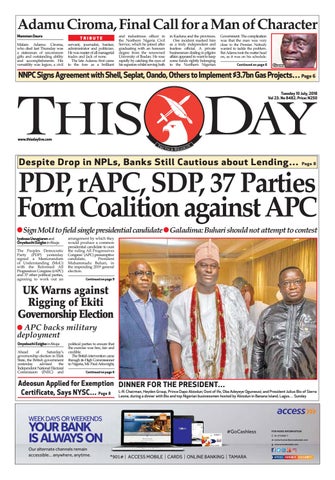
Adamu Ciroma, Final Call for a Man of Character Mamman Daura Malam Adamu Ciroma, who died last Thursday was a statesman of uncommon gifts and outstanding ability and accomplishments. His versatility was legion, a civil
TRIBUTE servant, journalist, banker, administrator and politician. He was master of all managerial trades and Jack of none. The late Adamu first came to the fore as a brilliant
and industrious officer in the Northern Nigeria Civil Service, which he joined after graduating with an honours degree from the renowned University of Ibadan. He rose rapidly by catching the eyes of his superiors whilst serving both
in Kaduna and the provinces. One incident marked him as a truly independent and fearless official. A private businessman dealing in pilgrim affairs appeared to want to keep some funds rightly belonging to the Northern Nigerian
Government. The complication was that the man was very close to the Premier. Nobody wanted to tackle the problem. But Adamu took the matter head on, as it was on his schedule. Continued on page 6
Ciroma
NNPC Signs Agreement with Shell, Seplat, Oando, Others to Implement $3.7bn Gas Projects‌ Page 6 Tuesday 10 July, 2018 Vol 23. No 8482. Price: N250
www.thisdaylive.com TR
UT H
& RE A S O
N
Despite Drop in NPLs, Banks Still Cautious about Lending‌
Page 8
PDP, rAPC, SDP, 37 Parties Form Coalition against APC Sign MoU to field single presidential candidate Galadima: Buhari should not attempt to contest Iyobosa Uwugiaren and Onyebuchi Ezigbo in Abuja The Peoples Democratic Party (PDP) yesterday signed a Memorandum of Understanding (MoU) with the Reformed All Progressives Congress (rAPC) and 37 other political parties, agreeing to work out an
arrangement by which they would produce a common presidential candidate to oust the ruling All Progressives Congress’ (APC) presumptive candidate, President Muhammadu Buhari, in the impending 2019 general election. Continued on page 9
UK Warns against Rigging of Ekiti Governorship Election APC backs military deployment Onyebuchi Ezigbo in Abuja Ahead of Saturday’s governorship election in Ekiti State, the British government yesterday advised the Independent National Electoral Commission (INEC) and
political parties to ensure that the exercise was free, fair and credible. The British intervention came through its High Commissioner to Nigeria, Mr. Paul Arkwright, Continued on page 6
Adeosun Applied for Exemption DINNER FOR THE PRESIDENT‌ Chairman, Heyden Group, Prince Dapo Abiodun; Ooni of Ife, Oba Adeyeye Ogunwusi; and President Julius Bio of Sierra Certificate, Says NYSC‌ Page 8 L-R: Leone, during a dinner with Bio and top Nigerian businessmen hosted by Abiodun in Banana Island, Lagos‌ Sunday :((. '$<6 25 :((.(1'6
<285 %$1. ,6 $/:$<6 21
2XU DOWHUQDWH FKDQQHOV UHPDLQ DFFHVVLEOH DQ\ZKHUH DQ\WLPH
*R&DVKOHVV
$&&(66 02%,/( &$5'6 21/,1( %$1.,1* 7$0$5$
2
T H I S D AY ˾ ͯͮ˜ ͰͮͯͶ
T H I S D AY ˾ TUESDAY JULY 10, 2018
3
4
T H I S D AY ˾ ͯͮ˜ ͰͮͯͶ
T H I S D AY ˾ TUESDAY JULY 10, 2018
5
6
˜ ͯͮ˜ ͺͶ ˾ T H I S D AY
PAGE SIX
NNPC Signs Agreement with Shell, Seplat, Oando, Others to Implement $3.7bn Gas Projects Oil prices climb on global demand, US sanctions on Iran Ejiofor Alike with agency reports The Nigerian National Petroleum Corporation (NNPC) yesterday sealed an agreement with Shell Petroleum Development Company (SPDC), Seplat Petroleum Development Company Plc, Oando Plc and other partners on the implementation of seven critical gas development projects worth $3.7 billion to bridge the gas supply shortfall in the domestic market. This development came as crude oil prices rose yesterday following increased global demand and the United States efforts to shut out Iranian output using sanctions. The development, according to unfolding drilling data, indicated an increase in US shale. Speaking yesterday in Lagos at the ‘Framing Workshop on the Seven Critical Development Projects’, where the agreement was signed, the Group Managing Director of NNPC, Dr. Maikanti
Baru, identified five projects by the NNPC joint ventures and two projects by the Nigerian Petroleum Development Corporation (NPDC), a subsidiary of the corporation, as the seven projects. According to him, some of the projects include, full utilisation of Uquo Gas Plant to deliver 200 million standard cubic feet of gas per day (mmscfd), through the NPDC’s Utapate gas in Oil Mining Lease (OML) 13; and the joint development of OML 24, a joint venture between the NNPC and Newcross and OML 55, a JV between the corporation and BELEMA OIL. The other projects are the full utilisation of Seplat Petroleum Development Company Plc’s Oben Gas Plant to deliver 465mmscfd of gas; and the full utilisation of Pan Ocean’s Ovade Gas Plant to deliver 130mmscfd. “There exist another opportunity to utilise the spare capacity of 100mmsfd in Pan Ocean Ovade Gas Plant, which
currently processes 30 mmscfd due to sub-surface limitation. The plan was to send NPDC Oredo gas to Ovade for processing but due to lack of alignment of schedule, NPDC has progressed significantly with the installation of two compressors to supply the gas directly into the Escravos Lagos Pipeline System (ELPS). This non-alignment of purpose can be eliminated through proper synchronisation of our developments,” Baru explained. He noted that domestic gas demand was growing at an exponential rate that outpaces gas supply development plan. According to him, a gap of about three billion cubic feet per day (bcfd) of gas by 2020 has been identified by NNPC, which will be bridged at the full completion of the seven critical gas projects. Baru said the NNPC had engaged two world-class project management consultants DeltaAfrik/Worley Parson and Crestech/Penspen) who will work with NPDC and
NNPC purview, the corporation would do everything within its means to ensure that lease renewal requests related to these projects are supported for renewal. As the NNPC commenced the implementation of gas projects, crude oil prices also rose yesterday over increased global demand and the limited success of the US efforts to shut out Iranian output using sanctions. Benchmark Brent was up 70 cents at $77.81 per barrel, while the US crude was unchanged at $73.80. The US said it wanted to reduce oil exports from Iran, the world’s fifth biggest oil producer, to zero by November, in a move that will oblige other big producers such as Saudi Arabia to pump more. But Saudi Arabia and other members of the Organisation of the Petroleum Exporting Countries (OPEC) have little spare capacity and oil demand has risen faster than supply over
the last year. At the same time, exports from several OPEC producers, including Venezuela and Libya, have been falling. US oil output is increasing but is unlikely to be able to fill the supply gap if US sanctions are successful in blocking Iranian exports. US energy companies last week increased the number of rigs drilling for oil by five to 863. The US rig count, an early indicator of future output, is much higher than a year ago as companies have ramped up production in response to higher prices. OPEC, Russia and other producers agreed in June to a modest increase in output to dampen oil prices, which recently hit three and a half year high. A rise in supply will reverse some of the output cuts that OPEC and other major producers put in place in early 2017 to end several years of glut.
the number that mattered but the effectiveness of the force in ensuring safety of voters and ballot boxes. According to him, "Whether they use the military or not, I don’t think you want to argue that. Over the years, since 1999 to 2003, the armed forces have always been deployed; don’t forget when I was in Edo State, I told people that I want the armed forces to be involved in the election because the rigging machine is serviced by criminals who are hardened and who are often hired.
‘’Now if you have criminals wielding AK 47 on an election day, and the police is overwhelmed you want to say the army should not be deployed? We shouldn’t worry about who we deploy; I think we should all pray that however people are deployed that in the end we are not counting dead bodies. He added that the important thing is that regardless of what the police chooses to do and the number they choose to deploy, it will ensure that those who are going to vote are safe and
that the votes casted are secure. While commending the British High Commissioner for the visit, he assured that he would do everything to ensure a free and fair process in the Ekiti governorship election. “The process is more important than the outcome because we are looking at the Nigeria project, in terms of sustaining democracy, not the survival of a particular political aspirant, whether it is on my party platform or in the platform of the opposition”, he said.
the venue from 9a.m. to 10p.m. without any announcement of when the convention would begin. The convention was adjourned without achieving anything that day. If the vote had been taken that day, I fancy Adamu would have won the nomination. Late Samuel Ogbemudia subsequently told me that a distasteful amount of money was sourced from a major multinational company and delegates were heavily bribed overnight and the result of balloting the following morrow put Adamu in third place. As the French say, plus ca change… (The more things change, the more they are the same). Nonetheless, Adamu Ciroma participated first as secretary to the party and later a Minister of Industries and Steel, and later still as Minister of Finance and Minister of Agriculture. As I say, he was master of all tasks entrusted to him. When the military again took over the government, Adamu was detained along with many ministerial and gubernatorial colleagues. He was completely exonerated and released early but the strain of incarceration left indelible injury on his psyche and outlook on life. However, you can never keep a good man down. When the civilians returned for a second time President Olusegun
Obasanjo re-appointed Adamu again as Minister of Finance. He brought gusto and competence to his old job, but it was during his chancery at Finance he suffered a dreadful road accident, which nearly cut short his political career and spent months on end in a German hospital. His recovery was slow and his face hideously disfigured. Nonetheless when he resumed work, the difference in his performance was not noticeable. He retired honourably although still active in politics. As a man, Adamu Ciroma was forthright, easy to make friends and had a zest for life. All in all he was a man of good character. For leisure, he enjoyed his golf and was a fierce competitor. Historians may recall that the 19th Century English Queen Victoria complained that one of her prime ministers, Gladstone, addressed her like he was addressing a public meeting. Frequently in conversation with Adamu Ciroma he would address even his closest acquaintances like he was addressing a public meeting, with his right index finger pointing severely at one! His tone was usually didactic and stentorian. A sage once said, “Of all nature’s gifts, the chief masterpiece was the ability to write well.” Adamu could write
well. He could speak well. And he could listen attentively and patiently. This aristocracy of virtues made him stand out among his colleagues. In his senior years, he became deeply religious and generous almost to a fault. But he had no time for dilettantes and scroungers. Once a couple of young men approached him saying that they wanted to write a book about him so that future generations would remember him. His brusque replied, “I don’t want to be remembered.” Fortunately, his wish will not be granted. Adamu Ciroma will be remembered for as long as the present generation lasts.
NNPC JV partners and other stakeholders to achieve set project deliverables. He said the implementation of the projects was the beginning of the end to the gap in domestic gas supply of 3.5 bscfd, as these projects at full implementation would be the final solution in resolving the foreseen domestic gas supply gap. Baru identified timely availability of funds as one of the factors that would help in project delivery, adding that the NNPC had developed a third party financing arrangement for new investments and had also secured $3.7 billion for the under-listed projects. Baru included Belema Oil and Pan Ocean as some of the NNPC’s partners in the projects. He listed governance for unitised assets; timely approvals with other agencies and lease renewal as some of the other enablers that would quicken the implementation of the projects. According to him, though lease renewal is not under
U K WA R N S A G A I N ST R I G G I N G O F E K I T I G O V E R N O R S H I P E L E C T I O N who spoke to journalists in Abuja shortly after meeting with the National Chairman of the All Progressives Congress (APC), Mr. Adams Oshiomhole. His host, Oshiomhole, who also spoke during the visit, expressed his party’s preference for the deployment of the military in the state during the election to help check violence and assure voters of their safety. The British High Commissioner said that his country was interested in seeing that the people of Ekiti State were allowed to freely express
their opinion, to vote in line with their conscience. He said Britain was interested in Nigeria’s democracy, adding that UK Mission would send observers for the election, to ensure it was free and fair. “The British High Commission will be sending a team there to observe the election and to ensure that they go smoothly; to ensure that INEC can do its job; that the security forces do their job and basically to ensure that the people of Ekiti State are allowed to freely express their opinion, to vote along with
their conscience and to be able to do so in peaceful manner," Arkwright said. Commenting on the move by the Nigerian Police Force to deploy about 30, 000 officers with additional 19,000 men by the Nigeria Security and Civil Defence Corps (NSCDC), Oshiomhole said no one should lose sleep, since the security forces would only be in Ekiti to maintain peace. Oshiomhole, who reacted to the outrage over the deployment of 30,000 police officers for the election said that it was not
A DA M U C I R O M A , F I N A L C A L L F O R A M A N O F C H A R A C T E R His minutes to the premier is preserved in the Archives in Arewa House, Kaduna. “Hon. Premier, this money belongs neither to you nor to Alhaji X. It belongs to the people of the North.” In the interest of good manners usually associated with these columns I have refrained from identifying the man. In any case, he is dead now. Adamu’s Nigerian and expatriate superiors were horrified at his forthrightness. One of them asked, “Are you sure you want the premier to see this?” To which Adamu replied “Yes”. To cut the story short although the great man was slightly annoyed, the money was swiftly returned to government coffers. Thereafter, Adamu became a minor celebrity, his minutes was the talk of town for several weeks. His civil service career was not limited to the North. He had a stint in Lagos, where he gathered valuable federal experience before returning to the North and to one of his landmark achievements. A new newspaper, The New Nigerian, was set up by the regional government just before the bloody military take-over of Jan 15th 1966. The mood of the people in the North was that the paper should be run by Nigerians. The regime’s leadership of the civil service cast around
far and wide for a suitable candidate who will spearhead the campaigns to publicise and protect the interests of the North. They picked on Adamu Ciroma. He was the first and the best editor of the New Nigerian. He wrote powerful, thoughtful but always constructive editorials and articles. His command of English was uncommonly brilliant. It was during this time, 1966 – 1967, that a group of enlightened young men, sensing that a vacuum was being created because the military leadership was hopelessly inexperienced and they were beginning to be surrounded by opportunists with dubious bona fides. This group decided to cohere and assist the government with proposals and advice on running the country. Adamu Ciroma was usually their spokesman, such were his gifts of articulation and communication. It was during these heated debates that Mal. Adamu uttered one of his memorable dicta. He said the North must modernise and to modernise it must westernise. This was a subject of discussion for months. Unsurprisingly, the New Nigerian developed a love – hate relationship with the military government with a few instances threatening to reach breaking point. Luckily Adamu survived and handed
over to a carefully planned set of successors. Having grown out of the New Nigerian, the new military government of Murtala Muhammed appointed him as Governor of the Central Bank and good judges within the bank still regard his tenure as one of the best in the bank’s history. It was during his time in the CBN that knowledgeable people began to rate him as a possible future leader of the country. He resigned from CBN and stood election in the Constituent Assembly that was the precursor to full blown political activity and democratic government. It was during the proceedings amidst the severely tense Sharia debate that Adamu Ciroma announced to the assembly the North’s ‘’irreducible minimum’’ condition for a closure to the issue. After gathering support and making extensive contacts among Assembly members, Adamu built a formidable team and network to vie for the presidency in 1979 when the military promised to hand over. On the first day of the convention, Adamu’s team was confident of the outcome. Evidently, those in control of the NPN party machinery became aware that their preferred candidate was unsure of winning. We sat at
TOP GAINERS NGN NGN CAVERTON 0.20 2.21 C & I LEASING 0.22 2.47 FIRSTALUM 0.03 0.41 CHAMPBREW 0.15 2.14 CAPITALOIL 0.02 0.32 TOP LOSERS NGN NGN UNITYBANK 0.10 1.01 MULTIVERSE 0.02 0.22 DNTYRE 0.02 0.27 NASCON 1.15 20.65 JAIZ BANK 0.03 0.63 HPE Nestle Nig Plc ₦1,500.00 Volume: 155.172 million shares Value: N1.991 billion Deals: 3,422 As at 9/7/18 See details on Page 31
% 9.9 9.7 7.8 7.5 6.6 % 9.0 8.3 6.9 5.2 4.5
T H I S D AY ˾ TUESDAY JULY 10, 2018
7
8
˜ ͯͮ˜ ͺͶ ˾ T H I S D AY
PAGE EIGHT
Adeosun Applied for Exemption Certificate, Says NYSC To investigate alleged forgery Ejiofor Alike The National Youth Service Corps (NYSC) has reacted to the alleged forgery of its Exemption Certificate by the Minister of Finance, Mrs. Kemi Adeosun, saying the minister actually applied for an exemption certificate. NYSC’s Director in charge of Press and Public Relations, Mrs. Adeyemi Adenike, however, said in a statement yesterday that the organisation would investigate “the origin
of the purported certificate” presented by Adeosun during her ministerial screening. Part of the statement read, “Our attention has been drawn to the issue of the alleged forgery of an NYSC Exemption Certificate by the Minister of Finance, Mrs. Kemi Adeosun. “Checking our records, Mrs. Adeosun did apply for an Exemption Certificate. We shall investigate the origin of the purported Exemption Certificate in question,” the statement added.
THISDAY had reported that the presidency said it was yet to be briefed about the alleged forgery of NYSC certificate by Adeosun. An online news portal, Premium Times, had in a report at the weekend, alleged that the minister failed to undertake the mandatory one year national service, having graduated at 22, and fraudulently obtained an exemption certificate at 42, in violation of the NYSC establishment act, Decree No 24 of 1973 as amended.
Despite the weight of the allegation, the minister had kept quiet, failing to answer calls to her phones or return text messages from THISDAY. But the NYSC had earlier promised to issue a statement on the matter. The Senior Special Assistant to the President on Media and Publicity, Malam Garba Shehu, had told THISDAY that he was yet to be briefed on the forgery allegation. “Well, I have not been briefed on this. I haven’t heard of it
being spoken. I am completely unaware of anything,” he said in response to THISDAY’s query on what President Muhammadu Buhari was doing about the allegation that one of his ministers committed the crime of forgery. Expectedly, the opposition Peoples Democratic Party (PDP), had at the weekend called on Buhari to sack and prosecute Adeosun on the strength of the allegation by the online medium. The NYSC is compulsory for all Nigerians who graduate
from universities or equivalent institutions at less than 30 years of age. In addition to being a requirement for government and private sector jobs in Nigeria, the enabling law prescribes punishment for anyone who absconds from the scheme or forges its certificates. Eligible Nigerians who skipped the service are liable to be sentenced to 12 months imprisonment and/or N2,000 fine, according to Section 13 of the NYSC law.
Despite Drop in NPLs, Banks Still Cautious about Lending CBN to underwrite $300m W’Bank housing finance loan Obinna Chima in Lagos and Ndubuisi Francis in Abuja The Central Bank of Nigeria (CBN) has revealed that the level of banking sector non- performing loans (NPLs) has declined from as high as 16.21 per cent it was in February 2018, to 14.15 per cent as of April 2018. This is just as the apex bank has also undertaken to underwrite part of a $300 million loan, which was extended by the World Bank to the Nigerian Housing Finance Programme (NHFP). But despite the decline in the level of NPLs in the industry, commercial banks have remained apathetic about lending to the private sector as credit to private sector (CPS) continued to shrink. The CBN disclosed this in the personal statement of members of its Monetary Policy Committee (MPC) at the last meeting that took place in May. A copy of members’ personal statement was posted on the central bank’s website yesterday. In his opinion, an MPC member, Robert Asogwa, expressed concern that the size of banking sector credit to the private sector was declining “and even at poorer levels when compared to the situation at the last MPC meeting.” He added, “CBN Staff report
show that the industry gross credit recorded a 3.63 per cent decrease in April 2018 and the lowest total ever since January 2017 and this happened despite the reported increases in total industry deposits. “The earlier expectation that with economic recession over in 2017 and with recovery signs, credit to the private sector will pick up in the early parts of 2018 is yet to happen.” He pointed out that since a reduction in the monetary policy rate might not likely result in any increase in private sector credit, non-interest rate-based strategies for stimulating private sector credit would be required at this time. Asogwa said this could be achieved through targeted indirect policy instruments, which he said would surely be worthwhile in the immediate period and can be complemented by other short-term measures such as the current CBN development financing support to few critical sectors. Also, another MPC member, Adeola Adenikinju, also expressed concern that, “banks are more eager to strengthen their balance sheet than commit to new credits.” He said, “The continuous preference of banks for relatively
safer fixed income assets rather than direct lending to the real sector of the economy remains a critical challenge to current policy stance. “Simply tinkering with the monetary policy rate (MPR) at this current state of the banking sector may not simply translate into more credit for the economy unless there is a way to creatively ‘de-risk’ the targeted real sectors of the economy. “In general, the banking system witnessed growth in aggregate deposits in the first quarter of 2018, however, there was no corresponding increase in credit. “This implies that more liquidity in the system may not mean more credit as is widely believed in the short term. The high operating expenses in the banking system need to be carefully addressed to reduce the high cost environment which in my view impacts more on lending rates than even the MPR.” To the CBN Deputy Governor, Financial System Stability Directorate, Aishah Ahmad, the economic recovery was yet to reflect on the financial system. According to her, banking sector lending rates has remained significantly high, which was an indication that the industry requires more impetus to
substantially reflect the benefits of the ongoing recovery. She said, “Thus, the monetary authority must work with the relevant financial institutions to entrench innovative measures to safely increase credit to the real sector. “In addition and as a matter of urgency, prompt settlement of outstanding contractor arrears as earlier promised by the federal government will significantly moderate asset quality pressures and further improve resilience of the financial system.” The next MPC holds on 23rd and 24th of this month. Meanwhile, the Director, Other Financial Institutions Supervision Department, CBN, Mrs. Tokunbo Martins, who briefed journalists in Abuja, on the NHFP yesterday, said the CBN "is underwriting part of the $300 million risk of the Housing Finance Programme.” Martins, who spoke on the side lines of a conference seeking to explore solutions to mortgage financing in Nigeria, stated that the NHFP benefited from a loan of $300 million for 40 years, from the World Bank, adding that the CBN was underwriting the foreign exchange risks. Martins said, "The CBN is the project implementing entity of the NHFP and the NHFP is
meant to re-fund the primary and secondary markets for mortgages. It is a public-private partnership and we have a loan from the World Bank so the CBN itself is not putting anything in directly." Also speaking, the Head, Nigeria Housing Finance Programme domiciled in CBN and head of the implementation, Adedeji Jones Adesemoye, stated, "The major driver of the programme, the Nigeria Mortgage Refinancing Company (NMRC) funds (N8.2 billion and N11.1 billion) from the Nigerian capital market to refinance the mortgages that have been financed by primary mortgage institutions." According to him, a component of the mortgage package is that money will be disbursed through seven microfinance banks across the nation, this money is given to them in naira. He added that "between now and November we will be launching mortgage guarantee company hopefully by the president to widen and bring us to the tail end of modern mortgage system in such a way that those mortgagees, the institutions that are lending to our people can actually share risk so that more people will have access, to the housing fund." Also speaking at the event, a director at NMRC, Mrs Chii
Akporji, said modern mortgage basically required certain steps that state governments needed to take in order to create the enabling environment for mortgages and housing investment to thrive. She said, "There are a number of steps, essentially looking at issues of land titling, property registration, instituting a foreclosure mechanism, those are the key things that state governments are asked to look into with a view to reforming it." She regretted the delay in granting of governor's consent, saying it usually took a long time, and advised that it be delegated to a commissioner. She added that the difficulty is accessing land titles and urged state governments to leverage technology, digitize their land register, to have adequate and proper record of who owns what in terms of land. In terms of property registration she said, "Sometimes it takes years to register a property and so expensive. Studies we did found that in some states property registration takes up 45 per cent of the cost of the property itself. This is crazy." Going forward, the NMRC she said, had asked state governors to review their charges downwards.
lives for the sake of our country.’’ Speaking more on the reason for the gathering, the former National Secretary, PDP National Caretaker Committee, Senator Ben Obi, said the parties had come to sign a memorandum of understanding (MoU), explaining that the political parties in alliance had resolved to reverse all the anomalies in governance brought about by the inept Buhari-led administration. While reading the terms of the new alliance, former Minister of Foreign Affairs, Chief Tom Ikimi, described the ‘’APC change’’ as a negative change, which Nigerians had come to reject. In the terms of the MoU, the parties said, "We have resolved to ensure zero tolerance for corruption. We further resolved to ensure competitiveness and economic growth and development. ‘’In pursuit thereto the parties hereby agree as follows: that the leadership of the parties are hereby committed to work together in a Coalition of United Political Parties (CUPP) determined to replace the present APC-led government with an acceptable government of national unity in 2019, which will promote cohesion among the coalition parties. ‘’To give hope to all Nigerians, the parties are committed to presenting a single presidential candidate to contest the 2019 election in order to enthrone a true democrat who will service the nation and heal the wounds caused by the APC government. ‘’That the parties will seek to promote acceptable core values for the restructuring of the federation,
secure lives and properties and redirect the nation's economy.” Apart from the MoU signed yesterday, the CUPP said that it would in due course present to Nigerians “a people-oriented manifesto’’ that is meant to ensure that Nigerians feel the immediate impact of good governance as soon as the parties form a national unity government in 2019. On his part, the SDP National Chairman, Chief Olu Falae, cautioned stakeholders in the new political alliance to ensure that they do not allow individual ambition to cripple the alliance. Also speaking on behalf of other governors, the Governor of Akwa Ibom State, Mr. Emmanuel Udom, advised members of the coalition to ensure that they do not lose sight of the direction of the initiators, adding that the coalition is for a new Nigeria. He used the opportunity to solicit the support of political parties in the alliance for the candidate of the PDP in the Ekiti State governorship election as a mark of the new spirit to win Nigeria back from the APC. The Deputy Senate President, Dr. Ike Ekweremadu, said the signing of MoU marks the dawn of a new Nigeria, advising leaders of the coalition never to disappoint Nigerians. He added that many Nigerians who watched yesterday's event were smiling because they believed that Nigeria was coming back to life. Senator Dino Melaye said, "The task to bring back Nigeria is one of no retreat, no surrender," advising those who are still contemplating
joining the PDP to make haste before it is too late. He added that APC would lose power in 2019, adding that Buhari was entitled to failure and that he was going to fail in 2019. An rAPC chieftain, Alhaji Abubakar Baraje, in his remark, said it took him almost one and a half hours to access the venue of the meeting because of the crowd, describing the defection, which saw some of them defecting to APC along with some governors as "going astray.’’ He thanked the PDP for accepting and absorbing them back into its fold despite what they did. Former PDP National Secretary, Prince Olagunsoye Oyinlola, said these were not the best of times for our country, adding that the past three years had seen the people impoverished to the extent that the Brooklyn Institute recently crowned Nigeria as the ‘Poverty Capital’ of the world. “Insecurity has become the new normal while the government is lost and continues to pass the buck in a most ridiculously unfortunate manner. When things like this happen, those of us who are the elite are hardly affected,’’ he stated. Oyinlola added, “Those who bear the brunt of misrule and its consequences are the helpless, ordinary people. Ironically, it is we the elite the same people look up to save them. That is why I see this initiative at rescuing our nation as an assignment from God which we must all carry out with all seriousness, honesty of purpose and patriotic commitment.’’
P D P, r A P C , S D P, 3 7 PA RT I E S F O R M C O A L I T I O N A G A I N ST A P C The MoU produced the Coalition of United Political Parties (CUPP), which would be the special purpose vehicle for the achievement of their sole aim of picking a consensus presidential flag bearer. THISDAY had reported yesterday that the main opposition party, the PDP, was arranging a coalition of 45 political parties to stand up to the APC in the 2019 general election. The coalition also resolved to seek and promote acceptable core values for the restructuring of the federation, secure lives and property and redirect the nation's economy. The 39 parties which signed the MoU at a crowded ceremony in Abuja yesterday, include, PDP, rAPC, Social Democratic Party (SDP), African Democratic Party (ADC), Action Alliance (AA), Alliance for Democracy (AD), Action Democratic Party (ADP), Action Peoples Party (APP), Advanced Congress of Democrats (ACD), Better Nigeria Progressive Party (BNPP), Democratic Alternative (DA) and Democratic Peoples Congress. Others are National Conscience Party (NCP), New Generation Party (NGP), National Unity Party (NUP), Nigeria Intervention Movement (NIM), Peoples Progressive Party (PPP), People for Democratic Change (PDC), Providence Peoples Congress (PPC), Unity Party of Nigeria (UPN), Restoration Party of Nigeria (RPN), Young Democratic Party (YDP), KOWA Party, Green Party of Nigeria (GPN), C4C and others. Kicking off the event, the PDP National Chairman, Prince Uche Secondus, said signing of the
alliance by the parties marked the commencement of the determined efforts to rescue the country from sufferings and bad governance, saying "We are ready to go to detention until our freedom and good governance is restored." He said PDP was committed to fighting corruption in a most civilised manner and not the crude method of framing people by the APC. Using the opportunity to comment on Ekiti State governorship election slated for Saturday, he asked President Buhari to prevail on his party and the Independent National Electoral Commission (INEC) to ensure that the election was free and fair. He added that PDP would resist any move to rig the Ekiti State governorship election, threatening that there would be no election in 2019 if the Ekiti election was rigged. Reminding the security agents that their responsibility is not to do the bidding of one man but Nigerians, he lamented the wanton killings of innocent Nigerians. The National Chairman of the rAPC, the break-away faction of APC, Alhaji Buba Galadima, said he was highly delighted and elated by the presence of the cream de la cream of the Nigerian society seated for the MoU. According to him, “What we are about to do will send shivers not only to those on the other side of the coin but to the entire world; we are witnesses to a significant event. Most diplomats and leaders of other countries of the world keep on wondering whether there are men and women of courage
and integrity in this country that can face the monster. ‘’This significant event that we will be witnessing here very soon is the answer to the outside world and to Nigerians. Let me say since we made a declaration of the formation of the Reformed APC, we have received unprecedented messages of support, solidarity from all over the world and I am confident that should we put our acts together, should we tag together, if we are fair to ourselves, do things transparently and bring up one man or woman, we will save this country, we will provide a future for our children and grandchildren.’’ Galadima cautioned that the MoU is not going to be a tea party, saying, ‘’The man we will be facing is a military general; but we know him and you I know him; if I were him, if I were his adviser, I will advise him (Buhari) not to attempt to contest.’’ He added, “From the day we announced the formation of the rAPC, a lot of people received threats, a lot of people received gratifications, a lot of people received pressure from unsolicited quarters to persuade them to back out. ‘’We are ready, prepared to take on this fight despite any deprivation, intimidation, even torture because this country belongs to all of us. We must together fight for this our right. ‘’They can use the big stick. You do know a desperate person can do anything. He can kill, if he has powers, he can arrest, detain. Whichever one they choose to do, we are prepared to lay down our
T H I S D AY ˾ TUESDAY JULY 10, 2018
9
TUESDAY, JULY 10, 2018Ëž T H I S D AY
10
NEWS
ĂœĂ™Ă&#x;Ăš Ă?ĂĄĂ? ĂŽĂ“ĂžĂ™Ăœ Ejiofor Alike Ă—Ă‹Ă“Ă– Ejiofor.Alike@thisdaylive.com, 08066066268
FG Asks Discos to Deliver Power or Quit Says no Disco has exclusive right over 11 networks Directs NERC to enforce Discos’ service agreements Reveals Discos’ debts to NBET now N500bn Chineme Okafor Ă“Ă˜ ĂŒĂ&#x;ÔË The federal government yesterday asked the 11 electricity distribution companies (Discos) in Nigeria’s electricity market to buckle up or get out and leave the business of power distribution for people who are willing to compete and uphold their obligations in the sector. Suggesting that the Discos have failed to live up to expectations in the industry, the government said it would not sit back and allow them to hold Nigeria hostage with their poor performances. It thus asked the Nigerian Electricity Regulatory Commission (NERC) to immediately step up its enforcement of the contracts of service of the Discos with regards to supply of meters, upgrade of their distribution networks and promotion of
market efficiency. Speaking to journalists at a briefing in Abuja, the Minister of Power, Works and Housing, Mr. Babatunde Fashola, explained that the government had not granted the Discos exclusivity over their distribution areas and as such, the NERC could take regulatory decisions on issuance of fresh distribution licences especially within areas that are underserved by the Discos. Fashola also stated that the financial remittances of the Discos have been very poor, adding that at the moment, they owed the Nigerian Bulk Electricity Trading Plc (NBET) a whopping N500 billion as debts for electricity sold to them by the NBET. “It must be obvious to the ordinary person that the supply of power is now a private business in the hands of private operators and in the end, in the
hands of the Discos. “But because of the critical and sensitive nature of power supply, government has not left the supply solely. Government at federal, state and local level, as well as former employees of PHCN hold 40 per cent of the shares in the Discos. “In addition, government is responsible for regulating the behaviour and compliance through the NERC which is like what the Central Bank of Bank (CBN) is to the banking sector,� Fashola said. He further explained: “The law does not make it mandatory for any Nigerian to receive power from the Disco or to use only public power, that is why it is not an offence for Nigerians to buy generators, inverters or solar systems which are of course more expensive than the power which NBET buys from the Gencos to vest to the Discos to distribute to
customers. “It is the Discos which are service providers that you should turn to when you have questions about transformer collapse and metering. “As it is now obvious, from 2016 when the Discos complained about lack of power to distribute, the problem today is that the Discos cannot distribute all of the power that is available, leaving the sector with an unused capacity of 2000 megawatts approximately.� Although, he acknowledged that Discos alone could not be blamed for the failures of the sector, but suggested theirs were pretty obvious and most impactful. “This is not the time to trade blame because there is enough blame to go round; for me, it is a time to reiterate everybody’s responsibilities and urge us to brace up to do what we are obliged to do, which is to serve
the people. “In the face of this picture, where we have power to sell, with more to come, the number of complaints coming to government for meters, which the Discos should supply, and for estimated billings, and mass disconnections when not everybody is owing cannot continue. “Government must act, and will do so. The Discos bought these assets with their eyes opened, and they must compete to deliver or exit,� Fashola insisted. He said small businesses need power but cannot get enough because of Discos’ failure, just as he claimed that the investments of Gencos were threatened because they cannot utilise the capacity they have installed. According to him, none of the Discos has an exclusive distribution licence and as
such, could not stop NERC from issuing new licences in the network areas they cover. “Clearly, unless the Discos have a licence that is endorsed as exclusive, it is clear that no Disco has exclusivity over its franchise area. “It is obvious that the law did not intend to replace government monopoly of PHCN in the power sector, with a private monopoly of businessmen. “Whenever there is poor service, government, as a matter of policy and public interest, is able and entitled to act and invite new players to fill the gap,� he added. The minister also noted that it was not the intention of government to take over the business of Discos, adding that it wanted them to grow. He however said: “In the period when they are not yet
Cont’d on Pg 35
Obasanjo Storms Ogun PDP Rally, Rekindles Hope Femi Ogbonnikan Ă“Ă˜ ĂŒĂ?ÙÕĂ&#x;ÞË It was a moment of wild jubilations and rekindled hope for thousands of the supporters of the Ogun State chapter of the Peoples Democratic Party (PDP) as former President Olusegun Obasanjo yesterday stormed the political rally of a governorship aspirant of the party in the state, Hon. Oladipupo Adebutu, to honour him. Obasanjo who dressed in white kaftan created excitement in the mammoth crowd when he walked into the rally and waved, an indication that he wished the party and Adebutu success in their aspiration. Obasanjo who quitted partisan politics in the build–up to the 2015 general election, did not speak during the brief moment at the rally that took place at an expanse ground within the Olusegun Obasanjo Presidential Library (OOPL), Abeokuta, the state capital. Earlier, the PDP aspirant, Adebutu, admonished Nigerians at all levels of leadership to
provide good governance to the people, stressing that it is the only way to secure their “exalted positions and wealth.� He said high and mighty fences or trenches could hardly secure but would just entrap one in an environment of poor governance. The governorship aspirant, who is representing Ikenne/ Remo North/Sagamu federal constituency in the House of Representatives gave the charge at the Ake palace, Abeokuta, when he met with the Alake of Egbaland, Oba Adedotun Gbadebo, and his chiefs prior to the rally held at OOPL. He was at the palace to thank the paramount ruler for his prayer in 2015 when he was contesting for the current seat he occupies at the lower chamber of the National Assembly and to also seek further blessing from the royal father ahead of his 2019 governorship ambition in the state. Adebutu said good governance would bring genuine growth and development to the people and curbs corruption.
FG to Build N10bn Rice Mills in 10 States Olawale Ajimotokan Ă“Ă˜ ĂŒĂ&#x;ÔË The federal government yesterday moved to boost rice production by signing a N10 billion contract for the construction of integrated large-scale rice processing plants in ten states of the federation. The Memorandum of Understanding (MoU) was signed yesterday between the Federal Ministry of Agriculture and Rural Development and MV Agro PVT of India and its partners, MV Agro Engineers Nigeria limited. The 10 states where the rice mills will be cited are Anambra, Kaduna, Kebbi, Ogun, Zamfara, Kogi, Benue, Bauchi, Niger and Bayelsa.
The MoU will enable the conclusion of the plant’s procurement procedures, installation and inauguration. According to the Minister of Agriculture, Chief Audu Ogbeh, the 10 plants are to be deliveredwithin 18 months or latest by December 2019. He said each plant would have the capacity to produce 30,000 metric tonnes of rice per annum. The cost of each plant is N1 billion. Ogbeh justified the agreement with the Indian equipment makers, saying in the past, the deal for 10 mills would only have covered four mills.
SIGNED AND SEALED
L-R: Vice Chairman/Managing Director, Nigerian Agip Oil Company, Fiorillo Lorenzo; Managing Director, Total E & P Nigeria Limited, Nicolas Terraz; Group Managing Director, NNPC, Dr. Maikanti Baru; Country Chairman, Shell Companies in Nigeria/ Managing Director, Shell Petroleum Development Company, Osagie Okunbor, and Chief Operating Officer, Oando Energy Resources, Ainojie Irune, during the landmark signing ceremony of seven critical gas development projects in Lagos‌yesterday
Army Releases 183 Kids Involved in Insurgency to Borno Govt, UN Michael Olugbode Ă“Ă˜ Ă‹Ă“ĂŽĂ&#x;Ă‘Ă&#x;ĂœĂ“
The Nigerian Army has released 183 children who were formerly involved with Boko Haram insurgency to the Borno State Government and representatives of the United Nations. The latest release, made the total number of kids earlier involved in Boko Haram insurgency released by the military to about 2,000. The kids whose age ranges from seven to 16, were released by the head of the military counter-insurgency in the Northeast, Commander, ‘Operation Lafiya Dole’, Maj. Gen. Rogers Nicholas, representing the Chief of Army Staff, Lt. Gen. Tukur Buratai. He handed over the 183
kids, including eight girls who were used as bomb couriers, to officials of Borno State and United Nations. Representing Borno State Governor, Alhaji Kashim Shettima, was ommissioner for Women Affairs, Hon. Fanta Baba Shehu, and representing the United Nations was Ibrahim Sesay, who stood in for Mr. Edward Kallon, Country Representative of UN and Humanitarian Coordinator in Nigeria. Speaking at the handing over of the kids, Nicholas said the decision was taken to hand them over for proper management of their reintegration. He said they had been in the custody of the Nigerian Army for sometimes, noting that the
military has been working with the UN Children Fund on similar issue so as to ensure there was no relapse in the cases of the children. Baba-Shehu expressed the appreciation of Borno State Government and people to the military under Buratai for giving the people of Borno State “free air.� She also said the Borno people would remain indebted to the UN and its agencies for being there for the state in the time of need. Baba-shehu promised the newly-released kids that they would be looked after and made to get the best during rehabilitation. On his part, Sesay said the release was a significant
moment. He said: “There has been great working relationship between UN system and the Nigerian Army. Sesay said with the latest release, it is estimated at 2,000, stressing that the UN would work with all stakeholders to ensure that the kids are reintegrated back to the society. He said the transformation process of the kids was a long process and that the release was the first step, adding that providing them with needed tools for reintegration, follows next. Sesay said there were over 7000 children in the ongoing reintegration plan of the UN in the area.
T H I S D AY ˾ TUESDAY JULY 10, 2018
11
12
T H I S D AY ˾ ͯͮ˜ ͰͮͯͶ
T H I S D AY ˾ TUESDAY JULY 10, 2018
13
14
T H I S D AY ˾ ˜ ͯͮ˜ ͰͮͯͶ
COMMENT
Editor, Editorial Page PETER ISHAKA Email peter.ishaka@thisdaylive.com
MACRON’S SPECIAL LOVE FOR NOLLYWOOD
The French President has bestowed special gift on the entertainment sector in Nigeria, writes Steve Ayorinde
N
ollywood is on my mind and it’s for a heartwarming reason. This Made-in-Lagos industry caught the attention of the world last week in a very significant way. First, two of its illustrious stakeholders - Femi Odugbemi, cerebral filmmaker; arrowhead of IRep International Documentary Film Festival and the man that will drive Multichoice’s Talent Factory as well as star actor Omotola Jalade-Ekeinde were invited into the new set of cineastes from across the globe to join the Academy of Motion Picture Association as voting members. In other words, Femi and Omotola now have voting rights in determining which films and filmmakers now win the OSCARS. The invitation is a major accomplishment for these two professionals and for Nollywood as a home-grown industry. And it gladdens the heart that the first two considered worthy of this honour live and work in the home state of Nollywood and cinema in Nigeria. #lagostourism is proud of you. Remarkably too, just few days after the good news from the United States, home of the Academy Awards, the French came to honour Nollywood in its homestead. And it wasn’t just an ordinary honour, the recognition for Nollywood as a super force came from the very top. President Emmanuel Macron of France joyfully turned his state visit to Lagos to a cultural extravaganza that is still resonating all over the world, validating Lagos as the undeniable liberal home of the creative industry in Africa. President Macron chose the iconic New African Shrine as the venue of that historic night last Tuesday to celebrate African culture. He saw a mini exhibition of art works by Nigerian artists; curated by Tokini Peterside of Art-X. He was wowed by 11-year-old Kareem Waris’ painting prowess. He danced to Femi Kuti’s afrobeat and beat the talking drum with Ara (Thunder). He applauded the fashion parade from Lagos designers; granted a no-holds-barred interview; spoke glowingly about Lagos even in pidgin and took selfies with practically everyone at the Shrine. But he seemed to have reserved a special love for Nollywood! He acted on the stage with screen icons like Chika Okpalla (Zebrudaya); Jide Kosoko; Joke Silva; Omotola; Rita Dominic; Ramsey Nouah; Yomi Fash-Lanso and Kemi Laala-Akindoju among others in a mock production set directed by Kunle Afolayan. It was no ordinary show. The president of one of the most powerful countries in the world and the home to the world’s biggest film festival acting in a Nollywood skit on a Lagos stage serves a special purpose. It’s an endorsement that is more than an offer of partnership. It’s an overture; a bright green light for a love story that is about to happen. Monsieur Macron entertained questions from Afolayan and had a one-on-one with Mo Abudu. He brought Mauritanian-born Cannes film festival veteran, Abdulrahaman Sisseko to interact with other Nollywood icons like Olu Jacobs, Tunde Kelani and Genevieve Nnaji who were also in the audience, ostensibly saying what Sisseko achieved with TIMBUKTU at Cannes and at French cinemas (or Ousmanne Sembeme with MOOLADAY) can indeed be achieved by say a Kelani; Odugbemi; Izu Ojukwu; Fred Amata; Lancelot Imasuen, Niyi Akinmolayan; Kenneth Gyan or Afolayan, who all are flying Nollywood’s directorial flag beautifully if the industry can get the politics and diplomacy components
THE SHRINE DECLARATION WAS A MESSAGE THAT LAGOS AND NIGERIA MUST TAKE ITS RIGHTFUL PLACE AT THE YEAR 2020 AFRICAN CULTURAL SEASON IN PARIS
of the global audio-visual business right. Yet, President Macron listened and nodded in agreement to the film school initiative from Chioma Ude, the brain behind African International Film Festival (AFRIF) whose partnership with Lyon, France-based CineFabrique will open another window of opportunity in film studies in Lagos. CineFabrique Lagos from next year promises young talents two years of study in Lagos and last year in France. Nollywood sure is going to another level. Putting icing on the cake of this historic visit, Mr. Macron chose to announce the year-long African Cultural Season in France in the year 2020 in Lagos. He didn’t make that announcement in Dakar or Cotonou; all he did with those two important cities was to pick the godfather and godmother for the cultural season - Yossou Ndour and Angelique Kidjo - from there; and then brought them along to Lagos for the special announcement to be made. What President Macron was saying in essence was that the doors are now open; no more barriers and that the opportunities will be limitless for talented professionals and creative entrepreneurs with fresh ideas. The Shrine declaration was a message that Lagos and Nigeria must take its rightful place at the Year 2020 African Cultural Season in Paris. For Nollywood, the journey of the last renaissant 30 years - from celluloid big screen films; to ‘reversal’ movies; then to home videos and now to the digital new Nigerian cinema that has returned the audience to the movie theatres is just about to enter a new phase; a new vista that is getting the world to take more than a passing interest in the ways that we have chosen to tell our stories on the big screen. For sure, the keen interest that Lagos State has in this industry is adding to the new lease of life - in supporting productions; award ceremonies and festivals; in providing opportunities for stakeholders to share in the glory that Toronto International Film Festival bestowed on Lagos in 2016 as the City in Focus and at Cannes Film Festival where it has provided a Pavillion back to back for quality visibility for the industry; in appointing two key professionals into the Board of Council for Arts and Culture and in bringing on board the views of industry heads and stakeholders in preparing its tourism master plan. A warm hand of friendship has been extended and it can only get better. Undoubtedly, therefore, the other night at the African Shrine attests to the good vibes that Nollywood is getting from the city of its birth. That the Academy Awards and the French President are in open romance with the industry at this point simply means that the sky is not the limit. Reflecting on all these on Sunday evening, few hours to my special day, I couldn’t help but conclude that the special honour that President Macron has bestowed on the new African Shrine and Falz’s legacy; on Nollywood as indeed the entertainment and culture sector; on Lagos State and Nigeria as a whole, is in essence a special birthday gift to yours truly. Thank you Monsieur Macron; congrats Nollywood and the Lagos arts scene! Ayorinde is the Lagos State Commissioner for Tourism, Arts and Culture
PARADOX OF AUTHENTIC LEADERSHIP
Samuel Akpobome Orovwuje argues the need to overhaul the existing leadership structure of the nation
T
he regretful narrative of episodic elections and political leadership deficit reminds me of Robert Kaplan classic entitled: The Coming of Anarchy. In the book, he painted a gloomy picture of how episodic experiment in democracy, scarcity, crime, over population, ethnicity, and weak leadership are rapidly destroying the social fabric of our planet, and indeed Nigeria. This statement underscores the challenges of authentic leadership and the call on the youth to take the country from the old guards. Indeed the declared intention of the incumbent President Muhammadu Buhari to run in 2019 has received a considerable media attention; little of it has focused on the changing dynamics of the Not Too Young to Rule Act 2018.The commonality of interest that is emerging from the various town hall meetings and civic engagements in addressing the debatable national question that is essentially hinged on restructuring, devolution, territorial dimensions of the state that reflect true federalism and a wake - up call for a new governance architecture or paradigm shift in line with global practice for developing a healthy competition driven by resource- endowments would be the key driver for sustainable leadership in the coming months particularly for the presidential elections. Indeed the real conversation is let the elites not betray us and this article emerges out from a larger, developing project to build a network of new breed politicians with a sense of an uncommon passion to address the critical mass of nation-building. A content analysis of their aspiration projects and template is robust and
forward thinking and in my view represents the gameness of authentic leadership waiting to happen! Sadly, the nation in the last five decades or so has had terrified followership that never asked for constructive feedback from elected leaders which has resulted in maladaptive behaviours from the old guards that is foisted on us by a select few that manipulate the greater majority with empty promises and provincial sentiments largely driven by existential greed. Furthermore, old guards and the youth succession nexus has been abysmally low. The challenge over the years has been devious; no clear pathway to leadership recruitment based on coaching, mentorship, and succession planning mechanisms for nation-building and the political arrangements where everything resides at the centre is suspect. More worrisome is the centre’s inability to deal with a variety of violent extremism, the continuous risk with rent – seeking, illiterate leaders and a bureaucracy that is a clog in the wheel of progress. Equally significant, although tinged with some sadness, is the manifestation of unstructured leadership recruitment, procrastinations, existential denial, brooding, ethnic jealousy and the political elites self – sabotaging mechanism of youth exclusion from public policy debates and the promotion of political violence through thuggery and savagery during elections – all had been the bane of our political behaviour and national-building efforts. Crucially, the elite power arrogance may be the most seriously self - deceiving attitude in the 2019 general elections that can afflict the APC and PDP in winning majority, particularly
where propaganda and non- performance are evident in the two of a kind towards our nation-building efforts. What is more, an apparent optimism by the old sharks across the political divide of assured winning tends to undermine a proper concern for the Not Too Young to Rule in the emerging power equation and the changing dynamics of electioneering in the days ahead. In addition, the political myopia, the idea of indispensability by the ruling elite and the pretty conviction that there is no substitute for real leadership in my view is a daydream; and on the other hand, the tenacious belief in their continued superiority as result of stolen wealth from the state to manipulate the process may blur our search for fresh hands that will deliver the common good. However, enlightened and vigorous agenda setting will enhance a reverse leadership that will stand the test of time and the time is now! Interestingly, as a nation we urgently need to reframe the leadership versus followership narratives that gives room for realistic goals with a view to creating a positive dialogue and conversations that can correct and signpost the current leadership deficit in the political setting. We must provoke and sustain the debate on restructuring and civic engagements beyond the rhetoric and emotions of empty campaign promises and vote- buying orchestras that will move across the country soliciting for our votes. We must demand a balance scorecard of deliverables and achievement milestones against budget and plans. Going forward, one of the major ways to achieving authentic leadership is that citizens must learn to reflect and suggest policy
changes to a specific issue, which are debated at a public event and specific questions asked during electioneering campaigns. Furthermore, adopted public policy motions should be shared with respective presidential candidates, state governors, state and local authorities for consideration when voted into office. This in my view will provide a realistic performance bond in the coming years. Therefore, as informed followers particularly with the drumbeat and pranks for the 2019 general elections, we must frame the conversations to provide viewpoint and profile the outlook for a new national proposals and plan of actions, which the new movements for the restoration of a new Nigeria should pursue with vigour. Further, we need to mollify the old breed and unadventurous self – serving elite club that we can recalibrate and develop a shared vision and mobilise commitment to change through joint diagnosis of nation- building challenges particularly with the institutionalisation and revitalisation of federal structures and systems that energise competitiveness for national productivity and progress. Indeed societal diversity is an asset of any great country if the mutual strengths of each group can be recognised and harnessed to complement each other. The ongoing movement of Not Too Young To Rule gives hope that a new leadership can evolve when there is genuine willingness from all sides including partnering with all the interventionist groups. It is my view that a shift in the existing leadership structure may be the magic wand that would return Nigeria its pride of place. Orovwuje, is Founder, Humanitarian Care for Displaced Persons, Lagos
15
T H I S D AY TUESDAY, JULY 10, 2018
EDITORIAL RAPE AND ENUGU SCHOOLS Criminals will continue to act with impunity unless they are severely sanctioned
E
vidently because it is easy for rapists to get away with their heinous crime in the state, Enugu is becoming increasingly notorious for cases of sexual violence and assault on women and girls. The latest was the confession last week to the police by no fewer than 30 teenage girls in some Junior Secondary School classes that they had been repeatedly gang-raped during and after initiation into some weird confraternities. The sad bit is that these bestial violations are not restricted to Enugu State; it is a national malaise that the authorities, at all levels, must find a way to deal with. Following a tip-off, the police had raided some Enugu schools where they were confronted with the tragic situation. “Our parents didn’t know we are in the Viron Queen Confraternity,” said one of the girls, “We were threatened not to tell anybody. The irony is that at the DILIGENT PROSECUTION closing hour of the AND SWIFT SANCTIONS school, three of the same boys who WOULD SEND A initiated us would STRONG SIGNAL TO come with bike and THE PERPETRATORS TO us away to DESIST FROM THESE ACTS take have sex with us.” Cases of gangrape and sexual assault on girls and women across the nation are assuming the shape of an epidemic. Statistics from NOIPoll, an organisation with specialty in conducting opinion polls on burning issues, has long established this fact. Last week, the Imo State Police Command paraded one Nnamdi Ogidi, a suspected criminal and a member of a gang with the record of kidnapping elderly women for ransom. “We derive pleasure in kidnapping elderly women and while their family members are running around for ransom, we will take turns to rape the women,” he said. Perhaps the most worrying aspect of the grow-
Letters to the Editor
ing menace is the high prevalence of child rape. Children, some as young as two years, are being defiled by their custodians. The trial of a private school supervisor who violated a two-year-old child in his care in Lagos is still vivid in many minds. So also was the case of a man arrested last month for defiling a five-year-old girl in his house in the suburb of Lagos. Thus, the question has become inevitable: Why are there increasing incidents of rape in our society? What could account for the spike in sexual assaults on minors, some by full grown adults? What is aiding this pervading culture? And more importantly, what could be done to control this social malaise?
U T H I S DAY EDITOR BOLAJI ADEBIYI DEPUTY EDITOR DAVIDSON IRIEKPEN MANAGING DIRECTOR ENIOLA BELLO DEPUTY MANAGING DIRECTOR KAYODE KOMOLAFE CHAIRMAN EDITORIAL BOARD OLUSEGUN ADENIYI EDITOR NATION’S CAPITAL IYOBOSA UWUGIAREN MANAGING EDITOR JOSEPH USHIGIALE
T H I S DAY N E W S PA P E R S L I M I T E D EDITOR-IN-CHIEF/CHAIRMAN NDUKA OBAIGBENA GROUP EXECUTIVE DIRECTORS ENIOLA BELLO, KAYODE KOMOLAFE, ISRAEL IWEGBU, IJEOMA NWOGWUGWU, EMMANUEL EFENI DIVISIONAL DIRECTORS BOLAJI ADEBIYI, PETER IWEGBU, ANTHONY OGEDENGBE DEPUTY DIVISIONAL DIRECTOR OJOGUN VICTOR DANBOYI SNR. ASSOCIATE DIRECTOR ERIC OJEH ASSOCIATE DIRECTORS PATRICK EIMIUHI, SAHEED ADEYEMO CONTROLLERS ABIMBOLA TAIWO, UCHENNA DIBIAGWU, NDUKA MOSERI DIRECTOR, PRINTING PRODUCTION CHUKS ONWUDINJO TO SEND EMAIL: first name.surname@thisdaylive.com
TO OUR READERS Letters in response to specific publications in THISDAY should be brief (150-200 words) and straight to the point. Interested readers may send such letters along with their contact details to opinion@thisdaylive.com. We also welcome comments and opinions on topical local, national and international issues provided they are well-written and should also not be longer than (9501000 words). They should be sent to opinion@thisdaylive.com along with the email address and phone numbers of the writer.
2019 ELECTIONS AND THE LOOMING FAILURE
D
emystifying the time-honoured saying that ‘the powerful never lose opportunities-they remain available to them, that the powerless on the other hand, never experience opportunity – it is always arriving at a later time, remains a remarkable political lesson Nigerians gave to the world in 2015. The lesson was predicated in the way and manner the ‘poor masses’ against all permutations voted the then ruling Peoples Democratic Party (PDP) out of its preeminent position after 16 years reign and had them replaced with the All Progressives Congress (APC). Three years after the feat was achieved, the nation’s political space has again become ‘hot and cold,’ breeding different political off-springs with the Reformed All Progressives Congress(R-APC) emergence as the newest. While this is ongoing at the parties’ enclaves, a higher level of intrigue like that of 2015, seems to be brewing among Nigerians irked by the leaders’ inabilities to create a government that works better and costs less as promised. The people’s grouse, looking at commentaries is hinged on the feeling that their interests and opinions expressed over time have neither evoked positive response from the government nor the government made a conscious attempt to enter into their lives and participate in their struggle - eliciting accusations that the present crop of leaders manipulates, and undermines the viability of democracy customarily designed to stand on the tripod of openness, reliability and responsiveness. In line with the above table of ideology, Nigerians from the analysis of their recent actions have understandably become more courageous than conscious and, are no longer ready to assist the
nfortunately, no study has been conducted to show the cause of this increasing deviant behaviour. But it is clear that the society has not come hard enough on the perpetrators of the crime. Despite the high prevalence of rape, Evans Ufeli, a lawyer versed on the wanton human rights violations, said in 2015 that only 18 convictions had been made in the country’s legal history. “Government agents who are saddled with checking sexual assaults, especially the police and public prosecutors, compromise their profession,” Ufeli said. The insensitivity of the authorities and the fear of stigma help to discourage victims of sexual violence from formalising the reports of incidents involving them. This reluctance, however, has only contributed to the rise in a culture of impunity on the part of the perpetrators. Yet, as we have repeatedly said on this page, diligent prosecution and swift sanctions would certainly send a strong signal to the perpetrators to desist from these acts. The only way citizens can feel safe and secure is where the response to crime is swift, efficient and effective. Our courts must be more proactive and stringent in applying sanctions. That is what the current situation demands. No society should condone rape which regrettably is fast becoming a social epidemic.
government to cover its shame. Supporting the above sentiment is that in recent times and in the clarity of our visions, our leaders took some steps/decisions which I will safely describe as disastrous in the following areas: security, justice, and fairness, human survival and peaceful coexistence of the nation. Actions that prompted Nigerians with discerning minds to conclude that with the way the country is stumbling and fumbling without any response to permanently solve our national problem through restructuring, the present administration has become anything but intellectual. To really appreciate the feelings of people, it is a common knowledge that hitherto, Nigerians were uninterested in entering the political fray themselves, but instead, relied on politicians whom they felt would ensure their security and stand-up on their behalf against poverty and unemployment. But with the current realisation that their lives means little or nothing to the people they voted as leaders, that their security is afterwards in the hands of God, that the leaders preoccupation is the politics of ‘permanent recession’, and without road map for tackling youths unemployment; as a consequence, the people are looking up to 2019 as a year set aside to settle both ideological and political scores with these ‘leaders’. Also as an effect, the government’s failure to practice ‘deliberative democracy’, has transcended the vast majority of Nigerians from the bondage of myths and half-truths to the unfettered realm of creative analysis and objective appraisal of events, prompting democratic ambush against these leaders as the nation races towards 2019 general election. Jerome-Mario Utomi, Jeromeutomi@yahoo.com
LOOT THAT DRIVES ECONOMY
I
t is often in the national interest for people of reason to challenge erroneous, widespread, and misleading opinions even if these are held by a large percentage of the population and, especially, if a core influence group continues to mislead the masses. Right now, in Nigeria, I think we have had just about enough of the gist of the so-called “treasury looters” and “the theories of looting according to the EFCC.” Whilst it look fabulous on paper to recover “loot” and inject these funds into infrastructural development that benefits the country on a long term, the way that this Muhammadu Buhari-led APC government carries on about this matter thoroughly confounds everybody. The predecessor Goodluck Jonathan government that has been labelled “corrupt” was one that was steadily growing the economy and creating jobs as a consequence of this growth. Money saved from regular employment and shrewd investments by entrepreneurs ensured that the middle class experienced steady growth. Basic economics tell us that economic growth and “treasury looting” cannot co-habit, and thus we are now compelled to make the deduction that nothing untoward was actually going on under Jonathan’s watch, at least not the “corruption” that has been splashed on the pages of newspapers by this All Progressives Congress’ government. Now, too, we have a basis for comparison: if this Buhari government is so “clean” as to be the antimatter of the Goodluck government in the area of financial probity, why has the economy evidently slowed and investors’ confidence at the lowest ebb ever? Something is wrong with what this government is dishing out. Really, if “looted funds” ensured positive economic growth and job creation, then let us return to those days of “looting.” People are getting poorer in Nigeria each passing day since Buhari was sworn in as president. Sunday Adole Jonah, Department of Physics, Federal University of Technology, Minna, Niger State
16
T H I S D AY ˾ ͯͮ˜ ͰͮͯͶ
T H I S D AY ˾ TUESDAY JULY 10, 2018
17
T H I S D AY • TUESDAY, JULY 10, 2018
18
POLITICS
Group Politics Editor NSEOBONG OKON-EKONG Email nseobong.okonekong@thisdaylive.com 08114495324 SMS ONLY
TRENDING NEWS
Pervading Air of Bravura Nseobong Okon-Ekong writes that all parties in the alleged false declaration of assets trial of Senate President Bukola Saraki have a reason to celebrate the final outcome.
President Buhari
S
enate President, Bukola Saraki can now be proud and confident, not that he ever lost his assertive gait, after all, he kept saying from the beginning that his trial at the Code of Conduct Tribunal was politically motivated. While the agents of the Federal Government went through the motion, ostensibly commanded by a masked master, Saraki’s back was against the wall, and he had the serious and urgent business of clearing his name. To some political pundits, the crack within the ruling All Progressives Congress, APC, could be traced to the emergence of Saraki as Senate President on June 9, 2015 against strong opposition from influential interest groups and personalities. In order to outwit the party hierarchy, Saraki formed new alliances across partisan borders that strengthened his hand. The dominant cabal within the APC woke up too late to realise that Saraki had become a force they could not dislodge easily. Having outwitted the party, Saraki who was elected on the platform of the APC to represent Kwara Central Senatorial District had good reasons to assume his arraignment before the Code of Conduct Tribunal for allegedly making anticipatory declaration of assets as well as withholding information regarding his assets while he was governor of Kwara State between 2003 and 2011 and when he became a senator in 2011 was a sort of retribution for a perceived offence. It was unheard of that that a top-ranking member of the party at the centre would be exposed to public ridicule in that manner. At different times, Saraki was subjected to unbelievable emotional torture including standing in the dock. At another time, his security detail was withdrawn, leaving him vulnerable to assault. His trial witnessed a novelty when it was ordered to proceed day-to-day from 10am to 6pm everyday. The President of the 8th National Assembly openly declared that he was under pressure to resign from his office when he was under trial, but he resisted the push to allow the law take its full course. Two years after, the CCT cleared Saraki of charges level against him. In December of 2017,
Saraki
the Court of Appeal ordered Saraki to return to the tribunal and face three of the initial 18-count charge. Saraki, who challenged all the charges at different levels, made a no-case submission at the CCT after the prosecution closed its case. Following the application of a no-case submission, the tribunal chairman, Danladi Umar, ruled that the evidences tendered by the prosecution were insufficient to substantiate its charges. All the counts were thrown out at the Code of Conduct Tribunal in 2017, and the government again appealed the ruling. The Court of Appeal upheld all but three of the charges, returning them to the Tribunal for retrial. Rejecting the verdict, Saraki’s legal team appealed at the Supreme Court, insisting that Saraki had no case. Last Friday, the Supreme Court said the Court of Appeal panel engaged in “forensic somersault” when it held that Saraki should answer three of the charges. The trial took 1018 days from September 22, 2015 when the case began at the CCT. The Supreme Court verdict was not only a victory to Saraki, the Judiciary came out in glowing colours, while the Presidency also displayed an admirable generousity through Buhari’s attitude to the Supreme Court pronouncement.
In the days ahead, it would be interesting to see how these parties empty the residue of bitterness and allow a fresh flow of magnanimity
Hon. Justice W.S. Nkanu Onnogheno
In the days ahead, it would be interesting to see how these parties empty the residue of bitterness and allow a fresh flow of magnanimity. Now that the table has surprisingly turned, giving Saraki a vantage position, will he demand his pound of flesh from Buhari? In his quest to return to office in 2019, the President has no choice than to strike a deal with Saraki and his critical faction, the new Peoples Democratic Party. Commending the country’s judicial system for carrying out its job, despite obvious challenges, President Muhammadu Buhari said no one should be allowed to undermine or break it. Buhari’s statement may be weighed with caution as the opportunistic antic of an old fox that may be considering another conspiracy against Saraki. “I have seen many instances where individuals and groups seek the destruction of the judicial institution in the foolish thinking of saving their skin, instead of going through the painstaking process of establishing their innocence,” he said. “In the case of the Senate President, Bukola Saraki, I have seen him take the tortuous path of using the judicial process. He persevered, and in the end, the highest court of the land, the Supreme Court, says he is not guilty as charged. “This is what I have done in the three elections in which I was cheated out, before God made it possible for me to come here the fourth time I ran for the office.” Affirming the CCT verdict of June 2017, which ruled that the prosecution failed to prove the case of false asset declaration against Saraki, the Supreme Court dismissed the three remaining charges. A five-member panel of the Supreme Court, led by Justice Dattijo Mohammed, condemned the decision of the appeal court to agree with the tribunal in one breath and order Saraki’s return to the CCT in another. In a decision read by Justice Centus Nweze, the Justices held that the prosecution was dutybound to produce a witness with a direct links to the evidence. They said the failure of the prosecution to produce such a witness rendered its case defective. Describing the decision of the appeal court as a grave error, the Supreme Court ruled that,
“This court will not lend its jurisdiction to such a charade and caricature of justice.” Not surprisingly, the Senate President who always maintained his innocence and viewed the trial as political, said the outcome strengthened his belief in Nigeria as well as his faith in Almighty Allah, who is the righter of all wrongs. “I have always believed in the infallibility of our Judiciary, secure in the knowledge that our courts – the last refuge of the oppressed – would never condemn the innocent. This outcome is also a vindication of my belief in the rule of law,” he added. “As I said in my first appearance at the CCT, this is a politically motivated case. The case was trumped up in the first instance because of my emergence as the President of the Senate against the wishes of certain forces. Ordinarily, I doubt anyone would be interested in the asset declaration form I filled over 15 years ago. “What we have seen is the opposite. Instead of working together in the interest of the nation and to seek to do better for our people, we are fighting one another and using legal instruments to mount baseless accusations against one another. “Instead of exhibiting the need for unity and working day and night for that purpose, we are stoking the fire of division and rancour. I maintain that, above all else, my CCT trial has been a flagrant vilification of my person, and shows that some people are after their personal interests rather than the national interest. “As a result of the war of attrition, various arms of government have wasted resources needlessly. It has been three wasted years across board in this country. Three years that would have been devoted to tackling issues affecting Nigerians, including: economic recovery, insecurity, youth unemployment and strengthening national institutions – were wasted on malicious prosecution. “People were ready to trade off three years that would have been devoted to fostering cooperation, unity and economic progress for their selfish ends. It is my hope that those who are behind my persecution will see the handwriting on the wall and leave me to do the work for which I was elected, so I can continue to give my all to this great country of ours,” Saraki said.
19
T H I S D AY • TUESDAY, JULY 10, 2018
POLITICS
A Keg of Gun Powder Nseobong Okon-Ekong and Shola Oyeyipo write that strident calls for immediate sack of all service chiefs is gathering more force in the face of the incessant killings across the nation.
O
ne of the disturbing trends in the administration of President Muhammadu Buhari that has generated a lot of debate is the perceived lopsidedness in appointment, particularly of service chiefs. The emotion generated by this selection has created sharp divisions in the polity. Sixteen of the 17 service chiefs are from Buhari’s Northern part of the country, generating loud criticism against the All Progressives Congress, APC, led-government at the centre over the insensitivity in the federal appointments. Even when he had the opportunity to replace them when their tenure ended, Buhari choose to exercise his executive privilege to extend their contract to the surprise of many. His frequent excuse that retention of the service chiefs will improve the gains in the war against terrorism falls on its face, considering the killing field that many states of the federation have become. This may be one of the key issues responsible for Buhari’s inability to successfully court the South-east geopolitical zone. Their apparent complaint was that they are excluded from the top tier of Nigerian security apparatchik. Under this administration, Army Chief, Lt. General Tukur Buratai; Air Chief, Air Marshal Sadique Abubakar; Inspector General of Police, Ibrahim Idris Kpotum; Director General of Department of State Security, Ismaila Gwarzo; National Security Adviser, Mohammed Babagana Monguno; Comptroller-General Immigration Service, Muhammed Babandede; Minister of Defence, Brigadier General Mansur Muhammad Dan Ali; the Comptroller-General of Customs Service, Col. Hameed Ibrahim Ali (Rtd); Comptroller-General, Nigerian Prisons, Mr. Ja’afaru Ahmed; Commandant-General, Nigeria Security and Civil Defence Corps (NSCDC), Mr. Abdullahi Muhammadu, are all from various parts of the North. A school of thought posits that Buhari may have become disillusioned from losing the presidential contest thrice. This setback may have restricted his circle of trusted allies to those a handful of loyalists. The unsubstantiated joke making the rounds is that Security Council meetings are conducted in Hausa language to the chagrin of members who do not speak the language. Only the duo of the Chief of Defence Staff, General Abayomi Gabriel Olonisakin, who hails from Ekiti State and Chief of Naval Staff, Ibok Ekwe Ibas, from Cross River States are from the Southern part of the country. The tenancy of the service chiefs has been a long running debate. Former president, Chief Olusegun Obasanjo said clearly that appointment into major national offices must be fairly distributed across the country. According to him, “The federal character principle, as espoused in our constitution, was to guide the leadership to search for competent holders of major offices to be distributed within the entire nation.” The reason, he said was to “avoid the concentration in a few ethnic hands or geographical places, as we currently have in the leadership of our security apparatus.” Obasanjo is not alone in his thoughts Former Minister of Defence, General Theophilus Danjuma pointedly alleged that the armed forces are not neutral in the fight against terrorism and banditry. Many individuals and organisations, including traditional rulers and religious leaders have also expressed disgust over the situation and insisted that the situation must be reversed. The Christian Association of Nigeria (CAN), Afenifere, the Pan-Yoruba sociocultural group, both chambers of the National Assembly, Ohaneze Ndigbo, the Southern and Middle Belt Leaders Forum and similar groups have maintained their opposition to the configuration of the security architecture of the country. The Fear Factor The reasons many people are uncomfortable with the way the service chiefs are constituted vary. First, it is important to underscore the fact that Nigeria is a country polarised along two fault lines; religious and ethnicity, to which many are extremely sensitive. For whatever reason; good or bad, when
Chief of Army Staff Buratai
Air Marshal Siddique Abubakar
Inspector General of Police Ibrahim Idris
ever a section of the country seems to have attracted undue advantage from the leadership, particularly when the leader is from that region, it arouses the sensitivity of even a detribalised person.
The insinuation is that the war against terrorism and the insecurity situation in parts of the country have become a huge cash cow, from which the service chiefs and their commanding officers are feeding fat on
Apart from this, the unhinged killings by the menacing herdsmen, which some Nigerians are tracing to the rather lackluster attitude of President Buhari to apprehend the perpetrators explains their anxiety. The correlation is that since most of the service chiefs are northerners and herdsmen are principally northerners, the security chiefs are looking away from what some people consider as a deliberately orchestrated ethnic cleansing. Though the federal government was disturbed when Danjuma called on communities under herdsmen siege to rise and defend themselves, but as a former defence minister, his allegation that the security agencies appeared to be colluding with the murderers, was very instructive. His utterance that, “Everyone of us must rise up. The armed forces are not neutral. They collude with the armed bandits that kill Nigerians. They facilitate their movement, they cover them,” was a very strong statement from a respected elder statesman. Danjuma further posited that, “If you are depending on the armed forces to stop the killings, you will all die one-by-one. The ethnic cleansing must stop in Taraba State, must stop in all the states of Nigeria. Otherwise, Somalia will be a child’s play. I ask everyone of you to be alert and defend your country.” With
this position, he literarily nailed the Nigerian security agencies. At different times, information have emerged in the public space implicating officers who use troop members as cannon fodders, leading to regrettable, but avoidable lose of lives. The insinuation is that the war against terrorism and the insecurity situation in parts of the country have become a huge cash cow, from which the service chiefs and their commanding officers are feeding fat on. For this reason, CAN and Afenifere have insisted that President Buhari must sack all the service chiefs and appoint more competent ones. Afenifere Spokesman, Mr. Yinka Odumakin said, “Buhari must fire all the Service Chiefs and appoint new ones to reflect the ethnic composition of Nigeria, thereby enabling divergent competences to fore.” According to Odumakin, with the seeming helplessness of the service chiefs while reckless killings by herdsmen persist, “People will go with the impression that there is a script to decimate some sections of the country, by concentrating its security in the hands of some people from one section of the country.” The persistent killings across the country by alleged herdsmen, is a source for Odumakin’s concern. He only joins other Nigerians in their collective their resolve on the urgent need to protect the common man and ensure that those in possession of illegal weapons are disarmed. Members of the House Representatives recently passed a vote of no confidence on service chiefs and security advisers and called for their replacement. Explaining why they reached the decision, Speaker, House of Representatives, Hon. Yakubu Dogara, said the lawmakers opted to call for the sack of service chiefs, over the spate of killings in Benue State and other parts of the country. He wrote on his Twitter page, “We cannot continue to look on as our people are murdered in cold blood.” On individual level, practically all the lawmakers are miffed that the Nigerian security system is unable to check the killings and they want a change. Recently, a multitude of Nigerian ethnic nationalities, including self a determination groups, civil society organisations as well as professional and youth associations converged on Lagos to discuss the rising spate of killings across the country, particularly the endless clashes between farmers and herdsmen, they decided that the trend must stop. With over 200 groups proffering solutions to the situation, the conclusion was that “the current dangerous trend which places the younger generation of Nigerians at the receiving end of all the violent incidences is unacceptable and must be halted.” In a communiqué jointly signed by Mallam Shettima Usman Yerima,President, Arewa Youth Consultative Forum (Convener), Nazi Okechukwu Iziogosoro (National President, Ohanaeze Youth Council), Eric Olawale (Yoruba Youth Council) and Barrister Pereotubo Oweilaemi (President, Ijaw Youth Council and President, Ethnic Nationalities of Niger Delta) on behalf of other 200 youth ethnic nationalities groups across Nigeria, they gave a two-week ultimatum to President Buhari and all other stakeholders to act decisively to avoid negative reactions from overstressed citizens’. “Nigeria, Africa and indeed the entire world may not be able to cope with the consequences of a full blown religious or ethnic war in Nigeria which the current dangerous trend portends.” Speaking with THISDAY on their point of view, Shettima said it is because: “The situation portends immediate danger of scuttling the nation’s democratic order with the dire consequences of a drift to anarchy. We therefore call on Nigerian elders, leaders of thought, theological, cultural leaders and all our international friends to step in quickly and save the situation as any further delay could be dangerous.” He said President Buhari has failed in the discharge of its primary responsibility of securing citizen’s lives and properties and that the citizenry are unhappy about it. Against this background, the federal government has received many uncomplimentary remarks from world powers like the United States of America and United Kingdom over the killings in Nigeria.
20
T H I S D AY ˾ ͯͮ˜ ͰͮͯͶ
T H I S D AY ˾ TUESDAY JULY 10, 2018
21
A
WEEKLY PULL-OUT
10.07.2018
YOUR LAND OR YOUR LIFE!
People of Plateau State Protesting the Massacres
2/DASHBOARD
10.07.2018
Validity of Judgement Delivered Without Proper Service of Initiating Process PAGE 4
Over Hundred Judges, Lawyers Graced 15th International Maritime Seminar PAGE 5
Lagos Judiciary Gets New Magistrates, Customary Court Presidents PAGE 5
Mentoring: An Evening with Babalakin PAGE 6
QUOTABLES ‘How could this happen?....We have passed this ‘Compulsory Treatment and Care of Victims of Gunshot’. The President assented to it at the end of December. Meanwhile, they now went to a hospital and they did not treat her (Miss Linda Nkechi Igwetu)? If they treated her, she may not have bled to death. These are deaths that could have been easily avoided, and I think that, until we start holding people accountable for this kind of incidents, they will not stop.’ – Dr Bukola Saraki, APC Senator representing Kwara Central, President of the Senate, Federal Republic of Nigeria
‘When the APC was campaigning, there was that slogan, “change”; and they sold out to Nigerians that it was time to change things. So, there were a lot of expectations. Have those expectations been met? I don’t think so....Not that the Government hasn’t tried....’ – Niyi Adegbonmire, SAN
‘A Good Lawyer is One Who Spends Considerably on Books’ PAGE 6
Proposal for Pilot Ranches: Reward for Criminality? PAGE 7
Marriages Not Celebrated at Local Government Marriage Registries: Legality PAGE 14
ONIKEPO BRAITHWAITE EDITOR JUDE IGBANOI DEPUTY EDITOR AKINWALE AKINTUNDE REPORTER TUNDE BUSARI GROUP HEAD OCHI OGBUAKU II ART DIRECTOR
/3
Sex Education, Rape and Parental Duty
M
y topic today, is at the instance of my children. They had all been on social media, following a trail of messages regarding accusations/allegations of rape and different types of sexual assault, against teenage boys/young adult men, by teenage girls/ young adult females. When they showed me some of the conversations, I found them shocking. Some of the girls claimed that they were taken advantage of, while in a state of intoxication, and others claimed to have simply been overpowered and raped, or forced to perform lewd acts. Some of the males, had multiple accusations/ allegations against them. Culpability The worrisom part of it all, is that my children placed a lot of the blame for the deviant behaviour, on us Parents. They claim that, most Nigerian Parents do not teach their children sex education. Africans in my generation, may find it difficult to discuss sex etc with their children, since in most cases, it was almost a taboo type
(Culled from the Internet)
of topic, which was not discussed with us by our Parents, in our own time. My children reminded me that, when they were small, beyond teaching them that no one was allowed to touch their private parts, and subsequently that, the norm is to have a heterosexual relationship, I did not really teach them sex education. Though I remember telling my son when he turned 18 that, if a girl says “no”, it is “no”, and that he had now reached the age of responsibility, where if he made any mistake, he would be held fully accountable, as an adult. My children told me that, they only got to learn proper sex education, in secondary school in the UK. They decried the Nigerian attitude to women, claiming that our attitude is misogynistic, that is, strongly prejudicial against women. They said that, in Nigeria, boys are not taught to respect women or treat them well. They are not taught that, when a girl says no, it should mean no. They found it shocking and annoying, to hear adults making comments like “what was the girl wearing when she was raped?”, “why did she go to his house?”, “who will now marry a girl that has been raped?”, “maybe it was her fault, didn’t she lead him on?” While
my children did not excuse that kind of violent, perverse behaviour, they also felt that some of the actors, could even be oblivious of the fact that some of what they were doing, amounted to rape/ sexual assault, for instance having sexual relations with a girl who is too drunk to know what she is doing or give her consent. My children also informed me that, one of the most common methods of rape used by young Nigerian males, was coercion, that is, persuasion, wearing the woman down, after she has already indicated her refusal to have sexual intercourse from the start. Criminality Sexual contact or intercourse, without the explicit consent of the other party, can be rape. Some of the elements of rape are penetration and lack of consent. Having sexual intercourse, with a girl who is too drunk to know precisely what she is doing, or be in a position to give her explicit consent or refuse, is rape. In Nigeria, the Criminal Code (applicable in the South), the Penal Code (applicable in the North), and the Violence Against Persons Prohibition Act (applicable in Abuja), all provide for the offence of rape, with the latter law expanding the scope of rape to different types of penetration, as opposed to just vaginal penetration of a woman by a man only. These days, men are also being raped frequently. I have decided to refer to the UK Sexual Offences Act 2003 (SOA) as well, because it seems that several of those who were accused of sexual assault and rape on social media, are resident in the UK and other foreign countries. By virtue of the SOA, rape is a statutory offence and Section 1(4) provides that anybody found guilty of the offence of rape, whether by penetration into the vagina, anus, or mouth, may be liable on conviction, to up to life imprisonment. The law also provides for penetration, using things or objects, other than the penis. Unlike Nigeria, where the use of technology to determine whether the offence of rape has been committed, is almost non-existent, the case is the opposite in the UK. They have rape kits, which are used to retrieve DNA immediately after the act, crime scene investigators to process crime scenes and collect evidence, which can also be analysed and so on. Additionally, many girls have now actually been brave enough, to come out with their accusations, and make reports to the Police, discountenancing the old issue of the shame and stigma attached to rape, which enabled many males to get away with their crimes. Hitherto, many have been able to get away with rape, because the victims were not only reluctant to report to the Police, but scared to tell their Parents about their experiences, so as not to be judged or disciplined by them. As we can see from the social media exposé, this is changing. Therefore, those that are engaged in this unholy act, should desist, lest the long arm of the law shall surely reach and engulf them! What to Teach Your Children From an early age, possibly age 5 or 6, all children should be taught that touching someone without their permission, is not acceptable behaviour. They should be taught the names of their genitals expressly, so that in case of any abuse, they
ONIKEPO BRAITHWAITE
THE ADVOCATE onikepo.braithwaite@thisdaylive.com onikepob@yahoo.com
“WE MUST ALSO TEACH OUR SONS THAT, THEY MUST GET A CLEAR “YES” FROM A LADY, BEFORE ANY SEXUAL INTERACTION. JUST BECAUSE SHE DOESN’T SAY NO, OR SHE IS SILENT, DOES NOT CONSTITUTE CONSENT”
can report it articulately. It is imperative that, our boys especially, are taught what acceptable and respectable behaviour is, especially towards women. One also needs to check a child who seems to be prone to anger, as soon as such behaviour is noticed. Parents must also create a calm and open environment at home, where children and teenagers, are able to ask questions. Experts suggest that from the age of 9 or 10, children should learn the definition of rape. As a child approaches their teens, sex education should be more explicit, as they may start to experience sexual feelings at that age. Statistics have revealed that 61% of all rapes/sexual assault, involve alcohol and drugs, as they cloud judgement and reduce inhibitions; so, excessive intake by both males and females, should be discouraged, and emphasis placed on teaching our children not to leave drinks unattended, to avoid them being ‘spiked’ with date rape drugs in absentia, even if it’s just a short visit to the toilet. It gives the rapist, more than enough time to operate. Parents must teach their sons especially, not to rape. More emphasis is placed on trying to teach girls how to stay safe, how to dress and so on, to avoid being raped, as opposed to also teaching boys how not to rape or be sexually violent. The two initiatives, must go hand in hand. We must teach our sons that, violence against women, is unacceptable. We must teach our sons from the onset that sexual harassment, like making cat calls and commenting on girl’ bodies, is wrong. We must also teach our sons that, they must get a clear “yes” from a lady, before any sexual interaction. Just because she doesn’t say no, or she is silent, does not constitute consent.
4/LAW REPORT
10.07.2018
Validity of Judgement Delivered Without Proper Service of Initiating Process
T
Respondents at the Naval Base Apapa, Lagos. He pointed out that as the Bailiff could not locate the sixth Defendant at the Naval Base, Apapa, Lagos, he did not effect service. Counsel for the Respondent argued that, thereafter, no further motion for substituted service was filed, neither was there any affidavit or proof of service. He also noted that there was nothing evidencing the further Order for substituted service purportedly made by the trial Court on 27th April, 1990, or the motion upon which same was predicated. He further canvassed the view that pre- paid registered post, was unknown to the applicable Rules of Court.
Facts
he Appellant as the Plaintiff, filed an action against the Respondents at the High Court of Bendel State, Warri Judicial Division, claiming special and general damages, for assault and battery committed against the Appellant. He alleged that the tortious acts of the Respondents, led to the permanent loss of his eye and caused him persistent and severe excruciating pains. Despite several attempts at serving the initiating processes on the Respondents, the Appellant was not successful at serving them, and the matter proceeded to trial during which the matter was adjourned about seven times. Neither the Respondents nor their counsel was present in Court on any of these days, and no hearing notice was ordered to be issued to them. Thereafter, learned Counsel for the Appellant addressed the trial Judge, who subsequently entered judgement in favour of the Appellant. Sequel to the judgement of the trial Court, the Respondents appealed to the Court of Appeal. The Court of Appeal allowed their appeal, and set the judgement of the trial Court aside. The Appellant being dissatisfied with the judgement of the Court of Appeal, lodged an appeal at the Supreme Court. Issues for Determination The Appellant formulated two issues for determination, as follows: 1. Whether it is not a miscarriage of justice, for the Court of Appeal to suo motu raise the issue of non-service to the Respondents and non- compliance with Section 97 of the Sheriff and Civil Process Act by the Appellant, and make pronouncement on the issues raised without hearing both the Appellant and Respondents on the issues so raised? 2. Whether indeed, there is nothing on record to satisfy the Court that the first to fifth Respondents were served with any process of Court, as wrongly held by the Court of Appeal? The Respondents on the other hand formulated one issue as follows: Whether the Court of Appeal was right, in coming to the conclusion that, from the totality of the facts and record before it, there was no service of the originating processes on the Respondents by the Appellant, as required by law before the commencement of trial? The Court was of the view that, the sole issue formulated by the Respondent, captured the grievance of the Appellant and thus, adopted the Respondents’ sole issue for the determination of the appeal. Arguments On the main question of service of the originating processes on the Respondents, Counsel for the Appellant contended that efforts were made to serve the Respondents personally with the relevant processes, and they were however, served by substituted means. He referred to an Order for substituted service, which he alleged was made by the trial Court on 27th April, 1990, and argued that the Respondents did not place any material before the Court of Appeal, to suggest that the said Order for substituted service was not carried out. Counsel for the Appellant also canvassed the argument that, service by prepaid registered post as contained in the said Order, was envisaged under the Bendel State High Court (Civil Procedure) Rules. He cited U.N.P LTD AND ANOR. v ADEBANJO (1967) 1 ANLR 431, 432. He submitted that, there was therefore, a rebuttable presumption of regularity of the Writ and other processes, and urged the Court to hold that there was effective and proper service of the Writ of Summons and other processes on the Respondents, prior to the commencement of trial. Counsel for the Respondents, pointed out the address of the Respondents as endorsed on the Writ of Summons, as “The Naval Base, Warri”. He explained that due to the inability to effect personal service on the Respondents, the Appellant had filed an application dated 19th February, 1990 for the delivery of the processes to the Commanding Officer of the NNS Umalokun Naval Base by the pre-paid registered post, for onward transmission to the Respondents. Counsel for the Respondents also drew the attention of the Court to another application in the record dated 19th February, 1990, by which the Appellant sought an order for substituted service of the Originating process on the Respondents, by delivery at the Naval Base, Apapa Lagos. He stated that, the only ruling of the trial Court as regards substituted service, was delivered on 2nd March, 1990 and in the said ruling, the trial Court granted leave to the Appellant to serve the
Hon. Chima Centus Nweze, JSC
In the Supreme Court of Nigeria Holden at Abuja On Friday, the 9th day of March, 2018 Before Their Lordships Musa Dattijo Muhammad John Inyang Okoro Chima Centus Nweze Amina Adamu Augie Ejembi Eko Justices, Supreme Court SC.298/2007 Between Uba Okeke .........Appellant And Tijani Lawal & 4 Others.....Respondent (Lead Judgement delivered by Hon. Chima Centus Nweze, JSC)
“IN OTHER WORDS, DUE SERVICE OF THE PROCESS OF THE COURT, IS A CONDITION PRECEDENT TO THE HEARING OF THE SUIT. WHERE, AS IN THIS CASE, AS THE FIRST TO THE FIFTH RESPONDENTS WERE NOT SERVED WITH THE ORIGINATING PROCESS, THAT IS, THE WRIT OF SUMMONS, THEY WERE ENTITLED EX DEBITO JUSTITIAE, TO HAVE THE TRIAL COURT’S JUDGEMENT, SET ASIDE AS A NULLITY”
Court’s Judgement and Rationale Deciding the issue, the Court held that the failure to serve a Court process, where the service of such a process is required, is a fundamental defect which goes to the root of the case, and such failure, renders any order made against the party who should have been served with the process, null and void. The Court relied on CRAIG v KANSSEB (1943) KB 256 at 262; (1943) 1 ALL ER 108,113. The Court held that the rationale behind this is that, it is the service of the process of the Court on the Defendant that confers the competence and jurisdiction to adjudicate on the matter on the Court, and due service of the process of the Court, is a condition precedent to the hearing of a suit. The Court agreed with the finding of the Court of Appeal, that regarding the Appellant’s first motion ex-parte for substituted service dated 19th February, 1990 for the delivery of the processes to the Commanding Officer of the NNS Umalokun Naval Base by the pre-paid registered post for onward transmission to the Respondents, there was nothing on record indicating that the said motion was granted, and although the second application dated 19th February, 1990, for substituted service of the Originating process on the Respondents by delivery at the Naval Base, Apapa Lagos was granted by the trial Court on 2nd March, 1990, there was nothing in the record to show that the service of the processes were effected in accordance with the leave of court granted on that date. The Supreme Court held further that, there was in fact nothing on record, to show that the Respondents were ever served with the originating process or any other process in the suit, either personally or by substituted means. The Supreme Court opined that, in view of the fact that the Respondents were not served with the originating process, they were entitled ex debito justitiae, to have the trial Court’s judgement set aside as a nullity, as the failure to serve the originating process on the Respondents was not just a mere irregularity, but a fundamental defect which rendered the entire proceedings a nullity. It is a nullity, because the service of the originating process is a sine qua non to the exercise of any jurisdiction on the Defendant, and since there was no service on them, the fundamental rule of natural justice audi alteram partem, was breached when the trial Court proceeded to enter judgement against them. In effect, the judgement having been given without jurisdiction, is null and void. The Court relied on MBADINUJU v EZUKA (1994) 8 NWLR (PT. 364) 5; MARK & ANOR. v EKE (2004) LPELR-1841 (SC) 25-26; OBIMONURE v ERINOSHO (1966) 1 ALL NLR 250, 252; SCOTT–EMUAKPOR v UKAVBE (1975) 12 SC 41, 47; ODITA v OKWUDINMA (1969) 1 ALL NLR 228; SKEN CONSULT (NIG.) LTD v UKEY (1981) 1 SC 6, 26; (1981) 1 SC (REPRINT) 4, to hold that failure to give notice of proceedings to the opposing party, where the service is required, such that occurred in the instant case, is a fundamental omission. The lapse being fatal, renders the entire proceedings void. Non-service of initiating process, disentitles the court from assuming jurisdiction, and where it does without the service of the notice on the opposing party, the entire proceedings including the decision of Court, shall be set aside on the application of the disadvantaged party. Appeal Dismissed. Case remitted to the trial Court for trial de novo before another Judge, after proper service has been effected. Representation Victor U. Okpara Esq. with Sunday N. Ezema Esq. and Khoni Bobai Esq., for the Appellant. S.M. Abdullahi Esq., with Elvis Ejeta Esq., and Azeez Olasupo Esq. for the Respondents. Reported by Optimum Publishers Limited (Publishers of Nigerian Monthly Law Reports (NMLR))
10.07.2018
NEWS/5
L-R: Executive Secretary/CEO Nigerian Shippers' Council, Mr. Hassan Bello, Permanent Secretary of the Federal Ministry of Transportation, Alhaji Sabiu Zakari, Administrator, National Judicial Institute, Hon. Justice Rosaline Irorefe Bozimo, Engr. Mansur Ahmed, representative of Alhaji Aliko Dangote, Chief Justice of Nigeria, Hon. Justice Walter Nkanu Onnoghen, Chief Judge, Federal High Court Nigeria, Hon. Adamu Abdu Kafarati, Chairman of the event, Chief Adebayo Sarumi and Governing Board Member Nigerian Shippers' Council, Otunba Seyi Oduntan during launching of a compilation of papers presented at the 14th Maritime Seminar
L-R: Chief Justice of the Gambia, Hon. Justice Hassan Bubacar Jallow, Chief Justice of Sierra Leone, Hon. Justice Abdulai Hamid Charm and Hon. Justice Sule Gbabegbe of Supreme Court of Ghana at the event
Over Hundred Judges, Lawyers Graced 15th International Maritime Seminar t"T $+/ 0UIFST "EWPDBUF ,OPXMFEHF CBTFE "EKVEJDBUJPO PG .BSJUJNF $BTFT Akinwale Akintunde Over hundred Judges, including the Chief Justice of Nigeria, Hon. Justice Walter Onnoghen, the Chief Justice of the Gambia, Hon. Justice Hassan Jallow, the Chief Justice of Sierra Leone, Hon. Justice Abdulhamid Charm, and Hon. Justice Nasiru Sule Nana Gbadegbe of the Ghana Supreme Court, as well as President, Court of Appeal, Hon. Justice Zainab Bulkachuwa, were all among notable legal practitioners and other stakeholders, who graced the 15th International Maritime Seminar for Judges held in Abuja from July 3 to 5, 2018. The three-day well-attended biannual Seminar, held at the Sheraton Hotel, Abuja was organised by the Nigerian Shippers’ Council, under the auspices of Federal Ministry of Transportation, in collaboration with the National Judicial Institute. The Chief Justice of Nigeria and Chairman, Board of Governors, National Judicial Institute, Justice Walter Onnoghen who was the special guest of honour, stressed the need for Judges and legal practitioners, to deepen critical knowledge based in maritime laws, for quality adjudication processes in the maritime sector. Speaking during the opening ceremony, Onnoghen said the judicial officer can only perform optimally, if fully aware of emerg-
ing trends in the jurisprudence prevailing in his or her area of law. “I am glad topics are carefully selected, to broaden the knowledge base of participants. The inclusion of technology in the maritime sector for discourse, is also critical. “The judicial officer can only perform optimally, if fully aware of emergence trends in the jurisprudence prevailing in his or her area of law. “I must not fail to mention that Judges must continue to receive special training, in order to enhance their performance, which will in turn, enable them to handle such technical matters for efficient operation of maritime industry�, he added. He also said the inclusion of technology in the maritime sector for discourse, was critical�. In her welcome remarks, the Administrator, National Judicial Institute (NJI), Justice Rosaline Patricia Bozimo, said the seminar offered the opportunity for Judges to interact with stakeholders on contemporary issues regarding shipping, international trade and other related matters, with a view to imbibing international best practices. “This is in addition to the overall objectives of improving the standard of maritime law practice, as well as equipping
Judges with necessary tools to dispense justice efficiently�, she added. According to Justice Bozimo, the Seminar has largely achieved its objectives, as the jurisprudential landmark of Nigerian Admiralty law had developed by way of copious case laws and legislative enactments, all courtesy of the successes of the Seminar over the years. The Minister of Transportation, Mr. Rotimi Amaechi, said the importance of speedy and efficient handling of maritime cases by the courts, cannot be overemphasised, as in maritime industry, time is money. Amaechi, who was represented at the event by the Permanent Secretary, Ministry of Transportation, Alhaji Sabiu Zakari, said from its inception in 1995 to date, the objective of the seminar series, was to educate and equip judicial officers with basic contemporary knowledge of the complex and dynamic subject of admiralty law and practice, as it affects administration of justice in Nigeria. “In the past, dispensation of Admiralty matters has been a slow and tedious process, owing to the fact that, Admiralty law was not taught in our Universities as part of the curriculum, hence, limited or no expert knowledge
to guide our Justices/Judges, in disposing such matters. “This is coupled with the fast pace of development in International Trade law, which exert a lot of strain on our judicial officers, who only come into contact with Admiralty Law for the first time in the court room, when such matters are brought before them for adjudication, either at trial or appeal stage. “The submissions at the Seminar, have helped the Government in making sound policies, as well as legislative pronouncements in Maritime law and International Trade e.g, the establishment of regulatory bodies for the transport industry, appointment of the Nigerian Shippers’ Council to act as interim economic regulator for the Ports, concessioning of Seaports Terminal operations to private sector, among others�, he said. In his address, the Chairman, Planning Committee, who is also the Chief Judge, Federal High Court of Nigeria, Hon. Justice A. A. Kafarati, said the topics were carefully selected, to address the prevailing situations in Admiralty law. According to him, the core benefit of the Seminar, was the need for legal practitioners to deepen critical knowledge base in Maritime laws, for quality
Lagos Judiciary Gets New Magistrates, Customary Court Presidents Akinwale Akintunde Three new Magistrates and 50 Presidents and members of the Customary Courts, were last week added to the Lagos State Judiciary. The new Magistrates and Customary Court Presidents and Members, were sworn in by Lagos State Chief Judge, Hon. Justice Opeyemi Oke in her court room, with a charge to dispense justice without fear or favour, affection and animosity. The new Magistrates are Abosede Ogunjobi, Tanimola Ajose, and Oluwatosin Akingbesote.
The Chief Judge told the Magistrates in particular, to "be diligent in the discharge of their duties, and constantly exhibit integrity, patience, open-mindedness, courtesy, tact and courage". Justice Oke admonished them, to uphold and observe the rule of law, promote and foster the course of justice, maintain a high standard of judicial conduct, and refrain from engaging in conducts unbecoming of an arbiter of justice, with their sound knowledge of the law and background in the legal profession. She also admonished them, to
shun corruption, emphasising that the State Judicial Service Commission, has zero tolerance for corruption. She warned that, she would be swift in disciplining any officer, found culpable after thorough investigation. She said the oath of office they took, are a constant reminder "of their testament and fidelity to God, the law and the people of the State". She stressed the need for them to be firm and unwavering in the discharge of their duties, adding, " you must remain blind to personality and status, and remain the hope of all men, common
or uncommon ". "It is only by personal integrity and strength of character, that you will hold fast the high ideals and ethical demands of contemporary judicial life and service", she added. The Chief Judge also reminded the Presidents of the Customary Courts, that the new Customary Court Law 2018, has ushered in greater responsibilities for them, and that there was need for them to brazenly take on these responsibilities. She told them that, they are
CONTINUED ON PAGE 13
adjudication processes in the the Gulf of Guinea, oil theft and illegal bunkering, smuggling maritime sector. For Attorney-General of the of diverse goods using the Federation and Minister of maritime channels, undeclared Justice, Mr. Abubakar Malami, and under-declared revenues, SAN, the Government was that should ordinarily accrue to impressed by the fact that, the the public treasury from users of Nigerian Shippers’ Council had ports and sea routes, unlicensed interpreted its statutory role in and unregulated fishing within a broad manner that recognised the country’s waters by foreign the role the Judiciary could play, interests, gun-running and trafin ensuring a safe maritime ficking in persons, among others. “These are challenges which sector that was regulated in need to be tackled, through apa fair manner. “The Nigerian Maritime propriate synergy between the space, continues to play a regulatory and security agencies significant role in the economic on ground, and the Judiciary development of Nigeria, and in which wields the ultimate baton the daily welfare of its people. of sanctions over persons who In the light of our reliance on are prosecuted for such offences. While also making a case for the oil and gas industry, as well as the increasing focus early adjudication of maritime on non-oil exports which are cases, he said, “let us all also all activities which require a work to improve the litigation safe and predictable maritime turn-around time in maritime landscape, all agencies and disputes against the backdrop of institutions charged with the extensive resources which may diverse facets of the responsibil- be lost by affected parties, when ity for maintaining the sanctity litigation or arbitration drags on of our national maritime space, for too long�. In their goodwill messages, must play their roles diligently and patriotically to ensure our Chief Justices from the Gambia, Sierra Leone and Ghana, stressed national survival�, he said. Represented at the event by the need for synergy and more Mr. Pius Oteh, Special Assistant cooperation within the sub-region. Chief Justice of the Gambia, to the President on Coordination and International Affairs under Justice Hassan Jallow, said Admithe Federal Ministry of Justice, ralty law had not been included Malami acknowledged the in the University curriculum of daunting challenges of piracy within Nigeria’s shores and in CONTINUED ON PAGE 13
Kenya Government Grants Visa Waiver for AfBA Conference in Nairobi The Ministry of Interior and Co-ordination of National Government of the Republic of Kenya has granted Visa Waivers for all Delegates attending the 2018 Annual Conference of the African Bar Association holding in Nairobi, Kenya 22nd – 27th July, 2018. In an official letter addressed to the Association by the Department of Immigration, the Ministry informed the AFBA of the decision and wish all Delegates a very happy and fruitful stay in Nairobi and a very successful Conference.
Among Dignitaries that will address the Conference are His Excellency, President Paul Kagame of Rwanda who is also Chairman of the African Union. Dr. Benedict Oramah, President of AFREXIM Bank, Dr. Richard Munang, U.N. Climate Change Co-ordinator for Africa and Prof. Richard Ogbechie of Pan-African University, Nigeria. His Excellency, President Uhuru Kenyatta of Kenya will declare the Conference open jointly hosted with AFBA by the Law Society of Kenya (LSK).
6/
10.07.2018
Mentoring: An Evening with Babalakin Jude Igbanoi Over 100 young Lawyers from the Lagos Branch of the Nigerian Bar Association (NBA), had a rare opportunity to be mentored by Dr Wale Babalakin, SAN last Monday the 2nd of July 2018. In addition about 800 lawyers were streamed in live on the internet and were also able to participate in the program and also ask questions. The event tagged ‘An Evening with Dr. Babalakin’, was one in the series of mentorship programmes initiated by the Tobenna Erojikwe led Continuing Legal Education Committee of the Branch. Welcoming the mentees to the event, NBA Lagos Branch Chairman, Chukwuka Ikwuazom, thanked Dr Babalakin for his immense support for the Branch over the years, including being a major sponsor of the Branch’s recent annual law week. It’s on record that a Partner in the firm, Mr. Tola Oshobi, SAN also chaired the NBA Lagos Law Week Planning Committee. Babalakin commended Ikuazom for his foresight in initiating the mentorship programme, saying that it is the best way to bring new wigs into the profession, and especially now that many are expressing concerns over standards in the profession. He said “I was mentored by the legend Chief FRA Williams. No Lawyer today, has completely maintained dominance over the profession, like FRA did in his time. “As at 1985, almost 50% of Supreme Court reported cases which considered serious issues were argued by the late FRA. The late legal icon, provided knowledge and information to those who related with him. At the end of my legal career, I look forward to being so described. Babalakin also appealed to the lawyers that “Anything your learn from me, please, pass it to others.” Knowledge must always be passed and the worst crime that can be committed is to hoard knowledge and allow it to die with you. He admonished the young Lawyers thus, “Law is a great profession, and it is our duty to return
it to its previous enviable position. “In the era between 1955 and 1976, the best Lawyers in Nigeria, went to the Bench. It is important to reposition the Profession to this level if we are going to have a good system of Justice “The Government hardly had any influence whatsoever, over judicial appointments. No applications were invited, and no tests were required for Lawyers to take up appointments as Judges. The best Lawyers, became Judges. “As a young boy, three outstanding lawyers who became judge were my heroes in the Profession. The first was Honourable Justice Olufemi Ayoola. He had a plaque in front of his house which fascinated me a lot. It read as follows: Olu Ayoola. MA, LLB, BCL, BSc (econs) . Dip. Ed. He had acquired all these qualifications by 1952 at he age of 24. . His brother Emmanuel Olayinka Ayoola, who rose to become a Justice of the Supreme Court and later became the Chairman of Independent Corrupt Practices Commission I CPC, and my father, Bola Babalakin who retired as a Justice of the Supreme Court “Being a Judge, was extremely prestigious in those days. Judges heard and determined their cases, expeditiously. They were no delays, in the justice delivery system. Very few decisions of the lower courts were upturned in the Appeal Court because the decisions of the High Court were simply to a very large extent the appropriate decisions. “There used to be Assizes, where criminal trials where concluded within weeks and in some cases, even within days.” The prosecutors hardly came to court to prosecute weak cases. There was no media trial. Trial took place in court where facts and law were the relevant issues. He urged the young Lawyers present at the event, to join him in the crusade to reform the legal profession in Nigeria, saying that Nigeria can no longer tolerate mediocrity in the profession. Asked by the Lawyers about the pathway to success in the legal profession, Babalakin said, three key ingredients are required, knowledge acquisition, participitating actively in Legal issues
L-R: Mabel Emeke, Snr Associate Babalakin and Co., Tobena Erojikwe, Chairman, Continuing Legal Education Committee of the NBA, Dr Wale Babalakin, SAN and Chukwuka Ikwazom, Chairman Lagos Branch of the NBA
including the activities of the Bar Association and a acquiring a more than average knowledge of the history of the legal system in Nigeria. In his campaign to reposition the Bar, Babalakin advocates a considerable increase in the remuneration of Judges, ensuring that only very good Lawyers with unquestionable integrity get to the Bench, and urged the young Lawyers not to be discouraged, as there is still hope for the profession, if they join the campaign. On the standard of legal education, he said a situation where you have 135 students to one teacher in a tutorial class, is regrettable and worrisome. In his student days at Cambridge University, Babalakin said it was one student to one teacher, for one hour of tutorials. This is my own idea of legal education. Even in the University of Lagos, we were about ten in a tutorial class. What we have now cannot be appropriately described as legal education.
He further expressed concerns, over the mass output of Lawyers from the Nigerian Law School. He is not able to confirm that the quality has been maintained. On his vision for reforms in the Nigerian justice delivery system, Babalakin expressed the view that, what is needed, is to create strong and merit based and enduring institutions. He does not agree that Federal Character application ought to have weakened the Judiciary. I have worked in every part of Nigeria and all parts of Nigeria have outstanding lawyers and the task is to identify them and promote them within the legal system. He succinctly addressed the vexed issue, of poor wages for young Lawyers. He berated senior Lawyers who pay their juniors anything below N100,000, which in his view, is not even a living wage in the light of present economic realities. Poor remuneration for young Lawyers, is fundamentally wrong, he said.
Legal Personality of the Week Faruq Olanrewaju Abbas
‘A Good Lawyer is One Who Spends Considerably on Books’ I am Faruq Olanrewaju Abbas, and I am an indigene of Afaake town, in Ejigbo Local Government Area of Osun State. I graduated from Obafemi Awolowo University in 2008, with a Second Class Upper Division and was subsequently, called to the Nigerian Bar in 2009. I then served briefly as a Parliamentary Counsel at the Osun State House of Assembly, before working at the Law Firms of Aboyade & Co. (Founded by Ms. Olufunke Aboyade, SAN), Strachan Partners and Aelex Legal Practitioners between 2009 and November, 2014. I am an active commercial litigator and some of the lawsuits, that I have been involved in, have been reported in Nigeria Weekly Law Reports (NWLR), Commercial Law Reports Nigeria (CLRN), Nigerian Labour Law Reports, Appellate Court Employment Law Report (ACELR) and Law Pavilion Electronic Law Reports (LPELR). Presently, I am the Managing Partner of the Law Firm of Abdu-Salaam Abbas & Co., and I specialise in commercial litigation, labour and employment law, property law, debt recovery, family law and alternative dispute resolution. I am an accredited Trademark Agent, a member of the Chartered Institute of Arbitrators (UK) Nigeria Branch, Young Members Group (YMG) Steering Committee of the Chartered Institute of Arbitrators (UK) Nigeria Branch, Lagos Court of Arbitration (LCA), ICC Young Arbitrators Forum (YAF) and the Young ICCA (International Council for Commercial Arbitration). Have you had any challenges in your career as a Lawyer, and if so, what are the main challenges? Every profession has its own challenges, and one of my mine is that I spend a lot of time in my study. This has got so bad that, whenever my 3-year old son wakes up in the morning, the first place he comes to, is my study. I once confided in a learned silk about this challenge, since he told me that he once had the same challenge, and his solution was
circumstances of the dispute, but I was shocked when I heard and read the judgement. What was your most memorable experience as a Lawyer? My most memorable experience, was when I obtained judgement at the National Industrial Court, Lagos, in favour of my client whose employment was terminated by his employer, based on the discovery that he had a particular ailment. The judgement in the lawsuit is a landmark one, because that was the first time in Nigeria that the NICN, had made a pronouncement on workplace discrimination, based on the health status of an employee. This experience was very memorable for me, because my client was almost becoming suicidal, and his dignity as a human being was restored after we obtained judgement in his favour. Faruq Olanrewaju Abbas
to make his study comfortable for his wife. This has not worked for me, as I work better when left alone. I am however, working hard on spending more time with my family in the living room, and I hope my aspiration would come to fruition very soon. What was your worst day as a Lawyer? Anyone who appears in Court regularly, would agree with me that it is impossible to always have a good day in Court. I am not sure I have had a worst day as a Lawyer, but I recall being very sad when I listened to the judgement of a Court, refusing to grant our client an order of injunction pending arbitration, on the basis that our client could apply for the order of injunction from an arbitral panel, which was yet to be constituted at the time we rushed to court. We had believed that this order would be granted, since it was clear that the arbitral panel was not likely to be constituted within a reasonable time, due to the peculiar
Who has been most influential in your life? My Father, Alhaji Abdu-Salaam Abbas, has been the most influential person in my life. This is because, he is a perfect example of practice what you preach. He taught me the importance of complying with the dictates of my religion at a very early age, and this has helped to shape my outlook on life. He also introduced me, to reading good books at an early age and he taught me the value of contentment, praying regularly and hard work. I have gained a lot from observing his lifestyle at a close range, and I pray the Almighty God grants him long life, so I can continue to learn more from his lifestyle. Professionally, Ms. Olufunke Aboyade, SAN, Mr. Charles Adeyemi Candide-Johnson, SAN and Mr. Mutiu Ganiyu, have been the most influential persons in my life. Ms. Aboyade, SAN was my first employer, and I cherish the moments I spent at her firm. She is finicky about writing and choice of words in legal drafting, and I have consciously tried to emulate her high standards, in this regard. I spent a better part of my working career at Yemi Candide-Johnson,
SAN’s firm, and I gained a lot from his forensic approach to litigation, and his stellar work ethic. I adopted Mr. Ganiyu as my mentor, because of his insatiable passion for reading, his deep understanding of the litigation process, and his love for investing in books. Why did you become a Lawyer? I became a Lawyer, because my Dad guided me to study law, as against Mass Communication, which I was interested in studying. My Dad trained me to always bow to superior arguments and logic, so when he told me that studying Law wouldn’t preclude me from delving into Mass Communication, I agreed with him, especially since studying Law would broaden my career options. What would be your advice to anyone wanting a career in Law? I would advice anyone considering a career in Law, to have a passion for reading, and to always be willing to put in the extra effort, whenever they are saddled with a responsibility by their employers or clients. Also be prepared to spend a significant percentage of your income on good books, law reports and law resources, as you are what you read. Finally, you must be prepared to build a solid reputation for yourself, before thinking about making money, as money only comes after you have built a good reputation amongst your colleagues, members of the public, and clients. If you had not become a Lawyer, what career would you have chosen? I would have been a Journalist, and a professional Chess Player. Where do you see yourself in ten years? Human beings plan, but the Almighty God is the best of planners. That being said, I hope to have taken silk, and I also see myself being at the helm of affairs in Osun State, in ten years.
10.07.2018
/7
Proposal for Pilot Ranches: Reward for Criminality? In this article, Chris Akiri discusses the unfortunate massacre of over 200 people in Plateau State by Herdsmen; and the issue of what he refers to as a ‘trickish’ plan by Government, to establish Pilot Ranches in 10 States of the country, which he believes is impracticable, because of the provisions of the Land Use Act
T
Pilot Ranches in Ten States he news, in almost all print and electronic media a little while ago, that the Federal Government planned to establish ranches in 94 locations in ten States of the Federation—Adamawa, Benue, Ebonyi, Edo, Kaduna, Nasarawa, Oyo, Plateau, Taraba, and Zamfara—with the initial sum of N70 billion, and with a colossal sum of N170 billion in the next three years, was at once thrilling and rankling. It thrilled because, the almighty Federal Government had, at last, succumbed to the importunate suggestion of right-thinking Nigerians, that ranching, rather than open, criminal, wilful and reckless grazing of cattle on people’s farms, is the only solution to the Fulani herdsmen’s murderous onslaught against law- abiding, innocent farmers throughout Nigeria; and rankling because the Federal Government has decided to take over cattle rearing, a private enterprise, with profits accruable to private entrepreneurs, with public funds, with the most unlikely corollary that the Federal Government will also establish plantations for rice, cocoa, oil palms, rubber, groundnuts, cassava, etc. for farmers in those sectors, to avoid accusations of favouritism, overt primitive tribalism, cronyism, preferential treatment, and robbing Peter to pay Paul. It is interesting that most of the very sharia-compliant States, are exempted from the scheme! Earlier in the year, the Hon. Minister of Agriculture and Rural Development, Chief Audu Ogbeh, wrapped up in himself, made the eerie and mercenary suggestion for grazing “colonies”, nationwide, a sad reminder of the British colonial factor and an evocation of the expansive Fulani jihad of 1804-1808. The nestling of that suggestion, by reason of its being eerie and freakish, died in its nest, as it was not allowed by politically savvy Nigerians, to even become fledging. One wonders how this “new project”, pilot ranches in ten States, is, in any way, different from the rejected Audu Ogbeh’s “grazing colonies”. Grazing colonies; pilot ranches! The legerdemain of a practised punster? Or wordplay by artful sophists? The construction of an honest interpreter, would be that “a pilot project”, designed to expropriate land from States as ranches for Fulani cattle and “grazing colonies” for Fulani herdsmen”, are six of one and half a dozen of the other!
(Cap. 202, Laws of the Federation of Nigeria, 1990), enshrined in Section 315 (5) (d) of the Constitution of the Federal Republic of Nigeria, 1999 (as altered)?
Pertinent Question But the pertinent question here is, how will the Federal Government go about this project, in view of the extant Land Use Act
Equating Human Lives with that of Cows Miyetti Allah’s haughty claim (hinged on the protection of powerful patrons), that the killer herdsmen killed and are killing farmers, their
Land Use Act Section 1 of that Act provides that, subject to the provisions of the Act, all land comprised in the territory of each State in the Federation is vested in the Governor of that State and that such land shall be held in TRUST for all the Nigerian citizens of that State. For the avoidance of doubt, Section 2 (1) (2) of the Act elucidates the limit of the Governor’s powers with regard to the provisions of the Act: “2 (1) As from the commencement of this Act— (a) alllandinurbanareasshallbeincontroland management of the Governor of each State. And (b) allotherlandshall,subjecttothisAct, be under the control and management of the Local Government, within the area of jurisdiction of which the land is situated.” Section 49 of the Act which protects the Federal Government’s title to any land held by it before the commencement of the Act, does not permit it to acquire land as magisterially as it did in any State before the Act commenced. In view of the foregoing provisions, no Governor (a Trustee, with a sovereign, i.e. administrative, right only), can alienate any urban or non-urban area of his State for cattle grazing, without the acquiescence or active involvement of the citizens of his State, who are legally vested with proprietary right to their land. It is outside the bounds of credibility, that States like Taraba, Adamawa, Benue, where countless farmers have been and are being slaughtered, and Plateau, where over 200 innocent men, women and children were dastardly and mercilessly launched into eternity about a fort night ago, Fulani herdsmen, will plump for “pilot ranches” as a “permanent plan” to end the killing of innocent farmers by herdsmen. Future Fulani Emirates? With the benefit of historical evidence, one dares say that these so-called pilot ranches, are designed to be future Fulani Emirates, or how do you, in any future (near or distant), disentitle armed nomadic Fulani herdsmen (defiantly armed with AK47 rifles that fell from heaven),to expanses of grazing territories acquired from State/Local Governments by the Federal Government of Nigeria, for a consideration and certificates of occupancy (C of Os) to boot?
Cows grazing on Ranch
wives and children to avenge the theft of their cattle by rustlers, thereby ranking animals higher than human beings (over 200 persons for 300 missing cows), clearly shows that the killer herdsmen are not foreigners after all! Whereas, Section 319 of the Criminal Code Act (Cap. 77. Laws of the Federation of Nigeria, 1990) provides that, any person who commits murder shall be sentenced to death and be hanged by the neck until he be dead, Section 390 (3) of the same Act, which is tangentially on all fours with Section 287 of the Penal Code Act, stipulates that any person who steals any of the following, that is to say, “a horse, mare, gelding, ass, mule, camel, bull, cow, ox, ram, ewe, wether, goat or pig or the young of any such animal”, shall be liable, on conviction, to pay a fine of two hundred naira (N200) or to imprisonment for two years! Quite clearly, a lower animal (a cow, horse, elephant or orangutang), however anthropoid it may be, cannot be equated with a human being. Therefore, 300 cows allegedly rustled by unidentified persons, cannot, and should not, be an excuse (in law, morality or religion), for Fulani herdsmen to butcher over 200 human beings in Plateau State or anywhere. And the security agencies, as though afflicted with selective amnesia and aural impairment, would pretend not to have heard the boasts and threats of Miyetti Allah, whose leader once publicly enthused about Nigeria being Allah’s biggest gift to the Fulani ethnic nationality! Government’s Complicity? All right-thinking Nigerians are at their wits’ end, to understand why killers of human
Judiciary Correspondents Honour Lagos AG, Akintola, Ogwemoh, Ojo, Others Akinwale Akintunde The National Association of Judiciary Correspondents (NAJUC), has honoured the Lagos State Attorney-General, Mr. Adeniji Kazeem, Senior Advocates of Nigeria, Chief Niyi Akintola, SAN, Mr. Sylva Ogwemoh, SAN, Mr. Gbenga Ojo, a senior Lecturer at the Lagos State University (LASU) Faculty of Law, a
veteran Journalist, Mr. Richard Akinnola, and a Lagos based legal practitioner, Mr. Ojay Akinwale, with an Exemplary Leadership Award. The Association honoured the awardees, for their exemplary leadership and contribution to the development of Nigeria's justice system. The NAJUC award, was presented to the awardees, during the 2018 NAJUC
Annual Lecture held in Lagos. The Lecture with the theme: ‘The Role of Judiciary, Media in the 2019 Election’, was delivered by a former President of the Nigerian Bar Association (NBA), Chief Wole Olanipeku, SAN. Speaking during the presentation of the award, Ojo, whose recognition was CONTINUED ON PAGE 12
“QUITE CLEARLY, A LOWER ANIMAL (A COW, HORSE, ELEPHANT OR ORANGUTANG), HOWEVER ANTHROPOID IT MAY BE, CANNOT BE EQUATED WITH A HUMAN BEING. THEREFORE, 300 COWS ALLEGEDLY RUSTLED BY UNIDENTIFIED PERSONS, CANNOT, AND SHOULD NOT, BE AN EXCUSE (IN LAW, MORALITY OR RELIGION), FOR FULANI HERDSMEN TO BUTCHER OVER 200 HUMAN BEINGS IN PLATEAU STATE OR ANYWHERE”
beings are rendered immune to arrest, let alone trial, for their heinous crimes, and why five young men in Adamawa State, were promptly apprehended by the police, tried, convicted and sentenced to death by hanging for allegedly killing one Fulani herdsman. The other day, Mr. Mansur Dan-Ali, Minister of Defence, an appointed public official, ludicrously appealed to the Benue State House of Assembly, comprising duly elected lawmakers and a duly elected Governor of that State, to suspend a Law, the Anti-Open-Grazing Law, passed by the former and assented to by the latter, as a condition precedent for the effective performance of the functions of his office! It would be recalled that Governor Simon Bako Lalong of Plateau State, was reportedly quoted/misquoted to have accused the Benue State Government of allowing an Anti- Grazing Law to be enacted in that State. Question: Were the recent killings in Plateau State, the result of an Anti- Open-Grazing Law? Conclusion To be sure, the trickish plan to establish “pilot ranches” (read colonies) in 94 locations in ten States of the Federation, is designed to reward the killer herdsmen for their murderous proclivities. Chris Akiri, Legal Practitioner, Lagos
8/COVER
10.07.2018
D
I
S
C
10.07.2018
O
COVER/9
U
R
S
E
Your Land Or Your Life! Again, sorrow, tears and blood, flowed in Plateau State recently, when a band of marauding herdsmen visited horror on several villages in Plateau State, exterminating families and whole communities. Their excuse? ‘Our cattle were rustled!’ As the nation continues to mourn the over 200 innocents (mainly Christians), felled by the sophisticated weapons of Fulani herdsmen, Chief Ferdinand Orbih, SAN, Daniel Bwala and Richard Abdulahi, go into the nitty-gritty of the remote and immediate causes of this needless bloodbath, against the backdrop of the toxic statement by the Presidential spokesman, that people should choose between their ancestral homes or their lives!
Your Land or Your Life: Garbage from the Seat of Power Ferdinand Oshioke Orbih, SAN
T
The Declaration he common threat associated with highway robbers on a mission to forcibly steal what does not belong to them, is “your money or your life.” The Presidency would appear to have borrowed this threat from highway robbers and common criminals, when its chief spokesperson --Femi Adesina declared recently as follows: “Ancestral attachment, you can only have attachment when you are alive, if you are talking of ancestral attachment, if you are dead what does the attachment matter? What does it matter again? What would the land be used for, if those who own it at the end of the day are dead? As somebody has said before, it is better to live on the land than under the land” I must confess that, when the story first broke out on social media, I dismissed it with a wave of the hand as fake news, until I viewed the video clip wherein the President’s spokesman made the declaration. Government’s Recklessness and Media Justification The reality of the declaration, left me completely dumbfounded, and has thrown up a few but pertinent questions. On whose behalf, did the Government issue this threat? What are the constitutional implications of the threat? Is threatening a solution to the present bloodletting, going on in most parts of the country? The statement by the Presidency is not only reckless, but utterly
irresponsible. Nigeria is soaked in blood. It is tragic that, the blood we are talking about here, is not that of dogs and baboons, but that of innocent men, women and children (Nigerian citizens). The country is bleeding and burning, but the tragedy of it all, is that those who have the constitutional responsibility to put out the flame, are not only stoking it but are pouring petrol on the raging inferno, by their ill- thought-out and badly motivated utterances. In saner climes, the Presidency ought to have distanced itself from the infamous declaration of its spokesman highlighted above, and sanction him by sacking him with ignominy, but no action was taken as mum was the word from the seat of power. Hence, the media took the silence of the Presidency on the issue, to mean that it is the official position of the President. The media cannot be faulted, in this regard. It appears to be the modus operandi of this administration, that when its officials behave badly or recklessly, they are never reprimanded or sanctioned. Many examples abound in this regard. When the Inspector- General of Police disobeyed the instructions of the President to relocate to Benue State at the height of the massacre of innocent Nigerians in Benue State, he was neither sanctioned nor reprimanded. When the Minister of Defence attributed the cause of the crisis, to the blocking of the grazing routes by the affected communities and thus, blaming the victims rather than the perpetrators, he was neither sanctioned nor reprimanded. One cannot but agree with Mr. Olusegun Adeniyi, who opined recently that: “When public officials speak so recklessly at a time when several families were mourning the victims of a brutal massacre, and there was neither a reprimand
The Plateau State Massacre: Legal Implications and Allied Matters Daniel Hassan Bwala
T Introduction
Preparation for Mass Burial of the Victims of the Plateau State Massacre
or any sanction, why would the President not be accused of partisanship? And to compound the problem, almost on a daily basis, several other silly excuses are being manufactured for the killings, with the latest being that the perpetrators being some unnamed corrupt politicians. How can a Government be so cynical, in treating an issue that is already tearing the nation apart? Aside that, the lives of hundreds are being lost on a daily basis” Given his antecedents as a media guru and a former presidential spokesman, Olusegun Adeniyi is a man with considerable experience, whose opinion should not be disregarded. I find his views expressed above, compelling and valid. Government’s Changing Narrative The Presidency by its utterances and declarations, has left the citizens of Nigeria so confused, that they do not know what to believe anymore. And this has not helped in any way, in finding a solution to the massacres taking
place across Nigeria. The narrative by the Government of Nigeria, changes as frequently as the ladies change their underwear, depending on who is speaking on behalf of the Government, or the place or the audience. On his trips to the United Kingdom and the United states, our President told the Archbishop of Canterbury and President Trump respectively, that the killings have always been there, but have been made worse by the influx of gunmen from the Sahel region, trained and armed by the late Muammar Gadhafi of Libya, who escaped when Gadhafi was killed. Another narrative by the Presidency, is that Herdsmen are killing because grazing routes were blocked,
“THE STATEMENT BY THE PRESIDENCY, IS NOT ONLY RECKLESS, BUT UTTERLY IRRESPONSIBLE. NIGERIA IS SOAKED IN BLOOD”
and that they need grazing areas for their herds. Closely associated with this, is the narrative that the killings going on, are caused by anti-grazing laws passed by some State Governments. The latest narrative, is that Politicians, to score some cheap political points, sponsor the killings. Which of these many and varied narratives, should Nigerians believe? The diverse and often conflicting reasons advanced by the Presidency, has resulted in considerable distrust, between the rulers and the governed. The problem is compounded by the fact that, none of the narrations can stand scrutiny. If for instance, the perpetrators are terrorists from Libya, do they have immunity from legal process? Why did the Government allow them to enter Nigeria? Don’t we have an immigration service any more? If they entered illegally; why have they not been arrested? Why hasn’t the Government worked with the international community, to have them labeled as terrorists and dealt with accordingly? The truth is that, information management by CONTINUED ON PAGE 10
he primary duty of Government and the reason for which Government exists, is the preservation of life and property. The concept of the social contract theory, presupposes that the State and the governed, are in a contract wherein they are assigned respective rights and corresponding responsibilities, called duties. While the citizens are to be law abiding, they as well undertake to hand over to the State, their rights to the natural intrinsic tendency for self-protection and self-preservation. The State then takes up the job of protection, which responsibility the individual citizens have handed over to it; then using the machinery of a legitimate government in power, executes her part of the social contract. It therefore, goes without saying that, a breach by either or both parties to this contract, results usually in negative consequences, and this summarises the present Plateau State massacre. Brief Statement of Facts and the Legal Implications The 25th of June, 2018, has gone down in history as one of the most horrific days in Nigeria’s history, as it witnessed the massacre of over 200 Nigerians comprising women, children and men in Plateau State of Nigeria. Reports have it that, over 50 villages and settlements of Plateau State, have been displaced and obliterated by incessant attacks and killings. The natives were reported to have said that, the massacres are a product of the execution of a clandestine plan at ethnic-cleansing, and that the crisis is both religious and ethnic. The Federal Government, on the other hand, attributed the slaughter to the handiwork of Politicians, desperate about the 2019 elections. This was followed by an immediate change of the then Commissioner of Police of Plateau State, and visits by the Vice-President and
President, in succession. This incident and the reaction of Government and security agencies, have further deepened the fear, insecurity, mutual suspicion and polarisation of the country. Nigerians are today, more divided along ethnic and religious lines than at any time in its history. The Constitution of the Federal Republic of Nigeria, 1999 (as amended) (CFRN) provides in its preamble and in Section 2 to the effect that, Nigeria is a nation that has resolved and chosen the paths of unity, harmony, indivisibility, indissolubility and sovereignty. Recent events, especially the recent bloodbath, has heightened suspicions, which are antithetical to this noble constitutional objective. The Constitution provides in Section 33(1), that every person has a right to life, and no one shall be deprived intentionally of his life, except in execution of the sentence of a court in respect of a criminal offence. It is illegal to take the life of another, or the lives of a community of people, no matter how offended one is. The recent massacres in Plateau and Zamfara States, and related antecedents, amount to genocide and acts of terrorism, to say the least. By the provisions of the Terrorism (Prevention) (Amendment) Act, the perpetrators of these heinous crimes, should have been arrested and speedily prosecuted to deter others in future. Furthermore, Section 14(2)(b) of the Constitution provides that the welfare and security of the people, shall be the primary purpose of government. The Constitution in a similar vein provides in Section 17(2)(b), that the sanctity of the human person shall be recognised, and human dignity shall be maintained and enhanced. A government fails in everything else, if it cannot adequately protect lives and property, no matter how well it does in other areas. No reason is acceptable, for the unconscionable and wanton destruction of lives and properties. These heinous crimes, have been fuelled by the absence of actual prosecution and conviction of these ‘terrorists’, and
“THIS INCIDENT AND THE REACTION OF GOVERNMENT AND SECURITY AGENCIES, HAVE FURTHER DEEPENED THE FEAR, INSECURITY, MUTUAL SUSPICION AND POLARISATION OF THE COUNTRY. NIGERIANS ARE TODAY, MORE DIVIDED ALONG ETHNIC AND RELIGIOUS LINES, THAN AT ANY TIME IN ITS HISTORY”
a seeming lack of definite government action. The provisions of the Terrorism (Prevention) Act particularly from Section 1, qualifies the perpetrators of these heinous crimes, as terrorists. The Government ought to have been definitive in condemnation, and in taking decisive action, like has been done to Boko Haram. The armed bandits, rustlers, local militias, and armed herdsmen, do not deserve less treatment than the one meted to Boko Haram. State Police As I have canvassed severally in the media and other fora, the call for Restructuring, and especially the need to amend the Constitution and allow for State policing, should be listened to and implemented immeCONTINUED ON PAGE 10
10/COVER
10.07.2018
YOUR LAND OR YOUR LIFE: GARBAGE FROM THE SEAT OF POWER CONTINUED FROM PAGE 9 Government in so far as this issue is concerned, is abysmally poor. Adverse Consequences And the adverse consequences of poverty of ideas on the part of Government on how to manage the crisis, is that the citizens of Nigeria, rightly or wrongly, are now giving their own dangerous interpretations to the crisis. Some say it is a religious war. Others say that, it is ethnic cleansing. Yet to some others, it is an ad mixture of both. If it is indeed a religious war, what of the killings in Zamfara State, which is a predominantly Muslim State? The inept administration of President Buhari, has created all sorts of divisions in the land, leaving the nation gasping for life. Now it is the height of insensitivity, to ask the emotionally, psychologically, socially and the physically traumatised people of the affected States, to choose between their lives and their land, as the Presidency has done. In asking them to choose between a rock and a hard place, the Presidency has forgotten completely that, the primary purpose of Government, is to protect the lives and property of its citizens. At least, so says our Constitution, now being thoroughly abused by those who swore to defend and protect it. The right to life and property, are fundamental rights guaranteed by the same Constitution, that is now being thoroughly observed in its breach, than observance by the Federal Government. When the Government gave the victims of violence, the Hobson’s choice between their lives and their property, it was abdicating its primary constitutional role to protect the lives and property of the citizens. In any event, the Presidency in issuing the declaration, sided with the aggressors instead of protecting the victims. That really is a shame. Finally, let us revisit the various Government narratives. If Muammar Gadhafi escapee terrorists, are the ones perpetrating the killings in our country as postulated by Government, is the government now asking the indigenous people to give up their lands for Libyan terrorists? Or if the killings are being done or sponsored by discredited Politicians, why should the Government ask the indigenous people to give up their land, so that peace may return. All the Government narratives on this issue, do not make sense. To
Some Suspects arrested in connection with the Plateau State Massacre
me, they appear to be half-baked, manufactured falsehoods. Who Owns the Land? It was the late apostle of Oziddism, the inimitable Sunny Okosun, who in his very popular song titled ‘Papa’s Land’, told the now defunct apartheid regime, that he wanted
to know who owns the land of South Africa. I am sure the affected people of the different geopolitical zones in Nigeria, who are being asked to give up their land for cattle rearing or die, will ask the Presidency the same question: who owns the land? If the victims are the owners of the land, must it
“NOW IT IS THE HEIGHT OF INSENSITIVITY, TO ASK THE EMOTIONALLY, PSYCHOLOGICALLY, SOCIALLY AND THE PHYSICALLY TRAUMATISED PEOPLE OF THE AFFECTED STATES, TO CHOOSE BETWEEN THEIR LIVES AND THEIR LAND, AS THE PRESIDENCY HAS DONE”
be taken by force? These questions are pertinent, because the Federal Government of Nigeria is not the owner of the land it is coveting. If the truth must be told, the land existed before Mungo Park and the Lander brothers, discovered the River Niger. The land was there, before Lord Lugard came to forcibly carry out the amalgamation of the Protectorates of the then Northern and Southern Nigeria. The various indigenous people that had been there even before constitutionalism was enthroned in Nigeria, own the land in Nigeria. The Government, for peace to return, must respect this fact. A peace forcibly extracted through the barrel of the gun either by terrorists or by herdsmen or by discredited Politicians or even by the Government itself, is a crisis postponed. Chief Ferdinand Oshioke Orbih, SAN, FCIarb, Immediate Past Chairman of the Midwest Lawyers Forum
THE PLATEAU STATE MASSACRE: LEGAL IMPLICATIONS AND ALLIED MATTERS CONTINUED FROM PAGE 9 diately by the Legislature, with the cooperation of the executive. The National Assembly is constitutionally empowered to make laws for, peace, order and good government of Nigeria, and therefore, they have the power to bring this to fruition. Security experts have opined, and I agree with them, that State Governments cannot willingly support the Federal police with training and related funding, because they know that those they invest on, are subject to the Inspector General’s power to transfer them, hence another State reaps from what they have sowed. This will, however, not be the case if each State has its Police Force. The argument for State Police, remains crucial and critical, and as an answer to those who contend that the Governors will abuse their powers if State Police be allowed to be, I would say that the law establishing State Police, should necessarily encompass provisions that give the Police some independence of power and operation, as well as amending Section 308 of the
CFRN, to give civil and criminal liabilities to Governors or a President who is found to have used the police to intimidate, harass or kill political opponents, or anyone. This amendment should also encompass in the same breath, an amendment of this same Section 308, CFRN, to give civil and criminal liabilities to occupants of the offices of President and Governor, who misapply, divert or channel public funds in an attempt or in actual actualisation of such ignoble objectives. Ranching For the umpteenth time, I say that all herdsmen, should practice cattle ranching, and the legislation should be a national one. This will go a long way, in the effort to bringing an end to the crises. The herdsmen and their leaders, have requested for the provision of veterinary facilities and services for their cattle, if they must be ranched. They contend that, the laws should accommodate their yearnings. This is not farther from the truth, as it is a genuine yearning. State
Governments can make investments in ranching, and reap the benefits. It will make things easier for the herders, and bring about peace in the States. States can build ranches, and profit therefrom. The President of Nigeria, Muhammadu Buhari, is a Rancher. I therefore, as always, strongly recommend ranching. Military Hardware Finally, with the humongous sums of the money the present Federal Government has borrowed and invested in security, I will recommend that some sophisticated and 21st century approaches to crime prevention, be adopted. Drones and counter terrorism planes, should be acquired to aid this fight. With drones and related surveillance equipment, the hide-outs of these armed bandits, rustlers, local militias, and armed herdsmen, will be known, and their arrests and prosecution possible. Daniel Hassan Bwala, LLM(UK), MCIArb (UK), Legal Practitioner and Barrister, Lincoln’s Inn, London(NP)
“....THE CALL FOR RESTRUCTURING, AND ESPECIALLY THE NEED TO AMEND THE CONSTITUTION AND ALLOW FOR STATE POLICING, SHOULD BE LISTENED TO AND IMPLEMENTED IMMEDIATELY BY THE LEGISLATURE, WITH THE COOPERATION OF THE EXECUTIVE”
10.07.2018
COVER/11
Plateau Women Protesting against the Killings of their People
Deaths and the Depersonalisation of a Nation Richard Abdulahi
T Introduction
he recent spike in general insecurity in Nigeria, and the seeming trivialisation by the Federal Government of the spate of killings by Fulani herdsmen in different parts of Nigeria, have long been predicted as the expected outcome of the fragile colonial threads with which the different ethnoreligious groups in pre-colonial Nigeria were strewn together, and the resultant faulty needlework of both our nationhood and security architecture. For a nation that has existed for well over half a century in a technological age, the proper diagnosis of this internal malaise and the correct prescription to tackle the condition, ought to have already become a foregone conclusion but the Nigerian security situation continues to be a study in contradictions. When the sanctity of human life and the primary purpose of Government to protect the fundamental freedoms of life, liberty and property, is considered in tandem with the gruesomeness and frequency with which lives are crushed in parts of Nigeria by Fulani herdsmen, the question which agitates the mind, is how the nation and successive governments, have managed to show unusual resistance against the expected consequences of such abdication of Government’s primal duty rooted in the social contract. The expected outcome of such failure of government in its primary duty of the protection of fundamental freedoms, has been identified by social contract theorists to include change of government, resort to self- help, self-defence, civil disobedience, anarchy etc. The U.S. Declaration of Independence endorses such outcome thus: “Whenever any form of government becomes destructive to these ends [i.e., rights to life, liberty and pursuit of happiness], it is the right of the people to alter or to abolish it, and to institute new
government.” Nigeria, though a near perfect example of the failure of government to secure those fundamental freedoms and enforce the sanctioning power of law against infractions, as seen in the recent killings in Benue and Plateau States, has continued, like Giffen goods, to show unusual resistance or resilience against the expected results of such failure. Several reasons have been advanced, for the counter-intuitive resilience of a Government that has clearly failed in its socio-contractual obligation of security of lives and property, as shall be discussed shortly. Distorted Social Contract The fact that, the failure of most African Governments in their primary duty of protection of lives and property, has not attracted the consequences predicted by social contract theorists, has been recognised as an exception to the social contract. D.K. Leonard explains the reason for the exception thus: The social contract in Africa, is not between the State and individuals alone, but by individuals with their communities, and by communities with the State. Of course, the African State in its contemporary configuration, ... was a colonial creation and thus, came into existence through force... The classical concept of the social contract leads us astray, in our attempts to provide human security, in conflict-ridden countries in Sub-Saharan Africa. It causes us to think of bonds of legitimacy, between the State and a citizenry of individuals. Instead, the foundational social contracts in Africa,
are between families and their local authorities, and between communities and the larger State. Complicating these two contracts, are implicit bargains the State has with its military, and with the international community. In addition, the focus of the classical social contract on individuals, leads to a liberal set of values that steer us away from the core issues needing attention in African conflicts – the central role that contested land rights have in the local social contract, the relationship that communities (rather than individuals) have with the State, and the impact that the unstable loyalties of underfunded militaries. Perhaps the best rationale for the clamour for restructuring in Nigeria, is the need for the renegotiation of the Nigerian context of the social contract, which was negotiated through some ulterior colonial self-interests and formulated with some unrealistic terms. The resultant effect of such distorted social contract, is a manifestation of anomalies such that ethnic loyalties are exalted above patriotism, and Government fails in its part of the contract, without facing the predicted consequences of such failure. Protection Under The Law The need for the protection of the fundamental freedoms of life, liberty and property, is perhaps the strongest basis for the social contract. Social contract simply explains Government as the product of the negotiated contract, whereby individuals in the state of nature, agreed to forfeit some of their freedoms, in exchange for Government’s protection of
“WHAT COULD BEST EXPLAIN THIS CONDITION OF PUZZLING INDIFFERENCE, IS THE DISSOCIATIVE DISORDER CALLED DEPERSONALISATION.DEPERSONALISATION, IS THE CONDITION IN WHICH ONE FEELS DETACHED OR ALIENATED FROM ONESELF. A SUFFERER MAY FEEL LIKE AN OBSERVER, EXPERIENCING HIMSELF OR THE WORLD, AS IF IN A DREAM OR MOVIE”
their fundamental freedoms of life, liberty and property, and the adequate provision of public goods and services. Globally, all security laws of nations, are fundamentally rooted in Government’s primal pursuit of the protection of the fundamental freedoms. In fact, according to John Locke, when Government ceases to fulfil this purpose, that Government has lost its right to remain in power. In the case of AMINU TANKO v THE STATE SC. 53/2008, ADEREMI J.S.C. pronounced on this fundamental duty of Government thus: “The basis of any government, under the Constitution, is primarily, to provide security and ensure the welfare of the people. Any social malaise, or act or behaviour of any person or body capable of threatening the wellbeing of the citizenry, must be legislated against, and in so doing, all the three arms of the government must ensure strict compliance with the provisions of the Constitution...This submission is further reinforced by the provisions of Section 318 of the Constitution. See 14(2) (b) of the said Constitution provides: ''The security and welfare of the people shall be the primary purpose of government." The aftermath of the world war II and the gruesome pogrom of certain races and ethno-religious groups, led to the adoption of a number of international laws, treaties and declarations, to ensure the protection and preservation of lives, liberties and properties of all human beings, especially the vulnerable. Articles 1 and 3 of the Universal Declaration of Human Rights (UDHR), which was adopted by the UN General Assembly in 1948 for the protection of the fundamental freedoms of all people provides: “All human beings are born free and equal in dignity and rights. They are endowed with reason and conscience and should act towards one another in a spirit of brotherhood...Everyone has the right to life, liberty and security of person.” Article 4 of the African Charter on Human Rights, which has been ratified by the Nigerian Government provides: “Human beings are inviolable. Every human being shall be entitled to respect CONTINUED ON PAGE 12
12/COVER
10.07.2018
DEATHS AND THE DEPERSONALISATION OF A NATION for his life and the integrity of his person. No one may be arbitrarily deprived of this right” The Nigerian Constitution, 1999 appreciates this ideal, and endorses it in Section 14(2)(b) thus: “the security and welfare of the people shall be the primary purpose of government...” Further, the Nigerian Constitution makes provision for the fundamental rights of Nigerians. Section 33 and 34 of the Constitution provides: Every person has a right to life, and no one shall be deprived intentionally of his life, save in execution of the sentence of a court in respect of a criminal offence of which he has been found guilty in Nigeria. The widespread criticism of the government in the wake of the Benue and Plateau States attacks, seem to be predicated on the puzzling indifference and trivialisation with which these killings and deaths, have been treated by the Government. It appears that the nation has contracted a certain dissociative neurosis, that numbs its soul to these killings, which can be characterised as crimes against humanity. Article 7 (1) of the Rome Statute of the International Criminal Court, describes Crime against humanity as: “... any of the following acts when committed as part of a widespread or systematic attack directed against any civilian population, with knowledge of the attack . . . (f) Torture; (k) Other inhumane acts of a similar character intentionally causing great suffering, or serious injury to body or to mental or physical health.” A key factor in determining if violence against any person is a crime against humanity, is if the act committed against the victims is widespread or systematic. Widespread acts are committed on a large scale, rather than on an isolated basis. Systematic acts are committed in an organised and methodical manner. As the videos from the recent Plateau State attacks became viral online, it could not have been lost on anyone, having regard to the above definition, that the acts are far worse than crimes against humanity. Yet, the soul of the nation is soon gone adrift as though nothing happened, without a “never again” strategy to prevent reoccurrences. Predicted Outcomes The certainty of the assertion that there are no “never again” strategies to prevent the reoccurrence of these attacks, is derived from the fact that the present violent attacks have long been predicted as a probable consequence of the very fragile and faulty needlework of our nationhood, which was crafted along the fault lines of ethno- religious allegiances and loyalties. For instance, as far back as 1986, ever before the Plateau crisis erupted in the hitherto very peaceful Plateau State, the American Directorate of Intelligence had, in a now declassified report, predicted the possible outcome of clashes between ethnic and regional groups in Nigeria. It stated: “The demographic composition ..., along with intense regional loyalties for ethnic homelands, explain in part the nature of the present regional and ethnic divisiveness, and give indications that these rivalries are likely to intensify in the future. Given the pressure building from declining oil revenues and a shrinking economy, religious and ethnic strife could intensify, unless the Government is seen as even handed and meticulously neutral...with fewer resources to pass on, the central government will find it increasingly difficult to avert open conflict between the various groups.” The outbreak of violence in Benue and Plateau States, and other parts of Nigeria 20-30 years after those reports, is therefore, indicative of the failure or inability of Government, to meld a unified nation out of the fragmented foundational problems long diagnosed by the intelligence agencies of other climes. Another variant of the predicted outcome, is the perception that heinous crimes can be committed without consequences, depending on the perpetrator’s connections. There is therefore, the perception that Government is incapable of providing redress for wrongs, and that illegal actions go unpunished. If the physical lack of health care facilities in Nigeria to tackle terminal illnesses, is indicative of Government’s lack of ability to diagnose our internal security malaise and proffer and apply prescriptions, then we could at least attempt an adoption of the diagnosis proffered by other countries, or adopt the security and legal solutions
CONTINUED FROM PAGE 11
Plateau State Governor, Simon Bako Lalong
Special Adviser to the President on Media and Publicity, Femi Adesina
“THE PRESENT GOVERNMENT, HAS BEEN ACCUSED OF COMPROMISE, CONDONATION, TRIVIALISATION AND COLD INDIFFERENCE, HAVING REGARD TO ITS STANCE IN RESPECT OF THE PRESENT KILLINGS. THE EVIDENCE ADDUCED FOR SUCH ACCUSATIONS, ARE INDEED, COMPELLING”
species like conscience, compassion and consciousness become lacking in a nation, such that too many lives are heinously destroyed, and national life continues as if nothing happened, then we might properly describe that nation as depersonalised. Depersonalisation, like other dissociative disorders, is often triggered by intense stress or a traumatic event -- such as war, abuse, accidents, disasters, or extreme violence. Perhaps years of military abuses, wanton destruction of lives, and the extreme poverty and stress of living in Nigeria, has occasioned that condition of national depersonalisation, such that human life is now equated with cows. Some have argued that when the British created Nigeria in 1914, it did not bequeath Nigeria with a soul, and that the present security challenges and the indifference exhibited by Nigerians and their Government, is because Nigeria has always been soulless. One would rather posit to the contrary, that what seems like the absence of a national soul, cannot be properly construed as the failure of the British to bequeath a soul to Nigeria, but rather, a depersonalisation process from years of abuses and traumatic conditioning. The collective passion and zeal that got us independence, cannot be cursorily discarded as soullessness. What could have happened is that, somewhere along the path and process, Nigeria lost her soul and became depersonalised.
of countries that have made progress from similar experiences. The rehearsed talking points of Government officials since the killings, has been to quickly state that Nigeria is not the first to experience this spate of violence, without acknowledging that some of the countries referred to, have long resolved their crises. Rwanda is a clear example. Unfortunately, these incidences continue to reoccur unabated, as the nation pivots to the next news circle as though unaffected by the bloodletting. The Depersonalisation of a Nation It was Norman Cousins who once said, "Death is not the ultimate tragedy of life. The ultimate tragedy is depersonalisations-- dying in an alien and sterile area, separated from the spiritual nourishment that comes from being able to reach out to a loving hand, separated from the desire to experience the things that make life worth living, separated from hope." As the news of the Plateau massacre filtered in with viral videos, and Government responded to the killings, the tragedy which agitated the mind was not only what was lost in terms of human lives and their sacredly held dreams now denied, but also what we have lost as a nation, in terms of compassion, conscience and consciousness. What could best explain this condition of puzzling indifference, is the dissociative disorder called depersonalisation. Depersonalisation, is the condition in which one feels detached or alienated from oneself. A sufferer may feel like an observer experiencing himself or the world, as if in a dream or movie. The disorder consists of experiencing the world as strange, altered or unreal. When the qualities and instincts that make all people alike, and that distinguish man from other
Possible Resort to Self Help and Self Defence? The present Government, has been accused of compromise, condonation, trivialisation and cold indifference, having regard to its stance in respect of the present killings. The evidence adduced for such accusations, are indeed, compelling. Consequently, there are calls by senior citizens, for people in the conflict areas to defend themselves. Those calls, more than reinforces the throes of a nation that has failed in its primary duty of the protection of lives and property. It is posited that, the resilience the nation and its Government has manifested against predicted outcomes of failure of Government in its constitutional duty of protection of lives and property, has elastic limits. When that resilience is overstretched, two things are likely to happen, an immediate resort to self-help, or the aspiration for change of the Government concerned. While the former will portend disastrous consequences for the rule of law, the latter might well be within the exercise of the rights of citizens, as constitutionally guaranteed. A clear example of such outcome, is the ouster of the People Democratic Party Government, that recklessly overstretched its16 years of uncommon resilience beyond elastic limits. The All Progressive Congress might well borrow a leaf of wisdom, and end the present heinous killings being an existential challenge that threatens the stability of the country. The Government needs to wake up, to this fierce urgency of our collective now! Richard Abdulahi, Legal Practitioner, Lagos
JUDICIARY CORRESPONDENTS HONOUR LAGOS AG, AKINTOLA, OGWEMOH, OJO, OTHERSCONTINUED FROM PAGE 7 majorly for his numerous publications and research works, thanked NAJUC for recognising his efforts at developing various aspects of Nigeria's justice system, through research work and publications. Ojo has written and published over 35 Law books, which are presently being used by various tertiary institutions, locally and internationally. His research works, are also regular feature in leading law publications. Apart from teaching law, Ojo has also served as Facilitator for various induction training for new Judges and Magistrates, in some States across the country.
"I am really grateful to Journalists covering the courts, for recognising my little efforts in ensuring that our legal system is enriched through research work and publications. This award, will certainly motivate me to do more", he said. Ojo had in his contribution during the NAJUC Annual Lecture, recommended the establishment of a standing Electoral Commission, to handle electoral disputes both pre and post elections, in order to insulate the Judiciary from the polluted water of politics in Nigeria. "Retired Justices of Supreme Court, with proven
integrity and International Arbitrators, should be members of the Commission. To avoid over bearance of the Government, the CJN should be given the power to constitute the membership of the Commission. "The other alternative, will be to let the disputes be settled by Arbitration, with Arbitrators of international reputation and outstanding Professors of Law with skill in Arbitration, though a standing commission appears more functional. "The image of Judiciary, has been so bastardised that, it is affecting the confidence of the public. There is need to insulate the Judiciary from all this", he said.
10.07.2018
THE LIGHTER SIDE/13
LEGAL HUMOUR What do you call a smiling, sober, courteous person at a bar association convention? The caterer. ˾˾˾ Why are lawyers like nuclear weapons? 1. If one side has one, the other side has to get one; 2. Once launched, they can't be recalled; and 3. When they land, they screw everything up for the next 20 years. ˾˾˾
We Hold Your Brief JUDE IGBANOI jude.igbanoi@thisdaylive.com Dear Counsel, Kindly, advice me on this matter. Although it is not quite personal, we are constrained by circumstances, to take steps with regard to our future. We as the youths of Igboloma village in Delta State, have experienced untold hardships and marginalisation, by the oil companies operating in our area. Everyone is aware of the devastating activities of oil companies in the Niger- Delta region, and this affects our lives in every way you can imagine. Unlike the youths in other areas in the region, we are seriously opposed to violence and other negative acts to press for our rights. We have had lengthy discussions with the elders of our village, and they are of the view that NDDC should take responsibility for the problems we are having. There are no Government amenities in our community; the Commission has completely neglected our area, and there is no employment for our youths. Our visit to the NDDC did not yield any fruitful result. Instead of resorting to criminal activities like youths in other communities, we have resolved to sue the NDDC. What are the functions of the Commission? Please, advice us, on whether we can sue them. Alfred Ogiri Delta State Dear Mr. Ogiri, You deserve commendation for choosing the path of peace, in your quest to better the lot of the youths in your community. There is no doubt that the negative activities of youths in that region, has left much to be desired. The dire consequences for the country, have permeated our collective economic wellbeing as a nation.
However, the NDDC was established by an Act of the National Assembly. It is the Niger-Delta Development Commission (Establishment etc) Act 2000 Act No 6. Laws of the Federation of Nigeria. The Act repealed the Oil, Mineral Producing Areas Commission Decree 1998, and it reorganised management and administrative structure, for more effectiveness; and for the use of the sums received from the allocation of the Federation Account, for tackling ecological problems which arise from the exploration of oil minerals in the Niger-Delta area and for connected purposes. The Act mandates the Commission to ‘Formulate policies and guidelines for the development of the Niger- Delta, area. Some of the salient provisions in that Act, include amongst others, ‘Conceive, plan and implement, in accordance with set rules and regulations, projects and programmes for the sustainable development of the Niger- Delta area in the field of transportation, including roads, jetties and waterways, health, education, employment, industrialisation, agriculture and fisheries, housing and urban development, water supply, electricity and telecommunications’. Also, to ‘Tackle ecological and environmental problems that arise from the exploration of oil mineral in the Niger- Delta area, and advice the Federal Government and the member States, on the prevention and control of oil spillages gas flaring and environmental pollution’. Where you feel that your community has been neglected by the Commission in its activities, an action in court to compel the Commission to carry out its statutory duties, might indeed, help in your situation. The Commission is a body corporate. It can sue and be sued. Discuss this with your Lawyer.
OVER HUNDRED JUDGES, LAWYERS GRACED 15TH INTERNATIONAL MARITIME SEMINAR his country, noting the impact of this on the timely resolution of maritime cases. Jallow said Nigeria and Gambia shared similar experiences in the legal system, and there were significant ways both countries could work together to achieve more synergy. He said that, the Seminar had impacted participants from his country, as they were now abreast with the importance of Admiralty law, which was alien to most Judges in the Gambia. On his part, Chief Justice of Sierra Leone, Justice Abdulahamid Charm, said although his country gets limited maritime cases, legal practitioners were making efforts to familiarise themselves with the law. He admitted that Maritime law was part of the curriculum of schools in the country, adding that efforts would be made to equip legal practitioners with the law. “We don’t have Maritime law in the curriculum of our Universities, and we are ready to discuss with the authorities to introduce it. “Because, that will really help to fully equip our Judges and Lawyers, when they have such cases in court. “We are honoured to be invited to participate and broaden our knowledge on Maritime law, and how we can effectively deal with maritime legal issues when they arise. “Law is dynamic and it is critical, we continue to update our knowledge, if we must be efficient. Thus, we will go home with better understanding of Maritime law”, he noted.
Also, Justice Nasiru Sule Nana Gbadegbe of Ghana, acknowledged that the Seminar series, had produced immense benefits for Ghana. He noted that, he and his team would go with new ideas that would add value to Ghana’s maritime industry. “It also affords us the opportunity to share knowledge and experiences, in managing maritime industry issues”, he added. The Executive Secretary, Nigerian Shippers Council, Mr. Hassan Bello, said the participation from other African countries, was key. “We appreciate the participation of neighbouring countries, because there is no need to have fragmented Maritime laws in the region”, he said, adding that in the next Seminar, there would be a focus on laws that make trade among African countries extremely easy. “We will focus on laws that unite us. Trade among African countries, is mostly difficult. We need to build the infrastructure. We must bridge the infrastructure and legal gap in trade among African countries”, he said. Bello also disclosed that the Ministry of Transportation, had set up a steering Committee to work collaboratively with the National Universities Commission (NUC), to see how Admiralty law can be taken as a course in the tertiary institutions. “The National Universities Commission, has been approached to look into making Admiralty law a compulsory subject (in the Universities). In fact, there is no hiding from that; it must be done. “We need to have sanctity of contract; we have to respect and effect international treaties, and then, we have to boost our
LAGOS JUDICIARY GETS NEW MAGISTRATES CONTINUED FROM PAGE 5 responsible for the interpretation of the law in accordance with the Constitution, as well as the mechanism for resolution of disputes for the purpose of equal Justice under native law and custom. Earlier, in her welcome remarks, the Executive Secretary of Lagos State Judicial Service Commission, Mrs. Olufunmilayo Salami, told the new Magistrates, Customary Court Presidents and Members, that by this appointment, their conduct and carriage, would become subject of public scrutiny. While stressing the need for them to maintain a high
standard of professional competence and integrity, to be able to dispense justice to all manners of people, she disclosed that the State Customary laws, have been reviewed. According to her, the new Customary Court Law 2018, compulsorily accommodates legal practitioners and law graduates, as President of the Court and graduates as members. She said the amendment in the law, also made provision for criminal jurisdiction in criminal causes and matters, as conferred under any byelaw passed by a Local Government Area or Local Council Development in the State.
What's the difference between a lawyer and a trampoline? You take off your shoes before you jump on a trampoline. ˾˾˾ Kids Will Be Kids. On a business trip in Philadelphia, a gentleman took one afternoon off to see the Liberty Bell and other historic sites. He soon found himself in line with two young families, waiting to see the sites as he overheard this conversation between their two small boys, not yet old enough to be in school: Child 1: My name is Billy. What's yours? Child 2: Tommy. Child 1: My Daddy's an Accountant. What does your Daddy do? Child 2: My Daddy's a Lawyer. Child 1: Honest? Child 2: No -- just the regular kind. ˾˾˾ An attorney, addressing the jury and speaking of his client who recently killed his parents: “Dear ladies and gentlemen, please have mercy and release this poor orphan”. ˾˾˾ “You seem to have more than the average share of intelligence for a man of your background”, sneered the lawyer at a witness on the stand. “If I wasn't under oath, I'd return the compliment”, replied the witness. CONTINUED FROM PAGE 5 export (profile) for example. “And we need legal officers – Lawyers and Judges – to be conversant with, it and if we are to be conversant with it, it must start right at the University. “So, we are pushing with that Committee; very soon, you will hear what the Committee is doing. And I hope that they will establish the teaching of Admiralty Law in our universities’’, he added. He said that the inclusion of Admiralty law in the curriculum, would serve as the bedrock for future Lawyers and Judges, to resolve maritime cases. The high point of the opening ceremony, which was chaired by Chief Bayo Sarumi, was the launch of a compilation of papers presented at the 14th Conference by Engr. Mansur Ahmed, who represented Businessman, Alhaji Aliko Dangote. Topics discussed at the plenary sessions, which were mostly chaired by Justices of the Supreme Court and Court of Appeal included; ‘Rights of a Cargo Owner at the Insolvency of the Carrier-the Hanjin Shipping Experience’, ‘Liability Regime for Carriage of Goods by Rail, Road and Inland Waterways’, ‘Piracy and Armed Robbery at Sea: Judicial Interpretation and Economic Implication’, ‘Application of International Treaties to Nigerian Laws and the Draft Convention on Recognition of Foreign Judicial Sale of Ships: Nigeria’s Position’. Plenary Chairmen included Supreme Court Justices Paul Adamu Galinje, Amiru Sanusi, Sidi Dauda Baje and Amina Adamu Augie. Others are Hon. Justice Zainab Bulkachuwa, Hon. Justice U.M Abba Aji, Presiding Justice, Kaduna Division of the Court of Appeal. While Speakers and Commentators included Supreme Court Justice Chima Centus Nweze, Justice I.N. Buba of the Federal High Court, Lagos, Justice A.O Faji of the Federal High Court, Professor Akin Oyebode, Mr. Mike Igbokwe, SAN, Mrs. Mfon Ekong Usoro (Partner, Paul Usoro & Co), Dr. Kofi Mbiah (Director-General, Ghana Chamber of Shipping), Dr. Kamal Deen Ali (Captain Ghanian Navy), Mr. Yemi Young (Sun Logistics and Marine Services, UK, Ltd), Mrs. Jean Chiazor Anishere (Principal Partner, Ofianyi Chambers), Mr. Chikwendu Madumere (Madumere & Madumere Legal Practitioners) and Mrs. Oritsematosan Edodo Emore, amongst others.
14/
10.07.2018
Marriages Not Celebrated at Local Government Marriage Registries: Legality This article by Michael Dedon, clarifies the roles of Federal and Local Government Marriage Registries, in the celebration and registration of marriages, using the decision in the case of Haastrup & Anor v Eti-Osa Local Government & 2 Ors, as the basis
S
o much controversy has been generated by a judgement purportedly delivered by Honourable Justice (Prof.) C.A. Obiozor of the Federal High Court, Lagos, in respect of a suit marked FHC/L/CS/1760/16 – EGOR LOCAL GOVERNMENT, EDO STATE & 3 ORS v HON. MINISTER OF INTERIOR & 2 ORS The case borders on the power of the Ikoyi Marriage Registry and other Federal Marriage Registries, to contract and celebrate marriages The Plaintiff Local Governments from Edo, Rivers, and Lagos States, asked the Court to declare illegal, marriages conducted by Federal Marriage Registries in Lagos, Imo and Rivers States, and across Nigeria, asserting that such powers reside in the Local Governments, by virtue of Section 7(5) of the 1999 Constitution of the Federal Republic of Nigeria (as amended). Misconception The report, as carried by some of the news media, was that the Court granted an injunction barring the Ikoyi Marriage Registry from conducting marriages henceforth, saying it is only the Local Government that can carry out such functions. In fact, the court did not consider the substance of the case, rather it upheld an objection to the suit and struck same out, on the basis that the issues raised in the suit, had already been decided by another Judge of the Federal High Court in a previous suit – Suit No. FHC/L/870/2002: HAASTRUP & ANOR v ETI OSA LOCAL GOVERNMENT & 2 ORS, where that court held that, whilst marriages can be contracted under a licence granted by the Director General, Ministry of Internal Affairs (now Ministry of Interior) and the Minister of Interior:“as regards registration of marriages only, this is within the exclusive authority of the Registrar within the marriage district (Local Government), in accordance with the provisions of Section 30(1) of the Marriage Act and Section 7(5) of the Constitution of the Federal Republic of Nigeria 1999 (CFRN) and paragraph 1(i) of the Fourth Schedule of the same Constitution”. There have been varied reactions to the alleged judgement, with some reports in the media saying that the Court declared marriages conducted by the Ikoyi Marriage Registry in-
valid. Based on this unverified report, the Lagos State Government through its Director, Public Affairs, Lagos State Ministry of Local Government and Community Affairs, Bisi Olufuwa, issued a press statement lauding the purported judgement, and informed the public that it had secured an injunction against the Ikoyi Marriage Registry, restraining it from conducting marriages. This prompted a reaction by the Federal Government through the Director of Legal, Ministry of Interior, Bola Odugbesan, clarifying that there was in fact, no such judgement/injunction. Setting the Record Straight To set the record straight, celebration of marriages in Nigeria, is regulated by the Marriage Act, which is a Federal piece of legislation under the exclusive list. What this simply means is that, the States cannot legislate on the matter by enacting their own Marriage Laws. The legal implication of this is that, the formation, annulment and dissolution of marriages other than marriages under Islamic law and Customary law in Nigeria, is a matter reserved for the Exclusive Legislative List as contained in the second schedule, item 61, CFRN. This means that all matters connected with marriage under the Marriage Act, issuing of marriage certificate and its registration, are outside the purview of State and/or
“THE PURPORT, THEREFORE, OF THE DECISION OF THE COURT IN HAASTRUP’S CASE, IS THAT, WHILST THE IKOYI MARRIAGE REGISTRY, WHICH ISSUES MARRIAGE LICENCES UNDER THE HAND OF THE MINISTER OF INTERIOR, CAN VALIDLY CONTRACT MARRIAGES AND ISSUE MARRIAGE CERTIFICATES, ONLY LOCAL GOVERNMENT MARRIAGE REGISTRIES, CAN REGISTER SUCH MARRIAGES”
Local Governments. This was the ratio of the decision in Haastrup’s case. This was also the ratio of the decision rendered by Justice I. O. Harrison of the High Court of Lagos State on May 15, 2017 in a class action instituted against the Association of Local Government in Nigeria (‘ALGON’) by a Lawyer, Olumide Babalola, where the Court held that, the only power which the Local Governments have, is to register incidents of marriages, as distinct from formation of marriages. The Court therefore, barred Local Governments from conducting marriages across the country. The trial Judge held that, Local and State Governments, cannot make separate arrangements outside that provided for in the Marriage Act, under which marriages must be in conformity with Form F as stipulated in the Marriage Act. There is no doubt that the Constitution under item 1(i) of its fourth schedule, saddled Local Governments in Nigeria with registration of all births, deaths and marriages. By this constitutional provision, the Local Governments in Nigeria, were under the mistaken belief that the Constitution has donated both the incident of formation of marriage and registration of marriages, to them. Correct Position The correct position, however, is that, the formation of marriage and registration of marriages, are two separate concepts. The formation of marriage is the formal celebration of a marriage itself, while the registration is the formal notification of the Government, about the fact of the marriage, wherein it will be put down in a register opened for that purpose. The Marriage Act, was enacted to regulate the celebration of marriages in Nigeria, and the power to carry out this function is vested in the Ministry of Interior, whose supervising Minister, is empowered by law to appoint a fit and proper person to be the Registrar of Marriages for each marriage district (Local Government Area), and may also appoint a deputy Registrar of
Marriages for any such district, to act in the absence or during the illness or incapacity of the Registrar. The Minister also has powers, to licence any place of public worship, to be a place for the celebration of marriages. The purport, therefore, of the decision of the court in Haastrup’s case, is that, whilst the Ikoyi Marriage Registry, which issues marriage licences under the hand of the Minister of Interior, can validly contract marriages and issue marriage certificates, only Local Government Marriage Registries, can register such marriages. Registration of marriages, simply entails the transmission of a copy of the marriage certificate, to the Registrar of Marriages for the district in which the marriage took place. By Section 30(1) of the Marriage Act, every Registrar of Marriage, is expected to keep in his office, a Marriage Register in which every certificate of marriage filed in his office shall be registered. Thus, going by the decision of the court in Haastrup’s case, the Marriage Register and a copy of every marriage certificate issued, ought to be lodged with the Local Government Marriage Registries. What this means, in a nutshell, is that, after a marriage has been validly contracted at the Ikoyi Marriage Registry, the marriage certificate issued must be transmitted to the Local Government Marriage Registry within the district, for registration. Failure to register the marriage certificate with the Local Government Marriage Registry, does NOT however, render a marriage invalid, as same will be regarded as a mere irregularity. It is hoped that this elucidation of the law, will put to rest the unnecessary controversy regarding marriages conducted by the Ikoyi Marriage Registry, which has unnerved quite a large number of people and sent them into panic mode. Michael O. Dedon, Legal Practitioner, Managing Associate, Giwa-Osagie & Co., Lagos
10.07.2018
BOOK REVIEW/15
Class Actions in Nigeria Book Review
Title:
Class Actions in Nigeria
Author:
Uche Val Obi, SAN
Foreword:
Professor Fidelis Oditah, QC, SAN
Book Reviewer:
Professor Gbolahan Elias, SAN
Pages:
157
M An Important Book
r. U V Obi, SAN has written an important book, and he has written it well. I commend him for writing it. The book is important, because it is the first book to be written on Nigerian law, on a subject that is topical and potentially of great social significance. The subject is topical, as we have begun to see in recent times, attempts to introduce class actions into Nigerian courts. Rules of court, have begun to allow them explicitly in limited contexts, chiefly to do with intellectual property. Litigants have begun to try them, even in contexts where it is far from obvious that the law so provides. The author acknowledges that, there is no definitive appellate case on the subject yet. The subject is significant, because allowing class actions can make it possible to litigate either at all or more efficiently than otherwise, disputes which ordinarily would be too complicated and burdensome to litigate. For example, impecunious Plaintiffs in large numbers who come together as a class, may become able to afford legal representation which any of them working alone may be unable to afford. Chapters The book is well-organised. It has 7 chapters: an introduction; and discrete chapters on jurisdiction, certification, notices, settlement and trial, damages and other relief, and class arbitration. The author
rightly makes important distinctions. For example, he rightly separates class actions (which can be filed and prosecuted for a mass of people, many of whose members are unknown and have not explicitly consented to the filing and prosecution of the action), from representative and other multiparty actions (where the Plaintiff needs to be known and/or have consented). He also emphasises the four standard points which modern USA law tells us must be established, for class actions to proceed: (a) numerousity (a class of Plaintiffs large enough for traditional multiparty litigation rules to be inadequate); (b) commonality (there must be questions of law and fact that are common to the class); (c) typicality (the claims and defences in issue should be typical for the class); and (d) that the parties will be adequately represented. The author has read widely. I was enlightened and surprised to learn from him (at page 7), for example, that class actions actually started in England (not in the USA), and then as long ago as the year 1676, a full century before the USA became an independent nation. I was also enlightened and surprised, to find that there is much fairly well-developed law on class actions in arbitration contexts. Criticism If I have a criticism, it is that book does not end emphatically with a proposal for a draft model order and rules of civil procedure, that the various courts in the country can adopt for class action purposes. Perhaps the author is so comfortable with the American Federal Civil Procedure Rule 23 on class actions, that
he sees the way forward for Nigeria, to be to adopt that rule as it currently stands. But, this is a relatively small point. Please, buy the book and read it. I look forward to reading
the second edition, which will undoubtedly be called for when we get appellate cases and more expansive rules of court on the subject, to chew on.
Industrial Court President, Adejumo, to Chair Gani Adetola-Kaseem Tribute Lecture Stories by Akinwale Akintunde The President of the National Industrial Court of Nigeria, the Hon. Justice Babatunde Adejumo, will be the Chairman at the Tribute
lecture in honour of the late Senior Advocate of Nigeria, Chief Gani Adetola-Kaseem, SAN, scheduled to hold on Thursday, July 12, 2018. The Lecture tagged: ‘The Development of the Nigerian Labour Jurisprudence: The
Role of Chief Gani Adetola-Kaseem, SAN (1948-2018), which will be held at the Sheba Centre, Mobolaji Bank-Anthony Way, Ikeja at 10.00a.m., is organised by a group identified as the Committee of Friends.
Alleged Theft: Court Upholds No-Case Submission Against Police, Frees Five Suspects A Lagos State Magistrate Court sitting in Isolo, has freed five suspects accused of alleged theft of 26,667 Fragend Motorcycle engines, valued at N1.2 billion, and being property of one Fragend Investment Nig. Ltd. The suspects are Ifeanyi Ogbogo, Chigozie Abazu, Prince K.E. Unachukwu, Obinna Igwenagwu, and Chukwudi Anikputa. Magistrate Adeola Adedayo set the suspects free, after upholding the No-Case Submission made by the suspects through their Lawyers, Mssers Pius Sodje and Ifeoma Odibe, for the 1st Defendant and Olanrewaju Ajanaku for the 2nd to 5th Defendants respectively. The court held that, the Nigeria Police, failed to carryout diligent investigation into the case. "There is a material contradiction, as to where the engines were stolen from. "The first witness says from Shapatari, while the person who investigated the theft said Iddo. "This abinitio raises doubt, as to whether
the engines were even stolen or not, as two witnesses from the same party who have had ample time to confer, cannot get their stories in tandem. "Another issue is that, the serial numbers on the recovered engines were not matched with the serial numbers of the allegedly stolen engines. "While it was stated it is only the Complainant who imports Frajend engines into Nigeria, PWl said at least 300,000 complete pieces of cycles had been sold from the company, as at the time of the incident. "Without embarking on a voyage of discovery, it could have been that the engines recovered, were bought from either a direct purchaser or from someone on the line of purchase. "A further perusal of the statements of the Defendants, show that they all purchased the engines from one another in good faith, in a bid to make a living. "The Police should have been more diligent,
in their investigation. l find that there is no reason for the Defendants to enter into their defence. "Where a no case submission is upheld, the Defendant must be discharged, and I so hold regarding all the Defendants�, the court ruled. The Police Prosecutor, Cyril Ajifor from SCID, Panti, Yaba, had alleged that the Defendants had conspired with others now at large, with intent to defraud, did conspire to commit felony to wit: stealing and unlawfully obtaining property. According to the charge, the accused were alleged to have committed the offence in October 2009 at Ebute Meta Lagos. But they all pleaded not guilty, to the three count charge of fraud brought against them by the Police. The offence, according to the Police, is punishable under section 516 of the Criminal Code Cap C 17 and Section 390(9) of the Laws of Lagos State 2003.
A renowned university Don, Professor Hakeem A. Olaniyan of the University of Lagos, will deliver the Lecture, while the President of Nigeria Labour Congress, Dr. Ayuba Wabba, will be the Special Guest of Honour. Other Panellists at the Tribute Lecture, are drawn from the Nigeria Labour Congress, National Industrial Court of Nigeria, Body of Senior Advocates of Nigeria, Nigerian Bar Association, and Joint Health Sector Unions. Chief Gani Adetola-Kaseem, was a Fellow of the Chartered Institute of Arbitrators (FCIArb), and a Member of the Nigeria Institute of Management (MNIM). He was also a member of the Nigeria Bar Association, Commonwealth Lawyers Association, and International Bar Association. He was appointed a Notary Public in 1992, and elevated to the rank of Senior Advocate of Nigeria (SAN), in 2002. He participated actively in the Committees on the repositioning of the National Industrial Court between 2005 and 2011, the result of whose activities culminated in the enactment of the National Industrial Court Act 2006, the National Industrial Court Rules 2007, and Constitution of the Federal Republic of Nigeria (Third Alteration) Act 2010, which made NICN, a Superior Court of Record and expanded its jurisdiction considerably. He was largely instrumental to the establishment of the Labour and Employment Committee, of the Section on Legal Practice of the Nigerian Bar Association.
16
T H I S D AY ˾ ͯͮ˜ ͰͮͯͶ
22
T H I S D AY ˾ ˜ ͯͮ˜ ͰͮͯͶ
FEATURES
Group Features Editor: Chiemelie Ezeobi Email chiemelie.ezeobi@thisdaylive.com, Tel: 07010510430
Need for Accurate HIV/AIDS Data The recent launch of a national HIV/AIDS survey by the federal government highlights the critical role of reliable data in the fight against the virus. Paul Obi reports
HIV Test being carried out
F
or nearly two decades, Nigeria has been grappling with the dreaded HIV/AIDS virus. It has launched an ambitious plan to combat the virus. But that effort has been hampered by lack of accurate and reliable data. The lack of reliable data has led to haphazard application of the prevention and treatment methods, at enormous cost to the government. One of the greatest challenges confronting the country's policies in the fight against HIV/AIDS has been the inability to track the disease. And this challenge comes in many phases. First, apart from nursing mothers and new born babies, many persons with the virus are not tracked for testing. Therefore, treatment and prevention are affected in the long run, which in turn increases the burden of the disease on individuals and the nation at large. The consequences of such gaps brought about by lack of accurate data have undoubtedly had a spiral effect on the country's public health sector and by extension, the economy. The lack of data has the potential of derailing the support services needed by persons living with the virus. Given Nigeria's status as the country with the second highest rate in the world, after South Africa, the need for up-to-date and accurate data on HIV/
PHOTOS: NACA
AIDS is imperative.
Survey It was in the search for accurate data on HIV/AIDS that stakeholders in the health sector
There is no doubt we have a HIV problem in Nigeria. We have the second largest HIV burden in the world with about 3.2 million people living with the virus. We estimate that about 600 Nigerians are infected with HIV and about 400 Nigerians die from this infection daily. Almost two-thirds of all new HIV infections in West and Central Africa occurred in Nigeria in 2016
pushed for the conduct of a National HIV/ AIDS Indicator and Impact Survey (NAIIS). It is believed that with scientific approach and dependable data, Nigeria would have expanded its frontiers in the fight against HIV/AIDS and probably moved closer to completely eradicating the virus that has affected nearly three million people in Africa's most populous nation. Launching the NAIIS programme in Abuja, President Muhammadu Buhari explained that NAIIS is capable of reliably estimating the current status and spread of HIV, Hepatitis B and C in the 36 states of the federation and FCT. The president explained that government was committed to investing huge resources to combat HIV/AIDS in order to eradicate the disease. He added that "despite spending these resources, coverage and access to persons living with HIV remains a challenge, leading to wastage of HIV commodities. The importance of accurate data on HIV is very crucial for sustainable solutions on HIV/AIDS. The lack of data on the epidemic has also compounded the country's ability to compete for HIV global grants'. Also, Secretary to the Government of the Federation (SGF), Mr Boss Mustapha, stated that though Nigeria had made progress in generating data for planning and policy making, multi-sectoral response to health challenges, particularly, HIV/AIDS is very important to
addressing the problems. Speaking, Minister of State for Health, Dr Osagie Enahire, explained that the launch of NAIIS by the president marked the beginning of work in redefining the real status of HIV/ AIDS, which requires scientific survey to achieve.
U.S. Backing With United States contributing about $1.03 billion for the survey, the collaboration is expected to ensure credible outcomes that will reset how Nigeria fights the virus. Speaking on his government's support, the US Ambassador to Nigeria, Stuart Syminton, charged the government to improve its role by scaling up its prevention and treatment programmes for HIV/AIDS virus. Syminton explained that given the advancement in technology, there was no reason for anyone to die from the virus.
NACA's Position According to the Director General of National Agency for the Control of AIDS (NACA), Dr Sani Aliyu, the launch of NAIIS is a landmark achievement. Aliyu said, "Today we made history as we embarked on what is likely to be the largest population-based HIV and Hepatitis survey in the world." He added, "There is no doubt we have a HIV problem in Nigeria. We have the second
23
T H I S D AY ˾ ˜ ͯͮ˜ ͰͮͯͶ
FEATURES
President Buhari at the launch of NAIIS in Abuja
NACA DG Dr. Sani carrying out HIV Test
largest HIV burden in the world with about 3.2million people living with the virus. We estimated that about 600 Nigerians are infected with HIV and about 400 Nigerians die from this infection daily. Almost two-thirds of all new HIV infections in West and Central Africa occurred in Nigeria in 2016." Aliyu also stated that Nigeria "contributes to the largest number of HIV-infected babies in the world. One in every four babies born with HIV in the world in 2016 was a Nigerian child. These worrying statistics have been with us for the last 10 years with very little variation even though our efforts in terms of commitment and resources have intensified over the years. The number of persons on life saving medications has increased from about 100,000 to just over a million and the number of hospitals providing HIV/AIDS treatment sites has increased more than 10-fold, yet the epidemic burden has remained the same." The NACA DG said, “Perhaps, this is the more reason why we need to have more precise estimates not only to determine the epidemic burden but measure the impact of our current interventions in order to plan more effectively, especially in this era of huge budget cuts and uncertain donor resources. This why the NAIIS has becomes essential. This survey will help: determine the number and location of people living with HIV in Nigeria with a better degree
of precision in order to prioritize resources to where they are needed most; track the coverage and impact of current HIV services and efforts in the country and estimate the level of viral suppression and drug resistance among persons taking HIV medications". On her part, Chairperson of NACA board, Mrs Pauline Tallen, said with the launch of NAIIS, government was "taking a major step in doing the right thing – committing ourselves to finding out where HIV is hiding in our country.” Tallen said, “The NAIIS indicator survey we launched today will conclusively provide us with more precise estimates of the number
Without knowing our country’s HIV data as well as trusting and working with the data, we cannot adequately plan the country’s HIV response. Without adequate planning, we certainly cannot fight HIV effectively
of people living with the virus, the number of new infections and where they are. This is crucial to developing a long-term strategy for fighting this infection. "Without knowing our country’s HIV data, trusting the data and working with the data, we cannot adequately plan the country’s HIV response. Without adequate planning, we certainly cannot fight HIV effectively."
UNAIDS However, the Joint United Nations Programme on HIV/AIDS (UNAIDS) Country Director to Nigeria, Dr Eramus Morah, thinks Nigeria is not doing enough to own up the treatment of HIV/AIDS, considering that about 80 per cent of the funding still comes from foreign donors, like the U.S. government. Morah stressed that though the decision to launch NAIIS "marked the first major step to ensure that Nigeria owns and sustain its national HIV response going forward, our concern is that the noble decision is not being matched by the requisite financial resources to make it a reality". Advising Buhari on the necessary steps to take, Morah said, "The United Nations, therefore, prays that you consider intervening, through special interventions budget, to increase the funds allocated to HIV treatment this financial year from 1.5 billion naira to the required 7.5 billion naira (an additional
N6 billion). "This way, the commitment you made at UN high-level meeting will become a reality and translate to saving lives and upholding the dignity of people living with HIV in Nigeria. This would also help to give a glimmer of hope to the development partners, the Americans in particular, that they would not have to forever be the primary financier for treating Nigerians who are living with HIV."
Implementation NACA said it had trained fieldworkers who were ready to be mobilised to start data collection. The survey, according to officials, will take about four weeks in each state. This will likewise take six months to complete as only six states would participate at a time. With the report of the survey expected early next year, much is in the offing for Nigeria with regards to ending the world's second highest burden of HIV/AIDS. NAIIS offers Nigeria the opportunity to set the record straight on its HIV/AIDS status. Poor or near lack of reliable data has seemed to render most of the works and projections on HIV/AIDS in the country ineffective. Experts believe a more accurate data on the virus will help to change the current guess-work on HIV/AIDS programmes and enact a more effective and scientific approach to curtailing the scourge.
24
T H I S D AY ˾ ͯͮ˜ ͰͮͯͶ
25
T H I S D AY ˾ ˜ ͯͮ˜ ͰͮͯͶ
BUSINESSWORLD
Group Business Editor Obinna Chima
Email obinna.chima@thisdaylive.com 08024557078, 08091152219
ʹ ˜ Ͱ ͮ ͯ Ͷ MONEY MARKET OBB OVERNIGHT
REPO 7% 7.75%
CALL 1-MONTH 3-MONTH
6.50% 10.42 % 11.13%
S & P INDEX INDEX LEVEL 1-DAY MONTH-TO-DATE
351.61% -0.10% -0.73%
S & P INDEX 1/4 TO DATE YEAR TO DATE
-0.73% 6.92%
EXCHANGE RATE N305.70/1US DOLLAR* ̩
Quick Takes AFARN Holds Aviation Summit
The Association of Foreign Airlines and Representatives in Nigeria (AFARN) has announced it would hold a one-day summit to deliberate on the challenges affecting the aviation industry in Nigeria. The summit which holds on July 12, in Lagos, would look at the meagre contribution of 0.004 per cent by the aviation industry to the Gross Domestic Product (GDP) of Nigeria. Addressing aviation correspondents in Lagos recently, on its plans for the industry, AFARN President, Kingsley Nwokoma, expressed worry that despite the country’s huge population and its geographical location, not up to one per cent of the nation’s population travel by air. Nwokoma said the theme for this year’s conference, ‘Promoting the Nigerian Gross Domestic Product (GDP) through Safety Consciousness in the Aviation industry,’ was carefully chosen as a way of supporting the government in its quest to grow the national economy in which aviation plays a pivotal role. He said the single paper at the summit would be delivered by the Managing Director, Federal Airports Authority of Nigeria (FAAN). “The survival and the growth of the industry is our major concern and that is why AFARN, which is a major voice in the industry, has remained steadfast in bringing professionals and stakeholders together every year to deliberate on issues necessary for the advancement of the sector. “This is also to renew our call on safety, which is the bedrock of aviation practices. The topic of this year’s summit/Awards was carefully chosen as a way of supporting the government in her quest to grow the national economy, which aviation plays pivotal role,” Nwokoma said.
Ecobank Supports Creative Industries
OUR SCORECARD
L-R: Director, SafeTrust Mortgage Bank, Ayokunle Okusanya; Managing Director, Akintayo Oloko; Chairman, Ayodele Arogbo and Company Secretary, Aderonke Desalu, during the company’s 2018 Annual General Meeting held in Lagos...recently
IOCs Seek End to PIB Stalemate, Insist Uncertainty Hurting Industry Chineme Okafor in Abuja International Oil Companies (IOCs) operating in Nigeria have once more stressed the need for the country to resolve the stalemate constituted by the delayed reform of its oil sector using the instrument of the Petroleum Industry Bill (PIB). According to the IOCs, the continued delay in getting the PIB which has since been broken into four parts – Petroleum Industry Governance Bill (PIGB); Petroleum Host Community Bill (PHCB); Petroleum Industry Fiscal Bill (PIFB); and Petroleum Industry Administration Bill (PIAB), passed into law was hurting the progress of the industry. Although, they acknowledged efforts by the current National Assembly to get the bills passed, the IOCs however said at a panel
ENERGY discussion at the just concluded 2018 edition of the annual Nigeria Oil and Gas (NOG) conference and exhibition in Abuja, that issues around the PIB should be concluded to allow the industry to move forward. Issues around the passage of the PIB has reportedly remained quite touchy with various attempts at getting it passed shutdown by interests. But in their contributions, the IOCs which comprised Chevron Nigeria Limited (CNL); Shell Petroleum Development Company (SPDC); Total Exploration and Production Nigeria (TEPN); and Mobil Producing Nigeria Unlimited (MPN), called for an end to the PIB logjam. “Right now, oil price is
increasing, it is giving the oil companies a little more confidence in investing, but we are still very selective in where we send our money and how much capital we have to spend. “And, so, Nigeria needs to be competitive globally in the fiscal policies and ease of doing business. “So, that the discussion we have been having with the government and making sure that they understand the implication of the competitiveness of the industry. “The government is making some good steps on the PIB, changes to the JV oil terms, we are looking forward to that. We have also talked about our concerns in the public hearing on JV gas in deep-water terms, they need to be competitive to draw more money into Nigeria,” said Jeff Ewing, Managing Director
of CNL in his contribution. Ewing, noted there have been good consultations between the IOCs, government and the parliament on resumed legislation on the PIB, adding, “We see a lot of potentials in Nigeria, there is a big oil and gas reserves here; we just need to have the right framework in place to have a globally competitive fiscal prices in place to help us develop.” Similarly in his submissions, Paul McGrath, who heads MPN stated that he was impressed with the status of recent consultations with stakeholders on the PIB. According to him: “To unlock the potentials in the country, we need first of, certainty. The recent work that is being done in the petroleum industry bill and the reform in the national Continued on page 22
Report: Human Capital Flight Hurting Nigeria’s Economy Human capital flight remains a major concern in Nigeria and other developing nations, a report has stated. The report noted that the number of people leaving the country for greener pastures has continued to rise. It stated that the development was largely due to the poor state of health in the country, high level of unemployment (18.8% in third quarter 2017) and rising poverty rate in the country (80% below the poverty line) as well as insecurity. Lagos-based Financial Derivatives Company Limited stated this in its latest economic bulletin. It also noted that the edu-
ECONOMY cational system was designed to be dynamic as well as to accommodate societal needs with high cohesion between policies and implementation. In 2017, the World Economic Forum’s Global Human Capital Index ranked Singapore, an economy with about 5.6 million people, 11th out of 130 countries while Nigeria, with a population of about 193 million, was ranked 114th. Nigeria was ranked 122nd and 124th respectively in development and know-how sub-indices. “Indeed, the role played by
human capital in the development process of a nation cannot be over-emphasised. It is especially critical in creating an enabling environment for job creation to combat brain drain. “However, Nigeria is yet to invest fully in developing a skilled labour pool with technical skills,” the report added. According to the FDC, despite Nigeria’s consistent population growth at about 2.5 per cent presently, the economy was yet to unlock the full potential embedded in such a great asset. “This is owing to a number of factors. While human capital flight comes with the benefit of increased remittances in
the country (by 10% in 2017 to $22 billion from $19.4 billion in 2016), the rise in the number of emigrants has reduced the number of skilled workers in the country. This ultimately deprives “Nigeria of the even greater potential benefits if the human capital were to remain. Furthermore, the quality of the Nigerian educational system deteriorates day by day. “This coupled with the frequent strike actions has led to an increase in the number of people who leave the country to acquire education outside the country. Continued on page 22
Ecobankhasannouncedthatitrecentlysponsoredthelaunchofthe French Season of African Cultures 2020 in Lagos, Nigeria.The event was attended by Emmanuel Macron, President of France, who was fulsome in his praise for Africa’s culture and its creative industries, during his visit to Nigeria. Managing Director of Ecobank Nigeria, Charles Kie said: “President Macron’ssupportisindicativeofAfricancultures’growinginternational influence. “Whether it be blockbuster films such as Black Panther, our global superstars in the music industry, our artworks in the top international auction houses, our models gracing the premier fashion catwalks, or our dance and our food, Africa’s culture is having a huge impact on the global stage. “Africa’s creative industries are a vital ingredient of our continent’s economies in our relentless pursuit of increased diversification and global competitiveness.”
Emirates to Operate Extra Flights
Emirates will be operating extra flights to Jeddah and Medina to help facilitate travel for pilgrims heading to and fro the Kingdom of Saudi Arabia for Hajj. The airline said it would be operating 33 additional flights to Jeddah and Medina from August 6 to 31, in order to support the journey for pilgrims expected to travel to the Holy City of Mecca during Hajj this year. Emirates explained that these services would run parallel with its regularly scheduled services to Jeddah and Medina, noting that these additional flight services are available to travellers holding a valid Hajj visa. This year, top inbound destinations Emirates is expecting Hajj pilgrims to come from are Pakistan, Senegal, the United States, the UK, Australia, Indonesia, the Ivory Coast and Nigeria.
Linkage Assurance Gets New MD Drector
TheBoardofDirectorsofLinkageAssurancePlchasnamedDanielBraie astheactingManagingDirector/chiefexecutiveofficerofthecompany. Braie, took over the leadership of the company from Dr Pius Apere, whose appointment with the company ended on June 21,2018. Astatementfromthecompanysaidthedecisionfollowedanemergency board meeting held on the June 21, 2018 . “Inastatementmadeavailabletoregulatoryauthorities,thedecision was taken in line with the Articles of Association of the Company and the employment contract of the Managing Director. “Braie will be in charge of the management of the company pending theappointmentandconfirmationofsubstantiveManagingDirector”, the company said.
The NIN enhances e-commerce by providing a means of payment as it is a tool for non-repudiation and security for financial transactions. It facilitates financial inclusion, hence the advancement of cashless economy
DG, NIMC Aliyu Aziz
26
T H I S D AY ˾ ˜ ͯͮ˜ ͰͮͯͶ
BUSINESSWORLD IOCS SEEK END TO PIB STALEMATE, INSIST UNCERTAINTY HURTING INDUSTRY
assembly, is an excellent piece of work, but it needs to have an end result.” Continuing, McGrath explained: “We need to have an industry reform bill or set of bills that will attract international investment not push it away. “I’ve been very encouraged with the dialogues we’ve had with the national assembly and the technical teams till date. They have listened, they are listening and tried to engage the industry and I think that is very interesting but at the end of the day, we need to stop talking about industry reform, have industry reform and then move on and unlock the potentials.” In his address, the country chair of Shell companies in Nigeria, Osagie Okunbor, explained that while conversations about the PIB has gone on for long, recent developments on it have been encouraging. REPORT: HUMAN CAPITAL FLIGHT HURTING NIGERIA’S ECONOMY
“Unfortunately, a greater proportion of these people fail to return to the country after the completion of their studies. “Additionally, a huge number of experts in the formal sector leave the country in search of better opportunities in more developed nations,” the report stated. It highlighted improving access to credit as one of the ways to address the situation. According to the National Bureau of Statistics (NBS), it was estimated that small and medium scale enterprises (SMEs) account for about 90 per cent of businesses, employ more than 30 million people, and contribute 50 per cent to the GDP. However, the full potential of this sector remains relatively untapped owing to low access to financial resources (credit facilities). Credit to the private sector (CPS) has remained constrained owing to a growing level of risk aversion by Nigerian banks. “Also, most SMEs operate in the informal sector, as they fear the administrative and financial burden of regularising their status. Also noteworthy is the fact that most SMEs do not possess the financial capacity to expand their businesses.
Group Business Editor
Obinna Chima
Capital Market Editor
Goddy Egene
AgriBusiness/Industry Editor
Jonathan Eze
Comms/e-Business Editor
Emma Okonji
Senior Correspondent
Raheem Akingbolu (Advertising) Correspondents
Chinedu Eze (Aviation) Linda Eroke (Labour) Eromosele Abiodun (Cap Mkt) Ejiofor Alike (Energy) James Emejo (Nation’s Capital) Reporters
Nume Ekeghe (Money Market)
NEWS
Chevron: How Nigeria, IOCs Can Overcome Oil Theft Chineme Okafor in Abuja Nigeria and the international oil companies (IOCs) operating in the oil-rich Niger Delta region can leverage on the practice of participatory partnership to combat the menace of oil theft and pipeline vandalism in the country, the General Manager, Policy, Government and Public Affairs, (PGPA) of Chevron Nigeria Limited (CNL), Mr. Esimaje Brikinn, has said. Speaking during a panel discussion on ‘innovative strategies – combating crude oil theft and pipeline vandalism’ at the just concluded 2018 edition of the annual Nigerian Oil and Gas (NOG) conference and exhibition in Abuja recently, Brikinn, suggested the practice which CNL had developed and now use in engagements at its operations could serve the industry well. He noted that every IOC in Nigeria had been affected in one way or the other by the activities of oil thieves mostly in the Niger Delta who engage in illegal bunkering and refining of oil. According to him, the activities of these people have continued to cause significant damages to the environment and revenue streams of the industry, thus leading to loss of benefits across board. Brikinn, stated that CNL evolved a proactive approach to combating the issue of oil theft and pipeline vandalism by involving relevant stakeholders including the government security forces, the relevant state governments and the regional development committees (RDCs) under a Global Memorandum of Understanding (GMoU). The GMoU, he noted has remained a community-driven multi-stakeholder participatory partnership model for
engagement and sustainable development in CNL’s areas of operations in Nigeria. He further explained that using the GMoU, CNL set up a platform known as the Community Pipeline and Facilities Surveillance Programme (CPFSP) with strong governance frameworks. He also stated that the CPFSP has thus become a model for enhancing the fight against oil theft and pipeline sabotage, in addition to enhancing multistakeholder partnerships and collaboration and providing sustainable social license for oil and gas operations. Further, Brikinn, stated that the CPFSP has operated for 13 years,
adding that through the GMoU, CNL has recorded significant achievements especially in areas of education, health, and economic development. “The NNPC/CNL JV has contributed over NGN20.6 billion to the RDCs to implement projects and programmes for about 600,000 beneficiaries in more than 400 communities. “In terms of managing conflict and enhancing peace in communities, the GMoU story is one we are very proud to tell, and has resulted in very impressive footprints in various communities and the model has helped improve CNL’s relationship with its neighbouring communities,
The Nigerian Union of Petroleum and Natural Gas Workers (NUPENG) has charged the Nigerian Content Development and Monitoring Board (NCDMB) to examine the nature of employment contracts oil servicing companies foisted on its members and ensure that the implementation of the Nigerian Content Act conforms with labour issues. The oil workers have also commended the NCDMB for its effective implementation of the Nigerian Oil and Gas Industry Content Development (NOGICD) Act. The President of NUPENG, Williams Akporeha and Deputy General Secretary, Afolabi Olawale, made these remarks during a recent meeting convened by the House of Representatives Committee on Petroleum Resources (Downstream), in Abuja. The House Committee had invited the NCDMB to respond to concerns raised by the oil workers that the Service Level Agreement (SLA) signed by the Board and the Oil Producers Trade Section (OPTS) on May 9, 2018, would limit the duration of industry contracts of labour service to a maximum of three months as against five years, which it claimed was previously the practice. The union leaders, however, sang a different tune after listening to the clarifications made
translates to continuous benefits to the communities in terms of our contributions to their socioeconomic development.” Meanwhile, CNL’s Managing Director, Mr. Jeff Ewing, in a related development, asked for a competitive fiscal framework to drive investments in deep-water gas projects in Nigeria. Ewing, said while contributing to the panel discussion on “unlocking Nigeria’s investment potential,” at the NOG, that the current relative stability in the global oil markets presented Nigeria the opportunity to appraise the industry and provide enduring solutions to its challenges.
SUPPORT FOR ARTS
L-R: Managing Director, Ecobank Nigeria, Charles Kie; Young Artist, Kareem Waris Olamilekan and Head Consumer Marketing, Ecobank Nigeria, Ikechukwu Kalu, at the bank’s head office in Lagos...recently
NUPENG Tasks NCDMB on Labour Laws Ejiofor Alike
as it created a clearer and more predictable channel for dialogue,” said Brikinn. While commending the commitment of the traditional institutions, the government security forces, the community and RDC leaders for driving the multi-stakeholder collaboration for asset protection, Brikinn noted that CNL would continue to work to strengthen its relationship with the stakeholders. He explained: “The community leaders have shown great commitment to this process and has seen the connection between CNL’s operations and their livelihood. They understand that an enabling environment for our operations
by the Executive Secretary of NCDMB, Mr. Simbi Wabote, who explained that the SLA between NCDMB and OPTS was aimed at shortening the protracted contracting cycle in the Nigerian oil and gas industry, which used to take about three years before the award of a major contract would be completed. The NUPENG officials thereafter asked the NCDMB to examine the nature of employment contracts oil servicing companies foisted on their members. According to them, NUPENG members were often made to accept short term contracts, with unfavorable conditions of service. Akporeha claimed that oil workers championed the Nigerian Content Bill when it was undergoing legislative processes, hence they expected the NCDMB to extend the implementation of the Nigerian Content Act to key labour issues, like the provisions of employment contracts which operating and service companies subject Nigerian employees to. He regretted that most operating companies no longer hire middle and lower cadre personnel on a full- time basis, but prefer to use casual workers. Such practices, he insisted, were against labour laws and inimical to the interests of the nation and its youths.
Providing insight on the SLA, Wabote explained that the Board signed the first of such agreements with the Nigerian LNG Limited in May 2017 and was jointly developing the third SLA with the Independent Petroleum Producers Group (IPPG). He said the SLA with the NLNG greatly improved the speed of interactions between the two organisations, leading to the timeous conclusion of the recent award of a contract by the NLNG to a fully indigenous company, E.A. Temile Development Company for the provision of a new build Liquefied Petroleum Gas (LPG) ship. The Executive Secretary confirmed that the SLA with OPTS was aimed at accelerating the approval process of the NCDMB’s activities on the contracting cycle and enhancing the ease of doing business, which is a key policy thrust of President Muhammadu Buhari’s government. “It is meant to shorten the time by removing all unwanted bottlenecks and red tapes in order to conclude Nigerian content reviews and approvals by NCDMB before award of contracts by NNPC-NAPIMS,” he said. Wabote also promised to intervene in the complaints raised by NUPENG against operating and service companies, within the limits of the Board’s mandate.
LCCI Commends N’Assembly, Stakeholders on Review of CAMA Jonathan Eze The President, Lagos Chamber of Commerce and Industry (LCCI) , Mr. Babatunde Ruwase, has expressed gratitude to the National Assembly, stakeholders in the private sector and civil society for their roles in the review of the Company and Allied Matters Act (CAMA). The bill which was an amendment to (CAMA), was one of the major initiatives of the National Assembly, the private sector and the enabling business environment secretariat to promote the Ease of Doing Business in Nigeria. Ruwase stated this at a stakeholders’ business roundtable in Lagos. According to him, “As you are all aware, there are many provisions in our laws that are not in tune with current realities. Some of these provisions have been in our statute books for 30 years or more. “And yet, we are operating in a business environment which is very dynamic. Things are changing almost on daily basis and shaping the way we do business. We cannot afford a static legislation in a dynamic investment environment”, he said. He however, stressed the need to fine-tune certain
areas of the Act to ensure that the desired outcomes were realised. “The Bill as passed by the Senate and is currently awaiting the consideration of the House of Representatives. This is a window of opportunity that we would explore to make the necessary inputs”, he added. While giving highlights of the Bill, the Chairperson of the Commercial Law and Taxation Committee, Mrs. Eniola Alakija-Sagoe, disclosed that some of the reasons for the Bill was to ease starting and growing businesses in Nigeria, promote policies that will enhance the regulatory environment for and the growth of micro, small and medium enterprises (MSMEs) and as well, make Nigeria an investment destination of choice by attracting, retaining and growing investments. Meanwhile, the major highlights of the Bill include the right of one person to form a company (Section 18), removal of consent of Attorney-General of the federation for registration of the memorandum of a company limited by guarantee (Section 26), Abolition of authorised share capital and introduction of minimum issued share capital (section 29), among others.
27
T H I S D AY ˾ ˜ ͯͮ˜ ͰͮͯͶ
BUSINESSWORLD
BeyondtheBeat CHIKA AMANZE-NWACHUKU
Tel: 08033294157, 08057161321 Email: chika.amanzenwachukwu@thisdaylive.com
Is Nigeria Preparing for Life Without Oil?
Buhari Oil is the lifeblood of the modern world. Its importance in the global economic scene cannot be overemphasised. Without oil, industrialisation of the world would have not happened at the very fast pace that it did. Individuals and businesses, manufacturers of airplane, carmakers among others, flourish on the income they generate by oil-based equipment. Most oil producing countries, particularly, the developing nations, such as Nigeria rely on crude oil as their major foreign exchange earner. In Nigeria, oil still accounts for about 90per cent of export earnings. Between 1999 and 2016, Nigeria earned a whopping N77.348trillion from her oil and gas sector, according to data from the Central Bank of Nigeria, (CBN). But despite this massive revenue, Nigeria is still contending with infrastructure deficit, epileptic power, low foreign exchange reserves and poor living standard. The country- largest oil producer in Africa, also imports refined petroleum from foreign companies to meet her daily needs, owing to insufficient refining capacity. Corrupt government officials ruined the country’s four refineries by diverting funds earmarked for their upgrade. Oil, which remains the mainstay of Nigeria’s economy, has a boom and bust nature. During the boom, oil producing countries record large inflow of income as a result of high global prices, but the bust period often has devastating effects on such economies. Oil is a volatile commodity that has had many peaks and troughs. As a traded commodity, it has nonstationary prices; the best
Kachikwu prediction of future prices is present prices. For instance, oil prices reached an astonishing near all-time low in 1998 at just over $17 before reaching an all-time high of $140 in June 2008, only to fall once again below $40 by the end of the year. Also, oil price rose from $112 a barrel in 2014 but prices plummeted, eventually bottoming at about $28 in February 2016. The 2014-16 collapse in oil prices, one of the largest in modern history, had painful effects on economies of countries that rely on oil exports. Venezuela, Nigeria, Russia and Azerbaijan were among the oil producing countries hard hit. Azerbaijan’s economy, like that of Nigeria is heavily dependent on oil export. Similarly, oil accounts for about 95 percent of Venezuela’s revenues. The Venezuela’s situation was so bad that the people were forced to line up to try and buy meat in carcass prompting its government to announce an ‘economic emergency’ to deal with the very severe economic crisis. The 2014-2016 oil prices collapse also took a huge toll on Nigeria’s economy as the country eventually slipped into recession, after its economy contracted 2.06% between April and June 2016. But following the worst economic meltdown, occasioned by the collapse of oil prices, the Nigerian government announced that it had commenced efforts to diversify the economy away from oil to forestall further economic crisis. But as the world begins to shift away from fossil fuels to keep pace with the global transition to cleaner energy, Nigeria, from all indications, appears not committed to life after oil as no meaningful
development has taking place in other sectors. Vice President Yemi Osinbajo noted at a recent energy forum that despite government’s repeated pledge of diversifying the economy away from oil, oil earnings still provided twothirds of public revenue. Osinbajo, who warned of the challenges Nigeria would face in the future if it continues to depend on oil for income, urged oil companies in Nigeria to invest in renewable energy research and development to enable Nigeria prepare for a clean energy economy and the post-oil world. He said Nigeria must use its oil wealth to prepare for a future world without oil, pointing out that as a member of the Organisation of the Petroleum Exporting Countries (OPEC), the country needed to focus on developing renewable energy and helping other businesses grow in order to adjust to the new reality of the declining significance of fossil fuels. “Oil-rich countries, such as ours, have an obligation to prepare for a destiny that may well be beyond oil,” he said, further noting that countries who buy oil from Nigeria are now devising alternative means of power such as solar and wind energy. Last year, five countries had announced an end date for the sale of gasoline and diesel cars. Norway has 2025 date, Germany and India (2030), and France and the U.K. (2040). Many others are preparing to follow, an indication that that electric vehicles are about to go global and follow mass market adoption curves. Wind and solar are now cheaper than gas, oil and coal in many cases
and according to experts, these rapid changes will leave the Nigerian oil and gas industry in crisis. In a recent report, Goldman Sachs revealed that by 2030, renewables will account for half of the world’s energy mix. Even now, the cost of wind energy, and in many places solar energy, is lower than gas, coal and nuclear, the report said. Goldman Sachs further stated that oil demand could peak by 2024 – a major departure from traditional analysis that shows oil demand rising to 2040 and beyond. Already, some companies, such as Total, one of the major players in Nigeria’s oil and gas industry, and Norway’s Statoil, another player, have seen the writing on the wall and are aiming to become “energy companies”, focused on all forms of energy, including solar and wind. Others will continue the failing business model of exploration, drilling and distribution, only to meet the same end as the coal industry, the report observed. Unlike many resource –based countries, Norway, according to a report, has invested its petro dollars in such a way as to create and sustain other industries where it is also globally competitive. The fact remains that as a fossil fuel, crude oil cannot be regenerated; that the world is rapidly running out of oil sooner or later is obvious. Our overly dependent attitude on oil will bring the country to its doom. And like Osinbajo noted, if we do not make adjustments in time by strengthening other alternative sources of income to compensate for the lack of oil in the near future, the effects will bring Nigeria’s economy to its knees.
Another Mirage in the Offing? The Nigerian National Petroleum Corporation (NNPC) again last week said that it would increase crude oil reserves by one billion barrels yearly to meet 40 billion barrels target by 2020. Group Managing Director of the NNPC, Maikanti Baru, made the announcement at the just concluded Nigerian Oil and Gas (NOG) conference and exhibition in Abuja. He emphatically said the NNPC’s focus was to shore up crude oil reserves “by one billion barrels year-on-year from the current 37 billion barrels to 40 billion barrels by 2020 and also increase national oil daily production to three million barrels per day.” The Corporation had in 2004, set ambitious targets to grow oil production to 4million barrels per day and reserves to 40billion barrels by 2010. But when it became obvious that these targets would not be achieved, it set a fresh 2020 deadline. Indication again that this would also not be achieved emerged when the Department of Petroleum Resources (DPR), which regulates the sector, revealed that the reserves were on the declined. Specifically, the agency revealed recently that the reserves dropped by 961.47 million barrels between 2012 and 2016 alone. The massive drop had been attributed to uncertainties in the oil and gas sector, owing to the delay in the passage of the Petroleum Industry Bill (PIB), the spate of violence in parts of the country, rising corruption rating, among others. The Minister of State for Petroleum Resources, Dr. Ibe Kachikwu, had also in March this year, admitted that inherent challenges were frustrating investment in the sector. However, he said the country could meet the reserves and production targets, if all aspects of the PIB were passed. But an oil industry expert, who would not want his name in print, posited that this might yet be another mirage, as according to him, no major oil discoveries have been made in the last 10 years, reflecting a slowdown in exploration activity as oil majors seek to conserve cash. In reaffirming the 2020 targets, Baru did not give details as to where and how the one billion barrels yearly addition would come from, as recent checks revealed that Nigeria’s oil reserves without barrels of equivalent (BOE) have dropped to all time low of 30 billion barrels from 37 billion BOE in 2010 as exploration wells have not been drilled in recent years. “There are no major oil discoveries in the last 10 years. Our reserve without BOE is about 30 billion barrels. It is a shame. We had 37 billion Barrels BOE reserve when Angola had less than 2 billion barrels and today Angola has proven reserves of more than 9.5 billion barrels of oil and 11 tcf of natural gas while Ghana has grown from zero to about 0.7 billion barrels today”, said a highly placed industry source. He stressed the need for increased oil exploration in order to shore up the dwindling reserves.
Group Managing Director of the NNPC, Maikanti Baru
28
T H I S D AY ˾ ˜ ͯͮ˜ ͰͮͯͶ
BUSINESSWORLD
INTERVIEW
Emafo: Multiplicity of Taxes, Challenge for Oil and Gas Firms
In an interview on the sidelines of the just concluded 2018 edition of the annual Nigeria Oil and Gas (NOG) Conference and Exhibition, the Managing Director of Eroton, an indigenous oil firm, Ebiaho Emafo, spoke about how the country can significantly grow its oil reserves. He also spoke about other issues in the oil industry. Chineme Okafor presents the excerpts:
What is Eroton doing at the moment? We currently provide 15 million Standard Cubic Feet (scuf) of gas a day to fertilising plant in Onne area of Port Harcourt. We are an oil and gas exploration and production company. We have our headquarters in Lagos, we have office in Port Harcourt. And our field location is in Niger Delta, River State area . What are your immediate projections, off from a low-price regime? We have been able to achieve a growth basically by rigorous intervention. So, the plan is to start drilling our activity sometime in the first quarter of 2018. We intend to bring in a drilling rig to start drilling in the last quarter of 2018. So, we see ourselves continue to grow in terms of oil production by adding additional barrels through drilling activities. We also see ourselves growing in gas space as well, increasing our gas production because there is a huge opportunity in the gas space. You have the gas-to-power for the power industries; you also have gas for export. We want to grow the gas business this year moving forward to next year in a really short time. We currently produce 60 million scuf of gas. We intend to grow that to 100 million. We have the potential but we want to make it a decision that will be economically viable for us. Are there challenges in this regards? There are challenges with recovery in terms of payment for gas-to- power. So, we are not just going to increase the output of gas without commercial justification for that. If we grow our gas business to about 100 million scuf, that would be dependent on commercial viable off-takers. Like I said earlier, the gas-to-power space is a little bit challenging because of recovery. There is equally a potential of us having gas industries. But again, in the gas business you have to look at the structures as well as challenges in infrastructure. Do you anticipate the PIGB clearing these challenges, and enhancing your business? It is hopeful that the PIGB will be able to clear some of the challenges but when the PIGB will be signed into law is another question. The intention of the PIGB is to make it easier for people to do business within the oil and gas space, but we have been waiting for several years for the PIGB to be signed into law. For example, one aspect of the bill that will help us is in the area of production to be recorded in terms of calculation of royalties, not at the well-head, but at the export end. This is because for us, we quickly have a loss of production on the line due to sabotage, theft and at a time we were losing over 40 per cent of our production due to crude oil theft. Initially, when we started, we were losing nine per cent of our production, but it went up to 46 per cent. Now it has dropped to about 23 per cent loss on the line. Meanwhile, when royalties are calculated at the wellhead, not at export, it leads to loss to us in the business. Nobody invests in an asset with the thought that this amount of losses would occur. Of course, issues to do with the fiscal regime as well. To make it comfortable for oil and gas industry to play in the Nigeria space, we have challenges with a lot of multiplicity of tax that oil and gas companies must pay. We are hopeful that it is signed so that all of us will benefit because more oil will be produced. So, these losses aren’t factored in your business calculations? The losses are never counted for. There is nowhere in the world you will buy an asset
Emafo and factor in a loss of 40 per cent. That is huge and alarming in terms of production. You factor in a loss of one to five per cent. But when you go as high as 50 per cent, it is a challenge to any business. Be it manufacturing or oil and gas. Are these all the challenges you are facing? Security is a challenge. There is a lot of security problem in the Niger Delta area. We have engaged and worked closely with communities since we started and contributed immensely to the development of the community. For instance, school rehabilitation, medical care and providing them with scholarships. We just finished a programme whereby 12 students went to the US to obtain a degree programme. So, working with the communities has helped us to have some form of security within our own operational area. We pump all our crude oil into a line that is not controlled by us but controlled by a
To make it comfortable for oil and gas industry to play in the Nigeria space, we have challenges with a lot of multiplicity of tax that oil and gas companies must pay. We are hopeful that it is signed so that all of us will benefit because more oil will be produced
third-party. They maintain and provide the line with which we use to pump our crude oil. So, even with all the efforts we currently have going with the community, we are still not able to guarantee the security on the line because it is not within our control. You succeed with the community where you are operating, but still you cannot produce crude oil. For the last three to four weeks, we haven’t produced crude oil. We were only able to produce non-associated gas, and nobody envisaged that for four weeks you will be out. So, you don’t have crude oil storage facilities? We don’t have storage for crude oil but it is something we may think of in terms of looking for alternative evacuation option because this is a big challenge for us. We don’t have visibility of how long the pipeline will be out and it is a big issue for us to be able to look for alternative means of evacuation. What do you think about the marginal field rounds that haven’t happened? Even though it has nothing to do with our operations, it would be prudent for the government to open up the marginal field round and determine who it would allocate them to because when you are able to do that, you are also able to get people started in terms of the processes. It is a good source of revenue to the government and I don’t know why it is taking this long. It would be good to determine who they are awarded to through a transparent process and when the people who are beneficiaries start developing to grow production, it will contribute towards the production quota of the country and more additional revenue for the government to be able to grow the country. We’ve talked about growing oil reserves, how can this happen? Generally, as a country, best practice has to be in place, for us to be able to grow. We have challenges with the contracting cycle, typical delays with the approval cycle. But I will say recently it has improved. So, we need to have some improvement in terms of time to contract. The time within all the necessary approval will be given for us to contract. Also, project execution is a major
area we have to work towards. With efficient project execution, a lot of the deficiencies in the system will be wiped out. There has to be a decision regarding what is best for the industry, in terms of financing as well. We are gradually moving from cash call to alternative funding regime, which is good, but not all the operators have signed up to the alternative-funding regime. It will be good for us to have alternative funding in place especially with the joint venture arrangement, so that when you decide to embark on a project, you are not waiting for cash call funding because you have a ready source of capital to be able to execute your project. If we have a system whereby the JV operators are given a free hand to start a contract process from the beginning to the end, it will bring about efficiency. And when there is an audit process which is in place to audit what they do from start to end, then there will also be a feedback mechanism. But the process of having to go for approval for every $500,000 is a bit slow and cumbersome. Security is also necessary, we need to be able to secure the pipelines from point to point because at the end of the day if you are losing a lot on your line, you have to discount for your reserves. A lot of these need to be in place. Another key area is the communities. If more money is spent developing the communities, not laying solely in the hands of the operators, it will move them away from the mentality of going into vandalism. If all these are put in place, we will get there even though the situation is so bad. Do you see oil going above the $100 price mark again? To be honest, I wish it hits $120 per barrel but the reality is that it will be a tough call for it to hit $100. I think it will hover around $60 to $80 per barrel mark, but to hit $100, it has to be something fundamental that changes. Everybody want the price of oil to go beyond $100, but now even if it gets to $100, Eroton has no benefits because we are not producing currently. All these things – crude oil at $100, and us having the pipeline to be able to export, are the things that we want. If oil is $30 today and we are able to export, we will be happier that it at $100 and we cannot export.
29
T H I S D AY ˾ ˜ ͯͮ˜ ͰͮͯͶ
BUSINESSWORLD
INTERVIEW
Onwe: Rice Smuggling Threat to Agricultural Revolution The Commissioner for Information and State Orientation in Ebonyi State, Senator Emmanuel Onwe spoke on his passion to engage in agriculture. Benjamin Nworie presents the excerpts: Why are you interested in rice production? The interest of the government of Ebonyi State is my interest. The policy of the government of Ebonyi State is my personal commitment. When this government under the leadership of the Governor David Umahi was inaugurated in 2015, the overriding policy commitment, deriving from the manifesto was something we call, PIE—commitment to the welfare of the People, commitment to Industrialisation and a determination to lay the foundation for an Economy that would thrive, expand and afford a decent standard of living to the population. In other words, a state like Ebonyi is a microcosm of a larger mono-economy because the entire federation is the macrocosmic mono-economy. In diversification, you have to rely on the traditional launch pad for industrialisation and development, which is what agriculture has represented for mankind since the beginning of time. It’s my sincere belief that in the whole of Africa, if we direct our focus to agriculture as we focus in politics, our continent will be availed the possibility of rising from its prostrate position in every indices of human existence and reach for prosperity and advancement. Ebonyi has devised the means of building industrial clusters in each of the three senatorial zones of the state. Once a policy is made by government, and agriculture being the only enterprise which a public office holder could legitimately embark upon, I decided to put it into practice the policy of the state government, as a practical demonstration of what is achievable. In 2016, I put about 150 hectares of land into rice production. In 2017, we did about 350 hectares of land. This year, we are targeting about 500 hectares. We also intend as the years come, to diversify into cassava production. But we want to establish some level of expertise and proper foundation in the area of rice production before we venture into cassava production. How did you acquire such lands? In Ikwo, we have land from inheritance. And we buy from other freeholders or communal landholders as well. In Ezillo, the land is government-owned and you’re obligated to make a percentage contribution of your harvest to the state treasury. It’s been parceled to individuals according to their capacity to farm. I was assessed to pay N8.9m naira to government last year. In 2016, I paid N3 million What role is government playing in supporting these projects? Government’s involvement ends at the point of provision of inputs such as fertiliser at controlled prices, which is fair enough and honours the agelong dictum that government is almost always a disastrous manager of busines, particularly the business of agriculture. Government workers and bureaucrats are inherently lazy and by their nature prone to corruption. And when you put the two elements together, you have a cocktail of disaster. The headmaster in the agricultural endeavour in Ebonyi is the governor himself. Governor Umahi owns his own multi-pronged farms branching into rice, cassava and animal husbandry. Every farming activity in Ebonyi State is undertaken by private individual efforts not government. What the government
investment? The yield is modest in some areas and very rewarding in other areas, due to the vagaries of rainfall and the total absence of irrigation infrastructure. Right now, we have more than 600 metric tons of rice paddy and 200 tonnes of milled rice that we cannot sell at the current market price because it would entail extensive losses. We cannot even hope to recover our investment, much less making profit. We feel greatly discouraged and but for the encouragement of the governor, we were resolved to pack it in. The CBN benchmark as at last year was N250, 000; that’s the figure that theoretically you would need to successfully cultivate one hectare of rice farm. In practical terms, it takes more than N300,000. This is because the cost of inputs is too high, cost of labour is too high, in the absence of a combined harvester you really face a very tough situation. And for those who borrow, any interest rate on agricultural capital above 4 or 5 per cent is ridiculous, in my judgement. Why we are doing what we are doing in Ezillo and Ikwo is because we have a rice variety called Faro 44. It’s specifically bred to perform optimally in all soil types including upland areas.
Onwe does to mobilise funds either through CBN’s CACS or Anchor Borrowers. They help small scale farmers do one hectare of land through the provision of inputs such as fertilizers, herbicides, pesticides, rice seeds and sometimes assistance in land preparation.
Smuggling is a serious challenge to the sustenance of the current agricultural revolution in the country. Not only rice is being smuggled. Virtually everything is being smuggled. And this is killing the brilliant policy which the government of Nigeria has on agriculture
Despite the ban on rice importation, the issue of smuggling seems unabated. How do you cope with this ugly trend? Smuggling is a serious challenge to the sustenance of the current agricultural revolution in the country. Not only rice is being smuggled. Virtually everything is being smuggled. And this is killing the brilliant policy which the government of Nigeria has on agriculture. The porosity of our borders and the lacklustre control of the ingress of smuggled food products and the egress of smuggled petroleum products are strangulating the already sterile economy. Our neighboring countries will never voluntarily curb or even make the attempt to curb smuggling operations that originate from within their borders and terminate in Nigeria. Anyone relying on Benin Republic, for instance, or any of our neighboring countries to collapse the extremely destructive smuggling infrastructure they have so carefully laid over decades is living in cloud cuckoo land! If smuggling operations die, if goods moving into Nigeria stops today, the Gross Domestic Product (GDP) of Benin Republic will fall by a factor of over 60 per cent. How was the yield of the previous productions compared with the financial
How did you contend with the menace of pest and the challenges of cattle grazing? The herdsmen are the biggest pest ever to confront ordinary farmers in the entirety of Nigerian history. We faced a torrid weekly confrontation with them in our farms. Pests wielding Ak47 are a terrifying sight. You find yourself menaced by both bullets and horns. The most dangerous pests threatening the very foundation and survival of this country at the moment are armed herdsmen. We have to decide to take effective action to stop these pests. Their containment will guarantee that Nigeria continues on this positive trajectory of diversification through agriculture and in five years’ time, we look back and take a satisfactory stock. If we do not do that, and we allowed these AK 47 wielding pests, they will overrun us all. I will give you example. In 2017, after the anti-grazing law in Benue State became operational, herdsmen from that state began to pour south-wards. Their next point of call was Enugu first and then Ebonyi State. We had a running battle with herdsmen in the farm for more than three months and because of the extensive nature of our farmland, we began harvesting in November and continued harvesting till February due to our unfortunate reliance on the primitive method of manual harvesting in the absence of the very expensive combined harvesters. It was a very unnerving experience. We had hundreds of labourers in the field on daily basis. Protecting them day and night against the marauding horde of pests with double magazine AK-47 was a major operational nightmare. By the grace and guidance of God, we were able to repel them without any loss of life on either side. Who knows what will happen this season? So, it is vitally important that the federal government through its security apparatus comes up with an effective security strategy that combines both policy and pesticide that will eliminate the brand of pests that carry AK-47.
30
T H I S D AY • TUESDAY, JULY 10, 2018
BUSINESS/MONEYGUIDE
FG to Prioritise Engagement of Indigenous Firms in National Security Projects Obinna Chima The federal government yesterday disclosed its resolve to place premium on the use of indigenous professionals and firms in the design and execution of projects involving national security. The Minister of Science and Technology, Dr. Ogbonnaya Onu, said this at a media briefing on the Presidential Executive Order Five, in Lagos. Also, Onu said henceforth, foreign experts would only be engaged in the country, on condition that such expertise is not available in Nigeria. “Even when they are engaged, Nigerian professionals would be attached to understudy them,” he said.According to him,the Presidential Executive Order Number Five borders on the planning and execution of projects, promotion of Nigerian content in contracts, science, engineering and technology. Onu said all foreign experts working in Nigeria have to be certified by the appropriate regulatory bodies, explaining that in such cases, efforts will be intensified to train Nigerians to have the same skills. “No expatriate quota will be granted unless such skills are completely unavailable. In some special cases, foreign experts will be admitted into Nigeria under a special Im-
migration classification to share knowledge with Nigerians. Also, all MDAs are to take steps to encourage indigenous professionals in the Diaspora to return home and use their expertise to develop Nigeria,” he added. According to the minister, the federal government recognises the use of Science, Technology and Innovation (STI) in achieving sustainable growth for Nigeria. “For the first time, science, technology and innovation has been recognised as occupying the central place for all economic activities in all sectors in the country. People now recognise the central role of science and technology in the economic development of our country,” the minister added. He described the government’s executive order number five as a revolutionary instrument which the Buhari administration deployed to redirect the Nigerian economy, from its old, unsustainable path of being resource-based to a new, sustainable and inclusive path of being a knowledge and innovation driven economy. The Executive Order number five is meant to promote patriotism, love of country and economic nationalism as potent tools for a new social engineering of our dear country. It is also expected to trigger what the minister described as a silent revolution in how
“we think as a people and how we regard science and technology as the missing link in our quest to become a truly great nation.” “The Buhari administration expects that in the next 10-20 years, Nigerian companies and firms will be competing with the very best in other parts of the world for projects and contracts in international tenders.”The Executive Order five is made up of 18 sections covering various headings: Preferences; Accreditation; Contract Award; Language of Contract; Capacity Development; Disqualification from Contract Award; Database of Experts in Nigeria; Expatriate Quota; Local Material; Tax Incentives; Punishment for violation of Executive Order; Presidential Monitoring and Evaluation Council; Member of the Council; Review of Order; Miscellaneous; Application; Definitions of Terms; Effective Date of the Order. The Executive Order enjoins procuring entities to give preference to Nigerian companies and firms when awarding contracts, in line with the Public Procurement Act, 2007. “Hence Nigerian companies and indigenous firms have the opportunity more than ever before to participate in national development through the award of contracts and also to serve as consultants.
Survey: Households Favour Lower Interest Rate Nume Ekeghe A survey conducted by the Central Bank of Nigeria (CBN) has shown that 37.2 per cent of the respondents indicated that it would be best for the Nigerian economy if interest rate is reduced. The CBN stated this in its “Inflation Attitudes Survey Report,” for the second quarter (Q2) 2018, which was published on its website yesterday. According to the central bank, the percentage of respondent households who felt that interest rates had risen in the last 12 months rose by 0.8 points to 32.4 points in the current quarter when compared to 31.6 points attained in Q1, 2018. “The result revealed that more households perceived that interest on bank loans and savings rose over the past 12
months.” On the expected change in interest rates on bank loans and savings over the next 12 months, more respondents (26.6 per cent) were of the view that the rates will rise, while 15.6 per cent believed that the rates will fall. A net rise value of 10.9 per cent was recorded compared to 9.4 per cent attained in the previous quarter. About 57.8 per cent of the respondents either expected no change or had no idea. Similarly, the respondents were asked whether it would be best for the Nigerian economy for interest rates to rise or fall. “The results showed that 37.2 per cent indicated that it would be best for the Nigerian economy if interest rates fell, while 12.8 percent opted for
higher interest rates. The results further revealed that 13.2 per cent thought that it would make no difference, while 35.0 had no idea. These responses revealed that most of the respondents favored lower interest rates for the Nigerian economy,” it added. Furthermore, respondents in choosing between a lower interest rate and higher inflation opted to a higher interest rate. It further stated: “Respondents were asked to choose between raising interest rates in order to keep inflation down and keeping interest rates down to allow prices to rise.Responding, 26.3 per cent preferred interest rates to rise in order to keep inflation down compared to 28.0 per cent who said they would prefer prices to rise faster, while 45.6 per cent had no idea.”
Heritage Bank Supports SMEs Nume Ekeghe Heritage Bank Plc has announced its support for small and medium enterprises (SMEs) in the country through its sponsorship of the annual entrepreneurial reality show, ‘The Next Titan,’ as season five of the programme commences. The bank’s Divisional Head, Corporate Communications, Fela Ibidapo, made this declaration in a statement. He assured members of the public that the financial institution would sustain its interest and sponsorship of the programme because the goal it sets to achieve aligns with the corporate aspiration of Heritage Bank.
Ibidapo explained that the management at Heritage Bank believes that banking was not only about how much money “we can make from customers; but also, about adding value to aspiring individuals, groups, community and state.” He added: “Banking is not necessarily about how much we make from you, but also about encouraging success of initiatives that support economic development process.” He said the programme easily aligns with the focus of the management of Heritage Bank to promote entrepreneurial idea meant to broaden economic horizon of the country for the benefit of the country. “The Next Titan is strictly
SME-focused banking initiative and we are using the opportunity to enjoin people with laudable business ideas like those who participate in the annual programme to move forward. Heritage Bank will be ready, at any time to support ideas like that,” he added. Speaking at the occasion, the Executive Producer, The Next Titan, Mide Kunle-Akinlaja, disclosed that the success stories of winners from the previous editions was phenomenal. The Next Titan is an entrepreneurial reality TV show that ignites entrepreneurial spirit and showcases the possibility for transforming lives with just a business idea that can be scaled to greatness.
L-R: Rotary International Director, Yinka Babalola; District Governor, Kola Sodipo; Managing Director/ CEO, First Bank of Nigeria Limited, Adesola Adeduntan; past Assistant Governor, Remi Bello and Chairman, Installation Committee, Wale Adegbite, at the Rotary International District 9110 fund raising event in Lagos…recently
MARKET INDICATORS MONEY AND CREDIT STATISTICS
(MILLION NAIRA) 2018
Month
MARCH
Broad Money (M2)
24,303,049.86
-- Narrow Money (M1)
10,912,604.10
---- Currency Outside Banks
1,668,378.21
---- Demand Deposits
9,244,225.90
-- Quasi Money
13,390,445.76
Net Foreign Assets (NFA)
15,619,134.18
Net Domestic Assets(NDA)
8,683,915.68
-- Net Domestic Credit (NDC)
26,267,136.53
---- Credit to Government (Net)
3,823,345.45
---- Memo: Credit to Govt. (Net) less FMA
5,433,209.43
---- Memo: Fed. and Mirror Accounts (FMA)
-1,609,863.98
---- Credit to Private Sector (CPS)
22,443,791.08
--Other Assets Net
-17,583,220.85
Reserve Money (Base Money)
6,746,646.49
--Currency in Circulation
1,668,378.21
--Banks Reserves
4,357,551.58 • Source - CBN
MANAGED FUNDS Month
MARCH
Inter-Bank Call Rate
15.16
Minimum Rediscount Rate (MRR) Monetary Policy Rate (MPR)
14.00
Treasury Bill Rate
11.84
Savings Deposit Rate
4.07
1 Month Deposit Rate
8.82
3 Months Deposit Rate
9.72
6 Months Deposit Rate
10.93
12 Months Deposit Rate
10.21
Prime Lending rate
17.35
Maximum Lending Rate
31.55 • Monetary Policy Rate - 13%
OPEC DAILY BASKET PRICE AS AT, FRI, 6, JULY , 2018 The price of OPEC basket of fifteen crudes stood at $74.50 a barrel on Friday, compared with $75.21 the previous day, according to OPEC Secretariat calculations. The OPEC Reference Basket of Crudes (ORB) is made up of the following: Saharan Blend (Algeria), Girassol (Angola), Djeno (Congo), Oriente (Ecuador), Zafiro (Equatorial Guinea), Rabi Light (Gabon), Iran Heavy (Islamic Republic of Iran), Basra Light (Iraq), Kuwait Export (Kuwait), Es Sider (Libya), Bonny Light (Nigeria), Qatar Marine (Qatar), Arab Light (Saudi Arabia), Murban (UAE) and Merey (Venezuela). SOURCE: OPEC headquarters, Vienna
31
T H I S D AY •TUESDAY, JULY 10, 2018
MARKET NEWS
All-Share Index Rises as Equities Market Opens on Positive Note Goddy Egene and Nosa Alekhuogie
may be unsustainable given the fact 19 stocks appreciated while 27 depreciated. But for Dangote Cement Plc that was among the price gainers, the market would have actually closed lower. C & I Leasing Plc led the price gainers, chalking up 9.7 per cent trailed by First Aluminium Plc with 7.8 per cent.
The equities market started the week on positive note yesterday, as the Nigerian Stock Exchange (NSE) All-Share Index rose 0.07 per cent to close at 37, 647.93 compared with the bearish performance last week. However, the bullish performance was fragile and
Champion Breweries Plc, NAHCO Plc and LASACO Insurance Plc added 7.4 per cent, 6.3 per cent and 5.8 per cent respectively. Other top price gainers included: Equity Assurance Plc (4.5 per cent); Forte Oil Plc(3.0 per cent) and Cement Company of Northern Nigeria Plc (2.9 per cent); Flour Mills of Nigeria Plc (2.6 per cent).
Flour Mills last week announced its full year results for the year ended March 31, 2018, recommending a dividend of 100 kobo per share. The company posted a revenue of N542.670 billion, compared with N524.64 billion in 2017. Cost of finance recorded a marginal growth from N32.529 billion to N32.697 billion. Profit before
PRICES FOR SECURITIES TRADED AS OF
Allied Industries Plc and Jaiz Bank Plc shed 6.9 per cent, 5.2 per cent and 4.5 per cent in that order. Other top price losers were: Regency Alliance Insurance Plc(4.1 per cent); Skye Bank Plc (4.1 per cent); Dangote Sugar Refinery Plc, Sovereign Trust Assurance Plc (3.7 per cent each) and N.E.M Insurance Plc (2.7 per cent).
tax improved from N10.473 billion to N16.546 billion, while profit after tax settled at N13.615 billion in 2018 compared with N8.836 billion in 2016. Meanwhile, Unity Bank Plc led the price losers with 9.01 per cent, trailed by Multiverse Mining and Exploration Plc with 8.3 per cent. DN Tyre Plc, NASCON
A S AT 0 2 / 0 7 / 2 0 1 8
Price List (Equities) PRICES FOR PREMIUM BOARD SECURITIES FINANCIAL SERVICES
S/N 1 2 3 BANKING S/N 4 OTHER FINANCIAL INSTITUTIONS FINANCIAL SERVICES INDUSTRIAL GOODS S/N 5 6 BUILDING MATERIALS INDUSTRIAL GOODS OIL AND GAS S/N 7 EXPLORATION AND PRODUCTION OIL AND GAS PREMIUM BOARD TOTALS Price List (Equities) PRICES FOR MAIN BOARD SECURITIES AGRICULTURE S/N 8 9 10 CROP PRODUCTION S/N 11 FISHING/HUNTING/TRAPPING S/N 12 LIVESTOCK/ANIMAL SPECIALTIES AGRICULTURE CONGLOMERATES S/N 13 14 15 16 17 DIVERSIFIED INDUSTRIES CONGLOMERATES CONSTRUCTION/REAL ESTATE S/N 18 BUILDING CONSTRUCTION S/N 19 20 INFRASTRUCTURE/HEAVY CONSTRUCTION S/N 21 REAL ESTATE DEVELOPMENT S/N 22 23 24 REAL ESTATE INVESTMENT TRUSTS (REITS) CONSTRUCTION/REAL ESTATE CONSUMER GOODS S/N 25 AUTOMOBILES/AUTO PARTS S/N 26 27 28 29
BANKING ACCESS BANK PLC. UNITED BANK FOR AFRICA PLC ZENITH INTERNATIONAL BANK PLC OTHER FINANCIAL INSTITUTIONS FBN HOLDINGS PLC
MARKET CAP(Nm) 299,404.51
PRICE
TRADES
VOLUME
30 BEVERAGES--BREWERS/DISTILLERS S/N
10.35
-0.48
123
5,216,484
359,093.92
10.50
-0.48
181
12,566,746
772,353.75
24.60
-1.60
346
8,779,476
31
650
26,562,706
32
PRICE
%CHANGE
TRADES
VOLUME
33
10.60
-0.47
34
MARKET CAP(Nm) 380,490.10
MARKET PRICE CAP(Nm) DANGOTE CEMENT PLC 3,818,777.71 224.10 LAFARGE AFRICA PLC. 355,176.89 40.95
BUILDING MATERIALS
EXPLORATION AND PRODUCTION SEPLAT PETROLEUM DEVELOPMENT COMPANY LTD
%CHANGE
MARKET CAP(Nm)
PRICE
382,488.96
650.00
265
23,701,187
265
23,701,187
915
50,263,893
%CHANGE
TRADES
VOLUME
-2.14 -
124 32 156 156
1,708,073 112,373 1,820,446 1,820,446
TRADES
VOLUME
35 36
%CHANGE -
8
5,604
8
5,604
8 1,079
5,604 52,089,943
37 38 FOOD PRODUCTS S/N 39 40 FOOD PRODUCTS--DIVERSIFIED S/N 41 42 HOUSEHOLD DURABLES S/N
MARKET CAP(Nm) 440.00
43
CROP PRODUCTION FTN COCOA PROCESSORS PLC OKOMU OIL PALM PLC. PRESCO PLC
87,759.72 75,100.00
75.10
FISHING/HUNTING/ TRAPPING ELLAH LAKES PLC.
MARKET CAP(Nm) 511.20
LIVESTOCK/ANIMAL SPECIALTIES LIVESTOCK FEEDS PLC.
DIVERSIFIED INDUSTRIES A.G. LEVENTIS NIGERIA PLC. JOHN HOLT PLC. S C O A NIG. PLC. TRANSNATIONAL CORPORATION OF NIGERIA PLC U A C N PLC.
BUILDING CONSTRUCTION ARBICO PLC. INFRASTRUCTURE/ HEAVY CONSTRUCTION JULIUS BERGER NIG. PLC. ROADS NIG PLC. REAL ESTATE DEVELOPMENT UACN PROPERTY DEVELOPMENT CO. LIMITED REAL ESTATE INVESTMENT TRUSTS (REITS) SKYE SHELTER FUND PLC UNION HOMES REAL ESTATE INVESTMENT TRUST (REIT) UPDC REAL ESTATE INVESTMENT TRUST
MARKET CAP(Nm) 2,280.00
MARKET CAP(Nm) 1,297.17
PRICE
%CHANGE
TRADES
VOLUME
0.20
-
0
0
92.00
-
21
125,850
0.13
12 33
205,059 330,909
PRICE
%CHANGE
TRADES
VOLUME
4.26
-
0 0
0 0
PRICE
%CHANGE
TRADES
VOLUME
0.76
-
10
36,434
10
36,434
43
367,343
PRICE
%CHANGE
TRADES
VOLUME
44 PERSONAL/HOUSEHOLD PRODUCTS CONSUMER GOODS FINANCIAL SERVICES
46 47 48 49 50 51 52 53 54 BANKING
9
5,170
-
2 0
600 0
54,468.31
1.34
-4.29
92
11,620,435
55
40,338.15
14.00
-
22 125 125
202,872 11,829,077 11,829,077
56 57 58
%CHANGE
TRADES
VOLUME
59
4.79
-
0 0
0 0
60 61
VOLUME
37,026.00
28.05
2.00
17
649,883
165.00
6.60
-
MARKET CAP(Nm) 4,962.94
S/N
PRICE
TRADES
0
0
17
649,883
62 63 64 65
PRICE
%CHANGE
TRADES
VOLUME
1.91
-
7
27,801
66
7
27,801
67
MARKET CAP(Nm) 1,900.00
PRICE
%CHANGE
TRADES
VOLUME
95.00
-
0
0
11,300.89
45.20
-
1
2
70
26,682.70
10.00
-
1
10
71 72
AUTOMOBILES/AUTO PARTS DN TYRE & RUBBER PLC
MARKET CAP(Nm) 1,384.07
BEVERAGES--BREWERS/DISTILLERS CHAMPION BREW. PLC. GOLDEN GUINEA BREW. PLC. GUINNESS NIG PLC INTERNATIONAL BREWERIES PLC.
MARKET CAP(Nm) 15,658.99
2
12
26
677,696
69
73
%CHANGE
TRADES
VOLUME
74
0.29
-
0 0
0 0
75
PRICE
%CHANGE
TRADES
VOLUME
76 77
2.00
-
11
29,910
0.89
-
0
0
216,957.42
99.05
1.33
16
105,193
364,034.75
68
PRICE
242.22
42.35
-
11
32,141
PERSONAL/HOUSEHOLD PRODUCTS P Z CUSSONS NIGERIA PLC. UNILEVER NIGERIA PLC.
MARKET CAP(Nm) 82,188.87 301,612.78
3,231.35
MARKET CAP(Nm) 31,961.34
DIAMOND BANK PLC ECOBANK TRANSNA366,991.02 TIONAL INCORPORATED FIDELITY BANK PLC 63,744.55 GUARANTY TRUST 1,177,247.17 BANK PLC. JAIZ BANK PLC 20,624.97 SKYE BANK PLC 9,577.41 STERLING BANK PLC. 40,306.59 UNION BANK NIG.PLC. 174,724.52 UNITY BANK PLC 12,390.70 WEMA BANK PLC. 28,159.36
-
%CHANGE
MARKET CAP(Nm) 1,680.31
45
0.58 3.25
PRICE
HOUSEHOLD DURABLES NIGERIAN ENAMELWARE PLC. VITAFOAM NIG PLC.
78 79
INSURANCE CARRIERS, BROKERS AND SERVICES AFRICAN ALLIANCE INSURANCE COMPANY PLC AIICO INSURANCE PLC. AXAMANSARD INSURANCE PLC CONSOLIDATED HALLMARK INSURANCE PLC CONTINENTAL REINSURANCE PLC CORNERSTONE INSURANCE COMPANY PLC. EQUITY ASSURANCE PLC. GOLDLINK INSURANCE PLC GREAT NIGERIAN INSURANCE PLC GUINEA INSURANCE PLC. INTERNATIONAL ENERGY INSURANCE COMPANY PLC LASACO ASSURANCE PLC. LAW UNION AND ROCK INS. PLC. LINKAGE ASSURANCE PLC MUTUAL BENEFITS ASSURANCE PLC. N.E.M INSURANCE CO (NIG) PLC. NIGER INSURANCE CO. PLC. PRESTIGE ASSURANCE CO. PLC. REGENCY ALLIANCE INSURANCE COMPANY PLC SOVEREIGN TRUST INSURANCE PLC STANDARD ALLIANCE INSURANCE PLC. STANDARD TRUST ASSURANCE PLC UNIC DIVERSIFIED HOLDINGS PLC. UNIVERSAL INSURANCE COMPANY PLC VERITAS KAPITAL ASSURANCE PLC
-0.96
64
389,218
102
556,462
PRICE
%CHANGE
TRADES
VOLUME
10.10
1.00
65
2,069,622
19.00
-
39
132,669
32.80
2.50
108
1,437,102
2.07
-9.61
97
3,308,463
0.40
-
0
0
6.55
-
2
3,841
22.75
-
39
378,302
13.45
-
FOOD PRODUCTSMARKET PRICE -DIVERSIFIED CAP(Nm) CADBURY NIGERIA 24,416.63 13.00 PLC. NESTLE NIGERIA PLC. 1,248,433.60 1,575.00
BANKING
0.49
MARKET CAP(Nm)
MARKET FOOD PRODUCTS CAP(Nm) DANGOTE FLOUR MILLS 50,500.00 PLC DANGOTE SUGAR 228,000.00 REFINERY PLC FLOUR MILLS NIG. PLC. 134,492.45 HONEYWELL FLOUR 16,415.51 MILL PLC MULTI-TREX INTE1,489.00 GRATED FOODS PLC N NIG. FLOUR MILLS 1,167.21 PLC. NASCON ALLIED 60,274.72 INDUSTRIES PLC UNION DICON SALT 3,676.41 PLC.
S/N
225.71 2,111.93
MARKET CAP(Nm) 711.32
NIGERIAN BREW. PLC. 904,449.62 113.10
PRICE
1
5
351
7,330,004
%CHANGE
TRADES
VOLUME
-
18
179,945
-
22 40
13,481 193,426
%CHANGE
TRADES
VOLUME
22.10
-
0
0
3.10
-4.32
11 11
409,305 409,305
PRICE
%CHANGE
TRADES
VOLUME
20.70
-
28
90,827
52.50
-
29
145,503
57
236,330
561
8,725,527
PRICE
%CHANGE
TRADES
VOLUME
1.38
-3.50
45
2,288,232
20.00
-
34
1,825,802
2.20
-4.35
82
3,726,578
40.00
-1.23
190
5,924,025
0.70 0.69 1.40 6.00 1.06 0.73
-1.43 -1.64 9.28 1.37
7 15 19 40 9 39 480
166,214 214,437 100,355,111 704,890 191,307 16,895,702 132,292,298
MARKET CAP(Nm)
PRICE
%CHANGE
TRADES
VOLUME
4,117.00
0.20
-
1
107,000
4,643.24
0.67
9.84
51
8,971,909
29,400.00
2.80
-
7
19,103
1,960.00
0.28
-3.45
4
212,900
15,040.48
1.45
-
3
13,200
4,713.44
0.32
-8.57
6
610,900
2,940.00
0.21
-
5
30,800
2,411.47
0.53
-
0
0
1,913.74
0.50
-
0
0
2,333.20
0.38
-
2
1,200
539.32
0.42
-
1
100
2,636.44
0.36
-
5
72,638
4,038.55
0.94
-
5
11,143
6,400.00
0.80
-
4
30,000
2,720.00
0.34
-8.11
12
930,500
17,161.63
3.25
1.56
12
349,873
2,012.26
0.26
-
9
5,079
2,023.23
0.53
-3.64
7
614,310
1,667.19
0.25
-
3
11,000
2,502.25
0.30
-
0
0
5,422.63
0.42
-
1
500
4,483.72
0.48
-
3
650
516.46
0.20
-
2
107,000
8,000.00
0.50
-
0
0
4,160.00
0.30
3.45
10
397,100
32
T H I S D AY ˾ ͯͮ˜ ͰͮͯͶ
˜ ˜ ͺͶ ˾ T H I S D AY
33
FOREIGN/DIPLOMATIC AFFAIRS
Editor: VINCENT OBIA vincent.obia@thisdaylive.com 0805 468 1757
UK Foreign Secretary, Boris Johnson Resigns Jeremy Hunt takes over
B
ritish Foreign Secretary, Boris Johnson, yesterday resigned in a major blow for Prime Minister Theresa May, hours after her Brexit minister stepped down over her plans for leaving the EU. “This afternoon, the Prime Minister accepted the resignation of Boris Johnson as Foreign Secretary,” May’s Downing Street office said in a statement. However, Health Secretary, Jeremy Hunt, has been named as the new foreign secretary. In private, Johnson had reportedly criticised May’s plan for retaining strong economic ties to the EU even after Brexit, referring to the plan as “polishing a turd”. Since cabinet approval for the plan on Friday, however, he had refrained from public comment. He was due to co-host a summit on the Western Balkans in London on Monday but did not show up. Germany’s junior foreign minister Michael Roth tweeted: “We’re still waiting for our host.” Culture Secretary Matt Hancock replaced Hunt as health secretary, as Theresa May carries out a reshuffle of her top team. Attorney General, Jeremy Wright, is the new culture secretary. The prime minister is attempting to shore up her position after a day of turmoil over her Brexit plan.
Johnson claimed in his resignation letter that Mrs May’s approach would lead to a “semi-Brexit” and leave Britain a “colony” of the EU. Mrs May said she was “sorry - and a little surprised” by Johnson’s move after his apparent support on Friday, when ministers
held talks at Chequers. She said the deal agreed by the cabinet after their “productive discussions” would “honour the result of the referendum” and allow the UK to “take back control of our borders, our law and our money.”
Eight Thai Boys Rescued from Cave
D
ivers rescued four more boys from a vast cave system in northern Thailand on Monday, the second day of a complex operation that had led to the rescue of four boys the previous day. The Thai Navy Seals leading the rescue operation confirmed that eight boys in total had been extracted. Four boys and their football coach remained inside the caves, with the rescuers saying
the operation will continue on Tuesday. The group became trapped on June 23 after heavy rains caused flooding, and they were found last week by divers. The boys were not seen in public, but were pronounced to be in reasonable health. After Monday’s operation, rescue mission chief Narongsak Osottanakorn told reporters, “All four boys have arrived at hospital, all are safe.”
India’s Supreme Court Upholds Rapists’ Death Sentence
I
India’s Supreme Court upheld the death sentence in the 2012 New Delhi bus gang-rape case, a crime that sparked widespread protests leading to stronger anti-rape laws. The country’s top court upheld its own judgement on the death sentence given against four men who had fatally gang raped a 23-year-old physiotherapy student, known as Nirbhaya, on a moving bus in New
Delhi. “There is no material to review our order,” said the three-judge bench led by Chief Justice Dipak Misra, on the review petition filed by three of the four convicts – Mukesh, Pawan Gupta and Vinay Sharma – who h a d b e e n h a n d e d t h e d e a t h p e n a l t y. T h e v i c t i m ’ s f a t h e r, B a d r i n a t h S i n g h , said his daughter had “finally got justice”.
In Brief Erdogan Becomes Turkey’s First Executive President Recep Tayyip Erdogan was sworn in as president of Turkey on Monday after his election victory last month, which allowed him to keep his post with increased powers. Erdogan vowed to advance Turkey under the new system with improvements in democracy, freedoms and fundamental rights. He hailed the beginning of a new chapter in the country’s history in his inauguration address. His comments came shortly after taking the oath of office in the capital, Ankara, to become Turkey’s first executive president. Monday’s inauguration concluded Turkey’s transition from a parliamentary system to an executive presidency, in line with the constitutional changes approved in a referendum in April 2017.
Ethiopia, Eritrea Declare End of War The leaders of Ethiopia and Eritrea signed a declaration on Monday, saying that the state of war between the two countries is over. A peace deal ending the 1998-2000 border conflict had never been fully implemented and there had been tension between the neighbours. But the countries declared an end to hostilities Monday and agreed to re-establish trade and diplomatic ties. Family members divided by the war were able to telephone each other for the first time since the war. The developments followed a landmark meeting between the two countries’ leaders in Eritrea’s capital, Asmara. The summit between Eritrea’s President Isaias Afewerki and Ethiopia’s Prime Minister Abiy Ahmed marked the first time the countries’ heads of state had met for nearly two decades.
TUESDAY, JULY 10, 2018˾ T H I S D AY
34
NEWSXTRA
Ekiti Election: INEC Justifies Deployment of 30,000 Police Personnel IG’s meeting with stakeholders disrupted 667,064 to vote, says electoral body Fayemi gives free fuel to ‘Okada’ operators Victor Ogunje ÓØ ÎÙ ÕÓÞÓ ËØÎ Adedayo Akinwale ÓØ ÌßÔË The Independent National Electoral Commission (INEC), yesterday said the deployment of about 30,000 policemen to Ekiti State for the July 14 governorship election was based on the security need of the election. This development is coming as the stakeholders’ meeting convened in Ado Ekiti, the state capital, by the Inspector General (IG) of Police, Mr. Ibrahim Idris, and the National Chairman of INEC, Prof. Mahmood Yakubu, came to an abrupt end yesterday , as party members disrupted the parley in a show of strength.. But despite the confusion, the All Progressives Congress (APC) governorship candidate, Dr. Kayode Fayemi, still provided free petrol to commercial motorcycle riders in Ado-Ekiti.
The Force Public Relations Officer (PRO), Jimoh Moshood, in a statement last Sunday, had said the Deputy Inspector General of Police (DIG), Department of Operations had been deployed to the state and would be assisted by an Assistant Inspector General of Police (AIG), four Commissioners of Police (CPs), eight Deputy Commissioners of Police (DCPs) and 18 Assistant Commissioners of Police (ACPs). However, responding to THISDAY enquiry, INEC Chief Press Secretary, Mr. Rotimi Oyekanmi, said with 16 local government areas 177 registration areas, 2,195 Polling Units, 256 Voting Points; three senatorial districts: six Federal constituencies; 26 state constituencies and 913, 334 registered voters, the police should have a deep knowledge of the security needs of the state.
Soldier, Policeman, Lecturer, 97 Other Nigerian Pilgrims Abscond in Israel The Executive Secretary of the Nigerian Christian Pilgrim Commission (NCPC), Tor Uja, has said 100 Christian pilgrims absconded during the 2017 pilgrimage to Israel. Uja, who made this known while receiving security report of the 2017 pilgrimage yesterday in Abuja, said that no pilgrim absconded in Rome and Greece. The NCPC boss said the 100 pilgrims who absconded were from five states in Nigeria, adding that a serving soldier, a police inspector and a lecturer were among the absconders. He, however, did not disclose the states and names of the absconders, but tagged the states as “red flag.” He said pilgrims absconded during pilgrimage as a result of their colonial mindset. He explained that as part of the efforts of the commission to check pilgrims from absconding, the commission has decided to increase the security surveillance during pilgrimage. Uja said Nigeria was a country of future while explaining that the coming together of Nigeria was beyond what the colonialists conceived.
He said the coming together was an act of God. He stressed that one of the major responsibilities the federal government has for its citizens was to provide adequate security. As a part of the commission’s strategy to check defection of pilgrims while in the Holy Land, he explained that NCPC would intensify its screening mechanism to bring defection to an end. Uja revealed that the commission has come up with stringent measures that would discourage pilgrims from absconding. He identified the measures to include black listing states, publishing the names of absconders and their guarantors in national newspapers, and prosecuting them eventually. He urged Nigerians and particularly the youth to have confidence in the country. He explained that Christian pilgrimage under his leadership is focused on three aspects which are enhancing the spiritual content of pilgrimage, using pilgrimage to showcase the great beauty and capacity that Nigeria has and using Christian pilgrimage to promote national development.
Vanguard Publisher, Others to Celebrate Nigerian Poet The Chairman and Publisher of Vanguard Newspaper, Mr. Sam Amuka-Pemu; the Department of English, University of Lagos and the Department of World Languages of Monmouth University, United, is set to celebrate with Professor JP Clark-Bekederemo in an international conference. The conference, which is part of the University’s collaboration, will hold from Wednesday, July 11 to Saturday, July 14, 2018, in Lagos. In a statement by Prof. Hope Eghagha of the University of Lagos and Dr. G. Oty Agbajoh-Laoye, of Monmouth
University, USA, the conference will host institutions involved in knowledge production across the globe, who would map a field for J.P Clark Studies and locate the place of the Poet and Playwright in historical contemporary developments in African and Nigerian writing. Professor Wole Soyinka is expected to deliver the keynote address entitled: ‘Othello’s Lament: the Migrant Rues the Waves’ at the maiden edition of the conference titled: ‘Connecting the Local and Global Across Literary Genres.’
He said: “It is pertinent to note that the police is the establishment saddled with the responsibility of providing security for the entire country. They have deep knowledge about the security needs for this type of election. “To that extent, I don’t see any need to worry. My appeal to the good citizens of Ekiti State is that they should please cooperate with INEC and the security agencies to ensure the successful conduct of the election,” he said. However, the stakeholders’ meeting convened by Idris and Yakubu came to an abrupt end yesterday as party members disrupted the parley in a show of strength. The parley, which was attended by candidates of the 35 political parties, ended in uproar as members of the APC and the Peoples Democratic Party(PDP) threw jibes at each other. Idris and Yakubu had addressed the stakeholders after
which the representative of the PDP , Hon. Samuel Omotoso, a serving lawmaker, had raised observations that Fayemi had allegedly been bragging that he would be declared the winner whether he loses the election or not. Omotoso also raised observations about how he and his family were allegedly shot by security agencies during APC rally in his community at Oloje town in Oye Local Government Area of the state, and wanted to know why some security agencies had been exhibiting partisanship. But when Omotoso mentioned Fayemi’s name consistently, the APC members shouted him down. However, the lawmaker refused to stop and he continued until he raised all the PDP’s objections against alleged misconduct of the security personnel. It was after Omotoso rounded off his speech that the PDP
supporters burst into a loud noise , chanting ‘Eleka Ibo’, meaning : ‘Eleka for votes’ for more than 10 minutes and the atmosphere of the Eagle Hall along Ikere road, Ado Ekiti, where the event was held became charged . Eleka is the political acronym of the PDP candidate, Prof. Olubunmi Olusola, who is the Deputy Governor of the state. Efforts made by the INEC chief, Inspector General of Police and the Chairman Council of Traditional Rulers, Oba Oluwole Ademolaju, didn’t placate the rampaging party members. It was at this time that dignitaries at the event started leaving the hall and the parley came to an abrupt end without the interactive session, where stakeholders would have asked questions and demanded relevant answers. Earlier, Idris said a total number of 4, 390 combined forces of soldiers and other
paramilitary would be deployed to complement the 30,000 policemen that have been drafted to the state to monitor the election. In his remark, Yakubu said the electoral body decided to distribute the Permanent Voter Cards (PVCs) to the ward level to motivate the electorate to collect and exercise their franchise rights. Also affirming that the election would be credible, the state Resident Electoral Commissioner (REC), Prof. Abdulganiyu Raji, said a total of 913, 334 had been registered by the commission out of which 667,064 had collected their PVCs. Raji said the commission still had a total of 246,270 unclaimed PVCs that were yet to be collected by owners. Meanwhile, Fayemi provided fuel free for ‘Okada’ operators under a scheme launched at Mobil Petrol Station along Ikere Road in Ajilosun, where the riders formed long queues to benefit from the gesture.
SET FOR ELECTION
L-R: National Chairman of All Progressives Congress (APC), Adams Oshiomhole; former Abia State Governor, Dr. Orji Uzor Kalu, and governorship candidate of APC, Dr. Kayode Fayemi; , during a meeting with union leaders in Ado-Ekiti, Ekiti State...yesterday
Boat Mishap: One Dead, 21 Missing in Sokoto Mohammed Aminu ÓØ ÙÕÙÞÙ
villages were heading to Isa town. At least one person lost his It was also gathered that life, while 21 others were still local divers recovered one missing when a canoe carrying corpse, rescued eight persons 30 passengers capsized in the and were currently searching Bafarawa River in Isa Local for 21 persons. Government Area (LGA) of The Director General , Sokoto Sokoto State. State Emergency Management THISDAY checks revealed Agency (SEMA), Ibrahim that the incident occurred on Dingyadi, confirmed the incident Saturday when the passengers to journalists in Sokoto yesterday. from Modaci and Bafarawa He said officials of Isa Local
Government Area had already informed the agency about the incident, adding that necessary arrangements were made to rescue the remaining persons. He stated that SEMA officials had joined the local government workers and local divers searching for the remaining 21 persons. Dinggyadi explained that the residents of the area use small boats for transportation
and overload them. He cautioned residents of the area against using small boats in view of the heavy rains. The SEMA offcial added that the state government was doing its best to rescue the victims and also assist their families. Meanwhile, the victim of the incident had been buried in accordance with Islamic rites in the area.
Troops Rescue Girl Abandoned by Boko Haram in Borno Troops in Borno State have rescued a female child abandoned by fleeing Boko Haram terrorists, the army spokesman, Brig. Gen. Texas
Chukwu, said yesterday. Chukwu said in a statement that the troops on a “clearance operation” also recovered three AK47 rifles magazines, one FN
rifle magazine and one suicide vest from the terrorists. “Other items recovered from the insurgents included one dry cell battery, one 36 hand
grenade, two nine volt batteries, one pressure plate, wire for making Improvised Explosive Devices (IEDs) and two grinding machines,” he stated.
TUESDAY, JULY 10, 2018˾ T H I S D AY
35
NEWSXTRA
Shipping Lines to Impose N54bn Congestion Levy as Industrial Action Paralyses Ports 6,600 containers trapped Truckers stage protest NPA calls emergency meeting Eromosele Abiodun The industrial action embarked upon by truckers to protest extortion by security agencies responsible for managing the endemic traffic has paralysed activities at Lagos ports resulting to over 6,600 containers being trapped at the ports since the action commenced last Friday. This is just as THISDAY learnt that shipping lines plans to impose an annual $150 million (N54 billion) congestion levy in the event that there is vessel cue arising from the massive congestion at the port. Terminal operators told THISDAY that at the moment ships cannot discharge their cargoes as a result of the congestion. This, they said, would lead to cue vessel if the matter is not resolved, adding that the shipping lines would have to impose congestion levy as they did in 2005 before the concessionaires came on board. When THISDAY paid a visit to Apapa main port, the Tincan Island port and Port Terminal Multi Services Limited (PTML), the ports were deserted and the usual traffic laden Apapa roads were empty. The Chairman, Importers Association of Lagos, Mr Jonathan Nichol, told THISDAY that importerswould be made to pay N92.400 million demurrage for the over 6600 containers trapped in the ports since the industrial action commenced last Friday. He called on the government to take urgent step to address the problem to avoid its taking
its toll on the economy. Container terminals at the western port include the APM Terminals Apapa, Tin Can Island Container Terminal (TICT), Port and Cargo Handling Services and Five star logistics. While an average of 700 containers are removed daily at APM Terminals, 500 containers are moved at TICT, Port and Cargo and Five star, then about 6500 containers of perishable and non-perishable cargoes are presently trapped at the port in the last three days. Speaking to THISDAY, the National Publicity Secretary of the Association of Nigerian Licensed Customs Agents (ANLCA), the umbrella body of shipping agents in the country, Joe Sanni, confirmed the strike embarked upon by truck drivers.. He said the industrial action had affected their clients as lots of cargo laden containers were trapped at the seaport. “The strike is affecting us no doubt and lots of cargoes are trapped also the truck drivers want to force the hands of the government to continue staying on the road, “he said Spokesman of the Seaport Terminal Operators Association of Nigeria (STAON), Mr. Bolaji Akinola, blamed the Nigerian Ports Authority for the problem. He said the decision by the NPA to stop containers that did not originate from holding bays from going into the port led to the crisis. “The issues is that we had over 1000 containers that were leaving the port everyday but the NPA introduced a system that got the trucks stocked. Between March and May
FG ASKS POWER DISCOS TO DELIVER OR QUIT ready, willing, or able, life must go on and we must find solutions and substitutes as we have seen in other sectors.” He noted that in line with the provision of Section 33 of the Electric Power Sector Reform Act (EPSRA) 2005, and Section 32 (2) (a)-(g) of the same Act which specifies the functions of NERC, he was directing the NERC to step up its regulation of the businesses of the Discos. “It is clear that a combined reading of these provisions show that it is necessary to direct NERC to step in to: Ensure that Discos improve on their distribution equipment and capacity to take up the available 2,000MW in order to optimise the use of the electrical resource produced by the Gencos, and I direct NERC to immediately act in this regard. “Enforce the contract of Discos to supply meters and act to ensure the urgent speedy supply and installation of meters with a view to eliminating estimated billing and promote efficient industry and market structures. “Stop Discos from threatening private entrepreneurs from entering the market to supply consumers whom the Discos cannot supply and to license such persons subject to terms
and conditions in order to ‘promote competition and private sector participation’ and avoid a private monopoly of power. “Section 71(6) dealing with Terms and Conditions of licences clearly shows that no exclusivity or monopoly was intended for a licence holder such as Gencos or Discos. To the best of my knowledge, the commission has not issued any exclusive license,” he added. He stated that: “If we take into consideration that after five years of privatisation, there are still people and businesses who do not have power or enough power, common sense and public interest demands that we must not resist ordinary people, small businesses like shops and markets from seeking alternative sources of energy. For now, our developmental needs cannot wait for businessmen who are not yet ready to serve. “National interest, public good, the need to support small business, provide access to power for ordinary people and increase productivity inform the policy statements that I have made and I expect NERC to act with dispatch,” he said.
this year when the Nigerian Navy was managing traffic, they brought sanity to the system. However, NPA last month said they were responsible for managing Apapa traffic and they came up with this system. “As I speak to you, the port is filled up. There is massive
congestion and terminal operators have lost $10 million since this crisis started. This is exclusive of revenue loss by the federal government and other stakeholders. “The NPA should discard this system because even without the strike there is congestion
at the ports. The problem of the port is bad roads and the lack of truck park. Government knows the problem, they should address it. They NPA should allow the Navy to manage the traffic, “he said. Meanwhile, there was chaos in Apapa yesterday as truck drivers
embarked on a peaceful protest against extortion by security agencies. The truck drivers accused the security agencies of extortion and deliberately creating chaos on Wharf Road to slow down movement so as to collect money from the truckers.
INSURANCE ETHICS
L-R: The Commissioner for Insurance, Muhammed Kari; Founder/Chairman, Zenith Group, Mr. Jim Ovia; Guest Speaker, Mrs. Temitope Akin-Fadeyi and, Chairman Insurance Industry Consultative Council, Mrs Funmi Babington-Ashaye, during the National Insurance Conference and presentation of Amended Code of Ethics for the insurance industry in Abuja…yesterday
MAN, Labour, DIBAN, Others Resist 500% Tariff Increase Senate committee holds public hearing Deji Elumoye ÓØ ÌßÔË Stakeholders in the Nigeria’s food and beverage industry yesterday vowed to resist federal government’s 500 per cent increase in the tariffs paid by local distillers of beverages. The stakeholders, which include the Nigeria Labour Congress (NLC), the Manufacturing Association of Nigeria (MAN), Distillers and Blenders Association of Nigeria (DIBAN), Association of Food Beverage and Tobacco Employers of Nigeria ( AFBTEN), National Union of Food Beverage and Tobacco Employees (NUFBTE) etc , unanimously opposed the excise tariff hike in their separate submissions made before the Senate Committee on Finance, headed by Senator John Enoh. The committee, in line with resolution of the Senate in May, organised a public hearing on
the “urgent need to review the excise tariff increment in order to save local distillers of beverages from looming extinction” . The various stakeholders at the hearing said the proposed policy anchored on recommendation to that effect by Tariff Technical Committee ( TTC), would if allowed to be implemented, run affected manufacturers and producers out of business and render millions of Nigerians jobless . On his part, Chairman of DIBAN , Patrick Anegbe lamented that if the policy is allowed to see the light of the day, N420billion worth of investment would be ruined, aside 250,000 workers to be laid off , adding that £12million worth of investment by Guinness Nigeria Plc would be jeopardised, along with collateral damages of thousands of Nigerians that would end up in the labour market .
Mike Olanrewaju who represented the NLC emphasised that the increase in excise tariff is suicidal and must not be implemented . According to him, the proposed policy is dead on arrival since the labour and other critical stakeholders were not consulted . “ One of the strategies expected from any responsible and responsive government in preventing crime and fighting poverty is job creation and not job losses, through outrageous and outlandish tariff hike that would collapse industries and by extension , render millions of Nigerians jobless.To us in the labour sector , capital No! to such tariff increase and if any increase is to be made at all, it should not be above one digit,” he said. . “The proposed increase is counterproductive and would be resisted by all stakeholders
because after Dunlop, Micheline and others, we don’t want any industry to collapse or relocate out of the country again “, he said . Also speaking, DirectorGeneral of MAN, Mr. Segun Kadiri, admitted that the Ministry of Finance and the TTC , consulted MAN while working on the proposed tariff hike but the rate agreed upon on the basis of revenue generation by government was not what the ministry eventually came out with. On her part, Minister of Finance, Kemi Adeosun, in a submission sent to the public hearing said the 500 per cent tariff hike was agreed upon by all stakeholders, before the ministry issued circular to that effect in February. “Protests and petitions trailing the circular since then from concerned stakeholders are to us, unfortunate”, she said .
Nigeria Has over 9,000 Professors in Its Varsity System, Says NUC Kuni Tyessi ÓØ ÌßÔË In the midst of approximately 190 million Nigerians and with a youthful population of over 60 per cent, Nigeria only has about 9,000 professors in its university system, the National Universities Commission (NUC) stated yesterday. Out of the stipulated number
as recorded in the commissions database of professors, it was discovered that despite the alarmingly low number, there were duplication of names due to sabbaticals and other engagements, while some who had been sent abroad as professors were in the actual fact not professors. The Executive Secretary
of the NUC, Prof. Abubakar Adamu Rasheed, who disclosed this yesterday during the Vice Chancellors of Nigerian Universities retreat in Abuja, said the era of lecturers promoting themselves to the status of professors must stop as the NUC is committed to curbing the tide of fake professorship. While lamenting the
embarrassment that fake professors have caused the commission and the country after being discovered by foreign institutions who had accepted letters of recommendation from NUC, Rasheed said a compilation of the database would be reviewed on an annual basis and with the correct and updated figure made public.
TUESDAY, JULY 10, 2018˾ T H I S D AY
36
NEWSXTRA
Ovia Urges Regulators to Approve Mobile Phones for Insurance Sector Ebere Nwoji The founder/Chairman Zenith Bank Plc, Mr. Jim Ovia, has called on the Central Bank of Nigeria (CBN), the National Insurance Commission (NAICOM) and the NigerianCommunications Commission (NCC) to work together and approve the use of mobile phone in driving insurance penetration in the country. This, according to Ovia would also help in driving financial inclusion in the country. Ovia, who spoke as the guest speaker at the 2018 National Insurance Conference holding in Abuja, advised the regulators to discard their differences and work together in ensuring that they use financial inclusion in alleviating poverty at the grassroots. He decried the fact that although insurance plays a critical role in improving financial position of the poor and down trodden, less than one per cent of Nigerian populationhave insurance policy, while 99 per cent are excluded. He said the larger percentage of the population that were not captured by the sector could, within the shortest period, be included in the services if the regulators could work together in the use of mobile phone, which is available to more than 60 per
cent of the population to serve them with insurance services. According to him, with the use of telecommunication technology as insurance distribution channel, insurance, which currently contributes less than one per cent to Nigeria’s Gross Domestic Product (GDP), will by the 2025, contribute about 12.4 per cent to the GDP of the economy. He stressed the need for insurance managers to eschew over-dependent on the traditional distribution channels and shift to the use of modern technology, adding that what they can achieve in 40 years in terms of insurance distribution using traditional distribution channel could through the mobile technology distribution channels, be achieved in one year. He also charged the insurers on the need to simplify the languages used in developing their policies. Earlier in his welcome address, the Commissioner for insurance, Alhaji Mohammed Kari, said the timing of the conference could not have been more significant especially as the insurance industry prepares to launch the Nigerian Insurance Industry Development Plan (NIIDP), which has Financial Inclusion as one of its major components. He said work on the NIIDP had already been concluded
with inputs from KPMG, a consulting firm, which will also independently monitor its implementation to ensure each segment of the market keep to date with their assigned responsibilities. “It may interest you to know that the plan has been presented to the Insurers Committee, a body comprising management of NAICOM, CEOs of insurance companies and heads of insurance trade associations and the Chartered Insurance Institute of Nigeria (CIIN) to ensure every player in the industry is on the same page with us. I commend the market committee and KPMG for the good job on the NIIDP”, he said. According to him, the industry dedicated the forum to financial inclusion for an opportunity to listen to speakers and discussants with divergent views and opinions so as to improve on what it already had. “Thus, we find in Mr. Jim Ovia, a perfect speaker to share his knowledge and experience on our theme paper for this conference, not only because he is an erudite speaker or because of his pedigree as a successful businessman. Jim’s vision gave birth to one of the leading banking brand in this country which has now spread internationally,” he explained.
37
TUESDAY, JULY 10, 2018˾ T H I S D AY
NEWSXTRA
NLC Shuts Down MTN Offices in Lagos, Bauchi, Kano over Anti-Labour Practices Union’s action unnecessary, says firm Emma Okonji, Kehinde Lawal ÓØ ËÑÙݘ Segun Awofadeji ÓØ ËßÍÒÓ˿ËØÎ Ibrahim Shuaibu ÓØ
ËØÙ
“Workers have dignity, workers are not slaves and therefore, all workers must be treated with the best of attention. “Injury to the workers at MTN The Nigeria Labour Congress is an injury to all Nigerian workers, (NLC) yesterday, picketed the offices and they should realise that this of the telecommunication giant, struggle is for the betterment of MTN Nigeria, in Lagos, Kano and their work and the company Bauchi States, over alleged slavery should respect our national laws treatment to its workers and other and international conventions. The anti-labour practices. workers cannot continue to work But the telecommunication in a condition of slavery, MTN firm said in a statement yesterday as an organisation has violated that the attack on its staff in its all our international laws; they Bauchi office by NLC was sad have violated our constitutional; and unnecessary. they have denied its workers The President of NLC, Mr. Idris the right to collective bargaining, Wabba, who led the action of the freedom of association, which is workers in Lagos, told journalists a constitution and global issues that the picketing was to address that is been respected all over the the issues of decent work and better world,” he explained. conditions of service for workers, Wabba said: “If MTN fails to adding that the maltreatment of respect our laws, we will not allow a the company’s workers must stop. situation where workers are treated “Every worker is entitled to like slaves. Nigeria workers are not better working conditions,” he said. second-class citizens. In South Africa, He accused the the staff are treated better; they have telecommunication company of a condition of service, union and regularly renewing employment retirement packages which is not contract with its workers as a applicable to the country workers way of shying away from paying over here,” he added. gratuity and pension to them, Also speaking, the National while indulging in the act of Vice President of NLC, Amaechi slavery and inhuman wickedness. Asugwuni, condemned the “We are giving them three days inhumane attitude of MTN, while as warning, as directed by the describing the company treatment National office of the NLC in towards its staff as unacceptable to Abuja,’’ he said. the country constitution and the According to him, the company labour union laws. sacks workers every three months, “This picketing is to address and give them a new contract. the abnormalities in MTN, the “This is not acceptable. Our violation of workers’ rights; the laws do not accept that, and those company have refused to obey workers need to be liberated. We the laws of the country; they are need to tell them that they need intimidating their workers,” he said. to respect the laws of the country; In Bauchi, the state Chairman they need to also respect our own of NLC, Hashimu Gital, led the labour laws, but most importantly, union members to close down the they must respect human and offices of MTN in the state capital. trade union rights. Gital who spoke to journalists
during the exercise, said “this is to address issues of decent work, better conditions of service for workers. According to him, “Every worker is entitled to better working conditions, but the telecommunication company is fond of regularly renewing employment contract with its workers as a way of shying away from paying gratuity and pension to them”. “We are giving them three days as warning as directed by the National office of the NLC in Abuja,” he said In Kano, the state Chairman of NLC, Kabir Ado Minjibir, said the union had been discussing with the company for over one year to find ways of addressing the workers’s issues, to no avail. The state chapter was supported by civil society organisations like the Centre for Awareness and Justice (CAJA) . But in a statement released by its Public Relations Agency and signed by its Corporate Relations Executive, Mr. Tobechukwu Okigbo, the company said the attack on its workers at the Bauchi office, which led to destruction of property and injury on its staff, could have been averted. “The violence and the needless destruction of property is deeply saddening. As always, our primary concern is the safety and well-being of our employees, some of whom were attacked by supposed NLC operatives and have sustained injuries. We do not prevent our employees from associating amongst themselves as they deem fit and owe our employees the obligation to ensure they are not compelled to join associations. MTN supports the freedom of association as enshrined in the Nigerian Constitution,” Okigbo said in the statement.
MultiChoice Adjusts Prices on GOtv, DStv Pay television operator, MultiChoice, is set to slash subscription price on its digital terrestrial television platform, GOtv, while increasing prices of bouquets on its digital satellite platform, DStv. The price adjustment will take effect on 1 August. When it takes effect, sources disclosed that subscribers on the GOtv MAX package will pay N3, 200 instead of N3, 800 currently being charged for the package. The new price regime will see prices on the five DStv bouquets go up slightly. The expected new price for DStv Compact is N500 higher than what customers currently pay, as the price goes up to N6, 800 from N6, 500. Premium subscribers will pay N15, 800 instead of N14, 700 currently being paid, a difference of N1, 100. Compact Plus subscribers will pay N10, 650 as against N9, 900 currently being paid. Prices of the two lowest DStv packages, Family and Access, are also to be similarly reviewed. Subscription for the Family bouquet will go up to N4, 000 from N3, 800, while that of the Access package will rise to N2, 000 from N1, 900. However, the company had not issued an official statement on the expected price adjustments
as at the time of filing this report. In a related development, sports broadcaster, SuperSport, will from the beginning of the 2018/2019 season, broadcast live all the 380 matches of the Italian league, popularly known as Serie A.
The matches of the league competition, which kick off on 19 August, will be available both on DStv and GOtv platforms. The development is sequel to an agreement reached between SuperSport and the Serie A.
38
˜ ˜ ͺ ˾ T H I S D AY
TUESDAYSPORTS
Group Sports Editor Duro Ikhazuagbe Email duro.ikhazuagbe@thisdaylive.com 0811 181 3083 SMS ONLY
WORLD CUP 2018…
JUNE 14 TO JULY 15
Europe’s Finest on Display as France Battles Belgium for Final Ticket France and Belgium now have to see who will be pursuing gold and who is left searching for bronze as the first semi final of the 2018 FIFA World Cup holds this evening here at the St Petersburg Stadium. The ticket is just an hour and a half of football away from a potentially careercrowning final football showpiece on Sunday in Moscow The pair arrived with high hopes but outsiders had their doubts about whether the two extravagant jigsaws comprised of stupendous talent could be pieced together in time for a true assault on the Final. While defensive doubts have arisen – against Argentina and
Japan respectively – both have stood firm, with Belgium now enjoying their best major tournament since Mexico 1986. The Red Devils will be without a key – if less flashy – part of their puzzle against France, with Thomas Meunier picking up a second booking prior to them being wiped for the semi-finals. Les Bleus will however be buoyed by the return of Blaise Matuidi, after sitting out a suspension of his own. Belgium’s Coach Roberto Martinez may be willing to switch to a classic 4-4-2 approach, without Meunier to call upon, to adapt to the French. If so, Nacer Chadli may start on the right, with
FACT France haven’t met any side more often than Belgium, having played them on 74 occasions. However, they have only met twice at the World Cup, with their last meeting coming in the third-place match at Mexico 1986, and have played each other in just eight friendlies since. Yannick Carrasco returning on the opposite flank. The Red Devils are looking readier than ever physically, psychologically and in their football to prove that their “golden generation” moniker is justified. Les Bleus impressed against Argentina through offensive
flair, and against Uruguay by their unit’s solidity. Now, they need to beat the most spectacular team of the
tournament so far. Belgium’s biggest threat: Eden Hazard. France’s solution: Ngolo Kante. This clash between
the Chelsea team-mates (and two of the best players of the competition) will likely be key to the result.
‘Team Spirit can Carry Belgium into Final’ Belgium are in uncharted territory for their World Cup semifinal with France but believe their team spirit and togetherness can ensure they carry on their extraordinary journey in Russia, manager Roberto Martinez has said. Martinez’s team face the 1998 World Cup winners in St Petersburg today for a place in the final, marking the first time Belgium have reached this stage of the World Cup since 1986, when they finished fourth. “The players have been working together extraordinarily well for many years, and they deserve to be exactly where they are today,” Martinez told ESPN FC. “I feel that the most important aspect we worked on was the notion of being a team. Individual skills and talent are important, but in these tournaments, it’s absolutely necessary to play as a team. “It’s a trip into the unknown. We’ve never been in such a situation, and that’s why we need our team spirit more than ever against France. We need to be the best version of ourselves.”
The coach sees strong similarities between Belgium and their opponents, especially when it comes to the wealth of individual talent in their ranks. Belgium can call upon the likes of Romelu Lukaku, Eden Hazard and Kevin De Bruyne, while Antoine Griezmann and Kylian Mbappe have shone for France in Russia. Mbappe was lethal in France’s 4-3 Round of 16 win over Argentina, using his pace to devastating effect, but Martinez said his side would not make the mistake of focusing solely on one player. “Both (teams) have the right mix of youth and experience and also lots of individual talent,” he added. “We will need to anticipate (Mbappe) and be wellpositioned. We need to defend spaces more than the player himself. But we are not going to forget the others since France has a very complete attacking pattern. “This group of players needs to play without fear to keep all of its options open. It’s like a voyage to the moon: We need to face it full of illusions.”
L-R: Antoine Griezmann, Romelu Lukaku, Kylian Mbappe and Eden Hazard go for broke this evening in the first semi final of the 2018 World Cup at the St Petersburg Stadium
TVS Supports Shehu Abdullahi Foundation, Donates to Charity Official Tricycle and Motorcycle partners of the Super Eagles, TVS have thrown their weight behind the Shehu Abdullahi
Foundation’s initiative to support the less privileged in society through its recent donation of a TVS tricycle
Skales, Calabar Fans Battled in Samara, Sochi War at Naija Fan Park painted in English colors. English came out tops much to in the England and Sweden
The unending battle started with 32 countries, then it became 16, later eight and now there are only four countries left fighting for football biggest prize but one would expect that immediately Nigeria crashed out of the tournament, the fans zeal and passion towards the competition would reduce however that is not the case, the passion, zeal and energy towards the tournament taking place in Russia by the Naija fans did not reduce a tiny bit. Nigerians constantly profess that “This is Naija, where Football Lives”, so it was not surprising when the Calabar fans at the This is Naija fan park came out in their numbers to support different teams at the Mundial. Earlier in the day, Calabar fans had trooped into the much talked about “This Is Naija” fan park to watch the England vs Sweden game. As they made their way into the “Dome”, ushers directed the fans to their preferred sitting position, fans of the English premier league chose to go to the English corner which is to the right, some of them even had their faces
Fans of Ibrahimovic were there to support Sweden and they chose to sit on the left. As the game went into the thick of the action, there were enjoyable and hilarious exchange of banters between both fans. At the end of the game the
the delight of the English fans at the fan park who went home with some cool prizes as a result of their support for England. The match between Russia and Croatia however toppled the fun and banters generated
game, the Russian corner had fans shouting for goals and when the Russians scored, their fans at the Calabar fan park erupted into a big shout, a shout that is almost deafening, you almost get the stadium feeling.
(known in local parlance as Keke). TVS was once again fully present, as it has always done lately when the Super Eagles defender invited the public to a charity match to raise money for the Shehu Abdullahi Foundation at the Sokoto Township Stadium on Thursday. The match which attracted thousands of football fans, including top dignitaries saw Team Ahmed Musa (led by Leicester City’s Ahmed Musa)
beating Team Shehu Abdullahi (led by Bursaspor of Turkey defender, Shehu Abdullahi)4-1. Musa, Nigeria’s hero at the Russia 2018 FIFA World Cup had thrown the crowd into delirium when he replicated his form against Iceland to score two of the goals that gave his side victory over his fellow Eagles teammate. It was an elated Abdullahi who would later tweet, “” It’s nice, giving back to society. I appreciate you all. It was a success. Thanks,”
D U R O ’ S R U S S I A D I A R Y. . . .
FEELING HOMESICK AFTER 25 DAYS IN RUSSIA After 25 days in Russia, crisscrossing one city to the other covering the 2018 FIFA World Cup, most Nigerian sports journalists remaining in the host country have become homesick, waiting for the Mundial to end on Sunday. Apart from communication problems that most faced at the beginning of the tournament and braved to get the job going, some have become tired of the routine food from eateries. Those who can no longer live on the ‘leaves and half cooked’ meals have taken to life of just fries and buggers. One fellow from the south of the Niger is almost on ‘hunger strike’. He has started his own count down to Sunday
when curtain will fall on Russia 2018. Pray he does not fall ill before then as he is going lean everyday. SMART NIGERIANS SEEKING EASY STAY IN PUTIN’S COUNTRY Despite the fact that all African teams fell in the first round hurdles, some of the fans that came here for the tournament are still very much around. Some smart ones exploited the relaxed atmosphere to cross borders into some of the countries around Russia. Several others with no intentions to go back home have been making moves to hook Russian babes with the
prospects of getting papers to stay. A Nigerian who has been resident in Moscow told THISDAY that Russia is not like any other European city where asylum is easy. “For you to get papers here, it takes more than getting hooked to a Russian girl here. Asylum is even more difficult as it is very rare for the authorities to grant someone coming from Africa. It may take years and even then, only the President has the power to grant that.” Given the scenario painted by this Nigerian who schooled here and has been living in the Russian capital city for more than 20 years, it remains to be seen how these our brothers
will survive here. THIERRY HENRY’S DILEMMA At yesterday’s pre-match conference preceding today’s first semi final of the 2018 World Cup here between France and Belgium here at the St Petersburg Stadium, a funny scenario played out. Remember the legendary Arsenal’s Thierry Henry? Yeah, the former Gunner is an assistant coach to Roberto Martinez. Henry who was part of Les Blues squad that won the 1998 World Cup at home was in the Belgian side as Eden Hazard and his teammates trained briefly at the main-bowl
of the stadium, plotting how to beat France to the ticket to the final this evening. Was Henry feeling awkward? Not at all, as a professional, he kept a straight face doing his job unmindful of whether his national team was the opponent. He truly exhibited professionalism. Not one of the journalists that witnessed the scenario was disappointed with Henry. One burly Dutch reporter muttered to this reporter that he was going to pay special attention on the former Gunner to see his reaction if eventually Belgium beats France this evening. Whether Henry will celebrate Belgum’s victory is another matter entirely as a professional.
T H I S D AY ˾ TUESDAY, JULY 10, 2018
39
TUESDAYSPORTS
W O R L D C U P 2 0 1 8 … JUNE 14 TO JULY 15
WORLD CUP 2018…
Key Croatia Defender Set to Miss England Clash England has been handed a boost following the news that Croatia defender Sime Vrsaljko will miss the World Cup semi final through injury. The Atlético Madrid defender
was withdrawn from Croatia’s quarter final tie against Russia after 97 minutes last Saturday, having picked up a serious injury to his left knee. Vrsaljko will now sit out of
the semi final against England on Wednesday, according to Marca, which will be a huge blow for Croatia following his solid defensive displays in the right back slot over the course
of the tournament. Having played every game so far, Croatia will have to adjust to life without Vrsaljko and it could be a situation that Gareth Southgate and Steve Holland take
Croatian players in training yesterday
This Eden Could Be Hazardous to Les Bleu Eden Hazard is one of the French academy system’s finest exports in the past decade but he could be the man to end Didier Deschamps’s bid for World Cup glory. Born to two footballing parents in the Belgian municipality of Braine-le-Comte, Hazard’s reputation spread across the border and saw him snapped up by Lille at the age of just 14. Two years later Hazard made his professional debut in Ligue 1 and went on to become French football’s brightest talent, twice winning the league’s player of the year prize and leading Lille to a Ligue 1 and Cup double in 2010-11. When a big-money move inevitably came, it was Chelsea who won the race in 2012 with a £32 million capture that now seems like a bargain. In six seasons in England, Hazard has won two more league titles and won plenty of admirers. But some doubt whether he has the desire to back up his immense talent and challenge Cristiano Ronaldo and Lionel Messi as the world’s best player. So far in Russia, Hazard looks like a man on a mission to ensure Belgium’s so-called golden generation live up to their billing by bringing
home the World Cup for the first time in the country’s history. Handed the armband by Roberto Martinez despite Vincent Kompany’s return from injury, the Spaniard has drawn out Hazard’s leadership qualities. “I think Eden is in a great moment of his career,” Martinez said before the tournament. “Look at his age, he is the captain, in terms of leadership -- he never finds it difficult to show for the ball.” Hazard’s willingness and ability to carry the ball under pressure, jinking past helpless defenders, was in evidence as Belgium claimed their greatest-ever World Cup scalp by
beating Brazil in the quarterfinals. With his side clinging onto a 2-1 lead, Hazard repeatedly carried the ball forward in the dying minutes, drawing fouls to offer the Belgian backline some respite. His leadership was also in evidence with a man-of-the-match performance, including a wonderful assist for Marouane Fellaini’s equaliser, as the Red Devils came from 2-0 down to beat Japan 3-2 in the last 16. In outshining Brazil’s Neymar in the last eight, Hazard may have put himself in the shop window. At 27, he has not hidden his ambition to finally make an impact
on the Champions League, which Chelsea missed out on after a disappointing fifth-placed finish in the Premier League last season. Long linked with a transfer to Real Madrid, a move to Spain looks more realistic this summer than at any time of his Chelsea career, with Madrid president Florentino Perez often influenced by outstanding World Cup performances and Ronaldo looking set to exit the Santiago Bernabeu. Even if a move to Madrid does materialise, Hazard will be denied a self-confessed dream of working under another French influence on his formation as a player, Zinedine Zidane. As a child, Hazard used to study videos of the man who led France to the World Cup in 1998 -- and stepped down as Real boss in May, to hone and copy his skills. Twenty years on, he’s just two games away from matching Zidane’s feat. To do so, though, he must prevent France’s own talented crop of Paul Pogba, Kylian Mbappe and Antoine Griezmann from following in Zidane’s footsteps in Saint Petersburg this evening.
Federer, Nadal Close on Dream Wimbledon Final Defending champion Roger Federer and Rafael Nadal closed in on a dream Wimbledon final as the sport’s two greatest players swept into the last-eight yesterday. Eight-time champion Federer needed just 16 minutes to win the opening set on his way to a 6-0, 7-5, 6-4 defeat of France’s Adrian Mannarino to reach his 16th All England Club quarter-final. World number one Nadal, the two-time champion, reached his first quarter-final at Wimbledon since 2011 -when he went on to finish runner-up -- with a 6-3, 6-3, 6-4 win over Jiri Vesely of the Czech Republic. Federer will be playing in his 53rd Grand Slam lasteight when he tackles Kevin Anderson, the eighth-seeded
South African. Top seed Federer, 36, has now won 32 consecutive sets at Wimbledon, just two behind his record set from the third round in 2005 to his title triumph in 2006. He has also held serve for 81 successive games at the tournament, a run stretching back
the first set of his semi-final win against Tomas Berdych in 2017. “It was crucial for him to stay in the match at the beginning of the second set and then it got tougher,” said 20-time major winner Federer. “You always tend to play better against better players
and I’m happy to be back in the second week of Wimbledon.” Federer boasts a 4-0 career record against 2017 US Open runner-up Anderson, who reached the quarter-finals for the first time with a 7-6 (7/4), 7-6 (7/2), 5-7, 7-6 (7/4) win over France’s Gael Monfils.
advantage of in their preparations leading up to tonight’s game. The absence of Vrsaljko could now leave Croatia’s right-hand side vulnerable, with Ashley Young, Dele Alli and Jesse Lingard more than capable of exposing a weakened back line. It is expected that Croatia will shift centre-back Domagoj Vida into the right back slot, with former Tottenham defender Vedran Corluka slotting into the centre of defence alongside Dejan Lovren. Marca report that more information regarding the extent
Italian Serie A Returns on DStv, Debuts on GOtv One of Europe’s most prestigious football leagues, the Italian Serie A, will have its games return for live broadcast by SuperSport from the upcoming 2018/2019 season, which begins on August 19. The matches will be broadcast on both DStv and GOtv. It is the first time ever that matches of the Italian league will be broadcast on GOtv. This is sequel to an agreement reached between SuperSport and Serie A. Speaking after the signing of the agreement, Gideon Khobane, SuperSport Chief Executive, said: “We’ve always prided ourselves on offering viewers the best football from around the world and the return of Serie A to our screens fulfils our promise of an unrivalled football offering.” Gaetano Miccichè, President of Serie A, was similarly delighted, saying:: “We are very happy with this agreement as it will allow the SuperSport audience to follow all 380 matches of our league. We are certain that the passionate supporters from Sub-Saharan Africa will appreciate all the
stepped down from his role as Spain’s sporting director. Former Barcelona manager Enrique has now been confirmed as the new manager of the Spanish national team, having been without a job since leaving Barcelona last season. Having collected 62 caps
for Spain between 1991 and 2002, Enrique knows what it takes to play for the Spanish national team. Unveiling the country’s new manager, Luis Rubiales, the president of the Spanish Football Federation, said: “The decision has been unanimous, I like his
stars from Serie A.” Founded in 1898, and contested by 20 teams, the league is regarded as one of the best football leagues in the world and it is often touted as the most tactical national league. “MultiChoice Nigeria is excited to continue to bring customers the best international football. This is part of our ongoing commitment to bring more value to our customers.” says John Ugbe, Managing Director, MultiChoice Nigeria. SuperSport will exclusively broadcast all 380 Serie A matches. The 2017/18 season was exciting and uncertain until the end, thanks to the epic duel between Juventus and Napoli and is a sign of great things to come. The fight for the remaining UEFA Champions League berth was just as enthralling, the challenge between Lazio and Inter Milan settled only in the final minute of the last day of the campaign with Inter Milan ultimately returning to the elite European club competition.
Braimah Heads Edo Cycling Tour 12-man LOC Organisers of the Edo state Cycling Tour have named a 12-man Local Organising Committee (LOC) for the championship slated to hold in the state next month, spokesman of the event, Osaretin Emuze has disclosed. According to Emuze, the CEO of Neo Media, Mr Ehi Braimah is the
Spain Confirms Former Barca Coach, Enrique, as New Boss Spain has confirmed the appointment of Luis Enrique as their new manager. The announcement comes the day after it was confirmed that Fernando Hierro - who managed the country through their disappointing World Cup campaign - will not continue as boss, and also
of Vrsaljko’s injury will become clear on Monday. If the injury were to be serious, he could well miss the start of the 2018-19 La Liga season for Atlético Madrid. Meanwhile, England midfielder Jordan Henderson is facing a race to be fit after picking up a hamstring injury in the Three Lions’ quarter final victory against Sweden . Henderson was withdrawn after 85 minutes, replaced by like-minded midfielder Eric Dier as England saw out their victory to progress to the last four for the first time since 1990.
commitment, he has missed out on better economic opportunities to manage Spain. “This selector meets all the parameters from the criteria of the sports management. Luis Enrique comes with his staff, but he will speak about that topic next week.“
Chairman of the LOC and he will be supported by two Vice Chairmen, the Edo State Commissioner for Tourism and Culture, Osaze Osemwegie-Ero as first vice chairman and his Sports, Youth and Special Duties counterpart, Mika Amonokhai as second vice. Other members of the committee include; Bashir Mohammed, the Technical Director of the Cycling Federation of Nigeria (CFN), Shama Alitu Makpa, secretary general of CFN, Osaretin Emuze, Patrick Omorodion, Vincent Braimah as well as three others to be nominated by Edo State. The five-day cycling extravaganza billed to hold between August 18 and 23 is expected to attract over 200 cyclists from the 36 states of the federation and Abuja.
Tuesday July 10, 2018
TR
UT H
& RE A S O
N
Price: N250
MISSILE S’East Govs to FG
“No land in the South-east has been donated for ranching. We have not donated any land; we have not been asked to donate and we are not going to donate. Ranching is not approved by the South-east governors in the South-east.” – Governors of the South-east states rising from a meeting in Enugu with a decision that no land would be made available for the establishment of cattle ranches in the zone.
TUESDAY WITH REUBENABATI The Adebayo Adedeji Example abati1990@gmail.com
P
rofessor Adebayo Adedeji, the towering intellectual, scholar, pan-Africanist, international civil servant and pioneer Executive Secretary of the United Nations Economic Commission for Africa (ECA) and Under-Secretary General of the United Nations (1975 -1991) died on April 25, 2018 at the ripe age of 87. He was buried on July 6, in his home-town of Ijebu-Ode in Ogun State. On July 7, the Economic Commission for Africa (ECA) organised a symposium in his honour and memory in Lagos, with the theme: “Africa’s Development Agenda: Lessons from the Adebayo Adedeji years and policy options for the 21st Century.” I was privileged to be one of the participants at this event, which included participants from across Africa – Nigeria, Kenya, South Africa, Senegal, Namibia, Liberia, Ethiopia, Cameroon - scholars, administrators, public intellectuals, economists, policy experts, who one after the other paid tributes to Professor Adedeji. There was a serving President in attendance- H. E. Hage Geingob, President of Namibia, and two former Presidents – Dr Yakubu Gowon of Nigeria and Dr. Amos Sawyer of Liberia. Professor Peter Anyang’ Nyong’o, Governor of the County Government of Kisumu, Kenya, a political scientist and scholar, delivered the keynote address. Apart from the tributes, the symposium later focused during three different sessions on three big issues viz: Africa’s economic development, governance and the challenges of economic transformation in Africa and Adebayo Adedeji in the trajectory of public administration and development in Africa. I want to commend Ms Vera Songwe and her team at the ECA for putting together what turned out to be a befitting tribute and a fruitful symposium. Out of all the events that have been organized in celebration of the passing of Professor Adebayo Adedeji, I find the ECA’s loyalty to him most instructive. On May 14, 2018, the ECA had in fact also held a lecture in honour of Professor Adedeji. Instituted in 2015, the Professor Adebayo Adedeji Lecture Series is a major annual event on the ECA calendar, and that international body has consistently celebrated him during his lifetime and now, after. There is an important lesson here for institutions and governments in Africa. We often find it difficult to remember, we forget too easily, and in the hot egoistic environment that Africa is, once a man leaves a position or organization, he is soon forgotten and pushed aside and his achievements are trampled upon by ambitious successors. In its various activities, the Economic Commission for Africa continues to prove that it is an institution that is driven by values, memory and ethics. By remembering and identifying icons and past memory for present constructions, we link the past with the present and erect new paradigms in the corridors of history. What the Nigerian government has failed to do for Adedeji is what the ECA has done for him, by properly promoting him as an icon, and placing the right emphasis on his significance. In Nigeria, governments detest memory. They prefer to quarrel with the past. It is in part for this reason, I believe, that Nigerian government officials were conspicuously absent at the Adedeji symposium. There is yet another reason. As far as I can remember, the Nigerian government itself has not done anything visibly in honour of Adedeji except the release of a routine obituary statement by President Muhammadu Buhari noting Adedeji’s passing. A few government officials also showed up at his burial in Ijebu Ode on July 6, wearing resplendent agbada. They probably just knew Adedeji as that old Ijebu intellectual and had no real inkling about his place in history. Nigerian leaders love ceremonies, any ceremony that would give them an opportunity to wear fine clothes and shoes, take photographs, and pretend to be what they are not. But when it comes to a discussion of ideas, you won’t find them paying attention. The anti-intellectualism of not just Nigerian leaders but African leaders in general, with very few exceptions, is largely responsible for the crisis
Adedeji of mis-governance in the continent. A leadership elite that enjoys ceremonies and avoids ideas and intellection cannot summon the necessary capacity for the transformation of the continent. The silence, even in the South West, about Professor Adebayo Adedeji is not proportional to his greatness. It is scandalous. In Nigeria, history is no longer a compulsory part of the curriculum, memory is short and emotions are more important than good reason, still, it is disturbing for an Adebayo Adedeji, dying at 87, to be unsung. And yet, he was in his life-time, one of Nigeria’s most prominent policy makers and ambassador on the international stage. Nigeria has been blessed with a number of international civil servants to whom present and future generations owe a debt of respect and gratitude. They include Simeon Adebo, Nigeria’s first Permanent Representative to the United Nations, his protégé, Professor Adebayo Adedeji, pioneer Executive Secretary of the ECA, Professor Ibrahim Gambari, also Nigeria’s Permanent Representative to the UN, who was also one of the speakers at the Adedeji memorial symposium, Alhaji Uthman Yola, UN Under-Secretary General, and Chief Emeka Anyaoku who made his mark at the Commonwealth Secretariat in London as an official, and later as Secretary-General. There are others, many of whom also attended the Adedeji symposium, and who after retiring from service have been largely abandoned by Nigeria, whereas these are persons who should be properly de-briefed and given fresh opportunities in the governance and leadership process, considering their cosmopolitan experience and professional exposure and contacts. Adedeji suffered a similar fate, even if President Olusegun Obasanjo called him to service again in 2000 to help re-design the Nigerian civil service. He was for the most part, “a prophet without honour in his own home”; his ambition to become Nigeria’s President never got off the drawing table, but the international community embraced him and continued to make use of his talents and influence till he chose on his own to retire from active public service in 2010, when he turned 80. For all his international accomplishments however, Nigeria, a country that no longer knows how to manage and appreciate its talents, made Adedeji in his early years. He became a Professor at the age of 36 at the then University of Ife, and was one of the leading lights of the then famous Ife school in economics, social sciences and public administration. At the age of 40, General Yakubu Gowon, shortly after the civil war, appointed him Nigeria’s Minister for Economic Development and Reconstruction. Adedeji was not only instrumental to the planning, design and implementation of the Third National Development Plan, he was at the forefront of the rebuilding, rehabilitation and the reconstruction of Nigeria after the war. Instructively, he was the first Director-General and Chairman of the National Youth Service Corps (NYSC) scheme – one
of the post-civil war national unity projects introduced by the Gowon administration. It was indeed not surprising that General Gowon, Adedeji’s boss, attended his funeral in Ijebu-Ode, and was also at the ECA symposium where he gave a good account of himself as an intellectual in his own right: he not only responded to barbs thrown in his direction by irreverent intellectuals, he painstakingly explained the policies of the Gowon years. In 1975, Professor Adedeji was appointed the pioneer Executive Secretary and UN Under-Secretary-General in charge of the ECA based in Addis Ababa, Ethiopia. In this capacity Adedeji came of age – not necessarily as the longest serving ECA Executive Secretary, but as a man of formidable impact, intellect and resourcefulness. He transitioned from being a distinguished national servant to a distinguished international civil servant. He built the ECA into an effective machinery for promoting the good interest and development of Africa and as a leading policy and research institution. Those who worked with him or came under his influence, attested at the Lagos Symposium, to his creativity, originality, pan-Africanism, abiding commitment to the future transformation of Africa, confidence, forceful personality and limitless capacity for hardwork. It was not all praises though. I got the impression that Adedeji was regarded behind his back, as an intellectual autocrat, who did not know how to accommodate crass incompetence or intellectual inadequacy. He was respected and celebrated nonetheless for his distinction as a man of ideas, and for his commitment to African development and African issues. He was critical of the Western model of development and used the ECA as a platform for bringing an African perspective to bear on Western social science, and for seeking an alternative framework for African development and transformation. He led the search for Africa’s alternative framework for Structural Adjustment in the 80s. He also argued in various writings that Africa needed to be self-reliant and self-sufficient and for Africans to seek African solutions to African problems. He was also a renowned visionary and architect of regional integration and co-operation in the African continent, believing that the whole is stronger than its integral parts and that an integrated Africa would play a stronger role in the global space. His efforts led to the emergence of regional communities such as COMESA, and ECOWAS, and he is today, generally regarded as “the father of ECOWAS”, and the thinker and main mind behind
the Lagos Plan of Action (1980), the Final Act of Lagos (1980) and the Abuja Treaty (1991). He was also the main architect of the Africa Peer Review Mechanism designed to promote the objectives of good governance and responsive leadership in African states. Adedeji was outstanding in generating knowledge, providing leadership for the younger generation, designing and defining imperatives for the future with the force of his intellect, personality, example and capacity to manage processes and achieve results. This was the man who was buried in Ijebu Ode on July 6 and who was celebrated by the institution he helped to build on July 7 in Lagos. His legacy is unblemished because ideas do not die. It is regrettable however, that his vision of African integration is still a work in progress and a scandal, that his own country, Nigeria has so far refused to sign or endorse the African Continental Free Trade Agreement (AFCTA) which he helped to conceptualize in the 80s. It may be right to argue that endorsement or mere signature does not guarantee expected outcomes, but perhaps principles matter. It is also disturbing that the African Peer Review Mechanism no longer complies with the original objectives. It has been reduced at best to a talk shop, and a pitiable praise-singing forum for negligent African leaders. The transformation of Africa remains a major task. Intra-African trade is a miserable 15%, foreign companies and portfolio investors largely dominate the economic space, the market is at loggerheads with governmental policies, poverty and inequality continue to thrive, and on top of it all, the continent suffers from a leadership crisis as sit-tight leaders change the Constitution and violate term limits. The key take-away is that there is still a lot of work to be done to transform Africa, for the people’s good. S. K. Asante has described Adedeji as “an African Cassandra” and may be he is right. After his retirement in 1991, Adedeji established in his home town, an African Centre for Development and Strategic Studies (ACDESS) which soon became a watering hole for intellectuals and policy experts. With his retirement from active service at the age of 80, the Centre went into limbo. His children – 11 of them, the man was prolific in every department – should consider the possibility of handing over ACDESS and its resources including the proposed permanent site, to the Economic Commission for Africa, which definitely has the means to turn the centre into one of its major units across Africa, and thereby sustain the Adebayo Adedeji legacy.
Macron’s Visit to Lagos
O
ne of the major highlights in Lagos recently was the event of the Lagos State Governor, playing host to two Presidents – President Emmanuel Macron of France and President Hage Geingob of Namibia. Lagos is no longer just the economic hub of Nigeria; it is gradually becoming a major centre for international diplomacy. President Macron’s visit in particular had all the markings of soft power diplomacy, cultural diplomacy, citizen diplomacy and economic diplomacy. Lagosians are yet to recover from the excitement that was generated by that visit and Macron’s humility and humanity as well. President Macron’s visit has done more for Nigerian-France relations than any other initiative since a cat and mouse relationship was established between both countries in the 60s. Nigeria has always been resentful of France’s leaning towards its Francophone former colonies, and its support for Biafra during the civil war. A 2018 visit by France’s youthful President has endeared France to many Nigerians. The Lagos state
government not only rolled out the carpet, Governor Akinwunmi Ambode played the role of a perfect host. For President Macron, the visit was a kind of homecoming, and a journey of remembrance, having lived and worked at the French Embassy in Lagos 25 years ago. He visited the New Afrika Shrine, where he danced, pumped hands, took selfies, paid homage to Fela and Afro-beat and spoke the language of the streets: “What happens at the shrine stays at the shrine”, he said. He also granted an interview to the BBC where he spoke pidgin English. The following day, President Macron commissioned the Alliance Francaise building in Lagos, named Mike Adenuga Centre, and conferred on Otunba Mike Adenuga, one of France’s highest honours. Not done, President Macron was a guest of the Tony Elumelu Foundation where he addressed over 2, 000 African entrepreneurs and interacted with young business leaders. Congratulations to the Lagos State Government, Otunba Mike Adenuga and the Tony Elumelu Foundation and to President Macron: that was really good and profound.
Printed and Published in Lagos by THISDAY Newspapers Limited. Lagos: 35 Creek Road, Apapa, Lagos. Abuja: Plot 1, Sector Centre B, Jabi Business District, Solomon Lar Way, Jabi North East, Abuja . All Correspondence to POBox 54749, Ikoyi, Lagos. EMAIL: editor@thisdaylive.com, info@thisdaylive.com. TELEPHONE Lagos: 0802 2924721-2, 08022924485. Abuja: Tel: 08155555292, 08155555929 24/7 ADVERTISING HOT LINES: 0811 181 3085, 0811 181 3086, 0811 181 3087, 0811 181 3088, 0811 181 3089, 0811 181 3090. ENQUIRIES & BOOKING: adsbooking@thisdaylive.com