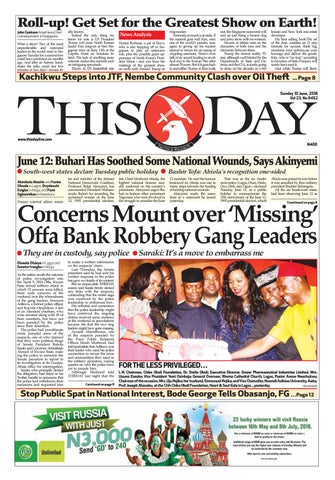
Roll-up! Get Set for the Greatest Show on Earth! John Cookson AriseNews Chief Correspondent in Singapore What a show! Two of the most unpredictable and mercurial leaders in the world meet in Singapore Tuesday for a summit few could have predicted six months ago. And after an historic handshake the talks could last two minutes or two days - no-one re-
ally knows. Indeed the only thing we know for sure is US President Trump will meet North Korean leader Kim Jong-un at 9am Singapore time on June 12th at the Capella Hotel on Senatosa Island. The lack of anything more concrete makes this summit such an intriguing specatacle. Throw in US basketball star
News Analysis Dennis Rodman, a pal of Kim's, who is also hopping off to Singapore to play an unknown role, plus the possible guest appearance of South Korea's President Moon - and you have the makings of the greatest show on earth with Donald Trump as
ring-master. Seriously, so much is at stake. If the summit goes well Kim, once one of the world's pariahs, may agree to giving up his nuclear arsenal in return for an easing of crippling sanctions. There's even talk of an accord leading to an offical end to the Korean War after almost 70 years. But if it goes badly and either Trump or Kim walk
out, the Singapore summmit will end up just being a bizarre dog and pony show with no winners. Success or failure rests on the characters of both men and the chemistry between them. Trump the former reality TV star, although well briefed by the Departments of State and Defence and the CIA, is surely going to draw on his decades as a bil-
lionare and New York real estate developer. His best selling book:The art of the deal, contains an 11 step formula for success: think big, maximise your options,use your leverage and deliver the goods. Kim, who is "no fool," according to Secretary of State Pompeo, will surely have read it. And while Trump will likely
Kachikwu Steps into JTF, Nembe Community Clash over Oil Theft
... Page 8
Sunday 10 June, 2018 Vol 23. No 8452
www.thisdaylive.com TR
UT H
& RE A S O
N400
N
June 12: Buhari Has Soothed Some National Wounds, Says Akinyemi South-west states declare Tuesday public holiday Abimbola Akosile and Funke Olaode in Lagos, Onyebuchi Ezigbo in Abuja, and Femi Ogbonnikan in Abeokuta Former external affairs minis-
ter and member of the defunct National Democratic Coalition, Professor Bolaji Akinyemi, has commended President Muhammadu Buhari for awarding the acclaimed winner of the June 12, 1993 presidential election,
late Chief Moshood Abiola, the highest national honour usually conferred on the country’s presidents. Akinyemi urged Buhari to honour other prominent Nigerians who were involved in the struggle to actualise the June
Bashir Tofa: Abiola's recognition one-sided 12 mandate. He said the honour bestowed on Abiola was one in many steps towards the healing of hurting national wounds. Akinyemi made the assertions in a statement he issued yesterday.
That was as the six Southwest states – Lagos, Osun, Ondo, Oyo, Ekiti, and Ogun – declared Tuesday, June 12, as a public holiday to commemorate the 25th anniversary of the June 12, 1993 presidential election, which
Abiola was poised to win before it was annulled by then military president Ibrahim Babangida. All the six South-west states had been observing June 12 as Cosntinued on page 8
Concerns Mount over ‘Missing’ Offa Bank Robbery Gang Leaders They are in custody, say police Olawale Olaleye in Lagos and Senator Iroegbu in Abuja As the nation awaits the outcome of police investigation into the April 5, 2018 Offa, Kwara State armed robbery attack in which 33 persons were killed, there were concerns at the weekend over the whereabouts of the gang leaders, Innocent Adikwu, a former police officer, and Kayode Opadokun, a son of an Afenifere chieftain, who were arrested along with 20 of their members, but have not been paraded by the police since their detention. The police had penultimate week, paraded some of the suspects, one of who claimed that they were political thugs of Senate President Bukola Saraki and Governor Abdulfatah Ahmed of Kwara State, making the police to summon the Senate president to report to its investigators at its Guzape, Abuja office for interrogation. Saraki, who promptly denied the allegation, had taken to his Twitter handle to announce that the police had withdrawn their summons and requested him
to make a written submission on the suspects’ claim. Last Thursday, the Senate president said he had sent his written response to the police but gave no details of its content. But an impeccable THISDAY source said Saraki firmly denied any links with the suspects, contending that the entire saga was contrived by the police leadership to embarrass him. His rebuttal and contention that the police leadership might have contrived the ongoing drama received some credence at the weekend as speculations became rife that the two ring leaders might have gone missing. Ayoade Akinnibosun, one of the suspects paraded by the Force Public Relations Officer, Jimoh Moshood, had told journalists that Adikwu was their leader who used his police connection to secure the arms and ammunition they used in the robbery operation, raising queries on why the police have yet to parade him. Although Moshood told THISDAY last night that the Continued on page 8
Saraki: It’s a move to embarrass me
FOR THE LESS PRIVILEGED… L-R: Chairman, Chike Okoli Foundation, Dr. Stella Okoli; Executive Director, Emzor Pharmaceutical Industries Limited, Mrs. Uzoma Ezeoke; Vice President Yemi Osinbajo; General Overseer, Rhema Cathedral Church, Lagos, Pastor Anene Nwachukwu; Chairman of the occasion, Mrs. Uju Ifejika; her husband, Emmanuel Ifejika; and Vice Chancellor, Nnamdi Azikiwe University, Awka, KOLA OLASUPO Prof. Joseph Ahaneku, at the 12th Chika Okoli Foundation, Heart & Soul Gala in Lagos ...yesterday
Stop Public Spat in National Interest, Bode George Tells Obasanjo, FG …Page 12
2
T H I S D AY ˾ ͯͮ˜ ͰͮͯͶ
T H I S D AY ˾ SUNDAY JUNE 10, 2018
3
4
T H I S D AY ˾ ͯͮ˜ ͰͮͯͶ
T H I S D AY ˾ SUNDAY JUNE 10, 2018
5
6
T H I S D AY ˾ ͯͮ˜ ͰͮͯͶ
T H I S D AY ˾ SUNDAY JUNE 10, 2018
7
8
͚͸˜ ͺ͸͚΀ Ëž T H I S DAY, T H E S U N DAY N E W S PA P E R
PAGE EIGHT
Kachikwu Steps into JTF, Nembe Community Clash over Oil Theft Chineme Okafor in Abuja The Minister of State for Petroleum, Dr. Ibe Kachikwu, at the weekend moved to stem the tide of clashes between oil bearing communities in the Niger Delta and the Joint Military Task Force (JTF) detailed to secure oil installations in the region, visiting Nembe, where the youths were up in arms last week over alleged complicity of the military in large scale oil theft. Kachikwu, who had taken a lead role in the Muhammadu Buhari administration’s efforts to pacify the region during the resurgence of militancy in 2015 and 2016, met with community leaders and youths in Nembe over their concerns and gave a firm commitment that the federal government would take urgent steps to address them. Last week, protesting youths
and civil society organisations from the region took to the streets of Abuja to ask for the removal of Rear Admiral Suleiman Apochi, the Commander of the JTF, Operation Delta Safe, who they alleged was culpable in the growing theft of oil. They specifically fingered the JTF for been culpable of repeated breaches on the Nembe Creek Trunk Line (NCTL) which is a 97-kilometer - 150,000 barrels per day capacity pipeline that takes oil to the Bonny export terminal from oil fields in the region. Kachikwu, who said the government was worried about the development and its impacts on the environment and economy of Nigeria, told the people at the weekend that an end would be put to the unwholesome practise. He said reported cases of theft and haulage of crude oil from the Niger Delta despite its waterways been heavily militarised
was troubling. Apparently gobsmacked that large crude carrying vessels could easily pass through existing security corridors in the region’s waterways untroubled, Kachikwu said he will take back to Buhari what he found out for a quick proactive action to be taken. The minister didn’t state the kind of actions that would be taken by the government, but he said the country’s security chiefs and National Security Adviser (NSA), Maj-Gen. Babagana Monguno (rtd.), would be briefed on this with an intention to find a good solution to it. According to him, the development was unhealthy for the economy of Nigeria and environment of the Niger Delta. He said it also signified the JTF had been infiltrated with bad eggs who could be working with the oil thieves. He said: “I am here to see what is going on and how we can stop it. We will continue the tour, you
can see we’ve been flying around with helicopters, trying to see where these points are. “We are going to take words back to the headquarters to see how we can meet with the defence chiefs, and National Security Adviser. I will take words back to the president in terms of what the experience has been here.� According to him: “For the fact that vessels can actually come through the security corridors and pick up oil is even much more troubling. It may not have been oil, it may have been arms. Something needs to be done in terms of security and environment as well as the economy of the country.� Asked if the government would continue to rely on just human efforts to overcome repeated theft of oil in the region, Kachikwu said: “That solution is there, it is happening. The fact that you have oil production go up shows
that some of those blockages have been addressed. “It is a mixture of security efficiency and technology infusion and obviously a very consistent engagement. At the end of the day, these individuals who do this are members of the communities, they are not falling out from the sky, and so, it is consistently engaging the traditional rulers, the youths who are involved in all these to be vigilant like what they do now because it is easier to just join the practice, benefit from it and keep quite. “When the communities gather this way, we must recognise their resilience and courage and do something to ensure that they don’t become victims.� In his complaints to Kachikwu, Chief Noman Atonkere, who described himself as the chairman of oil and gas Nembe kingdom, as well as the coordinator of the community security team em-
ployed by Spyer Nigeria, which has an existing security and maintenance contract on NCTL with Aiteo Group, claimed the JTF had been found culpable in the act by his team. Atonkere, stated: “I discovered a lot of illegal refineries, bunkering points, loading points all over the area of my jurisdiction. I see some vessel come in to load and go back and there is security everywhere. We who are civilian security cannot do anything because we don’t have arms and when we call there is no response. That is why we called on the federal government to assist us to fight this. “That is why we are asking the government to assist us because the job of the JTF is to protect the assets and people. Not all JTF are bad. Some are good and some are bad.�https://ssl.gstatic.com/ui/ v1/icons/mail/images/cleardot. gif
The police confirmed to THISDAY last night that Saraki’s written response to the allegations against him had been received by the investigators. “I was told by the investigators that he has made a written response to the allegations by the suspects,� the Force Public Relations Officers, Jimoh Moshood, said in a telephone conversation with our correspondent, insisting he could not say more in order not to jeopardise ongoing investigation into the case. But a presidency source privy to the investigation also confirmed the response of the Senate president, saying Saraki emphatically denied any relationship with the suspects and contended that his linkage
to the alleged criminals was a ploy by the police to embarrass him. In his response since sent to the police, according to the THISDAY source, Saraki stated that he knew nothing about the whole drama and that from his reading of whole saga, it was all concocted to embarrass him as well as reduce the institution of the Senate. Some of police sources that were privy to the written response also hinted that the Senate president reminded the IG that he was the first to visit the state to commiserate with both the people and the police, and had spoken to the IG right from the palace of Olofa of Offa, where they both agreed on the need to improve the security
of the state. Noting that he had never had any form of contact with the criminals aside the namedropping that had been trending, Saraki was said to have also reminded the police IG in his response that when he spoke to him on the robbery, he even went ahead to list some of the demands of the people in the area on how to improve their security in the area, in addition to donating the sum of N10,000,000 (ten million naira) as the first response to whatever they needed at the time. He, therefore, considered as unfair, any attempt to link him with the criminals, because there could not have been any meeting point between him and the criminals.
already-powerful younger sister Kim Yo-jong, who Korea-watchers say is also Kim’s chief propagandist. She is Kim’s only other blood relative to be involved in politics. And last week he reshuffled North Korea's military leadership to wipe-out any opposition within the regime to
dialogue with the United States. Three top military chiefs were replaced by younger men, described in South Korea's media as "moderates" and more "flexible thinkers." Kim may also have feared a military coup when he was in Singapore so decided to have a change at the top. So what can we reasonably expect from Tuesday's summit? Trump declared it was going to be more than a "meet-andgreet," but the US President also made it clear it was likely the the first of 3 or 4 meetings. That would not be unusual, and I would ask why so few? It took years to formalise a framework which led to the seemingly doomed 2015 Iran agreement. The Strategic Arms Limitation treaties took far longer and Israel the the Palestinians have still not found lasting accord after 50 years of fighting. We know the White House wants Kim to commit to giving up his nuclearisation programme which is allegedly on hiatus at the moment. Secretary Pompeo claims Kim is willing, but we've not heard actual confirmation from the North Korean leader.And how extensive is the programme? We know for sure North Korea started developing nukes nearly seventy years ago with Pyongyang claiming to have an advanced hydrogen bomb that possesses "great destructive power " and is massively more powerful than the last nuclear test of 18 kilotons in September 2016. We also know North Korea has conducted six nuclear tests in tunnel complexes under Mount Mantap since 2006. But how long will the dismantlement programme take? Some experts believe the process may need a decade to complete. Also, who is going to foot the bill if Kim decides to gives up his
nukes ? At the time of Ukraine's independence in 1991 Kiev disposed of 1,900 nuclear weapons. The cost ran into billions of US dollars. One London think-tank estimates dismantling North Korea's programme could rocket to a massive US$3 trillion. So will the US pick up the tab, perhaps South Korea too? North Korea is so poor it will not be paying. And will the two leaders address this at the Singapore summit. What does appear set in stone: Trump is not prepared to relax US sanctions - what he called "maximum pressure," - until there's what the State Department described as "complete, verifiable, irreversible denuclearisation." Indeed, Trump at his recent press conference with the Japanese Premier said he had a raft of new and tougher sanctions to further pressure North Korea, if necessary. Even the Americans know they are making a big ask of Kim and the best we can hope for on Tuesday is the North Korean leader agreeing in principle his intention to give up nukes. Anything further is not going to happen. One thing certain: the spin doctors both American and North Korean - and especially Donald Trump, will likely hail Tuesday's summit a massive success whatever happens. Trump might even get to use his favourite word: "bootiful!" But as always the devil will be in the detail - and that will be for another time and another summit. r$PPLTPO $IJFG $PSSFTQPOEFOU PG "3*4& /FXT $IBOOFM XJMM CF SFQPSUJOH -*7& GSPN 4JOHBQPSF BMM EBZ .POEBZ BOE 5VFTEBZ 5VOF JO UP "3*4& /&84 PO %457 $IBOOFM BOE (05W $IBOOFM BT XFMM BT PO XXX BSJTF UW
CONCERNS MOUNT OVER ‘MISSING’ OFFA BANK ROBBERY GANG LEADERS suspected ring leaders were in police custody and helping with the investigation, there were still questions on why they were being kept incommunicado. He said in a text message, “They are alive, helping the police further in the investigation of the bank robbery, including the recovery of 21 AK 47 riffles carted away by their gang during the attack on the Offa Police Divisional Headquarters.� Moshood challenged anyone that said the two suspects had been killed extra-judicially should produce their bodies. “Police don’t kill people, they protect people,� he said. According to a THISDAY source, however, there might be more to the absence of the ring leaders than meets the eye
as intelligence report say that former police officer Adikwu might have been set up to entrap known thugs that are associated with Saraki, Abdulfatah and the APC in Kwara State. The source queried the refusal of the police to release to the public the statements of the ring leaders, arguing that the selective publication of the statements of the other suspects, who implicated Saraki, might have been intended to prejudice the mind of the public against the Senate president. “The public ought to be given the benefit of the statements of all the suspects so that they could make up their mind on the culpability of all those mentioned in connection with the heist,� the source said.
THISDAY, however, gathered at the weekend that President Muhammadu Buhari has told the Inspector General of Police, Idris Hassan, that while he (Buhari) would not interfere with his job, he would, however, not tolerate any shoddy investigation that could undermine the integrity of the institution of the National Assembly. The president, according to the source, has cautioned the police boss and asked him to handle the ongoing investigation with utmost care. It was with the assurance of the presidential directive for careful and fair investigation, THISDAY gathered, that gave Saraki the confidence to make a written response to the police on Thursday.
ROLL-UP! GET SET FOR THE GREATEST SHOW ON EARTH! fly by the seat of his pants using his " gut instinct," according to one aide, Kim by contrast has spent months preparing for Tuesday's meeting, and not just by digesting briefing notes on the US leader. This whole jamboree in Singapore began with Kim's shock an-
nouncement on New Year's Day 2018 he wanted to send a North Korean team to the Winter Olympics in South Korea - symbolising a massive thaw in ice-cold relations with Seoul. A meeting with the South's President Moon followed, Kim also made two surprise visits
China to see President Xi, he met with Moon a second time, he freed 3 American prisoners,he met with Secretary of State Pompeo twice, and dispatched his trusted aide and former spy chief Kim Yong-chol to see Trump in the White House. Meanwhile he promoted his
JUNE 12: BUHARI HAS SOOTHED SOME NATIONAL WOUNDS, SAYS AKINYEMI work-free day. But on Wednesday, the federal government joined, as President Muhammadu Buhari announced the change of the country’s Democracy Day from May 29 to June 12 in honour of Abiola. Buhari also posthumously conferred the country’s highest national honour of GCFR on Abiola, implying his recognition as former President, and honoured his then running mate, Ambassador Babagana Kingibe, with GCON and recognised him as former Vice President. Buhari awarded the late Chief Gani Fawehinmi, one of the staunchest June 12 activists, a GCON. Recognition of June 12 and Abiola as national political symbols had been popularly demanded by Nigerians, though many have accused Buhari of angling for the strategic votes of Abiola’s native South-west with the latest honours. But the candidate of the National Republican Convention in the June 1993 presidential poll, Alhaji Bashir Tofa, opposed the decision of the federal government to recognise Abiola, who was the candidate of the Social Democratic Party, as winner of the election. In a statement yesterday, Tofa said while he never begrudged the president for honouring Abiola, who he described as his “late friend�, he doubted if the move was “based on fair play and law.� Akinyemi stated, “As a member of NADECO in its heyday,
when it was most dangerous to be a member, June 6 marked the fulfilment of dreams, and the achievement of visions. On that day, President Muhammadu Buhari recognised the validity of the June 12, 1993 presidential elections, declared Chief MKO Abiola as the winner of that election, conferred national honours on MKO Abiola, his running mate, Babagana Kingibe, the human rights activist Gani Fawehinmi, and declared June 12 Democracy Day. “I recognised how momentous that decision was and I not only welcome the decision, I thank President Buhari for the decision. President Buhari has addressed some of the wounds inflicted on this nation and applied healing balm on these wounds. Only those who lost family members, those imprisoned and detained or who had family members imprisoned and detained, those tortured and those driven into exile had felt the need for some measure of closure. That closure was achieved on January 6 by the executive order issued by President Buhari.� Akinyemi dismissed the disputes in some quarters about the legality of the posthumous award to Abiola, explaining that former President Shehu Shagari had awarded a national honour posthumously to Chief Israel Adebajo, which his son collected on his behalf. Lagos Declares June 12 Pub-
lic Holiday Lagos State Government on Saturday declared Tuesday, June 12, as public holiday to commemorate the 25th anniversary of the annulled 1993 presidential election, which was widely adjudged as the freest and fairest in the country’s history. Governor Akinwunmi Ambode, in a statement signed by the Secretary to the State Government, Mr. Tunji Bello, said the significance of the June 12, 1993 elections would always be a reference point in the state's quest to entrench true democracy. Ambode commended President Muhammadu Buhari for declaring June as the new Democracy Day, saying the singular act would forever ensure that Abiola and other martyrs of democracy who laid down their lives in the struggle to entrench good governance did not do so vain. Tofa Protests Meanwhile, the candidate of the National Republican Convention in the June 1993 presidential poll, Alhaji Bashir Tofa, has objected to the decision of the federal government to recognise Abiola, who was the candidate of the Social Democratic Party, as winner of the election. Tofa, in a statement yesterday, advised the federal government to reconsider its position, saying conferment of national honour on anyone should be beyond some cold political calculations. The candidate of the now
defunct NRC was defeated by Abiola in the election. Tofa said, “While some worry about the brazen one-sidedness of this curious presidential action, especially given the list of invitees to Tuesday’s event at the Villa supposedly to mark ‘Democracy Day’, there are also those who canvass that I be so honoured with a similar award of GCFR, if the motive indeed was noble and meant to serve the end of justice.� DPC Warns Against Tenure Elongation Democratic Peoples Congress has cautioned against using the recognition of June 12 as Democracy Day as ploy to extend the tenure of the Buhari administration. DPC accused the Buhari government of employing divide-and-rule tactics in a desperate effort to perpetuate himself in office, insisting that May 29, 2019 handover remains sacrosanct. The federal government has yet to conclude the legal process of synchronising the Democracy Day, which it changed from May 29 to June 12, and the handover date, which has been May 29 since 1999. A statement issued at the weekend by PDC’s National Chairman, Mr. Olusegun Peters, said, "DPC warns against any attempt to elongate the tenure of elected public office holders a day longer than May, 2019. That day is sacrosanct for handover to newly elected leaders.�
T H I S D AY ˾ SUNDAY JUNE 10, 2018
9
10
JUNE 10, 2018 ˾ T H I S D AY, T H E S U N D AY N E W S PA P E R
SUNDAY COMMENT
Editor, Editorial Page PETER ISHAKA Email peter.ishaka@thisdaylive.com
THE RECOGNITION OF ABIOLA AND JUNE 12 The conferment of national honour on Abiola in addition to the recognition of June 12 as Democracy Day is decision well made
T
he conferment of the highest national honour of Grand Commander of the Federal Republic (GCFR) on the late Chief M. K. O. Abiola, and the official recognition of the June 12, 1993 presidential election he won belongs to a higher level of statesmanship for which President Muahmmadu Buhari deserves commendation. It is also most fitting that Professor Humphrey Nwosu is at last getting due recognition with his invitation to Tuesday’s event in Abuja. The intellectual resourcefulness and sagacity of Nwosu, who engineered the voting system that helped produce that memorable electoral outcome, deserves acknowledgement. However, we hope this marks the beginning of giving national honours strictly on merit to inspire the present and the coming generations to individual greatness and greater service to the country. Over the years, we have queried the parameters for coming up with the list for national honours. In many instances, some of those that were honoured have continued to rankle, raising a rather critical question: Do some of the people that have received the honours represent the kind of people we would, in all honesty, project for the coming generation of Nigerians as worthy of emulation? While remembering our heroes past and rewarding those who are making (or have made) significant contributions to our nation is a noble ideal, the criteria for coming up with a shortlist ought to be better than just putting the names of those who have held or are holding public offices. If, as it is the case, anybody who has ever ruled the country in the past (whether as a civilian or a military man)
deserved to be recognised and rewarded with the honour of GCFR and their deputies with that of Grand Commander of the Order of the Niger (GCON), are we then to assume that they have made a success of the nation given Nigeria’s huge resources and the missed opportunities?
M
June12,strictly interpreted,was morethanthe dateofanelection. Onthatday, Nigeriansdefied faith,ethnicityand nativismtospeak withoneundivided voiceonthe choiceofnational leadership
Letters to the Editor
A
ny competent mathematician would tell you that it is not possible for probability theory to only throw up bad leaders from a pool of good people. If, ultimately, a nation gets the leadership it deserves, then Nigeria has, by and large, ended up with clumsy, substandard leaders because its citizenry must itself be highly morally compromised and intellectually deficient. The truth may indeed be bitter but then, it must still be told for the truth is the bitter medicine we must all swallow to be cured of the malaria of our own conceit, delusions and self-aggrandisement. Indeed, my fear is that as 2019 draws closer, we are about to make the same mistakes we have made time and again in this country. One such mistaken notion is the idea that whoever should succeed President
S U N DAY N E W S PA P E R EDITOR BOLAJI ADEBIYI DEPUTY EDITORS VINCENT OBIA, OLAWALE OLALEYE MANAGING DIRECR ENIOLA BELLO DEPUTY MANAGING DIRECTOR KAYODE KOMOLAFE CHAIRMAN EDITORIAL BOARD OLUSEGUN ADENIYI EDITOR NATION’S CAPITAL IYOBOSA UWUGIAREN
T H I S DAY N E W S PA P E R S L I M I T E D EDITOR-IN-CHIEF/CHAIRMAN NDUKA OBAIGBENA GROUP EXECUTIVE DIRECTORS ENIOLA BELLO, KAYODE KOMOLAFE, ISRAEL IWEGBU, IJEOMA NWOGWUGWU, EMMANUEL EFENI DIVISIONAL DIRECTORS PETER IWEGBU, ANTHONY OGEDENGBE DEPUTY DIVISIONAL DIRECTOR OJOGUN VICTOR DANBOYI SNR. ASSOCIATE DIRECTORS ERIC OJEH, PATRICK EIMIUHI ASSOCIATE DIRECTOR SAHEED ADEYEMO CONTROLLERS ABIMBOLA TAIWO, UCHENNA DIBIAGWU, NDUKA MOSERI DIRECTOR, PRINTING PRODUCTION CHUKS ONWUDINJO TO SEND EMAIL: first name.surname@thisdaylive.com
eanwhile, there are other tangential issues arising from the recognition of June 12 by President Buhari that are important to stress in a period such as this in the nation. Much as we all need to salute the belated acknowledgment of the sacrifice which the late Abiola had to make for the cause of democracy, the president needs to be encouraged to define his own legacies to align not only with his governance and immediate stewardship but also in tandem with the mood of a nation that is dire need of healing. June 12, strictly interpreted, was more than the date of an election. On that day also, Nigerians defied faith, ethnicity and nativism to speak with one undivided voice on the choice of national leadership. Ironically, these are also the overarching challenges of the Buhari’s presidency that, in the estimation of many Nigerians, has become very divisive. But in appropriately commemorating June 12, the president has vicariously raised the standard by which his legacy will be judged. The essence of the Abiola appeal lay not just in his philanthropic sweep across the nation but more in the progressive bent of his mind and his inclination to libertarian thought and trends. A Baptist school boy who was a Moslem, a street kid who rose to the pinnacle of the boardroom and a multi-millionaire who found time to commune with the poor were combinations that appealed to the widest spectrum of Nigerians. Unarguably, our nation is bleeding from old and new injuries. At no other time has the feeling of hurt in several parts of the nation been this pronounced than now. Ordinarily, then, the recognition of Abiola and June 12 ought to be part of a national healing process. We therefore urge President Buhari to break free from the prejudices of his handlers and reassert his own authentic nationalism as a statesman. This is the time to look again at the South-east and the Middle belt where old and new collective injuries have joined to heighten the sense of alienation. As has been demonstrated by the public acclaim of the Abiola/June 12 gesture, the passage of time neither heals collective wound nor does it diminish courageous restitution.
TO OUR READERS Letters in response to specific publications in THISDAY should be brief (150-200 words) and straight to the point. Interested readers may send such letters along with their contact details to opinion@thisdaylive.com. We also welcome comments and opinions on topical local, national and international issues provided they are well-written and should also not be longer than (950- 1000 words). They should be sent to opinion@thisdaylive.com along with the email address and phone numbers of the writer.
Why Not Goodluck Jonathan? Muhammadu Buhari come 2019 must be a fresh face. In fact, attractive as it might seem, no position could be more politically naïve and unwarranted. None of those presently angling for power would appear to have the capacity to actually defeat Buhari and in any case, the idea of trying someone else has already backfired on us with the monumental failure Buhari, himself, has miserably proven to be. Indeed, it would appear that whomever we try in this country, we end up regretting it. Well, instead of gambling any further with the destiny of an entire nation, I would propose that we try what we have already tasted before and therefore someone from whom we can be sure of what to expect. So, come to think of it, why not Jonathan? Quite a few pundits had predicted that Nigerians would
come to rue their choice of Buhari and his change we are all now desperate to change. On their part, the likes of Tanko Yakassai had opined that the North, in particular, would come to regret its rejection of Jonathan. Indeed, for all his shortcomings, it is becoming clearer by the day that President Goodluck Jonathan is the best president we have ever had in Nigeria! While tolerating dissent more than any other erstwhile president or head of state and otherwise respecting the tenets of democracy more than any one of them, President Jonathan also built more roads and executed more projects than any other ruler before or after him! What’s more, even for the Northerners that largely rejected him for our present clueless and groping-in-the-dark Buhari, Jonathan ended up developing the North more than any other
ruler including any of the Northerners who were before or came after him! Be careful what you wish for and it is perhaps fitting that having rejected the best friend they ever had, God gave the North a president from their midst to torment them with hunger, insecurity, disappointment and broken promises for stabbing their greatest benefactor in the back. Unfortunately, since we have one president in this country, all of us, North and South, alike, have found ourselves in the same boat, haplessly sinking together. His faults aside, President Jonathan was ultimately a victim of heinous disinformation, shameful spin and dastardly lies the likes of Bola Tinubu and his cohorts unleashed against him in concert with Buhari’s core Northern apologists. For all his efforts in such Machiavellian infamy, God ensured that Tinubu was relegated to the background by Buhari, the most provincial, nepotistic and clannish breed of leader
Nigeria ever saw. Needless to say, deep down in his heart, pretend as he might, Tinubu bites his finger every day for having been so instrumental in bringing a monumental embarrassment like Buhari to power. And more, the same Tinubu who always liked describing Jonathan as “clueless”, only ended up scheming into power, the least educated, the least cerebral, the least exposed, the least prepared and therefore, by far the most clueless president in the entire history of Nigeria! President Jonathan alongside his former boss, President Umaru Yar’Adua, is arguably the most normal president to come to power in this country. Whereas, due to his untimely death, we may never know the ultimate pedigree of Yar’Adua, history should always judge him kindly as one of the finest gentlemen to come to power anywhere in the world. –– Jesutega Onokpasa, Warri
T H I S D AY ˾ SUNDAY JUNE 10, 2018
11
12
JUNE 10, 2018 ˾ T H I S D AY, T H E S U N D AY N E W S PA P E R
SUNDAYNEWS
News Editor Abimbola Akosile E-mail: abimbola.akosile@thisdaylive.com, 08114495306 (sms only)
Stop Public Spat in National Interest, Bode George Tells Obasanjo, FG Segun James in Lagos and Victor Ogunje in Ado Ekiti
Chieftain of Peoples Democratic Party and former military governor of Ondo State, Chief Olabode George, has asked President Muhammadu Buhari and exPresident Olusegun Obasanjo to sheathe their swords in the
national interest. The advice followed weeks of bitter public spats between the Buhari government and Obasanjo, which culminated in Friday’s allegation by the latter that the administration was planning to frame him up for arrest and detention over his critical views about the government. In a statement yesterday,
George urged the two men to stop the war of attrition. He stated, “As a military man, I know these senior officers very well. I have worked at close quarters with the two of them. I have no doubt about their selfless commitments to our nation. “I am appealing to the two personages, as a junior officer,
to sheath their swords and resolve their differences behind the curtain. That is the military style. We don’t wash our dirty linens in the open.” Lamenting the worsening tension between the former president and the government, George said he took Obasanjo’s statement about “the threat to his life with conscionable, natu-
ral concern. I have also read the presidency’s rejoinder, which implied that there is nothing sinister in their motives. Chief Olusegun Obasanjo is a man of towering distinction and excellence who ruled this country both as a military head of state and as a civilian president. He is an international figure who is motivated by patriotic fixity. “President Muhammadu Buhari is equally a patriot, a gentleman and officer whose totality of vision is about the growth and welfare of our
commonwealth.” George condemned the media war being waged by Buhari and Obasanjo, saying it does not bode well for the country and the military. According to the former national vice chairman of PDP for South-west, “Naturally, we can disagree, raise our voices, stamp our feet in disapproval, but never in the open. The essence of the esprit de corps is about mutual felicity and respect for each other. Pray, let’s keep it that way. Nigeria is greater than all of us.
Buhari Leaves for Morocco Today Omololu Ogunmade in Abuja
PARENTAL SUPPORT L-R: Chief Medical Officer, St. Leo Hospital, Enugu and bride’s father, Sir Chike Akunyili; groom’s mother, Mrs. Debbie Nash; couple, Andrew and Chidiogo; and groom’s father, Mr. Robert Nash, after the wedding solemnisation of their children held at Madonna Catholic Church, Agulu, Anambra State...recently
President Muhammadu Buhari will today, June 10, embark on a two-day working visit to the Kingdom of Morocco. The visit, according to Malam Garba Shehu in a statement, is at theinstanceofKingMohammed VI of Morocco, will see the two leaders discuss socio-economic matters affecting their countries in view of prior engagements in December 2016, during the official visit of Mohammed to Nigeria. He said in the meeting which will hold in Rabat, discussions will focus on strengthening existing agreements on the fertiliser industry, education cooperation, the NigeriaMorocco gas pipeline project
andestablishingabasicchemical platform to harness Nigeria’s vast natural gas resources and support Morocco’s ammonium phosphate industry. “It is noteworthy that following the signing of a collaboration agreementbetweenNigeriaand Morocco in December 2016 to revive the abandoned Nigerian fertiliser blending plants, 14 plants have been revitalised so far under the Presidential Fertiliser Initiative (PFI); with a total capacity of 2.3 million MT of NPK fertilisers. “The President will be accompanied on the trip by Governor Dave Umahi of Ebonyi State, Governor Abubakar Badaru of Jigawa State and other senior government officials,” Shehu added.
Tribunal Dismisses Election Petitions against Obiano The Anambra Governorship Election Tribunal has dismissed two of the three petitions against the victory of Gov. Willie Obiano in the November 18, 2017 election in the state. ThetribunalaffirmedObiano’s victoryintwoseparateunanimous judgments delivered by its chairman, Justice H.A. Olusiyi, according to reports. Justice A.O. Ayoola and Justice Birnin Kudu were member 1 and Member II respectively of the tribunal.
The All Progressives Grand Alliance (APGA) and the Independent National Electoral Commission(INEC)werefirstand secondrespondentsrespectivelyin thematters,aNANreportstated. Dr. Chukwudi Obianaso and Ms Praise Okechukwu, candidates of the African Democratic Congress (ADC) and Mega Progressive People Party (MPPP) in thesameelectionhadprayedthe tribunal to invalidate the victory. Obianaso in his petition said
theelectionshouldbenullifiedbecauseitwasmarredwithcorrupt practices perpetrated by Obiano andhisagentsinconnivancewith INEC. “INECshouldconductafresh election and Obiano be disqualifiedtocontestinthefreshelection,” he said. In her petition, the MPPP candidate said Obiano was not duly elected or returned by the majority of lawful votes cast and that the exercise did not comply
substantiallywiththeElectoralAct. “Obiano did not score the majority of valid votes cast in at least two-third of the 21 council areas in Anambra in the election; thus his return by the third respondent is unconstitutional, irregular, null and void and of no effect whatsoever,” she said. The Certified True Copy (CTC) of the judgments made available to NAN weekend by the Tribunal said Okechukwu couldnotsubstantiateherclaimsof
electoralmalpracticewithcredible evidence. Itsaidthoseallegedlyinvolved invote-buyingandpollingunits wheretheallegedcorruptpractices took place were not mentioned, andthatonlyonewitnesswasnot enough to testify on the claims. “Thepetitionershavewoefully failed to prove by any credible evidencethatthefirstrespondent was not duly elected or returned as governor of Anambra by the majority of lawful votes cast.
“Thepetitionershaveabysmally failedtoprovewithanymodicum of satisfaction that the election in question was invalid by reason of corrupt practices and noncompliance with provisions of Electoral Act 2010 as amended. “On the whole, the petition failedasitpatentlylackssubstance and merit, it is accordingly dismissedinitsentirety,consequently weaffirmasvalidtheelectionand return of the first respondent as governor of Anambra,” it ruled.
THISDAY Appoints Alike Group News Editor
Birnin-Gwari: Kidnappers Demand Invest Wisely after Retirement, N5m Ransom for Nursing Mother PenCom Advises Retirees
The Board of Directors of the THISDAY/ARISE Media Group has announced the appointment of Mr. Ejiofor Alike as the Group News Editor of THISDAY Newspaper. Alike, an Energy Correspondent on the Business Desk, takes over from Mr. Davidson Iriekpen,whohasbeenpromoted to become the Deputy Editor of THISDAY newspaper. Alike,agraduateofAccounting andaMastersholderinBanking andFinancefromtheUniversity ofNigeria,Nsukka,EnuguState, joined THISDAY as Energy Correspondent in 2008. He was formerlyanEnergyAnalystwith BusinessDay Newspaper. He had also gathered experience in public service from the Enugu State Local Government System where he rose to become
Senator Iroegbu in Abuja
a senior staff member. He has covered challenging assignments both within and outside Nigeria, including the United States, United Kingdom, France,SouthKorea,Brazil,Qatar and India. With his vast experience in the oil and gas industry, he was the only Nigerian invited in November 2013 by the Indian government to deliver a paper at theSecondIndia-AfricaStrategic Dialogue held at the Institute for Defence Studies and Analyses (IDSA) in New Delhi, India. Itwasshortlyafterhedelivered hispaper,whichdealtextensively on how to eliminate the challenges in Nigeria’s oil and gas industry to guarantee effective supply to India, that India took over from the United States as the largest importer of Nigeria’s crude oil.
The armed bandits who kidnapped 23 people at the notorious Birnin-Gwari axis of Kaduna State have demanded N5 million ransom for the release of a nursing mother among the hostages. This is coming the bandits againkidnapped10morepeople at Kuriga area of Birnin-Gwari around 6.25pm on Friday evening. TheBirnin-GwariVanguards for Security and Good Governance, in a statement yesterday, said the latest abduction of commuters along this strategic route linking southern part of the country and the north has further deteriorated the security of Birnin-Gwari local government area.
“Earlier that day at Kwanartsauni between Udawa and Labi 22 people were kidnapped including a nursing mother. “Reliable sources closed to the husband of abducted nursing mother said, the kidnappers are requesting five million naira for her release together with the infant. The husband a retiree without monthly Pension and gratuity cannot afford to pay the ransom” the statement read. “We are calling on the federal government as a matter of urgency to conduct aerial bombardment of identified hideouts of armed bandits along BirninGwari-Kaduna road, Kaduna international airport general area particularly Sabon-Birni and Maidaro as well as BirninGwari-FuntuaroadandKamuku Forest.
Amby Uneze in Owerri
The National Pension Commission (PenCom) has advised prospective retirees to invest in businesses that would generate regular incomes after retirement to sustain their lifestyles. The Acting Director General of the Commission Mrs. Aisha Dahir-Umar gave the advice at a recent pre-retirement workshop held in Owerri for prospective retirees, who will be retiring in 2019 from public service. In her opening remarks, Mrs. Dahir-Umar said the workshop was part of their annual regulatory activities. The Director, who was represented by Mrs. Carol AlexUzomah said the Commission had finalized arrangements to
commence the verification of prospective 2019 retirees. She said the exercise, necessitated the need to undertake adequate sensitization and public enlightenment in order to prepare prospective retirees on the steps to take towards a hitch free life after retirement. She expressed hope that the workshop would educate pension participants on what they need to know on documentation requirements, payment of retirement benefits and life after retirement. Papers presented at the workshop included ‘Enrolment Exercise and Documentation Requirements’, ‘Accessing Retirement and Terminal Benefits under the Contributory Pension Scheme’ and ‘Life after retirement’.
T H I S D AY ˾ SUNDAY JUNE 10, 2018
13
14
ÍŻÍŽËœ Í°ÍŽÍŻÍś Ëž THISDAY, THE SUNDAY NEWSPAPER
OPINION Russia 2018: Expecting Life’s Beautiful Game Soccer, the world’s greatest game, starts in Russia next week, writes Ayo Oyoze Baje Individuals don’t win, teams do -Sam Walton
T
he ultimate goal of every soccer-loving nation is to win the much-coveted and prestigious World Cup. For the next one month starting from June 14, 2018 global attention will be riveted on Russia, the host country for the 21st edition of the World Cup. There, the brightest and the best that the football world has to offer will have the veritable platform to showcase their phenomenal soccer skills. They would exhibit such as ball juggling, deft passes, scintillating swerves, mesmerising dribbles, defending hot shots and eventually to score the vital goals. The salutary aim of course is to attain fame and fortune and make their countries proud. As usual, old scores will be settled on the field of play. New friendships will be forged as broken fences are mended. More money would be made for individuals, countries and FIFA, the organising body. For instance, prior to the 2010 World Cup in South Africa, Sepp Blatter, then FIFA President revealed that income revenues that accrued from ticket sales and advert placements doubled that of 2002 edition, even before the first shot was taken. FIFA also reportedly made a $631 million profit from the 2007-10 World Cup cycle and earned income of $3.65 billion from 2010 World Cup contracts. The 2014 World Cup which took place in Brazil generated $4.8 billion in revenue for FIFA compared to $2.2 billion in expenses. That was 100 per cent profit! Over the four-year cycle, the event turned a $2.6 billion profit. This year’s edition may not be any different. Truth is, the world is simply crazy about soccer which has become the opium of the masses. But in more ways than one, some interesting parallels could be drawn between the round leather game and life itself. Like life, it is a battle of brains and brawn. It evokes passion, pleasure and pain, with its thrills and frills. More significantly, however, soccer is a team game. The success a team achieves is always directly proportional to the unfailing factors of hard work, honesty and unity of purpose, understanding, communication skills, commitment and cooperation exhibited by its members.
When for instance, football pundits point to Brazil, Spain, Germany and Argentina, the last incidentally one of Nigeria’s opponents as the likely teams to beat (as it was in Korea-Japan,2002, South Africa,2010 and Brazil 2014) it is all because of the high quality of players and team spirit prevalent amongst the players. However, though Brazil has Neymar, Portugal the skilful Cristiano Ronaldo and Argentina the magical Messi, they alone cannot win matches without the avid support of their team mates. A tree, as the wise ones say, does not make a forest. As with life too, we must realise that to succeed there should be strict adherence to the rules of the game. The referees are there, more like the security forces to enforce the rule of law. Any player who commits a premeditated attack on his opponent first earns a yellow card as a warning signal. A repeat of such risks a red card that sends him out of the game at hand. That would serve as a clear deterrence to others. Even as the games progress there must be total focus. Members should not be swayed or discouraged by the jeers of the over-zealous crowd when they lose any match or, be overwhelmed by the cheers when they score vital victory over any other team. Like life, there is always the unknown Factor-X. Players and countries should therefore brace up for the unexpected. There would be twists and turns; surprises to send shockwaves down the spine of players, coaches and countries alike. Russia, for instance may be the lowest ranked of the participating countries but it is the host and anything can happen. Being prepared for such eventualities would always stand them in good stead. While it is inspiring to have heroes who have attained the lofty heights we aspire to reach, we must realise that no two people are
The success a team achieves is always directly proportional to the unfailing factors of hard work, honesty and unity of purpose, understanding, communication skills, commitment and cooperation exhibited by its members
ever the same, no matter how hard we try. Nigeria cannot have another Rashidi Yekini, Nwankwo Kanu or J.J. Okocha. But we can identify even more brilliant stars and showcase them to the world through global tournaments such as this. For now, we look up to the Mikel Obis, the Iwobis, the Moses and the Musas to make us proud. What really matters is continuous improvement on the structures, programmes and processes that threw them up, so as to discover and nurture new talents. That makes the grooming of the Under-21 teams vital. With that, the issue of smooth succession which has remained the bane of our country’s football development would be sorted out. Success is also about creating value as Candice Carpenter, a world-renowned marketer rightly observed. It is about doing something new, something unique and valuable which would solve the problems of mankind. In the light of that, what new ideas and strategies would Gernot Rohr-led coaching crew bring to the global stage to perform much better than our previous outings? These would include discipline, patriotic fervour and youthful energy. And of course, the typical fighting spirit for survival and success, against all odds of the average Nigerian. Life, like football is give and take. Sometimes you win, at other times you lose. But we should not grieve because of our losses, or that our dreams have not seen the light of day. No! Instead, we should learn from our failures and foibles and bear them with equanimity and fortitude. Then march confidently into the future. After all, the joy of life is not just about winning but being an active participant in the struggle for success. The greatest of men and women are not those who never faltered but those who, with sheer determination, have risen stoutly to take their stumbling blocks as their stepping stones to greater heights. Indeed, yours truly believes that God, our all-knowing creator must have inspired the game of football to teach us about the brotherhood of man. For, as long as the 2018 World Cup lasts such man-made challenges as war and terrorism, racism and religious bigotry will take the spectator’s seat. So would our differences of creed, colour and political persuasion. Certainly, football fosters full fun, fantasy, freedom, friendship. And fashion too.
Olukotun: Between The Public And Intellectualism Tunji Olaopa pays tribute to Ayo Olukotun, a scholar and columnist A tree is ďŹ rst a seed and he who understands the language of the seed sees the tree in a seed (Malawian proverb)
T
he full component and potential of most things are not always apparent upfront. Treasures are always buried deep in the ground and until they are identified and dug up, they remain undisturbed and unchanged, in their pristine form. Intellectualism occupies a place of pride, especially as most human advancements are results of intellectual processes. Societies have benefitted from researches and those behind these remarkable feats are feted and honoured. However, as good as intellectuals have been across the ages, these ‘special’ breed of men and women are hailed for what they are; achievers. Intellectuals are trained in a discipline, speak to their peers in that discipline, and the response of that rather extremely and closely guarded fraternity goes a long way in determining tenure, promotion, and the various perquisites of academia. They are conditioned through their different trainings and engagements to say only what matters, if it matters and only to very small, very private audiences. So, scholars routinely communicate their ideas to colleagues in their field when they publish articles and present papers at conferences. However, unless they pursue interdisciplinary work, they do not often share ideas with colleagues in other fields. They engage with the general public or policymakers even less frequently, and when they do, they sometimes fail to translate their research into language that is accessible to audiences that lack familiarity with disciplinary discourses. Intellectualism is hailed and those who are involved in it, especially the theory and practice of it are often held in high esteem and premium attached to them. Amongst the Greeks, it was a high level of regard that was accorded the thinkers and philosophers. Their great works and ideas are hailed especially as these thoughts and ideas are continually applicable to everyday life. However, a major deficiency of this esteemed position is that intellectuals including but not limited to thinkers, inventors, scientists and researchers are often guilty of burying their heads and noses in their passion. They often lose connections with the real world and the world around them. Their involvements often alienate them from realities as no other life exists outside that which they are involved. By the mid-20th century, a new wave of reality was to sweep across
Europe and North America as intellectuals began to feel the pinch of their dissociation with their societies. These ones saw the vacuum and were moved to take scholarship beyond the academia. They recognised the needs to use their work to create engagements with the cultural, social and political world around them. Most of the frontliners include the Nobel Laureate, Albert Einstein, Noam Chomsky, Carl Sagan, Edward Said, Philip Roth and John Updike. They broke the mould and achieved spatial connections by giving intellectualism a public face and relevance. It is noteworthy that most of these became voices for the people and they masterfully deployed their scholarship in headlining society as public intellectuals. I am very comfortable with Mark Crispin Miller’s simple but embracing definition of who is a public intellectual. Miller, a professor of media ecology at New York University defined a public intellectual as someone who engages in intellectual pursuits, airs intellectual concerns in a way the broad, literate public can understand. Some of these made a point of addressing the public directly, explaining their research to a variety of audiences, providing political and social commentary, and critiquing pervasive and persistent inequities. Noam Chomsky, who initially established his professional reputation as a world-class linguist, has also become well-known among the general public as a political critic. Similarly, Henry Giroux, a recognised scholar of critical pedagogy, frequently writes for the general public about cultural criticism. Mike Rose, a renowned educator, has written books, blog postings, and articles that speak to the public about the importance of writing and education. The late astronomer and astrophysicist Carl Sagan did much to popularise science, especially with his book and television series Cosmos. The high-profile literary scholar Stanley Fish writes frequently for the New York Times. Robert Reich, Professor of Public Policy at the University of California, Berkeley, has used a variety of media, including editorials on the radio, to comment on economic and labour policy issues. Nearer home, post-colonial Africa too had its own share of intellectuals who went on the side of the people and used their huge social and academic capitals in advancing the cause of the people. Wole Soyinka, the Nobel Laureate; Christopher Okigbo; ace writer, Chinua Achebe; Nardine Gordimer, another Nobel Laureate’ Ali Mazrui, the foremost historian; Yusuf al-Qaradawi, Ayan Hirsi Alli, Ken Saro-Wiwa, Ayi Kwei Armah and many others became public intellectuals who spoke to the people, stood in the vanguard of people’s movements and became heroes.
Not too many people in this part of the world have been able to successfully transmute from scholarship to public intellectualism. However, we have a good number of them who have been able to accomplish the transformation, give a relatable face to intellectualism without losing the hallo above their heads. These great minds having mastered scholarship have been able to democratise their knowledge, distilling same to the populace in clear languages and with resultant benefits to the society. With the advancement in technology, public intellectualism has gone notches higher. The internet has given mileage to the public intellectual and the entire globe has become his or her sphere of influence. One of the leading lights in this new thrust of public intellectualism in Nigeria is a colleague of the pen and public discourse, Professor Ayo Olukotun, who, in the words of Ojogbon Toyin Falola, just attained the status of agbalagba at 65. Professor Olukotun is a public intellectual par excellence. His commentaries and engagements on national and international issues are as strong as they can be and his involvement has not been tainted in any way. Professor Olukotun’s contribution to knowledge and national conversation has been consistently incisive and poignant. He has therefore cemented his place as a scholar whose theories and postulations are not high and above the heads of many as to exclude the general readers from his public education mission. Even with his social acceptance and relevance, Professor Olukotun falls within the category of those who do not serve the people different dishes; separating the intellectual from the public. Instead he diligently and consistently weaves a web of comfort for members of the public who are able to find their voices and identities in his works and words. His life and commitments to the public good are instructive to us today, even as we gather to celebrate this great icon. Professor Olukotun’s has shown us that great minds no longer captivate the public as they once did, because the university has become too insular and academic thinking too narrow. The intellectual who will find relevance must be public oriented. I can also say academics no longer possess the privilege of complacency, of choosing to remain cloistered within the walls of the academy, of engaging only with the members of their disciplines. We must assume greater roles as agents of service and perform services that promote the public good. –– Dr Olaopa is the Executive Vice Chairman, Ibadan School of Government and Public Policy
15
T H I S D AY, T H E S U N D AY N E W S PA P E R ˾ JUNE 10, 2018
LETTERS
IS A NEW NIPOST POSSIBLE? “The great thing in this world is not so much where we are, but in what direction we are moving.” - Oliver Wendell Holme
I
doubt if even a first-rate seer would have given consideration to a new, improved postal system for Nigeria some three years back. Not even under the messy mud in which the country was then conveniently immersed! The morass of economic uncertainty, executive lawlessness, divisive tendencies and unrestrained looting of the treasury by previous administrations: to be fair to posterity, dear fatherland has over the years been in a crisis mode and Nigerian Postal Service, aka NIPOST, has rarely been immune from its many troubles. Dilapidated buildings! Rickety vehicles! Out of date, out-of-tune equipment! Unmotivated staff! Disproportionate salary structures! The past in the life of NIPOST was replete with woes! But perhaps the greatest challenge to an organisation that renders such immense, sensitive and very essential postal services here as in the rest of Africa as to the developed world is that it still operates under The Stamp Duties Act Cap S8 LFN 2004 of 1939. Determined to disentangle NIPOST from the conflictal contradictions of development and the accoutrements of democracy, President Muhammadu Buhari opted
Adegbuyi, Postmaster CEO
for a better future for the once “transmission-of-letters-andpostal-materials-only”. A new management, under the headship of Bisi Adegbuyi, was saddled with the onerous responsibility of repositioning the outfit with a view to making it compete favourably in the comity of world’s postal systems. For a fact, the lawyer-turned-Post-Master General’s immense contributions to the development of the organisation’s universality as well as the creation of an efficient, effective and a technology-driven, marketled government agency have surpassed expectations. Far from attempts at being too mechanistic, the pathway
to establishing a credible and an acceptable public perception that reflects the emerging reality of the new capabilities that the postal sector presents calls for a new way of doing things. As one of the largest postal industries in Africa with over-1000 major post offices and close to 4,000 postal agencies, spread across Nigeria’s 36 states and Abuja, the Adegbuyi-led management has within a short period of two years transformed the state-owned government monopoly into an awardswinning outfit. For instance, while equally-challenged outfits elsewhere were lamenting their predicament, NIPOST simply chose to think
out of the box. Its ‘NIPOST Vision 2002’ strategic road map, especially, the creation of a lean headquarters and empowered business units and zones led to an unprecedented N700 million increase in revenue and a 40% reduction in expenditure in 2017. In other to meet the yearning demands of a globalised world where competitive advantage is now the order of the day, NIPOST rolled out 12 new, game-changing products and services. They are: IPS Track and Trace, E-Stamp; Address Verification System (AVS); Whats3Words; EMoney Order; and NIPOST/ Bank of Agriculture Agency Banking. Others include ECommerce; E-Insurance; International Money Order (now an appetiser for global players like Jumia, Konga, DHL and FEDEX in the discharge of their duties); and Card Services. Last but not the least is the NIPOST Youth Engagement Scheme (N-YES), designed to discover and productively engage the ingenuity of the Nigerian youth. I am also aware of plans to unbundle NIPOST into five companies: banking and insurance; property and development; transport; ecommerce; and e-government. Incontestably, this will go a long way in improving the quality of its products and services, in addition to increase in its revenue base. But one other area of innovative opportunities which Nigerians explore is partner-
Flooding Menace in Lagos Island
O
ne main issue facing Lagos today is environmental degradation. This is partly as a result of Lagos status as the commercial nerve centre of Nigeria and, indeed, West Africa. With a population of about 24 million people, Lagos, no doubt, deserves a significant provision for a hygienic and flood-free environment. Lagos naturally runs the risk of environmental hazard as its continuous increase in population exposes it to several environmental hazards. The rains are again here and Lagos, Nigeria’s city of Aquatic Splendour runs the risk of being in the firm but cold embrace of flood. Whenever it rains, flooding is usually a nightmarish experience for many Lagos residents. Added to the Lagos flooding concern is the peculiar nature of the state’s landscape which is basically made up of low-lying terrain up to 0.4 per cent below the sea level. Obviously, this poses serious drainage challenge for the state, thereby making it vulnerable to flooding. In Lagos, the water from the Lagoon goes into the Atlantic Ocean. Once the Atlantic Ocean is full, the water from
the Lagos Lagoon cannot get into it. Consequently, the excess water from the Lagos Lagoon naturally leads to flooding. It is, thus, very important for Lagosians to desist from all human activities that could further aggravate the flooding situation in the state. Therefore, actions such as indiscriminate dumping of refuse in unauthorised places like drains and canals, trading on drainage channels, illegal building of structures on drainage alignments, road setbacks and verges among others should be shun by the people. Lagosians must, at all times, embrace positive attitude towards the environment. As earlier stated, Lagos presently has a population in excess of 24 million people and it is still increasing. The implication of this on our environment is increased tonnes of waste generation. If this trend of environmental abuse, especially indiscriminate waste disposal persists, it may spell greater doom than what have been experienced in the past, in terms of flooding. The only exemptions to such ugly scenes of flooding after rains in Lagos are perhaps, the Government Reserved Areas and private estates in the metropolis
where the elite reside, as they are usually kept free of indiscriminate dumping of refuse. Lagos is bedevilled by the result of partial collection of their waste. Most importantly, the city has not succeeded in cultivating the communities in terms of sustainable waste disposal methods, and ownership of such projects in terms of income generating activities for the communities’ members. Although it cannot be denied that the present administration in the state has shown efforts and commitment towards ensuring a hygienic and safe environment, but more still has to be done as nothing can be too much to be done in securing the lives and property of the people. Lagos Island is often the worst hit when it comes to flooding in the state. Areas in Lagos Island such as Ojo Giwa Street, Oba Adeyinka Oyekan road, Oroyinyin Street, Ido Oluwo Street, Shademi Street and environs are often flooded beyond imagination in the aftermath of heavy downpour. These areas have suffered the most from the downpour within the last few days. Lagosians residing within these areas have lodged complaints severally on this condition, uploaded several videos on
social media on the impact of the flooding but all to no avail. People in the areas have lost their valuables and incurred record expenses. As previously stated, the present administration in the state is doing its best to address quite a number of environmental hazards in the state, despite lean resources and other competing needs. However, we implore the government to see this as a clarion call from the people of Lagos Island to pay special attention to the almost unbearable challenges of flooding in the area. On our part as residents of Lagos Island, we are communicating to the people to embrace attitudinal changes that would impact positively on the environment so that whenever it rains the damaging effects of flooding can be mitigated. We will not rest on our oars until our people stop all flooding-induced habits. Now that the rains are fully here, we will do all things that are within our reach as a people to reduce its negative effects on us. But there is, indeed, an urgent need for the state government to quickly come in and do the needful for the sake of protecting human lives and property. Akinyemi A. Eshilokun, Lagos.
ing with professional bodies and examination boards like the Institute of Chartered Accountants of Nigeria (ICAN), Nigerian Bar Association (NBA), Joint Admissions and Matriculation Board (JAMB) and National Examinations Commission (NECO) in the area of provision of security documents for professional examinations. While the roles of NIPOST in creating an inclusive society and making greater contributions to the nation’s socio-economic development cannot be underestimated, the shared vision and determination to make a difference which has created a vision for every member of staff towards seeing that the organisation moves with the time cannot be overemphasised either. Apart from the recruitment of new hands, christened ‘The Innovation Team’, to shore up its operations, NIPOST deserves a pat on the back for the Postal Proceeds Bill which was recently passed into law by the National Assembly. Give it to the organisation that the act
is coming at a time Nigeria is looking for alternative means of generating funds outside of oil which is no longer sustainable as a means of keeping the nation’s economy afloat. With many countries stepping up efforts to achieve the United Nations’ Sustainable Development Goals (SDGs), the postal sector in Nigeria remains an enabler of inclusive development and an essential component of the global economy. A simple example is the signing of a memorandum of understanding (MOU) between NIPOST and BoA for the distribution of the bank’s farm produce and implements to farmers through the post offices. Findings also revealed that no fewer than five courier firms were recently shut while 17 licenses were revoked - in line with its regulatory responsibilities. The hope of the AVS as a means of employment generation to millions of Nigerian youth when it becomes fully operational is another plus to the new, improved NIPOST. ––Abiodun Komolafe, Ijebu-Jesa, Osun State
FCT And Gbagalape Link Road
T
he Federal Capital Territory Administration (FCTA) deserves commendation for the swift manner it has intervened to rehabilitate and reconstruct the once dilapidated road linking Gbagalape community to the Nyanya/Keffi express way in the FCT. Before now, that road was so bad that it was referred to as the gully of death due to a huge gully that was threatening to split the road into halves. But thanks to the ongoing construction works by the current FCTA, residents of the Gbagalape community who hitherto went through anguish to connect to the other side of the gully can now heave a sigh of relief as the only road connecting the community to the FCT mainland is nearing completion. Any visitor to Gbagalape now will observe that the road is so smooth that the residents are actually beckoning on government to install speed breakers and other safety devices to tame the recklessness of Okada and other vehicles that have now turned the road to a race track; a stark contrast to what once obtained in the past where the point of the gully would usually signal the end of the journey to Gbagalape when the situation was so bad. Thanks to efforts of the FCTA, the road has now been levelled and asphalted with the gully filled up, to the delight of residents who now refer to the erstwhile death trap as “the slope of life.” The repair of this road no doubt has rekindled the economic and social lives of the community which is now witnessing a burst of estate development and commercial life. Formerly referred to as the “Valley of Death,” the nearly two kilometre Gbagalape road which is the major economic
road was hewed apart by a deep gully that was so slippery that it would amount to a death dive to try crossing it in the past, especially when it rained. The only option left to the commuter was to suspend the journey and wait until the road dried up to continue or trek some two kilometre distance to their point of their destination. As a result, a journey that should not last more than five minutes’ drive to and from Nyanya, most of the time, turned into hours as motorists were either forced to park their vehicles and continue the journey by foot, or subjected to several unnecessary diversions in search of safe routes. Commercial bike riders also cashed in on this to charge many times the standard rate. From the popular Nyanya/ Mopol junction, any Okada that agreed to pick you will charge you heavily between N200 to N300 for a journey that should cost no more than N100 because, to them, Gbagalape was the anathema that should be avoided at all cost. But all of that is changing now with the major upturn in the fortunes of this road. The agonies of Gbagalpe residents have now been replaced by swansongs and their leaders have been very effusive in their praise of the FCT Administration. The Chairman, Gbagalape Community Development Association, Wale Ajibode, has described the work as super miracle. Other residents who doubted that the road would be successfully completed, considering the extent of damage done by years of erosion and neglect, have also had to swallow the humble pie. ––Danladi Akilu, Gudu District, Abuja
16
T H I S D AY ˾ ͯͮ˜ ͰͮͯͶ
T H I S D AY ˾ SUNDAY JUNE 10, 2018
17
18
ÍŻÍŽËœ Í°ÍŽÍŻÍś Ëž THISDAY, THE SUNDAY NEWSPAPER
INTERNATIONAL PMB’s MKO Abiola’s GCFR Award and Nigeria’s New Democracy Day: The Foreign Policy Dimensions
O
n Wednesday evening, 6th June, 2018, Nigeria’s President,Alhaji Muhammadu Buhari (PMB), changed the date of Democracy Day in Nigeria from May 29 to June 12. This was done to honour late Chief Moshood Kashimowo Olawale Abiola, a devout Muslim and winner of the June 12, 1993 presidential election, the results of which were annulled by former military president, General Ibrahim Badamasi Babangida (IBB). As explained by the Senior SpecialAssistant to the President on Media and Publicity, Mr. Garba Shehu, it was to ‘honour an illustrious son of Nigeria...who won a presidential election but was prevented from taking office when the results were annulled. The lateAbiola died while struggling to actualise the mandate.’ As further explained by PMB himself, ‘June 12, 1993 was far more symbolic of democracy in the Nigerian context than May 29 or even October 1. June 12, 1993 was the day when Nigerians, in millions, expressed their democratic will in what was undisputedly the freest, fairest and most peaceful elections since our independence. The fact that the outcome of that election was not upheld by the then military does not detract from the democratic credentials of that process.’ Therefore, PMB has said, his government ‘has decided that henceforth, June 12 will be celebrated as Democracy Day.’ It is in light of these considerations that PMB has also awarded Chief MKOAbiola post-humously the honour of Grand Commander of the Federal Republic (GCFR), which is Nigeria’s highest honour, normally given to an incumbent President of Nigeria, and Grand Commander of the Order of Niger (GCON), the second highest national honour of the land, to his then running mate, Babagana Kingibe. The honour for ChiefAbiola, it should be emphasized, is specially significant for many reasons. First, all efforts made in the past twenty-five years to have ChiefAbiola nationally recognised and honoured have failed. Secondly, ChiefAbiola has become the first Nigerian president we never had. He was duly elected but could not have his electoral mandate actualised. Thirdly, the national honour and the act of declaration of June 12 as the new democracy day have generated lively public interest and controversies. There is near national consensus on the adoption of June 12 as the new Democracy Day in the country but the need to first have the NationalAssembly amend the 1999 Constitution, as amended, to enable Government act within the frame of rule of law still remains a controversy as many questions are being raised on the extent of legality of awarding the GCFR to a dead person. As regards June 12, 1993, there is no disputing the fact that Chief MKOAbiola was truly elected the de facto President of Nigeria; that he was, indeed, prevented from actualising his mandate for illegal and untenable reasons of force majeure, given by IBB; and that he would have also eventually been sworn in as the de jure President of Nigeria, under normal circumstances.As the de jure President of Nigeria, he would have been given the National Honour of GCFR in his own right as an elected president of Nigeria. Giving an honour normally due in 1993 in 2018 is unnecessarily belated but still requires special further reflections. In this regard, there would not have been any good basis for the advent of the Fourth Republic to begin with. The protracted period between June 12, 1993 and May 29, 1999 would not have been a political issue. In fact, Chief Olusegun Obasanjo might have not at all come into the picture as a presidential candidate. It was precisely because ChiefAbiola’s electoral mandate was stolen by the military government of IBB that June 12, not only became a national controversy and a new political struggle, but also given an international attraction and importance. It should be recalled that Nigerians, led by the then NADECO (National Democratic Coalition), wanted June 12 as Nigeria’s Democracy Day in 1999 but President Olusegun Obasanjo was opposed to it. Subsequent leaders also did not take the matter up seriously. Consequently, what PMB has done by conferring the title of GCFR on Chief MKOAbiola post-humously and changing the date of Democracy Day from May 29 to June 12, is in the right direction. It is politically right, even if it conflicts with the spirit and provision of the 1963 National HonoursAct. It has the potential to remove the political wounds that have divided the polity for more than two decades.And true, it is not only political tension defusing,
VIE INTERNATIONALE with
Bola A. Akinterinwa Telephone : 0807-688-2846
e-mail: bolyttag@yahoo.com
Abiola
but also political stability seeking, national reconciliation and nationbuilding oriented. It is sagacious in strategic calculation and suggesting that PMB, for the first time in his three-year administration, is now beginning to see clearly how to govern without engagement in politics of dictatorial democracy.And true enough, the title of the honour should not be GCFR but SGCFR, that is, Special Grand Commander of the Federal Republic, because Chief MKOAbiola’s honour is with a difference and special distinction. Expectedly, the change of date and award of national honour has generated interesting controversies. It was former President Olusegun Obasanjo who chose the initial date of May 29, apparently to reflect the beginning of a new era of democratic politics in Nigeria as from May 29, 1999. Before then, Nigeria was under sixteen years of uninterrupted military dictatorship and oppression. The transition from military to civilian rule on May 29, 1999 was, therefore, considered significant enough to be marked, if not celebrated, annually. In the eyes of most Nigerians, and particularly the NADECO activists, June 12, 1993 ought to be remembered for posterity, especially because of its political significance. For instance, Chief MKOAbiola and his presidential running mate, Babagana Gingibe, were both Muslims and Nigerians were not in any way much bothered about religious status. SenatorAyo Fasanmi, in commending PMB for the new date and honour, said, ‘Abiola, a Yoruba man, was accepted in the North, East and West. Despite a Muslim/Muslim ticket, Nigerians, irrespective of religious and tribal affiliation, supported him and voted massively for him in all parts of the country.’ Secondly, the June 12, 1993 presidential election was not only nationally, but also internationally, adjudged the most fair, credible, and free ever conducted in Nigeria’s political post-independence history. Thirdly, and perhaps most importantly, it was the first time
What PMB has done by conferring the title of GCFR on Chief MKO Abiola posthumously and changing the date of Democracy Day from May 29 to June 12, is in the right direction. It is politically right, even if it conicts with the spirit and provision of the 1963 National Honours Act. It has the potential to remove the political wounds that have divided the polity for more than two decades. And true, it is not only political tension defusing, but also political stability seeking, national reconciliation and nation-building oriented. It is sagacious in strategic calculation and suggesting that PMB, for the ďŹ rst time in his three-year administration, is now beginning to see clearly how to govern without engagement in politics of dictatorial democracy. And true enough, the title of the honour should not be GCFR but SGCFR, that is, Special Grand Commander of the Federal Republic, because Chief MKO Abiola’s honour is with a difference and special distinction
the people of Nigeria were most unanimously united in support of the adoption of the Professor Humphrey Nwosu-introduced OptionA-4 method of election, which guaranteed the freest and fairest election in Nigeria. Fourthly, and more notably, IBB has acknowledged this fact. In an interview granted in a TV programme, ‘Moments with MoAbudu on MNet Channel of DSTV,’ he admitted that the ‘June 12 presidential election was accepted by Nigerians as the best of elections in Nigeria. It was free and fair.’ ‘But unfortunately,’ he said ‘we cancelled that election. I used the word unfortunately for the first time. We were in government at the time and we knew the possible consequences of handing over to a democratic government. We did well that we wanted ours to be the last military coup d’Êtat. To be honest..., the situation was not ripe to hand over at the time.’ If the time was not ripe to hand over to MKOAbiola or to civilians, why organise the election in the first instance? If the election was annulled to prevent an impending new coup, why not round up the potential coup plotters since IBB was almost very certain that there would be a coup in the following six months? Why not deal with potential coup-making rather than annul election results? If the election was won byAlhaji Bashir Tofa, would the election results have been annulled? Without scintilla of doubt, this is one of the origins of the injustice and political chicanery that has bedevilled Nigeria since then and which PMB has now courageously tried to redress. In other words, there are good reasons to consider June 12 as national day of democracy, especially if lessons are to be drawn from political history for the betterment of the future. Put differently, PMB’s initiatives have more moral and legal dimensions than political and strategic calculations. Concerning the award of GCFR to Chief MKOAbiola, former Chief Justice of Nigeria (2006-2007) and also Chairman of the 2016 National Honours Committee, JusticeAlfa Belgore, has said national honours, and particularly, the GCFR, cannot be awarded post-humously. Under the 1963 National HonoursAct, Justice Belgore has reminded that only soldiers or other servicemen could be awarded post-humous medals for their bravery. In the thinking of the former Chief Justice, the only thing PMB can rightly do ‘is to name a place after him, but national honours award, no.’ The award of GCFR to a civilian or non-soldier, and for that matter, to a dead person, is illegal in his eyes. Justice Belgore appears to have reckoned essentially with Section 2 of the 1963 National HonoursAct (Paragraph 2, Honours Warrant), according to which ‘a person shall be appointed to a particular rank of an Order when he receives from the President in person, at an investiture held for the purpose...’ On the basis of this provision, an honour of whatever rank can only be given by a sitting president. It can only be given during a ceremony specifically organised for the purpose. The honour can only be received in person, thus eliminating any delegated representation.And, perhaps most significantly, it is only at the juncture of receiving the honour in person, and regardless of the form of the honour, that the recipient is truly honoured. In the thinking of Barrister Femi Falana, SeniorAdvocate of Nigeria, for example, there is nothing illegal about the award and change of date. On the award, he argued that Justice Belgore had simply ignored paragraph 3 of the same Honours Warrant which enables the president unqualified discretion ‘to dispense with the requirement of paragraph 2 in such manner as may be specified in the direction.’ Therefore, Falana has further submitted, ‘since the national awards conferred on ChiefAbiola and Chief Gani Fawehinmi cannot be received in person, the president may permit their family members to receive same on their behalf.’ To a great extent, Falana, an academic writer by choice and Senior Advocate of Nigeria, cannot be wrong in the sense that the president has the competence to permit any of theAbiola’s relations to receive the award of honour on behalf of ChiefAbiola. However, to what extent is the honour validly awarded if it is not received by the expected original recipient? In international protocolar and diplomatic practice, when an award of honour is given through a delegated representative, the representative is never decorated with the medal, but simply handed over to him or her. This is simply to say that only the intended recipient can receive it and be decorated. Additionally, as noted earlier, it is only at the point an honour is received in person that the honour is also conferred. In this regard, on who is the award conferred: to the relation or to the deceased? This question raises the procedural question of the award. Dr. UmarArdo of the University of Maiduguri, has posited that ‘legally, the president has no powers to confer National Honours on anyone without the deliberation and advice of the National Council of States (NCS). The Third Schedule of the Constitution of Nigeria (as amended) at Section 6(a)iii confers on the NCS the powers to advise the president on the award of national honours. The fact is that the NCS didn’t meet to deliberate and advise on this so-called investiture.’ As much as one would want to appreciate this argument, does the provision make it a desideratum, that is, must the NCS first advise before the president can act? In the event of an advice by the NCS, must the president always accept whatever advice is given? This is where not only Justice Belgore and Barrister Falana are both correct and the moral issues of justice, fairness, national reconciliation, peace and unity are not only raised butought to be given priority of consideration and where PMB has really done well in political reasoning and calculations. (See concluding part on www.thisdaylive.com)
19
T H I S D AY, T H E S U N D AY N E W S PA P E R ˾ JUNE 10, 2018
BUSINESS
Editor Vincent Obia 08054681757 Email vincent. obia @thisdaylive.com
LAST WEEK Trade
Nigeria recorded an increase of N1.18 trillion in merchandise trade in the first quarter of this year, reaching N7.21 trillion from N6.02 trillion in the fourth quarter of last year. The figures were contained in the Foreign Trade in Goods Report, which was released on Wednesday by the National Bureau of Statistics. The bureau stated that the trade value of N7.21 trillion was also an increase of 35.07 per cent when compared to the N5.33 trillion recorded in the first quarter of 2017.
Smuggling
Worried by the spate of insecurity and smuggling of arms into the country, the federal government said it was considering building high walls at the country’s borders. Speaking while directing the construction of Seme Border fence, the CustomsArea Controller, Seme Border, Comptroller Mohammed Aliyu, said the idea was to block the illegal routes which may be used for cross-border crimes.
Telecoms
Provisions store
Research: Urban Retail Prices in Nigeria Surge 1.1% in May Bamidele Famoofo
Prices of retail items in urban centres in Nigeria recorded an upward movement to the tune of 1.1 per cent month-on-month (MoM), from 0.69 per cent in April to 0.77 per cent in May. The increase in commodity prices, among others, run contrary to the success so far achieved in Nigeria’s headline inflation, otherwise known as the Consumer Price Index (CPI), which has for the 15th consecutive month recorded a decline. As at April, headline inflation in Nigeria stood at 12.48 per cent, according to the National Bureau of Statistics (NBS). But going by the outcome of its research in May, ARM Securities Limited revealed that prices of goods in Nigeria, especially in the urban centres, have continued to soar. “Our Urban Retail Price Tracker— the PURP index— recorded an increase of 0.77% MoM to 105.7 pts in the month of May (vs 0.69% MoM in April),” ARM Securities said. The report added, “Our survey revealed a mixed play of prices. While the brewery and commodities sector saw increased prices due to high transport cost and the on-going Ramadan festival, prices in the consumer sector were largely lower MoM. Volumes were generally higher across board.” The report, which captured five key sectors of the economy, namely, Brewery, Commodities basket, Consumer, Cement, and Oil and Gas, hinted that it was a mixed play of prices.
According to analysts at ARM Securities Limited, the brewery sector saw price increases for the third consecutive month, with prices up 0.86 per cent month-on-month. “Notably, Trophy (2.22 per cent) and Gulder (1.96 per cent) both witnessed a faster pace of price increase MoM.” Feedback from retailers, according to the report, linked the increase in prices to higher transport cost in the month. “On volumes, feedback from retailers revealed a decline in volumes during the month,” analysts added. Meanwhile, the consumer sector, according to ARM Securities, saw a mixed play of prices with an overall decline in prices by 1.56 per cent. Among the products that witnessed price increase were Honeywell (12.82 per cent) and Dangote pasta (13.89 per cent), while Lipton (-15.22 per cent) and Milo (-7.79 per cent) saw the largest decline in prices. “Overall, most of the decline was as a result of price discounts in the on-going Ramadan festival,” the report revealed. ARM Securities also disclosed that commodities basket increased by 0.84 per cent month-on-month in the review period, as prices were higher across board, save for palm oil -0.69 per cent. Over the period, both vegetable oil and rice witnessed price increases of 0.43 per cent and 2.25 per cent month-on-month, respectively. “For palm oil, feedback from retailers showed that stability in prices has been driven by increased supply of the commodity,” the analysts said. “Elsewhere, feedback from retailers
associated the general increase in price of both vegetable oil and rice to higher transport cost in the month of May as well as the Ramadan festival, which made it possible for retailers to raise prices,” the research added. The price pressure bit harder in the cement sector, as it witnessed an increase in prices by 2.21 per cent month-on-month. “On volumes, retailers noted higher sales volume compared to the previous month,” the report noted. Likewise, prices in the oil and gas sector expanded 1.72 per cent month-on-month with prices of While the brewery and commodities sector saw increased prices due to high transport cost and the on-going Ramadan festival, prices in the consumer sector were largely lower MoM. Volumes were generally higher across board
lubricants increasing by 2.47 per cent, accounting for the increase. “Elsewhere, the price of cooking gas was relatively flat over the month,” the report revealed. Similarly, selected food price watch data for April 2018 by NBS, reflected that the average price of one dozen of Agric eggs medium size increased year-on-year by 6.45 per cent and month-on-month by 4.70 per cent to N552.09 in April 2018, from N527.32 in March 2018, while the average price of piece of Agric eggs medium size (price of one) decreased year-on-year by -8.59 per
cent and increased month-on-month by 2.52 per cent to N42.25 in April 2018 from N41.21 in March 2018. The average price of one kilogramme of tomato increased year-on-year by 1.32 per cent and month-on-month by 8.38 per cent to N289.49 in April 2018, from N267.09 in March 2018. The average price of one kilogramme of rice (imported high quality sold loose) decreased year-on-year by -4.92 per cent and increased monthon-month by 1.66 per cent to N369.35 in April 2018, from N363.33 in March 2018. Also, the average price of one kilogramme of yam tuber increased year-on-year by 11.71 per cent and month-on-month by 9.86 per cent to N279.61 in April 2018 to N254.51 in March 2018. Meanwhile, explaining the research methodology adopted to achieve the result, ARM Research said, “To determine how retail prices have moved on average, we fashioned out a Pentad Urban Retail Price Index (PURP), which adopts April 1st to April 8th as a base period. The PURP index accords 30 per cent weightings apiece to consumer and commodities prices, 20 per cent weighting to the brewery basket with a further 20 per cent distributed evenly between cement and cooking gas prices. “Across the sectors, price evolution is monitored on a weekly basis while we adopt 0.6 per cent, 0.0 per cent, and -0.6 per cent as indicators for volume expansion from prior week, no change in volumes, and week-on-week output contraction (respectively) in a manner slightly akin to CBN’s PMI methodology.”
The Nigerian Communications Commission disclosed that private sector investments in the country’s telecoms industry since 2001 had risen to $68 billion. The commission also said Information and Communication Technology now contributed more than 10 per cent to Nigeria’s Gross Domestic Product. Speaking on the theme, “Drive Towards Digital Economy: The Journey So Far”, at the DigitalPay Expo 2018 in Lagos, Tony Ojobo, Director, Public Affairs, NCC, said that entrance to digital economy in Nigeria began with the licensing of the digital mobile service providers in 2001.
Tax
The Federal Executive Council approved the National Tax Policy Implementation Committee on the country’s Tax Laws Reform. FEC also approved N1.6 billion for the procurement of 68 new Ford pickupoperationalvehiclesforNigeria Customs Service. This was disclosed Wednesday inAbuja by the Minister of Finance, KemiAdeosun, who briefed State House Correspondents on the outcome of the FEC meeting alongside the Minister of State for Budget and National Planning, ZainabAhmed, as well as the Senior Special Assistant to the President on Media and Publicity, Garba Shehu.
Aviation
The International Air Transport Association said Nigeria had repatriated the $600 million belonging to international airlines that was trapped in the country due to foreign exchange shortages. Director-General of IATA, MrAlexandre de Juniac, disclosed this at the 74th IATAAnnual General Meeting and World Air Transport Summit in Sydney, Australia. The funds were from airlines’ ticket sales and other allied activities, which the country could not repatriate due to fall in crude oil earnings in late 2016 and early 2017.
Automobile
PSA Peugeot Citroen revealed plans to start assembling cars in Nigeria by the first quarter of 2019 through a joint venturewithChairmanoftheDangote Group, Aliko Dangote, and five state governments.An adviser to Governor Nasir el-Rufai of Kaduna State, Jimi Lawal, told Reuters on Tuesday that the Joint Venture, PeugeotAutomobile Nigeria Limited, located in Kaduna, would assemble 3,500 units in its first yearandrampuptoabout10,000units.
20
T H I S D AY, T H E S U N D AY N E W S PA P E R ˾ JUNE 10, 2018
BUSINESS/ECONOMY
With Tax Hike on Tobacco, Alcohol, FG Kills Two Birds with One Stone The federal government has increased tariff on tobacco and alcoholic beverages as part of efforts to control their consumption, but what are the economic implications? Bamidele Famoofo reports
E
conomic experts have never failed to let Nigeria know that it cannot develop with oil money alone. They have consistently emphasised the key role of tax revenue in the effort to achieve economic development. Recently, at the spring meetings of the International Monetary Fund and World Bank held in Washington D.C, the organisers made it clear to Nigeria that it must widen its tax revenue base to finance growth-enhancing upgrades to the country’s infrastructure and social programmes. Obviously, the message has considerably sunk in. In July 2017, as part of measures to improve tax collection in the country, the federal government launched the Voluntary Assets and Income Declaration Scheme. VAIDS provides an opportunity for taxpayers, who are in default to voluntarily declare their assets and income and pay taxes due on them in return for exemption from associated penalties. The scheme was in April extended to June 30 after its March 31 terminal date following appeals from organisational and individual taxpayers. Tobacco, Alcohol Tax Nearly one year after the introduction of VAIDS, the federal government has announced plans to extract additional money from the manufacturers and consumers of alcoholic beverages and tobacco by means of increasing taxes on the products. In addition to a 20 per cent tax on tobacco, the government says it will add an extra fixed tax per cigarette. And a percentage tax on alcoholic Nigerians smoke an estimated 20 billion sticks of cigarette annually beverages will be replaced by taxes of fixed regime would curb the menace of tobacco-related world at the moment. amounts based on volume. “The National Tax Policy has continually diseases, which he said cost the country about According to the Ministry of Finance, the move would have “a dual benefit of raising the advocated a shift from direct to indirect taxes, $7.6 billion in 2015 alone. “Let me draw attention government’s fiscal revenues and reducing the which are easier to collect and administer, thereby to the fact that tobacco use is responsible for health hazards associated with tobacco-related making evasion difficult. On this premise, it is huge economic losses emanating from both direct believed that a shift of focus to indirect tax would and indirect medical costs,” Adewole said. “It is diseases and alcohol abuse.” The ministry said the new regime was in line with significantly improve Nigeria’s tax to gross domestic estimated that Nigeria loses $800 million annually to stroke, heart disease and diabetes. In 2015, the a directive from the Economic Community of West product ratio,” Odo said. projected accumulated loss to tobacco was put African States regional bloc on the harmonisation at $7.6 billion.” Impact of member-states’ legislations on excise duties. The minister noted that for every $1 gained From a consumer perspective, experts said the incidence of tax was higher on the poor. “This from tobacco business, about $3 was expended Reaction While some Nigerians have argued that raising is because it is inflationary, reduces consumer on healthcare cost, stressing that the tobacco duties in Nigeria for alcohol could further hit disposable income and distorts the allocation industry makes huge profit without taking consumer demand amid fragile growth, others of resources,” Financial Derivatives Company responsibility for the harm they do to public said it would help the country to grow its revenue. stated. “Besides, imposing higher taxes could health. He disclosed that over 20 billion sticks PricewaterhouseCoopers Limited said it was clear encourage smuggling activities, as well as tax of cigarettes were consumed annually in Nigeria. that government was looking for various means evasion.” Experts have also argued that the leading brewers to generate more tax revenue. The international consulting firm, however, noted that the choice of and distillers, such as Nigerian Breweries, Guinness products affected by the new review suggested Nigeria, and International Breweries, will be the that government wanted to avoid imposition of biggest losers, as many of them have embarked duties on necessities and basic products, which on aggressive expansion plans in anticipation of a pickup in demand. This would intensify may affect the wider population. PwC hinted that the new tax was regressive competitive rivalry among the players and further given that it imposed relatively lower burden erode margins. However, given that the tax imposed on alcoholic on premium products. Manager Global Trade Advisory, Deloitte, Chijoke beverages is a regressive tax, as opposed to the Tobacco use is Odo, said reviewing the excise regime was long previous ad valorem regime, value brands will responsible for huge overdue, as tax was not static and should evolve be hit the most, due to their lower prices, experts as trends and economic situations change. Odo, say. Either way, the industry is likely to face a economic losses however, cautioned that the excise regime should most challenging period in the next three to four emanating from both have undergone numerous reviews based on quarters. Manufacturers have, therefore, kicked against actual changes in the economy over time, evolving direct and indirect health and environmental findings, and perceived the increase and the timing, as most are just medical costs. It is recovering from a negative profitability and challenges with administration. revenue contraction. “Ideally, a counter cyclical estimated that Nigeria policy direction that would ensure injection into Revenue Target loses $800 million Apart from expecting the new tax regime on the system would have been more appropriate. alcoholic beverages and tobacco to make more However, taxes are withdrawals and the increase annually to stroke, heart money available to government to aid growth in excise duty is likely to reduce margins and disease and diabetes. in the recuperating economy, no specific financial could prompt higher unemployment,” an industry target has been disclosed by the government. But expert, who did not want to be named, argued. In 2015, the projected economic experts said the new tax regime had accumulated loss to Gain the potential to change Nigeria’s status from the Minister of Health, Professor Isaac Adewole, on least country with tax to gross domestic product tobacco was put at $7.6 ratio in the world. Nigeria’s tax to GDP ratio the occasion of ‘World No Tobacco Day’ celebrated billion is estimated to be six per cent, the lowest in the in Abuja recently was confident that the new tax
Adewole also said 4.5 million adults currently used tobacco products, while about 82 per cent of people who visit bars and nightclubs were exposed to second-hand smoke. Speaking on the trending shisha (flavoured tobacco) among young Nigerians, Adewole said the country would not accept tobacco consumption in whatever disguise, as there is a need to protect the future of the country. “A key outcome of this review was the ban on all characterising flavours, including the addition of menthol into tobacco products. This decision is to protect our children from getting enticed by flavoured tobacco products. Let me stress that the ban on tobacco products with characterising flavour is still in place and the ban includes shisha because it has flavour,” he said. In his speech at the event, the World Health Organisation country representative, Wondi Alemu, said tobacco control was one of the most effective means to achieve Sustainable Development Goals, which target reduction by one third premature deaths from non-communicable diseases by 2030. Alemu said the elimination of tobacco use will help to prevent millions of people dying from non-communicable diseases. “On average, tobacco users lose 15 years of life. In the African region, about 146,000 adults, aged 30 years and above, die every year from tobacco related diseases,” he said. Health Risks According to experts, second-hand smoke poses serious health risks worldwide, especially among infants. In fact, exposure to second-hand smoke is one of the leading causes of preventable deaths. A recent study published in the Journal of American Medical Association said smoking caused more than 80 per cent of lung cancer deaths as well as 77 per cent of larynx cancer deaths. According to data published on the American cancer society website, tobacco use accounts for 87 per cent of lung cancer deaths in men and 70 per cent of lung cancer deaths in women. Nigeria targets economic, health, and socials gains from its latest increase in tax on tobacco and alcoholic products.
21
T H I S D AY, T H E S U N D AY N E W S PA P E R ˾ JUNE 10, 2018
BUSINESS/ECONOMY
Addressing the Challenge of Financial Inclusion in Nigeria The huge volume of physical cash in circulation, despite efforts by the Central Bank of Nigeria to build a cashless economy through financial inclusion, has become a source of worry to Nigerians, writes Emma Okonji
I
n Nigeria, the majority of citizens still rely heavily on physical cash transactions, as against digital cash transactions, where money is transmitted electronically via the Internet, mobile phones, Point of Sale (PoS) machines, and other mobile devices, for the payment of goods and services. In order to change the narrative in line with the global standard in today’s digital era, the Central Bank of Nigeria, the financial services regulator, introduced a cashless policy. The policy seeks to bring the larger chunk of Nigerians that are outside the financial system into the county’s financial space, where their money can be linked to bank accounts. It also seeks to encourage Nigerians to do more of electronic transactions for payments of goods and services. To achieve its aim, CBN set a target to reduce the number of financially excluded Nigerians from 46 per cent in 2010 to 20 per cent in 2020. But it has only succeeded in reducing the number to 41 per cent as at the last count in 2018, which is a five per cent reduction in eight years. The situation is already giving the CBN serious concern. Just as CBN is worried about the slow pace in achieving financial inclusion, financial industry stakeholders are also worried that Nigeria is still heavily dependent on physical cash transactions, in spite of the efforts of the apex bank. Trying to find a lasting solution to the problem, which is becoming worrisome to all, Intermarc Consulting, in its 2018 Digital PayExpo, which held at Eko Hotel, Lagos, last week, brought together financial experts from within and outside Nigeria to discuss the challenge of financial inclusion in Nigeria and the rest of Africa, in order to proffer solutions. It had the theme “Innovative Financial Services for the Vast Unserved Segments”. Financial Inclusion Financial inclusion is the process of bringing everyone to a digital platform where financial transactions for the payment for goods and services are done electronically through various electronic channels that are safe and secure. Financial inclusion means that individuals and businesses have access to useful and affordable financial products and services that meet their needs – transactions, payments, savings, credit and insurance – delivered in a responsible and sustainable way. In Nigeria, majority of the people, especially traders, business owners, artisans and low salary earners, are outside of the country’s financial system and this set of people largely depend on physical cash for their daily transactions. The situation has led to huge volumea of cash circulating outside Nigeria’s financial system, which the CBN is trying to address in collaboration with stakeholders like Intermarc Consulting that organises annual Digital PayExpo. Challenge Financial inclusion in Nigeria is challenged by many factors. Aside the issue of poor infrastructure that could have accelerated the process and its acceptability, industry stakeholders have identified lack of trust, poor training, poor awareness, inadequate consumer protection, high cost of transaction, distance, and complexities in payment system as some of the challenges hindering the speedy development of financial inclusion in Nigeria and across African countries. Having identified some of the challenges, Managing Director of Intermarc Consulting and convener of Digital PayExpo, Mr. Adeyinka Adeyemi, said Intermarc Consulting had over the years continued to listen closely to Nigeria and Africa’s payment needs through its engagement channels. Adeyemi believed Intermarc had crafted an exceptional programme that reflects the intensity of the current climate and responded to the
ATM banking
demands of the moment. According to him, “Digital PayExpo is designed as an inclusive series addressing different segments of digital financial services with focus on how much services can leverage on technology to bring access to the grassroots.” Solution Stakeholders who gathered at the 2018 Digital PayExpo discussed some of the measures to address the challenges of financial inclusion in Nigeria and across African countries. A Director at CBN, Musa Jimoh, who represented CBN’s Director of Banking and Payment Systems, Dipo Fatokun, said CBN introduced supper agent banking and planned to raise additional 500,000 supper agent networks by 2020 that will be closer to the grassroots, to drive financial inclusion in rural communities. Executive Director, Business Development at Diamond Bank, one of the major sponsors of the 2018 Digital PayExpo, Mrs. Chizoma Okoli, in her presentation, explained what Diamond Bank was doing to take banking to the rural communities and to boost financial inclusion among those that are financially excluded. According to her, Diamond bank partnered MTN Nigeria to introduce the Diamond Y’ello Account, designed to bring more Nigerians into the financial circle. She said in less than two years of the introduction of Diamond Y’ello Account, the bank registered over 10 million accounts. Other products introduced by Diamond Bank according to Okoli, are the Diamond Beta account and ADA, which allows customers to interact with robotics and could open bank accounts, initiate bill payments, and buy airtime for customers. Using Kenya as a benchmark for financial inclusion, Managing Director, Microsave in Kenya, Mr. Isaac Ondieki, tasked regulators to come up with policy and implementation measures that would address trust among the people, in order to achieve financial inclusion.
Ondieki, who presented a paper on “The Risk and Fraud Perspective to Financial Inclusion”, addressed the areas of real and perceived risks in financial inclusion. He listed factors like trust, poor training, poor awareness, inadequate consumer protection, and complexities in payment system as some of the risks that could mar financial inclusion and support financial fraud. Indian perspective Founder, Geosansar and Co-founder, Finboot, Mr. Nish Kotecha, who gave the Indian perspective of how to overcome the challenge of financial inclusion, said India was able to bring the over 600 million unbanked Indians into the country’s financial system through technology that was built on values that dovetailed with the political, social and now business mood of India. Kotecha said he created the concept of “Financial Inclusion in the Supply Chain”, which has received awards and accolades globally for its unique work in promoting financial literacy. “In my judgment, and in my experience as an Advisory Board Member of Accion, which is a global non-profit committed to creating a financially inclusive world and is now active in 40 countries, digitisation can address each of Nigeria’s challenges and so presents significant opportunities for growth, development and job creation in the country,” Kotecha said. He added, “Today, some four billion people globally are still offline, the opportunities offered by technology are still out of reach for many and its benefits remain unevenly distributed. While some countries have made significant headway, others are struggling to keep up. If we want technology to be an engine for inclusive growth and development, we must understand its challenges and address them in a way that ensures better access and better opportunities, particularly for those who are behind.” According to him, traditional banking and payment methods are often ill-suited to the digital environment and digitisation will not deliver its
full potential if many are still financially excluded. Kotecha said, “The World Bank has estimated that more than 200 million formal and informal micro, small and medium-sized enterprises in emerging economies lack access to basic financial services to thrive and grow. No wonder, therefore, that financial inclusion is becoming a priority for policymakers, regulators and development agencies globally. In fact, it is identified as an enabler for seven of the 17 Sustainable Development Goals. Digital payments are actually an entry point for financial inclusion. Integrating digital payments into the economies of developing nations is crucial for broad economic growth and individual financial empowerment.” Citing the case of M-PESA, the mobile payment system in Kenya, East Afruca, Kotecha said, “ We have all heard of M-PESA, which from its early experiment by Vodafone and DFID (UK Government) has become world renowned by showing the potential of these solutions and the potential of developing countries to leapfrog forward in their use of technology all driven by customer need. Infrastructure innovation is being led by emerging economies who are finding smart ways to leapfrog the current infrastructure and in many cases bureaucracies to meet the demand for inclusion. Developed countries are playing catch up.” Kotecha further explained that the spread of mobile telephony and mobile-internet services had brought hundreds of millions of people into the formal financial system, and encouraged the Nigerian government to invest in technology that will support financial inclusion. Many believe events like the annual Digital PayExpo should be encouraged because they present a veritable platform for experts to exchange information, learn from national experiences, interact with different stakeholders, and look at how to better engage in discussions, with the ultimate aim of promoting financial inclusion.
22
T H I S D AY, T H E S U N D AY N E W S PA P E R ˾ JUNE 10, 2018
BUSINESS/ECONOMY
Another Wave of Industrial Action Looms in Oil Sector As stakeholders scramble to head off an impending strike by oil workers, Olaseni Durojaiye looks at the issues at stake
A
disruption of the relative peace in the country’s oil service sector, notorious for its volatility and propensity to grind the economy whenever it experiences hiccup in its operations, may be afoot. Indications to this emerged on Sunday at a press conference addressed by President of the Nigeria Union of Petroleum and Natural Gas Workers, the umbrella body of junior oil workers, Williams Akporeha. At the press briefing, Akporeha issued a 21-day ultimatum to employers in the oil and gas industry to address an alleged poor welfare of workers or face an industrial action. He particularly called out the Nigeria Association of Road Transport Owners, International Oil Companies, and other oil and gas companies operating in Nigeria and accused them of kicking against unionism and frustrating collective bargaining amid poor staff welfare. He also accused the companies of not paying end of contract benefits. The NUPENG president went ahead to notify the public that at the expiration of the ultimatum, if the listed grievances were not satisfactorily addressed, the body would have no option than to call out its members for another round of industrial action. Grievances Akporeha detailed the association’s grievances against the employers in the sector. According to him, IOCs operating in Nigeria are guilty of treating a cadre of their workforce unfairly and in a manner that is against the country’s extant laws. He stated that members of NARTO had refused to honour a 2016 agreement it reached with NUPENG in respect of its members who were petroleum tanker drivers. Akporeha stated that the “union is annoyed with the continuous, intentional and methodical, irrational redundancies, casualisation, illtreatment, indecent and precarious working conditions of oil and gas workers, ranging from refusal to allow unionisation, refusal to allow collective bargaining negotiation, nonpayment of end of contract benefits, and other anti-labour practices against our members by both indigenous and multinational oil and gas companies in Nigeria, which are utterly alien to our extant industrial rules. “We found it extremely important to express our displeasure over failure of the employers of our Petroleum Tanker Drivers members, NARTO, to implement the Collective Bargaining Agreement reached with the union since 2016. As we address you today, it is just few months to the expiration of the said agreement, yet, most NARTO members have wickedly and callously refused and failed to honour its words or follow the path of integrity by executing what the association assented to. “The Petroleum Tanker Drivers have shown considerable endurance, patience and tolerance in the face of blatant deprivation and denial of their legitimate rights, even while toiling day and night under excruciating working conditions, putting their lives on the line to move the economy of our nation forward, especially in the downstream value chain. Granting these hard working Nigerians their entitlements and rights should not be a difficult issue.” He added, “This is alien to our extant industrial rules. Some of the workers have died, while others are roaming the streets because they could not get their money. A prominent oil company, which is among the debtors, claimed that it cannot locate the contractor who hired the workers to do the job. This is sad.” Recurring Challenge Findings by THISDAY show that some of the grievances are not new to the sector, just like the reactions of NUPENG and other allied labour associations in the sector. Yet, the issues
Kachikwu
have persisted. In reaction to what they termed excruciating working conditions of a section of employees in the oil and gas sector, the leadership of NUPENG and the Petroleum and Natural Gas Senior Staff Association of Nigeria had issued a condemnation statement last May. The statement by PENGASSAN and NUPENG condemned the Service Level Agreement reached between the Nigerian Content Development and Monitoring Board and the Oil Producers Trade Section. Part of the statement read, “We remain resolute to ensure that reduction of contract circle to six months duration be reversed. We find the agreement ridiculous and unfortunate and wonder how NCDMB allowed desperate OPTS to arm-twist it into making mockery of the key thrust of the Nigerian Oil and Gas Industry Content Development, NOGICD, Act of 2010. We are dismayed over the activities of some contract workers’ contractors that are engaged by some oil and gas multinationals who have wilfully refused to pay Nigerian workers their ‘end of contract benefits’, having disengaged them from active service. This is not only criminal but we see it as a slap on Nigeria and its government. It is also the responsibility of these oil companies whose contractors are culpable of this reprehensible and despicable act to prevail on them in order to revert to honour and decency.” The prevalent mood among workers in the sector is that of resentment. Many say govern-
Akporeha
ment cannot afford to look on while the current worrisome employment relation matters remain. They urge the federal government to intervene. Handicap Interestingly, while NUPENG is miffed with the IOCs and the Tank Farm owners, NARTO members also blame NUPENG for their inability to wholly honour the 2016 agreement it reached with the tanker drivers. In what appears like a chain reaction, THISDAY gathered that many of the IOCs and tank farm owners, especially at the Ibafo, Ogun State axis, owe NARTO members substantial amounts, even as a source stated that the IOCs and tank farm owners were also owed by the federal government. One source added that the fact that over 80 per cent of petroleum products consumed in the country were moved by road, by the tanker drivers, explained the huge indebtedness of major oil marketers to NARTO members. Speaking with THISDAY, a top member of NARTO, Aloga Ogbogo, stated that NARTO members were handicapped with regard to honouring the agreement due to operational challenges and lack of fund caused by huge debts owed by their customers. Ogbogo said, “We are handicapped by fund. It is not deliberate and there is little or nothing that we can do. The oil companies and majority of the tank farm owners, especially those in the Ibafo area, owe us huge sums of money. Over 80 per cent of petroleum products used
We condemn in strongest terms how oil and gas workers in the industry are being treated by the multinational companies who use them as slaves in their motherland. These portfolio investors cannot continue to make billions in our country whilst their employees, who are Nigerians, suffer gross impoverishment and other precarious conditions
in the country is moved by road and by our members, so this makes the debt owed us by the oil companies and tank farms very huge. “Besides, we are also faced with several operational challenges, including bad roads and the issue of insecurity. The bad state of our roads has significantly increased our costs. We have to buy tires at expensive prices. Sometimes, too, our trucks are attacked and products siphoned.” Assurance However, NARTO President, Alhaji Kassim Bataiya, believes it is wrong for NUPENG to say the whole CBA had not been implemented. Bataiya stress that only some sections were yet to be implemented, even as he assured that before the expiration of the ultimatum, NARTO would do its best to ensure full implementation of the CBA. Reiterating the issue of debt owed it by some of its stakeholders, Bataiya was quoted as saying, “We worked for them, their duty is to pay us. We have no business whether government is owing them or not. The payment for the services we rendered to them is not based on government paying their subsidy claims or otherwise before they pay us. They are the main reason why the remaining part of the CBA we reached with PTD members has not been implemented. We are also using this medium to appeal to them to pay us our money for us to meet our obligations to our employees. “We condemn in strongest terms how oil and gas workers in the industry are being treated by the multinational companies who use them as slaves in their motherland. These portfolio investors cannot continue to make billions in our country whilst their employees, who are Nigerians, suffer gross impoverishment and other precarious conditions. Sadly, this is reducing their life expectancy and creating physical and psychological adverse effects in them. This can no longer be tolerated.” THISDAY learns stakeholders in the oil industry are working, mainly behind the scenes, to avert the looming industrial action. But many believe a lot would depend on how much the IOCs are prepared to give in.
23
T H I S D AY, T H E S U N D AY N E W S PA P E R ˾ JUNE 10, 2018
INTERVIEW Momoh: I have What It Takes to Solve Nigeria’s Power Challenges In this interview with Chineme Okafor, the new chair of the Nigerian Electricity Regulatory Commission (NERC), Prof. James Momoh, who is reputed to be a first class electricity engineer with years of practice across the different value chains of the electricity industry across the world, states his optimism and resolve to help find solutions to some of the regulatory challenges of Nigeria’s power market. Excerpts.
W
hat did you meet here at the NERC when you resumed?
we will ask for targets, we will ask Discos to increase their efficiencies, reliability and invest more in technology, and we as a commission will encourage new markets so that we won’t rely more on the Discos; embedded generation, mini grids, eligible markets, are the things we will encourage. We will divide our solutions in different timescales, maybe in the current timescale we will still rely on the Discos, but we will begin to encourage new businesses to come on board so the stress will not be on Discos, and over a long time, maybe the market will become competitive. We will also invest in new technologies that will reduce losses and encourage customers to use electricity efficiently, and at the end of the day it will balance out. It will not be a one-day event, there will be a systematic improvement in the system and investors will be asked to come in and more manufacturing companies will be in the country and overtime, targets will be reached.
I met a lot of good people and staff, as well as an energised commission that was very happy to receive me as its chair. I was very happy that I found myself at home where people were looking for a leader with commitment and vision to work and lead a change in the sector. I also met of course a commission that wants to make a difference in the affairs of the industry and people who are anxious to make a change on the issue of affordability and reliability of power. I found people who have been longing to make a difference and needed a leader to drive this, I met my equals and I think coming here isn’t a waste of time.
What then are you bringing on board, you talked about vision and leadership? As a world class expert in power engineering, I bring discipline, integrity, innovation, and ability to think out of the box, formulate problems and know all the constraints and what it takes to solve them. Knowing that Nigeria as a whole needs reliable and secured power supply, I bring my skills on how to work with Discos, Gencos and transmission company, as well as leading the regulator help them achieve the mandate we have so that we can find a win-win solution. I also bring on board the fact that I have worked in the power industry as a researcher, professor, policy maker and administrator. My exposure cuts across the utility industry and research organisations. This allows me to know the different energy sources, how to manage demands, how to calculate costs, how to optimise the networks, how to ensure that we create an efficient power supply either on utility or small consumption points. I also have the ability to think ahead on what can go wrong and this very serious because I am talking about foresights and how to anticipate and prevent rather than running around and correcting things. I have designed things, I am one of the pioneers on smart micro grid systems and I was one of the first few authors to write a book on smart grid in America and I have developed pioneering books and tools on how to optimise networks, and developed artificial intelligence systems. I actually know how to move my works and not just talking but talking and doing. I am at home and coming to NERC is to me coming to bring my experience to contribute my quota to the development of the sector.
Two issues have continued to upset this sector: lack of a cost efficient tariff and seeming lack of independence of the regulator, do you agree with these and do they bother you? Between 2015 and 2017, there was no commission, we had a commission but no commissioners and therefore no leadership to contribute to the debate. Now we have a commission and a chairman, we are going to engage, even though my colleagues have been engaging in terms of providing leadership to the industry, to make sure that the cost of power is understood and made clear to the customers, Gencos, Discos and TCN. We need to understand if it means, do I have to pay the actual price of power that accounts for losses, guarantee efficiency and reliability because we have to be on both sides of the coin. The question is at what cost? You have to make it cheap, reliable so that people will buy your service
Are all these dovetailing to November when you are expected to review the performance of the privatised power entities?
Momoh
otherwise if it is too expensive people will not buy. We have to balance the equation – what am I willing to pay, how are you going to sell? It cannot be a one-sided market, we have to agree in a forum where the customers of different classes, Gencos, and Discos will be assembled and we will discuss what it costs to generate power in Nigeria given our incomes, GDP, the population we have and resources. I don’t want customers to go back to candles and diesel, I want everyone to use electricity and that is why I will appeal to everybody to talk straight about losses and how to reduce them. I don’t want to pay for losses, what we call ATC&C losses, we need to minimise our leakages. If we reduce leakages, find cheaper sources of energy and open up competition, hopefully everybody will come in and at that point you will be forced to minimise wastes and leakages as a service provider. So, this cost reflective tariff is a big statement that has not been defined well in Nigeria and I want to define it one more time in Nigeria. I have put together four engineers in NERC and they are calculating very quickly what it costs to generate (for instance) one kilowatts of power to 180 million people if we all use it, what will it cost for 50 million people to use it and the mathematics will unfold the truth. We are going to bear in mind that there is a constant we will add and that is we don’t want operators to be out of business, we want them to make money at the end of the day
but don’t make so much money that you will be out of business or I will not patronise you again, and don’t put all your energy in trying to collect money from small customers who are just turning on their lightbulbs and watching television only. Let’s encourage big businesses and manufacturing companies that will be happy to pay more and will turn the energy into money. So this cost reflective tariff is an ongoing discussion and we will like to be a regulator that mediates between the customers and operators so that Nigeria’s power sector will be patronised. Again, we might ask for subsidy from the government to the market to make sure that nobody is left out. My comment is very clear, and that is, as a commission we will be the bridge between the customer and the operators.
How soon will this happen because the next review session for the MYTO is this month – June? There are three timescales for doing this. There are things we will do in a hurry to make sure the MYTO changes. I am not sure we are going to encourage a big change that will get the economy of the country in tumble or crisis and customers will be upset. No, I don’t think that will be what we will recommend, we are going to look at it properly and in timescale, maybe do a little change which is just so small so that everybody will be happy. Then
I don’t think we are waiting till November, we have committees set up since I have been here and that is parts of the things I met on ground that needs to be done. We have set up different studies to look at the cost of inefficiency both in collection and technical losses. We have a group people also looking at customer care, who are worrying about waste also in different stations. We also have set up opportunity for us to respond to crisis very quickly in case of emergencies and loss of power in the country. Hopefully, with all these put together, we will be able to develop new indices that will allow us to compute reliability and efficiency. We will probably be able to make some recommendations to all our Discos, Gencos and TCN, that this is what we expect you to do, and we will give them targets that will measure their performance. We will also come up with intelligent measures that will reduce wastages especially at the consumers’ end, to make sure that the causes of poor power quality is minimised.
What will be your plan to get NERC up to date with the regulation of the market? I made it very clear that if you work in NERC, you must be productive, engaged and continue to learn to be informed of technology and commercial changes. Trainings and workshops will be organised. Experts from abroad will be brought here to share knowledge with us. My network is very strong in this area, and I plan to very quickly propose workshops and knowledge exchanges. Our universities will be involved because we have good ideas that will solve the market problems and this is not going to be by the engineers and investors talking, the academia has to be engaged. There is always a partnership between the academia and industry in America, so, I plan on that, and I will talk to a lot of my colleagues here to proffer solutions to the problems of the power market. We will work with the economists in Nigeria. It is my hope that the capacity will be improved to help solve the problems of the sector, we want to recommend how to solve future problems.
Are you optimistic about this industry? There is big hope that if we work together as a country, investors and operators, there is hope in Nigeria. I am here and willing to encourage people to come here because we are ready to serve.
24
T H I S D AY, T H E S U N D AY N E W S PA P E R ˾ JUNE 10, 2018
INTERVIEW Ndegwa: Guinness Nigeria is in Top Shape, Now is Time for Me to Quit Mr. Peter Ndegwa, Managing Director/Chief Executive Officer of Guinness Nigeria Plc, is on his way out of the company for a bigger assignment in the Diageo Group. He tells Bamidele Famoofo, in this interview, that there is no better time for him to exit Guinness than now, when the company is in a great shape. Excerpts:
T
priced right and provide options to imported b brands, which tend to be more expensive because of cost of importation and transportation. As such, we are able to make sure that consumers can afford our brands. In whichever category you operate, the brands have to be affordable and we believe that there is an opportunity in the beer, spirits and soft drinks segments.
he hottest news about Guinness Nigeria at the moment is that you are moving on to a new role. Tell us a little more about this. I have been in Nigeria for almost three years and in Diageo for 15 years. I am now moving into the role of GM, Continental Europe and Russia based in the Netherlands. It has, indeed, been an exciting time here in Nigeria and while I am excited about the new role, I will miss Nigeria.
What would you identify as the highp points of your time at the helm of affairs at Guinness Nigeria, and your greatest achievements?
How do you feel moving on from Nigeria to Europe?
Some of my best moments in Guinness Nigeria revolve around our talent. It is important that our business reflects our society and so focusing on the diversity of our team and on building local talent has been one of my biggest b moments. It has been great working to ensure that the organisation really leverages and taps into the local talent base that we have in this country. The diversity that we can create and the opportunities that it gives is a critical part of the successes that we enjoy as a business. Most of our customers, distributors and retailers are actually females, so we should also have our employee base reflect that. The other highlight is going around the country and discovering what Nigeria is. I really pride myself on having visited 20 states across the country!
At Diageo, we view talent as international. I have spent half of my working life, 14 and a half years, outside my home country, so I am used to working in foreign countries. I think it is an opportunity to learn and to actually bring diversity, different perspectives, and also to appreciate what that country is about. I spent many years in Europe in other roles, although, that was in the UK. It will be good to reconnect with Europe once again.
How do you think the business is doing now? Do you think this is a good time for you to step down? This is a planned move, so it will include a very smooth transition that will happen over several months. I have been in this country for three years and the business is in great shape, the team is very strong, the strategy is very clear, and the performance track record is very consistent. I feel there is no better time to be handing over to someone. We have reorganised our business in order to respond to the tough environment that businesses were faced with, and also for our business to be more balanced. Three years ago, we used to be more of a premium business, in terms of offering Guinness and some of the other brands that appeal to consumers on the premium end. Today we have a much more balanced business. We have gone into the local production of spirits. We also have a portfolio of spirits that we import. So we are in several categories of spirit, beer and adult soft drinks, across different price tiers. Our portfolio is more balanced; our commercial execution is very strong. Productivity and cost management have also really transformed and that is translating into very strong top line growth. We recently announced our results for the nine month period ended March 31, 2018, where we grew our business by 17 per cent. This translates into very significant turnaround, supported both by the work we have done in the portfolio by giving consumers choice, but also the restructuring we have done around our balance sheet with the Rights Issue, for example. In addition to that, we have set up a team for the future. Previously, we relied on a number of international assignees, but today we have very strong local talent. Fifty per cent of the leadership team is female, so we have really created a team that is diverse and very strong and I see it as a team for the future. So when you look at all these factors, this really is the best time to be handing over the business to an experienced CEO, such as Baker, who I know well and I have worked with in the past. I see this as an opportunity to give a different person a chance to continue to drive that legacy but also take it to a new level.
With Nigeria witnessing a lot of competition in the alcohol industry, how do you think the industry will fare over the next five years?
What are your final thoughts on the p potentials of the Nigerian economy as you depart Nigeria?
Ndegwa Competition is always expected when you are in business. We are the only total beverage business in Nigeria offering beer, spirits, and soft drinks at various price points from premium to the more affordable segment. There is no other business in this country that has brands in those three segments; we believe we have competitive advantage. In the beer category, competition is increasing, but as I earlier mentioned, we have expanded our portfolio and have become more competitive on both the portfolio offering and route-to-consumer. The other aspect that gives us competitive advantage is our entry into spirits production locally. We were not previously represented in the spirits segment, but we have now installed local production capacity to produce international brands, such as Smirnoff, Gordon’s, and McDowell, with more in the pipeline. This gives us a range of brands and makes us more competitive. So we will not be competing only in beer segment,
but also in the spirits and soft drinks segment.
During the recession, some analysts reported that spirits performed better than beer in terms of consumption. Can you explain why tDuring recession consumers adjust to brands that they can afford because they have less money available, both in beer, spirits and in soft drinks. We found that consumers down traded into price points which they could afford across all the three categories and not just in spirits. Our strategy is to ensure that we are represented in all these segments at various price points, all the way from premium to affordable. For example, we have brands, such as Johnnie Walker Blue, and Gold, which appeal to consumers who can afford higher priced brands. Also, we have brands that are further down the line and are more affordable, like Smirnoff X1, Gordon’s Dry Gin with Moringa, etc. These brands are quality brands that are
I have been in this country for three years and the business is in great shape, the team is very strong, the strategy is very clear, and the performance track record is very consistent. I feel there is no better time to be handing over to someone
It is great to see Nigeria coming out of recession and to see the oil price looking stable, therefore, allowing the government to have more capability to invest in the country. There have been some painful moments in the past couple of years, both for consumers, for companies and also for the wider society. But it is good to see confidence coming back and the economy starting to turn around for the best. I believe that this country has a huge potential, being the largest economy in Africa. I love the fact that Nigeria has very vibrant, very entrepreneurial people who want to push the boundaries and discover new things. It will continue to attract a lot of attention from international investors. In spite of the challenges of the past few years, we remained committed to investing in the market. For example, we invested behind our spirits production, in new formats, etc., especially in areas that we previously did not have a strong presence. In Nigeria, the per capita consumption across both beer and soft drinks segments is still relatively low and as the economy recovers, consumers’ affordability will improve. For us, the Nigerian economy still holds much promise – we have belief in Nigeria and we are long-term investors.
What would be your advice to your successor, Baker Magunda? Baker is coming into a lovely country with vibrant people and the largest economy in Africa. It is the place to be. He should understand that this country is huge and he should try and explore the geography of the country. I have been to about 20 states in the country in the three year period that I have been here. By understanding what happens around the country, you can tailor offerings to the regional blocks, depending on preferences. Although, it is one country, there are different cultures. So understanding the culture is important as well. It is also important to continue to contribute beyond commercial interests into areas, such as Alcohol in Society, shaping diversity, and giving female employees career growth opportunities.
25
T H I S D AY, T H E S U N D AY N E W S PA P E R ˾ JUNE 10, 2018
BUSINESS/ENCOUNTER
Ebohon: Rising Oil Prices Present Nigeria Opportunity for Economic Diversification In line with its forward looking strategy, and adapting to market demands, Propetrol Limited - owners of the Propel brand - will be opening new branches internationally, as well as diversifying further into the renewable energy market, MD/ CEO Harry Ebohon tells Demola Ojo
T
here’s a saying that the lower your voice, the more people pay attention. It takes a little adjusting to properly hear Mr Harry Ebohon, despite seating across the table from him at the Lagos head office of Propetrol, the company he started 16 years ago. But with a 20th retail outlet to be opened in a few weeks, as well as branches to be opened internationally, you suspect that Ebohon would rather his business did the talking. The office has little indication of the type of business being undertaken, apart from Propelbranded signpost somewhere downstairs. No trucks or tanks. At least not visibly. But it certainly is the brain behind a body spreading its tentacles nationwide, starting from the south. Propetrol’s journey has been one of taking advantages of opportunities and moving swiftly to fill the gap. The company started by providing services for oil majors before branching into retail, and further expansion. “We were providing haulage services for oil majors like Total, Oando and Mobil. When we noticed there were service gaps in the retail market, we decided to branch into retail and set up our first retail outlet in Ikeja about 15 years ago. We’ve grown our business from that single outlet to about 19 today. We’ve branched out also into other aspects of the industry value chain,” Ebohon says, the beginning of what would be a series of short and crisp answers. “We provide bulk sales of petroleum products both inland and in the bunkers market,” is the only elaboration. Outlet number 20 follows the pattern of Propetrol’s organic growth. It will be in Port Harcourt where there are numerous retail stations already. “We have a very strong brand presence in Port Harcourt and we enjoy significant customer loyalty in that part. There are specific areas in that market where we believe the service we provide is required and because of that, we’ve picked our next location somewhere within the metropolis of Port Harcourt,” he explains. How soon before the next outlet which is a significant number? Ebohon doesn’t think it’s that much of a big deal in his line of business. He comes across as someone who would rather it is the hundredth. “The property is secured; designs have been done, so we’re moving to site in another four weeks. I want to believe that before this year runs out for sure, it will commence operations.” I have been using the names Propetrol and Propel interchangeably. Ebohon admits that a few people aren’t sure about the difference. “Propetrol is the parent company, the registered business. Propel is our trademark, it’s the brand under which our retail business runs on,” he says. With this clarity, it is easier to understand
Ebohon
what he means when he says opening another outlet, and opening branches internationally. The one is Propel, the latter, Propetrol. “Some time ago, we announced plans to partner with an international bunker trading company. We have already made moves not just to partner but to acquire a company based in South Africa. We’re in the process of concluding that and we’ll soon be opening shop in South Africa. There are opportunities we’ve identified in South Africa that we believe we can take advantage of. “Apart from that, we have a very global perspective as far as our business is concerned. Our plan is also to open shop in some specific markets outside Nigeria where we have identified opportunities. “I don’t want to go into too many details but by the last quarter of this year, we will be
providing some of the services we render here in Nigeria in South Africa and one or two other locations that we will reveal later.” If you guess he’d rather be watching out for new trends to take advantage of in the industry, rather than talk about his plans, you won’t be too far from the truth. A couple of times, he declines to elaborate, a slight smile accompanying the low tone. I quiz him about the recent increase in oil prices and the projections by the IMF that it will hit $100 per barrel in a few months. Surely, there are opportunities to be taken advantage of knowing this, right? “The sudden jump that we saw in oil prices can be traced to some geo-political tensions essentially in the Middle East,” he says. “The fact that the USA pulled out of the Iran Nuclear Deal was one of the major drivers of the current
I believe oil prices may not remain high for so long because of renewable energy. Some countries have come out to say that in the next few years, they’re going to place a ban on vehicles running on fossil fuels. I believe Nigeria should take advantage of these prices while it lasts and also look for ways to diversify its economy
high prices that we see in the market. “However, I want to believe that these prices are not sustainable because with the level of production going on in the USA with shale oil, I foresee a drop in oil prices and I think at the end of the day, oil may stabilise between 60 and 70 which is much more sustainable. “Another reason why I believe oil prices may not remain high for so long is because of renewable energy. Some countries have come out to say that in the next few years, they’re going to place a ban on vehicles running on fossil fuels. On this basis, I don’t believe oil prices can remain high for too long. “I believe Nigeria should take advantage of these prices while it lasts and also look for ways to diversify its economy.” How will Propetrol adjust as a company, especially regarding alternative energy then? “As long as you’re in the oil business, you have to be very mindful of that. We have both a short term and long term strategy. We’re considering our options in the renewable energy space, and we have identified some companies we want to partner with to develop that market in Nigeria. We’re actually making very concrete steps towards the actualisation of this. “In the meantime, the best thing for Nigeria to do regarding improved oil revenue is to start saving for the rainy day. I want to believe that the government is making serious efforts towards diversifying this economy. I see a lot of traction as far as that is concerned. Diversification is what we should be looking at, at this point.”
26
T H I S D AY, T H E S U N D AY N E W S PA P E R ˾ JUNE 10, 2018
TRAVEL
Edited by Demola Ojo Email demola.ojo@thisdaylive.com
Capitol Hill...the legislative power house located in the capital, Sacramento
Delta King...a wooden ship in Old Sacramento
PHOTOS: Funke Olaode
Sacramento, the Place Where Beauty, Modernity and History Meet The fifth largest economy in the world, and one of the wealthiest states in United States, Sacramento, the capital of California, is certainly the place to be, as Funke Olaode found out recently during a visit
W
hat readily comes to mind when California is mentioned? Of course, its entertainment industry, Hollywood in Los Angeles, Silicon Valley, the home of ICT, Napa wine, energy in Texas, agriculture, San Francisco, the commercial nerve centre, and so on. Indeed, everything in California looks inviting! And Sacramento, the capital, captures all the beauty and attraction of one of the world’s wealthiest subnational states. This triumph of beauty and industry was in all places I went during a recent visit to California for the annual peace award organised by the Centre for African Peace and Conflict Resolution of the California State University, Sacramento. I had been invited by the legal icon, Mallam Yusuf Ali, SAN, who won the 2018 Peace Humanitarian Award of the institute. I flew about six hours to Sacramento after attending the World Bank/IMF Spring Meetings in Washington DC. Arriving at the Sacramento International Airport, it was obvious I had landed on a famous state. Orderly, neat, with polite airline staff, the feeling of home, apparently, the vibe that the city and airport authorities wanted to create, was palpable within me. It was spring, so the weather was a bit hot in the afternoon, with a gentle, cool breeze in the evening. Sacramento is home to the government of California. The Capitol building houses the bicameral state legislature and the office of the governor. A peep inside this gigantic edifice takes you down memory lane regarding the counties that make up California. How each of them is distinct with their respective landmarks, and how the state has progressed since the 1850s. California lies at the confluence of the Sacramento River and American River. The district of old Sacramento, which is still kept as tourist’s haven, dates back to the city’s Gold Rush era, and retains the hoary facade and relics, like wooden sidewalks and wagon rides. California generally used to be part of Mexico until the United States took the South West part of Mexico, comprising California, Arizona, and Texas. Before Sacramento became the capital, the capital once resided in Los Angeles and later San Francisco. But for the past 100 years, it has been in Sacramento. Explaining what makes the city remarkable, my
is part of the central valley that produces a lot of food for America. And, of course, Napa Valley, a wine haven, which is about an hour drive from Sacramento, is a wine arena where you see wine ranges, wine tasting, and a getaway place. When you talk about California’s position as the fifth largest economy in the world, definitely, you talk about agriculture, the Silicon Valley, which is where you have the IT capital of the world: Google, Facebook, Oracle, etc. Of course, Hollywood is there. Those definitely constitute the economic hub or the engine. The state is also heavy in energy because it produces oil as well. California State University, Sacramento, founded in 1947 is one the 23 campuses of the California State University. Though it is an independent tertiary institution, it is one of the strongest campuses in the state with over 28,000 students. Tower Bridge...a vertical lift bridge linking West Sacramento County to the east
Horse carriage is one of many side attractions in Old Sacramento tour guide and Director, Centre for African Peace and Conflict Resolution of the California State University, Sacramento, Professor Ernest Uwazie, who had lived in the city since 1991, said there was something about the town that endeared people to it. “When I came here 27 years ago, it wasn’t as big as this,” said Uwazie, “but it remains very peaceful, a place to raise a family, particularly
for someone like us, that are used to a conducive environment for learning. So it is not too crazy and also not too quite.” The city’s fairly tropical weather is not too hot and not too cold. Being a state capital, it has a lot of government offices, and power still resides in Sacramento. It is a place of willing and dealing as a political power house. And just as Benue State is regarded as Food Basket of Nigeria, California
Old Sacramento State’s Historic Park Despite its modernisation, certain things still stand the state capital out in terms of monuments, particularly, the Old Sacramento. According to Uwazie, the Capitol building used to be in Old Sacramento, which is flood prone, before the authorities moved it about two miles to its present location. A first time visitor’s journey is not complete until you catch a glimpse of Old Sacramento. Founded in 1849, this 8-block area offers a visitor centre, museums, antics, and a variety of history tours. Here are elegant, long-standing museums documenting the history of California via exhibits, artefacts, and more. There is Delta King, a wooden like ship where visitors can dine and wine. Also Sutter’s Fort, an educational centre where 5th or 6th grade students make a trip daily as part of their programmes. Very close to Old Sacramento is a heavy Gold Tower Bridge. This bridge is a vertical lift bridge across the Sacramento River, linking West Sacramento in Yolo County to the east. Extolling the city that has provided a safe haven for him and his family for past 27 years, Uwazie said, “It is a very welcoming city, a good place to live, work and enjoy life. It is a good place to raise children. It is centrally located and if you want to get away to Francisco, Los Angeles, Las Vegas, Nevada it is easy from the town. It is good location that can reach more tourist places within an hour by road or air.”
27
T H I S D AY, T H E S U N D AY N E W S PA P E R ˾ JUNE 10, 2018
BUSINESS/PERSPECTIVE
Infrastructure as a Building Block of Diversification Bola Adekunle
T
he dependence on oil and the need to diversify sources of revenue was one of the focus topics for a panel discussion at the inaugural FT Nigeria Summit hosted by Financial Times Live in Lagos on May 31, 2018. In a panel moderated by David Pilling, Africa Editor, Financial Times, experts across the power, manufacturing and waste management sectors analyzed the importance of infrastructure as the ‘Building Blocks of Diversification’ in Nigeria. One of the panelist, John Irvine, CEO of environmental utility firm, Visionscape Sanitation Solutions, highlighted a dire infrastructure deficit as one of the core factors fueling the ocean plastic pollution problem in the State and other emerging markets. Irvine extensively shared insights on the vital role of waste infrastructure in emerging markets. He went on to say, “Emerging markets need to embrace and accelerate the development of waste infrastructure considering that these countries are the highest polluters and source of ocean plastic pollution in the world.” Lagos, for example, generates over 13,000 tons of municipal waste daily, with plastic been 12% of it. With no structure in place to recover the plastic waste, they end in the Atlantic Ocean that lines the entire expanse of the State. The State currently gets its water from Ogun and Owo Rivers tributaries, which run in from Oyo State. The water from the lagoon in Lagos; polluted by waste from open garbage, untreated sewage disposed of in the water and open defecation and urination is unsafe for use. Authorities claim that while the water provided could serve 50 percent of the 22 million residents, over half of it is contaminated in the distribution network, resulting in high incidence of diarrhea, dysentery, and worms that render it unusable for various household activities. Beyond the environmental, health and economic effect of ocean pollution, there is also the impact on the ocean and freshwater ecosystem. Endangered sea mammals including whales, turtles, and sea-lions have washed up on several beaches on Lagos Island mostly
Irvine
due to poisoning and oxygen depletion in the water bodies. While many residents in these climes are not immediately concerned about preserving ocean life, the effects on the entire food chain tell on human health as we feed on animals and plants that are contaminated by the polluted water. Attention to environmental issues has become more important especially in the global fight against climate change. Adequate infrastructure like a standard materials recovery and recycling facility is required to ensure that waste is diverted from being pollutants and environmental hazards to become resources. Visionscape Sanitation Solutions came into Lagos State’s waste management framework with the mandate to manage infrastructural development. The company has since begun the construction of an Eco-park in the state to feature numerous facilities for processing several types of waste. Among these are the materials recovery facility, a recycling facility as well as the PET & HDPE Washing Line. In addition to
the MRF, Visionscape also has in its strategy, a plan to integrate materials recovery in every phase of the waste management process in the state, beginning with the sorting of waste from the source; to providing facilities for sorting at the transfer loading stations it manages in the state. Speaking further at the FT Nigeria Summit, John Irvine explained that the core of the company’s business remains sustainability, which is reflected in their closed-loop business model and focus on building infrastructure that redirects the improper disposal of waste and turns them to valuable resources. Emerging markets are responsible for almost 70% of the global ocean plastic pollution; a result of poor systems to manage the collection and disposal of waste especially in growing urban areas. With rapid economic growth and increasing consumerism, the reliance on plastics remains high as packaged products get imported in droves and plastic bottles take the place of insufficient clean water for drinking. The use of plastic bottles and other materials is not commensurate with the structures put in place to manage the waste materials as they are generated. This challenge was one of the topical issues at the Commonwealth Heads of Government Meeting in London recently, where heads of governments agreed to a concerted effort to tackle ocean plastic pollution. With the UK government’s promise of £61m to boost the fight against ocean pollution, the 53 Commonwealth countries were encouraged to begin implementing policies and strategies to promote research capacity and improve environmental infrastructure and increase efforts to shift their nations towards a green economy. A major concern for the Commonwealth was providing the needed technical, research and resource assistance needed by her member nations with emerging economies. In the wake of the Commonwealth Blue Charter, John Irvine shared his thoughts on how the company’s infrastructure development projects were in alignment with meeting the global objectives to curb ocean plastic pollution. He said: “The support and attention for plastics pollution, especially in our oceans, could not come at a better time.
The Commonwealth’s commitment highlights the need for effective public-private partnerships that connect expertise with the resources required to ensure that we meet the goals of the global initiative to curb ocean plastics pollution.” During his conversation on infrastructure development at the FT Summit, Irvine also highlighted the opportunities that waste infrastructure provides across the economic spectrum. Beyond environmental protection and ending ocean plastics pollution, he explained how the presence of the materials recovery facility and many other facilities would provide job openings and improve personal economies across the State. He spoke about technology being at the heart of the company’s activities. According to him, the company’s flagship project – the Eco Park been built in Epe, will feature an Anaerobic Digestion Plant. This waste-to-energy facility will be the first and a prototype in the State, the country, and entire West Africa. Receiving waste ranging from agricultural waste to household organic waste and industrial sludge, the plant will generate energy and provide power for the Eco-Park as microorganisms break down these materials. Excess energy generated will be distributed to surrounding communities as part of the company’s CSR activities. The successful deployment of this pioneering facility is expected to open the market and encourage more public and private investment in waste-to-energy projects. Beyond generating energy and to guarantee the completion of the cycle in a zero-waste loop, sub-waste from the ADP serve as rich fertilizing material for farmlands in the vital agricultural sector. From farmland waste to energy generation and back to providing fertilizers for the farmlands, ensuring that nothing is wasted. Rounding off, Irvine said: “Emerging markets can turn their high levels of waste generation to an economic advantage with requisite infrastructure, and the use of cutting-edge technology.” “This is what we provide across the companies in the Visionscape Group” He concluded. –Adekunle, an environmentalist, writes
from Lagos.
Federalism and Need for Decentralisation of Electricity Transmission Ugochukwu Amasike
I
In line with the calls for federalism and the consequential devolution of power to the states, there have also been calls for a review of the legal and regulatory regime that governs the Nigerian Electricity Supply Industry, with a view to engendering the unhindered participation of state governments in the provision of electricity to the Nigerian people. The Nigerian Electricity Supply Industry consists of a number of stakeholders, and prominent amongst them is the federal government-owned Transmission Company of Nigeria (TCN), which is responsible for the transmission of electricity across an inter-state transmission-network, otherwise known as the ”national grid”. The TCN since its establishment by Section 8 of the Electric Power Sector Reform Act (EPSR) 2005 has made concerted efforts to expand the national grid, however, in spite of its best efforts, the transmission of electricity and the entire NESI has remained fraught with challenges, ranging from liquidity-challenges, to obsolete and decript transmission and distribution infrastructure that conspire to keep Nigerians in darkness. As a result of these inefficiencies, Nigeria which has an installed generation capacity of 12,000 megawatts (mw), with an available capacity of 8,000 mw, only manages to transmit and distribute an average of 4,000mw, because the national grid and the supporting distribution infrastructure lack the capacity to evacuate and distribute the electricity generated from the power plants. There are those who have suggested that the development of mini-grids, that is: stand-alone power systems, is the solution to the myriad of problems confronting the NESI. However, as laudable as the mini-grid initiatives are, the deployment of mini-grids would still be insuf-
ficient to meet Nigeria’s anticipated demand, which the Federal Ministry of Power, Works and Housing puts at 19,100mw. Furthermore, doubts have been raised about the economic viability of mini-grids in Nigeria: a country that now has the largest concentration of the world’s extreme poor. According to studies conducted by Nextier Power, a management consultancy agency, “mini-grid developers would have to charge poor rural customers tariffs of about $0.55 - $1.00 per kilowatt (approximately N200N360 per Kilowatt), which is significantly higher than the N28 the Distribution Companies are presently charging grid-connected customers.” It is therefore difficult to conceive a situation where the average Nigerian who barely survives on less than a dollar a day will be able to pay for the electricity provided by mini-grids. The argument against the development of regional grids has been its capital-intensive nature and yes, it is true that the development of regional grids will be relatively expensive, but what is even truer is that regional grids will greatly help in solving our seemingly intractable power problem. It is also noteworthy that projects of this nature, with their strong economics and social impact, are bankable projects that lend themselves to Public Private Partnership (PPP) funding, and so interested state governments and their partners would not need to break the bank to develop them. It is noteworthy that some of the world’s most progressive economies, such as United States of America, India and the Peoples Republic of China all operate regional grid systems. According to the World Bank in its 2017 State of Electricity Access Report, China, via its regional grid-based electricity transmission system has succeeded in providing 900 million people with access to electricity, with 165 million gaining access between 2000 and 2014. It is submitted that the fundamental problem of the NESI is its faulty business model, which
Fashola
is predicated on a flawed legal and regulatory regime that derives its force and validity from an equally defective and counter-productive political-economic system, as embodied by the 1999 constitution and ancillary legislations. Thus, whilst appreciative of the government’s sincere efforts to force our overly-centralized electricity industry to work, it is submitted that the most pragmatic solution to the myriad of problems confronting the NESI is to effect the total liberalization of the Nigerian power sector, particularly the transmission segment, with a view to establishing regional transmission grids and engendering a truly liberalized and competitive electricity market. Thus, to achieve this goal, there must needs be an amendment of the 2nd Schedule of the 1999 Constitution, which makes electricity-transmission the exclusive preserve of the federal government,
and Section 8 and 65 of the EPSRA 2005, with a view to effecting the devolution of power to the states of the federation, for the purpose of engendering their full participation in the provision of electricity, and to permit them or private firms to build and maintain inter-state electricity transmission grids. The reality of the Nigerian situation is that the generality of the Nigerian population and its economic activities are domiciled within the states and this has a very direct implication for the involvement of state governments in the provision of critical infrastructure that are incidental to the creation of the enabling environments for businesses to thrive and for the citizenry to live healthy and dignifying lives. Therefore it is submitted that the unitarist structure of Nigeria and the deleterious centralization of its electricity industry has stunted our socio-economic development, and as Nobel laureate, Professor Wole Soyinka recently noted, “centralization…has been the bane of the Nation on any level you choose and NOTHING will answer the necessity of a harmonious relationship and development of its parts, other than a severe curtailment of the control of the centre over the functioning of its parts.” In conclusion it is submitted that if Nigeria is to achieve its goal of uninterrupted, constant and reliable power supply, then the just and equitable devolution of constitutional power and resources to the states and the concomitant decentralization of electricity transmission should be effected. It is prayed that the Nation’s policy-makers will place national interest above elemental considerations and take the necessary and urgent steps needed to harness and unleash Nigeria’s much touted potential by devolving power to the states.
– Amasike, a public affairs analyst write from Abuja.
28
T H I S D AY, T H E S U N D AY N E W S PA P E R ˾ JUNE 10, 2018
BUSINESS/PERSPECTIVE
All Hands Must Be on Deck to Revive Nigeria’s Economy Atu Ikot
S
o much has been said about Nigeria’s economy with different interests espousing differing views and pushing divergent narratives – some positive and others negative. Most of those pushing the negative, do so from a point of how they feel and what they seem to be seeing; while those pushing the positive, rely largely on the fundamentals as they continue to change. Curiously, those pushing the negative started by pointing to the initially declining fundamental and used them to support their position, but when the trend started changing, the doubted the same fundamentals which served initially as their indicators. However, looking at the figures by January 2016 and comparing those with corresponding figures in 2018, there would be no doubts ordinarily as to whether something has happened and in what direction. Nigeria’s 2017 GDP growth was published on February 27th 2018 and it provides a key milestone and benchmark for one to use to analyse progress made towards the achievement of the aims and objectives of the Economic Recovery and Growth Plan; a flagship economic compass of the present administration. From whatever perspective one is looking at, the growth of 0.83%, which represents a 2.XX% improvement on the negative performance in 2016, is a by any means a positive signal. It reflects the fact that the macro-economic environment is being steadily stabilized. This was listed as the first objective of the ERGP. It is believed and indicators have shown that stable oil production and prices, combined with a focus on improvements in key sectors and government investments in critical infrastructure, have resulted in this return to growth. Consistently increasing capital inflows throughout 2017 have demonstrated the level of improved investor confidence, and enabled significant improvements in foreign reserves, currency stability and liquidity, which have in turn enabled strong stock market performance. It is however necessary to make this point that growth of below 1% in an economy where population growth is over 3% is not and cannot be felt by the people. And this is where the issue is when people doubt the growth figures as against the prevailing economic situation in the households. It is a point of concern and would remain so for some time to come if something is not done about population growth. It must not be assumed in any quarter that a return to growth automatically signals success in the strife to better the economy; it must not be assumed the job is close to being completed. It is not and cannot be. It is still early days and at the very early stages of a journey to fundamentally re-structure the Nigerian economy. It is a journey that government and economy handlers must be disciplined about, and one that will establish the basis for competitiveness as a nation, and the ability to provide for the people, not just between now and 2020, but for decades to come. With the news about how the global economy is changing and how the lifespan of petroleum product powered automobiles is limited to at best a couple of decades; and how the rise of cheaper, efficient and large scale renewable energy technology threatens the hegemony of fossil fuels, an economy heavily tilted by fossil fuel should have great cause to worry. Again, when we consider that the future of work will be fundamentally changed by the rise of technology like artificial intelligence and robotics, it therefore pricks the thought this is the context within which Nigeria’s economic development must take place. Many of these developments represent opportunities
Udoma
for the country and the people, and must be seen from that angle. Apart from their profoundness, these also demonstrate, without a shadow of a doubt, that the country’s reliance, dependence and focus on the oil sector alone is not sustainable. There must be a deliberate move to change. But as the change is being contemplated to deliver this structural change, it is not sufficiently well known that Nigeria’s revenue to GDP ratio is the lowest in the world, bar none. At 6%, it is well below the nearest contemporary, at 10%. For every percentage point that ratio can increase, there is a probability of an additional US$4 billion to spend. This revenue weakness is perhaps the most critical challenge to the economy. Almost every problem that the economy faces requires significant investment to address, and even if annual borrowing is increased, it will still not mobilise sufficient funds to deliver the pace and level of reform that we need. There is absolutely no doubt that the investments that Nigeria must make in order to address the infrastructure deficit, and the level of spending that is needed to be able to commit annually to development sectors like education, health and social welfare are quite simply beyond the capability of the current Nigerian fiscal profile. That is why driving revenue growth is the core objective of the Federal Government, and luckily there are improvements to show. Figures from the National Bureau of Statistics and global reports on the economy indicate that investor confidence is clearly returning as evidenced by the substantial increase in
capital inflows. There was over US$6 billion of capital inflows in the first quarter of 2018 compared to less than US$1 billion in the first quarter of 2017 – an increase of more than 600%. The export sector also grew by 59% between 2016 and 2017 - from N8, 527 billion in 2016 to N13, 598 billion in 2017 due to a significant increase in non-oil exports. Foreign reserves grew from $26.51 billion in June 2016 to N47.79 billion by the middle of May 2018 and inflation rate has been trending consistently downwards for the last 15 months, moving from 18.72 per cent in January 2017 to 12.48 per cent in April 2018. A number of reform measures, such as the work being done by the Presidential Enabling Business Council (PEBEC), have resulted in the country becoming recognised by the World Bank as one of the top ten reforming countries in the world. In addition, the country has moved up 24 places in one year in the World Bank’s ease of doing business rankings. These are all indicators that the economy is rebounding, but it will take time for this to reach the levels that are required for everyone to feel that something positive is indeed happening in the economy. This is because government’s most significant revenue generating mechanisms involve the collection of tax and excise on corporations and individuals,; but government must recognise that the willingness of those groups to pay the tax that is due, is linked to their confidence in government’s accountability and ability to manage those funds and deliver value. As government is making efforts to demonstrate to the people that it can, and will deliver
on infrastructure, enabling environment and the social services that are squarely its obligation, it should also actively work to build out the partnerships that can mobilise the investments that must be made, and to accelerate them. Some visible efforts have been made in this direction with some of the initiatives under the Economic Recovery and growth Plan (ERGP) The ERGP is acknowledged as a market driven strategy, built on the principles that must leverage the power of the private sector, and enable markets to function. It is a successor medium term plan that followed the Strategic Implementation Plan put in place to drive the 2016 expansionary budget. On March 13, 2018 President Muhammadu Buhari formally launch the ERGP Focus Labs, which was designed to establish a forum for clear, honest and detailed discussion between the relevant stakeholders interested in six core focus sectors; agriculture, transportation, power, gas, manufacturing and processing (including solid minerals). The ERGP labs are workshop-style closed-door investment fora between private sector and senior government officials, including cabinet ministers and heads of regulatory agencies to tackle some of the thorniest bottlenecks and inhibitors of additional business investments in the economy. Designed as business accelerators, it signaled a new direction in the business-to-government partnership as investors from converged in Abuja to extract investment commitments that are reciprocal. At the end of the six weeks duration of the labs, it was said that over US$22.5 billion worth of potential private investments were identified, out of which projects with an investment value of up to US$10.9 billion could be categorized as “most ready” to go. Several quick wins/early successes were reportedly recorded and cumulative investments from the projects identified in this first phase of the labs could rise up to as much as US$39.2 billion by 2025, if effectively followed through. There is no gainsaying that if the objectives of the ERGP are to be achieved, there should be a close collaboration with the private sector to secure the investment commitments that will supplement government’s own efforts. There must be a concrete effort at implementation of the economic strategy and policy in the ERGP because implementation has been a core failing of previous development plans. To do that government must demonstrate to investors that it is available, open and willing to collaborate to remove the obstacles that they face, and to partner to deliver projects that will deliver both commercial returns, and the jobs and growth that Nigeria needs. That, of course has been signaled as the objective of the Labs, but it must be followed through in concrete terms. Government has however indicated willingness in addressing the complex inter-agency problems that can hinder investment, and in return is seeking investment commitments in the strategic sectors that the ERGP is focusing on. That may be reason why nine cabinet Ministers were involved in this process. There must be trust between the public and private sectors. It seems trust is beginning to manifest as foreign exchange markets is returning, with capital inflows progressively increasing in 2017, and providing a boost to the Nigerian Stock Exchange. However, while this provides the much needed liquidity, it must be supplement with the domestic and foreign direct investment in the core sectors. This is what catalyse structural change. The potential for the Nigerian economy to grow, and deliver a sustainable base of government revenue while providing the jobs that Nigerians need, remains as strong today as it has ever been. But the threats to the traditional base of the economy have been growing, and the clock is ticking. There is no longer an excuse to delay action. All must work together now, to deliver the change that is required.
– Ikot, a commentator on contemporary issues, lives in Abuja
T H I S D AY ˾ SUNDAY JUNE 10, 2018
29
30
T H I S D AY ˾ ͯͮ˜ ͰͮͯͶ
T H I S D AY ˾ ͯͮ˜ ͰͮͯͶ
59
T H I S D AY ˾ SUNDAY JUNE 10, 2018
31
32
T H I S D AY ˾ ͯͮ˜ ͰͮͯͶ
T H I S D AY ˾ ͯͮ˜ ͰͮͯͶ
57
58
T H I S D AY ˾ ͯͮ˜ ͰͮͯͶ
60
T H I S D AY ˾ ͯͮ˜ ͰͮͯͶ
The Perfect Goodbye... Pg. 65
A
WEEKLY PULL-OUT
10.06.2018
Olakunri
SIMISOLA CREATING SOUNDS OF HER OWN EDITORNSEOBONGOKON-EKONG/ikotibok@gmail.com
T H I S DAY, T H E S U N DAY N E W S PA P E R Ëž ÍŻÍŽ, Í°ÍŽÍŻÍś
62
COVER
Simisola
SIMISOLA
CREATING SOUNDS OF HER OWN Award-winning artiste, Simi, finds her bearing in her sophomore album, ‘Simisola,’ which has fetched her a couple of awards, including a spot on Billboard Music chart, writes Vanessa Obioha
S
imi’s rise to fame has arguably been meteoric. She does not need to be told. But she doesn’t express this detail in a cocky manner. Sometimes, it feels surreal, as if she never expected to be on top of the ladder so soon. Everything is happening so fast, like her recent outing at the Headies, where she took home three awards: Album of the Year, Best Recording of the Year and Best R&B Single of the Year out of seven nominations. At times like that, she is transported to a dreamlike state, she only imagined a few years ago. Her statement buttresses inclination. “Before my big break in the industry, I used to look forward to awards. I have won awards before but this one is very special because of the categories I won,� she told me as her make-up artist worked on her face. She was supposed to have a photo shoot but had arrived later than scheduled. Now she was caught between keeping her face in the desired way and answering my questions. It was funny to see her try to make eye contact with me as the beautician sometimes stood between us. However, she continued to talk. “We weren’t really expecting it at the time. Of course, you aim for the highest. We were just trying to release an album that would be amazing. I wasn’t thinking that it would get to this point. With these awards, it has gone international. People will really see your efforts.� Simi came into brighter spotlights when she got signed to X3M Music in 2014. Her breakthrough has been a momentous leap. From releasing her first album, ‘Ogaju,’ to ‘Simisola,’ she has become one of the most glowing female artistes in the country. There seems to be a story behind each award. ‘Simisola,’ the winning album and her second studio album took a lot of sweat. Some of the songs, she revealed, were written four years ago but the whole album took over one year to complete. For that period of time, she was contemplating how best to proceed with the project, though her instinct as a songwriter was strong. There were times when a trip to a resort
with her team did the magic of unlocking her creativity. Other times, she struggled helplessly. She recalled those times, “The finishing of the album was even more stressful than writing the songs. There were two songs that I dropped because I wasn’t feeling them so I had to write two more songs, two months before the album release.� Of all the songs, the hardest was ‘Gone for Good’, a heart-breaking love song. The song was nominated in the nonvoting category for ‘Best Female Vocal Performance.’ “I wish it had won though,� she said, “the victory would have been a good compensation for the sleepless nights.� The self-titled 15-track album received positive reviews from critics upon release. It landed a spot on the US music chart, Billboard. The singer was applauded emphatically for her ability to create sounds that were intrinsically her own. In an interview last year, she disclosed that the album was very personal to her because it expressed her emotions and experiences in life. “The songs are about my experiences, things that I have seen people go through, things that I have seen; sometimes funny, things that I am asking myself if this is how things are supposed to be. Why are things this way? For example, ‘Love Don’t Care,’ is about tribalism in relationships. I come from a culture where there is tribalism, like it is a sin to date or marry someone outside your tribe. I have seen people who also come from a similar background so I’m asking if it is the ideal thing. The album is basically about life through my eyes.� Some of these experiences go back to her childhood. As a child, Simi developed a mind of her own. Growing up as the only girl in her family, she knew the only way to make her voice heard was to be tough like her brothers. Not that this was a particular issue in her family which she described as a home full of laughter and love. She confessed that her parents overly pampered her siblings and her, ensuring that they all got equal dose of love and care. Yet, a certain insecurity wrapped around her like
a blanket. Her stature. Not a six-footer, the songstress feared being the butt of every joke. She had this mind-set that people wanted to take advantage of her because she was diminutive. Due to this, she became defensive most times, guarding herself with enough ammunition to intimidate any bully. It took her a while to realise that not everyone was trying to exploit her. Nevertheless, her mannerisms tilted towards boyishness. While her mates were prancing around in their Cinderella gowns and shoes, she opted for shorts and trousers with sneakers. Till date, she is yet to do away with this dress code. When she is not on stage, having a photo or video shoot, Simi can be found comfortably rocking her baggy jeans and crop tops or over-sized shirts. Her fashion sense is not the only trait that makes her adolescent. She plays a lot. There was this instance when she was waiting for her driver after a media session at X3M Ideas offices in Opebi-Lagos, then she sighted a friend of hers coming. Her face lit up excitedly. She screamed and opened her arms widely for an embrace. Laughing heartily, the two girls greeted each other in a signature gesture that involved the touching of the legs and hands. The picture they created was redolent of two children playing on a cloudy day. Perhaps, her most shocking experience was the death of her father in 2014, the same year she joined X3M Music Label. “I think I’m naive. Not a lot of things shake me because I believe there is nothing new in the world, but my dad’s death really shook me. Even recalling it now brings sadness. There are things you wish you could change but you can’t take it back.� Though her parents separated when she was young, the love between her father and her father never waned. She has very sweet memories of him, for example, the look he gave her when she did something wrong or coming home with gifts for her. Those memories will always be cherished. Her mother on the other hand is her ride or die bestie.
“My mum is a very funny person. She is the life of every party. She says the funniest things. There is no way she will say something that you won’t laugh. I think it’s cool.� She expressed happiness towards the news about her mother’s recent marriage. “I’m happy for them because it is love. I was her Chief Bridesmaid.� With this album, Simi thinks she has evolved into a better artist. The balladeer also revealed that her favourite song in the album is ‘Smile for Me’, a very gripping love song that is still enjoying massive airplay. It was the song that fetched her the award for ‘Best R&B Single’. “’Smile for Me’ is my favourite Simi song. It is the most favourite song I have ever written. I don’t know why but the song really gets to me. I wasn’t really expecting it to win, so for it to be nominated and won a category proves to me why it is my favourite.� However, ‘Joromi’ which clinched the ‘Best Recording of the Year’ is engulfed in controversies for similarity in nomenclature to a classic song by legendary guitarist and musician, Professor Victor Uwaifo who is reportedly suing Simi for copyright issues. “I really don’t have any comment on that but that Sir Victor Uwaifo is a legend who I really have great respect for.� Interestingly, Adekunle Gold, Simi’s beau is the only artiste featured on the album. This move is presumably a return favour to her boyfriend who in his 2016 album, ‘Gold’ featured only his girlfriend. Unfortunately, he didn’t clinch any award at The Headies. When asked if she consoled him for his loss, she declined to make any comment. The year may be half gone, but it is only starting for the musician who was born Simisola Bolatito Ogunleye. The remaining days hold greater promises for new hits and promotional tours. Describing herself as a creative person with a curious mind, she is eager to dabble into the business of music, someday. For now, she is content to entertain with good music; with a distinctive imprint that identifies her persona.
63
T H I S D AY, T H E S U N D AY N E W S PA P E R Ëž ÍŻÍŽ, Í°ÍŽÍŻÍś
ENTERTAINMENT
with Ě“ ÍŽÍśÍŻÍŻÍ˛Í˛ÍˇÍłÍąÍ°Í˛Ëœ nseobong.okonekong@thisdaylive.com
Here Comes the New Highlife Music King Nseobong Okon-Ekong
D
ons Ifeanyi, a musician from Anambra State has emerged winner in the Highlife music category of the 2018 Hilife Fest. At his decoration, he was presented with a cheque
of N2 million. Also, the winner in the cultural dance category, Umuchiziri Dance Group had their leader, Chuzzy Anene presented with their first prize money of N2 million and equally decorated as Life Royalty dance group, amidst wild jubilation by the team members. First runner up in the highlife music category, Chuks Arthur Uwazie was presented with a cheque of N500,000. Kalapi Ojuka, who came third, also got N400,000 as compensation, while Obiajulu Adachi and Agbom Emanuel who got compensated with N300,000 and N200,000 as 4th and 5th respectively. In the cultural dance category, the 2nd runner up, Kanaowo Cultural dance Group, from Port-Harcourt, received their cheque of N500,000, while the 3rd runner up group, Asinodrick Cultural dance group, received N400,000. It was a keenly contested cultural dance competition. When his name was announced as winner in the highlife music category, Ifeanyi could not hide his joy. He stated that he was filled with gratitude to God and thanked Life Continental for putting such a competition
10 YEAR-OLD GIRL WINS MISS INTELLIGENT CONTEST By Vanessa Obioha In a remarkable showdown, 10 year-old Chimdi Onuoha emerged winner of the recent edition of Miss Intelligent pageant. She beat over 200 children to clinch the coveted crown with a cash prize of N150,000. She was closely followed by Ogenna Chamberlain and Sheena Nkpa who landed in the first and second positions respectively. The pageant which is a special feature of the biannual Kody and the Kids Show primarily focused on the intellect, poise and expression of the participants. Contestants were judged by their ability to intelligently provide answers to questions within an allotted time. Other criteria used include choice of wears but were not necessarily based on the beauty standards formal beauty pageants are known for. The May edition of the event took place at the Grandeur Events Centre marking the 11th episode since its inception five years ago. It drew an impressive turn out of parents and their children with an added sheen from celebrities like Harrysong and Lolo amongst others. The pageant captured the attention of kids who invested energy in games and rides, it was also a platform to make acquaintance among parents, further extending the relationship by their young ones on the
Chimdi Onuoha
L-R: Flavour, Dons Ifeanyi (winner) and Bright Chimezie
together, pledging that the brand will not regret picking him as its HiLife Fest King. The 1st runner up in the highlife music category, Chuks Arthur, from Owerri, Imo State noted that, “there are so many talented musicians out there but nobody is
really ready to help them. I appreciate Life Continental Beer for organizing this HiLife Fest talent hunt show.� HiLife Fest traditional music talent hunt started on March 18 with over 700 contestants who registered and were screened across
South East, including, Aba, Port-Harcourt, Asaba, Onitsha, Owerri, Nsukka and Abakaliki. With the conclusion of this year’s competition, it is expected that that the 2019 edition will attract more contestants.
playground. Kody and the Kids also provided an opportunity for assessing artsy sportsmanship between students of different school through The Kids Schools Challenge, a themed drama competition for students from various schools. This enabled the students to give their signature performance within a stipulated period. However, the spotlight was fiercely snatched by the female contestants of the Miss Intelligent Pageant. The event host Chikodi Onu-Etim, popularly known as, Kody highlighted the relevance of child rights in children with special needs, hinting that an inclusive environment would rouse their potential, she said: “If you are able to identify your child’s special need, groom them from the start. They can still be who you want them to be. Some of them can be very artistic. They may gifted in other things. This event is open to every child.�
AFRO HOUSE QUEEN, NINIOLA GETS VIEWER’S CHOICE NOMINATION FOR BET AWARDS Stories by Nseobong Okon-Ekong BET in Africa, part of Viacom International Media Networks Africa multimedia portfolio has announced the nominees for the BET Awards 2018 Viewer’s Choice “Best International Act� category. This year’s lineup is more global, featuring artistes from around the world. The BET Awards 2018 will be taking place at Microsoft Theater, Los Angeles, California on Sunday, June 24 and premiering across Africa on BET (DStv channel 129) on Tuesday, June 26. The BET Awards 2018 nominees Viewer’s Choice “Best International Act� nominees are: Niniola (Nigeria), MC Soffia (Brazil), Prince Waly (France), Take A Mic (France), Kwesu Arthur (Ghana), Sjava (South Africa), Sik-K (South Korea), Nailah Blackman (Trinidad & Tobago), Not3s (UK) AND IAMDBB (UK) Commenting on the nominations, Alex Okosi, Executive Vice President and Managing Director, Viacom International Media Networks Africa and BET International said: “Given the power of the BET Awards, the Viewer’s Choice “Best International Act� is an amazing platform for global artistes. This year’s list of nominees is exceptionally strong and it’s great to have artistes from Ghana, Nigeria and South Africa
Niniola
representing our continent.� Fans will be able to cast their vote for their favourite Best International Act nominees on BET.com and on both Twitter and Instagram @ BET_Africa @BET_TV_FR @BET_Intl using the designated hashtags. The winner will be announced at the BET Awards red carpet special airing before the show begins.
FUSING FOOTBALL WITH MUSIC IN SUPPORT OF THE SUPER EAGLES After successful Star Fan Park activations in Calabar, Jos and Uyo, official beer of the Nigerian Super Eagles, Star Lager beer has extended the deluxe live football and music experience to Port Harcourt as the Super Eagles clashed with the Leopards of Democratic Republic of Congo in an international friendly match. Football fans in Port-Harcourt were treated to premium entertainment experience in the hours leading up to the match with in-bar activations by Star Lager beer in the Rivers State capital, where fans were given exclusive invites to the special screening of the match. Turntable specialist and artiste, DJ Neptune, had hundreds of music and football fans singing along to songs off his latest album ‘The Greatness’ as they
cheered on the Super Eagles on the night. Star Lager’s upscale viewing centres equipped with impressive giant screens also provided fans with ice cold Star Lager beer and delicious canapes. In addition to the refreshments, football fans also had access to a variety of Star themed games as well as raffle draws and giveaways to end the night. One of the lucky winners, Victor Sose, expressing his delight, said, “I am super happy to have won this prize on this night celebrating the Super Eagles. It is an honour to be part of this Star Fan Park experience and I hope there will be more to come.� Senior Brand Manager, Star Lager Beer, Nigerian Breweries Plc, Abayomi Abidakun highlighted the brand’s commitment to Nigerian football fans and the Super Eagles. Star Lager, an iconic national premium product, brewed by Nigerian Breweries Plc, a Heineken Company, will also be hosting a series of exclusive events in honour of the Super Eagles before their departure to Russia. This special event, the multicity Star Fan Parks and all other Super Eagles related activities being organised by the Star Lager brand all come on the heels of its landmark deal with the Nigerian Football Federation (NFF) which was signed earlier in the year.
64
T H I S D AY, T H E S U N D AY N E W S PA P E R Ëž ÍŻÍŽËœ Í°ÍŽÍŻÍś
ON THE COUCH
Calling Botanists Herbalists is a Wrong Notion Prof. Oluwatoyin Ogundipe, Professor of Botany and Vice-Chancellor University of Lagos Funke Olaode
couple of weeks ago working with DStv. The problem many of our people have is that they want to leave their area of specialisation or think that they can learn on another course to thrive. I never did that. I believe I am a botanist. I work with people in the faculty of pharmacy. But I introduce myself as a botanist. As long as you don’t identify who you are, you will lose focus. For instance, I am doing a research work now on allergy. You know at certain time of the year people will start sneezing. I am working in that area with people in Medicine, Geography etc.
What motivated you to study? I had the confidence of an achiever. I was focused even before I finished my youth service that I would do my post-graduate programme in Botany and would move into academics. What was your childhood aspiration? My study of Botany was accidental. My preferred course was Pharmacy but destiny brought me to Botany and I made up my mind that I must reach the pinnacle of that profession. Were you the best graduating student in your set? Funny enough I was not. I made Second Class Lower (2:2) and my friend that made a First Class was not admitted to do his postgraduate programme but I was admitted. That was when I saw the hand of God in my life. What do you think of the widely held notion that Botanists are herbalists? It is a wrong notion because studying Mass Communication, Botany or even Yoruba does not terminate your career. I was not discouraged and I always say first degree is to prepare you for the next level. We have those
who studied Medicine and today they are event planners. My wife studied Economic and today she into drinks, bottle top and she was one of the first to go into that area. Studying Botany doesn’t mean you will end up as herbalists. My friend who got a First Class in Botany went into banking as an Accountant. Another one works with the World Bank, another one is working with NNPC as an environmentalist. I met a student of mine a
As a Pastor in the RCCG, how do you juggle your pastoral work with academic work? I never think about it, I just flow with it. Anytime, I have the leading to do something I will do it but at the same time it is very tasking; time management is key and a matter of planning yourself, allowing God to lead. At this level, the most important thing is to be a good time manager. My motto in life is Prov. 3:5-6, “Trust the Lord with all thine heart; and lean not unto thine own understanding. In all the way acknowledge Him and He shall direct your part.� Looking back, are there things you would have loved to do differently?
Overscenes‌Happenings Around the Diaspora
I would have loved to have accepted Jesus Christ as my Lord and Saviour earlier. I became born again in 1989. But I have no regrets because as an undergraduate I enjoyed myself though not a rascally person even when I was at CMS Grammar School. I sincerely believe that God has been good to me. As VC, what is your vision for the university? My vision is to make the University of Lagos one of the best five universities in Africa and one of the best in the world. Despite all odds, challenges of funding, my vision is to make Unilag research oriented, our students to be relevant locally and excel internationally. I want to make sure that we have impact in this country in the area of research. Our students just came back from an international competition in the United States. Another set just came back from Dubai. Research wise, we want to expose our colleagues to research that are needs driven. We also want our students to develop their entrepreneurial skill so by the time they graduate, they will get their degrees and also meet the requirements to get a certificate in entrepreneurship; so that they can be self-employed. Vice-President, Prof. Yemi Osinbajo has already approved the center which is about to be built. It is called Innovation Hub. with LEKAN FATODU 08060140882
Five Things Most Nigerians Do on Vacation Abroad
N
igerians travel a lot. That’s a given. However, they all seemingly engage in the same set of activities whenever they find themselves in a foreign land. In a video which surfaced online recently, President Olusegun Obasanjo made an interesting remark on his eating preference when abroad. The former president told his interviewer, a lady, that he would be having a lunch with a friend soon, and she presumed he would be having the traditional Nigerian staples like Amala or Iyan like many Nigerians are wont to. But Obasanjo wasn’t going to live by that rule! “I cannot be eating that in Nigeria, and come here and be eating it�, he said to the surprise of his interviewer. He said he preferred to have a taste of what the British people have in food than looking for where to get Nigerian foods while in the UK. Obviously, Obasanjo wasn’t speaking for most Nigerians who live in or visit foreign countries in this regard. Most Nigerians will never contemplate culinary offerings of their host countries when their traditional cuisines are within reach. Similarly, Nigerians have their unique ways of vacationing which is nothing like what other nationals do. For most Nigerians, a vacation is for one or more of the following activities. Visit to the Stadia of Foreign Football Clubs An average Nigerian is football crazy. Hence while Americans or Europeans often mark out vacation plans which usually include trying out sumptuous foreign foods, visiting iconic sites and letting down their hair in some fantastic entertainment spots or bars, most Nigerians often have a sports club in mind when they visit a country that plays host to their favourite football clubs. Irrespective of class and background, Nigerians flow quite easily when it comes to discussions on the performance and superiority of their favourite football clubs such as Chelsea, Manchester United, Arsenal and the rest. The love and passion for these clubs are so great that visiting them is a priority on the vacation plans of most Nigerians when they find themselves in a foreign land.
and great only if they got on the magnificent floors of Harrods or Selfridges in London or that of other upscale stores around the world and walk out with the branded shopping bags of these luxury stores in hands. Of course pictures of the bags of these stores in hands are very essential. They are fantastic fodder for the followers of these Nigerians on Instagram, Twitter and other social media channels who must know about the “shoppingvacation� and luxury lifestyles.
Going shopping
For most, their trips abroad are incomplete without some pictures in front of Arsenal’s Emirates Stadium or Chelsea’s Stamford bridge or the stadia of whichever club they are loyal to. And these outings must be complemented, of course, with orders of customised jerseys and other merchandise of the various clubs. Perhaps one day someone will work out the figure that is consistently expended by Nigerians on the jerseys of these clubs and conduct a leg-count of those who are making compulsory vacation visits to the clubs. It’s simply amazing. Foreign Medical These days, medical checkups feature regularly on the to-do lists of Nigerians who vacation abroad. And it’s a big deal in every sense of the word. After all, very few Nigerians have enough resources not only to vacation in a foreign land but also to undergo a medical checkup in private hospitals in Europe and other parts of the world. So don’t be transfixed when you hear some privileged Nigerians say, “You know I just returned from my vacation abroad where I had my medical check-up�. Get this, it doesn’t matter if these fellows are well and fine or if they had received a clean bill of health from the private health services they patronise in Nigeria. Medical-vacation, as it’s called in some
quarters, is a form of status symbol. So most privileged Nigerians do share their medicalvacation treats to demonstrate that it’s a costly experience for those who can afford quality health care. Like a physician from Harley Street, a famous street in London noted for its huge number of private hospitals, once shared with this column, “most Nigerians are known to this street as charitable visitors not essential service users�. After all, health, they say, is wealth. Shopping Display Often times good vacation would include a time to go round and pick some lovely personal effects such as good clothes and fine shoes. But this moment itself is the main and only vacation experience for many Nigerians. For instance, when most Nigerians discuss Dubai, it’s never on the amazing transformation of a desert into a globally noted tourist destination or other fascinating details about the city. Rather, it’s almost always about where to buy what and brandish it for some splendid pictures around the city malls. That’s why on the back of Nigerians’ shopping prowess, the famous department store in London, Debenhams, added a Nigerian language to its foreign signages to attract more Nigerian customers. For many Nigerians, a vacation is memorable
Indoor Treats Nigerians are arguably about the only people who would be on vacation and still prefer to spend the whole of their holiday indoors. It is never out of place to hear from Nigerians who have vacationed with their families in the UK, US and other such places that they had a great moment watching one African movie channel, especially Nigerian Nollywood or the other on satellite television. Even those who stay in hotels are mostly on Youtube having the best of time viewing different movies with the bliss of the super-fast internet service that such private entertainment deserves unlike the slow internet service on offer back home. In this case, a fantastic vacation is complete indoors with different movies, Nigerian dishes preferably, music, long sleep – especially during winter – and hours of telephone chats with friends and families back in Nigeria. Graduation Ceremonies Don’t be surprised that attending graduation ceremonies of wards, siblings, relatives and associates abroad constitute a unique vacation experience for some Nigerians. After all an opportunity to see and feel the atmosphere of the famous academic institutions in America, Europe, Middle-East and some parts of Africa is a beautiful memory worth relishing. Hence, to don flamboyant wears and flash glowing sets of teeth to a camera during graduations ceremonies in a foreign land is enough bliss for some vacationing Nigerians. Of course, Nigerians have other interests which have not been captured in this piece, but the foregoing constitutes some of the most unique ways Nigerians vacation abroad.
T H I S D AY, T H E S U N D AY N E W S PA P E R Ëž ÍŻÍŽËœ Í°ÍŽÍŻÍś
High Life
65 ͎͎͜;ʹ͜͜ͳ;ͳͰ
...AĂ—Ă‹Ă¤Ă“Ă˜Ă‘ Ă–Ă“Ă?Ă?Ă?ÞãÖĂ?Ă? Ă™Ă? Ă“Ă‘Ă?ĂœĂ“Ă‹ËŞĂ? ĂœĂ“Ă?Ă’ Ă‹Ă˜ĂŽ Ă?Ă‹Ă—Ă™Ă&#x;Ă?
The Perfect Goodbye... Toyin Olakunri Bids Farewell with Grand Anniversary Ëž Ùå Ă‹Ă‘Ă™Ă? Ă?Ă™Ă?Ă“Ă‹Ă–Ă“ĂžĂ? Ă’Ă™Ă?ĂžĂ?ĂŽ Ă’Ă?Ăœ ͎͜ÞÒ ĂŒĂ“ĂœĂžĂ’ĂŽĂ‹ĂŁ ĂšĂ‹ĂœĂžĂŁËœ Ă”Ă&#x;Ă?Ăž ĂŒĂ?Ă?Ă™ĂœĂ? Ă?Ă’Ă? ĂŽĂ“Ă?ĂŽ
T
oyin Olakunri was a lucky woman. Unlike her illfated peers, she did not evaporate without an eyewitness. She did not groan in dying, twisting the sweaty sheet around her chest. She did not gasp for breath feeling as if her senses drowned while she thrashed alone in the dark. Nobody has such terrible memories of Madam Toyin Olakunri. When her time was up, the corporate Amazon died and departed the world, leaving priceless memories of her behind for her loved ones. She was aged 80. She died soon after she celebrated her 80th birthday with family and friends at a high-profile thanksgiving. On her birthday, Olakunri was bubbly and full of joy. She made sure she greeted everyone present at her party, according to some of the guests present at the event. We gathered that the
veteran corporate Amazon died at 11:30am last Sunday, 3 June, 2018, in Lagos. Sources disclosed that the Gbagura, Abeokuta, Ogun State, born corporate titan slumped, while attending a service at her church, St Paul Anglican Church, Breadfruit, Lagos. She was rushed to the hospital, where she was pronounced dead on arrival. A woman of many firsts, Olakunri was one of Nigeria’s most celebrated standard icons. She was Africa’s first female chartered accountant. Her intellectual capacity stood her out among her contemporaries. She also served as the chairman of Education Trust Fund; and was a past president of the Institute of Chartered Accountants of Nigeria (ICAN). Olakunri was the former president of the Society of Women Accountants in Nigeria (SWAN). She was involved in auditing the account of major organizations.
HEAVEN CAN WAIT! BISHOP SAMSON’S ROLLS ROYCE PHANTOM
Ëž In terms of flamboyance and penchant for expensive automobiles, even an accustomed American rock star has nothing on Pastor Tom Samson, General Overseer of the Christ Royal Family International Church with branches across Nigeria and beyond. The gangling man of God, known for his bold proselytizing, showed his love for the good life when he stormed his church in a black Rolls Royce Phantom.
Tom Samson
However, the gospel according to “daddy� poses a moral problem in the Nigerian clime. Unlike Jesus Christ’s gospel of minimalism, compassion and sacrifice, the gospel according to the Nigerian pastor or ‘daddy’ advocates an obscene, pocket-friendly version of faith. It enhances the capacity to say the right things without doing them. The daddies’ brand of faith propagates life without integrity, devotion without humanity and the darkest possible version of prosperity. Thus the impulse for acquisition, pursuit of gain and money which has nothing to do with spiritualism. Rather it has everything to do with capitalism. One may say that it has been common to all sorts and conditions of men at all times and in all cultures of the earth. Hence the fascination it presents to several Nigerian pastors. It is an open secret that Nigerian pastors are done waiting for their rewards in heaven. As you read, they engage in a mad, desperate hustle for earthly rewards. Little wonder they drive the best cars and private jets even as too many of their congregation wallow in abject poverty. In his frantic bid to go with the trend, the General Overseer (GO) of Christ Royal Family Int’l Church, Bishop Dr. Tom Samson, has added a Rolls Royce Phantom to his fleet of personal automobiles. The pastor now wears a very wide grin whenever he poses with the machine. Who wouldn’t?
Toyin Olakunri
BEATRICE ABEBE FINDS HER GROOVE BACK
Ëž ËŞ Ě“ Life blossoms in the heart and ravishing eyes of Beatrice Abebe, like a phoenix rising from the ashes of its own demise, as you read. The widow of the maritime boss, late Henry Abebe, has finally resurfaced on the social scene after a long hiatus from the public arena. It would be recalled that Beatrice ended her intimate romance with fame and recoiled into a shell of solitude, while she grieved over the loss of her husband and soul mate. It would be recalled that
Beatrice Abebe
the sister-in-law of late Nigerian first lady, Stella Obasanjo, once reigned supreme among notables in the country’s high society. Beatrice’s fame knew no bounds and like a conspicuous gold fish, she was spotted at her friend, Mina Okoloko’s shop opening. As you read, the resilient socialite is making a gradual comeback to the social arena.
EXPENSIVE FOLLY! NIGERIANS HALT WASTEFUL PARTIES ACROSS THE SEAS
˞ ˪ ˞ To party across the seas is to assert your affluence and position among the rich upper class. Thus everybody strove to host the most expensive bash across the high seas, in the hallowed circuits of Nigeria’s high society. While it lasted, the craze symbolised the vain deluding joys and predilection for guilty pleasures of the Nigerian filthy rich. Eventually, it became the brood of their most shameful folly. There is no gainsaying a greater segment of Nigeria’s superrich derived juvenile and gratuitous pleasure from holding expensive parties overseas during the immediate past administration of former President Goodluck Jonathan. So passionate were they about the new status enhancer that many millionaires and billionaires
T H I S D AY, T H E S U N D AY N E W S PA P E R Ëž ÍŻÍŽËœ Í°ÍŽÍŻÍś
66
HIGHLIFE
Adefarasin’s Bliss...House on the Rock Boss and Wife Celebrate 23rd Wedding Anniversary Ëž Ă’ĂŁ ÞÒĂ?Ă“Ăœ Ă&#x;Ă˜Ă“Ă™Ă˜ ĂŽĂ?Ă?Ă?ĂœĂ Ă?Ă? ÞÙ ĂŒĂ? Ă?Ă?Ă–Ă?ĂŒĂœĂ‹ĂžĂ?ĂŽ
A
s the wedding anniversary messages pour in, Pastor Paul Adefarasin and wife, Ifeanyi, immerse in undiluted fun, necking and giggling, and professing love to each other with hearts reignited and set alight. There is no gainsaying they are really in love with each other. Paul is undoubtedly a ladies’ man but Ifeanyi loves him despite the heartrending reality. The beautiful couple celebrated their 23rd year wedding anniversary in the presence of close families and friends. The couple have gone through a lot in their marriage, no doubt. Thankfully, they are now a role model to several young couples. Theirs is a relationship seemingly made in heaven and consummated here in Nigeria. Mrs Adefarasin shared the good news on Instagram and poured some encomium on her man.� Over 24 years ago, you wrote in the sands on the shores of
the Takwa Bay Beach “Will you marry me?� It’s exactly 23 years today, in front of a crowd of witnesses that I said “I do� to spending the rest of my life with you. That decision to partner with you in the journey of life is the best decision I have made since becoming a believer. It’s been 23 years of you taking me to heights I would never have known existed or that I would be privileged to walk. 23 years of you covering me as you teach me to become all God destined for me to be whilst covering my weaknesses and frailties. 23 years of carrying me when I was too tired or discouraged to keep moving and yet you kept grooming me in to your bride. 23 years of you protecting me from the violent storms of life and the heat of the fire. 23 years of you providing leadership, sustenance and direction for our family in God’s way. I couldn’t have asked for better for me! God truly gave me the best!
depleted their savings to host such pleasure-fests overseas. Highlife findings revealed that several socialites in the high society explored such extreme measures as acquiring loans at expensive interest rates to finance ill-advised parties overseas. It didn’t matter to them that they were incurring huge debts to fund pointless merriment in foreign nations. They never cared that so doing, they were contributing to the revenue of such nations while denying their homeland revenue that could accrue to the country’s benefit. But no sooner did Goodluck Jonathan lose his re-election bid than the bubble burst on these overseasparty freaks. As you read, most of them have retraced their steps and applied strict restraints on their spending patterns. Further findings revealed that the country’s superrich have suddenly outgrown their love for squandering millions
of Naira and Dollars overseas on birthday parties, wedding ceremonies and so on. Some of the cities they used in the past to show off their wherewithal and assert their celebrity prowess include: Dubai in United Arab Emirates, Canada, Dublin in Ireland, Jeddah in Saudi Arabia, London, South Africa, Gambia, Ghana, Barbados and other Caribbean countries. In these nations or any other part of the world frequented and peopled by Nigerians, it was not uncommon to hear that Nigerian bigwigs were hosting several high-octane parties in a single weekend. Today, Nigerians have cut it drastically and all these countries are feeling the pinch
BEFORE TIVE AND TOKE IBRU BURN OUT Sometime in their youth, Tive and Toke Ibru got lost in the folds
Tive and Toke Ibru
Pastor Paul Adefarasin and wife, Ifeanyi
of ill-bliss. Critics of the duo would say they slipped into the ravine of delight and got drowned in the gulf of reverse enlightenment; however, friends and loyalists of the duo would tirelessly defend their honour and ask their critics to suck up their jealousy and mind their business. Whatever anyone thinks, the handsome siblings of the Ibru dynasty definitely got mired in the pleasure swamps where common sense stifles in the guttural din of degenerate will. The sons of late Alex Ibru, renowned media entrepreneur and publisher of The Guardian Newspapers seem to have forgotten the crucial rule of philandering that requires bachelors to retreat from the streets while their antics are still appreciated. An hour more or a second longer, the unrepentant Casanova gets burnt and irredeemably worn out. Ultimately, he loses steam and appeal. But Tive and Toke Ibru seem ignorant of this fact. That is why they carry on like hyperactive dudes oblivious to the peril of wild romantic liaisons, according to their critics. Rather than seek homely brides and get married to them, they alleged, the Ibru siblings prefer to have undiluted fun with friends. Thus Tive and Toke are still unmarried. Tive and Toke are frantically prowling the pleasure fields where their cousin, Obaro, burnt out. With easy money and elite connections at their disposal, the high society becomes a wonderful turf for the brothers to catch their thrills anyway they deem fit. Let’s hope the elders in their family would rise up in the nick of time to curtail the excesses of their rich, handsome and
infinitely ‘eligible’ sons.
THE HUMBLING OF CHRIS UBA
Ëž
When failure snuck up on Chris Uba, it crept under his skin, onto his back and wrapped its slimy hands around his rib cage. In its vice grip, Chris Uba cannot breathe. The exPeople’s Democratic Party (PDP) godfather is in serious need of a CPR. Ever since the ruling All Progressives Congress (APC) gave him and his party the bloody eye, Uba has been inconsolable. His party’s failure at the last general elections presents a very hard emotional hurdle for him to overcome. It means the end of his party and his political adventure. It means a creased brow, fidgety soul and knotted stomach. It means humiliation and admission of defeat. This has led to the humbling of
Chris Uba
T H I S D AY, T H E S U N D AY N E W S PA P E R Ëž ÍŻÍŽËœ Í°ÍŽÍŻÍś
67
HIGHLIFE
Stop the Rumour! Bola Tinubu Won’t Impose His Wife, Remi, as Lagos Deputy Governor Ëž Ă“Ă?Ă?Ă’Ă“Ă?Ă? Ă—Ă‹Ă•Ă?ĂœĂ? Ă“Ă˜ĂŽĂ“Ă?Ăž Ă–Ă?Ă‹ĂŽĂ?Ăœ Ă?Ă™Ăœ ĂžĂ&#x;ĂœĂ˜Ă“Ă˜Ă‘ Ă‹Ă‘Ă™Ă? Ă“Ă˜ĂžĂ™ ËŠĂšĂœĂ“Ă Ă‹ĂžĂ? ĂšĂœĂ™ĂšĂ?ĂœĂžĂŁËŞ Ëž Ă–Ă–Ă?Ă‘Ă? Ă’Ă? ĂĄĂ“Ă–Ă– Ó×ÚÙĂ?Ă? ĂĄĂ“Ă?Ă?ËŞĂ? Ă?Ă“Ă?ĂžĂ?ĂœËœ ÙÖË Ă•Ă‹Ă˜ĂŽĂ?Ëœ Ă“Ă? ÚÖÙÞ ÞÙ Ă“Ă˜Ă?ÞËÖÖ Ă’Ă“Ă? ĂĄĂ“Ă?Ă? Ă?Ă‹Ă“Ă–Ă? Ëž Ă’ĂŁ Ă˜Ă™ Ă™Ă˜Ă? Ă?Ă’Ă™Ă&#x;Ă–ĂŽ ĂŒĂ?Ă–Ă“Ă?Ă Ă? ÞÒĂ? ĂœĂ&#x;Ă—Ă™Ă&#x;ĂœĂ?
A
mbition is the grand enemy of tact. It is eternal adversary to all peace. Bola Tinubu, All Progressives Congress (APC) national leader and two-time governor of Lagos State, understands these immutable truths, in theory and from experience. But mischief makers wouldn’t let him be. As usual they are up to their desperate antics; this time around, they are peddling the rumour of another imposition by the ex-Lagos governor and widely acknowledged godfather of Lagos governor, Akinwumi Ambode. Rumour has it that Tinubu is set to impose his wife, Senator Remi Tinubu, on Lagos as a deputy governor. The brains behind the rumour allege that Tinubu desperately seeks to impose Remi on Ambode to monitor him and prevent him from rebelling as his predecessor, Babatunde Fashola, eventually did. The rabble-rousers are saying that Tinubu has perfected his plans to impose Remi and
thereby set in motion, her journey to become Lagos’ first female governor. They condemn his latest plot, accusing him of trying to turn Lagos State into his private property and family heirloom. However, they also claim that Tinubu has a plan B; if Remi is not accepted as Ambode’s deputy because she is also a Christian like the incumbent governor, plans are allegedly in top gear by Tinubu, to impose Remi’s sister, Lola Akande, as Ambode’s new deputy. Lola is currently a commissioner in Ambode’s cabinet and the anti-Tinubu movement claims she was deliberately planted in the cabinet to play the role of a mole to Tinubu and his wife. But while the rumour gathers steam, Tinubu’s supporters argue that there is no merit to the details. According to a very close source to the APC national leader, there are no such moves by Tinubu and the rumours currently doing the round are the figment of the masterminds’ imagination.
Chris Uba. And this is quite unlike him. The controversial political godfather, since his party’s ouster, has not given the media any reason to get busy. It would be recalled that the Anambra-born politician was once the pivot on which the axle of the PDP rotated. Endowed with the confidence of 10 kings and the panegyric that accompanies their appearances, the PDP caught cold each time he sneezed. Since the dramatic defeat of the PDP by the APC in last general election, however, the controversial politician has recoiled into his shell. Some people say he is still licking the wounds the elections left on his ego, while others say he has only taken a retreat to strategise for a comeback.
KING OF LUXURY...THE AMAZING WORLD OF JULIAN OSULA
His ability to earn the trust of the ruling class owes to his infectious sociability and sophistication, according to a very close source to the luxury king. Osula, besides his gift of amiability exudes a dashing an inspiring taste for quality and the good life. For instance, his love for luxury cars is legendary. Osula loves expensive cars. Checkout his garage in the Victoria Garden City (VGC), and you will be accosted with a sight for sore eyes. Osula’s flaunts in his garage the most expensive cars from Brabus Mercedez to Lamboughini. Perhaps this explains the ladies love for him and his male peers mounting adoration of him. Osula is easily the darling of every billionaire magnate and socialite in the country. From former Petroleum Minister, Diezani Alison-Madueke
˞ ˪ Julian Osula understands the language of success. He speaks it remarkably well. Thus Osula is an inspiration to all; he paved his road to acclaim like the proverbial fortune hunter that dared the odds and braved through storms to create eternity from a moment. Osula’s wealth bears the sweet, dazzling glow of infinity; pundits would say it’s because he worked for it. Even his detractors would acknowledge that he toiled really hard to chance on affluence. Thus his acceptance as a worthy king of luxury. Osula has been around for a long time. It would be recalled that he was one of late Gen. Sani Abacha’s loyalists back when the military dictator was in power r.
Bola Tinubu
to Africa’s richest billionaire mogul, Aliko Dangote, Osula is the darling of everyone. It is also a known fact that his influence extends to the presidency; few people will forget in a hurry that former President Goodluck Jonathan, was a great acquaintance of Osula back when he was in power. Osula is also the representative of Richard Mille, the prominent designer, in Nigeria. Osula’s firm, Julian’s Luxury, is undoubtedly Nigeria’s premier high end luxury and lifestyle brand which has a distinctive and elegant presence at the prestigious, boutique hotel, The Wheatbaker, Ikoyi, Lagos. Julian’s Luxury, the nation’s first private sale and “by appointment only� luxury brand offers the most exclusive luxury products from the world’s most renowned luxury brands to a distinctly affluent and elite clientele.
But she has awaken to a rude shock; marriage is actually not all that she imagined it to be – it is not a fantastic sojourn into Neverland and she would never always get to have her way. Many years ago, darts were thrown into the marital balloon of this couple and so acrimonious were the several quarrels that trailed the marriage that it collapsed. The couple certainly fell out of love, forgetting that where there is no love, there is no ardour. They simply stopped tolerating each other. They could no longer bear to live as man and wife while their passion subsided and their home became a wretched cove of distrust and hatred. However, in the last few months, Banke has been enjoying an unprecedented marital ecstasy borne out of her ‘reconciliation’ with her estranged husband, Ladi.
LADI AND BANKE BALOGUN STORM WEMBLEY STADIUM
Julian Osula
Reconciliation is like the race in Alice in Wonderland where everyone had to have a prize yet it is unclear what prizes would be won by Ladi Balogun, the former MD of FCMB, and his former wife, Banke Alakija, as they have agreed to bury the hatchet. According to insider reports, the erstwhile warring couple has sheathed their swords to embrace peace. They were together with their children in Wembley Stadium London, during Nigeria and England football match, last weekend. Curiously, however, Banke probably thought of marriage as a fantastic sojourn malleable to her dreams as an intractable spinster.
Banke Balogun
68
T H I S D AY ˾ ͯͮ˜ ͰͮͯͶ
ARTS & REVIEW A
PUBLICATION
BETWEEN J COLE AND NIGERIAN RAP PAGE 71
10.06.2018
INTERROGATING THE REAL VALUE OF ART O' Leary
EDITOR OKECHUKWU UWAEZUOKE/ okechukwu.uwaezuoke@thisdaylive.com
70
JUNE ͯͮ˜ ͰͮͯͶ ˾ THISDAY, THE SUNDAY NEWSPAPER
ARTS & REVIEW\\SEMINAR
The discussants
INTERROGATINGTHE REALVALUE OF ART The success of last Monday’s Art As an Alternative Investment Seminar Series should be rated by its contribution to the education of the local art public rather than by the large attendance of participants, says Okechukwu Uwaezuoke
"A
rt is more valuable than money,” the Spanish-born Jess Castellote told the expectant audience. “It is not very profitable if you are investing… Great investors make a lot of money. Great collectors create a lot of collections...There are things that are more valuable than money. Art is one of them.” His insightful statement, an apparent rebuttal of the previous speaker’s presentation, somewhat re-echoed the words of the renowned Russian writer Leo Tolstoy. Tolstoy, in his famous collection A Calendar of Wisdom, had written: “Until they throw the money changers out of the temple of art, it will never be a real temple.” Interestingly, these were not the kind of words these dewy-eyed devotees, enchanted by the surreal prices Nigerian art works sold for in such international auctions as the Bonham’s and Southeby’s, expected to hear in a gathering like this. Hence, much of their import would have flitted by unheeded. Indeed, nothing could be more gratifying for a struggling local artist than the prospect of a growing market. Perhaps, that should explain why a topic like “Art As an Alternative Investment” had the effect of a pheromone to the local art community, making the venue of the seminar series – the upper-floor Taraba Hall of the upmarket Lagos neighbourhood of Ikoyi-based The Wheatbaker Hotel – bust at the seams with art enthusiasts and other stakeholders. As for the event, held on Monday, June 4, it was organised by Omenka Art Gallery in collaboration with FROT Foundation. Featured as the discussants were: Hannah O’ Leary, the director and head of Modern & Contemporary African Art at Sotheby’s; Prince Yemisi Shyllon, the founder of Omooba Yemisi Adedoyin Shyllon Art Foundation; Jubril Enakele, the managing director/ chief executive officer of Zenith Capital Limited; Jess Castellote, a director of the Foundation for Contemporary & Modern Visual Arts and Oliver Enwonwu, the Society of Nigerian Artists’ president. That the seminar, “Art As an Alternative
Investment”, was obviously inspired by the skyward trend in the value of Nigerian art in the international scene is not hard to figure out. The organisers themselves corroborated this fact with the assertion: “The rising value of value of Nigerian art at international auctions is evidence that collectors, financial institutions and wealth managers alike need to understand its worth. Research shows that art is an attractive investment for portfolio diversification as there is a low correlation with other financial assets.” In an art market, manipulated by an influential few with the means to drive up the value of what they choose to focus on, Africa still remains a virgin terrain, as Enakele pointed out in his presentation, “Nigerian Art Financing: Overview, Challenges and Opportunities”. According to him, the global art market is worth $63 billion with a 12% year-onyear increase. The share of the US in this market, he added, is 42%, while those of the UK and Asia are 18% and 23%, respectively. Meanwhile, Africa’s share in this huge market, he concluded, is below 0.01%. Obviously, the bid to drive up the value of the artist – and profit from it – compromises the integrity of the creative process itself. But this really fits into the agenda of auction houses like Sotheby’s, whose interest in the sector is understandably commercial. Hence, O’Leary presentation expectedly celebrated such international bestsellers as El Anatsui, whose work “Paths to the Okro Farm” sold for $1,445,000 at Sotheby’s New York; Njideka Akunyili Crosby, whose painting “Bush Babies” sold for $3,375,000 at Sotheby’s New York; Yinka Shonibare’s work “Crash Willy”, which sold for $290,149 at Sotheby’s London and a painting by the iconic artist Ben Enwonwu, titled “Africa Dances”, which sold at Sotheby’s London for $264,56. “We are seeing more art fairs, art museums and galleries on the continent, which is a good thing,” she enthused. During the question-and-answer session, she decried the statement credited to Christie’s Francis Outred in The Art Newspaper, alleging the “ghetoisation” of African art by Sotheby’s. According to her, she not only disagrees with the statement, but also resents it. However, Castellote’s presentation, titled “The Making of a Collector: Guiding Principles and Collecting Strategies” offered consolatory words to a possible few in the audience, who courageously resist being swept along the steeply sloping downward path of crass materialism. “There are
many values. But, there are other values that are higher,” he argued. Thus, a great collector, in his opinion, has to be a passionate one. An ignorant collector cannot put up a great collection, he stressed. A collector must be informed enough to understand why it is important to part with so much of hard-earned money to acquire an artist’s work. In addition, he must be thorough, prudent and organised. Yet, even this ideal image of a collector would need to adhere to much of the safeguards laid down by Enakele in his presentation. These include education and research, legal services, acquaintance with secondary markets as well as storage and insurance of art works, among others. Enakele might indeed be concerned that the prevailing conditions in the art industry might not be appealing to lending institutions. But, he also sees these apparent gaps in the “art ecosystem” as “opportunities for new players”. “Nigeria’s art market is growing and it’s a matter of time before supporting infrastructure is in place,” he said on an optimistic note. An ideal collector should also draw useful lessons from Shyllon’s presentation, “Legal Implications of Collecting Art”. The renowned art collector observed that there are a lot of statutory provisions which have not been tested by Nigerian local laws. First, there was the Hague Convention of 1954, which was followed up by the 1970 UNESCO Convention in Paris, which focused on the “Protection of Cultural Properties”. The latter convention sought “to fortify the protection and transfer of ownership of cultural properties and illegal exports.” Yet, even these conventions, Shyllon added, fell short of expectations. This necessitated the 1995 UNIDROIT convention, which “was convened to fortify and tackle its defects.” On the protection of the illegal export of art works, Shyllon disclosed that the “issue is extensively covered by the provisions of the 1977 National Commission for Museums and Monuments Act of Nigeria as amended by the 2004 laws of the Federation of Nigeria 2004.” According to Shyllon, “Section 21 of the
act makes provision for the buying and selling of antiquities.” The operative word “antiquities” is interpreted in the Section 32 of the act as works of archaeological interest or relic of human settlement or craft of indigenous origin as well as “any of such objects made or fashioned before the year 1918” or any artistic work of historical or scientific interest or has been used at any time in the performance of any traditional ceremony”. Hence, he decried the abuse of the provisions of the act by the agents of the NCMM, who insist that every exporter of art works from Nigeria present a clearance certificate on any piece whether modern or contemporary. Perhaps, more pertinent to the artists in the audience is the Nigerian Copyright Act Cap 28 of the Federal Republic of Nigeria 2004, which ostensibly protects all original artistic works. “The law however behoves on artists the responsibility to register a NOTIFICATION of their right with the Nigeria Copyright Commission,” he stressed. But since a better understanding of the Nigerian art scene implies a firm grasp of its history. Oliver Enwonwu’s cursory take on “A Brief History of Art in Nigeria” should be an invaluable help for the collector. For the scion of the late renowned Ben Enwonwu, the spectacular performances of Nigerian artists at international auctions only indicate a more promising future for the local art scene. “The future is indeed bright for Nigerian artists,” he argued, adding that this was the right time for investment. He did a quick run-over of Nigerian art from the pre-colonial traditional Nigerian art, alluding to the Nok terracotta heads of 500 BC, 12th to 15th century life-size Ife heads and masks, 15th century Benin bronze sculptures and the relatively recent 19th century wood carvings and curiously omitting Igbo-ukwu art. Nonetheless, his exposé on the Modern and Contemporary Art were succinct enough as a crash course for any aspiring collector of Nigerian art. Meanwhile, both the organisers of the seminar series must have been pleased by the unprecedented large attendance. But if its attendance roll-call were the only criterion to deem it a successful event, then the seminar series qualifies as one of the most successful of recent memory. Rather, its success should be rated by its contribution to the education of a growing local art scene.
71
THISDAY, THE SUNDAY NEWSPAPER Ëž E 10, 2018
ARTS & REVIEW\\
BETWEEN J COLE AND NIGERIAN RAP Oris Aigbokhaevbolo
T
he popular idea that Nigerians no longer like rap music was given a blow on the night of April 27 when the Castle Light Unlocks concert was headlined by J. Cole in Lagos. Prior to the American taking the Eko Hotel stage, the show’s organisers had run with that idea by arranging the line-up of local acts to begin with rappers and then end with pop stars. Such little faith did they have in the genre that the line-up’s best rapper—MI Abaga—was the opening act. Abaga reminded fans of his past, performing songs from his first two albums. But even his selection seemed to be his own tactful admission of the waning influence of hip-hop, as his remarkable last album Rendezvous found no place throughout his 10minute set. Last year, MI Abagahad asked for Nigerian rappers to fix up their lives; this year, they might have told him to update his set-list. “When J. Cole gets on stage,� he said, “I want you to tell him there is a rapper called MI.� But by having him up first at what proved an overlong concert, it was hard to imagine that most would remember his message. YCee succeeded Abaga, representing the somnolent, catchy brand of hip-hop that is for many today’s real face of hip-hop. Going through remixes of ‘Jagaban’ and ‘Who’s Your Daddy’, he cut a figure of the commercial state of hip-hop where success might mean an ability to exist somewhere between the percussion-heavy sounds of ‘Jagaban’ and the pop melody of ‘Juice’. He ran over the allotted time but insisted on offering a freestyle rap. This action seemed aimed at reminding fans of his quality. It was decent but still came off as personal note: A Nigerian rapper telling himself that he was at a concert headlined by a lyricist. Falz’s performance marked the end of the appearances by artists otherwise known as rappers and then the popstars took over, DJs Neptune, Jimmy Jatt, Lambo and others playing before, around and in between artists. The hosts for the night South Africa’s Pearl Thusi and radio man Do2DTun danced and hyped and danced, propelled by the music as well as by their hosting fees. The concert stretched on and on and could have been mistaken for a festival. Wizkid took his time arriving onstage, giving hints of his postponed and then cancelled show at Coachella. Finally coming on around a half-hour before midnight, he proceeded to chastise the organisers. “Na nonsense sound dem carry come do show for here,� he spat. His hits followed. Although not a particularly memorable performance, it showed why Wizkid is loved: he has big hits, he is almost preternaturally free onstage and, given his smallness, he conveys an outsized sense of joy. The duration of his set was double that of the rappers before him. During the performances vendors bearing alcoholic jet packs dispensed Castle Light to watchers. The VIP section got free cans; the non-VIP attendees could get a plastic filled with the liquid for 500 bucks. Behind the stage a large screen showed a stitched video consisting of scenes from the artist’s music videos on loop. Following Wizkid, a gymnast worked mid-air stunts, her skill at twirling limbs around two rolls of white fabric attached to the roofs of the Eko Hotel venue kept her from a broken neck and certain death. Her thrilling but unconnected-to-music display added to the show’s duration. A subtler stunt brought on Davido. He emerged from the floor, ferried rather slowly by a contraption that looked like stiff petals. The sound production was bad, but, powered by hit songs like “Gobe�, “Dami Duro� and “FIA�, his performance was well received but there were hints of fatigue from the audience. Fortunately, whatever sensory tedium there was was banished by J. Cole, whose crew spent a while fixing stage and sound.
The American slouched onstage, wearing a jersey in Nigeria’s green and white colours, his beard, hair and face lending him the façade of a footballing Jesus. He opened with “A Tale of Two Citiezâ€? few minutes past 2am. Although not released as a single, the song still had the crowd singing along. It was perhaps at this point that the American and his team recognised their error. “I guess I was f**king up by not coming earlier to Nigeria,â€? Cole said. He appeared surprised. The sense of late arrival would get worse. By which I mean J. Cole’s reception only got better. He followed up with “KODâ€?, saying he wasn’t sure people would know the lyrics since the track is from a week-old album of same name. Once again, the audience sang what appeared to be every line to the song. This became a running joke throughout the performance: J. Cole opening with a charming sceptical spiel about the popularity of his own songs; his Nigerian fans proving him wrong by rapping along each time. For hip-hop fans in a country that had once had a hit song claim that rap had to be local to sell, it could have been disorienting to see so many Nigerians—I was told tickets sold out—singing ferociously along with a rapper
J Cole who in recent times has avoided the radiofriendly pop music route. While the set was accompanied by a drummer, DJ, keyboardist and two barely-heard singers, the attention of the crowd was squarely on the man with a
microphone. In a bid to test the audience, J. Cole went back to an older song, and sure enough the crowd followed. Cole collaborator Bas even got some love for his own clutch of verses. If his appearance evoked Jesus, the success of J. Cole's performance was like feeding a crowd with the rap equivalent of a few fish. But while the organisers would be happy with the reception, the question for hip-hop heads in attendance was how come there are hardly any Nigerians rappers in English with a fraction of Cole’s followership in the country. Local language rappers Olamide, Phyno and Reminisce are the most played rappers in the country and all three frequently resort to singing high-life or Fuji songs with the ready-to-deliver excuse that rap music doesn’t pay. MI Abaga, perhaps the most successful of all English language rappers in Nigeria, invited all three to his penultimate studio album The Chairman. Several commentators pooh-poohed the album’s strange direction but somehow it clung to the iTunes chart for years. t 5IJT BSUJDMF mSTU BQQFBSFE POMJOF BU .VTJD*O"GSJDB OFU ooo"JHCPLIBFWCPMP UIF 8FTU "GSJDBO FEJUPS PG .VTJD*O"GSJDB OFU XSJUFT GSPN -BHPT (See concluding part on www.thisdaylive.com)
The Inverted Pyramid; Adapted from a novel by Emeka Dike
72
JUN ͯͮ˜ ͰͮͯͶ ˾ THISDAY, THE SUNDAY NEWSPAPER
ARTS & REVIEW\\ART RESIDENCY
THE MEETING OF KINDRED SPIRITS Stories by Yinka Olatunbosun
A
lexandra Spyratos both met at the OYASAF Art Residency programme in Abeokuta. Adenugba, better known by her signature name Clara Aden is a multiple award-winning artist from Nigeria while Spyratos is a Greek, an international artist born in Kenya. They are both women whose personal lives have the potential to limit their productivity as artists. Clara Aden has four children while Spyratos has an aged mother to care for. When the call for artists came, they grabbed the opportunity. Together, they worked for a month without distraction at the studio in Abeokuta and recently they arrived in Lagos to showcase their works- the product of their selfsacrifice. Spyratos’ works are typically influenced by wildlife. Her Australian and Kenyan experience form a dazzling interchange in most of her acrylic paintings. At this show, most of works are textured with variegated gold, copper leaf and pure coloured silver. Spyratos is a very prolific artist with no fewer than 40 solo shows in her enviable portfolio. Her recent exhibitions include the Nairobi National Museum, Cat Street Gallery (Hong Kong), Laurie’s Fine Art Gallery (Miami) amongst others. Still, she was excited to be in Nigeria for this residency programme for good reasons. “I decided to experience the people of Abeokuta- the sounds and the smells and take lots of photographs and visualized the imageries and that is what I painted when I got back to the studio,’’ she began. “I painted 23 pieces in acrylic and silver leaves. I worked with patterns and it was almost like a collage into an acrylic background.” For a prolific painter like Spyratos, the residency offered her the rare opportunity
Rock to paint with interruption for 12 hours. That couldn’t have happened back home in Kenya and she had to shop, cook and care for her aged mother. Spyratos is also a fashion designer so she paid attention to the Nigerian fashion trends and how it reflects the temperament of the people. Some of these observations dominated her miniature paintings. “Men dress in crazy colours and the women put different textures together, mixing Ankara and lace. It was really inspiring and fun. I think a lot of the colours will stay in my works. I think I will do more life drawings now. I will take in more Nigerian colours to my work and I think that will make it funky. It was fantastic to have the opportunity in Nigeria and with support from Yemisi Shyllon, an art
lover. Artists love art lovers,” she declared. For Clara Aden, this is her second experience of an art residency programme. The accomplished illustrator for Hearts Magazine was part of the maiden edition of the Molue Mobile Museum of Art, an adventure which features six artists on board a commercial transit that travels from Lagos to Senegal and participate in the Dak’art Biennial. The OYASAF residency programme is a different experience for Clara Aden who usually worked with pencils. “The residency gave me access to get more materials because they gave us money for art materials and feeding,’’ she began. “I love pencil so much. When I saw the call for application; it was a call for works in painting, not mixed media. I still tried to infuse my fabric prints into my painting as you can see in the “Street Hawker’’. I am a realistic artist. I love details and I am very precise. I take time to study figures.” When asked how she managed to care for her children during the residency, she revealed that her mother usually cared for them while she was away on art residency programme. Clara Aden has won awards in several competitions, including the 1999 UNFPA International poster contest (third place), 2007 Art for Fela Anikulapo-kuti, and was listed among the 2010 Best Five Visual Artists of the National Patriot Portraiture and Immortalisation Awards. She is the winner of the 2015 Global Network Research Development (GNRD) Freedom of Expression Art Competition in Norway and the 2nd place winner of the 2016 Buddy Bear Design Art Competition organised by the German Embassy Abuja. She recently collaborated in the project and workshop series, titled, "Opencity Lagos".
MUSIC
A Look at the Ibejii Live Experience
O
ne of the fears about having a music performance at an unconventional space is comfort or the lack of it. At the recently concluded Ibejii Live Experience held at the African Artists’ Foundation building in Victoria Island, that fear was easily erased with the degree of careful planning that was injected into putting up a mini-concert. A few unconventional sights awaited every member of the audience. In addition to the regular chairs, there were sofas laid directly in front of the stage. It was a nice combination with the champagne glasses that the guests came in with. The sofa comfort was not to extend back stage where Ibejii was being prepped for the show. He would perform for an audience largely made up of family, friends and associate-a disconcerting thought. His parents sat close to each other as they watched their son’s persona transform on stage. Ibejii may have chosen not to produce or perform popular music but his fans’ frenzy situation at the recognition of a favourite track from any of his album was quite a pleasant surprise. It was never envisaged that his retro sounds would resonate with the young as much as it is expected of the old. His songs include “Kirakita’’ and “Alejo’’. Some of his fans were draped in the Yoruba traditional “Dansiki robes’’ and shamelessly swayed to his reverberating sounds. Ibejii’s amiable persona on stage makes it easy to forgive his dances. He connected with the audience in spite of his signature dark shades. He didn’t look too comfortable with the temperature on stage. Of course, he turned up the heat of the concert with the aid of his indefatigable band members. He went off stage and returned with his regular clothes which he was wearing during the sound check. Ibejii was joined on stage by Brymo as he
DRAMA
Ebi-Bulu as Gift on Children’s Day Yinka Olatunbosun Childrenalwaysdreamofexcitingthingson May27.Snacks,extendedplaytimeandout-door leisurehavecharacterisedtheirholiday.Traditionally,inLagos,childrenenjoyStoryTheatrewith GrandmaWuraeveryyearonChildren’sday. Thisyearwasnodifferent.Youngonesarrived indrovesattheTerraArenafortheIjawmusical titled,“Ebi-Bulu’’whichmeans“GoodHeart.’ Theproductionwhichranthroughtheweekend precedingtheChildren’sDaywasbasedonan originalstorycreatedbyProudAfricanRoots titled,“AManofCharacter.’Itisastoryofchivalry andmorals,setinafictitiouscommunityinthe Niger-Delta.Theheroofthedramaputsupahard fightagainstthemonsterthatthreatensthelives ofhispeople,eveninthefaceofbetrayalfromhis kinsmen. Theproductionwhichranthroughtheweekend precedingtheChildren’sDaywasbasedonan originalstorycreatedbyProudAfricanRoots titled,“AManofCharacter.’Itisastoryofchivalry andmorals,setinafictitiouscommunityinthe Niger-Delta.Theheroofthedramaputsupahard fightagainstthemonsterthatthreatensthelives ofhispeople,eveninthefaceofbetrayalfromhis kinsmen. DirectedbyIsraelMeriomameWekpe,theplay isacompletetheatre;acollageoftheatricalelementssuchascolourfulanddetailedcostumes, masks,puppetry,make-up,dialogue,songsand culturaldances.Thenarrator,thebespectacled GrandmaWura(BolaEdwards)wascladinher goldensilklong-sleevedblousesandankara circle skirt.Aftertheperformance,sheemphasizedthe importancelessoninthemusical. “Ebi-Bulumirrorsthepresentstateofour countryNigeria.Thescriptwasdevelopedthrough researchandanintroductionofnewcharacters withvariousgenreofsongsinordertomakethe piececomealive,’shesaid. “Thefactthathisplayrestsonsinging,dancing andactingmorethanstretchestherealitythat today’sactingrequiresatripartiteabilityand training,’Wekpesaid. Theproductionwasaproductofcommitment fromparentsofthechildactorswhomadethis storytheatrepossible. “Isalutetheamazingparentswhostuckthrough therehearsalsandroadtraffictoensurethatthe childrengotallthetrainingtheyneededtobepart ofthishistoricalmind-blowingevent,’Edwards said.Bytheway,sheusuallystaysincharacter whilestilladornedinhercostumewhether on-stageoroff-stageasdictatedbyprofessional ethicsoftheatricalperformance. Ebu-BuluwaswrittenbyPatrickEdwardsand translatedtoIjawbyCharityOmaghomi.
POETRY PLATFORM
The Worker I work for the Devil now.
He sounded as if he was discussing A new hobby. He sounded as if he was discussing A preference for coffee or tea. I work for the Devil now. Silence filled the small room. For once we thought he was playing A stunt with words To create shock and awe. I work for the Devil now. I have lived A strategic lie for years. Do you believe I work for God And country and the common good? None of us had a response. Darkness fell fast on everything. We were stunned beyond our tongues. None of us had a response. Brymo and Ibejii performed “Alaigboran’’. The song, in literary terms, celebrates a rebellious child who has found fame. Of course, the duo turned in around, pointing at each other as the subject of the song. Celeste, with her sweet serenading voice performed her folk-alternative songs such as “Oluronmbi” and “Opipi’’ prior to Ibejii’s performance. Indeed, she was a showstopper, with a “wow-factor”. By “wow”, it means she hit the high notes; gliding over
every key with ease and strumming away the guitar at the same time. Before Celeste’s performance, the opening act was Dwin the Stoic. He looked like an academic or a performance poet but his poetry is embedded in his songs-which are masterpieces in songwriting by the way. It was a good thing to have Celeste and Dwin the Stoic on stage; the former, in a way, stole the show and the latter saved it for the headliner.
Do you believe that? I once thought So too. But with all this blood on My hands, I have to come clean about this. I work for the Devil now. He was to go back to the front. He was lost to the politics of war. He was lost to the war of politics. He knew the terrors he knew. So he said what he had to say. I work for the Devil now. - Obari Gomba ––Dr Gomba teaches literature and creative writing at the University of Port Harcourt
73
T H I S D AY, T H E S U N D AY N E W S PA P E R ˾ JUNE 10, 2018
CICERO
Editor:Olawale Olaleye Email:wale.olaleye@thisdaylive.com, SMS: 08116759819
IN THE ARENA
Walking the 2019 Minefield Some of the events of the last few days in the country present the picture of a subtle clampdown on the opposition, writes Olawale Olaleye
T
he last few days have been politically exasperating, not because some of the events currently dotting the polity are particularly unfamiliar, but because their seeming familiarity is indicative of a people, who have yet to learn anything from their recent history. The tension gripping the countdown to the 2019 elections shares very closely with those rearing their heads as another round of national elections inches very fast. The ruling All Progressives Congress (APC)-led federal government of President Muhammadu Buhari appears not to be leaving anything to chance in its bid to secure another term in 2019 and one of its strategies is the obvious but subtle decimation of the opposition, whether real or perceived; within or outside. Curiously, many of those, who seem marked in this category of opposition, are not just members of the ruling party, but high ranking members, more or less considered threat to the president and his aspiration to seek another term of four years. Long been in their net is the President of the Senate, Dr. Bukola Saraki, who though has been identified from the go, however, appears to have his case reviewed from time to time, perhaps, because he is being considered a critical enemy within and a major factor in the 2019 extrapolations. The story of the Senate president took an obnoxious turn in the week when some armed robbers, who recently raided Offa, a town in Kwara State, reportedly confessed to having a relationship with Saraki. This, unfortunately, came a few weeks after Saraki had raised the alarm on the floor of the Senate about alleged plans to implicate him and the governor of the state, Abdulfatah Ahmed. This, for the record, followed the alleged transfer of the case of some cultists, whose matter had already been concluded in Ilorin, Kwara State. But the latest development has particularly attracted reactions from across the country and beyond, a majority of who had described Buhari’s politics as crude and unintelligent, somewhat. This is because whilst the robbers had said in unmistaken terms that Saraki and Ahmed had nothing to do with their action; that they claimed to know the duo and having delivered some political assignments for them was the reason the Inspector General of Police, Ibrahim Idris, was believed to have elected to embarrass the office of the Senate president, by not only linking the criminals to him but asking him to report to the police for questioning. That this came from the police, whose head refused to honour an invitation by the Senate on certain security issues, exposed the obvious political slant in the handling of the Offa robbery, powered by a dismissed police officer. The matter, of course, escalated immediately as the legislature too moved against the president with threat of impeachment. Although the presidency acted as if it was not bothered, the set off of this renewed rivalry is certainly not ending anytime soon, especially that members of the new Peoples Democratic Party (nPDP), had pulled out of their talks with the APC and the federal government. Why this is bothersome in a sense is because Saraki is not alone in the ongoing alleged hounding of the opposition. A majority of the senators have also been through the same fire baptism. Senator Dino Melaye from Kogi State was
Saraki
Idris
recently hounded like a common criminal over near similar criminalisation controversy. His own case brought along a lot of drama, which not only landed him on the hospital bed, but saw him spend weeks in police detention before he was eventually granted bail. Senator Isa Misau from Bauchi State, a retired police officer, has had a bitter engagement with the IGP over allegation of corruption against the number one law enforcement officer of the nation. In turn, he was accused of criminal discharge from the police and the litigation has since lingered. From Kaduna State, Senator Sheu Sani, who has been having a running battle with the state government under Malam Nasir el-Rufai, was indicted in criminal conspiracy and culpable homicide by a suspect in the custody of the police. The senator, who confirmed that he was invited by the police command in Kaduna for questioning, said he was granted bail and allowed to go based on self-recognition. But this has not halted the alleged persecution of the senator and his two other colleagues by the state government, who is believed to be acting in the interest of the government at the centre. Another senator of the APC from Ondo State, Ajayi Borofice, recently raised the alarm about an alleged plot to plant arms in his house in Akure,
the Ondo State capital, ultimately to incriminate him. Whatever the motive behind this, a senator is certainly not an ordinary party member and to have cried out against his party, is cause for concern. Even the Deputy Senate President, Ike Ekweremadu, although an opposition senator, has had his fair share of the executive harassment, a move the PDP once described as part of the plot to intimidate the opposition and cow it into submission. This is in addition to the fact that two senators of the PDP, Jonah Jang and Peter Nwaoboshi, were recently guests of the Economic and Financial Crimes Commission (EFCC), a situation the opposition party reckoned was sheer witch-hunt. To confirm the suspicion of a systematic clampdown on the opposition, the Speaker, House of Representatives, Hon. Yakubu Dogara, a few days ago had some of his security details from the Department of State Security reduced without reasons. However, those of Saraki were withdrawn, in a sense that raised suspicion about alleged impeachment plot. It is no longer a question of whether or not it is true, the field of play in 2019 has already been laced with landmine and only the crafty and smart player can successfully side-step the traps. The next election will be rough and mean and only the dogged can survive past the finishing line.
NOTES FOR FILE
Unending Blues of APC Congresses
Oyegun
It is a matter of public knowledge that the dust raised by the congresses of the All Progressives Congress (APC) has yet to settle, and this ranges from state to state, depending on the level of animosity that is prevalent in each of the states. While in some states, the APC leadership has refused to recognise any of the EXCOs pending when the issues are resolved, others it recognised a bit late for reasons bordering on the same internal malcontents, said to have been
occasioned by unhealthy contest for power. The signs within the APC ahead of the national convention are not quite auspicious and they are ready-made spill-over. It does not mean the APC may not find a way round the convention, the best it would have is a patch-up that might not be sustainable and that would certainly have its consequences on the party as the national elections approach. However, if anything must change, the APC leadership must come up stronger to calm nerves.
T H I S D AY, T H E S U N D AY N E W S PA P E R ˾ JUNE 10, 2018
74
BRIEFINGNOTES
Ogundoyin
Ajimobi
PDP’s Bye-electionVictoryinOyoPutsAPConEdge Basking in the euphoria of the bye-election it recently won in Ibarapa East State Constituency, the opposition Peoples Democratic Party is looking forward to overrun the ruling All Progressives Congress in the 2019 general election, writes Ademola Babalola
W
hat is in a name? Good name they say is better than riches according to an African proverb. This illustration fundamentally played key role in the emergence of Adebo Ogundoyin, 31-year-old son of an Eruwa-born philanthropist, Chief Adeseun Ogundoyin. Ogundoyin was declared the lawmaker-elect in the byeelection into Ibarapa East Constituency, which became vacant following the death of the lawmaker representing the area, who doubled as Speaker of the Oyo State House of Assembly on April 27 this year. The electoral umpire, the Independent National Electoral Commission (INEC) had penultimate Saturday declared the candidate of the Peoples Democratic Party (PDP), Adebo Ogundoyin, winner of the said election. Amid tight security, the election was generally peaceful as the PDP candidate polled 6,277 votes as against his closest rival and brother to the late Speaker, Kunle Adeyemo, of the ruling APC who scored 4,619 votes. An Accord Party candidate, Adebodun Adedeji, who left PDP days to primary election, came third with 2,859 votes. The governor, Abiola Ajimobi, who won the elusive second term as governor of the state had lost two consecutive byeelections within one year. This was in addition to similar re-run election way back in 2012 which the then Action Congress of Nigeria lost to the PDP in Oke Ogun area of the state. The governor’s party lost rerun election of Oorelope/Irepo/Olorunsogo federal constituency in 2012; Oorelope State Constituency in 2017, and now, Ibarapa East State Constituency. The senior Ogundoyin, died 27years ago, four years after the lawmaker was born. He lived all his life for the promotion of the sleepy town and advancement of its course not forgetting its people, whom he empowered to be great in the academic circle, private sector and as eminent citizens of Oyo State. Then the bye-election of penultimate Saturday came along. Few days to the election, the ruling party, APC had become factionalised across the state, because of the emergence of a splinter group “APC Unity Forum” due to what they described as the highhandedness of the governor in the running of the party activities. They cited the last local government election, where only the governor’s loyalists were picked as candidates for the council election to the exclusion of the interest of other party stakeholders.
In this group are the serving Minister of Communications, Adebayo Shittu; a lawmaker in the Senate, Monsurat Summonu; and nine members of the House of Representatives, including Hon. Dapo Lam-Adesina; son of Ajimobi’s late godfather and former governor of the state, Alhaji Lam Adesina. Instructively, however, the late Speaker Michael Adeyemo, also won the election into the state assembly way back in 2011 as a PDP candidate before defecting to the ACN, which later metamorphosed into the APC. Furthermore, Ibarapa East comprises 10 wards with Eruwa having six while Lanlate has four. While Eruwa, for ages, has predominantly been conservatives, Ibarapa with larger land mass has always been progressive in their style and mode of politics. This might have informed why they have always alternated the elective positions between the two main communities that make up the local government. So, naturally, the election was for the conservatives to win for reasons advanced earlier and more importantly, the choice of Ogundoyin as PDP’s standard bearer. A frontline APC chieftain and former Senator (names withheld) spoke on why the party lost the election to the opposition. He told THISDAY that he informed Ajimobi in Abuja not to dissipate so much energy on the election, because if conducted by Independent National Electoral Commission of Nigeria (INEC) one million times, the PDP would always have its field day. He said the ruling party would have picked its own candidate too from Eruwa (with more wards and larger population) but for the tension in Lanlate over the recent death of the speaker. The senator was of the view that if the party had jettisoned the idea of picking a candidate from Lanlate and primarily from Adeyemo’s family, the governor and the party might be seen as bunch of ingrates especially if the level of loyalty displayed by the late speaker was anything to go by. He promised that the APC would take back the seat in the 2019 general election, because PDP chieftains like Sharafadeen Alli, who left his Ibadan base to coordinate the bye-election for the opposition would not be in the area next year for obvious reasons of general election. With this scenario, the integrity of the recent local government elections conducted by the Oyo State Independent Electoral Commission (OYSIEC) is now called to question. It begs serious of questions that three weeks after the commission conducted what many, including the aggrieved APC members described as ‘sham election’ and returned all APC candidates from councilors to chairmen as winners across the 33 councils and 35 LCDAs, as winners, the ‘truth’ is becoming to unfold within that the local government election can never pass the test of time if subjected to
rigorous debate and intellectual interrogation. In this bye-election, the PDP led by a former governor, Rashidi Ladoja, appeared smarter and the frenzy that followed the victory among the supporters has since continued unabated But in the APC, mum has been the words save for the analysis given by the former senator and gubernatorial aspirant for the 2019 race. And with the APC splitting into two across the state, the party appears doomed except urgent reconciliation and fruitful realignment is put in place to calm the frayed nerves. The party today still parades some of the quality personalities to govern Oyo State especially, when people like recently retired Deputy-Governor of the Central Bank of Nigeria (CBN), Bayo Adelabu; a Senior Advocate of Nigeria, Chief Niyi Akintola; a retired Head of Service, Mr. Soji Eniade, a serving Finance Commissioner, Mr. Bimbo Adekanmbi; a former Commissioner for Health, Dr. Babalola Owolabi; former OYSTROMA boss, Remi Olaniyan; a former Governor Adebayo Alao-Akala; Ex-Senate Leader, Teslim Folarin; Kehinde Olaosebikan; Senators Fatai Buhari and Soji Akanbi, among others are anything to go by. But in the other group “Unity Forum,” you have eggheads like Professor Adeolu Akande, Dr. Yunus Akintunde, Communications Minister, Bayo Shittu; Dr. Kola Balogun, and ‘neutral aspirant’ and serving House of Representatives member, Olatoye Temitope. Any of these ‘APC Aspirants’ will be looking ahead to confront the PDP strongmen like Senators Ayoade Adeseun and Femi Lanlehin; a former Secretary to State Government, Chief Sharafadeen Alli; a billionaire businessman Seyi Makinde; Femi Babalola; Dr. Nureni Adeniran and an Oke-Ogun born Senator Gbenga Babalola. Until and unless they all come together in APC with the governor providing the right leadership as Ladoja is presently doing in the PDP, the hope of the party retaining the coveted seat of Agodi Government House may become a forlorn hope. And very curiously, the average Nigerian politician hardly learns from history, because this was the way PDP fought to the finish since 2011 to bid goodbye to the Government House for eighth year running, till they managed to come together recently, albeit ‘in a marriage of convenience’. The recent bye-election has again sprung the PDP into reckoning as the Ibarapa winning template is now being canvassed for the coming elections in Ekiti and Osun States respectively. But for now, Adebo Ogundoyin is the new poster boy in the town for the umbrella party in South-west, coming behind last year’s victory of another PDP candidate, Senator Ademola Adeleke of Osun West, Osun State.
P O L I T I CA L N OT E S
June 12: Ending Years of Injustice
P Abiola
resident Muhammadu Buhari and the National Assembly, in the week, tried to outplay each other in a common struggle to accord June 12 its place in the body polity. While Buhari played a fast one on his political opponents by declaring June 12 the new Democracy Day, in addition to conferring on the late Chief MKO Abiola, the highest honour in the land, GCFR, the National Assembly ordered INEC to release the June 12, 1993 presidential election result and declare Abiola an ex-President. For once, this was one political initiative by both the
president and lawmakers, which perhaps, signaled healthy competition as well as went on to draw admiration from all, including their political enemies. Whoever advised the both of them to travel that route has done for them a major image clean-up. There is no doubting the fact that the place of June 12 in the annals of the nation’s body polity has been a subject of debate. But for June 12, Nigeria would not have been where it is today. However, the problem has been according June 12 its place of recognition. And 19 years after Nigeria’s return to democracy, Buhari and the National Assembly have just done that. It is creditable, their motives notwithstanding.
75
T H I S D AY, T H E S U N D AY N E W S PA P E R ˾ JUNE 10, 2018
CICERO/SPECIAL REPORT
Bio
Bundu
Bio Unveils New Initiatives in Parliament In a remarkable speech to the parliament of Sierra Leone recently, President Julius Bio speaks of bold new initiatives at taking the country out of the woods, reports Lindsay Barrett
K
nowledgeable observers of West African political affairs have expressed the opinion that the recent address delivered to the parliament of Sierra Leone on Thursday 10th May by former Brigadier General Julius Maada Bio, the country’s new President, was unprecedented, The speech which lasted for nearly two hours and exposed the disastrous condition in which his new government has found the national economy was a seventy nine page marathon, which unveiled a multitude of specific deficiencies and proposals for addressing them. A careful reading of this document creates the impression that President Maada Bio did not idle away his time while waiting in the wings for more than a decade. He first sought the Presidency on the ticket of the Sierra Leone Peoples Party (SLPP), the country’s oldest political party, about six years ago and had been one of the most outspoken critics of the rival All Peoples Congress (APC) for the entire ten-year duration of its tenure in power. His victory in the recent elections has been touted as a vindication of his consistent articulation of a critical viewpoint on public issues but this address makes it plain that he was not simply an outspoken critic. On the evidence of this remarkably detailed presentation the former military ruler has conducted a comprehensive study of the circumstances prevailing in his country He cites irrefutable details of the economic debility facing Sierra Leone with statistics that are supported by credible international institutions. For example in the opening section of the address the new leader told the parliamentarians “Mr. Speaker, Honourable Members, real economic growth rate slumped to 3.5 percent in 2017 from 6.3 percent in 2016 largely due to the slow-down in mining activities especially iron ore and diamonds. Growth of the non-iron ore economy also slowed to 3.4 percent compared to earlier projection of 4 percent owing to reduced activities in construction and trade sectors. In 2017, while agriculture sector including fisheries and services grew by 4.6 percent and 4.8 percent respectively, but mining and quarrying plummeted by 16 percent.” Given such a situation the SLPP Government headed by the new President must
find innovative solutions in order to stave off what threatens to be a return to social instability and unrest if serious action is not taken. In that light the most substantial sections of the speech are those that deal with critical sectors such as agriculture, education, health delivery, youth empowerment, mining, fisheries, tourism, energy, and economic and industrial reform On these critical issues the proposals put forward under the aegis of the SLPP’s New Direction agenda are sometimes unique and radical and they raise questions over the feasibility of implementation of the New Direction mantra that the SLPP has promoted since its victory at the polls. It is clear that President Maada Bio felt compelled to make this presentation to the parliamentarians from the perspective of a reformer rather than as a leader of the political establishment. The fact that his party has taken over the leadership of the parliament through the appointment as Speaker of one of Sierra Leone’s most highly respected legal minds and diplomats, former ECOWAS Executive Secretary Dr. Abbas Bundu, might have encouraged the new President to take the plunge. The Rt. Hon. Bundu was a major advocate of the transformation of West African governance from military or authoritarian one party rule to democratic systems when he headed ECOWAS. Maada Bio’s appearance before the parliamentarians has been hailed by several younger members of the electorate as a courageous act given the fact that several of the strategies and policies that he has announced could encounter resistance from some of the parliamentarians. The major initiatives that he has crafted are notable for being based on principles of sacrifice and discipline and are generally articulated in terms that are inimical to privileged exploitation. For example in agriculture he has proposed a sweeping reduction of imported foodstuff especially rice and suggested that all those who wish to gain political support in the future should also invest in agriculture. He also proposed a reduction of economic dependence on the mining sector as a central factor in the strategic economic agenda of the new order. This is likely to be a tough nut to crack for any Government in Sierra Leone because of long practice and force of habit, but the
President’s address contains suggestions for regulatory reform and statutory renewal that may well help to install a new sense of responsibility in those who are charged with the management and exploitation of Sierra Leone’s valuable mineral resources. In a very detailed exposition on the subject of the potential for tourism in Sierra Leone President Maada Bio made it clear that he has thought long and hard about this subject. Lamenting the waste of the country’s much touted natural environmental assets he proposes that his Government will provide incentives for partnership with the private sector to revive the industry and expand its potential to provide local employment as well as to generate much needed hard currency for the nation’s coffers. On the subject of fisheries he also proposes that partnership with foreign marketers will be given some priority but also discusses the development of local capacity for investment and participation in the badly under-developed sector. President Maada Bio asserted that: “To improve on governance in the sector, the priorities of my administration will be on; (i) strengthening policy and regulatory framework for the management of marine resources and (ii) promoting transparency by publicising all fisheries management information such as the revenues, license fees, vessels committing infractions and fines paid by vessels. Mr. Speaker, Honourable Members of Parliament, it is a necessity that we reduce illegal fishing if we are to increase revenue from the fishing sector. Therefore, the focus of my Government in this regard will be on (i) establishing an enabling legal and regulatory environment for combating illegal fishing and (ii) implementing effective and sustainable surveillance systems. My administration will also take the following measures to promote the attractiveness of our fish products to the European Market (i) training in basic hygiene practices and sanitary operating procedures (ii) rehabilitating existing laboratories for improving fish quality and (iii) strengthening the capacity of the competent authority to certify fish and
fishery products for export. Additionally, to improve on the infrastructure for fisheries development, my administration will (i) construct a fish harbour with solarpowered cold chain facilities and (ii) construct or rehabilitate existing fish landing sites.” The close detail with which the President described the prospects for development of this sector is characteristic of almost every sector discussed in this address and illustrates the personal interest that the newly elected leader appears to be determined to take in transforming the country’s economic profile. However the most far-reaching proposals for transformation are contained in the area of social development especially in the education and health sectors. President Maada Bio paid fulsome tribute to Sierra Leone’s teacher population, but lamented the fact that the nation’s historic reputation as a centre of educational excellence had suffered extensive reversal over the years. He announced that a programme of free education from the pre-primary to the senior secondary levels would be introduced later in the year and also that new terms of service for teachers would be initiated. These will include free training for certain cadres and improved remuneration for those whose service over a long term has been inadequately compensated for. In the health sector he described a situation in which vital services had been rendered totally ineffective but here again he laid out detailed plans for renewal that included extensive rebuilding of institutions of health delivery as well the training of personnel and partnership with the private sector. The Presidential address has set the tone for the new administration’s effort to rebuild confidence in governance as the instrument of renewal in Sierra Leone in spite of the fact that the nation has recorded a quantum decline in services under the democratic dispensation of just over two decades since the end of the brutal civil war. Implementation of the New Direction Agenda will test the relevance and credibility of parliamentary support for the executive in the new order, but its success will also depend on the extent to which the people of Sierra Leone are able to gain substantial and timely benefits from the initiatives that he has proposed.
76
T H I S D AY, T H E S U N D AY N E W S PA P E R ˾
JUNE 10, 2018
CICERO/REPORT
How Far Can the Youths Go with Not-too-Young-to-Run Act? The Not-Too-Young-to-Run Act recently signed by President Muhammadu Buhari has opened new political possibilities for the youths. Omololu Ogunmade examines the extent to which the law can enhance their aspirations
W
ith President Muhammadu Buhari’s assent to the not “Not Too Young to Run Bill” on May 31, this year, the political space has been opened for youngsters to exercise their democratic rights. The “Not Too Young to Run Act” reduces the hitherto age of eligibility for election as contained in the constitution. Hence, the Act has reduced the age of eligibility for election into the House of Assembly and House of Representatives from hitherto 30 to 25 years and from hitherto 40 to 35 years as the eligible age to seek election into the office of the president. But the Act retains 35 years of age for eligibility for election into offices of governors and senators. The president expressed surprise that eligibility for elections into these two offices were not reduced and promised that the provision might be revisited in future. But the president did not fail to express consciousness of the large population of the Nigerian youth, which constitutes 63 per cent of the entire 180 million population of the country. Therefore, he was quick to ask the youngsters, albeit humorously, to suspend any ambition to run against him at the 2019 presidential election. The president who seemed to be conscious of the influence that this large population of youths could weigh in normal circumstances in the 2019 polls particularly as democracy is a game of number, should they throw their hats into the ring, did not mince words to urge them to defer their presidential ambition till after the 2019 general election. “But please, can I ask you to postpone your campaigns till after the 2019 elections!” the president swiftly stated, thus prompting the entire hall to burst into laughter. Indeed, but for financial constraints, if Nigerian youths with their huge population, coordinate themselves effectively and are determined to seize power from the older generation, it may be a walkover, more so that with their huge population, they have an edge over the older generation. Hence, the president by his prompt plea with the youths to defer the opportunities provided them by his assent to the bill, seemed not to be prepared to take chances. Whereas the president’s decision to sign the bill might have been altruistic, pundits were quick to point out that it was meant to boost his chances of victory at the polls. According to such pundits, since many youths hitherto shut out of involvement in politics by their respective ages have been agitating to participate in Nigerian politics, assenting to the “Not Too Young to Run Bill” provides the platform for the president to register his name in their good books. Therefore, it was perceived to be politically smart of the president to have opted to secure the goodwill of the young men and ladies for his re-election bid by associating himself with their desires to be involved in politics especially since Nigerian youths had at various times, lamented the continued domination of the political space by the old men, who have been holding the aces since independence. The president’s plea that the youngsters should not dabble into the presidential race in 2019 was a well thought-out initiative as he seemed to want to be sure, according to analysts, that the perceived primary intention of his decision to sign the bill was not defeated. Observers argue that the bill was more or less a political instrument for the promotion of the spirit of sportsmanship between Buhari and the youths particularly after recently dismissing them as lazy. This, by interpretation, implied that the president was telling the young ones in a jocular manner that, “l will open the political space for you to run for elections by signing the bill but don’t use it against me.” The appeal might have paid off as some of the youngsters, who were overwhelmed with joy following the decision of the president to assent to the bill on that day, promptly showered praises on him in the Council Chamber of the Presidential Villa, venue of the signing ceremony, describing him as a hero who had written his name in gold by bringing their dreams for political participation to fruition. Thus, the Coordinator of Not Too Young to Run Movement, Samson Itodo, hailed the president for opting to sign the bill into law, saying by doing so, he had given hope to young Nigerian men and women and equally made a bold statement that democracy had come to stay in Nigeria. Nevertheless, the president’s comment was generally taken
Buhari with a popular Nigerian youth and a member of his 2015 campaign team, Debola Williams as a joke as many Nigerians are not in doubt that it would be a herculean task to find any youth with the war chest to slug it out with Buhari in 2019. On the other hand, does the signing of the bill automatically guarantee a shift in power from the old men, who have held onto power since independence to the younger generation? Certainly not, as political watchers would interject. This is more so that the Nigerian politics is expensive and not within the reach of young men and women most of whom are just coming out of school and are more pre-occupied with the drive for survival. Apart from expression of interest forms that are highly expensive, politicians spend hundreds of millions of naira to secure party tickets while such a huge sum is yet a tip of the iceberg, when compared to the real cost of driving political campaigns after emerging as party candidates. For instance, a former senator told this writer recently that he spent N140 million in his search for return ticket in his senatorial district and yet lost because some persons spent more. Against this background, politicians won’t see the assent to the “Not Too Young to Run Bill” as any threat to political participation in Nigeria as it goes beyond the claim of “not too young to run” but rather a matter of “not too rich to run.” Most Nigerian youths come from average homes hence possessing N10 million and above to pick expression of interest forms not to talk of the huge cost of pursuing party tickets as well as running election campaigns, remains a tall dream. At best, the beneficiaries of the “Not Too Young to Run Act” will be children of the old politicians, who have accumulated more than enough money from the system and can heavily fund their children’s drive for political offices. This appears to be the reason the bills secured the support of many appointed and elected politicians, leading to its quick passage by members of both the National and Houses of Assemblies. Only three states of Kano, Lagos and Zamfara failed to support the bill. Beside the huge cost of running for elections, political game is tasking in Nigeria as internal democracy is alien to most political parties and so, it is the survival of the fittest and elimination of the unfit. It was therefore not surprising that Itodo implored the president to assist the youths in entrenching the regime
of credible and transparent election as well as internal democracy in the political system. He also appealed to Buhari to help in reducing the cost of obtaining tickets to run for elections. But can the president dictate the pace for parties’ operations? This is a one million dollar question. After signing the bill, the president reasoned that neither agriculture nor oil nor solid minerals constitute Nigeria’s resource, saying instead, the Nigerian youth is actually the country’s greatest resource. According to him, it is the intelligence, talents and energy of the youths that will develop the country after his transition along with his generation. Therefore, he advised the youths to take advantage of the provisions of the bill, challenging them not to wait for paid employment but to be innovative enough to engage them, saying he was confident that the youngsters would transform the country through their skills. He said: “Surprisingly, the age limits for senators and governors was not reduced, as originally proposed by the sponsors of this Bill. This is an issue that may need to be addressed going forward. Nevertheless, your focus and contributions have now successfully increased the quality and maturity of Nigerian democracy and expanded the playing field for youth participation in politics. “You, the young people of Nigeria, are now set to leave your mark on the political space, just as you have done over the decades in entrepreneurship, sports, art, media entertainment, technology, and several other fields. You are undoubtedly Nigeria’s most important resource – not oil, not agriculture, not solid minerals – but you and all of us. Your energy, intelligence and talent are what will drive and develop Nigeria long after we are all gone... “Thus, it may be tempting for you to think of this as the end of the journey. However, it is only the beginning; there is still a lot of work ahead, towards ensuring that young people take full advantage of the opportunities provided not only by this constitutional amendment but also through Nigeria’s boundless prospects. “You should inculcate the spirit of self-help. Those who complete their training should not just sit down and wait for government or private sector to employ them. You should be innovative and turn your hands to any legitimate work that will enable you to sustain yourself.”
77
T H I S D AY, T H E S U N D AY N E W S PA P E R ˾ JUNE 10, 2018
CICERO/ ONTHEWATCH
Fayose
Fayemi
Olusola
July 14: Looming Anomie in Ekiti State A recent shooting at an All Progressives Congress rally in Ekiti State may be an indication of what lies ahead of the July 14 governorship poll, writes Victor Ogunje
F
riday, June 1, 2018 was a day of glory for the candidate of the All Progressives Congress (APC), Dr Kayode Fayemi. The former governor just resigned his appointment as Minister of Mines and Steel Development in President Muhammadu Buhari’s government and his coming home to face the July 14, election was heroic and epochal. A lot of arguments had been thrown up by pundits and ardent followers of the politics of the state. Some said Fayemi was no longer popular or enjoyed the kind of electrifying acceptability that accorded his entry into Ekiti politics in 2006. They said he commanded no cult-followership in the state. But the rally attended by a mammoth crowd convinced every doubting Thomas that Fayemi might as well remain a potent factor that can’t be despised. The pointer to the foregoing began to manifest from the way he won the primary, garnering 941 votes to floor his closest rival, Segun Oni, who came second with 481. Fayemi entered the primary late and his support base had been badly eroded before he forayed into the turf. In spite of this, he grappled hard and exhibited astuteness and political prowess to clinch the ticket in a manner that sent jitters down the spines of his traducers. Even Governor Ayodele Fayose, who often taunts Fayemi by branding him a lightweight has changed the gear and now recognises him as a factor to be venerated, if his continuity agenda must survive or scale the hurdles. The crowd of supporters, who besieged Akure, Ondo State capital, where the reception began, was astounding. That of Ikere scenario was different. Despite the fact that Fayose’s anointed PDP candidate, Prof Kolapo Olusola, hailed from the town, people trooped out to the bewilderment of many to show love to the former governor. As glorious as this seems to be, the rally ended in a devastating fiasco with the gunshots suddenly fired by a policeman, when he was heckled by some party thugs, leading to a tussle that propelled the emergency gunfire that nearly sent Hon. Opeyemi Bamidele and five others to their early graves. The gunshots could have been treated with levity, but due to the personality of Bamidele that was involved. This incident made the highly interesting and largely successful rally to end abruptly, as people, including Ondo State Governor had to scamper to safety to prevent being caught in the web. Most traumatising was the fact that the shot was triggered when bigwigs like Governor Akeredolu, Fayemi, Bamidele and a new defector and former Minister of Works, Adedayo Adeyeye were in the midst of the glaringly uncontrollable crowd. But Bamidele, a trusted ally of the APC candidate, turned out to be the unlucky victim, as he was hit in the abdominal region and leg. The fact that these party stalwarts narrowly escaped being hit by bullets fueled the insinuation by the party that it was a state sponsored assassination attempt targeted at Fayemi and other party’s stalwarts. The State Chairman of the Party, Chief Jide Awe, pointedly
accused Governor Fayose of masterminding the attack to cause internal crisis in the party and portray members as being violent and desperate to win the gubernatorial election. “We got it from reliable sources that four men were strategically stationed in the midst of the crowd to perpetrate the killing. Dr. Fayemi was the target but they missed it and hit Hon Bamidele. The security agencies must investigate this and ensure that those planning to kill our members are arrested and made to face the full weight of the law,” Awe stated. Even Fayemi found the shooting disturbing. He knew he had a close shave with death and aligned with the position canvassed by his party that the state should be fortified with security before the election to avert unwarranted killings. Governor Fayose immediately fired back through his special Assistant on Public Communications, Lere Olayinka and advised APC to look inward for the assailants and stop pointing fingers at the wrong direction. In a laconic but explicit message, the governor pointed out that the shooting was the fallout of the controversial primary conducted by APC. He urged the party to rather search its ranks for the masterminds of the attempted assassination. “They have said they are coming to Ekiti to rig election and this action had confirmed how desperate they were. Dr Fayemi had while declaring his governorship intent in Ado Ekiti said he would use local, state and federal might against Ekiti people and the shooting has shown that they have stormed the state in a commando-like action,” Fayose alleged. The way the two opposing parties, PDP and APC have been hurling insults and invective at each other confirmed that the shooting would have very dire consequences on the July 14 poll in so many ways. Shortly after the rally, lorry loads of mobile policemen were deployed to Ado Ekti by the Inspector General of Police, Mr. Ibrahim Idris and they are now at stand by at the Police headquarters. With this, it was evident that the election would be heavily militarised and this may cause serious voter apathy in the election. The attack has automatically heightened political tension in the state to the extent that the APC people could no longer trust anyone, including security men, which they alleged have been compromised by the governor. Though the state police commissioner, Mr. Bello Ahmed, had issued a terse statement clarifying that the gunshot was precipitated by mob action leading to accidental discharge, he had also gone ahead to arrest the politician, Mr Adetayo Adebiyi, who brought the shooter police to Ekiti, coupled with the pronouncement of dismissal from service against the erring cop. As soothing and professional the pronouncement by the Police boss seemed, it has failed to assuage the feelings of the APC members, who were daily advocating more security deployment in the state under the guise of security threat and lack of safety. Without mincing words, this signposted that the election would witness massive deployment of security and this end up in two ways: either impugn on the credibility of the poll or ensure sanity during the exercise. Even before the unfortunate incident, Governor Fayose
had been consistent that the APC candidate was clandestinely plotting with top security chiefs in Abuja to influence the election in cahoots with the Independent National Electoral Commission (INEC). This singular action forced the governor to suspect every move being made by INEC, including its intention to recruit some students from the federal tertiary institutions based in Ekiti as electoral officers. The governor had branded this as a fraud and unholy practice targeted at rigging. INEC, however, hasn’t taken the accusation with levity. National Commissioner in charge of Ekiti, Oyo and Osun States, Mr. Adedeji Soyebi and the Resident Electoral Commissioner in Ekiti, Prof Abduganiy Raji, said the commission would use improvised Smart Card Readers for the coming governorship election, adding that the implication was that the election couldn’t be manipulated and that the device was also voter-friendly than the manual card readers. Ekiti was well known to be a volatile state in terms of elections. The pre-2007 election was pulsating and bloody. It was then a world bank consultant, Dr. Ayodeji Daramola was killed in Ijan Ekiti by unknown gunmen. The deaths of one Chief Ayo Awolumate in Otun Ekiti, and Mr. Deji Omojola, at various elections are still fresh. Again, prior to the 2014 election in Ekiti State, One Ayo Jeje and Mrs Julianah Adewumi were killed in Erinjiyan Ekiti. In similar manner, one Foluso Ogundare was shot and killed in Emure Ekiti, among other casualties of that era. With the scenario at the APC rally, it seems Ekiti is gradually sliding into anarchy and no efforts must be spared to prevent the recurrence of that era of bloodshed and wanton killings. To actualise that the state is peaceful, the Police Commissioner summoned all the political party chairmen to a meeting to discuss issues that have to do with security of lives and property. The police used that avenue to further restate their neutrality in the game and urged their men to be professional for Nigerians to continually have implicit confidence in their abilities to be fair to all sides during elections. The police boss, who read the riot act to the party chairmen, urged them to rein in their members and ensure they refrain from habits that could trigger violence. The APC chairmen, Chief Jide Awe and his counterpart in PDP, Barrister Gboyega Oguntuase and others conceded to this peace treaty in the interest of Ekiti people. Awe said: “We are going to ensure that we play by the rules. The incident that happened at our rally called for caution. It gave clear suspicion that some people were desperate to kill. Why should a policeman fire a shot in the midst of such unprecedented crowd if not for compromise? Eternal vigilance they say is the price of liberty. We will be cautious and be watchful of how security men comport themselves. They have to be professional in all their dealings”. Oguntuase re-emphasised the innocence of the PDP in the shooting and clarified that the party was firmly in control of the electorate due to Fayose’s popularity and that they needed no bloodshed to win election as far as Ekiti is concerned.
T H I S D AY, T H E S U N D AY N E W S PA P E R ˾ JUNE 10, 2018
78
CICERO/ONTHEWATCH
Practiced in Public, Private Sector Management, Salamatu Enters the Political Fray With a balanced career in both the private and public sectors, Hajia Salamatu Umar-Eluma makes her bid for National Women Leader of the All Progress Congress in the forthcoming national convention of the party. Iyobosa Uwugiaren examines her credentials
U
ntil few weeks ago, Hajia Salamatu Umar-Eluma was the Executive Director, Human Resources and Administration of the Federal Airports Authority of Nigeria
(FAAN). Requesting for voluntarily retirement from her organization, which she served for over 17 years, the Anyigba, Kogi State born technocrat has picked and submitted form to contest the position of the National Women Leader of the ruling All Progressive Congress (APC) in the forthcoming national convention of the party. According to Salamatu, the ruling party at this moment needs a committed national woman leader. Said, ‘’The constitution of our great party, the APC, spells out the responsibilities of the National Woman Leader as follows: mobilization of women; initiate and implement strategic progammes that will endear the party to Nigerian women in consultation with the Zonal and State Women Leaders as approved by the party; perform such functions as may be assigned to her from time to time by the National Executive Committee and National Working Committee. ‘’Standing on this broad definition, I am committed to use the platform of the National Woman Leader to use every legitimate medium to mobilize women across Nigeria to vote in favor of our party and its candidates in all election; create special messages to propagate the ideals of the party to be disseminated via the social and traditional media.’’ Hoping to create an atmosphere of inclusiveness for all women under the theme, ‘’No woman left behind,’’ she promised to accommodate the various interests of women as they cut across socio-cultural and professional lines; actively pursue and actualize the inclusion of women in positions of leadership in all spheres of our national life and be in active Salamatu opposition to violence against women in all its manifestations. A known advocate of women reproductive rights, Salamatu hopes to organize education, enlightenment and empowerment fora for the intellectual and economic enablement of women in Nigeria and influence legislation in favor of women rights and empowerment at the states and national levels. ‘’We will actively mobilize every form of support for female candidates of our party aspiring for elective positions; institute a Think-Tank of women to brainstorm and throw up ideas/solutions on all issues affecting the Nigerian women,’’ she added. If elected the national woman leader, she said she would create women media platform to track issues and developments relating to womenfolk in Nigeria in order to be pro-active in keying into crucial trends and provide ‘’dynamic, accountable and pro-active leadership’’ for the party at all times Born into what many of her fans described as ‘’humble Moslem home’’ of Alhaji and Hajia Abdullahi Ademu in Anyigba, Kogi State on November 12, 1965, her quest for education began at the Islamiya Primary & Quranic School, Anyigba, from where she proceeded, on merit, to Community Secondary School, Ejule and then to the prestigious Federal Government College Ugwolawo as a part of the pioneering set of graduates. Records show that Salamatu was first admitted to the Federal Polytechnic, Idah, and later the Kaduna Polytechnic, where she acquired her National Diploma and Higher National Diploma, Upper Credit
respectively in Hotel & Catering Management. Her thirst for higher education also saw her through the Ambrose Alli University, Ekpoma, where she earned an MBA in Global Management. She began her professional career as a Youth Corps member at the Sheraton Lagos Hotel & Towers, Ikeja, where she served with the Training Department and was subsequently deployed to the Front Desk, having been absorbed as a full staff on completing her national youth service. Salamatu was later to go back to the Training Department as the Officer-in-charge of the management function. Desirous of experience in balanced career, in both the private and public Sectors, she joined the Federal Airports Authority of Nigeria, FAAN, in 2001 as an Assistant General Manager in the Training Department after a keenly contested recruitment exercise conducted by Andersen Consulting (now Accenture). ‘’In recognition of my meritorious contributions to the development of that department through pro-activity, ingenuity and selfless dedication, I was recommended for special promotion after two years as an Assistant General Manager to the position of a Deputy General Manager,’’ she added. She was later promoted to the position of General Manager, Training & Manpower Development in 2006. Salamatu was said to have distinguished herself in that position, transforming from a cost centre into a revenue generating arm of the organisation. A few years later, 2012, she was promoted to the position of Executive Director,
Human Resources and Administration in September 2012, a position she held until May 2018 when she voluntarily resigned. Described as ‘’a consummate believer in capacity building and personal development’’ in one of her citations, Salamatu has over the past 20 years attended over 30 value-adding training programmes to improve on her competence, managerial and leadership skills. According to her, many of these programmes were organised by Ivy League International Institutions and best-in-class International Consulting Firms. They include courses on general management, human resources management, strategic planning, team building, interpersonal relations, communication, and conflict management/resolution, amongst others. Throwing her hat into political arena, not many doubt that Salamatu’s belief in the power of networking, mutual support and collaboration for professional development, will hugely assist her in the position she aspiring to. A member of several professional bodies, she has risen to positions of leadership in many of the groups. Salamatu is a Fellow and member, Governing Council, Nigerian Institute of Management (NIM) (Chartered); Fellow, Chartered Institute of Logistics and Transport (CILT); Fellow, Institute of Payroll Administrators of Nigeria; member, Governing Board, Chartered Institute of Logistics and Transport, CILT (Representing Aviation Mode) and member, Nigerian Institute for Training and Development (NITAD). She is also a member, Chartered Institute of Personnel Management (CIPM); outreach Chairperson, Women in Aviation International (Nigeria Chapter) and BOT Member, Women in Logistics and Transport (WILAT). Salamatu holds other important positions of leadership in socio-cultural associations through which she makes her contributions to the development of humanity. They include: Matron, Murtala Muhammed Airport Schools; National Women Leader, Ukomu Igala Organisation; president, Igala Female Ambassadors and member, Board of Trustees, Igala Star Club of Nigeria. Apparently in recognition of her contributions to the development of various aspects of the Nigerian society, she has received a number of awards, which include: Certificate of Recognition by Dr. Paul Botwev Orhii for her contributions to the development of the LGEA Primary School, Ge-Mbagwa, Lessel, Benue State, 2010; Aviation Rescue & Fire Fighting Service Staff Gold Award, 2012; Award for Excellence by Women in Logistics & Air Transport, WILAT, 2012; Igala Female Ambassador Award by Igala Icons in Lagos, 2013; Award for being the Longest Serving PTA Chairperson, Murtala Muhammed Airport Schools, 2013; Icon of Human Transformation by National Association of Nigerian Students, 2013 and many others. Salamatu is also the founder of the Hajia Salamatu Baiwa (HSB) Foundation in 2014, a cohesive platform for her numerous philanthropic endeavours, which include sponsorship/scholarship for indigent students, especially the girl-child; youth empowerment through skills acquisition and the economic empowerment of women through revolving loans in cooperative societies. She is the proud mother of Mariam Amaka, a First Class graduate of Software Engineering, who also holds a Master’s Degree with distinction in Management of Information Technology, MIT; Abdul-Jelil Kelechi, a graduate of Business Economics, and Nuratu Chioma, a graduate of Business Management.
T H I S D AY, T H E S U N D AY N E W S PA P E R ˾ JUNE 10, 2018
79
CICERO/ TRIBUTE
Akanbi: Integrity Unblemished! With his impeccable personality, the late chairman of the Independent Corrupt Practices and other related Offences Commission, Justice Mustapha Akanbi, left an indelible mark on Nigeria’s anti-corruption crusade and the legal jurisprudence, writes Shola Oyeyipo
T
he pioneer chairman of the Independent Corrupt Practices and other related Offences Commission (ICPC) and first Wakilin Ilorin, Justice Mustapha Akanbi, died in the early hours of Sunday at age 85. If the respected anti-corruption crusader could still hear, he would be hearing how highly Nigerians spoke of him at death. Practically everyone who matters in Nigeria has said something positive about the renowned anti-corruption Czar. President Muhammadu Buhari, Senate President Bukola Saraki, APC National Leader, Senator Bola Tinubu; Kwara State Governor Abdulfatah Ahmed; Emir of Ilorin and Chairman, Kwara State Traditional Council, Alhaji Ibrahim Sulu-Gambari; and several other notable Nigerians had good memories to share about the Akanbi. According to Buhari, in a statement by his Senior Special Assistant on Media and Publicity, Malam Garba Shehu, Akanbi’s greatest asset in life was his enviable integrity and incorruptibility. Hence, he was optimistic that he would be remembered for his enormous contributions to entrenching credibility and respect to Nigeria’s judiciary. “Being respected by the people for your honesty and patriotism is the best legacy a man can leave behind. In a country where corruption is perceived as fashionable, Akanbi stood out as a remarkable man who put personal integrity and selflessness before the desire for money outside his legitimate income,” Buhari said. The president specifically eulogised the late justice for leaving the public service without blemishing his integrity. Saraki, in a similar assessment of Akanbi’s time, through his Special Adviser on Media and Publicity, Mr. Yusuoph Olaniyonu, said his memory would linger long because of his zeal to restore the principles of transparency and accountability in Nigeria through his anti-corruption fight. “I am sad that Baba (Akanbi) has left us. He was fearless, courageous and spoke truth to power during his lifetime,” Saraki said, adding, “He was like a father to me. His death is a personal loss. Kwara State will miss him. Nigeria will miss him.” Tinubu, in a statement from his media office, said Akanbi distinguished himself and gave his legal profession a good name and added that Nigeria had been “diminished” by Akanbi’s passing. “Justice Akanbi was one of the few incorruptible judges the nation has ever produced. He epitomised all that is good about the judiciary,” Tinubu said. The Emir of Ilorin and Chairman of Kwara State Traditional Council, Alhaji Ibrahim Sulu-Gambari, did not think less of Akanbi. While he expressed sadness over his death, he described him as an incorruptible judicial officer in his condolence message signed by the National Secretary of Shehu Alimi Foundation for Peace and Development, Mallam Abdulazeez Arowona. “We were together in the judiciary at different point in time up to the Court of Appeal. I can vouch for him anywhere, because he was such an indefatigable personality,” the Emir said. Governor Abdulfatah Ahmed of Kwara State, where he hailed from, described Akanbi’s death as shocking and devastating. Ahmed, in his condolence message by his Chief Press Secretary, Alhaji Abdulwahab Oba, said the state and indeed Nigeria lost a rare gem, philanthropist and revivalist. “Justice Akanbi’s years in the bench as an incorruptible judge, his stint at ICPC, struggle for good governance and involvement in community services would remain indelible in the history of Nigeria,” Ahmed said, stressing that he was one of the eminent Kwarans honoured by the state last year for his contributions to national development during the 50th anniversary of the state. Joining others to mourn Akanbi, former president, Chief Olusegun Obasanjo, in a condolence message to Akanbi’s family on Sunday, said he opted to pick the late Akanbi as chairman of ICPC because of his honesty and integrity. Obasanjo said, “I recall going through a most rigorous search for a new leadership that will take the ICPC to the enviable height I desired for the Commission. Of about ten people I sought advice from, seven pointed at Justice Mustapha Akanbi. “His background and disposition were formidably humble, unassuming, and oozing with patent honesty
Justice Akanbi
and integrity. I lost no time in settling for him, even though it wasn’t an easy task to be able to convince or persuade him to accept the task. I had to use all power of persuasion at my disposal to move him to yield. “With Justice Akanbi in charge of ICPC, I did not have to worry about how well. He was, of course, a hands-on manager. It is needless to say that for the first time in the history of Nigeria, the combined and complementary efforts of ICPC under him and EFCC under Nuhu Ribadu made Nigerians and non-Nigerians to know that corruption can be put in check and put to flight.” Apart from Nigeria’s bigwigs, other Nigerians, who followed the late Akanbi’s antecedents as a jurist reckoned he was an iconic Nigerian judicial officer and that his death remains a big loss to the nation. After spending his first 20 years in Ghana, where he obtained his primary and secondary school education, he studied law at the Institute of Administration, now Ahmadu Bello University, Zaria and Legal Studies in the United Kingdom, Akanbi was called to the English Bar in 1963, and the Nigerian Bar in January 1964. Though he started out as a teacher, he was an executive officer before he later secured scholarship by the Nigeria government to study Law in London. He joined the Ministry of Justice and became a Senior State Counsel in 1968 and in 1969 he set up a private practice in Kano. In 1974, he was appointed a judge of the Federal Revenue Court, and in January 1977, he was elevated to the Court of Appeal Bench. In 1992, he was made President of the Court of Appeal, a position he held until retiring voluntarily in 1999. Subsequently, he was appointed Chairman of enquiry into embezzlement of funds and problems in the National Fertilizer Company Limited (NAFCON) at Onne, Port Harcourt in 1999 and later Obasanjo appointed him the pioneer Chairman of ICPC. When as at 2004, ICPC was still unable to secure significant convictions, Akanbi publicly questioned why the government created the agency, appointed competent people to run it and yet frustrates its performance by not providing it with funds. He also expressed concern that certain existing laws prevented him from
investigating corrupt practices dating before the creation of the ICPC. As part of moves to prepare Nigeria to take on corruption, in March 2004, Akanbi implored Nigerian lawmakers to ratify the United Nations and the African Union Conventions Against Corruption, which helped significantly in the struggle against corruption and as at July 2005, the ICPC charged 85 people but got two corruption-related convictions. On why they were unable to get more convictions, Akanbi suspected that some judges were paid off to toss out cases. Therefore, in September 2005, Akanbi said, “Corruption has been described as a cankerworm, a malaise that has afflicted our nation and done havoc to our corporate existence.” He attributed the problem of corruption in Nigeria to lack of will by past military leaders to fight it, inconsistency in government policies, and reluctance by law enforcement agencies to arrest and prosecute “sacred cows.” His tenure as ICPC chairman will however remain unforgettable, because of so many cases filed in court against the so-called highly-placed Nigerians. Former Senate President, Mr. Adolphus Wabara, three senators and two Senior Advocates of Nigeria (SAN), a Commissioner in INEC and so many others, who were indicted for various corrupt practices will not forget Akanbi in a jiffy. For those who worked closely with him, Justice Akanbi’s success at ICPC could also be attributed to his decision to ensure that those who worked with him at ICPC, either in the administrative or Legal Department, were also people with proven integrity, who would not compromise the philosophy and objectives of the body. Owing to how he handled the ICPC job, he was offered a second term by Obasanjo, an offer he declined. But it is on record that he put his wealth of experience in motion to establish ICPC and set the necessary machinery to fight corruption in motion in Nigeria. Despite the endemic nature of corruption in Nigeria, Akanbi passed as an impeccable anti-corruption fighter and contributed his own quota to the struggle against the scourge. He would be fondly remembered.
80
T H I S D AY, T H E S U N D AY N E W S PA P E R ˾ UNE 10, 2018
PERSPECTIVE
Buhari, Abiola and the Memorialisation of June 12 Ibidapo Balogun
“Only real democracy can move our nation forward towards progress and earn her the respect she deserves from the international community” - MKO Abiola
W
hether before or during his incarceration, leading to his eventual death, Chief MKO Abiola was unrelenting in his struggle for the restoration of the June 12 mandate freely given to him by Nigerians. Unknown to many, and in synch with the import of his chieftaincy title, the AareOnakakanfo, the Yoruba generalissimo, the late Abiola fought doggedly for his right, for his mandate, even in detention. At some point in detention, his oppressors, the military dictators, took the decision to keep him in complete darkness going forward, without any further contact with the outside world. In that detention camp in an obscure part of Abuja, he was denied access to newspapers which he was initially accorded. One day, the late Abiola was given the newspapers and a security officer, following orders from the above, moved to retrieve the papers from him, apparently in line with the directive given him, the late Abiola held on tenaciously to the papers until he broke his back in the scuffle that ensued. It was not clear if he recovered from that encounter until he died in controversial circumstance in July 1998. Abiola was killed instalmentally until he eventually gave up the ghost. A man of immense means, he lived with all the deprivations and indignities he suffered when the tormentor-in-chief of the country seized him for declaring himself president. But he fought like a man for what he believed in. He paid the supreme price for Nigeria to have democracy. There was never a doubt that Abiola won the June 12 election to the utter consternation of the military president Ibrahim Babangida regime, which had predicted defeat for him. In his desperation to hang on to power at all cost, Babangida annulled the results of that election seen as the freest and fairest ever conducted in Nigeria. A befuddled Abiola and Nigerians across the various divides would not accept that. They took to the street, protesting the annulment. That protest led Babangida to step aside, paving the way for General Sani Abacha to come in and complete the onslaught against June 12 and Nigerian’s collective victory. Since then, the various regimes in the country have continued to live and rule in denial of the place and force of June 12 in our political life. Lest we forget, June 12 was the day Nigerians from the North and South, East and West, broke the various dividesethnic and religious-, that hitherto kept them apart and voted for the defunct Social Democratic Party candidate, Abiola, even with the party’s Muslim-Muslim ticket. Twenty-five years after the country’s leaders lived in that denial and almost 20 years after Abiola’s death, the matter of June 12 was brought to a closure, as it
Abiola were, on Wednesday by President Muhammadu Buhari. In a rare Executive Order, President Buhari replaced May 29 with June 12 as Democracy Day. He also awarded the late Abiola the highest national honour in the land reserved for presidents and heads of state, the GCFR. Abiola’s former running mate, Ambassador Babagana Kingibe, and the late irrepressible lawyer who fought stridently for human rights and social justice, Chief Gani Fawehinmi, the president gifted the GCON award. President Buhari also made June 12 a public holiday. He then ordered that the various awards be immediately gazetted. With that decision, the late Abiola and late sage, Chief Obafemi Awolowo, have now emerged as the only non-presidents to be honoured with the Grand Commander of the Order of the Federal Republic (GCFR). Both were presidential candidates, but whereas Chief Awolowo lost both the 1979 and 1983 presidential elections, Abiola won the June 12, 1993 presidential election, annulled by Babangida. What President Buhari has done, therefore, is to gift and decorate Abiola in death with the victory badge he was denied while alive. Former President Olusegun Obasanjo was widely expected to accord Abiola this honour when he was elected president in 1999 from the prison yard he was clamped into by the same Abacha who incarcerated Abiola, but in his usual arrogance and self-centredness, Obasanjo failed to seize the moment. Rather than
accord Abiola, his townsman and former schoolmate, the honour he deserved, he seemed to have poured scorn and hate on his grave by announcing May 29 as Democracy Day, instead of June 12. President Buhari has, however, done the right thing. The president deserves commendation, in my view, for the exemplary courage and fair-mindedness he showed in taking the decision, which resonated well with the vast majority of Nigerians. Many have applauded that decision, saying it is the best thing to do to acknowledge the struggle and sacrifice of Chief Abiola for democracy in Nigeria and to also bring the ever-recurring June 12 saga to a fitting close. Activist pastor, Tunde Bakare, made this point succinctly in his prediction of a befitting honour for Abiola and June 12, before President Buhari’s proclamation. That prediction has gone viral on social media to great aplomb. Some have alleged that there was Asiwaju Bola Ahmed Tinubu’s imprimatur in President Buhari ‘s action because the APC national leader is a close ally of President Buhari and a renown advocate of June 12. Only the president can confirm this speculation. Incidentally, however, Asiwaju Tinubu is one of the close associates of the late Abiola who fought for the de-annulment of June 12. For that agitation, he and others like the late Pa Alfred Rewane, Chiefs Anthony Enahoro, Adekunle Ajasin, Abraham Adesanya, Bola Ige, General Alani Akinrinade, etc formed NADECO (National Democratic Coalition). When his life was at stake in Nigeria as the Abacha junta had put a price on his head, he and other pro-democracy activists were forced on exile abroad where they continued with the struggle. It is heartwarming that the government’s decision gladdens the heart of many Nigerians. The Abiola family, which has been yearning for justice since, has now been assuaged. They are beside themselves in joy that their patriarch’s sacrifice for democracy has not gone in vain. So excited was one of the daughters of late Abiola, Tundun, that she painted the president in many bright colours. Speaking in an interview on Arise News Channel, she said President Buhari’s had shown remarkable leadership by his decision. Condemning Obasanjo who refused to honour Abiola, Tundun said the former president rose to power in 1999 on the blood of her father. As to the argument that the award cannot be conferred posthumously as canvassed by former Chief Justice of the Federation, Justice Alfa Begore (rtd), who argued that post-humours honours under the Honours Act are reserved for senior military officers, or the ridiculous variant espoused by controversial Senator Dini Melaye that the late Abiola should not have been a recipient of the honour because he is no longer a Nigerian because he is dead, I think we should consider the spirit behind the laws guiding the award, I mean the intendment of the drafters of the law. The national honours are for those who have made invaluable contributions to the country and it is unthinkable that anybody would argue that the late Abiola is undeserving of the award given his role in the emergence of democracy again in our land, given his rare sacrifice. ––Balogun, a political commentator, writes from Abuja
Between Nigeria and Atiku Abubakar Ayodele Simon
I
am a 40 year old woman; a mother, a wife, a working class citizen and a member of the fast disappearing middle class in Nigeria. I have voted only once in my life. Yes, just once! This was during the 2007 elections where I voted the late Umaru Yar’Adua for president. Am I a bad citizen? I do not believe so. I just have not utilized my civic duty or responsibility to vote. Why? Because like many other middle-class citizens in Nigeria, I do not believe in party politics; I do not vote ACN, PDP, CPC, APC, SDP, but I believe in, no, I want actual solutions to the numerous challenges that beset us as a nation, and I will only vote for a candidate with solutions, not the party he or she belongs to. Donald Trump played the solutions card to the average, unassuming Americans, when he promised to make “America great again.” He promised them safer borders, more jobs for Americans, less immigrants, a smaller government with fewer regulations and even a wall he promised to make Mexico pay for! Trump swayed the voters in his favour, including voters in hitherto solidly Democratic states that were taken for granted as Never-Republican states. As a result, the American people voted for solutions; they voted for an individual who, even though at times was not forthcoming with the truth on several issues, but who they still believed could make things happen for the American people. In other words, they did not vote Republican or Democrat, they voted Trump! Let us come back to Nigeria. Has anyone of us taken a few minutes, apologies, a few days, to bother to read and understand the very recently passed 2018 budget? Can anyone please tell me the percentage allocated to education? 7%! Yes! A budget of a whopping =N=9.1 trillion has allocated a paltry 7% to education. Now, what about healthcare? How much of our common wealth has been allocated to healthcare? The answer is 3.9%!!! Clearly, this shows how little importance the current government places on the education and health of Nigerians (amongst others). Little wonder, therefore, why some of our graduates struggle
Atiku to string or write proper sentences together; or why the life expectancy of an average Nigerian is 53. Wonder no more. What about our economy? In Nigeria today, we have 5 or 6 different exchange rates for conducting international business transactions. Guess which is the best exchange rate you can get for your transactions? For the importation of books? For the importation of medicines and medical equipment? For the importation of building materials to build more schools for our future generations? No, of course not! Out of the multiple exchange rates in our economic space, the best exchange rate incentive you can get is for the importation of petroleum products! How unserious. I didn’t vote for Muhammadu Buhari in 2015. I didn’t vote for him because I didn’t think his ‘change’ was anything more than a marketing slogan or a sales pitch as opposed to a real body of solutions to our many problems. On the other hand, majority of
Nigerians fell for and voted for this concept of change, as they saw it. To these Nigerians, I now ask these questions; Are you better off now than you were in 2015? Are you safer now than you were in 2015? Are you more financially stable now than you were in 2015? To those who voted for change, “how market”? I thank you for the vicarious punishment that you have served to us, the non-voting citizens who are waiting for a candidate with actual solutions to our numerous problems. For me, at this moment, only one person comes to mind that appears to have actual plans and workable solutions to these numerous problems. Atiku Abubakar talks, walks, sounds and appears to have something worth looking into. As I read through Atiku’s policy initiatives and achievements from the past few years (visit www.atiku.org); as I research more into the person that he is - a statesman, a businessman, a seasoned politician, a father, a husband to 3 wives (one is Yoruba, one is Hausa and one is Ibo) and a genuine philanthropist, my hope is rekindled that all may not be lost for Nigeria. Did you know that Atiku as an individual and as part of several corporations directly employs more than 50,000 people in Nigeria? Actions speak much louder than words. Did you know that in his time in office as Vice-President of Nigeria, from 1999 to 2007, Atiku was responsible for assembling, directing and overseeing what is, generally, regarded as the most dynamic and effective economic management team in the history of Nigeria? Far-reaching and wide-ranging economic reforms programmes were undertaken leading to the restructuring, opening up and transformation of most sectors of our economy, a marked improvement in the quality of life of many Nigerians and the commencement of a journey to economic revival and boom. With the prospects of an Atiku presidency now looming, for the first time in my adult life and as a female living in Nigeria, I sense that palpable change and possible redemption that all those who truly love this country yearn for. For the first time in a very long time, there is a new spring to my step every time I think about the opportunities for growth and advancement for my generation in this country with an urbane, dynamic and cosmopolitan Atiku at the helm of affairs of government.
THISDAY, THE SUNDAY NEWSPAPER ˾ E 10, 2018
INFOGRAPH
81
ADVERTISEMENT
82
T H I S D AY, T H E S U N D AY N E W S PA P E R Ëž JUNE 10, 2018
IMAGES
T
he funeral service for Oloye Michael Oladipo Kuku (May 1938-April 2018), the father- in-law of Dr. Eyimofe Atake SAN and father to his wife, Dorothy, took place on Thursday May 3rd, 2018 at the All Saints Anglican Church, Montgomery, Yaba. The interment followed immediately after at the Vaults & Gardens, lkoyi. Guests were thereafter entertained at the Podium, Lekki. Here are the faces of some of the personalities that attended the occasion. Photographs: Abiodun Ajala Dr. Eyimofe Atake SAN and wife, Dorothy, daughter of the deceased
Prince and Mrs. Adegoke Ademiluyi
Gbolahan and Sola Ayodele
Stephen andTaiwo Kola-Balogun
Winifred Nwokedi, daughter of the deceased, and her husband, Uche
Ade and Wuraola Thomas
Joke Abebe and Toyin Omisore
Demola and Tolu Akinrele
Funmi Omisore and Remi Williams
T H I S D AY, T H E S U N D AY N E W S PA P E R Ëž JUNE 10, 2018
83
IMAGES
Tokunbo Ogunbanjo and Remi Alaka
Dunni and Dolapo Akinrele
J K Randle and Bola Shagaya
Abimbola Ogunbanjo and Tayo Ayeni
Maden Ibru and a guest
Roli Craig and Ladun Sijuwade
Ladi Ani-Mumuney and Tokunbo Akerele
Kunle and Detola Adeosun
Stella Atake-Kpasi and Uche Majekodumi
Adejoro and Yemisi Adejoro, daughter of the deceased
Tolu and Abimbola Kuku, son of the deceased and Funke Akinlaja, daughter of the deceased
84
T H I S D AY, T H E S U N D AY N E W S PA P E R Ëž ͚͸˜ ͺ͸͚΀
NEWSXTRA Nigeria’s Democracy in Danger, Duke Warns t Reaffirms readiness to face Buhari in 2019 Christopher Isiguzo in Enugu
Former governor of Cross River State, Donald Duke yesterday in Enugu said he was not deterred by the apparent determination of the President Muhammadu Buhari administration to clamp down on
perceived opponents ahead of the 2019 general election, vowing to sustain his ambition of seeking for the presidency. Duke who spoke at a dinner and award ceremony organised by the Law Students Association of the University of Nigeria (UNN) in Enugu
expressed dismay that the nation’s democracy was under threat. He was also concerned at the alarm raised by expresident Olusegun Obasanjo of plot to arrest him based on trumped-up charges by the Buhari administration, and
hoped that it was false. According to him, “should such alarm turn out to be true, then any gains made since the nation’s return to democratic rule 19 years ago would have been totally destroyed.� On his presidential aspiration which he formally de-
clared at the event, amid large ovation, the former governor said he was tired of complaining, adding “it has come to a point that if you run, you may not win but if you don’t run at all, it means you will never win. It’s therefore better to run and that’s what we must do.� He said the nation needs a leader imbued with demonstrable strategies to steer the ship and rescue it from sinking. On whether he would prosecute his presidential project on the platform of the Peoples’ Democratic Party (PDP), Duke said though he still remained in the party, there was an ongoing amalgamation of various political parties which he said would ultimately shape the coming elections.
He disclosed that there was no going back on his presidential aspiration whether on the platform of the PDP or not. “I am in the PDP at the moment, but there is an evolving amalgamation of various political parties but I don’t want to pre-empt them; I don’t know what shape or form it will take. Whether in the PDP or not, regardless of what it is; I am going to run,� he stated. THISDAY checks revealed that the former governor was a leading member of the ‘Coalition for Nigeria’ Movement and may likely eventually pitch tent with the movement’s adopted political party, African Democratic Congress (ADC). The PDP has since last year, zoned its 2019 presidential ticket to the north.
Stylists in Fashion Industry
POLICY FORUM L-R: The Australian High Commissioner to Nigeria, Paul Lehman; Chairperson of WIMBIZ Executive Council, Olubunmi Aboderin Talabi; and US Consulate Public Aairs OďŹƒcer, Darcy Zotter, during the CEO/Policy Maker Interactive Forum in Lagos...recently
Ă’Ă? Ëœ ÞãÖĂ? Ă–Ă™Ă?Ă•Ëœ Ă™Ă˜ĂŁĂ? ĂŽĂ&#x;Ă•ĂĄĂ?Ě‹ Ă˜Ă&#x;Ă™Ă’Ă‹Ëœ Ă’Ă‹Ă? Ă?ĂžĂœĂ?Ă?Ă?Ă?ĂŽ ÞÒĂ? Ă˜Ă?Ă?ĂŽ Ă?Ă™Ăœ Ă?Ă?Ă‹Ă?Ă™Ă˜Ă?ĂŽ Ă?Ă‹Ă?Ă’Ă“Ă™Ă˜ Ă?ÞãÖÓĂ?ĂžĂ? Ă“Ă˜ Ă™ĂœĂŽĂ?Ăœ ÞÙ ĂŽĂœĂ“Ă Ă? ÞÒĂ? Ă‘ĂœĂ™ĂĄĂžĂ’ Ă™Ă? ÞÒĂ? Ă“Ă˜ĂŽĂ&#x;Ă?ĂžĂœĂŁË› ĂŽĂ&#x;Ă•ĂĄĂ?Ě‹ Ă˜Ă&#x;ÙÒË ĂĄĂ’Ă™ ĂŽĂ“Ă?Ă?Ă–Ă™Ă?Ă?ĂŽ ĂŁĂ?Ă?ĂžĂ?ĂœĂŽĂ‹ĂŁ Ă“Ă˜ Ă‹Ă˜ Ă“Ă˜ĂžĂ?ĂœĂ Ă“Ă?ĂĄËœ Ă?Ă‹Ă“ĂŽ Ă“Ă˜ Ă‹ Ă?Ă™Ă?Ă“Ă?Þã Ă?Ă&#x;Ă?Ă’ Ă‹Ă? Ă“Ă‘Ă?ĂœĂ“Ă‹ ĂĄĂ’Ă?ĂœĂ? Ă—Ă™Ă?Ăž åÙ×Ă?Ă˜ ĂŒĂ?Ă–Ă“Ă?Ă Ă? ÞÒĂ?ĂŁ Ă‹ĂœĂ? Ă?Ă‹Ă?Ă’Ă“Ă™Ă˜Ă‹ĂŒĂ–Ă? Ă?Ă˜Ă™Ă&#x;Ă‘Ă’ ÞÙ Ă?ÞãÖĂ? ÞÒĂ?Ă—Ă?Ă?Ă–Ă Ă?Ă?Ëœ Ă“Ăž ĂŒĂ?Ă?Ù×Ă?Ă? Ă›Ă&#x;Ă“ĂžĂ? ËÚÞ Ă?Ă™Ăœ Ă?ÞãÖÓĂ?ĂžĂ? ÞÙ ĂŒĂ? Ă‹ĂšĂšĂœĂ?Ă?Ă“Ă‹ĂžĂ?ĂŽËœ Ă‹ĂŽĂŽĂ“Ă˜Ă‘ ÞÒËÞ ÞÒËÞ ĂšĂ?ĂœĂ?Ă?ĂšĂžĂ“Ă™Ă˜ Ă“Ă? Ă‘ĂœĂ‹ĂŽĂ&#x;Ă‹Ă–Ă–ĂŁ Ă?Ă’Ă‹Ă˜Ă‘Ă“Ă˜Ă‘Ë› Ă’Ă? Ă?ÞËÞĂ?ĂŽ Ă?Ă˜ĂžĂ?ĂœĂžĂ‹Ă“Ă˜Ă—Ă?Ă˜Ăž Ă?Ă?Ă–Ă?ĂŒĂœĂ“ĂžĂ“Ă?Ă? Ă‹ĂœĂ? ĂšĂ–Ă‹ĂŁĂ“Ă˜Ă‘ Ă‹ à ÓÞËÖ ĂœĂ™Ă–Ă? Ă“Ă˜ Ă“Ă—ĂšĂœĂ™Ă Ă“Ă˜Ă‘ ÞÒĂ? ĂŒĂ&#x;Ă?Ă“Ă˜Ă?Ă?Ă? Ă™Ă? Ă?Ă‹Ă?Ă’Ă“Ă™Ă˜ Ă?ĂžĂŁĂ–Ă“Ă˜Ă‘ ĂŒĂŁ Ă?Ă˜Ă‘Ă‹Ă‘Ă“Ă˜Ă‘ ÞÒĂ? Ă?Ă?ĂœĂ Ă“Ă?Ă?Ă? Ă™Ă? ĂšĂ?ĂœĂ?Ă™Ă˜Ă‹Ă– Ă?ÞãÖÓĂ?ĂžĂ? ĂĄĂ’Ă™Ă?Ă? ĂŒĂœĂ‹Ă˜ĂŽĂ? Ă‹ĂœĂ? ĂžĂ™ĂšĚ‹Ă˜Ă™ĂžĂ?Ă’Ëœ Ă‹ĂŽĂŽĂ“Ă˜Ă‘ ÞÒËÞ Ă‹Ă? ÞÒĂ? Ă“Ă˜ĂŽĂ&#x;Ă?ĂžĂœĂŁ Ă?Ă˘ĂšĂ‹Ă˜ĂŽĂ?Ëœ ÞÒĂ? Ă˜Ă?Ă?ĂŽ Ă?Ă™Ăœ Ă?âÚĂ?ĂœĂ“Ă?Ă˜Ă?Ă?ĂŽ Ă?ÞãÖÓĂ?ĂžĂ? Ă“Ă? Ă Ă?ĂœĂŁ Ă•Ă?ĂŁË› ĂŽĂ&#x;Ă•ĂĄĂ?Ě‹ Ă˜Ă&#x;ÙÒË Ă?ÞËÞĂ?ĂŽ ÞÒËÞ Ă‹Ăž ÞãÖĂ? Ă–Ă™Ă?Ă•Ëœ Ă™Ă˜Ă? ĂŒĂ&#x;ĂŽĂ‘Ă?Þ̋Ă?ĂœĂ“Ă?Ă˜ĂŽĂ–ĂŁ ĂĄĂ‹ĂŁ ÞÒĂ?ĂŁ Ă?ÞãÖĂ? ÞÒĂ?Ă“Ăœ Ă?Ă–Ă“Ă?Ă˜ĂžĂ? Ă“Ă? ĂŽĂ™ Ă‹ ĂĄĂ‹ĂœĂŽĂœĂ™ĂŒĂ? Ùà Ă?ĂœĂ’Ă‹Ă&#x;Ă– åÓÞÒ Ă‹ ĂšĂ?ĂœĂ?Ă™Ă˜Ă‹Ă–Ă“Ă?Ă?ĂŽ Ă‘Ă&#x;Ă“ĂŽĂ? Ă™Ă˜ ÒÙå ÞÙ ×Óâ Ă‹Ă˜ĂŽ Ă—Ă‹ĂžĂ?Ă’Ë› Ă’Ă? Ă‹ĂŽĂŽĂ?ĂŽ ÞÒËÞ ÞãÖĂ? Ă–Ă™Ă?Ă• Ă“Ă? Ă‹ ÞÙÞËÖ Ă?ÞãÖĂ? Ă‘ĂœĂ™Ă™Ă—Ă“Ă˜Ă‘ Ă?Ă™Ă—ĂšĂ‹Ă˜ĂŁ ĂšĂœĂ™Ă Ă“ĂŽĂ“Ă˜Ă‘ ĂŒĂ™ĂžĂ’ ĂšĂ?ĂœĂ?Ă™Ă˜Ă‹Ă– Ă?ÞãÖĂ? Ă?Ă™Ă˜Ă?Ă&#x;Ă–ĂžĂ‹Ă˜Ă?ĂŁ Ă‹Ă˜ĂŽ Ă‘Ă?Ă˜Ă?ĂœĂ‹Ă– Ă?Ă‹Ă?Ă’Ă“Ă™Ă˜ Ă?ÞãÖĂ? Ă?Ă?ĂœĂ Ă“Ă?Ă?Ă? Ă?Ă™Ăœ Ă?Ă™ĂœĂšĂ™ĂœĂ‹ĂžĂ? Ă Ă“ĂŽĂ?Ă™ Ă‹Ă˜ĂŽ ÚÒÙÞÙ Ă?ÒÙÙÞĂ? Ă‹Ă? ĂĄĂ?Ă–Ă– Ă‹Ă? Ă?Ă–Ă?Ă Ă“Ă?Ă“Ă™Ă˜ Ă?ÒÙåĂ?Ë›
Empower INEC to Ensure Conduct of Free, Fair Polls, Gambari Tells FG Hammed Shittu in Ilorin
Ahead of 2019 general elections, a former United Nations Under-Secretary, Prof. Ibrahim Gambari yesterday charged the federal government to ensure that, the election umpire, Independent National Electoral Commission (INEC) is properly empowered in order to conduct free and fair elections. He also cautioned against use of thuggery and impu-
nity that may affect smooth conduct of the polls, stressing that the next general elections must be a complete gamechanger and not by elections manipulation. Gambari, who is also the chancellor of the Kwara state University (KWASU) disclosed this at Malete in Moro local government council of the state during the 6th convocation programme of the university. He also advised the youths not allow them-
selves to be used as political thugs. According to him, “As 2019 elections draw near, never allow yourselves to be used by anybody either as thugs or manipulation during elections. Rather get interested in who governs you and how the leaders are selected. “The government on their part must empower INEC to conduct a free and fair elections in 2019 and beyond.� Gambari said, “We must
give our support while insisting on a permanent end to impunity and zero-tolerance of elections. Elections in 2019 in Nigeria must be the gamechanger.� Earlier, the state governor, Alhaji Abdulfatah Ahmed reaffirmed the commitment of his administration to continue to invest in education sector as it is the bedrock of national development and economic empowerment. He said the establishment
of the University in Malete in 2009 had transformed the rural community to semi-urban community, thus reducing rural-urban drift. Ahmed said the Ekiti Campus of the University had reached ninety five per cent completion stage, while that of Ilesa Baruba was at an advanced stage, and work on the Postgraduate school in Ilorin was also in progress. The Governor commended the management, staff and
students of the institution for ensuring stable academic stability in the institution. He however charged the youths to shun social vices such as hooliganism, cultism, thuggery, examination malpractices, and intimidation among others. Vice Chancellor of the University Prof. Abdulrasheed Na’Allah in his remark announced that the 1,126 graduated this year. Out of these were 30 first class products.
Osun Guber: Education’ll be a Devt Children Deserve Proper Care, Says Visionscape Group, CBN Mark Enabler, Says Akin Ogunbiyi Enugu Gov’s Wife World Environment Day The governorship aspirant of the Peoples’ Democratic Party in Osun State, Dr. Akin Ogunbiyi, has declared that his education agenda for the state would rest on three strong pillars. The pillars, according to Ogunbiyi, are the provision of functional educational system, with facility and resources made available; attainment of education for every child in the state; and a programme anchored on technological advancement. He said the pursuit of this agenda would ensure that no child is left behind as good and sound education only engenders a society that is at once vibrant and progressive, insisting that the stifling environment and lack of basic tools of education continue to deprive Osun State and, indeed, Nigeria, the benefit of harnessing the poten-
tial greatness of the Nigerian child. The aspirant made this known in a press statement titled, ‘Creating a Conducive Environment for Educational Advancement of Children in Osun State’. According to him, “the frustrating environment in Nigeria is the reason why some of us have decided to change the process and contribute our quota. “There’s a young man in my community who has become a wonderful role model in dedication, steadfastness and perseverance. He was in the past wrongly described as a fanatic, religious bigot and extremist but far from that, he’s not. I found him to be a devout Muslim and a very responsible young man. It was these qualities that propelled our foundation to work with him pursuant to going overseas.
The wife of the Enugu State Governor, Mrs. Monica Ugwuanyi, has appealed to parents and guardians to intensify efforts in taking proper care of their children/ wards as future leaders and precious gift from God. Mrs. Ugwuanyi added that “the children deserve to be treated right�, look “healthy, neat and cheerful� and have access to basic education in spite of the nation’s economic challenges. The Enugu Governor’s wife made the remarks at Itchi in Igbo-eze South Local Government Area during the free medical outreach programme of her pet project, Ugo-Touch of Life (U-TOLF), which focuses on the wellbeing of under-privileged women, children and youths in the rural areas. She reiterated her commit-
ment to rapid development in the rural areas, where the greater number of women, children and youths reside. Mrs. Ugwuanyi advised the people against selfmedication and urged them to always go for proper medical checkup whenever they notice any symptom of illness, saying: “This is a wake-up call�. She emphasised the need for consumption of organic food for healthy living, stressing that we need to go back to our natural ways of feeding. Similarly, the Governor’s wife during the free medical outreach at Igbo Etiti Local Government Area, maintained that her interest in the programme was to assist indigent people to access medical treatment bearing in mind the high cost of healthcare services in the country.
As part of activities to mark the United Nations 2018 World Environment Day (WED), Visionscape Sanitation Solutions delivered a strategic presentation on polymer resource recovery at an event organised by the Central Bank of Nigeria. Held annually by the CBN to commemorate WED, the event featured discussions around the WED global theme of the year ‘Beat Plastic Pollution’ as key stakeholders deliberated on ways to enhance sustainable practices in the Nigerian corporate sector. Visionscape’s participation was designed to flag off a longterm partnership with the apex bank in a bid to create solutions to plastic pollution from source and find alternative means of retrieving old polymer notes from the economy. Speaking on the partnership, Head Corporate Communications, Visionscape Group, Motunrayo Elias, stated
that a collaboration with the CBN would support key UN sustainable development goals. She said, “We are growing the recycling industry in Nigeria. Our collaboration with the CBN supportsglobalclimatechangetargets to substantially reduce waste generation through prevention, reduction, recycling and reuse by 2030.� Speaking on the partnership, Governor, Central Bank of Nigeria, Godwin Emefiele said: “This game-changing celebration will provide an opportunity for the CBN to renew its commitments towards the implementation of the Nigeria Sustainable Banking Principles and the achievements of the UN’s sustainable development goals and the Paris Climate Change Agreement because a reduction in plastic use will bring about reductions in greenhouse gas emissions and our carbon footprint.�
85
T H I S D AY, T H E S U N D AY N E W S PA P E R ˾ JUNE 10, 2018
NEWSXTRA Dogara: Wike’s a Refiner’s Fire, Deserves Second Tenure Ernest Chinwo in Port Harcourt Speaker of the House of Representatives, Rt Hon Yakubu Dogara, has described the Rivers State Governor, Nyesom Wike as a refiner’s fire ad a fuller’s
soap because of the massive delivery of quality projects, and called on the people of the state to give him a second chance for diligently transforming the state. The speaker spoke weekend
in Port Harcourt when he inaugurated the Woji-Elelenwo Dual Carriageway and Bridge, a major inter-change between three local government areas of Obio/Akpor, Port Harcourt and Eleme.
He said: “This governor is a consummation of excellence. I wonder who to compare him to. He is a representative of a refiner’s fire and a fuller’s soap. A refiner’s fire separates impurities from the gold and leaves the
COLLEGE GRADUATION Chairman of the Board of Vivian Fowler Memorial College for Girls, Pastor Ituah Ighodalo; Chairman Federal Inland Revenue Service,
Mr Tunde Fowler; Managing Director, Nigerian Ports Authority, Ms Hadiza Bala Usman; and Director of the college, Mrs. OlufunkeAmba at its 20th graduation ceremony in Lagos...recently
gold intact. Refiner’s fire brings out the best. A fuller’s soap removes dirt and leaves the cloth sparkling clean. I am exceedingly proud of what Wike has done. He will continue to purify and refine Rivers State. “To the people of Rivers State, I know you are smart people. I will not tell you what to do. But you know what you should do. When a man has done this much to transform your state, you know what you should do moving forward. Do it.” He congratulated the people of the state for their luck in having Wike, who is thriving in excellence. The Speaker noted that though he belongs to the All Progressives Congress (APC) as a parliamentarian, the entire country is his constituency, adding that only tribalists are restricted to their tribes and political parties. According to him, democracy has no place for tribalists, because they do not value performance. “We bear witness to what Wike has done in this state. I wonder why someone will look at this project and say nothing exists. If that is the case, the person is a tribalist. In some other states, projects of the nature of Woji-Elelenwo Dual Carriageway would be celebrated for weeks. As citizens, we celebrate excellence and we must celebrate Governor Wike”, the Speaker said.
Dogara also stated that in view of the developmental nature of the major projects outlined by Wike, President Muhammadu Buhari would honour the invitation of Rivers State Government to inaugurate projects in the state. In his remarks, Wike, stated that Nigeria needs democracy dividends and not party politics, adding that he asked the Speaker of the House of Representatives to inaugurate the road because pro-people projects transcend inter-party rivalry. The governor said there was an attempt to distract the State Government, noting that the Federal Government has once again excluded the state in the refund of state funds used for federal projects. Speaking further, he noted that the Mother and Child Hospital, Saakpenwa-Bori Road and Ogoni-Andoni-Opobo-Nkoro Unity Road would be inaugurated by President Buhari, stressing that the projects would not be inaugurated until the President is available to do so. On the road, Wike said though the road was awarded in 2009, the previous administration failed to fund it, leading to its abandonment in 2012. “This project is very useful. That is why we chose to complete it. There was no road here at the time we came. We completed the road and the bridge.
Stop Complaining, Pray for Nigeria, Bishop Oke Urges Christians Michael Olugbode inMaiduguri Christians have been told to get on their knees and start praying for Nigeria, instead of complaining about the situation of the country. The call was made yesterday in Maiduguri by the Presiding Bishop of the Sword of the Spirit Ministries, Bishop Wale Oke, as
part of the Glory to Glory Programme of the Ministry, which was initiated to bring Nigerians -especially Christians- together to pray for the unity of Nigeria and to avert bloodshed. The respected preacher said: “We should pray for Nigeria instead of complaining about insecurity to lives and property in the country.”
Oke, who had gone to 34 states before coming to Borno from where he leaves for Kwara state to round up his nationwide prayer crusade, said: “This was why we are all here today in Maiduguri, the Borno state capital and epicentre of Boko Haram insurgency. “Besides the prayers for this country for peace to reign, we are
here to distribute these livelihood empowerment machines and tools to IDPs, who are still taking refuge in various camps of the state.” He said Christians are destinymoulders and this they can do on their knees through prayers rather than complaining. He asked other well-meaning individuals and organisations
to come to the aid of the IDPs, whose livelihood have already been destroyed in the nine-year insurgency that claimed many lives and property in the North East. He said as peace is being restored in insurgency affected states of Borno, Adamawa and Yobe, Christians should pray that no council area or a girl should be
troubled again. He urged President Muhammadu Buhari to use his good office to protect people’s lives and property, irrespective of their religious and political inclinations. He appealed to Boko Haram insurgents to change their hearts and lay down their arms for dialogue with the Federal Government.
New Episode of Professor Johnbull Obaseki Berates Uhunmwode AFIT Gets NUC Nod to Scrutinises Ostentatious Lifestyle Council Chairman over Poor Commence Degree Programmes The fad by many parents and guardians to send their children and wards to expensive schools believing that the ‘big’ names of the schools and the huge amounts paid in school fees determine the academic fortunes of their children or wards is the focus of the new episode of Professor Johnbull. But is that really true? Is there any correlation between the huge amount of school fees paid by parents and the brilliance or academic attainments of their children? Have products of less expensive schools not done better in competitive examinations than products of expensive schools? Should parents leave the training of their children entirely to the teachers because the school fees are high? Should the role of parents stop at just paying heavily for the child’s educa-
tion? Why are our educational institutions turning to business ventures nowadays? Are the most expensive schools necessarily the best schools or are they just more of a status thing? The above issues and many more are the thrust of the new episode of the sitcom, Professor Johnbull, sponsored by foremost telecommunications company, Globacom, The programme shows at 6.00 p.m. on Sunday on DSTV Africa Magic Family and GOTV Channel 2, with repeat broadcast on Thursday at 9.30 p.m. on the cable TV channels and on NTA Network, NTA International on DSTV channel 251 and NTA on StarTimes at 8.30 p.m. on Tuesday and Friday. It is also aired on Anambra Broadcasting Service at 8.30 p.m. on Wednesday and Saturday.
Condition of Health Centre The Edo State Governor, Mr. Godwin Obaseki, has expressed his displeasure over the poor maintenance culture in local councils. Obaseki, who was at Uhunmwode Primary Health Center and Ehor Skills Acquisition Centre, on a tour of the facilities in Ehor, Uhunmwode Local Government Area of the state, urged chairmen of local councils to ensure that health centres and other government projects in their areas are maintained. He decried the poor management of the public facilities and the untidy surroundings. The governor said it was unfortunate that local
government councils have failed to do more than paying workers’ salaries and in discharging other mandates to justify their existence. “While the state government continues to intervene in providing infrastructural facilities, leaders of local councils must do more to protect these facilities and add value to them,” the governor said. “If the local government councils fail to provide services to the people, then there is no justification for their existence,” he stressed. He mandated the council chairman to give the health centre a face-lift and provide bore hole, to supply water to the centre.
Senator Iroegbu in Abuja The Air Force Institute of Technology (AFIT) Kaduna has been given the nod to commence degree programmes by September 2018, barely a year after the Bill establishing it was assented to by President Mohammadu Buhari. This was revealed weekend during the Chief of the Air Staff (CAS), Air Marshal Sadique Abubakar’s courtesy visit to the National University Commission (NUC) in Abuja. Abubakar in a statement yesterday by the Director of Public Relations and Information (DOPRI), Air Vice Marshal Olatokunbo Adesanya, said the first degree programmes to be offered by the Institute include Aerospace Engineering, Mechatronics Engineering, and Automotive
Engineering among others. He said the Institute would also offer Masters Degree programmes in fields such as Aerospace Vehicle Design with Airframe, Power Plant and Avionics Options, in addition to other programmes. Speaking further, the CAS praised the painstaking efforts by NUC to ensure standardisation of university education in the country. According to him “the challenges of the 21st cannot be resolved without proper education. Consequently, the NAF gives much credence to human capacity development.” He added that the NAF has continued to train its personnel both locally and abroad, as the Service was aware of the fact that “no one can give what he does not have”.
86
T H I S D AY, T H E S U N D AY N E W S PA P E R Ëž ͚͸˜ ͺ͸͚΀
NEWSXTRA ActionAid: Perceived Lack of Neutrality of Security Agencies Fuels Insecurity t Wants accelerated implementation of 2018 budget Adedayo Akinwale Ă“Ă˜ ĂŒĂ&#x;ÔË
ActionAid Nigeria has lamented that perceived lack of neutrality and professionalism on the part of security agencies has manifested into diverse forms of insecurity across the country. Chairman Board of Directors, ActionAid, Ms. Patricia Donli disclosed this yesterday in Abuja while addressing the
state of the nation. According to her, “there appears to be lack of synergy between security forces in the country. The security situation in Nigeria has continued to deteriorate as a result of perceived lack of neutrality and professionalism on the part of security agencies as well as a lack of synergy in operations and sharing of intelligence.
This has resulted in the state of insecurity that has manifested in diverse forms across the country.� She equally decried the lack of mutual cooperation between the executive and the legislature in the spirit of the principles of separation of powers provided in the Nigerian constitution, despite the fact that these two branches are controlled by one
party, noting that this lack of cooperation was undermining effective governance and service delivery. Donli said ActionAid has noted with concern that despite Nigeria’s endowment with natural and human resources, and a governance framework expected to ensure service delivery, poverty levels in the country have worsened to the extent that Nigeria has been named the country with the
highest population of people who live in extreme poverty. “Two years back the prevalence of the people living below poverty line is 54 per cent, but today as I speak to you, 82 million Nigerians are living below the poverty line of $1.9 per day and we are sliding into extreme poverty,� she said. The Board Chairman stressed that as Nigeria moves closer to the 2019 elections, there are widespread concerns that the credibility of the elections would be marred by undue ethnic religious and regional mobilisation; the role of money, reliance on violence and lack of respect for the rules of the game by political parties, candidates and political gladiators. This, she noted, is currently manifested in inflammatory statements, grandstanding and the personal interest of the members of the political class. Donli said, “Despite being a democratic polity founded on the ideals of constitutionalism
and the rule of law, Nigeria has continued to experience egregious violations of human rights especially extra judicious killings, involving security agencies, groups and individuals across the country. But this is buttressed by several local and international reports on the state of human rights in Nigeria. “Governments at all levels have failed to give required priority and investment to the development of education. For instance, government has continuously failed to meet the required 26 per cent minimum budget allocation as recommended by UNESCO. “Consequently, education at all levels has witnessed decline which has threatened the sustainability of our human capital development as well as reducing the level of poverty. Although the economy is out of recession, most Nigerians have slipped into extreme poverty,� she noted.
Enugu NUJ Mourn
ALUMNI FORUM L-R: National President, (Worldwide) Alumni Association, Olo’rogun Sonny Kuku; Director, Office of Advancement, Oluwarotimi A.O Shodimu; ProChancellor & Chairman of Council, University of Lagos, Dr. Olawale Babalakin, SAN (receiving the award); Vice - Chancellor, Prof. Oluwatoyin Ogundipe; and Deputy Vice-Chancellor (Academics & Research), Prof. Oluwole Familoni, at the Unilag Alumni reception held in Lagos...recently
Ă’Ă? Ă˜Ă&#x;Ă‘Ă&#x; ÞËÞĂ? Ă™Ă&#x;Ă˜Ă?Ă“Ă– Ă™Ă? ÞÒĂ? Ă“Ă‘Ă?ĂœĂ“Ă‹ Ă˜Ă“Ă™Ă˜ Ă™Ă? Ă™Ă&#x;ĂœĂ˜Ă‹Ă–Ă“Ă?ĂžĂ? Ě™ ĚšËœ Ă’Ă‹Ă? ĂŽĂ?Ă?Ă–Ă‹ĂœĂ?ĂŽ Ă‹ Ă?Ă?Ă Ă?Ă˜Ě‹ĂŽĂ‹ĂŁ Ă—Ă™Ă&#x;ĂœĂ˜Ă“Ă˜Ă‘ ĂšĂ?ĂœĂ“Ă™ĂŽ Ă?Ă™Ăœ Ă™Ă˜Ă? Ă“ĂžĂ? Ă—Ă?Ă—ĂŒĂ?ĂœĂ?Ëœ ĂœË› ĂĄĂ‹Ă•ĂĄĂ? ĂŒĂ&#x;Ă‘Ă&#x;Ëœ ĂĄĂ’Ă™ ÚËĂ?Ă?Ă?ĂŽ Ă™Ă˜ Ă“Ă˜ Ă‹Ă˜ Ă˜ĂŽĂ“Ă‹Ă˜ Ă’Ă™Ă?ÚÓÞËÖ Ă–Ă‹Ă?Ăž Ă™Ă˜ĂŽĂ‹ĂŁË› Ă’Ă? Ă–Ă‹ĂžĂ? ĂŒĂ&#x;Ă‘Ă&#x;Ëœ ĂĄĂ‹Ă? Ă&#x;Ă˜ĂžĂ“Ă– Ă’Ă“Ă? ĂŽĂ?Ă‹ĂžĂ’Ëœ ÞÒĂ? Ă’Ă“Ă?Ă? ĂœĂ?Ă?Ă? Ă?Ă?ĂœĂ?ĂžĂ‹ĂœĂŁ ÞÙ Ă˜Ă&#x;Ă‘Ă&#x; ÞËÞĂ? Ùà Ă?ĂœĂ˜Ă™ĂœËœ Ă’Ă“Ă?Ă? Ă?Ă?Ă‹Ă˜ĂŁĂ“ Ă‘ĂĄĂ&#x;Ă‹Ă˜ĂŁĂ“Ë› ĂŽĂŽĂœĂ?Ă?Ă?Ă“Ă˜Ă‘ Ă—Ă?Ă—ĂŒĂ?ĂœĂ? Ă™Ă? ÞÒĂ? Ă&#x;Ă˜Ă“Ă™Ă˜ Ă?Ă’Ă™ĂœĂžĂ–ĂŁ Ă‹Ă?ĂžĂ?Ăœ ÞÒĂ? Ă?Ă‹ĂœĂžĂ’Ă–ĂŁ ĂœĂ?Ă—Ă‹Ă“Ă˜Ă? Ă™Ă? ÞÒĂ? ĂŽĂ?ĂšĂ‹ĂœĂžĂ?ĂŽ Ă?ÙÖÖĂ?Ă‹Ă‘Ă&#x;Ă? ĂĄĂ‹Ă? ĂŽĂ?ÚÙĂ?Ă“ĂžĂ?ĂŽ Ă‹Ăž ÞÒĂ? Ă—Ă™ĂœĂ‘Ă&#x;Ă? Ă™Ă? ÞÒĂ? ͜Ͱ Ă“Ă Ă“Ă?Ă“Ă™Ă˜ Ă™Ă? Ă“Ă‘Ă?ĂœĂ“Ă‹Ă˜ ĂœĂ—ĂŁËœ Ă’Ă™Ă?ĂšĂ“ĂžĂ‹Ă–Ëœ Ă˜Ă&#x;Ă‘Ă&#x; Ă’Ă‹Ă Ă“Ă˜Ă‘ ĂŒĂ?Ă?Ă˜ Ă?Ă–Ă™ĂĄĂ˜ Ă“Ă˜ Ă?ĂœĂ™Ă— Ă˜ĂŽĂ“Ă‹Ëœ Ă‹ĂžĂ&#x;ĂœĂŽĂ‹ĂŁËœ ÞÒĂ? Ă?ÞËÞĂ? Ă’Ă‹Ă“ĂœĂ—Ă‹Ă˜ Ă™Ă? Ëœ ĂœË› Ă?â ĂœĂ&#x;Ă— Ă?Ă‹Ă“ĂŽ Ă‹Ă–Ă– Ă—Ă?Ă—ĂŒĂ?ĂœĂ? Ă™Ă? ÞÒĂ? Ă?Ă™Ă&#x;Ă˜Ă?Ă“Ă– Ă’Ă‹Ă Ă? ÞÙ ĂĄĂ?Ă‹Ăœ ĂŒĂ–Ă‹Ă?Ă• ĂŒĂ‹Ă˜ĂŽ Ă™Ăœ ĂœĂ“ĂŒĂŒĂ™Ă˜ Ă™Ă˜ Ă?ÓÞÒĂ?Ăœ ÞÒĂ?Ă“Ăœ Ă–Ă?Ă?Ăž Ă™Ăœ ĂœĂ“Ă‘Ă’Ăž Ă’Ă‹Ă˜ĂŽ ÞÙ Ă?Ă“Ă‘Ă˜Ă“Ă?ĂŁ ÞÒËÞ ËŤĂĄĂ? Ă‹ĂœĂ? Ă—Ă™Ă&#x;ĂœĂ˜Ă“Ă˜Ă‘ Ă™Ă&#x;Ăœ ĂŽĂ?ĂšĂ‹ĂœĂžĂ?ĂŽ Ă?ÙÖÖĂ?Ă‹Ă‘Ă&#x;Ă?˛ˏ ÙÚ Ùà Ă?ĂœĂ˜Ă—Ă?Ă˜Ăž Ă?Ă&#x;Ă˜Ă?ĂžĂ“Ă™Ă˜Ă‹ĂœĂ“Ă?Ă? Ă“Ă˜Ă?Ă–Ă&#x;ĂŽĂ“Ă˜Ă‘ ĂœË› Ă‹Ă&#x;ĂœĂ?Ă˜Ă?Ă? Ă˜Ă“Ëœ Ă?Ă?Ă?Ă‹ĂœĂ?Ă’ Ă‹Ă˜ĂŽ Ă™Ă?Ă&#x;Ă—Ă?Ă˜ĂžĂ‹ĂžĂ“Ă™Ă˜ ÞÙ ÞÒĂ? ÑÙà Ă?ĂœĂ˜Ă™ĂœËœ ĂœË› Ă’ĂœĂ“Ă? Ă?Ă“Ă‘Ă&#x;Ă¤Ă™Ëœ Ă“Ă?Ă? ĂœĂ?Ă?Ă“ĂŽĂ?Ă˜ĂžËœ Ă™Ă&#x;ÞÒ Ă‹Ă?ĂžËœ Ëœ Ă?Ă˜Ă˜Ă?ÞÒ Ă?Ă™Ă—Ă‹Ëœ Ă™Ă˜Ă‹Ă– Ă?Ă?ĂœĂ?ĂžĂ‹ĂœĂŁËœ Ă‹Ă? ĂĄĂ?Ă–Ă– Ă‹Ă? ÔÙĂ&#x;ĂœĂ˜Ă‹Ă–Ă“Ă?ĂžĂ? Ă˜ Ă˜Ă&#x;Ă‘Ă&#x; Ă?ÞËÞĂ? ĂœĂ?Ă?Ă?Ă“Ă Ă?ĂŽ ĂŒĂ&#x;Ă‘Ă&#x;ËŞĂ? ĂœĂ?Ă—Ă‹Ă“Ă˜Ă? Ă‹Ăž ÞÒĂ? Ă‹Ă“ĂœĂšĂ™ĂœĂž Ă‹Ăž Ă‹ĂŒĂ™Ă&#x;Ăž ͯÚײ Ă?Ă‹Ă˜ĂĄĂ’Ă“Ă–Ă?Ëœ ÞÒĂ? ĂŒĂ&#x;ĂœĂ“Ă‹Ă– Ă‹ĂœĂœĂ‹Ă˜Ă‘Ă?Ă—Ă?Ă˜Ăž Ă“Ă? ÞÙ ĂŒĂ? Ă‹Ă˜Ă˜Ă™Ă&#x;Ă˜Ă?Ă?ĂŽ ĂŒĂŁ ÞÒĂ? Ă?Ă‹Ă—Ă“Ă–ĂŁ Ă–Ă‹ĂžĂ?ĂœË›
Taraba, Benue Speakers Hail State Assemblies’Financial Autonomy Law Wole Ayodele Ă“Ă˜ Ă‹Ă–Ă“Ă˜Ă‘Ă™ Ă‹Ă˜ĂŽ George Okoh Ă“Ă˜ Ă‹Ă•Ă&#x;ĂœĂŽĂ“
The Speakers of both Taraba and Benue States have commended the federal government for the passage of the law granting financial autonomy to the State AssembliesandJudiciaries,which was passed on Friday by President Muhammadu Buhari. TarabaSpeaker,PeterAbelDiah has also declared that financial
autonomy granted to the State Houses of Assembly would engender a dynamic and active legislature at the state level. Diah,inapressstatementmade available to newsmen in Jalingo yesterdayhailedPresidentBuhari for signing the bill into law, saying it is a major milestone for his administration. TheSpeaker,whomaintained thatthesigningofthebillintolaw marksawatershedinthedevelop-
mentofthedemocraticprocessin thecountry,stressedthatavibrant legislature is the fulcrum for the attainment of the dividends of democracy. Diahreiteratedthattheretrenchmentofmutualtrust, respectand trust among the three tiers of government would contribute immenselytowardsdeepeningthe democraticprocessinthecountry. AccordingtotheSpeaker“MuhammaduBuharihasassentedto
thelawoffinancialautonomyfor theStateAssemblies.ThisiscommendableandIfirmlybelievethat mutual respect and trust among thethreearmsofGovernmentwill contributeimmenselytowardsthe flourishing of our hard-earned democracy.� Diah however commended membersoftheNationalassembly for driving the realisation of the bill,stressingthatthedevelopment wouldpromoteharmoniousrela-
tionship between the three arms of government and deepen the country’s democracy. In a related development, Speaker of Benue State House of Assembly,Mr.TerkimbiIkyange, has said the granting of financial autonomy to the State Houses of Assembly by the APC-led federal government would deepen democracy and enhance good governance across the country. Ikyange made this assertion
yesterday while reacting to the presidential assent to the Constitution Amendment Forth alteration bill, which grants financial autonomy to all the State Houses of Assembly. He said granting financial independence to the State Legislative Houses would not only lead to the growth and developmentoftheLegislaturebut would also bring about effective oversight which would translate to good governance.
Soldiers,Police Rescue Petrol Station ‘Visionless Leaders are Problem Manager,Others from Kidnappers Magnifier, Not Solvers’
Stop Buhari’s Impeachment Process, Group Tells Senators
Victor Ogunje Ă“Ă˜ ĂŽĂ™ ÕÓÞÓ
Francis Sardauna Ă“Ă˜ Ă‹ĂžĂ?Ă“Ă˜Ă‹
Barely twenty-four hours after they were kidnapped by unknown gunmen, a petrol station Manager in Ekiti State, Mr. D. Alalade and his wife, as well as six others hostages have been freed from kidnappers’ den in the state. Alalade and wife were captured by kidnappers dressed in Army uniform between Efon Alaaye and Erio Ekiti on Friday. They later contacted the family and demanded a sum of N20 million as ransom. But the Police Public Relations Officer, Ekiti Command, Mr. Caleb Ikechukwu, confirmed to journalists in Ado Ekiti yesterday that the abductees have been freed
from their captors. Ikechukwu revealed that it took the intervention of the combined forces of military men and police to rescue the couple and six others from the captivity. Alalade, is the Manager of one of the BOVAS Petroleum and Gas Limited Filling stations in the State. The soldiers and men of the Operation Flush from Ekiti State Command, were said to have invaded the expansive forest where they were held hostage yesterday morning and combed the area. A source said there was fierce gun duel between the security men and the gunmen before the breakthrough was recorded.
Sunday Okobi
The Deputy General Overseer of the Gospel Faith Mission International (GOFAMINT), Dr. Emmanuel Oluwayemi, has called on Nigerians to always look out for leaders with vision, “because any leader without a vision cannot envisage solution in anything he or she embarks on, instead, he or she would magnify it.� The cleric made this admonitionrecentlyduringhisthree-day working visit to Region 12 of the GOFAMINTinLagos,wherehe said: “When the blind leads the blind,theyallfallintoapit.Vision isthedriverandpropellingforce of a leader. A visionary leader sees an obstacle as a stepping stone to greatness.�
In his prophetic teaching, Oluwayemi said: “To attain success in life and ministry, vision must be the watchword which should ignite the fire of passion that fuels the commitment of a determined leader.� The Pastor attributed the success of any visionary leader to five major specifics: “The vision of God; which is God’s holiness andwhoHeis,hatredforsinand God’s desire for all ministers and leaders to live holy, which would ultimately lead to success in their ministerial endeavour. Thevisionofyourselfisofcourse pertinent in leadership because afterhavingarightvisionofGod, a leader needs to have a vision of who he is in Christ, otherwise, suchleaderwouldbeministering from negative perspective.
A non-political group, Youth Enlightenment and Social Justice Foundation (YESJUF) in Katsina state yesterday said the alleged plot by some senators to impeach President Muhammadu Buhari was not a solution to the nation’s problem and not in their interest. Somesenatorshadreportedly recentlythreatenedthepresident withimpeachmentoverthetrialof Senator Bukola Saraki and SenatorIkeEkweremaduoveralleged forgery. ThestateChairmanoftheFoundationMohammedIdrisRuma,in a press conference, described the movebythesenatorsas“Fracas�, andstressedthatthosecallingfor theimpeachmentofthepresident are not doing it for the interest of
many Nigerians. Hesaid,“Itisourbeliefthatthe challenges facing this country are not as much as they are being overblownandnotuptothelevel ofimpeachmentunderacivilised democratic system�. “WebelievePresidentMuhammadu Buhari is doing his best in ensuring increase security, economicgrowth,employmentopportunitiesandotherprogrammes and activities as indicators for national development, so any attempt to impeach him is not in our interest�, Ruma said. The foundation’s chairman furthernotedthattherearehitches causedbydifferentforcesimpeding the smooth administration of President Buhari, and said the problemcanbeaddressedwiththe support of all and sundry.
T H I S D AY, T H E S U N D AY N E W S PA P E R ˾ JUNE 10
87
SUNDAYSPORTS
Edited by Demola Ojo Email demola.ojo@thisdaylive.com
Don’t Judge Us on Friendlies Says Simy, as Eagles Head to Russia Tomorrow Demola Ojo
S
uper Eagles new boy, Simeon ‘Simy’ Nwankwo, has praised the spirit in the Nigerian camp while staying confident that the team will overcome recent friendly results to excel at the Russia 2018 World Cup. The Super Eagles lost to England and Czech Republic in their final two World Cup friendlies after having drawn with Democratic Republic of Congo and lost to Serbia. “We have learnt from the games we played and I believe we won’t make those mistakes when the World Cup begins,” he explained. “We know what is at stake and how Nigerians hope we start on a good note. Croatia will be tough but we know how to approach the game,” he told Complete Sports. The Crotone striker, who gatecrashed Eagles’ World Cup squad this year, despite not playing a part in the qualifying campaign, has vowed to make the best use of the opportunity handed him by coach Gernot Rohr. “The spirit in camp is awesome and I can’t wait to seize this rare opportunity to play at the biggest stage in Russia,” Simy said. This is as the Eagles will break up their pre-World Cup camp in Austria tomorrow and head for Russia aboard a chartered flight ahead of their opening group game against Croatia on June 16. Nigeria will use the city of Yessentuki as their base camp for the 2018 FIFA World Cup in Russia. Yessentuki is a city in Stavropol Krai, Russia, located at the base of the Caucasus Mountains. After facing Croatia in their opening game, the Eagles will battle Iceland and Argentina on the 22nd and 26th of June. Both Argentina and Iceland have left for Russia. The Argentina Football Association yesterday posted a picture of some of the players on their official Twitter handle boarding a plane to Russia with a short message at the top. The La Albiceleste who have been perfecting strategy for the competition in Barcelona, Spain will face the Super Eagles in their final group game on June 24 in St Petersburg. Similarly, Iceland Football Federation also posted a group picture of the 23 players who will be
Simy contests for an aerial ball on his Nigeria debut against DR Congo
representing the country in Russia with a shot at the top, as they also head to Russia. Meanwhile, the Super Eagles will wear new locally flavoured attire when they leave for Russia. The Eagles were poised
to wear the attire during their visit to President Muhammadu Buhari last month but the stylist reportedly failed to meet the deadline set by the Nigerian Football Federation. The white native attire has green embroidery of the Super
Eagles emblem on the chest. The white trousers and predominantly white tunic go with white shoes with knots of green at the top to match. A white South-South style hat completes the dashing outfit.
ANN Charges Super Eagles to Succeed in Russia The Alliance for New Nigeria has tipped the Super Eagles of Nigeria for success in the Russia 2018 FIFA World Cup starting next week. The National Chairman of the party, Dr. Jay Osi Samuels said though 23 players have been selected to represent the country, he assured them that about 200 million Nigerians home and abroad are solidly behind them. He urged Nigerians to put away political, religious or ethnic affiliations and to align with one voice to cheer the Super Eagles to victory in Russia. He said as a party with the single focus of seeing a Nigeria where Nigerians are united and can bear each other’s differences while drawing on the beauty of the country’s diversity, he sees the current Super Eagles as a metaphor for that position that the party holds. “We see a team of players from across the Niger, the South-South, the Northern hemisphere and the West of Nigeria where no one has earned a shirt because of quota system. Every member of the Super Eagles has earned a shirt because they deserve it. That’s our concept of a New Nigeria and that’s what we have seen with the Super Eagles. “Within the period of the games, we know Nigeria’s unity comes through very strongly. No one cares who scores the goal, no one cares what part of Nigeria the goalkeeper is from. Everyone speaks one language; one language of hope and expectation and the handshakes, hugs, laughter, smiles, shouts, drums and dance
that follow every win of the team will attest to the reality of the spirit that binds us together. “For us as a party, this is the spirit of Nigeria. The spirit of a people so indivisible and united. The spirit of great neighbourliness and warm friendship and love,” he said. Samuels stated that in every win or loss,
it will not be about a particular part of Nigeria, but the whole country. He said all Nigerians would focus their energies and prayers for the Super Eagles to win; Muslims pray and Christians, even in some instances gather to pray together. “This is therefore a call to every Nigerian across divides and age to rally round the Super Eagles over the next four
weeks as we watch the FIFAWorld Cup and cheer the Super Eagles to victory. “We know that friendship and fair play rule the game of football. We are confident that as a team, our Super Eagles have what it takes to win the World Cup. However, win or lose, we shall celebrate victory because it’s all about fair play at the end.”
French Open: Halep Beats Stephens to Win First Slam World number one Simona Halep finally won her first Grand Slam title with a gutsy comeback victory over American 10th seed Sloane Stephens in the French Open final. Halep, who had lost her three previous major finals, went a set and a break down at Roland Garros. But the 26-year-old Romanian battled back to take a see-saw second set against the US Open champion. She then raced away with the third to win 3-6 6-4 6-1. “I did everything I could. It is amazing what is happening now,” Halep said. “I have been dreaming for this moment since I started playing tennis.” Halep clinched victory with her first match point, Stephens unable to return a powerful first serve. The top seed dropped her racquet in celebration, covering her face with both hands before Stephens walked around the net to warmly hug the champion. Given a standing ovation by the Court Philippe Chatrier crowd, a
tearful Halep climbed into the stand behind the baseline to celebrate with her family and coaching team. Halep had lost in two previous French Open finals - to Maria Sharapova in 2014 and Jelena Ostapenko in 2017 and against Caroline Wozniacki in this year’s Australian Open showpiece. The world number one said in the build-up to this match that she felt relaxed and would not be fazed by the pressure of winning her first Slam. And so it proved as she delivered in front of an expectant crowd. Halep was the favourite to finally land her first major title against an opponent who is better known for her success on hard courts rather than clay. But she was beaten by Stephens’ brilliance, not herself, in the opening set. After that Halep took control, winning four games in a row early in the second as momentum turned.An early break in the third set, with Stephens
An emotional Halep with the French Open trophy
appearing to tire, put the Romanian in command. Backed by plenty of noisy Romanian support, Halep broke again for 4-0 after an astonishing point in which she wore Stephens down with her relentless returning. She raced through a hold to love and, after taking Stephens to deuce, served out to win her first Grand Slam at the 33rd attempt.
Nadal, Thiem for French Open Final Rafael Nadal says he will have to “play his best” to beat Dominic Thiem in today’s French Open final and secure an 11th Roland Garros title. Nadal, 32, has won a record 10 titles in Paris and has lost only twice at the tournament since his debut in 2005. The Spaniard has been beaten just twice on clay in the past two seasons and both defeats have come against Thiem. “I have a very difficult match against a player that is playing great,” 16-time Grand Slam winner Nadal said. “I know I have to play my best if I want to have chances. Sunday (today) is the day to give my best, is the day to increase even a little bit more the level.” Thiem, who will be competing in his first Grand Slam final, beat Nadal at last year’s Italian Open and won the pair’s most recent meeting at the Madrid Open last month. He also beat the Spaniard in Buenos Aires in 2016. All of the Austrian’s victories over Nadal have come in three-set matches, while the world number one has beaten Thiem twice in best-of-five-set matches at Roland Garros, including a straight-set victory in the semi-finals of last year’s tournament. However, the world number eight says he “has a plan” to beat Nadal. “If I want to beat him, I have to play that way like I did in Rome and in Madrid,” Thiem said. “I know how to play against him. I have a plan. “But I’m also aware that here it’s tougher. He likes the conditions more here than in Madrid, for sure. Best of five is also different story.”
Sunday June 10, 2018
TR
UT H
& RE A S O
N
Price: N400
MISSILE
Obasanjo to FG “We are currently in a nation where the number three citizen is currently being harangued and the number four citizen is facing similar threat within the government they serve. There is a groundswell of our nationals that live in fear that they could be hounded, harassed, maimed or even killed as the battle for 2019 takes on a worrisome dimension.” – Former President Olusegun Obasanjo alleging that the federal government wants to arrest and detain him on trumped up charges over his criticism of the President Muhammadu Buhari administration.
SIMONKOLAWOLE SIMONKOLAWOLELIVE!
simon.kolawole@thisdaylive.com, sms: 0805 500 1961
The Meaning of June 12
F
or the record, I did not vote on June 12, 1993. Not that I did not want to vote, but the situation conspired with the circumstances to disenfranchise me: I was out of Lagos. If I was in town, though, I would have voted for Chief MKO Abiola, the candidate of the Social Democratic Party (SDP). Ironically, I was originally against Abiola. To be more direct, I did not like him. I saw him as a proxy for Gen. Ibrahim Babangida, the military president, and — out of spite — I had opted for Alhaji Bashir Tofa of the National Republican Convention (NRC). But after the TV debate between the two candidates, my heart softened, although I was still pretending to dislike him. My friend, Lanre Issa-Onilu, engaged me in a long argument, challenging me to list areas where I would say Tofa was better than Abiola. I lost the argument. I decided to vote for Abiola. He would go on to win the election convincingly but he was denied his mandate. The events leading to the annulment looked well orchestrated. On June 11, a court ruled that the election should not hold, despite the electoral law ousting the jurisdiction of courts. On election day, NRC accused Abiola of breaking the law by “campaigning”. He had worn an “agbada” that had SDP’s horse logo to his polling unit. SDP argued that the image on Abiola’s dress was that of a donkey, not a horse. We thought it was a joke until events started unfolding, culminating in the dramatic annulment. Nigeria dissolved into chaos, death and destruction — and the ensuing political impasse lasted for at least five years, not counting the pain, hurt, bitterness and resentment that still live in some people’s hearts 25 years after. With Babangida having exhausted his cards in his unending transition programme full of deceit, he left power in a hurry on August 26, 1993 — a day earlier than planned — and put up the smokescreen of an interim government that paved the way for the ascendancy of Gen. Sani Abacha, who turned out to be the most sadistic ruler in Nigeria’s history. Why was June 12 so significant? For one, it confounded us. Context matters. Religious acrimony and tension was perhaps at its zenith at the time. The differences between Christians and Muslims had taken a highly hostile, political turn when Nigeria became a full member of the Organisation of Islamic Conference (OIC) in 1986 under Babangida. Christians continuously accused him of harbouring an Islamisation agenda, an allegation he denied. The polity was polluted and tense. Muslim/Christian clashes became a way of life in northern Nigeria: from Kafanchan to Tafawa Balewa, Zangon-Kataf, Kano, Zaria and even the usually peaceful Ilorin, the land of my birth. It is safe to say it was under Babangida that the Muslim/Christian animosity became overly entrenched in our polity. When Babangida appointed new service chiefs in August 1990, the Christian Association of Nigeria (CAN) pointed out that all the service chiefs were Muslims — Gen. Sani Abacha (chief of defence staff); Major General Salihu Ibrahim (army); AVM Nuraini Yussuff (air force); Rear Admiral Murtala Nyako (navy); and Alhaji Aliyu Attah (inspector-general of police). This, CAN alleged, was one of the conditionalities for Nigeria’s full membership of OIC. Indeed, the religious tension in the country was touchable. A little spark and there would be an inferno. Meanwhile, in Kaduna state, Sheikh Ibrahim El Zakzaky, the Shi’ite leader, was heightening tension and disturbing public peace with his
Abiola
brand of Islam, but he was somewhat contained by the military. Then in May 1992, a horrendous religious violence broke out in Zangon-Kataf LGA with hundreds killed. The Justice Benedict Okadigbo tribunal, set up by Babangida to probe the carnage, sentenced Major-Gen. Zamani Lekwot and six others to death for “culpable homicide”. They were all Christians. CAN said Babangida only took action because Christians finally “defended” themselves, asking why nobody was punished for the previous clashes when Christians suffered heavy losses. The death sentences and other religious troubles were still hanging when the June 12 election came calling. The idea of a Muslim/Muslim ticket was unthinkable. You can understand the crisis in Abiola’s hands about picking a running mate. Conventional wisdom was for him to pick a northern Christian to “balance” the ticket. His dilemma was compounded by a historical Christian perception of him as a bigot who used his newspaper to support Nigeria’s membership of OIC. Christians had been asked to boycott Concord in the heat of the OIC controversy in 1986. Faced with the religion dilemma, Abiola toyed with picking a Christian to appease the Nigerian Christians. CAN even offered a list of northern Christians for consideration — Paschal Bafyau, Ishaya Audu, Chris Abashiya and Bala Takaya, etc. Problem was: they were no political heavyweights. In reality, to pull northern votes, Abiola had to pick either Amb. Babagana Kingibe, who had tightly fought for the SDP ticket with him, or Alhaji Atiku Abubakar, who had come third in the primary and aligned with Abiola in the run-off to defeat Kingibe. Both were Muslims. Abiola eventually picked Kingibe despite the risk with Christians north and south. Incredibly, the distrust and bigotry went out of the window and Abiola coasted home to victory. This is the Nigeria of my dream. Abiola did so well nationwide at the poll. He even defeated Tofa in his home base in Kano, winning nine of the 16 northern states then. In my opinion, Igbo pulled one hell of a surprise. Despite having virtually nothing to benefit from SDP, despite the Muslim/Muslim ticket, despite the fact that an Igbo, Dr. Sylvester Ugoh, was the NRC vice-presidential candidate, despite the age-old animosity towards Yoruba over the civil war, south-easterners voted impressively
for Abiola, giving him 49.45% of their votes. Tofa, with an Igbo son on his ticket, got just 50.54%. Remember, also, that NRC controlled three of the four states in the south-east. This is the Nigeria that I love. Why was June 12 so significant? One of its biggest miracles, if you ask me, was that it threw up Abiola as an unlikely hero. Here was an establishment man having a “Road to Damascus” experience. If any politician was going to stand up to the military, it was never going to be Abiola. He was expected to simply lick his wounds and move on. Babangida was his friend. But he became a new man and insisted on his mandate. He was clamped into detention; his wife was assassinated; his businesses paralysed. Yet he refused to give up or give in. Nigerians also showed remarkable resistance to iron rule. Over 300 demonstrators were killed by soldiers in one day! The struggle for June 12 was, regrettably, abandoned by most members of the political class who felt it was Abiola’s problem. Regrettably, too, the narrative down south was that it was annulled because northerners hated southerners. At some point, I analysed the results. When I saw the number of votes Abiola got in the north, I told myself northerners do not hate southerners. That was when I began to make a distinction between the ruling elite and the people on the streets. It has shaped my worldview ever since. The trouble with Nigeria is not one religion against the other, or one ethnic group against the other; it is the mindless manipulation of ethno-religious sentiments by the elite. Tragically, President Olusegun Obasanjo, the ultimate beneficiary of Abiola’s struggle and sacrifice, blatantly refused to honour him or give June 12 its place in history. He scoffed at the idea of June 12 becoming Democracy Day. Yet, if Abiola had not insisted on his mandate, if he had not been arrested and detained, if he had not died in government custody, Obasanjo would not have been president. President Umaru Musa Yar’Adua did not honour Abiola or celebrate June 12 either. President Goodluck Jonathan, to his credit, finally recognised Abiola, but his choice of monument did not cut it. He also fell short of declaring June 12 as Democracy Day. But, at least, he made an effort. God bless President Muhammadu Buhari for finally according June 12 its rightful place in our democracy. The historic election needed official recognition. The winner of the mandate needed official acknowledgment. We needed closure. We needed to stop running from our shadow. Buhari has done what others before him failed to do. I have heard a legion of critics accuse Buhari of playing politics. If it’s politics, it’s beautiful politics. I hope Buhari will play more of this brand of politics. We condemned those who refused to honour the heroes our democracy; we are now condemning Buhari who has chosen to honour them. That’s the way life goes. In sum, June 12 means more than Abiola to me. If you confuse June 12 with Abiola, you are missing the point. June 12 brought out the best in us. It showed what is possible in spite of our sharp differences and fragile fraternity. June 12 was not perfect, but it was peaceful, fair and devoid of hijacking of ballot boxes. The figures were credible and realistic. We showed the world what Nigerians can do if given opportunity and encouragement. Sadly, the annulment destroyed key gains and denied us a golden opportunity to recalibrate our nationhood. Instead, we were re-fractured. We are struggling, till this day, to patch things up. But Nigeria will surely rise again.
And Four Other Things… BELLICOSE BELGORE Justice Alfa Belgore, the former chief justice of Nigeria, caused some controversy on Wednesday when he said it was “illegal” for President Muhammadu Buhari to give national honour to a dead person. Belgore, who chaired the 2016 awards committee, was commenting on the GCFR awarded posthumously to Chief MKO Abiola. It is significant to note that Belgore did not quote a single provision of the law which expressly forbids giving national honours posthumously. The law is silent on it. If anything, the law gives the president discretionary powers. I think the ex-CJN is out of order to strongly condemn Buhari’s gesture without a concrete legal basis. Overruled. THIS IS MURIC Muslim Rights Concern (MURIC) has asked Falz to withdraw his ‘This is Nigeria’ video — or face legal action. The video, a parody of Childish Gambino’s ‘This is America’, is viewed by MURIC as “thoughtless, insensitive and highly provocative”. MURIC said the “hate video” manifests “ethnic bias against Fulanis while it ignored the criminal activities of ethnic militia of the Middle Belt who have also massacred Fulanis and rustled their cattle in their thousands”. Fair point, just that the tone of MURIC’s protest already reveals its deep political bias which it barely disguises in any case. I just hope Falz will not be intimidated to be singing only about Ferrari and Gucci. Aluta. OFFA ROBBERS Senate President Bukola Saraki was poised to dominate the airwaves for the whole of last week until President Muhammadu Buhari interrupted the news cycle with the June 12 declaration. It was a needed breather for Saraki, having been circumstantially linked to the Offa bank robbery heist that claimed 33 lives, including pregnant women and policemen. He has a lot of sympathisers who believe he is being witch-hunted because of the politics of 2019 elections. Police also appear desperate to nail him. However, since many of the suspects are allegedly associated with him one way or the other, I think he has to clear his name in a court of law, politics or no politics. Essential. AND FINALLY… I wish Fela were alive to hear President Olusegun Obasanjo raise the alarm that President Buhari is after him. For the avoidance of doubt, Fela never liked Obasanjo, Maj. Gen Shehu Musa Yar’Adua and Chief MKO Abiola. He sang vigorously against them in the late 1970s. Even though he didn’t like Gen. Sani Abacha either, he was all too pleased when Abacha put these men in jail. “You mean say Obasanjo, Abiola and Yar’Adau fit go jail for this country?” Fela said, triumphantly. Though he never liked Buhari, who also controversially jailed him in 1984, I would have loved to hear his reaction to a “whole” Obasanjo panicking that the Buhari is coming for him! Ironic.
Printed and Published in Lagos by THISDAY Newspapers Limited. Lagos: 35 Creek Road, Apapa, Lagos. Abuja: Plot 1, Sector Centre B, Jabi Business District, Solomon Lar Way, Jabi North East, Abuja . All Correspondence to POBox 54749, Ikoyi, Lagos. EMAIL: editor@thisdaylive.com, info@thisdaylive.com. TELEPHONE Lagos: 0802 2924721-2, 08022924485. Abuja: Tel: 08155555292, 08155555929 24/7 ADVERTISING HOT LINES: 0811 181 3086, 0811 181 3087, 0811 181 3088, 0811 181 3089, 0811 181 3090. ENQUIRIES & BOOKING: adsbooking@thisdaylive.com