Banks’ Borrowing from CBN Window Surges Obinna Chima Commercial and merchant banks in the country visited the Central Bank of Nigeria’s (CBN) Standing Lending Facility (SLF) window, a window for banks to borrow
from the CBN more frequently in 2017, compared with the previous year, due to the tight monetary policy stance of the Bank, a report has shown. The CBN disclosed this in its 2017 annual activity report by its Financial Market
Department, posted on its website at the weekend. The situation may not have been different since the beginning of the year, as the central bank has maintained its tight monetary policy stance. The report stated that the
merchant and Deposit Money Banks (DMBs) requested the standing facilities to square-up their positions. According to the report, the average daily request for SLF was N216.34 billion in 246 days, out of which
Intra-day Lending Facility (ILF) conversion was N130.63 billion, amounting to 60.38 per cent of the total request. The average daily interest charged was N159.96 million. But in 2016, the average daily request for SLF was N130.47
billion in 207 days, out of which ILF conversion was N84.62 billion, while average daily interest income was N94.76 million. “The higher patronage at the Continued on page 54
FG Begins Implementation of New Tarriffs on Alcohol, Cigarrettes Today… Page 55 Monday 4 June, 2018 Vol 23. No 8446. Price: N250
www.thisdaylive.com TR
TODAY'S WEATHER
ABUJA 25°C-33°C
MAIDUGURI 31°C-31°C
UT H
& RE A S O
ENUGU 25°C-28°C
N
KANO 27°C-33°C
LAGOS 24C-27°C
PORT HARCOURT 20°C-30°C
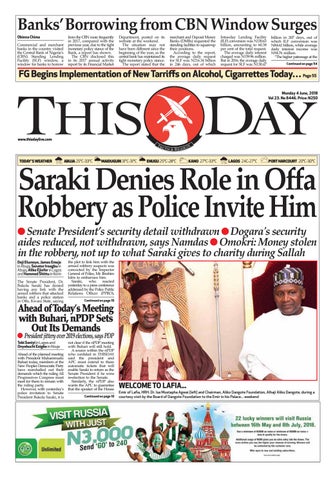
Saraki Denies Role in Offa Robbery as Police Invite Him Senate President’s security detail withdrawn Dogara's security aides reduced, not withdrawn, says Namdas Omokri: Money stolen in the robbery, not up to what Saraki gives to charity during Sallah Deji Elumoye, James Emejo in Abuja, Senator Iroegbu in Abuja, Alike Ejiofor in Lagos and Hammed Shittu in Ilorin The Senate President, Dr. Bukola Saraki has denied having any link with the armed robbers that attacked banks and a police station in Offa, Kwara State, saying
the plot to link him with the armed robbery suspects was concocted by the Inspector General of Police, Mr. Ibrahim Idris to embarrass him. Saraki, who reacted yesterday to a press conference addressed by the Police Public Relations Officer (PPRO), Continued on page 10
Ahead of Today’s Meeting with Buhari, nPDP Sets Out Its Demands
President jittery over 2019 elections, says PDP
Tobi Soniyi in Lagos and Onyebuchi Ezigbo in Abuja Ahead of the planned meeting with President Muhammadu Buhari today, members of the New Peoples Democratic Party have marshalled out their demands which the ruling All Progressives Congress must meet for them to remain with the ruling party. However, with yesterday's police invitation to Senate President Bukola Saraki, it is
not clear if the nPDP meeting with Buhari will still hold. A source within the nPDP who confided in THISDAY said the president and APC must extend to them automatic tickets that will enable Saraki to return as the Senate President if he wins re-election to the Senate. Similarly, the nPDP also wants the APC to guarantee that the speaker of the House Continued on page 10
WELCOME TO LAFIA... Emir of Lafia, HRH. Dr. Isa Mustapha Agwai (left) and Chairman, Aliko Dangote Foundation, Alhaji Aliko Dangote, during a courtesy visit by the Board of Dangote Foundation to the Emir in his Palace... weekend
2
T H I S D AY ˾ Ͳ˜ ͰͮͯͶ
T H I S D AY ˾ MONDAY JUNE 4, 2018
3
4
T H I S D AY ˾ Ͳ˜ ͰͮͯͶ
T H I S D AY ˾ MONDAY JUNE 4, 2018
5
6
T H I S D AY ˾ Ͳ˜ ͰͮͯͶ
T H I S D AY ˾ MONDAY JUNE 4, 2018
7
8
T H I S D AY ˾ Ͳ˜ ͰͮͯͶ
T H I S D AY ˾ MONDAY JUNE 4, 2018
9
10
MONDAY, ͞˜ ͺ͸͚΀ Ëž T H I S D AY
PAGE TEN SARAKI DENIES ROLE IN OFFA ROBBERY AS POLICE INVITE HIM Moshood Jimoh, linking him to the Offa robbery, urged the public to disregard this claim as a baseless allegation and another ploy by the police to implicate him by all means. In a statement by his Special Adviser (Media and Publicity), Mr. Yusuph Olaniyonu, the Senate President recalled that on May 16, 2018, he had alerted the Senate about the information passed on to him by his State Governor, Dr. Abdulfatai Ahmed, over a plot by Idris, to frame him up. According to Saraki, the Inspector General of Police had planned to get some suspected cultists arrested in Ilorin to implicate him. Saraki argued that the timely leakage of the plot, in that case, aborted the use of the suspected cultists to implicate him, adding that it is the Offa bank robbery suspects that are about to be used. “Let it be known that there is no way I could have been associated with armed robbery against my people. When the Offa robbery incident happened, I was the first top public official to pay a visit to the place and right there in the palace of the traditional ruler, I put a call through to this same Mr. Ibrahim Idris, the IGP, requesting him to make certain specific security arrangements as demanded by the people,� he said. “This plot is concocted to embarrass me and, in the mind of the IGP, it is his own response after his refusal to honour the invitation by the National Assembly, headed by me, for him to come and offer explanations on the rampant killings and violence across the country. Like the earlier one, this frame-up will also fail as I hereby state categorically that I have no link with any band of criminals,� Saraki added. The Senate President added that as a person who has the utmost respect for the rule of law and all constitutional institutions, he will honour the police invitation when it is formally extended to him. “It is however sad that this abuse of the criminal investigation process aimed at intimidating and over-overawing the legislature, thereby obstructing it from doing its work, is a big threat to our democracy,� he added. It appears there is no let off for embattled Senate President, Bukola Saraki, following the latest directives from the police and Department of State Security (DSS) that his security details should be withdrawn with effect from today. THISDAY authoritatively gathered that a formal letter for the withdrawal of the security personnel consisting of police and Department of State Security, DSS, personnel numbering about 20 was at the weekend sent to the office of the Senate President by both Police IG and DG of the DSS. The affected officers and men were directed by the letter to report at the FCT Commands of both the DSS and Police for further briefing by 10 am today. The letter, THISDAY further
gathered, was silent on why the security operatives are being withdrawn with no information about whether the operatives will be replaced or how soon they will be back to their duty post. Among those affected by the withdrawal are Saraki's Chief Security Officer, CSO, Aide de Camp, ADC, Chief Security Detail, and Police and DSS personnel guarding Saraki's office at Three Arms Zone and residence at Maitama. In a swift reaction to rumours surrounding the withdrawal of security details attached to the Speaker, House of Representatives, Yakubu Dogara, the Spokesman of the House of Representatives, Hon. Abdulrazak Namdas yesterday refuted reports that security aides attached to the Speaker of the House, Hon. Yakubu Dogara had been withdrawn by the Federal Government. In a telephone conservation with THISDAY last night, Namdas clarified that though it was true that the number of security details attached to the Speaker had been reduced, they were not out-rightly withdrawn as being speculated. He added that both men from the State Security Services (SSS) and the Department of State Security (DSS) were cut in the latest development. The withdrawal of Saraki’s security details is also coming against the backdrop of an invitation by the Nigerian Police Force to the Senate President inviting for questioning over the allegations levelled against him by suspects arrested over the Offa Bank robbery incident in Kwara State. The Force Public Relations Officer (PRO), ACP Moshood Jimoh, who disclosed this in a statement released yesterday, also accused the Kwara State government of trying to conceal evidence that links Saraki to the deadly robbery attack. Jimoh said that the investigation into the robbery and gruesome killings of more than 33 innocent persons in Offa, Kwara State on April 05, 2018 as directed by the Inspector General of Police (IGP) Ibrahim Idris, has made significant progress, successes and more revelations have been recorded. He said that the gang leaders and some of the principal suspects arrested for their active participation in the robbery and the killing of innocent persons have made confessional statements admitting to the various criminal roles they and their sponsors played in this dastard and heinous crime. To this end, the Police are pointing accusing fingers at Saraki and Kwara State Governor, Alhaji Abdulfatah Ahmed, as having links with the suspects of the robbery incident. The Senate President had earlier raised the alarm intimating President Muhammadu Buhari of a plot by the IG of police to frame him in the attack and killings. Jimoh in the statement said: " The Senate President, Sen.
Bukola Saraki is being invited by the Nigeria Police Force to report to the Force Intelligence Response Team office at Guzape, Abuja to answer to the allegations levelled against him from the confessions of the five gang leaders, namely; Ayoade Akinnibosun, Ibukunle Ogunleye, Adeola Abraham, Salawudeen Azeez, Niyi Ogundiran and some of the other 17 suspects arrested for direct involvement and active participation in the Offa Bank Robbery and the gruesome killing of 33 innocent persons, including (some pregnant women and nine Police personnel). "The Personal Assistant (Political) to the Executive Governor of Kwara State, Mr. Alabi Olalekan, who is privy to information that the Police is looking for the Lexus Jeep as an exhibit used in the Offa Bank Robbery and the killing of 33 innocent persons directed one Adeola Omiyale to relocate the Lexus Jeep to Government House, Ilorin. The PA (Political) is currently in Police custody and has made useful statement assisting the Police in further investigation into the case. A revolver pistol and pump action gun were recovered by the Police Investigation Team from the Personal Assistant (Political) to the Executive Governor of Kwara State, Mr. Alabi Olalekan’s farm where he directed his brother to hide them after his arrest by the Police." "In order to conceal evidence, the Chief of Staff to the Executive Governor of Kwara State, Mr. Yusuf Abdulwahab who has been arrested and taken into Police custody, arranged the removal of the sticker plate number with inscription “SARAKI� “Kwara, State of Harmony� from the exhibit vehicle and also registered the exhibit Lexus Jeep used in the Offa bank robbery and the killing of 33 innocent persons in the name of Ayoade AKinnibosun, the overall gang commander of the Offa bank robbery while the Ayoade AKinnibosun was already in Police custody for more than six days before the registration of the vehicle." "The five gang leaders namely; Ayoade Akinnibosun, Ibukunle Ogunleye, Adeola Abraham, Salawudeen Azeez, Niyi Ogundiran and some of the other 17 suspects arrested for direct involvement and active participation in the Offa bank robbery and the gruesome killing of 33 innocent persons including (some pregnant women and nine Police personnel) admitted, confessed and volunteered statements that they were political thugs to the Senate President, Federal Republic of Nigeria, Sen. Bukola Saraki and the Executive Governor of Kwara State, Alh. Abdulfatah Ahmed. "The arrests of the above mentioned five gang leaders and 17 others were made possible after the arrest of two principal suspects (Kunle Ogunleye, a.k.a Arrow 35yrs and Michael Adikwu an Ex-Convict) whose pictures
were captured by CCTV in one of the banks during the banks' robbery were circulated to the media and the public. The two principal suspects confessed to being among the suspects led by the five gang leaders listed in paragraph 2 above to carry out the Offa Banks Robbery, the attack on the Divisional Police Headquarters, Offa and the killing of 3 innocent persons on the 5th of April, 2018." The Force PRO stated that during the interrogation, the five gang leaders mentioned in paragraph 2 further confessed and volunteered statements that they carried out the bank robberies, the attack on the Divisional Police Headquarters in Offa and the killing of the deceased during the robbery of the six banks, namely; First Bank Offa, Guaranty Trust Bank Offa, ECO Bank Offa, Zenith Bank Offa, Union Bank Offa, Ibolo Micro Finance Bank Offa and the Divisional Police Headquarters. Jimoh said that millions of Naira from the Banks and 21 AK47 Rifles belonging to the Nigeria Police Force in the Armoury of the Police Divisional Headquarters, Offa were admitted to have been carted away by the gang leaders and the other principal suspects during the banks' robbery. According to him, the gang leaders confessed and volunteered statements to the Police investigators, giving a clear account of how they planned and carried out the banks' robbery operation in Offa, the attack on the Police Division in Offa and how they killed the innocent persons during the robbery. He said that the gang leaders further confessed during the investigation that they are political thugs under the name Youth Liberation Movement a.k.a “Good Boys� admitting and confessing to having been sponsored with firearms, money and operational vehicles by the Senate President, Sen. Bukola Saraki and the Governor of Kwara State, Alh. Abdulfatah Ahmed. The Police Spokesman said that in the course of discreet investigation into the confessions of these five gang leaders and the other 17 principal suspects, a Lexus jeep GX-300 (Ash Colour) with a sticker plate number with inscription “SARAKI� “Kwara, State of Harmony� used by the gang leader (Ayoade Akinnibosun ‘M’ 37Yrs) during the bank robbery and the killing was taken to Government House, Ilorin on 16th May, 2018 where the sticker plate number with inscription “SARAKI� “Kwara, the State of Harmony� was removed before another plate number (Reg. No. Kwara, KMA 143 RM) registered in the name of Ayoade AKinnibosun the Overall Commander of the Offa bank robbery was then attached to the vehicle to cover up the identity of the said vehicle. He said the exhibit vehicle was subsequently recovered from the premises of the Min.
of Environmental and Forestry in Ilorin, Kwara State. While the sticker plate number with inscription “SARAKI� “Kwara, State of Harmony� removed from the vehicle was recovered from one Adeola Omiyale who drove the said Lexus Jeep to Government House, Ilorin immediately after the Bank Robbery. Jimoh noted that investigation is ongoing and effort is being intensified to arrest other suspects still at large. All suspects involved will be arraigned in court for prosecution on completion of the investigation. He assured that the Nigeria Police Force will continue to ensure that the rule of law prevails in every case under police investigation and every offender is brought to justice. He insisted that the 22 suspects now in police custody and the "Senate President, Sen. Bukola Saraki is being invited to report to the Police to answer allegations indicting him from confessions of five gang leaders arrested for active participation in Offa bank robbery and killing of 33 innocent persons". Police listed the suspects to include: Ayoade Akinnibosun a.k.a AY ‘M’ 37Yrs – Gang Leader (Coordinated the Killings) from Oro, Irepodun LGA, Kwara State; Ibukunle Ogunleye ‘M’ 36Yrs – Gang Leader, Killed Two Persons. From Oro, Irepodun LGA, Kwara State; Adeola Abraham ‘M’ 35Yrs – Gang Leader, Killed Five Persons. From Oro, Irepodun LGA, Kwara State; Salawudeen Azeez ‘M’ 49Yrs – Gang Leader, Killed Two (2) Persons. From Oro, Irepodun LGA, Kwara State; Niyi Ogundiran ‘M’ 37Yrs – Gang Leader, Killed Two Persons (Latest Confession). From Oro, Irepodun LGA, Kwara State; and Michael Adikwu ‘M’ 30Yrs – Sectional Gang Leader, Killed 22 Persons, mostly at the Police Station. Others are: Kabiru Afolabi ‘M’ 26Yrs – Principal Suspect; Omoseni Kassim ‘M’ 28Yrs – Principal Suspect; Kayode Opadokun ‘M’ 35Yrs – Principal Suspect; Kazeem Abdulrasheed ‘M’ 36Yrs – Principal Suspect; Azeez Abdullahi ‘M’ 27Yrs – Principal Suspect; Adewale Popoola ‘M’ 22Yrs – Principal Suspect; Adetoyese Muftau ‘M’ 23Yrs – Principal Suspect; Alexander Reuben ‘M’ 39Yrs – Principal Suspect; Richard Buba Terry ‘M’ 23Yrs – Principal Suspect; Peter Jasper Kuunfa ‘M’ 23Yrs – Principal Suspect; Ikechukwu Ebuka Nnaji ‘M’ 29Yrs – Principal Suspect; Moses Godwin ‘M’ 28Yrs – Principal Suspect; Adeola omiyale ‘M’ 38Yrs. From Isanlu Isin Town, Isin LGA, Kwara State; Femi Idowu ‘M’ 34Yrs; Alabi Olalekan ‘M’ 49Yrs-PA Political to Executive Governor, Kwara State; and Yusuf Abdulwahab ‘M’ 58Yrs –Chief of Staff to Executive Governor, Kwara State. Jimoh also listed the exhibits to include: Two AK47 Rifles; Two Barrette Pistols; One Pump Action Rifle; One Revolver Pistol – In Police Custody in
Ilorin; Lexus RX300 Jeep with Reg. No. Kwara, KMA 143 RM belonging to Ayoade Akinnibosun (Gang Leader) – Used for the Bank Robbery; Mercedes Benz – Compressor with Reg. No. Lagos LT496 KJA belonging to Ayoade Akinnibosun (Gang Leader) – Used for the Bank Robbery; One (Toyota Prado Jeep with Reg. No. 19KWGH belonging to the PA Political to the Executive Governor, Kwara State - In Police Custody in Ilorin; One Toyota Camry Saloon Car with Reg. No. LRN 481 FE - In Police Custody in Ilorin; The Cash Sum of Six Hundred Thousand Naira (N600,000.00) - In Police Custody in Ilorin; Four Phones of victims recovered; and One Sticker plate number with inscription “SARAKI� “Kwara, State of Harmony�.
Ahmed Reacts However, in reaction to the allegation of complicity in the robbery attacks and other criminal activities in his state, Kwara State Governor, Alhaji Abdulfatah Ahmed yesterday denied police allegations of sponsoring, funding, arming or otherwise supporting political thuggery. In a statement issued by his Senior Special Assistant on Media and Communication, Dr. Muyideen Akorede yesterday in response to a Nigeria Police statement accusing him of sponsoring political thugs allegedly linked to the Offa Armed Robbery incident, Alhaji Ahmed described the allegations as false and rejected his alleged indictment by the Nigeria Police or the armed robbery suspects in their custody. Governor Ahmed affirmed that while the state government has empowered several youth groups under its acclaimed Small and Medium Enterprises (SME) scheme, neither he nor the state government can be held liable for how beneficiaries utilize the credit. He, therefore, urged the police to complete their investigations and charge the suspects to court soon in line with the dictates of the rule of law. Meanwhile, Reno Omokri, former Special Assistant to President Goodluck Jonathan, said the accusation against Saraki showcases the fallacious tendencies of the police. "They now want us to believe that the distinguished Senate President Bukola Saraki, is the mastermind of the deadly Offa Bank robbery. Omokri said allegation against Mr. Saraki begs the question. Adding, “does the Buhari government even reason? The amount of money stolen during the Offa Bank Robbery is not up to the sum of monies that Bukola Saraki gives out in charity to the masses during Sallah and other Islamic festive occasions. The Senate President also sits atop a N100 billion annual budget. Why would he sponsor a bank robbery?�
AHEAD OF TODAY’S MEETING WITH BUHARI, NPDP SETS OUT ITS DEMANDS of Representatives, Yakubu Dogara will be allowed to return as the speaker once he wins re-election to represent his federal constituency. "Since the party has more or less agreed to give the president automatic ticket to fly the party's flag during next year's presidential election, the nPDP wants similar treatment for principal leaders of the National Assembly," the source said. The nPDP is demanding a firm commitment from the APC that they will allow principal leaders of the National Assembly to retain their seats. To avoid what transpired in 2015 when some leaders of the APC reneged on the gentleman agreement that would have allowed Saraki to emerge as Senate President with the support of the APC, the nPDP
is demanding that APC agrees in writing which will become enforceable. THISDAY source said that nPDP would demand from President Buhari that his party, APC agrees in writing to support Saraki and Dogara to return as Senate President and Speaker of the House of Representatives respectively once they are elected into the National Assembly by their district and constituency. They are demanding the Buhari treatment for the Senate President and the speaker, should they win their district and constituency elections, they should support them to emerge Senate President and speaker respectively. Another condition which the nPDP will want the Presidency to guarantee is that the governor of Benue and Sokoto states, Samuel Ortom and Aminu Tambuwal,
as well as other governors who are members of the nPDP, will be given automatic tickets to seek re-election as governor of their respective states. The nPDP is also demanding that a former governor of Kano, Rabiu Kwankwaso and a former Sokoto State, Aliyu Wamako are allowed to return as senators. In addition, nPDP will equally demand from Buhari that he allows both Kwankwaso and the Kano State governor, Ibrahim Ganduje to jointly manage the APC in Kano in a way that will guarantee cohesion and unity of purpose. Members of the nPDP said that their demands would ensure stability at the highest level of governance and avoid a situation where people who should be working in accord work at cross purposes.
The nPDP consists of those who left the PDP in 2013 and joined forces with other parties to form the APC and helped the party win the 2015 presidential elections. They recently cried out accusing the leadership of the APC of not appreciating their contributions. Among them are former governors of Sokoto, Aliyu Wamakko; Kano, Rabiu Kwankwaso; Kwara, Abdulfatah Ahmed; Adamawa, Murtala Nyako and Rivers, Rotimi Amaechi. There were also former governors of Kebbi, Adamu Aliero; Gombe, Danjuma Goje; Osun, Olagunsoye Oyinlola; former Vice President, Atiku Abubakar; former acting National Chairman of PDP, Abubakar Baraje and an ex-Speaker of
the House of Representatives, Aminu Tambuwal. They also wrote to the National Chairman of the APC, John Odigie-Oyegun asking him to facilitate a meeting for them with President Buhari within seven days. In the letter signed by Baraje and Oyinlola, they reminded Odigie-Oyegun how their movement to the APC, not only swelled the ranks of the party but ensured success at the polls. According to them, most of their members delivered their states to the APC at the last elections. They also said some of the governors were assigned specific responsibilities to ensure that other states were also delivered to the APC in the 2015 elections. Continued on page 54
TOP GAINERS ACCESSBANK ETERNA CCNN FIRSTALUM JAPAULOIL TOP LOSERS INTERBREW DANGCEMENT CONSOLHALLMARK
NGN NGN 0.55 10.95 0.30 6.33 1.30 27.95 0.02 0.44 0.01 0.22 NGN NGN 4.30 40.20 17.00 223.00 0.02 0.31 FORTOIL 1.85 35.15 GUINNESS 5.00 95.00 HPE Nestle Nig Plc â‚Ś1,430.00 Volume: 516.832 million shares Value: N7.197 billion Deals: 5,031 As at yesterday 1/06/18 See details on Page 35
% 5.2 4.9 4.8 4.7 4.7 % 9.6 7.0 6.0 5.0 5.0
T H I S D AY ˾ MONDAY JUNE 4, 2018
11
12
T H I S D AY ˾ Ͳ˜ ͰͮͯͶ
T H I S D AY ˾ MONDAY JUNE 4, 2018
13
14
T H I S D AY Ëž Ëœ Í˛Ëœ 2018
COMMENT
Editor, Editorial Page PETER ISHAKA Email peter.ishaka@thisdaylive.com
IN DEFENCE OF THE NAIRA
Odilim Enwegbara argues that a strong currency is not desirable
W
henever I listen to some of our economists proposing a stronger naira I wonder on what economic development theory they are basing their argument. First, any proposal of a strong currency is never done with pro-real sector investment, pro-growth, pro-jobs or pro-poverty alleviation fully considered. That explains why I’m not only strongly opposed to this kind of economics. I always try to do so with enough convincing evidence to prove my case. I say so because to believe that the strength of any economy is dependent on the strength of its currency and as a result promotes its competitiveness only amounts to poor knowledge of the workings of modern international trade and why downward currency manipulation is the surest way to play to win in the economic competitiveness game. So, the truth of the matter is that for any industrial economy to be continuously competitive or for any non-industrial economy to begin to industrialise, the first and the most important currency policy of such a country should focus on how best to make sure that imported consumer goods are priced out of its domestic market and later taking the price war overseas by also making sure that at international markets, locally made goods are made cheaper than such goods made else. This is only made possible by making sure that the country’s domestic currency is constantly manipulated downward by those in charge of the country’s currency policy. That’s exactly what China has been doing and it is exactly what has degenerated to the ongoing currency war between the US and the People’s Republic of China. It is why if we too want to truly industrial, we too should make sure that not only do we cheaply produce most of the goods we consume, but also cheaply produce what many other countries consume. In other words, Made in Nigeria goods should be continuously cheaper than those same goods made elsewhere. But for this to happen, we all know that the value of the naira should be kept artificially lower not only than its real market value but above all lower than the value of most other major currencies, especially currencies of those economies which we intend to compete with. This way goods from these countries with strong currencies would be priced more expensively both in their own consumer markets and in Nigeria; while at the same time, Nigerian made goods are priced cheaper around the world. This will make Nigerian made goods gain more consumer patronage than their competitors. As a result, millions of manufacturing jobs will be created in Nigeria while displacing competing firms wherever they may be found in the world. That’s why naira at N500 per dollar isn’t as bad as most Nigerians are made to believe by most of our economists. As long as we make access to official forex to only those importers of industrial inputs, mostly importers of essential raw materials and plant and equipment, imported inflation resulting from import dependency will never arise. Carrying out this new forex policy is the single policy needed to lessen the pressure on our foreign reserve accounts because it discourages importation of goods that can be cheaply and easily made locally.
MADE IN NIGERIA GOODS SHOULD BE CONTINUOUSLY CHEAPER THAN THOSE SAME GOODS MADE ELSEWHERE
So that with most importers of finished consumer goods denied access to official forex and also required to prove beyond doubt the legitimate source of their forex, that certainly will amount to making it difficult for those importers of cheap foreign made goods to access forex which will put a stop to the pressure such imported goods have on our foreign reserve accounts. This not only discourages the import of finished consumer products that tend to displace our infant industries and jobs, but by cheaply producing these goods locally the same goods being imported will be priced out in Nigeria. This is the only way import substitution industrialisation will be made possible in Nigeria especially with the goal to quicken the country’s industrialisation to the extent that within a short period of time we too can begin to become one of the leading industrial economies in the world with millions of industrial jobs created along with millions of poor Nigerians lifted out of poverty and government revenue growing in such geometric progression. This what really happened in China where with such smart policy China created more than 600 million jobs and close to 900 million of its 1.4 billion people lifted out of poverty during the past 39 years of its economic revolution driven by import substitution. This is the kind of currency policy that we should be expecting Odilimandfriends monetary reform committee to be represented to our forthcoming book, “The Big Bang: Planning Nigeria’s Economic Revolution.� Since China adopted this policy of manipulating its currency yuan downward while making sure its competitors’ currencies are kept artificially high, Chinese goods have continued to be far cheaper than goods from these competitors. In this currency war, China has always been beating the US for more than a decade now. But also to ensure that the US does not devalue the dollar which would amount to double jeopardy for China, rather than going to demand from the US to pay it its over $4trillion in dollar foreign reserves, knowing fully well that that would amount to the US printing more dollars (possibly exactly that amount), which would, in fact, amount to the very devaluation of the dollar, it is only logical why acquiring strategic US brownfield companies, important corporate buildings and resorts, farmlands, etc., remains the smartest thing China is doing without having to force the US to devalue the dollar. That is the same reason why in the meantime, making sure that going forward China’s exposure to the dollar is drastically reduced, China has since engaged in currency swaps with most of its major trading partners around the world. And with the currency swaps adoption, China is increasingly lessening its economy’s exposure to the already badly battered dollar which is fast losing its world’s de facto reserve currency power, which collapse is only a matter of time. China rightly believes that when that happens, its yuan will eventually replace dollar as the world’s reserve currency. basil_enwegbara@yahoo.com
INVESTING IN CONSTANT INNOVATION
Democracy day presidential broadcast buoys the federal civil service, writes Ofem Uket
F
ederal Civil Servants numbering 25, 000, a reasonable percentage of the entire federal work force in the country will undergo various forms of capacity building training in different sectors of the nation’s economy to advance and improve in the overall performance of staff in line with the present administration’s commitment to change the process of governance. The training scheme will afford workers the rights to their work condition which was denied in the past, but favourably reviewed by the current leadership of the Office of the Head of Civil Service of the Federation as part of the ongoing reform procedures with deliberate plan to create a new and sustainable work place environment. Apparently, when you match towards greatness in life, you are taking up more responsibilities and major sacrifices are expected from both the employer and the employee. ‘To whom much is given much is expected’ is a natural phenomenon that is applied in all strata and sphere of life. During the Democracy Day broadcast to commemorate his three years in office, President Muhammadu Buhari had noted with gratitude that about N200 billion was saved by the present administration through the elimination of ghost workers in the Federal Civil Service. The presidential address also noted that the Treasury Single Account (TSA) has realised billions of naira saved from
maintenance fee payable to banks. The address further stressed that the Presidential Initiative on Continuous Audit set up with a mandate to validate controls, assess risks, prune personnel costs, ensure compliance with public financial management reforms has helped to identify and remove over 52,000 ghost workers from the federal government ministries, departments and agencies (MDAs) payroll. However, the consequence of ghost workers is usually an over bloated public service, which accounts for illicit increase in wages, and forcing on government avoidable expenditure in the context of the yearly appropriations and budgetary provisions. At the moment, government is confident in the performance of the payroll system, though regular and routine monitoring of worker’s nominal roll is carried out to identify areas of fraud, and the overall transparency of the payment plans within the public service. Before the public pronouncements of Mr. President on the excellent performance of the Office of the Head of Civil Service, in fighting corruption, the current leadership has expressed readiness to address core areas of competence and lack in the public service, the result is therefore the savings through the cleaning up of fraudulent database that comprised of ghost workers. Over and above the civil service, the Head of Service has an inclusive programme of action that has encouraged private participa-
tion, collaboration and partnership with government agencies in major sectors of the economy to provide professional experience and relevant skills to enhance productivity and sustainable growth. Therefore, the reforms have taken care of industry players in the private sector, with great expectation to draw creativity and technical competence that would be applied in major areas of needs. One other core area of score is institutionalising performance management- based system, piloting tools and introducing non-monetary recognition and the launch of a salary review of the civil service as a first step to enhance the value proposition of civil servants. Speaking at strategic interactive sessions of the public reforms sensitisation summits and assemblies held in the past, the HOS of the Federation, Mrs. Winifred Oyo-Ita declared that the federal civil service in Nigeria has continued to match towards greatness within the last two years. She said, in order to reposition the service as an effective machinery of government for improved service delivery, the current leadership of the office of the head of the civil service of the federation (OHCSF) under her and in line with the current administration of President Buhari in its change agenda and Economic Recovery and Growth Plan (ERGP) 2017 – 2020, Nigeria has charted a new course for the service intended to make the service efficient and productive.
According to her, at the instance of a presidential intervention, her office received the support of African Initiative for Governance (AIG) and through the engagement of the services of McKinsey developed a clear communicable action plan for transforming the Nigeria Federal Civil Service. “From the time we constituted and inaugurated the PMTs, we have made progress and remained focused on ensuring successful delivery of the project. Various retreats were organised and strategically designed to equip members of the PMTs with the requisite skills and knowledge to deliver the expected outcomes of the strategy,� she said. On the public sector, the presidential broadcast was inspiring to accelerate the process of giving the Nigerian worker a new lease of life around performance and job satisfaction, especially at a time when the public acknowledged that the reform scheme is open enough to attract the attention that it is being given right now. Though the journey so far has been commendable, a lot needs to be done, which should focus more in strengthening the capacity of personnel and allowing competence, incorruptible and sustainable good conduct to thrive. President Buhari has therefore declared that public sector reforms should be a priority not only to government, but the private sector in the areas of collaboration and partnership, drawing expertise and experience from professionals outside the civil service.
15
T H I S D AY MONDAY, JUNE 4, 2018
EDITORIAL INSTILLING ACCOUNTABILITY IN NNPC The state-owned oil corporation needs immediate reforms
I
n response to the huge amount of money being illegally deducted by the Nigerian National Petroleum Corporation (NNPC) as a first-line charge from the federation account, the National Economic Council (NEC), comprising the 36 state governors in the country, recently proposed taking over the responsibility for subsidising petroleum products in their states. But the real issue goes beyond subsidy payments to the absence of due process, transparency and accountability in the management of the NNPC, an agency of government notorious for corruption and opacity. For years, the Nigeria Extractive Industries Transparency Initiative (NEITI) has been releasing reports about the mismanagement of the oil and gas sector and the need to bring integrity to bear in its operations. But there seems no indication that the federal government can muster the requisite political will to address such problems. Following the aborted Federation Account Allocation Committee (FAAC) meeting for March, governors of the 36 states had a meeting with NNPC in April over what they described as a NO GOVERNMENT HAS consistent shortening BEEN ABLE TO SUMMON of what should accrue THE COURAGE TO to them from the ADDRESS THE IMPUNITY federation account. AND THE ARBITRARINESS That lingering issue is IN NNPC WITH THE yet to be resolved.
OVERALL AIM OF CLOSING THE LOOPHOLES THAT Addressing the leBREED CORRUPTION gal, institutional and
regulatory framework weighing down the behemoth is a huge challenge. “Information about Africa’s biggest oil industry is an opaque myriad of numbers. No one knows which ones are accurate; no one knows how much oil Nigeria actually produces. If there were an authoritative figure, the truly horrifying scope of corruption would be exposed,” a report in the Economist once stated. Unfortunately, no government has been able to summon the courage to address the impunity and the arbitrariness in NNPC with the overall aim of
Letters to the Editor
closing the loopholes that breed corruption. However, the current agitation by the governors, if well directed, may force a reform in the NNPC and make it more beneficial to the Nigerian people. According to the Chairman of Nigeria Governors’ Forum, Abdulazeez Yari of Zamfara, a decision would be taken this month on whether or not states should take responsibility for the subsidy they consume. “Our problem is the volume, the quantity of consumption which is not acceptable,” said Yari. “For instance, if you say we paid N800 billion subsidy, you will ask who are we paying the subsidy to? So, we are coming up with a strategy. By next meeting, we will definitely come up with a position of the government at both level of volume of what is being brought into the country and what the state and federal government collaborate to check.”
G T H I S DAY EDITOR IJEOMA NWOGWUGWU DEPUTY EDITORS BOLAJI ADEBIYI, JOSEPH USHIGIALE MANAGING DIRECTOR ENIOLA BELLO DEPUTY MANAGING DIRECTOR KAYODE KOMOLAFE CHAIRMAN EDITORIAL BOARD OLUSEGUN ADENIYI EDITOR NATION’S CAPITAL IYOBOSA UWUGIAREN
T H I S DAY N E W S PA P E R S L I M I T E D EDITOR-IN-CHIEF/CHAIRMAN NDUKA OBAIGBENA GROUP EXECUTIVE DIRECTORS ENIOLA BELLO, KAYODE KOMOLAFE, ISRAEL IWEGBU, IJEOMA NWOGWUGWU, EMMANUEL EFENI DIVISIONAL DIRECTORS PETER IWEGBU, ANTHONY OGEDENGBE DEPUTY DIVISIONAL DIRECTOR OJOGUN VICTOR DANBOYI SNR. ASSOCIATE DIRECTOR ERIC OJEH ASSOCIATE DIRECTORS PATRICK EIMIUHI, SAHEED ADEYEMO CONTROLLERS ABIMBOLA TAIWO, UCHENNA DIBIAGWU, NDUKA MOSERI DIRECTOR, PRINTING PRODUCTION CHUKS ONWUDINJO TO SEND EMAIL: first name.surname@thisdaylive.com
iven that most of the states are so broke that they cannot even pay the salaries of workers, we are not surprised that their focus has shifted to the subsidy regime. But it will be very unhelpful to bundle the removal of petroleum subsidy with states’ capacity (or lack thereof) to pay salaries of workers. Petroleum subsidy, we believe, should be removed because it is inefficient, it is oiling corruption, and it is robbing society of vital resources that could be invested in hospitals, schools, roads and other critical areas that directly stimulate economic activities. As we have consistently argued on this page, a regime of unbridled subsidy in which a substantial slice of the national budget goes to service the consumption of one single item is detrimental to the development of any nation. But the issue at hand is how to make the NNPC more accountable and transparent in its dealings. The solution lies in the reform of the sector. The National Assembly has done considerable work with the Petroleum Industry Governance Bill (PGIB). We hope President Buhari will speed up the process of signing the bill into law when the reworked edition is eventually sent in.
TO OUR READERS Letters in response to specific publications in THISDAY should be brief (150-200 words) and straight to the point. Interested readers may send such letters along with their contact details to opinion@thisdaylive.com. We also welcome comments and opinions on topical local, national and international issues provided they are well-written and should also not be longer than (9501000 words). They should be sent to opinion@thisdaylive.com along with the email address and phone numbers of the writer.
LAGOS’FRESH EMPLOYMENT INITIATIVES
T
here exists a large army of unemployed youths in our country. According to a latest National Bureau of Statistics report, the country’s unemployment rate is 14.2%. But this number still did not include about 40 million Nigerian youths captured in World Bank statistics in 2009. By implication, it means that if Nigeria’s population is 180 million, then 50% of Nigerians are unemployed, or worse still, at least 71% of Nigerian youths are unemployed. This is particularly disturbing. Since Lagos State is home to about 21 million Nigerians, it is safe to affirm that the state, which is the fifth largest economy in Africa, feels the brunt of the menace of youth employment the most. That Lagos alone accounts for over 70% of national industrial investments makes it attractive to job seekers from all across the country. In Lagos, unemployed youths fall into various categories viz employable and unemployable degree holders, medium level education certificate holders, school certificate holders and drop outs and those who never made it beyond primary schools. Stark illiterates also swam on the state on a daily basis, seeking jobs. In order to frontally address the state’s peculiar unemployment question, the state government has put in place several new initiatives alongside existing ones. For instance, to prepare graduates for life after school, Ready-Set-Work was launched. It is an entrepreneurial and employability training programme aimed at ensuring that every student who graduates from any tertiary institution in Lagos has knowledge, skills, and attitude required to gain employment upon graduation. The 13-week training programme prepares final year students for
immediate entry into the workforce as employees and employers of labour by equipping them with market-aligned soft skills, business tools, and a mindset re-orientation to the world of work. Since its inception in 2016, 12,500 students have benefited from the programme. Another fresh strategy being deployed to tackle unemployment in the state is the revamp of technical education. Technical education is the form of education that prepares people for specific trades, crafts and careers at various levels. As our country aspires to diversify its economy; it is evident that a vital instrument needed for attaining such height is skilled manpower development and a competent workforce. It is in order to address this need that the state government has been boosting technical education in the state. The collapse of many industries and the limited capacity of government at various levels to employ the teeming population have made white collar jobs practically non-existent. However, there exists job opportunities in other areas that our youths need to be sufficiently equipped to exploit. In the construction industry, for instance, there abounds limitless opportunities for youths with relevant skills for gainful employment. Sadly, this is not being fully exploited because of lack required competence. Thus, to get the needed good hands, property entrepreneurs go to neighbouring Benin Republic, Togo, Ghana and Cameroon. Presently, the Lagos State government is laying great emphasis on technical education to reverse the trend. Hence, the five technical and vocational colleges in the state have been rehabilitated and properly equipped while advocacy campaigns have been stepped up to get more students enroll into the colleges. Steadily, the efforts are paying off as enrolment into the colleges has increased by 120%, a situation that has
spurred approval for the establishment of three additional technical colleges in the state. The state government is equally partnering with several firms to further develop technical education through the setting up of academies within the colleges. Notable among these are Samsung (Engineering Academy), Electrical Power Engineering (power academy), Automechatronics (automotive academy) and Julius Berger (construction academy). The good thing about this development is that some of them provide instant employment for graduates of these colleges since they can vouch for their competence. For instance, 26 graduates of the state’s technical colleges were recently recruited by Dangote Groups as Technician Trainees at Dangote Academy, Obajana while 115 Graduates in Electrical Installation were recruited by Ikeja Electricity Distribution Company. To further exploit the current momentum, the Lagos State Technical and Vocational Education Board has collaborated with General Electric for the training of students and Instructors on 3D Printing Technology and Kansai Plascon on Human Capacity Development for 15 instructors in painting and decorating. The quality of training has also led to the employment of some graduates of the colleges while many have equally become self- employed. In order sustain existing progress in terms of enhanced job opportunities, the agriculture and agro business sector, with huge capacity for mass employment, is equally being creatively explored. Thus, the Agric Yes programme is being vigorously pursued to train students, school leavers and graduates in agro related enterprises at Araga in Epe. Adesegun Ogundeji, Deputy Director, Public Affairs, Lagos State Ministry of Education, Alausa, Ikeja
16
T H I S D AY MONDAY JUNE 4, 2018
T H I S D AY ˾ MONDAY JUNE 4, 2018
17
T H I S D AY ˾ MONDAY, JUNE 4, 2018
18
Group Politics Editor Tobi Soniyi Email tobi.soniyi@thisdaylive.com 07054786260 SMS ONLY
POLITICS
M O N D AY D I S C O U R S E
Waiting for the Opposition Candidate Time is running out for the opposition to unveil a candidate that is likely to take on President Muhammadu Buhari, write Tobi Soniyi, Segun James and Shola Oyeyipo
Atiku Abubakar
I
f President Muhammadu Buhari has his way, he will call on the opposition to wait till after the 2019 presidential election before fielding a candidate for president just like he told the youths after signing the Not Too Young to Run Bill into law. Luckily enough for the president, he does not need to ask the opposition. Those in opposition appear not ready to challenge him. Despite his much advertised scorecard in three years, the generality of Nigerians would want the president replaced by a more capable and pro-unity leader. Achievements speak for themselves. However, President Buhari’s achievements have to be advertised for people to become aware of them. People can’t seem to see the achievements. They just have to take the president’s words for it. Hope of replacing Buhari in 2019, however, remains forlorn as those in opposition are yet unable to come up with a formidable candidate that can mobilise voters to realise their dream of replacing Buhari. Although there are plenty of aspirants, including women who want to be president, voters have yet to see that ‘special person’ that they can support. Worse still, political parties have also not been able to narrow down their search to few electable persons. Yet, presidential election, barring any unforeseen circumstance, will hold in February, 2019. Meanwhile, the main opposition party the Peoples Democratic Party (PDP), has many aspirants who have indicated their interest in taking a shot at the presidency. The party,
Ibrahim Dankwabo
has however refused to gravitate towards any of the candidates. The decision not to show preference for any of the aspirants, it was learnt, was to avoid past mistakes where the party imposed candidates on the electorates. “We want the people to choose for us. We are watching all the aspirants and gauging the public mood”, a PDP official who said he was not authorised to comment on the issue told THISDAY Politics. Another reason why the opposition is treading softly may be to protect its potential candidate. Those who have already indicated their interests in running for the office of president are already being targeted by the Economic and Financial Crimes Commission. Many expect Buhari to easily win his party’s nomination. But there is a member of his party SKC Ogbonnia who has publicly announced his intention to contest the APC’s primary with Buhari. The odds remain heavily stacked against him though. Not many have heard about him. Ogbonnia is from Enugu and was a supporter of Buhari during the 2015 general election.
Although there are plenty of aspirants, including women who want to be president, voters have yet to see that ‘special person’ that they can support
He believes that APC should field a vibrant candidate like himself to retain power in 2019. He has beautiful ideas. But is Nigerian primordial and sentiment based politics ready for Ogonnia? Not many think so. One thing you can’t take away from him is that he has gut. Not even experienced politicians like Bola Tinubu are willing to take on Buhari. But Ogbonnia is ready. When he takes on Buhari at the primary, many in the APC already know what the result will be. Back to the opposition, the 2019 general election is barely eight months away; yet the opposition, including is yet to have any clear cut candidate(s) for the election. Below are some of the heavyweights who have signified their interest in the race. Atiku Abubakar Former Vice PresidentAtiku Abubakar is without doubt a political juggernaut in the country. A former vice president to Chief Obasanjo from 1999 to 2007. Atiku has never hidden his determination to rule the country. This naked ambition has been the bane of his political problems. Atiku is one person who has the political base and machinery to give President Buhari a run for his money. Furthermore, he has the financial strength and wherewithal to take on both Buhari and the APC in the election. However, he does not always enjoy the support of the power that be.His greatest undoing may his unstable political nature. Since within the last 12 years, he has left the PDP for the Action Congress before moving back again to the PDP.
When he was unable to realise his ambition in the PDP, he once again left the party for the APC. But frustrated at not again being able to become the presidential candidate of the party, he has since again left only to be back at the PDP. Some powerful elements within the PDP don’t seem like to like him. Sule Lamido This political godson of former President Olusegun Obasanjo and a former governor of Jigawa state is a political powerhouse in the north where he is very respected. Lamido, a former Minister of Foreign Affairs is an intellectual who was one of the few performing governors in the country. He has a considerable following in the north and has always been touted by the region as a northern candidate for the presidency. He however, has a weak national political base. He has never endeared himself to the southern part of the country where is hardly known. He will be a hard sell to other parts of the country if he his to engage Buhari in the presidential race. Rabiu Kwankwaso The former Kano State governor remains very popular in his state and has a large following in the south-west. The problem is- no one knows the political party he will adopt to realise his ambition. He has almost been pushed out of his party, the APC. He has, however, maintained a CONT’D ON PAGE 19
19
T H I S D AY ˾ MONDAY, JUNE 4, 2018
POLITICS
MONDAY DISCOURSE WA I T I N G F O R T H E O P P O S I T I O N C A N D I D AT E
Rabiu Kwankwaso
dignified silence. He has yet to publicly announce whether he will run for the office of president or not. Many are urging him to take the plunge. Kwankwaso, who was also a former minister for defence may turn out to be a thorn in APC’s flesh. He does not have much time on his side. Now that the Coalition for Nigerian Movement has adopted the African Democratic Party, the party obviously has a vacancy for presidential aspirant. Will Kwankwaso fill that vacancy? Time will tell. Ahmed Makarfi After leading the battle to rescue the Peoples Democratic Party from Ali Modu Sheriff and his group, followed by holding a scripted national convention, no one can blame the former governor of Kaduna State for his decision to wish to be president. On top of the fact that he stabilised the PDP, he is one of the rare aspirants adjudged to be free of encumbrances. If integrity is a factor, Makarfi stands out among the rest. However, he stepped on plenty toes in his bid to stabilise his party. That may be his undoing as those who felt that he did not treat them well when he was in control of the party would want to pay him back. He is also struggling to win follower ship in the south. Many members of the party in the South-west, either wrongly or rightly hold the view that he was a party to the plot to deny the south-west the party’s national chairman. Ibrahim Dankwabo Any one who attended the PDP’s convention last year in Abuja would easily remember how followers of the Gombe State governor, Ibrahim Dankwabo stole the show with traditional dances to announce the governor’s decision to seek his party’s nomination for the presidency. At a time, the leadership of the PDP was said to be given serious consideration to Dankwabo’s ambition. He has started campaigning even before the process is officially declared open. He will probably not remember how many endorsements he has received. But beyond the endorsements, Dankwabo does not appear to have many followers in the south. That, however, is a job his party can do
Kingsley Moghalu
equal measure made the enemy of many. for him, if it chooses to adopt him as its candidate. Ayodele Fayose Until recently, the Ekiti State governor was telling whoever cared to listen that he planned to seek election into the office of the president. No one knows what has changed because the governor does not appear to be interested anymore. His party, the PDP has made it abundantly clear that it would support a candidate from the north. May be this is the reality that has finally dawned on him. If he chooses to press on with him ambition, he is not likely to enjoy the support of his party and his people in the south-west. Many in the party are of the view that the Ekiti State governor only wants to be vice president. Aminu Tambuwal The name of the Sokoto State governor and former Speaker of the House of Representatives, Aminu Tambuwal keeps coming up as someone who is interested in the presidency. He has not made that intention known. He seems to be one of those hoping to take the plunge if the opportunity presents itself. For instance, if president Buhari changes his mind and decides not to run again. As long as Buhari is interested in reeletion, many expect the Sokoto State governor to seek re-election as governor. Nasir el Rufai The Kaduna State governor, Nasir el Rufai is another aspirant waiting in the wings. If President Buhari today changes his mind, el Rufai will throw his hat into the ring. He is a straight talker who is not afraid to make enemies. That quality which has endeared him to many has in
The decision not to show preference for any of the aspirants, it was learnt, was to avoid past mistakes where the party imposed candidates on the electorates
Ibrahim Shekarau Also a former governor of Kano State, Ibrahim Shekarau has announced his ambition to be president. He understood the value of education and introduced measures to increase school enrolment in the state. He was also a former minister for education. He encouraged more girls to go to school. Like Lamido, he is having a running battle with the EFCC. Non-conventional Candidates There are other candidates who are not your typical politicians who are equally interested in President Buhari’s job. Some of them are: Kingsley Moghalu One prominent entrant into the 2019 presidential race is political economist, lawyer and former United Nations official, and Professor of Practice in International Business and Public Policy at The Fletcher School of Law and Diplomacy at Tufts University, Kingsley Moghalu. Also a former Deputy Governor of the Central Bank of Nigeria (CBN) from 2009 to 2014, he is the founder, Sogato Strategies LLC, an emerging markets risk, strategy and macro-economic advisory firm. He hopes to realise his ambition on the platform of the Young Progressives Party (YPP). He is radical in his views, with a sound knowledge of the economy and appears to want to bring genuine change. However, he will need to do a tough job convincing voters to support him. For those who thought all he wanted was a vice president’s job, here is his reply, “People call me and ask if I am using my presidential aspiration to negotiate for a vice presidential ticket. But I want to say that the battle is here, and we need you to win it. I am not negotiating to be vice president to anyone. I will be a candidate of a party.” Fela Durotoye Another unique Nigerian aspiring to takeover President Buhari’s job is Fela Durotoye. Mr. Nigeria, as he is also known, is perhaps one of the most famous motivational speakers in Nigeria. He represents
the young generation. He formerly declared for the presidency and registered with the Alliance for New Nigeria (ANN), one of the newly registered political parties, which has as one of its core motives, to position professionals to displace career professionals in the running of the country. He is banking on the youths to make this happen. Displacing career politicians isn’t going to be easy. To do that, Durotoye will first have to convince the voters first. As he will soon discover, that is a no mean task. Elishama Rosemary Ideh A female aspirant, Elishama Rosemary Ideh, has also indicated that she would run for the office of president in 2019. She hopes to run on the platform the Alliance for a New Nigeria (ANN). Her priority, she said, would be to restructure the country. According to her, Nigeria at this time needs a different model of governance. Dr Johnson Edosomwan The founder of Nigeria Democratic Congress Party, Dr Johnson Edosomwan has also announced his intention to run for the office of president in 2019. Given his overriding interest in the party, he is certain to secure his party’s nomination as candidate. Despite the fact that his party remains relatively unknown, Edosomwan is confident that the future belongs to his NDCP. According to him, his party’s manifesto resonates with the people. He has carefully identified the issues that must be addressed before Nigeria can take her rightful place in the comity of nations. Top among these issues is unity. Without first uniting the people, Edosomwan, argues, governing Nigeria will remain a challenge. His party, he claims, has a magic wand with which it intends to unite the people. He stated that his party’s aim was to transform Nigeria for the better, if given the chance to pilot the affairs of Nigeria from 2019. Apart from uniting the people, Edosomwan said his party would also focus on infrastructure development, human capital enhancement, job creation, among others.
20
T H I S D AY Ëž Ëœ Í˛Ëœ Í°ÍŽÍŻÍś
FEATURES
Acting Features Editor Charles Ajunwa Email charles.ajunwa@thisdaylive.com
Sailing Across the Yangtze Solomon Elusoji who joined a team of reporters to visit China’s Hubei Province recently, writes about the most powerful river in the world
The Yangtze is the third longest river in the world
A Yellow Crane Tower view of the Yangtze snaking through Wuhan City
T
he sun sparkles in its full glory as we leave the airport and travel across long bridges by bus, swishing past multitudes of lakes and rivers. Hubei has been described as a ‘Province of Lakes’ and its capital, Wuhan, as the ‘City of Rivers’. If there was any doubt about the veracity of these ‘aquatic tags’, it soon disappeared as we reach the Yangtze River, Asia’s longest and most powerful river. Today, the Yangtze is quiet, even tranquil; yet, as it ferries boats, large and small, it radiates an authority, a confidence that belongs to things that bristle with so much history, things that have seen so much change and yet survive. “More than any other river in the world – more even than the Nile, which also cradles an entire country and nurtures a civilisation – the Yangtze is a mother-river,� the travel writer, Simon Winchester, has written. “It is the symbolic heart of China.� This part of the Yangtze River on which we are is where it meets its largest tributary, the Han River and divides Wuhan into three towns: Wuchang, Hankou and Hanyang. We are leaving Hankou and crossing into Wuchang, which is the provincial government’s seat. Wuchang, with its many skyscrapers and western-themed stores (McDonalds, Walmart, Pizza Hut, etc), is
a city under perpetual construction, a notion brought alive by the ubiquity of cranes. Also, like Beijing, where I have lived for much of the past three months, there are rows of bicycles along the sidewalks and the road signs are written in white font, on blue background. “My first impression is that this is a nice city, nicer than Beijing,� my Egyptian colleague, Hazem Samir, says. “And that’s because it is not crowded like Beijing and feels much more organised.� Hassan is right. Although Wuhan is the most populous city in Central China, housing over 10 million lives, the ratio of its area size to population is much better than China’s combustible capital. Here, too, the air
More than any other river in the world – more even than the Nile, which also cradles an entire country and nurtures a civilisation – the Yangtze is a motherriver
appears to be cleaner, even if just by a fraction. We check into the hotel – a Renaissance – and leave for lunch. Later in the day, we are driven to the Yellow Crane Tower. “If you come to Wuhan, you have to come here,� our guide, a bright Chinese lady in a white shirt and dark slacks, tells us. The Yellow Crane Tower is what it is – a tower with five levels and roofs that jut out and point to the heavens like some kind of worship. It is the history of the tower, however, that pulls crowds to it. The tower is situated on ‘Snake Hill’ from where, legend has it, an immortal, Wang Zi’an, rode away on a yellow crane. Since it was built sometime in the second century, the tower has been destroyed more than 12 times. The current structure was completed in 1985. At the fifth level, we stand at the balcony and watch Wuhan spread before us like butter on bread: a city made of blocks of apartment buildings, skyscrapers and, of course, the Yangtze. From here, the river takes a new shape as it crawls away, downstream, to Shanghai. In a certain way, it appears that the city was made for it. The sun begins to set and we return to the hotel, where we are met by provincial officials who tell us about the strategic importance of Hubei in modern China, one which is built upon
its unique location. And with shiny new ports, expansive and smooth highways, extraordinary ambitious airport and railway facilities, Hubei is doing a good job of connecting commerce within China and beyond. The next morning, we set out for Wuhan East Lake High-Tech Development Zone (EDZ). The EDZ is one of the high technology development zones approved by China’s State Council and has brought Wuhan global fame, especially in the area of optic electronics and communication technology. At an exhibition centre in the zone, we are led into a cinema-esque space where we watch, from an elevated balcony, a 3D documentary of EDZ’s story. Then we get a tour of the space, which is populated with cutting-edge technologies such as agricultural drones, biological cameras and innovative optic fibre products. While China has largely built its prosperity on the back of specialised mass manufacturing and services usually involving technology imported from the West, Wuhan’s EDZ is a potent sign of its ambition to become a much more sophisticated economy driven by the wheels of science and frenetic innovation. We spend the next morning travelling to nearby Huanggang, where we visit a Poverty Alleviation project in Lijiawan Village. These sort of projects dot the Chinese landscape as the
21
T H I S D AY Ëž Ëœ Í˛Ëœ Í°ÍŽÍŻÍś
FEATURES
government accelerates its vision of eliminating poverty among its people. In Lijiawan, a village with 844 people and 234 households, the poverty alleviation project has resulted in a collectively built solar panel which generates power that is sold to the national grid. According to the village’s Party Secretary, Zheng Xin, revenue generated from the solar panel’s electricity each year go as high as 60,000 RMB. Soon, we leave Wuhan via a highspeed rail for Yichang, the second largest city in Hubei, after the capital. Although Yichang, like all cities in China, also has its skyscrapers and large shopping centres, it is a much more sleepy town. The city is however popular with tourists, majorly because it is home to the world’s largest dam: the Three Gorges, a project that seeks to tame and harness the power of the Yangtze. One bright, sunny morning, we set out on a bus to the dam. The roads, on each side, are flanked by mountainous forests covered with mist. Then there is the Yangtze, snaking through the terrain, tamed by the engineering marvel of man. We are driven to the tourist section of the facility, a kind of vantage point from where we watch the dam and the river it seeks to control. It is a gargantuan sight, something out of a Transformers playbook. And tourists, Chinese and foreigners, mill around, taking pictures with the dam as a background. The Chinese ambition to tame the Yangtze River started sometime in 1919, but the country’s many political and social issues did not provide enough stability for practical steps to be taken until the early 1990s. The two major reasons for damming the Yangtze, according to Chinese officials, was the need to fight flooding in the Yangtze basin and generate electricity. Critics however argued that such a project was bound to despoil the environment and displace millions of Chinese. Sure, the project, after it went into operation in the 2000s, did displace a lot of people, but the government said it provided relocation facilities and funds for those affected. In 2017, flood control authorities in China also noted that the Three Gorges had played a big role in relieving flood pressure downstream. Also, the Three Gorges, which cost almost $28 billion to build, is the largest hydroelectric gravity dam in the world, with an installed capacity of 22,500MW. Well past noon into the visit to the Three Gorges, I found myself watching the river from across a rail as men, at the banks below, threw hooks into the water, looking for a catch. The river’s surface had a light-brownish hue as it danced nonchalantly away, unamused. I wondered about the depth and might of the stories it bore, from Tibet to Shanghai. But my thoughts did not get very far. I had read a couple of books about the river, but I did not know it. Its tale was transmitted in a language alien to my ears. The last dinner in Yichang was eaten with local officials. There, I started a conversation with a local foreign ministry official who had grown up in the city. “Yichang was a much more quiet city,� he told me. Then the Three Gorges came and brought with it a lot of development.
The Chinese ambition to tame the Yangtze River started sometime in 1919, but the country’s many political and social issues did not provide enough stability for practical steps to be taken until the early 1990s. The two major reasons for damming the Yangtze, according to Chinese ofďŹ cials, was the need to ďŹ ght ooding in the Yangtze basin and generate electricity
The Yangtze was dammed by the Chinese to control ooding and generate clean electricity
A group of African journalists pose in front of the Yellow Crane Tower in Wuhan
The Three Gorges Dam has been developed into a major tourist destination in Central China, attracting millions of visitors every year
“It is still a quiet city,� the official said. “It is not a busy place like Shanghai or Beijing. It is the sort of place where you come to after retirement and enjoy life.� He did not say as
much, but I saw that he was proud of what his city had become. Last April, the Chinese President, Xi Jinping, had visited Yichang, to inspect some environmental restoration work
along the Yangtze. It was the first time, in many years, a sitting President had showed up. “That was a very proud moment for us,� the man said.
22
IMAGES
T H I S D AY Ëž Ëœ Í˛Ëœ Í°ÍŽÍŻÍś
Photo Editor ĂŒĂ“Ă™ĂŽĂ&#x;Ă˜ ÔËÖË Email Ă‹ĂŒĂ“Ă™ĂŽĂ&#x;Ă˜Ë›Ă‹Ă”Ă‹Ă–Ă‹ĚśĂžĂ’Ă“Ă?ĂŽĂ‹ĂŁĂ–Ă“Ă Ă?Ë›Ă?Ù×
L-R: Chief Executive OďŹƒcer, Nigerian Export Promotion Council (NEPC), Mr Olusegun Awolowo; Minister of State for Agriculture and Rural development, Senator Heineken Lokpobiri; Chairman, Board of Directors, Atlantic Shrimpers Limited (ASL), Mr Stewart Harper; and Managing Director ASL, Kamlesh Kabra at the oďŹƒcial commissioning of newly acquired ďŹ shing trawlers by ASL in Lagos...recently yomi akinyele
L-R; Chief Executive OďŹƒcer of Brevity Anderson Consulting,Mr. James Shindi; the Group Managing Director of NNPC, Dr. Maikanti Baru and Chief Operating OďŹƒcer(Downstream)NNPC ,Engr. Henry Ikem Obih during the presentation of the 2018 Post Conference Report of the Nigeria International Petroleum Summit(NIPS2018) to the top management of NNPC by Brevity Anderson Consulting in Abuja...recently
Managing Director, Honeywell Flour Mills Plc, Mr. Lanre Jaiyeola; Co-founder, Youth Alive Basketball Tournament, Mr. Yemi Latona; Director Sports Development Lagos State Sports Commission, Prince Olusegun Kolawole and Innovation & Corporate Communication Manager, HFMP, Mr. Lanre Da-Silva, during presentation of Awards to Honeywell Flour Mills Plc as sponsor of 2018 Youth Alive Basketball tournament, in Lagos...recently
L-R: Chief of Air Sta, Air Vice Marshal, Sadique Abubakar; Deputy Governor of Plateau State, Mr Sonni Tyoden; Governor Simon Lalong of Plateau State, and Air Vice Marshal Jonah Wuyep (rtd), during the inauguration of newly established 205 Combat Search and Rescue group at Air Force Base, Kerang, Plateau State‌.recently
L-R: Regional Co-ordinator, South-east/South-south, Agribusiness of First City Monument Bank, Mr. Chinedu Amadi; Secretary-General, Plantation Owners Forum of Nigeria (POFON), Alhaji Fatai Afolabi; Head, Agricultural Business Finance & STCF of FCMB, Mr. Shola Obikanye; Chairman of POFON, Mr. Emmanuel Ibru and Manager, Mission Road Branch (Benin) of the Bank, Mr. Dauda Momodu, during the launch of the Roundtable on Sustainable Palm Oil (RSPO) National Interpretation, supported by FCMB, in Benin City, Edo State...recently
L-R; Minister of Water Resources, Mr. Suleiman Adamu; Secretary to the Katsina State Government,Dr. Muhammad Inuwa and the Minister of Information and Culture, Alhaji Lai Mohammed at the Commissioning of Sabke, Dutsi and Mashi Water Supply Schemes and Irrigation Projects in Dutsi, Katsina State...recently
l-R; Member,Planning & Strategy Committee, Ohanaeze, Prof Pat Utomi; Secretary,Planning & Strategy Committee,Ohanaeze, Arc Ferdinand Agu; Leader, Afenifere Delegation, Chief Ayo Adebanjo; Member, Planning & Strategy Committee, Ohanaeze, Mr. Emeka Ugwu-Oju and Former Governor, Ondo State and member,Afenifere Delegation, Dr Segun Mimiko, . at the Ohanaeze Ndigbo Worldwide Igbo Summit on “Restructuring the Nigerian Federation� held in Awka, Anambra State...recently.
23
T H I S D AY Ëž Ëœ Í˛Ëœ Í°ÍŽÍŻÍś
BUSINESSWORLD
Group Business Editor Chika Amanze-Nwachuku
Email chika.amanzenwachukwu@thisdaylive.com 08033294157, 08057161321
ÍŻ Ëœ Í° ÍŽ ÍŻ Íś MONEY MARKET OBB OVERNIGHT
REPO 3.33 % Ͳ˛ͲͰ Ϲ
CALL 1-MONTH 3-MONTH
͹˛ͳ͎Ϲ ʹ Ϲ ʹ˛ͳ͎Ϲ
S & P INDEX INDEX LEVEL 1-DAY MONTH-TO-DATE
357.99 % ͎˛͎͹Ϲ ͎̋˛;ͰϹ
S & P INDEX 1/4 TO DATE YEAR TO DATE
3.47% ͜˛ʹʹϹ
EXCHANGE RATE ͹͎ʹ˚ͯ ̊ ̊
THUMBS DOWN Nigerian CrudeThreatened by Shale Oil Boost
BUSINESS COLLABORATION
L-R: Goodie Ibru, Chief Mrs. Eniola Fadayomi, Dr. Mrs Nike Akande, Erelu Abiola Dosumu (third right), Mrs. Lola Longe ( 2nd right) - all NEPAD Business Group Directors, British Deputy High Commissioner, Laure Beaufils (4th right), Philip Ikeazor (right)- NEPAD Business Group Director, during a visit to the envoy on Improving Investment inflows‌recently
ANCLA Accuses Nigeria Customs of Extortion, Non Adherence to Ease of Doing Business Order Eromosele Abiodun Customs agents in the country, under the aegis of the National Association of Nigerian Licensed Customs Agents (ANCLA ) and the Nigeria Customs Service (NCS) are at each other’s throats over the latter’s alleged none adherence to the executive order on Ease of Doing Business in Nigeria and unabated extortion. To this end, the Controller General of the NCS, Col. Hameed Ali (Rtd.) has been enjoined to take urgent steps to stem the tide in view of its dire implications on the
MARITIME maritime sector and the economy as a whole. Acting National President of ANCLA, Dr. Kayode Farinto, said in a statement obtained by THISDAY at the weekend that the illegal activities of the NCS and maritime police are hampering activities in the maritime sector and called on the federal government to either declare a state of emergency in the maritime sector or suspend the Ease of Doing Business policy. He said that the state
of emergency has become necessary “in view of recent developments at the sea ports and land borders, vis-a -vis dilapidated infras tructure at the ports, such as roads, non - existence of multimodal transport and the multiple check points by the NCS, heightened extortion by the Maritime Police, and the non compliance with Executive order.� Speaking on behalf of ANCLA members, Farinto also listed other offences to include “failure of NCS to conform to the imple-
mentation of ease of doing business, double examination on containers, extortion of ANCLA members, Customs release and arrest and rearrest of containers and above all, activities of FOU to query consignment base on low cargo and low value.� He noted that with the inconsistency of FG policy and non - adherence to the ease of doing business order, it would be very difficult for Nigeria as a country to get it right. Continued on page 24
Fashola Calls for Increased Infrastructure Funding for Sustainable Economic Recovery Goddy Egene The Minister of Power, Works and Housing, Babatunde Fashola has advocated the raising of funds from the Nigerian capital to finance the critical infrastructure for the country’s economy recovery to be sustained. He said infrastructure such as roads, airports, seaports, health, railway among other require increased spending just as he said the diversification of income base with more focus on agriculture and mining should be another priority for the federal government. Speaking at the Nigerian Stock Exchange (NSE)-London Stock Exchange (LSE) Dual Listing Conference held in Lagos last Friday, Fashola said there was nothing wrong with borrowing provided the funds are put to productive use. The minister said there was the need to reduce the importation of goods
ECONOMY and services that could be produced locally, noting that would boost the country’s foreign reserve and increase national savings. Fashola said: “We are living on infrastructure that was used after the civil war and our population has grown many folds. For me, these are the seeds of the ailment that afflicted us that led us to recession, the oil price disappeared, the oil income disappeared and everything went with it. How do we get back, increased capital spending, it has worked in China. Spend on critical infrastructure, roads, bridges, power, rail, ports to enable businesses compete very effectively and competitively, diversify an economy like Nigeria that has the potential to earn income from other sources that have relatively
gone into obscurity, agric, mining and also the income base from oil and reduce import of the things you can produce, so as to save money. These are the prescription for recovery.� He explained that between 2016 and 2017 government increased capital expenditure, increased spending on roads, on rail and on airports, at the time that it is earning less from oil. “It seems to me that the right prescriptions are being applied to the economy, there is increased commitment to agric and mining and there are relatively better fiscal controls and increased revenue sources from taxes,� he said. Fashola, however, called on the private sector to work with the government to ensure delivery of amenities that would drive development and employment through public private partnership. Also, speaking at the event, Senior Fellow, Lagos
Business School, Pan Atlantic University, Dr. Doyin Salami said that domestic economy remained in recovery mood, noting that the economic outlook would be driven by oil price, outcome of the 2019 elections and economic policies. He said the bearish trend in the stock market stemmed from sell off by foreign portfolio investors. According to him, foreign portfolio investors would slow down their participation in the market in view of the coming general elections. He, however, said that Nigerian was known for credible and transparent elections, assuring that 2019 would not be an exception. Fashola said recently that the Federal was making efforts to ensure steady power supply in the country. He said that the power Continued on page 24
Ăž ĂĄĂ‹Ă? Ă?Ă‹ĂŽ Ă˜Ă?ĂĄĂ? Ă?Ă™Ăœ Ă“Ă‘Ă?ĂœĂ“Ă‹ Ă–Ă‹Ă?Ăž ĂĄĂ?Ă?Ă• Ă‹Ă? ÞÒĂ? Ă“Ă˜Ă?Ă–Ă&#x;â Ă™Ă? Ă˜Ă“ĂžĂ?ĂŽ ÞËÞĂ?Ă?ËŞ Ă?Ă’Ă‹Ă–Ă? ÙÓÖ Ă“Ă˜ĂžĂ™ ĂœĂ?Ă?Ă“Ă˜Ă?ĂœĂ“Ă?Ă? Ă“Ă˜ Ă˜Ă™ĂœĂžĂ’ĂĄĂ?Ă?Ăž Ă&#x;ĂœĂ™ĂšĂ? Ă‹Ă˜ĂŽ ÞÒĂ? Ă?ĂŽĂ“ĂžĂ?ĂœĂœĂ‹Ă˜Ă?Ă‹Ă˜Ëœ Ă?Ă™Ă&#x;ÚÖĂ?ĂŽ åÓÞÒ ÞÒĂ? Ă‹ĂŽĂ™ĂšĂžĂ“Ă™Ă˜ Ă™Ă? ĂŽĂ“Ă?Ă?Ă™Ă&#x;Ă˜Ăž ĂšĂœĂ“Ă?Ă“Ă˜Ă‘ ĂŒĂŁ Ă?Ù×Ă? Ă™Ă“Ă–Ě‹ĂšĂœĂ™ĂŽĂ&#x;Ă?Ă“Ă˜Ă‘ Ă?Ă™Ă&#x;Ă˜ĂžĂœĂ“Ă?Ă? ÞÙ ĂžĂœĂ‹ĂŽĂ? åÓÞÒ ĂŒĂ&#x;ĂŁĂ?ĂœĂ? Ă“Ă˜ Ă?Ă‹Ă?Ăž Ă‹Ă˜ĂŽ Ă?Ă?ĂžĂ?ĂœĂ˜ Ă&#x;ĂœĂ™ĂšĂ?Ëœ Ă’Ă&#x;ĂœĂž ĂŽĂ?Ă—Ă‹Ă˜ĂŽ Ă?Ă™Ăœ Ă“Ă‘Ă?ĂœĂ“Ă‹ËŞĂ? Ă?ĂĄĂ?Ă?Ăž Ă?ĂœĂ&#x;ĂŽĂ? Ă“Ă˜ ÞÒĂ? Ă“Ă˜ĂžĂ?ĂœĂ˜Ă‹ĂžĂ“Ă™Ă˜Ă‹Ă– Ă—Ă‹ĂœĂ•Ă?Þ˛ Ă’Ă“Ă–Ă? ÙÞÒĂ?Ăœ Ă?Ă™Ă&#x;Ă˜ĂžĂœĂ“Ă?Ă? ĂĄĂ?ĂœĂ? Ă™Ă?Ă?Ă?ĂœĂ“Ă˜Ă‘ Ă?Ă‹Ă Ă™Ă&#x;ĂœĂ‹ĂŒĂ–Ă? ĂŽĂ“Ă?Ă?Ă™Ă&#x;Ă˜Ăž Ă?Ă™Ăœ ÞÒĂ?Ă“Ăœ Ă?ĂœĂ&#x;ĂŽĂ?Ă? ÞÙ Ă‹ĂžĂžĂœĂ‹Ă?Ăž ĂŒĂ&#x;ĂŁĂ?ĂœĂ?Ëœ Ă‹ Ă’Ă‹Ă˜ĂŽĂ?Ă&#x;Ă– Ă™Ă? Ă?Ă‹ĂœĂ‘Ă™Ă?Ă? ĂœĂ?Ă—Ă‹Ă“Ă˜Ă?ĂŽ Ă?ĂœĂ™Ă— Ă“Ă‘Ă?ĂœĂ“Ă‹ËŞĂ? Ă&#x;Ă˜Ă? Ă–Ă™Ă‹ĂŽĂ“Ă˜Ă‘ ĂšĂœĂ™Ă‘ĂœĂ‹Ă—Ă—Ă? Ă‹Ă? Ă“Ă‘Ă?ĂœĂ“Ă‹Ă˜ Ă‘ĂœĂ‹ĂŽĂ? Ă?ĂžĂœĂ&#x;Ă‘Ă‘Ă–Ă?ĂŽ ÞÙ Ă?Ă“Ă˜ĂŽ ĂŒĂ&#x;ĂŁĂ?ĂœĂ?Ë› Ă™Ăœ Ă“Ă˜Ă?ĂžĂ‹Ă˜Ă?Ă?Ëœ Ă?Ă&#x;ĂžĂ?ĂœĂ? ĂœĂ?ĂšĂ™ĂœĂžĂ?ĂŽ ÞÒËÞ Ă˜Ă‘Ă™Ă–Ă‹Ă˜ Ă?Ă‹ĂœĂ‘Ă™Ă?Ă? ĂĄĂ?ĂœĂ? Ă‘ĂœĂ‹ĂŽĂ&#x;Ă‹Ă–Ă–ĂŁ Ă?Ă–Ă?Ă‹ĂœĂ“Ă˜Ă‘Ëœ Ă‹Ă? ÞÒĂ? Ă?ÞËÞĂ?Ě‹Ă™ĂĄĂ˜Ă?ĂŽ Ă?Ă“ĂœĂ—Ëœ Ă™Ă˜Ă‹Ă˜Ă‘Ă™Ă– ĂĄĂ‹Ă? Ă?Ă‹Ă“ĂŽ ÞÙ ĂŒĂ? Ă™Ă?Ă?Ă?ĂœĂ“Ă˜Ă‘ Ă‹Ă–Ă“Ă‹ Ă‘ĂœĂ‹ĂŽĂ? Ă‹Ăž Ă‹ ĂŽĂ“Ă?Ă?Ă™Ă&#x;Ă˜Ăž Ă™Ă? ÍœÍŻË›ÍąÍŽ ÞÙ ĂŽĂ‹ĂžĂ?ĂŽ ĂœĂ?Ă˜ĂžË› Ă?Ă?Ă™ĂœĂŽĂ“Ă˜Ă‘ ÞÙ ÞÒĂ? ĂœĂ?ĂšĂ™ĂœĂžËœ Ă™Ă˜Ă–ĂŁ Ă‹ Ă?Ă™Ă&#x;ÚÖĂ? Ă™Ă? Ă?Ă‹ĂœĂ‘Ă™Ă?Ă? ĂĄĂ?ĂœĂ? ĂœĂ?Ă—Ă‹Ă“Ă˜Ă“Ă˜Ă‘ Ă?ĂœĂ™Ă— ÞÒĂ? Ă&#x;Ă˜Ă? ĂšĂœĂ™Ă‘ĂœĂ‹Ă—Ă—Ă?Ëœ ĂĄĂ’Ă“Ă–Ă? Ă‹ĂŒĂ™Ă&#x;Ăž Ă’Ă‹Ă–Ă? ÞÒĂ? Ă&#x;Ă–ĂŁ ĂšĂœĂ™Ă‘ĂœĂ‹Ă—Ă—Ă? ĂĄĂ?ĂœĂ? Ă‹Ă–ĂœĂ?Ă‹ĂŽĂŁ Ă?ÙÖβ ÓÞÒ ÞÒĂ?Ă?Ă? Ă&#x;Ă˜Ă?Ă‹Ă Ă™Ă&#x;ĂœĂ‹ĂŒĂ–Ă? Ă‹ĂœĂŒĂ“ĂžĂœĂ‹Ă‘Ă?Ă?Ëœ ÞÒĂ? ĂŽĂ?Ă—Ă‹Ă˜ĂŽ Ă?Ă™Ăœ Ă“Ă‘Ă?ĂœĂ“Ă‹ËŞĂ? Ă–Ă“Ă‘Ă’Ăž Ă?ĂĄĂ?Ă?Ăž Ă?ĂœĂ&#x;ĂŽĂ?Ă? ĂĄĂ‹Ă? Ă‹Ă?Ă?Ă?Ă?ĂžĂ?ĂŽËœ ĂšĂ‹ĂœĂžĂ“Ă?Ă&#x;Ă–Ă‹ĂœĂ–ĂŁ Ă?ĂœĂ™Ă— ĂžĂœĂ‹ĂŽĂ“ĂžĂ“Ă™Ă˜Ă‹Ă– ĂŒĂ&#x;ĂŁĂ?ĂœĂ? Ă?Ă&#x;Ă?Ă’ Ă‹Ă? Ă˜ĂŽĂ“Ă‹Ă˜ ĂœĂ?Ă?Ă“Ă˜Ă?ĂœĂ“Ă?Ă?Ëœ ĂĄĂ’Ă“Ă?Ă’ Ă’Ă‹Ă Ă? Ă?ĂžĂ‹ĂœĂžĂ?ĂŽ ÞÙ Ă?Ă˜Ă‹Ăš Ă&#x;Ăš Ă?Ă’Ă‹Ă–Ă? ÙÓÖ Ă“Ă˜Ă?ĂžĂ?Ă‹ĂŽË› Ă?Ă?Ă™ĂœĂŽĂ“Ă˜Ă‘ ÞÙ ÙÓÖ ĂžĂœĂ‹ĂŽĂ?ĂœĂ?Ëœ åÓÞÒ Ă?ÞÓĂ?Ă? Ă?Ù×ÚĂ?ĂžĂ“ĂžĂ“Ă™Ă˜ Ă?Ă™Ăœ ĂŒĂ&#x;ĂŁĂ?ĂœĂ? Ă“Ă˜ Ă&#x;ĂœĂ™ĂšĂ? Ă‹Ă˜ĂŽ Ă?Ă“Ă‹ Ă?ĂœĂ™Ă— ĂŒĂ™ĂžĂ’ Ă?ĂŽĂ“ĂžĂ?ĂœĂœĂ‹Ă˜Ă?Ă‹Ă˜ Ă‹Ă˜ĂŽ Ă‘ĂœĂ‹ĂŽĂ?Ă?Ëœ Ă“Ă‘Ă?ĂœĂ“Ă‹Ă˜ Ă?ĂœĂ&#x;ĂŽĂ?Ă? Ă’Ă‹Ă Ă? Ă?Ă?Ă–Ăž ÞÒĂ? ĂšĂ“Ă˜Ă?Ă’ ĂŒĂ‹ĂŽĂ–ĂŁ Ă“Ă˜ ÞÒĂ? ÚËĂ?Ăž Ă?Ă?ĂĄ ĂĄĂ?Ă?Ă•Ă?Ë› Ă“Ă‘Ă?ĂœĂ“Ă‹ËŞĂ? ĂĄĂ™Ă?Ă? ĂĄĂ?ĂœĂ? Ă?Ù×ÚÙĂ&#x;Ă˜ĂŽĂ?ĂŽ ĂŒĂŁ ÞÒĂ? Ă?Ă™ĂœĂ?Ă? Ă—Ă‹Ă”Ă?Ă&#x;ĂœĂ? Ă™Ă˜ Ă?Ă˘ĂšĂ™ĂœĂžĂ? Ă™Ă? Ă‹ĂŒĂ™Ă&#x;Ăž Í°ÍłÍŽËœÍŽÍŽÍŽ ĂŒĂ‹ĂœĂœĂ?Ă–Ă? ĂšĂ?Ăœ ĂŽĂ‹ĂŁ Ă™Ă˜Ă˜ĂŁ Ă“Ă‘Ă’Ăž Ă?ĂœĂ&#x;ĂŽĂ?Ëœ ĂĄĂ’Ă“Ă?Ă’ Ă’Ă‹Ă? ĂœĂ?Ă—Ă‹Ă“Ă˜Ă?ĂŽ Ă“Ă˜ ÚÖËĂ?Ă? Ă?Ă™Ă–Ă–Ă™ĂĄĂ“Ă˜Ă‘ ÞÒĂ? Ă–Ă?Ă‹Ă• Ă™Ă˜ ĂœĂ‹Ă˜Ă? Ă™ĂœĂ?Ă‹ĂŽĂ™Ă? Ă“ĂšĂ?Ă–Ă“Ă˜Ă? Ě™ Ěš Ă˜ĂŽĂ?Ă?ĂŽËœ ÞÒĂ? ĂœĂ?Ă?Ă?Ă˜Ăž Ă?Ă’Ă&#x;ĂžĂŽĂ™ĂĄĂ˜ Ă™Ă? ÞÒĂ? Ëœ Ă?Ă™Ă–Ă–Ă™ĂĄĂ“Ă˜Ă‘ ÞÒĂ? Ă‹ĂŁ ÍľËœ Í°ÍŽÍŻÍś Ă?Ă&#x;Ă?ĂšĂ?Ă?ĂžĂ?ĂŽ Ă?âÚÖÙĂ?Ă“Ă™Ă˜ Ă™Ă˜ ÞÒĂ? Ă?Ă‹Ă?ÓÖÓÞã Ă‹Ăž ÞÒĂ? Ă“Ă?ĂŒĂ“ĂœĂ“Ě‹ Ă‹ĂžĂ‹Ă˜ Ă?Ù××Ă&#x;Ă˜Ă“ĂžĂŁ Ă“Ă˜ Ă‹ĂœĂœĂ“Ëœ Ă™Ă&#x;ÞÒ Ă?Ă?Ăž Ă™Ă?Ă‹Ă– Ùà Ă?ĂœĂ˜Ă—Ă?Ă˜Ăž ĂœĂ?Ă‹ Ă™Ă? Ă?ÖÞË ÞËÞĂ?Ëœ Ă’Ă‹Ă? ĂœĂ‹Ă“Ă?Ă?ĂŽ Ă?Ă™Ă˜Ă?Ă?ĂœĂ˜Ă? Ă™Ă˜ ÞÒĂ? Ă?ËÚËĂ?ÓÞã Ă™Ă? ÞÒĂ? Ă?Ă?ĂŽĂ?ĂœĂ‹Ă– ÑÙà Ă?ĂœĂ˜Ă—Ă?Ă˜Ăž ÞÙ Ă?Ă“Ă˜Ă‹Ă˜Ă?Ă? ÞÒĂ? Í°ÍŽÍŻÍś ĂŒĂ&#x;ĂŽĂ‘Ă?Ăž Ă™Ă? ͡˛ͯͰ ĂžĂœĂ“Ă–Ă–Ă“Ă™Ă˜Ë› Ă’Ă? ĂŒĂ&#x;ĂŽĂ‘Ă?ĂžËœ ĂĄĂ’Ă“Ă?Ă’ ĂĄĂ‹Ă? ÚËĂ?Ă?Ă?ĂŽ ĂœĂ?Ă?Ă?Ă˜ĂžĂ–ĂŁ ĂŒĂŁ ÞÒĂ? Ă‹ĂžĂ“Ă™Ă˜Ă‹Ă– Ă?Ă?Ă?Ă—ĂŒĂ–ĂŁËœ ĂĄĂ‹Ă? ĂšĂœĂ?ĂŽĂ“Ă?Ă‹ĂžĂ?ĂŽ Ă™Ă˜ ÞÒĂ? ĂšĂœĂ™ĂŽĂ&#x;Ă?ĂžĂ“Ă™Ă˜ Ă™Ă? Ͱ˛͹ Ă—Ă“Ă–Ă–Ă“Ă™Ă˜ ĂŒĂ‹ĂœĂœĂ?Ă–Ă? ĂšĂ?Ăœ ĂŽĂ‹ĂŁ Ă™Ă? Ă?ĂœĂ&#x;ĂŽĂ? Ă™Ă“Ă–Ëœ ÍœÍłÍŻ ĂšĂ?Ăœ ĂŒĂ‹ĂœĂœĂ?Ă– ÙÓÖ ĂšĂœĂ“Ă?Ă? ĂŒĂ?Ă˜Ă?Ă’Ă—Ă‹ĂœĂ• Ă‹Ă˜ĂŽ Ă‹Ă˜ Ă?âĂ?Ă’Ă‹Ă˜Ă‘Ă? ĂœĂ‹ĂžĂ? Ă™Ă? ͹͎ͳ ÞÙ ÞÒĂ? ĂŽĂ™Ă–Ă–Ă‹ĂœË› Ă’Ă?ĂœĂ? Ă‹ĂœĂ? Ă?Ă™Ă˜Ă?Ă?ĂœĂ˜Ă? ÞÒËÞ åÓÞÒ ÞÒĂ? ĂŽĂ™ĂĄĂ˜Ëœ Ă‹ĂŒĂ™Ă&#x;Ăž Í°ÍłÍŽËœÍŽÍŽÍŽ ĂŒĂ‹ĂœĂœĂ?Ă–Ă? Ă™Ă? Ă?ĂœĂ&#x;ĂŽĂ? ÙÓÖ ĂšĂ?Ăœ ĂŽĂ‹ĂŁ Ă?ĂœĂ™Ă— ÞÒĂ? Ó×ÚËĂ?ĂžĂ?ĂŽ Ă?Ă“Ă?Ă–ĂŽĂ? Ă‹ĂœĂ? Ă?Ă’Ă&#x;Ăž Ă“Ă˜Ëœ Ă?Ă›Ă&#x;Ă‹ĂžĂ“Ă˜Ă‘ ÞÙ Ă‹ Ă?Ă™Ă—ĂŒĂ“Ă˜Ă?ĂŽ Ă–Ă™Ă?Ă? Ă™Ă? Ă?Ă˘ĂšĂ™ĂœĂž ĂœĂ?Ă Ă?Ă˜Ă&#x;Ă?Ă? Ă‹ĂšĂšĂœĂ™Ă˘Ă“Ă—Ă‹ĂžĂ“Ă˜Ă‘ ÍœÍŻÍˇ Ă—Ă“Ă–Ă–Ă“Ă™Ă˜ ĂŽĂ‹Ă“Ă–ĂŁËœ ĂŒĂ‹Ă?Ă?ĂŽ Ă™Ă˜ ÞÒĂ? ÍœÍľÍ´ Ă‹Ă Ă?ĂœĂ‹Ă‘Ă? Ă?ĂœĂ&#x;ĂŽĂ? ĂšĂœĂ“Ă?Ă?Ë› Ă’Ă? Ă“Ă? Ă?ĂžĂœĂ‹ĂžĂ?Ă‘Ă“Ă?Ă‹Ă–Ă–ĂŁ Ă“Ă—ĂšĂ™ĂœĂžĂ‹Ă˜Ăž ÞÙ ÞÒĂ? Ă“Ă‘Ă?ĂœĂ“Ă‹Ă˜ Ă?Ă?Ă™Ă˜Ă™Ă—ĂŁ Ă‹Ă? ÞÒĂ? ͜;̋ÕÓÖÙ×Ă?ĂžĂœĂ? ĂžĂœĂ&#x;Ă˜Ă• Ă–Ă“Ă˜Ă? Ă?ĂžĂœĂ?ĂžĂ?Ă’Ă?Ă? Ă?ĂœĂ™Ă— ÞÒĂ? Ă‘Ă’Ă?Ă–Ă–Ă“ Ă&#x;Ă—Ăš ĂžĂ‹ĂžĂ“Ă™Ă˜ Ě™ ĚšËœ ĂžĂœĂ‹Ă˜Ă?ĂšĂ™ĂœĂžĂ“Ă˜Ă‘ Ă?ĂœĂ&#x;ĂŽĂ? ÙÓÖ Ă?ĂœĂ™Ă— Ă‹ĂŒĂ™Ă&#x;Ăž ÍŻÍł Ă?Ă“Ă?Ă–ĂŽĂ? Ă“Ă˜ ÞÒĂ? Ă?Ă?ĂžĂ?ĂœĂ˜ Ă?ÖÞË ÞÙ ÞÒĂ? Ă™ĂœĂ?Ă‹ĂŽĂ™Ă? Ă?Ă˘ĂšĂ™ĂœĂž Ă?ĂœĂ—Ă“Ă˜Ă‹Ă– Ě™ ̚˛ ĂšĂ‹ĂœĂž Ă?ĂœĂ™Ă— ÞÒĂ? Ă?Ă’Ă™ĂœĂžĚ‹ĂžĂ?ĂœĂ— Ă–Ă™Ă?Ă? Ă™Ă? Ă?Ă˘ĂšĂ™ĂœĂž ĂœĂ?Ă Ă?Ă˜Ă&#x;Ă?Ă?Ëœ ÞÒĂ? ĂšĂœĂ™ĂŽĂ&#x;Ă?Ă“Ă˜Ă‘ Ă?Ă™Ă—ĂšĂ‹Ă˜Ă“Ă?Ă? ÙÚĂ?ĂœĂ‹ĂžĂ“Ă˜Ă‘ Ă“Ă˜ ÞÒĂ? ĂĄĂ?Ă?ĂžĂ?ĂœĂ˜ Ă“Ă‘Ă?Ăœ Ă?ÖÞË Ă’Ă‹Ă Ă? Ă‹Ă–Ă?Ă™ Ă?Ă˘ĂšĂœĂ?Ă?Ă?Ă?ĂŽ Ă?Ă?Ă‹Ăœ Ă™Ă? Ă‹ ĂœĂ?ĂšĂ?Ă‹Ăž Ă™Ă? ÞÒĂ? Í°ÍŽÍŻÍ´ ĂŽĂ?ĂŒĂ‹Ă?Ă–Ă?Ëœ ĂĄĂ’Ă?Ă˜ Ă™ĂœĂ?Ă? Ă‹Ă”Ă?Ă&#x;ĂœĂ? ĂĄĂ‹Ă? ĂŽĂ?Ă?Ă–Ă‹ĂœĂ?ĂŽ Ă™Ă˜ ÞÒĂ? Ă–Ă‹Ă?ĂžĂ“Ă˜Ă‘ ÍŻÍł Ă—Ă™Ă˜ĂžĂ’Ă? Ă?ĂœĂ™Ă— Ă?ĂŒĂœĂ&#x;Ă‹ĂœĂŁ Í°ÍŽÍŻÍ´ ÞÙ Ă‹ĂŁ Ͱ͎ͯ;˛ Ă’Ă“Ă–Ă? Ă“Ă‘Ă?ĂœĂ“Ă‹ Ă“Ă? Ă?Ă™Ă˜ĂžĂ?Ă˜ĂžĂ“Ă˜Ă‘ åÓÞÒ ÞÒĂ? Ă–Ă™Ă?Ă?Ă?Ă? Ă‹ĂœĂ“Ă?Ă“Ă˜Ă‘ Ă?ĂœĂ™Ă— ÞÒĂ? Ă?Ă™ĂœĂ?Ă? Ă—Ă‹Ă”Ă?Ă&#x;ĂœĂ? Ă™Ă˜ Ă™Ă˜Ă˜ĂŁ Ă“Ă‘Ă’Ăž Ă?Ă˘ĂšĂ™ĂœĂžĂ?Ëœ ĂœĂ?ĂšĂ‹Ă“ĂœĂ? Ă‹ĂœĂ? Ă?ÞÓÖÖ Ă™Ă˜Ă‘Ă™Ă“Ă˜Ă‘ Ă™Ă˜ ÞÒĂ? ĂœĂ‹Ă˜Ă? Ă‹Ă—Ă™Ă? ÚÓÚĂ?Ă–Ă“Ă˜Ă?Ëœ ĂĄĂ’Ă“Ă?Ă’ Ă?Ă?Ă?ĂŽĂ? Ă?ĂœĂ&#x;ĂŽĂ? ÞÙ ÞÒĂ? Ă™ĂœĂ?Ă‹ĂŽĂ™Ă? ĂžĂ?ĂœĂ—Ă“Ă˜Ă‹Ă–Ë› Ă’Ă™Ă&#x;Ă‘Ă’ Ă’Ă?Ă–Ă–Ëœ ĂĄĂ’Ă“Ă?Ă’ ÙÚĂ?ĂœĂ‹ĂžĂ?Ă? ÞÒĂ? Ă™ĂœĂ?Ă‹ĂŽĂ™Ă? ÙÓÖ ĂžĂ?ĂœĂ—Ă“Ă˜Ă‹Ă–Ëœ Ă’Ă‹Ă? Ă?Ă‹Ă“ĂŽ ÞÒËÞ Ă?Ă˘ĂšĂ™ĂœĂžĂ? Ă’Ă‹Ă Ă? Ă˜Ă™Ăž ĂŒĂ?Ă?Ă˜ ĂŽĂ“Ă?ĂœĂ&#x;ÚÞĂ?ĂŽ ĂŒĂŁ ÞÒĂ? Ă?Ă–Ă™Ă?Ă&#x;ĂœĂ?Ëœ ÙÓÖ ĂžĂœĂ‹ĂŽĂ?ĂœĂ? Ă’Ă‹Ă Ă? ĂœĂ?ĂšĂ™ĂœĂžĂ?ĂŽĂ–ĂŁ Ă?ÞËÞĂ?ĂŽ ÞÒËÞ ÞÒĂ? Ă&#x;Ă˜Ă?Ě‹Ă–Ă™Ă‹ĂŽĂ“Ă˜Ă‘ Ă?Ă‹ĂœĂ‘Ă™Ă?Ă? Ă™Ă? Ă™ĂœĂ?Ă‹ĂŽĂ™Ă? Ă?ĂœĂ&#x;ĂŽĂ? Ă’Ă‹Ă Ă? Ă‹Ă–ĂœĂ?Ă‹ĂŽĂŁ ĂŒĂ?Ă?Ă˜ ĂŽĂ?Ă?Ă?ĂœĂœĂ?ĂŽ ÞÙ Ă&#x;Ă–ĂŁ ĂŒĂ?Ă?Ă‹Ă&#x;Ă?Ă? Ă™Ă? ÞÒĂ? Ă?Ă’Ă&#x;ĂžĂŽĂ™ĂĄĂ˜Ë› Ă’Ă? Ă?Ă?ĂŽĂ?ĂœĂ‹Ă– ÑÙà Ă?ĂœĂ˜Ă—Ă?Ă˜Ăž Ă’Ă‹ĂŽ Ă“Ă˜ Ă‹ĂœĂ?Ă’Ëœ ĂœĂ‹Ă“Ă?Ă?ĂŽ Ă?Ă™Ă˜Ă?Ă?ĂœĂ˜Ă? ÞÒĂ? ĂŽĂ?Ă Ă?ÖÙÚ×Ă?Ă˜Ăž Ă™Ă? Ă‹Ă–ĂžĂ?ĂœĂ˜Ă‹ĂžĂ“Ă Ă?Ă? ÞÙ Ă?ĂœĂ&#x;ĂŽĂ? ÙÓÖ Ă“Ă˜ Ă&#x;ĂœĂ™ĂšĂ? Ă‹Ă˜ĂŽ Ă?Ă“Ă‹ ĂĄĂ™Ă&#x;Ă–ĂŽ ÚÙĂ?Ă? Ă?Ă?ĂœĂ“Ă™Ă&#x;Ă? Ă?Ă’Ă‹Ă–Ă–Ă?Ă˜Ă‘Ă? Ă?Ă™Ăœ Ă“Ă‘Ă?ĂœĂ“Ă‹ Ă‹Ă˜ĂŽ ÙÞÒĂ?Ăœ Ă?ĂœĂ“Ă?Ă‹Ă˜ Ă?Ă™Ă&#x;Ă˜ĂžĂœĂ“Ă?Ă?Ë›
Minister of State for Petroleum, Dr. Ibe Kachikwu
T H I S D AY Ëž Ëœ Í˛Ëœ Í°ÍŽÍŻÍś
24
BUSINESSWORLD ANCLA ACCUSES NIGERIA CUSTOMS OF EXTORTION, NON ADHERENCE TO EASE OF DOING BUSINESS ORDER
Farinto declared: “The Controller General of the NCS, Col. Hameed Ali (Rtd.) is not bigger than Nigeria, they cannot continue to flout the executive order and no actions is yet to be taken; the Inspector General of Police should come to the port and see how the maritime police have left there statutory functions and now obtain manifest from shipping companies and stopping containers and are calling agents for settlement in which N150,000 is being paid per container. “Government agencies at the ports appear to be bigger than the federal government they are working for and also flouting orders given by Nigerian Ports Authority (NPA) with impunity and no sanction is meted to them. Are they now bigger than the country? “We cannot continue to pretend, there is total systems collapse in the maritime industry. Hence the FG should stop deceiving Nigerians and stop shouting about ease of doing business because it has been abused.� FASHOLA CALLS FOR INCREASED INFRASTRUCTURE FUNDING FOR SUSTAINABLE ECONOMIC RECOVERY
sector recovery programme put in place by the ministry and other stakeholders in the power sector was beginning to yield results. The minister said that the federal government had secured the World Bank approval for 486 million dollars Transmission Company of Nigeria transmission expansion funding. “Progress is being made with the same bank for the Rural Electrification and Distribution Expansion Funding. “Clearly, our implemental power initiative is well underway, some jobs are manifesting and the promise of steady power is real. “If we persevere, I am certain that we will witness uninterrupted power, which is the final destination of our journey.’’
Group Business Editor
Chika Amanze-Nwachuku AgriBusiness/Industry Editor
Jonathan Eze
Comms/e-Business Editor
Emma Okonji
Capital Market Editor
Goddy Egene
Senior Correspondent
Raheem Akingbolu (Advertising) Correspondents
Chinedu Eze (Aviation) Linda Eroke (Labour) Eromosele Abiodun (Maritime) Ejiofor Alike (Energy) James Emejo (Nation’s Capital) Obinna Chima (Money Mkt) Chineme Okafor (Energy) Reporters
Nume Ekeghe (Money Market) Nosa Alekhuogie (AgriBusiness)
NEWS
Access Bank, UN, 25 Global Banks to Develop Sustainable Banking Principles Access Bank and 25 other leading global banks from five continents are re-defining banks’ purpose and business model to align the sector with the UN Sustainable Development Goals (SDGs) and the Paris Climate Agreement. Both the UN SDGs and the Paris Agreement on climate change have set ambitious targets to deliver a sustainable future for all. As two thirds of worldwide finance is provided by banks, the global banking system will be instrumental in achieving these goals. Twenty-six of UN Environment Finance Initiative’s banking members are leading an initiative for banks worldwide to reaffirm their purpose and align their business practices with these objectives. Convened by the UNEP FI secretariat, the banks are developing global banking principles that will: rEJSFDU CBOLT FGGPSUT UP BMJHO with society’s goals as expressed in the SDGs, the Paris Agreement, as well as national and regional frameworks rTFU UIF HMPCBM CFODINBSL for sustainable banking rESJWF BNCJUJPO CZ SFRVJSJOH signatory banks to set goals for and report on their contribution to national and international social, environmental and economic targets rFOTVSF BDDPVOUBCJMJUZ BOE transparency on banks’ impacts rDIBMMFOHF UIF CBOLJOH industry to play a leading role in creating a more sustainable future Similar to the role the Principles for Responsible Investment (PRI) play for asset managers and the Principles for Sustainable
Insurance (PSI) for insurance underwriters, these standards will address the longstanding need for an umbrella framework to cover all aspects of sustainable banking. According to a statement, the process of developing the principles will include consultation with a wide range of stakeholders, such as civil society organisations, banking associations, regulators and UN bodies. The first in-person meeting of the participating banks took place in London on 19th and 20th April. The group plans
to launch the draft Principles for global consultation during the UNEP FI Global Roundtable 2018 on 26 November at Palais Brongniart, Paris, France. The GMD/CEO, Access Bank, Dr. Herbert Wigwe, speaking on the Bank’s participation in the development of these global principles said: “Access Bank remains committed to leading efforts in sustainable development across various industry platforms, forging new partnerships with the public and private sectors. He added: “We are truly
honored to be part of this group of forward-thinking banks working with the UN and other stakeholders to ensure a deeper understanding of the principles of Sustainability in the banking industry on a global level.� Members of the Core Group are Access Bank (Nigeria), Arab African International Bank (AAIB) (Egypt), Banco Pichincha (Ecuador), Banorte (Mexico), Barclays (United Kingdom), BBVA (Spain), BNP Paribas (France), Bradesco (Brazil), Commercial International Bank (CIB) (Egypt), First
Rand (South Africa), Garanti Bank (Turkey), Golomt Bank (Mongolia), Hana Financial Group (South Korea), Industrial and Commercial Bank of China (ICBC) (China), ING (Netherlands), KCB Group (Kenya), Land Bank (South Africa), Nordea (Sweden), Piraeus Bank (Greece), Santander (Spain), Shinhan Financial Group (South Korea), Societe Generale (France), Standard Bank (South Africa), Triodos Bank (Netherlands), Westpac Group (Australia), and YES Bank (India).
STRATEGISING ON THE ECONOMY
L-R: Chairman, Technical Committee (TC) of the National Council on Privatisation (NCP), Mallam M.K Ahmad; Minister of Information and Culture, Alhaji Lai Mohammed who is also the Chairman of the Stakeholders Engagement Committee (SEC) of the NCP; and Director General of the Bureau of Public Enterprises (BPE), Mr. Alex A. Okoh at an orientation programme for SEC members in Abuja... recently
DIFC, Accenture Sign MoU on Global FinTech Hive Emma Okonji Dubai International Financial Centre (DIFC), the leading international financial hub in the Middle East, Africa and South Asia (MEASA) region, has signed a memorandum of understanding (MoU) with professional services company Accenture, to foster innovation in the financial services industry globally. Under the MoU, FinTech Hive at DIFC – the first financial technology accelerator in the MEASA region will collaborate with Accenture’s FinTech Innovation Labs in New York, London and Hong Kong, to share resources and knowledge on the latest research and trends in financial technology. The agreement will help build long-term relationships across
the accelerator’s international initiatives, further cementing synergies between the DIFC and Accenture. Chief Executive Officer of DIFC Authority, Arif Amiri, and Senior Managing Director in Accenture’s Financial Services practice, Sushil Saluja, signed the memorandum of understanding. In line with DIFC Growth Strategy 2024 and Dubai Vision 2021, FinTech Hive at DIFC fills an important void in the market by giving financial giants access to state-of-the art technologies to support their digital transformation while providing innovators with invaluable access to potential clients and investors. According to Amiri, “This agreement leverages DIFC’s position as the top Fintech hub in the region and Accenture’s
expertise in shaping a world-class innovation platform. The UAE’s position as a hub for financial institutions and for innovative talent gives the FinTech Hive at DIFC a competitive advantage for fostering FinTech growth. What sets us apart is our ability to harness the assets to grow Fintech locally that will ultimately create more jobs, attract investments and support the economy as a whole. By teaming up with Accenture’s FinTech Innovation Labs from around the world, we aim to utilise this demand to support innovation and growth as well as strengthen Dubai’s position as one of the world’s top 10 FinTech hubs.� Saluja said: “We are excited to further grow our fruitful partnership with the DIFC. Accenture will facilitate and create ties between the DIFC accelerator
and our FinTech Innovation Labs in Europe, North America and Asia. In today’s hyper-connected world, this type of alliance is critical for maximising talent development and innovation. With surging demand for FinTech solutions and Dubai’s increasing presence on the global financial scene, we are confident that this international collaboration will generate incredible opportunities for the region.� The FinTech Innovation Labs are annual 12-week accelerator programs that bring together early-stage financial technology companies and the world’s leading financial institutions. Globally, the Labs’ alumni companies have raised more than $1.07 billion in venture financing after participating in the programs. DIFC has recently announced
that the 2018 program, which opened for applications in May, will be expanded to include insurance, Islamic finance, and regulatory technology services. First Abu Dhabi Bank, Arab Bank and Noor Bank will join the program this year, with returning financial institutions to include Abu Dhabi Islamic Bank, Citigroup, Emirates Islamic, &NJSBUFT /#% )4#$ .BTISFR Standard Chartered, UAE Exchange, and Visa. DIFC is one of the world’s top ten financial centres, and the leading financial hub for the Middle East, Africa and South Asia. The Centre provides a world-class platform connecting the region’s markets with the economies of Europe, Asia and the Americas and facilitates growth in South-south trade and investment.
NCS Seme Command Recovers FG’s Land From Illegal Occupants Eromoele Abiodun The Nigeria Customs Service (NCS), Seme Command has reclaimed the command’s land that has over the years been encroached on illegally by unscrupulous individuals. Customs Area Controller Mohammed Aliyu made this known during an invitation to
a round table discussion with the Ambassador of Nigeria to Togo, Mr. Joseph Olusola. He said the NCS took the steps to give the Seme main border an international perspective/appearance. “The command with the consent of the customs headRVBSUFST JT TBOJUJTJOH UIF HBUF way corridor that used to wear
a picture that does not give an international outlook nor meet the global standard compared to other international land borders within the West African sub region, “he said. The Comptroller vowed that no stone would be left unturned to ensure that illegal structures are demolished and those with approval re-directed to update
their status by routing their SFRVFTU UP UIF $PNQUSPMMFS General of Customs through the Customs Area Controller.� The CAC who expressed regret that the service land was taken over by illegal occupants noted that the land which was Gazetted since 1978 by the Land Act decree of the Federal Republic of Nigeria will not
be allowed to be treated with reckless abandon. He warned all trespassers to keep off or lose whatever resources they expended on the land. He restated his resolve to ensure that miscreants and touts called “Kelegbes� who infiltrate the border and all the security agencies to perpetrate trans border crimes were flushed out.
T H I S D AY ˾ MONDAY JUNE 4, 2018
25
26
T H I S D AY Ëž Ëœ Í˛Ëœ Í°ÍŽÍŻÍś
Equity Investors Extend Losses Goddy Egene
cent in first quarter (Q1), the bears took control since the beginning of the second quarter as investors reviewed their positions in many oversold stocks. As a result, the months of April and May posted negative performance, with May recording the steepest fall of 7.6 per cent, thereby pushing the market into negative zone yesterday. According to analysts at Meristem Securities Limited, the month of May has been on a bearish run, with the YTD return slipping into the negative region at the end of the month. “Profit taking activities on bellwether counters in the consumer goods, banking and industrial goods spaces drove the market down today. This week, the market is on a path to a negative close, given the losses recorded so far on all trading days of the week,� they said. Also commenting, analysts at Cordros Capital Limited (CCL) said continued selloffs call for cautious trading among investors in the short term. “However, falling prices make room for bargain hunting in value stocks, as still-strengthened macroeconomic fundamentals remain supportive of gains in the medium to long term,� they said.
Investors in the nation’s equities market will not forget last week in a hurry as it was a week that their investments suffered the heaviest value erosion in recent times. Although the market has remained bearish for three consecutive weeks, investors lost N908.2 billion last week as the market capitalisation fell from N14.2 trillion to N13.3 trillion. Similarly, the Nigerian Stock Exchange (NSE) All-Share Index declined by 6.38 per cent to close lower at 36,816.29. During the week, the index fell below the 40,000 points market for the first time since January and a six month low, a development that pushed the market into the negative territory year-to-date(YTD). However, the performance was largely in line with the trend across emerging market equity indices as foreign investors continue to exit these markets. The Nigerian market is expected to remain bearish for sometime as more investors are projected to exit due the uncertainties surrounding the upcoming elections. “The Nigerian economy responds to politics like many economies and I think anyone who knows how the affairs of the world is run will expect this as some of the people cashing out or taking profit are preparing to fund the election as they need to raise money,� Minister of Power, Works and Housing, Mr. Babatunde Fashola said last Friday at the NSE – London Stock Exchange (LSE) Dual Listing Conference in Lagos. But in the opinion of analysts at Cordros Capital Limited, “while acknowledging potential bargain hunting in the short term, in what follows relatively lower stock prices, we guide investors to trade cautiously and focus primarily on fundamentally sound stocks.� Daily Performance The market opened for the week with further decline as the index dropped by 0.75 per cent to close at 39,028.51. The depreciation in the share prices of Lafarge Africa, FBN Holdings, Transcorp, UBA and Zenith Bank influenced the decline. Also, activity level softened as volume and value traded declined 24.9 per cent and 44.8 per cent to 222.3 million shares and N1.6 billion respectively. The top traded stocks by volume were AIICO Insurance Plc (40.8 million shares), Access Bank (27.4 million shares) and FBN Holdings Plc (26.5 million shares) while the top traded stocks by value were Access Bank (N292.1 million), FBN Holdings (N245.6 million) and Zenith Bank Plc (N238.3 million). In line with market bearish performance all five indices tracked closed lower. The NSE Industrial Goods Index led the laggards with 2.1 per cent followed by the NSE Banking Index with 2.0 per cent. Similarly, the NSE Insurance Index shed 1.1 per cent, while the NSE Consumer Goods Index went down by 0.1 per cent. The NSE the Oil & Gas Index fell 0.02 per cent. The market sank deeper on Wednesday with the capitalisation falling to a new low of N13.984 trillion as bellwether stocks continued to tank. Bellwethers such as Dangpote Cement Plc, Nestle Nigeria Plc, Zenith Bank Plc, Nigerian Breweries dragged the market further down. A total of 25 stocks depreciated, dominated by highly capitalised counters, while 23 stocks advanced led mostly by low-priced counters. Ikeja Hotel Plc led the price losers as investors locked in gains from its recent rally following the lifting of suspension on trading of the stock by the NSE last week. The high demand that welcomed the lifting of the suspension after 18 months boosted the stock by over 45 per cent. However, profit taking has set in, giving the stock a haircut of 7.0
per cent to close at N2.51 yesterday. A.G Leventis Nigeria Plc trailed as the second highest price loser, shedding 6.7 per cent, while Glaxosmithkline Consumers Nigeria Plc, Lafarge Africa Plc and International Breweries Plc dipped by 4.9 per cent apiece. Sterling Bank Plc, Japaul Oil and Gas Plc went down by 4.5 per cent each, just as Nigerian Breweries Plc lost 4.3 per cent among others. On the positive side, Consolidated Hallmark Insurance Plc led the bulls
with 6.2 per cent, trailed by FCMB Group Plc with a gain of 5.0 per cent. Flour Mills of Nigeria Plc chalked up 4.9 per cent, while Fidson Healthcare Plc closed 4.8 per cent higher. Other top price gainers included: Dangote Flour Mills Plc (4.6 per cent); Learn Africa Plc (4.5 per cent), Skye Bank Plc (4.4 per cent); Wema Bank Plc (4.2 per cent) and WAPIC Insurance Plc (4.1 per cent). However, activity level strengthened as volume and value traded rose by 53.9 per cent and 188.5
per cent to 342.0 million shares and N4.7 billion. The market finally slipped into the negative territory on Thursday after 11 days of sustained dominance by the bears. The selloffs, mostly in bellwether stocks, pulled the index 1.29 per cent lower to close at 38,104.54, while market capitalisation ended at N13.803 trillion. The market consequently, entered into negative territory with a year-to-date (YTD) decline of 0.31 per cent. Although, the market gained 8.5 per
Top 10 Brokers by Volume Rank
Broker
Description
1
SISB
STANBIC IBTC STOCKBROKERS LIMITED
1,693,884,758
Quantity
31.38
2
RSNL
RENCAP SECURITIES (NIG) LIMITED
1,604,234,841
29.72
3
CORD
CORDROS SECURITIES LIMITED - BRD
163,742,612
3.03
4
EFCP
EFCP LIMITED
159,021,593
2.95
5
FBNS
FBNQUEST SECURITIES LIMITED
156,508,063
2.90
6
CSL
CSL STOCKBROKERS LIMITED
151,762,061
2.81
7
MCSE
MORGAN CAPITAL SECURITIES LIMITED
116,547,548
2.16
8
READ
READINGS INVESTMENTS LIMITED - BDR
102,936,971
1.91
9
CSSL
CARDINALSTONE SECURITIES LIMITED
80,943,286
1.50
10
MERI
MERISTEM STOCKBROKERS LIMITED
63,635,764
1.18
4,293,217,497
79.54
Value
% Value
Top 10 Total Volume
% of Volume
NOTE: The top 10 Stockbrokers are responsible for 79.54% of the total volume between 28/05/2018 and 01/06/2018
Top 10 Brokers by Value Rank
Broker
Description
1
SISB
STANBIC IBTC STOCKBROKERS LIMITED
74,950,106,529.81
44.20
2
RSNL
RENCAP SECURITIES (NIG) LIMITED
71,870,084,091.05
42.39
3
EFCP
EFCP LIMITED
5,661,627,642.05
3.34
4
CSL
CSL STOCKBROKERS LIMITED
3,208,289,207.64
1.89
5
FBNS
FBNQUEST SECURITIES LIMITED
3,132,023,572.45
1.85
6
ZISL
ZENITH SECURITIES LIMITED
970,232,758.77
0.57
7
CHDS
CHAPEL HILL DENHAM SECURITIES LTD - BRD
487,808,378.39
0.29
8
CSSL
CARDINALSTONE SECURITIES LIMITED
484,876,881.57
0.29
9
UBAS
UNITED CAPITAL SECURITIES LIMITED
472,092,289.31
0.28
10
MCSE
MORGAN CAPITAL SECURITIES LIMITED
454,791,896.70
0.27
161,691,933,247.74
95.36
Top 10 Total Value
Market Turnover Although it was a four-day trading week, the volume and value of transactions in the week under review increased due to a boost from Stanbic IBTC Holdings Plc. The Federal Government of Nigeria declared last Tuesday 2018, a public holiday to mark the Democracy Day celebration. However, investors traded 2.699 billion shares worth N84.775 billion in 19,715 deals last week up from 1.372 billion shares valued at N16.022 billion that exchanged hands last week in 21,099 deals. The Financial Services Industry led the activity chart with 2.451 billion shares valued at N78.417 billion traded in 11,403 deals; thus contributing 90.84 per cent and 92.50 per cent to the total equity turnover volume and value respectively. The Conglomerates Industry followed with 76.845 million shares worth N126.358 million in 835 deals. The third place was occupied by Consumer Goods Industry with a turnover of 64.437 million shares worth N4.427 billion in 3,491 deals. Trading in the top three equities namely – Stanbic IBTC Holdings Plc, Access Bank Plc and Zenith Bank Plc accounted for 1.626 billion shares worth N70.285 billion in 2,882 deals. Price Gainers and Losers A look at the price movement table showed that 48 equities depreciated in price, lower than 61 equities of the previous week while 25 equities appreciated in price higher than 14 in the previous week. International Breweries Plc led the price losers with 22.3 per cent, trailed by Lafarge Africa Plc with 16 per cent. Forte Oil Plc shed 13.6 per cent, just as Nigerian Breweries Plc and Nestle Nigeria Plc went down by 10.7 per cent and 10.6 per cent apiece. Other top price losers included: A.G Leventis Nigeria Plc (10.1 per cent); Caverton Offshore Support Group Plc (9.7 per cent); Union Bank of Nigeria Plc (9.0 per cent); Veritas Kapital Assurance Plc (8.8 per cent) and Union Diagnostic & Clinical Services Plc (8.7 per cent). On the other hand, Eterna Plc led the price gainers with 20.1 per cent, followed by: Cement Company of Northern Nigeria Plc (16.4 per cent); Mutual Benefits Assurance Plc (8.5 per cent); Jaiz Bank Plc (6.3 per cent); Dangote Sugar Refinery Plc (5.7 per cent); Flour Mills of Nigeria Plc (5.4 per cent); Unilever Nigeria Plc (5.0 per cent); First Aluminium Nigeria Plc (4.7 per cent); Fidelity Bank Plc (4.7 per cent) and FBN Holdings Plc (4.6 per cent).
27
T H I S D AY Ëž Ëœ Í˛Ëœ Í°ÍŽÍŻÍś
Finally, Emefiele Finds His Feet It’s been four years since Mr. Godwin Emefiele assumed the mantle of leadership at the CBN. Obinna Chima reviews his stewardship and concludes that the central bank governor has stamped his mark on the financial landscape MARKET INDICATOR To a lot of analysts, Emefiele is the proverbial cat with nine lives considering the storms he has weathered in the past four years. Typically, in Nigeria’s political scene, it is usually not easy for a public officer who was appointed by a government to be retained in office when an opposition government wins an election. But Emefiele survived all the darts thrown at him when the present government took over. This was even at a period when the country slipped into an economic recession and was confronted with a severe foreign exchange crisis. Indeed, a number of exogenous global shocks also exposed the vulnerabilities of the Nigerian economy. Consequently, the country’s Gross Domestic Product (GDP) growth depressed, which culminated in a recession in 2016. This was followed by rising Inflation, which peaked at almost 19 per cent in January 2017. There was also persistently rising unemployment rate, significant depreciation of the exchange rate, reaching N525 to a dollar in February 2017, as well as a fast depletion of the country’s external reserves, which bottomed out at about US$23.6 billion in October 2016 from as high as US$38 billion when Emefiele took over. But the storm appears to be over as the country has since exited recession, there have been stability in the foreign exchange; inflation has been decelerating inflation and the CBN has rolled out a number of initiatives to support micro, small and medium scale enterprises (MSMEs) and the non-oil sectors. Godwin EmeďŹ ele Price Stability Nigeria within the last four years was faced with what has been described as one of its worse foreign exchange (forex) crisis, which also contributed to the economy going into a recession then. The situation, which occurred between 2016 and the first four months of 2017, then saw the CBN taking various measures in its bid to save the nation’s currency and restore confidence in the economy. The naira fell to as low as N525 to a dollar and there was acute forex scarcity in the system. But after numerous measures, which among others, included the ban of 41 items from accessing forex from the interbank market, were unable tocorrect the anomalies, the Investors’ and Exporters’ (I&E) forex window, which was created in April 2017. This latest FX window proved to be the magic wand. One year after its creation, the impact of the I & E window on the market has been positive as it has attracted over $20 billion since it was set up. The central bank had explained that that the purpose of the window was to boost liquidity in the forex market and ensure timely execution and settlement for eligible transactions.Also, within the past four years, the central bank under Emefiele stopped the bi-weekly sale of forex through the Retail Dutch Auction System (RDAS) and Wholesale Dutch Auction System (WDAS) and asked authorised dealers and members of the public to channel all demands for forex to the interbank market. But Nigeria’s former Minister of Education, Dr. Oby Ezekwesili, argued that the forex crisis would have been averted if the policy makers had acted promptly. “Timing is everything in economic management. A decision making that is timely determines what all the other participants in the economy will do. If you lost time, you cannot in anyway, say it didn’t matter. If the bureaucracy is all you need in order to run the economy, then why have political change through election? You don’t need that.â€? “The exchange policy regime that we have become accustomed to is transparent at all ends because it allows the market to do the adjustments,â€? she said on Channels TV recently.
But the Chief Executive Officer, First Bank of Nigeria Limited, Mr.Adesola Adeduntan, pointed out that since the introduction of the I&E window, the economy has witnessed remarkable improvement in forex inflows and an upsurge in capital importation. This, he said has also strengthened the CBN’s capacity to maintain naira exchange stability. He also noted that prior to the introduction of the I & E forexwindow, there were concerns around multiple exchange rates, huge gap between the official exchange rate and the parallel market rates and the opaqueness in the forexmanagement system. As the central bank continues to rebuild the external reserves, the reserves accretions which has been supported by earnings from crude oil price, inflows through the I & E window, as well as the Eurobond sales, closed at a five year-high of $47.6 billion as of the end of May 2018. Similarly, for the 15th consecutive month since January 2017, inflation rate recorded a decline in April from 13.34 per cent in March 2018 to 12.48 per cent (year-on-year), even as food prices remained high. Last month’s drop in the Consumer Price Index (CPI) inched closer to the CBN’s target of 12 per cent of less, signposting the commencement of monetary policy easing by the central bank possibly by the second half of 2018. In terms of monetary policy, the CBN in the last four years has majorly operated a tight monetary policy regime. Its last meeting for May 2018, made it the 11th consecutive time it retained the Monetary Policy Rate (MPR) at 14 per cent, Cash Reserve Ratio (CRR) at 22.5 per cent, Liquidity Ratio (LR) at 30 per cent, and the asymmetric corridor at +200-500 basis points around the MPR, which has been criticised by some financial market analysts. But Emefiele had explained that the MPC decided not to lower the MPR for now as a pre-emptive measure to guard against possible inflationary pressures that the late implementation of the 2018 budget and election expenses might exert on the economy. Support for MSMEs When Emefiele resumed as governor, part of his
vision statements was to ensure improved access to credit to MSMEs. As part of efforts to achieve that since 2014, the CBN had been working with the International Finance Corporation (IFC), an arm of the World Bank, to sponsor the bill on the Collateral Registry. That was why Emefiele was excited when the Secured Transactions in Movable Assets Act (otherwise known as National Collateral Registry Act) and the Credit Reporting Actwere recently signed into law, saying they would help to expand access to financing by MSMEs in the country. “I am delighted that, that bill has been passed into law and has also been assented to by the acting president. What that does is that it provides a legal framework under which banks can lend money to the SMEs. “Banks would naturally not lend without taking collateral because of the perceived risk of either non-performance arising from business failure. “So, because the banks are in business not to lend their own money, but depositors’ money, they would want to be sure that whatever money that they lend to any person or corporate entity, is secured,� he had explained. Beside the N220 billion MSME Development Fund, the central bank has also deployed part of the Agri-business, SME Investment Scheme Fund (AGSMEIS) to the vulnerable sectors. Agric Intervention The intervention schemes in the agriculture sector by the CBN such as the Agriculture Credit Guarantee Scheme (ACGS), the Commercial Agriculture Credit Scheme (CACS), the Nigeria Incentive-based Risk Sharing for Agricultural Lending (NIRSAL) and the Anchor Borrowers’ Programme (ABP), were aimed at improving domestic supply of commodities and eventually moderating pressure on the forex reserves. The objective is also to stimulate lending by banks to the agricultural sector by providing guarantee cover for their exposures to agricultural activities. Prominently, the ABP, which was designed to create an ecosystem that links smallholder farmers to local processors; improve productivity in identified commodities with high domestic production potential; and also build capacity of
the farmers has recorded a lot of success. The ABP which was basically designed to efficiently organise, has created a unique funding platform for financing small holder farmers in Nigeria under a value chain approach that guarantees the supply of quality inputs at the right price and time to suit production cycle and provide a guaranteed market through anchors/aggregators that serve as off-takers to the farmers. Presently, domestic rice production has increased significantly, while rice importation has dropped. Analysts’ Opinion To the Chief Executive Officer, Cowry Asset Management Limited, Mr. Johnson Chukwu believes “Emefiele has won a good fight so far.� He added: “At some point, there was a fiscal vacuum and then he was basically the one who was trying to restore the economy. If you recall, on a number of time, the MPC urged the federal government to improve the fiscal space. “Basically, one can say that a lot of the recoveries that we witnessed so far can be attributed to his efforts as the CBN Governor. For instance, look at the I & E window, it was the major boost to achieving forex stability and growing the reserves to what it is today.� On his part, the Chief Executive Officer of Global Analytical Consulting Limited, Mr. Tope Fasua, who commended the CBN Governor, said a lot of Nigerians “misunderstood him at the beginning.� Fasua added: “The position of a Central Bank Governor is not just a technical position, it is also a political position, anywhere in the world, but more so in Nigeria. So, you have to navigate a lot of things. “In terms of navigating the challenges, he has done well. We can see that from a monetary policy perspective, he seems to have scored some points. Inflation is dropping and the naira has stabilised. “And the value that the naira lost at the beginning was as a result of political decisions. But I would advise him to look at some of the cultural issues within the CBN to ensure that when his tenure is over, the CBN would be left on a very positive cultural footing.�
28
T H I S D AY Ëž Ëœ Í˛Ëœ Í°ÍŽÍŻÍś
Okonkwo: Our Goal is to Become a Tier-1 Bank The Managing Director/CEO of Fidelity Bank Plc, Mr. Nnamdi Okonkwo speaks on the bank’s performance in 2017 as well as its plan to join the league of top lenders in Nigeria. Chika Amanze-Nwachuku presents the excerpts: Could you share with us Fidelity Bank’s roadmap for the next ďŹ ve years? Let me give you some historical background. If you look at where Fidelity Bank was as at end of 2013 and where we are today, you would have noticed some marked improvements. The bank has had a stable leadership in our 30 years of operations. I am the third CEO of the bank. The first CEO served for fifteen years and the second was there for ten years. Both of them laid solid foundations for the bank before I took on the mantle of leadership. From day one, the watchword is to keep the bank safe and that was the same gospel that was transferred to me to ensure that the bank’s capital adequacy is strong and also make sure that liquidity is also strong. At some point, people thought Fidelity Bank was too conservative but it was for good reason. It has enabled us to survive three or four cycles of crisis in the banking industry with us acquiring two banks in the process. When I came onboard, it was clear to me that we needed to be mindful of these and management also agreed to retain these postures when we had our strategic retreat to strategise for the next growth phase. We said to ourselves at the retreat that we want to be the clear leader among tier-two banks. So we crafted the medium-term strategic initiatives built around balance sheet optimisation, cost reduction, and increased digitisation. We were sure that if we remained focused on the implementation of these initiatives, we would achieve success. Four years down the line, we like the results we have achieved even though we also realised that we are not yet where we intend to go ultimately. Specifically, in answer to your question, in the next five years, we plan to break into the league of top five-six banks in the country today. This has implications for market share, number of customers, balance sheet size and all. We had a board retreat late last year to strategise and agree on the imperatives for achieving this goal and by God’s grace and the disciplined approach to the execution of the outlined initiatives, we will realise this goal. Whilst I am not at liberty to completely divulge in details, our plans for the next five years, let me speak to some of the quiet changes and internal realignments that we have made in preparations for the future. Starting with governance, we ensured that as directors retired, both at the executive and non-executive board, we maintained quality by replacing them with equally very strong professionals from diverse backgrounds. If you take a look at our board, you will see high profile representation by people who have been in regulatory roles, from our Chairman, Mr. Ebi, who was a former Deputy Governor of the Central Bank of Nigeria (CBN), to a former CEO of a multi-national corporation, former CEO of a bank, legal practitioners, former Chief Risk officer of a bank, accountants and accomplished businessmen. On the executive side, the professional background of our directors also speaks for themselves. We also started our mid-year audit last year. Nobody compelled us to do it. We are required to audit our account, once every year but we did it on our own because of our future aspiration. We decided to adopt international best practices. Are you looking at organic growth, merger, capital raising or a combination of strategies? We plan to grow organically but that does not mean if we see a brownfield transaction, we will not do it. Getting to the top five-six league of bank is more important than just doing a combination today to become such, which means you did not get there by deliber-
Okonkwo
ate efforts. But if we see an opportunity in the market that aligns with our goals, we will evaluate it but that’s not our primary plan. On our capital raising, as a bank, we have a policy set out by the Board which ensures that we remain above regulatory benchmarks. Fidelity Bank was known as a bank that handles big transactions. Why have we not heard about such in recent times?
We plan to grow organically but that does not mean if we see a brownďŹ eld transaction, we will not do it. Getting to the top ďŹ ve-six league of bank is more important than just doing a combination today to become such, which means you did not get there by deliberate efforts. But if we see an opportunity in the market that aligns with our goals, we will evaluate it but that’s not our primary plan. On our capital raising, as a bank, we have a policy set out by the Board which ensures that we remain above regulatory benchmarks
Apart from our reputation as SME-Friendly bank, Fidelity has core competence in corporate banking; Fidelity is still financing the big corporates. On Agriculture, we funded one of the biggest rice mills in Nigeria located in Kano, supported cocoa value chain in Ondo State, to name a few. We are also very active in Food and Beverage industries, Construction, Oil and Gas, FMCGs, Iron and Steel e.t.c. What will be the key drivers of Nigerian banks going forward? It will depend on strategic focus of each bank. At some point, it was easy to make 20per cent returns from treasury bills; we knew that was not sustainable, so expectedly, it has come down. Those who stay focused in their core business at a time like this will remain profitable. For instance, if you look at our income distribution in 2017, you will see that we made about 25per cent of our revenue from non-interest income, which was as a result of investment in digital technology. We used digitisation to drive a lot of nonfunded income. We also took advantage of our balance sheet optimisation to increase yield in short term instruments. We have also cautiously resumed extending credits to customers in the consumer/retail segments, following improvements in salary payments. You are known to be strong in the SME sector that has not been de-risked in the Nigerian banking environment and coupled with the issue banks are having with NPL, are you still going to be bold lending to them while driving your NPL down to ďŹ ve percent? The NPLs you see in the banking industry are not even predominantly from SMEs. Fidelity approaches SMEs from a different strategy completely. When we started supporting SMEs, we did not want to use risk asset penetration strategy. Businesses fail either because owners borrow for the wrong reasons or they don’t know proper book keeping and there is nothing tying them together and
preventing them from behaving otherwise. When a significant percentage of businesses go bad, there will be a spike in bad loans. Because of this, about eight years ago, Fidelity set up a division to understand SMEs and train people in that area. The Division was headed by a General Manager. We divided SMEs into general SMEs and Managed SMEs. We use the cluster approach to manage people that have similar needs. You can have five hundred people who have similar needs and talk to them as an association. Those that do not have proper book keeping, you make it clear to them that we need to see your business through your record keeping and we train them to imbibe and inculcate this habits. Recently, our people spent two weeks in Aba, in the shoe and leather segment of the market. Today, we have a thriving branch there, with the Bank of Industry (BOI) approaching us to do collaboration. What they want from us is to use our office to provide money to support people in that market because our model is working. Now if any member of the cluster defaults, the other members will come against him or her in mutually re-enforcing manner. Our products are specifically designed and if everybody in a particular cluster is facing bad time, we will know but in a situation, where only one person is not repaying, we know that person is doing something wrong. So that’s the way we approach the cluster SMEs. For the stand alone SMEs, we have developed templates. For instance, if we check transactions across industry over a period of time, we can tell what kind of SMEs a business is, using account statements. That way we can query inflows and outflows and ask questions where there are gaps – we ask why you are not selling or are you deliberately stocking up, where were see stocks growing are higher than demand. Yes we are that detailed! So the awards we keep winning on SME banking is an outcome of a deliberate strategy.
T H I S D AY ˾ MONDAY JUNE 4, 2018
29
30
T H I S D AY ˾ Ͳ˜ ͰͮͯͶ
T H I S D AY MONDAY JUNE 4, 2018
31
32
T H I S D AY ˾ Ͳ˜ ͰͮͯͶ
T H I S D AY MONDAY JUNE 4, 2018
33
T H I S D AY ˞ ˜ JUNE 4, 2018
34
BUSINESS/MONEYGUIDE
‘AfCFTA Will Raise Africa’s Trade by 52%’ Obinna Chima The Minister of Trade and Industry of Egypt, Tariq Qabeel has said that the recently signed African Continental Free Trade Area (AfCFTA) agreement will raise the volume of trade among nations in the continent by 52per cent. He described the signing of the AfCFTA agreement as a major step towards regional integration and adding, it was also expected to lead to the elimination of 90 per cent of tariffs by 2022. Qabeel said this during a conference hosted by the African Export-Import Bank (Afreximbank) in Cairo, to announce arrangements for the inaugural Intra-African Trade Fair (IATF2018) to be held in the city from 11 to 17 December.
Hosted by Egypt, through the Export Development Authority (EDA), and organised in collaboration with the African Union and several other partners, the IATF is aimed at deepening trade ties among African countries and at supporting the implementation of the AfCFTA. The conference, according to a statement, featured a panel discussion entitled “Towards a Strategy for Deepening Trade Between Egypt and Africa�, with participation by former President of Nigeria and Chairman of the IATF2018 Advisory Council, Chief Olusegun Obasanjo; Qabeel; thePresident of Afreximbank, Dr. Benedict Oramah; and the Chairman of the Elsewedy Group, who represented the private sector, Ahmed el-Sewedy,
Obasanjo highlighted the different capabilities and resources of African countries and said larger economies, like Nigeria, Egypt and South Africa, had important roles in leading the transformation of the continent. Their participation in the AfCFTA would contribute to the success of the agreement, he said, but noted that “the train has left the station� and those countries that were yet to sign on to the agreement would have to catch up. Oramah said the IATF was being organised as part of initiatives by Afreximbank to address the challenge of the low volume of intra-African trade, which he attributed largely to lack of market information on the continent.
I&E Forex Window Excites FirstBank CEO Ugo Aliogo Ă‹Ă˜ĂŽ sther Ehoche The Chief Executive Officer, First Bank of Nigeria Limited, Mr. Adesola Adeduntan, has said that since the introduction of the Importers’ and Exporters’ (I and E) foreign exchange (FX) window, the economy has witnessed remarkable improvement in FX inflows and an upsurge in capital importation. This, he said has also strengthened the Central Bank of Nigeria (CBN) capacity to maintain naira exchange stability. Adeduntan, who disclosed this in Lagos at the Financial Times Nigeria Summit tagged: “Dispelling Uncertainty and Building
Resilience,� stated that in the last one year, I&E FX window has played an instrumental role in stabilising the naira. He also stated that prior to the introduction of the I and E FX window, there were concerns around multiple exchange rates, huge gap between the official exchange rate and the parallel market rates and the opaqueness in the FX management system. Adeduntan who was represented at the event by the bank’s Group Executive Treasury and Financial Institutions, Ini Ebong, noted that the introduction of the I and E FX window in April 2017, was one of the most important FX policies implemented by the CBN in the past two years.
The CEO, who spoke on a wide of themes at the summit, explained that domestic savings was necessary for economic growth because it provides the domestic resources needed to fund the investment effort of a country. He further pointed out that banks play acritical role in an effort to raise domestic savings, adding that in many developing countries such as Nigeria, “significant amount of capital is held in the informal economy than in the formal economy. A large part of this capital is held in small amounts by those within the bottom of the pyramid in the economy.�
Broad Street
MARKET INDICATORS MONEY AND CREDIT STATISTICS Broad Money (M2)
24,303,049.86
-- Narrow Money (M1)
10,912,604.10
---- Currency Outside Banks
1,668,378.21
---- Demand Deposits
9,244,225.90
-- Quasi Money
13,390,445.76
Net Foreign Assets (NFA)
15,619,134.18
Net Domestic Assets(NDA)
8,683,915.68
-- Net Domestic Credit (NDC)
Oduoza at Babcock, Harps on Entrepreneurship Education In order to start and build a successful business, aspiring entrepreneurs and business owners have been advised to be courageous and resilient two necessary conditions for overcoming obstacles critical to business growth and success. The Chairman of NOVA Merchant Bank Limited, Mr. Phillips Oduoza gave the advice recently, while delivering the Convocation Lecture of the 2017/2018 Leo Graduating Class at Babcock University in Ilisan Remo, Ogun State. Oduoza, who was a former Group Managing Director/CEO of United Bank for Africa (UBA) Plc, identified courage and resilience as character traits common amongst
all entrepreneurs, who had been successful as it enabled them to take risks and overcome various obstacles on the road to success. Explaining further, he Oduoza pointed out that courage is not the absence of fear, but the ability to persist in spite of it while resilience is the ability to recover from or adjust easily to misfortune or change. Oduoza challenged Nigerian youths to take advantage of opportunities currently available in the country, especially in agriculture, FinTech, arts and entertainment. “The government’s focus on the diversification of the Nigerian economy has created opportunities across the agriculture value chain for aspiring
entrepreneurs covering inputs (e.g. fertilizer), farming, storage, processing, manufacturing and transportation. The tech start-up ecosystem in Nigeria is awash with opportunities for young entrepreneurs to create innovative solutions to address many of the structural issues facing the country. Emerging areas such as FinTech, the sharing economy, artificial intelligence amongst others present opportunities to start innovative businesses,� he said. On what graduands and aspiring entrepreneurs could learn from his personal life, Oduoza said young business leaders should seek knowledge, build a strong network, be true to themselves.
Ecobank, Kwara Seal Deal on Land Administration Ecobank has entered into a partnership with the Kwara State Government and South Gate Technologies on land administration. The partnership entails the computerisation of the endto-end processes of all land related matters in Kwara State as opposed to the manually driven mechanism which allows for revenue leakages. Ecobank and its technical partner, South Gate Technologies, will develop and deploy e-governance solutions for better revenue efficiency. The project is to be executed under the Public Private Partnership (PPP) model of Design-Finance-Deploy- Train
and Manage (DFD-TM) with a tenor of five years. According to a statement, a memorandum of understanding (MoU) with Kwara State Government and South Gate Technologies was signed in Illorin to signify the commencement of the Scheme last week. Commenting on the development, theGroup Chief Executive, Ecobank Transnational Incorporated (ETI), Mr. Ade Ayeyemi, who was represented by theGroup Head, Cash Management and Client Access, ETI, Isaac Kamuta, said the choice of Ecobank as partner in the digitisation project further attested to the bank’s pedigree
in revenue collection and digital banking technology. He assured that the bank has put measures in place to ensure the realisation of the set objectives. “We are indeed glad for this opportunity extended to us once again by the Kwara State government. We will make success out of this project just like we did with the Kwara Payroll project. Also, working with our partner, South Gate Technologies who have the requisite expertise having embarked on similar projects in some other states will definitely bring about the expected result,� he said.
(MILLION NAIRA)
MARCH 2018
26,267,136.53
---- Credit to Government (Net)
3,823,345.45
---- Memo: Credit to Govt. (Net) less FMA
5,433,209.43
---- Memo: Fed. and Mirror Accounts (FMA)
-1,609,863.98
---- Credit to Private Sector (CPS)
22,443,791.08
--Other Assets Net
-17,583,220.85
Reserve Money (Base Money)
6,746,646.49
--Currency in Circulation
1,668,378.21
--Banks Reserves
4,357,551.58 Ëž Ă™Ă&#x;ĂœĂ?Ă? Ě‹
Money Market Indicators (in Percentage) Month
March 2018
Inter-Bank Call Rate
15.16
Minimum Rediscount Rate (MRR) Monetary Policy Rate (MPR)
14.00
Treasury Bill Rate
11.84
Savings Deposit Rate
4.07
1 Month Deposit Rate
8.82
3 Months Deposit Rate
9.72
6 Months Deposit Rate
10.93
12 Months Deposit Rate
10.21
Prime Lending rate
17.35
Maximum Lending Rate
31.55
Ëž Ă™Ă˜Ă?ĂžĂ‹ĂœĂŁ ÙÖÓĂ?ĂŁ Ă‹ĂžĂ? Ě‹ ͯ͹Ϲ
OPEC DAILY BASKET PRICE AS AT THURSDAY MAY 31, 2018
The price of OPEC basket of fourteen crudes stood at $75.17 a barrel on Thursday, compared with $73.72 the previous day, according to OPEC Secretariat calculations. The OPEC Reference Basket of Crudes (ORB) is made up of the following: Saharan Blend (Algeria), Girassol (Angola), Oriente (Ecuador), ZaďŹ ro (Equatorial Guinea), Rabi Light (Gabon), Iran Heavy (Islamic Republic of Iran), Basra Light (Iraq), Kuwait Export (Kuwait), Es Sider (Libya), Bonny Light (Nigeria), Qatar Marine (Qatar), Arab Light (Saudi Arabia), Murban (UAE) and Merey (Venezuela) SOURCE: OPEC headquarters, Vienna
35
T H I S D AY Ëž Ëœ Í˛Ëœ Í°ÍŽÍŻÍś
MARKET NEWS
TransactionsValue on NSE Jumps 114 % to N1.1tn in Four Months Goddy Egene The value of transactions on the Nigerian bourse between January and April 2018 stood at N1.091 trillion, showing a jump of 114.2 per cent compared to N509.4 billion recorded in the same period of 2017. The Chief Executive Officer of the NSE, Mr. Oscar Onyema, who disclosed this on Friday, however said the primary market activities had not continued the pace of
resurgence recorded in 2017. According to him, the 2017 primary markets activities were dominated mostly by supplementary offers, listings by introduction, debt issuances, mergers and divestments. Speaking at the NSE-London Stock Exchange (LSE) Dual Listing Conference in Lagos, Onyema said the exchange continued to increase its product offerings to the investing public with the listing of securities such as the $300 million Diaspora Bonds
P R I C E S MAIN BOARD
F O R DEALS
and $3 billion Eurobonds in 2017, the N100 billion Federal Government Ijarah Sukuk and the Sovereign Green Bond adding to the nation’s funding options to catalyse the rebound of our economy and offer investment alternatives to the vast majority of Nigerians. He said the theme of the conference – “Attracting Global capital to drive Nigeria’s Economic Reforms and sustainable Growth� was quite topical for
S E C U R I T I E S
MARKET PRICE
QUANTITY TRADED
VALUE TRADED ( N )
the country at this time. “Capital markets are critical to sustainability of growth and development in an economy. It is my strong belief that one of the things that Nigeria (and Africa) needs to sustain its growth, is a solid and vibrant capital market ecosystem that will attract investment and unlock the potential that exists in the economy,� he said. The NSE boss noted that the collaboration with the LSE
T R A D E D MAIN BOARD
A S
was deliberate and strategic. “It is geared at encouraging seamless cross-border access between our capital markets to ultimately drive deeper capital markets that enable capital formation for businesses and governments; create larger liquidity pools and greater competitiveness for our investors; and enhance capacity and promote diversity of investment products to meet the needs of a wide range of
O F
investors and issuers. This is evidenced by the FGN Sovereign FX denominated $1 billion Eurobond on The NSE and LSE recently, and a strong pipeline of corporate Eurobonds,� he said. He explained that creating and sustaining the growth trajectory of our exchanges, capital markets, financial markets, economies and the continent as a whole, required a strong commitment from each and every one.
0 1 / 0 6 / 2 0 1 8 DEALS
MARKET PRICE
QUANTITY TRADED
VALUE TRADED ( N)
36
T H I S D AY ˾ Ͳ˜ ͰͮͯͶ
37
˾ MONDAY, JUNE 4, 2018
MARKET NEWS
Conoil Board Proposes N1.4bn Dividend for 2017 Conoil Plc, an indigenous petroleum marketer has proposed N1.4 billion as dividend payout to its shareholders for the financial year ended December 31, 2017. The dividend translates to N2.00 per share per 50 kobo share. Although the audited accounts of the company are yet to the be made available, Conoil Plc informed the Nigerian Stock Exchange (NSE) that the dividend proposal was one of the resolutions made during its board meeting held
on May 21, 2018. According to the company, the proposed dividend is expected to be ratified by its shareholders at the company’s next annual general meeting. Also, as part of its board resolutions the company approved that the dividend warrants will be dispatched on July 9, 2018 to members whose names appear in the register of members at the close of business on June 8, 2018. The board also approved that the register of members
A Mutual fund (Unit Trust) is an investment vehicle managed by a SEC (Securities and Exchange Commission) registered Fund Manager. Investors with similar objectives buy units of the Fund so that the Fund Manager can buy securities that willl generate their desired return. An ETF (Exchange Traded Fund) is a type of fund which owns the assets (shares of stock, bonds, oil futures, gold bars, foreign currency, etc.) and divides ownership of those assets into shares. Investors can buy these ‘shares’ on the
and the transfer books of the Company will be closed from June 11, 2018 to June 15, 2018, both days inclusive to enable the preparation and payment of dividends. Shareholders of Conoil Plc, had last year commended the board and management of the company for the impressive performance it recorded for the 2016 financial year and payment of dividend. Speaking at the AGM, Sunny Nwosu of Independent Shareholders Association of
floor of the Nigerian Stock Exchange. A REIT (Real Estate Investment Trust) is an investment vehicle that allows both small and large investors to part-own real estate ventures (eg. Offices, Houses, Hospitals) in proportion to their investments. The assets are divided into shares that are traded on the Nigerian Stock Exchange. GUIDE TO DATA: Date: All fund prices are quoted in Naira as at 31May-2018, unless otherwise stated.
Nigeria (ISAN), said Conoil Plc had continued to pay dividends to shareholders over the years, saying the shareholders would continue to support the board and management to ensure that it maintained it impressive performance going forward. Also speaking, Chief Timothy Adesiyan of Nigerian Shareholders’ Solidarity Association, Chief Timothy Adesiyan, said: “The management and board of the company have not only
performed excellently well but have also fulfilled their promise of maintaining consistent returns to shareholders.” “Given the tough operating environment in 2016 characterised by tight liquidity, rising cost of funds and the inability of petroleum marketing companies to import fuel in the face of little or no supply from the domestic refineries, Conoil still braved the odds, recorded profits and is able to pay dividend to its shareholders.”
In his own comment, Alhaji Kazeem Olayiwola of Alheri Shareholders’ Association, Kaduna said: “Conoil has continually set standards in fuel retailing with world-class facilities and groundbreaking marketing initiatives that endear it to customers and place it far ahead of competition. I am therefore delighted that this has translated to good dividends to shareholders at a time like this, we sure do have a bright future.”
Offer price: The price at which units of a trust or ETF are bought by investors. Bid Price: The price at which Investors redeem (sell) units of a trust or ETF. Yield/Total Return: Denotes the total return an investor would have earned on his investment. Money Market Funds report Yield while others report Year- to-date Total Return. NAV: Is value per share of the real estate assets held by a REIT on a specific date.
DAILY PRICE LIST FOR MUTUAL FUNDS, REITS and ETFS MUTUAL FUNDS / UNIT TRUSTS AFRINVEST ASSET MANAGEMENT LTD aaml@afrinvest.com Web: www.afrinvest.com; Tel: +234 1 270 1680 Fund Name Bid Price Offer Price Yield / T-Rtn Afrinvest Equity Fund 183.88 185.31 3.66% Nigeria International Debt Fund 244.81 246.28 6.14% ALTERNATIVE CAPITAL PARTNERS LTD info@acapng.com Web: www.acapng.com, Tel: +234 1 291 2406, +234 1 291 2868 Fund Name Bid Price Offer Price Yield / T-Rtn ACAP Canary Growth Fund 0.83 0.84 1.00% ACAP Income Funds 0.64 0.64 6.38% AIICO CAPITAL LTD ammf@aiicocapital.com Web: www.aiicocapital.com, Tel: +234-1-2792974 Fund Name Bid Price Offer Price Yield / T-Rtn AIICO Money Market Fund 100.00 100.00 13.20% ARM INVESTMENT MANAGERS LTD enquiries@arminvestmentcenter.com Web: www.arm.com.ng; Tel: 0700 CALLARM (0700 225 5276) Fund Name Bid Price Offer Price Yield / T-Rtn ARM Aggressive Growth Fund 18.92 19.49 3.56% ARM Discovery Fund 402.40 414.53 3.43% ARM Ethical Fund 28.52 29.38 4.40% ARM Money Market Fund 1.00 1.00 13.50% AXA MANSARD INVESTMENTS LIMITED investmentcare@axamansard.com Web: www.axamansard.com; Tel: +2341-4488482 Fund Name Bid Price Offer Price Yield / T-Rtn AXA Mansard Equity Income Fund 153.10 155.10 1.23% AXA Mansard Money Market Fund 1.00 1.00 13.37% CHAPELHILL DENHAM MANAGEMENT LTD investmentmanagement@chapelhilldenham.com Web: www.chapelhilldenham.com, Tel: +234 461 0691 Fund Name Bid Price Offer Price Yield / T-Rtn Chapelhill Denham Money Market Fund 100.00 100.00 13.56% Paramount Equity Fund 11.90 12.21 7.35% Women's Investment Fund 102.82 105.46 2.18% CORDROS ASSET MANAGEMENT LIMITED assetmgtteam@cordros.com Web: www.cordros.com, Tel: 019036947 Fund Name Bid Price Offer Price Yield / T-Rtn Cordros Money Market Fund N/A N/A N/A CORONATION ASSEST MANAGEMENT investment@coronationam.com Web:www.coronationam.com , Tel: 012366215 Fund Name Bid Price Offer Price Yield / T-Rtn Coronation Money Market Fund 1.00 1.00 13.14% Coronation Balanced Fund 1.14 1.17 8.96% Coronation Fixed Income Fund 1.12 1.15 7.99% FBNQUEST ASSET MANAGEMENT LTD invest@fbnquest.com Web: www.fbnquest.com/asset-management; Tel: +234-81 0082 0082 Fund Name Bid Price Offer Price Yield / T-Rtn FBN Fixed Income Fund 1,159.91 1,160.61 1.03% FBN Heritage Fund 145.98 147.21 4.70% FBN Money Market Fund 100.00 100.00 13.78% FBN Nigeria Eurobond (USD) Fund - Institutional 113.41 113.83 0.39% FBN Nigeria Eurobond (USD) Fund - Retail 113.29 113.72 0.38% FBN Nigeria Smart Beta Equity Fund 170.08 172.67 6.00% FIRST CITY ASSET MANAGEMENT LTD fcamhelpdesk@fcmb.com Web: www.fcamltd.com; Tel: +234 1 462 2596 Fund Name Bid Price Offer Price Yield / T-Rtn Legacy Equity Fund 1.35 1.37 3.50% Legacy Debt Fund 3.04 3.04 5.51% FSDH ASSET MANAGEMENT LTD coralfunds@fsdhgroup.com Web: www.fsdhaml.com; Tel: 01-270 4884-5; 01-280 9740-1 Fund Name Bid Price Offer Price Yield / T-Rtn Coral Growth Fund 3,145.64 3,176.55 5.34% Coral Income Fund 2,619.70 2,619.70 7.05% GREENWICH ASSET MANAGEMENT LIMITED assetmanagement@gtlgroup.com Web: www.gtlgroup.com ; Tel: +234 1 4619261-2 Fund Name Bid Price Offer Price Yield / T-Rtn Greenwich Plus Money Market Fund N/A N/A N/A Nigeria Entertainment Fund N/A N/A N/A INVESTMENT ONE FUNDS MANAGEMENT LTD enquiries@investment-one.com Web: www.investment-one.com; Tel: +234 812 992 1045,+234 1 448 8888 Fund Name Bid Price Offer Price Yield / T-Rtn Abacus Money Market Fund 1.00 1.00 12.99% Vantage Balanced Fund 2.18 2.21 3.48% Vantage Guaranteed Income Fund 1.00 1.00 15.51% Kedari Investment Fund (KIF) 0.00 0.00 -100.00%
LOTUS CAPITAL LTD fincon@lotuscapitallimited.com Web: www.lotuscapitallimited.com; Tel: +234 1-291 4626 / +234 1-291 4624 Fund Name Bid Price Offer Price Yield / T-Rtn Lotus Halal Investment Fund 1.18 1.20 2.78% Lotus Halal Fixed Income Fund 1,070.87 1,070.87 6.21% MERISTEM WEALTH MANAGEMENT LTD info@meristemwealth.com Web: http://www.meristemwealth.com/funds/ ; Tel: +234 1-4488260 Fund Name Bid Price Offer Price Yield / T-Rtn Meristem Equity Market Fund N/A N/A N/A Meristem Money Market Fund N/A N/A N/A PAC ASSET MANAGEMENT LTD info@pacassetmanagement.com Web: www.pacassetmanagement.com/mutualfunds; Tel: +234 1 271 8632 Fund Name Bid Price Offer Price Yield / T-Rtn PACAM Balanced Fund 1.34 1.36 12.55% PACAM Fixed Income Fund 11.81 11.87 6.99% PACAM Money Market Fund 10.00 10.00 12.94% SCM CAPITAL LIMITED info@scmcapitalng.com Web: www.scmcapitalng.com; Tel: +234 1-280 2226,+234 1- 280 2227 Fund Name Bid Price Offer Price Yield / T-Rtn SCM Capital Frontier Fund 125.31 127.53 -2.69% SFS CAPITAL NIGERIA LTD investments@sfsnigeria.com Web: www.sfsnigeria.com, Tel: +234 (01) 2801400 Fund Name Bid Price Offer Price Yield / T-Rtn SFS Fixed Income Fund 1.58 1.58 6.42% STANBIC IBTC ASSET MANAGEMENT LTD assetmanagement@stanbicibtc.com Web: www.stanbicibtcassetmanagement.com; Tel: +234 1 280 1266; 0700 MUTUALFUNDS Fund Name Bid Price Offer Price Yield / T-Rtn Stanbic IBTC Balanced Fund 2,357.63 2,376.80 5.10% Stanbic IBTC Bond Fund 185.70 185.70 5.24% Stanbic IBTC Ethical Fund 1.05 1.07 4.95% Stanbic IBTC Guaranteed Investment Fund 235.58 235.64 6.97% Stanbic IBTC Iman Fund 182.82 184.73 2.04% Stanbic IBTC Money Market Fund 100.00 100.00 12.44% Stanbic IBTC Nigerian Equity Fund 9,907.30 10,042.36 2.46% Stanbic IBTC Dollar Fund (USD) 1.09 1.09 3.16% UNITED CAPITAL ASSET MANAGEMENT LTD unitedcapitalplcgroup.com Web: www.unitedcapitalplcgroup.com; Tel: +234 803 306 2887 Fund Name Bid Price Offer Price Yield / T-Rtn United Capital Balanced Fund 1.35 1.36 1.20% United Capital Bond Fund 1.67 1.67 6.79% United Capital Equity Fund 0.94 0.96 2.95% United Capital Money Market Fund 1.00 1.00 12.79% United Capital Eurobond Fund 106.10 106.10 3.11% United Capital Wealth for Women Fund 1.13 1.14 4.24% ZENITH ASSETS MANAGEMENT LTD info@zenith-funds.com Web: www.zenith-funds.com; Tel: +234 1-2784219 Fund Name Bid Price Offer Price Yield / T-Rtn Zenith Equity Fund 13.07 13.26 4.82% Zenith Ethical Fund 13.66 13.81 4.22% Zenith Income Fund 20.23 20.23 6.92% Zenith Money Market Fund 1.00 1.00 13.15%
REITS NAV Per Share
Yield / T-Rtn
11.41 135.41 51.22
1.01% 2.23% 0.77%
Bid Price
Offer Price
Yield / T-Rtn
12.15 148.76 111.37
12.25 151.85 113.40
0.23% 4.13% 1.92%
Fund Name FSDH UPDC Real Estate Investment Fund SFS Skye Shelter Fund Union Homes REIT
EXCHANGE TRADED FUNDS Fund Name Lotus Halal Equity Exchange Traded Fund SIAML Pension ETF 40 Stanbic IBTC ETF 30 Fund
VETIVA FUND MANAGERS LTD Web: www.vetiva.com; Tel: +234 1 453 0697 Fund Name Vetiva Banking Exchange Traded Fund Vetiva Consumer Goods Exchange Traded Fund Vetiva Griffin 30 Exchange Traded Fund Vetiva Industrial Goods Exchange Traded Fund Vetiva S&P Nigeria Sovereign Bond Exchange Traded Fund
funds@vetiva.com Bid Price
Offer Price
Yield / T-Rtn
4.72 8.87 17.69 19.09 147.00
4.76 8.95 17.79 19.29 149.00
-0.39% -7.33% 1.03% -2.92% 7.31%
The value of investments and the income from them may fall as well as rise. Past performance is a guide and not an indication of future returns. Fund prices published in this edition are also available on each fund manager’s website and FMAN’s website at www.fman.com.ng. Fund prices are supplied by the operator of the relevant fund and are published for information purposes only.
T H I S D AY Ëž Ëœ Í˛Ëœ Í°ÍŽÍŻÍś
38
CITYSTRINGS
Ă?ĂžĂ“Ă˜Ă‘ Ă?Ă‹ĂžĂ&#x;ĂœĂ?Ă? ĂŽĂ“ĂžĂ™ĂœË? Ă’Ă‹ĂœĂ–Ă?Ă? Ă”Ă&#x;Ă˜ĂĄĂ‹ Ă—Ă‹Ă“Ă– Ă?Ă’Ă‹ĂœĂ–Ă?Ă?˛ËÔĂ&#x;Ă˜ĂĄĂ‹ĚśĂžĂ’Ă“Ă?ĂŽĂ‹ĂŁĂ–Ă“Ă Ă?Ë›Ă?Ù×
Anambra's Communal Wars Several communities in Anambra State are currently engaged in land disputes with their neighbours, but this is happening at a time when Ogidi and Umunachi communities have amicably resolved a 100-year-old land feud, writes David-Chyddy Eleke
Anambra State deputy governor, Dr. Nkem Okeke (7th left) anked by members of the peace committee from both communities
F
rom Ogbunka to Owerre Ezukala, Aguleri to Umuleri, Ogbunike to Ogidi, through Umuoba Anam and several other communities in Anambra State, stories of communal conflicts among communities as a result of land ownership is not new. This is growing to become a major concern to the state government after repeated attempts to resolve the feud between communities. The story of the communal war between Aguleri and Umuleri which took place in 1999 and 2000, defying every means of settlement, and causing the then President of Nigeria, Chief Olusegun Obasanjo to come to Anambra to mediate between the two communities is still very fresh in the minds of those who experienced it. Not minding the devastating effects of the war, other communities who are still having feud about ownership of land are yet to learn from them. The same had been the case of Owerre Ezukala and Ogbunka, where both communities engaged each other a few years ago, defying the mediation of the former deputy governor of the state, Mr. Emeka Sibeudu, who on the day of his visit was said to have escaped death in the hands of a visibly aggrieved community warriors who had laid siege for people of the other community. It is for this reason that the current state deputy governor who doubles as the Chair-
Okeke (left) handing a survey plan of the contentious land to the President General of Ogidi community, while his Umunachi counterpart looks on
A visibly happy deputy governor, Dr. Nkem Okeke who spoke during a reconciliation meeting organised by Ogidi and Umunachi communities after an amicable settlement of a 100-yearold land dispute, said it would be the ďŹ rst time communities with land dispute would be having amicable settlement
man of the State Boundary Commission, Dr. Nkem Okeke, has lamented that one of the most tasking jobs in his position is settling land disputes among communities. A visibly happy Okeke who spoke during a reconciliation meeting organised by Ogidi and Umunachi communities after an amicable settlement of a 100-year-old land dispute, said it would be the first time communities with land dispute would be having amicable settlement. Okeke said, "Each time I am to preside over a land issue, I develop headache. The most difficult job I have to deal with as a deputy governor is land dispute. I just came back from Abuja yesterday where we went to visit the National Boundary Commission over our land dispute with Enugu and Kogi states. "What I do not understand is why every
community has land dispute in Anambra. It still surprises me that people fight and kill themselves for land that was existing before they were born, and which would continue to exist even when they have long died. Most people who I consider as my friends have left me just because they think I should have sided them when I presided over land dispute for their communities. I am happy because this is the first time I am being called that two communities accepted on their own to make peace and shun killings. I am very happy." Considering the difficulty which the state was facing settling disputes among communities over land, a development that is fast threatening the peace which the state government has repeatedly boasted of as its achievement in the area of security, government may have found a lasting solution to the problem as the
deputy governor while commending the Ogidi and Umunachi communities for embracing peace read out a riot act to other communities who were still involved in misunderstanding over land. It was a historical event for the two communities as it would be the first time they would sit together in a function in an atmosphere of peace. THISDAY gathered that the communities who ordinarily are neighbours ceased to intermarry or even cohabit since 100 years ago when the tussle for land between them started. Chief Sam Anyanwutaku, a business man and indigene of Ogidi community who facilitated the truce said he was moved to push for peace after having experienced the strained relationship between his community Ogidi and their neighbours, Umunachi. He recalled that he was born, knowing of the feud between his
39
T H I S D AY Ëž Ëœ Í˛Ëœ Í°ÍŽÍŻÍś
CITYSTRINGS
R-L: Traditional ruler of Ogidi, Igwe Alex Onyido, Anambra State deputy governor, Dr. Nkem Okeke, Lolo Anyanwutaku and Anglican Bishop of Onitsha Diocese, Bishop Owen Nwokolo, at the reconciliation meeting
community and their neighbours, Umunachi and decided that what the previous generation could not do, he would do. He said he set about inviting the leaders of both communities to a round table discussion in his house, and was surprised that Umunachi leaders heeded the call. "They (Umunachi leaders) were in my house eating and drinking after we had finished discussing that day, when their people started calling them, thinking that they have over stayed, and that Ogidi people may have killed them, but they did not know that they were enjoying themselves. "That first meeting was what showed me that God has finally answered our prayers and was ready to reconcile us. We used to intermarry, but because of this land issue, we no longer do so. Today, we are happy that we have come together and accepted to resolve our differences." He explained that henceforth, there would be no rancour resulting from the land as beacons have been erected to demarcate it. He said the road created at the centre of the land would serve as boundary, and while the land to the left automatically belonged to Umunachi, the one to the right was Ogidi's. The reconciliation meeting was attended by the traditional rulers of both communities, their presidents general and the Catholic and Anglican Bishops of Onitsha Arch Dioceses, who took time to pray over the land and also bless it. A highly elated deputy governor who
I am calling on other communities to emulate you. I’m saying this because the headache coming from land ownership in the state is much. Let me use this opportunity to tell you that in cases where communities cannot come to terms about the ownership of land, government has the right to acquire such landed property for the overriding interest of peace. When we do so, the feuding communities will lose
Titled men from Ogidi community at the reconciliation ceremony
A women's dance group performing at the ocassion
presented a survey plan to the leadership of both communities said, "I am calling on other communities to emulate you. I’m saying this because the headache coming from land ownership in the state is much. Let me use this opportunity to tell you that in cases where communities cannot come to terms about the ownership of land, government has the right to acquire such landed property for the overriding interest of peace. When we do so, the feuding communities will lose." He warned that soon, Anambra State Government would start revocation of all
contentious landed properties to save the state the embarrassment of communities having to engage each other over ownership of land. The happiness that engulfed the announcement of a ceasefire further shown the suffering both communities have passed as a result of the prolonged tussle. While the leadership of both communities were asked to openly embrace themselves, indigenes of the community freely mingled and exchanged banters while freely drinking from each other's cup. Women's dance group which consisted of women from both communities entertained the crowd leaving
smiles on the faces of the members of the community. The Presidents General of the two communities who spoke afterwards gave strong assurances that they will abide by the agreement, while also promising to tame their youths, who they accused of being the major cause of every disagreement that has rocked both communities. The Anglican Bishop of Onitsha diocese, Bishop Owen Nwokolo who prayed over the land could not help but wonder how sweet peace could be, after watching the happiness that was radiating on the faces of all present.
40
T H I S D AY MONDAY JUNE 4, 2018
T H I S D AY MONDAY JUNE 4, 2018
41
42
T H I S D AY MONDAY JUNE 4, 2018
T H I S D AY MONDAY JUNE 4, 2018
43
44
T H I S D AY ˾ Ͳ˜ ͰͮͯͶ
T H I S D AY ˾ MONDAY JUNE 4, 2018
45
46
T H I S D AY ˾ Ͳ˜ ͰͮͯͶ
MONDAY, JUNE 4, 2018˾ T H I S D AY
47
INTERNATIONAL
email:foreigndesk@thisdaylive.com
35 Migrants Die as Boat Sinks Off Tunisian Coast At least 35 migrants were killed when their boat sank off Tunisia’s southern coast and 67 others were rescued by the coast guard, Reuters quoted the Defence Ministry as saying on Sunday. The rescue operation was ongoing, the ministry said in a statement. The migrants were of Tunisian and other nationalities. Human traffickers increasingly use Tunisia as a launch pad for migrants heading to Europe as Libya’s c o a s t g u a r d , aided b y a r m e d g ro u p s , h a s
t i g h t e n e d c o n t ro l s . Security o ff i c i a l s said the boat was packed with abo u t 1 8 0 migrants, including 80 from other African countries. Meanwhile, Italy’s n e w i n t e r i o r m i n i s t e r, Matteo Salvini, has said on a visit to Sicily that the island must stop being “the refugee camp of Europe”, BBC reported. The leader of the farright League party said his government’s plans on migrants were not “hard line... but common sense”. He said that increasing
deportations and limiting new arrivals would end up saving lives.
However, critics have cast doubt on the feasibility of Mr Salvini’s plans.
Italy is the main destination for migrants crossing from North
Africa to Europe, although numbers have fallen in recent months.
China Warns US Trade Deals Off If Tariffs Go Ahead China warned Sunday after another round of talks on a sprawling trade dispute with Washington that any deals they produce “will not take effect” if President Donald Trump’s threatened tariff hike on Chinese goods goes ahead, according to The Associated Press. The warning came after delegations led by US Commerce Secretary Wilbur Ross
and China’s top economic official, Vice Premier Liu He, wrapped up a meeting on Beijing’s pledge to narrow its trade surplus. Ross said at the start of the event they had discussed specific American exports China might purchase, but the talks ended with no joint statement and neither side released details. The White House threw the meeting’s status into doubt
Tuesday by renewing a threat to impose 25 percent tariffs on $50 billion of Chinese hightech goods in response to complaints Beijing steals or pressures foreign companies to hand over technology. The event went ahead despite that but Beijing said it reserved the right to retaliate. Tuesday’s announcement revived fears the conflict between the two biggest
economies might dampen global growth or encourage other governments to raise their own barriers to imports. “If the United States introduces trade sanctions including a tariff increase, all the economic and trade achievements negotiated by the two parties will not take effect,” said the Chinese statement, carried by the official Xinhua News Agency.
48
T H I S D AY ˾ Ͳ˜ ͰͮͯͶ
T H I S D AY ˾ MONDAY JUNE 4, 2018
49
50
T H I S D AY ˾ Ͳ˜ ͰͮͯͶ
50
T H I S D AY ˾ Ͳ˜ ͰͮͯͶ
T H I S D AY ˾ MONDAY JUNE 4, 2018
51
52
T H I S D AY ˾ Ͳ˜ ͰͮͯͶ
T H I S D AY ˾ MONDAY JUNE 4, 2018
53
MONDAY, ÍźËœ ͺ͸͚΀ Ëž T H I S D AY
54
NEWS
Buhari, Saraki, Tinubu Mourn Pioneer lCPC Chairman, Mustapha Akanbi Omololu Ogunmade in Abuja and Hammed Shittu in Ilorin Pioneer chairman of the lndependent Corrupt Practices and other related Offences Commission (lCPC) and first Wakilin Ilorin, Justice Mustapha Akanbi is dead. The renowned anti-corruption Czar passed on in the early hours of Sunday at the age of 86. The son of the late octogenarian, Professor Mohammad Akanbi confirmed the death of the late jurist. The burial of the deceased which is expected to be officiated by the Chief Imam of Ilorin, Sheikh Mohammed Bashir will take place later today. Reacting to news of Akanbi’s death, President Muhammadu Buhari yesterday paid tribute to the late former President of the Court of Appeal, Justice Mustapha Akanbi, saying his greatest asset in life was his enviable integrity and incorruptibility. The president, according to a statement by his Senior Special Assistant on Media and Publicity, Malam Garba Shehu, said Akanbi who passed on Sunday morning in Ilorin, Kwara State, would be long remembered for bringing enormous credibility and respectability to the country's judiciary. According to the statement, the
president described the death of Akanbi, the pioneer Chairman of the Independent Corrupt Practices and Other Related Offences Commission (ICPC), as a colossal loss not only to the Nigerian judiciary but the country as a whole. The president was quoted as saying, "being respected by the people for your honesty and patriotism is the best legacy a man can leave behind. "In a country where corruption is perceived as fashionable, Akanbi stood out as a remarkable man who put personal integrity and selflessness before the desire for money outside his legitimate income." The statement added that the president affirmed that Akanbi's greatest achievement was leaving the public service with his integrity intact and untainted, noting that throughout his distinguished career in the judiciary and public service, he resisted the defeatist mindset that "'if you can't beat them, join them." The president was further quoted to have said: "Great men like Akanbi didn't believe in joining evil because it was popular or supported by the majority." The statement added that Buhari extended his heartfelt condolences to Akanbi's family, the government and people of
Late Justice Akanbi Kwara State and the entire Ilorin Emirate. "The President prays that Almighty Allah will forgive the gentle soul of the deceased and reward his remarkable good deeds with Aljanna (paradise)," the statement added
Justice Akanbi's Death, A Personal Loss President of the Senate, Dr. Abubakar Bukola Saraki, has expressed grief over the death of a former President of the Court of Appeal, Justice Mustapha Akanbi, saying the incident was a personal loss to him. Saraki in a statement by his Special Adviser on Media and Publicity, Yusuph Olaniyonu, in Abuja, described the late Akanbi as an indefatigable, honest and principled jurist who upheld the
The nation is diminished by the
transition of Justice Mustapha Akanbi. His death isn't just a loss to his family; it is a loss to us all. He was a renowned legal luminary, a highly respected judge and an elder statesman. He was committed to the rule of law and social justice. Justice Akanbi was one of the few incorruptible judges the nation has ever produced. He epitomises all that is good about the judiciary. On the bench, as President of the Court of Appeal, he distinguished himself and gave the profession a good name. As pioneer Chairman of the Independent Corrupt Practices and Other Related Offences Commission in 2000, serving till around 2005, Justice Akanbi put in place the structures and laid the foundation for the working of the agency. It is painful that his transition comes at a time when President Muhammadu Buhari has put the fight against corruption at the front burner. His Lordship's experience as a judge with a clean record had been quite useful for the country's fight against corruption.The legal profession, which he served all his life, will miss him. Justice Akanbi will be particularly missed by lawyers, judges and other Nigerians whom he inspired through his exemplary leadership style and uprightness.
that brought him into office in 2015, due to his abysmal failure. This revelation by President Buhari and his All Progressives Congress (APC) party has further portrayed Mr. President and his party as mortally afraid of the PDP, having realized that the key electoral resource which our renewed PDP enjoys is the overwhelming support and goodwill of Nigerians. In a statement issued by its National Publicity Secretary, Kola Ologbondiyan, PDP said it is unfortunate that President Buhari would resort to face-saving stunts, barefaced blackmail and outright condemnation of the PDP rather than admit his failure to fulfil campaign promises that he freely made to Nigerians. "Perhaps, Mr. President needs to know that Nigerians have become more politically sophisticated and that the only resources needed by a political party or a candidate in an election is the goodwill of the people and not financial reserves," it said. The opposition said President Buhari and the APC should not be surprised that Nigerians have
rejected them and returned to the PDP. "Here are the reasons: In the last three years, the Buhari-led APC administration wrecked our resilient economy, which was thriving under the PDP; escalated hatred, violence and daily bloodletting by insurgents and marauders across our country; brought acute hunger and starvation, institutionalized siege mentality, persecution and trampling of rights of citizens while turning our nation into one of the worst places to live. "It is indeed pitiable that instead of seeking ways of regaining the support of Nigerians, President Buhari and his APC are engaging in needless propaganda and working on how to financially sway voters. Unfortunately, Nigerians have already moved beyond the deceits of APC. "Indeed, President Buhari’s fixation on money politics confirms fears that the unabated syphoning of trillions of naira by the cabal at the Buhari Presidency through sleazy oil subsidy deals in the NNPC and the Ministry
of Petroleum, in addition to the looting of public funds in other agencies, under the APC, are all preparatory for the manipulation of votes for President Buhari in 2019. "Perhaps this accounts for why a government that claims to be fighting corruption is breaking new grounds in corruptionrelated activities. "We want President Buhari and the sinking APC to know that the repositioned PDP will not rely on money to win the 2019 general elections. The goodwill and support of Nigerians are enough resources for our victory. "President Buhari should therefore not think that he is addressing Nigerians of 2015, who gave him votes by listening to mere rhetoric and tales by moonlight. "Nigerians have moved on and they know that the PDP is the only credible vehicle to return our nation to the path of peace, national cohesion and economic prosperity, which were the hallmarks of the PDP years, before the unfortunate incursion of the APC," it said.
trillion and N7.860 trillion offered, subscribed and sold, respectively, in 2016. “The high level of activity during the review period was attributable to the increased number of auctions to moderate the excess banking system liquidity, occasioned by the payments of statutory revenue to the three tiers of government, other fiscal disbursements and maturing CBN Bills, amongst others,� it stated. In 2017, US$5.487 billion was traded at the futures market, US$5.823 billion matured, while US$3.319 billion remained outstanding as at the end of December. Also, the report showed that the total value of Nigerian Treasury Bills (NTBs) issued and allotted was N4.495 trillion
apiece, indicating a decrease of N60.03 billion or 1.32 per cent below the level in the corresponding period of 2016. The decrease was attributable largely to lower NTBs issues coupled with the redemption of treasury bills worth N198.03 billion in December 2017. Total public subscription stood at N7.178 trillion, compared to N8.678 trillion in the corresponding period of 2016. “The low level of public subscription was traceable to the high frequency of OMO auctions, which constrained banking system liquidity as well as non-issuance of NTBs in December as the maturing obligations were fully redeemed. “The structure of allotment of the instrument indicated
that DMBs (including foreign investors) took up N2.49 trillion or 55.52 per cent, mandate and internal funds customers (including CBN branches) N1.818 trillion or 40.45 per cent, merchant banks N54.14 billion or 1.20 per cent and CBN take-up of N127.18 billion or 2.83 per cent. “The successful bid rates in the market ranged from 12.95 to 14.00 per cent for the 91-day, 15 to 17.50 per cent for the 182-day and 15.57 to 18.98 per cent for the 364-day tenors. “The range of successful bid rates in the corresponding period of 2016 was lower, between four and 15.44 per cent for the 91-day, 6.99 and 18.06 per cent for the 182-day and between 8.05 and 18.70 per cent for the 364-day tenors,� the report.
fine ethics of the judicial process till he breathed his last. "I am sad that Baba (Akanbi) has left us. He was fearless, courageous and spoke truth to power during his lifetime," Saraki said. "He was like a father to me. His death is a personal loss. Kwara State will miss him. Nigeria will miss him," he said. He stated that the late Justice Akanbi would be remembered for his unquenchable zeal to restore the principles of transparency and accountability in the country through his fight against corruption. Saraki noted: "He was an anti-corruption czar who fought the malaise both when he was in and out of office. He never gave up. His untiring zeal to stamp out corruption from all facet of our national life never dimmed. He lived what he preached and you could see there was no pretence about him at all. "He was an incorruptible jurist whose judgements could hardly be faulted while on the bench. During his stint as Chairman of the Independent Corrupt Practices Commission (ICPC), he fought corruption with uncommon passion and courage. "After leaving office as the ICPC boss, he again joined the board of the Justice and Law Enforcement Reformation Organization - a non-profit
organization - to continue his anti-corruption crusade. Besides, he later established the Mustapha Akanbi Foundation, in furtherance of his quest to strengthen the culture of transparency, accountability and good governance in the country," Saraki stated. He described Akanbi as a true son of Kwara State whose many contributions to the development of his immediate community, the state in particular, and the country in general, will remain indelible in the hearts of the people. The Senate President commiserated with the immediate family of the deceased, the government and people of Kwara State, and urged them to emulate the virtues and values of integrity, selfless service and unparalleled patriotism of the late jurist. While praying Almighty Allah to grant the soul of the departed a place among the righteous ones in Aljannah Firdaus, Saraki stated that he will continue to draw inspiration from the fact that late Justice Akanbi did not only live a worthy life but was a great blessing to his generation.
The Incorruptible Judge, Says Tinubu
AHEAD OF TODAY’S MEETING WITH BUHARI, NPDP SETS OUT ITS DEMANDS They said Wamakko, apart from his state, Sokoto, also took charge of Kebbi, while Mr Kwankwaso, the then governor of Kano State, took responsibility for Kano, Kaduna and Jigawa states. “There were also unprecedented efforts by many stakeholders such as Senator Bukola Saraki, in concert with others, to deliver the entire Northcentral to the APC,� they said. The nPDP described their efforts in the APC as a “watershed moment in Nigeria’s political history.� They said their contributions and sacrifice were made to the APC in spite of the fact that the presidential ticket was taken by the erstwhile Congress for Progressive Change, (CPC) and the Action Congress of Nigeria, (ACN) blocs of the party. “It is a matter for grave concern that His Excellency, Mr President, Muhammadu Buhari, GCFR, has never publicly acknowledged our efforts in the face of clear evidence that the total number of votes scored by the APC in states where leaders and members of the then new
PDP bloc held sway made the difference,� they said. The group also narrated its grievances which it said, if addressed would lead to a harmonious APC “where justice, equity, fairness and peace will reign and enable APC avoid rancour, reinvigorate the pace of national development and face the 2019 general elections as one united party�. They said in the constitution of the Federal Executive Council, (FEC) by Mr Buhari, the nPDP block �was generally sidelined as virtually no position was conceded to it.� They said the only member of FEC that belongs to their group “comes from a state that contributed virtually no vote to the APC in the 2015 presidential elections.� The ruling APC was formed by the merger of four parties: the Congress for Progressive Change (CPC), Action Congress of Nigeria (ACN), All Nigeria Peoples Party (ANPP) and a faction of the All Progressives Grand Alliance (APGA). “In appointments into boards
of various government agencies, very few former nPDP members were patronised. These are however not commensurate with our contributions to the growth and victory of the party,� the group said. They also said when their members showed interest in running for the offices of President of the Senate and Speaker of the House of Representatives, they were subjected to a “vicious and relentless political opposition as if they were not legitimate members of the APC family.� Vice President Yemi Osinbajo had last week met the group behind closed doors. Meanwhile, the Peoples Democratic Party (PDP) has said that President Muhammadu Buhari is mortally afraid of losing the 2019 general elections to the opposition. The party said the declaration by President Muhammadu Buhari that he cannot match the resources of the opposition ahead of the 2019 presidential election is a clear admission that he has totally squandered the goodwill
BANKS’ BORROWING FROM CBN WINDOW SURGES window in 2017 reflected the effect of the tight monetary policy stance,� it stated. On the other hand, the report showed that patronage at the Standing Deposit Facility (SDF) window, a platform for banks to place a deposit with the CBN, declined to an average daily amount of N41.90 billion for the 230 days in 2017, from N76.11 billion for the 246 days in 2016. Similarly, the average daily interest payments on the deposits decreased to N14.86 million in the review period, from N20.01 million in 2016. “The reduced volume of transactions in the year was due to tight monetary operations and the sale of foreign exchange to authorised dealers. “Meanwhile, the threshold for daily deposits per institution at
the SDF remained N7.5 billion in the CBN thrust to curtail unbridled requests by market participants and encourage lending to the economy. “Applicable rates for the SLF and SDF also remained at 16 per cent and nine per cent, respectively, same as in 2016. The rates were anchored to the Monetary Policy Rate (MPR),� it stated. Furthermore, the report revealed that in 2017, the CBN maintained its direct intervention in the inter-bank foreign exchange market to cushion the demand pressure and ensure exchange rate stability. Consequently, a total of US$15.816 billion was sold at the interbank segment. This comprised US$1.532 billion at the inter-bank spot, US$1.393
billion for invisibles, US$1.069 billion for SMEs, US$622 million at the Investors’ and Exporters’ (I&E), while forwards sales were $11.199 billion. On the other hand, the Bank purchased US$6.090 billion at the interbank market. Thus, net sales by the Bank amounted to US$9.726 billion. Also during the year, the sum of US$10.731 billion matured at the forwards’ segment, while US$1.921 billion remained outstanding at end-December 2017. In addition, it stated that total CBN Bills offered at the Open Market Operation (OMO) was N13.762 trillion, while public subscription and sale amounted to N12.345 trillion and N11.346 trillion, respectively, compared with N6.727 trillion, N10.294
55
MONDAY, JUNE 4, 2018Ëž T H I S D AY
NEWS
Ă?ĂĄĂ? ĂŽĂ“ĂžĂ™Ăœ Davidson Iriekpen Ă—Ă‹Ă“Ă– davidson.iriekpen@thisdaylive.com, 08111813081
FG Begins Implementation of New Tariffs on Alcohol, Cigarettes Today Group heads to court
The recently approved excise duty for alcoholic beverages and tobacco will take effect today. President Muhammadu Buhari had approved the amendment to the excise duty rates in March. However, a non-governmental organisation, Business Renaissance Group, has asked the Federal High Court in Abuja to restrain the Minister of Finance, Mrs. Kemi Adeosun, from implementing the new tariffs on alcoholic beverages and tobacco. The amendment came after TheCable had reported that Adeosun had written to the president seeking approval for the excise review. Adeosun had said the reviews would be from 2018 to 2020 and was to raise the government’s fiscal revenues. She also said it would reduce the health hazards associated with tobaccorelated diseases and alcohol abuse. A statement from her ministry had said: “The Tariff Technical Committee (TCC) recommended the slight adjustment in the excise duty charges after cautious considerations of the government’s fiscal policy measures for 2018 and the reports of the World Bank and the International Monetary Fund Technical Assistance Mission on Nigeria’s fiscal policy. “The effect of the excise duty rates adjustment on trade and investment was also assessed by the federal ministry of trade and investment and it adopted the recommendations of the TTC. “Furthermore, peer country comparisons were also carried out showing Nigeria as being behind the curve
in the review of excise duty rates on alcoholic beverages and tobacco.� The minister had said under the new rates for tobacco, in addition to the 20 per cent ad-valorem rate, each stick of cigarette will attract one naira specific rate. She said by 2019, tobacco would attract two naira specific rate per stick while it will attract N2.90 kobo specific rate per stick by 2020. Under the review, beer and stout will attract 0.30k per centilitre (Cl) in 2018 and 0.35k per Cl each in 2019 and 2020. Wines will attract N1.25k per Cl in 2018 and N1.50k per Cl each in 2019 and 2020; while N1.50k per Cl was approved for spirits in 2018, N1.75k per Cl in 2019 and N2 per Cl in 2020. Meanwhile, in an originating summons brought by Business Renaissance Group, the court was asked to make an order compelling the minister and her agents while reviewing any tariffs, to take into consideration, its interest, the generality of the citizens and the clear intendments of the 1999 Constitution with regard to growing a robust and all inclusive economy for the good of all Nigerians as a fundamental obligation of government. The plaintiffs are also seeking a declaration that the increment of the tariff duty on alcoholic beverages and tobacco is against public policy and not in tandem with the intention behind sections 16 and 42 of the 1999 Constitution as amended. They therefore asked the court to make a declaration that the phenomenal increment of tariff duties on alcoholic beverages and tobacco is indefensibly and unjustifiably
Suspected Herdsmen Kill Seven in Benue George Okoh Ă“Ă˜ Ă‹Ă”Ă&#x;ĂœĂŽĂ“ Seven people have been reported killed in Tseadough, a village in Mbachom, Yaav Ward of Kwande Local Government Area of Benue State as suspected Fulani militias invaded the settlement. The entire settlement was also destroyed while several persons were injured and some were held captive According to the Chairman of Kwande Local Government Area, Terdoo Nyor Kenti, the armed militia who stormed the village at about midnight while the people were asleep, opened fire and shot sporadically in all directions. “Seven people were killed in the end, six others were injured while the herdsmen also went away with a woman
after burning several houses in the area. “We gathered that the attack which occurred early hours of yesterday has left several villagers moving out of the area and surrounding villages in droves for fear of another invasion by the attackers. The council boss who disclosed that there was no prior problem between the villagers and the Fulani herdsmen wondered why the attackers would just come and swoop on his people without any provocation. Other sources disclosed that the death toll has rising to 20 as more bodies are being discovered The police command is yet to speak on the matter  as calls put to the mobile phone of the State Police Commissioner, Fatai Owoseni, were not pickedÂ
selective, discriminatory, unreasonable and unfairly oppressive of a particular segment of the Nigerian society and the plaintiffs in particular, who use the affected products and whose means of livelihood are threatened by the new oppressive tariffs. The plaintiffs are also seeking a declaration that a selective and arbitrary increase in commodity tariffs targeted only at a particular section of economy players and users in the country and with the aim of shrinking that economic segment, amounts to economic
and social emasculation of the citizens affected and is ipso facto against public interest and is therefore unconstitutional. They want the court to make declaration that the propagation and enforcement of said discriminatory and oppressive tariffs is an act of executive bad faith, recklessness and is not a bona fide or positive exercise of governmental power and therefore runs contrary to the raison d’etre of governance – as made clear in the 1999 Constitution. The suit brought on behalf of the plaintiffs by Christian
Hon from the Law firm of J-K Gadzama (SAN), is coming after the expiration of a 30-day ultimatum given to the finance minister to rescind the hike in tariffs on alcoholic beverages and tobacco or face legal action. It also seeks the determination by the court, that the increase in the tariff on alcohol beverages and tobacco is discriminatory, oppressive and against public policy bearing in mind the provisions of sections 16 and 42 of the 1999 Constitution. The Business Renaissance Group had at a press conference in Abuja on April
17, 2018 condemned the hike as insensitive, draconic and that done without consulting the critical stakeholders. It averred that the hike has the potential to create loss of revenue by government, mass sack of Nigerians working in the beverage and tobacco industries, dumping of cheap imports as well as likely health challenges occasioned by the resort to cheap and unhealthy wines and spirits by those who will not be able to afford the likely price increase which the hike in tariff will necessitate.Â
MEETING WITH DEVELOPMENT PARTNERS
Minister of Power, Works and Housing, Mr. Babatunde Raji Fashola; Minister of Federal Capital Territory, Alhaji Muhammad Musa Bello; Minister of Finance, Mrs. Kemi Adeosun; President of China Export Import Bank, Liu Liange; Nigerian Ambassador to China, Ahmed Baba Jidda; and Minister of State for Aviation, Abubakar Hadi Sirika, after a meeting with officials of China Export Import Bank in China.... weekend
SEC Proposes Fiscal Incentives for Listed Firms to Deepen Market Participation Fears it may become docile if firms turn away from capital market Chineme OkaforËżĂ“Ă˜ ĂŒĂ&#x;ÔË The Securities and Exchange Commission (SEC) has advocated some measure of fiscal incentives for listed companies on the Nigeria Stock Exchange (NSE) to mitigate their cost burden and encourage more entities to list shares on the bourse. Warning that if companies failed to list their stocks on the stock exchange, it might be out of business with no one to regulate, the SEC said apart from the reduction of costs, the incentives could translate to huge investment benefits to shareholders. It added that this could equally position the quoted companies to contribute more to national development through improved capacities and job creation potential. A statement from the commission yesterday in
Abuja, quoted its acting Director General, Ms. Mary Uduk, to have made this proposal on the sidelines of an event organised by the Alliance Law Firm in Lagos. Uduk, the statement explained, also believes that the creation of some form of fiscal incentives for listed entities would add further mileage to ongoing efforts to improve corporate governance in the country. She was however represented at the event by the Director Zonal Offices Coordinating Department, (ZOCD) of the commission, Mr. Edward Okolo. She reportedly cited the experiences with some investors in the manufacturing sector who claimed that despite fulfilling their fiscal obligations, Nigeria’s public procurement and contractual processes had continued to favour foreign companies to their disadvantage.
“Our case for fiscal incentives for listed companies on the NSE is actually based on experience. What we are saying is that Nigerian companies doing the same business these foreign companies are doing if they are listed should be encouraged in terms of public procurement or whatever government is doing,� she said. Uduk noted: “We don’t want to keep taking from them because they incur a lot of costs and you cannot reduce the costs more than a limited amount of percentage. The best is to begin to give them some incentives and with that you have more companies coming to the market, you have more jobs and then people will have dividends of investing. You must have companies to regulate and if people are not coming to the market, then who are you going to regulate? “The market will create jobs.
If you go to Brazil, you go to Asia you see small-scale companies coming to the market. You see fund managers and others playing the roles they are supposed to play. So, we need those incentives to encourage them to come to the market.� She explained that Nigerians would eventually get the value in terms of dividend payout if the company were listed. Uduk also said there should be incentives for companies coming to get listed as alternatives to savings by Nigerians. Uduk equally said the level of compliance with SEC’s Code 2011 on corporate governance has remained low even as provisions relating to independent directors’ roles in companies were being violated by some listed companies.
MONDAY, JUNE 4, 2018˾ T H I S D AY
56
NEWSXTRA
NNPC: No Plan to Pay N36bn Compensation to Port Harcourt Refinery Host Community Report: Oil thieves forced 150,000bpd Nembe creek trunk line to shut down for 122 days in two years Ejiofor Alike ÓØ ËÑÙÝ ËØÎ Chineme Okafor˿ÓØ ÌßÔË
the years, the refinery had enjoyed cordial relations with all the 10 communities in Eleme The Nigerian National Petroleum where it is located, including Corporation (NNPC) yesterday Alesa Eleme and Alade dismissed insinuation that it Eleme, through an existing planned to pay N36 billion Joint Community Relations compensation allegedly due committee (JCRC). to Alesa-Eleme community NNPC said the JCRC, in Rivers State as royalty for comprising representatives from playing host to its Port Harcourt the various interest groups of the Refining Company. community, had been relating NNPC said in a statement with the management of the by its Group General Manager, refinery on a sustained basis Group Public Affairs Division, for creation and execution of Mr. Ndu Ughamadu, in Abuja development projects and needs that such report was a hoax of the communities. which originated from a It asked the community traditional ruler regarded as members to discountenance a claimant to the Alesa-Eleme the reported plan to pay out traditional stool. N36 billion compensation as It alleged that the said there was no such approval traditional ruler went to town or payment to any entity. with the fake story after a Meanwhile, a status report purported meeting with the on the operation of the Nembe Minister of State for Petroleum Creek Trunk Line (NCTL) has Resources, Dr. Ibe Kachikwu, indicated that the 150,000 barrels adding that it had checked per day capacity pipeline was with Kachikwu to confirm that closed down for 122 days there was no such meeting at between January 2016 and which he made the promise May 2018, THISDAY has learnt. of a compensation payment to The NCTL and the Trans the community. Niger Pipeline (TNP) are the NNPC explained the story two major pipelines used by was fabricated to cause oil companies operating in the disharmony between it and eastern Niger Delta to evacuate Alesa-Eleme community which it crude oil to the Shell-operated said has being a good host to it. Bonny Export Terminal. The corporation said through THISDAY gathered that the
NCTL is a major crude oil transportation channel that conveys crude oil injected from Oil Mining Leases (OMLs) 29, 18, 24, 25, 23 and 55; running from Nembe Creek in Bayelsa State through Cawthorne Channel Field on OML 18 to the Bonny Oil Terminal for export. The pipeline has a capacity of 150,000 barrels per day at Nembe Creek, but can evacuate 600,000 barrels of liquids from the Cawthorne Channel end. The 115 kilometre-capacity line was built by Shell Petroleum Development Company (SPDC) between 2006 and 2010 at a cost of about $1.1 billion but is currently being operated by Aiteo Group since 2015 when Shell completed the assignment of its interest in OML 29 and the NCTL to Aiteo Eastern E&P
Co. Ltd. The status report on the operations of the pipeline, which was obtained by THISDAY from one of the oil producing companies that evacuate crude oil through the facility, showed that due to recurrent thefts on the pipeline route, which are evidenced by significant pressure reductions on the trunk line, theft points identification as well as illegal refineries, Nigeria has experienced loss of production and huge revenue. The report showed that between January 14, 2016 and May 23, 2018, the NCTL was out of operation for 122 days as a result of the activities of oil thieves that created several illegal bunkering points on the pipeline. According to the report, in
December 2016 alone, 45.46 per cent of the total net crude oil injected into the NCTL was lost. A breakdown of the operation of the pipeline showed that it was shut down for 53 days in 2016; 62 days in 2017 and seven days in 2018. “Third party interference with the, line has oftentimes resulted in oil leaks, which ultimately culminate in shutting down the NCTL to undertake emergency repairs. This in itself has resulted in the NCTL being shut down for about 122 days and an approximate deferment of 50.386 million barrels of crude oil (net) for the six injectors into the NCTL since Aiteo took over the operatorship of the Trunk line. As at May 1, 2018, there were a total of 24 illegal bunkering points identified along
the NCTL. Aiteo Eastern E&P successfully repaired nine of these illegal bunkering points,” the report said. The report added that these illegal bunkering points also contribute to the huge losses on the volumes injected across the NCTL by the six oil mining leases and the volumes actually received at Bonny Terminal. THISDAY had reported that Aiteo paid the Joint Task Force in the Niger Delta a total of N1.192 billion for the protection of the pipeline over a period of three years. A breakdown of the payment schedule showed that for 2015 alone, the company paid a total of N19.696 million to the JTF; N462.033 million in 2016; N449.419 million in 2017 and N260.663 million in 2018.
Electricity: Gencos Tackle TCN over Allegation of Falsified Generation Capacity Chineme Okafor˿ÓØ ÌßÔË Electricity generating companies (Gencos) yesterday said they do not get paid by Nigeria’s electricity market on the basis of their available generation capacities but only on delivered capacities to the national grid. They said this was unlike what obtained in other privatised electricity markets of the world, adding that volumes of electricity they deliver to the grid are often converted into metered energy. The Executive Secretary of the Gencos’ association – Association of Power Generation Companies (APGC), Dr. Joy Ogaji, said this in a response to a recent claim by the Transmission Company of Nigeria (TCN) that Gencos inflate their capacities to make financial claims. TCN made the claim following the Gencos complaints that they were often ordered to shut down their plants so the national grid would not collapse, a development they said was an abuse of the provisions in the country’s grid code and hurrying their businesses. “It is important to state for clarity sake, that Gencos are not currently paid on capacity declaration but only on delivered capacity. Delivered capacity in this regard means converting metered energy to capacity - a practice which is unknown or practiced by any electricity market in the world,” said Ogaji, in a statement provided to THISDAY in Abuja. She insisted the generation
capacities declared by the Gencos were confirmed by the National Control Centre (NCC) of the TCN before allocating same to the electricity distribution companies (Discos), adding that the TCN cannot allocate what was not available. According to her, the Gencos have available capacity well above what the transmission network can evacuate. “It is obvious that the grid constraints and inefficient grid administration are reasons why NCC forces Gencos to ramp down on their production without taking responsibility for the associated deemed capacity payments. “Meanwhile, it is difficult to make distinction between the alleged Discos load dropping and transmission inefficiency - which, of late has culminated into serial burning of power transformers across the grid. “It is also noteworthy that because the grid cannot evacuate Gencos available capacity, the NCC dictates what the grid can carry,” she stated. Ogaji, equally said that no Genco can declare the capacity it does not have because the NCC uses Supervisory Controls and Data Acquisition (SCADA) system and other electronic means to confirm their declared capacities. “Therefore, it takes ignorance of the market flow to make such a frivolous allegation that Gencos declare false capacity which they cannot make available on demand,” she added.
PRODUCT LAUNCH
L-R: Executive Director, Commercial, PPMC , Mr. Billy Okoye; Group Executive Director/ Chief Operating Officer, NNPC Downstream, Mr Henry Obih; Managing Director 11 PLC (Former Mobil Oil Nigeria Plc), Mr. Tunji Oyebanji; Chief Operating Officer 11 Plc, Mr. Virwani Ramesh; and Managing Director, NIPCO Plc, Sanjay Teotia, during the launch of 11 Plc LP cooking gas in Lagos ....recently
INEC: No Card Reader, No Election in 2019 Iyobosa Uwugiaren ÓØ ÌßÔË The Independent National Electoral Commission (INEC) yesterday said the 2019 election would only be conducted with the use of card reader, saying “no card reader, no election.” A top official of the commission who spoke with THISDAY in Abuja, said the card reader would help the commission in three ways, including gelling to confirm that the Permanent Voters’ Cards (PVCs) were issued by INEC; that the biometrics of the holder are correct, and that the identity of the holder is authenticated through the fingerprints. The senior official stated that the commission was set to upgrade the status of the card readers such that whatever was experienced in the past is not
replicated. The official added that part of the challenges the commission had in 2015 was the violence unleashed on the card reader during the election, saying that in the Rivers State alone, the commission lost 1,321 card readers during that election. Speaking on the 30,000 polling units, the source said the commission had ruled out the possibility of creation of 30,000 new polling units before the 2019 election. The official, who spoke on condition of strict anonymity, said the commission had since ruled out the possibility of creating any new polling units before the 2019 election. He said though the commission was able to uncover through its checks that a lot of communities and settlements had outgrown the current number of polling units in the
country, the controversy created around the plan, made some Nigerians to misconstrue the intention. The official cited the example of Gwarinpa Estate I Abuja, which he described as the largest estate in Africa but which he said has only nine polling units, stressing that such instances abound across the nation. He added: “One thing the commission has ruled out is the possibility of creating new polling units before the 2019 elections. No polling units will be created before the 2919 elections. If you create polling units, you have to populate them, then it will create confusion and you will have to replace the voters cards.” The source further stated that what the commission has resolved to do is to decongest the existing polling units by creating voting points where voters
exceed 500 in a particular point. He said prior to the administration of Prof. Attahiru Jega in INEC, the commission had no record of the number of the polling units in the country but that the audit conducted under the previous INEC Chairman yielded 119,793 polling units, stressing that the commission would not add any unit to that existing units before the 2019 elections. According to him, “Under Jega, the commission conducted an audit of all polling units. Before then, some polling units were located in shrines and different places. But with the audit, we now have 119,973 polling units across the country and there is no more obscure polling units nationwide.”
MONDAY, JUNE 4, 2018˾ T H I S D AY
57
NEWSXTRA
Nigerian, Cameroonian Troops Kill 10 Boko Haram Terrorists in Borno GOC 7 Div harps on Rules of Engagement Senator Iroegbu ÓØ ÌßÔË The troops of 153 Task Battalion and the Cameroonian Defence
Forces deployed in Operation Lafiya Dole have killed 10 Boko Haram terrorists at Ngelkona in Ngala Local Government Area
Our Victory in Oyo By-election Signposts APC’s Fate in 2019, Says PDP Onyebuchi Ezigbo ÓØ ÌßÔË The Peoples Democratic Party (PDP) has said that its sweeping victory in the Oyo State Assembly by-election is a sign of its return to the Southwest geo-political zone. The party said the victory is also an indicator of the inescapable fate that would befall the All Progressives Congress (APC) in the 2019 general election. A statement issued by its National Publicity Secretary, Kola Ologbondiyan, said the victory has confirmed that Nigerians of the South-west extraction are natural democrats and that voters, at the grassroots, have seen through the propaganda, lies and deceit of the APC. “The electoral success, which came in spite of the several machinations of the APC, further settles the fact that Oyo State and indeed, the Southwest, remains PDP stronghold where our great party commands genuine followership and support of citizens at the grassroots. “With this victory, the PDP is poised to rally with the people to retake Oyo State as well as
our original states of Ogun, Osun, Ondo and even spread to Lagos State, after our inevitable victory in the forthcoming Ekiti governorship election,” it said. The PDP urged all members in other parts of the country to leverage on the tremendous support by Nigerians across board to ensure such landslide victories at all levels of elections, come 2019. “The repositioned PDP, rallying with Nigerians, is set to retake all our original states, including Kaduna, Kano, Sokoto, Katsina, Jigawa, Kebbi, Niger, Kwara, Benue, Nasarawa, Plateau, Kogi, Bauchi, Adamawa, Yobe, Edo, Imo and spread over to Zamfara and Borno. “The PDP congratulates the flagbearer in the Oyo byeelection, Hon Adebo Ogundoyin, the people of Ibarapa east and all our leaders and members of our great party in Oyo State for their resilience and loyalty to the good cause. “The party also charges Ogundoyin to reciprocate the support of the people by ensuring a people-oriented representation, in line with the ideology and manifesto of the PDP,” it said.
No Justification to Push for Kashamu’s Extradition, Says Olanipekun A Senior Advocate of Nigeria, Chief Wole Olanipekun, has said there is no justification for the federal government to push for the extradition of the lawmaker representing Ogun East senatorial district at the National Assembly, Prince Buruji Kashamu. Olanipekun, who is Kashamu’s lawyer, stated this in a letter written to the Attorney General of the Federation (AGF), Abubakar Malami (SAN), sequel to a letter by the office of the AGF to the United States Embassy in Nigeria asking the embassy to make a fresh request to facilitate the commencement of new extradition proceeding against Kashamu since the courts had dismissed the one written in 2015. But Olanipekun, in the letter dated May 30, 2018, said: “There cannot be any justification for the Nigerian Government through the exalted office of the AGF to push for the extradition of our client (Kashamu).” He added: “There is nothing in any of the two judgments of the Court of Appeal warranting, calling for or signalling the
extradition of our client either from within or without Nigeria, and more particularly, from the high office of the Chief Law Officer of our dear country.” Olanipekun, a former President of the Nigerian Bar Association (NBA), stressed that the Court of Appeal did not dismiss any challenge by Kashamu to his extradition proceedings. He also noted that the Court of Appeal did not set aside the far-reaching pronouncements made in Kashamu’s favour by the lower courts. The SAN added: “In effect, the very crucial finding of the High Court that the AGF lacks the vires and jurisdiction to either entertain an extradition request or commence extradition proceedings against our client based on allegations from which he had previously been exonerated by two British courts in 2000 and 2003, remain subsisting and extant.” Olanipekun stated that since Kashamu had appealed the Court of Appeal judgment to the Supreme Court, the federal government could not commence any fresh extradition suit.
of Borno State. The Director of Army Public Relations (DAPR), Brig-Gen. Texas Chukwu, in a statement yesterday, said troops encountered the insurgents last Saturday at about 11.30 a.m. while on a clearance patrol along Wulgo-Ngelkona general area. Chukwu said the terrorists, who mounted on horses, were overpowered by the troops in a fierce shoot out, as the gallant troops killed the insurgents and captured two AK 47 rifles from them. He listed other items recovered from the insurgents include one Boko Haram flag, a set of bow and arrows, two mobile phones and one Cameroonian International Passport. In a separate clearance operation, he said the troops of 82 Task Force Battalion of
Operation Lafiya Dole yesterday in a night attack routed fleeing elements of Boko Haram insurgents at Ngoshe in Gwoza Local Government Area. During the attack, Chukwu said, troops killed one Boko Haram insurgent and recovered one AK 47 rifle, 41 rounds of locally fabricated ammunition and four Improvised Explosive Devices (IEDs). He said the recovered IEDs have been safely defused by the Explosive Ordnance Disposal team. In another operational encounter, the DAPR said troops of 27 Task Force Battalion of Operation Lafiya Dole, on a long range fighting patrol successfully conducted a raid operation on Boko Haram’s camp in Yaridiri forest in Geidam Local Government Area of Yobe State.
Chukwu noted that in the encounter with the insurgents during the raid, the superior fire power of the troops forced the insurgents to flee in disarray with gunshot wounds, abandoning a huge sum of money and several other items. “The troops recovered three AK 47 rifle magazines, 21 rounds of 7.62 mm (Special) ammunition, a motorcycle and two mobile handsets. The troops also recovered the sum of N2, 208,000 from the hideout. Troops have destroyed the hideout in situ,” he stated. In a related development, the Acting General Officer Commanding (GOC), 7 Division Nigerian Army Maiduguri, Brig-Gen. Abdulmalik Bulama Biu, has advised troops deployed in Operation Last Hold against Boko Haram terrorists, to keep
to the Rules of Engagement (RoE) while carrying out assigned task. Biu gave the advice at the weekend, while addressing troops at Gemtillo, Maiduguri. He charged the troops to put in their best towards ending the Boko Haram terrorists menace. The GOC said he was in the camp to motivate the troops and expressed delight with their state of morale. He added that a lot has been achieved by troops of Operation Lafiya Dole on ground, urging them to maintain the momentum. Biu who was accompanied during the visit by some Principal Staff Officers of the Division, further advised the troops to shun any acts that would distract them from attaining their objective.
SERAP Urges Buhari to Prosecute Beneficiaries of N17bn Election Expenses A civil society organisation, Socio-Economic Rights and Accountability Project, (SERAP), has sent an open letter to President Muhammadu Buhari urging him to direct the Attorney General of the Federation and Minister of Justice Abubakar Malami (SAN), or the appropriate anti-corruption agencies to investigate the alleged payment of N17 billion to members of the National Assembly as ‘election expenses’ to pass the 2015 budget. It said if there is relevant and sufficient admissible evidence, those involved should be prosecuted. The organisation also urged the president to instruct the AGF or the appropriate anti-corruption agencies to publish the report of any such investigation including the names of anyone that might have benefited from the public funds, and to ensure the recovery of proceeds of corruption. It said it would “institute legal proceedings to compel your government to act in the public interest if these steps are not taken within 14 days of the receipt and/or publication of
this letter.” Former Minister of Finance under President Goodluck Jonathan’s government, Mrs. Ngozi Okonjo-Iweala, had alleged in the page 80 of her book titled: ‘Fighting Corruption is Dangerous,’ that “N17 billion was forced into the budget for election expenses of members of the National Assembly with the agreement of its leadership. The funds became the price to pay to have the 2015 budget passed.” But in the letter dated June 1, 2018 and signed by its Deputy Director, Timothy Adewale, the organisation said: “The allegation of budgeting N17 billion as election expenses of lawmakers suggests a fundamental breach of article 15 of the UN Convention against Corruption, which Nigeria has ratified. Using public funds as election expenses of lawmakers is contrary to the convention, which prohibits bribery and requires the authorities to ensure proper management of public affairs and public funds.” According to the organisation, “The illicit or improper nature of the election expenses is buttressed by the fact that the election of any lawmaker
is a ‘benefit’ to him/her and not a matter of public interest or legitimate public spending, and implicitly amount to an abuse of legislative powers for private gain.” It added: “Allowing lawmakers to enjoy illicit benefits is an arbitrary or unjust exercise of executive functions. Facilitating N17 billion as election expenses has undercut access of millions of Nigerians to public services, as the funds could have been legitimately spent on services such as health, education, electricity supply or public transportation that those with few resources are dependent upon.” The statement read in part: “The required elements of the offence of bribery are those of promising, offering or giving something to a public official, such as the alleged N17 billion for election expenses of lawmakers. The allegation that the members of the executive allowed the National Assembly
to have their way on the N17 billion also suggests giving the lawmakers an undue advantage to get the 2015 budget passed. The undue advantage or bribe also seemed linked to the official duties of lawmakers to induce the passing of the budget. “SERAP notes that the alleged N17 billion bribe has increased attention to the growing lack of transparency and accountability of the National Assembly, and the corresponding loss of trust and faith by Nigerians in the budgeting process and disillusionment in their lawmakers. “Investigating the allegation, identifying those suspected to be involved and ensuring that they are promptly brought to justice as well as ensuring recovery of any proceeds of corruption would help address the crisis of integrity in the National Assembly and contribute to improving public trust as well as promote access of Nigerians to an honest public service.
58
T H I S D AY ˾ Ͳ˜ ͰͮͯͶ
MONDAY, JUNE 4, 2018˾ T H I S D AY
59
NEWSXTRA
APC Congress: Okorocha Suffering Rejection from Home, Says Oyegun Onyebuchi Ezigbo ÓØ ÌßÔË The National Chairman of the ruling All Progressives Congress (APC), Chief John OdigieOyegun, has asked the Imo State Governor, Rochas Okorocha, to look inwards for reasons behind his predicament in the recent nationwide congresses of the party. He said from what has happened, it appears that there was a “united voice” against the governor. Oyegun who was responding to the allegation of witch-hunt raised against him by Okorocha as a result of the opposition to his tenure elongation, wondered why the governor is the only one being witch-hunted. Okorocha had said his national chairman was trying to get back at him as a result of the role he played in ensuring that the Oyegun-led National Working Committee (NWC) did not get the tenure elongation. However, speaking at an interactive session with journalists during which he officially withdrew from the
national chairmanship race, Oyegun said Okorocha “wasn’t the strongest force behind the objection to tenure elongation. “So why is his case different? I don’t think it is necessary to go into the details. “Well the processes are still on and it is not good to answer you in details but the answer lies in one fact that he is not the only one who opposed the so called tenure elongation, how come he is the only one being witch hunted? “When you look at the totality of the events in that state, I think you can get a clearer picture of what is going on there. There is a united voice calling for a different way of doing things so to speak.” Meanwhile, the former Secretary to the APC National Convention Planning Committee, Senator Benjamin Uwajumogu, has said the South-east caucus of the APC is not happy with the style of governance of the Imo State governor. Uwajimogu who spoke with journalists in Abuja at the
weekend, said 95 per cent of the indigenes of Imo State and indeed South-east members of APC are not happy with what is happening in the state under Okorocha. According to Uwajumogu, who resigned his appointment as Convention Committee Secretary, Imo State has become a basket of “fraud.” “South-east indigenes are ashamed that the only state that we have that is governed by APC is being run the way we have seen in the last few years. There was no choice but for me to detach myself from that government. I am happy now that I have resigned maybe it would be clear that the convention that is slated to elect national officers, I am aware that the governor is supporting and promoting certain South-east citizens to run for position that they seem to be zoned to South-east. “So I am aware that now that I am no longer the secretary of the convention, no one will accuse me of manipulating the result of that convention.”
Dogara: War against Terrorism Not Totally Won Says govt can’t surrender displaced persons’ welfare to NGOs James Emejo ÓØ ÌßÔË Speaker of the House of Representatives, Hon. Yakubu Dogara, has flayed government agencies for failing to play their roles in providing succour to the internally displaced persons (IDPs), leaving them at the mercy of faith-based and non-governmental organisations (NG0s). Speaking at the weekend when he paid a visit to Karmajiji IDP camp in Abuja, where he flagged off a medical outreach for over 2,000 people in the camp, the speaker noted that though the appropriate thing would be to return them to their communities, they cannot be left on their own because the war on terrorism has not totally been won, which puts their lives at risk in the hands of Boko Haram insurgents. He also called for integration of IDPs into neigbouring communities as it has become apparent that structures needed to be put in place for them to return to their various homes in the North-east have not been put in place. The Speaker further expressed dismay at the appalling condition in which IDPs live in the camps even when they are in the Federal Capital Territory (FCT), adding that this should not be the case in the country. He insisted government have to live up to their responsibilities to provide social services to brothers and sisters who are direly in need of them, particularly victims of the ongoing war on terrorism.
According to him, “It is turning out to be a long stay, I don’t know how we will approach this, whether this act of intervention on the part of the NGOs and faith-based organisations will be enough, or whether government should look for other means by which we can integrate the IDPs themselves, as against rushing them back to their communities where they could be displaced again. So that is the task that we all must set our minds to accomplish. “We need to integrate them if we cannot send them back to their communities in the nearest possible time. That effort must be made by the government, not even NGOs, NGOs and faith-based organisations can also support, but the government must stand up and be counted.” He added: “I’ve heard the desire expressed by the director of the camp, that you would love to return back home. Of course that should be the goal of the government as well, that wherever IDPs are, Nigerian citizens, in the F.C.T, in the South, Cameroon, Niger, Chad, that we quickly get them back home. But the truth is that it would be very difficult to do that before the war on terrorism is won. “Only few days ago, someone told me that some of the IDPs who returned to Bama were being forced out, or displaced again. For some of them, this may be the second or third displacement. If that were to be the case, it would be very unfortunate for any of our brothers or sisters to be subjected to this row of bloodletting that
would force them out of their communities. “So the responsibilities on the shoulders of government is to first of all make sure that the war is won, and our brothers and sisters can return back home in dignity and honor and with the kind of peace that we desire for them. But right now, it is unfortunate that we have to manage; the way we are managing.” He added: “It is a big surprise to me that here we do not have representatives of security agencies and other critical Stakeholders like the National Emergency Management Agency (NEMA), The Refugees Commission, and so on, and so forth. Its these stakeholders that should normally take the responsibility of providing succor to our brothers and sisters: the IDPs. “It is really unfortunate that they are not here, because this would have been an ample opportunity to see firsthand the very pitiable condition under which the IDPs are living, and through that formulate a channel of responses that will take care of their immediate needs.” He, however, assured the IDPs that he will work with the committee on IDPsof the House of Representatives to ensure that something is done in term of the supply of food items to them and will work with the authorities in the FCT to ensure at least that the kids in that particular camp are enrolled in school, “because that is very important.”
60
T H I S D AY ˾ Ͳ˜ ͰͮͯͶ
T H I S D AY ˾ MONDAY JUNE 4, 2018
61
T H I S D AY ˾ MONDAY, JUNE 4, 2018
62
MONDAYSPORTS
Group Sports Editor Duro Ikhazuagbe Email duro.ikhazuagbe@thisdaylive.com 0811 181 3083 SMS ONLY
WORLD CUP 2018 COUNTDOWN… WORLD CUP 2018 COUNTDOWN…
Aina, Agu Dropped as Rohr Names Nigeria’s Final 23-man List Duro Ikhazuagbe The duo of Ola Aina and Mikel Agu missed the cut as Coach Gernot Rohr named Nigeria’s final 23-man list for the World Cup in Russia Sunday morning in London. The Nigeria Football Federation (NFF) announced the final squad on its Twitter account yesterday. Joel Obi and Ogenyi Onazi who gave below par performance in Saturday’s friendly with England which Eagles lost 2-1 at the Wembley Stadium were included in the Squad to Russia. The usual suspects were listed with goalkeeper Ikechukwu Ezenwa as the only player from the domestic league in the squad. FC Crotone striker Simeon Nwankwo who made his debut for the Nigerian senior team in the 1-1 draw FRANCIS UZOHO Club: Real Deportivo Fabril (Spain) Age: 19 Caps: 5 Strength: Tall and having the experience of facing tough opponents in the Spanish LaLiga Weakness: Lacks composure and good communication with backline
THE SQUAD GOALKEEPERS: Francis Uzoho; Daniel Akpeyi; Ikechukwu Ezenwa DEFENDERS: Abdullahi Shehu; Tyronne Ebuehi; William Ekong; Leon Balogun; Chidozie Awaziem; Elderson Echiejile; Kenneth Omeruo; Bryan Idowu MIDFIELDERS: Wilfred Ndidi; Mikel John Obi; Ogenyi Onazi; John Ogu; Oghenekaro Etebo; Joel Obi FORWARDS: Odion Ighalo; Victor Moses; Simeon Nwankwo; Alex Iwobi; Ahmed Musa; Kelechi Iheanacho. with DR Congo last Monday in Port Harcourt also made the list. Leicester City midfielder Wilfred Ndidi, who has been a major injury concern was listed along with Russiabased defender Bryan Idowu. The team flew out of London yesterday to Austria before they head out to Russia for the World Cup on June 11. IKECHUKWU
Meanwhile, Gernot Rohr has said the biggest positive he took from a 2-1 defeat to England was that the Super Eagles can thrive in a 3-5-2 formation as against their usual 4-2-3-1 system. The Eagles used mainly the 4-2-3-1 formation to qualify for Russia 2018, but on Saturday against England it did not work for them in the first half and
that forced Rohr to come up with the 3-5-2 system. The tactical change saw a livelier Eagles who pulled a goal back and made it more of a contest against The Three Lions in the second half. “The most positive is the second half because the team did well, we scored a very nice goal immediately and this organisation (3-5-2) gave us a lot of satisfaction “We now have other possibilities tactically and the players who came in did very well especially in midfield, we played football like we want to play. “In the first half we chased the ball. “What we saw in the second half was very positive.” It was also the 3-5-2 the Eagles played in the second half to beat Argentina 4-2 in a friendly in November.
Club: Enyimba FC (Nigeria) Age: 29 Caps: 17 Strength: Toughened by baptism during the qualifiers. Good at One-onOne and crosses Weakness: Lacking the big stage experience
DANIEL AKPEYI Club: Chippa United (S’Africa) Age: 31 Caps: 7 Strength: Big, strong and having capacity to improve . Weakness: Yet to recover from slips against South Africa and Argentina friendly
TYRONNE EBUEHI Club: ADO DEN HAAG (Holland) Age: 22 Caps: 5 Strength: Very intelligent defender who showed his stuff against England. Weakness: Difficult to point out beyond the fact that he’s not tall enough for a full back
BRYAN IDOWU Club: Amkar Perm (Russia) Age: 26 Caps: 4 Strength: Proved his stuff in his first game for Nigeria against Argentina in Russia last year to be very reliable. Weakness: He still needs to prove he is not weak
Club: FC Nantes (France) Age: 21 Caps: 5 Strength: Good physique as a central defender. Tall, strong and tackles hard. Weakness: Needs to improve his passes.
LEON BALOGUN Club: Brighton and Hove (England) Age: 29 Caps: 17 Strength: He’s a nightmare to opposing forwards with his height and decent tackling skills. Weakness: Pray for him against silly injuries that tend to slow him down always.
JOHN MIKEL OBI Club: Tianjin Teda (China) Age: 31 Caps: 81 Strength: He’s the most experienced player in this team. Tackles well Weakness: Needs to add creativity to his game to become the missing playmaker in the team
WILLIAM EKONG Club: Bursaspor (Turkey) Age: 24 Caps: 19 Strength: Along with Balogun, they are the ‘OyiboWall’. Will be very much in demand in Russia Weakness: I don’t really know of any beyond being careful to avoid cards
Club: Las Palmas (Spain) Age: 22 Caps: 13 Strength: Solid in dribble and passes. Showed his capacity when introduced to the England game at the weekend. Weakness: Just coming back from injury.
JOHN OGU Club: Hapoel Be’erSheva (Israel) Age: 30 Caps: 18 Strength: Silent worker most times underrated. Big and strong with good ball control Weakness: Do not have the kind of pace expected in his role
WILFRED NDIDI Club: Leicester City (England) Age: 21 Caps: 15 Strength: Good as a marker and passes well. Big asset for both country and club Weakness: has been battling hamstring. May play safe to avoid knocks
OGENYI ONAZI Club: Trabzonspor (Turkey) Age: 25 Caps: 51 Strength: Used to be very rugged and strong on the ball and executes roles well Weakness: The fire is burning out. Was poor against DR Congo and England
ALEX IWOBI Club: Arsenal (England) Age: 22 Caps: 17 Strength: Great creative forward. Takes on opposing defence with confidence and can be lethal. Weakness: When supplies fail to come from the middle, appears lost sometimes.
AHMED MUSA Club: CSKA Moscow (Russia) Age: 25 Caps: 69 Strength: His biggest asset is his pace. Proved that against Argentina at Brazil 2014 with two goals to his credit Weakness: Needs to improve his crosses
JOEL OBI Club: Torino (Italy) Age: 26 Caps: 16 Strength: Was touted to be missing link in the middle with his quality Weakness: Injuries have greatly diminished his qualities. Was below average against England
VICTOR MOSES Club: Chelsea FC (England) Caps: 33 Strength: He’s one of the most talented players in Gernot Rohr’s army to Russia. Lethal in opponent’s goal area. Has added defensive skill as a wing-back in his club
ODION IGHALO Club: Yangchun Yatai (China) Age: 28 Caps: 18 Strength: Strong and skillful. Quick and takes risks when necessary Weakness: He needs a support striker who can match his pace. When such is lacking, goes to sleep
MOSES SIMON Club: KAA Gent (Belgium) Age: 22 Caps: 20 Strength: Plays pacy game from the wing. Showed good stuffs during the qualifying rounds. Weakness: He needs to avoid playing to the gallery
KELECHI
ELDERSON
ECHIEJILE
Club: Brugge (Belgium) Age: 30 Caps: 53 Strength: Used to play hard and occasionally joining attack as a wing-back Weakness: Not so sharp anymore. Easily beaten by fast forwards KENNETH
OMERUO
Club: Kasimpasa (Turkey) Age: 24 Caps: 38 Strength: Used to be very bold and fearless in taking on opposing forwards. Weakness: Gives away balls easily these days. OGHENEKARO
ETEBO
EZENWA
SHEHU
ABDULLAHI
Club: Bursaspor (Turkey) Age: 25 Caps: 8 Strength: Defends well with confidence. Strong on the ball Weakness: Can be careless sometimes by giving away ball in the heat of the game CHIDOZIE
AWAZIEM
IHEANACHO
Club: Leicester City (England) Age: 21 Caps: 16 Strength: Has improved on the scoring instinct that stood him out in the Golden Eaglets Class of 2013. Weakness: Lost when played as top striker
Gernot Rohr...Head Coach
T H I S D AY ˾ MONDAY JUNE 4, 2018
63
TR
Monday June 4, 2018
UT H
& RE A S O
N
Price: N250
MISSILE Reno Omokri to Buhari “If the millions of dollars spent by Buhari in London was instead spent on public healthcare, JOHESU will not go on strike. The president has the best healthcare system for himself in London and gives the worst public healthcare system to his citizens at home” – Reno Omokri, lawyer and former presidential aide.
ALEXOTTI OUTSIDE THE BOX
alex.otti@thisdaylive.com
Industrialisation and Development Are Siamese Twins “When you were making excuses someone else was making enterprise.” – Amit Kalantri, in ‘Wealth of Words’
T
o set the stage, it is important to understand how the concept of industrialisation came about. One cannot discuss the subject matter without touching on the industrial revolution that started from 1760 and ended around 1840. Wikipedia describes industrial revolution as the transition to new manufacturing processes including “going from hand production methods to machines, new chemical manufacturing and iron production processes, the increasing use of steam power, the development of machine tools and the rise of the factory system.” The industrial revolution started in Great Britain with innovations in the textile sector playing a dominant role. These innovations were not just the first to debut in what we now know as ‘industry’, but also in terms of output, investment and employment. It was also the first sector where ‘modern’ techniques of production were introduced. From the foregoing, it would be out of place to say that the revolution ended in the 1840s. It can be argued that the revolution remains on-going as more modern technology and more efficient ways of solving the needs of human beings continue to be developed till this day. It is on this basis that some analysts have broken industrial revolution into different phases and actually refer to first, second, third and presently, fourth stages of industrial revolution. In essence, what ended in 1840 according to this theory was the first phase of industrial revolution. Developments like robotics, artificial intelligence, 3D printing and augmented, virtual and enhanced realities, are just components of the emerging 4th phase of industrial revolution. Another point I consider important is that what we describe today as the information age, also known as the Information and Technology age, is not designed to take over from the Industrial Age but to further deepen it and make it more efficient. Explaining the Information Age as if it was meant to succeed the Industrial Age is therefore, incorrect as the former is just an enabler for the latter. The world indeed is a continuum. In a speech delivered at the African Development Bank’s 53rd Annual General Meeting of the Board of Governors, held in South Korea on May 23, 2018, Dr. Akinwunmi Adesina, the President of the Bank, made revealing statements about the state of industrialisation in Africa. In fact, he stated that Africa is currently de-industrialising. According to him, “between 2012 and 2018, Africa’s industrial value-added declined from $702 billion to $630 billion – a loss of $ 72 billion. Industrial value-added dropped sharply in countries with the largest industrial output: by 41% in Nigeria, 26% in South Africa….the deceleration of industrial output in Africa is at the heart of our massive youth unemployment: 11 million youth enter the labour market each year and only 3 million of them get jobs. To create more jobs – and I mean quality, well-paying jobs – Africa must fast-track industrialisation.” These are chilling words from someone who knows the true situation of things. From the above statement, it is clear that a major part of Nigeria’s problem is our inability to expand the industrial base of the economy. It is not just that we are not growing, but that we are contracting. For Nigeria to lose 41% of its industrial capacity, and therefore productivity, is very worrisome. Until we address this matter squarely, we are going nowhere with development. The unemployment situation will sadly continue to exacerbate. Insecurity and insurgency would never be contained while poverty will remain our close companion and our economy will remain volatile. In every country where the productive base of the economy has been expanded there is a common
Minister of Industry, Okechukwu Enelemah
feature that runs through. This is simply a deliberate effort by its government to create an environment that will attract and encourage local manufacturing which in turn reduces imports and conserves foreign exchange. This is true of old industrialised countries like Britain and Germany and is true of China and the Asian Tigers of today. There are many challenges militating against the industrialisation of the country. A major one is paucity of people with the requisite knowledge, skills, and competences. There must be people that possess the knowledge required to design, manufacture, operate, repair and manage the machinery and equipment or hardware for industrial production to be contemplated in the first place. The reason for this paucity is largely because of the type of education that we provide in our schools. Like we had argued elsewhere, the type and quality of education we receive in Nigerian schools today do not support the acquisition of relevant knowledge and skills for industrialisation. Besides, little or no serious attention is given the study of Science, Technology Engineering and Mathematics which are relevant to equipping graduates with the skills for innovation and invention. This has left us dependent on other countries to supply machinery, equipment and technology at a fee. The funds needed to bring in these equipment is usually denominated in foreign currency. Because the technology is not local, we also tend to be dependent on the owners of such machinery to maintain and sometimes operate them. As we do this, we wittingly or unwittingly create and maintain jobs in countries other than ours. The benefits of local production seem to be completely lost to Nigeria. Related to the issue of technology is the lack of deliberate and well-formulated policy to support Research and Development (R&D) in the country. The few research institutes that exist in the country are very poorly funded and in some cases, research results and inventions are not supported through to commercialization and eventual use in industries. There seems to be a silent ideological debate as to whose role it should be to fund R&D and what should happen to harness the inventions from the Research Institutes. This silent debate seems to also extend to whose responsibility it is to industrialise the country. Right wingers who seem to be winning the debate argue that government has no business in business. While I agree with this view to some extent, I am inclined to aligning more with the other divide that insists that government does not only have to provide the enabling environment for industrialisation, but must get more deliberately involved to promote local manufacturing. Why do I say so? First, the economy remains very fragile, even in the face of ostensibly growing GDP numbers of the last couple of years before recession.
Second, the private sector remains minuscule in its contribution to GDP. It is also too weak to make the investment required for large scale production. Meanwhile, this is what is necessary to achieve local productivity at the scale that would quicken the pace of industrialisation in line with our requirements. Third, capital accumulation is not only slow, it is also tiny relative to what is required for large scale manufacturing. Again, culturally, Nigerians hardly come together to pull resources for large scale investments that are required to launch into large scale manufacturing. We tend to like such primary set-ups like “Okeke & Sons”, “Aminu & Brothers” “Babatunde & Daughters”. Finally, long term funds don’t seem to be available in our banking environment, given that long term deposits and investments are not accessible to the banks as well. Still talking about the public sector, it is the only sector that has monopolized receipts from crude oil sales. I know someone would ask what happens in countries that do not have oil. While this question would be answered momentarily, the reality is that we have oil and sell same to earn revenue. Instead of sitting in Abuja and sharing oil money monthly during FAAC meetings, which then is further shared in the states, I am of the firm belief that government should dedicate a certain percentage of our revenue to building a strong and independent economy by investing in R&D activities, creating industrial parks and special economic zones to encourage industrial production. This would go a long way in supporting local manufacturing in the country. The Special Economic Zones; those already established and others being contemplated, should be so equipped in terms of infrastructure and shared services to drastically bring down cost of production. They should be designed to help generate employment in the country. Beyond that, the government should also introduce tax and tariff incentives to attract investors and reduce costs further. Ethiopia which is now a model for local production in Africa did this not too long ago and investors are rushing into that hitherto very poor and backward country. Rwanda which emerged from a civil war recently has also done the same and the results are very well documented. To be successful, there has to be a deliberate policy, backed by a clear strategy articulated in a plan document with specific targets and timelines and to be implemented by knowledgeable people and deliverables would have to be measured periodically. We can start from the known to the unknown, the known being refining crude oil even with crude refining techniques as done, though illegally, in the Niger Delta today. If those folks in the Niger Delta can use local techniques to refine crude, we should invite them and put them in a room with experts, understand what they do. We could refine the ideas with a view to doing refining locally on a large scale. Having done that, we should then look at other commodities that we export today. These would include agricultural products and solid minerals. As we make progress, we can also make a policy that outlaws export of such commodities. I am yet to see any country that industrialised without power, roads, railways and other components of infrastructure. This is where successive governments in Nigeria have failed the country. Expecting that industrialists would provide their own infrastructure and still produce profitably is just a pipe dream. I believe that part of the explanation for the de-industrialisation of the country is the almost nonexistent infrastructure, particularly power. For a successful policy, government must play its role here no matter what the constraints may seem to be. The next area of constraint is Capital. Industrial production requires capital as a major factor of production. Capital accumulation requires a lot of time and planning. Capital can either be local or foreign. While I do not have problems with policies
aimed at encouraging the inflow of foreign Capital, I consider it a misplaced priority and sometimes an absolute waste of time for government functionaries to be junketing abroad in the guise of looking for foreign investors. Some of them, especially governors do not understand that capital does not respond to begging. If you have not done the right thing or created the right environment, foreign capital would not be attracted, no matter how many visits you make to the owner. Second, some of the governors go and paint a very rosy picture of the investment climate in their states, while on the contrary, there is nothing on the ground to support their beautifully packaged PowerPoint presentations. Little do they know that Capital is so smart that it sees what others cannot see, hears what others cannot hear and even if it makes the mistake of entering a wrong territory, which it hardly does, it is quick to vote with its feet, before the bubble bursts. So, while foreign Capital is important, it would be misleading for anyone to believe that industrialisation as a policy would be driven by foreign capital. A lot of times, because of unstable macroeconomic environment including exchange and interest rate policies, what we may end up with is what is called “hot money”. Hot money which is aimed at buying stock in companies quoted on the stock market, or taking advantage of short term interest rate gains, just like its name, disappears once there is any sign that things may head in the wrong direction. So, planning on the basis of that type of foreign investment would leave whoever is relying on it prostrate when it flies out. Now, to the question of what would have happened if we did not have oil? That is exactly the point of this intervention. We have seen countries without resources develop on the back of industrialisation. Our thesis here applies both to crude oil and agrarian economies. It is about making that transitioning from a commodity economy to an economy that adds value to its primary products, right from processing to storage and sale to the ultimate consumer. In any case, I believe that with the imminent phasing out of hydrocarbon-fired vehicles in Europe and America and with the possibility of oil drying up in the next few decades, we face a clear and potential danger if we do not begin to think of changing our macro-economic business model as quickly as possible. The fulcrum of one’s argument is to place the task of Industrialisation of the economy where it rightly belongs. This may challenge conventional wisdom and economic theories of free market and competition. Mainstream economists would also not be happy with the role that I insist government must play to achieve an industrial Nigeria. Experience, however, shows that no country industrialises by allowing market forces entirely to allocate resources without government intervention. Government must therefore take the lead in terms of policy, equitable allocation of resources, active participation either directly or through public private partnership and robust regulation. The key to all this, however, remains leadership. We must therefore hold leadership to account and if need be, insist that this be done. As the opening quote reveals, the other economies and societies are not standing still, waiting for us to catch up with them. Check and see that even those we consider advanced economies are not satisfied and are frantically searching for how to improve on what they have. Several of the economies that were at the same level with Nigeria half a century ago, have left her behind. Even some African countries that used to come to Nigeria in a beggarly fashion are now on the verge of major economic transformation and boom. In fact, Nigeria is sometimes used as the butt of jokes for missed opportunities. The dangers are real and present. The time for remedial action was yesterday.
Printed and Published in Lagos by Leaders & Company Limited . Lagos: 35 Creek Road, Apapa, Lagos. Abuja: Plot 1, Sector Centre B, Jabi Business District, Solomon Lar Way, Jabi North East, Abuja . All Correspondence to POBox 54749, Ikoyi, Lagos. EMAIL: editor@thisdaylive.com, info@thisdaylive.com. TELEPHONE Lagos: 0802 2924721-2, 08022924485. Abuja: Tel: 08155555292, 08155555929 24/7 ADVERTISING HOT LINES: 0811 181 3086, 0811 181 3087, 0811 181 3088, 0811 181 3089, 0811 181 3090. ENQUIRIES & BOOKING: adsbooking@thisdaylive.com