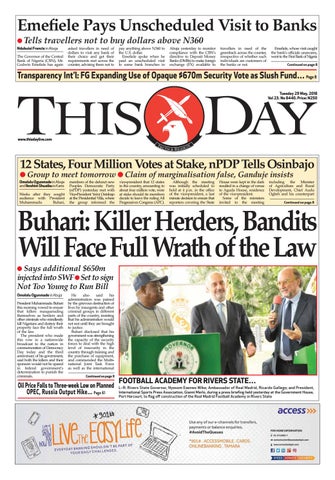
Emefiele Pays Unscheduled Visit to Banks Tells travellers not to buy dollars above N360 Ndubuisi Francis in Abuja The Governor of the Central Bank of Nigeria (CBN), Mr. Godwin Emefiele has again
asked travellers in need of dollars to visit any bank of their choice and get their requirements met across the counter, advising them not to
pay anything above N360 to the U.S. dollar. Emefiele spoke when he paid an unscheduled visit to some bank branches in
Abuja yesterday to monitor compliance with the CBN's directive to Deposit Money Banks (DMBs) to make foreign exchange (FX) available to
travellers in need of the greenback across the counter, irrespective of whether such individuals are customers of the banks or not.
Emefiele, whose visit caught the bank's officials unawares, went to the First Bank of Nigeria Continued on page 8
Transparency Int’l: FG Expanding Use of Opaque $670m Security Vote as Slush Fund… Page 8 Tuesday 29 May, 2018 Vol 23. No 8440. Price: N250
www.thisdaylive.com TR
UT H
& RE A S O
N
12 States, Four Million Votes at Stake, nPDP Tells Osinbajo Group to meet tomorrow Omololu Ogunmade in Abuja and Ibrahim Shuaibu in Kano Weeks after they sought audience with President Muhammadu Buhari,
members of the defunct new Peoples Democratic Party (nPDP) yesterday met with Vice-President Yemi Osinbajo at the Presidential Villa, where the group informed the
Claim of marginalisation false, Ganduje insists vice-president that 12 states in the country, amounting to about four million vote, were at stake should its members decide to leave the ruling All Progressives Congress (APC).
Although the meeting was initially scheduled to hold at 4 p.m. in the office of the vice-president, a last minute decision to ensure that reporters covering the State
House were kept in the dark resulted in a change of venue to Aguda House, residence of the vice-president. Some of the ministers invited to the meeting
including the Minister of Agriculture and Rural Development, Chief Audu Ogbeh and his counterpart Continued on page 8
Buhari: Killer Herders, Bandits Will Face Full Wrath of the Law Says additional $650m injected into SWF Set to sign Not Too Young to Run Bill Omololu Ogunmade in Abuja President Muhammadu Buhari this morning vowed to ensure that killers masquerading themselves as herders and other criminals who mindlessly kill Nigerians and destroy their property face the full wrath of the law. The president who made this vow in a nationwide broadcast to the nation in commemoration of Democracy Day today and the third anniversary of his government, said both the killers and their sponsors would not be spared in federal government’s determination to punish the criminals.
He also said his administration was pained by the grievous destruction of lives by insurgents and other criminal groups in different parts of the country, insisting that his administration would not rest until they are brought to justice. Buhari disclosed that his government was strengthening the capacity of the security forces to deal with the high level of insecurity in the country through training and the purchase of equipment, and commended the Multinational Joint Task Force as well as the international Continued on page 9
Oil Price Falls to Three-week Low on Planned OPEC, Russia Output Hike… Page 61
FOOTBALL ACADEMY FOR RIVERS STATE… L–R: Rivers State Governor, Nyesom Ezenwo Wike; Ambassador of Real Madrid, Ricardo Gallego; and President, International Sports Press Association, Gianni Merlo, during a press briefing held yesterday at the Government House, Port Harcourt, to flag off construction of the Real Madrid Football Academy in Rivers State
2
T H I S D AY ˾ Ͱͷ˜ ͰͮͯͶ
T H I S D AY ˾ TUESDAY MAY 29, 2018
3
4
T H I S D AY ˾ Ͱͷ˜ ͰͮͯͶ
T H I S D AY ˾ TUESDAY MAY 29, 2018
5
6
T H I S D AY ˾ Ͱͷ˜ ͰͮͯͶ
T H I S D AY ˾ TUESDAY MAY 29, 2018
7
8
Ëœ Í°ÍˇËœ ͺ͸͚͜ Ëž T H I S D AY
PAGE EIGHT
Transparency Int’l: FG Expanding Use of Opaque $670m Security Vote as Slush Fund Security vote includes proposed payments to university, museum, dental school Joseph Ushigiale with agency report Anti-corruption group Transparency International (TI) yesterday revealed that the Muhammadu Buhari administration has in the run-up to elections expanded the use of opaque $670 million-a-year funds that fuel graft. The funds, known as “security votes�, are a relic of military rule, mainly disbursed in hard cash and nominally released for dealing with unexpected security issues, said the anti-corruption watchdog. They come from both federal and state governments, although the vast majority is disbursed
under the latter, reported Reuters. According to Transparency International’s report released yesterday, the funds have become “synonymous with official corruption and abuse of power�. The watchdog’s report come as President Muhammadu Buhari is gearing to run for a second term in February 2019. A Nigerian presidency spokesman did not respond to calls and messages seeking comment about the report. Buhari has built his administration’s policy on the twin pillars of tackling Nigeria’s endemic corruption and restoring stability to the highly insecure country. Hundreds have died
this year in communal unrest in the hinterlands and the Boko Haram Islamist insurgency in the North-east. A number of former government officials have faced criminal charges related to alleged corruption since Buhari came to power. The opposition Peoples Democratic Party (PDP), in power for 16 years prior to Buhari taking office in 2015, has accused the president of focusing on its members. “The security vote is one of the most durable forms of corruption operating in Nigeria today,� said Katherine Dixon, Transparency International’s director for defence and security, in a statement. “Yet instead of addressing
its many urgent threats, the ever-increasing use of security votes is providing corrupt officials with an easy-to-use and entirely hidden slush fund.� The group said the spending “is not subject to legislative oversight or independent audit because of its ostensibly sensitive nature�, adding that the funds are channelled into political activities such as election campaigns or embezzled outright. It said federal-level total spending on items identified as security votes increased by 43 per cent in the 2018 budget from 2017 and included payments to a university, a museum commission and a dental technology school. According to the report, the
$670 million is more than the annual budget of the Nigerian Air Force and Nigerian Navy combined, more than 70 per cent of the annual budget of the Nigeria Police Force; more than nine times the U.S. security assistance since 2012; and more than 12 times the UK counterterrorism support for 2016-2020 Reuters said it checked some of the figures included in Transparency International’s report against a draft version of the 2018 budget, which has not yet been signed into law, and confirmed payments to those recipients were planned and identified as security votes. Most of the estimated $670
million of security votes are disbursed by state governments, with federal spending making up only $51 million, Transparency International said. State government changes in disbursement varied, according to the report’s data. Additionally, the largest security votes each year go to the security agencies, and such spending under Buhari is less than under his predecessor, Goodluck Jonathan, the report acknowledged. “Today, security votes are budgetary black boxes that are ripe for abuse by politicians seeking re-election or officials looking to run for political office,� Transparency International said.
over the counter. You don’t have to be a customer of the bank before you get your BTA. “All that is required of you is to present your travelling papers – air ticket, visa and international passport, and the bank is under obligation to give you BTA,� he said. In order to ensure that eligible travellers are able to access foreign exchange and thwart speculators putting pressure on the exchange rate, the CBN at the weekend directed all banks to buy and sell forex to travellers (customers and non-customers) upon presentation of the relevant, valid travel documents.
“All travellers shall be attended to immediately at the bank counters. Any contravention shall be sanctioned by the CBN,� the central bank said in a circular. It also directed licensed bureau de change (BDC) operators to access the FX window of the CBN on Mondays, Wednesdays and Fridays, saying failure to do so could lead to the withdrawal of their licences and new operators licensed to supplant them. The CBN said the measures were being taken to stop banks and BDCs from causing artificial shortages and destabilising the FX market. The central bank stated that
it was liquid and had enough FX reserves to defend the naira. However, the Association of Bureau de Change Operators of Nigeria (ABCON) rejected the directive, saying that the CBN needed to review the rate at which BDCs buy dollars from the CBN to align with commercial banks. ABCON said the directive was not in line with global best practices and should be put on hold. It said the central bank should first converge the BDC buying dollar rate with that of commercial banks and also pay BDCs disbursement fees as is the case globally.
also went to the national secretariat to state that those that were there earlier in the name of nPDP were not the true representatives of the nPDP. Also, we indicated that we were not part of those claiming marginalisation. “I will give you an analysis that will show that they are not being marginalised. First of all, the Senate President is from the defunct nPDP, he controls very important committees in which he singlehandedly approved chairmen of 30 committees in the Senate, that is not marginalisation. “You have the governor of Kwara State who is also a member of the nPDP. He has a whole government, how can he say he is marginalised. “You have the Speaker of the House of Representatives who is a member of the nPDP and a Speaker under the banner of APC, how can he say he is being marginalised. He controls lucrative committees. He appoints the chairmen and membership of the committees singlehandedly without interference from the executive. How can he say he is being marginalised. “So, if you take this issue one by one, you can see that the issue of marginalisation is not there. Therefore, we the majority of the nPDP are disclaiming the allegation and we believe that we are not being marginalised. “Jubrilla Bindow is a member of the nPDP and he is a governor, I am from nPDP and I am now a governor. We have senators and House of Representatives members who are from the nPDP. “So, I believe that there must be something underground. You know Mr. President is facing a difficult moment--corruption is fighting back. So, you will soon see why marginalisation is coming out now. “This is not an issue of marginalisation, this is the issue
of corruption fighting back. So, you will see what will happen.� Ganduje also insisted that Kano will mobilise over five million votes for the president in the 2019 presidential election even if Kwankwaso finally decides to leave the APC. “Well, we are begging Kwankwaso not to move to another party, but if he decides to go, no problem, that stems from individual differences. But it cannot affect Buhari’s fortunes of getting five million votes from Kano. “Twice, we were in government in Kano State in another party and twice Buhari won Kano from a different party, and we won our own election. “So it is not the issue of the former governor taking his paraphernalia to another party. It is the issue of our commitment to winning elections. We are not going to say that there will be no obstacles, there will be obstacles, but we will surmount them, so Buhari will get five million votes from Kano,� he said.
E M E F I E L E PAYS U N S C H E D U L E D V I S I T TO B A N KS Commassie Road branch, located at the Central Business District, Abuja, where a bank customer was seen procuring Basic Travel Allowance (BTA) at the counter. After interrogating the customer, Emefiele asked the head of branch services at the bank, Mrs. Zainab Darlington what procedures were being adopted. In response, Darlington said following the CBN directive, they had received a directive from the First Bank headquarters in Lagos to sell FX to all travellers who meet the requirements. A similar unannounced visit was paid to the Zenith Bank Abuja head office, where the Executive
Director, Northern Operations, Umar Ahmed said his bank had been attending to both customers and non-customers that walked in for BTA seamlessly. “We are attending to customers, irrespective of whether the customer has an account with us or not. All we require is for the customer to present eligible papers and he gets his currency in a matter of minutes,� he said At the United Bank of Africa (UBA) Abuja head office in Garki Area 3, Abuja, Emefiele also met some customers and non-customers being attended to. He said he was satisfied with the level of compliance so far,
noting that although he would have wished to see more people queuing for their FX needs, it was a good start. “I want to seize this opportunity to tell all Nigerians that have travel needs that banks are stocked with foreign currencies. You can go to any bank to buy your dollar at N360 to a dollar. “This is very symbolic, I can see for myself. We will be talking to the management of banks in due course and our examiners will be going for on-the-spot assessment as a follow up. “We have visited three banks and you saw for yourselves that customers are getting their BTA
12 STATES, FOUR MILLION VOT ES AT STAKE, N PD P T EL L S OSI N B AJ O in the Ministry of Science and Technology, Dr. Ogbonaya Onu, had reported at the vice-president’s office only to be told to find their way to Aguda House. A presidency source conversant with deliberations at the meeting informed THISDAY that the meeting was cordial and that the vice-president spoke convincingly. He said as a follow up to yesterday’s meeting, nPDP members who attended the meting with the vice-president would meet again tomorrow to brief other members of the group. Providing some insight into the issues discussed, the source said the nPDP members in attendance had tabled their grievances and problems within the APC, which they said were reinforced by the parallel congresses held by the party in several states of the federation. He said Osinbajo further noted the political clout of the nPDP members present at the meeting and their impact on the elections should they leave the APC. According to the source, “The vice-president agreed that among those of them gathered, they represented 12 states, amounting to four million votes, and it was clear that without those gathered the party cannot win in those states.� On Sunday in Ilorin, the Kwara State capital, Baraje had told reporters that a consensus had been reached for them to meet with President Muhammadu Buhari and Osinbajo at the State House yesterday. The nPDP which comprises dissident members of the then ruling PDP led by former PDP acting national chairman, Abubakar Kawu Baraje, have been threatening to exit the ruling All Progressives Congress (APC), citing neglect and unfair treatment by the APC-led government. The group played a pivotal
role in APC’s victory in the 2015 elections and comprises Senate President Bukola Saraki, House of Representatives Speaker Yakubu Dogara, his predecessor and incumbent Sokoto State governor Aminu Tambuwal, former Kano State governor Rabiu Kwankwaso, Prince Olagunsoye Oyinlola, former Governor Murtala Nyako, and scores of serving and former National Assembly members. The group, which has left its options open on whether to remain with the APC or leave the party, has been consulting other political groups if it fails to reach a compromise with the ruling party. Last Monday, the group met with the national leadership of the APC in Abuja where the APC leadership admitted that the aggrieved nPDP members indeed had genuine grievances. At the weekend, members of the nPDP also met and constituted task panels on various issues, especially on how to rescue Nigeria from economic, social, political and especially security challenges. “Nigerians may recall that members of the former New PDP Block within the All Progressives Congress (APC) addressed a letter dated April 27, 2018, to the Chairman of APC where we informed the party of our grievances and expectations from both the party and the government of President Muhammadu Buhari. “Following this development, the party invited us and we honoured their invitation for a meeting. We met with the leadership of the party last week during which we resolved to report the outcome of our meeting to our members and stakeholders before arriving at any decision or proceeding with the next phase of discussions or actions with the APC and government,� it said last Saturday. In what looked like another open
letter to the APC leadership, the nPDP added that they had met and considered the state of affairs in the ruling party and the country and had set up committees that will help it chart the way forward. “I am glad to inform you therefore that we have briefed our members at a meeting convened in Abuja on Wednesday, 23rd May 2018 where we reviewed the state of the nation and our party, APC, and constituted committees on various issues especially on how to rescue Nigeria from economic, social, political and especially security challenges,� it said. After the meeting with the vice-president yesterday, Baraje said the meeting was called by Osinbajo and expressed hope that the next meeting might be with the president. According to him, the meeting went well but it was too early to determine the way forward for the group. He said the meeting was in response to the different letters sent earlier to the party leadership, the vice-president and the president. Baraje said the issues raised by the nPDP were being addressed and that they had made it clear to Osinbajo that their position had been justified by the unprecedented level of crisis bedevilling the APC where 22 states held parallel congresses recently. “Members of the nPDP had written a letter to the party copying the president and the vice-president. So the party had invited us earlier on and now it is the turn of the vice-president, probably the next one will be with the president,� he said. Asked if they were satisfied with the discussion so far with Osinbajo, he said: “So far, so good. We are looking forward to some of the promises. There will be other meetings because we have set up
sub-committees and then we will now identify specific and general problems and then we will proceed to see Mr. President. But it was a very good meeting.� Asked if they will no longer quit the party, he replied: “It is too early to say.� In the federal government’s delegation at yesterday’s meeting were the Deputy Chairman of the APC, Lawal Shuaib; Attorney General of the Federation (AGF), Abubakar Malami (SAN); Deputy Chief of Staff to the President, Ade Ipaye; and the National Security Adviser, Babagana Monguno. On the nPDP side were Saraki, Dogara, Tambuwal, Baraje and Governor Abdulfatai Ahmed of Kwara State. Meanwhile, Governor Abdullahi Umar Ganduje of Kano State, also a member of the nPDP who defected with others to the APC in 2013, yesterday dismissed claims by the group that they had been marginalised in the ruling party. Ganduje was re-echoing the position of the former Nasarawa governor, Senator Abdullahi Adamu, another member of the nPDP, who had dismissed the claim of marginalisation. Ganduje, who spoke to reporters at the Government House, Kano to mark his third year in office, said all of them had benefitted tremendously from the APC-led government, adding that he was astonished by their claims. The governor pointed out that all of them had been carried along by the administration, adding: “Some few members of the nPDP, which is not even a group in that nomenclature, because now we are one in the APC, went to the party’s national secretariat and presented a paper that they were marginalised. “The majority of the defunct nPDP, of which I am a member,
TOP GAINERS NGN NGN CONSOLHALLMARK 0.02 0.32 ETERNA 0.26 5.53 IKEJAHOTEL 0.12 2.70 SOVEITRUST 0.01 0.27 FLOURMILLS 0.60 30.10 TOP LOSERS NGN NGN FCMB 0.20 0.20 JAPAUL 0.02 0.22 WAPIC 0.04 0.48 DIAMONDBANK 0.07 1.30 AFRIPRUD 0.20 3.80 HPE Nestle Nig Plc â‚Ś1,600.00 Volume: 222.316 million shares Value: N1.643 billion Deals: 4,461 As at 28/5/18 See details on Page 31
% 6.6 4.9 4.6 3.8 2.0 % 9.0 8.3 7.6 5.1 5.0
9
˾ TUESDAY, MAY 29, 2018
PAGE NINE
Herdsmen Attack Catholic Seminary in Taraba, Shoot at Priest Wole Ayodele in Jalingo Less than a week after the burial of the two priests and 17 parishioners killed in Benue State last month by suspected herdsmen, another priest narrowly escaped being killed on Sunday by herdsmen who attacked the Sacred Heart Minor Seminary in Jalingo. The herdsmen had stormed the seminary at about 1 a.m. in search of Reverend Father Cornelius Koba who they claimed had been preventing them from grazing their cattle at the school’s premises. When they eventually got hold of Koba, who was one among the three priests in the seminary, one
of the herdsmen attempted to shoot him in the head but was saved another herder who insisted that the priest should not be killed. But after being warned to desist from preventing them from grazing their cattle in the school, one of the herdsmen turned round and shot Koba in the leg as they were about to leave. Narrating his ordeal, Koba told journalists who visited him where he was treated that the attackers had stormed the seminary and headed to his room where he was attacked. “They came around 1 a.m. and got a student whom they ordered to
take them to my room. I came out and met them all armed numbering over five. As soon I came out, one of them said: ‘See him, kill him,’ but one of them objected. “They struck me with their sticks and when I fell down, one of them shot me in the leg and they left. They also shot and blew up the windscreen of my car. One of them opened fire at my window and destroyed my television set and other property. “My offence is that I often ask them to stop invading our school for grazing and stop cutting down our trees to feed their cows.” Reacting, the Bishop
Taraba State Governor, Darius Ishaku
of the Catholic Diocese of Jalingo, The Most Reverend Dr. Charles Hammawa Hammawa condemned the attack and ordered the temporary closure of the seminary. Hammawa described
the attack as regrettable, saying the incident was an indication that the security situation in the country had gone extremely bad, just as he urged the government to be more serious in handling security issues in the country. According to him, “It is regrettable that as a church, we are only modelling the children to be good citizens of the country. But we are now being attacked unprovoked. “We thank God no life was lost in the incident, though my priest Reverend Father Cornelius Koba was shot in the leg. This is one attack too many. Father
Koba only told the Fulani herdsmen to stop grazing on the school premises and they came after him in the dead of the night. “For the Fulani herdsmen to attack us in Jalingo is an indication that the security situation in this country has become extremely bad. The primary responsibility of government is the protection of lives and property and we will continue to call on the government to sit up,” he said. He said all the students who ran into the bush for safety during the attack have all returned and expressed gratitude to God for their safety.
generation initiatives are expected to increase capital inflows in the form of foreign direct investment. There is a high prospect that the cumulative investments from this first phase of the Labs will hit US$39.2 billion by 2025,” he added. Buhari also spoke on his government’s quest for food sufficiency, which he said resulted in the reduction of rice importation by 90 per cent and the Social Investment Programmes (SIP) aimed at restoring livelihoods, economic opportunities and sustenance for the poor across the country. He highlighted SIP programmes and projects executed so far to include: feeding of 8.2 million pupils in 24 states of the federation with over 75,000 catering staff engaged under the programme as well as the Conditional Cash Transfer which he said culminated in over 297,000 caregivers being trained by 2,495 community facilitators in 21 states. He also spoke on the N-Power job creation platform which he said had provided jobs for 200,000 youths while the next batch of 300,000 had been selected, verified and would soon be deployed across the 36 states and the Federal Capital Territory (FCT.). On power generation, he said the country has been distributing 5,222.3 since December 2017 while power generation capacity now exceeds over 7,500 megawatts. He also spoke on the government’s investments in railway and education. “Government has also continued to support the implementation of various initiatives aimed
at improving the quality of basic education delivery. Thus, it has ensured proper funding at the basic education level with the disbursement of N42.2 billion UBE matching grant to 26 states and the FCT, N851.5 million special education grant disbursed to 23 states and private providers of special education and N2.2 billion from the Teachers’ Professional Development Fund to 33 states and the FCT,” he said. In commemoration of Democracy Day, the president also acknowledged the immeasurable contributions of the Nigerian women to national development and advancement of democracy, over the last three years. He said government and people of Nigeria was appreciative of all women as “mothers of our great country”. He called on Nigerians to resolve to avoid hatred and intolerance, saying the country’s objectives could be achieved in an atmosphere of harmony and peaceful co-existence. “Finally, the up-coming months will usher us into another season of the general election. Let me use this opportunity to urge us all to conduct ourselves, our wards and our constituencies with the utmost sense of fairness, justice and peaceful co-existence, such that we will have not only hitch free elections but also a credible and violence free process.” The president also disclosed that in a few days he would be joined by many promising Nigerians to sign into law the “Not Too Young to Run” Bill.
B U HARI: KILLER HERDER S, BA N DIT S W I L L FAC E F U L L W R AT H OF T H E L AW community for assisting Nigeria in the fight against terrorism.
The president said public safety remained the focus of his administration, recalling how the government reclaimed territories occupied by Boko Haram before the advent of his government, and how some of the Chibok and Dapchi girls as well as 16,000 other captives of Boko Haram had been freed. “The unfortunate incidences of kidnappings, herdsmen and farmers’ clashes in several communities which have led to a high number of fatalities and loss of property across the country is being addressed and the identified culprits and their sponsors shall be made to face the full wrath of the law. “All the three tiers of government are presently engaged with communities and religious organisations to restore peaceful co-existence among Nigerians. “I want to commend members of the Multi-national Joint Task Force drawn from Niger, Benin, Chad, Cameroon and our own country in collaboration with the international community, who are assisting in the fight against the insurgency in the North-east. I also commend the gallantry of members of our Armed Forces and other security agencies that have continued to provide security for lives and property across the country. State and local traditional authorities are helping with the much needed intelligence in this fight against insurgency. “This administration is pained over the grievous loss of lives and property occasioned by the carnage
of the insurgency and other forms of criminality in the country. “I wish to assure Nigerians that we will not rest until all criminal elements and their sponsors are brought to justice. Government is boosting the capacity of our security agencies through recruitment of more personnel, training and procurement of modern equipment, enhancement of intelligence gathering as well as boosting their morale in the face of daunting challenges,” he said. Buhari said the mechanism for the distribution of foods and other basic aid to internally displaced persons (IDPs) and efforts to resettle them in their various communities with the necessary social amenities including schools and hospitals were being put in place. According to him, the Niger Delta had enjoyed relative peace through what he described as social inclusiveness and cooperation of elders as well as those he termed good people of the region, assuring that the government was committed to implementing thorough peace, security and development plans in the region. He added that the Ogoni clean-up launched in June 2016 was on course. The president said the war against corruption being fought by the government had secured the applause of both Nigerians and the international community, promising that the administration was determined to win the war. He proceeded to list various platforms that the federal government had so far deployed to fight the war
against corruption as well as the benefits accruable from them to include N200 billion saved through the elimination of ghost workers and N500 billion recovered through the whistle-blower initiative. “Various policy measures already put in place to stem the tide of corrupt practices are yielding remarkable results. Some of these key reform policies include: The Treasury Single Account (TSA) has realized billions of naira being saved from the maintenance fee payable to banks. N200 billion has also been saved from the elimination of ghost workers in the public service. “The Whistle-Blowing Policy has helped to recover over N500 billion. The Presidential Initiative on Continuous Audit set up with a mandate to validate controls, assess risks, prune personnel cost, ensure compliance with Public Financial Management reforms has helped to identify and remove over 52,000 ghost workers from the federal government’s MDA payroll; “The Voluntary Asset and Income Declaration Scheme (VAIDS) aimed at expanding tax education and awareness has offered the opportunity for tax defaulters to regularise their status in order to enjoy the amnesty or forgiveness on overdue interest, penalties and the assurance of nonprosecution or subject to tax investigations. “The Sovereign Wealth Fund project portfolio has been expanded with an injection of US$650 million so as to strengthen its investment in local infrastructure, power, health, re-construction of the Abuja-Kano road, Lagos-Ibadan expressway,
East-West road (Section V) and the Mambilla Hydro-electric Power project as well as the construction of the Second Niger Bridge. “The fight against corruption through the Economic and Financial Crimes Commission and the Independent Corrupt Practices and Other Related Offences Commission has resulted in recoveries of billions of naira, as well as forfeiture of various forms of assets. This alongside other efforts has improved Nigeria’s international image and regional cooperation,” he added. On the economy, Buhari said the Economic Recovery and Growth Plan (ERGP) was launched to restore and sustain economic growth, saying the plan had started yielding results with the recent National Bureau of Statistics reports which showed that the economy grew by 1.95 per cent in the first quarter of 2018. Describing the growth as a good performance when compared to -0.91 growth recorded in the first quarter of 2017 and -0.67 per cent in first quarter of 2016, he said the country’s foreign reserves had equally improved significantly from $29.6 billion in 2015 to $47.5 billion as of May, 2018 while inflation has been on the decline every month since January, 2017. He also said the recently conducted Focus Labs in three key sectors of the economy comprising agriculture and transport, manufacturing and processing and power and gas had yielded prospects of $22.5 billion investments and potential for creating over 500,000 jobs by 2020. “These investment
TUESDAY, MAY 29, 2018Ëž T H I S D AY
10
NEWS
Ă?ĂĄĂ? ĂŽĂ“ĂžĂ™Ăœ Davidson Iriekpen Ă—Ă‹Ă“Ă– davidson.iriekpen@thisdaylive.com, 08111813081
PDP Asks APC, Presidency to Account for Alleged Misappropriation of N10tn Ruling party: Nigeria making steady progress Onyebuchi Ezigbo Ă“Ă˜ ĂŒĂ&#x;ÔË The Peoples Democratic Party (PDP) has challenged the presidency and the All Progressives Congress (APC) to account for the over N10 trillion public funds allegedly stolen by APC leaders and members of the Muhammadu Buhari-led presidential cabal. The opposition party said the APC and presidency have been playing saints and pointing fingers while their officials have been having a field day misappropriating trillions of naira to finance their opulent lifestyles and political interests. In a statement issued yesterday by its National Publicity Secretary, Kola Ologbondiyan, to mark this year’s democracy day celebration, PDP said the presidency and the APC need to explain to Nigerians why they have not set up panel of enquiry to probe issues of abuse of rights, extra-judicial executions, killings and bloodletting in various parts of the country. The PDP specifically asked the presidency to address Nigerians on the leaked memo detailing corrupt oil contracts to the tune of N9 trillion ($23 billion dollars) at the Nigerian National Petroleum Corporation (NNPC) and the Ministry of Petroleum Resources, which are under President Buhari’s direct supervision as Minister of Petroleum Resources. The PDP also challenged the APC and the presidency to come clean on the widely reported stealing of N1.1 trillion ($3.5billion) worth of crude oil by APC interests operating with
seven ghost companies. “This is in addition to the looting from the Treasury Single Account (TSA) evidenced in the reported stealing of N10 billion National Health Insurance Scheme (NHIS)’s account in the TSA, as well as revelation of the frittering of fresh N25 billion under questionable ‘deals’. “Similarly, the PDP demanded that the APC and the presidency address Nigerians on the widely reported stealing of N18 billion Internally Displaced Persons (IDPs) intervention fund as well as the source of the N671 million allegedly stolen from the APC account by some of its national officers,� the party said. Furthermore, the PDP asked the presidency and the APC to explain to Nigerians why no serious panel of enquiry has been set up to address the issues of abuse of rights, extra-judicial executions, killings and bloodletting in various parts as catalogued by various international bodies. PDP said: “The APC has become synonymous with violence, deceit, hardship, hunger and starvation and can no longer be trusted as a vehicle of national cohesion, economic prosperity and the unity of Nigerians...� On its part, while congratulating Nigerians on the occasion of this year’s democracy day celebrations, the ruling APC said its administration was committed to addressing the ecomomic and security challenges. In a statement issued by its National Publicity Secretary, Mallam Bolaji Abdulahi,
Okonjo-Iweala Denies Accusing Lawmakers of Asking for N17bn Bribe The former Minister of Finance, Dr. Ngozi Okonjo-Iweala, yesterday denied accusing the lawmakers of the seventh National Assembly of asking for a bribe of N17 billion to approve the budget under the immediate past administration. She blamed mischief makers for distorting contents of her recent book, ‘Fighting Corruption is Dangerous: the Story Behind the Headlines,’ for their own political purposes, saying no where in the book did she allude to bribe taking by the lawmakers. In a Facebook post, she said: “It has come to my attention that mischief makers are again trying to distort what is written in my book, ‘Fighting Corruption is Dangerous: the Story Behind the Headlines,’ for their own political purposes. “One more time, it is important that people read the book for themselves. In the case of the N17 billion, the book does not talk of bribe. It indicates that lawmakers increased the budget by N17
billion and we had to accept that to move on; hence, the term ‘price to pay’. “The reason for discussing what happened is that this approach needs to change. The country must clear up and clarify its budget process for the future to improve. Those like Gbajabiamiala trying to introduce lies that myself and my aides put in our own projects and lawmakers were fighting with me on that basis are playing their usual cynical games and Nigerians are tired of that! “Lies obscure the country’s problems and do not allow us to improve. There were and there are still politicians in the National Assembly trying to do the right thing. The book also points that out. Such well-meaning legislators should not allow their strident colleagues to twist matters and divert attention from the need to improve the country’s budget process so our young people can see a better side of their country.�
APC said Nigeria has made steady improvement in the democratic governance by holding transparent and credible elections. “Indeed, our journey as a conntry since 1999 when we returned to democratic rule has not been an easy one, but our country has soldiered on. We have built on the gains of those early years fractured by military incursion and now 19 years after, our democracy
and polity are stronger. “We have conducted successive elections and have continually improved on the transparency and credibility of our electoral systems. “Remarkably, the President Buhari administration has continued in the country’s proud tradition of being a bastion of democracy in the sub-region and across the world, as seen in the current administration’s
lead intervention in ensuring representative governance and peaceful transition of power in the Gambia. APC said Nigerians should congratulate themselves on the strides made in our political journey as a country since independence. “For one, military rule is now distant memory in Nigeria. We must now work collectively to improve our democracy because regardless
of its imperfections, democracy remains the best form of government that can best serve the interest of our people. “As a party in government, our commitment to address our current challenges, which finds expression in the economy and security, remains unshaken. We urge all Nigerians to continue to pray and support the current administration’s effort to build a peaceful and greater country,â€? he said.Â
DEMOCRACY DAY LECTURE
L–R: Secretary to the Government of the Federation, Mr. Boss Mustapha; Senate President, Senator. Bukola Saraki; President Muhammadu Buhari; and Speaker, House of Representatives, Hon. Yakubu Dogara, at a public lecture to mark 2018 Democracy Day in Abuja....yesterday
Buhari Recalls Orubebe’s Drama with Jega, Says He Won’t Forget in a Hurry Claims security has improved since 2015 Omololu Ogunmade Ă“Ă˜ ĂŒĂ&#x;ÔË President Muhammadu Buhari yesterday in Abuja recalled the mild drama staged by a former Minister of the Niger Delta Ministry, Godsday Orubebe, during the collation of the 2015 presidential election results, saying such drama would remain indelible. Buhari who made the recollection while delivering an address during the Democracy Day lecture organised by the Office of the Secretary to the Government of the Federation (SGF) at the International Conference Centre, also recalled the machinery put in place by former Chairman of the Independent National Electoral Commission (INEC), Prof. Attahiru Jega, which he said gave the opposition at the time the confidence that the output of the 2015 general election would be acceptable to it. He also recalled the effort by former United States President Barrack Obama to ensure that the election was free and fair. “I must digress to raise an observation by the programme organisers because I did not see Orubebe who ought to have come and listen to Professor Jega deliver his lecture, this is
a major observation. “That instance, for those of us who were lucky that there was light and we had the television to see the confrontation between Orubebe and Jega, it will remain a life impression to many of us. “The other one is the Jega briefing to the government, the opposition and the military before the date of the election was finally agreed on. Jega, as a professor, it was not surprising, briefed us of his activities between 2011 and 2015, the recruitment, equipping and training of INEC officials, that gave those of us who are lucky to get the report, the courage that nothing outside the constitution of the Federal Republic of Nigeria would be accepted by the opposition. “So, the question of an interim administration or postponing election for more than 90 days shouldn’t be on the table and I thank personally the United States government then under President Barack Obama by sending John Kerry to read the riot act to the government and to us the opposition then that nothing other than a free and fair election will be acceptable.� In his proper address, Buhari said the theme of this year’s anniversary of democracy, “Peace
Building and Good Governance for Sustainable Development,� had been carefully selected to reflect the country’s current opportunities and challenges. According to him, though rough times had been experienced in the last three years, emerging challenges had been put under control through good governance as he listed the challenges confronting the country to include border disputes and efforts to ensure peaceful co-existence between Nigeria and neighbouring countries. Arguing that security challenges bedeviling the country have improved considerably from what it used to be in 2015, Buhari said dialogue had been a tool deployed by the government for the restoration of peace among warring groups and communities adding that the rebuilding of the North-east devastated by Boko Haram was ongoing. He also said the resolve to fight the war against corruption was predicated on the realisation that anti-graft battle was the platform for attaining sustainable growth and development in the country. The president also said the government was not relenting
in its effort to equip the military with the aim of ensuring that they have the capacity to combat violence, adding that cases of bombings of communities and villages by insurgents have been largely curtailed. Also, insisting that the country’s economic is on course, Buhari said there had been growth in economic activities with increased foreign reserve, food production, diversification of the economy and investment in infrastructure. He said: “Accordingly, we have engaged in several rounds of dialogue and town hall meetings, targeted at peace building, between the aggrieved and in some cases warring factions and communities. We have worked hard to dialogue with and if they turn unreasonable decimate insurgents in various parts of the country. “We are still grappling but successfully, with border disputes and restoring the much needed peaceful co-existence amongst our people and neighbouring countries. The rebuilding of the North East is ongoing, to return our internally displaced brothers, sisters and children to
Cont’d on Pg 62
T H I S D AY ˾ TUESDAY MAY 29, 2018
11
12
T H I S D AY ˾ Ͱͷ˜ ͰͮͯͶ
T H I S D AY ˾ TUESDAY MAY 29, 2018
13
14
T H I S D AY Ëž Ëœ Í°ÍˇËœ Í°ÍŽÍŻÍś
COMMENT
Editor, Editorial Page PETER ISHAKA Email peter.ishaka@thisdaylive.com
‘BURNING’HEALTH ISSUE OF OLUSOSUN DUMP SITE The fire outbreak at the Olusosun dump site is a wake-up call, write Obianuju Ozoh and Dr Colette Solebo
F
or the last two decades, the residents of Olusosun area in Ojota, Lagos have had a unique neighbour. They had become accustomed and even familiar with the 100-acre spread inhabited by sub-Saharan Africa’s largest single formal collection of discarded and recyclable material, the Olusosun dumpsite. This dumpsite has been described as many things and has even been the “starâ€? of its own three-part BBC documentary where it was shown to be a source of livelihood for many and a pathway to success stories. The presence of dump sites is one of the challenges of many growing megacities and a price Lagosians have to pay for the ongoing urbanisation of our city. The site has been burning for two months now. The fire started on the evening of March 14th 2018 and many of the “residentsâ€? did not worry as small flares were not uncommon and were usually self-limiting. However, this fire persisted and gathered momentum leading to explosions that engulfed buildings and vehicles in the vicinity. On March 15, 2018, the Lagos State Ministry for the Environment issued a statement as to the cause of the fire: ‌the fire which emitted thick smoke from the Olusosun dumpsite on Wednesday as the natural outcome of trapped gasses from the waste escaping to cause combustion, a situation which occurs occasionally in dumpsites. Culled from: LASG EXPLAINS DUMPSITE SMOKE. Available at: https://lagosstate.gov.ng/blog/2018/03/15/lasg-explainsdumpsite-smoke/ The Lagos State fire service attempted putting out the fire but their efforts further complicated the fire by engaging (jumping and nesting) more methane pockets and perpetuating the fire. This led to a thick wall of smoke that has blanketed the Lagos- Ibadan expressway and its environs including Ojota, Ketu, Magodo, Alausa, Oregun and Ikeja. As concerned health professionals, we want to bring to the fore the immediate and potential long term adverse health implications of this event that has polluted our shared environment. Without a fire, an open dumpsite as Olusosun poses substantial health and environmental risks. The decomposing materials produce a liquid (leachates) which seeps into the ground and can contaminate both surface waters and deep waters. It can also contaminate the soil and eventually finds its way into the food chain and drinking water sources. Decomposing materials also produce gases such as the highly flammable methane (as implicated in this fire) which contributes to global warming. The global warming effect of methane is 21 times that of carbon dioxide. Now when dump sites burn as in our current situation, there is emission of toxic substances into the atmosphere from the burning of plastics and other materials. The toxic fumes usually increase the concentration of air pollutants such as nitrogen oxides, sulfur oxides, heavy metals (mercury, lead, chromium, cadmium, etc.), dioxins, furans, and particulate matter. These toxins are harmful to health with immediate and remote adverse health consequences. These immediate health effects have been confirmed by reports of increase in the frequency of asthma attacks and hospital visits from respiratory symptoms among persons who reside and work in communities within the vicinity of the dumpsite. But even more worrisome is the surreptitious medium to long term adverse impact of these toxins on the wider population. One of the most harmful pollutants released during open burning of
PERSONS WHO LIVE AND WORK AROUND OLUSOSUN ARE LIKELY TO BE AT HIGHEST RISK FROM THIS EXPOSURE. THESE PERSONS NEED TO BE IDENTIFIED, RELOCATED, EVALUATED FOR THE IMMEDIATE EFFECTS AND FOLLOWED UP FOR THE MEDIUM AND LONG-TERM HEALTH IMPACTS
waste is dioxin. Dioxin is known to cause cancer and is associated with birth defects. The heavy metals released cause low blood levels, kidney failure, liver cancer and cardiovascular diseases. Burning dumpsites also release hexchlorobenzene which is a highly persistent toxin that degrades slowly in the air. Therefore, it can travel long distances in the atmosphere and bio-accumulates in fish, marine animals, birds, lichens, and animals that feed on fish and lichens. It is a probable human carcinogen and can also damage the unborn child. The visible smoke from burning which we saw hovering over Olusosun and its environs for nearly two months is composed of tiny toxic particles (particulates). When inhaled, these microscopic particles can reach deep into the lungs and remain there for months or even years. Breathing particulates increases the chances of respiratory infection, can trigger asthma attacks, and causes other problems such as coughing, wheezing and shortness of breath. Black carbon, a component of particulate matter is an important contributor to global warming and has been reported by the World Health Organisation (WHO) to cause changes in health including premature death from any cause, including death from heart disease and respiratory disease even with short term exposures. Carbon monoxide that is also generated from the burning waste is a colourless, odourless gas that prevents oxygen from being absorbed by the blood and lungs. It is especially dangerous when inhaled by young children with immature lungs, the elderly, and people with chronic heart conditions or lung diseases. The implication of this Olusosun fire is that large population of Lagosians are now exposed to high levels of health damaging pollutants and are at risk of adverse health outcomes. We recognise that in addition to the ongoing pollution burden of the city of Lagos caused by daily movements and heavy traffic, Lagosians are now in the middle of a severe yet silent health crises, the implications of which portend public health and economic disaster. The WHO reports that air pollution is the biggest environmental risk to health and recommends air quality guideline levels for safe cities. The WHO also recognises that most sources of urban outdoor air pollution are well beyond the control of individuals and demand action by cities, as well as national and international policymakers to promote cleaner transport, more efficient energy production and waste management. We are aware that the Lagos State Government has declared the Olusosun dump site closed and currently in the process of covering the dump with laterite. In addition to this, another priority should be to take active, strategic and well-designed steps to address the adverse health effects of this sizeable population now at risk. Persons who live and work around Olusosun are likely to be at highest risk from this exposure. These persons need to be identified, relocated, evaluated for the immediate effects and followed up for the medium and long-term health impacts. Trends in clinical presentations from hospital data across the vicinity should be assessed for epidemiological mapping of potential diseases from this exposure. Active steps and policies to reduce all sources of ambient air pollution also need to be addressed. Dr Ozoh is a Pulmonologist at the College of Medicine, University of Lagos while Dr Solebo is a Post-Doctoral Research Fellow in International Child Health at the Research and Innovation Unit of the University of Lagos
CREATING SAFE SPACES FOR CHILDREN
Rasak Musbau writes that we must create safe environments for young people to spend time
N
ow that the euphoria of this year’s Children Day’s celebration is over, we need to really take steps in eliminating all barriers to the overall development and growth of children in our nation. Children represent the future, and ensuring their healthy growth and development ought to be a prime concern of all. A working child protection system is unarguably a prerequisite for any nation aspiring for growth and development. Regrettably, as the smallest, weakest and least powerful members of society, children are the most vulnerable to all forms of violence—physical, sexual, and emotional. Violence against children is pervasive. Violations occur in the home, school, work place and online. The perpetrators often include the very people children are expected to trust: parents, caregivers and other family members, friends, teachers and intimate partners. Violence against children marks them – often for life. Sometimes the marks are visible: bruises and broken bones. But the harm that violence causes children also affects their mental and physical health and their ability to function in the world. Going by reports of increasing cases of violence against children especially in the Nigeria mass media, this year’s Children’s Day’s theme: “Creating safe spaces for children: our collective responsibility� is very apt. It shows demonstration of clear commitment on the part of Nigeria’s government to end violence and also provides an excellent opportunity to speak up on behalf of all vulnerable children in the country. Creating safe environments requires that adults take responsibility to ensure safety wherever young people spend time. This process starts with recognis-
ing situations and behaviours that create unsafe environments and being committed to making the required changes. It means examining our personal and organisational values and determining the best interests of the child. In Nigeria today, fundamental rights of children are being encroached upon on a daily basis without appropriate sanction. And this is so, not because we don’t have laws and policies on child protection but due to lack of social consensus and political will to successfully implement laws and policies. According to global survey conducted in 2012 by The Economist Intelligence Unit, Nigeria is rated as one of the worst countries in the world for children or for a child to be born. In September 2015, President Buhari launched a Year of Action to End Violence Against Children and called on all Nigerians to join this battle. He renewed his commitment in October 2016 by launching a long-term campaign, aligned with the Sustainable Development Goals, to End Violence Against Children by 2030. The presidential campaign has been translated into a national modelling programme, spearheaded by the Federal Ministry of Women Affairs and Social Development, to strengthen child protection systems. Nine states have already rolled out this programme. Also, in a statement by the UNICEF Nigeria Deputy Representatives Isiye Ndombi, Nigeria was the first country in the West African sub-region and the 9th country in the world to conduct the violence against children survey in 2014. The survey provided the first nationally representative data on the prevalence of sexual, physical, and emotional violence among children in Nigeria. The findings, released at the end of 2015, highlighted that millions
of Nigerian children are suffering violence every year and most are suffering in silence. Six out of 10 children will suffer some form of emotional, physical or sexual violence before they reach the age of 18. Many of them encounter violence over and over. Yet, less than 5% of the children that seek help receive support. But the sad reality is that child right protection policy in most states and at the federal level is adequate only on paper. It has been issue of conducting survey without corresponding functional action plan backed by funding. This clearly explains reasons why violation of children persists. Sexual abuses, which include but not limited to child marriage is a form of child abuse that has become a scourge in our society. Cases abound where fathers, uncles, guardians, male teachers, clerics, etc., have sexually molested under-age girls. Some engage in child violation for ritual purposes and most time this leads to mental disorder on the part of abused child with perpetrators escaping sanction. Today, we still have many children whose habitation is on the streets and since they domicile in the streets, they are generally referred to as street children. These are children that have historically been labeled and considered as delinquents, street urchin and Almajiris among others. Some of these children were driven from home because of maltreatment by mothers, step mothers, fathers, and step fathers, as a result of death of either of their parents or as a result of broken homes. These children are denied their basic rights and are exposed to physical, sexual and all sorts of harm and abuses and also live in inhumane and deleterious conditions. The United Nations Children’s Fund (UNICEF) distinguishes between two different groups of street children based on their family situations but both
have a common characteristic in that they spend their lives on the streets. The first categories are of children “on� the streets. These are children who work and maintain regular relationship with their families. The second category is of children who are “of� the streets and consider street their home. The streets are where they eat, sleep, play and make friends. Children in both categories have much in common; they have unstable emotional relationships with adult world, a negative self- image, social stigma, violence, exploitation and uncertain futures. In other words, street children suffer physical abuse, psychological abuse, neglect and often sexual abuse. The increasing spate of child abuse with its attendant consequences therefore calls for urgent assessment, prevention and mitigation in order to secure the future of Nigerian children. The truth is that our child protection system is weak and we need to strengthen it. We are all duty bound in this respect. The change must start from home as innocent mistakes in many homes today is that of dysfunctional relationships between parents and children. Parents nowadays expect schools to do it all alone for them. The point here is that most of the problems we expect governments and others to fix for us will never be solved if at the home front we refuse to buckle up. It is also crucial for all stakeholders in the society to understand every infringement that constitutes child abuse and be involved in the effort to bring about change. It is also important for us to support our various state Child Right Protection Policies and make use of correctional centres when necessary rather than abuse our children. Musbau wrote from Lagos State Ministry of Information and Strategy, Alausa, Lagos
15
T H I S D AY Ëž Ëœ Í°ÍˇËœ Í°ÍŽÍŻÍś
EDITORIAL
19 YEARS OF DEMOCRACY: THE ROAD AHEAD With a national consensus that democracy remains the best option for the country, Nigeria has come a long way after 19 years of unbroken civil rule
T
oday marks the 19th anniversary of Nigeria’s return to civilian rule and the third anniversary of the President Muhammadu Buhari-led administration. Notwithstanding the numerous challenges we still grapple with as a nation, Nigerians generally seem to agree that democracy remains the best option for the country for the many ways in which it empowers the electorate to hold the government accountable and ask questions where and when necessary. The 2015 general elections and the change of government from one party to the other, the All Progressives Congress (APC) replacing the Peoples Democratic Party (PDP), was particularly a major turning point for the country and a reafďŹ rmation of the people’s sovereignty. The average Nigerian voter is far more conscious and conďŹ dent today than he was under military rule, even if widespread poverty and other insecurities remain a threat. Imperfect as our democratic processes may be, however, we are optimistic that those processes can be further strengthened for the overall beneďŹ t of the people. We congratulate Nigerians as they celebrate yet another democracy day. When President Buhari assumed ofďŹ ce three years ago, he promised to tackle three key issues: security, the economy and corruption. The outcomes in these regards have been mixed. The standard excuse by the ruling party IN ALL, THE COUNTRY has been that it met a FACES MANY country and a governCHALLENGES WHICH ment at the centre that had been hobbled by ONLY GREATER levels EMPHASIS ON SERVICE unprecedented of corruption and RATHER THAN BENEFIT, mismanagement in the three identiďŹ ed RESPONSIBLE key areas. Hence, it LEADERSHIP AT ALL has projected itself as a LEVELS, HONESTY OF corrective administraPURPOSE AND RESPECT tion. To be fair, the FOR THE RULE OF LAW Buhari administration CAN HELP TO ADDRESS has shown stronger determination and pace in tackling the Boko Haram menace. It succeeded in rescuing abducted persons – women, children, and most of the Chibok and Dapchi girls. Generally, Boko Haram terrorists have been less aggressive than they were three years ago. But while this may be so, the government has been less effective or pro-active in dealing with the dangerous threat posed to national unity and religious harmony by the continuing conicts between herdsmen and pastoralists, especially in the Middle Belt and parts of the North. The casualty ďŹ gures from these conicts have been consistently high, even in the presence of security agencies and ofďŹ cials who have been accused of gross indifference and negligence. Yet, government owes the people a responsibility to demonstrate that their lives matter and that impunity of any form will not be tolerated. Its neutrality must also not be in doubt. On the economic front, the Buhari administration deserves a pat on the back for pulling the country out of the recession of 2016-17 and returning it to the path of growth. The country’s external reserves have been doubled; inationary rate has reduced, even if it is still double-digit while the Naira has remained stable for more than a year. Non-oil revenue, especially in the critical areas of agriculture, solid minerals and customs and excise has also improved. The tax network has been widened. While it is still too early to assess the impact of the Economic Recovery and Growth Plan (ERGP) which was launched rather late, the commitment of the federal government to its implementation is a major signal of ofďŹ cial
readiness to tackle the issues of economic growth, ease of doing business and wealth creation. There has also been much activity in the transportation sector – projects initiated by previous administrations, especially in the railways sector, have been completed. In addition, the Federal Government has launched a school feeding programme initiatives to support small and medium scale enterprises, and a social investment programme but nonetheless, the country’s unemployment rate remains very high.
T
T H I S DAY EDITOR DEPUTY EDITORS ˜ MANAGING DIRECTOR DEPUTY MANAGING DIRECTOR CHAIRMAN EDITORIAL BOARD
EDITOR NATION’S CAPITAL
T H I S DAY N E W S PA P E R S L I M I T E D EDITOR-IN-CHIEF/CHAIRMAN GROUP EXECUTIVE DIRECTORS ˜ ˜
˜ ˜
DIVISIONAL DIRECTORS ˜ DEPUTY DIVISIONAL DIRECTOR
SNR. ASSOCIATE DIRECTOR ASSOCIATE DIRECTORS ˜ CONTROLLERS ˜ ˜
DIRECTOR, PRINTING PRODUCTION
he ďŹ ght against corruption is perhaps the Federal Government’s agship programme and where it has been most active through the agency of the Economic and Financial Crimes Commission (EFCC) with monies and properties reportedly seized from those who looted state funds. However, while there is very little disagreement about the threat that corruption poses to the country’s growth and stability, there has been much objection to the method and nature of the prosecution of the administration’s war against corruption. The EFCC in particular has been accused of targeting members of the immediate past administration, selective prosecution, witch-hunt and the agency becoming a partisan tool in the hands of the incumbent government. The controversial involvement of members of the administration and party ofďŹ cials in alleged corrupt practices and the sheer leniency with which those cases were addressed makes it imperative for the EFCC and other agencies to be seen to be neutral and more transparent. Going forward, the EFCC must take the criticisms of its operations more seriously and demonstrate a stronger capacity to be fair and independent. Respect for the rule of law is the linchpin of democracy. Under the current dispensation, this principle has been routinely breached due to a seeming disregard for court rulings and the rights of accused persons. The end of justice is subverted when the state uses the people’s resources to intimidate and abuse the constitutional order. Through it all, however, we commend the Nigerian judiciary, especially the appellate courts which have sustained the integrity of that arm of government as the last hope of the common man. Meanwhile, the Attorney-General of the Federation must not be timid in exercising his powers under the purview of Section 174 of the Constitution. He must see himself, in the strict sense, as an ofďŹ cer in the temple of justice by giving due effect to court rulings as for example, in Mohammed Adoke vs the AGF, Dasuki and others vs AGF and similar cases. He must resist the temptation to subordinate the law to political expediency. Governance at other levels has been less than impressive in the last three years. State governments have performed worse than the federal government. Unable to pay staff salaries while still running government at high maintenance cost, many states have had to depend on ďŹ nancial bail-outs from the federal government. Many state Governors spend more time in Abuja than at home. State governments must become centres of productivity and not conspicuous beggary. Similarly, Nigeria deserves a more disciplined and productive legislature at both Federal and State levels. In particular, the emerging reputation of the National Assembly as a place of burlesque rather than serious work is unedifying. In all, the country faces many challenges which only greater emphasis on service rather than beneďŹ t, responsible leadership at all levels, honesty of purpose and respect for the rule of law can help to address. On their part, the people have a responsibility to continue to insist on good governance. In 2019, Nigeria will again hold general elections. Political parties, politicians, the Independent National Electoral Commission (INEC) and the security agencies must learn to put Nigeria ďŹ rst. The best legacy that the Buhari administration can pursue is to address the overwhelming menace of political corruption and protect the integrity of the ballot box. We wish all Nigerians Happy Democracy Day!
TO SEND EMAIL: ďŹ rst name.surname@thisdaylive.com
Letters to the Editor
TO OUR READERS Letters in response to speciďŹ c publications in THISDAY should be brief (150-200 words) and straight to the point. Interested readers may send such letters along with their contact details to opinion@thisdaylive.com. We also welcome comments and opinions on topical local, national and international issues provided they are well-written and should also not be longer than (9501000 words). They should be sent to opinion@thisdaylive.com along with the email address and phone numbers of the writer.
T H I S D AY • TUESDAY, MAY 29, 2018
16
POLITICS
Group Politics Editor Tobi Soniyi Email tobi.soniyi@thisdaylive.com 07054786260 SMS ONLY
EXECUTIVE BRIEFING
19 Years After, Political Parties Still at Their Infancy Nineteen years after Nigeria returned to democratic governance, political parties whose responsibility it is to drive the process of deepening the system, continue to crawl, writes Tobi Soniyi
U
ntil recently, the Peoples Democratic Party was considered Nigeria’s most disorganised political party. However, after conducting its ward, local government and state congresses, the All Progressives Congress has emerged Nigeria’s most disorganised political party. On Saturday May 19th, APC held election that produced new executives for the party in all states of the federation. Those elected will serve as delegates to the party’s national convention billed for next month in Abuja. However, the election was characterised by violence. In a few states, lives were lost. In ten states, parallel congresses were held which produced two different executives. The ward and council congresses were no different. In some states, no congresses took place but wards and councils’ executives were produced. Virtually all the ills that let to the downfall of the PDP have inflicted the APC. The PDP is struggling to rebuild itself. Smaller parties are not fairing better. Accord Party and Labour Party are battling with internal crises of their own. Yet, in a democracy, political parties remain indispensable. In Nigeria and elsewhere, democracies can not function without the existence of political parties. In Nigeria, only political parties can sponsor candidates and canvass for votes. Section 221 of the constitution states, “No association, other than a political party, shall canvass for votes for any candidate at any election or contribute to the funds of any political party or to the election expenses of any candidate at an election.” The constitution in Section 222 further provides that, “No association by whatever name called shall function as a party, unless – a) the names and addresses of its national officers are registered with the Independent National Electoral Commission;” Nigerian political parties, due largely to greed, desperation, lack of internal democracy and other factors have remained at infantile level. Except political parties learnt to organise themselves better, democracy will remain endangered. Nigeria unity and stability eventually depends on how parties conduct themselves. Even, the nation’s development rests squarely in the hands of political parties. Since parties nominate who gets elected as president, senator, governor and member of the House of Representatives, the nation’s development will be driven by whoever the reigning political party presents. At press time, Nigeria has 68 registered political parties. The list is likely to grow further as other associations seeking registration remain hopeful.
Except political parties learnt to organise themselves better, democracy will remain endangered. Nigeria unity and stability eventually depends on how parties conduct themselves
APC National Chairman, John Odigie Oyegun
INEC Chairman, Mahmoud Yakubu
PDP National Chairman, Uche Secondus
Proliferation of political parties should be a source of concern for Nigerians. Organising
elections is made difficult by such large number of political parties. The work of the Independent
National Election Commission will be made difficult. Electorate, especially voters who are illiterate will be confused. Earlier in the year, Chief Technical Adviser to INEC chairman, Prof. Kolade Eyinfa warned that with over 100 associations seeking registration, the number might increase before the general election. He noted that such a large number of political parties could give INEC logistical nightmare. He said: “We are also going to be challenged if these 68 political parties and counting continue this way. We are just a commission. I cannot begin to imagine even as the technical adviser, how we will divide ourselves to monitor party conventions and primaries of 68 political parties across the length and breadth of this country. “Already we have envisaged some of these challenges and we are coming up with strategies to deal with them in our election project plan. “Ancillary to this is the fact that political party agents will also increase. I can imagine 68 political party agents in a polling unit. I think these are issues that we have to manage; but most importantly, how do we manage the ballot for 68 political parties?” Despite the enormous responsibilities placed on political parties, it is shameful that they have proved, times without number, that they are unable to organise themselves in a way that will earn the people’s trust. An issue which has been widely acknowledged as a challenge for political parties in Nigeria is lack of internal democracy. This is also partly responsible for proliferation of parties in the country. People leave a political party to form another when they are alienated. Candidates who emerged winners of primary elections were arbitrarily substituted with someone who did not participate in the election. Even when they have a constitution that governs the activities of their parties, Nigerian politicians obey such rules in breach. Those who can pay often get their way. Others, who are not so rich but lucky to have godfathers will also be favoured. Nigerian politicians appeared to have adopted Harrold Lasswell’s definition of politics- politics is about who gets what, when and how. Anyone seeking a fuller understanding of how lack of internal democracy can destroy a political party should undertake a study of the Peoples Democratic Party. The All Progressives Congress that promised change is also turning out to be a good case study too. To deepen Nigeria democracy, the Electoral Act and to some extent, the constitution will require further amendments to ensure that political parties are held liable when they breach their own rules. The judiciary which should have helped to enforce internal democracy in political parties, has allowed corruption to taint its judgment. The Supreme Court plunged the judiciary into avoidable sandal when in the appeal involving when the former governor of Sokoto State, Aliyu Wamako was qualified to participate in a rerun election when his party had been found to have violated the Electoral Act. The rest is history, it was the case that led to the face off between then Chief Justice of Nigeria, Katsina Alu and then former president of the Court of Appeal, Ayo Salami. Nevertheless, the Supreme Court has tried to reclaim its past glory as demonstrated in its judgment that eventually resolved the crisis that threatened to destroy PDP. But before the apex court stepped in, the Federal High Court had messed itself up with judges, at the instances of politicians giving conflicting judgments. Sadly, they were not punished for that ignoble outing. The politicians have to do better, INEC has to regulate fairly while the judiciary will have to be firm, consistently and courageous to sanitise the mess political parties have turned themselves into.
T H I S D AY ˾ TUESDAY MAY 29, 2018
17
18
TUESDAY, MAY 29, 2018 • T H I S D AY
FEATURES
Acting Features Editor Charles Ajunwa Email charles.ajunwa@thisdaylive.com
L-R: Former External Affairs Minister, Prof. Ibrahim Gambari, representative of Lagos First Lady, Mrs. Yesinde Fagbohun; Ashogbo of Lagos, Chief Ahmed Asokoro; Lagos State Commissioner for Establishment, Training and Pens Nigeria, Mrs. Folake Solanke; renowned health specialist, Prof. Adetokunbo Lucas; former governor of Lagos State, Alhaji Lateef Jakande; and the Ojomu of Ajira Land, Oba Adetunji Akinloye, at the formal presentation of the Hallm
Honour Well Deserved Three eminent Nigerians were specially honoured last week by the Hallmarks of Labour Foundation for their stellar achievements, moral uprightness and patriotism in their respective professional undertakings, writes Peter Uzoho
H
allmarks of Labour Foundation, a reputable non-profit, non-governmental organisation, formally and publicly presented the Hallmarks of Labour Book 9 last week at the Nigerian Institute of International Affairs, Kofo Abayomi Street, Victoria Island, Lagos. The book written in some 339 pages chronicled the lives and times and testimonials of three eminent Nigerians: former governor of Lagos State, Alhaji Lateef Jakande; first female Senior Advocate of Nigeria, Chief Folake Solanke, and Renowned Health Specialist, Prof. Adetokunbo Lucas, who have distinguished themselves in their respective professions. The hall was full to the brim as the high and mighty registered their presence. From the academia to the bar, to the members of the syringe family, to the political class, the business community, the royal family and down to the striving youths, the occasion really gave credence to the importance of the honourees to their countrymen. Every year, since 1999, the foundation picks three of its previously crowned role models and feature in one volume of its book series, which was informed by the need to document their lives, achievements, and contributions to national development, for the purpose of history. It is also part of the effort of the foundation to hand down good virtues of these worthy role models to the younger generation, to enable them read about them and take inspiration from them. Even in their old ages, these three Nigerians continue to receive accolades, commendations and glowing tributes for keeping to the golden rule of truth, justice, and unalloyed love for the nation, as they refused to cut corners for success during their professional practice. The ceremony attracted high powered dignitaries including former Minister of
External Affairs and Chief Host, Prof. Ibrahim Gambari; Lagos State governor, Mr. Akinwunmi Ambode who was represented by the Commissioner for Establishment, Training and Pensions, Dr. Akintola BensonOke; former governor of Ogun State, Chief Olesegun Osoba; former governor of Delta State, Dr. Emmanuel Uduaghan; Emeritus Professor, Chief Olujimi Akinkugbe; and Senior Advocate of Nigeria and Chairman, Presidential Advisory Committee Against Corruption, Prof. Itse Sagay. Others were: the Ashagbon of Lagos, Chief Ahmed Asokoro who represented the Oba
The book written in some 339 pages chronicled the lives and times and testimonials of three eminent Nigerians: former governor of Lagos State, Alhaji Lateef Jakande; first female Senior Advocate of Nigeria, Chief Folake Solanke, and renowned health specialist, Prof. Adetokunbo Lucas, who have distinguished themselves in their respective professions
of Lagos, Rilwan Akiolu; Ojomu of Ajira Land, Oba Adetunji Akinloye; Book reviewer and Deputy Vice Chancellor, Development Services, University of Lagos, Prof. Folashade Ogunsola; amongst others.In his remarks, the chairman of the occasion and former Nigeria’s High Commissioner to the United Kingdom, Dr. Christopher Kolade, said the book shows the possibility of restoring the country’s respect and honour. “This book, as well as the eight volumes before it, show that it is possible for everyone to make up their minds to give something to this country that will make us command respect; because if we don’t respect ourselves, other people will not respect us,” he said. Kolade who is also one of the foundation’s Role Models and Vice Chairman of its board of trustees, noted that honouring the three excellent octogenarians was to renew the confidence that Nigeria still has people who deserve respect, not because of the titles they bear, nor because of the wealth they can display but because of the eminently positive things they have done. “It’s to raise the tone of our national expression and to show us all that it is possible for every individual to make up their minds that they can give something to this nation that will make this nation respect itself. “I am honoured to say that as I look at the people honoured today and before, it fills me with renewed confidence that Nigeria is the nation that God has created her to be. And we ought to ensure that we do what is within our powers to make this nation answer its proper name and fulfill its destiny.” Advising Nigerian youths to emulate the honourees, he noted: “We can all break new grounds like them. These people have been at it for a long time. So, young people should start now to emulate them. Don’t be distracted by looking for money or fame. Believe in and concentrate on adding value, and time
will come that you too will be celebrated.” He noted that there’s nothing the youths cannot achieve if they put their talents to work, remain focused and work hard. The Book reviewer and Deputy Vice Chancellor, Development Services, University of Lagos, Ogunsola, described the book as very inspiring, saying it is about public service and about putting Nigeria and the public at the centre of leaders’ plan and action. “It is about visionary leadership and courage to do what is right. It celebrates three role models and their achievements, their vision, their integrity, selflessness, dogged determination, tenacity and willingness to be different,” she said. According to her, a common trait that runs through the lives of the three achievers is that they continually broke new grounds, adding: “it’s also a book on what is possible in today’s Nigeria if we emulate and learn from these three models. “It is a book of history, a book of management. As well, it is a book that is so easy to read. It is a book I recommend for all of you to read. Reviewing this book has left me changed and more determined that we must all buckle down and do our bit for Nigeria.” While unveiling the book, Lagos State governor, Ambode who was represented by the Commissioner for Establishment, Training and Pensions, Benson-Oke, said the honourees used their talents to distinguish themselves. “From their resumes, we have seen that they distinguished themselves in their respective fields. Alhaji Jakande, Chief Solanke and Professor Lucas have rich resume that speak of greatness,” Ambode said. In their responses, the three honourees thanked the foundation for deeming them worthy of the recognition and appreciated the audience for coming to honour them. Jakande who received millions of tributes for his good leadership and giant strides in
• T H I S D AY TUESDAY, MAY 29, 2018
19
FEATURES
ions, Dr. Akintola Benson-Oke; Executive Secretary/Founder, Hallmarks of Labour Foundation, Mrs. Patricia Otuedon-Arawore; former High Commissioner of Nigeria to UK, Dr. Christopher Kolade; first female Senior Advocate of marks of Labour Foundation Book 9 in Lagos...recently
L-R: Former governor of Ogun State, Aremu Olusegun Osoba, Mrs. Francesca Emmanuel, Prof. Ibrahim Gambari, Emeritus Prof. Ngidda Gadzama, Mrs. Patricia Otuedon-Arawore, Emeritus Prof. Oladipo Olujimi Akinkugbe, Chief Izoma Philip Asiodu, and Rear Admiral Ndubuisi Kanu (Rtd), at the formal presentation of the Hallmarks of Labour Book 9 in Lagos
L-R: Executive Secretary/Founder, Hallmarks of Labour Foundation, Mrs. Patricia Otuedon-Arawore; Mrs. Awolowo Dosunmu; Book Reviewer/Deputy Vice Chancellor, Development Services, University of Lagos, Prof. Folashade Ogunsola; former deputy governor of Lagos State, Alhaja Sinatu Ojikutu; and former Minister of Industry, Chief Nike Akande, at the occasion
government both as a state governor and as a federal minister, said: “Thank you. I am very happy for this occasion. I’m very glad, and I thank God Almighty. Nigeria will do better and never go back. “I commend the Hallmarks of Labour. Long live Hallmarks of Labour! You will succeed always. This country, Nigeria will survive forever. We shall make Nigeria the greatest nation in Africa. And I thank all of you for sparing this time to come.” For Lucas, who has received several local and international awards for his outstanding practice in medicine: “I wish my parents were here today. They taught me the basics. I thank all of you.” He seized the moment to rebuke any notion that Nigerian youths are lazy, saying “there is no such thing as Nigerian youths being lazy. What they need is to give them what they need to do a good job. Like in the words of Winston Churchill: ‘Give us the tools and we will finish the job.’ That is what this foundation stands for and I support it. It is small but it is effective. I will continue to support it in any way I can.” Solanke on her part, expressed her gratitude to the foundation for featuring her in the book, and thanked the guests for coming to celebrate them. “A lot of NGOs have been shady but I make bold to declare that the foundation stands out as the most credible organisation, because it funds laudable charitable causes under the management of Patricia Otuedon-Arawore,” she said. In her vote of thanks, the Executive Secretary/Founder of the Foundation, Chief Patricia Otuedon-Arawore, congratulated the honourees and thanked them for making Nigeria proud through their lives, and also appreciated the guests for attending. Otuedon-Arawore dedicated the book to the Chairman of the foundation and her mentor, Prof. Umaru Shehu, who was unavoidably absent. She thanked Shehu and the foundation’s board of trustees for their support to the cause of the foundation, saying “the foundation reflects what the BoT stands for.” “I want to thank all our honourees, all our role models. It is your exemplary life that inspired me. It is your character, the personality that you people have that have charmed me so much that I believe that if we have a few more people like you in Nigeria this country will be a good place to live,” she said.
20
IMAGES
L-R: Assistant Director, Other Financial Institutions Supervision Department, Central Bank of Nigeria (CBN), Mr. Mohammed Alfa;President, Association of Bureau De Change of Nigeria (ABCON), Mr. Aminu Gwadabe;Director, Trade/Exchange Department, CBN, Mr. Mukhtar Gambo Usman; Deputy Manager, CBN, Mrs. Olawunmi Oladipo;and Past President, ABCON, Mr. Tifase Jones, at the official launch of ABCON forex rate publication engine room www.naijabdcs.com in Lagos recently ETOP UKUTT
L-R; Team Lead, Techspace Ecosystem Business, First City Monument Bank (FCMB), Mr. Babajide Asegbeloyin; Divisional Head, Transaction Banking, Mrs. Rolayo Akhigbe; Bashir Abubakar, Captain of Team LSFlow, winners of the FCMB sponsored “Secure Lagos” Hackathon; Executive Director, Business Development of the Bank, Mrs. Bukola Smith and Group Head, Business Banking, Mr. George Ogbonnaya, during the finals of the competition organised by the Lagos State Employment Trust Fund (LSETF) in partnership with FCMB and Passion Incubator in Lagos...recently
T H I S D AY • TUESDAY, MAY 29, 2018
Photo Editor Abiodun Ajala Email abiodun.ajala@thisdaylive.com
L-R; Prof. Steve Azieke;, Chief of Staff Government House, Hon Talford Ongolo and Commissioner for Sport, Bayelsa State, Hon. Perekiye Buruboyefe, during the official presentation of Coach Samson Siasia as Restoration Cup Ambassador, at Chief DSP Alamieyeseigha Memorial Banquet Hall, Yenagoa....recently JAMES AGORI
Back Row; L-R; Emirates staff, Mopelola Afonja; Regional Manager, Emirates West Africa, Afzal Parambil; and Emirates Staff, Abosede Olashile Alaka and Children’s at the Emirates Children day 2018 celebration in Lagos...recently
L-R: Sadr Majlis Ansarullah Nigeria, Engr. Abdul Waheed Adeoye; Managing Director, Kings-FM Ibadan, Alhaji Muhammed Lawal; The Amir Ahmadiyya Muslim Jama’at Nigeria, Dr. Mash’hud Adenrele Fashola and General Manager Kings-FM, Pastor Kayode Akinshola, after the Ramadan live programme aired by KingsFM in Ibadan...recently
L-R:,Content & Innovation, Airtel Nigeria, Adedayo Ayobola; Singer & 2017 Big Brother Naija first runnerup, Abisola Aiyeola; Rapper & 2017 Big Brother Naija winner, Ejeba Efe Michael, and singer and songwriter, Abinye David Jumbo at the Airtel Music TGIF - Internal launch at the company’s Headquarter in Lagos.. recently.
L-R; Widower, Sir. Rufus Adelusi (rtd) University Administrator and Children Mrs. Opeyemi Oyerinde, Mrs. Adebimpe Abodunrin, Tolulope Akinlua, Miss, Adeyinka Adelusi and Ifeoluwa Adelusi at the burial service for Lady Margret Kunbi Adelusi Deputy Registrar,Federal Polytechnic, Ado-Ekiti. in Ayedun Ekiti....recently
Minister of Information and Culture, Alhaji Lai Mohammed (left) handing over an Invitation Letter to the 61st United Nations World Tourism Organisation Commission for Africa Meeting to Governor Godwin Obaseki (right) at the Edo State Government, Benin...recently
21
T H I S D AY • TUESDAY, MAY 29, 2018
BUSINESSWORLD R A T E S MONEY MARKET OBB OVERNIGHT
A S
A T
REPO 17.17 19.67
CALL 1-MONTH 3-MONTH
M A Y
Group Business Editor ChikaAmanze-Nwachuku Email: chika.amanzenwachukwu@thisdaylive.com 08033294157, 08057161321
2 5 ,
2 0 1 8
S & P INDEX 12.67 18.08 18.50
INDEX LEVEL 1-DAY MONTH-TO-DAY QUARTER-TO-DAY YEAR-TO-DAY
EXCHANGE RATE 354.63 -0.16% -1.65% 2.50% 7.64%
N305.90/1US DOLLAR AS AT LAST FRIDAY
Quick Takes Enugu Disco Sets Up Task Force Enugu Electricity Distribution Company (EEDC) at the weekend inaugurated a Special Investigation and Prosecution Taskforce on Electricity Offences (SIPTEO) to tackle individuals and organisations that engage in energy theft, meter bypass, and vandalism of electrical infrastructure. The acting Managing Director/CEO of the company, Mr. Paul Okeke, inaugurated the task force, in company of a member of the Board of Directors, Dr. Steve Dike; the Technical Adviser to the Board, Mr. Yateesh Kumar; the company’s Transformational Consultant, Mr. Okey Nwosu; and the Head of Taskforce, Miss Chinenye Okafor. In his remark, Okeke charged the team to be professional in the discharge of their responsibility, stressing the need for high level of integrity and respect for human rights. He said the high prevalence of meter bypass and energy theft in the South East had been a serious challenge to EEDC, adding that the company has consistently recorded losses in its revenue on a monthly basis. Responding on behalf of the other members, the leader of the 18-man special squad, Superintendent of Police, Spencer Tyozua, assured EEDC that his men, who were carefully selected for this job, would be responsible and professional in the discharge of the assigned task.
COURTESY VISIT
Executive Director Finance & Operations, Ebenezer Kolawole; MD/CEO Unity Bank Plc, Mrs. Tomi Somefun; Executive Governor of Bauchi State, His Excellency, Mohammed Abdullahi Abubakar; Executive Director, Business Development & Compliance, Usman Abdulqadir; Regional Manager, Bauchi, Mahmoud Ahmad Arabi; Group Head Resources, Abu Jibril and Zonal Head, North East, Mustapha Mohammed during Unity Bank’s courtesy visit to the governor… recently
FG Probes Non-remittances to Nigerian Content Development Fund Ejiofor Alike The federal government has approved a third party forensic audit of Nigerian Content Development Fund (NCDF) remittances with regards to deduction and remittance of deductions meant for NCDF, especially in the areas of contracts and sub-contracts for certain supplies in the upstream oil and gas industry. Speaking at a recent two-day NCDF Stakeholders Sensitisation Workshop and Conference held in Lagos, the Executive Secretary of the Nigerian Content Development and Monitoring Board
ENERGY (NCDMB), Mr. Simbi Wabote said the forensic auditors, who would commence work next month, would determine and recover unremitted NCDF obligations in the oil and gas industry. Wabote said the forensic auditors shall possess the powers of NCDMB in the course of their assignments, adding that the conference was specifically intended to formally enlighten covered entities on the modalities so that they would not be taken by surprise.
According to him, the $200 million NCDF into which oil and gas companies contribute one per cent of their upstream contracts, was established by Section 104 of the Nigerian Oil & Gas Industry Content Development (NOGICD) Act of 2010 He added that the NOGICD Act gives the NCDMB the mandate to manage the fund and employ it for activities directed at increasing Nigerian in the oil and gas industry. Wabote noted that his agency is aware of infractions by certain covered entities who have failed to remit the one per cent as
provided by the law and vowed that the NCDMB will unless the financial crimes authorities on the defaulters at the end of the forensic audit. He further stated that the first step is to stop the defaulters from executing contracts in the industry until they remit their outstanding obligations, adding that if they still failed to pay, the financial crimes authorities would be unleashed on them. “If we go strictly by the law, before you award the contracts, you should remit the one per cent into the NCDMB’s TSA Continued on page 22
Report: Gas from NNPC Delivered 2,812MW of Power Daily to Nigeria in One Year Chineme Okafor in Abuja Volumes of gas supplied daily by the Nigerian National Petroleum Corporation (NNPC) to gas-based power generation plants in Nigeria between January 2017 and January 2018, was able to provide 2,812 megawatts (MW) of electricity to the country within the period, a monthly report of the corporation has disclosed. The report, which is NNPC’s monthly operations and financials record for the January 2018, explained that between January and December 2017, the
ENERGY corporation supplied an average of 1,077.93 million standard feet per day (mmscfd) of gas to the domestic market, out of which an average of 672.92mmscfd or 62.43 per cent went to the power plants and 405.01mmscfd or 37.57 per cent supplied to domestic industries. Similarly, the report noted that for the period between January 2017 and January 2018, a total of 3,054.33 billion cubic feet (BCF) of gas was produced in the country, representing an average daily production of
7,709.89mmscfd during the period. It said that in January 2017, about 387mmscfd of gas was supplied to power plants to produce 2,047MW of electricity per day; in February 582mmscfd of gas was supplied to generate 2,761MW; in March, 689mmscfd for 3,056MW; in April, 672mmscfd for 2,787MW; in May, 729mmscfd for 3,095MW; in June, 730mmscfd for 2,969MW; and 689mmscfd for 2,655MW in July. Furthermore, in August, 628mmscfd of gas was supplied for 2,307MW of power to be
produced; while in September, 625mmscfd of gas was for 2,465MW; 716mmscfd for 2,885MW in October; 743mmscfd for 3,115MW in November; 828mmscfd for 3,342MW in December; and 828mmscfd for 3,342MW in January 2018. Collectively, the report noted that 2,812MW average daily supply represented 76 per cent of the electricity that was available to Nigerians within the period. “For the period January Continued on page 22
Police Nab Two over Illegal Connection Two persons, Chidielere Emmanuel and Peter Egwu have been arrested by Police within the Agbara District in Lagos while trying to illegally reconnect a house disconnected by officials of Eko Electricity Distribution Company (EKEDC). The General Manager, Corporate Communications, EKEDC, Mr. Godwin Idemudia, said in a statement that the two suspects were detained at the Ijaniki Police Station. According to the General Manager,,= the two were arraigned at the Badagry Magistrate Court on a case of illegal reconnection and tampering with electrical installation. Idemudia said the plea of the defendants was taken after they pleaded not guilty to the four-count charge. “The Counsel to the defendants applied for their bail and same was granted. The court ordered the remand of the defendants pending the perfection of their bail conditions. The case was adjourned to June 20, 2018 for mention,” Idemudia said. Idemudia warned customers within EKEDC network to desist from illegal reconnection, adding that anybody cut in the act would be made to face the wrath of the law.
Exxon Pulls Offshore Workers Exxon Mobil Corporation has evacuated non-essential workers from the Lena production platform in the Gulf of Mexico ahead of Subtropical Storm Alberto, the company said on Sunday. Royal Dutch Shell Plc and Chevron Corp shut production on platforms in the eastern Gulf of Mexico due to Alberto and evacuated workers from those sites, the companies said. The US National Hurricane Center said Alberto was transitioning to a tropical cyclone as its circulation became more focused around a central core located 135 miles (220 km) west of Tampa, Florida, with 50 mile per hour winds (85 kph). The storm was expected to make landfall on Monday morning in the Florida panhandle. Chevron shut production at its Blind Faith and Petronius platforms in the eastern Gulf. The Blind Faith platform is located in the Mississippi Canyon region of the northern Gulf of Mexico. The Petronius platform is in the Viosca Knoll area of the Gulf. Shell shut its Ram Powell Hub, which is also in the Viosca Knoll area, on Friday.
“With all clear intention, we cannot do the work; we have to entrust the contractors to do the work for us; hence they should do it according to the agreement”
Minister of Power, Works and Housing, Mr. Babatunde Fashola
22
T H I S D AY • TUESDAY , MAY 29, 2018
BUSINESSWORLD FG PROBES NONREMITTANCES TO NIGERIAN CONTENT DEVELOPMENT FUND
Olawepo-Hashim: Nigeria Should Target 160,000MW of Electricity in 10 Years Stories by Ejiofor Alike
with the Central Bank of Nigeria. However, because we understand the dynamics of the industry, such that there are call-off contracts, which we also know, we decided to moderate the payment mechanism such that it is on invoice-by-invoice basis. That is the reason for that; not that we don’t know what the law says should happen. If we go by what the law says, the whole accounting system will be messed up,” Wabote said. “In call-off contracts, even though they tell you that they have $100 million contracts, the actual jobs awarded at the end of the year may not be more than $30 million because it is a call-off contract and there is no way you will pay us one per cent of $100 million and expect us to refund you the balance because you did not execute the contracts. It doesn’t happen; it is a struggle. Once you pay the one per cent, to bring the money out is an issue,” he added.
REPORT: GAS FROM NNPC DELIVERED 2,812MW OF POWER DAILY TO NIGERIA IN ONE YEAR
2017 to January 2018, a total of 3,054.33BCF of gas was produced representing an average daily production of 7,709.89mmscfd during the period. “Period to date production from Joint Ventures (JVs), Production Sharing Contracts (PSCs) and NPDC contributed about 69.42 per cent, 22.58 per cent and 8 per cent respectively to the total national gas production,” said the report. It further explained: “Total gas supply for the period January 2017 to January 2018 stood at 3,045.37BCF out of which 425.96BCF and 1,337.58BCF were commercialised for the domestic and export market respectively.
Group Business Editor
Chika Amanze-Nwachuku AgriBusiness/Industry Editor
Jonathan Eze
Comms/e-Business Editor
Emma Okonji
Capital Market Editor
Goddy Egene
Senior Correspondent
Raheem Akingbolu (Advertising) Correspondents
Chinedu Eze (Aviation) Linda Eroke (Labour) Eromosele Abiodun (Maritime) Ejiofor Alike (Energy) James Emejo (Nation’s Capital) Obinna Chima (Money Mkt) Chineme Okafor (Energy) Reporters
Nume Ekeghe (Money Market) Nosa Alekhuogie (Cap Mkt)
NEWS
An energy expert, Mr. Ggenga Olawepo-Hashim has called on the federal government to target electricity generating capacity of 160,000 megawatts in the next 10 years so that Nigeria can be at per with South Africa’s per capital generation. Olawepo-Hashim, who is also a presidential aspirant and former Deputy National Publicity Secretary of the Peoples Democratic Party (PDP), also urged the federal government to eliminate current inefficiency in electricity distribution and establish a fair and consumer friendly electricity tariff that will as well be cost recoverable to attract an estimated $ 200 billion investments from both private and public sectors for the next 10 years. In a paper titled “Agenda for All Round National Development,” which he delivered at a recent public lecture organised by the College of Postgraduate Studies, Obafemi Awolowo University Ile-Ife, Olawepo-Hashim argued that building an industrialised and modern economy would be impossible without simultaneously directing national energy to rapidly increasing electricity generation, distribution and transmission. According to him, the current national electricity generation capacity of about 6,000 megawatts is too little a capacity for any meaningful development compared to
South African’s generation capacity of more than 40,000 megawatts capacity. He suggested that in order to direct available finance in the country for key task of industrialisation; the country must prioritise available finance for modernising the country’s infrastructure. “The trend in which 80 per cent of revenue in the nation’s budget has been disproportionately consistently applied to
Olawepo recurrent expenditure; whilst
capital expenditure takes the back seat at 20 per cent must be discounted. To begin with, it must be the goal of public finance to allocate 50 per cent of revenue to capital expenditure,” he said. He also recommended a complete change in the budgeting system from the current envelope system where annual budget are merely a repeat of previous year sectorial allocation with variations, accounting for
inflation. “Budgeting must become NEEDS-BASED, driven by national economic priority, based on a new plan to build modern infrastructure, make the needed social investment for the country and industrialise Nigeria,” he added. He also argued that another element of financial reform that Nigeria needs to undertake is to ensure banking and financial sectors make capital available to the real sector of the economy.
TECHNOLOGY INNOVATIONS
L-R: Managing Director, TREXM Oils and Gas Services, Mr. Bolu Odusanya; Sales Director, Measurement and Control, Sub-Saharan Africa, Mr. Moukarram Alameddine and Commercial Counselor for U.S. Mission to Nigeria, Mr Brent Omdahl, at the Baker Hughes and TREXM Oil and Gas Services technology meeting held in Lagos…recently
NDPHC to Complete Gbarain Association Pushes for Reduction in Cost of Solar, Ubie, Omoku Power Plants Before Wind Power Projects in Nigeria End of 2018 To sell uncompleted Egbema power station to investors The Niger Delta Power Holding Company (NDPHC) Limited has stated that it will complete the 225MW-capacity Gbarain Power Plant in Gbarain Ubie, Bayelsa State and the 225MWcapacity Omoku II Power Plant located near Port Harcourt in Rivers State, before the end of 2018. Speaking to journalists during the official inaugurations of the Amikanle and Abule Taylor’s injection substations built by the company for Ikeja Electricity Distribution Company in Alimosho Local Government Area of Lagos State, the Chief Executive Officer of NDPHC, Mr. Chiedu Ugbo also disclosed that the federal government has mandated the company to sell the uncompleted 338MW-capacity Egbema Power Plant located near Owerri in Imo State so that the new buyers will complete the plant. According to him, the Gbarain Power Plant will be completed before the end of the second quarter of 2018. “We are the commissioning stage now. We also expect to complete Omoku before the end of this year. The last power station is Egbema and we have the approval to sell Egbema as it is. We are selling it to investors the way it is so that
they can complete it,” Ugbo explained. He said the NDPHC embarked on the Amikanle NIPP 1X15 MVA, 33/11KV injection substation and the Abule Taylor NIPP 1X15 MVA, 33/11KV injection substation as part of its efforts to boost the capacity of the electricity distribution companies. According to him, while the Amikanle injection substation takes power supply from the Ayobo Transmission Station in Lagos through a dedicated 22.5 kilometres of 33KV feeder constructed under the NIPP, the Abule Taylor Station takes supply from the Ayobo Transmission Station through a 48-km of 33KV feeder also built by the NIPP. “We are proud to have completed these projects. It is all part of what President Muhammadu Buhari is doing to affect the lives of Nigerians. We have a lot of interventions in distribution. Originally distribution was not part of our mandate. Our mandate was generation and eight power stations we built are already on the grid generating power. But as you are also aware today, the distribution companies are having difficulties in picking loads” he said.
Chineme Okafor in Abuja
The Sustainable Energy Practitioners Association of Nigeria (SEPAN) has shared with THISDAY the excerpts of a recent research it conducted from which it stated that the cost of producing electricity from solar photovoltaic (PV) and wind in Nigeria could be cheaper than the current global rate. According to the excerpts of the research mailed to the paper by the President of SEPAN, Dr. Magnus Onuoha, through the Renewable Energy for Green Growth Nigeria (REGG-NIG) research the cost of procuring a kilowatt hour (kWh) of renewable electricity could be done at $0.05, while that of a kilowatt (kW) could cost $2,300. The research findings stated that this was competitive when compared with the global standard of $0.08/kWh. SEPAN stated that the research was conducted to buttress Nigeria’s commitment to the Paris Climate Change Agreement, as well as support the country’s Economic Growth Recovery Plan (EGRP). “At the Paris Agreement in 2015, Nigeria represented by President Muhammadu Buhari made an ambitious commitment to the promotion of low carbon development for Nigeria. His commitment of mitigation objectives, first unconditional reduction of emission by 20 per
cent and conditional reduction of emission of 45 per cent, bears eloquent testimony to this fact. “The key measures for this commitment is that Nigeria will be working towards ending gas flaring by 2030, generation of renewable energies especially off-grid solar PV of 13GW (1300MW), utilisation of efficient gas generators, drive towards two per cent energy efficiency per year - translating to 30 per cent energy efficiency by 2030, ensuring transportation shift from cars to buses, improved electricity grid and climate smart agriculture and reforestation. “In effect, mainstreaming these commitments in our national budget and EGRP is very necessary to our sustainable development drive. The revenue yielding, employment generating, and poverty alleviating opportunities of these are legion. “In line with these, it is only natural that Nigeria should develop roadmaps towards domestication and effective implementation of the agreement. One potent window which also is in line with Nigeria’s Renewable and Energy Efficient Policy (REEP) is the Renewable Energy for Green Growth Nigeria (REGG-NIG) - a SEPAN-led recent research outcome and due for public presentation,” said the note. It added that: “It is a
structured renewable energy access and security programme envisioned to accelerate the deployment of RE systems in critical public and private institutions in line with plans, policies and incentives. The programme involves financing, procurement and installations, as well as management of the installed RE systems in agreement with the benefiting organisation. “Furthermore, the programme aims at helping organisations to transition to RE and increase energyrelated operational efficiency and productivity without the huge initial capital investment required for such energy transitioning. In addition, the programme will provide participating institutions with other necessary supports such as power resource mapping, energy audit, and RE systems standardization, adaptation of existing energy systems into the RE infrastructure and local content enhancement within an agreed timeline.” According to it, “Finance structure of the programme is expected to embody a blend of concessional and non-concessional funds. The concessional fund is expected to facilitate REGG-NIG implementation by catering to preliminary market stimulating activities such as resource mapping and energy audit, standards development and adoption, and in-country local content enhancement.
T H I S D AY • TUESDAY, MAY 29, 2018
23
BUSINESSWORLD
ENERGY
As Power Discos Get Lifeline Chineme Okafor writes on how the N72 billion injection by the federal government could help enhance operations of the 11 electricity distribution companies The federal government recently announced it will invest about N72 billion to improve the distribution infrastructure in the 11 electricity distribution companies (Discos) in Nigeria. The investment plan, according to the Minister of Power, Works and Housing, Mr. Babatunde Fashola, would be part of the government’s 40 per cent shareholding in the Discos. Fashola also noted that the Federal Executive Council (FEC) had approved the investment plan, while adverts for original equipment manufacturers (OEM) of transformers and other distribution equipment which the Discos can use had been put up. The OEMs are expected to come up with their proposals for such equipment supplies to the Discos perhaps for the government to select, approve, and contract them. Justification of the investment plan Speaking through the Permanent Secretary in the ministry, Mr. Louis Edozien, when he inaugurated a 132/33kV transmission substation with a 40MVA transformer that was built by the Transmission Company of Nigeria (TCN) in Mayo Belwa area of Adamawa State recently, Fashola, explained the financial investment would be used to expand the capacities of the Discos to take more power to Nigerians. He charged the Discos to invest more in their networks to complement the grid expansion efforts of the TCN and the government’s N72 billion commitment to their networks, adding that the investment would enable the Discos take up the about 2000 megawatts (MW) stranded power from the generation companies (Gencos) to consumers in their networks. “I can also report that we are making progress on the federal government’s planned intervention in the distribution value chain to help deliver the 2,000MW that is constrained by distribution equipment. The advertisements for quotation by original equipment manufacturers for transformers, breakers, and associated equipment compiled by the Discos have been published, and we await responses,” said Fashola in his address in Adamawa. In 2017, the government said it would give the Discos investment work plans with which they could build 33/11/0.415kV lines and distribution substations to enable them evacuate the stranded 2000MW. The government had reportedly commissioned an investigation on the challenges of the distribution networks in a bid to put to use the unused generation capacities. A report on the distribution areas that require investments at the 33/11kV voltage levels to unlock 2,000MW was reportedly sent to Fashola for considerations. Also justifying the investment plan, Fashola, who had frequently complained about Discos’ network limitations, stated in January in Nasarawa that there was need for the Discos to resolve the network related issues in their franchise areas to ensure that the unutilised 2,000MW was evacuated to users. He claimed this was necessary with the government’s expectation of more power into the grid from upcoming generation stations in 2018. The government had within the privatisation exercise retained 40 per cent stakes in the Discos. The planned financial intervention would be the first ever direct funding to the Discos by the government since the exercise was completed in November 2013 when the assets were handed over to their core I investors. At the moment, only one of the 11 Discos – Yola, is controlled by the government after it was returned back to it by its core investor which declared a force majeure in 2015 on its operations following the insurgency in states in the northeast where it distributed electricity. Also, the government had provided a N701.9 billion Payment Assurance Guarantee (PAG) to support the Generation Companies (Gencos) through the Central Bank of Nigeria (CBN) and Nigerian Bulk Electricity Trading Plc (NBET), just as the CBN disbursed a loan facility worth N213 billion under its Nigerian Electricity Market Stabilisation Fund (NEMSF) to all operators in the power sector including the Discos.
Transformer Details of the investment plan Days after it announced the plan to invest N72 billion in the Discos’ networks, the government further provided more details on the facility, stating that it would be a shareholder loan which the Discos must be willing to match or it would be converted to an equity. According to the Discos’ privatisation terms, the government has 40 per cent shareholding in them while the core investors of the Discos maintain 60 per cent shareholding, the government however indicated that the TCN would be the source of the facility and perhaps its manager. Buttressing Fashola’s disclosure, the Managing Director of the TCN, Mr. Usman Mohammed, however said while commissioning a 60MVA high voltage transformer at TCN’s Bauchi transmission substation that the TCN approached the government to allow it assist the Discos upgrade their networks and its proposal was approved, hence the investment plan. Mohammed explained that the decision was
The government had within the privatisation exercise retained 40 per cent stakes in the Discos. The planned financial intervention would be the first ever direct funding to the Discos by the government since the exercise was completed in November 2013 when the assets were handed over to their core investors
informed by the Discos’ reported capacity shortfall which is below that of the Gencos and TCN. “We expect that Jos Disco will expand their network to ensure that they pick the load. To assist Discos in this regard, we approached the federal government and they agreed that TCN is going to invest in distribution on behalf of Ministry of Power, Works and Housing and we already have N72 billion which has been approved by the Federal Executive Council for this purpose. “Where we discover that we have load and that load cannot be taken by the Disco, we apply this fund to assist in expanding that network so that it can take the load. The fund is like shareholder loan to distribution companies which they must match or it will be converted to equity,” said Mohammed. Questions about structure of intervention However, industry experts expressed their thoughts on the development to THISDAY. They explained that the structure of the intervention was unclear and that the government has to open up on its entire plan in this regards. Rumundaka Wonodi, who was the pioneer head of the Nigerian Bulk Electricity Trading Plc (NBET), stated in his interactions with THISDAY on this, that the development was a confirmation of the government’s acceptance of the distribution networks as the major challenge of the power industry. “It would confirm a realisation by government that something needs to be done on the distribution networks. It acknowledges the fact that the distribution is a big problem in this industry and there is a need to enhance the capacity so that more power can be distributed to homes and industries. The truth of the matter is that we have generation capacities that sit idle all because they cannot find home – they cannot get to homes and industries in Nigeria, so we assume that where this intervention will be made, will be to take advantage of the expanded transmission capacity in the network and it is not to make it where at the end of the day transmission will not get there,” said Wonodi. He further stated: “I want to believe that they have identified the areas where if they make the investments that it should get there. But, that is the physical part of the issue which nobody needs to question because it is noble of government to do that. “The second part of it is the commercial and regulatory part, which is, is government doing this as an intervention, to step away later, or
are they going to make it as a loan that will count as regulated asset base of the industry? It would be nice that if government is doing this, it will count as its equity and through the Bureau of Public Enterprises (BPE), but I guess to do that will involve the Discos’ leaderships and regulatory approval,” Wonodi added. Wonodi said some of the potential benefits of the loan as just an intervention to the Discos would include reductions on the financial obligations of the NBET to pay for idle capacities of the Gencos, as well as more power to homes and industries in Nigeria. “Anything that helps get power to the people is better and we hope it is done efficiently,” he added, while stating, “this might be a better intervention than any other interventions in the sector from the government.” He again explained: “If it is shareholder loan, then it has to be the BPE managing it and not the TCN because the BPE and MOFI hold the shares of the government in the Discos. And the regulator has to approve of this if it will sit on the books of the Discos. The Discos would also ask for tariff that they would use to repay the loan. But if the government wants to just push out power and get the economy working, then it can be faster because it might just want to do it for the sake of getting the sector moving. At the end of the day, it can gain what it would give up from reducing NBET’s obligation for idle capacity, improved power and payments of tariffs by people and generally a better economic benefit,” he said. On the other hand, an energy business expert, Mr. Dan Kunle, told THISDAY that the government’s plan was still unclear and that it cannot unilaterally procure equipment for the Discos when it does not have controlling shares in them. Kunle, also stated that the level of confidence of the Discos on the government’s honesty with the plan was low. “The Discos must be carried along. They cannot procure equipment for the Discos when they don’t have controlling shares in them. I think the government is steadily going off target in it management of the sector. We need to realise that it is better to collectively address the problems of the sector and not on silos,” said Kunle, who also wanted to know the level of interactions the government has had with the Discos on the plan. “This transaction will not bring anything meaningful, it is not the transaction that will bring this sector forward,” he added.
T H I S D AY • TUESDAY, MAY 29, 2018
24
BUSINESSWORLD
ENERGY
Curbing Price Setting in Cooking Gas Market With the anti-competitive tendencies of some operators in the liquefied petroleum gas subsector, the price of locally produced cooking gas in Nigeria is frequently hiked above the price of the imported variant. This has been perpetuated by artificially-engineered bottlenecks, Ejiofor Alike reports Nigeria is blessed with natural gas resources to the extent that the country is said to be more of a gas nation than an oil nation, ranking ninth globally in terms of gas reserves. Through the Nigeria LNG Limited, the country had accounted for 10 per cent of the LNG supplies to the global market, but could not consolidate its position as a result of lack of sustained investments to build more LNG projects, especially Brass LNG, Olokola LNG and Train 7 of the NLNG Limited. NLNG is also a net exporter of Liquefied Petroleum Gas (LPG), better known as ‘cooking gas,’ in Africa, producing over two million tonnes yearly. But despite Nigeria’s endowment in gas resources and the country’s huge contributions to the international market, local consumption of cooking gas is the lowest in Africa, as only less than 15 per cent of the country’s output is consumed locally. Despite the huge benefits of gas over other cooking fuels – firewood, Kerosene, and charcoal, Nigeria’s per capita consumption of a little above one kilogramme, compares very poorly with other West African countries like Ghana (4.7kg) and Senegal (9kg) per capita, according to the World Liquefied Petroleum Gas Association (WLPGA), Before the administration of President Muhammadu Buhari assumed power, Nigeria spent over $1 billion yearly on kerosene subsidy, when other countries were moving away from the use of dirty fuels to avoid health hazards associated with environmental and indoor pollution, coupled with deforestation. With over 50 per cent of Nigerian household still relying on dirty fuels such as kerosene, charcoal and firewood, Nigeria has continued to face increasing environmental and health challenges. The NLNG set aside about 350,000 tonnes of LPG yearly for the domestic market. But the country has per capita consumption of only one kilogramme, which is significantly lower than Indonesia – 24kg, Egypt – 85kg and South Africa – 8.5kg In fact Nigeria’s yearly consumption of about 200,000 -250,000 metric tonnes is far less that the projected consumption figure based on 2004 World Bank estimated market potential of 3.2 million tonnes per year. Challenges of LPG penetration Since the NLNG intervened in the supply of LPG to the domestic market, the company has delivered over 800,000 metric tonnes as it increased its yearly allocation to the domestic market from 150,000 metric tonnes to about 300,000MT as a result of increasing demand. The LPG sector has also recorded improved jetty availability and capacity with the investments made by Navgas , NIPCO and PPMC, a subsidiary of NNPC. Also the number of LPG offtakers selected by the NLNG increased from six in 2007 to over 20 in 2017. However, despite the gains recorded since the intervention of NLNG in 2007, deep penetration of LPG into the Nigerian market is still being hindered by sundry challenges. Apart from sub-standard products from some questionable sources, the supply of LPG in the Nigerian market is heavily impacted by the inadequate low-draft vessels, as there is only one in Nigeria and this has led to inefficiencies in shipping operations, leading to high unit freight cost, which is transferred to end users. Until very recently, there was inadequate and uneven spread of receiving terminals, as there were only two operational receiving terminals in Lagos, while LPG trucks from South-South and South East travelled to Lagos to load product. In Lagos, there is limited jetty availability as
LPG terminal NNPC has only one jetty – NOJ, and preference is given to vessels of petrol, while low priority is given for LPG vessels in Lagos. Apart from the issue of jetty occupancy, availability and turnaround times, there are also the challenges of channel draft restrictions, and maritime security. The LPG sector is also hampered by inefficient and unsafe operations, which have led to fatal incidents that scared actual and potential users of LPG, thus frustrating efforts to encourage Nigerians to switch over from the use of kerosene, firewood and charcoal to the use of LPG. Also apart from inadequate transportation infrastructure, there are also inadequate bulk storage facilities, which are not evenly spread as most of the bottling plants are concentrated in the southern part of the country, while the north relies heavily on firewood. Before Technoil Limited embarked on the construction of a cylinder manufacturing plant in Lagos, which is billed for commissioning this year to produce five million cylinders yearly, there was no functional cylinder manufacturing plant in the country and this has affected availability, ownership and standardisation of cylinders. The Standards of Organisation (SON) is supposed to test the integrity of cylinders in circulation every five years but many cylinders in the Nigerian market have been in circulation for over a decade without integrity texts. With the internal squabbles between the two major players in the LPG sector – the Nigerian Association of LPG Marketers (NALPGAM), and the Nigerian Liquefied Petroleum Gas Association (NLPGA), there is fragmentation and weak control and this has affected safety operations. However, the greatest challenge facing households that want to switch over from kerosene to LPG is the high startup or switching cost, as a result of the high cost of cylinders and other accessories. While it is very convenient for households to use N1,000 and buy other dirty fuels, poor households cannot afford the cost of cylinders and accessories to switch over to gas even when it is evident that LPG is cheaper. Some other countries such as India and Brazil that successfully switched over gas
supplied cylinders to their citizens at no cost. Artificial Hike in Gas Price Of all challenges that hinder efforts to deepen the penetration of LPG in the Nigerian market, the greatest impediment that has consistently wiped out the gains recorded in these efforts is the frequent hike in the price of gas by some operators. These operators capitalise on the logistics challenges facing the LPG sector to accord undue berthing priority to vessels discharging petrol at NNPC’s Apapa Jetty, to ensure delays in arrival and berthing of LPG vessels from the Bonny Island plant of Nigeria LNG Limited, so that they can temporarily hike the price and erode the previous gains recorded in deepening the LPG penetration in the domestic market. NNPC has three jetties in Lagos that constitute the Apapa Jetty - Petroleum Wharf (PWA); BOP and NOJ, and all these are used by vessels to discharge petroleum products. But only NOJ has facilities to discharge cooking gas and is thus dedicated for the discharge of LPG, base oil and other similar products from vessels. However, NOJ is also used to discharge petrol and other petroleum products from vessels. Each time NLNG brings LPG vessel to Lagos and another vessel is discharging petrol at NOJ, the NLNG vessel will either wait and incur huge demurrage or go to NAVGAS terminal, which is a private jetty and the only alternative jetty for LPG vessels to discharge in Lagos. Even when NOJ is vacant and NLNG brings in LPG vessel, any petrol vessel around the high sea will be given priority to berth before the LPG vessel “to avoid creating fuel scarcity” as the PPMC and petrol marketers usually claim. This logistics challenge in the supply of cooking gas has allegedly given the operators of some private terminals and some officials of the NNPC the opportunity to create monopoly situation by ensuring that each time vessel arrives from Bonny Island in most cases, the NOJ will always be occupied by a petrol vessel. This has led to frequent hike in the price of LPG. President of NALPGAM, Mr. Nosa OgievaOkunbor recently raised the alarm over what his association described as the artificial hike
in the price of the product by 15 per cent within two weeks. Speaking to journalists in Lagos, OgievaOkunbor alleged that a cabal within the LPG sector is sabotaging the efforts of the federal government to deepen LPG consumption in Nigeria. He said the efforts of the Office of the Vice President, Prof. Yemi Osinbajo and the Minister of State for Petroleum Resources, Dr. Ibe Kachikwu were being thwarted by some LPG operators, adding that the marketers have been doing everything possible to encourage the use of cooking gas as domestic fuel. Ogieva-Okunbor disclosed that the price of 20 metric tonnes of LPG has increased from N4 million to N4.6 million within two weeks, adding that this has resulted to a hike in the price of 6kg and 12.5kg cyclinders. “About three weeks ago, we were in Abuja for the harmonisation of the new LPG policy so that it can hit the ground running. But three weeks after, this cabal started increasing the price of LPG. Within two weeks, the price of LPG has increased by 15 per cent. What came into our minds is why is it now that the federal government is trying to make LPG available by creating a robust policy that these people are trying to kill the NLNG’s LPG programme and monopolise the market? NLNG ship will come and stay for three days without seeing any space to discharge. Another question is why is imported gas cheaper than locally produced gas? Who is behind it? Why is it that VAT is not paid on imported gas but is paid on NLNG product? You said that you want to encourage the use of cooking gas in Nigeria but the one produced in our backyard is more expensive than the imported gas,” Ogieva-Okunbor explained. He called on the federal government to beam its searchlight on the LPG sector and remove VAT on imported product. The LPG operators had blamed the high cost of the product to the sale of the product in Nigerian market at the international price, as well as the payment of associated costs, otherwise called agent fees, in dollars. With the pricing of the product based on the fundamentals at the international market, marketers argued that the price of LPG always responds to the rising price of crude oil and the high cost of forex.
25
T H I S D AY • TUESDAY, MAY 29, 2018
BUSINESSWORLD
PERSPECTIVE
Gas Production and Utilisation in Nigeria: Problems and Prospects For domestic natural gas utilisation to increase significantly, the International Oil Companies (IOC’s) will have to meet their domestic gas supply obligation (DGSO) targets. The Nigerian Gas Master Plan (GMP) stipulated a revised transitional pricing structure for gas to power projects in 2010, and ultimately a price of $2.50 per MMBTU was set in 2014 for contracts that are supplied under the DGSO scheme. The price by 2010 was $1.99 per MMBTU. The GMP also imposed penalties for noncompliance with the DGSO which includes: payment for volumes not supplied, or a penalty price of $3.50/Mscf, whichever is higher; and disqualification from supply of gas to any export projects. However, the relevant government agencies have not been able to successfully impose the penalties. Non-compliants claim that they are unable to fulfill their obligations due to inadequate gas infrastructure constraints, and sub-optimal pricing for gas deliveries, plus other constraints. Driving private – sector led activities The economics of natural gas development and utilization are driven by the high cost of gas production/transport facilities, and the need for economies of scale. Therefore, to drive an increase in privatesector led activities, government have to execute at the least, the gas infrastructure blueprint as contained in the GMP. An initial phase of about 2,500km of gas pipeline infrastructure was planned to be completed by the end of 2018. This target, when achieved, will boost investor’s confidence in natural gas market in the country. To achieved this target, the plan to expand the Escravos-Lagos Pipeline System (ELPS) from 1.1 Bscf/day to 2.2 Bscf/day need to be executed. The Trans Nigeria Pipeline Project (TNPP) has to be completed. TNPP aims to connect the gas pipeline systems in Nigeria to create an inter-connected system that will provide flexibility and better management of gas supplies. The framework of this system is an integration of the three gas pipeline systems: Obiafu-Obrikom-Oben (OB3) system with a flow capacity of 2.0 Bscf/day, the CalabarAjeokuta-Abuja system with flow capacity of 3.0 Bscf/day, and the Abuja-Kaduna-Kano system. Furthermore, the anchor gas processing facilities need to be completed, particularly the Gas Revolution Industrial Park (GRIP) at Ogidigben in Delta State, and the Deep Sea Port to be located at Gbaramatu. The GRIP was planned to warehouse a petrochemical plant, a fertilizer plant, an Independent Power Plant (IPP) and a Central Processing Facility (CPF). These projects will have to be completed in order to achieve the three strategic themes of the gas revolution agenda launched in 2011. The three strategic themes are: Gas to power, Gas-based industrialisation, Gas for high value export (LNG & regional Pipelines). The gas revolution agenda, however, failed to capture other important themes such as: Gas to Liquids (GTL) for conversion to light synthetic and sulphur-free petroleum products, Gas to Compressed Natural Gas (CNG) for industrial use and for transportation and, Propane extraction from dry natural gas for transportation. When LPG is used to fuel internal combustion engines, it is referred to as Autogas or Autopropane. Propane is the third most widely used motor fuel in the world, after petrol and diesel. According to 2013 estimates, there about 25 million vehicles fuelled by propane gas worldwide Incentivising Gas Producers Gas producers (mainly the IOCs) would prefer a gas market based on international prices for gas. The issue of appropriate pricing for gas for domestic utilisation has been at the core of their inability to meet their DGSO targets. Consequently, the IOCs are more interested in providing gas for the LNG export market. For instance, the Nigerian Liquefied
Uquo Gas Plant Natural Gas Company Ltd (NLNG) sale of LPG to the domestic market is based on the international benchmark price for LPG. Consequently, domestic gas development, supplies and transportation infrastructure will have to be dependent on our domestic oil and gas companies as reliance on the IOCs will continue to fail this country. Increasing Investments in the Gas Value Chain As previously stated, government has to take the lead to actualise the gas infrastructure blue-print, which will become the artery for future private sector-based investments. Secondly, the Petroleum Industry Bill (PIB) contains a draft National Gas (Fiscal reform) Bill and a draft Downstream Gas Bill. These draft bills together are supposed to provide the framework for further gas sector development. Non-passage of these bills introduces a high level of uncertainty to potential investors, as they cannot commit to investments whose
Nigerian government is committed to ending routine gas flaring and unlocking the country’s gas potential. The Global Gas Flaring Reduction Partnership (GGFR) has provided an exclusive opportunity for “Zero Routine Flaring by 2030 Initiative” by accepting to finance pre-feasibility and feasibility studies for monetization of flare gas at oil production sites
parameters and assumptions could be altered by a conflicting new or in-coming regulation. Monetising Gas Flares Nigerian government is committed to ending routine gas flaring and unlocking the country’s gas potential. The Global Gas Flaring Reduction Partnership (GGFR) has provided an exclusive opportunity for “Zero Routine Flaring by 2030 Initiative” by accepting to finance pre-feasibility and feasibility studies for monetization of flare gas at oil production sites. This initiative provides an excellent opportunity for Nigeria to meet its commitment to end gas flaring. In recent years, Nigeria, which was the second largest gas flaring nation in the world, is now ranked the seventh. This is due to increased domestic gas consumption, particularly gas to power projects. New technologies now exist for gas processing to CNG, mini-LNG, mini-GTL and power generation for the monetisation of gas. Consequently, the Nigerian government has launched a “Nigerian Gas Flare Commercialisation Programme” (NGFCP), through the Nigerian National Petroleum Corporation (NNPC). The aim of the programme is to provide a commercial approach for the elimination of routine gas flares by 2020. The strategy is to achieve social, environmental and economic impacts in the Niger Delta region by mobilising private sector capital towards ‘gas flare capture’ projects. The programme has already identified about 140 flare points that together flare above 1 Bscf/d. If those flared gas are captured; they could provide about 500,000 MT of Liquefied petroleum gas (LPG). Of these 140 flare points, 65% are onshore. 20 of the 91 onshore flare sites are large enough to sustain a 50MW gas turbine. It is expected that about $3.5bn would be invested in the NGFCP, which could remove about 20 million tons of CO2 emissions per year, generate 2.5GW of electricity, provide 600,000 MT of LPG per year, and create more than 300, 000 jobs. The programme would likely reduce the incidence of vandalism of oil and gas facilities in the Niger Delta, by improving the quality of life and by extension standards of living. Effectiveness of the implementation of the GMP The GMP comprised of three themes: • Gas pricing policy, • the DGSO, and • the gas infrastructure blueprint. The implementation of the GMP has been largely unsuccessful. The ultimate price of $2.5/ MMBTU has not motivated the gas suppliers.
The IOCs prefer a more market-led approach. As a result, they have fallen short of their DGSO targets. The Gas Infrastructures are at different levels of development. Moreover, progress on gas pipeline infrastructure is still agonizingly slow. Soot Problem in Port Harcourt and Environs The soot issue has been as a result of a combination of gas flaring, pollution from industries (PH refineries, Indorama Petrochemicals, Notore Fertilizer company, etc), bush burning, and the destruction of illegal refineries. To reduce the soot problem arising from illegal refineries, government has provided renewed efforts based on incentives for establishment of private-public sector based modular refineries in the Niger Delta region. The aim is to discourage illegal refining, and encourage the culprits to invest in modular refineries. Soot resulting from heavy processing industries in PH area and bush burning can be contained by the State Government, by imposing pollution fines on the polluting culprits. After all, the polluter pays’ principle is universal and should apply to these cases. Thoughts on Current & Future Gas Projects in Nigeria As said previously, bulk of the gas pipeline projects have either stalled or are progressing at a very slow pace. The gas central processing projects have similarly stalled. Recently, the (NNPC) signed EPC (Engineering, Procurement and Construction) contracts to develop a 614 km Ajaokuta-Kaduna-Kano (AKK) trans-Nigeria gas pipeline project. The first lot of 200km has been awarded. The name of the bid winners for the second lot of 193 km is yet to be announced at the time of writing. The third lot would be 220 km. However, the AKK is expected to connect with the OB3 gas pipeline project (which is yet uncompleted). The AKK project, when completed, will be the largest gas pipeline in Nigeria, and is expected to improve connectivity between the eastern, western and northern regions of Nigeria. There are inherent opportunities for Nigeria if the government could speed up the various gas pipeline projects as well as the planned central gas processing facilities. - Opinion contributed by: Professor Chijioke Nwaozuzu: Former British Chevening Scholar, Former PTDF PhD Scholar, Deputy-Director (Emerald Energy Institute), University of Port-Harcourt
26
T H I S D AY • TUESDAY, MAY 29, 2018
BUSINESSWORLD
SMALL BUSINESS SOLUTIONS
Huge Rewards from Plastic Recycling Uba Godwin posits that investing in plastic recycling is a viable and profitable business The Central Bank of Nigeria (C.B.N) is presently disbursing the sum of N26billion intervention fund for small and medium enterprises (SMEs). The scheme called the Agriculture and Small & Medium Enterprises Investment Scheme (AGMSMEIS) was pooled together by banks and is set to provide funding for small and medium scale businesses in Nigeria. There is rapid increase in the population of Nigeria. From the data available to us the present figure is estimated at over 180million as the end of 2015 and increase from about 140million people as at 2006 census. As the human population continues to increase, the quantity of solid wastes generation also increases. With rapid increase in population within urban cities there is need for efficient and modern technology for the management of wastes. Recycling of waste plastics is one of the best technologies to avoid environmental air pollution from burning the plastics. The proposed project is deemed necessary considering the rapid increase of virgin resin materials from between N7,500- N8,500 per bag of 25kg in June, 2015 to between N19,700 and N20,500 per bag of 25kg bag of resin in the period of June 2016. The proposed project will produce recycled plastic products that will now complement with the virgin materials to reduce costs of raw materials in production of various types of plastics. Plastic recycling (also known as regrind) is the process of recovering scrap or waste plastic and reprocessing the material into useful products, sometimes completely different in form from their original state. Since plastic is non- biodegradable, recycling it is a part of global efforts to reduce plastic in the waste stream, especially the approximately eight million metric tons of waste plastic that enter the earth’s ocean every year. This helps to reduce the high rates of plastic pollution. Plastic recycling includes melting down plastic water/ soft drink bottles and then casting them as plastic chairs and tables. Plastics are also recycled during the manufacturing process of plastic goods such as polyethylene film and bags. A percentage of the recycled pellets are then re-introduced into the main production operation. This proposed project will therefore • Collect waste plastics from the public via scavengers • Treat & Recycle the waste plastics • Utilise the treated recycled wastes in production as well as • Bag and Sell off the recycled plastics granules to other plastic production plants Investors can engage some youths into gathering of the wastes and sell the wastes plastics to the recycling plant for a price. The proper recycling of plastics will go a long way in reducing the level of environmental effect caused by blockage of drainages by non-degradable plastics such as water bottles, PET Bottles from soft drinks and other beverages. When one looks closely at some drainage channels and lagoons within Ogun
enjoy nationwide demand and patronage. In fact it is one the fastest selling consumer goods in the country today. This is because of the nature of the usage of the product. For instance, whenever there is a need to buy other consumer goods, the first step is to buy a plastic material. Its demand has a relationship with the level of demand for the raw materials required for their production. The product is demanded all year round and is not affected by season particularly in most industrial packaging. Based on our Research, there are about four major companies that are into waste nylon/plastics recycling plants in Nigeria. For the Plastic Recycling plant, we require the following machines:Machine Qty. Reqd. Cleaning machine 1 Drying machine 1 Feeder 1 Crushing Machine 2 Laundry Drier 1 Palletizing machine 1 set The machines will be procured, installed and test-run for prospective investors on demand. The production process is very simple as follows:Heat the Machine Feed the waste plastics The machine will automatically crush the waste plastics Wash the ground plastics Then the drying machine will dry automatically. The products are then packaged in 25kg Bagco super bags and ready to be sold or used in the factory
Plastics and Lagos State, lots of blockages is caused by waste plastics. The main economic advantages of this project, Reduction of Municipal Solid Wastes, Increase of value added refuse; Reduction of environment and social problems at the disposal site; Utilisation of Municipal Solid Wastes to generate domestic and commercial plastic products, Improvement of Municipal Solid Wastes management services and Creation of employment opportunities for Nigerian young graduates. The Project could be located anywhere in the country. It is advisable to locate the project in areas where raw materials (waste plastics), is in abundant. Urban and commercial areas should be considered. For instance from records, Ogun state Waste management Authority, over 3,000tons of wastes are generated within the state on daily basis; while in Lagos over 9,000metric tons of wastes are generated on daily basis. There are tendencies of further increase as the two states record rapid increase in population on daily basis. The project could be embarked upon by individuals, corporate organisations, and state
& local governments. Apart from the basic required raw materials, we took adequate cognizance of other relevant factors like availability of electricity, transportation and manpower and market for the products. The major target markets are plastic producing companies. There are many plastic companies that are readily available to purchase the recycled products. The demand for recycled plastic materials is very high. The demand has been on an increase. From our research the increase in demand is as a result of the increase in the virgin resin materials. Due to high exchange rate( from N190/ $ to N350/$ between June 2015 to June 2016, the price of resins jumped up from between N9,000 and N9,500 per bag of 25kg to N19,000 to N19,500 per bag of 25kg. The demand for raw materials for production of plastics has a correlation with the total demand for plastics. The higher the quantity of plastics demanded, the higher the quantity of raw materials (including recycled raw materials) required to sustain production. Based on our records, plastic products
Financial implication and investment appraisal The takeoff cost of this project varies depending on the level and capacity the promoters intend to run. The actual cost will be established via the feasibility studies, putting into consideration the location of the proposed project Financial analysis carried out indicated that the project is very profitable. The raw material is almost zero cost comparing to the income from the processed wastes. The income in the first year is N1.05billion which increased to N1.9billion. The cost of production is N566.0million in the first year and N940.05million in the 5th year of operations. The cash flows is very impressive and the payback period is between and 1 and 2 years of operations. The return on investment is 285% within the first five years of operations. For details on preparation of comprehensive & bankable feasibility studies/ report, sourcing & installation of quality & durable machines; Recruitment & Training, Sourcing of Investment funds, please contact the writer. Uba Godwin Global Trust Consulting, 56, Ishaga Road (1st floor), Surulere, Lagos Tel: 08034494437, 08023664368 E-mail: ubagodwin@yahoo.com
Baker Hughes Partners TREXM on Crude Oil Metering Ejiofor Alike Baker Hughes, a GE company, in partnership with a local firm, TREXM Oil and Gas Services, has unveiled the latest innovative metering solution in the Nigerian market to help players in the oil and gas sector cut costs, reduce risk, and increase their operating efficiency. The new cutting-edge solution new Sentinel LCT8, was unveiled in Lagos at a technology seminar on custody transfer metering in Nigeria, hosted by the US Consulate’s
Commercial Desk in conjunction with BHGE and TREXM Oil & Gas Services. Speaking at the event, the Commercial Counsellor, US Mission to Nigeria, Brent Omdahl, said the seminar was designed as a platform for interaction between oil and gas operators and regulatory bodies, as well as to introduce the latest trends in liquid custody transfer metering in the Nigerian market. He disclosed that BHGE, working in conjunction with TREXM, has satisfied all the
custody transfer metering requirements as set by the main regulatory body in the Nigerian oil industry, culminating in the acquisition of an official approval for ultrasonic flow metering to be used for the said purpose. Also speaking at the seminar, the Chief Executive Officer, Sub Saharan Africa, Baker Hughes, a GE company (BHGE), Mr. Ado Oseragbaje said the launch of the product was a continuation of the company’s efforts to aid the growth of Nigeria’s oil and gas sector, stressing that the
new Sentinel LCT8 will help tackle some of the challenges currently being experienced by operators, including high cost of maintenance of pipelines. Oseragbaje commended US Embassy Commercial Desk for partnering with BHGE to organise the conference which provides an opportunity for oil and gas operators and regulatory bodies in the sector to interface. In his remark, the Chief Executive Officer of TREXM Nigeria, Bolu Bolutife Odusanya argued that in pipeline flow metering applications,
miscalculations or false alarms cost money. “The right technology, like the Sentinel LCT8 can reduce the uncertainty inherent in flow measurement. It gives pipeline operators confidence in their process measurement and the insight they need to avoid problems when revenue, the environment, or reputations are at stake,” Odusanya said. The Sentinel LCT8, the latest addition to the high-accuracy line of ultrasonic flow meters from BHGE, delivers custody transfer-level measurement, even in the unstable conditions
typical of pipelines. With eight measurement paths, it gives operators better visibility into activities in their pipelines, helping them make informed decisions and minimize risks. Unlike older mechanical technologies like the turbine and positive displacement that are subject to wear and Coriolis meters that have pipe size limitations, ultrasonic advantages include no drifting or required periodic calibration, no pressure drop, no restriction in the pipe, no moving parts and no filters or strainers to wear out.
T H I S D AY • TUESDAY, MAY 29, 2018
27
BUSINESSWORLD
INDUSTRY
Akeredolu Unveils Digital Resource Centre in Owo Commends Falaye’s Gesture Solomon Elusoji in Beijing The Governor of Ondo State, Olurotimi Akeredolu has inaugurated a state-of-the-art digital resource centre at Owo High School, Owo, Ondo State. The Digital Resource Centre, which was donated by President and Managing Director, CBC Emea Group of Companies and an alumnus of the school, Mr. Foluso Falaye is expected to improve the quality of education and learning delivery in the school. The governor who was represented by his deputy, Hon. Agboola Ajayi, while unveiling the facility thanked the donor of the centre, and individuals who have contributed various awards towards achieving the vision of turning Owo High School into a centre of excellence for the gesture, vowing that his administration will not relent in creating an enabling environment needed for moral
and functional education in the state. “I thank you for your desire to complement the efforts of the present administration. The state government believes that we must use technology, not just to educate our people, but also to create jobs. When the present administration was sworn in, we pledged that we were going to make sure we use technology to drive activities. “As at today, we have established three state hubs in each of the three Senatorial Districts of Ondo State. One is at FUTA, Akure, another at Ondo State University of Technology and the other at the State Polytechnic Owo. That is to tell you that this administration is doing a lot toward the development of technological education and empowering our people towards catching up with current trends in the world. The governor also announced a special arrangement between
the NDDC and Ondo State Government to introduce the use of tablets in all state primary and secondary schools, thereby eliminating the use of text books. This, he said was recently agreed with the Vice President, Yemi Osibajo, the NDDC and all stakeholders. He praised the effort of Folusho Falaye, describing it as a challenge and wakeup call for all citizens especially those that have benefited from the public schools system. “Government cannot do it all. We must, as ex-students
of different schools, give back to the schools that we have benefited from”. He promised to give a face lift to Owo High School, while also promising that the access road leading to the school would be given immediate attention. Earlier in his speech at the commissioning of the facility, the donor, Foluso Falaye, explained that the facility contained two learning areas each with sitting capacity of one -hundred students and two adjoining teacher preparatory
rooms. These preparatory rooms are to be used by teachers/ instructors to plan their lessons based on available contents on the digital platform. “The facility has four bathrooms embedded and it is internet ready with WiFi facility. A generator is provided to guarantee electricity while in use. Each learning area is provided with 89 inch Interactive Digital Board (IDB) with full audio-visual facility and a computer notebook to drive delivery systems,” he explained. “The facility can be used
for several learning events including but not limited to curriculum-based learning such as preparing students for WASC, JAMB, NECO, etc. It can be used for non-curricula learning such as introducing children to the art of computer programming, Web Development, Robotics etc. It could be used for special seminars which could be focused on any development agenda. It could be used for teacher professional development programs and any such collaborative learning engagement,” he also stated.
Akinola Seeks Establishment of Staple Crop Processing Centres in Ogun A chieftain of the ruling All Progressives Congress (APC) in the Ifo/Ewekoro Federal Constituency of Ogun State, Mr. Bolaji Akinola, has called for the establishment of staple crop processing centres (SCPC) and cold chain solution for farmers in the state. Speaking in Itori, Ewekoro Local Government Area of the state with some party faithful weekend, Akinola said the setting up of SCPCs across the state will drastically reduce the wastages of agricultural produce, increase the state’s internally generated revenue and create employment for the teeming youths. He said the Centres should be established in all the 20 local government areas and 37 local council development areas of the state to ensure ease of access to all farmers. According to Akinola, “Ogun State is well positioned to lead the drive for diversification of Nigeria’s economy and reduce our overdependence on oil revenue. However, it is no longer the vogue to export raw materials or agricultural produce. The way to wealth is value addition. The Staple Crop Processing Centres will help farmers add value to their produce before they are taken to the market. “The Centres will also reduce wastages and seasonality of these crops. For instance, during rainy season, we see an abundance of certain crops but these crops suddenly disappear after the season. The SCPCs will help put an end to this development.” Akinola, who is also a maritime expert, said Nigeria must de-emphasize the exportation of raw agricultural produce, as “this does not help the national economy”. Akinola said: “The wealth is in the hands of those that add value to crops and to raw materials. For instance, Africa
exports 70% of world’s cocoa yet it derives less than 5% of the $120 billion global cocoa GDP. This is because it barely adds value to its cocoa before exporting. “In the same vein, Africa exports about 50% of the world gold but accounts for less than 3% of the gold GDP for the same reason. Only those who add value to commodities derive wealth from it,” he said. He also said that farmers in Ogun State will benefit tremendously from cold chain solution as it will help postharvest management of their crops. The state, according to him, needs a robust supply system that can improve farming income by reducing the considerable wastage that blights its rural areas. “Another critical need of our farmers today is an effective cold chain solution that will integrate the supply chains for agricultural commodities from their respective production centres to processing centres and consumption centres, thereby reducing physical wastages and loss of value of perishable commodities,” he said. Furthermore, he said farmers in the state will derive more benefits from their labour when losses that occur in the process of bringing produce to market are reduced through cold chain solutions and operation of crop processing centres. “We need to create more wealth for those who provide food for us all. This is the way to attract our youths to farming. However, farmers’ income can only be increased substantially only when we help then increase the sales of their crops and increase the market rate of their agricultural produce. Staple Crop Processing Centres and cold chain solution are key enablers to make these happen,” Akinola added.
DIGITAL RESOURCE CENTRE OWO UNVEILED
Deputy Governor of Ondo State, Hon. Agboola Ajayi representing Governor Olurotimi Akeredolu, flanked by the donor of the Digital Resource Centre, Mr. Foluso Falaye (left) and the Principal of Owo High School, Chief A.A. Aladeseye at the unveiling of the centre at Owo High School, Owo in Ondo State…recently
AfricanFoundriesLimitedReceivesEngineersEndorsement Stories by Jonathan Eze The Institution of Structural Engineers has endorsed African Foundries Limited to meet Nigeria’s demand for steel products. The executives, who visited the plant said they were amazed to see African Foundries Ltd fully automated, noting that AFL quality standards are very high and that they witnessed the testing procedures which were very stringent. The endorsement, the institute said, was as a result of the company’s proven track record of churning out quality and durable steel products that have continued to surpass consumer’s expectations, maintaining that it is no surprise AFL is the number one choice for industry giants in the steel industry. The president of the Institute, Engr. Eddy Atumonyogo, during a facility tour of AFL’s factory said “: Based on what we have seen, we will let our members know. We have been specifying your Tiger brand for quite some time now and most of the industry giants in the steel industry have also confirmed the quality of your brands. I am sure this will not be the end of collaboration between the
Institute and AFL. We have a lot of programmes where I can give you visibility when we have our conferences for you to tell us more about your brands.” He acknowledged the fact that the company has the capacity to meet the nation’s demand for steel products, after listening to a presentation that illustrated the fact that the company’s installed capacity has been improvised to about 500,000 metric tonnes per annum. On his part, Secretary of the Institute, Bright Ukponu, stated that the company has bridged the demand and supply gap for steel products, adding that the company is proving to the world that good and quality products can be produced in the country. He added that the endorsement is what is required to boost the confidence of consumers in made-inNigeria products which he said would go a long way to complement the federal government’s plan to diversify the nation’s economy away from hydrocarbon resources. The institution expressed joy that despite all the challenges hindering the manufacturing sector of the economy, the company has been waxing strong, saying that if the
federal government can address infrastructural challenges,
Nigeria would be a big player in the global steel industry.
FrieslandCampina WAMCO, Nutrition Society Advocate Dairy Nutrition, Exercise FrieslandCampina WAMCO, in partnership with the Nutrition Society of Nigeria (NSN), is spearheading an awareness campaign for dairy nutrition in celebration of this year’s World Milk Day on June 1, themed- ‘Raise a Glass.’ In a statement sent to THISDAY and signed by its Corporate Affairs Director, Ore Famurewa, in Lagos, the Managing Director, Mr. Ben Langat said, “The acknowledgement of the importance of milk in the global food system by WHO and FAO connects with FrieslandCampina WAMCO’s conviction that dairy plays an important role in supplying essential nutrients for daily wellbeing for all stages of life.” He further emphasised that the company’s mission statement of ‘nourishing Nigerians with quality dairy nutrition’ finds expression in how FrieslandCampina WAMCO is helping to combat non-communicable diseases
that are linked to inadequate nutrition and strengthen food security by making milk, one of nature’s most comprehensive nutritional sources, more accessible to Nigerians. “We know that solutions to the challenges that surround nutrition, like micronutrient deficiencies, lie in building strong collaborations with key stakeholders and partners. Therefore, to celebrate the World Milk Day this year, we are partnering with the NSN and frontliners in healthcare in Nigeria to drive advocacy to raise the nutritional status of Nigerians through education on the combined benefits of nutrition and daily exercise” said Langat. He also assured that the company will continue to enhance the local milk value chain and promote its ‘Grass to Glass’ philosophy through its Dairy Development Programme (DDP).
22
T H I S D AY • TUESDAY , MAY 29, 2018
BUSINESSWORLD FG PROBES NONREMITTANCES TO NIGERIAN CONTENT DEVELOPMENT FUND
Olawepo-Hashim: Nigeria Should Target 160,000MW of Electricity in 10 Years Stories by Ejiofor Alike
with the Central Bank of Nigeria. However, because we understand the dynamics of the industry, such that there are call-off contracts, which we also know, we decided to moderate the payment mechanism such that it is on invoice-by-invoice basis. That is the reason for that; not that we don’t know what the law says should happen. If we go by what the law says, the whole accounting system will be messed up,” Wabote said. “In call-off contracts, even though they tell you that they have $100 million contracts, the actual jobs awarded at the end of the year may not be more than $30 million because it is a call-off contract and there is no way you will pay us one per cent of $100 million and expect us to refund you the balance because you did not execute the contracts. It doesn’t happen; it is a struggle. Once you pay the one per cent, to bring the money out is an issue,” he added.
REPORT: GAS FROM NNPC DELIVERED 2,812MW OF POWER DAILY TO NIGERIA IN ONE YEAR
2017 to January 2018, a total of 3,054.33BCF of gas was produced representing an average daily production of 7,709.89mmscfd during the period. “Period to date production from Joint Ventures (JVs), Production Sharing Contracts (PSCs) and NPDC contributed about 69.42 per cent, 22.58 per cent and 8 per cent respectively to the total national gas production,” said the report. It further explained: “Total gas supply for the period January 2017 to January 2018 stood at 3,045.37BCF out of which 425.96BCF and 1,337.58BCF were commercialised for the domestic and export market respectively.
Group Business Editor
Chika Amanze-Nwachuku AgriBusiness/Industry Editor
Jonathan Eze
Comms/e-Business Editor
Emma Okonji
Capital Market Editor
Goddy Egene
Senior Correspondent
Raheem Akingbolu (Advertising) Correspondents
Chinedu Eze (Aviation) Linda Eroke (Labour) Eromosele Abiodun (Maritime) Ejiofor Alike (Energy) James Emejo (Nation’s Capital) Obinna Chima (Money Mkt) Chineme Okafor (Energy) Reporters
Nume Ekeghe (Money Market) Nosa Alekhuogie (Cap Mkt)
NEWS
An energy expert, Mr. Ggenga Olawepo-Hashim has called on the federal government to target electricity generating capacity of 160,000 megawatts in the next 10 years so that Nigeria can be at per with South Africa’s per capital generation. Olawepo-Hashim, who is also a presidential aspirant and former Deputy National Publicity Secretary of the Peoples Democratic Party (PDP), also urged the federal government to eliminate current inefficiency in electricity distribution and establish a fair and consumer friendly electricity tariff that will as well be cost recoverable to attract an estimated $ 200 billion investments from both private and public sectors for the next 10 years. In a paper titled “Agenda for All Round National Development,” which he delivered at a recent public lecture organised by the College of Postgraduate Studies, Obafemi Awolowo University Ile-Ife, Olawepo-Hashim argued that building an industrialised and modern economy would be impossible without simultaneously directing national energy to rapidly increasing electricity generation, distribution and transmission. According to him, the current national electricity generation capacity of about 6,000 megawatts is too little a capacity for any meaningful development compared to
South African’s generation capacity of more than 40,000 megawatts capacity. He suggested that in order to direct available finance in the country for key task of industrialisation; the country must prioritise available finance for modernising the country’s infrastructure. “The trend in which 80 per cent of revenue in the nation’s budget has been disproportionately consistently applied to
Olawepo recurrent expenditure; whilst
capital expenditure takes the back seat at 20 per cent must be discounted. To begin with, it must be the goal of public finance to allocate 50 per cent of revenue to capital expenditure,” he said. He also recommended a complete change in the budgeting system from the current envelope system where annual budget are merely a repeat of previous year sectorial allocation with variations, accounting for
inflation. “Budgeting must become NEEDS-BASED, driven by national economic priority, based on a new plan to build modern infrastructure, make the needed social investment for the country and industrialise Nigeria,” he added. He also argued that another element of financial reform that Nigeria needs to undertake is to ensure banking and financial sectors make capital available to the real sector of the economy.
TECHNOLOGY INNOVATIONS
L-R: Managing Director, TREXM Oils and Gas Services, Mr. Bolu Odusanya; Sales Director, Measurement and Control, Sub-Saharan Africa, Mr. Moukarram Alameddine and Commercial Counselor for U.S. Mission to Nigeria, Mr Brent Omdahl, at the Baker Hughes and TREXM Oil and Gas Services technology meeting held in Lagos…recently
NDPHC to Complete Gbarain Association Pushes for Reduction in Cost of Solar, Ubie, Omoku Power Plants Before Wind Power Projects in Nigeria End of 2018 To sell uncompleted Egbema power station to investors The Niger Delta Power Holding Company (NDPHC) Limited has stated that it will complete the 225MW-capacity Gbarain Power Plant in Gbarain Ubie, Bayelsa State and the 225MWcapacity Omoku II Power Plant located near Port Harcourt in Rivers State, before the end of 2018. Speaking to journalists during the official inaugurations of the Amikanle and Abule Taylor’s injection substations built by the company for Ikeja Electricity Distribution Company in Alimosho Local Government Area of Lagos State, the Chief Executive Officer of NDPHC, Mr. Chiedu Ugbo also disclosed that the federal government has mandated the company to sell the uncompleted 338MW-capacity Egbema Power Plant located near Owerri in Imo State so that the new buyers will complete the plant. According to him, the Gbarain Power Plant will be completed before the end of the second quarter of 2018. “We are the commissioning stage now. We also expect to complete Omoku before the end of this year. The last power station is Egbema and we have the approval to sell Egbema as it is. We are selling it to investors the way it is so that
they can complete it,” Ugbo explained. He said the NDPHC embarked on the Amikanle NIPP 1X15 MVA, 33/11KV injection substation and the Abule Taylor NIPP 1X15 MVA, 33/11KV injection substation as part of its efforts to boost the capacity of the electricity distribution companies. According to him, while the Amikanle injection substation takes power supply from the Ayobo Transmission Station in Lagos through a dedicated 22.5 kilometres of 33KV feeder constructed under the NIPP, the Abule Taylor Station takes supply from the Ayobo Transmission Station through a 48-km of 33KV feeder also built by the NIPP. “We are proud to have completed these projects. It is all part of what President Muhammadu Buhari is doing to affect the lives of Nigerians. We have a lot of interventions in distribution. Originally distribution was not part of our mandate. Our mandate was generation and eight power stations we built are already on the grid generating power. But as you are also aware today, the distribution companies are having difficulties in picking loads” he said.
Chineme Okafor in Abuja
The Sustainable Energy Practitioners Association of Nigeria (SEPAN) has shared with THISDAY the excerpts of a recent research it conducted from which it stated that the cost of producing electricity from solar photovoltaic (PV) and wind in Nigeria could be cheaper than the current global rate. According to the excerpts of the research mailed to the paper by the President of SEPAN, Dr. Magnus Onuoha, through the Renewable Energy for Green Growth Nigeria (REGG-NIG) research the cost of procuring a kilowatt hour (kWh) of renewable electricity could be done at $0.05, while that of a kilowatt (kW) could cost $2,300. The research findings stated that this was competitive when compared with the global standard of $0.08/kWh. SEPAN stated that the research was conducted to buttress Nigeria’s commitment to the Paris Climate Change Agreement, as well as support the country’s Economic Growth Recovery Plan (EGRP). “At the Paris Agreement in 2015, Nigeria represented by President Muhammadu Buhari made an ambitious commitment to the promotion of low carbon development for Nigeria. His commitment of mitigation objectives, first unconditional reduction of emission by 20 per
cent and conditional reduction of emission of 45 per cent, bears eloquent testimony to this fact. “The key measures for this commitment is that Nigeria will be working towards ending gas flaring by 2030, generation of renewable energies especially off-grid solar PV of 13GW (1300MW), utilisation of efficient gas generators, drive towards two per cent energy efficiency per year - translating to 30 per cent energy efficiency by 2030, ensuring transportation shift from cars to buses, improved electricity grid and climate smart agriculture and reforestation. “In effect, mainstreaming these commitments in our national budget and EGRP is very necessary to our sustainable development drive. The revenue yielding, employment generating, and poverty alleviating opportunities of these are legion. “In line with these, it is only natural that Nigeria should develop roadmaps towards domestication and effective implementation of the agreement. One potent window which also is in line with Nigeria’s Renewable and Energy Efficient Policy (REEP) is the Renewable Energy for Green Growth Nigeria (REGG-NIG) - a SEPAN-led recent research outcome and due for public presentation,” said the note. It added that: “It is a
structured renewable energy access and security programme envisioned to accelerate the deployment of RE systems in critical public and private institutions in line with plans, policies and incentives. The programme involves financing, procurement and installations, as well as management of the installed RE systems in agreement with the benefiting organisation. “Furthermore, the programme aims at helping organisations to transition to RE and increase energyrelated operational efficiency and productivity without the huge initial capital investment required for such energy transitioning. In addition, the programme will provide participating institutions with other necessary supports such as power resource mapping, energy audit, and RE systems standardization, adaptation of existing energy systems into the RE infrastructure and local content enhancement within an agreed timeline.” According to it, “Finance structure of the programme is expected to embody a blend of concessional and non-concessional funds. The concessional fund is expected to facilitate REGG-NIG implementation by catering to preliminary market stimulating activities such as resource mapping and energy audit, standards development and adoption, and in-country local content enhancement.
T H I S D AY • TUESDAY, MAY 29, 2018
23
BUSINESSWORLD
ENERGY
As Power Discos Get Lifeline Chineme Okafor writes on how the N72 billion injection by the federal government could help enhance operations of the 11 electricity distribution companies The federal government recently announced it will invest about N72 billion to improve the distribution infrastructure in the 11 electricity distribution companies (Discos) in Nigeria. The investment plan, according to the Minister of Power, Works and Housing, Mr. Babatunde Fashola, would be part of the government’s 40 per cent shareholding in the Discos. Fashola also noted that the Federal Executive Council (FEC) had approved the investment plan, while adverts for original equipment manufacturers (OEM) of transformers and other distribution equipment which the Discos can use had been put up. The OEMs are expected to come up with their proposals for such equipment supplies to the Discos perhaps for the government to select, approve, and contract them. Justification of the investment plan Speaking through the Permanent Secretary in the ministry, Mr. Louis Edozien, when he inaugurated a 132/33kV transmission substation with a 40MVA transformer that was built by the Transmission Company of Nigeria (TCN) in Mayo Belwa area of Adamawa State recently, Fashola, explained the financial investment would be used to expand the capacities of the Discos to take more power to Nigerians. He charged the Discos to invest more in their networks to complement the grid expansion efforts of the TCN and the government’s N72 billion commitment to their networks, adding that the investment would enable the Discos take up the about 2000 megawatts (MW) stranded power from the generation companies (Gencos) to consumers in their networks. “I can also report that we are making progress on the federal government’s planned intervention in the distribution value chain to help deliver the 2,000MW that is constrained by distribution equipment. The advertisements for quotation by original equipment manufacturers for transformers, breakers, and associated equipment compiled by the Discos have been published, and we await responses,” said Fashola in his address in Adamawa. In 2017, the government said it would give the Discos investment work plans with which they could build 33/11/0.415kV lines and distribution substations to enable them evacuate the stranded 2000MW. The government had reportedly commissioned an investigation on the challenges of the distribution networks in a bid to put to use the unused generation capacities. A report on the distribution areas that require investments at the 33/11kV voltage levels to unlock 2,000MW was reportedly sent to Fashola for considerations. Also justifying the investment plan, Fashola, who had frequently complained about Discos’ network limitations, stated in January in Nasarawa that there was need for the Discos to resolve the network related issues in their franchise areas to ensure that the unutilised 2,000MW was evacuated to users. He claimed this was necessary with the government’s expectation of more power into the grid from upcoming generation stations in 2018. The government had within the privatisation exercise retained 40 per cent stakes in the Discos. The planned financial intervention would be the first ever direct funding to the Discos by the government since the exercise was completed in November 2013 when the assets were handed over to their core I investors. At the moment, only one of the 11 Discos – Yola, is controlled by the government after it was returned back to it by its core investor which declared a force majeure in 2015 on its operations following the insurgency in states in the northeast where it distributed electricity. Also, the government had provided a N701.9 billion Payment Assurance Guarantee (PAG) to support the Generation Companies (Gencos) through the Central Bank of Nigeria (CBN) and Nigerian Bulk Electricity Trading Plc (NBET), just as the CBN disbursed a loan facility worth N213 billion under its Nigerian Electricity Market Stabilisation Fund (NEMSF) to all operators in the power sector including the Discos.
Transformer Details of the investment plan Days after it announced the plan to invest N72 billion in the Discos’ networks, the government further provided more details on the facility, stating that it would be a shareholder loan which the Discos must be willing to match or it would be converted to an equity. According to the Discos’ privatisation terms, the government has 40 per cent shareholding in them while the core investors of the Discos maintain 60 per cent shareholding, the government however indicated that the TCN would be the source of the facility and perhaps its manager. Buttressing Fashola’s disclosure, the Managing Director of the TCN, Mr. Usman Mohammed, however said while commissioning a 60MVA high voltage transformer at TCN’s Bauchi transmission substation that the TCN approached the government to allow it assist the Discos upgrade their networks and its proposal was approved, hence the investment plan. Mohammed explained that the decision was
The government had within the privatisation exercise retained 40 per cent stakes in the Discos. The planned financial intervention would be the first ever direct funding to the Discos by the government since the exercise was completed in November 2013 when the assets were handed over to their core investors
informed by the Discos’ reported capacity shortfall which is below that of the Gencos and TCN. “We expect that Jos Disco will expand their network to ensure that they pick the load. To assist Discos in this regard, we approached the federal government and they agreed that TCN is going to invest in distribution on behalf of Ministry of Power, Works and Housing and we already have N72 billion which has been approved by the Federal Executive Council for this purpose. “Where we discover that we have load and that load cannot be taken by the Disco, we apply this fund to assist in expanding that network so that it can take the load. The fund is like shareholder loan to distribution companies which they must match or it will be converted to equity,” said Mohammed. Questions about structure of intervention However, industry experts expressed their thoughts on the development to THISDAY. They explained that the structure of the intervention was unclear and that the government has to open up on its entire plan in this regards. Rumundaka Wonodi, who was the pioneer head of the Nigerian Bulk Electricity Trading Plc (NBET), stated in his interactions with THISDAY on this, that the development was a confirmation of the government’s acceptance of the distribution networks as the major challenge of the power industry. “It would confirm a realisation by government that something needs to be done on the distribution networks. It acknowledges the fact that the distribution is a big problem in this industry and there is a need to enhance the capacity so that more power can be distributed to homes and industries. The truth of the matter is that we have generation capacities that sit idle all because they cannot find home – they cannot get to homes and industries in Nigeria, so we assume that where this intervention will be made, will be to take advantage of the expanded transmission capacity in the network and it is not to make it where at the end of the day transmission will not get there,” said Wonodi. He further stated: “I want to believe that they have identified the areas where if they make the investments that it should get there. But, that is the physical part of the issue which nobody needs to question because it is noble of government to do that. “The second part of it is the commercial and regulatory part, which is, is government doing this as an intervention, to step away later, or
are they going to make it as a loan that will count as regulated asset base of the industry? It would be nice that if government is doing this, it will count as its equity and through the Bureau of Public Enterprises (BPE), but I guess to do that will involve the Discos’ leaderships and regulatory approval,” Wonodi added. Wonodi said some of the potential benefits of the loan as just an intervention to the Discos would include reductions on the financial obligations of the NBET to pay for idle capacities of the Gencos, as well as more power to homes and industries in Nigeria. “Anything that helps get power to the people is better and we hope it is done efficiently,” he added, while stating, “this might be a better intervention than any other interventions in the sector from the government.” He again explained: “If it is shareholder loan, then it has to be the BPE managing it and not the TCN because the BPE and MOFI hold the shares of the government in the Discos. And the regulator has to approve of this if it will sit on the books of the Discos. The Discos would also ask for tariff that they would use to repay the loan. But if the government wants to just push out power and get the economy working, then it can be faster because it might just want to do it for the sake of getting the sector moving. At the end of the day, it can gain what it would give up from reducing NBET’s obligation for idle capacity, improved power and payments of tariffs by people and generally a better economic benefit,” he said. On the other hand, an energy business expert, Mr. Dan Kunle, told THISDAY that the government’s plan was still unclear and that it cannot unilaterally procure equipment for the Discos when it does not have controlling shares in them. Kunle, also stated that the level of confidence of the Discos on the government’s honesty with the plan was low. “The Discos must be carried along. They cannot procure equipment for the Discos when they don’t have controlling shares in them. I think the government is steadily going off target in it management of the sector. We need to realise that it is better to collectively address the problems of the sector and not on silos,” said Kunle, who also wanted to know the level of interactions the government has had with the Discos on the plan. “This transaction will not bring anything meaningful, it is not the transaction that will bring this sector forward,” he added.
24
T H I S D AY ˾ Ͱͷ˜ ͰͮͯͶ
T H I S D AY ˾ TUESDAY MAY 29, 2018
25
26
T H I S D AY ˾ Ͱͷ˜ ͰͮͯͶ
T H I S D AY • TUESDAY, MAY 29, 2018
27
BUSINESSWORLD
INDUSTRY
Akeredolu Unveils Digital Resource Centre in Owo Commends Falaye’s Gesture Solomon Elusoji in Beijing The Governor of Ondo State, Olurotimi Akeredolu has inaugurated a state-of-the-art digital resource centre at Owo High School, Owo, Ondo State. The Digital Resource Centre, which was donated by President and Managing Director, CBC Emea Group of Companies and an alumnus of the school, Mr. Foluso Falaye is expected to improve the quality of education and learning delivery in the school. The governor who was represented by his deputy, Hon. Agboola Ajayi, while unveiling the facility thanked the donor of the centre, and individuals who have contributed various awards towards achieving the vision of turning Owo High School into a centre of excellence for the gesture, vowing that his administration will not relent in creating an enabling environment needed for moral
and functional education in the state. “I thank you for your desire to complement the efforts of the present administration. The state government believes that we must use technology, not just to educate our people, but also to create jobs. When the present administration was sworn in, we pledged that we were going to make sure we use technology to drive activities. “As at today, we have established three state hubs in each of the three Senatorial Districts of Ondo State. One is at FUTA, Akure, another at Ondo State University of Technology and the other at the State Polytechnic Owo. That is to tell you that this administration is doing a lot toward the development of technological education and empowering our people towards catching up with current trends in the world. The governor also announced a special arrangement between
the NDDC and Ondo State Government to introduce the use of tablets in all state primary and secondary schools, thereby eliminating the use of text books. This, he said was recently agreed with the Vice President, Yemi Osibajo, the NDDC and all stakeholders. He praised the effort of Folusho Falaye, describing it as a challenge and wakeup call for all citizens especially those that have benefited from the public schools system. “Government cannot do it all. We must, as ex-students
of different schools, give back to the schools that we have benefited from”. He promised to give a face lift to Owo High School, while also promising that the access road leading to the school would be given immediate attention. Earlier in his speech at the commissioning of the facility, the donor, Foluso Falaye, explained that the facility contained two learning areas each with sitting capacity of one -hundred students and two adjoining teacher preparatory
rooms. These preparatory rooms are to be used by teachers/ instructors to plan their lessons based on available contents on the digital platform. “The facility has four bathrooms embedded and it is internet ready with WiFi facility. A generator is provided to guarantee electricity while in use. Each learning area is provided with 89 inch Interactive Digital Board (IDB) with full audio-visual facility and a computer notebook to drive delivery systems,” he explained. “The facility can be used
for several learning events including but not limited to curriculum-based learning such as preparing students for WASC, JAMB, NECO, etc. It can be used for non-curricula learning such as introducing children to the art of computer programming, Web Development, Robotics etc. It could be used for special seminars which could be focused on any development agenda. It could be used for teacher professional development programs and any such collaborative learning engagement,” he also stated.
Akinola Seeks Establishment of Staple Crop Processing Centres in Ogun A chieftain of the ruling All Progressives Congress (APC) in the Ifo/Ewekoro Federal Constituency of Ogun State, Mr. Bolaji Akinola, has called for the establishment of staple crop processing centres (SCPC) and cold chain solution for farmers in the state. Speaking in Itori, Ewekoro Local Government Area of the state with some party faithful weekend, Akinola said the setting up of SCPCs across the state will drastically reduce the wastages of agricultural produce, increase the state’s internally generated revenue and create employment for the teeming youths. He said the Centres should be established in all the 20 local government areas and 37 local council development areas of the state to ensure ease of access to all farmers. According to Akinola, “Ogun State is well positioned to lead the drive for diversification of Nigeria’s economy and reduce our overdependence on oil revenue. However, it is no longer the vogue to export raw materials or agricultural produce. The way to wealth is value addition. The Staple Crop Processing Centres will help farmers add value to their produce before they are taken to the market. “The Centres will also reduce wastages and seasonality of these crops. For instance, during rainy season, we see an abundance of certain crops but these crops suddenly disappear after the season. The SCPCs will help put an end to this development.” Akinola, who is also a maritime expert, said Nigeria must de-emphasize the exportation of raw agricultural produce, as “this does not help the national economy”. Akinola said: “The wealth is in the hands of those that add value to crops and to raw materials. For instance, Africa
exports 70% of world’s cocoa yet it derives less than 5% of the $120 billion global cocoa GDP. This is because it barely adds value to its cocoa before exporting. “In the same vein, Africa exports about 50% of the world gold but accounts for less than 3% of the gold GDP for the same reason. Only those who add value to commodities derive wealth from it,” he said. He also said that farmers in Ogun State will benefit tremendously from cold chain solution as it will help postharvest management of their crops. The state, according to him, needs a robust supply system that can improve farming income by reducing the considerable wastage that blights its rural areas. “Another critical need of our farmers today is an effective cold chain solution that will integrate the supply chains for agricultural commodities from their respective production centres to processing centres and consumption centres, thereby reducing physical wastages and loss of value of perishable commodities,” he said. Furthermore, he said farmers in the state will derive more benefits from their labour when losses that occur in the process of bringing produce to market are reduced through cold chain solutions and operation of crop processing centres. “We need to create more wealth for those who provide food for us all. This is the way to attract our youths to farming. However, farmers’ income can only be increased substantially only when we help then increase the sales of their crops and increase the market rate of their agricultural produce. Staple Crop Processing Centres and cold chain solution are key enablers to make these happen,” Akinola added.
DIGITAL RESOURCE CENTRE OWO UNVEILED
Deputy Governor of Ondo State, Hon. Agboola Ajayi representing Governor Olurotimi Akeredolu, flanked by the donor of the Digital Resource Centre, Mr. Foluso Falaye (left) and the Principal of Owo High School, Chief A.A. Aladeseye at the unveiling of the centre at Owo High School, Owo in Ondo State…recently
AfricanFoundriesLimitedReceivesEngineersEndorsement Stories by Jonathan Eze The Institution of Structural Engineers has endorsed African Foundries Limited to meet Nigeria’s demand for steel products. The executives, who visited the plant said they were amazed to see African Foundries Ltd fully automated, noting that AFL quality standards are very high and that they witnessed the testing procedures which were very stringent. The endorsement, the institute said, was as a result of the company’s proven track record of churning out quality and durable steel products that have continued to surpass consumer’s expectations, maintaining that it is no surprise AFL is the number one choice for industry giants in the steel industry. The president of the Institute, Engr. Eddy Atumonyogo, during a facility tour of AFL’s factory said “: Based on what we have seen, we will let our members know. We have been specifying your Tiger brand for quite some time now and most of the industry giants in the steel industry have also confirmed the quality of your brands. I am sure this will not be the end of collaboration between the
Institute and AFL. We have a lot of programmes where I can give you visibility when we have our conferences for you to tell us more about your brands.” He acknowledged the fact that the company has the capacity to meet the nation’s demand for steel products, after listening to a presentation that illustrated the fact that the company’s installed capacity has been improvised to about 500,000 metric tonnes per annum. On his part, Secretary of the Institute, Bright Ukponu, stated that the company has bridged the demand and supply gap for steel products, adding that the company is proving to the world that good and quality products can be produced in the country. He added that the endorsement is what is required to boost the confidence of consumers in made-inNigeria products which he said would go a long way to complement the federal government’s plan to diversify the nation’s economy away from hydrocarbon resources. The institution expressed joy that despite all the challenges hindering the manufacturing sector of the economy, the company has been waxing strong, saying that if the
federal government can address infrastructural challenges,
Nigeria would be a big player in the global steel industry.
FrieslandCampina WAMCO, Nutrition Society Advocate Dairy Nutrition, Exercise FrieslandCampina WAMCO, in partnership with the Nutrition Society of Nigeria (NSN), is spearheading an awareness campaign for dairy nutrition in celebration of this year’s World Milk Day on June 1, themed- ‘Raise a Glass.’ In a statement sent to THISDAY and signed by its Corporate Affairs Director, Ore Famurewa, in Lagos, the Managing Director, Mr. Ben Langat said, “The acknowledgement of the importance of milk in the global food system by WHO and FAO connects with FrieslandCampina WAMCO’s conviction that dairy plays an important role in supplying essential nutrients for daily wellbeing for all stages of life.” He further emphasised that the company’s mission statement of ‘nourishing Nigerians with quality dairy nutrition’ finds expression in how FrieslandCampina WAMCO is helping to combat non-communicable diseases
that are linked to inadequate nutrition and strengthen food security by making milk, one of nature’s most comprehensive nutritional sources, more accessible to Nigerians. “We know that solutions to the challenges that surround nutrition, like micronutrient deficiencies, lie in building strong collaborations with key stakeholders and partners. Therefore, to celebrate the World Milk Day this year, we are partnering with the NSN and frontliners in healthcare in Nigeria to drive advocacy to raise the nutritional status of Nigerians through education on the combined benefits of nutrition and daily exercise” said Langat. He also assured that the company will continue to enhance the local milk value chain and promote its ‘Grass to Glass’ philosophy through its Dairy Development Programme (DDP).
28
T H I S D AY • TUESDAY, MAY 29, 2018
PROPERTY & ENVIRONMENT Aso Gardens Estate Karsana Abuja Advances Homeownership for All Classes of Nigerians Managing Director of Federal Mortgage Bank of Nigeria, FMBN, Ahmed Musa Dangiwa, an Architect, has described the exquisite Aso Gardens Estate in Karsana, in Abuja, commissioned recently, as landmark achievement for the promoters, Aso Savings and Loans Plc., and Global High Property Development Company. It is also a good thing for Nigeria, as it will significantly increase the nation’s housing stock. Bennett Oghifo reports Aso Savings and Loans Plc., has no doubt taken a formidable stride in housing finance with the execution of the Aso Gardens Estate Karsana in Abuja. Players in the real estate industry see it as a very remarkable step that other Primary Mortgage Banks should emulate, to reduce the huge deficit in the nation’s housing sector. The Managing Director/Chief Executive of Federal Mortgage Bank of Nigeria (FMBN), Ahmed Musa Dangiwa, an Architect, who was co-chair at the commissioning of the estate, recently, said, “This project is a landmark achievement, not only for those directly involved, but for Nigeria as a whole, given our difficult journey towards addressing our nation’s housing shortage.” Dangiwa said it was always a thing of joy for him to witness the inauguration of homes built by establishments like Aso because the event translated into provision of shelter for Nigerians and because “housing is a critical element in any nation’s economic strategy which propels development in all sectors. “It is therefore heartwarming to witness the commissioning of the first phase of this estate
project, comprising 249 housing units of different mix in a conducive and decent environment with essential amenities and infrastructure.” He commended Aso Savings and Loans Plc., for providing the finance for the project, as well as mortgage for prospective homeowners. And Global High Property Development Company for the project’s concept. Dangiwa said, “We are happy that these institutions are complementing the Federal Mortgage Bank of Nigeria and other agencies doing all within their capacities to advance the cause of homeownership for Nigerians of all classes.” The Aso Garden Estate Karsana, which construction cost is put at N10 billion, is a residential estate conceived by Global High Property Development Company in partnership with Aso Savings and Loans Plc. The community is located on a 5-hectare piece of prime land just after Gwarinpa, along the Kubwa Express Road beside the Papal Ground within the Karsana East District, which is part of Abuja Phase IV. The estate is designed to have 249 units, made up of 129 units of 2 bedroom apartments, 117 units of 3 bedroom apartments,
3 units of 4 bedroom terrace
infrastructures,
recreational
operating environment it has
Beautiful ambience of Aso Gardens Estate Karsana, Abuja
houses and associated External Works. The estate provides an ultimate lifestyle experience, particularly with its location in a serene environment and display of high quality
area and civic facilities. In a goodwill message, the Chairman, Board of Directors of ASO Savings and Loans Plc., Alhaji Ali Magashi said, “For those of you stakeholders, you know what a tough economic
been for primary mortgage banks in Nigeria, as such; the delivery of the estate is no small feat for ASO. “It is for this reason that the board and management thank all staff for their continuous
effort and commitment to weather the many storms and make ASO the true leader that it is.” Risikatu Ladi Ahmed, Executive Director, Corporate Services of ASO Savings, said the successful completion of the project is a further testimony to ASO Savings’ vision to be the mortgage bank of choice in Nigeria in terms of client service and housing provision for the citizens. She stated: “The successful completion of this project in spite of the daunting challenges due to the difficult operating environment attests to the doggedness of our management team and our never say fail spirit no matter how intimidating the odds are. We are determined to continue to make the expectations of our stakeholders.” Risikatu Ahmed said: “I am therefore on behalf of the management and staff of ASO Savings and Loans Plc, under the leadership of a great man whose supervision and resilience, I am delighted to say, we are witnessing the official opening of phase 1 of this estate which promises to bring more meaning to the housing growth within the FCT and the nation.”
Fashola: Lack of Maintenance Economy Hinders Regular, Effective Management of Public Assets Fadekemi Ajakaiye Minister of Power, Works and Housing Babatunde Fashola has said that the biggest challenge of the Nigerian economy was the persistent inability to articulate a sustainable national and sub-national policy framework that will ensure the regular and effective maintenance of public assets, buildings, utilities infrastructure and facilities. Fashola stated this at a seminar held to commemorate the World Facilities Management week in Lagos recently, according to a statement by the organisers. A s part of the commemoration of the World Facilities Management Week, the Executive Chairman of Klinserv Solutions Limited and Group Managing Director of the International Facilities Services (IFS) Group, Dr. Tunde Ayeye, along with other stakeholders, convened the largest policy dialogue on maintenance of public assets and infrastructure at the Muson Centre, Onikan Lagos. The dialogue, tagged ‘Effective Maintenance as a tool for National Development’, was aimed at tackling the challenge of poor maintenance in the
a maintenance economy, it would be difficult for a lot of the unemployed graduates to be able to find a job. There is need to encourage skills acquisition,” he added. Fashola said his ministry is
planning to build Independent Power Plants in federal universities across the country, as well as repair roads within the tertiary institutions. The Minister stated, “We found out that bridges across
the country lacked maintenance over the years. We have done assessment of all the bridges in Nigeria and we have developed a three-year plan for that intervention and it will cost us N277 billion to do that.”
Institute to Hold Talks on Work Productivity L-R: U.S Consulate, Brent Omdahl; GMD, IFS GRP, Dr. Tunde Ayeye; Special Adviser, Education, Lagos State, Fela Bank-Olemoh; Vice Chancellor, UNILAG, Prof. Oluwatoyin Ogundipe, rep Minister of Education; Minister, Power, Works and Housing, Babatunde Fashola; and Director General, LCCI, Muda Yususf, at the commemoration of World Facilities Management week in Lagos… recently
country. Fashola stressed the need to build a maintenance economy, explaining that maintenance was a very lucrative business in countries across the world. He noted that the development of skills acquisition centres by successive governments in the past 20 years was to develop manpower to handle the maintenance of critical infrastructure in the country. According to the minister, “From bad roads, to poorly maintained bridges, non-functional health centers and hospitals, dilapidated
school buildings, refineries our national power infrastructure etc. Anywhere you look; it is evident that the issue of poor maintenance of our public facilities demands national attention.” He urged governments at all levels to always ensure that public utilities and institution are always maintained. “My argument simply is that the problem is not the absence of a maintenance culture, but the absence of a maintenance economy and we need to start doing something about that now. “Until we create
As part of its commitment to provide solutions for a fulfilled family- life and enhanced work productivity, the Institute of Work and Family Integration will hold its fifth Work and Family conference on Thursday, May 31, 2018 at the Four Points by Sheraton, Victoria Island, Lagos. Chairman of the Institute, Rt. Hon. Chevalier Charles Osezua stated that this Conference which debuted in 2014, would provide opportunity for businesses and practitioners to come together to discuss new trends and challenges in the field of human resources as it pertains work life balance and productivity. It will serve as platform for attendees to discuss issues relating to going beyond balance to employers implementing
friendly policies for better family, better business and better society. Speaking on the choice of this year’s Conference themed “Humanistic Management and Employee Experience”, Rt. Hon. Osezua said given the increased recognition by organisation in the need to pay close attention to their employee experience in the work place and how it affects their productivity or lack of it. There is now a new shift in the human resources space namely Humanistic Management, which is distinct perspective on management in which people matter. While it is agreed that human resources, human capital, humans are an organisation’s important asset, meaning that our people are a means to the end of an organisation’s goal
or purpose say productivity or shareholder value. None of these addresses the intrinsic value of employee as human beings irst and foremost and not as tool. The humanistic management approach focuses on the intrinsic value and dignity of employee and how that dignity or lack thereof affects the organistion’s bottom line as well as the society at large. Consequently, the Institute has drawn up experts from the academia, public and private sector to serve as Discussants. It is expected that the Discussants will proffer insights and ways of engaging and adopting the humanistic management approach in business by providing the right employee experience and in turn making the work place a more conducive environment for staff.
T H I S D AY ˾ TUESDAY MAY 29, 2018
29
T H I S D AY ˞ ˜ MAY 29, 2018
30
BUSINESS/MONEYGUIDE
Experts Harp on Improving Millennials’ Financial Literacy Peter Uzoho Experts have called for the exposure and education of the millennials, a critical segment of the Nigerian population, to the fundamentals of the financial management before they get to adulthood. This, they said, would inspire and convince them early about the opportunities in the financial market and make them develop interest to play in the market. Speaking in Lagos at a monthly forum organised by Business a.m. Newspaper in partnership with GTI Capital entitled: “Making the Capital Market Great Again: Initiatives for Increased Participation,�the Guest Speaker and Managing Consultant, Grant Alsthon, Mr. Teslim Shitta-Bey, said one of the major challenges facing the capital market was illiteracy and lack of early exposure of the millennials on the activities of the capital market.
He said youths who make up about 70 per cent of the population show no interest in the industry because they lack the basic training, knowledge and experience about the market. According to him, there is no linkage between what children are learning in schools and the skills they need to survive in a work environment, stressing that the present generation of capital market operators are going out without any to replace it in the industry. Shitta-Bey advised that financial literacy should go beyond the regulatory authorities to the homes, schools and workplaces, pointing that Nigeria has tremendous opportunities in the young population. He said: “It’s never too early to begin to teach our children about investment. We must understand two critical stages in our lives: teenagers and adults. “Between the age of 13 and 19, parents have a lot of work.
Here is where knowledge and education becomes critical. Adult age is the most critical period for gaining market experience or wisdom.� He stated that the management of the country’s economy was not conducted in such a way that promotes the capital market to deliver the goods expected from it, and called for the liberalisation of the market. In the same vein, the Group Managing Director, GTI capital, Mr. Abubukar Lawal, said going by the country’s demography, about 70 per cent of the population falls below 30 years, which shows a huge market for the capital market that needs to be tapped into. “You can’t ignore that market whichever way you look at it. That’s why I call it a mix: you have that market, you have the ones that are fully matured, that are adults in their working lives, to even the retirees. So it’s a good market,� he said.
Broad Street
Accion MFB Loan Portfolio Rises By 24.4% Ugo Aliogo Accion Microfinance Bank grew its total loan portfolio in 2017 by 24.4 per cent, from N6.12 billion in December 2016 to N7.27 billion as of last December. This is just as the bank unveiled *572# as its new USSD code for online banking platform. Speaking at the annual general meeting (AGM) of the bank in Lagos at theweekend, the Chairman, Accion Microfinance Bank, Patrick Akinwuntan stated that the total amount of loans disbursed grew by 23 per cent, from N15.58 billion in 2016 to N19.13 billion in 2017, adding that its account base increased by 15 per cent from 245,094 in 2016 to 282,057 accounts in December 2017, while the number of savers grew by 15.6 per cent from 144,284 in 2016
to 166,795 in December 2017. Akinwuntan further stated that the bank grew its profit after tax by 50 per cent to close the year under review at N809 million, noting that the return on equity was 20 per cent. This, he said was a demonstration of its effective use of the capital availed by their shareholders. Accion Microfinance Chair added that shareholders’ funds grew to N3.19 billion in 2017, from N3.3 billion the previous year, representing a growth of 16 per cent. “Our capital position also continues to grow from strength to strength with a total capital adequacy ratio of 45 per centcompared to the regulatory requirement of 10 per cent.� According to him, “Globally customer preferences are rapidly changing, and this demands that we continue to invest fully in
leveraging technology to reach very Nigerian with our service in an efficient manner. “We are upgrading our core banking system to a more robust and versatile version to enable product cross-selling and delivery through multiple digital channel available to our customers. “In order to ensure compliance with all key external legislation, we have scaled up the capacity and capacity in our risk and compliance function that provides oversight and guidance on all compliance matters. “The unveiling of the USSD code for online banking is aimed at serving the customers better. “The code allows the customers to have access to a variety of activities such as opening of account, transfer of funds, payment of bills, buying of airtime, applying of loans, checking of account balance and others.�
Binkabi to Host Forum on Blockchain Technology for Agriculture London-based startup, Binkabi, will this Wednesday May 30, host a meet up in Lagos to discuss how blockchain technology can be leveraged to make agriculture commodity trading fairer and more profitable. The educational and networking evening, according to a statement, would feature Binkabi’s Chief Economist, Dr. Andrew S. Nevin and CEO Quan Le, examining how a tokenised, decentralised commodity trading platform can counter challenges to the commodity supply chain in Nigeria, Africa, and developing
economies worldwide. It noted that commodities play a key role in propelling growth in emerging markets, yet complex cross-border supply chains are beset by lack of trust, poor financial and market infrastructure, lack of coordination among market actors, and opaque legal enforcement. “Binkabi seeks to address these challenges by leveraging blockchain technology to enable direct, secure, and cost-effective physical commodity trading. “Specifically, blockchain-based trading can help remedy an
overreliance on the United States dollar as a trade settlement currency, reduce excessive middlemen in the crossborder trading process, and eliminate inefficient paper-based processes. “One offshoot would be that source countries retain more value for the foods they grow and more profits are returned to farmers and SMEs, who bear the brunt of commodity price shocks. The Lagos meet up will be from 5pm – 8pm at CcHub in Yaba, Lagos,� the statement added.
NDIC Bags Three ISO Certifications The Nigeria Deposit Insurance Corporation (NDIC) was recently awarded three International Standards Organisation (ISO) certifications by the British Standards Institute (BSI) simultaneously. At a ceremony in Abuja, the corporation said it was presented with the three certificates by the British High Commissioner to Nigeria, who was represented by the Lead Trade Adviser for Education Sector Opportunities,
Ms. Natasha Anjekwu. The three certifications achieved by NDIC were on Information Security Management System ISO/IEC 27001:2013, IT Service Management System ISO/IEC 200001:2011 and Business Continuity Management System ISO22301:2012. Expressing delight at the development, the National Coordinator/CEO Servicom office in the Presidency Mrs. Nnenna Akajameli, was quoted
in a statement to have lauded the NDIC for the feat. She urged the corporation to view the certifications as its most valuable assets which should spur it to greater performance. She stated that Servicom office intended to project the NDIC as a model to other public institutions in its efforts to optimise service delivery among public institutions in Nigeria.
MARKET INDICATORS MONEY AND CREDIT STATISTICS
(MILLION NAIRA)
MARCH 2018 Broad Money (M2)
24,303,049.86
-- Narrow Money (M1)
10,912,604.10
---- Currency Outside Banks
1,668,378.21
---- Demand Deposits
9,244,225.90
-- Quasi Money
13,390,445.76
Net Foreign Assets (NFA)
15,619,134.18
Net Domestic Assets(NDA)
8,683,915.68
-- Net Domestic Credit (NDC)
26,267,136.53
---- Credit to Government (Net)
3,823,345.45
---- Memo: Credit to Govt. (Net) less FMA
5,433,209.43
---- Memo: Fed. and Mirror Accounts (FMA)
-1,609,863.98
---- Credit to Private Sector (CPS)
22,443,791.08
--Other Assets Net
-17,583,220.85
Reserve Money (Base Money)
6,746,646.49
--Currency in Circulation
1,668,378.21
--Banks Reserves
4,357,551.58 Ëž Ă™Ă&#x;ĂœĂ?Ă? Ě‹
Money Market Indicators (in Percentage) Month
March 2018
Inter-Bank Call Rate
15.16
Minimum Rediscount Rate (MRR) Monetary Policy Rate (MPR)
14.00
Treasury Bill Rate
11.84
Savings Deposit Rate
4.07
1 Month Deposit Rate
8.82
3 Months Deposit Rate
9.72
6 Months Deposit Rate
10.93
12 Months Deposit Rate
10.21
Prime Lending rate
17.35
Maximum Lending Rate
31.55
Ëž Ă™Ă˜Ă?ĂžĂ‹ĂœĂŁ ÙÖÓĂ?ĂŁ Ă‹ĂžĂ? Ě‹ ͯ͹Ϲ
OPEC DAILY BASKET PRICE AS AT FRIDAY MAY 25, 2018
The price of OPEC basket of fourteen crudes stood at $74.87 a barrel on Friday, compared with $76.62 the previous day, according to OPEC Secretariat calculations. The OPEC Reference Basket of Crudes (ORB) is made up of the following: Saharan Blend (Algeria), Girassol (Angola), Oriente (Ecuador), ZaďŹ ro (Equatorial Guinea), Rabi Light (Gabon), Iran Heavy (Islamic Republic of Iran), Basra Light (Iraq), Kuwait Export (Kuwait), Es Sider (Libya), Bonny Light (Nigeria), Qatar Marine (Qatar), Arab Light (Saudi Arabia), Murban (UAE) and Merey (Venezuela SOURCE: OPEC headquarters, Vienna
31
T H I S D AY Ëž Ëœ Í°ÍˇËœ Í°ÍŽÍŻÍś
MARKET NEWS
CSCS Records N4.9bn Profit, Pays 70 kobo Dividend Goddy Egene The Central Securities Clearing System (CSCS) Plc, the financial market infrastructure (FMI) arm for the Nigerian capital market, has announced a dividend of 70 kobo per share to shareholders for the year ended December 31, 2017. The dividend, which amounts to N3.5 billion, was 233 per cent higher than the N1.05 billion paid out in 2016. Shareholders of the
company approved the dividend at the 24th annual general meeting (AGM) in Lagos yesterday and commended the board and management for the improved performance. Speaking on the 2017 financial results, chairman of CSCS Plc, Mr. Oscar Onyema, said despite the headwinds at the beginning of 2017, CSCS emerged with a strong performance for the year across all metrics. According to him, at the end
P R I C E S MAIN BOARD
F O R DEALS
of the year, profit-before tax stood at N5.6 billion, from N3.72 billion in 2016, while profit after tax rose from N3.5 billion to N4.9 billion. Total assets stood at N32 billion compared with N27 billion in 2016. “We attribute our performance to better economic macro story, the Investors’ and Exporters’ FX Window, our sound corporate governance model, focus on implementing strategic initiatives, skilled workforce and
S E C U R I T I E S
MARKET PRICE
QUANTITY TRADED
VALUE TRADED ( N )
technology,� he said. Onyema said in order to ensure competitiveness in the capital market and remain the foremost Central Securities Depository (CSD) in Africa, the company made significant investment in infrastructure by changing its core CSD platform, the Equator, to a more technologically advanced and state-of-the-art CSD platform, the TCS BaNCS . Also speaking, the Managing Director/Chief Executive Officer,
T R A D E D MAIN BOARD
A S
CSCS Plc, Mr. Haruna Jalo-Waziri, said though 2017 was considered the year of hope, CSCS adapted very quickly to ensure attainment of decent financial results and other achievements in the course of the year. “CSCS had a profit before tax budget of N3.86 billion but surpassed this target to finish the year with a profit before tax of N5.66billion (a 46.63 favourable variance). This was driven by the confidence which returned to
O F
the capital market. Hence, actual earnings from our depository, clearing and settlement services, which constituted 49.63 (2016: 42.48 per cent) of our total revenue increased by 64.49 per cent in the current year.� According to him, working with the Securities and Exchange Commission (SEC) and registrars of companies, CSCS successfully achieved 100 per cent dematerialisation of securities of quoted companies.
2 5 / 0 5 / 2 0 1 8 DEALS
MARKET PRICE
QUANTITY TRADED
VALUE TRADED ( N)
32
T H I S D AY ˾ TUESDAY MAY 29, 2018
T H I S D AY ˾ TUESDAY MAY 29, 2018
33
34
T H I S D AY ˾ Ͱͷ˜ ͰͮͯͶ
A
29.05.2018
WEEKLY PULL-OUT
HOW MEDICALLY FIT SHOULD A PRESIDENT BE?
Preident P id t M Muhammadu Buhari
2/DASHBOARD
29.05.2018
Contracts Made Subject to Fulfilment of Certain Conditions: Effect Thereof PAGE 4
NBA President Decries State of Nigeria’s Public Universities, Calls for Reform PAGE 5
Olanipekun to Speak on Role of Judiciary, Media in 2019 Election at NAJUC Lecture PAGE 5
QUOTABLES ‘When I was in uniform, younger and rather ruthless, I got them from the President downwards. I locked them in Kirikiri. I said “you are guilty, until you prove yourself innocent”.’ – Muhammadu Buhari GCFR, President of the Federal Republic of Nigeria
‘If you succeed in making sure that the Judiciary does not do its work, if you succeed in making sure that the courts do not sit, then what Democracy are we talking about? Democracy has been overthrown....In terms of a coup, you can have a civilian coup, and there’s no law that states that people should not mobilise to stop a coup.’ – Lawyer, Governor of Rivers State, Nyesom Wike (on the recent attack on the Rivers State Judiciary) ‘Everybody’s health potentially is damaged, is being damaged, or will subsequently be damaged, so long as you are a resident of Port Harcourt, of Rivers State, and its environs, if the issue of soot is not addressed. And, we cannot keep our arms folded, when the body created by law, the Federal Environmental Protection Agency, has simply gone to sleep.’ – Emmanuel Chinwenwo Aguma, SAN, Honourable Attorney-General and Commissioner of Justice, Rivers State
COLUMNIST ABUBAKAR D. SANI Abubakar D. Sani holds a Bachelors degree from the University of Maiduguri, and has been in active private legal practice since he was called to the Nigerian Bar in 1987.He is the Principal of Abubakar D. Sani & Co., which has offices in Abuja and Kano. " INSIGHT" aims to unravel, analyse and proffer solutions to numerous anomalies in Nigerian law and practice, particularly statutes, vis-a-vis the Constitution, International Treaties and Conventions to which Nigeria is a signatory, Judicial Precedent and other relevant statutes and issues.
Alliance Law Firm Holds Maiden Annual Lecture Series PAGE 5
Experts Proffer Tips for Managing Risks in CrossBorder Businesses at the ROSBERG Executives Annual Lecture PAGE 6
‘There Are No Short-Cuts in Legal Practice’ PAGE 6
The Corporate Monsters PAGE 7
ONIKEPO BRAITHWAITE EDITOR JUDE IGBANOI DEPUTY EDITOR AKINWALE AKINTUNDE REPORTER TUNDE BUSARI GROUP HEAD OCHI OGBUAKU II ART DIRECTOR
/3
Bail in Exceptional Circumstances
R
ecently, I started following the case of Olisa Metuh, the former PDP National Publicity Secretary, who has been charged to court by the Economic and Financial Crimes Commission (EFCC), for a fraud involving the alleged receipt of the sum of N400 million from the former National Security Adviser, Sambo Dasuki, sometime in 2014. Mr Metuh has made several applications to the court, to be allowed to travel abroad for medical attention. Apparently, he has a back condition which requires urgent attention, failing which he could end up being paralysed. His Lawyers claim that, the treatment available to him in Nigeria, is only palliative, that is, pain relief, without dealing with the real cause of the ailment. That, as a permanent solution to his condition, he requires an operation. Naturally, I cannot discuss Mr Metuh’s case itself here, because it is sub judice. However, I am at liberty to discuss the theoretical issue of bail conditions being stretched to foreign travel vis-a-vis the Administration of Criminal Justice Act 2015 (ACJA). Peculiarity and Failure of Medical Care in Nigeria Mr Metuh’s situation is somewhat peculiar. Obviously, if Nigeria was the UK for example, where there is adequate medical care, his operation would probably have been carried out, in the Prison Hospital, if he was incarcerated. But, we are not! We are all aware of the disgusting state of Nigeria’s medical facilities and care, and this situation cannot be discountenanced as being trivial, or simply wished away. People die like flies here on a daily basis, even for the most mundane ailments. I remember some years ago, my brother’s friend had a back condition, which caused him a lot of pain. He was scheduled to travel Germany or so, for an operation. In the interim, I think the pain was so excruciating and unbearable, that one day, he drove himself to a hospital in Abuja, for some temporary care and relief. He did not come out alive. His friends were angry with him, for risking his life in a Nigerian hospital and losing it, especially as he was preparing to travel abroad for treatment. The President of Nigeria’s frequent trips to the UK for medical treatment, and his son, Yusuf, seeking additional medical care abroad, after initially receiving treatment in Abuja, as a result of his unfortunate Power Bike accident, are more than enough testimony that, even our own President has zero faith in his country’s medical institutions! So why should anybody else believe in it? The question that now arises, is that, does Mr Metuh deserve to have the same opportunity as President Buhari and Yusuf
Olisa Metuh
Buhari, given the fact that he is facing criminal charges, or should he be left to rot in Nigeria and get paralysed? Do Mr Metuh’s fundamental human rights abate, because he is facing criminal charges? After all, Section 36(5) of the 1999 Constitution of the Federal Republic of Nigeria (as amended) (the Constitution), provides that: “Every person who is charged with a criminal offence shall be presumed to be innocent until he is proved guilty”. Is it an Act? The EFCC seems to think that Mr Metuh is pretending about his health condition, a ruse to stall the prosecution of his case, and escape justice. The EFCC’s suspicions may not be unfounded; a competent Lawyer must consider all eventualities. But why speculate? I would imagine that, the first step to take in a situation such as this, is for both Counsel to obtain several independent medical evaluations of the condition of the Defendant. Even the court is at liberty, to get its own medical report. The results of the medical tests and records, may also be transmitted to hospitals abroad, for their own professional opinions. The issue as to whether Mr Metuh is pretending or not, is easily ascertainable. Bail Conditions Part 19 of the ACJA, provides for Bail and Recognisances Generally. Section 161 of the ACJA even allows a suspect arrested for a capital offence, to be admitted to bail by a High Court Judge, in exceptional circumstances. The young lady, Mariam Sanda, who stands accused of murdering her husband, was admitted to bail a few months after her arrest, possibly because she is a nursing mother. Some of the elements to be considered in the court exercising its discretion in granting bail are, whether the accused person will jump bail, whether the accused person is likely to commit another offence while on bail, whether the accused person will interfere with witnesses in the case, to try to pervert the course of justice, and so on. The fraud charges against Mr Metuh, do not constitute a capital offence. Section 162 of the ACJA provides for bail for a Defendant charged with an offence punishable with imprisonment of a term exceeding 3 years (like Mr Metuh). A Defendant will not be granted bail, if the court believes that he/ she is attempting to evade trial (Section 162(b)). This accusation has been levied against Mr Metuh by the EFCC, on several occasions. At the recently concluded Nigeria Bar Association Section on Legal Practice Annual Conference, during the session that examined the ACJA, the EFCC Representative, in the paper which he delivered, more or less openly accused Mr Metuh of delay tactics, so much so that one of the Judges there present, had to caution him about
Nenadi Usman
his utterances. In extending the afore-mentioned ACJA provisions, to the kind of peculiar situation of Mr Metuh, I believe the court must weigh the issue of any attempt to evade justice, against the health condition of the Defendant, which may qualify as exceptional circumstances in which such a person could be allowed to go and seek medical treatment abroad. This exercise can only be carried out properly, by seeking the requisite medical evaluation. In the unlikely event that for example, Mr Metuh’s condition may be treatable in Nigeria, given the deplorable state of medical care in Nigeria, would any reasonable person want to have a delicate back operation which could likely result in permanent paralysis if it went wrong, here? Section 167 of the ACJA allows a court to use its discretion (which must obviously be exercised judicially and judiciously), in admitting a Defendant to bail. Section 169 of the ACJA allows the bail conditions to be varied to an increased amount. This means that, in the event that someone like Mr Metuh is given a chance to travel, the bail conditions can be made more stringent, and who knows, they can even include a condition that an EFCC Doctor must accompany him on the trip, for him to get the medical help and come straight back to Nigeria to face the music. The Nigerian Government, can also involve the Government of the country where Mr Metuh intends to seek medical attention, in order to ensure that there is no room for escape. Mrs. Nenadi Usman Last year, the former Minister of State for Finance, Mrs Nenadi Usman, was given permission by a Federal High Court sitting in Lagos, to travel to the USA for cancer treatment. She did not abscond. She has since returned home, to face money laundering charges in an amount about 10 times higher than that of Mr Metuh’s! Could there be any truth to the allegation that, the fight against corruption is somewhat selective and partisan? Or is it a case of overzealousness on the part of a court that has been known to give decisions that the Court of Appeal once described as ‘perverse’, in order to stay in the good books of the powers that be? Or is it really a case of a Defendant trying to evade trial? In the final analysis, a fair and balanced system, must take all the factors into consideration, and make just decisions. The failure of successive Nigerian Governments (present company obviously included), to provide acceptable standards of medical facilities and care for Nigerians, must not be visited upon citizens, especially because they are facing charges for criminal of-
ONIKEPO BRAITHWAITE
THE ADVOCATE onikepo.braithwaite@thisdaylive.com onikepob@yahoo.com
“THE PRESIDENT OF NIGERIA’S FREQUENT TRIPS TO THE UK FOR MEDICAL TREATMENT, AND HIS SON, YUSUF, SEEKING ADDITIONAL MEDICAL CARE ABROAD, AFTER INITIALLY RECEIVING TREATMENT IN ABUJA, AS A RESULT OF HIS UNFORTUNATE POWER BIKE ACCIDENT, ARE MORE THAN ENOUGH TESTIMONY THAT, EVEN OUR OWN PRESIDENT HAS ZERO FAITH IN HIS COUNTRY’S MEDICAL INSTITUTIONS! SO WHY SHOULD ANYBODY ELSE BELIEVE IN IT?” fences (for which the death penalty is not applicable), which are bailable. If we had good adequate medical care in Nigeria, the issue of medical tourism for Mr Metuh, President Buhari, Yusuf Buhari, and Nenadi Usman, would not arise.
Dear Editor Re: The Retiree’s Pains Dear Editor, Thank you for highlighting the plight of Pensioners!! I am also one of them, waiting for short payment of gratuity, several years arrears of pension etc. 12yrs after retirement! It is pitiful and very obvious, that we will never get it. I am tired of the many verification exercises, meanwhile Politicians who serve only 4yrs in office, smile all the way to the Bank, with millions of Naira and benefits! I thank you for this page you wrote on 'The Retiree's Pains'. It is heart warming, to know that 'someone cares'. God Bless... Madam P, Lagos Dear Madam P, I recently ran into a Government official, and when we discussed the plight of Pensioners, it was suggested that the Pensions Transitional Arrangement Directorate (PTAD), may be of assistance. Their office is located at 22, Katsina-Ala Crescent, off Yedseram Street, Maitama, Abuja. Please, do not give up hope, of receiving your dues and entitlements. Editor
4/LAW REPORT
29.05.2018
Contracts Made Subject to Fulfilment of Certain Conditions: Effect Thereof
T
(2001) 4 SCNJ 208. He stated that, the Appellant claimed the sum of N1,466,802.00 in its Counter-claim, which was made up of loan, interest and other charges, and that when the learned trial Judge rejected the said sum, it included the sum of N558,485.00 He stated that there was no basis for the award of the sum of N558,485.00, which did not specify whether what was awarded was the principal, interest or other charges.
Facts:
he 1st Respondent obtained a loan of N600,000.00 from the Appellant, the loan was secured by the 1st Respondent’s landed property situate at No 11, Adamu Road, Off Taiwo Road, Ilorin, Kwara State. The 1st Respondent contended that not only had he repaid the loan, he had indeed overpaid to the tune of N179,805.00. The Appellant together with the 2nd Respondent, in a bid to recover the loan sum, pasted an auction notice on the property of the 1st Respondent. The 1st Respondent thereafter, instituted an action against the Appellant and the 2nd Respondent, seeking inter alia, a Declaration that they are not entitled to auction his building and an Order that the 1st Appellant should release his Certificate of Occupancy (C of O) No KW 7052. The Appellant contended that, the 1st Respondent had not repaid the loan, and that the 1st Respondent, in fact, admitted the debt; it Counter-claimed for the sum of N1,466,802.00 with interest. The trial Court dismissed the 1st Respondent’s claim and granted the Counter-claim. On appeal, the Court of Appeal upheld the appeal and granted all the claims of the 1st Respondent. The Appellant, now aggrieved, appealed to the Supreme Court. Issues for determination The following were the main issues considered by the Court: i. Whether the terms of the written offer, Exhibit D1, accepted absolutely and unconditionally by the 1st Respondent on the basis of which Appellant fully performed the contract for loan, can, without such an intendment, be overridden by a Deed of Legal Mortgage, Exhibit D2, collateral to the primary agreement, and not in existence at the time of Appellant’s performance and the purpose of which was merely to secure the loan. ii. Whether the Court of Appeal was not in error, in its casual holding that there was no evidence to back up the Appellant’s Counter-claim, without considering the evidence painstakingly evaluated and believed by the trial Court. Arguments On issue 1, Counsel for the Appellant, contended that a contract comes into existence, where there is consensus ad idem between the parties as to offer and acceptance. He argued that Exhibit D1 represents the Appellant’s offer to the 1st Respondent, which he accepted unconditionally. Appellant stated that Exhibit D1 contains the terms of the contract between the parties, including the interest rate of 3% per month, and that no other interest rate was communicated to the 1st Respondent. He argued that, since both parties understood the applicable interest rate to be 3% per month, it was wrong for the Court of Appeal to have discountenanced the concurrence of the parties on the issue, to hold that the interest rate of 21% per annum as contained in the Mortgage Deed (Exhibit D2), prevails. He submitted that, the Court is not permitted to make a contract for parties, and that where the language and intent of a contract are apparent, the Court must not distort its meaning. He relied on OLATUNDE v OBAFEMI AWOLOWO UNIVERSITY & ANOR (1998) 4 SCNJ 59 at 74-75. In his response, Counsel for the 1st Respondent, urged the Court to hold that the binding contract between the parties, was as contained in Exhibit D2. He argued that Exhibit D1 was only a conditional contract, which was intended to crystallise into Exhibit D2, and therefore, the binding interest rate was 21% per annum. He relied on TSOKWA OIL v BANK OF THE NORTH (2002) 5 SCNJ 176 for what constitutes a conditional contract. He argued that, even if the Court were to hold that Exhibit D1 is a binding contract, the said contract had been varied by the execution of Exhibit D2, which stipulated an interest rate of 21% per annum. On issue 2, Counsel for the Appellant submitted that, the evaluation of evidence, the credibility of witnesses and the conclusions drawn therefrom, are within the exclusive competence of the trial Judge who saw, heard and believed the witnesses, and that an appellate Court would only interfere with the Court’s decision, where it is shown to be perverse. He relied on MUFUTAU BAKARE v THE STATE (1987) 3 SCNJ 1. He stated that, the 1st Respondent in his affidavit in support of his application for Injunction, admitted that he had not fully discharged the principal loan, and that he had not made payments towards discharging the indebtedness. He argued that, with the admission of the
Hon. Kudirat Motonmori Olatokunbo Kekere-Ekun, JSC
In the Supreme Court of Nigeria Holden at Abuja On Friday, the 23rd Day of March, 2018 Before Their Lordships Olukayode Ariwoola Musa Dattijo Muhammad Kudirat Motonmori Olatokunbo Kekere-Ekun Chima Centus Nweze Ejembi Eko Justices, Supreme Court SC.154/2007 Between Atiba Iyalamu Savings & Loans Limited... .........Appellant And 1. Mr. Sidiku Ajala Suberu 2. Mr. L.K. Ayinde ......Respondents (Lead Judgement delivered by Hon. Kudirat Motonmori Olatokunbo Kekere- Ekun, JSC) 1st Respondent, the burden on the Appellant of proving the actual amount owed was lighter. He stated that, the 1st Respondent did not challenge the letter of demand or his indebtedness, the 1st Respondent did not refute the sum claimed by the Appellant, and that the 1st Respondent actually gave an undertaking to pay by daily instalments. Counsel contended that the trial Judge was right, when he held that the 1st Respondent was indebted to the Appellant, at least, in the sum of N558,485.00 based on admission. In his response to issue 2, Counsel for the 1st Respondent submitted that a Counter- claim is an independent action; though it can be taken together with the main claim, it must be proved in the same manner required of a Plaintiff in any civil claim. It must be proved on a preponderance of evidence. He relied on NARINDEX LTD v N.I.M.B.
“WHERE A CONTRACT IS MADE SUBJECT TO THE FULFILMENT OF SPECIFIC TERMS AND CONDITIONS, THE CONTRACT IS NOT FORMED AND NOT BINDING, UNLESS, AND UNTIL THOSE TERMS AND CONDITIONS ARE FULFILLED”
Court’s Judgement and Rationale On issue 1, the Court held that, for there to be a binding contract between parties, they must be in consensus ad idem with regard to the essential terms and conditions thereof. The parties must create legal relations and the promise of each party in a simple contract, not under seal must be supported by consideration. There must be a concluded bargain which has settled all essential conditions that are necessary to be settled and leaves no vital term or condition unsettled. The Court referred parties to ALFORTRIN LTD v A-G FEDERATION & ANOR (1996) 9 NWLR (Pt. 475) 634 at 656 H. The Court held further that where a contract is made subject to the fulfilment of specific terms and conditions, the contract is not formed and not binding, unless and until those terms and conditions are fulfilled - BEST (NIG) LTD v BLACKWOOD HODGE (NIG) LTD. (2011) 5 NWLR (Pt 1239) 95. It was clear from Exhibit D1, that the offer was conditional; it was contingent upon the happening of certain events. There was the condition that the 1st Respondent must secure the loan with a legal mortgage; thus, where there were still conditions to be fulfilled, the contract was inchoate. It was stated in Exhibit D1, that the current interest rate was subject to change. Exhibit D2 set out the terms of the loan agreement, and it clearly stipulated the interest on the loan to be 21% per annum. Hence, Their Lordships agreed with the Court of Appeal that all ancillary and preliminary agreements during negotiations, both oral and in writing, which are inconsistent with the provisions of the final and ultimately binding agreements, are null and cannot be used to contradict the legally binding agreement. It would be absurd to reduce a Deed of Legal Mortgage duly executed by parties, to a status of a collateral and thus, insignificant document. Exhibit D2 supersedes Exhibit D1 and having affixed its seal to Exhibit D2, the Appellant cannot resile from the fact that the applicable interest rate was 21% per annum. On issue 2, the Supreme Court held that where the contract between the parties is reduced into writing, extrinsic evidence is not permitted to add, vary, subtract from or contradict the terms of the written instrument - KOIKI v MAGNUSSON (1999) 8 NWLR (Pt. 615) 492. The Court observed that, the Appellant relied heavily on the fact that the 1st Respondent made certain admissions as regards his indebtedness, and that he is bound by them. It was noted however, that the calculation of the 1st Respondent’s indebtedness to the Appellant, was based on the application of an interest rate of 3% per month. The Court held that the applicable interest rate as contained in Exhibit D2 which was signed, sealed and duly registered by the Appellant is 21% per annum, and that no extrinsic evidence can be relied upon to vary or contradict the terms thereof. Hence, the Counter claim of N1,466,802.00 was unfounded, since it was based on a wrong premise. The Court held further, that a Counter-claim, though filed within an existing suit, is an independent action. The Counter-claimant becomes the Plaintiff, while the original Plaintiff becomes the Defendant. The Counterclaimant has the onus of establishing his case, just as he would if he were the original Plaintiff. OGBONNA v AG IMO STATE & ORS (1992) LPELR- 2287 (SC) at 33 B-G. The Appellant was unable to show how it arrived at the sum, claimed as the 1st Respondent’s indebtedness; more so, having held that the applicable interest rate was 21% per annum, it follows that whatever figure the Appellant came up with based on an interest rate of 3% per month, could not be a proper reflection of what was due to it, if anything. Appeal Dismissed. Representation: T.A.B. Oladipo Esq. with Jude Ezea Esq. for the Appellant Adeola Omotunde Esq. for the 1st Respondent J.S. Muhammad Esq. for the 2nd Respondent Reported by Optimum Law Publishers Limited (Publishers of the Nigerian Monthly Law Reports (NMLR))
29.05.2018
NEWS/5
L-R: Chairman of the event, Chief Bolaji Ayorinde, SAN, Mr. Joe Igbokwe, SAN, NBA President and Keynote Speaker, Mr. A.B Mahmoud, SAN and Chief Niyi Akintola, SAN at the Dominican University Fund Raising Dinner held in Lagos, recently Photo: Kolawole Alli
TEMPLARS ART EXHIBITION L-R: Mrs. Bolanle Austen-Peters, Lawyer & CEO of Terra Kulture, Chief Nike Okundaye and Mrs. Sandra Obiago
NBA President Decries State of Nigeria’s Public Universities, Calls for Reform Stories by Akinwale Akintunde President of the Nigerian Bar Association (NBA), Abubakar Mahmoud, SAN, has decried the present deplorable state of the Nigerian Public Universities, blaming it on a faulty Federal system. Speaking in Lagos last week, at the fund raising Dinner for Dominic University Ibadan, Mahmoud said Public Universities are today a shadow of themselves, mostly due to inconsistent policies on education, and a dysfunctional Federal structure, adding that it requires “heavy investment” by the Government. The event was organised to raise N1.2billion for its administrative building, N1.3billion for three 100-capacity hostels, N168million for a cafetaria, N465 million for its faculty building, N100 million for network of tarred roads, among several others. The NBA President, recalled his university days when he ate a three-course meal free, studied in well-stocked libraries, and was taught by well-trained and highly motivated Teachers. He called for reform, to give States and Local Governments more control over public education. “The University experience, was dignified and conducive to learning and character formation. As a student, I could even afford to buy newspaper periodically. Not anymore. Nigerian Public Universities, are now a shadow of what they used to be.” Mahmoud recalled that when he assumed office as
Pro-Chancellor of the Kano University of Science and Technology, he visited the hostels and was shocked to find a “most undignified existence”, with 12 students living in a room meant for 3. “The sanitary conditions were appalling, the entire corridors were littered with kerosene stoves and cooking pots, for preparing what would hardly pass as decent meals by the students. “For most, life on campus is a dreadful experience,” he said, adding that the situation describes the state of Public Universities across the country. “Education, it is argued, should be a purely State and probably Local Government affair. Undoubtedly, the Nigerian Federal system is convoluted, and in need of reform. Nigeria’s Federal system will benefit so much from decentralisation, and will assist in making public institutions more functional, more responsive and more efficient”, he said. The NBA President, was of the view that funding was a major constraint, as Nigeria’s budgetary expenditure remains the lowest, compared to other African countries. He said while Ghana and Botswana spend about 10 per cent of their GDP on education, Nigeria’s hovers around three to four percent. Mahmoud noted that, there is enormous room for private sector investment in education, through publicprivate and private-private partnerships.
According to him, other interventions could be through partnerships, scholarships, grants and endowments, he concluded. Former Anambra State Governor, Peter Obi, who is Dominican University’s Governing Council Chairman, said Nigeria’s education budget was one of the worst globally. “The more educated a country is, the more the people grow and better the society. We have to invest in education, to better our country”, he said. “We need to get people in Government, to invest money where we need investment, and that is in education. "The world is moving away from ‘baggage economy to knowledge economy’, and we must move with it”, he said. According to the former Governor, between 2010 and 2014, Nigeria’s budget on education was N1.8 trillion (about $11billion); in 2015/2016, it was N761billion (about $2.1billion). “Over seven years, our budget for education was $13.2billion. South Africa’s budget for education in 2015 was $15.4bilion, and they’re 55 million while we’re 186 million. Egypt’s budget on education was $13billion, with a population of 95million. “Our budget, is not up to one per cent of our GDP. It’s totally unacceptable. We need to do something, very aggressively. Nigeria does not see education as an investment, but as an expense”, he said. The Chairman of the fun-
draising dinner, Chief Bolaji Ayorinde, SAN, said, quality education is an expensive venture. Ayorinde urged Nigerians, to assist the Dominican University, Ibadan, to meet up with the lofty standards that the University has set for itself. “There is nothing wrong, with assisting institutions in the cadre of Dominican. The guests who saw the NBA President and other Lawyers, might think we are doing this because we are Lawyers, but it is because we can be a bit vocal, that is why you think we are many here, it’s just a few of us around to support the Catholic Church who have set up this University”, he said. Chairman of the Dinner Planning Committee, Chief Anthony Idigbe, SAN, said he was involved in the fundraising project of Dominican University because he loved education, and wanted to do what he could to assist in helping a good institution. “I think the Dominicans have some experience and tradition long before now, particularly abroad, providing tertiary education. So, I think they are quite ideal to support. There is a funding gap in education in this country, the Government cannot do everything, and the private sector, somehow, has to be involved to give support. But the idea of doing it for business or for profit, is not very exciting to me", the Senior Advocate said.
“So, it is part of our corporate social responsibility programmes, to embark on such a project. After this maiden edition, the aim is to hold it annually, and the theme is not restricted to legal topics or issues. “Similarly, the faculties and facilitators, will cut across board. It will be an avenue, to get top experts share their experiences on impactful topical issues. It will be a platform to promote national and global dialogues, which may sometimes assist in policy formulation and nation building. It is also an opportunity to host our high profile clients,
colleagues and others to a luncheon.” According to the Senior Advocate, the choice of theme for the maiden edition was influenced by its topicality and relevance, across the broad spectrum of the business community and regulatory authorities, and its overall impact on the economy, especially now that the Federal Government is making efforts to improve the country’s Ease of Doing Business Index. “Like you know, a sound corporate governance culture, is a measure of transparency,
integrity and better management of resources, and this helps to project a country as a conducive investment destination. So, as a nation in dire need of economic growth, through massive influx of Foreign Direct and Portfolio investments. “I think that the theme is quite topical, and the personalities involved being passionate stakeholders, are naturally interested in a discussion on contemporary issues and trends of Corporate
Olanipekun to Speak on Role of Judiciary, Media in 2019 Election at NAJUC Lecture Former President of Nigerian Bar Association (NBA), Chief Wole Olanipekun, SAN, will be the Guest Speaker at the 2018 Annual Lecture of the National Association of Judiciary Correspondents (NAJUC). The theme for this year’s lecture, which will be held on June 6 at Domus Fidei Hotel, Ikeja, Lagos, is ‘The Role of the Judiciary, Media in the 2019 Election’. NAJUC is an Association of Journalists from various Broadcast, Print and Online Media Organisations, assigned to cover the courts and other law related issues, in the State. A statement by NAJUC 2018 Annual Lecture Committee Chairman, Mr. Henry Ojelu, said Chief Olanipekun who is unarguably one of the best minds in the legal profession, is expected to examine critical issues in the Judiciary and the Media, and how they will affect the 2019 General Election. Ojelu noted that, the Senior Advocate was chosen to deliver the 2018 lecture, due to his wealth of experience on legal issues in Nigeria's electoral system. According to Ojelu, the lecture will be hosted by the Lagos State Chief Judge, Hon. Justice Opeyemi Oke, while
Lagos State Attorney-General and Commissioner for Justice, Mr. Adeniji Kazeem, is the Special Guest of Honour. Ojelu also said that, the event will be used to launch the Association's quarterly publication, 'Justice', while awards will also be given to deserving members of the public who have distinguished themselves in their chosen careers. "Those that we have considered fit to receive this year's NAJUC Award of Excellence are: Sylva Ogwemoh, SAN; Adeniji Kazeem and Richard Akinnola.” "Participants in the panel session of the lecture include, NBA 2nd Vice President, Mr. Monday Ubani, Renowned Journalist and Activist, Mr. Richard Akinnola, and Executive Director, Access to Justice, Mr. Joseph Otteh. "The session will be moderated by presenter of Television Continental's award winning programme 'Journalist Hangout', Mr. Ayodele Ozugbaku. "Dignitaries expected at the event include, All Progressives Congress (APC), National Legal Adviser, Dr. Muiz Banire, SAN; Pastor Dele Adesina, SAN; Chief Niyi Akintola, SAN; Lagos INEC Resident Commissioner, Mr. Sam Olumekun and Ikeja NBA Chairman, Mr. Adesina Ogunlana", he said.
FG Appeals High Court’s Decision Acquitting Emirates Airlines, Others of Complicity in Passenger’s Alliance Law Firm Holds Maiden Annual Lecture Series Alleged Missing $1.630m
A Lagos-based firm, Alliance Law Firm, will on Thursday, May 31, 2018 inaugurate its Annual Lecture Series. The maiden edition of its Public Lecture Series, will take place at Radisson Blu Anchorage Hotel, Lagos. Speaking last Wednesday, at a press briefing to herald the Lecture with the theme: `Contemporary Corporate Governance Issues in Nigeria?’, Mr. Val Uche Obi, SAN, the Managing Partner of firm said it has always been the model of the firm to give back to the society.
CONTINUED ON PAGE 13
The Federal Government, has appealed a decision of a Federal High Court sitting in Lagos, which discharged and acquitted Emirates Airlines and 10 others of complicity in an alleged missing of four bags containing $1, 630, 000 belonging to a businessman, Prince Chu Ikem Orji. Justice Mohammed Idris, had discharged and acquitted the Defendants, on the ground that the Prosecution had failed to prove its case against the Defendants beyond reasonable doubt, adding that the totality of the evidence of the Prosecution,
did not support the offence of conspiracy. The Government had initiated a criminal charge against the Airlines, alongside Pathfinder International Limited, Nigeria Aviation Handling Co. Plc., Abayomi Adekanbi Abiola, Isiaka Adegoke Adedeji, Awonubi Abayomi and George Ikpekhia. According to the charge sheet, their offence was “that you, Emirates Airlines, Pathfinders International Limited, Nigerian Aviation Handling Company Plc., Abayomi Adekanbi Abiola,
CONTINUED ON PAGE 12
6/
29.05.2018
Experts Proffer Tips for Managing Risks in Cross-Border Businesses at the ROSBERG Executives Annual Lecture Akinwale Akintunde Rosberg Legal Practitioners & Arbitrators drew Business Lawyers and other stakeholders together, at Radisson Blu Anchorage Hotel, in Victoria Island, Lagos, for its 2018 Executives’ Annual Lecture. The theme of the One-Day event was: “Managing Risks in Cross-Border Businesses: Practical Tips for Nigerian Businesses and Foreign Investors Seeking to Invest in Nigeria”. In his welcome address, the Managing Partner of ROSBERG Legal Practitioners & Arbitrators, Mr. Greg Nwakogo noted that the Executives’ Annual Lecture series, is a social initiative of the firm, which brings business executives together annually to stir conversations on topical issues that affect business and governance. Speaking about the theme of this year’s lecture, Nwakogo said “We have found Nigerians seeking to invest or transact with foreign entities, being concerned about risks associated with cross-border businesses. Likewise, there is a great deal of scepticism on the part of foreign investors towards investing in Nigeria”. Whilst moderating the panel discussion, he noted in broad terms risks associated with cross-border businesses, to include legal risks, regulatory risks, financial risks, protectionism, resource constraints and even natural disaster. The lecture witnessed contribution from different Speakers, including Director General of the Consumer Protection Council, Mr. Tunde Irukera, Group CEO of United Capital Plc. Mrs. Oluwatoyin Sanni, Head, Litigation and Dispute Resolution, Nigerian Bottling Company, Mrs. Chinwe Odigboegwu, former Deputy Secretary General of the International Chamber of Commerce, International Court of Arbitration, Mr. Jose Ricardo Feris and Senior Special Assistant to the President on Industry, Trade and Investment, Dr. Jumoke Oduwole who was represented at the event by Mr. Soji Akinyele. Irukera, in his contribution, noted that an entity seeking to be involved in cross-border
business, must understand all regulators that have to do with their business, and that it would be important to understand what the priorities of those regulators are. He noted further that, investors must understand the entire regulatory landscape that affects their business, and not just the sector regulator. “Continuous public-private engagement from events like this, is key in maintaining an investment friendly climate in Nigeria”, he said. Speaking from the perspective of a business person and an investment banker with a law background, Sanni said investors around SubSaharan Africa have some peculiar considerations that they have to deal with, one of which was the issue of policy consistency. She noted that policy summersaults and policy inconsistency, plague investors. “The choice of your local partner is a counter party /partner risk. Governments of Sub-Saharan Africa, have the need to protect cottage industries, but finding the right balance is important. “In examining the risks of cross-border businesses, an investor needs to investigate the track record of the country they intend to invest, and, if possible, extract as many comforts and guaranties as possible as they can”, she said. For Odigboegwu, there are two major risks parties encounter in cross-border business, from the Nigerian perspective. According to her, there are regulatory risks, which have to do with so many laws to abide by, especially when changes are made. “The enormous regulatory concerns makes investors hire Lawyers in that jurisdiction, causing them to spend a lot more money. Also, there are the political risks. There are the perceived and actual risks, and we need to tell our stories a bit more to portray Nigeria in a better light”, she said. Ricardo Feris on his part, said investors need to know where they will find themselves in the event of a dispute, adding that neutrality of the dispute resolution process, is important
L-R: Director General, Consumer Protection Council, Mr. Babatunde Irukera, Partner at the Paris office of Squire Patton Boggs, Mr. Jose Ricardo Feris, Managing Partner, Rosberg Legal Practitioners & Arbitrators, Mr. Greg Nwakogo, Mr. Soji Akinyele and CEO, United Capital Plc, Mrs. Oluwatoyin Sanni
to the investor. According to Ricardo Feris, who is a Partner at the Paris office of the Squire Patton Boggs, arbitration is the choice mode of dispute resolution going by a Queen Mary University Survey. “Eighty percent of investors who took part in the survey said that, arbitration is their preferred option for the resolution of disputes”, he said. He noted that whilst dispute prevention is necessary, investors need to prepare for potential disputes, which is where arbitration comes in. “There are two levels, if an investor does not receive the kind of treatment it expected when he came; the contractual level and international level. Investors look for a neutral venue, for the resolution of the dispute. Also, they want to consider whether to explore ad hoc or institutional arbitration, and where institutional arbitration is preferred, they also have to decide whether it would be by an international institution or a regional institution. Treaty planning, is a way of managing risks”, he explained. Mr. Soji Akinyele, who represented Senior Special Assistant to the President on Industry, Trade and Investment, Dr. Jumoke Oduwole, noted that Nigeria’s doing business ranking used to be 169 out of 190.
He said the Government is working to improve the Ease of Doing Business in Nigeria, adding that, it is no longer as it used to be. According to him, Nigeria has risen 24 ranks up to 124, making it become one of the Top 10 most improved countries, in the ranking. Akinyele also noted that the Companies and Allied Matters Act (CAMA) was repealed providing for electronic signatories, insolvency provisions and streamlining documents needed for CAC documentation, etc. “Regulation, is now becoming more efficient. In Lagos, for instance, there is now a Small Claims Court for fast tracking litigation dealing with claims of five million naira and below, and that this is being replicated in Kano and some other States. These are some of the efforts of the Enabling Business Environment Secretariat, which is the implementation arm of the Council. He said that the target is to be in the top 100 by 2020, and in another ten years, to be in the top 50 of the Ease of Doing Business ranking. These changes have caused an increased capital importation to the country already”, he said. Nwakogo restated his conviction, that the discussions that have gone on at the event, will definitely affect businesses positively.
Legal Personality of the Week Oladoyin Onanuga
‘There Are No Short-Cuts in Legal Practice’ outcome of the matter, and commended my efforts specially (and of course gave us more briefs). Another memorable experience, is my award of the “Associate of the Year” by my Firm in the year 2016.
I am Oladoyin Onanuga. I am a graduate of the University of Lagos (2009). I was called to the Bar in 2010. I spent the mandatory NYSC year at the Jigawa State Ministry of Justice, after which I worked in the Law Firm of Abiodun Doherty & Co., Ikeja, Lagos from 2011 to 2013. I am currently a Senior Associate in the Law Firm of CLP Legal (formerly Consolex Legal Practitioners) which I joined in 2013, and I practice mainly in the Dispute Resolution and Energy and Natural Resources Group. I am also a Graduate Member of the Institute of Chartered Secretaries and Administrators of Nigeria. Have you had any challenges in your career as a Lawyer, and if so, what were the main challenges? Challenges, I believe, are a part of the day-today experiences of a Lawyer. Lawyers are trained to handle challenges and solve problems at all times. However, practicing law as an Advocate itself is a challenge, considering the slow and cumbersome pace of the Nigerian judicial and enforcement system, processes and structure, and how difficult it is to get justice for a litigant in Nigeria even after judgement is obtained. Also, being a married female practicing Lawyer, comes with its own challenges as one always has to battle with the contending priorities of work and family. What was your worst day as a Lawyer? My worst day as a Lawyer, was the day I lost a case my Firm handled at the Federal High Court. Having won a similar case before another Judge, I was very certain that the judgement in this case would easily go in my favour. It, however, appeared that the presiding Judge saw the case in a different light, and decided
Who has been most influential in your life? The most influential person in my life remains my mother, Mrs. Grace Fapojuwo, who instilled the values of industry, loyalty and love for studying, in my siblings and I from an early age, and which values help me do outstanding work at CLP Legal. Without my mother’s insistence, I would not have been a Lawyer today, as she strongly supported my decision to go to Art Class in Secondary School and to proceed to study Law, when everyone else thought I would be better off in the Sciences (which would have been a disaster). Oladoyin Onanuga
accordingly. This was a particularly painful experience, considering the time and effort I put into the research, processes and general conduct of the matter. What was your most memorable experience as a Lawyer? In the year 2016, I obtained a Declaration and an Order of Perpetual Injunction in favour of a Client in the oil and gas sector, against a governmental agency which had illegally assumed jurisdiction to investigate allegations against the Client. The issues involved in the matter were quite knotty, and having a Judge agree with my position was a good feeling and was worth the effort put in the case. The Client was also very well pleased with the
Why did you become a Lawyer? I grew up in in a family of Doctors and Accountants, and all my elder siblings were really good in their Science classes. I, however, early on, acknowledged my difficulty in science- related courses, and observed that I was more outstanding in art-related subjects. I also loved reading, analysing issues and debating, when I was younger, and I realised also that I hated injustice and cheating, and always wished I could do something about people whom I felt had been cheated or dealt with unfairly. All these informed my decision to pursue a career in Law, a decision I do not regret at all. What would be your advice to anyone wanting a career in Law?
I believe that, being a Lawyer is a calling. Anyone desirous of pursuing a career in Law, must know that beyond the financial benefits, he owes a duty to shape society in a positive way, as Lawyers are Social Engineers. I believe that the quality of any society, is largely dependent on the quality of Lawyers in that society. In addition, a Lawyer must study, in order to remain relevant in society. I also advice aspiring Lawyers to, in addition to studying Law books, to also become knowledgeable in aspects such as public speaking, marketing and the like, as these skills help to make a well-rounded Lawyer. Also, as the legal practice is increasingly competitive, I would also advice aspiring Lawyers, to take professional courses in other fields such as Accounting and Human Resources, in order to be able to effectively represent and consult for clients with complex business models. Finally, I have learnt during my years at CLP Legal, that there are no short-cuts in the quest to be thorough, and to effectively deliver outstanding results to Clients, and it is always better to go the extra mile and do the hard work once and for all. Short-cuts will always be regretted in future. If you had not become a Lawyer, what career would you have chosen? If I had not become a Lawyer, I probably would have chosen another career in Teaching or Journalism and Mass Communication, and still remain active in social work. Where do you see yourself in ten years? In the next ten years, I hope to have been able to move from the Bar to the Inner Bar or the Bench, or at least, be very close to these positions.
29.05.2018
/7
The Corporate Monsters In this article, Adesola Falaiye discusses what she refers to as “Corporate Monstersâ€?, who are basically Directors, Shareholders or Corporate Managers of companies, perpetuating corporate and ďŹ nancial malpractices, with the objective of earning wealth illegally, usually to the detriment of their companies and the public. She makes a few suggestions, on how to curb this corporate ill
A
ccording to a learned Professor of Corporate law in his inaugural lecture titled, the “Monster Theory: Setting the Boundaries of Corporate Financial Malpractice�, corporate history is filled with frauds, corporate failures and scandals (Prof. Abugu 2015). Corporate failure manifests in insolvency or bankruptcy, often with allegations of unethical behaviour by Directors and Management of such companies. Directors therefore, are perpetually at the risk of losing capital invested. An investor who has suffered loss or adverse effect of wrong activities of people in charge of a company, will view them as monsters. Monster Creation The twin concept of Corporate Personality and Limited Liability, were created as catalysts for business creation, development and growth. These concepts have however, not only served good purposes, but they have also created and allowed monsters to grow and feed fat on other constituents of the company. They inherently provide versatile capacities for wealth generation and growth on the one hand, and fraudulent practices on the other hand. Corporate Personality/Limited liability, recognises the company as a legal entity separate from its members. It confers the company with the personality of an independent legal existence, separate from its shareholders, directors, officers and creators. This is said to create a veil of incorporation between the company as an entity, and its members/officers. As a separate legal entity, a company is set up to shield the shareholders, from personal liability for the debts or negligence of the business; they are not liable beyond their capital investment, and have no interest in the property of the company. If a company with limited liability is sued, then the claimants are suing the company, not its owners or investors. The fact that the shareholders and managers of companies have the protection of corporate personality and limited liability, actually allows for fraudulent actions by those running the company. The freedom from personal liability, actually fuels the monster syndrome and recklessness on the part of shareholders and managers, at the expense of investors and creditors. Corporate Malpractices Corporate malpractices exhibit generally in two broad categories: (a) Financial malpractices by promoters/ shareholders perpetuated on creditors and unwary members of the public. (b) Financial malpractices by corporate managers perpetuated on shareholders, creditors and unwary members of the public. Financial malpractices are such financial activities committed or undertaken, with the objective of earning wealth illegally either individually or in a group, thereby violating existing legislation, financial guidelines or Code of Conduct, including any form of fraud, embezzlement, bribery, looting or any form of corrupt malpractices in this instance, by promoters or shareholders of companies, and more common in the rank of private companies. Prof. Abugu highlighted two inherent elements of human nature, that make the corporate fraud an ideal vehicle for fraud. First, is the proposition that “the easiest money to spend is other people’s money. We naturally tend to be more indulgent and profligate when we administer or spend other people’s money.� The scenario typically plays out in companies where those who manage, are different and separate from owners of capital. The second proposition is that, “individuals are naturally selfish and would maximise corporate opportunities, to their individual advantage before the interest of owners of capital. As profit maximisers, in the corporate world, individuals tend to take care of themselves before others�. The implication of the second proposition, is that corporate directors and managers, are naturally disposed to personally
profiting from corporate wealth, before rendering returns in terms of dividend to owners of residual capital. The Legislative Factor Corporate regulations, like the Companies and Allied Matters Act (CAMA), have been inadequate, as far as dealing with financial malpractices are concerned. Regulations treat such issues as civil, with the mindset that private law regulates the relationship between companies and their managers. Cases like Foss v Harbottle and Percival v Right, support the principle that malpractices done by managers are done to the company and not shareholders, and only the company can seek redress for such wrong. To curb the excesses of directors, corporate law prescribes duties expected of directors in the course of managing the affairs of the company. Section 279 of CAMA provides that a director of a company stands in a ďŹ duciary relationship towards the company and shall observe the utmost good faith towards the company in any transaction with it or on its behalf. Despite the prescriptions of the law as set out in the duties, directors still have the monstrous tendency to bypass the prescriptions in the following ways: t %JSFDUPST 4IJSLJOH BT BHBJOTU UIF %VUZ PG 4LJMM BOE %JMJHFODF. The monster tendency is showcased, where a director rather than act with skill and diligence, shirks duties to the detriment of the interest of shareholders and company. t 4FDSFU QSPmU BHBJOTU UIF %VUZ /PU UP .BLF 4FDSFU 1SPmU When directors engage in making secret profits, they monstrously rob the company of corporate funds, and thereby, rob shareholders of returns on investments. Secret profits, include bribes and benefits which they
“THE IMPLICATION OF THE SECOND PROPOSITION, IS THAT CORPORATE DIRECTORS AND MANAGERS, ARE NATURALLY DISPOSED TO PERSONALLY PROFITING FROM CORPORATE WEALTH, BEFORE RENDERING RETURNS IN TERMS OF DIVIDEND TO OWNERS OF RESIDUAL CAPITAL�
wouldn’t have derived if they weren’t directors. This is also reflected in Insider dealing. Insider Dealing is the act of dealing in unpublished price sensitive information to trade in securities of that company, or that of a related company. This practice is against the principle of equal access to information; the Investment and Securities Act (ISA) and Securities and Exchange Commission (SEC) Rules and Regulations, prohibit false trading of securities and market rigging transactions. The regulations try to ensure fair and transparent dealings. t %JSFDUPST $POnJDUT PG %VUJFT BOE *OUFSests. When the personal interest of a director conflicts with his duties as a director, he becomes a monster preying on the interest of the company and its shareholders. t %JSFDUPST 'SBVEVMFOU 5SBEJOH BOE .BOJQVMBUJPOT PG 4FDVSJUJFT .BSLFU The ISA lists such conducts of public company directors as may constitute the above, to include: false trading and market rigging transactions; securities market manipulations, false or misleading statements, fraudulently inducing persons to deal in securities; employing or engaging fraudulent means for the trade in securities; insider dealing and abuse of information obtained in official capacity. Noting that these contraventions listed above, cause business failure, how then, do we prevent or reduce the damage caused by the monstrous behaviour of the directors? Taming the Monster Despite the fact that regulation has not adequately made provisions to curb, to check, corporate managers malpractices, attempts have been made to augment the regulations by applying practices such as: r 6TJOH BVEJUPST BT FYUFSOBM HBUF LFFQFST UP check abuses. r 6TF PG JOUFSOBUJPOBM BDDPVOUJOH TUBOEBSET r &OGPSDJOH DPSQPSBUF HPWFSOBODF DPEFT r -JGUJOH UIF WFJM PG DPSQPSBUF QFSTPOBMJUZ BT provided under the law. The great crusade of taming the monster would be better achieved, if directors and corporate managers are made to sign personal guarantees for transactions entered into on behalf of the company, especially in high risk transactions. Criminal liabilities and sanctions, should be provided for. This will reduce or prevent malpractices, be it financial or otherwise. In conclusion, I suggest that the Senate includes the issue of strengthening the integrity of the corporation, as part of their core interest in the ongoing amendment of CAMA, in order to tame the monster. Dr. Adesola Falaiye, Lagos
8/COVER
29.05.2018
O
p
i
n
29.05.2018
i
COVER/9
o
n
s
How Medically Fit Should A President Be? In the recent past, Nigeria had the misfortune of losing serving President, Alhaji Umaru Musa Yar’Adua GCFR, while several State Governors also died in office, though not all from sickness. The call to have Presidential and Governorship Aspirants, undergo medical fitness tests by law, has been on the rise. Following President Muhammadu Buhari’s 49-day medical vacation in the United Kingdom, and further medical check-up trips totalling 170 days, more concerns have been raised, especially in the face of the President seeking a second term in office. Are such tests really necessary? Should this very important decision, be left to the discretion of political parties that put their candidates forward? Are the provisions of the 1999 Constitution of the Federal Republic of Nigeria, relating to sickness and succession in the case of incapacitation, adequate? Jide Ojo and Daniel Hassan Bwala examine the issues flowing from these rising calls that political office aspirants, should be subjected to mandatory medical fitness tests
Should Nigerian Presidential Candidates Undergo Compulsory Medical Fitness Tests? Jide Ojo
T Survey
his is a million dollar question. On the face of it, I will say YES, it is desirable. However, how feasible is it? Recently, on May 13, 2018 Sunday PUNCH published the report of a survey it conducted, on whether there should be a law that will require presidential candidates to submit medical test reports, before contesting the 2019 election. The poll went live at midnight on Friday, May 11. As of 5pm on Saturday, May 12, out of the 2,288 participants who took part in the poll, 89 per cent (2,037 respondents), indicated that they were in favour of a law demanding the medical status of candidates for the 2019 election. Conversely, up to 250 people, amounting to 11 per cent, said NO to the idea of such a law. According to The PUNCH, it ran the survey, based on the frequent travels of President Muhammadu Buhari for medical treatment in the United Kingdom. The newspaper chronicled the President’s medical tourism since assuming office as follows: “Since assuming office on May 29, 2015, Buhari had on several occasions, travelled abroad for medical reasons. He embarked on a six-day vacation in the UK between February 5 and 10, 2016. On June 6, 2016, he departed for another 10-day vacation, to attend to what the Presidency described as “a persistent ear infection.” Buhari returned to Nigeria on June 19, 2016. The 75-year-old leader, again, left the country on January 19, 2017, for a medical vacation. He returned to the country on March 10, 2017, after a 49-day medical
Medical Screening as Legal Requirement for Qualification for Election into Office as President Daniel Hassan Bwala
L
sojourn, admitting that he had never been that sick in his life. The President, on May 7, 2017, travelled back to London for medical consultation, only to return to the country on August 19, 2017.” The President just came back from a three day medical trip to UK from May 8 – 11, 2018. Amid the numerous medical trips, controversy continues to trail the refusal of the Presidency to reveal Buhari’s physical status, as well as the nature of and payment for his extensive medical treatments. So with five medical trips spanning over 170 days in three years of being President, there is indeed, cause to be worried about the president’s health. Litany of deaths of Nigerian Governors and Presidents While in Office On January 15, 1966, a number of Nigerian political leaders were murdered by coupists. These include Prime Minister, Alhaji Tafawa Balewa, Premier of Northern Nigeria, Alhaji Ahmadu Bello, Premier of Western Nigeria, Chief Samuel Ladoke Akintola, and a host of others. In 1966, also Nigeria’s Head of State, General JTU AguiyI- Ironsi, was murdered in a counter-coup on July 29, 1966 alongside with Brigadier Adekunle Fajuyi, Military Administrator of Western Region. On February 13, 1978, Head of State, General Murtala Mohammed was murdered. Alhaji Muhammadu Shehu Kangiwa was a Second Republic Governor of Sokoto State. He died on November 17, 1981. He died as a result of injuries he sustained on his head, after he fell down from his horse at a polo tournament in Kaduna. General Sani Abacha was a former Nigerian Head of State from November 17, 1993 – June 8, 1998. He died of an undisclosed ailment while in office. Former Governor of Yobe State, Senator Mamman Bello
President Muhammadu Buhari
Ali, died on January 26, 2009 while in office. He was a member of the All Nigeria Peoples Party (ANPP), and was allegedly receiving medical treatment for Leukaemia in a Florida hospital when he died. Former Governor Danbaba Danfulani Suntai was a Nigerian Pharmacist and Politician. He was Governor of of Taraba State. Governor Suntai was involved in a ghastly plane crash, in which he personally piloted on October 25, 2012. Though he survived the crash, he never fully recovered from the injuries he sustained in the ill-fated accident. He eventually died on June 28, 2017. There was also former President Umaru Musa Yar’Adua, who died on May 5, 2010 while in office. President Yar’Adua’s death, after a protracted illness, that saw him being flown in and out of hospital abroad, nearly destabilised the country, owing to the fact that, he did not hand over power to
Sir Winston Churchill
his then Vice President Goodluck Jonathan, while on medical tourism abroad. More recently, former Kogi State Governor, Prince Abubakar Audu, died of an undisclosed illness while recontesting the Kogi State Governorship election on November 22, 2016. Therefore, given the scenarios painted above, it clearly
“PRESIDENT YAR’ADUA’S DEATH, AFTER A PROTRACTED ILLNESS, THAT SAW HIM BEING FLOWN IN AND OUT OF HOSPITAL ABROAD, NEARLY DESTABILISED THE COUNTRY, OWING TO THE FACT THAT, HE DID NOT HAND OVER POWER TO HIS THEN VICE PRESIDENT GOODLUCK JONATHAN, WHILE ON MEDICAL TOURISM ABROAD”
Constitutional Provisions aw, like society is dynamic, and from time to time undergoes changes to accommodate the yearnings of people in society. When incidences occur and there are no legal provisions for them, lacunae are created, and the society looks to the Legislature or the Judiciary for direction and the filling up of such lacunae. So, law like the human person grows and develops. It is therefore, pertinent to assert that the Constitution of the Federal Republic of Nigeria, 1999 (as amended) (CFRN), abundantly provides the requirements for persons who desire to occupy the office of the President, and the conditions under which an occupant can be considered unfit to continue to hold such office. The agitation or call for shows that more of our leaders compulsory medical screening, have died of unnatural deaths, as a condition for qualification to than via sickness. Nonetheless, it contest for the office of President is highly desirable, to elect people is superfluous, because there is no who are physically and mentally fit legal vacuum that requires a legislainto political offices. In fact, there tive or judicial intervention. Section have been suggestions in the past, 131 of the CFRN clearly states the that our elective officials should qualification for election into the be subjected to psychiatric tests, office of the President, and clearly in order to ascertain their mental and deliberately leaves out health for balance and fitness. obvious reasons and not as an act of omission. The Constitution sees Operationalising the Demand the Political Party as the sponsor of for Medical Fitness for Presiden- candidates, and expects the party to tial Candidates present candidates who are fit as a Legal Hurdles fiddle. Section 137 of the CFRN, There is a legal challenge, to real- 1999 (as amended ) provides inter ising this desire for medical report. alia, to the effect that a person shall Section 131 of the 1999 Constitution not be qualified for election to the of Nigeria, (as amended)(CFRN) office of President, if he is adjudged does not list medical fitness as part to be a lunatic or otherwise declared of the four requirements for runto be of unsound mind. In exercising ning for the office of the President. this constitutional provision, it is The four requirements are: (a) he is not in INEC’s place to adjudge a a citizen of Nigeria by birth; (b) he person as lunatic and consequently, disqualify a person; but rather, a CONTINUED ON PAGE 10 competent court of law that has the
power and can act on a medical judgement by declaring a person lunatic, mentally unsound and therefore, unfit to run. Furthermore, Section 144 of the CFRN only provides for the time when a President may become unfit to continue to occupy the office of President. It provides that the President, if upon verification, medical examination and certification, it is found that he is suffering from such infirmity of body or mind as renders him permanently incapable of discharging the functions of his office, he shall cease to hold office. This provision is abundantly clear and relates only to while he is in office. President Buhari President Muhammadu Buhari, does not have a condition that falls under any of these provisions. He was in the United Kingdom recently, where he addressed a conference; he was in the United States with President Donald Trump, and he addressed a press Conference. Prior to this time, he had presented a budget before the joint sessions of the National Assembly and stood for over an hour. What the Constitution envisages, and rightly so, is that a person who can campaign for an office, coupled with being sponsored by a political party, cannot be said to have permanent incapacity of body and mind; but if in the course of running the office, the President becomes both physically and mentally incapacitated, he ceases to hold such office. Another crucial case in point, is the fact that a President functions with and through his fellow executives, comprising the Vice President and the Ministers. Winston Churchill There is plethora of instances to buttress and back up this position. Winston Churchill, a one-time Prime Minister of Britain, while in office was attacked by stroke, got paralysed on one side, and confined to a wheelchair. To the surprise of many,
“WINSTON CHURCHILL, A ONE-TIME PRIME MINISTER OF BRITAIN, WHILE IN OFFICE WAS ATTACKED BY STROKE, GOT PARALYSED ON ONE SIDE, AND CONFINED TO A WHEELCHAIR. TO THE SURPRISE OF MANY, HE RECOVERED AND GAVE A REMARKABLE SPEECH, AT A TIME WHEN MANY THOUGHT HE WOULD HAND OVER TO HIS DEPUTY, ANTHONY EDEN” he recovered and gave a remarkable speech, at a time when many thought he would hand over to his Deputy, Anthony Eden. He recovered, walked and talked again, before eventually retiring, when it was later found that he was slowing down both physically and mentally. The then Governor of Taraba State, Danbaba Suntai, became incapable of holding office both mentally and physically. He was found by doctors to be suffering from loss of speech and inability to comprehend what people say to him, because of brain injuries. This is a clear case for the invocation of the rightful Constitutional provisions. Privacy It is imperative to note also that, it is not the spirit and intendment of the law, for one to embark on a voyage of discovery, delving into the right to privacy of people, just because they expressed interest to seek elective office. The health status of an individual, is his/her exclusive CONTINUED ON PAGE 10
10/COVER
29.05.2018
SHOULD NIGERIAN PRESIDENTIAL CANDIDATES UNDERGO COMPULSORY MEDICAL FITNESS TESTS?
CONTINUED FROM PAGE 9
has attained the age of 40 years; (c) he is a member of a political party and is sponsored by the political party; and (d) he has been educated up to at least the School Certificate level or its equivalent. Be that as it may, there is something that is health-related that forms part of the grounds for disqualification of a presidential candidate, as enunciated in section 137 of the CFRN. The grundnorm in Section 137(1)(c ) says : “under the law in any part of Nigeria, he is adjudged to be a lunatic or otherwise declared to be of unsound mind”. In my own estimation, since this is a ground for disqualification of a candidate, if this can be operationalised by having a section in the CFRN or at least, the Electoral Act, demanding for certificate of mental fitness to establish that the candidate is not a lunatic or of unsound mind, this will serve the course of election, and indeed, governance well. There are also those who are of the opinion that, even if the law permits submission of certificate of medical fitness as part of the requirements for contesting the presidential election, such medical certificate can be forged. They point to such practice as being rife in some corporate organisations, where such is made mandatory. On the other hand if the test will be done by Government, let’s say by the Independent National Electoral Commission (INEC), the Presidency or Office of the Secretary to the Government of the Federation, the outcome of such test can be manipulated to screen out unwanted presidential candidates, especially those in opposition parties. Thus, controversies that will trail the adoption of this requirement, may end up distracting the conduct of elections due to likelihood of litigation. There are also those who argue that the demand for medical fitness, is needless in as much as section 144 of the CFRN has comprehensively stipulated how a President and Vice President, who are permanently incapacitated, can be removed from office. A school of thought also believes that, demanding such report will be an infringement on the right to privacy of such candidates, especially if the report of such medical fitness test is to be made public. Furthermore, some people are of the opinion that, being medically fit at the point of running for an office, does not mean such a person
as Executive bill or Private Member Bill. The feasibility of this happening in the immediate period, seems unlikely. If any presidential candidate or any candidates for that matter, want to demonstrate their faith in accountability and transparency, by fully disclosing their medical records, it is left to them to decide. After all, though section 140 of the CFRN makes it mandatory for the elected presidents to declare their assets and liabilities before assumption of office, such declarations are made secretly. However, former President Umaru Musa Yar’Adua, incumbent President Muhammadu Buhari and their Vice Presidents, as well as a few Governors, have of their own volition, decided to make their asset declaration forms, public. Conclusion To my own mind, it boils down to individual contestants for political office, to be truthful to themselves, by not contesting elections if they are unwell, especially, if they are terminally sick. If any contestant does not want to toe that honourable path, it behoves the electorate, to keenly follow the campaigns, properly screen the candidates on the ballot, and refuse to vote for anyone who they perceive is not physically and mentally fit to govern. Governance at all levels, is a serious business that should not be entrusted to misfits and invalids. Jide Ojo, Lawyer, Executive Director, OJA Development Consult
Franklin D. Roosevelt
cannot be terminally ill while in office, and that the best safeguard, is already to be found in section 144 of the CFRN earlier referenced. Mere Academic Exercise; What can be done in the Absence of Legal Reform? While the debate on the propriety or otherwise of medical fitness
reports for presidential candidates rages, I think it is merely an academic exercise now, as the legal framework for our election does not currently make it a requirement, and if such will be made mandatory ahead of the looming 2019 elections, then amendments to the Constitution and Electoral Act, have to be sponsored either
“TO MY OWN MIND, IT BOILS DOWN TO INDIVIDUAL CONTESTANTS FOR POLITICAL OFFICE, TO BE TRUTHFUL TO THEMSELVES, BY NOT CONTESTING ELECTIONS IF THEY ARE UNWELL, ESPECIALLY, IF THEY ARE TERMINALLY SICK”
MEDICAL SCREENING AS LEGAL REQUIREMENT FOR QUALIFICATION FOR ELECTION INTO OFFICE AS PRESIDENT CONTINUED FROM PAGE 9 preserve and he cannot be compelled to disclose prior to taking office because he/she is not public “property” yet. When he/she takes office, he/she becomes answerable to the people by reason of the office, and the electorate will then have right to demand for accountability, including health accountability. This is what is settled by Section 144 of the CFRN, that the occupant of the office must have permanent incapacity of body and mind.
It is imperative to add, that like Lawyers to their Clients, Doctors owe their Patients the duty of confidentiality. The health status of an individual, is between that individual and his/her Doctor, hence, disclosure is strictly dependent on consent; with an exception of when a person holds a public office. Except where it is before the court of law, the private communications between the Lawyer and Client, as well as the Doctor and Patient, are considered private and
“....MEDICAL FITNESS IS RELATIVE AND SUBJECTIVE. WHAT ILLNESSES OR HEALTH CONDITIONS ARE WE GOING TO USE? DO WE LIST STROKE, CANCER, HIV/ AIDS, LEUKAEMIA, OR ULCER? DO WE LEAVE OUT HYPERTENSION, AND TUBERCULOSIS, HEPATITIS? AT WHAT STAGE OF AN ILLNESS, WOULD A PERSON BECOME DISQUALIFIABLE?”
confidential. Subjectivity of Medical Fitness Furthermore, medical fitness is relative and subjective. What illnesses or health conditions are we going to use? Do we list Stroke, Cancer, HIV/AIDS, Leukaemia, or Ulcer? Do we leave out Hypertension, and Tuberculosis, Hepatitis? At what stage of an illness, would a person become disqualifiable? People have had symptoms of illnesses, and with good management and a change of lifestyle have lived beyond their expectations. There are statistics that have proven that, about 80% of Africans from fifty years and above, have one health condition or the other. How about the differences in people’s immune systems? There are people who can withstand and function well under ‘dreaded’ diseases, than some others who may be suffering from diseases of lesser concern or fear. The draftsmen in their wisdom, avoided this temptation and so should we.
Franklin D. Roosevelt In conclusion, the United States’ 32nd President, Franklin D. Roosevelt (FDR), was a President with a significant physical disability, which he contracted about a decade before he became President. He was in office for twelve years, while using leg braces and a cane in public, and a modified wheelchair in private. Despite the fears of his advisors, his disability was never brought up as a problem during his campaign or Presidency. History has it, that his illness turned to a blessing in disguise, as it gave him such strength and courage he never thought he had. Am I now advocating that people with serious health conditions, should run for office at all costs? Of course not, but they should not be discriminated against from vying. No one with both mental and physical incapacity, can vie for office successfully; it goes without saying. Daniel Hassan Bwala, Esq. LLM (UK), MCIArB (UK), Legal Practitioner, Notary Public and Barrister, Lincoln’s Inn, London (NP), Abuja, Nigeria
29.05.2018
/11
INSIGHT ABUBAKAR D. SANI
xL4sure@yahoo.com
Who Can Regulate Lottery Business in Nigeria?
T Introduction
his question is prompted by the reported resolve of the House of Representatives, through its Committee on Governmental Affairs, last week, to investigate the sector, with a view to addressing perceived weaknesses and recommending measures for harnessing its potential. Apart from the purported existence of unlicensed lottery operators in the country, the Committee’s major concern, is the seemingly abysmal level of remittances by lottery operators to Government. According to Committee Chairman, Mal. Husseini Suleiman–Kangiwa, with a population of over 180 million, Nigeria’s annual lottery remittances of N700 million, pales significantly beside those countries with much smaller populations, such as Morocco (Population: 32 million, remittances: N576b), Cote d’Ivoire (Population: 23.7 Million remittances: N2.7billion) and Togo (Population: 7.4 million remittances: N1.8billion). The fact that in the 11 years since those remittances began, the industry has generated revenues in excess of N1.5 trillion, underscores the pre-eminent position of lotteries as a leading revenue earner for the country, next only to oil and gas, customs and excise, the FIRS and agriculture. Accordingly, its potential is all-too-obvious, hence, the obligation on any responsible government to harness and maximise same. This is all well and good, but for one small issue: Can the House – and, by extension, the Committee – legally exercise oversight over lotteries?. Who may validly regulate the sector? This paper attempts some answers, but first, What are Lotteries? According to Blacks Law Dictionary, 8th edition, page 966, a lottery is "a method of raising revenues, especially state/government revenues, by selling tickets and giving prizes to those who hold tickets with winning numbers that are drawn at random". A more detailed definition is to be found in Chambers English Dictionary, 2006 edition, page 951, which defines lottery as “an arrangement for the distribution of prizes by lot; a game of chance (not involving skill) in which prizes are distributed to purchasers of tickets chosen by lot; a matter of chance". Statutory Sources According to Sections 204 and 240 of the Penal Code and the Criminal Code, in force in Northern and Southern Nigeria respectively, a lottery is "any game, method or device whereby money or money's worth is distributed or allotted in any manner depending upon or to be determined by chance or lot". The National Lottery Act, Cap. N.145, LFN 2010, Section 57 defines it as "any game, scheme, arrangement, system, plan, promotional competition or device for the distribution of prizes by lot or chance, or as a result of the exercise of skill and chance or based on the outcome of sporting events, or any other game, scheme, arrangement, system, plan, competition or device, which the President may, by notice in the Gazette declare to be a lottery and which shall be operated according to a licence". I believe that this last source, i.e., the National Lottery Act, 2005, is problematic, because it is doubtful if the National Assembly is competent to regulate lotteries in Nigeria. This issue is topical, in the light of the potential of lotteries as revenue-earners which we have earlier pointed out. As far as law-making and
regulation are concerned, lottery as a specific, stand-alone subject, is not contained in either the Exclusive Legislative List or the Concurrent Legislative List of the Constitution of the Federal Republic of Nigeria, 1999. It is elementary that, the National Assembly can only legislate on a matter in respect of which it is specifically empowered under the Constitution: DOHERTY v BALEWA (1961)2 S.C.N.L.R. 256 @ 258 Lotteries As Criminal Offences Prior to the enactment of the National Lottery Act, 2005, the Criminal Code and the Penal Code in force in Southern Nigeria and Northern Nigeria, respectively, had prohibited lotteries in identical provisions contained in Sections 204(l)(a)-(d) and 240A(a)-(d), respectively, thereof, as follows: "Whoever (a) gives or sells or offers for sale or delivers any lottery ticket or pays or receives directly or indirectly any money or money's worth for or in respect of any chance in or event or contingency connected with a public lottery; or (b) Draws, throws, declares or exhibits expressly or otherwise the winner or winning number, ticket, lot, figure, design, symbol or other result of any public lottery; or (c) Writes, prints, publishes or causes to be written, printed or published any lottery ticket
or any announcement relating to a public lottery; or (d) Advances, furnishes or receives money for the purpose of a public lottery shall be punished with imprisonment which may extend to six months or with fine or with both". Additionally, Sec. 240A(e) of the Criminal Code penalises "every person who in any manner carries on or assists in carrying on or invites or solicits any person to take part in a public lottery" with imprisonment for six months or a fine of fifty pounds. It is obvious that the provisions of Sections 240A(a)-(e) & 204(l)(a)&(d) of the Criminal Code/Penal Code, are inconsistent with those of National Lottery Act, 2005. This is because, whilst the former categorically ban lotteries at the pain of prosecution, the latter expressly legalises and regulates it. Clearly, both cannot co-exist, as one has to give way to the other: MIN. OF JUSTICE v A. G. OF LAGOS STATE (2013) All FWLR pt 704 pg. 1. That being the case, the question is: either the National Assembly has repealed the said provisions of the Criminal and Penal Codes - albeit by implication - or it hasn't. Which brings us to the all-important question posed at the beginning of this piece: "Who is competent to regulate lotteries in Nigeria? Is the National Assembly competent to do so, as it has purportedly done through the National
“THE NATIONAL ASSEMBLY IS INCOMPETENT TO REGULATE LOTTERIES, BECAUSE THAT POWER IS NOT CONFERRED ON IT BY EITHER THE EXCLUSIVE LEGISLATIVE LIST OR THE CONCURRENT LEGISLATIVE LIST OF THE CONSTITUTION: ONLY STATE HOUSES OF ASSEMBLY ARE COMPETENT TO DO SO”
Lottery Act, 2005? As previously submitted, the power of the Assembly to legislate on any matter must be conferred specifically by either the Exclusive Legislative List or the Concurrent Legislative List of the Constitution - it is not to be inferred. Whilst the ipsissima verba of the Constitution is silent on "lotteries", Item 62 of the Exclusive Legislative List thereof, however, appears to confer a general power on the National Assembly to regulate "trade and commerce". The Oxford Advanced Learners' Dictionary, 6th Edition, defines these terms in pages, 223 & 1270 as follows, respectively: - "Commerce": "Trade, especially between countries; the buying and selling of goods and services"; - "Trade": "the activity of buying and selling or of exchanging goods and services between people or countries" Assuming that lotteries are covered by these definitions, the next question is whether the power given to the National Assembly by Item 62 of the Exclusive Legislative List of the Constitution to legislate on trade and commerce, extends to lotteries. I submit that, it does not. This is because in A. G. OF OGUN STATE v ABERUAGBA (1985) 1 NWLR pt.3 pg.395 @ 405C, the Supreme Court held (in relation to Item 61 of the Exclusive List of the 1979 Constitution - which is identical in terms, with Item 62 of the 1999 Constitution), that:"the Constitution does not confer on the Federation exclusive power over trade and commerce. . . , all the Governments (Federal, State and local) have been accorded their respective shares to control trade and commerce. Accordingly,... the trade and commerce power of the Federation is limited to the sub-items (a) to (f) (of Item 61)." Lottery is not one of those sub-items. To that extent, I submit that the National Lottery Act 2005 is ultra vires the National Assembly: DOHERTY v BALEWA, supra. This is because, that power is deemed to reside in the States, as its subject-matter is deemed to be contained in the Residual List of the Constitution, in respect of which only States are competent to legislate upon: A. G. ABIA v A. G. OF THE FEDERATION (2006) All FWLR pt. 338 pg. 604 @ 674. This position is supported by EDET v CHAGOON (2008)2 NWLR pt. 1070 pg. 85 @103 where the Court of Appeal held - albeit in relation to pools betting and casino gaming (which are similar, if not identical, to lotteries) - that, to the extent that neither pools betting nor casino gaming are contained in either the Exclusive or Concurrent Lists of the Constitution, the National Assembly was incompetent to legislate on them. See also Item 5 of Part II of the Schedule to the Taxes and Levies (Approved List for Collection) Act 1998, which confers on State Governments the exclusive right to collect tax on lotteries. Conclusion i) The National Assembly is incompetent to regulate lotteries, because that power is not conferred on it by either the Exclusive Legislative List or the Concurrent Legislative List of the Constitution: only State Houses of Assembly are competent to do so; ii) They (i.e., States) have exercised this power, by criminalising lotteries within their respective jurisdictions, vide Sections 206 and 240A of the Penal Code and the Criminal Code, as aforesaid; iii) It follows that until these provisions of the Penal Code and Criminal Code are validly repealed by any interested State Legislature, the operation of lottery business anywhere in Nigeria is, strictly speaking, a criminal offence. In the light of the foregoing, is the House Committee investigation into lotteries quixotic, or is it merely whistling in the dark?
12/BOOK REVIEW
29.05.2018
Babalola’s Law Dictionary of Judicially Defined Words and Phrases Book Review Title:
Babalola’s Law Dictionary of Judicially Defined Words and Phrases
Author:
Olumide Babalola
Publisher:
Noetico Repertum Inc
Date:
February 2018
Book Reviewer:
Daniel Greenberg (Editor, Stroud’s Judicial Dictionary)
T
Necessity of Babalola’s Law Dictionary he fundamental thesis supporting the necessity of this book as expressed by its author in the preface, is that “if wigs and robes are touted as symbols of neocolonialism and colonial inheritance, how much more our perennial fastening to the definitions under the English law, when we can now, for whatever it is worth, boast that, the Nigerian law has come of age to have its own unnecessarily different but peculiar definition of words and phrases”. The author goes on to identify a small number of expressions that are peculiar to Nigeria, and therefore, would not be found in any other dictionaries of the law. But, as the author’s thesis suggests, those are in a sense irrelevant to the fundamental value proposition of the work. An expression that is found only in Nigeria, will necessarily have a Nigerian definition; the primary importance of this work, lies in providing the opportunity for Nigerian Judges to shape the development of Nigerian law in accordance with local context and principle, through the development of a body of general definitions brought together in one place and therefore capable of cross-contextual construction. As such, this is an exciting work and to be welcomed warmly. Congratulations The author is to be congratulated, not only on the sheer magnitude of the task of compiling a new dictionary of law, but also on the skill with which judgements have been filleted and summarised, so as to provide definitions at once, concise and comprehensive. Incidentally, that also makes the work eminently readable, something that cannot be said for all dictionaries of law. Criticisms If I have one criticism of this important work, it is that it straddles the divide between a legal dictionary and a judicial
dictionary, in a way that may, to a minor degree, inhibit reliance upon it by a judicial or other reader. For example, the author defines the term ‘arbitrator’ by reference to a case decided in 1990. Clearly, the meaning of the expression has remained constant since long before that date, and the term refers to a fundamental concept of commercial law. It is therefore, probably unnecessary to ascribe a judicial definition to it, as distinct from an authoritative legal definition, but if a judicial definition is to be supplied, it should be drawn from what is clearly both an early and a leading case. This same combination of legal and judicial dictionary, results in a number of places in a definition having two elements, a legal definition not appearing to cite authority, followed by a judicial definition citing authority. The problem with this, is that the courts can be expected to give different kinds of attention and authority to legal dictionaries and judicial dictionaries. In the case of the latter, the courts are in effect following their own binding or persuasive authority; in the case of the former, the courts are deferring to experts in particular areas, and would normally expect to see some evidence that the editorial base of the dictionary extended, at least in an early edition, throughout the range of legal subjects with which it deals. This criticism, if so it be, is likely to be purely ephemeral: the author explains that this is very much a first and initial product, albeit based on impressively extensive research. In the later editions, I am confident that the author will work with and formally credit a range of experts in different fields, thus both expanding and giving additional authority to the legal dictionary aspects of the work. A question that all editors of judicial dictionaries ask themselves today, is whether it is still sound and helpful to confine a judicial dictionary to judicial utterances or whether it should include statutory references. My own involvement in editing a judicial dictionary, arose from bringing to the attention of its publishers a particular instance of failure to reflect the overall state of the modern law, by preserving the judicial dicta without reference to their qualification or abolition
by statute. My view, therefore, is that the interplay between the courts and the legislature is so close nowadays, that a judicial dictionary will risk giving not merely a partial impression, but also an actually misleading one, unless it includes an increasing range of statutory definitions drawn from primary and subordinate legislation, and permits itself to draw from other materials in appropriate contexts. Again, I am confident that this is a matter that the learned author will address in future editions and I look forward to seeing the additional comprehensiveness of the result. Inevitably in an enterprise of this kind, it is possible to quibble with individual definitions. For example, the base definition of ‘force’, is given as compulsion by physical means, and the reader will immediately appreciate that, whether or not that was true in the context of the 2013 case cited,
FG APPEALS HIGH COURT’S DECISION ACQUITTING EMIRATES AIRLINES, OTHERS Isiaka Adegoke Adedeji, Awonubi Abayomi, George Ipekhia and others now at large on or about the 19th day of December, 2007 at Murtala Mohammed Airport, Ikeja within the jurisdiction of this honourable court conspired among yourselves to commit a felony to wit: stealing four bags with tag number EK 428682, EK 428583, EK 650162, EK 650161, tagged and collected by you from Prince Chu Ikem Orji, one of which contained the sum of $1,630,000 on the promise of keeping them intact for onward delivery to him at Guangzhou China and thereby committed an offence contrary to and punishable under Section 516 of the criminal Code Act, Cap C38, Laws of the Federation of Nigeria, 2004.” Justice Idris, however, discharged and acquitted all the Defendants on April 10, on the ground
that the conspiracy offence slammed on the Defendants was a fairy tale, insisting that there was no evidence suggesting such collusion. Dissatisfied, the Federal Government approached the Court of Appeal, Lagos Division, asking it not only to invalidate the acquittal of Emirates Airlines and 10 others, but convict them for the missing $1, 630, 000 as charged. In a notice of appeal, dated May 16, the Federal Government formulated 14 grounds of appeal, on why the appellate court must invalidate the discharge and acquittal verdict granted in favour of Emirates Airlines. It particularly said that, Justice Mohammed Idris erred in law, by not attaching any evidential value to Exhibit A2 “by holding thus: I find that exhibits A1 and A2 are unsigned”.
it cannot have been intended even in that case as to be taken as a general definition of a term which clearly goes well beyond physicality. These quibbles too, however, will inevitably be addressed as the work expands in capacity and a broader range of authority is applied to each term, giving it a more nuanced range of meanings. Conclusion This is clearly a work in its infancy, and all the more exciting to read for that reason. Without doubt, the entries included so far, clearly achieve the author’s stated aim of supplying Nigerian Lawyers and other readers, with a national contextual basis for interpretation of expressions in law. I look forward with delighted anticipation, to seeing this work flourish in later editions, and become an even more indispensable part of the development of the rule of law in Nigeria.
CONTINUED FROM PAGE 5
According to the Federal Government, Justice Idris had refused and/or failed to be guided by the decision of the Court of Appeal in Global Soap and Detergent Ltd v NAFDAC (2011) LPELR-CA/IL/13/2007, where the court held that, a court could take judicial notice and look at documents including unsigned ones to deliver justice. “The learned trial judge erred in law by deliberately ignoring and/or overruling the decision of the Court of Appeal in Yusuf v State (2012) ALL FWLR, Pt. 641, P.1478, @P.1478, @P. 1503, Paras A-B, E-G. “Also, Justice Idris erred in law when he held that, by virtue of Exhibit A contradicting Exhibits A3, A5, E, E1 and E1, the missing bags containing the sum of $1, 630, 000, samples of goods and
valuable documents belonging to the PW3, left Nigeria as against the charge before the court. “The judge erred in law by holding that ownership of the money, an essential ingredient of the offence of stealing, was not proved by failure to call other contributors and the business partner of PW3, thereby leaving the issue of the missing luggage unattended to. “The learned trial judge erred in law, by holding that the PW3 ought to disclose that he had the sum of $1, 630, 000 on him at the earliest opportunity in Exhibit F1. The learned judge also erred in law, when he held that the counts on the offences of willful destruction of evidence, were inelegantly drafted and as such not proved”, FG stated. No date has been fixed for hearing yet.
29.05.2018
THE LIGHTER SIDE/13
LEGAL HUMOUR An elderly patient needs a heart transplant and discusses his options with his doctor. The doctor says, ‘We have three possible donors. One is a young, healthy athlete. The second is a middle aged businessman who never drank or smoked, and the third is an attorney who just died after practicing law for 30 years.’ ‘I’ll take the Lawyer’s heart,’ says the patient. ‘Why?’ asks the doctor. The patient replies, ‘It’s never been used.’ ˾˾˾
We Hold Your Brief JUDE IGBANOI jude.igbanoi@thisdaylive.com Dear Counsel, I apologise, if this is coming to you late. I should have made these enquiries, before embarking on the project. My younger returned to Nigeria last year, after a 13year sojourn Denmark. On his return, I advised him to acquire a property in Lekki, Lagos. On inspection, we found one which everyone agreed was quite suitable for a hotel, although it wasn’t what we originally had in mind. We wasted no time in concluding the transaction, and went into business right away. We were however, shocked that in the process of getting approvals and licences to commence operations, we were approached by several agencies, Federal and State. In my curiosity, I got in touch with the relevant agencies, and also confirmed from others who operate such hotels facilities. Now, we are being made to pay Lagos State for every guest who lodges in the hotel, and every item of food and drinks consumed in the hotel. Painfully, we are also being made to pay Value Added Tax to the Federal Government, and at the same time, in addition, some mandatory charges payable to the Nigerian Tourism Development Corporation. How valid are these taxes? One gets a feeling that, hotel facility operators, are being ripped-off unknowingly. Kindly, provide some legal clarification on this. I.E., Lekki, Lagos.
Dear I.E., There are several taxes payable by hotel facilities and the like. For instance, Consumption Tax imposes 5% addon on any hotel, restaurant, event centre or bill on consumables in Lagos State. It is collected by the Lagos State Internal Revenue Service, and it is provided for under the State’s Sales Tax Law. This law has been the subject of several litigations, with conflicting decisions on its validity. Oshodi J, in the case of EVEREST HOTELS LTD held that the tax was constitutional and valid, while the Federal High court in PRINCEEL COURT LTD v. A-G LAGOS & 2 ORS held that, the Consumption Tax Law was void for its inconsistency with constitutional provisions, as well as the Value Added Tax Act. However, all the cases ended at the Apex Court, with the Supreme Court holding that the Hotel Occupancy and Restaurant Consumption Law of Lagos State, is not in conflict or inconsistent with the Nigerian Tourism Development Act, and is therefore, valid and constitutional. This created the leeway for other States to enact similar laws, making it lawful to collect taxes on hotel stay and consumables in restaurants and hotels. It is therefore, safe to state that, it is legal and lawful for any hotel in Lagos State to collect taxes on hotel stays and consumables.
A lawyer was standing in a long line to get tickets for a theatre play. Suddenly, he felt the hands of the man behind him, kneading into his back. He turned and gave the man a stern look, and the kneading stopped. But a few minutes later, he again felt the man’s hands on his back. "Excuse me," the Lawyer asked, "But why are you touching my back?" "I’m a chiropractor," the man replied, "and I sometimes I can’t keep myself from practicing my skills." "Get control of yourself," the lawyer shot back. "I’m an Attorney, and you don’t see me screwing the guy in front of me, do you?" ˾˾˾ Two attorneys went into a diner and ordered two drinks. Then they produced sandwiches from their briefcases and started to eat. The owner became quite concerned and marched over and told them, “You can’t eat your own sandwiches in here!” The attorneys looked at each other, shrugged their shoulders and then exchanged sandwiches.
LG, Families Agree to Settle Land Tussle Out of Court Akinwale Akintunde Parties in a land dispute before a Lagos High Court sitting in Ikeja, have agreed to an out-of-court settlement. Representatives of Oshodi-Isolo Local Government Area, and those of Mafoluku, Oloro, Ogunoloko and Ndazura families, reached this decision at the resumed hearing of the suit filed before Justice Yetunde Idowu. Applicants in the suit with the No: ID/6468/FHR/2018, are Mufutau Abayomi, Musibau Aregbe, Rafiu Alade
Abayomi and Alhaji Wasiu Iyanda Aregbe (Applicants), for themselves and their families, seeking an enforcement of their fundamental rights to own immovable property and a constitutional guarantee against arbitrary expropriation of their private property. Hon Idris Bolaji Muse Ariyo, Chairman of the Local Government is the 1st Respondent, Oshodi-Isolo Local Government Area is the 2nd Respondent, while the property in question, is the parcel of land at Mafoluku, Oshodi, measuring approximately 4816.551 square metres
ALLIANCE LAW FIRM HOLDS MAIDEN ANNUAL LECTURE SERIES CONTINUED FROM PAGE 5 Governance in Nigeria. They appreciate the importance of our quest to grow the economy, and improve our competitiveness at the global level. They must have seen it as a call to national duty, not just our effort as a Firm, and that is the only way to explain the convergence of such high powered panel of experts.” Obi said the event will be a convergence of Law, Regulators, Leaders of the Bar, Captains of Industries, Operators and Academics, which includes Professor Pat Utomi, Mr. Dotun Sulaiman of the Financial Reporting Council of Nigeria as Lead Speaker, Ben Akabueze DG, Budget Office of the Federation, Ms. Mary Uduk, Acting DG of SEC, Mr. Oscar Onyema, CEO Nigerian Stock Exchange, Mr. Austin Avuru MD/CEO SEPLAT Petroleum, Mr. Toyin Sani CEO, United Capital Plc. and Prof. Fabian Ajogwu, SAN. A book titled “Class Action in Nigeria”, authored by Obi, SAN, will also be launched at the event. Speaking on the publication, which he described as first of its kind in Nigeria, Obi said “Class Action is a legal procedure or a form of suit, in which a large group of people collectively bring a claim to Court or in which a class of Defendants are being sued. The outcome of the suit will bind them and others falling into the same class, whether or not they were named as parties. So, there is finality of the outcome of the suit, over the subject-matter of class suit. “The book is a pioneer work, basically dealing with an
understanding of the concepts, the state of affairs with our various Rules of Court, and the pros and cons. About a decade ago, I was engaged to defend a Bank in a certified class action at the Federal High Court, in which the claim was quite substantial. I then set out to gather local authorities to use, but was quite shocked at the paucity of local materials both in reported cases and published works. So, I largely depended on foreign sources. “I thought there was a gap to be filled, and this book was therefore, my attempt to respond to this yearning gap. In the course of writing the book, I tried to examine the state of the Rules of Court at the date of publication, and expressed my views on their adequacy or otherwise. I also introduced the concept of Class arbitration as an emerging trend, which is gaining faster grounds in some foreign jurisdictions like USA. I have the feeling that, an efficient deployment of Class Action mechanism will assist in promoting access to justice, as more people can have their grievances resolved under a class suit, without having to afford independent suits. It will also assist in decongesting the Courts, as hundreds or thousands of actions on the same subject-matter can be litigated under one suit. I think that the practice should be consciously promoted by the leaders of the Bar and Bench, the Academia and the public at large, as part of the demoralisation of legal process”, he explained.
delineated on survey plan No. TAR/2782/049/2017/LA dated November 23, 2017. When the matter came up last Tuesday, all the Applicants were present, while Hon Idris Bolaji Muse Ariyo represented himself and the Local Government as Respondents. Counsel to the Respondents, Mr. Lere Oyedepo, told the court that the matter of the day was Report of Settlement, and for the 1st Respondent (Hon Idris Bolaji Muse Ariyo) to identify his signature, noting that he was happy to report that the 1st Respondent was in court. On his part, counsel to the Applicants, T. A Molajo, SAN, affirmed the matter before the court, and that the Terms of Settlement are subject to confirmation by the Respondents, and moved that the trial judge enter judgment on the matter. The terms of settlements are: "Respondents acknowledge the rights and title of the Applicants to the parcel of land situate and lying and being at Ogunoloko Road by Dosumu Street by Taiwo Close, Mafoluku, Oshodi, measuring an area of approximately 4816.551 square metres more particularly delineated on Survey Plan No. TAR/2782/049/2017/LA dated 23rd November 2017 prepared by Raheem, T.A, Registered Surveyor and on Layout Plan No. SEW/W/661P dated 8th November, 1975 prepared by M. A Seweje, Licenced Surveyor. "Respondents agree and do hereby undertake, to respect the rights and title of the Applicants on the parcel of land referred to in paragraphs 1 and 3 above, and the Respondents further undertake not to embark on, commence or continue any act which may interfere in any manner whatsoever with the said rights and title of the Applicants, to the peaceable enjoyment by the Applicants, their agents, servants , attorneys, privies or assigns of the Applicants' rights and title to the land aforesaid. The Terms of Settlement herein, shall be in full and final satisfaction of this action. These Terms of Settlement shall be made the judgement of the court in this suit, ID/6468/FHR/2018.”
14/
29.05.2018
Intermediated Securities Versus Director Holdings: Benefits and Challenges of Book Entry Securities in EMDEs Dr. Timi Austen-Peters delivered this Paper at the CCLS -Oxford Development Finance Conference, Panel on Intermediated Securities, on April 14, 2018 in Oxford, UK
T
his paper examines the structure and framework of the securities holding system in Nigeria, while benchmarking the present law and practice against international standards, as outlined in the UNIDROIT Convention on Substantive Rules Regarding Intermediated Securities (also known as “Geneva Securities Convention” and referred to hereafter as “the Convention”). In other words, are the recommendations of the Convention relevant to Nigeria’s securities market, and how has the Nigerian Market reacted to the Convention? The paper also contains suggested next steps.
the definition expressly includes custodians and Central Securities Depositories (CSDs) (which may maintain securities accounts for intermediaries) in the pool of “intermediaries”. The CSD is the institution which immobilises or dematerialises physical securities, transfers ownership through book entries to electronic accounting systems and takes over the custody of securities in physical certificate form or in electronically dematerialised form, thereby increasing efficiency and reducing risks associated with securities transactions. Efficiency gains are achieved through the elimination of manual errors in handling physical certificates, lower costs for transactions, and faster processing through automation.
Drivers for development of the capital markets There are numerous commercial and statutory drivers, propelling the growth of the capital market in Nigeria. Nigeria is a large country, that remains undeveloped or under-developed in many ways. Obvious examples of this are the infrastructure (e.g. power and transport), housing and other forms of deficit that need to be addressed. Happily, Government and the private sector, either separately or collectively, are increasingly serious about pushing the development agenda. There are very large projects that are being executed, to meet the basic needs of the country. Until now, the leading form of finance in Nigeria has been debt, typically from banks. This is increasingly unsatisfactory for reasons of high interest rates, risk- averse nature of banks and the impatient nature of bank debt. Capital markets have been in existence since the 1960s, and are being increasingly pushed as an alternative to bank financing. Capital markets are being used to mobilise the necessary large pools of patient capital that are willing to absorb the type of risk which banks can’t. Another commercial imperative driving the promotion of capital markets is the push towards the ease of doing business in the country. There are a number of institutional challenges to doing business which are made easier by working with custodians or the Central Securities Clearing System. The 2004 Pension Reform Act, amended in 2014, established the framework for the contributory pension scheme that is taking over from the old defined benefit schemes that prevailed for both Government and private sector. These pools of pension funds are held by Pension Fund Custodians. The Nigeria Sovereign Investment Act of 2011 which established Nigeria’s sovereign wealth fund also provides for intermediary custody of funds. Both of these statutory imperatives need a clear legal framework to avoid unnecessary disputes.
Nigerian Experience with Intermediated Securities Nigeria’s experience in respect of intermediated securities is inconsistent. Notwithstanding the provisions of CAMA, which only recognises and promotes direct holdings, there are subsidiary forms of legislation and contractual frameworks which promote indirect holdings. There are essentially three categories of securities holding systems. In Nigeria, market participants practice one or a varying combination of two or more of these systems. The systems are: i) Direct holding system – beneficiary has direct link with issuer; ii) Indirect holding system – true intermediation where intermediary holds on behalf of the beneficiary so cutting any direct link between them; and iii) Modified holding system – by virtue of immobilisation and/or dematerialisation which however will inevitably fall to one side or the other of the direct v indirect classification, eg CSCS.
Risks of operating in a developing market Having established the need for growth and increasing reliance on capital markets, the challenge is to ensure that whatever framework is evolved is safe, efficient and cost-effective. Historically direct holdings obtained for investment in securities, but this has become
Dr. Timi Austen-Peters
increasingly laborious, especially where paper was involved and unduly complex even after IT was introduced, allowing for immobilisation and dematerialisation. The challenges faced in Nigeria today are not peculiar, but will mirror what used to obtain in more advanced economies and can be found today in many EMDEs, with a few extra twists. One of the primary risks would be that of legal uncertainty due to underdeveloped or lack of relevant jurisprudence. In the case of Nigeria, there is no specific statute providing for the precise legal issues thrown up by intermediation of securities. This however isn’t peculiar to Nigeria or even developing countries as a whole. Other than Bangladesh, Switzerland and the USA, most countries operate intermediation without specific stature. Other issues would include: risk of movement of physical representation of securities, lack of market infrastructure, perception of shortcomings in ethical standards and questions generally as to the integrity of the framework, insufficient transparency, inadequate market development, inadequate ease of doing business. Geneva Securities Convention The essence of the Convention has been ably expressed by many commentators and by UNIDROIT itself. For the purposes of this paper however, I shall briefly highlight some of the areas of the Convention which have particular relevance to the Nigerian Capital Market and are therefore worthy of our close scrutiny. The Convention was drafted as a means of furthering the growth and development of the global capital markets. The Convention seeks to increase the liquidity of modern securities
“INTERMEDIATED SECURITIES MEAN ANY SHARES, BONDS OR OTHER FINANCIAL INSTRUMENTS OR FINANCIAL ASSETS (OTHER THAN CASH), WHICH ARE CAPABLE OF BEING CREDITED TO A SECURITIES ACCOUNT, AND OF BEING ACQUIRED AND DISPOSED OF, IN ACCORDANCE WITH THE PROVISIONS OF THE CONVENTION AND WHICH HAVE IN FACT, BEEN CREDITED TO A SECURITIES ACCOUNT, OR RIGHTS OR INTERESTS IN SECURITIES RESULTING FROM THE CREDIT OF SECURITIES TO A SECURITIES ACCOUNT”
markets which arise from holding securities, or interests in securities, through intermediaries, by addressing arguably the main risk highlighted above, legal uncertainty. Nigeria has followed the global shift from the system by which securities are held directly by an investor, to a situation in which many securities are held via an intermediary. Expectedly, participants in this intermediated securities holding system have to constantly grapple with the issues that arise from the interplay of the rights of the investor, the role and obligations of the issuer, and the position and responsibilities of the intermediary. The Geneva Securities Convention is therefore of direct application and relevance to this brave new world. The Convention has the main purpose of offering harmonised transnational rules for the purpose of reducing the legal risks associated with the holding of securities through intermediaries. In this sense therefore the Convention covers the concepts of “Intermediated securities”, “securities account(s)” and “intermediary(ies)”. Intermediated securities mean any shares, bonds or other financial instruments or financial assets (other than cash) which are capable of being credited to a securities account and of being acquired and disposed of in accordance with the provisions of the Convention and which have in fact been credited to a securities account, or rights or interests in securities resulting from the credit of securities to a securities account. For the purposes of the Convention, to qualify as “securities”, financial assets must, therefore, meet two functional criteria. First, they must be capable of being credited to securities accounts maintained by an intermediary, fungibility. Secondly, they must be capable of being acquired and disposed of in accordance with the provisions of the Convention. A “securities account” is an account to which securities may be credited or debited and which is maintained by an “intermediary”, that is, a person who in the course of a business or other regular activity maintains securities accounts for others or both for others and for its own account and is acting in that capacity”. In practice, intermediaries are entities such as banks, brokers, central banks and similar persons which maintain securities accounts for their clients. The Convention will therefore be applicable where at least one intermediary is involved in the holding of securities. From a purely functional perspective, the definition does not set any limit as to who could be an intermediary, and the term includes both regulated and unregulated entities. However,
Statute The direct holding system fits neatly into the provisions of Nigerian company law as enshrined in the Company and Allied Matters Act (CAMA). For instance, aside from the subscribers to the memorandum of a company, Section 79 (2) CAMA defines a member of a company as one “who agrees in writing to become a member of a company, and whose name is entered in its register of members”, whilst section 151(2) on transfer of shares states that “it shall not be lawful for the company to register a transfer of shares in the company unless a proper instrument of transfer has been delivered to the company”. Again, section 151(3) provides that once the instrument of transfer is executed between the parties “... the transferor shall be deemed to remain a holder of the share until the name of the transferee is entered in the register of members in respect of the share”. The same principles apply in respect of debenture holders under section 169 CAMA. The above stated provisions of Nigeria’s company law amplify one of the major challenges with transposition of the Convention’s recommendations into local legislation and practice in Nigeria’s capital market. It is precisely in view of hurdles such as these that law and policy of intermediated securities in Nigeria must speedily move on with modern and best practice. The direct holding system has several demerits as it entails significant transaction costs both in terms of labour and time which include the investor‘s cost to replace the certificates if lost, and the time to handle long-distance transactions and the liquidity risk posed by the non- availability of securities in transit for transactional or other purposes. Much of Nigeria’s intermediated securities holding system is practiced within the legal and operational framework of the Central Securities Clearing System (CSCS) Plc, a Financial Market Infrastructure (FMI) in the Nigerian Capital
CONTINUED ON PAGE 14
29.05.2018
/15
NTERMEDIATED SECURITIES VERSUS DIRECTOR HOLDINGS: CONTINUED FROM PAGE 14 Market. The CSCS facilitates the delivery (i.e. the transfer of securities from seller to buyer) and the settlement (i.e. the receipt of the monies paid by the buyer for the shares bought from the seller) of securities transacted on the approved licensed Exchanges. The CSCS clearing system enables securities to be processed in an electronic book- entry form thereby substantially reducing the period it takes for a transaction to commence and end. However, given the prevailing provisions of CAMA, some questions arise. For instance, what would happen or what protection is afforded to investors in the event of the insolvency of the CSD or intermediaries such as custodian companies and stock broking firms operating therein? How will the account of these investors who are holders of indirect rights in securities be treated? Shall there be special and separate treatment/priority given to those accounts or shall same be diluted into the intermediary’s pool of intangible/tangible assets available to a gamut of institutional, non-institutional and statutorily protected creditors in a set order of priority. The absence of settlement finality protections for FMIs under our laws seems to be a missing link in the effective operation of FMIs such as CSDs. Under Nigeria’s insolvency laws, there is a risk that contracts and transfers made by a member may be unenforceable on that member’s insolvency under any of the following extant provisions: (a) section 413 CAMA invalidate dispositions made after the commencement of insolvency proceedings; (b) section 414 CAMA suspends the enforcement of security, such as in the moratorium applicable in an administration of an insolvent company, or by reason of rights claimed by third parties in property provided as margin; (c) section 425 CAMA grants the liquidator wide discretionary powers, which could be used in cherry-picking, which involves the liquidator demanding performance of contracts favourable to the insolvent firm but rejecting contracts burdensome to the insolvent firm; and (d) section 425 CAMA makes it possible to invalidate pre-insolvency transactions in particular circumstances, such as transfers made at an undervalue or preferences. Efforts have been made to address some of these problems, some of which are ongoing. For instance, there are Bills at the National Assembly to amend CAMA and the Investments Securities Act and to provide for insolvency protection where there is intermediation. For now though, none of these efforts have been concluded and reliance will have to be placed on the common law and any supportive regulatory intervention. Common Law Investment securities are intangible rights against issuers. Transferring intangible rights may expose investors to significant uncertainties regarding the validity of their acquisition and the content of the rights so acquired. The most effective way of managing this under Nigerian law today is to rely on the law of trusts, whereby the holder/ intermediary holds his benefits for his client thereby establishing a proprietary interest that can be treated like any other intangible property. This is workable, even if not completely certain or comprehensible to someone who doesn't have a decent knowledge of the law of trusts. This is all very well when the going is good, but in the rough and tumble of insolvency proceedings or any other situation where clear title and undisputable title is needed, there remains a strong case for the kind of legislative intervention mentioned above. SEC Regulations The Nigerian capital market is regulated by the Securities and Exchange Commission (SEC) pursuant to the Investments and Securities Act, 2007. Like other emerging markets, the possession of physical certificates was the only accepted proof of ownership at the onset of the development of the Nigerian Capital Market. This was a situation known as the “direct holding system” where owners of securities had a direct relationship with the issuer and the delivery of certificates completed a securities transaction. Investors were also recorded on the issuer's register. Transactions under this system were generally costly, risky and time consuming, hence transactions were usually not conducted timeously and efficiently. Nigeria’s capital market has therefore embraced intermediation. Nigeria’s SEC has in turn indicated keen interest in adopting a more market-friendly approach to
the practice of intermediated securities holding system, for the sake of protecting investors’ interest. One of the key actions taken by the SEC is the push to ensure that securities are dematerialised. The SEC has since 2017 pursued this process as one of the key points in ensuring that the greater majority of the Nigerian capital Markets consists of intermediated securities. Another key action is the reflection of the Convention’s provisions in the Securities and Exchange Commission Rules and Regulations (Rules), 2013. The provisions of the SEC Rules with regards to Custodians, Depositaries and Participants are considerably compliant with the provisions of the Convention. The provisions of Articles 10-11 of the Convention which provide for the measures to enable the exercise of rights and the acquisition and disposition by debit and credit of securities are reflected in Section C13-C14 of the Rules. These rules explicitly contemplate the transfer of securities by way of book entry. After the Convention was finalised in 2009 the SEC sent a Memo to the Nigerian Federal Executive Council (FEC) through the Federal Ministry of Finance, the FEC considered the law but could not take a decision because the Explanatory Memorandum and Legislative guide on the Convention were yet to be published. The Explanatory Memorandum and Legislative guide have now been published but there has been little follow up for FEC to approve its passage into law. A proposal for the Convention now has to be submitted and defended before FEC and upon approval by FEC, sent to the Ministry of Justice for follow up action. This hasn't happened yet. There are other challenges to the ratification of the Convention and most worthy of note is the non-ratification of the Convention by other Nations. Most established markets are yet to ratify the Convention. Nigeria is an emerging market and this raises the issue of importance/relevance of the Convention if established markets have not ratified, of what use will it be to an emerging market? The capital market of Bangladesh on the other hand which is the only country that is signatory to the convention cannot be said to be exemplary. It is noteworthy that Switzerland enacted a law based wholly on the Convention even before it signed the Convention. The Nigerian economy is not enjoying the best of times and one of the ways to improve the economy is through foreign investment. Foreign investors want to be sure that Laws and regulations are favourable before they invest and the ratification of the Convention might boost the confidence of investors in the capital market as it is trying to comply with world standards and even take a lead in being signatory to the Convention. Central Securities Clearing System In Nigeria, the Central Securities Clearing System (CSCS) Plc was established in 1992 as a Financial Market Infrastructure (FMI) for the Nigerian Capital Market. It is licensed by the SEC as an Agent for Central Depository, Clearing and Settlement of transactions in the Nigerian Capital Market. It operates a computerised depository, clearing, settlement and delivery system for transactions in securities in the Nigerian Capital Market. More specifically, the CSCS facilities the delivery (transfer of securities from seller to buyer) and settlement (payment of bought shares) of securities transacted on the approved securities Exchanges. It enables securities to be processed in an electronic book-entry form thereby substantially reducing the lifespan of a transaction. The CSCS therefore serves as the CSD in the Nigerian Capital Market. The CSD, as an independent infrastructure of the securities market, provides support to investors in the exercise of their rights in respect of securities deposited or registered in the CSD, such as transferring ownership, maintaining or
transferring the register of securities and provision of requisite information among participants and investors. In Nigeria, the CSCS has made visible strides in the Nigerian Capital Market and continues to respond to the needs of the securities and commodities market to further enhance transparency and speedy settlement of transactions, down to T+3. Closely tied to the idea of intermediated securities is the issue of ownership rights. The Convention is concerned with the rights that arise from the credit of securities to a securities account, which become of heightened importance when the rights are alienated and in the event of the insolvency of the intermediary. These rights include direct ownership or joint ownership rights in the underlying securities or some other proprietary interests or contractual rights in respect of the securities. Four key right of ownership issues covered by the Convention have been summarised as follows: 1. the rights of the investor with respect to the intermediary (except for the right of ownership) 2. the methods of registration of the book entry-securities 3. the diligences of the intermediary concerning the control of the integrity of the securities 4. the simplified methods of collateralisation between account holders and intermediaries. In the absence of specific laws in Nigeria on intermediated securities, these ownership right issues are yet to be addressed definitively. However all is not lost. Reliance can be placed on the common law, regulatory intervention and contractual provisions. Also the commercial leverage of controlling who may operate within the CSCS will always give the CSCS much power to enforce any contractual provisions against operators, as well as against investors seeking efficiency gains. Under SEC regulations, the CSCS operates as a Self-Regulatory Organisation pursuant to the Investment and Securities Act. As such, it has Rules that have been approved by the SEC, which are binding on the CSCS, Participants in the intermediated securities holding system and an issuer of Securities deposited in the CSCS depository and any other person as the CSCS may prescribe. The Rules are to be read in conjunction with: a) The Investments and Securities Act b) The Rules and Regulations of the Securities and Exchange Commission c) A Participation Agreement (where applicable) d) The Master Terms and Conditions (of the CSCS) The Rules as subscribed to by all operators take effect as a contractual obligation. This is buttressed by the actual contracts mentioned above. Articles 26 and 27 of the Rules explicitly provide for the acquisition of rights by virtue of the book entry system operated by the CSCS. In summary and in general, the CSCS Rules cover issues such as follows: a) the legal relationships between CSCS and each Participant and between Participants; b) the qualifications and standards for participation; c) the process and criteria for the admission, suspension and termination of Participants; d) a description of the structure of the Services; e) the legal obligations and rights of the CSCS and Participants arising from the use of the Services, including any indemnity; f) the legal obligations and rights of the CSCS and Participants relating to the clearing and settlement of transactions; g) the granting of security interests to the CSCS or to other Participants pursuant to the Rules, including a description of the collateral charged and the obligations secured; h) the description of the risk control mechanisms including Collateral Pools and Insurance; i) the process to be followed in the event of a Participant suspension or termination; j) the process for adopting and amending the Rules of the CSCS, and for prescribing and amending the Master Terms; and
“MUCH OF NIGERIA’S INTERMEDIATED SECURITIES HOLDING SYSTEM, IS PRACTICED WITHIN THE LEGAL AND OPERATIONAL FRAMEWORK OF THE CENTRAL SECURITIES CLEARING SYSTEM (CSCS) PLC, A FINANCIAL MARKET INFRASTRUCTURE (FMI) IN THE NIGERIAN CAPITALMARKET”
k) the legal obligations and rights of CSCS and Participants relating to confidentiality and use of information. Conclusion Today any rigorous analysis of the prevailing legal framework for intermediated securities in Nigeria would lead to the conclusion that we rely on legislation that is more in keeping with direct holdings and bolt on to that the law of trusts to establish proprietary interests in holdings maintained by intermediaries. Whilst legally sound, this does not provide the clarity that explicit legislation would provide. It also has the demerit of requiring a knowledge of common law and the law of trusts to fully comprehend. A good starting point for addressing this lack of clarity would be for SEC to consider relevant recommendations of the Legislative Guide on Intermediated Securities Implementing the Principles and Rules of the Geneva Securities Convention in establishing a standardised intermediated securities holding system that is statute- backed for Nigeria’s capital market. This would allow for a definitive and clear statutory legal framework for intermediated securities. A couple of questions arise about the desired clarity. How would the market take a legislative driven framework, possibly guided by considerations that legislators take as priority and which the market may not agree with? There is also the challenge of the inflexibility of statute and the difficulty of it remaining relevant and appropriate over time. With suitable market input and careful drafting, these issues shouldn't be a problem. Absent clear statute, SEC has done all that it can to provide as much certainty as it can. Markets, the world over, thrive on investors’ confidence, and investors’ confidence is a function of factors such as a sound legal regime and effective regulation of the market. In the final analysis, there are statutory and commercial imperatives that necessitate intermediation. Given those two drivers, businessmen are doing what they will always do in such situations. They take matters into their own hands and agree how to deal with any legal uncertainty by relying on what has always governed business, agreement. Between reliance on the CSCS Rules, contracts between clients and the CSCS or custodians and other intermediaries, there is a workable contractual framework that presently obtains. What gives this structure teeth is the possible sanction of an operator or investor being frozen out of the profitable line of commercial activity if the person either does not agree to subscribe to the contractual provisions or does not honour them having undertaken to do so. Dr Timi Austen-Peters, Austen-Peters & Co., Lagos
16
T H I S D AY ˾ Ͱͷ˜ ͰͮͯͶ
T H I S D AY ˾ TUESDAY MAY 29, 2018
35
36
T H I S D AY ˾ Ͱͷ˜ ͰͮͯͶ
T H I S D AY ˾ TUESDAY MAY 29, 2018
37
38
T H I S D AY ˾ Ͱͷ˜ ͰͮͯͶ
T H I S D AY ˾ TUESDAY MAY 29, 2018
39
40
T H I S D AY ˾ Ͱͷ˜ ͰͮͯͶ
T H I S D AY หพ ห อบฮ ห อบอธอนอถ
41
42
T H I S D AY ˾ Ͱͷ˜ ͰͮͯͶ
T H I S D AY ˾ TUESDAY MAY 29, 2018
43
44
T H I S D AY ˾ Ͱͷ˜ ͰͮͯͶ
T H I S D AY ˾ TUESDAY MAY 29, 2018
45
46
T H I S D AY ˾ Ͱͷ˜ ͰͮͯͶ
T H I S D AY ˾ TUESDAY MAY 29, 2018
47
48
T H I S D AY ˾ Ͱͷ˜ ͰͮͯͶ
T H I S D AY ˾ TUESDAY MAY 29, 2018
49
˜ ͺ˜ ͺͶ ˾ T H I S D AY
50
Nigeria Daily Stock Market Report:
d,/^ z &Z/Es ^d ϰϬ KEd/Eh dK KhdW Z&KZD E^ ^/ Θ E^ ϯϬ /E y dŚĞ dŚŝƐ ĂLJ ĨƌŝŶǀĞƐƚ ϰϬ ŝŶĚĞdž ǁĂƐ ĐƌĞĂƚĞĚ ϭϭ ŵŽŶƚŚƐ ĂŐŽ ;:ƵŶĞ ϱƚŚ ϮϬϭϳͿ ĐŽŶƐŝƐƟŶŐ ŽĨ ϰϬ ƐƚŽĐŬƐ ǁŚŝĐŚ ĐƵƚ ĂĐƌŽƐƐ ƚŚĞ ǀĂƌŝŽƵƐ ƐĞĐƚŽƌƐ ŽŶ ƚŚĞ EŝŐĞƌŝĂŶ ^ƚŽĐŬ džĐŚĂŶŐĞ͘ dŚĞƐĞ ƐƚŽĐŬƐ ǁĞƌĞ ƐĞůĞĐƚĞĚ ďĂƐĞĚ ŽŶ ƚŚĞŝƌ ůŝƋƵŝĚŝƚLJ͕ ƚƌĂĚĂďŝůŝƚLJ ;ŇŽĂƚͿ ĂŶĚ ƐŝnjĞ ;ŵĂƌŬĞƚ ĐĂƉŝƚĂůŝnjĂƟŽŶͿ͘ ŽůůĞĐƟǀĞůLJ͕ ƚŚĞƐĞ ƐƚŽĐŬƐ ĂĐĐŽƵŶƚ ĨŽƌ ϵϰ͘Ϭй ŽĨ ƚŽƚĂů ŵĂƌŬĞƚ ĐĂƉŝƚĂůŝnjĂƟŽŶ ĂŶĚ ĂƉƉƌŽdžŝŵĂƚĞůLJ ϰϮ͘Ϭй ŽĨ ƚƌĂĚĂďůĞ ŇŽĂƚ͘
Tuesday, May 29, 2018
THISDAY AFRINVEST 40 INDEX Fundamental Performance Metrics for THISDAY AFRINVEST 40 Index
Ticker
Current Price
Previous Current Price Weighting Change
Price Change YTD
Price Change Index to Date
ROE
ROA
P/E
P/BV
3.4%
59.5%
19.7%
7.2%
7.0x
0.9x
5.3%
11.7%
0.6%
1.1%
32.6%
5.2%
6.7x
2.3x
6.6%
15.0% 22.9%
Divinden Earnings d Yield Yield
THISDAY AFRINVEST 40 1,594.84
-1.45%
Guaranty Trust Bank PLC
41.00
-2.3%
20.9%
2
Zenith Bank PLC
26.10
-2.1%
12.8%
1.8%
0.7%
26.3%
3.6%
4.4x
1.1x
10.3%
3
Nigerian Brew eries PLC
115.00
-0.3%
7.4%
-14.8%
-14.8%
17.4%
8.3%
28.8x
4.9x
3.6%
3.5%
4
Nestle Nigeria PLC
1,600.00
0.0%
8.0%
2.8%
2.8%
73.3%
18.9%
37.3x
23.7x
2.7%
2.7%
Ɛ Ăƚ DŽŶĚĂLJ ϮϴƚŚ DĂLJ ϮϬϭϴ͕ ƚŚĞ ĨƌŝŶǀĞƐƚ ϰϬ ŝŶĚĞdž ůŽƐƚ ϭ͘ϰϱй ƚŽ ĐůŽƐĞ ůŽǁĞƌ Ăƚ ϭ͕ϱϵϰ͘ϴϰ ƉŽŝŶƚƐ ǁŚŝůĞ zd ƌĞƚƵƌŶ ŵŽĚĞƌĂƚĞĚ ƚŽ ϯ͘ϰй͘ dŚĞ zd ƌĞƚƵƌŶ ŽĨ ƚŚĞ dŚŝƐ ĂLJ ĨƌŝŶǀĞƐƚ ϰϬ ƐƵƌƉĂƐƐĞƐ ƚŚĞ zd ƌĞƚƵƌŶ ŽĨ ƚŚĞ E^ Ͳ ůů ^ŚĂƌĞ /ŶĚĞdž ĂŶĚ ƚŚĞ E^ ϯϬ͕ ǁŚŝĐŚ ĂƌĞ ĐƵƌƌĞŶƚůLJ Ăƚ Ϭ͘ϴй ĂŶĚ Ϯ͘ϭй ƌĞƐƉĞĐƟǀĞůLJ͘
5
Dangote Cement PLC
245.00
0.4%
6.4%
6.5%
6.5%
22.7%
12.0%
21.2x
4.9x
4.3%
4.7%
6
FBN Holdings Plc
9.25
-4.6%
5.6%
5.1%
5.2%
6.7%
0.8%
6.7x
0.5x
2.7%
15.0%
7
Access Bank PLC
10.70
0.0%
4.5%
2.4%
0.9%
12.7%
1.5%
5.3x
0.7x
6.1%
19.0%
8
United Bank for Africa PLC
10.40
-1.9%
4.3%
1.0%
-0.1%
15.9%
1.9%
4.6x
0.7x
8.2%
21.8%
9
Ecobank Transnational Inc
20.50
0.0%
3.8%
20.6%
26.0%
-14.6%
-1.3%
6.8x
0.8x
3.0%
14.7%
10
SEPLAT Petroleum Development C
734.70
0.0%
3.5%
17.3%
17.3%
22.3%
13.2%
3.8x
0.8x
2.5%
26.5%
11
Stanbic IBTC Holdings PLC
47.50
0.0%
3.2%
14.5%
16.1%
28.9%
3.8%
9.0x
2.6x
1.1%
11.1%
zĞƐƚĞƌĚĂLJ͛Ɛ ĚĞĐůŝŶĞ ŝŶ ƚŚĞ dŚŝƐĚĂLJ ĨƌŝŶǀĞƐƚ ϰϬ ǁĂƐ ĚƵĞ ƚŽ ůŽƐƐĞƐ ŝŶ 'h Z Edz ;ͲϮ͘ϯйͿ͕ E/d, ;ͲϮ͘ϭйͿ ĂŶĚ & E, ;Ͳ ϰ͘ϲйͿ ǁŚŝĐŚ ĐƵŵƵůĂƟǀĞůLJ ĂĐĐŽƵŶƚƐ ĨŽƌ ϯϵ͘ϯй ŽĨ ƚŚĞ ŝŶĚĞdž͘
12
Unilever Nigeria PLC
49.00
0.0%
2.9%
19.5%
21.9%
19.2%
8.0%
26.2x
3.6x
1.0%
3.8%
13
Guinness Nigeria PLC
100.00
0.0%
2.4%
6.4%
6.4%
15.4%
6.1%
19.0x
14
Lafarge Africa PLC
38.50
-4.9%
1.4%
-14.2%
-14.2%
-36.8%
-7.7%
15
Fidelity Bank PLC
1.81
-4.7%
0.9%
-26.4%
-29.8%
10.4%
1.4%
16
Oando PLC
6.90
-4.8%
1.5%
15.2%
15.2%
10.3%
1.5%
17
Dangote Sugar Refinery PLC
16.55
0.3%
0.9%
-17.3%
-18.7%
45.0%
18
Okomu Oil Palm PLC
85.00
0.0%
1.3%
25.6%
25.6%
39.7%
19
International Brew eries PLC
51.80
0.0%
0.7%
-5.0%
-5.8%
20
Flour Mills of Nigeria PLC
30.10
2.0%
0.6%
3.8%
3.8%
21
Transnational Corp of Nigeria
>ŽĐĂů ŽƵƌƐĞ džƚĞŶĚƐ >ŽƐƐĞƐ ŝŶƚŽ ϴƚŚ ŽŶƐĞĐƵƟǀĞ ^ĞƐƐŝŽŶ͙ E^ ^/ ĚŽǁŶ ϳϮďƉƐ dŚĞ ůŽĐĂů ďŽƵƌƐĞ ĞdžƚĞŶĚĞĚ ůŽƐƐĞƐ ĨƌŽŵ ůĂƐƚ ǁĞĞŬ ŝŶƚŽ LJĞƐƚĞƌĚĂLJ͛Ɛ ƚƌĂĚŝŶŐ ƐĞƐƐŝŽŶ ĂƐ ƚŚĞ ůů ^ŚĂƌĞ /ŶĚĞdž ; ^/Ϳ ĚŝƉƉĞĚ Ϭ͘ϳй Ͳ ŝƚƐ ϴƚŚ ĐŽŶƐĞĐƵƟǀĞ ĚĂŝůLJ ĚĞĐůŝŶĞ Ͳ ƚŽ ƐĞƩůĞ Ăƚ ϯϵ͕ϬϰϬ͘ϰϰ ƉŽŝŶƚƐ ǁŚŝůĞ zd ƌĞƚƵƌŶ ĨƵƌƚŚĞƌ ŵŽĚĞƌĂƚĞĚ ƚŽ Ϯ͘ϭй͘ ŽŶƐĞƋƵĞŶƚůLJ͕ ŝŶǀĞƐƚŽƌƐ ůŽƐƚ EϭϬϲ͘ϵďŶ ĂƐ ŵĂƌŬĞƚ ĐĂƉŝƚĂůŝnjĂƟŽŶ ĨĞůů ƚŽ Eϭϰ͘ϭƚŶ͘ ^Ğůů ƉƌĞƐƐƵƌĞƐ ŝŶ ďĂŶŬŝŶŐ ƐƚŽĐŬƐ Ͳ 'h Z Edz ;ͲϮ͘ϯйͿ͕ E/d, ;ͲϮ͘ϭйͿ ĂŶĚ & E, ;Ͳϰ͘ϲйͿ ʹ ǁĞƌĞ ůĂƌŐĞůLJ ƌĞƐƉŽŶƐŝďůĞ ĨŽƌ LJĞƐƚĞƌĚĂLJ͛Ɛ ďĞĂƌŝƐŚ ƉĞƌĨŽƌŵĂŶĐĞ͘ ĐƟǀŝƚLJ ůĞǀĞů ƐŽŌĞŶĞĚ ĂƐ ǀŽůƵŵĞ ĂŶĚ ǀĂůƵĞ ƚƌĂĚĞĚ ĚĞĐůŝŶĞĚ Ϯϰ͘ϵй ĂŶĚ ϰϰ͘ϴй ƚŽ ϮϮϮ͘ϯŵ ƵŶŝƚƐ ĂŶĚ Eϭ͘ϲďŶ ƌĞƐƉĞĐƟǀĞůLJ͘ dŚĞ ƚŽƉ ƚƌĂĚĞĚ ƐƚŽĐŬƐ ďLJ ǀŽůƵŵĞ ǁĞƌĞ // K ;ϰϬ͘ϴŵͿ͕ ^^ ;Ϯϳ͘ϰŵͿ ĂŶĚ & E, ;Ϯϲ͘ϱŵͿ ǁŚŝůĞ ƚŚĞ ƚŽƉ ƚƌĂĚĞĚ ƐƚŽĐŬƐ ďLJ ǀĂůƵĞ ǁĞƌĞ ^^ ;EϮϵϮ͘ϭŵͿ͕ & E, ;EϮϰϱ͘ϲŵͿ ĂŶĚ E/d, ;EϮϯϴ͘ϯŵͿ͘ ĞĂƌŝƐŚ ^ĞĐƚŽƌ WĞƌĨŽƌŵĂŶĐĞ /Ŷ ůŝŶĞ ǁŝƚŚ ŵĂƌŬĞƚ ƉĞƌĨŽƌŵĂŶĐĞ͕ ƐĞĐƚŽƌ ƉĞƌĨŽƌŵĂŶĐĞ ǁĂƐ ďĞĂƌŝƐŚ ĂƐ Ăůů ϱ ŝŶĚŝĐĞƐ ƵŶĚĞƌ ŽƵƌ ĐŽǀĞƌĂŐĞ ĐůŽƐĞĚ ƐŽƵƚŚǁĂƌĚƐ͘ dŚĞ /ŶĚƵƐƚƌŝĂů 'ŽŽĚƐ ŝŶĚĞdž ůĞĚ ůĂŐŐĂƌĚƐ ĚŽǁŶ Ϯ͘ϭй͕ ŽŶ ƚŚĞ ďĂĐŬ ŽĨ ƐĞůůŽīƐ ŝŶ t W K ;Ͳϰ͘ϵйͿ ĂŶĚ W ;Ͳ ϱ͘ϯйͿ ǁŚŝĐŚ ŽƵƚǁĞŝŐŚĞĚ ŐĂŝŶƐ ŝŶ E' D ;нϬ͘ϰйͿ͘ ^ŝŵŝůĂƌůLJ͕ ƚŚĞ ĂŶŬŝŶŐ ĂŶĚ /ŶƐƵƌĂŶĐĞ ŝŶĚŝĐĞƐ ƐŚĞĚ Ϯ͘Ϭй ĂŶĚ ϭ͘ϭй ƌĞƐƉĞĐƟǀĞůLJ ĂƐ ƐĞůů ƉƌĞƐƐƵƌĞƐ ŝŶ 'h Z Edz ;ͲϮ͘ϯйͿ͕ E/d, ;ͲϮ͘ϭйͿ͕ t W/ ;Ͳϳ͘ϳйͿ ĂŶĚ >/E< ^^hZ ;Ͳϰ͘ϴйͿ ĚƌĂŐŐĞĚ ďŽƚŚ ŝŶĚŝĐĞƐ͘ &ƵƌƚŚĞƌŵŽƌĞ͕ ƚŚĞ ŽŶƐƵŵĞƌ 'ŽŽĚƐ ŝŶĚĞdž ůŽƐƚ Ϭ͘ϭй ĂƐ ƉƌŝĐĞ ĚĞƉƌĞĐŝĂƟŽŶ ŝŶ E/' Z/ E Z t Z/ ^ ;ͲϬ͘ϰйͿ ĂŶĚ E'&>KhZ ;Ͳϯ͘ϵйͿ ŽīƐĞƚ ŐĂŝŶƐ ŝŶ &>KhZD/>>^ ;нϮ͘ϬйͿ ĂŶĚ E'^h' Z ;нϬ͘ϯйͿ ǁŚŝůĞ ƚŚĞ Kŝů Θ 'ĂƐ ŝŶĚĞdž ĨĞůů ϮďƉƐ ĚƵĞ ƚŽ ůŽƐƐĞƐ ŝŶ ϭϭW> ;Ͳϰ͘ϲйͿ ĂŶĚ K E K ;Ͳ ϰ͘ϴйͿ͘
1
Afrinvest Securities Limited (RC 603 315) (A Dealing Member of the Nigerian Stock Exchange)
5.3% -16.0%
1.4x
0.3x
6.1%
70.3%
8.6x
0.5x
20.0%
4.9x
1.8x
15.1%
20.3%
29.4%
8.5x
2.9x
3.5%
11.8%
24.6%
7.4%
54.2x
12.3x
13.1%
3.0%
6.3x
0.7x
3.1%
15.9% 12.9%
11.7%
1.8%
-4.5%
0.5%
-13.0%
-14.2%
11.2%
2.5%
7.8x
0.8x
1.6%
-3.0%
0.5%
-13.6%
-13.6%
1.5%
0.6%
23.8x
0.6x
4.5%
-5.1%
0.4%
-13.3%
-17.2%
-5.8%
-0.7%
212.00
0.0%
0.5%
-7.8%
-7.8%
25.0%
5.3%
10.3x
2.4x
8.0%
9.8%
2.00
-9.1%
0.6%
26.6%
5.8%
0.9%
3.8x
0.2x
5.0%
26.2%
164.50
0.0%
0.4%
-15.5%
-15.5%
38.8%
15.7%
5.9x
2.0x
4.9%
16.9%
22
UAC of Nigeria PLC
23
Diamond Bank PLC
1.30
24
Total Nigeria PLC
0.1x
4.2% -56.3%
25
FCMB Group Plc
26
11 PLC
27
Forte Oil PLC
40.70
0.0%
0.4%
-6.4%
-3.1%
17.6%
1.6%
22.0x
3.4x
28
PZ Cussons Nigeria PLC
21.85
0.0%
0.4%
6.1%
3.3%
10.7%
5.0%
20.7x
2.1x
2.4%
4.8%
29
Cadbury Nigeria PLC
12.50
0.0%
0.3%
-20.2%
-19.9%
2.0%
0.8%
58.4x
2.0x
1.3%
1.7%
30
Presco PLC
75.00
0.0%
0.4%
9.5%
9.5%
35.8%
24.8%
3.1x
1.0x
2.7%
32.1%
31
NASCON Allied Industries PLC
20.00
-1.2%
0.3%
8.1%
4.1%
52.3%
19.7%
9.4x
4.2x
7.5%
10.6%
32
UPDC Real Estate Investment Tr
10.00
0.0%
0.3%
0.0%
0.0%
0.8x
7.2%
33
Union Bank of Nigeria PLC
5.80
-4.9%
0.2%
-25.6%
-22.8%
5.3%
1.1%
8.3x
0.6x
34
Julius Berger Nigeria PLC
27.55
0.0%
0.3%
-1.6%
-1.6%
17.3%
1.8%
7.6x
1.2x
3.6%
13.1%
35
Sterling Bank PLC
1.31
-3.0%
0.3%
21.3%
15.9%
10.7%
1.0%
3.9x
0.4x
1.5%
25.5%
36
Dangote Flour Mills Plc
8.55
-3.9%
0.2%
-29.6%
-29.6%
61.6%
15.8%
2.8x
1.2x
2.3%
36.2%
0.0%
4.6%
12.0%
37
GlaxoSmithKline Consumer Niger
20.20
0.2%
-6.5%
-6.5%
4.4%
2.8%
31.9x
1.4x
39.1%
3.1%
38
Chemical and Allied Products P
36.80
0.0%
0.2%
8.2%
3.1%
66.2%
30.2%
17.2x
11.5x
5.6%
5.8%
39
Beta Glass PLC
87.35
0.0%
0.2%
70.2%
70.2%
18.4%
11.9%
12.3x
2.1x
1.3%
8.1%
7.45
0.0%
0.1%
3.3%
3.3%
5.3%
2.9%
19.5x
1.0x
1.8%
5.1%
40
Transcorp Hotels Plc T o p 10 G a in e r s T ic k er
T o p 10 T r a d e s b y V o l u m e
P ric e
P ric e C hg %
T ic k er
Vo lum e
P ric e C hg %
H M A R KIN S
0.32
6.7%
A IIC O
40.8
0.0%
ET ER N A
5.53
4.9%
A C C ESS
27.4
0.0%
IKEJ A H OT EL
2.70
4.7%
FB NH
26.5
-4.6%
SOVR EN IN S
0.27
3.8%
F ID ELIT YB K
12.5
-4.7%
F LOUR M ILL
30.10
2.0%
UB A
10.2
-1.9%
J OH N H OLT
0.57
1.8%
Z EN IT H B A N K
9.1
-2.1%
NA HCO
3.95
0.5%
T R A N SC OR P
8.4
-4.5%
C H A M P ION
D A N GSUGA R
2.00
0.5%
FCM B
7.7
-9.1%
245.00
0.4%
LA SA C O
6.6
-2.6%
16.55
0.3%
SOVR EN IN S
6.0
3.8%
T o p 10 T r a d e s b y V a l u e
T o p 10 L o s e r s
/ŶǀĞƐƚŽƌ ƐĞŶƟŵĞŶƚ ĂƐ ŵĞĂƐƵƌĞĚ ďLJ ŵĂƌŬĞƚ ďƌĞĂĚƚŚ ;ĂĚǀĂŶĐĞͬ ĚĞĐůŝŶĞ ƌĂƟŽͿ ƌĞŵĂŝŶĞĚ ŇĂƚ Ăƚ Ϭ͘ϯdž ĂƐ ϭϬ ƐƚŽĐŬƐ ĂĚǀĂŶĐĞĚ ĂŐĂŝŶƐƚ ϯϱ ƐƚŽĐŬƐ ƚŚĂƚ ĚĞĐůŝŶĞĚ͘ ,D Z</E^ ;нϲ͘ϳйͿ͕ d ZE ;нϰ͘ϵйͿ ĂŶĚ /< : ,Kd > ;нϰ͘ϳйͿ ůĞĚ ƚŚĞ ŐĂŝŶĞƌƐ LJĞƐƚĞƌĚĂLJ ǁŚŝůĞ & D ;Ͳϵ͘ϭйͿ͕ : W h>K/> ;Ͳϴ͘ϯйͿ ĂŶĚ t W/ ;Ͳϳ͘ϳйͿ ĚĞĐůŝŶĞĚ ƚŚĞ ŵŽƐƚ͘ tĞ ďĞůŝĞǀĞ ƚŚĞ ĐƵƌƌĞŶƚ ďĞĂƌŝƐŚ ƐĞŶƟŵĞŶƚ ǁŝůů ĐŽŶƟŶƵĞ Ɵůů ŵŝĚǁĞĞŬ͕ ŚŽǁĞǀĞƌ͕ ǁĞ ĞdžƉĞĐƚ ŝŶǀĞƐƚŽƌ͛Ɛ ďĂƌŐĂŝŶ ŚƵŶƟŶŐ ĂĐƟǀŝƟĞƐ ŽŶ ƐŽŵĞ ŽǀĞƌƐŽůĚ ďĞůůǁĞƚŚĞƌ ƐĞĐƵƌŝƟĞƐ ƚŽ ďƵŽLJ ŵĂƌŬĞƚ ƉĞƌĨŽƌŵĂŶĐĞ ĨƌŽŵ tĞĚŶĞƐĚĂLJ͘
0.6% 3.9%
1.27 14.60
D A N GC EM
/ŶǀĞƐƚŽƌ ^ĞŶƟŵĞŶƚ ZĞŵĂŝŶƐ hŶĐŚĂŶŐĞĚ ďƵƚ tĞĂŬ
2.6x 2.1x
T ic k er
Value
P ric e C hg %
T ic k er
P ric e
P ric e C hg %
FCM B
2.00
-9.1%
A C C ESS
292.1
0.0%
J A P A ULOIL
0.22
-8.3%
FB NH
245.6
-4.6%
WA P IC
0.48
-7.7%
Z EN IT H B A N K
238.3
-2.1%
D IA M ON D B N K
1.30
-5.1%
N EST LE
148.8
0.0% -2.3%
3.80
-5.0%
GUA R A N T Y
129.4
M RS
34.25
-5.0%
UB A
105.4
-1.9%
WA P C O
38.50
-4.9%
NB
72.4
-0.3%
UB N
5.80
-4.9%
D A N GSUGA R
41.3
0.3%
OA N D O
6.90
-4.8%
OA N D O
27.8
-4.8%
LIN KA SSUR E
0.79
-4.8%
D A N GF LOUR
26.5
-3.9%
A F R IP R UD
Investment Research
Brokerage Ayodeji Ebo | aebo@afrinvest.com
Robert Omotunde | romotunde@afrinvest.com
Bolaji Fajenyo | bfajenyo@afrinvest.com
Omotola Abimbola | oabimbola@afrinvest.com
51
˾ TUESDAY, MAY 29, 2018
MARKET NEWS
SEC DG Urges Lawyers to be More Involved in Market Activities Goddy Egene The acting Director General of the Securities and Exchange Commission (SEC), Ms. Mary Uduk, has appealed to lawyers to support the SEC in its regulatory roles, support the market and also be more involved in activities in the capital market. Uduk made the appeal when the Nigeria Bar Association (NBA) Section on Business Law (SBL) visited the SEC office in Abuja recently.
The SEC boss specifically urged the lawyers to be more involved in the structuring of transactions, structuring and drafting of legal documents, saying that that in other jurisdictions, lawyers are at the forefront of capital market transactions and Nigeria’s case should not be different. “Lawyers are key players in the transaction processes which permeate the world of capital markets. They advise debt and equity issuers and the investment banks which
A Mutual fund (Unit Trust) is an investment vehicle managed by a SEC (Securities and Exchange Commission) registered Fund Manager. Investors with similar objectives buy units of the Fund so that the Fund Manager can buy securities that willl generate their desired return. An ETF (Exchange Traded Fund) is a type of fund which owns the assets (shares of stock, bonds, oil futures, gold bars, foreign currency, etc.) and divides ownership of those assets into shares. Investors can buy these ‘shares’ on the
structure and sell the financial instruments,” she said. Uduk, therefore solicited the support of the lawyers and encouraged them to impart the knowledge gained from conferences abroad for easy operations of the market, noting that the commission was ready to support actions that would help deepen and grow the Nigerian capital market. Speaking during visit, the Chairman, NBA Section on Business Law (SBL) Mr.
floor of the Nigerian Stock Exchange. A REIT (Real Estate Investment Trust) is an investment vehicle that allows both small and large investors to part-own real estate ventures (eg. Offices, Houses, Hospitals) in proportion to their investments. The assets are divided into shares that are traded on the Nigerian Stock Exchange. GUIDE TO DATA: Date: All fund prices are quoted in Naira as at 25-May-2018, unless otherwise stated.
Olumide Akpata, said the lawyers would collaborate with the commission on its efforts to deepen the capital market. While assuring Uduk of the support of his members, Akpata said the members would work with the SEC to ensure that the capital market is free, fair and transparent for all to operate. He disclosed that on its part, the NBA-SBL had embarked on a number of initiatives like its annual conference
and the setting up of various committees to build capacity in business law. He said: “We are building capacity among our members to assist in capital market operations and we hope to partner the SEC to deepen this understanding. Our members also go to the Nigeria Law School to mentor the students on the operations of the capital market and we are working with the Nigerian Stock Exchange to get a proper framework.
“We are also contemplating collaboration with the National Institute of Advanced Legal Studies (NIALS) to commence a diploma in advanced commercial law so that our people can better understand the workings of the capital market.” The lawyers also commended the management for their efforts in ensuring that lawyers are carried along on issues relating to rules and regulations in the capital market.
Offer price: The price at which units of a trust or ETF are bought by investors. Bid Price: The price at which Investors redeem (sell) units of a trust or ETF. Yield/Total Return: Denotes the total return an investor would have earned on his investment. Money Market Funds report Yield while others report Year- to-date Total Return. NAV: Is value per share of the real estate assets held by a REIT on a specific date.
DAILY PRICE LIST FOR MUTUAL FUNDS, REITS and ETFS MUTUAL FUNDS / UNIT TRUSTS AFRINVEST ASSET MANAGEMENT LTD aaml@afrinvest.com Web: www.afrinvest.com; Tel: +234 1 270 1680 Fund Name Bid Price Offer Price Yield / T-Rtn Afrinvest Equity Fund 188.28 189.67 6.12% Nigeria International Debt Fund 244.57 245.99 6.02% ALTERNATIVE CAPITAL PARTNERS LTD info@acapng.com Web: www.acapng.com, Tel: +234 1 291 2406, +234 1 291 2868 Fund Name Bid Price Offer Price Yield / T-Rtn ACAP Canary Growth Fund 0.84 0.85 1.75% ACAP Income Funds 0.66 0.66 9.09% AIICO CAPITAL LTD ammf@aiicocapital.com Web: www.aiicocapital.com, Tel: +234-1-2792974 Fund Name Bid Price Offer Price Yield / T-Rtn AIICO Money Market Fund 100.00 100.00 13.35% ARM INVESTMENT MANAGERS LTD enquiries@arminvestmentcenter.com Web: www.arm.com.ng; Tel: 0700 CALLARM (0700 225 5276) Fund Name Bid Price Offer Price Yield / T-Rtn ARM Aggressive Growth Fund 19.21 19.79 5.13% ARM Discovery Fund 407.43 419.71 4.72% ARM Ethical Fund 28.83 29.70 5.52% ARM Money Market Fund 1.00 1.00 13.50% AXA MANSARD INVESTMENTS LIMITED investmentcare@axamansard.com Web: www.axamansard.com; Tel: +2341-4488482 Fund Name Bid Price Offer Price Yield / T-Rtn AXA Mansard Equity Income Fund 157.26 158.37 3.67% AXA Mansard Money Market Fund 1.00 1.00 13.05% CHAPELHILL DENHAM MANAGEMENT LTD investmentmanagement@chapelhilldenham.com Web: www.chapelhilldenham.com, Tel: +234 461 0691 Fund Name Bid Price Offer Price Yield / T-Rtn Chapelhill Denham Money Market Fund 100.00 100.00 13.47% Paramount Equity Fund 12.07 12.38 8.86% Women's Investment Fund 104.10 106.77 3.45% CORDROS ASSET MANAGEMENT LIMITED assetmgtteam@cordros.com Web: www.cordros.com, Tel: 019036947 Fund Name Bid Price Offer Price Yield / T-Rtn Cordros Money Market Fund 100.00 100.00 13.63% CORONATION ASSEST MANAGEMENT investment@coronationam.com Web:www.coronationam.com , Tel: 012366215 Fund Name Bid Price Offer Price Yield / T-Rtn Coronation Money Market Fund 1.00 1.00 13.11% Coronation Balanced Fund 1.14 1.17 8.96% Coronation Fixed Income Fund 1.12 1.15 7.99% FBNQUEST ASSET MANAGEMENT LTD invest@fbnquest.com Web: www.fbnquest.com/asset-management; Tel: +234-81 0082 0082 Fund Name Bid Price Offer Price Yield / T-Rtn FBN Fixed Income Fund N/A N/A N/A FBN Heritage Fund N/A N/A N/A FBN Money Market Fund N/A N/A N/A FBN Nigeria Eurobond (USD) Fund - Institutional N/A N/A N/A FBN Nigeria Eurobond (USD) Fund - Retail N/A N/A N/A FBN Nigeria Smart Beta Equity Fund N/A N/A N/A FIRST CITY ASSET MANAGEMENT LTD fcamhelpdesk@fcmb.com Web: www.fcamltd.com; Tel: +234 1 462 2596 Fund Name Bid Price Offer Price Yield / T-Rtn Legacy Equity Fund 1.38 1.40 5.59% Legacy Debt Fund 3.04 3.04 5.33% FSDH ASSET MANAGEMENT LTD coralfunds@fsdhgroup.com Web: www.fsdhaml.com; Tel: 01-270 4884-5; 01-280 9740-1 Fund Name Bid Price Offer Price Yield / T-Rtn Coral Growth Fund 3,173.33 3,205.25 6.28% Coral Income Fund 2,613.89 2,613.89 6.81% GREENWICH ASSET MANAGEMENT LIMITED assetmanagement@gtlgroup.com Web: www.gtlgroup.com ; Tel: +234 1 4619261-2 Fund Name Bid Price Offer Price Yield / T-Rtn Greenwich Plus Money Market Fund 100.00 100.00 12.34% Nigeria Entertainment Fund 102.02 102.94 2.02% INVESTMENT ONE FUNDS MANAGEMENT LTD enquiries@investment-one.com Web: www.investment-one.com; Tel: +234 812 992 1045,+234 1 448 8888 Fund Name Bid Price Offer Price Yield / T-Rtn Abacus Money Market Fund 1.00 1.00 13.05% Vantage Balanced Fund 2.20 2.23 4.45% Vantage Guaranteed Income Fund 1.00 1.00 15.54% Kedari Investment Fund (KIF) 119.42 119.79 3.84%
LOTUS CAPITAL LTD fincon@lotuscapitallimited.com Web: www.lotuscapitallimited.com; Tel: +234 1-291 4626 / +234 1-291 4624 Fund Name Bid Price Offer Price Yield / T-Rtn Lotus Halal Investment Fund 1.19 1.21 3.60% Lotus Halal Fixed Income Fund 1,067.21 1,067.21 5.86% MERISTEM WEALTH MANAGEMENT LTD info@meristemwealth.com Web: http://www.meristemwealth.com/funds/ ; Tel: +234 1-4488260 Fund Name Bid Price Offer Price Yield / T-Rtn Meristem Equity Market Fund N/A N/A N/A Meristem Money Market Fund N/A N/A N/A PAC ASSET MANAGEMENT LTD info@pacassetmanagement.com Web: www.pacassetmanagement.com/mutualfunds; Tel: +234 1 271 8632 Fund Name Bid Price Offer Price Yield / T-Rtn PACAM Balanced Fund 1.34 1.36 12.31% PACAM Fixed Income Fund 11.78 11.84 6.72% PACAM Money Market Fund 10.00 10.00 13.50% SCM CAPITAL LIMITED info@scmcapitalng.com Web: www.scmcapitalng.com; Tel: +234 1-280 2226,+234 1- 280 2227 Fund Name Bid Price Offer Price Yield / T-Rtn SCM Capital Frontier Fund 125.31 127.53 -2.69% SFS CAPITAL NIGERIA LTD investments@sfsnigeria.com Web: www.sfsnigeria.com, Tel: +234 (01) 2801400 Fund Name Bid Price Offer Price Yield / T-Rtn SFS Fixed Income Fund 1.58 1.58 6.42% STANBIC IBTC ASSET MANAGEMENT LTD assetmanagement@stanbicibtc.com Web: www.stanbicibtcassetmanagement.com; Tel: +234 1 280 1266; 0700 MUTUALFUNDS Fund Name Bid Price Offer Price Yield / T-Rtn Stanbic IBTC Balanced Fund 2,402.20 2,422.20 7.10% Stanbic IBTC Bond Fund 184.59 184.59 4.61% Stanbic IBTC Ethical Fund 1.07 1.09 6.93% Stanbic IBTC Guaranteed Investment Fund 235.14 235.14 6.76% Stanbic IBTC Iman Fund 185.69 187.63 3.64% Stanbic IBTC Money Market Fund 100.00 100.00 12.69% Stanbic IBTC Nigerian Equity Fund 10,184.09 10,324.08 5.33% Stanbic IBTC Dollar Fund (USD) 1.09 1.09 3.08% UNITED CAPITAL ASSET MANAGEMENT LTD unitedcapitalplcgroup.com Web: www.unitedcapitalplcgroup.com; Tel: +234 803 306 2887 Fund Name Bid Price Offer Price Yield / T-Rtn United Capital Balanced Fund 1.34 1.35 0.12% United Capital Bond Fund 1.66 1.66 5.76% United Capital Equity Fund 0.95 0.97 3.38% United Capital Money Market Fund 1.00 1.00 12.79% United Capital Eurobond Fund 106.06 106.06 3.07% United Capital Wealth for Women Fund 1.14 1.14 4.45% ZENITH ASSETS MANAGEMENT LTD info@zenith-funds.com Web: www.zenith-funds.com; Tel: +234 1-2784219 Fund Name Bid Price Offer Price Yield / T-Rtn Zenith Equity Fund 13.26 13.46 5.79% Zenith Ethical Fund 13.81 13.96 4.75% Zenith Income Fund 20.20 20.20 6.77% Zenith Money Market Fund 1.00 1.00 12.89%
REITS NAV Per Share
Yield / T-Rtn
11.41 135.41 51.22
1.01% 2.23% 0.77%
Bid Price
Offer Price
Yield / T-Rtn
12.62 151.99 114.90
12.72 155.16 117.00
4.09% 6.39% 5.15%
Fund Name FSDH UPDC Real Estate Investment Fund SFS Skye Shelter Fund Union Homes REIT
EXCHANGE TRADED FUNDS Fund Name Lotus Halal Equity Exchange Traded Fund SIAML Pension ETF 40 Stanbic IBTC ETF 30 Fund
VETIVA FUND MANAGERS LTD Web: www.vetiva.com; Tel: +234 1 453 0697 Fund Name Vetiva Banking Exchange Traded Fund Vetiva Consumer Goods Exchange Traded Fund Vetiva Griffin 30 Exchange Traded Fund Vetiva Industrial Goods Exchange Traded Fund Vetiva S&P Nigeria Sovereign Bond Exchange Traded Fund
funds@vetiva.com Bid Price
Offer Price
Yield / T-Rtn
4.89 9.36 18.16 20.49 145.68
4.93 9.44 18.26 20.69 147.68
3.08% -2.21% 3.64% 4.15% 6.42%
The value of investments and the income from them may fall as well as rise. Past performance is a guide and not an indication of future returns. Fund prices published in this edition are also available on each fund manager’s website and FMAN’s website at www.fman.com.ng. Fund prices are supplied by the operator of the relevant fund and are published for information purposes only.
52
T H I S D AY ˾ Ͱͷ˜ ͰͮͯͶ
T H I S D AY ˾ TUESDAY MAY 29, 2018
53
54
T H I S D AY ˾ Ͱͷ˜ ͰͮͯͶ
T H I S D AY ˾ TUESDAY MAY 29, 2018
55
56
T H I S D AY ˾ Ͱͷ˜ ͰͮͯͶ
57
TUESDAY, MAY 29, 2018˾ T H I S D AY
INTERNATIONAL
email:foreigndesk@thisdaylive.com
China to Host Iran to Avoid Project Disruption amid Nuclear Deal Doubt China will host Iranian President Hassan Rouhani next month at a regional summit aimed at avoiding disruption of joint projects, Reuters reported its foreign ministry as saying on Monday, as major powers scramble to save Iran’s nuclear deal after the United States pulled out. Rouhani will pay a working visit to China and attend the summit of the China
and Russia-led security bloc the Shanghai Cooperation Organisation, the ministry said. It did not give exact dates for his visit, but the summit is scheduled to be held on the second weekend of June in the northern Chinese city of Qingdao. Iran is currently an observer member of the Shanghai Cooperation Organisation, though it has long sought
full membership. “Our hope is that China and Iran will have close consultation on the basis of observing the deal and push forward development of bilateral cooperation,” Reuters quoted the Chinese deputy foreign minister Zhang Hanhui as saying at a briefing.
“We should together look into how to avoid major disruption of joint projects between the two sides,” he added. Russia has previously argued that with Western sanctions against Tehran lifted, it could finally become a member of the bloc which also includes
four ex-Soviet Central Asian republics, Pakistan and India. The 2015 agreement between Iran and world powers lifted international sanctions on Tehran. In return, Iran agreed to restrictions on its nuclear activities, increasing the time it would need to produce an atom bomb if it
chose to do so. Since US President Donald Trump withdrew the United States this month, calling the agreement deeply flawed, European states have been scrambling to ensure Iran gets enough economic benefits to persuade it to stay in the deal.
South Korea Calls for More Impromptu Talks with North Korea as US Prepares for Summit South Korea’s President Moon Jae-in said on Monday there could be more impromptu talks and summits with North Korea’s Kim Jong Un, as US officials prepare for a historic meeting between President Donald Trump and Kim, according to Reuters. Moon and Kim Jong Un held a surprise meeting on Saturday at the border village of Panmunjom, during which they agreed that a North Korea-US summit must be held. “What’s more important than anything from the latest inter-Korean summit was that the leaders easily got in contact, easily made an appointment and easily
met to discuss urgent matters, without complicated procedures and formalities, just like a casual meeting,” Moon told a meeting with senior secretaries. Trump last week pulled out of the meeting with Kim, planned for June 12 in Singapore, before announcing he had reconsidered and American and North Korean officials were meeting to work out details. On Sunday, the US State Department said U.S. and North Korean officials had met at Panmunjom, a village in the Demilitarised Zone (DMZ) that runs along the heavily armed border between North and South Korea. Gassama met French President Emmanuel Macron on Monday
REUTERS
‘Hero’ Malian Who Ivanka Trump Photo with Son Sparks Backlash over Rescued Child to Be Border Separations Given French Citizenship Ivanka Trump is facing Critics were quick to the whereabouts of 1,475” policy that Ivanka A Malian migrant who scaled a four-storey Paris apartment bloc with his bare hands to save a child was honoured by French President Emmanuel Macron on Monday and offered citizenship, according to Agence France-Presse. Two days after his daring Spiderman-style rescue -- viewed millions of times online -- Mamoudou Gassama was received by Macron at the presidential palace. “You have become an example because millions of people have seen you. It is only right that the nation be grateful,” Macron told the 22-year-old, adding that his immigration status would be “put in order.” During the meeting, Macron also proposed that Gassama, who received a medal and certificate for bravery, join the French fire service. “I was not thinking of anything. I went straight up,” the sporty youth, who wore jeans and a short-sleeved patterned shirt, explained. “Bravo,” Macron replied. The act of heroism, which was the top news item for most French websites and television channels, comes as French lawmakers debate a controversial bill that would speed up the deportation of economic migrants and
failed asylum-seekers. Gassama has been living illegally in France and working in construction after arriving in the country in September last year following a perilous journey from his homeland to Libya then Italy. Macron, a centrist, has taken a tough line on economic migrants fleeing poverty rather than refugees escaping war or persecution. But Gassama’s “exceptional act of heroism” warranted an “exceptional decision”, he said Monday. Gassama leaped into action Saturday evening on seeing a four-year-old child dangling in mid-air from a balcony half-way up an apartment block in the multi-ethnic 18th district of the French capital. The video shows him pulling himself up from balcony to balcony as a man on the fourth floor tries to hold on to the child by leaning across from a neighbouring balcony. Firefighters arrived at the scene to find the child, whose parents were not at home, had already been rescued. A shy figure who was accompanied to the Elysee Palace by his older brother, Gassama said he had acted instinctively.
an online backlash for tweeting what one critic called a “tone deaf” photo of herself cuddling her son as outrage grows over a federal government policy to separate the children of undocumented migrants from their parents, Agence FrancePresse reported. The eldest daughter of President Donald Trump, who serves as an advisor to her father, posted the picture of her with her son on Sunday, with the caption: “My <3! #SundayMorning.”
point to a “zero tolerance” policy announced earlier this month by Attorney General Jeff Sessions that authorises border security agents to take away the children of people who enter the United States unlawfully. The government places such children in foster homes, but Steven Wagner, a senior official in the Department of Health and Human Services told a congressional committee last month the government was “unable to determine with certainty
minors after attempting to contact their sponsors in the last three months of 2017. “Isn’t it the just the best to snuggle your little one -- knowing exactly where they are, safe in your arms? It’s the best. The BEST. Right, Ivanka? Right?” tweeted comedian Patton Oswalt. “This is so unbelievably tone deaf, given that public outrage is growing over young kids being forcibly ripped from the arms of their parents at the border — a barbaric
Trump is complicit in supporting,” added Brian Klaas, a political scientist at the London School of Economics. Many others tweeted using the #WhereAreTheChildren hashtag. Donald Trump, for his part, blamed opposition Democrats for the “hor r i b l e l a w ” i n a t w eet on Saturday -though there is no law mandating the policy and it was not immediately clear what he may have meant.
Italy’s Fresh Election Risks Being Referendum on Euro The euro looked to have dodged a bullet when Italy’s would-be eurosceptic coalition government collapsed at the weekend, but it may turn out to have been the opening salvo in a war over Europe’s single currency, Reuters reported on Monday. On Sunday, Italy’s president rejected the nomination of a eurosceptic, Paolo Savona, for the economics ministry by the far-right League and anti-establishment 5-Star Movement because Savona
had previously said Italy should leave the euro zone. But now the two parties, who were rivals in the March vote, are weighing whether to join forces ahead of a fresh election seen in the autumn or early next year. “The upcoming elections will not be political, but instead a real and true referendum ... between who wants Italy to be a free country and who wants it to be servile and enslaved,” League leader Matteo Salvini said on
Monday. “Today Italy is not free; it is occupied financially by Germans, French and eurocrats.” The euro, bonds and stocks initially rallied on Monday after President Sergio Mattarella vetoed Savona’s nomination, but relief turned to fear over snap elections. The gap between Italian and German 10-year bond yields, a measure of Italian risk, widened to its highest in over four years. “The election is going
to resemble a referendum, de facto, on the European Union and the euro,” said Francesco Galietti, head of political risk consultancy Policy Sonar in Rome. “It’s an existential threat for the entire euro zone.” If Italians were to cast a protest vote against the EU and euro at fresh elections, it would deliver the bloc’s biggest challenge since Britain voted to quit the union two years ago and raise questions about the future of the single currency.
58
T H I S D AY ˾ Ͱͷ˜ ͰͮͯͶ
T H I S D AY ˾ TUESDAY MAY 29, 2018
59
60
TUESDAY, MAY 29, 2018˾ T H I S D AY
DEMOCRACY DAY…
DEMOCRACY DAY…
IBB Insists on Two-Party System Our Correspondents
Former military President, General Ibrahim Badamasi Babangida (rtd), has urged Nigerians to once more look at the need to build a unique two-party structure in the country at this critical period of electioneering year. In a statement he issued yesterday to mark the Democracy Day, Babangida stated that the political parties in Nigeria since May 29, 1999, have no distinct ideologies with internal squabbles and cross carpeting that is not healthy to the country’s democracy. He also reiterated his resolve as a Nigerian to the unity and indivisibility of the country, which according to him, the country’s founding fathers struggled to gain from the British colonial rule. “As we celebrate 18 years of democracy in our country, democratic governance has been polarised along divisive ethnic and religious lines. It is indeed worrisome that active politicians are not adhering to the rule of the game of politics. Our political parties since May 29, 1999 have no distinct ideologies with internal squabbles and cross carpeting that is not healthy to our democracy. It is high time we look once more on the need to build a unique two party structures in the country at this critical period of electioneering year,” Babangida explained. According to him, the country’s journey to nationhood and democracy from 1960 to date has been characterised by upheavals and turbulences, adding that Nigerians must cherish their commitment to remain a united country, in brotherhood and respect for one another. “We must also appreciate the strength and value of our diversity, with due understanding and recognition of the interests of various ethnic nationalities in our hearts,” he added. Babangida acknowledged that Nigeria has had its share of conflicts and political instability, just like many other nations and states, noting that the country always survived against all odds. “In our efforts to promote and protect democratic institutions, we should not forget the roles and sacrifices of our gallant armed forces in the checkered history of nation-building,” he said. He said it would be in the interest of Nigerians to look for solutions to the problems confronting the country, stressing that in whatever circumstance Nigerians find themselves, they must continue to exercise democratic tenants which promote freedom and respect of one another.
Governor Ifeanyi Ugwuanyi of Enugu State (middle), with his deputy, Mrs. Cecilia Ezeilo (fourth left); Speaker of the state House of Assembly, Hon. Edward Ubosi (fifth left behind); Chief Judge of the state, Justice Ngozi Priscilla Emehelu (third right); Catholic Bishop of Enugu Diocese, Most Rev. Callistus Onaga (fourth right); Bishop Godfrey Onah of Nsukka Diocese (fifth left); Heads of security agencies, others at the 2018 Democracy Day Thanksgiving Mass held at the Holy Ghost Cathedral, Enugu....yesterday.
Ekweremadu Tasks Leaders on Preservation of Democracy The Deputy Senate President of the Senate, Senator Ike Ekweremadu, has harped on the need to preserve the fundamental ingredients of the nation’s democracy. He made the call in a goodwill message to Nigerians on the occasion of the 2018 Democracy Day. Citing several countries, which built world-class infrastructure, prosperous economy, and maintained high Human Development Index under autocratic regimes, Ekweremadu said the real blessings of democracy were the intangibles such as rule of law, fundamental human rights, liberties, checks and balances, justice, and unity, among others. He said: “The core blessings of democracy are liberties, human rights, rule of law, separation of powers, checks and balances, independent electoral umpire, independent judiciary, independent legislature, which all combine to deliver good governance.”
FG Must End Wanton Killings, Says EU, UK, US, Others Task Politicians on Atiku Former Vice President, Atiku Abubakar, has asked the federal Sustenance of Democracy government to see the task of ending the murderous carnage taking place in parts of the country as its prime responsibility. In a message to mark this year’s Democracy Day celebration, Atiku urged Nigerians to spare some time to reflect and mourn all those murdered in the ongoing needless killings across our dear country. In the statement issued yesterday, Atiku also harped on the need to ensure the integrity of the electoral process and for the government to be accountable to the people in order not truncate democracy. Atiku said: “This carnage has gone on for too long and must stop. In a letter that I sent to the Catholic Bishops Conference of Nigeria recently on these killings, I pointed out, and I repeat it here, that only government can stop these senseless killings if we are to avoid major and further damage to the fabric of our fragile unity. “Nigeria’s journey to democracy was a tortuous one that claimed lives and limbs of many a patriot and it is incumbent upon us as beneficiaries of their sacrifices to ensure that we advance the course of democracy through transparent elections and making our governmental institutions work for the people. “Even as we celebrate, my fellow patriots, let us spare some time to reflect and to mourn all those murdered in the on-going needless killings across our dear country.
Dogara Cautions Leaders against Truncation of Nascent Democracy The Speaker of the House of Representatives, Hon. Yakubu Dogara, yesterday cautioned the political leadership to refrain from actions that could truncate the current democracy which he described as “still very fragile”, despite 19 years of the return to civilian rule. Speaking in Abuja at the 2018 Democracy Day lecture, the speaker cautioned that all over the world, democracies nowadays hardly die at the hands of people with guns but in the hands of civilians leaders who have dubious allegiance to democratic norms and values. He noted that elections have sometimes produced enemies of democracy and urged the citizens to be eternally vigilant in order to protect and defend our hard-earned democracy. The Speaker argued that there is every reason for Nigerians to celebrate almost two decades of civilian rule because the beauty of democracy is that it gives hope for a better future to the people and that history show that the rich and powerful have always interchanged places with the poor and vulnerable.
As Nigeria celebrate 19 years of uninterrupted democratic rule, the European Union (EU), United Kingdom (UK), United States of America (USA) and 19 other countries have charged Nigerians, particularly politicians, to do everything possible to preserve the current democratic form of government in the country. The charge was contained in a goodwill message yesterday. In a joint statement signed by the 22 countries and made available to journalists, they specifically urged the executive and legislature to support the Independent National Electoral Commission (INEC) in ensuring that the 2019 general election is free, fair and credible. “The struggle to achieve democracy gives it a special value and places responsibility on all of us to support the democratic process. We congratulate Nigeria on its progress since 1999, including the first peaceful transition of power from a ruling party to an opposition party in 2015. As we celebrate your progress, we encourage and support Nigeria and its people to consolidate and deepen democracy as the country heads towards important elections next year. “Who will win the general election in 2019 is a decision for the Nigerian people. Our concern as partners of Nigeria is to see a process that is free, fair and inclusive. We are particularly keen to see greater participation in politics from under-represented groups, including women, young people and people with disabilities. The signatories include the European Union, Germany, France, United Kingdom, United States, Australia, Austria, Belgium, Canada and Czech Republic. Others are Denmark, Finland, Greece, Hungary, Ireland, Italy, Japan, Netherlands, Norway, Slovakia, Spain and Sweden.
CAN, Catholic Bishops Say All Tiers of Govts Have Failed on All Fronts The Christian Association of Nigeria (CAN) yesterday said despite the high hopes Nigerians had on democracy, the three tiers of governments made up of federal, state and local governments have all failed in all fronts since 1999 when the country returned to democracy. CAN President, Rev. Supo Ayokunle, stated this to mark Democracy Day, saying: “CAN rejoices with Nigeria that since 29 May, 1999, Nigerians have been enjoying an uninterrupted democratic system which is the longest period since when the country attained independence. “The association regrets that the three tiers of government have failed in all fronts; social, economic and political and the unprecedented killings in the land, hardship, poor state of infrastructures and reports of suicide in the country are too obvious to be ignored. “CAN therefore identifies with families that are still mourning
as a result of the incessant attacks from the criminal Fulani herdsmen, kidnappers, ritual killers and armed robbers who are on the loose as we pray to God to console and comfort all the bereaved and we also pray for our leaders and all the security agencies to wake up from their slumber to their responsibilities before the situation gets out of hand. Also speaking with THISDAY, President of the Catholic Bishops Conference of Nigeria (CBCN) and Archbishop of Benin, Most Rev. Augustine Akubeze, explained that the federal government under President Muhammadu Buhari had failed completely. Akubeze stressed the incessant cases of herdsmen killings in the country and government inability to stop such killings clearly portray the failings of the government.
NLC: 18 Years After Return of Democracy, Dark Memories of Military Rule Still Fresh As Nigerians celebrate Democracy Day, the Nigerian Labour Congress (NLC) yesterday said 18 years after the return of democracy, dark memories of military are still fresh even within the current dispensation. Speaking on the precarious situation Nigeria has found herself 18 years after the return of democracy, NLC President, Ayuba Wabba, explained that the present happenings are a big disappointment to the citizens. He said: “May 29 reminds all of us that we are on a democratic journey. It also affords us the space to review how far and how well this journey has progressed. For Nigerian workers, democracy day reminds us of our commitment to building a just society. “The truth is that 18 years of democracy has come with very sparse rewards for the Nigerian people. While we celebrate democracy’s irreplaceable gift of freedom, liberty and popular representation, the truth remains that this democracy has served the political class and not the average Nigerian. “Unfortunately, those we elected to serve as democratic leaders have not only turned around to serve themselves but continue to exploit every given opportunity to turn the rest of us into paupers in our own land. “For us, the dark memories of military rule are still fresh and we pledge not to stand by as some elements seek to imperil this democracy by their acts of greed, insane desperation for power, petty proclivities and inanities. “Beside the frequent unlawful dipping of fingers into the public till, everything including salaries, pensions, perquisites, ways and means are skewed in their favour to the exclusion of workers.”
ADP, Labour Party Slam Buhari over Bad Economy, Human Rights Abuses As Nigeria marks its democracy day, political parties and politicians have given their assessment of the state of affairs in the country. The Action Democratic Party (ADP) and Labour Party (LP) have scored the President Muhammadu Buhari-led All Progressives Congress (APC) administration low on the management of the economy and upholding of rule of law. The National Chairman of ADP, Sani Yagbagi, who spoke in an interview with journalists in Abuja yesterday, described democratic practice in Nigeria as a tragedy in the sense that the leaders have failed to play by the rules or deliver on promises. The party said aside from the opportunity it offered for freedom of choice and end to military rule, the democratic experience has been very turbulent. On how he would describe the last three years of the APC-led administration, Yagbagi said: “I think what has happened to Nigeria is a tragedy. Three years of APC is a tragedy because the government should have hit the ground running. On his part, the LP National Chairman, Abdulsalam Abdulkadir, said the country has witnessed abuses of human rights and disrespect to rule of law. He also lamented what it described as growing poverty and suffering in the country.
61
TUESDAY, MAY 29, 2018˾ T H I S D AY
NEWSXTRA
ACF Warns IPOB against Undermining National Unity John Shiklam ÓØ ËÎßØË The Arewa Consultative Forum (ACF) yesterday said the threat by the Indigenous People Of Biafra (IPOB) to declare May 30 as ‘a sit-athome day’ was destructive
and a threat to national cohesion. In a statement, the forum urged governors and elders from the South-east region to call their wards to order, stressing that such action is capable of causing chaos in
South-south Governors to Meet in Port Harcourt Tomorrow Emmanuel Addeh ÓØ ÏØËÑÙË The Chairman of the South-south Governors’ Forum and Governor of Bayelsa State, Mr. Seriake Dickson, has convened an emergency meeting of the forum to be hosted by the Governor of Rivers State, Chief Nyesom Wike, tomorrow. There was no indication what the agenda of the meeting would centre on, but two key issues, it was learnt, might dominate the gathering which is expected to hold by 6p.m. at the Government House in Port Harcourt. The need for the region to speak with one voice concerning the country’s restructuring and the withdrawal of the $1 billion Excess Crude Account (ECA) by the federal government without deducting and remitting the
13 per cent derivation to the oil-producing states might also form part of the discussions. Also, the need to seek greater integration within the Southsouth in terms economy and security matters in the areas would come up during the meeting expected to be attended by all the six governors across political lines. Dickson in a statement signed by his Chief Press Secretary, Francis Agbo, said all governors from the zone are to attend the meeting with their AttorneysGeneral and Commissioners for Justice. “The meeting will centre on critical national issues that affect the well-being of the people of the South-south geo-political zone,” the statement concluded.
the country. The statement signed by the spokesman of the forum, Muhammad Ibrahim, recalled that the sit-at-home order last year by the IPOB did not only infringe on the liberty and rights of innocent and law-abiding citizens residing in the South-east, but was also hijacked by hoodlums who used the opportunity to unleash terror and mayhem on non indigenes. “It would be recalled that the sit-at-home order of last year by IPOB did not only infringe on the liberty and rights of innocent and law abiding citizens residing in the South-east zone of Nigeria, it was also hijacked by hoodlums who unleashed terror on non-indigenes. We
therefore cannot afford a repeat of such incidence. “Given the benefit of hindsight, ACF therefore, calls on the South-east governors to prevail on their citizens to ignore such acts that seek to affect our sense of oneness and could also affect the economy and political stability of not only in the South-east but of Nigeria as a whole,” the statement said. The forum urged members of IPOB to listen to the wise counsel of their elders and elected political representatives at both the national and state assemblies and adopt due democratic process. “Our present democratic structure provides sufficient avenue for people to give
voice to their aspirations and vent their concerns. Nigerians should therefore avail themselves to this opportunity rather than seek to heat up the polity. “ACF also calls on the security agencies to put in adequate measures that will ensure the safety of all citizens in every part of country... “Our faith in one indivisible Nigeria despite our moments of national instability and challenges has continued to be reaffirmed by individuals and groups at different fora. “We have also demonstrated it in words and deeds in our political sojourn. We cannot therefore jettison our collective sacrifice for primordial sentiments that would do no one any good,”
the ACF said. The forum said further that Nigeria, like all developing nations, has challenges which can be overcome through collective hard work and due democratic process, stressing that intimidation and threats are not viable means that give voice to people’s aspiration as it is unnecessary and unhelpful. IPOB had in a statement by its Publicity Secretary, Emma Powerful, directed people of the South-east to sit at home on May 30 in remembrance of the Biafra struggle, victims of Fulani herdsmen, Boko Haram violence and those who died in the hands of security agencies in Nigeria over the years.
Most Power Gencos Lie About Their Generation Capacity, TCN Claims Chineme Okafor˿ÓØ ÌßÔË The practice of blame games between key operators in Nigeria’s power sector have continued unabated with the Transmission Company of Nigeria (TCN) stating yesterday in Abuja that most power generation companies (Gencos) in the sector lie about the capacities of their plants so they can make financial claims on capacity charges. Responding to a recent claim by the Gencos through their association – the Association of Power Generation Companies (APGC) that the TCN through its management of the grid code, stifle their efforts to load more power to the national grid, the TCN said the average power dispatch of the Gencos in April was about 78 per cent. It explained through its General Manager, Public Affairs, Mrs. Ndidi Mbah, that the Gencos engage in fraudulent filing of their capacities to its National Control Centre (NCC) in Osogbo, and that in many cases, the national load demand was higher than the generation capacities of the Gencos. “The average dispatch for the power plants for April is about 78 per cent of actual available generation capacity which is much higher than the figure of less than 50 being claimed by Ogaji (Executive Secretary of APGC). “A large number of power plants submit fraudulent generation capacities and not
able to deliver when asked to do so by NCC. This is done in order for them to get paid for capacities they do not actually have. In many instances, the national demand during peak periods is far higher than actual available generation capacities of Gencos despite the fabulous capacities they declare,” said Mbah, in a note she sent to THISDAY. She also explained reasons why the TCN has not procured spinning reserves as stated by the APGC, saying: “TCN has not procured spinning reserves yet because most power plants have not satisfactorily placed their units on frequency response as required by grid code.” According to Mbah: “As a transmission company, TCN can only dispatch what the distribution companies and eligible customers are willing to take. This is why load rejection by Discos especially during rainstorms is such a big problem that must be solved expeditiously.” She stated that the TCN would not compromise the national grid to satisfy the Gencos, adding that the Gencos’ allegation that its NCC officials bark order at them was unfounded. “NCC operates strictly in line with the grid code and merit order. Stability of the national grid is paramount. Unfortunately many Gencos due to greed, destabilise the grid through illegal practices in order to collect more money from NBET.”
REFORMERS
L-R: Dean, the Blavatnik School of Government, University of Oxford, Professor Ngaire Woods; 2017/2018 Africa Initiative for Governance (AIG) Fellow and immediate past Chief Justice of Ghana, Justice Georgina Wood (rtd); and Founder and Chairman, AIG, Mr. Aigboje Aig-Imoukhuede, at the public lecture titled: ‘Rule of Law, the Promotion of Sustainable Development and Ghana’s Experience: A View from the Bench’ delivered by Justice Wood, at the Blavatnik School of Government, University of Oxford....recently
Oil Price Falls to Three-week Low on Planned OPEC, Russia Output Hike Ejiofor Alike áÓÞÒ ËÑÏØÍã ÜÏÚÙÜÞÝ Crude oil prices extended losses yesterday as Saudi Arabia and Russia said they might increase supplies to the international market, while United States production gains show no signs of slowing. There are signs that output from the three top crude oil producers - Russia, the US and Saudi Arabia, would climb to meet concerns about supply amid strong demand. Global benchmark, Brent crude futures stood at $75.35 per barrel, down $1.09 from the previous close and after touching a three-week low of $74.49 earlier in the session. US West Texas Intermediate (WTI) crude futures were at $66.69, down $1.19, after hitting a six-week low of $65.80. Brent and WTI have respectively fallen by 5.5 per
cent and 7.5 per cent from peaks reached earlier this month. The Organisation of the Petroleum Exporting Countries (OPEC) and other producers led by Russia began withholding 1.8 million barrels per day (bpd) of supplies in 2017 to tighten the market and prop up prices that in 2016 fell to their lowest in more than a decade at less than $30 a barrel. Prices have soared since the start of the cuts last year, with Brent breaking through $80 this month, triggering concerns that high prices could crimp economic growth and stoke inflation. To address potential supply shortfalls Saudi Arabia, de-facto leader of producer cartel OPEC, and top producer Russia, have been in talks about easing the cuts and raising oil production by 1 million bpd. Meanwhile, surging US crude oil production showed no sign
of abating as drillers continue to expand their search for new oilfields to exploit. US energy companies added 15 rigs looking for new oil in the week ending May 25, bringing the rig count to 859, its highest since 2015, in a strong indication that American crude oil production will continue to rise. US crude oil output has already surged by more than 27 per cent in the past two years, to 10.73 million bpd, ever closer to Russia’s 11 million bpd. However, increased US crude oil exports to Asia, supported by a wide WTI-Brent spread, are reportedly eating into Asian market shares of OPEC and Russia, the cartel’s ally in the production cut pact. The United States is expected to export 2.3 million bpd of crude oil in June, including 1.3 million bpd bound for Asia, according to estimates by
a senior executive at a US oil exporter who spoke to Reuters. US crude oil exports hit a record high 2.566 million barrels per day in the second week of May, according to EIA data. The record-high US oil production and the emerging constraints in the takeaway capacity has pushed WTI crude oil to the widest discount to Brent Crude in three years—at around $9 a barrel, while Brent prices have been supported by geopolitical concerns of possible supply disruptions from the Middle East and plunging production in Venezuela. Asian refiners have seized the opportunity to boost the cheaper US crude oil imports and are cutting some pricier imports from the Middle East, particularly after Saudi Arabia’s recent pricing policies that raised prices for the Asian markets.
62
TUESDAY, MAY 29, 2018˾ T H I S D AY
NEWSXTRA
NNRC: N1.3tn Unpaid Oil Proceeds from NNPC Can Fund a Third of 2018 Budget Chineme Okafor˿ÓØ ÌßÔË The Nigeria Natural Resource Charter (NNRC) yesterday said about N1.25 trillion allegedly held back by the Nigerian National Petroleum Corporation (NNPC) from the federation as revealed by several audit reports of the Nigeria Extractive Industries Transparency Initiative (NEITI), can fund a third of the recurrent expenditure in the country’s 2018 budget. Speaking at a workshop it organised in Lagos with the NEITI on outstanding remediation issues in NEITI’s audit reports, the Chairman of NNRC’s Experts Advisory Panel, Mr. Odein Ajumogobia, explained that while about $7 billion is reported as unremitted oil proceeds to the federation by oil companies in the country, NNPC alone reportedly has not remitted N1.25 trillion. He was represented by a former Minister of Education and Vice President at the World Bank, Mrs. Oby Ezekwesili, at the workshop, and his speech provided to THISDAY in Abuja by NNCR’s Programme Coordinator, Tengi George-Ikoli. He said: “The importance of the NEITI audit reports cannot be overstated. Over the years, its reports have been at the core of ensuring transparency and accountability in petroleum resource management in Nigeria by identifying systemic delays and loss of revenues to the Nigerian treasury. “For example, in 2014, it was reported that a value of $7 billion worth of outstanding payments were yet to be remitted to the federal government by the oil and gas industry, with both
international oil companies and Nigeria’s national oil company; the NNPC being culpable. “A huge amount estimated at over N1.25 trillion is deemed outstanding by NNPC alone. This alone can fund a third of the proposed recurrent expenditure in the 2018 budget.” Ajumogobia explained that a significant proportion of the revenue losses reported in the NEITI audit reports have been carried over year on year, and report to report, thus indicating a lack of commitment to recovering them by the government. He also noted that the reports were important and at the core of ensuring that Nigeria’s oil industry run on transparent and accountable processes. “While the NEITI has continually provided vital data on revenues, volume and governance processes in the extractive sector, it is imperative to note that these efforts are continually being challenged by the lack of a comprehensive grasp of the concept of accountability by critical stakeholders such as the citizenry, civil society groups, and legislators who have oversight functions on the sector, to use such critical evidences to hold to account those who exercise power in trust for them and to make effective demand for a better society. “What this means therefore is that our critical actors, especially citizens and civic groups, must therefore come to the realisation that they have to adequately understand their roles and play their parts in this sector. “It is for this reason, that I commend efforts by
organisations such the NNRC in continuing to put topic issues and meetings such as todays on the front burner,” he added. Further, Ajumogobia, stated: “The 2013 and 2014 NEITI reports revealed and identified several processes
and governance lapses in the oil and gas sector as well as recommendations on how to fix the problems in the sector. “If Nigeria is to reap the expected benefits of the Extractive Industries Transparency Initiative
(EITI) process, then the NEITI reports must attract the needed implementation backing. Except and until remedial issues in the NEITI reports are addressed, widely disseminated and used to hold government and companies accountable,
the public demand for impact will continue to be an illusion. “In addition, without full implementation of the remedial issues, it will be difficult to achieve our desire for a dynamic and result oriented extractive industry.”
NO CAUSE FOR ALARM
Health Minister, Professor Isaac Adewole, and his team, during an unscheduled visit to the Nnamdi Azikiwe International Airport to monitor Port Health Workers screen travellers for Ebola i n Abuja...yesterday
Ezekwesili, Tuface Idibia, Odinkalu, Others March against Killings Olawale Ajimotokan ÓØ ÌßÔË ËØÎ Chiemelie Ezeobi ÓØ ËÑÙÝ
Former Vice President of World Bank, Oby Ezekwesili, yesterday teamed up with top artist, Innocent “Tuface” Idibia, and civil rights activist, Prof. BUHARI RECALLS ORUBEBE’S DRAMA WITH Chidi Odinkalu, at a peaceful march against the spate of JEGA, SAYS HE WON’T FORGET IN A HURRY killings across the country. The three individuals led the their ancestral homes. and culprits arrested through Civil Society Joint Nigeria Crisis “Our resolve to fight the vigilance, patriotism and Action Committee (JN-CAC) corruption was informed by professionalism of our security to stage the peaceful walk in the realisation that reducing agencies. The entire country has Abuja. The protest march was corruption and ensuring the been freed from occupation of effective and just utilisation of any of its parts by insurgents. tagged the National Day of public resources, are crucial for “While we grieve with our Mourning. It was held at the Unity achieving sustainable growth compatriots who have lost and development in Nigeria. relatives and properties, we Fountain, which for over a Corruption has been at the root are unrelenting in equipping month, was condoned off by of most of the development and preparing our troops to security operatives to starve challenges of our country. There confront the agents of violence, off Shitte group from holding can be no progress in any facet who have been engaging in their protest rally there. The organisers were clad in of our national life unless we banditry and reckless killings tackle and curb corruption. in various parts of the country black attire and each placed “Good governance is the under whatever guise, until total a wreath of flowers at the polar opposite to corruption. victory is achieved. Again it is venue in memory of the dead. Ezekwesili, who is also the Accordingly, we will not relent pertinent to note that insurgency in our efforts to eliminate it and terrorism are world-wide Coordinator of Bring Back regardless of the opposition. phenomena affecting even the Our Girls, prevailed on the government to declare May It manifests itself in several best policed nations. forms including accelerating “Our economy is on the 28 every year as National Day poverty, conflicts and civil mend. We have achieved of Mourning in honour of the disturbances, as those who a good number of our set people who lost their lives from feel short-changed, resort to objectives, notably increased the mindless killings across violence and destruction. food production and food the country. Scores of people have been “The security in the country security; increased economic today has considerably improved diversification into sectors that killed in Benue, Taraba, Kogi against the background of what were hitherto neglected or under- and Nasarawa States by we met in May 2015. Incidences explored. Our foreign reserves suspected herdsmen in conflict of bombings in towns and have reached new heights and the over access to land, while villages have been drastically outcome in respect of investments the killings in Zamfara and curtailed, series of plots have in infrastructure expansion are Kaduna States were in part due to reprisal act of cattle been averted and stopped manifest everywhere.”
rustlers against local vigilance groups. Speaking to journalists, Tuface described the situation in the country as that of a state of emergency. The music act tasked the public not to remain silent to the strange killings. He also said government must be held accountable while the public must be on the path of consciousness. “We must talk about the issue, we must address this issue. We must try to be on the right side of consciousness,” Tuface said. Odinkalu, the former Chairman of the National Human Rights Commission (NHRC), flayed the government for neglecting the dead. The legal practitioner insisted that all lives should be considered sacred. He said the organisers would use the next edition of National Day of Mourning as a remembrance day to highlight the dire challenges confronting the country. At the Lagos rally, the peaceful protesters who came out dressed in black and totting placards, stopped at Allen Roundabout in Ikeja to observe a solemn minute of silence for the dead. Some of the placards they carried read ‘Bring justice to the dead’, Bring the killers to justice’, ‘ FG act now! Stop the bloodshed’, ‘Enough of the killings’, ‘Life is sacred, protect it’, ‘Let’s unite and make NIGERIA safe again’, among several others.
In a statement issued by the coalition, they said: “The level of impunity and frequency of violent killings in Nigeria in recent times is a source of grave concern to citizens and all people who wish our country well. “The African Centre for Strategic Studies (ACSS) estimates that over 60,000 persons were killed in the Middle Belt between 2001 and 2016. “In the first 70 days of 2018, over 1,400 persons were killed violently across the country, an average of nearly 40 per state and the Federal Capital Territory (FCT). “Extra-judicial killings of Nigerians in the hands of uniformed services are reported to be in thousands annually. “In some parts of the Northeast, Boko Haram continues to terrorise, killing thousands of innocent Nigerians.” The statement further noted that “in some parts of the
Northwest, including Southern Kaduna, Birnin-Gwari in Kaduna State as well as Zamfara State, vast swathes of ungoverned territory have been taken over by rustlers, bandits and vigilantes who like to share blood. “The southern states of the country have not been spared in the ongoing bloodletting, as at least 34 out of the 36 states have experienced at least one episode of violent killings within the first quarter of 2018.” In their demands, the coalition said: “As citizens and advocates, we demand that this dehumanisation of Nigerian lives must stop. “We seek to stir the conscience of our political class into developing the political will to protect our commonwealth through accountable governance. “Most importantly, to read the riot act that we as citizens have reached an end in our docility and will no longer tolerate the narratives that seek to divide us.”
T H I S D AY ˾ TUESDAY, MAY 29, 2018
63
TUESDAYSPORTS
ÜÙßÚ ÚÙÜÞÝ ÎÓÞÙÜ Duro Ikhazuagbe ×ËÓÖ duro.ikhazuagbe@thisdaylive.com 0811 181 3083 SMS ONLY
DR Congo Holds World Cup-bound Super Eagles Duro Ikhazuagbe in Port Harcourt World Cup-bound Super Eagles were forced to a one-all stalemate by Democratic Republic of Congo at an international friendly played at the Adokiye Amiesimaka Stadium in Port Harcourt yesterday evening. The three-time African champions who played the game without four regular players in the starting line up like John Mikel Obi, Victor Moses, Odion Ighalo and Wilfred Ndidi, showed flashes of a great team in the making but lacking quality in the full backs. Central defender, William Troost-Ekong, whose partnership with Leon Balogun kept the Congolese at bay, was the unlikely scorer of the opening goal barely 14 minutes into the packed arena. He skillfully slotted home a loose ball in the box after Leicester City man, Kelechi Iheanacho, failed to latch on to a nice free kick taken by Ogenyi Onazi. Eagles were the better team into the first half break as they enjoyed better ball possession to the delight of cheering Port Harcourt fans. But the Congolese fought back gamely in the 78th when Issam Mpeko converted a penalty resulting from an infringement inside Eagles’ box by Ola Aina who was barely minutes into the game after coming in as substitute for Elderson Echiejile. Although it appears that most Super Eagles players played with caution to avoid unnecessary injury that could stop them from going to the Mundial in Russia. Iheanacho was the major culprit with his lackadaisical attitude on the ball. Earlier, the game was not without several moments for Nigerian ball fans to cheer. As early as the third minute, FC Crotone Simeon Nwankwo’s left-footed shot from inside the box hit the crossbar with the DR
Congo goalkeeper stranded. Iheanacho similarly had moments to show his stuff but struggled on the poor looking pitch and so could not put away another clear-cut chance after he was put through on goal from midfield. Congo’s Bournemouth striker, Benik Afobe, tested the agility of Francis Uzoho after he evaded the marking of the Nigeria defenders before his goal-bound shot was somehow kept away by the young Deportivo La Coruna shot stopper. Ekong was named Man of the Match, and was rewarded with N1million cash and 10 bags of Big Bull rice by NFF partner TGI. He also got a brand-new Apache TRT 1600 model motorcycle, as well as a brand-new Tricycle from NFF partner Simba Group. Coach Gernot Rohr got a brand-new Apache TRT 1600 model motorcycle as well. On Wednesday, the delegation will fly to London aboard a chartered aircraft, for Saturday’s prestige friendly against England’s Three Lions (also Russia –bound) at Wembley Stadium. Speaking after the match, DR Congo Head Coach, Florent Ikwange Ibenge, told THISDAY that he was happy with the result of the match. He stressed that he came to Nigeria with his strong squad in order to give Gernot Rohr and his coaching crew the opportunity to gauge the team they are taking to the World Cup “We came here to ensure that Nigeria coaches select a very good team to represent Africa at the World Cup,” stressed the Simba of Congo coach. Ibenge however said that despite the draw, Nigeria is capable of making a good showing in Russia if the right players are selected from the array of stars available to pick from.
Ekiti Sweeps Five Titles at SNEPCo Junior Tennis Championship Finals Junior tennis players from Ekiti made their coach Wunmi Ogunshakin walk really tall at the grand finale of the 2018 SNEPCo Junior Tennis Championship which took place at the Ikoyi Club Lagos over the weekend by sweeping five of the eight titles at stake. The victory train was led by Ogunshakin’s 10 year-old son, Seun, who cried his heart out when he lost in the finals of Boys’ 10 to Precious Ikeuba from Port Harcourt in the title match of the CBN Juniors two months ago. Against the same player in the SNEPCo finals, the young lad popularly called “Nadal” because of his left handed top spins overwhelmed Ikeuba winning 9-3. The three other titles came from Omolayo Bamidele who won her first title on the ITA Junior Circuit by beating Omolade Aderemi 9-1 in the Girls’ 16 finals. Bamidele also got the “most outstanding female player” award having edged the No.1 seed, Toyin Asogba,
in the semifinals. Daniel Adeleye completely overpowered Joshua Maxwell from Port Harcourt with a 9-0 thrashing while Faith Adeusi also defeated little Favour Amaechi from Port Harcourt 9-0. The fifth title for Team Ekiti came from Esther Oni who defeated Imole Afolabi from Oyo 9-3. The Boy’s 12 event was won by unseeded Olubuade Samod of Lagos who edged Joseph Jimoh also from Lagos 9-8 while Iye Onoja from Kaduna, made a successful come-back after a one year absence by easily winning the Girls’ 14 against Mary Udofa from Kogi State 9-3. The final match of the championship, the Boys’ 16, lived up to the billing as Wilson Igbinovia, a scion of the famous Igbinovia tennis family, displayed some typical power game to win the Boys’ 16 against a resilient David Dawariye from Rivers. The young Igbinovia who beat Dawariye 9-4 also won the “most outstanding male player” of the tournament.
Super Eagles’ Kelechi Iheanacho (left) and Oghenekaro Etebo plotting how to get past the tough tackling DR Congo’s backline during the international friendly that ended 1-1 at the Adokiye Amiesimaka Stadium in Port Harcourt… yesterday
Real Madrid Flags off Football Academy in Port Harcourt Ernest Chinwo in Port Harcourt Officials of Real Madrid Football Club and the Confederation of African Football (CAF) yesterday flagged off the construction of the Real Madrid Football Academy in Port Harcourt, initiated by Rivers State Governor, Nyesom Wike. Sports dignitaries who attended the foundation laying ceremony at the precincts of Yakubu Gowon Stadium in Port Harcourt, included the President of Nigerian Football Federation (NFF), Amaju Pinnick; President of International Sports Press Association, Gianni Merlo; President, International Sports Press Association Africa, Mitchell Obi; foreign sports writers, exinternationals and top officials of Real Madrid Football Club. Officials of Real Madrid at the occasion include: Manager, Real Madrid Foundation, Africa/ Middle East, Inigo Arenillas; and Real Madrid Fund-Raising Officer, Oscar Diaz.
While laying the foundation for the academy, President of CAF, Ahmad Ahmad, said the academy is not only for Port Harcourt or Nigeria, but for the entire continent. He said the Real Madrid Football Academy would promote international football best practices in the continent as well as raise future stars. Ahmad noted that the timing of the construction of the academy was a proof that it was ordained by God. Initiator of the Real Madrid Football Academy and Rivers State Governor, Nyesom Wike, who spoke at an international press conference and during the foundation laying ceremony, said the academy would help in building a new crop of International stars across the country He said the academy would be open to all kids, but with special preference for children from Rivers State, whose resources would fund the project. He said: “When we initiated
this laudable project, people doubted it, making different cynical comments. However, today, this project has come to fruition. It will be a solid foundation for our children “We are proud to be associated with the best club in the world. Therefore, we will groom the best set of footballers “. Wike said the project would be completed in seven months and inaugurated for use by members of the public. He said children to be admitted into the school would be between eight and 16 years. “Sports is a catalyst for development. What we are doing is for the interest of everybody. To tell our footballers, we will do everything to support you,” he said. In his remarks, President of International Sports Press Association, Mr Gianni Merlo, said Real Madrid, as the best club in the world, would develop a new set of stars from the Academy in Rivers State. He said: “This is an important
project for the whole world. It will mould international stars who will shape the game in the future”. NFF President, Pinnick, said with the Real Madrid Football Academy, Nigeria would ensure the emergence of another generation that would keep the nation’s flag flying in the international football circle. Rivers State Sports Commissioner, Mr Boma Iyaye, said with the establishment of the academy, Wike had shown unprecedented love for soccer. He said the academy would contain a club house, classrooms, conference centre, training pitches and 1,000 capacity spectator stand among other facilities. General Manager of the Real Madrid Football Academy in Port Harcourt, Tareh el-Hajj, said the academy was already in full swing as the management of Real Madrid in liaison with the Rivers State Government had set in motion modalities to ensure it succeeds.
NFF Organises Seminar on Wealth Creation for Eagles The leadership of Nigeria Football Federation (NFF) has concluded arrangements for a seminar on wealth creation, investments and portfolio management for players and officials of the Super Eagles. NFF 2nd Vice President/ Chairman of Strategy Committee, Mallam Shehu Dikko said yesterday that the seminar, which will see leading voices in the private sector who are partners of the NFF delivering papers, will take place at the Transcorp Hilton Hotel,
Abuja this afternoon. “We believe that it is important to also afford the players and their officials the opportunity to listen to critical advice in the area of wealth creation, business opportunities, investments and portfolio management. “The focus should not always be entirely on playing football. Of course, the game on the pitch is important. But after the game, there is that aspect of human existence that also requires adroit management and knowledge
–based action. Moreover, they cannot play football for-ever. Management of what they have is key to life after retirement.” After the one-all draw with DR Congo yesterday evening, the Super Eagles delegation is scheduled to fly out of Port Harcourt to Abuja this morning,for the seminar, which will hold between 1.45pm and 2.30pm. Mr. Bismark Rewane (Chief Executive Officer of Financial Derivatives); Mr. Olufemi Obaleke (Executive Director
of WAPIC Insurance Plc) and; Mr. Tolu Adeleke (Partner, PriceWaterHouse Coopers) are among those who will speak to the World Cup-bound Eagles. Organisers hinted that the National Integrity Officer, Dr. Christian Emeruwa will also have a few minutes to talk about integrity matters at the session. The session comes before the contingent is scheduled to meet with President Muhammadu Buhari (GCFR) at the State House in the evening.
Tuesday May 29, 2018
TR
UT H
& RE A S O
N
Price: N250
MISSILE Pa Fasoranti on Killings “Nigerians are at a crossroads; we are tired of the killings, kidnapping going on across the country and the President is mute about it. It will be the joy of everybody to present a formidable team to confront the evil government that is there now.” – ReubenFasoranti,leaderofthepan-Yorubasociopoliticalorganisation, Afenifere, chastising the Buhari government.
TUESDAY WITH REUBENABATI abati1990@gmail.com
Shina Peters at 60: A Life in Music
I
consider it a great privilege to count Shina Peters, the Afro-Juju maestro, who turns 60 this week, as one of my friends and brothers. Dele Momodu has already penned a short tribute in his honour and a committee of friends is planning a day of tributes to coincide with his birthday on May 30. Shina Peters deserves to be celebrated, honoured and serenaded for his contribution to the arts, his place in Nigerian music, his originality and his humanism. I met Shina Peters in those early days of becoming. I was a graduate student at the University of Ibadan and sitting through classes in musicology taught by Esi Kinni Olusayin, one of our teachers in the team-teaching component of Theatre Arts Theory and Criticism, I had begun to take a special interest in that aspect of criticism and the ethnographic accent that Nigerian-American Ms Olusayin placed on it. Now, ethno-musicology is not a joke, but what is relevant in this piece is how I developed interest in the study and the critical analysis of music. And it just happened that I wrote in those days very actively for the Nigerian press – Daily Sketch - where I did book reviews, almost weekly, Nigerian Tribune where I also wrote reviews and essays, The Times Literary Supplement anchored first by Afam Akeh and later Dapo Adeniyi, and of course the seminal Guardian Literary Series anchored by Ben Tomoloju where literature was promoted and rigorous intellection was allowed, and The Guardian opinion pages where the most serious debates in the country were conducted in a very serious manner by the country’s best and brightest. When Chinua Acehbe writes that there was once a country, there was indeed once a country – a country where talent flourished, where the town enriched the gown and vice versa and indeed, where it was not a sin to subdue the consciously material life and seek things of the elevated mind. It was in that context that I met Shina Peters. My childhood friend, Kayode Ajala, was the editor of Hints magazine. He and Dele Momodu were the youngest editors in Nigerian journalism at the time. Our boss at Hints magazine where I was Contributing Editor was Dr. Ibe Kachikwu. Hints was a romance magazine, indeed that magazine reinvented romance journalism in Nigeria. When Kachikwu was not attending to his daily job as a legal adviser in Mobil, he joined us at Hints, to produce a magazine that became a bestseller in Nigerian higher institutions. We were a great team because there was no publisher-staff relationship. Dr, as we called him was part of the team. He wrote columns and stories like everyone else. He joined in the proof-reading of stories. He took an interest in everything, and even joined us in the staff canteen. He was our mentor. Hints magazine was about journalism but it was also family, a significant event in the lives of everyone who worked there. It is not an accident that the magazine produced quite a number of superstars- Chidinnma Awa-Agu, Amaka Obiofuma, Hetty Ajayi, Onah Dike, Ekerete Udoh, Kayode Ajala, Chim Newton, Toni Kan Onwordi, Helon Habila, Peter Nkwoche and so on. Then Shina Peters happened. No, scratch that. He emerged. He evolved. In 1989, Shina Peters released an album which he titled Ace (Afro—Juju series 1). It was not his first foray into music. He started music at a very young age, music being the only thing he had ever done in his life. He served apprenticeship under Chief Ebenezer Obey and later joined General Prince Adekunle’s band where he learned to play the guitar and the piano and sing. He was the superstar
Shina Peters of the Adekunle band: young, but dexterous on the guitar and the piano. Artists are peripatetic spirits: they listen only to the Muse that controls them. The Muse that guides every artist is unique. The muse is transcendental. Shina Peters soon left General Prince Adekunle and he teamed up with a colleague of his, Segun Adewale to form a band that was known as Sir Shina Adewale and the Superstars International. It was a case of talent meeting opportunity; the partnership was electrifying; this combination of talent in a formal sense was perhaps the first of its type in the history of juju music in Nigeria. Students of business partnerships would find in the Sir Shina Adewale example a useful case study in why partnerships fail in Nigeria or generally in business. In the course of a study of the Odutola brothers, which produced a co-authored book with my colleague and friend, Sesan Ajayi, a book that was commissioned by General Olusegun Obasanjo as he then was, we had observed that even biology does not mitigate the challenges of partnership. In the Shina Adewale case, the partnership produced extremely beautiful music: nine albums in all and all masterly experiments in sound, meaning and entertainment. Segun Adewale led the vocals; Shina Peters anchored the instrumentation. The two friends soon fell apart, and that was a tragedy for Nigerian music. Both men could not manage their success and their ego. Sir Shina Adewale remains a lost opportunity in Nigerian music and a bad script in the study of business partnership. The two men took juju music beyond the tradition already established from Roy Campbell to Ebenezer Obey and Sunny Ade, and then ruined it. Shina Peters put into the partnership his mastery of instrumentation; melody and the rhythmic blend. Segun Adewale brought a rich, seductive, soulful voice that fitted naturally into Shina’s style, all laced with rich philosophy – a striking and intimidating combination of Ebenezer Obey, Prince Adekunle and Sunny Ade. If both had remained together, they would both have emerged as the best thing that ever happened in juju music. But they blew it. I don’t want to take sides. But Shina Peters’ position is that Segun Adewale eventually began to think that he was the secret of the team’s success. It is perhaps Karmic that Segun Adewale practically vanished along the line, after the break up, and that Shina Peters evolved, even if I consider his collaboration with Segun Adewale, the most original phase of his career, and a significant moment in the evolution of juju music. Shina Peters evolved through Ace, and that was the point at which we met. When the album titled Ace was
released in 1989, there had been nothing like it, before it, or after it. Ace was not exactly juju – Shina Peters named it Afro-juju, to be interpreted in this analysis as a medley, a fusion, hitherto unseen, of rhythm, syncopation, polyphony and dance with a touch of meta-spatial incandescence. This originality probably explains the popularity of the album. It was not just music; it was music as meaning, as psycho-motor, spatial, kinetic exploration, a combination of man and notes in the interrogation of sense and emotion. Both men and women latched on to every element of that album. Something new had happened again in the juju arena and the public could not have enough of it. Juju music is ordinarily sedate, more of sense than instrumentation and kinetics, but Shina Peters blended it all; he stretched the limits of the genre, he did to juju music what Fela did to highlife. Ace won double Platinum. Shina Peters became a phenomenon. He sold newspaper copies. Hints magazine unleashed us on him. Dr Kachikwu wanted every possible story on this phenomenon. Kayode Ajala had a supply of status cars. Money was also not our problem. He and I followed Shina Peters everywhere. We became his friends and brothers. It was during this period that I knew the likes of Segun Awolowo (met him earlier in Ogun State University), Femi Otedola (then of Impact Press in Mushin), Lanre Tejuoso, Kweku Tandor, Abayomi Jolaoso, Dotun Olaribigbe (Lobito Disco), Dele Momodu, Mayor Akinpelu, Gboyega Okegbenro, Kunle Bakare, Dayo Olomu, Wale Olomu, Wale Oluwaleyimu, Eko Round City (later Eko Kashoggi), a long list of society women, part of that routine of course also included nights in hotels, trips to clubs, joints, breakfasts in baby mamas homes and all of that. That was also when I learnt to drink beer – from a glass to half-bottle until I chose Star - Shine Shine bobo - as my favourite brand, and practically became a connoisseur. We sat behind the stage and encouraged Shina Peters and wrote stories. We followed him everywhere. Ajala and I eventually became a member of his inner circle. We could enter every room in his house. Shina Peters is an open, unpretentious artiste. He worshipped his parents. He was devoted to his wife, Sammie who also supported him with the fanaticism of a disciple. He loves what he does –music. In those days, he invited us to listen to his albums
before they were released. After Ace and Shinamania however, Shina Peters could no longer reproduce the magic of the moment that brought him to international limelight. I may be wrong, but I attribute this to his departure from Sony Music. Art is essentially collaborative. It is an ensemble enterprise. When a critical link disappears, the implications may be far-reaching. The Sony Music team of Mrs Keji Okunowo, Laolu Akins, Tony Alenkhe provided a natural home for Shina Peters’ talent. His exit from that home robbed him of the necessary support to fill the vacuum that had been created by the illness that took Sunny Ade out of the scene for a number of years. Sunny Ade’s return and Shina’s exit from Sony music changed the game. As someone who can claim to know Shina Peters, off and on the scene of play, I state that there are many lessons that younger musicians can learn from his career and experience. My last major piece on music in Nigeria attracted very emotional responses from young Nigerian musicians. I predicted at the time that many of those egoistic and noise-making musicians would eventually end up as complete nobodies and that only artists of real talent would survive. I believe I have been proven right. Music is not noise, it is about meaning. It is about ability, talent and relevance. Shina Peters continues to remain relevant because he is a man of true talent. His staying power is the product of his professionalism and his ability to reinvent himself. His commitment to the juju genre is impressive. In those days, he actively encouraged younger musicians particularly Dele Taiwo, and other younger juju musicians. He can be sensitive, nervous about competition, and often insecure, but he has no doubts about his talents and capabilities. This is the source of his strength and staying power. He may not have produced any other platinum music for a while, but he has done much better than his contemporaries in the face of the competition of the musical genres: in the past it was juju vs. fuji, now the landscape is much wider and the competition is much stiffer than can be possibly imagined. When we eventually do a stock-taking of the evergreens in Nigerian music, Shina Peters and his oeuvre will certainly be close to the top of the list. That at 60, he already has an assured place among the masters is a remarkable achievement and on that I congratulate him. Star! SSP! Happy birthday, sir.
Kunle Ajibade at 60: A Life in Journalism
K
unle Ajibade is also 60. He turned 60 on May 28. I really don’t know what to say about this one. He cannot sing. He does not dance. He does not smoke. He does not drink. He does not know how to steal or cheat. I have known him for about 30 years and I have never caught him with a girlfriend or a side chick other than his wife. He has very naughty friends like me but he has refused to allow our shortcomings to rub off on him. I have never heard of any scandal about him, really. He has never raised his voice in anger in my presence either. He is generally known as a gentleman and that is who he is – a humanist and a gentleman. Kunle Ajibade is the author of two books- Jailed for Life and What a country! And a patriot - With all that this country has done to him, he and his wife have refused to quit or give up. He was jailed for life by the Abacha government for an offence he never committed. He was not
even the one they were looking for, he just happened to be in the office and they took him. Providence came to his rescue and he has never complained since then. Kunle Ajibade is a special breed. I admire him for his strength of character, his intellect, simplicity, and self-discipline. What connects us is his intellect. When it comes to matters of the intellect, Kunle Ajibade is that man who will tell you as it is. He writes well. He speaks well. Cant or authority do not impress him. He is above all, a fine journalist, a bibliophile, and one of the most courageous in our generation. Ex-Guardian, ex-African Concord and one of the founders of The News and Tempo magazines, Kunle Ajibade is an icon of the journalism profession in Nigeria. Congratulations my brother. Didn’t know you were older; now I have to call you Broda Kunle. Many happy returns, Broda mi, and to Madam - thank you and thank you for standing by this man through thick and thin.
Printed and Published in Lagos by THISDAY Newspapers Limited. Lagos: 35 Creek Road, Apapa, Lagos. Abuja: Plot 1, Sector Centre B, Jabi Business District, Solomon Lar Way, Jabi North East, Abuja . All Correspondence to POBox 54749, Ikoyi, Lagos. EMAIL: editor@thisdaylive.com, info@thisdaylive.com. TELEPHONE Lagos: 0802 2924721-2, 08022924485. Abuja: Tel: 08155555292, 08155555929 24/7 ADVERTISING HOT LINES: 0811 181 3086, 0811 181 3087, 0811 181 3088, 0811 181 3089, 0811 181 3090. ENQUIRIES & BOOKING: adsbooking@thisdaylive.com