Lanre Da-Silva, Abaya, About that Curvy Life Open ARISE Fashion Week Nseobong Okon-Ekong and Vanessa Obioha The much anticipated ARISE Fashion Week opened last night with breath-taking designs from top designers like Lanre Da-Silva, Abaya Lagos and About that Curvy Life. Kicking off the show was
Vonne Couture, owned by the Lagos based fashion designer Yvonne Nwosu. Her collectionbrightly coloured apparels with floral patterns- is resplendent of the traditional Hawaii culture. However, it was Latasha Ngwugbe, who dropped some jaws when the plus size models strut the runway. Under the
fashion brand, About that Curvy Life, she celebrated big women who are rarely presented the opportunity to walk the runway. She took a bold step by dressing the models in edgy and sheer garments that speak volumes of their confidence. Jumpsuits, kimonos, lacy sequinned gowns, the models cheered by the crowd
walked the runway with pride. "It's a good approach to the fashion industry, particularly for African women who are not really skinny. It's a bold statement that we are diverse and look nice," said Uzo, one of the models who is also a chef. Abaya Lagos, a fashion brand that serves as the melting pot
of Asian/Arabian fashion, also dazzled the audience with its cosmopolitan styles of Abayas and kaftans, accentuated by turbans and sunshades. Expectedly, Lanre Da-Silva left the audience in awe with her collection which was a delectable mix. She experimented with gold colours, spawning sheer elegance
with her fabrics on the runway. Arguably adjudged the most beautiful runway in Africa, Arise Fashion Week is poised to celebrate the most iconic fashion designers in the continent as well as in the diaspora. The ARISE Fashion Week Continued on page 9
Finally, FG Extends 2017 Capital Budget to June 5 ... Page 9 Sunday 01 April, 2018 Vol 23. No 8382
www.thisdaylive.com TR
UT H
& RE A S O
N400
N
Declare Your Campaign Funds’ Sources, PDP Tells Buhari, APC Secondus threatens law suit Onyebuchi Ezigbo in Abuja Still angered by the All Progressives Congress-led federal government’s labelling of it as a den of looters of the national
Metuh: Allegation is scandalous, lawless
treasury, the Peoples Democratic Party (PDP), on Saturday asked President Muhammadu Buhari to make public the accounts of his presidential campaigns in 2003, 2007, 2011 and 2015.
Doing this, the party said in a statement by its National Publicity Secretary, Mr. Kola Ologbondiyan, would be in tandem with the president’s claim to integrity and incorruptibility.
Emulate Mantu, confess your sins, urges APC
The party’s statement is part of a torrent of reactions from its leaders who were on Friday accused of looting the nation’s treasury by the Minister of Information and Culture, Alhaji
Lai Mohammed. While the PDP National Chairman, Prince Uche Secondus, has threatened N1.5billon suit except the allegation was withdrawn by Monday, the
former National Publicity Secretary, Chief Olisa Metuh, called his profiling as a looter, scandalous and lawless, saying Cosntinued on page 9
Presidency Rebukes Danjuma, Urges Prominent Nigerians to Avoid Inflammatory Statements “It is both shocking and scary to hear the recent comments by a senior citizen calling for Nigerians to defend themselves” Omololu Ogunmade in Abuja Former Chief of Army Staff and Minister of Defence, Lt. Gen. Theophilus Danjuma (rtd.), who last week indicted the Nigerian Armed Forces of complicity in the killings in some parts of the country and asked Nigerians to rise up and defend themselves, got a reply from the Presidency on Saturday, rebuking him for making remarks that could inflame passion and undermine national security. “It is both shocking and scary to hear the recent comments by a senior citizen calling for Nigerians to defend themselves,” the Presidency said in a statement by Senior Special Assistant to the President on Media and Publicity, Malam Garba Shehu, urging prominent Nigerians to avoid making statements that could lead Nigeria to “the mess that destroyed some African countries, notably Somalia.” Although the statement did not specifically mention Danjuma’s name, the reference to “a senior citizen calling for Continued on page 9
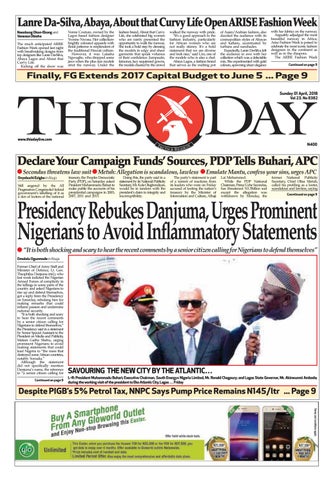
SAVOURING THE NEW CITY BY THE ATLANTIC… L–R: President Muhammadu Buhari; Executive Chairman, South Energyx Nigeria Limited, Mr. Ronald Chagoury; and Lagos State Governor, Mr. Akinwunmi Ambode; during the working visit of the president to Eko Atlantic City, Lagos … Friday
Despite PIGB’s 5% Petrol Tax, NNPC Says Pump Price Remains N145/ltr ... Page 9
2
T H I S D AY ˾ ͯ˜ ͰͮͯͶ
T H I S D AY ˾ SUNDAY APRIL 1, 2018
3
4
T H I S D AY ˾ ͯ˜ ͰͮͯͶ
T H I S D AY ˾ SUNDAY APRIL 1, 2018
5
6
T H I S D AY ˾ ͯ˜ ͰͮͯͶ
T H I S D AY ˾ SUNDAY APRIL 1, 2018
7
8
T H I S D AY ˾ ͯ˜ ͰͮͯͶ
9
˜ ͺ ˾ T H I S DAY, T H E S U N DAY N E W S PA P E R
PAGE NINE
Despite PIGB’s 5% Petrol Tax, NNPC Says Pump Price Remains N145/ltr Chineme Okafor in Abuja The Nigerian National Petroleum Corporation (NNPC) on Saturday allayed fears that pump price of petrol might move up following National Assembly’s recent passage of the Petroleum Industry Governance Bill (PIGB), which levied a five per cent petrol tax. The NNPC told THISDAY in Abuja that petrol price remains N145 per litre for now, explaining that while it would wait for the implementation of the PIGB to commence, it has focused its attention on ensuring that the Nigeria does not experience the kind of petrol scarcity it had in
the last quarter of 2017 and into 2018. It also stated its intention to see that petrol is sold at N145 per litre in the eastern part of the country, adding that it was only in the region that a litre of petrol is sold above the government’s regulated price of N145. On Tuesday, the two chambers of the National Assembly considered and approved the Conference Committee Report on the PIGB 2018 (SB. 237), which is the new framework to regulate the governance aspects of country’s petroleum industry. Apart from unbundling the NNPC into a new national
oil company fit for purpose; scrapping the Department of Petroleum Resources (DPR) and Petroleum Products Pricing Regulatory Agency (PPPRA) to come up with one single regulatory entity known as the Nigerian Petroleum Regulatory Commission (NPRC), the PIGB also imposed a five per cent levy on fuel sold across the country. According to the PIGB, the five per cent fuel levy on Nigerians will be paid to the Petroleum Equalisation Fund (PEF) to finance its operations in the sector. Its Section 36 (1) (a) stated inter alia: “There shall be established the Petroleum Equalisation
Fund into which shall be paid all monies payable to the Equalisation Fund by way of a five per cent fuel levy in respect of all fuel sold and distributed within the federation which shall be charged subject to the approval of the Minister (of Petroleum).” But responding to THISDAY’s inquiries on how this could affect the pump price of petrol in the country especially with regards to the NNPC being the sole importer of petrol, NNPC’s Group General Manager, Public Affairs, Mr. Ndu Ughamadu, stated that there was no plan by the corporation to review the price of petrol. “For the time being there is
no immediate plan because you have to put many things into consideration,” said Ughamadu via a telephone interview. He further explained: “As far we are concerned, we are not contemplating that decision. They should allow the bill to take off first. Our concern now is how to lower fuel price in the east so that it can be the same with all other parts of the country because NNPC is the only importer now and we don’t know why the prices should be different (there).” Ughamadu, stated: “The only thing is that we have assured the nation that as far as this
administration and current management (of NNPC) is concerned, we might not experience the type of supply hiccup we had in the last quarter and that will be of paramount importance to consumers. “You are aware we were in the east two weeks ago to lay serious complaints to the governors that in terms of price disparity, it was only in the east that we still experience it, whereas when you travel to Maiduguri it is sold at N145 per litre. In the east it is still sold for close to N150 per litre despite that depots are closer to the east than Maiduguri.”
Finally, FG Extends 2017 Capital Budget to June 5 Reviews requests for extension of VAIDS’ deadline Kunle Aderinokun The federal government has finally extended the implementation of 2017 capital budget to June 5, 2018, shifting forward the conclusion of the capital vote spending by two months from the March 31 cut-off date it earlier instructed ministries, departments and agencies (MDAs). The government, according to the Minister of Finance, Mrs. Kemi Adeosun, is also reviewing requests for the extension of last Saturday’s deadline for the Voluntary Asset and Income Declaration Scheme (VAIDS). There has been clamour for the extension of the capital component of the budget by the National Assembly, which argues that it is the requirement
of the law. In a circular dated March 28, 2018, signed by the AccountantGeneral of the Federation, Alhaji Ahmed Idris, the government noted that the extension was done to enable the MDAs successfully implement the capital budget for 2017. Besides, the government believed the extension would engender probity, transparency, accountability and governance. The circular with reference number: TRY A5&B5/2018 OAGF/CAD/026/V.111/170, which THISDAY obtained from a reliable source, was sent to all permanent secretaries, chairmen of parastatals, RMAFC, Secretary to the Government of the Federation, Head of Service, directors-general/chief executives of extra-ministerial offices and agencies, amongst others.
The circular titled, ‘Extension of Capital Budget 2017’, stated: “Further to our earlier Treasury Circular Ref. No. TRY A9&B(/20127 and OAGD/ CAD/026/V/V.III/116 of 30th November, 2017, all Ministries, Departments and Agencies (MDAs) are hereby informed that the implementation of the Capital Budget 2017 has now been extended to 5th June, 2018 or the day the 2018 Appropriation Act is passed into law and assented to by Mr. President, whichever comes first. The extension is to ensure the successful implementation of the capital budget for 2017 for a period of 12 months. It is also to promote probity, transparency, accountability and governance in line with the policy thrust of the government.” The circular aligns with the
position of Senate President Bukola Saraki that the federal government should allow the implementation of the 2017 budget run till the end of May 2018. This was consequent upon the attention drawn by Senator Atai Aidoko (PDP, Kogi East) to a circular the government issued to MDAs, which stated that 2017 budget funds will be “mopped up” by March 31, 2018. Aidoko had argued that acting on the instruction in the circular contravened the provisions of section 3(1) of the 1999 Constitution as amended, pointing out that the section mandated that the budget runs for 12 months after the presidential assent. On the closure of accounts arrangements under the Government Integrated Financial
DECLARE YOUR CAMPAIGN FUNDS’ SOURCES, PDP TELLS BUHARI, APC it was an unfair comment on matter subsisting in court. The PDP, which had in an earlier statement on Friday described a list of alleged looters released by Mohammed as “hollow and laughable,” said Buhari and the APC would have no moral standing to fight corruption unless they came clean and public with the accounts, including the donors, of their presidential campaigns. Alleging that the campaign funds were proceeds of corruption from fraudulent government officials and businessmen, the opposition party wondered how the president, who declared that he had no resources to run a presidential campaign in 2015, was able to garner billions of naira to prosecute his election campaign. It argued that Buhari ought to have known, particularly as a leader, that the billions of naira deployed in his campaigns were proceeds of corrupt activities of known APC governors and leaders. The PDP said it was particularly interested in the fund allegedly provided by a South-south governor for the 2011 presidential election as well as how the cost of litigation was paid by his campaign organisation. It said the federal government could not list names of alleged looters and attempt to shy away from the fact that the president and his party were direct beneficiaries of fund allegedly looted by APC governors. Contending that Buhari and APC leaders had huge confessions to make on how they raked in state allegedly stolen resources to prosecute elections of 2015, the PDP declared: "If the federal Government and the APC are serious about fighting corruption and not just out to persecute PDP members, they should have begun with the probe into the source of the billions of naira used for President
Buhari’s 2015 presidential campaigns, particularly in the face of allegations that the fund was looted from treasuries of various APC states. "Can President Buhari in all honesty claim ignorance of reports in the open media that a South-south governor looted several billions from his state accounts and diverted the sums into Buhari's 2015 campaigns? "Can the Presidency and the APC inform Nigerians what steps the Federal Government has taken to investigate this allegation, which has been in public domain and to clarify their roles as beneficiaries of the alleged looted funds?” Metuh: Allegation is Scandalous, Lawless The party’s former spokesman, Metuh, in his own reaction on Saturday, decried Lai’s enlisting of his name in the hall of looters, saying it was an abuse of the 1999 Constitution as amended, which guaranteed his right to a fair trial in court. Already standing trial for alleged illegal receipt of N400million from the former National Security Adviser, Col. Sambo Dasuki (rtd.), Metuh said the minister’s comment was part of a premeditated plan by the federal government to force the judiciary to convict him in the yet to be decided corruption trial, adding that it amounted to a conviction before trial. Accusing the government of executive rascality and lawlessness, he said: “By this publication (Lai’s statement), the federal government has breached our constitution by seeking to burden me with two criminal trials on the same charge, one before Justice Okon Abang and the other before the media,” he said. Metuh explained that he had been put on trial for receiving N400m million from the Office of the National Security Adviser to carry out duties assigned to him
as the then National Publicity Secretary of the PDP by former President Goodluck Jonathan. He stated that although the major crux of the prosecution’s argument was that he ought to have known that the money was a part of an alleged and yet to be proven unlawful activity of Dasuki, nothing tangible had been established against him in court. Drilling holes into the federal government’s case, he said:"It is of interest to note that the prosecution has not alleged any mens rea or collusion on my part other than the suggestion that I 'ought to have known' of the alleged unlawful activity. Also the alleged illegality of the funds has neither been established in law nor in fact. "I have NEVER held a government office and/ or position and could not therefore have had any access to government funds. "In view of the weakness of the case against me, the APC-led Federal Government resorted to all kinds of dirty tactics to dehumanise and intimidate me. They have done everything humanly possible to ensure complete persecution.” Metuh concluded: "By going to the media to name me a looter (without cross-checking the definition and dictionary meaning of the word) the federal government has not only given a body language but has issued a direct intimidation and threat to the judiciary to get a compulsory conviction. “In view of this unprecedented executive rascality and lawlessness, I have asked my lawyers to review the implications of this latest attack by the government and take appropriate steps for redress.” Secondus Threatens Libel Suit Also reacting to his listing, Secondus said Mohammed’s statement was libellous and gave the minister 48 hours to withdraw it or face litigation.
A statement by his Special Assistant (Media), Mr. Ike Abonyi, said Secondus, through his lawyer, Chief Emeka Etiaba (SAN), in a letter dated March 31, 2018 to the minister, demanded for retraction, public apology and payment of N1.5billion as damages. According to the lawyer, the said publication had damaged the image of Secondus as he had been "humiliated, castigated and vilified by many as a result of the falsehood published by the minister." Etiaba asked Mohammad to note that if he failed to meet the demands within 48 hours, Secondus would immediately proceed to court to ventilate his right under the law and shall further seek the protection of the court against the minister. Emulate Mantu, Confess Your Sins, urges APC Meanwhile, APC has urged PDP to follow the example of one its leaders and former Deputy Senate President, Senator Ibrahim Mantu, and confess to its sins against the country instead of indulging in name calling. In a statement on Saturday by its National Publicity Secretary, Mallam Bolaji Abdullahi, the party said it had noted the apology offered by the PDP but asked it to go a step further and confess to its sins before restitution could be considered. APC said: "Instead of taking this path to redemption, PDP has engaged in fruitless "you too" accusations and name calling. This is further evidence that PDP is not ready for repentance and only offered the apology with the hope that Nigerians will grant them amnesty and a short-cut back to power. "However, now that Senator Mantu has belled the cat, by confessing to how he has helped the PDP to rig elections in the past, we hope that PDP will follow the bold example of the former Senator and confess to their other sins against Nigeria."
Management Information System (GIFMIS) platform, the new circular stated that, “All MDAs in the GIFMIS platform would automatically have their ledger periods and access to their funds closed online real-time by 12 midnight of 5th June, 2018 or the day the Appropriation Act is passed into law and assented to by Mr. President, whichever comes first. Meanwhile, the federal government is reviewing requests by states and the private sector for an extension of the tax amnesty programme, the Voluntary Assets and Income Declaration Scheme (VAIDS). The tax programme, which expired yesterday, offered a ninemonth window of opportunity for tax payers to regularise their tax liabilities. Responding to media enquiries in Abuja, Adeosun said some states of the federation and the private sector had asked for an extension of the deadline
in order to allow them more time to comply. According to her: “The Federal Government is reviewing the numerous extension requests by the states and the private sector, which have cited some logistic challenges such as nonavailability of the declaration forms in some states and the declaration of public holidays to commemorate Easter.” She stated that tax evaders risk forfeiting their assets and prosecution as she noted that the government’s data mining unit in the Federal Ministry of Finance, Project Lighthouse, had compiled data of tax payers from land registries from 36 States and Federal Capital Territory as well as their bank accounts. “We have also received tremendous support from foreign countries which provided data under the exchange of information protocols. The data include bank records and financial filings for tax purposes,” Adeosun said.
PRESIDENCY REBUKES DANJUMA, URGES PROMINENT NIGERIANS TO AVOID INFLAMMATORY STATEMENTS Nigerians to defend themselves,” was a clear repudiation of the former army chief’s call on Nigerians at the maiden convocation of Taraba State University, Jalingo, Yola in Taraba State penultimate Saturday, to defend themselves against gunmen terrorising their communities in the face of the failure of the armed forces to protect them. Against the background of this unusual outburst by a former minister and the growing searing criticisms of the Muhammadu Buhari administration by some senior citizens, the Presidency statement urged notable Nigerians to rather use their influence wisely without engaging "in public declarations that are likely to inflame emotional passions and threaten national security." It said it was very worried by the ex-minister’s comment because it would make criminal gangs to feel justified by defying legal, governing and democratic institutions as well as the authority of legitimately elected democratic government. "What country would survive if its citizen’s rise against the country’s organised, trained and equipped military?” it asked in a clear reference to the former military chieftain’s call to arms. The Presidency, however,
praised the military, which it said had continued to maintain peace and stability of the country despite temptations from those it said wanted to use it to destabilise the government. "The Presidency commends the Nigerian military’s efforts to maintain peace and stability, despite being pulled in various directions by elements determined to destabilise the country and government for their selfish reasons,” it said. It, therefore, encouraged the nation’s prominent leaders to explore proper channels to advise the government instead of appealing to emotions. "We advise former leaders to take advantage of the various fora where people with a history of national security can offer advice to the government without resorting to the exploitation of emotional sentiments,” it stated. In an apparent warning to the leaders not to take its gentility for granted, the Presidency, said: "Silence can be dignified, but sometimes it can be misinterpreted and exploited,” adding that the motto of the civil war: “To keep NIGERIA one is a task that must be done,” had become more germane at these troubled times, urging at Nigerians to be careful and avoid the mess that destroyed other African countries like Somalia.
LANRE DA-SILVA, ABAYA, ABOUT THAT CURVY LIFE OPEN ARISE FASHION WEEK 2018 runway kicked off on Friday with a meet and greet session with supermodel Naomi Campbell who is the headliner of the fashion event. It continues today and will end tomorrow at the Lagos Continental Hotel, Victoria
Island, Lagos. 45 designers from between 12 and 14 countries such as South Africa, Botswana, Tanzania, Ghana, Ivory Coast, Germany, Canada, France, Morocco, the United Kingdom, United States, the Caribbean and Nigeria will parade the runway.
10
APRIL 1, 2018 ˾ T H I S D AY, T H E S U N D AY N E W S PA P E R
SUNDAY COMMENT
Editor, Editorial Page PETER ISHAKA Email peter.ishaka@thisdaylive.com
WHAT WE CAN LEARN FROM EASTER We should live a life of forgiveness, love and sacrifice
A
s we rejoice with Christians all over the world on this most important occasion, there is a lot in the Easter story that resonates not only for them but indeed for all humanity. The sacrifice, love and mercy that the death and resurrection of Jesus Christ exemplified are some of the enduring values that transcend doctrine and they are worthy to be reflected upon by all Nigerians, especially in a season like this. More than at any other period in history, this Easter provides an opportunity for Nigerians to identify some common values from which to build a new national order as we respond to the threat of the rhetoric of hate and all forms of incitement to violence that are increasingly being given voice in our country. Easter indeed demands that we all rise above bitterness by becoming beacons of hope Easterdemands and peace wherever thatweallrise we find ourselves. abovebitternessby Besides, we need becomingbeacons to erect effective bulwarks against ofhopeandpeace corruption in all its whereverwefind while ourselves.Besides,we manifestations shunning unbridled needtoerecteffective individualism. bulwarksagainst We must restore corruptioninallits the power of moral manifestationswhile indignation in Nigeria. We cannot shunningunbridled continue to live in a individualism society where most citizens cannot afford the basic necessities of life. To address that challenge, we must raise the standards of public conduct, at all levels. As St. Francis De Sales reminds us, “If you are inclined to avarice, think of its folly; it makes us slaves to that which was intended to serve us. Remember how we must leave everything when we die; perhaps those who get our wealth then will only squander it, and even to their ruin”.
Letters to the Editor
It is therefore important to pause and reflect on the central mystery of Easter which is about the sacrifice of Jesus Christ on the Cross so that adherents of the faith would enjoy the blessing of joy on earth and the promise of eternal life. Unfortunately, we are well aware that, just like Christmas, Easter celebrations have not only become mundane but have also taken on traditions that sometimes seem to overshadow the real essence of the season.
I
S U N DAY N E W S PA P E R EDITOR BOLAJI ADEBIYI DEPUTY EDITORS VINCENT OBIA, OLAWALE OLALEYE MANAGING DIRECR ENIOLA BELLO DEPUTY MANAGING DIRECTOR KAYODE KOMOLAFE CHAIRMAN EDITORIAL BOARD OLUSEGUN ADENIYI EDITOR NATION’S CAPITAL IYOBOSA UWUGIAREN
T H I S DAY N E W S PA P E R S L I M I T E D EDITOR-IN-CHIEF/CHAIRMAN NDUKA OBAIGBENA GROUP EXECUTIVE DIRECTORS ENIOLA BELLO, KAYODE KOMOLAFE, ISRAEL IWEGBU, IJEOMA NWOGWUGWU DIVISIONAL DIRECTORS PETER IWEGBU, ANTHONY OGEDENGBE DEPUTY DIVISIONAL DIRECTOR OJOGUN VICTOR DANBOYI SNR. ASSOCIATE DIRECTORS ERIC OJEH, PATRICK EIMIUHI ASSOCIATE DIRECTOR SAHEED ADEYEMO CONTROLLERS ABIMBOLA TAIWO, UCHENNA DIBIAGWU, NDUKA MOSERI DIRECTOR, PRINTING PRODUCTION CHUKS ONWUDINJO TO SEND EMAIL: first name.surname@thisdaylive.com
nstructively, Christians stake their eternal destiny on the message of Easter which is about the resurrection of Jesus Christ who demonstrated a remarkable form of servant leadership, by washing the feet of His disciples in the days preceding His death on the cross. It is only when those in authority, at all levels, adopt this selfless attitude that they can focus attention on citizens, their safety and welfare as well as on the optimal allocation of scarce resources and the effective implementation of policies for service delivery to the greater good of our society. In this holy season, the enduring message of love can be transmitted by sharing with the less privileged of our society not only material possessions but also through simple gestures like kind words and sincere smiles. That is where we fail most miserably in Nigeria. And the tragedy of that failure can be seen in the poverty and deprivation of majority of our people. But to the extent that with Easter, death did not get the final word and an empty tomb was not the end of the story, there is still much more that we can all do and hope for in Nigeria. As we therefore mark the triumph of the risen Christ, people in authority, at all levels in our country, must begin to imbibe the lessons of Easter. Jesus Christ is such an eloquent testimony to the virtue of selfless service to the people. Throughout His earthly sojourn, He lived among the people, spent His whole life with them and shared in their anxieties, hopes and aspirations. He fed the hungry, healed the sick, consoled the sorrowful and wept for the dead. He remains a model for those who would lead, especially at a time when human miseries continue to worsen. As the message of a resurrected Jesus Christ continues to give hope, peace and strength to people around the world, we wish all our Christian readers a very happy Easter.
TO OUR READERS Letters in response to specific publications in THISDAY should be brief (150-200 words) and straight to the point. Interested readers may send such letters along with their contact details to opinion@thisdaylive.com. We also welcome comments and opinions on topical local, national and international issues provided they are well-written and should also not be longer than (950- 1000 words). They should be sent to opinion@thisdaylive.com along with the email address and phone numbers of the writer.
Fashola’s Unique Style
I
t is no secret that in Nigeria, government ministers are quite busy. They are usually so busy that sometimes files gather dust on their tables for months, except of course if there is somebody to follow up with the files. If you send a letter to a Nigerian minister without receiving immediate acknowledgment from his officials, there is every likelihood that that letter will not get any reply. That was my presumption until few weeks ago when I received a call from Ambassador Dickson Akor, founder of the Nigeria Peace Corps. In very few words, he told me that a letter I wrote to Chief Babatunde Raji Fashola, SAN, Hon. Minister of Power, Works and Housing on the pitiable state of the Ogobia-Onyagede-Ankpa road had reached a stage where my
attention was needed in Abuja. I was surprised at the disclosure. “Is it possible for a Minister of the Federal Republic of Nigeria to act on a letter that was written by a fellow Nigerian that is not in politics?” I asked myself. Below are the particulars of the case. On July 12, 2017, I posted a letter from the General Post Office in Surulere, Lagos; it was addressed to Chief Babatunde Raji Fashola, SAN, Honourable Minister of Power, Works and Housing, Mabushi-Abuja. In the said letter, I drew the Minister’s attention to the worsening condition of the Otukpo-Ogobia-Onyagede-Ankpa road, which links Benue State to Kogi State as well as states in the South-West and South-South. The road leads to and through many big rural markets including Afor-Ogobia, Ede-Okwudu, Ukwo-Ugboju, Ede-Onyagede
and Afor-Awowo. The EdeOnyagede attracts traders from far and wide, some of them in pursuit of the famous Onyagede Garri, which is reputed to be the best-produced in the country. The road is therefore of economic value to the people of the affected communities and other general road users. The road was first constructed in the 1960s to provide easy access to the Coal Mines at Okaba in the present Ankpa Local Government Area of Kogi State. After several years of usage, the stretch of the road from Ogobia to Ankpa failed. Reconstruction of the road commenced during the regime of General Sani Abacha and was completed during the administration of President Olusegun Obasanjo at the cost of more than N400 million. Barely two years after its construction
by SATRECO, however, the road started failing and is now in a state of disrepair. The Otukpo-Ogobia end of the road was constructed as part of the Yahe-Oju-Otukpo-Oweto road, but the Ogobia-Onyagede-Ankpa section is now a nightmare for motorists. Travelling along the OgobiaOnyagede-Ankpa section of the road which could be completed in less than 45 minutes now takes motorists more than four hours. Three years ago, the Federal Emergency Roads Management Agency (FERMA) responded to protests by road users over its condition and patched portions of the road. It didn’t take long before the patched portions of the road also failed and became worse than other portions of the road that did not enjoy that privilege. In reaction, taxi drivers and other motorists abandoned the once-busy road. I specifically requested that the minister should visit the said road to assess the
situation and ensure the reconstruction of the road to save the people of Ohimini, Otukpo and Ankpa Local Government Areas from the pains of travelling on the road. Few days after the letter reached his office, the minister worked on it, directing that that the scope of work on the road be assessed in order to recommend action and cost of the project. To my surprise, all the desk officers involved in carrying out his directive acted with precision and concluded their assignments, including assessment of the volume of work on the road and the cost of its reconstruction. With a little effort, contract for the reconstruction of that road would have found favour with the 2017 Appropriation Act but it did not. My reminder, dated March 15, 2018 also received immediate attention of the minister. –– Nats Onoja Agbo, onojagbo@yahoo.com
T H I S D AY ˾ SUNDAY APRIL 1, 2018
11
12
T H I S D AY, T H E S U N D AY N E W S PA P E R Ëž PRIL 1, 2018
SUNDAYNEWS
News Editor ĂŒĂ“Ă—ĂŒĂ™Ă–Ă‹ Ă•Ă™Ă?Ă“Ă–Ă? E-mail: Ă‹ĂŒĂ“Ă—ĂŒĂ™Ă–Ă‹Ë›Ă‹Ă•Ă™Ă?Ă“Ă–Ă?̜ÞÒÓĂ?ĂŽĂ‹ĂŁĂ–Ă“Ă Ă?Ë›Ă?Ă™Ă—Ëœ ͸΀͚͚͟͟Πͽ͝͸͞ Ě™Ă?Ă—Ă? Ă™Ă˜Ă–ĂŁĚš
Experts Express Doubt National Carrier Could Come on Stream By 2019 t New Lagos-New York Flight showcases economic diversification, says Delta Chinedu Eze Ă‹Ă˜ĂŽ Demola Ojo
Aviation industry experts have expressed doubt that the President Muhammadu Buhari-led administration would be able to realise the establishment of the national carrier projects before it winds down in May, 2019. But many have expressed full support for the project, noting
that it would reposition the aviation sector if realised. Minister of State, Aviation, Senator Hadi Sirika Thursday unveiled Transaction Advisers for the establishment of a national carrier along with that of maintenance facility, concession of four major airports in the country and others and said Airline Management Group
Limited was selected for the rebirth of a national carrier. But experts who spoke to THISDAY doubt the successful establishment of the national airline within the stipulated time of barely one year, noting that for the transaction to be transparent and for it to be private sector driven, as government has emphasised,
more time is needed for such an airline to be “sincerely and transparently established.� Travel experts and the organiser of Akwaaba African Travel Market, Ikechi Uko said time would be a strong factor in government realising its objective in establishing a national carrier. He wondered why nothing much was achieved in almost
ELEVATING AGRICULTURE L-R: Permanent Secretary, Federal Ministry of Agriculture and Rural Development, Dr. Bukar Hassan; Managing Director Designate, Sterling
Bank Plc, Mr. Abubakar Suleiman; and Executive Governor, Kebbi State, Senator Abubakar Bagudu; during the technical workshop on the transformation of the agriculture value chain powered by Sterling Bank in Abuja...weekend
three years and now that government is winding down it is unveiling a transaction adviser. Uko, who is in full support of a national carrier because it would mark a turnaround in Nigeria’s air transport sector, create jobs and enable Nigerians benefit from its huge passenger traffic, said it might not be easy for government to actualise its objective within the time frame. “I don’t know what government’s checklists are but if in three years government could not advance the establishment of a national carrier, what is it going to do in less than a year? I believe that time would be the government’s greatest challenge. I know money has been expended in the project but it will need time to realise the set goal and time is not there. We hope government would succeed because Nigeria really needs a national carrier,� Ikechi said. Industry consultant and CEO of Belujane Konsult, Chris Aligbe expressed optimism that if the Transaction Adviser was given timeline, government would be able to establish a national carrier before the end of the current administration. Aligbe observed that what is different in the current effort and what was done in the past is that the transaction this time is very transparent and sincere, noting that what came close to it was when the International
Financial Corporation (IFC) wanted to midwife a national airline for the country. He also noted that the current process is open and getting the necessary approvals from the Federal Executive Council (FEC), adding that although the Transaction Adviser was unveiled last Thursday but it had already started working since Lufthansa Consulting was shown the door out by the federal government. “I think the timeline given to them will be met if by the end of June they submit their report. It they submit their report by then it will be possible to realise the goal before the end of the administration. And I wish to note also that although the new national carrier will be private sector driven, but government must invest in it to kick-start it. “NoNigerian will paymoney in any product he has not seen and those who are talking about going to the Stock Exchange should realise that you cannot go to the stock market without existing product, which has at least existed for three to four years because you will have to present your financial result. Another thing that will make the new national carrier a success is that government wants to float a leasing company with about 60 or more aircraft from where the national carrier will acquire its fleet. This has not been done before,� Aligbe said.
(See concluding part on www.thisdaylive.com)
Easter: Govs, Ekweremadu, Mark, Others Canvass for Peace, Unity Among Nigerians t Seek tolerance, love, end to wanton killings AbimbolaAkosile,SenatorIroegbu Ă‹Ă˜ĂŽ OgheneuvedeOhwovoriole Ă“Ă˜ ĂŒĂ&#x;ÔË, JohnShiklam Ă“Ă˜ Ă‹ĂŽĂ&#x;Ă˜Ă‹, David-ChyddyElekeĂ“Ă˜ ĂĄĂ•Ă‹Ëœ Ă‹Ă˜ĂŽ LaleyeDipoĂ“Ă˜ Ă“Ă˜Ă˜Ă‹
As the country joins the rest of the world to mark Easter today, Nigerians have been urged to embrace peace, tolerance and promote unity among all, as signs of emulation of Jesus Christ, the reason for the season. Theywerealsourgedtoimbibe
the spirit of tolerance, peaceful co-existenceandsacrificeforone another, and to pray for divine intervention against the wanton killing of innocent Nigerians across the country. Lagos State Governor, Mr. Akinwunmi Ambode called on Nigerians to imbibe the spirit oftolerance,peacefulco-existence andsacrificeforoneanother,statingthatdevelopmentandgrowth canonlyoccurinthenationwhen all tribes and tongue unite and
speak with one voice. Ambode, in his Easter message signed by his Chief Press Secretary,Mr.HabibAruna,said suchfundamentalvalueswould go a long way in promoting and strengthening the foundation of love, peace and harmony in the country, adding that the season should serve as a reminder to the selflessness, love, sacrifice and tolerance of Jesus Christ throughout His earthly sojourn, hisdeathandhisresurrection.The
Fayemi Hints at Governorship Run, May Quit Buhari’s Cabinet in May t To proceed on one-month terminal leave t Declares intention April 14 t Launches book on reflections in office Shola Oyeyipo
Minister of Mines and Steel Development, Dr. Kayode Fayemi, yesterday, after a stakeholders’ meeting in Isan Ekiti, hinted at a possible governorship run in Ekiti State just as he is said to have concluded plans to quit President Muhammadu Buhari’s cabinet sometime in May in readiness for the governorship election billed to hold in July 14. Fayemi, who is billed to make an official declaration on his ambition, April 14, ahead of the April 15 proposed kickoff date for campaigns by the Independent National Electoral Commission (INEC) is to pro-
ceed on terminal leave in the next few weeks after which he would resign from cabinet. The minister, sources hinted, is also preparing for a public presentation of his new book, which is a reflection on leadership lessons and legacies since his 2014 exit from the Ekiti Government House through the presidential campaigns that brought his party, the All Progressives Congress (APC) to power as well as his period as the Minister of Mines and Steel Development. Although, it is no longer in the realm of conjecture that Fayemi is interested in reclaiming the state back into the APC fold,
the speculations however grew stronger in the last few months. But while Fayemi too has refused to categorically confirm or deny the fact that he would join the race over time, his footprints have been all over the state preparatory to this period. It is therefore, the belief of many in the state that his decision to join the race might be the game changer for the APC, much as many others also believed that he should be given the right of first refusal in his party, where no fewer than 30 aspirants have already indicated interest in the Ekiti governorship.
GovernorurgedChristianstouse theseasonasaperiodtoreflecton theirindividualandcollectiveroles towardspromotingandsustaining thefoundationoflove,peaceand harmony in the nation. Hesaidtherewasnobettertime for the country to unite together andeschewbitternessalongethnic and religious lines, adding that no challenge is insurmountable where unity of purpose thrives. Ambode commended Lagosians for their continued demonstration and promotion of mutual understanding and
peaceful co-existence in spite of existing ethnic, cultural and religious diversities, saying that the cooperation of residents for government programmes and policies was responsible for the massive development across the State in the last 34 months. While wishing all Lagosians a happy Easter celebration, he enjoinedthemtocontinuetosupporthisadministrationtodeliver moredevelopmentalprojectsthat wouldmakelifemorecomfortable for them.
GovernorIfeanyiUgwuanyiof EnuguStatealsofelicitateswiththe Christianfaithfulinhisstateand indeedallNigeriansfortheirabidingfaithinGodandcommitment topeace,unityandprogressofthe country,inlinewiththespiritofthe occasion.InhisEastermessage,Ugwuanyinotedthat“the40daysof fasting,prayingandcharity,which reinvigoratedthespiritualstrength ofChristianstogainsalvationand receivetheamazinggraceofGod, callforcelebrationandsustained faith in God�.
(See concluding part on www.thisdaylive.com)
Five Die as Suicide Bombers Hit Maiduguri Michael Olugbode Ă“Ă˜ Ă‹Ă“ĂŽĂ&#x;Ă‘Ă&#x;ĂœĂ“
Four female suicide bombers died on Friday night during an attack on the outskirts of Maiduguri, the troubled capital of Borno State. The sound of the explosion from the attack, which echoed all over Maiduguri left one dead and13personsinjuredapartfrom thefoursuicidebombers,whose bodies were mangled beyond recognition. Confirming the attack, the Borno Police Command Public RelationsOfficer,EdetOkon,ina statementsaid:“Atabout2149hrs yesterday,30/3/18four(4)female suicidebombersinfiltratedMuna Zawuya village in Mafa local government area, outskirt of Maiduguri. “Theydetonatedtheexplosives killingthemselvesandoneother person (female). Thirteen (13)
persons were injured and were taken to a hospital where they are responding to treatment.� He added that: “The Borno state police command had dispatched men to the scene includingmenoftheCTU,SARS and EOD to sweep the place and make the environment safe.� He said: “Normalcy has returned to the area,� promising that adequate security arrangements have been put in place for a hitch free Easter celebration. He said patrol and monitoring have also been put in place in the troubled town to prevent security breach. Also speaking on the attack, the spokesman of the military counter-insurgency operation in the North East (Operation Lafiya Dole), Colonel Onyema Nwachukwu,inastatement,said: “TroopsofOperationLafiyaDole
deployedatacheckpointaheadof Muna Garage in the outskirts of Maiduguriyesterdayneutralised foursuicidebomberscomprising a male and 3 females. “The suicide bombers were attempting to infiltrate the Maiduguri Metropolis through Muna Zawiya area at about 9.30 pm but were spotted by vigilant troops,whofiredshotshittingone of them and thereby triggering a simultaneous explosion killing all the four bombers.� He added: “Regrettably however, 18 persons were injured in the incident. The wounded have been evacuated for medical attention.� He disclosed that “troops and membersoftheCivilianJointTask Force are presently conducting cordon and search operation in the area for any other suicide bomber lurking around.�
T H I S D AY ˾ SUNDAY APRIL 1, 2018
13
14
ͯ˜ ͰͮͯͶ ˾ THISDAY, THE SUNDAY NEWSPAPER
OPINION Nigeria And The Holy Cow! Nnamdi Ebo writes that the cow is an animal of consequence
“H
oly Cow!” which dates back to 1905 is a humorous exclamation of surprise or dismay. Cattle, colloquially cows, are domesticated ungulates. Holy Cow is also a film by Imam Hasanov. One man’s dream of bringing a European cow to his village in Azerbaijan unsettles the community who see a threat. Some consider cattle the oldest form of wealth, and cattle raiding consequently one of the earliest forms of theft. Requests and pledges for protecting grazing spaces and cattle passages have been contentious. The estimated total cattle population in Nigeria is 25 million. Fulani herdsmen herd these animals menacingly into arable farmlands destroying the livelihoods of Nigerian farmers in the southeast, southwest, south south and the middle belt regions. A centuries-old tradition of a people having no permanent abode, who travel from place to place to find fresh pasture for their livestock, in this technologically-advanced 21st century – is threatening the corporate existence of Nigeria. Historians have written that there is a correlation between settlement and Islam. The Fulani are traditionally nomadic cattle herders of Muslim faith; pastoralists who have herded cattle for centuries in search of grazing land and water. Fula people, with Arabic and North African roots, adopted Islam early. According to David Levison, adopting Islam made the Fulani feel a “cultural and religious superiority to surrounding peoples, and that adoption became a major ethnic boundary marker” between them and other African ethnic groups in Sahel and the West African sub-region. Hon. Aishatu Dukku (Gombe) hollered: “Yes, the herdsman values even the life of the cow more than his own life. That is how God has created him.” Chairman of Miyetti Allah North-East, Alhaji Mafindi Danburam, backed Dukku, saying that God created a Fulani man to value a cow’s life more than a human’s life, “. . . If a Fulani herdsman doesn’t have cows, his life is worth nothing . . . His only jewel is a cow. A Fulani herdsman without a cow is a nobody . . . if you kill a Fulani herdsman, expect his men to come for a reprisal”. With a ringing declaration of support, the aforesaid Miyetti Allah statement rings a dark and foreboding reminder and intimidation against future Fulani
herdsmen forays into farmlands. In reaction to Fulani herdsmen rampaging across the country, Prof. Wole Soyinka said: “Yes, indeed the government is culpable, definitely guilty of looking the other way”. On June 2, 2016, the Minister of Agriculture and Rural Development, Audu Ogbeh, released a census of livestock in Nigeria. The 2011 National Agricultural Sample Survey indicated that Nigeria had an estimated 19.5 million cattle. Since then, their population has leaped as non-Nigerian Fulani pastoralists migrated through porous borders, southward bound. They embarked on the destruction of farmlands and when the farmers resisted, as they should, marauded butchery ensued in earnest. Former Chief of Army Staff and Minister of Defence, Lt. Gen. T. Y. Danjuma (rtd.), on March 24, 2018 raised alarm: “. . . There is an attempt at ethnic cleansing . . . in Nigeria. We must resist it. We must stop it . . . Our Armed Forces are not neutral. They collude with the armed bandits to kill people, kill Nigerians. The Armed Forces guide their movements. They cover them. If you are depending on the Armed Forces to stop the killings, you will all die one by one . . . Somalia will be a child’s play . . . defend your country, defend your territory and defend your state. Defend yourselves.” The Nigerian government wants to establish “cattle colonies”. There is none in the world, except Pakistan with one cattle and beef trade centre. A colony is a country or area under the full or partial political control of another country, typically a distant one,
The excitement of APC’s ‘Change’ which swept Nigerians off their feet, ushering in the Buhari administration in 2015 has dissipated – as the national policy on the protection of “rights to welfare” of cattle looms large. Holy cow!
and occupied by settlers from that country. Any attempt at colonisation is a takeover bid. In Edo State, cows have taken over many schools. Cows took over Akure Airport in early February 2018 as Air Peace flight 7002 with 65 passengers hovered in the air and could not land after hordes of cows invaded the runway. These animals are everywhere! Technically, a colony is a group of people of one nationality or ethnic group living in a foreign territory. What did the framers of the cattle colonies have in mind? Traditionally, settlement of Fulani herdsmen depended on the number of years they stayed at one spot, based on two factors: the reaction of the landowners to their presence and the availability of pastures for their cattle. Critics postulate that these planned “colonies” may be a grand plan to institute a Fulani 19th century imperialism across Nigeria. President Muhammadu Buhari has denied it. The Land Use Act may be used in this grand plan. Under this act, the federal government can acquire indigenous luxuriant farmlands of bucolic village communities to host Fulani herdsmen’s cattle colonies. Chief of Army Staff, Lieutenant General Tukur Buratai recently stated that the Nigerian Army would be raising cattle ranches in almost all the divisions and brigades. The army had sent officers to Argentina to learn cattle rearing. The intention of the army is not just to secure Nigeria, but to contribute in growing the economy. While they are at it, terrorists “abducted and returned” the DapchiGirls and Fulani herdsmen perfected their human butcheries with alacrity. Separatist leader, Nnamdi Kanu, had said “Nigeria is a zoo”. While I disagreed with Kanu’s Biafra irredentism, Nigeria has become a wild zoo – where there is a conflict of interest between cattle and humans; where Fulani behave as if the right to herd cattle is a fundamental human right; where many Nigerians are homeless and defenceless but cows have bodyguards wielding AK-47 rifles; where the Nigerian government is an activist for pastoral-nomadism; where the Fulani hegemonic class will be ascendant under the guise of cattle colonies. Many Nigerians say the “ethnic cleansing” alarm by Danjuma is timely. The excitement of APC’s “Change” which swept Nigerians off their feet, ushering in the Buhari administration in 2015 has dissipated – as the national policy on the protection of “rights to welfare” of cattle looms large. Holy cow! ––Ebo is a political scientist and lawyer.
Ndigbo And PRAGMATIC ADAPTATION
The Igbo people must advance into the mainstream of Nigerian politics, writes Chuks Akamadu
F
ortune smiled on me some days ago when I stumbled on Singapore Is Not An Island, a fairly recent book written by Mr. Bilahari Kausikan. Published last year by Strait Times Press Singapore, the book presents very instructive Views on Singapore Foreign Policy. The author does not only possess the competence required for his intervention as a top–class diplomat, he could on the merit actually pass for an authority in the subject he chose to treat, having retired from the Singaporean public service as Permanent Secretary, Ministry of Foreign Affairs. In essence, the book is an efficacious prescription for national awakening and self–redemption. Further, it describes, in a very blunt language, the fate of societies that embrace wishful thinking as path to greatness and conversely, the certainty of growth and progress of those that find the courage to accept the prevailing realities, however unsuitable, and adapt to them in their quest for collective wellbeing. Specifically, it addresses the foolhardiness in imagining Singapore as an Island that could survive without the rest of the world on the one hand and on the other hand, the idiocy in Singapore expecting other nations to accept her the way she is and adjust to her peculiarities. According to the author, “Life is a series of improvisations in response to unforeseen and unforeseeable events. We can only improvise wisely if we accept the world as it is and not as we hope or fear it to be”. He argues even more pointedly that “the world will not arrange itself to suit Singapore’s convenience”, and concluded that “the prerequisite for Singapore’s survival was its pragmatic adaptation to the world as it was”. Spot on! Talking about “pragmatic adaptation”, Mr. Steven Silbiger’s The Jewish Phenomenon, readily comes to mind. The book is a gripping story of the displaced, traumatised and violated Jewish people who, on the insistence of the vagaries of life, migrated to the United States of America without a road map but ended up entrenching themselves in the American system in a most remarkable manner through “pragmatic adaption”. “In 1890” Mr. Silbiger notes in his book “there were few Jews practicing in law or medicine in New York City. By 1900, there were four hundred to six hundred Jewish doctors in the city … in the 1930s, 55 per cent of doctors, 64 per cent of dentist and 65 per cent of lawyers in New York City were Jewish”. Yet these were people who had previously suffered serial expulsions. To their credit, the Jews were able to rise above
the psychological turmoil that came with their ordeal in the hands of tormentors and persecutors spread across Europe – Germany, Russia, France, et al; although France holds the distinctive record of being the first European country that granted them equal rights in 1791. The Jewish Phenomenon can therefore be referred to as a classic case of a focused people with immense “pragmatic adaptation” capabilities. America was to the Jews a most unsuitable habitat, but the latter varied their idiosyncrasies in order to survive and ultimately flourish. To an extent, a graphic illustration of the Jews’ tortuous journey in the world across civilisations would inadvertently attempt a description of Ndigbo in post–civil Nigeria. Curiously, as there are similarities, so are there abundant dissimilarities. There is no denying the fact that both Ndigbo and the Jews are acephalous societies. In the words of Mr. Silbiger, “there is no religious head like the Pope or community spokesman like Jesse Jackson. The Jewish–American community is the product of strong individuals loosely bound together”. A prudent, cautious mind can safely say “Ditto Ndigbo”. Some other values we share include: hard work, ingenuity, entrepreneurship and amazing survival instinct. Unfortunately, Ndigbo have not proved to be as purposeful as the Jews. It does appear that there is a log of wood in our eyes that prevents us from seeing the wisdom in pragmatic adaptation; from all indications, we seem to conveniently view it as being synonymous with apologising for who we are. This is a lie from the evil forest! Reasonable flexibility and mastery of the intriguing Nigerian dynamics can only advance our cause as a people. And ironically, this is the road, though not well paved, that will lead us to our land of promise. Regrettably too, Silbigar’s assertion that “there were caste– like divisions among the Jews, but they worked together when it came to their relationship with the non–Jewish world around them” cannot be said of Ndigbo. Another low for a people in search of a common destiny, and an invitation to engage the reverse gear! Truth be told, a dispassionate appraisal of how Ndigbo have fared in Nigeria since the end of the civil in 1970 would clearly show that we have, wittingly or unwittingly but consistently refrained from walking the path of pragmatic adaptation in our legitimate quest for justice, equity and
greater accommodation in Nigeria. Somehow, we have elected to remain in the captivity of post–civil war trauma and at the same time insisted, with the aid of unhelpful naivety, on the rest of Nigeria adjusting to suite our circumstance. This is retailed wishful thinking, repeatedly refurbished that didn’t work yesterday, that is not working today and that will not work tomorrow. What will work is pragmatic adaptation; thankfully, Singapore and the JewishAmerican nation are, as case studies, living witnesses. In his book, Because I Am Involved, the late Ikemba Nnewi, Chief Chukwuemeka Odumegwu-Ojukwu had properly contextualised the place of Ndigbo in Nigeria when he wrote thus: “As a people, the Igbos do have a peculiar problem in Nigeria. We are constantly misunderstood. Our boasted dynamism is suspect and our manner considered sometimes brash and sometimes obsequious. If as a people we wish to make an impact on the affairs of this agglomerate nation, then we must review our public relations”. Profound! And what did he mean by “review our public relations”? The answer is simple and straightforward: embrace pragmatic adaptation. Why? Because of the “peculiar problem” he identified in his diagnosis. Continuing, Ojukwu wrote “We have as a people fought and lost a war. We have seceded and have been reintegrated into Nigeria. If we wish to make a positive input into Nigeria then we must learn to avoid postures that make us a target.” Again, what is Ikemba Nnewi preaching here? Pragmatic adaptation! He however nailed it when he concluded by arguing that “…the Igbo people must advance into the mainstream of Nigerian politics – isolationism and wallowing in an orgy of self–pity or indeed carrying the banner of protest is counter–productive. If we persist in complaining, weeping and wailing and bemoaning our fate, we risk the bitter–sweet taste of drowning in the brackish waters of our tears”. I concur. Our salvation as Ndigbo in Nigeria does not, will not and can never lie in our simply knowing who our “enemy” is and voluntarily remaining prisoners of such knowledge when we have the option of conquering natural and man-made obstacles, ventilating our minds and designing a functional, fit-for-purpose communication model that is rooted in pragmatic adaptation. Akamadu is the author of Voluntary Union: A Centenary Imperative
15
T H I S D AY, T H E S U N D AY N E W S PA P E R ˾ APRIL 1, 2018
LETTERS YOUTHS, DRUGS AND LIVING DANGEROUSLY
T
he increasing death rate of Nigerian youths from addiction to hard drugs is startling, scary and scandalous! This critical issue of national concern elicits the obvious questions: Who supplies them? What are the effects on the users and more importantly, what should we be doing to combat the monster frontally and bring it to its knees? As records have shown, they began with cannabis but have since graduated to harder drugs. Name them: tramadol, codeine, morphine and pentazocine (fortwin). Others include pethidine, diazepam, rochephenol and heroin, which taken frequently and in excess have sent many of our young ones to their early graves. For those lucky to be alive, hard drugs deaden their nervou system, increase the heart beat and cause the blood vessels to dilate. They also lead to bad digestion, notably of vitamin B, especially when taken on empty stomach. Worse still, hard drugs interfere with the power of judgment and poison the higher brain and nerve centre. In spite of sustained efforts by the National Drug Law Enforcement Agency
I
Col. Muhammad Mustapha Abdallah (rtd), NDLEA Chairman
(NDLEA) to stem the scandalous tide of addiction to hard drugs by our directionless youths, there seems to be no letting up, at least for now. In fact, we should be worried because apart from consumption, the level of our youth actively engaged in drug trafficking is alarming. For instance, in March 2016 some 158 Nigerians were on death row for related crimes in
China and Malaysia. From the product of an extensive work done by Haladu (2003) the causes of drug abuse include experimental curiosity, peer group influence, lack of parental supervision and personality problems due to socio-economic conditions. Other factors may include the need for energy to work for long hours, availability of
drugs and the need to prevent withdrawal symptoms. Firstly, we should understand that a drug is a substance used for medical purpose that change the state or function of the body. On the other hand, drug abuse is a situation when drug is taken more than it is prescribed. Essentially, heroin, tramadol, codeine and the likes are described as addicting drugs capable of producing severe physical or psychological dependence. The National Institute on Drug Abuse (NIDA) explains that “the excessive use of drugs can alter important brain areas that are necessary for life-sustaining functions and can drive the compulsive drug abuse that marks addiction’’. The root of their production was supposedly traced to the United States between 1965 and 1970. Ever since, their manufacture and sales have spread to other parts of the world, notably South America and Europe. It should be noted that the National Drug Law Enforcement Agency (NDLEA) was specifically established by Decree Number 48 of January 1990 as a federal government agency charged with eliminating the growing, processing, manufacturing, selling, exporting and traffick-
Addressing The Scourge of Domestic Violence
t was quite early in the morning on my way to office, with the intent of beating the usual Lagos morning traffic gridlock. However, as I moved on, I heard a strange stiffening noise. As I lifted my eyes to the direction of the strange noise, what I saw made me sick. It was a middle-aged man viciously flogging a young woman. Out of curiosity, I walked to the scene of the incidence only to discover that the young lady being whipped by the man was actually his wife. I had witnessed such tragic cases of wife battery before, but it was only in Nollywood movies. I had not seen anything as close as this in real life. But here we are; this is real! Globally, domestic violence has become a worrying blight. According to the United Nations Office on Drugs and Crime, nearly 2.5 million cases of sexual violence were reported globally in 2014, with many countries reporting more than 100 instances of rape or sexual assault per 100,000 people. Domestic violence is often defined in varied and broad terms depending on the country and calling of the person wanting to enforce the law. What constitutes domestic violence and degree of occurrence in Nigeria may vary from what it is in countries such as America, Britain, India or Saudi Arabia.
According to one study, the percentages of women who have reported being physically abused by an intimate partner vary from 69% to 10% depending on the country. In Nigeria, spousal abuse has become a scourge and there is a report that 50% of our women have been battered by their husbands at one time or the other and unbelievably, more educated women (65%) are in this terrible situation as compared with their low income counterparts (55%). Basically, all forms of domestic violence have one purpose: to gain and maintain control over the victim. On the effect of domestic violence, children are often the most hit in terms of setbacks and the trauma they go through and which are most times irreparable. A child who is exposed to domestic violence during his/her upbringing will suffer in terms of developmental and psychological welfare. Depression and self esteem issues can follow due to traumatic experiences while problems of attitude and cognition in school can start developing, along with a lack of skills such as problem solving. In Nigeria it is a problem as in many parts of Africa. In Nigeria, especially, there is a deep cultural belief that it is socially acceptable for a woman to be ‘disciplined’ by a man. According to Amnesty International, a third of
women in Nigeria have been subjected to physical, sexual and psychological violence through husbands, partners and fathers. With the upward curve of this outrageous trend in Nigeria, in 2003, Lagos State government enacted laws that protect not only women but also men, children, servants, maids and everyone who may be victims of domestic violence. The law states clearly that if you beat your wife you will go to jail. The law elaborates that in case of man and woman abuse, it does not matter whether there is valid contracted marriage between the victim and the perpetrator of the act but as long as they are living together or co-habiting in a home setting, the law must take its course. In furtherance of the state government’s position on domestic violence, Lagos State Governor, Mr. Akinwunmi Ambode and his wife, Mrs. Bolanle Ambode, recently joined top government functionaries as well as other stakeholders in a symbolic walk against domestic violence. At the event, Governor Ambode called for the amendment of Protection Against Domestic Violence Law, 2007, and advocated 25 years jail term for rapist and perpetrators of all forms of domestic violence. –Blessing Vandefan, Ministry of Information & Strategy, Alausa, Lagos
Hopefully, stiffer legislation against this scourge would come up in months to come. In Nigeria, many victims of domestic violence usually lack the courage to seek legal redress on the violations of their rights due to lack of positive response from the society. Domestic violence is so entrenched in our society that even the victims condone such violations of their rights as some perceive it as sign of love and the socio-religious belief that a broken marriage or relationship is a mark of failure in life. Due to poverty and economic dependence on men, many female victims may also choose to suffer in silence for fear of losing the economic support of the male perpetrator. This trend is evident in several of the reported cases where victims prefer to withdraw their complaints where it becomes apparent that punitive measures will be meted out to the abusive spouse. Their usual objective is for the authorities to appease rather than punish the abusive partner for fear of backlash. Where the victim is courageous enough to seek legal redress, the Nigerian legal system is more adversarial than reconciliatory. The outcome of most judicial proceedings is usually the termination or straining of the relationship of the litigants, and this is true of a domestic violence victim who takes the perpetrator to
ing of hard drugs. Of importance to us are the solutions to the malaise. Concerned about the increasing menace of the abuse of drugs by undergraduates, the Bells University Parents Forum (BUPF) chose it as a topic for the Second Annual Seminar in Ota, Ogun State in 2014. The thought-provoking lecture was aptly delivered by Dr. Dokun Adedeji, a medical expert and the CEO of Mind Trials Limited. He focused attention on the significant roles parents and lecturers could play in mitigating the scourge. One of the challenges with the abuse however, is the lukewarm attitude governments and parents have had towards accepting the fact that it poses a socio-economic challenge. Globally, between 102,000 and 247,000 died from drug overdose in 2011 alone (UNODC). Though South Africa’s drug addiction is ranked as twice the world normal with 15 per cent of its citizens actively involved in its consumption, Nigeria is the 8th highest consumer of Indian hemp or cannabis. From NDLEA records cannabis accounts for 80 per cent of substance abuse in Nigeria. According to a 2013 study, 90 per cent of drugs abusers are teenagers and young adults between the age of 15 and 29. It means that these youths constitute a wasting generation. Inadvertently, the addict becomes a financial and social burden on his parents and the larger society. The victim is susceptible to criminal activities to raise all the huge funds needed to keep up the self-decimating habit in addition to reducing the country’s labour force. According to Adedeji, an addicted person may show a decline in academic performance, frequently fail to attend classes, lose interest in school work and display weakened motor coordina-
tion, poor health and a lack of interest in old friendships. Parents and university authorities should be on the lookout for presence of drugs and their paraphernalia like foil, rolling paper, mirror, straw and blade. They may also be in possession of actual drugs, seeds or leaves in ashtray or on clothing. They should be conscious of odour of drug, smell of incense, use of strong perfumes and strong menthol sweets to dampen or obscure smell. Furthermore, they should establish and nurture good relationship with their children and lead by example. To curb the menace of hard drugs parents must be there for their children. They should allocate quality time to spend with their children. They must discard the know-it-all attitude. It is necessary to allow for heart-to-heart discussions before decisions are taken or foisted on family members. Parents too should have open mind to seek more knowledge about contemporary issues affecting young people. And where the parents have discovered that their children are into the abuse of drugs they should seek professional help from qualified medical personnel when necessary. It is not necessary to be high handed or exact harsh punitive measures that could harden the hearts of the victims. Instead, they should be compassionate and provide the strong shoulders for them to lean on. Now is the time for parents to take their responsibilities more seriously. The role of the university community in combating this social problem is also first to accept that there is a challenge on their hands. There should be the establishment of a guidance and counselling unit to address deviant cases. –––Ayo Oyoze Baje, Lagos.
LEAH EXPOSES THE ANTI-CHRIST
I
wonder how many Nigerians have pondered about the majesty and the timelessness of the word of the Bible; just rushing through it and capturing catchphrases here and there may not do it. There is this thing about the Bible that has enthralled mankind this past 2000 years. America is a country of great diversity, a hub of science, technology, and freethinkers yet US presidents take their oaths of office on the Bible; for 71 years the former Soviet Union and its people rejected the Bible, God, and Christ, and people like Vladimir Putin were raised as atheist but today there is no strong Christian like President Putin in Russia. Even the once-doubtful Bill Gates is now some kind of 21st Century Jesus Christ, preaching compassion and bringing succour to the people who persecute Christians every day, because his wife Melinda is a strong Bible-believing Catholic and she preached the good news to him.
For us contemporary Christians, the Bible foretold of the Anti-Christ but how many of us Nigerian Christians realise that the Anti-Christ is actually a system of beliefs with its constituents adherents that do everything opposite to that of Christianity (hence the qualifier “anti-”); the Bible says that this system is recognisable by a mark yet Nigerian Christians look out for the literal number of “666” but the Bible says it is a mark on the forehead. Have we looked hard enough in our today’s society? Let us look at photos in the newspapers and other news media and let us look hard enough for marks on the foreheads of those whose ways are opposite the ways of the Christians and we would be amazed at what we discover.
––Sunday Adole Jonah, DepartmentofPhysics,FederalUniversityofTechnology, Minna, Niger State
16
THISDAY, THE SUNDAY NEWSPAPER ˾ ͯ˜ ͰͮͯͶ
INTERNATIONAL EuropeandRussia: Dimensions ofPersonaeNon-Gratae and Implications for Maintenance of Global Security
T
he 1870-1871 Franco-Prussian war is generally set as the commencement date of Contemporary International relations, which, as a special field of study carved out of Political Science, dates back to 1921, following the 1919 Treaty of Versailles by which World War I was partially concluded. As a result of the non-full settlement of the war and which prompted the renewal of German agitations which led to another world war in 1939-1945, the immediate genesis of which is traceable to the 1931 Manchuria crisis, the victorious allies decided to govern international relations in their own way and according to their cultures. Westernisation had the upper hand in protocol and etiquette. Western technology is also underscored to the detriment of that of other countries. In fact, at the end of World War II, Soviet Union that fought on the side of the victorious allies, essentially France, United Kingdom, France, United States, who brought the Axis powers (Germany Italy and Japan) to their knees, withdrew from the understanding with the other victorious allies and began to seek power equality with the United States. Without jot of doubt, Soviet Union and the United States emerged super powers as a result of their global reach politically, economically and militarily. The emergence was to the extent that it led to superpower and Cold War rivalry. Cold War is about doing anything, with the exception of use of hard force, to undermine the interest of the other. This is why arms race, quest for atomic power status, emphasis on the application of the principle of reciprocity all gained ascendance in international relations in the post-World War II era. Perhaps most interestingly, in the application of reciprocity rule, recourse to the application of retorsion, more than reprisal, was the hallmark of the Cold War era (1945-1989). Reciprocity is about titfor-tat in the context of Cold War politics. In international economic relations, it is more about concession of gains, mutual benefits, as espoused in the most-favoured nation clause. In the context of Cold War, and particularly within the context of the principle of legitimate self-defence, if a country is a victim of unwarranted attack, assault, etc, and the victim state decides to retaliate using force, such reaction is referred to as a reprisal, but when it is simply limited to the diplomatic level and there is no use of force, it is referred to as retorsion. Cases of retorsion include placing restriction on the movement of diplomatic agents, stoppage of development assistance, diplomatic protests which can include the declaration of accredited diplomats as personae non gratae, meaning unwanted persons, not wanted because of ungratefulness, because of non-appreciation of one’s stay in the host country. With the declaration of an individual as a persona non grata, it means the right of stay, the privileges and immunities to which the person hitherto had been entitled and enjoying are no longer guaranteed. In fact, the names of personae non gratae are removed from the register of accredited diplomats in the host country, and therefore, any diplomatic mission dealing with such persons is also doing so illegally and to its own peril. This is precisely why the declaration of an accredited diplomat as persona non grata is quite interesting from many perspectives. It has its beauty, especially from the angle of self-fulfilment and exercise of sovereign right. It also has its ugly dimension, particularly from the perspective of the right of reply and measured reciprocal sanction. Reciprocity begets counter-reciprocity. Counter-reciprocity similarly gives birth to a new round of reactions, so there is no end to actions and reactions when it starts and that is why there is always the need for hard thinking on the implications in the long run before embarking on any punitive action in international relations, especially when such punitive measure is at the level of sovereign states, and particularly when such member is not only a powerful one, but is also a Permanent Member of the United Nations Security Council. This point now brings us to the issue of the alleged poisoning of a former Russian spy, Sergei Skripal,
Russian President Vladimir Putin
VIE INTERNATIONALE with
Bola A. Akinterinwa Telephone : 0807-688-2846
e-mail: bolyttag@yahoo.com
which has prompted the United Kingdom to declare 23 Russian diplomats personae non gratae in the United Kingdom, as well as prompting other similar solidarity sanctions against Russian diplomats in various European capitals in the past one week.
Issues in Personae Non Gratae
Declaration of any individual as persona non grata is not only an act of reaction, but also a resultant of political misunderstanding. It is always an unfriendly act that also attracts another unfriendly act. More often than not, it is always an expression of protest and show of strength. In fact, it is always done to test the ability and capacity of the government of the unwanted diplomats, and by so doing, to enable strategic recalculations. The British declaration of some Russian diplomats as personae non gratae and the similar solidarity sanctions is necessarily political. The declaration of Russian diplomats in many European capitals as personae non gratae, in solidarity with the United Kingdom is a good illustration of the quest for show of political power and diplomatic braggadocio and to which Russia is also responding with a diplomatic right of reply even if the right is in promotion of a policy of error of terror. Attempting to poison and kill a foreigner on a British soil is an error of misjudgement and calculation. It raises the issue of interference in the domestic affairs of the United Kingdom. Russia does not have the right of interference even if Sergei Skripal is a Russian. He is by reason of legal residence under the protection of the United Kingdom. In the same vein, interference, using brutish approach, such as poisoning, raises the issue of fundamental rights. The brutish approach is necessarily terroristic in design and execution. Thus, the issues involved clearly suggests an initial terror of error, as well as error of terror at the level of Russian policy decision, if it is true that the poisoning of Sergei Skripal was by Russia. Admitting that the allegations against Russia is true, the first issue involved, and which serves as the main rationale for personae non gratae, is Russia’s foreign policy objective in the area of relevance and leadership in international affairs, especially having been a great power in the 19th Century. This is the very foundation on which other Russian sub-policies are built. Russia’s objective explains, at least, in part, the rationale for the extensive scope of Russia’s diplomatic network. For instance, Russia’s diplomatic network covers 145 countries. In terms of breakdown, Russia has 242 diplomatic posts in the world, of which 143 are embassies, 87 are consulates and 12 are other diplomatic missions: cultural centres, information offices, trade offices, etc. With 242 diplomatic posts, Russia is internationally ranked number four in the world, by the Lowy Institute’s 2017 Global Diplomacy Index, thus coming after the United States, China, and France whose diplomatic network is more. In the United States alone, Russia does not have less than 116 diplomats in Washington and not less than 50 officers in its Permanent Mission and the 3 consulates in New York. Additionally, Russia has a personnel of 60 people, including diplomatic agents in Belgium.
European Commission President, Jean-Claude Juncker
The current foreign policy of seeking an active presence in Europe and America appears to carry the message that conduct and management of global affairs must always reckon with Russia’s interest and position. Russia is therefore reacting to the aftermath of perestroika and glasnost which eventually led to the demise of the Soviet Union and whose shoes Russia stepped into at the level of the permanent membership of the United Nations Security Council. Russia’s ambition in international relations is a major dynamic of the new Cold War that the world is currently witnessing. A second issue is the question of spying and loyalty. The problem underlying the poisoning of Sergei Skripal, a 66-year old Russian national, and his 33-year old daughter, Yulia Skripal, cannot be separated from the fact that Sergei Skripal was a former spy for either the former Soviet Union or for the current Russia. In 2006, Sergei Skripal was jailed for treason. In 2010, he was pardoned and released within the framework of spy-swap. It was on this basis that he had the freedom and opportunity of going to the United Kingdom to resettle down. Spying for Russia and as a Russian is not, stricto sensu, the direct problem but because the act of spying is tainted with double standard. Sergei Skripal allegedly operated as a double agent, which raises the other side of the coin: loyalty. In the eyes of Sergei Skripal, he was far from being a traitor, arguing that the oath of allegiance he swore to, was not for Russia but for his ‘socialist motherland, the Soviet Union.’ Put differently, there is the need to differentiate between the former Soviet Union and Russia that took over the reins of Soviet Union. What is particularly noteworthy about this matter is that Sergei Skripal has reportedly showed interest in returning to Russia and has actually requested for permission from the Government of Russia but which denies such claim. As noted by one of his classmates, Vladimir Timoshkov, Sergei Skripal regretted being a double agent because his life has now been messed up. However, he still denied the allegation of betraying his country, even though he is asking for ‘complete forgiveness.’ Many questions can be asked at this juncture: if he really had not betrayed Russia, why was the United Kingdom interested in his swap and his eventual accommodation in the United Kingdom? This question is necessary in light of a possible assumption that Sergei Skripal’s trial and conviction might have been biased. After conviction and swapping, as well as long stay in the United Kingdom, what explains the desire to want to return to Russia? Is this not a new betrayal of trust at the level of the British people? Perhaps more interestingly, is the United Kingdom more interested in protecting Sergei Skripal as a spy working for it or because of the belief that Russia accusatively committed the crime of poisoning on its territory? A third issue is the application of the rule of reciprocity and the implications for the innocent diplomats. Sergei Skripal and his daughter were found on a bench, collapsed and weakened, around 4.15 pm on Sunday, 4th March, 2018 at the Maltins Shopping Centre in Salisbury, United Kingdom. Before they were found there, reports have it that they had been at the Zizzi restaurant. They were later taken to the Salisbury District Hospital for intensive care. On the basis of various scientific and forensic investigations, the British Police made it clear on March 8, that the highest concentration of the poisoning agent used on Sergei Skripal and his daughter was found on their front door on Christie Miller Road. In the thinking of the British government, there is no way the Russian government would not have been responsible. Russia has vehemently denied any involvement in the allegation and has even accused the United Kingdom of being the one responsible for the poisoning. The British and their allies did not believe in the Russian denials, more so that the conduct and management of international relations is fraught with lies and denials. As the whole world is currently fighting terrorism, no one is denying the existence of state terrorism. In fact, which country does not have spies working for it? Without doubt, politics is at play at all levels. In protest against the alleged involvement of Russia in the poisoning of Sergei Skripal and his daughter, Britain decided to declare 23 Russian diplomats as personae non grata and many other countries decided to sanction Russia in solidarity. For instance, the United States expelled 60 Russian diplomats (48 from the Washington office and 12 from the New York Permanent Mission). It is the highest number by any country so far. Britain followed with 23, Ukraine followed with 13, while the NATO as an organisation followed with the expulsion of 10 Russians. France, Germany, Poland and Canada expelled 4 Russian diplomats each while the number was restricted to 3 each in Czech Republic, Lithuania and Moldova; and to 2 in Denmark, Netherlands, Italy, Spain, Albania, and Australia. Other sanctions were limited to the expulsion of one Russian diplomat in Estonia, Croatia, Finland, Hungary, Latvia, Romania, Sweden, Norway, Macedonia, Ireland and Belgium. As the NATO and EU countries do not have a monopoly of diplomatic sanctions, Russia has not only promised to reciprocate in the spirit of tit-for-tat but has actually expelled 60 US diplomats (58 in Moscow and 2 in Yekaterinburg) and closed the US Saint Petersburg Consulate. On Friday, 30th March, the ambassadors of countries that have expelled Russian diplomats were invited to the Russian Foreign Ministry, surely to be given reciprocal treatment. (See concluding part on www.thisdaylive.com)
17
T H I S D AY, T H E S U N D AY N E W S PA P E R ˾ APRIL 1, 2018
BUSINESS
Editor Vincent Obia 08054681757 Email vincent. obia @thisdaylive.com
LAST WEEK Interest Rates
In the light of the consistent decline in inflation, increase in oil prices and improved economic indicators, the Director,OtherFinancialInstitutionand SupervisoryDepartment(OFISD),CentralBankofNigeria(CBN),Mrs.Tokunbo Martins has said that the central bank has plan to reduce interest rates. ShesaidthisattheCrownriseFinance Plc’s luncheon held in Lagos, where the company gathered stakeholders to propose the sale of its maiden N1 billion bond aimed at funding SMEs. Martinssaid:“Thefederalgovernment and the central bank are doing everything possible to bring down interest rate.Forinstance,ifyoulookattheyield for the 20-year FGN bond it has come down from almost 20 per cent to 13 per cent. “Even the yields on treasury bills is coming down and the reason it is coming down is because the federal governmentismakingadeliberateefforttoreduceborrowinginternallyand increaseborrowinginternationallyfor tworeasons–becausetheydon’twantto crowdoutborrowershereandbecause itischeapertoborrowabroad.SoIthink that is one step in the right direction.”
PIGB
Ezillo rice farm, Ebonyi State...agricultural sector played a crucial role in the states’ IGR growth
Still Living off FAC In spite of increasing internally generated revenue in the last two years, states are still largely dependent on Federal Allocation, reports Bamidele Famoofo Efforts by state governments in Nigeria to raise internal revenue recorded appreciable boost in 2017. The states’ collective Internally Generated Revenue (IGR) increased by about N100 billion, representing a 12.03 per cent growth compared to the 2016 figures. According to data released from the office of the Statistician General of the Federation, Dr. Yemi Kale, recently, the IGR figure increased from N831.19 billion in the financial year ended December 31, 2016 to N931.23 billion in 2017. But the total IGR figure, placed side by side with oil money and other revenues from the federal government to states, otherwise known as federal allocation, suggests that governments at the state level need to put on their thinking caps to further innovate to boost internally generated revenue. According to the report released by National Bureau of Statistics in March, net Federation Account Allocation Committee sharing in 2017 almost doubled the states IGR at N1.73 trillion. However, with the federal allocation, total revenue available to the states was put at N2.67 trillion. Meanwhile, whatever gain the states had recorded in IGR was virtually lost to debt, as total debt as at December 31, 2017 stood at N9.44 trillion. A breakdown of the states’ indebtedness in the review period showed that foreign debt stood at $19.9 billion (about N6.09 trillion), while domestic debt was put at N3.35 trillion. While 31 states recorded growth in IGR and five, namely, Akwa Ibom, Anambra, Bauchi, Osun, and Taraba,
recorded a decline in IGR at the end of 2017 fiscal year, Lagos and Ogun were clearly outstanding as they generated more money internally than they received from the federal purse. With N333.97 billion IGR s against N89.70 billion FAAC allocation in 2017, Lagos State recorded almost four times the money it received from FAAC in the same year. Ogun State generated about three times the revenue it got from the federal accounts in 2017 as IGR. The state adjudged the second fastest growing economy in Nigeria in 2017, raised N74.84 billion as IGR as against N26.19 billion FAAC allocation in 2017. The two states (Lagos and Ogun) located in the South-west geopolitical zone, by implication, were the only economically viable states as at 2017. Furthermore, IGR contributed about 80 per cent of the total revenue available to the Lagos State government in 2017. A combination of IGR and FAAC made available N423.66 billion for the use of the Lagos State government in 2017. Ogun State’s IGR accounted for about 75 per cent of the total revenue of N101.02 billion available to the government of the state in 2017. Going by the data made available by NBS, none of the 34 other states were able to generate up to 50 per cent of their gross revenue in 2017 from IGR. For Cross Rivers State, which was most outstanding among the 34 states, IGR accounted for 44 per cent of N41.56 billion gross revenue available to the government in 2017. Rivers State IGR accounted for 43 per cent of the total money available
to the government in 2017, as IGR stood at N89.48 billion as against N209.12 billion gross revenue. Among the top five states in this category is Edo, whose IGR accounted for 41 per cent of N62.19 billion gross revenue generated in 2017. IGR for Kano and Osun states accounted for 39.4 per cent and 38.4 per cent, respectively, in 2017. With a total debt burden of N9.44 trillion, which the states incurred both locally and internationally, it will take about three and a half years for the states to settle the liability if they will suspend all spending and pay out the entire revenue available The IGR figure increased from N831.19 billion in the financial year ended December 31, 2016 to N931.23 billion in 2017…Net Federation Account Allocation Committee sharing in 2017 almost doubled the states IGR at N1.73 trillion.”
to them in 2017. An analysis of the debt portfolio of the states showed that only four states will have some left in their coffers if creditors decide to call for all they are being owed in 2017. For instance, Anambra State, being the most cost effective in 2017, would have had about N30 billion in its coffers if it decided to pay all its debt in 2017. The state’s total debt in 2017 stood at N28.91 billion compared to N58.70 billion available to it in the year. Jigawa State was another state that would have had
a positive balance sheet in 2017 if it paid all its debts. Sokoto and Yobe states are two other northern states whose revenue exceeded debt in 2017. Sokoto’s total debt in 2017 stood at N38.63 billion as against N50.26 billion total revenue, while Yobe State owed N35.52 billion as against N43.09 billion revenue in 2017. According to NBS, all states in the federation generate revenue internally through two main sources. The Ministries, Departments and Agencies (MDAs) have the responsible to raise revenue for governments to finance their budgets through the various services provided to residents in the states. Tax is another major source of revenue generation for the states. The various means by which tax revenue is sourced from the citizens include Direct Assessment or personal income tax, PAYE (a form of personal income tax that refers to tax deducted directly from the wages and salaries of employees operating in the formal sector), road taxes, among others. Data supplied by NBS showed that except Ebonyi State, states in the northern region of Nigeria made more effort to grow revenue internally in 2017. Ebonyi State led the pack of states that grew their IGR in 2017 with a growth of 118 per cent from N2.34 billion in 2016 to N5.10 billion in 2017, while Sokoto State followed with 98.4 per cent increase, from about N4.6 billion in 2016 to N9.01 billion in 2017. The trio of Jigawa, Borno and Nasarawa states grew IGR in the threshold of 80-88 per cent in the review period.
TheSenatehaspassedthemuch-awaitedPetroleumIndustryGovernanceBill (PIGB),withtheapprovaloffivepercent levyonfuelsoldacrossthecountry.This was sequel to unanimous adoption of thereportontheBillpresentedbyChairman,SenateCommitteeonPetroleum (Upstream), Sen.Tayo Alasoadura, by thelawmakersatplenary.TheBillisthe culminationofseveralyearsofefforts at reforming the oil and gas industry. The process began under former PresidentOlusegunObasanjoin2000, with the establishment of Oil and Gas Implementation Committee (OGIC).
MPC Members
Governor,CentralbankofNigeria(CBN), Mr. Godwin Emefiele has charged newly appointed Deputy Governors andMonetaryPolicyCommittee(MPC) members to leverage on the wealth of experience in the discharge of their new responsibilities. Emefiele gave the charge while welcoming the new DeputyGovernorsandMPCmembers whoformallyassumeddutyyesterday. ThenewDGsareMrs.AishaAhmadand Mr.EdwardLametekAdamu,whilethe new MPC members are of Professor Adeola Festus Adenikinju, Dr. Robert AsogwaandDr.AliyuRafindadiSanusi. AstatementfromtheCBNconfirming this said: “Mrs. Aisha Ahmad and Mr. EdwardLametekAdamuhaveformally assumed duty as Deputy Governors of the Central Bank of Nigeria (CBN), followingtheconfirmationoftheirappointments last week by the Nigerian Senate.
FAAC
The Federation Account Allocation Committee(FAAC)hasagreedtoshare N647.39 billion to federal, states and localgovernmentsasrevenuegenerated in February. The Minister of Finance, KemiAdeosun,saidthisinAbuja,while briefing journalists on the outcome of the monthly FAAC meeting. She said after deductions for cost of collections had been made to the FederalInlandRevenueService(FIRS), Nigeria Customs and the Department of Petroleum Resources, the Federal GovernmentreceivedN257.92billion. Adeosun said in accordance with the revenuesharingformula,the36states governmentsreceivedN130.82billion, while the Local Government Councils receivedanallocationofN100.86billion.
18
T H I S D AY, T H E S U N D AY N E W S PA P E R ˾ APRIL 1, 2018
BUSINESS/ENERGY
Ambitious But Doubtful Projection Current developments in Nigeria’s electricity market do not support a recent projection by the Energy Commission of Nigeria that the country’s power generation capacity would shoot up to 100,000 megawatts by 2030, reports Chineme Okafor
D
uring a recent interaction with journalists, Director-General of Energy Commission of Nigeria (ECN), Professor Eli Bala, revealed a forecast by his agency that power generation in Nigeria would increase to 100,000 megawatts (MW) by 2030. Bala said the projection would be possible with an annual economic growth rate of seven per cent and steady implementation of the national energy plan by the Federal Ministry of Power, Works and Housing. He, however, did not state if this projected growth was solely for on-grid power – electricity generated and supplied in the country by licensed operators – or it is inclusive of independent power generation sources, such as electricity generated by individuals and corporates for their exclusive use. Optimism Bala told journalists, “With the incremental power programme; every time, every year, we must have increment in power generation. We will also increase our capacity to transmit as well as the capacity to distribute. So, I think we are on course, although, it is not easy. “Very soon, we will get to a level where we will have a 100,000 megawatt or 100 gigawatt by 2030, and the economy growing at the rate of about seven per cent annually.” The ECN director-general explained that the legal mandate of the commission was to produce strategic plans and coordinate national policies, hence, the new projection, which is expected to be accomplished in 12 years. He stated, “For you to have something, you must plan for it. If you look at the strategic plans we have produced, we produced energy master plan and, in particular, with respect to electricity generation. “We were the first to articulate the various energy mix, including what I have told you; renewable and also the nuclear.” In defence of the ECN projection, Bala said, “We made a plan in such a manner that we project by 2030, if the economy is to grow at seven per cent, we need nothing less than 100 gigawatts of electricity capacity. And also, you know our politicians want the economy to grow by double digit. If the economy is to grow by double digit, we need nothing less than 300 gigawatts by 2030. I think knowing what you want is a very important thing. If you don’t know what you want, you are going nowhere.” But ECN did not provide details of how the country planned to grow its power generation capacity, which is currently about 7000MW, to 100,000MW, a striking gap of 93,000MW, in just 12 years. Energy Master Plan With regard to the energy master plan of the ECN, which was developed in 2014 and which Bala, perhaps, referred to in the conversations with journalists, the agency indicated its projection was predicated on the government’s plan to industrialise Nigeria by 2030 at which period an average of 115,674MW of electricity would be needed as the economy grows on a seven per cent GDP reference growth scenario. From this, the plan expects 80,560MW of the generation capacity to come from gas-based generation plants; 10,984MW from coal; 6,533 from large and medium sized hydro plants; 3,500MW from nuclear energy; 1,886MW from small hydro; 25,917MW from solar photovoltaics; and 29MW and 54MW, respectively, from wind and biomass. ECN explained that in general, renewable energy sources would contribute 20 per cent of the expected capacity. To accomplish this, the plan recommended a pool of financing choices to mobilise investments for the sector. It listed them to include fiscal incentives for investors; cost-efficient tariff to guarantee return on investments; concessionary feed-in tariff for renewable energy; and setting up of long term refinancing schemes for energy assets, in addition to provision of some risk protection measures. Reality The current conditions in Nigeria’s privatised
Egbin power plant in Lagos
electricity market, however, do not seem to support the above projections. With the existing standard power projects’ cost data, THISDAY discovered from a back-of-the-envelope calculation that it could cost Nigeria about $161 billion to build gas-based power plants that would generate 80,560MW of power. And this is based on estimates that it costs about $2 million to build a megawatt capacity gas-power plant. Industry experts, whom THISDAY ran the calculations through, equally queried the possibility of Nigeria attracting such amount of money in the power sector in the next 12 years. Though preferring to remain anonymous in their scrutiny of the projection, the experts highlighted that barring Azura Power, which is developing a 450MW power station in Edo State, very few private sector led investments had come into the power sector since the privatisation exercise was concluded. They also pointed out that the electricity market had not progressed in the direction that could spur such huge investment into it in so short a time. Besides, the finances of the sector have remained in tatters and too weak to support return on investments following the poor remittances of the power distribution companies. “That is possible, but depends on how they factored their calculations,” one analyst said. “When you add all the generations in the country, and I mean your generators, my inverters, power systems of manufacturers, we can actually get up to 60MW at the moment.” The source further said, “But if they did not make distinctions between grid connected and independent generation, then it needs to be interrogated. If it is what will be generated and delivered to the grid, then it is impossible. “If it is the licensed operators that will do this, then it means that exponential growth at the base of 7000 megawatts today will be between seven and 10 per cent per annum. This means that between now and that time, we could be spending on the back-of-the-envelope calculation, $5 million per megawatts for gas power generation. “You are looking for 75,000MW minimum of
thermal, multiply that by $2 million per megawatts for generation cost, $1 million for distribution, $1 million for transmission and $1.2 million for fuel supply. “Who has promised that money to Nigeria? These are not definite. But if you are looking for that, it means it is roughly $225 billion for 75,000MW for thermal alone. Where is the money coming from?” Energy Forum Even though the ECN has made its projection in the master plan, industry stakeholders would have an opportunity to query its contents and estimates, especially as it relates to renewable energy and off-grid power systems, at a forthcoming industry event organised by the Nigeria Institution of Electrical and Electronics Engineers (NIEEE). Tagged, the Nigeria Energy Forum (NEF 2018) conference, exhibition and capacity building workshops, its organisers told THISDAY it would focus on how
It could cost Nigeria about $161 billion to build gasbased power plants that would generate 80,560MW of power. And this is based on estimates that it costs about $2 million to build a megawatt capacity gaspower plant. Industry experts equally queried the possibility of Nigeria attracting such amount of money in the power sector in the next 12 years
best to transform off-grid and mini-grid energy access in Nigeria; improve efficiency in the country’s energy infrastructure; and search ways to finance clean energy in Nigeria. NEF’s project leader, Dr. Oluwole Adeuyi, said in a note he exchanged with THISDAY that the Vice President, Professor Yemi Osinbajo, would be expected to present an executive keynote address on growth priorities for Nigeria’s power sector at the forum slated for April 17 and 18 in Lagos. Adeuyi noted that the Minister of Power, Works and Housing, Mr. Babatunde Fashola, had equally been invited to speak on Nigeria’s electricity infrastructure. According to him, the forum would also have leading and young Nigerian researchers and energy experts from Europe in attendance to ask questions on how well the country is doing in its power reforms exercise. Adeuyi said, “Across Africa, the key energy challenge is how to electrify millions of households, remote communities and small-scale entrepreneurs, as quickly as possible, using sustainable, affordable and safe energy sources. “The energy forum aims to exchange knowledge, build technical capacity and promote innovative technologies for accelerating access to sustainable energy services in Nigeria and other African countries. “The confirmed keynote speakers are Mustapha Bakkoury, President, Moroccan Agency for Solar Energy; Dr. Fuad Siala, Senior Advisor, OPEC Fund for International Development, Austria; Engr. John Funso Adebayo, National Chairman, NIEEE; Prof. Adeola Adenikinju, Director, Centre for Petroleum, Energy Economics and Law, University of Ibadan, Nigeria; and Yuri Tsitrinbaum, CEO, Lumos Nigeria.” Adeuyi explained that the forum would also involve practical sessions on top-class hands-on capacity building workshops on energy management systems by the United Nations Industrial Development Organisation (UNIDO); flexible integrated energy systems, co-organised by the European Regional Development Funded-FLEXIS Project and Cardiff University, UK; as well as a live off-grid demonstration by Green Light Planet.
T H I S D AY, T H E S U N D AY N E W S PA P E R ˾ APRIL 1, 2018
19
BUSINESS/ECONOMY/MARITIME
The Unrepentant Culprit The monthly Federation Account Allocation Committee meeting ran into a stalemate last Tuesday following disagreements over revenue figures turned in by the NNPC. Ndubuisi Francis finds the national oil corporation habitually under declares proceeds
T
uesday’s deadlock was not the first time a Federation Account Allocation Committee meeting would end in a stalemate, and it would not be the last. It has been a recurring decimal over the years. The one before the latest was on November 23 last year, when discrepancies in revenue figures also led to the postponement of the FAAC meeting where revenue for the month of October would have been shared. It was only on December 7 that the meeting was finally held and allocations were distributed to the various tiers of government, for the month of October 2017. In the latest logjam, the usual culprit was the Nigerian National Petroleum Corporation. Prior to Tuesday’s plenary, a week-long technical sessions of FAAC, which usually precede the plenary, were on to reconcile figures. Such sessions provide opportunities for the members to, among others, look at figures turned in by revenue generating agencies. But while the technical sessions sat to reconcile revenue figures provided by other agencies for the month of February, NNPC was said to have made its own figures available only on Monday, less than 24 hours to Tuesday’s plenary. This put the technical team under pressure. They could not agree on the revenue figure remitted by the NNPC into the Federation Account for the month of February vis-à-vis the actual amount generated. Investigations showed that the bone of contention revolved around discrepancies amounting to N37.76 billion in revenue presented by the NNPC. The corporation remitted N74.06 billion into the Federation Account as oil revenue generated in the month of February, for sharing in March. Juxtaposed against the collection of N111.84 billion in January 2018, the February collection of N74.06 billion was lower by N37. 76 billion, or 33 per cent. The NNPC figures were particularly considered unacceptable by the commissioners for finance from the 36 states of the federation. Midway into the FAAC plenary presided over by the Accountant General of the Federation, Alhaji Ahmed Idris, on Tuesday, the commissioners staged a walk-out from the auditorium of the Ministry of Finance, Abuja venue of the meeting. At the Foyer of the auditorium, the various commissioners were heard calling their respective governors to intimate them about the NNPC scenario. Soon after they were done with their consultations and went back to the auditorium, the meeting was declared inconclusive. Briefing journalists, the AGF stated that the meeting was
Adeosun
inconclusive because of irregularities in figures presented by the NNPC. Idris stated, “Obviously, you are all aware that anything that has to do with federation revenue is statutory and, therefore, constitutional and we must always verify our figures to the last kobo. Failing to do so will amount to committing illegality and unconstitutionality. “It is on this note that we observe some issues in the figures given by one of the major revenue generating agencies namely the NNPC. The committee is of the opinion that until and unless these figures are reconciled, corrected, verified and factual, we cannot distribute the revenue as the case is.
“Let me again be quick to inform Nigerians that we are sensitive with the issue and to the fact that state governments may find it difficult without this money. But we have to follow the constitution and the laws for distribution of revenue.” In the same vein, Chairman of the Commissioners for Finance Forum, Mr. Mahmoud Yunusa, said the commissioners rejected the amount presented by the NNPC because it was far lower than what was projected for the month. According to him, if the NNPC could not surpass what it remitted in January, the corporation should not bring anything below what it turned in the previous months. Yunusa said, “We started this meeting last week and NNPC did not submit their figures until yesterday (Monday), which we were not able to review until this morning. This morning, when we were reviewing the figures as presented by the NNPC, it came as a great surprise to see that the amount was less than N100 billion. “So we (states) decided that we will not collect the amount presented, we are contesting the figures because pipeline vandalism has reduced, while crude oil prices have continued to go up. “On this note, we are wondering why the nation cannot raise enough money through that sector to share to states so that everyone can pay workers, contractors and so on. “We are well aware that this development may affect the payment of salaries in states, but we cannot hurriedly accept this money and then later cry foul play. “So, we should all be patient. But we hope that with this latest development, NNPC will do the needful as soon as possible.” Few hours after the FAAC meeting ended in a stalemate, it was reconvened by the Minister of Finance, Mrs. Kemi Adeosun, the next day. At the reconvened meeting, the various tiers of government shared N647.39 billion for the month of February, as reported exclusively by THISDAY the previous day. Adeosun said she personally engaged the state governors in a meeting last Tuesday night to resolve the impasse. She said, “The figure for this month is higher than last month’s. There are issues that we would take up with NNPC, but those issues notwithstanding, we should go ahead and conclude the meeting. We would sit down with the GMD of NNPC or his representatives. We would hopefully sit down within the next 48 hours to thrash out subsisting issues.” Following, the conclusion of the FAAC meeting, culminating in the distribution of revenue to the various tiers of government, the AGF signed the mandates for the Central Bank of Nigeria (CBN) to pay the approved revenue allocation into the accounts of the federal, states and local governments.
Respite for Residents as Lagos Dredges Ebute-Ojo Jetty Anayo Okolie reports on the sense of relief felt by inhabitants of Ojo and its environs following the dredging and deepening of the Ebute-Ojo Jetty
F
or several years, residents of riverine areas in Ojo, a suburb of Lagos State, have had to contend with their worst fears. Water transportation, their main means of moving in and out of the vicinity, was becoming increasingly dangerous. The shallowness of the water had made it practically impossible for boat operators in the area to move smoothly. In some instances, the consequences were fatal. A resident, Hazeez Sulaimon, said the situation was one of their worst nightmares. “It was a difficult period for us,” Sulaimon said. “Boat operators in the area became apprehensive to ply the waters for fear of capsize.” One of the boat operators, Dada Sogbesan, said their economic activities, especially fishing, were hampered by the shallowness of the water while their boat propellers, engine, and gear box were constantly damaged. Sogbesan said, “We have been complaining and begging the government to come and help us to dredge the water so that our boats can move freely. It is through water that we survive because that is our means of transportation and also survival for our women because most of them are fishermen.” But Lagos State Government heard the crises of the people and intervened to relieve their plight. In September last year, the channelisation of the
Ebute-Ojo Jetty
Ebute-Ojo jetty to Marina began, covering two kilometres and a depth of about six metres of dredging. The Ebute-Ojo jetty is one of the four commercial ferry routes currently being channelised, out of the 30 already identified as part of efforts to scale up water transportation in the state and boost tourism as well as economic growth. According to the government, the four routes being channelised are Ebute Ojo to Marina (10 kilometres), Bayeku to Ajah (seven kilometres), Ijede to Marina (16 kilometres), and Ijede to Badore (six kilometres).
The government said the four would be followed with another two, while work on the remaining 24 would be implemented in phases within the next four years. Managing Director of Lagos State Waterways Authority, Mr. Damilola Emmanuel, told THISDAY that the dredging exercise and channelisation were part of a plan to increase water transportation in the state and explore the tourism potential of the inland waterways. Emmanuel said, “Essentially, what we are seeing is the on-going channelisation, which is creating
road on water. Our intention is to make any boat or ferry sail freely on our waterways so they don’t run into the issue of being grounded. “These routes being channelised are part of the 30 routes already identified by the state government. We are laying the groundwork to make things easy for the ferries to travel safely. We are doing this to demonstrate our commitment to water transportation. Through this, we want tourists who travel to our state to be safe while travelling on our waterways.” The government’s intervention has not gone unnoticed, as normalcy has returned to the communities, including Abule Oshun, Ijegun, Apapa riverine communities. According to Sulaimon, “We cannot thank government enough. They have brought joy to our hearts for we residents and also for the boat operators. Now we can move on boat anytime of the day without any fear. “We can now leave by 4am or 5am. Before, we had to wait for daylight before we could go to our boat. Our fishermen are happy, business is doing better.” But the residents are hopeful that the state government would extend the project to neighbouring communities, including Ojo-Egbeda, Etegbin, Erewe-Osolu Kingdom and Iyagbin. They believe the dredging, if carried out, will give their communities a new lease of life.
20
T H I S D AY, T H E S U N D AY N E W S PA P E R ˾ APRIL 1, 2018
BUSINESS/PERSPECTIVE
L-R: Permanent Secretary, Lagos State Ministry of the Environment, Mr Abiodun Bamgboye; Head, Corporate Sales & Govt. Relations, Visionscape, Mrs Esohe Urhoghid; General Manager, Lagos State Waste Management Authority (LAWMA), Mr Segun Adeniji; Special Adviser to Lagos State Governor on Environment, Mr Babatunde Humpe; Director, Human Resources and Administration of LAWMA, Mrs Adenike Shobowale; the State’s Commissioner for the Environment, Dr Babatunde Adejare; Director, Environmental Services, Ministry of Environment, Dr Iyabo Philips; and Executive Director, Visionscape, Harry Ackerman; during the opening of Visionscape’s 24-hour Waste Management Depot in Ogudu on Friday
Visionscape’s Rescue Mission to Clean Up Lagos Tunde Ahmed
A
2012 World Bank report has warned that global solid waste generation is on pace to increase 70 percent by 2025, rising from more than 3.5 million tonnes per day in 2010 to more than 6 million tonnes per day by 2025. The global cost of dealing with all that waste is also rising; from $205 billion a year in 2010 to $375 billion by 2025, with the sharpest cost increases in developing countries. The economic strain on developing countries is such that, an earlier 2010 United Nations Environment Programme (UNEP) presentation indicated that 2050% of recurring budget of municipalities in developing countries is spent on solid waste management, although only 50 percent of urban population is covered. Even more, in lowincome countries, collection alone drains 8090 percent of total waste management budget. Notwithstanding the huge cost, municipal wastes are often not well managed in developing countries, as cities and municipalities cannot cope with the accelerated pace of waste production. Waste collection rates are considered to be often lower than 70 percent in low-income countries, with more than 50 percent of the collected waste often disposed through uncontrolled landfilling, and about 15 percent processed through unsafe and informal recycling. With particular reference to Africa, the 2010 UNEP presentation indicated that almost 50 percent of waste disposal on the continent is said to be on open dumps. Meanwhile, the World Bank has given insight that the generation of solid waste is tied to population, income and urbanization. Although developing nations produce lower levels of waste per capita with a higher proportion of organic material in the municipal solid waste stream, as
urbanization continues, municipal solid waste grows faster than urban populations because of increasing consumption and shortening product life spans. To avert a calamity, the 2012 World Bank report recommended a move towards stable or declining populations, denser and better-managed cities consuming fewer resources, and greater equity and use of technology. Indeed, the World Bank says some cities are already setting positive examples for waste reduction. San Francisco, for example, has an ambitious goal of“zero waste”by 2020 with aggressive recycling. About 55 percent of its waste is recycled or reused today. Also, Industries in Kawasaki, Japan, divert 565,000 tonnes of potential waste per year – exceeding the city’s current municipal waste levels. In the light of these 21st Century examples of modern megacities, could there be any hope for Lagos State, Africa’s most populated city, whose waste generation, as at 2015 was put at 13,000 metric tonnes daily? Lagos presents a perfect example of rapid urbanization without the equivalent speedy response to the corresponding waste management problems that will unquestionably arise as a result. The state faces major environmental challenges associated with waste generation and inadequate waste collection, transport, treatment and disposal. By 2015, it was obvious that current systems in Lagos could not cope with the volumes of waste generated by an increasing urban population, and this impacts on the environment and public health. Successive agencies established the government to tackle the issues have never been able to deal with them effectively. Other issues like lack of adequate funding; poor data management, inadequate regulatory framework; low investment in infrastructure and equipment; inadequate human capacity; poor attitude of the public to reduce, reuse and recycle waste, or even sort and bag waste, as well as prefer-
ence for indiscriminate dumping of waste. The Private Sector Participation (PSP) programme introduced by the past administration provided a new direction but was not fully delivering on the promise of a cleaner Lagos. It has been reported that while they might have served the sole purpose of collection, a system relying solely on the PSP operators left a yawning gap in the effort to keep Lagos streets free of garbage, as experience has shown that they lack both the financial and technological capacity to cope with the monumental waste challenge in the municipalities. In addition, the PSP operators have also had to contend with poor coverage, especially for hard-to-service areas; environmentally degrading and social nuisance-causing dumpsites; poorly managed dumpsites infested with unsightly scavenging and criminal activities; and low cost-recovery for operators due to poor billing solutions. With all this, it was apparent to government that a wholesale reform of the arrangements was required, which was what resulted in the Cleaner Lagos Initiative (CLI). There was a harmonised law passed in 2017 and various components as highway and street sweeping, medical and hazardous waste management and provision of engineered landfills to tackle the various issues. The most visible of the arrangements, however, is the residential waste collection concession arrangement with the UAE player, Visionscape Sanitation Solutions (VSS), which commenced in July 2017. While the company has, undeniably, recorded a few achievements so far, such as the completion of the refurbishment of the Transfer Loading Station as (TLS) in Lagos Island, Agege and Oshodi, the acquisition of over 100 new compactor trucks, and commenced the construction of Nigeria’s first engineered landfill in Epe, many stakeholders are impatient for a time when the CLI will fully deliver on its promise on a Cleaner
Lagos. Lagosians are understandably aggrieved by the service gaps experienced since January 2018 largely due to the protracted court battle between the ‘Association of Waste Managers of Nigeria’ (who feel aggrieved at the Initiative’s plans to ring-fence their operations to the lucrative but demanding commercial waste segment) and the Lagos State Government. Last week’s Olusosun dumpsite fire couldn’t have come at a worse time for the beleaguered sector, with the recent hot weather triggering a pocket of methane gas resulting in a fire that over a week later has left the entire Ojota area covered in smoke and an indefinite closure of the site. It is entirely indicative of how much Lagos has grown, that a former quarry situated at what was the outskirts of the city is now in a central location surrounded by schools, offices and homes. Visionscape in the meantime, gaining momentum albeit at barely 30 per cent capacity, has set up feedback mechanisms to engage better with the public and cut back response time to troubled spots across Lagos that are in urgent need. The organisation has had their efforts hampered by alleged sabotage from aggrieved stakeholders and is now making efforts to cooperate with the parties to involve them. The State has appointed its very own Special Adviser, CLI in the person of Engineer Adebola Shabi, formerly of the Lagos State Environmental Protection Agency, to properly articulate the vision of the administration as it has become all too apparent that for success to be achieved on the CLI, filling the knowledge, attitude and practice gap is a battle that cannot be downplayed. It’s a fight that’s just beginning, but the Lagos State Government and all parties seem to be hoping that it is a good fight that will yield dividends for all.
Ahmed, a waste management consultant, writes from Lagos
T H I S D AY, T H E S U N D AY N E W S PA P E R ˾ APRIL 1, 2018
21
TRAVEL
Edited by Demola Ojo Email demola.ojo@thisdaylive.com
Cape Town Tackles Its Water Crisis Tourists need not worry. There’s still water and Cape Town remains captivating despite going through a drought, Demola Ojo finds out…
“C
ape town dam levels are critically low. Please save water while there’s still water to save.” In case you missed the memo (or the announcement by the pilot during the descent into the ‘Mother City’), a signboard with this plea is the first thing you see as you disembark from the plane at the airport in Cape Town, even before getting to the baggage carousel. Cape Town – widely regarded as the most beautiful city in the world - is facing a water crisis. It has been in the news for months, and the possibility that this tourist hotspot will run out of water in the near future is real.‘Day Zero’ is the dreaded day, which has thankfully been moved from mid-March to mid-July and just a few days ago, till 2019. It isn’t by chance though, that the prospect of the first city in modern times to run out of water has been staved off. More than anything else, sensitisation and advocacy have helped in curtailing water use. The signs are everywhere. It welcomes you as you claim your bags. It’s on the walkways and billboards. But everything else seems normal. The chauffer to the hotel didn’t understand what the fuss was about even though the Theewaterskloof dam, supplier of around half the city’s municipal water, which was full five years ago, now has capacity below 15 per cent. No need to worry, he proclaimed, the situation has been blown out of proportion, he maintained. And maybe it was the part of town we were passed through, but there were no queues of people waiting to get water, or uniformed men positioned to curtail water riots. It all seemed exactly like the last time I was here, three years ago. Yet, the signs – in different shapes and sizes - welcome you everywhere. At the check-in counter of the Cape Sun Hotel. By the concierge. Your room door handle. And of course, the most important place, the bathroom. ‘Don’t waste a drop. Cape town is drought stricken.’ ‘Please help us conserve water.’ It works. Despite the fact it wasn’t a subject of discussion (nobody decided to advice, complain or remonstrate), I consciously tried to use water minimally. We all (including tourists) have a stake in making sure this city survives and thrives. Thriving, it is. Many of the people I met and struck up conversations with were tourists from different parts of the world. People are still travelling to Cape Town in droves, from within South Africa, other parts of Africa and beyond. And why not? Cape Town retains its scenic allure and tourist-friendly vibe. A city tour is a reminder why it always ranks high as one of the world’s must-visit places. From Table Mountain to Signal Hill; Twelve Apostles to Camps Bay; Kirstenbosch Gardens to the Two Oceans Aquarium, and yes, shopping and dining at the V & A Waterfront. If anything, the howling winds were more of a factor than depleting water. It meant rescheduling tours to Robben Island and the Table Mountain cable car, as well as holding on to your hat at the beach, lest it gets blown away. Digging Deep There’s more to Cape Town’s increasing optimism that Day Zero will never arrive than just sensitising the public. For example, Tsogo Sun, one of Africa’s largest hotel groups and parent company of Cape Sun, has managed to reduce water consumption by as much as 40 per cent. Some practical measures have helped; sheets and towels are changed less regularly, while taps and showerheads have been rigged to slow the flow of water. At a particular outlet, this saves 60,000 litres per day. The hotel group has also tapped into the city’s underground aquifers for water. Like many businesses and households across Cape Town, they are drilling boreholes in a quest for water. Besides this, Tsogo Sun is installing its own desalination plant. Desalination is a process that
Cape Town retains its allure as the writer finds out at Camps Bay extracts salt and other mineral components from salt water to produce water suitable for human consumption or irrigation. Just like the rest of the city, the company realizes that if the water stops flowing, so might the visitors. Tourism is a key industry contributing more than $3 billion to the city’s economy every year, though tourists make up less than 2 per cent of the city’s inhabitants even at peak periods. For companies without the option of drilling or desalination, a company called Air Water offers an alternative solution by providing $2000 machines that harvest humidity and produce roughly 30 litres of water per day from air. Cape Town needs tourists to keep coming. They consume a minute percentage of the city’s water but contribute so much to the economy. Luckily, bookings for the first quarter of the year have so far not fallen, according to city officials. Future City Water scarcity is not an issue restricted to Cape Town. However, since it’s the first major city to be hit by this threat, its survival serves as a template for others. “I think you’re starting to see South Africa playing a lead role as to how world class cities respond to water crises,” said Sisa Ntshona, CEO of South African Tourism. “Tourists are aware of recycling, carbon emissions. But now it’s water.” Winter rains are expected in Cape Town starting in May or June. If they arrive, the current crisis will ease, officials predict. But, regardless, “we need to recalibrate our relationship with water as a country,”Ntshona said.“This is the new norm. Even if it rains tomorrow, we can never go back to the old way of consuming water.” With climate change expected to bring worsening water shortages to cities around the world, from Sao Paulo to Los Angeles, Beijing to Cairo, Istanbul to London, such changes are going to be needed in many places in years to come. Cape Town’s travails and survival serves as an example for all to follow.
Signboard by baggage carousel
Another signboard at the airport
Sign at the door (left) and in the bathroom
22
T H I S D AY, T H E S U N D AY N E W S PA P E R ˾ APRIL 1, 2018
ƋƵŝƚĞƐ DĂƌŬĞƚ WĞƌĨŽƌŵĂŶĐĞ ĂŶĚ KƵƚůŽŽŬʹ ƉŽƐƐŝďůĞ 'ĂŵĞ ŽĨ dǁŽ ,ĂůǀĞƐ͍
ĐĂƉŝƚĂůŝnjĂƟŽŶ ĂŶĚ ƚŚĞ E^ ůů ^ŚĂƌĞ /ŶĚĞdž Ăƚ Ă ϵ LJĞĂƌ ŚŝŐŚ͕ ƚŚĞƌĞ ĂƌĞ ũƵƐƟĮĂďůĞ ĨĞĂƌƐ ŽĨ ŽǀĞƌǀĂůƵĂƟŽŶ ŽĨ ƚŚĞ ŵĂƌŬĞƚ ǁŚŝĐŚ ƌĂŝƐĞƐ ĐŽŶĐĞƌŶƐ ǁŝƚŚ ƌĞŐĂƌĚƐ ƚŽ Ă ŶĞĂƌ ƚĞƌŵ ĐŽƌƌĞĐƟŽŶ͘ KƵƌ ĂƉƉƌŽĂĐŚ ŝƐ ƚŽ ĚŝĂŐŶŽƐĞ ĂŶĚ ƉƌŽďĞ ŝŶƚŽ ƚŚĞ ĨƵŶĚĂŵĞŶƚĂůƐ ĂƐ ǁĞůů ĂƐ ƚĞĐŚŶŝĐĂů ŵĞƌŝƚ ŽĨ ƚŚĞ ŽǀĞƌǀĂůƵĂƟŽŶ ŚLJƉŽƚŚĞƐŝƐ͘
dŚĞ Kŝů Θ 'ĂƐ ŝŶĚĞdž ŐĂŝŶĞĚ ϱ͘ϴй ĨŽƌ ƚŚĞ LJĞĂƌ͕ ŵĂũŽƌůLJ ĚƵĞ ƚŽ ƉĞƌĨŽƌŵĂŶĐĞ ŽĨ hƉƐƚƌĞĂŵ ƉůĂLJĞƌƐ ʹ ^ W> d ;нϱϲ͘ϵйͿ ĂŶĚ K E K ;нϮϳ͘ϰйͿ ǁŚŝĐŚ ǁĂƐ ďŽůƐƚĞƌĞĚ ďLJ ƚŚĞ ĐĞƐƐĂƟŽŶ ŽĨ ĂƩĂĐŬƐ ŽŶ Žŝů ŝŶƐƚĂůůĂƟŽŶƐ ŝŶ ƚŚĞ EŝŐĞƌ ĞůƚĂ ĂƐ ǁĞůů ĂƐ ŝŵƉƌŽǀĞĚ ŐůŽďĂů Žŝů ƉƌŝĐĞƐ͘ ^ĞŶƟŵĞŶƚ ƚŽǁĂƌĚƐ ƚŚĞ ĚŽǁŶƐƚƌĞĂŵ ƉůĂLJĞƌƐ ƌĞŵĂŝŶĞĚ ƐŽŌ ĚƵƌŝŶŐ ƚŚĞ LJĞĂƌ͕ ĚƵĞ ƚŽ ĂďƐĞŶĐĞ ŽĨ ƌĞĨŽƌŵƐ ŶĞĞĚĞĚ ƚŽ ƌĞǀŝƚĂůŝnjĞ ƚŚĞ ƐĞĐƚŽƌ
Ɛ Ă ƌĞƐƵůƚ ŽĨ ƚŚĞ ŝŵƉƌŽǀĞĚ ƐĞŶƟŵĞŶƚ ŝŶ ƚŚĞ ŵĂƌŬĞƚ͕ Ă ďƌŽĂĚ ďĂƐĞĚ ƌĂůůLJ ǁĂƐ ƌĞĐŽƌĚĞĚ ǁŚŝĐŚ ĚƌŽǀĞ Ăůů ƐĞĐƚŽƌƐ ƚŽ ĐůŽƐĞ ŝŶ ƚŚĞ ŐƌĞĞŶ ĨŽƌ ϮϬϭϳ͘ 'ŝǀĞŶ ƚŚĞ ƌĞƐŝůŝĞŶĐĞ ĚĞŵŽŶƐƚƌĂƚĞĚ ďLJ ƚŚĞ ďĂŶŬƐ ĂŵŝĚƐƚ ƚŽƵŐŚĞƌ ŽƉĞƌĂƟŶŐ ĐŽŶĚŝƟŽŶƐ͕ ƚŚĞ ďĂŶŬŝŶŐ ŝŶĚĞdž ǁĂƐ ƵŶƐƵƌƉƌŝƐŝŶŐůLJ ƚŚĞ ďĞƐƚ ƉĞƌĨŽƌŵŝŶŐ ƐĞĐƚŽƌ ŝŶ ϮϬϭϳ͕ ƵƉ ϳϯ͘ϯй͘ WĞƌĨŽƌŵĂŶĐĞ ŽĨ ƚŚĞ ďĂŶŬƐ ƌĞŵĂŝŶĞĚ ĚƌŝǀĞŶ ďLJ ƌĞƐŝůŝĞŶƚ ĞĂƌŶŝŶŐƐ͕ ƐƵƉƉŽƌƚĞĚ ďLJ ŝŶƚĞƌĞƐƚ ŝŶĐŽŵĞ ;ĚƵĞ ƚŽ ŚŝŐŚĞƌ ŝŶƚĞƌĞƐƚ ƌĂƚĞ ĞŶǀŝƌŽŶŵĞŶƚͿ͘ &/ >/dz ;нϭϵϲ͘ϰйͿ ƌĞĐĞŝǀĞĚ ƚŚĞ ŵŽƐƚ ďƵLJŝŶŐ ŝŶƚĞƌĞƐƚ͘ /Ŷ ĂĚĚŝƟŽŶ͕ ƐŝŐŶŝĮĐĂŶƚ ŝŶƚĞƌĞƐƚ ŝŶ dŝĞƌ ϭ ďĂŶŬƐ 'h Z Edz ;нϲϰ͘ϵйͿ͕ E/d, ;нϳϯ͘ϴйͿ͕ ^^ ;нϳϴ͘ϬйͿ ĂŶĚ h ;нϭϮϴ͘ϵйͿ ǁĂƐ ƌĞĐŽƌĚĞĚ͘
&ƌŽŵ ŽƵƌ ĂŶĂůLJƐŝƐ͕ ĂǀĞƌĂŐĞ dƌĂŝůŝŶŐ Wͬ ĂŶĚ Wͬ s ĨŽƌ ƚŚĞ EŝŐĞƌŝĂŶ ĞƋƵŝƟĞƐ ŵĂƌŬĞƚ ŝŶ ƚŚĞ ůĂƐƚ ŽŶĞ ŵŽŶƚŚ ĂƐ Ăƚ Ăƚ ϭϳͬϬϴͬϮϬϭϴ ƐƚŽŽĚ Ăƚ ϭϯ͘ϭdž ĂŶĚ ϭ͘ϳdž͕ ǁŚŝĐŚ ĂƌĞ ůŽǁĞƌ ƚŚĂŶ ϭϱ͘ϭdž ĂŶĚ Ϯ͘Ϭdž ƌĞƐƉĞĐƟǀĞůLJ ĨŽƌ ƚŚĞ D^ / &ƌŽŶƟĞƌ ŵĂƌŬĞƚƐ ŝŶĚĞdž͘ >ŽŽŬŝŶŐ ďĂĐŬ ƚŽ ƚŚĞ ůĂƐƚ Ϯ LJĞĂƌ ďƵůů ŵĂƌŬĞƚ ƌƵŶ EŝŐĞƌŝĂ ĞdžƉĞƌŝĞŶĐĞĚ ďĞƚǁĞĞŶ ϮϬϭϮ ĂŶĚ ϮϬϭϯ͕ ƚŚĞ EŝŐĞƌŝĂŶ ĞƋƵŝƟĞƐ ŵĂƌŬĞƚ ǁĂƐ ƉƌŝĐĞĚ Ăƚ Ă ƉƌĞŵŝƵŵ ƚŽ ĨƌŽŶƟĞƌ ŵĂƌŬĞƚƐ ƉĞĞƌƐ ŝŶ ƚŚĞ ůĂƚĞ ĐLJĐůĞ ŽĨ ƚŚĞ ƌƵŶ͕ ĂƐ ƐŚŽǁŶ ŝŶ ƚŚĞ ĂǀĞƌĂŐĞ Wͬ ĂŶĚ Wͬ s ŵƵůƟƉůĞƐ ŽĨ ƚŚĞ D^ / &ƌŽŶƟĞƌ DĂƌŬĞƚƐ ŝŶĚĞdž ŽĨ ϭϮ͘ϱdž ĂŶĚ ϭ͘ϲdž ŝŶ ϮϬϭϯ ƌĞůĂƟǀĞ ƚŽ ϭϯ͘ϱdž ĂŶĚ Ϯ͘Ϯdž ŽĨ ƚŚĞ EŝŐĞƌŝĂŶ ŵĂƌŬĞƚ ŝŶ ƚŚĞ ƐĂŵĞ ƉĞƌŝŽĚ͘
/Ɛ ƚŚĞ ƋƵŝƟĞƐ DĂƌŬĞƚ KǀĞƌǀĂůƵĞĚ͍ 'ŝǀĞŶ ƚŚĞ ĐŚĂůůĞŶŐĞƐ ĨĂĐĞĚ ďĞƚǁĞĞŶ ,Ϯ͗ϮϬϭϰ ĂŶĚ Yϭ͗ϮϬϭϳ͕ ŝŶǀĞƐƚŽƌƐ ĐŽŶƐƚĂŶƚůLJ ƉƵŶŝƐŚĞĚ EŝŐĞƌŝĂŶ ĞƋƵŝƟĞƐ͕ ǁŝƚŚ ƐĞůů ŽīƐ ƌĞĐŽƌĚĞĚ ĂĐƌŽƐƐ ǀĂƌŝŽƵƐ ƐĞĐƚŽƌƐ ŽĨ ƚŚĞ ŵĂƌŬĞƚ͘ ŽŶƐĞƋƵĞŶƚůLJ͕ EŝŐĞƌŝĂŶ ĞƋƵŝƟĞƐ ǁĞƌĞ ƵŶĚĞƌǀĂůƵĞĚ͕ ŝŶ ĐŽŵƉĂƌŝƐŽŶ ƚŽ ƉĞĞƌƐ͕ ƉƌĞƐĞŶƟŶŐ ĂŵƉůĞ ŽƉƉŽƌƚƵŶŝƟĞƐ ĨŽƌ ŝŶǀĞƐƚŽƌƐ ƚŽ ƚĂŬĞ ĂĚǀĂŶƚĂŐĞ ŽĨ ƐŽŵĞ ŽĨ ƚŚĞ ĐŽŵƉĂŶŝĞƐ͕ ǁŚŝĐŚ ƚƵƌŶĞĚ ŽƵƚ ŝŵƉƌĞƐƐŝǀĞ ƌĞƐƵůƚƐ ĚĞƐƉŝƚĞ ƚŚĞ ĞĐŽŶŽŵŝĐ ĐŚĂůůĞŶŐĞƐ͘ &ŽůůŽǁŝŶŐ ƚŚĞ ƌĞĨŽƌŵƐ ŝŶ ƚŚĞ &y ŵĂƌŬĞƚ ǁŚŝĐŚ ƌĞƐƵůƚĞĚ ŝŶ ŝŶĐƌĞĂƐĞĚ &y ůŝƋƵŝĚŝƚLJ ĂŶĚ Ă ƌĞƐƚŽƌĂƟŽŶ ŽĨ ŝŶǀĞƐƚŽƌ ĐŽŶĮĚĞŶĐĞ͕ ŵĂƐƐŝǀĞ ŐĂŝŶƐ ǁĞƌĞ ƌĞĐŽƌĚĞĚ ŝŶ ƚŚĞ ŵĂƌŬĞƚ ŝŶ ϮϬϭϳ ĂŶĚ ƚŚŝƐ ŚĂƐ ďĞĞŶ ƐƵƐƚĂŝŶĞĚ ŝŶƚŽ ϮϬϭϴ͕ ƵƉ ϭϮ͘Ϯй ;ϭϮͬϬϭͬϮϬϭϴͿ͘ tŝƚŚ ƚŚĞ ŵĂƌŬĞƚ ŶŽǁ Ăƚ ĂŶ Ăůů ƟŵĞ ŚŝŐŚ ŝŶ ƚĞƌŵƐ ŽĨ ŵĂƌŬĞƚ
dŚĞ ŽŶƐƵŵĞƌ 'ŽŽĚƐ ŝŶĚĞdž ĨŽůůŽǁĞĚ͕ ŐĂŝŶŝŶŐ ϯϳ͘Ϭй ĂƐ ŝŶĐƌĞĂƐĞ ŝŶ ƉƌŽĚƵĐƚ ƉƌŝĐĞƐ ĂŶĚ ŝŵƉƌŽǀĞŵĞŶƚ ŝŶ ĂĐĐĞƐƐ ƚŽ &y ĂƐ ǁĞůů ĂƐ ƚŚĞ ƌĞůĂƟǀĞ ƉĞĂĐĞ ŝŶ ƚŚĞ EŽƌƚŚ ĂƐƚĞƌŶ ƉĂƌƚ ŽĨ ƚŚĞ ĐŽƵŶƚƌLJ͕ ƉŽƐŝƟǀĞůLJ ŝŵƉĂĐƚĞĚ ĞĂƌŶŝŶŐƐ ŽĨ ĐŽŵƉĂŶŝĞƐ ŝŶ ƚŚĞ ŝŶĚĞdž͘ E'^h' Z ;нϮϮϵ͘ϴйͿ ǁĂƐ ƚŚĞ ďĞƐƚ ƉĞƌĨŽƌŵĞƌ͕ ĨŽůůŽǁĞĚ ďLJ /Ed Z t ;нϭϵϭ͘ϵйͿ ĂƐ ŝŶǀĞƐƚŽƌƐ ĐŚĞĞƌĞĚ ƚŚĞ ĚĞĐŝƐŝŽŶ ŽĨ ŝƚƐ ƉĂƌĞŶƚ ĐŽŵƉĂŶLJ /ŶďĞǀ ƚŽ ŵĞƌŐĞ ŽƉĞƌĂƟŽŶƐ ŽĨ Ăůů ŝƚƐ ƐƵďƐŝĚŝĂƌŝĞƐ ŝŶ EŝŐĞƌŝĂ͘ /Ŷ ƚŚĞ ƐĂŵĞ ǀĞŝŶ͕ ƚŚĞ /ŶĚƵƐƚƌŝĂů 'ŽŽĚƐ ŝŶĚĞdž ŝŶĐƌĞĂƐĞĚ Ϯϯ͘ϴй ŽŶ ƚŚĞ ďĂĐŬ ŽĨ ŐĂŝŶƐ ŝŶ d '> ^^ ;нϲϵ͘ϮйͿ ĂŶĚ E' D ;нϯϮ͘ϭйͿ ǁŚŝůĞ
dŚŝƐ ŝŵƉůŝĞƐ ƚŚĂƚ ĚĞƐƉŝƚĞ ƚŚĞ ƌĂůůLJ ŝŶ ƚŚĞ ŵĂƌŬĞƚ ŝŶ ϮϬϭϳ ĂŶĚ ĞĂƌůLJ ƚƌĂĚŝŶŐ ŝŶ ϮϬϭϴ͕ ĐƵƌƌĞŶƚ ƵŶĚĞƌǀĂůƵĂƟŽŶ ŽĨ ƚŚĞ EŝŐĞƌŝĂŶ ŵĂƌŬĞƚ ďLJ ǀĂůƵĂƟŽŶ ŵƵůƟƉůĞƐ ĂŶĚ ƚŚĞ ƉƌŽǀĞŶ ŚŝƐƚŽƌŝĐĂů ǀĂůƵĂƟŽŶ ƉƌĞŵŝƵŵ EŝŐĞƌŝĂŶ ŵĂƌŬĞƚ ĞŶũŽLJƐ ŝŶ ƉĞƌŝŽĚ ŽĨ ŵ ƐƵŐŐĞƐƚ ƚŚĞƌĞ ĂƌĞ ŵŽƌĞ ŵŝůĞƐ ƚŽ ĐůŽĐŬ ŝŶ ƚŚĞ ŵĂƌŬĞƚ ƌĂůůLJ͘ ,ĞŶĐĞ͕ ĂŐĂŝŶƐƚ ƚŚĞ ďĂĐŬĚƌŽƉ ŽĨ ŝŵƉƌŽǀŝŶŐ ŵĂĐƌŽĞĐŽŶŽŵŝĐ ĐŽŶĚŝƟŽŶƐ ĂƐ ǁĞůů ĂƐ ƉŽƐŝƟǀĞ ŽƵƚůŽŽŬ ĨŽƌ ĐŽƌƉŽƌĂƚĞ ĞĂƌŶŝŶŐƐ͕ ǁĞ ďĞůŝĞǀĞ ƚŚĞƌĞ ŝƐ Ă ĐŽŵƉĞůůŝŶŐ ĐĂƐĞ ĨŽƌ ŝŶǀĞƐƚŽƌƐ ƚŽ ƐƵƐƚĂŝŶ ŝŶƚĞƌĞƐƚ ŝŶ ƚŚĞ EŝŐĞƌŝĂŶ ĞƋƵŝƟĞƐ ŵĂƌŬĞƚ ĂƐ
,ĞŶĐĞ ŵŝŶŝŵĂů ďƵLJ ŝŶƚĞƌĞƐƚ ǁĂƐ ƌĞĐŽƌĚĞĚ ŝŶ ƚŚĞƐĞ ĐŽƵŶƚĞƌƐ ǁŚŝůĞ ƐĞůů ŽīƐ ƉĞƌƐŝƐƚĞĚ ĂĐƌŽƐƐ ŽƚŚĞƌ ƐĞĐƚŽƌƐ͘ dŚĞ E^ ůů ^ŚĂƌĞ /ŶĚĞdž ŚĂĚ ĚĞĐůŝŶĞĚ ϲ͘Ϯй ĂƐ Ăƚ Ɖƌŝů ϮϬƚŚ͕ ϮϬϭϳ ƉƌŝŽƌ ƚŽ ƚŚĞ ůĂƵŶĐŚ ŽĨ ƚŚĞ /Θ &y
ƚŚĞ /ŶƐƵƌĂŶĐĞ ŝŶĚĞdž ŐƌĞǁ ϭϬ͘ϰй ĂƐ >/E< ^^hZ ;нϯϮ͘ϬйͿ ĂŶĚ D E^ Z ;нϮϬ͘ϵйͿ ĂƉƉƌĞĐŝĂƚĞĚ͘
dŚĞ ŝŵƉĂĐƚ ŽĨ ƚŚĞ ŝŵƉƌŽǀĞĚ &y ůŝƋƵŝĚŝƚLJ ǁĂƐ ƌĞŇĞĐƚĞĚ ŝŶ ƐĞŶƟŵĞŶƚ ŝŶ ƚŚĞ ŵĂŶƵĨĂĐƚƵƌŝŶŐ ƐĞĐƚŽƌ ĂƐ WD/ ƌĞĂĚŝŶŐƐ ĨƌŽŵ Ɖƌŝů Ɵůů ƚŚĞ ĞŶĚ ŽĨ ƚŚĞ LJĞĂƌ ƐŚŽǁĞĚ ƐƵƐƚĂŝŶĞĚ ĞdžƉĂŶƐŝŽŶƐ ŝŶ ƚŚĞ ƐĞĐƚŽƌ ĂůƚŚŽƵŐŚ ĂĐƚƵĂů ' W ƉĞƌĨŽƌŵĂŶĐĞ ƌĞŵĂŝŶĞĚ ďĞůŽǁ ƚƌĞŶĚ͘ >ŝŬĞǁŝƐĞ͕ ŚĞĂĚůŝŶĞ ŝŶŇĂƟŽŶ ƌĂƚĞ ŵŽĚĞƌĂƚĞĚ ĨƌŽŵ ĂƐ ŚŝŐŚ ĂƐ ϭϴ͘ϳй ŝŶ :ĂŶƵĂƌLJ ƚŽ ϭϱ͘ϰй ďLJ EŽǀĞŵďĞƌ͘ dŽ ĐŽŶƐŽůŝĚĂƚĞ ŽŶ ƚŚĞƐĞ ŝŵƉƌŽǀĞŵĞŶƚƐ͕ ƚŚĞ ĞĐŽŶŽŵLJ ĮŶĂůůLJ ĐĂŵĞ ŽƵƚ ŽĨ ƌĞĐĞƐƐŝŽŶ ŝŶ YϮ͗ϮϬϭϳ ƌĞĐŽƌĚŝŶŐ Ă ŐƌŽǁƚŚ ŽĨ Ϭ͘ϳй ĂŶĚ ƚŚŝƐ ǁĂƐ ƐƵƐƚĂŝŶĞĚ ŝŶ Yϯ͗ϮϬϭϳ ;нϭ͘ϰйͿ͘ ŽŶƐĞƋƵĞŶƚ ŽŶ ƚŚĞ ǁĞĂŬ ŝŶǀĞƐƚŽƌ ƐĞŶƟŵĞŶƚ Ăƚ ƚŚĞ ƐƚĂƌƚ ŽĨ ƚŚĞ LJĞĂƌ͕ ŝŶǀĞƐƚŽƌƐ ƐŽůĚ Žī ŽŶ ƐƚŽĐŬƐ ǁŝƚŚŽƵƚ ŵƵĐŚ ƌĞŐĂƌĚ ĨŽƌ ĨƵŶĚĂŵĞŶƚĂů ĂŶĂůLJƐŝƐ͘ Ɛ Ă ƌĞƐƵůƚ͕ EŝŐĞƌŝĂŶ ƐƚŽĐŬƐ ǁĞƌĞ ŐƌĞĂƚůLJ ƵŶĚĞƌǀĂůƵĞĚ ŝŶ ƌĞůĂƟŽŶ ƚŽ ƉĞĞƌƐ͘ /Ŷ ƚŚĞ ĮƌƐƚ ƋƵĂƌƚĞƌ͕ ƚŚĞ ŽŶůLJ ƉŽƐŝƟǀĞ ŝŶĚŝĐĂƚŽƌ ĨŽƌ ŝŶǀĞƐƚŽƌƐ ǁĂƐ ƚŚĞ ƌĞƐŝůŝĞŶƚ ƉĞƌĨŽƌŵĂŶĐĞ ĨƌŽŵ ƚŚĞ ďĂŶŬƐ͕ ĞƐƉĞĐŝĂůůLJ ƚŽƉ dŝĞƌ ϭ ĂŶŬƐ 'h Z Edz͕ E/d,͕ ^^ ĂŶĚ h ͘
^ĞĐƚŽƌ WĞƌĨŽƌŵĂŶĐĞ ͙ ƌŽĂĚ ĂƐĞĚ ZĂůůLJ ZĞĐŽƌĚĞĚ ĂĐƌŽƐƐ ^ĞĐƚŽƌƐ
tĞ ŚŝŐŚůŝŐŚƚĞĚ ƚŚĂƚ ƌĞĨŽƌŵƐ ƚĂƌŐĞƚĞĚ Ăƚ ƚŚĞ &y ŵĂƌŬĞƚ ƐƚƌƵĐƚƵƌĞ ŶĞĞĚĞĚ ƚŽ ďĞ ƚĂŬĞŶ ƵƌŐĞŶƚůLJ͘ &ŽůůŽǁŝŶŐ ƚŚĞ ůĂƵŶĐŚ ŽĨ ƚŚĞ /ŶǀĞƐƚŽƌƐ͛ ĂŶĚ džƉŽƌƚĞƌƐ͛ ;/Θ Ϳ &y ǁŝŶĚŽǁ ŝŶ Ɖƌŝů ϮϬϭϳ͕ ƐĞŶƟŵĞŶƚ ďĞŐĂŶ ƚŽ ĐŚĂŶŐĞ ĂŶĚ ďƵŽLJĞĚ ƉŽƐŝƟǀĞ ƉĞƌĨŽƌŵĂŶĐĞ ŽĨ ƚŚĞ ĞƋƵŝƟĞƐ ŵĂƌŬĞƚ͘
dŚĞ ĐƌĂƐŚ ŝŶ Žŝů ƉƌŝĐĞƐ ǁŚŝĐŚ ďĞŐĂŶ ŝŶ ,Ϯ͗ϮϬϭϰ͕ ĨĂůůŝŶŐ ƚŽ ĂƐ ůŽǁ ĂƐ h^ΨϮϳ͘ϬϬͬď ŝŶ :ĂŶƵĂƌLJ ϮϬϭϲ͕ ĚĞƉƌĞƐƐĞĚ ƚŚĞ ƉĞƌĨŽƌŵĂŶĐĞ ŽĨ ƚŚĞ ďƌŽĂĚĞƌ ĞĐŽŶŽŵLJ͕ ĂƐ ƉƌĞƐƐƵƌĞƐ ŽŶ ƚŚĞ ĚŽŵĞƐƟĐ ĐƵƌƌĞŶĐLJ ŵŽƵŶƚĞĚ ǁŚŝůĞ ĞdžƚĞƌŶĂů ƌĞƐĞƌǀĞƐ ĚĞĐůŝŶĞĚ ǁŝƚŚ ƚŚĞ ƉĞdž ďĂŶŬ ĂĚŽƉƟŶŐ ƵŶŽƌƚŚŽĚŽdž ŵĞĂƐƵƌĞƐ ƚŽ ƚĂĐŬůĞ ƐƉĞĐƵůĂƟǀĞ ƉƌĞƐƐƵƌĞƐ ĂŐĂŝŶƐƚ ƚŚĞ ŶĂŝƌĂ ǁŚŝĐŚ ĞǀĞŶƚƵĂůůLJ ĚƌĂŐŐĞĚ ƚŚĞ ĞĐŽŶŽŵLJ ŝŶƚŽ ƌĞĐĞƐƐŝŽŶ ŝŶ ϮϬϭϲ ;ĮƌƐƚ ƟŵĞ ŝŶ Ϯϱ LJĞĂƌƐͿ͘ ůů ƚŚĞƐĞ ĨĂĐƚŽƌƐ ĐƵůŵŝŶĂƚĞĚ ŝŶ ƚŚĞ ǁĞĂŬ ƐĞŶƟŵĞŶƚ ŶŽƟĐĞĚ ŝŶ ƚŚĞ ĮƌƐƚ ƋƵĂƌƚĞƌ ŽĨ ϮϬϭϳ͘ /Ŷ ĐůĞĂƌ ƵŶĚĞƌƐƚĂŶĚŝŶŐ ŽĨ ƚŚĞ ŝƐƐƵĞƐ ĂŶĚ ƚŚĞ ƌĞƋƵŝƌĞĚ ƐŽůƵƟŽŶƐ͕ ŽƵƌ EŝŐĞƌŝĂŶ ĐŽŶŽŵŝĐ ĂŶĚ &ŝŶĂŶĐŝĂů DĂƌŬĞƚ KƵƚůŽŽŬ ZĞƉŽƌƚ ĨŽƌ ϮϬϭϳ ƟƚůĞĚ͕ ͞ZĞĨŽƌŵ Žƌ Ğ ZĞůĞŐĂƚĞĚ ͞ĚĞƚĂŝůĞĚ ƚŚĞ ŶĞĞĚ ĨŽƌ ƉŽůŝĐLJ ŵĂŬĞƌƐ ƚŽ ƌĞĨŽƌŵ ŝĨ ƚŚĞ ĚĞƐŝƌĞĚ ƉŽƐŝƟǀĞ ĐŚĂŶŐĞƐ ŝŶ ƚŚĞ ĞĐŽŶŽŵLJ ĂŶĚ ŵĂƌŬĞƚ ƐĞŶƟŵĞŶƚ ƐŚŽƵůĚ ďĞ ĂĐŚŝĞǀĞĚ͘
ŽƌƉŽƌĂƚĞ ƌĞůĞĂƐĞƐ ĨŽƌ ƚŚĞ ƌĞƐƚ ŽĨ ƚŚĞ LJĞĂƌ ǁĞƌĞ ƌĞŇĞĐƟǀĞ ŽĨ ƚŚĞ ŝŵƉƌŽǀŝŶŐ ĐŽŶĚŝƟŽŶƐ ŝŶ ƚŚĞ ďƌŽĂĚĞƌ ĞĐŽŶŽŵLJ ŚĞŶĐĞ ƚŚĞ ƌĂůůLJ ǁĂƐ ƐƵƐƚĂŝŶĞĚ Ăůů LJĞĂƌ͘ dŚĞ E^ ^/ ŐĂŝŶĞĚ ϰϮ͘ϯй ŝŶ ϮϬϭϳ͕ ƚŚĞ ƐĞĐŽŶĚ ŚŝŐŚĞƐƚ z Ž z ŝŶĚĞdž ƌĞƚƵƌŶ ŝŶ ϭϬ LJĞĂƌƐ͘
dŚĞ ƉĞƌĨŽƌŵĂŶĐĞ ŽĨ ƚŚĞ EŝŐĞƌŝĂŶ ĞƋƵŝƟĞƐ ŵĂƌŬĞƚ ŝŶ ϮϬϭϳ ǁĂƐ ŵŝdžĞĚ ĂƐ ƚŚĞ ǁĞĂŬ ƐĞŶƟŵĞŶƚ ǁŚŝĐŚ ŚĂĚ ƉĞƌƐŝƐƚĞĚ ƐŝŶĐĞ ,Ϯ͗ϮϬϭϰ ůŝŶŐĞƌĞĚ ŝŶƚŽ Yϭ͗ϮϬϭϳ ďĞĨŽƌĞ ƌĞĨŽƌŵƐ ŝŶ ƚŚĞ &y ŵĂƌŬĞƚ ƵƉƚƵƌŶĞĚ ƚŚĞ ďĞĂƌŝƐŚ ƐĞŶƟŵĞŶƚ ƚŽ ĨƵĞů Ă LJĞĂƌ ůŽŶŐ ďƵůů ƌƵŶ ŝŶ ƚŚĞ ŵĂƌŬĞƚ
ǁŝŶĚŽǁ͘ ,ŽǁĞǀĞƌ͕ ĨŽůůŽǁŝŶŐ ƚŚĞ ůĂƵŶĐŚ ŽĨ ƚŚĞ ǁŝŶĚŽǁ͕ ŵĂƐƐŝǀĞ ďƵLJ ŝŶƚĞƌĞƐƚ ƌĞƚƵƌŶĞĚ ƚŽ ƚŚĞ ĚŽŵĞƐƟĐ ĞƋƵŝƟĞƐ ŵĂƌŬĞƚ ƚŽ ƚĂŬĞ ĂĚǀĂŶƚĂŐĞ ŽĨ ĐŚĞĂƉ ǀĂůƵĂƟŽŶ ŽĨ ĂƐƐĞƚƐ͘
ƋƵŝƚĞƐ DĂƌŬĞƚ WĞƌĨŽƌŵĂŶĐĞ ĂŶĚ KƵƚůŽŽŬ ʹ ƉŽƐƐŝďůĞ 'ĂŵĞ ŽĨ dǁŽ ,ĂůǀĞƐ͍
T H I S D AY ˾ SUNDAY APRIL 1, 2018
23
24
T H I S D AY ˾ ͯ˜ ͰͮͯͶ
T H I S D AY ˾ SUNDAY APRIL 1, 2018
25
26
T H I S D AY ˾ ͯ˜ ͰͮͯͶ
27
T H I S D AY, T H E S U N D AY N E W S PA P E R ˾ APRIL 1, 2018
!" !
ƚŚĞ
$ #
ĂůƌĞĂĚLJ ŶŽƟĐĞĚ ŝŶ ƚŚĞ zd ƌĞƚƵƌŶ ŽĨ ϭϳ͘ϰй ;ϭϳͬϬϭͬϮϬϭϴͿ͘
KƵƌ ^ĐĞŶĂƌŝŽ ŶĂůLJƐŝƐ ŝŶ ϮϬϭϴ ƌĞǀŝĞǁ ŽĨ ŽƵƌ ŵĂƌŬĞƚ ĨŽƌĞĐĂƐƚ ĨŽƌ ϮϬϭϳ͕ ƐŚŽǁƐ ƚŚĂƚ ĂĐƚƵĂů ƉĞƌĨŽƌŵĂŶĐĞ ŽƵƚƉĞƌĨŽƌŵĞĚ ŽƵƌ ďƵůů ĐĂƐĞ ƐĐĞŶĂƌŝŽ͕ ŝŶ ǁŚŝĐŚ ǁĞ ƉƌŽũĞĐƚĞĚ ƚŚĂƚ Ă ĐŽŶƚƌĂĐƟŽŶ ŝŶ ƚŚĞ ƐƉƌĞĂĚ ďĞƚǁĞĞŶ ƚŚĞ ŽĸĐŝĂů ĂŶĚ ƉĂƌĂůůĞů ŵĂƌŬĞƚ ƌĂƚĞƐ͕ ĂŶ ŝŶĐƌĞĂƐĞ ŝŶ Žŝů ƉƌŽĚƵĐƟŽŶ ƚŽ ĂďŽƵƚ Ϯ͘ϮŵďͬĚ͕ Žŝů ƉƌŝĐĞƐ ďĞƚǁĞĞŶ h^Ψϱϱ͘ϬϬͬď ƚŽ h^ΨϲϬ͘ϬϬͬď ĂŶĚ DWZ Ăƚ ϭϰ͘Ϭй ǁŝůů ƌĞƐƵůƚ ŝŶ Ă ϭϱ͘ϲй ĂƉƉƌĞĐŝĂƟŽŶ ŝŶ ƚŚĞ ďĞŶĐŚŵĂƌŬ ŝŶĚĞdž͘ ĐƚƵĂů ƉĞƌĨŽƌŵĂŶĐĞ ĨŽƌ ϮϬϭϳ ;нϰϮ͘ϯйͿ ƐƵƌƉĂƐƐĞĚ ŽƵƌ ĨŽƌĞĐĂƐƚ ĂƐ ŝŶǀĞƐƚŽƌ ĐŽŶĮĚĞŶĐĞ ǁĂƐ ƌĞŝŶǀŝŐŽƌĂƚĞĚ ĨŽůůŽǁŝŶŐ ƚŚĞ ƌĞĨŽƌŵƐ ŝŶ ƚŚĞ &y ŵĂƌŬĞƚ ĂŶĚ ƌĞƐŝůŝĞŶƚ ĞĂƌŶŝŶŐƐ͘ /Ŷ ϮϬϭϴ͕ ǁĞ ĞŶǀŝƐĂŐĞ ƚŚĂƚ ŵĂƌŬĞƚ ƉĞƌĨŽƌŵĂŶĐĞ ǁŝůů ďĞ ůĂƌŐĞůLJ ĚĞƚĞƌŵŝŶĞĚ ďLJ ƚŚĞ ĨŽůůŽǁŝŶŐ ĨĂĐƚŽƌƐ͗ ĂƌŶŝŶŐƐ ĨƵŶĚĂŵĞŶƚĂů ŽĨ ŽƌƉŽƌĂƚĞƐ͖ ^ƚĂďŝůŝƚLJ ŝŶ ƚŚĞ &y ŵĂƌŬĞƚ ĂŶĚ ŽƚŚĞƌ ŵĂĐƌŽ ŝŶĚŝĐĂƚŽƌƐ͖ ĂŶĚ
ŚĂƐ ŽƵƚƉĞƌĨŽƌŵĞĚ ƚŚĞ D^ / ŝŶĚĞdž ŽŶ ƚŚĞ ďĂƐŝƐ ŽĨ W^͕ ŐƌŽǁŝŶŐ Ăƚ Ă 'Z ŽĨ ϭϮ͘Ϯй ďĞƚǁĞĞŶ ϮϬϭϬ ĂŶĚ ϮϬϭϳ ǀƐ͘ Ă Ϯ͘ϭй ĚĞĐůŝŶĞ ĨŽƌ ƚŚĞ D^ / ŝŶĚĞdž ŝŶ ƚŚĞ ƐĂŵĞ ƉĞƌŝŽĚ͘ ^ŝŵŝůĂƌůLJ͕ ŽŶ Ă Wͬ ďĂƐŝƐ͕ ƚŚĞ EŝŐĞƌŝĂŶ ŵĂƌŬĞƚ ŚĂƐ ĐŽŵŵĂŶĚĞĚ ŚŝŐŚĞƌ ƉƌŝĐŝŶŐ ŽǀĞƌ ƚŚĞ D^ / ŝŶĚĞdž ŝŶ ϲ ŽĨ ƚŚĞ ϴ LJĞĂƌƐ ƵŶĚĞƌ ƌĞǀŝĞǁ͘ ŐĂŝŶƐƚ ƚŚŝƐ ďĂĐŬĚƌŽƉ͕ ǁĞ ĐĂƌƌŝĞĚ ŽƵƚ ƐĐĞŶĂƌŝŽ ĂŶĂůLJƐŝƐ ĨŽƌ ƚŚĞ ƉĞƌĨŽƌŵĂŶĐĞ ŽĨ ƚŚĞ ůů ^ŚĂƌĞ /ŶĚĞdž ŝŶ ϮϬϭϴ͘ KƵƌ ĨŽƌĞĐĂƐƚ ĨŽƌ ƚŚĞ ƉĞƌĨŽƌŵĂŶĐĞ ŽĨ ƚŚĞ ďĞŶĐŚŵĂƌŬ ŝŶĚĞdž ŝŶ ϮϬϭϴ ŝƐ ůĂƌŐĞůLJ ƉŽƐŝƟǀĞ ĂƐ ŽƵƌ ƐĐĞŶĂƌŝŽƐ ;ďĞĂƌ͕ ďĂƐĞ͕ ďƵůůͿ Ăůů ƐŝŐŶĂů ĂƉƉƌĞĐŝĂƟŽŶ ŝŶ ƚŚĞ ďĞŶĐŚŵĂƌŬ ŝŶĚĞdž͘ KŶ Ă ƌĞůĂƟǀĞ ǀĂůƵĂƟŽŶ ďĂƐŝƐ͕ ǁĞ ŶŽƚĞĚ ĞĂƌůŝĞƌ ƚŚĂƚ ŽƵƌ ĞdžƉĞĐƚĂƟŽŶƐ ĨŽƌ ĐŽƌƉŽƌĂƚĞ ĞĂƌŶŝŶŐƐ ŝŶ ϮϬϭϴ ŝƐ ůĂƌŐĞůLJ ŽƉƟŵŝƐƟĐ ŽŶ ƚŚĞ ďĂĐŬ ŽĨ ŝŵƉƌŽǀŝŶŐ ĐŽŶĚŝƟŽŶƐ ŝŶ ƚŚĞ ŽƉĞƌĂƟŶŐ ĞŶǀŝƌŽŶŵĞŶƚ͖ ŚĞŶĐĞ͕ ǁĞ ĂƐƐƵŵĞĚ ĂŶ W^ ŽĨ Eϯ͕ϯϳϳ͘ϰ ĂƐ ŽƵƌ ďĂƐĞ ĐĂƐĞ ƐĐĞŶĂƌŝŽ ǁŚŝĐŚ ŝŵƉůŝĞƐ Ă ϭϯ͘Ϭй ŝŶĐƌĞĂƐĞ ĨƌŽŵ Ă ƚƌĂŝůŝŶŐ W^ ŽĨ EϮ͕ϵϴϴ͘ϴ ŝŶ
&ŝŶĂůůLJ͕ ƚŽ ŵĂŬĞ Ă ĐĂůů ŽŶ ŵĂƌŬĞƚ ƉĞƌĨŽƌŵĂŶĐĞ ĨŽƌ ϮϬϭϴ͕ ǁĞ ĂĚŽƉƚĞĚ Ă ďůĞŶĚ ŽĨ ďŽƚŚ ǀĂůƵĂƟŽŶ ŵĞƚŚŽĚŽůŽŐŝĞƐ͘ ĂƐĞĚ ŽŶ ƚŚĞ ĨŽƌĞŐŽŝŶŐ͕ ǁĞ ĂƌƌŝǀĞĚ Ăƚ ĂŶ ^/ ƉƌŽũĞĐƟŽŶ ŽĨ ϰϱ͕ϴϭϭ͘ϳϯ ƉŽŝŶƚƐ ĨŽƌ ϮϬϭϴ ǁŚŝĐŚ ŝƐ Ă ϭϵ͘ϴй ĂƉƉƌĞĐŝĂƟŽŶ ĨƌŽŵ ϯϴ͕Ϯϰϯ͘ϭϵ ƉŽŝŶƚƐ ŝŶ ϮϬϭϳ͘ KƵƌ ďĞĂƌ ĐĂƐĞ ;нϳ͘ϳй ƚŽ ϰϭ͕ϭϴϵ͘ϵ ƉŽŝŶƚƐͿ ĂŶĚ ďƵůů ĐĂƐĞ ;нϯϮ͘ϳй ƚŽ ϱϬ͕ϳϰϵ͘ϭϬ ƉŽŝŶƚƐͿ ĂůƐŽ ĨŽůůŽǁ ƚŚĞ ƐĂŵĞ ƚƌĞŶĚ ĂŶĚ ĨƵƌƚŚĞƌ ďƵƩƌĞƐƐ ƚŚĞ ĐŽŶƐĞŶƐƵƐ ǀŝĞǁ ŽĨ ƉŽƐŝƟǀĞ ŵĂƌŬĞƚ ƉĞƌĨŽƌŵĂŶĐĞ ŝŶ ϮϬϭϴ͘
ĐĂƉŝƚĂůŝnjĂƟŽŶ͕ ŝŵƉůLJŝŶŐ ^/ ƉƌŽũĞĐƟŽŶ ŽĨ ϰϬ͕ϯϴϰ͘ϴϭ ƉŽŝŶƚƐ͘
ƉƌŝŽƌ LJĞĂƌ͘ KƵƌ W^ ƉƌŽũĞĐƟŽŶ ǁĂƐ ďĂƐĞĚ ŽŶ ƚŚĞ ϳ LJĞĂƌ W^ 'Z ĨŽƌ ƚŚĞ ůů ^ŚĂƌĞ /ŶĚĞdž ƚŽ ĂƌƌŝǀĞ Ăƚ ƚŚĞ ĨŽƌĞĐĂƐƚ͘ &Žƌ ŽƵƌ Wͬ ƉƌŽũĞĐƟŽŶ͕ ǁĞ ĐŽŵƉĂƌĞĚ ĐƵƌƌĞŶƚ ƉƌŝĐŝŶŐ ŝŶ ƚŚĞ EŝŐĞƌŝĂŶ ŵĂƌŬĞƚƐ ĂŐĂŝŶƐƚ ƉĞĞƌƐ ĨŽƌ ǁŚŝĐŚ ƚŚĞ D^ / &ƌŽŶƟĞƌ DĂƌŬĞƚƐ ŝŶĚĞdž ǁĂƐ ĞŵƉůŽLJĞĚ͘ /Ŷ ŽƌĚĞƌ ƚŽ ĂƌƌŝǀĞ Ăƚ ŽƵƌ ƉͬĞ ĨŽƌĞĐĂƐƚ ŽĨ ϭϰ͘ϭdž ŝŶ ƚŚĞ ďĂƐĞ ĐĂƐĞ ƐĐĞŶĂƌŝŽ͕ ǁĞ ĂŶĂůLJƐĞĚ ŚŝƐƚŽƌŝĐĂů Wͬ ŵƵůƟƉůĞ ŽĨ ƚŚĞ ^/ ƌĞůĂƟǀĞ ƚŽ ƚŚĞ D^ / &ƌŽŶƟĞƌ /ŶĚĞdž Wͬ ĂŶĚ ĂƐƐƵŵĞĚ Ă ϭ͘Ϭdž ƉƌĞŵŝƵŵ ŝŶ ůŝŶĞ ǁŝƚŚ ŚŝƐƚŽƌŝĐĂů ǀĂůƵĂƟŽŶ ƐƉƌĞĂĚ͘ dŚŝƐ ŵĞƚŚŽĚŽůŽŐLJ LJŝĞůĚĞĚ ĂŶ ůů ^ŚĂƌĞ /ŶĚĞdž ƉƌŽũĞĐƟŽŶ ŽĨ ϰϳ͕ϲϮϬ͘ϳϭ ƉŽŝŶƚƐ ŝŶ ŽƵƌ ďĂƐĞ ĐĂƐĞ ƐĐĞŶĂƌŝŽ͕ ǁŚŝĐŚ ƐƵŐŐĞƐƚƐ Ă Ϯϰ͘ϱй ĂƉƉƌĞĐŝĂƟŽŶ ŝŶ ƚŚĞ LJĞĂƌ͘ KŶ ĂŶ ĂďƐŽůƵƚĞ ǀĂůƵĂƟŽŶ ďĂƐŝƐ͕ ǁĞ ŚĂǀĞ Ă ŵŽƌĞ ĐŽŶƐĞƌǀĂƟǀĞ ĨŽƌĞĐĂƐƚ ĨŽƌ ŵĂƌŬĞƚ ƉĞƌĨŽƌŵĂŶĐĞ͕ ĂůďĞŝƚ ƐƟůů ƉŽƐŝƟǀĞ͘ ĂƐĞĚ ŽŶ ŽƵƌ ϭϮ ŵŽŶƚŚ ƚĂƌŐĞƚ ƉƌŝĐĞƐ ĨƌŽŵ ŽƵƌ ĐŽǀĞƌĂŐĞ ƵŶŝǀĞƌƐĞ ŽĨ ƐƚŽĐŬƐ ʹ ĂďŽƵƚ ϴϲ͘Ϭй ŽĨ ŵĂƌŬĞƚ ĐĂƉ ƌĞůĂƟǀĞ ƚŽ ϮϬϭϳ LJĞĂƌĞŶĚ ƉƌŝĐĞƐ͕ ǁĞ ĨŽƌĞĐĂƐƚ Ă ϱ͘ϲй ũƵŵƉ ŝŶ ŵĂƌŬĞƚ
tŚĂƚ ĚŽĞƐ dĞĐŚŶŝĐĂů ŶĂůLJƐŝƐ ^ŚŽǁ͍ ,ŝƐƚŽƌŝĐĂů ĂŶĂůLJƐŝƐ ŽĨ ƚŚĞ ĞƋƵŝƟĞƐ ŵĂƌŬĞƚ ƐŚŽǁƐ ƚŚĂƚ ƚŚĞ ďĞŶĐŚŵĂƌŬ ŝŶĚĞdž ƐƟůů ƌĞŵĂŝŶƐ ŝŶ ƚŚĞ ĂƐĐĞŶĚĂŶĐLJ ĚĞƐƉŝƚĞ ƚŚĞ ƌĂůůLJ ƌĞĐŽƌĚĞĚ ŝŶ ϮϬϭϳ͕ ĂƐ Z^/ ŚĂƐ ŵŽǀĞĚ ŝŶ ƚĂŶĚĞŵ ǁŝƚŚ ƚŚĞ ďĞŶĐŚŵĂƌŬ ŝŶĚĞdž͘ KƵƌ ĂŶĂůLJƐŝƐ ƐŚŽǁƐ Ă ϮϱϬ ĂLJ Z^/ ƚƌĞŶĚ ŽĨ ƚŚĞ ^/ ĨƌŽŵ ϭϵϵϵ ƚŽ ϮϬϭϳ͘ /Ŷ ƚŚĞ LJĞĂƌƐ͕ ƉƌŝŽƌ ƚŽ ϮϬϬϲ͕ ŵĂƌŬĞƚ ĂĐƟǀŝƟĞƐ ǁĞƌĞ ŵŝŶŝŵĂů ŚĞŶĐĞ ŽƵƌ ƚƌĞŶĚ ĂŶĂůLJƐŝƐ ŝƐ ĨŽĐƵƐĞĚ ŽŶ ϮϬϬϲ ƚŽ ϮϬϭϳ͘ ƌĞǀĞƌƐĂů ŝŶ Z^/ ƚƌĞŶĚ ĐĂŶ ďĞ ŶŽƟĐĞĚ ĞǀĞƌLJ ƚǁŽ LJĞĂƌƐ ƐĂǀĞ ĨŽƌ ƚŚĞ ƉĞƌŝŽĚƐ ďĞƚǁĞĞŶ ϮϬϭϰ ĂŶĚ ϮϬϭϲ ŐŝǀĞŶ ƚŚĞ ƉĞĐƵůŝĂƌŝƚLJ ŽĨ ƚŚĞ ƐŝƚƵĂƟŽŶ͘ &ŽůůŽǁŝŶŐ Ă ƌĞǀĞƌƐĂů͕ Z^/ ŚŽǀĞƌƐ ĂƌŽƵŶĚ ƚŚĞ ϲϬ ƉŽŝŶƚƐ ŵĂƌŬ ĨŽƌ Ă Ϯ LJĞĂƌ ƉĞƌŝŽĚ͕ ŚĞŶĐĞ ǁĞ ĞdžƉĞĐƚ ƚŽ ƐĞĞ ƚŚĞ Z^/ ĂƌŽƵŶĚ ƚŚĞ ƐĂŵĞ ůĞǀĞů ŝŶ ϮϬϭϴ ǁŚŝĐŚ ŝŵƉůŝĞƐ ƐƵƐƚĂŝŶĞĚ ďƵLJ ŝŶƚĞƌĞƐƚ ĂŶĚ ĨƵƌƚŚĞƌ ďƵƩƌĞƐƐĞƐ ŽƵƌ ƉŽƐŝƟǀĞ ŽƵƚůŽŽŬ ŽŶ ƚŚĞ ŵĂƌŬĞƚ͘ ƵůůĞĚ ĨƌŽŵ ĨƌŝŶǀĞƐƚ ϮϬϭϴ EŝŐĞƌŝĂŶ ĐŽŶŽŵŝĐ ĂŶĚ &ŝŶĂŶĐŝĂů DĂƌŬĞƚ KƵƚůŽŽŬ ZĞƉŽƌƚ ͞dŚĞ sŝƌƚƵŽƵƐ LJĐůĞ͙ ŐĂŝŶ͊ ͞
!#
&ƵŶĚƐ ŇŽǁ ĚLJŶĂŵŝĐƐ ƚŽ ĞŵĞƌŐŝŶŐ ĂŶĚ ĨƌŽŶƟĞƌ ŵĂƌŬĞƚƐ͘
KƵƌ ĂŶĂůLJƐŝƐ ŽĨ ŵĂƌŬĞƚ ƚƌĞŶĚ ŽǀĞƌ ƚŚĞ ƉĂƐƚ ϭϬ LJĞĂƌƐ͕ ŵĂŬĞƐ Ă ĐĂƐĞ ĨŽƌ Ă ƉŽƐƐŝďůĞ ƌĞƉĞƟƟŽŶ ŽĨ ŚŝƐƚŽƌLJ͘ Ɛ ŶŽƟĐĞĚ ŝŶ ϮϬϭϮ ĂŶĚ ϮϬϭϯ͕ ƚŚĞ ƉĞƌŝŽĚƐ ĨŽůůŽǁŝŶŐ ƚŚĞ ŐůŽďĂů ĞĐŽŶŽŵŝĐ ĐƌŝƐŝƐ͕ ƐĞŶƟŵĞŶƚ ŝŶ ƚŚĞ ůŽĐĂů ďŽƵƌƐĞ ƐƚƌĞŶŐƚŚĞŶĞĚ ǁŚŝĐŚ ĚƌŽǀĞ ƚŚĞ ^/ ϯϱ͘ϰй ĂŶĚ ϰϳ͘Ϯй ŶŽƌƚŚǁĂƌĚƐ ŝŶ ƚŚĞ ƌĞƐƉĞĐƟǀĞ LJĞĂƌƐ͘ /Ŷ Ă ƐŝŵŝůĂƌ ƐŝƚƵĂƟŽŶ͕ ĂƐ ƚŚĞ ĞĐŽŶŽŵLJ ƌĞďŽƵŶĚĞĚ ĨƌŽŵ ƚŚĞ ƐůƵŵƉ ϮϬϭϰ ƚŽ ϮϬϭϲ ŝŶ ϮϬϭϳ͕ ǁĞ ĞdžƉĞĐƚ ŵĂƌŬĞƚ ƐĞŶƟŵĞŶƚ ƚŽ ǁĂdž ƐƚƌŽŶŐĞƌ ŝŶ ϮϬϭϴ͘ /Ŷ ŽƵƌ ƐĐĞŶĂƌŝŽ ĂŶĂůLJƐŝƐ ĨŽƌ ƚŚĞ ŵĂƌŬĞƚ ƉĞƌĨŽƌŵĂŶĐĞ ŝŶ ϮϬϭϴ͕ ǁĞ ĞŵƉůŽLJĞĚ Ă ďůĞŶĚ ŽĨ ƌĞůĂƟǀĞ ǀĂůƵĂƟŽŶ ŝŶ ǁŚŝĐŚ ǁĞ ďĞŶĐŚŵĂƌŬĞĚ ŽƵƌ ŵĂƌŬĞƚ ǀĂůƵĂƟŽŶ ĂŐĂŝŶƐƚ ŵƵůƟƉůĞƐ ĨŽƌ ƉĞĞƌƐ ŝŶ ƚŚĞ D^ / &ƌŽŶƟĞƌ ŵĂƌŬĞƚ ŝŶĚĞdž ĂŶĚ ĂďƐŽůƵƚĞ ǀĂůƵĂƟŽŶ ďĂƐĞĚ ŽŶ ƉƌŝĐĞ ĨŽƌĞĐĂƐƚƐ ĨŽƌ ŽƵƌ ĐŽǀĞƌĂŐĞ ƵŶŝǀĞƌƐĞ ǁŚŝĐŚ ŝƐ ĂďŽƵƚ ϴϲ͘Ϭй ŽĨ ƚŚĞ ĞŶƟƌĞ ŵĂƌŬĞƚ͘ &ƌŽŵ ŽƵƌ ĂŶĂůLJƐŝƐ͕ ƚŚĞ EŝŐĞƌŝĂŶ ŵĂƌŬĞƚ
$ #
& .*, ,+-' & ! '
ƌŽŬĞƌĂŐĞ " ( ) %
/ŶǀĞƐƚŵĞŶƚ ZĞƐĞĂƌĐŚ ( ) %
" ( " ) %
( ) %
28
T H I S D AY ˾ SUNDAY APRIL 1, 2018
T H I S D AY ˾ SUNDAY APRIL 1, 2018
53
54
T H I S D AY ˾ ͯ˜ ͰͮͯͶ
A
WEEKLY PULL-OUT
01.04.2018
OKEY BAKASSI
THROUGH MANY BRIDGES OF FATE
56
T H I S DAY, T H E S U N DAY N E W S PA P E R ˾ ͯ, ͰͮͯͶ
COVER
OKEY BAKASSI
THROUGH MANY BRIDGES OF FATE Though political satire and sarcasm got him his nickname and, arguably, fame, Okey Bakassi has crossed many bridges of fate, as an actor, comedian and television as well as radio host; to log a silver jubilee as an entertainer, which he celebrates this month. Nseobong Okon-Ekong reports
N
ot many people know his real name, Anthony Okechukwu Onyegbule. Most people call him Okey Bakassi. This moniker by which he is better known was not planned. It came by chance and he did not even like the sound of it at all, in the beginning. The more rejected, the greater force the folks around him echoed the name, until it stuck. Those were the early days of his entry into entertainment industry when he, along with other wannabes, hug around the Zeb Ejiro studios in Surulere-Lagos. He got his first acting role as a bodyguard to the Johnsons in Ejiro’s hit series, ‘Fortunes.’ As there were a couple of others who went by the name Okey, it became necessary to distinguish one from the other. Incidentally, the hottest topic in town at the time was the seeming impending war between Nigeria and Cameroon over ownership of the Bakassi Peninsular. This provided enough material from which he presented political commentary and satire every day. That was how this Okey became linked to Bakassi. And his popular name changed to Okey Bakassi. But that was not the nickname he coveted in the beginning. The end credit in the early films he appeared identifies him as Okey McAnthony. The need to have a separate identity that he could pull out of a hat underlines the necessity to be sure footed if he wanted to stay in the entertainment industry. The alias would save him from embarrassment if he did not succeed as an entertainer and had to quietly slip back into his real self as an Agriculture engineer. Today, Okey has lost his anonymity, perhaps forever. And he proudly told me that his various roles as an actor, comedian, radio and television host can all be rolled into one package; making him an entertainer! “Most of the things I do are related: the TV hosting, the television series, the stand-up comedy and movies are all aspects of entertainment. To choose one over the other is a bit difficult,” Okey said in an interview on the set of ‘Flat Mates,’ a television series on Africa Magic Urban. “From being around the country, I notice that in some places that I go to as a comedian, they know me more as an actor. If I go up north, lots of them have only seen me in the various movies that I have featured in over the years, which is more than 70 movies but probably have not seen me on stage performing live. You have those who see the television series and they are fans of that but have not been to a concert. But those who follow comedy and go to the shows and view Youtube to seek out jokes, identify with me as a comedian. Either way, they are all right, as long as people are getting entertained and they are happy.” That was not the punch he hoped to deliver. I was on a couch next to him, but he shifted to make a movement that would grab my attention. He took note that he wanted to make an important point. “I am an entertainer. I don’t
just say I am a comedian. I am motivational comedian. I do not perform comedy for the sake of laughter. Mine is comedy that you can listen to and laugh over and still find something inside that you can use.” Though political satire and sarcasm got him his nickname and arguably fame, Okey has only been launched on bigger platforms like Channels Television’s ‘Other News’ and Lagos Talk Radio 91.3FM ‘Okey is OK’. If these are avenues for political expression, he did not admit that it was peculiar, even if he served in the government of former Governor Ikedi Ohakim of Imo State as Senior Special Assistant on Entertainment. “Man is a political animal. There is politics in all of us. If you understand the simple definition of politics as a collection of processes that people apply to get what they want. What many people may not like is partisan politics or party politics. But politics generally is a way of life. I was actively involved in politics between 2008 and 2011. After that adventure, I took a break from partisan politics to focus on entertainment. I do political commentary. I do political satire.” The Ohakim years may be linked to infamy by some, but Okey boldly came to his defence. Expectedly, he said he would have served again given the chance, if his principal had won a second tenure. “There were certain things about his style that I like. When you are in position of power, people do not see everything that you represent. In politics, when the lives of people are not improving according to their expectation, no matter how much you talk and the nature of the rhetoric, they are not satisfied. It doesn’t take away from the fact that the person on the seat at that time may have things that they are doing correctly. In the case of Ohakim, he is a man who knows what he wants. He is quality conscious. And he is open to superior ideas.” The actor and comedian who hails from Ahiazu Mbaise in Imo State, recalled his first encounter with the former governor. “I was at a forum of Imo indigenes in Lagos, which he came to. Before that day, I had never heard of him and I was not into politics. I made a contribution and proffered solutions. He saw it as a bright idea and invited me to work with him. I thought it was a joke. In the course of working with him, I discovered he was very quality conscious. Let me give you an example, we were having an event at the stadium to which we expected a very large turnout. We had gone to the stadium and made all things set, I was about going to bed around 12 midnight and I got a call from one of the governor’s aides who said the governor was going to the stadium to inspect the venue. I had to get ready again and rushed out. Fortunately, I got there before them and he arrived and went on an inspection at 12 midnight, just to make sure that things were properly done. Guess what? He was able to pick out that refuse bins were not strategically placed for the kind of turn out that we were expecting. We had arrangement for the place to be cleaned up but it would have been easier to have refuse bins. For a governor to come to that place and still pick out that minute detail shows the kind of person that he is. He was very meticulous. May be it made the entire process slow. I believe he was a man who was misunderstood. I was Senior Special Assistant on Entertainment. He was the first governor to create that kind of office.” A whole lot of things happened to change his perspective of government and governance. Arguably, Imo State has the highest number of A-list actors and Okey desired to tap into that to create jobs and fire the aspiration of the youths. However, the organised bodies of musicians, PMAN, and the Actors Guild in the state were torn in a bitter rivalry. He considers it one of his biggest achievements for being able to bring them back as one. He emphasized that no other governor of Imo State had galvanized the entertainment industry like Ohakim. “It was the first time that the MBGN left Lagos to any other state in Nigeria. The Clean and Green Initiative
APRIL 1, 2018 ˾ T H I S DAY, T H E S U N DAY N E W S PA P E R
57
COVER I AM AN ENTERTAINER. I DON’T JUST SAY I AM A COMEDIAN. I AM MOTIVATIONAL COMEDIAN. I DO NOT PERFORM COMEDY FOR THE SAKE OF LAUGHTER. MINE IS COMEDY THAT YOU CAN LISTEN TO AND LAUGH OVER AND STILL FIND SOMETHING INSIDE THAT YOU CAN USE of the government was working and Owerri was adjudged one of the cleanest state capitals in Nigeria. It was beginning to emerge as a tourist destination, so naturally the pageant took an interest in coming there. It was the first time that the Nigeria Music Awards was hosted outside Lagos. Even comedy concerts like the famed Night of a Thousand Laughs came to Imo State. Before then if you talk of any major concert, once you do Lagos, Abuja and Port Harcourt, that was it, the next place in the east you wanted to go to was Enugu, but when Ohakim was in office, Owerri was like the capital of the South-east. This is a state with five institutions of higher learning in one small space bubbling over with lots of youths, we needed a sector that is vibrant to reduce the burden on government. Fortunately, at the time, they had the Imo Finishing School Project, which was about taking young graduates and polishing them up to become job worthy.” Nearing 50 years, Okey was nostalgic about festive seasons when he was in government. A few states like Rivers and Cross River had made a huge capital out some seasons that attracted people from around the country, including Imo indigenes. He longed for something that re-enact the communal feelings of the yore. “We created the biggest platform for people, the Ichu-Afo Festival. It was a once in a year mega concert in Imo State that provided up and coming young people that big stage that they so much craved. It happened on December 31. Ichu-Afo is like sending forth the previous year and welcoming the New Year. We turned it into a tourism event among some other things that we were doing at the time like the Oguta Lake Carnival, just to market tourism in the state and encourage young people to embrace their talent.” Regrettably, none of these things survived the Ohakim administration. He thinks posterity would be fair to him and his principal, while condemning the all-conquering attitude of Nigerian leaders at every level. “What happens in this clime is that when a government is in power, they pull down everything that is emblematic of the previous administration. It does not matter whether it is good. It does not matter how much effort you have put into trying to enshrine it.” Okey who celebrates his silver jubilee in the entertainment industry this month with a Comedy Masterclass at Eko Hotels and Suites, Victoria Island-Lagos is concerned that the stand-up space is becoming more difficult and crowded by the day. “The economy has affected everybody and it has become more difficult.
Technology has made it difficult for stand-up comedy but easy for comedy generally. These days you go to a concert and everybody pulls out their phones and start recording. People just go to shows and harvest content. They even go and stream the show online for people at home. You create content and you use it once and then it goes viral. It is not good for stand-up comedy. It is good for the audience but it is not good for the artiste. You want to do a joke, they say we have heard it before. Before you leave stage somebody has posted it on Youtube and they are gathering views and probably making money off your sweat. Social Media is killing stand-up comedy; while it is spreading the humour of comedy, but it is killing the art form called standup comedy. Before now, we could go to bars and freestyle new material but now you don’t even want to freestyle any new content in a public place. How do you check the potency of those new content if you don’t try it in the public space? But if you do that, someone will broadcast it even before you start using it. Some other people will latch onto it and create drama skits around it and become online comedy sensation off the back of your sweat and nobody gives anybody credit.”
58
T H I S D AY, T H E S U N D AY N E W S PA P E R Ëž ÍŻËœ Í°ÍŽÍŻÍś
Ě“ ÍŽÍśÍŻÍŻÍ˛Í˛ÍˇÍłÍąÍ°Í˛Ëœ nseobong.okonekong@thisdaylive.com
Fans dancing to vibes from DJ Neptune
Ifu Ennada
BBNAIJA’S IFU ENNADA, MR. RAW STORM ABA FOR REAL DEAL EXPERIENCE A variety entertainment showcase of music, comedy, role play, brand education, eulogy and games known as the Real Deal Experience will hold today, Sunday, April 1 at the C.S Park in the commercial city of Aba, Abia State. Promoted by Legend Extra Stout, the event promises lots of prizes for participants and will feature former BBNaija 2018 housemate and lover of the brand, Ifu Ennada co-host. In its usual tradition, the brand will give out fantastic gifts including refrigerators, generators and lots more to winners of its ‘taste, tell and win’ competitions at the event. On co-hosting the Real Deal Experience, Ifu Ennada said, “People who watched me on the BBNaija show watched how my love for Legend Extra Stout grew. The stout is just so smooth. I am excited to be given this opportunity by Legend to co-host the Real Deal Experience in Aba. I can’t wait to have fun with my fans there.� The April edition will feature Abia born rap artiste, Ukeje Okechukwu Edwards popularly known as Mr. Raw. Often regarded as one of the pioneers of Igbo rap Mr. Raw is gearing up to thrill fans in Aba this Easter weekend with some of his hit songs like, “Obodo�, “Ko Gbadun� and“Shake Una Body.� Mr. Raw’s career has spanned over a decade and in that time the rapper has made a name for himself as an innovator who led the hip hop movement in the Eastern region of Nigeria. Mr. Raw boasts of hit tracks like “Asanwa� and “Forget Swagger� and many others. He’s also well known for dropping strong street vibes that always get fans excited every time. This, added to his electrifying energy on stage, is one of the other qualities that stand him out and has endeared him to fans and lovers of good music. DJ NEPTUNE ENTERTAINS MUSIC FANS IN JOS Nigeria’s award winning DJ Neptune has an undeniable stage presence as he brought an exciting experience to cheering fans at the Star fan park, Jos as they viewed the friendly match between the Super Eagles Vs Serbia. Ecstatic fans gathered at the Star Fan Park to celebrate the Super Eagles and also watch DJ Neptune’s seamless transitions between recordings of different music from hiphop, to RnB, to dancehall, to Afrobeats. DJ Neptune blended music with football and fans were loving it as they joggled footballs and danced to the tunes played by the renowned DJ. The Star fan park Jos, an extension of the premium experience at the Star Fan Park Calabar, had lucky fans
R-L:Mark Young, Senior Vice President, Distributon - Sony Pictures Television - UK, Ireland & Africa; Mo Abudu and Kunle Falodun, Vice President, Distribution - Sony Pictures Television, Africa.
EbonyLife TV, Sony Pictures Television to Develop Series on Dahomey Warriors, Others Nseobong Okon-Ekong EbonyLife Ltd and Sony Pictures Television (SPT) have announced a collaboration that will lead to the codevelopment of three exciting new scripted TV projects. SPT will distribute these works internationally. The three-project deal, the ďŹ rst of its kind between SPT and a Nigerian production company, will also include a TV series inspired by the Dahomey Warriors. The action-packed series, inspired by true events that took place in the West African Kingdom of Dahomey, will tell the empowering story of the all-female Warriors and show the ultimate strength of women coming together, ďŹ ghting to protect and honour their people. Development on the Dahomey Warriors project will start immediately with further details of the two additional projects to follow. Mo Abudu, Chief Executive OďŹƒcer, EbonyLife Ltd said: “Ever since our launch in June 2013, our vision has always been to change the narrative about Africa and to tell our stories from our perspective. We have invested in the
creation of quality programming and the development of our people and their ideas. It is this ethos that has given us the opportunity to partner with a worldclass organisation like Sony Pictures Television. Now we have the opportunity to bring the fascinating story of The Dahomey Warriors, and many others like it, to audiences around the world. It has been hard work getting here, but that’s what we are known for at EbonyLife. As I always say, ‘If you can think it, you can do it’.’’ Wayne Garvie, President, International Production, Sony Pictures Television said, “Mo Abudu is one of the most formidable and creative ďŹ gures in Nigerian television, and with EbonyLife her and the team are creating something that is truly ground-breaking and extraordinary. Our aim is to help EbonyLife create a portfolio of African content that will fulďŹ ll their aim of being one of Africa’s prime creators of premium content.â€? The news follows EbonyLife’s recently announced unscripted deal with SPT, where they will be exclusively adapting the hit game show ‘The Dating Game’ for Nigerian audiences.
R-L: Paul Obazele, Obitex and Ngozi Oji at a Helping Hands International event in Lagos
rewarded with exciting prizes like refrigerators, generator sets and flat screen television sets among several others. In an atmosphere of football, music and fun, fans also enjoyed the opulent experience of Star Lager beer as they witnessed the Super Eagles shine on in Serbia. The night ended on a spectacular note and fans will continue to enjoy premium football experience with Star Lager Beer as the beer brand is dedicated to giving its consumers great experiences by bringing together two pillars they love; football and music. SIMI READY FOR DUBAI TOUR After her successful media tour in South Africa, where she also performed at the ongoing Big Brother Naija show, award-winning Nigerian singer, Simi, is set for another round of international travel tour and she is starting off at Dubai. The all-expense paid trip, sponsored by Geo Travel will end on April 4, 2018. The young artiste, who landed in the city earlier in the week, will also use the opportunity to have a ‘meetand-greet with her numerous fans in the city. Joining her on this trip is one of her fans, who won the ‘One Kain’ competition. Meanwhile, Simi’s latest video ‘Complete Me’, is still enjoying massive airplay. The song is one of the songs off her sophomore album, ‘Simisola’. Not too long ago, she released the visuals of the hit song, stamping her feet once again in the sand of time. The video, directed by Ani James of AJE Filmworks, showed the X3M music star in her great elements. In the visuals, Simi confesses her undying love to her spouse who completes her in every way. She never knew she would love him so much that without him by her side life would be meaningless.
Simi
T H I S D AY ˾ SUNDAY APRIL 1, 2018
59
60
T H I S D AY ˾ ͯ˜ ͰͮͯͶ
ARTS & REVIEW A
PUBLICATION
INVERTED PYRAMID PAGE 63
01.04.2018
DRAPED IN A SHROUD OF GLOOM... Nwokedi-led MUSON Choir collaborates with the audience to sing a hymn.
EDITOR OKECHUKWU UWAEZUOKE/ okechukwu.uwaezuoke@thisdaylive.com
62
APRI ͯ˜ ͰͮͯͶ ˾ THISDAY, THE SUNDAY NEWSPAPER
ARTS & REVIEW\\PASSIONTIDE CONCERT
DRAPED IN A SHROUD OF GL
The choice of Mozart’s Requiem as the Musical Society of Nigeria’s Passiontide Concert main of its eschatological tone, argues Okechukwu Uwaezuoke
A
mong the leading compositions suited for the Passiontide, WAMozart's “Requiem” has pride of place. Should it then surprise any classical music aficionado that it was the pièce de résistance of the Musical Society of Nigeria’s last Sunday’s Passiontide Concert? Of course, it was also a selling point for the concert, held at the Agip Recital Hall of the MUSON Centre in Onikan, Lagos, that it featured this requiem mass – composed shortly before Mozart’s death in 1791 – alongside other selected choral works. Mozart, as different accounts corroborated, was commissioned by Count Franz von Walsegg’s go-between to write this choral chef-d'oeuvre. The idea was for the pretentious nobleman to eventually pass the work off as his own composition for his deceased wife. Meanwhile, Mozart, who died at the age of 35 after he had written a substantial part of the work, was under a different impression. And that was that he was penning down his own requiem. Even after his death, confusion continued to swirl around the composition of the magnum opus. For pecuniary reasons, his wife, Constanze chose not to disclose the fact that the piece was unfinished before her husband’s death. Not only was her intention to collect the final payment from the commission, she also wanted to promote the work as entirely Mozart’s. This second reason would guarantee her the financial proceeds from its publication and performance. She knew that linking her husband’s name to the work alone would up its value before both the publishers and the public. She, it was, who eventually claimed that Mozart not only declared that he was composing the Requiem for himself, but also that he had been poisoned. More pertinent is the fact that the Requiem's eschatological tone makes its choice apt for the headlining of the last Sunday’s Passiontide offerings. This is because it evokes the ominous mood of these dire times. It is intriguing that the aftermath of the dastardly murder of the Saviour, which happened about 2000 years ago, still haunts the present-day humanity. That incident, hardly anything to rejoice about, has consistently cast a pall of sombreness over the week, which has – according to liturgical traditions – come to be known as The Passiontide. Even the most Pharisaical of devotees would become less confident on hearing the baleful words from the movement, entitled “Dies Irae”. “Day of wrath, day of anger will dissolve the world in ashes, as foretold by David and Sibyl. Great trembling there will be when the Judge descends from heaven to examine all things closely”, according to the English translation. These words are reinforced midway into the movement titled “Tuba Mirum”, as the composition announces: “Death and nature will be astounded when all creation rises again to answer the judgement. A book will be brought forth, in which all will be written, by which the world will be judged.” Indeed, the entire humanity has good reasons to be apprehensive about the word: Judgement. Going by biblical accounts alone, the circumstances surrounding the crucifixion of Jesus Christ is nothing to be proud about. No sunshine smiled down on earth-dwellers on the day of crucifixion to proclaim a happy day of redemption. Rather, the forces of nature expressed their displeasure and horror through the darkness that descended “over all the whole land from sixth until ninth hour”. Then, the curtain screening the Holy of Holies from mankind was torn apart by unseen hands during an earth tremor. Humiliated, tortured and taunted, Christ hung bleeding on the cross, flanked by two crucified criminals, as He awaited the moment of His release from His badly mutilated earthly body. This was exactly what His traducers had
Nwokedi conducting the MUSON Choir and MUSON School Orchestra
Soprano Ranti Ihimuoyan performs a solo
Tenor Guchi Egbunine performs a solo
clamoured for, because He was deemed a “troublesome” Truth-bringer. They, as the priestly dignitaries, were concerned that they were losing influence among a people they had long held under their spell because of the illuminating teachings of Christ. Ironically, this humiliating death on the cross has been interpreted as “a necessary sacrifice” by many, who in their sober moments inwardly flinch even at the mere thought of the beastly molestation of the Son of God. Perhaps, it was this that made the pleas of the penitent in the quartet for the four soloists, the "Recordare", so moving that they are capable of
moving many in the audience to tears. "Righteous judge of vengeance, grant me the gift of absolution/ before the day of retribution," the translation of one verse says. "I moan as one who is guilty:/ owning my shame with a red face;/ suppliant before you, Lord," the translation of another says. But again, the sterling performance quartet of four soloists consisting of Angela Izegbu (soprano), Fatima Anyekema (alto), 'Guchi Egbunine (tenor) and Olumide Dada (bass) deserved a standing ovation. This is besides
its for complementing the efforts of the MUSON Choir and MUSON School Orchestra, led by Sir Emeka Nwokedi, and Kehinde Davies, respectively. After the Mae Culpa of this work, it was most appropriate that the solemn Christian hymn, "Abide with Me" should conclude the concert. The hymn, written as a poem in 1847 by Scottish Anglican Henry Francis Lyte, is often sung to the tune by the English composer William Henry Monk, entitled "Eventide", which was composed in 1861. Previously, the other choral complements of the evening's main piece were performed during the concert's first segment before the 10-minute interval. The concert itself had started sometime after 6pm, with the rather uncoordinated entrance of the white-robed choristers and black-suited orchestra members. With the curtain-raiser, Gioachino Rossini’s Petite Messe Solennelle “Domine Deus”, sung by an obviously aspiring tenor Stephen Nwosu, the tone of the evening offerings were firmly set. Wasn’t the point of the concert to remind the audience of Christ’s willingness to stand up for the Truth, which He had brought to erring mankind, even if He had to die for It? Following closely on its heels was WA Mozart’s “Agnus Dei” (from Requiem in D Minor, K 626), which was soulfully rendered by the MUSON Centre’s accomplished soprano Ranti Ihimoyan. Thus, the concert began to unravel into a form of auditory coherence. The audience cheered the arrival of the venerable conductor Sir Emeka Nwokedi on stage for the rendition of the hymn “Jesu, my Lord, My God, My all”, by Henry Collins in 1854 as the first collaborative effort of the choir, a soloist and the audience. Next followed the haunting notes of “Kyrie Eleison”, composed by Giovanni Pierluigi da Palestrina (1525-1594),– sung by the quartet Nmesoma Ogbuani (soprano), David Ihechukwu (alto), Chima Ekeson (tenor) and Jaiye Taiwo
63
THISDAY, THE SUNDAY NEWSPAPER Ëž IL 1, 2018
ʜ ˺˺
LOOM...
Ă?Ă?Ă?ĂœĂ“Ă˜Ă‘ ĂĄĂ‹Ă? ËÚÞ ĂŒĂ?Ă?Ă‹Ă&#x;Ă?Ă? Ă™Ă?
(bass) – which wafted through the Agip Recital Hall, reinforcing the concert’s solemn ambience and its penitential flavour. The words, which are used as a brief petition in various offices of the Greek Orthodox Church and of the Roman Catholic Church as well as in the Anglican Church, mean “Lord, have mercy�. Still on a prayerful note, “The Lord’s Prayer� by Albert Hay Malotte (1895 –1964) was subsequently sung with a maestro-like confidence by the tenor ’Guchi Egbunine. The gloomy pall cast on the evening by the sombre offerings was temporarily lifted with the choir’s more cheery rendition of two Nigerian songs. First was the Igbo song “Jesus Christ, Nwa Chukwu� (Jesus Christ, Son of God), composed by Sam Ojukwu, which was followed by the Yoruba song “Igi Oro Agbelebu (The Cross of Sorrows) by Stephen Olusoji. The choir subsequently rendered George Bernard’s “On a Hill Far Away� as its second collaborative effort with a soloist and the audience. Whatever informed the choice of the hymn “Oh, Happy Day� – arranged in1775 by Giuseppe Mignemi – at the end of the concert's first segment, remains a matter of conjecture. Suddenly, it was as though the pall of gloom was lifted from the recital hall, albeit temporarily on account of the song's specious claims. The obvious reason being that the shedding Christ's blood is interpreted in Christendom as a propitiatory sacrifice. This is despite the Saviour’s intercessory plea: "Father, forgive them for they know not what they do!" Sung by the talented tenor Matthew Shallom, it stuck out like a sore thumb in the midst of the evening's other choral offerings. Indeed, a Passiontide like last Sunday’s should be draped in a shroud of gloom. Anything less would be inappropriate.
The Inverted Pyramid; Adapted from a novel by Emeka Dike
64
T H I S D AY ˾ ͯ˜ ͰͮͯͶ
65
T H I S D AY, T H E S U N D AY N E W S PA P E R ˾ APRIL 1, 2018
CICERO
Editor Olawale Olaleye Email wale.olaleye@thisdaylive.com, SMS: 08116759819
IN THE ARENA
For Buhari, the Storm Gathers… In a pre-election year, the odds against President Muhammadu Buhari are mounting, writes Olawale Olaleye
F
or President Muhammadu Buhari, the much anticipated election of 2019 appears an anti-climax. For a man heralded into office with a lot of goodwill and staggering popularity at a most critical time, when all that was needed was a hands-on leader, what has characterised his government in the last three years is clearly a case for a political science class study – one that could throw up hypothetical options on how and why the president missed his way in his promise to deliver change as well as put to record, the inherent lessons of what might turn out his grand failure eventually. Twenty-nineteen is not meant to show up insidiously. It had served a notice some three years ago, when the mandate of the current political office holders was handed out. Indeed, it has taken a deserving period to come around. Unfortunately, nothing so far has shown that the current actors are prepared for what is to come eventually, chief of whom: Buhari. It was commonplace that the palpable incompetence of the Goodluck Jonathan administration had placed a huge responsibility on its successor – anybody at all. It didn’t actually have to be Buhari. This, of course, formed the basis for why the ‘Jonathan must go’ mantra was at the time a national anthem. But just like Jonathan, it has only taken Buhari three years or less to fritter away his goodwill, mystique and mysterious body language. First, it was one of his biggest backers, former President Olusegun Obasanjo, who in a letter with scathing truth, told Buhari what many shied away from saying. That Nigeria under him was on the precipice and that if it must be pulled back from the brink, Buhari would have to make a huge sacrifice, which is not seeking re-election. He advised Buhari to dismount from his high horse, see how he might have festered the crisis in the nation, albeit inadvertently and address it with such a huge sacrifice. Not unexpectedly, Obasanjo’s ‘advice’ drew flaks from many of Buhari’s support quarters, but the message was not lost on an average observer of the polity. It was, perhaps, the reason another former military ruler, General Ibrahim Babangida, added his voice too in a press statement that landed in controversy, because of an unapproved duplicate. Eventually, the truth was said of the two letters and it came out that Babangida too would love to see Buhari disembark from the 2019 flight and encourage a leadership with digital disposition. Yet another missile from a former Army chief and Defence minister with name recognition, Lt-Col. Theophilus Danjuma, who penultimate Saturday encouraged self-defence in the face of the unceasing killings in different parts of the country. He accused the security agents of complicity in some of the killings and said the only way out was for people to defend themselves against their killers. After all, self-defence is
controversies, time is evidently ticking for the president. Although efforts by the All Progressives Congress (APC) leadership to intervene in some of the situations are ongoing, it may be unable to do much ultimately, because the situation has advanced critically. Even more curious is that what appears like a political suicide was attempted last week by the president, when he objected to the proposed tenure extension of the current national and state leadership of the APC, citing constitutional breach in all the boxes of consideration. Ironically, failing to see the political correctness in the proposal especially that it was one conceived to save his re-election since an elective convention at this time with the multi-dimensional crisis in the party could eternally undo the APC and impair his chances in 2019, quietly gave away Buhari and his poor reading of the entire equation. Perhaps, like some have inferred, it could be a subliminal message from the president that given the mounting opposition, he might have begun to stand down on the 2019 project. After all, he has always been a reluctant candidate. This appears incontrovertible, because with the current state of things in the party and the country as a whole, the fall-out of any elective convention is certainly unmanageable and the president would have glibly played into the waiting hands of his traducers, Buhari Receiving Cheers from Supporters during a recent who desperately desire to control visit to Plateau State the soul of the party. constitutional, renowned lawyer, Itse Sagay, As it is, the storm is gathering and those adept seconded. at the game of intricate politics are already calThis too attracted shocking reactions from govculating and evaluating the political capitals as ernment quarters, where a majority didn’t expect well as making their ways in that direction. In all that a Danjuma would travel that route. But on a of these, however, one thing is crystal clear: the scale, his view appeared more popular with the only opposition against the APC is the APC. If the majority and the fact that it came on a day the party is unable to manage its internal contradicArewa Consultative Forum (ACF), the Northern tions, which seems late by the way, it might as well Elders’ Forum (NEF) and 16 other northern groups be laying its bed for unwanted visitors at the late came together to disapprove of the current crop hour. PDP with all its internal contradictions has of leaders from the north, Buhari inclusive, sent a a lot to take away from APC’s misfortune. very ominous signs of the ugly things to come. On the whole, whilst the equation is still fluid Thus, when this is placed side-by-side with the and yet to assume any particular shape or form, lingering disagreement between the presidency it remains an unfortunate political reading for a and the National Assembly, particularly as it party that had it all going well for it at the start of concerns the 2018 budget and the Electoral Act this journey.
P O L I T I CA L N OT E S
Osinbajo, the Manchurian Candidate
V Osinbajo
ice-President Yemi Osinbajo enjoys going on funny errands, sometimes without prodding. Wanting to be seen as fast learning the ropes, he has committed many gaffes that should not be associated with his office and status. That an important player in the presidency would resort to referencing sources in the discharge of its assignment is the new low being savoured by the Muhammadu Buhari administration. Days back, he accused former President Goodluck Jonathan and his cronies of sharing N150 billion two weeks to the 2015 elections (without proof) and in yet another instance, said over $3 billion was looted
under the Jonathan administration through strategic alliance contracts, which according to him could have been used to construct seven major roads (still without proof). It is not enough to continue to make such weighty and unsubstantiated allegations all in the name of wanting to look good before an already peeved public; it is sickening that three years after assuming office and handed the mandate to deliver change, this government still indulges in blame game. Sadly, found somewhat appropriate to always deliver this “mid-night errand” has always been Osinbajo. He appears the ‘Manchurian Candidate’ of the Buhari presidency. This is certainly not good for him!
T H I S D AY, T H E S U N D AY N E W S PA P E R ˾ APRIL 1, 2018
66
BRIEFINGNOTES
President Buhari and some of the freed Boko Haram captives
Knocks for Negotiating with Terrorists As the federal government confirms its negotiation with terrorists, Wole Ayodele writes on objections to the policy by concerned Nigerians
I
n a desperate bid to secure the release of hundreds of school girls abducted at Chibok and Dapchi by Boko Haram insurgents, the federal government entered into negotiations with the terrorist group, which it had earlier proclaimed defeated. Though there was no official information on the terms of the negotiation with the terrorists, reports in the local and international media indicate that the Muhammadu Buhari administration paid money running into millions of Euros to the insurgents. Besides, as part of the deal, the government was reported to have released some members of the group that were arrested by security agencies to secure the release of the abducted schoolgirls, some of whom had been sexually assaulted by their captors. Apart from the release of the girls, the negotiation is equally aimed at securing a ceasefire agreement from the insurgents, which the federal government think would ultimately bring the insurgency to a halt. Although government has succeeded in securing the release of many of the girls to the applause of many Nigerians, it has, however, continued to come under serious knocks and condemnation from Nigerians. Many of them opine that rather than pacify the terrorists and resolve the security challenges they pose to the nation permanently, the federal government’s action would only embolden the terrorists and provide them a deep war-chest to prosecute their agenda. Expressing total disdain for the federal government’s policy, former Attorney General of Taraba State and Secretary to the State Government, Gebon Timothy Kataps, said terrorism had never been defeated anywhere in the world by negotiation. Describing the government’s action as irresponsible and reprehensible, Kataps insisted that responsible governments across the world fight terrorism wholeheartedly and crush it totally rather than entering into negotiations with terrorists. According to him, “I have never heard of anywhere in the world where terrorism was defeated by negotiation. Responsible government don’t negotiate with terrorists, it fights terrorism and crushes it totally. May God put an end to these killings in our country! “These were the same people, who raised their voices to high heavens during Jonathan’s administration against negotiating with Boko Haram for the release of the Chibok girls and today, they are doing exactly what they condemned as bad” In his reaction, an Islamic cleric, Imam Murtad-
ha Gusau warned the federal government not to negotiate with the terrorists, saying it is an act of weakness, incompetence and failure to pay ransom to the terrorists to secure the release of the abducted girls. Though he expressed gratitude to God for the release of the girls and prayed for the safe return of Leah Sharibu, who is still being held by their abductors due to her failure to convert to Islam, Gusau noted that holding negotiations with the terrorists without first breaking their backs was wrong and not in accordance with the Holy Quran and Sunnah. He stressed that it would have been appropriate for the government to listen to the terrorists if they had laid down their arms first, adopt a peaceful path and put forward demands in the form of dialogue, which can be met if found to be justified and the unjustified ones rejected. “Thanks be to Almighty Allah for their release. I, on behalf of the congregations of our Mosques, rejoice with the schoolgirls, their parents, their relations, the federal government of Nigeria, President Muhammadu Buhari, the Nigerian Army, all the security agents and the entirety of Nigerians for the early return of the girls. But I pray that they were released without paying any ransom to the terrorists.” “Respected brothers and sisters, let everyone know that if it is true as being widely speculated, the Nigerian government entered into negotiations with the terrorists/khawarij on the basis of paying ransom to them, wallahi, it will be weakness, incompetence and failure of the government.” Gusau insisted that unless the underlying conditions that allow Boko Haram enjoy local support are eliminated, the future would not augur well, particularly ignorance and poverty. In his submission, Professor Farooq A. Kperogi, a renowned researcher said with the ransom paid on the abducted girls, Boko Haram is now better financed by the Nigerian government than the military, adding that the terrorist group would continue to use the war chest handed them by our government to unleash more terror, abduct more girls, and earn more money. “It has become a profitable racket. While it’s hard to make the case that money shouldn’t be paid to secure the release of scared, innocent girls, it’s also good to remember that the money paid to secure the release of some girls will be used to abduct other girls and inflict harm on others. So, ransom payment isn’t a sustainable strategy. “Any country that purchases its peace will perpetually be indebted to war. But more than that, Boko Haram is now winning the ideational war. For
instance, reports said that when members of the group returned the Dapchi girls, they stayed for a bit and preached against girl-child education. They told the girls to never go to school again or risk abduction. “In a region that desperately needs education, especially girl-child education, we’ve been set back by probably five decades. No responsible parents will send their daughters to school again. The girls’ life is infinitely more important than their education. “Similarly, Boko Haram is clearly now being unwittingly lionised, deodorised, decriminalised, and mainstreamed by the government. The terrorist group isn’t just being financed by the Buhari government through handsome ransom; it is also being unintentionally glamorised. There is no bigger recruitment tool for the group than this. It’s a loud message that crime does pay.” But Deputy Senate Minority Leader, Senator Emmanuel Bwacha, has attributed the increasing spate of killings by herdsmen across the country to the release of Boko Haram members in prison custody by the federal government. Bwacha, who disclosed that he has met and discussed the matter with Buhari privately, noted that the terrorists were unleashed on the society without being properly de-radicalised and they have now joined the rank of herdsmen to divert attention from them and continue perpetrating their evil agenda. Wondering whether the government weighed the implications and consequences of releasing the terrorists on the country’s security, the lawmaker maintained that releasing them into the society has enlarged the scope of Boko Haram from the North East to the entire country. “I will continue to disagree with people, who said herdsmen are the ones carrying out these killings across the country. These Boko Haram suspects, who were arrested and detained but later released into the society without being properly deradicalised are the ones carrying out these killing spree “What is the basis of releasing them in their numbers? These people that have been indoctrinated, you are fighting them in the North East but you continue to release them in their numbers into the society and today, we are having the effects of their release in the entire country.” It has become evident that whatever the goals, the federal government has succeeded in scoring with the negotiated release of the kidnapped school girls, but the negative implications of the action will continue to stare the country in the face, even after the expiration of the current regime.
67
T H I S D AY, T H E S U N D AY N E W S PA P E R ˾ APRIL 1, 2018
CICERO/REPORT
Melaye’s Unending Troubles Like a cat with nine lives, Dino Melaye, senator, representing Kogi West Senatorial District, has not ceased to fight political battles from many fronts, writes as Yekini Jimoh
E
ither by accident or design, Senator Dino Melaye is a house hold name in the nation’s political artery. His role as a member of House of Representatives some years back during the “Etteh Gate” saga was the first to bring him into political limelight, although not a very pleasant example. Some call him a jester; others have their pet names for him. Whichever way, he has his style and approach to issues and it appears to have worked for him over time. This is why any attempt at the history of the 8th Senate may be incomplete without a copious mention of Melaye, who many have described as a cat with nine lives. His “pro-mass activism” preceded his first shot at the National Assembly, when he represented the people of Kogi West at the lower chamber, where he stood against the removal of Hon. Patricia Etteh, then speaker of the House of Representatives, accused of financial misappropriation. As a member of the 8th Senate, his encounter with a colleague and wife of former Lagos State Governor, Senator Remi Tinubu in 2016, soon put him out. Tinubu had reportedly said, “Whenever Senator Dino speaks in this chamber, he is always threatening people and behaving childishly and at times like a thug.” This, of course, did not go down well with Melaye, who many believe is disrespectful to the womenfolk. However, irked by Tinubu’s comment, he immediately charged towards her saying, “Look, this is not Bourdillon (referring to the famous Lagos residence of Senator Bola Tinubu, husband of Remi). I will beat you up; … and nothing will happen.” In his typical nature, Dino, days later stormed the Bourdillon Street, Ikoyi, Lagos, which houses Tinubu’s residence, to prove that he was not scared of anybody. That, of course was dismissed as childish, especially that it was unnecessary. Whilst feminist movements, media and political interest groups ruminated over Melaye’s encounter with Tinubu at the red chamber, an online report had also come out to say Melaye didn’t graduate from the Department of Geography, Ahmadu Bello Univeristy, Zaria. He vehemently denied the reports and even filed N5b defamatory suit against the online medium. For the period the controversy lasted, all named institutions when contacted denied
His unending feud with Governor Bello is believed to have led the current attempt at his recall from the Senate. First in the history of the country, Melaye is the first lawmaker, whose constituents have begun the process of recalling
Melaye...will he survive the latest onslaught?
the online medium’s claim. As it has always been, he weathered the storm and even released a popular musical track, “Aje ku iya nio je,” obviously alluding to alleged gang-up against him by his political foes. Melaye took to his social media page to mock those he perceived as his enemies for doubting his claim that he actually graduated with a 3rd class. He took his reaction to the clearance by the ABU vice chncellor to a whole new level, when he appeared for Senate plenary in an academic gown, a move that was widely mocked. His love for flashy cars has always got people questioning the humongous salaries the lawmakers get and if these monies they collect for their respective constituencies are actually expended on what they are meant for. In all of this, the senator did not bulge as he continued to display his wealth. In March 2016, a mild drama occurred at the red chamber when Melaye was contributing to a motion seeking the need to patronise products made in Nigeria. In a brazen fashion, he took a swipe at Oshiomhole when he said Nigerians should not emulate the immediate past governor of Edo State, Adams Oshiomhole, whom he said opted not to “patronise made-in-Nigeria women but a foreign wife.” But Oshiomhole didn’t find the joke funny. In his reaction, he said Melaye was suffering from verbal diarrhoea, ‘vainglorious rodomontade.’ He went on to describe him as a simpleton, court jester, a man who ‘cagorises’ women and who has an array of concubines and could not sustain his marriage. As the current Chairman of Senate Committee on Federal Capital Territory, Melaye had once ordered the slaughtering of cows found roaming within the Abuja metropolis.
When his benefactor, Senate President Bukola Saraki, was dragged to the Code of Conduct Tribunal, Melaye vowed to die for him. He immediately took to his Facebook page to reiterate his love for Saraki, who was undergoing trial for false declaration of assets. He said despite the allegations of corruption hanging on Saraki, the Senate President must remain in office for four years. During the inauguration of the Kogi State Governor, Alhaji Yahaya Bello, as the 4th governor of the state, Melaye who was the master of ceremony had said during the occasion that whoever fights Bello fights God. According to him, the people of the state voted for the late Prince Abubakar Audu but God voted for Bello. Today, Melaye and Bello don’t see face-toface as their friendship has turned sour due to their political differences. Several times, he has escaped assassination attempt on his life. The first incident was sometime in December 2016, when some unknown gunmen invaded his residence at his country home, Ayetoro-Gbede in Ijumu local government of the state. The second attempt on his life was in Kabba during the Kabba Day celebration, when some political thugs almost lynched him after he had delivered his speech at the occasion. It took the grace of God for him to escape from the venue. The third incident was the biggest and it occurred at the Kogi State Polytechnic, Lokoja. Dino had arrived at the main gate of the institution to address thousands of his supporters over non-payment of salary to Kogi workers by the state governor. Some minutes later, some thugs invaded the place and started shooting sporadically. One of the political thugs was gunned down, when
he wanted to shoot one of the security men attached to Melaye. It took the intervention of the security agents to bring the situation under control. His unending feud with Governor Bello is believed to have led the current attempt at his recall from the Senate. First in the history of the country, Melaye is the first lawmaker, whose constituents have begun the process of recalling. Melaye seems to thrive in controversies and had severally fingered Bello as the architect of the recall process. And amidst the recall process, Melaye was allegedly indicted by two suspects of gun running deal. The two suspect, who were paraded before newsmen at the state force headquarter in Lokoja by the public relations officer, Mr. Jimoh Moshood, alleged that Melaye gave them some guns and the sum of over N400,000 towards 2019 general election in the state. He, therefore, declared Melaye wanted if he fails to appear before the police. But Melaye, in his reaction, said he did not flee the country but rather, Bello and the Nigeria Police were planning to kill him. In a press statement, the senator said he ordinarily wanted to ignore the antics of Bello and the Nigeria Police, which have openly taken sides in the Kogi crisis, save for the ‘latest but coordinated lies in the garb of exclusive news by the notorious online blackmailer’. He noted that he did not flee Nigeria and had no reason to flee the country leaving behind his family as the online paper wanted Nigerians to believe. “The lies in the online report is nothing but to cause serious disharmony in the Senate and among united majority senators, who are resolute in defending democracy and its institutions, no matter whose ox is gored,” he stressed. According to him, he did not receive any court summon either in person or by proxy in his house or office for him to appear on March 28 as being insinuated by the Police. He said, “Last Monday’s stage-managed parade of crime suspects in Lokoja by the Force Public Relations Officer, Mr Jimoh Moshood, where a suspect was tutored to implicate me is just a continuation and expansion of the Police attempt to have me arrested at all cost and ultimately kill me. “The public will recall that on Thursday, March 1, 2018, when the federal government arraigned me for allegedly giving ‘false information’ to the Police in a case of failed assassination plot against me at the FCT High Court in Maitama, Abuja, SARS operatives from Kogi State Police Command laid siege on the court premises in order to prevent me from enjoying my bail with the intention to kidnap me to Lokoja to be poisoned, although it turned out to be another failed attempt on my life. “It is worrisome that the Police Headquarters has got itself entangled in the Kogi political crisis and has taken side. It is however bizarre and unprecedented that the FPRO, Mr. Moshood, will have to travel to Lokoja last Monday in order to act a script written by Governor Bello. “A discerning mind will ask that, how many times has Mr. Moshood travelled to Sokoto, Enugu or Lagos to parade suspects on behalf of a Police Commissioner? It has become expedient for me to issue this statement to the public and to let you know that I have taken the matter up with the international community in order to report this undue intimidation and harassment. “Let me reiterate here for the umpteenth time that no amount of intimidation, blackmail, arrests or threats will stop me from championing the cause of the masses.” Of course, it has never been a dull moment with Melaye. He is a perfect epitome of the proverbial cat with nine lives as he continues with his survival battles.
68
T H I S D AY, T H E S U N D AY N E W S PA P E R ˾
APRIL 1, 2018
CICERO/ISSUE
L-R: Speaker House of Representatives, Hon. Yakubu Dogara; President Mohammadu Buhari; National Chairman, APC, Chief John Odigie-Oyegun; and President of the Senate, Dr. Bukola Saraki; at a meeting ....recently
APC’s Spirited Moves to End Crisis With 2019 just months away, Onyebuchi Ezigbo examines the All Progressives Congress’ efforts to resolve its crisis
L
ast Tuesday, the All Progressives Congress (APC), held its National Executive Committee, which was a continuation of an earlier one that approved a one year extension for all party executives from the national to the ward level across the country. The leadership tenure elongation as many party members has ascribed, raised a lot of dusts with some of the aggrieved members already going to court to stop it. But at the Tuesday NEC meeting, President Muhammadu Buhari pulled a surprise on the party leaders, when he rejected the proposed tenure extension plan. Addressing the NEC, President Buhari said after an extensive consultation on the legality or otherwise of the tenure extension move, he was convinced that such an action would contravene both the country and the party’s constitution. He, therefore, asked the NEC to reverse itself and go ahead to hold a convention to elect new party officials, when the tenure of the current leadership expires in June. He counselled that granting the tenure extension would be in breach of the Nigerian Constitution and that of the APC, which could lead to endless litigations in the run-up to the 2019 elections. While the APC constitution in article 17(1) and 13.2 (b) limits the tenure of elected officers to four years, renewable once by another election, the 1999 constitution of Nigeria (as amended) in section 223 also proscribed periodic election for party executives at regular intervals, which must not exceed four years. Furthermore, President Buhari stated that Article 31 of the party’s constitution provides that any principal officer wishing to re-contest or contest for another post must resign from his current post at least one month before the election. The president, as a result, observed that, “In this circumstance, what is expected of us is to conduct fresh elections once the tenure of the current executives approaches its end. A caretaker committee cannot remedy this situation and cannot validly act in place of elected officers.” President Buhari went further to point out the negative implications of supporting tenure extension that has no solid legal backing. “I think if we deviate from the constitution and provisions, we might be endangering the fortunes of our party. If the tenure of our party executive can be legally faulted, then, it means any nomination and primary election they will conduct can also be faulted. “This is not to talk of defeating that will arise and it is already arising within the party, when some of our members feeling that they are being denied the rights to aspire to executive positions or the internal democracy is not at play within the party. I am therefore of the firm beliefs that it is better to follow strictly the dictates of our party and national constitutions rather than put the APC and its activities at grave risks”. His stance on the issue, however, did not go down well with many members of the NWC and most governors of the party. The president is being seen as yielding to pressures from one of the national leaders of the party and former Lagos State governor, Asiwaju Ahmed Tinubu with his latest backtracking.
A member of the party, who was in last Tuesday’s NEC meeting painted a picture of the hot exchanges that went on between those who were in support and against the tenure extension. He said President Buhari’s move to upturn the 12-month tenure extension granted to the party executives was met with mass and open protest. This source said it took the intervention of the APC National Chairman, Chief John Odigie-Oyegun, who hurriedly ended debates on the president’s decision and went ahead to adjourn the meeting sine die, when it became clear that NEC members were moving to overrule the president. Before the NEC meeting was adjourned, the party’s National Legal Adviser, Dr. Muiz Banire had faulted and tacitly dismissed constitutional queries raised by the President on the tenure extension approved by NEC for party executives on the grounds that the extension did not confer substantive status on party executives as they would serve in acting capacities for 12 months. He said NEC derived the power to make the decision from Section 13.3 of the Party’s constitution. Banire also raised a concern that the President’s decision on the tenure extension could be subjudice as the matter was already before the court. In the same vein, the Ondo State Governor, Rotimi Akeredolu, SAN who adopted Banire’s legal position, the source said went ahead to remind the meeting of the logistical and political exigencies that informed NEC’s decision to extend the tenure of party executives by 12 months by a vote of 104 in support and four against.
Moves to Salvage the Situation
As stakeholders weighed the options before them, the national leadership of the APC, on Wednesday moved to douse the tension created by Buhari’s rejection of the tenure extension for its executives. As a result, Odigie-Oyegun and other members of the National Working Committee (NWC) of the party together with some party’s leaders have begun consultations on how to empanel the committee that would consider the pros and cons of the issues in contention and advise the party accordingly. A meeting, which took place at an undisclosed location in Abuja, was meant to nominate members for the committee as well as set out its terms of reference. As it is now, the two options before the APC leadership are either to jettison the tenure extension as advised by President Buhari and work towards having a peaceful transition to new leadership or to proceed with the one year extension plan and be ready to face the legal fireworks. Already, there are indications that the issue in dispute might be resolved soon, as one of the aggrieved members and a plaintiff in the tenure elongation case against the APC, Dr. Wale Ahmed, has hailed the position of President Buhari on tenure extension, saying he has laid a good example of leadership. He described the president as a courageous and forthright leader, who will never endorse the violation of the 1999 Constitution and the APC constitution by the party leadership. Ahmed, a former House of Assembly member and commissioner in the state, said party members were taken aback by the decision to illegally extend the tenure of the NEC members and
the National Working Committee (NWC) on February 27. The aggrieved chieftain said the decision rattled many chieftains, who protested the move to exclude them from the intra-party leadership elections, which the congresses and the national convention can only guarantee in accordance with the laid down extant laws. The hope is that the intervening committee set up by the NEC will be able to rally all the divergent interests in the party towards a common front so as to avoid crisis of leadership succession in the party.
The Executive, Legislature Rift
A week earlier, Oyegun led some members of the party’s NEC on a fence-mending mission at the National Assembly with the APC Senate caucus. The move was seen as a response to the current Executive-Legislature face-off over the re-ordering of the 2019 election sequence as well as other bills passed by the National Assembly but which were vetoed by President Buhari. The Electoral Act (Amendment) Bill 2018 was vetoed by the president, leading to lobbying and horse-trading between pro and anti-Buhari senators, who were in support or against the veto. The lawmakers had changed the sequence of elections for the National Assembly elections to be held first, followed by elections into the state Houses of Assembly and governorship on a separate day, while the presidential election would be conducted last to complete the general election cycle. The amendment is believed to be targeted at whittling down the bandwagon effect of presidential elections on the others. On the surface, the situation might seem like a mere disagreement between the executive and the legislature but a careful study of the unfolding events in the ruling APC will show that it is rather a symptom of a deep-rooted malaise, afflicting the very foundation of the party. The fact remains that without the oxygen of support provided by the aggrieved legislators from the ruling party, such an amendment that contradicts the party interest would not have seen the light of the day. Apart from the bad blood generated by the emergence of the National Assembly leadership and the skirmishes of executivelegislative conflict it created, the origin of the current crisis over the move to reorder the sequence of the 2019 general election could be traced to the power tussle between federal legislators from the ruling party and their state governors. In most of these APC states, where the governors had fallen out with the lawmakers, the chances of these lawmakers getting their seats back have become seriously threatened. For instance, in states like Kaduna, Kano, Bauchi and Kogi, the governors have been on war path with the senators and members of the House of Representatives over the control of the party structure. In most cases, the governors had taken steps to ensure that the affected lawmakers do not return on the party’s tickets for 2019 elections. As a result, the affected lawmakers from the APC had to team up with others in the main opposition party, the Peoples Democratic Party (PDP), to alter the election sequence, which they hoped would hurt these governors and remove the presidential bandwagon effect, which most of them often enjoy
69
T H I S D AY, T H E S U N D AY N E W S PA P E R ˾ APRIL 1, 2018
CICERO/ISSUE/REPORT
Ekweremadu Fights for His Political Life Resent travails of Deputy Senate President Ike Ekweremadu, writes Damilola Oyedele, threaten to dampen his political stature
T
he Deputy President of the Senate, Dr. Ike Ekweremadu, is one who knows his onions. When he speaks, his colleagues at the National Assembly listen, not just because he has depth about the constitution, with his doctorate degree in Law, but also the maturity he brings to bear on his contributions at Senate sessions and other engagements. He has been Deputy President of the Nigerian Senate since 2007 – a feat he managed to retain under an All Progressives Congress (APC)-dominated National Assembly. Recently, Ekweremadu was appointed a full visiting Professor and Senior Mentoring Scholar of e-Governance and Strategic Government Studies by the Southern University, Baton Rouge, Louisiana, United States. According to the appointment letter in February 2018, he is expected to mentor doctoral students, junior lecturers, as well as take a lead in advising the University’s research centre on academic issues related to e-Governance and Strategic Government Studies. With his intellectual background and legislative industry, Ekweremadu had become an asset not only to the Senate but also to his party, the Peoples Democratic Party (PDP), the main opposition party in the country. Given his high office, he is the most senior elected official of the PDP, and not a few political analysts have scored him high for the leadership he has offered the party. For a polity that is becoming increasingly characterised by intolerance of opposing views, little wonder political pundits are reading meanings into the recent allegations by the APC-led federal government that he under declared his assets. Early in May 2017, Ekweremadu, at plenary, raised the alarm about a plot to incriminate him by planting monies and guns in a house linked to him. The plan, he said, was part of a grand plan to arrest him and take him out of circulation on the basis on an investigation. It was, however, alleged to be a plot to remove him from his position of Deputy Senate President and frustrate any future political ambitions he has. Although officials of the government denied the plot, his official guest house in Maitama, Abuja was raided by officers from
others,” he said in a statement. A few days after he released the statement, the federal government indicated that it would try Ekweremadu for not disclosing some assets, allegedly totalling 13, in the United Arab Emirates, United Kingdom and United States of America, and seek forfeiture of the assets. But in a swift response, Ekweremadu said there was no asset to forfeit as all his assets had been declared.
The Fixation on Opposition
Ekweremadu...now before the court of the people
the Inspector General of Police Special Squad two weeks after he raised the alarm. The police, however, said it had nothing to do with the raid, wherein the steward who was in the guest house at the time of the search, was arrested and later released. Recently, Ekweremadu again accused the Special Assistant to the President on Anti-Corruption and Prosecution, Mr. Okoi Obono-Obla, of sponsoring a smear campaign against him ahead of the elections. He alleged that Obono-Obla and one other person, had petitioned the Economic and
Financial Crimes Commission (EFCC), claiming that he was given some money by the federal government to develop the South-east geo-political zone, but diverted it to purchase 32 properties. “They sent similar petitions to Mr. President, the Vice President, Senate President, Attorney-General of the Federation, Independent Corrupt Practices and Other Related Offences Commission, Code of Conduct Bureau, Director-General of the Department of State Security, Inspector-General of Police, Commissioner of Police (Enugu), among
Not long after the focus on Ekweremadu, the EFCC went after two more prominent members of the leading opposition party, the immediate past President of the Senate, Senator David Mark, and the Minority Leader of the House, Hon. Leo Ogor, threatening to declare them wanted (interestingly for the same ‘offences’ some members of the APC had been fingered, but not haunted). These moves gave credence to the charge by social critics and opposition elements that the Muhammadu Buhari government’s anti-corruption war was a farce. Perhaps so, for the way the anti-corruption agencies have been going solely after members of the opposition parties or critics of the government appears to have tainted the much touted integrity of the Buhari government. It has become evident that to make an anti-corruption trial disappear, all a politician with the sword of Damocles hanging over his head needs to do, is renounce their membership of the PDP and pledge allegiance to the APC and Buhari. If that is done, witnesses would suddenly disappear or recant, or even indicate that they are no longer willing to testify. Interestingly, if such a politician can secure a publicised handshake with the president, the case can simply enjoy an indefinite adjournment. Obviously joining the APC adorns a politician with the sainthood toga, and grants immunity from even investigations. If not, why do the several allegations of corruption against serving aides of the president or cabinet members not receive the kind of attention the accusations against PDP members receive? The APC-led government, understandably, has never hidden its angst that a member of the opposition PDP holds such a high position in the government. But the party should remember the adage, that a lizard can only penetrate an open wall.
t APC’S SPIRITED MOVES TO END CRISIS t Continued from Page 68 during the polls. On the other side, President Muhammadu Buhari and his men see such a change in election sequence as something that could have adverse effect on his electoral chances since it could expose the weaknesses of the ruling party during the early stages of the ballot and embolden the opposition parties to possibly snatch victory from it in the presidential election. Ordinarily, the APC as the party with a majority seats at the National Assembly wouldn’t be in this present situation if all had been well within its ranks ab initio. But clearly, it is a contest for survival, with the president, the lawmakers and the governors, seeking a way to gain mileage. To its credit, the national leadership of the APC had made efforts before now to resolve the dispute in its state chapters, especially where the governors were at loggerheads with lawmakers at the National Assembly but without success. The NWC had set up various peace committees to resolve the conflict in states like Kano, Kaduna, Kogi and Bauchi but the efforts failed to reconcile the warring parties. Perhaps, last week’s move by the NWC to interface with the Senate caucus may be part of the last minute ditch efforts to stop the legislators from going ahead to override the president’s veto on the Electoral Act (Amendment) Bill and the Bill
to Establish the Peace Corps. Oyegun told the lawmakers that the party came to discuss issues relating to the next general election. He admitted that the NWC had not engaged the Senate Caucus as often as it should have. “I don’t think I am here often enough. So, it’s an opportunity to discuss issues in the polity,” he said. But it was, the Senate Leader, Senator Ahmed Lawan, who stated what the subject of discussion was with the party leadership, which was the issue of the Electoral Act (Amendment) Bill. He described the bill imbroglio as a symptom of the not-so-friendly relationship between the executive and the legislative arms of government. He was however confident that the issues would be resolved. He said: “It is only a symptom and the discussion centred on so many things including that threat to override president’s veto. We are coming to a situation, where the matter can be resolved. As soon as the committee is constituted, this kind of issue can easily be addressed. This is our government and we should not be fighting dirty in the public. We should be able to deal with it inside our rooms or houses. “No political party can exist without problems, but what makes the difference is for the political party to be able to manage it. We are on top of the situation. Members remain
committed to supporting the change agenda of President Muhammadu Buhari. The party is our main platform, and in my view, the party has done well by coming”. As part of measures to ensure less friction within the ruling party, Lawan said a committee would be constituted as soon as possible to ensure that all groups in the party work together and harmoniously. “Perhaps, when you have everybody on the same page, then you will reduce the level of misunderstanding to the barest minimum. As politicians from time to time, we have disagreements but such disagreements should not be allowed to become a cog in the wheel of progress. The idea of bringing everyone to the table is so that everyone can be on the same page at the party level and at the National Assembly. So that at all times, should there be any issue, whether it is from the executive or the legislature, it will be resolved,” Lawan explained.
Looking Ahead…
Beyond the grandstanding and the usual political statements to whittle down the magnitude of the problem at hand, the meeting with the lawmakers may have been used as an avenue to dangle carrots to them and to reassure them of tickets for the next election. Despite the optimism expressed by Senator Lawan on the resolution of the current impasse,
the prospects for peace look gloomy. Based on the intricate nature of the issues involved and the fact that the party had been largely unsuccessful in previous attempt to resolve the crisis, it will be difficult to predict the outcome of the present engagement. Also, the brewing crisis over the tenure extension may be compounded and matter made worse for the APC in the forthcoming elections if nothing is done to amicably resolve the current conflict with the National Assembly. Above all, it is still unclear if the present move by the NWC would not affect the assignment handed the national leader of the party, Senator Bola Tinubu, to reconcile aggrieved members and resolve all disputes in the party. But this is the time for the party leadership to take hard decisions and try to tackle in-fighting within its fold before it destroys the fragile unity in the APC ahead of the 2019 general election. The APC obviously has no option than to do something urgently to reconcile aggrieved forces within its fold. Should the party and the presidency fail to reconcile issues with their members in the National Assembly and allow the current dispute to fester, it might go beyond the threat of overriding the president’s veto to a deep-rooted animosity, capable of ruining the chances of APC’s return to power in 2019.
70
T H I S D AY, T H E S U N D AY N E W S PA P E R ˾ IL 1, 2018
PERSPECTIVE Much Ado About Running Cost Chuks Okocha
W
ith the declaration by the Revenue Mobilisation, Allocation and Fiscal Commission (RMAFC) that the monthly salary of each senator is N1.06 million, the dust raised in the polity by reports that members of the upper chamber received N13.5 million as salary is gradually settling. The question that should now agitate the minds of all Nigerians is, what is running cost? Should a senator or, indeed, any other government official use his monthly salary to run and maintain his office? Is that the standard procedure or the best practice in other climes? Should a senator or a member of the House of Representatives use his monthly salary to run his office? Is that what obtains in other government agencies or other arms of government? Salaries are defined as money paid to workers, be they members of the Federal Executive Council (FEC), heads of government agencies, or anyone, for the work done at a given period. It is expected that any man or woman who does a job should be paid as and when. A labourer deserves his or her wages. What is not clear is whether the worker, be it a minister, senator, director-general or any other person, should use his or her salary to maintain the office. A salary is not expected to be retired or accounted for, insofar as the person goes to work as stated in his or her letter of employment. What is not included in the monthly salary is the running cost. An unavoidable question here is, should a worker, no matter the category, be expected to use his salary to maintain his office? A specific amount is always budgeted or set aside to be used for the day to day running of any office. Elementary knowledge of office management shows that there are basic resources that are needed to keep an office running and such money are usually accounted for or retired as and when due with all the relevant receipts. A minister of the Federal Republic of Nigeria or any other government official usually has some money budgeted for the day to day running of his office. The running cost for a senator should include, but not limited to, the cost of photocopying documents, purchase of inks, air tickets, medical bills, as well as payment to various consultants who research into the various bills, motions and other legislative duties that usually enhance the work of the parliamentarians. It also includes payment of rents for constituency offices, payment of staff in such offices, fuelling of the vehicles of the parliamentarians, when they go on oversight duties. A lawmaker on an oversight duty is not expected to ask his host to provide
for his or her transport or even accommodation for himself or herself and the support staff. The parliamentarian who receives money for running cost is expected to retire such funds with due receipts. The problem here should be when such funds are not accounted for or retired. This, again, is not limited to lawmakers, as other government officials on such duties do retire the funds used. Basically, the duties of a parliamentarian are not a “sit down in office work”. A parliamentarian engages in journeys and research to enrich the bills and motions that would be passed for the good governance of the country. So, why the hullabaloo or fixation with the running costs of
members of the National Assembly? What is so special about this running cost? In every democracy, the legislature, executive, and judiciary all have running cost. If no blackmail is intended, let Nigerians, especially, civil society groups, ask for the running cost of all government official, from the office of the President and Vice President to ministers, special advisers, and all other government officials. Let’s know if they maintain their offices from their salaries. What is the motive behind the hue and cry about the salaries and running cost of members of the National Assembly? In the entire gamut of the national budget, less than two per cent is spent on both the Senate and House of Representatives. In 2017, out of the over N6 trillion national budget, the budget of the National Assembly was just N150 billion. This is happening in a country where in less than 34 months, a minister collected over $800,000 as estacode. Yet no one has condemned the ministers for what they earn. Does it mean that the minister in question has travelled every day of the life of the present administration? This is happening in a ministry that is not even as active as other ministries. What is the daily estacode of a minister? What is the interest of those that stoke fire to destroy the only institution that gives our democracy a meaning? What is good for the goose is equally good for the gander. That is why there is need for all agencies of government at all levels to disclose what it takes to maintain their offices. Is the N700 million meant for cutting the hair of President Muhammadu Buhari not part of the running cost to make the president look good before Nigerians and members of the international community? A former Senior Special Assistant to President Goodluck Jonathan, Dr. Doyin Okupe, in his response to Professor Itse Sagay’s remarks on the salaries and running costs of senators said, “I find the threat by Professor Sagay on allowances and running cost of the leadership of the National Assembly very interesting. It will aid our fight for transparency in public affairs. However, he should not be selective. For us to take him seriously, he should include the details of the running costs of the office of the President, Vice President, ministers, special advisers, heads of government agencies, parastatals, and even himself. After all, the salaries, allowances and running costs come from the same public coffers. “He should tell the world how much he is paid, how much he spends on his numerous junketing abroad, his allowances, honoraria, and others, including the ones paid for by international donor agencies.” As the saying goes, let those who seek equity come with clean hands. Okocha is Special Assistant to the Senate President
Good Governance and Critical Endorsements in Enugu Louis Amoke
F
ew days ago, workers in the 17 local government councils in Enugu State, under the aegis of Nigeria Union of Local Government Employees (NULGE) and local government pensioners, held a solidarity rally, where they unanimously endorsed Governor Ifeanyi Ugwuanyi as their candidate for the 2019 governorship election in the state. At the colourful rally, which was attended by the national president of NULGE, Comrade Ibrahim Khaleel, the jubilant workers and retirees in an address delivered by the union’s state president, Comrade Kenneth Ugwueze, disclosed that the endorsement was “in appreciation of peace and good governance in Enugu State” and the governor’s “undeterred friendly disposition to labour”. The workers stated that Ugwuanyi “in less than three years in office wiped away our tears and assured us of a better future”, declaring, “We have come out today as the product of that mandate to overwhelmingly endorse you as our candidate for the 2019 governorship election in Enugu State.” The NULGE’s endorsement, which coincided with Ugwuanyi’s 54th birthday anniversary, was also seen as a birthday gift to the governor. Khaleel, while upholding the stance of the union’s state chapter, described Ugwuanyi as a leader with “huge humility, vision and comradeship”. He also appreciated the governor for his good works in the state and commitment to peace and wellbeing of the less-privileged as well as the entire workforce. Khaleel told the governor, “Your Excellency, you’re the voice of the voiceless. I’m not surprised at the level of peace in your state. Where there is peace, the hand of God is there. That is why Enugu State is in the hands of God. When a man that fears God is in charge, certainly, God’s hands will be in every corner of his domain. After your second term in 2023, something greater is coming your way.” Similarly, the National Union of Road Transport Workers recently endorsed Ugwuanyi for re-election for peace and good governance. Born on March 20, 1964, Ugwuanyi turned 54 penultimate Tuesday. The governor’s 54th birthday provided him with another
opportunity to show love, care, and compassion to the lowly and downtrodden through his philanthropic gestures - a constant moral obligation in appreciation of God’s goodness and amazing grace to him as “Nwaogbenye”. The governor is very much loved and admired by the people. Unsurprisingly, the avalanche of goodwill, acceptance and support he enjoys from various spheres of the society have remained unbeatable in the history of the state. He is well known for his open-door policy, inclusive leadership, and close contact with the masses. The governor has in less than two and a half years in office received many commendations for his good works and uninfluenced endorsements for re-election in 2019 from virtually all major segments of the society, such as leaders of religious institutions, chieftains of the opposition political parties, the state and local government workforce, traders, road transport workers, pensioners and artisans. On the entrenchment of peace and good governance in Enugu State, in spite of the country’s daunting economic challenges, Ugwuanyi has maintained his longstanding path to vision, integrity, inclusiveness, accountability, transparency and prudent management of resources. His milestone feats in the provision of critical infrastructure across the state; rural development; qualitative and affordable education and healthcare delivery; regular payment of workers’ salaries and pensions, including the 13thmonth salary; innovative and robust investment drive; peace and security; economic empowerment; and agricultural revolution, among others, have been acknowledged and applauded by friends and foes alike. They are not only enduring and unprecedented, but have also impacted positively on the lives of the people, especially the rural dwellers, rekindling their confidence in participatory democracy. The governor’s passion for the wellbeing of the people, especially the lowly and the forgotten, for instance, saw to his administration’s paradigm shift of development from focus on the urban centres to the rural areas. This is to ensure that long-neglected communities in the state feel the positive impact of governance. Ugwuanyi has executed more landmark road projects in the rural areas and satellite towns, where the majority of the people reside, than in the urban centres. Interestingly, road projects are on-going
in places, such as Abakpa, Emene, Eha-Amufu, Amurri, Akpugo, Coal Camp, Ngenevu, Iva Valley, and so on. More road contracts are also being awarded to improve the living standard of the rural dwellers and give them a sense of belonging. It is also on record that the state government has spent over N40 billion on road construction and rehabilitation across the state in the last two and a half years, covering over 240 kilometres. Few weeks ago, Ugwuanyi demonstrated his commitment to ensuring that meaningful development reached every nook and cranny of the state with the disbursement of N2.25 billion to 450 autonomous communities. That was the first tranche of the N10 million earmarked for every community in the state to execute development projects of their choice. The uniqueness and excitement of the scheme, christened “One Community, One Project,” the first of its kind in the state, are that the choice of the projects and their execution are left entirely to the discretion of the stakeholders of each community. The people are given the freedom to independently decide on projects according to their peculiar development needs. Ugwuanyi says the “One Community, One Project” initiative is also in fulfilment of his administration’s promise to promote participatory democracy and extensive rural development in the state. Similarly, it fulfils his promise of active involvement of all local communities in the implementation of government policies and programmes. Recently, the Ugwuanyi administration re-launched the state’s Traders Empowerment Scheme, with an annual bumper package of N120 million. This was up from the previous amount of N60 million at inception of the scheme, representing a 100 per cent increase. The idea is to assist traders in the state to grow their businesses. In the repackaged scheme, 200 genuine traders will now win N10 million every month at N50, 000 each, as against N5 million for 100 traders in the last scheme. Again, 17 other markets were added to the existing 37 to ensure that the empowerment scheme reached out to every nook and cranny of the state for more winners to benefit. ––Amoke is Senior Special Assistant on Media to the Enugu State Governor (See concluding part on www.thisdaylive.com)
T H I S D AY ˾ SUNDAY APRIL 1, 2018
71
72
T H I S D AY ˾ ͯ˜ ͰͮͯͶ
73
T H I S D AY, T H E S U N D AY N E W S PA P E R Ëž ͚˜ ͺ͸͚΀
NEWSXTRA ‘Saraki’s Rumoured Presidential Bid Orchestrated to Complicate Oyegun’s Matter’ Anayo Okolie The swirling rumoured presidential bid of Senate President Bukola Saraki is a planned work of opposition within the All Progressives Congress (APC) to complicate the current plight of the party’s National Chairman, Chief John Odigie-Oyegun over his lingering tenure elongation
controversy. A senior national officer of the APC, who spoke in confidence with THISDAY, said the alleged presidential bid of the Senate President is part of a grand plan to unsettle the party by setting some actors against one another ahead of the 2019 general election. According to the APC source, any grounded party member
knows where the stories are coming from, noting that the resolve to sell Saraki’s presidential bid is the first of a series of fresh onslaught to knock down certain elements in the APC as well as make more enemies for the president. “Their belief and thinking is that the proposed tenure elongation for the national chairman
was an idea to have Oyegun back Saraki if and when he decides to run for the presidency. How they came about that calculation is beyond what anyone can imagine now, because it is not just far from reality but more complicated than they make it seem. “The decision to extend Oyegun’s tenure was conceived to save the president himself and if
he refuses to see the wisdom in it, why start an impossible war with people, who clearly have nothing to do with it? Don’t forget that the proposed elongation is an idea that generated from governors and the state chairmen, including Lagos. Are you saying those ones too are working for Saraki? “Sometimes when our people set out to fight, the urge to do evil becomes too exciting that they are unable to properly analyse and situate the issues in context. There is no doubting the fact that they don’t want Oyegun and would rather someone else from the same state as Oyegun. That is their problem. “But don’t start selling lies because you want to look good. Don’t demonise others because of your own inordinate ambition. Don’t’ please. Saraki has not
told anyone he would run, not anyone of us in the APC. Check your facts. It doesn’t mean he would not run eventually if there is that opening. But why sell falsehood?� The source further maintained that, “I think they are overrating themselves and their platform. If Saraki would eventually contest in the presidential race, I don’t think it would even be on our platform, because everything they are scheming to do now is destroy the party. “What is therefore so important about this platform that he would seek election on it again? They don’t even know what is obtainable anymore. A lot of these people have been overrated as strategist but clearly, they lack basic understanding of good strategy,� he said.
CISLAC Executive Director Bags Award
CRUSADER FOR JUSTICE Executive Director of Civil Society Legislative Advocacy Centre (CISLAC), Auwal Musa Ibrahim (Rafsanjani); anked by Mr. Ambrose
Sule and Madam Hajaratu Ahmadu, both of Nigeria Union of Journalists; during his conferment with the 2017 Crusader of Peace and Justice Award by the FCT NUJ Correspondents Chapel in Abuja...recently
Ă’Ă? âĂ?Ă?Ă&#x;ÞÓà Ă? Ă“ĂœĂ?Ă?ĂžĂ™Ăœ Ă™Ă? Ă“Ă Ă“Ă– Ă™Ă?Ă“Ă?Þã Ă?Ă‘Ă“Ă?ÖËÞÓà Ă? ĂŽĂ Ă™Ă?Ă‹Ă?ĂŁ Ă?Ă˜ĂžĂœĂ? Ě™ ĚšËœ Ă&#x;ĂĄĂ‹Ă– Ă&#x;Ă?Ă‹ ĂŒĂœĂ‹Ă’Ă“Ă— Ě™ Ă‹Ă?Ă?Ă‹Ă˜Ă”Ă‹Ă˜Ă“Ěš ĂĄĂ‹Ă? ĂœĂ?Ă?Ă?Ă˜ĂžĂ–ĂŁ Ă?Ă™Ă˜Ă?Ă?ĂœĂœĂ?ĂŽ åÓÞÒ ÞÒĂ? Í°ÍŽÍŻÍľ ĂœĂ&#x;Ă?Ă‹ĂŽĂ?Ăœ Ă™Ă? Ă?Ă‹Ă?Ă? Ă‹Ă˜ĂŽ Ă&#x;Ă?ÞÓĂ?Ă? ĂĄĂ‹ĂœĂŽ ĂŒĂŁ ÞÒĂ? Ă™ĂœĂœĂ?Ă?ĂšĂ™Ă˜ĂŽĂ?Ă˜ĂžĂ? Ě™ ̚˛ ĂœĂ?Ă?Ă?Ă˜Ăž Ă‹Ăž ÞÒĂ? Ă?Ă Ă?Ă˜Ăž ÞÙ Ă?Ă™Ă˜Ă?Ă?Ăœ ÞÒĂ? Ă‹ĂĄĂ‹ĂœĂŽ ĂĄĂ?ĂœĂ? ĂœË› Ă—ĂŒĂœĂ™Ă?Ă? Ë› Ă&#x;Ă–Ă? Ě™ ĚšËœ ĂœË› Ă‹Ă—Ă&#x;Ă?Ă– ĂĄĂ™ĂœĂ‹Ă’ Ě™ ĂœĂŒĂ‹Ă˜ Ă‹ĂšĂ‹ĂœĂ‹Ă¤Ă¤Ă“Ěš Ă‹Ă˜ĂŽ Ă‹ĂŽĂ‹Ă— Ă‹Ă”Ă‹ĂœĂ‹ĂžĂ&#x; Ă’Ă—Ă‹ĂŽĂ&#x; Ě™ ̚˛ Ă?Ă?Ă™ĂœĂŽĂ“Ă˜Ă‘ ÞÙ ÞÒĂ? Ă?Ă™ĂœĂœĂ?Ă?ĂšĂ™Ă˜ĂŽĂ?Ă˜ĂžĂ?Ëœ ÞÒĂ? Ă‹ĂĄĂ‹ĂœĂŽĂ?Ă? Ă’Ă‹Ă? Ùà Ă?Ăœ ÞÓ×Ă? ÚÖËãĂ?ĂŽ Ă‹ ĂœĂ?ĂĄĂ‹ĂœĂŽĂ“Ă˜Ă‘ ĂœĂ™Ă–Ă? Ă“Ă˜ Ă—Ă‹Ă•Ă“Ă˜Ă‘ Ă“Ă‘Ă?ĂœĂ“Ă‹Ă˜Ă? Ă•Ă˜Ă™ĂĄ Ă˜Ă?ĂĄ Ă‘Ă–Ă™ĂŒĂ‹Ă– ĂžĂœĂ?Ă˜ĂŽĂ? Ă‹Ă˜ĂŽ Ă“Ă˜ Ă‹ĂŽĂ Ă™Ă?Ă‹ĂžĂ“Ă˜Ă‘ Ă?Ă™Ăœ ĂžĂœĂ‹Ă˜Ă?ĂšĂ‹ĂœĂ?Ă˜Ă?ĂŁ Ă“Ă˜ ÚÙÖÓĂ?ĂŁ Ă—Ă‹Ă•Ă“Ă˜Ă‘Ë› Ă˜ Ă’Ă“Ă? ĂœĂ?Ă?ĂšĂ™Ă˜Ă?Ă?Ëœ Ă‹Ă?Ă?Ă‹Ă˜Ă”Ă‹Ă˜Ă“ Ă‹ĂšĂšĂœĂ?Ă?Ă“Ă‹ĂžĂ?ĂŽ ÞÒĂ? Ă?Ă™Ăœ Ă?Ă™Ă&#x;Ă˜ĂžĂ“Ă˜Ă‘ Ă‹Ă˜ĂŽ Ă’Ă“Ă—Ă?Ă?Ă–Ă? ĂĄĂ™ĂœĂžĂ’ĂŁ Ă™Ă? Ă?Ă&#x;Ă?Ă’ Ă‹Ă˜ Ă‹ĂĄĂ‹ĂœĂŽË› Ă? Ă˜Ă™ĂžĂ?ĂŽ ÞÒËÞ åÓÞÒÙĂ&#x;Ăž ÞÒĂ? Ă—Ă?ĂŽĂ“Ă‹ ĂĄĂ™Ă&#x;Ă–ĂŽ Ă˜Ă™Ăž Ă’Ă‹Ă Ă? ĂŒĂ?Ă?Ă˜ ĂĄĂ’Ă?ĂœĂ? Ă“Ăž Ă“Ă? ÞÙÎËã˛ Ă? Ă‹Ă?Ă•Ă˜Ă™ĂĄĂ–Ă?ĂŽĂ‘Ă?ĂŽ ÞÒËÞ Ă—Ă?ĂŽĂ“Ă‹ Ă?Ă™Ă–Ă–Ă‹ĂŒĂ™ĂœĂ‹ĂžĂ“Ă™Ă˜ åÓÞÒ Ă’Ă‹Ă? ĂŁĂ“Ă?Ă–ĂŽĂ?ĂŽ Ă&#x;Ă˜Ă?Ă™Ă&#x;Ă˜ĂžĂ‹ĂŒĂ–Ă? ĂŒĂ?Ă˜Ă?Ă?Ă“ĂžĂ? Ă‹Ă˜ĂŽ Ă?Ă‹Ă–Ă–Ă?ĂŽ Ă?Ă™Ăœ Ă?Ă™Ă˜ĂžĂ“Ă˜Ă&#x;Ă™Ă&#x;Ă? ĂšĂ‹ĂœĂžĂ˜Ă?ĂœĂ?Ă’Ă“Ăš Ă“Ă˜ Ă•Ă?Ă?ĂšĂ“Ă˜Ă‘ ÞÒĂ? ĂšĂ&#x;ĂŒĂ–Ă“Ă? Ă“Ă˜Ă?Ă™ĂœĂ—Ă?ĂŽ Ă‹Ă˜ĂŽ Ă?Ă?Ă˜Ă?ÓÞÓĂ?Ă?ĂŽ Ă™Ă˜ Ă?Ă–Ă?Ă?ĂžĂ™ĂœĂ‹Ă– Ă‹Ă?ÞÓà ÓÞÓĂ?Ă?Ëœ Ă’Ă?Ă‹Ă–ĂžĂ’Ëœ Ă?ĂŽĂ&#x;Ă?Ă‹ĂžĂ“Ă™Ă˜Ëœ Ă?Ă?Ă?Ă&#x;ĂœĂ“ĂžĂŁ Ă‹Ă˜ĂŽ ÙÞÒĂ?Ăœ Ă?Ă?Ă?ĂžĂ™ĂœĂ?Ë› Ă? Ă‹Ă–Ă?Ă™ ĂœĂ?Ă“ĂžĂ?ĂœĂ‹ĂžĂ?ĂŽ ÞÒĂ? Ă˜Ă?Ă?ĂŽ Ă?Ă™Ăœ ÞÒĂ? ÑÙà Ă?ĂœĂ˜Ă—Ă?Ă˜Ăž ÞÙ ĂŒĂ? Ă’Ă?Ă–ĂŽ Ă‹Ă?Ă?Ă™Ă&#x;Ă˜ĂžĂ‹ĂŒĂ–Ă? Ă?Ă™ Ă‹Ă? ÞÙ Ă?Ă&#x;Ă?ĂžĂ‹Ă“Ă˜ Ă‹Ă˜ĂŽ Ă?Ă™Ă˜Ă?ÙÖÓÎËÞĂ? ĂŽĂ?Ă—Ă™Ă?ĂœĂ‹Ă?ĂŁ Ă“Ă˜ Ă“Ă‘Ă?ĂœĂ“Ă‹Ë›
Khama Steps Down as Botswana President, Masisi Steps In Abimbola Akosile with agency report Retired army general Ian Khama yesterday stepped down as president of Botswana, and handed the diamond-rich country to his deputy, Mokgweetsi Masisi, after a decade at the helm. Masisi, 55, according to reports, becomes only the third leader to take charge of the southern
African nation outside the Khama political dynasty that has dominated national politics since independence from Britain in 1966. He inherits a country that has for decades been heralded as a beacon of African democracy and sound economic management but faces a huge task of reducing the country’s dependence on diamonds. “I am not sure about his competency in as far as the economy
is concerned, but if he has the respect of his ministers then he should be able to make them deliver,� political analyst Ndulamo Anthony Morima said. Masisi, a trained teacher who has also worked for the United Nations Children’s Fund as an education project officer for eight years until 2003, was elected lawmaker in 2009. He served in the president’s office as a minister of public af-
fairs from 2011 until 2014 when Khama named him minister of education, a post he held until appointed vice president in 2017. “The business community sees him as being more business-friendly so that should work well for the economy. He seems to be more likely to come up with regulation that enables more economic activity,� RMB Botswana economist Moatlhodi Sebabole said.
Bloody Easter in C’River, Three Killed in Communal Clash
Party Leaders Move to Resolve Lagos Waste Collection Tussle
Bassey Inyang in Calabar
Party leaders, commissioners and members of the State House of Assembly, have waded into the fray as the battle for the control of waste collection in Lagos State rages on. Despite the relentless criticism from stakeholders, Visionscape has continued to rollout and it appears that aggrieved parties may have resorted to more extreme measures as there are unconfirmed reports of violence, THISDAY has learnt. It was also gathered that a resolution is imminent and that Lagosians will soon breathe a sigh of relief. There has been a stalemate as to how the state government can achieve its goal on cleaner Lagos Initiative while the PSPs were adamant to support a more robust plan for huge investment on infrastructural upgrade by Visionscape beyond mere waste collection. After the meeting held last Thursday, it was gathered that
Violent hostilities have erupted again between the Odukpani Qua community, and their neighbours from New Netim, in Odukpani Local Government Area of Cross River State, leading to the death of three persons. Information has it that the three persons were killed in Odukpani Qua, when the community was suddenly invaded on Good Friday night by some men armed with guns and other dangerous weapons. Aside from the death, many people were injured while some residential houses were destroyed by the invaders, whom eye witness account said operated unchallenged for more than one hour. Though the invaders were not known immediately, but the general suspicion from the
people of Odukpani Qua is that the people of New Netim were responsible for the attack, which they believe was a reprisal from their neighbours who are now residing as refuges in other communities. Both communities have been engaged in a protracted land tussle for ages, with the Supreme Court deciding the ownership tussle in court in favour of New Netim. In recent years, both communities have engaged each other in open warfare, leading to the deaths of many people, and the destruction of property. During one of such clashes in 2016, the entire New Netim was sacked, causing the people of the community to flee to nearby villages, and Calabar the state capital, which is about 10 kilometres to the scene of the conflict.
all parties have now reached an agreement which allows waste operators collect residential waste and enable Visionscape commit to scale up waste infrastructural development in the best interest of the people. In addition, the company will continue to provide waste bins and waste bags for all residential customers in partnership with operators of LAWMA. The agreement also empowers Visionscape to engage PSPs firstly on a short term basis and perhaps on long-term service arrangement and carry out intervention required to fill service gaps. THISDAY also learnt that Visionscape will continue with its contractual obligation to Lagos state with the waste management infrastructure needed. At present, three transfer loading stations are at 90 per cent stages of completion, three service depots are already completed and one engineered landfill is being built.
Masisi takes office over a year before the election under Botswana’s constitution that restricts the president to serving two five-year terms. Khama, son of Botswana’s first president, Seretse, also took over from Festus Mogae a year before the 2009 election. Botswana, one of the world’s poorest countries in the 1970s, transformed itself into one of the fastest-growing economies
by harnessing around $3 billion a year in diamond sales, to become one of the world’s biggest producers, and gained middleincome status. However, dependence on its wealth from the diamond industry might be catching up with the landlocked country of just two million after the collapse in commodity prices in 2014 tipped its economy into recession three years ago.
Police Kill Five Suspected Kidnappers in Taraba Wole Ayodele in Jalingo Five suspected kidnappers were on Saturday killed in a gun duel by men of the Taraba state police command. The suspects, according to a statement by the Police Public Relations Officer (PPRO), David Misal, were killed at Garba Chedde by policemen attached to Bali Division after invading the residence of a businessman, Alhaji Yakubu Atiku. According to the statement, the policemen, acting on a distress call that the suspects were in the house of the businessman to kidnap him moved swiftly to his house and engaged the kidnappers in a shootout. Several arms and ammunition including one AK 47 and one English pump-action rifle were recovered from the
suspects, whose bodies were later evacuated to the police headquarters in Jalingo. “The report of the attack on Alhaji Atiku was received with swift action which led to the exchange of fire from both side, but with the superior gun power from our officers, five of the kidnap gang members were shot dead while others escaped with bullets wounds. “One AK47 rifle, one English pump action, two single barrel guns, 16 cartridges, three expanded 7.62mm ammunition and assorted charms were recovered from them,� the statement read. Meanwhile, three people including two women were said to have sustained various degrees of injuries in two separate attacks by herdsmen in Takum and Donga local government areas on Friday night.
74
T H I S D AY, T H E S U N D AY N E W S PA P E R ˾ ˜ ͺ
NEWSXTRA NSA Insists on Nigeria’s Leadership in Gulf of Guinea t CDS: Nigerian youths facing enormous challenges Paul Obi in Abuja
Following the rising spate of socio-political tension in the Gulf of Guinea, the National Security Adviser (NSA), MajorGen. Babagana Monguno (Rtd) yesterday insisted on the leadership of Nigeria within the Gulf of Guinea given Nigeria’s critical and strategic role in Africa. Speaking at the decoration of the Coordinator Counter Terrorism Centre, Office of
the National Security Adviser (ONSA), Commodore YEM Musa to the new rank of Rear Admiral, Monguno insisted that Nigeria could not afford a pedestrian role as such position would be detrimental to the nation’s economic and political standing. Monguno who joined the Chief of Naval Staff, Vice Admiral Ibok Ekwe Ibas to decorate Musa argued that “we cannot think of the efforts of the Ni-
gerian Navy without support from other services especially from the Central Government, the maritime challenges we have are enormous. “One of the reasons I insisted on having the Gulf of Guinea summit in Abuja was because, we really pressed for Nigeria to take over the Chairmanship of the Gulf of Guinea being the only blue water Navy in the whole of the Gulf of Guinea.“And knowing full
well the antecedents of the Nigerian Navy and so many situations, I just thought that it would also be an added platform for the Nigerian Navy to show what it can do,” Monguno stated. The NSA said the Nigerian Navy is a fantastic service, stating that he has never had any issue with any of the Officers from the Navy serving at the ONSA, either in terms of competence or character.
Okoro Promises New Realities for Imo Shola Oyeyipo Former Managing Director, United African Company (UAC), Mr. Chidi Okoro, has vowed to manage the affairs of Imo State with well-researched alternative realities that will facilitate speedy developments f elected governor. Speaking on his agenda for the state during a chat with THISDAY at the weekend, Okoro, who is pursuing his governorship ambition on All Progressives Grand Alliance platform, said he has been working with over 8,000 Imo indigenes in the Imo Arise Network since 2013 to
research into areas of opportunities that will eradicate poverty. Okoro, a Spain’s IE Business School graduate and former Managing Director, Glaxo Smith Kline Nigeria between May 2007 and March 2014, is optimistic that the people of the state are prepared for the kind of leadership he plans to implement in Imo State. “In 2013, I wrote a book: ‘Another Perspective’ and since I wrote that book I started work with a couple of people; Imo Arise Network. We built that group. Over time we did major researches on Imo State. We checked on different sectors.”
T H I S D AY ˾ SUNDAY APRIL 1, 2018
75
76
T H I S D AY, T H E S U N D AY N E W S PA P E R ˾ APRIL 1, 2018
SUNDAYSPORTS Joshua Beats Parker, Adds WBO to IBF, WBA Heavyweight Titles
Edited by Demola Ojo Email demola.ojo@thisdaylive.com
Demola Ojo with agency reports
B
ritish-Nigerian heavyweight boxing champion, Anthony Oluwafemi Joshua unified the WBA, IBF and WBO world heavyweight titles as a controlled performance saw him earn a unanimous points win over Joseph Parker at a tense Principality Stadium in Cardiff yesterday. Joshua used his left hand to telling effect throughout an intriguing affair, in which New Zealand’s Parker displayed swift hands, movement and impressive durability. But his WBO title always looked like it would end up round Joshua’s waist as a significant points gap opened up, with the favourite landing a hard left uppercut in round eight and two stinging left hooks early in the 10th. Parker tagged his rival to howls of concern in the 11th and he deserves immense respect for becoming the first man to take Joshua to the scorecards, which read 118-110 118-110 119-109. Joshua raised his right hand on ring announcer Michael Buffer’s reading of the cards and he now holds three of the four recognised world titles. Parker looked to the sky. But the New Zealander played his part in a compelling evening and brought colour to an intriguing build-up. Never before had two world champions from the glamour division met to unify titles on British soil. For the away fighter this was a whole new level of scrutiny; for Joshua, it was a third consecutive stadium fight, with a cumulative 250,000 seats sold in the process. Each fighter walked to the ring to an accompaniment of strobe lights, flames and fireworks, with the estimated 78,000 in attendance providing a glittering background as smart phones lit up the tiers. When the bell rang, Parker looked sharp, flicking his left jab to keep his opponent at bay and maintaining a guard with just his right hand, compared with two high hands from Joshua. Afterwards, Joshua pointed to a bout he felt came down to “boxing finesse” and there is no doubt he used the jab and repeated left hooks tactically to stave off his opponent’s threat. It took until the halfway stage before either man truly began to load their shots, as early respect gave
Joshua went the distance for the first time in his career but still beat Parker comfortably
way. Parker, stung early in the sixth, gave chase and landed his own left hand from a crouched position. The beaten man admitted he lost to a “better champion” but he at least showed the “granite chin” his camp had built much of their hope on beforehand. Unlike Joshua, Parker has never been dropped as an amateur or a professional and he showed his durability in sucking up two hard left hooks early in the 10th. This was a more chess-like Joshua. The knockout artist Britain has grown to love was forced to show us poise over 36 minutes, although the result
Chelsea Host Tottenham in Crucial Top Four Battle Chelsea’shopesoffinishinginthetopfourandqualifying for next season’s Champions League will be all but over if they fail to beat Tottenham at Stamford Bridge today. Spurs are unbeaten in the league since December 16 while Chelsea have lost two of their last three matches in the Premier League. Spurs could have Harry Kane in the squad for the crucial match between the teams that finished first and runner up last season. Kanewasexpectedtobeunavailableasherecoversfrom an ankle ligament injury suffered against Bournemouth last month, but he might have a chance of featuring at Stamford Bridge. “We need to assess, there is still a few days to the game,” said Spurs boss Mauricio Pochettino on Thursday. “It’s difficult now to say yes or no to be involved in the game.” Kane’s return could be a major boost for Tottenham as they look to win at Stamford Bridge for the first time since 1990. Victory for Spurs would see them move eight points ahead of Chelsea in the battle for a top-four place in the Premier League. “It will be a massive game for both teams,” said Pochettino. “When you play this type of game, the pressure is for both teams. History is history and is there, but it is not going to help. That is not what counts. “Of course there is still a lot of games to play, this is not a final, this is not a decisive game, but always it is important for your confidence, your motivation. To win in Chelsea would be fantastic for everyone. “But for sure it will be a very tough game. They are a very good team, and always it is tough to compete
with them.” Thibaut Courtois and Andreas Christensen are doubtsforChelsea.GoalkeeperCourtoissustained ahamstringproblembeforetheinternationalbreak, meaning Willy Caballero could deputise, while centre-back Christensen has been struggling with fatigue. Defender David Luiz (knee) is definitely out, along with midfielder Ross Barkley who is set to feature for the club’s Under-23 side. Pochettino will give Kane every chance to prove his fitness after suffering ankle ligament damage three weeks ago. Harry Winks will definitely be missing as he sees a specialist over his own ankle injury. Chelsea are unbeaten in their last 27 home leaguematchesagainstSpurs(W18D9)sincelosing 2-1 in February 1990. Spurs’ 25 games at Stamford Bridge without winning in the Premier League is the most that one team has played on one ground without a single victory in the competition. Tottenham have won more points in Premier League London derbies this season than any other side (13 - W4 D1 L2). TheBluesarelookingtodotheirfirstleaguedouble over Tottenham since the 2005-06 season. They are also looking to secure back-to-back Premier League wins for the first time since December - they’re winless in their last four against fellow ‘big six’ sides (D2 L2), although all of those have been away from home.
never really looked in doubt. Those close to Joshua describe his tendency to return from a fight with improved knowledge of what he wants to change about his preparation next time. This time, weight was an issue and cutting his lightest frame since 2014, he looked more comfortable than when he stopped Carlos Takam at this stadium in October. He maintained a healthy pace late on and his two-inch height advantage was expertly deployed as the “glass chin” Parker’s camp claimed to believe the home fighter possessed never really came under substantial threat. There were forays from Parker but each time he was forced to dive in, leaving him
exposed to a couple of left uppercuts and hooks. Some on social media criticised the officiating for preventing either man from fighting at close quarters. The frustration was understandable but, with Parker repeatedly diving in, his attacks often produce a grapple that needed breaking up. Joshua seemed to care little, as he took the chance to call out WBC title holder Deontay Wilder - who turned down an invitation to be ringside. The already loud calls for them to meet will grow louder with either having the chance to become the first man in history to hold all four heavyweight titles.
City One Win from Title Manchester City are one win away from being crowned Premier League champions after a swaggering 3-1 victory over Everton, while Mohamed Salah was Liverpool’s hero yet again as the Egypt star clinched a 2-1 win at Crystal Palace on Saturday. Pep Guardiola’s side maintained their 16-point lead at the top thanks to a scintillating first half display at Goodison Park. City, on a five-match winning run in the league, can look forward to the delicious prospect of sealing the title when bitter rivals Manchester United visit Eastlands next Saturday. Leroy Sane put City ahead with a sumptuous volley from David Silva’s pin-point cross in the fourth minute. Gabriel Jesus increased City’s lead eight minutes later, the Brazil forward heading in from Kevin De Bruyne’s cross. Thrashed 4-0 at Everton last season in one of the worst defeats of Guardiola’s glittering career, City underlined their vast improvement since then as Raheem Sterling finished off a ruthless counterattack in the 37th minute. Yannick Bolasie drilled home for Everton in the 63rd minute, but City’s club record 13th away league win means they have 84 points and can break the previous record total for Premier League champions -- Chelsea’s 85-point haul in 2005 -- if they beat United. Having already won the League Cup, City next face a Champions League quarterfinal first leg against Liverpool on Wednesday. In rainy south London, Liverpool trailed when
Luka Milivojevic drove struggling Palace into a 13th-minute lead from the penalty spot after Loris Karius fouled Wilfried Zaha. But Senegal winger Sadio Mane levelled four minutes after the break with a close-range finish. Salah, in the midst of an incredible debut season at Liverpool, proved the match winner as he smashed home in the 84th minute. Salah, who has 37 goals in 42 games in all competitions this term, has scored in the joint-most Premier League matches (21) in a single 38-match season. That ties the mark set by Robin van Persie in 2012-13 and Cristiano Ronaldo in 2007-08.
RESULTS & FIXTURES Crystal Palace Liverpool Brighton Leicester Man United Swansea Newcastle Huddersfield Watford West Brom West Ham Everton Las Palmas Sevilla Arsenal Chelsea
1-2 0-2 2-0 1-0 2-2 1-2 3-0 1-3 0-3 2-2 v v
Bournemouth Burnley Southampton Man City Real Madrid Barcelona Stoke 1:30pm Tottenham 4pm
T H I S D AY, T H E S U N D AY N E W S PA P E R Ëž ÍŻËœ Í°ÍŽÍŻÍś
High Life
77 ͎͎͜;ʹ͜͜ͳ;ͳͰ
...Amazing lifestyles of Nigeria’s rich and famous
Move over Aliko’sWedding‌Billionaire Former Banker, Bisi Onasanya throws Another ExpensiveWedding for Son
Y
es, the colours of the day on both sides were “Daffodil yellow with copper gold and metallic silver with multi sequin. Like a fairy tale come to life, Damilola, the son of billionaire former banker and property tycoon, Bisi Onasanya, got married last Saturday to Surat Oluwakemi Lawal, the beautiful daughter of Chief Razak Tunde Lawal and Mrs. Florence Irona Lawal in a traditional wedding ceremony that was as extravagant as it was expensive. Held at the prestigious Landmark Event Centre, Lagos, the banquet hall, luxurious and expansive on its own, was taken to a new level of extravagance with flower and light decorations covering up the entire space including the ceiling, walls, and pillars. The result was a perfect fairy-tale scene. In the midst of splendour rarely seen in this part of the country, the bells pealed, crowds cheered, the expensive flowers that ornamented the venue bloomed like it was in its habitat at winter. Bisi, the former MD of First Bank, who
FROM GHANA TO CONGO‌ AITEO BOSS, BENNY PETERS, INVADES CONGO, LANDS PLUM MINING CONTRACTS IN DRC
is now the owner of The Address Homes, has shown that in or out of the banking sector, he is still a man of his people. This much came to the fore during the wedding. Besides being intimidatingly solvent, Bisi lives a charmed life. No sooner did he retire from First Bank than he relocated from his Ikoyi residence to a sprawling mansion on Banana Island, in Lagos. At his new mansion, Bisi has on display, the choicest and most expensive automobiles. And just recently, he added 2017 models of the most expensive auto brands to his fleet of cars. The former bank MD understood quite early in life, that there are no little ways to imbue his life with grandeur. He understood that money matters in the mix, in his pursuit of ease and luxury. Thus he pursued money as the only sunbeams that lights his path to grandeur. Nothing is black where it shines. That is why his life is radiant with light. He spared no expense to gift his son a befitting wedding. And the white wedding is taking place in Dubai, the UAE next weekend.
Benny Peters, the muchtalked about oil magnate, is an international deep pocket. Just recently, he was awarded mining license in Congo with a company called Bravura. There is no gainsaying Peters is an inspiration to
Benny Peters
most of his hangers-on; he paved his path to acclaim like the proverbial fortune hunter who dared the odds and braved through storms to create eternity from a moment. Before he relocated to Ghana and spread his genius across the African business landscape, Peters commanded affluence and his name caused doors of opportunities to swing wide open for cronies and associates. So intimidating was his profile that cutthroat rivals silently prayed that he suffered a lull when former President Goodluck Jonathan bowed out of office and President Muhammadu Buhari took over. But since President Buhari became the President of Nigeria, Peters has appreciated in worth and fortune. The Aiteo boss prospers at home and abroad even as numerous oil barons in the Nigerian oil and gas sector faded off the socio-economic scene. Rather than fade off, Peters, arguably one of the big boys in the oil and gas sector re-strategised and advanced his genius into fresh African territories. Findings revealed that he relocated to Ghana and now Congo, to experience fresh challenges and make even more exciting conquests. Peters’ wealth bears the sweet,
Bisi Onasanya
dazzling glow of infinity; pundits would say it’s because he worked for it. Even his detractors would acknowledge that he toiled really hard to attain his current height. Little wonder Peters’ name easily pops up on the list of the movers and shakers of the Nigerian oil sector.
BAD TIME FOR THE BADRUS‌ HOW LAGOS LAWMAKER’S SON WAS SHOT DEAD IN LONDON
If tragedy were a source of strength as postulated by a Tibetan maxim, Enitan Dolapo Badru, a House of Representatives member representing the Lagos Island, would be the strongest man in the world. Or, what can be more tragic than losing a grown up son to the cold hands of death. His son, Abraham, was brutishly killed in the United Kingdom. Abraham was just 26 when death sneaked in, mowing him down in his prime. Though he is no longer blearyeyed or lachrymose, deep down his recesses, Badru is burning with rage and sorrow. However, there is no man so bound to grief and the lattices of disaster that he would not relish the hope of rediscovering bliss and re-emerging stronger from his wounds. According to him, “A
few years ago a girl was raped on the estate and Abraham fought them off. He went to court to testify against them and the police gave him an award.� In the hitherto enviable and exotic world of Badru, the sky is no longer a silvery and opalescent delight; it is now pitch black and brackish. And sadly, it would take almost forever for things to return to normalcy for him. It
Abraham Badru
T H I S D AY, T H E S U N D AY N E W S PA P E R ˾ ͯ˜ ͰͮͯͶ
78
HIGHLIFE
A Prophet Honoured at Home...As James Ibori Becomes Izonfini-Owei of Ijawland
I
t is not all prophets that are without honour in their hometown. Some not only do, the honour comes from the highest quarters. That is the lot of the former Governor of Delta State, Chief James Ibori. Since he returned home from the UK, he has been very, very visible on the social scene. Just at the weekend, the almighty “Ogidigbogboigbo” (which loosely translates to mean the all knowing, all powerful achiever, whose words means so much. What he says he would do or does) (a sort of demi-god/deity), was installed as the “IzonfiniOwei of Ijawland”, which also loosely translates to mean “The one that always speaks the truth.” This honour was bestowed on him by the Pere of Akugbene-Mein Kingdom in Delta State, HRM, Stanley P. Luke, Kalanama VIII. According to the monarch, Ibori, was so recognised for his exemplary leadership qualities. Hear the Pere- the people of the area held the reception to honour Ibori in appreciation of the developmental strides he brought to Akugbene, the Ijaw was a devastating and distasteful death that has plunged the entire Badru clan into a pall of gloom. Everybody with the Badru suffix, friends, associates, and relatives of Dolapo particularly, has been unanimous in their grief. If Badru had one chance to make a wish, he would probably wish the death of Abraham was a mere nightmare. The deceased was killed late in the evening of last Sunday, March 25. He was murdered close to his family home in Dalston, Hackney. The young Badru was reported to have died at his mother’s side who was in tears as she held on to him on the pavement. His death makes him the tenth person to be killed in a list of murders that have occurred in London over a 12-day period.
KEBBI GOVERNOR, ATIKU BAGUDU, SERENADES WIFE, ZAINAB, AT 50
Zainab Bagudu
nation and the entire Delta State during his 1999 to 2007 governorship tenures. He went further to say, “The people of Akugbene reminded Ibori that until he built the 612 metres long Bomadi Bridge over River Forcados, at the cost $50 Million (USD), cars had no access to the Bomadi LGA and its other 11 communities. The Bridge made possible the first road connection between the Ijaw mainland and the riverine areas. As usual, his beautiful, proportionately shaped woman, Senami, was beside him. Senami SosuIbori, a University of Lagos graduate, was catapulted from sheer obscurity to prosperity and relative popularity when it became obvious that Ibori’s pulse had become her private ticker tape. Even when she had to go under during the former governor’s trial and subsequent incarceration, the couple remained in touch. Since his release, he has not shied away from showing her off. At the event, they were a sight for sore eyes as their PDA was nonpareil. Looking regal and royal. It is not every day you see northern governor in an owambe mood. Last Tuesday was an exception. It was the 50th birthday of Zainab Bagudu, the beautiful wife of of Kebbi State Governor, Abubakar Atiku Bagudu. The very wealthy governor needed little prompting to join his children in celebrating their matriarch. There were colourful confetti to usher in the guests and canapés to whet their appetite ahead of the star-spangled evening. The governor-host went around ensuring his guests never ran short of bubbly while the celebrant, a picture of celestial beauty, took turns taking pictures with all the guests.
KAYODE ODUKOYA CLARIFIES EFCC’S CHARGES AND ALLEGATIONS
Top businessman, Kayode Odukoya, the head honcho of First
Kayode Odukoya
James Ibori
Nation, has categorically denied all the charges of fraud and stealing preferred by EFCC against him and his company based on the petition by Skye Bank Plc. According to a letter available to HighLife, “The charges are bogus and without basis and targeted to impugn our integrity and we will vigorously defend ourselves in court. As the matter is subjudice we are unable to discuss any further details but we wish to clarify and correct malicious misrepresentations made against us to the media. Although the charge was filed as far back as December 11th 2017, the EFCC did not inform either Mr Odukoya or First Nation of its existence even though First Nation and Mr. Odukoya in good faith visited EFCC offices on December 16th 2017, February 6th and March 13th 2018. At the same time, the wrong impression was being created in court, that Mr. Odukoya was avoiding arraignment. First Nation only learnt of the charges through social media on March 9th 2018. On becoming aware of the charges through the social media, Mr Kayode Odukoya voluntarily visited the EFCC on March 13th 2018 at 10 am and was subsequently detained despite the fact that he was already on administrative bail. Given the fact that the charge had already been filed, he should then have been immediately served with same to allow him effectively defend the action. Instead, Mr. Odukoya was only served with the charge on Thursday March 16th and arraigned on Friday, March 17, 2018, well outside the 48 hours required by law. It is instructive that we clarify that First Nation do NOT owe any other banking institution (local or abroad) and dispute in
good faith any indebtedness to Skye Bank Plc. We will vigorously defend our innocence with respect to the charges and are confident that we will obtain justice from the court.
DEJI FALAE’S WIFE, ESE, BATTLES WHAT KILLED HIM... AS COURT ORDERS AIRLINE TO PAY THE WIDOW N246MILLION COMPENSATION
For Ese, the widow of late Commissioner for Culture and Tourism in Ondo State, Deji Falae, this is good news. Though it might take an eternity for the wound and agony to heal, Ese is embracing life again and giving her three kids all the attention they desire. On Thursday, October 3rd, 2013, Deji had led the state government’s delegation to accompany the corpse of former Ondo State governor, Chief Olusegun Agagu, from Lagos to Akure for the state burial only
Ese Falae
T H I S D AY, T H E S U N D AY N E W S PA P E R ˾ ͯ˜ ͰͮͯͶ
79
HIGHLIFE
The End? …Ireti and Patrick Doyle’s Marriage
Y
es, Patrick Doyle thought being married to a diva would be magical. Hence he sought the hand of his belle Ireti Doyle in marriage. Ireti agreed, out of love and presumed loyalty to the man who reportedly discovered her. Patrick was full of enchanting song. Butterflies flit around his stomach and the fireflies danced in his eyes like the orbs of the eastern muse. Everything was falling into place. He was marrying the woman of his dreams. But marriage isn’t movie. Years down the line, like most of their celebrity peer, they couldn’t juggle the demands of marriage with the rage of their celebrity status. Marriage became one great furnace to Ireti and like a rodent of the cesspool, fleeing the ambush of an unrelenting sewer cat, she walked away from her matrimonial home. Since news broke that the couple had called it quits, neither has said a word, giving rein to conjectures and assumptions on what could have gone wrong, not whether the union was still intact. Patrick, a renowned broadcaster and compeer, on the other hand, had tactically withdrawn from the limelight in the last couple of years. Thus, waiting to run into him at
for the Associated Airline plane to crash barely minutes after take-off from Lagos. While Agagu’s son and son-in-law survived the crash, Deji and others did not. Watching them bemoan their fate, you could feel the intensity of their misery and almost touch it. Take Ese for instance, it’s a disposition that seems to say: “Silence the pianos and muffle the drums, bring out the coffin and let me mourn.” However, the family of Deji asked a Federal High Court sitting in Lagos to hold that Associated Aviation Nigeria Ltd and the Nigeria Civil Aviation Authority, NCAA, were responsible for his death in an air crash through negligence. Ese and her three teenage children claimed damages from the defendants for alleged negligence. They are claiming $100,000 as general damages and N219,906, 250 which the deceased would have earned in 15 years as a lawyer had he not died. The plaintiffs are seeking in the alternative, N108,527,750, £160,740 and $19,000 as special damages for alleged breaches of the defendants’ respective duties under the Civil Aviation Act 2006, Fatal Accident Act 1846 and Fatal Accident Law of Lagos State. They are also praying the court to award N5 million as cost of filing the suit and legal fees, and 10 per cent interest on the post-judgment sum. However, the Federal High Court in Lagos has given judgement in their favour. In her decision, the presiding judge, Justice Hadiza Shagari, ruled that Associated Airlines, the airline operator, and the Nigeria Civil Aviation Authority (NCAA) the local airspace regulator, must bear the brunt of the blame for the fatal plane crash that untimely robbed Deji, son
events to see whether he still has his ring on may be longer than the wait for Godot. Patrick and Ireti Doyle have been married for about 20 years. According to Patrick, they met on the set of a movie he was producing and Ireti, a Theatre Arts graduate of the University of Jos, came to audition. A few years later, now properly integrated into Patrick’s artistic and production family, he lost his wife and she made her shoulders available for him to cry and lean on. At the time, she was a single mother, having sired a baby girl at the age of 19. The baby, Bimbo, got married last April. Patrick was the father of the day. And he played his part well. Perhaps one of Nigeria’s most bankable actors in recent time, Ireti’s fame shot through the roof when she resurfaced in the MNET production, Tinsel, after many years in the cooler. Then came media mogul, Mo Abudu, into the mix. Also a broadcaster with stints in NTA Network and STV, Ireti starred in some of the Ebony TV founder’s productions like the critically acclaimed Fifty and the recent box office wonder, The Wedding Party 1 &2. The two movies especially placed her on a pedestal yet to be rivalled. And the new level of success came with a new breed of single, wealthy friends; feminists, who don’t believe in of elder statesman Olu Falae, of a promising life and rendered his wife a widow and his children fatherless. Although the counsel for Associated Airlines mounted a spirited defence, there was nothing but jubilation all around as the judge granted Ese and her kids the 245.5million naira compensation they sought.
THE RAGE OF A MILLIONAIRE… AWOTEDO SAYS HIS OWN SIDE OF THE STORY Except on very rare occasions, it is hard to see a Reverend, especially those whose depth of wealth is literally immeasurable like Asiwaju Jide Awotedo, millionaire businessman and philanthropist, get angry. However, that flipside of millionaires, which decades of romance with the valuable lucre has helped to temper may flip over
Patrick and Ireti Doyle
the marriage institution, one is tempted to say. It is now being argued that she might have envied and been influenced by the freedom being enjoyed by her new friends. For a 50-yearin the easy-going businessman, if mischief makers don’t stop linking him with debt scandal. And the outpour, you can guess, would not be too palatable. Our attention has been drawn to a factual inconsistency in our last report about Asiwaju Awotedo. We have since been reliably informed by the businessman that the story is totally false. We sincerely apologise to Asiwaju Awotedo, his family and the management of Grant Properties Ltd, for the embarrassment the said article has caused them and we hereby retract the article in its entirety. According to him, “I can proudly [say] that my companies have more than enough assets to offset our exposure to AMCON, but the Corporation has refused to accept its payment due to corruption at the highest levels of its management. We have copious documents, including the judgement of the Lagos State High Court of 2nd June 2017, which have confirmed the merits of our case and the gross injustice which has been meted against my family as punishment for daring to fight for our rights”. We believe him!
old mother of five, Ireti and Patrick can’t keep mum forever, lest the little legacies they have worked hard to build over the years would be vaporised on the altar of rumours. authoritatively that Abdulsamad Rabiu, the billionaire owner of BUA Group, has just completed a jaw-dropping mansion in the private estate and is all set to move in. Those who have been there say Abdulsamad must have spent a couple of millions to put up the wondrous edifice. This is however not a surprise to those who know him intimately or remotely. Rated by the American financial publication, Forbes, as one of the world’s richest men, his BUA group, which started business in the late 80s as a private company, is one of Nigeria’s largest conglomerates. Over the years, the company has diversified into a wide range of sectors including oil and gas and shipping. He also served as Chairman, Bank of Industry and is known for his philanthropic activities.
BUA BOSS, ABDULSAMAD RABIU, COMPLETES BANANA ISLAND MANSION
Jide Awotedo
Once one has got the money habit, it is extremely difficult to kick it. Some are overwhelmed by the habit and some simply manage to tame it. The latter breed is constituted by such moneyed men like Abdulsamad Rabiu. The exclusive haven of the wealthy and powerful, Banana Island, Ikoyi, Lagos, is set to welcome its newest resident. Sources have confirmed
Abdulsamad Rabiu
Sunday April 1, 2018
TR
UT H
& RE A S O
N
Price: N400
MISSILE
Fayose to Osinbajo “Today, even prosecution witnesses are suddenly disappearing in corruption cases involving those who have decamped to the APC and properties once seized are being returned to them. Obviously, PDP has purged itself of corrupt elements in its fold and offloaded them to the APC” – Governor of Ekiti State, Ayo Fayose, alleging that most of those who Vice-President Yemi Osinbajo accused of mismanaging Nigeria’s resources are key figures in the current administration
SIMONKOLAWOLE SIMONKOLAWOLELIVE!
simon.kolawole@thisdaylive.com, sms: 0805 500 1961
Separating the Wheat from the Chaff
Y
ou knew there would be serious trouble when Lagos state had to be shut down – apparently for security reasons – to allow President Muhammadu Buhari visit. Life was made unbearable for millions of Lagosians whose livelihoods were put on hold for the visit. It needs to be said that Lagos is a city where there are real economic activities and where real people make real money doing real business. If Nigeria was a country that appreciates productivity, we would have calculated the losses to the economy before the lockdown. And for Lagos state that is preaching fiscal federalism and what-not, the government needs to know that people have to work extra hard to be able to pay the taxes being piled on them. In the end, the Lagos fiasco was totally avoidable. Day by day, Buhari is handing out well-sharpened daggers to his opponents. Sycophants, paid and unpaid, will tell the president to ignore his critics. They will tell him it is corruption that is fighting back. That is the first line of defence/attack usually thrown around by some out-of-control Buhari supporters. But those who wish the president well will be honest enough to tell him something is not connecting properly. With the state of play, every single step of the president is under intense scrutiny. Although much of it is political and influenced by 2019 calculations, that should take nothing away from the substance of the message. There is an argument I always make: politicians must politick. That is what they do for a living. So if the PDP and its sympathisers are nitpicking over every move of the president, that is to be expected. Lest we forget, that was how APC came into power. President Goodluck Jonathan could do nothing right. If he laughed a little, he laughed too much. If he cried hard, he cried too little. If he laughed a bit and cried a bit, it was an unacceptable mixture and evidence that he was clueless. After making Aso Rock too hot for Jonathan and taking over power, APC has no right to grumble that they are now being paid back in their own coin as PDP and their supporters become pedantic over Buhari’s steps and missteps. I always believe there is some value in opposition criticism – even if the motive is malicious. However, it would be unwise to lump all critics together. Recent issues raised by General TY Danjuma and Mr. Bill Gates should not be downplayed. We need to separate the wheat from the chaff. Danjuma, to the best of my knowledge, is not an enemy of Buhari. Gates, from what we know, is not an enemy of Nigeria. He is a well wisher. You can accuse former President Olusegun Obasanjo of being highly political or pursuing personal agenda; you can say General Ibrahim Babangida is gloating, having been portrayed as a devil, but even at that you can’t ignore their views, much less the opinions of Danjuma and Gates. As a matter of fact, I was shocked by what Danjuma said about Nigerians having to defend themselves because of a loss of faith in the security agencies. I was not just shocked, I was frightened. For Danjuma, a retired general, former chief of army staff and former minister of defence, to make such a pronouncement so openly, there is serious trouble. Something is not right somewhere. My worry also stemmed from the fact that he has direct access to Buhari. If he chose to vent his anger and misgivings publicly, then Buhari needs to take another look at the issues. To lump Danjuma with Buhari’s
Buhari
enemies, as the sycophants are struggling to do, is very unhelpful. Let’s not play games – the security agencies have not really endeared themselves to Nigerians. The pronouncements by security chiefs tend to suggest they have taken sides in the violent clashes ravaging Nigeria. When a minister of defence addresses the press and blames one side to the conflicts, when the police spokesman describes a governor as a drowning man, it is very difficult for even neutral observers to assume that the security agencies are disinterested in these conflicts. And when the Supreme Council for Shariah comes out to attack Danjuma and praise the army, it can only play into the narrative that the security agencies have been favouring one side above the other. Just saying. For all you care, though, the security agencies may not be taking sides in the conflicts. It may just be a lack of capacity to effectively tackle these conflicts and a case of pure incompetence in managing public information. Our intelligence gathering, to me as a layman, is either too weak or the security hierarchy is clueless on what to do. The average Nigerian in conflict-prone zones does not feel safe and secure. That is a fact. When people do not feel that the state can protect them fairly and assuredly, they resort to self-help. At the height of the Badoo killings in Ikorodu, Lagos, residents resorted to self-help. They formed vigilantes. They lynched and burnt suspects at will. But Danjuma’s self-help solution is no solution. It is a recipe for anarchy. The herdsmen killings, from what I can see, are not unconnected to the fact that when their cattle were being rustled, the police did nothing. They ended up buying guns to protect their assets, and the consequence is that we now have a militia with multi-purpose functions beyond protecting their cattle. A state government, with little or no control over the security agencies, tries to counter them by setting up its own militia. That is self-defence at another level. By the time everybody forms militias for self-defence, Nigeria will become Somalia or Libya. I would rather we tackle the security problem holistically and systemically.
When the state does not seem neutral or competent in the management of conflicts, it is only natural for us to say: what else can we do but protect ourselves? Self-help sounds logical. Survival is a basic instinct. But there are consequences. We used to have OPC and Bakassi boys doing self-help by offering “security services” in southern Nigeria because of the failure of the system. The result was anarchy. Only God knows how many innocent Nigerians lost their lives under that arrangement. I remember vividly how people were being burnt alive in Onitsha in the early 2000s in broad daylight over flimsy allegations. It was not pretty. But then, we were only paying the price for a shambolic security system. Meanwhile, I am also uncomfortable with the way the Buhari administration is joining issues with Gates over his comments that the Economic Recovery and Growth Programme (ERGP) is lacking in human capital development. The government is very right to defend itself and project its programme as positively as it can, more so because Gates’ comments can give ammunition to the opposition (ahead of 2019, what else?) But what Gates was campaigning for was “inclusion” of the vulnerable groups in the government agenda. Build the human being, he was saying, and the human being will build the country. That is why he emphasised education and healthcare. Agreed, Gates missed a point by making it look like health and education are exclusive to the federal government. That apparently made him conclude that the ERGP does not adequately address these two areas. Mallam Nasir el-Rufai, the governor of Kaduna state, rightly pointed this out and said the state governments have a role to play. But el-Rufai too was being technical: Gates was addressing the National Economic Council (NEC) of which the 36 state governors are members. For practical purposes, therefore, are the states addressing health and education adequately? Do government policies outside ERGP prioritise health and education? That is the crux of the matter. As someone who has taken keen interest in public schools and public hospitals, I can say for free that no governor or commissioner or minister or any public servant for that matter can confidently send their children to a public primary or secondary school in Nigeria. It does not matter if it is state or federal. I can also say for free that no government official can confidently take a treatment bed at any government-owned hospital, except it is a case of extreme emergency after which they will be airlifted to some European country for “further” treatment. And that is the point Gates was making. The quality of healthcare and education in Nigeria is not up to scratch. The ordinary people deserve attention. If I were Buhari, I would be thinking: what would be my legacy? We are still celebrating the exploits of Chief Obafemi Awolowo, Chief Michael Okpara and Sir Ahmadu Bello decades after their tenures as premiers. Buhari should pick the things he wants as his legacies and focus all his calories on them. He can never go wrong focusing on health and education. Everything cannot be treated as politics. Although Vice-President Yemi Osinbajo has threatened to keep talking about Jonathan till thy kingdom come, he would soon realise that people remember Awolowo, his grandfatherin-law, more for his legacies in health and education than his obsession with Chief SL Akintola. Fact.
And Four Other Things… MANTU THE RIGGER Remember Senator Ibrahim Mantu? He was the deputy senate president accused by Mallam Nasir el-Rufai of demanding N50 million to facilitate his clearance as ministerial nominee in 2003. He was the man who grounded a British Airways flight from Abuja to London because they couldn’t get him a first class seat. He was the chairman of the constitution review committee that tried to gift President Olusegun Obasanjo a third term in 2007. He has now confessed, on video, how he helped the PDP to rig elections in the past. If not that Nigeria is the way it is, he should be in police net by now; rigging, according to our electoral laws, is a criminal offence. But it is not Nigeria? Disgusting. WHAT THE HELL! Did Pope Francis just say there is no hell? Well, the Vatican has said he was misinterpreted or misquoted. When I first heard the news, I laughed. There must be hell. Otherwise, you mean the troublers of Nigeria will go scot-free after all the damage they have done to this country? I don’t believe that those who have piled misery on the poor people of this country should get away with it just like that. Africa, in any case, is a foretaste of hell. Just take a look around you and you will understand my drift. Poverty and diseases everywhere because of misrule and greed! In 2018, Africans are still fighting tribal wars and butchering one another like there would be no tomorrow. No, there must be hell. Please. FORGOTTEN HEROES At the burial of the French police officer who died fighting terrorists, the whole country stood still to honour his gallantry. Tears welled up in my eyes as French President Emmanuel Macron put his hands on the coffin of the slain officer in agony. Let’s now come home to Nigeria. Eleven young soldiers were killed by a gang of bandits in Kaduna. They were buried on Thursday. Their commander-in-chief was in Lagos to inaugurate a bus station. The chief of army staff was nowhere to be seen. If it was a wedding party, all the governors and ministers would chatter flights to attend. Our soldiers would be asking themselves: Is Nigeria really worth dying for? Pathetic. POTS AND KETTLES Are you seeing what I’m seeing? The PDP and APC are engaged in a dirty street fight over who can loot better. PDP is a party of looters, APC said. We have offloaded our looters to you, PDP fought back. Release the list of looters, PDP demanded. Here is the shortlist, APC fired back. We will expose your own looters too, PDP replied. It reminded me of Fela’s song – you be thief/I no be thief/You be rogue/I no be rouge/You be armu robber/I no be armu robber. I am secretly praying that one day, Nigerians will come to adopt a common position that most of these characters called politicians in Nigeria are not better than motor park touts. Wallahi.
Printed and Published in Lagos by THISDAY Newspapers Limited. Lagos: 35 Creek Road, Apapa, Lagos. Abuja: Plot 1, Sector Centre B, Jabi Business District, Solomon Lar Way, Jabi North East, Abuja . All Correspondence to POBox 54749, Ikoyi, Lagos. EMAIL: editor@thisdaylive.com, info@thisdaylive.com. TELEPHONE Lagos: 0802 2924721-2, 08022924485. Abuja: Tel: 08155555292, 08155555929 24/7 ADVERTISING HOT LINES: 0811 181 3086, 0811 181 3087, 0811 181 3088, 0811 181 3089, 0811 181 3090. ENQUIRIES & BOOKING: adsbooking@thisdaylive.com