MT Mbu’s Book Accuses Obasanjo of Giving Bakassi Away for Nobel Prize Reveals how Tafawa Balewa ignored warning on 1966 coup Olusegun Adeniyi in Abuja In a posthumous book titled, “M.T. Mbu: Dignity in Service,” slated for public presentation in Abuja on April 10, the late Ambassador M. T. Mbu has alleged that former President Olusegun Obasanjo’s ceding of the Bakassi Peninsular to
Cameroon was not done in the public interest, but for personal glory. The foreword to the book, which also gives an account of the 1966 coup, was written by the current Minister of Foreign
Affairs, Mr. Geoffrey Onyema, with a blurb by former Commonwealth Secretary General, Chief Emeka Anyaoku, and introduced by former Attorney General of the Federation and Justice
Minister, Chief Kanu Agabi (SAN). According to his son, Mark, the late Mbu was encouraged by the renowned Ibadan book publisher, Chief Joop Berkhout, to write his memoir before
he died on February 6, 2012. The late Mbu, who hailed from Bokyi in Cross River State and remains to date Nigeria’s youngest ever minister, having first been appointed to head the Federal Ministry of Labour
Oyegun: Call for My Removal Belongs to History... Page 40
at age 23 in 1953 under the colonial administration, said in his recollections that he warned First Republic Prime Minister, Tafawa Balewa, of an impending coup based on what he heard soldiers discussing openly in Kaduna. Continued on page 6
Tuesday 27 March, 2018 Vol 23. No 8377. Price: N250
www.thisdaylive.com TR
UT H
& RE A S O
N
ARISE Fashion Week Tickets Go on Sale Thursday. @AriseFashionWeek
Governors Back N’Assembly on Electoral Amendment Bill Amid allegations of inducement, pro and anti-Buhari legislators intensify lobby Senators confident, say two-thirds of the whole not required to pass bill Restraining order: Executive, legislature, others know fate April 25 Tobi Soniyi in Lagos, Damilola Oyedele and Alexander Enumah in Abuja Governors on the platform of the Peoples Democratic Party (PDP) and some All Progressives Congress (APC) governors have quietly thrown their weight behind the move by the National
Assembly to override President Muhammadu Buhari’s veto on the Electoral (Amendment) Bill, 2018, which is proposing, among others, to alter the sequence of elections in the country. A highly placed source in the National Assembly who Continued on page 6
Remorseful PDP Asks Nigerians for Forgiveness Launches mission on nation building Onyebuchi Ezigbo in Abuja With the 2019 general election a year away, the national leadership of the Peoples Democratic Party (PDP) yesterday apologised to Nigerians for its past mistakes, even as it urged the people to support its efforts
to rescue the country from maladministration. Under a new campaign slogan, “Rescue Nigeria”, the PDP, which after 16 years in power was ousted by the All Progressives Congress (APC) in 2015, said it would act as Continued on page 10
Kwara Gov, Others Pledge Support for IPI Congress 2018... Page 40
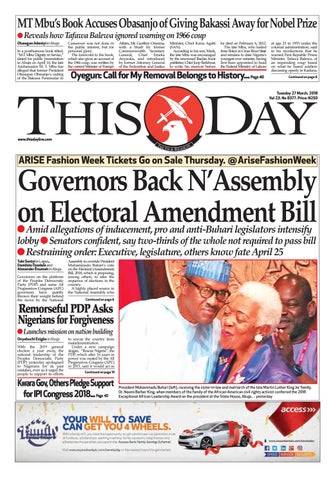
President Muhammadu Buhari (left), receiving the sister-in-law and matriarch of the late Martin Luther King Jnr family, Dr. Naomi Barber King, when members of the family of the African-American civil rights activist conferred the 2018 Exceptional African Leadership Award on the president at the State House, Abuja… yesterday
2
T H I S D AY ˾ Ͱ͵˜ ͰͮͯͶ
T H I S D AY ˾ TUESDAY MARCH 27, 2018
3
4
T H I S D AY ˾ Ͱ͵˜ ͰͮͯͶ
T H I S D AY ˾ TUESDAY MARCH 27, 2018
5
6
TUESDAY, ÍşÍżËœ ͺ͸͚΀ Ëž T H I S D AY
PAGE SIX GOVERNORS BACK N’ASSEMBLY ON ELECTORAL AMENDMENT BILL said he had spoken to many of the governors, especially those seeking a second term in office, have given their tactical support surreptitiously to the amendment of the Electoral Act. Buhari recently vetoed the Electoral Amendment Bill on the grounds that the section that is proposing to alter the election sequence for the presidential elections to hold last would infringe on the powers of the Independent National Electoral Commission (INEC) to organise and supervise elections in the country. However, the National Assembly has vowed to override the president’s veto, with lobby intensifying by the day among pro- and anti-Buhari legislators to vote for or against the bill, amid allegations of offers of inducements by the executive arm of government to kill the bill. The National Assembly can override a presidential veto if two-thirds of its members in both chambers vote for the bill to become law. The source, who spoke in confidence on the backing of several state governors, said many of them are concerned that the president might work against them once his election has been held first, hence their preference for the amendment to the Electoral Act. He said many governors have been quietly urging their lawmakers in the National Assembly to accelerate the process of overriding the president’s veto. Other governors, it was gathered, are eager to see the amendment passed. However, it is still not certain if the amendment will scale through in both chambers of the federal legislature, as a senator
who spoke to THISDAY on the condition of anonymity, said he was confident that the amendment would pass easily at the Senate, but may hit a brick wall in the House of Representatives. “The House of Representatives is likely to be the stumbling block, but if many of them realise that their return to the House may depend on the bill, they would not hesitate to override the president’s veto,� the senator said. He also revealed that last week’s reconciliatory meeting by the leadership of the APC with its Senate Caucus to avert the planned override vote of the president’s veto has failed, as senators have started to append their signatures in register to vote in favour of the passage of the bill. The senator claimed that at least 67 of his colleagues had already signed the register to override the veto, saying at least 15 are from the SouthSouth geopolitical zone, 13 from the South-east, 10 from the South-east, 10 from the North-east, and seven from the North-west. The register is believed to be in the custody of a senator from the North-east. Another senator, who spoke on the condition of anonymity, further revealed that about 20 senators were still undecided on whether to override the veto or support pro-Buhari senators who are said to be just 15 in number. Senators from the opposition PDP are all in favour of overriding the veto, THISDAY gathered. He explained that the pro-Buhari group has been operating under the assumption that it has about 40 senators on their side, but most of them are actually prepared to vote to
override the president insofar as electronic voting is used on the day the voting takes place so that their identities can be concealed. He also claimed that some PDP senators who have “deceptively� committed not to override the veto were only playing along in order to partake in the “largesse� being promised by the executive not to upturn the president’s veto. “Of course, they (pro-Buhari group) will say they are more than that. But many are being
blackmailed into doing so and are being promised cash. But they will vote pro-amendment at the end of the day. “The pro-Buhari group is finding it hard to win people to their side, because our people know there is nothing special to be gained from fighting for the president. Chief John Oyegun (national chairman of the APC) cannot guaranteed anything,� he said. THISDAY also gathered that the lawmakers in both chambers are unhappy with
Oyegun for having watched while the executive explored every opportunity to rubbish the legislature. “This caucus is one of the most important blocs in the party, but that was the second time he has met with us since June 2015. The first time, he promised to resolve all the issues with the executive, but he did not. So there is nothing he can say now that we would believe he can deliver,� another senator said. It was learnt that senators in
favour of overriding the veto on the bill held a meeting at the weekend in Lagos, after attending the wedding of the daughter of business mogul, Aliko Dangote, where they assessed their plan. The meeting also had in attendance some legal experts who scrutinised the Constitution on the planned override. On the basis of the Lagos meeting and the counsel they Continued on page 10
PREPARING FOR IPI CONGRESS 2018... L-R: National President, Nigerian Union of Journalists (NUJ), Mr. Abdulwaheed Odusile; Chairman, International Press Institute (IPI), Dr. Tonnie Iredia; and Kwara State Governor, Dr. Abdulfatah Ahmed, during a courtesy visit to the governor by the IPI at Government House, Ilorin... yesterday
MT MBU’S BOOK ACCUSES OBASANJO OF GIVING BAKASSI AWAY FOR NOBEL PRIZE The late Mbu, whose career traversed several ministries, all of which he headed at different epochs (from the fifties to nineties), and was privy to most of the negotiations on Bakassi, argued that the decision to cede the Peninsular to Cameroon was taken because “Obasanjo was hoping to impress the international community, the outside world and to be hailed as having avoided war. He was gunning for a Nobel Peace Prize to be in the same column as Al Gore and Nelson Mandela�. According to Mbu, when Obasanjo went to the International Court of Justice (ICJ) with Cameroon, there was no need for it. “Nigerians have been occupying their land. Nigeria was not obliged to go to that court. “With that judgement and our compliance with the jurisdiction, we have only postponed the evil day that a solution has been found. And what is annoying is our indifference to the optional clause of the statute of the International Court of Justice,� he wrote in the book. From the direct quote of the ICJ statue, Mbu argued: “It is clear that the judgement of the court is not binding on any member unless the member accepts its jurisdiction. What was it that compelled Nigeria to accept in such a hurry the judgement of the court? Yes, our government made terrible
mistakes in law, whether history will forgive us, I don’t know.â€? Tracing his own personal efforts, Mbu wrote: “I’ll begin with 1993 when I was Minister of Foreign Affairs, during the military regime of General (Ibrahim) Babangida. “Paul Biya, the President of Cameroon, like most neighbours would, was interested in hydrocarbon resources. He promised me that he would not go to war with Nigeria over Bakassi. “All he wanted Nigeria to do was allow Cameroon to participate in the development of the hydrocarbon resources in the area. This is on record, signed and published as a communiquĂŠ about agreement reached between Nigeria and Cameroon, August 1993.â€? Mbu continued: “At no time was Bakassi an empty territory without people in it. The people in it have always been the Efiks that the King of England in 1912 signed a treaty with the Obong of Calabar recognising him as the King of Bakassi, before Lugard amalgamated Southern and Northern Nigeria in 1914. “In other words, there was no time as we say in international law that Bakassi was a terra nullius, that is, ‘No man’s land.’ It has always been somebody’s land.â€? Mbu went on to raise several questions: “Did we explore the options available within the court? The court
discharged its duties as a full court but, at the request of the parties, it may also establish ad hoc chambers to examine specific cases. “The sources of law that the court must apply are: international treaties and conventions in force; international custom; the general principles of law and judicial decisions; and the teachings of the most highly qualified publicists. “Moreover, if the parties agree, the court can decide a case ex aequo et bono, i.e., without limiting itself to existing rules of international law. “Were members of our legal team aware that a case in that court could be brought to a conclusion at any stage of the proceedings by a settlement between the parties or by discontinuance? “In the latter case, an applicant state may at any time inform the court that it is not going on with the proceedings, or the two parties may declare that they have agreed to withdraw the case. The court then removes the case from its list. “And again even if the judgement of that court cannot be challenged, what happens when there are new facts that were not obvious during the proceedings. It is annoying that we did not even attempt to explore Article 61 of ICJ.� The late Mbu, who happened to be a lawyer
by profession, said Nigeria had the right to challenge the procedures leading to that decision within six months of the discovery of new facts. “We did not challenge it. We had up to ten years to seek a review. We could not even make an attempt. “The only power that can get the judgement of that court compelling and applicable is under Section 94 of the Charter of the UN. The Security Council alone has the power to enforce the judgment under pain of punishment. Did we approach the Security Council? “Obasanjo went to court with nothing, without even asking for a plebiscite. He went and came back empty handed. He handed over Bakassi without making any serious effort. He did not engage in any legislative consultation. Where did Obasanjo get the two-thirds to give away part of Nigeria? “The government with Obasanjo as president acted in breach of the Nigerian Constitution. The National Assembly could have declined the implementation of the Green Tree Agreement under Section 12 of the Constitution, thereby depriving it of any force of law domestically. Was the National Assembly properly informed? “There is overall incoherence of national policy in important matters. Indeed, the giving away of Bakassi from Cross River State, my
state, despite the objections of the indigenes, now turned into refugees, prompted me to ask whether the government that succeeded Obasanjo could have done anything further to rectify the blunder?� On the first coup in Nigeria, the late Mbu, who was the Minister of State for Defence (Navy) at the time, said he was in Kaduna on January 5, 1966, to represent the prime minister at the commissioning of the air force base when he overheard soldiers discussing a coup. “I confronted the GOC and said, ‘You are discussing a coup!’ That was my good friend, Sam Ademulegun. He and two of his friends were of Brigadier rank: BrigadierGeneral Aguiyi Ironsi and Brigadier-General Maimalari. “Sam, who was GOC, retorted, ‘It’s not you we want, we know the people we want, those who are corrupt must be removed from the system,’ and I was alarmed. “I said to my good friend Sam, ‘The coup you propose to carry out, won’t you use guns with bullets? If you use guns with bullets, will the bullets distinguish between the corrupt and the non-corrupt? Once bullets are fired, they don’t discriminate. If the target is a human being and it hits you, you will die.’ “He patted my back and said, ‘We won’t hurt you MT, you are everybody’s friend. We know the people we want
to remove.’ Unfortunately, my good friend, Sam Ademulegun himself perished in the coup with his wife. He didn’t survive the coup because he didn’t know that he was going to be a target.� The late Mbu said upon his return to Lagos, he alerted Balewa of “the plan to carry out a coup by senior officers in the military who were discussing the matter openly�, but the prime minister said to him, “Matthew, you worry too much.�
TOP GAINERS CUSTODIAN GSK MULTIVERSE FIDSON UNITYKAPITAL TOP LOSERS FORTEOIL ROYALEXCHANGE UNILEVER
NGN NGN 0.41 4.51 2.55 28.05 0.02 0.23 0.52 6.00 0.02 0.24 NGN NGN 4.00 40.00 0.02 0.31 2.75 52.45 DIAMONDBANK 0.10 2.05 FTNCOCOA 0.01 0.21 HPE Nestle Nig Plc â‚Ś1,320.00 Volume: 379.933 million shares Value: N5.132 billion Deals: 4,913 As at yesterday 26/03/18 See details on Page 31
% 10.0 10.0 9.5 9.4 9.0 % 9.0 6.0 4.9 4.6 4.5
T H I S D AY ˾ TUESDAY MARCH 27, 2018
7
8
T H I S D AY ˾ Ͱ͵˜ ͰͮͯͶ
T H I S D AY ˾ TUESDAY MARCH 27, 2018
9
10
TUESDAY, ÍşÍżËœ ͺ͸͚΀ Ëž T H I S D AY
NEWS REMORSEFUL PDP ASKS NIGERIANS FOR FORGIVENESS a rallying point in the effort to rescue the country from inept leadership under the APC-led administration. Speaking at the opening of the public discourse on nation building organised in Abuja yesterday, the PDP national chairman, Uche Secondus, said that his party would seek the support of Nigerians to retake power so as to rescue the economy and put a stop to the wanton killings of innocent Nigerians. He promised that the party will come up with an economic blueprint that would highlight interventions in areas such as healthcare and education. While speaking on the theme, “Nation Building – Resetting the Agenda,� Secondus said the time had come for a public conversation on the state of the nation in order to arrest the dwindling fortunes of the country and stop the slide into anarchy. Also in a rare show of remorse, Secondus said he and his National Working Committee (NWC) were apologising to Nigerians for the party’s many mistakes during its reign. He said the new PDP leadership has decided to toe the path of honour and humility by accepting its shortcomings and was making a commitment to chart a new course for the development and progress of the country. “PDP made many mistakes and we accept that there may have been impunity and imposition in the past, this is human. But the ability to admit making mistakes is one of the best ways to make amends and progress. “Let me use this opportunity to apologise to Nigerians for
our past mistakes. This is the best way forward and we want to set a precedent that if one makes mistakes it is wise to apologise and to move forward on a new note. “We do not want to behave like the APC which would rather tell lies. On behalf of members of my NWC I apologise to Nigerians and ask for your support in seeking to rebuild the country. This is a clear departure from what the APC is known for because the party believes in using lies,� he said. While welcoming participants, Secondus said the reason for the discourse was to undertake a review of the state of the nation, saying it was like “physical surgery�. According to him, Nigeria may not be at war in the conventional sense, or was it just gaining independence, however the economy, he noted, had taken a downturn in the three years of APC rule that warrants serious introspection and resetting of the agenda for nation building. He said the country was also more divided than at any time in the nation’s history, adding: “Recent events in the country have shown that the propaganda which the All Progressives Congress came to power with is not enough to deliver the kind of governance needed to make progress in the lives of the people.� Going forward, Secondus said: “The party does not and will not condone corruption in any manner. We wholesomely condemn it in its entirety.� He said it was on record that it is only PDP that has willingly given up for prosecution its members accused of corruption,
noting that the Economic and Financial Crimes Commission (EFCC) and Independent Corrupt Practices and Other Related Offences Commission (ICPC) were all anti-corruption organs established by PDP-led administrations. “We insist and demand that the fight against corruption cannot and must not be selective. After all, he who comes to equity, must come with clean hands.� On security, the PDP chairman said that Boko Haram was still alive despite several claims by APC of having decimated the terrorists, adding that insecurity had even spread under a new name and nomenclature called herdsmen. According to Secondus, “These herdsmen have been tormenting, maiming and killing hundreds of children, women and men across the country with the government of the day offering feeble responses.� He said the climax of the APC government politicking with security was the recent abduction of over 100 schoolgirls from their college premises in Dapchi, Yobe State, “with government, the military and the police authorities contradicting each other as to who did and didn’t do what�. “Everyday our media is awash with the staggering number of wanton killings, raising questions about the value of human life in Nigeria. It is an endless stream of bloodletting directly or indirectly fueled by incompetent leadership. “Only recently the federal government tried to arm twist state governors to take from the common purse, the sum of
$1 billion, about N306 billion, for tackling Boko Haram that they claimed they had defeated two years ago,� he further recalled. On the state of the economy, Secondus said the story was equally unpalatable, adding that government had through incoherent and inconsistent policies and actions, dragged Nigeria into an unnecessary recession. Secondus said the ruling party has shown that it was incapable of delivering good governance to the people. He said whereas the PDP administration only borrowed N6 trillion in all its 16 years, with a lot of projects to show for it, the APC-led government has borrowed N11 trillion in just three years with nothing to show for it. “N6 trillion borrowed in 16 years and N11 trillion in just three years, which one is more corrupt?� Secondus asked. “The hardship currently faced by Nigerians is unprecedented. Across the length and breadth of this nation, citizens are faced with abject poverty with no clear path of alleviation. “Our currency has been recklessly devalued from N199 in 2015 to nearly N500 a dollar before it rose to about N365 only due to an increase in oil prices and not any significant thing done by this government. “Fuel prices rose from N97 to N145, yet the nation experiences unabated scarcity with its attendant long queues and suffering by the Nigerian citizens,� he said. The high point of the event was when the former PDP national vice chairman, Chief Bode George, stood up to express solidarity with the
Secondus-led leadership. There was a loud ovation from the PDP supporters who filled the Congress Hall of the Transcorp Hilton Hotel. George, who was one of the aspirants from the South-west geopolitical zone that contested for the post of national chairman of the party ahead of its convention last December, praised the new leadership of the party and urged it to rise to the occasion and lead the way forward in returning PDP to power in 2019. “I want to assure members of the National Working Committee of my absolute loyalty and I pray that God will grant you the wisdom to lead the party because I believe that we don’t have a second chance to make an impression. “The rest of the world is watching us. After the convention, this is the first outing because it looked as if we had taken an overdose of sleeping tablets. This is a period of elections, so let the people know the difference that this is a party that can make the difference, “To err is human, to forgive is divine. You have done the talk, let our people go and walk the talk. We will ensure that it will be the message we will carry to the local leaders,� he said. Former governor of Katsina State, Ibrahim Shehu Shema also advised the party to be mindful of the need to communicate its messages effectively to the people. The discussion by panelists at the interactive sessions that followed provided an opportunity for hard truths and reprimands, with most of the speakers charging the
PDP to do away way with its past shortcomings. Apart from being broadcast live on television and social media platforms, the PDP chairman took questions from Nigerians who called in by telephone. In pointing the way forward, speakers sounded a noted of caution that the calibre of candidates in the 2019 elections will probably determine the fortunes of the party. Secondus assured that under the new thinking, PDP will always tell the truth and be accountable, adding that in the 2019 elections, Nigerians will demand to know the truth about the country and nothing less. He also assured Nigerians that the party will insist on fielding popular candidates for the election and that money will not be a deciding factor any longer. As part of the new thinking, he said the party was developing an initiative to use the social media, in order to connect to the youths going forward. Former Governor Peter Obi said part of the strategies for wining back power should be for the PDP to identify new ideas on how to do things better than the APC. He said the party should be ready to tell Nigerians the facts about the dwindling economy and the lies being told about the country’s exit from the recession by the APC-led administration. Two former vice presidents, Atiku Abubakar and Namadi Sambo, as well as former governors, lawmakers, ministers and key leaders of the party were in attendance in solidarity with the party’s drive to return to power.
could override the presidential veto and pass the bill to law. At the resumed hearing yesterday, counsel to the plaintiff, Wole Olanipekun (SAN) urged the court to answer in the affirmative questions raised in the plaintiff’s originating summons and grant all the reliefs sought. Olanipekun, in arguing the plaintiff’s brief, submitted that the order of election, as proposed in the Election Amendment Bill, 2018, was virtually impossible and impracticable, when taken into consideration INEC’s powers to postpone elections it is constitutionally empowered to conduct. Also reacting to the notice of the preliminary objection brought by the first defendant (National Assembly) challenging the jurisdiction of the court to entertain the suit in the first instance, Olanipekun submitted that there was no model anywhere in the world that takes away the powers of the court from adjudicating on any matter. He therefore urged the court to dismiss the preliminary objection raised by the first defendant and grant the relief sought by his client. Responding, counsel to the National Assembly, Joseph Daudu (SAN) informed the court of the notice of preliminary objection he had filed on March 23 challenging the jurisdiction of the court to hear the matter. Daudu said the court should first determine whether the originating summons in its entirety was justiciable.
According to him, issues of the internal affairs of political parties are not justiciable, including the internal workings of the National Assembly. He also submitted that the court lacks the jurisdiction to entertain the suit, since what was being contested was a Bill and not an Act, adding that until the bill is passed into law either by the assent of the president, or by a two-thirds majority of the legislature, the court lacks jurisdiction to hear the matter. He said if the court was inclined to uphold his preliminary objection, then there would be no need to continue with the plaintiff’s originating summons, as it would amount to a waste of the court’s time. The first respondent further urged the court to dismiss the suit on the grounds that the plaintiff lacked the legal right to file the suit, since it failed to present its certificate of registration as a political party registered with INEC. While urging the court to uphold his preliminary objection and dismiss the suit, Daudu further asked the court to discountenance the argument of the second (AGF) and third (INEC) defendants, noting that though they are defendants in the suit, their position was supportive to the case of the plaintiff. Responding, the second defendant, the Attorney General of the Federation, Abubakar Malami (SAN), aligned himself with the position of the plaintiff.
Responding to the issue of whether the court has jurisdiction to hear the matter, the AGF submitted that once a bill is passed by the two chambers of the National Assembly, the legislature has concluded its job and from that point the court has jurisdiction. Similarly, counsel to the third defendant (INEC) Femi Falana (SAN), who also aligned with the position of the plaintiff, argued that whether the bill has been passed or was still pending at the National Assembly does not stop the court from hearing the matter. He also presented exhibits showing that the plaintiff was duly registered with INEC as a political party and as such had the legal right to file the suit. Falana, like Malami, urged the court to resolve the matter in favour of the plaintiff and grant all the reliefs sought. After listening to the submissions of the counsel in the matter, the judge reserved judgment till April 25. In the originating summons marked FHC/ ABJ/CS/232/2018, the plaintiff is seeking an order of perpetual injunction restraining: “The President of the Federal Republic of Nigeria, represented by the second defendant, from assenting to the Electoral Act Amendment Bill, 2018, as passed by the first defendant. “The first defendant from passing into law, by a twothird majority, or any majority at all of the said bill as already passed by it.�
GOVERNORS BACK N’ASSEMBLY ON ELECTORAL AMENDMENT BILL got from the lawyers, the confidence among legislators set to override the president’s veto got a boost based on the interpretation of the two-thirds majority required to pass the Electoral Amendment Bill into law. According to sources privy to the meeting, the general impression is that two-thirds of 109 senators and 360 members of the House will be required to vote in favour of overriding the veto. However, the sources informed THISDAY that this interpretation of the Constitution was wrong, as what is required to override a presidential veto is for twothirds of the members present at plenary to vote in favour of a bill’s passage. Accordingly, lawmakers who are in favour of overriding the president are banking on the interpretation of certain sections of the Constitution, which specifically qualifies the two-third (or four-fifth in some cases) votes requirement. While some sections in the Constitution are categorical about the participation of all members, others are silent on it, a loophole which the lawmakers are now seeking to explore. The section that deals with presidential override is not specific on the two-third votes required. A lawmaker, who explained the interpretation of what the majority requirement is, said the Constitution is very clear on the issue. He said such include Section 8(1)(a)(c) & (d) on
States and LGA creation; Section 8(2)(i) on Boundary Adjustment; Section 9(1) & (3) (4); Sections 48 & 49; Section 50(c); Section 54(1); Section 56(1); and Section 58(5), where the Constitution was specific on the type and meaning of the majority votes required. Quoting Section 8 or Chapter IV of the Constitution, the lawmaker said it “shall not be passed by either House of the National Assembly unless the proposal is approved by votes of not less than four-fifth majority of ALL the members of each House and also approved by a resolution of the Houses of Assembly of not less than two-thirds of all states�. “Section 9(1) also states that other parts of the Constitution can only be amended by “the votes of not less than two-thirds majority of ALL the members of that House and approved by a resolution of the Houses of Assembly of not less than two-thirds of all states,� the lawmaker added. The lawmaker, however, explained that Section 58(5), which deals with the two-third votes required to override a veto, did not mention the requirement of “ALL� members. Section 58, (5) states: “Where the President withholds his assent and the bill is again passed by each House by two-thirds majority, the bill shall become law and the assent of the president shall not be required.� Continuing, the lawmakers explained� “When passing a law, it says two-thirds majority
of each House, meaning those present, since it did not say “ALL� members as is the case with other sections of the Constitution. “It is just the way we normally pass laws on the floor, it is of those present, we do not count first to be sure everyone is present, so passing or overriding the veto on this amendment will go through the same route as a simple law. “It is just like when you want to vote to impeach a Speaker or Senate President, it is two-thirds of those present that do so. We have used that to elect heads of legislature and used that to remove them several times in this country. So same is applicable in this case. “In simple terms, if we have 60 senators in attendance that day, it means we require 40 votes.� Meanwhile, Justice Ahmed Mohammed of the Federal High Court, Abuja, yesterday reserved judgment in a suit challenging the powers of the National Assembly to override Buhari’s veto on the Electoral (Amendment) Bill, till April 25 Justice Mohammed gave the date after counsel to the parties in the suit adopted and argued their written addresses. The plaintiff, Accord Party, had dragged the National Assembly, Attorney General of the Federation, (AGF) and INEC to court, after Buhari refused to assent to the Electoral Bill. The party had expressed concern that the legislature
T H I S D AY ˾ TUESDAY MARCH 27, 2018
11
12
T H I S D AY ˾ Ͱ͵˜ ͰͮͯͶ
T H I S D AY ˾ TUESDAY MARCH 27, 2018
13
14
T H I S D AY Ëž Ëœ Í°ÍľËœ Í°ÍŽÍŻÍś
COMMENT
Editor, Editorial Page PETER ISHAKA Email peter.ishaka@thisdaylive.com
WHY INTERNET CAN’T REPLACE TV
Traditional television has the potential to showcase more content, writes Kayode Adeoya
F
rom the onset, the introduction of television to Nigeria in 1959 was basically for political and education reasons. But shortly after establishing this audio-visual medium of communication in Nigeria, government, corporate bodies and individuals realised the potential and opportunities that television presents. In time, TV became a powerful tool for information, education and entertainment. It became a medium for the government to create awareness on national integration and cultural promotion, corporate bodies on the other hand, saw TV as a medium through which they could promote and market their products and services and many parents, including mine, saw television as a means of learning and acquiring skills for self-development. But when in 1996 the Nigerian Communications Commission (NCC) licensed 38 internet service providers to sell internet services in Nigeria, many ICT exponents, thought that this would be the new technology to dethrone television as a medium of influence. True, the internet is undoubtedly a powerful medium of communication. But its power and influence does not in any way replace or reduce the influence of television as a broadcast medium. This speculation is not peculiar to Nigeria alone. When the internet launched in America, many in the industry thought that television viewing experience had finally come to an end especially with the introduction of Netflix and other internetbased movie streaming services. Reports confirm that in the United States of America in the fourth quarter of 2017, Netflix had well over 54.75 million subscribers. Still, more and more people are turning to the internet for their television content. Despite the immense impact of Netflix in America and other parts of the globe, it is pertinent to note that subscribers cannot stream movies on their mobile phone, tablet or laptop without the internet and having internet requires that you have data. Thus, no internet, no viewing. Having a Netflix account does not stop more Americans from watching traditional TV or even pay-TV. The reasons behind these are because television viewing is addictive and besides being addictive, TV gives viewers’ variety of channels to choose from and with the large screen viewing experience and live programme opportunities, the movie streaming companies are still a few steps behind on this. Even with the introduction of Netflix and Showmax to the Nigerian and African markets, traditional TV has not been neglected. This is because traditional cable TV has the potential
REPORTS ALSO HAVE IT THAT THE POPULATION OF AFRICA AS A CONTINENT IS 1.216 BILLION AND ONLY 216 MILLION ARE INTERNET USERS. THIS FIGURE IS POOR BUT THE REALITY OF IT IS THAT MANY MORE AFRICANS STILL PREFER THEIR TRADITIONAL AND PAY-TV, AS THE STREAMING TV IS STILL NOT POCKET-FRIENDLY
to showcase more content. For example, pay TV companies like DStv has over 200 channels to choose from and with as low as $17, a DStv subscriber can get a Compact package and get the opportunity to watch over 95 channels. Unfortunately, $7 cannot buy data that will last for a month if you decide to download and watch Netflix movies through the mobile providers in Nigeria. Another unique aspect of traditional TV is that it has the ability to show live sports. The 2018 World Cup is around the corner and I bet that the Netflix’s and Showmax’s of this world will not stream these live matches. But pay TV companies will broadcast all 64 live matches. An analyses of Nigeria’s population figure and the number of people who have embraced the internet in Nigeria is a clear indication that traditional television viewing cannot be replaced by the internet. Currently, Nigeria has a population of 170 million and internet penetration in Nigeria is well close to 50%, which is the highest in Africa. Yet so many more Nigerians do not have access to the internet especially in rural locations. Reports also have it that the population of Africa as a continent is 1.216 billion and only 216 million are internet users. This figure is poor but the reality of it is that many more Africans still prefer their traditional and pay-TV, as the streaming TV is still not pocket-friendly. Again, a comparative analysis of Nigeria, the US and Europe indicates that internet TV would deliver its content seamlessly without hiccups but in Nigeria and Africa as a whole this may not be the case because the mobile companies still have some ways to go to achieve reliable connectivity, making it frustrating to stream or even download a movie effortlessly. Many here in Nigeria keep their options open, alternating between a streaming service or pay TV. Internet TV service may at first appear much cheaper than pay TV, but I would emphasise that it still requires a connection to the internet and lots of bandwidth. This will undoubtedly cost people more. Some mobile service providers are among those likely to offer internet TV. For example, on average, internet usage in a month is about $33 and Netflix download can consume as much as 3-7GB per hour. This is a clear indication that even a prudent data user will barely last a week with this plan. No doubt, the internet has come to stay and the television cannot be phased out anytime soon and pay-TV providers like DStv would continue to provide its subscribers with wholesome family entertainment and economically empower more Nigerians.
IMO: WAITING FOR DELIVERANCE Matthew Duru writes that Imo State should look up to neigbouring Anambra for good leadership
I
mo State is not new in rejecting ruling and established political parties that fail the citizens of the state. In 2011, it rejected the incumbent Peoples Democratic Party (PDP) ruling government in the state led by Chief Ikedi Ohakim who had switched in July 2009 from the party that gave him a gubernatorial mandate to the Progressive Peoples Alliance, (PPA). The citizens elected a candidate of the All Progressive Grand Alliance (APGA)! Although, the elected APGA candidate also crossed over to the All Progressives Congress (APC) with the mandate, the people of Imo State appear set to repeat the feat again in 2019 with the level of growing disaffection currently spreading within and outside the ruling party in the state and the economic and social burden the citizens of the state are currently forced to endure. Leaders are elected to help the citizens overcome or mitigate hardship. It is therefore a crying shame that in Imo State, the people have been so let down by their leaders whom they reposed confidence in to end their hardship. Instead, the leaders deliberately, arrogantly, and viciously deepened the suffering of the people. Under the current circumstances, it is important to the leaders how they became leaders, and not owners of the state. Prior to the colonisation of Nigeria, the Igbos like many Nigerian tribes and nationalities had evolved a society with a world view in which leaders were guided by the common good, informed by traditions and norms that respected every man and woman and their household. Under those circumstances, appropriating someone’s property, goods or
services will not come without consequences like ostracism. Addressing the collective concerns of the community required occasional meetings in which every household has a say and the burden for meeting the goals of the collective was not laid unduly on a few people. Then the colonialists came and overturned the social balance. The yoke of the colonialists, which looked fair at the time was not lost on the local people, hence the local citizens supported local leaders whom they expected to reduce their burden, define common interest in the old tradition and use this as a guide for common development. But this did not happen! Instead, elected leadership disappointingly made themselves the modern successors of the colonialists. The modern day “warrant chief� extracting the commonwealth of the people, particularly in Imo for their own benefits and their immediate families. This is shamelessly being re-enacted as the incumbent governor Rochas Okorocha swears daily that Imo for him has become a family heirloom that one can hand over to a family member without even the decorum of respect for fair democratic competition within his own party, before allowing the people of Imo State who own the mandate to decide at the polls. This type of disregard for democratic norm informs the desire of Imo people to look beyond their borders to the benefits Anambra State has derived from governance under the APGA, as the state makes strides in social ethos and economic growth. The experience of Anambra State under APGA governments may also be an added incentive for fresh leadership, as Imo citizens wonder what may have been their lot if
the mandate they ceded at the ballot had remained under an APGA rather than an APC policy framework. The comparative indicators are noteworthy and a few illustrations will do. For instance, whereas Imo State has become a poster state for industrial disharmony as a result of the months of unpaid arears to workers and pensioners, Anambra State under APGA has been an emblematic state for industrial peace and harmony as it owes no salaries and wages to workers or pensioners. Anambra State has also become a net exporter of agricultural goods, mainly vegetables, unlike Imo State that has remained in the league of national “feeding bottle� dependent states. This is in spite of its being an oil producing state which should be at the frontier of investments. By now, it should be autonomous and federal allocation should only come as a bonus income. Additionally, Imo State remains a security flashpoint, where in recent times, kidnap cases from the South West were traced to it . Conversely, Anambra which took its previous status as a haven of kidnapers, seriously took decisive steps that resulted in the state becoming one of the safest and most secure states in the country. Furthermore, while Anambra can boast of very high quality sustainable social infrastructural development, such as the construction of one of the longest bridges in Southern Nigeria built to link the oil-rich Aguleri-Otu area of the state (where an oil refinery is being built) with the rest of the state, comparatively, Imo State has been developing such structures in a shambolic unprofessional and unsustainable manner
where it has acquired an unsustainable debt profile from many unfinished and poorly finished construction work. One of the noteworthy ingredients that has taken Anambra State from a potential development to a kinetic development state is the competency of those who have assumed leadership position in the state. They brought diligence and discipline of fiscal planning and control from the private financial sector to the public. This type of competency and private sector orientation and value is currently also evident in Akwa Ibom State. Although not an APGA state, the leadership ethos of disciplined planning and control where the criterion of value for money has ensured a new focus to sustainable and purposeful development has made a difference in public welfare maximisation. This competency and the positive outcome it has instigated, particularly in Anambra has been nationally acknowledged, and encouraged those who have urged leaders with passion for grassroot development such as Stanley Amuchie, to enter into the 2019 race in Imo State. Amuchie, a young and vibrant manager of men and resources with a credible track record in the financial sector, moved after a stint in KPMG to management roles in Zenith Nigeria PLC from where he rose to become a general manager and CFO. Several interest groups that share a common concern for the deterioration of the economic and social fortunes of Imo State have expressed hope that such credible emerging leaders will bring their credible leadership record to the ring of leadership in the state. Duru wrote from Owerri, Imo State
15
T H I S D AY Ëž Ëœ Í°ÍľËœ Í°ÍŽÍŻÍś
EDITORIAL CORRUPTION: LESSONS FROM FRANCE, ISRAEL The ongoing investigations of Sarkozy and Netanyahu hold lessons for Nigeria
F
ormer French president, Mr Nicolas Sarkozy was taken into police custody last Tuesday over allegations that he illegally accepted 50 million euros ($68.5 million) from the government of the late Libyan leader, Colonel Muammar GaddaďŹ to ďŹ nance his successful 2007 presidential campaign. Although investigation on the case started in 2013, that it took ďŹ ve years before Sarkozy’s arrest is very revealing of how painstaking it must have been. Early this month, Israeli police also questioned their Prime Minister, Mr Banjamin Netanyahu and his wife as part of a corruption investigation involving allegations that the owners of the country’s largest telecom ďŹ rm provided positive coverage of the Netanyahus on a news website in return for regulatory changes. Aside the demonstration that nobody is above the law which these two cases have demonstrated, there are several lessons that those who claim to be ďŹ ghting corruption in Nigeria must begin to imbibe if they are to be taken seriously. One, the ongoing investigations of Sarkozy and Netanyahu afďŹ rm the IN NIGERIA, SERVING supremacy of the rule PRESIDENTS, WHILE of law in both counIMMUNE FROM tries. Where the law is PROSECUTION, ARE NOT a respecter of persons EVEN INVESTIGATED FOR rather than principles EVIDENT INFRACTIONS and values, there can DESPITE THE FACT THAT be no advancement in THE LAW SUPPORTS THAT such a society. Two, in THEY COULD BE Nigeria, serving presidents, while immune from prosecution, are not even investigated for evident infractions despite the fact that the law supports that they could be. Three, even when they lose such immunity after ofďŹ ce, all that you get from the authorities are stories of some ‘grand looting’ for which they are neither held to account nor any evidence provided. As we have said on this page several times, there is a world of difference between ďŹ ghting corruption and peddling sensational information. The drama and
Letters to the Editor
media showmanship that Nigerians have over the years witnessed in the name of ďŹ ghting graft will worsen corruption in the future. That explains why recent ‘revelations’ by Vice- President Yemi Osinbajo, a Senior Advocate of Nigeria trained in the law of evidence, did not move anybody, especially when all that Nigerians see is selective application of targets in the ďŹ ght against corruption.
T T H I S DAY EDITOR DEPUTY EDITORS ˜ MANAGING DIRECTOR DEPUTY MANAGING DIRECTOR CHAIRMAN EDITORIAL BOARD
EDITOR NATION’S CAPITAL
T H I S DAY N E W S PA P E R S L I M I T E D EDITOR-IN-CHIEF/CHAIRMAN GROUP EXECUTIVE DIRECTORS ˜ ˜
˜ ˜
DIVISIONAL DIRECTORS ˜ DEPUTY DIVISIONAL DIRECTOR
SNR. ASSOCIATE DIRECTOR ASSOCIATE DIRECTORS ˜ CONTROLLERS ˜ ˜
DIRECTOR, PRINTING PRODUCTION TO SEND EMAIL: ďŹ rst name.surname@thisdaylive.com
he situation is compounded by the curious feature of our political culture to escort our leaders out of ofďŹ ce with pomp while their numerous alleged ďŹ nancial and other crimes enter our national folklore as butts of comedians’ jokes and beer parlour narratives. Yet, it is a given that where leadership misdeeds anticipate no consequences, democratic governance can only abide by rules made by autocrats and enforced by a rogue judiciary. We have at different times challenged the current administration that ďŹ ghting corruption requires some underlying doctrines that will inform the battle plans with the overall objective of carrying the people along. But with a campaign that has no foundation in public morality or ethical good governance beyond empty propaganda, ďŹ ghting corruption has been reduced to the arrest of some opposition politicians and telling tales. Not only has President Buhari refused to act on some glaring cases involving members of his own administration, he also ignores the link between distortion of values and abuse of, or general disregard for, extant rules. Yet once rules are ignored, all templates lose their validity, submitting to collusions and arbitrary exercise of discretion that is nothing but grand corruption. Since the ďŹ ght against corruption that consistently focuses on the symptoms may not go far, it is important for the Buhari administration to know that a war against corruption that is both selective and unmindful of certain contradictions is doomed to fail. The federal government must therefore distinguish between all the variants of the pervading malaise, so that appropriate strategies for tackling each can be designed and implemented within the broader framework of values reorientation.
TO OUR READERS Letters in response to speciďŹ c publications in THISDAY should be brief (150-200 words) and straight to the point. Interested readers may send such letters along with their contact details to opinion@thisdaylive.com. We also welcome comments and opinions on topical local, national and international issues provided they are well-written and should also not be longer than (9501000 words). They should be sent to opinion@thisdaylive.com along with the email address and phone numbers of the writer.
UDEME UFOT: 60 CANDLES FOR A GURU
U
deme Ufot has come a long way. The rookie that cut his teeth in advertising at barely age 24, in obscurity, at Calabar, is today a very highly visible player in the industry operating from the nation’s economic nerve centre, Lagos, having all it takes to be qualified for the tag of guru. One may not know now if the group managing director of one of Nigeria’s most successful marketing communications providers- the SO&U Group, saw tomorrow when he traversed the city of Calabar marketing Desmark Advertising as an assistant manager between 1982 and 1984. Or if he made any attempt at predicting the future by creating it, in line with Abraham Lincoln’s admonition. But he took a bold step to commence the journey into the future one year after graduating with a second class upper (honours) degree in Industrial Design from the Ahmadu Bello University, Zaria. And today, looking back, he must be a fulfilled man. He has paid his dues, as they say, with the distance ahead by far shorter than what he has covered. In his 36 years in the marketing communications business, Udeme has had his fair share of failures and successes (nobody wins all), with the balance weighing heavily on the side of the latter. With what could pass for practical lessons on the basics of advertising at Desmark, Udeme moved to Lagos to join Insight Communications as a senior visualiser and would, over the next five years, rise to the position of deputy creative director. He left Insight with a colleague from the agency to attempt a partnership, forming Complete Advertising Services (Casers) in 1988, with him holding the position
of creative director. The partnership did not work out. It collapsed barely one year into its existence. Not one to be discouraged by setbacks, he moved on. Rather than see the failure of the partnership as the end of a dream, he saw it as a means to realising a dream – an opportunity. He teamed up with two other colleagues to set up SO&U in 1990, the name coming from the first letters of their surnames. Suffice it to say that the acorn seed has today grown into an oak tree, with five subsidiaries that are independently soaring to great heights, namely, SO&U Advertising, Soulcomms Limited, Vyrus Digital Engagement, Lucid Audio Visuals and Maximedia Global Limited. Udeme has distinguished himself, both at the corporate and individual levels. A great team player, he has worked with his colleagues to harness the incredibly talented human resources around them, building the SO&U Group into the world-class organisation it is today. It is hardly possible to mention the nation’s five leading marketing communications solution providers with the group left out. The company has over the years been identified with some of the most creative and exciting advertising campaigns involving the leading local and international brands in the country. At a personal level, Udeme has achieved all that could possibly be achieved in an industry in which he has bestridden like a colossus. He has held the position of honorary secretary and chief executive officer at the secretariat of the Association of Advertising Practitioners of Nigeria AAPN; returned unopposed as both vice-president
and president of the association – the latter at 41, which made him the youngest to hold that position. It remains to his credit that as president of AAPN, he expertly handled and resolved the crisis that threatened the continued existence of the association during the emergence of the Media Independent Practitioners Association of Nigeria (MIPAN). He succeeded in not just getting the new body accepted, but also fostering effective collaboration between the two associations. He also built understanding and strengthened the relationship involving advertising agencies, advertisers and media owners. Udeme served on the media sub-committee of the Celebration Planning Committee for Nigeria’s 40th Independence Anniversary in 2000, managing publicity for the committee. He distinguished himself so well he was invited by the Nigerian Economic Summit Group (NESG) to serve as chairman of its media sub-committee for three summits. And in 2009, for the 12th edition of the annual event, he was made co-chairman of the main organising committee. The icing on the cake for Udeme’s personal professional achievement was his appointment as chairman of the Advertising Practitioners Council of Nigeria (APCON), by former president, Dr. Goodluck Jonathan, in March, 2015. It was an appointment many saw as befitting and the ultimate reward for an individual that has given so much in the development of the industry. Before then, in 2014, he had received the national honour of Member of the Federal Republic (MFR). Haniel Ukpaukure, Lagos
T H I S D AY ˾ TUESDAY, MARCH 27, 2018
16
POLITICS
Group Politics Editor Tobi Soniyi Email tobi.soniyi@thisdaylive.com 07054786260 SMS ONLY
EXECUTIVE BRIEFING
A’Court Raises Hope against Graft The Court ofAppeal’s decision setting aside the two-year jail term or an option of N750,000 fine slammed against convicted pension thief, Yakubu Yusuf, and substituting it with more a stringent punishment is reassuring, writes Davidson Iriekpen
A
t a time when all hope is lost that the judiciary can deal with corruption in the country, the Court of Appeal in Abuja last Wednesday proved everyone wrong when it set aside the two-year jail term and an option of N750,000 fine imposed by the High Court of the Federal Capital Territory on a former official of the Police Pension Office, Yakubu Yusuf, convited for stealing N24billion pension funds. A three-man panel of the appellate court headed by Justice Abdu Aboki, in a unanimous judgment, described the high court’s sentence as unreasonable and substituted it six years imprisonment with an addition of N22.9billion fine. Justice Emmanuel Agim who delivered the lead judgment of the court, ruled that “the sentences levied” by the high court “are clearly light and lenient ones.” He ruled that this allowed “the convict, who had admitted misappropriating or stealing N24billion, the option to pay the sum of N250,000 per count of offence in lieu of serving a prison term of two years for the offence,” to enjoy the huge balance he had in his possession. Justice Agim held that the ‘amount’ of the sentences “is paltry, a pittance and unreasonably low.” He noted that it was “disproportionate to the amount stolen and therefore can comfortably and quickly be paid by the convict from the humongous amount stolen.” He added that with the sentence, the convict would be left with “a huge balance of the stolen funds in his possession and without really causing him any pain of punishment.” In 2013, this case drew a nationwide outrage against the judiciary when Justice Abubakar Talba convicted Yusufu and sentenced him to two years imprisonment with an option of N750,000 fine. The convict, a former Assistant Director in the federal civil service, admitted to being part of those who stole N32 billion. His sentence, which was the first conviction in an elaborate scam that came to light in 2012, involved several top officials, offices and banks. The convict was tried on a 20-count charge alongside Atiku Abubakar Kigo (Permanent Secretary), Ahmed Inuwa Wada (Director), Veronica Onyegbula (Cashier) and Sani Habila Zira (ICT Officer). He later agreed to a plea bargain and pleaded guilty to betraying trust and fraudulently converting N2 billion of police pension funds. He admitted to offences relating specifically to him, each involving betrayal of trust and the conversion of N1 billion apiece. But to the consternation of Nigerians, Justice Talba handed him a mere sentence of six years in jail and an option of N750,000 which the convict promptly paid and walked free shortly after the judgment was delivered. Although two years imprisonment was the maximum jail term with an option of undisclosed fine prescribed as punishment by Section 309 of the Penal Code Act, under which the convict and his co-defendants were charged, many observers had contended that the judge did not exercise his discretion judiciously. Following this, the Economic and Financial Crimes Commission (EFCC) which charged the convict, through its private prosecutor, Mr. Rotimi Jacobs (SAN), appealed against the judgment. But delivering the lead judgment, Justice Agim held that the considerations of the trial judge in imposing the light sentence were contrary to judicially established principles. He noted that there was no monetary value of the properties already forfeited by Yusufu to justify the light sentence imposed on him. “I hold that the sentence of fine of N250,000 in lieu of imprisonment for a term of two years for each offence is unreasonable, unjust,
Appeal Court President, Justice Zainab Bulkachuwa
unfair, irrational, arbitrary, and contrary to judicially established principles as it is not the result of a judicious and judicial exercise of the trial court’s sentence discretion,” he said. He held that considering the amount stolen, the nature and gravity of the offence, its destructive effect on the country, and its impact on retired police officers, the trial court ought to have imposed a severe sentence that would deter further commission of such crime and prevent the convict from retaining any part of the proceeds of the crime. Justice Agim also imposed two years imprisonment on the convict on each of the three counts and in addition a fine of N20billion on the first count, N1.4 billion on the second count and N1.5 billion on the third count. The judge held that while the monetary fines on each of the counts amounting to N2.9bn would “run cumulatively,” the two years jail terms on each of the three counts would run “consecutively,” giving rise to a total of six years imprisonment. He held: “In reviewing the sentence of imprisonment with option to pay fine, as in this case, this
He held that considering the amount stolen, the nature and gravity of the offence, its destructive effect on the country, and its impact on retired police officers, the trial court ought to have imposed a severe sentence
court can vary the sentence to one of both imprisonment and fine or imprisonment without option to pay fine. “Considering the humongous amount stolen, the nature and gravity of the crime and its destructive effect on the country and its impact on retired police officers and the grave breach of public trust, a severe sentence that would deter the further commission of such a crime and prevent the convict from retaining any part of what he stole to avoid him obtaining financial benefit from his crime should be imposed. Whether deliberately or otherwise, the same mistake that Justice Talba made 2013 was also repeated recently when Justice Adebukola Banjoko also of the same court delivered a similar judgment when she convicted a former Managing Director of the Rural Electrification Agency, Samuel Ibi Gekpe. Gekpe and other directors of the agency were arraigned for disregarding the provisions of the Public Procurement Act by misappropriating a whopping sum of N6billion. The funds were mismanaged in the payment for rural electrification contracts which they purportedly awarded as the agency’s Public Procurement Committee in 2008. The EFCC then moved in by arraigning them for criminal breach of trust before Justice Banjoko. The other defendants were a former Permanent Secretary in the Ministry of Power, Dr. Abdullahi Aliyu, an accountant in the agency, Simon Kirdi Nanle, a director, Lawrence Orekoya, an assistant director, Abdulsamad Jahun and the agency’s former Head of Legal Department, Kayode Oyedeji. During the trial, the prosecution team, led by Mr. Kemi Pinheiro (SAN), called seven witnesses from the Corporate Affairs Commission (CAC), the Central Bank of Nigeria (CBN), the United Bank for Africa (UBA) Plc, the agency’s officers and an EFCC operative, Ibrahim Ahmed. The defendants, represented by Paul Ewekoro (SAN), made a no-case submission, which was dismissed. But in her verdict, Justice Banjoko dismissed the first defendant’s application challenging the court’s jurisdiction to entertain the charge.
She found that the prosecution proved the ingredients of the offences of criminal breach of trust and conspiracy. The judge held that the defendants recklessly disregarded Public Procurement Act, misappropriated N6billion in contract payments. She found all the defendants guilty as charged. She sentenced Gekpe to three years imprisonment with an option to pay N5 million fine. The judge also sentenced the other defendants to three years imprisonment but with an option of N500,000 fine each. The fines according to her were to be paid within 30 days from judgment day. In an era when the country is doing everything to reduce corruption to the barest minimum, observers had described the verdict as ridiculous and a slap on the wrist. They wondered why paltry sums of N5 million and N500,000 when compared to the N6billion that the convicts were said to have misappropriated. The observers had equally wondered who on earth, having stolen N6billion would not pay N5million or N500,000 to get himself freedom? Today, Nigerians know that corruption is the greatest problem facing the country. The malaise is seen as the greatest problem militating against growth and development. It has been argued that the damage corruption had done to the polity and the generality of the people is immeasurable. Observers believe that the menace has become so endemic and devastating that the nation now seems to be at crossroads. To them, nothing seems to be working well in the country because of corruption. The roads are bad, the power situation has remained deplorable, the railway lines remain dysfunctional, the airports are lacking the necessary facilities, hospitals are nothing but mortuaries and lacking in necessary facilities and the educational institutions are in comatose. All these are because the monies budgeted for these facilities to work are diverted to private pockets and accounts. Even monies for pensioners are not spared. All too often, Nigerians are inundated with news of how pensioners die while waiting for their pensions or they are not paid at all because they have been pocketed by those in charge of pension management. The Appeal Court judge said this much while expressing concerns over the plight of the retired police officers who must have been at the receiving end of the massive theft of the pension funds. He noted: “The offence committed by the respondent, by its nature, involves a grave breach of trust, erodes public confidence in public governance and causes retired police officers hardship and suffering. The funds stolen or misappropriated by the convict are police pension funds for the payment of monthly pensions and other retirement benefits of police officers nationwide. “The theft or misappropriation of over N24billion of that fund would make the prompt payment of monthly pensions to retired police officers very difficult, if not impossible, with attendant hardship and suffering inflicted on such retired officers who rely on their monthly pensions as their only means or source of sustenance in retirement. “The hopeless, helpless and dehumanising conditions the retired police officers have been put into by this offence that has become habitual and widespread amongst government officials in pensions departments of government whose duties are to be in custody of pension funds and process the payment of gratuities, monthly pensions and other retirement benefits to retired public servants is obvious.” The judgment could not have come at a better time.
T H I S D AY ˾ TUESDAY MARCH 27, 2018
17
18
TUESDAY, MARCH 27, 2018 ˾ T H I S D AY
FEATURES
Acting Features Editor Charles Ajunwa Email charles.ajunwa@thisdaylive.com
Boost for Kidney Transplants The Federal Medical Centre, Umuahia, is making a mark in many aspects of medical services. Emmanuel Ugwu writes on the successful commencement of kidney transplants at the healthcare facility, giving hope to people suffering from kidney diseases
W
hen in January 2017, the Medical Director of the Federal Medical Centre (FMC) Umuahia, Dr. Abali Chuku visited the University of Toledo, Ohio in the United States of America, he returned home with a big dream. He intended to start kidney transplantation at the federal health facility in God’s Own State. But not many paid attention to that ambitious pronouncement which he made at a press conference in his office. However, the skeptics did not have to wait for long. By December 2017, FMC Umuahia successfully carried out two kidney transplantations with the beneficiaries now living with new kidneys which they got from donors and transplanted to their bodies to replace their malfunctioning organs. The first patient to receive a new kidney was a 37-year-old businessman, Mr. Oji Ogbonanya Ule, who had been battling with kidney problem for four years. His new kidney was donated by his 58-year-old uncle who is a civil servant. The harvested kidney was given a new home in Ule’s body after 10 hours of surgical procedure that involved harvesting and transplanting the kidney the night of December 7 and the morning of December 8, 2017. The other patient in the list of pioneer beneficiaries of kidney transplantation at Umuahia is a 68-year-old medical doctor whose own kidney problem was diagnosed four months before the surgery. He got a new kidney donated by a security man who is his relative. Making it possible for patients with malfunctioning kidneys to get replacements has stood out FMC Umuahia as the first medical facility in the South-east and South-south zones of Nigeria to carry out the complex medical procedure. It involves harvesting of a kidney from the donor and transplanting it inside the body of the recipient. It was therefore a huge relief for those suffering from kidney diseases as remedy has finally come within reach and at affordable cost. This much was expressed by Ule after emerging from the medical procedure of receiving a new kidney. “They (FMC Umuahia) provided wonderful opportunity for poor people like us without the means to go abroad for transplantation,” he said, adding, “We also thank God for using the medical team to save our lives." Hitherto any diagnoses that indicated kidney disease was like a death sentence for the patient in this part of the country due to the absence of facilities to handle renal problems. The fear and anxiety associated with kidney disease is more pronounced among the poor who could not afford the high cost of kidney transplant abroad or in any of the few medical facilities that provide the services in Nigeria. Kidney problem is indeed one of the major health conditions that pushes Nigerians to embark on medical tourism in foreign lands with the attendant drain on the nation’s foreign reserve. Chuku’s exposure to the medical excellence and global reputation of University of Toledo in kidney transplant inspired him to set in motion the process of replicating it in the Southeastern part of Nigeria. Already, the facilities for kidney transplant exist in a few medical institutions, notably St. Nicholas Hospital Lagos in the South-west and Aminu Kano Teaching Hospital, Kano in the North. According to Chuku, the idea of establishing kidney transplant services at FMC Umuahia occurred to him in 2015 when he was honoured by the University of Toledo Ohio USA along with others from different
The surgery in session at FCM Umuahia
countries. "This University (Toledo) is globally known for kidney transplantation. After my induction into its Hall of Fame, I was asked what I would want the university do for me and I chose establishing a Kidney Centre,” Chuku said. The establishment of the kidney transplant facility at FMC Umuahia did not come in a jiffy. Chuku carefully planned and executed the project. Its journey commenced in 2015 following his induction into the Medical Mission Hall of Fame, University of Toledo Medical Centre, renowned globally for its expertise in kidney transplant. Chuku was also designated a Distinguished Global Faculty Member of the University of Toledo. After receiving the honours Chuku made a wish. He asked for assistance to enable him establish a facility to offer kidney transplant services at FMC Umuahia. Consequently a Memorandum of Un-
I am always happy to visit this hospital and I am more than impressed with its breakthrough in kidney transplantation
MD, FMC Umuahia, Dr. Abali Chuku
derstanding (MoU) between the University of Toledo and the Federal Medical Centre, Umuahia, was signed before he returned to Nigeria after the award ceremony. It did not take long before the MoU between the two institutions was activated. In April, 2017 Chuku sent a team of medical personnel to Ohio to observe live transplantation of kidney at the Toledo University’s Medical Centre. They also spent time studying the rudiments of the complex nature of kidney transplant so that when the procedure eventually begins at FMC Umuahia, it will not be strange to them. Interestingly a Nigerian-American medical practitioner, Dr. Obi Ekwenna from the
University of Toledo Medical Centre is at the centre of bringing kidney transplantation services to FMC Umuahia. He led the team of surgeons that carried out the kidney transplants. The other members of the medical team from FMC Umuahia were Dr. George Okwudili Acho, Dr. Mgbeojedo Chizoba, Dr Victor Ezieule, Dr. Paul Ngwu, Dr. Daberechi Ngwu and Dr. Chimezie Okwuonu. The success of the first phase of the kidney transplant project spurred the team of surgeons and the management of FMC Umuahia to embark on the second phase. In January 2018, the team of surgeons went back into the theatre and carried out two more kidney transplant operations and recorded resounding success. The medical project has been working according to Chuku’s projections. He had promised that 40 kidney transplant procedures would be carried out this year at the FMC Umuahia. According to him, 20 kidney transplants would be performed within the first half of 2018 while the remaining 20 would be concluded in the remaining half of the year. The results are very encouraging. Chuku praised the team leader, Dr. Ekwenna for the leading role he has been playing in the kidney transplant initiative at the FMC Umuahia. He also appreciated the contribution of Mr. James Ogbuka Umekwe from Ozu Abam, Arochukwu Local Government Area of Abia State, who donated large consumables to the Kidney Centre.
19
Ëž T H I S D AY TUESDAYËœ Í°ÍľËœ Í°ÍŽÍŻÍś
FEATURES The breakthrough by FMC Umuahia in offering kidney transplant services is very good news for patients battling with malfunctioning kidneys, especially in the Southeast and South-south zones. No more would they have to travel far to access medical care. Not only that, the cost of the medical procedure has been drastically reduced
One of the patients recovering from a successful kidney transplant
Minister of Health, Prof. Isaac Adewole (2nd right) , MD of FCM Umuahia, Dr. Abali Chuku, others, when the former inspected facilities at the Kidney Transplant Theatre in FCM Umuahia
The Medical Director explained that the kidney transplantation services was a skills transfer project which FMC Umuahia hopes to run for four years by which period the Centre would fully optimise the transferred skills from the partnership with the University of Toledo Medical Centre. The medical breakthrough at FMC Umuahia has not escaped the attention of the federal authorities. The Minister of Health, Professor Isaac Adewole visited the federal health institution during the second phase of the kidney transplant and saw things for himself. He saw the two kidney recipients and their donors while recuperating at the Intensive Care Unit and also met and congratulated the medical team and the hospital management for yet another feat in kidney transplant. The minister described the FMC Umuahia under Dr. Abali Chuku as one of the up-coming federal medical institutions which makes government proud with its breakthroughs thereby justifying government’s investments in the health sector. “I am always happy to visit this hospital and I am more than impressed with its breakthrough in kidney transplantation,� Adewole said during his visit. He was impressed by the fast paced
developments at FMC Umuahia hence he could not help describing the MD, Dr. Chuku as a “Magician�. The name has stuck with the MD as a sobriquet and a testament to professional and managerial competence in running the FMC Umuahia. The Health Minister also met the surgical team and congratulated them on the feat they have achieved at the FMC Umuahia and pledged the federal government’s continued support to enable the federal medical institution realise its mission. The medical team has expanded with additional members including Drs. Erondu Nosike, Orji James, Imaghigbe Frank, Chukwu John and Nwokorie. The team leader, Ekwenna attributed the success of the kidney transplant procedures to team work and dedication of the medical team he worked with, adding that the collective efforts of all the members of the surgical team was a necessary condition for success in such a complex surgical procedure. He expressed satisfaction with the surgical skills of the Nigerian surgeons who he said needed little guidance to be able to undertake a successful kidney transplant. Aside the dedication of the team of surgeons, the U.S.-based surgeon further stated that they also commended the mangement of FMC Umuahia under the leadership
of Dr. Chuku for the manifest vision and commitment that was brought to bear in actualising the medical breakthrough. "Dr. Abali Chuku is a strong and committed leader. We met few years ago and he expressed desire to have transplantation centre in the South-east Nigeria at his FMC and I pledged to assist with my team in Toledo,� Ekwenna said while recalling the genesis of the journey to establish kidney transplant facility at Umuahia. Usually a kidney transplant procedure involves double surgical procedures performed on both the donor and the recipient. There could be possible rejection of the organ by the new body. But Ekwenna said both the donors and the recipients were doing beautifully well, assuring that the donors, whom he referred to as heroes, would live normal life. A member of the medical team involved in the kidney transplant, Dr. George Okwudili Acho said that the MD had demonstrated a lot of commitment and doggedness in the kidney transplant project. He expressed gratitude to God for crowning Dr. Chuku’s efforts with success. Acho further pointed out that the FMC Umuahia has continued to reap bountiful fruits from Chuku’s vision of medical
excellence, which according to him, has led to a very significant improvement in the various departments of the FMC Umuahia. He cited the operating theatre, the wards, laboratories and radiological services, among other facilities that were all upgraded to acceptable standard before the commencement of the kidney transplant project. The internal road network at the federal medical facility was also positively affected by the kidney transplant project. The entire roads in the hospital were upgraded and re-surfaced. The surgeon expressed optimism that the proposed National Sovereign Wealth Investment Authority Laboratory in the hospital would further improve standards and services. The breakthrough by FMC Umuahia in offering kidney transplant services is very good news for patients battling with malfunctioning kidneys, especially in the South-east and South-south zones. No more would they have to travel far to access medical care. Not only that, the cost of the medical procedure has been drastically reduced. It is estimated that kidney transplant costs as high as N10 million. But Chuku said that the vision of FMC Umuahia is to make kidney transplant in the facility the cheapest in the country. He said that the pioneer beneficiaries of the kidney transplant receives the services free of charge, adding that hospital’s Kidney Foundation hopes to subsidise each transplant to less than N3.5 million, which will make it far cheaper than in other Centres that offer such medical services in Nigeria. The MD noted that the incidence of kidney disease is about seven per cent of admitted patients. He therefore appealed to wellmeaning Nigerians and philanthropists to buy into the cost of kidney transplantation, stressing that kidney transplant is cheaper than Renal Dialysis in the long run. Kidney disease is one of the major ailments that is life threatening and exerts huge economic cost on the patient whether in the stop gap treatment of dialysis or outright kidney transplant. Symptoms of kidney disease, according to medical encyclopedia include high blood pressure, changes in the quantity and frequency of passing urine, change in the colour of urine, pain in the kidney areas, tiredness, loss of appetite, sleeping difficulties and headache. Others are loss of concentration, itching, shortness of breath, bad breath and metallic taste in the mouth, muscle cramps, nausea and vomiting, pins and needle-like pains in the fingers and toes. In a situation where the patient can afford the cost of kidney transplant, finding a donor willing to part with one of his or her kidney becomes a hurdle. Hence Chuku was effusive in lauding the courage of the kidney donors and members of their families “for having the courage to donate one of their kidneys.� This gesture has made the recipients of the new kidneys to start living new lives with functional kidneys.
20
IMAGES
T H I S D AY Ëž Ëœ Í°ÍľËœ Í°ÍŽÍŻÍś
Photo Editor ĂŒĂ“Ă™ĂŽĂ&#x;Ă˜ ÔËÖË Email Ă‹ĂŒĂ“Ă™ĂŽĂ&#x;Ă˜Ë›Ă‹Ă”Ă‹Ă–Ă‹ĚśĂžĂ’Ă“Ă?ĂŽĂ‹ĂŁĂ–Ă“Ă Ă?Ë›Ă?Ù×
L-R; Commissioner Of Police Lagos State Imohimi Oluwole Edgal And Akran Of Badagry De Whenu Aholu Menu Toyi 1 During The Visit Of The Commissioner To The Akran In Badagry...Recently
Plateau State Governor, Hon Simon Lalong (left); with the Inspector General of Police, Alhaji Ibrahim Idris, and others during the ground breaking of the establishment of the 66 Nigeria Police Mobile Squadron, in Shendam Jos‌.recently
L-R: OďŹƒcial, Legends for Children, Farida Ibrahim; Chief Executive OďŹƒcer, Russel Smith Nigeria Limited, Kayode Adeleke; oďŹƒcial, Legends for Children, Hauwa Abubakar; Chairman, Blaugrana International Group, Leslie Oghomienor and another oďŹƒcial, Legends for Children, Madina Ibrahim, during a Gala Night of Legends for Children in Abuja‌recently
L-R: Representative Emir of Kano, Alhaji Garba Baban Ladi, (Barden Madakin Kano); Regional Branch Manager Fouani Nigeria Limited Kano, Mr. Abbas Ghamloush; Chief Medical Director, Murtala Mohammed Specialist Hospital, Dr. Nura Idris; and Marketing Manager, LG Electronics West Africa Operations, Mr. Paul Mba, during LG Electronics CSR donation to Murtala Mohammed Specialist Hospital in Kano... recently
L-R: Donor, Chief Samson Adegoke, of the Maigida Charity Foundation; Oyo State Governor, Senator Abiola Ajimobi; and Onpetu of Ijeru, Oba Sunday Oyediran, during the inauguration of a maternity complex at the State Hospital, Sunsun, Ogbomoso South Local Government...recently
L-R: Oyo State Governor, Senator Abiola Ajimobi; State Chairman of the All Progressives Congress, Chief Akin Oke; Deputy Chairman, Alhaji Isiaka Alimi; and State Secretary, Hon. Mojeed Olaoya, during the party’s indirect primaries that produced consensus candidates for the proposed May 12 election into Local Government and Local Council Development Areas of the state, at LaďŹ a Hotel, Ibadan...recently. GOVERNOR’S OFFICE
L:R Chairperson, Christopher Kolade Foundation, Mrs Beatrice Kolade; Lagos State Deputy Governor, Dr. Oluranti Adebule and the Permanent Secretary, Lagos State Ministry of Education, Mrs. Adebunmi Adekanye, during a courtesy visit to the Deputy Governor by the Foundation, at Alausa Ikeja....recently
L-R: Sadr, Majlis Ansarullah Nigeria, Engr. Abdul Waheed Adeoye; The Amir, Ahmadiyya Muslim Jama’at Nigeria, Dr. Mash’hud Adenrele Fashola and his Naib South West, Barrister Abdul Azeez Alatoye, during the 19th Annual National Workshop 2018 at Jama’at Headquarters, Ojokoro, Lagos...recently
21
T H I S D AY Ëž Ëœ Í°ÍľËœ Í°ÍŽÍŻÍś
BUSINESSWORLD R A T E S MONEY MARKET OBB OVERNIGHT
A S
A T
M A R C H 2 3 ,
REPO ͯͲ ͯͳ˛͎͜
CALL 1-MONTH 3-MONTH
Group Business Editor ChikaAmanze-Nwachuku Email: chika.amanzenwachukwu@thisdaylive.com 08033294157, 08057161321
S & P INDEX ͯ;˛͡Ͱ ͯ͜˛͹͜ ͯ͜˛͜͹
INDEX LEVEL 1-DAY MONTH-TO-DAY QUARTER-TO-DAY YEAR-TO-DAY
2 0 1 8 EXCHANGE RATE
͹Ͳ;˛ͲͲ ͎̋˛͎ʹϹ ͯ˛ͲͯϹ ͳ˛ͲͳϹ ͳ˛ͲͳϹ
͹͎ͳ˛;͎˚ͯ
Quick Takes CSR-in-Action Hosts SITEI 2018 Foremost business sustainability outfit, CSR-in-Action, in partnership with the Nigerian Extractive Industries Transparency Initiative (NEITI), Federal Ministry of Petroleum Resources, Federal Ministry of Mines and Steel Development, Miners Association of Nigeria (MAN), Petroleum Technology Association of Nigeria (PETAN), and other stakeholders, will hold the 7th Sustainability in the Extractive Industries (SITEI) Conference and Exhibition in Abuja on May 21 and 22, 2018. The theme of the discussions at SITEI 2018 is “Using Extractives Technology to Promote Local Refining by 2019: A Sustainable Approach�. SITEI 2018 will be declared open by the Minister of State for Petroleum Resources, Dr Ibe Kachikwu on the first day and Minister of Mines and Steel Development, Dr Kayode Fayemi, on the final day, as is customary. Chief of Staff to the Minister of State for Petroleum Resource , Oge Modie, is the Co-Chair of the SITEI Steering Committee. Chief Executive of CSR-in-Action and Co-Convener of SITEI, Bekeme Masade, stated that this year’s event is geared towards enhancing the use of technology in the sector as well as forging lasting partnerships. ’’
Trojan Introduces Solar AGM Batteries
PUTTING HEADS TOGETHER
R-l: Managing Director/Chief Executive OďŹƒcer of Asset Management Corporation of Nigeria (AMCON), Mr. Ahmed Kuru and Chairman of House of Representatives Committee on Banking and Currency, Hon. Jones Chukwudi Onyereri sharing a point of interest at the technical session that is seeking to amend the AMCON Act in Abuja‌ recently
Investments Tribunal Fines Four Stockbroking Firms N5m for Illegal Transactions Ndubuisi Francis in Abuja The Investments and Securities Tribunal (IST) has sanctioned four stockbroking firms - Union Registrars Limited, UIDC Securities Limited, Gosord Securities Limited and Kapital Care Trust Securities Limited for irregular transactions and unlawful sale of multi-million naira worth of an investor’s shares. Delivering judgment in a case instituted by a medical doctor, Dr. Okam Kalu Ugwu, against the Securities and Exchange Commission (SEC) and the four firms, the IST, sitting in Enugu ordered that all irregular transactions in the Union Bank shares variously
CAPITAL MARKET numbering 9,740 units, 20,740 units, 13,333, units, 9, 740 units, 25, 000 units, 16, 000, and 12, 986 units contained in different share certificates were declared illegal, unlawful, null and void. The Tribunal also ordered that the 16, 876 units, 5,000 units, 850 units and 2,813 units of Union Bank shares purportedly covered by four other certificates be expunged from the claim, having not been established by credible evidence. A statement issued by the acting Director, Corporate Affairs, IST, Mr. Kenneth Ezea stated that in the judgment delivered by the Presiding
Chairman Hon. Nosa Smart Osemwengie, the Tribunal also reached the verdict that Union Registrars Limited, UIDC Securities Limited and Gosord Securities Limited are to restore and restitute the Claimant with 549,453 Union Bank shares and all bonuses and dividends in line with capital market rules, practice and procedures not later than 30 days from the date of the judgment. Other Members of the Tribunal on the panel that reached the verdict are -Dr. Abubakar A. Ahmad, Albert l. Otesile, Mamman B. Zargana, Kasumi G. Kurfi and Onyemaechi E. Elujekor. Union Registrars Limited was
equally ordered to restore the name of the Claimant Dr. Okam Kalu Ugwu in the register of shareholders of Union Bank Plc as relate to the disputed shares in line with capital market rules, practices and procedures not later than 30 days from the date of the judgment. All irregular transactions in the Claimant’s Guinness Plc shares covered by certificate number 22279776 were also declared illegal, null and void and Union Registrars Limited (2nd Defendant) and UIDC Securities Limited (3rd Defendants) were ordered to restore and restitute the Claimant with Continued on page 22
Flare Gas Monetisation to Save Nigeria $2.5bn Yearly Ejiofor Alike The Managing Director of Powergas Nigeria, Mr Pulak Sen has stated that gas flare monetisation projects can potentially save Nigeria over $ 2.5 billion per year by reducing fuels costs in transportation and power generation sectors by over 30 per cent. This is coming as Powergas and an Austrian green tech company, European Technologies for Africa (ETEFA), have struck a partnership deal to embark on a project under the Clean and Environmentally Sustain-
ENERGY able Transportation (CEST) programme for the refurbishment and conversion of city buses and trucks in Lagos and Niger Delta from diesel to gas. Speaking on ‘Strategic Alliance for Flare Gas Recovery in Nigeria’ with focus on efficient and reliable transport solutions, at a press briefing organised in Lagos at the weekend by both companies in conjunction with the Austrian Development Agency (ADA), the Powergas boss stated that the company was committed to positively
contributing to the clean environment of Nigeria. According to him, Powergas is committed to providing an environmentally friendly fuel source to spur economic growth and industrialisation in conjunction with reducing the carbon footprint. “We believe that Natural gas fired power generation emits up to five times less nitrogen oxides comparable to diesel generation and near-zero particulate matter. Today, Nigeria’s annual diesel importation is the same as the natural gas being flared,� Sen said.
“Powergas has long been promoting natural gas as a preferable substitute to conventional liquid fuels. Being cleaner and cheaper than petrol or diesel, natural gas offers both financial savings and environmental benefits. Powergas’ partners with Cummins Power Generation Nigeria who are also championing for cleaner gas fired power generation. Cummins lean burn gas generators meet emission criteria in even the most environmentally sensitive areas including California, Continued on page 22
Trojan Battery Company Ltd, the world’s leading manufacturer of deep-cycle batteries, with their Nigerian partners and Master Distributor – Eauxwell Nigeria Limited, has introduced a new range of Deep-Cycle Solar batteries into the Nigerian market. Among these are the SAGM 06 315 and SAGM 12 205. The range is designed for best value in solar and storage application. These batteries are available in deep-cycle battery sizes that are most commonly used for alternative power sources ranging from 6V to 12V models and are suitable for use in several applications. By popular user requirement, it incorporates a maintenance-free design – no watering required. The new line of deep-cycle AGM batteries is engineered with advanced technologies for high cycle life, optimum performance and rugged durability, which is a necessity in the Nigerian power landscape. It delivers reliable power, and maintains high capacity throughout its cycle-life, unlike typical VRLA batteries. Speaking at the event, the Managing Director, Edwin Enwegbara, assured the public that Trojan Solar AGM batteries have been tested over the years and that Eauxwell remains committed to providing technical support in the region. Eauxwell Nigeria Limited distributes the products in Nigeria, a leading alternate energy company with the vision to ensure that constant energy is delivered in homes and companies nationwide. They are the official West African Master Distributors of Trojan Battery Company.
Algeria Vows Tax Reform Algeria plans to offer tax incentives in a planned new energy law to attract more investment and is in discussion with foreign energy firms including BP and Anadarko to exploit its shale gas reserves, officials said on Sunday. OPEC member Algeria is a key gas supplier to Europe, but growing domestic consumption has been hitting energy exports, the main source of the state budget. In a bid to reverse the fall, the energy ministry has started drafting amendments to the energy law, promising more incentives for foreign investors. “We will remove all obstacles, wage a battle against bureaucracy and change tax procedures,� Energy Minister Mustapha Guitouni told a gas and gas conference in the western city of Oran.
“We will like to see integrated refining and integrated processing here; it gives us more jobs and creates more investments� Minister of State for Petroleum Resources, Dr. Ibe Kachikwu
22
T H I S D AY Ëž Ëœ Í°ÍľËœ Í°ÍŽÍŻÍś
BUSINESSWORLD
NEWS
INVESTMENTS TRIBUNAL FINES FOUR STOCKBROKING FIRMS N5M FOR ILLEGAL TRANSACTIONS
Senate Committee Seeks Amendment of Local Content Act
2,083 units of Guinness Nig Plc with accrued bonuses and dividends, unlawfully verified, transferred and sold to third parties through their platforms not later than 30 days from the date of the judgment while Union Registrars (2nd Defendant) is to restore the name of the Claimant in the register of shareholders of Guinness Nigeria Plc.
Ejiofor Alike
Continued on page 25
FLARE GAS MONETISATION TO SAVE NIGERIA $2.5BN YEARLY
USA,� Sen explained. In his speech, the Chief Executive Officer, ETEFA GmbH, Mr Johann Rieger, emphasised on the need for Nigeria to tap into the huge benefits of natural gas which he described as the most friendly energy source, noting that the country has an abundance of 188 trillion cubic feet. “Nigeria has the largest gas reserves in Africa. As a domestically available natural resource, effective utilisation is extremely important for import substitution (of liquid fuels) and forex savings. Gas Flare Reduction Programme sponsored Projects can clean and process flare gas into Natural Gas, along with other by-products like Propane, Butane, LPG, etc,� Rieger said. According to him, “If all of Nigeria’s gas flare is captured and processed, it can power up to 200,000 city buses (public transport) or 200,000 trucks (commercial transport), or even double Nigeria’s power generation capacity, while significantly improving the quality of the air - lower carbon and particulate emissions. “In other words, recovery and utilisation of flare gas will contribute positively to the Nigerian economy by bringing down fuel and energy costs – which will have a trickle-down effect on food prices, transportation costs and ultimately rein in inflation. And the good news is that with the available gas reserves, it is still not too late.
Group Business Editor
Chika Amanze-Nwachuku AgriBusiness/Industry Editor
Jonathan Eze
Comms/e-Business Editor
Emma Okonji
Capital Market Editor
Goddy Egene
Senior Correspondent
Raheem Akingbolu (Advertising) Correspondents
Chinedu Eze (Aviation) Linda Eroke (Labour) Eromosele Abiodun (Maritime) Ejiofor Alike (Energy) James Emejo (Nation’s Capital) Obinna Chima (Money Mkt) Chineme Okafor (Energy) Reporters
Nume Ekeghe (Money Market) Nosa Alekhuogie (Cap Mkt)
Lauds NCDMB
The Senate Committee on Local Content has called for the amendment of the Nigerian Oil and Gas Industry Content Development Act (NOGICD) Act to provide clarity to some vague and ambiguous expressions in the law. The committee has also called for a review of the waiver provisions to rephrase the section on penalty for effectiveness and undertake a holistic review and repackaging of the Act to cover other sectors of the economy. Speaking at the end of a three–day capacity building workshop organised for the Senate Committee on Local Content in Accra, Ghana, the chairman of the committee, Senator Solomon Adeola also commended the NCDMB for its strategic implementation of the NOGICD Act and the steady growth in local capacities in the oil and gas industry. Adeola pointed out that the Senate capacity building workshop was necessary to develop legislators’ understanding of NCDMB’s mandate, and the journey so far. All the eight Senators in attendance, including the Senate Minority Leader and Vice Chairman of the Committee, Sen. Godswill Akpabio also re-echoed the same opinion and promised to support the Board to ensure that Nigerians
derive more benefits from the industry. The Deputy Minority Leader of the Senate, Senator Abiodun Olujumi noted that the participation of two principal officers of the Senate - with six other senators clearly showed the importance the upper legislature attaches to the issue of local content in Nigeria. Speaking on the topic, “Structure and Operation of
the NCDMB�, the Executive Secretary of the agency, Mr. Simbi Wabote, reaffirmed the determination of the Board to fulfil its mission “to be the catalyst for the industrialisation of Nigerian oil and gas and its linkage sectors�. He acknowledged the encouraging remarks of the Senators noting that their commendations and positive feedback will act as fresh tonic
to the Board in the pursuit of its strategic objective to increase Nigerian Content performance to 70 percent in the next ten years. The workshop had many papers presentations from a cross section of professionals. The papers were followed with Panel Discussions. There were lively and extensive question and answer sessions. The senators also identified
the urgent need to resuscitate technical and vocational education (TVE) as a vector for human capacity development. They observed that the curriculum of science, engineering and technology courses offered in Nigerian Universities and other tertiary institutions needs to be reformed and reorganised to meet requirements of the Oil and Gas Industry.
PROVIDING MARKET INSIGHT
L-R: Head, Research, Investment One, Ayodeji Dawodu; Group Retail Sales Investment One, Ivy Ojigbede; and Akin Afere, at the launch of the Investment One Top 10 Investment Report in Lagos ‌ recently
NEITI: Investors Can No Longer Wait for OGFZA is on Course to Achieve its Mandate, Says Sylva Nigeria’s Oil Reform NNPC to drill more wells in Gongola basin Chineme Okafor in Abuja The Nigeria Extractive Industries Transparency Initiative (NEITI) has reiterated that the slow pace of reform in Nigeria’s oil and gas industry would continue to deny her potential benefits and investments that could have come to her, warning that global oil and gas investors cannot afford to continue to wait for the country to reform her oil industry.This is coming as the Nigerian National Petroleum Corporation (NNPC) has said that it would go back to drill four more wells in the Gongola inland basin. NEITI said that it had taken her too long to overhaul the law enacted in 1969 with new ones that are in line with modern realities in the industry. It added that this had resulted in her losing close to $200 billion worth of investments that could have come to her if it had new laws to guide operations in her oil industry. The Executive Secretary of NEITI, Mr. Waziri Adio, said this at a recent symposium it organised in Abuja on the Petroleum Industry Governance Bill (PIGB) which is currently undergoing a joint harmonisation exercise by the House of Representatives and the Senate. Adio noted that while the oil industry still contributes up
to 60 per cent of the revenues of Nigeria’s governments and more than 80 per cent of the country’s export earnings, issues around its reforms for efficiency have been taken with levity by the political class of the country. “The value of deliberating about and triggering necessary actions on, the legal and institutional frameworks for adequate optimisation of our oil and gas sector cannot be over-emphasised. Despite that oil prices are still not back in the $100 plus per barrel territory and despite that the best days of hydrocarbons are possibly behind us, the petroleum sector as at last year still accounted for almost 60 per cent of government revenues and more than 80 per cent of our export earnings. And given the disproportionate impact of government revenues and export earnings on our economy, it will not be farfetched to insist that this sector remains the backbone of not just our economy but also of national life,� he explained. “For many reasons, governing and running this strategic sector in a more transparent, more accountable, more equitable, more efficient, and more optimal manner in our collective interest. It is difficult to have a national consensus on many things in Nigeria, but there seems to be one on
the oil and gas sector, and that is that the status quo is sub-optimal, despite our more than sixty years of experience as an oil-and-gas country,� he added. “That is why the search for better management and governance of the sector has assumed the salience that it does. But it has turned out to be a long search, as we have wandered about as if nothing were at stake and as if the world would always wait for us. But there are serious costs, and the world has not waited, and will not wait, for us,� he added. “Time is running out on us. Our oil and gas reserves will run out, and oil will soon run out of fashion based on what is happening around alternative energy and electric cars. We have wasted so much time, at enormous costs. Time is a luxury we don’t have again. The last best time to act was yesterday. The next is now,� he said. In another development, the Nigerian National Petroleum Corporation (NNPC) has said that it would go back to drill four more wells in the Gongola inland basin, to in addition with the three that had been drilled before determine if the basin could give it prospective finds to continue on further exploration works there.
Ejiofor Alike The Chairman of the Governing Board of the Oil and Gas Free Zones Authority (OGFZA), Mr. Timipre Sylva has commended the management of the agency for effective leadership. Speaking during the inaugural meeting of the board of the agency at the Oil and Gas Free Zone, Onne, Rivers State, Sylva stated that the Managing Director of OGFZA, Mr. Umana Okon Umana, has demonstrated the right leadership in directing the affairs of the free zone regulator and in administering the oil and gas free zones under his control. “Umana is leading OGFZA in the right direction,� he said. Sylva outlined the vision and agenda for the new board, saying that “One of the things we would like to achieve is to be able to provide power in Onne�. “We are engaging a group of investors that will build a turbine for the free zone; that would one of the things we would like to achieve before the end of the year,� he added. The OGFZA chairman said efforts to improve the revenue position of the agency through effective IGR strategy would receive equal priority attention. He added that his board would also do all that is necessary to resolve issues of conflict between the Nigeria Export Processing Authority (NEPZA) and OGFZA. “That will take a lot of our attention because we are going to make sure that we resolve
Chief Timipre Sylva, OGFZA Board Chairman those issues of conflict,� Sylva added. He said one of the board’s priority projects would be “to accelerate the take-off of the Brass Oil and Gas City�. Sylva added that the BOG City “was approved and licensed as a free zone a long time ago,� adding that,“we have to make sure that Brass Oil and Gas City becomes operational as soon as possible.� While acknowledging that the governing board had little time in the face of so much to do, Sylva said the situation called for hard work and firm prioritization in project execution. He said the task the board has set itself would be accomplished because of its high quality membership. “I am very proud to be part of the board of such eminent Nigerians,� the OGFZA board chairman said. “We are all very seasoned people, very skilled people and it is easy for us to understand ourselves,� he said. Barr. Abdulwasiu is Secretary to the Board.
T H I S D AY ˾ TUESDAY MARCH 27, 2018
23
T H I S D AY Ëž Ëœ Í°ÍľËœ Í°ÍŽÍŻÍś
24
BUSINESSWORLD
ENERGY
Onadeko: Investments in Private Refineries Will Solve Fuel Crisis Ronke Onadeko, is a member of the Expert Advisory Panel of the Nigeria Natural Resource Charter and also the Ogun State energy advisor. She spoke to journalists recently about Nigeria’s protracted energy crisis and the Petroleum Industry Bill, amongst sundry issues. Chineme Okafor brings the excerpts: What do you make of Nigeria’s protracted energy crisis as an experienced player in the sector? The fuel crises we have been experiencing for some time now should not be happening to us due to the fact that Nigeria is an oil producing nation. The problem is that we don’t have enough refining capacity within the country and the fact that fuel consumption has increased. Worse still, the refining capacity of the existing refineries is seriously degraded such that we cannot produce fuel to match the previous level of consumption coupled with the fact that we have not expanded these capacities. The issue of fuel subsidy has been a recurring problem for some time now. We have been going back and forth on whether to subsidise or not to subsidise. Two years ago, we stopped seeing the subsidy line item on the budget and President Muhammadu Buhari also stopped oil subsidy. However, another word is now being used in place of subsidy. It is called under-recovery. Not much has been said about under-recovery and the NNPC is not forthcoming about it. What I know about it as an industry person is that when crude oil is sold, the joint venture contribution that goes into the NNPC account is supposed to be used to fund the Federation Account as well as the cash-call joint venture account. These funds reside within the NNPC and the corporation is dipping into that account. That is where they get funds to subsidise fuel. So, there is no subsidy line item in the budget but there is a deficit that should be recouped from the money that goes into the Federation Account. That in itself is abnormal and Nigerians should understand that close to N1 billion daily is taken out of what should be used for infrastructure development, education, health and other developmental projects. But, is this the cause of the regular petrol scarcity? On the fuel scarcity issue, there is a dual-pricing structure that influences the importation of PMS. There is a summer price and a winter price. In summer, all countries use the same type of PMS, but in winter there are grades that are used in the Northern Hemisphere which most refineries abroad prioritise its production ahead of the type we use all year round. This makes the PMS we use here in Nigeria not readily available and if you want it you have to pay a premium for it. So, we tend to pay higher. From September till March, the price of PMS increases. However, the PPPRA template doesn’t change during these months. So, it doesn’t make sense for marketers to import fuel at a premium for which they would not be compensated. Therefore, they hands-off and the NNPC becomes the sole importer of fuel during these months. Meanwhile, the NNPC doesn’t have the structure or efficiency and capacity to supply the entire country. That is why we have these recurring fuel crises, not because they are not able to bring in the cargoes. Of course, loads of cargoes are waiting to discharge at the ports. Some of these ports have draft restrictions such that big vessels cannot come in, so they resort to smaller vessels to shuttle in a ship-to-ship arrangement to bring them to the depots to discharge. The pipes that are being used to discharge are too small and there is a limited amount of fuel that can go through it at a time. More so, the pumps are not efficient and, at times, it takes up to a week or more to discharge a vessel. Indeed, there are vessels at the shores ready to come in to discharge but we lack the adequate capacity, and for this reason we pay heavy in demurrage of up to $20,000 per tonne on each vessel. When you multiply this by the number of cargoes, you know we are talking about huge money. The problems are many. First we don’t have
Onadeko the right infrastructure to handle the vessels, we don’t have enough depots to take in the volumes and when they are discharged at the depots, we use trucks to move them out. So, fuel supply is only as fast as the trucks. In the
There could be tremendous amount of what we can do in a year with what we spend on subsidy. If we can spend subsidy amount on rails, generating power, education, primary healthcare, housing and other social services, Nigeria will be far better. So, I don’t know why everyone is in denial. Most political leaders are afraid of removing subsidy and deregulation because they are afraid of losing elections. Until a government admits that there is subsidy and we cannot afford it as a country that is when I know that we have a government
days when there were pipelines from Atlas Cove straight to Mosimi in Ogun State and Ejigbo in Lagos, things were working because consumption was still small. There was efficiency. Certainly, if we were producing in Nigeria and refining here, we won’t have these problems. We need more depots inland and private refineries to get government out of the way. Several solutions have been proffered including building more refineries, licensing importers and revamping moribund refineries. These solutions are always coming up whenever there is fuel scarcity. What is the most realistic solution? These issues will always come up as long as people disobey presidential order on subsidy. It is almost a treasonable offence to disobey the president. Except you want to lose your job. Of course, people don’t want to lose their job especially in the oil industry. We are in a state of deception where people who know what is going on don’t want to speak up because if you are an importer or marketer and you speak up, you would be sidelined and your business will take a hit. So, who would bell the cat and ready to damn all consequences? Who will speak up and say really, there is subsidy and it is costing Nigerians a lot? There is a 5 to 1 ratio on what is spent on both subsidy and intervention in the budget. The subsidy bills can double health, education and transportation bills. There could be tremendous amount of what we can do in a year with what we spend on subsidy. If we can spend subsidy amount on rails, generating power, education, primary healthcare, housing and other social services, Nigeria will be far better. So, I don’t know why everyone is in denial. Most political leaders are afraid of removing subsidy and deregulation because they are afraid of losing elections. Until a government admits that there is subsidy and we cannot afford it as a country that is when I know that we have a government. There is the distortion in uniform pump price caused by scarcity, and then there is the PEF, what do make of its role in the sector in all of these? That is another place we have a leakage. One
major role of the NNPC is to ensure there is sufficient fuel, good quality fuel across the country and at a uniform price. One of the challenges is that we don’t have enough fuel and even if we have the right quality, it is not evenly distributed across the country to make prices homogenous. Of the four major things the NNPC is supposed to achieve, I can only score it above average in one. That tells us that something has to happen in the NNPC because the basic things it was set up to do, it is failing at it. We should ask why the NNPC was created and see if it is achieving its goals and then we can move forward. What are your views on the Petroleum Industry Governance Bill (PIGB), it’s trending now? Finally, the House of Representatives has passed the other half of the bill and the House has also harmonised with the Senate. There is a stalemate between the Executive and the Legislature and nothing is being passed or the Presidency is withholding assent to passed bills. Even the budget is hanging just as some appointments in agencies and parastatals are yet to be ratified. Of what good is the fact that they have passed the PIGB that may not get presidential assent because they are at each other’s throat? Interestingly, the PIGB is just one part and it is not the most important part of the bill. The most important part is the fiscal terms which tell investors how to balance their finances. If investors are not guaranteed profit from their business, they will take it elsewhere and that is what has been happening to us. Nigeria is losing oil and gas investments to other jurisdictions in Africa and emerging markets. Until the Executive and the lawmakers sort out their differences, I don’t really see how we are going forward. Which jurisdictions in Africa benefit from this lost that’s linked to the non-passage of PIB? We have lost a lot of investments to East Africa, Angola and even Ghana. Also, we are not the cheapest producers of crude oil but we already Continued on page 25
25
T H I S D AY Ëž Ëœ Í°ÍľËœ Í°ÍŽÍŻÍś
ONADEKO: INVESTMENTS IN PRIVATE REFINERIES WILL SOLVE FUEL CRISIS what we need to move forward. Everything boils down to leadership. Of course, if the much-needed leadership is lacking everything collapses. The 2019 general elections are around the corner and the question Nigerians should ask themselves is: are we going to be deceived once again? We need politicians that would be steadfast and do the right things. That is important and all other things we aim at will fall in line.
have a lot of oil and gas multinationals on ground. It is easy for them to continue investing in the country. However, they will not continue to operate in this opaque system where they don’t know what is going to happen in terms of remuneration, taxes, levies, and how to structure production sharing contract, among other issues. If these issues are not addressed, investors will not take us seriously. What about the hot-button issues of host communities rights? Host community issues, insurgencies, disturbances, vandalism all revolves around cost of doing business to these oil majors. These issues are hindrances to companies who will have to spend huge sums to protect staff and facilities. In addition to undefined fiscal terms, these are huge obstacles to investments. It is a 17-year old problem and successive governments have done nothing significant to address these issues through the PIB. They should fast-track the remaining three parts even if they have to get three different committees to work on them simultaneously. They don’t have to wait for the current one to get signed before they commence work on the others. The NNRC is wants stakeholders to buy into the global precepts for the oil and gas industry, how best do you think this advocacy can be achieved? One of the things that plague oil and gas discussions is that it is not an “interesting� topic. It is not something of interest to bloggers that could help to push it into people’s consciousness. Unlike entertainment, fashion, sports and politics among others, oil and gas is quite technical and boring. Oil and gas topics are full of jargons, acronyms, and terminologies. Reading a report on oil and gas is an exercise in endurance and you jump hurdles of terminologies, indices and measurements. From first page you see measurements in barrels, then next page, they are in metric tonnes and next they are litres. So, it is not really easy to grasp these details especially the lay person. We need to break things down using the media especially social media to educate Nigerians
Onadeko and develop their interests. Without that we won’t be able to do much with advocacy. The likes of us and industry people can talk oil and gas jargons, compile conference and seminar papers and reports, but those reading it will be just us. We in the industry know the problems and the solutions. But most of these people are afraid of speaking up. There are a lot of papers and documents that address the challenges in the oil and gas sector that we don’t need new advocacy or research work done. The basics that could turn the industry are
known such as liberalisation and deregulation, pulling government out of running commercial entities because they are not efficient, investing more in Infrastructure, making it conducive for investors to invest including local investors. Unfortunately, oil is the largest revenue line item under Nigeria’s revenue drive. So, politicians are probably benefiting from the sector and perhaps that is what they use to run their politics. Politicians don’t want us to speak and if you do, you get into trouble. So, we are just going round in circles when we actually have
Developing local content is regarded as one of the ways Nigeria can wean itself of excessive dependence on foreign expertise in the sector. Are you satisfied with the state of local content in the sector? I am not so involved in upstream and downstream sectors to know much about level of content development. However, not much has been achieved given the drive for local companies to participate in the sectors. The question is: do these companies have the capacity and the funding to take advantage of this, because oil and gas sector is capital intensive? I know that NNPC and the government owe oil marketers about N800 billion over the last two to three years. The marketers borrowed this money from the banks and without paying the marketers, it impacts on investment. The banks will be hampered to lend to the industry because there is a limit they are allowed to lend to a particular sector as well as specific companies. It will be difficult to develop local content in the sector even if there are regulations in place to ensure that. At the end of the day, you give a contract to a local firm to execute because it cannot access the funds; it now has to go abroad in search of partners that can handle the job. That is not local content. That is just adding another middle man who is interested in rent and that rent affects productivity and adds to the cost of doing business. If you give me a job and I take the contract abroad to be executed, I also want my own cut. So, a job that is supposed to be executed for say N10 I bid and get it for N12 of which N2 is my cut. That is not local content. I don’t know how serious we are about local content.
INVESTMENTS TRIBUNAL FINES FOUR STOCKBROKING FIRMS N5M FOR ILLEGAL TRANSACTIONS Kapital Care Trust Securities Limited being the 5th Defendant was ordered to restore and restitute the Claimant with the 72,151units of Union Bank shares and accrued bonuses and dividends it unlawfully dealt with in line with Capital Market Rules, Practice and Procedures not later than 30 days from the date of the judgment and as well fined N100, 000 (One Hundred Thousand Naira) to be paid into the coffers of the Federal Government of Nigeria for breach of professional ethics in dealing with shares of the Claimant. The sum of N5, 000, 000 (Five Million Naira) only was awarded as general damages against the Union Registrar Ltd., UIDC Securities Limited , and Gosord Securities Ltd jointly and severally in favour of the Claimant.
Restating the account of the case, Osemwengie said the action was commenced by way of Originating Application filed by the Claimant, Dr. Okam Kalu Ugwu, a Medical Doctor who claimed that he had over a total of 549, 453 units of Union Bank shares at all material time to the commencement of the action. He alleged that a total of 133, 078 units of the shares were unlawfully verified, dematerialized and transferred to 3rd parties by some of the Defendants without his authority, consent and knowledge. The Claimant alleged further that the Union Registrars Ltd joggled its shareholding such that another 416,375 units of his Union Bank shares cannot be accounted for. He alleged further that his 2,083 units of Guinness Plc shares
were also unlawfully verified, dematerialised and transferred to 3rd parties through the 2nd Defendant, Union Registrars, without his authority, consent and knowledge. The Claimant informed the court that all his share certificates were kept in his residence at Federal Medical Centre, Umuahia, Abia State and that sometime on the 30th of July, 2007, he received a caution notice from First Registrars that some of his shares had been provided for verification. Alarmed that he did not give any instruction on his shares, he raced to where he kept his share certificates only to discover that they had disappeared. The Claimant contended that Union Registrars did not respond to the letter written to it, rather it went ahead
and dealt with the Claimant’s shares. As a follow up to the letter already sent to the 2nd Defendant, the Claimant on the 4th of December, 2007, went to the office of the 2nd Defendant to demand for details on his shareholding account. The Claimant met one Mr. Akeem who told him to produce copies of the share certificates and dividend warrant stumps to help in reconciling the Claimant’s account. This, the Claimant supplied the Mr. Akeem. On the 16th of December, 2007, the Claimant wrote another letter to the 2nd Defendant reiterating his previous demands for details on his accounts, but no response were given. He decided to write a letter dated the 6th of April, 2009 asking the 2nd Defendant to place a
caveat on his shares. However, the claimant was surprised to receive a letter from the 2nd Defendant in December, 2009 purported to have been written to him since the 30th of December, 2008. Enclosed in the letter were purported statement of account of the shareholding with Union Bank of Nig. Plc dated the 26th of January, 2009 containing 71, 311 units of shares, purported dividend report and CSCS transaction on the Claimant’s share accounts. The defendants even traced the theft of the share certificates to an in-law of the Claimant who was a stockbroker but finding no merits in their defence the Tribunal blamed them for failure to exercise caution and apply the standard know your customer precautions even when duly forewarned. They
were restrained from further dealing unlawfully with the Claimant’s shares. The SEC being the 1st Defendant was exonerated from liability “From the totality of evidence before us, we do not think the 1st Defendant has breached his statutory role as apex regulatory body. We therefore hold that the 1st Defendant has performed its duties reasonably well�. But SEC was however directed, under its regulatory powers, to supervise, monitor and ensure compliance by the 2nd, 3rd, 4th and 5th Defendants to the orders of the Tribunal not later than 30 days from the date of this judgment. SEC is also to ensure that shares restored and restituted to Claimant are moved to the stockbroker company of his choice.
that this would go a long way in reviving efficient supply and distribution of petroleum products in the region. “This depot is not only strategic to the south east, it also serves as a bridge to Makurdi Depot in the north central as well as the Yola Depot in the north east,� said Baru in the statement. He requested the governor to collaborate with relevant government agencies to enforce the sale of petrol at filling stations in the state at the government-regulated price
of N145. “You wouldn’t want to watch as unpatriotic marketers profiteer over your innocent citizens. We still believe marketers anywhere in this country can make profit selling at the official pump price,� he said. Ugwuanyi, in his response, assured Baru that he would rally other governors from the region to ensure that the AbaEnugu pipeline was secured from vandalism, adding that Baru’s visit has better explained to him why the Enugu depot was not functional.
NNPC Explains Erratic Supply of Petrol in South East Chineme Okafor in Abuja The Nigerian National Petroleum Corporation (NNPC) has given reasons why pump prices of petrol in the five south eastern states of Abia, Anambra, Enugu, Ebonyi, and Imo may have largely remained higher than the regulated price of N197 per litre. Speaking in Enugu, NNPC’s Group Managing Director, Dr. Maikanti Baru, explained that incessant acts of vandalism on its Aba-Enugu products pipeline has continued to hamper its
supplies and distribution plans in the region. Baru noted in a statement from the corporation’s Group General Manager, Public Affairs, Mr. Ndu Ughamadu, in Abuja that at some point, the NNPC recorded about 700 breaches on the pipeline. He explained this situation has hampered efficient supply and distribution of petroleum products in the entire south eastern region. The statement noted that Baru met with the Governor of Enugu, Mr. Ifeanyi Ugwuanyi,
at the Government House in Enugu where the governor pledged to work with the NNPC to revamp the Enugu Depot so that it can meet the petroleum products demand of the region. Baru explained that even after the Aba-Enugu pipeline was repaired, it still had to be shut down because the NNPC hardly got up to 50 per cent of the products it pumped through it. He also described the Enugu Depot as a major NNPC supply and distribution infrastructure in the region which required
support from all stakeholders in the region to resume operations. According to Baru, the Osisioma and Nsirimo areas, both in Abia state as well as Ishiagwu in Ebonyi state were the major vandalism flash points on the line where illegal connections for diversion of products had been observed almost on a daily basis. He, thus called on Ugwuanyi to help get the support of his colleague governors in the region to work with the NNPC and security agencies to secure the pipeline, adding
26
T H I S D AY Ëž Ëœ Í°ÍľËœ Í°ÍŽÍŻÍś
BUSINESSWORLD
INDUSTRY
As Nigeria Backpedals on CFTA Signing Jonathan Eze writes that Nigeria’s decision to rethink signing the African Continental Free Trade Agreement might not be unconnected with the public outcry over its negative impact on private businesses and the Nigerian economy Last week, 44 African countries, at a summit of the African Union (AU) in Kigali, Rwanda, signed an agreement to create the African Continental Free Trade Area (AfCFTA). Nigeria, Africa’s largest economy and 10 other African countries did not sign the agreement. The summit was supposed to be a step forward for the AU’s 2063 project for closer African integration, with 27 member states also signing a commitment for the free movement of persons. It is predicted that the AfCFTA will boost intra-African trade. If successful, it will be the biggest trade agreement since the formation of the World Trade Organisation in 1995. By reducing barriers to trade, such as removing import duties and non-tariff barriers, African countries hope to boost intra-continental business. The AfCFTA could improve trade between African countries, which in 2016 estimates accounted for only 10%. However, in a set-back for the African Union, Nigeria, Africa’s largest economy and the most populous country, declined to sign the agreement. President Muhammadu Buhari explained that Nigeria will not agree to anything that will undermine local manufacturers and entrepreneurs, or lead to Nigeria becoming a dumping ground for finished goods. South Africa, also one of Africa’s largest economies, did not sign the agreement, but President Cyril Ramaphosa stated his commitment to the agreement once the necessary legal processes were undertaken. The organised labour, through the Nigeria Labour Congress (NLC), had pleaded with Buhari not to sign the CFTA, warning that it would destroy Nigeria’s economy. The NLC had described the proposed signing of the CFTA as “a renewed, extremely dangerous and radioactive neoliberal policy initiative being driven by the Ministry of Trade and Investment that seeks to open our seaports, airports and other businesses to unbridled foreign interference never before witnessed in the history of the country. “This policy initiative, for instance, will make it possible for a foreign airline to directly do local scheduled flights without employing Nigerians. Owing to the sensitivity of this policy or its possible fall-outs on our economy, those driving it were directed to consult the Nigerian local business community and organised labour. The NLC had stated: “We at the organised labour were not consulted. Information reaching us suggests that the relevant business community has not been consulted. The drivers of this policy initiative, without consulting the relevant stake holders for possible impact assessment, have perfected a document which President Muhammadu Buhari was to sign at Kigali on March 21, 2018. We, at the NEC, are shocked by the sheer impunity or blatant lack of consultation in the process that has led to this.� In the same vein, the Manufacturers Association of Nigeria (MAN) had applauded the federal government’s refusal to sign the agreement establishing the AfCFTA. The manufacturers frowned on the contents of the agreement, noting that it will lead to gross unemployment in the country as most manufacturing companies in the country will be made to die a quicker death. The Association’s President, Frank Jacobs vowed that the body would not support federal government’s adoption and ratification of the agreement establishing the African Continental Free Trade Area (AfCFTA) until issues of market access and enforcement of rules of origin were addressed. According to MAN, the agitation from the private sector was a result of lack of consultation and inclusion of inputs of key stakeholders before Nigeria’s position was presented at the meetings of the African Union-Technical Working Group on CFTA in the build-up to AfCFTA negotiation by Nigeria. Jacobs explained that the issues of market access that allows only 10 per cent of products to be protected as well as government’s enforcement mechanism in the area of enforcement of rules of origin needed to be clearly defined before
Jacobs local producers can support the agreement. He added that MAN is not unaware of the benefits inherent in installing a continental trade agreement like AfCFTA that could improve intra-African trade and enhance economic growth and sustainable development. Jacobs declared that Nigeria’s national interest should be the primary consideration in the decision to sign-on to such an arrangement. He urged the government to set in motion a process that will enable all stakeholders on the international trade value chain in Nigeria to quickly review the text of the draft AfCFTA agreement and come up with comments on areas that are not in the best interest of the Nigerian economy and sectors. “Government should, as matter of urgency, convene a special meeting of the relevant stakeholders, including experts on trade policy to consider tariff lines rates along the line of efficiency, sectoral and sub-sectoral preferences that would be most beneficial to Nigerian businesses under the AfCFTA dispensation as well as reconsider the national position on EPA vis-a-vis the AfCFTA especially on tariff lines of products on the sensitive/exclusion list, with a view to ensuring that the EU-EPA is not reintroduced through the AfCFTA’s back door. “Review presentations and prepare a detailed submission for the Government on ways and means of participating in the AfCFTA in a manner that our national interest and that of the budding manufacturing sector are effectively protected�, he added. The 18th Ordinary Session of the Assembly of Heads of State and Government of the African Union, held in Addis Ababa, Ethiopia in January 2012, had adopted a decision to establish a Continental Free Trade Area (CFTA) by an indicative date of 2017. The summit also endorsed the Action Plan on Boosting Intra-Africa Trade (BIAT), which identifies seven clusters: trade policy, trade facilitation, productive capacity, trade related infrastructure, trade finance, trade information, and factor market integration. The CFTA will bring together fifty-four African countries with a combined population of more than one billion people and a combined gross domestic product of more than US $3.4 trillion. The main objectives of the CFTA are to create a single continental market for goods and services,
with free movement of business persons and investments, and thus pave the way for accelerating the establishment of the Customs Union. It will also expand intra-African trade through better harmonisation and coordination of trade liberalisation and facilitation and instruments across Africa in general. The CFTA is also expected to enhance competitiveness at the industry and enterprise level through exploitation of opportunities for scale production, continental market access and better reallocation of resources. The establishment of the CFTA and the implementation of the Action Plan on Boosting Intra-African Trade (BIAT) provide a comprehensive framework to pursue a developmental regionalism strategy. The former is conceived as a time bound project, whereas BIAT is continuous with concrete targets to double intra-African trade flows from January 2012 and January 2022. An international trade expert and former Director General of Nigeria Association of Chambers of Commerce Industries Mines and Agriculture (NACCIMMA) John Isemede, noted that Nigeria will not really gain from the free Trade Area if the agreement is signed. Isemede said many of Nigeria’s trade agreements had even worked to its disadvantage due to poor export capacity in non-oil and low industrial capacity. “There is a need to review trade agreements and policies at this time because most of the developed countries we see today grew by closing down their borders for a while. “Take a look at AGOA for instance, for 10 years, only very few exporters have been able to export under the platform due to poor information and lack of proper documentation. “We have rice mills and farms that are barely functioning, except for the new intervention of the UNIDO and Bank of Industry to empower farmers and this apparently is not enough.� He advised the federal government to look at the critical details involved in the agreement adding that there must be a balance between import and export for a country like Nigeria to benefit from any trade agreements. Also, an investment expert and CEO of Allied Trust Systems Limited, Emeka Nwasike, reasoned that opening the borders of Nigeria will only expose local manufacturing industries in Nigeria which are struggling to survive to
undue competition. He added that at a time when other countries are developing policies of protectionism for the growth and survival of its local industry, Nigeria cannot afford to jeopardise the growth of its local industries by allowing a free trade policy. “There is therefore a very high possibility that the region would become a conduit for imports against local manufacturing if the free trade zone is allowed operation in Africa and especially in a country like Nigeria. No wonder developed countries and neo-liberal institutions such as WTO, DFID, EU USAID, World Bank etc are very enthusiastic to finance the CFTA process because they know that it would open up the African markets to their exports and at the detriment of the growth of local industries. “According to history, all developed countries today reached their competitive position through a high import protection on agriculture and other infant industries and as a result benefited from huge subsidies and exploitation of their Southern colonial countries, particularly in Africa for centuries. They created the condition to do it through import protection and it is only afterwards that they opened their markets to other countries. I wonder why Africa would want to do otherwise� he said. Furthermore, he said: “CFTA has the tendency to reduce real income in Nigeria because, with the policy, the federal government will be forced to renounce to a non-negotiable source of income. Also, as African countries open up, competition will be increasing on the continental market. This will result to trade flows such as African imports being reoriented because, partners located either on the continent or outside of the continent are being replaced by imports from African partners benefiting from better market access, thanks to tariff cuts, and potentially leading to terms of trade reduction. Thirdly as world prices of food products slightly increase with the liberalisation reforms, net-food importing countries such as Nigeria will be hurt and their real income reduced. Essentially, the general perception is that free trade can cause turbulence in sectors of a domestic economy, such as long-established manufacturing segments already vulnerable to global competition.
T H I S D AY Ëž Ëœ Í°ÍľËœ Í°ÍŽÍŻÍś
27
LCCI: Solid Mineral Sector Can Generate about 5m Jobs Jonathan Eze The Lagos Chamber of Commerce and Industry (LCCI), has said that earnings from solid minerals can potentially outweigh its receipts from crude oil. This is as it noted that the sector holds capacity to generate about five million jobs and 20% of GDP over the next 10 years if the ongoing reform in the sector sails through . With a huge reserve of about 44 minerals, the sector is endowed with huge potential for job, export revenue and local input for manufacturing and industrial production. Chairman, Mining and Solid Minerals Group, LCCI Babatunde Alatise, disclosed this at a stakeholders’ forum held in Lagos recently. The LCCI said it has reviewed the new roadmap for solid minerals and recent policy initiatives and identified the following areas that require
urgent attention in order to successfully diversify the Nigerian economy leveraging on the mineral resource potential. On legal and legislative governance, LCCI said the issue of what should constitute a community agreement before mine development commences seem not clearly defined in the Roadmap. “It is observed that the expectations of some communities and sub national governments are not in tune with the provisions of the mining Act. “A truly independent regulatory mechanism is crucial for development in the mining sector. Such a regulator should be independent of the Ministry of Solid Minerals in terms of finance, organisation and management to ensure there is less of government/political interference. “The Industry Regulator as presently proposed in
the Roadmap comprises components of the Mines Cadastre Office (MCO), Mines Inspectorate Department (MID) and Artisanal and Small Scale
Mining Department (ASM) departments of the ministry as an integral part of the regulatory structure. This we believe is not in tandem with
best global practices. “The “Act� should be revised to make explicit and clear provision for accountability and transparency as
lack of accountability and transparency in the industry can lead to loss of government revenue to business operators and regulatory bodies.�
Heritage Bank Empowers 5, 544 Pupils on Financial Literacy As part of efforts to support the Central Bank of Nigeria’s Financial Literacy Day, which marks the Global Money Week, Heritage Bank Plc empowered 5, 544 (pupils and teachers) in 11 secondary schools across the country. The CBN’s Financial Literacy Day is a globally celebrated event to promote savings, drive Financial Inclusion, invariably gain a higher standard of life and secure the economy, which is the crux of the Bank’s financial literacy programs. For the fifth year running, Heritage Bank has successfully commemorated the CBN Financial Literacy Day. This year, CBN directed Heritage Bank to adopt schools in Benue, Adamawa, Jigawa, Plateau, Imo, Bayelsa and Ogun States for Financial Literacy workshop. The day afforded 5, 544 participants (teachers and students) with financial education. The workshop was premised on the Global Money Week theme: #MoneyMattersMatter. Students and teachers were taught several concepts including; the role and management of money, needs and wants, benefit of budgeting, spending and savings. Whilst, others include savings with a financial institution, the basics of financial education and Heritage Bank savings product for young persons (Bud Account). Addressing some of the participants, the CEO/MD of Heritage Bank, Ifie Sekibo reiterated the importance for young Nigerians to financially and economically equipped for the development of the nation. According to him, Nigerian youths and those around the world need to be fortified economically via financial literacy knowledge acquisition, which will foster the importance of understanding savings culture and entrepreneurship. In line with its mission to
create, preserve and transfer wealth across generations, Sekibo said Heritage Bank developed the HB Bud Savings Account to help its customers to create wealth for the children and provide them a future of financial independence. “As a bank committed to creating, preserving and transferring wealth from one generation to the next, we have consistently maintained our position as the leading brand in financial inclusion initiatives by leveraging on CBN’s mandate to impact schools across the geopolitical zones and improve financial inclusion,� the MD reiterated. According to him, opening a savings account for a child is one of the best ways to introduce him/her to that concept of saving at an early age. He explained that one of the ways the bank has continued to promote savings amongst children is the introduction of “My day as a banker� which is also the Heritage Bank’s unique way of promoting financial literacy among children, which is the core of the HB Bud Savings Account, specially designed to promote savings habit among children and youths. Meanwhile, other senior employees of the bank visited other select schools in the country as directed by the apex bank to promote financial literacy. According to Heritage Bank, today’s children and youth should become empowered economic citizens, capable of understanding the importance of saving, and equipped with the skills to be employed and create their own livelihoods. The bank wants young people to learn to manage their money wisely. By empowering children and youth, Heritage Bank can help them create a positive wave that will expand from themselves, to their families, to entire communities and the economy at large.
COURTESY VISIT
L-R: Director, Compliance Monitoring and Enforcements, Nigerian Communications Commission (NCC), Mr. Efosa Idehen; Director, Policy, Competition and Economic Analysis at NCC, Ms Josephine Amuwa; Executive Commissioner, Stakeholders Management at NCC, Mr.Sunday Dare; Governor Godwin Obaseki of Edo State and Director, Licensing and Authorisation, at NCC, Ms. Funlola, Akiode, when the governor paid courtesy visit to NCC headquarters in Abuja...recently
OGIRS Moves to Enforce NestlĂŠ Reaffirms Commitment to Electronic Monitoring of 5% Agriculture Value Chain Devt Consumption Tax Collection Femi Ogbonnikan In Abeokuta To enhance the collection of its five per cent consumption tax, Ogun State Internal Revenue Service (OGIRS) has pledged to deploy technology to effectively enforce compliance in its operations. Addressing journalists in Abeokuta, Ogun State capital, at the weekend, the Chairman of the service, Mr. Adekunle Adeosun, disclosed that an era whereby the burden of passing the five per cent consumption on the final consumers are over, just as hotels, bars, even centres, restaurants and others operating within the state would henceforth be electronically monitored to pay on every food and drink consumed. According to him, “we have consumption tax of 5% in Ogun state which is chargeable on hotels, restaurants, bars and event centres for food and drinks that the public consume on their premises. It is not payable by the establishments, but it is paid by the consumers. So, if you go to these places to have drinks, they are supposed to pay 5% consumption tax on it now. The law was passed in 2012 and we started the implementation in 2016. So, the next process for us now is to have electronic monitoring of those sales for those establishments. “It will also help those establishments because the
sales for those establishments, the people that work there, also under-report them. We have a lot of institutions which say that they see people coming in and going out, and when they are done, we see bottles of drinks and when they look at the sales that they have, they don’t see anything�. Instead, Adeosun noted that the OGIRS will come in and collaborate with the hotels, bars, restaurants and event centres, in order to allow for the deployment of electronic monitoring of their sales that will aid to determine what their sales are, and also to allow for block leakages on their own part. “Although, we also have leakages on the part of the hotels, restaurants and bars. So, it is more of a collaboration that allows us monitoring their sales electronically. We call it fiscalisation. So, we are working on all that. We will also be doing some other things on Pool and Lottery/ betting establishments to also electronically monitor their sales, because the sales they are reporting for tax purposes are being under-declared. “So, there are leakages on our part in our dealings with them. There are also leakages from the agents they also employ to operate the establishments for them. As a result, it is a win-win solution for both of us to electronically monitor revenue, sales and taxes�, averred the OGIRS chairman.
Jonathan Eze NestlĂŠ Nigeria has restated its commitment to boosting the agricultural value chain. Speaking to journalists at the Investors Forum in Ogun state recently, Mr. Mauricio Alarcon highlighted the pivotal role that Ogun State, host to two of the company’s three factories in Nigeria, plays in its business. He said that NestlĂŠ continues to contribute to the development of the country through job creation, capacity building and community development. Furthermore, he stated that in addition to these contributions to the state, the company continues to seek opportunities to increase local sourcing of raw materials from the state. “Our collaboration with Ogun State does not end with job creation and community development. NestlĂŠ has been working with the state through the Honourable Commissioner of Agriculture, Mrs. Adepeju Adebajo to explore opportunities for increasing local sourcing of agricultural raw materials including cassava, from the state,â€? he said. NestlĂŠ Nigeria was a sponsor of the 4th edition of Ogun State Investors’ Forum, which focused on consolidating the gains of the present administration and accelerating growth. The event brought together the government, leaders of industry and other
stakeholders to discuss growth opportunities. In his opening speech, the Governor of Ogun State, Senator Ibikunle Amosun explained that his government has laid a solid foundation for socioeconomic development through exploration of various value chains including Agriculture, Industry and Technology. Amosun reiterated his government’s resolve to encourage backward integration and agricultural import substitution. Speaking on the Feed Nigeria, Feed Africa: Completing the Value Chain panel, Alarcon highlighted areas of potential collaboration between government and the industry to accelerate development of the agriculture value chain. “There are thousands of farmers in Nigeria, 360,000 in Ogun State alone, with relatively low output while the industry has a huge need. To achieve real success with connecting farmers to industry, the aggregators, processors, and logistics must also be considered within this value chain,� he said. Alarcon emphasised that grouping smallholder farmers into co-operatives or via Aggregators makes it easier to work with farmers. Aggregation, he said, would facilitate the farming process from distribution of high quality seeds, to training farmers on good farming practices and post-harvest handling to improve crop quality and reduce losses.
28
T H I S D AY ˾ TUESDAY, MARCH 27, 2018
PROPERTY & ENVIRONMENT NIQSDemandsStricterProjectMonitoringStrategiesto Curb Corruption The Nigerian Institute of Quantity Surveyors (NIQS) has called on the Bureau of Public Procurement (BPP) to adopt stricter monitoring strategies of projects to curb corruption in the country. Bennett Oghifo reports The Nigerian Institute of Quantity Surveyors (NIQS) has noted that to limit the Bureau of Public Procurement’s oversight to Due Diligence at Pre-Award stage of projects alone without project monitoring duties during the actual execution of the projects on site makes massive corruption to persist in government’s projects with attendant negative consequences on the economy. Thus, the Institute called for stricter monitoring of projects when a delegation of the National Executive Council (NEC), led by its President, QS Obafemi Onashile paid a courtesy visit on the Director General of the BPP, QS. Mamman Ahmadu in Abuja, recently. Onashile said for BPP to make better impact in delivering value-for-money for the nation, “BPP must take its oversight influence beyond the Pre-Award of Contracts to even throughout the construction phase of the projects that they had earlier authorised to ensure that approvals are not circumvented through the possible corrupt compromise of either quality
standards or the specified sizes of such projects or both in order to reduce the actual costs without passing the cost reduction to the government.” The NIQS president also called for the introduction of forensic audits for very large and complex completed projects within six years of their completion to ensure that another independent layer of scrutiny is brought to bear on the investment in the project as obtains in disciplined economy like the United States’. He said, “When contractors do realise that forensic audit could be conducted on their projects way after the delivery by different set of officers and that they can be called back to account for short-changes on the completed projects this would further discourage corruption tendencies between contractors and the supervising MDAs or consultants.” Onashile further appealed to the BPP to look into the development of alternative Form of Contract to the current BPP Form of Contract, explaining that while it worked
L-R: Deputy Director, Regulation and Database, Mr. Mufutau Oloyede; President of the Nigerian Institute of Quantity Surveyors (NIQS), QS Obafemi Onashile; Director General of the Bureau of Public Procurement (BPP), QS Mamman Ahmadu; Deputy President of NIQS, QS M. Abba; and QS Aliyu Edogi when a delegation from the leadership of the NIQS paid a courtesy visit to BPP in Abuja… recently
very well for civil engineering projects, it is quite deficient for building projects which comes with peculiar and different administrative procedures. While acknowledging the improvement of the BPP in fast tracking due diligence processes and ensuring faster commencement of government
projects, the NIQS President called for the engagement of more Quantity Surveyors as staff of the agency to enable it discharged its responsibility of oversight of public procurement efficiently and effectively. “We believe that as experts trained to provide total cost and procurement manage-
ment of capital projects from conception to completion, we have vital roles to play in prudent costing of projects, procurement management and project monitoring to ensure better earned value for money,” Onashile said. He called for collaboration between the BPP and the
NIQS, as well as with its regulation body, The Quantity Surveyors Registration Board of Nigeria (QSRBN) through availing sponsorship for cost researches being undertaken by QSRBN/NIQS in the forms of Construction Cost Database Research Project and also Construction Costing Softwares development. The Director General of the BPP, QS Mamman Ahmadu commended the NIQS for its readiness to partner with relevant agencies of Federal Government to reduce cost of construction projects and ensuring compliance with best practices. Ahmadu urged the NIQS to set up stiffer penalties for any of their members that may be found guilty on corruption charges on any project and to bar such member from ever practicing as a professional of the Institute. He confirmed that the BPP is already in the process of procuring the services of a transaction adviser to review and advise on the alternative Form of Contract that will best suit building projects.
Building Professionals Demand Aisagbonhi Wants LUC Stopped Pending Proper Consultations Re-examination of Lagos LUC Bennett Oghifo A committee of professionals in the building and construction sector of the nation’s economy has said that the 50 per cent reduction in the new Land Use Charge for commercial property announced recently by the Lagos state government was inadequate and did not address the problem. The committee, set up by the Building Collapse Prevention Guild (BCPG), had reputable members from the seven built environment professional bodies. The committee, headed by the National Financial Secretary of BCPG, and immediate past Chairman of the Nigerian Institution of Estate Surveyors and Valuers NIESV, Lagos State Chapter, Samuel Offiong Ukpong, stated that the foundation of the assessment which is the crux of the matter has not been addressed by the state government, adding that the major question is, who did those valuations to arrive at those capital values? The report states that “the example of N20 million adopted by the government does not show how it was arrived at, where it situates and what constituted commercial or owner occupied,” arguing that “assuming part of the property is rented as residential or commercial, where do people stand?” They said the entire exercise is faulty and that the government should admit and do a rethink, stating that “the consolidation of the three forms
of land taxes into one payment for ease of administration is good; Lagos state has about 300 heads of taxes, and this is a huge burden on the citizenry.” According to the report, “professional valuers did not carry out any valuation to determine the Market Values before the issuance of demand notices, insisting that the publication of the rate of relief as enshrined in the law was not done in any national newspaper before the demand notices.” They said, “The Assessment Appeal Tribunal had not been set up before demand notices thereby hampering appeal within the 30 days stipulated by the law, pointing out that the tax formula though a known one, should be based on the annual equivalent and not on capital value. “There are alternative methods of valuation for tax purposes especially the annual income approach. Taxes should be based on income and not on the capital values derived from market value. There are other forms of property taxes at the disposal of the asset such as capital gain tax, capital transfer tax, withholding tax, consent fees and others. “The neighbourhood law stipulated that levies should not be higher than ground rent and the intention was affordability. The core professional Ministry, Bureau or Department in the government saddled with land matters/ valuation should head the Land Use Charge Administration rather than the Commissioner for Finance.”
Lagos state government has been urged to stay the implementation of the new Land Use Charge (LUC) for at least a year until proper consultation and sensitisation is done. The Chief Executive Officer, Omais Homes, Mr. Omochiere Aisagbonhi stated this during a chat with journalists recently. He said the 50 per cent reduction the government announced recently was deceptive and would not assuage the pain the charge would inflict on property owners in Lagos. He explained that, “this does not mean downward review of the charge rate. What the government has done is to postpone 100 per cent implementation of the charge rate because the discount is a temporary measure aimed to douse tension; who says they
L:R Chairperson, Christopher Kolade Foundation, Mrs Beatrice Kolade; Lagos State Deputy Governor, Dr. Oluranti Adebule and the Permanent Secretary, Lagos State Ministry of Education, Mrs. Adebunmi Adekanye, during a courtesy visit to the Deputy Governor by the Foundation, at Alausa Ikeja....recently
cannot reintroduce the 100 per cent charge rate next year? “What we want is downward review of the charge rate, not 50 per cent discount. They should revert to the old rate and start discussion with the
people towards implementing the law next year.” He wondered why the government was in a hurry to implement the law now instead of delaying it till next year, stating that in other countries
the government usually does due diligence before introducing taxes. According to Aisagbonhi, the law is repressive and that it was insensitive to introduce it now that the property market was slow with many buildings remaining unoccupied and that about 70 per cent of most commercial property was empty. \ He said, “The LUC is coming at a time when Nigerians are finding it difficult to meet basic needs of life. For me as a landlord, what this law means is for me to increase my house rent.” He said it would be unreasonable to pass the charge to a tenant who is finding it very difficult to survive, particularly those that owe backlog rent because of poor business environment.
Visionscape Reassures Lagosians of Efficient Waste Management Fadekemi Ajakaiye The Visionscape Sanitation Solutions has restated its commitment to fulfilling its part in the Cleaner Lagos Initiative (CLI). The company also expressed its willingness to work with with PSP operators in Lagos. Visionscape’s Head of Corporate Communications, Motunrayo Elias said this during an interactive session with journalists in Lagos. She said that over 100 PSP operators had joined Visionscape to aid waste collection in the state.
“Our plan is to service all the residential areas in the streets of Lagos state. We have a lot of black spots or illegal dump sites in the states. We want to clear all the black spots before moving into the residential areas,” she said. Elias appreciated the PSPs for all the work that had been done before Visionscape arrived. She said the company was willing to work with the PSPs “We are willing and we have made progress and we will all work together, “ She said. She however noted that though the organisation commenced full operations in January this year
some progress had been made. She said that Visionscape was embarking on advocacy programme at grassroots level. The Head of Planning, Visionscape Sanitation Solutions(VSS), Kiran Reddy during the interactive session revealed that revealed that the waste management company had cleared 2000 of the almost 5000 illegal dumpsites in Lagos. He said that approximately illegal 5000 dumpsites also known as blackspots were found during a baseline study of the state. “We found approximately 5000 black spots with waste
from five tonnes to 150 tonnes and we have cleaned up approximately 2000 black spots. We rented trucks, used pay loaders just to clean these dumpsites,” he said. Highlighting other implementation efforts of the organisation, Kiran informed that, over 15 000 bins have been distributed across the state and by the end august over 20,000 galvanised bins would be distributed. He noted that 4 million plastic bags had been distributed to residents of Lagos state. He said that 10 million plastic bags will be distributed before the end of the year.
A
27.03.2018
WEEKLY PULL-OUT
‘NIGERIAN ELITE EVADE TAXES’
Professor Professo o Abiola Sanni
2/DASHBOARD
27.03.2018
Doctrine of Covering the Field PAGE 4
‘Democratise Award of SAN Rank,’ – Falana PAGE 5
Lagos CJ, Sagay, Osipitan, Magu, Others to Grace NBA Rights Symposium PAGE 6
Lawyer: National Assembly Can Reorder Elections Schedule PAGE 6
QUOTABLES ‘Oil prices were at an average of $110 a barrel, and only N99 billion was spent on Power, Works, and Housing; and in one day, a hundred billion was issued, and people essentially shared it. When we talk about our economy, we talk about it as if it’s not that bad. That is abnormal. I’m not saying that corruption under this administration, has been completely dealt with. No, certainly not. Where corruption has become systematic, such as we have in our country today, you can’t deal with it in one fell swoop. It’s not possible ‘ – Professor Yemi Osinbajo, SAN, GCON, Vice President, Federal Republic of Nigeria ‘We have been in negotiations with this faction of insurgents for quite a while, and one of the understandings was that, while we negotiate towards a total cessation of hostilities, there would be no abductions. So, for us, it was a moral issue. The Government, led by its negotiators, reminded them of the agreement that there would be no abductions, that they had breached the agreement. That was why there was no swap. There was no money paid. Any other story to the contrary, is false.’ – Alhaji Lai Mohammed, Lawyer, Honourable Minister of Information and Culture
COLUMNIST ABUBAKAR D. SANI Abubakar D. Sani holds a Bachelors degree from the University of Maiduguri, and has been in active private legal practice since he was called to the Nigerian Bar in 1987.He is the Principal of Abubakar D. Sani & Co., which has offices in Abuja and Kano. " INSIGHT" aims to unravel, analyse and proffer solutions to numerous anomalies in Nigerian law and practice, particularly statutes, vis-a-vis the Constitution, International Treaties and Conventions to which Nigeria is a signatory, Judicial Precedent and other relevant statutes and issues.
‘A Lawyer Must be a Mini Encyclopaedia’ PAGE 6
The Passing of a Legal Icon: Chief Idowu Sofola, MON, SAN PAGE 13
The Use of Social Media Within the Legal Profession PAGE 14
ONIKEPO BRAITHWAITE EDITOR JUDE IGBANOI DEPUTY EDITOR AKINWALE AKINTUNDE REPORTER TUNDE BUSARI GROUP HEAD OCHI OGBUAKU II ART DIRECTOR
/3
Dapchi and the Shame of Northern Elite
I
Return of Dapchi Girls am extremely happy that majority of the Dapchi girls have been returned to their families, safe, sound and unspoiled. I mourn with the families that lost their beloved daughters. May God strengthen and comfort them, during this difficult time. Amen. As for Leah Shuaibu, the only young lady in this batch of girls that is still in captivity, because she refused to denounce her faith, I pray that God will touch the hearts of her abductors, so that she will be returned home to her family unharmed. Amen.
Can the Girls Speak English? That said, what struck me about the Chibok and Dapchi girls, is that at secondary school level, these girls seem unable to express themselves in English Language. Each time any of them has appeared on television to give some account or the other of their ordeals, the accounts have been given in Hausa. Last Thursday, I watched a clip of an interview of one of the Dapchi abductees, Khadija Grema, recounting their ordeal. The whole account was animatedly given in Hausa. My question is, do these girls not understand the English Language? I am beginning to suspect that they may not! Considering the fact that English is our official language in Nigeria, and pupils and students are supposed to be taught in English, how can this be? There is a message which has made the rounds on social media, about the National Common Entrance Examination (NCEE) cut-off mark for each State in Nigeria, for the 2017/2018 session. Where Imo State has the highest cut-off mark of 66% without any discrimination between males and females, for the same examination, Sokoto State has the lowest cut-off mark of 7% for females, while Zamfara State comes in second to the last with 14% for males and 12% for females. According to the table, Yobe has 20% while Borno has 33% cut-off marks for both sexes. My next question is, how does a person who only needs 7%, which is closer to 0%, and an abysmal failure by any standard worldwide, get into the same class and compete with someone that gets 66%? A person that gets 7%, I am sorry to say, knows next to nothing! How does such a person, go through secondary education,
Dapchi girls
and pass the GCE O levels or whatever examinations they now take to complete secondary school, not understanding English? Are the examinations taken in Vernacular/Hausa? Section 18(1) & (3) of the 1999 Constitution of the Federal Republic of Nigeria (as amended) (the Constitution), provide respectively that “Government shall direct its policy towards ensuring that there are equal and adequate educational opportunities at all levels”, and “Government shall strive to eradicate illiteracy” providing when practicable, free education from primary to tertiary level, and even adult education programmes. It seems that, successive Governments have failed in delivering on the constitutionally provided educational objectives, especially to some of the Northern States. Why are their cut-off marks so low?
Low Budget Allocation for Education Why is it that people like Governor Nasiru El-Rufai, who said that he is a beneficiary of our public education system, is properly educated and articulate, while we now have secondary school students in the same system, that cannot even express themselves in English? The answer is that, our educational system is in shambles! The quality of our educational system in Nigeria, has fallen to rock bottom, ground zero. In our grandparents days, those that studied up to ‘Standard 6’, that is, passing out of Primary School, seem to have been more literate and educated, than some of our Secondary School finalists of today. Successive Nigerian Governments, have failed to allocate enough funds for the development of education. While UNESCO has recommended that 15%-20% budget allocation for education is the international benchmark, Nigeria has consistently been allocating something in the region of 6%-7% since the return to civilian rule, less than half of the recommended budget allocation. It is therefore, no surprise, that our educational system is in such a deplorable condition. For 2018, the budgetary allocation for education in Nigeria its 7.04%, that is, about N60.5 billion or so out of an N8.6 trillion budget. Other smaller African countries, spend more on education than Nigeria. Ghana has spent up to 31% of its budget on education, Ivory Coast
30%, while Kenya has spent 23%. In Nigeria’s case, it is interesting that the Military Governments spent more on education, and that there has been a downward trend from 1999 when Nigeria became a democracy, from about 11% to 7% budget allocation. Meanwhile, recurrent expenditure has been on a constant rise, which goes to show that Government is run more inefficiently without proper focus on crucial sectors like education, as the years go by! Honourable Kazaure The other day, I saw a video clip of Honourable Gudaji Kazuare, APC Member representing the Kazaure/Roni/ Gwiwa/Yankwashi Federal Constituency of Jigawa State, talking about Women purportedly to mark International Women’s Day. Honourable Kazaure is said to have obtained his WASC at the age of 22 in 1994, and did not seem to further his education after that. The video was hilarious, and at the same time, sad and somewhat derogatory towards women. His command of the English Language was rather poor, leaving a lot to be desired. He referred to women as ‘womens’ and children as ‘childrens’, saying that women should only be giving so much opportunity, so that they do not take over from men. That women were meant to serve men, and that if they took over the Chamber (which he pronounced as ‘Chambas’), they would mess up! I know that members of the House of Representatives travel abroad to meet their counterparts, and attend all sorts of programmes; I wondered whether Honourable Kazaure would understand anything, if he was part of any of those trips abroad, and what positive contribution he would be able to make. Making the kind of submission he made on the floor of the House of Representatives at a forum abroad, would be seen as the ‘faux pas’ that it was, highly offensive, derogatory and discriminatory (to use the latest Nigerian slang, “hate speech” against women!). Yet he holds such an esteemed position, and is responsible for making laws etc for the country! Honourable Kazaure, "It is not scientific proof of gender equality that is required, but general acceptance that women are at least the equals of men or better."~ Stephen
ONIKEPO BRAITHWAITE
THE ADVOCATE onikepo.braithwaite@thisdaylive.com onikepob@yahoo.com
“IT IS TIME TO DECLARE A STATE OF EMERGENCY IN THE AREA OF EDUCATION IN NIGERIA, BEFORE IT IS TOO LATE. IF NOT, ONE DAY IN THE NOT TOO FAR FUTURE, WE WILL WAKE UP AND DISCOVER THAT WE ARE ONE OF THE MOST BACKWARD COUNTRIES IN AFRICA, BECAUSE WE ARE A MOSTLY UNEDUCATED NATION”
Hawking. State of Emergency It is time to declare a state of emergency in the area of education in Nigeria, before it is too late. If not, one day in the not too far future, we will wake up and discover that we are one of the most backward countries in Africa, because we are a mostly uneducated nation. It is time for Government to cut useless expenditure like having Special Assistants, Special Advisers, Luxury cars for Government Officials, constantly sending Politicians and Government Officials on wasteful trips abroad, and so on, and instead use the funds gainfully, providing the international recommended budget allocations for the educational sector. Teachers in Nigeria are so poorly paid, that there is hardly any incentive to be a Teacher anymore. Only those who are barely educated and have limited options, are interested in teaching, so that they can at least attempt to make ends meet, and earn a salary, instead of dying of hunger! We saw this happen in Kaduna State, where Teachers could not even pass basic Maths and Literacy Examinations. Governor El-Rufai certainly did the right thing, in expunging those who are not qualified to teach, from the system. Our educational system also seemed to work better, before this 6-3-3-4 system we have now. It seems that, we may have to rethink our whole educational system from scratch. So much needs to be done, like increase in Teachers’ remuneration and welfare, proper professional training for them, upgrading of educational infrastructure, libraries, equipment, school boarding facilities etc. The curriculum also needs to be re-evaluated and overhauled.
4/LAW REPORT
27.03.2018
Doctrine of Covering the Field
T Facts
he 1st Respondent filed an Originating Summons before the Federal High Court, Lagos, seeking a determination of the question whether remittance of money collected as tax by it from its consumers, should be paid to the Federal Board of Inland Revenue (FBIR) or to the Lagos State Government, having regard to the provisions of Sections 1, 2, 10, 11, 12, 13, 14, 15 and 16 of the Value Added Tax (VAT) Decree No 102 and Sections 1, 2, 3, 4, 5 and 6 of the Sales Tax Law. Both the Appellant and the 2nd Respondent, filed Counter-affidavits in opposition to the Originating Summons. The Judge held that the 1st Respondent could only be a ‘taxable person’ or remitting agent in respect of the amount due as tax on its sales to its consumers to a single agent, which is the FBIR. The Appellant, who was dissatisfied, unsuccessfully appealed to the Court of Appeal; it has further appealed to the Supreme Court. Issues for Determination: The issues as formulated by the Appellant which were adopted by the Respondents are: 1. Whether the Court below was right when it held that the cases of ATTORNEY-GENERAL OF OGUN STATE v ABERUAGBA (1985) 1 NWLR (Pt. 3) 395 and NIGERIAN SOFT DRINKS LTD v ATTORNEY-GENERAL OF LAGOS STATE (1987) 2 NWLR (Pt. 57) 444 cited to the trial Court as stare decisis, is a non-issue, and that none of those decisions was authority to say that the 1st Respondent is obliged to remit proceeds of Sales Tax to Lagos State Government. 2. Whether the Court of Appeal was right, when it held that the Value Added Tax has covered the field of Sales Tax, and its provisions prevail over the Sales Tax Law of Lagos State. 3. Whether the Court below was right, when it held that imposition of both Value Added Tax and Sales Tax, will create double taxation. Arguments: On the first issue, Counsel for the Appellant contended that the cases of ATTORNEY-GENERAL OF OGUN STATE v ABERUAGBA (1985) 1 NWLR (Pt. 3) 395 and NIGERIAN SOFT DRINKS LTD v ATTORNEY-GENERAL OF LAGOS STATE (1987) 2 NWLR (Pt. 57) 444 have conclusively determined the sales taxing power of Lagos State, and were decisions of the Supreme Court and Court of Appeal respectively and that by the doctrine of stare decisis, both the Federal High Court and the Court of Appeal should have held themselves bound by the decisions. He relied on NAB LTD v BARRI ENGINEERING NIGERIA LTD. (1995) 8 NWLR (Pt. 413) 275 at 289. He argued that, the Federal Government derived its power to enact VAT Act from Item 61 in the Exclusive Legislative list, and that the provision was considered and interpreted by the Supreme Court in Aberuagba’s case, wherein the taxing power of the Federal Government was limited to international and interstate trade and commerce. On their part, Counsel for the 1st Respondent submitted that Aberuagba’s case was distinguishable from the present case. The present action was for a determination as to who should receive remittance of tax already collected by the 1st Respondent, as against the validity of the Sales Tax Law of Lagos State, which was the decision in Aberuagba’s case. Counsel for the 2nd Respondent submitted that, even though a State has power to enact a Sales Tax Law, that law must not be inconsistent with any validly made Act, especially where the Act has covered the field. On issue 2, Counsel for the Appellant argued that, it is not in all cases where a statute enacted by a State is in conflict with an Act on the same subject, that the former would be declared invalid and inoperative. He submitted that, for the doctrine of “covering the field” to apply, the Federal Government must first have the legislative competence to enact the law. He conceded that the Federal Government has incidental sales taxing power in respect of trade and commerce, but that the power is incidental only to the exclusive power of the National Assembly over international and interstate trade and commerce. He submitted that, the National Assembly does not have power to make laws on intrastate trade and commerce and therefore, cannot impose tax on such trade as the VAT appears to do. He relied on FAWEHINMI v BABANGIDA (2003) 3 NWLR (Pt. 808) 604. He concluded that the issue
Kudirat Motonmori Olatokunbo Kekere-Ekun, JSC
In the Supreme Court of Nigeria Holden at Abuja On Friday the 8th Day of December, 2017 Before Their Lordships Musa Dattijo Muhammad Kudirat Motonmori Olatokunbo Kekere-Ekun John Inyang Okoro Amiru Sanusi Ejembi Eko Justices, Supreme Court SC.321/2007 Between Attorney-General, Lagos State .........Appellant And 1. Eko Hotels Limited 2. Federal Board of Inland Revenue ......Respondents (Lead Judgement delivered by Hon. Kudirat Motonmori Olatokunbo Kekere-Ekun, JSC)
“THE DOCTRINE OF COVERING THE FIELD, IS ESSENTIALLY THAT WHERE THE MAIN, PRINCIPAL OR SUPERIOR LAW HAS COVERED A GIVEN FIELD OR AREA, ANY OTHER SUBSIDIARY LAW MADE IN THAT AREA OR FIELD, CANNOT OPERATE SIDE BY SIDE WITH THE MAIN, PRINCIPAL OR SUPERIOR LAW. IF THE INFERIOR LAW IS INCONSISTENT WITH THE PRINCIPAL LAW, IT HAS TO BE DECLARED VOID TO THE EXTENT OF ITS INCONSISTENCY”
of covering the field, is not applicable so as to make the VAT prevail over the Sales Tax Law. For the 1st Respondent, Counsel argued that the constitutionality of the VAT Act, was not in issue at the lower Court. He submitted that VAT and Sales Tax are the same, as the incidence of both taxes is on the consumer. He submitted further that, the lower Court was right to have held that the VAT Act had covered the field. Counsel for the 2nd Respondent submitted that VAT is a tax payable on goods and services all over Nigeria, and that all tiers of government, including Lagos State, are beneficiaries. He concluded that since VAT is a valid law of the National Assembly, the Sales Tax Law is void to the extent of its inconsistency. On issue 3, Counsel for the Appellant submitted that, double taxation might arise in two situations: (i) the imposition of two taxes on the same property, tax payer or profit or goods, during the same period by one taxing authority; and (ii) the imposition of comparable taxes in two or more States on the same tax payer for the same subject. He relied on Black’s Law Dictionary, 8th Edition. He submitted that, neither situation is applicable in this case. Counsel for the 1st Respondent countered the submission of Counsel for the Appellant, and posited instead that in so far as the objectives of the VAT Act and the Sales Tax Law are the same and the incidence of the taxes is on the consumer, then the imposition of both taxes would create double taxation. Counsel for the 2nd Respondent, agreed with the Counsel for the 1st Respondent on this point. Court’s Judgement and Rationale On issue 1, the Supreme Court relying on Black’s Law Dictionary, 8th edition defined ‘Stare decisis’ as follows “’to stand by things decided’, the doctrine of precedent under which it is necessary for a court to follow earlier judicial decisions when the same points arise again in litigation”. Based on this definition, the Apex Court held that the issue in ABERUAGBA’S case was the validity of the exercise of the legislative powers by the Ogun State House of Assembly in enacting the Sales Tax Law of 1982, which imposed tax on the purchase of specified goods and services. The Court held further that, in this case, the 1st Respondent did not challenge the validity of the Sales Tax Law of Lagos State; therefore, the cases of ABERUAGBA and the NIGERIAN SOFT DRINKS LTD cannot constitute stare decisis for the trial Court. On issue 2, the Learned Justices held that the Value Added Tax Decree No. 102 of 1993 was promulgated by the Federal Military Government and it remained in effect until the coming to effect of the 1999 Constitution. At the time the cause of action arose, the VAT Act was deemed to be an Act of the National Assembly and until there is a decision of a competent Court invalidating it, it remains valid. The Court held further that Section 2 of the VAT Act, provides that the tax to be charged and payable on goods and services is as set out in column A of schedules 1 and 2 of the Act. Section 1 of the Sales Tax Law of Lagos State makes similar provision. The Supreme Court, agreeing with the two lower Courts, held that the goods and services covered by the VAT Act and the Sales Tax Law, are the same. It follows that the VAT Act has effectively covered the field in that regard. The provisions of the VAT Act, having covered the field on the issue of Sales Tax, its provisions prevail over the provisions of the Sales Tax Law of Lagos State. Deciding issue 3, the Supreme Court held that, not only do both the VAT Act and the Lagos Sales Tax law cover the same goods and services, they are also targeted at the same consumer. The court is unequivocal that it would amount to double taxation for the same tax to be levied on the same goods and services, payable by the same consumers, under two different legislations. Having resolved all the issues against the Appellant, the Supreme Court dismissed the appeal. Appeal Dismissed. Representation: S.A. Quadri Esq. (DCL) with E.R. Agu (Mrs.) (CSC) Ministry of Justice, Lagos State for the Appellant. M.N.O. Olapade Esq. with Ibiye Tyroll Thompson for the 1st Respondent. B.H. Oniyangi (Mrs) with Ibrahim Abdullah for the 2nd Respondent. Reported by Optimum Law Publishers Limited (Publishers of the Nigerian Monthly Law Reports (NMLR))
27.03.2018
NEWS/5
L-R: Mr. Jide Gomez (son), Pa Tunji Gomez, Aduke (daughter); Mr. Chukwuka Ikwuazom, NBA Lagos Branch Chairman; Chief S. M. Olakunrin, SAN, former Chairman of Body of Benchers and Mr. Chukwuma Ezeala, Chairman of Planning Committee, at the dinner to mark the 90th birthday of Pa Tunji Gomez, Life Bencher
Pa Tunji Gomez flanked by the clergy and (from left) grand-daughter, Jumoke; daughter, Aduke and NBA Lagos Branch Vice Chairman, Mrs. Bola Animashaun at the birthday thanksgiving service at The Cathedral Church of Christ, Marina, Lagos recently
‘Democratise Award of SAN Rank,’ - Falana Leading human rights activist, Mr. Femi Falana, SAN, has advised further review of the guidelines for the award of rank of Senior Advocate of Nigeria (SAN), to ensure that all qualified applicants are awarded. Delivering the dinner speech at an event to mark the 90th birthday of foremost activist and Life Becher, Pa Tunji Gomez, Falana also commended the Nigerian Bar Association (NBA), Lagos Branch for “celebrating Pa Gomez while he is still very much with us”. According to him, the dinner/ lecture which was held at the MUSON Centre, Lagos “is also a challenge to all Lawyers to live a good life, so that they can be celebrated in their lifetime”. Falana noted that Pa Gomez’s anti- SAN rank stance “is borne out of his commitment to equality before the law and equal rights. As far as he is concerned, a Lawyer is a Lawyer. And if we are running a truly democratic system like in America, there should be no ranking of Lawyers.” Falana however, observed that since Nigeria “inherited the British tradition of having a club of Lawyers to act as a shining example for others, we are retaining the rank of Senior Advocate”. The human rights activist,
however, noted that over the years, “it is undeniable that the rank has been mired in controversy, just like any honour given in Nigeria. It ought to be pointed out that, the campaign for the abolition of the rank is not limited or peculiar to Nigeria”. He observed that, the rank was abolished in Ghana in 1988 following a court judgement, adding that the attempt by the abolitionists in Nigeria led by Pa Gomez to replicate that feat, was truncated by the Federal High Court on a “technical ground” of lack of service. He however, noted that former Chief Justice of Nigeria, Justice Mahmud Mohammed, had advised the abolitionists to seek an amendment of the enabling law, in their bid to sound the death knell on the rank. Falana stated that he owed a debt of gratitude to the Gomezled abolitionists for the award of the rank to him, “and for keeping up the struggle”, adding that without Pa Gomez’s struggle, “it would have been impossible to open the floodgates as it were” to accommodate more applicants. “Today, large-scale reforms have taken place,” he said. “And when I stand before you and l am described as SAN, I think it was the struggle that pushed the legal establishment to expand the frontiers to accommodate those who were otherwise said not to
be fit and proper persons to be Senior Advocates of Nigeria.” He observed that late Chief Gani Fawehinmi and himself were listed consistently for 10 and 8 years respectively, before they got frustrated, adding that “it was the system on its own” that invited him to take silk. Falana enumerated some of the shenanigans that had attended the award of silk, and noted that the revised guidelines had sought to reverse this, by focusing on advocacy at the trial courts, adding however, that this may cause hardship to some applicants “in the midst of many senior advocates” whose cases take precedence. He observed that, the new guidelines also sought to strengthen the award mechanism, and ensure that more people are admitted to the inner Bar, adding that the guidelines equally place emphasis on the conduct of the awardees, as they may now be derobed. Falana however, warned that “the legal establishment of a conservative profession, is not going to abolish the rank of senior advocate. What the authorities have settled for is to reform the process”. He therefore, advised better case management by Judges, to accommodate non-SANs,
adding that Senior Advocates should play more leading roles in the affairs of the Bar at the branch level. Falana urged that the awards should be democratised, saying: “There is no way you can justify giving the award to only 21 lawyers in a year, where you may have shortlisted over 200 applicants. It gives room for a lot of discretion, and this has to go”. Instead, he said Nigeria should emulate England, Jamaica and Canada, where all qualified applicants are awarded the rank. Falana also deprecated the situation where only two percent of female Lawyers, have been awarded the rank since inception, adding that this does not show Nigeria as progressive. In his remarks, NBA Lagos Branch Chairman, Mr. Chukwuka Ikwuazom said that the decision of the Branch to honour Pa Gomez, was to appreciate his “uncommon and zealous” commitment to the Branch, even as the Chairman of the Planning Committee, Mr. Chukwuma Ezeala, thanked all who contributed in making the celebration a huge success. The event which was chaired by former Chairman of the Body of Benchers, Chief S. M. Olakunri, SAN, was attended by the cream of Nigeria's Bar and Bench.
Stop MTN from Listing on NSE, Lawyer Tells Court Akinwale Akintunde A Lagos Division of the Court of Appeal, has been asked to restrain telecoms operator, MTN, from listing its shares on the Nigerian Stock Exchange, pending the determination of a suit filed against the telecoms operator by a legal practitioner, Dr. Charles Mekwunye. Dr. Mekwunye, in the appeal with suit No: CA/L/1349/16, is seeking an order of interlocutory injunction restraining MTN, its agents or licensees, from listing its shares in the Nigeria Stock Exchange or any globally recognised stock exchange, pending the determination of his appeal. Mekwunye had dragged
MTN before the Federal High Court sitting in Lagos, over the breach of a contractual agreement by firms representing the company in a privately placed share units offer. Joined in the suit as coDefendants are Lotus Capital Ltd, Stanbic IBTC Asset Management Ltd, IHS Holding Ltd, and INT Towers Ltd. Mekwunye had contended at the Federal High Court, that after buying about 5,000 MTN Linked Units shares through MTN's nominee, Stanbic IBTC Asset Management Ltd via a private placement memorandum, the firm failed to fulfill its obligation of converting the share units into MTN Nigeria shares. But ruling on a preliminary
objection raised by MTN on the competence of the suit, presiding Judge, Justice Mojisola Olateru, asked parties in the suit to explore the arbitration clause embedded in the disputes contract. Dissatisfied with the ruling of the lower court, Mekwunye through a motion on notice filed on February 26, 2018, approached the Court of Appeal. Mekwunye insisted in the appeal papers, that the crux of the matter is the failure of the Respondents to list MTN shares in Nigerian Stock Exchange in 2013 as agreed by parties, and that until the suit or appeal is properly determined, MTN ought not be allowed to list
is shares in the stock market. In an affidavit in support of the motion on notice, the Appellant averred that sometime in February, 2008, Lotus Capital and Stanbic IBTC Asset Management, via a private placement memorandum, represented that MTN International was offering to allocate shares of MTN Nigeria to the Nigerian public as investors, through private placement arrangement. According to the deposition, Stanbic IBTC Asset Management, which was appointed as nominee for the MTN linked offer, subsequently, engaged Lotus
CONTINUED ON PAGE 6
Lagos CJ, Sagay, Osipitan, Magu, Others to Grace NBA Rights Symposium Akinwale Akintunde The Nigerian Bar Association (NBA), Ikeja Branch, will today hold a one-day symposium at St. Leo’s Catholic Church, Toyin Street, Ikeja. The symposium with the theme ‘Salvaging Nigeria’s Criminal Justice System: The Jury Option’, was organised by the Human Rights Committee of the Branch in collaboration with The Jury Justice & Rectitude Advocacy Initiative. A statement issued by the Chairman of the branch, Mr. Adesina Ogunlana and Chairman, Human Rights Committee,
Mrs. Caroline Ibharuneafe stated that Professor Taiwo Osipitan, SAN will deliver the keynote address, while the Lagos State Chief Judge will be the special guest of honour, and Professor Itse Sagay, SAN, is expected to be the Chairman of the occasion. Other dignitaries expected to grace the event include, the Acting Chairman of the Economic and Financial Crimes Commission (EFCC), Mr. Ibrahim Magu, Lagos State Commissioner of Police, Mr. Edgal Imohimi, Justice Mohammed Idris, Dr. Muiz Banire, SAN, Rt. Hon. Razak Atunwa and Hon. Aminu Shagari.
Court Dismisses N200m Suit Instituted Against Peninsula Garden Estate Residents Akinwale Akintunde Justice Wasiu Animahun of a Lagos High Court sitting in Igbosere, has dismissed a N200 million suit filed against some residents of Peninsula Garden Estate in Lekki, Eti-Osa Local Government Area, by a Lawyer, Mr. Fredrick Chinedu Anaje. The Judge dismissed the suit, on the ground that the Applicant’s rights were not violated. The Lawyer had dragged the Estate residents to court, claiming that they violated his rights by denying him access to a road within the Estate. Joined as Respondents in the suit were Mr. Sulyman Bello, Olu Adewusi, Dr. Maureen Igwe, Nicholas Adesina, Abiodun Ekeade, Funmilayo Ekeade and Femab Properties Ltd. According to Anaje, residents had erected a wall barricade on Ogombo Road in the Estate, without approval from the State Government. The Applicant sought N200 million in general damages against them, for violating his rights, as well costs of the action “on a full indemnity basis”. Anaje said he lives on a street in Ogombo Town, and that he uses the Ogombo Road to access the Lekki-Epe Expressway. He said that, despite being issued with contravention notices by the State, the Respondents restricted his access to the road
by building the wall, thereby forcing him and others who live in Ogombo Town, to use an unsafe, bushy, and impassable road. In a counter-affidavit sworn to by Adesina, the Respondents said Femab Properties bought the large expanse of land, on which the Estate and the road are situated. The Respondents, through their Lawyer Prince Adebayo Adesola of Midas Solicitors, argued that although contravention notices were issued by the State, the wall was not demolished, which supports their claim that the Government admitted that the wall was on a private road. In his judgement, Justice Animahun held: “What the case reveals, is that the Applicant would not have complained of infringement of Section 34 of the Constitution, if the other access road was motorable. "It follows that, infringement of the Applicant’s right, arose from the deplorable state of the road. It is my view, that this head of claim is only maintainable against whoever made the road to be in deplorable condition. The Judge further held that, no citizen has a fundamental right to use good roads. “The right to a good road may be recognised in law, but it is certainly not an inalienable right. It does not qualify for litigation under Chapter IV
CONTINUED ON PAGE 6
6/
27.03.2018
Lawyer: National Assembly Can Reorder Elections Schedule Akinwale Akintunde A Lagos based legal practitioner, Dayo Ogunjebe, has lent his voice to the controversy surrounding the attempt to re-order the 2019 general elections by the National Assembly, saying that it is within the power of the legislators to do so. Ogunjebe explained that, since it is the duty of the Legislators to make laws, and the Independent National Electoral Commission (INEC) is a product of the laws made by the National Assembly, they (Legislators) therefore, have the power to vary the law, modify it or scrap it altogether. “Whether it is good or bad, I can tell you what I feel. Most of the politicians went into office, due to the bandwagon effect of the Buhari candidature at that time. “Because they feel he has disappointed the public now, they don’t want a recoil, if he was to loose the election. They now want to operate solo. But the problem here is this; even if they operate solo, it will not absolve them from the backlash effect because they are still in All Progressive Congress (APC) party. “And if the APC is not considered a good party, to project to the National Assembly or even the Presidency, whether they stagger the elections or not, they will fall in the same
COURT DISMISSES N200M SUIT of the Constitution. “It is a luxury in the class of economic, social and educational rights guaranteed in Sections 16, 17 and 18 of the Constitution, and yet rendered unenforceable. “I, therefore, hold that the claims anchored on Section 34 of the Constitution, are not well founded and, therefore, fail”, Justice Animahun held. The Judge also dismissed the Lawyer’s claim, that his right to freedom of movement under Section 41 of the Constitution was violated. “Once there is no confinement and there
way”, he added. Ogunjebe, who contested during the 2011 elections on the platform of PDP, for the Lagos House of Assembly from Ikeja Constituency 2, also commented on judicial corruption, adding that it may be difficult to differentiate between a bribe and gift to a Judge. He gave the example of Justice Ademola, who during his trial, was able to lead evidence that one of President Muhammadu Buhari’s Lawyers, passed him some money. “So if you describe all other money he had received as bribe, then, that too is a bribe. “Judges are human beings, just like everybody else. If I am a Judge, and my father or my uncle decides to give me something, I will collect. “People look at Judges, as people isolated in one corner, but they are not. In the case of Rickey Tarfa, he said he and the Judge had worked somewhere, before he was made a Judge.
“They did some cases and suddenly, they made him a Judge, but they paid him for those cases; is he now going to say, my Lord, you cannot collect any money from this case anymore, because you are now a Judge? He can’t do that! In the other case, the Judge was his classmate, and an old boys association member. They were contributing money together. So, it would be ridiculous to say that a Judge dropped from the skies”, he said. On Nigeria’s human rights record, Ogunjebe said, “It is not good at all. I have tried to tell some people, because some of them are saying the record is getting better because we have dropped from 136 to 138. I tell them to stop looking at the numbers. It is a good index. “The farther you are away from that index, shows how bad you are. The truth of the matter is that, this government has not been transparent”, he added.
STOP MTN FROM LISTING ON NSE, LAWYER TELLS COURT Capital Ltd to procure investors. Mekwunye subsequently, bought 5,000 units of the shares at the rate of US$122,800, the then Naira equivalent of N18, 376, 800. The Appellant averred that, the nominee
CONTINUED FROM PAGE 5 is an alternative route, there cannot be an infringement of freedom of movement... Restriction of movement will not arise, where the Applicant is at liberty to use alternative routes. “The restriction envisaged under Section 41 of the Constitution, must be total. This is not the case here. In view of the above, I hold that the fundamental rights of the Applicant, were not infringed. “The amended originating motion on notice dated 19/06/2017, therefore, fails and is hereby dismissed”, Justice Animahun held.
Dayo Ogunjebe
CONTINUED FROM PAGE 5
structure as spelt out in the agreement papers was to last for three months, after which the shares would be transferred to an exit special purpose vehicle, which would then be exchanged for MTN Nigeria shares. According to the Appellant, at the end of three years, the Respondents failed to create the agreed exit SPV, on the ground that MTN International is already quoted on the Johannesburg Stock Exchange. He further averred that, the Respondents opted to create an alternative exit mechanism, which is not listed on the Nigerian Stock Exchange, without his consent or knowledge. Mekwunye claimed that, series of deductions were made on his share units by the Respondents in the new agreement, which he never gave his consent to. The prayers sought by the Appellant include; an order of interlocutory injunction restraining MTN, its agents, servants, privies, employees, licensees from listing its shares in
the Nigerian Stock Exchange or any globally recognised Stock Exchange, pending the final determination of his appeal. An order of interlocutory injunction restraining MTN or its agents from putting up signs, adverts or notices, which may suggest the listing of its shares on the Nigerian Stock Exchange or any globally recognised StockExchange. An order of interlocutory injunction restraining MTN or its agents, from putting up advertisements inviting the members of the public to buy or purchase it shares in any public offer in Nigeria, pending the determination of the appeal. The Appellant is also asking the court, to reverse the interference of IHS Holdings and INT Tower in the agreement between him, MTN, Lotus Capital, and Stanbic IBTC Management Ltd. The court is yet to fix a date for hearing of the matter.
Legal Personality of the Week Florence Adesola Falaiye
‘A Lawyer Must be a Mini Encyclopaedia’ a different file in my rush. I was thrown a little off balance, but I still carried on using the meeting agenda as a guide. When it was time to pass resolutions and sign, I couldn’t find my arranged paperwork. The Chairman of the Board usually wouldn’t be patient; his pass mark is 110 percent. But I guess they felt my misery, and they gave me a few minutes to comport myself. Fortunately, the right file was next door. I picked it, got my act together, and subsequently had my excellent meeting. But it could have been worse, if I had not found my file.
My name is Florence Adesola Falaiye, a Lawyer with Ph.D. in Commercial Law from the University of Lagos (2015). I was called to the Nigerian Bar in 2005. I started my legal career with Dokun Makinde & Co. In 2008, I joined the corporate world and began a career in legal practice and Administration. Learning on the job and being lucky to have expert mentorship, I rose through the ranks to become the Deputy Managing Director and Company Secretary of Afkar Printing and Publishing Company Limited, an international standard company situated in Lagos. I became a CEDR (UK) Accredited Mediator in 2009 and was admitted as a Mediator and member of Panel of Neutrals, Lagos Multi Door Court House (LMDC). I am a Member of the Nigerian Bar Association (NBA), Member, Society for Corporate Governance Nigeria (SCGN), Associate Member, Business Recovery and Insolvency Practitioners Association of Nigeria (BRIPAN), Member, Nigerian Institute of Management (Chartered) (NIM), Fellow, Association of Corporate Governance Professionals, Nigeria (ACGPN), Member, Manchester Business School Association and Associate Member, Chartered Institute of Taxation, Nigeria (CITN). I enjoy working, reading, travelling and dancing.
know-all, since you are the “learned person”. A Lawyer/Counsel that wants to grow and go far has to be perpetually on his/her feet. To meet up with this expectation, I always “forward plan”, I have my list of compliance requirements with time limits. This has helped me to be on top of my game.
Have you had any challenges in your career as a Lawyer, and if so, what were the main challenges? As a Lawyer in a corporate setting, every day comes with its own challenges. You are expected to know almost everything, advice appropriately, and ensure full compliance with regulatory requirements. You are expected to have your eyes everywhere and be the company’s
What was your worst day as a Lawyer? I had a Board Meeting and AGM on the same day, and I had prepared the resolutions and CAC forms to be signed. I always like to be perfect in my preparation for meetings, so I had spent sleepless nights ensuring that there were no mistakes and smooth meetings. Alas, the Board Meeting started and I discovered my checklist was not in my file, in fact I took
Florence Adesola Falaiye
What was your most memorable experience as a Lawyer? Oh I have had many memorable events! Every success I have recorded as a Corporate Lawyer, has been memorable. The ones I enjoy talking about: Having the best Ph.D. thesis in law, and one of the best 10 out of 103 Ph.D. graduating students in Unilag in 2015. It was memorable because, it was an example of experience is the best teacher; the research was more live than abstract, because I was experiencing what I was writing about at work. The second would be on an opinion I wrote to my Board of Directors, opposing a very senior Lawyer’s opinion on a Board matter. It was audacious, and getting it wrong may have cost me a lot, but instead, I got a commendation for it. Who has been most influential person in your life? Many people! My parents taught me values like hard work, integrity, perseverance, discipline, loyalty, humility etc., on which I measure success. My husband, Prof. Muyiwa Falaiye, and my children have also been a great influence. My
direct influences also include my supervisors and academic mentors, my bosses at work. In general, I have a long list of mentors; I am in relationship with some of them, and I watch some of them from afar. I have a list of things I look out for in successful people, especially women, and when I identify any of those values, I include them in my list. Whenever I meet them, I introduce myself to them, and a few of them have taken interest in me. One can never get it wrong with the right influence/mentors. Why did you become a Lawyer? I have always wanted to study law. I believe that one should pursue whatever one can easily handle. I am a natural problem solver and for me, being a Lawyer fits perfectly into that. What would be your advice to anyone wanting a career in Law? Anyone wanting a career in law, must be interested in reading and research. You must strive to know a little of everything, in your area of specialisation. You have to be a mini encyclopaedia. Continuous learning, is a must for a Lawyer who wants to remain relevant for long. If you had not become a Lawyer, what career would you have chosen? A Counsellor and Motivational Speaker, or a Researcher, an Events Planner or an Interior Decorator. Where do you see yourself in ten years? By God’s grace, in 10 years, I should be at the peak of my career; be on the Board of quality corporate establishments, and a reference point in Corporate Governance.
16
T H I S D AY ˾ Ͱ͵˜ ͰͮͯͶ
8/COVER
27.03.2018
Professor Abiola Sanni PHOTOS: Kolawole Alli
‘Nigerian Elite Evade Taxes’ Tax, is such a touchy issue in Nigeria, so much so that the various tax regimes, are viewed with circumspection by most Nigerian elites, who perceptibly, chronically evade taxes. While in most advanced jurisdictions, tax evasion attracts stiff penalties, including jail terms, in Nigeria, the rich are never punished for refusing or neglecting to pay their taxes. The ongoing uproar engendered by the upward review of Land Use Charges in Lagos State, took Onikepo Braithwaite to the University of Lagos Law Faculty, to seek the views of a tax expert, Professor Abiola Sanni on various tax related issues
P
rof, there has been a serious outcry against the new Lagos State Land Use Charge Law. Despite the subsequent 50% reduction, people are still protesting that the new Lagos State tax and various charges regime, is oppressive. As an expert in Taxation, do you believe
it is oppressive? There is no doubt that the new Land Use Charge Law, 2018 has generated a lot of controversy, which has put an otherwise popular Governor and his administration on the spot. This reinforces the aphorism that, no one pays tax with a smile, even in climes where there is transparency and accountability in governance. It is important to note that, it was Lagos State that popularised the cliché “Taxpayers money in action”. The fact that Lagosians, to a large extent,
can see and appreciate judicious use of taxpayers money, does not mean that they will not engage government and ask critical questions on its tax policy preferences and manifestation. History is replete with how unpopular tax policy, precipi-
“IT WOULD APPEAR THAT, NOTHING PREPARED TAXPAYERS GENERALLY FOR THE INCREASE. WHILE THE STATE HOUSE OF ASSEMBLY MUST HAVE DONE A PUBLIC HEARING TO FULFILL THE CONSTITUTIONAL RITUAL, IT APPEARS THAT CRITICAL STAKEHOLDERS HAVE NOT BEEN CARRIED ALONG”
tated war and collapse of empires. Property tax is particularly complex, because taxpayers who consider the rate to be outrageous and unacceptable, cannot physically move their properties to another location. This is what inspired the taxpayers in California, to initiate a constitutional amendment which capped the rate of properly tax in what is popularly known as Proposition 13. For me, the takeaway for the Lagos State Government from these developments, is to make a conscious and deliberate effort to consolidate on its manifold achievements, by leveraging on leading practices in its tax policy formulation and legislation. In response to your pointed question whether the tax is oppressive, I will rather use a well-settled terminology in tax parlance which is equity or fairness. One of the cardinal principles of taxation espoused by Adam Smith in his The Wealth of Nations, which is reinforced in the Revised National Tax Policy, is equity. For the category of taxpayers whose tax burdens have been significantly increased
27.03.2018 suddenly, it would be unfair. The sense of unfairness, cannot be rationalised by generous treatment of another category of taxpayers. It would appear that, nothing prepared taxpayers generally for the increase. While the State House of Assembly must have done a public hearing to fulfil the constitutional ritual, it appears that critical stakeholders have not been carried along. In future, I will suggest that the type of open and frank consultative meetings which took place after the crisis, should have come before the passage of the law, in order to gauge the public pulse and form a consensus on critical issues. I will urge the Government, to urgently rethink the policy of imposing charges on drilling of boreholes and water treatment, if the document on the scale of charges circulating in the social media is true. Without mincing words, that will be tyrannical and oppressive. There have also been questions about the legality of the Law, as some aspects of it seem to be unconstitutional, like the collection of tenement rate which the Constitution makes the exclusive preserve of the Local Government, and the attempt to devolve this constitutional power to the State by virtue of the new Law. Kindly, comment on this. This is a tricky question. Let me clarify that, it will be wrong to suggest that the entire law is illegal and unconstitutional. Rather, the concern on constitutionality centres on the section which permits the local government to delegate the collection to the State. Having said that, the provisions of Section 7 item I(J) of the Fourth Schedule of the Constitution seems clear enough; to mandate every State to confer the function of levying tenement rate on a local government. The basis of this, in my view, is to give local government access to independent revenue, with which it can discharge its functions. However, due to the near collapse of the local government system in Nigeria, it is almost illusory to expect local government, to efficiently perform this role. The need to reinvigorate the property tax system, led to the introduction of the Land Use Charge Law of 2001. I did a critical review of the Law in an article, which the new Law could have benefitted from. Anyway, irrespective of the popular view that section 3(2) of the Land Use Charge Law is unconstitutional, the Lagos State High Court had held in a number of cases that there was no constitutional infraction. However, in GRINAKER v ATTORNEY GENERAL OF RIVERS STATE, a similar provision in the Property Law of Rivers State, was declared as unconstitutional. The Land Use Charge
COVER/9 Law of Osun State, recently suffered the same fate however, on the basis that a House of Assembly not known to law enacted it. Anyway, it is elementary that decisions of the Rivers and Osun State High Courts on this matter, have no force of law in Lagos State. So, Land Use Charge Law remains constitutional in Lagos State, until the decisions are set aside on appeal, or there is a pronouncement of the Court of Appeal or Supreme Court on the matter. I have consistently advocated through my writings, my preference for strengthening the local government system, through appropriate decentralisation of critical responsibilities to them, rather than the current centralisation even at the State level. It is doubtful if there can be sustainable development at the grassroots, without a well-structured and well-funded local government system. Lagos Residents have over the years, complained about being the most taxed in Nigeria, in comparison to Residents of other States. Is this true? It is not correct, to state that Lagos State residents are the most taxed in Nigeria. Practically all the tax laws existing in Lagos State, also exist in most states of the Federation, except the Wharf Landing Fee. Even taxes that did not previously exist in those States, are now being enacted as by other States, including non- APC States who tend to copy Lagos. And the rates are the same, even though in an ideal federal system, taxes cannot be uniform. Tax rates in the cities may not be the same in the provinces. The correct statement
“NO TAX AUTHORITY IN NIGERIA, HAS THE POWER TO IMPOSE TAXES ON PROPERTIES THAT ARE SITUATE OUTSIDE NIGERIA, SINCE TAX IS TERRITORIAL. HOWEVER, NIGERIA CAN IMPOSE TAXES ON INCOMES (RENTS) DERIVED FROM PROPERTIES SITUATE OUTSIDE NIGERIA, IF THE OWNERS OF THOSE PROPERTIES ARE RESIDENT IN NIGERIA”
may be, that Lagos State is the most “tax aware” State in Nigeria. We can trace this development to the advent of the administration of Asiwaju Bola Ahmed Tinubu, which envisioned a State run mainly through taxes. Whatever people may say about Asiwaju, without his vision, Lagos would have also been drenched by fiscal rain, and be on the verge of failure like some other States. All the manifestations of fiscal adversity, would have had multiplier effects in Lagos, far beyond smaller States. With a relatively decent investment in the establishment of Lagos State Internal Revenue Service (even before the FIRS was established under a statute), Lagos State was able to recruit experienced and innovative people from the private sector, to drive the reform. That Mr. Tunde Fowler now calls the shots at FIRS, is a testimony that Lagos tax reform has largely succeeded. I wish and pray, that we do not fritter the goodwill and the brand advantage. What is your assessment of the nation’s tax regime? What can be done to improve it? The problem of the Nigeria tax system, is well documented. The National Tax Policy 2017 listed 11 critical issues, which we must focus on as a nation. They include lack of a robust framework for the taxation of the informal sector and high net worth individuals, fragmented database of taxpayers and weak structure for exchange of information by and with tax authorities, inordinate drive by all tiers of government to grow internally generated revenue, lack of clarity on taxation powers of each level of government, and encroachment on the powers of one level of government by another; poor accountability for tax revenue; use of aggressive and unorthodox methods for tax collection; failure by tax authorities to honour refund obligations to taxpayers; the non-regular review of tax legislation, lack of strict adherence to tax policy direction and procedural guidelines. The list is almost endless. In my view, the expression of these challenges, constitutes an admission in the National Tax Policy, that all is not well with the Nigerian tax system. My take is that, focus should now be on how to develop appropriate responses to get out of the fiscal wood. Stakeholders in the system, should devote their intellect and energies on designing a new tax system, which will be simple, administrable and efficient, as envisaged by the Revised National Tax Policy. Many are complaining that in a country where most people have to provide their own services, like electricity and water, while the roads are practically non-existent and public education and healthcare are almost nil, that it is unfair to make people pay such high taxes. That instead, Government should reduce expenditure on frivolities. Do you agree? The question speaks to a general lack of basic infrastructure, which are taken for granted in other climes. It is most unfortunate, and negatively impacts on tax culture. If taxpayers in developed societies are not happy paying taxes; you can then imagine what the attitude would be in a society where taxpayers spend private funds to do or mend road, provide security and other basic amenities. It is even worse, because of the pervasive corruption in the public sector, which makes it difficult even in accessing available public services. In some cases, it is like daylight robbery. Imagine where a complainant has to facilitate the police to get them to act, or is made to pay a civil servant for “pushing” your file. There is no doubt that, more revenue will be available for infrastructure development, if we minimise waste and white elephant projects. But I think that, the problems run deeper than just availability of revenue for developmental projects. States have continued to be in an unending contention about the sharing formula of Value Added Tax (VAT). The main argument has been that, some States like the core Northern States, which prohibit the consumption of alcohol and some other activities that are subject to VAT, have no moral justification to share from VAT revenue generated from other States that do not prohibit such activities. How can this be resolved? Let me correct one general erroneous impression. A significant amount of VAT revenue comes from importation, which is clearly beyond the powers of States. To that extent, all States are entitled to share from the revenue accruing from international and inter-state supplies of goods and services. This however, does not minimise the clamour by advocates of fiscal federalism on the constitutionality of VAT under the extant Constitution. The Federal Government should come to terms with the fact that, an important aspect of VAT on intra-State supply of goods and services, is essentially within the taxing powers of the States. It is therefore, ultra vires the Federal Government, to CONTINUED ON PAGE 10
10/COVER ‘NIGERIAN ELITE EVADE TAXES’
27.03.2018 CONTINUED FROM PAGE 9
continue to impose and collect VAT on intra- State supply of goods and services. Hence, the Federal Government should yield the power to administer VAT on intra-state supplies to the States. As more States introduce their consumption tax alongside VAT; following the Lagos State model, the problem of multiplicity of taxes will be exacerbated. States who desire to continue with the federally administered VAT, should be able to work out the modalities for such an arrangement, while a State like Lagos and few others, who desire to stand alone and administer their consumption tax, should be free to do so. Lagos State should internally resolve the multiplicity of taxes, arising from the concurrent administration of VAT and its consumption tax. It should take an informed decision on whether to stay with VAT, or go the whole hog in implementing its consumption tax. If it chooses the latter, which to me is a better option, the base of the consumption tax should be widened beyond the tourism and hospitality sector. This will require an amendment of the charging clause of the Hotel Occupancy and Restaurant Consumption Law, to include all taxable intra-state supply of goods and services, and the adoption of a new title which is general and not hospitality sector-specific. What is your opinion on the Federal Government’s VAIDS tax regime? VAIDS (otherwise known as Tax Amnesty), is one of the strategies for encouraging voluntary compliance and widening the tax net by offering incentives (sweeteners) for those who have been defaulting on their tax obligations to come clean; within a specified period of time; failing which the full weight of the law will be brought against them. It is a good programme which, if implemented properly, will yield manifold advantages. First, there will be increase in revenue. Secondly, it will help the government to gather and enrich its taxpayers’ data base. Thirdly, it will increase compliance, as more people will take advantage of the fact that they will not be prosecuted or made to suffer interests and penalties, for failing to pay or remit taxes. In addition, it will provide the government with more and better arsenals, to
prosecute recalcitrant tax defaulters. Various countries have at one time or the other, implemented tax amnesty with fantastic results. For example, it was recently reported that, Indonesia realised over 8 Billion USD from tax amnesty last year. So, in my opinion, it is a right step in the right direction. I commend the Honourable Minister of Finance, Mrs Kemi Adeosun for this initiative. Posterity will remember her, for this quantum leap. Lately, we have been hearing that Nigerians will now be taxed on the properties that they own outside Nigeria. How will this particular tax operate? In a situation where for instance in the UK, people have bought their properties by means of mortgages meaning that they do not own the property in entirety until payment is made in full, does this tax still apply to them? I do not think that information is correct. No tax authority in Nigeria, has power to impose taxes on properties that are situate outside Nigeria, since tax is territorial. However, Nigeria can impose taxes on incomes (rents) derived from properties situate outside Nigeria, if the owners of those properties are resident in Nigeria. Accordingly, the focus of the Personal Income Tax Act, is on income and not properties/assets. What is being currently carried out is an investigation on the properties abroad owned by
“HOWEVER, THE ELITE, BY VIRTUE OF THEIR WEALTH, ARE ABLE TO HIRE EXPERTS HAVE STRUCTURED THEIR BUSINESSES IN A TAX EFFICIENT MANNER, LARGELY AVOID TAX. THE ONES THEY CANNOT AVOID, THEY EVADE”
Nigerians resident in the country, to determine whether the owners of these properties have either discharged their tax obligations in Nigeria, or paid taxes on their global incomes including rent, dividend, interest from their offshore investments/ assets. Are Tax Tribunals really fulfilling their statutory roles? Tax Appeal Tribunal (TAT), has no doubt filled an important gap since their establishment until the term of the Chairmen and Commissioners lapsed in 2016. As a publisher of All Nigerian Tax Cases (a compendium of all Nigerian tax cases since 1922 till date consisting over 500 tax cases), the project would not have seen the light of the day, without the contributions of the TAT. Having said that, I believe that, the time is ripe for us to have proper tax courts as recommended by the National Tax Policy. It will be recalled that the Federal High Court (formerly known as the Federal Revenue Court), was initially established as a revenue exclusive court, until its jurisdiction became convoluted during the military era. While this will require a Constitutional amendment, it is achievable in the long run. At a recent retreat organised by the FIRS for members of the National Assembly, a few Legislators expressed their support for this recommendation, which is an indicator that the conversation is gaining traction. Kindly, shed some light on their composition and legality. In terms of composition, the Tribunal is established in different zones. Each zone is made of up of five Commissioners headed by a Chairman who is Lawyer, well versed in tax law. Other members are a mix of Lawyers and other non-Lawyer tax experts. By reason of their composition, they ordinarily should not dabble into core legal issues, but they are vested with jurisdiction to adjudicate on all disputes arising from the operation of the federal tax laws, which I think is too wide. The focus should have been on, dispute on assessment. While some claim that the common man who is in the majority, does not pay tax at all CONTINUED ON PAGE 11
27.03.2018 ‘NIGERIAN ELITE EVADE TAXES’
COVER/11 CONTINUED FROM PAGE 10
“I SINCERELY THINK THAT IT IS CONCEPTUALLY, LEGALLY, AND CONSTITUTIONALLY WRONG, FOR A COURT TO ENTERTAIN A SUIT WHICH SEEKS TO TIE THE HANDS OF THE NATIONAL ASSEMBLY, IN THE EXERCISE OF ITS CONSTITUTIONAL POWER”
(aside from those that are forced to by virtue of PAYE), the man on the street claims that it is the Nigerian elite that are notorious for tax evasion and they are never really prosecuted for tax related offences. Are these assertions true? The two assertions are true to a large extent. Most of the “common men” usually belong to the sector of the economy, known as informal economy. Transactions and payment in this sector are undocumented and difficult to track, so they are off the radar of the tax authorities and therefore, untaxed. The informal sector is quite huge, and larger than the formal sector. However, the elite, by virtue of their wealth, are able to hire experts who have structured their businesses in a tax efficient manner, largely to avoid tax. The ones they cannot avoid, they evade. If it may be asked, how many so-called big men have been convicted for tax evasion in Nigeria? The recent exposé by the Vice President, that only 214 big men pay taxes in Nigeria, is a pointer to the fact that Nigerian big men do not pay taxes. So, the statements are correct to some extent. It suffices to say that, VAIDS is aimed at addressing some of the perceived inequities in the tax system. As crucial as it is, Taxation Law does not seem to be a popular subject taught in Law Faculties or the Law School. Yet, it is a growing and lucrative area for Lawyers. Having taught the subject for so many years, how can the curriculum be tinkered with to fully accommodate Taxation? The story is changing. Taxation was not available, when I was in the University. I virtually read up the subject, in the course of my teaching and research. The first tax class I taught at the Obafemi Awolowo University under the mentorship of Prof Margaret Okorodudu-Fubara, consisted of only 7 students. Tax classes are now larger in the region of about 150 students, at both undergraduate and postgraduate levels (Master of Laws Degree). There are Tax Clubs in tertiary institutions across the country, and even all the secondary schools in Kwara State. To me, these are the future of the Nigerian tax system. I use this opportunity, to appreciate and commend all the institutions and persons, supporting the project. The Chairman of the FIRS and Joint Tax Board, Mr Tunde Fowler, the President of the Chartered Institute of Taxation of Nigeria, Lagos State Internal Revenue Service (LIRS), Kwara State Internal Revenue Service (KWIRS) and the Big 4, deserve special mention. There are on-going efforts in University of Lagos, to introduce Taxation at the Bachelors and
Postgraduate levels. Most of the practitioners now, are accidental tax practitioners. We need to encourage young persons, to elect from the onset to study taxation the way people choose accounting, law, medicine, because they have mentors who have succeeded in that field. Then, we will have well-rounded students with knowledge of economics, legal and administrative dimensions of taxation. There has been an ongoing debate by Lawyers about the Election Act Amendment Bill, as to whether the National Assembly can change the sequence of the elections. What is your opinion on this issue? Beyond legalism, I think our basic concern should be on the credibility of the processes, rather than the effect of the political manoeuvring of the legal framework by seekers of elective offices. I really do not see how the outcome of the sequence, will affect the common man in the real sense. So, we should leave those who are contesting election, to worry about the consequences of the sequence, while we live with what is provided in the Electoral Act, as amended. Having said that, while I appreciate the value of separation of powers and checks and balances, I believe the intrusion of the National Assembly into the executive turf, is becoming unacceptable. Besides politics, what could be the basis for the Legislators foraging into purely executive matters? In the University where I work, Senate approves the period of examinations, while the nitty-gritty of administration, is left for the management. The right question to ask, is whether the attempt by the National Assembly, has succeeded in overriding the well- established line of judicial cases, that sequence of election is an executive matter, either the Amendment of the Constitution or the Electoral Act. If the answer is in the affirmative, we have to err on the side of the existing law, and clamour for its review in future, if considered intrusive and unacceptable. Does the court also have the power to stop the National Assembly from performing an act that is provided for by the Constitution, that is, to override the President’s veto on a Bill? There are express provisions in the Constitution, empowering the National Assembly to override the Presidential veto. To that extent, there is nothing wrong if the National Assembly decides to activate or leverage those provisions. I believe that by so doing, our jurisprudence will be enriched. Their motive is secondary. I sincerely think that it is conceptually, legally, and constitutionally wrong, for a court to entertain a suit which seeks to tie the hands of the National Assembly, in the exercise of its constitutional power. It is wrong, in my view for a court to issue an injunctive order against the National Assembly, in these circumstances. The proper thing, in my view, is to challenge the exercise after it has been exercised, not before. Of what advantage would it be for Nigeria if the Petroleum Industry Bill is passed? For one, it would bring about stability and certainty to the petroleum industry. The uncertainty surrounding that sector, owes to a large extent to the non-passage of that Bill. This also makes investment in that sector very difficult, as no businessman worth his salt, would love to invest in an environment full of uncertainty. I have always advocated that the fiscal aspect should be severed from the Bill, considering the nature of taxation and the rules on interpretation of taxing
statutes. I don't agree with the logic of consolidating all the laws applicable to a sector, into a single statute. It is just unwieldy. If the logic is sound, why are we not applying it to all sectors, such as financial institutions and even the university system. Even when these laws are scattered in different statutes, practitioners have no difficulty in collating them into a compendium. So, what is the sense in an omnibus law, that has taken almost forever to be passed into law? What is your opinion about Restructuring Nigeria? How do you think Government should go about this? Since the proscription of IPOB, it seems that the movement for Restructuring et al seems to have lost steam. I am an advocate of Restructuring. I honestly believe that, Nigeria is not going anywhere without Restructuring. Restructuring will bring about efficiency, in terms of allocation of resources. Allocation of functions, should be done based on the doctrine of subsidiarity. If the States are in the best position to provide certain services such as policing, it makes no sense to centralise it, while the States continue to share the cost with the Federal Government. The current challenges facing the nation, have rather brought the issue of restructuring to the fore. You can see that even APC who failed to deliver on its election campaign to restructure, is again posturing to be determined to do so. I believe that, the struggle for restructuring predated, and is bigger than IPOB. The radical approach of IPOB and the Niger Deltans, has however, reinforced the imperative of restructuring. I believe that in the long run, we are all victims of over-centralisation, including those who are benefiting from the current arrangement. The Lagos State Government recently endowed a Chair on Taxation, of which you are the pioneer distinguished Lecturer. Kindly, shed some light on this. Lagos State broke a new ground, by being the first State in Nigeria to invest in a professorial chair. The main object, is to provide finance over a period of time towards teaching, research and public service, on State and local government taxation in Nigeria, on which I am passionate. The whole idea is that, the occupier of the Chair, will be able to meaningfully contribute to the development of State and local taxation in the State. I owe Lagos State Government a debt of gratitude, for this honour, and I hope that they will take full advantage of what the Chair has to offer. Governor Ambode has challenged us to come up with innovative ideas, and this is what we hope to do. My prayer is that other States and the Federal Government, will follow the lead of Lagos State in this regard. You have authored several books, including one on Taxation which you recently published. What is your book ‘Introduction to Nigerian Legal Method’ about? I will like to say that the best is yet to come, in terms of my offerings on law of taxation. I am humbled, by the rate of penetration of The Nigerian Legal Method in Nigeria and West Africa Sub Region. Since its publication, in 1997 (21 years ago), the book has enriched the teaching of the subject. I edited the book as a Lecturer 1 while at OAU, providing leadership for colleagues who contributed to it. The book is long overdue for review. By the grace of God, that mission will be accomplished before the end of this year.
12/
27.03.2018
INSIGHT ABUBAKAR D. SANI
xL4sure@yahoo.com
Alleged Non-declaration of Assets: Any Reprieve for Ekweremadu?
A Introduction
t its sitting of Thursday, the 22nd day of March, 2018, the House of Representatives is reported to have resolved to probe the validity of the Recovery of Public Property Panel, set up last year by the then Acting President Prof. Yemi Osinbajo, SAN. The House Resolution, is apparently in response to a flurry of investigations reportedly commenced by the Okoi Obono Obla-led Panel, into property allegedly acquired by public officers in contravention of the Recovery of Public Property (Special Provisions Act (formerly Decree), Cap. R. 4 LFN 2010. The immediate trigger for the intervention of the House, appears to be the report that the Panel is investigating the Deputy Senate President, Dr. Ike Ekweremadu, over allegations of failure to declare a number of local and foreign properties, in the assets declaration form which he submitted to the Code of Conduct Bureau. For reasons that will shortly be manifest, I believe that House might be on a strong footing here. This would be in marked contrast to its recent antecedents, which have fuelled the public perception of the House, as engaging in quixotic oversight and outright bombast. Legal Construct of the Act The long title of the Act reads: “An Act to make provisions for the investigation of assets of any public officer who is alleged to have been engaged in corrupt practices, unjust enrichment of himself or any other person who has abused his office or has in any way breached the Code of Conduct for Public Officers contained in the Constitution of the Federal Republic of Nigeria.” Sections 1, 2, 3(1),(3) and 11(1) thereof, however, provide as follows, respectively: - Section 1(1)(a) empowers the President to constitute a panel to investigate the assets of any public officer who is suspected of corruptly enriching himself or any other person or has in any other way violated the Code of Conduct; - Section 1(2) provides that any such public officer who is convicted shall forfeit property connected with the commission of the offence to the Federal Government - Section 3(1)(a) provides that the Panel may require a Public Officer to fill and return a form for declaration of his assets - Section 1(4) defines a ‘public officer’ as any person who holds or has held any of the offices specified in Part II of the Fifth Schedule of the 1999 Constitution at any time after 30th September 1979 - Section 3(3) provides that any public officer who fails to declare his assets or makes a declaration which he knows to be false shall be guilty of an offence and liable on conviction to imprisonment for five years without the option of a fine as well as forfeiting any undeclared assets to the Federal Government. - Section 11(1) defines “Code of Conduct” as the Code of Conduct for Public Officers contained in Part 1 of the Fifth Schedule to the Constitution. There is no doubt that the object of the Act, is to tackle official corruption, as well as economic/financial crimes allegedly committed by both public and non-public officers - with a clear emphasis on the former. With regard to official corruption, I believe that Paragraphs 1 - 3 of Part 1 of the Third Schedule and Paragraphs 11, 12 & 15 of Part 1 of the Fifth Schedule to the Constitution, completely displace the
Chairman, Recovery of Public Property Panel, Okoi Obono Obla
provisions of the Act. The former empowers the Code of Conduct Bureau (which is established by Section 153(1)(a) of the Constitution), to: “Receive and examine declarations by public officers made under the Fifth Schedule to this Constitution in accordance with the requirements of the Code of Conduct or any law; “Receive and investigate complaints about non-compliance with or breach of the provisions of the Code of Conduct, and, where appropriate, refer such matters to the Code of Conduct Tribunal” The latter, specifically Paragraph 12 of the Code of Conduct in Part 1 of the Fifth Schedule to the Constitution, provides that an allegation that a public officer has committed a breach of the Code, shall be made to the Code of Conduct Bureau. Paragraph 11 thereof enjoins public officers to declare their assets periodically; any declaration that is found to be false, shall be a breach of the Code. Paragraph 15 establishes the Code of Conduct Tribunal referenced in Paragraph 3(e) of Part 1 of the Third Schedule to the Constitution. Similar provisions in the 1979 Constitution, were interpreted by the Supreme Court and the Court of Appeal in OKOYA v SANTILI (1994) NWLR pt. 338 pg. 256 @ 323 and EPEROKUN v UNILAG (1986) 4 NWLR pt. 34 pg. 162 @ 184, respectively. In the former, the court held that “any allegation that a public officer has committed a breach of the Code, shall be made to the Code of Conduct Bureau. The Tribunal would impose a punishment, if it finds a public officer guilty of contravention of any of the provisions of the Code . . . Only the Code of Conduct Tribunal and not the regular Courts, can declare the action of (a public officer) a breach of the provisions of the Code of Conduct.” These decisions make it clear that the affected provisions of the Act, are invalid. The reason, is simply
Deputy Senate President, Ike Ekweremadu
because the Constitution has covered the field: See ISHOLA v AJIBOYE (1994) 6 NWLR pt. 352 pg. 506 @ 573D Non-Public Officers By the provisions of Section 2 of the Act, it appears that it is almost limitless in scope, as they expressly extend it “to any other person to the same extent as it applies to a public officer”, and further, to “any person who engages in any manner whatsoever in any form of corrupt practice or corruptly enriches himself or any other person (whether a public officer or not) or has engaged in any unlawful activity in any form whatsoever, including banking or other business.” Section 3(5) of the Act empowers the Panel to apply it to a person who, though not a public officer, is related to or connected with a public officer whose assets appear to be “far in excess of any income from his known or ostensible means of livelihood”. I believe that, a close analysis of these sweeping provisions vis-a-vis relevant statutes such as the EFCC Act, the ICPC Act, the Money Laundering Act, the Advance Fee Fraud Act, the Anti-Terrorism Act, etc, reveals that, rather than being enablers to the Panel, they actually limit its scope. This is because, to the extent that these and other statutes make specific provisions for investigating and prosecuting distinct criminal offences, they derogate from the powers conferred on the Panel under the Recovery of Public Property Act. The reason is the trite principle of statutory construction, that special things derogate from general things. Accordingly, in my view, in respect of those offences, the powers of the Panel are ousted. See INDEPENDENT TELEVISION & RADIO v EDO STATE BOARD OF INTERNAL REVENUE (2014) All FWLR pt. 759 pg. 1144 @ 1167G. This view is supported by Section 6(c)
“ACCORDINGLY, IN THE LIGHT OF THE ANOMALIES IN ITS LEGAL CONSTRUCT HIGHLIGHTED HEREIN, THE PANEL OUGHT TO BE QUIETLY DISBANDED, IN THE INTEREST OF THE RULE OF LAW”
of the EFCC Act which unequivocally charges the EFCC with “the co-ordination and enforcement of all economic and financial crimes laws and enforcement functions conferred on any other person or authority”. The implication of this is that, at least in relation to economic and financial crimes, the Panel is precluded from exercising the powers conferred on it by the Recovery of Public Property Act. Conclusion The distinct overlap between the powers of the EFCC and those of the Panel over economic/financial crimes on one hand, and those of the Code of Conduct Bureau and the Panel in respect of the Code of Conduct for Public Officers, is the result of the glaring inconsistencies between the aforesaid enabling provisions of the Panel, the EFCC and the Code of Conduct Bureau and Tribunal under the 1999 Constitution. However, the solution is clear enough. The Constitution is supreme. Accordingly, its provisions prevail over those of the Act, in respect of alleged contraventions of the Code of Conduct by public officers. As for economic/financial crimes, corruption and “any unlawful activity in any form whatsoever” (to use the words of Section 2 of the Act), in my view, whether the Panel may validly investigate them or not, depends on the existence or otherwise, of any other statute(s) which deal(s) specifically with those offences. With regard to economic and financial crimes, the EFCC Act is clear, that the EFCC enjoys a near monopoly in terms of their investigation and prosecution; I submit that, the fact that it is the latter in time, puts it beyond peradventure: F.R.N v OSAHON (2006) 6 SCNJ 348. Suffice it to say that, given the similarity of functions between the Panel, the Code of Conduct Bureau, the EFCC and the ICPC, both the Panel and its enabling statute, are not just superfluous and otiose, they are simply invalid. Accordingly, in the light of the anomalies in its legal construct highlighted herein, the Panel ought to be quietly disbanded, in the interest of the rule of law. Does this mean uhuru for Ekweremadu? Hardly, as the Code of Conduct Bureau and Tribunal, are waiting in the wings . . .
27.03.2018
TRIBUTE/13
The Passing of a Legal Icon: Chief Idowu Sofola, MON, SAN Folabi Kuti pays tribute to Chief Idowu Sofola, MON, SAN, a former President of the Nigerian Bar Association (1980-1982) and Chairman of the Body of Benchers (2012-2013), who died on Friday, March 23, 2018 at the age of 83, and was buried in his hometown Ikenne, Ogun State according to Islamic Rites on Saturday, March 24, 2018. Chief Sofola was called to the English Bar at Middle Temple on July 17, 1962, and he enrolled at the Supreme Court of Nigeria on July 30, 1962. He was elevated to the rank of Senior Advocate of Nigeria in 1989. May the Almighty Allah grant him Al Jannah Firdaus
A
Folabi, Have You Heard? ttending court hearings in PortHarcourt between the 21st and 23rd of March, 2018, I had just returned to Lagos, to the typical nerve-wracking 2-hour traffic ride from the Airport back home. It was a Friday. Braving the usual Lagos ‘go-slow’ (in the common tongue), I eventually made it home at about 10p.m, exhausted, and just needing a good night’s rest. I had barely retired to bed, when I was jarred awake by the unwelcome sound of my phone ringing. It was a much-revered senior colleague and friend on the line. ‘Folabi, have you heard?’ That was an unexpected and foreboding salutation, especially for a late-night telephone call. I had no clue and was not about to indulge in any mental exertion. The details soon hit me: ‘Chief Sofola is dead. He died a few hours back...’. I retorted immediately, swinging into denial mode: ‘No, it can’t be. I saw him on Tuesday’. As though my explanations would somehow remind the caller, that he had made a huge mistake, and that he was probably speaking of someone else. As it turned out, that was not to be the case. Our Last Interaction Yes, Tuesday last, I had gone to the purpose-built office, housing Ereke Chambers, to give Oga some prepared notes, summing up my comments on a newly filed litigation he wanted me to look at. Even though prepared by some other law firm headed by a senior advocate, Oga’s advice had been sought on the prospects of the case, because of the sensitivity of the subject-matter. Oga had called me and sent the documents over, with instructions on areas to look at, and research upon. That was just the other week. I finally got around to it. Having not seen him in a while, I decided to take the prepared notes down to him personally. As I walked into the expansive building housing the chambers and other offices, I met him in the parking lot, seated in the car – genial, unruffled and graceful – as ever. His 83 years of age were still packed strong. Pleasantries over, he explained that he had only just arrived the office, and was catching a breather before going upstairs to his office. I handed over the documents, discussed same briefly, and decided to return after he must have had a look at them. He would call me later that same day to discuss briefly, and when it became increasingly hard to make conversation due to poor network signal (despite his son’s intervention, using his line to call me), I promised to return to see him
litigator (some of my fond experiences along the journey, shared here). My period of pupillage with Oga, saw me travelling around the country, representing the firm’s clients in matters spread across locations as far-flung as Etinan, Akwa Ibom State; Kano; Port Harcourt; to nearby Ibadan, Sagamu etc. I did all of that, under the watchful eyes of Oga. And Oga? I saw two sides- the Lawyer and the family man.
The Late Chief Idowu Sofola, MON, SAN
either on my way to the airport the next day, or upon return. Court engagements on Wednesday morning, made it impossible to make it down to see him. I was barely on time for my scheduled flight to Port Harcourt by the time I passed through Ikeja, and I immediately decided to see him upon my return on Friday. And so, fate conspired to rob me of one final meeting with Oga. How I started But I remember... It all started the weekend after my law school exams. After a most exacting period swotting to pass, I just wanted to relax and laze idly, pending the release of the examination results. I would then decide, what next to do with my law degree. I mean, yes, I was undecided about the practice of law, until that fortuitous meeting with Chief Idowu Sofola, SAN, as facilitated by my uncle, Otunba S.A Rabiu (former Chairman, Lagos State Board of Internal Revenue). Uncle had given me a letter to go see his ‘egbon, personal lawyer’ for an internship, pending the release of Law School results. Oga, or Chief, as he would soon be affectionately referred to, asked me a few questions, before referring me to see the Head of Chambers, Mr. Sina Sofola (later, SAN), ‘for another round of questions and answers’ (as I was to later derisively put it, in a feedback to Uncle). The relevant detail here: I was employed, and thus began,
“AND WHEN IT CAME TO COURTROOM ADVOCACY SKILLS, HE DELIVERED HIS BLOWS ALMOST WITHOUT BEING SEEN. HE DIDN’T WEAR A PARTICULARLY SERIOUS MIEN; JUST SOFT-SPOKEN AND DISGUISEDLY EMPATHETIC TO THE MAN IN THE BOX; HE DID NOT BARRAGE AND HARASS WITNESSES BEING CROSS-EXAMINED. YET, HE EFFORTLESSLY EXTRACTED ALL HE WANTED”
almost reluctantly, a career I eventually grew to love to bits and pieces. Results came, and Oga gladly handed me a letter to NYSC, asking that I be posted to the chambers for service year. That pupillage, beginning February 2002, lasted till July 2005. During that period, I had the opportunity to learn, and finally make up my mind on a career as a
‘Oga’:Legal Icon and Colossus In the field of law, Chief Idowu Sofola, MON, SAN, was an icon and a colossus, looming larger than life. A gentle, soft-spoken, and unassuming man, you are likely to have encountered, without knowing it. He worked assiduously and packed a lot into a rich, fulfilled life, garnering professional accomplishments, including, amongst many others, the preferment with the Senior Advocate of Nigeria rank in 1989. Chief was also at one time, the Chairman of the Body of Benchers, and the first Nigerian, the first African, and indeed, the first black man to become the Secretary General of the International Bar Association. Away from the rank and file of titles and professional accolades, I saw Oga up close and personal in his private life. He easily exuded the virtues of integrity, humility and leadership. A typical day in the office, was not complete without him issuing a letter of introduction or rendering some other form of assistance to a job-seeker, or someone else in need. He was a man of the people. He genuinely loved his people, and his Ikenne ‘homestead’. Weekends never saw Oga in Lagos. He was sociable, and equally made out time to find a balance between work-life and socials. I remember court appearances as a junior to Oga. Going to the Court of Appeal, Lagos meant many things for me. We would make it back to the office (then at 5th Floor, Elephant Cement House, Alausa-Ikeja), but not without first stopping at the Island Club for lunch, richly interspersed with colourful anecdotes of the Lagos of old, law practice in the 60s, and 70s (Chief was a Court Registrar before travelling abroad), and how grateful he was for the pupillage and fatherly care his brother, the muchmore famous Kehinde Sofola, SAN, gave to him. And when it came to courtroom advocacy skills, he delivered his blows almost without being seen. He didn’t wear a particularly serious mien; just soft-spoken and disguisedly empathetic to the man in the box; he did not barrage and harass witnesses being cross-examined. Yet, he effortlessly extracted all he wanted; and that devastatingly played out, time CONTINUED ON PAGE 15
T H I S D AY ˾ TUESDAY MARCH 27, 2018
7
27.03.2018
THE LIGHTER SIDE/15
LEGAL HUMOUR Q: Did you hear about the lawyer hurt in an accident? A: An ambulance stopped suddenly. Q: How many lawyers does it take to change a lightbulb? A: None, they'd rather keep their clients in the dark. Q: What do lawyers do after they die? A: They lie still. Q: How can you tell a lawyer is lying? A: Other lawyers look interested. Q: Why should lawyers wear lots of sunscreen when vacationing at a beach resort? A: Because they’re used to doing all of their lying indoors.
We Hold Your Brief TOBI SONIYI Dear Counsel, My nephew who is based in Scotland, will be coming home for his traditional marriage next month. Initially he sent some money for the preparations, but in our conversation on the phone yesterday, he told me that one of his friends in Scotland had informed him that it is now illegal to spray money on celebrants at parties in Nigeria. He therefore, requested that the new Naira notes we had already procured for that purpose, be used for something else. I don’t particularly like the idea of spraying money at parties, because I think it is ostentatious, and can attract thieves and robbers. But as for being illegal, I could not really verify that, which is why I am sending you this mail for clarification on the legal position on this. Kindly, enlighten me on this. Mrs. K.E., Eket, Akwa Ibom State. Dear Mrs. K.E., The idea of ‘spraying’ money at parties is one of the old cultural practices in Nigeria, that has refused to die with time. Over the years, it became so pervasive, that the
Government had to do something about it, for the obvious reason that the act of spraying, results in the defacing of the currency notes used. For this reason, the Federal Government passed a law by an Act of the National Assembly in 2006, which makes spraying not only illegal, but punishable under the CBN Act 2007. Specifically, Section 21(3) of the CBN Act 2007 provides that “For the avoidance of doubt, spraying of, dancing or matching on the Naira or any note issued by the Bank during social occasions or otherwise howsoever shall constitute an abuse and defacing of the Naira or such note and shall be punishable under Sub-Section (1) of this section.” The said Section 21(1) provides for punishment of not less than six months imprisonment or a fine of not less than N50,000 or both. Selling of new notes to be used for spraying at parties, is also an offence However, the authorities have not been efficient in enforcing these laws as they should.
THE PASSING OF A LEGAL ICON: CHIEF IDOWU SOFOLA, MON, SAN and again in his masterful weaving of pleaded facts and evidence during trial proceedings. All of this only became more evident, at the final address stage. He made no fuss, about his achievements or status anywhere. Quietly advocating slightly above a whisper, but getting loudest ovation (for his results) in the long run. They just don’t make them that good anymore. Jang v Dariye Despite advancing in years, it was a delight to watch Oga rise majestically to cross- examine for hours on end, several witnesses called by the petitioner in the Jang v Dariye election petition in 2003. In the wake of legal skirmishes that followed the 2003 elections, I was a junior in the team ably led by Chief Idowu Sofola, SAN, to defend the election petition brought against the return of Governor Joshua Dariye as Governor of Plateau State. As was characteristic of most elections petitions, our team was comprised of hardworking lawyers from different law firms, who had all been briefed to conduct the defence. The contestant to the seat, who had lost and brought the elections petition, was Air Commodore Jonah Jang (rtd.). Incidentally, he later went on to become the Executive Governor of Plateau State, after Dariye’s term in office. The hearing of his petition lasted for weeks. If there was ever a time I saw the indispensability of forensic advocacy to
Q: What happened to the banker who went to law school? A: Now she’s a loan shark. Q: Where do vampires learn to suck blood? A: Law school. Q: How do you define double jeopardy? A: When a lawyer calls in her partner. Q: What do you get when you cross a librarian with a lawyer? A: All the information you need, but you can’t understand a word of it Q: What's worse than pleading guilty to murder? A: Getting jail time and getting robbed-hiring an attorney to defend you. Q: What do honest lawyers and UFOs have in common? A: You always hear about them, but you never see them.
CONTINUED FROM PAGE 13
applying the rules of evidence, that was it. There was a long line of witnesses for the petitioner. One after the other, various provisions of the Evidence Act came to play in destroying their credibility, puncturing their testimonies and rendering inadmissible, various pieces of evidence sought to be tendered. I recall very vividly a witness (for the petitioner) who gave a ‘graphic illustration’ of looting in a polling booth which we were to discover- was many miles from where he voted. He seemed cocksure, in confirming that he actually voted at the polling booth under question. He swore that he saw the returning officer stuff the box with already marked voters’ cards! He however, buckled under cross-examination (by Oga), when he ‘innocently’ admitted that he learnt of the alleged malpractices from a 3rd party! The petition hearing lasted for about 8 weeks, and the team, led by Oga, with the equally formidable assistance rendered by others such as Chief Robert Clarke SAN, and Mr. Joseph SAN, were all lodged in the Plateau Hotel, which we retuned to daily, to analyse the evidence led at the day’s hearing and make preparations tirelessly though the night, for the days ahead. In between all that, I would run to my room, and a few times try to make it back to spend time with Oga in his own chalet. Most times, he would be the one to look after me, and find out how I was faring. And, of course, handing out generous sums as pocket
money, while ensuring that I was appropriately remunerated for my services as a junior. The heaps of knowledge acquired in those 8 straight weeks, was more than enough recompense, and I eternally remain grateful to Oga. In 2014, I was midway through editing a galley proof of his biography (set to be released to mark his 80th birthday), when I realised there was a gap lurking in some recollection. I went back to Oga to fill in the details. He gave me a long, probing stare before launching into the details. I had never seen him that overwhelmed with emotions, and thus could understand his wanting to keep details out of the book. Looking back though, all I can say is that his resolve to do so, much against the grain and despite the positive reflection on his person which the narrative could have availed him, was a study in benevolence. Oga was generous in spirit, and kind in heart. While accepting Oga’s death as the inevitable destiny of all mortals, I cannot help but note with a rueful smile, that he went as quietly and gracefully as he lived. At 83 plus, Oga was still attending his law office. He did not buckle to old age. Raging against the dying of the light, he made death seem so unimportant. And then quietly, true to his genial nature, went gently into that good night. May his soul find rest with his Maker. Folabi Kuti, Partner, Perchstone & Graeys, Lagos
14
T H I S D AY ˾ Ͱ͵˜ ͰͮͯͶ
T H I S D AY ˾ TUESDAY MARCH 27, 2018
27
T H I S D AY ˾ TUESDAY MARCH 27, 2018
29
T H I S D AY ˞ ˜ MARCH 27, 2018
30
BUSINESS/MONEYGUIDE
Finally, Milost Terminates Investment Talk with Unity Bank ČŠ Â˜ČąÂ?ŽŠ•ȹ ’Â?‘ȹ ’•˜œÂ?Ç°Čą —’Â?¢ȹ ÂŠÂ—Â”ČąÂ’Â—ÂœÂ’ÂœÂ?Âœ Obinna Chima Milost Global Inc., a New York-based private equity firm yesterday announced the termination of its proposed $1billion investment in Unity Bank Plc. This followed the rebuttal of the planned capital injection by Unity Bank Plc, a day after the deal was made public. The Managing Partner and CEO at Milost Global Inc., Kim Freeman disclosed this in a statement yesterday. This is just as a top official of Unity Bank, who pleaded to remain anonymous, maintained yesterday that there was no deal between both organisation. However, Freeman, in the statement recounted the number of times his team had discussions as well as meeting with some officials of the commercial bank. According to him, on August 7, 2017, Milost Global received a request for a call with the CEO and CFO of Unity Bank Plc, adding that on the call, Unity Bank expressed its interest in working with Milost Global as its funding partner for its growth plans in Nigeria. Freeman explained: “Following the call, a desk top due diligence was conducted by Milost to its satisfaction. On September 4, 2017 a $1billion financing term sheet was fully executed by both Milost and Unity Bank. “The facility, a combo of equity and debt, was provided on the exciting understanding that Unity Bank would delist on the Nigerian Stock Exchange and move its listing to the USA. The signed term sheet was approved by the board of Unity Bank. “On Monday, October 23, 2017 at 11:05 EST, Milost Global Inc. was visited by Mrs. Oluwatomi Somefun, the CEO of Unity Bank Plc, at its New York Offices. The
meeting was scheduled for 11:00am EST and it went ahead as planned. “The meeting was attended by Milost Global Inc. analysts and the Chairman, Mr. Egerton Forster. At the meeting, she explained the need for capital funding at the bank and also their expansion plans. It was then agreed that Milost Global Inc. would start further due diligence on Unity Bank. “It is normal practice for all the publicly quoted companies which we fund to notify the market regulator on signature of the commitment letter since it has material effect to the stock; however, Unity Bank did not. Milost assumed that this did not happen because Unity had agreed to move its listing to the USA.� But responding to the statement by Freeman, a top Unity Bank official who spoke with THISDAY last night said: “We are aware of the discussions, but at no time did we commit to anything. In fact, at the so called meeting they said we had in their New York, our CEO happened to be in New York and stopped by at their office just to check them out, to see if they are real or not. “There was no commitment on our part and that is what we are quarrelling about. They sent us a letter of intent, but we did not respond. Something is not quite right. “We sent the letter they sent to us to the Central Bank of Nigeria (CBN), just to notify the central bank and that there was no commitment. We were still asking them about the source of their fund because we weren’t sure of the source of the fund. “We needed to be sure that they are for real because we have had all sort of clowns coming to say they want to invest in Unity Bank. The so called meetings they said we
had were exploratory on both sides. It was not a formal meeting at all and the next thing we saw in the papers was that they are investing $1billion in Unity Bank.� Continuing, Freeman stated that to the surprise of Milost, the story about the transaction broke last week, saying all the contents of the discussions contained therein were true in their entirety, except that Milost was to acquire 30 per cent of the bank, whereas in reality Milost was to take a controlling 60per cent of the bank at closing. Freeman further revealed that the transaction would have retained the same board members and the same management for continuity of operations. According to him, soon after the story broke, Milost started receiving threatening emails from someone “who says he is politically connected to the powers that could shut Milost out of Nigeria if Milost didn’t terminate the Unity Bank transaction.� Freeman added: “Milost will continue to do business in Nigeria despite any negative publicity and this will ultimately benefit Nigeria and Africa. Milost Global Inc. has analysed all its facts on the table and decided to terminate the Unity Bank transaction and the termination letter was sent to the bank this morning. “Milost Global Inc., wishes to reaffirm its interest in the Nigerian market and to also state that it will soon be releasing the first and second drawdowns to Japaul Oil & Maritime Services PLC to the total of $21 million in a combo of equity and debt. “Another first and second draw down proceeds of $10 will be released to Resort Savings & Loans Plc the funds will be released to both company within the month of April.�
Banking Hall
MARKET INDICATORS MONEY AND CREDIT STATISTICS Broad Money (M2)
21,851,454.31
-- Narrow Money (M1)
9,890,813.10
---- Currency Outside Banks
1,523,239.91
---- Demand Deposits
8,367,573.19
-- Quasi Money
11,960,641.22
Net Foreign Assets (NFA)
9,732,990.89
Net Domestic Assets(NDA)
12,118,463.42
-- Net Domestic Credit (NDC)
The Republic of Malawi (Malawi) has become the second Southern African member country of Africa Finance Corporation (AFC). The development shows an expansion of the corporation’s existing investment footprint in the country. AFC had previously acted as Joint Mandated Lead Arranger (MLA) and Lender for a US$60 million commodity trade finance facility to Meridian Consolidated Investments Ltd (Malawi), the integrated agricultural commodities trading group to finance Meridians fertiliser importation and sale in four Southern African countries. According to a statement, Malawi’s accession also supports AFCs membership expansion strategy into Southern Africa, and continued alignment of its country membership with
its investment footprint. Other member states of the AFC include: Benin, Cape Verde; Chad; CĂ´te d’Ivoire; Djibouti; Gabon; the Gambia; Ghana; GuineaBissau; Guinea-Conakry; Kenya; Liberia; Nigeria; Rwanda; Uganda; Sierra Leone and Zambia. Cumulatively, the Corporation has to date invested US$4.5 billion in projects across 28 African countries, and in a wide range of sectors including power, telecommunications, transport and logistics, natural resources, and heavy industries. Commenting on the development, the CEO of AFC, Andrew Alli said: “We are delighted to welcome Malawi as a member country of the Corporation. Malawi has a rich pipeline of bankable investments in the infrastructure space, and we are
looking forward to exploring these opportunities. “We are confident our unique business offering across project advisory, project development and financing in our 5-specialist sectors will go a long way towards closing the infrastructure gap in the country. Also, Malawi’s Minister of Finance, Dr. Goodall Gondwe said: “Malawi has an abundance of infrastructure projects with huge financial and social potential that will create benefits for all stakeholders and close the country’s infrastructure gap. “We are, therefore, honoured to join AFC, and become a member state of the Corporation. We look forward to further engaging with AFCs management to support the delivery of critical projects across Malawi.�
26,821,446.81
---- Credit to Government (Net)
4,824,226.22
---- Memo: Credit to Govt. (Net) less FMA
7,834,536.74
---- Memo: Fed. and Mirror Accounts (FMA)
--3,010,310.52
---- Credit to Private Sector (CPS)
21,997,220.59
--Other Assets Net
--14,702,983.39
Reserve Money (Base Money)
5,486,804.65
--Currency in Circulation
1,868,735.07
--Banks Reserves
3,268,266.17 Ëž Ă™Ă&#x;ĂœĂ?Ă? Ě‹
Money Market Indicators (in Percentage) Month
August 2017
Inter-Bank Call Rate
Malawi Becomes AFC’s 18th Member State
(MILLION NAIRA)
AUGUST 2017
22.63
Minimum Rediscount Rate (MRR) Monetary Policy Rate (MPR)
14.00
Treasury Bill Rate
13.35
Savings Deposit Rate
4.08
1 Month Deposit Rate
8.86
3 Months Deposit Rate
10.14
6 Months Deposit Rate
11.51
12 Months Deposit Rate
11.40
Prime Lending rate
17.69
Maximum Lending Rate
31.20
Ëž Ă™Ă˜Ă?ĂžĂ‹ĂœĂŁ ÙÖÓĂ?ĂŁ Ă‹ĂžĂ? Ě‹ ͯ͹Ϲ
OPEC DAILY BASKET PRICE AS AT FRIDAY MARCH 28, 2018
The price of OPEC basket of fourteen crudes stood at $66.39 a barrel on Friday, compared with $66.19 the previous day, according to OPEC Secretariat calculations. The OPEC Reference Basket of Crudes (ORB) is made up of the following: Saharan Blend (Algeria), Girassol (Angola), Oriente (Ecuador), ZaďŹ ro (Equatorial Guinea), Rabi Light (Gabon), Iran Heavy (Islamic Republic of Iran), Basra Light (Iraq), Kuwait Export (Kuwait), Es Sider (Libya), Bonny Light (Nigeria), Qatar Marine (Qatar), Arab Light (Saudi Arabia), Murban (UAE) and Merey (Venezuela) SOURCE: OPEC headquarters, Vienna
31
T H I S D AY Ëž Ëœ Í°ÍľËœ Í°ÍŽÍŻÍś
MARKET NEWS
CCNN Grows ProďŹ t to N4.2bn, Recommends N1.6bn Dividend Goddy Egene Cement Company of Northern Nigeria (CCNN) Plc has announced a dividend payment of N1.571 billion for the year ended December 31, 2017, which translates to 125 kobo per share. The dividend was contained in the audited results of the company released at the Nigerian Stock Exchange (NSE) yesterday.
According to results, CCNN recorded revenue of N19.588 billion, up 39 per cent from N14.088 billion posted in 2016. Cost of sales rose by 18 per cent to N11.983 billion, from N10.151 billion, while gross profit improved by 93 per cent to N7.6 billion, up from N3.936 billion in 2016. Profit before tax jumped by 141 per cent from N1.741 billion to N4.203 billion, while profit
P R I C E S MAIN BOARD
F O R DEALS
after tax grew faster by 157 per cent from N1.254 billion in 2016 to N3.223 billion in 2017. Based on the performance, the directors recommended a dividend of N1.571 billion or 125 kobo per share for the shareholders. Meanwhile, the equity market opened the week on a negative note as the NSE AllShare Index declined by 0.04 per cent to close at 41,454.30, while market capitalisation fell
S E C U R I T I E S MARKET PRICE
QUANTITY TRADED
VALUE TRADED ( N )
to N14.98 trillion. The depreciation recorded in the share prices of Unilever, Diamond Bank, Lafarge Africa, GTBank, and Seplat were mainly responsible for the marginal loss. In the same vein, activity level weakened as volume and value traded fell 32.2 per cent and 24.1 per cent to 379.9 million shares and N5.1 billion respectively. Access Bank (77.9 million shares), Zenith Bank Plc
T R A D E D MAIN BOARD
A S
(58.4 million shares) and UBA (44.0 million shares) were the top traded stocks by volume while Zenith Bank (N1.8 billion), Access Bank (N885.1 million) and Nestle (N548.3 million) were the top traded stocks by value. A look at the price movement chart showed that Forte Oil Plc led the losers with 9.0 per cent, trailed by Royal Exchange Plc with 6.0 per cent. Unilever
O F
Nigeria Plc shed 4.9 per cent, just as Diamond Bank Plc and FTN Cocoa went down by 4.6 per cent and 4.5 per cent respectively. African Alliance Insurance Plc lost 4.3 per cent, while Lafarge Africa Plc and Sovereign Trust Insurance Plc shed 4.0 per cent apiece. On the positive side, Custodian Allied Plc and Glaxosmithkline Consumer Plc led the price gainers with 10 per cent each.
2 6 / 0 3 / 2 0 1 8 DEALS
MARKET PRICE
QUANTITY TRADED
VALUE TRADED ( N)
˾ TUESDAY, MARCH 27, 2018
32
Nigeria Daily Stock Market Report: dŚŝƐ ĂLJ ĨƌŝŶǀĞƐƚ ϰϬ /ŶĚĞdž ^ŚĞĚƐ ϭϳďƉƐ
THISDAY AFRINVEST 40 INDEX
dŚĞ dŚŝƐ ĂLJ ĨƌŝŶǀĞƐƚ ŝŶĚĞdž ƐŚĞĚ ϭϳďƉƐ ƚŽ ĐůŽƐĞ Ăƚ ϭ͕ϳϬϳ͘ϳϲ ƉŽŝŶƚƐ ǁŚŝůĞ zd ŐĂŝŶ ǁĞĂŬĞŶĞĚ ƚŽ ϭϬ͘ϳй͘ zĞƐƚĞƌĚĂLJ͛Ɛ ŶĞŐĂƟǀĞ ƉĞƌĨŽƌŵĂŶĐĞ ǁĂƐ ůĂƌŐĞůLJ ĚƌŝǀĞŶ ďLJ 'h Z Edz ;Ͳϯ͘ϰйͿ͕ ^ W> d ;Ͳ ϯ͘ϬйͿ ĂŶĚ t W K ;Ͳϰ͘ϬйͿ ǁŚŝĐŚ ĐƵŵƵůĂƟǀĞůLJ ĂĐĐŽƵŶƚ ĨŽƌ Ϯϲ͘Ϯй ŽĨ ƚŚĞ ŝŶĚĞdž͘ ƋƵŝƚLJ DĂƌŬĞƚ džƚĞŶĚƐ ĞĂƌŝƐŚ ZƵŶ͙͘ E^ ^/ ĚŽǁŶ ϰďƉƐ dŚĞ ůŽĐĂů ďŽƵƌƐĞ ŽƉĞŶĞĚ ƚŚĞ ǁĞĞŬ ŽŶ Ă ŶĞŐĂƟǀĞ ŶŽƚĞ ĂƐ ƚŚĞ ůů ^ŚĂƌĞ /ŶĚĞdž ƐŚĞĚ ϰďƉƐ ƚŽ ĐůŽƐĞ Ăƚ ϰϭ͕ϰϱϰ͘ϯϬ ƉŽŝŶƚƐ ǁŚŝůĞ zd ƌĞƚƵƌŶ ƌĞĚƵĐĞĚ ƚŽ ϴ͘ϰй͘ dŽĚĂLJ͛Ɛ ďĞĂƌŝƐŚ ƉĞƌĨŽƌŵĂŶĐĞ ǁĂƐ ůĂƌŐĞůLJ ĚƵĞ ƚŽ ƉƌŽĮƚ ƚĂŬŝŶŐ ŝŶ 'h Z Edz ;Ͳϯ͘ϰйͿ͕ hE/> s Z ;Ͳϱ͘ϬйͿ ĂŶĚ ^ W> d ;Ͳϯ͘ϬйͿ͘ ŽŶƐĞƋƵĞŶƚůLJ͕ ŵĂƌŬĞƚ ĐĂƉŝƚĂůŝnjĂƟŽŶ ĚĞĐůŝŶĞĚ ƚŽ Eϭϱ͘ϬƚŶ ĂƐ ŝŶǀĞƐƚŽƌƐ ůŽƐƚ Eϱ͘ϵďŶ ŝŶ ǀĂůƵĞ͘ /Ŷ ƚŚĞ ƐĂŵĞ ǀĞŝŶ͕ ĂĐƟǀŝƚLJ ůĞǀĞů ǁĞĂŬĞŶĞĚ ĂƐ ǀŽůƵŵĞ ĂŶĚ ǀĂůƵĞ ƚƌĂĚĞĚ ĨĞůů ϯϮ͘Ϯй ĂŶĚ Ϯϰ͘ϭй ƚŽ ϯϳϵ͘ϵŵ ƵŶŝƚƐ ĂŶĚ Eϱ͘ϭďŶ ƌĞƐƉĞĐƟǀĞůLJ͘ ^^ ;ϳϳ͘ϵŵͿ͕ E/d, ;ϱϴ͘ϰŵͿ ĂŶĚ h ;ϰϰ͘ϬŵͿ ǁĞƌĞ ƚŚĞ ƚŽƉ ƚƌĂĚĞĚ ƐƚŽĐŬƐ ďLJ ǀŽůƵŵĞ ǁŚŝůĞ E/d, ;Eϭ͘ϴďŶͿ͕ ^^ ;Eϴϴϱ͘ϭŵͿ ĂŶĚ E ^d> ;Eϱϰϴ͘ϯŵͿ ǁĞƌĞ ƚŚĞ ƚŽƉ ƚƌĂĚĞĚ ƐƚŽĐŬƐ ďLJ ǀĂůƵĞ͘ ĞĂƌŝƐŚ ^ĞĐƚŽƌ WĞƌĨŽƌŵĂŶĐĞ WĞƌĨŽƌŵĂŶĐĞ ĂĐƌŽƐƐ ƐĞĐƚŽƌƐ ǁĂƐ ůĂƌŐĞůLJ ďĞĂƌŝƐŚ ĂƐ ϯ ŽĨ ϱ ŝŶĚŝĐĞƐ ƚƌĞŶĚĞĚ ƐŽƵƚŚǁĂƌĚƐ͕ ǁŚŝůĞ Ϯ ĐůŽƐĞĚ ŝŶ ƚŚĞ ŐƌĞĞŶ͘ dŚĞ Kŝů Θ 'ĂƐ ŝŶĚĞdž ůĞĚ ůĂŐŐĂƌĚƐ͕ ĚŽǁŶ Ϯ͘ϱй ĨŽůůŽǁŝŶŐ ƉƌŝĐĞ ĚĞƉƌĞĐŝĂƟŽŶ ŝŶ ^ W> d ;Ͳϯ͘ϬйͿ͘ dŚĞ /ŶĚƵƐƚƌŝĂů 'ŽŽĚƐ ŝŶĚĞdž ƚƌĂŝůĞĚ͕ ƐŚĞĚĚŝŶŐ Ϯ͘Ϭй͕ ĚƵĞ ƚŽ ƐĞůů ŽīƐ ŝŶ t W K ;Ͳϰ͘ϬйͿ ĨŽůůŽǁĞĚ ďLJ ƚŚĞ ĂŶŬŝŶŐ ŝŶĚĞdž ǁŚŝĐŚ ĨĞůů Ϭ͘ϰй ŽŶ ƚŚĞ ďĂĐŬ ŽĨ ůŽƐƐĞƐ ŝŶ 'h Z Edz ;Ͳϯ͘ϰйͿ ĂŶĚ / DKE ;Ͳϰ͘ϳйͿ͘ KŶ ƚŚĞ ŇŝƉƐŝĚĞ͕ ƚŚĞ /ŶƐƵƌĂŶĐĞ ĂŶĚ ŽŶƐƵŵĞƌ 'ŽŽĚƐ ŝŶĚŝĐĞƐ ŐĂŝŶĞĚ ϭ͘ϯй ĂŶĚ Ϭ͘ϯй ƌĞƐƉĞĐƟǀĞůLJ ĚƌŝǀĞŶ ďLJ ďƵLJŝŶŐ ŝŶƚĞƌĞƐƚ ŝŶ E D ;нϮ͘ϮйͿ͕ E/' Z/ E Z t Z/ ^ ;нϭ͘ϵйͿ͕ E ^d> ;нϬ͘ϮйͿ ĂŶĚ E'^h' Z ;нϬ͘ϳйͿ͘ /ŶǀĞƐƚŽƌ ^ĞŶƟŵĞŶƚ ^ƚƌĞŶŐƚŚĞŶƐ /ŶǀĞƐƚŽƌ ƐĞŶƟŵĞŶƚ ŵĞĂƐƵƌĞĚ ďLJ ŵĂƌŬĞƚ ďƌĞĂƚŚ ;ĂĚǀĂŶĐĞͬĚĞĐůŝŶĞͿ ƌĂƟŽ ŝŵƉƌŽǀĞĚ ƚŽ Ϯ͘Ϭdž ĨƌŽŵ Ϭ͘ϳdž ƌĞĐŽƌĚĞĚ ƚŚĞ ƉƌĞĐĞĚŝŶŐ &ƌŝĚĂLJ ĂƐ ϯϰ ƐƚŽĐŬƐ ĂĚǀĂŶĐĞĚ ƌĞůĂƟǀĞ ƚŽ ϭϳ ƐƚŽĐŬƐ ƚŚĂƚ ĚĞĐůŝŶĞĚ͘ dŚĞ ƚŽƉ ƉĞƌĨŽƌŵŝŶŐ ƐƚŽĐŬƐ ǁĞƌĞ '> yK^D/d, ;нϭϬ͘ϬйͿ͕ h^dK / E ;нϭϬ͘ϬйͿ ĂŶĚ Dh>d/s Z^ ;нϵ͘ϱйͿ ǁŚŝůĞ &KZd ;Ͳϵ͘ϭйͿ͕ ZKz > y ;Ͳϲ͘ϭйͿ ĂŶĚ hE/> s Z ;Ͳϱ͘ϬйͿ ǁĞƌĞ ƚŚĞ ǁŽƌƐƚ ƉĞƌĨŽƌŵŝŶŐ ƐƚŽĐŬƐ͘ ĞƐƉŝƚĞ ƚŚĞ ŶĞŐĂƟǀĞ ƉĞƌĨŽƌŵĂŶĐĞ ƚŽĚĂLJ͕ ŝŶǀĞƐƚŽƌ ƐĞŶƟŵĞŶƚ ƐƚƌĞŶŐƚŚĞŶĞĚ͕ ƚŚƵƐ ǁĞ ĂŶƟĐŝƉĂƚĞ Ă ƌĞďŽƵŶĚ ŝŶ ŵĂƌŬĞƚ ƉĞƌĨŽƌŵĂŶĐĞ ŝŶ ƐƵďƐĞƋƵĞŶƚ ƐĞƐƐŝŽŶƐ ĂƐ ŝŶǀĞƐƚŽƌƐ ĐŽŶƟŶƵĞ ƚŽ ƐĞĞŬ ĨŽƌ ďĂƌŐĂŝŶ ŽƉƉŽƌƚƵŶŝƟĞƐ͘ ŽŵƉĂŶLJ ŝŶ &ŽĐƵƐ͗ ĞŶŝƚŚ ĂŶŬ WůĐ ; ĞŶŝƚŚͿ ĞŶŝƚŚ ĂŶŬ WůĐ ;͞ ĞŶŝƚŚ͟ Žƌ ͞ƚŚĞ ĂŶŬ͟Ϳ ƌĞĐĞŶƚůLJ ƌĞůĞĂƐĞĚ ŝƚƐ &z͗ϮϬϭϳ ĞĂƌŶŝŶŐƐ ǁŚŝĐŚ ǁĂƐ ĂŶ ŝŵƉƌĞƐƐŝǀĞ ƉĞƌĨŽƌŵĂŶĐĞ ĂƐ ƚŚĞ ĂŶŬ ǁĂƐ ĂďůĞ ƚŽ ůĞǀĞƌĂŐĞ ŽŶ ĞŵĞƌŐŝŶŐ ŽƉƉŽƌƚƵŶŝƟĞƐ ŝŶ ƚŚĞ EŝŐĞƌŝĂŶ ĮŶĂŶĐŝĂů ŵĂƌŬĞƚƐ ǁŚŝĐŚ ƐŝŐŶŝĮĐĂŶƚůLJ ƐƚĞĚ ĞĂƌŶŝŶŐƐ͘ 'ƌŽƐƐ ĞĂƌŶŝŶŐƐ ĞdžƉĂŶĚĞĚ ϰϲ͘ϳй zͲŽͲz ƚŽ Eϳϰϱ͘ϮďŶ ŝŶ &z͗ϮϬϭϳ ĨƌŽŵ EϱϬϴ͘ϬďŶ ŝŶ ƚŚĞ ƉƌŝŽƌ LJĞĂƌ ŽŶ ƚŚĞ ďĂĐŬ ŽĨ ŝŵƉƌŽǀĞŵĞŶƚƐ ŝŶ ďŽƚŚ /ŶƚĞƌĞƐƚ ŝŶĐŽŵĞ ĂŶĚ EŽŶͲŝŶƚĞƌĞƐƚ ŝŶĐŽŵĞ͘ ĞŶŝƚŚ͛Ɛ /ŶƚĞƌĞƐƚ ŝŶĐŽŵĞ ƌŽƐĞ Ϯϯ͘ϰй zͲŽͲz ĨƌŽŵ Eϯϴϰ͘ϲďŶ ŝŶ &z͗ϮϬϭϲ ƚŽ Eϰϳϰ͘ϲďŶ ŝŶ &z͗ϮϬϭϳ ĨŽůůŽǁŝŶŐ ŚŝŐŚĞƌ LJŝĞůĚ ŽŶ ůŽĂŶƐ Θ ĂĚǀĂŶĐĞƐ ǁŚŝůĞ EŽŶͲŝŶƚĞƌĞƐƚ ŝŶĐŽŵĞ ƐƵƌŐĞĚ ϭϭϵ͘Ϯй zͲŽͲz ƚŽ EϮϳϬ͘ϲďŶ ŝŶ &z͗ϮϬϭϳ ĨƌŽŵ EϭϮϯ͘ϰďŶ ŝŶ ƚŚĞ ƉƌŝŽƌ LJĞĂƌ͕ ŵĂũŽƌůLJ ĚƵĞ ƚŽ ƚŚĞ ƐŝŐŶŝĮĐĂŶƚ ŐĂŝŶƐ ƌĞĐŽƌĚĞĚ ĨƌŽŵ ƚƌĂĚŝŶŐ ĂĐƟǀŝƟĞƐ ;ĞƐƉĞĐŝĂůůLJ dƌĞĂƐƵƌLJ ŝůůƐ ĂŶĚ ĞƌŝǀĂƟǀĞƐ ƚƌĂĚŝŶŐͿ͘ ,ŽǁĞǀĞƌ͕ ĂŐĂŝŶƐƚ ƚŚĞ ďĂĐŬĚƌŽƉ ŽĨ ŝŶĐƌĞĂƐĞĚ ĐŽŵƉĞƟƟŽŶ ĨŽƌ ĚĞƉŽƐŝƚƐ ĂŶĚ ŚŝŐŚĞƌ ďŽƌƌŽǁŝŶŐƐ ŝŶ ϮϬϭϳ͕ ƚŚĞ ĂŶŬ͛Ɛ ŝŶƚĞƌĞƐƚ ĞdžƉĞŶƐĞ ũƵŵƉĞĚ ϱϬ͘Ϭй zͲŽͲz ƚŽ EϮϭϲ͘ϲďŶ ǁŚŝůĞ ŽƐƚ ŽĨ &ƵŶĚ ; Ž&Ϳ ƌŽƐĞ ƚŽ ϱ͘Ϯй ĨƌŽŵ ϰ͘Ϯй ŝŶ &z͗ϮϬϭϲ͘ dŚŝƐ ůĞĚ ƚŽ Ă ĐŽŵƉƌĞƐƐŝŽŶ ŝŶ ƚŚĞ ĂŶŬ͛Ɛ EĞƚ ŝŶƚĞƌĞƐƚ DĂƌŐŝŶ ;ĨƌŽŵ ϱ͘ϳй ŝŶ &z͗ϮϬϭϲ ƚŽ ϱ͘Ϯй ŝŶ &z͗ϮϬϭϳͿ͖ LJĞƚ͕ EĞƚ /ŶƚĞƌĞƐƚ ŝŶĐŽŵĞ ŐƌĞǁ ϳ͘ϰй ƚŽ EϮϱϴ͘ϬďŶ ŝŶ &z͗ϮϬϭϳ͘ hŶƐƵƌƉƌŝƐŝŶŐůLJ͕ ƚŚĞ ĂŶŬ͛Ɛ ƌĞĚŝƚ ŝŵƉĂŝƌŵĞŶƚ ĐŚĂƌŐĞƐ ũƵŵƉĞĚ ϮϬϯ͘ϲй ƚŽ Eϵϴ͘ϮďŶ ŝŶ &z͗ϮϬϭϳ͕ ůĂƌŐĞůLJ ĚƵĞ ƚŽ ƚŚĞ ƉƌŽǀŝƐŝŽŶƐ ƚĂŬĞŶ ŽŶ ĞdžƉŽƐƵƌĞƐ ƚŽ ŚŝŐŚ ƌŝƐŬ ƐĞĐƚŽƌƐ ;Kŝů Θ 'ĂƐ ĂŶĚ DĂŶƵĨĂĐƚƵƌŝŶŐͿ ĂƐ ǁĞůů ĂƐ ϵDŽďŝůĞ ǁŚŝĐŚ ŝƐ ĐƵƌƌĞŶƚůLJ ƵŶĚĞƌŐŽŝŶŐ Ă ƐĂůĞ ƉƌŽĐĞƐƐ͘ &ƵƌƚŚĞƌŵŽƌĞ͕ ĚĞƐƉŝƚĞ Ă ϱ͘ϲй ĚŝƉ ;ĨƌŽŵ EϮ͘ϳƚŶ ƚŽ EϮ͘ϲƚŶͿ ŝŶ ƚŽƚĂů ůŽĂŶƐ Θ ĂĚǀĂŶĐĞƐ͕ ŽƐƚ ŽĨ ZŝƐŬ ; ŽZͿ ƌŽƐĞ ƚŽ ϯ͘ϴй ĨƌŽŵ ϭ͘Ϯй ŝŶ ƚŚĞ ƉƌŝŽƌ LJĞĂƌ͘ dŚĞ ĂŶŬ͛Ɛ ĞīŽƌƚƐ Ăƚ ŬĞĞƉŝŶŐ ŽƉĞƌĂƟŶŐ ĐŽƐƚ ƉƌĞƐƐƵƌĞƐ ŵŝŶŝŵĂů ǁĞƌĞ ƐĞĞŶ ŝŶ ϮϬϭϳ ĂƐ ŽƐƚ ƚŽ /ŶĐŽŵĞ ƌĂƟŽ ŵŽĚĞƌĂƚĞĚ ϱ͘ϭƉƉƚ ƚŽ ϰϮ͘ϵй ŝŶ &z͗ϮϬϭϳ ĚĞƐƉŝƚĞ Ă ϯϬ͘Ϭй ũƵŵƉ ŝŶ KW y ĨŽƌ ƚŚĞ ƉĞƌŝŽĚ͘ ĐĐŽƌĚŝŶŐůLJ͕ ĞŶŝƚŚ ƌĞĐŽƌĚĞĚ ƉŽƐŝƟǀĞ ŐƌŽǁƚŚ ŝŶ W d ĂŶĚ W d ǁŚŝĐŚ ĞdžƉĂŶĚĞĚ Ϯϵ͘ϴй ĂŶĚ ϯϳ͘Ϯй zͲŽͲz ƚŽ EϮϬϯ͘ϱďŶ ĂŶĚ Eϭϳϳ͘ϵďŶ ƌĞƐƉĞĐƟǀĞůLJ ŝŶ &z͗ϮϬϭϳ͕ ǁŚŝůĞ ZŽ ĂŶĚ ZŽ ŝŵƉƌŽǀĞĚ ƚŽ Ϯϯ͘ϰй ĂŶĚ ϯ͘ϱй ĨƌŽŵ ϮϬ͘Ϭй ĂŶĚ ϯ͘Ϭй ƌĞƐƉĞĐƟǀĞůLJ ŝŶ ƚŚĞ ƉƌŝŽƌ LJĞĂƌ͘ ĞŶŝƚŚ ĚĞĐůĂƌĞĚ Ă ĮŶĂů ĚŝǀŝĚĞŶĚ ŽĨ EϮ͘ϰϱŬ ĨŽƌ ƚŚĞ ƉĞƌŝŽĚ͘ KƵƌ ŽƵƚůŽŽŬ ŽŶ ĞŶŝƚŚ ĂŶŬ ĨŽƌ ϮϬϭϴ ƌĞŵĂŝŶƐ ƉŽƐŝƟǀĞ ĂůƚŚŽƵŐŚ ǁĞ ĂƌĞ ĐĂƵƟŽŶĞĚ ďLJ ƚŚĞ ĨĂĐƚ ƚŚĂƚ ƚŚĞ ŐƌĂĚƵĂů ĂĚŽƉƟŽŶ ŽĨ ĞĂƐLJ ŵŽŶĞƚĂƌLJ ƉŽůŝĐLJ ŝŶ ƚŚĞ ĚŽŵĞƐƟĐ ĞĐŽŶŽŵLJ ǁŝůů ƉƌĞƐƐƵƌĞ ŝŶƚĞƌĞƐƚ ŝŶĐŽŵĞ ŽĨ ƚŚĞ ĂŶŬ͘ /Ŷ ϮϬϭϳ͕ ƉĞƌĨŽƌŵĂŶĐĞ ǁĂƐ ƐƚĞĚ ďLJ ŚŝŐŚĞƌ ŝŶŇŽǁƐ ĨƌŽŵ ƚƌĂĚŝŶŐ ŝŶĐŽŵĞ͕ ǁŚŝůƐƚ ǁĞ ďĞůŝĞǀĞ ƚŚĞ ďĂŶŬ ǁŝůů ĐŽŶƟŶƵĞ ƚŽ ƉůĂLJ ŝŶ ƚŚĂƚ ƐƉĂĐĞ͕ ǁĞ ŽƉŝŶĞ ƚŚĂƚ ƚŚĞ ƌĞĚƵĐƟŽŶ ŝŶ ƐŚŽƌƚ ƚĞƌŵ ŝŶƚĞƌĞƐƚ ƌĂƚĞƐ ǁŝůů ǁĞŝŐŚ ŽŶ ŶŽŶͲŝŶƚĞƌĞƐƚ ĞĂƌŶŝŶŐƐ͘
Afrinvest Securities Limited (RC 603 315) (A Dealing Member of the Nigerian Stock Exchange)
Tuesday, March 27, 2018
Fundamental Performance Metrics for THISDAY AFRINVEST 40 Index
Ticker
THISDAY AFRINVEST 40
Current Price
Previous Current Price Weighting Change
Price Change YTD
Price Change Index to Date
ROE
ROA
P/E
P/BV
Divinden Earnings d Yield Yield
1,707.76
-0.17%
10.7%
70.8%
27.4%
8.5%
7.8x
1.0x
4.5%
1
Guaranty Trust Bank PLC
45.30
-3.4%
21.5%
11.2%
11.7%
30.6%
5.2%
7.5x
2.2x
6.0%
12.8% 13.4%
2
Zenith Bank PLC
30.50
1.0%
14.0%
19.0%
17.6%
23.3%
3.4%
5.4x
1.2x
9.7%
18.6%
3
Nigerian Brew eries PLC
129.00
2.0%
7.8%
-4.4%
-4.5%
19.2%
8.8%
31.1x
5.8x
3.2%
3.2%
4
Nestle Nigeria PLC
1,320.00
0.2%
6.2%
-15.2%
-15.2%
89.0%
21.3%
31.0x
23.3x
3.2%
3.2%
5
Dangote Cement PLC
255.00
0.0%
6.2%
10.9%
10.9%
26.3%
12.4%
21.9x
5.7x
4.1%
4.6%
2.9%
7.1%
43.2%
43.3%
2.6%
0.3%
20.5x
0.7x
1.6%
4.9%
4.4%
8.6%
7.1%
15.1%
2.0%
4.6x
0.6x
7.0%
21.7%
6
FBN Holdings Plc
12.60
7
Access Bank PLC
11.35
0.4%
8
United Bank for Africa PLC
11.95
3.9%
4.6%
16.0%
14.8%
16.1%
2.0%
5.4x
0.8x
7.1%
18.6%
Ecobank Transnational Inc
18.00
1.1%
3.1%
5.9%
10.6%
10.3%
0.8%
6.8x
0.6x
3.4%
14.7%
700.10
-3.0%
3.1%
11.8%
11.8%
19.4%
11.1%
4.1x
0.7x
46.30
1.4%
2.9%
11.6%
13.2%
28.7%
3.4%
10.7x
2.8x
105.00
0.0%
2.3%
11.7%
11.7%
14.6%
5.6%
19.7x
2.8x
0.6%
5.1%
48.00
-4.0%
1.6%
6.9%
6.9%
47.1%
9.8%
4.3x
7.3x
2.1%
23.3%
5.2%
42.3%
9 10
SEPLAT Petroleum Development C
11
Stanbic IBTC Holdings PLC
24.7% 1.1%
9.4%
12
Guinness Nigeria PLC
13
Lafarge Africa PLC
14
Fidelity Bank PLC
2.71
-0.4%
1.3%
10.2%
5.0%
8.0%
1.1%
2.4x
0.4x
15
Oando PLC
5.99
0.0%
1.2%
0.0%
0.0%
40.7%
4.2%
2.7x
0.6x
16
Dangote Sugar Refinery PLC
21.15
0.7%
1.1%
5.8%
3.9%
43.2%
19.8%
8.2x
3.2x
2.4%
12.1%
17
Okomu Oil Palm PLC
72.00
0.0%
1.1%
6.4%
6.4%
37.4%
25.9%
9.6x
3.1x
2.1%
10.4%
-5.0%
0.2%
3.1%
2.4%
12.6%
18
Unilever Nigeria PLC
52.45
1.3%
27.9%
30.4%
50.3%
8.4%
32.3x
12.3x
19
International Brew eries PLC
57.00
0.0%
0.7%
4.6%
3.7%
24.6%
7.4%
59.7x
13.6x
20
Flour Mills of Nigeria PLC
38.00
0.0%
0.8%
31.0%
31.0%
13.1%
3.0%
7.9x
0.9x
21
Transnational Corp of Nigeria
1.95
6.6%
0.7%
33.6%
31.8%
19.6%
4.1%
7.8x
1.3x
22
UAC of Nigeria PLC
18.20
0.3%
0.6%
7.7%
7.7%
6.3%
2.2%
11.7x
0.8x
23
Diamond Bank PLC
2.05
-4.7%
0.6%
36.7%
30.6%
2.5%
0.3%
8.3x
0.2x
24
Total Nigeria PLC
243.70
0.0%
0.5%
6.0%
2.43
0.0%
0.7%
184.50
0.3%
0.4%
-9.1%
0.4%
0.0%
25
FCMB Group Plc
26
11 PLC
27
Forte Oil PLC
40.00
28
PZ Cussons Nigeria PLC
22.05
29
Cadbury Nigeria PLC
15.25
4.8% 4.8%
37.0%
1.7%
12.8% 5.4%
8.6% 12.1%
6.0%
31.0%
6.5%
10.3x
2.9x
7.1%
9.7%
53.8%
3.8%
0.6%
7.0x
0.3x
4.1%
14.2%
-5.2%
-5.2%
32.6%
12.0%
9.8x
2.7x
4.3%
10.2%
-8.0%
-4.8%
44.3%
3.7%
10.1x
4.5x
0.4%
7.0%
4.3%
10.7%
5.0%
20.9x
2.1x
2.3%
4.8%
0.3%
-2.7%
-2.2%
2.6%
1.1%
60.0x
2.4x
1.0%
1.7%
9.9%
30
Presco PLC
72.00
0.4%
5.1%
5.1%
42.9%
25.9%
3.5x
1.3x
2.1%
28.2%
31
NASCON Allied Industries PLC
20.90
-1.6%
0.3%
13.0%
8.7%
54.6%
19.5%
10.4x
4.8x
7.2%
9.7%
32
UPDC Real Estate Investment Tr
10.00
0.0%
0.3%
0.0%
0.0%
0.8x
7.2%
33
Union Bank of Nigeria PLC
6.70
0.0%
0.3%
-14.1%
-10.8%
5.6%
1.2%
8.6x
0.4x
34
Julius Berger Nigeria PLC
25.90
0.0%
0.3%
-7.5%
-7.5%
17.3%
1.8%
7.2x
1.1x
35
Sterling Bank PLC
0.4%
66.7%
59.3%
6.1%
0.6%
9.5x
0.5x
1.80
3.4% 0.9%
0.3%
31.3%
31.3%
61.6%
15.8%
5.2x
2.2x
10.0%
0.3%
29.8%
29.8%
61.2%
23.6%
5.8x
2.1x
11.7% 3.9%
13.9% 10.6%
36
Dangote Flour Mills Plc
15.95
37
GlaxoSmithKline Consumer Niger
28.05
38
Chemical and Allied Products P
38.75
0.0%
0.2%
14.0%
8.5%
84.3%
38.5%
18.1x
11.9x
5.3%
5.5%
Beta Glass PLC
75.70
0.0%
0.1%
47.5%
47.5%
18.4%
11.9%
10.7x
1.8x
1.3%
9.4%
7.45
0.0%
0.1%
3.3%
3.3%
4.7%
2.8%
21.2x
1.0x
1.8%
4.7%
39 40
Transcorp Hotels Plc T o p 10 G a i n e r s
19.4% 26.7%
17.2%
T o p 10 T r a d e s b y V o l u m e
T ic k er
P ric e
P ric e C hg %
Vo lum e
P ric e C hg %
GLA XOSM IT H
28.05
10.0%
A C C ESS
77.9
0.4%
C UST OD IA N
4.51
10.0%
Z EN IT H B A N K
58.4
1.0%
M ULT IVER SE
0.23
9.5%
UB A
43.9
3.9%
F ID SON
6.00
9.5%
T R A N SC OR P
22.9
6.6%
UN IT YKA P
0.24
9.1%
J A P A ULOIL
18.1
0.0%
T R A N SC OR P
1.95
6.6%
UN IT YKA P
17.1
9.1%
LIN KA SSUR E
0.84
5.0%
FB NH
16.3
2.9% -0.4%
T ic k er
2.61
4.8%
F ID ELIT YB K
15.1
15.25
4.8%
LA SA C O
14.7
0.0%
2.18
4.8%
D IA M ON D B N K
10.7
-4.7%
T ic k er
P ric e
P ric e C hg %
T ic k er
Value
FO
40.00
-9.1%
Z EN IT H B A N K
1784.6
1.0%
R OYA LEX
0.31
-6.1%
A C C ESS
885.1
0.4%
UN ILEVER
C A VER T ON C A D B UR Y UP L
T o p 10 T r a d e s b y V a l u e
T o p 10 L o s e r s
P ric e C hg %
52.45
-5.0%
N EST LE
548.3
0.2%
D IA M ON D B N K
2.05
-4.7%
UB A
525.0
3.9%
F T N C OC OA
0.21
-4.5%
FB NH
202.5
2.9%
A F R IN SUR E
0.22
-4.3%
GUA R A N T Y
145.1
-3.4% -1.6%
0.24
-4.0%
N A SC ON
127.9
WA P C O
48.00
-4.0%
NB
126.6
2.0%
GUA R A N T Y
45.30
-3.4%
F LOUR M ILL
122.5
0.0%
700.10
-3.0%
UA C N
112.8
0.3%
SOVR EN IN S
SEP LA T
Investment Research
Brokerage Ayodeji Ebo | aebo@afrinvest.com
Robert Omotunde | romotunde@afrinvest.com
Bolaji Fajenyo | bfajenyo@afrinvest.com
Omotola Abimbola | oabimbola@afrinvest.com
33
˾ TUESDAY, MARCH 27, 2018
MARKET NEWS
Investors’ Positive Reactions to Special Dividend Lift GSK Share Price Goddy Egene Demand for the shares of GlaxoSmithKline Consumer Nigeria (GSK) Plc continue to rise at the stock market following the announcement of a distribution of a total of N8.97 billion as dividend to shareholders for the 2017 business year. The board of directors of GSK last week said it had approved the payment of N8.49 billion as special dividend and N478.4 million as ordinary dividend, bringing total payout for the
2017 business year to N8.97 billion. While the special dividend is N7.10 per share, the ordinary dividend is 40 kobo per share bringing the total dividend to N7.50 per share. Since the announcement of the dividend, investors who want to benefit from the dividend have raised the demand for the stock, a development that has lifted the share price from N21.00 last week to N28.05 yesterday. This has translated to a growth of 34 per cent.
A Mutual fund (Unit Trust) is an investment vehicle managed by a SEC (Securities and Exchange Commission) registered Fund Manager. Investors with similar objectives buy units of the Fund so that the Fund Manager can buy securities that willl generate their desired return. An ETF (Exchange Traded Fund) is a type of fund which owns the assets (shares of stock, bonds, oil futures, gold bars, foreign currency, etc.) and divides ownership of those assets into shares. Investors can buy these ‘shares’ on the
Specifically, the stock closed at N25.50 last Friday and continued with the rally yesterday to be at N28.05 after gaining N2.55 or 10 per cent. GSK made N20.9 billion in 2016 from the sale of its drink business to Suntory Beverage and Food Nigeria Limited. The amount, being cash was, kept in the bank by the company until it has now decided to distribute it to its shareholders. Before the N7.10 special dividend, the company had paid a special
floor of the Nigerian Stock Exchange. A REIT (Real Estate Investment Trust) is an investment vehicle that allows both small and large investors to part-own real estate ventures (eg. Offices, Houses, Hospitals) in proportion to their investments. The assets are divided into shares that are traded on the Nigerian Stock Exchange. GUIDE TO DATA: Date: All fund prices are quoted in Naira as at 23Mar-2018, unless otherwise stated.
dividend of 60 kobo per share in 2016 amounting to N717 million. GSK had in 2016 concluded a N22.6 billion divestment of its drinks business to the Japanese group, Suntory Beverage and Food Limited (SBF). GSK Nigeria’s drinks business included the two iconic brands-Lucozade and Ribena. The sale included the company’s business of manufacturing, bottling, marketing, distributing and selling of the Ribena and Lucozade brands in Nigeria
and all assets attached to or deployed in connection with the business. The Chairman of the GSK, Mr. Edmund Onuzo had told shareholders last year that the divestment of the company’s drinks business in enabled the company to align with the global strategy and focus on its core businesses with the aim of driving improved margins and sustainable growth. According to him, although the immediate outcome of
the divestment is a leaner and nimble company, focus on healthcare would enhance GSK’s brand portfolio. “In 2017, GSK would focus on growing major brands like Sensodyne, Panadol, Andrews Liver Salt and Macleans to drive baseline profitability. These are part of our sustainability measures, we are now more focused on our core strength and going forward, we hope to aggressively build our consumer healthcare portfolio,” he said.
Offer price: The price at which units of a trust or ETF are bought by investors. Bid Price: The price at which Investors redeem (sell) units of a trust or ETF. Yield/Total Return: Denotes the total return an investor would have earned on his investment. Money Market Funds report Yield while others report Year- to-date Total Return. NAV: Is value per share of the real estate assets held by a REIT on a specific date.
DAILY PRICE LIST FOR MUTUAL FUNDS, REITS and ETFS MUTUAL FUNDS / UNIT TRUSTS AFRINVEST ASSET MANAGEMENT LTD aaml@afrinvest.com Web: www.afrinvest.com; Tel: +234 1 270 1680 Fund Name Bid Price Offer Price Yield / T-Rtn Afrinvest Equity Fund 188.40 189.14 6.00% Nigeria International Debt Fund 241.68 242.43 4.46% ALTERNATIVE CAPITAL PARTNERS LTD info@acapng.com Web: www.acapng.com, Tel: +234 1 291 2406, +234 1 291 2868 Fund Name Bid Price Offer Price Yield / T-Rtn ACAP Canary Growth Fund 0.86 0.87 5.08% ACAP Income Funds 0.63 0.63 4.77% AIICO CAPITAL LTD ammf@aiicocapital.com Web: www.aiicocapital.com, Tel: +234-1-2792974 Fund Name Bid Price Offer Price Yield / T-Rtn AIICO Money Market Fund 100.00 100.00 15.55% ARM INVESTMENT MANAGERS LTD enquiries@arminvestmentcenter.com Web: www.arm.com.ng; Tel: 0700 CALLARM (0700 225 5276) Fund Name Bid Price Offer Price Yield / T-Rtn ARM Aggressive Growth Fund 19.83 20.43 8.54% ARM Discovery Fund 418.40 431.02 7.54% ARM Ethical Fund 28.63 29.50 4.80% ARM Money Market Fund 1.00 1.00 15.19% AXA MANSARD INVESTMENTS LIMITED investmentcare@axamansard.com Web: www.axamansard.com; Tel: +2341-4488482 Fund Name Bid Price Offer Price Yield / T-Rtn AXA Mansard Equity Income Fund N/A N/A N/A AXA Mansard Money Market Fund N/A N/A N/A CHAPELHILL DENHAM MANAGEMENT LTD investmentmanagement@chapelhilldenham.com Web: www.chapelhilldenham.com, Tel: +234 461 0691 Fund Name Bid Price Offer Price Yield / T-Rtn Chapelhill Denham Money Market Fund 100.00 100.00 14.95% Paramount Equity Fund 12.75 13.05 3.04% Women's Investment Fund 103.58 106.23 2.93% CORDROS ASSET MANAGEMENT LIMITED assetmgtteam@cordros.com Web: www.cordros.com, Tel: 019036947 Fund Name Bid Price Offer Price Yield / T-Rtn Cordros Money Market Fund 100.00 100.00 15.42% CORONATION ASSEST MANAGEMENT investment@coronationam.com Web:www.coronationam.com , Tel: 012366215 Fund Name Bid Price Offer Price Yield / T-Rtn Coronation Money Market Fund 1.00 1.00 15.76% Coronation Balanced Fund 1.12 1.13 6.07% Coronation Fixed Income Fund 1.09 1.13 5.65% FBNQUEST ASSET MANAGEMENT LTD invest@fbnquest.com Web: www.fbnquest.com/asset-management; Tel: +234-81 0082 0082 Fund Name Bid Price Offer Price Yield / T-Rtn FBN Fixed Income Fund 1,194.93 1,196.10 4.10% FBN Heritage Fund 147.63 148.99 5.92% FBN Money Market Fund 100.00 100.00 14.80% FBN Nigeria Eurobond (USD) Fund - Institutional $114.74 $115.28 1.62% FBN Nigeria Eurobond (USD) Fund - Retail $114.77 $115.30 1.74% FBN Nigeria Smart Beta Equity Fund 179.76 182.56 11.69% FIRST CITY ASSET MANAGEMENT LTD fcamhelpdesk@fcmb.com Web: www.fcamltd.com; Tel: +234 1 462 2596 Fund Name Bid Price Offer Price Yield / T-Rtn Legacy Equity Fund 1.39 1.41 6.29% Legacy Debt Fund 2.97 2.97 3.10% FSDH ASSET MANAGEMENT LTD coralfunds@fsdhgroup.com Web: www.fsdhaml.com; Tel: 01-270 4884-5; 01-280 9740-1 Fund Name Bid Price Offer Price Yield / T-Rtn Coral Growth Fund 3,129.81 3,162.86 4.85% Coral Income Fund 2,549.64 2,549.64 4.21% GREENWICH ASSET MANAGEMENT LIMITED assetmanagement@gtlgroup.com Web: www.gtlgroup.com ; Tel: +234 1 4619261-2 Fund Name Bid Price Offer Price Yield / T-Rtn Greenwich Plus Money Market Fund 100.00 100.00 14.79% INVESTMENT ONE FUNDS MANAGEMENT LTD enquiries@investment-one.com Web: www.investment-one.com; Tel: +234 812 992 1045,+234 1 448 8888 Fund Name Bid Price Offer Price Yield / T-Rtn Abacus Money Market Fund 1.00 1.00 15.17% Vantage Balanced Fund 2.20 2.22 4.18% Vantage Guaranteed Income Fund 1.00 1.00 16.42% Kedari Investment Fund (KIF) 118.71 119.07 3.21%
LOTUS CAPITAL LTD fincon@lotuscapitallimited.com Web: www.lotuscapitallimited.com; Tel: +234 1-291 4626 / +234 1-291 4624 Fund Name Bid Price Offer Price Yield / T-Rtn Lotus Halal Investment Fund 1.16 1.19 1.24% Lotus Halal Fixed Income Fund 1,061.45 1,061.45 2.93% MERISTEM WEALTH MANAGEMENT LTD info@meristemwealth.com Web: http://www.meristemwealth.com/funds/ ; Tel: +234 1-4488260 Fund Name Bid Price Offer Price Yield / T-Rtn Meristem Equity Market Fund 16.60 16.76 17.82% Meristem Money Market Fund 10.00 10.00 14.11% PAC ASSET MANAGEMENT LTD info@pacassetmanagement.com Web: www.pacassetmanagement.com/mutualfunds; Tel: +234 1 271 8632 Fund Name Bid Price Offer Price Yield / T-Rtn PACAM Balanced Fund 1.31 1.33 9.96% PACAM Fixed Income Fund 11.46 11.50 3.72% PACAM Money Market Fund 10.00 10.00 14.23% SCM CAPITAL LIMITED info@scmcapitalng.com Web: www.scmcapitalng.com; Tel: +234 1-280 2226,+234 1- 280 2227 Fund Name Bid Price Offer Price Yield / T-Rtn SCM Capital Frontier Fund 142.46 145.05 10.65% SFS CAPITAL NIGERIA LTD investments@sfsnigeria.com Web: www.sfsnigeria.com, Tel: +234 (01) 2801400 Fund Name Bid Price Offer Price Yield / T-Rtn SFS Fixed Income Fund 1.54 1.54 3.68% STANBIC IBTC ASSET MANAGEMENT LTD assetmanagement@stanbicibtc.com Web: www.stanbicibtcassetmanagement.com; Tel: +234 1 280 1266; 0700 MUTUALFUNDS Fund Name Bid Price Offer Price Yield / T-Rtn Stanbic IBTC Balanced Fund 2,368.38 2,387.93 5.59% Stanbic IBTC Bond Fund 180.10 180.10 2.07% Stanbic IBTC Ethical Fund 1.08 1.09 7.43% Stanbic IBTC Guaranteed Investment Fund 229.40 229.49 4.17% Stanbic IBTC Iman Fund 192.02 194.17 7.22% Stanbic IBTC Money Market Fund 100.00 100.00 14.81% Stanbic IBTC Nigerian Equity Fund 10,291.38 10,432.23 6.43% Stanbic IBTC Dollar Fund (USD) 1.08 1.08 1.89% UNITED CAPITAL ASSET MANAGEMENT LTD unitedcapitalplcgroup.com Web: www.unitedcapitalplcgroup.com; Tel: +234 803 306 2887 Fund Name Bid Price Offer Price Yield / T-Rtn United Capital Balanced Fund 1.33 1.34 -0.63% United Capital Bond Fund 1.62 1.62 3.21% United Capital Equity Fund 1.01 1.03 9.80% United Capital Money Market Fund 1.00 1.00 13.41% United Capital Eurobond Fund 104.96 104.96 2.00% United Capital Wealth for Women Fund 1.12 1.13 3.21% ZENITH ASSETS MANAGEMENT LTD info@zenith-funds.com Web: www.zenith-funds.com; Tel: +234 1-2784219 Fund Name Bid Price Offer Price Yield / T-Rtn Zenith Equity Fund 13.37 13.61 6.79% Zenith Ethical Fund 14.01 14.10 5.97% Zenith Income Fund 19.69 19.69 4.09% Zenith Money Market Fund 1.00 1.00 13.50%
REITS NAV Per Share
Yield / T-Rtn
10.00 134.23
-11.35% 1.34%
Bid Price
Offer Price
Yield / T-Rtn
12.32 160.12 118.42
12.42 163.56 120.64
1.64% 12.12% 8.40%
Fund Name FSDH UPDC Real Estate Investment Fund SFS Skye Shelter Fund
EXCHANGE TRADED FUNDS Fund Name Lotus Halal Equity Exchange Traded Fund SIAML Pension ETF 40 Stanbic IBTC ETF 30 Fund
VETIVA FUND MANAGERS LTD Web: www.vetiva.com; Tel: +234 1 453 0697 Fund Name Vetiva Banking Exchange Traded Fund Vetiva Consumer Goods Exchange Traded Fund Vetiva Griffin 30 Exchange Traded Fund Vetiva Industrial Goods Exchange Traded Fund Vetiva S&P Nigeria Sovereign Bond Exchange Traded Fund
funds@vetiva.com Bid Price
Offer Price
Yield / T-Rtn
5.35 9.58 19.02 22.73 156.43
5.39 9.66 19.12 22.93 158.43
12.85% 0.06% 7.10% 15.48% 5.26%
The value of investments and the income from them may fall as well as rise. Past performance is a guide and not an indication of future returns. Fund prices published in this edition are also available on each fund manager’s website and FMAN’s website at www.fman.com.ng. Fund prices are supplied by the operator of the relevant fund and are published for information purposes only.
34
T H I S D AY ˾ Ͱ͵˜ ͰͮͯͶ
35
TUESDAY MARCH 27, 2018 ˾ T H I S D AY
INTERNATIONAL
email:foreigndesk@thisdaylive.com
North Korea Leader Kim Jong Un Visits China: Bloomberg North Korea leader Kim Jong Un has visited China, Bloomberg reported on Monday citing three unnamed sources, in what would be his first known overseas trip since taking power in 2011 and ahead of a potential summit with U.S. President Donald Trump. Details of his visit including its purpose and itinerary were not yet known, Bloomberg said. Japanese media reported earlier on Monday that a high-ranking Pyongyang official appeared to have arrived by train in Beijing. Kyodo, citing sources close to the matter, said the visit of the official was intended to improve ties between Beijing and Pyongyang that have been frayed by North Korea’s pursuit of nuclear weapons and China’s backing of tough sanctions against North Korea at the United Nations Security Council. The visit could not immediately be confirmed by Reuters. Footage from Nippon News Network, owned by Nippon TV, showed what an announcer described as a green train carriage with yellow horizontal lines, part of a 21-car train, similar to the kind that Kim’s late father, Kim Jong Il, rode when he visited Beijing in 2011. Beijing has traditionally been the closest ally of secretive and isolated North Korea. But Kim is due to hold summit meetings separately with China’s rivals, South Korea and the United States. Asked earlier at a daily news briefing about reports of an important North Korean visitor arriving at the Chinese border city of Dandong, Chinese Foreign Ministry spokeswoman Hua Chunying said she was unaware of the situation.
Nobody answered the telephone at the North Korean embassy in Beijing on Monday evening. “The government is closely communicating with relevant countries and monitoring the situation,” South Korea’s presidential Blue House said in a statement via a messaging app earlier on Monday. Kyodo, citing sources, reported that on Sunday, a special train that might have carried the official passed through the Chinese border city of Dandong. Two sources in northeastern China also told Reuters that a North Korean visitor had crossed into Dandong by train. The rail journey between Dandong and Beijing covers more than 1,100 km (680 miles). It takes at least 14 hours by ordinary service, according to Chinese railway timetables. On Chinese social media some residents of Dandong said there had been high security around the train station there and said there were rumors that Kim was passing through. Police tightened security along Beijing’s main east-west thoroughfare, Changan Avenue, mid-afternoon Monday, closing off the entrances to some of the buildings which face the road. Police also cleared out all tourists from Tiananmen Square around the same time, which normally only happens when important meetings are happening in the Great Hall of the People, where top Chinese leaders often meet visiting heads of state. There was a large security presence outside the Great Hall on Monday evening. Late on Monday evening, Reuters reporters saw a lengthy motorcade, including
a limousine with dark tinted windows, heading down Changan Avenue in the direction of the Diaoyutai State Guest House and away from the Great Hall of the People, flanked by a police escort on motor-bikes. Also on Monday evening, the Beijing railway bureau warned on its microblog, without giving a reason, of multiple train delays of up to two hours in the Beijing region. A source with ties to the Chinese military told Reuters that it was “not possible to rule out the possibility” that Kim was visiting Beijing, but cautioned this was not confirmed. A diplomatic source told Reuters that there was heavy security around the Diaoyutai State Guest House, where some high level foreign visitors stay during visits to the city. Other diplomatic sources said they were aware of the speculation that Kim was visiting but were not able to immediately confirm it. Visits to China by Kim Jong Il were only confirmed by both China and North Korea once he had left the country. Kim Jong Il traveled by private train during his rare visits to China or Russia under tight security. Diplomats and other sources have said Kim Jong Il avoided flying for overseas trips due to security concerns. The younger Kim, who was educated in Switzerland, is not known to have any fear of flying and state media have shown pictures of him aboard a plane. However, he is not known to have traveled outside the country since assuming power in late 2011 after his father’s death.
Spy Poisoning: Russian Diplomats Expelled across US and Europe In a co-ordinated response to the poisoning of a former Russian spy in the UK, the US and its European allies are expelling dozens of Russian diplomats, according to BBC. It is said to be the largest collective expulsion of Russian intelligence officers in history. Prime Minister Theresa May said 18 countries have aligned with the UK, expelling more than 100 diplomats.
Meanwhile, Russia, which denies any role in the attack on Sergei Skripal and his daughter, Yulia, in the southern England town of Salisbury, has vowed to retaliate to the “provocative gesture”. Both Skripal and his daughter remain in a critical but stable condition in hospital. EU leaders agreed last week it was highly likely Russia was behind the nerve-agent
poisoning. AFP reported that the US President Donald Trump has ordered the expulsion of 60 alleged Russian spies from the country, while BBC said undisclosed number of diplomats are also being expelled from 14 EU countries alongside the UK which already made the move last month. Mrs May said the show of solidarity gave a strong message. “We welcome today’s actions by our allies, which clearly demonstrate that we all stand shoulder to shoulder in sending the strongest signal to Russia that it cannot continue to flout international law,” a statement from Mrs May’s office said. Foreign Secretary Boris Johnson said the “extraordinary international response by our allies stands in history as the largest collective expulsion of Russian intelligence officers ever”.
36
T H I S D AY ˾ Ͱ͵˜ ͰͮͯͶ
T H I S D AY ˾ TUESDAY MARCH 27, 2018
37
38
T H I S D AY ˾ Ͱ͵˜ ͰͮͯͶ
T H I S D AY ˾ TUESDAY MARCH 27, 2018
39
40
TUESDAY MARCH 27, 2018 ˾ T H I S D AY
NEWS
News Editor Davidson Iriekpen Email davidson.iriekpen@thisdaylive.com, 08111813081
Jonathan Denies N100bn was Moved to His Residence by CBN Asks Osinbajo to stop hiding behind ‘sources’ Tobi Soniyi In response to the story pushed out by the presidency on Sunday providing more details on how N100 billion was allegedly moved to the private residence of former President Goodluck Jonathan by the former National Security Adviser, Sambo Dasuki, from the vault of the Central Bank of Nigeria (CBN) in the run up to the 2015 polls, the former president has once again denied
the allegation, saying there is an orchestrated campaign by the presidency to smear his name. Speaking through his aide, Mr. Reno Omokri, the former president also took a pointed dig at Vice-President Yemi Osinbajo who stirred the hornet’s nest last week with the corruption allegation, to stop hiding behind “faceless sources” if he was certain of his claim. “The stories making the rounds in the media accusing former
Oyegun: Call for My Removal Belongs to History Tinubu, Akande absent at APC caucus meeting Buhari to attend party’s NEC meeting today The National Chairman of the All Progressives Congress (APC), Chief John Odigie-Oyegun, last night said the call for his removal was a thing of the past as the party has moved forward. Oyegun who said this when he spoke with journalists after the National Caucus meeting of the party presided over by President Muhammadu Buhari at the State House, Abuja, said the meeting was held to conclude the agenda of the previous meeting. He said: “The meeting was actually beautiful, lively, it is a meeting to conclude the agenda we started last time which we didn’t conclude. Today, we are discussing true federalism and something more serious.” On whether the issue of the court case against his removal instituted by some party members over tenure elongation of members of the National Working Committee (NWC) and that of state executives was discussed, he said: “We didn’t discuss anything like court case, courts are for lawyers.” On the call for his removal, he said, “Ahh, can’t we move forward, that brings to history.” Also speaking, the Senate President, Dr. Bukola Saraki, said: “We had a good meeting. We deliberated on a number of issues to do with the constitution of the party which are very important issues. The constitution and to prepare for NEC tomorrow, it was a good meeting.” The Speaker of the House of Representatives, Yakubu Dogara, said they had a routine meeting and that the caucus meeting was held to set up the agenda for the NEC meeting. According to him, “And all I can tell you is that the agenda is set. I believe that it will be the responsibility of NEC to decide and after a decision is taken, some of our faithful members will address the press. “I don’t think it is in my place to divulge what was discussed. Tactically, it is an agenda setting meeting and we have had that meeting but the main meeting will take place tomorrow.” On the crisis over the elongation of party chairman’s
tenure and whether he was not worried, he said: “It is not a question of my being worried because I am just one perhaps of millions of APC members. “Like I said, certainly it’s going to be an agenda for the consideration of NEC, whatever NEC decides, that will be binding all of us as faithful members of the party.” In his remarks, the Katsina State Governor, Aminu Masari, said the caucus of the party discussed so many things, one of which was the amendment of the constitution. “We are united as a party,” he added. The national caucus meeting had in attendance, Vice President Yemi Osinbajo, Senate President, Saraki, Speaker of the House of Representatives, Dogara. Also present at the meeting were other members of the NWC and ministers. Present and past state governors, federal lawmakers, Secretary to the Government of the Federation (SGF), Boss Mustapha, and other cabinet members were at the meeting. However, the National Leader of the APC, Senator Bola Tinubu, and the pioneer chairman of APC, Chief Bisi Akande, were absent. Meanwhile, President Buhari is expected to attend the party’s National Executive Committee (NEC) meeting today. Governors elected on APC platform, members of its Board of Trustee (BoT) and National Working Committee (NWC) members among others, are also expected attend the meeting. “It is going to be a routine NEC meeting which is a final leg of the meeting that was held last month. “If you recall after the NEC meeting last, month, I told you that two issues were outstanding and that members asked for more time to study those issues. “These are the issues of constitutional amendment and the true federalism committee report. “These are the two key items on the agenda for the NEC meeting,” Bolaji Abdullahi, the APC spokesperson told journalists in Abuja yesterday.
President Jonathan of looting N100 billion from the Central Bank of Nigeria and taking it directly to his house are false. Such a thing never happened. “The presidency knows so, which is why it circulated the story to various media houses and refused to attach its name, preferring to say that the story came from a ‘source’ in the presidency. “I can authoritatively say that that source is no one other than the Vice President, Professor Yemi Osinbajo,” said Omokri in a statement yesterday. According to him, the same story was leaked by “sources” almost word for word to several online media last year, adding that the allegations were lies. “More interesting is the fact that it is because this administration continues to make false allegations of financial misappropriation to mislead the public by blackmailing
political opponents that caused the Egmont Group to suspend Nigeria. “The suspension is soon to have a very negative impact on Nigerian travellers who may soon find it very difficult to use their Nigerian domiciled cards abroad. “Now, Nigeria is on the verge of being expelled from the Egmont Group precisely because of these types of shenanigans by the current administration. If Nigeria is expelled, it will be a great tragedy for our economy,” the former president’s aide added. Omokri categorically denied that N100 billion or any other amounts of money were taken from the vault of the CBN and moved to Jonathan’s house, challenging Osinbajo to come out to substantiate his claim if he was sure of it instead of hiding behind “faceless sources”. “This latest round of fallacious rumour mongering is nothing
but the desperate last throes of a government that came in through propaganda and is about to go out because of a lack of proper agenda. “The allegation is false and it is precisely because they have no evidence to support this allegation that they are using faceless third parties to spread this slur. “President Jonathan’s administration has the enviable record of advancing Nigeria’s anti corruption war and delivered results to the point where we made our best ever improvement in Transparency International’s CPI in 2014 when we moved eight places forward from 144 to 136. Can this government say the same. How many people will they demonise?” he asked. Omokri noted that when the Co-Founder of the Bill and Melinda Gates Foundation, Mr. Bill Gates, cautioned the federal government last week on the
absence of coherent policies to improve Nigeria’s human resources, he was dismissed by the administration. “Bill Gates spoke, and they said he is a dropout. TY Danjuma has spoken, they have labelled him an anarchist. President Obasanjo spoke and they say he has a Messianic complex. “President Babangida spoke, they arrested his spokesman. Bishop Kukah spoke, they told him to shut up. Nigerians spoke, they threatened us with death for hate speech! “There is nobody involved in imposing President Muhammadu Buhari on Nigeria that is not secretly or openly regretting it. Even his own wife, Aisha, is full of regrets and has not hidden it. “Some may not regret it openly, but when they are alone with their conscience, it is regret all the way!” he charged.
PDP CHIEFTAINS
L-R: Former Vice President, Namadi Sambo; National Chairman, Peoples Democratic Party (PDP), Chief Uche Secondus; and former Vice President, Atiku Abubakar, at the PDP public discourse on nation building in Abuja....yesterday.
Kwara Gov, Others Pledge Support for IPI Congress 2018 The Kwara State Governor, Dr. Abdulfattah Ahmed, yesterday assured the International Press Institute (IPI) of support to ensure that Nigeria successfully host the IPI World Congress in June. The governor, while receiving a delegation of the IPI Congress Media and Publicity Committee, which was on advocacy visit to his office in Ilorin, said he would sponsor journalists from the state to the IPI World Congress in Abuja in June. He urged the Nigerian media to use the world assemblage of journalists in Abuja to promote positive developments in the country . According to him, “The IPI World Congress should be used to showcase the best of Nigeria and its uniqueness as a united and vibrant country despite its
challenges.” Ahmed stated that he believed in free press towards ensuring adequate information dissemination to the people within and outside the country. Earlier, Chairman of the IPI Congress Media and Publicity Committee, Dr. Tony Iredia, had sought the support of the state government for journalists from the state to attend the world congress in Abuja, which would feature among others, trainings and interactions with media experts across the globe. He also stressed the need for a free press that will be alive to its constitutional responsibility of making the government accountable to the people. The head of media committee said there could only be a free press when journalists are not harassed
by security agents while they are performing their duties and if they are given the necessary tools to work and are timeously paid their salaries. Iredia added that the IPI World Congress would also present an opportunity to the Nigerian media and other stakeholders to change the negative reportage of events about the country. In addition to the visit to the governor, the delegation of the IPI Congress Media and Publicity Committee were also at Kwara Radio and NTA Ilorin, where it solicited their support for the success of the congress. At the two broadcasting stations, Iredia urged their managements to ensure that they create adequate awareness through news coverage, jingles and other editorial support for the congress.
As part of the advocacy visits in Kwara State, the delegation visited National Pilot Newspaper and the NUJ Kwara State council office where a special congress was held to sensitise journalists on the importance of Nigeria hosting the congress and the need for them to contribute to a hitch-free outing. Besides Iredia, other members of the IPI Congress Media and Publicity Committee delegation are the President, Nigeria Union of Journalists (NUJ), Waheed Odusile; Secretary, Nigerian Guild of Editors, Victoria Ibanga; Chairman, Lagos State Council of NUJ, Qasim Akinreti; Secretary IPI Nigeria, Alhaji Raheem Adedoyin; a former Managing Editor of New Telegraph Newspapers, Yemi Ajayi, and Editor, The Herald Newspaper, Yomi Adeboye.
TUESDAY MARCH 27, 2018 ˾ T H I S D AY
41
NEWSEXTRA
States’ Debts Exceed 50% of Their Annual Revenue, Warns FRC Lagos, Osun, C’River lead states with highest debt to revenue ratio
Chineme Okafor in Abuja The 2016 Annual Report of the Fiscal Responsibility Commission (FRC) has disclosed that most states in Nigeria now have financial debts that are more than 50 per cent of the annual revenues they get.
The report stated that in 18 states, their debt profiles have already exceeded their gross and net revenues by more than 200 per cent, while that of three states comprising Lagos, Osun and Cross River States were between 480 and 670 per cent of their gross revenue.
Herdsmen Attack BenueVillages Again, Kill Five George Okoh in Makurdi Fulani herdsmen yesterday attacked Agatu and Guma Local Government Areas in Benue State, killing five persons in the process. According to a source, two people were killed in Agatu, two people killed in Guma, while one herdsman was killed at Lower Benue, a suburb of Makurdi. The herdsmen had attacked some youths numbering seven who had gone to a nearby stream to have their bath. It was further learnt that the herders ambushed the boys and opened fire on them, killing two persons. At Tse Samaka in Guma Local Government Area, two persons were said to have been killed by Fulani herdsmen. Victims in Guma were said to have left their Internally Displaced
Persons (IDPs) camp to get some goods at home when they were attacked and killed. It was gathered that a herdsman was killed by some criminals at a suburb of Makurdi last Saturday. Confirming the incidents, the state Commissioner of Police, Fatai Owoseni, said five people were killed in few days in the state. “We have incidents that are in isolation. Just yesterday (Sunday), two persons were killed in Agatu but we have responded swiftly to douse tension. We are working closely with other security agencies to ensure the crisis does not escalate. “Also, some bandits had killed two persons in Guma area last Sunday which made us reinforce the area. “We also have this report at Lower Benue here where a herdsman was killed.
Released in Abuja by the FRC, the report noted that the debt levels of the states were contrary to the guidelines of the Debt Management Office (DMO) on debt sustainability. The DMO guideline stipulates that the debt to income ratio of states should not exceed 50 per cent of their statutory revenue for the preceding 12 months, but the FRC report indicated that most states have gone past this threshold. According to it, as at December 31, 2016, the states with the highest debt to gross revenue ratios were Lagos which has 670.42 per cent; Osun - 539.25 per cent; Cross River - 486.49 per cent; Plateau - 342.01 per cent; Oyo - 339.56 per cent; and Ekiti - 339.34 per cent. It added that Ogun has 329.47 per cent; Kaduna - 297.26 per
cent; and Imo - 292.82 per cent, while Edo has 270.8 per cent; Adamawa has 261.96 per cent; Delta has 259.63 per cent; Bauchi has 250.75 per cent; Nasarawa has 250.36 per cent; Kogi has 221.92 per cent; Enugu - 207.49 per cent; Zamfara - 204.91 per cent; and Kano - 202.61 per cent. FRC explained that the debt to net revenue ratio of the states has placed some of the states in precarious situations, adding that the debt to net revenue of Lagos was 930.96 per cent, and that of Cross River, 940.64 per cent. According to the report, only six states – Anambra; Borno; Jigawa; Kebbi; Sokoto; Yobe, and the Federal Capital Territory (FCT) Abuja, did not exceed the 50 per cent ratio.
Notwithstanding, the FRC noted that this should not be concluded that a state had over-borrowed on the ground that it has overshoot its debt to revenue ratio. “It should be noted that the fact that some states exceeded the threshold of 50 per cent of their total revenue is not an indication that they over-borrowed as the debt limits of the governments in the federation are yet to be set. “Furthermore, only total revenue is used for the foregoing analysis as comprehensive data on the states’ Internally Generated Revenue (IGR) were not available,” it explained. The FRC added that: “Therefore, there is a need for each of these states to work towards bringing their respective consolidated debts within the 50 per cent threshold
of their total revenue in order to guarantee a general public debt sustainability in the country.” In 2017, the Nigeria Extractive Industries Transparency Initiative (NEITI) raised the alarm over the debt burden of the 36 states of the federation which it said had risen to over N3.342 trillion as at December 2016. NEITI then explained that Lagos, Delta, Osun and Akwa Ibom topped the debt chart with a total debt profile of N1.262 trillion which represented about 38 per cent of the debts owed by the 36 states of the federation, and that Lagos was indebted to the tune of N603.25 billion, while Delta owed N331.95 billion, and Osun and Akwa Ibom had debt of N165.91 billion and N161.23 billion respectively.
Again, Bill Gates Rebukes FG, Says Nigeria Not Investing inYoung People Bill Gates, world’s second richest man, has said the federal government’s investments in young people, especially in areas of health and education, is not good enough. He said this in an interview with CNN. The co-chairman of Bill and Melinda Gates Foundation reiterated the comments he made when he spoke at the expanded National Economic Council (NEC) meeting on Thursday. At the meeting which was presided over by Vice-President Yemi Osinbajo, Gates had said the execution priorities of the economic recovery and growth plan do not reflect the true needs of Nigerians. “The Nigerian government’s economic recovery and growth plan identify investing in our people as one of three strategic objectives. But the execution priorities don’t fully reflect people’s needs, prioritising physical capital over human capital,” he had said. “People without roads, ports, and factories can’t flourish. And roads, ports and factories without
skilled workers to build and manage them can’t sustain an economy.” The Governor of Kaduna State, Nasir el-Rufai, who was at the meeting, had defended the federal government, saying Gates’ comment was incorrect. But in the chat with CNN, the billionaire businessman defended his criticism of the Nigerian government. He said Nigeriaovernment gets health and education right. “As a partner in Nigeria, I am saying the current plan is inadequate. Nigeria has all these young people and the current quality and quantity of investment in these young generations; in health and education just isn’t good enough. So, I was very direct,” he told CNN. “If they can get health and education right, they will be an engine of growth not just for themselves but for all of Africa.”
Regina Okwuosa for Burial April 20 Mrs. Regina Okwuosa who died on February 25, 2018 at age 69 will be buried on April 20 at Ifite Oraifite, Anambra State after a requiem Mass at St. Gregory Catholic Church, Ifite Oraifite. There will be a Vigil Mass on April 19 at 6p.m at Okwuosa’s Compound, Ifite Oraifite. In Lagos, a farewell requiem
Mass will be celebrated for the repose of her soul at St. Cyprain Catholic Church, Oko-Oba, Agege, Lagos on April 4 at 6.30 p.m. A wake keep and service of songs in her honour will take place on April 10 at St. Agnes Catholic Church, Maryland, at 7p.m.
ENTREPRENEURIAL HONOUR TO ALIBABA
L-R: Nollywood Actor, Ramsey Noah; Comedian, Atunyote Akpobome alias Alibaba; Founder, Vanguard Newspapers, Chief Sam Amuka; Founder, NESH, Emeka Ugwu-Oju; and Darey Art Alade,during a presentation of NESH 100 Honours Scroll to Alibaba for his entrepreneurial impact on Nigeria’s entertainment sector at the seventh Verdant Zeal Innovention Series on Mediatainment in Lagos...recently
Middle East Tensions Support Crude Oil Price at $70 Per Barrel Ejiofor Alike with agency report Crude oil prices slipped slightly yesterday but a rebound in stock market and the escalating Saudi Arabia – Iran tensions capped the losses and supported Brent crude futures at over $70 per barrel. Concerns of a looming trade dispute between the United States and China had also weighed on global markets. Global stocks came off six-week low on optimism that the United States and China are set to begin trade talks, easing fears about a trade war between the world’s two largest economies. Brent crude futures traded at $70.23 per barrel, while the West Texas Intermediate (WTI) crude futures traded at $65.63. United States President, Donald Trump, last week signed a memorandum that could impose tariffs on up to $60 billion of imports from China. The market also found support
from rising Middle East tensions. Reuters reported that Saudi air defences shot down seven ballistic missiles fired by Yemen’s Iran-aligned Houthi militia on Sunday, some of which targeted Saudi capital Riyadh. Beyond trade concerns, crude was pressured by a rise in the number of active US oil rigs to a three-year high of 804, implying further rises in production. US oil output has already jumped by a quarter since mid-2016 to 10.4 million barrels per day (bpd). The price of Brent hit $71 per barrel in the middle of January, despite surging production by the United States, which is offset by the production cuts led by the Organisation of Petroleum Exporting Countries (OPEC) and Russia. After falling from an all-time high of $147 per barrel in July 2008, Brent crude price had hit a peak of $115 per barrel in June 2014 before the excess inventory in the oil market forced the price down to $27 per
barrel in February 2016. WTI also reached a peak of $105 per barrel in June 2014 before the sharp drop in oil prices. However, a production-cutting pact between the OPEC, Russia and other producers has given a strong tailwind to oil prices, with both benchmarks hitting levels not seen since December 2014. OPEC, together with Russia and a group of other producers, last November extended an outputcutting deal to cover all of 2018. The cartel had at their November 30, 2017 meeting agreed to extend oil output cuts until the end of 2018 as part of the global efforts to eliminate excess oil supply that had dogged oil prices in the markets since 2014. The current deal, under which OPEC and non-OPEC producers are cutting supply by about 1.8 million barrels per day, expires in March 2018. The decision to extend the production cuts has seen crude oil prices rising, but a major factor
countering efforts by OPEC and Russia is US oil production which has soared and is fast approaching 10 million bpd. A number of analysts have warned that the 13 per cent rally since the start of 2018 could peter out in the short term due to global refinery maintenance, which could limit crude demand and rising North American production. With oil prices above $60, Russia had earlier before the extension of the output cuts, expressed concern that an extension for the whole of 2018 could prompt a spike in crude production in the US, which is not participating in the deal. Russia needs much lower oil prices to balance its budget than OPEC’s leader Saudi Arabia, which is preparing a stock market listing for national energy giant Aramco this year and would hence benefit from pricier crude. However, some in the producers’ group fear current price gains could prompt shale companies to flood the market.
42
TUESDAY MARCH 27, 2018 ˾ T H I S D AY
NEWSEXTRA
Taraba Killings: More Facts Emerge on How Ishaku’s Complaints Against Army Were Ignored Wole Ayodele in Jalingo Contrary to allegations by the military authorities that the Taraba State Government did not cooperate with it in its bid to put an end to incessant killings in the state, fresh facts have emerged that the state government made series of efforts to complement the armed forces. Responding to the alarm raised last Saturday by former Chief of Army Staff, General Theophilus Yakubu Danjuma (rtd), of ethnic cleansing in the country and the complicity of the armed forces in aiding bandits to kill people, army authorities have accused Taraba State Government of not cooperating with it in the discharge of its mandate. In a statement signed by the Director, Army Public Relations, Brigadier General Texas Chukwu, the army stated that the Taraba State Government did not cooperate with the Nigerian army at the inception of Ex Ayem Akpatuma due to the army’s insistence to remain neutral. But fresh facts have emerged that contrary to the army’s allegation, the state government had availed the army of support particularly in terms of information and logistics. THISDAY however gathered that the frosty relationship between the state government and the army arose following deployment of military investigators in February
2018 to investigate the Chairman of Taraba State Council of Chiefs, Dr. Shekarau Angyu Masa-Ibi, the Aku Uka of Wukari, without informing the state governor who is the chief security officer of the state. And to express its displeasure over the development, the state government wrote a protest letter to the Chief of Army Staff on February 23. Similarly, the state government had written letters of complaint against the Commanding Officer of 93 Battalion in Takum in which it highlighted series of bias and discriy conducts while discharging his duties. A point of reference of the CO’s alleged misconduct was the release of 224 cows abandoned by herdsmen that attacked Takum and Ussa Local Government on May 6, 2017. In a ploy to arrest the perpetrators of the attacks, the Taraba State Government took possession of the abandoned cows and handed them over to the Commanding Officer who later released the cows without arresting anybody. The CO was also accused of marching soldiers to attack and brutalise communities in Kashimbilla leading to destruction of property and affliction of injuries on innocent villagers.
Parents Divided as Student Refuses to Go Back to Dapchi School Residents: Why we stoned the governor A year two senior student of the Government Girls Science Technical College, Dapchi, has said she will not return to the school even after Boko Haram returned nearly all 110 students kidnapped from the school. Rakiya Adamu, SS2, who was among the lucky few that escaped on February 19, when dozens of her friends and schoolmates were kidnapped, said: “I will not go back to Dapchi again.” Although Rakiya had a lucky escape when the terrorists struck, she shared her horrific experience in the current edition of The Interview magazine, “We were in school waiting for the Magrib prayer when we started hearing gunshots. We started running with our teachers, looking for where to hide. We ran and ran and jumped the fence. We became tired and ran into a nearby village where we asked for help….” Rakiya described how the terrorists arrived and entrapped them. “They wore army uniforms and were begging us to come. They said, ‘Come to us, we will help you!’” The MD/Editor-In-Chief of The Interview, Mr. Azu Ishiekwene, described the story as “one that would prick the conscience, even if one had eaten the head of a tortoise.” In a series of interviews conducted before and after the girls were released, the magazine spoke with parents, including the Chairman of the parents of the abducted girls, Malam Bashir Manzo, the Dapchi youth leader, security men, and residents of town,
especially those living close to the school. Manzo, chairman of the abducted girls’ parents, said he knew something bad was going to happen on February 19: “I felt somehow throughout the day. I knew something bad was going to happen to me. But I prayed to God to protect me from evil and other bad things.” As it turned out, her daughter, Fatima, was abducted as she went to fetch water to break her fast that evening. Another parent, Abdullahi Kawi, and father of kidnapped JSS2 student, Aisha, said the most traumatic part of the kidnap saga was the misinformation given the parents by Yobe State Governor Ibrahim Gaidam. The father of five – one boy and four girls – said, “People like me stoned the governor’s convoy because he lied to us when he knew how terrible we were feeling. I’ll never regret stoning him.” After the return of the girls, the parents have been divided on whether or not they would return their children to the school, despite assurances by the government that the school is now safe. Also in this edition, good governance activist and former House of Representatives contestant, Aisha Osori, shared first-hand experience on how elections work in Nigeria; while member of the US Advisory Council on Human Trafficking, Bukola Oriola, spoke on how traffickers prey on the victims. The Confidential section of the magazine returned to the Abuja bike accident scene of the president’s only son, Yusuf Buhari.
But despite the series of allegations and letters of complaints against the CO and an advice that he be transferred, the letters were not acted upon and the advice was ignored. Again, on January 30, 2018, the state Governor, Darius Ishaku, personally signed and dispatched a letter to Vice President Yemi Osinbajo complaining about the conduct of the CO, Lt Col. Ibrahim Gambari. In the letter, the governor complained that soldiers of 93 Battalion always look the other way each time herdsmen came to kill innocent people in the area. Also in the letter, Ishaku
lamented that though the security situation in the state demands all security officer to cooperate and take directives from him as the chief security officer, that has not been the case with the CO. In the letter to the VP, the governor went further to list instances of security challenges in which the army failed to live up to expectations one of which was the kidnap of a member of the state House of Assembly, Hosea Ibo, at a residence right opposite the army barracks on December 30, 2017, was subsequently killed 15 days later. Another instance raised in the governor’s letter was the attack on
the vehicle of Takum Chairman oil Takum-Wukari road on January 28, 2018 which resulted in the death of a student of the State’s College of Health Technology, Taking as well as the kidnap of a businessman, Chidiebere Okonwa on January 28, 2018. The kidnapping also took place right in front of the army barracks. THISDAY also gathered that the state government had written series of letters to the army authorities with the aim of getting the military to act timely on intelligence reports to avert planned attacks. When contacted to confirm the authenticity of the letters purportedly written by Ishaku,
Senior Special Assistant on Media and Publicity to the governor, Bala Dan Abu, affirmed the authorship of the letters by the governor, adding that Ishaku has always been proactive on issues affecting the security of lives and property of the people of the state. According to him, “The governor actually wrote several letters to the presidency and military authorities in the country regarding security issues in the state but I cannot disclose the contents of the letters to you. The governor as the chief security officer of the state is very proactive and is ever ready to go extra miles to protect the lives and property of the people of the state.”
REVENUE OFFICERS VISIT OSUN
L-R: Commissioner for Finance, Osun State, Mr. Bola Oyebamiji; Chairman, Joint Tax Board, Mr. Tunde Fowler; Governor Rauf Aregbesola; and Executive Secretary, Joint Tax Board, Mr. Oseni Elamah, during a courtesy visit by the leadership of the States Internal Revenue Service led by Fowler as the state hosts 140th Quarterly Meeting of Joint Tax Board, at Government House, Osogbo... yesterday.
Buhari Signs Instruments on Ratification of Agreement with Singapore against Double Taxation, Others Omololu Ogunmade in Abuja President Muhammadu Buhari yesterday in Abuja signed two instruments of agreement between Singapore and Switzerland for the avoidance of double taxation, prevention of fiscal evasion on taxes on income and capital gains and
return of assets. The president’s signing of the instruments was in accordance with the approval of the Federal Executive Council (FEC), Astatement by the Special Adviser to the President on Media and Publicity, Mr. Femi Adesina, said one of the instruments of ratification of the agreement was between the government of the Federal Republic
of Nigeria and the Government of the Republic of Singapore. According to him, the other was the instrument of ratification of the memorandum of understanding (MoU) among the government of the Federal Republic of Nigeria; the Swiss Federal Council and the International Development Association on the return, monitoring and management of illegally-acquired
assets confiscated by Switzerland and to be restituted to the Federal Republic of Nigeria. He said with the execution of these instruments, Nigeria’s trade relations withSingaporeand income from there are expected to rise while the return of illegal assets will not only boost the administration’s anti-corruption drive, but also provide additional funds for critical infrastructure.
Wike: Danjuma Spoke the Truth, FG Has Destroyed Security in Nigeria Ernest Chinwo in Port Harcourt Rivers State Governor, Nyesom Wike, has declared that the federal government has destroyed the security architecture of the country, as he commended former Chief of Army Staff and Minister of Defence, Lt. Gen. Theophilus Danjuma (rtd), for speaking the truth. Danjuma had last Saturday at the maiden convocation ceremony of Taraba State University, raised the alarm that there was an attempt at ethnic cleansing in the country, and asked Nigerians to rise up to resist it. He said Nigerians must be alert to defend themselves and their country, pointedly accusing the military of complicity in the killing of farmers by herdsmen while the federal government
has done nothing to stop them. While swearing in four judges of the Rivers State High Court and Customary Court of Appeal at the Government House Port Harcourt yesterday, Wike said Nigeria is now completely directionless, with the country permanently on a dangerous downward slide. He expressed regret at what he described as the politicisation of governance process, which has entrenched despair across the country. Wike commended Danjuma for saying the “obvious truth” about the security architecture of the country. He said Rivers State security has been deliberately compromised by security agencies who work with the All Progressives Congress (APC) to undermine security of lives and property. According to him, the recent
deliberate crisis and threat to violence by the APC on the setting up of the Neighbourhood Safety Corps underscores the “devilish schemes to promote insecurity in Rivers State. “Nigeria has gotten to a point that we don’t know where we are heading. I don’t use to fast, but I will fast for God to keep Danjuma. He has said the obvious truth. It is happening daily in Rivers State. “We are setting up our Neighbourhood Safety Corps, but they are generating crisis. We only replicated what is in existence in Lagos State, but nobody queries that of Lagos State. Only recently, Nasarawa State launched her outfit, without being challenged,” Wike said. He berated the APC-led federal government for abandoning the solemn duty of protection of lives
and property in pursuit of 2019 re-election. On the swearing-in of the judges, Wike charged them to uphold the rule of law and be fearless in their dispensation of justice. He urged the judges not to allow themselves to be intimidated by agents of the political class, adding that if they fail in their responsibilities, they will be called to account by God. Wike told the judges that they now have the opportunity to make the state a better place by enthroning justice. The judges sworn in by the Rivers State Governor were: Justice Godwin Ollor and Justice Uche K-Chuku of the Rivers State High Court and Justice Legor Senewo and Justice Frank Onyiri of the Rivers State Customary Court of Appeal.
TUESDAY MARCH 27, 2018 ˾ T H I S D AY
43
NEWSEXTRA
Lagos Declares 28-day Limit for Processing Building Approval Permit Grants six months grace to contravening property owners Gboyega Akinsanmi In a move to improve the state’s ease of doing business, the Lagos State Government has pegged the period within which building approval can be processed to 28 days, saying it has waved title documents as a condition for obtaining approval. The state government has also issued a six-month notice to enable all property owners, who have built without approval regularise their approval documents, noting that it will not charge any penalty within the window of six months. The Commissioner for Physical Planning and Urban Development, Mr. Rotimi Ogunleye, disclosed this at a stakeholders’ meeting he addressed at the weekend to sensitise the residents of AmuwoOdofin Local Government Area, Lagos. Ogunleye addressed the stakeholders’ meeting alongside the General Manager of the state Physical Planning Permit Authority (LASPPA), Mr. Funmi Osifuye,
warning against erecting buildings without perfecting approval documents. At the meeting, Ogunleye lamented that many residents of the state had not been obtaining approval before erecting their buildings, a practice that violated the state Urban and Regional Planning and Development Law, 2010. Citing implication for public safety, the commissioner disclosed that the process of obtaining building approval “has been made easy. Any person with intention to erect structures within the state will secure building approval within 28 days. “Between March 1 and August 31, we will not charge any penalty for those who had erected their structures without a building permit. We purposely created that six months grace period for landowners to obtain their building permit.” Also speaking at the meeting, the general manager explained reasons for the six-month grace to enable property owners perfect
their approval documents, noting that the opportunity was “to assist property owners protect themselves.” Within the six-month window, Osifuye said property owners could approach the government with land receipt and obtain the required government permit, noting that the state government was determined to encourage residents seek building approval before erecting their structures in
any part of the state. He added that the state government “has waved registered title as condition for obtaining building approval. The law stipulated that before anyone could erect a structure, such a person must obtain development permit. The government now accepts family receipt as condition to erect structures across the state.” Ogunleye also lamented proliferation of oil tank farms
in the state, noting that the state government would probe their operations due to implication for public safety and failing to comply with environmental impact assessment guidelines. He said the state government’s decision to embark on the investigation was “to protect residents from fire disasters that might emanate from the tank farms during explosions.” He explained the decision of the state government to
investigate tank farm operation, noting that it “has already embarked on the study. And soon, we will come up with a very comprehensive approach to get everything under control in Lagos.” He said the ongoing investigation “will address the apprehension often expressed on tank farms in the state. The proliferation of filling stations has made residents express worry over it considering the inflammability of petroleum products.”
Aviation Security Personnel to Bear Arms Chinedu Eze The federal government has fulfilled the promise it made about two years ago that the Aviation Security (AVSEC) personnel of the Federal Airports Authority of Nigeria (FAAN) would now bear arms. In 2016, the Minister of Aviation, Senator Hadi Sirika, said due to terror threats and general insecurity that may cause breaches at the airport environment, AVSEC would be trained to bear arms. Announcing the approval of the policy yesterday in Katsina, capital of Katsina State, Sirika said AVSEC personnel would soon be licensed to bear arms after they have gone through the necessary training in line with the International Civil Aviation Organisation (ICAO) recommended practices. The minister said this was necessary in order to complement the efforts of other security operatives at the airports. Sirika who made this known at the 2018 AVSEC retreat, said it would further strengthen the integrity of the airports in view of the growing threats to the aviation industry. “The federal government approval for AVSEC to bear arms which is a notable achievement in this administration’s effort at improving the general safety of its citizenry and passengers passing through our airports.” According to the minister who was represented by the Rector, the Nigerian College of Aviation Technology (NCAT) Zaria, Capt Mohammed Abdulsalami, said arming AVSEC would ensure proper policing of the sector by AVSEC personnel, saying it was part of efforts by the President Buhari administration to fortify security at the airports. He said rebranding of AVSEC was important in the building brand identity and creating a recognisable corporate identity for officers with the aim of making them much more professional and customer friendly
to meet up with the initiative of the Ease of Doing Business policy. Sirika said most countries have shown keen interest in the country’s growing and expanding aviation industry, stressing that aviation security was seen as a pivotal tool to sustaining safety in all the airports which remained a model to the integrity of the country. The minister noted that the United Nations decision to establish two aviation security training colleges in the country was another notable achievement of the present administration. According to him, this was aimed at assisting not only in the war against terrorism but to provide a special class of professionally trained AVSEC unit through the training of 30 selected aviation security master trainers who would in turn train others. Sirika disclosed that the certification of FAAN training centre by the Nigerian Civil Aviation Authority could not over emphasised as it would further strengthen and boost the capacity and technical know-how of aviation security personnel in the country. In his good will message, the Managing Director of FAAN Saleh Dunoma, said FAAN was investing in aviation to create enabling environment that would encourage efficiency in tackling emerging security threats to civil aviation. Dunoma explained that FAAN recently procured 10 additional patrol vehicles to boost the current fleet of vehicles for effective coverage and patrol while additional screening machines were being procured and old ones being replaced. The FAAN boss explained that the agency successfully recruited and trained over 230 AVSEC officers, adding that the management and the Minister was poised to equip the AVSEC directorate to enable them discharge their responsibility effectively and efficiently.
PRECIOUS GIFT
Oyo State Governor, Senator Abiola Ajimobi (left), and Ambassador of Thailand to Nigeria, Mr. Wattana Kunwongse, during the envoy’s visit to the Governor’s Office, Ibadan..yesterday.
Northern Christian Group Urges Buhari to Ensure Release of Sharibu, Chibok Girls Grants six months grace to contravening property owners John Shiklam in Kaduna The Congress for Northern Nigeria Christians (CNNC) has urged President Muhammadu Buhari to do everything possible to ensure the immediate release of Leah Sharibu and the remaining Chibok girls Sharibu was among the 110 students of the Government Girls’ Science and Technical School Dapchi, Yobe State who were abducted over a month ago and released last week. However, the Boko Haram insurgents did not release Shariba for refusing to denounce Christianity for Islam. Addressing a news conference at the NUJ Press Centre, Kaduna yesterday, the Media and Publicity Secretary of CNNC, Larry Yammai, called on the President Muhammadu Buhari to urgently intervene on the immediate release of the young girl. “While we rejoice that almost all the girls have been released, we are heavily
saddened that our daughter, Miss Leah Sharibu is being held because of her faith. “The truth is very obvious that the destructive project of Boko Haram is very much targetted at Christians. CNNC strongly condemns this evil tendency and urges Mr. President to as a matter of urgency intervene on the immediate release of this young girl,” Yammai said. The CNNC demanded for the release of the remaining Chibok girls abducted about three years ago, stressing that preventive measures should be taken to protect all girls’ boarding schools in the North. The group also condemned the killings and destruction of communities by herdsmen across the country, especially in the Middle Belt, using sophisticated weapons such as AK47, with a high level of impunity. Lammai said the murderous activities of herdsmen has created some pertinent concern. “It would appear as if a particular group of people are deliberately targeted for
destruction. The consistency with which this occurs raises question in the minds of many objective observers. “Cattle business is a personal one and so owners of those businesses should take the options of ranching, paying for the lands to be used just like people interested in farming buy lands to farm. CNNC abhors the thought of ‘cattle colonies’ as being suggested in some quarters,” the group said. It, however, commended recent visits of the President to the affected states which the killings were prevalent, noting that “the visit is bound to have a salutary effect on the people who have been devastated by the wanton killings that was visited on them.” The CNNC pleaded with Buhari “to be practically humane on this matter by what he saw during the short visit and stop this inhuman activities.” The religious group further urged the federal government to check the sources of the
deadly weapons being used by the herdsmen to unleash terror on Nigerians. It also decried the rampant cases of abduction, conversion and force marriages of Christian girls in the North, saying it is a violation of the provisions of the Nigerian Constitution to freedom of religion. Lammi said: “The northern landscape is replete with the accounts of kidnappings, forceful adoption, conversion and forced marriages of Christian children. “The CNNC have seen this ploy as a tactical plan to forcefully change the faith of our children and plunge them and their parents into an untenable situation. “Forced conversion and forced marriages have become common place in many parts of the country. “The constitution of the Federal Republic of Nigeria provides for freedom of worship and this provision must be allowed to prevail and without any molestation from any quarters.”
44
TUESDAY MARCH 27, 2018 ˾ T H I S D AY
NEWSEXTRA
Buhari Inaugurates National Food Security Council, Promises to Halt Smuggling, Dumping Omololu Ogunmade in Abuja President Muhammadu Buhari yesterday in Abuja inaugurated National Food Security Council, to among others, explore and nip in the bud, issues capable of creating food security crisis in the country. The council, which comprises six governors drawn from six geographical locations of the country, and ministers and security agents, has among its key mandate to continuously assess existing food security policies, trade and national planning programmes “thereby guaranteeing that they achieve their full potential.” While inaugurating the council which is chaired by himself, the president said the council “shall also develop new programmes and projects that will protect and indeed, create more jobs in farming, fisheries, animal husbandry and forestry.” He also said the council would look at other issues with the capacity to impact on food production ambitions such as population growth, urbanisation, industrialisation, rural infrastructure development and climate change. The president then proceeded to list the commitments of the council to include investment in research and development, developing local programmes, protecting Nigeria against dumping of foreign goods, and holding consultations with relevant stakeholders. “These factors will also stress and stretch our land and water resources. This means we must
invest in research and development to enhance yields and outputs. Moreover, we are not insulated from global and regional events. “Accordingly we develop local programmes, but not lose sight of events from a far and their impact on us. Specifically, issues such as smuggling and dumping, it is our responsibility to ensure we develop and enforce strategies to protect Nigeria from these illegal and unhealthy imports. “The council includes governors representing the six geopolitical zones. Some geopolitical zones have similar eco climatic conditions. The council is therefore a platform to further enhance the collaboration between the federal and state governments. We shall share success stories and collaborate to address common threats. “We will also engage key stakeholders representing the core sectors of the Food Value Chain. Regular consultations will be held with investors, development partners, financiers, academia and our friends and allies abroad. “Our deliberations will look into all the issues and our decisions will be implementable and impactful. We shall stay focused, first and foremost on securing our food requirements and employment for our people, especially the youths. We shall feed ourselves and build an inclusive Nigeria for ourselves and for future generations,” he said. Briefing journalists at the end of the inauguration, Kebbi State Governor, Atiku Bagudu, said the president had captured the main objectives of the council to include
strengthening all existing policies on food security including policies on trade, agronomy, national planning and national security. According to him, the design was to bring all states together to deliver food security to Nigeria. Also briefing, Delta State Governor, Dr. Ifeanyi Okowa, who said governors were drawn into the council from the six geo-political zones of the country, added that each governor spoke on food security as it affects his zone during the inauguration. Okowa said in the last few years, a lot had been done on rice production which he said had reduced the amount of money hitherto spent on rice importation adding that the trend had given confidence that in no time, Nigeria would be self-sufficient in rice production. He listed challenges confronting rice production in Nigeria to
include influx of rice through the borders which he said needed to be addressed. He also said the council discussed the need to develop oil palm plantations and spend a lot of money on wheat production with a view to achieving food sufficiency. In his own briefing, the Chief of Defence Staff, General Gabriel Olonisakin, said the military was aware of security challenges facing the country and listed such challenges to include: farmersherders clashes and militancy, which he said all had direct effects on food value chain. Submitting that the job of the military is to ensure that a safe environment is guaranteed for food production, Olonishakin listed measures put in place by the armed forces to achieve such a safe environment to include operations Lafiya Dole, Nawase in Niger Delta,
Sarendaji in North-west and Safe Haven in Jos, North-central. In his own submission, the Minister of Trade, Industry and Investment, Dr. Okechukwu Enelamah, said the newly inaugurated council looked at all dimensions of food security including the amount of money invested in food production and industry value chain. The minister said the council would look at the comparative advantage emerging from these and also provide incentives aimed at encouraging local production as well as its sustainability. In the same vein, the governor of Lagos State, Mr. Akinwumi Ambode, said the inauguration of the council marked the beginning of a paradigm shift in the economy of Nigeria. According to him, the decision of the president to personally chair the
council marked the commencement of the framework meant to take Nigeria from a monolithic economy to a diversified economy. He said the council would address issues bordering on agriculture and national security, emphasising that everything that will guarantee the security of the nation in all spheres is encapsulated in the council adding that the council is absolutely being supported by governors brought into the council. On his part, the Minister of State for Environment, Malam Usman Jubrin, said climate change would be on the front burner of the pursuits of the food security council, explaining that if Nigeria must move forward, issues bordering on climate change must be addressed especially as they affect agricultural activities including pollution in the Niger Delta.
Kashamu Asks INEC to Comply with Judgments Tobi Soniyi in Lagos The Senator representing Ogun East senatorial district at the National Assembly, Buruji Kashamu, has asked the Independent National Electoral Commission (INEC) to comply with court judgements which declared the Adebayo Dayo-led state Exco of the Peoples Democratic Party (PDP) as the authentic leadership of the party in the state. He wrote the commission against the backdrop of a recent judgment of the Federal High Court in Lagos, which directed INEC and the PDP to obey an earlier judgment of the court that declared the faction loyal to him as the authentic leadership of the party in the state. In the letter dated March 26, 2018, Kashamu questioned why the commission was recalcitrant in keeping to its tradition of obeying court orders and judgments. “The commission’s position with regards to the Ogun State PDP exco negates its well-known and established tradition of giving effect to court judgments until a superior court says otherwise.“INEC had in similar situations as this case taken the path of honour and rectitude as shown in the cases of Chief Ejike Oguebego vs Prince Kenneth Emeakayi over the Anambra State PDP Exco; Samsom Ogah vs Governor Okezie Ikpeazu of Abia State and Jimoh Ibrahim vs Eyitayo Jegede, just to mention a few. So, what has changed? Why is the case of Ogun State PDP exco different?” Kashamu wrote. The letter read: “You would recall that I had written three
different letters dated January 29, 2018; February 5 and 12, 2018 respectively to you in respect of the Ogun State PDP executive. However, it is surprising that up till date, the commission has not replied any of the letters. “The silence, notwithstanding, I am again constrained to write you, particularly to draw your attention to yet another judgment of the Federal High Court in Lagos, which has not been stayed or upturned on appeal. “Specifically, on February 9, 2018, the Federal High Court in Lagos gave a judgment in suit No. FHC/L/ CS/1556/2017 wherein it expressly directed the INEC and the PDP to obey the orders of the court in suit No. FHC/L/CS/636/2016.” He said the latest judgment had been served on the commission’s legal department and wondered why “the Director of Legal Services, Mrs. Oluwatoyin Babalola, is either keeping the judgment away from your office and/or sitting on it.” Kashamu contended that the court held that the judgment of the Supreme Court on the national leadership tussle between Senator Ali Modu Sheriff and Senator Ahmed Makarfi had nothing to do with the issue of the Ogun State PDP exco. He said: “As you would find in the judgment, the court held that the resolution of a political party in respect of a state exco cannot vitiate the subsisting judgment of court. It also ruled that the judgment of the Supreme Court in the Ali Modu Sheriff vs Makarfi case has nothing to do with the issue of the Ogun State exco.
EVIDENCE OF TAX PAYMENT
Rivers State Governor, Nyesom Ezenwo Wike (right), receiving his Tax Identification Number (RIVTIN) card from the Chairman of the state Internal Revenue Service, Mr. Adoage Norteh, at the Government House Port Harcourt....yesterday.
FIRS Boss: Aregbesola Has Raised Osun’s IGR by over 30% Yinka Kolawole in Osogbo The Chairman, Federal Inland Revenue Service (FIRS), Mr. Babatunde Fowler, yesterday disclosed that the Governor Rauf Aregbesola administration in Osun State has raised the state Internal Revenue Service above 30 per cent between 2016 and 2017. Fowler equally stated that the tax payers’ money has been duly spent and justified with massive infrastructure and socio-security programmes being put in place by the Aregbesola’s government. He made the disclosure during a courtesy call on the governor as part of activities lined up for the 140th Quarterly Meeting of the Joint Tax Board, being hosted by the Osun Board of Internal Revenue Service in Osogbo. The FIRS’ chairman commended Aregbesola’s government for being resilient, dogged and focused at raising the bar of good governance in all ramifications in spite of the present economic realities.
Fowler noted that Osun under Aregbesola’s watch has demonstrated high sense of commitment to human and capital development, a stride made possible through innovative ideology to robust taxation. He held that it is on record that the state has made giant strides to stimulate her economy with determined efforts to an improved revenue generation, calling on other states to key into the Osun revenue generation policy, which has witnessed a geometric improvement in the last few years. According to him, “What Aregbesola has done in increasing tax revenue in Osun is amazing; while the FIRS is advocating at least 25% increment from states, it is worthy of note that Aregbesola has increased the tax revenue of Osun above 30 per cent between 2016-2017. “Another significant observation having gone round Osun is that one can easily see that tax players’ money is working, a lot can be
learnt from Osun on what taxation can do for a state. “Osun was not like this before the advent of this administration and I know that Osun doesn’t get much from the federal allocations, so these spate of infrastructural development can only happen through an improved IGR.” In his address, Aregbesola called on the people to imbibe the spirit of tax payment, stressing that no meaningful development can take place without the people assisting the government through tax payment. He called on governments all over the country to mobilise their people to work and be ready to contribute part of their earnings to support societal growth, saying that public service can only be possible through taxation. Aregbesola said the reliance of the country on oil revenue for survival is no longer safe as the product would no longer be useful in the next 30 years.
The governor then called for an alternative to generating revenue for the country which everyone must take as a duty for all. He said: “Many people fail to realise that public service is only possible through tax, if we think what is happening in Nigeria is sustainable then we are deceiving ourselves because our mainstay as a country which is oil will no longer be useful in the next 30 years. “The only thing we must do today is to develop alternatives to oil revenue; we must do more to find an alternative. “There is no other way to run a modern government except through the contribution of those who are working; the greatest displacement of a man is not being able to contribute to the development of his environment. “As long as you are working, you should be ready to support the system; the people should be ready to participate in development by contributing from their revenue.”
45
TUESDAY MARCH 27, 2018 ˾ T H I S D AY
NEWSEXTRA
Ohanaeze Youths Align With Danjuma, Vow to Protect Igbo Communities Jukuns back kinsman, demands commission of inquiry into alleged army’s atrocities Christopher Isiguzo in Enugu and Sunday Okobi in Lagos In a direct response to the recent call by the former Defence Minister, General Theophilus Danjuma (rtd), for Nigerians to
defend themselves against killer herdsmen, the Ohanaeze Ndigbo Youth Council (OYC) yesterday asked youths in the South-east to form security rings to guide and protect their communities and farmlands. The group’s President,
Protesting Traders Block Abuja Airport Road Olawale Ajimotokan in Abuja Residents and traders of Gosa in Abuja Municipal Area Council yesterday blocked the Musa Yar’Adua Express Way known as the Abuja Airport Road. The aggrieved villagers, mainly youths and women, who blocked the road with burning tyres, were demonstrating against the demolition of the illegal market built along the road. The lock down caused heavy traffic on the Airport Road and disrupted the flight arrangement of many travellers. Demolition of Gosa Local Market, which commenced on Saturday, almost resulted to breach of security in continuation yesterday in the area as traders and villagers attacked officials of Abuja Metropolitan Management Council (AMMC)
and the security agencies, by pelting them with stones and other sharp objects. Even after they were overpowered by security agencies, the traders and villagers, blocked the road with burning tyres, in the process caused a traffic gridlock. While asking FCT Administration to relocate them, some of the traders said their goods worth millions of naira had been destroyed with no prior notice given to them before the demolition. Reacting to the development, the FCT Minister, Malam Muhammad Musa Bello, described the incident as unfortunate and unacceptable. Bello who addressed reporters yesterday evening, said the action became necessary because of the real danger that illegal trading on the buffers and shoulders of the road portended to lives and property on the axis.
Mazi Okechukwu Isiguzoro, in a statement in Enugu, said Danjuma’s stance had further affirmed an earlier call by the Ohanaeze youths to respond to any further unprovoked attack by killer herdsmen. Danjuma had recently asked Nigerians to use whatever means at their disposal to defend themselves against killers, accusing the military of alleged collusion. According to him, “We hereby tell Igbo youths to form security rings to guide and protect their communities and farmlands, and deal decisively with anybody destroying their farmlands in form of cows grazing and or bearing arms but not known as a licenced security person. “We warn that nobody has a monopoly of violence, and Igbo nation will surely defend itself. Enough is enough! Any armed herdsman sighted anywhere in the South-east will have himself to blame. Arise and defend Igbo land through well recognised vigilante groups. “This has been our earlier stand; we have been calling for self-defense; so, today, we are reechoing that stand. Danjuma has justified the position of Ohanaeze youths worldwide, we will resist any attempt to forcefully Islamise our people; we are ready to resist them the herdsmen militia.” The group recalled that it had shortly after herdsmen attacked
Ebonyi State communities, vowed to return fire for fire should such killings re-occur again in any part of Igbo land. It said it had severally accused the federal government of double standard in the handling of the “Fulani herdsmen terrorism and Igbo’s non-violent youths agitating for the restoration of the sovereign state of Biafra. “Like Danjuma clearly pointed out, there seems to be a serious collaboration between the security agencies and these herdsmen. It appears there are two laws in this country- one for the Igbos and another for the Hausa-Fulani. “How else would one justify the recent statements in the media that the government was considering amnesty for the Boko Haram terrorists? It is shocking; it is unthinkable. This is the same government that hurriedly branded the IPOB as a terrorist organisation, but same government is now courting internationally acclaimed terrorists. “So nobody should expect that Ndigbo would fold their arms and these killer herdsmen would come here and achieve their evil agenda. We shall resist it with the last drop of our blood,” the group warned. Meanwhile, the socio-cultural organisation of the Jukun people, Jukun Development Association of Nigeria (JDAN), has backed its kinsman, Danjuma, over his call on his people to rise and defend
themselves against rampaging Fulani herdsmen and their alleged colluding military partners. The National President of JDAN, Chief Bako Benjamin, while addressing journalists in Lagos alongside top executive of the association yesterday, said majority of Nigerians were unaware of the calamity and atrocities that have befallen the Jukun people in the last four years. Benjamin who stated this in Lagos, added that the media do not report adequately to the world the silent ethnic cleansing and genocide going on in southern and central Taraba State. He said rather than lampooning Danjuma for his candid view which he said was coming after a thorough analysis of the situation, the Nigerian military should have launched an investigation into the weighty allegation and fish out its culpable members. JDAN, according to him, demands a commission of inquiry to look into several cases of atrocities, human rights violations and banditry committed by some security forces in Jukunland against the innocent people, “who are being killed by herdsmen, whose homes and farmlands are being burnt with wanton impunity and whose lives means virtually nothing to the very people who have sworn to defend them and the country against aggression.” While addressing journalists
in Lagos on the developments in some parts of the country, especially Taraba State, the group’s president said the retired general was speaking exactly the minds of his people and out of frustration. He said Danjuma statement was a reflection of “what is presently going on in Taraba State and elsewhere around the middle belt, where several villages and town have been sacked and indigenes chased away by Fulani herdsmen who invaded their communities with the full backing of security operatives. “Rather than carpet our revered elder statesman, the Jukun people have been anxiously waiting for the time when Fulani herdsmen who have killed entire villagers in our land will be arrested and paraded. We are peace loving people, but our people are being arrested in our land and killed by those who otherwise came for pasture for their cattle.” Benjamin said parading Jukun youths last Sunday, barely 24 hours after Danjuma’s criticism of their handling of their roles for taking pictures of the ongoing violence in their land, “is simply exposing the ugly underbelly of the Nigerian military and their complicit in the whole tragic saga unfolding in the state,” adding that where that is the case, the people would be left with no other choice than to defend themselves.
Cultists to Spend 20Years Behind Bars in Bayelsa
Security agents to conduct raids without court warrants Emmanuel Addeh inYenagoa Governor Seriake Dickson of Bayelsa State yesterday assented to the Secret Cult Societies and Similar Activities Prohibition Amendment Law 2018, granting the judiciary and law enforcement agencies wide-ranging powers in the fight against cultism in the state. The new law makes it mandatory for offenders to be jailed upon conviction, for not less than 20 years, without any option of fine. While appending his signature to the amended law at the Government House, Governor Dickson said he was seriously concerned over the rise in cult and other related activities in the state, especially in Yenagoa and its environs. According to him, with the amendment, the law enforcement agencies have been empowered to deal decisively with suspected cultists and their sponsors. He explained that the amendment to the law, which had existed since May, 2012, was necessitated by the urgent need to check the rise in cult activities among youths, noting that it would grant agencies more powers to proactively protect lives and property as well as safeguard the future of the state. Part of the law also empowers the police and other law enforcement agencies to conduct search on the homes of suspected cultists and sponsors, even without warrant, while buildings and premises used for cult activities as well as the storage of arms and dangerous weapons will be forfeited to the
government. The law equally empowers the state government to destroy such buildings and premises, without any compensation to its owners. While calling on landlords and property owners not to allow criminals and cultists to turn their property into centres of crime and criminality, the governor urged the people of the state to report all suspicious and cult-related activities to the appropriate authorities. The law also enables law enforcement agents to conduct stop and search on motor vehicles, tricycles, boats or any place suspected to be used for cults and its related activities. Furthermore, it also allows for the arrest of the occupier of the house or where cult activities are suspected to have taken place or about to be held. “As a government, we cannot allow this ugly trend of events to continue unabated. A situation where children below 15, 16, 17 and majority of our youth population are members of one dangerous cult group or society, where they carry guns and other dangerous weapons and shoot, maim, kill and create insecurity in parts of the State is totally unacceptable. As a responsible government, we must put an end to this and it has to be now,’’ Dickson said. In his comments, the Bayelsa State Commissioner of Police, Mr. Don Awunah, said the new law puts the state on the front line in the fight against cultism and cult-related activities in the country.
CSR IN ACTION
L-R: Chief Financial Officer, Visionscape, Caren Van Rooyen; Secretary to the Ayobo-Ipaja Local Government Council, Honorable Agbaje; Chief Executive Officer, Visionscape, John Irvine; Chairman, Ayobo Ipaja Local Government Council, Shakiru Adisa Yusuf; and Head, Product Development Sustainability and CSR, Visionscape, Maimuna Maibe, at the recently concluded donation of maternity delivery kits by Visionscape Sanitation Solutions in Ayobo, Ipaja, Lagos....yesterday
Buhari to Chair 10th Bola Tinubu Colloquium Thursday Gboyega Akinsanmi President Muhammadu Buhari will on Thursday chair the 10th Bola Tinubu Colloquium, an annual high-powered policy roundtable to mark the 66th anniversary of the national leader of All Progressives Congress (APC), Senator Bola Tinubu. Other eminent personalities including the Vice President Yemi Osinbajo, governors, senators, ministers, political leaders and federal lawmakers, among others, will grace the summit scheduled to hold at the Eko Convention Centre, Victoria Island.
The details of the colloquium are contained in a statement issued by the Secretary to the Lagos State Government, Mr. Tunji Bello, noting that the 10th edition of the Bola Tinubu Colloquium would focus on a theme, “Investing in People.” As contained in the statement, the colloquium, which would be hosted by Lagos State Governor, Mr. Akinwunmi Ambode, would bring together stakeholders, including policy makers, academics and members of the civil society groups. He said the colloquium would provide a talk shop for attendees
“to tell the unique Nigerian story of what it means for the government to act as a social investor in the affairs of its people. “It will ascertain whether the quest for the government to act as a social investor can be regarded as campaign slogan or a mere ideology with no incremental/ socio-economic benefits. “The gathering will debate whether government decision should be regarded as a necessary policy action which the country must embrace if she must witness any real development.” Bello added that the yearly gathering “has become a veritable
ground for sharing knowledge, experiences and information around socio- economic issues and addressing the common governance challenges confronting Nigeria.” He explained the idea behind the Bola Tinubu Colloquium. He said it was conceived in 1999 by Tinubu’s close friends and associates, who felt that some of the very rich and stimulating intellectual debates that hallmarked some of the meetings at which he presided should be translated to a platform which would expand the conversation and lead to tangible outcomes.
TUESDAY MARCH 27, 2018 ˾ T H I S D AY
46
NEWSEXTRA
Magu Seeks Partnership with Judiciary in Fight against Graft Christopher Isiguzo in Enugu The acting Chairman of Economic and Financial Crimes Commission, (EFCC), Ibrahim Magu, yesterday declared that the anti-graft agency has remained committed to learning and being guided in the best ways to carry out its functions aimed at eradicating corruption in the country. He said the commission was ready to partner the judiciary and other stakeholders in ensuring that nobody was spared in the fight against graft. Magu stated these when he paid a courtesy visit to the Chief
Judge of Enugu State, Justice Ngozi P, Emehelu, at the state high court Enugu. “We are here to thank you for all your support and also solicit for more knowing that we are not above board and will constantly need directions and guidance in the work we do,” he said. Magu stressed that the judiciary is responsible for the commission’s achievements so far, and that for anything to be done successfully in the future, the support of the judiciary is still highly needed. “We know we are not above board neither do we claim monopoly of knowledge, but we seek not just your support
but that of Nigerians to do the needful so that the country would move on positively,” he noted. Justice Emehelu expressed delight at having the EFCC boss whom she described as a formidable and hardworking man at the high court, saying the judiciary was poised to support EFCC in its commendable efforts at eradicating corruption from the country. According to her, “It is not in doubt that EFCC is in the forefront
in the fight against economic crimes and corruption, and this responsibility is really quite enormous, yet the commission has recorded successes,” Emehelu stated. On the relationship between the commission and the judiciary, she further said: “The work we do and yours are very similar because they are service and public-oriented jobs that call for closer synergy between not just the EFCC and the judiciary but
also among other law enforcement agencies. We are ready and willing to support you but on the basis of mutual respect.” Citing the judiciary as the balance between the legislature and executive, Justice Emehelu said the need for speedy trial of criminal cases cannot be overemphasised, and that the judiciary was committed to effective justice delivery and speedy dispensation of cases. Speaking later to the staff of the Enugu zonal office, the
acting chairman of the commission urged them to see their work at the EFCC as a call from God to serve humanity, saying it was not an accident that out of millions of Nigerians, they were destined to be staff of EFCC. He advised the staff to always seek to learn from their superiors because nobody is a repository of knowledge and that they should never involve themselves in any underhanded dealings which will put the commission in bad light.
NAF Airlifts Troops to Gambia for ECOWAS Mission Paul Obi in Abuja Following efforts by the Economic Community of West African States (ECOWAS) to stabilise The Gambia, the Nigerian Air Force (NAF) has airlifted military personnel made of the Nigerian Army and Navy to the West African for peace mission. NAF Director of Public Relations and Information, Air Vice Marshal Olatokunbo Adesanya, explained that “the air force Nigerian Army and Nigerian Navy contingents to The Gambia in pursuance of the ongoing ECOWAS Mission in Gambia (ECOMIG). “The troops who were airlifted by the NAF C-130 Hercules Aircraft included officers, soldiers and ratings from 351 Artillery Regiment NA as well as from the Special Boat Services of the NN.” Adesanya said: “The troops and other equipment deployed for the operation were airlifted from the Nnamdi Azikwe International Airport in Abuja
to Banjul in The Gambia. “The NAF aircraft is also expected to recover home the Nigerian contingent that had completed their six months tour of duty in The Gambia as stipulated for troop’s rotation in the ECOMIG Operation. “It would be recalled that the NAF was the first to deploy to The Gambia in January 2017 as part of the standby force tasked by ECOWAS Heads of State to enforce the December 1, 2016 election mandate, which restored Adama Barrow as President.” He added: “The NAF deployed 200 men and air assets comprising fighter jets, transport aircraft, light utility helicopters as well as Intelligence Surveillance and Reconnaissance (ISR) platforms. “The NAF’s timely intervention served as deterrence to the former President Yahya Jammeh who then relinquished power on January 21, 2017 thus paving the way for the restoration of democracy in the country.”
Uba Commends FG, Security Agents for Release of Dapchi Girls Calls for more efforts on Chibok girls Senator representing Anambra South, Andy Uba, has commended the federal government and all the security agencies that played different roles in the release of Dapchi Secondary School girls on Wednesday in Yobe State. Uba, who is the Chairman, Senate Committee on Interior, said the release of over 100 schoolgirls, which was greeted by euphoria, was a testimony of a government that is committed to the safety of its citizens. As grief trailed the deaths of five of the girls, Uba joined the rest of Nigerians to console the bereaved families who lost their daughters. He said on no account should any innocent soul anywhere in Nigeria be taken for whatsoever agitation. The senator urged the authorities concerned to leave no stone unturned in ensuring that the only girl left in captivity is released unhurt and be reunited with her family.
He, however, charged all the security operatives to be more proactive in protecting the lives and property of Nigerians across the country. He added that speedy economic growth and overall development could only be possible in an environment where there is tranquility. The 110 schoolgirls were abducted on February 19 from Dapchi by Boko Haram insurgents, which was condemned across the globe. “As I rejoice over the safe return of the over 100 schoolgirls, I am deeply pained over the deaths of the five, even as I’m more concerned about the one still being held in captivity. Our children shouldn’t be learning under the fear of being kidnapped by gunmen,” Uba said. He further urged the federal government and the security agencies to intensify more efforts towards the safe release of the remaining schoolgirl, Leah Sharibu and the Chibok schoolgirls who had been abducted from Borno.
REKINDLING FAMILY VALUES
L-R: Representative of the Lagos State Governor, Akinwunmi Ambode and Permanent Secretary, Ministry of Home Affairs, Mrs. Toyin Awoseyi; Wife of the Author, Mrs. Laide Akande; Author of the book, Dapo Akande; former Vice Chancellor, Babcock University, Professor Kayode Makinde; Mr. Gbenga Adebajo; Mrs. Essie Ibijoke Kukoyi; and Pastor of the Redeemed Christian Church of God (RCCG), Morning Star Parish, Anthony Village, Lagos, Wole Osinupebi, at the public presentation of the book ‘Last Flight’ in Lagos... Sunday
Barde Urges Gombe People to Register, Collect their PVCs The governorship aspirant of the All Progressives Congress (APC) in Gombe State, Muhammad Barde, has called on voters in the state to go out en masse and register and collect their Permanent Voter’s Cards (PVCs). In a statement released by his Media Office yesterday, Barde is reported to have reminded them that the PVC is their voting right and power to determine their future and to determine who will govern them in their best interest. He urged those who had
just attained the required voting age of 18, to visit the Independent National Electoral Commission (INEC) Office in their respective wards and local governments to go and register for their PVC. The former bank chief executive officer added that there are reports that thousands of PVC are in the various INEC offices in the 11 local government areas that are yet to be collected. His words: “The PVC is the power of the people. It is the tool they need to change and renegotiate their future. It is
their power to ensure that their next governor would be someone who cares about them and is sensitive to their needs. A governor who would provide them with world class hospitals and health centres, world class education because i believe there cannot be prosperity without good education youth and women empowerment, good road network, water supply where they won’t have to spend all their savings in buying water, and a governor that would revive commerce and trade that Gombe people
are reputable for among other social services for the people. “Now that my people in Gombe have experienced what the Peoples Democratic Party (PDP) can offer and they are not better off, it is time to give the APC a chance to make life better for them both young and old. “Ours would be an administration that revolves around the people with people oriented projects to be executed across all the local government areas but all of these won’t happen if the people do not collect their cards to vote for change.”
LASG: Security Initiatives Have Helped Reduced Crime Sunday Okobi The Lagos State Government has stated that its security initiatives across the state have helped in reducing crime to the barest minimum, adding that more need to be done to tackle crimes committed by mostly foreigners who arrive in the state from different parts of West Africa. This was disclosed yesterday by the Special Adviser to the state governor on Security and Intelligence, Mr. Kunle Ajanaku, at the eighth edition of Securex West Africa, Nigeria’s most established security and public safety event to
serve the government and private sector in the Africa sub-region. Ajanaku however stated that despite the strategic initiatives of the state government which have curbed crime to a larger extent, “the state remain vulnerable to violence intellectuals, terrorist sects, organised crime syndicates and illegal migrants who enter the state from all parts of West Africa on a daily basis. “Apart from these criminal elements, there are also visitors who arrive in Lagos daily to seek greener pastures in public zones, some involve in drugs as well as the effect of climate change. Consequently, with all
these, Lagos State will probably be the most populous city on the globe by 2030. “Therefore, this security conference and exhibition is a right step in the right direction, particularly in terms of support of our government initiative and our security and responding agencies.” The state government security aide, however, added that exhibitors and merchants of security wares must be mindful, even though they are in business, of who they sell their security wares to, “as we need to be careful of falling into wrong hands. We must avoid putting sensitive equipment into the hands of non-state actors
whose aim is to breach peace and security. We need to ascertain the background of our customers, as some customers that emerged from professional body system might not be in line with the state government security initiative.” The security expert stated further that the state security-based initiative compliments community policing which he explained is the best approach of the state government to combat crime, “for example, with the way the Neighbourhood Watch is structured, you cannot call it a state police, it is a community-based initiative to make the people have a sense of belonging.”
47
T H I S D AY ˾ TUESDAY, MARCH 27, 2018
TUESDAYSPORTS
Group Sports Editor Duro Ikhazuagbe Email duro.ikhazuagbe@thisdaylive.com
Nigeria v Serbia: Battle of Eagles in London’s Hive Duro Ikhazuagbe After the inspiring start of Nigeria in the warm up series to the World Cup 2018 in Russia by claiming a 1-0 victory against Poland in Wroclaw last Friday, the Super Eagles will file out against Serbia this evening at The Hive, Canons Park in London for another trial game. Although the victory against Poland was heart warming to both the players and Nigerian ball fans, the match threw up some of the grey areas that need to really work on. Team Handler, Gernot Rohr, has said it loud and clear to all who care to listen: This team is still work in progress! The Franco-German gaffer is not deluding himself that with the defeat of the sixth ranked team in the world, his wards have arrived at the global stage. Instead, Rohr has thrown in more hours of work to correct the many flaws noticed in the clash with Poland. “We’ve seen a lot of good things and some things we must work on before the World Cup in Russia,” Rohr observed in his post match review of the game. “Friendly matches provide a great opportunity to see everything about your team. “It is not really the same as a World Cup game. Our preparation is still a work in progress to be ready. We know winning friendly matches could give us false hope but we want to keep working hard,” stressed the Eagles coach ahead of tonight’s clash with Serbia. From the rear, the lad between the sticks for Nigeria at Stadion Miejski, Francis Uzoho, have another chance tonight to prove he’s good enough to pick the Nigerian Number 1 jersey. He
was all bundle of fright in his first few minutes on the pitch against Poland. Though he later gained confidence as the game progressed, he has not proved yet he has the capacity to organise his backline in the heat of action. Eagles right and left backs need more attention. Shehu Abdullahi and Bryann Idowu still need to up their games to gain the confidence of Nigerians. The ‘Oyinbo’ wall in the central defence appears impenetrable but in situation where Leon Balogun or Williams Troost Ekong is injured (as we have it today with a likely absence of Balogun due to a knock), Rohr needs to experiment more for a perfect stand in. The problem appears more in the midfield with the absence of skipper John Mikel Obi. Torino player, Joel Obi who is just warming himself back to the team is yet to hit that form that endeared him to ball fans mainly due to his absence from the team as a result of injuries. There were lapses not common with him against Poland. Mikel Agu, and injured Oghenekaro Etebo are in the wing. One player who stands out of the pack, in that middle, is Wilfred Ndidi. He didn’t disappoint even if he needs to be cautioned on the why ‘too much hardness’ can lead to early exit.
As for Victor Moses, the Serbs are there for his picking! Which rule says Eagles cannot have both Moses and Ahmed Musa on at same time? Moses can effectively operate from the left with Musa doing his thing from the right wing. Serbia on the other hand will be disappointed this evening if they fail to get a result like they did in the tense friendly they lost against Morocco last Friday.
The Serbians who had only lost once in their previous ten games before the fall to Morocco, will need to see a vast improvement before June as they have one of the tougher groups, consisting of Costa Rica, Switzerland and most worryingly, Brazil. Serbia Head Coach Mladen Krstajic may look to experiment after his side fell to Morocco last week, with the option to include Cardiff City midfielder
Marko Grujic a possibility to add more attacking capabilities into the midfield. Manchester United’s Nemanja Matic and Dusan Tadic, the Southampton forward remain the biggest names for Rohr and his wards to worry about. Adem Ljajic is also to watch out for due to his splitting passes with Luka Milivojevi (Crystal Palace), and Aleksandar Mitrovi (Fulham) are the other Britain-based stars in the Serbia squad.
INTERNATIONAL FRIENDLIES (Today) Spain vs Argentina Nigeria vs Serbia England vs Italy Germany vs Brazil Russia vs France Denmark vs Chile Egypt vs Greece Belgium vs S’Arabia
Expect New Course Records at 2018 Okpekpe Race, Says Ebewele A former Technical Director of the Athletics Federation of Nigeria (AFN) and Route and Participation Coordinator for the sixth Okpekpe International 10km Road Race, Brown Ebewele, has predicted a new men and women’s course record at this year’s event. Ebewele, an accomplished athletics administrator and former commissioner for sports in Edo State believes the elevation of the race to a silver label status has increased the possibilities of having a new course record come May 12 this year in Okpekpe, a hilly town near Auchi, Edo State. The record for the men and women’s race were set in 2014 by the Ethiopian duo of Teshome Mekonnen (28:35) and Wude Ayalew (32:41) respectively and since then none of the athletes has run inside 29 seconds for men and 33 seconds for women but Ebewele believes all that will change this year. “I foresee another 28 minutes run for men and 32 minutes run for women when the sixth Okpekpe international 10km race holds in May in Okpekpe,” said Ebewele who
Junior Ajayi, Gabriel Okechukwu and a host of some of the players who didn’t get the chance to exhibit their skills against Poland have the Serbian game a clear opportunity to stake for places in the Russia bound final list of 23 Eagles! Up front, Odion Ighalo, Kelechi Iheanacho as well as Alex Iwobi showed good footworks even though the Leicester City forward appears lost for the greater part of the game.
is convinced the quality of elite athletes that will participate in this year’s race will ensure faster times are recorded. “The elevation of the race by the IAAF to a silver label status, the first in West Africa guarantees that the elite field will be made up of athletes who have been classified as “Silver level elite runners” and they are those who have recorded in the 36 months preceding the race, or in the race itself performances that are 29:00 or under for men and 33:00 or under for women. This means we will have athletes who run 28 seconds with ease competing this year,” he said and expressed the confidence that a 27 minutes performance by the men and 31 minutes by the women are attainable here inspite of the weather constraint. “I am sure by the time the Okpekpe race becomes a gold label race, we can start talking about erasing the 26:44 all time best set by Kenya’s Leonard Patrick Komon in 2010 for men and the 29:43 best another Kenyan, Joyciline Jepkosgei set last year in Praha, Czech Republic,” said Ebewele.
Nigeria’s Super Eagles are set for the clash with Serbia in London …this evening
Ekong Pledges 1% of Salary to Support Common Goal Nigerian defender, William Troost-Ekong, currently with Bursaspor in Turkey, has become the 43rd member of Common Goal - the movement powered by players and managers donating one percent of their salary to high impact football for good organisations around the world. 40 players and managers have allocated over €400,000 to football for good organisations in six months since starting with a single player,
Manchester United and Spain midfielder Juan Mata. At the 2018 FIFA World Cup in Russia this summer, Common Goal looks likely to be represented by at least eight players. Ekong, 24, has had a busy past few years. He was a crucial part of the Nigeria’s Under-23 national team that won a bronze medal at the Rio Olympics in 2016, and was nominated for the 2017 African Player of the Year. In the 2018 FIFA World Cup
qualification group stage, he played every match for the Super Eagles. He captained the team in their 1-0 friendly victory against Poland last Friday, March 23 in Wroclaw. “Winning the bronze medal for Nigeria at the 2016 Olympics and qualifying for the World Cup were both massive moments for me,” said Troost-Ekong. “However I’m hoping to outdo both of them this summer at the World Cup.”
Born in the Netherlands in 1993 to a Dutch mother and Nigerian father, Troost-Ekong has already played in England, Holland, Belgium, Norway and Turkey and considers his commitment to Common Goal as a decisive career moment. “I’m aware that I’m a role model for children and football fans, and having travelled the world I’ve seen the impact that we have on people’s lives. It’s our responsibility, as players, to use that in a positive way.”
GOTV BOXING NIGHT 14
‘I’m Coming to Shame Skoro,’ Brags Kenyan Opponent Kenya’s Michael “Shaka” Nyawade, who is billed to fight Nigeria’s Waidi “Skoro” Usman for the African Boxing Union (ABU) featherweight title at GOtv Boxing Night 14, has boasted that he will make his opponent dizzy within the first three rounds. The event, which holds at the Indoor Sports Hall of the National Stadium, Lagos, provides Skoro
another opportunity to get his hands on the continental title, following his loss to Uganda’s Edward “Shaka” Kakembo in December 2015. Speaking from Nairobi, Kenya, Nyawade, who has won 18, lost four and drawn two out of his 24 fights, said he is coming to Nigeria to shame Skoro on his home patch. “I saw his fight against
Kakembo, who defeated him. I am better than Kakembo. He will be dizzy within the first three rounds. It is time to show the world that Kenyans are as good in boxing as in long distance races. Skoro does not stand a chance. That is obvious to everybody, who understands boxing, except him. He probably does not understand the sport,” he said. Skoro’s fight records are
by no means shabby. The West African Boxing Union (WABU) champion has won 13 and drawn two of his 15 fights, some of which include master-classes in demolition of opponents. Both boxers look evenly matched for a contest that promises to be explosive, especially with Skoro’s keenness for redemption after his loss in 2015.
Egyptian Players Shine as 2018 Int’l Squash Classics Ends in Lagos Egyptian players were cynosure of all eyes in the finals of the 2018 Lagos International Squash Classics at the Teslim Balogun Stadium, Surulere on Saturday during the final of the Professional Squash Association (PSA) World Tour, sponsored by the Lagos State Government through Lagos State Sports
Commission. It was organised by the Lagos State Squash Association in conjunction with Nigeria Squash Federation. The Egyptians who played in the finals of both male and female categories proved that they didn’t get there by luck, but through hardworking and
determination. Salma Youssef beat her compatriot Menna Nasser in a keenly contested match that ended 3-2 in the women’s event. Youssef won $5000 prize money. Nasser could not continued the last set of the match due to an injury, while injured Karim El-Hammany, tournament 4th
seed and 71 in the world, beat compatriot, Ahmed Hosny 3-0 to win the $15,000 prize money. The winners in both categories praised the standard of Lagos Classic. To Youssef, who was in Lagos for the first time, the organisation was excellent, adding that the organisers put up a world-class event.
Tuesday March 27, 2018
TR
UT H
& RE A S O
N
Price: N250
MISSILE PDP to Federal Govt “There is no evidence that the Boko Haram insurgents or any militant group abducted the schoolgirls in the first place. Rather, what is evident to all is the high-level official manipulation of security movements in Dapchi, both in the staged abduction and in the return of the traumatised schoolgirls” – National Publicity Secretary of the People’s Democratic Party (PDP), Kola Ologbondiyan slamming the federal government for orchestrating the 110 Dapchi school girls abduction to hoodwink Nigerians for political gains.
TUESDAY WITH REUBENABATI abati1990@gmail.com
Nigeria, ECOWAS and the Morocco Question
I
was in Morocco recently, about 20 years after I last visited Timbuktu, Marrakech, Casablanca, Rabat and Laayoune. I was quite impressed to see how Morocco with its colour-coded cities remains very much an organized, efficient and a comparatively competitive country. The trip this time began from the Lagos airport aboard the Royal Air Maroc, which now plies the Lagos-Casablanca route. Twenty years earlier, I had to go first to Paris, France, change from one airport to the other, before boarding another flight to Morocco. This crisis of transportation, having to go to Europe before accessing African countries, poses a major threat to trade, co-operation and integration among African countries. This time around, Lagos to Casablanca took no more than 4 hours. The flight was full; the passengers were mostly Nigerians. I would later discover that these passengers were not necessarily going to Morocco to attend the Crans Montana conference on Africa and South-South Co-operation taking place in Dhakla, they were transit passengers going to New York or Europe. Casablanca to New York is about 6 hours, and the cost of travel either to the US or Europe through Morocco is much cheaper. The Bilateral Air Services Agreement (BASA) between Nigeria and Morocco has brought both countries closer, with many Nigerian businessmen taking advantage of the opportunity to trade with Morocco. Many Nigerian students are also now going to school in Moroccan universities and technical colleges. As I took in these details, and reflected on the vast possibilities of closer Nigeria-Morocco relations, what struck me as I left Casablanca for Rabat, was not even the beauty of the roads and the skyline, or the meaty, physically majestic cattle that grazed on the fields along the highway, not disturbing motorists or crossing the road, or causing any violence, unlike Nigerian cattle and their herders, but the fact that it is this same Morocco, with its near-First-World standards, that has been struggling since early 2017 to be admitted as a member of the Economic Community of West African States (ECOWAS). Nigerian trade unions, business investors and some former diplomats have been in the forefront of the objection to Morocco’s membership of ECOWAS. The reasons they offer are largely sentimental, not fact-based, not informed, all made worse by what seems to be a continuing lack of rigour in the management of Nigeria’s foreign policy process. In January 2017, Morocco returned to the African Union (AU) after 33 years of absence. Under King Mohammed VI of Morocco, there has been in the last seven years or so, a concerted diplomatic effort to assert Morocco’s Africanism and to reach out to other African countries outside North Africa. Morocco’s issue with Algeria, the crisis in Libya, and the conflict of objectives and goals among the members of the African Maghreb Union (UMA) perhaps makes this re-strategizing of Morocco’s foreign policy pragmatic and inevitable. Having returned to the AU, Morocco took the additional step of seeking the membership of ECOWAS. In June 2017, at the 51st meeting of ECOWAS Heads of State and Government held in Monrovia, Liberia, ECOWAS agreed in principle to Morocco’s application for membership. The ECOWAS Commission then put a team together to prepare an Impact Report on Morocco’s proposed membership to be considered at the 52nd meeting of the ECOWAS Heads of State and Government scheduled for November 2017 in Abuja, Nigeria. As it turned out, ECOWAS could not consider the
Minister for Foreign Affairs Geoffrey Onyema 70-page Report as scheduled, due to its busy agenda, as was claimed, but a committee of five comprising the Heads of State of Togo, Cote D’Ivoire, Ghana, Guinea and Nigeria was empaneled to study the Report and advise the ECOWAS Heads of State and Governments accordingly. The Extraordinary session planned for the first quarter of 2018 at which a decision is to be communicated in this regard, has not yet taken place, but Morocco’s proposed membership has already generated much interest across the sub-region. In Nigeria, for example, the Joint Committees on Foreign Affairs and Cooperation for Africa on November 15, 2017, organized a one-day public hearing titled “Public Hearing on the Review of Nigeria’s Membership of ECOWAS in view of Morocco’s bid to be admitted into the Regional Body.” Some of the arguments advanced at that event and which may have influenced Nigeria’s lack of clarity so far on the Morocco question are at best ridiculous. It was argued for example that if Morocco joins ECOWAS, Nigeria will disintegrate. How? Nigeria is a member of the D-8 and the Organisation of Islamic Countries (OIC); it has not disintegrated on account of that. No member-country of ECOWAS is in a position to disintegrate another country for whatever reason under the Constitutive protocols. It was also said, and this really exposes the hypocrisy involved, that Nigeria should block Morocco because it is one of the most corrupt countries in the world. This is not true. Morocco’s corruption perception index has consistently improved while Nigeria’s CPI continues to worsen. Nigeria has no moral right to condemn any other country on the ground of corruption, and if this were a criterion for international relations, many countries including Nigeria would have been expelled from the United Nations long ago. It was further argued at that forum and in the Nigerian media that “any attempt to allow the North African country to join ECOWAS will subvert Nigeria’s economic prosperity.” The evidence given in this regard is that Morocco is an associate of the EU under the European Neighborhood Policy (ENP). And: Nigeria having refused to sign the ECOWAS-Economic Partnership Agreement (EPA) with the European Union could become a dumping ground for cheaper goods from Europe through Morocco, thus crippling investments across the sub-region. Our response is that in the long run, ECOWAS member-states in general, would have to strengthen their capacity to compete and be productive, rather than hide under protectionist policies. One other ridiculous excuse that has been given is that ECOWAS owes its existence and survival to Nigeria and that Nigeria should not allow any new country to reduce its control over ECOWAS. It is
precisely this kind of undiplomatic talk that continues to make other countries in ECOWAS suspicious of Nigeria’s motives and unappreciative of the country’s contributions to the regional body. Other non-sequitur arguments raised by Nigerians include the Western Sahara issue or that Morocco is a monarchy, rather, a parliamentary constitutional monarchy. What is required is a dispassionate study of Morocco’s application, even of similar applications from Tunisia, which is seeking an observer status in ECOWAS and Mauritania, which left in 2000 but now wants to return. Technically, those opposed to Morocco’s membership have advanced two noteworthy arguments so far but even then, both can be interrogated. The first is the argument about contiguity. They insist that Morocco is not contiguous with any West African country and may not meet the geographical criterion as defined in the Council of Ministers Resolution/ Res 464 (XXVI) of the OAU, 1976, which divides Africa into 5 geo-political regions namely Northern, Western, Central, Eastern and Southern Africa. In this regard, Morocco is classified as a North African country along with Algeria, Egypt, Libya, and Tunisia. Further, Article 1 of the revised ECOWAS Treaty of July 24, 1993, defines members of ECOWAS as countries within the geographical region known as West Africa. So, how about Mauritania? However, it is clearly within the powers of the ECOWAS Heads of State and Governments to determine that geography cannot debar an interested African country from joining ECOWAS. Economic and political considerations should override geography that is merely nomenclatural, particularly if the applicant-countries are within Africa. Opening up ECOWAS beyond geographical boundaries would be more in keeping with the long-term goal of the AU, which is the creation of an African Economic Community (AEC) that promotes the integration and cooperation of the various regional blocs in the continent. Incidentally, this is the growing global trend. For example, Egypt, Tunisia and Libya are members of the Common Market of Eastern and Southern African States (COMESA). Algeria has also submitted its accession applications to this economic body. Integration is not uncommon. The Community of Saharan States (CEN-SAD) cuts across ECOWAS, ECCAS, COMESA and UMA countries. The D-8 is an economic association of development countries in Africa, Asia, the Middle East and South America. To push the counter-argument a bit further, if geography were the sole issue, ECOWAS by now should have long admitted contiguous countries like Sao Tome and Principe, Equitorial Guinea, Chad and Cameroon which have also expressed interest in ECOWAS membership. The other major argument on the Morocco question is whether or not the country would commit to the principles of the revised ECOWAS Treaty. ECOWAS can afford to insist on its principles and objectives. It is, after all, one of the most successful regional groupings in Africa. In pursuit of its Africanism agenda, and perhaps to demonstrate its interest and commitment, Morocco has consistently identified with ECOWAS principles. Even without yet being a member, Morocco has since established strong ties with Mali, Senegal, and Mauritania, which are exempted from entry visas to Morocco. The country is also strongly involved with Cote d’Ivoire, Guinea, Guinea Bissau, and Mali where it provides support for agriculture and healthcare systems. The objection to Morocco by certain Nigerians should in fact be investigated closely. It is on record that Morocco and
Nigeria are involved in a gas pipeline project, the Morocco-Nigeria gas pipeline; there is also a BASA agreement, which unfortunately, Nigeria currently lacks the will to utilize. Both countries are also partners in a phosphate project in Kaduna. Some states in Nigeria have also signed co-operation agreements with Morocco, notably Bauchi state which is partnering with the OCP-Group of Morocco in agriculture and fertilizer production. OCP is the largest exporter of phosphate in the world. While some Nigerians are busy arguing whether Morocco is good for ECOWAS or not, the truth is that many Nigerians are already benefitting from Moroccan partnerships. There are 3,000 documented Nigerians currently living in Morocco – 195 of them are in prison. There is even a gallery of African Arts in Morocco featuring many Nigerian art works. There are also Nigerian students quietly enjoying scholarships in Moroccan colleges. At the level of person-to-person diplomacy, there are Nigerians doing business in Morocco, making huge profits. Take sardine, that variety of fish Nigerians enjoy, and import from Europe. Morocco has one of the largest troves of sardines in the world along its Continental shelf on the Atlantic all the way to the island of Sardinia in Italy from which the fish takes its name. It is cheaper to bring in fish from Morocco than to import from Europe! Morocco is the world’s leading producer of Sardines. I have given these details just in case the vocal anti-Morocco lobbyists in Nigeria are doing so for their own selfish purposes. My suspicion really, is that there is a growing body of anti-trade lobbyists, and greedy rent-collectors, who want Nigeria isolated from the rest of the world and who are actively doing whatever they can to seize and exercise an undeserved monopoly over Africa’s largest market. Right now, 40 European and African organizations are opposing the Nigeria-Morocco gas pipeline project, actively encouraged of course by Nigerian economic dream-blockers. Membership of ECOWAS comes with both costs and benefits for Morocco. It is the second largest investing country in Africa after South Africa, with a GDP of about $100 billion, and according to Quantum Global Research Report 2018, “the most attractive economy for investments in Africa.” ECOWAS membership will grant it access to a market of about 320 million consumers, but it would also result in an influx of ECOWAS immigrant population. Morocco would be obliged to respect the free movement of such persons and of goods within the region, adopt the ECOWAS passport and join the Common External Tariff (TEC). Here is the trade-off: Morocco’s direct investment in ECOWAS has doubled between 2011 and 2017, from MAD 295 million to over 2 billion. This can only grow higher. When it comes to the vote on the Morocco question, Nigeria should prioritize its own interests and not the selfish and emotional preference of a few. Foreign policy requires greater rigour and creativity than we have seen lately in Abuja. It is a blunder for example, I repeat, that President Muhammadu Buhari stayed away from the Extra-ordinary session of the AU in Kigali on the African Continental Free Trade Area Treaty, the same treaty that had been approved and endorsed by the Federal Executive Council (FEC), just because some unionists screamed that they were not consulted. Did Nigeria not participate in the negotiations of the treaty? An ad-hoc, knee-jerk management of foreign policy will only make us look more ridiculous in the eyes of the world.
Printed and Published in Lagos by THISDAY Newspapers Limited. Lagos: 35 Creek Road, Apapa, Lagos. Abuja: Plot 1, Sector Centre B, Jabi Business District, Solomon Lar Way, Jabi North East, Abuja . All Correspondence to POBox 54749, Ikoyi, Lagos. EMAIL: editor@thisdaylive.com, info@thisdaylive.com. TELEPHONE Lagos: 0802 2924721-2, 08022924485. Abuja: Tel: 08155555292, 08155555929 24/7 ADVERTISING HOT LINES: 0811 181 3086, 0811 181 3087, 0811 181 3088, 0811 181 3089, 0811 181 3090. ENQUIRIES & BOOKING: adsbooking@thisdaylive.com