Electoral Bill: Malami in Court, Says N’Assembly’s Intimidation of Judiciary Unfortunate Senate yet to submit petition against judge to CJN Presidency reveals real reason Buhari vetoed bill, confident legislature won’t override it Tobi Soniyi in Lagos, Omololu Ogunamde and Alex Enumah in Abuja
The Attorney General of the Federation (AGF) and Minister of Justice, Abubakar Malami (SAN) yesterday commenced
the legal battle in the Electoral Amendment Bill suit with a swipe at the National Assembly, accusing the legislature of
threatening and intimidating the judiciary. The AGF, who is the second defendant in the suit instituted
by Accord Party attempting to stop the legislature from overriding President Muhammadu Buhari’s veto
of the amendment bill, decried what he described as the Continued on page 10
Executive, Legislature Take Budget Controversy to the Streets… Page 47 Wednesday 21 March, 2018 Vol 23. No 8371. Price: N250
www.thisdaylive.com TR
UT H
& RE A S O
N
Swiss Authorities Block Accounts Linked to Malabu Oil Deal… Page 47
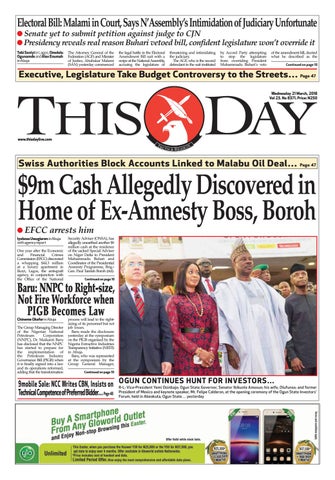
$9m Cash Allegedly Discovered in Home of Ex-Amnesty Boss, Boroh EFCC arrests him
Iyobosa Uwugiaren in Abuja with agency report One year after the Economic and Financial Crimes Commission (EFCC) discovered a whopping $44.3 million at a luxury apartment in Ikoyi, Lagos, the anti-graft agency, in conjunction with the Office of the National
Security Adviser (ONSA), has allegedly unearthed another $9 million cash at the residence of the sacked Special Adviser on Niger Delta to President Muhammadu Buhari and Coordinator of the Presidential Amnesty Programme, Brig.Gen. Paul Tarelah Boroh (rtd). Continued on page 10
Baru: NNPC to Right-size, Not Fire Workforce when PIGB Becomes Law
Chineme Okafor in Abuja
The Group Managing Director of the Nigerian National Petroleum Corporation (NNPC), Dr. Maikanti Baru has disclosed that the NNPC has started to prepare for the implementation of the Petroleum Industry Governance Bill (PIGB) when it is finally signed into a law and its operations reformed, adding that the transformation
process will lead to the rightsizing of its personnel but not job losses. Baru made the disclosure yesterday at the symposium on the PIGB organised by the Nigeria Extractive Industries Transparency Initiative (NEITI) in Abuja. Baru, who was represented at the symposium by the Group General Manager, Continued on page 10
CONTINUES HUNT FOR INVESTORS… 9mobile Sale: NCC Writes CBN, Insists on OGUN R-L: Vice-President Yemi Osinbajo; Ogun State Governor, Senator Ibikunle Amosun; his wife, Olufunso; and former of Mexico and keynote speaker, Mr. Felipe Calderon, at the opening ceremony of the Ogun State Investors’ Technical Competence of Preferred Bidder… Page 48 President Forum, held in Abeokuta, Ogun State… yesterday
2
T H I S D AY ˾ Ͱͯ˜ ͰͮͯͶ
T H I S D AY ˾ WEDNESDAY MARCH 21, 2018
3
4
T H I S D AY ˾ Ͱͯ˜ ͰͮͯͶ
T H I S D AY ˾ WEDNESDAY MARCH 21, 2018
5
6
T H I S D AY ˾ Ͱͯ˜ ͰͮͯͶ
T H I S D AY ˾ WEDNESDAY MARCH 21, 2018
7
8
T H I S D AY ˾ Ͱͯ˜ ͰͮͯͶ
T H I S D AY ˾ WEDNESDAY MARCH 21, 2018
9
WEDNESDAY, Í°ÍŻËœ ͺ͸͚͜ Ëž T H I S D AY
10
PAGE TEN $ 9 M CASH ALLE GEDLY DISCOVERED I N H OM E OF E X - AM N E ST Y B OSS, B OR OH The discovery of the cash was made a few hours after his arrest by a combined team of EFCC and ONSA operatives. His arrest, which the Head, Media and Publicity of the antigraft commission, Mr. Wilson Uwujiaren confirmed, in response to THISDAY’s enquiries, took place on Monday. A senior security agent also told THISDAY that Boroh was picked up from his home in Gwarinpa, Abuja, on Monday, but was taken back to his residence at about 3 a.m. yesterday by the security operatives who raided his house for hours and made the cash discovery of $9 million at his home. He remains in the custody of the EFCC. “The former adviser was driven to his home in an unmarked car after his arrest. His home was searched for several hours and about $9 million cash was discovered in several safe boxes in several parts of the house,� the senior security agent stated. “The combined team of EFCC and the National Security Adviser operatives were very thorough with the search. Indeed, at a point, the operatives broke all the locks in the home including
his wife’s closet. The recovered cash has been deposited at the Office of the NSA.� With the $9 million cash haul at Boroh’s residence, this will add to other cash discoveries made by the EFCC in the last two years, including the infamous $44.3 million found in the apartment at Osborne Towers, Ikoyi. Within 24 hours of that discovery, the National Intelligence Agency (NIA) had laid claim to the cash, claiming that the apartment was used as a safe house for its operations in the South-west. The discovery eventually led to the sack of the NIA director general, Amb. Ayodele Oke. Buhari sacked Boroh last week and announced Prof. Charles Dokubo as his replacement. In the statement announcing Boroh’s dismissal, it said the NSA, Maj.-Gen. Babagana Monguno (rtd), had been directed to probe the activities of the Amnesty Office from 2015, when Boroh was appointed, especially allegations of financial impropriety and other acts that were allegedly detrimental to the objectives of the Presidential Amnesty Programme.
According to investigations by THISDAY, Boroh’s sack, investigation and arrest by the EFCC may not be unconnected to a petition, among others, that was sent to the president last August. In the petition to Buhari, dated August 21, 2017 and signed by one Timi Angalabiri, on behalf of the Niger Deltans For Accountability and Good Governance (NDAGG), the group had requested the president to suspend the exAmnesty Programme boss “for a credible investigative inquiry to commence into the non-payment of tuition fees and living expenses of recently graduated Niger Delta students in universities across the United States, the United Kingdom and Nigeria, with many institutions withholding the students’ certificates due to non-payment of tuition fees ranging from nine months to two years, despite receiving over N70 billion within this time frame�. The petitioner further pleaded with Buhari to use his good office to prosecute Boroh and others for allegedly diverting the sum of N70 billion.
Shortly after the petition was written, rumours swirled about Boroh’s sack by the president, but they were dismissed by the former Amnesty Programme boss. “This story about my suspension and even sack has been off and on in the media, but the truth is that I have not been sacked and no one should disrupt the relative prevailing peace in the Niger Delta region with such fake news,� he had said. “What is happening is the handiwork of political enemies and those who do not want the region to be peaceful. The rumours they are peddling are just rubbish and unfounded. Under my watch, the programme, candidly speaking, has helped greatly to stabilise the region.�
Threats to Oil Installations But even as information reached THISDAY of Boroh’s arrest and the $9 million cash haul at this house, the Reformed Niger Delta Avengers and 10 other militant groups
yesterday threatened to attack oil installations in the Niger Delta if the sacked coordinator of the Amnesty Programme was not reinstated in four weeks. According to News Agency of Nigeria (NAN), Johnmark Ezonbi, leader of the Reformed Niger Delta Avengers, said the federal government would “hear from them� if Boroh was not reinstated. He said the sacked coordinator of the Amnesty Programme played a significant role in prevailing on the militants to end the attacks on oil installations, warning that it was obvious that the government was toying with the destiny of the Niger Delta. The statement by Ezonbi read: “The federal government will hear from us at the expiration of the four weeks ultimatum as no single stone will be left unturned as the administration prefers to go back to the recession period when Boroh played a major role by visiting the creeks with other stakeholders to prevail on
the boys to drop their arms and embrace peace. “We will embark on a well coordinated destruction of all major delivery oil pipelines after the expiration of the four weeks ultimatum without looking back. “I want to warn that any intruder into our planned action in four weeks time, if the federal government fails to reinstate General Paul Boroh, will be severely dealt with without mercy because our attacks will make the security agencies in the creeks very small. “We are fully ready to take on anybody as we have the instruments of warfare that will make the biggest military might marvel at our coordinated attacks. “We are ready to dirty our rivers and creeks with our oil, it is better we spill it than allow government use it to develop other parts of the country.� He said Boroh made efforts to put the Amnesty Programme back on track with the regular training of ex-militants and prompt payment of monthly stipends.
E L E CTO RAL B IL L: MA LAMI IN COURT, SAYS N ’ASSE M B LY ’S I N T I M I DAT I ON OF J U D I CI A RY UN F O RTUN ATE constitutional colouration being attached to the suit, adding that it underscores why he was physically in court to respond to the suit. Last week, Justice Ahmed Mohammed had in a ruling restrained the National Assembly from overriding the president’s refusal to assent to the amended electoral bill. The order was a sequel to an oral application for interlocutory injunction argued by the plaintiff’s (Accord Party) counsel, Wole Olanipekun (SAN). But in reaction to the injunction granted by the court, the Senate decried the restraining order, saying it negated the principle of separation of powers enshrined in the Nigerian Constitution. It also said it would send a petition to the Chief Justice of
Nigeria (CJN), Justice Walter Onnoghen to complain against the restraining order granted by Justice Mohammed, among other similar injunctions granted by the judiciary against the National Assembly. However, as of yesterday, the Senate was yet to make good its threat to submit a petition against the judge to the CJN. Justice Mohammed, in granting the preservative order, had ordered the defendants to maintain status quo ante belum, pending the next adjourned date yesterday. Speaking at the proceedings yesterday, Malami, who had aligned with the position of other counsel on the need to accord importance to the case, accused the National Assembly of intimidating and threatening the judiciary. He said he was disturbed by
the first defendant’s (National Assembly) comment that the judiciary was in the eye of the storm when it is actually the judiciary that was being threatened and intimidated by other arms of government. “I have to state that threats and intimidation by one arm of government against another concerning this matter are unfortunate. “We have a collective duty to support the entrenchment of the principle of separation of powers and in support of the judiciary in the discharge of its duties. “The independence of the judiciary is constitutionally guaranteed and we must work hard to ensure that independence is sustained,� he said. Earlier, the plaintiff’s counsel told the court that owing to
the importance and urgency of the suit, the parties had agreed to move straight to the subject matter of the originating summons. He then asked the court for a short adjournment to enable the parties to respond to his brief of argument filed on March 19, 2018. He noted that since the court had granted the plaintiff’s request for an order restraining the first defendant from taking any step that would affect the res of the matter, the issue has continued to generate interest. “Unfortunately, this has been misinterpreted in different quarters, including by the first defendant that the court made an order preventing the first defendant from carrying out its legislative duties,� he said. Olanipekun was of the opinion that parties should be
properly guided so that the subject matter of the litigation is not hijacked from the court. Responding, the counsel to the National Assembly, Joseph Daudu (SAN), stressed that the matter, which was already a matter of international discussion, was capable of defining the well being of the country's democracy, noting that the suit had again placed the judiciary in the eye of the storm. He therefore urged the court to give the matter the seriousness and speed it deserves. On his part, counsel to the third defendant (Independent National Electoral Commission), Femi Falana (SAN), urged the court to ignore the threats and other comments made outside the court, in order to avoid being drawn into an
unnecessary controversy. He also urged the court not to shut out the motion of the Action Peoples Party (APP), seeking to be joined in the matter so that the court would not be accused of intimidation. Earlier, at the resumed hearing, one Okere Kingdom had announced his appearance as counsel for the APP to be joined in the suit as the fourth defendant. His application was initially objected to by the plaintiff and other defendants. However, Justice Mohammed, in a brief ruling, held that the motion should be heard. Kingdom, in arguing the motion, said his client, as a registered political party would be affected one way or the other by the court’s decision.
longer competitive and need to be reviewed and harmonised into a comprehensive law. “However, it is still not yet Uhuru as the fiscal aspect of the bill which will address the revenue inflow to both the state and investors is still in the offing.� In his opening remarks, the Executive Secretary of NEITI, Mr. Waziri Adio explained that Nigerians have reached a consensus that the country’s oil sector is poorly governed and needs to be reformed for optimum benefit. He added that the process of getting the industry reformed through new laws has taken too long and that the PIGB is the closest the country has come to passing a new reform law for the sector. Adio called on stakeholders to stay focused on getting the PIGB and other bills passed into law in the country, as well as making them work for the country. “Now that we are hopefully close to the end of this circuitous journey, it
is important for us to focus on the next task in a way that will proactively and strategically ensure the intention of the proposed laws are fully realised, to ensure that we have not undertaken the long journey in vain. That is why the NEITI as a stakeholder has convened this meeting,� Adio stated.
Continued on page 11
B A RU: NNP C TO RIGHT - SIZE, N OT FIRE W OR K F OR C E W H EN PI GB B EC OM ES L AW Corporate Planning of the corporation, Mr. Bala Wunti, explained that the NNPC has initiated a new policy that involves reforming its people, processes, procedures, productivity and profit drive to fit into the demands of the post-PIGB era when it will be expected to transform into a commercial entity with key performance indicators given to it by its shareholders. According to the GMD, NNPC would right-size its workforce to fit into the various businesses it would be involved in across the entire value chain of the industry, instead of downsizing and firing them. He said the corporation has recognised that it would need to survive in the post-PIGB era without government subventions, hence the need to ensure that all its staff are productively engaged in the various aspects of its operations. Also speaking at the event, the Minister of State for Petroleum Resources, Dr. Ibe
Kachikwu indicated that the award of new oil acreages in Nigeria’s oil and gas industry would be done by the federal government under new laws and terms expected in the country soon. Although he did not state specifically if this would apply to the proposed bid rounds for marginal oil fields, which the government has planned for years but is yet to conduct, he explained that the new laws and terms would also apply to offshore fields, which he said were expected to account for a high proportion of Nigeria’s oil reserves and revenue. Represented by one of his Senior Technical Advisers, Mr. Johnson Awoyemi at the NEITI forum, Kachikwu explained that the existing laws governing operations in Nigeria’s oil and gas industry were archaic and needed to be overhauled. He lauded the National Assembly for taking its time to legislate on the PIGB, an offshoot of the omnibus PIB, saying it will provide the
standards for the governance framework for the industry. The minister noted that while the government was delighted with the possibilities of the PIGB becoming a law soon, having been passed by the Senate and House of Representatives and was now being harmonised in the legislature for presidential assent, it wants other aspects of the PIB, especially the fiscal terms, to be considered by the National Assembly quickly to restore viability to the country’s oil sector. “It’s a national priority to have certainty and clarity over the operations of the petroleum industry as it will foster more licensing rounds, enhance revenues and increased economic activities. “New acreages will be awarded for exploration and production under new laws and terms, especially offshore, which is likely to account for much of the growth in the nation’s reserves,� Kachikwu said. Continuing, he stated: “For
too long we have waited for this moment with bated breath and sheer excitement, knowing that the bill will disentangle us from the manacles of inefficiency, low investment drive and opacity. “There were some complaints of shrinkage of some agencies in the bill and there is need to consider the concept of the ability to stand alone versus efficiency of service delivery. “We must relish the urgency of this moment as all hands must be on deck to making sure that the bill achieves what it is meant to achieve. Getting to the yes on the PIGB is a great milestone, I am so glad we have begun heeding the clarion call.� On the urgency he said was needed to get the three aspects of the PIB on governance, the host community fund and the fiscal regime passed, the minister explained: “The aggregation of industry laws which have governed the oil and gas sector over the years has become archaic and no
TOP GAINERS NGN NGN UNITYBANK 0.08 1.31 UNILEVER 2.65 55.65 TOTAL 11.60 243.70 ETERNA 0.28 5.98 UNIPRESS 0.10 2.18 TOP LOSERS NGN NGN CADBURY 1.45 14.00 JAPAUL 0.06 0.58 MULTITREX 0.04 0.40 SEPLAT 38.00 722.00 LAFARGE 2.65 50.35 HPE Nestle Nig Plc â‚Ś1,380 Volume: 409.208 million shares Value: N 3.918 billion Deals: 4,996 As at 20/3/18 See details on Page 39
% 6.5 5.0 5.0 4.9 4.8 % 9.3 9.3 9.0 5.0 5.0
11
˾ WEDNESDAY, MARCH 21, 2018
PAGE ELEVEN
AU Summit Prepared to Sign Free Trade Treaty without Nigeria MAN urges FG to renegotiate terms African
Union (AU) chairperson, Paul Kagame yesterday gave a strong indication that member states would go ahead to sign the treaty to create the continental free trade area, even with continent’s most-populated country, Nigeria, withdrawal from the meeting. At least 53 African Heads of States have gathered in Kigali, Rwanda, for the 10th Extraordinary Summit of the AU to consider the legal instruments for the African Continental Free Trade Area (AfCFTA) and also launch the agreement officially to establish the treaty. AfCTA is aimed at deepening African economic integration, promoting agricultural development, food security, industrialisation and structural economic transformation through a single-air continental transport market with free movement of persons, capital, goods and services. It is part of Africa’s plan to promote intra and interregional trade, economic cooperation and partnership on the continent by 2063, and seeks to make Africa the largest free trade area, improve its economies and strengthen its position in global trade. According to the African News Agency (ANA), South Africa’s President, Cyril Ramaphosa, who will attend the signing of the agreement in Kigali today, said his country was committed to the establishment of an AfCFTA that will boost intra-Africa
trade in accordance with the aspirations of the AU Agenda 2063. However, President Muhammadu Buhari withdrew his participation from the summit at the weekend and did not travel to Kigali, saying that continental aspirations must complement Nigeria’s national interests. This was after his cabinet had endorsed the AfCFTA. “As Africa’s largest economy and most populous country, we are committed to ensuring that all trade agreements we sign are beneficial to the long-term prosperity of the continent,” Buhari had said in a statement. “We are therefore widening and deepening domestic consultations on the AfCFTA to ensure that all concerns are respectfully addressed. Any African free trade agreement must fairly and equitably represent the interests of Nigeria, and indeed, her African brothers and sisters.” Buhari’s decision to skip the signing ceremony arose from the objection raised by the Nigeria Labour Congress (NLC) to the treaty. The labour union had expressed concern that the federal government had held consultations on the free trade treaty, warning that it could undermine Nigerian manufacturers and lead to job losses. Despite this setback in African trade integration, Kagame appeared unfazed yesterday when he delivered the keynote address at the opening of the summit,
Buhari
saying that the treaty would be signed today. “Tomorrow, we will sign a historic agreement creating a Continental Free Trade Area. The road to this point has been long indeed. It can be measured in decades. And we still have a few more steps to take. But we are persisting, and a new chapter in the story of African unity is set to begin,” Kagame said. “The stakes are enormous for Africa, but also for the entire global economy, to which Africa will contribute an ever-greater share in the decades ahead. “The creation of one African market necessarily entails a metamorphosis in how we think and act. The full involvement of the private sector is needed more
than ever before. “The purpose of today’s forum is to discuss how to make the most of the new opportunities we are creating for ourselves,” he added. Kagame said that the Continental Free Trade Area symbolises the AU’s progress towards the ideals of African unity, but that was not the only reason why it is so historic. He said increasing intraAfrican trade, however, does not mean doing less business with the rest of the world. “On the contrary, as we trade more among ourselves, African firms will become bigger, more specialised, and more competitive internationally. “Let’s also be realistic. We cannot take the Continental
Free Trade Area for granted. After it is signed, there will still be challenges. Any concerns or technical issues that remain should be addressed fairly, but also expeditiously. Work on some additional protocols and annexes will also continue.” Kagame ended by saying that the full engagement of the private sector in adopting and implementing the treaty “will be absolutely essential”. However, the Manufacturers Association of Nigeria (MAN) yesterday urged the Nigerian Government to renegotiate trade conditions that will impede economic growth in its review of the AfCFTA agreement. MAN president, Dr. Frank Jacob made the remarks in an interview with the News Agency of Nigeria (NAN) in Lagos. According to him, MAN was apprehensive that the Rules of Origin in the AfCFTA cannot be adequately enforced to guard against the influx of European Union (EU) goods into the Nigerian market. The Rules of Origin are used to determine the country of origin of a product for the purpose of international trade. “We are afraid that the Rules of Origin cannot be adequately enforced because goods from the EU can find their way into one of the African countries that have a bilateral agreement with the EU. “When the goods get into the African country, they can
repackage them, change the label from Made in Europe to that of the African country. “These same goods will surely find their way to Nigeria which is the main target market for the EU,” Jacob said. Jacob also noted that the market access under the agreement was a concern to manufacturers, as it provides low protection for locally produced goods. “The agreement says that 90 per cent of the tariff plan would be liberalised, leaving only 10 per cent to protect manufacturers and that 10 per cent is too low. “That means that the rest of the 90 per cent is open, duty-free, and people can import. “What we are saying is that the 10 per cent is too small, even at the current Common External Tariff (CET) regime, we enjoy more than 10 per cent. “How can they now expect us to accept only 10 per cent as the only protective tariff line. That is an area that is of great concern to us,” Jacob said. He noted that the AfCFTA would impede growth of the manufacturing sector, lead to the deaths of many businesses, increase the country’s unemployment rate, and incapacitate local technological advancement. The MAN boss also commended Buhari for cancelling his scheduled trip to Kigali to sign the framework agreement establishing AfCFTA.
E L ECTO RAL B ILL: MA LAMI IN COURT, SAYS N ’ASSE M B LY ’S I N T I M I DAT I ON OF J U D I C I A RY UN F O RTUN ATE The applicant, in a 17-paragraph affidavit, claimed that the subject matter of litigation would affect its chances during the elections. But the plaintiff and the first to third defendants urged the court to dismiss the application on the grounds that it was defective and not in compliance with the rules of the court. Delivering ruling, Justice Mohammed agreed with the submissions of the plaintiff and the first to third defendants and consequently dismissed the application. He held that the first defendant was competent in defending the suit and did not need to be joined by any party. Justice Mohammed further ruled that the mere fact that the applicant is a political party does not qualify it to be joined in the suit. He, however, gave the other defendants two days to file their responses, while the plaintiff was given till Friday to reply. The judge consequently adjourned the case till Monday 26 for hearing on the substantive suit. The Accord Party had dragged the National Assembly, the AGF and INEC to court after the president refused to assent to the Electoral Amendment Bill, 2018. The party had expressed fears that the legislature could override the president’s veto
and pass the bill into law. The plaintiff, in an oral application, asked the court for a preservative order to stop the legislature from overriding the president, pending the hearing and determination of its substantive suit. Justice Mohammed had granted the preservative order and adjourned the matter to yesterday. However, the Senate which had blown hot and cold over the preservative order on the grounds that it was in violation of the principle of separation of powers as enshrined in the Constitution and said that it would send a petition to the CJN on the matter, as of yesterday was yet to send a petition against the judge. A source at Justice Onnoghen’s office informed THISDAY that no such petition had been received by the office. Meanwhile, the presidency yesterday opened up on the real reason Buhari opposed the Electoral Amendment Bill, saying that Section 25(1) of the bill, which is proposing an alteration to the election sequence, would cause a lot of confusion in the next general election. A senior presidential official told THISDAY in confidence that the president’s objection to the amendment was meant to guard against its potential to disrupt INEC’s arrangements
for the 2019 elections and create huge logistics and financial problems. According to him, the president’s decision to veto the bill was not borne out of fear of the proposal to alter the sequencing of the elections, but the innumerable consequences it could have on the entire elections and the system. He said INEC had expressed concern over the alteration of the sequencing of elections carried out by the National Assembly, saying it will scuttle all the arrangements it had already made. The presidential source further stated that if the sequence of the elections proposed by the federal legislature is allowed to stand, INEC’s preparation so far, based on the election timetable it had announced, would be in disarray, pointing out that the materials already printed for instance by the electoral commission would be wasted. Aside from the cost implication of conducting three elections, as against the two polls that INEC had proposed, the source added that conducting three elections would mean deployment of the same personnel and logistics that INEC would have used to conclude the two elections for the third election. The commission had scheduled the Presidential
and National Assembly polls for February 16 next year and governorship and state Houses of Assembly polls for March 2, 2019. But the new provision in the bill states that elections shall be held in the following order: (a) National Assembly elections (b) State Houses of Assembly and Governorship elections (c) Presidential election. The source said the presidency would not have minded the proposed sequencing if the presidential election had been lumped with the governorship and Houses of Assembly elections, provided the elections are conducted twice, pointing out that this would save INEC the stress of conducting three elections, as well as its huge cost implications on the nation. The source further disclosed that the intention of the National Assembly in bringing its own election first was a strategy to force the hand of the president to give members of the legislature the support they need to win their various re-elections. He said using their vantage positions as lawmakers to hoodwink the system instead of exploiting it to everyone’s advantage was done in bad faith. He expressed confidence that the threat to override the president’s veto would not stand, describing it as a mere threat that the National
Assembly was not really serious about. “They won’t override the president’s veto. We have stated our position on the amendment. The veto was not caused by fear but because INEC said it would affect its own arrangements. “Three elections will affect the materials INEC has already printed. It will affect logistics. “INEC will have to use the same logistics that will be used to conduct two elections for the third election again. The same personnel will also have to be deployed for the third election. “If the (presidential) election was to come up with that of governorship and state Houses of Assembly, it would have been better. But to plan the conduct of three elections is not in the interest of the commission and the country. “The amendment is not about the effect of the first election on other elections, but the aim of the National Assembly is to use the reordered sequence of the elections to force the president to support their own elections. “However, you don’t take advantage of your position to pursue your personal interest,” the source stated. The National Assembly had inserted the section into the bill with the intention of making the reordered election sequence a legal matter. Consequently, the Federal Executive Council (FEC) during
one of its meetings last month, invited officials of INEC where the reordered elections proposed by the National Assembly was discussed. However, the presidential source told THISDAY at the time that the details of the meeting with INEC were not meant for public consumption. It is believed that INEC, during the meeting, had expressed its concern over the proposed sequencing, as disclosed by the source yesterday, which formed the nucleus of the president’s decision to veto the bill. But the president, in his letter conveying his veto on the bill to the National Assembly, did not solely cite the reordering of elections in the bill as the main reason for his decision. He also cited other amendments in the bill, which he said informed his decision. According to him, “The amendment to Section 138 of the Principal Act to delete two crucial grounds upon which an election may be challenged by candidates, unduly limits the rights of candidates in elections to a free and fair electoral review process; and “The amendment to Section 152(3)-(5) of the Principal Act may raise constitutional issues over the competence of the National Assembly to legislate over local government elections.”
12
T H I S D AY ˾ Ͱͯ˜ ͰͮͯͶ
T H I S D AY ˾ WEDNESDAY MARCH 21, 2018
13
14
T H I S D AY Ëž Ëœ Í°ÍŻËœ Í°ÍŽÍŻÍś
COMMENT
Editor, Editorial Page PETER ISHAKA Email peter.ishaka@thisdaylive.com
EMERGENCY IN THE HEALTH SECTOR (2) Sonnie Ekwowusi argues the need to strengthen the health care system
I
t beats the imagination that at a time malnutrition and kwashiorkor are taking their toll on the citizenry; a time when medical statistics revealed that 2,300 under-five children and 145 pregnant women are dying in Nigeria every day, the Federal Ministry of Health, which was established to develop health policies and programmes that will, inter alia, strengthen the country’s health system, has chosen to conspire with foreign agencies such as the World Health Organisation (WHO), The John D & Catherine T-McArthur foundation, Planned Parenthood Federation United Nations Population Fund and Department for Internal Development (DFID) in order to supply to the Nigerian populace long-acting contraceptives (LACs) or long-acting reversible contraceptives (LARCs) such as Depo-Provera, (DMPA), Sayana Press, Norplant, Norethisterone Enanthate. Additionally, the Federal Ministry of Health is also supplying IUCD, postinor 2, Lo-femenal, Norplant, suction tubes, vasectomy (male sterilisation), tubal ligation (female sterilisation), among others, to the Nigerian public. The most regrettable aspect is that the side effects of these LACs or LARCs are fatal and irreversibly deadly. For instance, they cause or exacerbate fatal diseases such as breast cancer, diabetes, HIV/ AIDS, menorrhagia, strokes and thrombosis increases risk of fatal diseases such as: breast cancer, HIV, menorrhagia (excessive bleeding for months that lead to anemia), thrombosis (blood clots that lead to strokes) and heart diseases. Highly disturbed about this, the African Group issued a statement at the United Nations Commission on the Status of Women on March 9, 2015 drawing attention of the world to the dangerous contraceptives which the West is continuously shipping to Africa while deliberately concealing from African officials and African women the deadly side effects of these contraceptives. Therefore, the Federal Ministry of Health, Abuja is overdue for purging and cleansing because it has outlived its usefulness. The cleaning-up of the Federal Ministry of Health, Abuja is a pre-requisite to the cleaning-up of the country’s messy primary health care delivery system. We should be wary of who becomes our next health minister. It is obvious that the current Health Minister Prof. Isaac Adewole prefers the promotion of abortion and contraceptives to improving Nigeria’s primary and secondary health care system. Ditto for his two immediate predecessors in office. Therefore, Nigeria needs a new Federal Ministry of Health that is properly focused to tackle the real health challenges affecting Nigerians not one that is targeted at destroying the human capital in Nigeria. The Reproductive Health Division of the Federal Ministry of Health should be scrapped. The National Contraceptive Logistics Management System (CLMS) adopted by Nigeria in 1995 without inputs from stakeholders should be scrapped as well. In speech after speech, President Buhari says his government is poised to tackle the health crisis in Nigeria. In one speech, President Buhari said: “Our goal of revitalising the primary health care centres is to ensure that quality basic health care services are delivered to majority of Nigerians irrespective of their location in
PRIMARY HEALTH CARE AND OUTPATIENT CLINIC SERVICES IN NIGERIA SHOULD BE DECENTRALISED TO REACH THE SUFFERING AND DYING WOMEN AND CHILDREN IN EVERY STATE
the country�. But unfortunately President Buhari’s speech is yet to match with any positive action. Is President Buhari aware that the Federal Ministry of Finance has introduced a 20% duty on drug importation in Nigeria which has made drugs sold in Nigeria to be outrageously expensive and unaffordable? Is our president aware that Nigeria had agreed in 2013 to abide by the recommendation of the ECOWAS Committee that drug importation in the African Sub-Region should attract a zero per cent duty? Is he aware that neigbouring African countries are operating a zero tax regime plus lower port charges on drug importation in their respective countries? If 80% of medicaments consumed in Nigeria are imported, and if there are few or virtually no drug manufacturing companies in Nigeria, why place a heavy duty on drug importation? I think it is high time President Buhari removed the strangulating 20% duty slammed on drug importation in Nigeria. Drugs are no “special commodities�. Therefore they should be accessible to sick patients who urgently need them. There are numerous Nigerians suffering from diabetes, kidney failure, prostrate cancer, anxiety and depression syndrome, hypertension, high blood pressure and so on who cannot afford the exorbitant drugs sold at chemist shops today. This is sad. Access to health care services is a constitutional right not a privilege. As I said in the first part of this piece, by virtue of section 17 of the 1999 Constitution the government is obliged to improve the welfare of Nigerian citizens by ensuring that they have access to adequate medical and health facilities. By fulfilling this obligation, billions of naira squandered in medical tourism every year would have been saved. President Buhari squandered a lot of money on medical tourism in London. If there were quality medical treatment in Nigeria, the president would probably not have gone overseas to attend to his health. Primary health care and outpatient clinic services in Nigeria should be decentralised to reach the suffering and dying women and children in every state. It is a scandal that most pregnant women in most Nigerian villages still give birth in the hut with no running water and skilled birth attendant capable of providing emergency obstetrical care. Our teaching hospitals need to be re-equipped. Comprehensive health insurance schemes should be inaugurated and implemented in all the states of the federation. Doctors and nurses should change their hostile attitudes toward patients. By virtue of the Hippocratic Oath which they swore to, Nigerian doctors are obliged to save lives at all times. Nurses should learn to be kind, affectionate and sympathetic to patients at all times. Recently about 800 Canadian doctors working in the Quebec Province staged a protest against their salary increase. The protesting doctors said that they cannot in good conscience accept salary increase while patients “live with the lack of access to required services because of drastic cuts in recent years.� This is a remarkable show of altruism and humanitarianism. Nigerian doctors and nurses who are always going on strike over salary increase should imbibe the same altruistic and humanitarian spirit of the Canadian doctors.
MAY OTHER STATES BE LIKE ANAMBRA Anambra State is doing exceedingly well, writes Chinedu I. Nzeribe
W
hen the righteous are in authority, the people rejoice. But when the wicked rule, the people groan (Proverbs 29: 2).
When Most Reverend Dr Val Okeke, the Archbishop of Onitsha and professor of Moral Theology, too k the stage on Saturday, March 17, to pray at the second inauguration of Governor Willie Obiano, he asked God to make Anambra continue in its present development trajectory so that other states in Nigeria would emulate it. It was a thoughtful prayer, in synch with the current mood in the state. Any person who attended the swearing-in ceremony or watched it live on television is bound to be proud of Anambra State. I have never seen the state so peaceful, so united and so progress-oriented as in the last one year. I have never seen the people so optimistic of their state. Senator Ben Ndi Obi, the immediate past National Secretary of the Peoples Democratic Party (PDP) was right to tell Channels Television that the “galaxy of personalities� who attended the inauguration, regardless of their political leanings, shows that the people cherish the atmosphere of peace prevailing in their state. Though Obiano belongs to the All Progressives Grand Alliance (APGA), the VIP stand was almost dominated by members of the so-called opposition parties and other personalities who are not politicians. For example, erstwhile Senate President Ken Nnamani (APC), Senator Stella Oduah (PDP), Senator Andy Ubah (APC), Senator (Mrs) Uche Ekwunife (APC) and Dr Chike Obidigbo (APC) arrived early enough. All former democratically elected governors of
Anambra State attended the ceremony except Mr Peter Obi. Dr Chinwoke Mbadinuju and Chris Ngige, both APC chieftains, and Dr Chukwuemeka Ezeife and Mrs Virgy Etiaba, Nigeria’s first female governor, arrived, with the crowd cheering. If Peter Obi had made it, he probably would have shared the limelight with the governor. By being the odd man out, Governor Obiano’s predecessor is portraying himself as a bitter man. This is not the right reputation any person who wants to be relevant in the state should cultivate. He ought to have known that the people objected to his refusal to pay both Dr Mbadinuju and Dr Ngige their salaries and other entitlements, an anomaly which Obiano corrected no sooner than he assumed office. The image of a bitter man made the people vote against him even in his hometown of Agulu during the November 18 gubernatorial election which his successor won in grand style. Mr Obi needs to avoid being seen as a person at war with his predecessors and his successor. Back to Obiano’s second inauguration. Apart from the governors of Ebonyi, Delta, Taraba, Enugu and Ekiti States as well as ex Central Bank Governor Charles Soludo and Dr Ogbonnaya Onu, the Minister of Science and Technology, who are politicians, some of the prominent persons in attendance who are not politicians are Chief Nnia Nwodo, the Ohaneze President General who was twice a minister; Chief Emeka Anyaoku, ex Commonwealth Secretary General; Igwe Alfred Nnaemeka Achebe, Obi of Onitsha; the InspectorGeneral of Police who was represented by DIG Val Ntomchukwu; the Ooni of Ife, Oba Adeyeye Ogunwusi; the Ewi of Ekiti, Oba Rufus Adejugbe; Prof Uche Azikiwe, wife of Nigeria’s greatest nationalist, Dr Nnamdi Azikiwe; Prof Elochukwu
Amucheazi, former Director General of the Directorate for Social Mobilisation (MAMSAR); Engineer Otis Anyaeji, immediate past President of the Nigerian Society of Engineers; and Professor Chinedu Nebo, former Vice-Chancellor of the Federal University in Ekiti State and of the University of Nigeria at Nsukka as well as the immediate past Minister of Power. Not to be overlooked is the diplomatic community, including the American mission. The organised private sector was fully represented. Dr ABC Orjiako, chairman of Seplat, the only Nigerian firm traded on both the Nigerian Stock Exchange and London Stock Exchange; Chief Allen Onyema, chairman of Air Peace which is now West Africa’s largest and fastest growing airline; and Mr Cosmas Maduka, chairman of the Coscharis Group, were easily recognisable faces in the crowd. They mixed freely with representatives of the traders associations, including the president of the South East Amalgamated Traders Association. Such corporate leaders as Engr Emeka Okwuosa, chairman of Oilserv, who could not make it had earlier sent their apologies. It is interesting that the Alex Ekwueme Square in Awka was filled to capacity, despite efforts by the committee which organised Obiano’s second inauguration ceremony to reduce the crowd to a manageable level because of logistic, safety and security concerns. Anytime the Obiano administration organises a public function, it is almost embarrassed by the humongous crowd which honours it. On October 3, 2017, when it launched Operation Show Your Muscle to flag off its reelection campaign, it expected some 200,000 persons, but well over 500,000 people trooped to the Ekwueme Square. Its strategists were banking
on winning the reelection by defeating opponents in some 13 local government areas, but they ended up clearing all 21 LGAs in the state by a wide margin. Even if the votes for the other parties were combined, they would not be up to a half of the votes given to Obiano in this election which became the most peaceful and transparent organised by the Independent National Electoral Commission (INEC). On November 23, 2017, the governor went to the INEC office in Awka from the Governor’s Lodge in Amawbia to collect his Certificate of Return, and he and his wife chose to walk to the place which is some distance—perhaps to test their popularity--and there was almost a pandemonium. Offices, shops and markets closed spontaneously, as over 10,000 persons, including commercial bus drivers, okada and keke riders, joined them. INEC officials were overwhelmed because they did not expect any crowd at all, let alone a large number singing, dancing, drumming and praising God. Before the November 19 governorship vote in Anambra State, Ms Chika Jenny Okafor, a Nigerian lawyer and blogger in the United Kingdom, provoked a debate when she started a conversation on the topic, “Is Obiano the most popular governor in Nigeria?� I should think that events of the last few months have settled the question. The fantastic progress in Anambra should serve as a wake-up call to the governors of Imo, Abia, Delta, Bayelsa and other states. As Archbishop Okeke noted during his opening prayer at Obiano’s second inauguration, Nigeria will experience rapid progress when other states emulate Anambra. Nzeribe was a manager with both First City Monument Bank and keystone Bank
15
T H I S D AY Ëž Ëœ Í°ÍŻËœ Í°ÍŽÍŻÍś
EDITORIAL THE CASE FOR POLICE REFORMS The present standard of the police is unacceptable
T
he recent invasion by unknown gunmen of a police station in Gbako Local Government Area of Niger State where some detained criminals were released points to the pathetic state of the police in Nigeria today. While the Commissioner of Police, Mr. Dibal Paul Yakadi, reportedly rushed to the community following the development, the state government imposed a dusk-to-dawn curfew and mobilised vigilance group to go after the gunmen and arrest them. Unfortunately, this is not an isolated incident as many police stations in our country have, at different times, been sacked by gunmen. From Benue to Adamawa to Taraba and Zamfara States, criminal gangs seem to have overpowered the capacity of the state to restore order with hundreds of citizens killed almost on a regular basis. But it becomes a far more serious challenge when the police can no longer protect their own men and barracks from the onslaught of sundry criminal cartels. In January last year, for instance, two ofďŹ cers were injured when IT IS A SERIOUS hoodlums invaded CHALLENGE WHEN THE a police station in POLICE CAN NO LONGER Suleja, also in Niger PROTECT THEIR OWN MEN State, to free their AND BARRACKS FROM THE detained colleagues. ONSLAUGHT OF SUNDRY Numbering over CRIMINAL CARTELS 20 and armed with cutlasses, daggers, axes and sticks, the hoodlums reportedly ďŹ rst issued an ultimatum to the policemen on duty before they overpowered them. What that suggests is an urgent need to reform the institution if the men and ofďŹ cers must regain public conďŹ dence. In the country today, especially in recent times, the police have failed in their duty of maintaining law and order, internal security, intelligence gathering and in checking the increasing wave of crime. So incapable of delivering on its mandate has the institution become that a huge slice of the military
Letters to the Editor
asset is often deployed to perform police duty with serious implications for professionalism in the military, not to mention the effects of its exposure on civil–military relations. With Nigeria gradually descending to the Hobbesian state of nature where life is “solitary, poor, nasty, brutish and shortâ€?, there is need for a more coherent strategy to deal with the security challenge and that cannot be done without a professional and competent police. Yet, to the extent that at the root of the endemic violent conicts in the country is an obvious recourse to self-help by citizens, what the current situation demands is a total overhaul of the police starting with the appointment of a new leadership.
M T H I S DAY
EDITOR DEPUTY EDITORS ˜ MANAGING DIRECTOR DEPUTY MANAGING DIRECTOR CHAIRMAN EDITORIAL BOARD
EDITOR NATION’S CAPITAL
T H I S DAY N E W S PA P E R S L I M I T E D
EDITOR-IN-CHIEF/CHAIRMAN GROUP EXECUTIVE DIRECTORS ˜ ˜
˜ ˜
DIVISIONAL DIRECTORS ˜ DEPUTY DIVISIONAL DIRECTOR
SNR. ASSOCIATE DIRECTOR ASSOCIATE DIRECTORS ˜ CONTROLLERS ˜ ˜
DIRECTOR, PRINTING PRODUCTION TO SEND EMAIL: ďŹ rst name.surname@thisdaylive.com
TO OUR READERS Letters in response to speciďŹ c publications in THISDAY should be brief (150-200 words) and straight to the point. Interested readers may send such letters along with their contact details to opinion@thisdaylive.com. We also welcome comments and opinions on topical local, national and international issues provided they are well-written and should also not be longer than (9501000 words). They should be sent to opinion@thisdaylive.com along with the email address and phone numbers of the writer.
POLICE BOUNTY ON KUDIRAT’S KILLERS
I
have been researching on political killings and state-sanctioned hits in Nigeria. It is tragic where we are coming from. The murder of these people - Pa Alfred Rewane, Bola Ige and Kudirat Abiola was like a scene in the action movie - The Mechanic. Luckily, Alex Ibru and Pa Abraham Adesanya, though both late now, survived hits ordered by the Abacha regime. But what is more depressing for me is the irresponsibility and complicity of the Nigeria police in the barbarous executions. In July 1999, at the Oputa Panel, Sergeant Rogers, Abacha’s hitman, confessed to have carried out the killing of Kudirat. He also confessed to have carried out the hits on Adesanya and Ibru. But did you know that the police in these cases arrested innocent Nigerians, some of whom were killed in detention? For example, in the case of Pa Rewane, two of the innocent suspects were only released in 2011 - most of them died in police custody. The police did all they could to bury the case. Did you know the police, under the Abacha regime, which killed Kudirat, put a $45,000 bounty
eanwhile, the increasing loss of conďŹ dence in the ability of the police to secure the civil populace is worsened by the public conduct of many of its personnel. Last year, the Police Service Commission (PSC), the body responsible for the regulation of the police service, announced that it was investigating some state command police commissioners for alleged complicity in crime. Nobody knows what has become of that investigation. But since the processes leading to the recruitment of personnel into many of the security services in our country have been compromised, it is also no surprise that many social misďŹ ts are legally carrying arms to terrorise Nigerians. Indeed, that the strident calls for the establishment of state police have now been endorsed by the Nigeria Governors’ Forum (NGF) is an expression of concerns and indeed a vote of no conďŹ dence in the present structure and management of the Nigeria Police Force. However, as we have canvassed on this page several times, whatever may be the merit in such idea, it is not a silver bullet given that the same subversion that has rendered the federal police ineffectual could easily be replicated in the states. But we agree that the current situation where our policemen have become an easy game for a more sophisticated world of crime calls for a radical solution.
on the killers of the woman even when they knew the perpetrators? I believe most Nigerians in prison today are innocent. But our police are not a law enforcement organisation, but a regime-protection agency. And it has been so since the military era. In addition, most Nigerians have no faith in the Nigeria police. I was discussing getting police security for an estate with a neighbour. This is what he said: “That is dangerous. The police security could mastermind an armed robbery here or even carry out the robbery.� I was reminded of how some policemen guarding former President Goodluck Jonathan’s house in Abuja butchered the place and looted its content. The hierarchy of the Nigeria police is perhaps oblivious of citizens’ revulsion or just insouciant about it. In the days of the protest against SARS, I did not join the campaign against the dreaded squad because I knew the hierarchy of the Nigeria police was not amenable to reforms. I believe the police need a total purge now. I have devoted some of my time to criticise the police because I want a better organisation. And I know there are good men in the force. Fredrick Nwabufo, fredricknwabufo@yahoo.com
NATIONAL ASSEMBLY AND GENDER EQUALITY
M
arch 8, 2018 was celebrated globally as International Women’s Day. A day distinctively set aside to recognise women’s efforts for emancipation in all facets of life. The day was first celebrated in the year 1909 in New York, United States of America, to honour the year 1908 Garment Workers Strike where women protested unfavourable working conditions. The 20th century has been benign to women as this era witnessed the election of women as presidents and heads of state in countries which includes but not limited to Iceland, Liberia, United Kingdom, New Zealand, Pakistan and Norway.The closely contested Presidential Election between President Donald Trump and former Secretary of States Mrs Hilary Clinton in 2016 attests to the fact that women are beginning to break stereotypes which hitherto limited their competence and capabilities. However, in spite of these successes,
women still face obstructions which manifest as glass ceilings, traditional gender perceptions about the role of women which limit her active participation in the market arena as well as persistent gender inequalities exacerbated by impoverishment and patriarchy. Pressing for progress to achieve sustainable development in Nigeria, efforts must be made to critically address dynamic glitches which impede the empowerment of women and the girl-child. Hence, this is not the best time for the National Assembly to exhibit machoism by executing the Gender Equality Bill but a time to acknowledge that this is the time to create opportunities for women and the girl-child to enjoy their rights while also contributing to the growth of the nation as gender equality is the adjuvant for building a resilient and prosperous Nigeria. Oluwatoyin Oloruntola-Taiwo, Executive Director, Women and Girl-Child Capabilities, Enhancement and Empowerment Organisation
16
T H I S D AY ˾ Ͱͯ˜ ͰͮͯͶ
T H I S D AY ˾ WEDNESDAY MARCH 21, 2018
17
T H I S D AY ˾ WEDNESDAY, MARCH 21, 2018
18
MIDWEEKPOLITICS
Group Politics Editor Tobi Soniyi Email tobi.soniyi@thisdaylive.com 07054786260 SMS ONLY
THE NEWSMAKER
PDP Harvests APC Members in Rivers While political parties prize cohesion and unity, the All Progressives Congress in Rivers State seems to have discarded these virtues, Davidson Iriekpen writes
W
ith the 2019 general election fast approaching, one state where the people are likely to see a no contest situation when elections come is Rivers where the members of the All Progressives Congress (APC) are currently defecting in droves to the Peoples Democratic Party (PDP). Investigation by THISDAY revealed that after the December 10, 2016 rerun legislative elections till date, over 250,000 APC members have defected to the PDP. Dissatisfied with its leadership, members of the party are leaving the party massively thereby giving the ruling party in the state a fertile ground to govern without opposition. Many analysts believe that with elections fast approaching, it would be difficult for the opposition in the state to secure victory in any of the elective positions. One of the causes of disaffection in the APC is the feeling of abandonment as supporters of the party feel that after the elections and the rerun elections, nothing was heard from those who won as they all relocated to Abuja with their families. “How can we call ourselves APC members when leaders who got jobs in Abuja and Lagos seem to be representing themselves. They have left us to fend for ourselves,” lamented one member who did not want his name in print, adding that it was time for them to take their destinies into their hands. The second confusion in the APC is about the choice of governorship standard bearer for 2019. At the centre of the raging storm rocking and threatening to tear the party apart are the Minister of Transportation and former governor of the state, Chibuike Amaechi; Senator Magnus Abe, representing Rivers South East senatorial district; and the party’s governorship candidate in 2015 and Director General of Nigerian Maritime Administration and Safety Agency (NIMASA), Dakuku Peterside. While Amaechi favours Peterside for 2019 governorship seat, Abe whose relationship with minister was almost marred by the imposition of Peterside as APC governorship candidate in the 2015 election, has argued that party primary election should be the sole determining factor to decide who should emerge as the party’s standard-bearer in 2019. On one side of the divide are those who think that the only way to stem the rancour and acrimony within the party is to allow internal democracy to determine who gets the governorship ticket. On the contrary, are party members loyal to Amaechi who contended that his choice should be allowed to stay being the leader of the party in the state. But a supporter of Abe who pleaded anonymity disclosed that the APC would merely be galloping towards disintegration if Amaechi insists on imposition with regards to the governorship candidate of the party. “Honestly, we are not saying that Abe should be given the ticket without any contestation. Anybody who wants to emerge as the party’s governorship candidate should do so through the ballot. The era of imposition is over. We will not tolerate what happened in 2014 to repeat itself in 2018,” he said. Capitalising on this disaffection, the PDP last year commenced a massive wooing of APC members. Today, former commissioners, special advisers, special assistants, local government chairmen and who’s who in politics in the state have all defected to the PDP. Very frequently, some APC members do visit the state governor, Nyesom Wike to pledge their loyalty due to his performance. The governor who has shown no bias in the distribution of infrastructural facilities, has extended good
Rotimi Amaechi, APC Leader in Rivers
roads to even the door steps of many of the opposition members. This has won his party more members. It is believed that a few members of the APC in the House of Representatives met with the leadership of the PDP in the state on how to accommodate them should they decide to join the party. The APC lawmakers, who are concerned about their political future, feel that their return to the National Assembly would depend on how far they support their state governor. Perhaps, the most celebrated was when a former Chief of Staff Government House, Chief Emeh Glory Emeh, defected to the PDP. Emeh, who had served the state in various capacities including Senior Special Assistance on Media and Strategy, Commissioner for Commerce
One of the causes of disaffection in APC is the feeling of abandonment as supporters of the party feel that after the elections and the rerun elections, nothing was heard from those who won as they all relocated to Abuja with their families
and Industry, Commissioner for Transport and Aviation during the former Governor Peter Odili’s administration, is generally described as political engine room and strategist. Before his defection, the leadership of PDP in the state was said to have mounted enormous pressure on the Ikwerre-born chartered accountant and lawyer to come back to the party which they described as his political home. No doubt the exit of Emeh has seriously affected the fortunes of the party in the state due to his enormous political experience and exposure. In the last two weeks, several highly placed individuals and groups from Ahoada-East, Abua/Odua, Emohua, Asari-Toru, Akuku-Toru, Ogba/Egbema/Ndoni, Port Harcourt, Obio/ Akpor, Bonny, Ogoni as well as non-indigenes have pledged their support for the administration of Governor Nyesom Wike and the PDP, and denouncing APC in the state. Last month, the few remnants of APC members in Rumuokparali, Obio/Akpor Local Government Area of the state defected to PDP. As a show of their surrender, the youths burnt a casket engraved with APC logo and handed over their brooms to the state PDP Chairman, Mr. Felix Obuah. Also recently, Obuah was in Ubima in Ikwerre Local Government Area, the home of the Minister of Transportation and former governor, Rotimi Amaechi, to receive hundreds of members of the APC. While welcoming the new members from the APC to the PDP, the party chairman congratulated the bold step taken in spite of the intimidation and inducement by the former governor and other leaders of the APC. He reiterated that the PDP umbrella was large enough to accommodate both regular and returning members of the party, assuring all of equal opportunity and
treatment as a responsible and well-meaning party founded on equity, justice and fair play. Obuah further explained that with the current trend of defections in the state, Amaechi would be left with the carcass of the party, appealing to the remnants to make hay while the sun shines so as to be part of the various development programmes and initiatives of the Wike-led government in the state. He advised the former governor and other APC leaders in the state to admit their failure and defeat and take steps towards joining the performing Wike in giving the people of the state a new lease of life. PDP, he said, was willing to forgive and re-admit any genuinely repentant APC leader and members who are ready to help build a better state, assuring that in the coming days, more of the leftover APC members would join the PDP fold in the state. When THISDAY sought to know why people are leaving the APC in droves, a competent source close to the party said they were fed up with the attitude of its leaders in the state for lack of leadership and organisation. The source who pleaded anonymity, said the leaders of the party were disconnected from their followers. “How do you expect us to cope with leaders who are either in Abuja, Lagos or Singapore, leaving us to suffer? As we speak, we don’t know where the chairman of the party in the state is. We heard that he resumes and closes in one of the federal government agencies in Lagos and leaving us in the doldrums here. We have to take our destinies in our own hands,” the source said. The source said they were tired of polarisation of the party into three contending groups which is threatening the survival of the party in the state. He said things have so fallen apart in the party to the extent that the distribution of resources to individuals or groups are measured according to the perceived quantum of loyalty to any of the three factional leaders. He revealed that the degree of distrust and disaffection in the APC in the state could only be traced to lack of leadership and coordination. Another party stalwart who craved for anonymity, said: “It is very unfortunate that APC is in this mess but I have no doubt that it will become very grave because, if you look, you will find that the party is made up of inexperienced men and women, while the experienced politicians are all in the PDP. That ordinarily should not have been a problem if not for the myopic and ‘dog eat dog’ situation in APC. The sorry situation of the APC in the state is the massive movement of party stalwarts, particularly very few experienced politicians who worked under former Governors Rufus Ada George and Peter Odili. Most of those concerned were products of the famous bulldozer of Rivers State politics, Chief Sergeant Awuse and Chief Bekimbo Soberekon, the flamboyant SPD governorship aspirant. “The last straw that is set to break the camel’s back, and which is likely to drown and bury APC in the state with total finality was said to have been hatched in a meeting coordinated by a popular politician generally described as the technical strategist, and mathematical political manipulator from one of the upland local government areas. In that meeting, nine former commissioners and about 25 former office holders were in attendance. They were unanimous that time is ripe to make a movement and it will appear that survival of APC in Rivers State is now on a time machine,” the politician further explained. But a top APC leader in the state dismissed the defectors, describing them as people with no character, credibility and integrity. The APC stalwart who did not want his name in print, said the party before 2019 would recover from all it has suffered.
T H I S D AY ˾ WEDNESDAY MARCH 21, 2018
19
T H I S D AY Ëž Ëœ Í°ÍŻËœ Í°ÍŽÍŻÍś
20
FEATURES
Ă?ĂžĂ“Ă˜Ă‘ Ă?Ă‹ĂžĂ&#x;ĂœĂ?Ă? ĂŽĂ“ĂžĂ™ĂœË? Ă’Ă‹ĂœĂ–Ă?Ă? Ă”Ă&#x;Ă˜ĂĄĂ‹ Ă—Ă‹Ă“Ă– Ă?Ă’Ă‹ĂœĂ–Ă?Ă?˛ËÔĂ&#x;Ă˜ĂĄĂ‹ĚśĂžĂ’Ă“Ă?ĂŽĂ‹ĂŁĂ–Ă“Ă Ă?Ë›Ă?Ù×
NSE Pushes for Gender Equity At this year’s Nigerian Stock Exchange International Women’s Day symposium, gender awareness and education were generally accepted by all in attendance as key to women’s push for progress in a male dominated world. Sunday Ehigiator who covered the event, reports
L-R: Country Manager, International Finance Corporation (IFC), Eme Essien, CEO CSR - In –Action, Bekeme Olowola, Council Member, The Nigerian Stock Exchange (NSE), Fatima Bello-Ismail, CEO, NSE, Oscar N. Onyema, Chairman, Learn NGO/Ella Care and former First Lady of Lagos State, Dame Abimbola Fashola, Chief, Africa United Nations Global Compact, Olajobi Makinwa, Executive Director, World Bank, Patience Kunene and CEO, Primera Africa Securities Limited, Lillian Olubi, during the closing gong ceremony in commemoration of International Women’s Day celebration at The Exchange‌recently
I
nternational Women's Day is a day celebrated in several countries around the globe. It is a day when women are recognised for their achievements without regard to divisions; be it national, ethnic, linguistic, cultural, economic or political. The day first emerged from the activities of labour movements at the turn of the 20th century in North America and across Europe. But eventually, after several antecedents, it became a globally celebrated day in the year 1975 after being adopted by the United Nations (UN). This year’s NSE International Women’s Day symposium, is the fourth in a row as organised by the Nigerian Stock Exchange, in celebration and solidarity to the progress of all women in the world, especially in Nigeria. This year’s occasion which held on the 20th floor of the Nigerian Stock Exchange, Lagos, had in attendance hundreds of women making waves in various walks of life amongst whom were: Deputy British High Commissioner to Nigeria, Laure Beaufils, Chairman, Learn NGO/ Ella Care and former First Lady of Lagos State, Dame Abimbola Fashola, Executive Director, Regulation, Nigerian Stock Exchange, Tinuade Awe, Acting Country Representative for UN Women to Nigeria and ECOWAS, Adjaratou Fatou Ndiaye, Executive Director, World Bank, Patience Kunene, Chief, Africa United Nations Global Impact, Olajobi Makinwa, CEO Primera Africa Securities Ltd, Lilian Olubi, and CEO, CSR in Action, Bekeme Olawole.
In his opening remarks, Chief Executive Officer, NSE, Mr. Oscar Onyema, stated that, “this year’s theme is not just another theme for another edition of the International Women’s
At the Nigerian Stock Exchange, we are playing our part in helping to achieve gender parity. Today, we have a female to male employees’ ratio of 1:2 and we are taking key steps to increase the number of women in our employment, especially those in leadership positions. Early this year, we promoted Miss. Tinuade Awe to Executive Director, Regulations, and consequently she is the number two person at the Exchange
Day. It is a call to action to spur women and men into taking bold steps towards closing the gender gap.� He continued by saying, “At the Nigerian Stock Exchange, we are playing our part in helping to achieve gender parity. Today, we have a female to male employees’ ratio of 1:2 and we are taking key steps to increase the number of women in our employment, especially those in leadership positions. Early this year, we promoted Miss. Tinuade Awe to Executive Director, Regulations, and consequently she is the number two person at the Exchange. More importantly, the Exchange took steps to address the lack of female representation on its National Council, by electing three eminent female members at the last AGM. Today, we have 23 per cent female representation as against zero per cent representation in 2016.� “As we Press for Progress in our careers, we must also commit to press for progress in all areas of our lives. We cannot give up, not now, not ever. We must push and push until we progress and break the norms that hold us from reaching our targets in gender equality. We must progress together, no matter the storm, for as long as we are together, be rest assured we will overcome. Let me use this opportunity to thank our product sponsors, Olori Cosmetics; Zaron Cosmetics Limited; Shredder Gang; A Thousand Reasons Confectionaries; Bodyline Fitness and Gym Limited; Kinabuti Fashion Initiative and Shuga Plum Concepts for the great items they have
provided to spice up this event,� he noted. Delivering her keynote address, Laure Beaufils commended the NSE for setting out a day like this to celebrate women. “I want to thank the CEO of the Stock Exchange for making this day happen – not all Stock Exchanges across the world hold a day like today to celebrate women.� She called for resilience in the pursuit of gender equality. stating that, “We must not grow tired because change is not happening fast enough. We must not be afraid to rock the boat. We need more women on every table where decisions are made. We must push the private sector to do a lot better than it currently is. And we all; each and every one of us, in our families, our communities, and our work place and in our politics, we all have a role to play in pressing for change.� Furthermore, she said “We know from decades of data that encouraging women’s participation is right and smart. If you include women in the economy, poverty goes down and GDP up. A growing body of research is beginning to demonstrate that companies run by diverse teams perform better. Last year, a big study of more than 21,000 public companies in 91 countries by the Peterson Institute and EY found that bringing more women into high management boosted profitability. It said a company with 30 per cent female leadership could expect to add up to six per cent to its net margin when compared with a similar business with no female leaders.�
T H I S D AY Ëž Ëœ Í°ÍŻËœ Í°ÍŽÍŻÍś
21
FEATURES
L-R: Former First Lady of Lagos State and Chairman, Learn NGO/Ella Care, Dame Abimbola Fashola; Director General, The Nigerian Stock Exchange (NSE), Oscar Onyema, and Deputy British Deputy High Commissioner to Nigeria, Laure BeauďŹ ls, during the NSE International Women’s Day symposium held at the The Exchange in Lagos
L-R: Executive Director, Regulations NSE, Tinuade Awe, Chairman, Learn NGO/Ella Care and former First Lady of Lagos State, Dame Abimbola Fashola, Chief, Africa United Nations Global Compact, Olajobi Makinwa, CEO, NSE, Oscar N. Onyema and Executive Director, World Bank. Patience Kunene, at the event
And concluded that “Economic empowerment goes right to the heart of women’s rights – because it’s about jobs but it’s also about access to bank accounts, it’s about tackling violence against girls and women, it’s about overcoming discriminatory laws and reducing the burden of unpaid domestic work. All of these things need to be done and I believe that we all have a role in our everyday lives in supporting this through our communities, our religious groups, our political engagements and our businesses. For our societies to be increasingly equal, we need champions and partners with whom we can create a critical mass demanding and progressing change. Men and women alike; we need to work with bold men, who care about doing what’s right for them and for their economy, and who dare to disrupt the established order. Men who will set up maternity leave, set up crèches in their offices, offer maternity and paternity leave, recognize and support the talent of women, and take pride in the success of the women they encourage. “Progress is not inevitable. Sometimes it’s one step forward and two steps back. But
this is not a battle that we can afford to lose – for ourselves, for our countries, and for the generations to come. We should never rest on our laurels. And we must always believe we
Dame Abimbola Fashola, in her goodwill message, called on women to be their sister’s keepers by encouraging, inspiring and uplifting others as they move up the ladder. She applauded NSE for investing and advocating for women’s empowerment in the work place, market place and community
all have a role in changing the world even if it’s only a tiny bit because every tiny bit needed someone who changes it.� Dame Abimbola Fashola, in her goodwill message, called on women to be their sister’s keepers by encouraging, inspiring and uplifting others as they move up the ladder. She applauded NSE for investing and advocating for women’s empowerment in the work place, market place and community, moments before she sounded the NSE Closing Gong. The symposium which had Titilayo Adelogun-Oyinsola, an on-air personality as its compere, also featured two panel discussions with Tinuade Awe, Executive Director, Regulation, NSE; Patience Kunene, Executive Director, World Bank; Bekeme Olowola, CEO, CRS in Action; Lilian Olubi, CEO, Primera Africa Securities, as first panelist who discussed ‘Gender Equality, Business Growth and Economic Development: Finding the Connection’, with the session moderated by Irene Robinson Ayanwale, Head, LegalNigerian Stock Exchange. And Bola Adeeko, Head, Shared Services Division, NSE; Ali Baba, Nigeria’sforemost Stand-up Comedian and
Actor; and Dan Agbor, Partner, Udo Udoma and Belo-Osagie, as second panelist who deliberated on the theme; ‘The Future is Female: A Fad or a Fact’ moderated by Mrs. Adjaratou Fatou Ndiaye, Acting Country Representative for UN Women to Nigeria and ECOWAS. With rooms for questions and answer from members of the audience at the end of each panel discussion, the occasion became more participatory as real life experience questions were asked from the audience and appropriate answers given by the panelists. The high point of the occasion was the raffle draw session as sponsored by, Olori Cosmetics, Zaron Cosmetics Limited, Shredder Gang, A Thousand Reasons Confectionaries, Bodyline Fitness and Gym Limited, Kinabuti, and Shuga Plum Concepts. As several, laudable gifts were won by several members of the audience. It was indeed a memorable day for all women as some members of the audience who spoke with THISDAY appreciated Nigerian Stock Exchange for their sustainable initiative of celebrating women all over the globe and promoting gender parity.
22
IMAGES
T H I S D AY Ëž Ëœ Í°ÍŻËœ Í°ÍŽÍŻÍś
Photo Editor ĂŒĂ“Ă™ĂŽĂ&#x;Ă˜ ÔËÖË Email Ă‹ĂŒĂ“Ă™ĂŽĂ&#x;Ă˜Ë›Ă‹Ă”Ă‹Ă–Ă‹ĚśĂžĂ’Ă“Ă?ĂŽĂ‹ĂŁĂ–Ă“Ă Ă?Ë›Ă?Ù×
L-R:Son of the late Dr. Sam Epelle, Africanus; President/Chairman of Council, Nigerian Institute of Public Relations, Dr. Rotimi Oladele, Guest Lecturer/President, Lagos Chamber of Commerce and Industry, Mr. Babatunde Ruwase, Ondo State Commissioner for Information and Orientation,Mr. Yemi Olowolabi and Vice President, LCCI, Mrs. Agnes Shobajo, during the Sam Epelle Annual Gold Paper Lecture and Induction of new members of NIPR in Lagos...recently
L-R: Minister of Communication, Mr. Adebayo Shittu; Head, Business Operations, Inlaks, Mrs. Enoh Joan Temofe-Ugbona; and Head, Market Development, Inlaks, Mr. Abiola Ogunsakin, at the second National Fintech Conference themed “Harnessing Emergent Trends in Fintech� in Lagos...recently
L-R: Oyo State Commissioner for Education, Science and Technology, Prof. Adeniyi Olowofela; Special Adviser to the governor on Education, Dr. Bisi Akin-Alabi; and State Governor, Senator Abiola Ajimobi; during the inspection of the project at Oba Akinbiyi High School, Mokola, Ibadan...recently Photo: Governor’s OďŹƒce
L-R; Deputy Corp Marshal, Finance, Dauda Ali Biu, Corp Marshal, Dr. Boboye Oyeyemi and the Postmaster General of the Federation, Barr Bisi Adegbuyi, during a courtesy visit to the Corps Marshall in Abuja...recently
L-R; Principal, Ibadan Grammar School, (Senior Secondary), Mr. Oyeade Francis Ajani; Principal, Ibadan Grammar School, (Junior Secondary), Mr. Samuel Ojo; Chief Executive, Stanbic IBTC Bank, Dr. Demola Sogunle and the Students of the school during the Financial Literacy Day in Ibadan, Oyo State...recently
L-R: Director of Finance and Account FAAN, Mrs. Nike Aboderin; Managing Director, Federal Airports Authority of Nigeria, (FAAN), Engr. Saleh Dunoma; Chairman, League of Airports and Aviation Correspondents, (LAAC) Mr. Olusegun Koiki and Director of Commercial and Business Development, FAAN, Mr. Sadiku RaďŹ ndadi, at the commissioning of Saleh Dunoma Press Centre, Murtala Mohammed Airport, Ikeja, Lagos ...recently. kolawole alli
L-R : Secretary, Rotary Mega Club of Lagos Island, District 9110 Nigeria, Rotary International, Rotn Mamta Debroy; Executive member, Rotn Nike Ajoke,wife of the President, Rotn Geetika Tandon, her husband/President of the Club, Rotn Sanjeev Tandon; member, Rotn Grace Okafor and a Guest Speaker, Rotn Dr. Deinde Shoga at the Club’s 2018 International Women’s Day Celebrations held in Lagos...recently
23
T H I S D AY Ëž Ëœ Í°ÍŻËœ Í°ÍŽÍŻÍś
BUSINESSWORLD R A T E S MONEY MARKET OBB OVERNIGHT
A S
A T
REPO 10.67 % 12.08 %
CALL 1-MONTH 3-MONTH
12.50% 14.25 % 15%
M A R C H S & P INDEX INDEX LEVEL 1-DAY MONTH-TO-DATE
Group Business Editor Chika Amanze-Nwachuku
Email chika.amanzenwachukwu@thisdaylive.com 08033294157
1 9 , 2 0 1 8 346.87% 0.14 % 1.24%
S & P INDEX 1/4 TO DATE YEAR TO DATE
5.28 % 5.28 %
EXCHANGE RATE N305.85/1US DOLLAR* ĚŠ
Quick Takes Moghalu to Deliver ‘Bullion Lecture’
STRATEGISING ON DEBTS RECOVERY
R-L: Partner at Aluko and Oyebode, Mr. Adeniyi Adegbonmire SAN; Mr. Ahmed Kuru, Managing Director/Chief Executive OďŹƒcer, Asset Management Corporation of Nigeria (AMCON); Dr. Eberechukwu Uneze; Executive Director, AMCON; Mr. Muyiwa Balogun; Partner at Olaniwun Ajayi LP and Mr. Aminu Ismail, Executive Director, AMCON at the just concluded AMCON 2-day recovery strategy retreat at Valencia Hotel, Abuja‌recently
Insurance Sector’s Investment Portfolio Suffers Low Performance Obinna Chima The 2018 Nigerian Insurance Industry report by Agusto & Co. has revealed poor performance of the investment portfolio in the sector. The 206-page report which also ranked firms in the industry across various financial indicators, also highlighted major challenges contributing to the industry’s low performance, particularly its investment portfolio management which it stressed requires improvement. Agusto & Co estimated that the insurance industry’s investment portfolio grew by eight per cent to N762 billion in 2017 (approximately 75% of total assets). A breakdown of the industry’s investment portfolio showed a 44 per cent allocation to government securities, 18 per cent in bank placements
ECONOMY & deposits, 16 per cent in real estate, seven per cent in subsidiaries and six per cent each in quoted and unquoted investments. “Despite growth in the industry’s investment portfolio, a rise in yields and significant investments in treasury bills, the average returns on investments remained below 10 per cent,� it stated. The report cited inefficient investment management strategies as the main factor that resulted in the low returns for the industry. With an average investment yield of about nine per cent in 2017, it stated that the real returns was negative considering that inflation closed at 15.37 per cent same year. “In addition, the average
yield of 364 days treasury certificates of about 13per cent in 2017 was significantly higher than the industry’s average returns on its investment portfolio. “Investment manager’s inputs are only made after the fact. Some investment officers who carry out daily investment operations are not adequately equipped for the positions they hold and are not trained in the management of investment securities in the capital and money markets. “In their opinion, the recruitment process for key positions such as investment manager in the Insurance industry should be improved while regular trainings need to be held for staff,� it added. Furthermore, the report noted that limited investment options also plague the investment performance of the sector.
Although this is an external factor that underwriters have little or no control over, Agusto & Co expressed belief that the Nigerian financial market is nascent with limited investment channels. “This is obvious when investment assets available to South African insurance companies are compared with those accessible by Nigerian underwriters. “Apart from the traditional money market and government securities, real estate investments and equities in quoted and unquoted companies, South African underwriters invest in other financial assets like collaterised securities and equity linked notes as well as derivatives such as exchange traded and over the counter (OTC) futures and interest rate swaps. Continued on page 24
Industrial Goods Sector Leads Market with 19% Year-to-Date Growth Goddy Egene Investors in the industrial goods sector of the Nigerian Stock Exchange (NSE) are counting their gains as the NSE Industrial Goods Index is leading other indices, even outperforming banking sector. The NSE Banking Index emerged the best performer in 2017 with 73.3 per cent and had remained top performance at the beginning of the year. However, an analysis of the sector market indicators showed that the NSE Industrial Goods Index is now leading as the first quarter heads to a close. The NSE Industrial Goods Index, which appreciated 23.8
ECONOMY per cent in 2017, has recorded a growth of 18.9 per cent so far this year. It has outperformed the NSE Banking Index, which has recorded a growth of 9.3 per cent so far. The NSE Industrial Goods Index was designed to provide an investable benchmark to capture the performance of the industrial sector. It comprises the most capitalised and liquid companies in the industrial sector and is based on the market capitalisation methodology. Stocks that currently make up the index are: Portland Paints and Products Plc, First
Aluminum Plc; CAP Plc; Beta Glass Plc; Meyer Plc; Dangote Cement Plc; Berger Paints Nigeria Plc; Cement Company of Northern Nigeria Plc; Lafarge Africa Plc and Cutix Plc. An analysis of the constituents stocks showed that only two has negative performance so far while the remaining eight have appreciated. CCNN is leading with 92 per cent, followed by Beta Glass Plc with a growth of 47 per cent, while Cutix Plc garnered 39 per cent. Berger Paints has appreciated by 21.9 per cent, while Lafarge Africa Plc and Dangote Cement Plc have garnered 18 per cent and 15.2 per cent respectively. CAP Plc has recorded a growth
of 13.9 per cent, just as First Aluminium Plc has appreciated by 6.0 per cent. The only two laggards are Portland Paints (-4.5 per cent) and Meyer Plc (-2.8 per cent.) CCNN had also emerged the highest price gainer last year with 90 per cent growth. It was followed by: Beta Glass Plc (+69.23 per cent); Berger Paints (+32.66 per cent); Dangote Cement Plc (+32.19 per cent); and Portland Paints (+22.22 per cent). Analysing the sector last year, analysts at Meristem Securities Limited had said Continued on page 24
A former Deputy Governor of the Central Bank of Nigeria (CBN), Professor Kingsley Chiedu Moghalu will today (Wednesday) deliver ‘The Bullion Lecture 2018.’ Moghalu will be speaking on the theme: “The Wealth of Nations and the Imperative of Economic Transformation.â€? According to a statement by the Founder/Chief Executive OďŹƒcer of the Centre for Financial Journalism Nigeria (CFJ), the organiser of the event, Mr. Ray Echebiri, the lecture will be chaired by erudite Lawyer and Economist, Senator Olabiyi Durojaiye, who is the Chairman of the Nigerian Communications Commission (NCC). The panelists who are expected to discuss the lecture include the Director General, Debt Management OďŹƒce, Ms. Patience Oniha; the Managing Partner, Purple Capital, Mr. Obinna Onunkwo; and the Vice President, Government and Corporate Aairs, Olam Nigeria, Mr. Ade Adefeko. While Oniha will dwell on public debt management and economic transformation, Onunkwo would focus on private capital and economic transformation, and Adefeko will be looking at agriculture and economic transformation. Moghalu, currently the President, Institute for Governance and Economic Transformation, was until recently, Professor of Practice in International Business and Public Policy atThe Fletcher School of Law and Diplomacy, Tufts University, United States of America. He is a global leader who has made contributions to the stability, progress and wealth of nations, communities and individuals across such domains as academia, economic policy, banking and ďŹ nance, entrepreneurship, law and diplomacy.
LSETF Trainees Gain Employment
About 150 trainee graduates of the Lagos State Employment Trust Fund (LSETF) skills acquisition scheme under the Lagos State Employability Support Project (LSESP) organised in conjunction with the United Nations Development Programme (UNDP), have secured immediate employment following their successful graduation in the ďŹ rst batch of the LSESP skills acquisition programme. The employment of the 150 trainee graduates who had all undergone six to eight weeks of intensive trainings carried out by experienced facilitators across - Garment Making, Hospitality, Construction, Healthcare, Entertainment and Manufacturing sectors - was announced at the graduation ceremony/job fair of the LSESP which held inLagos recently. According to a statement, in addition to the already employed trainees, commitments for 600 more jobs commitment were made by executives of various private organisations in attendance at the event. The additional 600 jobs commitment was a testament to the quality of capacity building project. In addition, organisations such as Dangote Group, Samsung, Crown Nature Plc, Whispering Palms, Farenheit Hospitality, X3M group among several others led the way in the employment of the trained young workmen and women.
NHF Endorses Three Crowns Milk
Three Crowns milk has announced its 30th anniversary and partnership with the Nigerian Heart Foundation (NHF) to promote healthy eating habits and active lifestyle.The foundation’s logo now endorses Three Crowns milk oering of heart friendly, complete nourishment. Unveiling the partnership in Lagos, the Managing Director, FrieslandCampina WAMCO, Mr. Ben Langat, said that “Three Crowns milk considers it a great privilege to partner with the Nigerian Heart Foundation in promoting healthy options for consumers. We understand the important role food plays in reducing the risk of Non-Communicable Diseases (NCDs) including cardiovascular diseases. It is because of the close link between diet and health that our company and the Nigerian Heart Foundation, have come together today to endorse Three Crowns as the heart friendly milk brand. “As Three Crowns marks her 30th anniversary of delivering complete nourishment to Nigerians, the brand in partnership with the Nigerian Heart Foundation will promote, encourage and empower Nigerians to live healthy lives. This is signiďŹ cant because
“As a sustainable exchange championing Africa’s growth, the Nigerian Stock Exchange takes the issue of providing young people with the tools they need to make sound financial decisions very seriousl�
Head, Shared Services Division, NSE,
Bola Adeeko
T H I S D AY Ëž Ëœ Í°ÍŻËœ Í°ÍŽÍŻÍś
24
INSURANCE SECTOR’S INVESTMENT PORTFOLIO SUFFERS LOW PERFORMANCE
“Although a naira settled OTC FX Futures market was introduced by CBN in 2016, it is not well traded: an average of about $100 million worth of OTC FX futures are traded weekly in less than 20 deals. “The South African capital market boasts of a $1 trillion market capitalisation (Nigeria: $45 billion) and more than 400 companies listed on the Johannesburg Stock exchange (JSE)(Nigeria: about 170 listed companies) as at December 2017,� the report stated. Continuing, it pointed out that the large number of listed companies on the JSE, provides a variety of potentially investable companies, particularly those with listings in other stock exchanges throughout the world providing support for equity investments. In view of persistent weaknesses in the Nigerian macroeconomic environment (high inflation and low consumer purchasing power) which has moderated growth in the core underwriting business of the Industry, Agusto & Co noted that efficient investment management strategies would be vital to support the industry’s margins in the short term. INDUSTRIAL GOODS SECTOR LEADS MARKET WITH 19% YEAR-TO-DATE GROWTH the sector enjoyed improved investor confidence as most companies recorded significant gains in their top-line and bottom-line performances. “Consequently, the positive sentiments sustained on most of the sector’s stocks drove the sector’s performance in the year,� they said. It is expected that most of the companies, especially, the cement manufacturers would turn in impressive 2017 full results, a factor, analysts said, could be driving demand for the counters. For instance, Dangote Cement Plc’s revenue as at the nine months ended September 30, 2017 increased by 36.5 per cent to N603.5 billion, from N442.9 billion in 2016. Profit after tax improved from N133.521 billion in 2016 to N193.13 billion in 2017.
CBN Begins Disbursement of N500bn Non-oil Export Facility Obinna Chima The Central Bank of Nigeria (CBN) at the weekend announced to all participating financial institutions and organisations that its implementation of the Non-oil Export Stimulation Facility (NESF) has commenced. The CBN revealed this in a circular addressed to all commercial banks and Development Finance Institutions (DFIs) posted on its website. The CBN had in 2016 introduced the NESF to engender growth in the non-oil sector of the economy as well as to drive its foreign reserve accretion. It stated: “The CBN hereby informs all participating financial institutions that implementation of the NESF has commenced.� It urged interested institutions to channel on enquiries on the NESF to its Director, Development Finance Department. The facility attracts low interest rate and was specifically designed for operators in the non-oil export business. According to the guidelines for operating the fund, the CBN will invest in a N500 billion debenture to be issued by Nigerian Export-Import Bank (NEXIM) in line with section 31 of CBN Act.
It further stated that the facility was essentially designed to redress the declining export credit and reposition the sector to increase its contribution to revenue generation and economic development. It is expected to improve export financing, increase access of exporters to low interest credit and offer additional opportunities for them to upscale and expand their businesses in addition to improving their competitiveness. The Nigerian Export – Import Bank (NEXIM) shall be the
managing agent of the Non-Oil Export Stimulation Facility. It shall be responsible for the day-to-day administration of the Facility and rendition of periodic reports on the performance of facility to the CBN. “Facilities with a tenor of up to three (3) years, would be granted at a maximum all-in interest rate of seven and half percent (7.5%) per annum; Facilities with tenor of over three (3) years, would be granted at a maximum all-in
interest rate of nine percent (9%) per annum. “Export of goods wholly or partly processed or manufactured in Nigeria; Export of commodities and services, which are permissible and excluded under existing export prohibition list; Imports of plant and machinery, spare parts and packaging materials, required for export oriented production that cannot be produced locally; Export value chain support services such as transportation,
warehousing and quality assurance infrastructure; Resuscitation, expansion, modernisation and technology upgrade of non-oil exports industries and; Stocking Facility/Working capital,� the guidelines added. Furthermore, it stated that the facility shall not exceed 70per cent of the total cost of the project or transaction subject to a maximum of N5 billion shall be for a maximum tenor of one year with the option of roll-over not exceeding twice.
PARTNERS IN PROGRESS
L-R:Chairman,FlourMillsNigeriaGroup,Mr.JohnG.Coumantaros;EtsuNupe,HRHAlhajiYahayaAbubakar,andDirectorofNFIInsuranceCompanyPlc., Alhaji Ahmed Joda, at the unveiling of the Sunti Golden Sugar Estates (an FMN company) in Mokwa, Niger State...recently
Insurance Firms to Pay Interest on Delayed Claims Ebere Nwoji Insurance firms that delay in payment of genuine claims may have to pay such claims with additional interests if the draft for amendment of the 2003 Insurance Act presented to the National Assembly by the insurance Industry’s bill amendment committee scales through. This was disclosed by the President of the Nigerian Council of Registered Insurance Brokers (NCRIB) Mr. Sola Tinubu at a quarterly press briefing organised by the council in Lagos. Tinubu, who is also the Managing Director of Scib Insurance Brokers, explained
that the enactment was aimed at facilitating timely payment of genuine claims among insurance underwriters. He said that the policies that will enhance the growth and development of the insurance sector are enshrined in the draft bill. He said the ministry of finance will act on it and before sending it to the ministry of justice for onward presentation to the executive before it finally gets to the law national assembly. He said though the ministry of finance has promised that by the time the amended bill comes out, the industry would have nothing less than a consolidated bill. The amendment process has been on for eight years and
has stalled actions that would have facilitated the growth and development of the industry. Both insurance underwriters, brokers and other arms of the industry have been clamouring for the amended of the insurance act. Among other issues they hoped to be addressed through the amended Act, is the enforcement of compulsory insurance policy and punishment of violators. The five compulsory insurance policies slated for enforcement were launched in 2009, but since then people have been violating the rules without punishment because the industry regulator, the National Insurance Commission,
said it was not empowered to punish any offender. The draft for the proposed 2003 insurance Act amendment provides punishment for the violators. Tinubu, who spoke on other contemporary issues in the insurance sector said the industry still maintains its stand on ‘no premium no cover’ and will not grant cover to anybody who fails to back up insurance policy agreement with premium payment. He said even the federal governmrnt ‘s group life insurance cover for 2017 has not been fully paid for as such, the industry cannot afford to give government full cover.
According to him, this being the case, many civil servants who died last year will have no benefit from group life insurance cover. On micro insurance, Tinubu, said the new distribution channels approved by NAICOM were meant to ensure all inclusive insurance services. It is meant to ensure that rural dwellers have access to insurances like city dwellers, Furthermore, he said the new guidelines released by the regulator was meant to create new people that will market the micro insurance products but that the guideline did not preclude brokers from selling micro insurance.
Jos Disco Targets 1m Customer Data-base in Four States Group Business Editor
Ă’Ă“Ă•Ă‹ Ă—Ă‹Ă˜Ă¤Ă?Ě‹ ĂĄĂ‹Ă?Ă’Ă&#x;Ă•Ă&#x; AgriBusiness/Industry Editor
Ă™Ă˜Ă‹ĂžĂ’Ă‹Ă˜ äĂ? Comms/e-Business Editor
Ă—Ă—Ă‹ Ă•Ă™Ă˜Ă”Ă“ Capital Market Editor
ÙÎÎã Ă‘Ă?Ă˜Ă? Senior Correspondent
Ă‹Ă’Ă?Ă?Ă— Ă•Ă“Ă˜Ă‘ĂŒĂ™Ă–Ă&#x; (Advertising) Correspondents
Ă’Ă“Ă˜Ă?ĂŽĂ&#x; äĂ? (Aviation) Ă“Ă˜ĂŽĂ‹ ĂœĂ™Ă•Ă? (Labour) ĂœĂ™Ă—Ă™Ă?Ă?Ă–Ă? ĂŒĂ“Ă™ĂŽĂ&#x;Ă˜ (Cap Mkt) ÔÓÙĂ?Ă™Ăœ Ă–Ă“Ă•Ă? (Energy) Ă‹Ă—Ă?Ă? Ă—Ă?ÔÙ (Nation’s Capital) ĂŒĂ“Ă˜Ă˜Ă‹ Ă’Ă“Ă—Ă‹ (Money Mkt) Reporters
Ă&#x;Ă—Ă? Ă•Ă?Ă‘Ă’Ă? (Money Market) Ă™Ă?Ă‹ Ă–Ă?Ă•Ă’Ă&#x;ÙÑÓĂ? (Maritime)
Segun Awofadeji in Bauchi The Managing Director/ CEO, Jos Electricity Distribution Company (JEDC) Plc, Alhaji Mohammed Gidado Modibo has disclosed that the company was targeting about one million customer data-base in its franchise states of Benue, Bauchi, Gombe and Plateau by the end of 2018 from the current over 472,000. He also revealed that the company is to provide statistical meters on transformers to checkmate the incessant overbilling of customers in Bauchi and environs.
The statistical meters are intended to handle issues affecting energy supply and to curtail indebtedness as well as ensure fairness in the distribution of bills to JED customers. Modibo, who made the disclosure on Wednesday during JED’s customers consultative forum meeting in Bauchi, warned that the company would prosecute consumers engaged in the habit of bypassing meters, describing them as “energy thieves who want to consume energy without paying for it, and would be prosecuted in accordance with the law�. Represented by the company’s
Head of Planning and Network Expansion, Mansir Salihu Nakande, the Managing Director, who was also said the company has commenced mass metering of its customers in all the four states within its area of coverage (Plateau, Bauchi, Gombe and Benue). He said the forum was part of the Company’s customer Charter to explain to their esteemed customers the workings of the company and for them to air their views and grievances to enable the company to deliver better services. While explaining that “the major challenge of the company
is measuring what customers consume and for us to be fair when dealing with customers�, he emphasised that “energy theft is also a serious setback and we are planning to embark on mass literacy campaigns and advocacy to educate the public on the issue “. Also speaking at the event, the Regional Manager, Bauchi, Afiz Saleh Hassan reassured customers that the meters being installed are well calibrated and certified by Nigeria Electricity Management Services Agency (NEMSA), adding, “we want to meter every customer in all the local government areas of
the state as part of NERC’s regulation�. Hassan said: “This will enable customers to pay exactly what they consumed, unlike before when some customers complained of overbilling “,adding that the process will maintain uniform tariffs for its customers in all the four states we cover “. Various stakeholders and participants at the forum complained of the erratic power supply and high bills sent to them even when there was no light. Others however commended the JED for the constant power they are getting.
T H I S D AY Ëž Ëœ Í°ÍŻËœ Í°ÍŽÍŻÍś
25
Zenith Bank in Cruise Control Despite a jump of 203 per cent in impairment charges, Zenith Bank still recorded a growth of 37 per cent in profit after tax for the year ended December 31, 2017, writes Goddy Egene When the banking sector closed last year as the best on the Nigerian bourse last year, it was driven by investors’ high demand for banking stocks. Many investors took position in the banking stocks with the hope that banks will post improved result for 2017 financial year and declare higher dividends. Their calculations have been proved right going by the results so far released by three banks-Zenith Bank Plc, Guaranty Trust Bank Plc and Stanbic IBTC Holdings Plc. However, among the three Zenith Bank Plc dividend is the highest in terms of yield. Although Zenith Bank Plc and GTBank are paying a total dividend of N2.70 apiece, the dividend yield of Zenith Bank Plc is 8.8 per cent while that of GTBank Plc is 5.3 per cent. In all, Zenith Bank Plc, with its full year 2017 results clearly affirmed its position as the largest Tier-1 bank in the country.
Financial performance The bank’s audited accounts presented to the Nigerian Stock Exchange (NSE) showed that its gross earnings rose by 47 per cent from N508 billion in 2016 to N745.19 billion in 2017. The bank also demonstrated its ability to take the right actions and make the right choices in its assets and liability management strategies culminating in a 23 per cent increase in interest income from N384.6 billion in 2016 to N474.6 billion for the year ending December 31, 2017. A careful analysis of the results showed that the bank was able to strategically switch assets in favour of high yielding asset classes and was also able to optimally price its assets and liabilities in a high yield environment. Accordingly, non-interest income also jumped by 119 per cent from N123.4 billion as at December 2016 to N270.6 billion driven by the bank’s ability to take advantage of its strong foreign currency liquidity to generate income. However, provision for impairment loss on financial assets soared from N32.350 billion to N98.227 billion in 2017. The huge provision is not unconnected with its exposure to 9 Mobile. The telecommunications firms is indebted to the tune of $1.2 billion to a consortium of banks with Zenith Bank Plc having the highest of $262 million and N80 billion. Despite the huge provision, Zenith Bank Plc end the year with a profit before tax of N203.461 billion, showing an increase of 29 per cent from N156.748 billion, while profit after tax rose grew faster by 37 per cent to N177.933 billion, compared to N129.652 billion in 2016. Based on the improved bottom-line, the board of directors of the bank has recommended a final dividend of N2.45 per share to bring the total dividend to N2.70, having paid an interim dividend of 25 kobo last year. The dividend is higher than the N1.02 paid the previous day. Zenith Bank posted an asset base of N5.6 trillion, an increase of 18 per cent over the N4.74 trillion recorded for the same period in 2016. An analysis of the assets showed that loans and advances fell from N2.289 trillion to N2.100 trillion. However, customers’ deposits improved from N2.983 trillion to N3.437 trillion in 2017. Zenith Bank has continued to maintain a solid and high-quality capital position with a capital adequacy ratio at 27 per cent, well above the statutory requirement of 15 per cent, effectively providing room for further growth and strong and consistent dividend payout. The bank has also maintained an excellent liquidity position with a liquidity ratio of 70 per cent, remaining strong and well above the regulatory requirement of 30 per cent.
Analysts’ comments Commenting on the results, market analysts said this was a show of resilience and demonstration of the ability of the bank to innovate and create impressive value from the resources available to it. “We note further that Zenith achieved this excellent financial performance, despite adopting a very conservative approach to recognising potential losses in its risk asset portfolio,� one analyst said. On their part, analysts at FBN Quest said final dividend of N2.45 per share is higher than their N1.77 forecast and implies a yield of 7.9 per cent. “Despite the marked rise in provisions, we expect the broad positives in the results to be paid some attention, mainly the better-than expected non-interest income line. In addition, a N35billion specific
Zenith Bank has continued to maintain a solid and high-quality capital position with a capital adequacy ratio at 27 per cent, well above the statutory requirement of 15 per cent, effectively providing room for further growth and strong and consistent dividend payout
impairment taken on a gross loan portfolio of N95 billion for the Communications category appears sufficient to us as far as Zenith’s 9mobile exposure is concerned. Going forward, the key themes for the banks in 2018 will be the implementation of IFRS 9 and the potential implications for cost-of-risk and Capital Adequacy Ratio (CAR). Although we expect a slight uptick in cost-of-risk, we believe that the impact will be modest for tier 1 banks like Zenith. Following the tightening of yields on government securities, we would like to see banks guiding to stronger loan growth for 2018 to compensate,� they said.
Elevated Yields Support Net Interest Income Breaking down the Zenith Bank results, analysts at WSTC Financial Services Limited said interest income rose by 23 per cent to N474.6 billion in 2017 from N384.6 billion in 2016, largely driven by elevated yields on treasury bill instruments. “Income from treasury bills increased significantly by 82.3 per cent to N109.7 billion in 2017 from N60.2 billion in 2016 while interest on loans and advances recorded a modest growth of 15 per cent from N273.3 billion in 2016 to N314.6 billion in 2017. In line with industry trend, the bank reduced its risk asset exposure in favour of risk free instruments due to high credit risk and compelling yields on risk free instruments,� they said. While the bank’s loans and advances decreased by eight from N2.3 trillion in 2016 to N2.1 trillion in 2017, while investment in treasury bills increased by 66 per cent from N557.3 billion in 2016 to N936.8 billion in 2017. In line with the high interest rate environment, interest expense also increased markedly by 50 per cent to N216.6 billion in 2017 (from N144.3 billion in 2016).
“The spike in interest expense was also largely as a result of the bank’s deposit structure which is highly tilted towards expensive deposits such as corporate and SME deposits relative to cheap retail deposits that contribute barely 18 per cent to total deposits. Expectedly, the major drivers of interest expense were interest expense on time deposits which grew by 50 per cent to N216.6 billion from N144.3 billion in 2016 and interest expense on borrowed funds which increased by 142 per cent to N80 billion from N33 billion in 2016,� they said.
Trading Gains Eclipse Huge Impairment Charge The significant impairment charge was eclipsed by a marked increase of 456 per cent in trading gains to N157.9 billion in 2017 from N28.4 billion in 2016. Notably, trading income on derivatives and treasury bills spiked by 242 per cent to N68.7 billion and by 928 per cent to N88.8 billion respectively in 2017. Zenith Bank was able to maintain its operating efficiency as cost to income ratio remained flat at 52.7 per cent,� they said.
Recommendation In their recommendation, WSTC said they expect growth in net interest income in 2018 to be driven by loan book growth and lower cost of funds in light of the moderation in yields on government securities. “However, we believe the lower yields on government securities and the stability in the FX market will significantly dampen trading income and weigh negatively on earnings in 2018. Thus, we have a forecast earnings per share (EPS) of N5.06 in 2018. We have a fair value estimate of N32.83per share for the stock and we retain our HOLD recommendation,� they said.
T H I S D AY Ëž Ëœ Í°ÍŻËœ Í°ÍŽÍŻÍś
26
Growing a Credit Risk Management Environment Obinna Chima highlights efforts by FirstBank Nigeria Limited to strengthen its credit risk management system The Nigerian banking industry has witnessed sundry challenges in the past few years. In fact, the financial institutions were exposed to multiple threats when the country slipped into recession and was faced with severe shortages in foreign exchange. Consequently, banks had to struggle with declining operating profitability, sluggish credit growth, fast asset quality deterioration, weakening capitalisation and pressure on their credit profiles. In view of the macro-economic challenges in the country then, the CBN, had announced that it had granted a one-off forbearance to banks to write-off their fully provided for non-performing loans (NPLs) without waiting for the mandatory one year. But since the second half of last year, the country has witnessed improved macroeconomic conditions owing to the improved forex inflow since the introduction of the Investors’ and Exporters’ (I & E) window and improved crude oil price. Nigerian banks on their part have continued to pay greater attention to improving credit risk management in their institutions to forestall systemic risk. This reflected in Fitch Ratings’ recent affirmation of Long-Term Issuer Default Ratings (IDR) of FBN Holdings Plc (FBNH) and First Bank of Nigeria Limited (FBN). The banks’ Viability Ratings (VR) was also affirmed at ‘b-‘ and the Support Ratings at ‘5’. The Long-Term National Ratings was also affirmed at ‘BB+(nga)’.
Key Rating Drivers FBNH is the non-operating holding company which owns FBN. FBNH’s ratings are aligned with those of FBN, its main operating subsidiary. FBN’s ratings are driven by its standalone creditworthiness. According to the rating agency, reducing the group’s dependence on contributions from FBN is a medium-term target. Currently, FBN generates around 90 per cent of the group’s revenues, but the objective is to increase contributions from other subsidiaries over time. FBN represents around 95 per cent of consolidated group assets. FBN is one of Nigeria’s largest banks, with shares of 14 per cent and 17 per cent of banking sector loans and deposits, respectively. On the other hand, Fitch added: “FBNH has a strong franchise but its asset quality is troubled and capital levels are not commensurate with risk, in our view, reflecting high impaired loans. “In the past, the group’s business model was reliant on large, often oil-related, corporate lending. Risk-control deficiencies are being addressed by new management. “Gross loans represent slightly below half of FBNH’s balance sheet. Around 40 per cent of gross loans are extended to the oil and gas sectors, many of which have been restructured. “In our view, restructuring efforts made to align debt servicing schedules with projected cash flows appear reasonable and the performance of restructured loans appears to be holding up well.� It noted that the financial institution’s loan loss reserve coverage reached 52 per cent of impaired loans at the end of September 2017, low compared with the average for large Nigerian banks peers (around 90%). Unreserved impaired loans represented 36 per cent of Fitch Core Capital (FCC). FBNH’s capital ratios, according to the agency, are low compared with peers and capital weakness, which has a high influence on the ratings. “FBNH’s margins are in line with peer averages and cost/income ratios are reasonable, considering the bank’s large branch network. “FBN’s ability to generate revenues at pre-impairment operating level is strong, but high impairment charges have impacted earnings and profitability in 2016 and 2017. “The structure of FBNH’s funding base is credit positive. Stable customer deposits, largely held at FBN and demonstrating considerable stability, represent around two-thirds of FBNH’s
CEO, FirstBank, Dr. Adesola Adeduntan.
total deposits. “FBNH’s funding costs are lower than peers, reflecting FBN’s strong retail franchise. Local currency liquidity ratios are consistently well above minimum regulatory limits. “Foreign currency (FC)-denominated borrowings, which represent around five per cent of total funding, mainly comprise two Eurobond issues, maturing in August 2020 and July 2021,� it noted. It, however, pointed out that access to international capital markets could be unsteady for Nigerian banks, exposing them to refinancing risks. “But international banks continued to lend to FBN throughout 2016 when several Nigerian banks experienced tight FC liquidity positions. “This is an indication of market confidence in the group which we view positively,� it further added. Furthermore, Fitch stated that the Negative Outlook reflects pressure on capital arising from a still large amount of unreserved
In the past, the group’s business model was reliant on large, often oil-related, corporate lending. Risk-control deďŹ ciencies are being addressed by new management
impaired loans. Also, FBNH’s and FBN’s National Ratings reflect their creditworthiness relative to the country’s best credit and relative to peers operating in Nigeria, they noted. Fitch believes that sovereign support to Nigerian banks cannot be relied on given Nigeria’s (B+/Negative) weak ability to provide support, particularly in FC. In addition, it pointed out that there are no clear messages from the authorities regarding their willingness to support the banking system. “Therefore, the Support Rating Floor of all Nigerian banks is ‘No Floor’ and all Support Ratings are ‘5’. This reflects our view that senior creditors cannot rely on receiving full and timely extraordinary support from the Nigerian sovereign if any of the banks become non-viable. “The subordinated debt issued by FBN Finance B.V., a special purpose company established by the group for the purpose of debt issuance, is rated one notch below FBN’s VR. Recoveries on the notes in the event of default are considered to be below average, as evidenced by a Recovery Rating (RR) of ‘RR5’. “FBN’s and FBNH’s ratings are primarily sensitive to a change in the level of loan loss reserve cover. At present, unreserved impaired loans weigh on capital adequacy and this has a high influence on the ratings. “Once asset quality trends demonstrate sustained improvement, loan loss reserves cover a larger proportion of impaired loans, and assuming the operating environment does not deteriorate, the Outlook on the ratings would no longer be Negative and upgrades could be envisaged. “If key weaknesses are addressed, FBNH and FBN could achieve multi-notch upgrades because their ratings are well below their natural levels considering FBN’s size and position within Nigeria’s banking sector,� it added.
The Managing Director/CEO of First Bank of Nigeria Limited and Subsidiaries, Dr. Adesola Adeduntan, recently explained that his team had been working hard to ensure it improves on its credit management system. He explained: “If you followed our results quarter on quarter (Q-on-Q), you would discover that our NPLs have been trending downwards. We have come down from close to 30 per cent and we are now below 20per cent which is quite significant. “As we journey into 2018, we expect further reduction in the course of 2018 until we work it down to a level we believe is commensurate with our type of business. What is also important to highlight over NPLs is the very strong growth that the bank has recorded in terms of top-line numbers which is quite significant for a bank of our size. “We have grown about six percent year on year (YoY). We are strategically repositioning the institution more as a transactions-led institution rather than a credit-led institution and that basically has defined what we are doing around digital banking and transaction banking. “Today as I speak with you, we are the first financial institution in Nigeria and the second financial institution in Africa that has issued 10million cards to its customers. Also, as I speak to you today, we have close to 6 million customers on our various digital banking platforms and that is also quite significant and is the largest number in the industry.� He said the bank was focused on achieving itsstrategic objectives of migrating more and more of its customers away from branches to thevarious digital platforms. According to the FirstBank CEO, over 75 percent of the bank’s customer induced transactions are initiated via our alternative channels. “This means that less than 25 percent of our transactions take place in the branches. When you are looking at that bank that has been quite successful in making the transition from being a branch-led type of bank into a digital-led institution, it is FirstBank,� he added.
27
T H I S D AY Ëž Ëœ Í°ÍŻËœ Í°ÍŽÍŻÍś
Agency Banking as Retail Penetration Strategy Commercial banks are increasingly targeting the unbanked segments of the society through agency banking, writes Obinna Chima Since the Central Bank of Nigeria (CBN) unveiled the framework for agency banking in the country, Nigerian banks have increasingly deployed the channel to expand their financial intermediation role. The objective of agent banking is to provide minimum standards and requirements for agent banking operations, enhance financial inclusion and provide for agent banking as a delivery channel for offering banking services in a cost-effective manner. Agent banking is the provision of financial services to customers by a third party (agent) on behalf of a licensed deposit taking financial institution and/or mobile money operator (principal). The agent banks receive cash deposit and withdrawal, carry out bills payment (utilities, taxes, tenement rates, subscription etc.), payment of salaries, funds transfer services (local money value transfer), balance enquiry, generation and issuance of mini statement, collection and submission of account opening and other related documentation among others. They also carry out cash disbursement and cash repayment of loans, cash payment of retirement benefits, cheque book request and collection, collection of bank mail/correspondence for customers, any other activity as the CBN may from time to time prescribe. The applications for agent banking licence is always accompanied with board approval, document that will outline the strategy of the financial institution, including current and potential engagements, geographical spread and benefits to be derived among other factors. Under the guideline, Super-Agents are described as agent networks that will establish a collection of outlets or franchise within its wide network of outlets that will be under its supervision and control. On the other hand, Sole Agents are expected to be a sole agent, who does not delegate powers to other agents but will assume the agent banking relationship/responsibility by himself while the Sub-Agents are networks of agents that will be under the direct control of a super agent as may be provided in the agent banking contract. To qualify as an agent for specific banking operations, on behalf of deposit financial institution or mobile money operator, it must be an entity that have been in a legitimate commercial activities for at least one year before the date of the application and that the business must be a going concern. Considering the low level of financial inclusion in the country, commercial banks, have continued to embrace this banking channel to reach improve their customer base and support their cost-saving strategy. That was why as part of efforts to bring more Nigerians into the banking system, Keystone Bank Plc recently signed a partnership with the Nigerian Postal Service (NIPOST) and IONEC Limited, to provide agency banking services to its existing and intending customers. The initiative was christened ‘KeyServ’.
no small way benefit people living in the rural areas. “Going by the demographical architecture of this country, the greater percentage of this country lives in the rural areas. I know what our people in the rural areas go through. “They are underserved, they are unbanked, they are excluded from the formal financial ecosystem that the elites of this society operate. They will benefit greatly from this platform.� Lending his voice, Managing Director, IONEC, Mr. Kelechi Dozie, said: “This tripod will not be here without NIPOST and without the vision of Keystone Bank. When we started this journey with NIPOST over a year and half ago, we needed a bank that has a vision to believe in bringing services to the poor, the financially excluded and the unbanked, and that bank is Keystone Bank.� Also, the ED Corporate Banking & South, Keystone Bank, Yemi Odusanya, added that “with this scheme, customers, especially in the rural areas will enjoy unfettered access to banking services. As at today, we have about 106 approved agents across the country.�
Challenges of Agency Banking
Keystone Bank CEO, Obeahon Ohiwerei
through its Post Outreach system, provide outlets in different locations using people’s houses as offices for banking services while the house owner becomes an agent of the bank. IONEC Limited on the other hand, acts as the technical partner providing the needed technical input for the success of the operation. With its agency banking already operative in Lagos, Kano, Edo and other states in the country, the bank has made ATM machines
Keystone Bank’s Strategy Under this partnership, KeyServ offers services such as Account Opening, Bills Payment, Cash-In, Cash-Out, ATM Services, Fund Transfers, Balance Enquiries, ATM cash withdrawals, Mini Statements and a whole lot more. The platform seeks to leverage on NIPOST’s networks and locations across the country to provide access to financial services to many Nigerians, particularly youth and rural dwellers who are excluded from financial services. The platform is a complementary effort of the bank towards encouraging the financial inclusion drive of the Central Bank of Nigeria (CBN). Under the arrangement, NIPOST will
Under the arrangement, NIPOST will through its Post Outreach system, provide outlets in different locations using people’s houses as ofďŹ ces for banking services while the house owner becomes an agent of the bank
available to enable customers in the locations withdraw and deposit money with ease. Speaking during the launch of the platform in Lagos, Managing Director, Keystone Bank Plc, Mr. Obeahon Ohiwerei, said the three partners had through the initiative, succeeded in democratising banking in Nigeria, stressing that with the agency banking, the bank can be able to take banking services to everywhere in the country. “This is just a simple solution that is riding on the platform of NIPOST. So, we’re going to replicate this action, riding on this collaboration to take banking services to every state, every local government, and every area in Nigeria. And what it means is that the country itself stands to benefit largely from it,� Ohiwerei said. He added: “And we heard that about 40 million adults are not banked today in Nigeria. So, what does that tell you? If we’re able to attract half of that using this platform, and each person banks an average of N10, 000, it then means that you have fully 200 million into the banking system and that has several implications for the society. “It means that if such money is available it can be applied to the key sectors of the economy – we can lend more money; we can provide more services.� Also speaking at the event, the Post MasterGeneral of Nigeria, Mr. Bisi Adegboye, said the partners would use the mutually beneficial platform which rides on technology to ensure that more Nigerians were captured. “The philosophy behind it is that Keystone is the principal. Whatever you can do in any of the Keystone branches in Nigeria, we can help you to do it in any of our locations. What we are providing them is our networks in the country,� Adegboye said. He explained that the agency banking window provided by the bank would in
Nevertheless, a report by Enhancing Financial Innovation & Access (EFInA) had pointed out possible challengeswhich should be addressed in order to strengthen the agency banking operations in the country. According to EFInA, which is financial sector development organisation that promotes financial inclusion, noted that the relatively small number of installed Point of Sale (PoS) in the country was a challenge. In addition, it also noted the lack of interoperability between PoS devices which limits banks’ ability to provide effective agent banking services. The organisation noted that agent banking is a push product and extensive marketing (building the brand and sensitisation) is crucial for a large-scale adoption of digital financial services by the users. According to the EFInA Mobile Money Agent survey of 2015, 76 per cent of the agents surveyed expressed that awareness of mobile money among potential users is too low. The EFInA Access to Financial Services in Nigeria survey also showed that one per cent of the adult population in Nigeria actually use mobile money with 87 per centof the adult population unaware about mobile money. “For effective agent banking, banks need to downscale by acquiring and developing new skills to better understand and meet the mass market’s financial needs “Penetration levels among the unbanked and those living in rural areas are very low. For instance, Northern Nigeria in particular is grossly underserved and the overall size of the agent network is currently inadequate for Nigeria’s size. “Due to a lack of proper agent modelling frameworks as well as internal and external incapability, issues such as liquidity management, inadequate knowledge on digital financial services and poor relationship management arise. “Most potential agents run out of cash and e-float from time to time as they find it difficult to leave their businesses/stores to re-balance. “To a large extent, this deters potential business entrepreneurs from providing agent banking services. Agents and potential agents are not aware of all the opportunities and services that digital finance offers. “Most businesses that meet initial requirements qualifying them as potential agents are constrained by the lack of adequate capital to provide agent banking services, especially in the rural areas where the service is needed the most. “This is because these agents lack sufficient funds to meet up with demand of cash-in, cash-out and other agent banking services,� EFInA added.
28
T H I S D AY Ëž Ëœ Í°ÍŻËœ Í°ÍŽÍŻÍś
Diamond Bank Set to Empower Youths with ICT Skills Emma Okonji Diamond Bank has launched the Dreamville initiative, designed to empower Nigerian youths with ICT skills. Managing Director of the bank, Mr. Uzoma Dozie, while speaking at the launch of Dreamville, said the digital educational platform strives beyond the routine and rubrics of English and mathematics taught in schools, to actual empowerment of students with technology skills that are needed to drive today’s digital economy. Dozie said the platform is set to equip the age range of 13 and 35 years with the necessary skill set to become better employees in the corporate world. He posited that Dreamville would not only perform the functionality of promoting financial literacy, but it will also
help in managing customers’ less serious life styles and more serious life styles. The New Business Lead at Gam Sole, Mr. Ayodeji Omole said the digital platform remained the first of its kind to boost financial literacy product in Nigeria, and promote access to financial content for the preparation of the youth for the future and work space. “The platform has account features, animations and videos, comics and games, integrated with social media platforms,� he said� adding that all and sundry can access the Dreamville platform but that accessing the financial feature of the platform necessitates a Diamond Bank account. “The financial features are certain savings processes and other money related features on the platform, Omole said.
He further emphasised that the point system would remain a bragging right, with a leaderboard showing the number of points and the progress made, adding that there will be contest and tournaments with rewarding gifts and cash prizes as time goes by. Head, Youth Segment of the bank, Mrs. Adaeze Umeh pointed that the organisation remained focused at enrolling over one million Nigerians within one year through the platform. She said that the platform features savings column, access to bank accounts, and other fun-filled features. She added that the organisation believes in empowering people and other organisations to create great platforms in achieving more for the benefit of Nigerians.
Mobile-First Consumer Feedback Platform Debuts in Nigeria Ugo Aliogo The mobile-first consumer feedback platform known as mSurvey which allows businesses to obtain feedback directly from their consumers real-time, has been launched in Nigeria. Speaking to Journalists recently in Lagos at the Demo Day presentation, the Chief Executive Officer, Dr. Kenfield Griffith, said that West Africa is an extremely important market for us to expand into, further adding that they are excited to be bringing mSurvey products, as well as the Net promoter score to Nigeria. He also stated that from initial conversations with businesses from the corporate to small medium scale enterprises (SMEs) here, it is clear that there is a growing trend in the country to add value to the bottom
line, through improved and more granular understanding of customers, power by technology and mobile. Griffith said the firm is the first to implement Net Promoter Score (NPS), which he noted is the internationally benchmarking practice used to gauge the loyalty of a brand’s customer relationship and their overall perception of a brand in Africa. He added: “One Kenyan company who implemented NPS has recorded a revenue turnaround of 800 percent. Java House, a leading Kenya consumer brand has also implemented NPS and recorded strong results with the CEO Ken Kuguru confirmed for the Nigeria mSurvey NPS Masterclass. “Introduced in 2003, NPS has been adopted by more than twothirds of fortune 1000 companies, including Apple, Sony, Amazon,
British Airways and Tesla and it is a tool used to drive business growth by measuring the loyalty that exists between a provider and consumer. It is based on responses to how likely a consumer would recommend a company, product or service on a 0 to 10 scale. “Following from its success in Kenya, mSurvey will be hosting the second customer loyalty NPS Masterclass in Lagos on March 20 and 21. Targeted at Heads of Customer Service, Head of Research, Chief Marketing Officers and Business Analysts, the mSurvey NPS Masterclass will cover alongside with Richard Owen, CEO of Owen CX Group, co-creator of the NPS metric and published author on NPS methodology. We don’t use secondary data, we recruit our audience. Messaging is free, no cost is charged.�
Govt Support for Modular Refineries Financing in N’Delta A recent publication on the 22nd February 2018 by SweetCrude, Abuja, stated that the Federal Government of Nigeria has initiated talks with potential financiers to contribute finance to investors in modular refineries in the Niger Delta region. Such financiers include Central Bank of Nigeria (CBN), International Finance Corporation (IFC), the Nigerian Sovereign Investment Authority (NSIA), the Bank of Industry, Infrastructure Bank, Niger Delta Development Commission (NDDC), State Governments, etc. The aims of government support are to address concerns of increasing demand for premium motor spirit (PMS) and diesel, and to abate large-scale importation of fuels. In addition to easing financing issues, government is prepared to guarantee regular crude oil supply to investors and to provide other incentives such as custom duty waivers, tax reliefs, etc. These are welcome developments, even though these initiatives could have been implemented some decades ago. Still, “it is better late than never�. In my previous article, titled “Five Minimum Conditionalities for Development of Greenfield Refineries in Nigeria�, I detailed the five issues that need to be resolved in order boost the construction of in-country private refineries. I wish to summarise those points as follows: a) Discounted prices for crude oil b) Project support by State Governments c) 100% guaranteed crude oil feedstock d) Guaranteed product off-take and evacuation e) Guarantees of foreign and domestic loans. The article also suggested additional incentives in the form of tax reliefs, custom and excise duty and VAT waivers, accelerated capital allowances, etc. Considering government’s new impetus on facilitating the construction of modular refineries, and the five minimum conditions that need to be met, it could be inferred that the government’s current policy drive is very positive. However, the issues of crude oil pricing for domestic processing and product offtake / evacuation were not mentioned by Engr Rabiu Suleiman (the Senior Technical Adviser to the Minister of State for Petroleum, Dr. Emmanuel Kachikwu). I had previously argued that it is more economical to subsidize local production of refined petroleum products than subsidize its importation. Therefore, as an added incentive, government could initially consider discounting international spot prices for crude supply meant for domestic
Kachikwu
processing and consumption. The issues of product off-take and evacuation are as critical as guaranteed crude oil supply to modular refinery projects. Refinery storage tanks must be evacuated at regular intervals. An investor cannot commit millions of dollars into constructing a refinery merely because it has been noted that there is ample national and regional demand for refined products, and also a deficit local products’ market for petrol and diesel. In this regard, the Nigerian National Petroleum Corporation (NNPC) may consider taking a minority shareholding in prospective modular refining projects whereby its subsidiary, the Products and Pipelines Marketing Company (PPMC) could guarantee products’ off-take. Guarantee of foreign and domestic equity and debt capital is also crucial, and government is making great strides in that
direction. However, government should also engage with some of the regional financial institutions, such as the African Development Bank (AfDB), etc. The time is also ripe for the creation of Energy Bank in Nigeria, to address oil & gas investments, and electricity generation and distribution investments as well. Investors in modular refinery projects should not rest on their oars and expect government to secure and guarantee all the funding and inputs for their projects. They need to explore various sources of equity and debt financing, which may include multilateral and bilateral financial institutions, international equity markets, local capital markets, pension funds, mutual funds, insurance companies, international commercial and investment banks, local and international bond markets, suppliers’ credit, specialized international energy funds, etc.
It is pertinent to stress that Nigeria require a total refining capacity of 1.2 million barrels per day. This capacity would ensure domestic self-sufficiency in the supply of refined products, and provide extra supplies for the smuggled products across our borders. Currently, the name-plate capacity of our refineries is 445,000 barrels per day, but with less than 20% capacity utilization The newest national refinery (the second Port Harcourt refinery) was commissioned in 1989, about 29 years ago. Therefore, the existing refineries cannot meet our current and projected demand and supply of refined products. The Dangote & Partners refinery project, with projected capacity of 650,000 barrels per day is a private refinery being positioned as a ‘world export refinery’. Domestic off-takers from this refinery, when completed and commissioned, would still purchase products at international spot prices (Rotherdam prices as reflected in Platts daily Quotation). The net benefit of patronizing this refinery, rather than importation, would be the absence of insurance and freight costs. To this extent, Nigeria still requires additional refinery projects. Modular refineries are expected to contribute some quota. The old national refineries should be privatized and the current budget for refineries overhaul / rehabilitation could be channeled towards creating Energy Bank for the country. It is a ‘no-brainer’ that Nigeria has done poorly in regard to national infrastructure management. The list is embarrassing, to say the least: Nigerian Railways, Nigerian Shipping Lines, Nigerian Airways, Ajaokuta Steel, Eleme Petrochemicals, National Fertilizer Company of Nigeria, the three National Refineries, etc. All were ran aground! The dots are all too easy to connect, and the conclusion pretty straight forward: public sector management mentality in Nigeria has been impaired and imperiled by self-centeredness of public officers and perhaps the citizens at large. The symptom of abuse of public offices is reflected in the fierce manner in which such offices are personalized or in some cases regionalized. The zoning system at the national level exacerbates this ugly situation. Private sector- driven economy should be our default setting at the moment! -Contributed by Prof Chijioke Nwaozuzu, Former British Chevening Scholar, Former PTDF PhD Scholar, and DeputyDirector at Emerald Energy Institute for Energy & Petroleum Economics, Policy, & Strategic Studies, University of Port Harcourt. Email: cnwaozuzu@gmail.com. Tel: 070 6874 3617 (SMS Only)
T H I S D AY Ëž Ëœ Í°ÍŻËœ Í°ÍŽÍŻÍś
29
NAPTIN Trains 545 Nigerian, Ghanaian Electricity Workers Ejiofor Alike The National Power Training Institute of Nigeria (NAPTIN) is to train 545 of Nigerian and Ghanaian electricity workers under its collaboration with the Association of Power Utilities of Africa (APUA). Speaking recently at the NAPTIN regional training centre in Lagos to kick start the training of 300 staff of the Transmission Company of Nigeria (TCN) under the APUA training programme, the Acting Managing Director of NAPTIN, Mr. Ahmed Bolaji Nagode said the institute was privileged to be the only APUA Centre of Excellence in the whole of English speaking
West Africa. “This feat was achieved as a result of NAPTIN meeting the requirements of APUA for admission into the African Network of Centre of Excellence in Electricity (ANCEE) culminating in an MOU with APUA whose dividend we are witnessing today. Under the collaboration NAPTIN will be training staff of Power Utilities in Nigeria and Ghana to the tune of 545. TCN alone constitutes 300 and the Distribution companies will be 203,VRA/Gridco Ghana 42,� Nagode said. Nagode added that this initiative will not only lead to enhancement of the capacity and competency of the manpower of these utilities, but also
transform into improvement in the delivery of electricity to the countries and also serve as a mean of generating foreign exchange to the nation because this contract with APUA is in Euro currency and being paid to our TSA account. According to him, the training programme is being implemented in batches in order not to unsettle the smooth and scheduled operations of the utilities. He said the first batch of 106, which started last week, is of two trades - Transformer and Switch gears Maintenance with 60 trainees, adding that this is taking place in Lagos while the Power System Protection training of 46 staff is holding
simultaneously in NAPTIN’s Kainji Regional Training Centre, New Bussa in Niger State. Nagode said NAPTIN’s venture into regional and international partnership was in fulfillment of its target under the Federal Ministry of Power, Works and Housing Medium Term Sector Strategy (MTSS) goals. “The National Power Training Institute of Nigeria (NAPTIN) has keyed into President Mohammed Buhari’s administration initiative of job creation for Nigerian teeming youths. NAPTIN will this year be training young Nigerians who seek to develop career in the power sector, on skills acquisition programmes that are in high demand in the
privatised utilities namely, Distribution Substation Operation (DSO), Cable Jointing, Lines Maintenance, and Electrical Fitting. In addition to this is the training on Solar PV Installation and Maintenance which will give those who graduate from this course opportunity to be self-employed and also play a critical role in the country’s drive towards promoting renewable energy as an alternative source of power production. The first batch for the First Quarter is Two Hundred (200) drawn across the 6 geo political zones,� he explained. According to him, NAPTIN has a robust curriculum, state of the arts training equipments and highly trained faculty in Solar PV system that has qualified her
as a leading training outfit in this area. He stated that NAPTIN’s pedigree has earned her recognition as centre for training and certification by ECOWAS Centre for Renewable Energy and Energy Efficiency (ECREEE) and also a collaboration with International Finance Corporation (IFC) to train young Nigerians in Solar PV Skills acquisition. “We have just concluded a training collaboration with WINROCK, under the Renewable Energy and Energy Efficiency Programme (REEP) sponsored by USAID. The Training took place at our Ijora Regional Training Centre,� he added.
Stanbic IBTC Offers Youth Practical Lessons on Financial Knowledge Nume Ekeghe Stanbic IBTC Holdings Plc recently commemorated this year’s Financial Literacy Day 2018 as part of activities lined up to mark the Global Money Week 2018. In order to effectively pass the message to the students, a statement revealed that the bank moved the full apparatus of its mobile ATM van from Lagos to Ibadan Grammar School, one of the 31 allocated schools across the country where senior executives of the bank, including its chief executive, made presentations to students on financial literacy. The Chief Executive, Stanbic IBTC Bank, Dr. Demola Sogunle, while making a presentation entitled ‘Money Matters, Matter,’ at Ibadan Grammar School, Molete, Ibadan, Oyo State, stated that exhibiting exemplary financial discipline and independence as adults can only be possible if students and young adults inculcate the indispensable fundamentals in financial knowledge while still in the mouldable stage of life. He said the importance of financial literacy cannot be overemphasised and went further to advise the students on the need to have a good understanding of basic money management skills such as living within a budget and to always define and differentiate their needs and their wants, which undoubtedly will put them in good stead for better management of finances and future success. The session touched on topics like how to start saving, benefits of saving, knowledge and planning skills. Some of the students who answered questions correctly during the question and answer session were presented with different ranges of prizes. Amongst them were 10 lucky students who received Automated Teller Machine (ATM) enabled Stanbic IBTC
Gift Cards preloaded with cash and who experienced first-hand financial services offered by the bank through the instant activation of their cards and cash withdrawals on Stanbic IBTC Bank mobile ATM van. “This initiative is meant to positively impact the lives of these students as what you experience and feel for yourself as compared to what you are told often stay with you for a lifetime and you tend to continue to relive those moments. Many of these children see bank ATMs located across the city but have never operated one, so the mobile ATM van here on ground gives them a rare opportunity to experience financial service. “More importantly, we recognise that practical knowledge always outweighs theoretical knowledge,� Sogunle stated, adding, “Our intension is to equip these students to be able to make smarter, more informed decisions than the generations before them. The knowledge that we have impacted in them today will surely place them ahead in the learning curve.� In his remarks, principal of the senior school, Mr. Oyeade Francis Ajani, commended Stanbic IBTC for going far and above the basic requirements for the Financial Literacy Day in organising what he described as the best the school has hosted, describing it as a priceless gesture. “We need more corporate organisations to follow the lead of Stanbic IBTC Bank and if possible raise the standard set by the bank. We are optimistic that the knowledge impacted today will stay with the students through their lives.� The Financial Literacy Day is an initiative of the Central Bank of Nigeria (CBN) aimed at teaching children and young adults in junior and senior secondary schools to understand quite early in life the rudiments of money and its uses.
CARS45 MERCHANT ACADEMY INDUCTION
L-R:Vice PresidentTrading, Cars45, Mr. Mohammed Iyamu; Chief Executive Officer Cars45, Mr. Etop Ikpe; Director of Operations, Cars45, Mr. Chinedu Okwuosa; Representative of Lagos State EmploymentTrust Fund (LSETF), MrWisdom, at the induction ceremony of the Cars45 Merchant Academy in Lagos ... recently
House Lauds Total E&P’s NIRSAL: Nigeria’s Shea Commitment to Nigerian Butter Potential is Worth Local Content N115bn Sunday Okobi The House of Representatives Committees on Local Content and Gas Resources have lauded Total Exploration and Production (E and P) Nigeria’s level of compliance with the Nigerian Local Content policy. Both committees also described the oil firm’s commitment to boosting oil production in the country as commendable. The Chairman, House Committee on Local Content, Emmanuel Ekon, who expressed delight over the progress made by Total, when the committee members toured the Egina FPSO, in Apapa recently, said even though the oil firm has more to do, it has shown commitment to Nigeria’s local content policy. Egina, is one of the deepest oil fields operated by Total with water depths ranging from 1,400 to 1,700 metres, was discovered by Total Upstream Nigerian Limited in 2003 within the Oil Mining Licence (OML) 130, some 200 kilometres south of Port Harcourt in Rivers State. In his remark, Ekon stated that “this is the pride of Nigerian Local Content policy. What we saw here today means Local Content is working. I am here with my colleagues to see what Total has done. I have been
part of this project, even though I met the project half way, but I have followed this project.� He added: “I saw the FPSO before it got here. I am sure that my colleagues are very proud of what Total has done especially those from the Local Content Committee and I want to commend the Total Nigerian team. I want to say that we didn’t come here for investigative visit we came to add our voices and commend you for your commitment as well as urge you to do more. We call all other multi-nationals in this country to emulate what Total has done. They have kept faith with the Nigeria project and the Local Content regime.� The House Committee Chairman noted that this was the first time in Africa FPSO integration was going to be done in Nigeria, adding that the achievement is a quantum leap for the Local Content regime. “The Egina FPSO is now anchored here in LADOL yard and integration is ongoing. Therefore, it is very impressive and I want to call on other IOCs operating in Nigeria to emulate what Total has done. This is the first project after Egina was signed.�
Olawale Ajimotokan in Abuja The Nigeria Incentive Based Risk Sharing System for Agriculture (NIRSAL) has estimated that Nigeria’s current gross shea value is worth $320 million (N115 billion). The Managing Director of NIRSAL, Aliyu Abdulhammed made this valuation yesterday the 11th annual Shea Conference in Abuja organized by Global Alliance in conjunction with USAID and the Federal Ministry of Industry, Trade and Investment. Shea, which major derivatives include pharmaceutical, food and cosmetic products, is chiefly grown in three states of the federation. The states are Niger, Kwara and Kebbi. Abdulhammed said the Nigeria presently produces 425,000 metric tonnes of Shea kernels, which is only about 40 percent of its potential. He added that if the value chain is supported with additional financing and production is expanded to cover the other Shea Belt States in the North Central agricultural zone, Nigeria is capable of grossing about half a trillion Naira. He stressed that NIRSAL had gone ahead to initiate a pilot intervention programme for fixing of the processing of the
shea value chain by partnering with a firm called Agreeable, to finance the four intervention projects along the value chain, by producing shea butter for the confecionary and cosmetics industry. “Imagine the revenue that we will gross, if we hit the 1million metric tonnes at the production level of converting Shea kernels to Shea butter alone, which will be almost a half a trillion naira. To achieve this I will like to call on the stakeholders because the global market is available for us,� He called for the introduction of legislation against indiscriminate felling shea nuts and other economic trees and the for state governments to support NIRSAL primary projects with waivers and reasonable tax waivers. Minister of State of Industry, Trade and Investment, Aisha Abubakar, who declared the conference open, said the shea industry had created unprecedented opportunities for means of livelihood for over four million women and youths across the shea producing and processing countries from picking, packaging and logistics support. Abubakar said the global market for natural cosmetics is estimated to be about $30 billion and is projected to grow at 10 percent annually.
30
T H I S D AY ˾ Ͱͯ˜ ͰͮͯͶ
31
T H I S D AY ˾ WEDNESDAY MARCH 21, 2018
CAVEAT EMPTOR This is to notify members of the public that: a. pursuant to two separate Deeds of Legal Mortgage registered as No. 73, at Page 73, in Volume 2035 at the Lagos State Lands Registry, Alausa, Ikeja, Lagos, and No. 54, at Page 54, in Volume 167 at the Federal Lands Registry, Lagos respectively, which Deeds were executed in favour of Guaranty Trust Bank Plc (“the BZank”) by The Thane Company Limited and Rivulet Company Limited respectively, in respect of credit facilities granted by the Bank to Westfoster Development Company Limited; and b. by virtue of a duly Registered Deed of Appointment, Guaranty Trust Bank PLC as mortgagee, on the 17th day of December 2013, appointed Mr. Norrison Quakers SAN as Receiver of the block of Flats known as No. 5A and 5B, Temple Road, Ikoyi, Lagos and Hotel at No. 70, Oyinkan Abayomi Road, Ikoyi, Lagos. As such, the Receiver who has since taken physical possession of the mortgaged properties is the only person vested with lawful authority to deal with or grant any lease concerning or UHODWLQJ WR WKH ÀDWV DQG RU SUHPLVHV WKDW FRQVWLWXWH WKH VDLG SURSHUWLHV 7KH Receiver will take no responsibility for any loss arising from failure to heed this warning. Signed: Norrison Quakers SAN Jirey and Grey Attorneys, 5th”Floor, Bookshop House %URDG 6WUHHW Marina, Lagos
T H I S D AY Ëž Ëœ Í°ÍŻËœ Í°ÍŽÍŻÍś
32
EDUCATION Making a Case for Children with Learning Disabilities, Inclusive Education Based on the realisation that children with one form of learning disability or another can make meaningful contribution to the society with early intervention, expert care and inclusive education, experts think the country could do more for such children to enable them attain their potential. Uchechukwu Nnaike reports
A cross section of participants at the forum by Hiima International Education Services in Lagos
Mrs. Okwu’s son Oke (not real name) has a certain learning disability that was only discovered when he became “disruptive� and distant in class. When his school could no longer cope with him (because there is no teacher trained to care for children with learning disabilities), he was withdrawn from the school and because of the exorbitant fees charged by special schools which Mrs. Okwu could not afford, she took her son home. Gradually, Oke’s case became worst and his mother resorted to locking him indoors because she didn’t know what to do and she was ashamed to seek help. This scenario is the reality in many homes that have children with special educational needs or learning disabilities in the country, as there are few institutions that can take proper care of them. Sometimes it takes a longer time to ascertain the exact problem, which prolongs the solution. Unfortunately, most of these people end up not attaining their potential. The issue was highlighted at a recent forum organised by Hiima International Education Network in Lagos, where the Chief Executive Officer, Mrs. Nike Agunbiade-Etiebet could not help citing the case of the late Stephen Hawking, who despite his medical condition, still made a huge impact in his field and in the entire world. This she said could not have been possible in Nigeria where not much is being done to help children with special educational needs. She expressed concern that most parents with such children cannot afford the high tuition fees in schools for children with special needs and the few schools that practice inclusive education. According to her, a child has special need if he/she has disabilities that make it difficult for him/her to perform task children his/ her age can perform. “A child has special educational needs when he/she has significant learning difficulties that make it more challenging for him/her
Agunbiade-Etiebet
to learn like other children of the same age. Special educational needs include learning difficulties, behavioral, social, and emotional difficulties, sensory/physical needs, intellectual disabilities, medical or health conditions. “In developed countries like UK, when a child is diagnosed as having special educational needs, the government works with the school to take care of the child’s education by providing what is called ‘Special Educational Provision’. That is government together with the school will provide extra help for the child to learn quickly. “This help is usually of a graduated approach. That is a continuous and continuum of help gradually to help with the child’s learning. This is not so in Nigeria. The government does not provide for special educational needs and there is no law in Nigeria to compel schools to practice inclusion.� On why it is better to integrate children with special educational needs into mainstream schools rather than confining them to a special school, Agunbiade-Etiebet said the children with special needs thrive better in an environment where there are mainstream
children because can learn positive things from the mainstream children. “For instance, a child with autism will probably be hitting his/her head on the wall because they come with different characteristics, if they are in mainstream schools, that is why we talk about inclusion, they can drop some of the traits of autism. An autistic child will not talk, some of them don’t have language at all and some do, so if they can talk a little bit, if you put them in a mainstream school, they can learn to socialise a little bit than to put them in a special school where they will be picking the wrong things again from other children. So that is why they need to integrate with other children in school. So we should not even promote so much of seclusion or special schools except in very severe cases.� She regretted most mainstream schools don’t have teachers that can handle children with special needs that is why many schools do not practice inclusive education. More disturbing she said is the fact that only three universities in the country train special education teachers. “Therefore most schools in Nigeria don’t practice inclusion because it is a bit expensive to practice. It requires having a special educational needs coordinator, assistant teachers, and sometimes therapists. Also teachers in Nigeria are not trained to handle or teach children with special educational needs. “Government can assist schools by providing special educational needs training for their teachers and also make law of inclusion in Nigerian schools. That is a law that compels schools to practice “functional Integration� of children with special educational needs in mainstream or regular schools.� The CEO, who described Hiima as ‘High Love of Children’ said the model recognises children’s individual differences thus it teaches them with love and respect to unleash their potential for greater heights and to make positive difference in the world.
“Hiima professionals have been in education for over 20 years teaching in the early years up to the sixth form with unique, well proven and result oriented methodology based on the inherent attributes and the child’s capacity to learn, using the absorbent mind and the sensitive periods according to Maria Montessori as well as the idea of Multiple Intelligences of Howard Gardner.� She said the model believes that the child has natural propensity, predisposition and talents to succeed, to explore, to create, innovate and better the community. “These talents in an individual child can be exposed through loving cooperation stakeholders of the child’s education viz-a-viz the parents, the child, the teacher, the environment and learning sets. “The Hiima teacher lovingly helps the child to unleash and explore his potential through observation of both previous and potential knowledge. The teacher imbibes Lev Vygotsky’s idea of Zone of Proximal Development by scaffolding knowledge to undiscovered and yet to be explored knowledge and talent.� Agunbiade-Etiebet said the Hiima learning system helps to discover the strength and weakness in child’s learning by mapping the child’s previous knowledge and providing enhancement topics designed by experienced teachers to fill in gaps; it opens the teacher/ parent to knowing the child’s learning characteristics and learning style; it introduces opportunity for differentiated and structured learning; it encourages the use of synthetic phonics at the school. Other benefits she said are firm foundation in grammar from preschool; opportunity to study wide international topics; it can be used to improve learning by the gifted and talented child as an enhancement programme; it bridges the attainment gap between a child and his peers, where a child previously struggles; it prevents attainment gap of a child at risk of learning difficulty from growing wider, among others.
T H I S D AY Ëž Ëœ Í°ÍŻËœ Í°ÍŽÍŻÍś
33
EDUCATION
Ondo Students Protest Akeredolu’s Anti-education Policies James Sowole in Akure Students under the aegis of the National Association of Nigerian Students (NANS) and National Association of Ondo State Students (NAOSS) on Monday disrupted activities at the state Scholarship Board, Akure to protest what they described as anti-education policies of the Governor Oluwarotimi Akeredolu’s administration. The aggrieved students, who besieged the road that led to the Government House, locked the gate of the office of the scholarship board and blocked the road that leads to the Government House from “A Division�. The protesters decried the non-payment of bursary, government stoppage of payment of WAEC fees for students in
the Senior Secondary Three and Junior Secondary School. Other concerns raised by the protesters were plan by government to scrap free education in primary and secondary schools and an alleged plot by the government to increase the tuition fee of Adekunle Ajasin University, Akungba Akoko from about N40,000 to N200,000. The students carried placards with different inscriptions such as: ‘Governor Akeredolu Pay our Bursary, No School Fee Increment’; ‘Poor Parents cannot Afford Huge Tuition Fee’; ‘Akeredolu: Stop Your Anti-education Policies; ‘Akeredolu is a Serpent’ among others. They vowed not to rest until their concerns are addressed. Speaking with journalists, the President of NAOSS,
Mr. Olanrewaju Akeredolu and another student leader, Oluwaseun Ariwajoye said the students were yet to enjoy bursary and scholarship since Akeredolu assumed office last year. They said all efforts made by the NAOSS and NANS to meet the governor over their plight failed. The students therefore gave the state government a sevenday ultimatum to meet the students’ demands or face a mega protest that would shut the entire government’s activities in the state capital.
“To worsen it all, we heard that the state government is increasing tertiary school fees to N200,000. All these are becoming unbearable for the students. “Last December, the same administration cancelled the payment of WAEC examination fees for secondary school students. According to Akeredolu, the association has made many efforts to get the attention of the governor through letters, consultations and pleas but all to no avail. Reacting to the
situation, the state government expressed its readiness to pay the outstanding bursary and scholarship of tertiary institution students from the state this year. Similarly, it denied plan to increase the tuition fee of the state-owned tertiary institutions, assuring parents that outrageous school fees will not be imposed on students of the Adekunle Ajasin University. The Commissioner for Information and Orientation, Mr. Yemi Olowolabi explained that funds that would be used
to settle the students’ bursary and scholarship have already been provided for in this year’s budget. Olowolabi, who noted that the current school fees in the state owned tertiary institutions are no longer sustainable, however pointed out that Akeredolu would not allow the governing councils to introduce unrealistic tuition fees in the schools. He dismissed the insinuation that the administration is engaging in anti-people education policies.
Education Will Set You Free, Obi Tells Students Former Governor of Anambra State, Mr. Peter Obi has advised students of Christ the King College, Ijebu Ode, Ogun State and those of Girls’ Secondary School, Agulu to focus on their education, describing education as the greatest weapon to liberate people and society from ignorance, slavery and prepare them for competition in the world. Obi said this while celebrating ‘My Freedom Day’ with them. In his separate addresses to both schools, Obi, who requested that they remember Chibok and Dapchi girls in their prayers, ascribed the anti-social and grievous ills happening in the society as borne out of lack of func-
tional education that would have taught those engaging in them that it is suicidal to destroy one’s society. He urged the students to always be of good behaviour and to choose reputable men with track record of achievements and decency in public and private lives as their role models. The high point of both visits was the presentation of N1 million cheque each to the two schools to support them in their infrastructural development. ‘My Freedom Day’ celebrated yearly on March 14 is a CNN creation, to sensitize students on the importance of education as a veritable vehicle to fight slavery.
FG Urges Teachers to Instil Security Consciousness in Students Kuni Tyessi in Abuja Teachers in federal government colleges across the country have been charged to cultivate security consciousness in the minds of their students. The Permanent Secretary, Federal Ministry of Education, Sonny Echono gave the charge at a sensitization meeting organised for the teachers on ‘Education in Emergency Preparedness and Response’, in Abuja recently. Echono, who was represented by the Director of Tertiary Education, Mr. Joel Ojo, regretted the growing rate of insecurity in the country and by extension in schools, stressing the urgent need to awaken security consciousness and preparedness in school communities. He cited cases of fire outbreak, flooding, virus
epidemic, kidnapping, building collapse and breakdown of law and order as some of the incidences recorded. He particularly made references to the fire incidences at Federal Government Colleges Efon-Alaye and Daura; as well as the recent virus epidemic at Queen’s College, Lagos. “There is therefore the need to prepare staff and students for the unexpected.� Dr. Judith Giwa-Amu of UNICEF painted an unfortunate scenario of a promising student of Government Girls Science College, Dapchi in Yobe State, Amina, whose hope of becoming a medical doctor has been dashed by her kidnap on February 19, 2018. According to her, if some measure of security consciousness was in place, the unfortunate incident may have been averted.
L-R:The founder of CVL, Prof. Pat Utomi; the founder, 1001+ Voices Initiative, Mrs. Ekaete Ide Owodiong; Mr. Ide Owodiong; and Ms. Susan Eshett, at the CVL event to mark the World’s Women Day‌ recently
Group Calls for Gender Parity in Nigeria A non-governmental organisation, 1001+ Voices Initiative for People Empowerment has urged leadership in Nigeria and Africa to accelerate the attainment of gender parity in the country and continent by creating a robust environment that not only advances women in the workplace at present but also redefines opportunities for future generations of women. The Coordinator of the group, Mr. Ide Owodiong made the call at an event organised by the Centre for Values in Leadership (CVL) Widows’ Support Centre to mark the 112th edition of the
United Nations International Women’s Day in Lagos. Owodiong noted that this year’s theme which was ‘Press for Progress’ was a strong call to press forward in making progress for gender parity. He added that this was coming on the heels of unprecedented global movement for women’s rights, equality, safety and justice, as women across the world are mobilizing, with marches and campaigns on issues ranging from sexual harassment and femicide to equal pay and women’s political representation.
Similarly, the founder of CVL and renowned political economist, Professor Pat Utomi called for gender parity, stressing that transparency and accountability were also essential if women are to reach their full potential in the society. He stated that any society that does not get up to 60 per cent of its population advantage is a failed society. “Societies must learn how to harness and put into good use the advantages and benefits (in terms of skills, potential and talents) that its population possesses so that everyone is collectively involved in the
advancement of the society.� Utomi explained that his decision to have a widow support centre was borne out of concern and empathy for widows following an experience he witnessed in 1983 of a woman who was going to lose her family inheritance at the death of her husband due to conflict in family relations. As a result, he founded the centre in order to bring help and support to the widows. He said the CVL Widow Support Centre provides support for widows and their children through advocacy, training and social welfare.
Educators Seek Resuscitation of Grade Two Teacher Certificate Scheme Hammed Shittu in Ilorin The North-central Coordinator of the National Teachers’ Institute (NTl), Alhaja Titillayo Belgore, and a retired headmaster in the Kwara State Civil Service, Alhaji Suleiman Agaka have called for the resuscitation of grade two teacher certificate scheme in the country. This they said would help in addressing the dwindling quality of education in the
country. The duo, who spoke in separate interviews with our correspondent in Ilorin on the state of education in the country, said the development would also assist the education to return to its past glory. “The abolition of the scheme has several negative impacts on the foundation level of the nation’s education system.� The educators described teaching as a special profes-
sion which other professionals rely on for the success of the country’s education sector, adding that as such, it needs to be handled by specialised personnel. They noted that several holders of the Nigeria Certificate in Education (NCE) in primary schools across the nation lack the basic rudiments of teaching, adding that the development is damaging to the country’s education system, especially at foundation level.
They also stated that some states which retained the scheme have been reaping the benefits, especially at the primary school level which is the foundation. They therefore appealed to the three tiers of government in the country not to take the issue of education development with levity, stressing that it is one basic index for the economic development of the country.
34
T H I S D AY ˾ Ͱͯ˜ ͰͮͯͶ
35
T H I S D AY Ëž Ëœ Í°ÍŻËœ Í°ÍŽÍŻÍś
13 Jostle to Become Kwara College of Education Provost Hammed Shittu in Ilorin About 13 candidates are now vying for the position of provost of the Kwara State College of Education, Ilorin. The tenure of the current Provost, Dr. Saka Opobiyi will expire next month. It was gathered that four of the applicants are academic staff of the college, while the remaining nine are lecturers from other higher institutions in the country. It was gathered that the aspirants from the college are the Deputy Provost (Administration), Dr. Mukaila Taiwo; the Dean, School of Basic and Remedial Studies, Dr. Nimota Ojibara; Dean, School of Science, Mr. Bolakale Adebimpe; and Director, Computer Information Technology Centre (CITC), Mr. Jimoh Ayinla. \Some of the contenders from the University of Ilorin and the Kwara State University (KWASU) are Dr. Abubakar Laaro from KWASU, the immediate past Sub-dean, UNILORIN, Dr. Abdulkareem Yusuf, Dr (Mrs.) Dosumu and Dr. AbdulMalik. THISDAY checks revealed that at least 15 aspirants were
on the race before the number was pruned down to 13 by a five-man selection board as specified by the college edict. The oral and written interviews for the real selection by the panel have been concluded. Sources close to the college told our correspondent that with the conclusion of interviews and screening of the applicants, the governing council of the college is expected to name Opobiyi’s successor anytime from now. It was gathered that some people are rooting for another term of office for Opobiyi, but that is the prerogative of Governor Abduulfatah Ahmed. However, the College of Education, Ilorin, Law 2013 precludes the outgoing provost from a second tenure in office. According to the law signed by Governor Ahmed “the provost shall be appointed by the governor from among three persons recommended by a joint committee of the council and academic board and shall hold office for a term of five years only, which shall be non-renewable.� It was gathered that the academic and non-academic staff of the institution are rooting
for one of their own to succeed the outgoing provost. Based on his track records, Ayinla who according to sources, just completed his doctoral degree, has the backing of his colleagues. Ayinla had served the college community as the chairman of the college loan committee and currently the president of the college cooperative union. He was said to have performed well in the oral and written interview. Another factor that puts the internal contenders in good stead was the stand of the institution’s chapter of the Colleges of Education Academic Staff Union (COEASU). The position of the union leaders way back in 2010 was that only lecturers from colleges of education should be appointed as provost. The memo, signed by the COEASU chairman and secretary on December 17, 2010 and addressed to the Chairman, Governing Council of the college reads: “We wish to convey the decision of our noble union to the council on the appointment of new provost. The national executive council of Colleges of Education Academic Staff
Union has resolutely decided that only lecturers from the college of education should be appointed as provost. “To promote the morale of the academic staff at colleges of education, they should not be denied their right of being appointed as head of administration of their colleges. This is on the strength of the fact that lecturers at colleges of education are not allowed to be vice- chancellors of universities, so also it will be aberrant for the university dons to become provosts of colleges of education. “The appointment of the provost should consider all criteria that will produce the best candidate from all. At this juncture, we need an upright and creative minded personality that will be able to take us through future challenges and such a personality should be someone who is thoroughly familiar with frontiers and challenges of the institution. “We are counting seriously on the council to vindicate us by giving us the best candidate from within the college that will restore its dignity since past experiences showed that outsiders only came and leave us with our problems.�
Varsity Don Restates Commitment to Accounting Education Funmi Ogundare A Professor of Accounting and Finance, Babcock University, Ilishan Remo, Ogun State, Akintoye has reiterated his commitment to ensuring that accounting education and its professionals in the country will be rejuvenated. Akintoye, who made this known recently while unfolding series of plans by his department for students of the institution, said he is not working alone, but in conjunction with other pillars of accounting education like Professor Enyi Patrick Enyi, Professor Sunday Ajao Owolabi and other accounting scholars who have collaborated to distinguish the programme at the university. The international scholar
with over 70 publications, local and international to his credit and has attended many local and international conferences and read many papers in the area of accounting, finance and financial economics, said the effort to distinguish the programme started during the administration of the former Vice-Chancellor, Professor Kayode Makinde, when he was invited in December 2012 to join the team in the department for the running of postgraduate programmes of MSc and PhD Accounting. “The MSc programme continued till 2014 when I was appointed to steer the ship of the Department of Accounting, when I swung into action by repositioning the department by working with
other erudite professors to pursue the PhD Accounting, which the National Universities Commission (NUC) had earlier denied. “With this move, the students would perform better, especially with innovation, introduction and implementation of new ideas and programmes hitherto alien to the profession,� he said. Akintoye noted that he afterwards introduced a collaborative programme, which was in place at the University of Cape Town, South Africa when he was concluding his PhD. Asked how the innovation would affect accounting education and turn things around in the accounting profession in general, the don said: “Babcock University
would be producing her first set of about 19 PhD Accounting graduates with contemporary discuss in accounting theories, three of which have won research grants before the ongoing oral examinations. “With every sense of humility and awareness, history is now to be made since 1948 till now when it has not been possible to produce five PhD holders in Accounting Education at a stretch. I can assure you that Babcock will be producing its first set of PhD Accounting graduates, this number and model will be the first in the history of accounting education in Nigeria where timely qualitative PhD accounting degree has always been regarded as a tall order.�
GTB Boosts Students’ Entrepreneurship Potential Undergraduates from universities across the country recently converged on the Multipurpose Hall of the University of Lagos at the instance of Guaranty Trust Bank Plc for the maiden edition of the GTCrea8 Convention aimed at encouraging them to build a successful business career out of their passions. The one day convention featured masterclasses facilitated by captain of industries who not only enlightened the undergraduates with practical knowledge in their areas of passion, but also inspired them with first-hand experiences on how to build successful businesses. In her class titled ‘The Business of Creative Writing’, Lola Shoneyin, the author of ‘The Secret Lives of Baba Segi’s
Wives’ exposed the participants to the art of writing compelling stories using some of her personal experiences. The co-founder and Managing Director of Flutterwave, Iyin Aboyeji, who led the class on ‘Technology’, encouraged the students to start small by aiming to solve the problems around them. Based on his personal experience, he advised the students to start from when they are still in school to start doing what they want to do after school. Other facilitators were the founder of BellaNaija, Uche Pedro, who led the class on ‘Digital Media’; the Creative Director of Anita Brows, Anita Adetoye took the class on ‘Makeup Artistry’; while Lanre Da Silva Ajayi, the Creative
Director of the self-named fashion label led the class on ‘Fashion Design’. In his remarks, the Managing Director of the bank, Segun Agbaje said: “We are happy to provide young people in tertiary institutions with a platform that enables them connect with peers and interact with role models in their areas of interest. With the lineup of activities and the wealth of experience to be shared at the event, I am confident that the GTCrea8 convention will have a lasting impact in helping the undergraduates who attend build successful careers.� He said the bank is committed to supporting the aspiration of young people by providing them
with first class financial service, empowering them to achieve their academic goals and providing them with the opportunity to live their dreams. “Guaranty Trust Bank Plc has been at the forefront of supporting education for all and champions several initiatives that provide undergraduates with various avenues to learn, interact and have fun while in school. Beyond the GTCrea8 convention, the bank also runs the GTCrea8 Education Support Scheme with which it offers financial support to undergraduates and the Campus Storms which brings digital skills training as well as popular musicians and comedians to universities across the country.�
CIAPS Unveils Outcomebased Programme The Lagos-based Centre for International Advanced and Professional Studies (CIAPS) has unveiled plans that will enable graduates secure jobs in their chosen careers. The Centre Director, Professor Anthony Kila in a statement at the launch of the new CIAPS fast track programmes for graduates; Outcome Based Educational (OBE) programmes, said it is built on research and the inputs from dynamic organisations about their recruitment needs, as well as their employment and development strategies. He said the programme is designed to address the employability of many graduates and young people, adding that it will kick-off in April. “Rather than focusing on just theory and academic curriculum, CIAPS is working with businesses and different organisations and employers to establish the kind of graduates these organisations and employers need, what skills and knowledge these graduate should possess. This way graduates will be training for a real job and career rather than just for a certificate.� He added that the programmes will help familiarise them with the working environment as a fundamental part of their study at CIAPS will be their work-experience, work-placements and other kind of internships. “Many of the companies working with CIAPS on these programmes are eager to employ but cannot find the right people, many of the graduates they find are just not
ready for the work environment. CIAPS’ plan through its fast track programmes is to bridge this gap by providing very practical training for graduates and help them reach employers. “The scheme aims to generate over a hundred jobs. The fast track programmes start in April 2018, they will last about three months and the main areas of study are for Senior PAs and Executive Assistants, Media and Journalism, Business Management, Banking and Finance, School Management, Business Development, Project Management, Events Management, International Tutor Certificate, Political Campaign Management and Production and Operations Management,� Kila said. Applicants for these courses are required to have a first degree or equivalent (bachelors, HND). Having a good grade is a major advantage. Applicants without such qualifications may apply, but their applications will be subject to a more complex process and they will be required to demonstrate their ability to successfully follow the programme. In all cases, applicants will be tested by CIAPS through written assessments and verbal interview. Applicants will be deemed successful only if they are judged to possess a good mix of imagination and creative thinking, written and verbal communication skills, ability and willingness to learn, sense of responsibility and ability to work in a team, resilience and stability, integrity and respect for others.
T H I S D AY Ëž Ëœ Í°ÍŻËœ Í°ÍŽÍŻÍś
36
CITYSTRINGS
Acting Features Editor Charles Ajunwa Email charles.ajunwa@thisdaylive.com
Bus Scarcity Hits Abuja In what is now a common feature, commuters are stranded and rue their fate as mounting shortage of commercial buses confronts the Abuja metropolis, Olawale Ajimotokan and Udora Orizu report
Stranded passengers waiting for bus in Abuja
julius atoi
Passengers waiting for bus at Eagle Square
A
n army of commuters stand rooted at several bus stops in Abuja bemoaning their fate as a result of a sharp shortfall of vehicles to take them to their destinations. From Berger Bus stop to AYA, Eagle Square, Jabi, Area 1, Nicon Junction and Banex, anxiety clearly manifests on the faces of the commuters as they ponder how they will arrive their various destinations. The telltale signs of distraught morphed on Rebecca’s face. She is a teacher in one of the secondary schools at Wuse 3 and was waiting to no end for a bus during the rush hour. She poured her mind on the malaise of non-availability of vehicles to convey people home after work and offered advice on what government should do to ameliorate the situation. "I think it's due to fuel scarcity, most drivers wait in long queues for hours just to get petrol and this has also led to increase of the fares and it's making it really difficult for us. I
julius atoi
think government should solve the fuel scarcity issue, I believe when that is done then more drivers will be available and fares will go back to normal," she said. Another commuter is a clergyman by the name Timothy. He fingered fuel scarcity as one
It is that bad as sometimes, we stand here for almost two hours, unable to ďŹ nd a bus or taxi to convey us. Government should ameliorate this issue instead of deviating from their duties
contributory factor that has made some private car owners to park their cars at home and resort to taking public transport to work. This development, he said, makes the bus stops to be jam-packed with commuters heading to their various abodes. Timothy said that arising from inadequate taxis and buses plying the different routes, there are more people struggling to board the fewer available vehicles, resulting in scuffles and some commuters sustaining injuries in the heat of the confusion. He added that in most cases, commuters, bear the brunt as they pay more as bus drivers capitalise on the situation to hike transport fares. “It is that bad as sometimes, we stand here for almost two hours, unable to find a bus or taxi to convey us. Government should ameliorate this issue instead of deviating from their duties," Timothy said. Kenneth, a civil servant, was transfixed to a spot at a crowded Banex Junction with the tropical heat bearing without let. He lamented that his inability to buy fuel
due to long queues at the filling stations has made him resort to public transport. He said in view of the development and as a result of many people closing from work about the same time, it is always difficult for those without cars to find transport plying their routes. "It happens both in the morning and evening. Usually the fares from Banex Bus Stop to Kubwa is N150 but now they are now charging between N200 and N250 because they know you don't have any choice but to board unless you prefer to wait for another hour for a car to come along. I put the blame on the government, they should look for a solution to this fuel scarcity issue." Ejikeme Kester, a Corps member serving in FCT, believes the issue is not fuel scarcity but rather shortage of cars. "In the morning and evenings there are fewer cars available to convey people, if the government can provide more cars or support some private individuals and companies to provide taxis that will convey people at all times, then this issue will stop. The big buses that are available people don't like to ply them because they are
T H I S D AY Ëž Ëœ Í°ÍŻËœ Í°ÍŽÍŻÍś
37
CITYSTRINGS
So the challenge of the movement to city apart from distance is also the cost. So if you see a station where some transporters decline not to go to those areas, it is purely an economic issue, but not our own authorised public transport. Our own Abuja Urban Mass Transport Company cannot do that too slow for those in a haste to get to work. So government should provide more taxis, as this also will help to curb unemployment by providing jobs for youths who have passion for driving." Abalaka, a student of University of Abuja, said when it comes to mobility, it is not everybody that can afford cars, even those interested in being commercial drivers, don't have access to cars. "The government is not helping the people, a lot of masses are suffering due to this issue. If you go to Katampe, there are lots of these long buses that are parked, not in use and government is not giving them out either to people that can put them into use. So I believe that non-availability of cars for drivers is a major problem. If government can introduce a kind of policy whereby those vehicles can be disposed to drivers or make available more cars to transport people, because we stand here for over an hour just to get to our place of work or home. We the masses are suffering due to this transportation issue,� Abalaka laments. But taking an expert view of the public complaints, the Mandate Secretary Transport Secretariat, FCT Administration, Kayode Opeifa, accepted there were mobility challenges in the FCT, which should be tackled headlong. He also pleaded with the public to understand that the administration’s responsibility is huge. According to Opeifa, the nature of Abuja makes many public and private workers in the FCT to live outside the city and in the satellite towns, mostly Karu, Nyanya, Karshi, Gwagwalada, Kubwa, Mpapwe, Katampe, while some live around Abuja North, Kuje and so many other distant areas. “So the challenge of the movement to city apart from distance is also the cost. So if you see a station where some transporters decline not to go to those areas, it is purely an economic issue, but not our own authorised public transport. Our own Abuja Urban Mass Transport Company (AUMTCO) cannot do that. So, secondly, one is also mindful of the traffic situations during rush hours- coming early in the morning from Gwagwalada, Abaji, Suleija side coming from Kubwa, all the way from Karu, Karshi, Masaka, Mararaba, One Man Village, Kuje and all those areas because everybody is coming at the same time . It is also impossible for transporters to try to cash in. We also have the policy whereby mini buses drop you at the entrance to the city, while the taxi pick you up and drop you in the city,� Opeifa said. The transport secretary also said many of the people licensed to operate the routes ran away because of the thin profit margin, saying in the past, almost 150 buses owned by operators pulled out. “We have been charging the same amount for the past five to 10 years. Even when the cost of diesel had been deregulated; it was at a point N89-N90, but went to N130- N135, now it’s about N180-N190, and at some fuel stations, a litre went for N200-N220, but we have remained at the same charges. “Even the FCTA currently subsidises public transport. So for everyone who uses AUMTCO vehicle, the FCTA is paying something extra on top. What readily would have come to mind is to adjust the bus rate and put in more buses. Our option is not to increase the bus fares at least
Stranded Passengers at Ara 10 in Abuja
Passagers rushig to join bus at the Federal Secretariat, Abuja
Passengers waiting for bus at Berger
for now, but to increase the number of buses. “On the road, that is a huge demand on us and that is what we are a trying to do. Without showing you, we are currently discussing seriously looking at the possibility of increasing the number of buses in the FCT, knowing that the private sector has not shown a keen interest. And I tell you why. The ideal thing is for them to try and take it over so that we just have subsidised buses to ply those routes nobody wants to ply.� Opeifa, a former Transport Commissioner in Lagos States, said the private sector is not breaking even as their return on investment is about 13 per cent. He noted the highest they can get is about 17-18 per cent while the cost of borrowing is about 22-24 per cent.
He said the global practice is for government to subsidise transportation so that when the operators don’t make money government mitigates the loss. “The other option is to put more vehicles on the road and find operators to run them at a profit margin while we will bear the cost of infrastructure. I want to tell you also that we are not unaware of those issues. And we believe we are working to find way out of it,� Opeifa said. According to him the railway which has the capacity to move more people from the satellite towns is an alternative sector which the FCTA is focusing on. “You will want to know that if we have 2,500 and 1,000 people at a time, the best option for
you is the rail track-that can move about eight coaches .That will give you 1,200 passengers and that is just about 20- 30 buses and it would have been the best option, but unfortunately because of the huge cost, we have-been able to do only one and half out of the six lines and very soon that may be available for operation,� Opeifa stressed. He said many of the buses packed at AUMTCO yard at Katampe were out of service and putting them on the road will lead to operating at a loss. He said because a lot of FCTA workers live outside the territory, they were discussing with the Nasarawa State Government to intervene on the Abuja –Keffi Road by providing mini buses to bring people to the FCT border from where the mass transit will pick them up.
T H I S D AY Ëž , MARCH 21, 2018
38
BUSINESS/MONEYGUIDE
Banks Foresee Improved Asset Quality Obinna Chima Nigerian banks believe the worst is behind the sector and asset quality may improve as the year progresses. London-based Exotix Capital Limited stated this in a report as part of its feedback on Nigerian banks, after a recent meeting its staff had with operators in the sector. It also stated that provisions against loans to the power sector and against 9Mobile exposures may rise at some banks. According to the Exotix Capital report made available to THISDAY, foreign exchange (FX) liquidity in Nigeria has clearly improved, stating that on a previous investor trip, questions about FX liquidity came up very frequently in their discussions.
This, it, however pointed out was not the case this time, saying the strategies put in place by the Central Bank of Nigeria (CBN) appeared to have worked. “We think we may see more lenders adjust the exchange rate used in reporting results, as Fidelity Bank did in third quarter (Q3) 2017. “Such adjustments could impact capital and other metrics, but we think the banks are in a better position to deal with these adjustments now, than some were before,� it added. According to the report, growth in the Nigerian banking sector would largely be driven by digital banking and government programs. It stated that lenders will continue to invest in their digital
platforms, de-emphasising traditional ‘bricks and mortar’ banking. “The investment is seen as essential to attract the evergrowing young population, and to defray potential competition from outside the banking sector (from telecoms companies, for example). “In the short term, this may lead to higher costs, but banks generally believe the investments will prove worthwhile over time. “Loan growth is expected to improve this year, potentially driven by governmentsponsored programs such as the anchor borrowers’ programme (which covers agriculture), and by a potential increase in infrastructure and other spending ahead of the 2019 elections,� it stated.
Unity Bank Refutes Planned Investment by Milost Unity Bank Plc yesterday advised members of the public to disregard a media report that Milost Global Incorporated was considering injecting as much as $1billion to recapitalise the commercial bank. The bank stressed that it had not reached any agreement with Milost to warrant such speculation. A statement from the bank
which was signed by its Head, Corporate Communications, Mr. Matthew Obiazikwor said: “We categorically dismiss media claims of any such deal and advise that the public disregard any information to the contrary�. The bank further pointed out that regarding its on-going recapitalisation programme that it had “not received
commitment for investment of USD1bn from Milost.� “Unity Bank is in talks with a number of potential investors and has not concluded to pave way for commitment of an investment. The bank has set realistic milestones on the recapitalisation program and will update the public on the progress from time to time,� the statement added.
Jumia’s Major Investor Seeking Exit from e-Commerce Firm German start-up investor, Rocket Internet, which helped to set up Jumia in 2012 is seeking an exit from the consumer electronics and fashion retailer, in line with its strategy of selling or listing established internet firms. The investor is also exploring a stock market listing of the loss-making African online shopping platform, Reuters quoted people close to the matter to have revealed. The investor is expected to shortly mandate banks for an initial public offering of Jumia. Berenberg, which has a track record of working with Rocket on capital market transactions, is seen to be in a good position to win a mandate, the people said. A listing of shares, in a volume of under 200 million
euros ($245.7 million), could take place in late 2018 or in 2019, either in Frankfurt or in London, one of the people said. No information on Jumia’s valuation was immediately available. Rocket Internet declined to comment. Last year, Rocket Internet floated online food groupsDelivery Hero and HelloFresh, while the investor is currently also preparing a flotation of its online furniture retailer Home24. Rocket Internet Chief Executive, Oliver Samwer, had told Reuters earlier this year that the company needs to hold on to its mountain of cash so it can compete with rivals from the United States and China and pounce when investment opportunities arise.
Jumia has ecommerce operations in 14 countries throughout Africa, a continent with 1.2 billion consumers and 15 million small and medium-sized companies. It also features services such as an online hotel booking and a food delivery platform. Jumia said in January that it had one billion visits on its pages across Africa in 2017. It has 50,000 merchants in its ecosystem, where fivemillion products, hotels, restaurants and other services are listed. According to a presentation from Rocket Internet, Jumia saw its adjusted loss before interest, tax, depreciation and amortisation widen to 80.7 million euros in the first nine months of 2017. Revenues edged up to 57.3 million euros.
Banking hall
MARKET INDICATORS MONEY AND CREDIT STATISTICS
(MILLION NAIRA)
AUGUST 2017 Broad Money (M2)
21,851,454.31
-- Narrow Money (M1)
9,890,813.10
---- Currency Outside Banks
1,523,239.91
---- Demand Deposits
8,367,573.19
-- Quasi Money
11,960,641.22
Net Foreign Assets (NFA)
9,732,990.89
Net Domestic Assets(NDA)
12,118,463.42
-- Net Domestic Credit (NDC)
26,821,446.81
---- Credit to Government (Net)
4,824,226.22
---- Memo: Credit to Govt. (Net) less FMA
7,834,536.74
---- Memo: Fed. and Mirror Accounts (FMA)
-3,010,310.52
---- Credit to Private Sector (CPS)
21,997,220.59
--Other Assets Net
-14,702,983.39
Reserve Money (Base Money)
5,486,804.65
--Currency in Circulation
1,868,735.07
--Banks Reserves
3,268,266.17 Ëž Ă™Ă&#x;ĂœĂ?Ă? Ě‹
MANAGED FUNDS Month Inter-Bank Call Rate
AUGUST 2017 22.63
Minimum Rediscount Rate (MRR)
Heritage Bank Attains Information Security Management Certification Heritage Bank Plc has achieved the Information Security Management Certification from International Standards Organisation (ISO). This certification also known as the ISO 27001: 2013 is part of the ISO 27000 family of standards which helps organisations keep information assets secure. A statement from the bank explained that the certification was achieved on the heels of its drive to revolutionalise the banking sector digital experience with Octopus, by putting in place a systematic approach to managing sensitive organisational information, ensuring it remains seamless, secure and available. “The Octopus platform owes numerous benefits to
the users, thereby enable small businesses key into electronic payment system easily, efficient collections, social integration, retention strategy, bills payment, mobile virtual top-up, funds transfer, balance enquiry, movie show time, news,� the bank stated. Commenting on the certification, the MD/CEO of Heritage Bank Plc, Ifie Sekibo reiterated the bank’s commitment to secured services, whilst assuring customers that their information is appropriately protected and, as such, reduces the need to undertake time consuming and costly onsite security audits reducing time and cost for both parties. According to him, the certification demonstrates credibility and trust, which reduces cus-
tomer and supply chain audit and ISO 27001 certification reduces third party scrutiny of your Information Security Management by customers and the wider supply chain. “The achievement of ISO 27001 will differentiate two competing organisations in the market place, providing a valuable competitive advantage. “Increased legislative and regulatory compliance ISO 27001 supports compliance with relevant laws such as the Data Protection Act 1998 and software copyright legislation. “This in turn reduces the risk of facing prosecution and fines. An organisation’s liability in security incidents may be reduced if it is certified ISO 27001 compliant,� he explained.
Monetary Policy Rate (MPR)
14.00
Treasury Bill Rate
13.35
Savings Deposit Rate
4.08
1 Month Deposit Rate
8.86
3 Months Deposit Rate
10.14
6 Months Deposit Rate
11.51
12 Months Deposit Rate
11.40
Prime Lending rate
17.69
Maximum Lending Rate
31.20 Ëž Ă™Ă˜Ă?ĂžĂ‹ĂœĂŁ ÙÖÓĂ?ĂŁ Ă‹ĂžĂ? Ě‹ ͯ͹Ϲ
OPEC DAILY BASKET PRICE AS AT, MON, MARCH 19, 2018 The price of OPEC basket of fourteen crudes stood at $63.31 a barrel on Monday, compared with $62.74 the previous Friday, according to OPEC Secretariat calculations. The OPEC Reference Basket of Crudes (ORB) is made up of the following: Saharan Blend (Algeria), Girassol (Angola), Oriente (Ecuador), ZaďŹ ro (Equatorial Guinea), Rabi Light (Gabon), Iran Heavy (Islamic Republic of Iran), Basra Light (Iraq), Kuwait Export (Kuwait), Es Sider (Libya), Bonny Light (Nigeria), Qatar Marine (Qatar), Arab Light (Saudi Arabia), Murban (UAE) and Merey (Venezuela). SOURCE: OPEC headquarters, Vienna
T H I S D AY Ëž , MARCH 21, 2018
39
MARKET NEWS
Dangote Cement Records N298bn Profit, to Pay N179bn Dividend Goddy Egene and Nosa Alekhuogie
by 31 per cent from N615.1 billion in 2016. A breakdown of the report indicated that while sales from the three plants in Nigeria contributed N552.36 billion to the group’s revenue, the balance of N258.44 billion was accounted for by plants in other African countries. Revenue attributable to Nigeria grew by 29.6 percent while that from Pan-African operations rose by 32.5 percent.
Dangote Cement Plc yesterday announced its audited results for the year ended December 31, 2017, showing significant improvements and rewarding shareholders with higher dividend. The results released at the stock exchange, showed revenue of N805.6 billion, up
Gross profit rose from N291.3 billion in 2016 to N454.3 billion in 2017. Operations expenses rose from N119.3 billion to N155.3 billion, while finance cost soared from N1.6 billion to N16 billion in 2017. However, profit before tax rose by 60.1 per cent from N180.9 billion to N298.6 billion, while profit after tax grew by 43 per cent to
N204.2 billion, from N142.9 billion in 2016. The board has recommended a dividend of N10.50 per share, which translate to N178.9 billion as against a dividend of N8.70 kobo per share that was paid the previous year. Speaking on the results, Acting Group Chief Executive Officer, Dangote Cement Plc, Joseph Makoju, said:
PRICES FOR SECURITIES TRADED AS OF
“We expanded our footprint from eight countries to ten with the opening of new facilities in the Republic of Congo and Sierra Leone, while our operations in Cameroon, Senegal and Ethiopia achieved strong sales growth during the year. With total sales volumes of nearly 22 million tonnes, we are by far the leading manufacturer of cement in sub-Saharan Africa.�
“Dangote Cement turned in a record year with revenues up 31.0 percent to N805.6 billion and EBITDA up by 50.9 percent to N388.1 billion. Although Nigerian volumes were lower in 2017, our PanAfrican operations increased volumes by 8.4 per cent and now make up 42 per cent of the Group’s total cement sales, demonstrating the robust diversification of our business.
A S AT 1 5 / 0 3 / 2 0 1 8
Price List (Equities) PRICES FOR PREMIUM BOARD SECURITIES FINANCIAL SERVICES
S/N 1 BANKING S/N 2 OTHER FINANCIAL INSTITUTIONS FINANCIAL SERVICES INDUSTRIAL GOODS S/N 3 BUILDING MATERIALS INDUSTRIAL GOODS PREMIUM BOARD TOTALS Price List (Equities) PRICES FOR MAIN BOARD SECURITIES AGRICULTURE S/N 4 5 6 CROP PRODUCTION S/N 7 FISHING/HUNTING/ TRAPPING S/N 8 LIVESTOCK/ANIMAL SPECIALTIES AGRICULTURE CONGLOMERATES S/N 9 10 11 12 13 DIVERSIFIED INDUSTRIES CONGLOMERATES CONSTRUCTION/REAL ESTATE S/N 14 BUILDING CONSTRUCTION S/N 15 16 INFRASTRUCTURE/ HEAVY CONSTRUCTION S/N 17 REAL ESTATE DEVELOPMENT S/N 18 19 20 REAL ESTATE INVESTMENT TRUSTS (REITS) CONSTRUCTION/REAL ESTATE CONSUMER GOODS S/N 21 AUTOMOBILES/AUTO PARTS S/N 22 23 24 25 26 BEVERAGES--BREWERS/DISTILLERS S/N
BANKING ZENITH INTERNATIONAL BANK PLC
MARKET CAP(Nm) 902,649.20
OTHER FINANCIAL MARKET CAP(Nm) INSTITUTIONS FBN HOLDINGS PLC 409,206.34
BUILDING MATERIALS MARKET CAP(Nm) DANGOTE CEMENT 4,474,837.24 PLC
CROP PRODUCTION MARKET CAP(Nm) FTN COCOA PROCES616.00 SORS PLC OKOMU OIL PALM 68,681.52 PLC. PRESCO PLC 74,350.00 FISHING/HUNTING/ TRAPPING ELLAH LAKES PLC. LIVESTOCK/ANIMAL SPECIALTIES LIVESTOCK FEEDS PLC.
MARKET CAP(Nm) 511.20 MARKET CAP(Nm) 3,000.00
DIVERSIFIED INDUSMARKET CAP(Nm) TRIES A.G. LEVENTIS NIGE1,694.27 RIA PLC. JOHN HOLT PLC. 202.36 S C O A NIG. PLC. 2,111.93 TRANSNATIONAL CORPORATION OF 70,727.50 NIGERIA PLC U A C N PLC. 52,007.40
BUILDING CONSTRUCMARKET CAP(Nm) TION ARBICO PLC. 711.32 INFRASTRUCTURE/ HEAVY CONSTRUC- MARKET CAP(Nm) TION JULIUS BERGER NIG. 32,736.00 PLC. ROADS NIG PLC. 165.00 REAL ESTATE DEVELMARKET CAP(Nm) OPMENT UACN PROPERTY DEVELOPMENT CO. 8,184.95 LIMITED REAL ESTATE INVESTMARKET CAP(Nm) MENT TRUSTS (REITS) SKYE SHELTER FUND 2,000.00 PLC UNION HOMES REAL ESTATE INVESTMENT 11,300.89 TRUST (REIT) UPDC REAL ESTATE 26,682.70 INVESTMENT TRUST
VOLUME
27
901
66,945,604
28
901
66,945,604
PRICE
%CHANGE
TRADES
28.75
-3.85
PRICE
%CHANGE
TRADES
VOLUME
11.40
0.88
416
48,434,698
29 30
416
48,434,698
31
1,317
115,380,302
32
PRICE
%CHANGE
TRADES
VOLUME
33
262.60
-2.31
46
205,870
34
46 46
205,870 205,870
FOOD PRODUCTS
1,363
115,586,172
PRICE
%CHANGE
TRADES
VOLUME
0.28
-
2
53,500
72.00
-
26
312,925
74.35
-4.51
19 47
2,398,295 2,764,720 VOLUME
PRICE
%CHANGE
TRADES
4.26
-
0
0
0
0
PRICE
%CHANGE
TRADES
VOLUME
1.00
-4.76
18
640,941
PRICE
%CHANGE
18
640,941
65
3,405,661
TRADES
VOLUME
0.64
-
6
46,000
0.52 3.25
4.00 -
7 0
278,624 0
1.74
-4.92
158
18,014,267
18.05
0.56
69
1,425,317
240
19,764,208
240
19,764,208
S/N 35 36 FOOD PRODUCTS-DIVERSIFIED S/N 37 38 HOUSEHOLD DURABLES S/N 39 40 PERSONAL/HOUSEHOLD PRODUCTS CONSUMER GOODS FINANCIAL SERVICES S/N 41 42 43 44 45 46 47 48 49 50 51 52 BANKING
PRICE
%CHANGE
TRADES
VOLUME
4.79
-
0
0
0
0
53
TRADES
VOLUME
54
PRICE
%CHANGE
S/N
55 24.80
-
7
6.60
-
0
0
7
3,933
TRADES
VOLUME
PRICE
%CHANGE
3,933
56 57 58 59
3.15
-
11
156,130
11
156,130
61
60
PRICE
%CHANGE
TRADES
VOLUME
62
100.00
-
0
0
63
45.20
-
0
0
64
0
0
65
0
0
66
18
160,063
67
10.00
-
68 AUTOMOBILES/AUTO MARKET CAP(Nm) PARTS DN TYRE & RUBBER 1,718.16 PLC BEVERAGES--BREWMARKET CAP(Nm) ERS/DISTILLERS CHAMPION BREW. PLC. 22,314.06 GOLDEN GUINEA BREW. 242.22 PLC. GUINNESS NIG PLC 218,600.21 INTERNATIONAL 489,964.13 BREWERIES PLC. NIGERIAN BREW. PLC. 1,063,587.97 FOOD PRODUCTS MARKET CAP(Nm)
PRICE
%CHANGE
TRADES
VOLUME
69
0.36
-
1
10,000
70
1
10,000
TRADES
VOLUME
PRICE
%CHANGE
71
2.85
-
2
9,100
72
0.89
-
0
0
73
99.80
-
18
40,052
57.00
-0.88
55
1,956,927
133.00
1.60
PRICE
%CHANGE
74 75
274
3,412,407
349
5,418,486
76
TRADES
VOLUME
77 78
DANGOTE FLOUR MILLS PLC DANGOTE SUGAR REFINERY PLC FLOUR MILLS NIG. PLC. HONEYWELL FLOUR MILL PLC MULTI-TREX INTEGRATED FOODS PLC N NIG. FLOUR MILLS PLC. NASCON ALLIED INDUSTRIES PLC UNION DICON SALT PLC.
80,000.00
16.00
-2.44
140
5,857,670
264,000.00
22.00
3.77
165
3,226,696
98,015.26
37.35
0.13
170
8,253,307
19,349.68
2.44
-1.21
42
2,451,513
1,786.80
0.48
-4.00
2
20,000,000
1,060.29
5.95
-
1
1,104
56,300.57
21.25
-0.23
67
560,667
3,676.41
13.45
-
FOOD PRODUCTSMARKET CAP(Nm) -DIVERSIFIED CADBURY NIGERIA 32,117.25 PLC. NESTLE NIGERIA PLC. 1,105,755.47 HOUSEHOLD DUMARKET CAP(Nm) RABLES NIGERIAN ENAMEL1,680.31 WARE PLC. VITAFOAM NIG PLC. 3,127.11 PERSONAL/HOUSEMARKET CAP(Nm) HOLD PRODUCTS P Z CUSSONS NIGERIA 91,320.97 PLC. UNILEVER NIGERIA 303,910.79 PLC.
BANKING MARKET CAP(Nm) ACCESS BANK PLC. 341,350.07 DIAMOND BANK PLC 44,467.95 ECOBANK TRANSNA363,321.11 TIONAL INCORPORATED FIDELITY BANK PLC 73,885.73 GUARANTY TRUST 1,343,533.33 BANK PLC. JAIZ BANK PLC 29,169.61 SKYE BANK PLC 12,075.86 STERLING BANK PLC. 51,822.75 UNION BANK NIG.PLC. 192,196.97 UNITED BANK FOR 398,423.26 AFRICA PLC UNITY BANK PLC 16,598.86 WEMA BANK PLC. 32,788.30 INSURANCE CARRIERS, BROKERS AND MARKET CAP(Nm) SERVICES AFRICAN ALLIANCE INSURANCE COMPANY 5,763.80 PLC AIICO INSURANCE PLC. 4,851.14 AXAMANSARD INSUR28,665.00 ANCE PLC CONSOLIDATED HALL2,590.00 MARK INSURANCE PLC CONTINENTAL REINSUR17,737.39 ANCE PLC CORNERSTONE INSUR5,744.51 ANCE COMPANY PLC. EQUITY ASSURANCE 5,040.00 PLC. GOLDLINK INSURANCE 2,411.47 PLC GREAT NIGERIAN INSUR1,913.74 ANCE PLC GUINEA INSURANCE PLC. 2,578.80 INTERNATIONAL ENERGY INSURANCE 642.04 COMPANY PLC LASACO ASSURANCE 2,709.67 PLC. LAW UNION AND ROCK 3,179.28 INS. PLC. LINKAGE ASSURANCE 6,800.00 PLC MUTUAL BENEFITS AS3,680.00 SURANCE PLC. N.E.M INSURANCE CO 14,626.99 (NIG) PLC. NIGER INSURANCE CO. 3,405.37 PLC. PRESTIGE ASSURANCE 2,593.60 CO. PLC. REGENCY ALLIANCE INSURANCE COMPANY 1,867.25 PLC SOVEREIGN TRUST 2,418.84 INSURANCE PLC STANDARD ALLIANCE 5,680.85 INSURANCE PLC. STANDARD TRUST 4,670.54 ASSURANCE PLC UNIC DIVERSIFIED 568.11 HOLDINGS PLC. UNITY KAPITAL AS4,021.33 SURANCE PLC UNIVERSAL INSUR8,000.00 ANCE COMPANY PLC WAPIC INSURANCE PLC 7,628.16
PRICE
%CHANGE
0
0
587
40,350,957
TRADES
VOLUME
17.10
-
24
153,762
1,395.00
1.09
49
281,802
73
435,564 VOLUME
PRICE
%CHANGE
TRADES
22.10
-
0
0
3.00
-
14
251,109
14
251,109
PRICE
%CHANGE
TRADES
VOLUME
23.00
-
20
76,197
52.90
-8.48
59
331,441
PRICE 11.80 1.92
%CHANGE -4.45 -4.95
79
407,638
1,103
46,873,754
TRADES 255 95
VOLUME 22,396,098 8,755,565
19.80
-
58
1,839,342
2.55
-9.25
148
32,638,387
45.65
-3.49
222
12,955,705
0.99 0.87 1.80 6.60
-2.02 -4.40 -
23 24 72 59
967,026 3,725,137 2,586,250 360,396
11.65
-2.10
220
27,033,252
1.42 0.85
-4.70 -4.49
2 44 1,222
100,100 2,231,936 115,589,194
PRICE
%CHANGE
TRADES
VOLUME
0.28
-
1
9,000
0.70
1.45
35
1,442,616
2.73
-1.09
7
215,701
0.37
-7.50
8
2,061,500
1.71
-4.47
21
1,000,065
0.39
-
2
10,290
0.36
-
0
0
0.53
-
0
0
0.50
-
0
0
0.42
-
0
0
0.50
-
0
0
0.37
-2.63
12
464,100
0.74
-1.33
7
212,366
0.85
2.41
13
419,416
0.46
-
1
300
2.77
0.73
29
1,872,122
0.44
-
0
0
0.47
-
0
0
0.28
-6.67
94
41,189,482
0.29
-3.33
6
1,036,199
0.44
-
1
200
0.50
-
3
900
0.22
-4.35
19
1,548,351
0.29
-3.33
4
1,329,000
0.50
-
0
0
0.57
-
56
3,167,636
WEDNESDAY, Ͱͯ˜ ͺͶ ˾ T H I S D AY
40
Nigeria Daily Stock Market Report: dŚŝƐ ĂLJ ĨƌŝŶǀĞƐƚ /ŶĚĞdž ƐŚĞĚƐ ϱϯďƉƐ
THISDAY AFRINVEST 40 INDEX
dŚŝƐ ĂLJ ĨƌŝŶǀĞƐƚ ŝŶĚĞdž ƉƌŽƚƌĂĐƚĞĚ ƚŚĞ ŶĞŐĂƟǀĞ ƉĞƌĨŽƌŵĂŶĐĞ ƚŽ ƚŚĞ ƐĞĐŽŶĚ ĐŽŶƐĞĐƵƟǀĞ ƐĞƐƐŝŽŶ ƚŚŝƐ ǁĞĞŬ ƐŚĞĚĚŝŶŐ ϱϯďƉƐ ƚŽ ĐůŽƐĞ Ăƚ ϭ͕ϲϳϵ͘ϯϳ ƉŽŝŶƚƐ ǁŚŝůĞ zd ƌĞƚƵƌŶ ŵŽĚĞƌĂƚĞĚ ƚŽ ϴ͘ϵй͘ zĞƐƚĞƌĚĂLJ͛Ɛ ďĞĂƌŝƐŚ ƉĞƌĨŽƌŵĂŶĐĞ ǁĂƐ ŵĂŝŶůLJ ĚƌŝǀĞŶ ďLJ ƐĞůů ƉƌĞƐƐƵƌĞƐ ŝŶ 'h Z Edz ;Ͳϭ͘ϴйͿ E/' Z/ E Z t Z/ ^ ;Ͳϭ͘ϬйͿ͕ h ;Ͳϭ͘ϯйͿ ĂŶĚ ^ W> d ;Ͳϱ͘ϬйͿ ǁŚŝĐŚ ĐƵŵƵůĂƟǀĞůLJ ĂĐĐŽƵŶƚ ĨŽƌ ϯϲ͘ϵй ŽĨ ƚŚĞ ŝŶĚĞdž͘ >ŽĐĂů ŽƵƌƐĞ džƚĞŶĚƐ ŽǁŶǁĂƌĚ dƌĞŶĚ /ŶƚŽ ϱƚŚ ŽŶƐĞĐƵƟǀĞ ĂLJ͙ E^ ^/ ĚŽǁŶ ϯϴďƉƐ dŚĞ ĚŽǁŶǁĂƌĚ ƚƌĞŶĚ ŽĨ ƚŚĞ ůŽĐĂů ďŽƵƌƐĞ ǁĂƐ ĞdžƚĞŶĚĞĚ ŝŶƚŽ ƚŚĞ ĮŌŚ ĐŽŶƐĞĐƵƟǀĞ ĚĂLJ ĨŽůůŽǁŝŶŐ ƐĞůů ŽīƐ ŝŶ 'h Z Edz ;Ͳϭ͘ϴйͿ͕ ^ W> d ;Ͳ ϱ͘ϬйͿ ĂŶĚ t W K ;Ͳϱ͘ϬйͿ͘ Ɛ Ă ƌĞƐƵůƚ͕ ƚŚĞ ůů ^ŚĂƌĞ /ŶĚĞdž ; ^/Ϳ ĚĞĐůŝŶĞĚ ϯϴďƉƐ ƚŽ ϰϭ͕ϲϴϲ͘ϯϲ ƉŽŝŶƚƐ ǁŚŝůĞ zd ƌĞƚƵƌŶ ĐŽŶƚƌĂĐƚĞĚ ƚŽ ϵ͘Ϭй͘ ĐĐŽƌĚŝŶŐůLJ͕ ŵĂƌŬĞƚ ĐĂƉŝƚĂůŝnjĂƟŽŶ ĚĞĐƌĞĂƐĞĚ ďLJ Eϱϳ͘ϭďŶ ƚŽ Eϭϰ͘ϵƚŶ͘ ĐƟǀŝƚLJ ůĞǀĞů ǁĂƐ ŚŽǁĞǀĞƌ ŵŝdžĞĚ ĂƐ ǀŽůƵŵĞ ƚƌĂĚĞĚ ĂĚǀĂŶĐĞĚ Ϯϭ͘ϴй ƚŽ ϯϵϴ͘Ϯŵ ƵŶŝƚƐ ǁŚŝůĞ ǀĂůƵĞ ƚƌĂĚĞĚ ĨĞůů Ϯϱ͘ϳй ƚŽ Eϯ͘ϵďŶ͘ &/ ^KE ;ϴϱ͘ϭŵͿ͕ &Z/E^hZ ;ϰϬ͘ϭŵͿ ĂŶĚ & E, ;ϯϰ͘ϵŵͿ ǁĞƌĞ ƚŚĞ ƚŽƉ ƚƌĂĚĞĚ ƐƚŽĐŬƐ ďLJ ǀŽůƵŵĞ ǁŚŝůĞ 'h Z Edz ;EϴϮϲ͘ϳŵͿ͕ E/d, ;EϲϴϮ͘ϯŵͿ ĂŶĚ &/ ^KE ;EϰϮϰ͘ϴŵͿ ůĞĚ ďLJ ǀĂůƵĞ͘ Kŝů Θ 'ĂƐ >ĞĂĚƐ ĞĂƌŝƐŚ ^ĞĐƚŽƌ WĞƌĨŽƌŵĂŶĐĞ
Wednesday, March 21, 2018
Fundamental Performance Metrics for THISDAY AFRINVEST 40 Index
Ticker
Current Price
Previous Current Price Weighting Change
Price Change YTD
Price Change Index to Date
ROE
ROA
P/E
P/BV
THISDAY AFRINVEST 40 1,679.37
-0.53%
8.9%
67.9%
26.2%
8.5%
7.6x
1.0x
3.8%
1
Guaranty Trust Bank PLC
44.50
-1.8%
21.5%
9.2%
9.7%
30.6%
5.2%
7.4x
2.1x
6.1%
13.6%
2
Zenith Bank PLC
28.00
0.0%
13.1%
9.2%
8.0%
23.3%
3.4%
4.9x
1.1x
10.5%
20.2%
3
Nigerian Brew eries PLC
127.20
-1.0%
7.8%
-5.7%
-5.8%
19.2%
8.8%
30.7x
5.7x
3.2%
3.3%
0.0%
6.6%
-11.3%
-11.3%
89.0%
21.3%
32.4x
24.4x
3.1%
3.1%
265.00
0.0%
6.6%
15.2%
15.2%
30.4%
15.7%
22.7x
5.2x
4.0%
4.4%
4
Nestle Nigeria PLC
5
Dangote Cement PLC
6
FBN Holdings Plc
12.00
2.6%
6.9%
36.4%
36.5%
2.6%
0.3%
19.5x
0.7x
1.7%
5.1%
7
Access Bank PLC
12.00
1.7%
4.8%
14.8%
13.2%
15.1%
2.0%
4.9x
0.7x
5.4%
20.6%
8
United Bank for Africa PLC
11.05
-1.3%
4.3%
7.3%
6.1%
17.2%
2.2%
4.8x
0.8x
6.8%
20.6%
9
Ecobank Transnational Inc
18.85
0.0%
3.4%
10.9%
15.9%
-14.6%
-1.3%
0.7x
3.4%
-18.4%
10
SEPLAT Petroleum Development C
722.00
-5.0%
3.3%
15.3%
15.3%
19.4%
11.1%
4.2x
0.8x
48.15
-1.7%
3.1%
16.0%
17.7%
28.7%
3.4%
11.1x
2.9x
1.0%
100.20
0.0%
2.3%
6.6%
6.6%
14.6%
5.6%
18.8x
2.6x
0.6%
5.3%
50.35
-5.0%
1.7%
12.2%
12.2%
47.1%
9.8%
4.5x
7.6x
2.0%
22.2%
6.0%
49.4%
2.4%
12.2%
Stanbic IBTC Holdings PLC
12
Guinness Nigeria PLC
13
Lafarge Africa PLC
14
Fidelity Bank PLC
2.32
0.4%
1.1%
-5.7%
-10.1%
8.0%
1.1%
2.0x
0.3x
15
Oando PLC
5.99
0.0%
1.2%
0.0%
0.0%
40.7%
4.2%
2.7x
0.6x
16
Dangote Sugar Refinery PLC
21.00
0.0%
1.1%
5.0%
3.1%
43.2%
19.8%
8.2x
3.2x
17
Okomu Oil Palm PLC
72.00
0.0%
1.1%
6.4%
6.4%
37.4%
25.9%
9.6x
3.1x
2.1%
10.4%
18
Unilever Nigeria PLC
55.65
5.0%
1.4%
35.7%
38.4%
50.3%
8.4%
34.3x
13.0x
0.2%
2.9%
19
International Brew eries PLC
57.00
0.0%
0.7%
4.6%
3.7%
24.6%
7.4%
59.7x
13.6x
37.65
-0.5%
0.8%
29.8%
29.8%
13.1%
3.0%
7.9x
0.9x
1.66
0.0%
0.6%
13.7%
12.2%
19.6%
4.1%
6.6x
1.1x
20
Flour Mills of Nigeria PLC Transnational Corp of Nigeria
22
UAC of Nigeria PLC
17.95
0.0%
0.6%
6.2%
6.2%
6.3%
2.2%
11.5x
0.8x
/ŶǀĞƐƚŽƌ ^ĞŶƟŵĞŶƚ /ŵƉƌŽǀĞƐ
23
Diamond Bank PLC
1.81
-2.7%
0.6%
20.7%
15.3%
2.5%
0.3%
7.3x
0.2x
/ŶǀĞƐƚŽƌ ƐĞŶƟŵĞŶƚ ŵĞĂƐƵƌĞĚ ďLJ ŵĂƌŬĞƚ ďƌĞĂĚƚŚ ;ĂĚǀĂŶĐĞͬ ĚĞĐůŝŶĞ ƌĂƟŽͿ ŝŵƉƌŽǀĞĚ ŵĂƌŐŝŶĂůůLJ ƚŽ Ϭ͘ϱdž ĨƌŽŵ Ϭ͘ϰdž ƌĞĐŽƌĚĞĚ LJĞƐƚĞƌĚĂLJ ĐŽŶƐĞƋƵĞŶƚ ŽŶ ϭϵ ƐƚŽĐŬƐ ĂĚǀĂŶĐŝŶŐ ƌĞůĂƟǀĞ ƚŽ ϯϭ ƚŚĂƚ ĚĞĐůŝŶĞĚ͘ dŚĞ ďĞƐƚ ƉĞƌĨŽƌŵŝŶŐ ƐƚŽĐŬƐ ǁĞƌĞ hE/dz ;нϲ͘ϱйͿ͕ hE/> s Z ;нϱ͘ϬйͿ ĂŶĚ dKd > ;нϱ͘ϬйͿ ǁŚŝůĞ hZz ;Ͳϵ͘ϰйͿ͕ : W h> K/> ;Ͳϵ͘ϰйͿ͕ ĂŶĚ Dh>d/dZ y ;Ͳϵ͘ϭйͿ ůĞĚ ƚŚĞ ůĂŐŐĂƌĚƐ͘ ůƚŚŽƵŐŚ ŵĂƌŬĞƚ ƉĞƌĨŽƌŵĂŶĐĞ ǁĂƐ ďƌŽĂĚůLJ ĚƌĂŐŐĞĚ ďLJ ƉƌŽĮƚ ƚĂŬŝŶŐ ŝŶ ůĂƌŐĞ ĐĂƉ ƐƚŽĐŬƐ͕ ǁĞ ŽďƐĞƌǀĞĚ ŝŶĐƌĞĂƐĞĚ ƐĞůů ŽīƐ ĂĐƌŽƐƐ ƐŵĂůů ĐĂƉ ƐƚŽĐŬƐ͘ ,ĞŶĐĞ ǁĞ ĞdžƉĞĐƚ ŝŶǀĞƐƚŽƌƐ ƚŽ ďĞŐŝŶ ƚŽ ƐĞĞŬ ĨŽƌ ďĂƌŐĂŝŶ ŽƉƉŽƌƚƵŶŝƟĞƐ ŝŶ ƚƌĂĚŝŶŐ ƐĞƐƐŝŽŶƐ ĂŚĞĂĚ͘
24
Total Nigeria PLC
243.70
5.0%
0.5%
6.0%
25
FCMB Group Plc
2.32
0.0%
0.7%
26
11 PLC
176.30
0.0%
0.4%
0.0%
0.4%
ŽŵƉĂŶLJ /Ŷ &ŽĐƵƐ͗ >ĂĨĂƌŐĞ ĨƌŝĐĂ WůĐ ;t W KͿ >ĂĨĂƌŐĞ ĨƌŝĐĂ WůĐ ŝƐ Ă ƐƵďƐŝĚŝĂƌLJ ŽĨ >ĂĨĂƌŐĞ,ŽůĐŝŵ͕ ŚĞĂĚƋƵĂƌƚĞƌĞĚ ŝŶ >ĂŐŽƐ͕ EŝŐĞƌŝĂ͘ t W K ŝƐ ƚŚĞ ƐĞĐŽŶĚ ůĂƌŐĞƐƚ ůŝƐƚĞĚ ĐĞŵĞŶƚ ŵĂŶƵĨĂĐƚƵƌĞƌ ŽŶ ƚŚĞ EŝŐĞƌŝĂŶ ŽƵƌƐĞ ǁŝƚŚ Ă ƉƌŽĚƵĐƟŽŶ ĐĂƉĂĐŝƚLJ ŽĨ ϭϰ͘ϱŵ Ddͬ ƐƉƌĞĂĚ ĂĐƌŽƐƐ EŝŐĞƌŝĂ ĂŶĚ ^ŽƵƚŚ ĨƌŝĐĂ͘ /Ŷ ŝƚƐ ϵD͗ϮϬϭϳ ƌĞƐƵůƚ͕ t W K ƌĞĐŽƌĚĞĚ ƌĞǀĞŶƵĞ ŐƌŽǁƚŚ ŽĨ ϯϴ͘ϵй zͲŽͲz ƚŽ EϮϮϯ͘ϳďŶ Ͳ ƵƉ ĨƌŽŵ ϭϲϭ͘ϬďŶ ŝŶ ϵD͗ϮϬϭϲ͘ dŚŝƐ ŝŵƉƌŽǀĞŵĞŶƚ ǁĂƐ ůĂƌŐĞůLJ ĚƌŝǀĞŶ ďLJ Ă ŵĂƌŬĞĚ ϰϭ͘ϰй zͲŽͲz ŝŶĐƌĞĂƐĞ ŝŶ ĐĞŵĞŶƚ ƐĂůĞƐ ĨŽůůŽǁŝŶŐ ϯ ƐƵĐĐĞƐƐŝǀĞ ƉƌŝĐĞ ĂĐƟŽŶƐ ƚĂŬĞŶ ŽŶ ĐĞŵĞŶƚ ďLJ ƉƌŽĚƵĐĞƌƐ ŝŶ EŝŐĞƌŝĂ ƐŝŶĐĞ ^ĞƉƚĞŵďĞƌ ϮϬϭϲ ǁŚŝĐŚ ŚĂƐ ďƵŽLJĞĚ ŵĂƌŬƵƉ ĂŶĚ ĞĂƌŶŝŶŐƐ͘ >ŝŬĞǁŝƐĞ͕ ƚŚĞ t W K ƌĞƉŽƌƚĞĚ ĂŶ ŽƉĞƌĂƟŶŐ ŝŶĐŽŵĞ ŽĨ Eϭϴ͘ϰďŶ͕ Ă ƐŝŐŶŝĮĐĂŶƚ ŝŵƉƌŽǀĞŵĞŶƚ ŽǀĞƌ ĂŶ ŽƉĞƌĂƟŶŐ ůŽƐƐ ŽĨ Eϯϯ͘ϬďŶ ŝŶ ϵD͗ϮϬϭϲ͘ KƉĞƌĂƟŶŐ ŵĂƌŐŝŶ ǁĂƐ ƐƵƉƉŽƌƚĞĚ ďLJ ŚŝŐŚ ďĂƐĞ ĞīĞĐƚ ŽĨ &y ůŽƐƐĞƐ ƌĞĐŽƌĚĞĚ ŝŶ ϮϬϭϲ ĂƐ ǁĞůů ĂƐ ƐƚƌŽŶŐĞƌ ĐĞŵĞŶƚ ƉƌŝĐĞƐ ŝŶ ϮϬϭϳ͘ ,ŽǁĞǀĞƌ͕ t W K͛Ɛ ŝŶƚĞƌĞƐƚ ďƵƌĚĞŶ ĚƌĂŐŐĞĚ ďŽƩŽŵ ͲůŝŶĞ͕ ĂƐ ŶĞƚ ĮŶĂŶĐĞ ĐŚĂƌŐĞƐ ƌŽƐĞ ϭϯϰ͘ϭй zͲŽͲz ƚŽ Eϭϳ͘ϯďŶ͘ ,ĞŶĐĞ͕ ƉƌĞͲƚĂdž ƉƌŽĮƚ ƐĞƩůĞĚ Eϭ͘ϭďŶ ŝŶ ϵD͗ϮϬϭϳ͕ LJĞƚ ĂŶ ŝŵƉƌŽǀĞĚ ƉĞƌĨŽƌŵĂŶĐĞ ƌĞůĂƟǀĞ ƚŽ Ă ůŽƐƐ ŽĨ EϰϬ͘ϰďŶ ŝŶ ϵD͗ϮϬϭϲ͘ ^ƚƌŝƉƉŝŶŐ ƚŚĞ ϵD ƌĞƐƵůƚ ĨŽƌ ƐƚĂŶĚĂůŽŶĞ Yϯ ĞĂƌŶŝŶŐƐ͕ ƉĞƌĨŽƌŵĂŶĐĞ ǁĂƐ ďƌŽĂĚůLJ ƵŶĚĞƌǁŚĞůŵŝŶŐ ĂƐ ƌĞǀĞŶƵĞ ĨĞůů ϲ͘ϰй YͲŽͲY ƚŽ Eϲϴ͘ϴďŶ ǁŚŝůĞ Ă ƉƌĞͲƚĂdž ůŽƐƐ ŽĨ Eϭϳϳ͘ϬďŶ ǁĂƐ ƌĞĐŽƌĚĞĚ ƌĞůĂƟǀĞ ƚŽ Ă ƉƌŽĮƚ ŽĨ Eϴ͘ϳďŶ ŝŶ ϵD͗ϮϬϭϲ͘ dŚĞ ǁĞĂŬĞƌ ďŽƩŽŵͲůŝŶĞ ŝƐ ŵĂŝŶůLJ ĂƩƌŝďƵƚĂďůĞ ƚŽ KƉĞƌĂƟŶŐ ĂŶĚ &ŝŶĂŶĐĞ ĐŽƐƚ ƉƌĞƐƐƵƌĞƐ͘ KW y ĂŶĚ EĞƚ &ŝŶĂŶĐĞ ŽƐƚ ƌŽƐĞ ϯϱ͘ϱй ĂŶĚ ϮϮ͘ϯй YͲŽͲY ƚŽ Eϭϯ͘ϴďŶ ĂŶĚ Eϳ͘ϰďŶ ƌĞƐƉĞĐƟǀĞůLJ͘ /ŶǀĞƐƚŽƌƐ͛ ƌĞĂĐƟŽŶ ƚŽ t W K͛Ɛ ǁĞĂŬĞƌ ƚŚĂŶ ĞdžƉĞĐƚĞĚ Yϯ͗ϮϬϭϳ ĞĂƌŶŝŶŐƐ ŚĂƐ ďĞĞŶ ůĂƌŐĞůLJ ŶĞŐĂƟǀĞ͘ ,ŽǁĞǀĞƌ͕ ǁĞ ĂƌĞ ƐƟůů ƉŽƐŝƟǀĞ ŽŶ ŵĞĚŝƵŵ ƚĞƌŵ ŽƵƚůŽŽŬ ĨŽƌ ƚŚĞ >ĂĨĂƌŐĞ ĨƌŝĐĂ͕ ŐŝǀĞŶ ƚŚĞ ŝŵƉƌŽǀŝŶŐ ŵĂĐƌŽ ďĂĐŬĚƌŽƉ͕ ŚŝŐŚĞƌ ĐĞŵĞŶƚ ƉƌŝĐĞƐ͕ ĐĂƉŝƚĂů ƌĞƐƚƌƵĐƚƵƌŝŶŐ ĂŶĚ ĚŝǀĞƌƐŝĮĐĂƟŽŶ ŽĨ ĞŶĞƌŐLJ ƐŽƵƌĐĞƐ ƚŽ ƌĞĚƵĐĞ ĚĞƉĞŶĚĞŶĐĞ ŽŶ ŐĂƐ͘
Afrinvest Securities Limited (RC 603 315) (A Dealing Member of the Nigerian Stock Exchange)
23.9%
11
21
12.3%
1,380.00
dŚĞ Kŝů ĂŶĚ 'ĂƐ ŝŶĚĞdž ůĞĚ ƚŽĚĂLJ͛Ɛ ďĞĂƌŝƐŚ ƉĞƌĨŽƌŵĂŶĐĞ͕ ƉŽƐƟŶŐ Ă Ϯ͘ϳй ĚĞĐůŝŶĞ ŽŶ ĂĐĐŽƵŶƚ ŽĨ ƉƌŝĐĞ ĚĞƉƌĞĐŝĂƟŽŶ ŝŶ ^ W> d ;Ͳϱ͘ϬйͿ͘ dŚĞ /ŶĚƵƐƚƌŝĂů 'ŽŽĚƐ ŝŶĚĞdž ƚƌĂŝůĞĚ͕ ƐŚĞĚĚŝŶŐ Ϯ͘Ϭй ĂƐ t W K ;Ͳ ϱ͘ϬйͿ ƌĞĐŽƌĚĞĚ ůŽƐƐĞƐ͘ /Ŷ ƌĞůĂƚĞĚ ŶĞǁƐ͕ E' D ƌĞůĞĂƐĞĚ ĂŶ ŝŵƉƌĞƐƐŝǀĞ &z͗ϮϬϭϳ ƌĞƐƵůƚ͕ ƉŽƐƟŶŐ Ă ϯϭ͘Ϭй ŝŶĐƌĞĂƐĞ ŝŶ 'ƌŽƐƐ ƌĞǀĞŶƵĞ ƚŽ EϴϬϱ͘ϲďŶ ǁŚŝůĞ W d ĂŶĚ W d ŝŶĐŚĞĚ ϲϬ͘ϭй ĂŶĚ ϰϯ͘Ϭй ŚŝŐŚĞƌ ƚŽ EϮϴϵ͘ϲďŶ ĂŶĚ EϮϬϰ͘ϮďŶ ƌĞƐƉĞĐƟǀĞůLJ͖ ĚŝǀŝĚĞŶĚ ŽĨ EϭϬ͘ϱϬ ǁĂƐ ĚĞĐůĂƌĞĚ ĨŽƌ ƚŚĞ ƉĞƌŝŽĚ͘ ^ŝŵŝůĂƌůLJ͕ ƐĞůů ƉƌĞƐƐƵƌĞƐ ŝŶ E D ;Ͳ ϯ͘ϵйͿ͕ &Z/E^hZ ;Ͳϯ͘ϲйͿ͕ 'h Z Edz ;Ͳϭ͘ϴйͿ ĂŶĚ h ;Ͳϭ͘ϯйͿ ĚƌŽǀĞ ƚŚĞ ŶĞŐĂƟǀĞ ƉĞƌĨŽƌŵĂŶĐĞ ŽĨ ƚŚĞ /ŶƐƵƌĂŶĐĞ ;Ͳϭ͘ϭйͿ ĂŶĚ ĂŶŬŝŶŐ ;ͲϬ͘ϳйͿ ŝŶĚŝĐĞƐ ͘ KŶ ƚŚĞ ŇŝƉ ƐŝĚĞ͕ ƚŚĞ ŽŶƐƵŵĞƌ 'ŽŽĚƐ ŝŶĚĞdž ǁĂƐ ƚŚĞ ŽŶůLJ ŐĂŝŶĞƌ͕ ƵƉ Ϭ͘ϭй ďƵŽLJĞĚ ďLJ ŐĂŝŶƐ ŝŶ hE/> s Z ;нϱ͘ϬйͿ ĂŶĚ E ^ KE ;нϯ͘ϰйͿ͘
Divinden Earnings d Yield Yield
9.0%
37.0%
1.7% 2.4%
12.7% 15.1%
5.5%
8.7% 13.7%
6.0%
31.0%
6.5%
10.3x
2.9x
7.0%
9.7%
46.8%
3.8%
0.6%
6.7x
0.3x
4.3%
14.9%
-9.4%
-9.4%
32.6%
12.0%
9.4x
2.6x
4.5%
10.7%
1.2%
4.8%
44.3%
3.7%
11.1x
4.9x
0.4%
14.3%
11.3%
10.7%
5.0%
22.3x
2.3x
2.1%
4.5%
27
Forte Oil PLC
44.00
28
PZ Cussons Nigeria PLC
23.55
0.0%
29
Cadbury Nigeria PLC
14.00
-9.4%
0.3%
-10.7%
-10.3%
4.5%
1.6%
39.9x
2.3x
30
Presco PLC
72.00
-0.7%
0.4%
5.1%
5.1%
42.9%
25.9%
3.5x
1.3x
2.1%
28.2%
31
NASCON Allied Industries PLC
20.00
3.4%
0.3%
8.1%
4.1%
54.6%
19.5%
9.9x
4.6x
7.5%
10.1%
32
UPDC Real Estate Investment Tr
10.00
0.0%
0.3%
0.0%
0.0%
0.8x
7.2%
33
Union Bank of Nigeria PLC
6.70
0.0%
0.3%
-14.1%
-10.8%
5.6%
1.2%
8.6x
0.4x
34
Julius Berger Nigeria PLC
24.80
0.0%
0.3%
-11.4%
-11.4%
-12.2%
-1.2%
12.8x
1.3x
35
Sterling Bank PLC
1.72
0.0%
0.4%
59.3%
52.2%
6.1%
0.6%
9.1x
0.5x
11.0%
36
Dangote Flour Mills Plc
15.00
1.7%
0.3%
23.5%
23.5%
61.6%
15.8%
4.9x
2.1x
20.6%
37
GlaxoSmithKline Consumer Niger
21.00
0.0%
0.2%
-2.8%
-2.8%
61.2%
23.6%
4.4x
1.6x
1.4%
38
Chemical and Allied Products P
38.75
0.0%
0.2%
14.0%
8.5%
84.3%
38.5%
16.9x
11.9x
5.7%
5.9%
39
Beta Glass PLC
75.70
0.0%
0.2%
47.5%
47.5%
18.4%
11.9%
10.7x
1.8x
1.3%
9.4%
40
Transcorp Hotels Plc
7.45
0.0%
0.1%
3.3%
3.3%
4.7%
2.8%
21.2x
1.0x
1.8%
4.7%
T o p 10 G a ine r s T ic k er
9.0%
2.5%
11.7% 4.0%
P ric e
P ric e C hg %
T ic k er
Vo lum e
P ric e C hg %
1.31
6.5%
F ID SON
85.1
-5.0%
UN ILEVER
55.65
5.0%
A F R IN SUR E
40.1
-3.8% 2.6%
243.70
5.0%
FB NH
34.9
ET ER N A
5.98
4.9%
Z EN IT H B A N K
24.1
0.0%
UP L
2.18
4.8%
M ULT IT R EX
20.0
-9.1%
0.28
3.7%
GUA R A N T Y
18.4
-1.8%
20.00
3.4%
D IA M ON D B N K
16.3
-2.7%
R EGA LIN S N A SC ON UC A P
3.48
3.3%
F ID ELIT YB K
15.4
0.4%
FB NH
12.00
2.6%
T R A N SC OR P
14.9
0.0%
4.15
2.5%
FCM B
11.6
0.0%
A F R IP R UD
23.0%
T o p 10 T r a d e s b y V o l u m e
UN IT YB N K
T OT A L
7.8%
T o p 10 T r a d e s b y V a l u e
T o p 10 L o s e r s P ric e
P ric e C hg %
T ic k er
Value
P ric e C hg %
C A D B UR Y
14.00
-9.4%
GUA R A N T Y
826.7
-1.8%
J A P A ULOIL
0.58
-9.4%
Z EN IT H B A N K
682.3
0.0%
M ULT IT R EX
0.40
-9.1%
F ID SON
424.8
-5.0%
LIVEST OC K
0.95
-5.0%
FB NH
420.2
2.6%
-5.0%
IN T B R EW
236.2
0.0%
154.2
0.0% 0.0%
T ic k er
WA P C O
50.35
SEP LA T
722.00
-5.0%
D A N GSUGA R
F ID SON
4.99
-5.0%
N EST LE
154.1
-4.8%
UB A
123.6
-1.3%
122.3
-0.5%
106.3
-1.0%
T H OM A SWY
0.40
UN IC
0.20
-4.8%
F LOUR M ILL
T A N T A LIZ ER
0.40
-4.8%
NB
Investment Research
Brokerage Ayodeji Ebo | aebo@afrinvest.com
Robert Omotunde | romotunde@afrinvest.com
Bolaji Fajenyo | bfajenyo@afrinvest.com
Omotola Abimbola | oabimbola@afrinvest.com
41
˾ WEDNESDAY, MARCH 21, 2018
MARKET NEWS
Cadbury Nigeria Returns to Profitability, Declares 16kobo Dividend Goddy Egene Cadbury Nigeria Plc has recovered from loss in 2016 to a profit in 2017 following efforts aimed at repositioning the company for improved efficiency. According to the results of the company for the year ended December 31, 2017, revenue increased from N29.979 billion in 2016 to N33.079 billion in 2017, representing a 10 per cent growth. Sales and distribution fell from N5.595
billion to N5.228 billion, while administrative expenses reduced from N2.073 billion to N1.594 billion in 2017. But net finance cost rose from N169 million to N361 million. However, Cadbury ended the year with a profit before tax of N350 million, compared with a loss of N563 million in 2016. Similarly, profit after tax stood at N299.998 million, up from a loss of N296.403 million in 2016. Based on its improved performance, the board of
A Mutual fund (Unit Trust) is an investment vehicle managed by a SEC (Securities and Exchange Commission) registered Fund Manager. Investors with similar objectives buy units of the Fund so that the Fund Manager can buy securities that willl generate their desired return. An ETF (Exchange Traded Fund) is a type of fund which owns the assets (shares of stock, bonds, oil futures, gold bars, foreign currency, etc.) and divides ownership of those assets into shares. Investors can buy these ‘shares’ on the
Cadbury Nigeria has proposed a dividend payment of 16 kobo per share to its shareholders for the year 2017. Meanwhile, in a statement, the company’s Corporate and Government Affairs Director for West Africa, Mr. Bala Yesufu said: “We have been working assiduously over the years to turnaround our loss situation. We are happy to announce that we finally realised our vision to reposition Cadbury for improved performance, in 2017.
floor of the Nigerian Stock Exchange. A REIT (Real Estate Investment Trust) is an investment vehicle that allows both small and large investors to part-own real estate ventures (eg. Offices, Houses, Hospitals) in proportion to their investments. The assets are divided into shares that are traded on the Nigerian Stock Exchange. GUIDE TO DATA: Date: All fund prices are quoted in Naira as at 19-Mar-2018, unless otherwise stated.
“We built our business on four key pillars, namely price competitiveness, aggressive route to market initiatives, sustained consumer-driven activations and exponential growth in our treatportfolio. Despite the difficult operating environment, the company recorded impressive growth in all these four areas, leading to its full return to profitability at the end of 2017.” According to Yesufu, “As part of our repositioning drive, we have invested a
lot in our human capital, pioneered some innovation in the industry, and acquired new world-class technology. We are confident that these investments will further strengthen our capabilities and enable us to deliver more value for our broad spectrum of stakeholders.” Cadbury Nigeria unveiled its new fully automated $50million Bournvita plant in Agidingbi, Lagos, in 2015. The plant has increased its production capacity and
efficiency and positioned the brand to become more competitive. Cadbury Nigeria, frontrunner in beverages and confectionery, firm is a 74.99 per cent owned by Mondelz International, a global snacks powerhouse with an unrivalled portfolio of brands. Its products are: Bournvita, Hot Chocolate, TomTom, Buttermint and Clorets, which are enjoyed throughout Nigeria and beyond.
Offer price: The price at which units of a trust or ETF are bought by investors. Bid Price: The price at which Investors redeem (sell) units of a trust or ETF. Yield/Total Return: Denotes the total return an investor would have earned on his investment. Money Market Funds report Yield while others report Year- to-date Total Return. NAV: Is value per share of the real estate assets held by a REIT on a specific date.
DAILY PRICE LIST FOR MUTUAL FUNDS, REITS and ETFS MUTUAL FUNDS / UNIT TRUSTS AFRINVEST ASSET MANAGEMENT LTD aaml@afrinvest.com Web: www.afrinvest.com; Tel: +234 1 270 1680 Fund Name Bid Price Offer Price Yield / T-Rtn Afrinvest Equity Fund 187.94 188.64 5.73% Nigeria International Debt Fund 241.50 242.21 4.37% ALTERNATIVE CAPITAL PARTNERS LTD info@acapng.com Web: www.acapng.com, Tel: +234 1 291 2406, +234 1 291 2868 Fund Name Bid Price Offer Price Yield / T-Rtn ACAP Canary Growth Fund 0.85 0.86 3.36% ACAP Income Funds 0.63 0.63 4.57% AIICO CAPITAL LTD ammf@aiicocapital.com Web: www.aiicocapital.com, Tel: +234-1-2792974 Fund Name Bid Price Offer Price Yield / T-Rtn AIICO Money Market Fund 100.00 100.00 15.65% ARM INVESTMENT MANAGERS LTD enquiries@arminvestmentcenter.com Web: www.arm.com.ng; Tel: 0700 CALLARM (0700 225 5276) Fund Name Bid Price Offer Price Yield / T-Rtn ARM Aggressive Growth Fund N/A N/A N/A ARM Discovery Fund N/A N/A N/A ARM Ethical Fund N/A N/A N/A ARM Money Market Fund N/A N/A N/A AXA MANSARD INVESTMENTS LIMITED investmentcare@axamansard.com Web: www.axamansard.com; Tel: +2341-4488482 Fund Name Bid Price Offer Price Yield / T-Rtn AXA Mansard Equity Income Fund 160.81 161.94 6.01% AXA Mansard Money Market Fund 1.00 1.00 15.09% CHAPELHILL DENHAM MANAGEMENT LTD investmentmanagement@chapelhilldenham.com Web: www.chapelhilldenham.com, Tel: +234 461 0691 Fund Name Bid Price Offer Price Yield / T-Rtn Chapelhill Denham Money Market Fund N/A N/A N/A Paramount Equity Fund N/A N/A N/A Women's Investment Fund N/A N/A N/A CORDROS ASSET MANAGEMENT LIMITED assetmgtteam@cordros.com Web: www.cordros.com, Tel: 019036947 Fund Name Bid Price Offer Price Yield / T-Rtn Cordros Money Market Fund 100.00 100.00 15.23% CORONATION ASSEST MANAGEMENT investment@coronationam.com Web:www.coronationam.com , Tel: 012366215 Fund Name Bid Price Offer Price Yield / T-Rtn Coronation Money Market Fund 1.00 1.00 15.26% Coronation Balanced Fund 1.11 1.13 5.81% Coronation Fixed Income Fund 1.09 1.13 5.65% FBNQUEST ASSET MANAGEMENT LTD invest@fbnquest.com Web: www.fbnquest.com/asset-management; Tel: +234-81 0082 0082 Fund Name Bid Price Offer Price Yield / T-Rtn FBN Fixed Income Fund 1,193.88 1,195.05 4.01% FBN Heritage Fund 148.20 149.57 6.33% FBN Money Market Fund 100.00 100.00 14.80% FBN Nigeria Eurobond (USD) Fund - Institutional $115.14 $115.60 1.93% FBN Nigeria Eurobond (USD) Fund - Retail $115.16 $115.63 2.06% FBN Nigeria Smart Beta Equity Fund 176.52 179.25 9.78% FIRST CITY ASSET MANAGEMENT LTD fcamhelpdesk@fcmb.com Web: www.fcamltd.com; Tel: +234 1 462 2596 Fund Name Bid Price Offer Price Yield / T-Rtn Legacy Equity Fund 1.38 1.41 5.94% Legacy Debt Fund 2.97 2.97 2.95% FSDH ASSET MANAGEMENT LTD coralfunds@fsdhgroup.com Web: www.fsdhaml.com; Tel: 01-270 4884-5; 01-280 9740-1 Fund Name Bid Price Offer Price Yield / T-Rtn Coral Growth Fund N/A N/A N/A Coral Income Fund N/A N/A N/A GREENWICH ASSET MANAGEMENT LIMITED assetmanagement@gtlgroup.com Web: www.gtlgroup.com ; Tel: +234 1 4619261-2 Fund Name Bid Price Offer Price Yield / T-Rtn Greenwich Plus Money Market Fund 100.00 100.00 14.59% INVESTMENT ONE FUNDS MANAGEMENT LTD enquiries@investment-one.com Web: www.investment-one.com; Tel: +234 812 992 1045,+234 1 448 8888 Fund Name Bid Price Offer Price Yield / T-Rtn Abacus Money Market Fund 1.00 1.00 15.01% Vantage Balanced Fund 2.14 2.17 1.51% Vantage Guaranteed Income Fund 1.00 1.00 16.49% Kedari Investment Fund (KIF) 117.69 118.03 2.32%
LOTUS CAPITAL LTD fincon@lotuscapitallimited.com Web: www.lotuscapitallimited.com; Tel: +234 1-291 4626 / +234 1-291 4624 Fund Name Bid Price Offer Price Yield / T-Rtn Lotus Halal Investment Fund 1.17 1.19 1.44% Lotus Halal Fixed Income Fund 1,059.26 1,059.26 2.72% MERISTEM WEALTH MANAGEMENT LTD info@meristemwealth.com Web: http://www.meristemwealth.com/funds/ ; Tel: +234 1-4488260 Fund Name Bid Price Offer Price Yield / T-Rtn Meristem Equity Market Fund N/A N/A N/A Meristem Money Market Fund N/A N/A N/A PAC ASSET MANAGEMENT LTD info@pacassetmanagement.com Web: www.pacassetmanagement.com/mutualfunds; Tel: +234 1 271 8632 Fund Name Bid Price Offer Price Yield / T-Rtn PACAM Balanced Fund 1.30 1.33 9.68% PACAM Fixed Income Fund 11.44 11.48 3.55% PACAM Money Market Fund 10.00 10.00 13.46% SCM CAPITAL LIMITED info@scmcapitalng.com Web: www.scmcapitalng.com; Tel: +234 1-280 2226,+234 1- 280 2227 Fund Name Bid Price Offer Price Yield / T-Rtn SCM Capital Frontier Fund 142.28 144.78 10.48% SFS CAPITAL NIGERIA LTD investments@sfsnigeria.com Web: www.sfsnigeria.com, Tel: +234 (01) 2801400 Fund Name Bid Price Offer Price Yield / T-Rtn SFS Fixed Income Fund 1.53 1.53 3.36% STANBIC IBTC ASSET MANAGEMENT LTD assetmanagement@stanbicibtc.com Web: www.stanbicibtcassetmanagement.com; Tel: +234 1 280 1266; 0700 MUTUALFUNDS Fund Name Bid Price Offer Price Yield / T-Rtn Stanbic IBTC Balanced Fund 2,369.50 2,388.21 5.62% Stanbic IBTC Bond Fund 180.14 180.14 2.09% Stanbic IBTC Ethical Fund 1.09 1.10 8.42% Stanbic IBTC Guaranteed Investment Fund 228.75 228.84 3.88% Stanbic IBTC Iman Fund 194.02 196.21 8.34% Stanbic IBTC Money Market Fund 100.00 100.00 14.90% Stanbic IBTC Nigerian Equity Fund 10,363.65 10,505.91 7.18% Stanbic IBTC Dollar Fund (USD) 1.08 1.08 1.89% UNITED CAPITAL ASSET MANAGEMENT LTD unitedcapitalplcgroup.com Web: www.unitedcapitalplcgroup.com; Tel: +234 803 306 2887 Fund Name Bid Price Offer Price Yield / T-Rtn United Capital Balanced Fund 1.34 1.36 0.73% United Capital Bond Fund 1.61 1.61 3.02% United Capital Equity Fund 1.01 1.03 9.94% United Capital Money Market Fund 1.00 1.00 13.58% United Capital Eurobond Fund 104.85 104.85 1.90% United Capital Wealth for Women Fund 1.12 1.13 3.10% ZENITH ASSETS MANAGEMENT LTD info@zenith-funds.com Web: www.zenith-funds.com; Tel: +234 1-2784219 Fund Name Bid Price Offer Price Yield / T-Rtn Zenith Equity Fund 13.33 13.53 6.27% Zenith Ethical Fund 14.67 14.24 6.82% Zenith Income Fund 19.65 19.65 3.87% Zenith Money Market Fund 1.00 1.00 13.50%
REITS NAV Per Share
Yield / T-Rtn
10.00 134.17
-11.35% 1.29%
Bid Price
Offer Price
Yield / T-Rtn
12.52 158.47 118.78
12.62 161.87 121.01
3.29% 10.96% 8.73%
Fund Name FSDH UPDC Real Estate Investment Fund SFS Skye Shelter Fund
EXCHANGE TRADED FUNDS Fund Name Lotus Halal Equity Exchange Traded Fund SIAML Pension ETF 40 Stanbic IBTC ETF 30 Fund
VETIVA FUND MANAGERS LTD Web: www.vetiva.com; Tel: +234 1 453 0697 Fund Name Vetiva Banking Exchange Traded Fund Vetiva Consumer Goods Exchange Traded Fund Vetiva Griffin 30 Exchange Traded Fund Vetiva Industrial Goods Exchange Traded Fund Vetiva S&P Nigeria Sovereign Bond Exchange Traded Fund
funds@vetiva.com Bid Price
Offer Price
Yield / T-Rtn
N/A N/A N/A N/A N/A
N/A N/A N/A N/A N/A
N/A N/A N/A N/A N/A
The value of investments and the income from them may fall as well as rise. Past performance is a guide and not an indication of future returns. Fund prices published in this edition are also available on each fund manager’s website and FMAN’s website at www.fman.com.ng. Fund prices are supplied by the operator of the relevant fund and are published for information purposes only.
42
T H I S D AY ˾ Ͱͯ˜ ͰͮͯͶ
T H I S D AY ˾ WEDNESDAY MARCH 21, 2018
43
44
T H I S D AY ˾ Ͱͯ˜ ͰͮͯͶ
T H I S D AY ˾ WEDNESDAY MARCH 21, 2018
45
WEDNESDAY MARCH 21, 2018 ˾ T H I S D AY
46
INTERNATIONAL
email:foreigndesk@thisdaylive.com
Expelled Russian Diplomats Leave London Embassy Russian diplomats expelled from Britain in the worsening spat over the poisoning of a former double agent left the London embassy on Tuesday with their families in tow, AFP reported. Britain has thrown out Russian 23 diplomats over the March 4 nerve agent attack on former Russian spy Sergei Skripal and his daughter Yulia in an English town. People hugged outside the embassy before boarding a waiting fleet of diplomatic vehicles. Around 80 people in total were thought to be leaving. The expulsion came as British police said the investigation into the poisoning could take months to complete, while Foreign Secretary Boris Johnson accused Russia of “trying to conceal the needle of truth in a haystack of lies”. The first offensive use of chemical weapons in Europe
since World War II has plunged relations between Moscow and London into crisis. Britain says only Russia had the capability, motive and intent to be behind the attack, which used the nerve agent Novichok reportedly developed by the former Soviet Union. Russia denies any responsibility. The British police investigation is ploughing through 4,000 hours of security camera footage, said counter-terror chief Neil Basu. It is one of the largest and most complex investigations ever undertaken by British counter-terror policing. “It’s painstaking work,” Basu told the BBC. “Our focus is on the movements of the Skripals.” Around 250 detectives are examining 400 witness statements and nearly 800 items that have been seized.
Cambridge Analytica: Mark Zuckerberg Asked to Appear before UK Parliament Facebook boss Mark Zuckerberg has been called on by a parliamentary committee to give evidence about the use of personal data by Cambridge Analytica, according to BBC. The UK-based political consulting firm is accused of using the data of 50 million Facebook members to influence the 2016 US presidential election. Damian Collins, the chairman of the Commons inquiry into fake news, accused Facebook of “misleading” the committee. London-based firm Cambridge Analytica denies any wrongdoing. Mr Collins said earlier in the week that he wanted to hear from Mr Zuckerberg but has now put the request into writing. In the letter, he says: “It is now time to hear from a senior Facebook executive with the sufficient authority to give an accurate account of this catastrophic failure of process.” It comes after the UK’s
Information Commissioner Elizabeth Denham said she would be applying to court for a warrant to search the offices of Cambridge Analytica. The firm insists it followed the correct procedures in obtaining and using data, but it was suspended from Facebook last week. Facebook shares fell by a further 3% on Tuesday, following a 6.7% drop on Monday which wiped almost $37bn from its market value. The company will hold an open meeting with its employees later to discuss the matter, tech news website The Verge is reporting.
EU leaders plan to say they will “coordinate on the consequences” for Russia but
will stop short of mentioning sanctions or other diplomatic measures, according to a draft
summit statement seen by AFP. The 28 leaders meeting in Brussels on Thursday will
base their response on what answers Moscow provides, the draft says
French Police Hold Ex-president Sarkozy over ‘Gaddafi Funding Former French President Nicolas Sarkozy has been taken into police custody for questioning over allegations that he received campaign funding from the late Libyan leader Col Muammar Gaddafi, according to BBC. Police are investigating alleged irregularities over the financing of his 2007 presidential campaign. Police have questioned him previously as part of the probe. Mr Sarkozy has denied any wrongdoing. The centre-right politician failed
to return to power in 2012. Judicial sources said he was being questioned in Nanterre, a suburb in western Paris. In 2013, France opened an investigation into allegations that his campaign had benefited from illicit funds from Gaddafi. The sources said one of Mr Sarkozy’s former ministers and a close ally, Brice Hortefeux, was also being questioned by police on Tuesday. A former aide, Alexandre Djouhri, is fighting extradition
to France after being arrested in London in January on suspicion of money laundering as part of the case. The Swiss businessman has denied the allegation and says the investigation is politically motivated, according to Reuters news agency. The claims about funding from Gaddafi came from a French-Lebanese businessman, Ziad Takieddine, and some former Gaddafi regime officials. The investigation has not
reached that stage yet. “Garde à vue” - custody - means he can be held and questioned by police for up to 48 hours. Then he may appear before a judge and may face charges. French media say it is the first time that police have detained him over the Libya allegations. But he was detained in 2014 in a separate investigation into alleged campaign funding abuses - the first time this has happened to a French ex-president.
Syria’s War: 16 Children Die in Eastern Ghouta School Attack At least 16 children and four women are reported to have been killed after a school in Syria’s Eastern Ghouta was hit by an air raid, Al Jazeera reported on Tuesday. The deaths came as the government bombardment of the enclave resumed following a brief lull, activists told Al Jazeera. The attack on the school, which acted as a shelter for children in the town of Irbin, occurred on Monday night, the activists said. Overnight shelling of remaining rebel-held towns of Eastern Ghouta has killed a total of 32 people, the activists said. The area, which has been under rebel control since mid2013, has been under a relentless bombing campaign, launched by Russian-backed Syrian forces a month ago. According to the UN, hundreds of people have been killed as government forces and its Russian allies attempt to drive out armed opposition groups from Eastern Ghouta. Activists and monitors say,
however, the death toll is much higher, with some reporting as many as 1,400 killed. Jaish al-Islam, one of the rebel groups in the area, launched a counterattack on Monday, activists said. Syrian President Bashar al-Assad’s forces have reportedly captured 80 percent of the enclave. Texas Explosions: FBI Investigates New Blast at FedEx Plant US authorities are investigating whether a parcel bomb that exploded at a FedEx depot in Texas on Tuesday is connected to a suspected serial bomber, according to BBC. The incident occurred at 00:30 (05:30 GMT) in Schertz, 65 miles (104km) south of the city of Austin, where four bombs have killed two people in recent weeks. One person was lightly injured but did not require treatment, police said. Police also sent a team to a FedEx facility near Austin airport
to investigate a suspicious package. FBI spokeswoman Michelle Lee told CNN the agency believed the blast in Schertz could be connected to the previous attacks. Local media, citing law enforcement sources, report that the bomb which went off in Schertz was addressed to Austin. The bomb which exploded in Schertz was filled with nails and shrapnel, officials say. It went off as it was moving from an upper conveyor belt to a lower one, the news4sanantonio
website reports. A female employee standing nearby was treated at the scene for a possible concussion, the website adds. About 75 employees were working in the depot at the time. Hours after the blast, police said a hazardous materials team had been sent to a FedEx shipping facility near Austin’s airport to check reports of a suspicious package. If the explosion in Schertz is linked to the previous four, it will be the first time the bomber has used the mail.
WEDNESDAY MARCH 21, 2018 ˾ T H I S D AY
47
NEWS
News Editor Davidson Iriekpen Email davidson.iriekpen@thisdaylive.com, 08111813081
Executive, Legislature Take Budget Controversy to the Streets Tussle between both arms responsible for delay in passage of Appropriation Bill Submit budget estimates to legislature before Friday, SGF directs MDAs Damilola Oyedele and James Emejo in Abuja In a development that has further dampened the prospects of early passage of the 2018 budget, the executive and legislative arms of government have taken to the streets to tell Nigerians their own side of the story on why the budget has not yet been passed, apportioning blame on each other. Only last week, huge posters, which appeared to put the burden of the delayed passage of the budget on the doorstep of the National Assembly, surfaced on the streets and at strategic locations close to the parliament. The message with banner headlines, urged the National Assembly to “stop playing politics and pass the budget.” The posters had faceless sponsors, though the message was clear as to what quarters it emanated from. Apparently aware of the negative impact the posters could send to the unsuspecting public, especially given the fast-approaching elections,
a counter-poster surfaced over the weekend apparently sponsored by the legislature, though faceless too. It displaced the former posters. This time, the message was rather blunt and straight to the point: “Ministers should be held responsible for the delayed passage of the budget- they should do the needful.” The ensuing scenario suggests a new low in the fragile harmony that had existed between both arms of government in recent times. Only last week, President Muhammadu Buhari, concerned over the continued delay in the passage of the budget, held a meeting which is expected to at least douse the tension surrounding the appropriation. Buhari had during the presentation of the budget last December, appealed to lawmakers to speedily pass it so it could take effect from January 1, 2018, - now in March, the budget is nowhere near passage by the National Assembly. Severally, relevant committees interfacing with government
agencies had during budget sessions either denied audience with them or sent them packing largely because both were never on the same page regarding what the latter were requested to provide. Often times in the House of Representatives a committee would demand evidence and justification for previous allocations and such agency would be short of explanation. At the end of that interaction, the committee would give conditions for subsequent meetings with the affected agencies. Other times, agencies would provide the information required in such a manner that renders it illegible, often times attracting a sharp rebuke from the lawmakers. Some of the committees had vowed not to resume budget sessions with agencies which fail to cooperate in the areas of providing
the necessary documents needed to make progress. On the other hand, the executive considers the delay by the legislature as a deliberate attempt to sabotage its early passage with the elections looming. The passage of the budget bill is also being delayed to protest the failure of the executive to consult the National Assembly, particularly members of the All Progressives Congress (APC) in making key appointments into the heads of agencies and parastatals of government. The 2018 budget bill was laid by President Buhari before a joint session of the National Assembly on November 7, 2017, with an appeal for its passage before the end of last year. The executive had hinged the appeal on the push to restore the annual budget calendar to January
to December, instead of the current practice where the lifespan of a budget commences in the middle of the year. The Senate however recently heaped the blame for the delay on the failure of Ministries, Departments and Agencies (MDAs) to adequately defend their budget estimates before relevant committees in both chambers. The subject matter was the crux of an interface between the leaders of the National Assembly and Buhari last Thursday, where the president reportedly expressed surprise at the attitudes of the heads of the MDAs. The president, according to news reports, directed the Secretary to the Government of the Federation (SGF), Mr. Boss Mustapha, to formally write the MDAs to resolve their budget issues with the legislature within one week.
THISDAY however gathered that the delay in the passage of the money bill is beyond the non responsiveness of the MDAs, as the lawmakers are also unhappy at the posture of the executive towards them. Sources disclosed that the failure of Buhari to prioritise the full release of funds for the implementation of their constituency projects, which is crucial to their re-election has upset the lawmakers. “The constituency funds have been partially released across board, but for lawmakers who are seeking to come back (re-election), 100 percent release is crucial. This is campaign year, our constituents will not take excuses. Meanwhile, this has been the attitude of this administration towards constituency project funds from the beginning.”
Cont’d on page 52
Swiss Authorities Block Accounts Linked to Malabu Oil Deal The Office of the Attorney General of Switzerland (OAG) has blocked various bank accounts in Switzerland over an alleged oil bribery scheme linked to Nigeria. This came as executives from oil giants Shell and Eni are due to stand trial in Milan, Italy, in May. In a statement from its website, it stated that at the request of the Milan public prosecutor, the Swiss authorities confiscated assets and provided information and assistance to the Italian authorities, the Swiss attorney general’s office confirmed this on Monday. The trial, which was supposed to hold on Monday, was postponed until May 14, Reuters reported. Nigerian and Italian courts have accused officials from both companies of having paid bribes to secure a licence for an oil field off the African country. The case has been billed as one of the biggest ever corruption cases in Europe by anti-corruption campaigners. The exploration permit, which concerns an oil block called OPL-245 in the Gulf of Guinea off Nigeria,
was issued in 2011 by the Nigerian government to the two firms for $1.3 billion. Three separate bank accounts in Lugano, Basel and Geneva were blocked, according to a report in German-speaking Tages-Anzeiger newspaper on Monday. The prosecution confirmed this, but declined to comment on the value of the assets which were seized. The Tages-Anzeiger cited “several hundred million francs,” while the Nigerian authorities quoted a bribery sum of $801 million. In all, 13 people have been accused, including Eni boss, Claudio Descalzi, and his predecessor Paolo Scaroni, two former top Shell managers, former Nigerian oil minister, Dan Etete and a series of middlemen and advisers. The companies themselves are also corporate defendants. Both oil companies have denied wrongdoing and expressed confidence that the trial would exonerate them and the individuals.
FAREWELL, SENATOR
Speaker, House of Representatives, Hon. Yakubu Dogara, signing condolence register in honour of Senator Ali Wakili, in front of the Senate Chamber, National Assembly....yesterday
Aide Asks Redeemed Overseer, Adeboye to Call Osinbajo to Order over Jonathan Comment Gboyega Akinsanmi
Former Vice-President Sambo Visits Buhari Omolou Ogunmade in Abuja Vice-President Namadi Sambo yesterday paid a visit to President Muhammadu Buhari at the State House, Abuja. Sambo, who was the vicepresident in the administration of former President Goodluck Jonathan and a member of the Peoples Democratic Party (PDP), was visiting the president for the first time since he left office in 2015. Although it was not the first time the former vice-president would visit the Presidential Villa
since he left office, it was the first time he would meet the president in either a closed-door or open meeting in the Villa. He had last year, visited VicePresident Yemi Osinbajo and held a closed-door meeting with the president for over an hour. Yesterday’s visit with the president lasted for only 30 minutes. Details of his meeting with the president was unknown as the former vice-president declined to speak with journalists who had waited for him while the meeting lasted.
Former President Goodluck Jonathan’s media assistant, Mr. Reno Omokri, yesterday asked the General Overseer of Redeemed Christian Church of God (RCCG), Pastor Enoch Adeboye, to call Vice President, Yemi Osinbajo to order for accusing Jonathan of sharing N150 billion two weeks to the 2015 elections. Omokri made the call in a statement he issued yesterday, debunking a claim by the vice president that while it spent a paltry N14 billion on agriculture in 2014, N15 billion on transportation, and only N153 billion on infrastructure in three years, it shared N150 billion two weeks to the 2015 elections. He said if President Buhari
“will not intervene and rein in his vice president by calling him to order, I respectfully call on Pastor Adeboye to step in and call Osinbajo to order.” He urged Adeboye to remember a biblical admonition in Revelations 21:8, which states that all liars “shall have their part in the lake which burneth with fire and brimstone.” Contrary to Osinbajo’s claim, Omokri noted that Jonathan did not share N150 billion two weeks to the 2015 election, thereby challenging him to come out with his proofs. He said: “If Osinbajo has proof that Jonathan did so, then we challenge him to publish his proof. He is a professor of law and ought to know that he who alleges must prove. “Again, it is a lie from the pit of
hell that the Jonathan administration spent only N14 billion on agriculture and N153 billion on infrastructure in three years as alleged by the fallacious Osinbajo. “The Jonathan administration budgeted and spent over $10 billion on infrastructure in five years between May 6, 2010 and May 29, 2015,” Omokri noted. He explained that the single most expensive and valuable project built in Nigeria in the last 20 years “is the $1.8 billion Abuja-Kaduna 187 kilometres super-fast railway that enables Nigerians work in Abuja and live in Kaduna. “This project was built and completed by the Jonathan administration. Is the vice president aware of this? Also, Jonathan revived railways in five of the six geo-political
zones and restored direct rail services from Lagos to Kano, Port Harcourt to Maiduguri and Makurdi to Gombe,” Jonathan’s aide explained. Despite what he described as Jonathan’s landmark achievement, he lamented that both Buhari and Osinbajo “keep accusing the Jonathan administration of being corrupt and claim that they run an anti-corruption government. “If this is true, how come Nigeria made her best ever improvement in Transparency International’s Corruption Perception Index under former President Jonathan government in 2014 when we moved eight places forward from 144 to 136? “Why have we made our worst
Cont’d on page 52
48
WEDNESDAY MARCH 21, 2018 ˾ T H I S D AY
NEWSEXTRA
9mobile Sale: NCC Writes CBN, Insists on Technical Competence of Preferred Bidder Emma Okonji There are strong indications that the Nigerian Communications Commission (NCC), the telecoms industry regulator, may not issue operational licence to the preferred bidder of 9mobile as announced by Barclays Africa, the financial adviser handling the sale of the telecoms company should the
preferred bidder fall short of the technical know how required to manage 9mobile. This was made abundantly clear in a letter written by NCC to the Governor of the Central Bank of Nigeria (CBN), Mr. Godwin Emefiele, stating its position on the ongoing sale of 9mobile. NCC made its position clear in a letter it wrote to the CBN dated
Oil Price Hits $67 over Middle East Tensions Ejiofor Alike with agency reports Crude oil price yesterday hit high for the month of March, finding support from concerns over tensions between Iran and Saudi Arabia, and about Venezuela crude production. April West Texas Intermediate (WTI) crude rose by $1.20, or 1.9 per cent, to $62.26 a barrel on the New York Mercantile Exchange. The global benchmark, Brent crude gained $1.22, or 1.9 per cent, to $67.27 a barrel with both WTI and Brent trading at their highest levels since late February. Venezuela’s February output was down by more than half a million barrels compared with a year ago, according to International Energy Agency data last week. The declines come on the heels of a deep economic crisis in the country. However, the shortfall in the current Venezuelan production is being made up by record United States output and its inventories are expected to rise again this week. The Energy Information Administration will issue its weekly update on US petroleum supplies today. Analysts said tensions between Saudi Arabia and Iran, in addition to concerns over Venezuelan crude production, continued to underpin prices with the markets recovering soundly. They have also pointed out that Iran nuclear tensions are not leaving the picture anytime soon, and the possible re-imposition of US oil sanctions should keep the oil bulls
charging near term. The possibility that the US could renew sanctions on Iran would hamper output from the country. President Donald Trump reportedly told European leaders they must “fix the terrible flaws” in the Iran nuclear deal or the US would refuse to extend its sanctions relief on the country. Investors will also be watching for news stemming from Saudi Crown Prince Mohammed bin Salman’s visit to the US this week. Oil prices rose steeply last Friday after he said Saudi Arabia would develop nuclear weapons if Iran did. Oil has been trading in a tight range this month, with WTI prices hovering around $60 a barrel as rising US output continues to stoke fears that a shale boom will limit price increases. Crude oil prices were very volatile within a range, as concerns about rising supply from the US and elsewhere threatened to undermine efforts by OPEC and other producers to tighten the market. Several reports last week renewed investor focus on potential for rising supply to overwhelm the expected gains in crude demand for 2018. US crude inventories climbed for second consecutive week amid weakening oil demand as well as refinery utilisation rates and improving shale output. Also, News of Libya said loadings of crude oil at a key port had been suspended, offsetting an earlier dent to the price caused by evidence of the inexorable growth in US oil
APC, FG Operatives Intimidating My Doctors Erstwhile National Publicity Secretary of the Peoples Democratic Party (PDP), Chief Olisa Metuh, has alleged a contrivance by operatives of the ruling All Progressives Congress (APC) to punish him by intimidating doctors open to render medical attention to his failing health. Metuh in a statement alleged that besides intimidating Nigerian doctors attending to his health, that operatives of the ruling party have also taken the campaign against him to a United Kingdom hospital to which a letter was addressed depicting him as an enemy of Nigeria. While noting the continued denial of his passport for medical attention abroad and the corresponding liberty given to others facing similar charges to undertake pilgrimages and other ventures abroad, Metuh deposed that it was now clear that his case had turned into a media trial for offences committed in the defence
of his party. Metuh who served as spokesman of the former ruling party is facing trial for allegedly receiving N400 million from the office of the National Security Adviser, money, he claims was released to him on the instruction of former President Goodluck Jonathan for party affairs. In the statement issued on his behalf by his lawyer, Benchuks Nwosu, yesterday, the former PDP spokesman who claimed he has now been bedridden for the past two months said: “We have instances and evidence of these APC controlled agents and agencies directly interfering with the various hospitals that have admitted Metuh in the last two months but the latest is the letter written by APC to the Wellington hospital, London, U.K, depicting our client as an enemy of the Nigerian state and one that should not even access to medical treatment abroad.
March 16, 2018. In the letter, which was signed by the Chairman, NCC Governing Board, Senator, Olabiyi Durojaiye, the telecoms industry regulator insisted that the preferred bidder must show evidence of technical expertise of managing a national telecoms company in the last three to five years, aside the financial competence, and vowed not to issue an operational licence to any preferred bidder that lacks such competences, even after the company meets the 21-day window given it to pay the non-refundable cash deposit of $50 million. Teleology Holdings, the preferred bidder selected for the acquisition of 9mobile, has up till today to pay the non-refundable $50 million cash deposit. Smile Telecoms Holdings had expressed its dissatisfaction over
the selection of the preferred bidder and the reserve bidder by Barclays Africa. Of particular concern to Smile Telecoms Holdings, is the fact that the selection of the preferred bidder was announced before the stated deadline of February 26, 2018 as set out in the process letter. Smile Telecoms Holdings therefore requested Barclays, to as a matter of fairness and urgency, provide a practicable, verifiable and preferably third-party authenticated proof that the party that has been selected as the preferred bidder has indeed satisfied all the conditions precedent to that selection. Giving reasons why it will not issue operational licence to any preferred bidder who falls short of the required technical competence to manage 9mobile, NCC said while the banks are concerned
about recouping their money from 9mobile, the telecoms regulator is concerned about sustainability and continuity of 9mobile, after the $1.2 billion loan must have been paid to the 13 local banks, who are the loan creditors to 9mobile. In its letter, NCC highlighted four major points, which state that whichever company qualifies as the successful bidder to take over 9mobile must have the technical competence apart from the financial capability to turn around 9mobile and not further compound its problems. It also highlighted that the successful bidder should come with substantial funds (FOREX) to sustain the industry not just recycling funds facilities already within the economy. NCC also said the company that would take over should have
adequate technical infrastructure on the ground as it appears that the creditor banks have only focused essentially on repayment of outstanding loans, while the interest of the commission is the continuity of the company for the betterment of the telecoms industry, subscribers, the labour force and the the interest of Nigeria as a whole. “The stand of the telecoms regulator is that NCC Board will not allow what happened to Etisalat to repeat itself. Therefore, the board will scrutinise the technical capability and pedigree of whatever company/companies are recommended as preferred bidders as regards their records in the immediate past three to five years before any of them is considered qualified to be issued licence,” NCC said in its letter to CBN.
ALL FOR POLIO ERADICATION
L-R: Co-Chair, Bill and Melinda Gates Foundation, Mr Bill Gates; President of Chad, Idriss Deby; and Chairman, Dangote Foundation, Alhaji Aliko Dangote; when they visited the Chad Republic where they held discussions with stakeholders on polio eradication....yesterday
Middle Belt Forum Declares Herdsmen Killings Ethnic Cleansing Accuses Buhari, IG, defence minister of complacency Paul Obi in Abuja As killings of locals by herdsmen, particularly in North-central continue unabated, the Middle Belt Forum yesterday declared the ongoing killings as ethnic cleansing with the semblance of Rwanda genocide. The group stated this at a conference in Abuja where its President, Dr. Bala Takaya, blamed the ongoing killings and wanton destruction of properties of Middle Belt indigenes by Fulani herdsmen on parochial appointments of security chiefs by President Muhammadu Buhari. Reading from the text of the briefing entitled: ‘Nigeria: A Nation Under Siege’, the group said: “There is no gainsaying the fact that Nigeria of today is passing through perilous times. More so, the Middle Belt region which is witnessing wilful pogrom by way of ethnic cleansing by Fulani herdsmen just to enable them wipe off all nationalities from their ancestral
lands. For, if not ethnic cleansing, what do we make of it. “They kill, maim and rape at will. They even brag that in this (Middle Belt region) they (the killer Fulani) have immunity that is superior even to those of our governors and their deputies. “Our Middle Belt communities have become endangered species even in the full watch of their elected federal government. What we are bitterly experiencing under this dispensation is our ethnic cleansing aimed at disinheriting us of our ancestral lands. “Do we deserve to go through all this? What is our offence or sin? And who will tell Mr President that he is wrong? Who will save us from this menace? To the international community, why is the world sleeping while another Rwanda is unfolding?” they asked. He added: “As such, in the Middle Belt region, lives of human beings are now cheaper than those of cows. Hundreds of lives are being lost in Adamawa, Taraba,
Benue, Southern Kaduna, Plateau and recently, Kogi State.” According to Takaya, “There is virtually no part of the Middle Belt of Nigeria that is peaceful, making even feeding a major problem. on another side, we do not consider it amusing that the killer Fulani militias demonstrate their power or influence over this government by always choosing to strike as soon as the President rounds off a tour of the despoiled states with even greater viciousness. “Similarly, it is not amusing that the law enforcement officers would pejoratively describe a sitting governor as “a drowning man” and still sleep well, maybe even commended recommended for promotion.” Consequently, the group called on President Buhari to among other things, “sanction the Inspector General of Police (IG), Ibrahim Idris, Minister of Defence, Mansur Muhammad Dan Ali, both of whom made some careless and provocative statements over the
recent Benue killings and prosecute those responsible for the killings without further delay. “President Buhari should proscribe and declare Fulani herdsmen militia a terrorist organisation immediately. he should remember that even the Global Terrorist index Fulani herdsmen as the fourth most dangerous group in the world. “All despoiled territories must be granted redevelopment funds from the ecological account to rehabilitate those ravaged communities. “All Middle Belt people who lost property, harvested crops, lives of dear ones, etc, must be compensated and their homes restored properly. All schools, public or private, churches or mosque and other public utilities, should be restored by the Government of the federation.” The forum also demanded that, “the process for the total restructuring of Nigeria should start now. We will not settle for less on restructuring we stand.”
WEDNESDAY MARCH 21, 2018 ˾ T H I S D AY
49
NEWSEXTRA
FG Targets 7% Growth, Says Economic Outlook Positive Investors returning to Nigeria, says IMF Ndubuisi Francis in Abuja and Obinna Chima in Lagos The federal government is targeting a seven per cent economic growth rate in the next two to three years, noting that the country’s economic outlook for the year 2018 and beyond is positive. The Minister of Finance, Mrs. Kemi Adeosun, who made the disclosure at the fourth Ogun State Investors’ Forum, stated that the country was now resilient after exiting recession and has the potential to achieve a seven per cent economic growth in the next two to three years. The discloursure is coming as the International Monetary Fund (IMF) has identified rising oil prices, the country’s foreign exchange (forex) measures, attractive yields on government securities, and a tighter monetary policy that have helped contain inflation in Nigeria as some of the reasons why investors are returning to the country. Adesoun, according to a statement issued by her Special Adviser, Media and Communications, Mr. Oluyinka Akintunde, stated that the current administration had succeeded in building macroeconomic resilience for the country, particularly revising the funding mix, rebuilding fiscal buffers, enhancing foreign exchange reserves and focusing on import substitution strategies. She said: “President Muhammadu Buhari has laid the foundation for the repositioning of the economy with series of reforms which are being sequenced to ensure maximum impact and benefits to Nigeria and the citizens. “These include massive investments in infrastructure and social welfare across the country, improved revenue mobilisation,
rebuilding of foreign reserves and stabilisation of exchange rate.” The Nigerian economy had returned to growth in the second quarter of 2017 after five consecutive quarters of negative growth. The country exited recession with a growth of 0.72 per cent, which was further consolidated with growths of 1.40 per cent and 1.92 per cent in the third and fourth quarters of last year respectively. The minister explained that the quick reversal of the recession meant “less damage” was done to the economy and provided an opportunity for faster positive growth. As revenue and growth return, Adeosun said the government would increase the fiscal space for infrastructure spending. Revenue mobilisation, she noted, is potentially the master key to unlocking Nigeria’s huge growth potential and funding the infrastructure programmes. “The federal government will continue to create more fiscal space for reforms to enhance productivity and opportunity in the non-oil sector. “Greater focus will also be placed on cost efficiency, blocking revenue leakages and continued support to the states,” she added. Recalling the actions taken by the administration on assumption of office in May 2015, the minister said it had two options of “balancing our books by cutting down on expenses and also investing massively in infrastructure and the economy. “If we had gone for the first option of cutting down on our costs, it means we would have laid off workers. “But we chose to stimulate the economy with massive investments in roads, power, rails and other
infrastructure as part of deliberate efforts to grow the economy. “We have invested over N2.5 trillion in infrastructure, especially on capital projects, between 2015 and 2017. If you move round the country, you will see ongoing works in roads, power, bridges, rails and other projects. These are important building blocks for the Nigerian economy. “Look at the road sector when we came in, it was N19 billion that was invested in the sector in 2015. We invested N307.4 billion on roads in 2016 and N208 billion in 2017. “Capital spending for the transport sector has also been remarkable. It was N6.49 billion in 2015, N143.1 billion in 2016 and N133.9 billion in 2017. From where we are coming from, it is a huge chunk, taking it from N6 billion to N133 billion. And there are so many other projects and sectors like that,” the minister stated. Meanwhile, the IMF while stating in its country focus report titled: ‘Nigeria: Out of Recession and Looking Beyond Oil,’ few days after it released its Article IV report on the country., said growth in Nigeria recovered to 0.8 per cent
in 2017 after a historic collapse in oil prices—exacerbated by falling oil production and inadequate policies which took a major toll on the economy. Economic growth in the fourth quarter of 2017 was positive for the third consecutive quarter, driven mainly by recovering oil production. The economy—excluding the oil and agricultural sectors—saw a first modest year-on-year expansion, after seven quarters of contraction. The fund pointed out that the recent rise in oil prices was supporting the recovery of the Nigerian economy, even as it urged policy makers to take steps to reduce unemployment and address poverty. Furthermore, it noted that policies initiated under the Economic Recovery and Growth Plan (ERGP) have started to tackle some of the challenges facing the economy. It listed these to include the beginning of convergence in forex windows by reducing the number of existing exchange rates in the economy, a narrowing of the parallel market premium, some improvements in tax administration, anti-corruption efforts, and significant strides
in improving the business environment. “Despite these positive developments, the economic situation remains challenging, “saying the IMF. Inflation, especially of food prices, remains high. Vulnerabilities in the banking sector are rising. “Low tax revenues are keeping the fiscal deficit high, leading to more government borrowing that is crowding out private sector activity. Distortions in forex markets are slowing efforts to attract longerterm investment and diversify the economy. “Nigeria is also faced with important social, economic, and political challenges. Factors weighing on the economy include a large infrastructure gap, high gender and income inequality, corruption, and the ongoing humanitarian crisis in the North-east. “Nigeria needs to forcefully address these challenges so that it can provide enough jobs for its young people in the years ahead. The economy is growing at close to three per cent annually, with youth (0 to 19 years of age) accounting
for more than 54 per cent of the population. “Demographic trends imply that Nigeria could be the third most populous country in the world by 2050. This could present a significant challenge to per capita growth, requiring faster action to improve per capita incomes, reduce high unemployment, and bring down poverty,” it added. The IMF mission chief and senior resident representative in Nigeria, Amine Mati, noted that “following through on planned reforms now and at full steam is what will lift Nigeria’s growth rates to their potential.” He stated that reaching growth rates that would make a difference in the country requires urgent implementation of a well-designed and comprehensive reform package that would among others, include a growth-friendly fiscal policy aimed at reducing oil revenue dependence and creating space for priority expenditure (infrastructure and social safety nets) for the private sector; keeping monetary policy tight in the short term to contain inflation; and create a unified and more flexible exchange rate.
FG Negotiates $15bn Loan for Port Harcourt-Maiduguri Rail Project Omololu Ogunmade in Abuja The federal government is currently negotiating for $15 billion fund for the execution of Port Harcourt – Maiduguri rail project. Making this disclosure in the Presidential Villa after a meeting with President Muhammadu Buhari, the Minister of Transportation, Mr. Rotimi Amaechi, said the president had approved negotiations for the fund which he said would include the cost of implementing Lagos – Calabar rail project. “Don’t forget that the LagosCalabar project is yet to start because of funds; the Port Harcourt – Maiduguri is yet to start because of funds, but the President has approved that we negotiate for funds. “We are almost concluding negotiations for the Port Harcourt – Maiduguri. We are looking at the cost –it is in the neighbourhood of between $14 billion and $15 billion,” he said. According to him, laying tracks on the Lagos-Ibadan route would commence in April adding that the project would provide a lot of job opportunities for Nigerians. “If the rain doesn’t start early
we will start laying tracks on the Lagos-Ibadan route in April and hopefully we believe we can complete it in December or January and open it up for passengers and business and we expect about 6, 000,000 tonnes of cargoes out of the 30,000,000 tons of cargo that we have between Lagos and Kano. In terms of job creation, you can be rest assured that it will be in thousands,” he said. Also speaking on Itakpe – Warri rail project, Amaechi said the project was being reconstructed as he expressed hope that it would be inaugurated by August. “The tracks were already there but they were vandalised so we are rebuilding those tracks and then building new stations. We are also reconstructing a yard that was abandoned. All things being equal, the place should be ready soon, we gave them May as completion period but let’s say by August we should be commissioning.’ He assured of safety in each of the functioning trains. “There are policemen in all the coaches that ply our routes. So if the passengers are attacked by armed robbers, they will report while they take action,” he said.
SIDELINE DEBATE
L-R: Minister of Finance, Mrs. Kemi Adeosun; Managing Director and Chief Executive, Sterling Bank Plc, Mr. Yemi Adeola; and Chairman, Sterling Bank Plc, Mr. Asue Ighodalo, at the 2018 edition of the Ogun State Investors’ Forum in Abeokuta....yesterday
FG Re-arraigns Four IPOB Members on Amended Three Count-Charge Alex Enumah in Abuja The federal government yesterday re-arraigned four members of the proscribed Indigenous People of Biafra (IPOB) on a three-count amended charge before Justice Binta Nyako of the Federal High Court in Abuja. Their re-arraignment was sequel to the severance of their trial from that of self acclaimed leader of the group, Nnamdi Kanu, whose whereabouts has been unknown since last September, when the military attacked his home town in Operation Python Dance exercise. Justice Nyako of the Federal High Court Abuja had in February gave the federal government the nod to sever charges against Kanu from that of his co-defendants. Kanu and his co-accused were
initially arraigned on an 11-count charge, which was later reduced to five. The accused include Bright Chimezie, who was being arraigned for the first time before the court. Others are Chidiebere Onwidiwe, Benjamin Madubugwu and David Nwawuisi. They however pleaded not guilty to the charges. However, counsel to the 1st defendant, Chukwudi Igwe, asked the court for time to meet with his client whom he was seeing for the first time since his arrest last year by operatives of the Department of State Service (DSS). Before commencement of proceedings, prosecution counsel, Shaibu Labaran, drew the court’s attention to a post in the social
media which displayed a picture of one of the security operatives of Igbo extraction that portrayed him as a betrayal of the Biafra course. Labaran, who read from the post, alleged that the operative has been marked to be killed, quoting from the post. “There was a security breach in the last proceedings. One of the operatives was snapped, his picture posted in the social media that he was a security risk and should be killed,” he alleged. However, Chukwudi Igwe, counsel to the first defendant (Bright Chimieze), said the information was to “distract the attention of the court which has always been the ploy of the prosecution.” He said it has no direct bearing on the matter in court, and urged the court to disregard it.
Counsel to the other defendants aligned himself with his position, and urged the court to discountenance the information. Meanwhile, the four of them in the new charge were accused of conspiracy to commit treasonable felony in the first count while only Chimezie and Onqudiwe were accused of improper importation of goods and Illegal possession of firearms in the second and third counts respectively. Before the charges were read to the defendants, their counsel urged the court to reject it on the grounds that it was filed about four days ago and served on the 1st defendant in court this morning (yesterday). After the defendants took their plea, Justice Nyako then adjourned till tomorrow for commencement of trial.
WEDNESDAY MARCH 21, 2018 ˾ T H I S D AY
51
NEWSEXTRA
DHQ Debunks Amnesty International Claims on Kidnapped Dapchi School Girls Says group trying to frustrate Trump’s assistance to Nigeria IG absolves police of blame Paul Obi in Abuja The Defence Headquarters (DHQ) yesterday debunked the claims by Amnesty International (AI) that the military was duly informed of a possible Boko Haram abduction of school girls but failed to avert the kidnapping. The Director of Defence Information, Brig Gen John Agim, while speaking on the matter, explained that the antics of AI was to cause disaffection among Nigerians against the military and derail foreign aids to the armed forces. He said: “The Defence Headquarters wishes to respond to AI report in which the group alleged that the Nigerian military and security forces were informed that a convoy of Boko Haram fighters were heading towards Dapchi in Yobe State to abduct some school girls, and failed to act accordingly. “Apart from questioning the motive of AI, it is pertinent to state that most of their narratives are outright falsehood and a calculated attempt to whip up sentiments and mislead unsuspecting Nigerians, demoralise friendly nations and people collaborating with security forces to end the forces of evil in the North-east. “For the avoidance of doubts, no security force was informed of Dapchi school girls abduction as alleged by AI.” Agim added that “the Nigerian public and the International community should know that the armed forces of Nigeria is a professional military and has attained the highest form of professionalism in line with international best practices. “And so, could not have ignore
warning of Boko Haram attack only to work tirelessly to get the girls back. “It is not proper for an organisation like AI who do not meant well for Nigeria going by their previous reputation of denigrating the security forces anytime they make gains against the forces of evil to incite the Nigerian public and international community against the military. “Some of our services chiefs, senior commanders prosecuting the war against insurgency and even some heads of security and paramilitary services are from the North-east. “They have put their lives on the line severally to end the madness in the North-east. It is therefore very unfair for AI that does not care if the country survives as a united indivisible entity to come up every time to put doubts in the minds of the people about the military that has remained dedicated to keeping the country one. “AI always brings out damming reports about the Nigerian military at strategic points. They did that accurately in the previous administration and the United States invoked the leahy law against Nigeria at the peak of the Boko Haram insurgency. “Within this year, AI issued reports against the military in January 2018, February 2018 and now March 2018 The question is; what is the motive of the AI? “The answer is simple; President Trump of the United States of America has agreed to collaborate with the current government of Nigeria to end insurgency in the North-east and AI wants to do everything within its powers to make sure that the US-Nigeria Anti-terrorism cooperation does
not succeed in accordance with their paymasters design.” Agim observed that “the question AI has not answered satisfactorily is; which of the security forces and what unit was informed that a convoy of Boko Haram fighters were heading towards Dapchi where they abducted Dapchi school girls? Meanwhile, the Inspector General of Police (IG), Ibrahim Idris, yesterday has the Nigeria Police Force of any wrong doing in the abduction of Government Girls Science and Technical College in. Idris also reiterated the commitment of the police mobile force in deploying its personnel to all the schools in the North-east as
part of measures to forestall future occurrence. The police chief stated this in Abuja on yesterday at the Force Headquarters during a meeting with Squadron, Counter Terrorism Unit (CTU), and Special Protection Unit (SPU), Commanders. He said: “You are all aware of the abduction of Dapchi schoolgirls by this horrible Boko Haram in Yobe States. Though not the fault of the police, the incidence was a national embarrassment. “It is not the fault of the police because from what we had from the Commissioner of Police in the state, he said he was not informed or alerted before that attack took place but I think it is incumbent
on us to take action. “Consequently, in compliance with the presidential order, I have given a directive that all schools in Yobe, Adamawa and Borno state must have PMF personnel deployed to the schools. The PMF are to provide security in those schools.” Speaking on the withdrawal of police personnel, the IG said the withdrawal would be nationwide. Also, the Yobe State Commissioner of Police, Sunmonu Abdulmaliki, yesterday denied reports that it was complacent in the kidnapping of the Dapchi schoolgirls. According to him, “the attention of the Yobe State Police Command
has been drawn to reports on the issue of the Dapchi attack that the police was informed hours before the attack on Dapchi town on 19/02/2018. “The assertion is nothing but a mere speculation on its time frame as it is completely not correct. “Furthermore, the insinuation that the police ran away is not true as the only near fatal casualty was a policeman wounded and now recuperating in the hospital.” Abdulmaliki said: “The Yobe State Police Command will continue to cooperate with other security agencies in ensuring safety and protection of lives and property of people of Yobe State.”
COURTESY VISIT
L-R: Kwara State Governor, Dr. Abdulfatah Ahmed, National President, Pharmaceutical Society of Nigeria (PSN), Mr. Ahmed Yakasai; and state Chairman, PSN, Mr. Bakau Alli, during courtesy visit to the governor by PSN at Government House, Ilorin...yesterday
ACF Urges Buhari to Tackle Insecurity Oil Producing Communities Protest against Shell, Petition regarded in the negative side? Senate John Shiklam in Kaduna No. We are leaders in our own The Chairman of the Arewa Consultation Forum (ACF) and former Inspector General of Police (IG), Alhaji Ibrahim Coomassie, has urged President Muhammadu Buhari to do all within his power to stop the spate of killings and kidnappings across the country. Speaking when a northern women group, Jammiyar Matan Arewa (JMA), paid him a courtesy call at the secretariat of the ACF yesterday in Kaduna, Coomassie lamented the increasing insecurity in the country, especially in the North. He called on leaders from the region at all levels of governance to change the negative narrative in the region. According to him, Nigeria cannot survive without the North, stressing that leaders from the region must put their heads together to save it from its present predicament. “Chibok girls are still missing. Now it has gone to Dapchi in Yobe State, what happened? “Are we always going to be the victims? Boko Haram, see what they did to the North-east. They have spread over to the North-central and even to the southern part of the country. “Should we continue to be
right and we must exercise this responsibility for our people,” Coomassie said. He further lamented that whenever there are crisis, women and children are always the major victims. “Enough is enough, enough of killings of our women and children, enough of kidnapping of our daughters and enough of destruction of our property. We are proud that you have come forward to meet us to discuss this issue,” he said. Coomassie said the North cannot continue to be on the negative footage at all times as it has been the case since the return of democracy in 1999. Speaking earlier, the Chairperson of JMA, Aishatu Pamela Sadauki, who was represented by Hajiya Aliko Muhammed, said their visit to the ACF was to discuss how to protect children and women in the region from incessant attacks. She said as mothers, the continued abduction of their children, unwarranted killings particularly in the region has taken an alarming rate and the need to address it.
Damilola Oyedele in Abuja
Representatives of several oil producing communities from Akwa Ibom, Bayelsa, Delta, Abia, Imo and Rivers States yesterday protested at the National Assembly against some discriminatory practices of Shell Petroleum Development Company in payment of land rentals. The protesters accused the oil giant of not paying uniform land rental fees in oil producing communities, noting that while it paid N600,000 per hectare in some communities, it paid N200,000 in others. They further accused SPDC of refusing to address issues of non-payment of land owners in oil producing states, and of being discriminatory in payment of land re-acquisition fees and rentals for land. The protesters, who besieged the main gate of the National Assembly, bore placards giving insight into their grievances with SPDC. “Tenants (SPDC) don’t have right to impose payment on landlords,” “Shell, pay landlords N600K per hectare,” and other
such messages. They also petitioned the Senate, who they noted had given SPDC an opportunity to resolve the issues with the communities. In a petition addressed to the Senate President, Dr. Bukola Saraki, by Bekele Jones & Associates on behalf of the protesters, SPDC was accused of failing to heed the resolution of the upper legislative chamber which directed the firm to hold a meeting with the parties. A copy of the petition named ‘Petition on Payment of Discriminatory Land Reacquisition and Rentals for Land by SPDC Nigeria Ltd in the Niger Delta,’ ‘Protests against SPDC Nigeria limited’s Refusal to address Issues of Non-Payment of Land owners in oil producing states as raised in Petition,’ was obtained by THISDAY. It reads in part: “Vide the Petition with the above caption datedOctober 20, 2017 and laid on October 25, 2017, we brought a petition to the Senate against the SPDC of Nigeria Ltd stating that, amongst several other issues, the rental payment by the
company to its host communities for the 2014-2018 payment cycle was discriminatory, the company paying N200,000 per hectare for some communities as against N600,000 per hectare for other communities. “The petition was referred by the Senate to the Senate Committee on Ethics, Privileges and Public Petitions which committee both parties appeared before on November 21, 2017. On that day, the Managing Director and other delegates from the SPDC Nigeria Limited failed to satisfactorily explain the discriminatory payments. “But the said Senate Committee magnanimously gave the SPDC Nigeria Limitedd a soft landing, mandating it to hold a meeting with the parties in that regard to harmonise the issues raised. But at the meeting which the said company thereafter convened on November 29, 2017 inviting only Parsley Consult Ltd and ignoring Emagu Nigeria Limited against the directive of the Senate Committee, the said Company circumscribed what to discuss and bluntly restated
their company’s initial position on all the issues raised in the petition. “In a bid to address this intransigence by SPDC Nigeria Limited, the company was directed by the Committee to pay all our client’s claims unfailingly in December 2017 but the said company neglected and refused to do so till date. Both parties were thereafter slated to appear at the proceedings of the said Committee for January 23, 2018 but the said company refused, and neglected to come. “Hence, the said company holds the Senate of the Federal Republic of Nigeria, and by extension the entire National Assembly of this great country in contempt, which that company, a Multinational certainly cannot do in either of its home countries of the Netherlands or the United Kingdom or in any other country for that matter without repercussions,” it read. The petitioners urged the Senate to issue a warrant of arrest for the Managing Director of SPDC of Nigeria Limited so as to compel his attendance and explanation for disobeying the Senate resolution.
WEDNESDAY MARCH 21, 2018 ˾ T H I S D AY
52
NEWSEXTRA
Again, Yoruba Elders Demand Restructuring Ahead of 2019 Elections Ademola Babalola in Ibadan With the next general election gathering momentum, a cross section of Yoruba leaders under the umbrella of Afenifere, has restated their stand on the restructuring of Nigeria before 2019. According to them, restructuring and true federalism of the country would preserve the nation’s unity and engender rapid development of components parts that make up Nigeria. Led by its National Chairman, Chief Reuben Fasoranti, the group maintained that the only solution to the country’s present challenges is restructuring. They wondered why the present administration is window-dressing
and paying lips service to the demand for restructuring and true federalism where all the federating units would enjoy autonomy , and not forced patriotism as it is presently the case with Nigeria. Others who spoke at the Afenifere Oyo State Summit held at the Jogor Event Centre , Ibadan yesterday included Senator Mojisoluwa Akinfenwa, Chief Mrs Bukola Oni (daughter of the late Pa Emmanuel Alayande), Dr. Adebisi Busari, Chairman, Oyo State chapter of Afenifere, Dr. Gbola Adetunji, former Governor of Oyo State, Dr. Omololu Olunloyo, and state Secretary of Afenifere, Bashorun Sehinde Arowogbofa. The list also included Oyo State Governor, Senator Abiola Ajimobi,
Senator Links Increased Herdsmen Killings to Released Boko Haram Members Wole Ayodele in Jalingo Senate Deputy Minority Leader, Emmanuel Bwacha, has attributed the increasing spate of killings by herdsmen across the country to the release of suspected Boko Haram members in prison custody. Bwacha who represents Taraba South on the platform of the Peoples Democratic Party (PDP), stated this in Wukari yesterday while fielding questions from journalists after inaugurating the N500 million central laboratory he donated to Federal University Wukari. Faulting the release of the Boko Haram members by the President Muhammadu Buhariled administration, the lawmaker, who also awarded scholarship to 262 students and inaugurated transformers and bore holes on the occasion, stated that the suspects were unleashed on the society without being properly de-radicalised. He maintained that the released insurgents have joined the rank of herdsmen to perpetrate their evil agenda in order to divert attention from themselves. “I will continue to disagree with the people who said herdsmen are the ones carrying out these killings.
We have lived with these people for long without these kind of killings. “These Boko Haram suspects who were arrested and detained, but later released into the society without being properly deradicalised are the ones carrying out these killing spree,” he stressed. Expressing bewilderment over the release of the suspects, he wondered why the federal government would take the decision without weighing the consequences or considering the implications on the security of the country. “What is the basis of releasing them in their numbers? These are people who have been indoctrinated. You are fighting them in the North-east, but you continue to release them in their numbers into the society, and today, we are having the effects of their release in the country,” he said. Bwacha further noted that the country’s porous borders has led to the influx of militia men from Mali, Niger and Chad as well as contribute to the killings currently being witnessed across the country just as he insisted that the federal government was aware of the influx of militia men into the country.
AIDE ASKS REDEEMED OVERSEER, ADEBOYE TO CALL OSINBAJO TO ORDER OVER JONATHAN COMMENT ever retrogression in the Corruption Perception Index under President Buhari, moving 12 places backward from 136 to 148 in 2018?” He, therefore, observed that the vice president “continues to make these discredited comments because he is a man promoted above his competency.” Omokri said it is sad that the vice president has again surrendered his lips to Satan to be used to spread slander and lies. Nigerians may recall that lying is the most consistent achievement of Osinbajo’s almost three years as vice president.” He pointed out another unfounded claim the vice president made on October 20, 2017 in Anambra State where he disclosed that the present administration had paid $2 billion for the second Niger Bridge. Jonathan’s media aide said: “I personally exposed that lie and forced the Presidency to issue a
clarification. The money released was N2 billion. It came from the Sovereign Wealth Fund set up by the Jonathan administration which the APC resisted and challenged in court.” He recalled that in February 2016, the vice president again lied when he claimed that both the Jonathan and Yar’adua governments did not build a single road. Omokri said the fact was easily disproved when even members of this administration, including Buhari, began inauguration of projects roads built by the Jonathan administration. According to him, some of the roads either built or rebuilt by the Jonathan administration include the Benin-Ore portions of the Benin-Lagos road, the Vom-Manchok road, the Kano-Zaria road bridge (named after late Emir Ado Bayero) and many more.
represented by his Chief of Staff, Dr. Gbade Ojo, Archbishop Ayo Ladigbolu, Dr. Olutoyosi Omotoso, former Speaker, Oyo State House of Assembly, Hon. Kehinde Ayoola, Nureni Adeniran , Mr. Akin Oke, Deji Osibogun, and governorship aspirant, Seyi Makinde among others. In his address, the state Chairman of Afenifere, Dr. Gbola Adetunji, pleaded for cohesion and unity of purpose among Yoruba people , saying that the political upheavals over the years had produced fragmented political leadership in yorubaland. He said: “We can no longer speak with a common voice to fight for or defend the interests of our people. Afeniferes had dispersed into various political fronts and had made it impossible to develop a common Yoruba agenda.” Adetunji however told the gathering that it is now imperative that Afenifere device new strategies
in order to save the Yoruba nation from total relegation to irrelevance in a federal Nigeria, and remove all encumbrances of self development and progress. The Oyo State governor, Senator Ajimobi who was represented by his Chief of Staff , Dr. Ojo sought for the continued existence of Nigeria , and also lent his voice on the clamour for restructuring and return to true federalism. Governor Ajimobi who commended the organisers of the summit, charged Yoruba leaders to continue to struggle for relevance and ensure the Yoruba nation remain a force in the Nigerian project. “Yoruba nation must strive to continually be relevant in Nigeria’s political matrix and federal arrangement. We must not relent in networking with other ethnic groups. This has become imperative in view of the fact that in the tripod called the North, the South-west,
and South-east, no ethnic group can do it alone without the support of others. “We must struggle to register our presence at the centre. Any ethnic group that allows itself to be left behind will continue to be at the mercy of others. The Yoruba nation must continue to have voice in the project called Nigeria. This is in the overall interest of our kith and kin,” the governor stated. Delivering a lecture at the event entitled: ‘The Yoruba Nation: For better today and tomorrow,’ the retired Archbishop of Methodist Church of Nigeria, Ayo Ladigbolu called for immediate restructuring of the country to fasttrack development. While also canvassing for true federalism, the guest speaker said “ having been a beneficiary of regional autonomy in my younger days , and having participated as an observer of regional politics, I still
have strong feelings that regional autonomy ought to be returned to the Yoruba nation and other states in Nigeria.” Ladigbolu who called for the preservation of Yoruba culture and heritage, said the idea of restructuring is that each component unit or ethnic nationality , no matter how big or small desire the strength in the number provided by the union with others , but not a uniformity that can retard it’s growth or swallow it up. “By and large , therefore, federalism presupposes a strong commitment to the noncentralisation of power , on account of the common recognition of the diverse nature of the polity. It is supposed to unite without destroying the selves that are uniting, and it is meant to strengthen them in their mutual relations . But is this the case in present day Nigeria?, “ he asked
THANK YOU FOR COMING
Oyo State Governor, Senator Abiola Ajimobi (left), and National President, Nigerian Institute of Estate Surveyors and Valuers, Dr. Bolarinde Patunola-Ajayi, during a visit to the Governor’s Office, in Ibadan... yesterday
EXECUTIVE, LEGISLATURE TAKE BUDGET CONTROVERSY TO THE STREETS “If we pass the 2018 budget without full release of the N100 billion, we lose out because there are no guarantees that we would get major release in the 2018 budget,” a lawmaker said. The lawmaker further disclosed that key APC members, who all contributed towards the electoral victory of Buhari in 2015 are upset that they were not given slots to nominate heads of agencies. “Yes, they tried to soothe some with board appointment slots, but these are not working appointments, they are not active appointments,” he added. Another lawmaker cited the continued hostile posture of the executive to the leaders of the National Assembly. “They continue to drag the Senate President to CCT (Code of Conduct Tribunal), they find one reason or the other to haul our senators to court, for frivolous reasons, they set EFCC (Economic and Financial Crimes Commission) on lawmakers at will, for cases they are unable to prove, and they expect us to pass the budget,” he said.
The lawmaker said Buhari has remained reluctant to embrace the art of lobbying, which is common legislative practice deployed around the world. “This executive has failed to accept that politics is about negotiations, it’s give and take, it is that simple.” “From the beginning of this administration, the posture has been an antagonistic one towards the legislature, particularly the Senate. Sometimes they act like they want to smoothen the relationship, before you know it, we seem to be at war again. The President would be acting friendly, his aides would be talking anyhow at the National Assembly,” he added. The legislative aide also pointed out the ‘body language’ of the National Assembly suggests most lawmakers have an axe to grind with the president. Efforts to get the reaction of the Senate spokesperson, Senator Sabi Abdullahi, failed, as he did not pick calls to his mobile phones, or respond to text messages. The Deputy Senate spokesman,
Senator Ben Murray Bruce, responded to a text message seeking to know if the budget would be passed soon after the president’s directive to the MDAs. “Yes, very soon,” the text message read. However, the SGF, Mustapha, has formally directed that agencies, corporations and government owned companies to submit details of their 2018budgetestimatestotheappropriate committees of the National Assembly not later than Friday, March 23, 2018. Mustapha conveyed the directives in a circular dated Monday, March 19, 2018 to all MDAs. The circular read: “It has come to the attention of government that a number of agencies, corporations and government owned companies have not fully complied with the provisions of Section 21 of the Fiscal Responsibility Act (FRA) 2007. “Agencies are reminded that the Fiscal Responsibility Act (FRA) 2007 provides that consequent upon laying of summary of budget estimates of agencies listed in the schedule to the FRA alongside the national budget by Mr. President, it is required that
details of such budgets are made available to the National Assembly for consideration and passage. This position was reiterated in the attached publication in the Nation Newspaper of Wednesday, February 7, 2018 by the Senior Special Assistant to the President (SSAP) on National Assembly Matters (Senate) “Accordingly, Mr. President has directed: that agencies, corporations and government owned companies in the schedule to the FRA 2007 should comply with the provisions of the law; All submissions (109 copies to the Senate and 360 copies to the House) should be made available to the appropriate Committees of the National Assembly. Copies should also be made available to the SSAP on NationalAssembly Matters (Senate and House respectively), not later than Friday, March 23, 2018; and All agencies, corporations and government owned companies should honour invitations to defend their estimates timeously.” He added that supervising ministers are enjoined to ensure timely compliance with the content of the circular.
T H I S D AY ˾ WEDNESDAY, MARCH 21, 2018
53
WEDNESDAYSPORTS
Group Sports Editor Duro Ikhazuagbe Email duro.ikhazuagbe@thisdaylive.com
Mikel Out of Poland Friendly as 22 Players Train Injured Etebo, Junior Ajayi also to miss the match in Wroclaw
Duro Ikhazuagbe Unless something happens between now and Friday morning, Nigeria is going to play the international friendly with Poland in Wroclaw without her inspirational skipper, John Mikel Obi. The former Chelsea player who moved Far East to team up with Chinese Super League club, Tianjin Teda last season, is believed to be battling hard to renew his work permit in China. With 22 players already in Eagles’ Radisson Blu Hotel camp in Wroclaw yesterday, training began in earnest ahead of the Friday friendly with the Polish senior national team. Team Administrator, Dayo Enebi Achor, confirmed yesterday that Mikel is not likely to be available for the Friday game. “We all had been hoping that the renewal (of Mikel’s work permit) would come in good time for him to fly to Poland. “As it is now, it is not likely that he would make the trip here,” stressed the Super Eagles administrator. Apart from Mikel, two other invited players, Oghenekaro Etebo and Junior Ajayi are also not in Wroclaw. Etebo who plays for struggling LaLiga club, Las Palmas is injured while Egypt-based Junior Ajayi, is also unavailable because of his inability to secure visa into Poland. Ajayi who earned his first senior call-up to the Super Eagles after
a number of impressive displays for Al Ahly in the Egyptian league and the CAF Champions League is now expected to link up with his teammates in London this weekend for the Super Eagles second friendly game against Serbia next week Tuesday at The Hive, Canons Park. Eagles camp for the friendly opened on Monday with six players namely, Williams Troost Ekong, Ola Aina, Tyronne Ebuehi, Alex Iwobi, Leon Balogun and Brian Idowu as the early birds. However, full training began with the arrival of goalkeeper Francis Uzoho, defenders Kenneth Omeruo, Elderson Echiejile, Stephen Eze, Abdullahi Shehu and Chidozie Awaziem, midfielders Joel Obi, John Ogu, Ogenyi Onazi, Uche Agbo and Wilfred Ndidi, and forwards Ahmed Musa, Moses Simon, Odion Ighalo, Kelechi Iheanacho and Victor Moses yesterday. Nigeria-based goalkeeper Ikechukwu Ezenwa and South Africa-based Daniel Akpeyi are expected to arrive camp today. The team trained twice yesterday, with the same schedule for today, before Thursday’s training at match time inside the Municipal Stadium in Wroclaw. The match kicks off at 8.45pm (Nigeria and Poland are on same time zone) on Friday. Friday’s showdown inside the 43,000-capacity stadium formally opens the first phase of the Super Eagles’ preparation for
Edo Athletics Inaugurates Technical Committee for 6th Okpekpe Race A technical committee to see to the successful organisation of the sixth edition of the IAAF Silver Label Okpekpe International 10km Road Race has been constituted by the Edo State Athletics Association in Benin City. The committee is headed by Paschal Emale and has 12 members including Otii Ignatius who will serve as secretary and Otupate Adebisi Richard who will serve as the assistant secretary. Route and Participation Coordinator for the Okpekpe race, Brown Ebewele, believes the full involvement of the host state’s athletics association is in line with the race organisers’ plan to ensure athletics officials in Edo State are not only given a sense of belonging but to also recognise their importance as far as organising a successful race is concerned. “I am a stickler for due process and I believe that in any event, the local association must be allowed to play its role. Give it to the organisers of the Okpekpe race who have always involved officials from the Edo Athletics Association. Now we want to take it a step further because many of the people serving in the technical committee are former athletes and athletics coaches who understand the rules of the sport,” said Ebewele, a member of the board of Athletics Federation of Nigeria (AFN). “With the sixth edition of the Okpekpe race holding this May, it is clear the race has come to stay and there is the need to develop more local capacity for the organisation of the race. There is also the need to strengthen community capacity to participate in both the technical and administrative organisation of the race,” Ebewele added. He is convinced the elevation of
the Okpekpe race status to a first ever silver label race in West Africa will require the involvement of more technically savvy officials. Meanwhile, Chairman of the Technical Committee, Emale has said that the role of the members among other things is to give technical advice to the Main Organising Committee (MOC) for the race. The Okpekpe International 10km Road Race will be the first IAAF Silver Label 10km race of the year. It will hold a day before the IAAF Gold Label Tata Consultancy Services World 10K in Bangalore, India.
Super Eagles players working out yesterday inside the gym of their Radisson Blu Hotel camp in Wroclaw ahead of the international friendly with Poland the 21st FIFA World Cup finals, taking place in Russia between June 14 and July 15 this year. After Tuesday’s game with Serbia in London, the three-time African champions will play a
send-forth match against the Democratic Republic of Congo in Nigeria, before flying back to London for a prestige clash with England’s Three Lions at Wembley on June 2.
Four days later, Eagles come up against the Czech Republic at their final training camp in Austria, with another friendly game on the cards before the squad jets out to the World Cup
finals on June 11. Nigeria’s team base camp at the FIFA World Cup finals is located in Yessentuki, Stavropol territory in the southern region of Russia.
CAF CLUB COMPETITIONS
Nigerian Clubs Risk Losing Extra Slot in CAF League Femi Solaja Following the elimination of Plateau United and MFM FC from the elite continental club competition, CAF Champions League and the subsequent drop to the second tier CAF Confederation Cup, Nigeria may lose the right to field two clubs in subsequent editions of the topflight based on CAF’s coefficient and performance rating in recent years. The continental football ruling body introduced the format which was a template from UEFA for its club competitions and is based on the strength of the respective domestic leagues. Nigeria, according to Article 2 under general provision of
Champions League regulation, is one of the 12 countries CAF granted automatic two slots for the winner and runner up of the domestic league for a period of five years. Within that period of five years from 2013-17, the coefficient have been counting and Nigeria has one of the lowest rating within the stipulated calendar with the latest scenario not an advantage for the country having failed to play in the money spinning CAF League for the second year running. According to the regulations, this ongoing season’s result only comes to effect in the next two seasons. What this translate to is that the slots for 2019 season
is dependent on the 2013-17 in which Nigerian clubs have fared woefully. While the NPFL defending Champions, Plateau United was edged out by high profile Etoile Du Sahel of Tunisia 4-3 on aggregate, continental cup debutants, MFM FC was scandalised by more experienced MC Algers 7-2 on aggregate and thus confirmed the supremacy of North African countries in club competitions. The Maghreb countries have seven representatives going into the draw ceremony of the CAF Champions League tomorrow in Cairo, Egypt. However, Nigeria still have a lifeline should all the four
representatives including Enyimba FC and Akwa United produce brilliant performances in the second tier competition, Confederation Cup whose draw for final play-off is also taking place today at the CAF secretariat in Cairo, Egypt. It will be the first time in the history of the competition that four clubs from Nigeria will feature in the play-off round of the CAF Confederation Cup. On records, Algeria and Morocco still have their two representatives while Southern Africa have five representatives and West Africa is left with two candidates with Central Africa in the rear with just one representative.
WAFF Lifts Suspension on Nigeria Laleye Dipo in Minna
REWARDING HARD WORK…
R-L: Sponsor of the 2018 O’Trafford Squash Club Ladder Challenge, Lawrence Fubara Anga presenting prizes to third place winner, Albert Okumagba and Champion of the squash challenge and club captain of the section, Adebiyi Mabadeje. Savouring the moment with the winners is Vice President of the club, Taye Ige, at the end of the competition in Lagos… last Sunday
The World Amputee Football Federation (WAFF) has lifted the suspension clamped on Nigeria from participating in its activities. The suspension was placed on the Nigeria Amputee Football Federation over five years ago following the inability of the local organisation to pay affiliation fees to the world body. During the suspension Nigeria could not participate in any tournament organised by the WAFF. THISDAY learnt yesterday that the new management team of the NAFF after its inauguration sourced and paid the accumulated affiliation fees which resulted in the lifting of the suspension. It was learnt that an official letter communicating the decision
of lifting of the ban on Nigeria was sent to the President of the NAFF yesterday. The letter signed by the Secretary General of WAFF, Theodore Mawuli K Viwotor, reads in part: “We bring you compliments from the Federation, hoping you are well “We wish to inform you that following the payment of your accumulated yearly membership dues your suspension has been lifted by a unanimous decision by the executive body “The Executive body took into consideration the processes going on in Nigeria and your commitment to the sport among others in arriving at the decision “Nigeria is now in good standing with WAFF and has the full rights of membership,” the letter concluded.
54
T H I S D AY ˾ Ͱͯ˜ ͰͮͯͶ
T H I S D AY ˾ WEDNESDAY MARCH 21, 2018
55
Wednesday March 21, 2018
TR
UT H
& RE A SO
N
Price: N250
MISSILE Soyinka on Ganguje/Ajimobi Wedding “There are so many formulas that could have been adopted to ensure that the couple still had their wedding without the accompanied exhibitionist lavishness so soon after a national calamity.” – Nobel laureate, Prof. Wole Soyinka, chastising the recent flamboyant wedding in Kano attended by President Buhari while the nation is grieving over abducted Dapchi schoolgirls and countless killings.
KAYODEKOMOLAFE THE HORIZON
kayode.komolafe@thisdaylive.com
0805 500 1974
The Issue of Insecurity …the security and welfare of the people shall be the primary purpose of government... –Chapter II, Section 14 (2b) of the 1999 Constitution. mong other barometers, a review of public comments could possibly indicate if the Nigerian condition has changed remarkably in the last three years. One aspect of the condition in which the hope of change seems to have turned into despair is security. Not a few pundits would posit widespread insecurity as the issue of the moment. When comments made two years ago now sound as if they were made last night, a change cannot be said to be reflected in the national condition. This is sadly the situation that should warrant the optimal attention of President Muhammadu Buhari as the commander-in-chief. Shocked by the reported killings of about 48 people by herdsmen in Ukpabi Nimbo in Uzo-Uwani Local Government Area of Enugu State two years ago, this reporter observed on this page on April 27, 2016 as follows: “One of the principal reasons why Buhari was a preferred candidate was that many voters saw in him the capacity to be a fitting commander-in-chief for a country facing such a huge challenge of security. What is more, security was one of the areas Buhari promised to make the focus of his administration. Specifically, Buhari promised to lead the nation to put an end to the Boko Haram war.” That piece was entitled “The Urgency of the Security Question.” Two years later, can the officialdom honestly claim that the security question has been treated with the urgency the situation deserves? As matter of fact, the reaction to the killings in Ukpabi Nimbo was in the context of the sense of emergency in the first quarter of 2016. Reports from various parts of the country would seem to suggest that the country was increasingly descending into a massive killing field. Reported killings by herdsmen dominated the headlines. A month before Ukpabi Nimbo, television screens were awash with horrifying footages of killings in the Agatu areas of Benue State. It was the topic of this column on March 23, 2016 in which it was said inter alia: “The question of security is urgent. It is highly distressing that communities could be so cheaply invaded by armed attackers for days. Were there any intelligence reports that such violence was about to erupt? The helplessness of those so brutally attacked cannot be rationalised under any guise by the officialdom. In some reports it is even alleged that many of the attackers are foreigners, thereby further complicating the matter. Whatever happened to the security at the nation’s borders? It is scary to contemplate that the violence could not be prevented. “And when killings and destruction begin in communities, it is expected that there would be a swift response to protect the people. It is also important to make an example of perpetrators of violence. You are not going to curb killings when killers go unpunished. It would be interesting for the police to give a comprehensive report on those involved in similar clashes, for instance, in the last one decade. How many of the suspected
A
President Muhammadu Buhari killers have been successfully prosecuted and punished? “The episodic killings around the country constitute a categorical challenge not only to the police, but the whole of the justice sector. Whatever the motive of killings, a credible system should be able to account for every life lost and ensure that justice is done. It is the least expected from a social order with integrity. It would be useful for the various security agencies to draw lessons from the recent round of violence.” Incidentally, two years later in the first quarter of 2018, there have been reported killings in parts of the country that could warrant a similar column. Nothing, perhaps, demonstrates that not much has changed for the better in the circumstance more than this soul-depressing trend. And that is the tragedy of the moment. A bit of reminder might be necessary here to draw the attention of Abuja to the enormity of the problem. In the build-up to the 2015 election, security was a big issue. In that respect, many of those who supported President Muhammadu Buhari (as a candidate) saw in him a better commander-in-chief to tackle the security question. His background as a general of the Nigerian army amply recommended him for that part of his job as President. He won the election and took oath to uphold the 1999 Constitution, which declares, “The security and welfare of the people shall be the primary purpose of government.” It is highly instructive that in the constitution “security” is mentioned before “welfare” of the people because logically a government can only implement any programme to enhance people’s welfare only in a secure socio-political environment. In other words, you cannot seriously talk of all-round development of the
people in an unstable environment. About a year to another election, security remains poignantly a central question of the Nigerian condition. Take a sample. About a year to the 2015 presidential election, over 200 school girls were abducted by Boko Haram in Chibok, Borno State; a year to the 2019 election over 100 school girls were taken away by the same Boko Haram in Dapchi, Yobe State. The military and other security agencies were assumed to be in control of the situation at the moments these abductions took place. The Dapchi abduction took place months after the administration claimed to have “degraded” Boko Haram and that the terrorists no more constituted a fighting force. If Chibok remains a national tragedy, Dapchi is now a national disgrace. That is not a story of progress in the war efforts; it is a “national disaster” as Buhari himself rightly put it. The point at issue is that Borno and Yobe states are listed as crisis-ridden states where military and security operations are assumed to be taking place. Yet, terrorists could invade a school and take away girls in trucks! This brings sharply into focus the lack of public accountability on the part of the Buhari security team. The output doesn’t justify the enormous resources and hope invested in the security of those areas. Tragedies happen that put the team’s competence into question; yet some members of the team carry on as if they owe nobody any explanation. Critics have focussed (with constitutional justification, by the way,) on the lack of the reflection of federal character in Buhari’s security appointments. Not even the President has disputed the point. But, that is not the primary problem with the composition of the team. Maybe, it would not matter much to many patriots even if all the heads of military and security forces and agencies come from the same village provided the country is secure. If a citizen goes about his daily business and lives peacefully with others, he may not pay much attention to the ethnic or religious identity of those who call the shots in the security sector. After all, a man in danger doesn’t ask for the ethnic or regional origin of a policeman before calling for help. The primary issue is that of incompetence. Things are further worsened by the factor of the reported lack of synchrony of purpose within the security team. The tinge of irony in this is often lost on the critics who rightly point to the fact of lopsided security appointments. The security appointees seem to work at cross- purposes even though they are mainly from the same region of the country. It is only Buhari who appointed them that could untie the knots. For example, the measure of competence of the security team is in preventing such a
Lawlessness reigns supreme in the land. Human lives have been reduced to mere statistics. There are headlines about casualties, but there is hardly any report of those arrested and prosecuted for the mass murders
national disgrace that happened in Dapchi and stopping the killings in Benue. Security chiefs cannot claim competence when villagers are helplessly killed by some mass murderers. While farmers have been scared away from their farms by killers, highways often remain unsafe because kidnappers and armed robbers inflict untold violence on travellers. Lawlessness reigns supreme in the land. Human lives have been reduced to mere statistics. There are headlines about casualties, but there is hardly any report of those arrested and prosecuted for the mass murders. Not even the evidence of proper investigation is made public. Public accountability requires that the police should explain to the nation what is being done about mass killings. The true nature of the crisis has hardly been unravelled. Some well informed persons have suggested that the killings might not all be activities of herdsmen as some foreign terrorists might have invaded Nigeria. Who are these invaders? How are they armed? What is their mission? These are questions for which the public expects answers from those in charge of security in the spirit of democratic accountability. Such strategic discussions should not be mystified as operational matters that are not suitable for the public sphere. The Abuja response is, of course, that this administration is doing its best in the circumstance. Yet the administration’s best is certainly not good enough when mass burials are routinely reported in places where bandits are on the prowl and unchecked. Glaring incompetence is on display, yet nobody accepts responsibility for the state of things. The matter is made worse by the seeming arrogance and insensitivity in a complex country such as Nigeria with highly inflammable fault lines of ethnicity and religion. No patriot can afford to pretend to be unaware of the brewing bitterness in Benue, Taraba and Southern Kaduna. The feeling of helplessness in Zamfara and threats in Edo and Delta cannot be ignored by any one who wishes Nigeria well. In the circumstance, all eyes would rightly be on the commander-in-chief. Yes, universally military and security chiefs do not openly discuss their operations for obvious tactical reasons. However, the strategic direction and goals of a nation (especially one that is bedevilled with insecurity of Nigeria’s magnitude) should be a matter of public discourse. The national parliament and indeed the public sphere should put the security team to greater task. Even in countries that are military powers and in which the security questions have a huge external components, the strategic direction and reviews are matters of public interest. This would help in determining whether the national purpose is being served. Invariably, security is going to be major issue in the next year’s election. That should provide an avenue for informed discussions of the various aspects of the problem. Meanwhile, Buhari as the commander-in-chief should rethink the administration’s response to the growing insecurity in the land. At no time must the Nigerian state be portrayed as being helpless before bandits and mass murderers.
Printed and Published in Lagos by THISDAY Newspapers Limited. Lagos: 35 Creek Road, Apapa, Lagos. Abuja: Plot 1, Sector Centre B, Jabi Business District, Solomon Lar Way, Jabi North East, Abuja. All Correspondence to POBox 54749, Ikoyi, Lagos. EMAIL: editor@thisdaylive.com, info@thisdaylive.com. TELEPHONE Lagos: 0802 2924721-2, 08022924485. Abuja: Tel: 08155555292, 08155555929 24/7 ADVERTISING HOT LINES: 0811 181 3086, 0811 181 3087, 0811 181 3088, 0811 181 3089, 0811 181 3090. ENQUIRIES & BOOKING: adsbooking@thisdaylive.com