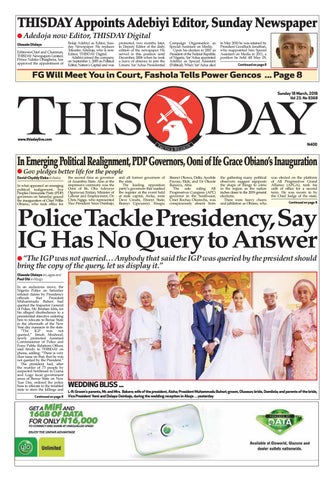
THISDAY Appoints Adebiyi Editor, Sunday Newspaper Adedoja now Editor, THISDAY Digital Olawale Olaleye Editor-in-Chief and Chairman, THISDAY Newspapers Limited, Prince Nduka Obaigbena, has approved the appointment of
Bolaji Adebiyi as Editor, Sunday Newspaper. He replaces Tokunbo Adedoja, who is now Editor, THISDAY Digital. Adebiyi joined the company on September 1, 2005 as Political Editor, Nation’s Capital and was
promoted, two months later, to Deputy Editor of the daily edition of the newspaper. He served in this position until December, 2006 when he took a leave of absence to join the Umaru Yar’Adua Presidential
Campaign Organisation as Special Assistant on Media. Upon his election in 2007 as President of the Federal Republic of Nigeria, Yar’Adua appointed Adebiyi as Special Assistant (Political). When Yar’Adua died
in May 2010 he was retained by President Goodluck Jonathan, who reappointed him Special Assistant on Media in 2011, a position he held till May 29, Continued on page 8
FG Will Meet You in Court, Fashola Tells Power Gencos ... Page 8 Sunday 18 March, 2018 Vol 23. No 8368
www.thisdaylive.com TR
UT H
& RE A S O
N400
N
In Emerging Political Realignment, PDP Governors, Ooni of Ife Grace Obiano’s Inauguration Gov pledges better life for the people David-Chyddy Eleke in Awka In what appeared an emerging political realignment, five Peoples Democratic Party (PDP) governors on Saturday graced the inauguration of Chief Willie Obiano, who took office for
the second time as governor of Anambra State. Also at the impressive ceremony was the Ooni of Ife, Oba Adeyeye Ogunwusi Enitan; Minister of Labour and Employment, Dr. Chris Ngige, who represented Vice President Yemi Osinbajo;
and all former governors of the state. The leading opposition party’s governors that marked the register at the event held at state capital, Awka, were Dave Umahi, Ebonyi State; Ifeanyi Ugwuanyi, Enugu;
Ifeanyi Okowa, Delta; Ayodele Fayose, Ekiti; and Dr Okezie Ikpeazu, Abia. The sole ruling All Progressives Congress (APC) governor in the South-east, Chief Rochas Okorocha, was conspicuously absent from
the gathering many political observers suggest signposts the shape of things to come in the region as the nation inches closer to the 2019 general elections. There were heavy cheers and jubilation as Obiano, who
was elected on the platform of All Progressives Grand Alliance (APGA), took his oath of office for a second term. He was sworn in by the Chief Judge of the state, Continued on page 8
Police Tackle Presidency, Say IG Has No Query to Answer “The IGP was not queried… Anybody that said the IGP was queried by the president should bring the copy of the query, let us display it.” Olawale Olaleye in Lagos and Paul Obi in Abuja In an audacious move, the Nigeria Police on Saturday refuted claims by Presidency officials that President Muhammadu Buhari had queried the Inspector General of Police, Mr. Ibrahim Idris, for his alleged disobedience to a presidential directive ordering him to relocate to Benue State in the aftermath of the New Year day massacre in the state. “The IGP was not queried,” Jimoh Moshood, newly promoted Assistant Commissioner of Police and Force Public Relations Officer, said firmly to THISDAY on phone, adding: “There is very clear issue on that, that he was not queried by the President.” The president had, after the murder of 73 people by suspected herdsmen in Guma and Logo local government areas of Benue State on New Year Day, ordered the police boss to relocate to the troubled state to stem the killings and Continued on page 8
WEDDING BLISS ... L-R: Groom’s parents, Mr. and Mrs. Bakare; wife of the president, Aisha; President Muhammadu Buhari; groom, Oluseun; bride, Damilola; and parents of the bride, Vice President Yemi and Dolapo Osinbajo, during the wedding reception in Abuja …yesterday
2
T H I S D AY ˾ ͯͶ˜ ͰͮͯͶ
T H I S D AY ˾ SUNDAY MARCH 18, 2018
3
4
T H I S D AY ˾ ͯͶ˜ ͰͮͯͶ
T H I S D AY ˾ SUNDAY MARCH 18, 2018
5
6
T H I S D AY ˾ ͯͶ˜ ͰͮͯͶ
T H I S D AY ˾ SUNDAY MARCH 18, 2018
7
8
͚΀˜ ͺ͸͚΀ Ëž T H I S DAY, T H E S U N DAY N E W S PA P E R
PAGE EIGHT
FG Will MeetYou in Court, Fashola Tells Power Gencos
Says they misconceived their rights in NBET’s N701bn facility Expects substantive chair for NERC to be sworn in soon REA, US institute to drive down cost of mini grid power to $0.20/kWh
Chineme Okafor in Abuja Power generation companies (Gencos) in the country that filed a lawsuit against the federal government at a Federal High Court Abuja Division, on claims of poor operational treatments as well as complaints about the management of the N701 billion payment assurance facility of the Nigerian Bulk Electricity Trading Plc (NBET), do not understand the rights they have in the facility, the Minister of Power, Works and Housing, Mr. Babatunde Fashola, has said. Speaking in a CNBC Television, a business cable channel, programme, which THISDAY monitored at the weekend in Abuja, Fashola explained that it was within the rights of the Gencos to approach the court to get justice on their complaints. He said the federal government was ready to meet the Gencos in court for the resolution of the dispute. Fashola, however, maintained that the government would not tolerate attempts to politicise the existing disagreement, especially as the 2019 elections approach. He had initially claimed that the government got security reports of clandestine meetings of the Gencos, perhaps, to
disrupt power generation in the country. But in the CNBC interview, Fashola said: “They (Gencos) have issues about payment to another investor who has a different contract from theirs. They have a misapprehension about the kind of rights they have under the payment assurance guarantee, and they have sought redress in court after meeting with me and after giving them assurances that I will escalate their demands to the authorities and institutions of government that would review them. “Their contractual matters, for example, don’t reside in this ministry; they reside with the National Council on Privatisation and the BPE. I can’t act without their advice. So, within a week after we left that meeting with all of the positive assurances, they go to court, which is fine. That is conflict resolution, that is democracy and that is the rule of law.� He further stated: “I take my time to decide what words to use and when I use them I take ownership of them, but you cannot dismiss those things from the system. And, that is why I am sounding a notice loud and clear that I am conscious of what is going on.
“Those who think that this is a season to play games because it might have political capital should know that we are mindful. We think that politics can be played differently, we want to raise the quality of the debate around our governance issues.� The minister also disclosed that the government would soon appoint a substantive chairman for the Nigerian Electricity Regulatory Commission (NERC) after several years of being without one. According to him, the Senate had screened a chairman designate for the NERC. He, however, did not disclose the name of the candidate, but the last nominee of President Muhammadu Buhari to the post was James Momoh, a professor of electrical engineering and computer science at Howard University, US. Momoh was nominated by Buhari after Prof. Akintunde Akinwande, from the Massachusetts Institute of Technology (MIT), rejected his appointment. Since then NERC has operated without a substantive chair but with six commissioners. However, a reliable Senate source told THISDAY on Saturday that the upper chamber had not screened
any nominee for the position of NERC chairman, saying no legislative approval would be given for the position until its rift with the executive over Acting Chairman of Economic and Financial Crimes Commission (EFCC), Mr. Ibrahim Magu, is resolved. Speaking on the Power Sector Recovery Programme (PSRP), Fashola said: “The Power Sector Recovery Programme was something we worked with the World Bank on and their views were that it was much more far-reaching, what we had proposed, than what they were going to recommend to us. Because of that they were going to work with us in terms of getting funding supports, not only for the public sector arm but private sector arm. “You will see that they recently approved a $486 million facility for transmission expansion. A mission of the bank also just concluded another assessment for the $1 billion, and one of the governance issues that was, perhaps, expected to be crossed is now likely going to happen, which is the full reconstitution of the board of NERC with a substantive rather than an acting chairman, with the senate screening that took place today. So, touch wood,
all of the ducts are lined up in the right direction.� In a related development, Rural Electrification Agency (REA) and Rocky Mountain Institute (RMI) of the United States have disclosed that they would release a first-of-its-kind, three-year roadmap on how to get electricity to Nigerians and Africans using mini grid solutions at $0.20 per kilowatt hour (kWh) by 2020. REA and RMI stated this in a statement that emanated from a recent workshop they held in this regard with operators and financiers in mini grid power from across the world. According to them, the roadmap will outline how much capital is required and a plan for transitioning funding from grants and high-risk concessional and government sources to venture capital and private equity. They explained that more than 50 industry leaders and experts were at the workshop, which focused on delivering a profitable and scalable mini grid market business model. At the workshop, they said market solutions centred on six key opportunity areas, which include grid-in-abox hardware, better load management, effective customer
engagement, efficient project development and operations and maintenance, affordable finance and supportive policy. The statement also quoted billionaire businessman and founder of the Virgin Group, Sir Richard Branson, to have said at the workshop: “Nigeria has all the right drivers to become a leader in the mini grid market in Africa: great entrepreneurial tradition, a large self-employed population and market size. I’m looking forward to seeing how entrepreneurs in Nigeria leverage this opportunity over the next few years.� Similarly, Managing Director of REA, Mrs. Damilola Ogunbiyi, said in the statement: “The electricity market for offgrid energy in Nigeria is huge and profitable for developers. Installing 1,000 mini grids each year for the next 10 years would provide power to millions of Nigerians currently off-grid.� It equally quoted the Chief Executive Officer of RMI, Jules Kortenhorst, to have said: “I am excited and optimistic about cracking the mini grid challenge in Nigeria. Nigeria is blessed with some of the region’s most amazing entrepreneurs. We urge venture capitalists and impact investors from around the world to get involved with us.�
Buhari, Saraki, Others Mourn as Wakili Dies Omololu Ogunmade, Damilola Oyedele, James Emejo in Abuja, and Segun Awofadeji in Bauchi President Muhammadu Buhari has mourned the loss of a leader of inestimable value to “Nigeria's democracy whose dedication to duty was remarkable and worthy of emulation� following the death of Senator Ali Wakili. In a statement yesterday by Senior Special Assistant to the President on Media and Publicity, Malam Garba Shehu, Buhari said news of the death of Wakili came to him as a great shock. The president said the late senator’s dedication to duty was one of the greatest virtues for which he would be remembered.
The statement said, “The passion for duty was one of the finest qualities of late Senator Wakili,� urging other democratically elected leaders to borrow a leaf from the deceased's record of dedication. "The president, while praying to Allah to bless the soul of the departed senator, also extended his condolences to his family, his colleagues in the National Assembly, as well as the government and people of Bauchi State over this great loss to the country," the statement added. Wakili, 58, who was senator for Bauchi South, had slumped at his Gwarinpa Estate residence, in Abuja, in the early hours of Saturday. He was rushed to a hospital within the estate, but
reportedly died before getting to the hospital. He was buried yesterday in Abuja according to Islamic rites. Wakili was until his death Chairman of the Senate Committee on Poverty Alleviation. Among early callers to his residence were Senate President Bukola Saraki and Speaker of the House of Representatives, Hon. Yakubu Dogara, both of whom expressed shock at the senator’s death. They were accompanied by Leader of the Senate, Senator Ahmad Lawan, Senator Hamman Misau, and wife of the Senate President, Mrs. Toyin Saraki, among others. Saraki, in a statement, said Wakili was a vibrant lawmaker and a public servant who
was very passionate about his assignment and engagements in the Senate. "Mallam Ali Wakili is one lawmaker you can never be in doubt where he stands on a particular issue. He spoke his mind fearlessly. His contributions at plenary were always very incisive and rich. I find it difficult to acknowledge that he will not resume plenary with us next Tuesday," Saraki stated. The senate president sent his condolences to Wakili’s family, the Senate, and the government and people of Bauchi State. “He shall be sorely missed,� Saraki added. A statement by Dogara’s special adviser on media and publicity, Mr. Hassan Turaki, quoted the speaker as saying,
“The death of Sen. Ali Wakili is a personal loss to me. I'm short of words to describe how devastated and heartbroken I am over the passing away of this true friend, brother and confidant, with whom I had excellent brotherly relationship and association. "We have indeed lost a distinguished parliamentarian, easy going and courageous person who had worked tirelessly both in the Senate chamber and outside to defend the interest of his constituents, Bauchi State, and the downtrodden members of the society in the country at large. "Within his short but eventful sojourn in the National Assembly, Sen. Wakili had distinguished himself with
his characteristic display of patriotism, forthrightness and logical skills during debates and other legislative duties." Dogara, who is also from Bauchi State, stated, “We in Bauchi State and, in particular, Bauchi South Senatorial District, have lost a worthy ambassador and a distinguished gentleman. But we'll take solace in the fact that his humanitarian services and other accomplishments will continue to be a source of inspiration to us all. "Our deep condolences go to his immediate family, constituents, the people of Bauchi State and the nation at large over this irreparable loss."
Many Nigerians had also called on the president to sack the IGP following the revelation. Last Tuesday, Idris was an early morning caller at the Presidential Villa, Abuja, where presidential spokespersons said he was queried over his alleged disobedience to the presidential order to relocate to Benue State. “Pres @MBuhari today summoned the Inspector-
General of Police to explain his flouting of the presidential order to remain in Benue State. The President has also asked for a comprehensive report on Police Operations in the affected States, after which further decisions will be made. We would like to restate our determination to ensure that the attacks and killings are brought to an end, and perpetrators brought to justice,� an official twitter handle of the president read. Relying on this twit many Nigerians believed that the IGP had been queried and that he was preparing his response. However, on Saturday when THISDAY asked the police
spokesperson for an update on the presumed query, he rebutted the claim. "Anybody that said the IGP was queried by the president should bring the copy of the query, let us display it," Moshood said. He argued that those speculating that the IGP had been queried by the president were angling to cause disharmony and disaffection, with the intension to distort facts. Moshood told THISDAY that since the presidential visit to the state, security of lives and property of the people had improved.
Read the concluding part on www.thisdaylive.com
POLICE TACKLE PRESIDENCY, SAY IG HAS NO QUERY TO ANSWER bring the tense situation under control. But the president was told by the Benue State Governor, Dr. Samuel Ortom, and elders of the state during his condolence visit to Makurdi, the state capital, last week, that the police boss disobeyed his directive, saying Idris never spent a night in the state. Rather, the IGP was said to
have spent only a day in Benue, relocating to neighbouring Nasarawa State, from where he subsequently returned to Abuja. “I did not know that the IG did not stay in the state. I am getting to know this at this meeting. I am quite surprised,� a visibly embarrassed Buhari told his distraught hosts, who were on the boil for what
they called less than caring attitude of the president that was visiting the state more than two months after the incident. Buhari’s comment attracted severe criticisms from many Nigerians who felt that the president was not in charge of his responsibilities, giving room for the disobedience of his orders by his appointees, like the IGP.
IN EMERGING POLITICAL REALIGNMENT, PDP GOVERNORS, OONI OF IFE GRACE OBIANO’S INAUGURATION Justice Peter Umeadi, at 1pm amidst jubilation by citizens of the state who thronged the Alex Ekwueme Square venue of the inauguration in their numbers. Obiano's deputy, Dr Nkem Okeke, had earlier been sworn in at 12:45pm. Obiano's inauguration was heralded by a 21-gun salute and was followed by tumultuous shouts of Akpokuedike, his traditional title. The venue for the event was packed full with people from all parts of the state, and across Nigeria, with several dignitaries witnessing it. In his address tagged: “A consolidation of excellence,� Obiano acknowledged that a
huge task had been entrusted on him by the people of the state, and promised not to fail the people. He said: "I am fully aware of the weight of the history you placed on my shoulders with the landslide victory we recorded on November 18, 2017. I understand your hopes and expectations and I will never let you down. "Our administration has established the basis for hope. We have announced a new season of excellence. We owe it to ourselves to be greater than those who came before us. Ndi Anambra together, we shall carve out a future that posterity will be proud of."
The governor promised that the next four years would witness a bold effort to lend roots to the great progress his government had made in the past four years. He said: "We shall tighten the screws on our security architecture to ensure that Anambra remains Nigeria’s safest state. We shall install ultramodern CCTV cameras in strategic locations across the state to give us a new advantage in crime detection. "We shall drive hard reforms in the education sector to retain our position at the top and make education accessible to everyone to ensure that no child is left behind in our dear state.
"We shall build a state-ofthe-art teaching hospital in each of the three senatorial zones to deepen our reforms in the health sector and initiate a medical scheme for people above 75 years of age. Major roads in Onitsha, Nnewi and Awka shall be dualised to ease traffic congestion and boost the aesthetic appeal of our cities." Activities marking the inauguration commenced on Friday with a business roundtable convened with business partners and donor agencies of the state. The event continues today with a thanksgiving ceremony, which holds at St Patrick's Catholic Cathedral, Awka.
THISDAY APPOINTS ADEBIYI EDITOR, SUNDAY NEWSPAPER 2015. He returned to THISDAY on November 1, 2015 and was assigned the position of Deputy Editor of the daily newspaper with additional responsibility as member, Editorial Board. Educated in Nigeria and the United Kingdom, Adebiyi has a Masters of Art degree in History (Obafemi Awolowo University, Ile-Ife), a Post Graduate Diploma (Nigerian Institute of Journal-
ism, Lagos) and an Advanced Diploma (The Thompson Foundation, Cardiff, UK as a British Chevening Scholar) in Journalism. He comes to his new job with 27 years of practice experience in the Northern and Southern spheres of Nigeria’s journalism, having worked at various times with Newbreed Magazine, Lagos; Citizen Magazine, Kaduna; and The Punch, Lagos.
T H I S D AY, T H E S U N D AY N E W S PA P E R ˾ MARCH 18, 2018
9
SUNDAY COMMENT
Editor, Editorial Page PETER ISHAKA Email peter.ishaka@thisdaylive.com
BEYOND THE NASU STRIKE SUSPENSION Frequent strikes have very damaging impact on academic pursuits
W
ith more than half the current academic session gone, the non-teaching staff of Nigerian universities operating under three unions, namely, the Non Academic Staff Union of Universities (NASU), Senior Staff Association of Nigerian Universities (SSANU) and National Association of Academic Technologists (NAAT) finally announced the suspension of their strike last week. The decision followed a commitment by the federal government to source for about N8 billion to settle some of the financial claims within the next five weeks, after acceding to the unions’ demand that no worker will be victimised on account of taking part in the strike. The strike had been temporarily suspended last September before it resumed in December with the students bearing the brunt of the endless disruptions on their campuses. Yet, as we stated in an earlier editorial, it is a measure of what education has become in our country today that while the strike lasted, many Nigerians were not even aware that administrative activities, including admissions of new entrants, had been suspended in all federal universities cumulatively for more than four months under the current 2017/2018 academic session. The frequent bursts of strikes that have become a routine weapon by university staffers to force the hands of the federal authorities have done incalculable damage to tertiary education in the country. But with all manner of unwhole-
some practices becoming the order of the day in many of these institutions of higher learning, it is difficult to predict an end to the incessant campus unrest. “We shall not hesitate to resume the strike if government reneges on the agreements reached or delays in any aspects,” vowed SSSANU President, Samson Ugwoke, while giving an update on the Memorandum of Understanding (MoU) signed by the Joint Action Committee (JAC) with government’s negotiation.
T
The hurried academic calendars following the end of industrial actions allow for very little attention to serious studies. These have contributed significantly to the decline in the quality of graduates of our public universities
Letters to the Editor
S U N DAY N E W S PA P E R EDITOR BOLAJI ADEBIYI DEPUTY EDITORS VINCENT OBIA, OLAWALE OLALEYE MANAGING DIRECR ENIOLA BELLO DEPUTY MANAGING DIRECTOR KAYODE KOMOLAFE CHAIRMAN EDITORIAL BOARD OLUSEGUN ADENIYI EDITOR NATION’S CAPITAL IYOBOSA UWUGIAREN
T H I S DAY N E W S PA P E R S L I M I T E D EDITOR-IN-CHIEF/CHAIRMAN NDUKA OBAIGBENA GROUP EXECUTIVE DIRECTORS ENIOLA BELLO, KAYODE KOMOLAFE, ISRAEL IWEGBU, IJEOMA NWOGWUGWU DIVISIONAL DIRECTORS PETER IWEGBU, ANTHONY OGEDENGBE DEPUTY DIVISIONAL DIRECTOR OJOGUN VICTOR DANBOYI SNR. ASSOCIATE DIRECTORS ERIC OJEH, PATRICK EIMIUHI ASSOCIATE DIRECTOR SAHEED ADEYEMO CONTROLLERS ABIMBOLA TAIWO, UCHENNA DIBIAGWU, NDUKA MOSERI DIRECTOR, PRINTING PRODUCTION CHUKS ONWUDINJO TO SEND EMAIL: first name.surname@thisdaylive.com
he main contention is the N23 billion released last year to 24 federal universities, being the amount owed the lecturers as Earned Academic Allowance (EAA) for 2009 and 2010, a concession granted after the last Academic Staff Union of Universities (ASUU) strike. While the academic staff received N18.4 billion, representing 89 per cent of the total sum, the three nonacademic unions were allocated N4.6 billion which amounted to 11 per cent of the money. It is the disparity in the distribution that has been causing the problem. But since the money was for academic allowances, we have always considered the position of these non-academic unions untenable. What makes the situation particularly unfortunate is that students in public-owned tertiary institutions are now caught in what amounts to a rivalry between academic and non-academic staff. The consequences have been a situation where these unions alternate strikes, with the attendant debilitating effects on academic pursuits on our campuses. The hurried academic calendars following the end of industrial actions allow for very little attention to serious studies. These have contributed significantly to the decline in the quality of graduates of our public universities. However, we cannot shy away from the fact that the underfunding of the education sector, over the years, has had collateral damaging effects on the country, such that our universities have now become grotesque carcasses of their former selves. The weak financial conditions in the universities are exacerbated by the current crippling economic crisis afflicting the nation. Yet besides personnel costs, funds are required to rehabilitate dilapidated facilities, purchase consumables and research capability. While dealing with the challenge of thin liquidity requires more than seasonal strikes by both the academic and non-academic staff, the federal government must also understand the primacy of constant dialogue, especially given the current realities.
TO OUR READERS Letters in response to specific publications in THISDAY should be brief (150-200 words) and straight to the point. Interested readers may send such letters along with their contact details to opinion@thisdaylive.com. We also welcome comments and opinions on topical local, national and international issues provided they are well-written and should also not be longer than (950- 1000 words). They should be sent to opinion@thisdaylive.com along with the email address and phone numbers of the writer.
Oil Theft And Kidnapping In Calabar
I
am constrained to write this multi-faceted piece following the increasing rate of oil theft, hard drugs intake and strings of kidnappings in Calabar. Over the years, Calabar had carved a niche for itself as a crime-free city. It was once described as “come and live and be at rest”. The peaceful nature of the city made Calabar the safest destination for business and leisure, becoming the home for people with diverse culture. This placed us in high pedestal and made Calabar the preferred
tourism hub. All these happened when patriots were in control of the affairs of government. Unfortunately, all these are no more! There has been an upsurge of nefarious activities because wrong persons have found themselves in an unlikely places of power. Some see their appointmenst as a licence for unwholesome practices. Activities like illegal oil bunkering and sales of hard drugs have become a pastime. It is worthy of note that illegal oil bunkering and hard drugs intake have
assumed a frightening dimension in Calabar. They have significant economic, social, environmental, governance and security implications, contributing to poverty and degradation of the region. Despite efforts to curtail these activities, they persist. This is because security officials and politicians in the state are benefiting from the exercise. Little wonder those arrested had never been prosecuted. They regain their freedom and find their way back to continue their activities, giving credence to the suggestion that
those behind it have strong backing from the top. From oil theft and hard drugs, these criminals have upped their deadly trade to kidnapping. The kidnappers come through the creeks of Calabar South (Ibesikpo Street, Jebs Road, Anantigha Road), where the oil bunkering and sales of hard drugs is done. It is common place that over 30 people have been kidnapped and being extorted of ransom running into several millions of naira. Several businessmen, civil and public servants are victims. Medical doctors in the state under the auspices of Nigeria Medical
Association (NMA) had to down their tools over the kidnap of their colleague. The commissioner for water resources was kidnapped and later released after payment of a ransom. As I am writing this, the wife of the member representing Yakurr 1 in the Cross River House of Assembly has been abducted by these criminals. It is a thing of concern to everyone as people cannot go about their lawful businesses with peace of mind and do not sleep with both eyes closed. This is a time bomb that must be checked. ––Archibong Ene, Calabar
10
T H I S D AY, T H E S U N D AY N E W S PA P E R Ëž ARCH 18, 2018
SUNDAYNEWS
News Editor Abimbola Akosile E-mail: abimbola.akosile@thisdaylive.com, 08114495306 (sms only)
Buhari Abruptly Cancels Trip to AU Meeting in Rwanda t Congratulates Jinping on China re-election Omololu Ogunmade in Abuja
President Muhammadu Buhari yesterday abruptly cancelled his scheduled trip to Kigali, Rwanda on Monday where he had been billed to join other African leaders to sign the Continental Free Trade Area (CFTA) agreement on Wednesday in pursuit of the African Union (AU) 2063 vision. Therewasnoofficialinformationonthereasonforthecancellationyesterdayassomemembers
of the president’s advance team had already arrived Kigali before the cancellation while others were yet at the Nnamdi Azikiwe International Airport wheninformationonthecancellation got to them. Confirming the cancellation lastnight,amemberofthesecond team told THISDAY that he was just alighting in his house from the vehicle which conveyed him from the airport. According to him,theyweresuddenlyrecalled
from the airport without any reason. “I’m just coming down from thevehiclethatbroughtmefrom the airport.Noreason was given yet for the cancellation,� he said. The sudden cancellation looked shocking in view of the celebration of the planned trip bytheFederalExecutiveCouncil (FEC) on Wednesday. TheMinisterofIndustry,Trade andInvestment,Dr.Okechukwu Enelamah, while briefing jour-
nalists in the State House, had said FEC approved in its meeting of Wednesday that Nigeria shouldsigntheagreement,pointing out that the president would be in Kigali on Wednesday to sign the agreement. He also said FEC resolved that Nigeria should bid for the locationofthesecretariatofCFTA in view of Nigeria’s outstanding roles during the negotiation process. “In terms of what was approved in council today, the council approved for Nigeria to sign that agreement establish-
ing CFTA in Kigali on March 21 which will be signed by our president at an extraordinary session of the AU. It also approved for Nigeria to express an interest in preparing a bid to host the secretariat where the work will be done. “Nigeria has played a leadership role in the negotiations. Our chief negotiator and directorgeneral of the Nigerian office for trade negotiations was the chairperson of the negotiating technical team. “AlsotheAfricanMinistersfor Trade and Group was chaired by myself and so, if they played a leading role in this negotiation, wefeelthatitisbettertoleadthan to follow. Therefore, we also got anapprovaltoexpressaninterest inthesecretariatofCFTA,thatthe headquarters be located in Nigeria. Obviously, we are expecting it to be a competitive process but Nigeria will be interested. “We also got an approval for the Nigerian office for trade negotiations along ministries, departments and agencies (MDAs) and the private sector to worktogetherandcontinuewith the next stage of the negotiation. ThefirststageistheoverallframeworkestablishingCFTA.Thenext is the protocol on trade in goods
and associated annexes; also a protocol on trade in services and finally, the protocol on rules and procedures for the settlement of disputes,� Enelamah said. Meanwhile, President Muhammadu Buhari yesterday in Abuja congratulated Chinese President Xi Jinping on his reelection as the President of the Peoples Republic of China. Thepresident,accordingtohis mediaadviser,personallysigned a letter addressed to the Chinese president, praising him for his wisdom and vision. “OnbehalfoftheGovernment andpeopleoftheFederalRepublic of Nigeria, I congratulate you mostsincerelyonyourre-election as the President of the Peoples Republic of China. “Your re-election is an indication of the trust and confidence reposed in you by the people of China on your ability to bring your vision and wisdom to bear in the conduct of national and global affairs,� he said in the letter. ThestatementalsosaidBuhari stated that he looked forward to increased cooperation between China and Nigeria on one hand and China and Africa on the other hand.
RCCG Bridegroom Area ‘Re-Lighting Egbeda
HONOURING OSINBAJO L-R: Former Governor of Ekiti State, Otunba Niyi Adebayo; and his Ogun State counterpart, Chief Olusegun Osoba, at the wedding ceremony of the daughter of Vice President Yemi Osinbajo, (SAN) in Abuja...yesterday
The Redeemed Christian Church of God, Bridegroom Area, OkunolaEgbeda,LagosProvince12,presents“Re-LightingEgbeda,â€?atwo-day crusade with the theme, “Destroying Satanic Investment,â€? on Friday, Ă‹ĂœĂ?Ă’ Í°Íą Ă‹Ă˜ĂŽ Ă‹ĂžĂ&#x;ĂœĂŽĂ‹ĂŁËœ Ă‹ĂœĂ?Ă’ ͰͲ˛ Ă’Ă? Ă Ă?Ă˜Ă&#x;Ă? Ă“Ă? Ă—Ă&#x;Ă– Ă“Ă–Ă“Ă˜Ă‘ ĂžĂ‹ĂžĂ“Ă™Ă˜Ëœ Opposite Rauf Aregbesola Flagship Primary Health Centre, Okunola Road,Egbeda,AlimoshoLocalGovernmentArea.Theprogrammestarts ͲÚ× Ă?Ă‹Ă?Ă’ ĂŽĂ‹ĂŁËœ åÓÞÒ Ă?ĂœĂ?Ă? Ă—Ă?ĂŽĂ“Ă?Ă‹Ă– Ă?Ă?ĂœĂ Ă“Ă?Ă?Ă? Ă™Ă˜ Ă‹ĂžĂ&#x;ĂœĂŽĂ‹ĂŁ Ă—Ă™ĂœĂ˜Ă“Ă˜Ă‘ Ă?ĂœĂ™Ă— ͡Ëײ Pastor-in-Charge of the Area, Pastor Sanmi Oluwamuyiwa, and other anointed men of God will be ministering at the crusade. Highlights of the programme include word ministration, praise /worship, salvation ofsouls,welfareservices,andfreedispensationofdrugs.
Electoral Act: Saraki Denies Reports of Conflict with Dogara Damilola Oyedele in Abuja
President Muhammadu Buhari yesterday abruptly cancelled his scheduled trip to Kigali, Rwanda on Monday where he had been billed to join other African leaders to sign the Continental Free Trade Area (CFTA) agreement on Wednesday in pursuit of the African Union (AU) 2063 vision. Therewasnoofficialinformationonthereasonforthecancellationyesterdayassomemembersof thepresident’sadvanceteamhad already arrived Kigali before the cancellationwhileotherswereyet at the Nnamdi Azikiwe InternationalAirportwheninformation
on the cancellation got to them. Confirming the cancellation lastnight,amemberofthesecond team told THISDAY that he was justalightinginhishousefromthe vehiclewhichconveyedhimfrom theairport.Accordingtohim,they were suddenlyrecalled fromthe airport without any reason. “I’m just coming down from thevehiclethatbroughtmefrom the airport. Noreasonwasgivenyetforthe cancellation,� he said. Thesuddencancellationlooked shocking in view of the celebration of the planned trip by the FederalExecutiveCouncil(FEC) on Wednesday. The Minister of
Industry, Trade and Investment, Dr.OkechukwuEnelamah,while briefing journalists in the State House, had said FEC approved in its meeting of Wednesday that Nigeria should sign the agreement, pointing out that the president would be in Kigali on Wednesdaytosigntheagreement. He also said FEC resolved that Nigeria should bid for the location of the secretariat of CFTA in viewofNigeria’soutstandingroles during the negotiation process. “Intermsofwhatwasapproved in council today, the council approved for Nigeria to sign that agreement establishing CFTA in Kigali on March 21 which
Babalola: It is Wicked, Callous for Govs to Owe Salaries, Pensions Victor Ogunje in Ado Ekiti
Renowned Lawyer, Chief Afe Babalola (SAN) has described as irresponsible and callous a situation whereby Nigerians are committing suicide on daily basis due to unpaid salaries and pensions of retirees. Babalola, who absolved President Muhammadu Buhari of the orgy of killings bedeviling the nation, blamed the military for throwing the country into confusion by involving itself in governance. He said the Military took over
government in 1966, which usheredinalopsidedunitarysystem inthecountryandabrogatedthe regional system, which was responsible for the unwholesome scenariosplayingoutinthefacets of herdsmen killings and Boko Haram insurgency. Babalola disclosed this in his institution, Afe Babalola University, Ado Ekiti (ABUAD) weekendwhilebeinghonoured by the Northern Youth Council of Nigeria (NYCN). Thereveredlawyerwasdecorated with the Sir Ahmadu Bello PlatinumAwardasthe‘TheIcon
of Greater Nigeria’ and Garkuwan Matasan Arewa Najeriya by the youth group. Babalola expressed regret at how Nigerians were dying due toleadershipfailure,particularly the civil servants and pensioners due to non-payment of their entitlements. “Many pensioners have died having been owed several years of pension arrears. Even those in the service were owed seven or eight months salary arrears, so just like I said earlier, our leaders have turned us into beggars�, he lamented.
will be signed by our president atanextraordinarysessionofthe AU.ItalsoapprovedforNigeriato expressaninterestinpreparinga bid to host the secretariat where the work will be done. “Nigeria has played a leadership role in the negotiations. Our chief negotiator and directorgeneral of the Nigerian office for trade negotiations was the chairperson of the negotiating technical team. “AlsotheAfricanMinistersfor Trade and Group was chaired by myself and so, if they played a leading role in this negotiation, wefeelthatitisbettertoleadthan tofollow.Therefore,wealsogotan
approvaltoexpressaninterestin the secretariat of CFTA, that the headquartersbelocatedinNigeria. Obviously,weareexpectingittobe acompetitiveprocessbutNigeria will be interested. “We also got an approval for the Nigerian office for trade negotiations along ministries, departments and agencies (MDAs) and the private sector to work together and continue withthenextstageofthenegotiation. The first stage is the overall framework establishing CFTA. The next is the protocol on trade ingoodsandassociatedannexes; alsoaprotocolontradeinservices and finally, the protocol on rules
andproceduresforthesettlement of disputes,� Enelamah said. Meanwhile,PresidentMuhammaduBuhariyesterdayinAbuja congratulatedChinesePresident XiJinpingonhisre-electionasthe PresidentofthePeoplesRepublic of China. The president, according to his media adviser, personally signed a letter addressed to the Chinese president, praising him for his wisdom and vision. “OnbehalfoftheGovernment andpeopleoftheFederalRepublic ofNigeria,Icongratulateyoumost sincerelyonyourre-electionasthe PresidentofthePeoplesRepublic of China.
UN Deputy Scribe, Mohammed, Visits Nigeria for Talks with Buhari, Others Abimbola Akosile
The UN Deputy SecretaryGeneral, Ms Amina Mohammed, would this week visit Nigeria where she is expected to hold talks with President Muhammadu Buhari and other top government functionaries. According to a UN release, “On 23 March, she will travel to Nigeria for consultations with senior Government officials and other stakeholders in Lagos and Abuja.� The UN deputy chief is also
billed to travel to Switzerland, Liberia, Czech Republic and Mauritania, during the official visits. She would depart New York over the weekend for Geneva, to participate in the meeting of the International Labour Organisation Governing Board and the World Summit for Information Society Forum. Mohammed would also hold consultations with UN entities on the implementation of the Sustainable Development Goals (SDGs).
On Wednesday, she would proceed to Monrovia, to participate in the event to celebrate the successful completion of the UN Mission in Liberia’s mandate. She would also participate in the National Reconciliation Conference and the High-level Meeting on the national development agenda for 2018 to 2024. While in Liberia, the deputy secretary-general would also meet senior Government officials, development partners and the UN Country Team.
T H I S D AY ˾ SUNDAY MARCH 18, 2018
11
12
T H I S D AY, T H E S U N D AY N E W S PA P E R Ëž ͚΀˜ ͺ͸͚΀
NEWS Undergraduate, Four Others Killed in Edo, Several Hospitalised as Herdsmen Attack Two Communities t Killings bad omen, says Shehu Sani t Bello sets up commission of enquiry t Anglican Bishops kick Adibe Emenyonu in Benin City, Ademola Babalola in Ibadan, Yekini Jimoh in Lokoja and Segun Awofadeji in Gombe Five persons including a first year student of the Ambrose Alli University Ekpoma, Edo state, Collins Ojeriakhi, have been reported killed in two separate
attacks by suspected herdsmen in Ugboha, Esan South East Local, and Odiguete Ovia North East Local Government Areas of Edo state. Besides, 12 persons are currently hospitalised at the Benin Central Hospital and other private hospitals as a result of the attacks by the herdsmen.
The incident at Ugboha, THISDAY was told, occurred Friday night at about 7:30 pm when the deceased Collins and his friends were on their way back to the village from Uromi. Father of the deceased, Mr. Festus Ojeriakhi, while narrating the incident said: “I am just confused. I was actually in the
house easting at about 8pm and I started asking about my son who was not there. I was told he went to Uromi with his friends on a motorcycle. “It was around 9pm that the mother of my son´s friend started shouting, crying that herdsmen have killed her son. I rushed out of the house and I
asked about my own son. I was told he died too with his friend. “We immediately detailed boys and ran to the place. When we got there we were told that the police have come to take the corpse to Ubiaja mortuary. I was told my son and two others including the friend died. They said the other person that died is
ENDORSEMENT FORUM Governor Ifeanyi Ugwuanyi of Enugu State (2nd left); his deputy, Mrs. Cecilia Ezeilo (left); State Chairman of the Peoples Democratic Party (PDP), Hon. Augustine Nnamani (2nd right); Chief of Sta to the Governor, Dr. Festus Uzor (right); Chairman of Ezeagu Local Government Area, Hon Chukwudi Ezinwa, (3rd right); and his wife, Ifeoma; during a civic reception and second term endorsement for the governor by Gburugburu Movement Ezeagu L.G.A...yesterday
an Igbo person. “The information we heard was that as my son was driving home with his Okada, the herdsmen and their cattle blocked the road and they waited for them to leave the road. Immediately they passed, some of their people in the bush opened fire on my son and his friends and they died at the spot. “I have been to the Area Commander’s office and they said they are investigating the matter. I don’t know what to do. This is a young boy that just entered university�, he lamented. The killing at Odiguete community in Ovia North East, as learnt, happened early morning Saturday, when the herdsmen invaded the community, shooting sporadically and in the process killed two persons. It was gathered that the community and the herdsmen have been having a running battle in the area for some time now. However, some of the wounded persons were said to have been admitted at the Benin Central hospital while the bodies of the two dead persons have been deposited at an undisclosed mortuary. When contacted, the Edo State Commissioner of Police, Johnson Babatunde Kokumo could not answer his phone. (See concluding part on www.thisdaylive.com)
Africa’s Only Female President, Gurib-Fakim of Mauritius Resigns amid Credit Card Scandal Abimbola Akosile with Agency report Africa’s only remaining female president Ameenah Gurib-Fakim of Mauritius has resigned, over a credit card scandal, according to her lawyer. Her resignation, which has been speculated, came after the island’s 50th independence anniversary. The move came after the Prime Minister Pravind Jug-
nauth accused Gurib-Fakim of back-pedalling on a promise to quit amid allegations of misconduct, and threatening unspecified actions if she did not step down. The dispute between the two leaders has ratcheted up uncertainty on the Indian Ocean island, which has been politically and economically stable since it gained independence from Britain in 1968, according to reports. The World Bank ranks
the country as the easiest place to do business in Africa. Gurib-Fakim, the country’s first female head of state, on Wednesday denied having any plans to resign and said she was prepared to go to court over allegations she spent money from a charity on a shopping trip. That was just days after Jugnauth said Gurib-Fakim told him during a meeting at State House she planned to step down. “I am shocked – shocked is not
Sterling Bank Takes Financial Literacy to Imo, Hosts 42 Lagos Schools Sterling Bank Plc yesterday took its financial inclusion drive to the next level with the training of over 20,000 secondary school students nationwide to mark the 2018 edition of the Financial Literacy Day. The lender also staged a quiz competition among students from 42 schools in Lagos with winners going home with attractive prizes. The Bank’s Managing Director and Chief Executive Designate, Mr. Abubakar Suleiman led other Executive and senior Management team for the exercise as he taught students of Owerri Girls’ Secondary School, Owerri to the delight of both students and teachers of the school. He also gave out various gift items, in line with the bank’s enriching lives proposition and
renewed commitment to promoting financial literacy among students. Suleiman taught the students the key fundamentals of financial literacy and re-enforcing the need to encourage savings culture among the youths. He noted that the Financial Literacy Day, which is also in line with the lender’s “One Education� initiative, would further consolidate the strategic focus of the Bank on education and commitment to youth empowerment and development. Suleiman explained the Bank took the decision to expand the coverage beyond the scope assigned to it by the CBN to reach out to more students and teach them how to make informed and effective financial decisions from a young age.
This, according to him, would enable them to understand the basic elements of financial management, adding that the Bank had used the opportunity of this year’s programme to impart useful knowledge, discipline and patriotism to the younger generation. He noted that Sterling Bank had remained consistent in providing adequate support for child education by providing materials that could be of help to them in their educational pursuits. Meanwhile, in his address of welcome at the quiz competition in Lagos, the Executive Director, of Sterling Bank in charge of retail and consumer marketing, Mr. Grama Narasimhan, encouraged the participating pupils and students to take the competition seriously.
a strong enough word,� Jugnauth told reporters on Thursday in the capital, Port Louis, in a briefing broadcast by Radio Plus. “It’s an attitude which is damaging to the office of the presidency. It’s a behaviour which does not honour our republic.� “The president of the republic told me that she would resign from office and we agreed on the date of her departure,� Jugnauth told reporters without giving the chosen date. The
interest of the country comes first, and I am proud of Mauritius’s image as a model of living democracy in the world.� He added it would take place before parliament returned at the end of the month. Gurib-Fakim, according to reports, said she “inadvertently� used a payment card issued to her by the Planet Earth Institute in 2016 that was identical to a bank card she already had. After telling the London-based
charity she’d used their card for about US$27,000 of “out-ofpocket expenses�, she immediately reimbursed the institute in addition to other expenses incurred on a PEI trip. “The clash makes a big dent to the reputation of our country as a business friendly and well-managed economy,� said a former governor of the Bank of Mauritius and now an independent political analyst, Dan Maraye.
Passports for Nigerians, Visas for S’Africans Ready in 48 hours, Says Consul General Demola Ojo in Cape Town Nigerians living in South Africa in need of new passports can get them within 48 hours, according to the Nigeria’s Consul General to South Africa, Godwin Adama. South Africans who need visas to visit Nigeria can also get them within the same time frame. Adama revealed this in Cape Town recently when WESGRO - the official tourism, trade and investment promotion agency for Cape Town and the Western Cape - hosted a business to business meeting as part of the activities of the Nigeria - South Africa Chamber of Commerce. The Lagos-based Chamber was in South Africa for a week to help promote trade relations between Africa’s two largest
economies. According to Adama who assumed office a year ago, “One of the issues before now was passports. When I came, I discovered that several Nigerians were agitated and this could lead to conflict because they apply for passports and the application will stay for two to three months without hope of getting the passport.� However, improved consular services at the Nigerian mission in Johannesburg have led to greatly improved relations between both countries. “I can assure you now that a Nigerian that captures biometrics for a passport gets it in 48 hours latest. Those who come from outside Johannesburg get it and go back immediately. This is how it has been for the
past six months and it will be sustained. What I did was to make sure that I have enough booklets from Nigeria to serve their purpose and it is working well.� On the issue of visa for those who want to visit Nigeria, Adama said, “About three months ago, we rolled out our biometric visa capturing processes in Johannesburg because it is more efficient, information is better documented and it helps in security. We are one of the few countries today that do biometric capturing for visa processing. “It has enabled us deliver visa faster to South Africans and other foreigners here who want to visit Nigeria. We capture and issue visas within 48 hours except there are local objections.�
T H I S D AY ˾ SUNDAY MARCH 18, 2018
13
14
ÍŻÍśËœ Í°ÍŽÍŻÍś Ëž THISDAY, THE SUNDAY NEWSPAPER
OPINION Legislators And Their Jumbo Pay It is time to slash the emolument of legislators, argues Ayo Oyoze Baje “Members of the National Assembly have mortgaged the entire life of the average Nigerian by the jumbo pay they picked up from their no good services to the Federal Republic of Nigeria. What ought to have been part-time is being made full time with double pay‌.â€? –––Professor Femi Ajayi, Olabisi Onabanjo University Teaching Hospital
S
enator Shehu Sani’s salvo on how much each member of the Red Chamber smiles to the bank with every blessed month set the tone for the heated debate by concerned Nigerians -on and offline. Sani, who represents Kaduna Central Senatorial District in the National Assembly, had blown off the lid on the long-kept secret of their unjustifiable jumbo pay package. According to him, each Senator fleeces the national till by a whopping sum of N13.5 million monthly as running cost! Add that to the over N750,000 monthly consolidated salary and allowances of each member of the Senate and the painful picture of the gross inequality that pervades Nigeria’s payment structure becomes a little bit clearer. And that is because of some other emoluments by way of contracts and committee sittings that few of us are aware of. Surely, Nigeria cannot tread on this path of profligacy for long, given the high rate of mass poverty, joblessness and misery pitched against the battle cry of the anti-graft war. In fact, the late patriot, Tai Solarin will surely cringe with great shock and revulsion should he wake up now to see what our current politicians have done to the nation’s treasury. What took my interest on Sani’s disclosure was the reaction of not a few Nigerians as if the topic was being raised for the first time. For the records, yours truly had over the years raised consistent concerns about the huge pay package of not only our lawmakers but the entire political class. On July 19, 2002, I wrote an essay entitled: “That they may not feed fat on us again�. It was in support of the clarion call by Owa Obokun of Ijeshaland, Oba Adekunle Aromolaran, that the federal government should reduce the remuneration of political office holders. Such move, according to him, would attract the best of
minds to political offices. In an another piece in 2005 tagged,‘Legislators and Constituency Allowances,’ I wondered about the oddity of the huge pay while the government was beating another drum. ‘Ironically, most of the lawmakers who collected constituency allowances and deliberately diverted the same to feather their nests are part of an administration that is out to battle the monster of official corruption to a standstill’. That was under the watchful eyes of Chief Olusegun Obasanjo. In yet another entitled, ‘Before our politicians empty the treasury,’ one specifically reminded the President Jonathan-led administration that: ‘Current statistics on their jumbo pay packages are not only mindboggling but unpatriotic. Cumulatively, Nigeria’s 17,474 political office holders milk the treasury by a tidy N1.13 trillion every blessed year! One has gone to these great lengths to drive home the fact that Nigeria’s current iniquitous payment structure does not help in any way to enthrone true servant leadership. As one has often used in analogy, what we have in place is more or less like an anthill system, where the worker and soldier termites (Nigerian masses) toil all day long to satiate the obscene, epicurean tastes of the king and queen termites (the greed-driven political elite). This is ridiculous. Even as pythons and monkeys allegedly swallow public funds running into millions of naira, one still insists that we do not belong to the animal kingdom. No! A few years back, when Sanusi Lamido, the then CBN Governor, currently the Emir of Kano, cried over the huge pay of the lawmakers they attempted to take him to the cleaners. The situation has however gotten to such a shameful point that some concerned Nigerians in
What we have in place is more or less like an anthill system, where the worker and soldier termites -Nigerian masses - toil all day long to satiate the obscene, epicurean tastes of the king and queen termites - the greed-driven political elite
the Diaspora have protested against the unearned jumbo pay of Nigeria’s political class. In fact the international community is worried as well. For instance, back in 2010 The Economist of London, in tandem with the International Monetary Fund (IMF )raised the alarm over the mouth-watering pay package of our good-hearted lawmakers, ranked as the highest in the whole world. With a basic salary of $189,500 per annum (excluding allowances)that basic salary was placed as 116 times the country’s Gross Domestic Product (GDP) per person of $1,6000.It was also estimated as 52 times higher than what their counterparts take in Kenya, which came second. Though the then Chairman, Senate Committee on Information and Media, Eyinnaya Abaribe had rubbished the report as incorrect, the Revenue Mobilisation Allocation and Fiscal Commission (RMAFC) which he said was the only authoritative source on their pay structure, could not deny The Economist’s claim. In retrospect, the first request our honourable legislators made during the heady days of the Second Republic when Alhaji Shehu Shagari held sway as the country’s president was that they should be accommodated in palatial mansions worthy of kings and queens. Not satisfied, they embarked on series of frivolous junketing around the globe, including to far away Sweden to find solutions to armed robbery problems in downtown Eko! Their counterparts in other arms of government did not want to be outdone. Therefore, they started painting the top cities of Europe and America red with Niger-Delta oil money. In those good old days when the naira danced with the dollar, they rubbed shoulders with Arab Sheiks. And then, foreign economists started to dig deeper. The crux of the matter is that we can no longer sustain the economy with such huge pay packages for self-seeking politicians. Nigeria’s current deplorable poverty status with over 80 million citizens - 42.4% of the population - living below the poverty line - is partly traceable to the politicians’ humungous pay packages. And it could get worse. According to World Poverty Clock, Nigeria’s rising population will pose a problem now, rather than in 2030 or 2050. The time for our lawmakers to have a patriotic introspection and do the needful by drastically reducing their pay packages as Sani has admonished is now, in the national interest.
A Man of Undiluted Class
Maero Ozako pays tribute to Ted Mukoro, actor, distinguished adman and administrator, at age 89
T
ed Mukoro, writer, actor, organist, singer, Catholic was like a fizzy drink; bubbly to the last drop! I was not ‘prepared’ for his passing. He was 89 for goodness sake but he held the tongue of a 19-year- old lad and slightly-bowed swag of a 25- year- old jazz musician! There was no way that he would have lived on this earth as a senile being. He would not have lasted. He wrote till the ink dried! I met Uncle Ted Mukoro in 1993 at Insight communications where he taught us copy. Teach us he did and gist we scattered! Half the time, we heard about his children, life, wife, and strife and then, we would dive into copy! He made writing seem so cool. I cannot forget his stories about how he came up with such great campaigns for great brands. What was most compelling was his mastery of the English language and pidgin! He could swing from a perfect verse from a poem by Keats to the screechy voice of a motorpark tout! Ah, how he loved to ‘tear away’ in his Urhobo tongue! I had never written copy in my life so, uncle Ted strolled into my life in good time. In fact, when I was ‘discovered’ by Uncle Jimi Awosika (Insight communications), I was not even interested in copy. But then came the Duke of copy down the hills and I was in awe! He made me feel like I was a great writer. I was fascinated by Uncle Ted for many reasons. I was brought up by a polyglot like he; me just managing a smattering of Yoruba. His stories came in all languages and tongues. I was amazed of course to meet the ‘original village headmaster’. I had heard of him long before Insight being an ardent fan of the village headmaster. Growing up, it was the only programme my father would let us zip open our black and white, ‘accordion –Toshiba’ television to watch. So, meeting the real star was just the coolest thing ever! I was smitten. It was spellbinding always to listen to him reel out big words too. Rapacious! Alliteration! Onomatopoeia! It was such a pleasure seeing him again, now a bit older and slightly bent over in a classy kind of way. One thing that remains indelible in my heart was his very clean dress sense. Uncle Ted was a guy! He was a finely-combed gentleman too, always looking crisp. Once when he came to Prima Garnet where I worked, he wore a crisp, finely-pressed butter-coloured shirt, buttons open slightly to flash his Urhobo chest and gold necklace. He wore ‘split’, frayed, pure white jeans. He told me, his wish was to be buried in those jeans. He wore the smartest suits too.
Uncle was still writing till his passing. He still got writing jobs! That inspired me to chase deals. He would sit at Lintas, twice a week or so with a pile of scripts before him to read and write. Uncle Ted was a most possessive person and dare I say romantic in lyric and verse. Lest I be misunderstood, I speak of his mastery of pidgin and English. He would tell a tale in a sing-song voice and transport you to the world of an agbero in such a sweet way. Then, he would take his voice up to a British crescendo, then down to a pure, American drawl. Unlike many who tread the earth avoiding the hot coals and watching their toes, not Uncle Ted! E juss dey match am dey go! That is how he took life. Optimistic always. Die keh? I did not think so, at least not now. At some point, I was sure that Uncle Ted would give such great copy lines that he would be spared! I speak like this because in his later years, I became quite close to Uncle Ted always calling now and again to touch down and hear gist. He would talk non-stop and cackle almost violently. I lack the words to describe the character of Uncle Ted’s hysterical laugh. What was most fascinating was how he would tell a story a thousand times and not miss one word; the date, hour, who was there, who sneezed and coughed. Not a letter would drop from the gist. He was not afraid to goof. Each time he talked about how his life-long dream was to be a seminarian, I would laugh so hard!’ Uncle, I nor fit imagine you!’ Alas, the earth was saved from having ‘ TED MUKORO, the seminarian’ And ‘saved’ it was because I do not know how this planet would have coped with him adorned in cassock snatching more than his quota of words for the day! Uncle Ted was a ball of passion. He loved to read and write. He was so disciplined in his career. For him, writing was serious work. For my book reading a few years ago, he kept grunting on the phone about how he had not written his speech well. He hated injustice. He loved the industry from whence he came; advertising. But he hated some practices. Why would someone call themselves a brand manager and not be able to stand for what the copywriter had done? Why would agencies not pay what they owed those who had laboured for their clients? I recall a matter that riled him. He had done some work and the client was holding this 80 something-year-old man’s money. I know that if he was younger, he would have led a riot. He always spoke so well of Mr Biodun Sobanjo and Jimi
Awosika of the TROYKA group especially for treating him with such regard and respect. He would tell of how he felt so appreciated by them. He loved his family. Angel (Angela), Stan and Jenika (his daughter-in-law) who was ‘banned’ by him from calling herself an in-law! He talked about them so much, I knew them. Angela is my sister from long ago. I also got friendly with Aloy; God rest his soul. His grandchildren had to sneak in one story or the other. When Uncle lost his wife, I thought he would die! But God kept him. His story of how she would cook yam that he hated on some ‘chosen’ evenings was hilarious! Uncle Ted was most possessive of his own. He loved writers. Paschal Anyaso was his son. He would worry and ask of Paschal always. He loved his girls, daughters; Doris Bose Favour, Nkechi Mordi. He loved his Lintas family. He wanted me, Nkechi Mordi, Doris Esemuze to start a club for writers. We never started. On Tuesday, October 17, 2017, he wrote, to me ‘TrioCopyCats=MAERO OZAKO+DORIS ESEMUZE+NKECHI MORDI. How sad that as self-proclaimed TED-MUKORO LOYALISTS have shamelessly refused championing the launch of the COCK’N’ BULL(SYAMESE TWINS)CLUB’ proposed by the One –andonly TED MUKORO.’ I recall his passing and all I kept yelling was my hope that he was not angry with me. Angry Uncle Ted? Well, not for more than half a minute. Uncle Ted’s anger was kinetic, hot and fiery but ever so short! He would spit his raps and that was it. Na raking!! He held no mean bone. I loved him like a father. He was precious to me and many just like he told me I was precious. Sadly, I planned to call him a few days before his passing. Alas! Uncle Ted’s inherent class was an octave higher than most. Not a note less. He took life seriously; unserious enough never to limit his talent. His was an eventful visit to this earth and it is a great joy that he left here in peace, unruffled by nature, and refused to be cowed by circumstance. My heart swells with pain and pride knowing that I knew him like a father. He loved his family like very few men dare. His contributions to the trade of advertising and drama will remain a beautiful scar. As his walk on this side of life ends, many will remember even 89 years from now that a man, Uncle Ted Mukoro trod this earth!
15
T H I S D AY, T H E S U N D AY N E W S PA P E R ˾ MARCH 18, 2018
LETTERS
NIGERIAN CHILDREN AND THREAT OF MEASLES
M
any Nigerians are still not getting their children fully immunised. They treat vaccinations with kid gloves in spite of serious challenges some diseases pose to child survival. Every minute one child under the age of one dies in Nigeria. Many of these deaths are from preventable causes especially from vaccine preventable causes, such as pneumonia, measles, malaria and diarrhea. Though there has been a substantial decline in global measles death, Nigeria is still up on the chart of number of children not vaccinated against measles. Nigeria tops the list of countries with unvaccinated children from measles with 3.3 million children, followed by India – 2.9 million; Pakistan- 2.0 million; Indonesia- 1.2 million; Ethiopia-0.9 million, and DRC, with 0.7 million. Despite the efforts of governments, the World Health
Prof. Adewole, Minister of Health
Organisation (WHO) and United Nations Children’s Fund’s measles-reduction strategy, and the partnership of other international
organisations supporting measles reduction, certain states have continued to face recurrent epidemics. In the light of the above,
the current nation-wide measles campaign in the country provides an opportunity to look at this problem and to mobilise parents to avail children in the age range of nine months to five years, irrespective of immunisation status, to get vaccinated against measles infection. For instance, measles campaign has been ongoing in the 576 primary health care centres in the 18 Local Government Areas of Ondo States since March 8 and will end on March 20. In Lagos, it will commence on March 15, till March 27. It is also continuing or scheduled to commence in many other states. Measles infection and mortality was found to occur all- year- round irrespective of whether it was rainy or dry season, reinforcing that measles is endemic in this part of West African. An airborne virus, measles is transmitted by respiratory droplets from the nose, mouth, or throat of an
Akin Osuntokun Ought To Know Better
S
ometimes it’s easy to see through the motive behind some of the comments or perhaps frustrations people express against the President; just do a simple google check on their background, then you will understand why. However, in a democracy, the right to free speech cannot be denied anyone. This has been the trademark of the Muhammadu Buhari government since inception. Yet, one expects Akin Osuntokun, whose education is not in doubt and who has had an exceptional media career to know better than his recent article in THISDAY newspaper showed. As a former Managing Director of the News Agency of Nigeria and Political Adviser to former President Olusegun Obasanjo, Osuntokun should give himself more credit, because many Nigerians still expect him to stand on the side of truth, no matter the motivation to do otherwise. Now, he doesn’t have to be a supporter of the present government. That’s okay, because democracy allows for opposition. But he has a duty to the Nigerian people and his conscience to always be constructive and truthful in his criticism of the government. The habit of throwing caution to the wind just to score cheap political points as has become the custom of many antagonists of this administration, should never be associated with a man of his standing. Like
he himself admitted in his write-up, the previous administration before Buhari was a failure, so Buhari clearly was on a rescue mission. Buhari may not be perfect, only God can lay claim to perfection, but in him Nigerians saw a politician that was clearly above board and who has not used his privilege position as a former head of state as a conduit to amass public wealth. And any Nigerian who is fair-minded enough will admit that progress has been made in certain areas in the last two and half years of his leadership. Buhari has been able to achieve significant success in the fight against Boko Haram and other militant groups; there has been an improvement in the provision of infrastructure across the country and he has been able to get the country out of economic recession. It is not yet uhuru, but we have to give credit where it is due. The administration biggest score has come in the area of ant-corruption. Never before in the history of Nigeria has an administration been so determined to root out corruption, which has become endemic, from Nigeria. And never before have we seen so many high profile Nigerians, hitherto regarded as “untouchables” being named and shamed and billions recovered. Under Buhari, the EFCC has been woken from its slumber to become the
most feared government agency. While Osuntokun and co may not want to recognise Buhari’s accomplishment with regard to anti-corruption, the world is taking note, and that is why there has been an uptick in Foreign Direct Investment in Nigeria. Buhari could not have been able to achieve all these if he had skeletons in his cupboard like the likes of Asuntokun will want us to believe. In their desperation to drag Buhari’s reputation in the mud they point to concocted story about his time as head of the Petroleum Trust Fund (PTF). But except for those who love to swim in the grandeur of delusion, and find fault where there is none, the PTF under Buhari was said to be one of the best run and most transparent government agencies in Nigeria. Osuntokun’s comment that “the activities and book keeping of the PTF were discretionary and opaque” could not have been further from the truth because even though PTF was established under the military regime of General Sani Abacha, reputed for his opaqueness, Buhari ensured that the finances of the agency was published on an annual basis. That is how we came to know that PTF realised N1.049bn from various investment activities in 1997. Funds available to PTF stood at N115.1bn by December 1997. That same year, it disbursed N24.3bn on
roads, N21.2bn on security, N7.8bn on health, and N3bn on other projects. Other disbursements include N2.2bn on water supply, N936m on food supply and N476m on education. More so, contractors who worked with the agency can testify that there was a strict mode of operation in place which ensured that every naira was accounted and every project was executed to specification. Those with a history for collecting mobilisation (advance) fees and not carrying out the contract couldn’t carry out their evil plot at the PTF because every advance payment up to N10m had to be guaranteed by a PTF-approved bank, while other advance payments are covered by performance bonds issued by similarly approved insurance companies. This method, apart from increasing solvency through cash deposits, promoted efficiency and created business for banks and insurance companies. All these facts are in the public domain, so it beats me why the one you expect so much from will chose to deliberately mislead the people by feeding them falsehood. Osuntokun’s attempt to say that former President Olusegun Obasanjo disbanded the PTF because of corruption falls flat on its face. Obasanjo testified to the incorruptibility of Buhari. –––Ejiro Thompson, Abuja
infected person and a leading cause of death among children world-wide. What is worrisome to health authorities in the country and should be of serious concern to everyone is that the measles virus can spread in a person four days before the onset of the telltale rash, making people with the virus to become contagious even before they are actually aware that they had measles. Another fact that makes measles virus really scary is that it can live on surfaces for up to two hours and in an unimmunised population, one person with measles can infect 12 to 18 others. This is way higher than other viruses like Ebola and HIV. With Ebola, one case usually leads to two others while in the case of HIV; one case leads to another four. A person with measles can cough in a room, and — if you are unvaccinated — hours later, you could catch the virus from the droplets in the air that they left behind. This accounts for why everybody must be a change agent and social mobiliser propagating measles immunisation rather than being merely contended after getting our own children vaccinated. According to the Centre for Disease Control (CDC), the horrible mathematics of measles looks like this: one out of every 20 children with measles gets pneumonia; one in 1,000 will develop encephalitis (swelling of the brain); and one or two in 1,000 children will die. The optimal age for infantile measles vaccination is an important health issue since maternal antibodies may neutralise the vaccine antigen before a specific immune response develops. Delaying vaccination, on the
other hand, may increase the risk of complicated disease. Getting only one dose of the vaccine instead of the recommended two also seems to increase people’s chances of getting measles if they are ever exposed. The question here is why is our case in Nigeria always different? Nearly, everyone in the U.S. got measles before there was a vaccine, and hundreds died from it each year. Today, most doctors have never seen a case of measles. More than 15,000 Americans died from diphtheria in 1921, before there was a vaccine. Now, there are no more cases of diphtheria in Trump’s country. Americans have also recorded success in fighting rubella (German measles) that was epidemic there in 1964-65. Learning about those successes, shouldn’t we explore various reasons why we can eradicate measles and other childhood diseases here in spite of availability of vaccinations that are even free of cost to the care givers? How we respond to the ongoing measles follow- up campaign taking place in all primary health care centres and other designated posts such as markets, bales houses, schools, churches, mosques, etc., will go a long way in defining value we place on the survival of our children. Parents need to take action by taking their children within age range to get vaccinated and get a card after vaccination. On the part of care givers, it should be known that child survival is not by accident. As such, everyone should avail of this opportunity to immunise against measles. Rasak Musbau, Lagos State Ministry of Information & Strategy, Alausa, Lagos
INSURGENY AS A THREAT TO GIRL-CHILD EDUCATION
G
irl-child education has been globally accepted as the linkage to not only rapid socio-economic development but also a catalyst for the achievement of the Sustainable Development Goals and Agenda 2063. It is then absurd that this concept is under threat in North-East Nigeria, first with the kidnapping of over 200 school girls’ in April 2014 by Boko Haram insurgentsat Chibok. Unimaginable is what these youngsters who are tomorrow’s leaders witnessed in the hands of their captors before the eventual release of quite a number of them. Four years later, it is heartwrenching that 110 girls of the Government Girls’ Science Secondary School Dapchi, Yobe State who are trying to get an education which would in the long
term benefit their families, communities and nation are again kidnapped by BokoHaram insurgents while the security forces trade blame and the government of the day is in a dilemma on how to effectively address the situation. In addressing this menace, the government must set out a comprehensive strategy, the Safe School Initiative, while also ensuring coordinated efforts amongst law enforcement agencies to protect the girl-child in schools across Nigeria. The future belongs to the girl-child and every effort must be put in place in securing that future. Oluwatoyin Olabisi Taiwo, Executive Director, Women and Girl-Child Capabilities Enhancement and Empowerment Organisation.
16
T H I S D AY ˾ ͯͶ˜ ͰͮͯͶ
T H I S D AY ˾ SUNDAY MARCH 18, 2018
17
18
THISDAY, THE SUNDAY NEWSPAPER Ëž ÍŻÍśËœ Í°ÍŽÍŻÍś
INTERNATIONAL Myths of Maintenance of International Peace and Security and the Challenge of Russia Spy Poisoning
C
ontemporary international relations is increasingly witnessing both negative and positive developments, on the one hand, while global peace and security is also increasingly becoming more difficult to maintain. Consciously and otherwise, international security is currently being threatened by nationalism of a new kind, on the other hand. Besides, dictatorial constitutionalism is also finding a place of abode in Africa. The Middle East is breeding Islamic fundamentalism. And true enough, life Presidency Ă la Chinoise, as good as it is, is raising an international debate as to whether democracy is on the path of retrogression, with the legalisation of the possibility of a ‘Life Presidency’ Ă la Chinoise which is a good expression of both negative and positive development in international relations. First, life presidency Ă la Chinoise reflects an emerging Chinese model of democracy, or democratisation in a Chinese mania. Second, it reflects the extent of capacity which a national leader, like Xi Jinping, can demonstrate to mobilise and make his followers to accept his followership. Third, it points to a future rivalry between democracy as espoused in the West and democracy Ă la Chinoise. In the long run, therefore, global peace may be under a potential threat. Put differently, presidential tenure is not only regulated and limited generally to an average term of about five years, but also generally remains a resultant of political party pluralism in the western world. Whereas, in China, the tenure is no longer limited, meaning that a Chinese president can stay in power for as long as he or she is physically fit to remain so. Additionally, it also appears that the Communist Party of China has the great potential to remain in power for an indeterminable period of years to come, a situation that is not consistent with democratic governance of short period of stay in power in Western Europe. For instance, if we remember that presidential tenure used to be a renewable seven year-period in France and that the Gaullists even once governed France for a consecutive period of 21 years before the electoral code reduced it from seven to a five-year period, the thinking of the political class in France was that election for a presidential term of seven years was unnecessarily too long. In fact, agitation for further reduction to a four-year term is still an issue in France. Thus, is democracy a threat or not a threat to global peace and security? This question is apt at this juncture because it is still within the same democratic freedom that led to adoption of life presidency in China that similarly explains dictatorial constitutionalism in Africa on which sit-tight politics is largely predicated in the governance of Africa. And perhaps more interestingly, it is also because of the enjoyment of democratic freedom that Russia and Great Britain are at logger head on the issue of poisoning of a former Russian Spy. Apart from the critical issues of international terrorism and violent extremism with which the global community is currently faced, the Russia Spy Poisoning is a new dimension to the maintenance of international peace and security. It is a special threat about which very little is known until the revelation of the case of the poisoning of a Russia Spy and his daughter in the United Kingdom. On Sunday, 4th March, 2018, 66-year old Sergei Skripal, former Russian double-agent, and his 33-year old daughter, Yulia, were found unconscious in Salisbury, England. Investigations have revealed that they had been poisoned with a nerve agent but of
Many lessons can be drawn for the people of Africa, and particularly of Nigeria. First, it should be remembered that Sergei Skripal worked for the Russian secret service. For some reasons, he was tried and jailed. He actually became a double agent for Britain, which might explain the reason for his imprisonment in Russia. However, in 2010, he was released as part of a spy swap and thereafter, he left Russia for the UK to live there
VIE INTERNATIONALE with
Bola A. Akinterinwa Telephone : 0807-688-2846
e-mail: bolyttag@yahoo.com
comer,� is actually a collection of chemical weapons that only become lethal after two, somewhat less deadly ingredients, are made.’ More important, Mirzayanou says ‘we also don’t know how exactly Novichok kills. Other nerve agents - like the Sarin gas, used against civilians in Syria or the VX that killed Kim-Jong Nam, the half-brother of North Korea’s leader, Kim Jong-un - get into the blood through breathing, eating, or through the skin. Once inside, they block an enzyme that’s key for healthy signalling between nerves and muscles. That leads to symptoms, like drooling, seizures, and paralysis.’ And perhaps most disturbingly, Peter Chai, a medical toxicologist at Brigham and Women’s Hospital in Boston, not only submits that nerve agents not engender tearing, runny nose , fluid in the lungs, lots of diarrhoea, sweating and slowing down of the heart rate, Mark Bishop, a chemical weapon expert with the Middle Institute of International Studies at Monterrey posits that ‘at the right doses, nerve agents can kill within five to fifteen minutes.’ Novichok agents are more dangerous and deadly and are also ‘practically impossible’ to treat. With the known dangers of nerve agents in general, why is it that Member States of the international community are still playing politics with it? Britain has accused Russia of poisoning Sergei Skripal with Novichok and an attempt to assassinate people on British soil contrary to diplomatic practice. The unwritten diplomatic practice is that when a spy is caught and exchanged, within the context of a spy-swap, there is no need any more pursuing such a spy after an exchange. Put differently, since the Russian spy has been exchanged for other British spies in Russia and the Russian spy is already residing in the United Kingdom, there is no legal basis to pursue him in the United Kingdom. Another unwritten rule of the diplomatic practice is the need to avoid putting the native population, that is, the people in the state hosting the exchanged person, in danger. It is on the basis of these rules that Prime Minister Theresa May is taking the bad end of the stick and that her government has decided to declare 23 Russian diplomats personae non grata and that she is also being given active support by various NATO allies. Without doubt, Russia has rejected the allegations in all its ramifications, but the international politics of it clearly suggests a new era of Cold War politicsis now here with us again.
Politics of Novichok Putin
the type Novichok. Use of nerve agents outside the national territory of the manufacturer is internationally outlawed. For instance, Article 1(1) of the Chemical Weapons Convention provides that ‘each State Party to this Convention undertakes never under any circumstance... (d) to assist, encourage or induce, in any way, anyone to engage in any activity prohibited to a State Party under this Convention. Additionally and more importantly, Article VI (2) requires each State Party to adopt ‘ the necessary measures to ensure that toxic chemicals and their precursors are only developed, produced, otherwise acquired, retained, transferred, or used within its territory or in any other place under its jurisdiction or control for purposes not prohibited under this Convention.’ In this regard, each ‘State Party shall subject toxic chemicals and their precursors listed in Schedules 1, 2, 3 of the Annex on Chemicals... to the verification measures as provided in the Verification Annex.’ Thus, the manufacture or existence of any nerve agent is supposed to be to the knowledge of the Organisation for the Prohibition of Chemical Weapons (OPCW). Chemical weapons replaced the old tools of war (poisoned arrows, boiling tar, noxious fumes, arsenic smoke, etc) which were in vogue for more than a thousand years, in 1915 during World War I on the battle field. As noted by the OPCW, ‘the first large-scale attack with chlorine gas occurred 22 April 1915 at Leper in Belgium. The use of several different types of chemical weapons, including mustard gas (yperite), resulted in 90,000 deaths and over one million casualties during the war. Those injured in chemical warfare suffered from the effects for the rest of their lives. Thus, the events at Leper during World War I scared a generation.’ More disturbingly, the OPCW also has it that ‘after witnessing the effects of such weapons in World War I, it appeared that few countries wanted to be the first to introduce even deadlier chemical weapons onto the World war II battlefields... During the Cold War, the United States and the Soviet Union both maintained enormous stockpiles of chemical weapons, amounting to tens of thousands of tonnes. The amount of chemical weapons held by these two countries was enough to destroy much of the human and animal life on earth.’ The foregoing clearly shows the nature and problems of any nerve agent. But Novichok is believed to be even deadlier than the known existing chemical weapons. As explained in 1995 by Vil Mirzayanou, a former Soviet Scientist and defector, the Novichok agents were created under a clandestine program which were secretly allowed to continue in spite of international efforts being made to ban them. Reportedly in the words of Mirzayanou, ‘that secrecy is why we still don’t know their exact chemical make-up. What we do know is that Novichok, Russian name for “new
The politics of Novichok appears to be dirty. Most developed countries, especially the three Permanent Members of the UN Security (Britain, France, and the United States) from the Western world, and Germany strongly believed that the Russian leader, Vladimir Putin, must have directed the poisoning of Sergei Skripal and his daughter. Additionally, the OPCW has expressed surprise that the issue of Novichok could still be raised in 2018 when Russia was required to have destroyed its 39,967 metric tons of chemical weapons as at September 2017. If Russia is not supposed to be in possession of certain chemical weapons or, if going by the chemical weapons convention, Russia is not supposed to make use of chemical weapons outside of its territorial jurisdiction, which of the developed countries cannot claim ignorance of the existence of the Novichok agents? Sergei is a double agent who had worked for Russia before defecting to the United Kingdom. How would he have not briefed the British government as a spy working for it? In other words, how do we explain the interest of any government to want to kill or to want to protect and save the life of the poisoned spy? Which of the great powers can claim not to have chemical weapons? This is where the politics of Novichok is interesting. Prime Minister Theresa May has claimed that Moscow has treated ‘use of military-grade nerve agent ... with sarcasm, contempt and defiance.’ The Russian government has responded thus: ‘we will not be spoken to in that language.’ With this type of response, Russia is simply implying the rule of sovereign equality, and by so doing, contesting the manner of complaint of Britain. In this regard, could it be argued rightly that Theresa May did not know that the language she used was offensive and not diplomatic? We believe that She knew. The language, as used, is to simply communicate the unacceptability of the poisoning of individuals under diplomatic protection on a British soil, as well as indicate Britain’s determination not to let the matter go without drawing lessons for Russia and for the future. In the same vein, Britain’s Permanent Representative to the United Nations, Mr. Jonathan Allen, has said that Russia was ‘in serious breach of the Chemical Weapons Convention through its failure to declare the Novichok programme... This fact alone means you should discount any arguments you hear about the possibility of other countries having inherited this technology.’ It is on the presumption of Russia’s culpability that Britain has been handling its relationship with the Russians. Theresa May, on Monday, 12th March, 2018 asked for information from Russia on the Novichok agents to enable for more education about them. She also gave the following day, end of Tuesday, 13th March, as deadline before which an explanation should be given. However, Russia has turned deaf ears to the request, claiming that it does not have such programs and therefore cannot be held accountable. (See concluding part on www.thisdaylive.com)
19
T H I S D AY, T H E S U N D AY N E W S PA P E R ˾ MARCH 18, 2018
BUSINESS
Editor Vincent Obia Email vincent. obia @thisdaylive.com
OPEC Production Growth Depends on Stability in Nigeria, Libya, Iraq, Says IEA
QUICK TAKES CBN
The next meeting of the Monetary Policy Committee of the Central Bank of Nigeria will hold between seven and 10 days behind schedule, Governor of CBN, Godwin Emefiele, said. Emefiele said after the screening of the new nominees by the Senate, the committee would have to wait for some days to allow the Committee of Governors to meet first before the decision on the date for the MPC meeting. Unable to hold its first meeting for the year last January, the next meeting of the CBN committee in charge of monetary policy was supposed tohold oneitherMarch 19 or 20. The January meeting was cancelled following the inability of members to form the statutory quorum as stipulated in the CBN Act.
Power
A new law approved by the Nigerian Electricity Regulatory Commission now permits operators other than the distribution companies to supply meterstoelectricityconsumersinthe country. Consequently, the electricity sector regulator said a new class of operators in the power sector, called Meter Asset Providers, had been mandated to join in providing the service. NERC Commissioner for Legal, Licencing and Compliance, Dafe Akpeneye, said the MAPs would henceforth be responsible for supplying electricity meters to customers, among other functions. He disclosed this at the 25th Monthly Power Sector Meeting in Abuja. Akpeneye said the problem of nonavailability of meters for electricity consumers was a serious concern to NERC, consumers, distribution companies, financiers, and other interest groups in the industry. Barrels of crude oil
Kunle Aderinokun As crisis continues in Venezuela, net growth in total production capacity of the Organisation of Petroleum Exporting Countries would, among others, be determined by stability in Nigeria, Libya and Iraq, the International Energy Agency (IEA) has said. IEA revealed this in its report, ‘Oil 2018: Analysis and Forecasts to 2023’. It noted that with Venezuela in crisis, net growth in total OPEC capacity would be only 750,000 barrels per day. This, the agency pointed out, would also be based on an assumption that shut-in production of around 500,000 b/d from the neutral zone was finally re-started. IEA said in the report, “Our analysis shows that discoveries of new oil resources fell to another record low in 2017, with less than four billion barrels of crude, condensate and NGLs found. In the past three years, we have seen oil production from China, Mexico and Venezuela fall by a combined 1.7 mb/d as a consequence of lower investment. China’s decline has slowed; in Mexico, impressive reform proposals are being developed and production could return to growth by 2023. “Meanwhile, Venezuela remains a wild card. In the twenty years since former President Chavez first came to power, oil production has more than halved to below 1.6 mb/d, and capacity will plunge by nearly 700 kb/d more by 2023, a major acceleration of the decline we expected a year ago. With Venezuela in crisis, the net growth in total OPEC production capacity will be only 750 kb/d, and this number includes an assumption that shut-in
Stocks
production of around 500 kb/d from the Neutral Zone is finally re-started. It also depends on some degree of stability in Iraq, Libya, and Nigeria.” Venezuela has been enmeshed in protracted economic crisis precipitated by years of government mismanagement and exacerbated by a prolonged oil price slump. Following years of sharp output losses, Venezuela’s crude output is projected to tumble to 1.38 million barrels per day (mb/d) by the end of 2018, according to the IEA. The level represents the country’s lowest level of output in approximately 70 years, except during the 2002-2003 general strike. In another report of the IEA, the Oil Market Report for March, Venezuela was also fingered as the biggest risk factor “Within the OPEC countries, the biggest risk factor is, and will likely remain, Venezuela. Our estimate for February shows output down again, by 60 kb/d,” the IEA said in the March OMR. Back in Nigeria, there had been relative peace in the oil-rich Niger Delta, which has stabilised crude production around1.8 mb/d, keeping to the OPEC/Non-OPEC cut deal. But with condensates, the country produces about 2.2 mb/d. The crude oil production target for 2018 is 2.3 mb/d. Nevertheless, Oil 2018 report projected that a strong world economy was expected to underpin solid increases in oil demand. According to the report, “The International Monetary Fund sees global economic growth at 3.9 per cent in the early part of our forecast period with all regions expected to
perform well. Strong economies will, in turn, use more oil and we expect demand to grow at an average annual rate of 1.2 mb/d. By 2023, oil demand will reach 104.7 mb/d, up 6.9 mb/d from 2017. As has been the case for some years, China and India together will contribute nearly 50 per cent of global oil demand. As China’s economy becomes more consumer-oriented, the rate of growth in oil demand slows down to 2023, compared with the 2010-17 period. In contrast, the pace of oil demand growth will pick up slightly in India. “ It noted that there was no peak oil demand in sight, saying the pace of With Venezuela in crisis, the net growth in total OPEC production capacity will be only 750 kb/d, and this number includes an assumption that shut-in production of around 500 kb/d from the Neutral Zone is finally re-started. It also depends on some degree of stability in Iraq, Libya, and Nigeria
growth will slow down to 1 mb/d by 2023 after expanding by 1.4 mb/d in 2018. “There are signs of substitution of oil by other energy sources in various countries,” the report stated. “A prime example is China, which has some of the world’s most stringent fuel efficiency and emissions regulations. As the country recognises the urgent need to tackle poor air quality in cities, efforts are intensifying. Sales of electric vehicles are rising and there is strong growth in the deployment of natural gas vehicles, particularly
into fleets of trucks and buses. Our analysis shows that a rising number of electric buses and LNG-fueled trucks in China will significantly slow gasoil demand growth.” However, IEA in the Oil 2018 envisaged that excess global refining capacity would grow, but Asian refiners need more crude. The downstream sector, the report noted, would see major change during the forecast period. Excess global refining capacity is expected to increase due to the slowdown in refined product demand growth. According to IEA, “Global refining capacity additions to 2023 are forecast to amount 7.7 mb/d. At the same time, the rate of growth of refined product demand is slowing to 5 mb/d. The growing excess refining capacity will eventually put pressure on margins. The Middle East sees the biggest growth in capacity and national companies in the region are venturing into international markets, targeting joint ventures, particularly in Asia. Even though Chinese capacity additions slow, the country maintains its recently acquired role as a net product exporter. “With growing refining throughput, Asian import requirements grow by over 3.5 mb/d. The Middle East countries will remain the largest suppliers, but their exports will only grow by 1 mb/d, given their focus on domestic refining. Other sources such as Angola and Nigeria will have lower availabilities as, respectively, their output dwindles and they process more crude locally. This provides opportunities for new suppliers, mainly the US.”
Trading on the Nigerian Stock Exchange opened for the week on Monday with a drop of 0.26 per cent due to price depreciation of some blue chips. The All-Share Index dipped 111.35 points or 0.26 per cent to close at 43,056.51 as against 43,167.86 achieved on Friday. Also, the market capitalisation, which openedatN15.507trillion,lostN105 billion or 0.68 per cent to close at N15.402 trillion. A breakdown of the price movement chart showed that Unilever recorded the highest, shedding N1.40 to close at N60.80 per share. Nestle trailed with a loss of N1 to close at N1, 380, while NASCON was down by 90k to close at N23 per share. Cadbury depreciated by 80k to close at N17.60, while United Bank for Africa went down by 60k to close at N22.30 per share.
Bond
The federal government offered for subscription by auction N70 billion worth of bonds in its March 21 auction, the Debt Management Office said. The offer circular obtained from DMO’s website in Abuja said it would sell N10 billion of a five-year re-opening bond maturing in July 2021 at 14.50 per cent. It would also sell N30 billion seven-year new issue to mature in March 2025 at an undisclosed interest rate and another N30 billion 10-year re-opening at 13.98 per cent to mature in February 2028. Nigeria issues sovereign bonds monthly to support the local bond market, create a benchmark for corporate issuance and fund its budget deficit.
20
T H I S D AY, T H E S U N D AY N E W S PA P E R ˾ MARCH 18, 2018
BUSINESS/ENERGY
Prototype of the modular refinery in Gbarain, Yenagoa
Azikel Petroleum Unveils Tremendous Prospects for Modular Refineries in Nigeria With the launch of Azikel Petroleum Refinery, Nigeria’s first modular refinery, Emmanuel Addeh, examines the prospects and challenges of modular refineries in the country
I
t took the Nigerian government close to a decade to accept that the construction of modular refineries was a viable alternative to the conventional ones in the effort to resolve some of the current challenges in the oil sector. But with the granting of licenses for the building of modular refineries by the President Muhammadu Buhari government, especially in the Niger Delta, and the seriousness exhibited by President of Azikel Petroleum, Dr Azibapu Eruani, the phenomenon is likely to expand in the next few years. Pressure With a hugely inefficient midstream sector, Nigeria continues to import at least 80 per cent of its petroleum products, Premium Motor Spirits being the most consumed with a daily requirement of approximately 55 million litres, according to latest figures from the Nigerian National Petroleum Corporation. The daily consumption of diesel, Dual Purpose Kerosene, and other refined petroleum products has also spiked in recent years, with the attendant pressure on the country’s foreign exchange and shortages due to inbuilt inefficiencies. While there exists a huge market in terms of the demand for the products, the supply side has not only been abysmally disastrous, it has also led to the loss of productive man-hours,
as Nigerians continue to recurrently spend long hours on fuel queues and pay exorbitantly to get the products in many states. Modular Refineries to the Rescue To solve the problem of scarcity of petroleum products and contain the rising resort to illegal refining, with its numerous dangers to humans and the environment, suggestions were made for the establishment of modular refineries, especially in the oil-rich Niger Delta. A modular refinery is a processing plant constructed completely on skid mounted structures, each structure containing a portion of the plant, whose components are linked together through interstitial piping to form an easily manageable process. As far back as 2009, the then Executive Chairman of Delta State Oil Producing Areas Development Commission (DESOPADEC), Chief Wellington Okirika, a leading voice in the struggle to ensure that modular refineries are given a chance to thrive in the Niger Delta, had led a powerful delegation to inspect the workings of the Tema modular refinery in Ghana. In 2012, the Gbaramatu Chief called on the federal government to establish at least 12 modular refineries in the core Niger Delta states of Delta, Bayelsa, Rivers, and Akwa-Ibom to fast-track deregulation of the downstream sector
of the petroleum industry. At various forums, Okirika and other proponents of modular refining as an alternative to the traditional ones, argued that production from these modular refineries and the three existing national refineries in the
Its key advantage lies in its size, cost differential and flexibility. It is constructed in a controlled environment and properly tested before being shipped out. It is relatively easier to fabricate and erect. Also, when an area becomes unsuitable for business, it can be disassembled and reassembled in a more suitable environment.”
country was capable of meeting Nigeria’s domestic consumption and export needs. Their argument then was that modular refineries, which could be small or medium sized, and manufactured in modules in factories in United States and Europe, could, aside other advantages, be built within 16 months with complete funding, while large-scale traditional refineries would need about eight years. The federal government seemed to have listened subsequently. As of the first quarter of last year, 22 modular refineries had been licensed by the Department of Petroleum Resources with the refining capacity of 1.429 million barrels per day. There were also approvals for 35 conventional refineries of between 30,000 and 650,000 barrels per day capacity. Of the 22 modular refinery licensees, Eruani, a medical doctor by training, seems to be the only one who has decided to take up the gauntlet, with the inauguration, February 17, of his modular refinery, which he said was already 65 per cent completed. Basically, a modular refinery is contained within a frame that allows the process system to be easily transported and is considered an alternative to traditional stick-built construction where process system parts are shipped individually and installed incrementally at the manufacturing site. While a large, typical refinery may cost billions of naira to build and
21
T H I S D AY, T H E S U N D AY N E W S PA P E R ˾ MARCH 18, 2018
BUSINESS/ENERGY Azikel: Unveiling the Tremendous Prospects for Modular Refineries in Nigeria
Cont’d from Pg. 20
a little less to maintain, occupy a large expanse of land, and would usually run non-stop for 365 days of the year, a modular refinery, as parts or equipment, are constructed in modules designed to be transported quickly and easily anywhere in the world with capacities ranging from 500 to 20,000 barrels per day. According to industry experts, modular refineries are typically suited for remote locations, where rapid production of fuels are needed and to allow for greater process flexibility. They also require minimal land space, low installation cost, quicker investment recovery, and can restart from a cold start and have the plant in full operation in a matter of hours, as opposed to the huge conventional refineries currently run by the federal government in Warri, Port Harcourt, and Kaduna. Professional Perspective However, in a paper he delivered at the Nigerian Academy of Engineering, recently, former Group Executive Director, Refineries and Petrochemicals at the NNPC, Tony Ogbuigwe, argued that despite the new drive for modular refineries, “African refineries will inevitably face competition from the mega refineries in Asia, the Middle East, and USA, which currently also target Africa.” Ogbuigwe maintained that a liberalised market, which is currently absent in Nigeria, remained a sine qua non for the survival of modular refineries business in the country. But he regretted that the current situation, where prices of oil were regulated by governments, led to inefficiency in asset capacity utilisation and product pricing. “Price recovery is also not assured for the private investor,” Ogbuigwe, who is also a former managing director of the Port Harcourt Refinery, insisted, saying, “It is therefore necessary that governments fully deregulate pricing of all petroleum products” without which going into refining for local consumption will be a risky undertaking. According to him, economy of scale for modular refineries would also be a major challenge, as the chances of making money are significantly higher for large capacity plants, which are able to spread the cost of the infrastructure required to receive crude oil, refine it, and dispose of the products. “Over the years, most closure of refineries, especially in Europe, was of small and medium sized refineries, as they were unable to compete, price wise,” he said. Ogbuigwe believes small or modular refineries will struggle to be profitable assets to their owners, and “they will simply not be able to compete with the larger scale refineries.” Realistically, he argues, “The threshold for profitability is above 100,000BPSD,” a number that many modular refineries may not be able to hit. Additionally, according to Ogbuigwe, pipeline vandalism, which has in recent times disrupted crude supply to Nigeria’s refineries, will also pose a challenge to modular refineries, unless they are located next to their crude supply sources. But another industry expert, Ikenna Ifedobi, who had worked with Exxon Mobil and is a consultant to the American Petroleum Institute, foresees a more positive future for modular refineries. Ifedobi said modular refineries or prefabricated processing plants may be better suited for the Nigerian environment. He said, “Its key advantage lies in its size, cost differential and flexibility. It is constructed in a controlled environment and properly tested before being shipped out. It is relatively easier to fabricate and erect. Also, when an area becomes unsuitable for business, it can be disassembled and reassembled in a more suitable environment.”
Port Harcourt refinery
Ifedobi, like Ogbuigwe, says the maintenance cost for modular refineries is low; considering that it processes 2,000 to 15,000 BPD of mainly light sweet crude, requiring only routine turnaround maintenance and on-stream inspections. Because of the reduced surface area and perimeter, issues of internal monitoring of equipment and external acts of sabotage can be better controlled, he noted. “The impact on the environment is nothing compared to a large scale refinery. Environmental pollution and regulation can best be controlled with small scale plants in countries that may not have the industrial ethics to manage the huge amount of pollution prevalent with large scale refining,” Ifedobi adds. On his part, erstwhile Coordinator of Presidential Amnesty Programme, Brig-Gen. Paul Boroh, speaking with journalists on Tuesday, just before his removal, said the establishment and operation of modular refineries in the Niger Delta will end youth restiveness in the region. Boroh said such refineries, when established, would engage many youths in the region. He expressed joy that a shipment of one set of the modular refineries had already arrived the country. “Modular refineries will provide jobs for the youths of the region and every Nigerian will enjoy the products at reasonable prices,” Boroh said. He added that the establishment of the refineries would end illegal oil activities, as youths of the region would be engaged in meaningful ventures. According to him, “The illegal refining activities taking place within the creeks and environment will be discouraged. The activities have led to pipeline vandalism, river and land pollution, environmental degradation, oil theft and loss of revenue to the federal government. “The elimination of illegal oil bunkering and related acts of economic sabotage in the region remains one of the major tasks for the federal government.” Nonetheless, the former presidential aide said the establishment of the refineries posed some challenges, which were not insurmountable.
Viability Speaking at the inaugural Nigeria International Petroleum Summit in February in Abuja, Professor Ogbarode Ogbon of the Federal University of Petroleum Resources, Effurun, said Nigeria would need about 75 modular refineries in addition to the big refineries of the NNPC and that of Dangote, coming on stream soon, to meet its growing demand for refined petroleum products. Ogbon said this in his presentation titled: “An Assessment of the Economic Viability and Competitiveness of Modular Refinery in Nigeria,” which was made at a session on “Petroleum Product Supply and Demand in Africa –Translating Crude Abundance to Product Abundance.” He said, “Come 2020, you will need modular refineries operating in this country to the tune of 75 modular refineries of about 10,000 barrels per stream day. You have that working or we will go back to the situation of the fuel shortage, irrespective of the revamping of the refineries, irrespective of Dangote coming on board. “To be able to do that, let us go through the statistics that we used. You look at the local PMS production and importation and consumption. On daily basis, we consume almost 51.53 million litres, according to the NBS and on yearly basis we have local production of about 1.5 billion on the average. The number for 2017 is 1.7 billion litres. The average yearly PMS importation to this country stands at 17.8 billion litres. “If we are going to assume that by the year 2020 all the four refineries will come on board operating at full capacity and Dangote will come on board operating at full capacity, we have deduced that we will be able to have 18.48 billion litres in a year by the year 2020 that is fantastic because what we have this year is 18 billion litres.” Ogbon further explained, “We have arrived at the fact that Nigeria will be needing 700 million litres per year increase on yearly basis and if you add that to the three years, that is going to be about 2.1 billion litres by the year 2020,
which is going to give us 21 billion.” Azikel But challenges or no challenges, Eruani, who is the president of Azikel Group, comprising Azikel Petroleum, Azikel Power, Azikel Air, and Azikel Sand, said he was pushing forward with his plant, which he said will come on stream later this year or the first quarter of next year. Eruani said, “Our own idea is to reverse that story where Nigeria should be a country that is self-sufficient in refined products. The Azikel Petroleum provides self-sufficiency of refined products back in Nigeria, particularly in our area of operation, which is in the Niger Delta and Bayelsa State. Then, we begin to now think of exporting refined products because that is the way it should be.” He is upbeat that with the pioneering efforts of Azikel in the modular refinery business, many more will be encouraged to come in so as to rescue Nigeria from perennial importation of refined products. According to him, “The question is, why has the rest of the world succeeded and Nigerians failed? If the rest of the world succeeded, I do not see any reason why we should fail. “The refined products we use in Nigeria today come all the way from India, Brazil, and Europe. We sell our crude oil to Brazil, India and China; they refine it and sell it back to us. There is no reason why we should fail.” Confident that he would succeed where others failed to tread, Eruani insists that the refinery will be run in line with best international best practice, saying he and his team have already done their homework. “And the scenario here is this, we are selling the refined products to Nigerians,” he says. “The market is available here. We are buying the crude oil from the same Nigerian market. There is not going to be freight charge on the crude oil, so the economy of freight is already going to come to us. Why it would not fail is because we haven’t failed in all other business operations.”
22
T H I S D AY, T H E S U N D AY N E W S PA P E R ˾ MARCH 18, 2018
INTERVIEW Dunoma: ACI Confab Will Afford Us Ample Opportunity to Make Our Airports Profitable Saleh Dunoma, Managing Director of Federal Airports Authority of Nigeria, speaks with Chinedu Eze on the Airport Council International meeting, which FAAN is billed to host next month. He says the one week conference and exhibition will bring together airport managers from across the world to discuss issues bordering on the sustainability of airports and improvement in passenger traffic within the region. Excerpts
W
hat are the major issues that will be discussed at the conference?
on safety that we did in Abuja and Lagos, experts came from various countries and they looked at the airports. These are experts in aerodrome and other specialisations. These are people that are qualified and have certified rating in their fields. They will come to the airport and we allow them access to everywhere and they will access and see the areas that are lagging behind. They will look to see if what is on ground tallies with things that are in the books. They tell you areas you need to improve on. They will tell you if the airport is okay in terms of safety, security and aerodrome standards, among others. They come back with correction action plan and they will tell you what you will do about it during that time frame. If there are things that cannot be done, then aeronautical study needs to be carried out to say these are the procedures to go around the issue. There are no differences in the ratings and the assessments; whether it is done it in Maiduguri, New York or anywhere else. It is the same standard. The good thing is that airports are categorised and within your category, you will be assessed based on that. If you say you want airports that can land Boeing B747 aircraft, then they will assess you based on that critical aircraft and that standard. Do you have enough manpower to handle B747? Do you have the right runway? Do you have enough parking space? Are the signs okay? Can the pilot see them? So these are the assessments of an airport.
The theme of the conference is, “Business Transformation for Sustainable Development of African Airports.” The meeting will hold from April 14 to 20 at Oriental Hotel, Lagos. What we want to do is to look at how we can make our airports commercially viable in order to sustain our operations. Before this time, you will recall that most African airports were developed by government and they are not commercial oriented. Even in Nigeria, until recently, we collect subvention from government to run these airports. But from the evolution of airport management, what is happening all over world, airports are self-funded. ACI is looking at how to assist airports to sustain businesses in order to make sure they pay for their cost of running. So, we will talk to experts on the best practices or what we need to do in order to make our airports self-sustaining.
What is happening with the concession of the airports? There are a lot of work going on and the need to develop a business case. We have consultants that are working. What they need to do is to look at the current situation, what do we have? How do we do it? There are lots of documentation going on at the moment and the consultants are working. When they finish the development of the business case and then come up with the entire documentation that is needed, we can now present it to investors.
What specific benefits do you think Nigeria will get from the conference? This conference is going to bring experts from all over the world and they are going to participate. They will participate in discussions, there will be meetings, there will be one-on-one interactions. All these arrangements are being made. The entire conference offers these opportunities. The advantage to Nigeria is that we can go there in numbers. All the operators in Nigeria are invited. They can come and listen with these experts and take home what they want to take home. The other thing is that once the conference starts, it is business throughout. Exhibitors will be there, so anyone that has a particular interest will now look at the programme and choose which one to key into and take advantage of it. Manufacturers will be there; they will come and exhibit their products. There will be other issues on security and safety. Usually the emphasis is on safety and security but this time around, we will divert a little bit to commercial, which is the sustainability of business in African airports. We will make sure experts talk to us in this field. There will still be a lot of safety and security issues that will be discussed at the conference.
What implementation plans are you looking at, after the conference? In ACI, what we do is to develop programmes. In every conference that we do, there is a programme that comes out of it. This is why we have Airport Excellence in Safety (APEX) and it is a programme. So you key into it, you send the experts there and they go and help you check how safe your airport is and how safe your operations are and they give you a document. The document they gave us on Murtala Muhammed Airport is over 100-page document and you have to implement that. APEX in security was approved in Mauritius during the last conference. Nigeria was the first
How has visa on arrival helped to facilitate the ease of doing business in Nigeria?
Dunoma
country to key into APEX in the area of security. What I expect in this conference is that at the end of it, we will come up with something on commercial. Then they will recommend a best practice and any airport that has not reached this level can key into this. Experts will come and they will look at it and tell you what you are not doing right and correct them. It is not a kind of conference that you will come and people deliver lectures and everyone walks away. We will develop a programme out of each conference. Even the APEX in security that is already running, we have continued to develop it. During the conference, people will come with new ideas and we adopt. So, we will develop programmes during the conference and implement them. Experts key into them and we will send the experts to the airports to assist these airports to bring their levels up.
Over the years, Africa has been like a footnote in terms of airport ratings, management and safety. FAAN has played a significant role in ACI Africa. What is your evaluation of the recognition of African airports, and what is the rating of Nigerian airports? The people that rate the airports are either the professional bodies, either the civil aviation authority of the country, or the ACI experts or the International Civil Aviation Organisation (ICAO). These are the people that have the tools to rate the airports. I have seen other people rating airports, but I don’t consider that kind of rating professional because you go there, look at an airport and make comments and you say you are rating airports. But there are standard tools by ICAO, ACI and by NCAA to rate the airports. The Nigerian Civil Aviation Authority
Visa on arrival has made it easy for investors and others to visit Nigeria. The whole thing is to make travel and business easy. So, if I don’t have to apply for visa and go for visa interview in a country where I live and I know that if I come to Nigeria I can get visa, it makes life easy. A lot of people are encouraged to travel (NCAA) visits the airports everyday and comes with ratings. These agencies are specialised. They have experts in safety, fire, rescue, security, facilitation and aerodrome standards. They will go to the airport and look at it. These experts go to the airport, look at specific things and come back with ratings. After these, they will tell you if it is below standard and what needs to be improved upon. Even the implementation of the plans is done under safety standards. For example, the APEX
Visa on arrival has made it easy for investors and others to visit Nigeria. The whole thing is to make travel and business easy. So, if I don’t have to apply for visa and go for visa interview in a country where I live and I know that if I come to Nigeria I can get visa, it makes life easy. A lot of people are encouraged to travel. So, they send an application online and by the time they arrive here, they just submit their passports and they are issued visa. This will encourage people because it makes life and travel easy. All you need to do is to send your applications and fill the forms online. By the time you arrive at the airport, it takes a few minutes to get the visa. This encourages people to travel. That is why the number of passengers who benefit from visa on arrival is on the increase. Before the introduction of visa on arrival, in some countries where we don’t have embassy, it made life difficult for people to travel to Nigeria. There was a time the Canadian government removed their embassy from Nigeria, so we had to go to Ghana to get visa. If there was visa on arrival in Canada for Nigerians, why do I need to spend a night in Accra, just to get visa? With visa on arrival, you send your application, once you get approval, you travel.
Why the choice of Oriental Hotel for the Airports Council International Conference, knowing the challenge with parking lots and the traffic gridlock on the island? We don’t expect so much movement after you have checked-in. Oriental Hotel has the facility that we require. They have exhibition halls, meeting rooms and accommodation. There are other hotels around we have prepared that will support us in case the accommodation in Oriental Hotel is not sufficient. If people cannot be accommodated at Oriental Hotel, there are other hotels that are affordable around the area. We have looked round and looking at what we require, we discovered that Oriental Hotel will be the best for us.
23
T H I S D AY, T H E S U N D AY N E W S PA P E R ˾ MARCH 18, 2018
BUSINESS/MEDIA
Ahead of IPI Congress, Trionfi Excites Nigeria’s Media Community Executive Director of the International Press Institute, Barbara Trionfi, held an interactive session with stakeholders in Lagos during her recent visit to Nigeria as part of preparations for the IPI congress slated for June in Abuja. Raheem Akingbolu, who was at the session, reports on the significance of the congress
A
s the momentum gathers for the hosting of the 2018 edition of the IPI congress by Nigeria, stakeholders in the country’s media industry tried to prove to the world last week that they were ready for the international event. In a major build up to the event, Executive Director of IPI, Barbara Trionfi, was given a rousing welcome by leaders of various media organisations during her last visit to the country. The media leaders also used the opportunity to galvanise support for the congress. While in Nigeria, Trionfi visited the President of the Senate, Bukola Saraki; veteran journalist and former governor of Lagos State, Lateef Jakande, media houses, and top business executives. IPI, with its headquarters in Vienna, is a global network of journalists and media owners, who are saddled with the responsibility of promoting media freedom and defending the free flow of news across the world. This year’s edition of the congress is expected to attract top journalists and media owners from across the world. Import The takeaway message from Trionfi’s visit, it seems, is that the leaders of the various media organisations in the country believe strongly that the event would be another opportunity to showcase Nigeria and its potentials. Chairman of the planning committee of the congress and THISDAY Newspapers publisher, Prince Nduka Obaigbena, was the first person to observe this. During Trionfi’s visit to the National Assembly, Obaigbena said hosting the congress would provide the chance to showcase the best of Nigeria. “It is in our interest to showcase the best of Nigeria, to showcase our democracy, which is thriving and continuing, to showcase the fact that in Nigeria, we don’t quite have the trouble of the media like in the United States,” he said. Speaking with THISDAY in Lagos, the spokesman of the conference and Managing Director of The Sun Newspaper, Mr. Eric Osagie, described the congress as a platform that would connect Nigeria and its business environment with the rest of the world. Osagie stated, “If you are part of this, it means you are a part of a global body. For the Nigeria brand, IPI Congress will be another great opportunity to prove to the world that things are not as bad as they appear to other global media. The event will also be a good positioning platform for businesses and brands in Nigeria.” President Nigeria Union of Journalists, Waheed Odusile, also highlighted the importance of the congress, when he said Nigeria will be a global focus during the event. “For three days, Nigeria will be a global focus,” Odusile said. “When Nigeria was chosen as the host, we knew what the benefits would be and we decided to make it a multi-stakeholders event. That explains why we are carrying everybody along as the event unfolds and we are not in doubt that government and businesses will leverage on it.” On how the event would be used to showcase the tourism potential of the country, Chairman, Nigeria Union of Journalists, Lagos Chapter, who also doubles as the secretary in charge of transport and logistics for the congress, Dr. Qazim Akinreti, disclosed that part of the brief of his committee was to map out how the congress can showcase Nigeria’s tourism potential.
Trionfi
Akinreti said, “We want to use the opportunity to showcase the tourism potentials of Nigeria to the rest of the world, by taking visiting journalists to tourist sites across the country. Who else can do this if not journalists? With the congress, our visitors will see beautiful areas that could be market to the rest of the world. Besides, we want to let international journalists know that what they read and hear about Nigeria is not 100 per cent correct.” Motive During a visit to Chairman of Heirs Holdings, Tony Elumelu, in Lagos, together with some NUJ executives, Trionfi said she was in Nigeria to engage stakeholders and individuals who support the journalists’ cause towards building a better-informed society. She also stated that the congress would help journalists in this part of the world to understand better happenings in the international media arena. Trionfi stated that IPI’s Abuja World Congress would give opportunity to journalists across the world to share their ideas, adding that it is the desire of members of the global media body to use their journalistic tools to bring forward ideas, which Elumelu and his foundation can support. Responding, Elumelu, who listed different areas of operation of his group, stated that the group was very passionate about its foundation, which he said would be willing to partner IPI to deepen its humanitarian services. He expressed optimism that the IPI congress would make the world to focus more on Nigeria. While commending the media for using dialogue and advocacy to try to educate government to realise that creating the right
environment for the youth is essential for national development, the businessman admitted that the institute would be an ideal platform for any forward-looking organisation and individuals to collectively make government more accountable as well as create the right environment for start-up businesses to succeed. Elumelu said, “We also have to make government understand that the success of these start-up businesses and the overall progress of the society depend on them. I’m happy that you’ve chosen Nigeria as a country to host this event. And when you all come, the world will know something is happening in Nigeria and our people will get more encouraged and organised so that we’ll become better in creating the right policies.” Speaking to THISDAY after the meeting, Trionfi admitted that Nigeria paraded outstanding journalists and had a vibrant media industry that is in the best position to nurture the country’s democracy. On what informed the decision to settle for Nigeria as host of the 2018 IPI congress, the IPI boss said Nigeria was not only Africa’s largest country in terms of population, but also a vibrant country with a lot of international attention. She noted that the world congress represented a distinct opportunity for IPI’s global network of editors, leading journalists, and media executives to build closer ties with their colleagues in Nigeria and West Africa, share experiences and advance a common strategy for safe, independent, public-interest journalism. Earlier, Trionfi had visited the Senate President, Dr. Bukola Saraki, who stated that the strengthening of Nigeria’s democracy was dependent on the parliament and the
press. Saraki called for closer collaboration between both institutions. The senate president said as partners in the progress of Nigeria, the legislature and the press must be strengthened. According to him, “We really should be partners in progress and work together. That is not happening. There is need for us to continue to do so based on the understanding that we are on the same side. Institutions like ours must be strengthened, and when we strengthen our institutions, we don’t strengthen individuals because some of us will come and go, but we must strengthen our institutions and democracy “We should continue to see how the press and parliament can work together as institutions as this will go a long way in ensuring that our peoples are better served.” The senate president also spoke on the need for quality reporting from the media to help democracy thrive. He added that freedom of the press and freedom of expression were relatively good in Nigeria. Saraki stressed, “Hosting the IPI congress in June 2018 would provide the delegates from the global media community the opportunity to have a better understanding of Nigeria, enhance interaction on issues regarding the country and the continent. “Some us believe that the growth and stability of the continent and the world generally today depend on what happens in Africa. When the world starts getting the accurate reports of what happens in Nigeria, the world will be a better place; it is long overdue but it is better late than never.” Trionfi extended an invitation to Saraki to speak at the congress, which holds from June 21 to 23. According to her, Saraki’s address would help the editors and journalists at the meeting to understand the progress made in Nigeria. She said, “This is also what we, in our communication about this congress, have been cheering. We feel this is the right moment for us in IPI to be in Nigeria because so much have been happening, which has been going in the right direction, and Nigeria is certainly Africa’s most populous country, one of the world’s leading economies. It is time that the world not only covers what is going on in Nigeria, but covers it accurately, having been in contact with some of the most trusted sources from the country.” Trionfi disclosed that the decision to hold the 2018 edition of the annual congress in Nigeria was enthusiastically received by the IPI General Assembly. According to her, “Whenever we organise a congress, we want to have the full support not only of the media industry of the country, but also the support of the government and state institutions, because we truly believe that this is an important sign for a country to show its support for press freedom, quality media, for the efforts that certainly many within the news industry are doing to bring about accurate information to the people. “Of course, there would be healthy tensions between the news media and the authorities, but we also do believe that in a democracy, such as Nigeria, the space that the state can offer to quality journalism is vital, not only in the sense of ‘hands off’ but also in the sense of proactively giving the journalistic community the safety it needs to work professionally, and the information they (journalists) need about the decisions of the state, of the senate, and the government so that there can be coverage in the most accurate way.”
24
T H I S D AY, T H E S U N D AY N E W S PA P E R ˾ MARCH 18, 2018
BUSINESS/PERSPECTIVE
Why NSITF Must Stay On Course Given several internal reforms that were introduced in the last one year to engender more transparency in the Nigeria Social Insurance Trust Fund, Sam Akpe argues that recent investigations into the conduct of the organization’s affairs in the preceding years must not be allowed to derail its statutory functions
F
or Adebayo Kolawole Somefun, a lawyer with a priestly mien, these are no ordinary times. Times such as these, call for one-line prayer: Lord, if it be thy will, let this cup pass away. The cup in question is the job he approached with high hopes and perceived enthusiasm; and the impregnable tension that has gripped the sprawling estate that caters for the welfare of Nigerian workers nationwide. It is taking time to ease despite articulated efforts at employing hitherto unknown approach towards getting things done. Less than a year ago, Somefun was appointed the managing director of Nigeria Social Insurance Trust Fund (NSITF); that was precisely May 2017. Being a complete outsider, doubts and fear of the unknown greeted his assumption of office. However, he seemed determined from the outset to apply the rules, follow the script, and leave a mark. It was not lost on him that he would step on and possibly bruise some toes – from top to bottom; and be smeared by those opposed to his style. He simply wanted to get the job done with desired results. Spurred by the orchestrated “change” approach of the government in power, the new management team soon surfaced with a-four-point agenda which included: consolidating the achievements of previous administrations and improving on them; raising the revenue base of the organisation to effectively meet its statutory responsibilities; re-branding NSITF through aggressive campaign to improve acceptance and patronage by the various stakeholders; and motivation of staff through improved welfare provision. A time-frame was attached to the agenda. While this sounded as a complete package that deserved everybody’s applause, certain crucial issues suddenly emerged as staff of the organisation almost carried placards over pending issues. One of them was staff promotion. The new management team was informed that the matter had been pending since the staff promotion examination of 2016. The result of the examination was neither released nor was any of the deserving staff promoted. Swiftly, Staff Proper Placement Committee was set up; and the matter was resolved. At the same time, the unresolved issue of furniture allowance carried forward since 2012 came up. The management team was stunned. Faced with paucity
Somefun
of funds caused by the current economic situation in the country, it was faced with the hard choice of either ignoring the protest (not a likely option) or engaging the unrelenting staff in a dialogue while implementing the package by installment. The second option worked with the first tranche of furniture allowance paid to qualified staff in July 2017. However, managing or executing the Employees Compensation Act which forms the central operation of NSITF demands more than meeting workers welfare needs. For a better understanding of this discourse, a little background on NSITF is imperative here. Established by the Federal Government to implement the Employees Compensation Act (ECA) 2010, the NSITF was conceived to serve as a catalyst for enhancement of workers’ productivity. It is meant to provide adequate compensation for all employees or their dependents for any death, injury, disease or disability that may arise or affect workers in the course of employment. The ECA which is implemented by the NSITF is expected to provide compensation for employees with work-related disabilities; establish and maintain a solvent fund managed in the interest of employees and employers; and among others, combine efforts and resources of relevant stakeholders for the prevention
of workplace disabilities, including the enforcement of occupational safety and health standards. What this implies is that employers of labour must buy into the ideals of ECA. Put in more simple terms, the NSITF is expected to compensate employees who suffer work–related injuries, disabilities or occupational diseases, through a claims procedure that is simple, fast and less cumbersome for the injured employees, their families or dependents in the case of unavoidable death. It must also ensure the enforcement of occupational safety and health standards in the workplace. Contingencies covered extend from compensation for injuries, mental stress, occupational diseases, hearing impairment, permanent or temporary disability, and even vocational rehabilitation. Available statistics show that from its inception in 2011, NSITF has rehabilitated more than 54 employees who had injuries in the course of their work. Twelve of them have been fully rehabilitated and have since gone back to work, while 42 are still undergoing rehabilitation. This is a tedious process that entails providing prosthetic limbs for those who lost their limbs in the course of work, and training such employees on the usage. There is also a record 298 injured employees placed on either monthly or periodic payments. Those on periodic payments are employees still in their productive years of 55 and below, but no longer functioning effectively because of workplace-related injuries. Twenty persons above the age of 55 years are said to have been paid lump sums on a once-off basis. For families of employees who died in the course of their work, NSITF currently pays 226 families monthly benefits while 41 families have been paid lump sums for accidents/diseases resulting in death of the employees. The law mandates that all these be administered by the NSITF at no cost to the employee. The employer of labour is simply expected to pay just one per cent of the total remuneration of every employee to the NSITF monthly. Employees are not expected to make any further contribution. When this is done, in the case of an injury in the work place, the employer has no responsibility for the treatment or rehabilitation of the employee. In the case of death, the employer is not expected to settle dependants of the employee as all the details are taken care of
by the NSITF after proper documentation. Beyond executing its mandate, Somefun and his team also stormed the National Assembly with a request to compel enforcement of the ECA. It initiated a motion in the House of Representatives aimed at enforcing compliance to the Employees’ Compensation Scheme by employers of labour. The motion resulted in a public hearing. It brought together stakeholders of the Scheme from the federal to local government levels. They included government organisations whose patronage of ECS will boost the success of the overall vision of NSITF. They were mandated to fully comply with the Act or face the necessary punishment specified in the law. To consolidate a scandal-free management cruise, the team opened its doors to the Economic and Financial Crimes Commission (EFCC), the Independent Corrupt Practices and other Offences Commission (ICPC), and the Bureau of Public Procurement (BPP) to scrutinize its transactions. It introduced and implemented a procurement policy hitherto unknown at the NSITF aimed at promoting transparency and accountability in the procurement process. The implication is that every job must be advertised and formal bidding held before any award is made to the most competent, cost friendly bidder. This is assumed to have checked and saved money for the organisation. Are all these not good enough to ensure a smooth cruise at NSITF? No, not quite yet; because of the baggage left behind by Somefun’s predecessors. Labour Minister, Chris Ngige, alleges that some fraudulent act by the past regime is in the region of N62 billion. While the case is being handled by the EFCC, a ministerial probe panel has again been set up on the same issue. At the same time, there is a court process going on. Meanwhile, top staff members of the organisation are already on suspension; not for any confirmed direct involvement in the fraud, but for being in office when the alleged fraud was committed. Minister Ngige must however ensure that none of the scandalous drama affects the statutory functions of the organisation. NSITF is a social security organisation that puts smiles on the faces of people who are in pain; and that must not be compromised.
- Akpe is former assistant editor at the Punch
VAIDS Deadline: The Taxman Cometh As the deadline for voluntary tax compliance draws near, Sijibomi Bickersteth says the policy offers the country a huge chance to build a credible tax database and ensure a more sustainable and reliable revenue source for development
B
y 31 March, the nine-month window provided by the Voluntary Assets and Income Declaration Scheme (VAIDS) for tax defaulters to regularize their tax affairs will close. From the look of things, the closure will be accompanied by a big bang. I await the VAIDS deadline day like a cup final. The Federal Ministry of Finance, initiator of the scheme, has stated that it will name and shame defaulters, who fail to take advantage of the scheme when the window shuts. That certainly will provide titillating headlines, with tax debtors, including high net-worth individuals wildly lauded as role models, being outed as cheaters of the system. It is something I look forward to. This would be followed by using the law to ensure that penalties and interests on owed taxes are paid in addition to the tax debt as well prosecution, all of which the government offers to waive for those who truthfully and voluntary declare under VAIDS. Mr. Babatunde Fowler, Chairman, Federal Inland Revenue Service (FIRS), in a recent interview, gave a bold hint of government’s readiness to confront those who refuse to take the opportunity offered by VAIDS.
“We increased the legal fees in our 2018 Budget,” the FIRS Chairman was quoted as saying by The Nation. The implication is that the government has enough ammo for the offensive against tax avoiders. Interesting times loom, with the added benefit of seeing those fleecing the system in the dock. It requires no great insight to know that, as a people, our tax compliance records are spectacularly squalid, with near-total dependence on oil revenues, which have thinned out as oil prices plunged on the international market. Our Tax-to-GDP ratio, at 6 per cent, remains one of the lowest in the world. Fellow African countries, including Ghana, have considerably higher ratios. We expect development, like in “saner climes”, without wanting to do what in those in such climes do. We seem to consider willful tax avoidance a sport, an activity VAIDS was conceived to stop. Officially, the number of taxpayers paying N10 million as tax per year, as at 2017, was 943. Of these, 941 were based in Lagos, with only two based in Ogun State. The implication of this is that in all the other states and the Federal Capital Territory, there is no billionaire or multi-millionaire. That cannot be the case, given the assets scattered around the country and vehicles on our mostly
decrepit roads. What it means is that many property owners in highbrow areas have not been paying or have been underpaying taxes. I need to quickly own up that I thought the government was clowning when it came up with VAIDS. In our country, where even the most basic of data are difficult to come by, I wondered how the government would access financial and transaction data. No chance, I told myself-in apparent ignorance of a changing world. This is a world of Automatic Exchange of Information, which means countries which are signatories can ask one another for information about individuals and corporate entities that transact business with their respective jurisdictions. A number of countries have already volunteered to give Nigeria information on corporate organisations that own properties on their soil. Even those skilled in hiding money and assets now look considerably less safe. Nigerians with properties in the UK, for example, will find the Unexplained Wealth Order tough to beat. The law provides that that if you are a British or a foreigner, you have a house and you cannot show evidence of tax payment based on the income you used to acquire the house or cannot substantiate the source of your income, that property would
confiscated. Locally, VAIDS is using state land registries to know the owners of properties as well as the doing valuation of those assets. Data have also been mined from the Bank Verification Number, payment platforms, Nigeria Customs Service and the Corporate Affairs Commission among others. A few weeks ago, Chairman of the Lagos Inland Revenue Service (LIRS), Mr. Ayodele Zubair, in an interview, said many individuals and corporate organisations have been approaching the agency for information on VAIDS. I find that encouraging and expect that those who have not taken that step should approach tax authorities relevant to their cases to make the move. There is still time to make a declaration. There is more time, a maximum of three years, to spread payment of what is owed. The alternative is not as relaxed. Starting from naming and shaming, to payment of interests and penalties, exposure to tax audits and of course, court dates to face tax evasion charges. VAIDS offers the country a huge chance to build a credible tax database and ensure a more sustainable and reliable revenue source for development.
Bickersteth, a public affairs analyst, writes from Zaria
25
T H I S D AY, T H E S U N D AY N E W S PA P E R Ëž MARCH 18, 2018
BUSINESS/PERSPECTIVE
Fuel Scarcity: The Economic and Political Interests Examining the intermittent fuel shortages in the country, Bisi Daniels takes a look at the interplay of forces behind the scarcity and concludes that the apparent reluctance of government to increase the pump price, for market satisfaction and stability, requires that efforts be made in the immediate short term to curb cross-border smuggling, while marketers are encouraged to return to the import business
E
conomics and politics have always been at war - silent, sometimes violent. Like water and fuel, they don’t mix well. In developing countries politics tends to enjoy the upper hand, often rubbishing the best of economic sense. But in the current fuel situation there seems to be no clear winner. In May 2016, there was a strong economic reason to increase the pump price of petrol, and politics could not stop it despite the possible reasoning that a new administration was inflicting hardship on the same people that voted it into power. The gaping hole in the political wall was the massive goodwill or huge credit balance the government enjoyed during its honeymoon. On May 11, it was able to raise the pump price of petrol from N86 per litre to N145 per litre without any serious protest. There was market satisfaction, which underlined the irrelevance of fuel subsidy - a government financial aid to enable Nigerians buy fuel at affordable prices. Also, long queues at fuel stations disappeared in the comfort of availability. Economics won, whereas during the previous administration politics won after nationwide song and dance, sometimes volatile protests, dubbed “Occupy Nigeria.� The market fundamentals have since changed, giving economics a stronger voice for a price review, pushed forcefully by profit-driven oil marketers . But the political scenario has also changed, and not even the most advanced explosives seem capable of making holes in the strong wall it has built. The bottom-line of all current possible scenarios is the welfare of the people, which even weakens the economic argument for fuel price increases. Would a government visit on its people another round of hardship soon after an economic recession because market fundamentals have been changed dramatically? Both the Petroleum Ministry and the Nigerian National Petroleum Corporation (NNPC) admit fundamental changes in the market. The Minister of State for Petroleum Resources, Dr. Emmanuel Ibe Kachikwu has explained that the N145 per litre price was fixed when the price of crude oil was $49. It averaged about $66 per barrel last week. He said the landing cost of petrol (also called Premium Motor Spirit) has automatically changed from N133.28 per litre in 2016 to N171 per litre. Expectedly, citing different reasons, the independent marketers stopped the importation of the product ostensibly to protect their bottom-line, leaving the entire burden of supplying the nation’s fuel to the
Vehicles queuing for fuel NNPC. In private business, where loyalty is to shareholders, patriotism is never a key consideration. The chairman of Depot and Petroleum Marketers Association of Nigeria, Dapo Abiodun has said that: “Since the price of crude is directly proportional to the refined product, we could not import petrol and sell at N145 anymore. And this business is a partnership between marketers and NNPC. Marketers bring in a certain volume and NNPC also brings in a certain volume. The increase in the landing cost of petrol from N133.28 per litre in 2016 to the current N171 per litre is a strong economic reason that may necessitate only one scenario - a review of the price of the product. But the scenario doesn’t end there. Despite the availability of the glaring numbers for all to see, the announcement of a price increase is likely to generate protests. “So the demand for an increase in fuel price now, is like a case one makes passionately only to get the response of ‘we have heard,’ without any immediate action,� a top government source said last week. “As Labour and others hit the streets, the National Assembly is likely to react with a call for a price
reversal, all these providing a large platform for chaos.� Reports over the months have indeed shown that the Presidency may be reluctant to add to the economic burden of Nigerians. And if the oil marketers have not been explicitly told, they may have sensed that. The NNPC burden With the cessation of imports from the oil marketers, NNPC has to bear the burden, supplying all the country’s needs, starting with spirited attempts to clear unending queues. The Corporation had been singularly importing the product at the volume of 25 million litres per day, until recently when a riddle emerged in the demand for fuel. According to the Group General Manager, Group Public Affairs Division, Mr. Ndu Ughamadu, efforts by the Corporation to still the storm include: r *ODSFBTJOH TVQQMZ PG QFUSPM GSPN UIF JOJUJBM POF vessel per day to two vessels per day, thus effectively providing 100million litres of petrol for discharge into the system every day r 'VMMZ EFQMPZJOH BOE BDUJWBUJOH IPVST SFBM UJNF 'VFM 8BS 3PPN GPS FGGFDUJWF NPOJUPSJOH PG UIF GVFM supply and distribution dynamics across the country
r 4VTUBJOJOH IPVS MPBEJOH BOE TBMFT PQFSBUJPOT in all NNPC depots and mega stations respectively r 8PSLJOH XJUI PGGJDFST BOE NFO PG UIF /JHFSJBO Security and Civil Defence Corps (NSCDC) to curtail diversion through escort of trucks and monitoring r 4ZOFSHJ[JOH XJUI UIF .BKPS 0JM .BSLFUFST Association of Nigeria (MOMAN), the Depot and Petroleum Products Marketers Association (DAPPMA) and the Independent Marketers that have supported the drive towards the 24-hour operations. During the week, Ughamadu assured that through its various measures, the Corporation will cut the level of fuel consumed from 60 million to 40 million litres. The riddle But despite the efforts of the Corporation, the queues persisted in some parts of the country. To some analysts, it became a riddle that needed to be resolved. Although there had been reports of fuel diversion in some parts of the country, there were indications of a bigger problem.
Bisi is a journalist and author based in Lagos.
see concluding part on www.thidaylive.com
Is Sea Trucks Group’s Case Liquidation or Hostile Takeover? Shina Loremikan
W
hen will debt owing make you lose your company? The above question has been agitating my mind since I read media reports on one Jacques Roomans, the promoter and president of Sea Trucks Group, being on the verge of losing his company to its erstwhile managers due to defaults on a $575 million senior secured bond financing the company took in 2013. Yes, the prevailing economic condition in the country has necessitated companies to diversify their sources of raising funds. And one of such viable option is through bond issuance, which unlike equity funding does not deplete control and ownership. According to Investopedia, a bond is a debt instrument wherein an investor loans money to a business entity for a defined period of time. Though defaults necessarily could lead to liquidation – the selling of the company asset to offset debts – it does not lead to take-over as is the case we are reading in the media. Specifically, the reports on the STG case say the interest of 9 percent per annum on the $575 million bond was paid consistently without default from March 2013 to October 2016, with about $120 million paid down by Roomans to reduce the face value of the bond to $456 million.
The reports further claimed that following a lull in the Nigerian economy and the ensuing recession, Roomans consolidated Sea Trucks and West African Ventures (WAV), another DPNQBOZ PG IJT BT BO FOUJUZ XJUI 'SB[FS .PPSF Tom Ehret and a host of other ex-expatriates as management staff. Roomans also alleged that Moore, who was the initiator of the bond issuance, started putting pressure on him to make him chief executive officer of STG/WAV, which he refused, and that following his refusal to accede to Moore’s request to be appointed as the chief executive officer, he left the company. He said that was the genesis of his problems, claiming that Moore engineered the other expatriate staff to deliberately default, which made the bondholders to come calling. He specifically noted that Moore was behind the scene, pushing the other expatriates to encourage him to transfer his shares in STG to Anglo Saxon Trust (AST), a trust company to safeguard his interest. One of the expatriates, Peter de Ruiter, then reportedly organised the transfer of the STG shares to AST, a company that is incorporated in Jersey. However, immediately the expats succeeded in transferring the shares to AST, they all resigned from the board and the company. Upon the exit of these expats, Jacques, who still wanted to see his business continue, constituted a new management team to run the affairs of STG
and WAV. Graeme Pennycook and Per Schøyen were appointed to head the new management. "HBJO JU JT DMBJNFE UIBU 'SBTFS MFE PUIFS FYQBUT who had left, to start instigating the bondholders and the appointed trustees (AST) to put pressure on Jacques, despite the fact that the company was, regularly, paying its interest and there were no issues. Bowing to the pressures, Jacques, with Graeme Pennycook and Per Schøyen, agreed to meet the bondholders in London in July 2016. At the meeting, it was decided that the bondholders would nominate a representative to the board. It was a shock, when Peter de Ruiter who was one of the expats who left in May 2016, emerged as the acting advisor to AST- a glaring conflict of interest, having earlier introduced Jacques to the trustees. The story is long but my pick on the issue is when does the process for calling a bond lead to liquidation, using the STG case as an example and does liquidation means take-over? 'SPN UIF SFQPSUT UIF FSTUXIJMF FYQBUSJBUFT managers have essentially engaged in a takeover bid and not liquidation as they have claimed insolvency. Compulsory liquidation or “winding upâ€? as is the case of STG is a court-based procedure under which the asset of a company are realised and distributed to the company’s creditors. In addition, the term “liquidationâ€? is sometimes used when a company wants to divest itself of some of its asset. This is
used, for instance, when a retail establishment wants to close store. They will sell to a company that specialises in store liquidation, instead of attempting to run a store closure sale themselves. Again the liquidator will normally have a duty to ascertain whether any misconduct has been conducted by those in control of the company, which has caused prejudice to the general body of creditors. To this end, we need to establish the motive BOE SPMFT QMBZFE CZ UIF MJLFT PG 'SB[FS .PPSF Tom Ehret and a host of ex-expatriates staff of STG/WAV who are carrying on as if they are owners of the business - attempting to sidestep the original owner, Jacques Roomans - in what is now being touted as a grand corporate conspiracy. 'SB[FS .PPSF BOE IJT DPMMFBHVFT BSF BMMFHFE UP have founded a new company, Telford Offshore, which have allegedly taken over the asset of STG, which under liquidation rules should be disposed to realise cash to pay creditors. It has specifically acquired four DP3 multipurpose offshore construction vessels from Sea Trucks. Their actions also run counter to court orders. In a suit filed by WAV against the liquidators on June 20, 2017, WAV had applied for an order of interim injunction restraining the liquidators from taking any steps or undertaking any business. –––Loremikan is Coordinator of the Campaign Against Impunity.
see concluding part on www.thidaylive.com
26
T H I S D AY, T H E S U N D AY N E W S PA P E R ˾ MARCH 18, 2018
% ' "
/ŶŇĂƟŽŶ ^ƵƌƉƌŝƐĞƐ ĂƐ ĂƐĞ īĞĐƚ WƵƐŚĞƐ ,ĞĂĚůŝŶĞ /ŶŇĂƟŽŶ ƚŽ ϮϮ DŽŶƚŚ >Žǁ
ĞƐƉŝƚĞ ĂŶ ƵƉƟĐŬ ŝŶ D$Ž$D ŽƌĞ ŝŶĚĞdž ŐƌŽǁƚŚ ;ƚŽ Ϭ͘ϴй ĨƌŽŵ Ϭ͘ϳй ŝŶ :ĂŶ$ϮϬϭϴͿ͕ ŽƌĞ /ŶŇĂƟŽŶ ;Ăůů ŝƚĞŵƐ ůĞƐƐ ĨĂƌŵ ƉƌŽĚƵĐĞͿ ŵĞĂƐƵƌĞĚ z$Ž$z ĨĞůů ϰϬďƉƐ ĨƌŽŵ ϭϮ͘ϭй ŝŶ :ĂŶ$ϮϬϭϴ ƚŽ ϭϭ͘ϳй͕ ƚŚĞ ůŽǁĞƐƚ ůĞǀĞů ƐŝŶĐĞ &Ğď$ϮϬϭϲ͕ ĂŐĂŝŶƐƚ ƚŚĞ ďĂĐŬĚƌŽƉ ŽĨ Ă ŚŝŐŚ ďĂƐĞ ĞīĞĐƚ͘ ^ŝŵŝůĂƌůLJ͕ z$Ž$z &ŽŽĚ /ŶŇĂƟŽŶ ƐůŽǁĞĚ ϭϯϯďƉƐ ƚŽ ϭϳ͘ϱϵй ĨƌŽŵ ϭϴ͘ϵϮй ŝŶ :ĂŶ$ϮϬϭϴ ĚƵĞ ƚŽ ŚŝŐŚ ďĂƐĞ ĞīĞĐƚ ĂƐ ǁĞůů ĂƐ Ă ƐƵƌƉƌŝƐŝŶŐ ŵĂƌŐŝŶĂů ĚĞĐůŝŶĞ ŝŶ D$Ž$D &ŽŽĚ ƉƌŝĐĞ ŐƌŽǁƚŚ ƚŽ Ϭ͘ϴϱй ĨƌŽŵ Ϭ͘ϴϳй ŝŶ :ĂŶ$ϮϬϭϴ͘ ^ƵƌƉƌŝƐŝŶŐůLJ ĨĂǀŽƵƌĂďůĞ ƉŽƐƚ$ŚĂƌǀĞƐƚ ĨŽŽĚ ƉƌŝĐĞ ĚĞǀĞůŽƉŵĞŶƚ ŝŶ ϮϬϭϴ ŝƐ ŝŶ ƐƚĂƌŬ ĐŽŶƚƌĂƐƚ ƚŽ ƚŚĞ ƵŶƉƌĞĐĞĚĞŶƚĞĚ ĨŽŽĚ ƉƌŝĐĞ ƐŚŽĐŬ ǁŝƚŶĞƐƐĞĚ ďĞƚǁĞĞŶ Yϭ ʹ Yϯ͗ϮϬϭϳ ǁŚŝĐŚ ƚŽŽŬ &ŽŽĚ /ŶŇĂƟŽŶ ƚŽ Ă ƌĞĐŽƌĚ ŚŝŐŚ ŽĨ ϮϬ͘ϯй ŝŶ ^ĞƉƚĞŵďĞƌ ϮϬϭϳ͘ tĞ ďĞůŝĞǀĞ ƐƚƌŽŶŐ ƌŽƉ WƌŽĚƵĐƟŽŶ ŝŶ Yϰ͗ϮϬϭϳ ;нϰ͘Ϯй ǀƐ ϯ͘ϭй ŝŶ Yϯ͗ϮϬϭϳ ĂŶĚ нϰ͘Ϭй ŝŶ Yϰ͗ϮϬϭϲͿ ŝƐ ƉŽƐƐŝďůLJ ƉƵƫŶŐ Ă ĚŽǁŶǁĂƌĚ ƉƌĞƐƐƵƌĞ ŽŶ ƉƌŝĐĞƐ ĂŶĚ Ă ŵĂũŽƌ ĨĂĐƚŽƌ ŽĨ ƚŚĞ ĚŝƐŝŶŇĂƟŽŶ ƚƌĞŶĚ ŽďƐĞƌǀĞĚ ŝŶ ďŽƚŚ ƚŚĞ &ŽŽĚ /ŶĚĞdž ĂŶĚ ďƌŽĂĚĞƌ W/͘ dŚŝƐ ĂĐĐŽƵŶƚ ŝƐ ƐƵƉƉŽƌƚĞĚ ďLJ & t^E d ;&ĂŵŝŶĞ ĂƌůLJ tĂƌŶŝŶŐ ^LJƐƚĞŵƐ EĞƚǁŽƌŬͿ ǁŚŝĐŚ ŶŽƚĞĚ ŝŶ ŝƚƐ &Ğď$ϮϬϭϴ EŝŐĞƌŝĂ DĂƌŬĞƚ DŽŶŝƚŽƌŝŶŐ ďƵůůĞƟŶ ƚŚĂƚ͕ ͞DĂƌŬĞƚƐ ƌĞŵĂŝŶ ǁĞůů ƐƵƉƉůŝĞĚ ĚƵƌŝŶŐ ƚŚĞ ƉŽƐƚ$ ŚĂƌǀĞƐƚ ƉĞƌŝŽĚƐ ǁŝƚŚ ŵĂũŽƌ ĐĞƌĞĂů ƐƚĂƉůĞƐ ĂĐƌŽƐƐ ƚŚĞ ĐŽƵŶƚƌLJ ĂŶĚ ŚŽƵƐĞŚŽůĚ ƐƚŽĐŬƐ ŚŝŐŚ͘ dƌĂĚĞƌƐ ĂƌĞ ĐƵƌƌĞŶƚůLJ ƌĞƉůĞŶŝƐŚŝŶŐ ƚŚĞŝƌ ƐƚŽĐŬƐ ĂƐ ƉƌŝĐĞƐ ĂƌĞ ĞŝƚŚĞƌ ƐƚĂďůĞ Žƌ ĚĞĐůŝŶŝŶŐ ĂĐƌŽƐƐ ƐĞǀĞƌĂů ŵĂƌŬĞƚƐ ƌĞůĂƟǀĞ ƚŽ ƉƌĞǀŝŽƵƐ ŵŽŶƚŚƐ͘͟ ĐĐŽŵŵŽĚĂƟǀĞ DŽŶĞƚĂƌLJ WŽůŝĐLJ DŽƌĞ ŽŵƉĞůůŝŶŐ ŽŶ ĞŶŝŐŶ EĞĂƌ$dĞƌŵ /ŶŇĂƟŽŶ KƵƚůŽŽŬ KƵƌ ŶĞĂƌ$ƚĞƌŵ ŝŶŇĂƟŽŶ ŽƵƚůŽŽŬ ƌĞŵĂŝŶƐ ďĞŶŝŐŶ ĚƵĞ ƚŽ ŚŝŐŚ ďĂƐĞ ĞīĞĐƚ ĂƐ ǁĞůů ĂƐ ƚŚĞ ďƌŽĂĚůLJ ƉŽƐŝƟǀĞ ŽƵƚůŽŽŬ ŽŶ ƵŶĚĞƌůŝŶŐ ĨĂĐƚŽƌ ĚƌŝǀĞƌƐ ŽĨ ŝŶŇĂƟŽŶ ;&y ƌĂƚĞ Θ ůŝƋƵŝĚŝƚLJ ĂŶĚ ƉŽƐƚ$ŚĂƌǀĞƐƚ ĨŽŽĚ ƉƌŝĐĞ ĚĞǀĞůŽƉŵĞŶƚͿ͘ DĂũŽƌ ĚŽǁŶƐŝĚĞ ƌŝƐŬƐ ƚŽ ƚŚĞ ƉŽƐŝƟǀĞ ŶĞĂƌ$ƚĞƌŵ ŽƵƚůŽŽŬ ŝŶĐůƵĚĞ ƐƵƉƉůLJ ĐŚĂŝŶ ĐŽŶƐƚƌĂŝŶƚƐ ŝŶ ƚŚĞ ĚŽǁŶƐƚƌĞĂŵ Žŝů Θ ŐĂƐ ƐĞĐƚŽƌ ĐĂƵƐŝŶŐ ƌĞĐƵƌƌŝŶŐ ƐĐĂƌĐŝƚLJ ŽĨ ƉƌŽĚƵĐƚƐ͕ ŝŶĐƌĞĂƐĞ ŝŶ ĞdžĐŝƐĞ ĚƵƟĞƐ ďLJ ƚŚĞ ĨĞĚĞƌĂů ŐŽǀĞƌŶŵĞŶƚ ŽŶ ĂůĐŽŚŽů ĂŶĚ ƚŽďĂĐĐŽ ĂƐ ǁĞůů ĂƐ ƉŽƐƐŝďůĞ ƐƉŝŬĞ ŝŶ ĚĞŵĂŶĚ ĨŽƌ ůŽĐĂů ĨĂƌŵ ƉƌŽĚƵĐĞƐ ĨƌŽŵ ŶĞŝŐŚďŽƵƌŝŶŐ ĐŽƵŶƚƌŝĞƐ ĂƐ ƚŚĞ ^ĂŚĞů ƌĞŐŝŽŶ ĂƉƉƌŽĂĐŚĞƐ Žī$ ŚĂƌǀĞƐƚ ƐĞĂƐŽŶ͘ zĞƚ͕ ǁĞ ĞdžƉĞĐƚ ƚŚĞ ĚŝƐŝŶŇĂƟŽŶ ƚƌĞŶĚ ƚŽ ĐŽŶƟŶƵĞ ŝŶ ƚŚĞ ŶĞĂƌ ƚĞƌŵ͕ ĞƐƟŵĂƟŶŐ Ă ĨƵƌƚŚĞƌ ŵŽĚĞƌĂƟŽŶ ŝŶ z$Ž$z ŝŶŇĂƟŽŶ ƚŽ ϭϯ͘ϰй ŝŶ DĂƌĐŚ ĂŶĚ ƌĞǀŝƐŝŶŐ LJĞĂƌ ĞŶĚ ĨŽƌĞĐĂƐƚ ƚŽ ϭϭ͘Ϯй ĨƌŽŵ ϭϮ͘ϯй͘ dŚĞ ďĞŶŝŐŶ /ŶŇĂƟŽŶ ƉŝĐƚƵƌĞ͕ ĐŽƵƉůĞĚ ǁŝƚŚ ƐƚƌĞŶŐƚŚĞŶŝŶŐ ĞdžƚĞƌŶĂů ƐĞĐƚŽƌ ǀĂƌŝĂďůĞƐ ;ǁŝĚĞŶŝŶŐ ƚƌĂĚĞ ƐƵƌƉůƵƐ͕ ƌŝƐŝŶŐ ƌĞƐĞƌǀĞƐ ĂŶĚ ƐƚĂďůĞ Žŝů ƉƌŝĐĞƐ ĂŶĚ &y ƌĂƚĞͿ ĂŶĚ ĮƐĐĂů ƐƚƌĂƚĞŐLJ ƚŽ ƌĞĚƵĐĞ ĚĞďƚ ƐĞƌǀŝĐŝŶŐ ĐŽƐƚ ǁŝůů ĐŽŶƟŶƵĞ ƚŽ ŵĂŬĞ ƚŚĞ ĐĂƐĞ ĨŽƌ ĂĐĐŽŵŵŽĚĂƟǀĞ ŵŽŶĞƚĂƌLJ ƉŽůŝĐLJ ŵŽƌĞ ĐŽŵƉĞůůŝŶŐ ĂŶĚ ƉůĂĐĞ Ă ĚŽǁŶǁĂƌĚ ƉƌĞƐƐƵƌĞ ŽŶ ƐŚŽƌƚ ĂŶĚ ůŽŶŐ ƚĞƌŵ ŵĂƌŬĞƚ ƌĂƚĞƐ͘ dŚĞ ĞŶƚƌĂů ĂŶŬ ĞŶƚĞƌĞĚ Ă ƉŽůŝĐLJ ĞĂƐŝŶŐ ŵŽĚĞ ŝŶ ŵŝĚ$ϮϬϭϳ ǁŚĞŶ ŝƚ ďĞŐĂŶ ŐƵŝĚŝŶŐ ƐŚŽƌƚ ƚĞƌŵ ƌĂƚĞƐ ĚŽǁŶǁĂƌĚ ŝŶ ƚŚĞ ĮdžĞĚ ŝŶĐŽŵĞ ŵĂƌŬĞƚ͕ ǁŝƚŚŽƵƚ ĂůƚĞƌŝŶŐ ŝƚƐ ŵĂŝŶ ƉŽůŝĐLJ ƌĂƚĞ ;ƚŚĞ DŽŶĞƚĂƌLJ WŽůŝĐLJ ZĂƚĞ $ DWZͿ ƚŽ ƐŝŐŶĂů ĨƵůů ĐŽŵŵŝƚŵĞŶƚ ƚŽ ŵŽŶĞƚĂƌLJ ĞĂƐŝŶŐ͘ >ĂƚĞƐƚ ŵŽŶĞƚĂƌLJ ĂŐŐƌĞŐĂƚĞ ĚĂƚĂ ĂůƐŽ ƐŚŽǁƐ ƉŽůŝĐLJ ĞŶǀŝƌŽŶŵĞŶƚ ƌĞŵĂŝŶƐ ƟŐŚƚ ĂƐ DŽŶĞLJ ^ƵƉƉůLJ ĂŶĚ WƌŝǀĂƚĞ ^ĞĐƚŽƌ
ĐƌŽƐƐ ƚŚĞ ĚĞǀĞůŽƉĞĚ ŵĂƌŬĞƚƐ͕ ƉĞƌĨŽƌŵĂŶĐĞ ǁĂƐ ďĞĂƌŝƐŚ ĂƐ Ăůů ŝŶĚŝĐĞƐ ƚƌĞŶĚĞĚ ƐŽƵƚŚǁĂƌĚƐ͘ dŚĞ h^ ^ΘW ϱϬϬ ǁĂƐ ĚŽǁŶ ϭ͘ϰй ĨŽůůŽǁŝŶŐ Ă ǁĞĞŬ$ůŽŶŐ ůŽƐŝŶŐ ƐƚƌĞĂŬ ƐƚŽŬĞĚ ďLJ ĨĞĂƌƐ ŽĨ ĂŶ ŝŵƉĞŶĚŝŶŐ ƚƌĂĚĞ ǁĂƌ͕ ǁŚŝůĞ ƚŚĞ h^ E ^ Y ĨĞůů ϭ͘Ϭй ĂŶĚ ƚŚĞ h< &d^ ůů ^ŚĂƌĞ /ŶĚĞdž ƐŚĞĚ ϭ͘ϭй t$Ž$t ŽŶ ƚŚĞ ďĂĐŬ ŽĨ ŝŶĐƌĞĂƐĞĚ ƵŶĐĞƌƚĂŝŶƚLJ ŽŶ ƚŚĞ ŽƵƚĐŽŵĞƐ ŽĨ ƚŚĞ h͘<͛͘Ɛ ƌĞdžŝƚ ŶĞŐŽƟĂƟŽŶƐ͘ ZĞůĂƚĞĚůLJ͕ hE/> s Z ĂŶŶŽƵŶĐĞĚ ŝƚ ǁĂƐ ŵŽǀŝŶŐ ŝƚƐ ŚĞĂĚƋƵĂƌƚĞƌƐ ĨƌŽŵ ƚŚĞ h͘<͘ ƚŽ ƚŚĞ EĞƚŚĞƌůĂŶĚƐ͘ WĞƌĨŽƌŵĂŶĐĞ ĂĐƌŽƐƐ ƚŚĞ ƵƌĂƐŝĂŶ ŵĂƌŬĞƚƐ ǁĂƐ ŵŝdžĞĚ ĂƐ &ƌĂŶĐĞ͛Ɛ ǁĂƐ ĚŽǁŶ Ϭ͘Ϯй t$Ž$t ĂƐ ŽĨ ǁƌŝƟŶŐ ǁŚŝůĞ 'ĞƌŵĂŶLJ͛Ɛ y dZ y ǁĂƐ ŇĂƚ͘ KŶ ƚŚĞ ŇŝƉƐŝĚĞ͕ ,ŽŶŐ <ŽŶŐ͛Ɛ ,ĂŶŐ ^ĞŶŐ ĂŶĚ :ĂƉĂŶ͛Ɛ EŝŬŬĞŝ ϮϮϱ ǁĞƌĞ ƵƉ ϭ͘ϱй ĂŶĚ ϭ͘Ϭй ƌĞƐƉĞĐƟǀĞůLJ ĚĞƐƉŝƚĞ Ă ƐƉŝŬĞ ŝŶ ǀŽůĂƟůŝƚLJ ĂƐƐŽĐŝĂƚĞĚ ǁŝƚŚ ƌĞŶĞǁĞĚ ĨĞĂƌƐ ŽĨ ƉƌŽƚĞĐƟŽŶŝƐŵ ĂŶĚ ĐŽƌƌƵƉƟŽŶ ĂůůĞŐĂƟŽŶƐ ůĞǀĞůůĞĚ ĂŐĂŝŶƐƚ :ĂƉĂŶĞƐĞ WƌŝŵĞ DŝŶŝƐƚĞƌ ^ŚŝŶnjŽ ďĞ ďLJ ƉĂƌƚLJ ŵĞŵďĞƌƐ ŝŶ ƉĂƌůŝĂŵĞŶƚ͘ ĐƌŽƐƐ ƚŚĞ Z/ ^ ŵĂƌŬĞƚƐ͕ Ăůů ŝŶĚŝĐĞƐ ƵŶĚĞƌ ŽƵƌ ĐŽǀĞƌĂŐĞ ĐůŽƐĞĚ ŝŶ ƚŚĞ ƌĞĚ ƐĂǀĞ ƚŚĞ /ŶĚŝĂ͛Ɛ ^ ^ĞŶƐ ǁŚŝĐŚ ŐĂŝŶĞĚ Ϭ͘ϯй t$Ž$t͘ KŶ ƚŚĞ ŽƚŚĞƌ ŚĂŶĚ͕ ZƵƐƐŝĂ͛Ɛ Zd^ ƉŽƐƚĞĚ Ă ϯ͘ϵй t$Ž$t ĚĞĐůŝŶĞ $ Ă ƉŽƐƐŝďůĞ ĞīĞĐƚ ŽĨ ŝŶǀĞƐƚŽƌ ƌĞĂĐƟŽŶ ƚŽ ŶĞǁ h^ ^ĂŶĐƟŽŶƐ ĂŶĚ ƌŝƚĂŝŶ͛Ɛ ĚĞĐŝƐŝŽŶ ƚŽ ĐƵƚ ŝƚƐ ŐĂƐ ĚĞŵĂŶĚ ĨƌŽŵ ZƵƐƐŝĂ͛Ɛ ƐƚĂƚĞ$ŽǁŶĞĚ ŐĂƐ ĐŽŵƉĂŶLJ $
( ) * + , . / 0 ('
( ) * + , . / 0 ('
'#+/ '#,+ )#. )#-0 )#') ,#), (#( '#,* )#.* '#,,
+),'' +','' */,'' *-,''
(+#*3 ()#,3 ((#-3 0#/3 0#)3 .#(3 ,#/3 *#03 *#/3 *#/3
WĞƌĨŽƌŵĂŶĐĞ ŝŶ ƚŚĞ ĨƌŝĐĂŶ ŵĂƌŬĞƚƐ ǁĂƐ ŵŝdžĞĚ ǁŝƚŚ ŐLJƉƚ͛Ɛ͛ 'y ϯϬ ůĞĂĚŝŶŐ ŐĂŝŶĞƌƐ͕ ƵƉ ϯ͘Ϯй t$Ž$ t ĚƵĞ ƚŽ ŐƌŽǁŝŶŐ ĐŽŶĮĚĞŶĐĞ ŝŶ ƚŚĞ ŐŽǀĞƌŶŵĞŶƚ͛Ɛ ĞĐŽŶŽŵŝĐ ƉŽůŝĐŝĞƐ ǁŚŝůĞ <ĞŶLJĂ͛Ɛ E^ ϮϬ ƉŽƐƚĞĚ Ă t$Ž$t ŐƌŽǁƚŚ ŽĨ ϭ͘ϯй ĂƐ ƚŚĞ /ŶƚĞƌŶĂƟŽŶĂů DŽŶĞƚĂƌLJ &ƵŶĚ ;/D&Ϳ ĂƉƉƌŽǀĞĚ ƚŚĞ ĐŽƵŶƚƌLJ͛Ɛ ƌĞƋƵĞƐƚ ĨŽƌ Ă Ɛŝdž$ŵŽŶƚŚ ĞdžƚĞŶƐŝŽŶ ƚŽ Ă Ψϭ͘ϱďŶ ƐƚĂŶĚďLJ ĨĂĐŝůŝƚLJ͘ dŚĞ EŝŐĞƌŝĂŶ ůů ^ŚĂƌĞ /ŶĚĞdž ; ^/Ϳ ĚĞĐůŝŶĞĚ Ϯ͘ϯй t$Ž$t ĂƐ ƚŚĞ ŵĂƌŬĞƚ ƐŚĞĚ ƉŽŝŶƚƐ Ăůů ǁĞĞŬ $ ƐĂǀĞ ĨŽƌ Ă ŵĂƌŐŝŶĂů ŐĂŝŶ ŽŶ dƵĞƐĚĂLJ ʹŽŶ ƚŚĞ ďĂĐŬ ŽĨ ƐĞůůŽīƐ ŝŶ ďůƵĞ ĐŚŝƉ ƐƚŽĐŬƐ ǁŚŝĐŚ ǁĞŝŐŚĞĚ ŽŶ ŵĂƌŬĞƚ ƉĞƌĨŽƌŵĂŶĐĞ͘ 'ŚĂŶĂ͛Ɛ '^ ŽŵƉŽƐŝƚĞ ĂůƐŽ ĚĞĐůŝŶĞĚ Ϭ͘ϵй t$Ž$t͘
ŽŵĞƐƟĐ ƋƵŝƚLJ DĂƌŬĞƚ ZĞǀŝĞǁ ĂŶĚ KƵƚůŽŽŬ͗ ĞĂƌŝƐŚ WĞƌĨŽƌŵĂŶĐĞ ĚĞƐƉŝƚĞ /ŵƉƌĞƐƐŝǀĞ ĂƌŶŝŶŐƐ ZĞůĞĂƐĞƐ dŚĞ Ϯ$ǁĞĞŬ ůŽŶŐ ďƵůůŝƐŚ ƉĞƌĨŽƌŵĂŶĐĞ ŝŶ ƚŚĞ ůŽĐĂů ďŽƵƌƐĞ ĐĂŵĞ ƚŽ Ă ŚĂůƚ ƚŚŝƐ ǁĞĞŬ ĂƐ ƚŚĞ ůů ^ŚĂƌĞ /ŶĚĞdž ƉůƵŶŐĞĚ Ϯ͘ϵй t$Ž$t ƚŽ ƐĞƩůĞ Ăƚ ϰϭ͕ϵϯϱ͘ϵϬ ƉŽŝŶƚƐ ǁŚŝůĞ zd ƌĞƚƵƌŶ ĚĞĐůŝŶĞĚ ƚŽ ϵ͘ϳй͘ dŚĞ ďĞĂƌŝƐŚ ƉĞƌĨŽƌŵĂŶĐĞ ǁĂƐ ůĂƌŐĞůLJ ĚƵĞ ƚŽ ƐĞůů ƉƌĞƐƐƵƌĞƐ ŝŶ ďĞůůǁĞƚŚĞƌƐ ŝŶ ƚŚĞ ĂŶŬŝŶŐ ĂŶĚ ŽŶƐƵŵĞƌ 'ŽŽĚƐ ƐĞĐƚŽƌƐ $ E/d,͕ E ^d> ĂŶĚ 'h Z Edz $ ǁŚŝĐŚ Ăůů ƌĞůĞĂƐĞĚ ŝŵƉƌĞƐƐŝǀĞ ƌĞƐƵůƚƐ ĨŽƌ &z͗ϮϬϭϳ͘ Ɛ Ă ƌĞƐƵůƚ͕ ŝŶǀĞƐƚŽƌƐ ůŽƐƚ EϱϬϲ͘ϬďŶ ŝŶ ǀĂůƵĞ ĂƐ ŵĂƌŬĞƚ ĐĂƉŝƚĂůŝnjĂƟŽŶ ĨĞůů ƚŽ Eϭϱ͘ϬƚŶ͘
**#*3 /#'3 )/#-3 (+#,3 /#-3 0#-3 +#/3 )*#*3 $'#.3 *#/3
$+#'3 /#'3 -)#.3 **#/3 -(#-3 +(#03 ),#'3 -#'3 +(#,3 *#/3
)#)" .#0" .#*" .#-" ),#'" *#," -#0" (*#."
! "! " " $ # " $
'#-. )#*( (#*, *#00 '#)/ '#*'#/) '#+) *#(0 )'#)
'#0. )#0/ (#.) , '#*, '#++ ( '#, *#.0 )*#0
$*'#03 $))#,3 $)(#,3 $)'#)3 $)'#'3 $(/#)3 $(/#'3 $(-#'3 $(,#/3 $(,#,3
)+#(3 $))#.3 $)+#)3 $(,#/3 $+(#.3 0#(3 $(.#)3 $(-#'3 $)(#'3 $/#)3
*+#'3 $-#(3 (,+#.3 $,#,3 $++#'3 $)/#'3 ,.#.3 $(-#'3 $0#-3 0#)3
'#," '#(" (#0" (#." '#0" (#)" '#*" '#)" (#-" '#-"
)#'" (*#(" +#-" *#*" )#/" ((#("
'#*" '#)" (#/" '#*" '#*" '#-"
+#+" ('#'"
(#(" +#-"
'#(" '#(" (#+" '#," (#+" (#'" '#+" '#(" (#," '#-"
(#+" '#)" '#(" *#," '#*" '#," (#+" (#(" )#'"
(-$ $(/
'+$ $(/
)'$ $(/
'/$ $(/
).$ $(/
(,$ $(/
'*$ $(/
))$ $(.
('$ $(.
'ĂnjƉƌŽŵ͘ ůƐŽ͕ ^ŽƵƚŚ ĨƌŝĐĂ͛Ɛ &d^ ůů ^ŚĂƌĞ ŝŶĚĞdž ĨĞůů ϭ͘ϴйt$Ž$t ǁŚŝůĞ ƌĂnjŝů͛Ɛ /ďŽǀĞƐƉĂ ǁĂƐ ĚŽǁŶ ϭ͘ϳй͘ ^ŝŵŝůĂƌůLJ͕ ŚŝŶĂ͛Ɛ ^ŚĂŶŐŚĂŝ ŽŵƉŽƐŝƚĞ ĂůƐŽ ĚĞĐůŝŶĞĚ ϭ͘ϭй t$Ž$t ĂƐ ŝŶǀĞƐƚŽƌƐ ĐŽŶƟŶƵĞ ƚŽ ǁŽƌƌLJ ĂďŽƵƚ h͘^͘ ƉŽůŝĐLJ ƵŶĐĞƌƚĂŝŶƟĞƐ͘
! %$! " " $ # " $
'#+) '#+/ )#+) )#+, (#/, +#0 (#'+ '#,( )#-* '#,*
)/$ !$(.
*+,'' (-$ !$(.
dŚĞ dƌƵŵƉ ĂĚŵŝŶŝƐƚƌĂƟŽŶ͛Ɛ ƌĞƉůĂĐĞŵĞŶƚ ŽĨ 'ĂƌLJ ŽŚŶ ǁŝƚŚ ŝŶĐŽŵŝŶŐ ĐŚŝĞĨ ĞĐŽŶŽŵŝĐ ĂĚǀŝƐĞƌ͕ >ĂƌƌLJ <ƵĚůŽǁ͕ ƐŝŐŶĂůĞĚ ĂůŝŐŶŵĞŶƚ ǁŝƚŚ WƌĞƐŝĚĞŶƚ dƌƵŵƉ͛Ɛ ĐĂƐĞ ĨŽƌ Ă ƐƚƌŽŶŐĞƌ ĚŽůůĂƌ ĂŶĚ Ă ŚĂƌĚůŝŶĞ ƉŽƐŝƟŽŶ ŽŶ ŚŝŶĂ͘ dŚŝƐ ŝŶĐƌĞĂƐĞĚ ƐƉĞĐƵůĂƟŽŶ ŽĨ Ă ƚƌĂĚĞ ǁĂƌ ďĞƚǁĞĞŶ ƚŚĞ hŶŝƚĞĚ ^ƚĂƚĞƐ ĂŶĚ ŚŝŶĂ͕ ĂŶĚ ƚŚĞ ĞƋƵŝƟĞƐ ŵĂƌŬĞƚ ƌĞƐƉŽŶĚĞĚ ǁŝƚŚ ƐĞůůŽīƐ ůĞĂĚŝŶŐ ƚŽ Ă t$Ž$t ĚĞĐůŝŶĞ ĂĐƌŽƐƐ ƚŚĞ ĚĞǀĞůŽƉĞĚ ŵĂƌŬĞƚƐ͘ Kŝů ƉƌŝĐĞƐ ĂůƐŽ ǁĞĂŬĞŶĞĚ͕ ĂƐ ƌĞŶƚ ƌƵĚĞ WƌŝĐĞ ĐůŽƐĞĚ Ăƚ h^Ψϲϱ͘Ϭϴͬď͕ ĚŽǁŶ Ϭ͘ϲй t$Ž$t ĨƌŽŵ h^Ψϲϱ͘ϰϵͬď ƌĞĐŽƌĚĞĚ ƚŚĞ ƉƌĞǀŝŽƵƐ &ƌŝĚĂLJ ĨŽůůŽǁŝŶŐ ŝŵƉƌŽǀĞĚ ŽƵƚƉƵƚ ŝŶ ƚŚĞ h͘^͘ ĐƌƵĚĞ ƉƌŽĚƵĐƟŽŶ ǁŚŝĐŚ ũƵŵƉĞĚ ƚŽ ϭϬ͘ϰŵďͬĚ͕ ŽīƐĞƫŶŐ ƚŚĞ ŝŵƉĂĐƚ ŽĨ ĂŶ ĞĂƌůŝĞƌ ƌĞƉŽƌƚ ďLJ ƚŚĞ /ŶƚĞƌŶĂƟŽŶĂů ŶĞƌŐLJ ŐĞŶĐLJ ;/ Ϳ ǁŚŝĐŚ ǁĂƌŶĞĚ ŽĨ ĂŶ ŝŵƉĞŶĚŝŶŐ ƐŚŽƌƞĂůů ŝŶ ŐůŽďĂů ƐƵƉƉůŝĞƐ ĨŽůůŽǁŝŶŐ ƉƌŽĚƵĐƟŽŶ ĚĞĐůŝŶĞƐ ĨƌŽŵ sĞŶĞnjƵĞůĂ͘͘
++,''
'+$ !$(.
ŽƌĞ ĂŶĚ &ŽŽĚ /ŶŇĂƟŽŶ Ăƚ ZĞĐŽƌĚ >ŽǁƐ ŽŶ ,ŝŐŚ ĂƐĞ īĞĐƚ
'ůŽďĂů ƋƵŝƟĞƐ DĂƌŬĞƚƐ ZĞǀŝĞǁ ĂŶĚ KƵƚůŽŽŬ͗ WƌŽƚĞĐƟŽŶŝƐƚ WŽůŝĐLJ dĂŝů ZŝƐŬ ĂŵƉĞŶƐ ^ĞŶƟŵĞŶƚ ŝŶ 'ůŽďĂů DĂƌŬĞƚƐ
" & #$ " " " $ "'
)*$ $(.
/Ŷ ůŝŶĞ ǁŝƚŚ ĐŽŶƐĞŶƐƵƐ ĞdžƉĞĐƚĂƟŽŶ͕ ƚŚĞ ŽŶƐƵŵĞƌ WƌŝĐĞ /ŶĚĞdž ; W/Ϳ ĚĂƚĂ ƉƵďůŝƐŚĞĚ ŽŶ tĞĚŶĞƐĚĂLJ ďLJ ƚŚĞ EĂƟŽŶĂů ƵƌĞĂƵ ŽĨ ^ƚĂƟƐƟĐƐ ;E ^Ϳ ƌĞǀĞĂůĞĚ ,ĞĂĚůŝŶĞ /ŶŇĂƟŽŶ ĚĞĐůŝŶĞĚ ĨŽƌ ƚŚĞ ϭϯƚŚ ĐŽŶƐĞĐƵƟǀĞ ŵŽŶƚŚ ƚŽ Ă ϮϮ$ŵŽŶƚŚ ůŽǁ ŽĨ ϭϰ͘ϯй z$ Ž$z ŝŶ &Ğď$ϮϬϭϴ ĨƌŽŵ ϭϱ͘ϭй ŝŶ :ĂŶ$ϮϬϭϴ͘ dŚŝƐ ǁĂƐ Ă ƉŽƐŝƟǀĞ ƐƵƌƉƌŝƐĞ ĂƐ ƚŚĞ ĂĐƚƵĂů ƌĞĂĚŝŶŐ ĨŽƌ ƚŚĞ ƉĞƌŝŽĚ ǁĂƐ ϮϴďƉƐ ĂŶĚ ϰϳďƉƐ ďĞůŽǁ ƌĞůĂƟǀĞůLJ ĐŽŶƐĞƌǀĂƟǀĞ ŽŶƐĞŶƐƵƐ ĂŶĚ ĨƌŝŶǀĞƐƚ ZĞƐĞĂƌĐŚ ĨŽƌĞĐĂƐƚƐ ŽĨ ϭϰ͘ϲй ĂŶĚ ϭϰ͘ϴй ƌĞƐƉĞĐƟǀĞůLJ͘ ,ŽǁĞǀĞƌ͕ ĂƐ ǁŝƚŚ ƌĞĐĞŶƚ ƚƌĞŶĚ͕ ƚŚĞ ŵĂƌŬĞĚ ϴϬďƉƐ ŵŽĚĞƌĂƟŽŶ ŝŶ ,ĞĂĚůŝŶĞ /ŶŇĂƟŽŶ ŝƐ ƐŝŐŶŝĮĐĂŶƚůLJ ĂƩƌŝďƵƚĂďůĞ ƚŽ ƚŚĞ ŚŝŐŚ ďĂƐĞ ĂŐĂŝŶƐƚ ǁŚŝĐŚ ĐƵƌƌĞŶƚ ƉƌŝĐĞƐ ĂƌĞ ďĞŝŶŐ ĐŽŵƉĂƌĞĚ͕ ĂƐ W/ ŐƌŽǁƚŚ͕ ŵĞĂƐƵƌĞĚ DŽŶƚŚ ŽŶ DŽŶƚŚ ;D$Ž$DͿ͕ ŵŽĚĞƌĂƚĞĚ ďLJ Ă ƌĂƚŚĞƌ ƐƵďƚůĞ ϭďƉƐ ƚŽ ϳϵďƉƐ ŝŶ &ĞďƌƵĂƌLJ ĨƌŽŵ ϴϬďƉƐ ŝŶ :ĂŶƵĂƌLJ͘
ƌĞĚŝƚ ďŽƚŚ ĐŽŶƚƌĂĐƚĞĚ D$Ž$D ŝŶ :ĂŶƵĂƌLJ$ ϮϬϭϴ͘ ĞƐƉŝƚĞ ĚŽǁŶƐŝĚĞ ƌŝƐŬ ŽĨ ƉŽůŝĐLJ ŶŽƌŵĂůŝnjĂƟŽŶ ďLJ ĂĚǀĂŶĐĞĚ ĐĞŶƚƌĂů ďĂŶŬƐ͕ ǁĞ ƚŚŝŶŬ ƚŚĞ E ǁŝůů ĐŽŶƟŶƵĞ ƚŽ ŐƵŝĚĞ ƐŚŽƌƚ ƚĞƌŵ ŵĂƌŬĞƚƐ ƌĂƚĞ ĚŽǁŶǁĂƌĚ ƚŽ ƐƟŵƵůĂƚĞ ƉƌŝǀĂƚĞ ƐĞĐƚŽƌ ĂŶĚ ƐƵƉƉŽƌƚ ŶŽŶ$Žŝů ƐĞĐƚŽƌ ŐƌŽǁƚŚ͘
(($ $(.
/ŶŇĂƟŽŶ ^ƵƌƉƌŝƐĞƐ ĂƐ ĂƐĞ īĞĐƚ WƵƐŚĞƐ ,ĞĂĚůŝŶĞ /ŶŇĂƟŽŶ ƚŽ ϮϮ DŽŶƚŚ >Žǁ
^ŝŵŝůĂƌůLJ͕ ĂĐƟǀŝƚLJ ůĞǀĞů ƐŽŌĞŶĞĚ ĂƐ ĂǀĞƌĂŐĞ ĚĂŝůLJ ǀŽůƵŵĞ ĂŶĚ ǀĂůƵĞ ƚƌĂĚĞĚ ĚĞĐůŝŶĞĚ Ϯϲ͘Ϯй ĂŶĚ ϮϬ͘ϱй t$Ž$t ƚŽ ϰϬϴ͘ϱŵ ƵŶŝƚƐ ĂŶĚ Eϲ͘ϯďŶ ƌĞƐƉĞĐƟǀĞůLJ͘ E/d, ;ϮϱϮ͘ϳŵͿ͕ & E, ;ϭϲϭ͘ϮŵͿ ĂŶĚ Z ' >/E^ ;ϭϬϮ͘ϰŵͿ ǁĞƌĞ ƚŚĞ ŵŽƐƚ ƚƌĂĚĞĚ ƐƚŽĐŬƐ ďLJ ǀŽůƵŵĞ ǁŚŝůĞ E/d, ;Eϳ͘ϳďŶͿ͕ E/' Z/ E Z t Z/ ^ ;Eϯ͘ϵďŶͿ ĂŶĚ 'h Z Edz ;EϮ͘ϵďŶͿ ůĞĚ ƚŚĞ ůŝƐƚ ŽĨ ƐƚŽĐŬƐ ǁŝƚŚ ƚŚĞ ŚŝŐŚĞƐƚ ǀĂůƵĞ ƚƌĂĚĞĚ ĚƵƌŝŶŐ ƚŚĞ ǁĞĞŬ dŚĞ ůŽĐĂů ďŽƵƌƐĞ ƵŶĞdžƉĞĐƚĞĚůLJ ƚƌĂĚĞĚ ƐŽƵƚŚǁĂƌĚƐ ŽŶ Ăůů ĚĂLJƐ ďƵƚ dƵĞƐĚĂLJ ǁŚĞŶ ŝƚ ĐůŽƐĞĚ ƚŚĞ ĚĂLJ ŇĂƫƐŚ ; ^/ ƌŽƐĞ ϰďƉƐͿ͘ dŚĞ ŵĂƌŬĞƚ ďĞŐĂŶ ƚŚĞ ǁĞĞŬ ďĞĂƌŝƐŚ͕ ƐŚĞĚĚŝŶŐ ϮϲƉƐ ůĂƌŐĞůLJ ĚƵĞ ƚŽ ƐĞůů ŽīƐ ŝŶ h ͕ h E ĂŶĚ hE/> s Z͘ LJ dƵĞƐĚĂLJ͕ ŽƵƌ ŽƉƟŵŝƐŵ ĨŽƌ Ă ƉŽƐŝƟǀĞ ƉĞƌĨŽƌŵĂŶĐĞ ƐƚƌĞŶŐƚŚĞŶĞĚ ĨŽůůŽǁŝŶŐ Ă ŵĂƌŐŝŶĂů ƌĞďŽƵŶĚ ŝŶ ƚŚĞ ^/ ;ĚƌŝǀĞŶ ďƌŽĂĚůLJ ďLJ ƉƌŝĐĞ ĂƉƉƌĞĐŝĂƟŽŶ ŝŶ E' DͿ ĂŶĚ ƚŚĞ ƌĞůĞĂƐĞ ŽĨ ĂŶ ŝŵƉƌĞƐƐŝǀĞ &z͗ϮϬϭϳ ƌĞƐƵůƚ ďLJ E/d,͘ ^ƵƌƉƌŝƐŝŶŐůLJ͕ ƚŚĞƌĞ ŚĂƐ ďĞĞŶ Ă ůĂŐ ŝŶ ĞdžƉĞĐƚĞĚ ƌĞĂĐƟŽŶ ĂƐ ƚŚĞ ^/ ĨĞůů Ϭ͘ϱй͕ ϭ͘ϱй ĂŶĚ Ϭ͘ϲй ŝŶ ƚŚĞ ƌĞŵĂŝŶŝŶŐ ĚĂLJƐ ŽĨ ƚŚĞ ǁĞĞŬ͕ ĚƌĂŐŐĞĚ ďLJ ůŽƐƐĞƐ ŝŶ ĂŶŬŝŶŐ ĂŶĚ ŽŶƐƵŵĞƌ 'ŽŽĚƐ ĐŽƵŶƚĞƌƐ $ E/d,͕ 'h Z Edz͕ E ^d> ĂŶĚ E'^h' Z͘ WĞƌĨŽƌŵĂŶĐĞ ĂĐƌŽƐƐ ƐĞĐƚŽƌƐ ǁĂƐ ůĂƌŐĞůLJ ŶĞŐĂƟǀĞ ĂƐ Ăůů ŝŶĚŝĐĞƐ ĐůŽƐĞĚ ŝŶ ƚŚĞ ƌĞĚ ƐĂǀĞ ƚŚĞ /ŶƐƵƌĂŶĐĞ ŝŶĚĞdž͕ ǁŚŝĐŚ ŝŶĐŚĞĚ Ϭ͘ϯй ŚŝŐŚĞƌ ŽŶ ƚŚĞ ďĂĐŬ ŐĂŝŶƐ ŝŶ E D ;нϭϭ͘ϲйͿ͕ ĂŶĚ D E^ Z ;нϯ͘ϴйͿ͘ dŚĞ ĂŶŬŝŶŐ ŝŶĚĞdž ůĞĚ ůĂŐŐĂƌĚƐ͕ ĚŽǁŶ ϴ͘ϰй ĚƌĂŐŐĞĚ ďLJ ƉƌŽĮƚ ƚĂŬŝŶŐ ŝŶ h ;$ϭϯ͘ϲйͿ͕ E/d, ;$ϭϬ͘ϳйͿ ĂŶĚ ^^ ;$ϭϬ͘ϰйͿ͘ dŚĞ Kŝů Θ 'ĂƐ ĂŶĚ ŽŶƐƵŵĞƌ 'ŽŽĚƐ ŝŶĚŝĐĞƐ ƚƌĂŝůĞĚ͕ ƐŚĞĚĚŝŶŐ ϭ͘ϲй ĂƉŝĞĐĞ ĂƐ ŝŶǀĞƐƚŽƌƐ ƐŽůĚ Žī ƉŽƐŝƟŽŶƐ ŝŶ KEK/> ;$ϱ͘ϭйͿ͕ ^ W> d ;$ϯ͘ϮйͿ͕ hE/> s Z ;$ϭϰ͘ϱйͿ ĂŶĚ E'^h' Z ;$ϳ͘ϭйͿ͘ ^ŝŵŝůĂƌůLJ͕ ƐĞůů ŽīƐ ŝŶ EE ;$ ϰ͘ϵйͿ ĂŶĚ E' D ;$Ϭ͘ϰйͿ ĚƌŽǀĞ ƚŚĞ ŶĞŐĂƟǀĞ ƉĞƌĨŽƌŵĂŶĐĞ ŽĨ ƚŚĞ /ŶĚƵƐƚƌŝĂů 'ŽŽĚƐ ŝŶĚĞdž t$Ž$t ;$Ϭ͘ϮйͿ͘ /ŶǀĞƐƚŽƌ ƐĞŶƟŵĞŶƚ ŵĞĂƐƵƌĞĚ ďLJ ŵĂƌŬĞƚ ďƌĞĂƚŚ ;ĂĚǀĂŶĐĞͬĚĞĐůŝŶĞͿ ƌĂƟŽ ǁĞĂŬĞŶĞĚ ƚŽ Ϭ͘ϰdž ĨƌŽŵ ϭ͘ϭdž ƌĞĐŽƌĚĞĚ ƚŚĞ ƉƌŝŽƌ ǁĞĞŬ ĂƐ Ϯϱ ƐƚŽĐŬƐ ĂĚǀĂŶĐĞĚ ƌĞůĂƟǀĞ ƚŽ ϱϳ ƐƚŽĐŬƐ ƚŚĂƚ ĚĞĐůŝŶĞĚ͘ dZ E^ ;нϭϰ͘ϯйͿ͕ :K,E,K>d ;нϭϮ͘ϱйͿ ĂŶĚ E D ;нϭϭ͘ϲйͿ ǁĞƌĞ ƚŚĞ ƚŽƉ ƉĞƌĨŽƌŵŝŶŐ ƐƚŽĐŬƐ ĨŽƌ ƚŚĞ ǁĞĞŬ ǁŚŝůĞ : W h> K/> ;$ϯϬ͘ϵйͿ͕ &/ >/dz ;$ ϮϮ͘ϱйͿ ĂŶĚ hE/dz ;$Ϯϭ͘ϱйͿ ǁĞƌĞ ƚŚĞ ůĞĂƐƚ ƉĞƌĨŽƌŵŝŶŐ ƐƚŽĐŬƐ͘ ůƚŚŽƵŐŚ ƚŚĞ ŵĂƌŬĞƚ ƉĞƌĨŽƌŵĞĚ ŶĞŐĂƟǀĞůLJ͕ ǁĞ ďĞůŝĞǀĞ ƚŚŝƐ ŚĂƐ ĐƌĞĂƚĞĚ ďĂƌŐĂŝŶ ŚƵŶƟŶŐ ŽƉƉŽƌƚƵŶŝƟĞƐ͘ ,ĞŶĐĞ͕ ǁĞ ĞdžƉĞĐƚ Ă ƌĞďŽƵŶĚ ŝŶ ƚŚĞ ŵĂƌŬĞƚ ĂƐ ŝŶǀĞƐƚŽƌƐ ƚĂŬĞ ƉŽƐŝƟŽŶ ŝŶ ĨƵŶĚĂŵĞŶƚĂůůLJ ƐŽƵŶĚ ƐƚŽĐŬƐ ƚŚĂƚ ĚĞĐůŝŶĞĚ͘
DŽŶĞLJ DĂƌŬĞƚ ZĞǀŝĞǁ ĂŶĚ KƵƚůŽŽŬ͗ YϮ͗ϮϬϭϴ WD ƵĐƟŽŶ ĂůĞŶĚĂƌ &ƵĞůƐ ƵůůŝƐŚ ^ĞŶƟŵĞŶƚ ŝŶ d ďŝůůƐ DĂƌŬĞƚ /Ŷ ƚŚĞ DŽŶĞLJ DĂƌŬĞƚ ƚŚŝƐ ǁĞĞŬ͕ ŝŶƚĞƌďĂŶŬ ƌĂƚĞƐ ʹ KƉĞŶ ƵLJ ĂĐŬ ;K Ϳ ĂŶĚ KǀĞƌŶŝŐŚƚ ;KsEͿ ƌĂƚĞƐΖ ŇƵĐƚƵĂƚĞĚ͕ ƌŝƐŝŶŐ Ăƚ ƚŚĞ ƐƚĂƌƚ ŽĨ ƚŚĞ ǁĞĞŬ ŽŶ ƚŚĞ ďĂĐŬ ŽĨ E KDK ĂŶĚ &y ĂƵĐƟŽŶƐ ďĞĨŽƌĞ ŵŽĚĞƌĂƟŶŐ ŵŝĚ$ǁĞĞŬ ĚƵĞ ƚŽ ŝŵƉĂĐƚ ŽĨ ŵĂƚƵƌŝŶŐ d
T H I S D AY, T H E S U N D AY N E W S PA P E R ˾ MARCH 18, 2018
ďŝůůƐ ĂŶĚ ^D/^ ƐĂůĞƐ ƌĞĨƵŶĚ͘ ƚ ƐƚĂƌƚ ŽĨ ƚŚĞ ǁĞĞŬ͕ K ĂŶĚ KsE ƌĂƚĞƐ ŝŶĐŚĞĚ ϱ͘Ϯ ĂŶĚ ϱ͘ϱ ƉƉƚƐ ŚŝŐŚĞƌ ƚŽ ϭϯ͘ϳй ĂŶĚ ϭϰ͘ϳй ƌĞůĂƟǀĞ ƚŽ ϴ͘ϱй ĂŶĚ ϵ͘Ϯй ƌĞĐŽƌĚĞĚ ƚŚĞ ƉƌŝŽƌ &ƌŝĚĂLJ͘ dŚŝƐ ƐƉŝŬĞ ŝŶ ƌĂƚĞƐ ĐĂŶ ďĞ ĂƩƌŝďƵƚĂďůĞ ƚŽ ƚŚĞ E͛Ɛ ƌŽƵƟŶĞ KDK ŵŽƉ ƵƉ ŝŶ ǁŚŝĐŚ ƚŚĞ ϴϳ ĚĂLJ ;ŽīĞƌĞĚ͗ EϯϬ͘ϬďŶ͕ ƐĂůĞ͗ Eϱϭ͘ϬďŶ͕ ƌĂƚĞ͗ ϭϮ͘ϲйͿ ĂŶĚ ϮϮϳ ĚĂLJ ;ŽīĞƌĞĚ͗ EϳϬ͘ϬďŶ͕ ƐĂůĞ͗ Eϴϴ͘ϴďŶ͕ ƌĂƚĞ͗ ϭϰ͘ϰйͿ ŝŶƐƚƌƵŵĞŶƚƐ ǁĞƌĞ ŽīĞƌĞĚ͘ /Ŷ ĂĚĚŝƟŽŶ͕ &y ƐĂůĞ ŽĨ h^ΨϮϭϬ͘Ϭŵ ƐƋƵĞĞnjĞĚ ůŝƋƵŝĚŝƚLJ͕ ŚĞŶĐĞ ƚŚĞ ŝŶĐƌĞĂƐĞ ŝŶ ƌĂƚĞƐ͘ ,ŽǁĞǀĞƌ͕ ƚŚŝƐ ǁĂƐ ƌĞǀĞƌƐĞĚ ďLJ dƵĞƐĚĂLJ ĂƐ K ĂŶĚ KsE ƌĂƚĞƐ ŵŽĚĞƌĂƚĞĚ ϰ͘ϮƉƉƚƐ ĂŶĚ ϰ͘ϲƉƉƚƐ ƚŽ ĐůŽƐĞ Ăƚ ϵ͘ϱй ĂŶĚ ϭϬ͘ϭй ƌĞƐƉĞĐƟǀĞůLJ ĐŽŶƐĞƋƵĞŶƚ ŽŶ ƌĞĚƵĐĞĚ ƉƌĞƐƐƵƌĞ ŽŶ ƐLJƐƚĞŵ ůŝƋƵŝĚŝƚLJ ǁŚŝĐŚ ƐƚŽŽĚ Ăƚ EϮϮϭ͘ϴďŶ͘ ^ŝŵŝůĂƌůLJ͕ ŽŶ tĞĚŶĞƐĚĂLJ͕ ƌĂƚĞƐ ĨƵƌƚŚĞƌ ĚĞĐůŝŶĞĚ ǁŝƚŚ ƚŚĞ K ĂŶĚ KsE ĐůŽƐŝŶŐ Ăƚ ϱ͘ϴй ĂŶĚ ϲ͘ϯй ƌĞƐƉĞĐƟǀĞůLJ ĂƐ ůŝƋƵŝĚŝƚLJ ŝŵƉƌŽǀĞĚ ƚŽ Eϯϯϴ͘ϳďŶ ŽŶ ƚŚĞ ďĂĐŬ ŽĨ ZĞƚĂŝů &y ĂƵĐƟŽŶ ƌĞĨƵŶĚƐ ǁŚŝĐŚ Śŝƚ ƚŚĞ ƐLJƐƚĞŵ͘ LJ dŚƵƌƐĚĂLJ͕ K ĂŶĚ KsE ƌĂƚĞƐ ŝŶĐŚĞĚ ƐůŝŐŚƚůLJ ŚŝŐŚĞƌ ;ƵƉ Ϭ͘ϴƉƉƚƐ ĂŶĚ ϭ͘ϯƉƉƚƐͿ ƚŽ ĐůŽƐĞ Ăƚ ϲ͘ϳй ĂŶĚ ϳ͘ϱй ƌĞƐƉĞĐƟǀĞůLJ ĂƐ ƐLJƐƚĞŵ ůŝƋƵŝĚŝƚLJ ƟŐŚƚĞŶĞĚ ĚƵĞ ƚŽ ƐĞƩůĞŵĞŶƚ ŽĨ d ďŝůůƐ WD ŚĞůĚ ŽŶ tĞĚŶĞƐĚĂLJ ĂŶĚ E͛Ɛ KDK ĂƵĐƟŽŶ ǁŚŝĐŚ ƉĂƌƚůLJ ŽīƐĞƚ d ďŝůůƐ ŵĂƚƵƌŝƚLJ ;EϮϲϭ͘ϵďŶͿ͘ dŚĞ ϭϬϱ ĚĂLJ ;KīĞƌĞĚ͗ EϭϬϬ͘ϬďŶ͕ ^ĂůĞ͗ EϮ͘ϳďŶ͕ ZĂƚĞ͗ ϭϮ͘ϲйͿ ĂŶĚ ƚŚĞ Ϯϱϵ ĚĂLJ ;KīĞƌĞĚ͗ EϯϬϬ͘ϬďŶ͕ ^ĂůĞ͗ Eϰϰϯ͘ϴďŶ͕ ZĂƚĞ͗ ϭϰ͘ϰйͿ ŝŶƐƚƌƵŵĞŶƚƐ ǁĞƌĞ ŝƐƐƵĞĚ Ăƚ ƚŚĞ ĂƵĐƟŽŶ͘ ZĂƚĞƐ ƚƌĞŶĚĞĚ ŚŝŐŚĞƌ ŽŶ &ƌŝĚĂLJ ƚŽ ĐůŽƐĞ Ăƚ ϭϭ͘ϴй ĂŶĚ ϭϮ͘ϵй͕ ƵƉ ϯ͘ϯƉƉƚƐ ĂŶĚ ϯ͘ϴƉƉƚƐ t Ž t ƌĞƐƉĞĐƟǀĞůLJ͘ /Ŷ ƚŚĞ d ďŝůůƐ ŵĂƌŬĞƚ͕ ƉĞƌĨŽƌŵĂŶĐĞ ǁĂƐ ůĂƌŐĞůLJ ďƵůůŝƐŚ ĂƐ ƌĂƚĞƐ ĂĐƌŽƐƐ ďĞŶĐŚŵĂƌŬ ƚĞŶŽƌƐ ƚƌĞŶĚĞĚ ůŽǁĞƌ ŽŶ ϯ ŽĨ ϱ ƚƌĂĚŝŶŐ ĚĂLJƐ͘ dŚĞ ƚƌĂĚŝŶŐ ǁĞĞŬ ƐƚĂƌƚĞĚ ŽŶ Ă ďƵůůŝƐŚ ŶŽƚĞ ĂƐ ĂǀĞƌĂŐĞ ƌĂƚĞ ĂĐƌŽƐƐ ďĞŶĐŚŵĂƌŬ ƚĞŶŽƌƐ ĨĞůů ϱďƉƐ ƚŽ ϭϯ͘ϴй ĚĞƐƉŝƚĞ ƚŚĞ KDK ĂƵĐƟŽŶ ďLJ ƚŚĞ E͘ dŚŝƐ ďƵůůŝƐŚ ƐĞŶƟŵĞŶƚ ĞdžƚĞŶĚĞĚ Ɵůů dƵĞƐĚĂLJ ĂƐ ĂǀĞƌĂŐĞ ƌĂƚĞ ĂĐƌŽƐƐ ďĞŶĐŚŵĂƌŬ ƚĞŶŽƌƐ ĚĞĐůŝŶĞĚ ϲďƉƐ ĨŽůůŽǁŝŶŐ ďƵLJŝŶŐ ŝŶƚĞƌĞƐƚ ŝŶ ŵĞĚŝƵŵ ƚĞŶŽƌĞĚ ŝŶƐƚƌƵŵĞŶƚƐ ;ĚŽǁŶ ϮϰďƉƐͿ ĂƐ ŝŶǀĞƐƚŽƌƐ ƌĞĂĐƚĞĚ ƚŽ Ă ϱϬй ĐƵƚ ďŽƌƌŽǁŝŶŐƐ ŝŶ ƚŚĞ YϮ WD ĂůĞŶĚĂƌ ƌĞůĞĂƐĞĚ ďLJ ƚŚĞ E͘ LJ ŵŝĚǁĞĞŬ͕ ƚŚĞ ďƵůůŝƐŚ ƐĞŶƟŵĞŶƚ
27
ƉĞƌƐŝƐƚĞĚ ĂƐ ĂǀĞƌĂŐĞ ƌĂƚĞƐ ĨƵƌƚŚĞƌ ŵŽĚĞƌĂƚĞĚ ϰϱďƉƐ͕ ŽŶ ĂĐĐŽƵŶƚ ŽĨ ƐŝŐŶŝĮĐĂŶƚ ďƵLJŝŶŐ ŝŶƚĞƌĞƐƚ ĂĐƌŽƐƐ ŵĞĚŝƵŵ ; ϮϭďƉƐͿ ĂŶĚ ƐŚŽƌƚ ƚĞƌŵ ; ϮϳďƉƐͿ ŝŶƐƚƌƵŵĞŶƚƐ͕ ƚŽ ĐůŽƐĞ Ăƚ ϭϯ͘ϯй͘ dŚĞ E ĐŽŶĚƵĐƚĞĚ Ă WD ŽŶ tĞĚŶĞƐĚĂLJ ǁŚĞƌĞ ƚŚĞ ϵϭ ĚĂLJ ;KīĞƌĞĚ͗ Eϵ͘ϲďŶ͕ ƐƵďƐĐƌŝƉƟŽŶ͗ E ϲ͘ϮďŶ͕ ĂůůŽƚŵĞŶƚ͗ E ϲ͘ϮďŶͿ͕ ϭϴϮ ĚĂLJ ;ŽīĞƌĞĚ͗ E ϰϳ͘ϵďŶ͕ ^ƵďƐĐƌŝƉƟŽŶ͗ E ϭϮ͘ϱďŶ͕ ĂůůŽƚŵĞŶƚ͗ E ϰ͘ϬďŶͿ ĂŶĚ ϯϲϰ ĚĂLJ ;ŽīĞƌĞĚ͗ E ϯϴ͘ϯďŶ͕ ƐƵďƐĐƌŝƉƟŽŶ͗ Eϭϱϰ͘ϲďŶ͕ ĂůůŽƚŵĞŶƚ͗ Eϴϱ͘ϱďŶͿ ƚƌĞĂƐƵƌLJ ŝŶƐƚƌƵŵĞŶƚƐ ǁĞƌĞ ŽīĞƌĞĚ Ăƚ ƐƚŽƉ ƌĂƚĞƐ ŽĨ ϭϭ͘ϳϱй͕ ϭϯ͘ϬϬй ĂŶĚ ϭϯ͘ϭϵй ƌĞƐƉĞĐƟǀĞůLJ͘ &ŽůůŽǁŝŶŐ ƚŚĞ ĂƵĐƟŽŶ͕ ƚŚĞ ďƵůůŝƐŚ ƚƌĞŶĚ ŝŶ ƚŚĞ ŵĂƌŬĞƚ ǁĂƐ ďƵĐŬĞĚ ŽŶ dŚƵƌƐĚĂLJ ĂƐ ƌĂƚĞƐ ƌŽƐĞ ϮϬďƉƐ ŽŶ ďĞŶĐŚŵĂƌŬ ƚĞŶŽƌƐ ŽŶ ĂĐĐŽƵŶƚ ŽĨ ƐŝnjĞĂďůĞ KDK ƐĂůĞ ďLJ ƚŚĞ E ŝŶ ǁŚŝĐŚ Eϰϰϲ͘ϱďŶ ǁĂƐ ŵŽƉƉĞĚ ƵƉ͘ ŽŶƐĞƋƵĞŶƚůLJ͕ ĂǀĞƌĂŐĞ ƌĂƚĞ ĐůŽƐĞĚ Ăƚ ϭϯ͘ϱй ĂƐ ƐĞůů ŽīƐ ǁĞƌĞ ƌĞĐŽƌĚĞĚ ĂĐƌŽƐƐ ůŽŶŐ ;нϰϯďƉƐͿ͕ ŵĞĚŝƵŵ ;нϱďƉƐͿ ĂŶĚ ƐŚŽƌƚ ;нϭϮďƉƐͿ ƚĞŶŽƌĞĚ ŝŶƐƚƌƵŵĞŶƚƐ͘ ǀĞƌĂŐĞ ƌĂƚĞ ĐůŽƐĞĚ ƚŚĞ ǁĞĞŬ Ăƚ ϭϯ͘ϰй͕ ŝŶĚŝĐĂƟŶŐ ĂŶ ϯϭ ďƉƐ t Ž t ĚĞĐůŝŶĞ͘ /Ŷ ƚŚĞ ĐŽŵŝŶŐ ǁĞĞŬ͕ ĂŶ KDK ŵĂƚƵƌŝƚLJ ŽĨ EϮϮϳ͘ϱďŶ ŝƐ ĞdžƉĞĐƚĞĚ ƚŽ Śŝƚ ƚŚĞ ƐLJƐƚĞŵ ĂŶĚ ǁĞ ĞdžƉĞĐƚ ƚŚĞ ďƵůůŝƐŚ ƐĞŶƟŵĞŶƚ ŝŶ ƚŚĞ d ďŝůůƐ ŵĂƌŬĞƚ ƚŽ ĐŽŶƟŶƵĞ ĂƐ ŝŶǀĞƐƚŽƌƐ ĐŽŶƟŶƵĞ ƚŽ ĂŐŐƌĞƐƐŝǀĞůLJ ƉŽƐŝƟŽŶ ŝŶ ƚŚĞ ƐĞĐŽŶĚĂƌLJ ŵĂƌŬĞƚ ŝŶ ĂŶƟĐŝƉĂƟŽŶ ŽĨ ƐůŽǁĚŽǁŶ ŝŶ ƉƌŝŵĂƌLJ ŵĂƌŬĞƚ ĂƵĐƟŽŶƐ͘
&ŽƌĞŝŐŶ džĐŚĂŶŐĞ DĂƌŬĞƚ ZĞǀŝĞǁ ĂŶĚ KƵƚůŽŽŬ͗ EĂŝƌĂ KƵƚůŽŽŬ ZĞŵĂŝŶƐ ^ƚĂďůĞ ŐĂŝŶƐƚ ƚŚĞ ĂĐŬĚƌŽƉ ŽĨ ^ƵƐƚĂŝŶĞĚ /ŶƚĞƌǀĞŶƟŽŶƐ /Ŷ ůŝŶĞ ǁŝƚŚ ƚƌĞŶĚ͕ ƚŚĞ E ĐŽŶƟŶƵĞĚ ŝƚƐ ǁĞĞŬůLJ ŝŶƚĞƌǀĞŶƟŽŶ ŝŶ ƚŚĞ ĨŽƌĞŝŐŶ ĞdžĐŚĂŶŐĞ ŵĂƌŬĞƚ͕ ŝŶũĞĐƟŶŐ h^ΨϮϭϬ͘Ϭŵ ĂĐƌŽƐƐ ƐĞŐŵĞŶƚƐ ŝŶ ƚŚĞ &y ŵĂƌŬĞƚ tŚŽůĞƐĂůĞ ^ĞĐŽŶĚĂƌLJ DĂƌŬĞƚ /ŶƚĞƌǀĞŶƟŽŶ ^ĐŚĞŵĞ ;^D/^Ϳ ǁŝŶĚŽǁ ĂŶĚ ƐƉĞĐŝĂů ĂƵĐƟŽŶ ĨŽƌ ZĞƚĂŝů /ŶǀŝƐŝďůĞƐ͘ ŐĂŝŶƐƚ ƚŚŝƐ ďĂĐŬĚƌŽƉ͕ ƌĂƚĞƐ ƌĞŵĂŝŶĞĚ ƐƚĂďůĞ͕ ƚƌĂĚŝŶŐ ǁŝƚŚŝŶ Ă ƟŐŚƚ ďĂŶĚ Ăůů ǁĞĞŬ͘ dŚĞ E ƉĞŐ ƌĞŵĂŝŶĞĚ ƵŶĐŚĂŶŐĞĚ Ăƚ EϯϬϱ͘ϳϱͬ h^Ψϭ͘ϬϬ EϯϬϱ͘ϴϬͬh^Ψϭ͘ϬϬ͘ ƚ ƚŚĞ ƉĂƌĂůůĞů ŵĂƌŬĞƚ͕ ƌĂƚĞ ŽƉĞŶĞĚ ƚŚĞ ǁĞĞŬ Ăƚ EϯϲϮ͘ϬϬͬh^Ψϭ͘ϬϬ ŽŶ DŽŶĚĂLJ ĂŶĚ ŵĂŝŶƚĂŝŶĞĚ ƚŚŝƐ ůĞǀĞů Ɵůů ŵŝĚǁĞĞŬ
ďĞĨŽƌĞ ŵĂƌŐŝŶĂůůLJ ĚĞƉƌĞĐŝĂƟŶŐ ϭŬŽďŽ ŽŶ dŚƵƌƐĚĂLJ ƚŽ ĐůŽƐĞ Ăƚ E ϯϲϯ͘ϬϬͬh^Ψϭ͘ϬϬ ĂŶĚ ƐƚĂLJĞĚ ŇĂƚ ŽŶ &ƌŝĚĂLJ͕ ŝŶĚŝĐĂƟǀĞ ŽĨ Ă ϭŬŽďŽ ĂƉƉƌĞĐŝĂƟŽŶ t Ž t͘ ƚ ƚŚĞ / Θ tŝŶĚŽǁ͕ ƚŚĞ E & y ƌĂƚĞ ŽƉĞŶĞĚ ƚŚĞ ǁĞĞŬ Ăƚ E ϯϲϬ͘Ϭϯͬh^Ψϭ͘ϬϬ͕ ĂƉƉƌĞĐŝĂƟŶŐ ϱ ŬŽďŽ ĨƌŽŵ ƚŚĞ ƉƌĞǀŝŽƵƐ &ƌŝĚĂLJ͘ ,ŽǁĞǀĞƌ͕ ƚŚŝƐ ǁĂƐ ƌĞǀĞƌƐĞĚ ďLJ dƵĞƐĚĂLJ ĂƐ ŝƚ ĚĞƉƌĞĐŝĂƚĞĚ ϭϯ ŬŽďŽ ƚŽ ĐůŽƐĞ Ăƚ EϯϲϬ͘ϭϲͬh^Ψϭ͘ϬϬ ĂŶĚ ƌĞŵĂŝŶĞĚ ŇĂƚ Ɵůů dŚƵƌƐĚĂLJ ďĞĨŽƌĞ ĐůŽƐŝŶŐ ƚŚĞ ǁĞĞŬ Ăƚ ƐŝŵŝůĂƌ ůĞǀĞůƐ͕ ŝŶĚŝĐĂƟŶŐ ĂŶ ϴ <ŽďŽ t Ž t ĚĞƉƌĞĐŝĂƟŽŶ͘ ĐƟǀŝƚLJ ůĞǀĞů ŝŶ ƚŚĞ /Θ ǁŝŶĚŽǁ ŝŵƉƌŽǀĞĚ ĂƐ ƚŽƚĂů ƚƵƌŶŽǀĞƌ ŽŶ dŚƵƌƐĚĂLJ ƐƚŽŽĚ Ăƚ h^Ψϭ͘ϰďŶ͕ ƵƉ ϭϲϮ͘ϯй;h^Ψϴϳϲ͘ϭŵͿ ĨƌŽŵ h^ΨϱϰϬ͘Ϭŵ ƌĞĐŽƌĚĞĚ ƚŚĞ ƐĂŵĞ ƉĞƌŝŽĚ ůĂƐƚ ǁĞĞŬ
/Ŷ ƚŚĞ &D Y Kd ĨƵƚƵƌĞƐ ŵĂƌŬĞƚ͕ ƚŚĞ ƚŽƚĂů ǀĂůƵĞ ŽĨ ŽƉĞŶ ĐŽŶƚƌĂĐƚƐ ŽĨ ƚŚĞ EĂŝƌĂ ƐĞƩůĞĚ Kd ĨƵƚƵƌĞƐ ŝŵƉƌŽǀĞĚ ďLJ h^Ψϭϲϳ͘ϵŵ ŝŶĚŝĐĂƟǀĞ ŽĨ Ă ϱ͘Ϭй t Ž t ĞdžƉĂŶƐŝŽŶ ƚŽ h^Ψ ϯ͘ϱďŶ ƌĞůĂƟǀĞ ƚŽ h^Ψϯ͘ϯďŶ ƌĞĐŽƌĚĞĚ ƚŚĞ ƉƌĞǀŝŽƵƐ &ƌŝĚĂLJ͘ dŚĞ WZ ϮϬϭϴ ŝŶƐƚƌƵŵĞŶƚ ƌĞŵĂŝŶĞĚ ƚŚĞ ŵŽƐƚ ƐƵďƐĐƌŝďĞĚ ǁŝƚŚ Ă ƚŽƚĂů ŵĂƌŬĞƚ ǀĂůƵĞ ŽĨ h^Ψϲϱϵ͘ϵŵ ;ĐŽŶƚƌĂĐƚ ƉƌŝĐĞ͗ EϯϲϬ͘ϱϵͿ ǁŚŝůĞ ƚŚĞ : E ϮϬϭϵ ŝŶƐƚƌƵŵĞŶƚ ǁĂƐ ƚŚĞ ůĞĂƐƚ ƐƵďƐĐƌŝďĞĚ ǁŝƚŚ Ă ƚŽƚĂů ǀĂůƵĞ ŽĨ h^Ψϰϳ͘ϱŵ ;ĐŽŶƚƌĂĐƚ ƉƌŝĐĞ͗ EϯϲϮ͘ϮϳͿ /Ŷ ƚŚĞ ĐŽŵŝŶŐ ǁĞĞŬ͕ ǁĞ ĞdžƉĞĐƚ ƌĂƚĞƐ ƚŽ ĐŽŶƟŶƵĞ ƚƌĂĚŝŶŐ ǁŝƚŚŝŶ ƟŐŚƚ ďĂŶĚƐ ŽŶ ƐƵƉƉŽƌƟǀĞ E ůŝƋƵŝĚŝƚLJ ĂŶĚ ĂƵƚŽŶŽŵŽƵƐ &y ŇŽǁƐ͘
ŽŶĚ DĂƌŬĞƚ ZĞǀŝĞǁ ĂŶĚ KƵƚůŽŽŬ͗ &ůĂƫƐŚ WĞƌĨŽƌŵĂŶĐĞ ŝŶ >ŽĐĂů DĂƌŬĞƚ ĂƐ /ŶǀĞƐƚŽƌ /ŶƚĞƌĞƐƚ ŝŶ ŽƌƉŽƌĂƚĞ ƵƌŽďŽŶĚƐ ZĞŵĂŝŶƐ hƉďĞĂƚ dŚĞ ĚŽŵĞƐƟĐ ďŽŶĚ ŵĂƌŬĞƚ ǁĂƐ ďƵůůŝƐŚ ĂƐ ĂǀĞƌĂŐĞ LJŝĞůĚ ĚĞĐůŝŶĞĚ ϮϬďƉƐ t Ž t ƚŽ ϭϯ͘ϲй ĨŽůůŽǁŝŶŐ ƚŚĞ ƌĞĚƵĐƟŽŶ ŝŶ ƚŚĞ ĂŵŽƵŶƚ ŽĨ dƌĞĂƐƵƌLJ ďŝůůƐ ƚŽ ďĞ ƌŽůůĞĚ ŽǀĞƌ ŝŶ ƚŚĞ ƐĞĐŽŶĚ ƋƵĂƌƚĞƌ ĂŶĚ ƉŽƐŝƟǀĞ ŝŶŇĂƟŽŶ ƐƵƌƉƌŝƐĞ͘ zŝĞůĚƐ ƚƌĞŶĚĞĚ ůŽǁĞƌ Ɵůů ŵŝĚǁĞĞŬ͕ ĨĂůůŝŶŐ ƚŽ ĂŶ ĂǀĞƌĂŐĞ ŽĨ ϭϯ͘ϱй ďĞĨŽƌĞ ƉƌŽĮƚ ƚĂŬŝŶŐ ƚŽŽŬ LJŝĞůĚƐ ƵƉ ϭϬďƉƐ ŽŶ &ƌŝĚĂLJ͘ tĞ ƉĂƌƟĐƵůĂƌůLJ ƐĂǁ ŝŶĐƌĞĂƐĞĚ ĚĞŵĂŶĚ ĨŽƌ ůŽŶŐ ĚƵƌĂƟŽŶ ďŽŶĚƐ ĂƐ ŝŶǀĞƐƚŽƌƐ ŶĞĂƌ ƚĞƌŵ ĞdžƉĞĐƚĂƟŽŶ ĨŽƌ ŵŽŶĞƚĂƌLJ ƉŽůŝĐLJ ĐŽŶƟŶƵĞƐ ƚŽ ĨĂǀŽƵƌ ĞĂƐŝŶŐ͘ /Ŷ
ƚŚĞ ĐŽŵŝŶŐ ǁĞĞŬ͕ ƚŚĞ DK ǁŝůů ƌĞŽƉĞŶ ϭϰ͘ϱй :h>z ϮϬϮϭ ĂŶĚ & ϮϬϮϴ ŝŶƐƚƌƵŵĞŶƚƐ ĂŶĚ ŽīĞƌ Ă ŶĞǁ ϭϬ LJĞĂƌ ďŽŶĚ &'E & ϮϬϮϴ͘ tŝƚŚ ƚŚĞ ƉŽƐŝƟǀĞ ŝŶŇĂƟŽŶ ƐƵƌƉƌŝƐĞ ƌĞĐŽƌĚĞĚ ĚƵƌŝŶŐ ƚŚĞ ǁĞĞŬ ĂŶĚ ƐƚĂďŝůŝnjŝŶŐ ĞdžƚĞƌŶĂů ƐĞĐƚŽƌ ǀĂƌŝĂďůĞƐ͕ ŽƵƌ ŽƵƚůŽŽŬ ĨŽƌ ƚŚĞ ĚŽŵĞƐƟĐ ďŽŶĚ ŵĂƌŬĞƚ ƌĞŵĂŝŶƐ ďƵůůŝƐŚ͘ /Ŷ ƚŚĞ ƵƌŽďŽŶĚ ŵĂƌŬĞƚ͕ LJŝĞůĚ ĂĐƌŽƐƐ ϭϭ ŽĨ ϮϮ ^Ƶď ^ĂŚĂƌĂŶ ĨƌŝĐĂ ^ŽǀĞƌĞŝŐŶ ƵƌŽďŽŶĚƐ ǁĞ ƚƌĂĐŬ ƚƌĞŶĚĞĚ ůŽǁĞƌ͕ ŝŶĚŝĐĂƟŶŐ Ă ůĂƌŐĞůLJ ŵŝdžĞĚ ƉĞƌĨŽƌŵĂŶĐĞ t Ž t͘ KƵƌ ŶĞĂƌ ƚĞƌŵ ŽƵƚůŽŽŬ ĨŽƌ ƐĞŶƟŵĞŶƚ ŝƐ Ă ďŝƚ ŶƵĂŶĐĞĚ ĚƵĞ ƚŽ ŝŶĐƌĞĂƐŝŶŐ ƚĂŝů ƌŝƐŬ ŽĨ ƉƌŽƚĞĐƟŽŶŝƐŵ ŝŶ ĚĞǀĞůŽƉĞĚ ŵĂƌŬĞƚ ĂŶĚ ŐƌĂĚƵĂů ŶŽƌŵĂůŝnjĂƟŽŶ ŽĨ ŵŽŶĞƚĂƌLJ ƉŽůŝĐLJ ĂŶĐŚŽƌŝŶŐ LJŝĞůĚ ĞdžƉĞĐƚĂƟŽŶƐ ƵƉǁĂƌĚ͘ dŚŝƐ ƉƌŽďĂďůLJ ŝŶĨŽƌŵƐ ŝŶĐƌĞĂƐŝŶŐ ƉĂĐĞ ŽĨ ƉƌŝŵĂƌLJ ŵĂƌŬĞƚ ŝƐƐƵĂŶĐĞƐ͕ ǁŝƚŚ 'ŚĂŶĂ͕ ƀƚĞ Ě͛/ǀŽŝƌĞ ĂŶĚ ^ŽƵƚŚ ĨƌŝĐĂ͛Ɛ ŐŽǀĞƌŶŵĞŶƚƐ ůŽŽŬŝŶŐ ƚŽ ũŽŝŶ ŽƚŚĞƌ ^^ ƐŽǀĞƌĞŝŐŶƐ ǁŚŝĐŚ ŚĂǀĞ ƚĂƉƉĞĚ ƚŚĞ ŵĂƌŬĞƚ ƚŚŝƐ LJĞĂƌ EŝŐĞƌŝĂ͕ <ĞŶLJĂ ĂŶĚ ^ĞŶĞŐĂů͘ 'ŚĂŶĂ ƌĂŝƐĞĚ ŝƚƐ ŝƐƐƵĂŶĐĞ ƚĂƌŐĞƚ ƚŽ h^ΨϮ͘ϱďŶ ŽŶ dŚƵƌƐĚĂLJ ǁŚŝůĞ /ǀŽƌLJ ĐŽĂƐƚ ŝƐ ƐĞƚ ƚŽ ƐĞĞŬ Φ ϰ͘ϳďŶ ĨƌŽŵ ƚŚĞ ŵĂƌŬĞƚ͘ /Ŷ ůŝŶĞ ǁŝƚŚ ƚƌĞŶĚ͕ ǁĞ ĞdžƉĞĐƚ ƚŚĞƐĞ ŝƐƐƵĂŶĐĞƐ ƚŽ ďĞ ůĂƌŐĞůLJ ƐƵĐĐĞƐƐĨƵů ĚƵĞ ƚŽ ŚŝŐŚ ĚĞŵĂŶĚ ĨŽƌ ŚŝŐŚ LJŝĞůĚ & z ĚĞďƚƐ ŝŶƐƚƌƵŵĞŶƚƐ͘ ^ŽƵƚŚ ĨƌŝĐĂ ǁŝůů ĂůƐŽ ďĞ ĂƉƉƌŽĂĐŚŝŶŐ ƚŚĞ ƵƌŽďŽŶĚ ŵĂƌŬĞƚ ƚŽ ƌĂŝƐĞ h^Ψϯ͘ϬďŶ ŝŶ Ɖƌŝů͘ Ɛ ŝŶǀĞƐƚŽƌƐ͛ ĂƉƉĞƟƚĞ ĨŽƌ ^^ ƵƌŽďŽŶĚƐ ƌĞŵĂŝŶ ƵƉďĞĂƚ͕ ǁĞ ĂŶƟĐŝƉĂƚĞ ŵŽƌĞ ^^ ŝƐƐƵĂŶĐĞƐ ŝŶ ƚŚĞ ŶĞĂƌ ƚĞƌŵ /Ŷ ƚŚĞ ĐŽƌƉŽƌĂƚĞ ƵƌŽďŽŶĚ ƐƉĂĐĞ͕ ŝŶĚĞƉĞŶĚĞŶƚ ƵƉƐƚƌĞĂŵ ĨŽĐƵƐĞĚ Žŝů Θ ŐĂƐ ĐŽŵƉĂŶLJ ʹ ^ W> d ʹ ďĞĐĂŵĞ ƚŚĞ ĮƌƐƚ EŝŐĞƌŝĂŶ ĐŽŵƉĂŶLJ ƚŽ ŝƐƐƵĞ ĂŶ ƵƌŽďŽŶĚ ŝŶ ϮϬϭϴ ǁŝƚŚ Ă ĚĞďƵƚ ϱ LJĞĂƌ h^ΨϯϱϬ͘Ϭŵ ŝƐƐƵĂŶĐĞ͕ ƉƌŝĐĞĚ Ăƚ ϵ͘Ϯϱй͘ /Ŷ ƚŚĞ ƐĞĐŽŶĚĂƌLJ ŵĂƌŬĞƚ͕ ƐĞŶƟŵĞŶƚ ǁĂƐ ďƌŽĂĚůLJ ƉŽƐŝƟǀĞ ĂƐ LJŝĞůĚƐ ĨĞůů ŽŶ ϳ ŽĨ ϭϮ ŝŶƐƚƌƵŵĞŶƚƐ͘ & E ϮϬϮϬ ǁĂƐ ƚŚĞ ŵŽƐƚ ďƵůůŝƐŚ ĂƐ zdD ĨĞůů ϮϱďƉƐ ƚŽ ϴ͘ϴй͘ KŶ ƚŚĞ ŇŝƉƐŝĚĞ͕ &/ >/dz ϮϬϮϮ ǁĂƐ ƚŚĞ ŵŽƐƚ ďĞĂƌŝƐŚ ;zdD ƵƉ ϳďƉƐ ƚŽ ϵ͘ϯйͿ͘ zĞĂƌ ƚŽ ĂƚĞ͕ ƚŚĞ ďĞƐƚ ƉĞƌĨŽƌŵŝŶŐ ŝŶƐƚƌƵŵĞŶƚƐ ĂƌĞ / DKE ϮϬϭϵ ĂŶĚ & E, ϮϬϮϭ ǁŝƚŚ zd ƌĞƚƵƌŶƐ ŽĨ ϰ͘Ϭй ĂŶĚ ϯ͘ϲй ƌĞƐƉĞĐƟǀĞůLJ͘
" ! & $ !" % 3.%#-&.2#, &0'/0-#.$& &20*$1 '/0 " .%&5
300&.2 0*$&
0&4*/31 0*$& )#.(&
300&.2 !&*()2*.(
" :(7(49> "7:89 (41
',409/ (41 0.,70(4 7,<,70,8 ,892, 0.,70( (4.59, ,3,49
52+04.8 2* **,88 (41 #409,+ (41 -57 -70*( *5)(41 "7(484(9054(2 4* ! " ,9752,:3 ,;,2563, !9(4)0* " 52+04.8 :044,88 0.,70( (-(7., -70*( 0+,209> (41 (4+5 (4.59, !:.(7 ,-04,7> 153: 02 (23 #402,;,7 0.,70( 49,74(9054(2 7,<,70,8 25:7 0228 5- 0.,70( "7(484(9054(2 576 5- 0.,70( # 5- 0.,70( 0(354+ (41 "59(2 0.,70(
75:6 2* 579, 02
' :88548 0.,70( (+):7> 0.,70( 7,8*5 ! 220,+ 4+:8970,8 # ,(2 89(9, 4;,893,49 " #4054 (41 5- 0.,70( :20:8 ,7.,7 0.,70( !9,7204. (41 (4.59, 25:7 0228 2* 2(=5!309/ 204, 548:3,7 0. /,30*(2 (4+ 220,+ 75+:*98 ,9( 2(88 "7(48*576 59,28 2*
*$+&0
$ ,(* *)+% $ ! %
0*$& )#.(& "
0*$& )#.(& .%&5 2/ #2&
ƌŽŬĞƌĂŐĞ
5 =
= = = = =
=
=
=
= = =
= = = = = = = =
= = = =
= = = =
= = =
= =
= = = =
5 = =
= = = = = = = = = = = = = = = = = = = = = = = =
= = = =
= = = = = = = = = =
*4*.%&.% "*&,%
#0.*.(1 "*&,%
" & ' #
/ŶǀĞƐƚŵĞŶƚ ZĞƐĞĂƌĐŚ & ' #
" & " ' #
& ' #
28
T H I S D AY, T H E S U N D AY N E W S PA P E R Ëž ͚΀˜ ͺ͸͚΀
MARKET NEWS
Debt Capital Market Can Fund Infrastructure Deficit, Says FMDQ Boss Goddy Egene The Managing Director/Chief Executive Officer of FMDQ OTC Securities Exchange, Mr. Bola Onadele.Koko has said the  nation’s debt capital market can fund  the    infrastructure deficit  in the country. Speaking recently at the  listing of Viathan Funding Plc  Series 1 N10 billion 16 per cent 10-year Senior Guaranteed Fixed Rate Bond  on   the exchange,  he noted that infrastructure poses a major challenge to the realisation of
the potential of the Nigerian economy. According to him, the challenge has not only stagnated economic development, but inhibited improvement in the standard of living of the Nigerian people. However, Onadele-Koko explained exploring the potential in the debt capital market,  some of the challenges would be surmounted. He said that the Viathan Funding Plc  Series 1 N10 billion was   another significant contribution inspiring
A Mutual fund (Unit Trust) is an investment vehicle managed by a SEC (Securities and Exchange Commission) registered Fund Manager. Investors with similar objectives buy units of the Fund so that the Fund Manager can buy securities that willl generate their desired return. An ETF (Exchange Traded Fund) is a type of fund which owns the assets (shares of stock, bonds, oil futures, gold bars, foreign currency, etc.) and divides ownership of those assets into shares. Investors can buy these ‘shares’ on the
confidence in the Nigerian markets as infrastructure development, slowly, but progressively, takes form.  The bond  is the  first corporate infrastructure bond focused on addressing power generation challenges, amongst others, to be issued in Nigeria and listed on the OTC exchange. Speaking during the listing ceremony Vice President, Capital Markets Directorate at FMDQ, Tumi Sekoni, expressed pleasure at the pioneer listing of a power bond in Nigeria. She said: “FMDQ, being
floor of the Nigerian Stock Exchange. A REIT (Real Estate Investment Trust) is an investment vehicle that allows both small and large investors to part-own real estate ventures (eg. Offices, Houses, Hospitals) in proportion to their investments. The assets are divided into shares that are traded on the Nigerian Stock Exchange. GUIDE TO DATA: Date: All fund prices are quoted in Naira as at 15-Mar-2018, unless otherwise stated.
especially desirous of unlocking capital for infrastructure and economic development in Nigeria, has again demonstrated its unflinching commitment in this regard by providing due diligence and availing its credible and efficient platform for the listing and trading of the Viathan Bond - the first-ever Power Bond to be issued in the Nigerian markets. FMDQ is indeed honoured to be the chosen platform for the listing of this Power Bond.� In his comments, Chief
Executive Officer, Viathan Funding Plc, Mr. Ladi Sanni, said: “It is with great pleasure that we celebrate the listing of the Viathan Bond. The success of the bond is evidence of the increasing appetite of local institutional investors for long term infrastructural debt instruments. The N10 billion bond is the first tranche in a N50 billion bond programme which would essentially help Viathan actualise its aggressive 200megawatts capacity expansion programme by 2021. We are happy about
the investors’ confidence and reception to the Viathan bond and look forward to their support in subsequent bond issues.� Mr. Temi Popoola of  Renaissance Capital (Nigeria) Limited said: “It has been a source of tremendous pride working with Viathan on this landmark transaction. Whilst it is the first of its kind in many regards, the most important benefit is perhaps the signalling effect it gives to corporates in Nigeria that other funding sources are available to them.�
Offer price: The price at which units of a trust or ETF are bought by investors. Bid Price: The price at which Investors redeem (sell) units of a trust or ETF. Yield/Total Return: Denotes the total return an investor would have earned on his investment. Money Market Funds report Yield while others report Year- to-date Total Return. NAV: Is value per share of the real estate assets held by a REIT on a specific date.
DAILY PRICE LIST FOR MUTUAL FUNDS, REITS and ETFS MUTUAL FUNDS / UNIT TRUSTS AFRINVEST ASSET MANAGEMENT LTD aaml@afrinvest.com Web: www.afrinvest.com; Tel: +234 1 270 1680 Fund Name Bid Price Offer Price Yield / T-Rtn Afrinvest Equity Fund 189.48 190.14 6.58% Nigeria International Debt Fund 241.30 241.97 4.28% ALTERNATIVE CAPITAL PARTNERS LTD info@acapng.com Web: www.acapng.com, Tel: +234 1 291 2406, +234 1 291 2868 Fund Name Bid Price Offer Price Yield / T-Rtn ACAP Canary Growth Fund 0.86 0.87 4.49% ACAP Income Funds 0.63 0.63 4.46% AIICO CAPITAL LTD ammf@aiicocapital.com Web: www.aiicocapital.com, Tel: +234-1-2792974 Fund Name Bid Price Offer Price Yield / T-Rtn AIICO Money Market Fund 100.00 100.00 15.70% ARM INVESTMENT MANAGERS LTD enquiries@arminvestmentcenter.com Web: www.arm.com.ng; Tel: 0700 CALLARM (0700 225 5276) Fund Name Bid Price Offer Price Yield / T-Rtn ARM Aggressive Growth Fund N/A N/A N/A ARM Discovery Fund N/A N/A N/A ARM Ethical Fund N/A N/A N/A ARM Money Market Fund N/A N/A N/A AXA MANSARD INVESTMENTS LIMITED investmentcare@axamansard.com Web: www.axamansard.com; Tel: +2341-4488482 Fund Name Bid Price Offer Price Yield / T-Rtn AXA Mansard Equity Income Fund 163.18 164.33 7.57% AXA Mansard Money Market Fund 1.00 1.00 15.68% CHAPELHILL DENHAM MANAGEMENT LTD investmentmanagement@chapelhilldenham.com Web: www.chapelhilldenham.com, Tel: +234 461 0691 Fund Name Bid Price Offer Price Yield / T-Rtn Chapelhill Denham Money Market Fund 100.00 100.00 14.95% Paramount Equity Fund 12.83 13.11 3.59% Women's Investment Fund 102.55 105.18 1.91% CORDROS ASSET MANAGEMENT LIMITED assetmgtteam@cordros.com Web: www.cordros.com, Tel: 019036947 Fund Name Bid Price Offer Price Yield / T-Rtn Cordros Money Market Fund N/A N/A N/A CORONATION ASSEST MANAGEMENT investment@coronationam.com Web:www.coronationam.com , Tel: 012366215 Fund Name Bid Price Offer Price Yield / T-Rtn Coronation Money Market Fund 1.00 1.00 15.07% Coronation Balanced Fund 1.11 1.13 5.81% Coronation Fixed Income Fund 1.09 1.13 5.65% FBNQUEST ASSET MANAGEMENT LTD invest@fbnquest.com Web: www.fbnquest.com/asset-management; Tel: +234-81 0082 0082 Fund Name Bid Price Offer Price Yield / T-Rtn FBN Fixed Income Fund 1,192.08 1,193.25 3.85% FBN Heritage Fund 148.94 150.32 6.86% FBN Money Market Fund 100.00 100.00 15.10% FBN Nigeria Eurobond (USD) Fund - Institutional $114.95 $115.46 1.79% FBN Nigeria Eurobond (USD) Fund - Retail $114.98 $115.49 1.91% FBN Nigeria Smart Beta Equity Fund 179.89 182.68 11.76% FIRST CITY ASSET MANAGEMENT LTD fcamhelpdesk@fcmb.com Web: www.fcamltd.com; Tel: +234 1 462 2596 Fund Name Bid Price Offer Price Yield / T-Rtn Legacy Equity Fund 1.39 1.42 6.64% Legacy Debt Fund 2.96 2.96 2.78% FSDH ASSET MANAGEMENT LTD coralfunds@fsdhgroup.com Web: www.fsdhaml.com; Tel: 01-270 4884-5; 01-280 9740-1 Fund Name Bid Price Offer Price Yield / T-Rtn Coral Growth Fund 3,170.44 3,209.94 6.31% Coral Income Fund 2,542.97 2,542.97 3.94% GREENWICH ASSET MANAGEMENT LIMITED assetmanagement@gtlgroup.com Web: www.gtlgroup.com ; Tel: +234 1 4619261-2 Fund Name Bid Price Offer Price Yield / T-Rtn Greenwich Plus Money Market Fund 100.00 100.00 15.15% INVESTMENT ONE FUNDS MANAGEMENT LTD enquiries@investment-one.com Web: www.investment-one.com; Tel: +234 812 992 1045,+234 1 448 8888 Fund Name Bid Price Offer Price Yield / T-Rtn Abacus Money Market Fund 1.00 1.00 15.00% Vantage Balanced Fund 2.16 2.18 2.30% Vantage Guaranteed Income Fund 1.00 1.00 16.54% Kedari Investment Fund (KIF) 117.77 118.11 2.39%
LOTUS CAPITAL LTD ďŹ ncon@lotuscapitallimited.com Web: www.lotuscapitallimited.com; Tel: +234 1-291 4626 / +234 1-291 4624 Fund Name Bid Price Offer Price Yield / T-Rtn Lotus Halal Investment Fund 1.17 1.19 1.68% Lotus Halal Fixed Income Fund 1,058.53 1,058.53 2.66% MERISTEM WEALTH MANAGEMENT LTD info@meristemwealth.com Web: http://www.meristemwealth.com/funds/ ; Tel: +234 1-4488260 Fund Name Bid Price Offer Price Yield / T-Rtn Meristem Equity Market Fund 16.33 16.47 15.83% Meristem Money Market Fund 10.00 10.00 14.17% PAC ASSET MANAGEMENT LTD info@pacassetmanagement.com Web: www.pacassetmanagement.com/mutualfunds; Tel: +234 1 271 8632 Fund Name Bid Price Offer Price Yield / T-Rtn PACAM Balanced Fund 1.30 1.33 9.60% PACAM Fixed Income Fund 11.42 11.48 3.48% PACAM Money Market Fund 10.00 10.00 13.05% SCM CAPITAL LIMITED info@scmcapitalng.com Web: www.scmcapitalng.com; Tel: +234 1-280 2226,+234 1- 280 2227 Fund Name Bid Price Offer Price Yield / T-Rtn SCM Capital Frontier Fund 143.33 145.57 11.18% SFS CAPITAL NIGERIA LTD investments@sfsnigeria.com Web: www.sfsnigeria.com, Tel: +234 (01) 2801400 Fund Name Bid Price Offer Price Yield / T-Rtn SFS Fixed Income Fund 1.53 1.53 3.32% STANBIC IBTC ASSET MANAGEMENT LTD assetmanagement@stanbicibtc.com Web: www.stanbicibtcassetmanagement.com; Tel: +234 1 280 1266; 0700 MUTUALFUNDS Fund Name Bid Price Offer Price Yield / T-Rtn Stanbic IBTC Balanced Fund 2,384.09 2,403.14 6.27% Stanbic IBTC Bond Fund 179.87 179.87 1.94% Stanbic IBTC Ethical Fund 1.10 1.11 9.41% Stanbic IBTC Guaranteed Investment Fund 228.53 228.63 3.78% Stanbic IBTC Iman Fund 195.29 197.51 9.05% Stanbic IBTC Money Market Fund 100.00 100.00 14.78% Stanbic IBTC Nigerian Equity Fund 10,466.74 10,610.73 8.25% Stanbic IBTC Dollar Fund (USD) 1.08 1.08 1.89% UNITED CAPITAL ASSET MANAGEMENT LTD unitedcapitalplcgroup.com Web: www.unitedcapitalplcgroup.com; Tel: +234 803 306 2887 Fund Name Bid Price Offer Price Yield / T-Rtn United Capital Balanced Fund 1.34 1.36 0.73% United Capital Bond Fund 1.61 1.61 2.64% United Capital Equity Fund 1.02 1.05 11.98% United Capital Money Market Fund 1.00 1.00 13.63% United Capital Eurobond Fund 104.78 104.78 1.83% United Capital Wealth for Women Fund 1.13 1.14 3.83% ZENITH ASSETS MANAGEMENT LTD info@zenith-funds.com Web: www.zenith-funds.com; Tel: +234 1-2784219 Fund Name Bid Price Offer Price Yield / T-Rtn Zenith Equity Fund 13.36 13.56 7.16% Zenith Ethical Fund 14.12 14.29 7.04% Zenith Income Fund 19.62 19.62 3.72% Zenith Money Market Fund 1.00 1.00 13.02%
REITS NAV Per Share
Yield / T-Rtn
10.00 134.07
-11.35% 1.22%
Bid Price
Offer Price
Yield / T-Rtn
12.62 160.76 120.11
12.72 164.22 122.36
4.11% 12.57% 9.94%
Fund Name FSDH UPDC Real Estate Investment Fund SFS Skye Shelter Fund
EXCHANGE TRADED FUNDS Fund Name Lotus Halal Equity Exchange Traded Fund SIAML Pension ETF 40 Stanbic IBTC ETF 30 Fund
VETIVA FUND MANAGERS LTD Web: www.vetiva.com; Tel: +234 1 453 0697 Fund Name Vetiva Banking Exchange Traded Fund Vetiva Consumer Goods Exchange Traded Fund Vetiva GrifďŹ n 30 Exchange Traded Fund Vetiva Industrial Goods Exchange Traded Fund Vetiva S&P Nigeria Sovereign Bond Exchange Traded Fund
funds@vetiva.com Bid Price
Offer Price
Yield / T-Rtn
N/A N/A N/A N/A N/A
N/A N/A N/A N/A N/A
N/A N/A N/A N/A N/A
The value of investments and the income from them may fall as well as rise. Past performance is a guide and not an indication of future returns. Fund prices published in this edition are also available on each fund manager’s website and FMAN’s website at www.fman.com.ng. Fund prices are supplied by the operator of the relevant fund and are published for information purposes only.
A
WEEKLY PULL-OUT
18.03.2018
WHEN MEXICAN TELENOVELA STARS CAME TO TOWN
54
T H I S DAY, T H E S U N DAY N E W S PA P E R Ëž ÍŻÍś, Í°ÍŽÍŻÍś
COVER
Agnesi.
R-L: Aub and Agnesi dancing Shaku Shaku
WHEN MEXICAN TELENOVELA STARS CAME TO TOWN Mexican telenovela stars, Carmen Aub and Alberto Agnesi, were in Nigeria recently on a promotional tour for the upcoming telenovelas ‘Woman of Steel’ and ‘Lord of the Skies’. Vanessa Obioha reports that the series on Telemundo channel have developed a kind of cult followership, particularly among women
I
t was the evening after Valentine’s Day. There was still so much romance, or a hint of it, in the air. The enticing offers from many brands appealing to customers were visible everywhere: from dinner dates, movie tickets, shopping coupons to music concerts. On the seethrough window of many shops, the display signage announcing Lover’s Day was intact. On the cemented street of Kofo Abayomi in Victoria Island-Lagos, traffic was slowly building up as it was almost close of business. Soon the gridlock will reach frightening proportion. Inside the towering edifice of the Lagos Continental Hotel, it was business as usual-valets opening doors for guests, receptionists checking in guests and attending to other requests, staying guests as well as visitors wait or hold small talks at the reception area. Once in a while, the guests stole glances at the setting at the far right of the stretchy reception hall where Soul Lounge is located. The gathering of persons, which was increasing steadily in number was redolent of a VIP event. A black carpet donned the floor. Black sofas lined the mouth of the lounge. Soft Mexican music oozed out of the lounge, as a group of people, mostly women, moved in and out. Some of them were drawn by the unfolding spectacle. Their inquisitiveness would later be satisfied
when the stars of the night walked into the lounge. If Amando Sapo, who works for Telemundo Africa’s PR company, was aware of the interest her team had awakened in the onlookers, she would have perhaps taken a break. Rather she moved from one place to another as if in a beeline; consulted with other colleagues. Most times, she was on the phone. The look of apprehension on her face could not be mistaken even if she masked it with a charming smile. There seemed to be that unspoken expectation in her motion. Will her guests show up? Will it be a successful outing? This wind of uncertainty seemed to stem from the fact that it was the first time NBC Universal and Telemundo Africa were bringing their telenovela stars to Nigeria. Other meetings with the stars such as Ximena Duque-Adkins and Carlos Ponce took place outside the shores of Nigeria. This time around, they were bringing the stars close to their Nigerian fans. Their coming was strategically tied to the Month of Love. More so, it was a promotional tour for the upcoming super series telenovelas ‘Woman of Steel’ and ‘Lord of the Skies’ which the actors starred in. Sapo’s expectations were finally met
when her guests arrived few hours after the scheduled time. Perhaps, what finally calmed her was the warm reception her clients received when they were finally introduced. The two stars, Carmen Aub and Alberto Agnesi proved their mettle with the way they illuminated the dimly-lit lounge with their presence. Without much ado, they gushed about their 24-hour stay in Lagos with much emphasis on the traffic when grilled by the host, Isabella Akinseye, who managed to string a few impressive sentences together in Spanish. “I don’t know how you guys deal with traffic here. It is something else. I can never drive here,� remarked Aub, who looked dashing in her golden glittering skirt and sheer top. The light banter took a different route when Akinseye put them on the spotlight. “We want you to dance the ‘shaku shaku’ dance.� Screams of excitement immediately filled the air. Two journalists-a male and female, were randomly picked to be their dance partners. Agnesi, who played Marcelo Doriga the FBI Agent in ‘Woman of Steel,’ quickly turned on his charm as he went down on one knee and asked the female journalist to dance with him. Their attempts at moving their legs and hands in the peculiar motion of the dance
elicited great laughter from the guests. The mood turned into a friendly one as the stars posed for photographs with guests, while smiling into the camera. With generous serve of lots of drinks and finger foods, the overriding spirit of friendship was infectious. Everything was working well for the organisers. They did not want any formal airs to spoil the fun. The night was strictly for mingling with the stars. All interviews were scheduled for the next day at the same venue. In a way, Aub and Agnesi’s visit to Nigeria was long overdue. Since Telemundo’s debut on the DSTV Nigeria platform in 2012, it has become a staple in many households. Telenovelas in the past, had developed a kind of cult followership in many parts of the country. Thus, having a dedicated channel for entertaining and enthralling telenovelas was very embracing. As the telenovelas grew popular so did the beautiful characters on screen. With the rise of social media, it was easy for fans to search for their favourite characters and follow them on their various social media pages. That way, they felt that sense of belonging and kept themselves abreast of information about their screen idols. Nevertheless, fans also longed to be closer to these idols. Thus, bringing them to Nigeria was a very
55
MARCH 18, 2018 ˾ T H I S DAY, T H E S U N DAY N E W S PA P E R
COVER
Telemundo stars with their fans
Agnesi in Woman of Steel
welcome gesture. But the stars were somewhat surprised that their prominence had reached places like Nigeria. “I wasn’t familiar with the fans here. I didn’t know we had fans here. When they told me that we were coming to Lagos, Nigeria, I was like ‘Do they know who we are?’ But when people began to comment on the promo pictures of ‘Lord of the Skies’ and easily recognized me as Nina in ‘Forbidden Passion’, I was like that is so exciting,” said Aub during an interview the next day. She was now clad in a flowing green gown that did justice to her glowing fair skin. She continued: “I was shocked. But I didn’t know what to expect. I said okay, I am going but not expecting anything. I can see a people with energy, friendly and their ‘shaku-shaku’ dance, food and environment. And I would like to come back again.” The reaction was no different with Agnesi. “I can’t talk about politics in Nigeria because it will be unfair. I have been in the country for only three days but what I can say is that Nigerians like Mexicans have problems like corruption and other things. But what makes you common with my people is that we are happy. Even with our problems, we are still good people. We try to keep moving forward irrespective of our problems. That’s one thing I see in Nigeria.” Travelling is no big deal to Aub, who has already been to Vienna, Bulgaria and other interesting cities before visiting Lagos this year. To her, travelling is the best investment in life. “It opens our eyes and frees our soul. You know, sometimes living somewhere gives you the right and wrong notion of that place and culture, and you don’t realise that we have so many rights and wrongs and so many ways of seeing life. I think travelling actually makes us free and I love that. I went to these places because I wanted to see a little bit more of the world. Coming to Nigeria and seeing how people are so nice and friendly made me feel good. Sometimes in the USA, we forget to say ‘hi, how are you?’. Maybe it is because they are rude or so involved in their life. But here in Nigeria, it is different; the people are so nice, friendly and receptive. “We went to the Lekki Reserve and it
was amazing. I told them that I was giving a cleansing to my lungs from all the pollution in Mexico. Sadly but true. The landscapes were amazing. I have been loving everything here.” Although Aub has only been acting for eight years, it seemed to her that she has been acting all her life. Her first soap opera was in ‘Where is Elisa?’ followed by ‘Forbidden Passion’. Till date, however, she is still nostalgic about her first soap opera. Perhaps because it was her first outing in the telenovela world. In her upcoming series ‘Lord of the Skies,’ which will debut in April on Telemundo, she plays the villainous Rutila Casillas, the daughter of a drug lord. ‘Lord of the Skies’ tells the story of a Mexican drug dealer, Aurelio Casillas, who is also my father. It is based on a true life story and full of actions and passions. In the first season, I am actually this little five year-old. In the second season, I am going to be a total teenager. And as time goes by I am going to start realizing life as a daughter of an icon and will become a strong woman. My character is neither good nor bad. Although I’m going to betray my father at a point,” she laughs. “It is not a cliché kind of character. It is a character that is always growing.” Aub was 22 years old when she starred in the super series. Reflecting on the journey so far, she is confident that she has grown with the series, which sixth season is already in production in Mexico. Though the series is relatively new in Nigeria, Aub is confident that the telenovela which features some popular actors like Gabriel Porras (Gabriel Bustamante in ‘The Fan’), Carmen Villalobos (Lola in ‘My Heart Beats for Lola’), Rafael Amaya (Julian in ‘Someone’s Watching You’) and Maritza Rodriguez (Pilar in ‘Behind Closed Doors’) will enjoy great reception in Nigeria. “I think that Mexicans have different culture as a people. But we have one thing in common - love. You know, love is universal and I remember going to one museum and it is so surprising to me that it didn’t matter where the story is from; whether Africa, Japan or Mexico. It was a story about someone with a broken-heart. We are all the same. And you know our relationship is not only with our parents, but could be with our sisters, brothers
or friends. So in the soap operas, we have those kind of stories that everybody can relate with. It does not matter whether the soap is produced in Mexico or Nigeria. One thing that is clear is that we have something in common: love and that is amazing.” Indeed, love is the thread that binds these stories together irrespective of the various themes intertwined in the plot. For instance, both ‘Lord of the Skies’ and ‘Woman of Steel’ are embedded in gang rivalry and drug trafficking. These themes are very recurring in most telenovelas and as the stars admitted, a reflection of their society. “Sadly it is very real,” said Aub. “I think drug dealing in Mexico is part of our history now. It mars everything; the way we live, the way we see life. Sadly some people don’t see any way out and they grow up wanting to be a drug dealer. With the super series, they get to see the real life and is not good. It’s not something you want to aspire for but sadly it is the reality.” Agnesi added: “In Mexico my country, we are not having a great time with drug lords. We have a record of casualties. We are making series to make profit of it but that is not the way I see it. There is reality, there is fiction and we are only the mirror to reflect the reality. We don’t have to do things to entertain people, to get out to watch. They decide if they want to watch our series or movies that talk about realities and get sad or get people to take action. Or they can decide to watch comedy and entertain themselves. It is up to them. I think we all have the capacity to watch what we want. I don’t think it’s a bad idea to do a fiction about a delicate theme. It is the responsibility of the government to do what is right. We just entertain. It is really difficult to do a film that will bring back painful memories of lost sons, wives and daughters.” Acting in a telenovela was not the original plan for Agnesi. He was a football player and till date have some scars on his knees as evidence of his days on the field. However, a chance meeting with a telenovela producer in a play shot him into the limelight. Since then, he has been living the fairy tale life, which he does so passionately. He highlighted some of the spoilers in the third season of ‘Woman of Steel,’ which starts airing on March 26.
“It’s a spin-off. There will be blood and revenge. The second season, which saw the end of Teca and Sara, left so many of the actors in shock, now we don’t have them and the story goes. They will be remembered. There is new conflict with them even if they are dead. It’s a weird feeling but I think its genius of the writers because we were afraid of what will happen without these characters. They also introduced new characters, which the audience will love and also hate. About my character, Marcelo Doriga, he falls in love again with another woman. He keeps his loyalty to the family. That’s what I love about this character. His loyalty. That is something as a person I really admire because I think loyalty is what really makes us a man or a woman. That’s a great virtue.” For a long while, Mexico has been home to telenovelas but in recent times, things have changed. According to Agnesi, Columbia is taking the lead in the entertainment business even if countries like Argentina is also catching on. Meanwhile, Aub glowed in the fact that Telemundo is leading in Telenovelas. This meteoric success, according to her, lies in the ability of the network to take risks with each production. “Right now in our generation you can watch what you want on television. Before now you only had the classical kind of novella - the good and the bad, the rich and the poor. And you had to stick to that because that was it. Now, we have so many options that you are moving into risk to do a little bit of everything. I think that is something different. Telemundo is - risk taking. Telemundo has the super series and biography and it does it with passion. Sometimes some of the productions are good and sometimes they are bad. In the end, we are still learning from the rest of the public and try to give them what they want.” Off-screen, Aub spends most of her time empowering women through different media. She is of a different opinion that feminism is really not a fight with men but with women because they fail to encourage one another. “I love to empower women, to support people, to give happy messages and actually doing it in real life not just posting stuff on Instagram.”
56
T H I S D AY, T H E S U N D AY N E W S PA P E R Ëž ÍŻÍśËœ Í°ÍŽÍŻÍś
PERSONALITY
Akintunde Oyebode: I Have Been a Lender All My Life Ă™Ă—Ă“Ă˜Ă‘ Ă?ĂœĂ™Ă— Ă‹ Ă?Ă&#x;Ă–Ę¨Ă–Ă–Ă“Ă˜Ă‘ ĂŒĂ‹Ă˜Ă•Ă“Ă˜Ă‘ Ă?Ă‹ĂœĂ?Ă?ĂœËœ Ă•Ă“Ă˜ĂžĂ&#x;Ă˜ĂŽĂ? ĂŁĂ?ĂŒĂ™ĂŽĂ? Ă’Ă‹Ă? ĂŒĂ?Ă?Ă˜ Ă‘Ă“Ă Ă?Ă˜ ÞÒĂ? ĂŽĂ‹Ă&#x;Ă˜ĂžĂ“Ă˜Ă‘ ÞËĂ?Ă• Ă™Ă? ĂœĂ?ĂŽĂ&#x;Ă?Ă“Ă˜Ă‘ Ă&#x;Ă˜Ă?×ÚÖÙã×Ă?Ă˜Ăž Ă“Ă˜ Ă‹Ă‘Ă™Ă? ÞËÞĂ?Ë› Ă? Ă’Ă?Ă‹ĂŽĂ? ÞÒĂ? Ă‹Ă‘Ă™Ă? ÞËÞĂ? ×ÚÖÙã×Ă?Ă˜Ăž ĂœĂ&#x;Ă?Ăž Ă&#x;Ă˜ĂŽ ĂĄĂ’Ă“Ă?Ă’ Ă’Ă‹Ă? ÞÒĂ? Ă—Ă‹Ă˜ĂŽĂ‹ĂžĂ? ÞÙ Ă“Ă˜Ă Ă?Ă?Ăž Í“Í– ĂŒĂ“Ă–Ă–Ă“Ă™Ă˜Ë› Nseobong Okon-Ekong ĂœĂ?ĂšĂ™ĂœĂžĂ?
I
t was getting close to midday on a Monday. I was waiting at the reception. An excited applicant was being taken through the check-list of items that should accompany his submission. I was eavesdropping on their conversation when the publicist of the Executive Secretary/CEO of the Lagos State Employment Trust Fund, LSETF, Mr. Akintunde Oyebode, who facilitated our impending meeting arrived. He beckoned and I followed him into a larger office, where everyone appeared to be busy. He introduced me to the Public Relations Officer of the organization who reminded me we met a while ago at a training seminar organized by a mutual friend. I was actually being taken to a cozier waiting room closer to Oyebode’s office. It was well past our meeting time. Eventually when he came in, he made me see why he was late and made sure he extracted my understanding before we proceeded with the interview. That made an impression on me immediately. Here is a man who takes his assignment seriously. He was late for our appointment because he had to make a personal visit to some of the beneficiaries of the fund. Naturally, it provided a plank to start our talk. “How bad is the unemployment situation in Lagos,� I asked. Oyebode relied on recent reports from the National Bureau of Statistics. “It is approximately 33% if I’m not mistaken, 32.7%, lower than the national average which is 40% but also worrying for us in Lagos. But I think Governor Akinwunmi Ambode had identified this even before we got any official confirmation of the unemployment situation in Lagos which is the reason why he set up the Employment Trust Fund.� Oyebode was not one of Ambode’s early appointees. However coming on board before the first anniversary of the administration speaks to two things. The speed with which the governor wanted to tackle issue of unemployment and job creation which were key campaign issues and the confidence reposed in the man to execute the job. The LSETF was established by law in 2016 to provide financial support to residents of Lagos State, for job, wealth creation and to tackle unemployment. LSETF serves as an instrument to inspire the creative and innovative energies of all Lagos residents and reduce unemployment across the state. The Fund has the mandate to directly invest 25Billion in helping Lagos residents grow and scale their micro, small and medium enterprises (MSMEs) or acquire skills to get better jobs. “The government contributes N6.25 billion annually. It’s going to be contributed over a four-year period. The government policy is that the fund will be started with N25 billion but the 25 billion is being passed on to us as a subversion N6.25 billion for four years up to 2019.� For most of his adult life, Oyebode, an economist has worked around issues on SMEs; first as theorist or idealist at the Lagos Business School before he went into banking. He resigned as Head of SME Banking in Stanbic IBTC to take up this appointment. “My career has primarily been in banking and part of it in education where I worked at the Lagos Business School. But that is it really. One of the reasons why I was very comfortable taking up the challenge is that my experience at SME banking has exposed me to small businesses and their challenges. By the time I was leaving
Stanbic, I have a loan book of over N25 billion and it was to small and medium enterprises, the kind of businesses we are trying to support here.� Of course, working for a Pan-Nigerian bank with associates all over the continent poses a different kind of challenge, but the pressure in his present assignment is no less. The comforting news though is that he came prepared. So, the figures that he is confronted with are neither daunting nor confusing. For instance, an estimated number of one million people come to Lagos annually. That means, in terms of migration, 5 per cent of the state’s population is coming in every year. Even as he was talking, the sheer size of the figures take an involuntary toll on him. He sits up, strengthening his back against his chair. “It’s incredibly difficult. It’s a challenge that we must live up to every day. If you think about our numbers, you must situate it in the context that there are many people migrating to Lagos who have no skills and no jobs. To keep our unemployment numbers below average, I think is something we must note but our responsibility now is to create jobs for the millions of people who are here and looking for a means of survival and a means of taking themselves and families out of poverty.� I was surprised at how quickly he removed his jacket when he arrived the office earlier. I thought it was the heat from a routine inspection, but then he rode to the office in a car with air conditioning and was resuming work in a comfortable space, then I realized it was probable a psychological reaction to the weight of the office, because at the moment he was rolling up the sleeves of his white shirt and rolled around in his chair as his work identity card dangled on his chest like talisman. Oyebode may have a distinguished board of trustees comprising highly respected individuals chaired by Mrs Ifueko OmoiguiOkauru, however, much of the criticisms, knocks and commendations are likely to go to his management team. Both OmoiguiOkauru and Oyebode are coming from highly recommended background. Neither of them invite doubts about their capability to carry out their assignment. And the thorough grasp and the honesty with which he approaches the job at hand comes out when I ask for the breakdown of the unemployment statistics in terms of age and gender. He admits there is some work to be done. “There’s still some work that we need to do to disaggregate that data. One of our biggest objectives is to ensure that there is gender equality. We just built a gender policy that cuts across our staff, programmes, how we treat women and if you look at all our programme, our loan programme for example, our target is at least 50%--- in fact that has been raised by our governor to 60% --- of our beneficiaries should be women. As of today, the number of our beneficiaries is 49%, in terms of value of loan that is 43% but we are definitely working to raise that. For our employability programme, 53% of the people we are currently training and hope to put in jobs are women and for our innovation driven work, we are starting at 33% but then we expect to raise that to 50% for all beneficiaries to be women.� One of the good things about Oyebode’s assignment which has helped him to hit the ground running is that he is not walking alone. Even before he came on board, he convinced himself that despite a fulfilling career background, his preparedness to give it the best shot of his life, a load of very useful contacts and a supportive principal, he was going to
MARCH 18, 2018 ˾ T H I S D AY, T H E S U N D AY N E W S PA P E R
57
PERSONALITY need more, after all, there were lots of equally qualified people that the governor could have chosen from. Lagos already had various skill acquisition centres which a small but powerful lobby wanted the governor to retool and reposition instead of establishing the LSETF. Oyebode thinks those who are pushing this position may have been misinformed. “There is a remarkable difference. Skill acquisition is one part, it’s a subsect of employment. In fact, I will give you an example just to illustrate. We are going to train up to 10,000 people over the next 13-15 months to learn 19 different trades and then we help place them in jobs. We are working with the Lagos State Technical and Vocational and Education Board. They have training centres. Our students go into LASTVEB Centres to get trained and we help place them in jobs. The training and skills acquisition is one leg of employment. Also, some of the guys who have been trained in different skills acquisition centres are faced with the challenge of no access to capital after training. What we do is that when they have been trained and certified, we provide start-up capital for up to N250,000 to start the business. So there’s a very clear distinction between what we do and what the skills acquisition programmes do. LASTVEB is a partner. We have a number of other partners. This morning, I have just gone to do some visits, to inspect some of the training programmes. We are working with HCDC for garment manufacturing. They have worked with Export Promotion Council in the past. And another company called House of Henry in Ajah who also run a garment institute. In fact, right now, I just went to one of their sites of one of our partenrs in construction, a multi-storey car park. Our guys are there in class and also learning on site. For hospitality we are working with Wave Crest and the Nigerian Institute of Hospitality. We have partners in the medical and health support roles. For entertainment we are working with Afrinolly and Rancoteur Productions. We are working with both private and public institutions. Ultimately, apart from training and placing people in jobs, our objective is to deepen the quality of vocational learning that comes to Lagos state. Overall, we are working with a company called that has provided the curriculum, master trainers and technical support for the matching platforms because at the end of this programme we are going to have a management information system platform where the people we’ve trained, host their profiles and employers can also go there to see if there are matches for people who they want.” Like many Ambode appointees, Oyebode’s confirmation process was incident-free. If his way to the office was without any hurdle, he most definitely would need a machete to cut a path for himself, as a pathfinder. So far, the challenges have been easy to surmount. “Some of the challenges will be things like awareness. How do people know who we are and what we do? How do we get to the people? How do we ensure that the programme is devoid of any bias? But we’ve remained steadfast, we are transparent, we have a set of values that we live by. How do we hire the right people? I think we have the right people in place, fantastic team. We have a great board of trustees that provide us with strategic direction oversight. The challenges that you normally faced have been reduced by the quality of people you have on ground. Most importantly, we have a governor who has visualised this institution. His vision for what we should achieve is very clear and it helps you when the principal has visual clarity to execute because it is already clear to you, what success should look like. I’m also dealing with multiple stakeholders who want different things, expect different interventions, it’s also quite challenging. Ultimately, I think the biggest challenge is how to put most of the 20 million people in Lagos to work and how to lift people out of poverty.” Oyebode was lucky to have parents who funded his education. From the university, he went to work in a family business with an aunt who gave him money to transport himself, at first, but later paid him a full salary. Incidentally, it was a certain gentleman who gave him a ride to work everyday that told him about the opportunity at the LBS. Recalling that he always strived to earn income outside his pocket money, he told me, “As a student I used to co-host a TV programme, a football show on MiTV with a good friend of mine called, Bestman Nze.” Oyebode may not have hosted a football show since he left the university, but the game helped to shape his life and in his own telling, he is still a fan of the game. Unlike most, his allegiance is to the Nigerian team, Shooting Stars of Ibadan. That is strange for a Lagosian. He explains. “Football in Nigeria in the 80s was very tribal. The Igbo people in Lagos will support Rangers. The Lagosians support Stationery Stores. Other people support Shooting Stars. As a young boy,
it’s a very funny story, the person who really introduced me to football was an Igbo man who worked with my mum. He was a big fan of ACB. So, the first club that I supported was ACB. People always looked at me like ‘what is wrong with this Yoruba boy? Why are you supporting ACB which is an Igbo club? I’m like, I like Nwosu, Odiaka, they are very good players. Over the course of some time, a lot of my family members were Shooting Stars fans, and because Ibadan wasn’t too far, we used to go there to watch games. I started following 3SC and of course, I like the 3SC history, the Muda Lawal, Adegboye Onigbinde. They had Felix Owolabi. There was a rich history with 3SC. Sadly, 3SC is struggling a bit today, but one of the things I hope to do in future is to go out there and say look let’s have a Fan Trust to manage this club properly. Globally, I have supported Manchester United for over two decades. Sports is something I feel that Nigeria hasn’t fully commercialised. If you think of Enyimba, Kano Pillars, these clubs have incredible support. It’s ridiculous that we can’t sell 200.000 jerseys of Kano Pillars or Enugu Rangers. I know many people who support Rangers, they don’t even know where to buy the jerseys. I have been asking for a 3SC jersey for over a year and I don’t still have one. I think there’s a lot more we can do in sports, and it also fits into this job creation conversation. One of the things that we are doing with Lagos state government is trying to build a lot of recreational centres and this is a way of taking people out of poverty. Not everybody is going to work in a bank, in entertainment, journalism, how many newspapers do we even have? But sports is something that if you are very good at it, you can always create job opportunities for yourself. It’s obviously an area that I’m very happy that the state government is focusing on.” By any
calculation, Lagos is a melting pot for the ethnic groups in Nigeria, so what is the description of a Lagosian who qualifies for a LSETF intervention? Oyebode answered that even though there is no cap on it, two things must shape the applicant. The most important thing is that you reside in Lagos. There is nothing bad if you are running a business in Aba and you think that Lagos is where you should be. “We don’t mind as long as you are running your business in Lagos. The second qualification is that paying your taxes in Lagos, then you should benefit from the fund.” Considering that the average Nigerian sees government fund or property as a national cake to which he should help himself generously, given the chance, repayment of LSETF loans should be a headache to Oyebode. “It is still very encouraging,” he says. Sensing that I was going to dig deeper, he volunteered more information. “Our loss rate is significantly below 10%. People are paying. I have been a lender for a while, you succeed when you are careful in the selection of people. One of the reasons why some government schemes fail with all sense of humility and due respect to those who ran these programmes is if the selection falls apart, you can’t expect people to pay back. If there’s no rigour in selecting people, if you don’t pick people in an unbiased manner, if people feel they have to be an APC member to get a loan, or to be a Christian or Muslim to get a loan. When we start using unfair metrics to select people, it also reduces the willingness of people to pay because they will feel that it’s because I’m an APC member, or because of their political appointment that they get the loan. The only thing is that you must live in Lagos. Whether you
are Igbo, Yoruba or Hausa,n Kanuri, Efik, Ibibio, we don’t really care. As long as you run a business or intend to run a business, and you meet all our requirements, you have your LASRRA, tax registration, for those who are running businesses, they have their tax statements, they have their company incorporation document, we do our assessment, call you for an interview, you are clear about what you want to use the money for, how you are going to pay back, what we do is pick the best of them. It’s very meritbased. If you come tomorrow and say why wasn’t I selected, we will say your business was good but we could only do 30 and 30 businesses, in our opinion, were better than yours. We can defend it.” Perhaps the most instructive part of the LSETF agenda is fundraising. We were almost rounding up the interview when the issue came up, but he was willing to dwell on it. “The reality of the situation is at 32.7% unemployment, the funding you need to solve this problem is not going to come from the government alone. We have disbursed approximately N4.6 billion to 5,600 people. When people have seen other people receive loans, you can imagine that the applications are going to be a lot more. Our training programmes p g which we are in partnership p p with UNDP is costing us the equivalent of $4 million which will be training 10,000 people. All of these things we are doing cost a bit of money. We are also looking for private investments and donor agencies who are willing to partner with us which is why the institution is transparently run. We have a whistle blower hotline. If anyone wants to report, you can call. We are audited by KPMG professional services. The board is fully in charge of oversight and has credible members. There are certain individuals who have approached us that they want to solve a problem. We have a gentleman, Honourable Wale Raji who is in the Federal House of Representative from Epe. He wants to support women in Epe. He brought some of his own money to match us and we have given loans to about 200 women and most of them are paying their loans back. We are also talking to a family at the moment who is trying to set up a memorial fund, in memory of their daughter who used to work in the development space, working with SMEs and died in a plane crash a few years ago and we should be able to announce that soon once we finalise with the family. For corporates, for example, we are talking to Rose of Sharon Foundation to collaborate with us on some of the work they do for women and widows. We have started talking to like Unilever. I believe that there are two or three other corporates that are saying ‘come and support, let’s do something within our value chain’. Dangote is a partner on our employability programme where they are saying to us ‘if you give us the right set of people, we will hire them and put them in our refinery projects’. This is a problem that we all have to solve. When you go home this evening, people will knock on your window begging for some money, we have to take these people out of poverty and and find a future for them.”
58
T H I S D AY, T H E S U N D AY N E W S PA P E R Ëž ÍŻÍŻËœ Í°ÍŽÍŻÍś
Ě“ ÍŽÍśÍŻÍŻÍ˛Í˛ÍˇÍłÍąÍ°Í˛Ëœ nseobong.okonekong@thisdaylive.com
Eclipse Live Announces Line-up for Gidi Fest 2018 Nseobong Okon-Ekong our years ago when Gidi Fest started many watchers of the Lagos lifestyle and culture space gave it little chance of survival. However the festival has increased in popularity and rating every year. Inspired by the outdoor seaside venue at Elegushi Beach, the organisers, Eclipse Live, naturally situated the first edition at Elegushi. The 2018 edition, however, is set to hold at Hard Rock CafÊ Beach Front on Good Friday, March 30. Gidi Fest’s ability to attract two of Nigeria’s strongest home grown talents Wizkid and 2Baba is a loud statement that the festival has not only come to stay, but delivers on its promise to showcase the best. Sponsors like Pepsi, Power Horse and Hard Rock CafÊ have also jumped on the festival train. Wizkid and 2Baba will be flanked by a carefully curated and diverse line-up of the some of the most sort after Nigerian acts making waves across the globe namely Maleek Berry, Ycee, Adekunle Gold, Brymo, Show Dem Camp and Mayorkun. The festival is supported by Eko Hotel, Virgin Atlantic, Mikano and Universal Music. This year, the organisers are introducing a second stage that will raise
F
Brymo
up the next generation of very talented artists that are moving the underground and redefining the Nigerian sound. The new wave will be represented by D-Truce, Makka, Remmy Baggins, Lady Donli, D-O, CHYN, Jinmi Abduls, Jamal Swiss. The festival has in previous years
DREMO LOOKS TO 2018 WITH HOPE Following a succesful tour of Nigerian universities to grow an increasing fan base, Davido Music Worldwide act, Dremo has told fans to expect a stellar 2018 and it seems he’s keeping to his promises with sensational deliveries on the viral Pen Game Challenge freestyle titled ‘Back To ‘ and DMW’s latest chart-topping single, ‘Mind’. The rapper whose new release; ‘Izzokay’ featuring Mayorkun produced by Young Jon is gaining rave reviews issued this and more in a press statement earlier today as he shared new photos. He said, “Firstly I want to appreciate all my fans that have stood by my brand from Day one, I’m Loving the response since I dropped Izzokay. Shout out to Mayorkun for coming through on the song.� He added, “This year I’m ready than ever before to drop back to back hits. In addition, I have a big announcement that I will soon share once my management and I sort everything out. I also want to use this opportunity to tell my fans to rest assured that I am not going to disappoint them. My team and I have big plans for 2018, wait for it.� HELPING HANDS HONOURS LEGENDS, AWARDS CARS AND CASH Helping Hands International has rewarded deserving members with cars and cash prizes. The event had in attendance members from other African countries, such as Kenya, Burkina Faso and Cameroun. Nollywood greats like Zach Orji, Lilian Bach, Ngozi Orji and Paul Obazele were honoured with the Legendary awards as was Jennifer Eliogu, the music maestro. The Chairman, Mr. Obitex said the awards were in appreciation of their contribution in different capacities, which he said is in line with the policies of the firm. Helping Hands International has been in the fore front of creating wealth in the society through
2Baba
featured African and international acts and this year will be no different. Eclipse Live is expected to announce headline international stars that will fortify the Gidi Culture Festival as one of the foremost progressive music festival on the continent set out to empower the youths and bridge
Wizkid
the gap. Gidi Fest originated in Lagos in 2014, moving between various sites before settling in its current home, Hard Rock CafĂŠ beachfront, at Landmark Village, Oniru. Where it will attract approximately 10,000 people over the two-day event.
its many empowerment programmes. The event had many high points including entertainment by the children, performance by African China, presentation of the cars and cash prizes and the warm speeches of appreciation by recipients of Legendary award. The event climaxed with members driving their cars around the premises of the Golden Tulip hotel. YEMISI FANCY RELEASES NEW SINGLE Nollywood actress turned singer Yemisi Fancy has been busy cooking up another chart bursting song. Having upped her music game with her last single, ‘Disco’, Yemisi has been up and doing in trying to drop another song that will not fall short but beat the previous ones. The lawyer turned entertainer will drop another hit titled Gimme Love in which she featured hit beat maker and music producer Krizbeatz. Yemisi Fancy dropped her last single titled Disco in October 2017. The song and its accompanying video trended such that American singer Rihanna allegedly borrowed a leaf from it. Rihanna was the cover star of Vogue Arabia magazine and she graced the magazine cover with the same hat Yemisi wore in her video of Disco. Though she is yet to come up with a video for Gimme Love, Yemisi Fancy who is a trained dancer like she did in her previous videos will sure thrill her fans with skilled dance steps in the forthcoming multimillion naira video. Gimme Love will be Yemisi Fancy’s third single under the Meshtro Entertainment music label which she said has helped her live her dream. Her first single was Oyari then Disco which was produced by celebrity music producer Krizbeatz the producer of Tekno’s Pana. Dremo
(See more entertainment stories on www. thisdaylive.com)
ARTS & REVIEW A
PUBLICATION
WALKING IN HER SHOES PAGE 62
18.03.2018
YEARS AFTER, ALL EYES STILL ON THE PRIZE... Last year's prize-winner Ikeogu
EDITOR OKECHUKWU UWAEZUOKE/ okechukwu.uwaezuoke@thisdaylive.com
60
MARC ͯͶ˜ ͰͮͯͶ ˾ THISDAY, THE SUNDAY NEWSPAPER
ARTS & REVIEW\\THE NIGERIA LITERATURE PRIZE
YEARS AFTER, ALL E STILL ON THE PRIZE The Nigeria Literature Prize, which has given the Nigerian literary scene a much-needed shot in criticised and reviled by habitual critics, argues Okechukwu Uwaezuoke
I
sn’t it about time the local literati met its latest poet laureate, Ikeogu Oke? For a much-anticipated reading planned by the organisers this month would be the first since he clinched the highly-coveted winner-takes-all $100,000 Nigeria Literature Prize. This first reading, which holds at the Roots-Ethnic Heritage Centre along Raymond Njoku Street in South West Ikoyi, Lagos, starts by 2 pm on Sunday, March 25. Recall that his entry, The Heresiad, clinched the last year’s prize – which received 184 entries – after beating two other contenders on the shortlist, Ogaga Ifowodo (A Good Mourning) and Tanure Ojaide (Songs of Myself: Quartet). Meanwhile, the prize, which annually rotates among its chosen four literary genres of prose fiction, poetry, drama and children’s literature, plods on into its 14th year with another call for entries. This time, the focus has shifted to drama. This was after the spotlight for this fourth cycle had expectedly been beamed on prose fiction in 2016 and on poetry in2017. The competition, as usual, is open only to published works by Nigerian writers wherever they may be resident and will not accept books published before January 2014. To reflect the genre of this year’s contest for the prize, the Professor Ayo Banjo-led Advisory Board for Literature has appointed a judging panel consisting of Professor Matthew Umukoro (chairman), Professor Mohammed Inuwa Buratai (member) and Dr Ngozi Udengwu (member). But an international consultant is yet to be appointed. Since 2004, when it was instituted by the Nigeria LNG Limited, it has consistently chanted the mantra of “promoting literature and recognising excellence” and maintained its tradition of rewarding credible writers. Hence, the prize’s hall of fame glitters with such literary luminaries as the iconic Gabriel Okara (co-winner, 2005, poetry), Professor Ezenwa Ohaeto (co-winner, 2005, poetry); Ahmed Yerima (2006, drama) for his classic, Hard Ground; Mabel Segun (co-winner, 2007, children’s literature) for her collection of short plays, Reader’s Theatre; Professor Akachi AdimoraEzeigbo (co-winner, 2007, children’s literature) with her book, My Cousin Sammy; Kaine Agary (2008, prose fiction) with her novel, Yellow Yellow; Esiaba Irobi (2010, drama) who clinched the prize posthumously with his drama book, Cemetery Road; Adeleke Adeyemi (2011, children’s literature) with his book The Missing Clock; Chika Unigwe (2012, prose fiction), with her novel, On Black Sister’s Street; Tade Ipadeola (2013, poetry) with his collection of poems, Sahara Testaments; Sam Ukala (2014, drama) with his drama book, Iredi War; Abubakar Adam Ibrahim with the novel, Seasons of Crimsons Blossoms (2016, prose fiction) and Ikeogu Oke with his book, The Heresiad (2017, poetry). Not even the howling mob of habitual social media critics can discredit the pedigree of these past winners. Nor can they discountenance the allure of
Presenting the prize money the last year's winner Ikeogu Oke
Abubakar Adam Ibrahim...past winner the prize’s cash value, which has been twice been upped, first from $20,000 to $50,000 and eventually to $ 100,000. Indeed, it is a known fact that its initial prize money of $20,000 had made a lot of waves in a local literary scene that had until then been reeling from poor funding. But even with the best of intentions, the organisers’ discretionary decision to limit the
prize to locally-based Nigerian-born writers turned out to be a “faux pas”. And pronto came the riposte of the hordes of Nigerian talents in the diaspora. Their retaliatory verbal sally was acerbic as it was uncomplimentary. A “ghetto prize”, they called it then. But they temporarily held their fire after the organisers opened the prize to all Nigerians resident anywhere in the world. Still, this would be just one of the prize’s many venial sins. Its every other step, especially its failure to award prizes for the 2004, 2009 and 2015 editions (and that qualified as mortal sin to many), attracted arrow darts of criticisms. This was even when good reasons had been adduced for the non-award of the prizes. In 2015, for instance, the judges said they were perturbed by the “inappropriate prominence” given to “violence, eroticism, mediocrity, cheating in examinations, bullying, exploration in mysticism and negative peer-pressure” in the 109 entries (out of which 89 failed to meet the preliminary criteria for assessment). Expectedly, the Emeritus Professor Ayo Banjo-led Advisory Board’s no-winner announcement for the 2015 edition of
the prize – “because none of the 109 entries received met the levels of literary excellence worthy of Africa’s most prestigious literary prize” – ratcheted up the din of dissent not just among the sparse gathering of literary enthusiasts at the venue of the announcement, but also in the wider literary circles. Also, despite the non-award of the prize in 2004, three authors (Bina Nengi-Ilagha, Omo Uwaifo and Prof Akachi AdimoraEzeigbo) received honourable mention for their efforts. Yet, not even the organisers’ repeated rapprochement with the literary community’s stakeholders and willingness to auto-correct some of its perceived flaws could exorcise the spectre of dissent that continued to haunt the prize and assume more grotesque forms. And more recent criticisms seem to chide it for having only academics in its judging panel. Indeed, it as though they would want the prize to be cast in the image of renowned literary prizes in the West. Behind the fusillade of these criticisms lurks the propensity for cheap selfaggrandisement through discrediting the efforts of others. For here is a literary prize, whose cash value has turned around the fortunes of not only the locally-based
61
THISDAY, THE SUNDAY NEWSPAPER Ëž CH 18, 2018
ʜ ˺˺
EYES E... ÞÒĂ? Ă‹ĂœĂ—Ëœ Ă’Ă‹Ă? ĂŒĂ?Ă?Ă˜ Ă&#x;Ă˜Ă?Ă‹Ă“ĂœĂ–ĂŁ
writers, but also of those in the diaspora. Curiously, vigorous participation from among the latter had seen two of these diaspora-based writers emerge as past prize-winners (one of them, albeit, posthumously). In addition, it says so much about the prize’s widespread acceptance that the last year’s edition’s two runners-up were diaspora-based. Expectations swirling around it the hint at the organisers’ burning desire to improve the quality of writing, editing, proof-reading as well as publishing in the country with far-reaching positive effect on print and broadcast journalism. But, alas, it takes more than a prize money, however attractive, to effectively tackle these issues plaguing the industry. Of course, being among the world’s elite prizes and the continent’s most prestigious has its advantages. Indeed, just as the NLNG’s General Manager (External Relations) Dr Kudo EresiaEke’s noted “the prize has inspired writers to want to deliberately advance the cause of Literature and win laurels�. Perhaps, it might not have led “to the proliferation of books� or “increased the quality of books�, as he also said. But it surely has given the book industry a terrific shot in the arm.
The Inverted Pyramid; Adapted from a novel by Emeka Dike
62
MARCH 18, 2018 Ëž THISDAY, THE SUNDAY NEWSPAPER
ARTS & REVIEW\\MOVIES
WALKING IN HER SHOES
Yinka Olatunbosun
I
t seems Goethe Institut, Lagos never runs out of interesting films as it has become a tradition to screen a film every first Wednesday and Friday of the month in the mega-city bustling with activities. It’s a much- needed visual refreshment, panning the movie buffs away from violent or sexually explicit content. Hence, Almut Getto’s awardwinning Ganz Nah Bei Dir, was screened for this first time in Nigeria recently. Simply stated, it is a romantic drama about unconditional love. Philip, the lead male character is a lonely bank employee who meets a visually impaired cellist, Lina. Actually, Lina litterally runs into Philip because she can’t see him. Philip is outrightly rude to her. “How can anyone be so blind?’’ he asks in anger. Lina admits that she is but doesn’t miss the opportunity to retort. That set the tone for the conflict of the drama. Lina asks Philip out on a date and he willingly agrees. They run together after a dinner date gone sour, no thanks to the offensive waiter. Philip knows that he is falling in love but is very much afraid to let it happen. He stands Lina up at the next date scheduled at a fancy restaurant and Lina eventually leaves for his home. Upon finding Lina at his doorstep, Philip tries to enter surreptitiously but Lina’s voice stops him in his tracks. Later,
A screen shot from Ganz Nah bei Dir Philip’s home is robbed and is forced to stay overnight at Lina’s. During a swapped shift at work, he finds a stolen money and takes it home for safe-keeping. He leaves the Euros on three hanging lines in his apartment and
after a sweet night with Lina, he leaves home for work. Lina takes all the money, an act that Philip would later consider as a stitch in time. She buys her dream cello with the money in preparation for her Philharmonic Concert.
But before the dream performance, Lina fell out again with Philip. Their lives were miserable apart. Yet, when they are together, things go awry as Philip makes poor choices that do not reflect diligent forethought or good judgement. The 1hr 28 minute-movie is a well-told serious human- interest story, with lots of comical scenes. Some critics may give it a feminist interpretation for the lead female character is made to tower over the male lead character, intellectually. A feminist movie in March is well served as it coincides with the International Women’s Month. The movie is subtle in addressing societal issues of welfare. For instance, there is a scene where Lina runs into a construction site without a notice board for the visually impaired. Many persons living with visual disability suffer stigmatisation and enabling infrastructure that will give them access to buildings or places in general. Asides from being a romantic drama, it is a propaganda narrative on how to treat visually impaired persons. The character of Philip is made to understand this when he closes his eyes one day to understand what it means to be like Lina. The visually impaired may have lost their sense of sight but that does not include the loss of other senses. They, like other humans, have the need for and capacity to love.
BOOK FESTIVAL Reliving Gimba’s Legacy
DRAMA
S
The Hear Word cast and crew
When Hear Word Visited Harvard
T
he three-week run of “Hear Word! Naija Woman Talk True’’ in Harvard may have ended but the ripples still linger. It was a homecoming of sorts at the Ethnic Heritage Centre, Ikoyi when the returning cast and crew of Hear Word! were given a near-heroic welcome on the red carpet. Yetunde Babaeko and her team added the paparazzi glamour to the morning event inside the lush garden where light refreshments were served. It was also a time for the production team of Hear Word to celebrate the International Women’s Month. The Hear Word! team had arrived right in time for International Women’s Month celebrations with stories of how their international performance was received. No doubt, it was quite gratifying to see the play’s producer and the CEO, iOpen Eye Ltd, Ifeoma Fafunwa with the all-female cast gush about their successful performance at the Department ofAfrican Studies, Harvard University. Hear Word was performed in collaboration with theAmerican Repertory Theatre, an off-Broadway theatre which was instrumental to securing the 400-capacity auditorium where the shows took place. One of the cast members, Elvina Ibru said the play is not man-bashing; instead it is focused on women supporting one another inspite of the challenges they have to deal with individually.
She observed that many women have to deal with unpleasant traditions, sexual abuse and cheating spouses. But the play conveys a message of hope and reconciliation. For instance, if a husband impregnates another woman outside the marriage, the legal wife is expected to receive the husband’s child with love and not hate. Meanwhile, Hear Word was performed in winter period. Many of the cast left the hot climate in Nigeria to an unpredictable weather. Zara Udofia Ejoh recalled how the weather was so deceptive that some who left their hotel rooms with light clothes later turned out to regret it when the temperature dropped. One of the male drummers for Hear Word, BlessingAkpofuri said that the bata drums bore the brunt of the cold weather. No fewer than three Bata drums were damaged by the winter. For Elvina, the missing Nigerian food was a challenge. Yes, they could get some food but something just makes Nigerian food special. “It may sound trivial but in Nigeria, we have organically prepared food. Most of what we ate there were genetically modified," she said. While deliberating on the audience response to the drama, Omonoh said it was quite overwhelming when there were some Nigerians in the auditorium who would make side comments in our indigenous languages. Others would tap their fingers in agreement or simply applaud. Still, every show was sold-out. “The message of Hear Word is universal," she
explained. "It becomes more obvious as we tour with it. It’s about situations that people are going through. So, the response is not too different from what it is in Nigeria. People are either crying or confessing after they have seen the play. “Also, there is a serious understanding of the power of the theatre so they would come to watch theatre shows naturally. There was a lot of publicity for the show; there were posters in the train, emails and handbills. We need to realise that theatre is very important. It’s teaching without the board. The veteran actress, Joke Silva said inspite of the campaign for gender equality, many women still face cultural discrimination. “Women are still made to drink the fluid from the two-day corpse of their husbands just to prove that they didn’t kill their husbands." For this reason, Ifeoma Fafunwa reiterated the need to have policies that can support women. She added said the performance at Harvard was interpreted in sign language and there was visual narration for audience with special needs. On a final note, BukiAjai-Lycett was very proud of the Harvard performance and the impact the play had on the audience. “We flew the flag. We beat the drum for Nigeria. We rocked them. Hear Word is a cerebral play and I am not overselling the play,’’ she said. Hear Word was performed on March 8 in New York as part of the activities marking the International Women’s Day.
ome 500 guests cutting across the ethnic, religious and class divides thronged the grand Professor IdrisAbdulkadirAuditorium atAbuja's National Universities Commission recently to celebrate the maiden opening of the Capital Territory Book Convention. The event immortalises Nigeria's late and revered man of lettersAbubakar Gimba. It was a pot-pourri of encomiums and tears as speaker after speaker travelled down memory lane to recall the hey-days of Gimba’s literary career. Delivering the first,Abubakar Gimba Lecture Series, Professor Mnguember Vicky Sylvester, of the University ofAbuja, contended that “The focus of Gimba’s books is an apt statement of the tension in the country and, as Ezra Pound aptly notes, is a ‘biography and connected discourses’ of colonialism and indignity, anger with leadership and a plea with his country children not to support injustice or renegade on their cultural values‌â€? In his welcome address, organizer and publisher Dillibe Onyeama described Gimba as a “one in a millionâ€? whose policy of spicing his writings with message for society vindicated his company’s description of the Minna-born author as “the Northern answer toAchebe and Soyinka.â€?
Events Ëž iREP Documentary ďŹ lm festival Mar 22 -
25, 2018 with the theme, "Archiving Africa'' Ëž HER STORY.-an all female art exhibition at Rele Gallery, Onikan from March 11 to April 15. Ëž ͚ͺÞÒ ĂœĂž Ă&#x;ĂŒĂ‹Ă“Ëœ Ă?ĂœĂ™Ă— Ă‹ĂœĂ?Ă’ ͺ͚ ÞÓÖÖ Ă‹ĂœĂ?Ă’ 24 in United Arab Emirates, featuring three Nigerian artists, Victor Ekpuk, Ade Adesina and Victor Ehikhamnor. Ëž OďŹƒcial Premiere of the movie, "Erelu'' at Ondo State Cultural Centre, Akure on March 25. Ëž Babatunmise Live in Concert, Jogor Centre, Liberty road, Ibadan on March 25.
63
T H I S D AY, T H E S U N D AY N E W S PA P E R ˾ MARCH 18, 2018
CICERO
Editor Olawale Olaleye Email wale.olaleye@thisdaylive.com, SMS: 08116759819
IN THE ARENA
For Safer Air Travels The federal government must go beyond probing just Dana Airline to ensure safer air travels, writes Olawale Olaleye
I
t is important to establish from the word go that Nigeria had savoured a relatively safer air travels in the last couple of years, albeit not without flashes of incidences that tend to expose a sector in dire straits. For instance in August last year, an unidentified Nigerian Air Force (NAF) pilot died in an air crash during a mission in Kaduna State. NAF Director of Public Relations and Information, Air Commodore Olatokunbo Adesanya, explained that the cause of the crash was unknown and still is. Two months after, the presiding Bishop of the Living Faith Church Worldwide (LFCWW), David Oyedepo, almost died in a plane crash in October. The plane he boarded was said to have developed fault mid-air and it was reportedly the third time Oyedepo would be involved in near air mishap. What could have been yet a major tragedy in the nation’s aviation industry was averted on February 7, 2018, as the door of a Dana aircraft fell off while taxing to the apron side of the Nnamdi Azikiwe International Airport (NAIA), Abuja to disembark passengers. The aircraft, an MD 83 had departed Lagos for Abuja with about 120 passengers on board. Thirteen days after, another Dana aircraft with registration number 5N-SRI, operating a flight from Lagos to Port Harcourt overshot the runway and ended up in the bush. Passengers on board the aircraft were immediately evacuated from the bush in Omagwa neighbourhood, where the Port Harcourt International Airport is located in Rivers State. Although no one was injured from the experience, it is important to note that Dana had experienced a crash in 2012, killing 153 passengers in Toyin, Iju-Ishaga, a Lagos suburb. The good news, however, is that against the latest development, the federal government has ordered a full audit of Dana’s operations at its recent Federal Executive Council (FEC) meeting. Senior Special Assistant on Media and Publicity to President Muhammadu Buhari, Garba Shehu, said the audit would cover the personnel and assets of the airline, adding that the government was very much concerned about safety and the life of Nigerians, hence its decision to probe the operators. The Senate had also summoned the Minister of State for Aviation, Hadi Sirika, to appear before it and explain the reason for the recent air incidences in the country. Senator Gbenga Ashafa, APC, Lagos East, in a motion observed that there were two air mishaps in February 2018 alone, expressing concerns that the recent occurrences might be a sign of a sequence of human errors caused by the failure of officials and staff of agencies, to carry out due diligence before issuing clearance for aircraft to operate in the Nigerian airspace. In the same spirit, the House of Representatives had also mandated the Committees on Aviation and Commerce to investigate as well as carry out
A Dana aircraft in a bush in Port-Harcourt after over-shooting the runway…recently critical audit of all registered aircraft with a view to ascertaining their airworthiness, compliance with applicable operational methods, set safety standards and procedures. The House probe, according to report, seeks to evaluate the operational environment of the aviation sub-sector with a view to enhancing improved operational standards as well as convenience of users. The resolution followed a motion sponsored by Hon. Abubakar Amuda-Kannike, APC, Kwara, on the need to establish the technical and operational status of Nigerian registered commercial/private aircraft to boost the safety, protection and confidence of passengers flying the Nigerian airspace. The motion was unanimously supported by members. But General Manager, Corporate Affairs, Federal Airports Authority of Nigeria, Henrietta Yakubu, explained: “The incident was suspected to have been caused by a heavy rain, which was accompa-
nied by strong wind and storm in Port Harcourt,” reiterating: “No casualty was recorded, as all passengers on board were safely evacuated.” Much as the move by the federal government is commendable, it is too limited in scope to address the core of the challenges in that industry. The truth is that the whole of that sector is seeking attention, from the airliners to the facilities at the various airports and the functionaries in that sector, there is a need for serious overhauling such that would be geared towards repositioning the sector and ensuring safer air travels. That there have not been major crashes in the last few years is not entirely indicative of a sector free from certain inadequacies. This is why the federal government must give deserving attention to the sector and also make sure that the findings are followed through to its very end. Suffice it to say that air mishaps are not peculiar to any one country, the capacity to respond to challenges, however, differs. This is why Nigeria must stand up to be counted.
P O L I T I CA L N OT E S
What Exactly Did Ekweremadu Say?
D
Senator Ekweremadu
eputy Senate President, Ike Ekweremadu, was recently in the news. Quoted as calling for a coup, the military leadership, in a statement by the Director of Defence Information, Brig Gen John Agim, reacted swiftly, frowning at the deputy Senate president’s reported view as an embarrassment that could portray it as disloyal to the president. But Ekweremadu has denied saying any such thing, contending that his comment was taken out of context. He maintained that he only condemned alleged abuse of power by the Kogi State Governor, Yahaya Bello, in a generic manner. He said: “We warned that it was
this kind of reckless abuse of power and impunity that scuttled our democracy earlier, especially in the first republic and I cautioned that politicians should not take things for granted.” Truth is that Ekweremadu has not said anything out of place, no matter how the opposition or anyone at that tries to slant the meaning or weep up sentiment. The level of executive recklessness in some parts of the country and even sometimes at the federal level is a clear indication that this tottering democracy is being taken for granted. These are warnings that cannot and must not be ignored, indeed, by all lovers of Nigeria and her democracy.
64
T H I S D AY, T H E S U N D AY N E W S PA P E R ˾ MARCH 18, 2018
BRIEFINGNOTES Lagos Land Use Charge Brouhaha In spite of the downward review of the new land use charge by Governor Akinwunmi Ambode, the law continues to generate controversy, writes Shola Oyeyipo
W
ith the heated debates on the new Lagos Land Use Charge and the serious objection of residents to it, it showed sensitivity to the plight of the people and the fact that the Lagos State Governor, Akinwunmi Ambode is a listening leader, when he reviewed his stance and reconsidered the implications of the law, particularly in a pre-election year. In 2001, the Lagos State government promulgated the Land Use Charge law, consolidating and replacing all the state and local government taxes payable on property in the state. This law was on January 28, 2018, repealed and replaced with the Land Use Charge Law 2018 by the Lagos State House of Assembly. Some of the highlights of the main changes in the law are the introduction of an LUC formula that ensures that assessments are based on market or commercial value of land and improvements. The exemption available to cemeteries and burial grounds under the old law is restricted under the new law to public cemeteries, which means owners of private cemeteries will now be expected to pay LUC. Private libraries will be exempt under the law in addition to public libraries. However, they must be certified to be non-profit making by the Commissioner of Finance. Also, the exemption for property owned by religious bodies has been limited to those used as a place of worship or for religious education. So, where any exempted property is leased out to private entities for revenue generation, the exemption ceases. But the new one before its downward review is payable by occupiers holding long leases of 10 years and above, though it was not clear on whether such payment can be recovered from the property owner, the question would have been whether shorter term renewable leases would create obligation for the occupier. But in line with international principles on taxation, which stipulates that illegality does not prevent a taxpayer from his fiscal obligations, the amended law defines occupier as lawful and unlawful occupant of a property. Though there have been sustained protests against the new law, to the state government, the changes in the law were not fundamental changes in the LUC regime, they were only introduced to block the loopholes in the old law. Explaining the concept, during a business forum penultimate Tuesday, Ambode said under the revised law, owner-occupiers are to pay 0.076 per cent of what is accruable to them, adding that pensioners, churches, mosques, nongovernmental organisations and government institutions are exempted from payment. According to him, if a house owner lives in his house with his family without a tenant, his annual LUC is 60 per cent of the value of the house multiply by 0.076. So, if the house is valued at N20 million, the fee is 0.076 per cent of (60 per cent of N20 million) If the property is rented to tenants only and is worth N20 million, he pays 0.76 per cent of (60 per cent of N20 million) which is 0.76 per cent of N12 million and amounts to N91, 200.00. If the landlord lives with the tenant in the building with the same value, he pays 0.256 per cent of (60 per cent of N20 million) which is 0.256 per cent of N12 million, which amounts to N30,720.00 The governor noted that the law, made in 2001, was supposed to be reviewed every five years, but had not been reviewed for 15 years. He argued that since government’s huge investments in infrastructure development had helped increase the monetary values of the property, owners should pay the LUC to allow government do more.
It was not surprising therefore that the governor eventually bowed to the voice of reason and reviewed the new charges downward. Certainly, the Ambode administration has won the admiration of many Lagosians and visitors with the giant strides it has achieved in infrastructure development in the last three years. It was the reason many were worried that throwing up the law in a pre-election season was counterproductive and that the governor’s political strategists must have to evaluate what consequences it is likely to have
Ambode...justifying the new land use charge before the downward review He said: “Those who are having commercial properties, the rental income they were getting in 2002 as against the rental income they are getting in 2017, is it the same? The level of infrastructure that existed in 2002 as against what has happened in the last 15 years, are they the same? Did it not come at a cost? “So, why is the market value of the property that you built with one million naira, 15 years after, you are selling at N20million. Why do you think somebody who is a buyer will pay N20million for it? Is it not because of the facilities around the property? So, we have to sacrifice; that is how it works everywhere.” His pleas and explanations were obviously not been bought by many Lagosians. Many of them were not ready to have the reviewed LUC forced down their throats and as such, are protesting at various levels. The Nigerian Bar Association (NBA), National Conscience Party (NCP), Committee for the Defence of Human Rights (CDHR) and the Joint Action Committee (JAC) have already taken to the street since penultimate Tuesday to register their displeasure with the hike in the LUC, insisting on a review. Marching from the Ikeja High Court to the Government House, Alausa, Ikeja, and dressed in red T-shirts with the inscription: “NBA rejects oppressive taxes in Lagos State,” they contended that the hike in charges would skyrocket the costs of goods and services. Some of their other placards read: “Lagos is not only for the rich,” “We are not selling houses, why commercial valuation,” “Land Use Charge increment is wicked, satanic and oppressive.” In the protest letter read to Ambode by the NBA Chairman, Ikeja Branch, Mr. Adesina Ogunlana, protesters argued that part of the implications of the taxes introduced by the administration was that it could lead to loss of jobs. “We urge that you suspend the application of Land Use Charge for immediate review now, after extensive consultation with stakeholders. We respectively convey our branches deep opposition to the direction of your revenue generation drive in Lagos State by way of legislation of taxes and levies especially the land Use charge as captured in the land use charge law 2018,” Adeshina told Ambode. Their antagonism to the law is on three premises: that the legislation was passed without proper consultations; that it
lacks legality as it is considered a usurpation of the power of local government and consequently, an infringement of the constitution of the Federal Republic of Nigeria; and thirdly, that it would adversely impact on the economy of the people. Adeshina said: “Despite the propaganda mathematics of your government, the truth is that the populace lacks the capacity to bear the tax burden now imposed. Lagos, ordinarily, is an expensive place to live. And only the elite/rich consider it a comfortable zone of existence.” While the NBA, (NCP), (CDHR), (JAC) and other aggrieved Lagosians took their grievances to Ambode, a number of others are disgruntled and are lamenting in their individual homes. A check on the social media platforms like Twitters, Facebook, Instagram and others attests to the consensus that Lagosians are unhappy with the law. The Manufacturers Association of Nigeria (MAN) and the Lagos Chamber of Commerce and Industry (LCCI), have also joined the list of organisations opposed to the review of the LUC. It was not surprising therefore that the governor eventually bowed to the voice of reason and reviewed the new charges downward. Certainly, the Ambode administration has won the admiration of many Lagosians and visitors with the giant strides it has achieved in infrastructure development in the last three years. It was the reason many were worried that throwing up the law in a pre-election season was counterproductive and that the governor’s political strategists must have to evaluate what consequences it is likely to have. The Lagos State Chairman of the Peoples Democratic Party (PDP), Mr. Moshood Salvador, had maintained that the new charge was a justifiable reason to vote out the APC and replace the party with the PDP in the state in the 2019 elections. Like many others, to him, the new land use charge is exploitative, and an attempt to impoverish residents. Though government’s earlier intention could be good, obviously, the timing was wrong. The people would hardly have accepted it and the opposition parties would easily have made a political capital out of it. Besides, it could rub off the shine on all other achievements of the administration and remain a major talking point till next year’s election. But the latest review of the charges, the 2019 battle shifts elsewhere, naturally.
65
T H I S D AY, T H E S U N D AY N E W S PA P E R ˾ MARCH 18, 2018
CICERO/ONTHEWATCH
Is Ihedioha the Bride Imo Awaits? In any given social unit, there is always that one person, who makes a huge difference even in the midst of challenges. In Imo State, former House of Representatives Deputy Speaker, Emeka Ihedioha, appears to fit that description. Amby Uneze writes
A
bride does not hide in the crowd. Rather, she is always celebrated and seen as a jewel that is shielded from the enthusiastic spectators, who would always want to capture a glimpse of her. A bride has a lot to behold and that is the reason brides everywhere are nurtured, admired and projected so that their suitors or grooms would remain elated for having something to guard jealously. In today’s Nigeria, Emeka Ihedioha fits into the shoes of his political fathers, who had recorded great exploits in the annals of the body polity. It is no surprise, therefore, that when it comes to fixing the political dilemma, Ihedioha is first among equals to be called upon, because he has the magic wand to calm the nerves of agitators. He began his political carrier in the early 90s, precisely in 1992 as a press officer to then Senate President, Iyorchia Ayu. He was appointed Chief Press Secretary to the Deputy Senate President, Senator Albert Legogie (late) barely a year later. Following military incursion into the polity in November 1993, Ihedioha returned to his communications practice as Chief Executive Officer of First Page Communications. However, by 1995, when the whistle for transition to civilian rule was blown, he readily returned to the familiar waters of politics. He promptly connected with the mainstream and like a gold fish that has no hiding place, became the Director of Publicity of the newly formed Peoples Democratic Movement (PDM), which later joined other groups to form the Peoples Democratic Party (PDP) in 1998. He did not stop at that as he took his search for knowledge to different parts of the globe, certifying and specialising in several fields of endeavours that have made him a rounded professional, administrator and consummate politician of towering repute. Not satisfied with his numerous academic feats, Ihedioha delved into practical post-graduate training as a communications and public relations specialist. As a communication expert, he worked with various top-rate organisations and consultancy firms before responding full-time to the call of is natural love and vocation, politics. And in this field of public service, he has built a rich background of experience from various high calibre positions that afforded him opportunity to serve his fatherland. In that capacity, he played very crucial and prominent roles in the emergence of the President Olusegun Obasanjo administration in 1999. Accordingly, Ihedioha was appointed into certain key positions in the growing democratic dispensation: first as Special Assistant to the Presidential Adviser on Utilities (July 1999); later, as Special Adviser on Media to the President of the Senate (November 1999); and eventually Special Assistant on Political Matters to the Vice President (September 2001). It was from his last assignment in the Office of the Vice President that he contested and won a seat in the House of Representatives as a member representing Aboh Mbaise/Ngor Okpala Federal Constituency of Imo State in 2003. Between 2003 and 2007, he served as Chairman, House Committee on Marine Transport, where he brilliantly coordinated legislative oversight functions over Nigeria’s maritime sector. The passage of the Cabotage Law, a key legislation, which reformed the maritime industry to allow for increased participation of Nigerians in that sector of the economy, is generally credited to Ihedioha. He re-contested and won back his seat in 2007, serving as Chairman, House Committee on Cooperation and Integration in Africa before he was elected Chief Whip of the House, a position he held till the expiration of that term. He was elected the deputy speaker in 2011, a position he discharged with excellence as he
Ihedioha saluting supporters at an event...recently exhibited goodwill, candour, accommodating spirit and above all accessibility to his colleagues till 2015. Renowned for his political savvy and legislative dexterity, Ihedioha played very notable roles as a stabiliser, synthesizer and great mobilizer both in the House and his party, the PDP. These achievements made him to develop a reputation for competence, a reputation for leadership capacity and a man that can be relied on to deliver on even the most difficult assignments. He was clearly marked out as a man, who could be entrusted with higher responsibilities of state. He epitomizes a rare brand of legislative excellence and is generally seen as a man who would spare no effort to improve the lives and living conditions of people. Even though he placed his constituency at the centre of Nigeria’s political map as his first duty of representation demands yet his approach to issues is pan-Nigeria. Ihedioha has throughout this time in the National Assembly become the darling brand of not just the people of Imo State but the entire Nigerian masses. It was therefore not surprising when on the 6th day of June, 2011, he was elected unopposed as the Deputy Speaker by his colleagues. The principled stand of the House members is seen as an affirmation of implicit confidence in his leadership credentials. Ihedioha’s popular emergence as the Deputy Speaker, brought inspirational, rancour-free and dynamic leadership to the Green Chamber, where he displayed tact, dexterity and maturity in the conduct of official business. It is important to observe that the leadership of the 7th House of Representatives made outstanding contributions to the peace and stability of Nigeria through its legislative interventions in motions, bills and constituency representation. More than that, Ihedioha’s mode of emergence represented a paradigm shift in the
nation’s democratic experience. Throughout his tenure as deputy speaker, he enjoyed the trust and confidence of his colleagues across partisan divide. Apart from the positions earlier mentioned, Ihedioha by virtue of his office as Deputy Speaker served as chairman of various crucial committees. His leadership ensured that the amendments made by the House remained revolutionary and unprecedented. It is on record that after several other amendment processes in the House of Representatives, the committee under Ihedioha’s leadership processed a record of 70 clauses of the Constitution for amendment, which were eventually passed by the House of Representatives in a transparent vote applauded by Nigerians across board. As the Chairman of the Committee of the Whole, Ihedioha presided over the consideration of committee reports. It was at the Committee of the Whole that laws as different from just resolutions were made. In other words, he presided over the most crucial aspect of the legislative business: law-making. To this unique role, which existed only in the House of Representatives, he demonstrated considerable expertise, experience, capacity, wisdom and tact in handling contending and contentious issues. He was always a delight to watch, when he was presiding, as he brought uncommon brilliance and political sagacity to bear on this important legislative process. Ihedioha has been on the national political scene for about two decades during, which period he has made his mark convincingly and creditably. And in all this time, he has played politics of consistency, loyalty and commitment to his party, the PDP, joining forces with other prominent politicians to fight military incursions into the polity especially after the botched Third Republic. The PDP is a notable result of the political activism of that era. It could be safely said that
Ihedioha was actively involved in midwifing the PDP and he has not left the party since inception. He has always served the PDP faithfully since then including being prominent in the presidential campaign organisation that brought Obasanjo to power in 1999. In the 2012 National Convention of the PDP, he served as Chairman of the National Screening Panel that screened and certified the qualifications of aspirants to the various national offices of the party. In the following year 2013, he also served as Chairman of the Publicity Committee of the Special National Convention of the party. In that capacity he ensured that the proceedings of the convention were well publicised in both local and international media. Only in September 2014, he was appointed into the National Integration Committee of the party for North-Central. These appointments are obviously in recognition of his intellectual and political standing within the power echelons of the party. At the state level, Ihedioha has been a major bulwark and one of the major financiers of the PDP in Imo since the party lost the gubernatorial office in 2011. In his capacity as Deputy Speaker, he has rallied other party stalwarts, members and supporters to rebuild the PDP in Imo State to make it such a formidable force. Ihedioha is a pro-people and developmentoriented legislator, who consistently used his position as leader and driver of the budget passage process of the House of Representatives to push for actualisation of democracy dividends to his immediate constituency, Imo State and the South-east geo-political zone at large. He has remained the only elected official in Imo State, who has brought meaningful development through infrastructure, youth and women empowerment and capacity building to the Mbaise. Ihedioha is a detribalised Nigerian, who will always insist on the best without considering tribe, religion or place.
66
T H I S D AY, T H E S U N D AY N E W S PA P E R ˾ MARCH 18, 2018
CICERO/REPORT
Bello’s Unceasing Drama Known for his constant dramatic exploits, the Kogi State Governor, Yahaya Bello, did not disappoint many people recently, when he dissolved his cabinet and less than 30 minutes after, reversed his decision. Yekini Jimoh reports
K
ogi State is a peculiar state of sort. There is no week that the state governor, Alhaji Yahaya Bello, does not headline the national dailies. Otherwise referred to as the “White Lion”, the governor, many would say, has refused to display the characters of a lion. Here is a governor, who is believed to hardly take decision on his own. Stakeholders are of the belief that his Chief of Staff, Mr. Edward Onoja, is the person behind the mask. The story out there is that about 90 per cent of the political appointees were made possible one way or the other by the powerful Chief of Staff popularly known as the “White Oracle”. The situation is so awkward that some people are beginning to assume that he sometimes over-rules some decisions already taken by the governor. This is because the governor in most cases directs him to handle sensitive issues. Sometime ago during a function at the Government House, the Chief of Staff sat on the seat of the governor, when he was addressing political appointees. This is why political appointees fear him as much as they fear the governor. The governor consults him on literally everything. According to a former acting governor of the state, Chief Clarence Olafemi: “Governor Yahaya Bello is a nice man, when you meet him one on one. He will listen to you and even suggest a way out. But immediately you take your leave, he becomes something else. It’s like somebody somewhere is controlling him. Call him; he will never pick your call again. I believe something is Bello....the star cast in Kogi’s drama wrong with the government”. The recent drama in Kogi State, THISDAY learnt that right from Abuja, the when the governor dissolved his cabinet and governor made up his mind to sack his cabinet in less than 30 minutes reversed his decision clearly showed that Bello might not be in control as he slated meetings with all the political appointees and the 21 administrators of local after all. Before that development, there were government councils on Saturday at the Lugard speculations that he would dissolve his cabinet House, Lokoja. and all the 21 administrators of local governIt was gathered that the governor could not ment councils of the state. arrive Lokoja that Saturday and the meeting THISDAY reliably gathered that the decision was shifted to Sunday 3pm. Upon his arrival in of the governor to sack his cabinet was based Lokoja, however, he was said to have met with on the importation of military wares, a scandal his Chief of Staff, before meeting the political which rattled him. Sources said Bello was appointees. surprised how such information was leaked to Sources present at that meeting disclosed Senator Dino Melaye, which led to the seizure to THISDAY that before the arrival of the of the prohibited goods by the Nigeria Custom governor at the venue of the meeting, Onoja Service in Abuja. had addressed the appointees and allegedly Melaye was able to give accurate information told them that the governor had dissolved his about the importation of the prohibited goods cabinet. And after addressing them, he was said by the state government. This situation was said to have gone back to the governor and it took to have confused the governor as he was no them two hours to appear for the meeting. longer comfortable with his cabinet.
When the governor finally arrived for the meeting, sources said, he thanked them for being with him in the last two years; pleaded that the political appointees should open their doors for every other person out there, who is willing to come in and accept them for better Kogi. He was said to have asked them to desist from turning themselves into an attack dogs on the social media instead of broadcasting or showcasing their achievements, and to also desist from the attitude that are unrepresentative of the state. After this, the governor sacked his 15 commissioners and the 21 local government administrators and directed that all affected officials to summit the keys to their official vehicles to the Secretary to the State Government, Dr. Folashade Arike. But less than 30 minutes after this, the
governor reversed his decision and recalled everyone. Contrary to his initial directive, he said all members would continue to work with him as he directed them to maintain status quo. But he demanded better performance and better relationship between the appointees and the masses. Chief Press Secretary to the governor, Mrs. Petra Onyegbule, broke the news, when she posted on her Facebook the same way she broke the news of the cabinet dissolution. “BREAKING: The governor announced a return to office for all commissioners and administrators; demands better performance and better relationship between the appointees and the masses. The Director-General, Media and Publicity to the governor, Mr. Kingsley Fanwo, also in a chat with some newsmen said: “The governor has reversed himself on the direction on dissolution.” However, when the news was trending on the socio media and the online news portal of major dailies, the state government quickly denied the sack of the officials, saying it had not sacked its cabinet and the administrators. The following day, Onyegbule wrote a statement, apologising for giving out wrong information to the general public. She said: “Dear friends, my post yesterday on the dissolution of cabinet by His Excellency, Governor Yahaya Bello of Kogi State, was wrong. The subsequent attempt to correct it with another post on reversal only made matters worse. A prepared draft post accidentally got released in circumstances I have ensured will never occur again. “I regret the misinformation of persons, who followed me for first-hand information on Kogi State. I also apologise to my principal for the unconscionable embarrassment to him and the Kogi State Government. “Thank you and God bless.” Some opinion moulders were of the belief that it was the intervention of the Chief of Staff that saved the commissioners and the administrators. According to a source, Onoja had approached the governor and asked him not to dissolve his cabinet but rather, he should give them some time to readjust and that anyone who fails to adjust should be shown the way out of the government.
NOTES FOR FILE
Still on Police Brutality
IG, Ibrahim Idris
Weeks ago, there was a serious and major campaign against police brutality on the social media, especially the operations of the Special Anti-robbery Squad (SARS). Perhaps, the swift intervention of the Inspector-General of Police, Ibrahim Idris, did a lot of magic to temporarily calm raged nerves. Also, some of the arguments advanced in favour of SARS at the time were that no matter how bad the highhandedness of these officers was, it was neither logical nor smart to throw away the baby with the bath water or even smash the bath tub itself. It is common sense that just as there
are rogue officers, there are also patriotic ones, who would not trade their oath of office for anything regardless of what the economy says. It is called dignity and self-esteem. And if the recent revelation at a House of Representatives hearing that people with questionable background are mostly recruited into the security forces is anything to go by, then, it explains why some of the excesses of these operatives would continue to stare the people in the face. That notwithstanding, the leadership is expected to do more in containing the growing madness of these officers.
A recent attack on an artisan, Lucky Joseph, in the Choba Extension area of Obio Akpor Local Government, Rivers State could mean the menace of these low level officers might have come to stay. Joseph, who was reportedly molested and extorted, narrated his harrowing experience in the hands of these operatives, whom he claimed even molested him by toying with his private part. That is banal and condemnable. It is not enough for Officer Yomi Sogunle to ask Joseph to lodge a complaint before acting; they should also keep a tab on their men and stop this growing nonsense!
T H I S D AY, T H E S U N D AY N E W S PA P E R ˾ MARCH 18, 2018
67
CICERO/ISSUE
L-R: Saraki, Buhari and Dogara at a recent meeting over the state of the economy
Raging Battle over Election Sequence The battle of wits between the National Assembly and the Presidency over an amendment to the Electoral Act, reordering the sequence of the 2019 elections is showing no sign of abating, writes Omololu Ogunmade
E
ventually, President Muhammadu Buhari lived up to the expectation of most Nigerians during the week when he announced that he had vetoed the Electoral (Amendment) Bill 2018 sent to him by the National Assembly for assent. The bill has been a subject of controversy since the House of Representatives during one of its deliberations, opted to reorder the sequence of the 2019 elections as against the timetable already announced by the Independent National Electoral Commission (INEC). Whereas INEC had scheduled the presidential election to come first along with National Assembly polls on February 16, 2019, and governorship and houses of assembly elections on March 2, the House of Representatives opted to break the traditional tie of the presidential election with National Assembly polls by rearranging the scheduled polls, with National Assembly polls coming first in the bill and the presidential election coming last. This idea quickly excited the Senate, which had earlier passed its own version of the bill without dabbling into election sequence by quickly buying it and hence, during the conference committee meeting of both chambers of the National Assembly on February 6, the proposed reordering of the polls by the House was adopted. The intensity of the controversy generated by the decision overshadowed several other amendments in the bill to such an extent that election sequence seemed to be the only amendment carried out in the bill. However, this move did not go down well with the presidency which saw it as a threat to the chances of Buhari at the forthcoming polls. Last month, during one of the Federal Executive Council (FEC) meetings in the State House, the presidency summoned INEC officials to the meeting. Although there was no briefing thereafter on what FEC discussed with INEC, a presidential source told THISDAY that the controversy on sequence of elections was discussed but not meant for public consumption. Few days after, INEC insisted that notwithstanding the passage of the bill, its initial election schedule remained sacrosanct. Since then, the National Assembly had awaited the president’s veto and quietly began to mobilise its members to override it. In the amendment, the National Assembly inserted a new Section 25(1) into the bill with the intention to make election sequence a legal matter. Opponents of the provision believe that the new provision violates Section 76 of the 1999 Constitution (as amended) which places the sole responsibility of fixing election dates on the electoral body. The new provision in the bill states that elections shall be held in the following order: (a) National Assembly elections (b) State Houses of Assembly and Governorship elections (c) Presidential election without assigning dates. Consequently, the National Assembly has been quick to defend its action, saying it did not perform INEC function by fixing election dates but only spelt out election sequence. It also argued that its decision was in compliance with Section 4(2) of the constitution which empowers it to make laws for peace, order and good governance of the country. But the president and his men believe that the action of the National Assembly was in bad faith as in their own perspective, it was deliberately conceived to turn the table against the president at the forthcoming polls, an allegation the National Assembly has rejected. According to the Chairman, House Committee on INEC, Edward Pwajok, the controversial election sequence was not targeted at anyone as believed but rather a move meant to provide
Nigerians with the platform to make quality decision on choices of candidates for National Assembly polls. “The sequence of election provision in the bill is not targeted at anybody but aimed at giving credibility to the electoral process. This is by giving the electorate the opportunity to vote based on qualities of candidates vying for National Assembly seats,” Pwajok had said. But the president, in his letter conveying his veto on the bill to the National Assembly, did not cite the introduction of sequence of elections into the bill as the main reason for his decision. He however cited other amendments in the bill, which he said informed his decision. Although his letter was dated March 8, 2018, it was only read by presiding officers of both houses of the National Assembly on March 13. Therein, he stated without ambiguity that the National Assembly by the insertion of Section 25(1) in the bill was attempting to usurp INEC powers to fix elections dates. He also cited other amendments, which he disagreed with. “Pursuant to Section 58(4) of the Constitution of the Federal Republic of Nigeria 1999 (as amended), I hereby convey to the Senate, my decision, on 3rd March 2018, to decline Presidential Assent to the Electoral (Amendment) Bill 2018 recently passed by the National Assembly. “Some of my reasons include the following: the amendment to the sequence of elections in Section 25 of the Principal Act, may infringe upon the constitutionally guaranteed discretion of the Independent National Electoral Commission to organise, undertake and supervise elections provided in Section 15(A) of the third statue to the Constitution; “The amendment to Section 138 of the Principal Act to delete two crucial grounds upon which an election may be challenged by candidates, unduly limits the rights of candidates in elections to a free and fair electoral review process; and “The amendment to Section 152(3)-(5) of the Principal Act may raise constitutional issues over the competence of the National Assembly to legislate over local government elections,” the letter read. But 24 hours after the letter was read, a Federal High Court sitting in Abuja granted an interlocutory injunction brought by Accord Party, restraining the National Assembly from commencing the process of overriding the president’s veto. The motion was a faster approach than the earlier suit by an Abuja-based legal practitioner, Chyma Anthony, who had on March 6, filed a suit asking the court to determine, if among other things, National Assembly by its action had not usurped the powers of INEC to fix election dates and consequently violated provisions of the 1999 Constitution which empower INEC to perform such function. The plaintiff also prayed the court to specify if any other body reserves the right to exercise perceived INEC’s constitutional power on election matters including election schedule and its sequence. However, the court injunction restraining the National Assembly from proceeding to override the president’s veto on Wednesday, provoked anger in the Senate, prompting it to write the Chief Justice of Nigeria (CJN), Justice Walter Onnoghen, asking him to call his men to order. In the opinion of the senators, following a motion moved by the Minority Leader, Senator Godswill Akpabio, members of the judicial arm of government were violating the principle of separation of powers by interfering in the affairs of the legislature, another arm of government. Akpabio warned that the trend might be a dangerous precedent, which another person might explore in the nearest future to stop the legislature from performing its functions. However, the president’s decision to veto the bill as some may
want to believe, might have been predicated on his belief that the National Assembly would find it impossible to secure a two-third majority of each of the chambers that is required to override his veto. Already, the All Progressives Congress (APC) caucus in each chamber is divided on the matter while the minority members of the Peoples Democratic Party (PDP) are unanimous in their preparedness to override the veto. At the last count, only 22 of 66 APC members and 43 PDP members in the Senate have reportedly indicated interest in overriding the president’s veto. In all, 73 of 109 members are required to override the veto in the chamber, but that is if they are all present at such a sitting otherwise it would be the two-thirds of members present that is required to make the override possible. In otherwise, that makes the decision to override the president easier. Unfortunately, it does appear the presidency is not aware of this development. Nevertheless, the politics between the executive and the legislature on the bill, if not quickly nipped in the bud, holds the possibility of affecting the 2019 polls and throwing the country into crisis as a protocol of the Economic Community of West African States (ECOWAS) stipulates that the Electoral Act must be ready at least six months before the general election. This implies that this battle for supremacy should not exceed July next year as it may call to question the validity of the polls. It is against this background that the question being asked is: when will common sense prevail between the two arms of government? The crux of the matter is politics and it is that National Assembly’s insistence on having its own election first and the presidential election last is meant to checkmate the huge influence of the presidential election on other elections. Thus, the output of the first poll always rubs off on other elections, acting as the compass for the electorate to follow in other polls. For instance, the victory of the APC in the 2015 presidential poll swayed victory in favour of the party in other polls. This appears to be the fear of the ruling APC if the presidential election comes last. On the other hands, there are those who believe in the National Assembly that the president, in view of his handling of some issues in the polity in recent times, has lost goodwill and may lose at the presidential poll, a situation they believe may have bandwagon effects on them. But, when will this battle end, at least, in national interest? This is the rhetorical question agitating the minds of many Nigerians, who believe that this contest between the two arms of government is both selfish and needless. Besides, the decision by the Senate to drag the judiciary into the battle through its letter to CJN has made the battle a tripartite war among the three main organs of government. Where and when will this intrigue end? That is the question expected to be answered by unfolding events as even foreign countries such as the United States and United Kingdom are keenly watching the scenario. Although the president reportedly met Thursday evening with the leadership of the National Assembly with a view to resolving the stalemate, it didn’t see like they found a middle ground yet as far as the matter is concerned. Only recently, the British High Commissioner to Nigeria, Paul Arkwright, told the Deputy Senate President, Dr. Ike Ekweremadu, when he visited him that Britain was interested in the Electoral Act (Amendment) Bill. “The legislative programme, which you have in the Senate and the National Assembly, the changes to the electoral laws are also important to us”, he said. But as it is, only time will tell therefore, where the pendulum will swing in the end.
68
T H I S D AY, T H E S U N D AY N E W S PA P E R ˾ MARCH 18, 2018
CICERO/REPORT
Buhari and Ortom, when the President visited Benue...recently
Benue’s Take-home Message for Buhari Stakeholders in Benue State took no prisoners, when at a meeting with President Muhammadu Buhari, last week, they gave him a piece of their mind. George Okoh reports
P
resident Mohammadu Buhari’s trip to Benue a few days ago came amidst criticisms. It was one spurred by the president’s perceived slow decision to visit the state in the wake of recent attacks on the people by suspected herdsmen. It would take the president nearly three months after the New Year killings and the burial of 73 people in Guma and Logo local government areas to show concern. And when he eventually came, the entire Makurdi metropolis was literally shut down with heavy security presence. The president came in with his retinue of aides and landed at the Tactical Air Command Base, from where he headed straight to the Government House for a meeting with stakeholders on the clashes between farmers and herders. Sadly, the president’s visit was, however, greeted with another round of killing of two Mobile Police officers in Tse-Oragbo, Nyiev council of Guma Local Government Area of the state. An eye witness from the area said herdsmen carried out the attack few minutes to the arrival of Buhari to the state. The killings and other previous once have left the state helpless in the hands of the herdsmen. Most resident are of the view that the president’s trip might have some political undertone. A day before his visit, the Benue State Government had released a programme of events showing that the president was going to pay homage to the Tor Tiv and other traditional rulers in the Tor Tiv Palace and also visit the Internally Displace Persons (IDPs) Camps in Makurdi as well as the operations office of the Ayem Akpatuma also known as exercise Cat Race – a military exercise to tackle the herdsmen menace and restore peace in the state. But shortly before his arrival all his schedules were cancelled, leaving only his meeting with the stakeholders. “It was clear to all to see that the president was a reluctant visitor, who had earlier abandoned the people despite a loud cry for help from the people and the state government,” said Ejimbi Oko Oloja, a legal practitioner. The government and people of the state had expected that the president would have been proactive by meeting some of the earlier demands made by the governor. This is because at the outbreak of the recent attack and killings of people in the state, which has been adduced to a disagreement between the state government and Fulani herdsmen over the state’s anti-open grazing and ranching law, the state government had banned open grazing of livestock and had encouraged ranching through a bill that went through due process and was passed by the state assembly. The herdsmen however kicked against it and promised to occupy the state. The state government had alleged that a sociocultural group of the Fulani known as Miyatti Allah Katal Hore was behind the attack in the state and demanded for their arrest, which has not been done. With this situation, it was obvious the populace were not excited about the president’s coming. This was clear to all to see as the people went their various businesses, leaving the street nearly empty. “We are not happy and the president did nothing but send compromised security agencies to protect us,” said Oloja.
The people’s anger was further aroused few days to the visit, when herdsmen killed 26 people in Omusu, Okpokwu Local Government. Thus, pundits view the president’s visit as an opportunity for the state to get back at the president and which they did. But speakers after speakers laid bare their feelings about the crisis in the state.
Benson Abouno First to speak was Benue State Deputy Governor, Benson Abouno, who told the president that Benue State was happy to welcome him. “We believe you are here because you have heard our cry. Your children have been in pain and today, as a worthy father, you have heard our cry. We know your coming will not only grease but soothe the pains of grieving Benue people. They know today that the chief Sheriff of Nigeria is in town and this will send very strong signal to the perpetrators. We know you are on the path to resolving the crisis once and for all.”
Professor James Ayatse The Tor Tiv, His Royal Majesty, Professor James Ayatse said: “Mr. President I want to add an appeal as a father. The anti-open grazing law, I want to appeal to Mr. President that if there is something that is dear to the heart of Benue people, it is that law. I say it because I was here through the process and the agitation and the House of Assembly had to be occupied for days for them to pass that law. So, it is really the people’s law and I want to passionately appeal to do everything possible to support the implementation of that law. It is not the governor’s law.”
Paul Unongo Former Minister of Steel, Paul Unongo said: “Your Excellency, the land mass of your country is not increasing, the population is. If you do not effectively put an end to the phenomena of herdsmen militia and you take what is happening in North East of Borno, Yobe and you know what is happening, you will discover you are having a terrible country very far from your dream. Mr. President, the people of Benue under the leadership of Governor Ortom, like my brother, who spoke earlier, I am very pleased. “The only thing I want to stress is that your governor, whatever he is portrayed to you is not your enemy. He is under threat as a very competent, very capable and very totally loyal person to you, please help him. The law was not made to be anti-Fulani. I am a product of a Fulani man from Kano and a Tiv man from Kwande and I am the leader of Tiv people. Mr. President, your son, Ortom is misunderstood by some of your security agents particularly the leader of the police. He is sincerely under objective threat and you will discover that if you do not support him and your security doesn’t support him, he could well be hurt. Don’t allow that to happen on your watch.”
Atom Kpera Former Governor of Benue State, retired General Atom Kpera also said, “Mr. President, I know how swiftly you acted when it was
reported to you that there was a problem of cattle rustlers in Zanfara State. You adorned yourself in a smart military uniform, a civil general, in fact a field marshal and you went there and swiftly took action and I believe that you would have done the same when you came to know that Benue State was under threat. Your citizens here were being wiped off and I remember that you swiftly directed the Inspector General of Police to relocate to Benue and keep you well informed of everything that was going on there. Your Excellency, the IG did not do what you sent him. He stayed for less than twenty four hours in Benue State and relocated to Nasarawa and gave you the impression and he said it loudly several times that what he saw was a mere communal clash.”
John Dyegh Hon John Dyegh, member representing Gboko/Tarka in the National Assembly explained that “I am representing the eleven members of the green chambers and let me straight away say the Benue people are peace loving. As I stand here, I am the one standing in the place of the seat that was once given to a Borno man, whose son is here with us. That is to prove a point that the Benue people and indeed the Tiv people are peace loving. “Let me as a legislator talk about the rule of law. We know the President respects laws. He is the chief fighter of corruption in Nigeria. I want to say that some years ago when Zamfara made a law prohibiting the sale of alcohol, prostitution and all that in that state, the President then General Obasanjo was under pressure to stop that law from being implemented and he said publicly no; anybody that is against this law can go to court and that is civil. “Having said that, it is disgusting that a chief law enforcer; it is unfortunate that he is not here, the IGP will stand up and say the law is unenforceable; that the killings in Benue are a result of this law. It is unfortunate. It is not good. I mean that is making us not feel like Nigerians. Mr. President, with that statement and with the quietness of the presidency, we are threatened. I feel threatened. We don’t feel we are Nigerians. We need your protection Mr. President.”
George Akume Former Governor of Benue State and senator, George Akume, told the president thus: “Your Excellency, you could recall that Senator David Mark was Senate President while Suswam was the Chief Security of the State, yet the Tiv people voted for you in 2015. “We have no federal project in Benue State; Ortom does not make law, Benue People made the law. JS Tarka fought for the unity of our country, Nigeria. Mr. President, the Tiv people are not happy about your reaction towards the killing of Tiv farmers by Fulani herdsman.”
Bishop Wilfred Anagbe A Catholic Bishop of Makurdi, Bishop Wilfred Anagbe said, “I talk here as a religious leader and church leader. We are instruments in the hands of God for the service of peace, reconciliation and justice. We have listened to all those, who have spoken here since the beginning and today is a day after the Presidential Committee on
69
T H I S D AY, T H E S U N D AY N E W S PA P E R ˾ MARCH 18, 2018
CICERO/REPORT t BENUE’S TAKE-HOME MESSAGE FOR BUHARI t Continued from Page 68 Farmers and Herdsmen came here on the 11th of February 2018, headed by the Governor of Ebonyi State. And I feel they must have related to you their findings and outcome. “I believe you are here to seek peace and find solution but I know your coming to Benue is very important and good. But if you had just said a word from Abuja, this problem would have been solved since. A word from you would have been enough. You didn’t need to take the pains to be here on this crisis note. One word would have been okay. You have done that before in many places. “Here in August of 2017, we had a flood disaster in Benue and we saw the presence of federal government with relief materials. Now, in January 2018, we had the blood disaster and we never heard a word. We the church leaders are at the receiving end because all the displaced persons come for the aid of the church but I know it seems if I may say we are pursuing ideologies in this country and not looking at history but ideology generates war.” Elizabeth Shuluwa “Mr. President, I stand here today to talk on behalf of the women, children and the aged of Benue State. Ours is a cry, Mr. President that we have cried since the eve of New Year, the black New Year in Benue State, 2018. On that day, Mr. President, your mothers and women and daughters and children and the aged of Benue State woke up to a horrendous news, news of maiming and killings by marauding herdsmen and they just didn’t kill the men that were like them, they killed my sisters, pregnant women, defenseless old men and Mr. President, if you were not a soldier, I would have said you are in that category because you are also in your seventies and we categorise them as old sir. They were among those killed, butchered, their eyes gouged out. Mr President, we cried, we wailed. “Thank you sir, for coming, but like Mary said to Jesus, when he came to their home at the death of her brother, Lazarus, she said my Lord if you were here my brother would not have died. I know that Mr. President, you are the father of Nigeria; you are the father of all Nigerian citizens. Today, that you are here, I will say to you directly sir that if you were here, this genocide that has taken place in Benue State on New Year day wouldn’t have occurred.” Edward Ujege Secretary General of HIV Sociology Cultural Group, Edward Ujege said, “Your Excellency, Mr. President, on behalf of the three main sociocultural Associations namely: the Mzough u Tiv, Idoma National Forum and the Ominiyi Igede, we want to tell you one thing. You may not be unaware of the wanton killings of our people and destruction of property that had lingered for over fifteen years in Benue State. As a result of the killings, the people of the State led by the three socio-cultural organisations demanded the state government to put in place necessary measures that will stop the carnage. “This started at the time when probably Agatu was very hard hit. This demand was first made in 2014 to the immediate past Governor of the State Hon. Gabriel Suswam, who himself was attacked and almost killed by the herdsmen. We are also grateful to the State House of Assembly. Therefore, we are informing you that this law was not made by His Excellency, Samuel Ortom, who heeded to the demand of our people to assent to the law passed by the Benue State House after due course. Rather, we believe he is one of the best servants of this nation,” and went on to make demands, five of them.
Terlumun Akputu “I come here in representative capacity as the Chairman of more than two million peasant farmers in Benue State, who have elected me as Chairman of Peasant farmers Association of Nigeria. I am standing before you with a heavy heart being a victim myself along with my members. I want to affirm at this gathering that President Muhammadu Buhari is from our constituency. Never since 1999 especially has a President been elected as a direct product of the masses, peasant farmers, artisans, market women and market men. Our surprise is that immediately the President assumed office the elites gathered in Abuja and started implementing an agenda against us, the farmers. “We chose to heed to the Government of Buhari by being law abiding and accommodating but alas, this is the situation we have found ourselves. Mr. President, the situation in Benue State now is that more than one hundred and
President Buhari addressing Benue people on the state of the state
Buhari being welcomed at the airport by a little girl while Ortom watches with excitement
sixty thousands of my members are refugees under the rain and sunshine. Now, of this figure, more than forty thousand are vulnerable children and women. The danger is that our children are not going to school. The danger is that the children of the poor and the children of members of this your constituency, risk not competing with their peers anywhere in the world for the next fifty years.”
Gen Lawrence Onoja A former Governor of Plateau and Niger States, General Lawrence Onoja, said, “Mr. President, your governor, Samuel Ortom is a very good governor. All he did was according to the wishes of his people. Why do countries or states make laws? We make laws to sanitise the society and to make sure there is justice. So, for those who know, the term law cannot precipitate violence. So, for those who say it is the law that precipitated the violence, perhaps, they need to be more educated. That law was made to benefit farmers and herdsmen.”
Rev Akpen Leva The CAN Chairman in Benue State, Rev Akpen Leva said, “Mr. President, in 2015, we mobilised the Christian community in Benue State against our brother to vote for you. When you were sick, we organised a three-day prayer and fasting service in conjunction with Benue State Government for your quick recovery. We thank God that you are here today, looking more healthy and active to pilot the affairs of the nation. Mr. President, the church has asked me to advise you and Nigerians. “There is too much bloodshed in Nigeria. You have to act fast. Please strengthen your security apparatus before it is too late. Secondly, because of the killings, more than 500 churches in Benue had been destroyed. One wonder, is it only for grazing? We are demanding for adequate compensation to enable us build these churches back and
other infrastructure. Also, as a church, we believe that the only thing that can bring peace between farmers and herdsmen is the open grazing prohibition and ranches establishment law.”
Samuel Ortom “Although concerted attacks on communities in the state commenced in 2011, between 2013 and 2017, 47 attacks were recorded and over 1,878 men, women and children were slaughtered in cold blood across 14 Local Government Areas of the State. Another 750 were seriously wounded while 200 were missing. Over 99,427 households were affected. We have lost an average of 47% of Internally Generated Revenues due to attacks by armed herdsmen in the State. This underscores the problem between herdsmen and farmers. It was clear to us that increased population, shrinking arable land, global warming and desertification as well as the need to diversify the economy through farming, all make open grazing unattractive. “Through consultations and research, we discovered that the global best practice for animal husbandry is Ranching. Top countries in the global cattle business such as India, Brazil, USA, South Africa, Kenya and Zimbabwe are known to practice ranching. It takes proper care of Livestock to ensure quality meat and dairy products and minimises cattle rustling. Your Excellency, this is the logic behind our popular Law, ‘Open Grazing Prohibition and Ranches Establishment Law, 2017’. I urge anyone, who has a superior method other than Ranching to bring it to the table. The Law duly passed by the Benue State House of Assembly reflects the wishes of the Benue people. “On 30th May, 2017, the Miyetti Allah Kautal Hore, at a ‘World Press Conference’ held in Abuja, opposed the Ranching Law. They called on Fulani herders in all of West Africa to come into Benue to help them reclaim their land. In the
same vein, Miyetti Allah Cattle Herders Association in their Press Conference declared that more blood will flow in Benue if the Ranching law is not rescinded. Your Excellency, as a President that supports the Rule of Law, you will most certainly be offended by these hate speeches that may have crossed the red line. Your Excellency, how can a group claim responsibility for the killings that happened and are going about scot free? “How can a group make public these inciting and criminal declarations in an organised society and are not arrested by the Police? Your Excellency, kindly order the immediate arrest and prosecution of the leadership of Miyetti Allah Kautal Hore and Miyetti Cattle Breeders Association for carrying out their threats to attack Benue on account of the Open Grazing Prohibition and Ranches Establishment Law, 2017. “Recent Security Reports before Your Excellency, indicate that the Islamic State in West Africa (ISWA) is an accomplice in the massacres in Benue State. If these Reports on Benue and other parts of the country are true, they have enormous implications for national security. There may be a need to strengthen the enforcement of the ECOWAS Protocol by directing the Nigeria Immigration Service to do the needful,” he said.
The President’s Response Buhari informed his audience that the relationship between farmers and herders of cattle will continue, adding that it behooves all to keep encouraging all parties to continue to live together peacefully. He said God had put farmers, herdsmen and Nigerians together, adding that collectively, all sides could live peacefully by accommodating one another. “Governor Ortom has succeeded in passing the buck to me and I have heard all he has to say. I have made notes. But loyalty is a two-way traffic. I was also visited by two senators and people from the state and I have come to visit the people. As leaders, we have to be loyal to people below you. What I did when I heard of the killings, I called the IG and gave him a directive to come to Benue. I did not know that he did not stay here for more than 24 hours. “I am, however, appealing to all to show more restraint. The relationship between farmers and herders will continue. It behooves us to keep encouraging ourselves to continue to live together peacefully,” he said. He said he had friends from Benue State and there was no way he would deliberately overlook what was happening in the state and other parts of the country. The president pledged that the federal government would continue to address the issue of rural development and make sure that farmers were empowered. He also said the meeting was not the best place to expose the inefficiency of his appointees and appealed to the Benue people to exercise restraint and live in peace with their neighbours. He promised to do his best to tackle insecurity in the land, but denied insinuations that he had overlooked the killings in Benue, saying he was genuinely worried about them.
70
T H I S D AY, T H E S U N D AY N E W S PA P E R Ëž RCH 4, 2018
RIGHT OF REPLY
Re: The Growing Political Intolerance in Kaduna Musa Daniel
O
lawale Olaleye must have indulged in some self-glorification for a job well-done in his “attempted demolition� of Mallam Nasir El-rufai, Governor of Kaduna State, in his write-up: “The growing political intolerance in Kaduna State�, published in THISDAY newspaper of 25th February, 2018. It will be grossly unfair to attribute any motive or insinuate that Olaleye is a hatchet writer, hired to tarnish the governor’s reputation. Now the facts and nothing, but the facts, because they are sacred! When last year the “five man gang� of Prince Obi Nwosu, Alhaji Hassan Adamu, Chief Olusola Akindele, Chief Godwin Duru and Franklyne Edede “opened� a parallel secretariat of the main opposition party, the Peoples Democratic Party (PDP) in Asokoro Abuja, there was justifiable indignation, which helped kill the attempt to create confusion in the polity. Nigerians registered their opposition, because they saw through the antics of the “five man gang�. Moreover, the PDP had just held a very successful convention and its leaders elected. But Olaleye in his narrative dignified political rascality, rather than an outright condemnation that the action of Hunkuyi and his gang deserves and in the process, mixed up two issues – the failure of Hunkuyi to pay statutory ground rent, which from the demand notice issued for his personal residence on Inuwa Wada Road, confirms non-payment of taxes as a way of life and the issue of his attempt to fractionalise the party. First, the alleged query and suspension of the governor and some of his aides is of no effect. It was an exercise in futility, the actions of a drowning man. The purported query would have been of some consequence if it was issued by Idris, who is the recognised party leader. Alhaji Shaibu Idris, in line with the Constitution of the APC, stepped into the chairmanship position, which the then chairman, Arc. Bala Yusuf vacated to contest the 2015 elections with El-Rufai. It beats imagination how Danladi Wada, who was roundly trounced in the 2014 State Congress of the party, can claim to be heading a faction! Olaleye should have asked Danladi Wada the position he contested for and the result? Better still the articles of the party constitution that he relied on in his attempt to hijack the party in the manner he attempted? Wada is being used as a pawn by Hunkuyi and his other travelers, in their determined efforts to fractionalise the party. Hunkuyi, like you acknowledged, has an inordinate ambition to be governor of Kaduna State. Towards this objective, Hunkuyi has made it his second nature to betray, stab in the back or engage in thuggery. Whatever will serve his purpose is ok. Go back to the recent past, his encounter with Ahmed Makarfi, who brought him to limelight ad in 2007, when he contested against the former Vice President Namadi Sambo. Once it was clear that the primaries were going against him, he resorted to commotion. Thankfully, the security agents stopped him. It is the second nature of Hunkuyi to destroy. He believes in nothing beyond the benefit of helping people to power. The demolition of 11B Sambo Close was not precipitated by politics. But I must concede that “politics� hastened the decision on the outstanding issues on the property, which basically were the failure of Senator Hunkuyi to pay the accumulated ground rent on the property. Olaleye is not surprised that you found nothing wrong with a Senator of the Federal Republic of Nigeria, who makes laws for good governance of Nigeria, being a habitual law breaker? Doesn’t this assault your sense of decency, especially as on his other property he owes a 20-year backlog of ground rent? How can the government provide services when elites like Hunkuyi do not pay taxes? And these are the same people, who tomorrow will mount campaign rostrums and accuse the government of not performing. Disturbing is the failure of Olaleye to condemn the failure of the likes of Hunkuyi
El-rufai to pay their ground grant and converting a property into another use without obtaining the appropriate approval. If only Hunkuyi was a law abiding citizen, there is no way the governor would have been able to revoke the property. On the issue of nuisance, he would have been issued with warning to desist, failing which the Governor would have been left with no choice but to revoke. But like Fela would say, it was a classic case of “tripple� wahala for dead body – failure to pay ground rent, change in the use of the property without approval and environmental nuisance. How can a responsible government close its eyes to such serious infractions of the law? You have portrayed El-rufai of being political intolerant of the opposition. The question is which opposition? Definitely not Hunkuyi or Inuwa Abdulkadir! Just a reminder, Abdulkadir like Hunkuyi is fellow outlaw, who believes he is law unto himself. Whose operating motto is “above the law�? Laws are for the common man. The great judge Lord Denning in a historic judgment, said no one, however mighty is above the law. The attitude of some people, who believe that they are above the law and that they don’t have to obey the law, stands condemnable, because they endangering public institutions. Thankfully the message is beginning to sink in that laws are meant to be obeyed, and laws are no respecters of any man. Olaleye talked about politics being the act of conflict resolution. Why did the Hunkuyi and his cohorts not exhaust the internal party mechanism for conflict resolution before declaring war? If there is one person who has consistently attacked the governor, it is Senator Shehu Sani. So, why hasn’t the vindictive state government demolished any of his numerous properties or properties belonging to members of the Peoples Democratic Party – the recognised opposition? The generous use of the tag of opposition to everyone, who criticises without asking what they are opposed to, is a crime. For your
information they are opposed to the governor appointing non-indigenes into positions, the implication being that if the governor finds you Olaleye fit, the Hunkuyi and Hakeem Baba-Ahmed of this World would fight you to a standstill. They are opposed to reform of the civil service, which in 2018 still had stenographers and typists. They are opposed to the reform of the educational sector, where teachers recently displayed their incompetency. They are opposed to the reform of the traditional institutions, which with its huge wage bill, made it difficult for the Councils to undertake projects. Thankfully, with reforms, the Councils are beginning to perform. Who are the observers that are of the view that the governor has resorted “to land use laws as a means of getting at those opposed to him�? The observers are obviously Shehu Sani, Hunkuyi and their group, who have always believed that the state belongs to them. Unfortunately, a Pharaoh that doesn’t know Joseph is at the helms of affairs and is meting out the deserved judgment. The governor has clearly shown that he will enforce the law, no matter whose ox is gored. Olaleye is clearly against the enforcement of law and order. Olaleye is anti-urban renewal and avowed supporter of impunity. The governor, since coming to office has enforced the demolition of houses built on public land, because it is his sworn responsibility to right wrongs. Governor El-rufai has contrary to Olaleye’s position, shown his disposition towards law and order by constantly heading to the courts to seek redress whenever he feels aggrieved. The latest being the court action against Senator Shehu Sani for libel. He has never engaged in self-help. About appointments, which is the real issue at the heart of the so-called problem the Hunkuyi and his group have with the governor, the other being award of contracts. The problem is the failure of party members to come to terms with certain realities. Dwindling resources, which has made lean government imperative and the governor
wasted no time administering the dose to the State Executive Council by pruning the ministries from 24 to 13, which meant that 11 positions were automatically erased. But more fundamental is the fact that the governor wanted to run a reformist government, which meant that School certificate holders were out. If El-rufai had appointed a third eleven, the press would have made jest of him. No matter how noble the intention, Olaleye you had issues with it. For instance, he was angry that a process of recall was initiated against Senator Shehu Sani by “Concerned Indigenes of Kaduna Central Senatorial District�, a process that is constitutional. The framers of the constitution provided it as a check against poor representation. Why must motive be read into the efforts by aggrieved groups to recall a “failed� senator, who they feel is offering zero representation – an action that will clearly strengthen our democracy. It’s an insult to always insinuate or conclude that people are sponsored, when they express their legitimate rights. Olaleye how will you feel, if I assert, like you have asserted against Aliyu Saidu, that your write-up was sponsored? But you asserted without any evidence that “The group was believed to have been sponsored to attack Sani�. Another fallacious tale which you swallowed hook, line and sinker is the claim by the National President of the NLC, Ayuba Wabba, that “About 8000 forces including the military, police and civil defense were deployed to intimidate and use maximum force against workers�. Eight thousand forces? And you believed such outlandish claims without any efforts to subject it to some reality check? What is the total strength of the Nigerian armed forces and police that 8,000 would have been mobilised to Kaduna to stop the protest? Kaduna State has been notorious for riots and rather than condemnation, the governor deserves praise for ensuring that the demonstrations didn’t turn ugly like previous ones. Kaduna State has a notorious history of peaceful demonstrations turning violent. Naturally, it behooves the governor to take steps to ensure that the protest was not hijacked. In a democracy, rights are not absolute, especially when the NLC has a terrible history of precipitating violence, like it did in November last year, when it vandalised the Kaduna State House of Assembly. I hope the Governor makes them pay for the damage, even though the likes of Olaleye will describe it as high-handed. Like every other issue, it is not surprising Olaleye also found fault in the government position on teachers joining the strike action called by Labour. Olaleye, please have you read the Labour law? If no I strongly suggest you do, because it will be of great benefit to you. Labour rather than hide its head in shame, that it’s members woefully failed primary four(4) examination, rather than working with government to address the fundamental issues resorted to gangsterism. The 21,000 teachers, who were disengaged (not sacked), were at liberty to demonstrate, but chasing public servants out of their duty post is a crime. Had the governor applied the no work, no pay rule, there would have been hues and cries. Laws are made to be obeyed and of what use are laws if they are not enforced? Thankfully, the strike failed and Labour lost face, which the government tried to save it from. God bless the parents of Kaduna, who staged a counter demonstration in support of the government reform of the educational sector. The other issues have been comprehensively addressed but, because Olaleye has no regard for facts, he has conveniently closed his eyes to them. Olaleye, in future when you write on Kaduna State, kindly don’t write from Number 11B, Sambo Close, it is responsible for your distorted vision, because dust from a demolished site can and does blur vision. –––Musa is a Kaduna-based Public Affairs Commentator
Ă?Ëœ
71
T H I S D AY, T H E S U N D AY N E W S PA P E R Ëž RCH 4, 2018
PERSPECTIVE
Saraki, Fuel Subsidy Motion and the Anti-Corruption Fight Wale Bakare
I
n 2011, the then Chairman, Senate Committee on Environment and Ecology and now Senate President, Dr. Abubakar Bukola Saraki singlehandedly moved a motion on the floor of the Senate calling for an investigation into how N240 billion budgeted for fuel subsidy for the whole of 2011 had skyrocketed to over N1.2 trillion under ten months. That was how the biggest scam in the history of the downstream sector was unearthed. During this period, the government was unable to carry out any meaningful reform with a staggering deficit that stood at over 6 percent thus diminishing the hopes of performing budget for the following year. It is difficult to imagine a more esteemed legislative intervention in the 7th Senate than this noble discovery on the fuel subsidy scam where amounts ratified by the National Assembly and approved by the appropriation Act was exceeded by a whooping N960 Billion. One of the big posers raised by Dr. Saraki in 2011 was the observation of an upward swing in the first three months of the 2011 budget year, where NNPC and independent marketers did not exceed N62 billion monthly. He wondered why within the last three months, the figures had moved astronomically to between N159 billion and N186 billion. This finding further exposed the various sharp practices and shoddy operations within the system. The fuel subsidy report finally affirmed the suspicion that Nigerians had over the poor accounting and auditing systems in the Nigerian oil industry. Following the motion moved by Senator Saraki that exposed the corrupt practices and the intricacies never before witnessed in the oil sector, the House of Representative set up an Ad-hoc committee on Oil Subsidy probe which invited the ministers of finance and petroleum to give account of the subsidy payments made to oil marketers. Subsequently, N500 billion was saved annually on subsidy to the oil marketers, but for Saraki, the public might not have been aware of the rot, fraud and mismanagement in the Nigerian oil sector. Determined to assist the reluctant executive in its Kangaroo fight against corruption and mismanage-
Saraki
ment of public funds, Dr. Saraki took his advocacy further by opposing the inclusion of Kerosene subsidy in the 2015 budget as well as his opposition to the Petroleum Swop deal proposed by the Nigerian National Petroleum Corporation. But soon, Saraki became the target of the oil thieves and the business cartel and paid dearly for exposing their illicit business with the emergency interest in his activities as Governor of Kwara State. He has become a frequent visitor to the anti-graft agencies annex on his account of using his voice as a weapon to correct the ills on national issues.
At the inception of the 8th Senate, Senator Bukola Saraki had also pledged that he was determined to give all necessary legislative support to the administration of President Muhammadu Buhari to fight and reduce corruption to the barest minimum. His previous actions and bold steps taken such as this Fuel Subsidy Probe and passage of key anti-corruption bill shows that he is truly committed to the anti-graft war. The Senate under the leadership of Bukola Saraki has passed a number of key anti-corruption bills namely: r 8IJTUMFCMPXFST 1SPUFDUJPO #JMMXIJDI TFFLT UP encourage and facilitate the disclosures of improper conduct by persons, public officers and corporate bodies, private and public bodies. r 8JUOFTT 1SPUFDUJPO #JMM XIJDI DSFBUFT B QSPHSBNNF in Nigeria that protects witnesses who provide vital information, evidence or render assistance to law enforcement agencies during investigations, enquiries or prosecutions, r "OUJ NPOFZ MBVOEFSJOH CJMM BJNT UP UBDLMF DSPTT border crimes and help authorities tackle money laundering and funding of terrorism by allowing its financial intelligence unit to operate free of state control r .VUVBM BTTJTUBODF JO DSJNJOBM NBUUFST JT BJNFE at enhancing the collaboration and mutual assistance between the Nigerian government and its foreign counterparts. This Bill will also help to facilitate the identification, tracing, freezing, restraining, recovery, forfeiture and confiscation of proceeds of crime wherever they are located r 5IF /JHFSJBO 'JOBODJBM *OUFMMJHFODF 6OJU /'*6 Bill, this bill is line with international best practices, establishes a substantive and autonomous financial intelligence unit in Nigeria, that will promote the exchange of information with all countries on issues that relate to criminal intelligence and financial investigations that deal with money laundering, terrorism financing, proliferation of arms, corruption, financial and economic crimes. These anti-corruption Bills are part of the Saraki led Senate’s targeted legislative agenda in its commitment to support the Executive in enhancing development through better use of public resources, government reform programmes in public expenditure, procurement and financial management. –––Bakare lives in Abuja
Gains of Ambode’s Lagos Means Business Forum Adegoke Olori
A
t the recent Lagos Means Business Forum by Governor Akinwunmi Ambode, I came away with several take-away. My first impression was that the governor is very passionate about development, uplifting the lives of the ordinary citizen and that he is in a hurry to move Lagos to the next level of development. My first take-away was that the governor is very worried about security; he is not looking just at the physical security infrastructure, he is looking at the fabric of society. Speaking candidly, he used the phrase Arabian Spring. His thinking is that if something is not done now, the middle class may wake up one morning with the hungry masses sitting at their breakfast table waiting to be served. We all know the rules of etiquette will not be observed if that happens. My second take was on Education. The governor wants to increase the investment in education. By my calculation he needs at least N6 trillion a year to fund public education at about the same way private sector educational institutions are funded. This estimate is based on six million pupil enrolment in primary through to secondary schools with N1million spend per child per year. This is the rough average cost per year to train one child in a good quality private school. If we intend not to just have functional literates, the Governor would have to spend as close to the Private sector as he can. The Governor is of the strong belief that if he doesn’t make this investment now we make no progress as a society. The governor is also working on the John F. Kennedy Model: “Ask not want your country (state) can do for you, but what you can do for your country (state)� He wants the middle and upper middle class to make sacrifices for the greater good. The middle class, upper class and OPS believe they cannot make that sacrifice now because we have barely come out of a recession and that development should be postponed. The Governor on the other hand believes that the investment in
Ambode
infrastructure ultimately benefits the Middle, Upper Class and OPS. His theory is based on the bottom of the pyramid approach. In his words if construction is going on, the average artisan has a job to take care of his family. If you go a rung up the pyramid it actually means more factories are operating at full capacity because those at the bottom will consume more and then this affects the middle class who service the manufacturing companies. So it’s a ripple effect which benefits OPS primarily. Middle and Upper class home owners who have homes in the UK and USA have no problem paying property tax in the countries where they have these
homes, primarily because they can already see the development; parks, sidewalks, trains, etc. But since these creature comforts are underdeveloped in Lagos, they do not see the reason why they have to pay for them to be created in the future. So which comes first? The chicken or the egg. Logic will not sell the Land Use Charge, those kicking against it are finding it more difficult to pay school fees and see their middle class lifestyle disappearing before their eyes. There is genuine fear of the future. They want the Governor to also realise that they are struggling and all those palatial houses are not what they seem. I am, however, worried about security and education situations. If we do not do something now those at the bottom of the pyramid will over run those at the top. If the investment in the social fabric of the State is not made now, the population will be uncontrollable if there is an uprising. We should all realise that the Governor as the Chief Security officer of the State without stating the obvious is warning us of an impending catastrophe if the middle and upper middle class do not make the sacrifice now. It is the same sacrifice most middle class and upper middle class parents are making when they invest in their children’s education. I, therefore, suggest that the governor should increase the advocacy on tax, and create a system that rewards tax payers for paying on time and gives them a cash back at a future date, tax credits, and bursaries for their children etc. However, a good development is that the Governor has demonstrated sensitivity to the outcry that followed revised Land Use Charge in particular by reducing the rates with commercial property owners getting a 50 per cent cut and abolition of default penalties. This should be followed by reciprocal action on the part of the taxpayers by prompt payment and avoidance of enforcement actions by the government. Taxpayers need to realise the best way to take ownership of government is by performing this civic responsibilities and also demanding more accountability on how tax revenues are utilised. ––Ilori, a social activist and commentator, contributed this piece from Lagos.
72
T H I S D AY ˾ ͯͶ ˜ ͰͮͯͶ
THISDAY, THE SUNDAY NEWSPAPER ˾ NUARY 28, 2018
73
INFOGRAPH
ADVERTISEMENT
9*OI4 IL*?L*S* OƝ S(L S S? :*% L* : 4*$
Ƨ?í ? S È ç ® Ƨ çKË ÃÈ ³®Ã
Û Àâ : À v® à ³Ë¨ vÈÈ À ÀÀ ý È Û ³ ó v¨ ÃÈvÈËÃƜ È ® Èâ v® À ¨ ³®ƛ ý È È ® ÃÃv®È § ¨¨ ® à ® ó ½vÀÈà ³ È ³Ë®ÈÀâƜ IÀ à ®È Ë vÀ ®³È È ïÈ È³ Û Ã È È ÈÀ³Ë ¨ ÃÈvÈ Ã È³ à ® v ÃÈÀ³® ÃÃv È vÈ È $ Àv¨ %³Û À® ®È Ü ¨¨ v¨ Ü È È ½ À½ ÈÀvȳÀà v® à ³Ü ½vÈ âƛ S à ÃÈvÈ Ã Ü À ®³È vÀ ³À ËÀ ® È ŮŬŭű ® Àv¨ ¨ È ³®Ã v½v ®ƛ ( Û ®ÈËv¨¨â ÃË Ë È³ ½Ë ¨ ³ËÈ Àâ v® ³ ® v à À à ³ Û Ã Èà ȳ È ÈÀ³Ë ¨ ÃÈvÈ Ã ÃÈvÀÈ ® Ü È SvÀv v ³® 9vÀ űÈ ƛ (³Ü Û ÀƜ ®³È Û Ã È ÈÀ³Ë ¨ ý³ÈÃ Ü È ® È ³Ã ÃÈvÈ Ãƛ ËÀ ® Ã Û Ã È È³ 9vÀ§ËÀ Ɯ ®Ë OÈvÈ Ɯ ÃÈvÈ È vÈ ³À À È *®Ã½ ȳÀ % ® Àv¨ ³ I³¨ ƪ*%Iƫ ȳ ®Ë ³® 2v®ËvÀâ ŵÈ ËÈ ®³È §®³Ü È vÈ È *%I ó â ƛ
` vÈ v®® À ³ IÀ à ®È ³ à ®³È ³¨¨³Ü ˽ Ü ® Ã È ç ®Ã vÀ ® § ¨¨ v® ³ à ®³È Èv§ v È ³® Ü ® È Ã ËÀ Èâ ³í À ³ È ³Ë®ÈÀâ ó âà ƛ ` ³ à À v¨¨â ¨ v ® : À vƢ
³À ® ȳ À ½³ÀÈÃƜ
ŭŵů vÈ Ã
ŭƜůűŭ ¨ Û Ã
vÛ ® ¨³ÃÈ È³ Û ³¨ ®È § ¨¨ ® à Ǫ v ®ÈÃ
:³ÀÈ ®ÈÀv¨
űŵŭ vÈ Ã
2 :V Lf
ŭ 2 :V Lf
ű 2 :V Lf
ŮŰ $ LV Lf
Ű $ LV Lf
ŭŰ $ LV Lf
ŭŵ 9 L (
ŭ
Ůŭ ½ Àó®Ã § ¨¨ â áư: À ¨Èv ¨ Èv®ÈƜ 2³ ®Ã³® * Ü vƜ ½³½Ë¨vÀâ v¨¨ ³® `v®®â ® ?³§ËƜ L Û Àà OÈvÈ ƛ
Ųű ½ Àó®Ã § ¨¨ â Ë®§®³Ü® Ë® ® ® `˧vÀ v® %vÃó¨ 4%ÃƜ SvÀv v OÈvÈ ƛ
:³ÀÈ ` ÃÈ
ŮųŬ vÈ Ã
O³ËÈ ` ÃÈ O³ËÈ vÃÈ
ŭůŲ vÈ Ã
ŭŬ Ü §Ã ®È³ ŮŬŭŴ
:³ÀÈ vÃÈ
ůŬ
ŭůŭ vÈ Ã
O³ËÈ O³ËÈ
vÈ Ã
2 :V Lf
Ů 2 :V Lf
Ų
?Û À űŬ ½ Àó®Ã § ¨¨ â vÀ À à ® ® %vv ưS ÛƜ â ¨v³ v® SËÀv® v¨¨ ® 4³ ³ 4%Ʀ v® V ® ÀƜ Sà ư §³À v® S³vÈvÀ ® %Ëv 4%Ɯ ®Ë OÈvÈ ƛ ŭű ½ Àó®Ã Ü À À ½³ÀÈ ¨â § ¨¨ ® SvÀv v OÈvÈ ƛ
Ų ½ Àó®Ã § ¨¨ ® I¨vÈ vË OÈvÈ ËÀ ® v ¨và ÈÜ ® À à ® v® È ³ÃÈ ³Ë® Èâƛ
$ LV Lf
ŭŬ ½ Àó®Ã § ¨¨ ® O³® 4%Ɯ vvÜv OÈvÈ ƛ
Ų
ŭŴ ½ Àó®Ã § ¨¨ ® vÀ v® ÈÃƨ Ë®È Àà ¨và ® kv vÀv OÈvÈ ƛ Ů À¨Ã § ¨¨ v® ŭŭŬ v¨ ÃÈË ®Èà Ãà ® ® v½ Ɯ f³ OÈvÈ ƛ
$ LV Lf
ŭű $ LV Lf
ŮŬ 9 L (
ŭŭ ½ Àó®Ã § ¨¨ ® Lv®®Ɯ ³À®³ OÈvÈ ƛ
ů
IÀ à ®È Ë vÀ ÈÀvÛ ¨¨ ȳ :vÃÃvÀvÜv ³À vư vâ ܳÀ§ ® Û Ã È È³ ³ Ãà ³® ó ½À³¦ ÈÃƛ IÀ à ®È Ë vÀ ÈÀvÛ ¨¨ ȳ vËÀvƜ 3vÈà ®v ÃÈvÈ ³À v űư vâ ½À ÛvÈ Û Ã È ËÀ ® Ü Ã³ I ³Û À®³ÀÃ Û Ã È ƛ IÀ à ®È Ë vÀ ÈÀvÛ ¨¨ ȳ vvÜv ȳ ³½ ® È ®È ư ³ÀÀË½È ³® OË È v® ³ Ãà ³® ó ½À³¦ ÈÃƛ IÀ à ®È Ë vÀ vÈÈ ® È Ü ® À ³®â ³ 3v®³ OÈvÈ %³Û À®³Àǀà vË È ÀƜ $vÈ v %v® ˦ v® ?â³ OÈvÈ %³Û À®³Àǀà ó®Ɯ * À à ¦ ³ ® 3v®³ƛ
Ʀ4%Ɲ 4³ v¨ %³Û À® ®È
ƷS ½À vÀâ ½ËÀ½³Ã ³ ³Û À® ®È à ȳ ½À³Û à ËÀ Èâ ³ ¨ Û Ã v® ½À³½ ÀÈâƛ Û Àâ³® à ³Ë¨ ½³Ã È Û ¨â ³®ÈÀ ËÈ È³ È Ã Èvç vËÃ Ü È ³ËÈ ½ v Ɯ ®³ ³È À ® vÛ³ËÀ v® ½À³Ã½ ÀƛƸ ư v®Ë ¨ 2v§v v ƪL È À À ³³ ³À ƫ O³ËÀ Ɲ L à vÀ Ɯ _v® ËvÀ : Üýv½ À
ZZZ HLHQLJHULD RUJ
LQIR#HLHQLJHULD RUJ
(,(1,*(5,$
74
T H I S D AY, T H E S U N D AY N E W S PA P E R ˾ MARCH 18, 2018
IMAGES
R
ecently, the former conference Pro Methodist Church Nigeria, Bro. Aramide Tola Noibi, celebrated his 70th Birthday with a Thanksgiving Service at the Wesley Cathedral Olowogbowo Lagos, subsequently followed by a grand reception at the Archbishop Soremekun Memorial Hall, Broad Street, Lagos The former Methodist Church Nigeria PRO Bro. Aramide Tola Noibi FNIPR, MNUJ, with his wife, Pastor Dr. (Mrs) Titilayo Noibi
The celebrant, Bro. Aramide Tola Noibi FNIPR, MNUJ (right) being congratulated by the Presbyter, Revd John Olanrewaju Solubi (second right) to the delight of the church ministers, Revd Magnus Obukohwo (left) and Very Revd David Oyebade (right)
L-R: Sis. Ola Oso with the celebrant, Bro. AramideTola Noibi FNIPR, MNUJ, celebrant’s brother in law, Bro. Ad-
L-R: Sir Oluremi Omotoso KJW, with an exco member of the Light Bearers, Wesley Cathedral, Olowogbowo, Lagos, Sir Bimbo Cole and a class Leader, Wesley Cathedral, Olowogbowo, Lagos, Sis. Yewande George Board, Very Revd David Oyebade
edeji Oso and a former past President, Rotary Club of Agege, Rotn Dr Ademola Osinuga at Bro. Noibi’s
The celebrant’s brother-in-law, Mr. Sikiru Bakare, the mother-in-law, Chief Mrs. Iyabo Adelusi and the celebrant’s wife, Pastor Dr. (Mrs.) Titilayo Noibi (Ph.D)
L-R: Former Editor, ThisDay Newspapers on Sunday, Mr. Tokunbo Adedoja, the General Manager, Cosmic
Wife of former Executive Director, Methodist Church Nigeria Communication Board, Sis Ola Baiyewu, her husband, Bro. Ade Baiyewu
Insurance Brokers Ltd, Alh. Lateef Sanusi
L-R: Opeyemi Noibi and Dame Prof. Ajesola Majekodunmi, KJW
Bro. Aramide Tola Noibi FNIPR, MNUJ, with his wife, Pastor Dr. (Mrs.) Titilayo Noibi (Ph.D), with their children, Oluwasogo (left), Architect Oluwastosin (right), the grandchildren, David and Nathaniel
T H I S D AY ˾ SUNDAY MARCH 18, 2018
75
76
T H I S D AY, T H E S U N D AY N E W S PA P E R ˾ MARCH 18, 2018
SUNDAYSPORTS Super Salah Scores Four against Watford
Edited by Demola Ojo Email demola.ojo@thisdaylive.com
M
ohamed Salah’s stunning debut season with Liverpool hit new heights yesterday as the Egyptian forward scored four goals yesterday in a 5-0 demolition of Watford to set a new club record in the process. Meanwhile, Crystal Palace boosted their bid for Premier League survival with a 2-0 victory at Huddersfield. After a 2-1 defeat at arch rivals Manchester United in their last game, Salah’s latest masterclass helped Liverpool get back on track with a fourth win in their last five league games. Salah has scored 36 goals for Liverpool in all competitions since joining from Roma last year – the most by any player in a debut season with the Reds. Spain striker Fernando Torres netted 33 times for Liverpool in 2007-08. Salah took just four minutes to shred the Watford defence as his clever turn left Miguel Britos sprawled on the turf and opened space to drill past Orestis Karnezis. The 25-year-old’s struggles with Chelsea four years ago are a distant memory and Salah etched his name in the Liverpool history books in the 43rd minute with a close-range finish from Andrew Robertson’s cross. Salah turned provider for Roberto Firmino’s goal in the 49th minute with a pin-point cross that the Brazilian guided into the net with an audacious mid-air back-flick. Salah wasn’t finished yet as he twisted past a group of bewildered defenders to complete his treble in the 77th minute. He is the first Egyptian player to score a Premier League hat-trick and capping a memorable evening, Salah was on hand to slam in his fourth in the 85th minute after Karnezis spilt Danny Ings’ shot. Liverpool move two points above Tottenham into third place as they aim to qualify for next season’s Champions League via a top four finish. “I have to thank everyone but mainly my teammates, without them I couldn’t reach this number,” Salah said. “Each game we try to win the three points, but every game I want to score and help the team.” After four successive defeats, Palace climbed out of the relegation zone with a win over Huddersfield. Palace took the lead in the 23rd minute at the John Smith’s Stadium when James Tomkins struck from close range. Roy Hodgson’s team wrapped up the points in the 68th minute when Luka Milivojevic stroked home a penalty after Andros Townsend was fouled
Salah was unstoppable yesterday by Mathias Jorgensen. Palace’s first win in eight league games leaves them two points above the bottom three. Huddersfield are three points clear of Southampton, who drop into the relegation zone. “It is vitally important. We have had a difficult run of games and not got any points,” Hodgson said. While Palace remain hopeful of retaining their lucrative top-flight berth, bottom-of-the-table West Bromwich Albion seem destined for relegation after an agonising 2-1 defeat at Bournemouth. Albion went in front in the 49th minute at Dean Court when Salomon Rondon’s header was met
by Jay Rodriguez with a fierce finish for his first goal since January. But Jordon Ibe levelled for Bournemouth in the 77th minute and Junior Stanislas gave the Cherries their first win in five league games with an 89th-minute free-kick. West Brom’s seventh successive defeat equals their longest losing streak in the Premier League. They have won just one of their 17 league matches underAlan Pardew and lie nine points from safety with only seven matches left. Cenk Tosun’s double pushed Stoke deeper into the relegation mire as Everton won 2-1 at the
bet365 Stadium. In a snow blizzard in the Potteries, Stoke midfielder Charlie Adam lost his cool in the 30th minute when his reckless lunge on Wayne Rooney earned a straight red card from referee Martin Atkinson. Everton had lost their last five away league games, but Tosun’s 69th-minute strike put them in front. Second-bottom Stoke, three points from safety after one win in their last 12 league games, looked like snatching a point in the 77th minute when Eric Maxim Choupo-Moting equalised. But Tosun had the final word with an agile diving header in the 84th minute.
FA Cup: Leicester Host Chelsea for Semi Final Spot Both Leicester and Chelsea are set to field strong starting XIs when they meet in the FA Cup quarterfinals today. With a semi-final spot at Wembley up for grabs for the winner, the two Premier League sides will look to give themselves the best chance of landing some silverware. For Chelsea, they will be looking to bounce back after being knocked out of the Champions League by Barcelona in midweek, and head coach Antonio Conte says his side will continue to compete in their remaining competitions. “I think every trophy is important for us. We started
the season to try to fight until the end for every competition,” he said. “In the Carabao Cup we reached the semi-final, in Champions League the last 16. This is the FA Cup quarter-final. If we win, we can play another semi-final at Wembley. We try to do our best in every competition. This must be our target. “Leicester are a good team. In the last game we played at home, we suffered against them. Then to try to do our best also in the league, to find a place in the Champions League. It won’t be easy.” Leicester manager Claude Puel knows Chelsea
Federer, Del Potro for Indian Wells Final World number one Roger Federer made his best start to a season and reached the BNP Paribas Open final with a hard-fought win over Croatia’s Borna Coric. The Swiss beat 49th-ranked Coric 5-7 6-4 6-4 at Indian Wells. The win was Federer’s 17th of the year, surpassing his previous career best of 16 consecutive victories in 2006. He will face Argentina’s Juan Martin del Potro in the final after the sixth seed’s emphatic 6-2 6-3 win over Canada’s Milos Raonic. Defending champion Federer is searching for a record sixth title at Indian Wells but he will have to overcome the man who beat him at the US Open last year. He has won 39 of 43 sets this year and claimed titles at the Australian Open and the ATP event at Rotterdam. Federer started slowly against Coric and sent a drop shot into the net to allow Coric to serve for the opening set. The Croat dropped just seven points on his serve as he became the first person in nine matches at Indian Wells to take a set off Federer.
Coric broke Federer’s serve in the opening game of the second set but Federer forced his way back in, before a long forehand from Coric handed him the set. Once again, Coric broke early in the third set but Federer cancelled the break in the next game. Coric came close to a stunning win when he broke in the seventh game of the match, but a slip on his serve allowed Federer to win the final 11 points and claim victory. In the final, the world number one will put his 17-match unbeaten streak on the line against Del Potro’s 10-match unbeaten run in what he predicts will be an “arm-wrestle”.
FA CUP RESULTS & FIXTURES Swansea City Man United Wigan Leicester
0-3 2-0 v v
Tottenham Brighton Southampton 2:30pm Chelsea 5:30pm
will be the favourites heading into today’s clash, but believes his side can make life difficult as they look to continue in the FA Cup themselves. “All the players are ready with desire and without pressure because Chelsea are the favourites. But we can cause them big problems,” he said. “Theywillhavefourdaystorecover.Thatisenough. They have a lot of players in a fantastic squad. This is their last chance to win something. They will have great motivation. “It is a decisive game. It is in our stadium and a good opportunity to get to the semi-final.” Conte is poised to pick his first-choice line-up, having rotated his options in previous rounds, and could yet choose Willy Caballero in goal after Thibaut Courtois was twice beaten through the legs by Lionel Messi in Wednesday’s loss at Barcelona. Defender David Luiz (ankle) and midfielder Ross Barkley (hamstring) are out. Leicesterareexpectedtohaveanunchangedsquad. Daniel Amartey will not return from his hamstring
injury until after the international break, while Robert Huth continues to work his way back from the ankle problem that has blighted his campaign. Kelechi Iheanacho will hope to play, while Aleksander Dragovic, Christian Fuchs, Matty James and Marc Albrighton could also come into contention for recalls. Leicester and Chelsea have met in five previous seasons in the FA Cup - Chelsea have progressed in all five ties, most recently in the quarter-final in 2011/12. Kelechi Iheanacho is averaging a goal or assist (9 goals, 1 assist) every 55 minutes in the FA Cup in his career, and has scored four goals so far this campaign. Olivier Giroud scored one goal and assisted two more on his FACup debut for Chelsea against Hull - since his debut in the competition in January 2013, the Frenchman has been involved in more FA Cup goals than any other player (21, 14 goals and 7 assists).
Yaya Toure Set for Surprise Ivory Coast Return Ivory Coast’s Manchester City midfielder Yaya Toure, who turns 35 in May, will return to international football more than three years since his last game for his country after being named in the squad for friendlies in France next week. Toure has shunned internationals since leading the Ivorians to the African Nations Cup title in early 2015 but made a surprise announcement in December that he wanted to return despite the country failing to reach this year’s World Cup. Eric Bailly of Manchester United and Crystal Palace’s Wilfried Zaha, both just back from injury, were also named by caretaker coach
Ibrahim Kamara in a 24-man squad to play Togo on March 24 and Moldova three days later, both in Beauvais.
T H I S D AY, T H E S U N D AY N E W S PA P E R Ëž ÍŻÍśËœ Í°ÍŽÍŻÍś
High Life
77 ͎͎͜;ʹ͜͜ͳ;ͳͰ
...Amazing lifestyles of Nigeria’s rich and famous
Presidential Wedding...At the High-Octane Wedding Ceremony of VP Yemi Osinbajo’s Daughter in Aso Rock
F
or the first dance, the groom stared into the eyes of his bride as if he meant to rediscover a familiar treasure trove. Oluwaseun Bakare stared into Oluwadamilola Osinbajo’s eyes wondering how many wonders subsist in the two shiny orbs and windows into her soul. It was a charming, corny, over-thetop moment at an event most noteworthy, perhaps, for how it drew the crème of Nigeria high society to celebrate with the new couple. Seun the son of Hajia Bola Shagaya looked like he would mesh with Damilola, the beautiful first daughter of the Vice President, Prof. Yemi and Dolapo Osinbajo. She looked even more ready to interlock with him in body, mind, spirit and soul. The couple filled up each other’s glances with muted affectation of undying love. Since news of their engagement floated in from across the seas, the social media, broadcast and print media buzzed with gripping narratives of their fairy tale romance. Their story is the stuff dreams of grandeur are made of. Seun hails from an enviable pedigree; the son of a billionaire businesswoman, presented as a wonderful hunk worthy of the love, high lust and devotion of several rich, glamorous heiresses. Damilola is ravishing and lovable. By the end of her wedding day, she had provoked endless streams of well wishes, accolades and the way her curves flared in her dazzling
MR. FREELOADER! INTRIGUES AS NWANKWO KANU’S WIFE, AMARA, DISGRACES HIS BROTHER, OGBONNA, ON SOCIAL MEDIA ˞ ̓ ˪ ̓ ̓ ˞
Conflict pervades the home of the Nigerian Super Eagles’ ex-playmaker, Nwankwo Kanu, as you read. Like blood-dimmed tide unleashed like a dam,
Amara Kanu
L-R: Mrs. Osinbajo (groom’s mother), Oluwaseun (groom), Oluwadamilola Bakare (bride) and Vice President, Yemi Osinbanjo
ceremony, treasures and wonders were much in evidence. As the darkhaired bride, floated down the aisle in splendid silk, Seun eagerly awaited her arrival, standing on his pew to get a bird’s-eye view of his ravishing bride.
She looked every bit a princess. Even so, she cut a different portrait from the deviously glorified pony show of a princess that is spoonfed to girls at a very young age. Companies such as Disney and Mattel provide a wide line of stories
palpable peace withdraws and his family drowns in a deluge of animosity and pent-up grief. Hardly anyone would forget the odium contained in a recent Instagram post by Amara, Kanu’s wife, about her brother-in-law, Ogbonna. The latter allegedly incited the rage of his brother’s wife for being too nosey and parasitic on his brother. Ogbonna, had posted a photo of a ticket to the Leeds United game happening yesterday and indicated that he was present at the game but he didn’t foresee his sister-in-law’s response. She wrote: ‘’You are a coward and liar. That’s my son’s ticket. He was supposed to follow his dad to the Leeds game today but no. You have never allowed Kanu to be in peace with his family. You tried that with me all these years thinking I will die and now you want to come near my children. You can’t. You won’t. Oloshi oloriburuku. Borrow pose. @ogbobekee1, don’t mess with my children’s things or their dad.� An obviously rattled Ogbonna deleted the post where Amara disgraced him in the comment section afterwards.
BLISS DESERTS TEEBILLZ‌ AS TIWA SAVAGE’S MARRIAGE TO TUNJI BALOGUN CRASHES
Nobody knew when or how love waned in the marriage of the popular music diva, Tiwa Savage and her estranged husband, Tunji Balogun, but everybody knows when their marriage crashed. It was the saddest news ever. Friends and family watched in consternation as rancour and hate intruded the couple’s bliss leaving them wretched and burnt out of love. Contrary to popular belief that the couple enjoyed a great marriage, the reverse was the case. Conflict and distrust bordering on infidelity frequently marred their union; Tiwa continually lived in dread of Tunji’s alleged philandering which resulted in a couple of kids from several baby mamas and mistresses. Eventually the couple fell out of love and their marriage hit the rocks thus affirming fears that they lacked the patience and enduring maturity to surmount the storms of matrimony. It would be recalled that they painted the town the colour of their love when the going was good. But things got so bad afterwards
and products that promote fairy tales painted in pink. The event maestro handled most of the logistics and floral treatments, creating an immersive atmosphere. It was grand in its scale—but beautiful, not gross or overwhelming. and they got separated over his alleged infidelity. To TeeBillz, love was the thorn that pricked his strides in the valley of marriage. He hurt and bled from sting. Since his celebrated marriage to Tiwa crashed recently, he has put his heart under lock and key and relocated to America. Bliss deserted Teebillz’s marriage in unexpected hours, like a crushed knight fleeing the gates of a fallen fortress. To Tiwa, the love that warmed the inner cockles of her heart soon became the thorn that pierced her lungs while she inhaled the fragrance of passion. Thus her marriage to Tunji crashed irredeemably, while they were busy doing other things. The couple certainly fell out of love, forgetting that where there is no love, there is no ardour. They simply stopped tolerating each other. They could no longer bear to live as man and wife while their passion subsided and their home became a wretched cove of distrust and hatred. You couldn’t have forgotten so soon how Teebillz was allegedly rescued from committing suicide after he ran his car into another motorist’s.
T H I S D AY, T H E S U N D AY N E W S PA P E R Ëž ÍŻÍśËœ Í°ÍŽÍŻÍś
78
HIGHLIFE
Return of Amina Sambo‌Wife of Former VP Decries Prevalence of Drugs
E
ven the fairest maidens burn to the end of their youth like wicker lamps blowing against the most dreadful desert squall. Like one such fair maiden, Hajia Amina Sambo, the wife of former Vice President of Nigeria, Namadi Sambo, begs to differ. There is no gainsaying that she has appreciated in womanliness and that rare humanity that distinguishes the regal from the inconsequential. Like still waters turned bubbling sea, she has regained her groove back. She is back on the grind she doesn’t look like she would lose steam or quit anytime soon. Speaking when she visited The Olive Prime, a 24-hour mental health and drug rehabilitation outpatient facility designed by patients
and clinicians in Abuja, Amina Sambo observed that drug abuse, like cancer, has eaten deep into the fabrics of the society. She said more worrisome is the rate at which young women engage in the practice. She called on religious and traditional leaders and the media to create more awareness on the dangers and persuade people to desist. She was a cynosure of all eyes as she looked resplendent in her perfectly cut attire and fetching smile. Back in the days when her husband was in power like a medieval emperor, the couple became the darling of the State’s high society and their house automatically became a Mecca of sort for political jobbers, hangers-on and favour seekers. However, their bubble got burst when they lost the election.
PASTOR ENOCH ADEBOYE’S SON, ADEOLU, CELEBRATES 50
If fortune can be harvested as gold and silver grapes and blessings flourish like leaves and silver fleurs-de-lys, the life-path and home of Adeolu Adeboye, the eldest child of Pastor Enoch Adeboye, the General Overseer of the Redeemed Christian Church of God (RCCG), would glitter like a barn full of treasure and a life well spent. Deolu celebrated his 50th birthday some days ago. The occasion presented him with an opportunity to express gratitude to his Creator for the inestimable love and mercies he bestows upon him. However, there are lessons to be learnt from the life of Adeolu who owns Wisemen Apparel in Lagos, timeless anecdotes to be precise. An encounter with him would reveal a man of exceptional intellect, profound passion for his calling; and a life that thrives on hard work. Adeboye conducts
Adeolu Adeboye
himself in such a way that evokes feelings of pride and enduring filial affection in his father. While his father dedicates himself to winning more souls for the kingdom of God, Deolu commits himself to the expansion of his business and brainchild, Wisemen Apparel, a leading fashion house in Nigeria. And so doing, he courts neither scandal nor the characteristic excesses of many a celebrity scion. However, while his father and siblings embrace a Spartan lifestyle, Deolu lives glamorously and large and he makes no pretensions about it. He however, manages to temper his love of glamour and luxury with commendable decency and judgment anticipated of the son of a popular and respectable pastor.
LIFE AFTER SEPARATION‌ JOSEPH YOBO’S MOTHER-IN-LAW, ABIGAIL IGWE, YEARNS FOR LOVE “What cannot be helped must be endured,â€? so goes a popular adage but even endurance has its limits. It is understandable therefore, if Abigail Igwe can no longer persevere under the dark clouds of her woe. The seasoned socialite and former wife of John Fashanu, is in an emotional fix of sort at the moment. She is so distraught that the most comprehensive psychotherapy might not be enough to purge her of her emotional grief. But how did she get to this sorry pass? This million naira question is best answered by the fashionable woman and her estranged husband. It would be recalled that Abigail and John were dating and seriously in love. Though their union was talk of the town for a considerable
Amina Sambo
period of time, particularly on the pages of gossip magazines and Lagos high society, it crashed irredeemably before the couple could really start savouring the touted benefits of marital life. The relationship which allegedly crashed due to irreconcilable differences pitted her and John against each other to the consternation of the family and friends; and to the delight of high society’s rumour mill. However, no sooner than the marriage crashed than John swiftly picked the pieces of his shattered heart and reconstructed it around Rachel Bakam, an Abuja-based actress and TV personality, a new woman and subject of his dreams. Less could be said about Abigail, whose daughter, Adaese is married to the popular footballer, Joseph Yobo. Much as she is desperate to reignite the flames of true love and romance in her heart, she is yet to chance on that proverbial knight that would
Abigail Igwe
come whisk her to a lifetime of bliss in shining armor
ON LOCAL PASTORS’ ALPHAWIVES
One of the great trends of the current century is undoubtedly the rise of the alpha female; that highly educated and motivated new breed of woman. Like unquenchable cultural fire-starters, these women are threatening to tear apart what many believe as gospel when it comes to changing gender roles and modernity. Many have described their emergence to be a result of the sexual revolution that has spawned a relatively new being called the “Alpha female�. Affluent and successful, the alpha female’s fast-living world is that of powerful, influential professionals – she holds jobs that only men used to have. Many of them become neurosurgeons, pilots, marine combatants, pastors to mention a few. Some however, simply choose to support their husbands by assuming more challenging roles and becoming more visible in the Church. This latter breed represents a tectonic shift in gender roles and perception according to the gospel. As wives to prominent pastors, no more are they scarcely seen and never heard. Today, they have become more visible, more assertive and fashionable too. The dawn of the 90s no doubt triggered a new awakening for these women in the Lord’s vineyard. Their fashion culture changed, so did their attitude to various other issues. Not that they have grown less subservient but they had become self-aware and enamoured to do things their own way. And today,
T H I S D AY, T H E S U N D AY N E W S PA P E R Ëž ÍŻÍśËœ Í°ÍŽÍŻÍś
͜;
HIGHLIFE
Ayo Adebanjo Clocks 90
A
s he turns 90, Chief Ayo Adebanjo, an elder statesman and one of the leading voices in South West, evokes a rare combination of critical approval and public aection — love, even. It’s probably because he is audacious in his simplicity and brilliant in his business exploits. At 90, he projects even greater charm. He ducks your compliments, absorbs your indelicate questions, jabs back with interest in you and never appears tired of the exchange: he is the middleweight champion of charm. His best punch however, is his self-awareness. Nine decades on, his personal story demonstrates that strength is built through struggle and hardship, and he shares that strength with tremendous compassion and empathy. Channelling
his own experiences, he has personally touched the lives of countless others who have had to confront their own challenges. A champion of social justice here and abroad and now even, Ayo is as much a business titan and quintessential rock of his family: a loving husband, father, brother and uncle. He’s a man of great faith and character and ďŹ nancial wherewithal. Yes, it is enlightening to be of the same decade as Chief Adebanjo. That is because his life unfurls like the proverbial whirlwind writing on the sands of time, it reads like inscriptions teaching us all that life is ephemeral and it’s only the good deeds that lasts. Come Tuesday, April 3, his autobiography, ‘TELLING IT AS IT IS’, would launched at Harbour Point, Victoria Island, Lagos. It promises to be a day in history.
could never lose his affluence or fade into irrelevance simply because he is after a running battle with Agip. According to the report, It looks as though Agip the Nigerian unit of Italian major ENI that has been waging a heated battle to be recognised as the operator of offshore OML 120 and 121, is about to get the better of its rival, Caiman Islands-based Camac International. In early February, the High Court of Lagos decided to uphold an arbitral ruling issued in London in early 2017 to transfer the management of OML 120 and 121 to Agip. Until then the fields had been held by Erin Energy, a US-based subsidiary of Camac, headed by Kase Lawal The conflict dates back to 2012 when Agip sold its interests in the two blocks to Camac though reportedly never received the full amount due for the sale. Agip’s parallel request submitted to a court in the Caiman Islands to have Camac placed under administration, and thereby help it pay its debts, has been accepted. The appointed liquidators, Eleanor Fisher and Tammy Fu, are gathering all the documentation they need to wind up the company’s affairs and pay off its creditors. They have requested a series of documents from Lawal, who has motioned a counter action with the court of the Southern District of Texas to not have to provide all the files requested
THE MEANS AND STYLE OF TUNDE FOWLER
Once one has got the money habit, it is extremely difficult to kick it; some are overwhelmed by the habit and some simply manage to tame the habit. The latter breed is constituted by such moneyed men like Tunde Fowler. Beneath the Chairman of Federal Inland Revenue Service (FIRS), thin veneer of modesty breathes a fabulous and sophisticated man of panache. Very few people know that Fowler has a weakness for the good life. In fact,
Tunde Fowler
one would have to get very close to him to know that he never dithers from acquiring the finest luxury money can buy. As you read, Fowler has scenic house in Lagos, an expensive boat and choice cars to mention a few of his enviable acquisitions. A mental calculation of how much must have gone into the purchase of such luxury leaves not a few people overwhelmed as Fowler’s boat for instance, makes some of his friends’ boats look like toys. Little wonder, men envy and wish to be him even as ladies would kill just to get a date with him.
ADENIYI MAKANJUOLA: IN THE EYE OF THE STORM
Never have Lagosians been so knowledgeable about waste and dustbins. The battle between young Turk and budding corporate juggernaut, Niyi Makanjuola against entrenched interests in the fifth largest economy in Africa centres on sanitationusually dominated by a mafia in most cities, is indeed one worth watching. He has taken on the old guard and is leading the charge in residential waste collection
Ayo Adebanjo
Adeniyi Makanjuola
with Visionscape- a UAE based company, an international consortium of technical partners and what is rumored to be a “bulletproof structure� backed by law. The young man appears to have taken a leaf out of Dangote’s playbook and is taking no prisoners. There were talks of discussions with Kenya and Ghana authorities floating across the Ugandan and Kenyan news and it looks as if domination of the entire industry accross the subcontinent is within his sights. These big moves are especially interesting given a recent UNICEF statement that Nigeria requires a whopping $8bn per annum (N2.8 trillion) to address sanitation issues, proving that waste management is a highly expensive proposition which requires heavy infusion of capital to crack. Having begun the task of cleaning Lagos, let’s see how this unfolds!
Rivista, the pretty banker, who is a top manager in Zenith Bank, has seemingly disappeared into oblivion. At the height of their whirlwind romance, the loving couple was inseparable; they went everywhere together, turning heads and leaving many mouths agape after they had long gone. Benny is a hunk, a dandy and blessed with good looks and a toothy smile for effective women turn-on while Rita is beautiful, elegant and personable. Sheltered in his wealth and popularity yet, exposed by it, when things fell apart between them, Benny went on to marry Lizzy Fynecountry. Rita, apparently, could no longer cope with the shame and has since then become a social pariah, giving celebrity gatherings a wide berth. Many who knew the estranged couple are now wondering where Rita has been holing up. Meanwhile, only Benny and his new second wife know what it is about their union that drives them to demonstrate pure love, no matter whose ox is gored. It’s simply infectious to see the couple holding hands or sharing smiles in public, as if oblivious of other things or other people around them.
AT LAST RITA AMENE STEPS‌
Since the break-up of Rita Amene with Benny Obaze, her beau and CEO of upscale fashion outlets for those who are at home with the de rigueur of fashion, Bevista and
Rita Amene
Sunday March 18, 2018
TR
UT H
& RE A S O
N
Price: N400
MISSILE
Akpabio to Judiciary
I have perused the constitution and cannot see anywhere that the court has the power to stop the proceedings of the Senate. If this is allowed, it therefore means that in the future the court can stop the National Assembly from appropriating and the country will have no budget for that year.” – Senate Minority Leader, Senator Godswill Akpabio, warning about the danger of court interference in the proceedings of the legislature
SIMONKOLAWOLE SIMONKOLAWOLELIVE!
simon.kolawole@thisdaylive.com, sms: 0805 500 1961
The Long Walk to 2019
A
huge number of Nigerians, from what I can see, will vote against President Muhammadu Buhari in 2019. Which is no news, really. All you need to do is read the newspapers, watch the TV, listen to the radio or browse the internet to come to that conclusion. Those who voted against him in 2015 will certainly do it again. But the crowd is expanding rapidly, from what I can glean, and this is what should actually worry Buhari, who has so far not hidden his intention to seek a second term in office. When your opponents rally against you, that is natural. But when your own supporters become openly critical of you, then you need to worry. Buhari needs to lose some sleep. But anytime someone tells me Buhari has lost much goodwill and does not deserve another term in office in 2019, the statement I usually make is that “you cannot analyse an election in isolation of the opposition”. It is not enough to say an incumbent has failed and does not deserve another chance. You need to also work out how he will be voted out. If not, he will get re-elected by default in spite of public disenchantment. People can be dissatisfied as much as they want, but that could translate to nothing in the end. In the “aluta” community, they say “organise, don’t agonise”. No amount of agonising can defeat Buhari if the opposition is not well organised. The way the Nigerian political firmament is today, what you can call opposition is highly fragmented. Coming barely a year to the general election, this is no good news. I’m told 24 hours is a long time in politics and something major can still happen — which is true. However, by this time in 2014, APC was already consolidated and ready to do battle. Today, much of opposition’s hope is built on the assumption that people are disappointed with Buhari and will automatically vote against him. Yet we know you don’t defeat an incumbent in Africa through wishful thinking. Anywhere an incumbent has lost, it is usually because the opposition played smarter. If it is so easy to displace an incumbent, PDP would have been sent packing since 2003. The disenchantment with President Olusegun Obasanjo was such that his popularity was arguably at an all-time low. He had lost a large chunk of support in the north because of a supposed agreement that he would do only one term. He had fallen out with the south-east as the campaign for the sovereign state of Biafra gathered pace. He had offended the south-south because of the delay in implementing 13% derivation and the destruction of Odi. PDP was alien to the south-west, although Obasanjo was banking on the “shon of the shoil” sentiments to win there. Generally, Obasanjo was poorly rated during his first term in office. He spent most of the time in the air looking for “foreign investors”. He was constantly at war with the National Assembly and organised labour. There was pervasive insecurity, from Sharia riots in the north to uprising by Bakassi boys and OPC in the south. Political killings were commonplace. Fuel prices kept going up, leading to strikes, and the refineries remained comatose. Power supply was as epileptic as ever. Federal roads were an embarrassment, with the horrendous Benin-Ore axis — the gateway to the oil-rich region that produces
Buhari
the Nigeria’s livelihood — making headlines as the “shame of a nation”. Obasanjo still went on to get a second term. Why? People would talk about the incumbency factor — which guarantees the misuse of state agencies such as the electoral commission, police, military, DSS, NNPC and CBN. I wouldn’t downplay the significance of that. However, as we saw in 2015, you can control all these things and still lose an election if the opposition is very strong. As at 2003, the opposition was highly fragmented: ANPP (which is now part of APC) was limited to the north; AD (whose leaders later moved on to form AC/ACN before fusing into APC) was basically a south-west property; and APGA was more interested in Biafra. In a sense, Obasanjo played on the fragmentation of opposition parties to keep PDP in power. In 1999, there were three officially recognised parties — PDP, APP and AD. The military actually wanted a two-party system — which would have produced only PDP and APP — but afraid that the south-west might boycott the election and raise hell again, they lightened the preconditions to accommodate AD. At the end of the general election, PDP produced 21 governors, APP nine and AD six. If APP and AD had fused, as was being proposed then, they would have controlled 15 states and would most likely have grown stronger to keep PDP in check in subsequent elections. AD, however, insisted on going it alone, ridiculing APP (All Peoples Party) as “Abacha People’s Party” because of the preponderance of those who served the Abacha government. Ironically, AD went into an alliance with the same APP for the 1999 presidential election, losing to the PDP. On assuming office, Obasanjo began to systematically decimate the opposition. He appointed the APP chairman, Alhaji Mahmud Waziri, as his special adviser. He later made the AD chairman, Alhaji Adamu Ahmed Abdulkadir, his special assistant. The opposition was in disarray and began to die in instalment. Thereafter, Obasanjo lured many ANPP (formerly APP) governors into his fold. After the 2003 polls, most ANPP governors
became Obasanjo’s “boys”. Buhari, the ANPP flag bearer, became politically orphaned. Not a single ANPP governor was with him any longer, including Mallam Ibrahim Shekarau who had been elected governor of Kano state simply because Buhari raised his hand. In no time, Nigeria began to move towards a oneparty state — which Obasanjo had vigorously propagated for decades as a commentator on African affairs. Many opposition governors started defecting to the PDP. When Obasanjo was leaving in 2007, PDP controlled 29 out of 36 states. The party was walking on water. At some point, they threatened to rule Nigeria for 60 years. But something changed ahead of the 2015 elections. Many would say it was because of President Goodluck Jonathan’s soft nature — “live and let live” — while others would say it was because there were powerful political forces at play. Whatever it was, the opposition managed to come together, even if it was a marriage of strange bed fellows. Helped by the fracturing of PDP and the defection of five governors, the emerging APC became a redoubtable force. For the first time, the opposition had a real chance of displacing the ruling party. It appeared they had learnt from their failures in 2003, 2007 and 2011. And, by the way, there was a formidable Buhari to fly the flag. Typical of Nigerian politicians, as soon as Buhari won the election, they began to flock to APC. I was scared and I wrote about it (THISDAY, April 5, 2015), warning that opposition might become insignificant again — the same thing that sustained PDP in power for 16 years. Today, APC has 24 governors to PDP’s 11 and APGA’s one. In the national assembly, legislators are daily defecting to APC without shame. Politicians who could have stayed back to rebuild PDP could not imagine life in political wilderness devoid of milk and honey. They started flocking to APC. Whereas APC is internally unstable, it is not losing as many key members as necessary to impact on its fortune. PDP, as presently constituted, is still the strongest opposition platform. But its brand image is not sparkling. After overcoming the storm-in-a-tea-cup internal imbroglio which many swore had the hand of APC, the PDP is now perceived as the property of one or two governors. Meanwhile, the SDP has been telling us that governors and senators will defect to “our fold” in large numbers “next week” but next week never seems to come. There is also the third force as well as the third farce. The youth are mobilising and saying they are not too young to run. A lot is going on, but where is the harmonisation? It’s less than 10 months to the nomination of candidates! What am I driving at? It is not enough to say “Anyone But Buhari”. Agreed, “Anyone But Jonathan” worked magic in 2015, but it was a combination of many factors. For one, the opposition worked together. They were not just shouting “Anyone But Jonathan” all over the place. Remember, too, that there was a Buhari with massive electoral value in the north who was helped by a national movement to take out Jonathan. Yoruba would say “ara ran bombu l’owo”. Everything simply came together in the nick of time. While I am not ruling out the chances of the opposition (I’m not that reckless), I also don’t think they should assume that displacing Buhari is a done deal.
And Four Other Things… SANI REVELATION Senator Shehu Sani has set the ball rolling by telling us how much each senator takes home every month. It comes to over N14m in a country where minimum wage is N18,000. Every senator — Hausa, Yoruba, Igbo, Fulani, Muslim, Christian, conservative, progressive — collects it. The senate spokesman tried to assault our intelligence by saying “it is nothing new, it is in the budget” — knowing fully that it is not broken down. Now that we know what senators earn, what about the reps? They will tell us it is inside the budget! Can the “progressive” reps help us break it down? And may we know how much do members of the 36 houses of assembly take home too? Nigeria!!! BUHARI VS JONATHAN Was it not last week that I was wondering why we keep discussing former President Goodluck Jonathan when we should be discussing President Muhammadu Buhari? At what point are we going to move on and face the future? Buhari himself is determined to keep playing that game. He was in Dapchi, Yobe state, where 110 schoolgirls remain missing after being kidnapped, and he boasted that he reacted better than Jonathan did over the Chibok kidnappings in 2014. The parents of the Dapchi girls will not agree with Buhari, though. And you can understand why. If Buhari did better than Jonathan, why are their daughters still with Boko Haram? Simple. THE TROLLERS Mr. Olusegun Adeniyi, chairman of THISDAY editorial board and arguably Nigeria’s most popular columnist, almost ran into an ambush on Twitter last week. Assuming that he was going to have an intellectual engagement on the state of the Nigerian media, he walked straight into trolling by one chap who said journalists collect money from Buhari (the fellow even dragged the name of my humble self into it). In my opinion, those who lack integrity are always the first to question the integrity of others. Nevertheless, public debate is critical to our development and all good people must learn to eat the rice and ignore the stone. Tact. STEPHEN HAWKING I don’t know much about physics, just that I am always fascinated by things like gravitation, motion, time, space, light, relativity, black hole and stuff. The more I try to understand them, the more I force my brain into overdrive, so I quickly respect myself and give up. Stephen Hawking, the British physicist who just died at the age of 76, goes into history for propounding theories that left fellow physicists with problems to solve! Isaac Newton gave us the law of gravitation. When man eventually landed on the moon over 200 years later, the law was more than confirmed. Hawking’s theory on the black hole will be absolutely confirmed someday. Maybe in AD 2300. Genius.
Printed and Published in Lagos by THISDAY Newspapers Limited. Lagos: 35 Creek Road, Apapa, Lagos. Abuja: Plot 1, Sector Centre B, Jabi Business District, Solomon Lar Way, Jabi North East, Abuja . All Correspondence to POBox 54749, Ikoyi, Lagos. EMAIL: editor@thisdaylive.com, info@thisdaylive.com. TELEPHONE Lagos: 0802 2924721-2, 08022924485. Abuja: Tel: 08155555292, 08155555929 24/7 ADVERTISING HOT LINES: 0811 181 3086, 0811 181 3087, 0811 181 3088, 0811 181 3089, 0811 181 3090. ENQUIRIES & BOOKING: adsbooking@thisdaylive.com