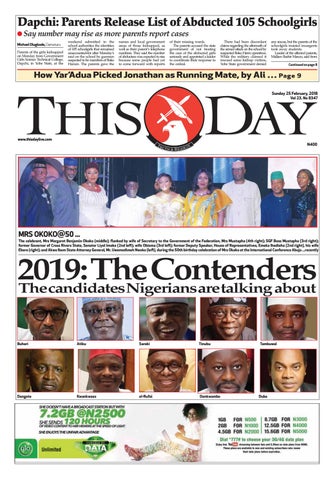
Dapchi: Parents Release List of Abducted 105 Schoolgirls Say number may rise as more parents report cases Michael Olugbode, Damaturu Parents of the girls kidnapped on Monday from Government Girls Science Technical College, Dapchi, in Yobe State, at the
weekend submitted to the school authorities the identities of 105 schoolgirls that remained unaccounted-for after Monday’s raid on the school by gunmen suspected to be members of Boko Haram. The parents gave the
names and local government areas of those kidnapped, as well as their parent’s telephone numbers. They said the number of abductees was expected to rise because some people had yet to come forward with reports
of their missing wards. The parents accused the state government of not treating the case of the abducted girls seriously and appointed a leader to coordinate their response to the ordeal.
There had been discordant claims regarding the aftermath of the armed attack on the school by suspected Boko Harm operatives. While the military claimed it rescued some kidnap victims, Yobe State government denied
any rescue, but the parents of the schoolgirls insisted insurgents took away students. Leader of the affected parents, Mallam Bashir Manzo, said from Continued on page 8
How Yar’Adua Picked Jonathan as Running Mate, by Ali … Page 9 Sunday 25 February, 2018 Vol 23. No 8347
www.thisdaylive.com TR
UT H
& RE A S O
N400
N
MRS OKOKO@50 ... The celebrant, Mrs Margaret Benjamin Okoko (middle); flanked by wife of Secretary to the Government of the Federation, Mrs Mustapha (4th right); SGF Boss Mustapha (3rd right); former Governor of Cross Rivers State, Senator Liyel Imoke (2nd left); wife Obioma (3rd left); former Deputy Speaker, House of Representatives, Emeka Ihedioha (2nd right), his wife Ebere (right); and Akwa Ibom State Attorney General, Mr. Uwemedimoh Nwoko (left), during the 50th birthday celebration of Mrs Okoko at the International Conference Abuja ...recently
2019: The Contenders ThecandidatesNigeriansaretalking about Buhari
Atiku
Saraki
Tinubu
Dangote
Kwankwaso
el-Rufai
Dankwambo
Tambuwal
Duke
2
T H I S D AY ˾ Ͱͳ˜ ͰͮͯͶ
T H I S D AY ˾ SUNDAY FEBRUARY 25, 2018
3
4
T H I S D AY ˾ Ͱͳ˜ ͰͮͯͶ
T H I S D AY ˾ SUNDAY FEBRUARY 25, 2018
5
6
T H I S D AY ˾ Ͱͳ˜ ͰͮͯͶ
T H I S D AY ˾ SUNDAY FEBRUARY 25, 2018
7
8
ͺͽ˜ ͺ ˾ T H I S DAY, T H E S U N DAY N E W S PA P E R
PAGE EIGHT
2019: The Contenders With the positive leadership changes in South Africa, Zimbabwe, Ghana and even the likes of Ethiopia, people are wondering if Nigeria would follow suit. Only last week, President Muhammadu Buhari told some APC governors, who visited him at the State House, Abuja, that he was yet to make up his mind on the 2019 presidential elections. Reports say he is still considering the pros and cons of the case for a second term or the arguments of those who advise that he, Buhari, should embrace the Mandela option given his age and health. And considering the fact that whatever he has not achieved or set in motion now, it would be difficult to achieve in four years, they say the President as set a new moral high for Nigerian leadership and laid a solid foundation for tackling corruption in high office. They fear that should Buhari run, his legacy could be tainted. Against the backdrop of whether the president will run or not, there has been a flurry of activity among political leaders across Nigeria with many positioning themselves to replace him, especially the young politicians, who claim they have the energy and vision required for Nigeria at this time, and feel that this is their last chance to take Nigeria to the next level. This thinking, of course, has been accentuated by the recent positions of two former presidents. While former President Olusegun Obasanjo has advocated a third force, former Military President Ibrahim Babangida has canvassed a new leadership with digital disposition. In all this, THISDAY is identifying candidates who may not necessarily be in the race but who people are talking about. Here are 11 of such candidates. (The first of a two-part series) Muhammadu Buhari / The man to beat
He is the incumbent, but President Muhammadu Buhari has maintained a stoic silence over his re-election in 2019, a decision he is constitutionally entitled to. Until his recent pronouncement at the State House during the visit of APC governors, Buhari had twice hinted at a possible presidential run. First at a summit on terrorism in Abidjan, C’ote d’Voire and second, when he visited Kano State weeks back on a working visit. His body language to run the 2019 presidential election was given a new life, when his Minister of Transportation, Rotimi Amaechi, quietly got President Buhari to re-appoint him as the Director-General of his re-election campaign. After all, Amaechi led the campaign to an electoral victory in 2015. However, while this appointment has not been officially announced due to internal intrigues, Amaechi is said to already have his letter of appointment, which he presented to the President to sign, a proof that Buhari might be considering seeking reelection, albeit reluctantly. Yet, Buhari has not come out outright to speak about 2019. His ‘marketers’ in the South, argue it is politically correct to have a Buhari do another four years, than have the North do another eight years through another candidate, perhaps, a younger element. But until Buhari takes a stand, the extrapolations remain fluid and the field, still very much unfriendly to hop in. Though difficult to fully ascertain his take on reelection, Buhari remains the CONTENDER to beat.
Atiku Abubakar/ The old was horse Arguably the most prepared and experienced of the other contenders outside of the ‘incumbency weight’ of the present occupier, former Vice President Atiku Abubakar has never hidden his desire to rule Nigeria. While he has indicated interest in the nation’s top job at different times, he has only been able to be on the ballot once and that was in 2007, when he ran as the candidate of the Action Congress (AC). His attempt in 2011 against former President Goodluck Jonathan failed at the level of the Peoples Democratic Party (PDP) primary even though he was adopted the northern candidate by a group of elders led by Alhaji Adamu Ciroma. Another effort in 2014 still did no go past the primaries as he came a distant third to Buhari and a former Kano State governor, Rabiu Kwankwaso, at the APC National Convention held at the National Stadium in Lagos.
But none of these has stifled Atiku from further pushing his presidential dream. Not surprisingly, he came out earlier than many others to re-indicate his interest in the job. He reignited the restructuring debate and set the stage for what to expect as far as the issues are concerned in 2019. He took his bid a notch further, when he left the APC and returned to his former party, the PDP. Atiku is not joking and is therefore a serious contender. But he would have to contend with a critical bloc in the party - PDP governors, some of whom are believed not to be disposed to his candidacy. At the end, Atiku is a strong CONTENDER.
Rabiu Kwankwaso/ The fighter
Like many others, who have their eyes on Nigeria’s presidency, former Kano State governor, Alhaji Rabiu Kwankwaso, has never hidden his intentions too. Unfortunately, until the APC national convention in 2014, Kwankwaso was slightly underrated. But at the end of the day, not only did he come second to Buhari, that he also relegated Atiku to a third position changed perceptions about him. But since that engagement, he has not abandoned his bid to be president. Quietly, he has continued to oil his political machine, starting from his home state of Kano through the other states of the north before berthing down south. He is said to have set up committees of like-minds including strategists, who are currently working on his project. Curiously, Kwankwaso’s ambition might have created serious problems for him in Kano as his successor and political godson, Governor Abdullahi Ganduje, is frontally opposed to him all the way, a rivalry that is currently heating up Kano’s polity. How such an environment would aid a boisterous ambition is yet to be seen. But he remains a CONTENDER. Bukola Saraki / The sleek fish in troubled waters Perhaps, not many knew his capacity at political strategy till he emerged President of the Senate against all odds. Dr. Bukola Saraki, a two term governor of Kwara State, is today one of the most influential politicians in the country. He has never hidden his desire to be Nigeria’s president with
a new vision for generation. And at different times when the opportunity availed itself, he tested the waters and only retreated when he found out that the equation did not favour his bid. Yet again, 2019 might as well present another opportunity. Although he has not said he was interested in Buhari’s job, what is certain is that if Buhari decides to embrace the Mandela Option, Saraki is certainly one of those who would throw their hats in the ring. And as president of the senate and chairman of the National Assembly, he has built bridges across the country, a critical asset for any successful presidential run. And he belongs to a loosely coalesced group of
friends that would make him a strong CONTENDER should he run given that he can build support in at least 4 geopolitical zones with a fighting chance in the other 2. Bola Tinubu / the lion heart National leader of the APC and former governor of Lagos State, Asiwaju Bola Tinubu is one politician whose name comes up each time speculations are made about 2019. In the thick of the 2015
campaigns in Lagos, he said to an elated crowd that he had what it takes to rule Nigeria, adding that he was qualified by all standards but only yielded the opportunity to Buhari, because during national crises, nations yield to generals. He cited America, UK and even France as having taken to that regime in time past. He would later follow up at a function in Ibadan, Oyo State over a year ago, when during an interview with journalists, he said he would not mind to run for the nation’s presidency but only if Buhari was not running. Ever since, he has been equivocal about responses to his presidential dream. Interestingly, he is believed to have taken his current assignment as the party’s peace-maker seriously because a divided party would be useless ultimately. It was no wonder that he cried out days ago that the party’s National Chairman, Chief John OdigieOyegun, was sabotaging him. Right now many believe Tinubu is eying control of the APC as condition for backing a Buhari second term. With that control he can influence APC candidates for the 2019 elections and ultimately his own bid in 2023, should Buhari do a 2nd term. However, Tinubu would run now, if Buhari does not, and he does not pretend about it. And should he run, Tinubu would be strong CONTENDER.
when in 2014, he obtained a presidential intention form. His decision had rattled the ranks of the Buhari camp till he was prevailed upon to drop the idea by other stakeholders of the party and he did. The governorship ended up being his compensation. Although his first shot at the presidency, it has since kept him in the equation as a constant mention of his name shows that Tambuwal might have become some kind of force to reckon with with broad support across Nigeria. A first time governor, he is not only eligilble for reelection, he does not seem to have any strong obstacle to achieving that. But as it is, the question is: will Tambuwal be willing to sacrifice certainty for uncertainty in 2019. And like Saraki, he belongs to a loosely coalesced group of friends that would make him a strong CONTENDER should he run for president in 2019. Nasir El-rufai/ The gladiator As far back as 2007, the Governor of Kaduna State,
Aminu Tambuwal / The fox The Governor of Sokoto
State, Alhaji Aminu Tambuwal, was that one man, who almost threw spanner in the works for Buhari,
Malam Nasir El-rufai has had his eyes on the presidency as he strived to succeed former President Obasanjo, who appointed him the Minister for Federal Capital Territory. But his scheming failed as the former president had his reservations, even when he publicly admitted El-rufai was exceptionally brilliant. But while he is currently a close ally of President Buhari, he is believed to have his eyes on the job. Even when he is one of those running around, insisting Buhari must serve another term, there is a swirling belief that he is merely waiting on the side to reap from what many think
9
ͺͽ˜ ͺ ˾ T H I S DAY, T H E S U N DAY N E W S PA P E R would be Buhari’s ultimate decision: the Mandela option. Yet again, like Tambuwal, will El-rufai be willing to sacrifice his almost certain but tough re-election for a very tough presidential run? It appears El-rufai has been around for a while and knows quite well when to retreat at a battle front. For now, he intentionally does not come across as a strong contender except that he is waiting to cash-in on any sudden opening and with Rotimi Amaechi he belongs to a group of governors determined to influence who becomes President in 2019, with their first choice being president Buhari - and if Buhari does not run El- Rufai and Amaechi would be seeking the role for them selves thus many see him as a CONTENDER. Donald Duke / The Idealist Former governor of Cross River State, Donald Duke, is fondly referred to as Nigeria’s Barack Obama by the younger generation, because of his finesse and civilised politics of development and intellectual engagement. In fact, there is an unconfirmed story of how he narrowly missed being vice president, because he thought he was too good to be anybody’s running mate. But he has always nursed a presidential ambition. He is now out to try a good
South Africa, where their new president, Cyril Ramaphosa, is a successful business mogul, the idea of Alhaji Aliko Dangote, Nigeria and Africa’s richest man, becoming president is beginning to generate sleepless nights for some persons. Needless to say that Dangote has never said
shot at the presidency, riding on the crest of Obasanjo’s third force. Although prior to the emergence of Coalition for Nigeria, he had begun some subtle campaigns through proxies, who were using online platforms, the Obasanjo intervention provided a good start for him. It is safe to assume, therefore, that he is not joking, only if time and chance permit. Many also see a fitting representation of the younger generation in a Duke. But whether his aspiration is in sync with the geo-political extrapolations is another factor that would be impossible to ignore. Meanwhile Donald Duke remains on the cards as a CONTENDER. Aliko Dangote / The Disruptor Coming from the United States of America, where billionaire businessman Donald Trump is the president and
They say he is rich, super rich indeed, but humble, open and assessable. But this may as well remain the imagination of those conceiving the ideas as Dangote is not about to give their wish a thought let alone test the waters with it. But with a wrong choice as President in 2019, Dangote business empire and indeed the rest of the economy, would face headwinds if not peril. Should Dangote run, he will be not just a serious contender, but a formidable disruptor who will alter Nigeria's political landscape for good. Kingsley Moghalu / The
he was interested in the presidency and indeed tells everyone who approaches him that he is not. But the ruling elite class of Nigerians actually see the need for a man like him at this time in Nigeria's history. They say he has grown a business from nothing to an intimidating global conglomerate and that he is de-tribalised with friends and associated from the six corners of Nigeria. They say what Nigeria needs now is a man who can combine business acumen with governance, a man who is tough and ruthless with corruption and indiscipline.
idealist Kingsley Chiedu Moghalu, a political economist, lawyer and former United Nations official, is a Professor of Practice in International Business and Public Policy at The Fletcher School of Law and Diplomacy at Tufts
University. In 2016, Moghalu founded the Institute for Governance and Economic Transformation (IGET), a think tank focused on the achievement of inclusive economic growth and effective public policy in developing countries Former President Umaru Yar'Adua appointed him Deputy Governor of the Central Bank of Nigeria in November 2009, following his confirmation by the Nigerian Senate. As Deputy Governor of CBN from 2009 to 2014, he led the execution of extensive reforms in the Nigerian banking system after the global financial crisis. He was a member of the Bank's Monetary Policy Committee that brought inflation down into single digits. He has remained a leading light in the private sector. There is, however, a feeling that brilliant and sound mind like Moghalu, who has created a lasting impression in the academia and private sector with shining example, can chart a truly developmental path for Nigeria and change the course of building the nation for good. He has taken up the challenge by walking his talk and has stated his intentions to be President. Some believe that he is neither a pretender nor a contender but has what it takes to do the job if handed the assignment.
But such assignments are not handed to idealists. Ibrahim Dankwambo /
The dark horse The unassuming Governor of Gombe State, Ibrahim Dankwambo does not hidden the fact that he nurses a presidential aspiration and to drive this, he has adopted an interesting approach. He seems to believe in the idea of endorsements and has been getting them in droves, a development now seen to be enhancing his visibility. Importantly, Dankwambo believes there is the need to ride on his performance record and has deployed more resources to selling his administration’s achievements in recent time. Dankwambo desires to be a contender; but it does not seem the odds might favour him, but he may be a compromise candidate of the opposition PDP as many of the party's governors consider him as
How Yar’Adua Picked Jonathan as Running Mate, by Ali Ex-PDP chairman gives fresh insight into intrigues that threw up Jonathan as VP candidate Olusegun Adeniyi Former National Chairman of the Peoples Democratic Party (PDP), Dr Ahmadu Ali, has provided fresh insights into the intrigues that led to the emergence of Dr Goodluck Jonathan as the presidential running mate to the late Umaru Musa Yar’Adua, at the party’s convention on December 16, 2006. Ali, a retired Army Colonel, three-time Senator, medical doctor, former Federal Commissioner of Education in the seventies and PDP National Chairman between 2005 and 2007, also made revelations on several issues, including how Jonathan preferred being Governor of Bayelsa State to being Vice President of Nigeria when he (Jonathan) was offered the job. According to Ali, in his authorised biography that will be launched in Abuja on Thursday to mark his 82nd birthday, the trio of himself, President Olusegun Obasanjo and Chief Tony Anenih decided on Jonathan to checkmate the PDP Governors who were scheming to nominate another person for Yar’Adua, after they had rejected the choice of the then Rivers State Governor, Dr Peter Odili. Titled, “The many colours of a rainbow: A biography of Senator Amadu Adah Ali” and written by Gideon S. Tseja, a copy of which Ali personally gave THISDAY at the weekend, the former PDP Chairman also provided details of why Yar’Adua got the nod to succeed Obasanjo in 2007. “Amongst all the PDP governors who wanted to contest for president, he (Yar’Adua) was the only one on whom the EFCC could not find any evidence of corruption or misappropriation of funds. He left over N6 billion for his successor in the state coffers while other governors left virtually nothing. He was reluctant to contest for president.” Although written by a third party, the recollections are that of Ali who stated in his preface dated August 22, 2016, that the effort took more than 30 years. “I started jotting down episodes
in the merging story of my life since 1983 when the military coup d’etat of that year terminated the life of the civilian regime and the senators, amongst whom I was one, were unceremoniously booted out of office.” Because of his hectic schedule, Ali said he could not bring himself into writing an autobiography until in 2008 when he finally decided to invite a university don, Gideon S. Tseja, “to assist me in writing my biography.” With Ali as PDP Chairman in 2006, the book captures what followed after the nomination of Yar’Adua as the party’s presidential flag-bearer. According to the author, Yar’Adua was summoned to the basement of Eagle Square where Obasanjo, Ali and Anenih were waiting. This was what followed, going by the recollections in the book: Even before the final results of the primaries were tallied, it was clear to the party leaders that Yar’Adua was going to win hands down. They—President Obasanjo, Chairman, BOT, Chief Anenih and the National Chairman, Dr Amadu Ali—decided to shift their attention to the nomination of a running mate on the PDP ticket, the man who would be vice president if Yar’Adua won the presidency. “Congratulations”, the chairman began unceremoniously. “It is a well-deserved victory, and the party will give you all the support you need to win the presidential election.” He (Ali) paused for a moment as the president and the others also gave Yar’Adua their congratulations. “Peter Odili will be your running mate. He came third in our search for a presidential candidate. Governor Ahmed Makarfi came second in our score. For equity, the running mate had to come from the south.” There was silence as everybody waited for Yar’Adua to react. Finally, looking away and avoiding the eyes of the chairman, he mumbled with his characteristic shy demeanour, “Thank you sir, but I would request…” “You request what? The party produced you and the party will also produce the VP!” thundered the chairman. “Let us try to give him time”,
Obasanjo tried to intervene. “We don’t have time sir. We need to move fast. You can never tell what mischief is being planned right now. Did you see any of the governors towards the end of the election at the Square?” It was true that the governors had mysteriously disappeared when Yar’Adua’s victory became a certainty. He (Ali) turned to Yar’Adua and continued his instructions to him. “Go and write your acceptance speech. Say something like this: ‘I would like to inform you that after due consideration and consultation with the party, I have selected Peter Odili, the executive governor of Rivers State, to run with me on the same ticket’. I want a copy of the speech and make sure Peter Odili’s name is on it!” Yar’Adua went away and came back with the speech as directed indicating that Peter Odili would be his running mate, but it was clear that he was not happy. Pressure was brought to bear on the president to intervene and allow Yar’Adua to choose a VP he felt he could work with. “Amadu”, said Chief Obasanjo, “don’t be too harsh on the young man. Let’s give him twenty four hours…” “Twenty four hours! But…” the chairman was going to argue. “I know what you mean”, Obasanjo cut him off, “but let
us give him twenty four hours.” It had been a long day. Tired and hungry the chairman went home dreaming of eating something, taking a long drink and flipping into bed to catch some rest. This was about 1.00PM on the day of the convention. Meanwhile, unknown to the president, PDP governors were holding a secret meeting of their own to influence the choice of VP candidate. Clearly, they were not in favour of Peter Odili which the party leadership was contemplating. Even before Ali could digest this information (provided by his wife), he got a frantic call from Obasanjo. He, too, had got some information about the governors’ plot. “Amadu, come quick!” “But you know we have just…” “Come, please and don’t argue. Quick, quick!” The dream about taking some rest evaporated as Ali doubled back to meet the president at the Aso Rock Villa. He (Obasanjo) told the Senator about the governors’ meeting. “We must act quickly or the governors will hijack this thing. Anenih is on his way and I have already summoned Yar’Adua. If he hasn’t thought of a running mate, then we must impose one on him.” This had been the senator’s position exactly, all along.
As soon as Yar’Adua arrived, the president told him without any preamble, “Now, name your running mate, now, now. We don’t have twenty four hours.” “Goodluck Jonathan,” he said without hesitation. He had obviously thought about it or tutored to mention the name. Immediately, Jonathan was sent for. When Jonathan arrived a little later, the president said, “We have summoned you here to offer to you the position of Vice President. What do you think?’ Jonathan was stunned. He was obviously not expecting this and had not remotely considered the possibility. He opened his mouth as if to say something but nothing came out. The president seeing his discomfiture added helpfully, “This decision was taken after a long process. We just want to know what your opinion is.” Finally, Jonathan found his voice, although he was disconcerted by this development. “Well”, he began tentatively, “If I had a choice, I would prefer to remain as governor. I know the job. I know where I stopped. But this VP...I don’t know what it entails.” After a look of disapproval from the chairman and the president, he added quickly, “but if you want me to serve in that position, I accept.”
YarAdua turned to Jonathan and asked him, “Would you like to be my running mate?” “Yes sir.” President Obasanjo turned to the Chairman and said, “Amadu, take him to my parlour. The television crew are on their way for a press conference. You and Chief Anenih should stand on either side of him and let him announce the name of his running mate.” The governors were still at their meeting scheming how to influence the choice of vice president when Yar’Adua announced his running mate to the public in the foyer of the presidential villa. The announcement was carried Live on NTA and other networks. This put paid to the PDP governors’ plot to nominate a vice presidential candidate. In a chat with THISDAY, Ali said this would be the first part of his story as he intends to write another one by himself. But the current book also details his life and career. Some of the issues dealt with in the book include the 1966 and 1975 military coups, Ali’s role in the creation of Kogi State, the ‘Ali Must Go’ saga, the General Sani Abacha coup in November 1993 at a period he was in the Senate, Obasanjo’s ‘third term’ bid and the defeat of Jonathan at the 2015 presidential election.
DAPCHI: PARENTS RELEASE LIST OF ABDUCTED 105 SCHOOLGIRLS the circumstances of the incident, the terrorists had come just to kidnap. Manzo stated, “The insurgents came into the town with a plan to abduct the girls. They did not know the exact location of the school; so they abducted some boys in town to take them there. The boys mistakenly took them to the Central Primary School, and when they found out that it was the wrong place they were angry and threatened to kill the boys. They subsequently abducted some other boys who took them to the school. “When they got to the staff
quarters gate, as they could not locate the girls, they started shooting and since the girls were alerted at their hostels, some scaled the fence and some others tried escaping through the main gate and they saw some men in khaki whom they mistook for soldiers, they invited the girls into their parked vehicle and took off in the name of rescuing them from Boko Haram.” He also explained, “We have compiled the list of the girls still missing, the number is 105, and we have formed ourselves into a forum and in the list of the names collected is the girls
name, their parents name, the phone number of the parents. “We would want those parents that have not yet seen their children to come and register on the list.” One of the parents, who did not want his named mentioned for fear of being targeted, explained why Governor Ibrahim Gaidam was attacked on Thursday by some aggrieved residents of Dapchi, headquarters of Busari Local Government Area. He said, “When the governor came, we were gathered at the house of the District Head and the governor told us that none
of the girls had been rescued. The governor said he was not sure whether our children are in Boko Haram’s captivity, but we are sure that Boko Haram took our children. We have evidence. “When they took them (children), they were crying and screaming for help. They came through the Gumsa Road and went back on the same road. “Residents of villages along that road heard the children crying and screaming in the vehicles. See full list of the 105 students on pg 76 and on www. thisdaylive.com
10
FEBRUARY 25, 2018 ˾ T H I S D AY, T H E S U N D AY N E W S PA P E R
SUNDAY COMMENT
Editor, Editorial Page PETER ISHAKA Email peter.ishaka@thisdaylive.com
THE RESURGENCE OF CORRUPTION The Transparency International verdict corresponds largely with the perception of many Nigerians
S
ince we were almost certain that the anti-corruption outing of this administration was bound to unravel under the weight of its numerous contradictions, the result of the latest Transparency International (TI) Corruption Perception Index came as no surprise to us. There was no ‘war’ going on because wars have underlying doctrines which inform battle plans. It was not even a campaign, either in a political or PR sense because campaigns aim to carry a mass audience along. More The drama distressingly, it and media had no foundation showmanship that in public morality or ethical good Nigerians have governance. All witnessed in the that some officials name of fighting have been waving graft, especially is the tattered flag by the EFCC will of the integrity of worsen corruption President Muhammadu Buhari. in the future. It According to the has taught corrupt latest Transparpeople new ways ency International report to evade the radar. on corruption perception All you need to do index, Nigeria ranked 148 out of 180 countries is join the ruling assessed in 2017. Meanparty and all sins are forgiven, if not while, in 2016, Nigeria ranked 136th. Within the forgotten continent, Nigeria was ranked 32nd out of the 52 assessed countries in 2017. Yet, Prof Itse Sagay and other officials can continue to deceive themselves rationalising what the TI report means. Indeed, such is the hypocrisy of the current administration in the so-called war against corruption that even President Buhari, as the prime mascot, has increased the size of the question mark around his own integrity. For instance, he has not decisively shown discomfort in the company of questionable characters while a number of close officials, like his former Secretary to the Government of the Federation (SGF), have been fingered for acts of corruption with scant repercussion. To worsen matters, the president has allowed the high
Letters to the Editor
authority of his office to be invoked in seeming protection of high state officials like the lingering cases of the recalls of former Chairman of the Presidential Task Force on Pension Reforms, Mr. Abdulrasheed Maina and the head of the National Health Insurance Scheme (NHIS), Prof Yusuf Usman; not to mention the questionable appointment of the National Intelligence Agency (NIA) head. The treatment of these cases violates all known rules of due process and respect for basic public decency and accountability. With this administration, no one can say with certainty whether nepotism and clannish nativism in federal appointments qualify as evidence of corruption.
W
S U N DAY N E W S PA P E R EDITOR TOKUNBO ADEDOJA DEPUTY EDITORS VINCENT OBIA, OLAWALE OLALEYE MANAGING DIRECTOR ENIOLA BELLO DEPUTY MANAGING DIRECTOR KAYODE KOMOLAFE CHAIRMAN EDITORIAL BOARD OLUSEGUN ADENIYI EDITOR NATION’S CAPITAL IYOBOSA UWUGIAREN
T H I S DAY N E W S PA P E R S L I M I T E D EDITOR-IN-CHIEF/CHAIRMAN NDUKA OBAIGBENA GROUP EXECUTIVE DIRECTORS ENIOLA BELLO, KAYODE KOMOLAFE, ISRAEL IWEGBU, IJEOMA NWOGWUGWU DIVISIONAL DIRECTORS PETER IWEGBU, ANTHONY OGEDENGBE DEPUTY DIVISIONAL DIRECTOR OJOGUN VICTOR DANBOYI SNR. ASSOCIATE DIRECTORS ERIC OJEH, PATRICK EIMIUHI ASSOCIATE DIRECTOR SAHEED ADEYEMO CONTROLLERS ABIMBOLA TAIWO, UCHENNA DIBIAGWU, NDUKA MOSERI DIRECTOR, PRINTING PRODUCTION CHUKS ONWUDINJO TO SEND EMAIL: first name.surname@thisdaylive.com
hat is, however, never in doubt is that for targets, this ‘war’ has repeatedly homed in mostly on former appointees of the opposition Peoples Democratic Party (PDP). Curiously, some of the former leading lights of the PDP who happen to be the arrowheads of the Buhari ascendancy have been immune from the investigative searchlight of both the Economic and Financial Crimes Commission (EFCC) and Code of Conduct Bureau (CCB). With such a hazy definition of target, the administration committed an unpardonable political hubris and travesty of natural justice in its declaration of war on corruption. Admittedly, the PDP administration under President Goodluck Jonathan was an untidy mixed bag of good men and women overwhelmed by gangsters and a mob ethic. But it was not the exclusive club of corrupt elements as recent experience with the All Progressives Congress (APC) government of Buhari has shown. Therefore, the TI verdict is no rude shock. In fact, what should worry the incumbent government is the reality that the verdict by TI corresponds largely with the dominant perception of informed Nigerians. The drama and media showmanship that Nigerians have witnessed in the name of fighting graft, especially by the EFCC, will worsen corruption in the future. It has taught corrupt people new ways to evade the radar. All you need to do is join the ruling party and all sins are forgiven, if not forgotten. Yet, selective application of targets in the fight against corruption is in itself corruption. Using corruption to fight corruption may be Nigeria’s contribution to the global anti-graft crusade. But so far, it does not seem to be a workable proposition. Private sector and institutional corruption remain intact. Not to talk of the sociological- ‘way of life’- corruption in our daily lives. The summary of the foregoing is stark: the anticorruption war was not thought through. It was just a knee-jerk and populist gambit that will remain the butt of jokes long after Buhari may have left office.
TO OUR READERS Letters in response to specific publications in THISDAY should be brief (150-200 words) and straight to the point. Interested readers may send such letters along with their contact details to opinion@thisdaylive.com. We also welcome comments and opinions on topical local, national and international issues provided they are well-written and should also not be longer than (950- 1000 words). They should be sent to opinion@thisdaylive.com along with the email address and phone numbers of the writer.
NIGERIA’S HOLIER THAN THOU SYNDROME
T
he phrase “holier than thou” has successfully created a niche for itself in Nigeria’s ever competitive lingual exchange market. A “holier than thou” attitude is a form of self-righteousness that is characterised by moral superiority above others. The phrase is complex in the Nigerian context because of the difficulty to know when it is applied angrily as an attack on non-adherents of our primordial and evil ways (e.g when an harem of prostitutes refers to their non-prostituting colleagues as holier than thou) or when it is used against those who rise up as bastion of morals to intimidate the sensibilities of the rest of us to prove the superiority of their piety. The popularity of this phrase is connected with Nigeria’s
innate ability to create cliches out of words/sentence usage to sometimes sound urbane and posh, and also because of Nigeria’s complex social architecture that is often defined by class superiority. The complex social architecture of the typical Nigerian will form the praxis of this article. However, despite its popularity in Nigeria’s context, it is often discussed in social strata and rarely in official settings because of the supposed sanity that is expected to be the forte in official systems. However, following my several interview experiences over the years, I have been brought face to face on numerous occasions with Nigeria’s “holier than thou” attitudes in officialdom. An instance is when an employer insisted that the interview time is 8am, and you could barely
sleep in the night as you rushed your rumpled (rumpled because of years of inactivity) credentials into your bags and rush down only to arrive at the interview venue to find the doors and gates of your prospective employer locked. You will have to wait for another one hour before the gatekeeper leisurely strolls in to open the gate and engages you in a detailed commentary of why he had to come late - citing traffic, the government, his pregnant wife, his children, etc., as his reasons. He opens the reception and you will wait for another one hour for the interviewers who often seem to have forgotten the interview date and time. Meanwhile in your waiting time you have to adjust your legs and sitting position for the cleaner who also came late but needed to
mop the dirty floor before the arrival of ‘oga’. They are now settled, they call you in and demand for copies of your curriculum vitae that you have sent to them earlier and later bamboozle you with a plethora of questions ranging from the impossible to the implausible. In one of my encounters with the CFO of a leading bluechip oil and gas companies in Nigeria, I also encountered the “holier than thou” syndrome. He started, “what is internal control?” I answered, “it is a risk assessment measure put in place to ensure risks are identified, prioritised, measured and mitigated against.” He vehemently said No and insisted on the textbook definition of the term which states that “Internal control are all forms of controls financial or otherwise, that ensures operations are carried out according to extant rules, assets are safeguarded and also seek to ensure the validation, accuracy and completeness
of transactions”. I could not hide my anger that a man of that position could not differentiate finance role from that of the human resource role. It was unthinkable that a man of that stature will measure the competence of an applicant on a job by an elementary part of the job description. However, I came to myself that this is Nigeria where impossibility is nothing. It is with this kind of fake intellectual superiority that employers blast and vilify young graduates and insist they know nothing. Most of the interviewers/job owners often had forgotten that they also knew nothing before getting the job only for them to get ‘on the job trainings.’ But now insist that fresh graduate should show on the spot the same competence that took them years to acquire. –––Kehinde Oluwatosin, Abeokuta, Ogun State.
T H I S D AY ˾ SUNDAY FEBRUARY 25, 2018
11
12
T H I S D AY, T H E S U N D AY N E W S PA P E R ˾ EBRUARY 25, 2018
SUNDAYNEWS
News Editor Abimbola Akosile E-mail: abimbola.akosile@thisdaylive.com, 08023117639 (sms only)
TUC to Governors: Don’t Convert Workers’ Salaries to Election Funds
t Vows to resist planned electricity tariff increase Senator Iroegbu in Abuja
The Trade Union Congress of Nigeria (TUC) has warned the state governors to pay workers salaries and not convert it to election campaign fund for the 2019 polls. To this end, the Congress has advisedthosegovernorswhoare owing debts of salaries to either addressworkers’wageproblems or resign.
The calls were contained in a communiqué issued at the end ofitsNationalExecutiveCouncil meeting in Lagos, signed by its President,ComradeBobboiBala KaigamaandSecretaryGeneral, Comrade Musa Lawal M. Ozigi andmadeavailabletojournalists yesterday. In the communiqué, TUC observedthatthepoliticalenvironment has become volatile due to
theforthcomingelectionsin2019, urging that “Politicians should avoid hate speeches so that both the common man and workers can attain fulfillment. NEC also calls on the Governors owing workers to pay and not convert publicfundsandworkerssalaries for election purposes.” Kaigama, who also spoke to journalists after the TUC NEC meeting noted that the non-
payment could be due to corruption.Hestressedthatworkers could no longer vouch for state governments that non-payment of salaries was as a result of lack of funds. According to him, it was only the Lagos State Government that had been regularly paying workers’salariesandallowances. “Alltheotherstateshaveoneissueortheotherintermsofsalaries
PRESS TITANS L-R: Former governor of Lagos State and former Chairman of the Executive Board of the International Press Institute, Alhaji Lateef
Jakande going through a document with IPI Executive Director, Barbara Trionfi, during the latter’s visit to him at his residence in Ilupeju, Lagos...yesterday
or benefits of their workers. You will discover that it is 13 months’ arrears of gratuities or pensions that have not been paid. In some cases,itisthecontributorypension deductions that have not been remitted or promotions arrears anddeathbenefitsnotbeenpaid,” he said. KaigamaremindedthegovernorsthatPresidentMuhammadu Buhari had approved bailout fundsandbudgetsupportfunding to enable states to settle workers’ salaries, to no avail. To this end, he advocated a return to regional government, saying that state governments were failing in their responsibilities. “The trust we have in state governmenthaseroded.Ifitisfor thepurposesofpaymentofsalaries and infrastructure development suchasprovisionofhealthfacilities, roads,railtransportationandothers,wearebetteroffwithregional government,” Kaigama said. The TUC president said accountabilityinNigeriawasweak, and called for the strengthening ofanti-graftagencies.Onnational minimumwage,hesaidstategovernments should be determined to pay the wage when approved. He reflected the decision of the NEC-in-Session, which in the communiqué commended “the Federal Government for the commencementoftheMinimum Wage Committee and implores the Committee to speed up proceedings to ensure that a new minimum wage will take effect not later than the agreed third quarter of the year”. “TheNEC-in-Sessionobserved
that the fight against corruption willnotachievethedesiredresult withoutaddressingtheinjustices being perpetrated by political office holders who collect multiple pensionsandgratuitieswhilestill serving government in another capacity. This is not good for the economy.” KaigamaalsocalledontheFederalGovernmenttodeclareastate ofemergencyinthepowersector duetoitsdeterioratingcondition. ”No nation can develop without power,” he said. Againstthisbackdrop,TUChas warnedtheFederalGovernment andMinisterofPower,Worksand Housing, Babatunde Fashola, from carrying out the proposed increase in the electricity tariff. The trade unionists further warned that it would resist such a move by Fashola by mobilising workers for protest if need be, stressing that another tariff increase is not the solution to the energy crisis in the country. “The NEC-in-Session calls on theFederalGovernmenttodeclare emergency in the power sector asnonationcandevelopwithout power. TUC recalls with dismay that several billions of naira has been expendedinthesectortonoavail. Thecallfortariffhikecannotbea solution and it shall be resisted,” the communiqué read. This is coming as the Congress expressed concern at the deteriorating security situation in the country, occasioned by BokoHaramterrorists,herdsmen conflictandothercriminalactivitiesthathaveledtodestructionof lives and property.
Olanipekun: Election Reordering Debate a Non-issue Abimbola Akosile
Former National President of the Nigerian Bar Association (NBA), Chief Wole Olanipekun, SAN, yesterday described the ongoing debate over the order and reordering of general elections in Nigeria as inconsequential and a non-issue. InatelephonechatwithTHIS-
DAYyesterday,thelegalluminary said it doesn’t matter in which order the general elections take place,aslongastheelectoratesare allowed to vote in the candidate of their choice. To make this happen, OlanipekuncalledontheIndependent National Electoral Commission (INEC)tobeneutralandimpartial
in the election process. He also urgedtheMilitarytostayoutside politics,andadvisedthePoliceto be non-partisan and to do its job accordingtowhattheConstitution permits, entails and prescribes. While responding to THISDAY enquiries, the former NBA chieftain said, “To my mind, this discussiononpriorityofelections,
of which election should come first,whichoneshouldcomelast, whetherthepresidentialelection, whether the national assembly or governorship, or where an election if first held would have a bandwagon effect on the other elections discloses the primitive stage,thepedestrianlevel,thevery archaicdestinationourdemocracy
Nigeria Signs African Revalidate Your Licence Trade Agreement in March Before March 29, Police Tell Nigeria is poised to sign the Continental Africa Free Trade ThePresidentsaid,“Otherpoli- Lagos Gun Owners Area Agreement in March as part of efforts to prioritise trade as a significant instrument for reform in the country. President Muhammad Buhari said the agreement would promote regional trade, while speaking at the opening of the 39thKadunaInternationalTrade Fair yesterday. “Oneoftheimportantinitiatives of our government is the IndustrialPolicyandCompetitiveness Advisory Council, which is a partnership of the government with the private sector meant to solvedifficultproblemsmilitating againstindustrialisation,”hesaid. “Right now, the intra African tradeislessthan15percent;other regionsoftheworldarewellover 50 per cent, so we want to move thatofintraAfricatoabout30per cent so as to grow”.
ciesbeingpursuedwillpromote export by establishing special economic growth zones where Nigeria and International businesses would have the required infrastructure”. He also promised to make Nigeriaamongthemostsafestand attractiveinvestmentdestinations in the world. The President, who was represented by the Minister of Trade and Investment, Mr. Okechukwu Enelamah, said theadministration“isprioritising the industrial sector by focusing on rebuildinginfrastructure. He mentioned that the theme of the fair, ‘Promoting Commerce, Industry and Agriculture for International Competitiveness’ was in line with the economic recovery and growth plan of the country.
The Lagos State Police Command has given till March 29 for individuals with ‘pump action firearm’ and other guns to submit their arms, licenses for verification and re-validation. The order was contained in a statementissuedyesterdaybythe commandspokesman,ChikeOti, saying that the exercise became necessary in view of security challenges in the country. “Those issued with licence to bear pump action firearm or otherrepeatingfirearmoperated by a slide action mechanism, by theLagosStatePoliceCommand FirearmsRegistry(D7),aretosubmit their weapons and Licences to the Divisional Police Officer (DPO)oftheclosestPoliceStation forverification,confirmationand revalidation. “Themoveistoenablethecom-
mand update its data base with information about the owners, licences,andstateofthefirearms. “Theownersofthesefirearms typesaregiventwoweeksgrace period from the date of this publication (Feb. 24) to ready themselvesfortheexercisewhich will last till March 29. “TheCommissionerofPolice, Lagos State, enjoins all licensed gunownerstotakeadvantageof this revalidation programme as firearmsfoundinthepossession ofanybodyorgroupwhodidnot participateintheexercisewould be deemed as illegitimate. “Such an individual or group would be arrested and charged for unlawful possession of firearm(s) in accordance with the provisions of Prohibited Firearms Act 2004, Laws of the Federation,” the police said.
is. It portrays the electorate as not literate democratically. “To me as a person, let there be a thousand and one (1,001) presidential candidates, I know who I am going to vote for. And you can’t confirm if the person I amgoingtovoteforfortheofficeof president,orevenifalltheelections are held the same day, that I will
voteforacandidateofhispolitical partyingovernorshipelectionor senatorialorhouseofrepresentatives or house of assembly. “The electorates in Nigeria are still not yet enlightened. Our democracyinNigeriaisnotbased onissues;it’snotrootedinvalues; itisallrootedinfrivolities,withall respect”, according to him.
Nigerian Troops Capture Boko Haram Commander Nigerian troops in Borno have killed five Boko Haram insurgents and captured a top commander of the group in the ongoing operation in Sambisa Forest and the Lake Chad basin. Deputy Director, Army Public Relations of Operation Lafiya Dole, Col. Onyeama Nwachukwu, in a statement in Maiduguri, said troops also rescuedthreecivilians,recovered vehiclesandhighcalibreammunition in various operations in the past two days. Inthestatement,Nwachukwu saidonThursday,troopsengaged andneutralisedanumberoffleeinginsurgentswhileattempting to escape the military blocking position in one of the cleared enclaves ‘Sabil-Huda’, deep in Sambisa Forest. He said the troops also recovered one G-III rifle magazine,
one life jacket, a light Machine Gun metal link, four rounds of Anti-Aircraft ammunition, four rounds of 7.62mm (NATO) ammunition and three rounds of 7.62mm (Special) ammunition. “Unfortunately, two soldiers were injured in the process; they had been evacuated by the Nigerian Air Force and are respondingtotreatment,”hesaid. Nwachukwu said the troops Friday launched offensive targeting a terrorist’s hideout up ‘Camp Zairo’, and neutralised a number of insurgents in spite of initial damaged caused to their Armoured Fighting Vehicle by Improvised Explosive Device (IED) planted beneath the ground. Hesaidthetroopskilledfiveinsurgents;severalotherswounded and recovered ammunition at a hideoutinParisu,SambisaForest.
T H I S D AY ˾ SUNDAY FEBRUARY 25, 2018
13
14
Ͱͳ˜ Ͱͮͯ ˾ THISDAY, THE SUNDAY NEWSPAPER
OPINION Grief and Tears In Myths Jerry Agada writes that with the recent presidential initiatives, normalcy should be able to return to the Benue valley
M
yths are replete with tales of woes, grief and tears consequent upon wars, destructions and deaths. In Greek mythology an often quoted instance is that of Queen Niobe. She was the queen of Thebes and daughter of Tantalus whose six sons and six daughters were put to death by Artemis and Apollo. Artemis was a maiden warrior goddess and huntress while Apollo was god of the sun and sender of plagues. The grief in which Niobe found herself turned her into stone and the torrents of her tears caused streams to trickle down the rocks. Niobe in this brief story is the bereaved while the dreadful words are death, grief and tears. Each word begets the other. In that order death comes first because it is the agent provocateur. Tears come last because they flow limitlessly as the loss of a loved one becomes a personal bereavement to millions of well-wishers. Grief is sandwiched between death and tears because when it descends, it stings and clings permanently. Such was the grief that forced Electra – the legendary mother of Dardamus in another Greek mythology to tear out her hair when Troy was destroyed. She never grew hair on that spot again. The combination of these three dreadful words never makes a pleasant scenario. That thus illustrates the graveness of grief which struck Governor Samuel Ortom and entire people of Benue community on the day of the mass burial of the 73 men, women and children massacred by the suspected Fulani herdsmen. And the grief worsened there after because the killings had continued unabated while the federal government procrastinated in taking decisive actions to stop the carnage. Like Queen Niobe and the legendary Electra in Greek mythologies, the pains and grief of watching his subjects helplessly being massacred so hardened Governor Ortom’s resolve to damn whatever consequences even at the expense of being governor or loosing political party patronage, and fight with his last blood to protect his people. He cried out loudly to expose the injustice being
visited on the innocent citizens through the war of genocide by a group that appeared to have the backing of some conspiratorial patrons. And instead of maintaining studied silence of helplessness or bias, some power brokers and attention seekers chose to add to the existing grief by making hate speech to add salt to injury. For instance to suggest that the killings in Benue State are as a result of communal clash or because of the enactment of anti – open grazing law appears to be gross insincerity and a hate speech. For one to suggest that the killings are justified because of blockade of grazing routes smacks of complete ignorance, and it also amounts to hate speech. Meanwhile the killings have continued unabated and so also is the stream of grief and tears in the land. The massive deployment of police force and the relocation of the Inspector-General of Police (IGP), Ibrahim Idris to Benue State which Mr. President graciously ordered became a hide and seek exercise and did nothing much to assuage the tension. Many people wondered and even cried out for deployment of the core military to crush the invaders as had been done elsewhere with ‘Operation python dance’ and others but the Commander- in – Chief who himself is a war veteran had the ace. He had great confidence in the ability and capacity of the police to perform. Thus when Mr. President wrote a letter to the Senate enumerating the steps he had taken to quell the
Grief is sandwiched between death and tears because when it descends, it stings and clings permanently
crisis, ordering the relocation of IGP and the visit of the Minister of Interior to Benue State were listed as part of his efforts to tackle the menace. Despite all that, the killings have continued and even spreading. Citizens became completely disenchanted and called for more serious actions from the federal government. Those who criticised the poor handling of the situation by the federal government were branded as making hate speech. Those who commended or justified the killings and condemned Benue State Government for enacting the anti-open grazing law were branded patriots and pampered with a studied golden silence. When the body language of officialdom suggested bias or tacit support for the agent provocateur, some poodles misread the horizon and played along. So instead of making statements that should help to douse the tension, they justified the killings through hate speech including verbal insults by describing the embattled state governor as ‘a drowning man’, feeling that such was the officially recognised position. Thus despite the massive massacres going on, a chief executive of a state would describe it as a political game to beg for money. Ordinarily such would have been described as the worst of all hate speech but it was greeted with loud silence as a mark of acquiescence. So the orgy of killings continued with its attendant grief and tears among the hapless natives. However, during a recent visit to Nasarawa State, Mr. President came down heavily on the perpetrators of the senseless killings and threatened to have them arrested. He followed by directing the deployment of a special military squad known as operation ‘Ayem A Kpatuma’ or ‘Cat Race’ to all the troubled areas in Benue and other states within the North Central Zone. With these presidential initiatives, it is hoped that the bloodbath in the Benue valley will subside and life return to normalcy again, and the citizens saved the reality and trauma of the mythological grief and tears. Professor Agada, former Minister of State for Education and Chairman, Benue State Civil Service Commission, wrote from Makurdi
Policing The Poor and The Securitised Elite The poor are worse off in security of lives and in everything else, argues Oludayo Tade
T
he attitude of the leadership of Nigeria and its security institutions to the safety of the poor and vulnerable is condemnable. In the same system, the social structure ensures the securitisation of the rich. While the tenets of the rule of law prescribes equality before the law, supremacy of the law and fundamental human rights, the practicality of these in Nigeria is gradated to ones social position. The poor are worse off in security of lives and properties, food security, health security, education security, road security, human rights security, among others. Impliedly, Nigeria is a country that is elite designed, structured, formed and governed. Nothing implicates a genuine concern to take care of the hoi polloi who are the majority. The masses occupy flip side of the pyramidal structure of the goodies fondly labelled democratic dividends. Unfortunately the masses’ support is sought during elections to enthrone the minority that mostly abandon them when they get into office. The elite minority mindlessly corner public patrimonies to themselves and their cronies. In Nigeria, it is not only poor to be criminal; it is also criminal to be poor. Undoubtedly, there are differential treatments in who gets policed as against who gets secured. In 2017 alone about 549 lives were lost to Fulani herdsmen and farmers’ violence (Amnesty International). The year 2018 may surpass this figure as over 200 have been killed within two months across Benue, Zamfara, Adamawa, Ondo, Kaduna and Taraba. In all these the poor gets killed while the care-less elite ‘condemns’ the killings. I draw on these to examine poor policing, policing the poor and the securitised elite in Nigeria. This is because within and outside government, the Nigeria elite have secured their present and future. In government, they ensure they put structures in place that outlives them. These structures (in the police, judiciary, civil service, etc.) cover their tracks when out of office. Highly placed politicians allocate to themselves undeserved severance packages endorsed by the ‘ball-boys’ in the legislative chambers when leaving office. They use the structure they put in place to fight the system when being probed when out of office. Whenever their hegemonic control over the country is threatened, they form alliances to oust the incumbent to sustain their hold on the country not necessary to better the lots of the masses. In and out of office, they personalise public services. Imagine the lamentation of
the Chairman of Police Service Commission, Mike Okiro, a former Inspector-General of Police that out of about 305, 597 policemen (2015 data), over 150,000 are attached to VIPs and unauthorised persons in the country. The people enjoying these security personnel included those who have left government in the last 10 years! Yet, over 180 million individuals are to depend on less than 150,000 for the protection of their lives and properties. They use the limited number of police left for the rest of us to protect their children and parents. Even Abdulrasheed Maina claimed to have been secured by the DSS when he came in through the ‘door of influence’. When the rich get kidnapped, they get jet-speed reaction and the deployment of the IGP Intelligence Response Squad to rescue them. When they have case in court, they get soft-landing. The elite (most of them) are parasitic. They milk Nigeria; they hardly plough back and when they do it is temporary and these are mostly in months preceding an election year. They use the ideological state apparatuses to oppress the poor and make them perpetually subservient. To them it is the poor that is dangerous and must be policed. That is why only the rich enters plea bargaining. To hell with the poor in jail! Rather than focusing on poor policing, the leadership of Nigeria under President Muhammadu Buhari and other state governors are interested on policing the poor. Poor policing as against policing the poor is the inability of the police to check growing insecurity. Mis-governance is responsible for why herders are pampered and cow ‘constitutional’ rights are enthroned. While the courts are quick to sentence a boy who stole N10, 000 to 15 years imprisonment, the same court granted a corrupt pension fraudster who cornered billions of naira into private pocket an option of fine of N750, 000! The same system polices the opposition party and allows culpable inner caucus members (Babachir Lawal, Maina, Usam Yusuf) of the ruling party and in the process rubbishing its policing of public funds. The institution that turned deaf ears to intelligence report supplied by governors of Benue and Zamfara alerting it of impending attacks mocks the victims by putting the blame on the law enacted to regulate people’s behaviours. Obviously, you are criminal if the state thinks you are criminal and saint at the pleasure of the state. The body language and the interest of the ‘oga at the top’ apparently endorse inequality in the Nigeria policing system.
Ideally, the nature of crime ought to determine how policing resources will be distributed. Nobody ought to tell the police that they need to strengthen divisional stations in rural areas. This is because, the police as an instrument of the state is urban-based. The media thus beams light on happenings in the urban areas where are they based while many people suffer violence and criminality in the rural areas. Since 2009 when Boko Haram became lethal in its campaign, it has operated more in rural areas with its ‘homeland’ located in remote spaces of northeast Nigeria. Kidnappers kidnap and take victims to forest using the water ways to get to their hideout. Armed robbers return to the rural area after a major operation to keep low profile. Fulani herdsmen carnages had occurred in remote rural areas where poverty is endemic and policing is scarce. The have-nots are therefore at the mercy of the haves whose actions and inactions determine to a larger extent their life chances. The criminalisation of the have-nots on the one hand and the securitisation of the elite and poor policing represent a contradiction. Apparently the fate of the Nigerian poor is that of proverbial hen that lays the golden egg but becomes forgotten, malnourished and ill -treated. The poor are secured by the ill-equipped police personnel while less than 100,000 elite take the properly kitted officers for personal use only to shed crocodile tears and call for python dance. The poor, as soft targets of violence, terrorism, rape, kidnapping and carnage deserves better security system that factors their peculiar location and vulnerability into the Nigeria police design. If President Buhari’s directive to the IGP to withdraw police officers attached to VIPs and unauthorised associates since 2015 is ineffective and no sanction has been meted out for flouting presidential orders, it shows lip-service to public security. Going forward, there is need for the establishment of rural police security divisions with capacity to quell deviance and criminality. The inequality in Nigeria’s security system needs to eliminate class influence in the protection of lives and properties. Otherwise, the poor who are in the majority should use their strength in 2019 to bargain for better protection. -Dr. Tade, a sociologist, sent in this piece via dotad2003@yahoo.com
15
T H I S D AY, T H E S U N D AY N E W S PA P E R ˾ FEBRUARY 25,2018
LETTERS IMPERATIVE OF TRAINING EARLY CHILDCARE GIVERS
I
n Nigeria, Early Childhood Care Development (ECCDE) is an aspect of Universal Basic Education that was introduced in 1999 to increase the access of children in the country to basic education. While stakeholders and like minds have been engaging to ensure a successful implementation and achievement of the objectives of the scheme, it is unfortunate that ECCDE is still faced with serious challenges. The first 1,000 days of every child’s life are very crucial to his/her mental and social development. The early year’s stage is the most critical stage of a child’s life, because this is the period in life when the brain develops most rapidly and has a high capacity for change, and the foundation is laid for health and wellbeing throughout life. Lancet educational survey reveals that globally over 200 million children do not reach their developmental potential in the first five years because they live in poverty, and have poor health services, nutrition and psychosocial care. These disadvantaged children do poorly in school and subsequently have low incomes, high fertility, high criminality, and provide poor care for their own children. A 2016 data reveals that 250 million, or 43%, of children in lowand middle-income countries are unable to realise their full development potential. According to UNICEF,
Adamu Adamu, Minister of Education
in Nigeria, the proportion of children enrolled in pre-primary early childhood care centres still remains low at approximately 2.3 million children. This represents about 21 per cent of the population of children in this age group. In recent times, maternal employment has increased which has led to complete reliance of childcare for young children from birth to five years of age. The caregivers of these centres are generally unqualified as about 85 per cent do not possess basic qualifications and more than half have no formal education. In 2015,
the federal government of Nigeria planned to partner with state and local governments to recruit, train and deploy 500,000 unemployed graduates and NCE holders, who will be deployed to primary schools, thereby, enhancing the provision of basic education especially in the rural area. As at January 2018, Kaduna State, still complains of not having enough skilled teachers to train her early years. Currently, of all the educational problems that beset Nigeria today, none is as persistent and as agonising as the one relating to the training of competent teachers.
Many of our modern day primary school teachers are not much more literate than the children they teach. Some of these teachers are not even trained for this level of education and most early year’s programmes are managed by people who have never been in the classroom. While it is easy to choose graduates easily to become preschool teachers, these graduates still require a preschool teacher training that qualifies them to teach early years. There is a lot of difference between a trained graduate teacher and an untrained graduate teacher. These trainings expose interested early childcare givers to special skills that help them to do their work effectively and efficiently while securing the future of the children in their care. Some of the skills preschool teachers are exposed to when they get trained include expanding a child’s ability to express themselves which is the most important job of a preschool teacher, developing critical thinking skills in children, how to be sensitive and responsive to the needs of children, organising activities that promote development and encourage children to behave in pro-social ways, creating language rich environment, etc. The training of early childhood development and education (ECDE) teachers in Nigeria should remain a priority and should be
Igbo PresidentAsAPC’s Survival Strategy
T
he Igbo ethnic group in Nigeria is one of the three major ethnic nationalities in the country. The others are the Yoruba and the Hausa-Fulani. These three groups dominate and dictate who rules Nigeria, whether it is a military or civilian regime, since the country’s political independence in 1960. To consolidate this domination, the colonial government divided the country into three with each of them in charge of one. The North was given to the Hausa-Fulani, East to the Igbo and West to the Yoruba. There was no south because it will not be in the interest of these major ethnic groups. Consequently, all the peoples of Nigeria who actually belong to the South were shared to the East (Cross River, Akwa Ibom, Rivers and Bayelsa States) and West (Delta and Edo States). Despite the splitting of the South into these six states, as constituted today, the major ethnic groups of Igbo, Hausa and Yoruba comfortably dominate Nigerian politics and dictate who become the president of Nigeria. From 1960 till date, the Igbo has been marginalised by the other major ethnic groups from having its own people become the president of Nigeria. Effectively, the Igbo had ruled Nigeria for only six months (January-July, 1966 under late General JTU Aguiyi
Ironsi). The Yoruba had ruled for 11 years (1976-1979 under General Olusegun Obasanjo, rtd; 1999-2007 under Chief Olusegun Obasanjo). The Hausa-Fulani has ruled for 36 years (1966-1975 under General Yakubu Gowon, rtd; 1975-1976 under late General Murtala Mohammed; 1979-1983 under Alh. Shehu Shagari; 1983-1985 under General Mohammadu Buhari, rtd; 1985-1993 under General Ibrahim Babangida, rtd; 19931998 under late General Sani Abacha; 1998-1999 under General Abdusalami Abubakar rtd; 2007-2010 under late Alh. Umaru Musa Yar’Adua; 2015-2018 current President Muhammadu Buhari). The remaining 11 years were ruled as follows: 1960-1966 shared by Igbo-HausaFulani under late Chief Nnamdi Azikiwe and late Alh. Abubakar Tafawa Balewa; 2010-2015 by Dr. Goodluck Jonathan from the South. This marginalisation has been extended to the present civilian regime since 1999. The Peoples Democratic Party (PDP) divided the country into six geo-political regions with six states in each. It is only the South-East Region occupied by the Igbos that has five states and this has been at the disadvantage of the Igbo, compared to the political mathematical advantages it gives to other regions with six
states. Unfortunately Igbo politicians and elites are not interested in reversing this disadvantage so long as it does not diminish their access to state funds for personal use. Indeed it is this group of politicians and elites that have effectively frustrated the Igbo from having access to the position of the President of Nigeria. Yet, other Nigerians cannot remove the fact that ordinary Igbos feel saddened and frustrated with this fact which from time to time, leads these ordinary Igbos to demand for their own country called Biafra. So, where is the solution? Which political party is in a better position to concede its presidential slot to the Igbo in 2019 or 2023? Although in politics, no one is given a political office without a fight, but at times it could be given or allowed to assuage and arrest future negative political feelings and actions. That was why the idea of rotation or zoning of key political offices was created, especially in heterogeneous political societies. Also, in some cases, some political parties may allow some group of people to have access to key political positions in order to harvest acceptance and votes from that group for the political survival of the party.
Looking at the key political parties in Nigeria today, the Igbo do not have any chance in the PDP to produce a President of Nigeria come 2019 or 2023. This is because that position has been zoned to the North by the party for 2019 and it affects 2023. For the ruling All Progressives Congress (APC), it is likely to present President Mohammadu Buhari for election in 2019. Consequently, come 2023, the North under the APC, may not present a presidential candidate. Will it go to the West, the likely answer is no because they had been Vice-President under PMB. Again giving it to the Yoruba in 2023 would add salt into the marginalisation injury suffered by the Igbo since independence. To give it to the Igbo will at least assume to heal this long-inflicted injury and favour the APC. Therefore, come 2023, the slot should be made available to the East (Igbo). The most qualified Igbo politician should be Dr. Ogbonnaya Onu, the current Minister of Science and Technology. He has been the key Igbo politician in the APC, which was the amalgam of three major political parties: the Congress for Progressive Change (CPC), All Nigeria Peoples Party (ANPP) and the Action Congress of Nigeria (ACN). ––Okachikwu Dibia, Abuja
vigorously pursued because in recognition of the vital role well-trained professionals play in the quality of early childhood experiences for children ages. Some of the basic skills needed by early childhood teachers can be intentionally and personally pursued by the teachers themselves which would cost them nothing but their time. These skills can also be called soft skills and they include communication skills such as good writing and fine public speaking skills which will help preschool teachers record and deliver children’s progress to parents and other teachers. Another is creativity which is the ability to keep the attention of a child. Preschool teachers need to think of new and innovative ways to engage children to learn. One other important skill is respect of differences. The ability to recognise the uniqueness of every child and adapting teaching styles to it is a good skill preschool teachers need to possess. They must also be prepared for multicultural classrooms with many ethnicities, cultures and traditions represented. If as a parent you are still wondering why you should enroll your child or children in a preschool, you need to be
aware that preschool is crucial stage to expose a child to more than 30 million words. A child is expected to be exposed to 10,000 words a day and daily activities. UNICEF recommends that to ensure Nigerian children fare well in early development and are protected from killer diseases, there should be a policy to include two years of free pre-primary education, six months of paid maternity leave and four weeks of paid paternity leave. Nigeria currently has just three months of paid maternity leave, only one year of free pre-primary education and no paternity leave at all, except for staff of the Lagos Public Service. Presently, in our country, only about one in every 10 pre-primary school pupils is enrolled in early education activities. The goal of any investment in early childhood development is for all children in Nigeria, whether poor or rich, to attain their development potential. On a final note, if the aim of early child development will be achieved, all teachers involved, will be required to be skilled and properly trained to do the job. ––Funmi Fasipe, Ogba, Lagos.
USMAN YUSUF AND POLITICAL JIHAD
T
he Muhammadu Buhari’s APC-led government has inadvertently enriched our vocabulary with new catchy phrases: “political jihad” is one of them. The reinstatement of Prof. Usman Yusuf at the National Health Insurance Scheme (NHIS) as a counter-measure of the due-process action taken by the Minister of Health, Prof. Isaac Adewole, was done because the Northern Establishment was miffed that a “kuffar” had the temerity to suspend and subsequently dismiss one of their own. This is true and this is the sad state of affairs that we must accept is rife. Political jihad forbids a “kuffar” from presiding over the affairs of “ummah-believers” and if a “kuffar” must insist on ruling, then “ummah-believers” are honour-bound to crash that system lest their soul be damned and they be denied virgins or “houris” in the “hereafter” (if Goodluck Jonathan had forced his way into a victorious position in 2015, all hell would have been let loose even if that meant some “believers” would lose their sources of livelihood). This is strange philosophy but Prof. Adewole has already fallen victim to such a line of thinking. If I were a betting man, I would stake a hefty chunk of quid that Munir Gwarzo would
soon be reinstated at the Federal Ministry of Finance because the signs for his reinstatement are there for all to see. Mr. Gwarzo himself is so cocksure and vociferous about his “innocence,” and above all, political jihadism strongly forbids that a female “kuffar” (Kemi Adeosun) who does not even cover her hair would preside in judgment over an “ummah-believer” like Mallam Gwarzo who carries his belief on his forehead. Political jihad justifies ostracising “kuffars” from key appointments of government (service and security chiefs, etc.) especially by a president who, like no Nigerian else, has been shown the “secret room of the ummah” in faraway Saudi Arabia. Political jihad is it when a sitting president does not condemn heinous crimes by way of a progression genocide committed against the “kuffars.” Political jihad is also when the Independent National Electoral Commission (INEC) and the Economic and Financial Crimes Commission (EFCC) combine to scare and muzzle opposition “kuffar” elements away as the 2019 general elections draw near. ––Sunday Adole Jonah, Department of Physics, Federal University of Technology, Minna, Niger State
16
T H I S D AY ˾ Ͱͳ˜ ͰͮͯͶ
T H I S D AY ˾ SUNDAY FEBRUARY 25, 2018
17
18
THISDAY, THE SUNDAY NEWSPAPER ˾ Ͱͳ˜ͰͮͯͶ
INTERNATIONAL Interference in Russo-American Relations and the Indictment of Internet Research Agency LLC
‘I
nterference’ is an important concept in international relations. Although many observers and analysts often wrongly use it to imply ‘intervention,’ and therefore to mean the same, it is useful to differentiate between the two. When ‘interference’ is used, it implies that the act of interfering involves the use of diplomacy, and particularly pacific means of conflict settlement. ‘Intervention,’ on the contrary, implies the use of force. Without scintilla of doubt, there is always an act of interference in every interpersonal or inter-state relationship. When people discuss an issue, they consciously or otherwise refer to a third person. They condemn or commend foreign statesmen when they make their comments. Such condemnation or commendation necessarily constitutes an act of interference. In a conscious attempt to differentiate between intervention and interference, Article 2, paragraph 7 of the United Nations Charter uses the word, ‘nonintervention,’ and not ‘non-interference.’ As provided in Article 2(7), ‘Nothing contained in the present Charter shall authorize the United Nations to intervene in matters which are essentially within the domestic jurisdiction of any state or shall require the Members to submit such matters to settlement under the present Charter; but this principle shall not prejudice the application of enforcement measures under Chapter Vll.’ If the article says nothing ‘shall authorise the United Nations to intervene in matters...’, this simply means that the United Nations, either acting as a corporate body, or its members acting severally, any act of ‘intervention’ is not acceptable in all matters that fall under the internal competence of Member States. Interference is not outlawed, but it is also useful to distinguish between permissible and non-permissible interference. Put differently, even if intelligence gathering may take the form of an interference or intervention, no country condones spying. It is allowed only to the extent that the spy is not cut. In many cases, diplomats do engage in activities that are not generally compatible with the status of a diplomat. In the same vein, no country wants any foreign interference or intervention in its political governance processes, such as electoral politics. However, this was precisely the case with the 2016 US elections in which Russia is now being accused of interfering in them. In this regard, how did Russia, as a government or as a people, interfere in the 2016 US elections in order to influence the presidential election result to the detriment of Hilary Clinton and in favour of Donald Trump? At the epicentre of the indictment is the belief that there was a conspiracy to defraud the United States ‘by impairing, obstructing, and defeating the lawful functions of the government through fraud and deceit for the purpose of interfering with the US political and electoral processes, including the presidential election of 2016.’ In this regard, the accused received funding for its operations, pose as US nationals and create ‘false personas,, operated social media pages and groups designed to attract US audiences... [T] hese groups and pages, which addressed divisive US political and social issues, falsely claimed to be controlled by US activists when, in fact, they were controlled by Defendants.’ More interestingly, the accused Russians allegedly travelled to the US ‘under false pretences for the purpose of collecting intelligence to inform Defendants’ operations.’ They also ‘procured and used computer infrastructure, based partly in the US, to hide the Russian origin of their activities and to avoid detection by US regulators and law enforcement.’ (vide the indictment by the Grand Jury for the District of Columbia)
The Indictment On Tuesday, 23rd May, 2017, Mr. Brennan told the House Intelligence Committee that Russia had brazenly interfered in the 2016 US presidential elections. The briefing of the Committee was prompted by many controversies surrounding the election of Mr. Donald Trump as President of the United States. His election was generally not expected. Most people expected, with ease, the election of Hilary Clinton. Since this was not so, public attention was drawn to Russian meddling in the United States domestic electoral affairs. And true enough, suggestions were made and questions were also raised as to whether Donald Trump would have been elected without the support or meddling of Russia in the election. Whatever is the case, in reaction to public concerns, the United States Justice Department appointed a Special Counsel, Mr. Robert Mueller, to investigate the alleged Russian meddling in the US elections, which he did and to which he also provided his findings.
VIE INTERNATIONALE with
Bola A. Akinterinwa Telephone : 0807-688-2846
e-mail: bolyttag@yahoo.com
Putin
On Friday, 16th February, 2018, the Deputy Attorney-General, Rod Rosenstein, announced the indictment of the Internet Research Agency LLC, a Russian agency based in Saint Petersburg, and thirteen other Russian Nationals. As noted by Rosenstein, the accused Russians ‘set up a virtual private network in the United States - making it appear that the social media accounts they were using were controlled by people in the United States.’ The Grand Jury for the District of Columbia charged the Internet Research Agency LLC (IRA-LLC) and many others (Mikhail Ivanovich Bystrov, Mikhail Leonidovich Burchik, Aleksandra Yuryevna Krylova, Anna Vladislavovna Bogacheva, Sergey Pavilovich Polozov, Maria Anatolyevna Bovda, Robert Sergeyevich Bovda, Dzheykhun Nasimi Ogly Aslanov, Vadim Vladimirovich Podkopaev, Gleb Igorevich Vasilchenko, Irina Viktorovna Kaverzina, and Vladimir Venkov) for working ‘’in various capacities to carry out Defendant Organisation (the IRA-LLC) interference operations targeting the United States. According to the Grand Jury, ‘from in or around 2014 to the present, Defendants knowingly and intentionally conspired with each other (and with persons known and unknown to the Grand Jury) to defraud the United States by impairing, obstructing, and defeating the lawful functions of the government through fraud and deceit for the purpose of interfering with the US political and electoral processes, including the presidential election of 2016.’ In fact, of the eight-count charge brought against the accused Russians, the first three were noteworthy: conspiracy to defraud the United States; conspiracy to commit wire fraud and bank fraud; and aggravated identity theft (using unlawfully the identification cards of other people). On the basis of these charges, and particularly count charge number 2, the Grand Jury is asking that, in the event of conviction of the accused, it intends to seek the ‘forfeiture allegation’ ‘as part of any sentence in accordance with Title 18, United States Code, Sections 981 (a)(1)(C) and 982(a)(2), and Title 28, Section 2461(c).’
One main lesson to be learnt from compelling leaders to leave presidential office is that the arrogance of power often exhibited by elected leaders is necessarily limited by the impatience of the people. No matter how strong a leader is, and no matter for how long such a leader remains in power, no law can prevent the people from reacting against unwanted policies. And true enough, the law exists to control the impatience of people, but people respect law when it is seen to be also respected by the law enforcement agents and their principals
The Grand Jury is also seeking substitution of assets if any property subject to forfeiture as a result of any act or omission of any defendant ‘cannot be located upon the exercise of due diligence; has been transferred or sold to, or deposited with, a third party; has been placed beyond the jurisdiction of the court; has been substantially diminished in value; or has been commingled with other property that cannot be subdivided without difficulty.’ The foregoing is the American side of the charges against the Russians but which the Government of Russia has not taken lightly, and which have also been subject of deeper analyses by academic lawyers in the United States. For instance, many observers have considered that the alleged Russian meddling has not directly implicated anyone in the Trump Campaign or in his inner circle and that the indictment is nothing more than a picture. As argued by Diane Marie Amann, Law Professor at the University of Georgia, ‘while resistance to international extradition may shield indicted Russians from US prosecution, it seems likely that some of the alleged co-conspirators will be Americans, fully subject to trial in the US.’ In the view of Miriam Baer, Law Professor at the Brooklyn Law School, ‘there are two types of conspiracies a prosecutor can charge. The more common one occurs when two or more individuals have conspired to violate some other crimes, such as computer fraud or bribery... The less common usage, which is the one we see in Robert Mueller’s latest indictment, is the so-called “conspiracy to defraud the US.” For this kind of conspiracy, the government must show that the conspirators agreed to interfere with one of the federal government’s lawful functions.’ Two other Law Professors from Ohio State University do not see the indictment as a big deal for now. For instance, while Ric Simons argued that ‘these indictments say nothing about intentional collusion between the Trump Campaign and Russian interference in the election and that they do not implicate nor exonerate anyone in the Trump Campaign’, Joshua Dressler posited that ‘the investigations are not over yet, so we still remain uncertain regarding the extent of potential criminality.’ The position of Jessica Levinson, Law Professor at the Loyola Law School, is not different. He submitted that ‘Mueller has not yet come forward with evidence that Trump’s Campaign or administration attempted to aid Russian nationals,’ and therefore, ‘that evidence may never materialise, but the indictment does not close the door on this issue.’ Perhaps more interestingly, while Ric Simmons argued further that, ‘to win a conspiracy case, a prosecutor need only prove that the defendants agreed to commit an illegal act to further that agreement,’ Susan Bloch, a Law Professor at the Georgetown University, believes that the determination of guilt of collusion or conspiracy to interfere with the US election requires ‘knowledge’ and ‘intent.’ But in this case, Joshua Dressler simply asked why the Russians ‘so desperately want to elect Trump.’ Whatever may be the rationale for Russia’s interest in the election of Donald Trump and not in that of Hilary Clinton, what should be noted about the indictment is the politics of it at the domestic level and the critical question of ‘interference’ not only in international relations, but particularly in Russo-American bilateral relations. President Trump has to be specially briefed that the indictment did not taint the Trump Campaign to prevent him from openly creating new diplomatic frictions in the relationship.
Impact on Russo AmericanTies The Government of Russia does not in any way feel comfortable with the indictment and so does some of the accused. For instance, Prigozhin, one of the accused, declared that ‘the Americans are very emotional people, they see what they want to see. I have great respect for them. I am not at all upset that I am on the list. If they want to see the devil, let them.’ What does Progozhin mean with seeing ‘the devil’ in this case? Is Russia the devil? Is devil synonymous with trouble or problem? Does it not mean that the Americans are yet to see any problem yet and that the real and greater problem is yet to come? The long term implication of ‘if the Americans want to see devil, let them see it’ is simple: let the Americans prosecute the accused, and they will see more than they would have bargained for. Maria Zakha, the Russian Foreign Ministry spokesperson, has it that, ‘turns out, there’ve been 13 people, in the opinion of the United States Justice Department. 13 people interfered in the United States elections? 13 against billions budgets of special agencies? Absurd? Yes (see her face book post). Again, how do we interpret the word, ‘absurd’? Undoubtedly in the mind of Maria Zakha, is it not only 13 Russians that are troubling the whole of the United States, a super power for that matter? Is it not only 13 people that are against special agencies with budgets running into billions? True enough, the word absurd is nothing more than a mockery of the indictment. Additionally, and perhaps more importantly, Dmitry Peskov, the spokesperson for the Russian President, Vladimir Putin, has it that ‘there were no indications that the Russian State could have been involved. We didn’t see any substantial evidence of someone interfering in the domestic affairs. Two points are noteworthy in this observation: non-involvement of the Russian State and non-substantial evidence. (See concluding part on www.thisdaylive.com)
19
T H I S D AY, T H E S U N D AY N E W S PA P E R ˾FEBRUARY 25, 2018
BUSINESS
Editor : Vincent Obia Email vincent.obia@thisdaylive.com
LASTWEEK WEEK LAST VAT
National Bureau of Statistics said on Thursdaythatthefederalgovernment’s incomefromValueAddedTaxrosefrom N250.56 billion in the third quarter, to N254.10 billion in the fourth quarter of 2017. NBS stated this in its “Sectorial Distribution ofVATData for fourth quarter,2017”.Thebureaustatedthat the N254.10 billion VAT collected in the fourth quarter was higher when compared with the N250.56 billion generatedinthirdquarterof2017,and N207.35 billion in the fourth quarter 2016.Thefigurerepresented1.41per cent increase quarter-on-quarter and 22.55 per cent increase year-on-year, the report indicated.
Access Bank
Access Bank Plc emerged winner of the best “Commercial Banking Capabilities” award organised by Euromoney, a leading global financial publication.The award was presented tothebank’sGroupManagingDirector/ CEO, Mr. HerbertWigwe, onThursday at the Euromoney Private Banking Awards 2018, held at the Landmark inMarylebone,London.Theawardsare the most prestigious in the growing area of wealth management and cover over 60 countries each year.
FAAC Crude oil production facility
IEA: Nigeria’s Higher Crude Oil Output Balanced OPEC Production in January Kunle Aderinokun
The International Energy Agency has said improved crude oil output in Nigeria made up for the losses recorded by some OPEC member countries to steady production month-on-month at 32.16 mb/d in January. In disclosing this in its Oil Market Report for February, IEA also noted that compliance with OPEC supply cuts reached an unprecedented high of 137 per cent in the review month. “OPEC crude oil production in January was steady month-onmonth (m-o-m) at 32.16 mb/d. Higher Nigerian output offset losses elsewhere. Compliance with supply cuts reached a new high of 137 per cent,” the report stated. Nigeria’s crude oil output, which level stood at 1.819 mbpd in January this year had been on a steady rise from the beginning of 2017 to December of the same year, when it achieved 1.828 mbpd. The federal government had sometime last year decided to cap its oil production at a sustainable volume of 1.8 mbpd. The decision was approved in July by OPEC and non-OPEC producers led by Russia. Besides, OPEC and non-OPEC members also agreed to cut production volumes by as much as 1.8 million barrels per day (mbd)
ENERGY with OPEC members contributing 1.2mbd of that while the balance would be provided by non-OPEC members. The agreement was thus rolled over at their November 30, 2017 meeting till the end of this year. The two sets of members had, at their last meeting, agreed to extend the agreement they reached in 2016 to cap the amount of oil they bring into the market in their efforts to shore up prices and stabilise the market. Nevertheless, the IEA pointed out that, global oil supply in January edged lower to 97.7 mb/d, but was 1.5 mb/d above last year as rebounding US production underpinned non-OPEC output growth. Noting that, non-OPEC output dropped by 175,000 b/d in January, to 58.6 mb/d, but was 1.3 mb/d higher than a year ago US crude output, up 1.3 mb/d year-on-year (y-o-y), the agency said it would “soon overtake Saudi Arabia and could catch Russia by the end of the year. Compliance with output cuts by non-OPEC countries was 85 per cent.” The IEA stated in the OMR that, generally, the global oil demand
Fund is a key factor in raising our growth outlook to 1.4 mb/d. It was thought that the significant increase in the dollar price of crude oil since the middle of 2017 would dampen growth, and this might be the case to some extent, but the impact of higher prices has been partly offset in some countries by currency appreciations.” IEA also noted that compliance with OPEC supply cuts reached an unprecedented high of 137 per cent in the review month growth for 2018 had been increased slightly to 1.4 mb/d, partly due to an optimistic GDP forecast from the IMF. This, it pointed out, was down from last year’s gain of 1.6 mb/d, as higher oil prices, shifting Chinese demand patterns and fuel switching in non OECD countries slows growth. According to the agency, “Our demand growth estimate for 2017 remains strong at 1.6 mb/d, reinforced by November data for the US. For 2018, the more positive global economic picture published by the International Monetary
Specifically, The IEA noted that, “In 2018, fast-rising production in non-OPEC countries, led by the US, is likely to grow by more than demand. For now, the upward momentum that drove the price of Brent crude oil to $70/bbl has stalled; partly due to investors taking profits, but also as part of the corrections we have seen recently in many markets. Most importantly, the underlying oil market fundamentals in the early part of 2018 look less supportive for prices.” Also, according to the February OMR, OECD commercial stocks fell in December by 55.6 mb, the steepest drop since February 2011, to reach 2851 mb. “Stocks drew by 154 mb (420 kb/d) during 2017 and ended the year 52 mb above the five-year average. In 4Q17, stocks fell sharply by 1.3 mb/d across the OECD.” The IEA noted that, “After reaching an all-time high in 4Q17, global refining throughput is expected to slow by 0.4 mb/d in 1Q18 to 81.1 mb/d due to seasonal maintenance, primarily in the US and Middle East.” “A strong rebound is expected in April-May as runs ramp up to meet increased seasonal demand and to replenish product stocks,” it added.
ThethreetiersofgovernmentThursday shared N635.554 billion for January after the Federation Account Allocation Committee meeting in Abuja. But operational challenges triggered by a 0.36 million barrels decrease in crude oil export by Nigeria led to a reduction in revenue from oil sales by $113.86 million.Accountant-generaloftheFederation,AhmedIdris,whopresidedover the meeting, said the gross revenue of N538.908 billion received for the month was lower than the N540.446 billionpostedinthepreviousmonthby N1.538 billion. Idris attributed this to operational challenges, which caused a decrease in crude oil export.
Marketers
DepotownersundertheaegisofDepot and Petroleum Products Marketers Association of Nigeria on Tuesday gave the federal government and its agencies 14 days to pay off remaining subsidyeraindebtednessofoverN650 billion to the marketers or there would beamassivestaffdisengagement.The ultimatum was contained in a letter to Minister of State for Petroleum, Dr. Ibe Kachikwu, by Executive Secretary of DAPPMAN, Mr. Olufemi Adewole. Adewole said the marketers urgently needed the payment to settle their creditors avoid penalties from banks and the Asset Management Corporation of Nigeria, which has threatened totakeoveroftheirpetrolstationsand tank farms.
Agriculture
Central Bank of Nigeria revised the guidelines for the Commercial Agriculture Credit Scheme to include Non-Interest Financial Institutions. Therevisionwascontainedinacircular datedFebruary16,postedontheCBN website on Wednesday. The circular said the review was part of efforts to deepen access to finance and reduce exclusion rate. It added that the CBN wouldlookatthepossibilityofrevising the guidelines for other intervention funds for the interest of the public. “It is expected that the review of the guidelinesforotherinterventionfunds will follow in due course,” the circular stated.
20
T H I S D AY, T H E S U N D AY N E W S PA P E R ˾FEBRUARY 25, 2018
BUSINESS/BANKING
Fears Ebb over Directive on Dividend Pay-out to Banks’ Shareholders The Central Bank of Nigeria recently said banks with bad loan portfolios above 10 per cent and inadequate capital requirements should henceforth not pay dividend to their shareholders, raising fears among investors. But analysts believe investors do not need to worry about the directive, in the interim, as most of banks are strong enough to pay dividend in the short to medium term. Bamidele Famoofo reports
J
itters ran through the spines of investors, especially those who have banking stocks in their portfolios, on Monday, February 19, when the Central Bank of Nigeria, through a circular dated January 31, 2018, announced that banks with huge bad loan portfolios and inadequate capital requirements would no longer be allowed to pay dividend to their shareholders. In what appeared to be a quick reaction to the policy, shares of banks recorded noticeable losses after the announcement. But investment analysts, particularly those with Cordros Securities Limited, have said there won’t be any cause for alarm in the immediate time. According to researchers at Cordros, only one out of the 11 banks it subjected to an acid test on Non-performing Loans (NPL) and Capital Adequacy Ratio (CAR) as required by the CBN, is not qualified to pay dividend in the short to medium term. Directive The apex bank had in a circular dated January 31, 2018, which was released on February 19, 2018, spelt out conditions to be met by Nigerian banks vis-à-vis dividend payment. The aim was to facilitate sufficient and adequate capital build up in line with the banks’ risk appetite. The circular was an updated version of the one first issued by the bank in 2014 on the same issue. Three of the salient conditions contained in the old circular are that: banks with NonPerforming Loans (NPLs) ratio above 10 per cent shall not be allowed to pay dividend; banks that meet the minimum Capital Adequacy Ratio (CAR), but have NPL ratio above five per cent, but less than 10 per cent, are allowed a dividend pay-out ratio (DPR) of not more than 30 per cent; banks that meet the minimum required CAR, and have NPL ratio not more than five per cent have no regulatory restriction on their DPR. However, the amendment in the new circular stated that banks that have CARs at least three per cent above the minimum requirement, and have NPL ratio of more than five per cent, but less than 10 per cent, are allowed up to 75 per cent DPR. Meanwhile, details of a research carried out by a team of analysts with Cordros Securities Limited showed that about 92 per cent of major banking stocks (Tier-One and Two) subjected to the dividend policy test will be cleared by the CBN to pay various degrees of dividend at the moment. According to the analysts, only First Bank Limited, a subsidiary of FBN Holding Plc, is not qualified to pay any dividend at the moment. Capital Adequacy Ratio The CBN has grouped Nigerian banks into three categories as regards capital adequacy, ranging from 10 per cent to 16 per cent. For Systemically Important Banks (SIB), which are required to have a minimum of 16 per cent Capital Adequacy Ratio (CAR), all six banks (Access, Zenith, UBA, GTB, FBNH, and Diamond) were sufficient in capital as at February 20, 2018, while FCMB and Fidelity, classified as international banks and are required to have a minimum of 15 per cent CAR, met the requirement as at the day of the research. National and Regional Banks, which include Wema, Stanbic and Sterling, also met the minimum 10 per cent CAR requirement for their category. Non-Performing Loans The banks’ NPL ratios, as disclosed by
said it was aimed at bolstering its capital reserves, while Diamond Bank’s move to sell its West African banking operations (in Benin, Togo, Cote d’Ivoire and Senegal) and focus on the vast retail banking potential in Nigeria is equally consistent with the move to consolidate the bank’s capital buffers.
Cordros Research, show that First Bank has the highest NPL ratio, and is the only bank with an NPL ratio above the 10 per cent benchmark, while Access Bank has the lowest NPL ratio. Going by the apex bank’s directive, First Bank with 19.85 per cent NPL, which is above the 10 per cent CBN benchmark, is not permitted to pay dividend. However, FBNH, the listed holding company, can still pay dividend to shareholders from profits declared by other subsidiaries within the group. Diamond Bank, Fidelity, and Sterling fall in Category II, as they meet with the CBN’s CAR requirement, and have NPLs above five per cent but below 10 per cent. These banks are allowed Dividend Payment Ratio (DPR) of not more than 30 per cent. Stanbic benefits from the updated circular, hence, despite having NPL of seven per cent, the bank’s CAR 19.5 per cent is more than three per cent above the CAR requirement of 10 per cent, thus qualifying the bank for DPR of up to 75 per cent under the latest circular. Challenge Despite the opinion expressed by analysts with Cordros Securities Limited, that the
CBN’s latest directive is unlikely to, in the medium term at least, affect dividend expectations from the banks they covered in their report, Managing Director, Afrinvest Securities Limited, Mr. Ayodele Ebo, says now is the right time for banks to take steps to increase their working capital. Ebo challenged the banks in the different categories to make use of the Rights Issue and Eurobond instruments to further boost their capital. “Part of what we expect banks to do in the light of the favourable investment condition in the Nigerian capital market at the moment is to seize the opportunity to raise equity capital, either via Rights Issue or Public Offer, to further shore up their capital adequacy ratio,” Ebo said. Ebo’s recommendation was in line with a recent outcry by the International Monetary Fund that Nigerian commercial banks needed to raise fresh capital and boost their CARs to allow them effectively drive growth in the domestic economy. It would appear that a few of the banks are already yielding to experts’ recommendation on boosting their capital base, as Union Bank recently raised about N50 billion through Rights Issue from the market. The bank
Investment Strategy While the other banks are expected to borrow a leaf from Union Bank Plc to raise equity capital as, recommended by experts, analysts with FSDH Research recommend that investors should maintain long-term investment strategy in the equity market. According to them, “This will help to hedge against portfolio losses associated with shortterm stock price volatility. Our analysis of historical returns shows that investors make good returns in the equity market if they invest in stocks that have strong fundamentals and maintain a long-term view. An investor who maintains a long-term strategy will earn capital appreciation, cash dividend and/or bonus over the investment horizon.” An analysis of the yearly returns of the equity market as measured by The Nigerian Stock Exchange All-Share Index (NSE ASI) between 2008 and 07 February 2018, conducted by FSDH Research, shows that capital appreciation contributed the highest return to investors, accounting for 54 per cent of the return. Bonus and cash dividend contributed 26 per cent and 20 per cent, respectively. The research conducted by Cordros research team revealed that most banks short-change their shareholders in the aspect of dividend pay-out, as only Wema Banks has met the CBN’s stipulated Dividend Payment Ratio (DPR) in the last three years. Zenith Bank followed at a distance with a three-year average of about 60 per cent. However, contrary to the research findings by Cordros, the CBN said it had observed that rather than grow their capital with retaining earnings, some banks were paying out a greater proportion of their profits, irrespective of their risk profile and the need to build resilience through adequate capital buffers.
21
T H I S D AY, T H E S U N D AY N E W S PA P E R ˾FEBRUARY 25, 2018
BUSINESS/ENERGY
How Nigeria Plans to Mitigate Potential Impact of US Energy Surge Recently, the United States Energy Department forecasted that the country would become a net energy exporter by 2022. The development could impact Nigeria’s energy market, but the country looks determined to weather it. Chineme Okafor writes
Oil Pipelines
O
rdinarily, the United States’ projection of becoming a net exporter of energy by 2022 should bother Nigeria as much as it should bother other oil producing states within the Organisation of Petroleum Exporting Countries (OPEC) cluster. However, for Nigeria, this means that the US which was until July 2014 its traditional crude oil customer with the former becoming then the fifth largest supplier of crude oil to the North American country, would be vying significantly for market shares with it, and possibly encroaching on some of her new customer bases like India, Malaysia and China that are currently her largest customers. Records from the Nigerian National Petroleum Corporation (NNPC) showed that nation’s oil export to the US had from 2014 began to drop and at a point ceased because the US increased its oil output especially from shale. Raising the alarm in its recent disclosure, the US Energy Department stated that by 2022, the country will become a net energy exporter because oil and natural gas production from its shale fields are booming while domestic energy demand are fairly tepid. To underscore this, the Energy Information Administration (EIA) which had initially stated that the US would not become a net energy exporter until 2026, added in its Annual Energy Outlook that the country would also expand its natural gas exports beyond its traditional North American markets, and that shipments of crude oil will increase as well as outward flows of refined products such as gasoline. EIA’s Administrator, Linda Capuano, in this regards said in a statement that, “The United States energy system continues to undergo an incredible transformation. This is most obvious when one considers that the Annual Energy Outlook shows the United States becoming
a net exporter of energy during the projected period in the reference case and in most of the sensitivity cases as well- a very different set of expectations than we imagined even five or ten years ago.” Additionally, the US was reported to have in 2017 started trading its crude at a big discount to international benchmark Brent crude after Hurricane Harvey shut down a good number of its refining capacity. And this discount now made crude from the US more attractive to overseas refiners, thus helping to push its export to an all-time high above 2 million barrels a day then. The country’s oil export boom has also been helped by natural gas and oil production from advanced technology like hydraulic fracturing, which is the process of pumping water, sand and chemicals underground to fracture shale rocks and allow hydrocarbons to flow. But as a net exporter, the US would still rely on importation of certain grades of heavy crude, which its refineries are reportedly configured to process, but Nigeria does not have such heavy crude. Potential Response to Threat Perhaps realising she could run into troubles if she failed to plan on the back of the development, Nigeria also released a couple of plans it intends to pursue to diversify and gain tremendous control of its oil market share. Disclosing one of the plans at the justconcluded inaugural Nigeria International Petroleum Summit (NIPS), which held in Abuja, with over 32 countries in attendance, the country’s Minister of State for Petroleum Resources, Dr. Ibe Kachikwu, stated that Nigeria would be making greater efforts to secure the African energy market for itself and other African oil producers. While not specifically stating that it would stop other countries from fishing in the continent’s energy market, Kachikwu,
however gave the indication that Nigeria would seek to bring African countries into a collaboration to guard her energy market and use its hydrocarbon resources to industrialise the economies of its countries. He explained that other continental or regional hubs like the Gulf States had created such market-based buffers, and as such, Africa would not be left out of taking such measure, which Nigeria would lead. “Africa and African market are very key for us, as we begin to get into the way regional markets become very protected - the Gulf coming together, America begin to pursue becoming self-sufficient, the African market holds the potential for us, whether in refined petroleum products or transfer of technology and skill sets, whether it is in taking of advantages by local Nigerian companies, we need to begin to protect the African market and utilise it to its full potentials,” said Kachikwu, in his closing remarks at the NIPS. But to make this possible, Kachikwu equally noted that certain homework in the regulatory processes, fiscal regimes, transparency practices, security of assets and human resources, as well as improved business environment for indigenous operators would have to be done by Nigeria quickly. The minister explained that, with the shrinking of energy market opportunities across the globe and countries or regions becoming protective of their markets and Nigeria launching a forceful push to secure the continent’s market, more incentives would be provided to its indigenous oil producers to allow them grow their oil production levels from the current 10 per cent they contribute to the national production volumes, to 25 per cent within the next five years. According to him, “Major Nigerian oil companies, I will like to see them excitedly come on board. We have about 10 per cent of the contribution in production today, we
need to do more. I am targeting over that five-year period that they move to at least 25 per cent, which means that we need to see what incentives are essential for them to take some of the blocks that the IOCs are dropping and begin to bring them back into contributions in very realistic manners.” Kachikwu also noted that such ambitious push would need Nigeria to invest an estimated $100 billion over a period of time in gas projects, petroleum pipeline replacements and other oil facilities. The cost of producing a barrel of oil, he added would also have to be reviewed downwards to ensure that operators are competitive across board. “We must very quickly establish regulatory and legislative certainty. Whatever it is you do with the PIB (Petroleum Industry Bill), various arms of it should be done and dusted with so that investors can have clarity in terms of where they can underpin their investments. “Transparency is key. We continue to have the negative vibe in transparency despite all that has been done in the oil industry. What it says to us is that something must still be missing. Every average Nigerian says the oil industry is not transparent. Given the fact that the cardinal focus of this administration is anti-corruption, we must ensure that whatever we do, we must give serious attentions to transparency. We need to look at our processes, we need to look at our contractual terms, we need to review our patronage culture, we need to diversify the opportunities. When we are transparent, investors get a lot of confidence and are able to come in droves,” he stated. Kachikwu equally explained that in terms of the domestic market, that Nigeria would place huge emphasis on gas-based industrialisation for her homes and industries, in addition to pushing for a complete exit from importation of refined petroleum products, which would have to be produced in-country.
22
T H I S D AY, T H E S U N D AY N E W S PA P E R ˾FEBRUARY 25, 2018
BUSINESS/AVIATION
Mixed Feelings over Planned National Carrier
The federal government recently unveiled a plan to establish a national carrier that would be private sector driven to leverage the country’s high passenger traffic and take full advantage of the open sky for Africa treaty, but the plan has elicited concerns among industry stakeholders. Chinedu Eze reports
A
t the inception of the President Muhammadu Buhari administration, the government made it clear that it would establish a national carrier. And when Senator Hadi Sirika was appointed Minister of State for Aviation, he reiterated the promise that the government would establish a national airline and concession the major airports in the country. Steps Nearly three years into the president’s four-year tenure, there is hardly a major kick-start to the proposal for a new national carrier. Yet, the government has insisted that it would establish a national airline before the end of the president’s first tenure in 2019. But in a recent interview with aviation writers, Sirika outlined the efforts the administration had made to actualise the establishment of a national airline. He said in the next few months, concrete steps would be taken towards the birth of the national carrier. “I think in the next couple of months, two months maximum, we should be able to have our outline business case of this transaction,”the minister stated. “And then the full business case will follow almost immediately after, because we are doing it simultaneously and after that we begin the process to establish the airline. So I will say that we are very close to having the national carrier established. Certainly, it will be within the first tenure of this administration.” Mixed Feelings However, many industry stakeholders are of the view that the idea of a national carrier had become outmoded. They also expressed doubts as to whether the government would be transparent in the process of establishing the airline. They rejected the assurance by the minister that the process would be sincere and transparent, noting that given the widespread corruption in the country, it would be difficult for government to successfully run any business, including operating a national carrier. Besides, stakeholders have expressed reservation about the government’s pronouncement that the national carrier would be driven by the private sector. Executive Chairman of Airline Operators of Nigeria, Captain Nogie Meggison, said the idea of national carrier was a thing of the past. Meggison noted that besides Ethiopia Airlines and South Africa Airways, government ownership and control of many national carriers that still exist today had been diluted by public shareholding. He doubted whether Nigeria would be able to birth a national airline that would succeed. One major airline operator alleged in a chat with THISDAY that the aviation minister was, allegedly, planning to“sell Nigerian interest”to a foreign airline, which he would bring in as foreign investor and use it to repatriate Nigeria’s wealth. The operator alleged, “We know what he plans to do. We learnt that he is negotiating with Middle East airline to bring it in as core investor and side-line the domestic carriers. But the minister should also consider the fact that he would be creating jobs for foreigners; that he will eventually kill local airlines and the country would lose thousands of jobs in the sector. He should also consider the capital flight, because whatever money the core investor generates in Nigeria will be repatriated. Why is he not thinking of partnering with local airlines to establish a national carrier?” But Sirika has at different occasions denied the allegation that he wants to give away the country’s patrimony. He has assured Nigerians that the transaction would be transparent and in the interest of the country. “We are on the right course. I believe that the national carrier, which would be driven by the private sector, once established, will become a dominant carrier in Africa,”the minister has said.
Gains The benefits of a national carrier are immense and include job creation. When established, the airline can employ as many as 300 pilots at the beginning, and it has the capacity to generate 10, 000 direct jobs and
A disused plane belonging to the defunct Nigeria Airways 20, 000 indirect jobs in five years. It will help to develop Lagos and Abuja as operational hubs in West and Central Africa and establish operational benchmarks for other airlines in the industry. A national airline will cut back on capital flight in the industry, saving an estimated $1.6 billion annually and it will lay a solid foundation for maintenance hangar. The national carrier will be the voice of Nigeria in the International Air Transport Association (IATA), African Airlines Association (AFRAA), and other global aviation policy organisations. Aero-politics As at 2016, Nigeria had about 70 Bilateral Air Service Agreement (BASA), but while foreign and African airlines operate 40 of them, Nigerian carriers fly only about 10 in Africa and one each in Europe, the United States, and the Middle East. There is no response to all the over 80 weekly frequencies flown into Lagos/Abuja/Port Harcourt by Air France, KLM, Lufthansa, Turkish, Alitalia, Kenya Airways, Qatar, Egypt Air, Royal Air Maroc, and others. Airline politics is played among national airlines and airline groups. The objective is to protect the interest of the airlines involved. To do this effectively, global and regional groupings have emerged. At the global level, IATA exists to protect the interest of its over 182 member airlines. At the African level, AFRAA plays the role as a bloc protecting the interest of its 32 members. In Africa, South Africa Airways, Ethiopia Airlines, Kenya Airways, and Egypt Air determine the airline policy. They represent the continent in IATA, African Union, African Development Bank (AfDB), International Civil Aviation Organisation (ICAO), and all other global organisations where airline issues are discussed. Hub Every major airport in the world has a major airline that operates from there. Along with a major airline is a major Maintenance, Repair and Overhaul (MRO) facility. When these critical infrastructure and equipment are established, a hub is developed. The fourth critical thing is passenger traffic, which Nigeria has, but the successful Ethiopia Airlines does not have. So hub development is a focus for all serious nations in the airline sub-sector. According to industry experts, hubs account for over 50 per cent of direct employment in the industry, over 75 per cent of non-aeronautical revenue, as well as extensive collateral benefits to the economy.
All over the world, only national carriers are known to have successfully established hubs –British Airways, Air France, KLM, Lufthansa, Emirates, Singapore Airlines, Ethiopia Airlines, Egypt Air, Kenya Airways, Air Maroc, Turkish Airlines, etc., boast flourishing hubs. Observers say in Africa, there are four natural hubs, which are Lagos/Abuja, Johannesburg, Nairobi and Cairo. “Lagos/Abuja is assessed as the best in geographical location, in population, economic power and stability of the air travel market. All the other three are being developed by their national carriers, while Lagos/Abuja are lying ‘fallow’ and ‘waste’ due to the absence of a formidable national carrier,”an industry source said. Huge Cost Industry consultant and Chairman of Aso Savings, Ali Mohammed Magashi, said recently at an aviation forum that a national carrier was desirable to buoy the sector. According to Magashi, establishing a big airline is capital intensive, so it is only government that can provide or facilitate the financial outlay needed. He also said the airline sub-sector did not guarantee better returns on investment, yet it requires huge capital, stressing that that is why the private sector is not encouraged to invest in airline business.
Despite the potential gains of a national carrier, many industry stakeholders believe the Nigerian government, within the existing political climate, cannot successfully run a national airline because it may not be able to guarantee the needed transparency and corporate governance for its survival
Many airline operators, including Richard Branson, acknowledge that the airline business could make a billionaire become a millionaire, as there is no huge return on investment. Magashi argued that because of the poor return on investment, the private sector might not be able to invest the required funds in the sector. But he said aviation was indispensable in the economic mix of any country, considering the fact that aviation is a critical infrastructure, which facilitates the growth of other sectors of the economy, as it provides the fastest movement from one place to another, conveying passengers and cargo. Because the need for this service is critical, it becomes part of government’s social services to the people and this explains why most of the airlines established in the world before now started as national carriers. But the airlines in the US cannot be described as national, but flag carriers.Yet, government occasionally injects funds into them so that they would continue to thrive and provide those services that sustain and grow the economy. Magashi said,“All the airlines that top the world were either owned or still owned by government. The reason is simple; aviation is not competitive in terms of returns, but it benefits other sectors of the economy and that is where government makes its profit. The truth is, there is no successful flag carrier in the world. So it is evident that aviation cannot be grown by the private sector alone. It is essentially a government turf, but the major challenge in Nigeria is political interference, which inhibited the growth of the Nigeria Airways.” He outlined the benefits of a national carrier, which the private sector driven airlines in Nigeria cannot provide. These include effective regulation and aircraft maintenance, noting that since the demise of Nigeria Airways Limited (NAL), privately owned airlines have not been able to train engineers; rather, they have gone for readymade engineers who were trained during the period the national carrier held sway. With the demise of and retirement of many of these engineers, Nigerian airlines now go for expatriates. So there is dearth of indigenous technical manpower because there is no national airline to train them. However, despite the potential gains of a national carrier, many industry stakeholders believe the Nigerian government, within the existing political climate, cannot successfully run a national airline because it may not be able to guarantee the needed transparency and corporate governance for its survival.
23
T H I S D AY, T H E S U N D AY N E W S PA P E R ˾FEBRUARY 25, 2018
INTERVIEW Ogunbiyi: We’ve Achieved Significant Improvement in Rural Electrification through Data and Technology Mrs. Damilola Ogunbiyi is Managing Director of the Rural Electrification Agency. REA is mandated to advance the process of providing electricity to millions of Nigerians, mostly in the rural areas, but it is yet to accomplish this core objective due largely to the effects of past political interferences, which affected its operation. Appointed in April last year, Ogunbiyi says she is on a mission to turn things around in the agency. She says REA under her leadership has developed an off-grid electrification strategy and improved its communication with stakeholders. Ogunbiyi speaks with Chineme Okafor. Excerpts:
Y
ou are the first woman to lead the Rural Electrification Agency, an important government agency that has the mandate to provide access to electricity to millions of Nigerians. How do you feel about this role?
database, has increased transparency and reduced timelines for approvals.
How independent are the zonal offices in terms of decision making and project implementation? The zonal offices are the project implementation offices. Decisions on the projects are made by management with input by the zonal coordinators who are responsible for monitoring and ensuring successful implementation of the projects.
I am very honoured to have been given the opportunity to serve my country. I have always been an advocate of renewable and off grid energy. Therefore, this role felt like a natural fit. With the REA, I am provided with a unique position in terms of developing the off-grid energy market, and also training and mentoring young women in the power sector. Developing and implementing sustainable solutions for millions of Nigerians that are currently underserved or unserved is critical to our nation’s economic growth.
REA is believed to have the potential to take a lot of Nigerians out of poverty. Do you share this view? Providing adequate and sustainable power supply will go a long way in alleviating poverty.
Back in December 2017, you assembled the world in Abuja to look into the prospects in Nigeria’s mini grid power market. That assemblage g g got very good business reviews from investors like Richard Branson. Have you gotten any traction in trying to y actualise the benefits of that conference?
But about 80 million Nigerians are still without electricity. How close are you to giving electricity to the people? The first step was the development of the off-grid electrification strategy, in line with the Power Sector Recovery Programme. The primary objective is to increase electricity access to rural and underserved clusters. This strategy supports energy access and economic growth by providing power solutions through mini grids, solar stand-alone systems, and power to universities – through our energising education programme, and power to major SME’s through the energising economies initiative. We have just commissioned the virtual power plant running on solar and lithium batteries in Sabon Gari Market, Kano, and will provide sustainable power to Ariara Market and Sura Shopping Complex this year. The success of the REA programmes has been in the use of data and technology to plan projects. We have an energy database on the REA website Ogunbiyi and conduct extensive energy demand studies to determine the actual needs of complete the power projects in the the people before a solution is proposed. universities? We have funding to commence the How far have you gone with the programme in phases and that is why we Energising Education Programme, have decided to commence immediately which is meant to take some federal with phase one starting with nine universiuniversities and teaching hospitals off ties and one teaching hospital across all geopolitical zones. the national grid? With the universities, it’s a transformational programme which will allow REA has a chequered past – many us to see the direct correlation between observers believe it has never really sustainable energy and education. It is done things rightly. Even a former also important because a lot of research president once disbanded it. How are centres and hubs, and teaching hospitals you trying to clean things up in the have been underutilised because they don’t agency and convince potential partners have enough energy and there has been that you mean business now? a lot of international funding that can be I think it would be wrong to say the channelled to these institutions as well. I REA never did anything well. Some issues think the knock-on effect is going to be may have transpired in the past but it phenomenal, particularly in the quality does not take away from the thousands of future Nigerian graduates as a result of communities the REA has electrified. In of uninterrupted electricity. terms of “cleaning up the agency”, without the commitment of the REA staff I met Do you have enough funds to when I became MD, we would not have
The mini grid forum allowed us to show how serious this administration is about mini grid development. This forum was used to showcase ‘energising economies’ and our private sector focused projects like the Sabon Gari Market energy project, which when completed, will be the largest solar powered mini grid project in Africa.
Where would you go next after Sabon Gari Market with regard to the Energising Economies Programme?
achieved this much within these past six months. Finally, with regards to potential partners, the first thing we did was to develop the off-grid electrification strategy and improved on how we communicate. We have a new website and communicate in real-time, through our twitter, Facebook and Instagram accounts.
What about project initiation and planning, do you have the capacity to do these now? I think we are currently doing a very good job. We have split up responsibilities between the headquarters of the six zonal offices and made the zonal coordinators my ambassadors within each political zone. Processes and procedures are dynamic and will constantly be improved. The use of technology has been important in the way we plan and implement projects. We have a dedicated REA App for project planning and monitoring. This App, together with our internal projects
We are also providing similar energy solutions for markets in Abia and Lagos. We are actively developing a portfolio of viable projects across the country for the energising economies programme. It is really an exciting time and year for the REA.
You are the managing director of REA, a senior advisor to the president on power, and also coordinator of the Power Sector Recovery Programme. How are you combining these critical tasks? It’s important for me to remain focused because all the effort we are making with the off-grid space is intended to complement the on-grid efforts. This is why the PSRP clearly articulates all the actions that are required to constantly improve power delivery to Nigerians.
What would you like to be remembered for after your job at REA and the power sector, generally? I would like to be remembered as someone who was hardworking and one who made a difference in the lives of people through the projects and programmes that were implemented under my direction.
T H I S D AY, T H E S U N D AY N E W S PA P E R ˾FEBRUARY 25, 2018
24
'! ) $' $) E ^ ZĞůĞĂƐĞƐ ĂƚĂ ŽŶ s d ZĞǀĞŶƵĞ͕ WĞƚƌŽůĞƵŵ ĂŶĚ dĞůĞĐŽŵŵƵŶŝĐĂƟŽŶƐ ^ĞĐƚŽƌƐ͖ &z͗ ϮϬϭϳ ' W 'ƌŽǁƚŚ ƐƟŵĂƚĞ Ăƚ Ϭ͘ϳй
ĂƚĂ ĨƌŽŵ EEW ƐŚŽǁƐ ĐĂƉĂĐŝƚLJ ƵƟůŝnjĂƟŽŶ ŽĨ ƚŚĞ ϯ ƐƚĂƚĞ#ƌƵŶ ƌĞĮŶĞƌŝĞƐ ƌŽƐĞ Ϯ͘ϱƉƉƚ z#Ž#z ŽŶ ǁĞŝŐŚƚĞĚ ĂǀĞƌĂŐĞ ďĂƐŝƐ ƚŽ ϭϲ͘Ϯй ŝŶ ϮϬϭϳ͕ ĚƌŝǀĞŶ ďLJ ŚŝŐŚĞƌ ƵƟůŝnjĂƟŽŶ ŝŶ ƚŚĞ Ϭ͘ϮϭŵďƉĚ WŽƌƚ#,ĂƌĐŽƵƌƚ ZĞĮŶĞƌLJ ĂŶĚ Ϭ͘ϭϭŵďƉĚ <ĂĚƵŶĂ ZĞĮŶĞƌLJ ǁŚŝĐŚ ŝŵƉƌŽǀĞĚ ϱ͘ϰƉƉƚƐ ĂŶĚ Ϯ͘ϯƉƉƚƐ z#Ž#z ƚŽ ϮϮ͘ϲй ĂŶĚ ϭϭ͘ϱй ƌĞƐƉĞĐƟǀĞůLJ ƚŽ ŽīƐĞƚ Ϯ͘ϯƉƉƚ z#Ž#z ĚĞĐůŝŶĞ ŝŶ Ϭ͘ϭϮϱŵďƉĚ tĂƌƌŝ ZĞĮŶĞƌLJ ƚŽ ϵ͘ϲй͘ zŝĞůĚ ĞĸĐŝĞŶĐLJ ĂůƐŽ ƌŽƐĞ ĂĐƌŽƐƐ ƚŚĞ ϯ ƌĞĮŶĞƌŝĞƐ ďLJ ϯ͘ϬƉƉƚƐ ŽŶ Ă ǁĞŝŐŚƚĞĚ ĂǀĞƌĂŐĞ ďĂƐŝƐ ƚŽ ϴϵ͘ϭй͘ tĞ ĞƐƟŵĂƚĞ LJŝĞůĚ ĞĸĐŝĞŶĐLJ ŐĂŝŶƐ ĂŶĚ ŚŝŐŚĞƌ ƵƟůŝnjĂƟŽŶ ƌĞƐƵůƚĞĚ ŝŶ Ϯϭ͘ϴй z#Ž#z ŝŶĐƌĞĂƐĞ ŝŶ ůŽĐĂů ƌĞĮŶŝŶŐ ŽƵƚƉƵƚ ŝŶ ƚŚĞ ƉĞƌŝŽĚ͘ dŚĞ ĐŚĂůůĞŶŐĞƐ ĨĂĐĞĚ ǁŝƚŚ WD^ ƐƵƉƉůLJ ĐŚĂŝŶ ŝƐ ďƵƩƌĞƐƐĞĚ ďLJ ƚŚĞ E ^͛ ƌĞƉŽƌƚ ǁŚŝĐŚ ŝŶĚŝĐĂƚĞƐ Ă ϵ͘ϭй ĚĞĐůŝŶĞ ŝŶ WD^ ŝŵƉŽƌƚƐ ƚŽ ϴ͘ϳďŶ ůŝƚƌĞƐ ŝŶ ,Ϯ͗ϮϬϭϳ ;EŝŐĞƌŝĂ͛Ɛ ƉĞĂŬ ĚĞŵĂŶĚ ƐĞĂƐŽŶͿ ƌĞůĂƟǀĞ ƚŽ ϵ͘ϲďŶ ůŝƚƌĞƐ ŝŶ ,ϭ͗ϮϬϭϳ ĂƐ EEW ŐƌĂƉƉůĞĚ ǁŝƚŚ ůŽŐŝƐƟĐƐ ŽĨ ŚĂŶĚůŝŶŐ ŵŽƌĞ ƚŚĂŶ ϳϬй ŽĨ ŝŵƉŽƌƚƐ ĂŌĞƌ ŵĂũŽƌ Žŝů ŵĂƌŬĞƚĞƌƐ ďĂĐŬĞĚ ŽƵƚ ĚƵĞ ƚŽ ŚŝŐŚĞƌ ůĂŶĚŝŶŐ ĐŽƐƚ ƌĞůĂƟǀĞ ƚŽ ƌĞŐƵůĂƚĞĚ ƉƌŝĐĞ͘ tĞ ďĞůŝĞǀĞ ƚŚĞ ĂďLJƐŵĂůůLJ ůŽǁ ĐĂƉĂĐŝƚLJ ƵƟůŝnjĂƟŽŶ ŽĨ EEW ƌĞĮŶĞƌŝĞƐ ĂŶĚ ŝŶĂďŝůŝƚLJ ƚŽ ƐŝŐŶŝĮĐĂŶƚůLJ ŝŵƉƌŽǀĞ ŽŶ ƚŚŝƐ ĚĞƐƉŝƚĞ ƐĞǀĞƌĂů dƵƌŶ ĂƌŽƵŶĚ DĂŝŶƚĞŶĂŶĐĞƐ ;d DƐͿ ĐŽŶƟŶƵĞ ƚŽ ŵĂŬĞ ƚŚĞ ĐĂƐĞ ĨŽƌ ƉƌŝǀĂƟnjĂƟŽŶ ŵŽƌĞ ĐŽŵƉĞůůŝŶŐ͘ dŚĞ EEW ͛Ɛ ĐŽŶƐƚƌĂŝŶƚƐ ŝŶ ƐƵĐĐĞƐƐĨƵůůLJ ĮůůŝŶŐ ƚŚĞ ǀĂĐƵƵŵ ůĞŌ ďLJ ŵĂũŽƌ Žŝů ŵĂƌŬĞƚĞƌƐ ŝŶ ƚŚĞ ŝŵƉŽƌƚĂƟŽŶ ŽĨ WD^ ĂůƐŽ ŶĞĐĞƐƐŝƚĂƚĞƐ Ă ďŽůĚ ƉŽůŝĐLJ ĂĐƟŽŶ ƚŽ ĚĞƌĞŐƵůĂƚĞ ƉƌŝĐĞƐ ŝŶ ŽƌĚĞƌ ƚŽ ĞŶĐŽƵƌĂŐĞ ƉƌŝǀĂƚĞ ŝŵƉŽƌƚĂƟŽŶ ĂŶĚ ƌĞĚƵĐĞ ĮƐĐĂů ǁĂƐƚĂŐĞƐ͘ EŽŶĞƚŚĞůĞƐƐ͕ ĂƐ ŝŶĚŝĐĂƚĞĚ ďLJ ƌĞĐĞŶƚ ĐŽŵŵĞŶƚƐ ĨƌŽŵ ƚŚĞ EEW ĂŶĚ WĞƚƌŽůĞƵŵ DŝŶŝƐƚƌLJ͕ ĚĞƌĞŐƵůĂƟŶŐ ƉƌŝĐĞƐ ŝƐ ŶŽƚ Ă ƉŽůŝĐLJ ĐŽŶƐŝĚĞƌĂƟŽŶ Ăƚ ƚŚĞ ŵŽŵĞŶƚ͖ ƚŚŝƐ ŝƐ ƵŶƐƵƌƉƌŝƐŝŶŐ ŐŝǀĞŶ ƚŚĞ ƉŽůŝƟĐĂů ďĂĐŬůĂƐŚ ƚŚĂƚ ĐŽƵůĚ ŐƌĞĞƚ ƐƵĐŚ ĂŶ ƵŶƉŽƉƵůĂƌ ƌĞĨŽƌŵ͘ KŶ s d͕ ƚŚĞ &ĞĚĞƌĂů /ŶůĂŶĚ ZĞǀĞŶƵĞ ^ĞƌǀŝĐĞ ;&/Z^ Ϳ ŐĞŶĞƌĂƚĞĚ EϮϱϰ͘ϭďŶ ŝŶ Yϰ͗ϮϬϭϳ ĂŐĂŝŶƐƚ EϮϬϳ͘ϰďŶ ŝŶ Yϰ͗ϮϬϭϲ ĂŶĚ EϮϱϬ͘ϲďŶ ŝŶ Yϯ͗ϮϬϭϳ͕ ŝŶĚŝĐĂƟŶŐ Ă ϮϮ͘ϱй z#Ž#z ŝŶĐƌĞĂƐĞ ĂŶĚ ŵĂƌŐŝŶĂů ϭ͘ϰй Y#Ž#Y ĞdžƉĂŶƐŝŽŶ͘ dŚŝƐ ƚŽŽŬ ƚŽƚĂů ĂŵŽƵŶƚ ŽĨ s d ƌĞǀĞŶƵĞ ŝŶ &z͗ϮϬϭϳ ƚŽ EϵϳϮ͘ϯďŶ͕ Ă Ϯϱ͘ϭй ŝŶĐƌĞĂƐĞ ĨƌŽŵ Eϳϳϳ͘ϱďŶ ŝŶ &z͗ϮϬϭϲ͘ dŚĞ ƐŝnjĞĂďůĞ ŝŶĐƌĞĂƐĞ ŝŶ s d ŝŶĐŽŵĞ ŝŶ Ă ůŽǁ#ŐƌŽǁƚŚ ĞŶǀŝƌŽŶŵĞŶƚ ǁĂƐ ƉƌŝŵĂƌŝůLJ ŽŶ ƚŚĞ ďĂĐŬ ŽĨ Ă ŵŽƌĞ ĂŐŐƌĞƐƐŝǀĞ ƚĂdž ĐŽůůĞĐƟŽŶ ƉƌŽŐƌĂŵ ďLJ ƚŚĞ &/Z^ ĂƐ ŽƉƉŽƐĞĚ ƚŽ ŝŶĐƌĞĂƐĞ ŝŶ ƚĂdž ƌĂƚĞ͘ ĞƐƉŝƚĞ ƚŚĞ ŝŵƉƌĞƐƐŝǀĞ ƉĞƌĨŽƌŵĂŶĐĞ͕ ƌĞǀĞŶƵĞ ŐĞŶĞƌĂƚĞĚ ƚŚŽƵŐŚ s d ƐŝŐŶŝĮĐĂŶƚůLJ ůĂŐŐĞĚ Eϭ͘ϴƚŶ ƉƌŽũĞĐƟŽŶ ƐĞƚ ĨŽƌ ƚŚĞ ϮϬϭϴ ďƵĚŐĞƚ ĂŶĚ ĐŽŶƐƵŵƉƟŽŶ ƚĂdž ƌĞǀĞŶƵĞ ƉŽƚĞŶƟĂů ĨŽƌ Ă ůĂƌŐĞ ĐŽŶƐƵŵŝŶŐ ĞĐŽŶŽŵLJ ƐƵĐŚ ĂƐ EŝŐĞƌŝĂ ;ƚŽƚĂů s d ŝŶ &z͗ϮϬϭϳ ǁĂƐ ϭ͘ϭй ŽĨ ,ŽƵƐĞŚŽůĚ ĂŶĚ 'ŽǀĞƌŶŵĞŶƚ ŽŶƐƵŵƉƟŽŶ džƉĞŶĚŝƚƵƌĞ ŝŶ ϮϬϭϲͿ͘ dŽ ďƌŝĚŐĞ ƐŽŵĞ ŽĨ ƚŚĞ ĨƵŶĚŝŶŐ ƐŚŽƌƞĂůů͕ ƚŚĞ ĐŽŶŽŵŝĐ ZĞĐŽǀĞƌLJ ĂŶĚ 'ƌŽǁƚŚ WůĂŶ ; Z'WͿ ƉƌŽƉŽƐĞƐ ƚŽ ƌĂŝƐĞ s d ŽŶ ůƵdžƵƌLJ ŝƚĞŵƐ ĨƌŽŵ ϱ͘Ϭй ƚŽ ϭϱ͘Ϭй͘ dŚĞƌĞ ŝƐ ĂůƐŽ Ă ůŽǁ ŚĂŶŐŝŶŐ ĨƌƵŝƚ ŝŶ ƌĂŝƐŝŶŐ ŽǀĞƌĂůů s d ĨƌŽŵ ϱ͘Ϭй ;ŽŶĞ ŽĨ ƚŚĞ ůŽǁĞƐƚ ŝŶ ƚŚĞ ǁŽƌůĚͿ͖ LJĞƚ͕ ǁĞ ĞdžƉĞĐƚ ŐŽǀĞƌŶŵĞŶƚ ƚŽ ĐŽŶƟŶƵĞ ƚŽ ĨŽĐƵƐ ŽŶ ĞŶĨŽƌĐŝŶŐ ƚĂdž ĐŽŵƉůŝĂŶĐĞ ŝŶ ƚŚĞ ƐŚŽƌƚ ƚĞƌŵ ĐŽŶƐŝĚĞƌŝŶŐ ƚŚĞ ĚŝĸĐƵůƚLJ ŽĨ ŝŵƉůĞŵĞŶƟŶŐ ƚĂdž ŚŝŬĞƐ ŝŶ Ă ƉŽůŝƟĐĂůůLJ ĐŚĂƌŐĞĚ ĞŶǀŝƌŽŶŵĞŶƚ͘ /Ŷ ĂĚĚŝƟŽŶ ƚŽ ƚŚĞ ƐƚĂƟƐƟĐƐ ŽŶ s d͕ ƚŚĞ E ^ ĂůƐŽ ƌĞůĞĂƐĞĚ Yϰ͗ϮϬϭϳ dĞůĞĐŽŵƐ ĚĂƚĂ ƚŚŝƐ ǁĞĞŬ͘ dŚĞ ƐĞĐƚŽƌ ƌĞĐŽƌĚĞĚ ŐƌŽǁƚŚ ĂĐƌŽƐƐ ǀĂƌŝŽƵƐ ŵĞƚƌŝĐƐ ĂƐ
Yϰ͗ϮϬϭϳ ' W ZĞƉŽƌƚ͙ tĞ WƌŽũĞĐƚ ϭ͘ϰϲй džƉĂŶƐŝŽŶ ĚƌŝǀĞŶ ďLJ Kŝů Θ EŽŶ Kŝů ^ĞĐƚŽƌƐ /Ŷ ƚŚĞ ĐŽŵŝŶŐ ǁĞĞŬ͕ ƚŚĞ E ^ ŝƐ ĞdžƉĞĐƚĞĚ ƚŽ ƌĞůĞĂƐĞ Yϰ͗ϮϬϭϳ ĂŶĚ &z͗ϮϬϭϳ ' W ĚĂƚĂ͘ ŚĞĂĚ ŽĨ ƚŚĞ ƌĞůĞĂƐĞ͕ ǁĞ ƉƌŽũĞĐƚ ŐƌŽǁƚŚ ŝŶ ƚŚĞ YƵĂƌƚĞƌ Ăƚ ϭ͘ϰϲй ;ƌĞůĂƟǀĞ ƚŽ ϭ͘ϰй ŝŶ Yϯ͗ϮϬϭϳͿ͕ ďƌŝŶŐŝŶŐ ŽƵƌ &z͗ϮϬϭϳ ĞƐƟŵĂƚĞ ƚŽ Ϭ͘ϳй͘ tĞ ĞdžƉĞĐƚ ŐƌŽǁƚŚ ƚŽ ďĞ ĚƌŝǀĞŶ ďLJ ďŽƚŚ Kŝů ;нϭϯ͘ϲй z#Ž#zͿ ĂŶĚ ƚŚĞ EŽŶ#Kŝů ƐĞĐƚŽƌ ;нϬ͘ϲй z#Ž#zͿ͕ ǁŚŝĐŚ ĂƌĞ ƚŽ ďĞ ƐƵƉƉŽƌƚĞĚ ďLJ ůŽǁ# ďĂƐĞ ĞīĞĐƚ ŽĨ Žŝů ƉƌŽĚƵĐƟŽŶ͕ ƐůŽǁĞƌ ŐƌŽǁƚŚ ŽĨ ' W ƉƌŝĐĞ ĚĞŇĂƚŽƌ ;ĨŽůůŽǁŝŶŐ ƐŚĂƌƉ ĚĞĐĞůĞƌĂƟŽŶ ŝŶ ŝŶŇĂƟŽŶ ŝŶ ĞĐ#ϮϬϭϳͿ ĂŶĚ ƌĞƉŽƌƚĞĚ ĂďŽǀĞ#ĂǀĞƌĂŐĞ ŚĂƌǀĞƐƚ ƐĞĂƐŽŶ ǁŝƚŚ ƉŽƐŝƟǀĞ ĨĞĞĚďĂĐŬ ŽŶ ŐƌŝĐƵůƚƵƌĞ ƐĞĐƚŽƌ͘ tĞ ƌĞƚĂŝŶ &z͗ϮϬϭϴ ĨŽƌĞĐĂƐƚ Ăƚ Ϯ͘ϭй͘
'ůŽďĂů ƋƵŝƚLJ DĂƌŬĞƚ͗ 'ůŽďĂů DĂƌŬĞƚƐ ƌĞďŽƵŶĚ ĂƐ h^ DĂƌŬĞƚƐ ĞdžƚĞŶĚ ^ĞůůŽīƐ WĞƌĨŽƌŵĂŶĐĞ ŽĨ ŐůŽďĂů ĞƋƵŝƚLJ ŝŶĚŝĐĞƐ ƵŶĚĞƌ ŽƵƌ ĐŽǀĞƌĂŐĞ ǁĂƐ ůĂƌŐĞůLJ ƉŽƐŝƟǀĞ ƚŚŝƐ ǁĞĞŬ͕ ǁŝƚŚ ĂƉƉƌĞĐŝĂƟŽŶƐ ƌĞĐŽƌĚĞĚ ĂĐƌŽƐƐ ŵŽƐƚ ƌĞŐŝŽŶƐ ƐĂǀĞ ĨŽƌ
' ( ) * + , . / '&
' ( ) * + , . / '&
'"'/ &"*( ). &"-+ '("/+ *"-, &")/ ("( '+".+ &"/(
**+&& *(+&& *&+&& ).+&& ),+&&
'/"&2 ',"-2 -".2 -"'2 ,",2 ,"+2 +"*2 +")2 +"&2 *"+2
)/") &"). '"-' &"+ '"'/ (",, (",+ )"(. &", ("&/
#'.")2 #'+".2 #'("/2 #'("&2 #''".2 #''")2 #/"*2 #."+2 #.")2 #."'2
DĂƌŬĞƚƐ ŝŶ ƵƌŽƉĞ ĂŶĚ ƐŝĂ ƌĞŵĂŝŶĞĚ ƵƉďĞĂƚ ƚŚŝƐ ǁĞĞŬ ĂƐ ǁĞĂŬĞƌ ƐĞŶƟŵĞŶƚ ŝŶ ƚŚĞ h^ ŵĂƌŬĞƚƐ͕ ƐƚŽŬĞĚ ŝŶĐƌĞĂƐĞĚ ďƵLJŝŶŐ ŝŶƚĞƌĞƐƚ ŝŶ ƚŚĞ ƵƌŽƉĞĂŶ ŵĂƌŬĞƚƐ͕ ŚĞŶĐĞ &ƌĂŶĐĞ͛Ɛ ϰϬ ĂŶĚ 'ĞƌŵĂŶLJ͛Ɛ y dZ y ĂĚǀĂŶĐĞĚ Ϭ͘ϱй ĂŶĚ Ϭ͘ϯй t#Ž#t ƌĞƐƉĞĐƟǀĞůLJ͘ ^ŝŵŝůĂƌůLJ͕ :ĂƉĂŶ͛Ɛ E/<< / ĂŶĚ ,ŽŶŐ <ŽŶŐ͛Ɛ , E' ^ E' ĂƉƉƌĞĐŝĂƚĞĚ Ϭ͘ϴй ĂŶĚ Ϭ͘ϱй t#Ž #t ƌĞƐƉĞĐƟǀĞůLJ͘ /Ŷ ƚŚĞ Z/ ^ ŵĂƌŬĞƚƐ͕ Ăůů ŝŶĚŝĐĞƐ ƚƌĞŶĚĞĚ ŶŽƌƚŚǁĂƌĚƐ t#Ž#t ƐĂǀĞ ĨŽƌ ^ŽƵƚŚ ĨƌŝĐĂ͛Ɛ &d^ ͬ:^ ůů ^ŚĂƌĞ͕ ǁŚŝĐŚ ƉƵůůĞĚ ďĂĐŬ Ϭ͘ϲй ŝŶ ƚŚĞ ǁĞĞŬ͘ ZƵƐƐŝĂ͛Ɛ Zd^ ŐĂŝŶĞĚ ϯ͘Ϭй t#Ž#t ĂƐ Žŝů ƉƌŝĐĞƐ ƌĂůůŝĞĚ ǁŚŝůĞ ƌĂnjŝů͛Ɛ /ďŽǀĞƐƉĂ ĂƉƉƌĞĐŝĂƚĞĚ ϯ͘Ϭй t#Ž#t ŽŶ ƚŚĞ ďĂĐŬ ŽĨ ŽƉƟŵŝƐŵ ƚŽǁĂƌĚƐ ƚŚĞ ƉĞƌĨŽƌŵĂŶĐĞ ŽĨ
#("+2 #',"&2 #("(2 '&")2 ("&2 #'"*2 #(+"&2 #)"'2 #&",2 ))")2
*)"*2 #',"&2 ''".2 **"(2 (+"-2 (.",2 #(("&2 #)"+2 '"'2 )/"*2
#'.")2 #),"&2 #("&2 #'("&2 #(.",2 #(("/2 '"-2 #."+2 #.")2 #.",2
'*",2 #),"&2 '.'"'2 #'("&2 '&'"/2 +/"+2 .,"&2 &"&2 #('"*2 --".2
'"*!
',",! &"+! +"-! (("-! +"'! ."&! *+"(! ')"+!
/")! ('",! '*"*! (".! '*"(! ,".! ("/! (&"-! '&"'!
''",! &",! '"&! '"'! &"(! &"*! ("-! &"*!
'")! &"*! &"(! &".! &")! &",! &"/! &")! &",!
&"(! &"/! )"/! &"'! '"&! &"/! &"'! &",! '"&! '".!
&"(! &".! &"(! '",! &")! &"*! &"(! &"'! &"*!
()# #'.
''# #'.
)&# #'.
'.# #'.
&,# #'.
(+# #'-
')# #'-
&'# #'-
'/# #'-
ĐƌŽƐƐ ƚŚĞ ĞǀĞůŽƉĞĚ ŵĂƌŬĞƚƐ͕ Ăůů ŝŶĚŝĐĞƐ ĐůŽƐĞĚ ŝŶ ƚŚĞ ƌĞĚ t#Ž#t͘ dŚĞ h^ ŝŶĚŝĐĞƐ ʹ ^ ΘW ϱϬϬ ;#ϭ͘Ϭй t# Ž#tͿ ĂŶĚ E ^ Y ;#Ϭ͘ϰй t#Ž#tͿ ʹ ĚĞĐůŝŶĞĚ ĂƐ ŝŶǀĞƐƚŽƌƐ ƌĞĂĐƚĞĚ ƚŽ ƚŚĞ ƌĞůĞĂƐĞ ŽĨ ŵŝŶƵƚĞƐ ĨƌŽŵ ƚŚĞ &ĞĚ DĞĞƟŶŐ ǁŚŝůĞ ƚŚĞ h< &d^ ƐůŝĚ Ϭ͘ϲй t#Ž#t͘
"# ! $# $ "$ ! &" % "$ &
)("' &")( '"*/ &"** '"&+ ("), ("* ) &"++ '"/(
&-# #'-
ƚŚĞ h^ ŵĂƌŬĞƚƐ͘ &ŽůůŽǁŝŶŐ ƚŚĞ ƌĞůĞĂƐĞ ŽĨ ŵŝŶƵƚĞƐ ĨƌŽŵ ƚŚĞ :ĂŶƵĂƌLJ &ĞĚ ŵĞĞƟŶŐ ŽŶ tĞĚŶĞƐĚĂLJ͕ ƐƉĞĐƵůĂƟŽŶƐ ŽĨ ĂŶ ŝŵƉĞŶĚŝŶŐ ƌĂƚĞ ŚŝŬĞ ǁĞƌĞ ĨƵƌƚŚĞƌ ƐƚŽŬĞĚ ŽŶ ƚŚĞ ďĂĐŬ ŽĨ ďĞƩĞƌ#ƚŚĂŶ#ĨŽƌĞĐĂƐƚ ŝŵƉƌŽǀĞŵĞŶƚ ŝŶ ƚŚĞ h^ ĞĐŽŶŽŵLJ ĂƐ ǁĞůů ĂƐ ŚŝŐŚĞƌ ŝŶŇĂƟŽŶ ŶƵŵďĞƌƐ͘ /ŶƚĞƌĞƐƟŶŐůLJ͕ ĂŐĂŝŶƐƚ ƚŚĞ ƚƌĞŶĚ ŶŽƟĐĞĚ ĨŽůůŽǁŝŶŐ ƚŚĞ ĐŽŵƉůĞƟŽŶ ŽĨ ƚŚĞ ŵĞĞƟŶŐ ŝŶ :ĂŶƵĂƌLJ͕ ŝŶ ǁŚŝĐŚ ƐĞůů ŽīƐ ǁĞƌĞ ƌĞĐŽƌĚĞĚ ĂĐƌŽƐƐ ƌĞŐŝŽŶƐ͕ ƚŚĞ ŝŵƉĂĐƚ ŽĨ ƚŚĞ ŝŶƚĞƌĞƐƚ ƌĂƚĞ ŚŝŬĞ ĞdžƉĞĐƚĂƟŽŶ ǁĂƐ ůŝŵŝƚĞĚ ƚŽ ƚŚĞ h^ ŵĂƌŬĞƚƐ ƚŚŝƐ ǁĞĞŬ͘ /Ŷ ƚŚĞ ĐŽŵŵŽĚŝƟĞƐ ŵĂƌŬĞƚ͕ Kŝů ƉƌŝĐĞƐ ŵĂŝŶƚĂŝŶĞĚ ĂŶ ƵƉǁĂƌĚ ƚƌĞŶĚ͕ ƌŝƐŝŶŐ ĨƌŽŵ h^Ψϲϰ͘ϴϭͬ ď ůĂƐƚ ǁĞĞŬ ƚŽ h^Ψϲϱ͘ϴϬͬď Ăƚ ƚŚĞ ĞŶĚ ŽĨ ƚŚĞ ǁĞĞŬ͘
"# '&# $ "$ ! &" % "$ &
' &"), )+"(+ &"'("'+ *"*&")("&/ '+"' &"..
(,# #'-
)*+&& '*# #'-
KŶ Ă ƐŝŵŝůĂƌ ŶŽƚĞ͕ ĚĂƚĂ ƐƵďƐĐƌŝƉƟŽŶ ƌŽƐĞ ϱ͘ϯй Y#Ž# Y ƚŽ ϵϴ͘ϳŵ ƵƐĞƌƐ ŝŶ Yϰ͗ϮϬϭϳ ƌĞůĂƟǀĞ ƚŽ ϵϯ͘ϴŵ ƐƵďƐĐƌŝďĞƌƐ ŝŶ Yϯ͗ϮϬϭϳ͘ dŚŝƐ Y#Ž#Y ŐƌŽǁƚŚ ŝƐ ŝŶ ůŝŶĞ ǁŝƚŚ ƚŚĞ ƌĂƚĞ ŽĨ ŝŶƚĞƌŶĞƚ ƉĞŶĞƚƌĂƟŽŶ ŝŶ EŝŐĞƌŝĂ ĨƵĞůĞĚ ďLJ ŝŶĐƌĞĂƐŝŶŐůLJ ĂīŽƌĚĂďůĞ ĚĂƚĂ ƉůĂŶƐ ĂŶĚ ĐŚĞĂƉĞƌ ƐŵĂƌƚƉŚŽŶĞƐ͘ Ɛ Ăƚ Yϰ͗ϮϬϭϳ͕ ƚŽƚĂů ŶƵŵďĞƌ ŽĨ ŝŶĐŽŵŝŶŐ ĂŶĚ ŽƵƚŐŽŝŶŐ ƉŽƌƟŶŐ ĂĐƟǀŝƟĞƐ ƐƚŽŽĚ Ăƚ ϴ͕ϲϮϴ ĂŶĚ ϴ͕ϴϯϬ͕ ĚŽǁŶ ϰϴ͘ϳй ĂŶĚ ϰϳ͘ϭй Y#Ž#Y ƌĞƐƉĞĐƟǀĞůLJ͘ ĞƐƉŝƚĞ ŝƚƐ ƉŽƐŝƟŽŶ ĂƐ ƚŚĞ ƚĞůĞĐŽŵƐ ŵĂƌŬĞƚ ůĞĂĚĞƌ ŝŶ EŝŐĞƌŝĂ͕ DdE ƌĞĐŽƌĚĞĚ ƚŚĞ ŚŝŐŚĞƐƚ Ğdžŝƚ ŽĨ ƐƵďƐĐƌŝďĞƌƐ ŝŶ Yϰ͗ϮϬϭϳ ĂƐ Ϯ͕ϳϳϱ ƐƵďƐĐƌŝďĞƌƐ ;ϯϭ͘ϰй ŽĨ ƚŽƚĂůͿ ƉŽƌƚĞĚ ĨƌŽŵ ƚŚĞ ŶĞƚǁŽƌŬ͘ KŶ ƚŚĞ ŇŝƉƐŝĚĞ͕ ϵDŽďŝůĞ ; Dd^Ϳ ǁĂƐ ƚŚĞ ůĂƌŐĞƐƚ ďĞŶĞĮĐŝĂƌLJ ĨŽƌ ŝŶĐŽŵŝŶŐ ƉŽƌƟŶŐ ĂĐƟǀŝƟĞƐ͕ ĂƐ ŝƚ ǁĞůĐŽŵĞĚ ϱ͕ϭϳϳ ŶĞǁ ƐƵďƐĐƌŝďĞƌƐ ;ϲϬй ŽĨ ƚŚĞ ƚŽƚĂůͿ͘
$ ! ( %&"$ $ $ &"$)
&(# #'-
dŚŝƐ ǁĞĞŬ͕ ƚŚĞ EĂƟŽŶĂů ƵƌĞĂƵ ŽĨ ^ƚĂƟƐƟĐƐ ;E ^Ϳ ƌĞůĞĂƐĞĚ ƐƚĂƟƐƟĐĂů ƌĞƉŽƌƚƐ ŽŶ ƐĞǀĞƌĂů ƐĞĐƚŽƌƐ ŽĨ ƚŚĞ ĞĐŽŶŽŵLJ ĂŵŽŶŐƐƚ ǁŚŝĐŚ ǁĞƌĞ WĞƚƌŽůĞƵŵ WƌŽĚƵĐƚƐ /ŵƉŽƌƚƐ ĂŶĚ ŽŶƐƵŵƉƟŽŶ ^ƚĂƟƐƟĐƐ ĨŽƌ ϮϬϭϳ͕ Yϰ͗ϮϬϭϳ ĚĂƚĂ ŽŶ ƐĞĐƚŽƌĂů ĚŝƐƚƌŝďƵƟŽŶ ŽĨ sĂůƵĞ ĚĚĞĚ dĂdž ;s dͿ ĂŶĚ dĞůĞĐŽŵŵƵŶŝĐĂƟŽŶƐ ƐĞĐƚŽƌ͘ dŚĞ ĚĂƚĂ ƌĞůĞĂƐĞĚ ďLJ ƚŚĞ E ^ ŽŶ ƉĞƚƌŽůĞƵŵ ŝŶĚƵƐƚƌLJ ƐŚŽǁĞĚ ƚŽƚĂů ŝŵƉŽƌƚƐ ŽĨ ŵĂũŽƌ ƉƌŽĚƵĐƚƐ ƐƵĐŚ ĂƐ WD^ ;WĞƚƌŽůͿ͕ 'K ; ŝĞƐĞůͿ ĂŶĚ ,,< ;<ĞƌŽƐĞŶĞͿ ĨĞůů ŝŶ ϮϬϭϳ ƚŽ ϭϳ͘ϯďŶ͕ ϰ͘ϮďŶ ĂŶĚ ϯϰϬ͘ϯŵ ůŝƚƌĞƐ ĨƌŽŵ ϭϴ͘ϴďŶ͕ ϰ͘ϵďŶ ĂŶĚ ϳϭϯ͘ϴŵ ůŝƚƌĞƐ ŝŶ ϮϬϭϲ ƌĞƐƉĞĐƟǀĞůLJ͘ dŚĞƐĞ ƚƌĂŶƐůĂƚĞ ƚŽ ϳ͘ϵй͕ ϭϮ͘ϳй ĂŶĚ ϱϮ͘ϯй z#Ž#z ĚĞĐůŝŶĞ ŝŶ ĂǀĞƌĂŐĞ ĚĂŝůLJ ǀŽůƵŵĞ ŽĨ WĞƚƌŽů͕ ŝĞƐĞů ĂŶĚ <ĞƌŽƐĞŶĞ ŝŵƉŽƌƚƐ ƚŽ ϰϳ͘ϰŵ͕ ϭϭ͘ϳŵ ĂŶĚ Ϭ͘ϵŵ ůŝƚƌĞƐ ƌĞƐƉĞĐƟǀĞůLJ ŝŶ &z͗ϮϬϭϳ͘ tĞ ĂƩƌŝďƵƚĞ ƚŚĞ ĚĞĐůŝŶĞ ŝŶ ŝŵƉŽƌƚƐ ƚŽ ďŽƚŚ ŚŝŐŚĞƌ ĐĂƉĂĐŝƚLJ ƵƟůŝnjĂƟŽŶ ĂŶĚ LJŝĞůĚ ĞĸĐŝĞŶĐLJ ŽĨ EEW ƌƵŶ ĚŽŵĞƐƟĐ ƌĞĮŶĞƌŝĞƐ ĂŶĚ ƚŚĞ ĐŽŶƐƚƌĂŝŶƚƐ ǁŝƚŶĞƐƐĞĚ ŝŶ WD^ ƐƵƉƉůLJ ĐŚĂŝŶ ŝŶ ,Ϯ͗ϮϬϭϳ͘
ƚŽƚĂů ĂĐƟǀĞ ǀŽŝĐĞ ĂŶĚ ŝŶƚĞƌŶĞƚ ƐƵďƐĐƌŝƉƟŽŶƐ ƌŽƐĞ ϯ͘ϳй ĂŶĚ ϱ͘ϴй Y#Ž#Y ƚŽ ϭϰϱ͘ϭŵ ĂŶĚ ϵϴ͘ϲŵ ƵƐĞƌƐ ƌĞƐƉĞĐƟǀĞůLJ͘ Ɛ ĞdžƉĞĐƚĞĚ͕ 'ůŽďĂů ^LJƐƚĞŵ ĨŽƌ DŽďŝůĞ ŽŵŵƵŶŝĐĂƟŽŶ ;'^DͿ ĚŽŵŝŶĂƚĞĚ ƵƐĂŐĞ ĨŽƌ ďŽƚŚ ǀŽŝĐĞ ĂŶĚ ŝŶƚĞƌŶĞƚ͕ ĂĐĐŽƵŶƟŶŐ ĨŽƌ ϵϵ͘ϳй ŽĨ ƚŽƚĂů ƐƵďƐĐƌŝƉƟŽŶ ĐŽŵƉĂƌĞĚ ƚŽ ŽƚŚĞƌ ƚĞĐŚŶŽůŽŐŝĞƐ ƐƵĐŚ ĂƐ ŽĚĞ ŝǀŝƐŝŽŶ DƵůƟƉůĞ ĐĐĞƐƐ ; D Ϳ͕ ĮdžĞĚ ǁŝƌĞƐͬǁŝƌĞůĞƐƐ ĂŶĚ sŽ/W ǁŚŝĐŚ ĐƵŵƵůĂƟǀĞůLJ ĂĐĐŽƵŶƚĞĚ ĨŽƌ Ϭ͘ϯй͘ LJ EĞƚǁŽƌŬ͕ DdE EŝŐĞƌŝĂ ŝƐ ƚŚĞ ůĂƌŐĞƐƚ ǀŽŝĐĞ ƚĞůĞĐŽŵŵƵŶŝĐĂƟŽŶƐ ĐŽŵƉĂŶLJ ǁŝƚŚ ϯϲ͘ϭй ŽĨ ĐƟǀĞ sŽŝĐĞ ƐƵďƐĐƌŝďĞƌƐ ǁŚŝůĞ 'ůŽďĂĐŽŵ͕ ŝƌƚĞů͕ ĂŶĚ ϵDŽďŝůĞ ĂĐĐŽƵŶƚĞĚ ĨŽƌ Ϯϲ͘ϰй͕ Ϯϱ͘ϳй ĂŶĚ ϭϭ͘ϳй ƌĞƐƉĞĐƟǀĞůLJ͘ ƌĞŐŝŽŶĂů ďƌĞĂŬĚŽǁŶ ƐŚŽǁƐ ƚŚĂƚ ϯ ^ŽƵƚŚ tĞƐƚ ƐƚĂƚĞƐ # >ĂŐŽƐ͕ KŐƵŶ ĂŶĚ KLJŽ # ŚĂĚ ƚŚĞ ŚŝŐŚĞƐƚ ǀŽŝĐĞ ƐƵďƐĐƌŝƉƟŽŶƐ ĐŽŶƐƟƚƵƟŶŐ Ϯϱ͘ϭй ŽĨ ƚŚĞ ƚŽƚĂů ŝŶ EŝŐĞƌŝĂ͘ >ĂŐŽƐ ƐƚĂƚĞ ĂĐĐŽƵŶƚĞĚ ĨŽƌ ϭϯ͘ϰй Žƌ ϭϵ͘ϰŵ ĂĐƟǀĞ ǀŽŝĐĞ ƐƵďƐĐƌŝďĞƌƐ ĂŶĚ ϭϵ͘ϭŵ '^D ƵƐĞƌƐ ĂƐ Ăƚ Yϰ͗ϮϬϭϳ ǁŚŝůĞ ĂLJĞůƐĂ ƐƚĂƚĞ ĂĐĐŽƵŶƚĞĚ ĨŽƌ ƚŚĞ ůŽǁĞƐƚ # Ϭ͘ϳй Žƌ ϵϱϰ͕ϯϱϯ ĂĐƟǀĞ ǀŽŝĐĞ ƐƵďƐĐƌŝďĞƌƐ͘
(&# #'-
E ^ ZĞůĞĂƐĞƐ ĂƚĂ ŽŶ s d ZĞǀĞŶƵĞ͕ WĞƚƌŽůĞƵŵ ĂŶĚ dĞůĞĐŽŵŵƵŶŝĐĂƟŽŶƐ ^ĞĐƚŽƌƐ͖ &z͗ ϮϬϭϳ ' W 'ƌŽǁƚŚ ƐƟŵĂƚĞ Ăƚ Ϭ͘ϳй
ƚŚĞ ĚŽŵĞƐƟĐ ĞĐŽŶŽŵLJ͕ ƌĞŇĞĐƚĞĚ ŝŶ ƚŚĞ ƌĂnjŝůŝĂŶ ĞŶƚƌĂů ĂŶŬ͛Ɛ ĐŽŶŽŵŝĐ ĐƟǀŝƚLJ /ŶĚĞdž ĨŽƌ ĞĐĞŵďĞƌ ǁŚŝĐŚ ǁĂƐ ƌĞůĞĂƐĞĚ Ăƚ ƚŚĞ ďĞŐŝŶŶŝŶŐ ŽĨ ƚŚĞ ǁĞĞŬ͘ ŚŝŶĂ͛Ɛ ^ŚĂŶŐŚĂŝ ŽŵƉŽƐŝƚĞ ĨŽůůŽǁĞĚ͕ ŝŵƉƌŽǀŝŶŐ Ϯ͘ϴй ĂƐ ƚŚĞ ŵĂƌŬĞƚ ƌĞŽƉĞŶĞĚ ŽŶ dŚƵƌƐĚĂLJ ĂŌĞƌ ĐůŽƐŝŶŐ ĨŽƌ ƚŚĞ >ƵŶĂƌ EĞǁ zĞĂƌ ĐĞůĞďƌĂƟŽŶƐ͘ /Ŷ ĨƌŝĐĂ͕ ƉĞƌĨŽƌŵĂŶĐĞ ǁĂƐ ŵŝdžĞĚ ĂĐƌŽƐƐ ƐĞĐƚŽƌƐ ĂƐ ƚŚĞ EŝŐĞƌŝĂŶ ůů ^ŚĂƌĞ /ŶĚĞdž ĂŶĚ ƚŚĞ 'ŚĂŶĂ͛Ɛ '^ ŽŵƉŽƐŝƚĞ ďŽƚŚ ƐŚĞĚ Ϭ͘Ϯй ĂƉŝĞĐĞ͘ KŶ ƚŚĞ ŇŝƉƐŝĚĞ͕ ŐLJƉƚ͛Ɛ 'y ϯϬ ĂĚǀĂŶĐĞĚ ƚŚĞ ŵŽƐƚ͕ ƵƉ Ϯ͘ϰйt#Ž#t ĨŽůůŽǁŝŶŐ Ă ƌĂƚĞ ĐƵƚ ďLJ ƚŚĞ ŐLJƉƟĂŶ ĞŶƚƌĂů ĂŶŬ ĂƐ ŝŶǀĞƐƚŽƌƐ ĞdžƉĞĐƚ Ă ĨƵƌƚŚĞƌ ƐůŽǁĚŽǁŶ ŽĨ ŝŶŇĂƟŽŶ͘ ^ŝŵŝůĂƌůLJ͕ <ĞŶLJĂ͛Ɛ E^ ϮϬ ƐůŝŐŚƚůLJ ĂƉƉƌĞĐŝĂƚĞĚ Ϭ͘Ϯй t#Ž#t͘
ŽŵĞƐƟĐ ƋƵŝƚLJ DĂƌŬĞƚ͗ E^ ^/ džƚĞŶĚƐ ĞĂƌŝƐŚ ZƵŶ͕ ĚĞƐƉŝƚĞ 'ĂŝŶƐ ŝŶ ƚŚĞ tĞĞŬ dŚĞ ŽŵĞƐƟĐ ďŽƵƌƐĞ ƐƚĂƌƚĞĚ ƚŚĞ ǁĞĞŬ ŽŶ Ă ďĞĂƌŝƐŚ ŶŽƚĞ͕ ďƵƚ ƌĞďŽƵŶĚĞĚ ŝŶ ƚŚĞ ƐƵďƐĞƋƵĞŶƚ ƐĞƐƐŝŽŶ ĂŶĚ ŐĂŝŶƐ ǁĞƌĞ ĞdžƚĞŶĚĞĚ Ɵůů ƚŚĞ ĞŶĚ ŽĨ ƚŚĞ ǁĞĞŬ͘ ,ŽǁĞǀĞƌ ƚŚĞ ĂƉƉƌĞĐŝĂƟŽŶƐ ƌĞĐŽƌĚĞĚ ĐŽƵůĚ ŶŽƚ ŽīƐĞƚ ƚŚĞ ŝŵƉĂĐƚ ŽĨ ƚŚĞ ůŽƐƐ ŽŶ ƚŚĞ ĮƌƐƚ ƚƌĂĚŝŶŐ ĚĂLJ ŽĨ ƚŚĞ ǁĞĞŬ͘ ,ĞŶĐĞ͕ ƚŚĞ E^ ^/ ǁĞĂŬĞŶĞĚ Ϭ͘Ϯй t# Ž#t ƚŽ ƐĞƩůĞ Ăƚ ϰϮ͕ϱϳϬ͘ϴϵ ƉŽŝŶƚƐ ǁŚŝůĞ zd ƌĞƚƵƌŶ ƚƌŝŵŵĞĚ ƚŽ ϭϭ͘ϯй͘ ĐĐŽƌĚŝŶŐůLJ͕ ŝŶǀĞƐƚŽƌƐ ůŽƐƚ EϮϰ͘ϰďŶ ŝŶ ǀĂůƵĞ ĂƐ ŵĂƌŬĞƚ ĐĂƉŝƚĂůŝnjĂƟŽŶ ƌĞĚƵĐĞĚ ƚŽ Eϭϱ͘ϯƚŶ͘ ůƐŽ͕ ĂĐƟǀŝƚLJ ůĞǀĞů ǁĞĂŬĞŶĞĚ ĂƐ ĂǀĞƌĂŐĞ ǀŽůƵŵĞ ĂŶĚ ǀĂůƵĞ ƚƌĂĚĞĚ ƌĞĚƵĐĞĚ Ϯϲ͘ϰй ĂŶĚ Ϯϭ͘ϳй t#Ž#t ƚŽ ϰϬϯ͘ϲŵ ƵŶŝƚƐ ĂŶĚ Eϰ͘ϲďŶ ƌĞƐƉĞĐƟǀĞůLJ͘ dŚĞ ƚŽƉ ƚƌĂĚĞĚ ƐƚŽĐŬƐ ďLJ ǀŽůƵŵĞ ǁĞƌĞ & E, ;ϮϭϬ͘ϵŵͿ͕ ^<z E< ;ϭϰϵ͘ϱŵͿ ĂŶĚ &/ >/dz ;ϭϰϮ͘ϭŵͿ ǁŚŝůĞ ƚŚĞ ƚŽƉ ƚƌĂĚĞĚ ƐƚŽĐŬƐ ďLJ ǀĂůƵĞ ǁĞƌĞ & E, ;EϮ͘ϯďŶͿ͕ E/d, ;Eϭ͘ϴďŶͿ ĂŶĚ 'h Z Edz ;Eϭ͘ϳďŶͿ͘ dŚĞ E^ ^/ ĚĞĐůŝŶĞĚ ŽŶ ŽŶůLJ ϭ ƚƌĂĚŝŶŐ ĚĂLJ ŝŶ ƚŚĞ ǁĞĞŬ ;ŽŶ DŽŶĚĂLJͿ͕ ĂƐ ƚŚĞ ďĞŶĐŚŵĂƌŬ ŝŶĚĞdž ǁĂƐ ĚƌĂŐŐĞĚ ďLJ ůŽƐƐĞƐ ŝŶ E ^d> ;#ϰ͘ϮйͿ ĂŶĚ E/' Z/ E Z t Z/ ^ ;#ϭ͘ϲйͿ͘ ,ŽǁĞǀĞƌ͕ Ă ƌĞďŽƵŶĚ ǁĂƐ ƌĞĐŽƌĚĞĚ ŽŶ dƵĞƐĚĂLJ ;нϬ͘ϰйͿ ǁŝƚŚ E' D ƵƉůŝŌŝŶŐ ƚŚĞ ŝŶĚĞdž͘ dŚĞ ƵƉƚƌĞŶĚ ǁĂƐ ƐƵƐƚĂŝŶĞĚ Ɵůů ƚŚĞ ĞŶĚ ŽĨ ƚŚĞ ǁĞĞŬ # tĞĚŶĞƐĚĂLJ ;нϮďƉƐͿ͕ dŚƵƌƐĚĂLJ ;нϮϰďƉƐͿ ĂŶĚ &ƌŝĚĂLJ ;нϬ͘ϳйͿ # ŽŶ ƚŚĞ ďĂĐŬ ŽĨ ďƵLJŝŶŐ ŝŶƚĞƌĞƐƚ ŝŶ ĂŶŬŝŶŐ ƐƚŽĐŬƐ͘ EŽƚǁŝƚŚƐƚĂŶĚŝŶŐ͕ Ă Ϭ͘Ϯй t#Ž#t ĚĞƉƌĞĐŝĂƟŽŶ ǁĂƐ ƌĞĐŽƌĚĞĚ͘ ^ĞĐƚŽƌ ƉĞƌĨŽƌŵĂŶĐĞ ǁĂƐ ŵŝdžĞĚ ƚŚŝƐ ǁĞĞŬ ĂƐ Ϯ ŽĨ ϱ ƐĞĐƚŽƌ ŝŶĚŝĐĞƐ ĂĚǀĂŶĐĞĚ͘ dŚĞ ĂŶŬŝŶŐ ŝŶĚĞdž ůĞĚ ŐĂŝŶĞƌƐ͕ ƵƉ ϭ͘ϱй ĚƵĞ ƚŽ ŐĂŝŶƐ ŝŶ h ;нϲ͘ϲйͿ ĂŶĚ 'h Z Edz ;нϰ͘ϱйͿ͘ dŚĞ /ŶƐƵƌĂŶĐĞ ŝŶĚĞdž ĨŽůůŽǁĞĚ ĐůŽƐĞůLJ͕ ĂƉƉƌĞĐŝĂƟŶŐ ϭ͘Ϯй ĂƐ // K ;нϳ͘ϭйͿ ĂŶĚ D E^ Z ;нϯ͘ϴйͿ ĂĚǀĂŶĐĞĚ͘ KŶ ƚŚĞ ŇŝƉƐŝĚĞ͕ ƚŚĞ Kŝů Θ 'ĂƐ ŝŶĚĞdž ůĞĚ ůĂŐŐĂƌĚƐ͕ ĚŽǁŶ ϭ͘ϴй ĨŽůůŽǁŝŶŐ ůŽƐƐĞƐ ŝŶ KEK/> ;#ϭϴ͘ϯйͿ ĂŶĚ DK /> ;#ϰ͘ϱйͿ͘ ^ŝŵŝůĂƌůLJ͕ ƚŚĞ ŽŶƐƵŵĞƌ ĂŶĚ /ŶĚƵƐƚƌŝĂů 'ŽŽĚƐ ŝŶĚŝĐĞƐ ĚŝƉƉĞĚ ϭ͘ϭй ĂŶĚ Ϭ͘ϱй ƌĞƐƉĞĐƟǀĞůLJ ĚƵĞ ƚŽ ůŽƐƐĞƐ ŝŶ E ^d> ;#ϭ͘ϲйͿ͕ W ;#ϴ͘ϬйͿ͕ t W K ;#ϭ͘ϯйͿ ĂŶĚ EE ;#ϳ͘ϭйͿ͘ DĂƌŬĞƚ ďƌĞĂĚƚŚ ;ĂĚǀĂŶĐĞͬĚĞĐůŝŶĞ ƌĂƟŽͿ ǁŚŝĐŚ ŵĞĂƐƵƌĞƐ ŝŶǀĞƐƚŽƌ ƐĞŶƟŵĞŶƚ͕ ǁĞĂŬĞŶĞĚ ƚŽ Ϭ͘ϰdž ĨƌŽŵ Ϭ͘ϲdž ƚŚĞ ƉƌĞǀŝŽƵƐ ǁĞĞŬ ĂƐ Ϯϯ ƐƚŽĐŬƐ ĂĚǀĂŶĐĞĚ ǁŚŝůĞ ϱϯ ƐƚŽĐŬƐ ĚĞĐůŝŶĞĚ͘ dŚĞ ƚŽƉ ŐĂŝŶĞƌƐ ĨŽƌ ƚŚĞ
25
T H I S D AY, T H E S U N D AY N E W S PA P E R ˾FEBRUARY 25, 2018
ǁĞĞŬ ǁĞƌĞ >/s ^dK < ;нϭϵ͘ϬйͿ͕ : W h> K/> ;нϭϲ͘ϳйͿ ĨŽůůŽǁŝŶŐ Ă ƌĂůůLJ ƐƚŽŬĞĚ ďLJ ƚŚĞ ĂŶŶŽƵŶĐĞŵĞŶƚ ŽĨ Ă EϯϱϬ͘Ϭŵ ĮŶĂŶĐŝŶŐ ĚĞĂů ǁŝƚŚ DŝůŽƐƚ 'ůŽďĂů /ŶĐŽƌƉŽƌĂƚĞĚ ĂŶĚ W ;нϳ͘ϴйͿ ǁŚŝůĞ ƚŚĞ ǁŽƌƐƚ ƉĞƌĨŽƌŵŝŶŐ ƐƚŽĐŬƐ ǁĞƌĞ KEK/> ; ϭϴ͘ϯйͿ͕ KhZds/>> ; ϭϱ͘ϴйͿ ĂŶĚ hE/ ; ϭϱ͘ϲйͿ͘ ĞƐƉŝƚĞ ƚŚĞ ĚĞĐůŝŶĞ ƌĞĐŽƌĚĞĚ ŝŶ ŵĂƌŬĞƚ ƉĞƌĨŽƌŵĂŶĐĞ͕ ƚŚĞ ŝŶĐƌĞĂƐĞ ŝŶ ŵĂƌŬĞƚ ďƌĞĂĚƚŚ ƐƵŐŐĞƐƚ ƐĞŶƟŵĞŶƚ ŝƐ ŐƌĂĚƵĂůůLJ ŝŵƉƌŽǀŝŶŐ ŝŶ ƚŚĞ ŵĂƌŬĞƚ͘ tĞ ĂŶƟĐŝƉĂƚĞ ĐŽŵƉĂŶŝĞƐ ƚŽ ďĞŐŝŶ ĮůŝŶŐ &z͗ϮϬϭϳ ĞĂƌŶŝŶŐƐ ƌĞƐƵůƚ ďLJ ŶĞdžƚ ǁĞĞŬ͕ ŚĞŶĐĞ ƚŚŝƐ ǁŝůů ďĞ Ă ŵĂũŽƌ ĚƌŝǀĞƌ ŽĨ ƉĞƌĨŽƌŵĂŶĐĞ ŝŶ ƚŚĞ ŶĞĂƌ ƚĞƌŵ͘
DŽŶĞLJ DĂƌŬĞƚ ZĞǀŝĞǁ ĂŶĚ KƵƚůŽŽŬ͗ /ŶƚĞƌďĂŶŬ ZĂƚĞƐ DŽĚĞƌĂƚĞ ĂƐ dƌĞĂƐƵƌLJ ŝůůƐ DĂƌŬĞƚ dƌĂĚĞĚ ƵůůŝƐŚ /Ŷ ƚŚĞ DŽŶĞLJ DĂƌŬĞƚ͕ KƉĞŶ ƵLJ ĂĐŬ ;K Ϳ ĂŶĚ KǀĞƌŶŝŐŚƚ ;KsEͿ ƌĂƚĞƐ ƚƌĞŶĚĞĚ ůŽǁĞƌ ŽŶ ϯ ŽĨ ϱ ƚƌĂĚŝŶŐ ĚĂLJƐ ƚŽ ĞŶĚ ƚŚĞ ǁĞĞŬ Ăƚ ůŽǁĞƌ ůĞǀĞůƐ ƌĞůĂƟǀĞ ƚŽ ƉƌŝŽƌ ǁĞĞŬ͘ ƚ ƚŚĞ ƐƚĂƌƚ ŽĨ ƚŚĞ ǁĞĞŬ͕ K ĂŶĚ KsE ƌĂƚĞƐ ƌŽƐĞ ƚŽ Ϯϱ͘Ϯй ĂŶĚ Ϯϲ͘ϳй ĨƌŽŵ ϭϴ͘Ϯй ĂŶĚ ϭϵ͘ϱй ƌĞĐŽƌĚĞĚ ƚŚĞ ƉƌĞǀŝŽƵƐ &ƌŝĚĂLJ ĚƵĞ ƚŽ ƟŐŚƚĞƌ ůŝƋƵŝĚŝƚLJ ǁŚŝĐŚ ƚƌĂŝůĞĚ ƚŚĞ E͛Ɛ ǁĞĞŬůLJ h^ΨϮϭϬ͘Ϭŵ &y ŝŶƚĞƌǀĞŶƟŽŶ ƐĂůĞƐ Ăƚ ƚŚĞ /ŶƚĞƌďĂŶŬ ĂŶĚ ZĞƚĂŝů ƐĞŐŵĞŶƚƐ͘ ZĂƚĞƐ ĨĞůů ŽŶ ƐƵďƐĞƋƵĞŶƚ ƚƌĂĚŝŶŐ ĚĂLJƐ ĂƐ ůŝƋƵŝĚŝƚLJ ƌĞŵĂŝŶĞĚ ĂŐĂŝŶƐƚ ƚŚĞ ďĂĐŬĚƌŽƉ ŽĨ ƌŽďƵƐƚ ƐLJƐƚĞŵ ůŝƋƵŝĚŝƚLJ͘ dŚĞ K ĂŶĚ KsE ƌĂƚĞƐ ŵŽĚĞƌĂƚĞĚ ƚŽ ƚŚĞ ůŽǁĞƐƚ ůĞǀĞů ŝŶ ƚŚĞ ǁĞĞŬ ŽŶ dŚƵƌƐĚĂLJ ϵ͘ϴй ĂŶĚ ϭϬ͘Ϯй ƌĞƐƉĞĐƟǀĞůLJ ĚƵĞ ƚŽ KDK ŵĂƚƵƌŝƚLJ ŽĨ Eϱϲ͘ϰďŶ ǁŚŝĐŚ ƉĂƌƚůLJ ŽīƐĞƚ KDK ƐĂůĞ ;ŽīĞƌĞĚ͗ EϴϬ͘ϬďŶ͕ ^ĂůĞƐ͗ Eϲϳ͘ϲďŶͿ͘ dŚĞ E ĂůůŽƩĞĚ Eϲϳ͘ϳďŶ ŽĨ ϭϴϮ ĚĂLJ ĂŶĚ ϭϴ͘ϬďŶ ŽĨ Ϯϰϭ ĚĂLJ KDK ďŝůůƐ ĂƵĐƟŽŶĞĚ Ăƚ ƚŚĞ ƐĂŵĞ ŵĂƌŐŝŶĂů ƌĂƚĞ ŽĨ ϭϰ͘ϰй͘ ,ŽǁĞǀĞƌ͕ ďLJ &ƌŝĚĂLJ͕ ůŝƋƵŝĚŝƚLJ ƟŐŚƚĞŶĞĚ ĂŐĂŝŶƐƚ ƚŚĞ ďĂĐŬĚƌŽƉ ŽĨ ĚĞďŝƚƐ ĨŽƌ dŚƵƌƐĚĂLJ͛Ɛ KDK ĂƵĐƟŽŶ ĂƐ ǁĞůů ĂƐ ďŽŶĚ ĂƵĐƟŽŶ ĐŽŶĚƵĐƚĞĚ ŵŝĚ ǁĞĞŬ͖ ŚĞŶĐĞ K ĂŶĚ KsE ƌĂƚĞƐ ƌŽƐĞ ƚŽ ϭϭ͘ϱй ĂŶĚ ϭϮ͘ϰй͕ ϲ͘ϴ ƉƉƚƐ ĂŶĚ ϳ͘ϭƉƉƚƐ ůŽǁĞƌ ƚŚĂŶ ϭϴ͘Ϯй ĂŶĚ ϭϵ͘ϱй ƌĞĐŽƌĚĞĚ Ăƚ ŵĂƌŬĞƚ ĐůŽƐĞ ƚŚĞ ƉƌŝŽƌ ǁĞĞŬ͘ /Ŷ ƚŚĞ dƌĞĂƐƵƌLJ ŝůůƐ ŵĂƌŬĞƚ͕ ƉĞƌĨŽƌŵĂŶĐĞ ǁĂƐ ŵŝdžĞĚ ĂƐ ƌĂƚĞƐ ĂĐƌŽƐƐ ďĞŶĐŚŵĂƌŬ ƚĞŶŽƌƐ ƚƌĞŶĚĞĚ ůŽǁĞƌ ŽŶ Ϯ ŽĨ ϱ ƚƌĂĚŝŶŐ ĚĂLJƐ͘ dŚĞ ǁĞĞŬ ƐƚĂƌƚĞĚ ŽŶ Ă ďĞĂƌŝƐŚ ŶŽƚĞ ĚƵĞ ƚŽ ƟŐŚƚĞƌ ĮŶĂŶĐŝĂů ƐLJƐƚĞŵ
ůŝƋƵŝĚŝƚLJ ĂƐ ĂǀĞƌĂŐĞ ƌĂƚĞ ĂĐƌŽƐƐ ƚĞŶŽƌƐ ƐĞƩůĞĚ Ăƚ ϭϰ͘ϯй͕ ƵƉ ϭϲďƉƐ ĨƌŽŵ ϭϰ͘ϭй ƌĞĐŽƌĚĞĚ ƚŚĞ ƉƌĞǀŝŽƵƐ &ƌŝĚĂLJ ĂƐ ƐĞůů ŽīƐ ǁĞƌĞ ƌĞĐŽƌĚĞĚ ŝŶ ŵŝĚ ƚĞƌŵ ŝŶƐƚƌƵŵĞŶƚƐ ǁŚŝĐŚ ĨĞůů ϰϵďƉƐ ǁŚŝůĞ ŽƚŚĞƌ ƚĞŶŽƌƐ ƐƚĂLJĞĚ ŇĂƚ͘ KŶ dƵĞƐĚĂLJ͕ ƐĞŶƟŵĞŶƚ ǁĂƐ ůĂƌŐĞůLJ ďƵůůŝƐŚ ĂƐ ĂǀĞƌĂŐĞ ƌĂƚĞ ĂĐƌŽƐƐ ďĞŶĐŚŵĂƌŬ ƚĞŶŽƌƐ ĚĞĐůŝŶĞĚ ϴďƉƐ ŽŶ ĂĐĐŽƵŶƚ ŽĨ ďƵLJŝŶŐ ŝŶƚĞƌĞƐƚ Ăƚ ƚŚĞ ƐŚŽƌƚĞƌ ĞŶĚ ŽĨ ƚŚĞ ĐƵƌǀĞ͘ dŚŝƐ ďƵůůŝƐŚ ƐĞŶƟŵĞŶƚ ǁĂƐ ůĂƌŐĞůLJ ĂƩƌŝďƵƚĂďůĞ ƚŽ ƚŚĞ E͛Ɛ ŶŽŶ ŝƐƐƵĂŶĐĞ ŽĨ KDK ŝŶƐƚƌƵŵĞŶƚƐ ŝŶ ƚŚĞ ƉƌŝŵĂƌLJ ŵĂƌŬĞƚ͘ DĂƌŬĞƚ ƐƚĂLJĞĚ ďƵůůŝƐŚ Ɵůů dŚƵƌƐĚĂLJ ;ĂǀĞƌĂŐĞ ƌĂƚĞ ĨĞůů ϭϯďƉƐͿ͕ ĚƌŝǀĞŶ ďLJ ďƵLJŝŶŐ ŝŶƚĞƌĞƐƚ ŝŶ ƐŚŽƌƚ ĂŶĚ ŵŝĚ ƚĞƌŵ ďŝůůƐ ; ϮϴďƉƐͿ͘ ǀĞƌĂŐĞ ƌĂƚĞƐ ĐůŽƐĞĚ Ăƚ ϭϰ͘ϭй ŽŶ &ƌŝĚĂLJ͕ ŝŵƉůLJŝŶŐ Ă ϭϬďƉƐ t Ž t ĚĞĐƌĞĂƐĞ͘ /Ŷ ƚŚĞ ĐŽŵŝŶŐ ǁĞĞŬ͕ ĚĞƐƉŝƚĞ ĂŶ KDK ŵĂƚƵƌŝƚLJ ŽĨ EϭϬϵ͘ϰďŶ ŽŶ dŚƵƌƐĚĂLJ͕ ǁĞ ĞdžƉĞĐƚ ŵŽŶĞLJ ŵĂƌŬĞƚ ƌĂƚĞƐ ƚŽ ƌĞŵĂŝŶ Ăƚ ƐŝŵŝůĂƌ ůĞǀĞůƐ ĂƐ ƚŚĞ E ŝƐ ĂŶƟĐŝƉĂƚĞĚ ƚŽ ŵŽƉ ƵƉ ƚŚĞ ůŝƋƵŝĚŝƚLJ ǀŝĂ KDK ĂƵĐƟŽŶ͘
&ŽƌĞŝŐŶ džĐŚĂŶŐĞ DĂƌŬĞƚ͗ EĂŝƌĂ ĞƉƌĞĐŝĂƚĞƐ ϲ <ŽďŽ Ăƚ ƚŚĞ E & y tŝŶĚŽǁ͖ dƌĂĚĞƐ &ůĂƚ ŽŶ ƚŚĞ ^ƚƌĞĞƚ /Ŷ ůŝŶĞ ǁŝƚŚ ƚƌĞŶĚ͕ ƚŚĞ ƉĞdž ďĂŶŬ ĐŽŶƟŶƵĞĚ ǁŝƚŚ ŝƚƐ ǁĞĞŬůLJ ŝŶƚĞƌǀĞŶƟŽŶƐ͕ ŝŶũĞĐƟŶŐ h^ΨϭϬϬ͘Ϭŵ Ăƚ ƚŚĞ ƐƚĂƌƚ ŽĨ ƚŚĞ ǁĞĞŬ ƚŚƌŽƵŐŚ ǁŚŽůĞƐĂůĞ ^ĞĐŽŶĚĂƌLJ DĂƌŬĞƚ /ŶƚĞƌǀĞŶƟŽŶ ^ĂůĞƐ ;^D/^Ϳ͕ ǁŚŝůĞ h^ΨϭϭϬ͘Ϭŵ ǁĂƐ ŽīĞƌĞĚ Ăƚ ƚŚĞ ƌĞƚĂŝů ƐĞŐŵĞŶƚ ƚŽ ^ŵĂůů ĂŶĚ DĞĚŝƵŵ ^ĐĂůĞ ŶƚĞƌƉƌŝƐĞƐ ;^D ƐͿ ĂŶĚ ĐƵƐƚŽŵĞƌƐ ŝŶ ŶĞĞĚ ŽĨ ĨŽƌĞdž ĨŽƌ ŝŶǀŝƐŝďůĞƐ ƐƵĐŚ ĂƐ dƵŝƟŽŶ͕ ƵƐŝŶĞƐƐ dƌĂǀĞů ůůŽǁĂŶĐĞ ; d Ϳ ĂŶĚ DĞĚŝĐĂů ƉĂLJŵĞŶƚƐ͘ dŚƵƐ͕ ƚŚĞ E͛Ɛ ŽĸĐŝĂů ƌĂƚĞ ƚƌĂĚĞĚ ǁŝƚŚŝŶ ƚŚĞ ďŝŶĚ ŽĨ EϯϬϱ͘ϵϱͬh^Ψϭ͘ϬϬ EϯϬϱ͘ϲϬͬh^Ψϭ͘ϬϬ ĚƵƌŝŶŐ ƚŚĞ ǁĞĞŬ ďƵƚ ĐůŽƐĞĚ ŇĂƚ t Ž t Ăƚ EϯϬϱ͘ϵϱͬh^Ψϭ͘ϬϬ͘ ƚ ƚŚĞ WĂƌĂůůĞů ŵĂƌŬĞƚ͕ ƚŚĞ EĂŝƌĂ ĂƉƉƌĞĐŝĂƚĞĚ ďLJ Eϭ͘ϬϬ ƚŽ EϯϲϮ͘ϬϬͬh^Ψϭ͘ϬϬ ŽŶ dƵĞƐĚĂLJ ĂŶĚ ƌĞŵĂŝŶĞĚ Ăƚ ƐŝŵŝůĂƌ ůĞǀĞůƐ Ăůů ƚŚƌŽƵŐŚ ƚŚĞ ǁĞĞŬ͘ ƚ ƚŚĞ /ŶǀĞƐƚŽƌƐ͛ Θ džƉŽƌƚĞƌƐ͛ ;/ Θ Ϳ ǁŝŶĚŽǁ͕ ƚŚĞ ŶĂŝƌĂ ŇƵĐƚƵĂƚĞĚ ŵĂƌŐŝŶĂůůLJ Ăƚ ƚŚĞ ƐƚĂƌƚ ŽĨ ƚŚĞ ǁĞĞŬ͕ ĂƉƉƌĞĐŝĂƟŶŐ ϭ ŬŽďŽ ƚŽ EϯϲϬ͘Ϭϵͬh^Ψϭ͘ϬϬ ŽŶ DŽŶĚĂLJ ĨƌŽŵ EϯϲϬ͘ϭϬͬh^Ψϭ͘ϬϬ ďƵƚ ƚŽŽŬ Ă ĚŝīĞƌĞŶƚ ƚƵƌŶ ŽŶ dƵĞƐĚĂLJ͕ ĚĞƉƌĞĐŝĂƟŶŐ ϭϭ ŬŽďŽ ƚŽ EϯϲϬ͘ϮϬͬh ^Ψϭ͘ϬϬ͘ LJ ŵŝĚǁĞĞŬ͕ ƚŚĞ ŶĂŝƌĂ ƌĞĐŽƵƉĞĚ ůŽƐƐĞƐ͕ ĂƉƉƌĞĐŝĂƟŶŐ ƚŽ EϯϲϬ͘Ϭϴͬh^Ψϭ͘ϬϬ͘ ƚ ƚŚĞ ĐůŽƐĞ ŽĨ ƚŚĞ ǁĞĞŬ͕ ƚŚĞ ŽƐĐŝůůĂƚŽƌLJ ŵŽǀĞŵĞŶƚ ŝŶ ƚŚĞ ůŽĐĂů ĐƵƌƌĞŶĐLJ ƐĂǁ ƚŚĞ
ŶĂŝƌĂ ĚĞƉƌĞĐŝĂƟŶŐ ϲ ŬŽďŽ t Ž t͘ ,ŽǁĞǀĞƌ͕ ĂĐƟǀŝƚLJ ůĞǀĞů ŝŵƉƌŽǀĞĚ Ăƚ ƚŚĞ ǁŝŶĚŽǁ ĂƐ ǁĞĞŬůLJ ƚƵƌŶŽǀĞƌ ŝŶĐŚĞĚ ϭϱ͘ϳй ŚŝŐŚĞƌ t Ž t ĨƌŽŵ h^Ψϳϴϵ͘ϵŵ ƚŽ h^Ψϵϭϯ͘ϲŵ͘ dŽƚĂů ǀĂůƵĞ ŽĨ ŽƉĞŶ ĐŽŶƚƌĂĐƚƐ Ăƚ ƚŚĞ &D Y ĨƵƚƵƌĞƐ ŵĂƌŬĞƚ ĐůŽƐĞĚ Ăƚ h^Ψϯ͘ϰďŶ͕ ĨƌŽŵ h^Ψϯ͘ϯďŶ ƚŚĞ ƉƌĞǀŝŽƵƐ ǁĞĞŬ͘ dŚĞ WZ ϮϬϭϴ ;ĐŽŶƚƌĂĐƚ ƉƌŝĐĞ͗ h^ΨϯϲϬ͘ϵϮͿ ŝŶƐƚƌƵŵĞŶƚ ǁĂƐ ƚŚĞ ŵŽƐƚ ƐƵďƐĐƌŝďĞĚ ǁŚŝůĞ ƚŚĞ : E ϮϬϭϵ ŝŶƐƚƌƵŵĞŶƚ ;ĐŽŶƚƌĂĐƚ ƉƌŝĐĞ͗ h^ΨϯϲϮ͘ϮϳͿ ƌĞŵĂŝŶƐ ƚŚĞ ůĞĂƐƚ ƐƵďƐĐƌŝďĞĚ ǁŝƚŚ ƚŽƚĂů ǀĂůƵĞ ŽĨ h^Ψϭϴ͘ϱŵ͘ dŚĞ & ϮϬϭϴ ŝŶƐƚƌƵŵĞŶƚ ǁŝůů ďĞ ŵĂƚƵƌŝŶŐ ŶĞdžƚ ǁĞĞŬ ĂŶĚ ŝŶ ůŝŶĞ ǁŝƚŚ ƚƌĞŶĚ͕ ǁĞ ĞdžƉĞĐƚ ƚŚĞ ŝŶƐƚƌƵŵĞŶƚ ƚŽ ďĞ ƌĞƉůĂĐĞĚ ǁŝƚŚ Ă ŶĞǁ ĐŽŶƚƌĂĐƚ͘ tŝƚŚ ĞdžƚĞƌŶĂů ƌĞƐĞƌǀĞƐ Ăƚ h^Ψϰϭ͘ϴďŶ ;ĂƐ Ăƚ ϮϭͬϬϮͬϮϬϭϴͿ ĂŶĚ ƚŚĞ ŽŶŐŽŝŶŐ ŝƐƐƵĂŶĐĞ ŽĨ h^ΨϮ͘ϱďŶ ƵƌŽďŽŶĚ ďLJ ƚŚĞ &'E ĐŽƵƉůĞĚ ǁŝƚŚ ƚŚĞ ƐƵƐƚĂŝŶĞĚ ƐƚĂďŝůŝƚLJ ŐůŽďĂů Žŝů ƉƌŝĐĞƐ͕ ǁĞ ĂƌĞ ĐŽŶĮĚĞŶƚ ŽĨ ƚŚĞ E͛Ɛ ĐŽŶƟŶƵĞĚ ĂďŝůŝƚLJ ƚŽ ƐƵƉƉŽƌƚ &y ŵĂƌŬĞƚ ůŝƋƵŝĚŝƚLJ ĂŶĚ ƐƚĂďŝůŝƚLJ͘
ŽŵĞƐƟĐ ŽŶĚ DĂƌŬĞƚ͗ /ŶǀĞƐƚŽƌ ƉƉĞƟƚĞ ĨŽƌ >ŽŶŐĞƌ dĞŶŽƌĞĚ ŽŶĚƐ ƚŽ ZĞŵĂŝŶ hƉďĞĂƚ WĞƌĨŽƌŵĂŶĐĞ ŝŶ ƚŚĞ ůŽĐĂů ďŽŶĚ ŵĂƌŬĞƚ ǁĂƐ ůĂƌŐĞůLJ ďĞĂƌŝƐŚ͕ ĂůƚŚŽƵŐŚ ŵĂƌŐŝŶĂů͕ ĂƐ ĂǀĞƌĂŐĞ LJŝĞůĚ ƌŽƐĞ ŽŶ Ăůů ƚƌĂĚŝŶŐ ƐĞƐƐŝŽŶƐ͘ dŚĞ ǁĞĞŬ ƐƚĂƌƚĞĚ Žī ǁŝƚŚ ŝŶǀĞƐƚŽƌƐ ƚƌĂĚŝŶŐ ĐĂƵƟŽƵƐůLJ ŝŶ ĂŶƟĐŝƉĂƟŽŶ ŽĨ ƚŚĞ ďŽŶĚ ĂƵĐƟŽŶ ǁŚŝĐŚ ǁĂƐ ƚŽ ŚŽůĚ ŵŝĚ ǁĞĞŬ͘ Ɛ Ă ƌĞƐƵůƚ͕ ĂǀĞƌĂŐĞ LJŝĞůĚƐ ƌĞŵĂŝŶĞĚ ŇĂƫƐŚ ŽŶ DŽŶĚĂLJ Ăƚ ϭϯ͘ϳй ĂŶĚ ŝŶĐŚĞĚ ϱďƉƐ ƚŽ ϭϯ͘ϴй ŽŶ dƵĞƐĚĂLJ͘ KŶ tĞĚŶĞƐĚĂLJ ŚŽǁĞǀĞƌ͕ ĂǀĞƌĂŐĞ LJŝĞůĚ ƚƌĂĚĞĚ ŇĂƫƐŚ Ăƚ ϭϯ͘ϴй ĂƐ ŵŽƐƚ ŝŶǀĞƐƚŽƌƐ ƐĞĞŵ ƚŽ ŚĂǀĞ ĐŚĂŶŶĞůůĞĚ ƚŚĞŝƌ ŽƌĚĞƌƐ ƚŚƌŽƵŐŚ ƚŚĞ ƉƌŝŵĂƌLJ ŵĂƌŬĞƚ ĂƵĐƟŽŶ ǁŚŝĐŚ ǁĂƐ ĐŽŶĚƵĐƚĞĚ ďLJ ƚŚĞ Ğďƚ DĂŶĂŐĞŵĞŶƚ KĸĐĞ ; DKͿ ŽŶ ƚŚĞ ƐĂŵĞ ĚĂLJ͘ ƚŽƚĂů ŽĨ EϭϬϬ͘ϬďŶ ǁĂƐ ŽīĞƌĞĚ Ăƚ ƚŚĞ &ĞďƌƵĂƌLJ ŽŶĚ ƵĐƟŽŶ͕ ƐƉůŝƚ ĞƋƵĂůůLJ ďĞƚǁĞĞŶ ƚŚĞ ƌĞŽƉĞŶĞĚ :h>z ϮϬϮϭ ŝŶƐƚƌƵŵĞŶƚ ĂŶĚ ƚŚĞ ŶĞǁůLJ ŝƐƐƵĞĚ & ϮϬϮϴ ŝŶƐƚƌƵŵĞŶƚ͘ &ƌŽŵ ƚŚĞ ŽŶĚ ƵĐƟŽŶ ƌĞƐƵůƚ͕ ƚŚĞ :h>z ϮϬϮϭ ǁĂƐ ƵŶĚĞƌƐƵďƐĐƌŝďĞĚ ǁŝƚŚ ƚŽƚĂů ƐƵďƐĐƌŝƉƟŽŶ Ăƚ Eϯϴ͘ϵďŶ ĂŐĂŝŶƐƚ EϱϬ͘ϬďŶ ŽŶ ŽīĞƌ ǁŚŝůĞ ƌĂŶŐĞ ŽĨ ďŝĚƐ ǁĂƐ ďĞƚǁĞĞŶ ϭϮ͘ϱй ĂŶĚ ϭϲ͘Ϭй͘ ,ŽǁĞǀĞƌ͕ ƚŚĞ DK ĂůůŽƩĞĚ EϮϳ͘ϮďŶ Ăƚ Ă ĐůĞĂƌŝŶŐ ƌĂƚĞ ŽĨ ϭϯ͘ϳй͘ KŶ ƚŚĞ ĐŽŶƚƌĂƌLJ͕ ƚŚĞ & ϮϬϮϴ
ŝŶƐƚƌƵŵĞŶƚ ǁĂƐ ůĂƌŐĞůLJ ŽǀĞƌƐƵďƐĐƌŝďĞĚ ĂƐ ƐƵďƐĐƌŝƉƟŽŶ ƚŽƚĂůůĞĚ Eϳϴ͘ϳďŶ ƌĞůĂƟǀĞ ƚŽ EϱϬ͘ϬďŶ ŽīĞƌĞĚ ǁŚŝůĞ ďŝĚƐ ƌĂŶŐĞĚ ďĞƚǁĞĞŶ ϭϮ͘ϱй ĂŶĚ ϭϲ͘Ϭй͘ hŶůŝŬĞ :h>z ϮϬϮϭ͕ ƚŚĞ DK ĂůůŽƩĞĚ EϱϮ͘ϰďŶ Ăƚ Ă ĐůĞĂƌŝŶŐ ƌĂƚĞ ŽĨ ϭϵ͘ϴй͘ tĞ ďĞůŝĞǀĞ ŝŶǀĞƐƚŽƌƐ͛ ĂƉƉĞƟƚĞ ĨŽƌ ůŽŶŐĞƌ ƚĞŶŽƌĞĚ ďŽŶĚƐ ǁŝůů ĐŽŶƟŶƵĞ ƚŽ ƌĞŵĂŝŶ ƐƚƌŽŶŐ ŝŶ ĂŶƟĐŝƉĂƟŽŶ ŽĨ Ă ĨƵƌƚŚĞƌ ŵŽĚĞƌĂƟŽŶ ŽĨ ƚŚĞ ŝŶƚĞƌĞƐƚ ƌĂƚĞ ĞŶǀŝƌŽŶŵĞŶƚ͘ /Ŷ ƚŚĞ ^Ƶď ^ĂŚĂƌĂŶ ĨƌŝĐĂ ^ŽǀĞƌĞŝŐŶ ƵƌŽďŽŶĚ ŵĂƌŬĞƚ͕ ƉĞƌĨŽƌŵĂŶĐĞ ǁĂƐ ŵŝdžĞĚ ĂƐ LJŝĞůĚƐ ŽŶ ϭϬ ŽĨ ϮϮ ŝŶƐƚƌƵŵĞŶƚƐ ĚĞĐůŝŶĞĚ t Ž t͘ ^ŽƵƚŚ ĨƌŝĐĂŶ ŝŶƐƚƌƵŵĞŶƚƐ ĞŶũŽLJĞĚ ƚŚĞ ŵŽƐƚ ďƵLJŝŶŐ ŝŶƚĞƌĞƐƚ ŝŶ ƚŚĞ ǁĞĞŬ͕ ĚŽǁŶ ϮďƉƐ ĂƐ ŝŶǀĞƐƚŽƌƐ ƐŚŝŌĞĚ ĨŽĐƵƐ ƚŽ ƚŚĞ ĐŽƵŶƚƌLJ͘ dŚŝƐ ŝƐ ƵŶƐƵƌƉƌŝƐŝŶŐ ĨŽůůŽǁŝŶŐ ƚŚĞ ŽƉƟŵŝƐŵ ĂƐƐŽĐŝĂƚĞĚ ǁŝƚŚ LJƌŝů ZĂŵĂƉŚŽƐĂ͛Ɛ ĞůĞĐƟŽŶ ĂƐ WƌĞƐŝĚĞŶƚ͘ ůƐŽ ŝŶ ƚŚĞ ǁĞĞŬ͕ <ĞŶLJĂ ƌĂŝƐĞĚ Ă h^ΨϮ͘ϬďŶ ĚƵĂů ƚƌĂŶĐŚĞ ƵƌŽďŽŶĚ ŝŶ Ă ŶĞǁ ƐŽǀĞƌĞŝŐŶ ŝƐƐƵĞ ǁŚŝĐŚ ǁĂƐ ƐĞǀĞŶ ƟŵĞƐ ŽǀĞƌƐƵďƐĐƌŝďĞĚ͘ dŚĞ ďŽŶĚ ǁĂƐ ŝƐƐƵĞĚ ŝŶ ƚǁŽ ĞƋƵĂů ƚƌĂŶĐŚĞƐ ŽĨ ϭϬ LJĞĂƌ Ăƚ ϳ͘ϮϱйĂŶĚ ϯϬ LJĞĂƌ Ăƚ ϴ͘Ϯϱй ĐŽƵƉŽŶ ƌĂƚĞƐ ĂŶĚ ĂĐĐŽƌĚŝŶŐ ƚŽ ŐŽǀĞƌŶŵĞŶƚ͕ ƚŚĞ ƉƌŽĐĞĞĚƐ ǁŝůů ďĞ ĂƉƉůŝĞĚ ƚŽǁĂƌĚƐ ƚŚĞ ŐŽǀĞƌŶŵĞŶƚ͛Ɛ ĚĞǀĞůŽƉŵĞŶƚ ŝŶŝƟĂƟǀĞƐ ĂŶĚ ůŝĂďŝůŝƚLJ ŵĂŶĂŐĞŵĞŶƚ͘ ŽŶƐĞƋƵĞŶƚůLJ͕ ƚŚĞ ĐƵƌƌĞŶƚůLJ ĞdžŝƐƟŶŐ <ĞŶLJĂŶ ϭϬ LJĞĂƌ ŝŶƐƚƌƵŵĞŶƚƐ ƚƌĂĚĞĚ ďƵůůŝƐŚ ĚƵƌŝŶŐ ƚŚĞ ǁĞĞŬ ĂƐ LJŝĞůĚ ŵŽĚĞƌĂƚĞĚ ϮϴďƉƐ t Ž t ƚŽ ƐĞƩůĞ Ăƚ ϲ͘Ϯй͘ KŶ ƚŚĞ ŽƚŚĞƌ ŚĂŶĚ͕ ĂǀĞƌĂŐĞ LJŝĞůĚ ĂĐƌŽƐƐ 'ŚĂŶĂ͕ 'ĂďŽŶ ĂŶĚ /ǀŽƌLJ ŽĂƐƚ ďŽŶĚƐ ƌŽƐĞ ϰďƉƐ͕ ϴďƉƐ ĂŶĚ ϰďƉƐ ƌĞƐƉĞĐƟǀĞůLJ t Ž t͘ WĞƌĨŽƌŵĂŶĐĞ ĂĐƌŽƐƐ ƚŚĞ EŝŐĞƌŝĂŶ ŽƌƉŽƌĂƚĞ ƵƌŽďŽŶĚ ǁĂƐ ůĂƌŐĞůLJ ƉŽƐŝƟǀĞ ƚŚŝƐ ǁĞĞŬ ĂƐ LJŝĞůĚƐ ŽŶ ϵ ŽĨ ϭϮ ŝŶƐƚƌƵŵĞŶƚƐ ƚƌĞŶĚĞĚ ƐŽƵƚŚǁĂƌĚ͘ dŚĞ &/ >/dz ϮϬϭϴ ;ĚŽǁŶ ϮϴďƉƐ ƚŽ ϯ͘ϯйͿ ĞŶũŽLJĞĚ ƚŚĞ ŵŽƐƚ ďƵLJ ŝŶƚĞƌĞƐƚ ǁŚŝůĞ & E ϮϬϮϭ ĂŶĚ E/d, ϮϬϮϮ ĞdžƉĞƌŝĞŶĐĞĚ ƚŚĞ ŵŽƐƚ ƐĞůů ŽīƐ͕ ƵƉ ϭϬďƉƐ ĂƉŝĞĐĞ ƚŽ ϴ͘ϲй ĂŶĚ ϲ͘Ϭй ƌĞƐƉĞĐƟǀĞůLJ͘ zĞĂƌ ƚŽ ĂƚĞ͕ ŵŽƐƚ EŝŐĞƌŝĂŶ ŽƌƉŽƌĂƚĞ ƵƌŽďŽŶĚƐ ŚĂǀĞ ƉĞƌĨŽƌŵĞĚ ƉŽƐŝƟǀĞůLJ ǁŝƚŚ ĂǀĞƌĂŐĞ ƌĞƚƵƌŶ ŽĨ ϭ͘ϯй͘ ĞƐƉŝƚĞ ĂŶƟĐŝƉĂƚĞĚ ƉŽůŝĐLJ ŶŽƌŵĂůŝƐĂƟŽŶ ŝŶ ƚŚĞ h^ ŵĂƌŬĞƚ͕ ŝŶĐƌĞĂƐŝŶŐ ŝŶǀĞƐƚŽƌ ĂƉƉĞƟƚĞ ĨŽƌ ŚŝŐŚ LJŝĞůĚŝŶŐ ĨƌŽŶƟĞƌ ĂŶĚ ĞŵĞƌŐŝŶŐ ŵĂƌŬĞƚ ŝŶƐƚƌƵŵĞŶƚƐ ǁŝůů ĐŽŶƟŶƵĞ ƚŽ ƐƵƉƉŽƌƚ ƚŚĞ ^^ ŽƌƉŽƌĂƚĞ ƵƌŽďŽŶĚ ƐƉĂĐĞ ŝŶ ƚŚĞ ŶĞĂƌ ƚĞƌŵ ͘
" ! & $ !" % 2-$",%-1"+ %/&./,"-#% %1/)#0 &./ ! -$%4
2//%-1 /)#%
/%3).20 /)#% ("-'%
2//%-1 %)'(1)-'
! :(7(49> "7:89 (41 ',409/ (41 0.,70(4 7,<,70,8 ,892, 0.,70( (4.59, ,3,49 52+04.8 2* **,88 (41 #409,+ (41 -57 -70*( *5)(41 "7(484(9054(2 4* ! " ,9752,:3 ,;,2563, !9(4)0* " 52+04.8
:044,88 0.,70( (-(7., -70*( 0+,209> (41 (4+5 (4.59, !:.(7 ,-04,7> 153: 02 (23 #402,;,7 0.,70( 49,74(9054(2 7,<,70,8 25:7 0228 5- 0.,70( "7(484(9054(2 576 5- 0.,70( # 5- 0.,70( 0(354+ (41 "59(2 0.,70( 75:6 2*
579, 02
' :88548 0.,70( (+):7> 0.,70( 7,8*5 ! 220,+ 4+:8970,8 # ,(2 89(9, 4;,893,49 " #4054 (41 5- 0.,70( :20:8 ,7.,7 0.,70( !9,7204. (41 (4.59, 25:7 0228 2* 2(=5!309/ 204, 548:3,7 0. /,30*(2 (4+ 220,+ 75+:*98 ,9( 2(88 "7(48*576 59,28 2*
)#*%/
$ ,(* *)+% $ ! %
/)#% ("-'% !
/)#% ("-'% -$%4 1. "1%
ƌŽŬĞƌĂŐĞ
4 =
= = = = = = =
=
4 = = = = = = = = = = = = = = = = = = = = = = = = = = = = = = = = = = = = = = = =
= =
= = = = = = =
= = = = =
= = = =
= = =
= =
= = = =
)3)-$%-$ !)%+$
"/-)-'0 !)%+$
" & ' #
/ŶǀĞƐƚŵĞŶƚ ZĞƐĞĂƌĐŚ & ' #
" & " ' #
& ' #
26
T H I S D AY, T H E S U N D AY N E W S PA P E R ˾ FEBRUARY 25, 2018
TRAVEL
Edited by Demola Ojo Email demola.ojo@thisdaylive.com
Memories, Lessons from World Travel Market Many African countries were ably represented at the 2017 edition of the World Travel Market in London. Funke Olaode wonders when Nigeria will rejoin the global tourism and travel platform as Lagos State indicates readiness to participate this year
T
he African stands were conspicuously present with each country displaying its cultural heritage. From North Africa to East Africa, West and Southern Africa, everywhere glittered. The three day World Travel Market held in Excel, East London, United Kingdom from Monday November 6- Wednesday November 8, 2017 did not disappoint with its teeming visitors and tourist operators who have graced the global tourism exhibition in the past three decades trying to showcase their potential and what makes them tick. WTM London, the leading global event for the travel industry, is the must attend three day exhibition for the worldwide travel and tourism industry. Around 51,500 senior travel industry professionals, government ministers, and international media visit Excel-London every November generating around 2.8 Billion Pounds of travel industry contacts. For our dear country, Nigeria, the last three years has seen the country absent with many critics believing that Nigeria is gradually fizzling out leaving smaller countries such as Mali, Tanzania, Gambia, Zambia, Kenya and so on to take center stage. With dwindling in resources and recent recession, many are of the opinion that Nigeria should take every step and opportunity to boost its tourism potential. For instance, South Africa who is already raking billions of Rands from its tourism initiative launched World Travel Market Africa in Cape Town in 2014. At the inception, nearly 5,000 travel industry professionals attended Africa’s leading inbound and outbound travel and tourism market. WTM Africa delivers a proven mix of hosted buyers, media-professionals, pre-scheduled appointments, onsite networking, evening functions and invited travel trade visitors. Another event is scheduled for April 18-20 in Cape Town. While United Kingdom remains many tourists choice of destination, just over half of the trade professionals quizzed in an industry survey said that Brexit would have a negative impact on the UK’s reputation as a holiday destination according to a market research by the WTM London research. The London annual survey revealed that 12 per cent said the impact of Brexit on the UK’s reputation among holidaymakers will be significantly negative, with 41 per cent saying it will be slightly negative. Almost a third representing 31 per cent predicted there would be no impact, while 16 per cent predict a positive outcome. The industry is also split on the impact of Brexit on process-50 per cent do not anticipate price rises but 16 per cent do, while more than a third are not sure about the future implications. However, there is more agreement on the impact for UK based firms when it comes to recruitment as two in UK-based holiday companies expect Brexit will affect their ability to recruit staff from overseas. In his remarks, WTM London’s Paul Nelson, said “Brexit is certainly the main topic on the minds of many exhibitors, most notably those in the UK and Ireland section. “It’s proving to be a double-edged sword for the UK travel trade-the fall in the pound since 2016’s referendum has helped inbound tourism reach record levels this year. “But industry bosses are very concerned about the long term impact of leaving the European Union-they are already seeing EU staff leave in considerable numbers, and are worried about freedom of movement for travelers across borders. “And, as our poll shows, they fear for the reputation of Britain-political wrangling and rhetoric during Brexit negotiations doesn’t help and anti-European sentiment in some of the national newspapers might well be affecting the UK’s reputation among overseas holiday makers. “Tourism boards such as VisitBritain are working hard with industry partners to promote positive
Gigiantic edifie of WTM Exhibition centre in Excel London image overseas, yet the fall in the value of sterling is weakening the value of their marketing budgets.” Nelson added. “Our programme at this year’s WTM London will help delegates understand the implications more clearly-for example, our World Travel Leaders and aviation sessions will discuss the impact of Brexit, and our World Leaders’Lunch will feature the European Parliament Chief negotiator, Guy Verhofstadt,” he concluded. Despite fears being raised over Brexit, the British tourism department is allaying the fear, working very hard to ensure that Britain is being projected in good light globally. Patriotism you may say! While many are concerned about Nigeria’s disappearance in the last three years at WTM, a Nigerian and the executive officer, West Africa Tourism Organisation, a tourist operator based United Kingdom, Ms. Ola Wright is of the opinion there will be light at the end of dark tunnel of tourism in Africa as in recent times, the continent has had breakthroughs in exposing many tourism hidden treasures. While she wouldn’t want to comment on Nigeria’s continued absence at the global event, Wright said Africa can actually act in unison as there are many emerging tourism destinations across the African continent and in West Africa in particular, where majority of those new destinations abound. She said she is happy to be part of the new initiative to bring the new destinations to the world’s attention. This is also demonstrated in Ghana’s willingness and support to launch the“Wait Project,”a West Africa integrated travel. Wright is confident that as from next year they hope to build on those landmark foundations, having achieved considerable progress in exploring those new areas of West African tourism foundation. “As an African, we owe a duty in promoting the new destinations and creating awareness so that we can reap the benefit of top tourism destinations. In recent years, WATO beamed the search light on some West African destinations, spotting them as best African destinations. We must all tap into those resources as individual nations as we have made desired impact in opening the floodgates of exposure of West African tourism potential.” “Speaking further, Wright said tourism is a major
But there is good news coming from the Centre of Excellence, Lagos state. In a brief chat with journalists at the WTM ground, Consultant to Lagos State government on Culture and Tourism, Sen. Tokunbo Afikuyomi disclosed that Lagos State will be at WTM 2018 to exhibit the rich potentials of Lagos State. He stated that Lagos will take a cue from other cities that independently market their province outside their countries
economic earner in today’s world and as the world is set to make Africa a new Mecca of raw material exploration, we must strive to attract new comers and do our bits to impress then. In the next few years, West Africa must be well put on the world map of the first destinations in the world of tourist attractions. We must tap seriously into the new income generation World of tourism industry,
PHOTOS: Funke Olaode grabbing the benefits of employment creation, foreign exchange earnings and more interchange of cultural values and traditional beliefs as the world turns now to global village,” she concluded. Promoting African tourism may be on Wright’s mind, but it is a move that has already yielding for a few African countries that see tourism as another ‘cash cow’. Little wonder, in spite of domestic challenges back home, Kenya, Uganda and Rwanda have not failed to take advantage of the WTM. During 2016 WTM, London, the trio marketed themselves as a single destination for the first time at joint stand under the banner, “East African countries opt for joint marketing, Borderless Borders, One Destination.” The single East Africa TouristVisa, recently launched, enables travellers to visit Kenya, Uganda, and Rwanda under one visa. According to the East Africa Tourism Platform, the move is in line with the vision of marketing East African Community (EAC) as a single destination. The question is can Nigeria take advantage of this initiative and reposition itself? It is disheartening when smaller countries are now at the forefront. As this reporter strolled round the expansive exhibition ground with other journalists from Nigeria, the question from a Ghanaian operator simply identified as Kodjo jolted me. Where is Nigeria? As soon as we identified ourselves as Nigerians, he expressed his sadness over Nigeria’s absence which every other African look up to. But there is good news coming from the Centre of Excellence, Lagos state. In a brief chat with journalists at the WTM ground, Consultant to Lagos State government on Culture and Tourism, Sen. Tokunbo Afikuyomi disclosed that Lagos State will be at WTM 2018 to exhibit the rich potentials of Lagos State. He stated that Lagos will take a cue from other cities that independently market their province outside their countries. As good as it may sound, this is just a drop in the ocean of a country with close to a 200 Million population with several attractive sites scattered across its 36 states. The question still remains. Will Nigeria reclaims her place among the comity of African nations in the coming years ahead? Only time will tell.
T H I S D AY, T H E S U N D AY N E W S PA P E R ˾ ͺͽ˜ ͺ
27
MARKET NEWS
NSE Introduces Corporate Governance Index, Honours 35 Firms Goddy Egene The Nigerian Stock Exchange has launched the Corporate Governance Index (CGI) that will track the performance of the 35 Corporate Governance Rating System (CGRS) rated companies using their market capitalisation, free float and corporate governance rating scores. The announcement of the CGI launch was made at the certification ceremony for for 35 companies and 437 directors that made it over the
70 per cent threshold for the CGRS process in Lagos on Thursday. According to the NSE, the index will be reviewed on a bi-annual basis at which point other companies that have become CGRS rated in the interim may be added to the Index or companies that have had their ratings suspended or withdrawn may be removed. The exchange said the index is expected to be an important tool for investors keen on investing in well governed companies as well as corporates eager to
A Mutual fund (Unit Trust) is an investment vehicle managed by a SEC (Securities and Exchange Commission) registered Fund Manager. Investors with similar objectives buy units of the Fund so that the Fund Manager can buy securities that willl generate their desired return. An ETF (Exchange Traded Fund) is a type of fund which owns the assets (shares of stock, bonds, oil futures, gold bars, foreign currency, etc.) and divides ownership of those assets into shares. Investors can buy these ‘shares’ on the
distinguish themselves on the ground of governance. Specifically, the Chief Executive Officer of the NSE, Oscar Onyema, said: “The launch of the CGI is an important milestone to strengthening listed companies by tracking their corporate governance practices. This index will increase transparency in our market and provide investors additional data points upon which to make sound decisions. I congratulate the companies that have successfully completed
floor of the Nigerian Stock Exchange. A REIT (Real Estate Investment Trust) is an investment vehicle that allows both small and large investors to part-own real estate ventures (eg. Offices, Houses, Hospitals) in proportion to their investments. The assets are divided into shares that are traded on the Nigerian Stock Exchange. GUIDE TO DATA: Date: All fund prices are quoted in Naira as at 22-Feb-2018, unless otherwise stated.
the process and I expect that they will be more positively looked at whilst trying to raise and access capital within or outside of our jurisdiction.” Meanwhile, speaking on the certification ceremony, Co-Founder and Chief Executive Officer, CBi, Soji Apampa, said: “This is a triumph for collective action in the fight against corruption and unethical practices. I congratulate the companies and directors being honoured today and I urge them not to relent in their efforts to
sustain the high level of corporate governance that has brought them thus far. Today’s celebration is not a destination but a continuous process that should be consistently maintained and further improved upon. I encourage other listed companies still on this evolutionary process to keep at it and conclude the process during this new review period which is now open.” The CGRS was launched on November 3, 2014 after a successful pilot phase involving a number of companies listed on
the NSE some of which are now listed on the Premium Board. The CGRS was designed to rate companies that are listed on the NSE based on their corporate governance and anticorruption culture. The process comprises three segments: an independently verified, selfassessment by the company; a certification of director awareness of their fiduciary duties; and, a corporate integrity assessment where feedback on actual company behaviour is sought from internal and external stakeholders.
Offer price: The price at which units of a trust or ETF are bought by investors. Bid Price: The price at which Investors redeem (sell) units of a trust or ETF. Yield/Total Return: Denotes the total return an investor would have earned on his investment. Money Market Funds report Yield while others report Year- to-date Total Return. NAV: Is value per share of the real estate assets held by a REIT on a specific date.
DAILY PRICE LIST FOR MUTUAL FUNDS, REITS and ETFS MUTUAL FUNDS / UNIT TRUSTS AFRINVEST ASSET MANAGEMENT LTD aaml@afrinvest.com Web: www.afrinvest.com; Tel: +234 1 270 1680 Fund Name Bid Price Offer Price Yield / T-Rtn Afrinvest Equity Fund 194.53 195.02 9.37% Nigeria International Debt Fund 252.41 252.93 8.96% ALTERNATIVE CAPITAL PARTNERS LTD info@acapng.com Web: www.acapng.com, Tel: +234 1 291 2406, +234 1 291 2868 Fund Name Bid Price Offer Price Yield / T-Rtn ACAP Canary Growth Fund 0.86 0.87 4.66% ACAP Income Funds 0.62 0.62 3.90% AIICO CAPITAL LTD ammf@aiicocapital.com Web: www.aiicocapital.com, Tel: +234-1-2792974 Fund Name Bid Price Offer Price Yield / T-Rtn AIICO Money Market Fund 100.00 100.00 16.05% ARM INVESTMENT MANAGERS LTD enquiries@arminvestmentcenter.com Web: www.arm.com.ng; Tel: 0700 CALLARM (0700 225 5276) Fund Name Bid Price Offer Price Yield / T-Rtn ARM Aggressive Growth Fund 20.08 20.68 9.89% ARM Discovery Fund 419.66 432.31 7.86% ARM Ethical Fund 28.80 29.67 5.42% ARM Money Market Fund 1.00 1.00 15.80% AXA MANSARD INVESTMENTS LIMITED investmentcare@axamansard.com Web: www.axamansard.com; Tel: +2341-4488482 Fund Name Bid Price Offer Price Yield / T-Rtn AXA Mansard Equity Income Fund 164.31 165.46 8.32% AXA Mansard Money Market Fund 1.00 1.00 15.72% CHAPELHILL DENHAM MANAGEMENT LTD investmentmanagement@chapelhilldenham.com Web: www.chapelhilldenham.com, Tel: +234 461 0691 Fund Name Bid Price Offer Price Yield / T-Rtn Chapelhill Denham Money Market Fund 100.00 100.00 14.00% Paramount Equity Fund 12.88 13.21 4.19% Women's Investment Fund 102.02 104.64 1.38% CORDROS ASSET MANAGEMENT LIMITED assetmgtteam@cordros.com Web: www.cordros.com, Tel: 019036947 Fund Name Bid Price Offer Price Yield / T-Rtn Cordros Money Market Fund N/A N/A N/A CORONATION ASSEST MANAGEMENT investment@coronationam.com Web:www.coronationam.com , Tel: 012366215 Fund Name Bid Price Offer Price Yield / T-Rtn Coronation Money Market Fund 1.00 1.00 15.29% Coronation Balanced Fund 1.12 1.14 6.86% Coronation Fixed Income Fund 1.10 1.14 6.88% FBN QUEST ASSET MANAGEMENT LTD invest@fbnquest.com Web: www.fbnquest.com; Tel: +234-81 0082 0082 Fund Name Bid Price Offer Price Yield / T-Rtn FBN Fixed Income Fund 1,177.40 1,178.57 2.57% FBN Heritage Fund 150.36 151.77 7.89% FBN Money Market Fund 100.00 100.00 14.80% FBN Nigeria Eurobond (USD) Fund - Institutional $114.19 $114.73 1.13% FBN Nigeria Eurobond (USD) Fund - Retail $114.14 $114.68 1.19% FBN Nigeria Smart Beta Equity Fund 191.23 194.08 11.98% FIRST CITY ASSET MANAGEMENT LTD fcamhelpdesk@fcmb.com Web: www.fcamltd.com; Tel: +234 1 462 2596 Fund Name Bid Price Offer Price Yield / T-Rtn Legacy Equity Fund 1.41 1.44 8.04% Legacy Debt Fund 2.94 2.94 1.97% FSDH ASSET MANAGEMENT LTD coralfunds@fsdhgroup.com Web: www.fsdhaml.com; Tel: 01-270 4884-5; 01-280 9740-1 Fund Name Bid Price Offer Price Yield / T-Rtn Coral Growth Fund 3,137.38 3,178.07 5.23% Coral Income Fund 2,522.09 2,522.09 3.10% GREENWICH ASSET MANAGEMENT LIMITED assetmanagement@gtlgroup.com Web: www.gtlgroup.com ; Tel: +234 1 4619261-2 Fund Name Bid Price Offer Price Yield / T-Rtn Greenwich Plus Money Market Fund 100.00 100.00 14.57% INVESTMENT ONE FUNDS MANAGEMENT LTD enquiries@investment-one.com Web: www.investment-one.com; Tel: +234 812 992 1045,+234 1 448 8888 Fund Name Bid Price Offer Price Yield / T-Rtn Abacus Money Market Fund N/A N/A N/A Vantage Balanced Fund N/A N/A N/A Vantage Guaranteed Income Fund N/A N/A N/A Kedari Investment Fund (KIF) N/A N/A N/A
LOTUS CAPITAL LTD fincon@lotuscapitallimited.com Web: www.lotuscapitallimited.com; Tel: +234 1-291 4626 / +234 1-291 4624 Fund Name Bid Price Offer Price Yield / T-Rtn Lotus Halal Investment Fund 1.17 1.19 1.46% Lotus Halal Fixed Income Fund 1,048.22 1,048.22 1.68% MERISTEM WEALTH MANAGEMENT LTD info@meristemwealth.com Web: http://www.meristemwealth.com/funds/ ; Tel: +234 1-4488260 Fund Name Bid Price Offer Price Yield / T-Rtn Meristem Equity Market Fund 16.49 16.65 17.04% Meristem Money Market Fund 10.00 10.00 13.23% PAC ASSET MANAGEMENT LTD info@pacassetmanagement.com Web: www.pacassetmanagement.com/mutualfunds; Tel: +234 1 271 8632 Fund Name Bid Price Offer Price Yield / T-Rtn PACAM Balanced Fund 1.29 1.31 8.35% PACAM Fixed Income Fund 11.30 11.39 2.56% PACAM Money Market Fund 10.00 10.00 13.70% SCM CAPITAL LIMITED info@scmcapitalng.com Web: www.scmcapitalng.com; Tel: +234 1-280 2226,+234 1- 280 2227 Fund Name Bid Price Offer Price Yield / T-Rtn SCM Capital Frontier Fund 142.44 144.64 10.48% SFS CAPITAL NIGERIA LTD investments@sfsnigeria.com Web: www.sfsnigeria.com, Tel: +234 (01) 2801400 Fund Name Bid Price Offer Price Yield / T-Rtn SFS Fixed Income Fund 1.52 1.52 2.11% STANBIC IBTC ASSET MANAGEMENT LTD assetmanagement@stanbicibtc.com Web: www.stanbicibtcassetmanagement.com; Tel: +234 1 280 1266; 0700 MUTUALFUNDS Fund Name Bid Price Offer Price Yield / T-Rtn Stanbic IBTC Balanced Fund 2,351.56 2,370.50 4.83% Stanbic IBTC Bond Fund 177.87 177.87 0.80% Stanbic IBTC Ethical Fund 1.09 1.10 8.42% Stanbic IBTC Guaranteed Investment Fund 226.68 226.78 2.94% Stanbic IBTC Iman Fund 187.47 189.70 4.71% Stanbic IBTC Money Market Fund 100.00 100.00 14.88% Stanbic IBTC Nigerian Equity Fund 10,297.43 10,438.93 6.50% Stanbic IBTC Dollar Fund (USD) 1.07 1.07 0.94% UNITED CAPITAL ASSET MANAGEMENT LTD unitedcapitalplcgroup.com Web: www.unitedcapitalplcgroup.com; Tel: +234 803 306 2887 Fund Name Bid Price Offer Price Yield / T-Rtn United Capital Balanced Fund 1.37 1.38 15.60% United Capital Bond Fund 1.59 1.59 2.80% United Capital Equity Fund 1.01 1.03 13.90% United Capital Money Market Fund 1.00 1.00 13.71% United Capital Eurobond Fund 103.90 103.90 1.00% United Capital Wealth for Women Fund 1.12 1.13 16.30% ZENITH ASSETS MANAGEMENT LTD info@zenith-funds.com Web: www.zenith-funds.com; Tel: +234 1-2784219 Fund Name Bid Price Offer Price Yield / T-Rtn Zenith Equity Fund 13.38 13.58 7.51% Zenith Ethical Fund 13.84 14.00 5.29% Zenith Income Fund 19.46 19.46 2.85%
REITS NAV Per Share
Yield / T-Rtn
10.00 133.55
-11.35% 0.82%
Bid Price
Offer Price
Yield / T-Rtn
12.36 161.83 120.55
12.46 165.32 122.81
1.97% 13.32% 10.35%
Fund Name FSDH UPDC Real Estate Investment Fund SFS Skye Shelter Fund
EXCHANGE TRADED FUNDS Fund Name Lotus Halal Equity Exchange Traded Fund SIAML Pension ETF 40 Stanbic IBTC ETF 30 Fund
VETIVA FUND MANAGERS LTD Web: www.vetiva.com; Tel: +234 1 453 0697 Fund Name Vetiva Banking Exchange Traded Fund Vetiva Consumer Goods Exchange Traded Fund Vetiva Griffin 30 Exchange Traded Fund Vetiva Industrial Goods Exchange Traded Fund Vetiva S&P Nigeria Sovereign Bond Exchange Traded Fund
funds@vetiva.com Bid Price
Offer Price
Yield / T-Rtn
N/A N/A N/A N/A N/A
N/A N/A N/A N/A N/A
N/A N/A N/A N/A N/A
The value of investments and the income from them may fall as well as rise. Past performance is a guide and not an indication of future returns. Fund prices published in this edition are also available on each fund manager’s website and FMAN’s website at www.fman.com.ng. Fund prices are supplied by the operator of the relevant fund and are published for information purposes only.
28
FEBRUARY 25, 2018 ˾ THISDAY, THE SUNDAY NEWSPAPER
INFOGRAPH
ADVERTISEMENT
$v ¨ ® O ȳÀƝ OȳÀâ ³ : À v® Û vÈ ³® $¨ È ¨vâ v® v® ¨¨vÈ ³® và ³ v ®³À ® : À vƛ IvÃà ® Àà vÛ Ãà v½½³ ®È ®ÈÃƜ è ½È vÈ v À½³ÀÈà ®³È â ³ ƞ ÃÈÀv® vÈ v À½³ÀÈÃ Ë È³ ð È ¨vâ v® v® ¨¨vÈ ³®ƛ f ÈƜ È v À¨ ® à v ¨ ȳ ³½ ®ÃvÈ È ³Ã v È ƛ ?® ³ È vËà à ³ ð È v® ¨¨vÈ ³® và ® vÈÈÀ ËÈ È³ à vÀ Èâ ³ vÛ vÈ ³® Ë ¨ƛ S 9 ® ÃÈÀâ ³ SÀv®Ã½³ÀÈvÈ ³® à à ®³È ȳ ³È À v ³ËÈ È Ã ½¨v Ë ® È : À v® vÛ vÈ ³® à ȳÀƛ ` â vÀ È â ½¨vâ ® ËÈ È³ È ½¨ È ³ v À ½vÃà ® ÀÃƢ Ŵ ³ ÃÈ v À¨ ® à ƪ À³ ³®ÈÀv ȳÀÃƜ À § ÀƜ À I v Ɯ çv® ÀƜ v®v ÀƜ $ ÀÃÈ :vÈ ³®Ɯ 9 ưÛ Ü v® ?Û À¨v® ÀÜvâÃƫ Ü À ® ³½ ÀvÈ ³® ® ŮŬŭųƛ
ŰŴƜůŭŵ ŲŮǦ ³ ð ÈÃ ð ÈÃ ³½ ÀvÈ
ŭŰŵ
ŲƜŴůŴ ŲŰǦ ³ ð ÈÃ
ŭŲ
ŰƜűŲŬ ŲŲǦ ³ ð ÈÃ
űů
ð ÈÃ ³½ ÀvÈ
ŮƜŭŰŵ
ųŬǦ ³ ð ÈÃ
ð ÈÃ Ü À v® ¨¨
ŮŮ
ð Èà v® ¨¨
Ü À ¨vâ
ŭŬƜŰŴŬ ŲŮǦ ³ ð ÈÃ
ŰŵŴ
ųŭǦ ŰƜŵŵŵ ³ ð ÈÃ
ųŮ
ůƜůűű ŲųǦ ³ ð ÈÃ
űŲ
ð ÈÃ ³½ ÀvÈ
ð Èà v® ¨¨
¨vâ
Ü À ¨vâ
ð ÈÃ ³½ ÀvÈ
ð ÈÃ Ü À v® ¨¨
¨vâ
ð ÈÃ ³½ ÀvÈ
ð Èà v® ¨¨
¨vâ
ŭŰƜůŭŮ űŴǦ ³ ð ÈÃ ð ÈÃ ³½ ÀvÈ
ŴųŮ
ð ÈÃ ³½ ÀvÈ
¨vâ
¨vâ
ð Èà v® ¨¨
ð Èà v® ¨¨
ð ÈÃ ³½ ÀvÈ
Ü À ¨vâ
ð Èà v® ¨¨
ŭƜŮŲŲ
ůŲǦ ³ ð ÈÃ
Ų
ð ÈÃ ³½ ÀvÈ
¨vâ
ð Èà v® ¨¨
À â³Ë v Û È Ƣ _ Ã È Èƛ¨âƨ À¨ ® ³½¨v ®È ȳ Èv§ v È ³®ƛ O³ËÀ Ɲ _v® ËvÀ : Üýv½ À Ǫ L à vÀ
ZZZ HLHQLJHULD RUJ
LQIR#HLHQLJHULD RUJ
(,(1,*(5,$
A
WEEKLY PULL-OUT
25.02.2018
YAHAYA MAIKORI
ENCOUNTER WITH A GAMING EXPONENT
54
T H I S DAY, T H E S U N DAY N E W S PA P E R ˾ Ͱͳ, ͰͮͯͶ
COVER
YAHAYA MAIKORI
ENCOUNTER WITH A GAMING EXPONENT Yahaya Maikori, Senior Partner at the law firm, Law Allianz, is better known as a gaming, e-commerce and entertainment lawyer. However, he has since made good in-roads into the gaming industry where he happens to be the President of the Nigeria Gaming Association. Nseobong Okon-Ekong reports on his encounter with him
I
t was getting close to midnight and the gathering at the table increased with arrival of each patron. The congregants were making small talk and reminiscences, apparently a continuation from previous discourse. It was a mix of Caucasian and Asian faces. No black face at all on the table. A lady was massaging the neck of one of the men like a boxer waiting for the bell
to engage his opponent for another round of contest. In more ways than one, the business at the table was a serious deal; a duel that should not be taken lightly. The stakes were usually high. A win was what everyone hoped for. Losing was such a costly price nobody wanted to pay. A side table featured an array of different food and choice drinks. It was going to be a long night and the road ahead looked tasking. Every care had been taken to mitigate the anxieties (with generous portions of foods and drinks) that may come with the happy and bad times that usually attain any contest. The name of the game is Poker, a type of card game that combines gambling, strategy, and skill. Of course, betting is seriously involved. My host, Yahaya Maikori knew a couple of the men. They exchanged some banters as the co-owner of the establishment walked in. After pumping his hands enthusiastically, he took him aside for a more intimate talk. Done with his informal meeting, Maikori and I sat at a table on the balcony, from where we had a good view of persons arriving to resume an all-night session at the exclusive get-away in Victoria-Island, Lagos. As we enjoyed a late dinner, there was an influx of clients piloted into the premises in some of the most elegant automobiles. Maikori’s entry into the gaming industry was fortuitous. A friend recommended his services as a lawyer to a company that wanted to establish a casino in Nigeria. The registration was still going on when he got more than he bargained. He was offered some equity in the fledging business. He quickly followed the trail of the gaming trade around the world which revealed humongous opportunities and potential he never knew existed. Using his legal background, he learnt quickly and worked with other Nigerians to press for reforms and regulatory structure in the Nigerian gaming industry. His growing interest in gaming has helped his law practice. For instance, he has tapped into the global network and like he did with entertainment, he is steadily emerging as one of the leading voices for the gaming business in Africa. His business trips frequently take him across Europe and Africa. An unbiased arbiter who does not allow patriotism colour his judgement, Maikori acknowledges the potentials in Nigeria while hoping for quicker growth. According to him, “The Nigerian casino sector is lagging behind the sports betting and lottery sectors. It had its time in the 70s however conflicting government laws which lacked clear policy directives lead to the demise of the industry. The biggest investments we have seen so far in Nigeria’s casino industry is from Sun International and another South African
55
FEBRUARY 25, 2018 ˾ T H I S DAY, T H E S U N DAY N E W S PA P E R
COVER company with four outlets. Those are in sufficient. My guess is that Nigeria will surpass Kenya in the next five years, but I doubt it will surpass South Africa in the nearest future. Nigeria presents the best opportunities because of its large un-serviced population. For example, Lagos state (the fifth biggest economy in Africa) has between eight and 10 casinos servicing its 21,000,000 residents. Compare this to Nairobi which has a population of 4,000,000 people with over 60 medium seized casinos. So the 22,000,000 annual visitors that generate billions of dollars for Macua’s casino industry is actually a captive population in Lagos alone that is aside from business tourists. Other considerations include the licenses, fair taxes when compared to other markets; the growing youthful population desire different experiences and the continued growth of the entertainment industry which is projected to become the fastest growing in the world in the next three years. To give an idea of what I am talking about, when Governor Akinwunmi Ambode of Lagos State came to power over N4 billion (mainly from the gaming industry) was used to retool the security apparatus of the state.” In the last couple of years, Maikori has been part of the opening of a few casinos in Lagos and has worked with various governments to deliver mutually beneficial gaming industry. Through the company, Global Gaming Group which he co-founded with John Kamara, a lot of landmark investment and partnerships have been forged. Maikori explains what the casino industry needs. “I think the Nigeria casino market needs a different approach entirely; we may have to explore mid-sized integrated casino resorts and market it to the younger population as an aspect of entertainment instead of core gambling–we have started reviewing the current framework with a view to recommending incentives that will attract such investments. Another action that will help casinos will be the removal of Central Bank’s policy which bans financial institutions from lending to gambling institutions.” Striking an ongoing excellent working relationship with his international partners, is a perfect example of the kind of understanding necessary to improve the gaming environment in Africa to attract participation of international companies. He said, “There are several misconceptions .One is that they fail to understand that Africa comprises of 53 different countries, hundreds of languages, religions and cultures with different infrastructural needs .One product or solution cannot be applied uniformly . Secondly there is a need to understand that Africans are very sophisticated punters and can adopt any product. Lastly Africa is inundated with games and products and what they need is impactful investments for expansion and consolidation of the current opportunities. My consultancy has taken me to several Africa countries what is however clear is that going forward gaming is going to become a significant contributor to the GDP of most African countries; some of the baby steps in some of the jurisdictions include severing gaming from their respective tax agencies. While on a higher scale several jurisdictions have bills at different stages of been passed into law. I think it has become imperative for regulators to take the issue of responsible gambling seriously as well as show case to the public how gaming taxes have significantly contributed to development. These twin issues must form the foundation of any serious regulator going forward; we have started to see the back lash with punitive taxes been imposed in some east Africa countries; the sentiment across most African countries are the same. I have sold and tried to explain
MAIKORI’S ENTRY INTO THE GAMING INDUSTRY WAS FORTUITOUS. A FRIEND RECOMMENDED HIS SERVICES AS A LAWYER TO A COMPANY THAT WANTED TO ESTABLISH A CASINO IN NIGERIA. THE REGISTRATION WAS STILL GOING W HEN HE GOT MORE THAN HE BARGAINED. HE WAS OFFERED SOME EQUITY IN THE FLEDGING BUSINESS. HE QUICKLY FOLLOWED THE TRAIL OF THE GAMING TRADE AROUND THE WORLD WHICH REVEALED HUMONGOUS WEALTH AND POTENTIAL HE NEVER KNEW EXISTED that to most of the regulators I have worked with; some of the negative media is self-evident, the implementation of such policies must also be properly publicized and enforced.” For many who cannot draw the line between lottery, casino and gaming. Maikori explained that gaming as an euphemism to simply to remove the negative impression conveyed by the word gambling. Essentially lottery is a pool kind of game, where you pool all the resources and apportion each share to the winners or the winner. Casino is a personal experience, It is actually a form of entertainment. Inside the casino, there are several types of games. The house can lose or the player can lose. In lotteries, the loss comes when tickets are generated are not enough to payout the winnings. In most jurisdictions, lotteries are run on exclusive basis by government. There are different types of lotteries. There are those that are meant for charity. Lotteries are run as a monopoly by the state for the benefit of the local people.” Increase in the use of mobile technology and popularity of sports betting may be viewed by some as nailing the coffin of the casino industry, but Maikori does not see it as such. His optimism is infectious. “Three or four years ago, there were very few betting companies in Nigeria, right now there are many big brands coming. You are going to see a deluge of the big sports
betting ng brands in Africa, coming to Nigeria. ria. As more investment comes to that sector, going forward, you are going to seee growth in the casino industry. You are going to see facilities that cater to that at lifestyle. It is going to happen. It is in n the process. Governor Ambode has big intentions for making Lagos the hub of the gaming industry, especially as regards gards to casino. Those who are going g to drive that process are in the private ate sector who can bring in the funds to make ake it financially viable. If such opportunities ortunities come for partnership, it is good d for government to look at it. Some of thee cities that ready for thriving casino business ness include Lagos, Port Harcourt, Anambra, mbra, Oyo, Abuja, Kaduna and Jos. What happened in the past is that mostt casino most operators did not put in n place some of the best practices h is a key element of any gaming which ronment. You must ensure that you yo ou environment. ect people. In the past, increased protect ious activities, government religious ies that were put in place to ban policies or to frustrate the industry caused a ack for the casino business. The set-back d news is that we have seen a good rgence in recent times. Casinos resurgence asically tied to the tourism are basically stry. There is a potential danger industry. d but you have to understand that land based d casinos provide a different experience, rience, in countries like the US and even in South Africa mobile has ass so farr not been able to substitute that thaat experience rience it can only become an extension. nsion. PWC projections show that in the next three years, Nigeriaa is going ing to become the fastest growing wing entertainment industry in thee world, I think we are going to seee a commensurate growth in the casino asino industry because of thee linkage. age. I think as more people get to o understand the different aspects cts of the casino industry which h they can subscribe to, thee moree people will participate. One of the setbacks has been that most of the younger people ple do not have any kind of experience perience in the casino sector. or. That particular demographic ographic has not really y imbibed bed it as opposed to the older lder ones who knew about ut the thriving casino industry stry in the 70s and the 80s. 0s. If you look at the laws of most of the statess in Nigeria, igeria, almost every state has some kind of law to govern overn pool, casino or lottery. ry. Most of them weree passed ed during the military ry y era. It is not entirely new, it is just ust that you have a new w demographic who are not exposed to it and d they were born when n the whole industry was stigmatized until the entry ntry of technology. As that hat demographic startss to make their own income me they are going to look ok for other ways to entertainment rtainment themselves. themselvess. The traditional forms of entertainment rtainment are going to o become me boring or obsoletee at some me point and they will wiill try to o look at other areas to to entertaining rtaining themselves.””
56
T H I S D AY, T H E S U N D AY N E W S PA P E R Ëž Í°ÍłËœ Í°ÍŽÍŻÍś
Ě“ ÍŽÍśÍŻÍŻÍ˛Í˛ÍˇÍłÍąÍ°Í˛Ëœ nseobong.okonekong@thisdaylive.com
Simi and Adekunle Gold
Praiz, Simi, Adekunle Gold Deliver Big At 100% Live Concert Nseobong Okon-Ekong reports a perfect blend of creative force and energy in a satisfying continuation of love celebration at a promising live concert
T
he 100 Per Cent Live concert was such an exciting session of stimulating sounds that provided different opportunities to everyone who came out. Hardly could anyone complain that their expectation in music was not met with the diverse selection of songs from the three headline artistes,; Praiz, Simi and Adekunle Gold-on showcase. Concert organisers took their time and put in a lot of effort to ensure they satisfied the anticipation of the target demographic, which was largely persons in their late teens to early forties. There were a couple of persons outside that age bracket. Nonetheless, they too had a good time; as captured by the happy mien of the majority at the Muri Okunola Park at Victoria Island in Lagos, a venue that is increasingly known for hosting live musical performances. Muri Okunola is home to the hugely popular monthly gig hosted by Afropop musician, Ade Bantu. It is also the choice place for the annual Lagos Jazz Series. From the very beginning, 100 % Live held the promise for a big musical show. Steve Babaeko’s X3M Music, one of Nigeria’s leading record labels put forward two of its major artistes, Praiz and Simi. The addition of Gold on the bill may be contested by many who think that a foremost concert with Simi as one of the headliners should naturally have the complement of her known creative soul mate, Falz tha Bad Guy. As both have worked together on a couple of projects, it is almost becoming a no-brainer to expect Simi anywhere you find Falz. Although, Falz was not on the bill, there was a probability of him making a surprise appearance on stage. Sadly, that did not happen. The inclusion of Gold, perhaps fuels the notion in some quarters that there is an enduring romance between him and Simi. Pre-event publicity was massive and the evidence of corporate support from brands at the venue was very encouraging. Perhaps, the only downside to the show was the disappointment to those who expected a mammoth crowd. True, it was a quality mass of happy people, but they did not turn up in their numbers. You can tell a packed event venue in Lagos when traffic leading in and out of the place is jammed and people have a hard time accessing the venue. This did not happen at 100% Live. Perhaps, the late start of the concert contributed to this set-back. However, this did not discourage the enthusiasm of the audience. Their expectation of each artiste coming on stage was conspicuous.
Praiz bonding with the crowd
Happy crowd
They could not just hide their love for every one of them. In response, Praiz, Simi and Gold did not disappoint. A truly grateful Praiz, said over and over again, ‘you guys are the best crowd I’ve ever performed for’. To the inexperienced, it may sound a little bit like teasing but some artistes have had the unfortunate experience of performing before an unmotivated crowd who either booed or gave them a cold response. Praiz was well into his show when this reporter arrived. His band comprising one drummer; a horns section which
featured a trombone player, trumpeter and saxophonist; two players of key instruments and three chorus persons gave a good account of itself. Largely known for his mid-tempo songs he serenaded the crowd with his self-penned songs and when he showed that was not all he was capable of by taking the audience on a ride back to old times, they not only warmed up to him, they lapped it all up. In quick succession, he heightened the pleasure of the crowd by performing the first stanza of Marvin Gaye’s ‘Sexual Healing’ and the Kool and the Gang’s
‘Get Down on It’. Just before he took a bow, he jumped into the audience and sang the song, he confessed brought deserved popularity to him. The crowd was ready. ‘They sang along with him to every line of ‘Rich and Famous’. Simi surprised many when she began her session with Lagbaja’s ‘Never Far Away’. Complete with the heavy percussive instrumentation. What was missing was Lagbaja’s dramatic and sonorous intro. But Simi did well with the song and she used it as a good method to capture and retain the attention of the audience. Her mastery of the song proved that she just could have begun with her own song; so while the Lagbaja beat played, she gently switched into her own groove. The transition was smooth. Many still have her song, ‘Smile for Me’ which MTN used generously during the Valentine period. Singing it live resonated with a lot of sentiments. Raising the tempo of her performance, she sampled Adewale Ayuba’s ‘Bonsue Fuji’. It was simply a technique to help her changeover to the next song. Nobody expected what she did next. Audience members were dancing already when she introduced her song, ‘Owambe’. Her team of dancing girls and the Hype man discharged their roles creditably well to increase the enjoyment of her performance. She closed her performance with the hugely popular ‘Joromi’. Her invitation to the lead guitarist to join her upfront was one of the highpoints of her performance. Whoever advised Gold to enter the stage with Sam Smith’s ‘Stay With Me’ did not consider his reputation as an ‘Urban Highlife’ artiste, even if he did not stay long on the song. He quickly went to the piece of music that launched him to stardom, ‘Sade’. Going from his first hit to his current hit, ‘Money’ was tricky, but Gold handled it well. This fast pace extended the enjoyment and the sentiment in that song by singing ‘Pick Up’. He played with the mood of the audience a bit by sampling Olamide’s ‘Science Student’. They were in the midstream of enjoyment when he swung into ‘Ariwo Ko’. The concert came to a fitting climax with all three artistes singing Bob Marley’s ‘One Love’. They were rewarded with the audience’s enthusiastic participation in the song. Time will tell if this is going to be an annual concert and if can safely find its place on the weekend following Valentine Day, when many are still in a flighty mood and appreciable of the kind of music that dominated 100% Live.
FEBRUARY 25, 2018 ˾ T H I S D AY, T H E S U N D AY N E W S PA P E R
57
ENTERTAINMENT FREEDOM FOUNDATION CAPTURES INSPIRING TALES IN MY LAGOS DIARIES The first time Dr. Tony Rapu and his Freedom Foundation team intimated the press on their rehabilitation project was last year at a private screening in FilmHouse IMAX Cinema, Lekki, Lagos. The selected media personalities caught a glimpse of the docuseries which chronicles a 12-year journey by the team to highlight the myriad struggles of residents of Lagos’ poorest communities. Titled “My Lagos Diaries’, the audience saw the heart-breaking lifestyles of drug addicts and prostitutes who are forced into this kind of lifestyle by peer pressure, indiscipline, financial struggles and depression. There is no age limit as both the young and old are caught up in this world of crime and drug abuse. What the Freedom Foundation however does is to bring hope to victims of such harsh situations by providing medical, financial, and emotional support. At times, there is a happy ending for these vagrants, other times, it’s a tragedy. Each episode is always an emotional roller-coaster, as every step towards recovery is a painstaking one. It stirs up raw feelings that question our roles in our society: what are we doing to help the helpless in the society? What measures are taken to ensure lives are not lost on the streets of Lagos? That same gamut of emotions was replicated at a recent screening of ‘My Lagos Diaries’. This time the focus was on Fatima, a young lady whose parents’ rejection of her spouse led her to the streets. She eventually ended up in a den of drug addicts in Ipodo area of Ikeja, Lagos. Fatima was introduced to all manner of hard substances which she injected into her body with pride. When there is no more money to buy more drugs, her body comes to the rescue. Though years of recklessly consuming drugs have aged her drastically, with make-up and some revealing clothes, she still appeared eye-candy to some. Any money obtained was channeled into purchasing of drugs to keep her high. By the time the Freedom Foundation found her, Fatima was willing to go into rehabilitation. Her escape from the hellhole was planned at night. Carrying a small bag with the little belonging she had, Fatima left with the team with words of determination to turn into a new leaf. Checked into a hospital, Fatima had to go through the process of detoxification which was followed by the horrendous trauma of withdrawal syndrome. Nevertheless, her determination held her through and within weeks, she was out of the hospital and sent to Genesis house, an empowering home for women. There, she learnt to interact with others, improve her communication skills, leant and honed her hidden talents, even rose to the position of Assistant Matron of the organisation. Her transformation was so astonishing that gasps of surprise escaped the lips of the viewers. The skinny and haggard looking woman was no more, rather a very beautiful and plump woman stared at the audience from the gigantic screens. However, the moment of euphoria was short-lived as Fatima experienced a relapse. She went back to her pld lifestyle and her condition deteriorated badly. It was very heartbreaking to see her looking paler and thinner. Dr. Tony Rapu and his team were able to track her down and again, she displayed astounding tenacity to give up drugs completely, cursing profusely at the devil who wants to ruin her destiny. The process of rehabilitation was repeated and Fatima bounced back to her feet. Again, she suffered a relapse. At this juncture, members of the audience were already frutrsrated at her weakness to succumb to drugs easily. Yet again, Freedom Foundation came to the rescue. This time, Fatima was victorious. More similar stories like Fatima’s make up the 13-episode documentary series, which began airing on Nigerian TV yesterday on these channels: TVC, EbonyLife, AIT and Silverbird TV. It will tell some of the real stories of rehabilitated prostitutes, armed robbers, drug addicts, beggars and other neglected individuals in the society. My Lagos Diaries’ ultimate goal is to sensitize the general public about the struggles of these underprivileged persons while providing an opportunity for interested individuals and organizations to support Freedom Foundation’s vision via donations and funding. Recent findings by the non-profit organisation showed that one out of five youths is a victim of drug abuse. The pastor and social reformer emphasised on the need for individuals and organisations to come to the aid of these individuals who are plagued by social and economic challenges. “It is easy to take for granted the privileges we enjoy often forgetting that the difference
In a Strange Land Tackles Modern Day Slavery Vanessa Obioha
The movie “In a strange land” produced by Roseline Sanni-Ajose (“RSA”) has been slated for release across Nigerian cinemas from March 2. Having had successful premieres of the movie in London and Lagos, the popular UK based Nollywood star with a plethora of International Awards in her kitty unveils the thematic content revolving around modern day slavery (Human trafficking) in this awesome movie. In a strange land is based on a true story and tells of a young lady trafficked from Nigeria to England for domestic servitude to a working class family. She is elated at the prospects of having a better life in the UK but things don’t go as planned. Dictatorial laws are set forbidding her from having contact with the outside world followed swiftly by the oppression, molestation, emotional torture and cruel beatings. She fears for her life and the Post man whom she secretly communicates with through the letter box slot suspects foul play, a case of Human trafficking and urges her to run away and report to the police. Things are however complicated, she’s there illegally, and there’s the fear of deportation/ imprisonment, her employers would get into trouble with the Law and there’s her poor family back in Nigeria depending on her earnings and rooting for her to deliver them from the poverty stricken state. She finally makes a decision that sets her on course for the unexpected! The movie parades UK based actors and actresses with a high pedigree in the Industry; the sensational Ngozi ThompsonIgwebike, the beautiful and charismatic Roseline Sanni-Ajose, Charming Toyin Moore, awesome Sam Obiago, Larry King, William Kemeh, Judith Chukwu, MA Benson, Kevwe Ogunje and veteran Lucien Morgan (Internationally known for American Werewolf in London(81), Futures (2015), The Don (2016) among others. between us and many of these poor people is just the exposure to education and opportunities we have been blessed with. That’s why it becomes a responsibility for those of us who have these privileges to create lasting opportunities for others, however small.” SOUTH-AFRICA BASED SINGER, MR DUTCH’S VALENTINE GIFT TO LOVERS After successfully conquering the South African music scene as a record label executive and artiste manager, young afro-pop singing artiste, Bright Ukpabi, better known as ‘Mr. Dutch’, is set to storm and take over the Nigerian music space with the release of his official sophomore single’s video “She Wants” which dropped on all premium music sites on St. Valentine’s Day, February 14th. According to Mr. Dutch, dropping the video on St. Valentine’s Day was premeditated as it was his intent to give lovers something to savour on the special Love Day to spice up their romantic imaginations and expression. “It is a love song but I am using the street lyrics to express love for an African woman in a way that everyone can relate to with a slow tempo, RnB, afro-pop feel. The inspiration came from praising the African woman because all around the world African women are known to have beautiful bodies. Unlike other women around the world who undergo all sorts of surgery to acquire jaw dropping bodily endowments, African women possess the most attractive feminine endowments and body structure in the world which why I don’t mind spending my money just to appreciate them. Basically, I’m passing a message to African women telling them how beautiful they are, appreciating them because they have the best physique and body structure compared to other women around the world ”, he said. “She Wants” video is a creation of Dutch Dreams Records, masterfully produced by Kiddominant with a classic performance visuals directed by SOS. “She wants” conveys a cool piano strings, subtle music with that high note in between that chills the ears, producing magical effects
Roseline Sanni
It was directed by the highly creative Teri Ekuerahare and was co-produced by William Kemeh. It is an emotionally gripping tale told with delicate sophistication blended with suspense, intrigue, as it unravels the turbulent path people in the quest for a better life outside the shores of their countries forcefully walk upon. The discovery of modern day slavery in Libya shook the world and puts a seal on this, accounting for a fraction of this crime which also operates in various countries. The movie raises the awareness of same invariably enlightening Africans at home and in the Diaspora on how and what to look out for when the appalling crime is being perpetuated. In A Strange land was sponsored by Portsmouth University (Film Department), powered by Roseline Sanni Ajose’s ‘Inspiration Production’ and is being distributed by Metro Classic Pictures.
avenue to actualize one of the cardinal goals of the company which is to be a vehicle that will help African talents to take their talents to every corner of the globe. “We are excited to collaborate with Davido and the 30BG and we believe this presents a unique opportunity to clearly showcase what Temple Management is about; which is to push the African agenda within and beyond the continent,” Kobele said. STEPHANIE OBI BRINGS AFRICAN LEADERS ON TRAYNY Leading online course expert Stephanie Obi has launched an online platform named Trayny for everyone seeking to learn how to grow their businesses through courses taught by Africa’s most trusted and successful leaders. Trayny’s online platform (www.trayny. com) is user-friendly and easy to navigate - users who are sign up on the platform are offered step by step video lessons and workbooks they can implement in their businesses as well as lifelong access to the courses so that they can rewatch the lessons over and over again, following payment. Widely celebrated entrepreneur and business mogul Tara Fela Durotoye; Founder and Current CEO House of Tara International is one of the several esteemed and successful leaders on the platform; sharing her experience from 20 years in business in the Nigerian market with trainees who have signed up for her online course. Currently, Tara Fela Durotoye’s online course has been published on the platform; an online course under Business Management titled ‘How to Structure Your Business’. The online course offers trainees well-detailed and systematic approaches in defining and structuring one’s enterprise professionally to yield exponential growth. The online course also offers the participants notes on how to curtail and curb common mistakes made in entrepreneurship; whether as a small to medium enterprise or a large established enterprise. The platform’s founder Stephanie Obi, who is also a leading entrepreneur has revealed more courses would be made available on Trayny in the not too distant future.
and sensational feeling,” added Mr Dutch. DAVIDO, TEMPLE MANAGEMENT PARTNER ON FRANCOPHONE TOUR Pan-African talent agency and event firm, Temple Management Company (TMC) has thrown its full weight behind an African concert tour headlined by award-winning singer,Davido tagged 30 Billion Gang Tour. Temple Management through its Francophone regional office based in Ivory Coast, Abidjan is coordinating with local partners to ensure a world-class concert. Across Francophone Africa, the 30BG Tour is already generating keen anticipation among the fans of the Nigerian super star musician. Rwandan fans will be the first to feel the 30BG Tour fever when they pack inside the Amahoro Stadium on March 3. The train continues in Kinshasha March 09, Brazzaville March 10, Douala March 17, Niamey March 21 and ends in Dakar on March 24. Speaking ahead of the concert which holds in March, 2018, HadjaKobele Keita, MD Temple Francophone noted that this is the first project to be embarked upon by the newly founded regional office. According to her, the opportunity offers an
Mr Dutch
Stephanie Obi RHYME N REASON DATES AT TERRA KULTURE Rhyme N Reason has officially announced the 2018 edition of ‘Eversion Musical’; the first of its kind musical satire performed through spoken words and rap scheduled to hold at Terra Kulture, Victoria Island, Lagos on the 3rd & 4th of March, then 10th & 11th of March, 2018. The organizers have described ‘Eversion Musical’ as an avenue to showcase the resplendence of dance, rap and spoken word to the Nigerian audience through a robust production deeply ingrained in literature. The show has also been described as a conscious effort to acquaint and proliferate the general audience with literary elements. Speaking on the upcoming edition of ‘Eversion Musical’ the show’s founder Atilola Moronfolu remarked “This edition of ‘Eversion’, while highly entertaining, is really special – a lot of topics will be heavily addressed in the performances such as the basis of morality, social vices, politics, amongst others. The actors have been rehearsing for months and are ready to deliver a show of a lifetime so I believe it’s going to be a very interesting experience.” The 2018 ‘Eversion Musical’ will mark the fourth edition of Rhyme and Reason since the debut in 2014 which recorded a huge success with massive attendance. Reports reveal ‘Eversion Musical 2018’ will introduce new features/segments of the show; an attempt to make it an improvement over the previous edition held in 2017.
58
T H I S DAY, T H E S U N DAY N E W S PA P E R ˾ Ͱͳ, ͰͮͯͶ
PERSONALITY
Carol Does Her Own Thing Funke Olaode
M
anaging director of Arhecal Fashions, a former reporter with Vanguard Newspaper and former Public Relation Officer of Da Viva, Carol Arhere-Obih reported the fashion industry for five exciting years. Apparently, her knowledge of the fashion industry endeared her Da Viva and she grabbed the privilege with both hands when offered the job that would alter her professional trajectory. Her major brief was to plant the name of the company and its products to the consciousness of Nigerians particularly the fashionistas who always crave for quality fabrics. She was committed to this course and for almost seven years, she was in charge of the company’s media relations. Being an industrious person, she approached the assignment with brilliance and hardwork. Looking satisfied in her flamboyant skirt and blouse in her cozy store located inside the New Tejuoso Market in Yaba, Lagos, she couldn’t have wished for a better days as customers tropped in and out. Of course, her array of fabrics on display is captivating. From Indian dress to Arabian George and Zara designers bag, she has many items to offer its numerous customers. Carol studied Theatre Arts at the Delta State University where I studied. She holds a Diploma in Mass Communication from Benue State University and PGD in Public Relations and Advertising. Raised in Warri, after youth service she moved to Lagos where she gave life to her passion for journalism by joining Vanguard Newspaper as a freelancer then joined Da Viva as its Public Relations Office and quit late last year to become her own boss. Studying Theatre Arts wasn’t really her intention. She set out to study Mass Communications at the Benue State University. She finished the two years there as a diploma student and came back to Delta State University as a direct entry student. “Instead of staying at home or wasting another year I embraced it and funny enough I enjoyed theatre art because it has to do with colours and I cherished the life on stage because I feel life as a human being is
Carol
on stage. I was able to relay performing arts to my life and was able to do well.” I was so passionate about it that I learnt how to sew dresses through House of Henry based in Surulere and Ikeja owned by Mrs. Henriettha Agboola. I interviewed her and fell in love with what she was doing. That was how the story of fashion started in my life.” After five years with Vanguard there was this inspiration for her to explore and when the opportunity came, she got a job offer with Da Viva as a Public Relations Officer.“For me, I have no regrets quitting the media then when I got the opportunity to infuse PR and Advertising, Theatre Arts and Mass communication into another
terrain I embraced it. I spent six years and seven months in Da Viva as its PRO. Recalling memorable moments with the company…” It was an eventful moment bringing that company to the consciousness of Nigerians through the media. In Da Viva, I remember less than five months with the company I took the brand to the African Fashion Week London. It was the first time the brand was entering the UK and people loved the fabrics. Also, we participated in many fashion shows in Nigeria such as African Fashion Week Nigeria, we partnered with Fashion Designer Association of Nigeria (FADAN), Lexy Mojo Eyesof Nigerian Fashion Shows and took the brand outside Lagos: Abuja, Port Harcourt
participating in fashion events. I tried to bring Da Viva on board in every fashion show. So my year in Da Viva was eventful. I came to Da Viva, saw and conquered and the name of the company cannot be written without my name because I signed some shops: Ikeja City Mall, Warri and other Shopping Malls and launched the Apapa Store with my boss then John Paul. Having learnt the rudiment of writing fashion, selling fashion and sewing fashion, Arhere-Obih decides to move on to become his own boss by floating her outfit in December 19th, 2017 which coincided with her birthday. Throwing more light on her latest move and inspiration to float a fashion outlet. “It was when I started getting comments on any dress I wear on my social media. I just woke up one day and said to myself that “I can actually do something with fashion.” From there, I started thinking about floating a fashion store where I can sell fabrics and provide tailoring services as well. That was when the seed started germinating and when I had the opportunity to leave Da Viva, I saw it as an opportunity to realise my ambition.I just went straight and established Arhecal Fashions and more. Why Tejuoso? She explains her preference for that magnificent market. “Well, for every mission there will always be a provision. The first place that came to my mind was Tejuoso Market because if you know the market in the late 80s and 90s, it was on top of the game as the biggest market in Lagos. It is classy and organized.” For her, it has been three months of testing the waters. “It has been rewarding and encouraging” she responded. “ I have no regrets about this decision. I am just starting and as you know that there are challenges that come with new businesses. In all, I am happy with what I am doing and where I am and with time I will get to where I want to be. As said, last three months have been encouraging and the next one year Arhecal will be a household name for those who want to do weddings, aso-ebi, looking for quality and affordable bags. We Nigerians love parties and Arhecal fashion is an arena where you can get those quality items that would make you look georgeous on your big day.So I am the next big thing in the Nigerian fashion industry,” laughing.
FOCUS
A Recall Conference for 21st Century Man Vanessa Obioha
Masterclasses experiential exhibition, food court and music. The chief moderator of the event Olakunle Soriyan pointed out that it is a fact that men has been in charge for so long and society, culture and even history has favoured the man.
I
s it still a man’s world? Hardly so. With the rise of feminism and women empowerment programmes globally, men issues rarely gain attention nowadays. After all, the American born musician Beyonce had made it loud and clear that women run the world. While the movement for female liberation is well applauded and embraced, it however has created a redundancy for the male folks. Tales of women who have taken the mantle of headship in their matrimonial homes are no longer news. Domestic abuse by men who feel threatened by the success of their wives is a regular bane in our society. There are various scenarios of men who have become domesticated instead of taking up the responsibility to work and cater for the family. The issues confronting the 21st century man seem endless. On the flipside, the boy child has been left untutored and unprepared for the journey ahead. Faced with his own nightmares, society has unconsciously denied him a voice to speak when he is hurt, confused or in need of a mentor. He is forced to adapt to the harsh and sometimes skewed societal norms and philosophies. It is against this backdrop that Identity Coach, Yetunde Bernard is convening the first
Mudi
David Wej
Recall for Men conference. With the theme, ‘The Hustle is Real’, Yetunde and her team will be addressing diverse issues that deal with men in their household, workplace and society as a whole. “In today’s society, women are everywhere and the men are neglected. There are empowerment programmes and resource tools readily available for women. The idea for Recall for Men Conference is really a resource centre for men to develop themselves and for those who are already developed to help
others and also for these men to find a place for expression. Recall For Men conference is an unbiased, city-centre conference for the urbane man. It is targeted at providing the African man living in today’s urbane, competitive and demanding society with insights and practical tools to enable him meet his evolving world with intention, clarity and a deep sense of tenacity.” The one-day conference which will be held at the Balmoral Convention Centre, Federal Palace Hotel, Victoria Island, Lagos will feature
“The man is the head of the family, we have more men in royal robes in charge of societies. The sentiments that define a man has been clear for so long and women has justifiably been terribly marginalised and discounted to a large extent. The last 20 years have been filled with investments, donations and funds on how to help the girl child to rise to her legacy and communicate more power in the society. While we are trying to empower the girl child, we have abandoned the boy child. The identity and role of men need reinvention. Inasmuch as we empower the women, we need to refocus the man to gain understanding of his ability to create balance in the system. That is what the conference is all about: to recall the man to a role he has never played.” Scheduled to take place on April 28, lined up speakers for the conference include ace comedian Ali Baba, Edi Lawani, Debola Williams and DJ Jimmy Jatt while the Masterclass facilitators include Simon Kolawole, Bankole Bernard, Kola Aina, Mudi and David Wej.
T H I S D AY ˾ SUNDAY FEBRUARY 25, 2018
59
60
Ëž FEBRUARY 25, 2018
Overscenes
with LEKAN FATODU 08060140882
‌Happenings Around the Diaspora
British Medics Donate over ÂŁ200,000 to Help Nigerian Doctor Appeal Manslaughter Conviction Lekan Fatodu
I
t is quite uncommon to see a group of people standing up stoutly for someone convicted of a criminal offence, but that’s exactly what some British medical practitioners are doing. The practitioners, coming from diverse areas of the profession, are saying that the case of UK-based Nigerian doctor, Dr. Hadiza BawaGarba, is an exception. So they are going all out for her including providing financial support to enable Hadiza appeal her criminal conviction and the decision of the UK’s General Medical Council (GMC) to strike her name out of the medical register. Dr Hadiza Bawa-Garba was found guilty of manslaughter by gross negligence in 2015 over the death of six-year-old Jack Adcock.
Dr. Hadiza Bawa-Garba
Subsequently, the GMC, who had previously placed her on a
12-month suspension after the ruling, later struck her out of the medical register, which means she cannot practise medicine in the UK anymore. However, citing lack of fairness in the matter and claiming that Hadiza is being used as a scapegoat for a mistake which has its root in the operation of the UK’s medical services and its attendant pressure, some of her colleagues across the country have launched a crowdfunding campaign which has attracted over ÂŁ200,000. The fund was set up to help Hadiza cover the huge expenses she would need to incur to effectively fight her case. In her reaction to the support, Hadiza stated that she was “overwhelmed with gratitudeâ€? and that she plans to employ a top legal team to reassess the GMC’s decision and also the criminal conviction.
In Full Force! About the 3 Nigerian Siblings in the US Army
Q
uite recently the picture of the Odocha, the three Nigerian siblings serving in the US army, hit the cyberspace. While it got many excited, it left some others wondering what attracted the amazing siblings to a career in the military. Interestingly, according to close associates of the family, the Odochas are said to be driven by the passion to truly serve. This means they will literally be deploying their all - hands, strength, power and intellect - in their chosen career and in the service of the US. It was also stated that, the siblings, being sports-lovers, perhaps would have collectively taken the world of sport by storm, if not for their early take in the force and the rigorous and highly demanding activities of the military. These diligent officers are Lt. Tochi Odocha, Capt. Kelechi Odocha and Lt. Chioma Odocha, the only female among the lot. The Odochas who are residents of the US are originally from Imo State,
The Odochas
Nigeria. Their father, Dr Odocha, is a transplant surgeon (liver/kidney)
and former Chief of Transplants at Howard University, Washington, DC.
In Pursuit of Excellence! UNILAG Dons Engage Counterparts in Aberdeen Varsities
T
he high unemployment rate in Nigeria is clearly a clog in the wheel of the country’s development. Equally deeply worrisome is the quality of graduates periodically churned out by various higher institutions across the country. Not a few employers have raised concerns that there are not just unemployed graduates littering the streets but also that most of them are largely unemployable given the gross vacuity of know-how particularly on practical competencies as demanded by the employers. But, as they say, all hope is not lost. And this must have been the thinking behind the recent trip made by three senior lecturers from the Faculty of Engineering of the University of Lagos (UNILAG) to the University ofAberdeen and Robert Gordon University in Aberdeen, Scotland for broad partnerships in deepening capacity building, ultimately for the benefits of engineering students of UNILAG. The team, made up of the Dean of the Faculty of Engineering, UNILAG, Prof. Funsho Falade, the Head of the Department (HOD) of Chemical Engineering, Prof. Joseph Ajiboye, and Dr. Ola Kamiyo of the same department, had robust and promising deliberations with top lecturers and administrative staff of the UK universities focusing on ways which latest academic modules combined with opportunities for practical skills that are useful for students, especially those that will pursue careers in the Nigerian oil and gas space, can be made available. Frankly, unambitious successive Nigerian governments should be largely blamed for the conditions of both the unemployed and unemployable sets of graduates littering the country. A visit to the departments of most academicdisciplinesthatrequirepracticaltraining will show that such departments are completely out of tools or filled with obsolete equipment. Certainly, without the aid of an indigenous oil service company which facilitated the trip and also promised to provide practical materials to the Department of Chemical Engineering, UNILAG, the Nigerian lecturers most of whom are on meagre wages and who usually have their salaries delayed wouldn’t have given much thought to practical teaching let alone international partnerships to improve learning. Hopefully, the government will avoid creating more local calamities where there are prospects for sustainable local content across sector.
The Sunshine in Winter
W
hen the trio of Seun Adigun, Akuoma Omeoga and Ngozi Onwumere set out to chase their dreams of competing at the Winter Olympics 2018, they wouldn’t have ever imagined that their sporting adventure would come under such an incredible global spotlight as it has. The America-based Nigerians had attempted the unusual from the outset which actually made their mission almost impossible. They went for a sporting activity with no history in Nigeria and Africa as a whole - Bobsleighing. They had no funds for training, equipment and traveling amongst other necessities that would prepare them for serious competition. But something changed after pushing their resolve beyond imagination.
The highly driven ladies that were previously training with a makeshift wooden equipment and soliciting for financial support through GoFundMe became the darlings of big brands and corporate sponsors. Swiftly, global media trailed them with coverage on CNN and the Ellen DeGeneres show to mention a few. And rightly so, afterall, they are the first bobsled team from Nigeria and the whole of Africa to grace the Winter Olympics. Little wonder they brought sunshine to the opening ceremony of the PyeongChang 2018 Winter Olympic Games in South Korea with their spetacular parade that got the world talking. They are indeed a pride of Nigeria and Africa as a whole.
Seun Adigun, Akuoma Omeoga and Ngozi Onwumere
ARTS & REVIEW A
PUBLICATION
STRELITZIA FOR LAGOS THEATRE FESTIVAL PAGE 64
25.02.2018
MANY SHADES OF RAGE Tina Mba as Fatimo (r) with Tunji Sotimirin as Latif
EDITOR OKECHUKWU UWAEZUOKE/ okechukwu.uwaezuoke@thisdaylive.com
62
FEBR Ͱͳ˜ ͰͮͯͶ ˾ THISDAY, THE SUNDAY NEWSPAPER
ARTS & REVIEW\\STAGE DRAMA
MANY SHADES OF R A stage play’s poignant message about the scourge of drug addiction is softened by its packaged dance and music, says Okechukwu Uwaezuoke
H
ouse lights... A fastidiously detailed backdrop like the one on this stage should ratchet up even this decorous audience’s interest. This backdrop, indeed, is one good reason to drool for a top-notch performance. Then, there are also the zippy young dancers, who are basking in their initial moment in the limelight as they skitter back and forth the smoke-filled stage. Enter the lead character, Professor N. T. Ciroma (played by the industry titan, Ayo Lijadu). His voice easily rises above the racket around him as he lunges into what could sometimes pass for a monologue and sometimes for a narration. Nothing less should, of course, be expected from such a seasoned Thespian with such an impressive stage-acting pedigree as Lijadu. First, the then University of Ife (now Obafemi Awolowo University) graduate had been known for lead roles in such stage plays as Death and the King’s Horseman, King Baabu, Opera Wonyosi, The Lion and the Jewel, The Gods Are Not to Blame, If, Holding Talks, Grip Am and The Chattering and the Song, among others. Then, his already lustrous credentials have been further burnished by his television and film credits that include House Money Built, The Inheritance, Desperate Housewives Africa, Heaven’s Gate, Taste of Love, Tinsel, Blues for a Prodigal, Half of a Yellow Sun and Maroko. This, by the way, is the command performance of The Walking Stick, a stage drama written and directed by Felix Okolo and produced by Leke Akinrowo, the CEO and the executive producer of the production outfit Riveting Integrated Entertainment Limited. The outfit, which is also know by its acronym RIEL, is an entertainment company with interests in film, theatre, music, TV, publishing, events promotion, artiste management and art distribution. It is the host of this coterie of industry stakeholders and enthusiasts converged at the Terra Kulture’s showpiece auditorium behind its main building along Tiamiyu Savage Street in Victoria Island, Lagos. Invitees, who earlier sauntered through a red carpet into the venue in trickles, were first treated to an elaborate cocktail serenaded by an obviously skilful saxophonist in an adjoining recess. Something about this prelude to the actual stage presentation lifts the veil on the passion of the producer. He had walked away – retired, precisely – from a lucrative job with the oil and gas company Chevron to devote his energies to his first-love: theatre. “The play was first produced between 1993 and 1994,” Akinrowo explains. “At that time, the social milieu of Lagos which warranted the development and production of the play, was the prevalence of drug addiction amongst [the] Lagos youth. This was the time when the term ‘area boys’ was coined to label a particular social class of people found mainly in Lagos Island and Lagos suburbs such as Mushin and Oshodi, whose discernible feature was their street life and narcotic drug use; and the harassment they perpetrated on the rest of the society.” This play, The Walking Stick, now being produced by Riveting Playhouse, was first staged 24 years ago by Tempo Productions with the support of Guaranty Trust Bank and the then United States Information Service, now the US Embassy’s Public Affairs Section. It seeks to draw attention to the dangerous scourge of drug addiction, which Akinrowo says “has reached
A scene from the play
The play's producer, Akinrowo
epidemic proportions amongst the youth, not only in Lagos, but [also] all around the nation.” It is, therefore, not hard to figure out how it wrecks havoc on family units by fuelling its disintegration. Back to the stage. Professor Ciroma stands like a solitary rock in the surging ocean of turbulence around him. Curiously, he thinks nothing about leaving behind a young family like his in Lagos to pursue an ivory tower career in the North. A wrong move with dire consequences on his family, he later painfully discovers. Meanwhile, flustered by the challenges of her current circumstances, his wife Fatimo (played by Nollywood actress Tina Mba) seeks the easy way out by relieving herself of the responsibility of raising their twin children Latif (Tunji Sotimirin), and Titi (Caroline Nzelu). Sending them off to live separately with a maternal and a paternal grandmother, while she struggles to survive on her own seems the most practical thing to do under the circumstances. But Fatimo’s struggle for survival sucks her into the morass of the Dickensian underworld of Lagos, where she consequently finds herself consorting with undesirables. Latif becomes the quintessential a local government chairman complete with thuggish tendencies while Titi, who has become a pharmacist, succumbs to the enticements of streetwalking. A neat weaving of fate eventually reunites this family, which has been torn apart by its members’ pecuniary pursuits, in a most awkward circumstance. Professor Ciroma is forced to taste the bitter draught of his
63
THISDAY, THE SUNDAY NEWSPAPER Ëž RUARY 25, 2018
ʜ ˺˺
RAGE display of choreographed
past wrong decision. Thus, what should have been a happy reunion of longseparated family members is soured by their individual experiences. Much of the play’s message is submerged in the blur of energetic choreographic displays by dancers donning colourful costumes as well as by the intricate tapestry of the synchronised stage business of the actors and dancers. Without doubt, the stylised presentation format – an interesting directorial whim – may indeed “whet the entertainment appetite of its audiences�, but it also runs the risk of easily lulling them into lassitude. This is a condition, which not even Professor Ciroma’s narrative skills – on which the listener tenaciously clings so as not to lose the grip on the storyline – seems capable of salvaging. Perhaps, the audience should take solace in the fact that the encyclopaedic opening remarks of the representatives of the sponsors – National Drug Law Enforcement Agency and National Agency for Food and Drug Administration Control – must have disclosed all it needs to know about the play. In addition, the choreographic displays are complemented with nuggets-like take-aways and comic reliefs, which further softens the poignancy of the actual message of the play. –––The command performance of this play held on Thursday, February 16 at Terra Kulture in Victoria Island, Lagos.
The Inverted Pyramid; Adapted from a novel by Emeka Dike
64
FEBRUARY 25, 2018 ˾ THISDAY, THE SUNDAY NEWSPAPER
ARTS & REVIEW\\DRAMA LITERARY CAFE
Honouring Things Fall Apart at 60 Yinka Olatunbosun
O
A scene from the play
STRELITZIA FOR LAGOS THEATRE FESTIVAL Olufunke Adepuji
T
heatre buffs should be drooling for Donna Ogunnaike’s Strelitzia…An Experiential Journey to Self, which will be staged at the British Council’s Lagos Theatre Festival (LTF) from March 1 to March 4. The play, which was the only Nigerian theatre chosen to represent the country at the World Cultures Festival in Hong Kong on November 4 and 5 last year, can be described as the playwright’s brand of therapeutic theatre. Ogunnaike the playwright, who besides being a lawyer also moonlights as oil and gas expert and poet, sees the endeavour as a way of helping her audience dredge up emotions and recover memories begging to be healed. Bottling up emotion-evoking memories often lead to these emotions morphing into real problems. Ogunnaike, therefore, hopes to ensure that people do not just master these emotions, but also move on to become better versions of themselves. So, it would be right to call Strelitzia… a journey to recalling emotions from a longforgotten past. The stage production, which during the 2017 LTF was performed 10 times, has received sensational reviews locally and
internationally. According to Ogunnaike the play offers the audience opportunities to heal even after dredging up memories which lead to forgotten emotions and hurt. These past experiences, she explains, are usually complicit in dictating, who, where and what people are today. The production could also be called a captivating and liberating kind of theatre, which uses theatre in one of its ancient and intended forms – a means of achieving self-healing. “Strelitzia is not a theatre that can simply be explained, it has to be experienced, and each person’s experience is different,” she says. “Imagine flipping through a diary where you experience the memory of the point in which that entry of the diary was written. In the last performance, we had people who saw it multiple times, while some became quite emotional.” For the performance of Strelitzia, a purposebuilt art installation has been erected at the Freedom Park in Lagos Island. It takes the audience through experiences of a different time, offering them the opportunities to relate with the past. The performance of the play itself come in six sequences – each of which represents a different human memory and experience. All scenes are woven together into a quilt of memory-evoking recollections of stories that will leave any audience in wonder and delight.
It is an interactive kind of theatre that seeks to heal a troubled world. Strelitzia, attests a theatre critic, has the ability to “help the audience free themselves from the pent-up inner tensions and trauma of the past, which may hinder their individual and group attainment of freedom. Its approach to freedom is to take the audience through a psychological journey facilitated by music, film, poetry and images that could free the clustered human mind and ultimately lead to self-rediscovery.” Since each staging of the production cannot accommodate more than 30 people, the performance has to be shown several times. With antecedents in the thespian world that are lustrous enough to be taken seriously, Ogunaike deserves a seat of honour among the industry leaders. Besides her debut theatre production, Love Like Slave at the 2016 LTF, she had made impressive forays into the spoken work circuit. She has for that reason been described on many occasions as the “queen of spoken word poetry in Nigeria,” and ranked amongst the top 20 poets in Nigeria. In addition to these, she has distinguished herself and hold several awards in legal sector. She is currently the youngest recipient of the Yitzhak Rabin International Award for Excellence in Leadership in 2014.
Delta Book Club Names New Book Venture Gimba
C
losely on the heels of its successful hosting of the 9th Coal City Book Convention in Enugu last November, the Delta Book Club is set to galvanise national interest in Nigeria’s waning reading culture. This time, it is looking northwards to Abuja for a book fiesta, which has been conceived to immortalise the legendary status of Northern Nigeria’s man of letters, Abubakar Gimba, who passed away in February 2015 after a trail-blazing career as a novelist, poet and short-story writer. Gimba, it will be recalled, hit the headlines in 1985 when his publishers, the Enugubased Delta Publications (Nigeria) Limited, canvassed his first novel Trail of Sacrifice as the “Northern answer to Achebe and
Soyinka”. The company released six of his literary works, recording sales of 50,000 copies for Trail of Sacrifice and upwards of 100,000 copies for Witnesses to Tears, which was selected for the JAMB syllabus. The forthcoming fiesta in Abuja is tagged The Capital Territory Book Convention and will be staged by the company’s subsidiary group The Delta Book Club on Tuesday, February 27 at the Professor Idris Abdulkadir Auditorium, National Universities Commission, under the Chairmanship of the NUC’s Executive Director Professor Abubakar Rasheed. Commenting on the event, the Delta Book Club President Dillibe Onyeama, observed, “There is something touchingly auspicious and surreal about the date of the convention. Gimba died on the 25th of February, was buried on the 26th, and we are immortalising him on the 27th. The Capital
Territory Book Convention will be an annual affair celebrated with great ceremony. Abubakar Gimba was as outstanding a human being as he was a literary iroko, and deserved to be immortalised. He had an engaging humility and charitable disposition that epitomised every moral virtue. If every author could be another Abubakar Gimba, the Nigerian book industry would not be in such a sorry state as it is now.” The day-long programme will include the 1st Abubakar Gimba Lecture Series, which will be delivered by the Director of Consultancy Services at the University of Abuja, Professor Vicky Sylvester. Also on the programme will be the presentation and prize-giving for the winning novel of the 1st Abubakar Gimba Literary Award, NOSTALGIA by Akintunde Oyajobi; and the unveiling and presentation of the literary magazine The Writer and a book exhibition.
ne of the most influential pieces in African literature,Things Fall Apart, written by Chinua Achebe is 60 this year.That demands some celebration and reflections for the impact that this classic work of fiction has had on literary criticisms, cinematography and other scholarly engagement. First published in 1958,Things Fall Apart is the first of Achebe’s AfricanTrilogy. Set in the pre and post-colonial period in the 19th century.The 209-paged prose is a powerful literary breakthrough as it was the first work to be published in Heinemann’s AfricanWriters Series, selling more than 20 million copies worldwide. Against this backdrop, the Chairman,Things Fall Apart at 60 organising committee, Dr.Wale Okediran recently disclosed the planned activities for the year-long celebration. For February, which is globally celebrated as the Black History Month, there will be a call for papers on the various themes and sub-themes in the novel. Dr. Okediran revealed that the celebration will take place in different phases. In Africa, 10 countries are listed in the simultaneous celebrations.They are South Africa, Ghana, Uganda, Tanzania, Ivory Coast, Gambia, Kenya, Sierra Leone, Cameroon andTogo. Naturally, Nigeria leads the pack. Yet, there will be a special award for the best participating country for theTFA at 60 celebrations. Dr. Okediran explained the need for celebrating the literary masterpiece. “The purpose of the celebration is to keep literary flame aglow,” he said. “There are some things that can distract people today and cause depression.We don’t want to be subdued. In fact, we hear that the best of literary works are produced in times of distress.’’ The colloquium is proposed to be a five-city transnational event in Nigeria with a number of activities ranging from symposia to a children’s carnival, writing competition, stage presentations ofThings Fall Apart as well as a grand finale with a Night ofTributes. In Nigeria, the activities will hold in Lagos, Ibadan, Abuja and Sokoto with the grand finale at the University of Nigeria, Nsukka. Apart from foreign writers and scholars, notable Africanbased writers and scholars will also be invited to present papers and talks.
Arthouse’s 3rd Affordable Art Auction Holds March 3
A
lreadyonitsthirdouting,Arthouse ContemporaryLimited'sannualAffordableArtAuctionisgraduallyassertingits placeamongtheleadinglocalartevents. OnSaturday,March3,acoterieofaficionadoswill begracingtheevent,which“aimstoengagenew collectorswithallworksofartestimatedbelow onemillionnaira”. Indeed,asthesistereditiontotheauction house’sbiannualsales,theAffordableArtAuction preensitselfonthefactthatit“featuresartworks thatarescaledtoanaffordableandaccessible pricepoint”. Featuringatthisedition,whichasusualflags offby6pmattheKiaShowroom,alongAdeola OdekuStreetintheVictoriaIslandneighbourhood ofLagos,are108lotsbyleadingmodernand contemporaryartists. Leadingtheworksofthemodernmasters arethoseofBenEnwonwu,UcheOkeke,Bruce Onobrakpeya,DavidDale,AbayomiBarber,Kolade Oshinowo,MurainaOyelami,JacobAfolabi,Jimoh Buraimoh,AtoDelaquis,SolomonWangbojeand SusanneWenger.AmongtheleadingcontemporaryartistswhoseworkswillbeauctionedareLemi Ghariokwu,GeraldChukwuma,DiseyeTantua,Tola Wewe,UchayJoelChimaandBenOsaghae. Alsofeaturingaretheworksofsuchemerging artistsasYadichinmaUkoha-Kalu,Dennis Osadebe,AbisolaGbadamosi,WilliamsChechet, DareAdenuga,PatrickAkpojotor,HabeebAndu andFemiMorakinyo,manyofwhomareparticipatingforthefirsttimeatauction. TheAffordableArtAuction’sspecialfocuson photographyexplainsthefeaturingofimagebasedworksbyLeonceRaphaelAgbdojelou, KadaraEnyeasi,LogoOluwamuyiwa,Stephen Tayo,TamFiofori,RezeBonnaandDandelion Eghosa. Therewill,expectedly,alsobeacharitysegment oftheauction,whoseproceedsareintendedto supporttheresidencies,workshops,talksand publiceventsoftheArthouseFoundation,a non-profitartistresidencyprogrammeinLagos. Thissegmentwillfeatureartworksdonatedby artistsMurainaOyelami,A.Akande,JosephEzeand TonyEnebeli.
65
T H I S D AY, T H E S U N D AY N E W S PA P E R ˾ FEBRUARY 25, 2018
CICERO
Editor Olawale Olaleye Email wale.olaleye@thisdaylive.com, SMS: 08116759819
IN THE ARENA
Anti-riot policemen at a training session
Wanted! Prosecution for Unlawful Killings To effectively contain the increasing killings in many parts of the country, the police and other sister agencies must follow through the arrest and prosecution of suspects in the recent killings in Zamfara and Benue States, writes Olawale Olaleye
O
n February 14, when people around the world were celebrating love being Valentine’s Day, people in the Northern state of Zamfara were being murdered in cold blood while relatives of the deceased, mourned. Although the police said 18 people were killed in the attacks, which was later linked to armed bandits in Birani, a village in Zurmi Local Government Area of the state, the state government said not less than 39 people were killed in all.At the same time, some media reports insinuated more than that number as casualties. Recall the NewYear killings of 73 people in Guma and Logo Local Government Areas of Benue State, which has since pitted the state and central government against each other?The mass burial granted the victims, coupled with the alleged politcisation of the attacks by both the central and state had further heightened tension and the dust raised by that development has yet to abate. These two are aside other killings in states like Nasarawa, Taraba and Borno as being daily reported. But the good news in all of these is that the security agencies were recently reported to have recorded some progress with some significant arrests already made in connection with some of the killings. For instance, the police, on Sunday said they had arrested three principal suspects in connection with the Zamfara killing.The Force spokesman, Jimoh Moshood, gave the
names of the suspects as Halilu Garba, 45 (aka Mabushi); Zubairu Marafa, 45 (aka Wakili); and Nafiu Badamasi, 40 (aka Zakiru). In another breath, the police also said they had arrested the mastermind of the Fulani herdsmen believed to be responsible for the recent attacks in Benue State. Deputy Inspector General of Police in charge of Operations, DIG Joshak Habillah, made this disclosure, when he said the mastermind was arrested after deploying the most advanced technology and trailing him for more than three weeks. The suspect, identified as 40-year-old Alhaji Laggi, was arrested by operatives at theTunga Forest in Nasarawa State. And aside Laggi, the police said four other principal suspects were arrested between February 16 to 19, also inTunga town, Nasarawa State, in possession of AK47 rifles and other prohibited arms. The four suspects were arrested in connection with the killing of Sergeant Solomon Dung, other police officers and many innocent citizens in Benue State.While Laggi was fingered as the mastermind, the other four were identified as Mallam Mumini Abdullahi, 34, Muhammed Adamu, 30 and Ibrahim Sule, 32. The suspects, during preliminary interrogations, reportedly confessed to the killings and mentioned their fleeing gang members, who are in possession of the police rifles they took from the cops they murdered. These are no doubt positive developments in view of the
‘killing sports’going on in practically all states of the federation, particularly in the north.The development is also an indication that the Nigeria police can be effective if the task at hand is taken seriously. It is therefore the reason that the police must shovel through the current investigations, conclusively wrap them up and make the arrested some worthy examples in deterring criminals from turning the country into another jungle. The pace of killing has become worrisome and unless the police take seriously, the prosecutions of these ones already in their net and by the same stroke, secure justice for their late colleagues, who had been brutally murdered by these mindless scums of the society, they might be deemed complicit too. What is currently going on in most parts of the country is disturbing especially that the tide is daily increasing, unfortunately, in a year preceding the 2019 general election.The police and other sister agencies must as a matter of fact try as much as possible to link the dots and be proactive in their approach to stemming the trend, because the nation cannot afford to approach a major election with the level of killings going on across the country. Whilst some of the current efforts of the various security outfits to containing the emergent threat are commendable and worthy of note, this feat can only make a meaningful impact when examples or scapegoats are made of the present arrests made.That way, the road to societal sanity may not be farther any longer.
NOTES FOR FILE
Tsav and the Age of His Ideas
Tsav
When you hear the views of people like a former Commissioner of Police in Lagos State, Alhaji Abubakar Tsav, on contemporary issues of governance and development, the first doubt you would strive to clear is: ‘what ideas did they propound when they held sway in service to father land?’ Certainly, they must have promoted such weird ideas that had contributed to the nation’s underdevelopment in many folds. Just last week, he said the country was not mature enough for the creation of state police. He told a national daily that the creation of state police would split Nigeria, because according to him, politicians might use it against their political opponents, and
that it might lead to job insecurity, because some state governors would tamper with the institution. “The establishment of state police at this time will signal the beginning of disintegration of the country. Apart from some states not being able to maintain police now, some power-drunk and ambitious governors may use the police against their perceived political opponents. A state Commissioner of Police, who fails to dance to the tune of his governor, may be sacked. “There may be no job security, professionalism and security of tenure. Our politicians are not civilised enough and tolerant of opposing views and cannot pre-
side over a competent and impartial police force,” he argued, advising the nation to wait until “we are civilised and united and can appreciate justice and fairness.” While you cannot entirely dismiss his fears, he sounded too much like someone asking that ‘a tie should not to be given to a grown man because he might strangle himself with it’. Definitely, his fears are parts of the foibles that would help the idea develop and evolve into perfection or what it should be. But to say until Nigeria is ‘civilised and united’ is cheap, anti-development and itself, uncivilised. It speaks to a very poor age of ideas.
T H I S D AY, T H E S U N D AY N E W S PA P E R ˾ FEBRUARY 25, 2018
66
BRIEFINGNOTES The Growing Political Intolerance in Kaduna Governor Nasir El-Rufai’s intolerance of political opponents, particularly in his ruling All Progressives Congress in Kaduna State, is assuming an alarming proportion, writes Olawale Olaleye
T
he demolition of Senator Suleiman Hunkuyi’s properties by the government of Governor Nasir Elrufai last Tuesday has continued to dominate public discourse across the country. The Hunkuyi faction of the APC had on Thursday, February 15, queried El-Rufai and consequently suspended two of his aides for 18 months for alleged anti-party activities. There have been swirling rumours that the senator might contest the 2019 governorship race in the state. His faction of the party, known as Kaduna Restoration Group had also announced the relocation of the party office from Ali Akilu Road to No.11B Sambo Road, Kaduna on the day it queried the governor. Besides, there had been a running battle between the governor and those opposed to him over the control of the party, with each faction claiming to be the authentic. El-Rufai was later suspended by Hunkuyi’s faction for failing to respond to the query. His own faction too had swiftly responded the following day by also suspending Hunkuyi and 28 of his faction members for anti-party activities. However on February 20, the secretariat of the faction was demolished by the Kaduna Urban Planning and Development Agency (KASUPDA) around 4am. The agency in a statement said the building violates land use laws and that ground rents had not been paid on the property since 2010 and as such, took it off. The demolition was widely condemned although the state government made frantic efforts to defend its action. This is not the first time El-Rufai is exhibiting such political intolerance of the opposition, a situation that is fast becoming his habitual disposition, sadly in a democratic set up. To reiterate here that one of the basic foundations of democracy is conflict and resolution is perhaps, taking the governor through elementary political science class. But the governor, it seems, is innately averse to opposing political views. Hunkuyi should have learned some lessons from Alhaji Inuwa Abdulkadir, the Vice Chairman of the APC in the North West, who ran into trouble with the governor, when he attempted to wade into the bitter rivalry between El-rufai and Senator Shehu Sani, representing Kaduna central senatorial district. Abdulkadir was believed to have incurred the wrath of El-Rufai when he quashed the 11 months suspension placed on Sani in January 2016 by the faction loyal to the governor and had asked officials of the party to abide by the directive quashing the suspension. This did not go down well with El-Rufai, who, on April 2017, allegedly ordered the demolition of the Kaduna residence of Abdulkadir, located at No.11, Yakubu Avenue, Kaduna. The demolition, as usual was undertaken by KASUPDA even when Abdulkadir was said to have gone to court to stop the demolition. KASUPDA had justified the demolition of the four-bedroom duplex by saying Abdulkadir violated planning laws in addition to the controversy surrounding how he got the land. In October 2015, at a Town Hall meeting in Kaduna, the governor told those who were not happy with his alleged lopsided appointments to go to Kufena Hill (in Zaria) and jump (and probably die) if they are not happy with the appointments. While responding to a question on his appointments at the 4th Town Hall meeting, which held at the International Trade Fair Conference Hall, Kaduna, El-Rufai declared that he could not give appointments to persons who did not vote for him during the governorship election. “All of us in Kaduna State Government have sworn with the Quran and Christians with the Holy Bible – to do justice and we will do justice,” he said in Hausa during the meeting, adding that “We better stand and tell ourselves the truth. Everyone knows the truth. No matter the noise, the truth is one. And as I stand here, no matter who you are, I will face you and tell you the truth. If you don’t want to hear the truth, you can climb Kufena Hills and fall. “It was what you voted that you got, because we are aware that there are people who did not vote for us, in fact, they worked against us. But now they claim to be APC members and loyal to the party. We know such people. And so, there is no way they would expect anything from us,” the governor said during the Town Hall meeting. El-rufai had been criticised for appointing his close friends, family members and non-indigenes into top positions in the state. The governor had consistently defended the appointments. Party members accused him of sidelining them after they worked hard to bring him to power. Also, at a Kaduna APC stakeholders meeting on September 16, 2017, El-rufai told his political opponents that should they insist on fighting him, they would die like the late President Umar Musa Yar’Adua did. “I had fought with two presidents – Umaru Yar’Adua ended in his
Nasir El-Rufai grave, while President Goodluck Jonathan ended in Otueke”, he said in Hausa language during the stakeholders meeting, which held at the Murtala Square, Kaduna. When the Kaduna State chapter of the Nigerian Union of Teachers (NUT), embarked on strike last month over the sacking of over 20,000 of their members, who failed competency test, El-rufai, again, threatened to sack any teacher, who participate in the industrial action. “Any teacher that is absent from work will be treated with the consequences that pertain to absconding from duty under the public service rules. There can be no doubt that KDSG will take firm and decisive disciplinary action against personnel, who absent themselves from duty, including dismissal from service. This is an illegal action, and will not achieve its aim of derailing the education reforms being implemented by the government” El-rufai threatened in a statement by his spokesman, Samuel Aruwan. In an attempt to stop the National leadership of the Nigerian Labour Congress (NLC) from holding its mass protest against the sacking of over 30,000 workers including teachers, El-rufai made frantic attempts to scuttle the protest saying all forms of protests and processions in Kaduna were illegal. He was also alleged to have mobilised hundreds of security personnel to stop the mass protest, which eventually held peacefully on January 11. According to the National President of the NLC, Ayuba Wabba, “About 8000 forces including the military, police and civil defense were deployed to intimidate and use maximum force against workers. Our leader in ASUU (Academic Staff Union of Universities) movement, Dipo Fashina, who is leading the intellectual angle of our discourse, on
his entry into Kaduna was manhandled.” Just before the imbroglio with Hunkuyi, a group tagged “Concerned Indigenes of Kaduna Central Senatorial District” had announced its decision to initiate the recall of Senator Sani from the senate. At a news conference in Kaduna, the spokesman of the group, Aliyu Saidu, said Sani had been criticising President Muhammadu Buhari and El-rufai. The group was believed to have been sponsored to attack Sani. Observers are of the view that the governor’s resort to land use laws as a means of getting at those opposed to him is undemocratic and would not engender peace in the state if he continues like that. Thus, it is becoming glaring that El-rufai is allowing political intolerance to get the better part of him. His numerous unapologetic and hurtful public utterances are in no small measure harmful to the spirit of civil engagement in any democracy the world over. In a statement condemning the demolition of Hunkuyi’s house, the President of Arewa Youths Consultative Forum (AYCF) Shettima Yerima said, “Nigeria and indeed the entire democratic world should hold El-rufai responsible for any untoward incident resultant from his growing impatience and intolerance to opposition.” According to him, “such uncivilised actions would definitely add to the numerous other burdens El-rufai would have to carry to the 2019 polls. This time around, El-rufai must be made to pay compensation for the destruction from his own account. It will not be acceptable for public funds to be used in settling his wanton destruction.”
P O L I T I CA L N OT E S
APC’s Last Chance at Reconciliation
L-R: National Chairman of APC, Chief John Odigie-Oyegun, President Muhammadu Buhari and a national leader of the APC, Bola Tinubu, at a meeting... Are they on the same page?
I
f there was any doubt that all was not well with the ruling All Progressives Congress (APC), a recent protest letter by a national leader of the party, Bola Tinubu, a man who was recently handed the task of re-uniting the party by President Muhammadu Buhari, is the evidence needed to verify such a doubt. Tinubu didn’t mince words, when days ago he accused the party’s National Chairman, Chief John Odigie-Oyegun, of sabotaging his peace efforts, not to say the least that the duo had since fell out over conflicting interests.
Pronto, Odigie-Oyegun too had immediately met with Buhari to state his case. Although details of the closeddoor meeting between Buhari and Odigie-Oyegun are yet to be availed members of the public, what is clear from the events of the last few days is that all is not well with the APC, unfortunately at the highest level. Sadly, however, this appears APC’s last-ditch effort at rescuing itself from self-destruct or as it is commonly said, implosion. This is the time for Tinubu and Oyegun to rise above sentiments and put their differences aside if they genuinely desire to get the party back on track.
T H I S D AY, T H E S U N D AY N E W S PA P E R ˾ FEBRUARY 25,2018
67
CICERO/REPORT
Palliatives for Victims of Insurgency, Militancy The partnership between the Tony Elumelu Foundation (TEF) and the International Committee of the Red Cross (ICRC) to assist victims of insurgency in the North-ewast and militancy in the Niger Delta provide a new template for changing the dynamics of fighting insecurity through economic empowerment. Paul Obi writes
F
or nearly two decades, Nigeria have had to confront the monsters of militancy in the Niger Delta and Boko Haram in the North East, plunging huge resources and budgetary allocations to end the conflicts. Though the narrative on the root causes of the two crises have often been hinged on resource control in the Delta region and extremism in the North East, the critical issue of economic deprivation have rather been on the sidelines. To reset the discourse and narrative on what is actually responsible for brewing up the crises, the Red Cross and the Tony Elumelu Foundation (TEF) appear to have gotten the magic wand to tame the two crises right from their roots. They maintained that though military option to tackle the two-pronged crises remain strategic, finding new solutions by resolving the issue of economic deprivation is also crucial. Having tried military solution and the conflicts have continue unabated, the need to put forward economic empowerment as remedy to the Niger Delta militancy and the North East Boko Haram insurgency also reaches a compelling point. It was on the basis of the above line of thought that the International Committee of the Red Cross (ICRC) and TEF decided to launch a partnership to bring in the private sector strategy to help out victims of militancy and terrorism in Nigeria. At the signing of the Memorandum of Understanding (MoU) between ICRC and TEF, aimed at empowering 200 entrepreneurs from Nigeria’s North East and Niger Delta regions, economic empowerment was at the centre of how to end the conflicts. Accordingly, the partnership seeks to systemically address, through innovative interventions, the economic plight of communities affected by armed conflict and violence. The thinking is that while the government should continue with the military onslaught to undo the Boko Haram terrorists and militants, empowering those who have been caught in the quagmire of the crises economically is the right way to go. Speaking at the launch, Chairman of Heirs Holdings and Founder of TEF, Mr Tony Elumelu, explained that “this initiative is complementary to the existing $100 million TEF Entrepreneurship Programme, a tried and tested approach to creating sustainable impact that has seeded, mentored and trained 3000 African entrepreneurs, generated revenue and creates jobs across all the 54 countries.” Elumelu added that “out of this number, 1593 entrepreneurs, representing over 50 per cent, are Nigerian citizens.” In Elumelu’s view, the partnership is a key private sector’s commitment to shouldering up some of the society’s challenges. And in finding solution to the plight brought about by militancy and terrorism, the role of economic entreprenuership and empowerment cannot be overemphasised. He argued that the strategy to end the conflicts should go beyond blame game
Elumelu and Youssef at the signing ceremony and buck-passing to concrete moves that stretch a helping hand to victims and the vulnerable enmeshed in Boko Haram and militancy conflicts. Speaking, ICRC Deputy Director for Africa, Patrick Youssef, said: “We have been looking for a reliable partner in Africa, where over 40 per cent of our work is, to help us develop a sustainable programme that would help people affected by conflict or violence create income-generating activities.” Youssef maintained that After analysis and discussion with affected communities, we decided to support start-ups with innovative ideas in the area of agriculture, healthcare, micro-finance, construction, commerce and fashion, generated by men and women of all walks of life, with or without prior education,” The ICRC Deputy Director further said that the partnership between the Red and TEF, “provides us with an opportunity
and timely reminder that we all have a crucial role to play and responsibility in addressing complex humanitarian crises and assisting those affected by armed conflict and other situations of violence.” Youssef also observed that the collaboration will in the long run become a guiding template on how the private sector and agencies like ICRC can team up to deliver and support humanitarian course. On his part, ICRC Head of Delegation to Nigeria, Eloi Fillion stated that “We have been looking for a reliable partner in Africa to help us develop programs to enable people rebuild their lives and maintain a sustainable means of livelihood for themselves and their community.” Fillion added that, “in TEF we have found such a partner, a successful African initiative that holds similarities with ICRC in terms of working, accountability and proximity to people, a desire to restore livelihoods and orientation towards enterprise and results.
Healing the Niger Delta ManagementofcontaminatedenvironmentsinNigeriaforsustainabledevelopmentwasthethrustofdiscourseataonedayNationalSummitontheNigerDeltaClean-upheldinAbujarecently. Funke Olaode,whowasatthesummit,reports
T
he Niger Delta Region produces the oil wealth and account for over 90 per cent of Nigeria’s foreign earning. While the States in the region bear the crude oil that is the mainstay of the Nigerian economy, the government remains legalistic in addressing the negative effects of oil exploration in the region. Figures from the Department of Petroleum Resources (DPR) indicate that between 1997 and 2001, Nigeria recorded a total number 2,097 oil spills incidences amounting to 1,947,600 barrels of crude oil while thousands of barrels of oil have been spilt into the environment through pipeline and tanks in the country. While this is going on, enforcement of environmental regulations is still poor as industries continue to discharge untreated waste water into the environment and the degradation of the environment of the Niger Delta following the exploratory activities of multi-national oil companies has continued unabated. The people of the area have continued to complain bitterly about mass poverty, hunger, disease, environmental degradation and loss of their traditional means of livelihood. With these scourges ravaging the land, the cries from all and sundry for the region became imperative to get rid of contaminated soil. It was against this backdrop that a one-day National Summit on Niger Delta was convened by the Civil Society Legislative Center (CISLAC) in collaboration with African Center for Leadership, Strategy and Development with the support of Cordaid. The well attended Summit held at Bolton Hotel Abuja was graced by Vice President Yemi Osinbajo, who was represented by the Minister of State for Environment, Ibrahim Usman Jubril; executive director of CISLAC, Auwal Musa Rafsanjani; Dr. Otiove Igbuzor, representatives
from embassies, Ogoni traditional rulers led by His Royal Highness Baridam, Akinwunmi Oke, Modi Esasa, MOSOP President, Pyagbara Lergborsi and Comrade Jaye Gaskia amongst others. In his short remarks, the convener, Rafsanjani, said the summit was convened to remind the government of its promise to clean up the Niger Delta. Rafsanjani said the call was imperative to discuss the prevalent issues affecting the Niger Delta region in terms of environmental tragedy as people still drink water laced with contaminated soil. “The clean-up of Niger Delta is an agitation that has been going on for some time now. I remember a committee was drafted to the implementation process. Unfortunately, the last administration did nothing to implement the clean-up. At this stage, the process must not be politicised or regionalised but must be seen as a national issue looking at the magnitude of pollution in the region. Corroborating Rafsanjani on the need for the federal government to see the clean-up as an emergency exercise, executive director of the African Center for Leadership, Strategy and Development Center, Dr. Otive Igbuzor, going down memory lane said Nigeria is West Africa’s biggest producer of petroleum and the seventh largest producer in the world. The current capacity of crude oil in the Niger Delta stands at 2 Million barrels per day while a 2012 data showed that 38 billion barrels of crude oil still reside beneath the delta. The nonchalant attitude of government to the damage caused the region through oil exploration, he claimed was the cause of restiveness in the Niger delta. “Over the past decades, the Niger Delta terrain has been overrun through deliberate over-exploitation carried out in total disregard of the basic principles of sustainable environmental management. At the center of the environmental degradation, loss of livelihood and deprivation, and the general lack of development in the region had led
to various conflicts and violence in which the youths in the region have taken their destiny in their own hands. “Of course, the continued militancy in the region directly impacts both the revenue of government as well as the operation of the multinational companies. The result, he pointed out, was that oil production was brought to as low as a little over a million barrels in 2015 and 2016. The intervention of the present government through the launch of the Clean-up of Ogoniland by the Vice President, Prof. Yemi Osinbajo, in June 2016 gave credence to government commitment to the social and environmental challenges facing the Niger Delta.” Igbuzor urged all the stakeholders to be open and frank in their contributions to this laudable course so that collectively, they could come up with robust strategies that could catalyze the processes leading to the proper clean-up of the Niger Delta. In his address read by Minister of State for Environment, Ibrahim Usman Jubril, Osinbajo commended the conveners of the Summit, saying it was quite apt considering the agitation of the public on this topical issue and the efforts being made by the federal government to deliver on the promise of implementing the recommendations in the UNEP report on Ogoniland and the clean-up of contamination in the Niger Delta as a whole. On the effort made so far after the submission of the UNEP report in 2011, he said the federal government in August 2012 set up the Hydrocarbon Pollution Restoration Project (HYPREP) under the Ministry of Petroleum Resources, as a vehicle to implement the UNEP report on the clean-up of the contaminated sites in Ogoniland. (See concluding part on www.thisdaylive.com)
68
T H I S D AY, T H E S U N D AY N E W S PA P E R ˾ FEBRUARY 25, 2018
CICERO/REPORT
Still a Fragile Friendship... Last week, former President Olusegun Obasanjo and his estranged political godson, ex-President Goodluck Jonathan, met three times in a space of three days in Bayelsa, Jonathan’s home state, in what has been variously interpreted to mean a reconciliation of their differences. Emmanuel Addeh writes
P
olitics, like the weather, remains largely unpredictable. Many a time, its direction, texture and culmination are usually in the realm of conjecture, even by the most seasoned pundits. Penultimate Friday, Saturday and last Sunday, two former Nigerian leaders and former friends, former Presidents Olusegun Obanjo and Goodluck Jonathan, who fell out in the build-up to the 2015 presidential election, met on three different occasions. The first was meant to be private, but was leaked to the press; the second was a dinner organised by the Bayelsa State Government and the third? At a church in Jonathan’s village! To those, who watched the proceedings, both men were clearly still not at ease with each other, though they would flash a muted smile for the camera once in a while. It wasn’t always that way. Jonathan’s short and eventful sojourn in Nigeria’s political space cannot be complete without mentioning the role the ‘Ota Farmer’ played, sometimes consciously, at other times, obliviously. Obliviously, because if Obasanjo had as Nigerian President not fought tooth and nail to remove now late Chief Diepreye Alamieyeseigha, then Governor of Bayelsa State, Jonathan who was his deputy at the time would probably have ended his political career at that juncture. Obasanjo’s primary intention of fighting Alaimeyeseigha, allegedly because he was corrupt notwithstanding, (though many people in the region believe it was because of the late governor’s view on total resource control for the Niger Delta), the major beneficiary was Jonathan, who was immediately sworn in after the impeachment of Alaimeyeseigha. From then, Jonathan’s meteoric rise in Nigeria’s political space began. From being a Governor of Bayelsa to emerging Vice President to the late Umar Yar’Adua, and later Acting and substantive President after his principal’s demise, it was always with the support of the Ebora Owu, as many fondly call Obasanjo. Till today, no one has been able to give a candid and first-hand account of why Obasanjo moved against his erstwhile beloved godson, but the entire relationship between the two broke down irretrievably when Chief Obasanjo wrote Jonathan a stinker with the title: Before It Is Too Late, accusing him among others of corruption, ineptitude and abdication of his role as a President. In the December 2013 letter, which took the country by storm, Jonathan’s erstwhile godfather, literally took him to the cleaners, alleging that the former president had put the names of about 1,000 persons on a ‘political watch list’ and was training snipers to take them out. He also publicly accused Jonathan of mishandling the Boko Haram crisis, double dealing with the Peoples Democratic Party (PDP), refusing to rein in Buruji Kashamu, who was at the time accused of illegal drug peddling and wanting to go for another term after allegedly agreeing to quit after his tenure in 2015. However, in an equally long response, Jonathan decided not to take the President Muhammadu Buhari route (of ignoring or toning down his reply to the initial letter). He cited 10 reasons why it was necessary for him to respond to Obasanjo’s massive missive. Jonathan accused Obasanjo of subversion and breaching national security by the tone of the open letter. He insinuated that Obasanjo was not working alone, since the letter coincided with a comment by Aminu Tambuwal, then Speaker of the House of Representatives, that by his body language, Jonathan was aiding and abetting corruption. Added to that, Jonathan noted, was a leaked letter from the then Central Bank Governor, Sanusi Lamido Sanusi, alleging that under his watch, the Nigerian National Petroleum Corporation (NNPC) did not remit $49.8 billion to the national coffers. Describing Obasanjo as a hypocrite, Jonathan said most of the things he was being accused of started under the administration of the Ebora Owu, whose penchant for writing letters predated
Jonathan and Obasanjo his administration. In all, Jonathan practically told Obasanjo to go to hell! That was the beginning of the end of the relationship which seemed unbreakable at first, at least in the eye of the public, between the two politicians. Jonathan eventually lost the presidential election and returned to his village in Otuoke, somewhere in Ogbia council, Bayelsa State. A triumphant Obasanjo, whose Abeokuta Hill Top mansion has become a Mecca of sorts to politicians, teamed up with current President Buhari, until his latest letter, indicating that things have also gone awry between the both of them. In January 2017, Jonathan visited Obasanjo’s Ibogun-Olaogun country home and birthplace at Coker/Ibogun Local Council Development Area, Ogun State. It was a closed-door meeting. But like a prodigal son, who had retraced his steps, the former president took his erstwhile godson by the hand and showed him round his village, introducing him to village elders at intervals. In the same vein, he was reported to have told Jonathan (rather condescendingly) that he Obasanjo had noticed that he (Jonathan) had become wiser since he left office. Obasanjo, according to Jonathan, at the event, promised to also visit him. It took a year and one month, precisely last week, before that promise by Obasanjo came to fruition, facilitated by Governor Seriake Dickson, who had invited him to Bayelsa to inaugurate some of his projects. Jonathan declined to meet Obasanjo in the field, across the state where he was flagging off projects, choosing rather to have a private dinner with him in his (Jonathan’s) house. The meeting leaked, but not much was gathered by the public. The second meeting was at a gala night organised by Dickson, incidentally at the Alaimeyeseigha Memorial Banquet Hall, so-named by the state government to thank all his visitors, some of whom had been with him throughout the week. The third meeting, of course, which both leaders admitted was facilitated by Dickson, was at a church service in Otuoke, Jonathan’s village. In all, a close observer would easily notice that the body language between them was still largely ‘mechanical’. No flow, no small talks. In fact, both former Presidents refrained from saying things, whether good or bad for or against each other. Their comments bordered more on generics rather than specifics. Obasanjo was to be treated to a luncheon in Jonathan’s country home in Ogbia. He attended
quite alright, but didn’t even wait to eat or for the programme of events printed for the luncheon to get to critical stage. He rushed out with his retinue of friends and aides just after a few items on the programme without waiting for his host to speak. At an earlier church service, both leaders agreed that without reconciliation, peace and unity would continue to elude the nation. At the Anglican Church, Ogbia Diocese, also attended by Jonathan’s wife and mother, Eunice and Patience; Dickson; his Deputy, John Jonah; Dr Azibapu Eruani, and King Alfred Diette-Spiff, they both urged Nigerians to draw a lesson of tolerance from the homily by the Vicar, Bishop Aye Oruwori, and the dance performance by a group of youngsters bordering on unity in diversity. “God who knows the end from the beginning knew that this day will come to pass. What touches me most in this service are the children dressed in the attire of different cultures, tribes, tongues in Nigeria. That underpins the homily he (the Bishop) gave to us: reconciliation. “And in a country like Nigeria, unless we teach, preach and practice reconciliation, we will not have peace and unless we have peace, we will not have development and if we do not have development, we cannot have growth. “And if we do not have growth, we will not come out of poverty. Some of us are exceptionally lucky to have been able to get out of poverty. Majority of us will still be poor (without peace and reconciliation). All what we pray is that this country should be a country of milk and honey, a land of prosperity”, Obasanjo said. Obasanjo added that God who has brought Nigerians together within the same geographical space had a reason for doing so and urged Nigerians to unite and build a strong nation. “Wherever God has made us to be, what is important is the goodness of Nigeria and whatever we can do as individuals and collectively, let us do it. They say history repeats itself, but history doesn’t repeat itself, but it’s human beings that keep making the same mistake and then say history has repeated itself. The bible says we shall know the truth and the truth shall make you free. “Many of us here do not know the value of freedom because you have never lost it. I had lost mine. There’s nothing better than freedom, except life and if you have life without freedom, it means you don’t have life”, he added. On his part, Jonathan said Obasanjo’s visit was in fulfillment of his promise to see him in his village after he visited Obasanjo earlier. He noted that just like Obasanjo, he was of the view that reconcilia-
tion, peace and unity were important in life, adding that what is today in the media gave the impression that Nigeria was sitting on a keg of gunpowder. “President Obasanjo promised to visit me here but I didn’t know it would come so soon. He has visited my village two times within a three-day programme. To me, I have to thank everyone, who has made this possible. “Like President Obasanjo said, the crowning was the young people, when they came out to perform in different cultures and different languages, different dance steps. I pray that as we progress in this country, that is how the country should be. I pray that someday all the churches and mosques will bring children together like this to pass on the message of unity. “Because if you listen to the radio, watch television and you go on social media, it looks as if the country is just hanging (sitting) on a keg of gunpowder that can explode at any moment. I think the children have taught us a lesson, a message of unity”, Jonathan said. Dickson had earlier praised Obasanjo for visiting the state, commending him where necessary and pointing out areas that could be improved upon. “It’s not everyday that you see two former Presidents attending functions together for three days. This is a special community, which is also my community. My leader and elder brother (Jonathan) said I must greet my people. So, I do so on instructions, which I cannot disobey. “This is the second time on this trip we are in Otuoke. He (Obasanjo) has been going round encouraging us and telling us how we can get things better. In the course of his visit, we have showcased Bayelsa to the rest of the world. Today, we have a Bayelsa at peace with itself and the rest of the world. A state that represents all things good”, the governor boasted. But it was the king of Ogbia Kingdom, His Majesty Charles Dumaro Owaba the III, at the luncheon, who thanked Obasanjo for helping a son from the small community become Vice President and later President of Nigeria, adding that Jonathan’s story cannot be written without reference to Obasanjo’s role. It is unlikely some believe that the two former presidents would work together politically in the future, with the not-so-cordial interaction between the two even in their body language. But was this just for the cameras or was it deeper than that? Have the two genuinely reconciled? Is there a future, politically speaking, for the new found ‘relationship’ between the two? For now, these posers remain in the realm of conjecture.
69
T H I S D AY, T H E S U N D AY N E W S PA P E R ˾ FEBRUARY 25, 2018
SUNDAYINTERVIEW Albert Horsfall
Horsfall
Use of Safe Houses Normal, But Ikoyi Incident Was Poorly Handled Pioneer Director-General of the National Intelligence Agency (NIA), Chief Albert Korubo Horsfall, who is also a former director-general of the State Security Service, in this interview with ARISE NEWS CHANNEL Anchor Modele Sarafa-Yusuf speaks on what should be the relationship between intelligence agencies and the government in power; the controversy over the discovery of NIA funds in an Ikoyi apartment; and the botched plot to abduct Second Republic politician, Alhaji Umaru Dikko, in London by the military regime of General Muhammadu Buhari. Excerpts
D
o you agree with the Civil Society Organisation that it is important that the legislature, especially the executive have a close eye on Secret Services Operations? We don’t have Secret Services, what we have is Security and Intelligence Service. Sometimes they mistake it for secret services. Many of the things that the Intelligence and Security Services do are not secret. Truly speaking, because they have to interact with human beings. The object of their work is to secure and safeguard human lives and property. So they need the collaboration and cooperation of the populace in order to do their jobs and the secret aspects of what the Intelligence and Secret Services do is a small minority. Bulk of what we do is open so we don’t like to be called Secret Service, we rather be called Security or Intelligence Service.
How open is open? Most of the things you see in the newspapers, on television, some of the things we do coincide with them. On the other hand, what can we do to empower the Intelligence and Investigation organizations with adequate acts of the sovereign body and free them from the machinations of politicians? The communist countries, the intelligence services work side by side with the government, political group. In our systems, we try to remove close collaboration with the political governance so they don’t influence the work of the intelligence and security services. We want to be independent of their thinking. Therefore, in most cases, the Head of Security and Intelligence Service will serve one government, and then another government. So he or she has to realise in order to be acceptable to different administrations, one has to be as much as possible impartial. Strictly speaking, we serve the state.
From the revelations that have come to light from the last administration, what you are saying seem not to have been the case? I’m afraid I don’t know. It will be immature operatives that will do anything that will bring them to conflict collaboration with the political governance. Because what we have been made to understand is that Security Services actually work hand in gloves especially with the last administration so much to say that monies meant for security operations were used to fund political activities? I don’t have such information. Quite frankly, the Jonathan administration has been accused of a number of things which I’m not privileged to know if it’s true or not. But the fellows who are in services at that time, both in internal security services, the SSS and the external, NIA, which I have headed both before were
professionals. I don’t think they will collaborate hook, line and sinker with the political governance. I don’t believe so. So what do you make of the revelations that came out? Such as? The NIA funds that was found in a private property for example; were the explanations given for that tenable? The bulk of what was explained was the carefree carelessness of an individual which betrayed his lack of professionalism. And that was a pity because the services, NIA in this particular case, which he ran was made up of professional stuff. People who have been grilled, trained and experienced in the service. This gentleman probably has some immature streaks around him because he is been mostly in the commonwealth office and maybe more academic than professional.
Continued on Pg. 70
70
THISDAY, THE SUNDAY NEWSPAPER ˾ FEBRUARY 25, 2018
SUNDAY INTERVIEW t ‘USE OF SAFE HOUSES NORMAL, BUT IKOYI INCIDENT WAS POORLY HANDLED
Continued on Pg. 69
Is it the case that intelligence officers are able to keep such kinds of monies in private homes in the pursuit of their work? That wasn’t his private home incidentally. It is the manner of handling... That wasn’t his private home? No. It is what we call the safe house. It is an official establishment of intelligence services. The nature of a safe house is such that you make it as discreet as possible but don’t make it as obvious as possible. For instance, if you have a safe house in a secluded place and you guard it with all manners of serious smoking fellows, toting arms and all that, it sells itself out. But you make it in an environment that looks so natural, people come in and out everyday and they don’t know that Bin Laden is hiding in such a place. That’s a typical safe house where Bin Laden was caught and shot and he had stayed there for so long nobody could identify it. So that’s the nature of a safe house. So it was just improperly handled? That’s all. Improperly handled. The gentleman had been careless, almost to the point of being carefree and then of course, the other aspect was that there were hostile elements around him which he should have known but didn’t take cognisance of. So directly the issue happened, directly the matters were exposed and it went directly to the media rather than the president. You know, the intelligence service, security service, the police, military, defense services, they all report directly to the president. But you see, somebody finds something amiss here, totally irregular as was the case in that particular matter. The first thing I would have expected somebody to do is to either call his colleague and say ‘My friend, what happened? You left so much money here’ or if he was not that friendly, call the president and tell him what you have found that he is carelessly, carefree, brought so much money here and they vanished in public view. But that wasn’t done. So the whole thing got blown out. The intelligence and security services as I said earlier work with the media at times. They help us to give us cover and other protection in quote. But in this particular case, it was a hostile process. But we were told that his wife was involved in the handling of these monies. Is that sometimes the case or an accepted behaviour? …I read it and if it were true, that would amount to carelessness. Corruption? No, carelessness, irresponsibility. The wife, if she was an agent of the system, it will be wrong professionally because you do not involve your family in doing delicate intelligence works which you are assigned. So I think if it’s true, I have not gotten all the whole facts about this matter, I don’t poke nose in what goes on now. We are past masters. In our days it won’t happen that way, so I really don’t know what happened, the details thereof. But how did that make you feel as a pioneer in that field? I will tell you how I felt. Directly I read it in the Sunday papers. I called the gentleman and asked him was this true. He said ‘yes sir’. I can’t tell you the silly things I told him because with my age, my background and experience, I’m like their father. So I could say things to them that a father will say to their children. I said a few unpleasant things to him but it has happened. The issue is damage control. You can see how long it has taken to control that damage. It is still ongoing… Yes…. We had the panel to look into what the NIA was doing, like I told you, we found nothing wrong with the service. The act of a single individual could really damage a whole system. The damage was terrible, very serious because it raised a lot of questions, not only with those who deal with the service here, the government itself and of course our external collaborators and even agents. So it was a very serious damage. The mere fact that the NIA had been so adversely exposed was bad enough. One of the most opaque sub heads in government expenditures is the security vote. There have been calls for this to be open to more scrutiny. Should it? It’s already over-open to public scrutiny. You know the security and intelligence services this day, today as we speak defend
their budget with the senate and also with at least the committee of the House and the senate. So every question is asked, every issue is raised and answered. I’m afraid we frown at it because the extent which the parliament goes about scrutinising the votes of the intelligence and security services could readily expose our capacities if the opponent knows, for instance that NIA has a budget of N10 million, then they know the capacity is limited when it comes to a certain level of operation. So each time, the Service has to go back to government for extra funds or will be handicapped in carrying out its duties. But the truth is that today, the budget of these services are very well exposed. It is not done in secret and most people who wish to know, know what these agencies get for their operations. What do you say to those who say the Herdsmen and Farmers clashes could be prevented if our intelligence system operated better? If you said the police were doing their jobs well, I will say yes. But the intelligence services can only observe and report what is going on or anticipate what could go on, or analyse the consequences of what will go on. So with the benefit of your experience, what is likely the consequences of what is going on? Very simple. We’ve heard it said by a few governors, can’t remember the latest one that they will arm their people to defend themselves against the onslaught of these herdsmen marauders. And if that happens, you can imagine the consequences. It could easily lead to civil wars, inter-tribal wars and things like that, so it is better avoided. So the sooner government takes serious proper and adequate actions to curb the activities of these herdsmen, the better it is for all of us. Lets’ move on to something else. During your time as NSO deputy director general under Rafindadi, the agency was at its height of notoriety. One of the more notorious actions of the NSO during this period was the “Dikko Affair.” The Dikko Affair was an attempt by the NSO and an Israeli collaborator to kidnap and repatriate second republic Transport Minister Alhaji Umaru Dikko from his United Kingdom exile in 1984. The
That’s all. Improperly handled. The gentleman had been careless, almost to the point of being carefree and then of course, the other aspect was that there were hostile elements around him which he should have known but didn’t take cognisance of. So directly the issue happened, directly the matters were exposed and it went directly to the media rather than the president. You know, the intelligence service, security service, the police, military, defence services, they all report directly to the president
attempt failed and Nigeria suffered great diplomatic and economic repercussions. You denied any involvement in the attempt. But what happened and how was it so badly bungled? I still deny. I was number two at the NSO at the time, actually in charge of operations. Strangely, I had no knowledge of this and I queried it. Strange things happen in this country. I was purely a professional public servant but the issue that came about was under my own province because I was the director of operations and I never knew about it. And you had no knowledge of this operation? I still didn’t know about it. My boss was the Director-General so I went to his office to do the daily briefing about one in the afternoon. When I got there, the BBC was relating this news about Barak being arrested and all the rest of this and he said to me that was our operation, so I asked ‘whose operation?’. I could say all of this because it’s been a long time. I told him I know nothing about it. So we kept quiet and listened to the news. When it finished, he said that we sourced the operation out, somebody else took it on our behalf. So I said to him so be it. Because first, everybody knows who I am. I am quiet but rather vocal in my opposition to things which are not appropriate. I do not see any reason and I’m sure they know if they brought it before me, I will just jettison it. I do not see any reason why Nigerian citizen should be abducted from another country with whom we have reciprocal extradition treaty and crated and attempted to be moved out of the country. Interestingly enough, the plane that went to ferry that cargo, it’s very funny, was a Horsfall. He was my cousin. Did he know what he was supposed to bring in? Of course not, he didn’t know. When he came back, I queried him. He said Federal Government special flight. So he wasn’t the pilot, he was a co-pilot. He didn’t know what they were going to ferry. So no, I didn’t know and I guess most people didn’t know. I would never have subscribed to such methodology of doing things. Because we could easily have charged the man to court here, get an extradition warrant, face the British government with it and we will expect them to take the appropriate action to return the fellow to us for prosecution. So I do not subscribe to such things at all. There’s the Ministry of Niger Delta Affairs, there’s the Presidential amnesty programme; there has been a President from the Niger Delta. What more needs to be done to appease the people of the Niger Delta? We don’t need to appease them, you need to allow them to run their affairs. That is why the recent agitation for restructuring has become so vehement that it will be irresistible in the long run. You don’t need to appease the people; give them a fair share of what is theirs. We are talking about revenue distribution in the First Republic. Fifty per cent goes to the owner. The rest are divided So what formula do you recommend now? 1963. Just go back to 1963 constitution, the details are simply there.
71
T H I S D AY, T H E S U N D AY N E W S PA P E R ˾ FEBRUARY 25,2018
CICERO/ INTERVIEW
Ashade: Lagos, Kano Economic Partnership in Line with Big Cities’ Relationship Mr. Akinyemi Ashade is the Commissioner for Finance in Lagos State. Before his deployment, Ashade was in charge of the Ministry of Economic Planning and Budget. At some points, he was steering the affairs of these two strategic ministries. In this interview with Gboyega Akinsanmi, Ashade speaks about the upcoming Lagos-Kano Economic and Investment Summit and other issues. Excerpts.
L
agos and Kano States will hold economic and investment summit this week. What actually informed the summit? The evolving practice all over the world is for cities to partner in the identified areas of interest. Cities have become very important because they are the centres of economic activities all over the world. From findings, in the next couple of years, about 600 cities will account for 70 percent of the world’s GDP. This tells us how important cities will be in the nearest future. Lagos and Kano are the two most populous cities in Nigeria today. What they say is the charity begins at home. If you look at Nigeria and big cities, we believe quite sincerely both Lagos and Kano have opportunity to collaborate. This arrangement started more than two years ago. Since then, we have been discussing on areas we can explore. Both governors of the two states have been meeting. They have agreed that it is a good idea for Lagos and Kano to collaborate. First, Lagos is Nigeria’s commercial nerve centre. It is also a financial hub of Nigeria and even West Africa. Second, Kano is known for commerce. In terms of agriculture, Kano is also well-known. We both have connectivity. There is an international airport in Kano. There is also an international airport in Lagos. If you look at Lagos-Kano rail line, it has been there since the colonial era. It is therefore imperative to really enhance relationship between cities. We believe sincerely we can collaborate better with the population we have, our comparative advantages and our combined GDPs. This can help us grow the GDP of our states and that of Nigeria. As you said, the two states have been on this partnership for more than two good years. Why did it take the two years to organise this summit? We have been on the partnership for two years. The governors of the two states have been talking and working on the areas the two states can partner. It is the partnership that is now leading to the Lagos-Kano Economic and Investment Summit. During the summit, we are going to formalise the partnership by way of signing a memorandum of understanding. What are the objectives the two states intend to attain through the forthcoming summit? We have broad objectives we intend to achieve through the summit. First, the summit will ensure that both states put our potentials and profile out there. This is to enable people know what Lagos has and what Kano has to offer. Second, the summit will provide a platform for potential investors to come around and discuss areas that interest them. Third, the summit provides opportunities for even non-governmental agencies and international development agencies to come around and see areas they will be willing to collaborate with each of the two states. This is what the summit is all about. With these objectives in mind, we are going to have a successful summit. A successful summit will be when we have the number of investors that indicate interest in those focus areas that we are interested in. Beyond the objectives you outlined, what are the focus areas the two states have already identified? We are interested in security and governance. We equally interested in education, skill acquisition and ICT. We also interested in tourism and agriculture. We are interested in building strategic infrastructure with focus on power, transport
They have agreed that it is a good idea for Lagos and Kano to collaborate. First, Lagos is Nigeria’s commercial nerve centre. It is also a financial hub of Nigeria and even West Africa. Second, Kano is known for commerce. In terms of agriculture, Kano is also well-known. We both have connectivity... If you look at LagosKano rail line, it has been there since the colonial era. It is therefore imperative to really enhance relationship between cities
Ashade and urban waste management. So, when we say we are successful, it means conversation will start during the summit on how investment – foreign and local – can find their ways into the two states. It equally means the conversation will continue after the summit. If we meet this benchmark, it means we have had a successful summit. Inter-state cooperation is a viable instrument of development. But proximity is key in building inter-state collaboration. Why is Lagos State not strengthening regional integration in the South-west rather than seeking a new partner in the North? Nigeria is not an accident of history for nothing. Even before the colonial masters came, we had always been having relationship with different city-states and empires that we now called Nigeria. There had been that kind of arrangement before the colonial masters eventually came. For us in Lagos, we have been taking certain steps since Governor Akinwunmi Ambode came to office. We have strengthening our relationship in the Southwest. For instance, we are now a member of Odu’a Investment. The process to finalise our membership is on-going. We have become active in the Development Agenda for Western Nigeria (DAWN). We have had series of meetings. In the South-west, we are talking. We are equally strengthening our regional collaboration. But Nigeria is not all about the South-west. It is beyond the South-west. If you ask me, are we better than the way we started in strengthening our relationship with states around us? Definitely, we are better. Should we restrict it to the South-west alone? No. It is equally important we extend the hand of fellowship to other states outside the South-west. That is the thinking behind the Lagos-Kano Economic and Investment Summit. Lagos is in partnership with Kebbi State in the area of rice production, which has been quite successful. Can you do cost-benefit analysis of the Lagos-Kano partnership? The partnership we have with Kebbi State is narrower. It is based on agric value chain. How do we exploit it? We know Kebbi has comparative advantage in terms of agricultural produce – rice, onion, tomato, maize, sorghum and animal husbandry. But Lagos has the market. Once we strengthen that relationship, we can see where we have surplus and where those things are required. It is just to provide this opportunity to grow the GDP of our states. It is based on agric value chain
and how we develop that between the states. But the Lagos-Kano partnership is broader. It is more encompassing. That is why we are going to sign a memorandum of understanding at the end of the summit to concretise our partnership. When we talk about the ease of doing business rating, the two states the World Bank concentrate on are Lagos and Kano. If Nigeria must continue to make progress on the ease of doing business, Lagos and Kano are vital. Our ranking improved in the last rating. Both Lagos and Kano States contributed to our improved ranking on the ease of doing business. If we must sustain that progress, we must really focus more on Lagos and Kano States. We think our partnership will yield better result in terms of our ascendancy in the ease of doing business. If we can achieve that alone, we have achieved a lot for Nigeria. Our focus is not just on the ease of doing business. We are also focusing on security. Everybody is now contributing to the discussion on the state police. We want to talk about all aspects of security. If we do not have security, we will not be able to attract investments. We want to talk about governance at large. What has really worked for Lagos in terms of how we approach governance? What lessons can Kano learn from Lagos State? What is even the best practice globally? We will talk about what the two states can learn from each other. We are focusing infrastructure. We cannot have enough infrastructure. There is quite a lot of deficit. We need to renew our infrastructure. We also need to build new infrastructure. How can we do it alone? Or should we take advantage of publicprivate partnership (PPP)? Which approach is the best for Kano? Which approach can Lagos adopt? Currently, the federal government is talking about Lagos-Kano rail redevelopment. It is really strategic because our comparative advantages and population of the two states. We will talk about transport and connectivity. We will talk about urban waste management. Likewise, we will talk about tourism. They have their own comparative advantages. Kano has been there for more than 2,000 years. Lagos has also been part of discussion since the colonial era. There have been some kinds of relationship between the two states. We want to talk about our tourism potentials and agric value chain. We will even talk about education. We have some advantages in terms of education. What can Kano learn from us? Or what can we learn from Kano? What kind of investment do we really need to attract to education sector, ICT and vocational training? For the benefit of our people, we really need to invest in the future of our youths. We need to invest in their future and provide employment opportunities for them. That is why we are focusing on education, ICT and vocational training. A good number of northern youths are migrating to Lagos State daily. These youths do not have spectacular skill; neither do they have formal education. They are only coming to Lagos to engage in commercial motorcycle operation or cart pushing. Is the summit going to address this issue? I do not think we should narrow the summit down to migration. Lagos used to be the capital of Nigeria. It is currently the commercial capital of Nigeria. It is a financial hub. It has a lot of manufacturing industries. When the current administration came in at the federal level, we found ourselves in economic recession because of what happened previously. Despite all these economic challenges, Lagos continues to excel. With these records of excellence, it is just normal people migrate from different parts of the country to Lagos. What we have been saying is that we are concerned about the rate of migration into Lagos State. That is why partnership and collaboration among states become very important so that we can share ideas on our challenges and provide a platform where investment opportunities can be attracted to different states. When you create employment in these states, people will naturally state there. And by implication, we reduce the rate at which people migrate to Lagos State. We must be positive about it. If we continue to partner and attract investment opportunities to other states of the federation, it will go a long way to address the migration problem we have been facing.
72
T H I S D AY, T H E S U N D AY N E W S PA P E R ˾ BRUARY 25, 2018
PERSPECTIVE Rebuilding Public Service in the Wings of Productivity Movement Tunji Olaopa
A
t a recently organized Prof. Pat Utomi’s Centre for Values in Leadership (CVL) annual seminar and international symposium on “Leadership and Performance in Africa’s Economic Competitiveness,” held on the 6th of February in Lagos, I had the great fortune not only of being one of the participants that sat under the distinguished keynotes of Dr Kandeh Yumkella, a presidential candidate in Sierra Leone and a former UN Undersecretary general, and the newly minted Dr Olusegun Obasanjo. But I got the most distinct honor of being selected as one of the panelists to interrogate Yumkella’s and Obasanjo’s keynote addresses. The consensus the discourse threw up was that Nigeria has arrived at its lowest level of national performance imaginable. Prof. Utomi then put me in the spotlight by asking for my expert opinion on what could be done to salvage the public service which requires urgent institutional rejigging in order for it to overcome the policy execution trap which has contributed immensely to the undermining Nigeria’s capacity to harness her economic growth possibilities and developmental potentials. I offer this piece as a complement to the brief expert ideas on the issue which time did not permit me to fully outline at the CVL event. It will be a serious technicist illusion for anyone to think that the policy implementation crisis can only be tackled with a reformed public service alone. This technicist assumption reduces the execution of reform to the mere issues of tactics and operational strategies that fail essentially to take into consideration the dynamic nature and trajectory of reform management. While all civil service reforms are essentially technicist or instrumentalist in the sense that they require addressing several and severe technical administrative issues and problems, reform success goes beyond merely ensuring an aggregation of technical details and dynamics. There is also a fundamental necessity to situate the reform of the civil service within the space of other complementary reform projects. Reform, within the contemporary resurgence of democratic politics and the growing expectations of the citizens, has become more complicated and comprehensive beyond the purview of public service reform. Governance reform, all across the globe, now represents a broader understanding of reform that brings the government into a collaborative partnership with a broad coalition of non-state actors, especially the private sectors and civil society organizations which are stakeholders in the good governance dynamics that is meant to bring the dividends of democracy closer to the citizens. The fundamental end of the governance reform is to achieve a more efficient and effective democratic service delivery that will empower the people and make their lives more meaningful. Such a reform framework not only initiates some fundamental transformation of the three functions of government (namely, policy management, regulation and service delivery), it essentially also demands some immediate strategic responsibility. Thus, if the Nigerian government must achieve a sustainable national transformation that caters for democratic governance, then the government has the most immediate responsibility to commit totally to the reform project in the same measure that it commits to visioning and development planning. This observation derives from the crucial fact that the success of any reform project depends on the political buy-in and commitment of the political leadership. Once this is achieved, the success of the reform is almost assured. At the seminar, I cited the example of the UK 1980 reform project under PM Margaret Thatcher and her successor, John Major. Indeed, Nigeria is at that stage that UK was with her civil service (in terms of its policy architecture, not functionality) in the shape that it was migrated to us and, in significant terms, in the shape Nigeria’s public service still is: described officially in the UK as “… inefficient, badly managed and unresponsive” in one breath. And on the other, lacking innovation, too large to be efficient with too many jobs duplication and many MDAs overlapping what others is doing. Besides, given the way the Nigerian civil service is currently wired (heavily bureaucratic and undiluted with the technocratic cum entrepreneurial managerial culture that define 21st century public administration praxis), it is incapable of providing quality service both in the advice it gives and in the service it renders to the public. It was this same reality that caused the UK, in the 1980s, to commence the process which first saw the introduction of the Efficiency Unit (and later Delivery Unit), first under the Chairman/CEO of Marks & Spenser, Lord Derek Rayner (supported by the leading public administration experts), to provide leadership to a dynamic that turned out to be an institutional reengineering of the entire public sector and a paradigm shift. There are now dozens of change management models as seminal as the UK’s, if not more, to pick ideas from. But the point to make with this reference is one of how critical political commitment and leadership sophistication is to institution rebuilding and transformation. And this political commitment requires that the Nigerian federal government set up a presidential reform commission that will be
Mrs Winifred Ekanem Oyo-Ita, Head of Service of the Federation
charged with the oversight function of the public sector overall institution rebuilding and trajectory from design to implementation for at least five years. This reform commission must necessarily be headed by a public sector management specialist with a 21st century core management credentials as the executive chairman. The Commission, which will draw technical support from consortium of firms and with a strengthened Bureau of Public Service Reform (BPSR) as its secretariat, should be saddled with a very clear mandate to articulate, based on multitudes of readily available national strategies, study reports, well-intentioned reform initiatives that are being badly managed, etc. from which it will not only design but oversee the implementation of a comprehensive institutional reform and changes at two levels. The first aspect of the reform program the management experts in the reform commission must confront is Nigeria’s productivity profile and its very low scorecards as a transformation point for governance performance in Nigeria. Development is a function of an optimal productivity framework. In fact, productivity is intricately attached to good governance. This is because if governance has to do with the capacity of the government to make good policy decisions, then such decisions affect the productivity level of the state, which in turn facilitates infrastructural development and eventually empowers service delivery to the citizens. Since the management experts understand this intrinsic relationship between productivity, development and good governance, the challenge remains going beyond rhetoric to substantive institutional reform of the productivity framework of the Nigerian state. One good way to proceed is through historical insight into how other highperforming nations have dealt with their productivity challenge. And the best example for me remains post-World War II Japan. Japan pulled off an economic miracle in a period of one decade after it was pummeled to the ground by the American bomb dropped on Hiroshima and Nagasaki. Any other state faced with this kind of national challenge would have buckled under. Add the fact that Japan is a conglomeration of islands without any substantive mineral resources that could translate into comparative economic advantage. Yet, from a vanquished state, Japan rose to become the second largest capitalist economy in the world. Japan’s economic recovery process had external and internal factors. The external factor had to do with the intervention of the United States in the economic equation. However, the most outstanding influence is the capacity and the resilience of the Japanese government to envision what is needed and then to put a unique and bold strategy of capacitation in place. The strategy is to first understand that the government by itself cannot facilitate economic recovery. Japan’s strategy was three-pronged: strict regulation bordering on protectionism, trade expansion and the stimulation of private sector growth. Two further internal strategic dynamics are cogent to understanding the productivity revolution of post-war Japan. First, the Japanese government deployed a Keiretsu principle that unites the country’s manufacturers, suppliers, bankers, industries and so on to form a unique dynamic of economic cooperation. This was further capacitated by the introduction of experts with deep understanding of the relationship between economic growth,
development, productivity and performance. Three of such experts are important in Japan’s case—Edward Deming, Joseph Duran and Armand Feingenbaum. These quality management gurus encoded the idea of quality management into a dynamic framework for improving productivity through workforce reform. Through Deming especially, Japan was able to achieve the following: (a) Better design of products to improve service; (b) Higher level of uniform product quality; (c) Improvement of product testing in the workplace and in research centers; and (d) Greater sales through global markets. The second strategy of the Japanese post-war success story also gives us the second aspect of the proposed reform program. Japan added to the keiretsu principle a deep understanding of the symbiotic relationship between enforcing workplace quality control on the public service while expecting the public service in turn to respond by becoming capacity ready to deliver efficiently to the populace. Despite the initial reform anxiety we highlighted about the technicist illusion in making public service reform the sole reform prerequisite, there is no escaping the core significance of a deep-seated and appropriately sequenced public service change programme as the best means of backstopping the productivity revolution in Nigeria. Without much rhetorical ado, such an institutional reform must be foregrounded on six core pillars. The first and most strategic is to implement new policy architecture to support a competency-based human resource management system that is administered by HR professionals and underpinned by meritocracy. The first challenge here is the demand in squaring this new HRM policy with the application of the Federal Character policy. But I do not see any conflict here as the federal character policy does not exclude the application of merit in placing ethnic constituents in administrative positions. The essence of the competency-based HRM is to facilitate the evolution of a performance management system that demands that performance is measured in terms of outputs rather than inputs or resource allocated alone. The second pillar of the reform is to now implement this in the Federal Public Service by insisting that all top functionaries of government SGF, HCSF, Ministers, Permanent Secretaries and CEOs of agencies sign performance agreements on behalf of themselves and their organisation. The first eighteen months can serve as test run to clear out all the glitches before a performance contract is then issued and sanctions are applied. Retention on job will then be based on satisfactory performance assessment based on set targets and performance scorecard administered by independent but competent assessors. The first eighteen months would also be critical in the completion of the third pillar of reform, which is the reassessment of the role of the state vis-à-vis the economy, other non-state actors, and the model of doing government business, etc. This, for instance, will become crucial in the reconfiguration of the MDAs as the essential engine room for effective service delivery. Within this reform program, the MDAs will have to be reengineered and sufficiently capacitated to refocus on their core functions while determining amongst alternative service delivery business models the best approaches to delivering the non-core functions. The fourth element of reform involves conducting efficiency scrutiny of MDAs. This will demand the use of productivity improvement tools to eliminate wastes and to institute sustainable cost structure including budgeting and medium-term expenditure framework for the MDAs. The fifth reform element requires undertaking a workforce study and job evaluation that is crucial in outlining the skill gaps in the MDAs. This will enable the documentation of the skills and competences available to government. The real reform will demand that the government implement efficient measures for skills upgrading and reskilling of the civil service. At the sixth level, the job evaluation dynamics only becomes a mere means towards the installation of a new technical-rational model of pay and remuneration based on labour market relativities and relevant countries comparators that take advantage of the most useful global benchmarks. The last reform framework is the reordering of labour laws and the chaotic partnership of the tripartite (employer, government and labour), to put in place a framework of developmental industrial relations that facilitate the productivity revolution. Without such a reform of the union-management dynamics, productivity essentially breaks down within the existing adversarial trade unionism that undermines performance. This must begin with a concession to labour that it is not only the payroll and personnel cost that is burdening the cost of governance. The entire expenditure streams of governments at all levels need unbundling through deep-seated efficiency scrutiny. Reform is a complicated institutional business especially within the administrative and political context of Nigeria. But, it is something that can be done. The problem is not the absence of the ideas or the knowledge of the technical wherewithal. On the contrary, what we lack is the will to facilitate the reform. It is the will that makes a way, even in public management reform. - Dr. Tunji Olaopa is Executive Vice Chairman Ibadan School of Government and Public Policy (tolaopa2003@ gmail.com; tolaopa@isgpp.com.ng)
73
T H I S D AY, T H E S U N D AY N E W S PA P E R ˾FEBRUARY 25, 2018
GAVEL TO GAVEL
Edited by Olawale Olaleye Email: wale.olaleye@thisdaylive.com, SMS: 08116759819
Adamu: A Price for Playing to the Gallery It was not unexpected that Senator Abdullahi Adamu, representing Nasarawa West, was caught in the eye of a storm last week over his opposition to the change in the sequence of the general election, writes Damilola Oyedele
L
ast week did not end without some of the familiar drama in the senate. The drama, which began penultimate week over the change in the sequence of the general election continued, with Senator Abdullahi Adamu, losing his position as the Chairman of the influential Northern Senators Forum. Adamu is former Governor of Nasarawa from 1999 to 2007, on the platform of the Peoples Democratic Party (PDP), before he moved to the Senate in 2011. He is therefore a second term senator, and one of those who defected to the All Progressives Congress (APC) ahead of the 2015 general election. Adamu’s Pro-Buhari Stance For many who know Adamu, he is a staunch and unwavering supporter of President Muhammadu Buhari, whose perceived failings have earned him lots of criticisms from citizens and politicians alike. During Senate plenary sessions whenever policies, actions or inactions of the president are being criticised by the lawmakers, who sometimes have unkind words for the administration, Adamu is usually one of the few voices, who caution against unnecessary criticisms of the President. It is therefore not a surprise to many that he opposed the amendment to Section 25 of the Electoral Act 2010, to provide for the National Assembly elections to be conducted first, followed by the governorship and state assemblies, and the presidential polls to be conducted last, all on separate days. The amendment, when signed into law, is expected to reduce the bandwagon effect of elections, and reduce the influence of state governors in picking state legislators. When the amendment was adopted by the Senate recently, Adamu led eight other senators in a walk-out from proceedings to address the media, where they accused Senate President Bukola Saraki of not following due process in passing the amendment, alleging also that he did not allow a vote count. They also alleged that the amendment was ‘hurriedly passed’ with a pre-determined motive, and that it was targeted at the president, if he seeks re-election. The other senators, who walked out with him are Ovie Omo-Agege (Delta APC), Binta Garba (Adamawa APC), Ali Wakili (Bauchi APC), Kurfi Umaru (Katsina APC), Andrew Uchendu (Rivers APC), Yahaya Abdullahi (Kebbi APC), Abu Ibrahim (Katsina APC) and Benjamin Uwajumogu (Imo APC). Adamu, addressing the media, flanked by members of the group, said the amendment was targeted at weakening Buhari in the 2019 polls, adding that only INEC, as the electoral body is constitutionally empowered to fix election schedules. He queried the haste in passing the amendment if it was without ulterior motive. “Considering the strategic importance of the bill, it does not need to be rushed. So many members of the committee did not sign. We need to know why they did not sign. I believe that the content of the bill is not fair. We need to be fair. Why the rush? We will all pass out one day. Why do we want to pass a law? I will not be part of it,” he said. Adamu as Enemy Within It should be recalled that early this year as the senators resumed after their New Year recess, the news filtered in that there was an attempt by the executive arm of government to impeach
Adamu
Saraki and replace him as President of the Senate. Adamu was fingered as the ‘pointman’ in the Senate, who would facilitate the move among the lawmakers. On a January 17, 2018 debate on insecurity, Senator Hamman Misau, had warned that the plot to remove Saraki from office has remained strong, over fears that he may defect from the ruling APC, thus creating problems for the party. The plot, he said, gained traction during the Christmas recess of the National Assembly and was being spearheaded by a minister. Misau, however, did not mention the name of the minister, whom he accused of trying to lobby some senators to execute the plot. “When we were on holiday, so many people were going behind (to senators), pleading that we should try and remove the Senate President. It was a minister that was spearheading this thing. What was the reason? They said that the Senate President would leave APC, that it would create problems from him (Saraki). What kind of country is this? Everything is about religion and about tribe,” he said. Senator Dino Melaye was however more direct on his twitter page where he alleged that the plot was being spearheaded by a Senator from Nasarawa. “The Nasarawa Senator plotting Saraki’s removal is a joker. No shaking! He used Saraki’s name to get off EFCC before, now his son again has been arraigned by EFCC, he wants to play the same card. Agbaya! We dey wait. 98 senators are unwavering on Saraki,” the tweet read. Adamu is the only senator from Nasarawa, whose son is currently battling corruption charges filed against him by the Economic and Financial Crimes
Commission (EFCC). Senators Move to Clip His Wings Perhaps to indicate a full cup, Adamu was unceremoniously and without warning, removed as the NSF chairman on Wednesday, on allegations that he mismanaged N70 million belonging to the forum. He was also accused of taking decisions without consulting the forum, and causing the forum to
Perhaps to indicate a full cup, Adamu was unceremoniously and without warning, removed as the NSF chairman on Wednesday, on allegations that he mismanaged N70 million belonging to the forum. He was also accused of taking decisions without consulting the forum, and causing the forum to be inactive and moribund
be inactive and moribund. According to Melaye, who is the Public Relations Officer of the Forum, the decision was taken by a majority of members at a meeting. Adamu, in an interview with a TV station aired Thursday morning, however maintained that the allegations against him are baseless and false, and that he was removed as a result of his opposition to the amendment. In another interview with a daily newspaper, Adamu said the forum did not have N70 million in its kitty, for him to misappropriate. He also said there was no meeting to discuss his removal, but was engineered by a handful of senators. “I was at the Senate (on the day of removal) but left to attend to a manager from one of the banks and while I was with him, some colleagues came in to say some handful of senators, Dino (Melaye) went with some papers to see the presiding officer, Ike Ekweremadu, the Deputy Senate President, that some Northern senators have signed that they would remove me as chairman of the Northern Senators Forum. I was not elected that way. This is just like throwing something at me because of what I said on Wednesday on amendment to the Electoral Act,” Adamu said the allegations were just to smear his name and justify his removal. Unfortunately, Adamu’s story shares closely with that of a former Senate Leader, Ali Ndume, who was suspended for about six months, allegedly for wrongly accusing two of his colleagues: Saraki and Melaye. Although there were several interventions from Ndume’s people who had pleaded on his behalf with the senate, it did not change anything as he served out his punishment.
74
T H I S D AY, T H E S U N D AY N E W S PA P E R ˾ ͺͽ˜ ͺ
NEWSXTRA Kachikwu: Why FG Has Not Conducted Bid Rounds for Marginal Oil Field t Lists adoptive measures to stay in OPEC output pact with new oil volumes Chineme Okafor in Abuja The Minister of State for Petroleum Resources, Dr. Ibe Kachikwu, has said the federal government is yet to conduct
the bid rounds for marginal oil fields because it is still awaiting approval of President Muhammadu Buhari. At an interactive session with journalists, which after
the Vice President, Prof. Yemi Osinbajo, declared the inaugural Nigeria International Petroleum Summit (NIPS) in Abuja closed, Kachikwu noted that Buhari, being the substan-
tive petroleum minister, needed to give approval for the exercise before it could continue. According to him, Buhari would have to examine the process as initiated so far, and
sign it off, if he was satisfied with it, before it would continue. That sign off, he noted, had not come from the president hence, the standstill. “We need to get approvals. You have to understand that there are steps in these things,
SUPPORTING DEVELOPMENT L-R: CBN Governor, Godwin Emefiele (middle), flanked by Elemure of Emure-Ile, Oba Adedubaje Adeyefa; CEO, Greenfield Assets Limited, Dr. Paul Obanua, and Ondo
State Governor, Rotimi Akeredolu, cutting the tape to inaugurate CBN-supported construction of Greenfield Egg Powder Plant, the largest in Africa & Middle East, in Emure Ile, Ondo State at the weekend
it has to be signed off, we are waiting for that sign off and I didn’t want to raise people’s expectations until I have gotten that sign off. “Bear in mind that I am not the petroleum minister and the authority lies with the president. So, he is going to look at it and be satisfied with what we are trying to do, what process is in place and then approve that. Until he does that I don’t have the authority to jump into marginal fields,” Kachikwu, said in response to a question on why the bid rounds had not progressed as expected. In 2017, the federal government through the Department of Petroleum Resources (DPR) set guidelines for the marginal oil field bid round, which was scheduled to take place later that year or early 2018. The guidelines seen by THISDAY then indicated that scores of investors, who could vie to acquire up to 46 oil acreages during the exercise, would be required to pay $50,000 each for a Competent Persons Report (CPR). The CPR will require bidders to provide details of their shareholding structure, names of their directors, track record in the oil and gas sector, audited financial statements, partnership and/or collaboration with indigenous firms, and financial resources to bid and pay for the oil acreages.
Falana Decries Prolonged Detention of Terror Suspects in Giwa Barracks t Seeks arraignment for the indicted, release for the innocent Abimbola Akosile Human rights activist and lawyer, Mr. Femi Falana, yesterday called on the Federal Government panel set up to investigate the abuse of human rights concerning the prolonged detention without trial of over 3,000 terror suspects in Giwa Barracks, Maiduguri, Borno state, to arraign in court all the suspects who have been indicted in terrorist activities,
while the innocent ones should be released from custody without any further delay. Falana, in a release, urged the government panel to direct the office of the Attorney-General of the Federation to liaise with the Chief of Army Staff on the arraignment and release, and also to investigate the circumstances of the death of many of the suspects in custody and recommend the payment of compensation to the affected
We ‘re Ready for Nigeria’s Economic Emancipation, Says UNDP Michael Olugbode in Damaturu The United Nations Development Programme (UNDP) has expressed readiness to contribute towards the economic emancipation of Nigeria by building viable entrepreneurs. The organisation is in the first phase of its planned training of 50 young entrepreneurs in each of six states in the country, namely Borno, Yobe, Adamawa, Benue, Delta and Edo. Speaking at the graduation of 50 young men and women taken through a weeklong training in entrepreneurship skills in Damaturu yesterday, the Head of the UNDP SubOffice in Maiduguri, Mizuho Yokoi said in her home country Japan it was difficult for entre-
preneurs to survive the first five years of business. She said she hopes that the business environment in Nigeria is more receptive to new entrepreneurs. She said UNDP was concerned about the economic well-being of Nigeria and as such took out time to give out the needed skill for the survival of entrepreneurship. Yokoi said knowledge is key to survival of entrepreneurship and that was what UNDP has given in Borno, Yobe and Adamawa and intended giving to 150 others in Adamawa, Edo and Benue states. She said: “Knowledge is key to successful entrepreneurship. An entrepreneur needs to constantly learn and apply the knowledge learnt to the business.”
families. According to him, “Pursuant to section 35 of the Constitution of the Federal Republic of Nigeria, 1999 as amended any person arrested shall be arraigned in court within 24 hours if there is a court within a distance of 40 kilometres. “If investigation is not concluded and the person cannot be brought to court within the stipulated period of 24 hours the detaining authorities are re-
quired to apply to a magistrate court for a remand order in line with the provisions of section 293 of the Administration of Criminal Justice Act, 2015. “We have established that over 3,000 terror suspects including children have been subjected to detention for several months in Giwa Barracks, Maiduguri, Borno state without trial. In spite of the attention which the prolonged detention of the suspects has attracted
2019: Maikasuwa Succumbs to Pressure, to Contest in Nasarawa Guber Poll After intense pressure on him by stakeholders from the three senatorial zones of Nasarawa state to contest the 2019 governorship election, former Clerk to the National Assembly, Dr. Salisu Abubakar Maikasuwa, has decided to throw his hat in the ring. But Maikasuwa, an alumnus of the National Institute of Policy and Strategic Studies (NIPPS) and currently a lecturer in the Department of Public Administration, Nasarawa State University, Keffi, has asked those who called on him to contest to recommend the political party platform of their choice on which he should contest. In three separate letters to the political associations and
pressure groups that aggregated the positions of the voting youth population in Nasarawa south zone, Keffi zone and Nasarawa west, Maikasuwa said he was grateful for the confidence they reposed in him and prayed for the protection and guidance of the Almighty God in “this noble societal endeavour”. The Coalition for Good Governance and Civil Participation from the southern zone of the state in a letter dated January 13, 2018 titled: “A call to serve”, and signed by its team leader, Ubandoma Abdullahi, said Maikasuwa’s achievements as Clerk to the National Assembly, his wealth of experience and personal disposition as a man of integrity were his unique selling points.
the federal government has not taken any concrete action to restore the fundamental rights of the victims to personal liberty” he stated. Falana, in his release also noted, “In fact, both the Amnesty International and the Panel set up by the Chief of Army Staff have confirmed that the detainees are held in dehumanising detention facilities. Consequently, several detainees have died in the overcrowded
cells. Not surprisingly, the Boko Haram sect had attacked the detention centre for the purpose of releasing the suspects. In the process of repelling the insurgents some of the suspects were killed. “In strict compliance with the Geneva Conventions and International Humanitarian Law the detaining authorities ought to have recognised the categories of the detainees and not lumped them together in custody.”
Uzodinma: Why Igbo Should Produce 2023 Presidency Damilola Oyedele in Abuja The Senate Committee Chairman on Customs, Excise and Tariffs, Hope Uzodinma has expressed the determination of Igbos to support the re-election of President Muhammadu Buhari for a second term in order to pave way for an Igbo President in 2023. Speaking in an interview in Abuja weekend, Uzodinma said it was imperative for the Igbos to produce the Presidency in order to fully put the nation back on the track of unity. “It is supremely important because that will assure that the ugly events of the Civil war have been truly put behind. By 2023, the Presidency
returns to the South and by acts of omission or commission it eludes Ndigbo, then that will only be a confirmation that the Igbos have not truly been accepted into the mainstream of Nigerian politics”. According to him, “In 1998, former Vice President, Dr. Alex Ekwueme was coasting home to victory with the PDP presidential ticket. It took a high level conspiracy to stop him and people believe it was because he was Igbo and because of the stigma of the civil war. So if in 2023, Igbos are stopped again, the simple conclusion would be that the rest of Nigeria do not welcome them as equal stakeholders in the Nigerian project.”
T H I S D AY, T H E S U N D AY N E W S PA P E R Ëž BRUARY 25, 2018
75
L-R: Vice President Yemi Osinbajo; the deceased’s son-in-law, Prof. Deji Ojo; and the deceased’s daughter, Mrs. Kike Ojo, during the farewell service for Pa Daniel Adebiyi (JP), at St. Peter’s Anglican Church, OtunEkiti, Ekiti State...weekend
L-R: Managing Partner, Andersen Tax Nigeria, Mr. Olaleye Adebiyi; Chairman, African Capital Alliance & former Managing Partner, Arthur Andersen, Richard Dick Kramer; Minister for Industry, Trade & Investment, Dr. Okechukwu Enelamah; and Chairman, Federal Inland Revenue Services (FIRS), Mr. Babatunde Fowler, at the official launch of Andersen Tax in Lagos...recently Ë?
R-L: Group Managing Director of Nigerian Air Force Holding Company, AVM Sambo Usman; Archbishop of Abuja Archdiocese, Archbishop John Onaiyekan; Senior Special Assistant to the President on Diaspora, Hon. Abike Dabiri-Erewa; and French Ambassador to Nigeria, Mr. M. Jean-Michel Dumond, during the Ufuk Dialogue at the 4th International Conference on Love & Tolerance held in Abuja‌recently
L-R: Deputy Route Commander, Federal Road Safety Corps, Oluwaseun Alogun; Group Head, Service and Fulfilment, Aina Akintonde; and Group Head, Retails Sales and Distribution Patrick Osadebe, both of WAPIC Insurance at the company’s ‘Safety-on-Wheels’ workshop held at the Teslim Balogun Stadium in Lagos... recently
L-R: Executive Chairman, Lagos Internal Revenue Services (LIRS), Mr. Ayodele Subair; Deputy Governor, representing her boss, Dr. Oluranti Adebule; Commissioner for Finance, Mr. Akinyemi Ashade and his Counterpart in the Art & Tourism, Mr. Steve Ayorinde, during a stakeholders’ meeting at Lagos House, Ikeja......recently Ë?
L-R: Member representing Nsukka /Igbo-Eze South federal constituency, Rt. Hon. Pat Asadu; Governor Ifeanyi Ugwuanyi of Enugu State; Director-General, Gburugburu Movement, Nsukka Local Government Area, Senator Fidelis Okoro, and Senator representing Enugu North Senatorial District, Senator Chukwuka Utazi, during the civic reception in honour of the governor at the Government Field Nsukka, Enugu State...yesterday
L-R: Celebrant, Senator Florence Ita-Giwa; First Lady of Ghana, Rebecca Akufor-Addo; and Renowned Fashion Designer, Abba Folawiyo, at the 72nd birthday of Ita-Giwa at her residence in Lagos...weekend Ë?
L-R: Vice Chancellor, Augustine University Ilara-Epe (AUI), Prof. Steve Afolami; Member, Governing Council AUI, John Aniagwu; Chairman, Board of Trustees AUI, Sir Steve Omojafor; and Chairman, Governing Council AUI, Chief Gilbert Grant, during the 3rd Matriculation ceremony of the University, in Ilara-Epe, Lagos State...recently
76
T H I S D AY, T H E S U N D AY N E W S PA P E R ˾ FEBRUARY 25, 2018
SUNDAYSPORTS
Edited by Demola Ojo Email demola.ojo@thisdaylive.com
Guardiola Targets First Trophy for Man City against Arsenal
P
epGuardiolaistargetingafirsttrophy in English football when Manchester City take on Arsenal in the Carabao Cup final at Wembley today. City’s quadruple hopes were ended last Monday when they suffered a shock 1-0 loss at Wigan in the FA Cup, and Guardiola says his players are determined to learn from their mistakes in a bid to win the first silverware of the Spaniard’s reign at the Etihad. “We have to win titles to give more value to what we have done,” he said. “In the beginning ofAugust, we said we will be judged by how many we win. It is the same for the five or six big contenders. “I don’t like to lose competitions. What happened at Wigan, maybe I’d prefer to lose Premier League games than FA Cup, because now we’ve dropped a competition. But that’s football, it has happened and we can just focus on the next one and try to get better. All we can do is learn from Wigan.” Meanwhile, Arsenal will be hoping to put right the wrongs of their 2011 League Cup final defeat to Birmingham. The Gunners were huge favourites ahead of the Wembley final seven years ago, but Obafemi Martins’ 89th-minute winner secured the Blues an unlikely win. And with the League Cup the only domestic trophy Arsene Wenger is yet to win, the Frenchman is keen to put that right today. “Yes of course (I am eager to complete the domestic set),” Wenger said. “What counts for me is that we go into the final with absolute desire on winning and performing on the day. “Everyone expects a very exciting game and I feel it will be. It’s a good opportunity to show that we are at their level.” Aaron Ramsey is winning his battle to be fit for the final. The Wales international has missed the last three games with a groin injury but Wenger is confident he will now be ready to be involved at Wembley. Mesut Ozil is also expected to be available after illness while Pierre-EmerickAubameyang can play having been ineligible in the Europa League, but Alexandre Lacazette (knee) and Santi Cazorla (Achilles) are out and Henrikh Mkhitaryan is cup-tied. Arsenal manager Arsene Wenger is waiting to see if midfielders Aaron Ramsey and Mesut Ozil
Guardiola is hoping for a first title in England when his team take on Arsenal today will be fit to play in the Carabao Cup final against Manchester City Raheem Sterling is a doubt for City because of an unspecified muscle injury. Striker Gabriel Jesus (knee) could come into contention after almost two months out but a change will be required at leftback with Fabian Delph suspended. Oleksandr Zinchenko or Danilo could feature with Benjamin Mendy (knee) out long term. GuardiolahasconfirmedClaudioBravowillretain his place in goal having featured in all domestic cup matches this season. This isArsenal’s eighth League Cup final - they’ve lost more than any other side in the history of the competition (5), winning the tournament twice in 1987 and 1993.
The Dapchi List: Names of the Missing Girls 1. Fatima Bashir 2. Aisha Kachalla 3. Zainab Abubakar 4. Falmata Wakil 5. Fatima Isa 6. Fatima Musa 7. Aisha Usman 8. Aisha Adamu 9. Fatima Isa 10. Hauwa A. Mohammed Idriss 11. Maryam Mohammed 12. Fatima Mohammed II 13. Hauwa Salisu 14. Hassana Gambo 15. Aisha Adamu 16. Adama Garba 17. Zara Grema 18. Maryam Daamkontoma 19. Zainab Bama 20. Fatsuma Abdullahi 21. Fatima Yahaya Tarbutu 22. Amina Yahaya Tarbutu 23. Amina Adamu 24. Hajara Ali 25. Fatima Abdullahi 26. Fatsuma Ali 27. Zara’U Mohammed 28. Salamatu Garba 29. Falmata Alh. Inuwa 30. Falmata Alh. Ali 31. Aisha B. Danjuma 32. Maryam Bashir 33. Maryam Aliyu Mabu 34. Fatima Modu Bamba 35. Aisha Modu Bamba
36. Hafsat Haruna 37. Rabi Alh. Nasiru 38. Hadiza Moh’D 39. Fatima Aji Hassan 40. Falmata Wakil 41. Aisha Wakil 42. Falmata A. Audu 43. Aisha Maina 44. Aisha Mohammed 45. Aisha Mamuda 46. Name missing on list 47.Zainab Usman 48. Hadiza Mohammed Taidum 49. Maryam Ibrahim 50. Fatima M. Gira 51. Hafsat Ibrahim Gira 52. Maryam Ibrahim 53. Zara Tijjani 54. Amina Haruna 55. Fatima Adamu 56. Khadija Mai Sale 57. Khadija Ali 58. Habiba Musa Jakana 59 Fatima Bukar 60. Hajara Gidado 61. Maryam Basiru 62. Fatima Usman 63. Maryam Ibrahim 64. Leah Sherubu 65. Aisha Alh. Deri 66. Fatima Hassan Mustapha 67. Zainab Manu 68. Zara Tijjani 69. Zainab Bukar Abba 70. Hauwa Saidu Abubakar
71. Karima Inusa 72. Amina A. Abubakar 73. Yakura Sani 74. Rabi Yahaya Tela 75. Hajara Yahaya Tela 76. Marya Mustapha 77. Aisha Abdullahi 78. Maryam Adamu Mohammed 79. Bintu Usman 80. Fatsuma Mohammed 81. Salamatu Isiyaku 82. Hauwa Lawan 83. Aisha B. Danjuma 84. Aisha Moh’D Jakusko 85. Hauwa Bulama 86. Fatima Abubakar Jambo 87. Walida Adamu 88. Fanna Mohammed 89. Aisha M. Bukar 90. Maryam Usman 91. Aisha Abba Aji 92. Maryam Usman 93. Maimuna A. Hassan 94. Zara Musa 95. Maryam Mohammed Kaku 96. Khadija Suleiman 97. Habiba Nuhu Dan Inu 98. Fatima Isiyaku Aliyu 99. Sahura Jibir Mohammed 100. Khadija Grema Dabuwa 101. Zara Grema Dabuwa 102. Zara Mohammed Lawan 103. Fatima Mohammed 104. Fati Modu Aisami 105. Fatsuma Alli
See also www. thisdaylive.com
Manchester City will be making their sixth appearance in the League Cup final, and third in the last five seasons. They’ve won four of their previous five, failing only in 1974. This is the first-ever meeting between these sides in a major final. Arsenal have won both previous meetings with Man City at Wembley - 3-0 in the 2014 Community Shield, and 2-1 in last season’s FA Cup semi-final. Man City have lost just one of their last five meetings with Arsenal in all competitions (W2 D2), beating them 3-1 in their previous meeting in the Premier League this season. In the League Cup, Man City have won their last two ties against Arsenal (2009-10 and 2011-12), having lost their previous five between 1977-78 and 2004-05. Arsenal have scored just six goals in the League Cup this season, the lowest tally of any team to reach the final in the competition’s history. Wenger is aiming to become the eighth different manager to win all three of the English top-flight, FA Cup and League Cup after Bill Nicholson, Joe Mercer, Don Revie, George Graham,Alex Ferguson,
Kenny Dalglish and Jose Mourinho. Guardiola has triumphed in six of his previous seven major domestic and European finals, losing only to Real Madrid with Barcelona in the 2011 Copa Del Rey final. Meanwhile, Wenger has won seven of his 10 domestic cup finals with Arsenal, with his last two defeats coming in this competition (2007 vs Chelsea and 2011 vs Birmingham). Of the 13 players who played for Arsenal in the 2011 League Cup final defeat to Birmingham, only Laurent Koscielny and Jack Wilshere are still at the club. Both Leroy Sane (3 goals, 1 assist) and Bernardo Silva (1 goals, 3 assists) have been involved in 50% of Man City’s eight goals in the competition this season. Sergio Aguero has scored in each of his last four appearances against Arsenal in all competitions (4 goals in total). Only twice before has he netted in five consecutive games for Manchester City against a single opponent (Tottenham with a run ending in May 2015 and Sunderland in a run ending in March 2017).
Mou vs Conte as Chelsea Visit Old Trafford Chelsea manager Antonio Conte has called on his team to be “focused” as they prepare to take on Manchester United at Old Trafford today. United are third (after Liverpool beat West Ham yesterday) three points above the Blues, in what will inevitably be billed as a grudge match between Conte and United counterpart Jose Mourinho, who have exchanged barbed comments throughout the season. Conte knows it will take a superb performance
to come away with the three points. He said at a press conference: “We must be focused for the next game and to prepare in the right way because we are talking about a very strong team with fantastic players.” Asked about his row with Mourinho, Conte added: “In the past, both (of us) have said things. For me, it’s OK. I’m not interested in speaking about this.”
ADVERTISEMENT
T H I S D AY, T H E S U N D AY N E W S PA P E R Ëž Í°ÍłËœ Í°ÍŽÍŻÍś
High Life
77 ͎͎͜;ʹ͜͜ͳ;ͳͰ
...Amazing lifestyles of Nigeria’s rich and famous
Philip Oduoza Returns... Former Bank CEO Rocks Afresh with Nova Bank
P
erfection is like an iron forge; it imbues its source with rugged grains of brushed steel. In Philip Oduoza, it manifests like a rampart of strapping, albeit acquired character. Philip embodies so much of what makes perfection an onerous yet enviable trait. He is a man who sees something in everything that the rest of us don’t. But his genius is not just his ability to see what others cannot but how he applies it. Yes, the former MD of UBA is a very savvy entrepreneur and imaginative visionary. But none of that influences his personal estimation of his competence and self-worth; despite his competency and acclaim, he affects a humble poise. As MD of UBA Bank, he observed remarkably clear and simple principles of leadership. He brings clarity of purpose to his work; he is a good listener who comes to the table not with some preset notion of distrust but an open mind; he asks all the tough questions and tries to find the solutions. Given that product design, marketing and complex management are no doubt the trifecta of success in commercial banking, he excels at it all in a rare feat, much like scoring a television goal in soccer, time and over again. And how has he perfected the knack for such entrepreneurial success that puts him in the same pantheon as banking industry’s business giants? His process is simple:
Oduoza has built a career on combining daring, dexterous and largely inspirational initiatives with diligent application that incorporates everything from snatches of dependable formulae to the most improbable exploits. Unlike most of his contemporaries, he views success not only in financial terms but artistic terms, and his enterprise style — particularly his current business and leadership style in the banking sector — are as formidable in pushing and challenging the bounds of entrepreneurship as they are in garnering successful results. However, the widely acknowledged man of clout who bestrode Nigeria’s banking sector like a god from a medieval era is back with a big bang. This time with a merchant bank called NOVA. A merchant bank is a financial institution that focuses more on investments, loans, asset management, mergers, acquisition and even advisory services to its customers. Nova, Nigeria’s fifth merchant bank, officially began operations on Thursday, February 1 at its headquarters in Lagos. “Banking is changing globally with the emergence of new entrants and the infusion of non-traditional business models leveraging advances in technology,� said Oduoza, who is an independent director at the Development Bank of Nigeria. “We believe Nigeria should not be left behind.
ROYAL CELEBRATION‌OBA ADEDAPO TEJUOSO’S STARSTUDDED 80THBIRTHDAY CELEBRATION
Oba Adedapo Tejuoso
Yes, his heart is like a singing bird whose nest is in a watered shoot; his heart is like an apple-tree whose boughs are bent with thickset fruit; his heart is like a rainbow shell that paddles in a halcyon sea; and his heart is gladder than all these because he lives to be 80. Oba Adedapo Tejuoso must be a fulfilled man. There is no gainsaying he lives a charmed life. Unlike too many of his peers, he recorded remarkable feats in his heydays thus inciting ceaseless tributes to his citizenship of humanity. Expectedly, Oba Adedapo Adewale Tejuoso celebrated
Philip Oduoza
Therefore, NOVA is here to bring a new experience in the banking industry. That was why we selected the name, NOVA, which means new. We want to do new things�, he said. The current Chairman of NOVA offers a great lesson for selfstarters particularly the his 80th birthday at the much-talked about Obasanjo Presidential Library Complex, Abeokuta some days ago. Proceedings began with a Thanksgiving Service, where there was a session of soul-lifting songs, choruses and prayers for the celebrant. Pastor Tunde Bakare delivered the sermon, commending the celebrant for his indefatigable work in the vineyard of the Lord despite his traditional responsibilities and status in the society. There was a lively cake cutting session officiated by Pastor Ituah Ighodalo. Joined by his beautiful wives and celebrated Nigerians. The obviously elated celebrant cut his cake after the
inspired and ambitious of the pack. That is because he effortlessly impairs and discredits substantial typecasts and tunnelvisions that unfairly impede and obscure plausible milestones and success stories of aspiring entrepreneurs. entire congregation spelt the word: “Jesus Christ�. Later, there was a first-rate reception at a wonderfully decorated marquee, within the same complex. Evangelist Ebenezer Obey and Shina Peters thrilled the guests. We saw Senator Ita Enang, representing President Muhammad Buhari, Senator Babafemi Ojodu, representing Vice President, Prof. Yemi Osinbajo, Senate President, Bukola Saraki, who led 20 other Senators to the event in support of their colleague, Senator Lanre Tejuoso, eldest son of the Celebrant, Chief Olusegun Obasanjo, Ogun State Deputy Governor, Chief (Mrs.) Yetunde Onanuga, the Otunba Adekunle Ojora and wife, Erelu Ojuolape, Chief Ayo Adebanjo, Otunba
T H I S D AY, T H E S U N D AY N E W S PA P E R ˾ Ͱͳ˜ ͰͮͯͶ
78
HIGHLIFE
The Flipside of Herbert Wigwe...How He Became an Idol to His Wife ˾ ÓÝ ÜÙÖÏ ËÝ Ë ÐËÞÒÏÜ ËØÎ ÒßÝÌËØÎ
H
erbert Wigwe, the ebullient Managing Director of Access Bank, was made for Chizoba. To Chizoba, it probably feels like she had him ordered and delivered to her, to be worshipped and revered. On this note, it may be said that Herbert is Chizoba’s idol. And this is where it gets interesting; Herbert also considers Chizoba a boon from God. He treasures her like a priceless heirloom – this explains his predilection to flaunt her like a sapphirestudded wristwatch or button hole bouquet to the world. Herbert adorns the cloak of fatherhood with unprecedented pride hence he never shies from performing his fatherly roles to his wards. Herbert effortlessly proves that affluence and child-rearing often go hand in hand, under the watchful and compassionate guardianship of a model father. He creates quality time to be with his children. The top bank MD has successfully raised his children to be his source of joy and abiding peace. And to guarantee their evolution into full-fledged adults, he creates time to celebrate every aspect of his children’s lives; he is part of their progress every step of the way thus he spends vacations with them in exotic locations across the world, and he is there to celebrate their graduations, birthdays and other success stories. Neither cord nor
Bimbola Ashiru, Alake of Egbaland, HRM Oba Adedotun Gbadebo, Chief Rasak Okoya and wife, Chief (Mrs.) Shade Okoya, Hon. Femi Gbajamila, Prince Bola Ajibola, Prince Tokunbo Sijuwade, Chief Demola Seriki, Pastor Ayo Oritsejafor, Pastor Tunde Bakare, Pastor Ituah Ighodalo, Mr. Foluso Adeagbo, Mr. Kodjo Williams, Dr. Kweku Tandoh, Yomi Badejo-Okunsanya and wife, Oyinkan.
Herbert Wigwe and wife, Chizoba
cable can so forcibly draw, or hold so fast, as love has done in the family of the MD of Access Bank. To the stylish banker, love and marriage so gladly combine, like Siamese twins born in the same clime. Herbert is head over heels in love with Chizoba years the good graces of American company, Petrogress. Already active in Ghana and Libya, the Delaware-based oil products trader Petrogress has teamed up with a wellconnected businessman in Nigeria to conquer the
OLOGBOTSERE OF WARRI, AYIRI EMAMI, STRIKES GOLD
It is often said that he who rides the tides of industry influences the thought of his times. Eventually, he commands the epochs that follow and impresses his name on eternity. Such an individual no doubt sways the applause of listening Senates. If he is cut of the rare stock that Ayiri hails from, he effortlessly attracts the patronage of leaders of men. Thus it was hardly surprising that Ayiri earned
Ayiri Emami
after his heart skipped to the sweet, soft drift of her smile. The portrait they present is arresting and regularly breathtaking: the pomp and circumstance, pageantry and elegance so clearly defined and characteristic of solemnities perpetuated by giant West African market. Petrogress, headed by Christos Talos, and Nigerian firm A &E Petroleum have created joint venture P&A Nigeria Oil Co with the aim to buy and sell products from oil extracted in the country. A&E, which holds storage units (totaling 90,000 tonnes) in the Niger Delta and also has a logistics and construction arm, is led by Nigerian billionaire, Ayiri Emami. The entrepreneur, who hails from the oil town of Warri in Delta State and is from the Itsekiri community, was awarded several import product distribution licenses by Pipelines and Products Marketing Co. A&E was also mandated to work on the Escravos GTL terminal, jointly owned by American firm Chevron, South Africa’s Sasol and the NNPC. Owner of a luxury hotel in Escravos, Emami is a key political player in his homeland. He was named Ologbotsere (prime minister) of the Warri traditional in late 2017.
historic monarchies, but with a contemporary difference that’s hip and humanizing. Their story reads like a fable, a rousing tale of a charming prince and princess caught in irreducible splendor of love hewed in honesty and a royal palace. While he is striking gold, his house and property in Warri are under assailment. Watch out for details next week.
EYIMOFE ATAKE CELEBRATES 60TH
Eyimofe Atake
T H I S D AY, T H E S U N D AY N E W S PA P E R Ëž Í°ÍłËœ Í°ÍŽÍŻÍś
79
HIGHLIFE
Former Bank MD, Sola Adeoti, Becomes a Queen Ëž Ùå Ă?Ă’Ă? ĂœĂ?Ă—Ă‹ĂœĂœĂ“Ă?ĂŽ Ă‹ Ă™ĂœĂ&#x;ĂŒĂ‹ Ă•Ă“Ă˜Ă‘
L
ove finds you in unlikely places. Ask Sola Adeoti. The dark-hued former MD of City Express Bank, has found love in the manners and heart of Oba Francis Alao, the Olugbon of Igbon land. Now each day unfolds to her as nectar unfurls to the sweet-tongued butterfly. Sola could hardly wait for each dawn in the wake of her love for the young monarch. Now, the ravishing daughter of Chief Samuel Adedoyin, is head over heels in love with her king. She pitched her tent with the king soon after her separation from her first husband.. If you look closely enough, you would find that Sola dwarfs countless Amazons in womanliness, valour and character. Like a battle-hardened general, her exploits and scars commands random tributes of interminable sighs. She is a champion no doubt. She has been rocked by one catastrophe or the other, and on every occasion, she emerged stronger and wiser. Not one to dwell on any unsavory experience, she has had to do battle with the much-dreaded cancer disease, twice. The first time was when
she was diagnosed with breast cancer and on the second occasion it was her son, Solomon, who was diagnosed with cancer of the brain that could terminate a life. With unprecedented faith and towering resilience, Adeoti survived the deadly disease on both occasions. She would later arrive in the waiting hands of EFCC for interrogation over her alleged involvement in financial malpractices at City Express Bank, then chaired by her father, Samuel Adedoyin. But Adeoti remains strong and imbued with wisdom to deal with all that. Today, the good news is the fact that Sola has remarried a new man, Oba Sola Alao, quietly and she is happy for that. A lot of people in the society didn’t know that she has remarried. Since Oba Alao ascended the throne, the couple have become the hottest couple on the social scene. They get invited to all the A-Class parties and everyone wants them to grace their event. Oloori Olushola has many things going for her. She’s stylish. She’s got a great figure that got Kabiyeesi attracted to her, years back when they met.
Yes, Eyimofe Atake is simply charming. At 60, he projects even greater charm. He ducks your compliments, absorbs your indelicate questions, jabs back with interest in you and never appears tired of the exchange: he is the middleweight champion of charm. His best punch however, is his wry selfawareness. Arguably one of the most visible personalities in the social milieu in the last two decades. Eyimofe who turns 60 last Tuesday, has no doubt established himself as a Nigerian worthy of note in contemporary Nigeria. However, neither words nor symphonies, nor a thousand epigrams will do in describing Eyimofe’s joy as he clocks 60. Eyimofe, unlike many, betrays no regret as he ascends in age. Thus his decision to celebrate his 60th anniversary like no other. According to him, “I am 60 years today. Wow!!! That is how you jump for joy and praise the Lord when you are 60 years old and still fit, agile, sprightly, lively, in good shape and health. One jumps high up in the air thanking God for his compassion, kindness, understanding and benevolence. For that reason,
I share wholly what Yoko Ono stated: “when I turned 60, it didn’t bother me at all�. Why Yoko? Because in my case, like an older fiddle, my tune is still spectacular, razor-sharp and marvelous. Sing praises to the Lord for me!!! Born on February 20, 1958, he went to St. Saviours, Ikoyi, Government College, Warri, Delta State, Copford College, Colchester, England, The London School of Economics & Political Science, England. Then to the University of Cambridge, also known as Cambridge University in England, where he bagged his doctorate. Dr Eyimofe had bagged his LLB at 21, he was a counsel at 29 & had gotten the SAN by 41. He set up his chamber in 1987 making it 31 years ago now, after a year stint at the GOK Ajayi Chamber.
Sola Adeoti
world of town lady, Chalya Shagaya, the sky is no longer a silvery and opalescent delight; it is now pitch black and brackish. And sadly, it would take almost forever for things to return to normalcy for her. Some days ago, her beloved father, Senator John Shagaya, was involved in a ghastly car crash in Jos. It was a devastating and distasteful death that has plunged the entire Shagaya clan into a pall of gloom.
JOHN SHAGAYA...WHY CHALYA IS THE WORST HIT
Ëž A wind chime carefully spread its stillness over him and he collapsed into the mythical canopy of eternal sleep. By the time Senator John Shagaya breathed his last, his friends and family were caught unawares. In the hitherto enviable and exotic
Chalya Shagaya
There is a sad dirge in the home of John Shagaya. Looking back now, Chalya recollects those wonderful moments in puzzling silence; ‘how could someone who gave her so much joy depart in such a gruesome manner?� Despite his privileged roots and social status, he remained throughout his lifetime, a very secure person at heart, almost too trusting and devout in his desire to do good for others. It was as if he went out of his way to help the needy in order to release himself from deep feelings of unworthiness, of which his humility and graciousness were mere glowing indicators, argues a family friend. However, Chalya is the worst hit amongst the children. The late soldier prayed to witness the day his beloved daughter would bring in a husband and subsequently see his grandchildren but alas, death had another plan. Not married in the presence of her father is one of Chalya unfulfilled dreams. She loved him so much. However, prodded by hazy and clear remembrance of his humaneness and civility, she is ready to give her all in giving the deceased a befitting burial.
23
Sunday February 25, 2018
TR
UT H
& RE A S O
N
Price: N400
MISSILE
Yari to Security Agencies
F
O
“Whatever was humanly possible that needed to be done, we as a government have done to mitigate this disaster. But it does appear that security agencies are failing in their responsibilities.” – Zamfara State Governor Abdulaziz Yari accusing security agencies of failing to prevent killings in the state, despite alerting them to an impending attack 24 hours before it took place.
RO
UT H
& RE A S O
N
years
B US
T JOURN
M
TR
IS AL
SINCE 1995
SIMONKOLAWOLE SIMONKOLAWOLELIVE!
simon.kolawole@thisdaylive.com, sms: 0805 500 1961
The More Things Change…
C
onfirmed: nothing ever changes in Nigeria. The more things change, the more they stay the same. This immortal epigram of Jean-Baptiste Alphonse Karr, the 19th century French critic, journalist and novelist, captures the fortune of the Federal Republic of Drama aka Nigeria. That is why when anything happens these days, I’m like: haven’t I seen this before? I’m seeing repetition all over again. As we say in Nigerian Latin, “Soja go, soja come, barracks remain the same.” I’m no longer as excited or as agitated as I used to be. An Igbo proverb says what a dog saw and is barking ferociously is the same thing a goat saw and barely bleated. It’s a depressing feeling of “I’ve seen it all”. The kidnap of 105 female students of Government Girls Science Technical College, Dapchi, Yobe state, was Chibok all over again. As it was in April 2014 so it is in February 2018. The president has changed, the service chiefs have changed and the crime scene has changed — but the details are so alike. We were told they were kidnapped, they were not kidnapped; they were rescued by soldiers, they were not rescued by soldiers. Presidential fact-finding team finally confirms Buhari abductions. Déjà vu. The missing link is that President Buhari and his inner circle have not blamed political opponents for the when we know asymmetrical warfare is too kidnapping yet. And, yes, the first lady is complex to extinguish, especially with the horrendous north-east terrain? yet to cry “Diariz God o”. There is something that really scares me What a pity of a country. Every day, we spend billions of naira on security, but about the security ecosystem in Nigeria. Nigerians are far from safe. The people Recently, I attended a confidential briefing by who are safe are the leaders, our lords and the heads of the security agencies. As they masters. Nobody kidnaps their children. took turns to tell lies, hailing themselves Nobody rustles their cattle. No herdsmen and even scoring themselves 80%, I was invade their farms. How many presidents, disheartened. It was more of a chest-thumping governors, senators, reps, ministers and PR initiative than a security briefing. I left commissioners have been kidnapped so the meeting vowing never to attend another far? As at last count, a whopping zero. one again. If this is the kind of lies these They are all well protected — a convoy of people feed to the president, then Nigeria armoured vehicles, soldiers and policemen is almost finished. And if the president, guarding them front, sideways and back. with all his experience as a former military The ultimate losers are the Nigerian people governor and former military head of state, on whose behalf the leaders are having fun. believes these lies, then Nigeria is finished. Our security agencies are so excellent at I’ve watched in horror as the Buhari administration keeps claiming to have unleashing terror on ordinary Nigerians and defeated Boko Haram, for two years non- failing spectacularly at fulfilling their job stop. We saw the celebration of the take-over description of protecting life and property. of “Camp Zero” by the Nigerian army in They can arrest BBOG activists, provide December 2016. That, we were told, was security for the demolition of the houses of the final nail in Boko Haram’s coffin. The political opponents, declare IBB’s spokesman Sambisa forest had been wiped clean of the wanted, harass motorists and motorcyclists, insurgents, we were informed. There was a and arrest harmless bloggers — but, with all major State House dinner to celebrate this. the billions, they cannot protect schoolgirls The Qur’an supposedly used by Abubakar from being kidnapped; they cannot protect Shekau was handed over to Buhari at the cattle from being rustled; they cannot protect elaborate ceremony. Yet in 2018, we’re still the lives of herdsmen, farmers and villagers. flushing out Boko Haram from the same Something is awfully wrong with us in this Sambisa. We are too much in a hurry to country. We need our heads examined. Sadly, I can sense a feeling of hubris among proclaim victory when there is still work some supporters and sympathisers of the to be done. Incredibly, anytime we claim to have PDP and former President Goodluck Jonathan “technically defeated” Boko Haram, they over the Dapchi kidnapping. “God don catch unleash more horror. While I understand the Buhari,” many of them are saying. Maybe role of propaganda in situations like this — at gloating has its place, especially with all least to boost the confidence of citizens in that Jonathan went through in the hands the ability of government to protect them of APC over the Boko Haram crisis. But — it can only work when it is closer to the people are missing the point: returning truth. There is no doubt that our courageous PDP and Jonathan to power will not stop soldiers have recorded significant victory the insecurity. Our problem is worse than against Boko Haram — for which appreciation we think. There is something endemically and commendation are not out of place. wrong with Nigeria and we all — Christians, But of what value is painting the narrative Muslims, northerners, southerners, Igbo, that Shekau is about to wave the white flag Hausa, Yoruba, etc — are victims. I kid
you not. I pray that one day the eyes of our understanding will open to realise that though tribe and tongue may differ, we are all in this mess together. We have voted government after government since 1999, but we are still importing and queuing for petrol, the refineries are still being repaired with billions of naira and they remain comatose, electricity remains unstable, the roads are still a landscape of potholes, the schools are still a shambles, the hospitals remain deathbeds, kidnappers and robbers are still kings, and corruption is still on the rise. Shouldn’t this tell us there is more to our problem than PDP and APC? Nevertheless, APC deserves all the knocks. While I was certainly disgusted with the PDP, I have never been a fan of APC. In an article, May We Now Discuss the Issues, Please? (THISDAY, December 21, 2014), I wrote: “I am one of those Nigerians who cannot be easily moved by political slogans. I love the music of ‘change’ as rendered by the APC, but talk is cheap. What we need to know now is the content of this ‘change’… APC has done a very good job of highlighting the failure of the Jonathan/ PDP administration in tackling the [Boko Haram] insurgency. What it has not told us, convincingly, is what it would do differently.” I still stand by my words. It is simply amazing that having promised us so much, the APC guys have turned themselves into a nuisance and laughing stock in record time. Everything they criticised in Jonathan they are replicating in bad measure. And they are so shameless about it. Even their response to the latest ranking on the corruption perception index by Transparency International is much like what Jonathan would say: “It is political.” I agree, wholeheartedly, that change does not happen overnight. But if the morning foretells the day, Nigerians are in for a peculiar kind of change that is an inferior replica of what they voted out in 2015. Buhari came to power on the back of two promises: fighting corruption and tackling insecurity. The anti-graft war has particularly been about exposing how PDP financed its presidential campaign in 2015. I am yet to see those who financed APC being called to answer questions. I may be wrong, but that is the impression I get all the time. As for security, while we have dealt with Boko Haram more seriously, we are not tackling other challenges satisfactorily. Buhari allowed the herders/farmers crisis fester for too long. Nigerians are being killed every day in avoidable circumstances. Critically, Buhari needs to urgently go back to the drawing board on Boko Haram. The saddest side to the Dapchi abductions is the big blow to girl-child education. It is already a very difficult job persuading parents in the north-east to allow their daughters go to school, especially after the Chibok nightmare. Now that the Nigerian state has demonstrated yet again that it cannot protect these kids despite billions of dollars spent on security, how do you persuade the parents to let go of their precious jewels again? Potential doctors, nurses, accountants and beauticians will be too scared to go to school. They will end up as hawkers and child brides. I am on my knees praying that these girls will be reunited with their families as quickly as possible. Depressing.
And Four Other Things… MISTIMED TABLE There has been plenty argument over the reordering of elections — whether or not the national assembly has the right to take over that function from INEC. Ironically, I am not looking at it from a legal perspective — the lawyers are doing a good job on that. I am just thinking: if national assembly elections hold before presidential, how does that confer an advantage on the lawmakers? If President Buhari “jilts” them and they don’t get re-elected, how would they stop Buhari’s re-election thereafter? If they are strong enough, they will be re-elected, with or without Buhari. If not, the same “thing” Buhari used to stop them will ensure his own re-election. Understood? BELLO’S BILE Alhaji Yahaya Bello, the not-too-young-tomisrule governor of Kogi state, recently ran his mouth against Catholic bishops in the most disrespectful manner imaginable. We know he owes his curious ascendancy to governorship to President Buhari but he has become a pest with the way he licks the president’s boots. He felt so good linking the bishops to looting and tithing for expressing their legitimate concerns about the state of the nation. What Bello does not know about Kogi politics is that the winner will not be picked from Abuja. He needs to impress the voters if he hopes to get a second term. Sycophancy will not save his neck. Nauseating. GANDUJE AGAIN Governor Abdullahi Ganduje of Kano state has done it again — shoot first, think later. He has promised President Buhari five million votes in the state in the 2019 presidential election. No candidate, no matter how popular, has received five million votes from a single state in the history of Nigeria. So when a PhD holder for UI begins to talk this way, you are tempted to give up on Nigeria. People like him mislead Buhari into believing an election has been rigged against him when he does not get the figure they promised in their overzealousness. Flatterers look like friends. May we be blessed with leaders who think before they talk. Someday. WHICH SHEKAU? The Nigerian army has placed a bounty of N3 million on the head of Abubakar Shekau, the leader of Boko Haram. “He is running for his dear life. He is desperately trying to escape the Theatre, disguises as a woman and dresses in hijab,” the army had said in a previous press statement release. The same army has declared that Shekau has been killed at least three other times — without seeing his dead body. They even said he is a fictional character, that Shekau is a nomme de guerre. They need to sit down and take a position — either to admit Shekau is still alive or conclude that he is dead. But how can you place a bounty on a fictional character? Wonders.
Printed and Published in Lagos by THISDAY Newspapers Limited. Lagos: 35 Creek Road, Apapa, Lagos. Abuja: Plot 1, Sector Centre B, Jabi Business District, Solomon Lar Way, Jabi North East, Abuja . All Correspondence to POBox 54749, Ikoyi, Lagos. EMAIL: editor@thisdaylive.com, info@thisdaylive.com. TELEPHONE Lagos: 0802 2924721-2, 08022924485. Abuja: Tel: 08155555292, 08155555929 24/7 ADVERTISING HOT LINES: 0811 181 3086, 0811 181 3087, 0811 181 3088, 0811 181 3089, 0811 181 3090. ENQUIRIES & BOOKING: adsbooking@thisdaylive.com