FG, Discos on Collision Course over Appointment of Non-Executive Directors Ejiofor Alike The federal government and the 11 electricity distribution companies are heading for a collision over the plan by the Federal Ministry of Power, Works and Housing to inaugurate and appoint two Non-Executive Directors for each of the 11 Discos, THISDAY
has learnt. THISDAY gathered that the planned inauguration, which the discos have described as illegal, was supposed to take place on Monday at the Transmission Company of Nigeria (TCN) Building
in Abuja but the event was abruptly cancelled at the venue and suspended indefinitely. A chief executive officer of one of the Discos told THISDAY yesterday on condition of anonymity that the planned inauguration was an act of
illegality and not consistent with extant regulations. He said the federal government might have cancelled the event when it realised its illegality at the last minute. “The appointment of non-
executive directors violates the Companies and Allied Matters Act (CAMA); Memorandum of Association and Articles of Association of the Discos; and the acquisition and privatisation documents executed by the Discos, the investors and the
PDP Blasts Buhari over Fresh N10bn NHIS Scam‌
Page 35
Bureau of Public Enterprise, that is, the shareholders' agreements,� he said. The CEO argued that CAMA is the principal statute regulating companies in Nigeria, stressing that CAMA specifies who has the power to appoint directors Continued on page 6
Tuesday 20 February, 2018 Vol 23. No 8342. Price: N250
www.thisdaylive.com TR
TODAY'S WEATHER
ABUJA 16°C-33°C
MAIDUGURI 15°C-35°C
UT H
& RE A S O
ENUGU 22°C-34°C
N
KANO 11°C-33°C
LAGOS 23C-31°C
PORT HARCOURT 20°C-30°C
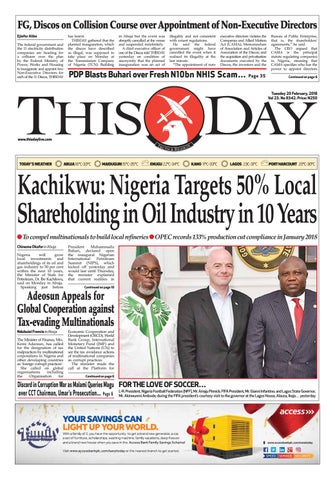
Kachikwu: Nigeria Targets 50% Local Shareholding in Oil Industry in 10 Years To compel multinationals to build local refineries OPEC records 133% production cut compliance in January 2018 Chineme Okafor in Abuja Nigeria will grow local investments and shareholdings of its oil and gas industry to 50 per cent within the next 10 years, the Minister of State for Petroleum, Dr. Ibe Kachikwu, said on Monday in Abuja. Speaking just before
President Muhammadu Buhari, declared open the inaugural Nigerian International Petroleum Summit (NIPS), which kicked off yesterday and would last until Thursday, the minister explained that current realities in Continued on page 10
Adeosun Appeals for Global Cooperation against Tax-evading Multinationals Ndubuisi Francis in Abuja The Minister of Finance, Mrs. Kemi Adeosun, has called for the designation of tax malpractices by multinational corporations in Nigeria and other developing countries as ‘foreign corrupt practices’. She called on global organisations including the Organisation for
Economic Cooperation and Development (OECD), World Bank Group, International Monetary Fund (IMF) and the United Nations (UN) to see the tax avoidance actions of multinational companies as corrupt practices The minister made the call at the Platform for Continued on page 6
Discord in Corruption War as Malami Queries Magu FOR THE LOVE OF SOCCER‌ President, Nigeria Football Federation (NFF), Mr. Amaju Pinnick; FIFA President, Mr. Gianni Infantino; and Lagos State Governor, over CCT Chairman, Umar’s Prosecution‌ Page 6 L-R: Mr. Akinwunmi Ambode; during the FIFA president’s courtesy visit to the governor at the Lagos House, Alausa, Ikeja‌ yesterday
<285 6$9,1*6 &$1 /,*+7 83 <285 :25/'
:LWK D IDPLO\ RI \RX KDYH WKH RSSRUWXQLW\ WR JHW D EUDQG QHZ JHQHUDWRU D FDU D VHW RI IXUQLWXUH VFKRODUVKLSV ZDVKLQJ PDFKLQH IDPLO\ YDFDWLRQV GHHS IUHH]HU DQG D EUDQG QHZ KRXVH ZKHQ \RX VDYH LQ WKH $FFHVV %DQN )DPLO\ 6DYLQJV 6FKHPH 9LVLW ZZZ DFFHVVEDQNSOF FRP VDYHWRGD\ RU WKH QHDUHVW EUDQFK WR JHW VWDUWHG
ZZZ DFFHVVEDQNSOF FRP VDYHWRGD\
2
T H I S D AY ˾ Ͱͮ˜ ͰͮͯͶ
T H I S D AY ˾ TUESDAY FEBRUARY 20, 2018
3
4
T H I S D AY ˾ Ͱͮ˜ ͰͮͯͶ
T H I S D AY ˾ TUESDAY FEBRUARY 20, 2018
5
6
˜ ͺ˜ ͺͶ ˾ T H I S D AY
PAGE SIX
Discord in Corruption War as Malami Queries Magu over CCT Chairman, Umar’s Prosecution EFCC chairman replies today Tobi Soniyi in Lagos Signs that the discord in President Muhammadu Buhari’s war against corruption has deepened emerged on Monday as news broke of a query by the Attorney General of the Federation and Minister of Justice, Mr Abubakar Malami, to the Acting Chairman of the Economic and Financial Crimes Commission (EFCC), Mr. Ibrahim Magu, asking him to explain his decision to file corruption charges against the Chairman of the Code of Conduct Tribunal (CCT), Mr. Danladi Umar. Also queried was a private legal practitioner, Mr. Festus Keyamo (SAN), who filed the charges on behalf of the EFCC. He is to explain to the AGF by whose authority he filed the case. In the query dated February 16, 2018, with Reference No DPP/ADV: 368/15, Magu was directed to make his response to the query available to the AGF on or before Tuesday, February 20, 2018. In the query, signed by Mr. Dayo Apata, the Solicitor General of the Federation and Permanent Secretary, Magu is to explain what informed the filing of corruption charges against the tribunal chairman having been cleared of corruption allegations twice by the EFCC. Titled: “FR VS Danladi Umar (CR/109/18) request for Briefing,” the query reads in part: “The attention of the Honourable Attorney General of the Federation was drawn to news report that the Economic and Financial Crimes Commission has filed charges of corruption against the Chairman of the Code of Conduct Tribunal, Hon. Justice
Danladi Umar, before the FCT High Court. “I am directed by the Honourable Attorney General of the Federation to seek clarification from you as to whether the charges were filed on your instruction or directive and if in the affirmative, what is the compelling basis for doing so? This clarification becomes imperative in view of the following background facts. “The Commission’s investigation report dated 5th March 2015 addressed to the Secretary to the Government of the Federation stated as follows: “The facts as they are now against Justice Umar raised a mere suspicion and will therefore not be sufficient to successfully prosecute for the defence. “The commission’s position in paragraph 2(a) above was also maintained and sustained by the Honourable Attorney General of the Federation while appearing before the House of Representatives’ Investigative Committee sometimes in 2015 to the effect that the report of investigations showed that the allegations against Hon. Justice Danladi Umar was based on mere suspicions. “In view of the foregoing, the Honourable Attorney General of the Federation requests for your prompt briefing as to the existence of new facts, which are contrary to the position in your attached investigation report, sufficient evidence or other developments upon which the prosecution of Hon. Justice Danladi can be successfully based. “Kindly accord this letter top priority while your prompt response within 48 hours from the receipt of same is required
Keyamo: No comment for now
in the circumstances.” In a separate letter to Keyamo, the AGF asked the learned silk to confirm who authorised him to file the corruption charges against Umar. Like Magu, Keyamo was given until Tuesday, February 20, 2018, to furnish the Office of the AGF in writing, the details of who engaged or issued him with the authority to file the corruption charges. The letter to Keyamo with reference No DPP/ADV:369/15 dated February 16, 2018, which was also signed by the Solicitor General of the Federation and Permanent Secretary reads in part: “The attention of the Honourable Attorney General of the Federation was drawn to news report that you have filed charges of corruption against the Chairman of the Code of Conduct Tribunal, Hon. Justice Danladi Umar, before the FCT High Court. “The Honourable Attorney General of the Federation hereby requests that you kindly furnish this office with the details of the instruction or authorization upon which you instituted the case under reference. “Kindly accord this letter top priority while your prompt response on or before Tuesday, February 20, 2018, is solicited in this regard.” Keyamo confirmed to THISDAY that he received the letter. He, however, declined to make public his response saying: “It is a private letter and I have responded privately.” Although no official statement came from the EFCC on Monday, a reliable source told THISDAY that the
commission would respond to the query today, saying it was not interested in another face-off with the AGF. Keyamo had on behalf of the EFCC filed a two-count charge against Umar at the Abuja High Court. In the charge, EFCC alleged that Umar collected N10 million from Rasheed Taiwo, a former customs official who was facing false assets declaration charges before the CCT sometimes in 2012. The prosecution also accused Umar of receiving N1.8 million of the N10 million bribe sum through one of his personal assistants, Gambo Abdullahi. The two counts of fraud contradicted Section 12(1) (a) and (b) of the Corrupt Practices and Other Related Offences Act, 2003. The CCT chair could face up to seven years’ imprisonment if convicted of the charges. EFCC had in two separate letters to the Federal Government through the Secretary to the Government of the Federation in 2015 and 2016 cleared Umar of any wrongdoing in the alleged N10 million bribery allegation made against him by a defendant, Rasheed Taiwo Owolabi, who was standing trial before him on false asset declaration. Upon receipt of the petition from Owolabi, the EFCC had investigated the petition and sent its report to the Secretary to the Government of the Federation (SGF) with a Reference No EFCC/EC/ SGF/03/56 dated March 5, 2015, personally signed by the then Executive Chairman of the EFCC, Mr. Ibrahim Lamorde exonerating the CCT boss from the bribery saga. The EFCC report received
by the office of SGF on March 6, 2015, was categorical that “the facts as they are against Justice Umar raised a mere suspicion and will therefore not be sufficient to successfully prosecute for the offence.” Other EFCC’s documents show that in 2016 a fresh investigation was conducted into the same N10m bribery allegation and the same antigraft agency in its second report absolved Umar of any wrongdoing and that the bribery allegation against him remain a mere suspicion. The EFCC’s second report with reference EFCC/P/ HRU/688/V30/99 dated April 20, 2016, submitted to the SGF and signed by the Secretary to the Commission, Emmanuel Adegboyega Aremo, read in part: “Kindly recall our correspondence of March 5, 2015, with Reference EFCC/ EC/SGF/03/56 on above subject caption. We will like to reiterate the Commission’s position in regard to this matter as earlier communicated to you and state that the allegation levelled against Justice Umar were merely suspicions and consequently insufficient to prosecute the offence.” The April 20, 2016, clearance coincided with the attempt by Senate President Bukola Saraki’s lawyers’ motion seeking to disqualify Umar from presiding over his (Saraki) alleged concealment of assets case, on moral grounds. Saraki’s lawyers had contended that it would be difficult for Umar who was being investigated by the EFCC for alleged corruption to do justice in their client’s case. Using the clearance by the
EFCC, Umar overruled Saraki’s objection and proceeded to hear the matter. Interestingly, Umar would later discharge and acquit Saraki on all 13 counts he was charged with. Umar’s latest travail and EFCC’s turnaround, critics say, may not be unconnected with the outcome of the Saraki's case. In the meantime, Umar is not a newcomer to this trend of controversy. Before he left office in 2015, former AGF and Minister for Justice, Mr. Mohammed Adoke (SAN) had forwarded to the then president, Dr. Goodluck Jonathan, advising him to initiate moves to remove Umar as the chairman of the tribunal. In the recommendation, Adoke stated that Umar was no longer a fit and proper person to preside over the tribunal having admitted that he met with the customs officer who was already facing trial before him at his (Umar's) office. There might have been no love lost between Magu’s EFCC and Malami as the anticorruption agency had resisted the supervisory authority of the AGF in the past. In July 2016, the AGF had requested all prosecutorial agencies to submit to his office their list of high profile cases for his review. While others, including the Independent Corrupt Practices Commission (ICPC) and the Nigeria Police, complied; the EFCC stonewalled the AGF. It took the persistence of Malami and threat of sanctions before Magu buckled and released the list, three months after the request.
F G , D I S C O S O N C O L L I S I O N C O U R S E OV E R A P P O I N T M E N T O F N O N - E X E C U T I V E D I R E CTO R S and the procedure for such appointments. Citing Section 248 of CAMA, he added that it is the members in a general meeting or in the event of a casual vacancy, the board of directors of a company that has the powers to appoint new directors, according to Section 249 of CAMA. “While we note that the BPE and MOFI (Ministry of Finance) are shareholders of the company, they may not unilaterally appoint new
directors,” he argued. According to him, this power can only be exercised collectively by a resolution decided by a simple majority vote of the shareholders present, in person or by proxy, at the general meeting. He added that if a poll is demanded, this power can only be exercised by the number of votes for each ordinary share held by the shareholders voting in favour of the resolution. “In addition, any
person empowered by the Memorandum of Association and Articles of Association of a company may appoint directors in line with Section 41 (3)). Memorandum of Association and Articles of Association of each of the Discos do not give the President or the Ministry the power to appoint directors of Disco. So, the purported appointment of non-executive directors to the board of each Disco is not valid. The Memorandum of Association
of Discos provides that unless determined by members in general meeting, directors shall not be more than 7 Directors. Section 249(3) CAMA says directors cannot exceed the number allowed by the articles,” he explained. He also stated that the planned appointment of Non-Executive Directors by the federal government is not consistent with the Shareholders Agreement (SHA) between Bureau of Public Enterprise
(BPE), Ministry of Finance (MOFI), investor and Discos. “SHA states that the number of directors in the Disco shall be no more than seven according to Clause 5.1. In addition, the SHA also provides that the investor shall nominate six directors, while BPE and MOFI shall nominate one in line with Clause 5.2. Any covenant adjustment to Clause 5.2 has to be in accordance with Clause 15.14 which requires that variations will only be valid if made in
writing and signed by all parties. The proposed appointment is inconsistent with the provisions of the SHA,” he added. He acknowledged that the World Bank is in partnership with the federal government on the Power Sector Recovery Plan. He urged the World Bank neither to condone nor partake in what the discos described as “monumental illegality that is capable of discouraging potential foreign investors into the Nigerian power sector”.
A D E O S U N A P P E A L S F O R G LO B A L C O O P E R AT I O N AGA I N ST TA X - E VA D I N G M U LT I N AT I O N A L S Collaboration on Tax (PCT) Conference in New York, the United States of America, which ended at the weekend. The PCT is an initiative of the OECD, World Bank Group, IMF and the UN. Adeosun explained that Nigeria was doubly affected by illicit financial flows as a result of corruption and tax evasion. “There is an absolute need for a complete understanding of how these Multinational Corporations (MNCs) behave in Nigeria and developing countries, many operate a completely different standard in Africa to what obtains globally,” Adeosun said.
She lamented the capability of defaulting MNCs to hide behind slow legislative processes to avoid doing what was right in the nations from which they derived significant income. According to a statement by her spokesman, Mr. Oluyinka Akintunde, the minister, who disclosed that options to sue such companies in their own countries were being explored, stated that the designation of tax crime as foreign corrupt practices would support such efforts. On the wider issue of Illicit Financial Flows, she emphasised that Nigeria, under President Muhammadu Buhari,
was ‘taking strong action and was determined to reverse their impact’. The government, according to Adeosun, is taking a number of measures internally and also taking full advantage of international initiatives to tackle the problem. She added, “Internal measures include tightening financial controls and surveillance, adoption of the National Tax Policy with its commitment to regular revisions of tax laws and the ongoing tax amnesty programme, the Voluntary Assets and Income Declaration Scheme (VAIDS).” She added that the federal
government would use every available avenue to improve its revenue generation and tax collection and credited the UN with putting the issue of Illicit Financial Flows (IFFs). The minister noted that it was "entirely appropriate that we are discussing this issue in the United Nations Headquarters, as this is a United Nations sized problem." She referred to the Thabo Mbeki report which revealed that IFFs from Africa exceeded the volume of foreign aid into the continent, adding that Nigeria was found to be the most adversely affected. “The Nigerian Government
is taking responsibility for preventing illicit flows but the range of measures used and the sheer volumes are such that the recipient nations must also take measures to discourage the flows into their countries by asking more questions,” Adeosun remarked. She lauded the recent initiative by the United Kingdom Government with Unexplained Wealth Orders (UWOs) and requested that more countries adopt such measures. She added that Nigeria was studying the options for introducing similar measures in the country.
TOP GAINERS NGN NGN LINKASSURE 0.08 0.96 LIVESTOCK 0.05 1.05 FIDSON 0.22 4.69 2.78 AXAMANSARD 0.13 JAIZBANK 0.04 1.04 TOP LOSERS NGN NGN PZ 2.00 23.00 LASACO 0.02 0.31 ENAMELWARE 1.15 22.10 FCMB 0.13 2.53 FBNHOLDINGS 0.11 11.70 HPE Nestle Nig Plc ₦1,341.80 Volume: 287.176 million shares Value: N2.286 billion Deals: 4,646 As at 19/2/18 See details on Page 31
% 9.0 5.0 4.9 4.9 4.0 % 8.0 6.1 4.9 4.8 4.8
7
T H I S D AY ˾ TUESDAY FEBRUARY 20, 2018
& ! & ! & ! & ! & ! & ! & ! & & & & & & & && & &! & ! ! ! ! ! ! ! ! !& ! !! & ! & ! & ! & ! & ! & ! &
) " "
) " " " " " ' ' " ' ' " '
% ) # * % % # % #% - - ' ) ( "
) % #
# %
(' ) ' %
# ' " ' " " '
# %
( "
%
# ' ) # "
# ) ' ) # ' ' # ' ' # % " # % ) * " ' ' ' # ' ' )' % # # " # " /& " " ' % ) " % # * ' ' ' " "
#
"
# % )' .
)' " " + ,
' % ' ' ' # ' ) " #
'
# ( # " +
# % ) " )
" )
% ) ) )' ' '
# %
) # % ' ) "
' # ' # ' %
" ' ( % ' ' " " ) ' #
+ , ' % ) ' " ) " ) " # " " " ) " ( " ) ) " ) % " ( " ) ' " ) " " " ' ) " ) " ' " ' " $ " * # " # ) " " # )
) %" " * ) ' " ) "% " "
" " % " ) " ( " # " ( " " " " (
* ( " " " " " " % ' " * "
# ' # #% # * %
)' )' " ) " ' ' # " # ' " # ' ' # ) ' ( ( " ) "
' " # % ' # "" % '
" % % # # " ' )' ( # #% ' # * )'
) % " "
* % *
) # " % + ,
#
# " ' ' " " # ) ' * * " ' " " * ' * * " '
' "" % ' )' % " # # ' " % "
* % * )' ) )
$ " ' # ' ' ' * " ) #
% # " % ' ' %
" " #% "
% " " ' # ' ' ' ) ' "
#
*
# " "
'
" * "" *%
)
% ' " "
# ) # + ,
# " " ' ) *
)' # ' " ' ' ) ( "
' " - # $ *
'
" ' # " # )
" ' #
% ) ) ' # # ) %
' # * '
# ' ' )' * ' #
" (% " $ " " " ) " * # " # #% " )
% " % " % "
" ( ) % " ( ) % " ( ) % " ( ) % " ( ) % " ( ) % " ( ) % " ( ) % " ( ) % " ( ) % " ( ) % " ( ) % " ( ) % " ( ) % " ( ) % " ( ) % " ( ) % " ( ) % " ( ) % " ( ) % " ( ) % " ( ) % " ( ) % " ( ) % " ( ) % " ( ) % " ( ) % " ( ) % " ( ) % " ( ) % " ( ) % " ( ) % " " ' "" " $ " ) ) % " " " " ' "" ) # " " ) " % ) " ) 012 342 5456 0647 " ) ' # ) " / # % ) " ( " " # # " $ " ) % " ) " " " ) " " " ' ) #) " ) ' "" " ' # " ' # )
" ( ) % " ( ) % " ( ) % " ( ) % " ( ) % " ( ) % " " " ' # " ' # % " % "
& & &
! ! & ! & ! !! & & & ! !! ! & & ! & &! & & & & ! ! & & ! ! &&& ! ! ! ! & &&! & ! ! & & ! & ! ! ! & & & & & & ! ! & ! & & & & ! ! & ! &
! & & & & & & & && & &! & ! ! ! ! ! ! ! ! !& ! !! & ! & ! & ! & ! & ! & ! & ! & & & & & & & && & &! & ! ! ! ! ! ! ! ! !& ! !! & ! & ! & !
" # $ " #%
#% ' " $ # #
" '
" " # #
% ) "
* ' $ # ' #
# "
#% " # ' ' " '
# %
) "
' )
% )' " # ) % # ) *
)' " #
% '
# #% # " #
# ' )'
) # " % ' *
' ) # " ) # #% " '
# % ' '
# % * ' " '
#% * ' " + ,
# #
# % # '
)' - # ) ' "
" #% # # " ' " # ' %
) " " " ( ( ) " " " ( ) " ( ) . " ) " "
) ) ) )
' " " % ' ' )' " * # % ' ( " # #% " # " # ( " ) % " * ' " )' " " ' % # ' ' " " % # + , %
% " + , # " ' ' % "
)
% ' " ) * "
" # ' ' %
'
' ' " * * ' %
' # # #%
" " )'
" ' ) # * #% %
# ' "
' " %
' "" % ' % ' % # )' " ' ' ) ' ""
"
' " ) # % # # ' ' % ) " ) ) '
' " % )
# " " ' (' % ) )' ) #% * ' ' #
# ) " #
) #% " # " ) *
#% ' " ' )' . % # ' % ' '
" ' # ' "
# ' * ' # "
" '
" ' % " ' " ' ' " ) " ( "
( * *
) " # " )' ) ''
" ) " * ) ) * % "
' " # " ) " ' '
) #% ( )% ' " )' )' *
% # " " ) " + "" , #% " " )' ) # )' ) ' " ) " " " ) " " "
" " ) " " ")
" " " " " ( ) " ) " " ) " % " " "
" "
"
" " " ) " )
" "
" ( ) % " ( ) % " ( ) % " ( ) % " ( ) % " ( ) % " ( ) % " ( ) % " ( ) % " ( ) % " ( ) % " ( ) % " ( ) % " ( ) % " ( ) % " ( ) % " ( ) % " ( ) % " ( ) % " ( ) % " ( ) % " ( ) % " ( ) % " ( ) % " ( ) % " ( ) % " ( ) % " ( ) % " ( ) % " ( ) % " ( ) % " ( ) % " ( ) % " ( ) % " ( ) % " ( ) % " ( ) % " ( ) % " ( ) % " " ' # " ' # " ' # % " ) "" " ) "" " ) "" " ) "" " ) "" " % " % "
" ( ) % " ( ) % " ( ) % " ( ) % " ( ) % " ( ) % " ( ) % " ( ) % " ( ) % " ( ) % " ( ) % " ( ) % " ( ) % " ( ) % " ( ) % " ( ) % " ( ) % " ( ) % " ( ) % " ( ) % " ( ) % " ( ) % " ( ) % " ( ) % " ( ) % " ( ) % " ( ) % " ( ) % " ( ) % " ( ) % " ( ) % " ( ) % " ( ) % " ( ) % " ( ) % " ( ) % " ( ) % " ( ) % " ( ) % " ( ) % " ( ) % " ( ) % " ( ) % " ( ) % " ( ) % " ( ) % " ( ) % " ( ) % " ( ) % " ( ) % " ( ) % " ( ) % " ( ) % " ( ) % " ( ) % " ( ) % " ( ) % " ( ) % " ( ) % " ( ) % " ( ) % " ( ) % " ( ) % " ) "" " ) "" " ) "" " ) "" " ) "" " ) "" " ) "" " ) "" " ) "" " ) "" " ) "" " ) "" " ) "" " ) "" " ) "" "
& & ! ! ! ! !
& ! ! ! & ! & !! & & ! ! !& ! & & ! !& ! &! & &! & & ! & & ! ! ! & & ! & ! & ! & & ! & ! & ! ! & &
8
T H I S D AY ˾ Ͱͮ˜ ͰͮͯͶ
T H I S D AY ˾ TUESDAY FEBRUARY 20, 2018
9
10
˜ ͺ˜ ͺͶ ˾ T H I S D AY
PAGE TEN
Pope Appoints New Apostolic Administrator for Ahiara Diocese Paul Obi in Abuja and Amby Uneze in Owerri After nearly a decade of protracted crisis over the leadership of the Catholic Diocese of Ahiara, Pope Francis I yesterday appointed the Bishop of Umuahia Diocese, Most Rev Lucius Ugorji as the new Apostolic Administrator of Ahiara Diocese. In a statement issued by the Director of Communications, Catholic Secretariat of Nigeria (CSN), Rev Fr. Chris Anyanwu, he explained that the appointment came on the heels of the resignation by Most Rev Peter Okpaleke. Anyanwu said: Following the resignation of Most Rev Peter Okpaleke of as the Bishop of Ahiara Diocese, as a result of the crisis that has lingered for nearly six years in that diocese, His Holiness Pope Francis has today appointed Most Rev Lucius Ugorji, the Bishop of Umuahia as the Apostolic Administrator of Ahiara Diocese. This appointment is with immediate effect,” Anyanwu added. But speaking to THISDAY on the development, outgoing President of the Catholic Bishops Conference of Nigeria (CBCN) and Archbishop of Jos, Ignatius Kaigama, said despite the resignation of Okpaleke, the Vatican is not in a hurry to appoint a substantive bishop
for the Ahiara. Kaigama explained that “Bishop Okpaleke came to the conclusion that he could no longer be a bishop in a diocese where there has been so much tumult, and having resigned means, the diocese is vacant. “Bishop Ugorji is to oversee the diocese as Apostolic Administrator, he is not a full-time bishop, he is administering the diocese on behalf of the Pope. “The Pope will rush to make an appointment. There are steps in the Catholic Church to take, and the Pope will take those steps. “The first step is to give them an Apostolic Administrator, we hope they would embrace him and work with him. “If the Pope feels that they are in the right direction and they understand what the Catholic Church stands for, the Pope will know what to do, we don’t give the Pope dateline,” he added. On the fate of Bishop Okpaleke, Kaigama said: “He is still a bishop, the Church that appointed him will know what to do, it is the prerogative of the Pope and his team to know what to do.” Meanwhile, the bishops are expected to elect new leadership today after the expiration of Kaigama-led executives. The election will be conducted to fill in all executive positions will bring to an end the six-year
tenure of Kaigama. The new CBCN president and his executives are to be unveiled on Thursday at the end of the bishops conference. Meanwhile, history was recorded in the Catholic Church yesterday as the eight-year standoff between Catholic priests and faithful of Mbaise extraction erupted in ecstatic jubilation when information filtered in that the embattled Bishop of the Ahiara Catholic Diocese in Imo State, Bishop Peter Okpalaeke, finally resigned his appointment as Bishop of the diocese. It was also learnt that the Vatican which graciously accepted the resignation subsequently appointed the Bishop of Umuahia in Abia State, Bishop Lucius Ugorji, as Apostolic Administrator of Ahiara diocese until the appointment of a substantive bishop. Bishop Okpalaeke, who is from Awka Diocese in Anambra State, was appointed Bishop of Ahiara Diocese in 2012 after the death of Bishop Victor Chikwe, the first bishop of the diocese. Okpalaeke’s appointment was roundly kicked against by Catholic priests and laity from Mbaise, who insisted that the bishop must be appointed from among them, having produced the highest priests in the West African sub-region. THISDAY gathered that Pope
Pope Francis, who was allegedly piqued by the action of the priests and threatened to take disciplinary action against them, later gave them an ultimatum to write a letter of apology to the Vatican, which they complied. According to a statement issued yesterday by the Congregation for the Evangelisation of Peoples published in the National Catholic Register, the Vatican said although priests from the diocese wrote 200 letters to the Pope showing him “obedience and fidelity, some priests pointed out the psychological difficulty in collaborating with the bishop after years of conflict.” The statement added that “taking into account their repentance, the Holy Father decided not to proceed with
the canonical sanctions and instructed the Congregation for the Evangelisation of Peoples to respond to each of them.” The Congregation also quoted the Pope to have urged each of the priest “to reflect on the grave damage inflicted on the Church of Christ and expressed hope that in the future, they will never again repeat such unreasonable actions opposing a bishop legitimately appointed by the Supreme Pontiff.” Meanwhile, the news of the resignation of the bishop was greeted with jubilation in the diocese. President of the Ahiara Diocesan Catholic Men Organisation, Chief Gerald Anyanwu, described it as “victory for the Catholic faithful in Ahiara diocese.” He thanked the Pope for yielding to the genuine demands of the people, adding that peace has finally returned to the diocese. Also thanking the Vatican, the Chairman of the Ahiara Diocesan Catholic Priests Association, Reverend Father Austin Ekechukwu, said the people are excited about the news. A member of the laity, Sir Sabastine Ekeanyanwu, expressed gratitude to the Holy Father for giving his ear to the complaints of the priests and laity in the diocese. He promised that they would support the administrator to
reposition the diocese pending the appointment of a substantive bishop. But other Catholic faithful who reacted to the development criticised the diocese for setting a wrong precedent that will encourage other dioceses to question the authority of the Vatican. A Knight of St. John International, Sir Andrew Ukachukwu, stated that “Bishop Okpalaeke maybe out today but nobody knows whose turn it will be tomorrow. Ahiara diocese may have succeeded in intimidating the Vatican but they have set a precedence that is totally alien to the Catholic faith. “No diocese has ever questioned or resisted the directives of the Pope. The development is really worrisome. They have brought tribalism into the running of the Catholic Church and it should be condemned by all genuine Catholic.” In his reaction, the Vice Chancellor of Nnamdi Azikiwe University, Awka, Prof. Joseph Ahaneku, said even though he had not confirmed the news, “its implication on the people of the diocese will be a very big dent on them. It will continue to create a negative image of our people. Though this is a religious thing, Bishop Okpalaeke will continue to be a bishop but not of Ahiara diocese.”
K AC H I KW U : N I G E R I A TA R G E T S 5 0 % LO C A L S H A R E H O L D I N G I N O I L I N D U ST RY I N 1 0 Y E A R S the international oil market indicated that unless the country began to move away from just exploring and mining crude oil to processing it completely, it may be difficult for her to leverage the commodity to develop her economy. He said that on this basis, the country would be looking to grow her local grip on the industry from the current 10 per cent to 50 per cent in 10 years, adding that a Floating Production Storage and Offloading (FPSO) oil platform would be wholly built in the country amongst other in-country based innovations in the sector. Kachikwu’s statement also came with the declaration of Buhari who was represented by the Secretary to the Government of the Federation (SGF), Mr. Boss Mustapha, that Nigeria was now ready to have more investors come in to develop her downstream petroleum sector. Buhari, also stated that his administration was determined to clean up the country’s oil sector from the alleged agelong corruption, noting that he would not stop until he was sure transparent business practices were back to the sector. According to Kachikwu: “The reality is that today, if you cannot produce cheap cost oil, if you cannot diversify the processing of your oil, if you cannot look to internalising and externalising investment in the sector, if you cannot capture the requisite technical skills that are essential to help you operate efficiently, you are lost before you start.” “The challenges for oil companies have changed. Oil has got to provide the resources to power this country, jobs for our people and the operational environment that is transparent
enough for others to take Nigeria seriously. Oil has got to provide the technical and advanced skills sets that are essential for us to export people out to other African countries, and to become investors in other African countries. “Something the banking sector has tried to do successfully over the last six to seven years. My target is that over the next 10 years, Nigeria would produce an FPSO, and that is not too much to ask. My target over the next 10 years, Nigeria would become self-sufficient in its own power provision. And over the same period, from crude oil, Nigeria would gravitate, as it were, to very refined, clean provision of fossils. “My target is that over that same period, investment in the sector, in the sense that Nigerian companies, Nigerian entities and Nigerian shareholders, would begin to move from the minuscule 10 per cent today, to between 40 and 50 per cent of local investments.” He said there are major plans to achieve these objectives using the ‘Seven Big Win’ oil policy of the government, and that the oil sector has not lacked the opportunities to make these happen. “What have we achieved since the launch of the 7Big wins two years ago? We have been able to, through a lot of struggle, changed the funding capacity for the upstream, and that had sort of energised investors in the upstream sector. Now we are beginning to see projects like Egina, $15 billion, Zabazaba - potential $10 billion, Bonga -potential $10 billion and the likes. “So many other investments put at over $40 billion potential investments over the next five years. If we do the right thing,
set the right models and set the right policies, that is very key and that is coming from a country where investments had runaway for nearly seven to 10 years,” he added. The minister also said multinational oil companies operating in Nigeria might be compelled by the federal government to build refinery facilities in Nigeria to ensure the country fully maximises its hydrocarbon resources and move away from just exporting crude oil. Speaking at an executive session titled: ‘Deepening Collaboration in the African oil and Gas Industry Challenges and Opportunities for Investment,’ Kachikwu, stated that the government was considering a new move that would have the multinational oil and gas firms build refineries in Nigeria. He said in the not-too-distant future, multinational oil firms would no longer be allowed to ship out all the crude oil they produce in Nigeria, adding that emphasis would then shift to local processing of a substantial amount of crude oil that is produced from oil fields in Nigeria. The minister explained that Nigeria’s average in-country refining capacity was 14 per cent and would need to be upgraded to meet the demands of her rising population. The session had in attendance the United States Ambassador to Nigeria, Mr. Stuart Symington, Minister of Petroleum of Chad, Mr. Bechir Madet, as well as the Secretary-General of the International Energy Forum (IEF), Dr. Sun Xiansheng, amongst others. He stated: “We would get to a point where Nigeria, definitely, would be a major supplier of refined petroleum products. It just has to happen. Nothing else
makes sense. We are also saying directly to oil companies that a time would also come when we would not be open to see them move around all the crude oil they produce in Nigeria. “We will like to see integrated refining and integrated processing here. It gives us more jobs and creates more investments.” The minister explained that the challenges for oil companies have changed, noting that henceforth, oil has got to provide the resources to power the country, provide jobs for Nigerians and also provide the operational environment that is transparent enough for others to take Nigeria seriously. According to him, oil has got to provide the technical and advanced skills-sets that are essential for the country to export people out into other African countries, and to become investors in other African countries. Buhari, in his opening remarks also buttressed Kachikwu’s statements, and explained that the NIPS was part of his government’s efforts to use the country’s oil industry to relaunch her economy through the Economic Recovery and Growth Plan (ERGP). He said: “The summit is designed to be Africa's largest and most important platform and linkage to the world where technological breakthroughs will be unveiled. This summit will afford Nigeria a unique opportunity to showcase to the international community policy direction and efforts of government in the petroleum sector especially the new oil and gas exploration and markets, new measures to sanitise the sector, the expansion of investment opportunities to boost investors’ confidence, technological advancement, Nigerian content development, the institutionalisation of reforms
in the country’s oil and gas industry and the galvanisation of Nigeria’s position as the leading oil producer in the continent of Africa.” The president explained that: “Nigeria is open to private sector investment in the downstream sector and pursuing vigorously a programme for the rehabilitation of existing refineries so as to enhance capacity to supply locally refined petroleum products in Nigeria and West Africa. This is a very key component of the national petroleum industry roadmap and the 2017 to 2020 Economic Recovery and Growth Plan (ERGP).” Speaking on his plans to sanitise the sector, and make it transparent, Buhari said: “Corruption in this industry must not be allowed in any form. On our part, we will not stop the fight until a new image is created where transparency will be the watchword in all our transactions.” The Secretary-General of the Organisation of Petroleum Exporting Countries (OPEC), Dr. Mohammed Barkindo, in his remarks at the NIPS, stated that countries’ compliance levels to the production cap agreement the cartel and non-OPEC members reached in 2017 and later rolled over to rebalance the oil market recorded a collective 133 per cent in the first month of 2018 - January. Barkindo, who called for conducive operational conditions for member countries to continue to stabilise the market, explained that the cooperation between OPEC and non-OPEC members had become a force to reckon with in the global oil market. He also lauded Nigeria’s contributions to the success of the cooperation. He said: “OPEC has embarked on one of the most innovative
enterprises ever known in the history of oil – the declaration of cooperation. This innovation was a response to an unprecedented market turbulence which had a devastating effect not only in the industry but in the economies of OPEC member countries. “Price cycles are not new in the history of oil, OPEC has identified six since the early 1970s, however, this price cycle should be considered unique for several reasons: it is the most overwhelming supply-driven of all the cycles we have seen in this exercise. Secondly, the magnitude of the price drop is the highest, thirdly, the recent oil price drop has been considerably sharper with the decline in prices for other commodities which is in sharp contrast to the oil price collapse of 1985/1986 when all commodity prices declined in a similarly steep manner.“ “Thankfully, a breakthrough came in the form of the declaration of cooperation. This was the culmination of an extensive consultation undertaken throughout 2016 with the aim of gaining consensus about the strategic urgency of bringing this market back to balance in a collective manner. “If one word was to be used to describe the impact of the declaration, it would be ‘transformative’, a new player has emerged on the global oil scene - the OPEC and non-OPEC strategic partnership. Many didn’t think it would get off the ground, however, we have registered conformity in 2017 of 107 per cent across all the participating countries and I would like to use this platform to also announce our January figures of 133 per cent that would be released in a couple of hours in the OPEC secretariat,” added Barkindo.
T H I S D AY ˾ TUESDAY FEBRUARY 20, 2018
11
T H I S D AY ˾ Ͱͮ˜ ͰͮͯͶ
12
CONGRATULATIONS
Rated best overall performing electricity distribution company in Nigeria 2017 by NERC
And thank you for letting us be part of your transformation journey. EKEDP RCM runs on CICOD 1.0 WORKFORCE MANAGER
BUSINESS PROCESS AUTOMATION
ENERGY MANAGEMENT CONTROL CENTER FORECAST DISTRIBUTE
ACQUIRE MEASURE
ANDRIOD TERMINAL CUSTOMER MANAGEMENT
BILLING & ACCOUNT RECEIVABLES
INVENTORY LIFECYCLE MANAGEMENT
FIELD FORCE MANAGEMENT
UTILITY BILLING
SELFCARE
UNIFIED COLLECTIONS G AT E W AY MULTI-PAYMENT SINGLE VIEW
WEB, MOBILE APP AND SMS
VOUCHER MANAGER VOUCHER LIFECYCLE MANAGEMENT
Powered by
CALL CENTRE REMOTE CUSTOMER SERVICE
ASSET LOCATION
CAPTURE
ASSET ENUMERATION
BUSINESS INTELLIGENCE KEY PERFORMANCE INDICATORS
T H I S D AY ˾ TUESDAY FEBRUARY 20, 2018
13
14
T H I S D AY ˾ ˜ Ͱͮ˜ ͰͮͯͶ
COMMENT
Editor, Editorial Page PETER ISHAKA Email peter.ishaka@thisdaylive.com
THE FURORE OVER INEC TIMETABLE
Adewale Kupoluyi argues that the amendment to the electoral act would add value to our electoral process
I
n the last few days, the amendment bill on the Electoral Act, 2010 that is due for passage into law, continues to dominate discussions across the country. Ordinarily, this should be expected as the next general election is fast approaching and many events would naturally be unfolding. The Independent National Electoral Commission (INEC) recently released the elections timetable, which is in line with the provisions of the 1999 Constitution (as amended), as well as the Electoral Act 2010 (as amended). From the INEC schedule, the presidential and National Assembly elections would hold on February 16, 2019; gubernatorial and state houses of assembly election would take place on March 2, 2019. Expectedly, series of reactions have trailed the commission’s timetable because of the belief that the idea of fixing the presidential election first, being the extant provision, would give the ruling All Progressives Congress (APC) undue advantage over the opposition parties while other observers believe that timely release of the schedule was as a good move that would ensure adequate preparation for the polls. But with the just-concluded amendment by the National Assembly, there is a reversal in the order of elections by virtue of Section 25 of the Electoral Act, which would now see the National Assembly elections holding first; elections into the state houses of assembly and governorship would be held on a different day; while the presidential election would come last. For emphasis, the amendment goes beyond reordering of elections. The main thrust of the new electoral act is to improve how elections are conducted and reduce human interference in the process, thereby reducing corruption in a number of ways. For instance, the amendment mandates the immediate transmission of voting results from polling units to collation centres. The implication of this is that it would help give real-time results and updates of proceedings. In addition, the amendment would provide a fairer platform for all contestants by mandating INEC to publish available voter registers 30 days before elections. When this is done, it would end the usual manipulation of voter registers that had characterised our electoral process, as missing names on the voter register could be detected and addressed within the stipulated 30 days. The amendment would make it impossible for political parties to impose arbitrary qualification criteria on candidates; an innovation that would encourage much younger voters to participate by promoting competition. Furthermore, the amendment would make it more rigorous to determine the suitability/quality of candidates and curtailing unnecessary imposition. It would give room for dispute resolution mechanisms that would enable aggrieved parties to petition and raise objections on contending matters without delay. Under the new arrangement, the electoral umpire is empowered to deploy full biometric accreditation of voters using smart card readers and other technologies. Other provisions include setting out the maximum expenses that can be incurred by politicians seeking elective positions and acceptable fees payable thus reducing the influence of money politics to the barest minimum and reducing the exorbitant fees charged by their parties. The amendment also allows for names of candidates to be submitted not earlier than 90 days, and not later than 60 days before elections such that
BEYOND THE AMENDMENT, FOCUS SHOULD BE CENTRED ON WHAT STILL NEEDS TO BE DONE TO HAVE FAIR, CREDIBLE AND TRANSPARENT ELECTIONS IN NIGERIA. THESE INCLUDE ADEQUATE AND TIMELY RELEASE OF FUNDS TO INEC AND MINIMISING VOTERS’ APATHY
substitutions can be carried out without affecting existing schedules, as candidates can now be substituted not later than 30 days before the dates. Another important feature of the amendment is that if a candidate is resigning, it would be done in person and the letter to that effect has to be transmitted to INEC while there is going to be specific instructions on what to do in the case of a death occurring before an election. When this happens, such an election would be suspended for 21 days and a replacement would be done within 14 days while the remaining seven days would be utilised for campaigning, as against the initial provisions with the lacuna in our polity on what to do in the event of sudden death of aspirants, thus leading to crisis and avoidable litigation. However, critics believe that aside Section 76 of the 1999 Constitution that empowers INEC to organise elections, the impending reordering of the sequence of elections would have dire cost implications on both public and business life of the nation, considering the compulsory restriction of human and vehicular movements on election days. They also alleged that the idea was selfish on the part of the legislators and was never thoroughly discussed before making the bill. The controversy trailing the amendment is a sort of mixed blessing for two main reasons. For the big politicians and stalwarts, it is a ‘yellow card’ for them because it is going to be a radical departure from the past and for fresh and politically not-too-strong candidates, it would be a better arrangement and hope for them as there is presently no room for independent candidacy; thus freeing them from party hawks. Another implication is that if the bill becomes law, after presidential assent, there would not be any need for the legislators to ride on the back of any presidential candidate before getting elected into office. This crucial point is coming to play in view of the perceived frosty relationship between the current leadership of the National Assembly and the executive. For the legislators, the amendment would truly give them an independence, especially from the dominance of the almighty executive that may not likely to give the expected support to coming back to their respective seats. It would mean that the result of the presidential poll would not impact on the outcome of other elections that follow. As it is now, registered parties in the country have just few months to go before they conduct their primaries. The situation now is that most of them seem not set for the task ahead, including the ruling APC that is busy talking about restructuring at the last minute, as well as the main opposition party (PDP) that is saddled with series of alignment and realignments while the recently registered parties appear not to have strong structures in place for many Nigerians to even ascertain what new they are bringing into the political turf. In the final analysis, the amendment is a welcome development that is good for our polity. There is nothing unconstitutional in what the federal lawmakers are doing. However, one of three things may happen in the political terrain in next few weeks. First, the president may give his assent to the bill and the amendment becomes law. Kupoluyi wrote from Federal University of Agriculture, Abeokuta
A GLIMMER OF HOPE
The successful completion of C-check locally bodes well for Aero Contractors, writes Edozie Ifebi
A
ero Contractors, in January this year, completed its first C-check on a Boeing 737-500 series at its Maintenance, Repair and Overhaul (MRO) facility located at the domestic wing of Murtala Muhammed Airport in Ikeja, Lagos. This aircraft maintenance procedure, done for the first time in West Africa, signals a remarkable turnaround for an airline that has been steadily working to reverse a downward trend that started about seven years ago. The firm reached the cusp of a major crisis two years ago, in February 2016, causing AMCON to fully intervene in order to forestall a total collapse. The capability to conduct a C-check – an individual feat for the company and a major win for the local aviation industry – is however, a testament to the restructuring work going on at the airline. Critical to the success of its restructuring drive has been its ability to identify a new path forward, play to its key strength, and build on its core competences. C-checks are critical detailed maintenance checks that have to be carried out on airplanes after a specified number of flight hours. It requires that a majority of the plane’s components are thoroughly inspected, which means that it has to be put out of use until the maintenance is complete. Prior to this time, heavy maintenance checks such as C-checks and the more extensive D-checks were carried out on the sites of MRO companies due to the need for hangar space and expertise. These sites are often based outside Nigeria in places like Israel, Jordan, South Africa, Ethiopia, Morocco and America. This milestone procedure was achieved after a series of operational revamp efforts led by
AMCON upon taking over. Some of the revamp efforts include replacing the previous management, which was riddled with corporate governance issues, with an experienced management team saddled with a renewed focus on achieving quick turn-around. Furthermore, the company mapped out a strategic vision and embarked on a diversification drive as a means to resuscitate the airline. The decision to diversify into aircraft maintenance was a viable strategy given that firstly, the airline had some existing capacity that could be leveraged. Secondly, a big domestic market already existed for the service, as Nigerian domestic airlines operate about 22 B737 planes that would be in need of servicing from time to time. The decision was also borne out of Aero’s need to have its own planes serviced. To fulfil this diversification strategy, Aero obtained certification from the Nigerian Civil Aviation Authority (NCAA) in September 2017 to conduct C-checks on Boeing B737 aircraft. It also deployed capital towards renovating and expanding its MRO facility, in order to meet the required local and international standards. It further secured agreements with international partners, such as the maintenance unit of Ethiopian Airlines, South Africa’s Technik, and British firm AJW, to provide C-check support. With these foundational structures, the airline says it is looking forward to being able to perform D-checks, a more detailed critical maintenance procedure. Although Aero’s foray into the provision of maintenance services started out as a response to an in-house need to service its own Boeing 737500 aircraft series under a tight budget, it looks set to now provide the service to third parties, i.e. other airlines that have the same series in their
fleet. According to the firm, airlines will benefit in the form of a significant reduction in their maintenance costs as they will not be required to leave the country. They will also benefit from a reduction in the downtime suffered by airlines when their planes go through such extensive maintenance procedures outside the country. According to Aero’s CEO, Captain Ado Sanusi, the airline does not intend to stop there. It further aims to expand its services beyond the Nigerian market by obtaining a European Aviation Safety Agency (EASA) certification as well as FAA (Federal Aviation Administration) approval. In trying to prevent the organisation from bleeding out cash completely, the management trimmed its bloated workforce by up 60%, thereby drastically cutting down on its operational costs. A significant part of its workforce had become redundant because a large number of Aero’s aircraft became grounded. In the light of this, maintaining a large workforce dedicated to those grounded planes became unjustifiable. This however, did not go down well with its workers who threatened to embark on industrial action. To worsen the situation, the firm’s low cash position constricted its ability to adequately compensate the laid-off workers. That notwithstanding, the management gave guarantees to re-engage the redundant staff as more planes are recalled into operation. It estimated that it would have about six planes back in the air by 2018. As matter of fact, about 68 of those redundant workers were recalled a few weeks back. Many more workers, it was gathered would be recalled in the near future. Aero is deep in the process of rebuilding its capabilities in line with its strategic goals, by leveraging its international technical partners.
Following the deepening of its technical ability and the acquisition of the requisite Nigerian Civil Aviation Authority (NCAA) certification, Aero Contractors is now fully able to conduct C-Checks for third party airline operators both in Nigeria and across the West Africa region, thereby contributing to the attractiveness of Nigeria as an aviation hub. The airline has identified ways in which its victory can be even further stretched. According to Captain Sanusi, the airline’s CEO, it has applied to be granted a Free Trade Zone status by the Nigerian Export Processing Zones Authority (NEPZA), in order to further reduce its maintenance turn-around time for the benefit of its customers. Right now, it still endures avoidable delays by Customs during the importation of special tools required for the maintenance. In addition to revamping, restructuring and upgrading its MRO support services, the airline has also hinted at acquiring two new aircraft with some partners, meaning that more of the redundant workers would be recalled onboard. Aero airline currently managed by Ahmed Kuru-led AMCON is continually making giant strides towards regaining its market leadership position. The decision to successfully diversify into maintenance has been a game-changer. The airline has indicated that its fleet could grow to about eight aircraft this year. As it does so, it has begun to reabsorb most of its technical staff in a bid to rebuild capacity. No wonder industry analysts and aviation enthusiasts have been giving credit to AMCON for providing the impetus that was critical to Aero ringing the much-needed change that was necessary for its resurgence as the oldest and most dependable airline. Ifebi wrote from Lagos
15
T H I S D AY Ëž Ëœ Í°ÍŽ Ëœ Í°ÍŽÍŻÍś
EDITORIAL GOVERNORS AND STATE POLICE State police should be part of the wider conversation on restructuring the federation
C
ontrol of police by the states gained more converts last week with critical stakeholders throwing their weight behind the idea that has been variously thrown up as the panacea for the worsening security situation in the country. Speaking on behalf of the 36 governors, the Nigeria Governors’ Forum (NGF) Chairman and Governor of Zamfara State, Abdulaziz Yari said there is already a consensus on the issue that states should be allowed to set up their own police once they can afford it. His intervention came after Vice-President Yemi Osinbajo had canvassed similar position. Amplifying the idea further, the Deputy Senate President, Ike Ekweremadu, believes it could work the same way states established their own universities. However, while many Nigerians seem excited that strong voices are being added to the call for state police, it is noteworthy that this is not the ďŹ rst time the NGF would toy with the idea. After one of its meetings ďŹ ve years ago, for instance, the then Ekiti State governor, Dr. Kayode Fayemi, who THE GOVERNORS is now the Minister for WILL HAVE TO GO Solid Minerals, made BEYOND SEMINAL the same case on its PRONOUNCEMENTS behalf. “Each of the AND TAKE CONCRETE federating units (which ACTIONS THAT WOULD are the states) should FACILITATE NOT ONLY THE have control over their ESTABLISHMENT OF STATE own security apparaPOLICE BUT ALSO THE tus. That is not to say BIRTH OF A WORKABLE that we still won’t have FEDERAL ARRANGEMENT a federal police which THAT WILL ALLOW THE responds to federal STATES TO DEVELOP AT issues but in terms of THEIR OWN PACE wider knowledge of what obtains in my locality, the best person to use is somebody from that locality who has a much better, much richer understanding and will be faster in response to the immediate
needs of that environment,� argued Fayemi at the time. Unfortunately, at the end of the day, nothing came out of that effort. Besides, whatever may be the merit in the idea of state police, even from the statement released by the NGF chairman, it is clear that it is not a silver bullet given that the same subversion that has rendered the federal police ineffectual could easily be replicated by the states. But we agree that the current situation where our policemen have become an easy game for a more sophisticated world of crime calls for a radical solution. Whether the solution lies in the establishment of their own police by governors is another matter altogether, given that many of them behave like emperors in their states.
A
T H I S DAY EDITOR DEPUTY EDITORS ˜ MANAGING DIRECTOR DEPUTY MANAGING DIRECTOR CHAIRMAN EDITORIAL BOARD
EDITOR NATION’S CAPITAL
T H I S DAY N E W S PA P E R S L I M I T E D EDITOR-IN-CHIEF/CHAIRMAN GROUP EXECUTIVE DIRECTORS ˜ ˜
˜ ˜
DIVISIONAL DIRECTORS ˜ DEPUTY DIVISIONAL DIRECTOR
SNR. ASSOCIATE DIRECTOR ASSOCIATE DIRECTORS ˜ CONTROLLERS ˜ ˜
DIRECTOR, PRINTING PRODUCTION
s we reiterated in a recent editorial, there may be a need for some clarity of thought and the beneďŹ t of historical hindsight. The greatest legacy of the post war era in Nigeria is the emergence of a national military and police. The personnel of these federal institutions live and operate alongside colleagues from across the nation in mixed barracks and operational formations. The lines that dangerously divided the polity and threatened national cohesion are thus blurred as the central command takes precedence over regional or ethnic nudging. Therefore, we hope the committee established by the governors will explore all the issues before coming up with its recommendations. This is important because Nigeria has been on this path before. A more recent effort to delist some of the exclusive functions and add them to the concurrent list suffered defeat in the National Assembly as both chambers killed the devolution of powers amendment bill. What this suggests is that the vice-president and the governors will have to go beyond seminal pronouncements and take concrete actions that would facilitate not only the establishment of state police but also the birth of a more workable federal arrangement that will allow the states to develop at their own pace. That will come within the larger conversation on the need to restructure the country.
TO SEND EMAIL: ďŹ rst name.surname@thisdaylive.com
Letters to the Editor
TO OUR READERS Letters in response to speciďŹ c publications in THISDAY should be brief (150-200 words) and straight to the point. Interested readers may send such letters along with their contact details to opinion@thisdaylive.com. We also welcome comments and opinions on topical local, national and international issues provided they are well-written and should also not be longer than (9501000 words). They should be sent to opinion@thisdaylive.com along with the email address and phone numbers of the writer.
LAGOS AND THE PROMOTION OF INDIGENOUS LANGUAGE
T
he World Bank and the United Nations Educational, Scientific and Cultural Organisation (UNESCO) studies on basic education all indicated that children learn better and faster – eagerly – when instructed in their mother tongue. Other studies further confirm that countries that rank highest in the world in mathematics and science tests, as reported by Trends in International Mathematics and Science Study (TIMSS), are usually those that pay more attention to teaching school children in indigenous languages. Learning starts at home not in school with use of indigenous language. By using the learners’ native language, it is a bit easier to connect in the learning process. The interactive learner-centered approach which is well recognised by most educationists, flourishes in an environment where learners are adequately skillful in the language of instruction. It allows learners to make suggestions, ask questions, answer questions and create and communicate new knowledge with enthusiasm. About two decades ago the need to strengthen and promote indigenous languages caught the attention of the international scene when UNESCO proclaimed February 21 as the International Mother Language Day. The day is set aside to celebrate all the languages spoken all over the world with the aim of promoting the right of people to use indigenous languages otherwise known as mother tongue, as means of encouraging integration in all aspects of public life, particularly in education. About the same time also in Harare, Zimbabwe, African leaders, having observed the declining interest in indigenous languages across the continent, met and restated their commitment to seriously take positive steps towards raising the status and usage of indigenous languages.
Corroborating the position of the UNESCO and Harare declaration, the Lagos State Government in February this year signed the Yoruba Language Preservation and Preservation Law making it compulsory for all primary and secondary schools – private or public – in the state to include teaching of Yoruba Language as a core subject at all levels. The law states that candidates seeking admission into all tertiary institutions in the state must henceforth possess credit in Yoruba Language. This new legislation by the Lagos State Government is in line with the dictate of the national policy on education and a contrast to the current practice among private school owners who offer international curricular and teach languages of other countries like Germany, France, Turkey and the rest as substitute to the various Nigerian indigenous languages. In this same direction the Lagos State House of Assembly in demonstration of its support to the promotion and preservation of the Yoruba language, now holds its legislative sessions in Yoruba language every Thursday. This decision by the state government stems out of the belief that the promotion of the Yoruba language should be exemplified by the legislative arm of the state and that the development would not have any adverse effect on the academic performances of school children but would instead strengthen cooperation among people and contribute to the attainment of quality education for all. In addition to this, education scholars have also argued that children can learn over seven languages at their formative years and any child who does not understand any concept in his/her mother tongue may find it challenging to understand it in any other languages. Perhaps, the most important aspect of promoting the Yoruba language is that the promotion of the language consciously or unconsciously
translates to the promotion of the culture of the speakers, their customs and the dignity of respect which the speakers are known for. In other word, when children are taught the language they will also be exposed to the societal customs and the way of life of the speakers and this goes a long way in instilling morals thereby engendering a cultured society and disciplined individuals who have respect for elders. As rightly posited by a former President of South Africa, Nelson Mandela, “If you talk to a man in a language he understands, that goes to his head. If you talk to him in his language, that goes to his heart�. Our indigenous languages play a complementary role in our ability to understand and interpret scenarios even in other languages. Linguists believe that promoting indigenous languages will facilitate the fulfilment of national development as it is the case with most developed countries of the world. Lagos State, being a cosmopolitan society, a home to everyone including expatriates, is naturally prone to the western life style and if stringent efforts are not made, the culture of its indigenous dwellers would go into extinction in no distant future. In complementing this bold step taken by the state government, more responsibilities lie on parents to ensure the promotion of the Yoruba language is sustained by ensuring that they communicate and relate with their children mainly in their mother tongues. On a broader perspective and for a universal result in the educational sector, there is need for the formulation of a comprehensive national language policy that takes into account the use of indigenous languages in education. Ayo Afuwape, is of the Lagos State Ministry of Information and Strategy, Alausa, Lagos
T H I S D AY ˾ TUESDAY, FEBRUARY 20, 2018
16
POLITICS
Group Politics Editor Tobi Soniyi Email tobi.soniyi@thisdaylive.com 07054786260 SMS ONLY
EXECUTIVE BRIEFING
INEC Not Blameless for Underage Voters The Independent National Electoral Commission must accept responsibility for allowing persons younger than 18 to get their names in the voters’ register, writes Tobi Soniyi
P
enultimate Saturday, videos and photographs of underage voters casting their votes during the Kano State local government election went viral on the social media.
Those who monitored the election including the Centre for Information Technology And Development, (CITAD), and Action Aid International Nigeria, also said that they witnessed voting by underage citizens during the elections. The photographs left many seething with anger. Even though it is common knowledge that underage voting is rampant in the northern part of the country, it is an illegality people no longer want to condone. The Independent National Electoral Commission, which has the sole responsibility of registering voters for all elections did not help matters with its response. This further infuriated the people. In a statement by a spokesperson, Oluwole Uzzi, INEC said the disturbing pictures did not relate to any election it conducted or had responsibility for, thereby allaying fears over its capacity for credible elections. No one is in doubt that INEC is statutorily empowered to conduct all elections, except local government councils conducted by the electoral commissions in each state. Acknowledging the pictures of the underage voters, the commission stated that “as far as we can ascertain, they (the pictures) relate to a local government election conducted at the weekend (in Kano). “While the commission remains resolute in our commitment to sanitise the nation’s electoral process and deliver free, fair and credible elections, we cannot be held directly or vicariously liable for a process outside our legal purview. “Our part, INEC assures the public that we are doing all we can to ensure a credible election.” Since all elections are conducted based on the voter register prepared y INEC, the commission’s attempt to absolve itself of any blame amounts to unnecessary hair splitting. The commission was roundly condemned by stakeholders except the beneficiary of the frud, the All Progressives Conngress. In its the Peoples Democratic Party called on INEC to review and sanitise its voter register, particularly in Kano and Katsina States, to check underage people from voting. The PDP in a statement issued by its National Publicity Secretary, Kola Ologbondiyan, said Nigerians had lost confidence in the commission. Ologbondiyan said reviewing the voter register was the only way the commission could demonstrate its independence to Nigerians. The PDP condemned the commission for attempting to cover its complicity in the “widespread impunity recorded”, particularly under age voting that characterised the state local council elections. The party said it was INEC that registered the minors as voters in the first place. Ologbondiyan said the commission should as such not in any way attempt to exonerate itself of involvement in the electoral fraud simply because it did not directly conduct the elections. The statement said: “Is it not INEC that registered the minors and issued them with Permanent Voter Cards to participate in elections as clearly documented in the Kano council election. “Can INEC truly acquit itself as the original culprit who set the stage for the eventual participation of the minors and overall rigging of the elections.” Ologbondiyan said INEC should not give lame excuses or exonerate itself at a time it
Yusuf
should be taking decisive steps to protect the sanctity of its sensitive materials such as the PVC. He said: “Indeed, if this INEC is serious about the sanctity of sensitive electoral materials, by now, it should have ordered the immediate review of its voter register in Kano and Katsina states. “INEC supposes to be fishing out and prosecuting those who registered the minors and clean up the electoral system in the affected states.” Ologbondiyan accused INEC of allowing itself to be used for irregularities in favour of the ruling party. This, according to the party, was witnessed in the last Saturday’s Mashi/Dutsi Federal Constituency Supplementary election in Katsina State. He said: “Finally, we want INEC to note, and in very strong terms too, that Nigerians will not accept anything short of credible, free and fair general elections. “The commission should therefore ensure that it does not allow itself to be used by the APC against the will of the people, particularly in the 2019 elections, as such will be highly resisted.” In Oyo state , participants at a youth summit of the PDP in also on INEC called to revisit the voters’ register of Kano State. Hundreds of youths from across the 351 political wards of Oyo State who converged in
The Independent National Electoral Commission, which has the sole responsibility of registering voters for all elections did not help matters with its response
INEC Chairman
the capital, Ibadan for the 2018 youth summit urged INEC to scrutinise the register and delete all underage voters; as well as guard against future occurrence of such in order to safeguard the nation’s democracy. In the past, INEC had easily got away with such infraction. With more people taking their civic duty seriously, INEC must rise to the challenges. If the spontaneous condemnation that followed the discovery of underage voters in Kano is anything to go by, INEC should understand that voters can no longer be taken for a ride. Besides, the commission must also be mindful of its reaction to issues of public interest. The response of Oluwole Uzzi to underage voters casting their votes not satisfactory and against the weight of evidence. INEC chairman, Prof. Mahmood Yakubu had attempted to clarify the issue. Speaking in Lagos last Friday at a workshop on the implementation of the Election Project Yakubu said the commission could not ascertain whether or not the voter register it gave the Kano SIEC was used or discarded. He said; “By way of clarification, I wish to state that the commission is aware of the discussion around the Voter Register and the concern expressed in certain quarters on the possible prevalence of ineligible registrants on the voter register. The commission is equally concerned for the simple reason that the credibility of an election draws from the credibility of the voter register. The eligibility for registration as a voter in Nigeria is clearly defined in Section 12 (1) of the Electoral Act. This includes citizenship, residence and the attainment of the mandatory age of 18 years. “Recent reports of violations by underage persons following the Local government elections in Kano State is deeply disturbing. “It is true that the State Independent Electoral Commission had requested INEC for a copy of the voter register. I can confirm also that a soft copy of the register was made available to the state. The voter register in Kano State is the one used for the 2015 General Election. In July 2016, INEC used the same register to conduct a State Assembly bye-election in Minjibir Constituency which
has 78,210 registered voters spread across 126 polling units clustered in 11 Registration Areas (Wards). In that election conducted by INEC, no single incidence of underage voter was recorded. What therefore happened in the last Local Government election conducted by the State Electoral Commission? Was the voter register actually used or not? “We wish to assure Nigerians that the matter will be fully investigated. A National Commissioner from INEC will lead a team to Kano next week involving technical staff of the commission drawn from the Voter Registry (VR), Information and Communications Technology (ICT) and the Electoral Operations (EOps) Departments for an immediate and comprehensive investigation. We will share the findings of the investigation with Nigerians. “I wish to assure Nigerians that going forward, we will interrogate the voter register nationwide in order to purge it of any possible ineligible registrants.” The assurances by the commission’s chairman will go a long way in calming frayed nerves. However, he would be held accountable for the promises he made. Underage voting has become a recurring fraud in our electoral system. Nigerians deserve to know how those who are not qualified get into the register. It keeps happening because no one has ever been punished for the illegality. INEC chairman also used the opportunity to give an update on the continuous voter registration saying:“Turning to the ongoing Continuous Voter Registration (CVR) exercise, I am glad to report that from July to December 2017, some 3,978,682 citizens were registered afresh nationwide; 135,127 unclaimed Permanent Voter Cards (PVCs) were collected; and 166,073 requests for transfers and 334,086 requests for replacements of PVCs were recorded. For the new fresh registrants, the gender distribution shows 58% male and 42% female. In terms of the distribution by States, Rivers State recorded the highest number of new registrants, followed by Delta and Lagos while Kwara, Gombe and Ondo recorded the lowest. The Commission will be posting detailed information and analysis of the ongoing CVR on our website on a continuous basis for public information from next week”.
T H I S D AY ˾ TUESDAY FEBRUARY 20, 2018
17
18
TUESDAY, FEBRUARY 20, 2018 ˾ T H I S D AY
FEATURES
Acting Features Editor Charles Ajunwa Email charles.ajunwa@thisdaylive.com
Plateau Under Siege Seriki Adinoyi writes that many communities in Plateau State are still under attack from suspected herdsmen
One of the houses burnt down by suspected herdsmen
I
f one lives in Plateau today, it is difficult to know what to believe considering the discordant tunes by stakeholders who should give the citizens the true situation of peace and security in the state. Governor Simon Lalong had clearly told the world that there is serene peace in Plateau. He went further to tell his colleague governors how he achieved the peace in a Plateau that became a theatre of war in recent years before his administration. He had even courageously invited investors to turn to the state and put in their investments as he reassured them of adequate security. On how he achieved the ‘laudable peace’, Lalong said it was all about inclusiveness in governance, where all and sundry, including the Hausa/Fulani are allowed to participate actively in governance. By this, according to the governor, no one feels left-out. That was his simple recipe for peace. The governor also admonished fellow governors of other states, especially in the Middle Belt where the citizens had not known peace because of their harsh stance on antigrazing law to reconsider their position and pipe-down and accept fellow countrymen to co-exist with them. Just recently, he also budgeted N250 million for the “development and maintenance of ranching” in the state against the outcry of citizens that urged him to allow herders, like other farmers, pay for whatever they needed for their farming. The citizens believe that if government would have to pay for ranches, it should equally pay for poultry and piggery farming since what was good for the goose should be good for the gander. But Lalong in his wisdom, and his effort towards the peace of Plateau decided to accord herders the special priority given the prevailing circumstance of farmers/herders clashes, which was another laudable one, if only to get peace. He believes that when all things are properly put in place
in terms of ranching, asking the Fulani nomads to leave the farmers’ crops alone would not be a hard task. But how have all these efforts paid off? Is there now the desired peace in Plateau? Yes, according to the governor. But, security reports clearly disagree with him. Starting from the third week of January, 2018, citizens of Bassa, Bokkos and Riyom local government areas have known more of violence than peace. On a daily basis,
Lalong...should protect his people from being massacred by herdsmen
Starting from the third week of January, 2018, citizens of Bassa, Bokkos and Riyom local government areas have known more of violence than peace. On a daily basis, especially in Miango communities of Bassa Local Government Area, the people buried their loved ones in droves, houses were burnt and reduced to rubbles, the people of the communities rendered refugees, and farmlands mercilessly destroyed
especially in Miango communities of Bassa Local Government Area, the people buried their loved ones in droves, houses were burnt and reduced to rubbles, the people of the communities rendered refugees, and farmlands mercilessly destroyed. No thanks to Fulani herders who were supposed to reciprocate Lalong's kind and all-inclusive gesture. Villages such as Rafiki, Jebu-Miango, Tafi Gani, Ariri and Nzhweego among many others came under heavy attacks, and those that managed to escape fled the communities completely. A local evangelist, Mr. Jerry Datim, who spoke on the carnage said, “No fewer than 72 persons were killed in renewed attacks on about 14 Miango villages in Bassa Local Government Area this year alone, where several houses and vast farmlands have also been destroyed by Fulani herdsmen, who have vowed to dislodge the natives.” Datim expressed disappointment that the state government has maintained silence over the killings pretending that all was well, alleging that political leaders in the state have failed to protect the people from the Fulani attackers because they fear that President Muhammadu Buhari may move against any
politician that goes against the Fulani who are Buhari's kinsmen. He said after the November 2017 attacks in the same communities, some spirited individuals donated 190 bundles of zinc to the communities to roof their burnt houses, but lamented that the roofs have been burnt again. Datim said the internally displaced villagers, whose houses and farms have been destroyed, are now taking refuge with their relatives at Kabon and Tudun Wada, both in Jos North Local Government Area, adding that they've been displaced from their ancestral homes, and their means of livelihood destroyed. Another broadcast Evangelist, Rev. Jacob Gidado who was also in the village to sympathise with the people, called on the federal government to protect Christians against incessant killings, saying Christians, especially in the Northern Nigeria have been persecuted beyond measure. The renewed onslaught allegedly began with the Chairman of Miyetti Allah Cattle Breeders of Nigeria (MACBAN), Mallam Nuru Abdullah, complaining vehemently in a press statement that some of its members had lost cows and sheep at Ganawuri in Riyom Local Government Area and Rafiki in Bassa Local Government Area, alleging that they may have been stolen by the natives of the area. MACBAN also petitioned the STF Commander, the IGP, and the National Security Adviser on the same issue. In response, Irigwe Development Association (IDA) denied knowledge of the lost cattle, adding that the people do not rear cattle as their occupation was farming, and that it had nothing to do with the stolen cows. Mr. Ive Gulu, the publicity secretary of IDA, however alerted the security agencies of the threat by the Fulani to attack the communities, requesting that they be proactive to avert the imminent attack. In a press statement, Gulu described the claim by MACBAN as a ploy to find a reason
19
˾ T H I S D AY TUESDAY˜ Ͱͮ˜ ͰͮͯͶ
FEATURES
Victim of the attack on admission
Another victim hospitalised
to carry out its sinister plan of attacking the community again. He said, “We would like to state here that MACBAN has become so predictable in its operations. As such, we view statements like this as part of a sinister plan to launch attacks on our innocent communities. We therefore urge for vigilance from all and sundry, especially security operatives, who are saddled with the duty of protecting lives and property.” But the military Special Task Force (STF) on security in the state reassured that it was on ground to avert any fracas. The Commander of the STF, Major General Anthony Atolagbe also assured the villagers of their security. The state Police Command, on its part, also said it had deployed its men of its intelligence unit to investigate claims by MACBAN and IDA, allaying the fears of the villagers. But unfortunately, the soldiers and police deployed to the communities could not do much to avert the attacks or even arrest any of the attackers as they would always have escaped before they get to the scenes of the attacks. The state Police Commissioner, Mr. Undie Adie quickly summoned a security meeting of stakeholders in the state; community leaders, traditional rulers, religious leaders, youth leaders, and representatives of farmers and herdsmen where he called on them to eschew violence and bitterness, and embrace peace and allow the past to go. But the Irigwe youths said that Fulani had killed their kinsmen and that they should stay away from their communities for sometimes to allow them mourn their dead before they return to graze in the area. The Fulani who initially disagreed to that, eventually agreed to steer clear of the area. But the CP however asked the Irigwe youths not to overstretch the mourning period. But the following night after the meeting, the herdsmen struck again and killed more people. The attacks continued on daily basis with several people killed in Kpala, and other villages in the community, including women returning from Jos market. Reacting to the killings, National President
House burnt down by the attackers
of IDA, Mr Sunday Abdu said, “The herdsmen also destroyed all our dry season farm crops put in place by the Irigwe farmers. They put their cattle on the farms to eat and destroy all the crops.” He described the incessant attacks on Irigwe communities as a deliberate pogrom to wipe out the race from the map of Africa, urging the authority concerned to come to their aid to end the carnage. Meanwhile, the member representing Rukuba/Irigwe constituency in the state House of Assembly, Mr. Peter Ahile said as a representative of the troubled constituency, there was nothing he could do to protect the people other than appealing to government, as the responsibilities of protecting lives and property rests on the governor of the state. He said: “As a lawmaker, I can only talk. The governor as the chief security officer of the state is the one that can enforce security; he is supposed to come out and address the people of the state. I don’t have the security apparatus. We are only calling on government to take action because it is the responsibility of government to protect lives and property.” In Bokkos and Riyom local government areas, the natives also engaged violently with the Fulani, with attendant deaths and destruction of property. Seeing that the security agents appeared handicapped, the valiant youths of Miango then took it upon themselves to fight the attackers and in the course of it, they captured five of them. But the soldiers quickly rescued them from the youths before they could lynch them. They quickly whisked them from the village to the STF headquarters in Jos. Abdu, however expressed worry that the soldiers who rescued the Fulani attackers from the youths were reluctant to parade them before the public. But the soldiers said those arrested must first be profiled before they are released to the police, who will then parade them. But shortly after, the Police said it had arrested a Fulani herdsman, Bala Yahaya Mohammed who conspired with three other Fulani and killed their kinsman, Mohammed Ibrahim, rustling 15 cows and 14 Sheep from their victim.
State Commissioner of Police, Adie, said, “On the 26th of January, 2018, one Alhaji Ibrahim Usman of Sabon Layin, Jos reported at Laranto Police that on the 24th of January, 2018, that he was called on phone by one Bala Yahaya Mohammed to him at Zaria road cemetery, which he did. And that Mohammed handed over to him 15 cows and 14 sheep for safe keeping in the pretense that he was going to look for his child. And that he, Usman, waited for Bala to come back for his cows, but to no avail. “Preliminary investigation at the division later revealed that the cows and sheep belong to one Haruna Ibrahim of Agigi in Basa Local Government Area of the state which were stolen in connivance with some other herdsmen.” Adie said the suspects conspired and killed one Mohammed Ibrahim, a cousin to Haruna Ibrahim, who was tending his (Haruna) cattle, adding that the case has been charged to the state Criminal Investigation and Intelligence Department (CIID), Jos. He said Bala has confessed to the crime. The natives, who claimed innocence of Fulani cows were thereby vindicated. Considering the daunting security situation in the state, the Plateau State Independent Electoral Commission (PLASIEC) recently announced the indefinite postponement of the state council election slated for 17th February, 2018. The chairman of PLASIEC, Chief Fabian Ntung said, “We received communication from security operatives that the prevailing atmosphere in the state cannot guarantee a peaceful election and we were advised to postpone the date of the election.” He added that “Before now we were very prepared to conduct the local government elections come February 17, 2018; our materials had been made available until the report came from security operatives.” But the Peoples Democratic Party (PDP) and many other groups expressed surprise that the same Plateau which the governor claimed has a serene peace was now not secure for elections. Mr. Damishi Sango, state Chairman of the PDP queried how PLASIEC, a state govern-
ment agency, suddenly realised that Plateau was not safe for local government elections after Lalong had proclaimed to the world that Plateau was very peaceful, adding that there was a disconnect in their claims. He posited that it was either that the governor has been lying about the true security status of the state or PLASIEC was deliberately shifting the polls because the APC had not finished perfecting their rigging strategies for the elections. He said, “As a political party, we find PLASIEC excuse of postponement of the elections as not only laughable, but most unfortunate, here is a state that has returned to peace following the appointment of a Hausa/Fulani as a Commissioner in the Simon Lalong-led administration. We find it not only surprising but embarrassing that PLASIEC is now advancing security concern as the reason for the said postponement of the election. “It is abundantly clear that the APC government in the state has either been feeding Nigerians in general and the people of Plateau State in particular with falsehood regarding the security situation in the state.” But corroborating PLASIEC position, a source at the state Police headquarters in Jos described the details of the latest security report on the state as “worrisome”, maintaining that “no responsible government or security council would have allowed the elections go ahead when an intelligence report indicates clearly eminent dangers and plans by some unpatriotic elements to use the occasion to cause mischief.” He commended the state PLASIEC for heeding to the advice of the security agents to shift the elections billed to hold on February 17, 2018, adding that the report shows that some local government areas, especially in Plateau North and Plateau South senatorial zones were rendered veritable flash points for violence, and the perpetrators have planned to factor into the opportunity of any disagreement or altercation to unleash such confusion that will cause real break down of law and order with severe implications for peace. He added that with the frequent attacks and killings in Bassa, Bokkos, Riyom, and Barkin Ladi local government areas, no responsible government would have undermined such advice from the security agents. “Given the bloody activities of herdsmen and hoodlums in recent times, especially in the Middle Belt region of Nigeria, it is feared that any breakdown of law and order at this time could escalate easily and degenerate into such sectarian commotion that will take a huge toll on human lives and the desired environment for social, political, and economic development,” the source observed. But a Coalition of Civil Society Organisations in a state rather berated the state government and PLASIEC for always finding reasons to shift the council elections in the state, urging them to meet the yearning of the people by giving them democratically elected leaders. The coalition, on the platform of Plateau State Coalition on Electoral Reforms and Good Governance (PLASCER), charged PLASIEC and the state to respect democratic tenets by allowing the citizens to choose their leaders at the local government level. The CSOs warned the duo to “act responsively by taking proactive measures in providing the secure atmosphere needed for the conduct of a free, fair, credible, acceptable and violence-free local government elections as soon as possible so that Plateau citizens will not be perpetually denied their constitutional rights of service delivery that would enhance good governance at the third tier of government which is closer to the people.” PLASCER added that, “PLASIEC should as a matter of urgency and priority, work on a new date for the conduct of the postponed elections and make it known to the general public to give Plateau citizens a renewed hope in the independence of the election management body and to boost citizens’ confidence in the government’s ability to protect lives and property.” The group said PLASIEC’s claim on security was lame, “because we know that this security explanation for postponing the election is just a hoax to deceive the people,” adding that “we live among the communities and we know that its claim is false.” With the killings still going on in the villages, peace cannot be said to have been achieved. So government must do more in this regard.
T H I S D AY ˾ Ͱͮ˜ ͰͮͯͶ
20
3XEOLF 1RWLFH 67$.(+2/'(5 &2168/7$7,9( )2580 21 7+( 23(1,1* 2) *+] )5(48(1&< %$1' $1' 35(6(17$7,21 2) '5$)7 *8,'(/,1(6 )25 7+( '(3/2<0(17 2) $0$7(85 5$',2 ,1 1,*(5,$ 7KH 1LJHULDQ &RPPXQLFDWLRQV &RPPLVVLRQ LV SURFHVVLQJ WKH RSHQLQJ XS RI *+] 6SHFWUXP %DQG WR IDFLOLWDWH VKRUW UDQJH KLJK GDWD UDWH EURDGEDQG DSSOLFDWLRQV 7KH &RPPLVVLRQ KDV DOVR GHYHORSHG GUDIW JXLGHOLQHV IRU WKH GHSOR\PHQW RI $PDWHXU 5DGLR LQ WKH FRXQWU\ ,Q OLQH ZLWK LWV SUDFWLFH RI LQGXVWU\ ZLGH FRQVXOWDWLRQV LQ FDUU\LQJ RXW LWV UHJXODWRU\ IXQFWLRQV LQGXVWU\ VWDNHKROGHUV VHUYLFH SURYLGHUV LQYHVWRUV ÀQDQFLHUV 9$6 SURYLGHUV DQG H[SHUWV DUH LQYLWHG WR DQ ,QGXVWU\ &RQVXOWDWLYH )RUXP WR GLVFXVV WKH 2SHQLQJV RI *+] )UHTXHQF\ %DQG DQG WKH 'UDIW *XLGHOLQHV IRU WKH GHSOR\PHQW RI $PDWHXU 5DGLR LQ 1LJHULD 7KH )RUXP LV VFKHGXOHG WR WDNH SODFH DV IROORZV 'DWH 7XHVGD\ )HEUXDU\ 9HQXH /DJRV 6KHUDWRQ +RWHOV 7RZHUV ,NHMD /DJRV 7LPH D P 3URPSW :H ORRN IRUZDUG WR ZHOFRPLQJ \RX DW WKH HYHQW
6LJQHG 3URI 8PDU *DUED 'DQEDWWD )16( ([HFXWLYH 9LFH &KDLUPDQ &(2
.+$/((6,
DUSD
21
T H I S D AY Ëž Ëœ Í°ÍŽËœ Í°ÍŽÍŻÍś
BUSINESSWORLD R A T E S MONEY MARKET OBB OVERNIGHT
A S
A T
F E B R U A R Y 1 6 ,
REPO
S & P INDEX
CALL 1-MONTH 3-MONTH
ͯͰ˛ͳ͜ ͯͯ˛ͳ͎
Group Business Editor ChikaAmanze-Nwachuku Email: chika.amanzenwachukwu@thisdaylive.com 08033294157, 08057161321
INDEX LEVEL 1-DAY MONTH-TO-DAY QUARTER-TO-DAY YEAR-TO-DAY
ͯ͜˛ͳ͎ Ͱ͎˛ͯ; Ͱͯ˛ͯ;
2 0 1 8 EXCHANGE RATE
͹Ͳ͎˛ʹͳ ͎˛ͰͰ ͎̋˛;ͯ ͹˛͹͡ ͹˛͹͡
͹͎ͳ˛͡ͳ˚ͯ
Quick Takes Firm Seals Three O-grid Deals Nigerian off-grid energy investment company, All On has announced financial close with three firms for accelerated access to affordable and sustainable energy sources in the Niger Delta. Chief Executive Officer of All On, Dr. Boer Wiebe announced a follow up to the equity investment made last year to Nigeria Solar Home System market leader, Lumos Global BV, in the form of a debt facility to facilitate a quick rollout in the Niger Delta. All On is also providing equity and debt to Port Harcourt based Green Village Electricity (GVE), Nigeria’s leading mini-grid player, for expansion in the Niger Delta and across Nigeria, while ColdHubs is receiving a convertible debt facility to expand its solar-powered marketplace cold storage business to new markets in the region. All-On had earlier announced its first set of transactions in Nigeria’s off-grid market, and had also sealed $3 million partnership with US Africa Development Foundation (USADF) to expand access to energy for underserved and unserved markets in Nigeria.
Operation-Destroy- killer-Tyres
BRAINSTORMING ON VAIDS
L-R: Director, PWC London, Rachel Bentley; Managing Director, FBNQuest Trustees Ltd, Adekunle Awojobi; Head, Business Development, FBNQuest Trustees, Babajide Fetuga; Senior Manager, People and Organisation, PWC, Ade Ogunsanya and Associate, Business Development, FBNQuest Trustees, Michael Okhidie at the FBNQuest Trustees Leading Conversations event: “Beyond VAIDSâ€?, which took place in Lagos ‌ recently
FG Requires N73bn Investment to Offtake 2,000MW Stranded Power Only six discos remit 30% of monthly bills, says NBET Chineme Okafor in Abuja The federal government has stated that N73.1 billion would be required to install a number of 33/11/0.415 kilovolts (kV) electricity distribution facilities in the 11 distribution networks to enable them take up the 2,000 megawatts of power that are currently stranded with the generation companies. This is coming as the Nigerian Bulk Electricity Trading Plc (NBET) has disclosed that only six out of the 11 Discos now meet up to 30 per cent of their monthly financial remittances for power sold to them in the market.
ENERGY The minutes of the monthly meeting held in Lafia Nasarawa State by operators in the power sector indicated that a draft of the investment plan had been submitted to the Minister of Power, Works and Housing, Mr. Babatunde Fashola, for consideration. The minutes quoted the Director of Distribution Systems in the power ministry, Mrs. Briskilla Sapke as saying that N73 billion was the total amount of financial investment required to ensure that the unutilised volume of power could be taken by the distribution networks to
homes and industries within their franchise areas. Out of this amount, Sapke, explained that N57.9 billion would be needed to procure equipment while N15.2 billion will be used up to cover for transportation and logistics costs. She also noted that a meeting would be held with the Discos to discuss the implementation of power-related constituency projects proposed by members of the National Assembly. Fashola recently said that a policy was being developed by the government to help the 11 Discos expand the capacities of their distribution network
to take additional power from the grid, adding that the policy was almost ready. “The distribution expansion programme aims to rapidly construct 2500MVA of dedicated 33kV lines and packaged substations to deliver unutilised power to target consumers and Discos. It is our hope that we will all put our heads together to serve the public effectively,� the minister stated last week at the February 2018 monthly meeting of the power sector. Also in the Lafia meeting, the Nigerian Bulk Electricity Trading Plc (NBET) informed Continued on page 22
Kachikwu: FG to Sanction More Projects in Absence of PIB Bonga to add $11bn to new investments Ejiofor Alike The Minister of State for Petroleum Resources, Dr. Ibe Kachikwu has said that despite the non-passage of the remaining components of the Petroleum Industry Bill (PIB), the federal government would continue to drive the practicable aspects of oil and gas policies to purse investments that would keep the industry going. Speaking to journalists after visiting the state-of-the-art fabrication and integration
ENERGY facility built by Samsung Heavy Industries (SHI) in LADOL Free Zone in Lagos, Kachikwu said the Bonga South West project would also bring additional investment of up to $11 billion into the sector. The PIB was originally submitted to the National Assembly by the late President Umaru Musa Yar’Adua, and a revised version submitted by his predecessor, former President Goodluck Jonathan but was
not passed by the National Assembly. But on assumption of office, this present administration had split the PIB into four components – Petroleum Industry Governance Bill (PIGB), Petroleum Industry Administration Bill (PIAB), Petroleum Industry Fiscal Bill (PIFB) and Petroleum Host Community Bill (PHCB) to fast-track its passage into law. However, only the PIGB has been passed into law by the National Assembly and waiting
presidential assent. Kachikwu, however, noted that what were required to boost investments in the absence of the PIB are policy thrusts and the incentives to drive those policy thrusts. “It has to be a combination of those but certainly, investments in the sector are booming. This (Egina deepwater project) is a $16 billion investment. If Bonga came today, it is $9 billion, $10 billion and may be, $11 billion Continued on page 22
The Standards Organisation of Nigeria (SON) has disclosed that it has embarked on a nationwide destruction exercises of fake and expired tyres across the country, noting that this move is to safeguard lives and property of the Nigerian product end-users. The Director General, SON, Osita Aboloma, explained that courtesy of its new mantra, operation “gbale (meaning operation sweep)� the days of fake and expired tyres causing death and economic loss are over. Indeed, the standards body noted that according to recent statistics issued by the Federal Roads Safety Commission (FRSC), the rate of accidents caused by substandard tyres has reduced. Aboloma who was represented by the Director, Inspectorate and Compliance, SON, Engr. Bede Obayi, during the destruction of some fake and expired tyres in Lagos at the weekend, said, “We are going round the country to pick all the expired tyres from every corner and make sure that they are properly destroyed. This is why we have brought you here today to kick off what we call the operation “gbale�. We have volumes of tyres across all our State offices in this country which we have mopped up as a result of our enforcement exercises.
$1.8bn Fraud Hits Indian Banks India’s federal police detained two employees of Punjab National Bank, the state-run lender that says it has been the victim of a $1.77 billion fraud, in the first arrests in a fast-widening probe into the country’sbiggest-ever bank scam. Reuters reported that Gokulnath Shetty and Manoj Kharat are suspected of steering fraudulent loans to companies linked to billionaire jeweller Nirav Modi and entities tied to jewellery retailer Gitanjali, which is led by Modi’s uncle, Mehul Choksi. India’s Income Tax department warned in an internal note seen by Reuters that domestic banks could take a hit of more than $3 billion from loans and corporate guarantees provided to Modi and Choksi. The arrests, late at the weekend, came two days after India’s second-largest state-run lender said it had been hit by massive fraud, sending its share price tumbling. The accusations against the two relatively junior PNB officials were detailed in the lender’s disclosure, and also contained in a preliminary police report. The Central Bureau of Investigation (CBI) also arrested a third person, Hemant Bhat, whom a source described as the “authorised signatory� of the companies tied to Nirav Modi.
“You (international oil companies) cannot embark on $16 billion investment when you have only two years left for the renewal of your licenses� Minister of State for Petroleum Resources, Dr. Ibe Kachikwu
22
T H I S D AY ˾ ˜ Ͱͮ˜ ͰͮͯͶ
BUSINESSWORLD
NEWS
FG REQUIRES N73BN INVESTMENT TO OFFTAKE 2,000MW STRANDED POWER
FG Risks Repaying Security Bonds to 12 Solar IPPs Financiers
that only six out of the 11 Discos now meet up to 30 per cent of their monthly financial remittances to it for power procured and sold to them in the market. The NBET according to the minutes, also categorised the Discos into five groups in terms of prompt remittances, and noted that Eko and Benin Discos belonged to the first group that promptly remit their monthly dues to it.
The federal government may have to repay about $20.1 million being the total value of the two per cent security bonds reportedly deposited in a JPMorgan Chase Bank account in New York by 12 financiers of the utility-scale solar independent power plants (IPPs) in Nigeria, THISDAY has learnt. It was gathered in Abuja that as part of the fall-out of the government’s reported review of the tariff in the power purchase agreements (PPAs) it signed in 2016 with 14 solar IPPs investors, which 12 investors have been reluctant to accept, the government may have to refund them the bonds they initially placed in the bank to affirm their commitments to the projects. THISDAY had reported from exclusive documents it obtained from the Ministry of Finance the reasons for the slow progress of works on the 14 solar power plants that could generate 1,125 megawatts (MW) of power to the grid. In the documents, the 11.5 cent per kilowatt hour (kWh) tariff agreed in the PPAs of the projects was queried by the finance ministry, as well as the manner of their procurements. The government also allegedly leveraged these reasons to hold back from signing off Put Call Option Agreements (PCOAs) for the projects which would cost $2.5 billion to build in mostly northern states. Through the Minister of Finance, Mrs. Kemi Adeosun, the government questioned
KACHIKWU: FG TO SANCTION MORE PROJECTS IN ABSENCE OF PIB
investment. Zababazaba is fairly a healthy sum. Infrastructure is ready for revamp. There are so much opportunities. What we need is to get the policy thrust and the incentives to drive the policy thrust,” Kachikwu explained. Kachikwu added that the right policies to drive investments were ramping up. “We have passed the gas policy; we have passed the petroleum policy; it is the fiscal policy that we are negotiating and discussing with the industry; that is ongoing. But in terms of legislating the policies, that is outside my powers – that goes to the National Assembly. The National Assembly, in fairness, has been able to pass the PIGB – a good feat, after eight years. The fiscals are being considered; the Host Community Bill is being considered,” Kachikwu aid. The minister noted that both the legislature and the executive are working collaboratively to ensure that the remaining bills are passed into the law. According to him, there is a lot of momentum around the passage of the other bills, stressing that the fact that the PIGB has been passed is a very good beginning. “But what we are continuing to do is that irrespective of the legislation of the policies, we are driving the practical aspects of the policies and continuing with whatever investments that are essential to keep us going,” he added.
Group Business Editor
Chika Amanze-Nwachuku AgriBusiness/Industry Editor
Jonathan Eze
Comms/e-Business Editor
Emma Okonji
Capital Market Editor
Goddy Egene
Senior Correspondent
Raheem Akingbolu (Advertising) Correspondents
Chinedu Eze (Aviation) Linda Eroke (Labour) Eromosele Abiodun (Maritime) Ejiofor Alike (Energy) James Emejo (Nation’s Capital) Obinna Chima (Money Mkt) Chineme Okafor (Energy) Reporters
Nume Ekeghe (Money Market) Nosa Alekhuogie (Cap Mkt)
Chineme Okafor in Abuja
the 11.5 cent cost of power approved for the projects. It claimed the procurement processes were not clear to it and as such it would hold back approval of the PCOAs for them. It also insisted that the average cost of procuring solar power globally had continued to decline and that on that basis, Nigeria was at the risk of an unhealthy sovereign risk exposure if it went ahead to approve PCOAs on 11.5 cent per kilowatt hour (Kwh) for the projects.
To this end, THISDAY learnt that two investors – Afrinergia Power Limited and CT Cosmos Limited reviewed their rates to 7.5 cents per Kwh and also got Adeosun’s approval of their PCOAs in December 2017. In a letter she sent to the Nigerian Bulk Electricity Trading Plc (NBET) in this regards, Adeosun reportedly said: “I wish to advise that going forward, the federal government of Nigeria will only execute PCOAs for solar IPPs that meet the three criteria of fair and competitive pricing, viability
and sustainability, assets and liability affordability by the FGN. Furthermore, the energy charge rate/contract price will not exceed US$0.075 per kWh and the project cost should not exceed $/MW (AC) 1.32.” Following from this, THISDAY further gathered that the 12 remaining investors had not been officially written to by the NBET to tell them of the tariff changes in their PPAs, and if they would be willing to go ahead with the new terms. However, sources that are close to the development
informed that the two per cent security bonds paid by the investors over their projects could be recalled by the investors, suggesting the government would have to pay back what was paid by them into the JP Morgan account. It was gathered that the likes of 75MW Pan Africa, 100MW Nigeria Solar Capital Partners, 100MW Motir Desable, 80MW Nova Scotia Power, and 100MW Anjeed Innova Group, were amongst the projects that are yet to sign new tariffs.
GOOD TO SEE YOU
Ag. Managing Director of Heritage Bank Plc, Jude Monye (L) paid a condolence visit to the Chief of Army Staff, Lt. Gen. Tukur Burutai over the death of his father, Alhaji Yusuf Burutai at his residence in FCT, Abuja ... recentl
Agip Moves to Take over Oyo Oilfield in OML Sagamu IPP, Chinese Firm Sign $550m EPC Contract for 400MW 120 Stories by Ejiofor Alike Following the order of a Federal High Court sitting in Lagos, which enforced and recognised a final award rendered at the London Court of International Arbitration (LCIA) on February 14, 2017 in favour of Nigerian Agip Exploration Limited (NAE) in respect of the Oyo oilfield in Oil Mining lease (OML) 120, the Nigerian subsidiary of the Italian firm has moved to take over the field, THISDAY has learnt. Justice Hadiza R. Shagari of the Federal High Court had ordered the NAOC to take over OYO oilfield after a protracted legal dispute between the subsidiary of the Italian oil firm and two Nigerian Companies - Allied Energy Plc and Camac International (Nig) Ltd. According to the judgment of the Court in the suit numbered FHC/L/CS/625/2017, the order was sequel to the ruling of the London Court of International Arbitration (LCIA) which arose from a dispute on a Sale and Purchase Agreement (SPA) concluded in June 2012 between Nigerian Agip Exploration Limited (NAE) as seller and Allied Energy Plc as purchaser.
In the court order signed by the Registrar, Joseph Olujoye, the judge ordered that leave be granted to the claimant/ applicant that London Court of International Arbitration Final Award be recognised and enforced by the court. The judge ruled that its decision was based on Section 31 (1) and (2); Section 51 (1) and Section 57 (1) of the Arbitration and Conciliation Act CAP A18 Volume 1, Laws of the Federation of Nigeria. Justice Shagari ruled that the court made the order “upon reading the affidavit in support of the ex-parte originating summons sworn to by Ogbene Abang, Nigerian, a senior legal officer and a staff of NAE …. and the exhibits attached thereto marked exhibits NAE 1A – NAE5 the written address in support of the exparte originating summons signed by Chief TJ Onomigbo Okpoko (SAN) …After hearing Chief TJO Okpoko (SAN) with Charles Ajuyah (SAN) and Eguono Erhum counsel for the claimant applicant moved in terms of ex-parte originating summons and adopted the written address filed as the argument. And the court having listened and considered the submission of the learned
counsel and delivered ruling on May 11, 2017.” Under the Sale and Purchase Agreement (SPA), Nigerian Agip Exploration Limited had transferred to Allied Energy Plc the entirety of its interests and rights in the two Oil Mining Leases 120 and 121 in the deep offshore region of Nigeria. Payment of part of the price for the transferred interests and rights was deferred to be paid by Allied Energy Plc to Nigerian Agip Exploration Limited. Nigerian Agip Exploration Limited filed the arbitration at the London Court of International Arbitration in accordance with the terms for submission to arbitration as provided for in the SPA. The arbitration was finally concluded on February 14, 2017 when the Final Award was issued by the arbitrators. The OML 120 contains the Oyo Field which is located approximately 75 kilometres from the coast in water depths ranging from 200 to 500 metres. The Oyo Field commenced production in December 2009 and the wells are connected to the Armada Perdana FPSO, a Floating Production Storage Offloading (FPSO) unit.
Plant NERC ranks Eko Disco overall best for 2017 Sagamu Independent Power Plant Limited (SIPP), a wholly owned Nigerian company, and private developer in power and infrastructure, has signed an Engineering, Procurement and Construction (EPC) contract with China Energy Engineering Corporation Limited (Energy China) for the construction of 400 megawatts Sagamu IPP to be located in Sagamu Local Government Area of Ogun State. This is coming as the Nigerian Electricity Regulatory commission (NERC) has rated Eko Electricity Distribution Company (EKEDC) as the best distribution company on all performance indices for the year 2017. With the EPC contract finalised, Energy China will now proceed with the implementation/construction of the plant estimated to cost $550 million. Under the terms of the EPC contract, Energy China will deliver the plant on a Turnkey basis providing engineering services, local construction and balance of plant. “The Execution of the EPC contract marks a significant milestone for the project and
a major step forward in our objective of meeting the Energy needs of Nigeria. Energy China is leading the financing of the project with strong support from International banks in China. We expect to achieve Financial Close by Q3 2018,” said Managing Director/CEO of SIPP Limited, Samuel Marcus. Commenting on the event the Representative of Energy China said, “We are very proud to be playing a key role in this landmark project. Building on our extensive experience of working around the World as one of the biggest Energy and Infrastructure Corporation especially in the power plant market, we are looking forward to the successful completion of the Project, as this will be a good Cooperation for the people of Nigeria and China”. Construction of the plant is due to commence in 2018 and the plant will start operations in 2020. In a related development, NERC has rated Eko Electricity Distribution Company (EKEDC) as the best distribution company on all performance indices for the year 2017.
T H I S D AY ˾ ˜ Ͱͮ˜ ͰͮͯͶ
23
BUSINESSWORLD
ENERGY
Nigeria’s Stagnant Electricity Output Despite what seems like the best efforts of the present administration to achieve its target of 10,000MW of electricity output by 2019, power generation has remained largely stagnant, hovering at an average of 4,500MW since December 2012, Ejiofor Alike reports Barely a year after assumption of office, President Muhammadu Buhari in 2016 toed the footsteps of the successive Peoples Democratic Party-led administrations by setting a power generation target of 10,000 megawatts for his administration by 2019. At a two-day retreat of the National Economic Council (NEC), President Buhari noted that the country’s power infrastructure had continued to fail despite the reform in the sector and pledged to increase generation to 10,000MW within three years. “Nigerians’ favourite talking point and butt of jokes is the power situation in our country. But, ladies and gentlemen, it is no longer a laughing matter. We must and by the grace of God, we will put things right,” President Buhari reportedly told NEC in a keynote address in the old Banquet Hall of the Presidential Villa in Abuja He further added: “In the three years left for this administration, we have given ourselves the target of 10,000 megawatts distributable power. In 2016 alone, we intend to add 2,000 megawatts to the national grid. “In our determination to change, we must and will, Insha Allah, put a stop to power shortages.” President Buhari hinged his optimism to achieve the 10,000MW target to his administration’s determination “to fast-track completion of pipelines from gas points to power stations and provide more security to protect gas and oil pipelines.” Pre-May 29, 2015 generation levels Since December 21, 2012, when generation first hit an all-time high of 4,402.2 megawatts, Nigeria’s power generation has remained below 5,000MW. After hovering around 4, 200MW, it hit a new peak of 4,500MW on April 3, 2015. On March 30, 2015, disruption of gas supply had forced generation to drop to 2,800MW. Also a week before former President Jonathan handed over, electricity generation had dropped to an unprecedented low of 1,327 megawatts at exactly 12 noon on Friday, May 22, 2015 as most key power plants in the country, including those located at Utorogu, Chevron Oredo, Oben gas-fired power plants, were all shut down. The then Permanent Secretary, Federal Ministry of Power, Ambassador Godknows Igali, had blamed the strike by the Petroleum and Natural Gas Senior Staff Association of Nigeria (PENGASSAN) and the National Union of Petroleum and Natural Gas (NUPENG), for the poor supply. “The overall effect is that power supply which had started picking up steadily since the beginning of the week following repairs of various vandalised portions of the Escravos Lagos Pipeline and the Trans-Forcados Gas Pipelines, has fallen to all-time-unprecedented low of 1,327 megawatts was at 1.00 p.m. May 22, 2015,” Igali reportedly said. “With the strike, which has gone on for one or two days, there is a dramatic turn in the level of power supply in the country, with the level going down to the all-time low level of 1,327 megawatts,” he said. “So, if you look at it from 4,800 MW level it was until recently, there is a dramatic turn, the loss is terrible,’’ he added. It was this low generation in May 2015, which was caused by a temporary disruption of gas supply that created the erroneous impression that the present administration inherited only 3,000MW when it took over. Under this administration, Nigerians witnessed the same experience on January 4, 2017 when the Transmission Company of Nigeria, (TCN) raised the alarm that power generation dropped from 4,959 megawatts to 2,662 megawatts. The implication of that temporary drop in power supply on January 4, 2017 was that if the country had elected a new administration that took over on January 5, another misleading impression would have been created that the new regime inherited 2,662MW from this administration. TCN had attributed the drop in power generation on January 4, 2017 to low water levels at the hydro power stations and dearth of gas to the power generating companies.
Power station Today, the total installed capacity of the hydro and gas-powered generation plants is 11,165.40MW, representing an improvement, compared to the 10,000MW in May 2015. The available capacity, which can be generated if gas and water are available, has also increased from 6,100MW in May 2015 to 7,139.60MW Though the TCN claimed to have a capacity to transmit 7,000MW, its operational capacity is only 5,500MW at the moment. Unrealised targets Two years down the line, electricity supply has not improved significantly beyond what this administration inherited due to the protracted challenges, which also defied the efforts of the previous administrations. To realise the 10,000MW target by next year, President Buhari had committed to “to fast-track completion of pipelines from gas points to power stations and provide more security to protect gas and oil pipelines.” Indeed, this administration had enjoyed a honey moon with no attacks on gas pipelines
Also the collapse of the system has been as frequent as during the pre-privatisation years when the then Minister of Power, Prof. Bart Nnaji alleged that the frequent system disturbances were acts of sabotage engineered by the former PHCN workers, who were opposed to the sale of the power assets
within the first six months of the administration. This had stabilised power generation between 4,000 and 4,500MW for most part of 2015, and also enhanced this administration’s capacity to hit a new peak of 4,883.9MW on Monday, November 23, 2015. The improvement in generation hit an unprecedented height on Wednesday, February 2, 2016, when Nigeria generated 5,074.7MW of electricity, the first ever in the history of Nigeria’s power sector. However, this improvement was due to the solid foundations of power projects laid by former President Olusegun Obasanjo, which former President Goodluck Jonathan constructed. Apparently aware that this current government had at that time not built any infrastructure to boost power supply, Nigerians had attributed the relative stability in power supply to the ‘body language’ of President Buhari. However, barely 12 days after the 5,074MW peak, supply dropped below 3,000MW, which was blamed on the attacks on the Forcadoes subsea pipeline by the Niger Delta Avengers (NDA). It was after one year when the pipeline was repaired that power supply stabilised again around 4,000 -4,500MW range, which was first attained before the private investors took over the assets in November 2013. Since the power assets were handed over to the private sector in November 2013, there has not been any quantum leap in power generation. On December 18, 2017, the country attained another milestone when power generation and transmission peaked at 5,222.3 megawatts. This feat was achieved after two electricity generation milestones of 5,155.9MW and 5,074.70MW were reached on December 8, 2017 and February 2, 2016, respectively. However, these milestones were attained just for few hours before power generation dropped and stabilised at pre-5,000MW levels, with the lowest generation below 4,000MW daily. In recent months, the power situation has not changed significantly in terms of actual delivery to homes and businesses. Between January 9 and February 15, for instance, the power situation did not show remarkable improvement from what it was some years back, in terms of daily average generation. Also the collapse of the system has been as frequent as during the pre-privatisation years when the then Minister of Power, Prof. Bart Nnaji alleged that the frequent system disturbances were acts of sabotage engineered by the former PHCN workers, who were opposed to the sale of the power assets. For instance, the grid collapsed six times within
a period of eight days between January 1 and 8, 2018. The power generation crashed from 3,667.5 megawatts on January 1, 2018, to 5.0MW on January 2, while the second grid collapse occurred on January 3, as power generation on that day was 51MW. On January 5, the grid collapsed for the third time to 107MW, while three other grid collapses were recorded on January 6, 7 and 8, as the country’s power generation dropped to 173MW, 164.2MW and 72MW, respectively. Chief Executive Officer of TCN, Mr. Usman Mohammed had stated that to prevent frequent system collapse, there was a need for adequate investment in order to stabilise the grid. “There are certain things that need to be put in place for us to have grid stability and one of them is that we need to put in adequate investment. One of the key investments that we need to do quickly is that we need to build another line between Benin and Omotosho. When we do that, we think that we will be able to stabilise the grid, because 70 per cent of the instability we have is between Lagos and Benin. This, of course, is because we have so many generation stations located on that axis,” he reportedly added. Apart from the frequent system disturbances, actual generation has also remained stagnant, with occasional cyclic rise and drop. For instance, on January 9, the peak generation was 3,774.3 and the lowest generation was 164.2MW – abysmally low to collapse the system. The January 10 peak was 4,932.7MW while the lowest output was 72MW. On January 11 and 21, the peaks were 4,623.2MW and 4,671.5MW, while the lowest generations for the two days were 3,686.8MW and 3,897.4MW, respectively. In the month of February, the peak generation on February 1 was 4,699.9MW, while 3,673MW was the lowest output. The power sector also recorded 4,494.6MW as the peak on February 5 and 3,641MW as the lowest. On February 12, generation peaked at 4,376.1MW, while 2,913MW was the lowest generation. There was a significant rise in the peak generation on February 15, which was 5,047.1MW but this quickly dropped to 3,678.8MW, bringing the average daily figure to what it used to be in the other normal days. The present administration has also recycled the excuses of the past administrations that when power supply improves, government will attribute the feat to improved gas supply and better management of water at the hydro stations but when supply drops, the old excuses of sabotage and liquidity crisis are re-echoed.
T H I S D AY ˾ ˜ Ͱͮ˜ ͰͮͯͶ
24
BUSINESSWORLD
ENERGY
How TCN Plans to Evacuate New Generation Capacity In a new blueprint prepared by German power consulting firm, Fitchner GmbH, the Transmission Company of Nigeria recently opened up on how it intends to transmit incremental electricity that will be wheeled out by existing and proposed power plants in the next 20 years, writes Chineme Okafor It was not exactly clear if the TCN had ever put up in a clear-cut manner or plan how it would transmit the volume of electricity expected to be generated from Nigeria’s new or expanded brownfield power plants on a long term basis, until recently. Based on its past record as the weakest link in Nigeria’s power market, the TCN had always attracted severe reproach as a company with a lack of preparation for the future. Even with the appointment of an international contract manager who ran its affairs for the first three years of power sector privatisation, the TCN still fumbled and was unable to guarantee the market a stable transmission network. While it still hasn’t overcome the challenges of transmitting electricity generated in the country without instability, or even executed transmission projects without unnecessary challenges, the TCN has however initiated a new process that could see to its placement of priorities in its job of making sure the various distribution networks get the amount of electricity due to them without interruptions. At a recent meeting in Abuja, the TCN unveiled a plan to expand its transmission network across Nigeria for the next 20 years. It said the plan – a 20-year Transmission Expansion Master Plan, was developed with funding from the World Bank, by a German-based power consultancy firm, Fitchner GmbH. With this plan, TCN said it would continue its expansion works on the country’s transmission network to be able to evacuate circa 28,000 megawatts (MW) of power that would generated in the country by 2035. The 20-year plan The master plan was handed over to the Minister of Power, Works and Housing, Mr. Babatunde Fashola, at a ceremony in Abuja by the immediate past Interim Managing Director of the TCN, Mr. Usman Mohammed, after Fitchner signed off on it. It reportedly cost the World Bank about $2million to execute, and was conceived in 2009 after a national load demand study was done by another power consultancy firm, Tractebel of Belgium. In their presentation of the plan, the Fitchner team led by Dr. Oprea Liliana, a power systems operations expert, explained that while Nigeria’s power generation grew by 6.3 per cent in the last 40 years, it was expecting demand for and generation of power to hit 28,000MW by 2035. The team noted that in 2020, 2025, and 2030, Nigeria should be generating 10,000MW, 15,000MW, and 23,000MW, respectively. Out of this, it also said that 387MW, 1540MW, 1830MW, and 2000MW are expected to be sent to consumers in the West African Power Pool (WAPP) between 2020, 2025, 2030, and 2035, respectively. It also made recommendations on what should be done across the power value chain to keep the plan in progress and effective, adding that on the average, Nigeria should be adding 1500MW of electricity generation capacity to its grid annually, while expansions in gas supply and distribution infrastructure should be in consonance. It equally had factored in it future electricity generation capacities like the 3050MW Mambilla hydro power plant and other generation capacities, in addition to recommending that Nigeria was better served by its existing 330 kilovolt (kV) transmission lines. According to it, the first priority for the TCN within 2020 would be to resolve the overloads occurring under normal operation of its 132 kilovolt (kV) lines in Alagbon-Ijora, Omoku-Rumusoi (DC), and Ibom IPP-Ikot Abasi. As a next priority, the plan stated that the TCN must reinforce 23 of its overloaded lines currently under N-1 contingencies by either
Ikeja West Transmission Station re-conducting them to higher rating conductors. It equally added that in addition to the transmission projects proposed and undertaken by the Japanese International Cooperation Agency (JICA), new transmission lines in the North East Ring: Damaturu-Maiduguri, Gombe-Damaturu, Gombe-Yola, Yola-Jalingo and Jos-Gombe; North West Ring: Kainji-Birnin Kebbi, and 330kV Kaduna-Kano, should be done within 2020. Similarly in 2020, it indicated that the 330kV lines in Akangba-Alagbon, Ugwaji-Abakaliki, Osogbo-Arigbajo; 132kV lines in Ayede-Ibadan North, New Agbara-Agbara, Ogojo-Redeem, and Birnin Kebbi-Dosso should be executed as priority projects. Further, the plan recommended for the immediate upgrade of 14 numbers of 330/132kV 3W and A/T transformers which audits disclosed are overloaded above their 100 per cent rating megavoltage amp (MVA) operation. It also requested for the upgrade of 25 numbers 132/33kV and 132/11kV transformers which are overloaded above their 100 rating MVA operation, in addition to the upgrade of 10 numbers 330/132 kV 3W and A/T, 25 numbers 132/33 kV and 132/11kV transformers currently overloaded above their 85 per cent rating MVA operations. According to it, the most critical 330kV substations to be looked into by the TCN are those at Benin, Omotosho, Sapele, Alaoji and Afam IV. These substations, it explained have respective fault levels ranging from 34.9 kilo ampere (kA) to 25.7kA for a three phase bus-bar fault. The 132kV substation in Ikeja West with a fault level of 29.6kA, was also listed as a critical transmission facility to be looked into in the plan. In 2025, the plan recommended that parts of the 330kV North West ring lines: Birnin Kebbi-Sokoto, Sokoto-Talata Mafara, Talata Mafara-Gusau, Gusau-Funtua, Funtua-Zaria; parts of the 330kV North East ring lines: Damaturu-Maiduguri, Gombe-Daimaturu, Gombe-Yola, Yola-Jalingo, be continued if they were not implemented by 2020. It also included in the 2025 timeline the
330kV lines for Mambilla evacuation, and they include Mambila-Jalingo, Mambila-Wukari, Wukari-Makurdi, Wukari-Lafia, as well as 330kV Olorusongo-Arigbajo, Katsina-Daura, Daura-Kazaure, and Shiroro-Kaduna lines. Further for 2025, it explained that the 132kV lines which are overloaded under normal operation but require reinforcements would be the Ogijo-Shugamu, Dadinkowa-Kwaya Kusar, PHCT Main 1-PHCT Town 2. It added that since a number of under voltages were encountered in the dry season peak case, and also in order to meet the N-1 security criterion, the Shiroro-Tegina, Tegina-Kontagora, Kontagora-Yelwa, Yelwa-Yauri, Ganmo-Ilorin, Obajana-Egbe, Omotosho-Ondo, Benin-Irrua, Irrua-Ukpilla, Ukpilla-Okene, Shagamu-Ijebu Ode, Dakata-Gagarawa, Gagarawa-Hadejia, Dakata-Kumbotso, Birmin Kebbi- Dosso lines be reinforced. For transformers upgrade in 2025, it said 20 numbers 330/132 kV 3-W and A/T transformers which are overloaded above their 100 per cent rating MVA operation, and 51numbers 132/33 kV and 132/11 kV transformers also overloaded above their 100 per cent rating MVA operations would need to be upgraded. It identified the Benin, Omotosho, Azura, Egbin and Benin 330kV substations with fault levels ranging from 54.3kA to 42kA for a three phase bus-bar fault, as the critical substations to be looked into within this phase of the plan. Considerations for network expansions Justifying the need for the TCN to embrace the network expansion plan, the document noted that it had factored in the need to increase network transfer capacity, security of power supply, integration of renewable energy sources into Nigeria’s energy mix, effects of transmission losses, and technical resilience of the transmission system in developing its recommendations. Similarly, Fashola, said that with the plan, the TCN would be expected to continue to improve its capacity to wheel out generated electricity in the country, adding that cases of stranded power would be dealt with by the new plan. According to him, “the government has given
the TCN a mandate to improve its capacity to deliver its responsibilities to the Gencos and Discos. That mandate has not stood alone, it has been followed by policy approvals, and it has been supported by a budgetary commitment.” “The real story why we are here today is that there is now a plan to address how TCN progresses. We gather to receive a 20year transmission expansion masterplan and we do it with all our stakeholders. You have heard very detailed analysis of how this plan will become reality and even Mambilla which construction has not started is factored in the plan, and presentations about what each Disco would do, how the plans of the Gencos would affect what we want to do,” he stated. In terms of finance for the expansion plan, the TCN indicated that it has various funding windows from donor agencies to support its annual incomes from the national budget. It listed the $200 million JICA finance, $272 million from Agence Française de Développement (AFD), $200 million from the African Development Bank (AfDB), $500 million Exim Bank loan, $486 million from the World Bank, and $210 million from the Islamic Development Bank (IDB) as some of the funding windows it has in view for the expansion plan. “This masterplan establishes the basis of the TCN transmission rehabilitation and expansion plan under which several donors are supporting TCN, and that plan, we have actually advanced some of them. For example, the one that is supported by the World Bank – we have actually done the negotiation, I think it would go to the board very soon. “The one by the AFD – the Abuja transmission scheme, the procurement has gone very far, and the other aspect, the northern corridor, we are doing the pilot aspect of the feasibility studies and it would also go for appraisal before the middle of this year. “And that is the same thing for JICA project between Ogun and Lagos, and the northern corridor and the north-east transmission projects. These are the basis of why we are doing what we are doing. We are strengthening transmission system under this programme using in-house capacities,” Mohammed explained in this regards.
A
20.02.2018
WEEKLY PULL-OUT
CAN NASS CHANGE THE SEQUENCE OF ELECTIONS?
President Muhammadu Buhari
Senate President, Bukola Saraki
INEC Chairman, Mahmood Yakubu
Speaker, House of Representatives, Yakubu Dogara
2/DASHBOARD
20.02.2018
Validity of Judgement Delivered in the Absence of One of the Accused Persons in Joint Trial PAGE 4
Lawyers to Protest Police Brutality Today PAGE 5
Olisa Agbakoba Legal Partners SME100 Nigeria to Help Small Businesses in Nigeria Grow PAGE 5
Access to Justice Loses its Deputy Director PAGE 5
QUOTABLES ‘The Constitution we are operating, is a rotten Constitution. A Constitution that gives all power to the President. A Constitution that gives all power to the Governor....one would think such a Constitution would be jettisoned.’ – Robert Clark, SAN
‘This election new order as it now, is going to test the organisation and preparedness of all the Parties, because it’s going to get every Party to stand on its own, and that will mean that the Parties will really have to work hard and may not be able to enjoy the bandwagon that has been experienced in the previous elections.’ – Dr. West Idahosa, Lawyer, Former Member, House of Representatives
COLUMNIST ABUBAKAR D. SANI Abubakar D. Sani holds a Bachelors degree from the University of Maiduguri, and has been in active private legal practice since he was called to the Nigerian Bar in 1987.He is the Principal of Abubakar D. Sani & Co., which has offices in Abuja and Kano. " INSIGHT" aims to unravel, analyse and proffer solutions to numerous anomalies in Nigerian law and practice, particularly statutes, vis-a-vis the Constitution, International Treaties and Conventions to which Nigeria is a signatory, Judicial Precedent and other relevant statutes and issues.
Students Honour President of African Women Lawyers’ Association PAGE 5
Falana: How to Promote Transparency and Accountability in the Recovery of Stolen Assets in Nigeria PAGE 6
‘A Good Lawyer Must Always be Confident’ PAGE 6
Enforcement of Ceilings on Political Campaign Expenditure PAGE 7
ONIKEPO BRAITHWAITE EDITOR JUDE IGBANOI DEPUTY EDITOR AKINWALE AKINTUNDE REPORTER TUNDE BUSARI GROUP HEAD OCHI OGBUAKU II ART DIRECTOR
/3
As Zuma Kissed the Dust...
F
Scandals
ormer President Jacob Zuma has been plagued with one controversy/scandal or the other, even preceding the time he became the President of South Africa. In 2005, he was charged with the rape of a family friend. He was subsequently acquitted, though during the trial, he admitted to having unprotected sex with his accuser, knowing that she was HIV Positive. His admission was rather shocking, because Zuma was head of the South African National AIDS Council at the time. Zuma’s other misdeeds include corruption, like the accusation of the use of $24 million dollars tax payers’ money, to upgrade his country home. He was ordered by the Constitutional Court to refund the money. Then there was the issue of Zuma’s questionable ‘relationship’ with the Gupta family (Guptagate), among several other allegations of unethical behaviour and misconduct. In October 2017, the Supreme Court of Appeal ruled that Jacob Zuma must face 18 counts of “corruption, fraud, racketeering and money laundering”. Zuma’s cup was certainly full, and with the mass cry for his resignation by the South African people and his very own constituency, the African National Congress (ANC) (from where he had already been removed as Leader of the Party), and the threat of a no confidence vote to be passed on him by the National Assembly which would force him to resign, Zuma reluctantly resigned on Valentine’s Day. As Duarte Geraldino, the Presenter of ‘Arise News Now’ on Arise Television said, Zuma ‘broke up’ with South Africa (on the day of love)! He was left with little or no choice. Previous Failed Attempts to Remove Jacob Zuma There are at least two ways to remove a person from the office of President of South Africa. Section 89(1)(a), (b) and (c) of the Constitution of Republic of South Africa 1996 (as amended)(CRSA) provide for the removal of a President by a two-thirds majority of the National Assembly (the lower House of Parliament of South Africa), on grounds of serious violation of the Constitution or the law, or serious misconduct, or inability to perform the functions of office; and a person who is removed in either of the first two cases, may not receive any benefits of the office of President and may not serve in any public office thereafter. There are 400 members in the South African National Assembly (SANASS), and at least 266.66 (267) votes would be required, for the impeachment proceedings to sail through. This procedure was attempted on President Zuma in 2016, but it failed. Last week, SANASS was looking forward
to using another modus operandi to get rid of Jacob Zuma - passing a vote of no confidence on him, as provided for by Section 102(2) of the CRSA which provides that, if a no confidence vote - which must be supported by a majority of the members of the SANASS, is passed - then the President, the other Cabinet Ministers and Deputy Ministers, must resign. This procedure may be easier than impeachment, as only 201 votes are required for it to succeed. However, if Zuma had allowed things to get to this, others in the Cabinet who may be innocent of any wrongdoing, would have been affected and would have also gone down with him. This may have caused more problems between Zuma and the ANC, and may have informed his statement in his resignation speech, that “the ANC should never be divided in my name”. Zuma had narrowly survived a no confidence vote in 2017. Comparison with Nigeria In Nigeria, Section 143 of the 1999 Constitution of the Federal Republic of Nigeria (as amended)(1999 Constitution), provides for the removal of the President for “gross misconduct”, which is defined by Section 143(11) of the 1999 Constitution as ”a grave violation or breach of the provisions of this Constitution or a misconduct of such nature as amounts in the opinion of the National Assembly to gross misconduct”. The 1999 Constitution adopts a rather cumbersome process for the removal of the President, resulting in each House of the National Assembly (NASS), having to pass a resolution of two-thirds majority of all members, that is, 72.66 (73) out of a total of 109 Senators, and 240 out of 360 members of the House of Representatives. There is no specific provision in our Constitution for a vote of no confidence, like that of South Africa. One wonders, whether in reality, a President of Nigeria can actually be impeached (just like whether a new State can be created), because the constitutional provisions to achieve same, seem to be rather incommodious. However, during the Administration of President Obasanjo, there was considerable acrimony between the Executive and the Legislature, and in 2002, the House of Representatives threatened to institute impeachment proceedings against him. Obasanjo was given a two week ultimatum to resign or face impeachment. Some of the allegations against him at the time, included those of non-implementation of the budget in accordance to the appropriation law, and the military outings in Odi and Zaki Biam, which resulted in the killing of many. According to the Katsina State Governor, Aminu Bello Masari, it was the timely intervention of some prominent Nigerians, that halted the impeachment process against Obasanjo. The House of Representatives at the time, also seemed to have the backing of the Senate.
Who knows what the outcome would have been, if they had actually gone ahead with the proceedings. However, the removal of the Governor of a State as provided for by Section 188 of the 1999 Constitution, seems to be somewhat less burdensome, because it is more of an in-house affair, involving the State House of Assembly which has between 24 and 40 members, depending on the number of seats that the State has in the House of Representatives (Section 91 of the 1999 Constitution). Two-thirds majority of a State House of Assembly could mean a decision of as few as 16 people out of 24 or a maximum of 26.66 (27) out of 40. Since the enthronement of democracy in Nigeria in 1999, 6 Governors have so far been impeached, mostly for financial impropriety. In Nigeria, the election of a President is done by the people, while in South Africa, election to the SANASS is done by the people, but that of the President, is done by SANASS. Section 86(1) of the CRSA, simply provides for a man or woman from SANASS to be elected by the members when the position of President is vacant. Such a person however, is usually the Head of Party which has the majority in SANASS. Therefore, many believe that once Jacob Zuma ceased to be the Leader of the ANC, he had no business staying on as President. Last Thursday, Cyril Ramaphosa, the Deputy President, who had taken over from Zuma as Leader of the ANC, was elected as President to complete Zuma’s term. Section 88(2) of the CRSA provides that finishing an unexpired term, does not constitute a term; and a President can do a maximum of two terms (of five years each). In Nigeria, a person running for President must be of age 40 years and above, but is not required to be a Politician or serving Legislator (Section 131 of the 1999 Constitution). One wonders why being a Legislator (member of SANASS), is a precondition in South Africa. Maybe to be able to have some form of yardstick to measure the person’s performance in public service, to determine to some extent, whether they are actually capable of doing the job. If the position of President becomes vacant by reason of death, resignation, impeachment etc, Section 146(1) of the 1999 Constitution provides that the Vice President shall take over (and finish the term), and if there is no Vice president, the President of the Senate shall hold the office of President for a period of not longer than 3 months, during which there will be an election of a new President, to finish the said term. The Message The message to African Leaders, is that things are changing. The people can no longer be taken for granted. Many may be
ONIKEPO BRAITHWAITE
THE ADVOCATE onikepo.braithwaite@thisdaylive.com onikepob@yahoo.com
“ONE WONDERS, WHETHER IN REALITY, A PRESIDENT OF NIGERIA CAN ACTUALLY BE IMPEACHED (JUST LIKE WHETHER A NEW STATE CAN BE CREATED), BECAUSE THE CONSTITUTIONAL PROVISIONS TO ACHIEVE SAME, SEEM TO BE RATHER INCOMMODIOUS”
uneducated, but gradually they are becoming aware of their rights and what they deserve from Government (good governance, not corruption and scandals). It may take years, but the people are still capable of extracting their pound of flesh by voting you out of office, like they did to President Jonathan, or chasing you out office with anti-Government protests/demonstrations and violent unrests, as in the case of Ethiopia where the Prime Minister Hailemariam Desalegn tendered his resignation last Thursday, barely 24 hours after Jacob Zuma’s resignation, in the interest of peace and democracy. Sequence of Elections May I just comment that, in my humble opinion, the National Assembly is well within its constitutional mandate to amend the Electoral Act, whether anyone believes it is a self serving move or not. Changing the sequence of the elections, is distinct from fixing the dates for or organising elections. Based on the sequence of elections as provided for in the Electoral Act, INEC carries out its functions of fixing dates and organising the elections. It seems to me that anyone that seeks to go to court for an interpretation of Section 76 or Section 15(a) Part 1 of the Third Schedule to the 1999 Constitution, is simply playing politics. And just as the National Assembly can amend the Electoral Act, so also, the President is well within his right to assent or dissent to the Amendment Bill.
Jacob Zuma
Morgan Tsvangirai
Morgan Tsvangirai Morgan Tsvangirai, Prime Minister of Zimbabwe from 2009-2013, President of Movement for Democratic Change - Tsvangirai (MDC-T), and main Opposition Leader to former President Mugabe, died in South Africa at the age of 65 on Valentine’s Day. Rest in peace Morgan Tsvangirai. I had hoped that he would become the President of Zimbabwe one day. Alas, “Man proposes, God disposes”. Good night.
4/LAW REPORT
20.02.2018
Validity of Judgement Delivered in the Absence of One of the Accused Persons in Joint Trial
T Facts
he Appellant and three others, were charged and tried at the High Court of Lagos State for offences bordering on conspiracy to forge documents and forgery, among others. Witnesses were called, and volumes of documents tendered by parties after the Court overruled the No-Case submission of the Appellant and other Defendants. After the conclusion of trial, and just before the adoption of Final Written Addresses and delivery of judgement, the 1st Defendant did not attend the Court proceedings. The trial Court called on parties, to address it on the propriety of going on with the proceedings in the absence of the 1st Defendant who was charged jointly with the Appellant and others. Counsel for parties agreed that the presence of the 1st Defendant could be dispensed with, as adoption of final written address is a function of their legal representatives and not that of the Defendants. The trial Court delivered judgement, convicting the 1st, 2nd (Appellant) and 4th Defendants, while the 3rd Defendant was discharged and acquitted. Aggrieved, the Appellant appealed the decision. Issues for Determination The Appellant formulated four issues for determination, which were adopted by the Court: 1. Whether the decision of the lower Court to proceed with the trial of the Appellant in the absence of the 1st Defendant (Walter Wagbatsoma), amounted to a breach of the right to fair hearing and as such, rendered the entire trial a nullity. 2. Whether the lower Court rightly construed Exhibit P5 to be a forged document, consequent on which the lower Court found the Appellant guilty of the offences of forgery, conspiracy to forge documents, obtaining money by false pretence, and fraud. 3. Whether the lower Court rightly held that the actual volume of PMS supplied by the Appellant, was less than the volume of PMS claimed to have been supplied by the Appellant. 4. Whether the lower Court rightly held that the Respondent proved its allegation against the Appellant, beyond reasonable doubt. Arguments The crux of the Appellant’s submission in respect of the first issue, is that her right to fair hearing was breached by virtue of the absence of the 1st Defendant at some stages of the trial, as she could not challenge him based on some evidence attributed to him. She submitted that, the absence vitiated the proceedings at the trial, rendering the entire judgement illegal, unconstitutional and void ab initio. The Respondent submitted that, the 1st Defendant decided to act contrary to the Order of Court and condition of his bail by travelling to Germany, where he was arrested by Interpol and extradited to the United Kingdom. He argued further that, the trial Court had called for address on the propriety of continuing with proceedings and upon submission of Counsel, ruled in favour of continuing with the proceedings. The Appellant did not appeal this interlocutory decision, and did not seek extension of time to appeal the decision, thereby rendering ground one of the Notice of Appeal and the first issue incompetent. It was submitted that, the Appellant who appeared along with the 1st Defendant up to the conclusion of evidence, cannot claim to have been denied the opportunity to confront him with the evidence attributed to him. The Appellant submitted on the second issue, that the trial Court was wrong to convict her for conspiracy to forge documents, forgery and fraud on the ground that the Shore Quantity Certificate (Exhibit P5) presented to the Petroleum Products Pricing Regulatory Agency (PPPRA) on the quantity of the Premium Motor Spirit (PMS) discharged at the Oil depot in July 2010, was forged in order to make excess subsidy claims. It was contended that the Shore Quantity Certificate (Exhibit P4) on the same transaction which showed that a lesser quantity of PMS was discharged at the depot, did not show that Exhibit P5 was forged. She argued that, the Respondent did not lead credible evidence to show that the Appellant by design and intention, procured or counselled anyone to forge Exhibit P5. The Respondent on the other hand, submitted that it established by credible and cogent evidence, all the ingredients of the offence of obtaining by false pretence.
In the Court of Appeal In the Lagos Judicial Division Holden at Lagos On Friday, the 9th Day of February, 2018 Before Their Lordships Mohammed Lawal Garba Joseph Shagbaor Ikyegh Yargata Byenchit Nimpar Justices, Court of Appeal CA/L/348CA/2017 Between MainStreet Bank Registrars Ltd .........Appellant And Awe Olugbenga ......Respondent (Lead Judgement delivered by Hon. Mohammed Lawal Garba, JCA)
On the third issue, Counsel for the Appellant submitted that the trial Court did not consider the evidence led holistically, to see that the Appellant did not submit false papers to PPPRA to make false subsidy claims. The Respondent argued to the effect that, the Prosecution proved beyond reasonable doubt that the Appellant and the 4th Defendant discharged less quantity of PMS into the depot in July, 2010, than the quantity presented in Exhibit P5 for subsidy claims. Regarding the fourth issue, Counsel for the Appellant submitted that the High Court failed to consider various crucial and exculpating pieces of evidence, like payment of the N754,936,001.78k by the 4th Defendant to the Federal Government. It was argued that, there was no evidence that the Appellant was in the employment of the 4th Defendant, when the transaction was carried out. Respondent on its part, argued that it established that the Appellant and other Defendants, knew that Exhibit P5 and P6 were false documents procured with intent that they be used and/or acted on as genuine, to the detriment of the Federal Government. Evidence before the Court, showed that the Appellant was appointed a Director of the 4th Defendant in 2010, and by her evidence, she supervised the activities of the 4th Defendant. It submitted that, there was no evidence that the amount covered in the Charge had been paid to the Federal Government. Court’s Judgement and Rationale Deciding the first issue, the Court held that it is the duty of the party alleging breach of his right to fair hearing, to substantiate such allegation from the
“....TRIAL MUST BE CONDUCTED IN THE PRESENCE OF THE ACCUSED PERSON(S) AND FOR SUCH PURPOSE, TRIAL MEANS THE WHOLE OF THE PROCEEDING, INCLUDING THE JUDGEMENT AND SENTENCE”
record of proceedings in which the alleged denial occurred. FBN, PLC v TSA IND. LTD (2010) 15 NWLR PT. 1216) 259. Though the Appellant stated casually that she did not have the opportunity to confront the 1st Defendant with any piece of evidence attributed to him, the record shows that the Appellant was present when the 1st Defendant testified in Court, and had the opportunity to confront him in respect of any evidence given by him. Having failed to utilise this opportunity, she cannot be heard to complain of denial of such opportunity. The right is one of substance, and not a technical doctrine to be used as a shield and weapon in all cases. More so, the absence of the 1st Defendant, was at the stage of adoption of Final Written Addresses, and not at the trial stage where evidence was given by parties. Hence, the Appellant’s complaint about denial of fair hearing was spurious. On competence of the issue, Their Lordships found that the Appellant’s issue one does not simply challenge the propriety of continuing with the proceedings which was ruled on by the trial Court, but that the continuation breached her right to fair hearing, for failure to challenge the 1st Defendant’s evidence. The complaint here relates to the procedure adopted by the trial Court, which she alleged infringed on her right to fair hearing. This is a fundamental issue that can be raised as of right, without leave of Court. Thus, the ground one of the appeal and issue one formulated thereon, are valid and competent. Deciding the appeal on the merit, on issues No. 2 and 3, the Court considered the term forgery to include making a false document, or writing and altering a genuine document, or writing in any material part, either by subtraction or addition that includes date, attestation, seal or other material. The Court considered all the evidence presented before it, to find that the Respondent proved all the ingredients of the offence by showing that Exhibit P5 was falsified to present a higher figure in quantity of the PMS discharged at the depot. While the original certificate (Exhibit P4) showed that about twelve million litres of PMS was discharged in conformity with other documents and letter of agreement with the depot owner, Exhibit P5 showed that over 19 million litres of PMS was said to have been discharged in the document presented to the Federal Government, for subsidy claims. On the last issue, the Court held that the High Court considered all the evidence before it, and that the finding of the trial Court that the evidence of the Prosecution was more credible than that of the Defence which did not cast any reasonable doubt on the proof, prima facie showed that the evidence of the Appellant was considered. The Court also found that there was no evidence of repayment by the 4th Defendant to the Federal Government, of the sum alleged by the Appellant. Regarding the issue of when the Appellant joined the employment of the 4th Defendant, the Court found that documentary evidence before the Court in the form of letters executed by the Appellant in 2010 and other documents, are more credible and cannot in law, be contradicted by the oral evidence of the Appellant, on when she joined the employment of the 4th Defendant. Though the Appellant’s issue on denial of fair hearing and other issues raised were adjudged unmeritorious, the Court nonetheless, held that the decision by the High Court to proceed with adoption of Final Written Addresses and delivery of judgement in the absence of the 1st Defendant, convicting and sentencing him along with the Appellant for the offences tried for, rendered the entire proceedings a nullity. Since the Appellant was tried jointly with the 1st Defendant, the proceeding, conviction and sentencing handed down in the absence of the 1st Defendant is a nullity. By the decision of the Supreme Court in STATE v LAWAL (2013) 7 NWLR (PT. 1354) 565 at 585, trial must be conducted in the presence of the Accused person(s) and for such purpose, trial means the whole of the proceeding, including the judgement and sentence. Appellant Discharged. Representation: Chief Uwechue, SAN with Nnamdi Oragwu, Uwechue Jnr, Adekola Olawoye, Ebuka Ekeanyanwu and Adeyinka Abdulsalam for the Appellant/Applicant Adebisi Adeniyi and J.O. Adeyemi for the Respondent. Reported by Optimum Publishers Limited (Publishers of the Nigerian Monthly Law Reports (NMLR))
20.02.2018
NEWS/5
PRESENTATION L-R: Mr. Olawale Fapohunda, Major General Pat Akem (Rtd.) (Members of the Panel), Hon. Justice Biobele Abraham Georgewill, JCA, DSSRS, KSC, Chairman of the Presidential Investigation Panel to Review Compliance with Human Rights Obligations and Rules of Engagement by the Nigerian Armed Forces, presenting Report to Vice President Yemi Osinbajo, SAN, GCON
L-R: Mr. Tope Adekoya, Director SME100 NIGERIA, Mr. Charles Odii, Executive Director of SME100 NIGERIA, Mrs. Yvonne Ezekiel, Partner, Olisa Agbakoba Legal (OAL) and Mrs. Beverley Agbakoba-Onyejianya, Head of Regulatory and Compliance, OAL at the signing of the Partnership Agreement last week
Lawyers to Protest Police Brutality Today Stories by Akinwale Akintunde Lawyers under the platform of the Nigerian Bar Association (NBA), Ikeja Branch, will today hold an all-inclusive protest march against Police brutality. Addressing Journalists last Thursday on the planned protest, the Chairman of the Branch, Mr. Adesina Ogunlana, said the protest march will start from the Branch Secretariat in Ikeja, all the way to Lagos State Secretariat in Alausa with a strong worded letter to be presented to the Lagos State Governor, Mr. Akinwunmi Ambode, as well as the Speaker of the Lagos State House of Assembly. Ogunlana said the decision to embark on the protest march was taken at the Emergency Meeting of the Branch, which held last Tuesday. According to him, the emergency meeting was held to consider the report of a Commit-
tee (Adejare Kembi Committee), set up by the Branch to investigate the unfortunate incident of police brutality against a member of the NBA Ikeja Branch. "The emergency meeting itself held to consider the Report of the Adejare Kembi Committee on Police Brutality vis-a-vis the Fatai Adeyemi Abijo experience. The Committee was set up on the heels of the now well reported but unfortunate incident, of some Lagos State Task Force men assaulting and humiliating a member of the Branch, by name Fatai Adeyemi Abijo on 30th of January, 2018. "Mr. Abijo was beaten up and handcuffed, only because he remonstrated with the Task Force men to stop the assault on a motorist whose offence, up till now, is not known. "The Committee (Adejare Kembi), wrote its Report only after interacting with the Lagos State Task Force leadership echelon on the matter, including one
Superintendent Egbeyemi, the Chairman of the Task Force, in observance of the Audi Alteram Partem rule. "The Committee discovered that the very atmosphere of the Task Force Office and Headquarters, reflects and signifies jackbootism and is extremely offensive of the Democratic culture. They discovered that abnormalities like the common induction of regardless of the non-conviction of offenders", the NBA Chairman stated. Ogunlana said the march is not exclusively for members of NBA Ikeja; he called on other legal practitioners and concerned Nigerians to join in the protest march, but urged participants to conform to the orderly and peaceful procession arrangement and plans of NBA Ikeja. According to Ogunlana, the Nigeria Police is an archenemy, a horror, a nightmare, an evil, a malady, a curse, an epitome
of wickedness, a disaster, a complete abomination and organisation of calamity to the average Nigerian. He said Police jingle of Police is your Friend, draws only the derision of the Nigerian people. "The reaction for this perception, is all too obvious. The Police in the performance of their jobs, are for most times, rude, crude, unreasonable, abusive, malicious, mean, unjust, dishonest, extortionate, compulsively lippy, violent, barbaric, fraudulent, ungodly and murderous, leading to routine maiming, killing, humiliation, degradation and extortion of innocent citizens of Nigeria and others. "The ugly stories of the atrocious behaviour and conduct of the Police, are legion and legendary, and bears no repetition. The Police most of the time behave not only contrary to the law, but even above law", he added.
Access to Justice Loses its Deputy Director Access to Justice, a Human Rights Advocacy Group based in Lagos, has announced the passing of its Deputy Director, Dr. Adenike Aiyedun. A statement from the group, signed by the Executive Director, Mr. Joseph Otteh, stated that Dr. Aiyedun who joined Access to Justice about a year ago, was an Impassioned Advocate for Justice. She has been buried last Thursday. Paying tribute to her, Otteh stated “We had the privilege of being colleagues with Dr Adenike Aiyedun at Access to Justice (where I am Director) for about a year, more or less. I believe I met with Dr. Aiyedun (who I’ll simply call Nike as I do in the office), at a period in her life when she was grappling with some difficult personal questions about life within the context of her own experiences with people she had met in the course of living it. How did I know this about Nike, almost from the very go? No, I do not think Nike was loquacious, or would tell a stranger, as it were, every struggle of her personal life. I don’t know who does.
So why did she tell me? “I’d like to use the answer to this question to draw a little outline of the personality of this great woman. First, Nike would always be upfront with you about herself and her circumstances, where she felt that you needed to know something about her background that might - just might – impact her work in some way or the organisation’s work. The things she told me, were things that were relevant to our work, and how her association with it might be perceived in some areas. Therefore, with her, you knew what you were getting into. If Nike couldn’t come to work because of a traffic situation, she would not call in sick! She would say it as it was. You knew where you stood with her, and if she said something was this way, it was that way! Nike could not practice deception, and you could take her word to the Bank! “Second, Nike was an excellent, down to earth communicator, and reached everyone at their level. Within a short period of joining us, Nike was friends with everyone, even with
those I thought would be hard to get so well along with. I don’t know how she did it; perhaps it was the power of her charisma that broke all the psychological barriers inherent in adapting to new people and new cultures, within the workplace. Quite quickly, our staff found her easy to work with, affable, humble, respectful, kind and dependable. “I pay tribute to an inspirational gem: in spite of all the odds against her, Nike fought with the gallantry of a soldier, and with the faith of a Christian. She was determined to keep fighting and she did, and I think that she wanted to prove to herself and to the world, that nothing could keep her down. I am thankful that I met such a remarkable woman, who, by the way she lived, taught us to live our lives with courage, fortitude and grace. I pay tribute also to her family that supported her and helped her fulfil her ambitions. After we got well acquainted, Nike told me that she stood on your shoulders to reach for the sky.
I pay tribute to her mother, who she spoke of with such adulation. She so wanted to be worthy of the sacrifice you made for her. Thank you all for the strength you gave her, to run her race and finish her course. “All of us at Access to Justice miss you Nike, our friend and sister.” The late Dr. Aiyedun graduated with a Bachelor of Law from the University of Ibadan in 2002, with a Second Class Upper Degree. Thereafter, she proceeded to the Nigerian Law School in 2003, which she completed in 2004.Being academically inclined, she continued her pursuit for excellence, by proceeding to the University of Cape Town for her Master’s degree in 2006, after fulfilling the mandatory National Youth Service Corps Program in Nigeria. After her Masters, Adenike was employed as a Deputy Director in Access to Justice. She bagged her Ph.D from the University of Cape Town in 2013.
Olisa Agbakoba Legal Partners SME100 Nigeria to Help Small Business in Nigeria Grow Leading Lagos-based law firm, Olisa Agbakoba Legal (OAL) has partnered SME100 NIGERIA, in a bid to reduce the high mortality rate of small businesses in Nigeria. OAL in the partnership, will be rendering all the small and medium scale businesses in the SME100 Nigeria Community with Legal support and regulatory awareness which includes, but not limited to negotiations, arbitration & mediation services, business registrations with NAFDAC, CAC and other government organisations. The agreement was signed last week at the OAL Office in Ikoyi, by representatives of SME100 NIGERIA, Mr. Charles Odii, Executive Director and Mr. Tope Adekoya, Director as well as OAL Head of Regulatory and Compliance, Mrs. Beverley AgbakobaOnyejianya and Mrs. Yvonne
Ezekiel, Partner at OAL. Speaking last week during the official signing of the partnership agreement, Agbakoba-Onyejianya, said the partnership will better help small businesses in Nigeria structure their businesses to scale up, and ultimately improve access to market. Agbakoba-Onyejianya said that OAL has a strong regulatory and compliance team, that is experienced and understands the needs of SMEs in Nigeria. Also speaking at the event, Mr. Charles Odii, Executive Director of SME100NIGERIA noted “it is our hope that this collaboration will indirectly support more families, contribute to the informal sector, and help small businesses fit into the structured economy, nurturing them to become strong sustainable businesses that can be major contributors to GDP”.
Students Honour President of African Women Lawyers’ Association The Trans-Africa Students’ Initiative (TRASI Africa), has conferred on the President of the African Women Lawyers’ Association, Mrs. Mandy Demechi Asagba, the TRASI’s Africa’s Distinguished Personality Honour. According to the students, Asagba was conferred with the honour, in recognition of her leadership acumen over the years following a nomination during TRASI’s leadership roundtable discussion in Accra, Ghana. TRASI Africa is a PanAfrica Development driven Initiative, birthed by the resolutions of the All Africa’s Students Union 3rd Annual Youth/Students Summit which held in 2012, tasking the upcoming generations on contributing vehemently to the development of Africa as a Continent. Her membership now cuts across eleven (11) African countries; Gambia, Nigeria, Ghana, South Africa, Kenya, Liberia, Botswana,
Cameroon, Republic of Benin, Togo and Ivory Coast. “We seek to find ourselves role models, outstanding institutions and mentors in life as we have found in Our Host, Mandy Demechi Asagba, who was nominated during TRASI’s leadership roundtable discussion in Accra, Ghana, in recognition of her leadership acumen over the years – strides such as her commitment towards legal dispensations most especially to the less privileged, her progressive escapades demonstrated in courses she has spear headed, her resourcefulness channeled into humanitarian emancipation, her outstanding agitations that have seen her pave the way for the feminine gender in the Judiciary, her proficiency that has aided organisations/ stakeholders in the legal system, her efforts in capacCONTINUED ON PAGE 7
6/
20.02.2018
Falana: How to Promote Transparency and Accountability in the Recovery of Stolen Assets in Nigeria Akinwale Akintunde Human Rights Lawyer and Senior Advocate of Nigeria, Mr. Femi Falana, has said that transparency and accountability are interconnected to the application of economic, political, and administrative management of the affairs of a State. According to him, where a government parastatal such as the Nigerian National Petroleum Corporation (NNPC) is said to have failed to remit oil revenue to the tune of $20 billion, issues of good transparency and governance becomes a crucial issue. Falana disclosed this in Lagos recently, at a National Seminar on ‘Promoting Transparency and Accountability in the Recovery of Stolen Assets in Nigeria: Agenda for Reform’, organised by Socio-Economic Rights and Accountability Project (SERAP) in collaboration with the Ford Foundation, USA. The Senior Advocate in his paper, examined the local and international legal instruments for asset recovery, and the urgent need for the National Assembly to pass the Proceeds of Crime Bill into law. He said accountability is now an important dialogue in public administration in Nigeria, adding that, there is an increasing focus on good governance and accountability in Nigeria. Falana said in his paper that, “The Federal Government has to re-focus its recovery of stolen assets, by vigorously pursuing recovery of assets from multinational corporations, and not just the countries that are illegally keeping the looted wealth of the country. The recovery of our looted wealth, should also be extended to the few Nigerians who have been indicted in the Panama and Paradise papers. The EFCC and the Federal Inland Revenue Service, should recover appropriate taxes from the offshore companies set up by such individuals”.
He called on the Government of President Muhammadu Buhari, to “comply with the order of the Federal High Court, which has directed the Federal Government to account for the loot recovered since 1999”. Falana’s paper read in part “It is undoubtedly clear that the governments of western countries and the United Arab Emirates, are not going to co-operate with Nigeria in the repatriation of the nation’s looted wealth, unless the Federal Government is prepared to adopt appropriate diplomatic and legal measures. In addition, the labour unions and other civil society organisations in the affected countries, have to be mobilised to mount pressure on their governments to return our looted wealth”. “Upon the inauguration of the Mohammadu Buhari Administration, the Governments of the United States, United Kingdom and Switzerland, assured the Federal Government that stolen funds and assets stolen from Nigeria, would be repatriated. Not only have these countries refused to cooperate with Nigeria, they have also frustrated the efforts of the Federal Government to recover and repatriate such tainted funds and assets. “In a display of sheer arrogance and hypocrisy in June last year, the then British Prime Minister, Mr. David Cameron, described Nigeria as “a fantastically corrupt country”. In his reaction to the embarrassing comment, President Buhari asked Mr. Cameron to return the stolen wealth of Nigeria in the United Kingdom. “The Government of the United States has filed copious objections to the suit filed by Nigeria in Jersey, for the recovery of over $3oo million of the Abacha loot. The gravamen of the objection, is that the fund be released to the United States to manage on behalf of Nigeria. “In the same vein, Switzerland has insisted
that the sum of $321 million of the Abacha loot would not be repatriated to Nigeria, unless the World Bank would be allowed to monitor the disbursement of the fund. Such patronising attitudes of western governments cannot be justified, having regard to the fact that they had connived with a few unpatriotic Nigerian public officials in the grand looting of the treasury of Nigeria. “Transparency and Accountability in political office, imply that elected government officials are conscientious and accountable for their decisions and actions and imbibe integrity, selflessness and neutrality, in order to ensure probity in service. Transparency and Accountability in public services, creates confidence in the citizenry, in terms of implementing governmental processes to promote the public good. “Capital flight, illegal exportation of profits, tax evasion through shell companies, currency devaluation and dollarisation of the economy, are promoted by the Central Bank under the peripheral capitalist system operated by the Federal Government. The point I am struggling to make, is that the limited gains recorded by the Buhari administration in the fight against corruption, are a tip of the iceberg view of the massive capital flight that is legitimised by market forces.” “Convinced that the Federal Government was chasing shadows in the fight against corruption, I have had cause to petition the Economic and Financial Crimes Commission, to open the allegations of corruption which border on crimes against humanity. In the said petition, I alleged as follows: “From five cycles of independent audit reports covering 1999-2012, the National Extractive Industries Transparency Initiative revealed that the Nigerian National Petroleum Corporation, some oil companies and certain agencies of the Federal Government, have
withheld $20.2 billion from the Federation Account. “In 2006, the Central Bank of Nigeria removed $7 billion from the nation's external reserves, and placed same as deposit in 14 Nigerian banks. In 2008, the Bank gave a bailout of N600 billion ($4 billion) to the same banks. Up till now the CBN has failed to recover the said sum of $11 billion from the banks. “On September 6, 2016 the Nigerian National Petroleum Corporation (NNPC) announced that arrangements had been concluded, to recover the sum of $9.6 billion in over-deducted tax benefits from joint venture partners on major capital projects and oil swap contracts. The NNPC is said to have recovered the said sum of $9.6 billion, but has not remitted same into the Federation Account.” Falana said in Nigeria, corruption broods at different ranks, and is viewed as part of a cultural enigma that is socially recognised. He added that, corruption is negative towards our society, as it procures the politics of patronage. “Corruption could be considered as an indication of institutional ineffectiveness of economic policies, weak economic competition, lack of security and economic opportunities for the people, dysfunctional education and the health sectors, weak civil service, lack of accountability of public funds and an increasingly democratic institution. Corruption can also give rise to conflict, when it weakens the fabric through the misappropriation of resources. “It is imperative for the EFCC to conduct an investigation into the colossal fraud and recover the huge proceeds of the economic and financial crimes to the State’s coffers. It is of vital importance, to chart how the legislation has promoted transparency and accountability by forfeiture of stolen assets from property obtained through illegal activity. It is expedient to start from the protection accorded by international law”, he stated.
Legal Personality of the Week Adefolake Adewusi
‘A Good Lawyer Must Always be Confident’ My name is Adefolake Adewusi. I was called to the Nigerian Bar in 2010. I am a graduate of University of Lagos, where I obtained both my first and master’s degrees, graduating with Second Class Upper Division in both categories. I am currently a Commercial Lawyer with AELEX, with a practice focus and professional certifications in taxation, dispute resolution including arbitration, labour and employment; and company secretarial practice. I am a member of the Editorial Team of AELEX. I am a member of the International Bar Association (IBA); International Project Finance Association (IPFA); Chartered Institute of Arbitrators, UK (CIArb); Chartered Institute of Taxation of Nigeria (CITN); Institute of Chartered Secretaries and Administrators of Nigeria (ICSAN); and Chartered Institute of Personnel Management of Nigeria (CIPM). I am currently undergoing coursework, to become an International Tax Affiliate of the Chartered Institute of Taxation, UK (CIOT). I have also completed a Special Executive Masters Programme in Business Administration (SEMP MBA) administered by the Metropolitan School of Business and Management. Have you had any challenges in your career as a Lawyer, and if so, what were your main challenges? Yes. My main career challenge was the fear of the unknown, when I was still a teething Lawyer. My LL.M degree was obtained fresh out of school, without any real prior practical working experience even during my NYSC days. Thus, when I got into AELEX, I felt somewhat uneasy that I was light-years behind my peers, and might be unable to meet up with the required standards. However, this challenge also spurred me
shoddy job. I was under the impression that ‘something light’ would suffice, and I thought I was complying with the specifications, only to discover it was pure rubbish that I delivered. Strike Two!
Adefolake Adewusi
on to make extra efforts to bridge the existing gaps. Thus, I ensured that I enrolled for courses leading to professional certifications in my practice areas, to smoothen my rough edges. AELEX greatly assisted in this regard, by bankrolling the induction for all the courses, and in more than one instance, footing the bill for the entire course. What was your worst day as a Lawyer? My first day at AELEX, was my worst day as a Lawyer. I wrote my very first email in which our then Managing Partner was copied, and made a typographical error in the recipient’s name. I did not even notice the error, until the Managing Partner drew my attention to it. Strike One! I also wrote my first opinion, and did a very
What was your most memorable experience as a Lawyer? My most memorable experience was sitting on my bed during my vacation period, mentally willing myself to grapple with some research work I was doing at the time, when I received a call from our immediate past Managing Partner at AELEX, that I had been selected in my absence to resume a secondment assignment with a foremost international oil and gas company, SNEPCo. It reminded me of the biblical promise that, “so shalt thou find favour...in the sight of man.” I felt truly valued to have been selected as an AELEX brand ambassador. Who has been most influential in your life? My family. They were my rock during my final year at UNILAG and Law School days, when my aspirations of becoming a Lawyer were threatened by a serious illness. In my career life, our current Managing Partner, Mr. Theophilus Emuwa, and our immediate past Managing Partner, Mr. Soji Awogbade, have been the most influential because they were the ones who opened the doors of AELEX to me. They were my interviewers who saw something in me worth trying out, at a time that I was totally green behind the ears and unsure of myself. At SNEPCo, my career life has been greatly influenced by Mr. Olawale Animashaun, my Line Manager, who possesses impeccable
work ethics; as well as my other colleagues in the Legal department. Together, they have lovingly provided the right steers for me to work effectively and efficiently. My fiancé has also been influential in my life, providing incisive and mathematical insights in our dealings, given his scientific background, which have helped to hone my legal and analytical skills, enabling me present arguments and opinions with more precision and brevity. Why did you become a Lawyer? I became a Lawyer, because I enjoyed and had a natural flair for the subject combinations that tend towards the study of law. What would be your advice to anyone wanting a career in Law? Be confident, know where to find the law, be a fast learner and be a superb writer. With confidence, no matter the stumbling blocks you encounter, you will easily bounce back like a spring. Confidence will also give you that adrenaline drive to build strategic networks, take on the most challenging of tasks and implement same successfully. When you know where to find the law that is relevant to your current research/ brief, unravelling knotty issues becomes infinitely easier. Know the right questions to ask.. If you had not become a Lawyer, what career would you have chosen? Probably medicine, since I was also good in science related subjects. Where do you see yourself in ten years? I see myself, being a formidable brand in ten years.
20.02.2018
/7
Enforcement of Ceilings on Political Campaign Expenditure The Law Firm of Azinge & Azinge, in furtherance of its determination to bring contemporary issues to public discuss, and arrive at practical recommendations that will move the nation forward, convened a one-day roundtable on Enforcement of Ceilings on Political Campaign Expenditure; some observations and recommendations were made
T
he enforcement of ceilings on political campaign expenditure, is very key to solving the contemporary challenges that have bedevilled our nation today. The importance becomes even more glaring especially in a democratic system like ours, where political campaign is the main vehicle that politicians employ to reach voters, in order to solicit their support for election into public office. The 1999 Constitution of the Federal Republic of Nigeria, as well as the Electoral Act, have put in place key provisions through which we can locate the regulation and limitation of political campaign expenditure. The aim of these key provisions is to ensure a level playing field in elections, in order that those elected to represent the electors/voters are the products of the exercise of their free and informed choice. Round table Observations At the one-day roundtable organised by Azinge & Azinge Law Firm on Enforcement of Ceiling on Political Campaign Expenditure, the following observations were made by the roundtable:1. Nigeria is rich with provisions aimed at curbing the practice of flamboyant spending in political campaign. Sadly, however, the laws in place have largely failed to have the intended impact on elections in Nigeria, at every stage in the election process, from voter registration to the final disposal of election petition cases in election petition tribunals and the courts. 2. Nigeria runs an appalling political system, where political parties lack ideologies and are merely created by individuals and their allies who control and manipulate party structures, candidacies and even the general election process itself. 3. Implementation of electoral laws in Nigeria rests on INEC. However, INEC seems to have lost its independence in this regard. 4. The practice of sanctioning unbelievable processes in election in Nigeria, is an attribute of a weak Judiciary. While recognising and appreciating that the Nigerian Judiciary is doing its best to ensure virile and strong democratic institutions and have sanctioned those who engage in corrupt practices in our electoral processes, the Judiciary is yet to do more in the area of ensuring full implementation of excesses on political campaign expenditure. 5. The Electoral Act does not clearly differentiate between Election Campaign Expenditure by the candidate and expenditure by the political party, nor does it give any aid as to what items might be covered by the expenditure. 6. There is also no mechanism for the determination of candidacies election ex-
penses, as candidates for the elections make no return or reports to the Commission. 7. There are weaknesses in the limitation placed on Political Campaign Expenditure by the Electoral Act. a. The maximum limit of donations or contributions to Political Parties is very low, unrealistic and unenforceable, without being seen as selective. b. The penalty provisions stipulated in section 91 of the Electoral Act for contravention of the ceiling, is inadequate to serve as a deterrent. c. Section 91 (11) for instance, which makes a person liable for donations in excess of the permitted amount only when he acts in contravention of the prohibition, can easily be circumvented. d. Section 91 (2) envisages the keeping of documents relating to campaign financing; the question is whether such books are ever kept. Also, the Commission may also lack trained personnel to conduct forensic audits on such political parties, books and records. e. The Electoral Act provides that expenses incurred by parties and aspirants before the notification of the date of election, falls outside the definition of campaign expenditure. Party Primaries which are normally conducted before the notification date of election, are usually highly monetised with the ticket being literally sold to the highest bidder. The challenge posed here, is that without checking these excesses, elections which follow cannot be said to be free from inequalities. Recommendations Based on the highlighted observations, the following recommendations were proffered:1. Penalties provided in the relevant laws for contravening the ceiling on Political Campaign Expenditure, should be made commensurate with the offences committed. The monetary penalties stipulated as ceilings are unrealistic, and should be reviewed upwardly by INEC in consultation with relevant stakeholders. The ceiling should be based on empirical evidence. The review ceiling should be universal and cover all expenditure from individuals, political parties and even third parties. 2. Bearing in mind that Governors now play politics with wage remuneration of civil servants, it is recommended that 6 months to the end of the tenure of an incumbent, no promise of wage remunerations should be made to civil servants to sway them to keep them in power. 3. Donations to Political Parties should be made taxable. 4. There should be collaboration between FIRS, INEC and other anti-corruption bodies, in order to strengthen their roles in enforcing the relevant provisions. 5. A new agency specifically to serve as an oversight to campaign finances, should be established or in the alternative, INEC should be strengthened to carry out its
obligations. 6. There is an urgent need for further amendment of the Act to include excessive expenditures of candidates or political parties, as a ground for challenges of an election or rerun of candidates in Nigeria. 7. Candidates, rather than political parties, should be imposed with the obligations of submitting election expenses report to INEC in the case of general elections and State Independent Electoral Commissions in the case of local government elections, for more accountability. The rationale behind this, is that candidates spend more on their campaigns than their political parties, who are charged under the Electoral Act with the duties of making the report to the INEC. More so, the electoral law limits election expenses candidates can incur, hence, they should be made answerable for any breach of campaign ceiling as enshrined in the Act. 8. All anti-corruption agencies of government, must beam their search lights on election spending. They must look beyond corruption involving the looting or defalcation of public funds, to the use or misuses of private money to corrupt the electoral process, if the anti-corruption war is to be fought and won holistically. 9. While some decisions given by our Judiciary have strengthened democratic institutions, more needs to be done in our electoral jurisprudence. 10. INEC should collaborate more with NGO’s and civil service organisations. One Civil Service can be selected, to cover each of the 774 LGS in Nigeria with training from INEC. 11. INEC should demand that all the political parties must appoint certified auditors, and the auditors should be held responsible for false claims or failure to disclose the truth, or inaccurate recording of campaign funds expenditure. The idea is to promote professionalism in bookkeeping. 12. Media should project and popularise audit reports of political parties to the world, to ensure transparency and accountability. 13. Strict sanctions should be meted out to erring parties, to serve as deterrent to others. 14. INEC lacks capacity, to enforce the law limiting electoral donations and expenses. A better synergy between INEC and law enforcement agencies, will help in tacking this issue. It is proposed that each INEC State headquarters in the 36 States, should have a designated desk for either the EFCC or the ICPC, so as to easily monitor party conventions where donations are made, to keep political parties in check. 15. There must be a legislation that will sufficiently empower the Commission to seek judicial support. 16. Political parties that contravene the provision of the Electoral Act, should have their certificates of registration withdrawn. This will, in turn, ensure that other political parties adhere strictly to the provisions of the laws in their electoral spending and
STUDENTS HONOUR PRESIDENT OF AFRICAN WOMEN LAWYERS’ ASSOCIATION CONTINUED FROM PAGE 5 ity development of those she tutors and mentors, her women/youth empowerment projects and programs, societal development strides, amongst many other glories which are yet unsung. “Mandy Demechi Asagba with her leadership acumen, has proven herself to be a woman of charisma who can stick out her neck for the course she believes in, TRASI Africa and the entirety of African
Students, have reckoned you as a woman of courage who has zero tolerance for ineffectiveness, a seasoned intellectual with outstanding legal know-how techniques, a noble champion who not only is known for effective service delivery, but one who campaigns for it, a patriotic Nigerian, a benevolent stateswoman who is ideologically focused in humanitarian emancipation, societal development, nation building,
intellectual guidance e.t.c “Finally, I want to say on behalf of African Students without fear or favour, that you have been found worthy of receiving TRASI’s Africa’s Distinguished Personality Honour, we call on all Africans to follow the footsteps of Mrs Mandy Demechi Asagba, and to give her their unalloyed support, because with her contributions, things will always get better and better”, the group stated.
INEC Chairman, Mahmood Yakubu
“THE ENFORCEMENT OF CEILINGS ON POLITICAL CAMPAIGN EXPENDITURE, IS VERY KEY TO SOLVING THE CONTEMPORARY CHALLENGES THAT HAVE BEDEVILLED OUR NATION TODAY” campaigns. 17. The electoral law as we have currently, is too restrictive of right of access to court for Nigerians. Nigerians should be allowed and encouraged to prosecute, where there is evidence that political campaigns are fraught with high level of illegality and total disregard of the guiding laws. 18. The Code of Conduct Bureau, should publish all the assets of any candidate for office, and those of their next of kin and dependents. It should do so emphatically on a website, and in a circular to the media and all party headquarters. 19. All campaign financing by a politician, must be conducted through a dedicated campaign account that is audited after the election. 20. Campaign and party finance caps or limits, should reflect the costs of living and campaigning in our economy today. 21. All parties must submit audited accounts or financial statements each year, and in addition, six months before any election. They must publish a list of all donors contributing more than a certain amount of money to the party purse, to individual campaigns and to party campaigns. 22. Party headquarters should be made responsible for each candidate’s campaign budget, and must submit same to INEC. 23. INEC together with Code of Conduct Bureau and EFCC, should have direct access through the Nigerian Financial Intelligence Unit, to the accounts of candidates and parties to monitor funds flow. 24. Automatic sanctions should be imposed for violations of campaign finance laws. For example, should a candidate win, INEC should be entitled to refuse to give them a certificate of return in clear cases of violations, and in marginal or unintended cases, upon review before Tribunals. Professor Epiphany Azinge, SAN, Azinge & Azinge Law Firm, Abuja
8/COVER
20.02.2018
D
I
S
C
20.02.2018
O
COVER/9
U
R
S
E
Can NASS Change the Sequence of Elections? The National Assembly (NASS), recently undertook a review of the Electoral Act, and reordered the sequence of the national elections, by seeking to amend Section 25(1) of the Act. Jide Ojo, Emeka Nwadioke, Richard Akinnola and Chuks Nwana, in taking a critical look at the extant provisions of Electoral Act and the 1999 Constitution of the Federal Republic of Nigeria, examine the constitutionality and possible consequences of NASS’s action, pointing out areas, where in their opinion, the Legislators may have acted beyond their powers, and whether the review in itself, was a self-serving act of the Lawmakers
Ruckus Over NASS Reordering of 2019 Elections Sequence
S Background
ince the House of Representatives passed the 2010 Electoral Act amendment on Tuesday, January 23, 2018, there has been a lot of disquiet in the polity. Senate had earlier on March 30, 2017 passed its own version of the amendment. The major concern of the political watchers, is the reordering of sequence of election by the Green Chamber. It will be recalled that the Independent National Electoral Commission had on March 9, 2017 announced the dates and sequence of elections, and only on January 9, 2018 released a comprehensive schedule of elections. According to the Commission, the Presidential and National Assembly elections will hold simultaneously on February 16, 2019 while Governorship, State Assembly elections as well as Federal Capital Territory Area Council elections, are to hold two weeks after on March 2, 2019. This was the same sequence, that the 2015 General Elections were held. However, the House of Representatives decided to reorder the elections as follows: National Assembly (Senate and House of Representatives), followed by Governorship and State House of Assembly, and lastly the Presidential election. The Conference Committees of both chambers of National Assembly, decided to adopt the position of the House of Representatives, and this was eventually adopted by the Senate in plenary on Wednesday, February 14, 2018. At the Senate plenary of February 14, ten All Progressives Congress senators staged a walkout, after expressing their displeasure with the way the Red Chamber was railroaded into adopting the position of the House of Representatives on the matter. The ten senators, who claimed that 59 of them were against the amendment, were Abdullahi Adamu (NasarawaWest), Abu Ibrahim (Katsina-North), Abdullahi Gumel (Jigawa-North), Ali Wakili (Bauchi-South), Binta Masi Garba (Adamawa-North), Ovie Omo-Agege (Delta- Central), Umar Kurfi (KatsinaCentral), Andrew Uchendu (Rivers-East), Benjamin Uwajumogu (Imo-North), and Abdullahi Yahaya (Kebbi-North). The Senators took turns to criticise the adop-
The Election Sequence Brouhaha
T
he nation’s political barometer was raised a notch higher last Wednesday, when the Senate of the National Assembly passed a controversial Bill that seeks to reorder the sequence for the 2019 national elections. While the Independent National Electoral Commission (INEC) had last month released its timetable and schedule for the elections, the Senate by the adoption of the Joint Conference Committee Report, has effectively altered the INEC schedule. By the INEC schedule, Presidential and National Assembly elections were to hold on February 19, 2019, while Governorship and State Houses of Assembly elections were to hold on March 3, 2019.
tion of the report without a debate. They also alleged that, the amendment was targeted at the Office of the President of the Federal Republic of Nigeria currently being occupied by Muhammadu Buhari. The protesters equally cited irregularities in the signatories to the report. I have had the privilege of discussing this nagging issue on Arise Television and NTA Network News. History of Order of Elections since the Second Republic Before reechoing my stance on this issue, let me take us on historical excursion on the order of elections in Nigeria, since 1979. I and a colleague, Kunle Animashaun, a Senior Lecturer at the Department of Political Science and Public Administration at the Fountain University, Osogbo, jointly wrote an academic paper entitled “Experimenting with Staggered Elections in Nigeria”, about four years ago. Our research findings show that the 1979 general elections were held in a staggered form. The elections ran between July 7 and August 11, 1979. The first poll to be held was election into the Senate which took place on July 7, 1979. Election into the House of Representatives were held on July 14, 1979, while election into the State Houses of Assembly were held on July 21, 1979. Gubernatorial elections to choose Chief Executives of the 19 states were conducted on July 28, with the Presidential election coming last in the pack on August 11, 1979. In 1983, the order was reversed. The Presidential election took place on August 6. Gubernatorial election was held on August 13. Senatorial election followed on August 20, while election into House of Representatives was held on August 27. The last in the log, election in to State Houses of Assembly, took place on September 3, 1983. In the aborted Third Republic, elections into the various offices, both at the State and National levels, took a staggered form. Gubernatorial and State Houses of Assembly elections, were held on December 14, 1991. National Assembly polls comprising elections into the Senate and House of Representatives were held on July 4, 1992. The Presidential election was held on June 12, 1993. The 1999 transition elections which were supervised by the military, were also organised in a staggered manner. Governorship and State Houses of Assembly were held on January 9, 1999. The
Senate President, Bukola Saraki
National Assembly elections followed on February 20, while the Presidential election was held on February 27, 1999 bringing to an end the demilitarisation project of the Abdusalami Abubakar military regime. In the 2003 elections, the National Assembly elections were held on April 12, 2003 while Presidential and Governorship elections were held on April 19, 2003. Elections into State Houses of Assembly, were held on May 3, 2003. The 2007 general elections were conducted across a two-week period. Governorship and State Houses of Assembly elections were held on April 14, 2007 while Presidential and National Assembly elections were held on April 21, 2007. The 2011 general elections, were also conducted in a staggered form. Elections into the two chambers of the National Assembly were held on Saturday April 9, 2011 (the elections were originally scheduled for April 2). Presidential election was conducted on Saturday, April 16, 2011 (was postponed from its original date of April 9). Governorship and State Houses of Assembly elections were held on Tuesday, April 26, 2011. The last general elections held in 2015 were held in two tranches. Presidential and National Assembly elections were held on March 28, 2015 after being postponed from the initial February 14, 2015, while the Governorship and
Speaker, House of Representatives, Yakubu Dogara
State Houses of Assembly were held on April 11, 2015 from the initially advertised February 28, 2015. Uwais Electoral Reform Committee Report The Justice Mohammadu Lawal Uwais 22 member Electoral Reform Committee, whose report was submitted to late President Umaru Musa Yar’Adua in December 2008, did make a recommendation for staggered elections in Nigeria. The ERC in its main report, had proposed a two tier election system for the country. The Committee in recommending staggered elections, had proposed that elections into executive positions of the President and State Governors should be held on same day at least six months to the expiration of their tenure, while National and State
“THE ADVANTAGE THAT HAVING ALL THE SIX ELECTIONS ON THE SAME DAY GIVES, IS THAT IT WILL SAVE COSTS AND LOGISTICAL NIGHTMARES. IT WILL ALSO SHORE UP VOTER TURNOUT, AS AGAINST THE CURRENT PRACTICE WHERE THERE IS VOTING FATIGUE”
Assembly elections should be held two years after the executive elections. Merits and Demerits of staggered elections One major strengths of staggered elections upon which the proponents of the electoral model have built their advocacy, is the manageability and efficiency of the model. They argue that holding elections across periods, will allow for better and adequate preparation by election management bodies to contend with the challenges of logistics during elections. For the proponents of staggered polls, the intervals between elections provide opportunity for electoral agencies to review their performance in a particular election and re-strategise for better performance in the next election, which ultimately enhances institutional efficiency of the election management bodies. On a personal note, I am totally against it for the following reasons. First, it is against international best practices, it will increase cost of running elections and impact negatively on the economy, as well as induce voter apathy. There has been the argument that when Presidential election is held first, it creates bandwagon effect, as voters may tend to vote for the party whose candidate has already won the Presidency. Why CONTINUED ON PAGE 10
The Amendment By its endorsement of Section 25(1) of the Electoral Act 2010 (as amended) as earlier passed by the House of Representatives, the National Assembly elections will now open the floodgate of electoral contests during the 2019 Elections. Section 25(1) of the Act provides that “Elections into the office of the President and Vice-President, the Governor and Deputy Governor of a State and to the membership of the Senate, the House of Representatives and Houses of Assembly of each State of the Federation shall be in the following order: National Assembly elections; State Houses of Assembly and Governorship elections; and Presidential election. The dates for these elections shall be as appointed by the Independent National Electoral Commission.” Essentially, the controversy has turned on the power of the National Assembly to amend the Electoral Act in the manner it has done, given the provisions of the Constitution of the Federal Republic of Nigeria 1999, which grants INEC certain powers in relation to the management of national elections, in contradistinction with the powers of the National Assembly to make laws. Constitutional Provisions Section 4(1) of the 1999 Constitution provides that “The legislative powers of the Federal Republic of Nigeria shall be vested in a National Assembly for the Federation, which shall consist of a Senate and a House of Representatives.” Section 4(2) of the Constitution provides thus: “(2) The National Assembly shall have power to make laws for the peace, order and good government of the Federation or any part thereof with respect to any matter included in the Exclusive Legislative List set out in Part I of the Second Schedule to this Constitution.” Instructively, Item 22 of the Exclusive Legislative List also lists among items the National
Assembly shall have exclusive legislative competence on, to include “Election to the offices of President and Vice-President or Governor and Deputy Governor and any other office to which a person may be elected under this Constitution, excluding election to a local government council or any office in such council.” However, section 153 (1)(f) of the Constitution provides for the establishment of the Independent National Electoral Commission while Part 1 of the Third Schedule to the Constitution provides for the composition and powers of the Commission. Paragraph 15(a), Part 1 of the Third Schedule to the Constitution provides that the Commission (INEC) shall have power to “organise, undertake and supervise all elections to the offices of the President and Vice-President, the Governor and Deputy Governor of a State, and to the membership of the Senate, the House of Representatives and the House of Assembly of each State of the Federation.” More specifically, Section 76 (1) of the Constitution provides as follows: "Elections to each House of the National Assembly shall be held on a date to be appointed by the Independent National Electoral Commission." Much of the controversy has turned on this provision, to the effect that only the Commission has power to fix the date and order of elections. The National Assembly however, counters, arguing that, while its legislative powers encompass the sequencing of the order of elections, it does not extend to fixing the date for the elections. It is perhaps in line with this thinking that the amended Section 25 specifically provides that “The dates for these elections shall be as appointed by the Independent National Electoral Commission.” Matters Arising While a combined reading of Section 4 and Paragraph 15(a), Part 1 of the Third Schedule to the 1999 Constitution, would seem to confer on the National Assembly the power to amend the Electoral Act, there are crucial procedural defects leading up to the controversial amendment. It does not seem that due process has been followed in effecting the amendment. Whether the defects are sufficient to torpedo the amendment, is an entirely different matter. For starters, it does not seem that the relevant provisions on quorum were complied with by the House of Representatives, when it purportedly amended the Electoral Act 2010. The amendment appears to go against the Standing Orders set by the National Assembly, which state that the lawmakers must form a quorum of one-third of
“FOR STARTERS, IT DOES NOT SEEM THAT THE RELEVANT PROVISIONS ON QUORUM WERE COMPLIED WITH BY THE HOUSE OF REPRESENTATIVES, WHEN IT PURPORTEDLY AMENDED THE ELECTORAL ACT 2010”
the 360 members, before any decision can be taken. This entails that there should be at least 120 members seated before a quorum can be formed, for the purpose of considering the proposed amendments to the Electoral Act. For example, Order 4, Rule 1 of the House Rules provides that “The quorum of the House shall be onethird of all the members of the House.” Given that the amendment was effected by the Committee of the Whole traditionally presided over by Deputy Speaker (to be addressed as “Chairman”), Order 4, Rule 3 provides thus: “If notice be taken in a Committee of the Whole House that a quorum is not present, the Chairman shall follow the course pursued by the Speaker in accordance with paragraph (2) of this Rule.“If he ascertains that less than one-third of all the members are present, the Chairman shall leave the Chair, and the House shall be resumed; whereupon the Speaker shall count the House. If a quorum is then present, the House shall again resolve itself into Committee, but if a quorum is not present, the Speaker shall adjourn the House forthwith.” There are claims that only 35 members of the House of Representatives were present, at the time the amendment of Section 25(1) of the Electoral Act 2010 was effected. Ordinarily, this may imperil the amendment process, given the seeming lack of quorum to carry through the amendment. The pro-amendment Senators however, argue that the Standing Orders of the National Assembly do not provide for continuity of quorum throughout the legislative proceedings. This is rebuttable. More fundamentally, however, sections 60 and 101 of the 1999 Constitution, bestow on the National Assembly the power to regulate its internal conducts and proceedings. This is not subject to judicial oversight. Further, it has been contended that unless the contrary is proved, the ‘principle of presumption
CONTINUED ON PAGE 10
10/COVER
20.02.2018
Constitution Supersedes NASS Review of the Electoral Act
I
n a harmonised position, the Senate and the House of Representatives during the week, amended the Electoral Act No. 6, 2010 and the Electoral Act (Amendment) 2015. One contentious part of the amendment was the alteration of the sequence of elections in 2019. Prior to this, the Independent National Electoral Commission (INEC) had in January this year, come out with the sequence of elections, starting with the Presidential and National Assembly elections. However, in a deft political move, the National Assembly has reversed that sequence as rolled out by INEC, with this amendment to the Electoral Act. This move, ostensibly, is aimed at the preventing a bandwagon effect arising from the Presidential election. With all intents and purposes, this amendment is aimed at the Presidency. No doubt, it is within the legislative purview of the National Assembly to amend the Electoral Act. However, by virtue of Section 76 of the 1999 Constitution of the Federal Republic of Nigeria, as amended, the responsibility to set sequence of elections has been given to INEC. Section 76(1):"Elections to each House of the National Assembly shall be held on a date to be appointed by the Independent National Electoral Commission." And when there is a conflict between certain provisions
“SECTION 76(1):"ELECTIONS TO EACH HOUSE OF THE NATIONAL ASSEMBLY SHALL BE HELD ON A DATE TO BE APPOINTED BY THE INDEPENDENT NATIONAL ELECTORAL COMMISSION." AND WHEN THERE IS A CONFLICT BETWEEN CERTAIN PROVISIONS OF A STATUTE AND THE CONSTITUTION, THE CONSTITUTION TAKES PRECEDENCE”
President Muhammadu Buhari
of a statute and the Constitution, the Constitution takes precedence. No doubt, this is a matter that may likely be subjected to judicial adjudica-
tion between INEC and the National Assembly. And if there is a recourse to judicial interpretation, it is doubtful if the matter can run the full course
of judicial ladder up to the Supreme court before six months to the election fixed for February 2019. This is due to the fact that INEC had earlier stated that the final schedule of election had to be done latest six months before the election. With a possibility of a Presidential veto of the Bill and a possible National Assembly overriding of the Presidential veto and the prospects of litigation, it is unlikely that the National Assembly's amendment to the Electoral Act can stand. Richard Akinnola, Executive Director, Media Law Centre.
RUCKUS OVER NASS REORDERING OF 2019 ELECTIONS SEQUENCE CONTINUED FROM PAGE 9 that may be so, the question is, so what? The same order of election as the one advertised by INEC for 2019, favoured the incumbent party in power, even though it was the party in opposition as at the time of contesting the 2015 general elections. So, if something is not broken, why fix it? My preferred choice, is for all elections to be held in one day. As I observed in an earlier opinion on this issue last Wednesday, “I have my reservations on the reordering of the sequence of elections by the National Assembly. To my own mind, it is self-serving. I do know that in Section 25 of the extant Electoral Act 2010, the federal lawmakers exer-
cised that power. However, we should be progressive rather than retrogressive. Why for instance can’t we have all elections in one day as is done in other climes? I have been privileged to observe elections in Ghana, America, Egypt and Uganda. Multiple elections are held the same day. In the August 8, 2017 Kenya elections, six elections into parliamentary and executive positions, were held on that day. Why should we have elections over three different days, when we could have all of them at once? Remember, when we have election here, we restrict movement and shut down the economy. Imagine the gargantuan loss the National Assembly recommendation will inflict on
our ailing economy! The advantage that having all the six elections on the same day gives, is that it will save costs and logistical nightmares. It will also shore up voter turnout, as against the current practice where there is voting fatigue”. Professor Attahiru Jega Former INEC Chairman, Prof. Attahiru Jega, is on the same page with me on this. Jega at a public forum, while still at the helms of affairs at INEC, contended that staggered elections are costly. Besides, he noted that holding same day elections, is in line with global practices. Jega’s words: “I think that in future, not 2015, elections should be
THE ELECTION SEQUENCE BROUHAHA CONTINUED FROM PAGE 9 of legality’ will kick in, if there is no challenge to the fact that a quorum has not been formed. The combined effect of the foregoing, as well as the fact that no “notice” was given relating to quorum during the amendment process, may pose an uphill task in attempting to overturn the amendment. Some have argued, that the amendment of Section 25 of the Electoral Act is self-serving and targeted at President Muhammadu Buhari. But the proamendment Senators contend that the amendment is aimed at promoting the credibility and integrity of the electoral process, by ensuring a level playing field for all aspirants. There are strong indications that President Buhari may withhold assent to the bill, as provided by Section 58 (4) of the Constitution. However, some National Assembly members have declared their readiness to muster the necessary votes to override the President’s veto under Section 58 (5) of the Constitution, if assent is not given within the mandatory 30 days. Judicial Review It has also been speculated, that INEC
or the Executive may approach the courts for a definitive interpretation of the powers of the National Assembly on the matter. Judicial review of the activities of the National Assembly is secured by Sections 1(3) and 4(8) of the Constitution. It is to be noted that the courts have severally struck down some amendments of the Electoral Act, where it is felt that the National Assembly overreached its legislative powers. In a matter brought by the Action Congress of Nigeria (ACN), Justice Okechukwu Okeke of the Federal High Court on June 30, 2011, declared as ultra vires the powers of the National Assembly, the enactment of section 140(2) of the Electoral Act 2010 as amended, adding that the amendment encroached on the powers of the Judiciary. In a similar declaration by Justice Gabriel Kolawole, also of the Federal High Court, in a suit brought by the Labour Party again challenging Sections 140 (2) and 141 of the Electoral Act 2010, the court held that “The National Assembly has no competence to enact Sections 140 (2) and 141 of the Electoral Act 2010, because when it does, it delimits the power of the court to adjudicate on
disputes between two parties in election petition”. Also, in Attorney-General of Abia State v Attorney- General of the Federation (SC. 3/2002), delivered on 28th March, 2002, the Supreme Court struck down elongation of the tenure of local council chairmen as contained in the amended Electoral Act 2001. In so doing, Justice Legbo Kutigi (JSC, as he then was) held that, “no law enacted by the National Assembly can validly increase or otherwise alter the tenure of office of elected officers or of Councillors of Local Government Council, except in relation to the Federal Capital Territory alone.” Critics of the amendment process may therefore, place more reliance on the howbeit tenuous contention that the National Assembly acted ultra vires its powers when it amended Section 25 of the Electoral Act 2010, to have any chance at judicial review. More fundamentally, however, sections 60 and 101 of the 1999 Constitution, bestow on the National Assembly the power to regulate its internal conducts and proceedings. Emeka Nwadioke, Legal Practitioner and Notary Public, Lagos
held on the same day, in line with global practices and Nigeria should move in that direction in the future. Staggered elections are not cost effective and it is not cost efficient and it is expensive”. The former INEC chairman cited Ghana, Sierra-Leone, the United States and Venezuela, as countries that hold their elections in one day. If for any reason we however, choose not to adopt this better practice, we should limit holding of general elections to just two days. If the federal lawmakers want to prevent bandwagon effect, they may want to have all but the Presidential election on one day, and hold the Presidential election last, on a separate date. That can be considered for future elections. Quite unfortunately, the present imbroglio on the reordering of sequence of election, is overshadowing all the other non-contentious noble considerations in the proposed Electoral Act amendment. With insinuations gaining ground that the President will veto the amendment, if the National Assembly fails to override the veto as was the case with the 2015 constitutional amendment exercise, then all the time and money spent on the amendment may go to waste. Some people are prodding INEC to go to court to test whether NASS has the power to order or reorder the sequence of elections, when Section 15 of the Third Schedule to the 1999 Constitution has already vested the power to organise, undertake, and supervise elections in the election management body. The challenge that poses is that, giving the slow pace of the judicial process in Nigeria, the confusion and uncertainty over the legal framework for the conduct of 2019 elections will persist, and that is not good for electoral planning. It is therefore, important to quickly lay this issue to rest, so that INEC can come up with a near accurate budget for the 2019 general elections. Jide Ojo, Legal Practitioner and Political Analyst, Executive Director, OJA Development Consult
20.02.2018
COVER/11
Electoral Act: The Law and Politics of 2019 Elections
T
he Independent National Electoral Commission (INEC) has always exercised the prerogative of organising and fixing the order of elections in Nigeria, and the endeavour by the National Assembly represents the very first attempt by the legislature, to impose its will on INEC by way of a targeted amendment to the Electoral Act . It is obvious that no matter the outcome of the current legislative process that President Muhammadu Buhari is likely to veto the amendment bill to the Electoral Act, and there exists a very strong possibility that the veto may also be overridden which will set the stage for a protracted intervention by the courts . The purpose of this discourse is to examine the constitutional provisions in relation to the exercise of powers by INEC and the National Assembly to fix date and the order of elections in 2019. Constitutional Provisions Section 4 1999 Constitution of Nigeria grants the National Assembly unfettered powers to make laws for the peace and good governance of the Federation on any matter within the exclusive list. Federal elections is on the exclusive list, and good governance will no doubt extend to making laws for the general conduct of elections, while section 76 of the same constitution vests in INEC the power to conduct elections into the National Assembly on a date to be appointed by the Commission. In the exercise of the powers vested in the National Assembly, they have serially enacted laws for good governance and conduct of elections in Nigeria under the Electoral Act. Indeed section 25(1) the Electoral Act 2015 affirms the constitutional right of INEC to fix dates when it is restated that the elections shall be held on date appointed by INEC, in accordance with the Constitution. The word date is derived from the latin word “datum” which refers to the time given or specified in some way ascertained and fixed for an event or process. The National Assembly have, in the exercise of their powers under the Constitution, proceeded to amend section 25 of the Electoral Act by inserting a proviso that the INEC in fixing date for the election must follow a particular order or sequence such that the Presidential election will now have to come last. In 1979, the Presidential election was fixed last and the outcome had to be resolved at the Supreme court in the famous 12/2/3 case between AWOLOWO v SHAGARI & FEDECO. Arguments For and Against the Change in Election Sequence There are several dimensions to the argument, as to the desirability of having the order of the elections upturned by law. It is contended, for instance that, the Presidential election is the most important of all elections with nationwide
constituency, and is likened to the main bout in a boxing contest which should come last. It is also argued that, for the sustenance of our democracy and virile opposition, it is important that a Presidential election be held last, so that bandwagon effect can be avoided because the voting trend shows that all the federating units want to align with the Presidency. The premise of the argument of the proponents of early Presidential election is that apart from the 1979 elections, the Presidential elections have always been held in deference to the time and choosing of the electoral umpire and that having the Presidential election last could endanger our democracy, because of the winner takes all system and that the targeted amendment is intended to take away the advantage of the incumbent to chaperon the process. It is also argued that elections are quite expensive in a nascent democracy, and that the right of the umpire to determine the sequence of the elections should not be undermined, nor should its independence be compromised by the National Assembly. Indeed, if INEC had the logistics and finance it would, in fact, be desirable for the entire election to hold in one day. It goes without saying that early Presidential election inures to the advantage of the incumbent, even though this was not particularly true during the 2015 elections. As matters stand now, the different positions of the Senate and the House have been harmonised, and the Bill will likely find its way to the President’s table, and it is easy to forecast that he will withhold his consent to a sequence of elections that are clearly not in his favour, and if the National Assembly musters enough support, the veto may be overridden, which will then set up a titanic battle in the court as to the constitutionality of the amendment to the Electoral Act, which will devolve on whether the setting dates for elections extends to a particular order for the elections . Judicial Intervention and Outcomes The literature and judicial authorities on the issue area are almost non-existent as to serve as a guide, but it is safe to say that there is no apparent conflict in the provisions of the law, but can the power conferred on INEC under section 76 of the Constitution as to determination of dates extend to fixing the order of elections, and whether the National Assembly acted constitutionally in assuming powers to mandate the order of the elections. There is bound to be differences of opinion particularly as the elections loom, but a calm and introspective reading of the provisions will show that words, under the canons of interpretation, should be given their ordinary meanings, and it is therefore, evident that the word dates as used in the Constitution, cannot be extended to
“IT IS THEREFORE EVIDENT, THAT TO WITHHOLD PRESIDENTIAL ASSENT, WILL BE POTENTIALLY TRICKY AND COULD BOOMERANG, ESPECIALLY IF THE NARRATIVE IS THAT FOR PERSONAL REASONS, THE PRESIDENCY IS WILLING TO SACRIFICE THE NECESSARY AMENDMENTS TO THE ACT, PARTICULARLY IF THE BABY AND THE BATHTUB ARE BEING THROWN AWAY”
INEC Chairman, Mahmood Yakubu
include the order or sequence of elections. If it were so, the Constitution would have made section 76 a bit more elastic by inserting “in whatever other manner the Commission may decide”. Words used in a statute, including the Constitution, must be given their literal or ordinary meanings, unless there are compelling reasons recognised under the judicial rules for interpretation. Also see Interpretation Act LFN, 2014. The absence of this particular proviso, conveys the impression that the National Assembly is entitled to make laws for the good and proper conduct of the elections. In very many respects, the courts, once it is established that the law or amendment is not unconstitutional, then the intention of the legislature in enacting such a law becomes paramount. Indeed, the meaning of some words in a statute may be restricted or enlarged to harmonise it with the legislative intent of the entire statute. So, while the strict interpretation may occasion hardship to some parties or be patently unfair, it should not mould the strict construction of any such provision. May I also draw attention to the fact that there are several other worthwhile amendments to the Electoral Act which Nigerians have been yearning for, and which have not received any attention in the media space. The amendment targeted at the order of the election has received so much media coverage, at the expense of the provision to allow the use of electronic voting, permanent voters card and electronic collation of results. Indeed, the heist of an election that occurred in several States of the South South and North West, was validated by the court only on the grounds that the Electoral Act did not specifically provide for use of permanent voters card or electronic voting, and for which reason the court could not void the elections, even though the lapses and over voting were glaring. Presidential Veto and Consequences It is therefore evident, that to withhold
Presidential assent, will be potentially tricky and could boomerang, especially if the narrative is that for personal reasons, the Presidency is willing to sacrifice the necessary amendments to the Act, particularly if the baby and the bathtub are being thrown away. The amendment also addresses the matter of the Kogi State situation, by a provision to cover substitution of candidates when a candidate dies before declaration of results. My opinion is that to veto a Bill with these transparent and worthwhile amendments, will subtly imply that the Presidency is willing to sacrifice the greater good on the altar of expediency, which may not altogether be a desirable situation, considering that the Jonathan administration bequeathed to us a truly independent electoral process, which we could all be proud of. In addition to the foregoing, the Presidency must be very mindful that any override of the Presidential veto by the National Assembly, means defiance to the party, as the voting pattern on the issue cuts across party lines having regard to the majority enjoyed by the party in power. In effect, the Presidency may be accused of attempting to scuttle a transparent electoral process which his own party has consented to. There are some lessons for INEC in the unfolding drama. INEC must strenuously strive to remain neutral, and resist the pressures and temptation to be seen to be tilting the balance in favour of any party. If that were to happen, INEC would have lost the cloak of neutrality and the outcome will certainly have dangerous consequences for the polity. It is indeed, possible and subject to availability of finance and logistics support, to hold all the elections in one day as it happened in the past. The major challenge here is that, the number of parties makes this a nightmare scenario for any umpire. Chuks Nwana, B.sc, LL.M, FCIarb (UK), Legal Practitioner and Policy Analyst
12/
20.02.2018
Intercontinental Hotels Group’s Exit: Receiver/Manager’s Analysis of Discretion to Repudiate Pre-Receivership Contracts Dr. Kubi Udofia, discusses the matter of Intercontinental Lagos Hotel now rebranded Lagos Continental Hotel, which was taken over by a Receiver/Manager in May 2017 by virtue of an order of the Federal High Court. He looks at the Insolvency Procedure, examines the Receiver/ Manager’s power to repudiate contracts, and the remedies which may be available to prereceivership counter parties when contracts are terminated
I
Introduction ntercontinental Lagos Hotel has been rechristened “Lagos Continental Hotel”. The renaming of the 358-room five-star hotel, followed the termination of a six-year Hotel Management Agreement (“HMA”) between the hotel owners, Milan Industries Ltd (Milan) and Multinational Hotels Company, Intercontinental Hotels Group (“IHG”). On 3 January, 2018, IHG issued a notice of termination of the HMA with effect from 18 January, 2018. IHG alleged non-cooperation by Milan’s Receiver/Manager, in ensuring that the hotel avoided a material breach of the HMA and maintained its operating licence. IHG further alleged Milan owed IHG NGN995,223,818 in fees. The financial woes of Milan came into limelight in May, 2017, when a Federal High Court ordered the takeover of the hotel by a Receiver/Manager appointed by Skye Bank Plc. Court processes showed that Skye Bank granted Milan loan facilities of US$29.8million and NGN3.8billion and an overdraft facility of NGN500million. The facilities were to finance the construction of the hotel. The loans were secured by a deed of legal mortgage which covered the hotel. Milan reportedly defaulted, resulting in the appointment of the Receiver/ Manager. Mechanics of Hotel Management Agreements From my experience in providing legal services in two different HMA deals involving one of the world’s biggest hotel brands; there is often an instinctual tension between owners and managers. This may be attributed to divergent interests. While owners seek to minimise operational costs, managers often prioritise maintaining brand standards, notwithstanding the costs. Further, managers often insist on payment of their fees, irrespective of the hotel’s financial state. This scenario played out in the IHG/Milan case. Whilst IHG alleged that Milan owed NGN995,223,818 in fees, the Receiver/Manager claimed that NGN170million had been paid to IHG in six months, and the hotel could not sustain IHG’s monthly charges of NGN40million. Also, while owners are often keen to retain some control over the hotel’s operations, managers often resist such interferences. Leading hotel brands have template HMAs, which hotel owners are pressured to accept with minor alterations. A typical HMA, obligates the manager to manage the hotel in accordance with its brand standards and agreed budget. The manager receives management fees and licence fees, for the use of its intellectual property. Commencement of an insolvency procedure usually constitutes a material breach, entitling a counter party to terminate the HMA. IHG had claimed that clause 16.1 of the HMA gave IHG a right of termination on the appointment of a Receiver over the assets of Milan. IHG was therefore, entitled to terminate the HMA on 11 November, 2016 when the Receiver/Manager was reportedly appointed by Skye Bank. Instructively, HMAs often provide that delay in exercising a right, does not constitute a waiver of such right. Once terminated, a manager will withdraw its services and
parties would embark on de-flagging or de-identification i.e. removal of all marks of the manager from the hotel’s properties. The rechristening of “Intercontinental Lagos Hotel” to “Lagos Continental Hotel” is part of this process. Receiver-Manager’s Power to Repudiate Contracts A Receiver’s appointment, does not automatically terminate a company’s contracts: George Barker Ltd v Eynon (1974) 1 WLR 462 at 471, Babington-Ashaye v EMAG (2011) 10 NWLR (Pt 1256) 479 at 519H. However, a contract may make such appointment a material breach, giving the counter party a right to terminate. In the IHG/Milan case, clause 1.6 of the HMA reportedly entitled IHG to terminate the HMA upon the appointment of a Receiver over the assets of Milan. Under common law, a Receiver is not obligated to honour all pre-receivership contractual obligations: Land Rover Group Ltd v UPF (UK) Ltd (2003) 2 BCLC 222 at 236[55]. As an agent of the company, the Receiver may (just as the company would have done) repudiate a contract: George Barker Ltd v Eynon (supra) at 471. Indeed, a Receiver may use the threat of repudiation as a bargaining chip for extracting favourable terms from a counter party. In Re TransTec Automotive Ltd (2001) BCC 403, a company which made and supplied 50% of Ford’s cylinder heads went into receivership. The Receivers demanded for a significant price increase. Jacob J held that the Receivers had acted properly, notwithstanding their exploitation of Ford’s vulnerability. Section 393 of the Companies and Allied Matters Act, 1990 (CAMA) provides for the Receiver’s powers. The Eleventh Schedule has a list of powers deemed to be conferred on a Receiver/Manager by a debenture under which he is appointed. Unlike Liquidators, Receivers are not expressly empowered to “disclaim” executory contracts. Nonetheless, Receiver/ Managers are not barred from terminating pre-receivership contracts. Just like companies may repudiate contracts prior to receiverships, Receiver/Managers (as agents) may also do so. Further, Receiver/Managers are empowered to do all things “incidental” to the exercise of the powers in the Eleventh Schedule. A Receiver/Manager may repudiate a pre- receivership contract in exercise of this incidental power. Remedies Available to Pre-Receivership Counter Parties Damages Where a Receiver causes a company to repudiate contracts, the counter party is entitled to damages against the company: Airlines Airspares Ltd v Handley Page Ltd (1970) 1 All ER 29 at 31. Generally, a Receiver is personally immune from claims arising from a company’s contract. First, under common, law a Receiver is an agent of the company: Re B Johnson & Co Ltd (1955) 2 All ER 775 at 779. In Gomba Holdings UK Ltd v Minories Finance Ltd (1989) 5 BCC 27 at 29C-H, Fox LJ explained that a receiver acts as an agent for the company – having the power to engage the company’s position by acts which, though done to the benefit of the debenture-holder, are treated as acts of the company. It is trite that an agent acting bona fide and within the scope of his authority, cannot be personally liable for inducing breach of contract or breach of contract: Said v Butt (1920) 3 KB 497 at 505-506; Lathia v Dronsfield Bros Ltd (1987) BCLC 321 at 324(b)-(c). Second, section 390(1) of CAMA deems a Receiver/ Manager an agent of the person on whose behalf he is appointed. The general practice, is for the debenture deed to
“THE FINANCIAL WOES OF MILAN CAME INTO LIMELIGHT IN MAY, 2017, WHEN A FEDERAL HIGH COURT ORDERED THE TAKEOVER OF THE HOTEL BY A RECEIVER/MANAGER APPOINTED BY SKYE BANK PLC”
empower the debenture-holder, as agent of the company, to appoint a Receiver-Manager. This practice was highlighted by Karibi-Whyte JSC in Intercontractors Nigeria Ltd v UAC (1988) 2 NWLR (Pt 76) 303 at 322G where his Lordship stated that: “the Receiver/Manager is usually appointed the agent of the company, as was done specifically in this case”. See also Unibiz Nigeria Ltd v CBCL Nig Ltd (2001) 7 NWLR (Pt 713) 534 at 542C, NBCI v Alfijir Nigeria Ltd (1993) 4 NWLR (Pt 287) 346 at 357D-E, 357G, UBN Ltd v Tropic Foods Ltd (1992) 3 NWLR (Pt 228) 231 at 244D, Intercontractors Nigeria Ltd v NPFMB (1988) 2 NWLR (Pt 76) 280 at 292E. The Receiver would only be personally liable, where he acts outside the scope of his authority: SEAPS Ltd v Ogunnaike (2008) LPELR 8470 (CA) at 21-22C-A; Tanarewa Nigeria Ltd v Arzai (2005) 5 NWLR (Pt 919) 593 at 641. Specific performance A counter party may seek for an order of specific performance compelling a Receiver/ Manager to perform pre-receivership contractual obligations. Specific performance would be ordered where damages is not sufficient remedy. The contract in Land Rover Group Ltd v UPF (UK) Ltd (supra) at 235[52] involved the production of specific goods as opposed to generic goods. Norris J held that specific performance was a suitable remedy. In Ash & Newman Ltd v Creative Devices Research Ltd (1991) BCLC 403 at 405 Harman J reaffirmed an injunction restraining a company in receivership, from violating a pre-emption contract and restriction on sale to third parties. In Freevale Ltd v Metrostore Ltd (1984) BCLC 72 at 81-82 the court ordered the Receiver to transfer an outstanding legal estate in perfection of an equitable interest already vested in a purchaser of land. Courts will not compel Receiver/Managers to perform pre-receivership contracts as a matter of course: Airlines Airspares Ltd v Handley Page Ltd (supra) at 32. Doing so would frustrate the objective of receiverships, as most counter parties would often seek for this remedy. Sometimes, a Receiver’s repudiation of a contract may injure the company’s business and goodwill. Under common law, a Receiver has no duty to the company to preserve its business and goodwill: Re B Johnson & Co Ltd (1955) 2 All ER 775 at 783. Consequently, an order of specific performance, may not be made merely to protect a company’s business and goodwill. In realising the security, the Receiver may take actions which may damage the company’s business: Airlines Airspares Ltd v Handley Page Ltd (supra) at 31. The foregoing is premised on the ground that the Receiver’s primary duty is to the debenture- holder: Lathia v Dronsfield Bros Ltd (supra) at 333(d)-(e). Under CAMA, a Receiver-Manager may not deal with pre-receivership contracts in a manner which may damage the company’s business and goodwill. The Manager is deemed to stand in a fiduciary relationship with the company, and must observe the utmost good faith in transactions on behalf of the company: section 390(1). The Receiver/Manager is required to act in what he believes to be the best interests of the company so as to preserve its assets, further its business, and promote its objects: section 390(2)(a). Further, section 390(2)(b) requires a Receiver/ Manager, in considering whether a particular transaction or course of action is in the company’s best interest, to have regard to the interest of the company’s employees and members. Instructively, CAMA has placed Receiver/ Managers in the same position as Directors, given that both have similar fiduciary duties to the company: see sections 279(1), 279(3) and 279(4) of CAMA. It seems awkward that fiduciary duties are imposed on Receiver/Managers, whose primary responsibility is to protect interests of debenture holders. Conclusion A Receiver/Manager may disregard pre-receivership contracts, where this will ultimately further the realisation of the security. However, the Receiver/Manager must be cautious not to act in wanton breach of his fiduciary duty to the company. An injured counter party has remedy in damages against the company, or, in appropriate cases, an order of specific performance. Dr Kubi Udofia, Legal Practitioner, Insolvency Law Expert and Senior Associate at Fidelis Oditah & Co.
20.02.2018
/13
INSIGHT ABUBAKAR D. SANI
xL4sure@yahoo.com
How to Prove Tax Liability
T Introduction
he imminence, in a matter of weeks, of the expiry of the amnesty granted by the Government to tax defaulters, i.e., the Voluntary Assets and Incomes Declaration Scheme or VAIDS, ought to focus attention on certain anomalies in the applicable law, which, in my view, are likely to impede the realisation of the laudable goals and objectives of the initiative. Among the areas of concern in this regard, are certain provisions of the Personal Income Tax Act (“PITA”) and the Companies Income Tax Act (“CITA”) which deal with the standard and burden of proof of non-payment of income tax. I believe that those provisions are anomalous vis-à-vis the constitutional safeguards for securing fair trials, particularly the privilege against self-incrimination and the principle that, in criminal prosecutions, the onus is on the prosecution to prove the charge beyond reasonable doubt. This is quite apart from the fact that, in those provisions are inconsistent with the right to equal protection of the law. Legal Framework for Recovering Tax Non-payment of tax, where it is due, is a serious criminal offence punishable with fines of up to N20,000 or imprisonment for six months; see Sections 92 and 94(1)
of CITA and PITA, respectively. This is in addition to the penalty of 10 per cent of the tax payable, as well as interest at bank base lending rate: Sections 76-77 and 85(1)(a)&(b) of PITA and CITA, respectively. Legal action by way of litigation to recover tax may be initiated against the alleged defaulter in a court of competent jurisdiction, as a debt due to the Federal/ State Government/relevant tax authority: Section 78(1) of PITA. None of the foregoing is even remotely objectionable. The problem lies, with the provisions of Sections 78(3) and 87(3) of PITA and CITA, respectively, which provide somewhat magisterially, that: “In action brought under subsection (1) of this section, the production of a certificate signed by a person duly authorised by the Chairman of the relevant authority giving the name and address of the defendant and the amount of income tax due, shall be sufficient evidence of the amount so due and sufficient authority for the court to give judgement for the said amount”. Similar provisions are contained in Sections 94(4)(c) and 92(4)(c) of both Acts, respectively, in respect of penalties for non-payment of tax. As previously stated, I believe that both sets of provisions are anomalous on at least two levels. Firstly, they violate the right to equal protection of the law, having regard to similar, but not identical, provisions of the Evidence Act, 2011. Secondly, they negate the presumption of innocence/the
right to silence under Section 36(5) and (11) of the 1999 Constitution of the Federal Republic of Nigeria. We shall examine these anomalies in due course, but first, we shall consider . . . The Import of the Tax Recovery Provisions of PITA and CITA I believe that, the effect of the aforesaid provisions of both laws is analogous to accepting that a certificate issued under the authority of the Chairman of the EFCC/ICPC, the Director-General of NAFDAC or NDLEA, the Copyright Commission, the Nigerian Standards Organisation, is sufficient evidence against a person charged with relevant offences under their applicable laws, and sufficient authority for the court to pronounce guilt . Suffice it to say that, none of such certificates is ordinarily admissible in a court of law, on the ground that they constitute hearsay evidence under Section 37 of the Evidence Act. Admittedly, that restriction is not absolute as Section 38 of the Act recognises some exceptions thereto, either under the Evidence Act itself “or any other Act”. Assuming without conceding that Sections 78(3) & 94(4)(c) and 87(3) & 92(4)(2) of PITA and CITA, respectively, constitute such exceptions, I submit that, by virtue of Section 51 of the Evidence Act, such Certificates are not conclusive, but are merely prima facie evidence of tax liability. The said provision, i.e., Section 51 of the Evidence Act, provides, inter alia, thus: “entries in books of accounts or electronic records regularly kept in the course of business are admissible whenever they refer to a 3 matter into which the court has to inquire; such statements shall not alone be sufficient evidence to charge any person with liability”. The importance of this provision cannot be over-emphasised, given that, in reality, the establishment of tax liability is almost exclusively dependent on the availability of such records. Generally speaking, by virtue of Sections 135(1), (2) & (3) and 139 (2) of the Evidence Act, the prosecution (the State or the relevant tax authority) bears the burden of establishing tax liability. The last three of these state thus: - 135(2): “The burden of proving that any person has been guilty of a crime or wrongful act is, subject to Section 139 of this Act, on the person who asserts it, whether the commission of such act is or is not directly in issue in the action.” - 135(3): “If the prosecution prove the commission of a crime beyond reasonable doubt, the burden of proving reasonable doubt is shifted on to the defendant”; - 139(2): “The burden of proof placed by this part (Sections 131 – 144 of the Act) upon a defendant charged with a criminal offence shall be deemed to be discharged if the court is satisfied by evidence given by the prosecution, whether on cross examination or otherwise, that such circumstances in fact exist” The provisions of Section 139(2), in
“TO THE EXTENT THAT BOTH OF THE SAID PROVISIONS OF PITA AND CITA LACK THE ‘SAVING GRACE’ OF SECTIONS 55(3) AND 57 OF THE EVIDENCE ACT, I SUBMIT THAT THEY VIOLATE THE RIGHTS OF ALLEGED TAX DEFAULTERS TO EQUAL PROTECTION OF THE LAW....”
particular, entitle an alleged tax defaulter to test not only the authority and credibility of the author of a Certificate being touted as proof of his tax liability, but also the veracity of the information contained in the Certificate itself. In addition, the requirement that the author of such a Certificate should be available for cross-examination, is consistent with Section 55(3) of the Evidence Act which entitles a defendant to request the appearance of authors of similar Certificates in order to testify directly thereon. It must be pointed out that while both Sections 55 and 56 of the Evidence Act are couched in language similar to that of the said provisions of PITA and CITA, Section 57 of the Evidence Act is far more legitimate, as it is saved by its requirement that a copy of such Certificates should be served on the party sought to be damnified by its production, at least 10 clear days before the date of hearing in court. To the extent that both of the said provisions of PITA and CITA lack the ‘saving grace’ of Sections 55(3) and 57 of the Evidence Act, I submit that they violate the rights of alleged tax defaulters to equal protection of the law under Article 3(2) of the African Charter on Human & Peoples Rights contained in the African Charter on Human & Peoples Rights (Ratification & Enforcement) Act 1983. This is because all persons against whom the law permits a Certificate to be tendered as proof of their criminal malfeasance, are presumed to be similarly circumstanced. The law forbids discrimination, between persons who are regarded as being similarly circumstanced. Any law which makes such a provision would be invalid under the said provision of the African Charter. See NNPC v FAWEHINMI (1998) 7 NWLR pt. 559 pg. 598 @ 616. I submit that the practical effect of the said provisions of PITA and CITA, would be to require an alleged tax defaulter to prove his own innocence. While this is obviously unconstitutional, however, assuming it is not, that possibility is completely foreclosed by the self- same provisions of PITA and CITA which declare peremptorily that, mere ‘production’ of a Certificate suffices to establish tax liability and entitles the court, without more, to pronounce an alleged defaulter’s guilt. Summary and Conclusion Tax statutes are expropriatory in intent. This necessarily brings them at odds with the citizen’s right to property under Section 44(1) of the 1999 Constitution. While that right is by no means absolute, any statute which purports to detract from it must be consistent with, and not derogate from, the fundamental right of fair hearing under Section 36(5) & (11) of the Constitution. An apparent way out of this would be to accord primacy to the said provisions of the Evidence Act 2011 simply on account of their being latter in time to both PITA (1993) and CITA (1977), on the maxim leges posteriors priores contrarias abrogant: See SALUBI v NWARIAKU (2003) 4 S.C.M. 127 and F.R.N. v OSAHON (2006) 2 6 S.C.N.J. 348. The issue is, however, deeper than that, as we have seen, having regard to the right to equal protection of the law under the African Charter, and the constitutional right of fair hearing. Given the anomalies in the procedural mechanisms in both PITA and CITA for recovering tax through litigation, their amelioration through legislative intervention would appear to be an urgent imperative in order to forestall a looming travesty of justice, as the Government prepares to commence the prosecution of tax defaulters, in the countdown to the expiration of VAIDS on the 31st of March 2018.
14/
20.02.2018
The NGO Bill: NASS Must be Allowed to Perform its Duties Ade Lawal, in this article, discusses the role of the National Assembly (NASS) vis a vis a suit filed by the Human Rights Agenda Network, seeking to stop NASS from further deliberation of the NGO Bill. He believes that such action is premature, and that the best way to contest the Bill is at NASS, through lobby groups and petitions to elected representatives, as opposed to rushing to Court
A
My Hopes and Aspirations s I entered into the Legal Profession in Nigeria, I had hoped to do so on a rather surreptitious basis, quietly going about my business, earning my fee and keep, and subsequently, retiring to my village at some point. Modern legal practice however, demands some visibility particularly via social media – a Website, Facebook presence, Instagram, the list goes on and of course, the writing of a Blog. So what do I start with in writing a Blog? Something noncontroversial, which would display my research and writing skills, my grasp of my subject- matter and also be appealing to readers. As I mulled over this, I came across the Sahara Reporters headline: ‘Nigerian Human Rights Groups Sue National Assembly Over NGO Regulation Bill’. I knew then that whilst the legal profession would for me be both fulfilling and rewarding, it was not likely to be without its bruising moments. The Case before the Court So I turn to the suit filed by lawyers under the umbrella of the Human Rights Agenda Network (HRAN) seeking to stop the National Assembly from having further deliberation on the NGO Regulation Bill. And I have to ask; is my understanding of the law so limited? Or is it my understanding of democratic processes, that has a lacuna so wide that I have fallen into it? Or is this simply an audacious move on the part of my learned and esteemed brethren, which I am yet unable to grasp? As I understand it, the following reliefs have been sought from the Federal High Court Abuja: 1. A DECLARATION that it is unconstitutional and unlawful for the Defendants to consider, for the purpose of passing into law, a Bill containing provisions that infringe on the Constitution, including the fundamental rights of the Plaintiffs and their members. 2. A DECLARATION that HB111: NGO Regulatory Bill sponsored by Hon. Duro Faseyi on 20/10/2015; HB585 NGO Regulatory Bill sponsored by Hon. Umar Buba Jubril on 2/6/2016, and HB705: Civil Society Committee of Nigeria Bill sponsored by Hon. Douye Diri on 15/06/2016, constitute in their provisions and intendments, gross infringement or threat of infringement on the fundamental rights of the Plaintiffs and of their members, to freedom of expression, assembly and association and non-discrimination enshrined in sections 39, 40 and 42 of the 1999 Constitution of the Federal Republic of Nigeria and therefore, to the extent of such inconsistency, are unconstitutional null and void. 3. A DECLARATION that HB111: NGO Regulatory Bill sponsored by Hon. Duro Faseyi on 20/10/2015;
Senate sitting
HB585: NGO Regulatory Bill sponsored by Hon. Umar Buba Jubril on 2/6/2016, and HB705: Civil Society Committee of Nigeria Bill sponsored by Hon. Douye Diri on 15/06/2016, contravene the provisions of the Companies and Allied Matters Act (CAMA), as their provisions place discriminatory burden on the Plaintiffs and their corporate members more than placed on other corporate entities, and therefore, are unlawful. 4. AN ORDER of perpetual injunction restraining the Defendants from continuing with any or further deliberation, consideration and/or passing into law of HB111: NGO Regulatory Bill; HB585: NGO Regulatory Bill, and HB705: Civil Society Committee of Nigeria Bill.” A quick look at the role of the National Assembly under the Constitution, section 4(2) states that the National Assembly shall have power to make laws for the peace, order and good government of the Federation. Nowhere in the Constitution, is there a qualifier to this provision, to suggest that this power would be subject to the determination of a lawyer or scourge thereof. This power is unfettered, and cannot be diminished or restricted by the Court. Nonetheless, one must recognise
the purpose and importance of section 4(8) of the Constitution which states: “Save as otherwise provided by this Constitution, the exercise of legislative powers by the National Assembly or by a House of Assembly shall be subject to the jurisdiction of courts of law and of judicial tribunals established by law ...”. It is respectfully submitted that, this provision amongst other things, is to (i) prevent the Legislature, that is, the National Assembly or House of Assembly, to suppress the third arm of Government – the Judiciary; in order to allow for democratic checks and balances and (ii) to ensure that due process is followed in the exercise of that power. This is buttressed by the decision of their Lordships in A.G BENDEL STATE v A.G FEDERATION AND 22 OTHERS, where the Plaintiffs were able to successfully challenge the passing of a Bill into an Act – The Allocation of Revenue (Federation Account) Act 1981. The Supreme Court held inter alia, that the said Act was null and void, for the failure of the National Assembly to follow the prescribed legislative procedure for passing the Bill into Law. It is noteworthy that, the said Bill had already been passed into Law and the Court was there-
“TO SEEK AN ORDER FROM THE JUDICIARY, TO RESTRAIN THE LEGISLATURE FROM FURTHER DELIBERATION OF A BILL IN A DEMOCRATIC STATE, IS NOT ONLY PREMATURE, BUT BEGGARS BELIEF!”
fore, in a position to decide on its lack of due process. To seek an Order from the Judiciary, to restrain the Legislature from further deliberation of a Bill in a democratic State, is not only premature, but beggars belief! The very essence of a Bill, is that the merits and de-merits of the proposed legislation are fully deliberated upon, taking into consideration the remedy which the legislation seeks, the views of various stakeholders and impact on society. It is this very essence I fear, that has not been fully grasped, hence, the rush to the Court hoping to mystify with rules, procedures and processes what is clear to my Agege bread seller – the body responsible for passing laws under the Constitution of the Federal Republic of Nigeria, is the National Assembly. It would be futile for me to try and unpick each of the reliefs sought by the Plaintiffs in this matter, as this rests with the Federal High Court in Abuja. Nonetheless, I will contend that, the place to contest a Bill is the National Assembly through lobby groups, petitions to elected representatives, online petitions etc., rather than this high handed approach to the Court. To quote his Lordship Justice Nnaemeka-Agu JSC in IMONIKHE v AG BENDEL STATE “A Constitution is the organic law, a system of fundamental principles according to which a nation, a state, or body, or organisation is constituted and governed.” Perhaps it is time to allow this organ to breathe, rather than stifle it. Ade Lawal, Legal Practitioner, Head of Chambers, 153 Chambers, Victoria Island, Lagos
20.02.2018
/15
16/
20.02.2018
25
T H I S D AY ˾ TUESDAY FEBRUARY 20, 2018
3XEOLF 1RWLFH 5(48(67 )25 &200(176 $1' ,19,7$7,21 72 38%/,& ,148,5< 21 '5$)7 *8,'(/,1(6 21 &200(5&,$/ 6$7(//,7( &20081,&$7,216 $1' '5$)7 $0(1'(' &21680(5 &2'( 2) 35$&7,&( 5(*8/$7,216 7KH 1LJHULDQ &RPPXQLFDWLRQV &RPPLVVLRQ LQ DFFRUGDQFH ZLWK 6HFWLRQ RI WKH 1LJHULDQ &RPPXQLFDWLRQV $FW WKH $FW KHUHE\ JLYHV QRWLFH WKDW LW VKDOO KROG 3XEOLF ,QTXLU\ RQ y 'UDIW *XLGHOLQHV RQ &RPPHUFLDO 6DWHOOLWH &RPPXQLFDWLRQV y 'UDIW $PHQGHG &RQVXPHU &RGH RI 3UDFWLFH 5HJXODWLRQV 7KH 3XEOLF ,QTXLU\ ZLOO KROG ZLWK GHWDLOV DV IROORZV 'DWH )ULGD\ 0DUFK 9HQXH &RQIHUHQFH 5RRP 1&& +HDG 2IÀFH 3ORW $JXL\L ,URQVL 6WUHHW 0DLWDPD $EXMD 7LPH DP SURPSW $V UHTXLUHG E\ ODZ WKH 'UDIW *XLGHOLQHV DQG 'UDIW $PHQGHG 5HJXODWLRQV KDYH EHHQ SRVWHG RQ WKH &RPPLVVLRQ V ZHEVLWH ZZZ QFF JRY QJ ,QWHUHVWHG VWDNHKROGHUV DQG PHPEHUV RI WKH SXEOLF DUH LQYLWHG WR VHQG WKHLU FRPPHQWV REVHUYDWLRQV DQG VXEPLVVLRQV RQ WKH GUDIW VXEVLGLDU\ OHJLVODWLRQ WR 7KH ([HFXWLYH 9LFH &KDLUPDQ 1LJHULDQ &RPPXQLFDWLRQV &RPPXQLFDWLRQ 3ORW $JXL\L ,URQVL 6WUHHW 0DLWDPD $EXMD $WWQ +HDG /HJDO DQG 5HJXODWRU\ 6HUYLFHV 'HSWDUWPHQW 2U E\ H PDLO WR \HWXQGH#QFF JRY QJ 7KH FORVLQJ GDWH IRU UHFHLSW RI VXEPLVVLRQV LV 0DUFK
.+$/((6,
DUSD
26
T H I S D AY ˾ Ͱͮ˜ ͰͮͯͶ
T H I S D AY Ëž Ëœ Í°ÍŽËœ Í°ÍŽÍŻÍś
27
Mcintyre: We’re Contributing to Nigeria’s Economic Growth Carlson Rezidor Group, in partnership with Avalon Intercontinental, recently opened a second Radisson Blu Hotel in Ikeja after the takeover of Renaissance Hotel. Jonathan Eze spoke with Carlson’s regional director, William Mcintyre, who says the ultimate goal is to help grow the Nigerian economy through the hospitality sector. Excerpts: that understands hospitality and primarily, we need people that understands us, who understands the brand and the service ethic, we must build and grow with the people that come to us and because of our expansion rate and the opportunities that the people have, it is probably more rapid than normal, we have business schools and in the first half of this year we have a business school in Cape town and a business school in Dubai, so we split the area and the people are coming from Rwanda, South Africa, but we sent these people back and we built training capacity with them and back it up with regional specialisation.
My name is William Mcintyre and I am the Regional Director, Carlson Rezidor Hotel Group for Africa specifically English speaking Anglophone Africa. I have been in the hospitality industry for almost 25 years. I started my career in construction engineering, project management and from the engineering side of things to the human resource and through that, I became involved in operations where I spent some time on the other side of the fence in asset management and then came back into operations. I have worked on several projects over a period of time and I always felt that my approach to business and that of Rezidor are very much aligned, so when the opportunity to join came up, I was very keen to take it. I joined the company late last year and am enjoying it
Did you encounter any challenge during the take-over? Business comes with the challenges, but we had a very amicable take over with the previous managers of the company, but it is not the first take over we have done, we expect problems and we are ready to deal with them, it is part and parcel of this kind of business and not if you build one where you pre-open and open, you will have problems on your own, with this take-over we had some, but nothing that we cannot overcome.
How did the story of converting Renaissance Hotel to Radisson Blue Start? We were approached by the owners and they were looking for a change. We are very flexible in our approach to the deals that we do and we felt that the location was perfectly suited to our style of hospitality and business, so we were very excited to accept the challenge that the owners have given us. The management is very forward thinking and they have established themselves as the leading hotel owners in the city. They have got good product and we are very proud to be associated with them and with this particular hotel because it gives us an entry presence in Lagos and we also understand the importance of Lagos to Nigeria and the larger hospitality industry, Ikeja being the economic centre of the state, so it was the perfect deal for us to be honest, now we have two Radisson Blues in the city, one on the island and the other in the state’s capital. You know that they say in hospitality industry that the three most important things are location, location and location. It was a good deal for us and we are very excited. What is your take on hospitality business in Nigeria? I think to speak about hospitality in Nigeria, you will have to speak about the Nigerian economy, which is also the largest economy on the continent, but not just its economy, but it has experienced difficulties recently with the oil prices, we see in commodity based economies that we are involved in, Nigeria based on oil and South Africa for example is based on its mining commodities. Africa is primarily an industrial continent and we feel it is the right time to come here so that we can get involved in the turning around process of the economy and it has been all very exciting. Are you optimistic that this business you are starting here today will lead to something great for your business? Yes, definitely. If you listened to the speeches that were made, there is a common trend in what the people are speaking about. They recognise the people that bring investment, they speak about profitability and they speak about doing business and bringing business. It is unusual to find such a common trend runs through even when you speak to people individually, it is congratulations on bringing the businesses, we would like to become involved and when people think like that and we hear it in what people say, you get the feeling that even though the Gross Domestic Product (GDP) growth is growing slowly, we can all find a way to fix it and not sit back and complain. There is such an entrepreneurial approach to the conversations and the impression I was left with was that okay sometimes are tough and we say let us make it happen because the tag line of Radisson Blue is yes I can. We refer that to the service ethic and the experience we give our guest, but
About your facility, any blueprint for sustainable improvement? It is funny that you used the word blueprint because, we have a project called blueprint. For two weeks, we will evolve the hotel through consultation with the owner, we believe that we can enhance the food and beverage experience , we have a programme called exceptional meetings where we will bring a core framework into the conferencing division and the rooms are well designed and well apportioned, but we would like to improve on some of the amenities which again improve on the experience and move towards a bit more structured housekeeping and cleaning, so there are some few ways where we would expand and improve our operations, some of our guest will understand the experience, because it will be guest facing, but there will be a lot of work and infrastructure to get a much better foundation for better service to come.
Mcintyre if you are in our country where yes I can is inherent in the way they want to do business, you can go on, but really I am very impressed by the attitude of the approach of the people What are your unique selling propositions? We talk about stylish, sophisticated hotels, we talk about iconic, so these are the words we can use to describe the way we operate in Radisson Blue and because this is a take-over, we were very lucky to find a hotel that fits all of those adjectives we like to use to describe Radisson Blue, but our business is very competitive and our business is experiential, we sell our experience, so we have within our training, service and ethos, we have yes I can, every moment matters. Our staff members are trained to anticipate guest’s needs. Many hotels will claim to offer something different, but with the three prominent brands we have on the continent, you will experience a different interaction with the staff, we encourage them to anticipate the guest’s needs, we encourage them to engage, we do not wait to be called to serve our guest. It is an interactive type of service where we engage with people, we bring that type of service as a pleasure, the hotels are clean, they are well maintained and are opened for business, so when you come into our Radisson, you will receive a different type of service and a different level of service. It is a big claim to make, but I will like you to come and experience what we are saying here Operationally, it is expected that a hotel like Radisson Blue would showcase something very different in terms of expertise?
We have a wide and deep experience across African countries, we have 44 hotels opened and another 45 under development on the continent at the moment, we have expanded very quickly, so from an operational point of view, we understand the environment within which we operate, so you take the local industry and blend it with international service ethics. We have experienced operators that have operated in West Africa and in Africa. The General Manager is very experienced in Africa, but all of that is necessary but the only way that it works is if the local community and the local people blend the localisation of the service idea to life and what has been our experience since I have been here is that the staff are important, they make eye contact, they engage‌so I am very excited that because there seems to be an affirmative reaction with the Nigerian people and business strategies that we have. Do you have plans for staff development and training? We are bringing in a master trainer and we will start with the core training because every moment matters. We are working on a new food and beverage concept for the hotel, but we will discuss with the owner and hopefully get the go ahead. We have development programmes, we have mentorship programmes, we have technical specific programmes and because we are expanding in such a rapid rate, Radisson Blue is the fastest growing brand in the continent today, so we need to identify the high performance and rapidly bring them through the ranks, because we need people
What are your takes on the issue of forex instability? At the moment we are in 30 different countries in Africa and that is 30 different currencies and 30 different control administrators, governmental rules and regulations, so we need to be aware and adapt, but we also appreciate the effort to also stabilise the foreign exchange. We have lots of support through the owner and some of the cost control that manages the people we have that are Nigerians, this is not something we can run from, we have to learn to adapt and to operate, but like everybody else we want to be more stable and supportive. Tell me about the diversity of the Nigerian people, what interest you about them? They are colourful, they are tall, somebody explained it to me today, the 36 States, 36 Governors so that means 36 different voices, so Nigeria has got such a diverse nation, but Nigerians are still easy to spot, they are outspoken, they are industrious, for me, these are all traits that makes you successful, you become the number one economy on the continent, you do not stop, it is positive, but it is probably complicated, but it is positive What message do you have for your customers? Come and experience us, we have grown, we will grow more, you will see us pop across the country more and more. We are open for business and we guarantee a level of service that will either contribute positively to your leisure time or help you build your business.
28
T H I S D AY ˾ TUESDAY, FEBRUARY 20, 2018
PROPERTY & ENVIRONMENT InyangeteCallsforSystematicRemovalofBarriers to Homeownership As CBN launches new mortgage standards for informal sector
There are systemic barriers to homeownership in Nigeria that should be removed to make housing affordable, says Professor Charles Inyangete, the Chief Executive Officer of the Nigeria Mortgage Refinancing Company, (NMRC). He says with existing barriers, prospective homeowners must pay up to 50 per cent of the price of their desired homes to get the keys. Bennett Oghifo reports
T
he reason it is so challenging to own a home in Nigeria is “because of the barriers that exist all the way through, said Professor Charles Inyangete, the Chief Executive Officer of the Nigeria Mortgage Refinance Company (NMRC), during a chat with journalists, recently; with him was Dr. Femi Johnson, a Non-Executive Director of NMRC. “The barriers are such that before you get your own home, you will have to pay in the region of 34.5 per cent, we estimate, in legal cost, governor’s consent, in bank charges, on top of the 20 per cent that you need to deposit as equity contribution; that, in itself, makes it unaffordable,” said Prof. Inyangete. He explained that “even if you were looking to buy a N10 million house, you have to find half the price to receive your keys. So, we need to systematically address those problems. He said, “Homeownership will not take off until we have addressed the issue of affordability,” adding that the nation needed a figurative escalator to get prospective homeowners over these barriers and that “one key escalator component that will allow you to jump those barriers is a housing policy for first time home owners. In most parts of the world, the first-time homeowner is supported to own such a home. We are hoping that the Family Home Fund of the federal government (for housing supply) will focus on home ownership for the first-time home owner, because what they are bringing to the market are two things- the construction of affordable homes and, secondly, we hope they’re bringing also the funding that will allow the realisation of cheaper mortgages to be created. Inyangete said, “If we solve those two things and we on our side give money over a long period/repay over a long period as a young person, the repayment for each period, whether it is monthly, quarterly will be small, will be more affordable. So, the essence of homeownership in Nigeria is affordability. NMRC is the final component that deals directly with the provision of funding for homeownership, said Professor Inyangete.
R-L: Chief Executive Officer, Nigeria Mortgage Refinance Company (NMRC), Professor Charles Inyangete; and non-Executive Director, NMRC, and immediate past president, Mortgage Banking Association of Nigeria, Dr. Femi Johnson, at a chat with journalists in Lagos… recently
“We’re set up and supported by the World Bank and we benefit up to $250 million which we have drawn down based on milestones, and are still drawing down. Our key role is to make homeownership a reality. So, you can see how we plug into the Myownhome scheme,” an aspect of the Nigeria Housing Finance Programme (NHFP). “Our mandate is to provide funds to the mortgage providers/lenders to be able to make mortgages a reality. But that is a big challenge in itself. That means we are standing at the back end of the transaction and we cannot take the portfolio of mortgages to refinance, which we are allowed to do, until such mortgages are created. So, we recognise the importance of not just sitting and waiting, so we adopted a business
approach to looking at the value chain.” They then tried to identify where the challenges are “all the way from land and land assemblage, through to construction and construction finance, through to mortgage origination and, of course NMRC, which is to refinance,” the CEO said. He explained that NMRC “does not refinance on the day that the mortgage banks create the mortgages”, saying there is a “seasoning period, under the underwriting standards, which is a six-month period. So, mortgage providers have to find the fund to create the mortgages and then wait for six months for the mortgages to season for us to refinance.” He said this was a big burden and that in recognition of this, the NMRC is reinterpreting some of its roles, “We are looking to see how
we can play a part in the creation of mortgages itself and we are coming up with a product which we hope will be approved through our Board. It is called Mortgage-driven Placement, and it will allow us to be able to support the creation of mortgages and, of course, we will be standing to refinance through our member banks.” The whole idea of creating an enabling environment is to ensure that these houses are available at the right prices, that mortgages are available at the right interest rates and right tenures and that over time issues of title transfer, foreclosure mortgage rights and even rights of citizens are protected, said Dr. Femi Johnson, a Non-Executive Director of NMRC. The major component, he said was provision of mortgage, “which is where you find NMRC playing a very active role,” adding that the mortgage guarantee scheme, which is about to be launched by the CBN. “They have consulted wide on this, I was part of a team that visited Canada Mortgage and Housing Corporation in August last year to understudy how the run mortgage guarantee which is also called mortgage insurance.” Johnson explained that the mortgage insurance allows people who do not have up to the 20 per cent minimum equity contribution to their desired property to reduce their contribution to 5 per cent and get a loan of 95 per cent. “It is an innovative tool that is being used in other climes that CBN is trying to launch in our market. The fourth component of the Nigeria Housing Finance Scheme has to do with incremental building, particularly for people at the really low end.” He said the way it works is for people who want to build a house but do not have the money to take the first mortgage loan to buy the land, another to build a room and when income improves or loan is repaid, s/he takes another to add a new room. The MyOwnHome scheme, he said is the enlightenment initiative to let Nigerians of all ages to know that a revolution is taking place in the housing industry that they should take advantage of.
Industry Stakeholders Network at Alphacrux Real Estate Outlook Fadekemi Ajakaiye Networking opportunity was presented to industry experts, developers, economists and investors to learn, share knowledge and discuss the business year, at this year’s Real Estate Outlook, an annual gathering hosted by Alphacrux Ltd. This second edition, which was held in Lagos, recently, was tagged; ‘The Aftermath of recession; where do we go from here.’’ Alphacrux Limited is a company that specialises in real estate, investments, consulting and research. It was established to provide outstanding solution experience to individuals and institution in chosen service offerings. The Managing Director, Alphacrux Limited, Mr Tobi Adama, stated that the purpose of the annual Real Estate Outlook is to brainstorm with all stakeholders early in the
year to aid value propositions. He stated that the objective of the second edition is to promote more collaboration among the stakeholders in the real estate industry. The event delved into economic and real estate outlook for the year, as well as panel discussions and presentations. One of the panellist, Mr Tayo Odunsi, CEO Northcourt, stated that Real estate performance would be stronger in coming seasons as growth would ride off the back of an increased budget, rising oil prices, less dependency on oil revenues. He explained that “Escape Velocity best describes the 2018 Nigeria Real Estate Market Outlook in Nigeria as Individuals and corporates regained confidence as they resumed investing in residential and retail real estate.” Odunsi stated that there would be more government and political spending.
L-R: Director, Financial Intelligence and Research, Lagos State Treasury Office (STO), Mr. Olujimi Ige; Director, Administration and Human Resources, Mrs. Olatunde Mojisola; Director, Finance and Accounts, Mr. Samuel Asegere; Permanent Secretary and Accountant General, Mrs. Abimbola Umar; Director, Monitoring and Investigation Mr. Kazeem Olalemi; Director, Financial Information System, Mr. Tajudeen Mahmud and Head, Public Affairs Unit, Mrs. Jelilat Ajala, during the 3rd Mini Retreat for the State Treasury Office (STO) Managements Staff, in Lagos....Saturday KOLA OLASUPO
Household spending power will significantly influence demand for residential real
estate as Affordable housing will see an increase in demand. The equities and fixed income
markets also saw tremendous growth pegged by influx of investors and sound market
indices, he said. He stated that “growth across all investment markets is expected to keep riding off the back of increasing oil prices and government led initiatives to make businesses thrive in the country. “The office sector will remain a tenant’s market until the economy fully recovers. Coworking spaces will continue to grow and begin to establish in A-Grade buildings as well as Corporates taking up such spaces,” he said. He said there would be more retail development openings in 2018 than the past 2 years as emphasis will be on small, high quality malls with outdoor family entertainment features and improved business environment to attract international business tourists. “There will be increase in domestic hotel bookings as business conditions get better and inflation further declines,” he projects.
T H I S D AY ˾ TUESDAY FEBRUARY 20, 2018
29
30
T H I S D AY ˞ ˜ FEBRUARY 20, 2018
BUSINESS/MONEYGUIDE
Kie: No Bank Can Survive Without Innovation Obinna Chima The Managing Director of Ecobank Nigeria Limited, Mr. Charles Kie has stressed that no bank can survive without innovation. Kie, said this while listing six key success factors any financial institution requires to remain in business, at the commencement of Ecobank Graduate and Development Programme in Lagos yesterday. According to the Ecobank boss, any bank that keeps doing the same thing the way it did it years back would not be able to meet up with competition. He listed capital as the first thing any bank must have. Kie noted that those empowered to oversee the capital have to be well trained and knowledgeable so that they
can ensure that funds in the bank are effectively deployed, saying that otherwise the bank may go down. “Secondly, you need a good technology. Without technology, there is no way you can run a bank. “Thirdly, you need extremely good control. Without proper control, all the sales, revenue and profit that you make can also disappear. “Fourthly, we need talent -the brightest, the best skills and the most knowledgeable. That was why we spent so much time to make sure you get properly equipped, in order to develop to the talents that we need. “Today, fintechs are playing key roles in bringing innovation into the financial services sector. But we also need to be innovative. Finally, we need a strong culture. You must imbibe some
of the values we have defined for ourselves as Ecobank Nigeria.� On his part, the Group Head, Human Resources, Ecobank Nigeria, Yves Mayilamene, said to build a bank for the future, the key success factor is the people. According to him, “If you have the people with the required skills, they are the ones that would take the bank where it should go. The key investment is not about capital and not about the building, but your people.� He described the graduate trainee programme by the bank as an investment in the future generation of Ecobank. “We are grooming our pipeline of the future leadership of this bank. They are only 60 of them that were selected out of over 20,000 applicants�.
Development Bank Unfolds Strategic Plans for MSMES Ndubuisi Francis Ă“Ă˜ ĂŒĂ&#x;ÔË The Development Bank of Nigeria (DBN) has unfolded a nationwide strategic plan for on-lending to millions of medium, small and micro enterprises (MSMEs) across the country. The DBN Managing Director, Mr. Tony Okpanachi, who spoke at the just concluded Kogi State SMEs clinic, which was flagged-off by Vice President, Prof. Yemi Osinbajo in Lokoja, Kogi State, described MSMEs as “driving force that powers every economy local and foreign.â€? He reaffirmed the bank’s commitment towards providing enabling environment for Nigerian businesses in accessing required funding. Okpanachi said: “To ensure you are getting the best deal for your business, let me share with you how to access funds from
DBN. As I stated earlier, DBN is a wholesale DFI which means DBN funds can only be accessed through your commercial banks, Microfinance banks or any other licensed financial institutions we do business with. “We are currently on the verge of on-boarding several microfinance banks and deposit money banks to ensure full coverage of the country to access our loans. “DBN is an institution that cares deeply about the MSME segment and we are taking steps to find ways to collaborate with several stakeholders within our industry to ensure you entrepreneurs, farmers, traders and small business owners have access to loans that can help you grow your business. “We shall be publishing the names of the participating financial institutions as we sign them,� he assured.
Okpanachi, who promised a paradigm shift towards supporting MSMEs in Nigeria, said: “Our lending activities officially kicked off on October 30th, 2017, by making available N5 billion for on-lending to 20,000 MSMEs across the country through 3 micro finance banks. “So far, we have been able to track the disbursed funds through the MFBs and we are already beginning to see the impact in each sector. For instance, we have activities ongoing in the following sectors namely: Trade and Commerce, Education, Real Estate Activities and Agriculture. “Additionally, we have seen that of the funds disbursed, men have accessed 69 per cent while women have accessed 31 per cent. I believe more women should access our loans as women have been doing a great job of managing their small businesses well in this state.
UBA Contactless Card Issuance Hits Three Million The United Bank for Africa (UBA) Plc has disclosed that it had issued over three million Near Field Communication (NFC) technology enabled contactless cards to its teeming customers. The bank disclosed this in a statement yesterday, saying its introduction of the contactless payment cards which enable customers pay with ease by leveraging the NFC technology in 2015, revolutionised the payments landscape in Nigeria. The NFC technology allows wireless communication between devices that are a few centimetres apart. The NFC payment Card uses microchips/antenna to transmit data via shortwave radio frequencies. Usually, when
one NFC-enabled device is close enough to another NFC device, a connection can be established and data shared between them. The card communicates data to the reader to initiate and complete the transaction using NFC technology. The bank stated that it developed the solution to ease transactions as well as to make life simpler for its customers in all parts of the world. Furthermore, the bank stated that in addition to the contactless cards, it had issued over 10 million debit and prepaid cards, serving both customers and non-bank customers in its countries of operation. Commenting on the feat, UBA’s Group Managing Director,
Mr. Kennedy Uzoka, said the bank remains a leader in the e-banking innovation space, adding that UBA cards are protected with the best in class security tools. He added: “We have driven other initiatives such as the acceptance of international cards on our PoS terminals and that UBA PoSs are now NFC enabled. “Our PoS terminals are also enabled for Dynamic Currency Conversion (DCC), which means customers and non-customers using foreign payment cards on our POS can see their transaction value in the currency of their card or home country; this aids transaction tracking and personal account reconciliation.�
CBN Intervenes in Forex Market with Fresh $210m The Central Bank of Nigeria (CBN) has made available the sum of $210million, to meet customers’ requests in various segments of the foreign exchange (forex) market. In its quest to meet customers’ needs in the various segments of the market, the CBN offered $100 million to authorised dealers in the wholesale segment of the
market, while the small and medium scale enterprises (SMEs) segment got the sum of $55 million. According to figures from the Bank yesterday, customers in need of forex for invisibles such as tuition fees, medical payments and Basic Travel Allowance (BTA), among others, were also allocated the sum of
$55 million. The Bank’s Acting Director, Corporate Communications Department (CCD), Mr. Isaac Okorafor, reiterated the central bank’s commitment to continuous to intervention in the interbank foreign exchange market, in line with its pledge to sustain liquidity in the market and maintain stability.
Kie
MARKET INDICATORS MONEY AND CREDIT STATISTICS
(MILLION NAIRA)
AUGUST 2017 Broad Money (M2)
21,851,454.31
-- Narrow Money (M1)
9,890,813.10
---- Currency Outside Banks
1,523,239.91
---- Demand Deposits
8,367,573.19
-- Quasi Money
11,960,641.22
Net Foreign Assets (NFA)
9,732,990.89
Net Domestic Assets(NDA)
12,118,463.42
-- Net Domestic Credit (NDC)
26,821,446.81
---- Credit to Government (Net)
4,824,226.22
---- Memo: Credit to Govt. (Net) less FMA
7,834,536.74
---- Memo: Fed. and Mirror Accounts (FMA)
--3,010,310.52
---- Credit to Private Sector (CPS)
21,997,220.59
--Other Assets Net
--14,702,983.39
Reserve Money (Base Money)
5,486,804.65
--Currency in Circulation
1,868,735.07
--Banks Reserves
3,268,266.17 Ëž Ă™Ă&#x;ĂœĂ?Ă? Ě‹
Money Market Indicators (in Percentage) Month
August 2017
Inter-Bank Call Rate
22.63
Minimum Rediscount Rate (MRR) Monetary Policy Rate (MPR)
14.00
Treasury Bill Rate
13.35
Savings Deposit Rate
4.08
1 Month Deposit Rate
8.86
3 Months Deposit Rate
10.14
6 Months Deposit Rate
11.51
12 Months Deposit Rate
11.40
Prime Lending rate
17.69
Maximum Lending Rate
31.20
Ëž Ă™Ă˜Ă?ĂžĂ‹ĂœĂŁ ÙÖÓĂ?ĂŁ Ă‹ĂžĂ? Ě‹ ͯ͹Ϲ
OPEC DAILY BASKET PRICE AS AT FRIDAY DAY FEBRUAR 16, 2018
The price of OPEC basket of fourteen crudes stood at $62.41 a barrel on Friday, compared with $62.09 the previous day, according to OPEC Secretariat calculations. The OPEC Reference Basket of Crudes (ORB) is made up of the following: Saharan Blend (Algeria), Girassol (Angola), Oriente (Ecuador), ZaďŹ ro (Equatorial Guinea), Rabi Light (Gabon), Iran Heavy (Islamic Republic of Iran), Basra Light (Iraq), Kuwait Export (Kuwait), Es Sider (Libya), Bonny Light (Nigeria), Qatar Marine (Qatar), Arab Light (Saudi Arabia), Murban (UAE) and Merey (Venezuela SOURCE: OPEC headquarters, Vienna
31
T H I S D AY ˾ ˜ Ͱͮ˜ ͰͮͯͶ
MARKET NEWS
Equities Market Opens on Negative Note as Bears Return Goddy Egene and Nosa Alekhuogie The equities market started the week on a negative note yesterday as the bears returned after three days of gains. After seven-days of bearish trend, the bulls had returned last Wednesday and remained in control for the rest of the trading days. However, the losses recorded in the two days outweighed the
gains recorded in three days, making the market to close on bearish note last week. But as the trading resumed for the week yesterday, a decline in bellwether stocks depressed the Nigerian Stock Exchange (NSE) All-Share Index (ASI) by 1.53 per cent to close at 41,988.18. Similarly, market capitalisation went down by N233.5 billion to be at N15.1 trillion. Thirty-two stocks depreciated as against 16 stocks that ap-
P R I C E S MAIN BOARD
F O R DEALS
preciated. Bellwether stocks such as Dangote Cement (-3.3 per cent), Nestle Nigeria Plc (-4.1 per cent), FBN Holdings Plc (-4.8 per cent) and Nigerian Breweries Plc (-1.6 per cent) were among the price losers. Nigerian Breweries Plc declined despite announcing a final dividend of N3.13 for the year ended December 31, 2017 last week. The brewing firm, recorded revenue of N334.6 billion, up 6.6 per cent from
S E C U R I T I E S
MARKET PRICE
QUANTITY TRADED
VALUE TRADED ( N )
N313.7 billion posted in 2016. Profit before tax rose from N39.7 billion to N46.6 billion, just as profit after tax improved to N33 million, compared to N28.4 million in 2016. Based on the performance, the directors recommended a total dividend of N33 billion that translates to N4.13 per share. The recommended dividend is inclusive of interim dividend of N8 billion, which is N1.00 per share earlier paid by the
T R A D E D MAIN BOARD
A S
company in November 2017. According to Nigerian Breweries, despite the challenging operating environment, it was able to end the year with improved results through continuous focus and execution of the twin agenda of cost leadership and market leadership supported by innovation. “The board remains confident that the company has a clear strategy to deliver good return on investment to shareholders
O F
as part of its commitment to winning with Nigeria,” the company said. Meanwhile, Linkage Assurance Plc led the price gainers’ chart with 9.0 per cent, trailed by Livestock Feeds Plc with 5.0 per cent. Fidson Healthcare Plc and AXA Mansard Insurance Plc added 4.9 per cent apiece. Jaiz Bank Plc and May & Baker Nigeria Plc chalked up 4.0 per cent and 3.5 per cent apiece among others.
1 7 / 0 2 / 2 0 1 8 DEALS
MARKET PRICE
QUANTITY TRADED
VALUE TRADED ( N)
32
˜ ͺ˜ ͺͶ ˾ T H I S D AY
MARKET NEWS
SEC Targets Increased Level of Financial Inclusion by 2020 The Securities and Exchange
Commission (SEC) plans to increase the level of financial inclusion of Nigerians by the year 2020. Acting Director General of the SEC, Dr. Abdul Zubair stated this during a financial inclusion sensitisation campaign held in Karshi, Abuja weekend. Represented by Director, Market Development Department of the commission, Mr. Abdul Bello, Zubair said that having recorded significant success in Bwari, Kuje Area Councils and
University of Abuja, it became pertinent that the programme be extended to other communities to reach more Nigerians He said: “Financial inclusion as we all know is to ensure that various products at affordable costs are made available to the excluded. This is why we have carried this enlightenment campaign to Karshi so that the excluded will have an understanding of the available products in the Nigeria capital market. Our target is to have increased the number of citizens to be
A Mutual fund (Unit Trust) is an investment vehicle managed by a SEC (Securities and Exchange Commission) registered Fund Manager. Investors with similar objectives buy units of the Fund so that the Fund Manager can buy securities that willl generate their desired return. An ETF (Exchange Traded Fund) is a type of fund which owns the assets (shares of stock, bonds, oil futures, gold bars, foreign currency, etc.) and divides ownership of those assets into shares. Investors can buy these ‘shares’ on the
financially included by the year 2020. “Because of the importance SEC and indeed stakeholders of financial inclusion attach to reaching out to the excluded, our sister organisations are here to equally give us brief on products that are available in other financial services sector. Specifically, we have Central Bank of Nigeria (CBN), Nigeria Deposit Insurance Corporation (NDIC), to talk to you about money market. National Insurance Commission (NAICOM) to talk about
floor of the Nigerian Stock Exchange. A REIT (Real Estate Investment Trust) is an investment vehicle that allows both small and large investors to part-own real estate ventures (eg. Offices, Houses, Hospitals) in proportion to their investments. The assets are divided into shares that are traded on the Nigerian Stock Exchange. GUIDE TO DATA: Date: All fund prices are quoted in Naira as at 16-Feb-2018, unless otherwise stated.
insurance and National Pension Commission (PENCOM) to give advice to the working class and general public on the benefits of investing in pension products.” According to a statement by the commission, Zubair used the opportunity to remind Nigerians of the free electronic (e)-dividend registration exercise currently going on till February 28, 2018 and urged them to approach their bankers or registrars to enroll to enable them receive their dividends electronically. In his goodwill message,
representative of the CBN, Mr. George Ogudu told the participants that with financial inclusion, they will be able to manage their money more efficiently and also have opportunities of accessing various loans in order to build their businesses. He, however, emphasised that the loans are not free money but loans to assist small businesses thrive. “The money is not free, it is a loan. But it is different from the one you have to go through cumbersome processes
in the banks. Now government is giving out loans with little interest and you do not need a collateral. All you need to do is to form small market women groups or co-operatives. But you need to have an account to access the money. “Now with your mobile phone number and passport photograph you can open an account, no need for utility bills and other identification. Open an account and be saving money in it gradually then you can qualify to apply for a loan through your co-operative society” he added.
Offer price: The price at which units of a trust or ETF are bought by investors. Bid Price: The price at which Investors redeem (sell) units of a trust or ETF. Yield/Total Return: Denotes the total return an investor would have earned on his investment. Money Market Funds report Yield while others report Year- to-date Total Return. NAV: Is value per share of the real estate assets held by a REIT on a specific date.
DAILY PRICE LIST FOR MUTUAL FUNDS, REITS and ETFS MUTUAL FUNDS / UNIT TRUSTS AFRINVEST ASSET MANAGEMENT LTD aaml@afrinvest.com Web: www.afrinvest.com; Tel: +234 1 270 1680 Fund Name Bid Price Offer Price Yield / T-Rtn Afrinvest Equity Fund 192.77 193.23 8.37% Nigeria International Debt Fund 245.68 246.15 6.10% ALTERNATIVE CAPITAL PARTNERS LTD info@acapng.com Web: www.acapng.com, Tel: +234 1 291 2406, +234 1 291 2868 Fund Name Bid Price Offer Price Yield / T-Rtn ACAP Canary Growth Fund 0.86 0.87 4.78% ACAP Income Funds 0.62 0.62 3.72% AIICO CAPITAL LTD ammf@aiicocapital.com Web: www.aiicocapital.com, Tel: +234-1-2792974 Fund Name Bid Price Offer Price Yield / T-Rtn AIICO Money Market Fund 100.00 100.00 16.10% ARM INVESTMENT MANAGERS LTD enquiries@arminvestmentcenter.com Web: www.arm.com.ng; Tel: 0700 CALLARM (0700 225 5276) Fund Name Bid Price Offer Price Yield / T-Rtn ARM Aggressive Growth Fund 20.09 20.69 9.95% ARM Discovery Fund 422.27 435.00 8.54% ARM Ethical Fund 30.24 31.15 10.68% ARM Money Market Fund 1.00 1.00 15.98% AXA MANSARD INVESTMENTS LIMITED investmentcare@axamansard.com Web: www.axamansard.com; Tel: +2341-4488482 Fund Name Bid Price Offer Price Yield / T-Rtn AXA Mansard Equity Income Fund 162.10 163.24 6.86% AXA Mansard Money Market Fund 1.00 1.00 15.57% CHAPELHILL DENHAM MANAGEMENT LTD investmentmanagement@chapelhilldenham.com Web: www.chapelhilldenham.com, Tel: +234 461 0691 Fund Name Bid Price Offer Price Yield / T-Rtn Chapelhill Denham Money Market Fund 100.00 100.00 14.00% Paramount Equity Fund 12.93 13.26 4.59% Women's Investment Fund 102.29 104.88 1.63% CORDROS ASSET MANAGEMENT LIMITED assetmgtteam@cordros.com Web: www.cordros.com, Tel: 019036947 Fund Name Bid Price Offer Price Yield / T-Rtn Cordros Money Market Fund 100.00 100.00 15.71% CORONATION ASSEST MANAGEMENT investment@coronationam.com Web:www.coronationam.com , Tel: 012366215 Fund Name Bid Price Offer Price Yield / T-Rtn Coronation Money Market Fund 1.00 1.00 N/A Coronation Balanced Fund N/A N/A N/A Coronation Fixed Income Fund N/A N/A N/A FBN QUEST ASSET MANAGEMENT LTD invest@fbnquest.com Web: www.fbnquest.com; Tel: +234-81 0082 0082 Fund Name Bid Price Offer Price Yield / T-Rtn FBN Fixed Income Fund N/A N/A N/A FBN Heritage Fund N/A N/A N/A FBN Money Market Fund 100.00 100.00 N/A FBN Nigeria Eurobond (USD) Fund - Institutional N/A N/A N/A FBN Nigeria Eurobond (USD) Fund - Retail N/A N/A N/A FBN Nigeria Smart Beta Equity Fund N/A N/A N/A FIRST CITY ASSET MANAGEMENT LTD fcamhelpdesk@fcmb.com Web: www.fcamltd.com; Tel: +234 1 462 2596 Fund Name Bid Price Offer Price Yield / T-Rtn Legacy Equity Fund 1.41 1.44 8.04% Legacy Debt Fund 2.93 2.93 1.73% FSDH ASSET MANAGEMENT LTD coralfunds@fsdhgroup.com Web: www.fsdhaml.com; Tel: 01-270 4884-5; 01-280 9740-1 Fund Name Bid Price Offer Price Yield / T-Rtn Coral Growth Fund 3,141.25 3,183.00 5.37% Coral Income Fund 2,516.22 2,516.22 2.86% GREENWICH ASSET MANAGEMENT LIMITED assetmanagement@gtlgroup.com Web: www.gtlgroup.com ; Tel: +234 1 4619261-2 Fund Name Bid Price Offer Price Yield / T-Rtn Greenwich Plus Money Market Fund 100.00 100.00 14.56% INVESTMENT ONE FUNDS MANAGEMENT LTD enquiries@investment-one.com Web: www.investment-one.com; Tel: +234 812 992 1045,+234 1 448 8888 Fund Name Bid Price Offer Price Yield / T-Rtn Abacus Money Market Fund 1.00 1.00 15.00% Vantage Balanced Fund 2.19 2.22 4.08% Vantage Guaranteed Income Fund 1.00 1.00 17.65% Kedari Investment Fund (KIF) 116.57 116.91 1.34%
LOTUS CAPITAL LTD fincon@lotuscapitallimited.com Web: www.lotuscapitallimited.com; Tel: +234 1-291 4626 / +234 1-291 4624 Fund Name Bid Price Offer Price Yield / T-Rtn Lotus Halal Investment Fund N/A N/A N/A Lotus Halal Fixed Income Fund N/A N/A N/A MERISTEM WEALTH MANAGEMENT LTD info@meristemwealth.com Web: http://www.meristemwealth.com/funds/ ; Tel: +234 1-4488260 Fund Name Bid Price Offer Price Yield / T-Rtn Meristem Equity Market Fund 16.66 16.81 18.18% Meristem Money Market Fund 10.00 10.00 13.96% PAC ASSET MANAGEMENT LTD info@pacassetmanagement.com Web: www.pacassetmanagement.com/mutualfunds; Tel: +234 1 271 8632 Fund Name Bid Price Offer Price Yield / T-Rtn PACAM Balanced Fund N/A N/A N/A PACAM Fixed Income Fund N/A N/A N/A PACAM Money Market Fund 10.00 10.00 N/A SCM CAPITAL LIMITED info@scmcapitalng.com Web: www.scmcapitalng.com; Tel: +234 1-280 2226,+234 1- 280 2227 Fund Name Bid Price Offer Price Yield / T-Rtn SCM Capital Frontier Fund 142.44 144.64 10.48% SFS CAPITAL NIGERIA LTD investments@sfsnigeria.com Web: www.sfsnigeria.com, Tel: +234 (01) 2801400 Fund Name Bid Price Offer Price Yield / T-Rtn SFS Fixed Income Fund 1.52 1.52 2.11% STANBIC IBTC ASSET MANAGEMENT LTD assetmanagement@stanbicibtc.com Web: www.stanbicibtcassetmanagement.com; Tel: +234 1 280 1266; 0700 MUTUALFUNDS Fund Name Bid Price Offer Price Yield / T-Rtn Stanbic IBTC Balanced Fund 2,356.16 2,374.91 5.03% Stanbic IBTC Bond Fund 177.82 177.82 0.78% Stanbic IBTC Ethical Fund 1.08 1.10 7.92% Stanbic IBTC Guaranteed Investment Fund 226.11 226.21 2.68% Stanbic IBTC Iman Fund 188.34 190.62 5.21% Stanbic IBTC Money Market Fund 100.00 100.00 14.80% Stanbic IBTC Nigerian Equity Fund 10,320.57 10,463.07 6.74% Stanbic IBTC Dollar Fund (USD) 1.07 1.07 0.94% UNITED CAPITAL ASSET MANAGEMENT LTD unitedcapitalplcgroup.com Web: www.unitedcapitalplcgroup.com; Tel: +234 803 306 2887 Fund Name Bid Price Offer Price Yield / T-Rtn United Capital Balanced Fund N/A N/A N/A United Capital Bond Fund N/A N/A N/A United Capital Equity Fund N/A N/A N/A United Capital Money Market Fund 1.00 1.00 N/A United Capital Eurobond Fund N/A N/A N/A United Capital Wealth for Women Fund N/A N/A N/A ZENITH ASSETS MANAGEMENT LTD info@zenith-funds.com Web: www.zenith-funds.com; Tel: +234 1-2784219 Fund Name Bid Price Offer Price Yield / T-Rtn Zenith Equity Fund 13.42 13.63 6.52% Zenith Ethical Fund 13.91 14.07 5.08% Zenith Income Fund 19.41 19.41 2.62%
REITS NAV Per Share
Yield / T-Rtn
10.00 133.55
-11.35% 0.82%
Bid Price
Offer Price
Yield / T-Rtn
N/A 163.49 121.29
N/A 167.08 123.59
N/A 14.50% 11.04%
Fund Name FSDH UPDC Real Estate Investment Fund SFS Skye Shelter Fund
EXCHANGE TRADED FUNDS Fund Name Lotus Halal Equity Exchange Traded Fund SIAML Pension ETF 40 Stanbic IBTC ETF 30 Fund
VETIVA FUND MANAGERS LTD Web: www.vetiva.com; Tel: +234 1 453 0697 Fund Name Vetiva Banking Exchange Traded Fund Vetiva Consumer Goods Exchange Traded Fund Vetiva Griffin 30 Exchange Traded Fund Vetiva Industrial Goods Exchange Traded Fund Vetiva S&P Nigeria Sovereign Bond Exchange Traded Fund
funds@vetiva.com Bid Price
Offer Price
Yield / T-Rtn
N/A N/A N/A N/A N/A
N/A N/A N/A N/A N/A
N/A N/A N/A N/A N/A
The value of investments and the income from them may fall as well as rise. Past performance is a guide and not an indication of future returns. Fund prices published in this edition are also available on each fund manager’s website and FMAN’s website at www.fman.com.ng. Fund prices are supplied by the operator of the relevant fund and are published for information purposes only.
33
TUESDAY, FEBRUARY 20, 2018˾ T H I S D AY
INTERNATIONAL
email:foreigndesk@thisdaylive.com
Russia Says ‘No Evidence’ It Meddled in US Election Russia’s government on Monday insisted there was no evidence that it meddled in the US elections, after Washington indicted 13 Russians for alleged covert efforts to sway voters, according to AFP. “There are no indications that the Russian government could be involved in this,” President Vladimir Putin’s spokesman Dmitry Peskov told journalists. It was the Kremlin’s first comment since the indictments were filed on Friday by a US special prosecutor as part of a federal government probe. The indictments allege that an associate of President Vladimir Putin led a Russia-based operation churning out social media content, using fake US identities, that included criti-
cisms of Democrat candidate Hillary Clinton in the 2016 race. US President Donald Trump on Sunday glossed over any Russian responsibility and offered no indication of what his administration would do about it. He wrote on Twitter that Russia had indeed succeeded in sowing discord in the US but denied that his campaign colluded with Russia, saying that this was what Moscow wanted people to believe. “If it was the GOAL of Russia to create discord, disruption and chaos within the U.S. then, with all of the Committee Hearings, Investigations and Party hatred, they have succeeded beyond their wildest dreams,” Trump tweeted.
“They are laughing their asses off in Moscow. Get smart America!” he added. “The Russian ‘hoax’ was that the Trump campaign colluded with Russia -- it never did!” he said, alleging that “the only Collusion was between Russia and Crooked H, the DNC and the Dems,” referring to Clinton and her party. Trump also accused the FBI of spending “too much time” on the probe. Peskov said that the claims centred on Russian citizens but that the Russian government was not, and could not, be involved. The United States has failed to provide “significant evidence” of any meddling in its affairs, he insisted.
Iran Plane Crash: Search Continues for Missing Aseman Airlines Plane Search and rescue teams are continuing to look for an Iranian plane that crashed in bad weather on Sunday, according to BBC. Local government officials reported that the wreckage had been found, but a Red
Crescent official later said there was no evidence of this. A civil aviation official was also unable to confirm the reports. The Aseman Airlines passenger plane came down in
the Zagros mountains on Sunday, and all 66 people on board are feared to have been killed. Hundreds of mountaineers with dogs and drones are trying to reach the site, in bad conditions.
TUESDAY, FEBRUARY 20, 2018Ëž T H I S D AY
34
NEWS
Ă?ĂĄĂ? ĂŽĂ“ĂžĂ™Ăœ Davidson Iriekpen Ă—Ă‹Ă“Ă– davidson.iriekpen@thisdaylive.com, 08111813081
Scores of Schoolgirls Abducted as Boko Haram Attacks Yobe Town Michael Olugbode Ă“Ă˜ Ă‹Ă—Ă‹ĂžĂ&#x;ĂœĂ&#x; Fleeing members of Boko Haram last night attacked Dapchi town in Bursari Local Government Area of Yobe State. Details of the attack were still sketchy as at the time of filing this report, but THISDAY confirmed that the insurgents carted away foodstuffs. However, the rumoured abduction of scores of schoolgirls from Government Girls Secondary School (GGSS) in the town could not be confirmed. Some of the residents of the town who fled into surrounding bushes told THISDAY on phone that their town was attacked but that the abduction of the schoolgirls could not be ascertained. They revealed that there was heavy gunfire from the insurgents. One of the residents of the town, Ibrahim Abubakar, a civil servant in the local government, told THISDAY that they all had to go into hiding when they saw trucks
and motorcycles carrying Boko Haram fighters into the town. He said the insurgents shot indiscriminately and sporadically, leaving everyone in awe and with no other option than to flee. Abubakar who spoke at about 9:30p.m., said: “For now, the shooting has stopped but we are still in hiding as I speak to you.� He added that though most of the gunfire were heard around GGSS, they could not confirm that any student was abducted from the school. He said: “We have not been able to confirm if there was any death as a result of the attack as it is still dark and no one is bold enough to come out of hiding just yet. Perhaps we will be able to assess the situation in the morning, but as we speak, we know there was a reinforcement of soldiers as exchange of gunfire was heard.� A security source, who pleaded anonymity, told THISDAY that the attack on Dapchi was not unconnected with the fleeing Boko Haram
fighters who were displaced by troops in Sambisa forest. He said there has been red alert since last Saturday that some terrorists in three vehicles were seen heading towards Damaturu, and that all checkpoints were asked to be on red alert. “They were sighted moving towards Mafa Sasawa villages in Yobe State. Perhaps they may have taken another route and appeared in Dapchi today or another group since they are all in disarray. I have been trying to get my colleagues stationed in Dapchi but I could not reach them after I spoke with one of them earlier. The signal we received says the situation is calm. On the rumoured abduction, I can’t confirm that as we
speak,� he said. Attempts to reach some staff of GGSS Dapchi were futile as their lines were not available. A teacher in the school, who escaped the attack, said the attackers stormed the school around 7p.m through the eastern part of the town. “They shot sporadically and forced the school food store opened. We (staff) and the students ran into the bush for safety,� he said. When asked whether there was abduction of the girls, he said it’s too early for him to comment on it. “For now, we can’t say anything until all the students returned tomorrow morning,� he said. A resident, Alhaji Ibrahim, said the attackers stormed the village in six Hilux vans
through the eastern part while shooting sporadically. “They forced some shops opened and stole food items. We are yet to know if there are casualties because everyone in the town has scampered for safety. Some fled to bush, others into their homes. “They also attacked military location at the town entrance bridge. But we cannot tell if there is casualties there,� he added. Also confirming the attack, the state Commissioner of Police, AbdulMaliki Sumonu, said: “At about 5.30 p.m today (yesterday), the suspected insurgents attacked Dapchi, headquarters of Bursari Local Government Area. “The details are not immediately available, we
are still collating the details including the casualties,� he said. The commissioner said security operatives have been reinforced in the area to ensure total security. The Chairman of Bursari Local Government Area, Alhaji Zanna Abatcha, said the suspected insurgents had already left the town and more security operatives have been deployed to maintain security. “The details are not known yet because it’s already night, we will get the comprehensive details tomorrow� he said. Dapchi is the headquarters of Bursari Local Government Area of Yobe State. It is a distance of about 100 kilometres from Damaturu, the state capital.
Constitution Review: Saraki Lauds Passage of Amendments by 25 State Assemblies Damilola Oyedele Ă“Ă˜ ĂŒĂ&#x;ÔË Senate President, Dr. Bukola Saraki, has commended 25 state Houses of Assembly for the passage of the 1999 Constitution review amendments, which were passed by the National Assembly in July 2017. Saraki, in a statement posted on his social media accounts yesterday, expressed excitement at the development. He added that the passage of the amendments by 25 out of 36 states points to the fact that anything can be achieved as a country. It also goes to show that politicians from various walks of life and various parties can still come together to get things done, Saraki added. The statement read in full: “I am excited about the news that 25 out of 36 states have voted on the #ConstitutionReview amendments that the eighth National Assembly passed in 2017. “In 2015, when we first started the ambitious process to review the 1999 Constitution of the Federal Republic of Nigeria, we never could have imagined the level of support and participation that we would get from all of you — everyday Nigerians, members of the civil society, and political actors across the country. “This is why the passage of the #ConstitutionReview
amendments in 25 states across the country is a pat on the back of legislators at both the federal and state levels — because it shows that with the right vision and follow-through, we can achieve anything as a country. “Make no mistake, this is another #PromiseKept by the eighth National Assembly, and it further demonstrates that despite our differences, politicians from various walks of life and various parties can still come together to get things done. “Moving forward, I cannot wait to receive the #ConstitutionReview documents at the National Assembly, so that we can move forward with the process of getting them assented and cemented in the laws of our great federal republic. “Now that both the Senate and the House of Representatives have set up a joint committee to review the #ConstitutionReview amendments that did not scale through initially, we are encouraged with the level of collaboration that we have already seen from the state assemblies throughout this process. “I am very encouraged for the next phase of this process. “Well done to the members of our state Houses of Assembly,� the senate president said.
PRESIDENTIAL BRIEFING
President Muhammadu Buhari addressing members of the Coalition of Daura Emirate Socio-political Association in Daura, Katsina State....yesterday
Buhari Promises to Sell All Recovered Assets Omololu Ogunmade Ă“Ă˜ Abuja President Muhammadu Buhari yesterday in Daura, his hometown, said all recovered mismanaged and misappropriated national assets would be sold off and proceeds paid into the treasury for the benefit of the country. Buhari, according to a statement by his media assistant, Malam Garba Shehu, gave the assurance when he received representatives of social groups in Daura Emirate. Buhari, the statement added, promised that his administration would continue to pursue a robust, effective and legitimate anti-corruption campaign that safeguards the treasury and commonwealth of all Nigerians. According to the statement, the president said he would not allow a repeat of what happened in the 1980s when
buildings and other ill-secured property seized by his military administration were returned to corrupt officials after he was ousted as head of state. It also said the president told the groups that the All Progressives Congress (APC)-led government would consolidate on its gains and achievements in the development of infrastructure across the country. “For most ordinary Nigerians, if you give them good roads, railway and stable electric power they will be happy to carry on with their lives. ‘‘We are doing so much for our country and we will continue to do more out of the fear of God,� the president reportedly said. On agriculture development, Shehu said the president promised that the federal government would sustain the provision of funds, improved seedlings and fertilizer to farmers to ensure
that the sector remains the largest employer of labour to Nigerians. On key priorities of his administration, he said the president maintained that the records of achievements on security, war against corruption and the revival of the economy, have remained very impressive. The statement further said the president expressed delight that more young people are venturing into agribusiness while security, especially in the North-east, had remarkably changed from what he met in 2015. It also said Alhaji Mohammed Saleh, the delegation’s spokesman, commended Buhari for implementing policies and programmes that have created gainful employment to thousands of young Nigerians under the Social Investment Programme. The statement added: “Saleh said improved electricity
supply in their communities and growing foreign reserves are clear indications of good management of the economy under the present administration. “The delegations also congratulated the President on his appointment as the continental Champion against corruption by the African Union, noting that it underscored the global appreciation of the good work he is doing in fighting corruption.They also commiserated with the President on the recent loss of his close family members. “The groups represented at the meeting were the Daura Emirate Coalition of Associations; the Amalgamation of Daura Emirate Political Associations; the Buhari Group; the Daura Emirate Development Forum; Women in Politics in Daura Emirate and the Daura Emirate Consultative Forum.�
TUESDAY, FEBRUARY 20, 2018Ëž T H I S D AY
35
NEWSXTRA
PDP Blasts Buhari Govt over Fresh N10bn NHIS Scam Disagrees with minister, says Nigeria is on auto drive
Onyebuchi Ezigbo Ă“Ă˜ ĂŒĂ&#x;ÔË The Peoples Democratic Party (PDP) has said the President Muhammadu Buhari-led presidency has no honour left after reports emerged that it allegedly concealed a N10 billion theft perpetrated by its officials at the National Health Insurance Scheme (NHIS). The party said Nigeria is being shoved to the precipice as the “Buhari presidency’s incompetence manifest in the daily activities of government.â€? The party in a statement issued yesterday by its National Publicity Secretary, Kola Ologbondiyan, said it was shocking that the NHIS money was siphoned through the Federal Government Treasury Single Account (TSA) in the Central Bank of Nigeria (CBN) which is under the direct purview of the presidency. “Nigerians can now see the level of debauchery associated with this administration. It is appalling that a government can be so depraved that it superintended over the stealing of money meant to provide healthcare for the citizens. “We challenge the presidency to speak out on this report as well as similar reported sleazes
that have (sic) occurred under its watch.  “Who in the presidency authorised the withdrawal of the money from the TSA and who are the beneficiaries thereof? “What has the presidency to say about revelations that it ordered the reinstatement of the indicted Executive Secretary of the NHIS, Prof. Yusuf Usman, to help conceal this illegal withdrawals and shield members of the presidency cabals involved in the deal? “Until and unless the presidency clears its name by investigating, exposing and prosecuting those involved, it must directly be held responsible for this wicked act against Nigerians, who daily suffer hunger, depravation and death owing to the corruption in the All Progressives Congress (APC) government,� the statement read in part. The party also expressed dismay over President Buhari’s alleged “refusal to act on the leaked memo showing corrupt oil contracts at the Nigerian National Petroleum Corporation (NNPC) to the tune of N9 trillion ($25billion) in a sector under his supervision as Minister of Petroleum. “Nigerians are aware that the presidency has continued
to shield fraudulent cabinet ministers including those known for extorting funds from agencies under them in addition to those indicted for corrupt enrichment.� Also, the PDP has rejected the assertion by the Minister of Information and Culture, Alhaji Lai Mohammed, that the country is in safe hands. Rather, the opposition party said the reality on the grounds showed that the country is on auto pilot and drifting to the precipice. The party said due to the incompetence and corrupt proclivities of its current handlers, Nigerians have suffered untold hardship. The PDP expressed shock that the minister could make such a flagrant statement while
watching Nigerians agonise under the tragedies of economic and security problems inflicted on them by the President Buhariled government Ologbondiyan, in a statement yesterday, said either the minister had lost touch with reality or just trying to play with words to please the incompetent Buhari presidency or its crisis-ridden party, APC. The party said it sympathised with the information minister in his job of trying to launder the image of a failed and rejected government, but added that he should not incur the opprobrium of Nigerians in the course of performing this onerous task. “If an information minister who ought to give the correct state of affairs can announce that a government which
collapsed the country’s once robust economy and plagued it with violence, ethnic division and political tension, is indeed a safe hand, then our country is in much more trouble under the APC. “How can anybody say that the same presidency whose incompetence and bad policies are directly responsible for the unabated killings, massive unemployment and job losses, collapse of businesses and  even the lingering fuel crisis which has brought untold hardship in the land is indeed a safe hand? “This is a government under whose watch the country has become heavily polarised along dangerous fault lines and where citizens now live in fear and mutual suspicion; where citizens are slaughtered by the day by
marauders; where hunger and strange diseases  ravage the people due to its bad policies. “The reasonable take-away from the statement of the minister is that this government has come to its wits end and has no solution for the troubles it caused the country. “More so, the minister’s statement has further exposed the fact that this failed administration is not the least remorseful for the pain it has caused the people, which underpins its arrogance and disdain towards Nigerians. “We however urge Nigerians not to despair as the repositioned PDP stands with them in the collective quest to end the misrule of the APC in 2019,� Ologbondiyan said.
IPMAN: NNPC Alone Can’t Supply Petrol Ejiofor Alike The Independent Petroleum Marketers Association of Nigeria (IPMAN) has attributed the lingering fuel shortage in the country to inability of the Nigerian National Petroleum Corporation (NNPC) to supply Nigeria’s petrol consumption. In a statement issued yesterday by its western zonal chairman, Mr. Debo Ahmed, the association urged the federal government to implement full deregulation of the downstream sector. According to Ahmed, none of the NNPC/PPMC depots within the western zone has adequate petrol in stock to cater for the demand of the public. “The management of NNPC should increase petrol allocations to IPMAN marketers rather than allocating excess products to NNPC retailers who have less than 25-outlet within Lagos. IPMAN that has over 2,500 members and over 500 outlets across the South-west was given 30 per cent against 60 per cent agreed by NNPC and marketers,’’ Ahmed said. Ahmed said most IPMAN members had to close their filling stations due to the inability of NNPC/PPMC to distribute products to depots for marketers to load adequately. He said the limited available products were having lopsided distribution formula. “IPMAN was given 30 per cent, MOMAN 30 and NNPC retails 50 as against 60 per cent for IPMAN and 20 for MOMAN; NNPC retails 20
in all the functioning depots in the country. “The imported petrol by NNPC/PPMC is distributed through the Private Fund Initiative (PFI) system to private depot owners (DAPPMA) to sell to Independent Marketers at a controlled price of N133.28k. But, DAPPMA members are selling between N160 and N162 above the regulated price, of which no marketer can buy at that price and sell at the regulated price of N145 per litre,’’ he said. The IPMAN boss urged the government to intervene and check the activities of DAPPMA as they sell above the recommended pump price. He also urged the Department of Petroleum Resources (DPR) to sanction defaulting depot owners who sell petrol above the approved pump price. “DPR only sanctions independent marketers by closing their stations.You can only sell what you buy; we are business people, for how long do we close down our stations since we have financial obligations to the banks? Probably, the federal government may have deregulated without the public being aware. During, the recent Senate committee meeting held with stakeholders in the oil industry, one of the suggestions from the Minster of State for Petroleum, Dr Ibe Kachikwu, was the introduction of dual price regime. This is a regime whereby NNPC retail will be selling at N145.00 while other marketers will be selling at their own price,’’ Ahmed said.
PDP CHIEFTAINS
L-R: Senate Minority Leader, Godswill Akpabio; National Chairman of the Peoples Democratic Party (PDP), Prince Uche Secondus; Rivers State Governor, Nyesom Wike; Bayelsa State Governor, Seriake Dickson; and Akwa Ibom State Governor, Udom Emmanuel, arriving for the South-south PDP (SSPDP) Zonal Executive Committee meeting in Government House, Port Harcourt....yesterday
Rumour of Ortom’s Plans to Move to PDP Heightens Reconciles with Suswam George Okoh Ă“Ă˜ Ă‹Ă•Ă&#x;ĂœĂŽĂ“ The insinuation that the Benue State Governor, Mr. Samuel Ortom, is planning to dump the All Progressives Congress (APC) for the Peoples Democratic Party (PDP) yesterday gained ground as the governor and his predecessor finally reconcile after several months of hostility. The two have had a frosty relationship since 2015 when Ortom won the governorship election after defecting from the PDP. However, recent development resulting from the Fulani herdsmen attack in which the governor felt slighted and abandoned by some bigwigs of the APC, the governor was alleged to have been making a subtle
move to the PDP. The state has also recently been a Mecca of visit by several past and present governors of the PDP, including Nyesome Wike of Rivers State and Ayo Fayose of Ekiti State which some PDP source disclosed was to convince Ortom to join the PDP.  While fielding questions from journalists at the Government House in Makurdi yesterday, Ortom said he and Suswam have decided to embrace peace and work together after a meeting which was held in Gboko, Tiv traditional headquarters, at the weekend at the instance of the Tor Tiv, Professor, James Ayatse.  “The meeting was a peace meeting and it was convened at the instance of the Tor Tiv.Â
“The Tor Tiv told us that he noticed that the relationship between me and the former governor was not good, and advised us that as Tiv prominent sons, we should work together. “He said whatever were our differences, we should sheath our sword and work together for the common good of the people of the state.� The Tiv paramount ruler, according to Ortom attributed some problems bedeviling Benue today was as a result of lack of unity between the leaders of the state,� Ortom stated. He said the Tor Tiv asked for synergies between them, and therefore urged them to harmonise their differences and work together for the interest of the state.
On insinuations that he was begging his predecessor for platform to contest the 2019 gubernatorial election, Ortom said there was nothing of such, stressing that such rumours are from some elements who have been benefitting from the crisis between him and Suswam. He said there was no basis for him to beg as the sitting governor, adding that he has since put on hold all political activities until the 160,000 displaced people in the displaced people’s camps return to their ancestral homes. On threats to his life as a result of his posture on the anti-open grazing law, the governor said he has heard about them and has since reported to the police for necessary action.
36
TUESDAY, FEBRUARY 20, 2018˾ T H I S D AY
NEWSXTRA
UNICEF Ranks Nigeria 11th in Newborn Mortality, Says 37 Out of 1,000 Die Senator Iroegbu ËØÎ Kuni Tyessi ÓØ ÌßÔË The United Nations Childrens Fund (UNICEF) has raised the alarm that global deaths of newborn babies remain alarmingly high, particularly among the world’s poorest countries with Nigeria ranked 11th. The UNICEF Executive Director, Ms. Henrietta H. Fore, disclosed this in a new report on newborn mortality released yesterday. Fore said every year, 2.6 million newborns around the world do not survive their
first month of life, adding that “one million of them die the day they are born.” Globally, according to her report, in low-income countries, the average newborn mortality rate is 27 deaths per 1,000 births, In high-income countries, the rate is three deaths per 1,000. She stated that “while we have more than halve the number of deaths among children under the age of five in the last quarter century, we have not made similar progress in ending deaths among children less than one-month old.
Obasanjo, Babangida Institutionalised Corruption in Nigeria, Says Adamu
“Given that the majority of these deaths are preventable, clearly, we are failing the world’s poorest babies. “The report notes that eight of the 10 most dangerous places to be born are in sub-Saharan Africa, where pregnant women are much less likely to receive assistance during delivery due to poverty, conflict and weak institutions. With the newborn mortality rate of 29 deaths per 1,000 births, the global estimates rank Nigeria as the 11th highest on newborn deaths.” In the same vein, the UNICEF Nigeria’s Representative, Mr. Mohammed Fall, noted that in the recent Multiple Indicator Cluster Survey (MICS) conducted by Nigeria Government in 2016/17, the
rate of newborn deaths per 1000 births is 37. According to Fall, this national average hides the differences between the 36 states and the slow progress in some of them. “A fair chance in life begins with a strong, healthy start. Unfortunately, many children in Nigeria are still deprived of this. “MICS data tell us that the trend is improving but urgent action needs to be taken for Nigeria to reach the Sustainable Development Goals. It cannot afford to fail its newborns today,” he said. Fall further stated that “more than 80 per cent of newborn deaths are due to prematurity, asphyxia, complications during birth or infections such as pneumonia
and sepsis. These deaths can be prevented with access to well-trained midwives during antenatal and postnatal visits as well as delivery at a health facility, along with proven solutions like clean water, disinfectants, breastfeeding within the first hour, skin-toskin contact, proper cord care and good nutrition. However, a shortage of well-trained health workers and midwives means that thousands don’t receive the life-saving support they need to survive.” This month, UNICEF Communications Specialist, Ms. Eva Hinds, said the UN agency is launching ‘Every Child Alive’, a global campaign to demand and deliver solutions on behalf of the world’s newborns. In the same vein, Hinds
said the UNICEF, through the campaign, is issuing an urgent appeal to governments, health care providers, donors, the private sector, families and businesses to keep every child alive by ‘recruiting, training, retaining and managing sufficient numbers of doctors, nurses and midwives with expertise in maternal and newborn care’. They also include ‘guaranteeing clean, functional health facilities equipped with water, soap and electricity, within the reach of every mother and baby; making it a priority to provide every mother and baby with the lifesaving drugs and equipment needed for a healthy start in life and empowering adolescent girls, mothers and families to demand and receive quality care’.
Advises Buhari to prosecute ex-president for third term loot, Halliburton, others Iyobosa Uwugiaren ÓØ ÌßÔË The Chairman, Senate Committee on Agriculture and former Governor of Nasarawa State, Senator Abdullahi Adamu, has condemned former President Olusegun Obasanjo and former military President, General Ibrahim Babangida (rtd), for writing open letters to President Muhammadu Buhari, saying both of them institutionalised corruption in Nigeria. Speaking with journalists in Abuja yesterday, Adamu said Obasanjo was especially lucky that Buhari has not jailed him over the funds he allegedly committed to promote the failed third term bid in 2006 among other alleged crimes. According to Adamu, “Obasanjo said President Buhari is selective in his anti-corruption war. I agree with him because if the president were not selective, he (Obasanjo) would be in the dock today on trial on charges of corruption arising from the corrupt practices in the pursuit of his third term gambit in the National Assembly in 2006. “Today he denies that he ever nursed such ambition. And being a man much favoured by God, he has repeatedly said if he had wanted it and asked the Almighty for it, he would have given him the third term. “He knows as well as I and other leading members of the PDP that he badly wanted it and initiated the process of constitutional amendment. He allegedly bribed each member of the National Assembly who signed to support the amendment, with the whopping sum of N50 million to make the constitutional amendment scale through.’ The senator claimed that the fresh, mint money was taken in its original boxes presumably from the vaults of the Central Bank of Nigeria and distributed among the legislators by Obasanjo, saying the money was not his and it was not appropriated by the National Assembly as required by law.
He added: “ I therefore, agree that in failing to make former president account for that money, President Buhari is waging his anti-corruption war selectively. Nor should we forget that President Buhari has also not bothered to interrogate Obasanjo’s role in the Halliburton scandal for which some Americans are cooling their heels in jail. “Perhaps, President Buhari might wish to look in the Siemens affairs in which the Obasanjo administration was indicted and for which some Nigerians were on trial. What became of the trial?” He said he was ready to give IBB a benefit of doubt in view of the controversy that was generated around the statement, adding that IBB and his spokesman, Kassim Afegbua, capitalised on Obasanjo’s letter to say what has been itching to say. He said: “While I am prepared to give General Babangida the benefit of doubt for now, I would like to point out that he and his aide appear to have been encouraged to issue their separate statements by Obasanjo’s letter. It is as if they wanted to take advantage of that to say what they had been itching to say about the president all along. “I wish to remind the General that although men have short memories, history has a long memory. We can trace nearly all our present economic and political problems to his transition programme. We cannot forget SAP that sapped the economy or the annulment of the June 12, 1993 presidential election for which the country is still paying a stiff price. It is not always advisable to be holier-than-thou.” Still dwelling on Obasanjo’s letter, Adamu said the former president was not driven by altruism in writing the letter, contrary to his claim, adding that he merely wanted to heat up the polity and cause problems for the Buhari’s government.
BUSINESS PARTNERS
L-R: Head of Public Sector, Guaranty Trust Bank, Sherifat Dawodu; Group Managing Director, Gauranty Trust Bank, Segun Agbaje; Lagos State Governor, Mr. Akinwunmi Ambode; and the state Commissioner for Finance, Akinyemi Ashade, during official flag off ceremony of land use charge payment to GTBank, at their Opebi Branch, Lagos....yesterday
Underage Video Clips Shot During 2015 General Election, Says Kano Govt Ibrahim Shuaibu ÓØ ËØÙ Kano State Government yesterday declared that the controversial video of underage voters that went viral on social media recently insinuating that under-age Nigerians voted in the just concluded Kano local government elections was shot on March 30, 2015. The state Commissioner for Information, Mohammed Garba, said “The recent poll in Kano was adjudged as one of the freest in the history of council polls in Nigeria by both local and international observers. I make bold to say that that controversial video belongs to Independent National Electoral Commission (INEC). Garba expressed happiness that INEC has seized the gauntlet to investigate the matter, adding that “the outcome of the investigation would exonerate the Kano State electoral body.” Addressing the Nigeria
Union of Journalists (NUJ) at a two-day national conference in Kano 2018 with theme: ‘Hate Speech: Halting the Tide before It Is Too Late’, the state commissioner for information said the video clips were shot during the 2015 elections organised by INEC. “The video that went viral on social media contained scenes where INEC card readers were deployed; and nothing of such was used in the last council poll in the state-we did not use card readers, and there was no event of under-age voting during the February 10 council poll in the state,” he said. The commissioner insisted that Kano State Independent Electoral Commission (KANSIEC) followed all due process guided by law during the election. Speaking on the theme of the conference, Garba noted that the recent spread of hates speeches, specifically on the
social media remains a serious threat to Nigerian democracy and unity. He said there was urgent need to tackle the menace headlong, adding that “every sensible person today is highly concerned by the way and manner the so-called social media has almost taken over the dissemination of information. These are laymen who do this in the most unprofessional manners.” He described the conference as apt and important to the future of journalism profession, and hoped that recommendations at the end of the conference would bring lasting solution to the menace. The commissioner further stated that the state Governor, Ganduje’s administration has remained media-friendly despite outrageous criticism from a number of media houses, particularly the broadcast media in Kano.
“We have never contemplated influencing the closure on anyone; but we have consistently cautioned and advised them to do what is right. This is why the NUJ conference comes at a more appropriate time that would be used to tackle hate speeches and the spreading of baseless rumors,” he added. Also speaking at the event, the National President of NUJ, AbdulWaheed Odusile, also expressed worry over the rate at which hate speeches are rearing their ugly heads, and called for ways to put an end to it. According to him, “As journalists, we are not trained to promote hate speeches irrespective of the source of our information. We are called Nigerian journalists because there is a country called Nigeria. So, we should do whatever it takes to protect the sanctity of this country called Nigeria for our own good.”
TUESDAY, FEBRUARY 20, 2018Ëž T H I S D AY
37
NEWSXTRA
NBS: 1,306 People Died in 2,489 Road Crashes in Q4 2017 Ndubuisi Francis Ă“Ă˜ ĂŒĂ&#x;ÔË No fewer than 1,306 Nigerians died in road accidents in the fourth quarter of 2017, the National Bureau of Statistics (NBS) has revealed in its ‘Road Transport Data for Fourth Quarter 2017.’ The fatalities were said to have been recorded in 2,489 road crashes which occured in the fourth quarter (Q4)of 2017. Giving a breakdown of the accident statistics, the NBS said 1,200 of the 1,306 victims or 92 per cent of the figure were adults, while the remaining 106, representing eight per cent, were children. Further analysis showed that 1,019 male or 78 per cent died, while 287 female, representing 22 per cent, died in road accidents during period. It noted that 2,489 road crashes occurred in Q4 of 2017, adding that speed violation was the major cause of road crashes during the period. According to the NBS, speed violation accounted for 45.08 per cent of the total road crashes reported just as loss of control and dangerous driving by motorists accounted for 10.08 per cent of crashes posted during the quarter. A total of 7,349 Nigerians were also injured in the road accidents recorded in the period, adding that 6,855 of the 7,349 people injured, representing 93 per cent of the figure, were adults, while the remaining 494 Nigerians, representing seven per cent were children. Also, 5,366 male or 73 per cent were injured during the quarter, while 1,983 female, representing 27 per cent, were injured within the period. Meanwhile, a total of 214,256 national drivers’ licences were produced in the fourth quarter of 2017, the NBS disclosed, adding that Lagos and the Federal Capital Territory (FCT) produced the highest number of
drivers’ licences, while Zamfara and Kebbi States produced the least numbers of national licences in the period. In a related development, the NBS has revealed that residents of Ondo, Rivers and Bayelsa States paid the highest per drop fares to commercial motorcycles, popularly known as ‘Okada’, in January. The NBS made the disclosure in its “Transport Fare Watch� report for January 2018, which it posted on its website. Residents of Ondo State paid N200.76 per drop, Rivers paid N200.12, while Bayelsa State residents paid N193.75 per drop fares in the period, the report said. States with the lowest journey fares by commercial motorcycle per drop were Bauchi, N65.00, Jigawa, N68.82 and Katsina N70.00. The average fare paid by commuters for journey by commercial motorcycle per drop increased by 6.97 per cent month-on-month. Also, the average fare paid by commuters for journeys in the month increased by 27.37 per cent year-on-year to N120.01 in January 2018 from N112.19 in December 2017. The report covers the following categories – bus journey within the city per drop, constant route and bus journey intercity. Charge for specified routes single journey, journey by motorcycle (Okada) per drop and waterways’ passenger transport. The NBS stated that average fare paid by commuters for bus journey within the city increased by 7.31 per cent month-on-month and 49.69 per cent year-on-year. The fares increased to N183.86 in January 2018 from N171.34 in December 2017, the report added. States with the highest bus journey fares within city were
Abuja FCT, (N380), Cross River (N303.57) and Abia (N250.00). It also reported that states with the lowest bus journey fares within city were Bauchi (N96.67), Anambra (N112.67) and Borno (N120.00). According to the report, average fare paid by commuters for intercity bus journey increased by 10.11 per cent month-on-month and 32.09 per cent year-on-year. This, NBS’ report said, increased to N1, 889.69 in January 2018 from N1,716.26 in December 2017. Sates with highest intercity bus journey fares were Abuja FCT (N5,625.00), Adamawa (N3,358.57) and Borno (N3,000.00), while the lowest were Yobe (N1,150.00), Bayelsa (N1,122.73) and Katsina (N1,114.29). The average fare paid by air passengers for specified routes single journey decreased by 0.99 per cent month-on- month and increased to 7.34 per cent year-on-year to N33,055.01 in January 2018 from N33,386.09 in December 2017. States with the highest air fares were Abuja FCT (N49,000.00), Edo (N41,000.00) and Lagos (N40,500.00), while states with the lowest air fares were Osun (N25,714.89), Taraba (N26,000.00) and Nasarawa (N26,000.00). The report indicated that average fare paid by passengers for waterways’ passenger transport increased by 1.03 per cent month-on-month and 7.65 per cent year-on-year to N638.04 in January 2018 from N631.55 in December 2017. States with highest fare by waterways’ passenger transport were Bayelsa (N1,962.50), Rivers (N2,100.00) and Cross River (N1,877.78). States with lowest fare by waterways’ passenger transport were Abuja FCT (N250.00), Gombe (N180.00) and Borno with passengers paying N152.00.
Be Ready to Make SacriďŹ ces for National Devt, Buhari Tells Nigerians Omololu Ogunmade Ă“Ă˜Ëż ĂŒĂ&#x;ÔË President Muhammadu Buhari at the weekend in Daura, Katsina State, challenged Nigerians, particularly the elite, to be prepared to make sacrifices as a foundation for national growth and development. In a statement, Senior Special Assistant to the President on Media and Publicity, Malam Garba Shehu, said Buhari who made the remark in a meeting with senior citizens of Katsina State led by Governor Aminu Masari, added that in the life of a country, there are occasions when citizens must forgo personal pleasures or pay the ultimate price for the progress and unity of the country. ‘‘The Nigeria of our time
is in need of sacrifices by all citizens to free it from corruption, poverty, crime and underdevelopment,’’ the president was quoted as saying. The statement also said Buhari commended members of the group for complementing his administration’s efforts on national development, adding that the president assured them that security of lives, property and prosperity of all Nigerians would continue to receive priority attention. Furthermore, the statement said Masari told Buhari that the delegation visited him to condole with him over the recent death of two members of his extended family and also commiserate with
him  over the recent auto-accident involving his son, Yusuf, thanking God for his survival and subsequent discharge from the hospital. “The Emir of Daura, Alhaji Umar Faruk, the Galadima of Katsina and retired former President of Court of Appeal, Justice Mamman Nasir were among those who attended the meeting. “Meanwhile, the Emir of Maradun in Zamfara, Alhaji Garba Tambari, who also paid a condolence visit to the President pledged the unflinching support of the traditional institution to Federal government policies and programmes geared towards improving the welfare of Nigerians,� the statement added.
& ! & ! & ! & ! & & & & & & & && & &!
"
" " ' ** - ' " # ' )' # # " " ' # '
#
"" )
# ) ) ) # %
%
' # #
) )
) ) # * * " * ' * " # " "
) ) " # #
#
" )' - #
) % % ' '
+ , ' * # *
# )' % " ' " % " ) " ' %
" ) *
) ' ' ' %
%
" %
"
% #
# ' ) # " ) ) # ) " #
' "
"" # # ( " #% ' # "
) "" "
" ( ) % " ( ) % " ( ) % " ( ) % " ( ) % " ( ) % " ( ) % " ( ) % " ( ) % " ( ) % " ( ) % " ( ) % " ( ) % " ( ) % " ( ) % " ( ) % " ( ) % " ( ) % " ( ) % " ( ) % " ( ) % " ( ) % " ( ) % " ( ) % " ( ) % " ( ) % " ( ) % " ( ) % " ( ) % " ( ) % " ( ) %
!& ! ! ! & ! ! & &
& ! & ! & ! & !
" + " , " + " , " + " , " + " , " + " , " + " , " + " , ' ( ' ' " + " , " + " , " + " , " + " , " + " , " + " , " + " , " " + " , " + " , " + " , " + " , " + " , " + " , " + " , " + " , " + " , " + " , " + " , " + " , " + " , " + " , " + " , " + " , " + " , " + " , " + " , " + " , " " ' # " "
& & ! !
& ! ! ! & & ! & ! & ! ! & & ! & ! ! ! & & ! !& ! & & & ! & ! ! !& ! & ! ! &
Contd. from Pg. 7
38
˜ ͺ˜ ͺ ˾ T H I S D AY
TUESDAYSPORTS
Group Sports Editor Duro Ikhazuagbe Email duro.ikhazuagbe@thisdaylive.com
Ambode Asks FIFA to Consider Lagos for Football Project
Gboyega Akinsanmi Lagos State Governor, Mr. Akinwunmi Ambode yesterday received FIFA President, Mr. Gianni Infantino, urging the football association to consider Lagos as preferred location for football project. He received the FIFA president alongside the CAF President, Mr. Ahmed Ahmad, FIFA Secretary-General, Mr. Fatimah Diouf-Samora and, NFF President, Mr. Amaju Pinnick among others. At the reception, Ambode explained that the establishment of the project in Lagos would further boost football development in the continent. The governor said Lagos “has the potentials to host the project.
Nigeria is very strong in youth soccer, urging that to further boost it, the global football association should site it project in Lagos. “And has you decides the location for the next FIFA projects, Lagos stands to welcome all your projects. We have the population, enthusiastic and tourism potentials to receive any of your project.” While expressing his delight at the selection of Lagos for the FIFA summit, Ambode said the summit would apparently boost the standard of the game in the country. “We are delighted that Lagos is considered as the second African city to host the summit aimed at discussing football development. It is very important to us because soccer is a major sport in the
state and contributes to its developments.” Also at the meeting, Infantino said the summit would afford the body to discuss and decide new strategies to improve the game especially youth football. He said: “We are here to discuss with CAF and NFF few projects that will help improve standard of football in the country. “Also at the summit, we will be discussing strategies on how to improve the standard of youth and female football development. I know that Nigeria is a major force in the Africa,” he added. Infantino stated that the summit was a strategy developed by FIFA’s, to discuss with every stakeholder on solutions confronting the game globally.
Obaseki Set to Unveil Rebranded Bendel Insurance FC
All is now set for the unveiling of rebranded Bendel Insurance Football Club and the technical crew ahead of the 2018 national league football season. A statement from the Government House, Benin and signed by the Chief Press Secretary to Edo State Deputy Governor, Comrade Ebomhiana Musa said the technical crew is headed by Mr. Monday Odigie as the manager while he is assisted by Baldwin Bazuaye as the Chief Coach and Greg Ikhenobas the Assistant Coach. According to him “highly experienced players have been signed on by the club management to complement the new technical crew in preparation for the 2018 football season which promises to be exciting for football enthusiasts’’ Edo State Deputy Governor, Rt Hon Comrade Philip Shaibu is chairman of the committee
charged with the responsibility of repositioning sports in the state, According to Shaibu,” With the caliber of players we have on board coupled with the technical crew, we have no doubt that Bendel Insurance FC are out to thrill football lovers with good play and bring back the old glory associated with the club, ultimately they will move to the premier league which we believe they rightful belong with the kind of investment we have put into it aside the support from corporate bodies” He added that the technical crew had been given a free hand to scout for the best players across the country, adding that “the era of sending notes to coaches insisting on some players were over” Edo State Government, Mr. Godwin Obaseki assisted by his immediate predecessor in office, Comrade Adams Oshiomhole is expected to
unveil the rebranded club on Tuesday, Friday 27, 2018 at the banquet hall, Government House, Benin “It’s going to be a complete package, a brand new technical crew, a brand new set of Players, a brand new coastal bus and a brand new logo and set of kits” Shaibu assured. Big sports personalities expected to grace the epoch event are “the NFF President, Amaju Pinnick and the Secretary General, former Super Eagles Player, Alabi Eisien, Fanny Amu coach of the Golden Eaglets to Japan”96, Hon Ayo Omidiran, Shehu Dikko, LMC Chairman, Osaze Odemwingie, Yakubu Ayegbeni, Julius Aghahowa and Sebastian Brodricks, members of the National Assembly from Edo State and their counterparts in the State House of Assembly are also expected on the occasion.
Lagos Polo: Leighton Kings Win Open Cup Lagos Leighton Kings, on Sunday, clinched the Open Cup by beating Lagos A-Plus Bluechip 8-4 as the first phase of the NPA Lagos Polo International Tournament mainly sponsored by GTBank came to an enthralling end. Lagos NRT were also in joyous mood on the day as they emerged winners of the Silver Cup following their 7-4 triumph over Kano BUA. The Kings which has Bowale Jolaoso (0), Yemo Alakija (1), Martin Juaregi (4) and Juan Cruz Guebera (4), had on
Saturday won the Oba of Lagos Cup by seeing off STL 8 – 4 ½ , and were favoured to triumph against a side they edged in a fierce meeting in the preliminary stage two days earlier. And they proved the formbook right. As it was in their previous meeting, Argentine four-goaler Martin Juaregi, took dominance of the game masterminding the moves by the Kings, who in the last few months have now scooped four titles having won the Charity Shield and Patrons Cup in Kaduna.
A Plus patron, Luqman Adebayo was unfit after a series of falls in the sides’ preliminary clash on Friday and his place was filled by Aliyu Tijani who did well in a relatively low-scoring encounter. With Mario Gomez (5) Kwame Isa (3) and Abdulrahman Mohammed (3) competing their line-up, A Plus put on a more solid display and were trailing 3-2 at the end of the second chukka with Jolaoso scoring on either side of Juaregi while Isa and Mohammed scored for A Plus.
Lagos Aglow for FIFA Executive Football Summit The City of Excellence, Lagos, is in positive media blitz again as the FIFA Executive Football Summit holds today at the Eko Hotels and Suites, Victoria Island. The summit, one of only 12 being staged across the universe between November 2017 and March 2018, is part of FIFA President Gianni Infantino’s vision of “bringing FIFA back to football and football back to FIFA.” It
comes less than 24 hours after the inaugural edition of the AITEO-NFF Football Awards that shook the same facility to its foundation last night. FIFA sources confirmed that apart from FIFA President Gianni Infantino, CAF President Ahmad and FIFA Secretary General Fatma Samoura who all arrived in Lagos yesterday, FIFA Council members Kwesi Nyantakyi of Ghana and Sonia Bien Aime
from Turks and Caicos Islands are also in town to be part of the summit. There will also be the presidents of the football associations of Lesotho, Mauritius, Namibia, Somalia, South Sudan, Swaziland, Dominican Republic, Grenada, Guyana, Turks and Caicos Islands, Denmark, FYR Macedonia, Lithuania, San Marino, Sweden and host country Nigeria.
NPFL: Kano Pillars’ Defender, Chinedu Udoji, Dies in Car Crash Top Nigeria Professional Football League (NPFL) club, Kano Pillars, has announced the death of 28-year-old defender Chinedu Udoji in a car crash on Sunday night. The accident happened a few hours after Pillars’ league game against Udoji’s former club Enyimba. Udoji, who played for Pillars in Sunday’s 1-1 draw against the Aba club, was involved in an accident on his way back after visiting his former teammates. Kano Pillars announced Udoji’s death on the club’s official Twitter account. Udoji joined Kano Pillars in 2016 after seven successful seasons with two-time African champions
Enyimba. He won two league titles, two FA Cups and reached the semi-final of the 2011 African Champions League with the Aba-based club. Enyimba, the People’s Elephant, also took to Twitter to mourn their former player and described him as a great captain, leader and legend. Club Chairman, Felix AnyansiAgwu, added: “He was a ferocious captain and leader on the pitch, but a warm and gentle friend off it.” Similarly, Rivers United and Nasarawa FC yesterday sent their condolences to the Kano Pillars and the immediate family of the late footballer. “We have no words to
express how deeply sorry we are but thoughts are with you as well as the Family of the deceased during this horrible time. “We at Rivers United condoles with the Udoji family, Kano Pillars FC, Enyimba international FC, the League Management Company and the entire football and sports fraternity as a whole following this monumental loss. We pray that the soul of the departed will find eternal rest,” The Pride of Rivers wrote in the condolence message General Manager of the club, Chief Okey Kpalukwu sent to the player’s family Udoji is survived by his wife and two children.
Kida Declares NOGIG 2018 Open The Deputy Managing Director,Total Nigeria, Ahmedu Musa Kida on Sunday urged participants in the 2018 Nigeria Oil and Gas Industry Games to compete without anger or hate. He enjoined the athletes to demonstrate good sportsmanship and “lose cheerfully,” because tomorrow victory could swing in your favour.” Declaring the games open at the Chevron Recreation Centre, Gbagada yesterday, Kida who is also President of the Nigeria Basketball Federation said “we owe a lot of gratitude to the founding fathers of NOGIG who envisaged a platform to explore other avenues to compete among
ourselves outside our occupational endeavours.” He pledged his commitment to NOGIG, saying, “as a sportsman, I want to pledge my support for NOGIG, any time they knock on my door.” He supplied all the trophies and medals being competed for at the games. In a ceremonial table tennis match, Kida defeated Esimaje Brikinn, GM, Public Government and Public Affairs Department, Chevron Nigeria. Kida was decorated with a gold medal. He challenged companies in the Oil and Gas sector to use a fraction of their profits to support sports in the country. “Sports is my first passion and it is a passion
I will go down with.” Earlier, Chairman of the Organising Committee Aminu Zaria said the 2018 edition of the games was special because of the improvement in almost all aspects of the biennial competition. “When we came together, we set a task for ourselves. The task was to lift the NOGIG to the next level and that is what we are experiencing now.
TONIGHT FIXTURES Chelsea Vs Barcelona Bayern Vs Besiktas
TOMORROW Sevilla Vs Man Utd Shakhtar Vs Roma
39
T H I S D AY Ëž TUESDAY FEBRUARY 20, 2018
Exit the Smartest Man Alive
n
n
Engr. Chike Okechukwu Nwasike “Ezenwa Ochili Ogidi� November 29, 1955 – January 20, 2018
7KH )DPLO\ RI /DWH (GPXQG 1ZDVLNH /DWH 0UV 0DXG 1ZDVLNH ZLVKHV WR DQQRXQFH WKH SDVVLQJ RXU RI WKHLU EHORYHG VRQ EURWKHU DQG IDWKHU (QJU &KLNH 2 1ZDVLNH ZKR ZHQW WR EH ZLWK WKH /RUG RQ -DQXDU\ WK BURIAL ARRANGMEN76 FEBRUARY 22, 2018 |6pm Service of Songs/Wake keeping at his country home, Ugwu Nwasike, Ikenga, Ogidi. Along old Onitsha / Enugu Road; FEBRUARY 23|I1Dm ,nterment; FEBRUARY 24| DP )ULHQGV Family Condolence Visit; FEBRUARY 25 |9am Outing Church Service DW 6W 3DXO V
6LQJHG &KLHI 2EL 1ZDVLNH 8JZX &KXNZX GHEHOX Q 2JLGL IRU WKH IDPLO\ /HIW EHKLQG 0UV 1RQL 1ZDVLNH ZLIH 'U &KLQHGX 1ZDVLNH VRQ 0V .D\FHH 1ZDVLNH GDXJKWHU %DUULVWHU 8JRFKXNZX 1ZDVLNH VRQ &KLHI (QJU 2EL 1ZDVLNH EURWKHU 'U 8FKHQQD 1DQD 2QXHNZVL QHH 1ZDVLNH VLVWHU %DUULVWHU 1GL 1ZDVLNH EURWKHU /ROR 0UV -RVHSKLQH 1ZDEXH]H PRWKHU LQ ODZ
Tuesday February 20, 2018
TR
UT H
& RE A S O
N
Price: N250
MISSILE Tinubu to Oyegun “Since we won the election, the expectations were very high and the goodwill was extremely high. But where are we today?” The national leader of the All Progressives Congress (APC), Asiwaju Bola Tinubu lamenting how the people’s goodwill which swept them to power has largely been eroded due to failed expectations.
TUESDAY WITH REUBENABATI abati1990@gmail.com
Judges, the Law and Our Democracy
T
o expand the democratic space in Nigeria and to ensure the legitimacy and stability of our democratic process, the rule of law, perhaps the supremacy of the law, anchored on constitutionalism and a progressive, liberal and developmental construction of the law, may be our best bargain, the latter in particular in the face of a seeming conversion of the democratic dispensation to a military regime. The judiciary, I mean the judex, is at the centre of this proposition. In more direct language, what I am trying to draw attention to is how in recent times, despite the fact that we are under a democratic dispensation, there has been a seeming militarization of the political space, by the incumbent political administration at the centre. The scope for human freedom has been reduced, the government of the day complains about hate speech but it is, ironically, the main author of hate language against the same people whose welfare and security it is supposed to safeguard. It is a government that is intolerant of the opposition and which has shown an inordinate capacity for malice, hypocrisy, and intimidation. This more or less sets the tone for everything else. This is the reason it has lost so much goodwill and why many of its committed supporters who dreamt of its potential messianism are regretting their own initial optimism. The last time Nigerians found themselves under this kind of siege was under military rule, and particularly under the rule of the same man who is now Nigeria’s incumbent President, a soldier turned civilian President. The militarization of the state in whatever form, compromises democratic ethos. We are in a democracy but the relevant institutions seem to be in disarray. The executive is at loggerheads with the legislature in Abuja. The judiciary has been harassed so much many of its members have been accused of corruption and thrown into the dock or disgraced out of service. We are therefore, in a local season of McCarthyism whereby every possible opposition figure is labeled a witch, a thief, and harassed or blackmailed. The only saints in Nigeria at the moment are those who join the ruling party, or who go to great lengths to heap the blame for all problems on the immediate past administration. In this typical season of opportunism and sycophancy, saints may become devils and vice versa, throwing the country into the vortex of a moral turpitude. But I single out the judiciary for qualified praise. The country’s judiciary has not escaped the harassment by an Executive wielding nearmonarchical powers, even beyond the letters of the Constitution. Its members have been targeted for intimidation and harassment, and whereas it is true that there are bad eggs in every sector and that there are indeed rogue judges, the pattern of intervention in the judiciary on the grounds of the anti-corruption campaign smacks of a witch-hunt. But whereas legislators are divided, politicians are rushing to the ruling party in search of protection, and the civil
Chief Justice of Nigeria, Walter Onnoghen society has been weighing its options, and everyone else seems to be seeking protection, the judiciary in spite of its travails remains, in our estimation, the only institution that is still relatively standing firm. When a proper stock-taking of this period in Nigerian history is done, it may well be discovered, that the judiciary was foremost in standing firm against intimidation. I once wrote a Man-of-the-Year piece in which the judiciary was specially commended for its efforts in protecting Nigerian democracy and the rule of law. This was during the tumultuous season of the protest against the annulment, by military fiat, of the outcome of the 1993 Presidential election, and the aftermath. Before then, the Nigerian judiciary during the FatayiWilliams-Eso-Irikefe- Oputa-Karibi-Whyte era had spoken the truth from the Bench and sought to protect Fundamental Human Rights against assault by the then military establishment. Under the present dispensation, we may well be facing the third critical era of the judiciary in terms of its willingness or otherwise, to resist military-era like intimidation. Our emphasis is on the appellate courts, and the principle: “judicia posteriori sunt in lege fortiori”, that is “the later decisions are the strongest in law.” Whereas the High Courts of Nigeria have acquired a reputation for recklessness, and lack of thoroughness, the appellate courts have most recently served as a good advertisement for the appellate structure of the Nigerian judicial system. For a fact, the most celebrated cases relating to the nation-building and democratic system in recent times have been cases dealing with corruption and the travails of politically connected and exposed persons. Many of these cases, perfunctorily treated at the inferior courts level, have been thrown out at the appellate level, and in most instances what is projected is the supremacy of the law, even if the grounds may be technical. A rigorous review of such cases may slip into the error of pedantry and seem unsuitable for journalistic commentary but I find particularly interesting a recent case at the Court of Appeal, Lagos Judicial Division, re: Adaoha Ugo-Ngadi vs Federal Govt of Nigeria, presided over by
their Lordships: Mohammed Lawal Garba JCA, Joseph Shagbaor Ikyegh, JCA, and Yargata Byenchit Nimpar, JCA. The appellant had been charged before and tried by the High Court of Lagos State, along with two others on an eight-count charge including conspiracy to obtain by false pretence, obtaining by false pretence, conspiracy to forge documents, forgery, altering a false document, conspiracy to alter a false document and so on. On January 13, 2017, the applicant, who was 2nd defendant, along with the 1st defendant, was convicted of the offences charged while the 3rd defendant was discharged and acquitted. They were sentenced to a total of 69 years imprisonment to run concurrently in respect of each term for the respective offences. They were also required to return to the Federal Government of Nigeria the sum of N754.9 million being an overpayment for oil subsidy, purportedly due to their company, Ontario Oil and Gas Limited. The gravamen of this case is in relation to the right to fair hearing, as guaranteed in Section 36(1) and (4) of the 1999 Constitution. The right to fair hearing is a fundamental right in court proceedings and a major plank of our constitutional order. The apex court had however since ruled that it is nonetheless not a right that can be resorted to in a frivolous manner or as a magic wand. Having taken this into consideration, the Court of Appeal Lagos Division, in determining the merit of other issues in the case, upheld the rulings of the lower court on Counts 2-4, and duly found the applicant guilty, but the court raised a major constitutional issue when it turned the eyes of the law on the propriety of proceedings, and whether or not this constituted a breach of the Appellant’s right to fair hearing. Delivering the lead judgment, concurred to by his brother Justices, Mohammed Lawal Garba, JCA, observed: “The issue of the right of a party to fair hearing in a case is so fundamental and crucial in the conduct of all judicial proceedings of a court of law and the administration of justice generally because of its constitutional guarantee and so a substantive issue of law that can be raised in an appeal against the final and interlocutory decision of a High Court, sitting at first instance, as of right by dint of the provisions of Section 241(1) (a) and (b) of the Constitution as altered.” The key issue in this instance about the propriety of proceedings and fair hearing is whether or not a defendant must be present in court throughout the whole of his trial, and whether his or her absence in the event of a joint defendant would amount to a breach of the principle or right of fair hearing. The applicant argued that the absence of her co-defendant at the lower court throughout the whole trial amounted to a denial of her right to fair hearing. The Court then held, relying on the decided cases of Adeoye vs State; State vs Lawal, Asakipiti v. State and Ogujubu v. State as well as Section 208 of the ACJL, 2011 to the effect that it is mandatory that a Defendant shall
be present in court throughout the whole of his trial including the delivery of judgement and sentence by a trial court. Our take is that their Lordships in this case have taken a courageous stand in defence of the purity of the law, and in upholding the spirit of the law, and the constitution as the controlling force of state actions. Emotional and moralistic responses are beyond the purview of the law. When the judex insist on legal purity, especially under the prevailing circumstances in Nigeria, the standard response is for them to be exposed to blackmail and name-calling. But the judex would fail in their duty, in the face of routine assault on fundamental rights, if they submit to the logic of the herd. Where fundamental rights are involved, it is better and more useful for the purpose of expanding the democratic space to intervene on a positive note. The case cited is not the only one of its type under the present dispensation; consider for example, the Orubebe case, the El Zakzaky case and the Dasuki case. Here as in other cases, we see the judiciary, as the Third Estate of The Realm, resisting the attempt to cage and intimidate it by a partisan Federal Establishment. The grant of bail in the last two cases for example have been recklessly ignored nonetheless, and this is one other reason I speak of qualified praise. It is the duty of judges to always stand up against the pretensions of the King, particularly as the prosecutorial agencies appear to be busy dancing to the body language of the King. While the judiciary may be making some effort, more at the appellate level, in reaffirming its independence, even if through the protection of the purity of the law, the same cannot be said of the lawyers in the court of law. Every lawyer is expected and enjoined to be an officer in the temple of justice. But sadly, Nigerian lawyers either due to lack of diligence or slavishness to other interests beyond equity and justice, compromise the propriety of proceedings. It is the reason judges must remain vigilant, to avoid interpreting the law after the fashion of the moment and to state the general principles of the law in accordance with the facts of every case and to refuse to be intimidated. They must be mindful all the same of the boundaries between equity and the threshold of substantial justice. The case under review sheds more light on the existing jurisprudence on the constitutional right to fair hearing. It remains to be seen whether or not the Federal Government will further challenge it at the apex court. Whatever happens, our qualified praise need not be limited to the Appellate Courts, it is the entire judiciary despite the limitations of the moment, that must rise above the routine handling of cases, narrow-mindedness and other constraints to fully demonstrate its independence, on the Bench and away from it. Elections are around the corner; certainly there will be Constitutional issues ahead that will seriously test the integrity of our courts. The ordinary man will expect that our judges will deliver justice without being intimidated by anyone’s body language.
Printed and Published in Lagos by THISDAY Newspapers Limited. Lagos: 35 Creek Road, Apapa, Lagos. Abuja: Plot 1, Sector Centre B, Jabi Business District, Solomon Lar Way, Jabi North East, Abuja . All Correspondence to POBox 54749, Ikoyi, Lagos. EMAIL: editor@thisdaylive.com, info@thisdaylive.com. TELEPHONE Lagos: 0802 2924721-2, 08022924485. Abuja: Tel: 08155555292, 08155555929 24/7 ADVERTISING HOT LINES: 0811 181 3086, 0811 181 3087, 0811 181 3088, 0811 181 3089, 0811 181 3090. ENQUIRIES & BOOKING: adsbooking@thisdaylive.com