CBN Calms Anxiety in Treasury Bills Market To sustain liquidity management operations Obinna Chima The Central Bank of Nigeria (CBN) has assured investors that it will continue to carry
out its liquidity management mandate through the issuance of Open Market Operations (OMO) bills in order to ensure price stability.
The assurance came following the apprehension in the fixed income securities market last week, when the CBN for the first time this
year did not carry out its regular liquidity mop-up, through OMO auction, same week that the Debt Management Office (DMO)
announced that the N198.032 billion Nigerian Treasury Bills (NTBs) that would mature in December 2017 would be repaid in full at maturity
unsettled the market. This is just as the central bank at the weekend released Continued on page 8
Come Clean on $1bn ECA Withdrawal, PDP Tells FG…
Page 12
Monday 18 December, 2017 Vol 22. No 8278. Price: N250
www.thisdaylive.com TR
TODAY'S WEATHER
ABUJA 25°C-33°C
MAIDUGURI 31°C-31°C
UT H
& RE A S O
ENUGU 25°C-28°C
N
KANO 27°C-33°C
LAGOS 24C-27°C
PORT HARCOURT 20°C-30°C
FG Begins Implementation of Gas Master Plan, Awards $2.8bn Ajaokuta-Kano Pipeline Omololu Ogunmade in Abuja The implementation of the Nigerian Gas Master Plan (NGMP) got underway at the weekend as the federal government announced the award of $2,809,522,548.36 gas pipeline contract designed to run from Ajaokuta-AbujaKaduna-Kano.
Although the Senior Special Assistant to the President on Media and Publicity, Malam Garba Shehu, who made the announcement yesterday, did not give details of the contract, the 614 kilometre 40inch pipeline was presented by the Minister of State for Continued on page 12
550MW Ondo IPP Supplies First Electricity to Grid in Q4, 2020 Senate queries TCN's N738m expenditure on abandoned goods Chineme Okafor and Damilola Oyedele in Abuja Following the federal government’s approval of its power purchase agreement (PPA) with the Nigeria Bulk Electricity Trading Plc (NBET), promoters of
the 550 megawatts (MW) capacity Ondo gas-fired Independent Power Project (IPP), have said the plant is projected to supply power to the national grid from the fourth quarter (Q4) of 2020. Continued on page 8
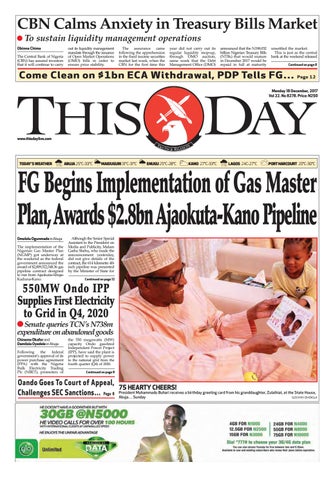
Oando Goes To Court of Appeal, 75 HEARTY CHEERS! Muhammadu Buhari receives a birthday greeting card from his granddaughter, Zulaihiat, at the State House, Challenges SEC Sanctions… Page 8 President Abuja… Sunday godwiw omoigui
2
T H I S D AY ˾ ͯͶ˜ Ͱͮͯ͵
T H I S D AY MONDAY DECEMBER 18 2017
3
4
T H I S D AY ˾ ͯͶ˜ Ͱͮͯ͵
T H I S D AY MONDAY DECEMBER 18 2017
5
6
T H I S D AY ˾ ͯͶ˜ Ͱͮͯ͵
T H I S D AY MONDAY DECEMBER 18 2017
7
8
MONDAY, DECEMBER 18, 2017 ˾ T H I S D AY
PAGE EIGHT
Oando Goes to Court of Appeal, Challenges SEC Sanctions Accuses Gwarzo of bias Alike Ejiofor Oando PLC has approached the Court of Appeal for the review of sanctions imposed on it by the Securities & Exchange Commission (SEC). Following an investigation into the company, which began in May 2017, the SEC had issued a technical suspension order of Oando’s shares and ordered a forensic audit of the oil firm. But a statement published on Oando’s website on December 15, 2017, said it had asked the appellate court to reverse the sanctions, particularly the technical suspension of its shares as well as the forensic audit of its affairs. According to the press statement, the company has in addition to the legal action, written several petitions to various arms of government, expressing concern at the way the SEC under the leadership of ex-Director General, Mr. Mounir Gwarzo, managed the investigation, complaining that it believed the investigation
was biased, did not follow due process and was not fair. It said a recent leak of an endorsed September 18, 2017, report of the Technical Committee that was set up by Gwarzo to investigate the company was further proof that the actions taken by the Commission were illegal, invalid and calculated to prejudice the business of the company. Gwarzo had set up a 5-man committee to investigate Oando, which submitted a report with findings and recommendations for several sanctions against the company. According to the statement, the investigative committee found that Oando had satisfactorily responded to all the issues raised by the petitioners and had further recommended that the responses provided by the company and its independent external auditors be forwarded to the petitioners for their information and further escalation if they deemed it necessary. It said the report made neither a recommendation for the shares
of the company to be suspended nor for a forensic audit of the company to be conducted. Instead, it added, the committee recommended that certain unresolved issues be forwarded to the Securities and Investment Services (SIS) Department of the Commission to determine whether there was, in fact, a breach of the ISA or SEC Rules. It said: “On 27 September, 2017 the Committee of the House of Representatives on Capital Markets and Institutions summoned Gwarzo and mandated him to complete his investigation into Oando and issue a report within 2 weeks of that meeting. “It also requested that it should be sent a copy of the report of the investigation, its findings and recommendations. It is interesting to note that Gwarzo failed to inform the House of Representatives that at the time the meeting was held, the signed Technical Committee report had already been submitted. “It wasn’t until a month after,
on Wednesday, 18 October 2017 that the SEC published a statement on its website detailing alleged infractions committed by Oando and weighty penalties, which included a directive to the Nigerian Stock Exchange (NSE) for a 48-hour full suspension followed by a technical suspension in the trading of Oando shares and for a forensic audit into the affairs of the company to be conducted.” Listing other reasons it felt the investigation was biased and thus flawed, Oando said some of the actions taken by the then DG were against SEC's rules and regulations. It said: “Under SEC's rules the Administrative Proceedings Committee (APC) is the committee empowered to look into matters of the nature of which the petitioners alleged, however, Gwarzo did not utilize this committee but instead set up a Technical Committee and later a Special Task Force to investigate Oando. “SEC laws state that the DG does not have the legal or
administrative authority to set up committees only the Board can do this, however at the time of the investigation, SEC had no Board and even if it did, there was a committee already in place that could investigate the company. “There is also the legality of SEC investigating a petition brought by an indirect shareholder and one that is currently in arbitration when SEC's rules categorically state that it will not consider any complaints regarding matters that are already the subject of arbitration or court proceedings.” The statement cited the example of MRS Oil and Gas PLC, where the SEC stopped the investigation and a call for a forensic audit into MRS when it was brought to the regulator’s attention that there were ongoing arbitration proceedings in France between Petroci Holdings and MRS. Oando said it had repeatedly complained about the frequent leaks of the committee’s investigation quoting its Group Chief Executive Officer (GCE),
Mr. Wale Tinubu once saying: “the SEC investigation and continued media leaks have had a deleterious impact on market confidence, our share price and a negative impact on other critical stakeholders.” Saying the company’s biggest concern was that because all SEC’s actions to date had been illegal and biased, a forensic audit could also be biased, Oando added that it was opposed to the forensic audit because SEC would have to conduct an audit to confirm the weighty findings by its investigative committee. “It is unjust to make a company pay N160 million to be investigated so the regulator can confirm whether its findings are indeed correct or true,” Oando said, adding: “It begs the question how did the regulator come about its weighty findings?” This is not the first legal action taken by the company against SEC on this investigation but its recent actions are evidence that it won’t back down and will fight SEC until justice prevails.
on short-term dated papers the day before. For instance, yields on 90-day treasury bills fell to 8.75 per cent. The pressure was also seen on the forex market as at the parallel market, the naira depreciated by N2, from N363 to the dollar at the beginning of the week, to close on Friday at N365 to a dollar. Also, activity level on the I&E window weakened relative to the previous week as the total value of transactions declined to $689.57 million, indicating a 38 per cent decline, compared with the $1.111 billion in the prior week. However, NAFEX rates closed at N360.96 to the dollar. To the Managing Director, Afrinvest Securities Limited, Mr. Ayodeji Ebo, the government trying to see how it can bring down NTB rates with the expectation that it would force banks to lend does not hold water. He pointed out that by not conducting OMO last week, there was a lot of liquidity in the system, and so idle funds
were being used to purchase whatever maturities. “Now that we have seen the NTB calendar, I expect that things would stabilise. But I don’t see rates going that high again. “We also expect that because of the election, there would be increased spending next year and the CBN needs to continue to control the level of liquidity in the system. “So, there is no way they cannot do OMO. So, I feel all this rush would soon calm down,” he added. Also, the chief executive of an investment bank who spoke with THISDAY on condition of anonymity, said the decision by the central bank to sell OMO was expected to send a positive signal to investors and cool the tension in the market. According to him, “the decision by the central bank is also timely because of the buildup of liquidity in the market. “If nothing is done, that liquidity would be chasing the available instruments and yields
would continue to drop. It might heat up the forex market. “What drives yields expectations in Nigeria’s fixed income market is OMO.” According to analysts at Lagos-based CSL Stockbrokers Limited, the combination of rising oil prices, stable output from the oil-producing Niger Delta, cheap equity valuations, attractive fixed income yields and, most importantly, favourable forex regime changes this year, appeared to have ticked all the boxes for foreign inflows. Remarkably, National Bureau of Statistics (NBS) data had shown a 200 per cent year-onyear increase in foreign portfolio investments as of Q3 2017. “Today, however, considering expectations of relatively unattractive yields, together with pricier equity valuations (particularly for the more liquid stocks), depreciatory pressure on the naira – which has been stable for the most part of this year – becomes more likely,” CSL Stockbrokers added.
The TCN, therefore, has to clear such goods, he disclosed and added that the company spent N738 million from a N2 billion provision. Mohammed, speaking on the 2017 budget, said the TCN had received only N5.9 billion out of N41.9 billion. “We are hopeful that some releases will still be made,” he said and added that the company had been given a limit of N33 billion for the 2018 budget estimates. The Chairman of the committee, Senator Enyinnaya Abaribe, said the development where goods are abandoned at the ports, frustrates effort to improve the power sector. “Government is part of the Independent Power Projects. Goods for the NIPP projects arrive in the country ports, the government insists on heavy payment of duty. Government ends up taxing itself thereby increasing the cost of the
projects and its execution. The goods are abandoned for years, some 10 years," he said.
CBN CALMS ANXIETY IN TREASURY BILLS MARKET its Nigerian Treasury Bills (NTBs) Issue Programme for the first quarter of 2018, which showed that a total of N1.08 trillion of bills would be rolled over in the first quarter. A breakdown of the NTBs calendar showed that while N42.011 billion of 91-day bills would be rolled over, N190 billion for 182-day and N848 billion for 364-day bills. Conversely, a total of N1.067 trillion of 91-day, 182-day and 364-day bills would be maturing in the first quarter of 2018. Treasury Bills and OMO are similar and work almost the same way. Whilst Treasury Bills are issued to finance government budget deficit, OMOs are issued by the CBN for monetary policy management, that is, to control the volume of money in circulation. The Deputy Governor, Financial System Stability, CBN, Dr. Joseph Nnanna, who spoke with THISDAY, stressed that the central bank had not abandoned OMO, contrary to insinuation in
the market. However, Nnanna pointed out that the issuance of OMO bills was usually influenced by the level of liquidity in the financial system. He explained: “Tomorrow (Monday) by 10 am, we shall determine the level of liquidity in the banking system and if the liquidity is above the threshold set by the central bank, OMO would be traded. “The CBN has not abandoned OMO. OMO would be conducted if the threshold is above the optimum level. We strongly believe in macro-economic stability. “OMO trading will continue for open market operation. We don’t just issue OMO for the sake of issuing OMO. The liquidity in the system determines whether we would carry out OMO or not. If the liquidity is tight, there is no point issuing OMO. “But if we have liquidity building up as already building up, we would issue OMO. So, there is no apprehension and no
cause for alarm. There is no way any central bank can avoid doing OMO. If you don’t do OMO, then you must be very bullish in forex selling.” Already, there are huge sources of liquidity expected to hit the market this month. These include maturing OMO and Treasury Bills. In fact, a total of N66.617 billion maturing Treasury Bills are expected to hit the market this Thursday. In addition, the release of the balance of the Paris Club refund as well as the N750 billion the federal government intends to release for capital expenditure, are also expected to increase the level of liquidity in the banking system. Maturing government securities have historically been rolled over. But last week’s announcement by the DMO unsettled the market. The development saw a lot of foreign investors bidding to repatriate their funds in response to the dramatic decline in yields
550MW ONDO IPP SUPPLIES FIRST ELECTRICITY TO GRID IN Q4, 2020 Speaking to journalists on Sunday in Abuja, the Managing Director of Kingline Development (KLD), which is the project promoter, Mr. Akinnola Fola, explained that this was possible considering that a financial closure on the project was expected in Q4 2018, and construction planned to last 24 months. Fola, stated that at the moment, KLD was confident of securing $150 million equity finance for the project, which according to him, represented 27 per cent of its cost, and that the balance of $400 million representing 73 per cent of the cost would be sourced from lenders, including the African Development Bank (AfDB), Overseas Private Investment Corporation (OPIC) of the United States, amongst others. He said: “When you have the power purchase agreement signed it gives some kind of credibility to would-be investors
and lenders, because it is so important to the power business, and without it, you have not started the power business. “So, signing a PPA indicates that finally, the project is ready to go and that investors, lenders are now ready to support the project.” He further stated that: “We still need to have some transaction agreements with lenders and financiers, then we are looking at fourth quarter 2018 to achieve the financial closure after that we have 24 months to do the construction, so, tentatively we are looking at first quarter 2020 before we start what we call commercial operation deal.” He said KLD had gone past the development stages of the project, which according to him was the most challenging phase and was confident of closing out the financial processes as scheduled.
He also noted that the risks involved in the sector were universal and as such, KLD was confident its co-investors would not be deterred by the seeming financial uncertainty in Nigeria’s power market. According to him: “There is no uncertainty here, if you talk about the issue of how you recover your money, there are mechanisms in place to protect investors. One of these is the Partial Risk Guarantee (PRG), there is also the political risk insurance, there is the Put-Call Option Agreement (PCOA), and these are what international lenders will need to put money in the business.” “It is not only in Nigeria that those risks exist, all we need is to allow the environment to be conducive for foreign investors to come in. “There is a stage we call the development stage in the power business, which is the most challenging because when you
embark on power development with your money, institutional investors will not come in at the beginning, but we individual investors are doing it and taking the risks, we have passed that stage now.” Meanwhile, the Senate Committee on Power, Steel Development and Metallurgy has queried the decision of the Transmission Company of Nigeria (TCN) to expend N738 million to clear unnamed goods abandoned at the ports by its contractors. At the budget defence session last Thursday, the committee heard that some of the goods had been abandoned for over a decade. The Managing Director of the company, Mr. Usman Mohammed, said while the contractors ought to have received waivers, they abandoned the goods when they were not granted the waivers.
TOP GAINERS NGN NGN DANGCEM 10.00 240.00 NEM 0.06 1.45 JAIZBANK 0.02 0.60 ZENITH 0.71 25.70 NIGBREW 3.50 142.50 TOP LOSERS NGN NGN OKOMUOIL 3.75 71.25 CADBURY 0.77 14.77 UNIVERSITY 0.12 2.38 PRESS FIDELITY 0.11 2.24 LEARNAFRICA 0.04 0.86 HPE Nestle Nig Plc ₦ 1,464.05 Volume: 289.303 million shares Value: N 6.225 billion Deals: 4,617 As at 15/12/17 See details on Page 35
% 4.3 4.3 3.4 2.8 2.5 % 5.0 4.9 4.8 4.6 4.4
T H I S D AY MONDAY DECEMBER 18 2017
9
10
T H I S D AY ˾ ͯͶ˜ Ͱͮͯ͵
T H I S D AY MONDAY DECEMBER 18 2017
11
12
Ëœ ͚΀˜ ͺ͸͚; Ëž T H I S D AY
PAGE NINE
Come Clean on $1bn ECA Withdrawal, PDP Tells FG Onyebuchi Ezigbo in Abuja The Peoples Democratic Party (PDP) has challenged the federal government to be more honest with Nigerians on what it plans to use the $1bn excess crude oil money approved for its use by the National Economic Council (NEC) last week. The party also asked the Minister of Information, Alhaji Lai Mohammed, to comment on allegations that the All Progressives Congress (APC) funded its 2015 presidential campaign with stolen public funds, particularly from Lagos and Rivers States. The Edo state governor, Godwin Obaseki while explaining the move by the FG to withdraw $1 billion from the ECA jointly operated by the federal and state governments, had said the money was to be used in prosecuting the war against Boko Haram. But doubting the expressed intended use of the money, the PDP in a statement on Sunday by its National Publicity Secretary, Mr. Kola Ologbondiyan, said the federal government needed more explaining to do since it had told Nigerians before that the Boko Haram insurgency had been technically put down. The party had last week criticised the NEC action, saying its claim that the money was for the fight against Boko Haram flew in the face of the federal government’s declaration that it had defeated the insurgents. In his reaction to the party’s critique of the NEC approval, Mohammed had accused the PDP of using stolen money for its ongoing rebranding efforts. The PDP yesterday, however, described Mohammed’s response as an inexcusable move by the APC-led federal government to divert attention from its attempt to pilfer $1bn from the Excess Crude Account (ECA) to finance partisan activities. The party said: “The attempt by the APC- led FG to divert attention from the
PDP Chairman, Uche Secondus fraud, by resorting to unsubstantiated allegations against the PDP only reinforces its manipulative tendencies and arrogant spurn to the sensibilities of Nigerians. “The Federal Government has failed to address issues raised by the PDP and majority of Nigerians, including APC members, who cannot fathom how this administration would want to expend N365 billion on fighting insurgents it claimed had been technically defeated." PDP while asking the FG to come clean on the issue of the $1bn Excess Crude money, also challenged the minister of information to comment on allegations that the APC funded its 2015 presidential campaign with stolen public funds, particularly from Lagos and Rivers States. “He should also waste no time in commenting on allegations of corruption levelled against their former SGF, Mr. Babachir Lawal, the Mainagate and other heavy sleazes going on unabated under the current APC-led administration," PDP said. The PDP also challenged the Minister of Information, to substantiate his claims that the PDP was rebranding with stolen money. According to the PDP, such a wild
allegation was only intended to divert public attention from the heavy sleazes under the current administration, the latest being the moves to use the fight against terrorism as a conduit to siphon public funds for partisan purposes. It said: “The Federal Government has failed to address issues raised by the PDP and majority of Nigerians, including APC members, who cannot fathom how this administration would want to expend N365 billion on fighting insurgents it claimed had been technically defeated. “It is indeed appalling that rather than being remorseful, the APC Federal Government has renewed its wild allegations and cheap blackmail against the PDP. “It is clear to all that the PDP do not have access to public funds and cannot be rebranding with stolen money. Instead, we are rebranding on the grace of the general goodwill of Nigerians who have suffered untold hardships in close to three years of APC government. “While we understand the nervousness of the APC-led Federal Government over our rebranding and the renewed popularity of the PDP, which has signalled their inevitable death knell, resorting to outlandish allegations will not help them as Nigerians have since seen through such old-fashioned propaganda and gimmicks. “We are however not surprised by this diversionary and deceptive approach from the APC government; a government whose officials have since become notorious for dishing out falsehood to Nigerians to cover their incompetence and corrupt tendencies." PDP said that the same minister of information, had in a press conference in Abuja, in 2016, alleged that 55 people stole a total of N1.34 trillion and that five former governors stole N146.8 billion; while four former ministers stole N7 billion. All the allegations, the party said, had remained unsubstantiated.
F G B E G I N S I M P L E M E N TAT I O N O F G AS M AST E R P L A N , AWA R D S $ 2 . 8 B N A J AO K U TA - K A N O P I P E L I N E Petroleum, Dr. Ibe Kachikwu, and approved last week by the Federal Executive Council (FEC). It marks the beginning of the implementation of the first phase of the gas master plan that was approved in 2016. Shehu said a second contract was also approved under the scheme and was meant for the engineering, verification, procurement and construction of 40 inch-30 kilometres Odidi to Warri gas pipeline expansion project. He said the second contract was designed to transport additional gas supply from upstream producers to various demand points at the cost of N7.7 billion and $56 million. He described the projects as parts of the president’s pet projects, which he said dated back to his days as the Federal Commissioner for Petroleum Resources. Buhari is the current Minister of Petroleum. According to him, when Buhari was federal petroleum commissioner, as a colonel, he led some think-tanks to plan the country’s gas future and consequently initiated the contracts for the laying of a massive network of petroleum pipelines. He also said the pipelines were meant to link the length and breadth of the country as well as lay the foundation for the construction of three refineries in Warri, the second Port Harcourt refinery and another in Kaduna with the aim of augmenting the supply and distribution of petroleum products in the country. Shehu described the period Buhari was petroleum minister as the golden era of the country’s petroleum industry when domestic refining not only met the requirements of home consumption but also produced in excess of 150,000 barrels of refined products for export.
He said: "The bold step taken by the President on Wednesday seeks the integration of the Eastern and Northern parts of Nigeria, which had suffered past neglect into the gas economy. Gas pipeline infrastructure had been concentrated in the coastal areas and the North and the East had been left largely untouched by the industrial revolution that has come with the gas pipeline network. It is therefore not surprising that the western part of the country is having more economic activity. "The All Progressives Congress, APC which had campaigned on the issue of inclusive growth holds the view that the achievement of a balanced and equitable national development can only come with a balanced growth of the states and the regions. The party manifesto had identified the development of natural gas transportation infrastructure as a key project in this regard. "These contracts for pipelines and LNG terminals to be set up at various points will, therefore, expand opportunities for balanced national development to counter the backwardness and geographical disadvantages of the North and the East. "In line with the country’s rapid growth in energy demand, the connection of the south and the north should serve as a boost to the nation’s energy security. "The increased energy transportation networks will be a shot in the arm for the struggling manufacturing industry which is suffering from the acute crisis in the energy sector. It will cater to the needs of cement and fertilizer plants; power plants, transportation systems and even household consumers thereby increasing gas share in the country’s energy consumption mix. "Gas which is classified as clean energy will, in addition to the promise of energy
security, provides efficient fuel for power generation and reduces air pollution leading to improved quality of life. "The Trans-Nigeria Gas Pipeline (TNGP), the East-North network starts from Qua Ibeo Terminal, QIT to Cawthorne Channel in Rivers traversing Obigbo-Umuahia-EnuguAjaokuta and now Ajaokuta-Abuja-KadunaKano is likely to be completed in 2019. "The extension of this network to the East and the North is potentially the precursor of the Trans-African pipeline that will cross the Sahara en route Europe. Nigeria’s eyes have for many years been fixed on the European Gas consumer markets. "The contractor financing arrangement has been adopted and the project sponsor, the Nigerian National Petroleum Corporation (NNPC) and the Federal Government are expected to reach common terms with the contractors on how they will be repaid over a 15-year period. "Although the loan repayment is expected from revenue accruing from both existing and the expanding pipeline network, the NNPC and the Federal Government are expected to meet financial gaps and guarantee the return on net investment. "The Buhari administration came into office at a time when Nigeria faced a crisis of inadequate and crumbling infrastructure and has, as a matter of priority embarked on a number of positive interventions to ease the infrastructure crunch. "The administration has been raising short-term and long-term funding for road projects, railway and power projects. "The President is strongly optimistic that all these infrastructure projects will increase the scope of economic activities and contribute to the overall economic growth and development of the country. This is the Change."
Two-Minute BrieďŹ ng NEWS Buhari: I’m Happy with My
Improved Health President Muhammadu Buhari yesterday expressed happiness that his health condition has recorded excellent improvement. Page 59
EDITORIAL Public universities And strikes Without end It is is a measure of what tertiary education has be- come in our country today that many Nigerians are not even aware that administrative activities, including admissions of new entrants, have been suspended in all federal ‌ Page 15
POLITICS Do States Deserve More
Powers? States want the federal government to devolve more powers to them. But the fear that states may become more tyrannical if given more control is real.Tobi Soniyi, Segun James and Shola Oyeyipo examine the arguments for and‌ Page 20
FEATURES Walking into Slavery
Adibe Emenyonu writes on the endless tales of woe recounted by Edo returnees from Libya Page 22
BUSINESS THISDAY Model Portfolios Fall to 28.2 % as Investors Take ProďŹ t Amidst a wave of profit taking that pervaded the stock market last week, the TMP fell to 28.2 per cent compared with a high of 30.5 per cent recorded the previous week. Page 25
NEWSXTRA Dangote Accuses BUA of
Stealing and Illegally Mining Limestone The management of Dangote Group has accused BUA of engaging in illegal mining of limestone deposited in its Mining Lease No. 2541 located in a boundary town of Oguda‌ Page 60
INTERNATIONAL IS Claims Pre-Christmas
Suicide Bombing of Pakistan 47 Church, Eight Dead A suicide bomb attack on a Pakistan church claimed by the Islamic State group killed at least eight people and wounded 30‌ Page 47
SPORTS Okpotu Hits Brace as Eagles
Beat MFM FC to Emerge Champions Two goals from Lobi Stars forward, Anthony Okpotu, and a third from substitute Kingsley Eduwo gave African Nations Championship CHAN‌ Page 62
T H I S D AY MONDAY DECEMBER 18 2017
13
14
T H I S D AY Ëž Ëœ ÍŻÍśËœ Í°ÍŽÍŻÍľ
COMMENT
Editor, Editorial Page PETER ISHAKA Email peter.ishaka@thisdaylive.com
DIGITAL AND FINANCIAL ACCESS IN AGRICULTURE
Ndidi Okonkwo Nwuneli argues that an inclusive digital economy will enable sustainable economic growth and development
A
griculture represents one of the most important opportunities for Nigeria to enhance non-oil revenues while simultaneously delivering inclusive socio-economic growth and addressing its current trade deficit. At every level of the value chain, opportunities exist for transformational investment. From integration of millions of farmers who survive on a subsistence level to filling the infrastructure and processing gaps that lead to significant post-harvest losses, there are opportunities to meet the needs of small localised communities, and enhance the livelihoods of the single largest segment of Nigeria’s working population. At the bottom of the pyramid, one of the most critical challenges that small-scale and subsistence farmers face is access to information, and financial services. These are two pivotal building blocks that enable small-scale farmers to obtain the best prices for their products, and optimise productivity. This ensures that they can access inputs - seeds and fertiliser to increase both the quantity and quality of their yields; market pricing information to optimise the value they receive; and risk products that allow for more aggressive decision-making about levels of investment. In each of these cases, the underlying infrastructure required is the capability to distribute financial products, or simple information. As outlined within the Economic Recovery Growth Plan (ERGP) for 2017 to 2020 the government has resolved to improve access to finance by strengthening the CBN’s schemes and recapitalising the Bank of Agriculture to provide credit to small farmers at minimal rates, through a network of micro-credit banks. These goals can only be achieved through a vibrant and dynamic financial services system with no limits to reach and adaptability, providing services at minimal costs to both providers and beneficiaries. Unfortunately, Nigerian banks are increasingly unwilling to invest in physical branch infrastructure, and are actively looking for opportunities to increase their networks at lower costs to the business. This implies that communities that are underserved will continue to be excluded from the formal financial system unless new models for access are introduced, which this group of customers is incentivised to utilise. A successful digital financial system provides access to credit, insurance and savings and eliminates the physical barriers to meeting the needs of people in distant rural communities in Nigeria. This also ensures an inclusive digital economy which will enable wider sustainable economic growth and development for Nigeria, delivering an estimated 12% boost to Gross Domestic Product (GD by 2025, while reducing leakages by up to $2bn annually in the short term. Globally, there is irrefutable evidence of the ripple impact of a financially inclusive system on multiple sectors of the economy, especially agriculture. For example, in Kenya, farmers who obtain credit, using their crops as collateral, can access funds to purchase inputs at lower costs and sell produce at higher prices, thereby increasing farm profits. There are three critical and interrelated factors that contribute to a successful digital financial system – partnerships, favourable regulation,
AN ENABLING ENVIRONMENT THAT ENCOURAGES INVESTMENT IN NEW AND EMERGING TECHNOLOGIES AND PARTNERSHIPS, WHILE ENSURING A STRONG REGULATORY FRAMEWORK, COULD REVOLUTIONISE THIS SPACE, IMPROVING THE OUTPUTS OF THOUSANDS OF SMALLHOLDER FARMERS AND ENHANCING THEIR LIVELIHOODS
and innovation. Partnerships for financial inclusion are critical to creating a favourable regulatory environment and facilitating innovation. Farm Crowdy, an agric-tech company that focuses on connecting farms with interested sponsors, seeks to increase national food production and encourage youth participation in agriculture by sourcing capital from regular Nigerians, who are allowed to choose the kinds of farms they want to sponsor. Farm crowdy oversees the farming process from financing to harvest, while providing the sponsors with regular updates on farm progress and ensuring sponsors are paid interest for investments. On the other hand, AFEX Holdings - a multi-stakeholder partnership - focuses on improving Africa’s food and energy security through commodity exchanges, warehouse storage and engagement with governments to expand the agricultural sector. In 2013, working with the Nigerian Grain Reserve Agency and the Ministry of Agriculture, the group launched an electronic warehouse receipt system to link farmers and traders, as part of the back-end processes for establishing a commodities exchange. The model employed by BabbanGona has successfully established a market aggregation mechanism that enables thousands of small-scale farmers, engaged in maize cultivation, to access inputs on credit at favourable terms. BabbanGona takes the intermediary risk, enabling the banks to provide financing without the need to fully grasp the creditworthiness of the farmer. Similarly, AACE Food Processing & Distribution Ltd. partners with microfinance providers to ensure that its farmer clusters have access to financing at the beginning of the planting season. This enables them to focus on cultivation, while AACE bears the financing risk, which is ultimately paid off in produce to the company. While promising, these models are only scratching the surface of what must be achieved at scale to truly address the financing and information gaps that exist in communities in Nigeria. Clearly, we need many forms of the Farm Crowdy, AFEX, BabbanGona and AACE Foods models in every value chain and across the country. These models can only be unlocked through innovative cross-sector partnerships between off-takers, financing institutions and clusters of small farmers. An enabling regulatory environment will allow the innovation required for bespoke financial products and services that support increased agricultural productivity. For example, a micro-credit scheme that combines an information-sharing solution tailored to farmers’ crops and farming seasons can potentially reduce the impact of price fluctuations on farmers’ livelihoods. Yet, to achieve such objectives at scale would require intentional, but flexible regulation. Today, the provision of financial services is restricted to financial institutions strictly defined by the Central Bank of Nigeria. Disruptive financial technologies are increasingly pervasive, but they are emerging in spite of the regulatory environment, not because of it. Mrs. Nwuneli is co-Founder of AACE Food Processing & Distribution, an indigenous agro-processing company
STILL GROPING IN THE DARK
The Buhari’s administration has not lived up to expectations, contends Onyema Omenuwa
O
rdinarily, two years into the life of an administration should not be a convenient stage to assess or pass performance judgment on it. Such an appraisal should wait for when the administration has exhausted its tenure. At two years, preliminary work for some developmental projects started by the administration may just be rounding off and giving way for the projects to go full blast. From this stage, activities are usually accelerated, hence towards the twilight of an administration, the inauguration of projects compares only to a bountiful harvest of crops after a successful farming season. I am not trying to create an ideal scenario here; rather I am stating the obvious as it obtains in focused and visionary democratic administrations anywhere. Not so in Nigeria anyway, particularly with the present Muhammadu Buhari administration. Past administrations to a large extent, at two years, even in the midst of retrogressive politics that has always held attraction for our political actors, had projects ongoing, just as they had citizen-beneficial policies in place too. An aggregation of all these stood good ground, to ward off the heavy flaks that were never in short supply from opponents. The bottom line essentially is that not a few of such projects and policies of past administrations received positive reviews, as being motivated by altruistic considerations. They did not overtly have any ethnic or religious colouration that would expose them as discriminatory. For instance, President Goodluck Jonathan’s Almajiri Schools Project in the northern states was hailed as progressive in concept, as it had the ultimate aim of exorcising ignorance from an average Nigerian child from the far north, who from cradle is inclined to swallow every religious dogma hook, line and sinker. Before Jonathan, President Umaru Yar‘Adua was faced with the daunting task
of how to placate the Niger Delta populace and ensure that their youths who had taken up arms against the Nigerian State, stopped the unceasing disruption of crude oil exploitation, for sustenance of the economy. Yar‘Adua as president clearly identified with the sore feelings of the Niger Delta people for the devastation and degradation of their environment, hence his proclamation of amnesty for the militants whose activities were otherwise nothing but criminal. And it worked. Till date, that programme is still being hailed as a masterstroke of policy because the amnesty programme started in earnest to address the grievances of the people of the Niger Delta, and in no time violent militant activities considerably died down. At the risk of sounding monotonous, at two years, these two past administrations and indeed President Olusegun Obasanjo’s, which ushered in the present democratic dispensation in 1999, had midterm results to showcase to the electorate. They came in the form of projects and policies which impacted directly or indirectly on the citizenry. The telecoms revolution in Nigeria, which effectively put a stop to the rich monoplising phone ownership, was birthed, courtesy of an enabling policy of the Obasanjo administration. For sure, these administrations had their shortcomings, and so it wasn’t all praises for them in two years. But the nation was not stagnated and as it is now, hence even their most unrepentant critics would concede that things were moving while the presidents held sway, though they would rather some speed had attended the movements. The midterm appraisal becomes very important in the life of a democratic administration in Nigeria because of the peculiarity of our politicking. The brand of politicking that sadly subjugates the interest of the citizens under the selfish interest of elective office seekers, whether at federal, state or even local government level. It gets very annoying
with selfish incumbents who are interested in reelection. They will be barely two years in office and they have already started politicking for the next election. With this, if such an incumbent did not hit the ground running, his performance canvass would only depict sombre expressions in two years. This normally leaves the electorate hopelessly disappointed because the subsequent two years will, more often than not, be devoted to all manner of intrigues to guarantee reelection. So it does happen that if in two years an administration has not enabled activities that are almost crystalising into tangible achievements, the fulfilment of its electoral promises will turn out a mirage. That is why the Buhari administration will go down in history as the most calamitous tenure ever witnessed, in democratic governance in Nigeria. Perhaps, the only other period in our national life when the trifurcated scourge of hardship, confusion and stagnation had a vice-grip on the nation as it does now was during Buhari’s, yes the same Buhari, first coming as military dictator in 1983, for about 20 months! So whatever painful experience his administration is unleashing on the populace presently is simply following a pattern, just as his penchant for discrimination. It sure cannot be forgotten so soon that shortly after his assumption of office on May 29, 2015 as an elected president, Buhari already, by his utterances and actions or what has become irritatingly known as his body language, signposted his administration’s trajectory. He made no bones about it and so any discerning citizen knew what he had in store for different sections of this country. His justification, on July 22, 2015, in faraway United States, of his unmasked inclination to dish out political patronage on the discriminatory basis of percentage of votes he garnered in the election, bore the hallmark of the man Buhari: â€œâ€Ś The constituents, for example, that gave me 97 per
cent [of the vote] cannot in all honesty be treated on some issues with constituencies that gave me 5 per cent. I think these are political realities.� That was like affixing a seal on his avowed purpose. Sadly, while the president engrossed himself in vindictive pettiness, at the expense of pragmatic governance, his tenure was fast on its heels. To constitute his cabinet, six months slid by and for those six months of vacuum, the economy floundered as critical sectors remained directionless. It is not as if the country has ever been particularly blessed with leaders who are patriotically wired for revolutionary strides, to launch the country to the proverbial greater heights. But the Buhari-led administration is on autopilot but sadly headed in the reverse direction. Two and a half years gone; there are no projects to inaugurate. No policy of government is of such immense impact that will reinvigorate the economy and stem the tide of inflation and unbridled job losses, caused by the president’s sheer lack of grasp of critical elements that drive a vicissitudinous economy as Nigeria’s. Even the anti-corruption fight, the mantra with which the president prosecuted a successful campaign, has been dealt a bloody nose by the president’s men themselves. They appear to be in a very fierce competition with one another for who will have the upper hand in corrupt conduct or omissions and acts of impunity. As glaring as all these ignoble happenings are, only the former Secretary to the Government of the Federation, Mr. Babachir David Lawal has been sacked by the president. And that was only after a deafening outcry inundated the president from the media, the Senate and civil society groups, against Lawal’s continued stay in office, despite damning evidence of corruption against him. Omenuwa is a lawyer and commentator on national affairs
15
T H I S D AY Ëž Ëœ ÍŻÍśËœ Í°ÍŽÍŻÍľ
EDITORIAL PUBLIC UNIVERSITIES AND STRIKES WITHOUT END The authorities must find a way to end incessant strikes in the universities
I
t is a measure of what tertiary education has become in our country today that many Nigerians are not even aware that administrative activities, including admissions of new entrants, have been suspended in all federal universities for almost three weeks. The strike, embarked upon by non-academic staff, which had been temporarily suspended on September 25 to allow room for more dialogue with the federal government, resumed on December 3 and there are no signs that the crisis will be resolved anytime soon. Apparently incensed by the refusal of the federal government to negotiate with them, the Joint Action Committee (JAC) of the three Non-Teaching Staff Unions of Nigerian Universities from the South West, last week staged a public protest. Drawn from the Senior Staff Association of Nigeria (SSANU), Non-Academic Staff of Nigeria (NASU) and National Association of Academics Technologists (NAAT), the striking workers matched through the major streets of Akure, the Ondo State, chanting slogans. And they have vowed not to resume work until the federal government accedes to their DEALING WITH THE request while the CHALLENGE OF THIN students continue to LIQUIDITY REQUIRES bear the brunt of the MORE THAN SEASONAL endless disruptions on STRIKES BY BOTH their campuses. THE ACADEMIC AND At issue this time is NON-ACADEMIC STAFF, the N23billion recently WHILE THE FEDERAL released to 24 federal GOVERNMENT MUST universities, being the ALSO UNDERSTAND THE amount owed the PRIMACY OF CONSTANT lecturers as Earned DIALOGUE Academic Allowance (EAA) for 2009 and 2010; a concession granted after the last Academic Staff Union of Universities’ (ASUU) strike. While the academic staff received N18.4 billion, representing 89 per cent of the total sum, the three non-academic unions were allocated N4.6 billion which amounts to 11 per cent of the money. It is the disparity in the distribution that is causing the problem. But since the money was for academic allowances, we ďŹ nd the position of
Letters to the Editor
these non-academic unions untenable and we ask that they call off their strike. What makes the situation sad is that students in public-owned tertiary institutions are now caught in what amounts to a rivalry between academic and non-academic staff. The consequences have been a situation where these unions alternate strikes, with the attendant debilitating effects on academic pursuits. Meanwhile, these strikes have contributed signiďŹ cantly to the decline in the quality of graduates of our public universities. The hurried academic calendars, following the end of industrial actions, allows for very little attention to serious studies. That is why our public universities have continued to go down the ladder of academic ranking, even among their peers in Africa.
H T H I S DAY EDITOR DEPUTY EDITORS ˜ MANAGING DIRECTOR DEPUTY MANAGING DIRECTOR CHAIRMAN EDITORIAL BOARD
EDITOR NATION’S CAPITAL
T H I S DAY N E W S PA P E R S L I M I T E D EDITOR-IN-CHIEF/CHAIRMAN GROUP EXECUTIVE DIRECTORS ˜ ˜
˜ GROUP FINANCE DIRECTOR DIVISIONAL DIRECTORS ˜ ˜ DEPUTY DIVISIONAL DIRECTOR
SNR. ASSOCIATE DIRECTOR ASSOCIATE DIRECTORS ˜ CONTROLLERS ˜ ˜
GENERAL MANAGER
GROUP HEAD DIRECTOR, PRINTING PRODUCTION TO SEND EMAIL: ďŹ rst name.surname@thisdaylive.com
owever, we cannot shy away from the fact that the under-funding of the education sector, over the years, has had collateral damaging effects on the country, such that our universities have now become grotesque carcasses of their former glorious selves. Besides, commercialisation of academic grades and poorly written handouts, delayed dissertation, award of questionable degrees and all manner of unwholesome practices have combined to practically ruin university education in Nigeria. The state of many Nigerian university campuses today is rather pathetic. The weak ďŹ nancial conditions in the universities are exacerbated by the current crippling economic crisis aficting the nation. Yet besides personnel costs, funds are required to rehabilitate dilapidated facilities, purchase consumables and research capability. And frequent bursts of strikes have become the routine weapon used by university staffers to force the authorities to listen to their plight. However, dealing with the challenge of thin liquidity requires more than seasonal strikes by both the academic and non-academic staff, while the federal government must also understand the primacy of constant dialogue, especially given the current realities. To the extent that there is no way we can develop our country until efforts are made to revitalise key sectors like education, the authorities must ďŹ nd a way to end the incessant unrest on our campuses.
TO OUR READERS Letters in response to speciďŹ c publications in THISDAY should be brief (150-200 words) and straight to the point. Interested readers may send such letters along with their contact details to opinion@thisdaylive.com. We also welcome comments and opinions on topical local, national and international issues provided they are well-written and should also not be longer than (9501000 words). They should be sent to opinion@thisdaylive.com along with the email address and phone numbers of the writer.
EKITI: THE CHOICE THAT SHOULD MATTER
L
ately, I have paid keen attention to events in Ekiti State to be able to gauge perceptions on the choice that deserved the mandate to take charge of the state next year. So, to better serve my curiosity, I took a tour to some parts of the state– a decision I must confess leaves an interesting impression on me. For the two days that the tour lasted, I observed the vigour with which public debates around who should succeed Governor Ayodele Fayose was argued. Though, with varying sentiments expressed, the consensus of views I sampled points to the need of the people of the state for someone who understood their pains and could explore the potential and opportunities of the state to the fullest in the best of the people. The resolves, which are quite impressive, raised a poser on who among the aspirants eyeing the top seat answered the yearnings of the people. As I had highlighted in a previous article, next year governorship election in Ekiti State avails the people of the state an opportunity to make a choice that really matters. A choice that will replace their burdens with hope of a better tomorrow and create a society that will work for all. A choice for the future prosperities not immediate sentiments. A choice that accommodates citizens’ collective progress and not stomach infrastructure. In all these considerations, one name, Otunba Segun Adewale featured recurrently. Though, his campaigns have not been so audible, but his agenda which revolves around #RethinkEkiti placed much premium on serving the people – the fulcrum on which his aspiration is based. Going through his mission for the state clearly revealed a man prepared for leadership as he had taken his time to appraise the issues in Ekiti State and able to come up with probable remedies to
change the narratives that had impeded the growth and development of the state. Otunba Adewale’s concise and unambiguous mission of building a virile Ekiti that guarantees prosperity to all, is encouraging. His ‘RethinkEkiti campaign theme, a template he is canvassing his idea to govern the state, serves dual purpose. Aside detailing his plans to reset the state towards growth and development, it is awakening the consciousness of people of Ekiti descendants, both home and abroad, to be collaborative in efforts to reposition the state for enhanced growth. This approach, as practiced in most advanced nations, is returning power to the people. As I reflected on Otunba Segun Adewale’s aspiration to govern Ekiti State come next year, I observed his sterling leadership credential and financial ingenuity which transformed Aeroland Travels Limited into a giant in the aviation industry from virtually unknown background. The success story of the air ticketing company stands as an affirmation of the capacity of Otunba Adewale to maximise potential and explore opportunities to create desirable future. This is the deal he is offering Ekiti people and I am confident, considering his antecedent that he would deliver. Much desirous is his compassionate trait– a critical emotion that is evidently lacking in our today’s governance atmosphere. Otunba Adewale is reputed for his contributions to humanity. From scholastic intervention to socio-economic empowerment, Otunba Adewale’s philanthropic imprint knows no bound. Though a silent giver, Otunba Adewale had in his private capacity, supported several Ekiti indigenes, both at home and in the diaspora, in securing economic freedom, by either facilitating employments or granting financial support for them to start their own enterprises. Sarafa Ibrahim, EDITOR, TheSwitch Newspaper
KWALE AND THE BADOO GROUPS
D
espite the presence of security operatives and curfew in the satellite town of Kwale, the criminal activities in Utagba-Ogbe are still uncontrollable. Some days ago, a young boy alleged that some groups of hoodlums robbed him of his motorcycle along the Kwale-Ozoro express way and recently, two men were reportedly caught stealing seven bags of rice in a shop on Isumpe road, Utagba-Ogbe, Kwale. An unconfirmed source said the thieves were beaten mercilessly by the local vigilance groups before taken to the police station. Our lives and property in Kwale, UtagbaOgbe in particular, will be safe if the security operatives including vigilantes put in top gear their operations in Kwale metropolis, especially this season where these hoodlums are looking for money desperately. Blessing Egutu, Utagba-Ogbe, Kwale
16
T H I S D AY ˾ ͯͶ˜ Ͱͮͯ͵
T H I S D AY MONDAY DECEMBER 18 2017
17
18
T H I S D AY ˾ ͯͶ˜ Ͱͮͯ͵
T H I S D AY MONDAY DECEMBER 18 2017
19
20
T H I S D AY ˾ MONDAY, DECEMBER 18, 2017
Group Politics Editor Tobi Soniyi Email tobi.soniyi@thisdaylive.com 08033146139 SMS ONLY
POLITICS
M O N D AY D I S C O U R S E
Do States Deserve More Powers? States want the federal government to devolve more powers to them. But the fear that states may become more tyrannical if given more control is real. Tobi Soniyi, Segun James and Shola Oyeyipo examine the arguments for and against power devolution to the states
Southern governors want devolution of powers
S
ome have argued that Nigeria is not working because there are too much powers at the centre. The states can do more if given more powers, the argument goes. In October, seventeen governors from the southern part of Nigeria met in Lagos to discuss issues of common interest. At the end of their meeting, the governors among others demanded true federalism (whatever that means). They also asked for devolution of powers. Whenever the opportunity presents itself, Lagos State governor Akinwunmi Ambode does not miss the chance to demand for powers to be devolved to states. Citing the experience of Lagos, he believes that if states are given more powers, they will undertake more developmental projects. Speaking at the Fourth Quarter, 2017 Town Hall Meeting, the 9th in the series, held in Kosofe Local Government, Ambode reiterated his support for devolution of powers. Echoing his godfather, Asiwaju Bola Tinubu, the governor said he agreed with Tinubu on the need to restructure Nigeria The governor, while responding to a question raised by a resident on calls for true federalism said, “I support true federalism; I support all the issues raised by Asiwaju; we are on the same page. That is the page of APC; that is where we are and that is what we are committed to. Like I have always said, we need to deal with issues that relate to devolution of powers. “Like somebody said, if I have more resources, all these items that you are coming to raise here, once you raise it, I will just say done. I need more money. So, why should somebody be saying they are the ones in charge of inland waterways when the waterways is transporting my own people and my own services and when there is a law about it”. While declaring the 57th Annual General Conference of the Nigerian Bar Association open in Lagos, Ambode urged legal practitioners to support the demand for devolution of power. Other groups including the Southern Leaders’
Forum, Southern Leaders of Thought have also been making the case for a true federalism and devolution of powers. Former Vice-President Atiku Abubakar has also lent his voice to the argument is support of devolution of powers. Similarly, renowned constitutional lawyer, author and leader of the Igbo Leaders of Thoughts, Prof. Ben Nwabueze, SAN has also been a leading voice in the case for restructuring. The Argument Against Those from the north tend to prefer the status quo to remain. While the states in the south are unanimous in their demand for restructuring, there is no such unanimity in the north. While Kano, Katsina, Nasarawa and Jigawa States have expressed support for a strong and united nation, they rejected the growing clamour for the restructuring of the country. Kano, Katsina and Nasarawa also rejected demands for the devolution of power. Benue and Plateau States, on the other hand, differed completely, saying restructuring was the way to go, as it would address all the current agitation from all sides. Jigawa, Kano and Katsina made their positions known at the All Progressives Congress (APC) zonal forum on true federalism held in Kano, while Benue, Plateau and Nasarawa voiced their opinions at the same meeting held in Jos for the North-central zone. A former president, Chief Olusegun Obasanjo is also opposed to devolution of powers to states. He also disagreed with those clamouring for restructuring and devolution of powers. According to him, the state governors have
States want more power, but they are busy disempowering local government areas
enough powers already to do whatever they want. In an interview he granted African Arguments, the former president said, “I don’t believe in true federalism. What is true federalism? “Why are they not accountable? What powers do they not have? “They have power.” Obasanjo said that in reality states had powers to do what they like. He noted that in all but a few sectors, states could do whatever they wanted. “In fact, state governors are more powerful than the president. That’s the truth,” he said. “If anybody tells you they want devolution or true federalism, he doesn’t know what he is talking about.” The Present Arrangement The 1999 Constitution as amended aimed at establishing a federal structure for the country through the concept of federalism by diving powers between the federal government and the state/local governments with each enjoying a degree of autonomy. The constitution supposedly establishes a three tiers of government: federal, states and local government areas. It distributes powers among these tiers of government. Obviously, the constitution gives too much powers to the federal government. Several reasons were responsible for this. First, the drafting of the constitution was supervised by the military. The military operated a centralised system of government. Secondly, concentrating more powers at the centre was a deliberate act. It was meant to prevent secession. With the Nigerian civil war in mind, the drafters of the constitution would not want to toy with the idea of giving too much powers to the state. But giving more powers to the federal government has its drawbacks. States will have to depend on the federal for much of their needs. Section 4 of the 1999 Constitution provides for the legislative powers of the federal government and state governments which are vested in the National Assembly (federal) and House of Assembly (state). Both the states and the federal government
are required to make laws for the peace, order and good government of the states and the federation. The National Assembly can make law with respect to matters included in the exclusive legislative list while states’ houses of assembly cannot legislate on such matters. The list can be found in Part 1 of the Second Schedule of the Constitution. There are 68 of such matters. Both the states’ house of assembly and the National Assembly can legislate on matters set out in the concurrent legislative lists but any law enacted by the House of Assembly (on a matter set out on the concurrent legislative list) if inconsistent with any valid laws of the National Assembly will become inoperative and void to the extent of the inconsistency. The concurrent list can be found in Part 2 of the Second Schedule to the Constitution. There are 30 items in that list. However, section 7 of the constitution empowers the states’ houses of assembly to legislate on any other matter not included in the exclusive legislative list. Unfair Arrangement Critics have rightly pointed out that the arrangement above was unfair. First, the constitution grants exclusive powers to the federal government over 68 items. It then confer powers to legislate on the concurrent list on both the states and the federal governments and gives the federal government power to cover the field. Many have therefore called for a complete overhaul. States want some of the items in the exclusive legislative list removed from there and given to them.They want a less powerful federal government and a stronger state government. As stated above, by allocating more powers to the federal government, those who drafted the constitution wanted stability. Having gone through a civil war, no one could argue that the idea of making the federal government stronger was not justified in the circumstances. CONT’D ON NEXT PAGE
21
T H I S D AY ˾ MONDAY, DECEMBER 18, 2017
POLITICS
MONDAY DISCOURSE
D O S TAT E S D E S E R V E M O R E P O W E R S ?
Obasanjo...states are already too powerful
Even in the United States of America, the states are not stronger that the centre. The Paradox Paradoxes abound in Nigeria. It is said that for every hypothesis, the opposite is also true. That is why when the Nigerian Governors Forum asked for the devolution of powers from the federal level to the states, the forum was silent on the need to devolve some powers from the states to the local government level, the tier of government nearest to the people. States want more power, but they are busy dis-empowering local government areas. Tinubu, cited by Ambode angered a lot of people in Lagos after he took way from the local government areas in Lagos some of the items through which they used to generate revenues. Crippling local government areas is not restricted to any political party. Whichever political party ruling a state ensures that it wins election into all the council seats at all costs. Whereas, the federal government allows the people of a state to choose which political party to vote for, states do not extend same right to their people to choose which parties govern them at the grassroots. For instance,last month, the All Progressive Grand Alliance won the Anambra State governorship election. From Lagos to Enugu, Kwara and Akwa Ibom states, the political parties in power won virtually all the chairmanship seats in the states. The states’ independent electoral commissions exist only in name. States don’t want local government to flourish but yet want the federal government to give them more powers. What an irony? Today, many local government areas across the country can not pay their workers’ salaries because greedy states have taken from them all their sources of revenues. One of the arguments by states in support of their clamour for devolution powers is that the federation derives its strength from its constituents. The same argument also holds true for local governments. States derive their strength from local government areas. Apart from suffocating the councils, states don’t even allow democracy to flourish at their level. They have turned their respective houses of assembly to an extension of the governors’ offices. Any speaker of a state house of assembly who refuses to play game with the state governor will be removed at will. While the National Assembly has fared better in checking the excess of the executive at the national level, state houses of assembly don’t enjoy such audacity. A Senior Advocate of Nigeria, Dr Olisa Agbakoba, in 2011 sent a private bill to the National Assembly advocating power devolution. However, critics of the bill have rightly observed that his bill did not adequately look at the relationship between the states and the local government on the one hand and the state with the local government councils and the community on the other hand. Although Agbakoba may be correct that devolution of power will not mean disintegration of Nigeria, but how will the governors use these
Buhari...restructuring can happen through National Assembly
powers? Will it lead to rapid development and will the people fill the impact of government more closely? These are the questions. A Condition for Devolution of Powers May be states deserve more powers. Including powers to have their own police. However, Nigerians must insist that for states to have more powers, they must be ready to relinquish their grip on councils. If the National Assembly agrees to consider devolution of powers to states, it must free local government areas from the states. If the states are not ready to relinquish their hold on local government areas, then thy do not deserve more powers. Period. Learned author of several books on the constitution and a Senior Advocate of Nigeria, Chief Sebastine Hon spoke the minds of many Nigerians when he said: “I am fully in support of devolution, which does not mean the central government merely shedding its weight in favour of the states. “Rather, since the centre is too strong and is, therefore, susceptible to abuse, there should be devolution of powers to the states, while the local governments should also enjoy total autonomy. In that situation, the powers of the state governors will be considerably whittled down. Let me add that the joint states and local government accounts are responsible, in the main, for the enormous powers exercised by state governors. Once this issue is addressed, you will see a great improvement, for our collective good.” What Role for the National Assembly Fortunately, for the country, the National Assembly understands the problem at the local government level and it is determined to change this through amendment to the constitution. For instance, in during the ongoing constitutional amendment, the Senate approved several alterations, including proposals to grant autonomy to local governments through the abrogation of joint state/local government accounts, and proposals to deny recognition including funding for un-elected local government administrators. Similarly, the House of Representatives agreed with the Senate and voted in support making local government councils autonomous. Both chambers also supported autonomy for state legislature. Commendable as this is, the likelihood is that states will mobilise the enormous resources
The key to achieving devolution is hidden in the National Assembly, Nigerians must push this institution to come up with Acts that will allow the federal to surrender powers to the states
at their disposal to ensure that their houses of assembly do not pass the amendments to make local government independent. Moreso, when both chambers of the National Assembly had chosen to reject amendment that would ensure that powers are devolved to the states. On this, THISDAY Politics disagrees with the National Assembly and will prefer the lawmakers to give the states more powers. However, this should be done on the condition that the states agree to free the local government areas from their dominance. That is horse trading. Perhaps, many states will prefer to jettison devolution of powers to enable them to continue to dominate local governments. In which case neither devolution of powers nor local government autonomy will happen. But if they choose to let councils go, then states can take more powers. The National Assembly should be under no illusion that states will allow local governments to go for free. It simply won’t happen. How to Go About it. When President Muhammadu Buhari suggested that the issues of restructuring would be better handled by the National Assembly and the Council of States many felt that he did not go far enough and should have allowed a constitutional conference to discuss the issues. Upon his return to Nigeria after spending months in London for treatment of an undisclosed ailment, the president met a very charged nation. He attempted to calm the people down through a broadcast he made even before he had written to the National Assembly to inform the lawmakers that he was back and had resumed duties as president. In the much criticised broadcast, the president said: “Nigeria’s unity is settled and not negotiable. We shall not allow irresponsible elements to start trouble and when things get bad they run away and saddle others with the responsibility of bringing back order, if necessary with their blood. “Every Nigerian has the right to live and pursue his business anywhere in Nigeria without let or hindrance. I believe the very vast majority of Nigerians share this view. “This is not to deny that there are legitimate concerns. Every group has a grievance. But the beauty and attraction of a federation is that it allows different groups to air their grievances and work out a mode of co-existence. “The National Assembly and the National Council of State are the legitimate and appropriate bodies for national discourse. The national consensus is that, it is better to live together than to live apart.” Less than six months after, Nnamdi Kanu, who then was leading the rebellious Indigenous Peoples of Biafra has disappeared, probably gone abroad as the president had predicted. Perhaps, another suggestion by the president may also come true: the National Assembly offers the best and most realistic chance to get powers devolved to states. It is therefore wrong to contend that devolution of powers can not happen under the constitution.
Writing in the Nigerian Eye, Victor Agboga said: “A common and erroneous view is that under the 1999 constitution, devolution of powers in not achievable. “It must be sounded loud and clear that no provision or section of the 1999 Constitution precludes, prevents or forbids the National Assembly from making constitutional Acts devolving powers to the Houses of Assembly on a matter listed in the exclusive legislative list. “What the 1999 Constitution did is to grant powers to National Assembly to make laws on matters listed in the exclusive legislative list.” According to him, the 1999 Constitution does not expressly or impliedly bar the National Assembly from making laws that will devolve powers. He stated further that the National Assembly could in accordance with Section 4(3) enact Acts that will grant states powers to establish state prisons, allow states to record finger prints, save criminal records and establish railway authorities among others things. He said: “The implication of Section 4(3) of the 1999 Constitution is that the National Assembly can enact not only substantive laws on matters in the exclusive legislative list but also regulatory and power conferring laws for states via legislation (devolution).” He argued that this arrangement was a better alternative to having the constitution directly devolving most powers to the states, adding: “a future amendment of such constitution will be rigid and almost impossible but with powers residing in the National Assembly a simple Act of Parliament can grant and withdraw powers to and from the states when necessary.” Perhaps, had all the energy and resources deployed in the agitation for restructuring and devolution of powers targeted at the National Assembly, may be some of the expectations of the restructuring advocates will be closed to being met by now. Calling for another conference where all will gather and agree on a document that no one will implement is a sheer waste of time and resources. Besides, it is a booby trap that successive government set for the elites. Interestingly, the elites had always fallen for it. We can be a realist for once. We can not agree more with Agboga when he said: “Due to the foregoing, Nigerians calling for structural change should have a re-think and use the mechanism in place (provisions of the 1999 Constitution) to achieve their aim. “The potential of the 1999 Constitution have not been fully explored at all. The best means of achieving decentralization and devolution is to elect enlightened and visionary parliamentarians, future candidates must be ready to undertake that he/she will pursue devolution by sponsoring radical and extensive bills that will go a long way in changing the structure of governments and their institutions. “The key to achieving devolution is hidden in the National Assembly, Nigerians must push this institution to come up with Acts that will allow the federal to surrender powers to the states.”
22
T H I S D AY Ëž Ëœ ÍŻÍśËœ Í°ÍŽÍŻÍľ
FEATURES
Acting Features Editor Charles Ajunwa Email charles.ajunwa@thisdaylive.com
Walking into Slavery Adibe Emenyonu writes on the endless tales of woe recounted by Edo returnees from Libya
T
he difference between the transSaharan slave trade/transatlantic slave trade which was abolished more than 200 years ago and the present day slavery is that while those involved in the former were forcefully sold out because they were war victims having been captured and sold as spoils of war, but the modern day slavery especially the ones taking place through Libya to Europe is made up of people who willingly walked themselves into it out of greed or inordinate ambition to get rich quick. Onuwa Sunday, 27 years old, an indigene of Edo State from Orhiomwon Local Government Area, had no problem with his physique. But today, his right ankle was amputated after he was hit by a rocket in a camp in Libya. Today, he limped on his left leg to the reception of the hotel where officials of the task force on human trafficking received him and others in a hall where they were profiled and documented. Beauty Okoro, was among the 168 girls deported out of which 20 of them came back with pregnancy. Okoro said she traveled July 4th last year because her sponsor told her that within one week, she will be in Italy. But this turned out to be a ruse. “I travelled July 4th last year. My sponsor told me that within one week I would be in Italy. But when I got to Libya it was another story. These sponsors always convince you and make it look like it is easy, but I have learnt now. I feel the government should arrest and execute them,� she said, weeping. If people travel alone, the burden is usually light but when a husband and wife decide to make such a dangerous journey, it amounts to double jeopardy. Ebinewo Praise, a 24-year-old lady, said she travelled with her husband. Today, she is among the pregnant returnees. She wept profusely while recounting her ordeal. “I traveled together with my husband, but he is still there now. Before I travelled, I was a sales girl. I am an orphan. My husband and I paid N900,000 to our sponsor to move us. When we got to Libya, I was lucky to be the first they took to move through the sea, but my husband´s set was not ready. We left, but our boat got spoilt in the middle of the sea. We stayed there without any rescue until the UN boat came and rescued us, we were later arrested. My husband now went to pay N250,000 to release me from prison. Somebody now said we should pay another N150,000 to push me across the sea; my husband paid the money. But while we were planning to move, their immigration people came to arrest us and took us to a prison. I spent months in the prison before we were taken to the deportation camp. I was not staying in the same place with my husband, but we see every day. You can imagine I am pregnant but no food. They give you one small bread per day, and you buy water. Water is very expensive there. My husband will be calling his people to send us money. What they told us before was that in two weeks we would be in Italy, but we never knew it was not like that. We spent seven days in the desert, and it was very hot. You can imagine that when we left Agadez, we were 33 in number but by time we got to a camp in Libya, we have 27 persons alive. I was lucky I was listed as one of those coming back. Onuwa, Okoro and Praise were among the close to 800 boys and girls of Edo State origin who have been forced back home. The harrowing journey back to Benin City began on November 7, when some buses drove into the venue of a popular hotel in Benin City, the Edo State capital, in the government reservation area (G.R.A), with returnees on board deported from various prisons and camps in Libya. The weary and famished looking returnees clutched to their bags containing few of their belonging aroused much curiosity into the condition
Edo State governor, Mr. Godwin Obaseki (2nd left) with the returnees from Libya
and experiences of the Libyan returnees who had hoped to cross the Mediterranean Sea to Europe in search of the proverbial ‘green pasture’. The shocking tales of the returnees encapsulates suffering, prostitution, drugs, and slavery in Libya are endless as they recounted gruesome ordeal of how unlucky illegal migrants are sold into slavery and prostitution by their traffickers while others are killed in their attempt to cross the desert to Libya. Recounting his experience, Onuwa narrated how he and others were ambushed by some deadly criminal gangs called (Asma boys) and taken to different camps where they were eventually sold into slavery and prostitution by their captors. He said in an attempt to cross the high sea, migrants boats were ambushed by these same gangs and taken to camps where they were forced to call home for ransoms ranging between N300, 000 and N700,000. According to him, “It was a terrible experience. We were abducted on our way to a town known as Saba by some group they called ‘Burger Boys’ and taken to a camp. I was charged 4, 000 dina which is about N400, 000 after spending six months in captivity. Few days later, we made attempt at crossing to Italy but our boat was intercepted four hours after we departed the shores of Libya in the middle of the sea by Libyan Naval patrol ship. They took us to Zaweya Prison where I spent another one month. I had to pay N170,000 before I was released. On release, I got a job at
Majority of our people are usually kidnapped and asked to pay ransom. Many Nigerians have spent over one year in detention camps. In Gerrian Prison they are about 1,000 Nigerians dying on a daily basis due to torture and starvation. Most of the people I travelled with are dead
a car wash so that I can save some money to pay for my crossing. “Unfortunately, after spending two months, fight broke out and that was the beginning of my ordeal, the Libyans say they don’t want any black so they started invading from one camp to the other so I ran to another camp not knowing that the camp was marked to be invaded. “When the information got to me, immediately I took a cab to escape but I was kidnapped by three uniform men who shot me on my right hand and leg. As I speak, I still have bullets lodged in my thigh. I can’t sleep at night.� Continuing he added: “I was locked up and asked to call my family members for money for my freedom. In the camp I was, we were over 3,000 from different countries but Nigerians are the highest in number.� On his part, 30-year-old Marley Ayodo, said he paid N700, 000 to his trafficker but was ambushed and taken to a camp where he had to pay ransom for his freedom. “Majority of our people are usually kidnapped and asked to pay ransom. Many Nigerians have spent over one year in detention camps. In Gerrian Prison they are about 1,000 Nigerians dying on a daily basis due to torture and starvation. Most of the people I travelled with are dead. “They used to flog us every day, before and after eating, we all lost hope. I want the government to encourage our ambassador so that he can assist our people. A lot of people who have been documented to come home in the last one year are in various prisons suffering. Similarly for Miss Rosemary Ugogo, aged 29, a native of Kwale in Ndokwa East council area of Delta State said, “my experience was so terrible; my going there was terrible and coming back was terrible.� She disclosed that her trouble began when the woman who took her to Libya died of exhaustion in the desert on their way because of scarcity of water while 120 of them (male and female) were kept in one room where five persons ate a plate of food daily even as they defecate and sleep in the same place. So when the Edo State Taskforce against Human Trafficking, the agency saddled with the responsibility of reintegrating, arresting and prosecuting traffickers received these returnees, it was like a joyous homecoming stepping their feet on Nigerian soil again having escaped death and trauma in Libya. They were full of praises for the federal and Edo State Governments who
had showed commitment in curbing the trend and creating better opportunities for the mass returnees. Ironically, a good number of the sponsors and slave camp owners are Nigerians, Ebinowe disclosed. She told journalists that these sponsors are here in Edo State and they have their links in Libya too because it is an organised trade, and I have seen it all at this my little age of 20. "When I got to a place they call Ghetto, I was there with one other girl. They sold us to one man so we can be doing prostitution.“The next day another woman came to the Ghetto and bought me as her slave. She bought me for N1,700 and she asked me to pay her N450, 000, that includes my feeding and the water I will be using to bath. “I called my dad and explained to him that she said my people should send me the money or I will be prostituting to get the money. Then my father sent me N50,000 and pleaded he would sell his land to get me the remaining. The husband of my madam is in Nigeria; my father wanted to sell the land to him so they can help me. But the man said he does not like the location where the land is so he will not buy. I had no choice than to do what my madam said I should do, and that is prostitution. I was now sleeping with different men. I worked with her for over two months. I was not allowed to go out, and always indoors sleeping with customers. “I told my dad that I was tired of the situation so he told me he has a friend in Libya that he will contact him to help me. He contacted the man, and the man informed him that he was staying in a different town. The man then told me to ask my madam how he could come to pick me and that he was ready to pay her off. I asked my madam, and she said the man should bring N300,000. But I reminded her that my dad had already sent me N50,000 meaning that it was a balance of N250,000. But the man (my father’s friend) said he had only N200,000 cash to give to the woman. We pleaded with the woman, and she accepted. The man brought N220,000 including taxi money for me to come over to his place. That was how I left that woman. “Then when I got to my father’s friend’s house, it was the same job I was doing with the woman, that he said I should be doing. That is prostitution. And my father did not know that his friend had bought me from the woman to do the same kind of sex job. The man said I would pay him N440,000. I had no choice than to work
23
T H I S D AY Ëž Ëœ ÍŻÍśËœ Í°ÍŽÍŻÍľ
FEATURES
hard and pay. By December last year I was done with the payment, then started hustling for myself so I could get money to cross the sea to Italy. “So, I made about N400,000 and gave the man N300,000 to keep for me. Knowing that I now had some money, I decided to go buy some food stuff that I will use to cross the sea. I met the man to give me my money, and he said he would not give me. I told him that that was wicked because he was sleeping with me, and then I still paid him for keeping me in his house yet he was not satisfied. He started beating me until I fell sick. I called my mum that I want to leave that house. Incidentally, my period was delayed that month, and I told the man that it seemed I was pregnant. He said I should go and do a test but the very day I wanted to go for a test, my period started. Then he started beating me that I had gone to remove the pregnancy but I told him it was not true. “He said he would not leave me that I have gone to destroy his baby and threatened to call the bad boys of Libya for me. I was dying in that house and didn’t know what to do. Then I met one pastor on Facebook and told him my problem. He said I should buy a white handkerchief and send him the man´s picture. The pastor told me that the man, Ade, a Yoruba man has taken my urine to a native doctor. I was crying, but the pastor said I should not worry. We were eight girls in that house with the man, and we all worked for him. “He sleeps with all of us, and we still pay him. So, one of the senior girls in the house advised me on what to do. She told me that any time the man is sleeping with me again and that while he is on top of me, I should ask him when he will free me. She told me that whatever the man said at that moment is what he will do. So when he came to sleep with me, and I asked him when he will free me? He replied that I should not worry that he will free me the next Wednesday. That day he promised me was July 11. So on that day, he called and gave me a battery to charge my phone, a Nokia phone. That night he told me a taxi would come and pick me up. He said my transport fare was N60,000, that is from there to Tripoli from where we were to leave by sea to Italy. So this man claimed that he has paid about N210,000 for my transportation including to help me cross the sea to Italy. But I told him that my money is still with him. “Then, I got to the camp. From the camp to Italy is about one hour thirty minutes. We were there suffering- no food and no money. I called the man, and he said I should come back to the house. I said I could not go back to him. He was calling me to come back, but I said rather than go back to him, let me die. But the camp was very hot. Several times we woke up to the sound of gunshots and people will be running. In Libya, they shoot anyhow and kill people like chicken. “There was a night I woke up and was running to nowhere. I fell somewhere and injured my head when a block fell on top of me. People saw me and rescued me, took me to a pharmacy and gave me drugs. One day some people were asked to come and cross over. One of my friends, Anita joined that boat because they move people in batches. But Anita died inside the boat when the boat capsized while they were running from security agents. “That day, two boats entered the sea. I was to be in the sixth boat. One of those boats got stranded in the sea because it was leaking. Some people died while some were rescued. One of the boats before our own left around 5a.m. that morning. It was not up to 30 minutes after they left, they saw Libyan immigration coming, the man piloting the boat jumped into the sea. And I discovered that the problem was that the man collected money from us but he did not settle the Libyan immigration officials on the sea. We heard that the man felt his father is influential in Libya, so he refused to settle those officials even though he had collected money from many people to cross them. “They call him Ginabo. So the immigration came, and they knew we were Ginabo´s people, and they started cursing him that Ginabo is a crook; he is a liar. That he has collected our money and abandoned us because he refused to settle them. They were speaking Arabic. These people arrested us and said we should call our people to send us money or else we will be killed. In fact, our men suffered under these people. They will force them to bring money, or they will kill them. “They will beat them until some of them will die, and they will throw the person´s body into the dustbin. How I came back, what happened was that one man said we should pay N20,000.
ensure that they receive vocational training while those interested in pursuing higher education would be trained. "You are back to where you came from and you will be taken care of. For the next three months, we will put you on a special stipend,� Obaseki said. He explained that the goal of government is to make them ambassadors that will sensitise other youths about the risks associated with illegal migration. “You will not wish what you went through for even your enemies. So we will make you ambassadors, to share your harrowing experience with others. We are not out to judge you, we will not judge you. We are all humans and make mistakes. Anybody can be deceived. I want to welcome you back home.�
UNODC and NAPTIP empowering some of the traďŹƒcked victims in Benin City
The returnees undergoing entrepreneurial training at the Agricultural Development Programme (ADP), Benin City
He controls another camp. We were there when the police came to that place and started pursuing everybody. We started running to nowhere. The man that owns the camp called us to a room and collected all our phones and money. We were about eight girls. The police surrounded everywhere and took us to one prison. That was where the UN people came for us. They gave us one tiny bread, they call oza bread once a day and sometimes half cooked rice that you cannot give to a dog, but we were managing. “Sometimes they will lace the food with drugs, and after eating it you will sleep off on the floor,
You will not wish what you went through for even your enemies. So we will make you ambassadors, to share your harrowing experience with others. We are not out to judge you, we will not judge you. We are all humans and make mistakes. Anybody can be deceived. I want to welcome you back home
and they will rape you. But the UN people kept us and started deporting us back. They sent back some people, but my name was not among. At a point, no water, nothing. We have a lot of Nigerians in that prison. From what I saw in prison, we have thousands of Nigerians in different prisons. Each time you wake up you see five persons dead beside you because the place was tight. Once, when I was very thirsty and no water, I saw water where somebody died, I had no choice but to drink the stinking water so I will not die. I closed my eyes and nose to drink the water. These people don´t care. In fact, I regret embarking on that journey. The orientation we got from my sponsor was that Libya and Italy are close. I did not know that the sea is even dangerous as I later discovered. The person that sponsored me did not tell me all these. “My advice to people is that they should not dare go to Europe through that means. I saw hell as a 20-year-old girl. I had my SSCE result before I left. I am begging government to help with any job; I will never pass this route again. And I want to advise our youths not to try it; it is better you work here in Nigeria even though you are suffering here, endure it and pray to God for better days. I was not patient in life that was why. Nobody should go to Libya; the place is hell on earth. I saw people die like chicken every day and I wonder if I can get out of the trauma.� Nonetheless, Governor Godwin Obaseki has assured the returnees that his administration would place them on a monthly stipend for three months while they undergo various vocational training. “You should see your current situation as a passing phase in the journey of life,� the governor said and added that his administration would
In fulfillment of this promise, Edo State Government has commenced various agricultural training for over 150 Libyan returnees from the state. The 10 days training which is taking place at the Agricultural Development Programme (ADP), in Benin City, was declared opened by the Commissioner of Agriculture, Monday Osaigbovo. The training which is part of the state government’s effort to engage the youths in productive venture is also aimed at stemming the rising illegal migration among youths being trafficked abroad in search of the proverbial greener pasture. Not only that, Edo State Government said plans are underway to enact laws against human trafficking, as part of the ongoing measures to tackle illegal migration and drastically reduce the trade in human beings. The state Attorney General and Commissioner for Justice and Chairperson of the Edo State Taskforce on Human Trafficking, Prof. Yinka Omorogbe, disclosed this at the flag-off of a state-wide sensitisation workshop on human trafficking and illegal migration, held at Idogbo, the Headquarters of Ikpoba Okha Local Government Area. Omorogbe said, “the state government is working on a law to ensure perpetrators who aid human trafficking and illegal migration are sentenced to jail without the option of fine. All hands must be on deck to support this drive in curtailing the menace which has damaged the reputation of the state.� The Edo State Taskforce on Human Trafficking is a collaboration of the state government and international agencies such as the European Union. It is aimed at rebranding the state as an investment destination with human resources potential. Omorogbe said instead of youths to take to illegal migration, they should rather take advantage of the state government’s initiative on job creation, as the state is already setting up technical centres for skills acquisition. Even at that, some of the returnees have vowed to take their pound of flesh from their traffickers who lured them from their parents, with the promise to give them decent jobs in Italy and other parts of Europe. The victims, who would not want their names in print, for security reason, said they are ready to lead officials of the National Agency for the Prohibition of Trafficking in Persons (NAPTIP) and the Economic and Financial Crimes Commission (EFCC) to the houses of members of the human trafficking cartels in the state and in Europe. “We know where the human traffickers live in the state. Some of the madams are in Italy and in other European countries, and have relatives in Benin who take the girls to native doctors and some pastors for oath taking,� they said. The victims said they are ready to work with the federal government to unmask the faces behind the illicit business. “We want to form a strong advocacy and support group that will assist the federal government to bring an end to illegal migration and human trafficking in Edo State. “We had a terrible experience in Libya and would not wish same for anybody. We are ready to name and shame them and give names and addresses of these dealers in human flesh to the government,� they said. Some returnees including Miss Blessing Sunday from Ovia North East Local Government Area and Miss Rosemary Oboh pleaded with the governor to employ her father and also expressed their appreciation to the governor for the warm reception accorded them. “It was wrong for us to sneak out of our country. We did it because we thought we would be able to achieve something. We love you for welcoming us back home as a father, a leader and a governor. May your reign be long as governor,� Oboh said.
24
IMAGES
L-R: Oyo State Governor, Senator Abiola Ajimobi; and the Are Ona Kakanfo designate, Chief Gani Adams; during his visit to the Governor’s OďŹƒce, Ibadan...recently Governor’s Office
L-R: Activation Executive, Grand Oak Limited, Mr. Benson OluwaďŹ ropo; Trade Marketing Manager, Mrs. Adenike Lawrence; Managing Director, Aare Fatai Odesile and CEO, Balmoral, Mr. Ezekiel Adamu at the company’s stand during the International Drinks Festival in Lagos...recently
L-R: Indonesia Ambassador to Nigeria, Harry Purwanto; President/Director of PT TIMAH, Mr. Mochtar Tabrani; Chairman of Topwide Ventures Limited, Senator Annie Okonkwo; Chairman of Solid Minerals Development Fund, Alhaji Uba Saidu Malami; Former Deputy Senate President, Senator Ibrahim Mantu; and MD/CEO of Topwide Ventures Limited, Mr. Tony Okonkwo, after signing a Joint Venture Agreement with Indonesia’s largest state mining company PT TIMAH, and Topwide Ventures Limited in Abuja...recently
T H I S D AY Ëž Ëœ ÍŻÍśËœ Í°ÍŽÍŻÍľ
Photo Editor ĂŒĂ“Ă™ĂŽĂ&#x;Ă˜ ÔËÖË Email Ă‹ĂŒĂ“Ă™ĂŽĂ&#x;Ă˜Ë›Ă‹Ă”Ă‹Ă–Ă‹ĚśĂžĂ’Ă“Ă?ĂŽĂ‹ĂŁĂ–Ă“Ă Ă?Ë›Ă?Ù×
L-R Chairman/CEO Stanel Group, Mr. Stanley Uzochukwu; Former President of the Federal Republic of Nigeria, Chief. Olusegun Obasenjo and the Deputy Chief Librarian of Obasenjo Presidential Library, Mr. Ayodele Aderinwale. during a courtesy visit by the Stanel Group CEO to Obasanjo in Abeokuta, Ogun State...recently
L-R: MD/CEO, Dr Pius Apere;, Chairman, Dr John Eseimokumoh Company Secretary, Mr Moses Omorogbe and Mr Inam Udo Udoma all of Linkage Assurance Plc... during the 23rd Annual General Meeting of the company in Lagos...recently
L-R: Executive Secretary, Association of Telecommunications Companies of Nigeria, ATCON, Ajibola Olude, presenting the Nigeria Tech Innovation and Telecom Award for Internet Service Provider of the Year to Chief Executive OďŹƒcer, Spectranet 4G LTE, Ajay Awasthi and Head of Marketing, Mike Ogor at the company’s head oďŹƒce in Lagos.....recently.
L-R Head, Sales and Marketing Peugeot Nigeria, Shepuya Icha; An oďŹƒciaal of Oluwalogbon Motors, Mr Ogunsipe; Zonal Sales Manager Southwest Peugeot Nig, Suleiman Suleiman;,GM Strategy, Sales & Marketing Peugeot Nig., Mr.Bawo Omagbitse; Roadtruckers, Chief. Oladele Benson and Head, Corporate Communications Peugeot .Nigeria, Haroun Malami at the Nigerian Auto Journalist Award where Peugeot Nigeria received tripe Award in diferent caategories in Lagos...recently abiodun ajala
25
T H I S D AY ˞ ˜ DECEMBER 18, 2017
BUSINESSWORLD R A T E S MONEY MARKET OBB OVERNIGHT
A S
A T
REPO 3.75% 4.33%
CALL 1-MONTH 3-MONTH
4.00% 5.08% 6.25%
D E C E M B E R S & P INDEX INDEX LEVEL 1-DAY MONTH-TO-DATE
330.07% 0.41% 0.52%
Group Business Editor Chika Amanze-Nwachuku
Email chika.amanzenwachukwu@thisdaylive.com 08033294157
1 5 , S & P INDEX 1/4 TO DATE YEAR TO DATE
2 0 1 7
8.03% 21.75%
EXCHANGE RATE N306.25/1US DOLLAR* *AS AT LAST FRIDAY
Quick Takes SkyeXperience Engages Customers
Aspartofitsfreshwaystoengagecustomersandfacilitateitsbanking transactions, Skye Bank Plc, has launched a new television commercial on its digital banking solution tagged: ‘SkyeXperience’. The campaign is aimed at renewing the bank’s commitment to personalised customer service which is the new focus of its retail banking strategy. The Chief Executive OďŹƒcer (CEO), Skye Bank Plc, Mr.Tokunbo Abiru, said that the television commercial would also help in engaging its customers and give them the best experiences using various digital platforms. Abiru noted that the television commercial which is titled “You Are in Controlâ€? expressestheuniquevaluepropositionoftheproducttoinclude its Omni-Channel, Self-Service and uniform sign-on across multiple devices. Speaking at the sneak peek session which held at the bank’s corporate headquarters, the Group Managing Director remarked that: “Today, banking is no longer about the physical building but where you are and the device you are using. SkyeXperience is therefore designed to give our customers, a seamless and consistent transition from one channel to the other without any hindrance. Meanwhile, Head of Strategic Brand Management of the Bank, Mr. NdunecheEzurike,describedtheTVcommercialasacompellingnarrative in consumer lifestyle which is a complete departure from the traditional approach where organizations attempt to talk at customers about their size, strength, resilience, reliability, among other value propositions.
Arla Dano Launches New Products
COURTESY VISIT
L-R: Non-Executive Director, Guinness Nigeria Plc, Ms. Ngozi Edozien; Managing Director/CEO, Guinness Nigeria Plc, Peter Ndegwa; Chairman, Guinness Nigeria Plc, Babatunde Savage; Vice President Yemi Osinbajo, GCON; Non-Executive Director, Guinness Nigeria Plc, Prof. J.O. Irukwu SAN; and Corporate Relations Director, Guinness Nigeria Plc, Viola Graham-Douglas; during a courtesy visit by the Board and management team of Guinness Nigeria to the Presidential Villa in Abuja ... recently
THISDAY Model Portfolios Fall to 28.2 % as Investors Take Profit Goddy Egene Amidst a wave of profit taking that pervaded the stock market last week, the THISDAY Model Portfolio (TMP) fell to 28.2 per cent compared with a high of 30.5 per cent recorded the previous week. Unlike the preceding week that saw all the five various portfolios that constituted the TMP rise to new levels, only two appreciated last week. TMP, which is an initiative of THISDAY Economic and Financial Intelligence Unit (TEFIU), is designed to enable leading stockbrokers and investment houses in the country share their trading skills and methodologies with ordinary investors. The investment houses involved
CAPITAL MARKET in the project are Afrinvest Limited, FSDH Securities Limited, Capital Assets Limited, Meristem Limited and Lead Advisory Limited . TMP consists of five different portfolio types constructed individually in conjunction with five leading stockbroking firms in the country with different investment objectives. Each of the partner stock broking houses constructed a portfolio of 10 stocks selected according to their individual best judgement and using their best and well tested stock selection and investment strategies. Each of them then deployed an imaginary fund of N10 million to invest on the 10
stocks in whatever proportions they considered best. Although an analysis of the performance of the TMP since 25 weeks of its introduction has shown a positive performance, the growth was retarded last week. Specifically, as at the week ended December 15, 2017, the N50 million imaginary deployed, has appreciated to N64.121 million. This implies that it has generated an aggregate return of N14.121 million or 28.2 per cent. While the aggregate returns stood at fell from 30.5 per cent to 28.2 per cent last week, two of the portfolios still maintained returns above 40 per cent. Portfolio C is leading with a return of 45.8 per cent, up from 44.5
per cent the previous week. The N10 million deployed by Portfolio C has thus appreciated to N14.575 million as at last week. Similarly, Portfolio D, maintained the second position, rising from 43.9 per cent the previous week to 44.6 per cent last week. This indicates that the N10 million deployed has grown to N14.456 million. However, Portfolio B, which hit a new high of 37.5 per cent two weeks ago, fell to 34.2 per cent last week, bringing its value from N13.751 million to N13.420 million. In a similar vein, Portfolio A that climbed to 23.3 per cent previous week, fell to 21.7 Continued on page 26
Okon: Ibom Deep Seaport Project Now 75% Complete James Emejo in Abuja The Akwa Ibom State Commissioner for Housing & Special Duties, Mr. Akan Okon has said that work on the Ibom Deep Seaport project has attained 75 percent completion. He stated that the project which has two phases of completion is expected to be ready by the second quarter of next year. Speaking with THISDAY
MARITIME during a meeting of the Ministerial Project Committee, he said the project had reached an advanced stage as call for expressions of interest (EOIs) is about to be issued to respective investors. The committee is saddled with powers to approve each stage of the project which is currently at the procurement level.
According to him, the current administration of Governor Udom Emmanuel is working consciously to ensure the seaport comes to fruition during its lifespan especially in view of the immense economic benefits to the people of the state and the country in general. Okon said: “This project is not only for the Akwa Ibom State Government but also a project between the federal government and state.
“As you know, anywhere in the world where you have ports, it’s capable of changing the narrative of such country. “I believe as you all know that it’s going to offer many opportunities to our people and generate revenue for both state and federal government.� However, he explained: “Port development is not just as building a sky-scrapper or any building for that manner; Continued on page 26
In what looks like a parting gift to consumers, Arla Dano has set its dairy footprint in the Flavored Milk Powder category with the launch of two variants of avored milk powder into the Nigerian market. The newly introduced Dano avored milk powder which comes in strawberry and chocolate avors were said to have been launched following intense consumer research that informed increasing desire for a convenient & exciting Milk product among families especially kids.The Dano Strawberry and Choco Flavored Milk Powder were developed to ďŹ ll that gap promising consumers nutritious products that also satisfy their taste for chocolate and strawberry avors with a proposition of exciting nourishment. The new oerings have been described as being rich in protein, carbohydrate, Vitamin D & other vital nutrients which are required for energy, vitality and a healthy growth. AccordingtoManagingDirector,TGArlaNigeria,Mr.MadsBurmester, the variants are extensions of Dano ďŹ lled milk powder oered in chocolate and strawberry avors, specially developed to meet the needs of discerning consumers who seek to enjoy the goodness of milk in more exciting ways.
Airtel’s Touching Lives Season 4
Airtel Nigeria has announced its plan to berth the season 4 edition of its popular Touching Lives Initiative, an inspiring corporate social responsibility programme that oers relief, hope and opportunities to liberate and empower the underprivileged, disadvantaged and hard to reach persons in the society. Speaking at a press brieďŹ ng in Lagos, the company’s Managing Director, and Chief Executive OďŹƒcer, Mr. Segun Ogunsanya said Airtel is proud of what has been done for the past four years through the Airtel Touching Lives initiative. In his words, ‘there is no excuse for not doing good, not even to blame the economy for not doing good. For the past three seasons, Airtel has touched many lives, community, NGOs and have made many impacts’’ Ogunsanya said the idea centered on touching individuals lives which make it dierent from other corporate social responsibility projects. He maintained that though the economic situation poses a threat to business in the country but it won’t limit Airtel from touching more lives. In the past three seasons, Airtel touching lives initiative has brought positivechangeinthelivesofthousandsofNigeriansbyprovidingpotable waterforseveralstarvedcommunities,builtmaternalandhealthcenters for remote communities, built and renovated schools to provide quality education to the less privileged. Also, the telco’s company has brought succor to thousands who are downtrodden, hard to reach, abandoned, neglected and condemned by family and society.
“If you choose to operate in Nigeria, like we did, there are certain challenges you should prepare for. One of them, and of course the biggest, is power supply, particularly electricity supply to power your plant� Director of Operations, British America Tobacco, West Africa Area
Charles Kyalo
T H I S D AY Ëž Ëœ ÍŻÍśËœ Í°ÍŽÍŻÍľ
26
BUSINESSWORLD OKON: IBOM DEEP SEAPORT PROJECT NOW 75% COMPLETE
there’s a lot of paper work that’s involved. For us to get to the procurement stage, I will say about 75 percent of the work has been done and I am certain that by second quarter of next year, it will be ready. Parties present at the meeting held in Abuja representatives from the Nigeria Ports Authority (NPA), ICRC, Federal Ministry of Transport, Akwa Ibom State Government, the project transaction advisor/ consultant- Global Maritime and Ports Services (GMAPS), Singapore and also PricewaterhouseCoopers (PwC) which are also transaction advisers/ project managers. The development of the first phase of the port will comprise a total land area (inclusive of dug-out basin) of approximately 505 hectares r LN DIBOOFM BQQSPBDI XJUI 450m design width to provide GPS UXP XBZ WFTTFM USBGà D r Marine approach, channel depth and turning basin design based on container vessel of 100,000 DWT; LOA N %SBGU N #FBN Nr 2 x breakwaters - 1,350m and 600m and Naval facility for security. The federal government had on September 18, 2012 inaugurated the ministerial project committee for the project. The compliance certificate for the Ibom Deep Sea Port was issued to the Federal Ministry of Transportation by the Infrastructure Concession Regulatory Commission (ICRC) on October 8, 2014. The port is being developed on a concept of design, build, finance, maintain, operate and transfer basis for 50 years and long term amortisation scheme with the contribution of federal government limited to public equity. The project will be owned by the federal government through the Nigeria Ports Authority in partnership with Akwa Ibom State Government and private investors. The Ibom Deep Seaport is in line with the Federal Ministry of Transportation (FMoT) plans to augment port capacity in Nigeria and a key component of Akwa Ibom’s economic empowerment plans.
THISDAY MODEL PORTFOLIOS FALL TO 28.2 % AS INVESTORS TAKE PROFIT per cent, while Portfolio E, which had maintained an upward trend for three
Chika Amanze-Nwachuku AgriBusiness/Industry Editor
Jonathan Eze
Comms/e-Business Editor
Emma Okonji
Capital Market Editor
Goddy Egene
Senior Correspondent
Raheem Akingbolu (Advertising) Correspondents
Chinedu Eze (Aviation) Linda Eroke (Labour) Eromosele Abiodun (Maritime) Ejiofor Alike (Energy) James Emejo (Nation’s Capital) Obinna Chima (Money Mkt) Chineme Okafor (Energy) Reporters
Nume Ekeghe (Money Market) Nosa Alekhuogie (AgriBusiness)
weeks, fell back to the negative zone. The portfolio is the only one with negative return
of 4.9 per cent, compared with a gain of 3.3 per cent the previous week. Meanwhile,
the two stocks in Portfolio C that crossed 100 per cent the previous week maintained
upward trend last week as they rose further to 145.5 per cent and 137.4 per cent.
‘Banks, FinTechs Collaboration Will Boost Nigerian Economy’ Emma Okonji The Head, African Fintech Foundry (AFF), Mr. Victor Okigbo has said that the Nigerian economy would benefit from the recent collaboration between banks and FinTechs. Okigbo who spoke at the just concluded AFF Conference in Lagos, based his assurance on the democratisation of financial services in the country. According to him, the muchawaited financial inclusion will become existent in the application, services and solutions created by companies. “Loans that are inaccessible to everyone, will becomes accessible as a result of this great
collaboration. Financial advisory services will be available only to the top one per cent and consequently made available to a large audience,� Okigbo said. Speaking on the importance of the collaboration, he said: “We are bringing together disparate groups that represents different financial services and emerging FinTech disruption and we are helping them to connect, also surrounding them with investors, mentors, coaches and opportunities.� He explained that the conference served as a meeting point for all these disparate groups to collaborate and create the future. The Executive Director, Access Bank, in charge of Personal
Banking, Mr. Victor Etuokwu, explained that AFF remained a brainchild of Access bank and in existent to boost the technology, health, defense, security, and agriculture sectors of the Nigerian economy. “AFF was Access Bank accelerator, which sought to create new opportunities in Nigeria and sub-Saharan Africa. The foundry was to provide a platform designed to inspire and challenge African innovators, entrepreneurs and developers. “The idea of the foundry was conceived a year ago as the bank was thinking of better ways to remain relevant in the coming years. It was then it dawned on them that innovation was the
only insurance that the bank has against irrelevance. “AFF will provide African tech start-ups seeking to launch their product, with capacity building and training in business development and will also provide connectivity to global innovation grids, promote access to capital, create opportunities for partnerships and showcase best practices and successes in Africa-led innovation solutions,� Etuokwu said. He further explained that the bank was looking for better ways to serve its customers and stakeholders and, in order to be and remain relevant in an ever-changing world, it has to be innovative, stressing that AFF
and the AFF Disrupt conference remained one of the ways to grow and maintain the market share of the bank. “We knew right from the beginning that we needed to have people who are different and can be very creative outside of a regular banking environment. That was why we created this foundry. “It took us a long time looking for those who will run it, and we have the team that we think will take us to that effort,� he said. According to him, the idea was to generate new products and enter new markets, which is an open environment for every person who is creative, including innovators and developers.�
FG Reiterates Commitment to Building Word Class Ecology of Mineral, Mining Kasim Sumaina in Abuja
Group Business Editor
NEWS
The Minister of Mines and Steel Development, Dr. Kayode Fayemi has reiterated government’s determination to turn around the mining sector by building a world class ecology of mineral and mining in the country. Fayemi stated that the present administration led by President Muhammadu Buhari “is serious about taking mining out of the dungeon and listening to players and drivers of the industry and we are working with key enablers, particularly enabling ministries to ensure that this was done� he said. The Minister in a statement by the Ministry in Abuja, made this known during the Sensitisation/ Consultation with Nigerian Economic Summit Group (NESG)/ Industry Stakeholders in the Mining Sector which took place at the Lagos Court of Arbitration International Centre. Lekki Lagos.
According to him, “The country is focusing more on rebuilding Nigeria mining and mineral sector, which has been comatose for quite a long time. To ensure that this is done, he said the Ministry has come up with a Roadmap and constituted a committee called Mining Implementation Strategy Team (MIST). MIST, he noted, “is not a government body but a body independent of the Ministry but supported by the various pillars of the Ministry with the sole objective of monitoring and ensuring the implementation of the ministry’s Roadmap. Addressing the issue of continuity of policies in the sector, he stated that, “continuity is important to us, the mining law that we are operating now is 2007 law and we are still working with because the sector needs predictability, it needs certainty so we are not changing law but enforcing the law.�
Fayemi explained that it would no longer be business as usual for those who obtain mining licenses without operations as those who do not use their licenses would lose them to those who are serious and ready to do the mining business The minister stressed the need to improve the partnership among the federal government, state and the host communities. Adding that, efforts are already being made to ensure that the States get their own dues on whatever is derived from the mining sector and that the government is also working on the most effective way to ensure that those in the industry derive maximum benefits and government does not loose revenue as well. He however appealed to Nigerians to be patient with government as ‘mining calendar’ do not align with the ‘electoral calendar’ as mining is not a 4year agenda, as exploration might sometime last for 10 years
in some cases before getting solid result that could go into production. Earlier in his welcome address, the Chairman of Mining Implementation Strategy Team (MIST), Prof Gbenga Okunlola said the meeting was part of the continuous consultation the ministry is doing to evolve new strategies for the implementation of the Roadmap. This, he believed would among other things integrate the ministry with the manufacturer, the off-takers and the processors. Okunlola stressed the importance of value addition and utilisation, he said what the country intend to achieve is with the Roadmap is wealth creation and employment generation. “The need to have many more people not only doing the mining but also having more industries using the mining products that are available locally which enables the country to generate wealth and provide employment� He
explained. In his paper titled, ‘An overview of the Roadmap and Industrialisation Prospects’, the Director Planning Research and Statistics(PRS), Mr. Olabode Davies believed that Nigeria’s large deposits of mineral resources could be the driver for a diversified economy and that right policies and industrial strategy could be a catalyst for a commodity based industrilasation. He mentioned the development of strategies to utilise domestic supply of minerals in the local economy, as one of the core ideals of the Roadmap for development and growth of the mining industry. Davies said the ministry has been able to identify and promote development of minerals to enhance economic linkages as it has identified Gold, Bitumen, Limestone, Coal, Barite, Lead and Zinc as key minerals to the industrialisation process.
T H I S D AY Ëž Ëœ ÍŻÍśËœ Í°ÍŽÍŻÍľ
27
BUSINESSWORLD
MARKET REPORT
NSE Index Sheds 2.1% on Profit Taking Goddy Egene and Nosa Alekhuogie
Breweries Plc. On Thursday, the market declined 1.00 per cent on profit taking compared with a marginal growth of 0.03 per cent the index recorded the previous day. The depreciation recorded in the share prices of Nigerian Breweries, GTBank, Zenith Bank, FBN Holdings Plc and Lafarge Africa was mainly responsible for the loss recorded in the index. The three most actively traded stocks were: Sterling Bank (43.61 million shares), Diamond Bank (36.96 million shares) and FBN Holdings (33.02 million shares). The market sustained its bearish trend on Thursday as highly capitalised stocks depressed the market. The index fell by 1.56 per cent to 37,933.70, compared with a decline of 1.00 per cent on Wednesday. However, the market capitalisation appreciated by 0.57 per cent to close at N13.50 trillion. The difference in the rate of change between the index and market capitalisation was because of the listing of 5,301,612,656 ordinary shares of International Breweries Plc on the NSE. The additional shares listed arose from the scheme of merger involving International Breweries Plc, Intafact Beverages Limited and Pabod Breweries Limited.
The Nigerian equities market succumbed to the bears last week following profit taking after three weeks of positive performance. The Nigerian Stock Exchange (NSE) All-Share Index (ASI), which rose 3.46 per cent the previous week, fell by 2.09 per cent to 38,436.08. But the market capitalisation appreciated by 0.04 per cent to close at N13.678 trillion. All other indices finished lower during the week with the exception of the NSE Consumer Goods, NSE Oil/Gas and NSE Lotus II Indices that appreciated by 0.68 per cent, 4.54 per cent , and 0.71 per cent respectively while the NSE ASeM closed flat. Analysts at Cordros Capital Limited said: “Notwithstanding this week’s profit taking, which we appraise as healthy, considering previous rally, we reiterate our position that the market remains fundamentally strong – supported by strengthening macroeconomic conditions, in addition to expected year-end portfolio rebalancing.� Daily Market Performance Trading at the stock market opened the week on a negative note on Monday following profit taking. The NSE ASI declined 0.88 per cent to close at 38,913.99, The fall was caused by depreciation recorded in the share prices of International Breweries Plc, Access Bank Plc, Dangote Cement Plc, UBA Plc and Zenith Bank Plc among others. According to analysts at FSDH Research, performance across sectors was mostly bearish, attributable to profit taking activities. “There was a decline in market activity as investors’ sentiments waned further. Profit taking is likely to be sustained till midweek. However, as year-end approaches, we expect market activity and investors’ sentiments to be positive driven by portfolio rebalancing by fund managers,� they said. Similar to the broader index, sector performance was largely underwhelming as three of five indices closed southwards. The NSE Banking index led laggards, down 2.0 per cent on the back of losses in Zenith Bank(-3.3 per cent), UBA (- 5.0 per cent) and GTBank (-0.8 per cent). The NSE Industrial Goods Index trailed, depreciating 1.4 per cent, primarily on the back of profit taking in Dangote Cement (-1.7 per cent) and Lafarge (-1.2 per cent). Similarly, selling pressures on NEM (-3.9 per cent) and Linkage Assurance (-4.4 per cent) dragged the NSE Insurance Index 1.1 per cent lower. On the positive side, the NSE Oil & Gas Index appreciated by 1.1 per cent while the NSE Consumer Goods Index chalked up 0.7 per cent. On Tuesday high trading in the shares of Dangote Cement Plc lifted the overall value of transactions at the equities market by 445.4 per cent to N26.809 billion invested in 462.670 million shares, from N4.915 billion staked on 350.595 million shares the previous day. Dangote Cement accounted for 86 per cent of the transaction value as it recorded N25 billion invested in 95.478 million shares. In all, the market rebounded rising by a marginal 0.03 per cent after declining the first trading day on profit taking. The index closed higher at 38,924.63, while market capitalisation ended at N13.56 trillion.The appreciation recorded in the share prices of Nigerian Breweries, GTBank, Dangote Cement, FBN Holdings Plc and Nestle Nigeria was mainly responsible for the gain recorded in the index. However, Union Bank of Nigeria Plc led the 21 price gainers with 10
per cent, trailed by Diamond Bank Plc with 7.1 per cent. Berger Paints Nigeria Plc chalked up 4.9 per cent, just as Caverton and NASCON Allied Industries Plc garnered 4.5 per cent and 4.0 per cent in that order. Unlike the previous day when Nigerian Breweries Plc fell despite the news of appointment of a new group managing director/ceo, the stock appreciated yesterday to close higher at N143.32. The brewing giant has appointed Mr. Jordi Borrut Bel. as the new MD/CEO effective on January 22, 2018. He will succeed
Mr. Johan Doyer, who has served as MD/CEO on an interim basis since June 16, 2017. Conversely, FCMB Group Plc led the 23 price losers, shedding 4.69 per cent. Fidelity Bank Plc and NAHCO trailed with 4.64 per cent apiece, while Linkage Assurance Plc and Sterling Bank Plc fell 4.62 per cent and 4.5 per cent respectively. Meanwhile, performance across sectors was largely bearish as four of five indices closed in the red. The NSE Oil & Gas Index was the biggest loser shedding 0.4 per cent due to losses in
Double One (-3.7 per cent). Following closely were the NSE Industrial Goods Index and NSE Insurance Index which fell 0.3 per cent apiece against the backdrop of price depreciations in Lafarge Africa (-0.9 per cent) and AXA Mansard (-0.5 per cent) respectively. Similarly, sell offs in ETI (-4.0 per cent) and Access Bank (-1.4 per cent) dragged the NSE Banking Index 0.1 per cent lower. On the positive side, the NSE Consumer Goods Index was the lone gainer, adding 0.3 per cent due to gains in Dangote Sugar Refinery and Nigerian
Top 10 Brokers by Volume Rank
Broker
Description
Quantity
% of Volume
1
SISB
STANBIC IBTC STOCKBROKERS LIMITED
412,736,717
11.14
2
MERI
MERISTEM STOCKBROKERS LIMITED
378,418,683
10.22
3
CSL
CSL STOCKBROKERS LIMITED
366,945,032
9.91
4
FBNS
FBNQUEST SECURITIES LIMITED
259,743,770
7.01
5
RSNL
RENCAP SECURITIES (NIG) LIMITED
216,159,467
5.84
6
APEL
APEL ASSET LIMITED - BRD
141,934,578
3.83
7
EFCP
EFCP LIMITED
113,083,675
3.05
8
CSSL
CARDINALSTONE SECURITIES LIMITED
104,818,261
2.83
9
TBCM
TRUSTBANC CAPITAL MANAGEMENT LIMITED
91,416,549
2.47
10
MCSE
MORGAN CAPITAL SECURITIES LIMITED
82,918,660
2.24
2,168,175,392
58.54
Top 10 Total Volume NOTE: The top 10 Stockbrokers are responsible for 58.54% of the total volume between 11/12/2017 and 15/12/2017
Top 10 Brokers by Value Rank
Broker
Description
Value
% Value
1
MERI
MERISTEM STOCKBROKERS LIMITED
47,596,866,231.75
46.18
2
CSL
CSL STOCKBROKERS LIMITED
11,192,292,012.02
10.86
3
SISB
STANBIC IBTC STOCKBROKERS LIMITED
11,014,807,852.42
10.69
4
RSNL
RENCAP SECURITIES (NIG) LIMITED
6,933,751,102.19
6.73
5
FBNS
FBNQUEST SECURITIES LIMITED
3,691,902,595.97
3.58
6
EFCP
EFCP LIMITED
2,951,695,730.44
2.86
7
APEL
APEL ASSET LIMITED - BRD
2,688,598,043.27
2.61
8
CHDS
CHAPEL HILL DENHAM SECURITIES LTD - BRD
1,864,730,313.44
1.81
9
GWCH
GREENWICH TRUST LIMITED -BRD
877,220,140.15
0.85
10
UBAS
UNITED CAPITAL SECURITIES LIMITED
785,052,626.30
0.76
89,596,916,647.95
86.94
Top 10 Total Value NOTE Th
10 S
kb k
ibl f
86 94% f h
l
l
b
11/12/201
d 1 /12/201
Market Turnover Meanwhile, total turnover of 1.852 billion shares worth N51.523 billion in 23,863 deals were traded last week by investors in contrast to a total of 3.316 billion shares valued at N36.451 billion that exchanged hands the previous in 29,771 deals. The Financial Services Industry remained the most active, recording 1.377 billion shares valued at N17.137 billion traded in 14,334 deals, thus contributing 74.4 per cent and 33.3 per cent to the total equity turnover volume and value respectively. The Consumer Goods Industry followed with 175.880 million shares worth N8.044 billion in 4,882 deals. The third place was occupied by Conglomerates Industry with a turnover of 134.882 million shares worth N821.653 million in 1,108 deals. Trading in the top three equities namely – Zenith Bank Plc, FBN Holdings Plc and Diamond Bank Plc accounted for 632.027 million shares worth N8.494 billion in 5,616 deals. Price Gainers and Losers The price movement chart displayed 46 price losers, higher the 20 equities of the previous week, while 16 equities appreciated in price during the week, compared with 47 of the previous week. Linkage Assurance Plc led the price losers with 14.7 per cent, trailed by Learn Africa Plc with 14 per cent, while Flour Mills of Nigeria Plc and Sterling Bank Plc went down by 11.9 per cent and 11.5 per cent respectively. NAHCO Plc and Lafarge Africa Plc, Fidelity Bank Plc and Access Bank Plc closed lower by 10.8 per cent, 10.4 per cent, 10 per cent and 9.9 per cent respectively. Livestock Feeds Plc and UBA Plc shed 9.1 per cent and 8.3 per cent in that order. On the positive side, Berger Paints Nigeria Plc led the price gainers with 10.1 per cent, trailed by Dangote Sugar Refinery Plc with 8.3 per cent. NASCON Allied Industries Plc and Seplat Petroleum Development Company Plc chalked up 8.1 per cent and 7.7 per cent respectively. Other top price gainers included: Double One Plc (6.3 per cent); Union Bank of Nigeria Plc (5.0 per cent); Neimeth International Pharmaceuticals Plc (4.3 per cent); NPF Microfinance Bank Plc (3.8 per cent); Nestle Nigeria Plc and Julius Berger Nigeria Plc (3.7 per cent).
28
T H I S D AY Ëž Ëœ ÍŻÍśËœ Í°ÍŽÍŻÍľ
Skye Bank, Others Recognised as Top Donors of LSTF Skye Bank Plc and six other companies have been commended and awarded platinum prize for committing huge resources in support of securing lives and property in Lagos State. The top donor awards to Skye Bank and six organisations were part of the activities at the 11th Town Hall Meeting on Security with the Governor of Lagos which coincided with the 10th anniversary of Lagos State Security Trust Fund (LSSTF). .Handing over the award to the ‘Platinum 7’ Lagos State Governor, Akinwunmi Ambode, commended the companies for partnering the state government through LSSTF to secure lives
and property in the state by committing huge resources to the fight against criminality in the megacity. Ambode said: “Security is the most expensive venture of government and the most important responsibility of government. Insecurity is capable of disrupting any worthwhile activity. It can reduce successes into ruins. We as a government and good citizens of our country understand that security is the bedrock of peaceful coexistence and we should be proud of what we are and what we have achieved together in the last decade.� While pledging to commit
more to the security of the state, Governor Ambode promised to acquire 30 brand new BMW power bikes before Christmas meant to scan and comb the metropolis and report to relevant agencies any development for swift action, among other far-reaching decisions that were the outcome of the meeting, among which is a planned security summit to hold in quarter 1 of 2018. Commenting on the award,
the Group Managing Director/ Chief Executive Officer of Skye Bank, Mr. Tokunbo Abiru, thanked the State Governor, LSSTF and other stakeholders for recognizing the efforts of the bank in combating crime in the state. Abiru noted that, there can be no meaningful progress where the peace of the state is under security threat. He used the opportunity to reach out to well-meaning Lagosians and
residents in the state, especially the business community, to join hands with “the rest of us who have demonstrated corporate citizenship by supporting the state to combat crime.� Earlier, Chairman of the LSSTF, Mr. Hassan OyeOdukale traced the history of the fund and commended the initiative and the transformation that it has had on crime fighting which according to him has become a model being
copied by the federal, states and even other countries. “Over the 10 year period, the Fund, which was the first of its kind, has become a source of succor to Lagosians and a shining example of an endearing Public Private Partnership in the country as a whole such that state Governments and even the federal government have sought to understudy the Fund to replicate it,� he said.
Noah’s Ark Wins Gold at Epica Awards for Airtel Campaign Nigeria’s creative Advertising Agency, Noah’s Ark Communications Limited, has once again put the country on the global advertising map as a creative hub to be reckoned with by winning Gold at the Epica Awards held in Berlin, Germany recently. The Gold was won for its television commercial tagged ‘Lost’ for one of Nigeria’s leading telecommunication giants-Airtel. Lost is a story of a guy marooned on an island. It is a metaphor for how digital natives feel when they are out of data, (internet connection) or are connected to an unreliable data service which is commonplace in the growing Nigerian and West African telecoms space. This Gold is the only international Gold Award won by any Nigerian agency thus far in the year 2017. Speaking shortly after receiving the award at a ceremony in Berlin, the Executive Creative Director, Noah’s Ark Communications Limited, Abolaji Alausa, dedicated the award to the client- Airtel Nigeria for creating the enabling environment and for the uncommon partnership in creating great creative works that have put the brand ahead of competitors. “This award is dedicated to
the resilient and hardworking Chief Commercial Officer, Airtel Nigeria, Ahmad Mokhles and the entire Airtel brand team for giving the agency the wings to fly and for being open-minded and receptive to market-shifting creative ideas,� he said. In his own reaction to the development, the Managing Director/Chief Creative Officer, Noah’s Ark Communications Limited, Lanre Adisa, described the Gold award at the Epica Awards 2017 as another step in the right direction in the agency’s quest to put the country on the global stage. “This is another symbolic milestone not only in the annals of Noah’s Ark as an agency, but for the entire creative advertising Industry in Nigeria�, he said. Adisa then congratulated Airtel Nigeria and the entire Noah’s Ark team for the laudable feat which he noted is one of the best ways to close the year and a pointer to many to come especially as the industry counts down to the 2017 LAIF Awards. Adisa revealed that Noah’s Ark entered only two works for this year’s edition of the award and the Airtel ‘Lost’ was shortlisted and went on to win a Gold.
NCAC Boss, Runsewe Bags NIPR Brand Symbol Award Director-General of the National Council for Arts and Culture, Olusegun Runsewe, has been honoured with the Nigerian Institute of Public Relations Brand Symbol award in recognition of his contributions to the culture and tourism sector development in Nigeria during its 2017 annual dinner held at the Sheraton Hotel and Towers in Abuja. In the notification of award letter earlier sent to him, the NIPR noted that the honour was strictly on merit and in recognition of his initiatives, laudable programmes and overall contributions to the growth and development of Nigeria.� The statement reads in parts: “You have effectively utilised your platforms, in the culture and tourism sectors, at different times,
to promote the image, goodwill, understanding, reputation and integrity of Nigeria. This effort not only has added value to, but also resonates with the ideals of the NIPR.� Delivering his acceptance speech on behalf of other awardees at the dinner, Runsewe said he was humbled by the recognition and pledged to continue contributing his quota to national development. He commended the NIPR for setting the ball rolling with the initiative of honouring those who are doing their bit to make Nigeria a greater nation. He encouraged his fellow awardees and all Nigerians to sustain the momentum of hard work, dedication, and patriotism while joining hands with the NIPR to move the country to greater heights.
NIPOST MODERNISATION
L-R: A Consultant, Sir Allwell Ibeh; Representative of the Postmaster General, Mallam Aliyu Mahmud; Director General, Bureau of Public Enterprises (BPE), Mr. Alex A. Okoh; Minister of Communication, Barrister Adebayo Shittu; Alhaji Abdulazeez Abdullahi, Permanent Secretary, Ministry of Communication; and Senior Special Assistant to the President on Infrastructure, Mrs. Imeh Okon, at the inauguration of the Steering Committee for the modernisation of Nigerian Postal Services (NIPOST) in Abuja... recently
Sunnet Wins Multiple Awards at 2017 DStv Eutelsat Star Awards NTITA 2017 Forum Lunched with Facebook Page Sunnet, a system integrator for organisations that use technology to manage and optimise their businesses, has won two prestigious awards at the first edition of the Nigeria Tech Innovation and Telecoms (NTITA) award organised by the Association of Telecoms Companies of Nigeria (ATCON). The awards are the ‘ICT Company of the Year’ and ‘ICT CEO of the Year 2017.’ The Managing Director and Chief Executive Officer of the Company, Mr. Paul Olagunju, who received the two awards alongside his winning team from Sunnet, thanked the organisers of the event for recognising their efforts in the industry. Olagunju disclosed that Sunnet was committed towards adding value to the services of its array of clients that are spread across all sectors of the economy, using innovation and cutting-edge technology that will help their business grow beyond bounds. Speaking on the preparation before the winning, Olagunju said receiving such award required lots of dedication and efforts towards being the best in service delivery and relationship with customers, stressing that Sunnet truly deserve the award because it has always stood unique from its competitors. The award, which further demonstrates its passion for technological innovation, creativ-
ity and desire to always put her customers first by offering excellence services, puts the brand ahead of others. According to him, Sunnet is an internationally recognised Information Communication Technology (ICT) service provider that develops integrated, state of the art software solutions and products that are uniquely designed to enhance the growth of businesses in all economic spheres. He noted that the award, which is result of hard work by the diligent team at Sunnet, is a motivation to work harder, saying that over the years, it has evolved into an IT Powerhouse with a focus of enabling businesses through the strategic partnerships with world class organisations. He added that while not resting on its oars, the bottom line for the brand is the enhancement of African business growth through its uniquely designed products and services. “Currently Sunnet is fully operational in Lagos, Abuja, Port-Harcourt, Accra and Ghana. The company has successfully deployed its services in Nigeria, Ghana, Sierra Leone, Liberia, Benin, Lome, Burkina Faso, Ivory Coast, Burundi, Cameroon and Congo and the award is a call to look forward to expanding to the other parts of Africa and beyond,� Olagunju said.
The 2017 DStv Eutelsat Star Awards competition has been lunched with a bang after scooping a Better Satellite Award at the third annual Better Satellite World Awards gala dinner in London recently. The award honours established companies along with disruptive innovators who make the world a more prosperous, healthier, bettereducated, sustainable and inclusive home for humankind. Drawing on six years of success, the DStv Eutelsat Star Awards is returning for a 7th edition. Students from secondary schools can now enter for the award by writing a creative essay or designing a poster based on the topic: “It’s sixty years since the first satellite, Sputnik, was launched, broadcasting a unique and easily captured ‘beep, beep, beep’ signal. Looking back at this historic moment, write an essay or design a poster depicting how satellites have launched humankind into the 21st Century and acted as a unifier. Selected from thousands of entries by a high-standard jury, the essay winner will be eligible for a once-in-alifetime trip for two to Paris and France, in the company of Eutelsat, and onwards to French Guiana to see a rocket launch into space.
The poster winner will win a trip for two to South Africa, which includes a visit to the South African National Space Agency as well as exploration of several heritage sites as guests of MultiChoice Africa. The schools attended by the two winners will also receive a DStv installation, including a dish, TV, decoder and free access to the DStv Education Package. The DStv Eutelsat Star Award is open to all learners from secondary schools on the continent where MultiChoice Africa maintains operations. Entry forms can be obtained from any MultiChoice Resource Centre, the nearest MultiChoice office or via www.dstvstarawards.com. Entries are accepted in English, French and Portuguese and will be judged on the basis of high-standard criteria of accuracy, creativity, originality and innovation. For the first time this year students are also invited to engage with the awards community through a dedicated Facebook page. The competition closes on 12 February 2018. Only entries submitted on the official entry form will be eligible. The overall winners will be announced at an award ceremony in March 2018.
29
T H I S D AY Ëž Ëœ ÍŻÍśËœ Í°ÍŽÍŻÍľ
Kyalo: Apapa Gridlock is Major Challenge for Manufacturers In this interview with Eromosele Abiodun, the Director of Operations, British America Tobacco, West Africa Area, Charles Kyalo states that the ease of doing business in Nigeria needs to be improved upon, as the country is abundantly blessed with resources. He also spoke on his company’s contribution to the Nigerian economy. Excerpts: can recoup their investments.
How would you assess the manufacturing sector in 2017 so far, bearing in mind some of the forecasts and analyses made at the beginning of the year? Manufacturing in Nigeria has been generally very challenging, particularly in the last four quarters since 2016 and 2017. This has been mainly due to factors which are external to the business; key among them is access to foreign exchange to procure inputs. However, the situation is getting better and we have seen some improvement in foreign exchange stability in the last couple of months. As a key fast moving consumer goods (FMCG) manufacturer, we have witnessed big challenges at the ports. Apapa and Tincan are the main port terminals in Lagos. We’ve had port congestion since May 2017. The situation has affected both imports and exports, which take considerable time to exit the ports. In the past, we could conduct our business in four days but now it takes 20 to 30 days. This is coupled with the increase in the cost of truck rentals and diesel. Of course, the cost of generating electricity is still extremely high by global standards. Therefore, I will say that the manufacturing environment is very tough. It’s a very challenging environment. Considering the huge infrastructure gap in the country, how challenging has it been sourcing power, and providing security, among many others that are taken for granted by businesses in other countries? How have you bridged this gap? If you choose to operate in Nigeria, like we did, there are certain challenges you should prepare for. One of them, and of course the biggest, is power supply, particularly electricity supply to power your plant. In comparison to British American Tobacco (BAT) companies in other countries, the power cost in Nigeria is massive. We spend five times more to power the plants in Nigeria than in other countries in which we operate, so it is very expensive. It is one of our biggest cost elements in manufacturing and makes it difficult to compete with other factories because we are already starting at a very high cost base. The cost of providing security especially escorts for export products going to the various boarders or to the port is also high. It’s made worse by the poor roads leading to numerous truck breakdowns that make the journeys longer than necessary. What hope does the present initiative by the Federal Government on ‘ease of doing business’ offer for the local industries in view of the highlighted challenges? I applaud the government’s endeavours to make it easier for investors to operate in this country. The next step would be to fast-track the execution of the initiatives. For example, it is commendable that government wants to fix the Apapa road, but if it takes a significant amount of time to implement many businesses will have challenges keeping their businesses running by the time it is completed. Government can provide alternative means, while the roads to the ports are being fixed. It is very tough but I am optimistic that things will change. How has BATN been able to tap into the immense investment opportunities Nigeria offers, considering the size of its economy and GDP in West Africa? You cannot talk about Africa without mentioning Nigeria. Nigeria is impossible to ignore. The projections, based on current trends, are that by 2050 Nigeria will be bigger than the United States, in terms of population size. So, the potential of doing business in Nigeria only needs to be improved as the resources needed for trade are available. The key challenge is to fix the issues around infrastructure, and significantly improve the ease of doing business. Of course, BATN has chosen, despite all the challenges, to remain in Nigeria and use it as our base for West Africa. We
Few months ago, the nation just got out of recession, which lasted for more than a year and constricted many businesses. How did the company weather the storm? The recession affected everybody in Nigeria. There is no company that did not feel the effect. It was one of the most painful experiences for Nigerians; we all went through that. For business, we had to tighten our belts. Input costs went up by over 60 per cent driven by foreign exchange, and we needed to find ways to keep the business afloat. Thankfully, government reacted and took the right measures to get the country out of the recession. The economy is back on the growth trajectory. We just hope that those plans will continue to work seamlessly to engineer growth.
Kyalo
supply all the countries in West Africa from our plant in Ibadan. We are going to continue with that and reposition ourselves while the economy is picking up as we want to be part of the solution. It is widely believed that the manufacturing capability of Nigeria is under exploited. Do you think that the nation has adequately taken advantage of its manufacturing sector in view of its massive population? There are always opportunities for Nigeria to do much more in terms of manufacturing because of the abundance of skilled labour, raw material availability and access to a large market in West Africa. The big challenge that needs to be addressed is power supply because you will never be able to compete with anyone globally if you do not have power and consumers out there have an option to buy a made-in-Nigeria product or foreign products. So, if the other manufacturers already have the head-start on lower cost base, you will not be able to compete because your product will always be more expensive than those of the other suppliers.
The farmers have been supporting our business for many years. They are one of the key partners whom we really value. I will say whenever we agree on targets, they’ve always met it and kept their side of the bargain. The key thing for us is now to ďŹ nd ways to improve the quality and volume of the crop in terms of improving agronomy practices
Investors need to be supported to set-up plants and train the people, so that they can acquire the skills and improve their efficiencies. Incentives need to be availed for manufacturers to export out of Nigeria profitably. Once this is achieved, you can then talk about competing with the rest of the continent or the world. Many companies in the country today are adopting the vertical integration model as a way of cutting down the huge costs of raw materials. How important has the vertical integration of your operations been to the success of your company in Nigeria? Indeed, we are vertically integrated. BATN is involved across the entire value-chain from tobacco leaf growing, cigarette manufacture, sales and distribution. We have many stakeholders within the tobacco value-chain. In Nigeria, we have contracted tobacco leaf farmers who partner with us in leaf growing. We have our factory in Zaria where we process the tobacco leaves before manufacturing it into the final product in our Ibadan factory. The farmers are our key partners. Additionally, we partner with logistics providers, warehousing, distributors, wholesalers and many other companies, among others. No doubt, BATN’s impact is felt on very many facets of the economy. Have the BATN tobacco farmers been able to meet the raw material quota required to fulďŹ l your needs? What has the experience been like in dealing with the supply chain? The farmers have been supporting our business for many years. They are one of the key partners whom we really value. I will say whenever we agree on targets, they’ve always met it and kept their side of the bargain. The key thing for us is now to find ways to improve the quality and volume of the crop in terms of improving agronomy practices. However, climate change remains a constant threat. Recently, we’ve experienced drought spells and hailstorms. These can result in damaged crops and reduced yields. We initiated crop insurance to ensure that even when the inevitable happens, the farmers
From surveys conducted on products, you are the leaders in the various categories across the West African sub region. What are some of the critical lessons that you have learnt in your work across the region and how can regional integration among Economic Community of West African States (ECOWAS) member countries help boost trade? West Africa has a lot of potential, compared to other parts of Africa. There are still big opportunities for the countries to trade with each other. There is little volume of trade between the West African countries, which can be expanded. But most importantly, non-tariff barriers between the countries can be addressed to enable seamless movement of goods and people. Governments have done a lot but there are still areas where protectionism still exists. Any existing fears for competition within the trade blocs need to be to facilitate business. In terms of logistics and transportation, there is a big scope for growth, especially among the shipping lines, because you do not get a lot of vessels sailing from one West African country to another, especially the ones moving big cargo. This needs to be addressed, because we can’t grow the economy if we can’t move people and goods from one country to another efficiently. Currently, to move a container from one West African country to another you may need to do trans-shipment in Spain. This is mainly due to the low volume of trade between the countries hence major shipping lines don’t find it profitable to do the short routes. This makes it very difficult doing business in West Africa due to unreliable logistics network and long lead-times. Do you see the proposed common currency among ECOWAS countries helping to foster trade and commerce and remove barriers to it in the sub-region? Currency is just one of the measures that can remove such barriers. Interestingly, within the West African bloc there are some countries who already have a common currency. It is not a complete solution because it comes with other expectations of how to manage devaluation or inflation in those countries. There are many other structures which need to be in place to make it easier to move goods and services across the region. How will you describe your experience working in Nigeria? I have been in Nigeria now for almost three years. It is a very exciting country with very warm people. It is a place where you find interesting challenges. If you are the type that likes challenges and desires to provide innovative solutions, this is a fertile ground for you to live it out. What works everywhere else might not work in Nigeria. So, you may have to think out of the box to find solutions. If you can manage West Africa, there are very few places where you cannot succeed.
30
T H I S D AY Ëž Ëœ ÍŻÍśËœ Í°ÍŽÍŻÍľ
BUSINESSWORLD
NEWS
Expert Faults Amaechi’s Plan to Demolish Bridges Eromosele Abiodun A Lagos-based transportation infrastructure expert, Segun Olakunle has faulted the planned demolition of some bridges in Lagos to make way for the construction of Lagos - Ibadan rail line. Olakunle, who stated this while reacting to the planned demolition of the
bridges, said the approach is not only outdated but an indication that the conception, planning, design and execution of the project lack modern approach. He said the negative economic impact of the demolition will far outweigh whatever benefits and political mileage the government wanted to score by hurriedly completing the project.
The Minister of Transportation, Rotimi Amaechi, had stated in Lagos recently that Jibowu and Costain bridges both in mainland part of Lagos would be demolished for the government to achieve December 2018 project completion target of the rail line. He said the government has not factored the dislocation of economic activities, chaotic traffic
situation that might lockdown entire Lagos metropolis and the huge cost of rebuilding the bridges. According to him, “Demolition of the bridges will result into unimaginable dislocation of economic activities that will not only cripple Lagos, but the whole country, as Lagos is the economic hub of the nation. Not only that, it will result in
a very nasty traffic quagmire that will lockdown the entire metropolitan Lagos. “Moreover, Amaechi has not told us where he will get money to rebuild the bridges in this economic crisis, especially, when virtually all the federal roads across the nation are death traps. Amaechi’s planned demolition is just a wasteful ego trip that is
targeted at achieving inordinate political gain at the detriment of economic well being of the country.� Olakunle advised the minister to adopt a modern approach where a tunnel is used to bypass obstacles on the right of way of rail projects or the rail line to be elevated above or parallel to the bridges instead of demolishing them.
NACCIMA Lauds Port Harcourt Trade Fair
NCC Set to Bridge Digital Divide
Eromosele Abiodun
Oghenevwede Ohwovoriole in Abuja
The recurring success story of the Port Harcourt International Trade Fair has been described as a strong pointer that Rivers State is safe for business and investment. This was the consensus of stakeholders, economic bigwigs, government agencies, security operatives and other high net worth personalities present at the opening ceremony of the 2017 - 13th Port Harcourt International Trade fair held at Isaac Boro Park in Port Harcourt, Rivers State. Speaking at the event, President of Nigerian Association of Chambers of Commerce, Industry, Mines and Agriculture (NACCIMA), Iyalode Alaba Lawson represented by the Second Deputy National President, John Udeagbala said the state provides opportunities in the creation of industrial clusters, a tourism sector and huge potential to become a leading shipping hub in West Africa. “Permit me to extend my profound commendation to the executive and management of PHCCIMA who have continued to work tirelessly on behalf of businesses in the city and region to foster economic development for the past 60 years. The NACCIMA family congratulates you for attaining the remarkable 60th Anniversary. Similarly, I commend the organizing committee of the fair for ensuring that the fair holds with even higher standards of quality and opportunities than we have come to expect,� he said.
“The choice of the Theme for this year’s fair –Nigeria Industrial Sector Beyond Oil is apt as it captures the current state of the Nigeria economy as characterised by a dependence on revenues from crude oil; a focus on the industrial sector as the panacea for attaining sustainable economic growth and development, and open to discussion on the ways and means to ensure the development of the industrial sector beyond oil,� he opined. In his remark the President of Port Harcourt Chamber of Commerce (PHCC), Dr. Emi Membere-Otaji said PHCC will continue to facilitate and ensure that business thrives in Rivers state, Niger Delta and the country at large. “As a chamber we have continued to do our bit to stimulate our state and regional economy and the persistent organisation of the Port Harcourt International trade fair is part of our committed effort and strides. “The Theme: Nigeria Industrial Sector Beyond Oil, was carefully chosen to begin to re-direct our consciousness to the new realities with a view to positioning ourselves for the challenges ahead. In Rivers state we are lucky because we have potentials in other areas including shipping, ports and huge prospect to achieve the zero oil and diversification mantra of the federal government,�he said. Former Governor of old Rivers state, and Amanyanabo of Twon Brass, King Alfred Diette Spiff said the youths should be engaged and given responsibility
to serve. However, he noted that when opportunities are given youths must be focus and serve well. According to him, they must be prepared to take up responsibilities so that the older ones will leave the scene knowing that they are prepared to take up challenges. Spiff, who was one time President of PHCCIMA noted, “if I was not given opportunity to rule as a young man, I wouldn’t have been able to showcase my abilities. Youths must show they are prepared to take up positions of trust by being focused, innovative and enterprising,� he said. He also urged all and sundry to invest in the rave of the moment - mushroom farming as it provides potentials for growth and economic sustainability for individuals and families. Representative of the Governor of Rivers state, and Chairman Rivers State House of Assembly Committee on Commerce, Enemi Alabo George, in his remark said government cannot function effectively without the participation of the Organized Private sector, this according to him is why they have continued to partner with the chamber to achieve the state’s economic objective. “As a government, it is fundamental we work closely, that is why we are open to mutually beneficial collaborations� he said, adding that part of government objective is to create a platform to make the organised private sector and business generally thrive, and to provide the enabling environment.
Summit Moves to Address Communication Gap Between Govt, Citizens Emma Okonji The recently concluded 2017 Summit on Information Management organised by the Institute of Information Management (IIM) in Abuja, has highlighted a number of issues bothering around Information deficit, sharing, exchange and misinformation between the government and the governed. Speaking at the 2017 National Summit, President of the Institute, Dr. Oyedokun Ayodeji Oyewole, stressed the importance of information dissemination from government to the citizen through some deducted technology channels, and how information has really proven to be an effective and veritable tool of human co-existence. Oyewole also spoke on why the effective management and dissemination of information is highly essential for any country or organisation to thrive.
He further affirmed that in order to boost effective information and communication gap between the government and the governed, it has become necessary for government to change with the changing times, and one of the areas where change has become necessary is in communication. Today’s information management technology and communication tools are enabling small, medium-sized, and large organisations to achieve increase in efficiency across the board, remain productive wherever they are, simplify Information management and communication, resolve so many issues bothering around Information deficit, sharing, exchange and misinformation between the government and the governed and stimulate greater citizen engagement. Government need to developing an information management and communication strategy with
a policy framework for sustainable and useable structures to support electronic information, communication and service delivery. This will also help to Identify some of the internal and external information management and communication challenges that need to be addressed,what tools can be used to solve these challenges and ultimately work with information management and communication professionals on how to determine the right tools to use for both internal and external management of information and communication, Oyewole said. Panelists at the summit also suggested the need for government to create an enabling environment where the governed can easily access government information, and the need for enabling laws to be in place so as to facilitate effective communication.
The Nigerian Communications Commission (NCC) has advertised for licensing of infrastructure companies as part of its plans to actualise the National Broadband Plan and close the digital divide by making internet available, accessible and affordable. The Executive Vice Chairman of the Commission stated this in Minna the Niger State capital, recently, while presenting a paper on the importance of ICT to the growth of the economy titled Achieving A Digital-Led Growth Through Information And Communication Technology with theme Leveraging On ICT For Sustainable Economic Development. The event was organised by the budget office of the federation for the 36 States of the federation. The Executive Secretary was represented by the Director, Policy
Competition and Analysis, Mrs. Josephine Amuwa. “One of the things we are doing is to ensure that infrcos infrastructure companies are licensed. we have put up advertisements for expression of interest and we have gotten a number of people who have shown interest building, so are working on it and soon we are going to announce these licenses. with their coming in they will start to build their networks and that is how we are going to achieve the 30% by the end of the year. The digital divide cannot be breached at once so you have to do different things; the licencing, encouraging investments by making sure that investments come into the country. those are lots of things that you do to ensure that divide is not widened. Funding has always been a challenge because you know
ICT. you need a lot of funding to roll out any infrastructure. So we still encourage banks in Nigeria to support our operators and like I said we have the USB funds where we give subsidies to operators,� he stated. He said that to make internet available, accessible and affordable the Commission has to encourage competition which will lead to reduction of data tariffs. He before you can talk of competition internet has to be first all available. “One it is available; that’s why we talk about competition; if there is competition, competition drives down prices. It is only when there is no accessible that the price is high but when there is competition it becomes available and the prices come down,� he added. He also admitted that there were challenges to the National Broadband Plan of achieving 30 per cent broadband penetration by 2018.
T H I S D AY MONDAY DECEMBER 18 2017
31
32
T H I S D AY MONDAY DECEMBER 18, 2017
T H I S D AY MONDAY DECEMBER 18, 2017
33
34
T H I S D AY ˞ ˜ DECEMBER 18, 2017
BUSINESS/MONEYGUIDE
Banking Industry Fraud Drops by 38% in Two Years Peter Uzoho The Central Bank of Nigeria (CBN) at the weekend disclosed that despite the increase in the value and volume of electronic payment transactions this year, there have been decline in fraud cases. Specifically, the Deputy Governor, Operations, CBN, Mr. Adebayo Adelabu, who revealed this, stated that the value of fraud cases reduced from N652.8 million as of the third quarter of 2015, to N406 million as of the third quarter of 2017. Adelabu, made the disclosure in Lagos in his goodwill message at the 2017 end of the year dinner of the Nigeria Electronic Fraud Forum (NeFF). He noted that the collaborative efforts of members of the forum at reducing electronic
payments fraud were being appreciated, just as he pledged the continuous support of the CBN. He, however, urged NeFF members to seek ways of ensuring that they drastically reduce incidence of fraud in the industry. While congratulating the management of NeFF for its achievements, he noted that since the Forum’s creation in 2011, the Payments System environment had evolved tremendously. According to him, NeFF was created when the industry was emerging from an era of magnetic stripe challenges effectively truncated with migration to PIN and Chiptechnology for card issuance. This, he stated, ensured that that the industry reduced ATM fraud to zero with the aid of this technology. He said: “Since this feat,
the industry has consistently beeninundated with other types of fraud, from Card Not Present fraud, to insider abuses and phishing scams. “In all these, the Forum has responded not only proactively but also effectively in fashioning strategies to combat these threats to our payment system. Continuing, Adelabu put the present value of the country’s external reserves at a total of $39 billion. He highlighted the price stability objectives of the central bank and success recorded, particularly on the exchange rate, interest rate and inflation rate, saying that the central bank through its policies ensured that the naira appreciated from a record low level of N525 to the dollar, to about N360 to the dollar presently. market price.
Providus Bank Unveils ‘World Elite’ Mastercard in Nigeria Providus Bank Limited has launched the ‘World Elite’ Mastercard offering for its customers in Nigeria. The bank explained in a statement that the card provides affluent consumers and frequent travelers with a range of priceless travel benefits and lifestyle privileges both at home and abroad. This, according to the bank, would be the first launch of World Elite Mastercard in Sub-Saharan Africa. Commenting on the offering, Managing Director/CEO, Providus Bank, Mr. Walter Akpani said: “We strive to provide cutting-edge technology that delivers best-in-class customer satisfaction, and our customers demand access to the most innovative solutions. “The World Elite Mastercard platform provides access to an exclusive global network of benefits that satisfies their every lifestyle and travel need.� According to the bank, this class of Mastercard provides the convenience, flexibility, reliability and safety that every premium cardholder expects in the search
for the finest that life has to offer. This includes access to loyalty programme upgrades, privileges at luxury accommodation and unforgettable shopping experiences. “Imaging having 24/7 access to a lifestyle and travel concierge service that will help you plan unforgettable experiences such as reserving a chef’s table at a sought after restaurant, lining up a celebrity for a special birthday or purchasing those impossible-to find concert tickets. With World Elite Mastercard, cardholders no longer have to imagine,� the Vice President and Area Business Head, West Africa, Mastercard, Omokehinde Adebanjo said. Other benefits include access at over 600 airport lounges for the cardholder as well as a guest, priority check-in, excess baggage allowance or hassle-free car rental and exclusive benefits at the world’s busiest airports. Cardholders would have access to personalised services through the Mastercard Airport Concierge. “The affluent market is
increasingly looking for experiences that drive personal growth and happiness, as opposed to the ownership of material possessions. “Our World Elite Mastercard premium offering is specifically aimed at creating incomparable experiences for these discerning consumers and their loved ones by providing hassle-free advantages, savings and privileged access to a rich offering of luxurious travel and lifestyle benefits,� Adebanjo added. ProvidusBank customers who use this card would receive extensive insurance benefits including complimentary travel inconvenience and cancellation insurance, comprehensive travel insurance and travel medical insurance, zero liability protection and a rental collision and loss damage waiver, the statement added. “World Elite Mastercard is the next generation of travel and lifestyle solutions for discerning customers, and easily enables our customers to access priceless moments and experiences they are looking for,� the bank CEO said.
Broad Street
MARKET INDICATORS MONEY AND CREDIT STATISTICS
(MILLION NAIRA)
AUGUST 2017 Broad Money (M2)
21,851,454.31
-- Narrow Money (M1)
9,890,813.10
---- Currency Outside Banks
1,523,239.91
---- Demand Deposits
8,367,573.19
-- Quasi Money
11,960,641.22
Net Foreign Assets (NFA)
9,732,990.89
Net Domestic Assets(NDA)
12,118,463.42
-- Net Domestic Credit (NDC)
26,821,446.81
---- Credit to Government (Net)
4,824,226.22
---- Memo: Credit to Govt. (Net) less FMA
7,834,536.74
---- Memo: Fed. and Mirror Accounts (FMA)
--3,010,310.52
---- Credit to Private Sector (CPS)
21,997,220.59
--Other Assets Net
--14,702,983.39
Reserve Money (Base Money)
5,486,804.65
--Currency in Circulation
1,868,735.07
--Banks Reserves
3,268,266.17 Ëž Ă™Ă&#x;ĂœĂ?Ă? Ě‹
Money Market Indicators (in Percentage)
Fidelity Bank Partners Lagos on Revenue Collection Fidelity Bank Plc said it has deployed innovative solution for the collection of internally generated revenue (IGR) in Lagos State. Working in conjunction with the state government, the bank stated that itdeveloped the tax collection/payment solution via its Unstructured Supplementary Service Data (USSD) channel. A statement from the bank recently explained that the solution was in response to some of the challenges faced in making tax payments and remittances in the state. According to the Divisional Head, Retail Banking, Richard Madiebo, the introduction of the USSD for the payment of state taxes was an innovative step that enables the average tax payer fulfill his or her obligations to government conveniently. “This payment option is borne largely from our desire
to always provide easy and convenient payment channels to the semi-formal and informal tax markets in Nigeria�, adding that tax payers can now make payment efficiently and this would eventually lead to a reduction of leakages in the system for the state. Fidelity Bank pointed out that over the years, it hadpositioned itself as a key player in the IGR collection across federal and state governments. The bank stated that it successfully deployed easy and convenient payment solutions in Anambra, Abia, Imo, Kano and Sokoto states, through point of sale (PoS) Terminal Tax Collections, Automated Electronic Motor Vehicle License, Land Registry Automation Processes and web payment platforms. Speaking in the same vein, Head, Enterprise Solutions, Zee Agetua,expressed gratitude to
the Lagos stategovernment for the partnership, adding that Fidelity was committed to helping to improve its IGR position. “We are working to institutionalise a robust and efficient revenue collections and payments culture through our partnerships with state government agencies and departments through the years. “This is borne out of our conviction that the revenue collections market has indeed huge potentials with increased digitization�, she said. To get started and enjoy these benefits, the Head , E-Banking, Fidelity Bank, Ifeoma Onibuje explained that customers were simply expected to complete account opening and registration process by simply dialing a *770# on the phone linked to their account, choose the tax payment option and conclude their transactions.
Month
August 2017
Inter-Bank Call Rate
22.63
Minimum Rediscount Rate (MRR) Monetary Policy Rate (MPR)
14.00
Treasury Bill Rate
13.35
Savings Deposit Rate
4.08
1 Month Deposit Rate
8.86
3 Months Deposit Rate
10.14
6 Months Deposit Rate
11.51
12 Months Deposit Rate
11.40
Prime Lending rate
17.69
Maximum Lending Rate
31.20 Ëž Ă™Ă˜Ă?ĂžĂ‹ĂœĂŁ ÙÖÓĂ?ĂŁ Ă‹ĂžĂ? Ě‹ ͯ͹Ϲ
OPEC DAILY BASKET PRICE AS AT TUESDAY DECEBER 12, 2017
The price of OPEC basket of fourteen crudes stood at $61.50 a barrel on Wednesday, compared with $62.75 the previous day, according to OPEC Secretariat calculations. (View Archives The OPEC Reference Basket of Crudes (ORB) is made up of the following: Saharan Blend (Algeria), Girassol (Angola), Oriente (Ecuador), ZaďŹ ro (Equatorial Guinea), Rabi Light (Gabon), Iran Heavy (Islamic Republic of Iran), Basra Light (Iraq), Kuwait Export (Kuwait), Es Sider (Libya), Bonny Light (Nigeria), Qatar Marine (Qatar), Arab Light (Saudi Arabia), Murban (UAE) and Merey (Venezuela). SOURCE: OPEC headquarters, Vienna
35
T H I S D AY Ëž Ëœ ÍŻÍśËœ Í°ÍŽÍŻÍľ
MARKET NEWS
DMO to List Green Bond for Easy Trading and Liquidity Goddy Egene Investors staking their funds in the Federal Government maiden N10.69 billion Green Bond have been assured of liquidity as the Debt Management Office (DMO) said the bond would be listed on the Nigerian Stock Exchange (NSE) and FMDQ OTC Securities Exchange. Green Bonds are debt instruments tied to environmental projects to address climate
change. The first tranche of the green bond will open for subscription today and close on December 22. Speaking at an investors’ forum in Lagos last Friday, the Director General of DMO, Ms. Patience Oniha said the issue would be listed on both platforms in January after the completion of the first tranche. According to Oniha, government was working through the
P R I C E S MAIN BOARD
F O R
DEALS
Federal Ministry of Environment and other stakeholders to introduce green bond to support the private sector who may also want to issue the product to support financial inclusion. She said that DMO was not only to borrow but also supports the development of the market. She said that the bond issuance benefits were huge which ranges from poverty alleviation, job creations, economic benefits
S E C U R I T I E S
MARKET PRICE
QUANTITY TRADED
VALUE TRADED ( N )
and environmental benefits. The DMO boss said that green bond could be issued by corporates and not only government, noting that capital market regulators were open to new products and would be eager to issue separate guidelines that would allow corporates to issue green bond. Oniha said that the issuance of the Green Bond was the result of the endorsement of the Paris
T R A D E D MAIN BOARD
A S
Agreement on Climate Change on Sept. 21, 2016, by the Nigerian government. The proceeds of the green bond, according to her, will be used to finance projects in this year’s budget that had been certified as green because of their positive effects on the environment.bShe said that the projects to be financed with the proceeds of the green bond issuance include the renewable energy
O F
micro utilities and afforestation programmes of the government. Meanwhile, Deputy Director, Department of Climate Change, Hajia Halima Bwari, said that the bond became necessary to tackle climate change being experienced in Nigeria and the world Bwari said that the climate change if not tackled would become a big issue because of its effect on environment and social wellbeing.
1 5 / 1 2 / 2 0 1 7 DEALS
MARKET PRICE
QUANTITY TRADED
VALUE TRADED ( N)
36
Ëœ ͚΀˜ ͺ͸͚; Ëž T H I S D AY
Nigeria Daily Stock Market Report:
THISDAY AFRINVEST 40 INDEX
Global Equity Market Review and Outlook For Last Week Performance of the global equity markets under our coverage was mixed, albeit skewed towards the red as benchmark indices in developed markets outperformed whilst indices in the emerging ĹľÄ‚ĆŒĹŹÄžĆšĆ? ĹŻÄ‚Ĺ?Ĺ?ĞĚ͘ /Ĺś ƚŚĞ Ä?ŽžžŽĚĹ?Ć&#x;ÄžĆ? ĹľÄ‚ĆŒĹŹÄžĆšÍ• ĚĞĆ?ƉĹ?ƚĞ ƚŚĞ ĆšĹšĆŒÄžÄ‚Ćš ƉŽĆ?ĞĚ by the increasing output of US Shale, oil prices trended 11bps northwards W-o-t Ä‚Ć? ĆŒÄžĹśĆš ĆŒĆľÄšÄž Ć?ĞƊůĞĚ Ä‚Ćš h^Î¨Ď˛ĎŻÍ˜ĎŻĎ´ÍŹÄ? ͞ĂĆ? ŽĨ Ç ĆŒĹ?Ć&#x;ĹśĹ?ÍżÍ˜ In the developed markets, performance was bullish W-o-W as all indices Ä?ĹŻĹ˝Ć?ĞĚ Ĺ?Ĺś ƚŚĞ Ĺ?ĆŒÄžÄžĹśÍ˜ dŚĞ h< &d^ ĹŻĹŻ ^ĹšÄ‚ĆŒÄž ĂĚǀĂŜÄ?ĞĚ ĎŹÍ˜Ď´Đš t-o-W following the progress made with regards to discussions on the žŽĚĂůĹ?Ć&#x;ÄžĆ? ŽĨ Brexit. In the coming week, the EU is set to formalize Ä‚Ĺ?ĆŒÄžÄžĹľÄžĹśĆšĆ? Ä?ÄžĆšÇ ÄžÄžĹś Ĺ?ĆšĆ?ĞůĨ ĂŜĚ ĆŒĹ?ƚĂĹ?Ĺś ŽŜ Ĺ?Ć?Ć?ƾĞĆ? Ć?ĆľÄ?Ĺš Ä‚Ć? Ä?Ĺ?Ć&#x;ÇŒÄžĹśĆ? ĆŒĹ?Ĺ?Śƚ before the second phase of talks begin next year. Similarly, the US E ^ Y ĆŒĹ˝Ć?Äž ĎŹÍ˜ĎŽĐš t-o-t Ç ĹšĹ?ĹŻÄž ƚŚĞ ^ΘW ϹϏϏ Ä?ĹŻĹ˝Ć?ĞĚ ŇĂƚ Ä‚Ć? Ĺ?ŜǀĞĆ?ĆšĹ˝ĆŒĆ? react to the recent deal between Walt Disney and 21st Century Fox as Ç ÄžĹŻĹŻ Ä‚Ć? Ä?ŽŜĆ&#x;ŜƾĞĚ ĚĞůĹ?Ä?ÄžĆŒÄ‚Ć&#x;ŽŜĆ? ŽŜ WĆŒÄžĆ?Ĺ?ĚĞŜƚ dĆŒĆľĹľĆ‰Ć? ƚĂdž ĆŒÄžÄ¨Ĺ˝ĆŒĹľ ƉůĂŜĆ?͘ Ä?ĆŒĹ˝Ć?Ć? ƚŚĞ Z/ ^Í• Ć‰ÄžĆŒÄ¨Ĺ˝ĆŒĹľÄ‚ĹśÄ?Äž Ç Ä‚Ć? ĹŻÄ‚ĆŒĹ?ĞůLJ ŜĞĹ?Ä‚Ć&#x;ǀĞ Ä‚Ć? Ä‚ĹŻĹŻ Ĺ?ŜĚĹ?Ä?ÄžĆ? Ć?ĂǀĞ Ä¨Ĺ˝ĆŒ /ŜĚĹ?Ä‚ ^ ^ĞŜĆ? Ç ĹšĹ?Ä?Ĺš Ä‚Ć‰Ć‰ĆŒÄžÄ?Ĺ?ĂƚĞĚ ĎŹÍ˜Ď˛ĐšÍ• ĆšĆŒÄžĹśÄšÄžÄš Ć?Ĺ˝ĆľĆšĹšÇ Ä‚ĆŒÄšĆ?͘ ^ŽƾƚŚ AfricaÍ›Ć? &d^ Ç Ä‚Ć? ƚŚĞ Ä?Ĺ?Ĺ?Ĺ?ÄžĆ?Ćš ĚĞÄ?ĹŻĹ?ĹśÄžĆŒÍ• ÄšĹ˝Ç Ĺś ĎÍ˜ĎŽĐš t-o-W. Likewise, ZĆľĆ?Ć?Ĺ?Ä‚ Zd^ ĆšĆŒÄ‚Ĺ?ůĞĚ͕ ĨĂůůĹ?ĹśĹ? ĎŹÍ˜ĎľĐš t-o-W as the Russian central bank announced a plan to bail out one of its banks. The China Shanghai ŽžƉŽĆ?Ĺ?ƚĞ Ä¨Ĺ˝ĹŻĹŻĹ˝Ç ÄžÄš Ć?ĆľĹ?ƚ͕ ÄšÄžĆ‰ĆŒÄžÄ?Ĺ?Ä‚Ć&#x;ĹśĹ? ĎŹÍ˜ĎłĐš ĚƾĞ ƚŽ Ä?ŽŜÄ?ÄžĆŒĹśĆ? Ä‚Ä?Žƾƚ ƚŚĞ Ä¨ĆľĆšĆľĆŒÄž ŽĨ h^ ƚĂdž ĆŒÄžÄ¨Ĺ˝ĆŒĹľĆ?͘ ^Ĺ?ĹľĹ?ĹŻÄ‚ĆŒĹŻÇ‡Í• ƚŚĞ ĆŒÄ‚ÇŒĹ?ĹŻ /Ä?ŽǀĞĆ?ƉĂ ĹŻĹ˝Ć?Ćš ĎŹÍ˜ĎŽĐš t-o-W due to the decision by BrazilÍ›s Congress lower house to delay trimming social security- Ä‚ Ć?ĆšĆŒĹ˝ĹśĹ? Ĺ?ŜŇƾĞŜÄ?Äž ŽŜ ƚŚĞ Ä?Ĺ˝ĆľĹśĆšĆŒÇ‡Í›s surging public debt. /Ĺś ƚŚĞ ĆľĆŒÄ‚Ć?Ĺ?Ä‚ ĆŒÄžĹ?Ĺ?ŽŜ͕ ĎŻ ŽĨ Ď° Ĺ?ŜĚĹ?Ä?ÄžĆ? Ä?ĹŻĹ˝Ć?ĞĚ ƚŚĞ Ç ÄžÄžĹŹ ŜĞĹ?Ä‚Ć&#x;ǀĞ ĆŒÄžĹ‡ÄžÄ?Ć&#x;ĹśĹ? Ä‚ ĹŻÄ‚ĆŒĹ?ĞůLJ Ä?ÄžÄ‚ĆŒĹ?Ć?Ĺš Ć‰ÄžĆŒÄ¨Ĺ˝ĆŒĹľÄ‚ĹśÄ?Ğ͘ dŚĞ :ĂƉĂŜ EĹ?ĹŹĹŹÄžĹ? ĹŻĹ˝Ć?Ćš Ď͘ĎĐš t-o-W as ĹľÄ‚ĹŠĹ˝ĆŒ ÄžÇ†Ć‰Ĺ˝ĆŒĆšÄžĆŒĆ? ĆšĆŒÄ‚ÄšÄžÄš ĹŻĹ˝Ç ÄžĆŒ ĚƾĞ ƚŽ ƚŚĞ LJĞŜ Ä‚Ć‰Ć‰ĆŒÄžÄ?Ĺ?Ä‚Ć&#x;ĹśĹ? Ä‚Ĺ?Ä‚Ĺ?ĹśĆ?Ćš ƚŚĞ dollar. In the same vein, FranceÍ›Ć? Ď°ĎŹ ĚĞÄ?ĹŻĹ?ŜĞĚ Ď͘ĎĐš Ç ĹšĹ?ĹŻÄž GermanyÍ›Ć? y dZ y Ć?ŚĞĚ ĎŹÍ˜ĎłĐš t-o-W. The Hong Kong Hang Seng Ç Ä‚Ć? ƚŚĞ ůŽŜĞ Ĺ?Ä‚Ĺ?ĹśÄžĆŒÍ• ĆŒĹ?Ć?Ĺ?ĹśĹ? ĎŹÍ˜ĎłĐš t-o-W. In the African markets, the Nigerian All Share index depreciated the žŽĆ?ƚ͕ ÄšĹ˝Ç Ĺś ĎŽÍ˜ĎĐš t-o-t ĚƾĞ ƚŽ Ć‰ĆŒĹ˝ÄŽĆš ƚĂŏĹ?ĹśĹ? Ĺ?Ĺś ƚŚĞ ĹŻÄ‚ĆŒĹ?Äž Ä?ĂƉ Ć?ƚŽÄ?ĹŹĆ? Ä¨Ĺ˝ĹŻĹŻĹ˝Ç ÄžÄš Ä?LJ ƚŚĞ <ĞŜLJĂ E^ ĎŽĎŹÍ• ÄšĹ˝Ç Ĺś Ď͘ĎĐš t-o-W. On the other hand, ƚŚĞ Ĺ?LJƉƚ 'y ĎŻĎŹ ĂŜĚ 'ŚĂŜĂ '^ ŽžƉŽĆ?Ĺ?ƚĞ Ä‚Ć‰Ć‰ĆŒÄžÄ?Ĺ?ĂƚĞĚ t-o-W, Ĺ?ĹľĆ‰ĆŒĹ˝Ç€Ĺ?ĹśĹ? ĎŽÍ˜ĎłĐš ĂŜĚ ĎŹÍ˜ĎłĐš ĆŒÄžĆ?ƉĞÄ?Ć&#x;Ç€ÄžĹŻÇ‡Í˜
ŽžĞĆ?Ć&#x;Ä? Ć‹ĆľĹ?ƚLJ DÄ‚ĆŒĹŹÄžĆš ZĞǀĹ?ÄžÇ Ä‚ĹśÄš KƾƚůŽŽŏ &Ĺ˝ĆŒ >Ä‚Ć?Ćš tĞĞŏ
WÄžĆŒÄ¨Ĺ˝ĆŒĹľÄ‚ĹśÄ?Äž ŽĨ ƚŚĞ EĹ?Ĺ?ÄžĆŒĹ?Ä‚Ĺś ĞƋƾĹ?Ć&#x;ÄžĆ? ĹľÄ‚ĆŒĹŹÄžĆš Ç Ä‚Ć? ĹŻÄ‚ĆŒĹ?ĞůLJ Ä?ÄžÄ‚ĆŒĹ?Ć?Ĺš ƚŚĹ?Ć? Ç ÄžÄžĹŹ Ä‚Ć? ƚŚĞ ĹŻĹŻ ^ĹšÄ‚ĆŒÄž /ŜĚĞdž Íž ^/Íż ÄšÄžĆ‰ĆŒÄžÄ?Ĺ?ĂƚĞĚ ĎŽÍ˜ĎĐš t-o-t ƚŽ Ć?ĞƊůĞ Ä‚Ćš ĎŻĎ´Í•Ď°ĎŻĎ˛Í˜ĎŹĎ´ ƉŽĹ?ŜƚĆ? Ç ĹšĹ?ĹŻÄž zd ĆŒÄžĆšĆľĆŒĹś Ä?Ĺ˝ĹśĆšĆŒÄ‚Ä?ƚĞĚ ƚŽ Ď°ĎŻÍ˜ĎŹĐšÍ˜ EĹ˝ĆšÇ Ĺ?ƚŚĆ?ƚĂŜĚĹ?ĹśĹ?Í• ĹľÄ‚ĆŒĹŹÄžĆš Ä?ĂƉĹ?ƚĂůĹ?njĂĆ&#x;ŽŜ Ĺ?ĹśÄ?ĆŒÄžÄ‚Ć?ĞĚ Ä?LJ EĎ˛Í˜ĎŹÄ?Ĺś ƚŽ EĎĎŻÍ˜ĎłĆšĹśÍ˜ Ä?Ć&#x;Ç€Ĺ?ƚLJ ůĞǀĞů Ç Ä‚Ć? ĹľĹ?džĞĚ ƚŚĹ?Ć? Ç ÄžÄžĹŹ Ä‚Ć? Ä‚Ç€ÄžĆŒÄ‚Ĺ?Äž ǀŽůƾžĞ ĨĞůů Ď°Ď°Í˜ĎŽĐš ƚŽ Ď°ĎŽĎąÍ˜ĎŻĹľ ƾŜĹ?ĆšĆ? Ç ĹšĹ?ĹŻÄž ǀĂůƾĞ ĆšĆŒÄ‚ÄšÄžÄš ĆŒĹ˝Ć?Äž Ď°ĎÍ˜ĎŻĐš ƚŽ EĎĎŹÍ˜ĎŻÄ?ĹśÍ˜ dŚĞ Ç ÄžÄžĹŹÍ›s top traded stock by volume were FBNH ÍžĎĎ´Ď°Í˜ĎŽĹľÍżÍ• DIAMOND ÍžĎĎ°ĎłÍ˜ĎŻĹľÍż ĂŜĚ ZENITH ÍžĎĎĎłÍ˜ĎŽĹľÍż Ç ĹšĹ?ĹŻÄž E' D ÍžEĎŽĎŻÍ˜ĎľÄ?ŜͿ͕ NIGERIAN BREWERIES ÍžEĎŻÍ˜ĎŽÄ?ŜͿ͕ ĂŜĚ ZENITH ÍžEĎŻÍ˜ĎŹÄ?ŜͿ Ç ÄžĆŒÄž ƚŚĞ ƚŽƉ ĆšĆŒÄ‚ÄšÄžÄš Ä?LJ Ç€Ä‚ĹŻĆľÄžÍ˜ dŚĞ ĹŻĹ˝Ä?Ä‚ĹŻ Ä?Ĺ˝ĆľĆŒĆ?Äž Ć?ĆšÄ‚ĆŒĆšÄžÄš ƚŚĞ Ç ÄžÄžĹŹ Žč ŽŜ Ä‚ ŜĞĹ?Ä‚Ć&#x;ǀĞ ŜŽƚĞ͕ Ä‚Ć? Ĺ?ŜǀĞĆ?ĆšĹ˝ĆŒĆ? ƚŽŽŏ Ć‰ĆŒĹ˝ÄŽĆš Ĺ?Ĺś Ä?ÄžĹŻĹŻÇ ÄžĆšĹšÄžĆŒ /ŜĚƾĆ?ĆšĆŒĹ?Ä‚ĹŻ ĂŜĚ ĂŜŏĹ?ĹśĹ? Ć?ƚŽÄ?ĹŹĆ? - DANGCEM ÍžĎÍ˜ĎłĐšÍżÍ• ZENITH Íž-ĎŻÍ˜ĎŻĐšÍż ĂŜĚ UBA Íž-ĎąÍ˜ĎŹĐšÍż ƚŽ ÄšĆŒÄ‚Ĺ? ƚŚĞ ^/ Ď´Ď´Ä?ƉĆ? ĹŻĹ˝Ç ÄžĆŒÍ˜ KĹś dƾĞĆ?ĚĂLJ͕ Ä‚ ĹľÄ‚ĆŒĹ?Ĺ?ŜĂů Ä‚Ć‰Ć‰ĆŒÄžÄ?Ĺ?Ä‚Ć&#x;ŽŜ Ç Ä‚Ć? ĆŒÄžÄ?Ĺ˝ĆŒÄšÄžÄšÍ• Ä‚Ĺ?Ä‚Ĺ?ĹśĆ?Ćš ƚŚĞ Ä?Ä‚Ä?ĹŹÄšĆŒĹ˝Ć‰ ŽĨ gains in UBN ͞нĎĎŹÍ˜ĎŹĐšÍżÍ• DANGSUGAR ÍžĐ˝ĎŻÍ˜ĎľĐšÍż ĂŜĚ GUARANTY ÍžĐ˝ĎŹÍ˜Ď˛ĐšÍż Ç ĹšĹ?Ä?Ĺš ÄšĆŒĹ˝Ç€Äž ƚŚĞ ^/ ĎŻÄ?ƉĆ? higher. On Wednesday, the benchmark index ĆŒÄžÇ€ÄžĆŒĆ?ĞĚ Ĺ?ĆšĆ? ƉŽĆ?Ĺ?Ć&#x;ǀĞ Ć‰ÄžĆŒÄ¨Ĺ˝ĆŒĹľÄ‚ĹśÄ?Ğ͕ ÄšÄžĆ‰ĆŒÄžÄ?Ĺ?Ä‚Ć&#x;ĹśĹ? ĎÍ˜ĎŹĐš ĚƾĞ ƚŽ Ć?Ğůů ŽčĆ? Ĺ?Ĺś large cap stocks - GUARANTY Íž-Ď°Í˜Ď´ĐšÍżÍ• NIGERIAN BREWERIES Íž-ĎŽÍ˜Ď˛ĐšÍż and DANGCEM Íž-ĎŹÍ˜ĎąĐšÍżÍ˜ ^Ĺ?ĹľĹ?ĹŻÄ‚ĆŒĹŻÇ‡Í• ŽŜ dĹšĆľĆŒĆ?ĚĂLJ͕ Ć‰ÄžĆŒÄ¨Ĺ˝ĆŒĹľÄ‚ĹśÄ?Äž Ç Ä‚Ć? bearish as DANGCEM Íž-ĎÍ˜ĎłĐšÍż ÄšĆŒÄ‚Ĺ?Ĺ?ĞĚ ƚŚĞ Ä?ĞŜÄ?ĹšĹľÄ‚ĆŒĹŹ Ĺ?ŜĚĞdž ĎÍ˜Ď˛Đš ĹŻĹ˝Ç ÄžĆŒ - ex-DANGCEMÍ• ƚŚĞ ^/ Ç Ĺ˝ĆľĹŻÄš ŚĂǀĞ Ĺ?Ä‚Ĺ?ŜĞĚ ĎŽÍ˜Ď˛ĐšÍ˜ dĹ˝ Ä?ĹŻĹ˝Ć?Äž ƚŚĞ Ç ÄžÄžĹŹÍ• ƚŚĞ ĹľÄ‚ĆŒĹŹÄžĆš Ć‰ÄžĆŒÄ¨Ĺ˝ĆŒĹľÄžÄš ƉŽĆ?Ĺ?Ć&#x;ǀĞůLJ ĆŒĹ?Ć?Ĺ?ĹśĹ? ĎÍ˜ĎŻĐš Ä‚Ć? Ĺ?ŜǀĞĆ?ĆšĹ˝ĆŒĆ? ƚĂŏĞ ƉŽĆ?Ĺ?Ć&#x;ŽŜĆ? Ĺ?Ĺś previous decliners - DANGCEM ÍžĐ˝Ď°Í˜Ď°ĐšÍżÍ• NIGERIAN BREWERIES ÍžĐ˝ĎŽÍ˜ĎąĐšÍż and ZENITH ÍžĐ˝ĎŽÍ˜Ď´ĐšÍżÍ˜ WÄžĆŒÄ¨Ĺ˝ĆŒĹľÄ‚ĹśÄ?Äž Ä‚Ä?ĆŒĹ˝Ć?Ć? Ć?ÄžÄ?ĆšĹ˝ĆŒĆ? Ç Ä‚Ć? ĹľĹ?džĞĚ ƚŚĹ?Ć? Ç ÄžÄžĹŹ Ä‚Ć? ĎŻ ŽĨ Ďą Ĺ?ŜĚĹ?Ä?ÄžĆ? declined W-o-t͘ dŚĞ ĂŜŏĹ?ĹśĹ? Ĺ?ŜĚĞdž ůĞĚ ĹŻÄ‚Ĺ?Ĺ?Ä‚ĆŒÄšĆ?Í• ÄšĹ˝Ç Ĺś ĎąÍ˜ĎŻĐš t-o-W ĚƾĞ ƚŽ Ć‰ĆŒĹ?Ä?Äž ÄšÄžĆ‰ĆŒÄžÄ?Ĺ?Ä‚Ć&#x;ŽŜ in GUARANTY Íž-ĎąÍ˜ĎŽĐšÍż ĂŜĚ h Íž-Ď´Í˜Ď°ĐšÍżÍ˜ dŚĞ /ŜĚƾĆ?ĆšĆŒĹ?Ä‚ĹŻ 'ŽŽĚĆ? Ĺ?ŜĚĞdž ĆšĆŒÄ‚Ĺ?ůĞĚ͕ ĨĂůůĹ?ĹśĹ? Ď°Í˜Ď´Đš ŽŜ ƚŚĞ Ä?Ä‚Ä?ĹŹ ŽĨ ĹŻĹ˝Ć?Ć?ÄžĆ? Ĺ?Ĺś DANGCEM Íž-ĎŽÍ˜ĎŹĐšÍż ĂŜĚ WAPCO Íž-ĎĎŹÍ˜Ď°ĐšÍżÍ˜ &Ĺ˝ĹŻĹŻĹ˝Ç Ĺ?ĹśĹ? Ć?ĆľĹ?Ćš Ç Ä‚Ć? ƚŚĞ /ĹśĆ?ĆľĆŒÄ‚ĹśÄ?Äž Ĺ?ŜĚĞdž͕ Ć?ŚĞĚĚĹ?ĹśĹ? ĎŽÍ˜ĎŽĐš t-o-W as MANSARD Íž-ĎŽÍ˜ĎŹĐšÍż ĂŜĚ NEM Íž-Ď°Í˜Ď˛ĐšÍż ÄžÇ†Ć‰ÄžĆŒĹ?ĞŜÄ?ĞĚ Ć?Ğůů ŽčĆ?͘ KĹś ƚŚĞ ŇĹ?Ɖ Ć?Ĺ?ĚĞ͕ ƚŚĞ KĹ?ĹŻ Θ 'Ä‚Ć? ĂŜĚ ŽŜĆ?ĆľĹľÄžĆŒ 'ŽŽĚĆ? Ĺ?ŜĚĹ?Ä?ÄžĆ? ĆŒĹ˝Ć?Äž Ď°Í˜ĎąĐš ĂŜĚ ĎŹÍ˜ĎłĐš ĆŒÄžĆ?ƉĞÄ?Ć&#x;ǀĞůLJ Ä‚Ć? ^ W> d ÍžĐ˝ĎłÍ˜ĎłĐšÍżÍ• NESTLE ÍžĐ˝ĎŻÍ˜Ď´ĐšÍż ĂŜĚ DANGSUGAR ÍžĐ˝Ď´Í˜ĎŻĐšÍż ĆŒÄžÄ?Ĺ˝ĆŒÄšÄžÄš Ĺ?Ä‚Ĺ?ĹśĆ?͘ /ŜǀĞĆ?ĆšĹ˝ĆŒ Ć?ĞŜĆ&#x;žĞŜƚ͕ žĞĂĆ?ĆľĆŒÄžÄš Ä?LJ ĹľÄ‚ĆŒĹŹÄžĆš Ä?ĆŒÄžÄ‚ÄšĆšĹšÍ• Ć?Ĺ˝ĹŒÄžĹśÄžÄš ƚŽ ĎŹÍ˜ĎŻÇ† ÍžĎĎą ĂĚǀĂŜÄ?ÄžĆŒĆ?ÍŹĎ°Ďą ĚĞÄ?ĹŻĹ?ĹśÄžĆŒĆ?Íż Ä¨ĆŒĹ˝Ĺľ ĎŽÍ˜ĎŻÇ† ĆŒÄžÄ?Ĺ˝ĆŒÄšÄžÄš ƚŚĞ Ć‰ĆŒÄžÇ€Ĺ?ŽƾĆ? &ĆŒĹ?ĚĂLJ͘ dŽƉ performing stocks this week were BERGER ͞нĎĎŹÍ˜ĎКͿ͕ DANGSUGAR ÍžĐ˝Ď´Í˜ĎŻĐšÍż ĂŜĚ NASCON ÍžĐ˝Ď´Í˜ĎКͿ Ç ĹšĹ?ĹŻÄž LINKASSURE Íž-ĎĎ°Í˜ĎłĐšÍżÍ• LEARNAFRCA Íž-ĎĎ°Í˜ĎŹĐšÍż ĂŜĚ STERLING Íž-ĎĎÍ˜ĎąĐšÍż Ç ÄžĆŒÄž ƚŚĞ Ç Ĺ˝ĆŒĆ?Ćš Ć‰ÄžĆŒÄ¨Ĺ˝ĆŒĹľÄžĆŒĆ?͘ &Ĺ˝ĹŻĹŻĹ˝Ç Ĺ?ĹśĹ? Ä‚ ĹŻÄ‚ĆŒĹ?ĞůLJ ŜĞĹ?Ä‚Ć&#x;ǀĞ Ć‰ÄžĆŒÄ¨Ĺ˝ĆŒĹľÄ‚ĹśÄ?Äž ƚŚĹ?Ć? Ç ÄžÄžĹŹÍ• Ç Äž expect the market to rebound in the coming week as investorÍ›Ć? ƉŽĆ?Ĺ?Ć&#x;ŽŜ in fundamentally sound stocks ahead of the usual year-end rally.
Afrinvest Securities Limited
(RC 603 315)
(A Dealing Member of the Nigerian Stock Exchange)
Monday, December 18, 2017
Fundamental Performance Metrics for THISDAY AFRINVEST 40 Index
Ticker
THISDAY AFRINVEST 40
Current Price
Previous Current Price Weighting Change
Price Change YTD
Price Change Index to Date
ROE
ROA
P/E
P/BV
Divinden Earnings d Yield Yield
1,531.31
0.32%
53.1%
53.1%
20.1%
6.3%
7.1x
0.8x
3.9%
11.1%
1
Guaranty Trust Bank PLC
39.80
-0.5%
21.1%
61.1%
61.1%
26.0%
4.3%
8.3x
2.0x
5.2%
12.1%
2
Nigerian Brew eries PLC
142.50
2.5%
9.8%
-3.7%
-3.7%
18.9%
8.6%
35.1x
6.4x
2.5%
2.8%
3
Zenith Bank PLC
25.70
2.8%
13.2%
74.2%
74.2%
21.7%
3.2%
5.1x
1.1x
7.9%
19.7%
4
Dangote Cement PLC
6.6%
37.9%
37.9%
30.4%
15.7%
16.6x
4.7x
3.5%
6.0%
240.00
4.3% 0.0%
7.6%
80.7%
80.7%
78.4%
19.0%
38.1x
25.2x
1.7%
2.6%
-3.1%
4.5%
77.2%
77.2%
15.1%
2.0%
4.2x
0.6x
6.3%
23.7% 22.6%
5
Nestle Nigeria PLC
1,464.05
6
Access Bank PLC
10.40
7
United Bank for Africa PLC
10.08
-1.2%
5.5%
124.0%
124.0%
17.2%
2.2%
4.4x
0.7x
7.4%
8.74
-0.3%
5.5%
160.9%
160.9%
2.6%
0.3%
14.2x
0.5x
2.3%
7.0%
17.50
0.0%
2.9%
70.2%
70.2%
-14.6%
-1.3%
0.6x
3.5%
-19.8%
3.8x
6.5x
2.3%
26.0%
8
FBN Holdings Plc
9
Ecobank Transnational Inc
10
Lafarge Africa PLC
43.01
-2.3%
1.6%
11.0%
11.0%
47.1%
9.8%
540.05
0.0%
11
SEPLAT Petroleum Development C
1.9%
42.1%
42.1%
-12.4%
-6.7%
12
Unilever Nigeria PLC
40.20
-1.2%
1.5%
26.3%
26.3%
50.3%
8.4%
24.8x
9.4x
0.2%
4.0%
13
Stanbic IBTC Holdings PLC
41.00
0.0%
2.9%
173.3%
173.3%
28.7%
3.4%
9.4x
2.5x
1.5%
10.6%
14
Guinness Nigeria PLC
96.00
1.1%
1.3%
22.1%
22.1%
4.5%
1.4%
67.5x
3.4x
0.7%
15
Oando PLC
5.99
0.0%
1.3%
27.4%
27.4%
40.7%
4.2%
2.7x
0.6x
37.0%
16
Forte Oil PLC
0.5%
-47.3%
-47.3%
44.3%
3.7%
11.2x
5.0x
8.9%
44.50
0.0% 0.0%
0.7x
-19.3%
1.5%
17
11 PLC
170.00
0.4%
-39.1%
-39.1%
32.6%
12.0%
9.0x
2.5x
4.8%
18
Total Nigeria PLC
230.00
0.0%
0.5%
-23.1%
-23.1%
37.3%
7.4%
8.6x
3.0x
2.7%
11.7%
19
Okomu Oil Palm PLC
71.25
-5.0%
1.2%
77.4%
77.4%
37.4%
25.9%
9.5x
3.1x
2.1%
10.5%
20
UAC of Nigeria PLC
16.90
0.0%
0.6%
2.4%
2.4%
6.3%
2.2%
10.8x
0.7x
5.9%
9.2%
21
Conoil PLC
28.00
0.0%
0.4%
-25.3%
-25.3%
12.8%
3.5%
8.1x
1.1x
11.1%
12.3%
11.1%
22
Fidelity Bank PLC
2.24
-4.7%
1.2%
166.7%
166.7%
8.0%
1.1%
2.0x
0.3x
6.3%
51.2%
23
Dangote Sugar Refinery PLC
21.70
-0.2%
1.5%
255.2%
255.2%
23.8%
10.3%
8.5x
3.7x
2.3%
11.8%
24
Flour Mills of Nigeria PLC
30.83
-0.1%
0.8%
81.7%
81.7%
10.4%
2.6%
8.5x
0.8x
3.0%
11.8%
3.93
0.0%
0.4%
1.0%
18.9%
7.6%
101.97
0.0%
0.3%
-21.0%
-21.0%
-56.7%
-13.9%
4.9x
28.00
0.0%
0.3%
-27.4%
-27.4%
-12.2%
-1.2%
1.5x
1.28
-3.0%
0.4%
16.4%
16.4%
3.8%
0.6%
3.7x
0.1x
19.6%
4.1%
5.6x
1.0x
25
Custodian and Allied Insurance
26
7 UP Bottling Co PLC
27
Julius Berger Nigeria PLC
28
FCMB Group Plc
29
Transnational Corp of Nigeria
1.41
-3.4%
0.6%
62.1%
62.1%
1.43
-2.7%
-16.5% -8.1% 7.8%
26.9% 17.7%
30
Diamond Bank PLC
0.5%
62.5%
62.5%
2.5%
0.3%
5.8x
0.1x
31
Presco PLC
66.17
1.8%
0.5%
65.0%
65.0%
42.9%
25.9%
3.3x
1.2x
2.3%
30.7%
32
PZ Cussons Nigeria PLC
22.50
0.0%
0.4%
55.2%
55.2%
10.7%
5.0%
21.3x
2.2x
2.2%
4.7%
33
International Brew eries PLC
54.84
0.0%
0.8%
196.4%
196.4%
24.6%
7.4%
57.4x
13.1x
34
Cadbury Nigeria PLC
14.77
-5.0%
0.4%
43.5%
43.5%
4.5%
1.6%
42.1x
2.5x
2.4%
35
Union Bank of Nigeria PLC
7.55
-0.7%
0.4%
58.1%
58.3%
5.6%
1.2%
9.7x
0.5x
10.3%
36
Chemical and Allied Products P
33.93
0.0%
0.2%
6.0%
6.0%
84.3%
38.5%
14.8x
10.4x
1.00
0.0%
0.2%
31.6%
31.6%
6.1%
0.6%
5.3x
0.3x
37
Sterling Bank PLC
38
GlaxoSmithKline Consumer Niger
0.3%
44.4%
44.4%
61.2%
23.6%
4.7x
1.7x
1.3%
21.2%
0.1%
20.4%
20.4%
11.9%
3.9%
10.0x
1.2x
2.5%
10.0%
-3.6%
0.1%
36.4%
36.4%
9.6%
4.4%
7.9x
0.7x
40
Continental Reinsurance PLC
1.35
T o p 10 G a in e r s
Z EN IT H B A N K NB NP FM CRFB K
12.6%
T o p 10 T r a d e s b y V o l u m e
P ric e
P ric e C hg %
240.00
4.3%
Z EN IT H B A N K
127.9
2.8%
1.45
4.3%
GUA R A N T Y
73.4
-0.5% -0.2%
T ic k er
Vo lum e
P ric e C hg %
25.70
2.8%
D A N GSUGA R
55.9
142.50
2.5%
FB NH
34.6
-0.3%
1.35
2.3%
D IA M ON D B N K
20.7
-2.7%
VIT A F OA M
2.80
1.8%
UB A
20.1
-1.2%
P R ESC O
66.17
1.8%
F ID ELIT YB K
19.6
-4.7% -3.0%
3.57
1.7%
FCM B
8.1
GUIN N ESS
96.00
1.1%
UN ILEVER
8.0
-1.2%
A F R IP R UD
4.05
0.7%
T R A N SC OR P
7.6
-3.4%
P ric e
P ric e C hg %
OKOM UOIL
71.25
C A D B UR Y
UC A P
T o p 10 T r a d e s b y V a l u e
T o p 10 L o s e r s
T ic k er
Value
-5.0%
Z EN IT H B A N K
3261.7
2.8%
14.77
-5.0%
GUA R A N T Y
2933.8
-0.5%
UP L
2.38
-4.8%
D A N GSUGA R
1165.9
-0.2%
F ID ELIT YB K
2.24
-4.7%
UN ILEVER
322.1
-1.2%
LEA R N A F R C A
0.86
-4.4%
FB NH
302.4
-0.3%
T ic k er
6.7% 19.0%
0.0%
AXA Mansard Insurance PLC
N EM
6.5%
0.5%
39
D A N GC EM
1.7%
22.74 2.01
T ic k er
17.3%
P ric e C hg %
H ON YF LOUR
2.10
-4.1%
UB A
203.3
-1.2%
F ID SON
3.66
-3.9%
D A N GC EM
171.7
4.3%
LA WUN ION
0.74
-3.9%
NB
130.9
2.5%
D A N GF LOUR
11.80
-3.7%
N EST LE
88.4
0.0%
C ON T IN SUR E
1.35
-3.6%
GUIN N ESS
84.9
1.1%
Investment Research
Brokerage Ayodeji Ebo | aebo@afrinvest.com
Robert Omotunde | romotunde@afrinvest.com
Bolaji Fajenyo | bfajenyo@afrinvest.com
Omotola Abimbola | oabimbola@afrinvest.com
37
˾ MONDAY, DECEMBER 18, 2017
MARKET NEWS
Ogun State Eyes Capital Market for Infrastructure Funding Nosa Alekhuogie The Ogun State Governor, Ibikunle Amosun is looking at raising funds from the capital market to finance the development of infrastructure in the state. Speaking to journalists at the closing Gong ceremony on the Lagos floor of the Nigerian Stock Exchange(NSE) last Thursday, Amosun explained that he was at the exchange to explore opportunities in the market.
“The capital market isn’t a place where you just jump into, you need to prepare and I want to believe we can do better. There are some responsibilities that come with borrowing money. So when you are in a position to not fulfill those obligations then there is crisis. When we came in, we were doing N700 million monthly, we could not come here with that but now we are doing about N6- N7 billion so we can relatively come to the capital market and say this
A Mutual fund (Unit Trust) is an investment vehicle managed by a SEC (Securities and Exchange Commission) registered Fund Manager. Investors with similar objectives buy units of the Fund so that the Fund Manager can buy securities that willl generate their desired return. An ETF (Exchange Traded Fund) is a type of fund which owns the assets (shares of stock, bonds, oil futures, gold bars, foreign currency, etc.) and divides ownership of those assets into shares. Investors can buy these ‘shares’ on the
is who we are and what we have done, we are here for their support. If I come here to take money, I must pay it back. The crisis we find ourselves in today is that we are borrowing short and spending long, it is financial chaos and that is what is happening,” he said. According to him, now is the time, people believe in his government, stressing “ If you come here and they look at the numbers all those boxes would be ticked straight in our favour. If I came here years
floor of the Nigerian Stock Exchange. A REIT (Real Estate Investment Trust) is an investment vehicle that allows both small and large investors to part-own real estate ventures (eg. Offices, Houses, Hospitals) in proportion to their investments. The assets are divided into shares that are traded on the Nigerian Stock Exchange. GUIDE TO DATA: Date: All fund prices are quoted in Naira as at 14-Dec-2017, unless otherwise stated.
back, nobody would have wanted to hear us out but we are here now and ready. Even though I have just a year to go, the governance of Ogun State is not going to end with me. But I think with where we are now, we can take advantage and the benefits of several offerings that the NSE has and that is why I am here.” He stressed that the infrastructure that would address man power movement is in progress.
He said: “We are talking to a lot of people. Between when we came and now, we have about 146 companies that have now berthed in Ogun State. Those that have invested under and a minimum of $200 million , we know you are there, thank you but those that have invested in more than $200 million and some in excess of $2 billion in Ogun State. They wouldn’t come unless they know that we are getting something right. When we came, we were rated 35th in
the Ease of Doing Business , but today we are between the bracket of one and four and I want to believe we can strive to be number one. We create enabling environment for business minded people to come and thrive. All these majors are listed on the stock exchange there in Ogun state. We are on the right path but we need funds, we cannot be borrowing short and spending long which is the crisis we are facing at the moment and we want to stop that.”
Offer price: The price at which units of a trust or ETF are bought by investors. Bid Price: The price at which Investors redeem (sell) units of a trust or ETF. Yield/Total Return: Denotes the total return an investor would have earned on his investment. Money Market Funds report Yield while others report Year- to-date Total Return. NAV: Is value per share of the real estate assets held by a REIT on a specific date.
DAILY PRICE LIST FOR MUTUAL FUNDS, REITS and ETFS MUTUAL FUNDS / UNIT TRUSTS AFRINVEST ASSET MANAGEMENT LTD aaml@afrinvest.com Web: www.afrinvest.com; Tel: +234 1 270 1680 Fund Name Bid Price Offer Price Yield / T-Rtn Afrinvest Equity Fund 180.70 182.13 42.57% Nigeria International Debt Fund 235.15 236.73 11.35% ALTERNATIVE CAPITAL PARTNERS LTD info@acapng.com Web: www.acapng.com, Tel: +234 1 291 2406, +234 1 291 2868 Fund Name Bid Price Offer Price Yield / T-Rtn ACAP Canary Growth Fund 0.82 0.83 17.24% ACAP Income Funds 0.64 0.64 82.67% AIICO CAPITAL LTD ammf@aiicocapital.com Web: www.arm.com.ng; Tel: 0700 CALLARM (0700 225 5276) Fund Name Bid Price Offer Price Yield / T-Rtn AIICO Money Market Fund 100.00 100.00 18.45% ARM INVESTMENT MANAGERS LTD enquiries@arminvestmentcenter.com Web: www.arm.com.ng; Tel: 0700 CALLARM (0700 225 5276) Fund Name Bid Price Offer Price Yield / T-Rtn ARM Aggressive Growth Fund 19.02 19.60 54.08% ARM Discovery Fund 393.06 404.91 36.87% ARM Ethical Fund 27.66 28.49 23.79% ARM Money Market Fund 1.00 1.00 17.71% AXA MANSARD INVESTMENTS LIMITED investmentcare@axamansard.com Web: www.axamansard.com; Tel: +2341-4488482 Fund Name Bid Price Offer Price Yield / T-Rtn AXA Mansard Equity Income Fund 152.65 153.72 45.13% AXA Mansard Money Market Fund 1.00 1.00 17.91% CHAPELHILL DENHAM MANAGEMENT LTD investmentmanagement@chapelhilldenham.com Web: www.chapelhilldenham.com, Tel: +234 461 0691 Fund Name Bid Price Offer Price Yield / T-Rtn Chapelhill Denham Money Market Fund 100.00 100.00 18.68% Paramount Equity Fund 12.07 12.38 28.96% Women's Investment Fund 98.08 100.60 15.94% CORDROS ASSET MANAGEMENT LIMITED assetmgtteam@cordros.com Web: www.cordros.com, Tel: 019036947 Fund Name Bid Price Offer Price Yield / T-Rtn Cordros Money Market Fund 100.00 100.00 17.70% CORONATION ASSEST MANAGEMENT investment@coronationam.com Web:www.coronationam.com , Tel: 012366215 Fund Name Bid Price Offer Price Yield / T-Rtn Coronation Money Market Fund 1.00 1.00 17.49% Coronation Balanced Fund 1.12 1.14 12.69% Coronation Fixed Income Fund 1.02 1.06 4.01% FBN QUEST ASSET MANAGEMENT LTD invest@fbnquest.com Web: www.fbnquest.com; Tel: +234-81 0082 0082 Fund Name Bid Price Offer Price Yield / T-Rtn FBN Fixed Income Fund 1,145.05 1,146.22 12.79% FBN Heritage Fund 149.50 150.80 34.11% FBN Money Market Fund 100.00 100.00 17.90% FBN Nigeria Eurobond (USD) Fund - Institutional $112.24 $113.16 9.08% FBN Nigeria Eurobond (USD) Fund - Retail $111.71 $112.62 9.31% FBN Nigeria Smart Beta Equity Fund 171.10 173.63 51.98% FIRST CITY ASSET MANAGEMENT LTD fcamhelpdesk@fcmb.com Web: www.fcamltd.com; Tel: +234 1 462 2596 Fund Name Bid Price Offer Price Yield / T-Rtn Legacy Equity Fund 1.40 1.43 50.53% Legacy Short Maturity (NGN) Fund 2.97 2.97 15.68% FSDH ASSET MANAGEMENT LTD coralfunds@fsdhgroup.com Web: www.fsdhaml.com; Tel: 01-270 4884-5; 01-280 9740-1 Fund Name Bid Price Offer Price Yield / T-Rtn Coral Growth Fund 2,985.15 3,023.43 35.68% Coral Income Fund 2,453.24 2,453.24 17.69% GREENWICH ASSET MANAGEMENT LIMITED assetmanagement@gtlgroup.com Web: www.gtlgroup.com ; Tel: +234 1 4619261-2 Fund Name Bid Price Offer Price Yield / T-Rtn Greenwich Plus Money Market Fund 100.00 100.00 17.04% INVESTMENT ONE FUNDS MANAGEMENT LTD enquiries@investment-one.com Web: www.investment-one.com; Tel: +234 812 992 1045,+234 1 448 8888 Fund Name Bid Price Offer Price Yield / T-Rtn Abacus Money Market Fund 1.00 1.00 17.66% Vantage Balanced Fund 2.13 2.16 26.91%
Vantage Guaranteed Income Fund 1.00 1.00 18.31% Kedari Investment Fund (KIF) 114.12 114.12 17.61% LOTUS CAPITAL LTD fincon@lotuscapitallimited.com Web: www.lotuscapitallimited.com; Tel: +234 1-291 4626 / +234 1-291 4624 Fund Name Bid Price Offer Price Yield / T-Rtn Lotus Halal Investment Fund 1.20 1.22 21.03% Lotus Halal Fixed Income Fund 1,049.99 1,049.99 11.37% MERISTEM WEALTH MANAGEMENT LTD info@meristemwealth.com Web: http://www.meristemwealth.com/funds/ ; Tel: +234 1-4488260 Fund Name Bid Price Offer Price Yield / T-Rtn Meristem Equity Market Fund 14.04 14.16 45.30% Meristem Money Market Fund 10.00 10.00 18.73% PAC ASSET MANAGEMENT LTD info@pacassetmanagement.com Web: www.pacassetmanagement.com/mutualfunds; Tel: +234 1 271 8632 Fund Name Bid Price Offer Price Yield / T-Rtn PACAM Balanced Fund 1.23 1.26 24.02% PACAM Fixed Income Fund 11.00 11.07 5.88% PACAM Money Market Fund 10.00 10.00 16.68% SCM CAPITAL LIMITED info@scmcapitalng.com Web: www.scmcapitalng.com; Tel: +234 1-280 2226,+234 1- 280 2227 Fund Name Bid Price Offer Price Yield / T-Rtn SCM Capital Frontier Fund 131.03 133.01 29.14% SFS CAPITAL NIGERIA LTD investments@sfsnigeria.com Web: www.sfsnigeria.com, Tel: +234 (01) 2801400 Fund Name Bid Price Offer Price Yield / T-Rtn SFS Fixed Income Fund 1.42 1.42 13.94% STANBIC IBTC ASSET MANAGEMENT LTD assetmanagement@stanbicibtc.com Web: www.stanbicibtcassetmanagement.com; Tel: +234 1 280 1266; 0700 MUTUALFUNDS Fund Name Bid Price Offer Price Yield / T-Rtn Stanbic IBTC Balanced Fund 2,233.86 2,246.89 22.00% Stanbic IBTC Bond Fund 177.50 177.50 15.29% Stanbic IBTC Ethical Fund 0.99 1.01 29.87% Stanbic IBTC Guaranteed Investment Fund 218.76 218.76 17.05% Stanbic IBTC Iman Fund 179.85 182.09 38.49% Stanbic IBTC Money Market Fund 100.00 100.00 17.65% Stanbic IBTC Nigerian Equity Fund 9,588.80 9,700.56 26.45% Stanbic IBTC Dollar Fund (USD) 1.06 1.06 6.00% UNITED CAPITAL ASSET MANAGEMENT LTD unitedcapitalplcgroup.com Web: www.unitedcapitalplcgroup.com; Tel: +234 803 306 2887 Fund Name Bid Price Offer Price Yield / T-Rtn United Capital Balanced Fund 1.34 1.35 19.73% United Capital Bond Fund 1.53 1.53 25.45% United Capital Equity Fund 0.94 0.96 39.57% United Capital Money Market Fund 1.00 1.00 17.10% ZENITH ASSETS MANAGEMENT LTD info@zenith-funds.com Web: www.zenith-funds.com; Tel: +234 1-2784219 Fund Name Bid Price Offer Price Yield / T-Rtn Zenith Equity Fund 12.73 12.91 31.62% Zenith Ethical Fund 13.47 13.62 23.62% Zenith Income Fund 18.98 18.98 14.73%
REITS NAV Per Share
Yield / T-Rtn
11.41 132.29
1.01% 6.71%
Bid Price
Offer Price
Yield / T-Rtn
11.95 143.96 109.32
12.05 147.09 111.39
38.17% 45.53% 44.27%
Fund Name FSDH UPDC Real Estate Investment Fund SFS Skye Shelter Fund
EXCHANGE TRADED FUNDS Fund Name Lotus Halal Equity Exchange Traded Fund SIAML Pension ETF 40 Stanbic IBTC ETF 30 Fund
VETIVA FUND MANAGERS LTD Web: www.vetiva.com; Tel: +234 1 453 0697 Fund Name Vetiva Banking Exchange Traded Fund Vetiva Consumer Goods Exchange Traded Fund Vetiva Griffin 30 Exchange Traded Fund Vetiva Industrial Goods Exchange Traded Fund Vetiva S&P Nigeria Sovereign Bond Exchange Traded Fund
funds@vetiva.com Bid Price
Offer Price
Yield / T-Rtn
4.63 9.42 17.90 19.49 148.88
4.67 9.50 18.00 19.69 150.88
67.14% 33.80% 51.02% 22.06% 17.19%
The value of investments and the income from them may fall as well as rise. Past performance is a guide and not an indication of future returns. Fund prices published in this edition are also available on each fund manager’s website and FMAN’s website at www.fman.com.ng. Fund prices are supplied by the operator of the relevant fund and are published for information purposes only.
38
T H I S D AY ˾ ͯͶ˜ Ͱͮͯ͵
T H I S D AY MONDAY DECEMBER 18 2017
39
40
T H I S D AY MONDAY DECEMBER 18, 2017
T H I S D AY MONDAY DECEMBER 18, 2017
41
42
T H I S D AY ˾ ͯͶ˜ Ͱͮͯ͵
T H I S D AY MONDAY DECEMBER 18 2017
43
44
T H I S D AY ˾ ͯͶ˜ Ͱͮͯ͵
T H I S D AY MONDAY DECEMBER 18 2017
45
46
T H I S D AY ˾ ͯͶ˜ Ͱͮͯ͵
48
T H I S D AY ˾ ͯͶ˜ Ͱͮͯ͵
T H I S D AY MONDAY DECEMBER 18 2017
49
50
T H I S D AY ˾ ͯͶ˜ Ͱͮͯ͵
T H I S D AY MONDAY DECEMBER 18 2017
51
52
T H I S D AY ˾ ͯͶ˜ Ͱͮͯ͵
T H I S D AY MONDAY DECEMBER 18 2017
53
54
T H I S D AY ˾ ͯͶ˜ Ͱͮͯ͵
T H I S D AY MONDAY DECEMBER 18 2017
55
56
T H I S D AY ˾ ͯͶ˜ Ͱͮͯ͵
T H I S D AY MONDAY DECEMBER 18 2017
57
58
T H I S D AY ˾ ͯͶ˜ Ͱͮͯ͵
59
MONDAY, DECEMBER 18, 2017Ëž T H I S D AY
NEWS
Ă?ĂĄĂ? ĂŽĂ“ĂžĂ™Ăœ Davidson Iriekpen Ă—Ă‹Ă“Ă– davidson.iriekpen@thisdaylive.com, 08111813081
Buhari: I’m Happy with My Improved Health Saraki, Obaseki, Okowa, others eulogise president at 75
Omololu Ogunmade Ă“Ă˜ ĂŒĂ&#x;ÔË President Muhammadu Buhari yesterday expressed happiness that his health condition has recorded excellent improvement. The president who clocked 75 yesterday, thanked Nigerians for their concern and fervent prayers. Though he did not organise any birthday celebration, his aides presented him with a birthday card at his resident in the Presidential Villa. The planned parade to be mounted by the Brigade of Guards as part of activities to mark president’s birthday was cancelled. The Chief of Staff, Abba Kyari and the Permanent Secretary State House, Jalal Arabia led the presidential aides to present a giant birthday card to him. The card designed in green and white colours, had the president’s photograph with the inscription boldly written, “Happy Birthday, Mr. Presidentâ€? embossed on its cover. After Kyari presented the card that had earlier been signed by all of them, the president took group photographs with them while they sang birthday songs. Those who joined Kyari included Permanent Secretary, State House, Jalal Arabi; State Chief of Protocol, Abdullahi Kazaure; Special Adviser on Media and Publicity, Femi Adesina; Senior Special Assistant on Media and Publicity, Garba Shehu; Special Assistant on Domestic Affairs, Abba Sarki; Personal
Assistant to the President, Tunde Sabiu; President’s Personal Photographer, Bayo Omoboriowo and the president’s security aides. Also present to wish President Buhari happy birthday were Service Chiefs led by Chief of Defence Staff, General Abayomi Gabriel Olonisakin. Chief of Army Staff, Tukur Buratai; Chief of Naval Staff, I.E. Ibas and the Chief of Air Staff, Sadique Abubakar, accompanied the CDS. Recall that President Buhari returned to the country on August 19 after spending over 100 days in London on medical vacation. He had also returned to London after attending the 72nd Session of the United Nations General Assembly (UNGA 72), in September. Meanwhile, Senate President, Dr. Bukola Saraki; Edo State Governor, Godwin Obaseki; Delta State Governor, Ifeanyi Okowa; Sokoto State Governor, Aminu Tambuwal and Governor Umaru Tanko Al-Makura of Nasarawa State have congratulated Buhari. Saraki in a tweet in his twitter handle, @bukolasaraki, prayed for wisdom and grace for the president. “Happy Birthday Mr. President! I wish you the blessings of the Almighty, and continued wisdom and grace as you celebrate another year,� the tweet read. Also, Obaseki described Buhari’s leadership style as exemplary.
Commending his dedication to the cause of the common man, the governor said: “As you mark this day, we are inspired by your exemplary leadership, dedication to the course of the common man and relentless commitment to restoring the country’s greatness.� He further said the perception of Nigeria by the international community is fast changing for the better, as many countries now believe that our problems as a country are not beyond us. On his part, Okowa in a statement issued in Asaba by his Chief Press Secretary, Charles Aniagwu, eulogised the Nigerian leader for his patriotic and unrelenting service to the country. He said: “On the occasion of your 75th birthday anniversary on December 17, 2017, I write
to heartily rejoice with you and your family on behalf of the government and people of Delta State,� Okowa said. Tambuwal in a message issued by his spokesman, Malam Imam Imam, said Buhari has paid his dues in the Nigerian polity, and prayed to God to continue to bless the life of the President. “Attaining 75 years in life calls for thanks giving and expression of gratitude to God. I am glad the Almighty Allah has blessed our president with long life and good health. “No doubt, the president has proven himself to be a leader of high ethics and morality. We in Sokoto State join all Nigerians in wishing the president a happy birthday,� Tambuwal said In the same vein, Imo State Governor, Rochas Okorocha,
has commended Nigerians for their wise decision to elect Buhari president in 2015, while stating that landslide victory awaits him in 2019. He described the president as the man God had used to save the country from collapse, saying “because at the time Buhari became president, the country was at the verge of being grounded unknown to some people.� He also commended Nigerians who voted in 2015 to make Buhari president and concluded that the president has done well to justify the mandate given to him by Nigerians, explaining that God will continue to keep President Buhari alive because He wants him (Buhari) to finish the good works he is doing for Nigeria’s greatness.
In his message, Governor Umaru Tanko Al-Makura of Nasarawa State described Buhari as a man of uncommon credibility and integrity who undoubtedly came to rescue Nigeria from the brink of collapse and hopelessness. A statement signed by his Chief Press Secretary, Musa Elayo, quoted Al-Makura  as commending the president for his effort and commitment to carry out the much needed cleansing of the country of corruption and other social vices. Al-Makura said: “The achievements recorded so far by the President are clear indications of his vision for a better Nigeria and therefore Nigerians should be patient with him. Though the road is rough and turbulent, the journey to prosperity and greatness that will ensure
Fuel Scarcity: Ngige Appeals to PENGASSAN to Shelve Planned Strike LEADERSHIP HONOUR FOR JAKANDE Senator Iroegbu Ă“Ă˜ ĂŒĂ&#x;ÔË L-R: Representative of the Lagos State Governor and Secretary to the State Government, Mr. Tunji Bello; Representative of the The Minister of Labour and Employment, Senator Chris Ngige, has appealed to the Petroleum and Gas Senior Staff Association of Nigeria (PENGASSAN) to shelve its planned strike in the spirit of conciliation brokered between it and Neconde Energy Services Ltd. Ngige in a statement yesterday by the Deputy Director, Press in the Ministry of Labour and Employment, Samuel Olowookere, said: “With the conciliation by the Minister of Labour and Employment, the impending action by PENGASSAN stands effectively  arrested in line with the provisions of the relevant labour laws whose powers are  invested in the minister.  “We recall that the minister had December 13 and 14, 2017, brokered long hours of conciliation  between PENGASSAN and Neconde Energy Services Limited and secured  an agreement. By that agreement, Neconde will review the termination of the affected staff members with a view to making it conform
with the relevant labour laws as regards disengagement of staff . Neconde should also within three months restore the PEGASSAN unit in its establishment in the spirit of the freedom of association as enshrined in the ILO Convention as well as section 40 of the 1999 Constitution which deals on the same issue.  “It was further agreed that labour issues related with other oil and gas companies- CISCON and others were to be taken in the second week of January 2018.  On the other hand, PENGASSAN is to honour its own side of the bargain, report to its Central Working Committee with a view to shelving the strike.  “We therefore wish to appeal to the Central Working Committee of PENGASSAN to reconsider its decision, respect the agreement and call off the scheduled action in the overall interest of the nation, more so when adequate notice of strike was not given. This appeal has become imperative in order to save Nigerians from further hardship in this season of Christmas and the New year.â€?  Â
President and Minister of Information and Culture, Alhaji Lai Mohammed; Chairman, Nigeria Media Merit Award (NMMA), Board of Trustees, Mr. Vincent Maduka; and Chief Administrator, Mr. Yemi Akeju, jointly presenting an award of distinguished leadership to the former Governor of Lagos State, Alhaji Lateef Jakande, and wife, during the 2017 Media Merit Award of NMMA, in Lagos...recently
Gbajabiamila: N’Assemby Lacks Powers to Query Withdrawals from ECA Says only state assemblies can question management of account James Emejo Ă“Ă˜ ĂŒĂ&#x;ÔË Majority Leader of the House of Representatives, Hon. Femi Gbajabiamila, yesterday said the National Assembly currently lacks the powers to query spending from the Excess Crude Account (ECA). He was reacting to the approval of both the state and federal governments to withdrawal $1 billion from the account to fight insurgency in the country. The parliament had been under pressure to respond by stopping the proposed withdrawal from an account which is supposed to be a succour in rainy days. But the House leader in a statement he personally issued
maintained that though he always maintained that the ECA is an illegal account and instituted a court action against it during then President Goodluck Jonathan administration, until a final decision has been made by the courts the account is still operative. According to him, it is important that the legality of the withdrawal of $1 billion from the account is properly understood. He said:�There is a clear misunderstanding of the powers of the National Assembly over public funds and its limitations. The National Assembly only has power of appropriation over monies belonging to the federal government. “The ECA does not belong to
the federal government but to the three tiers of government. The National Assembly cannot query how the states decide to spend their money. The only institution that can query this is the state assembly. “Where the governors have decided to ‘donate’ some of their funds from the ECA to fight Boko Haram, their state assemblies can kick against it that such was not appropriated by them. I do agree that due process wasn’t followed by The governors as they should have sought the approval of their states before the donation.� Gbajabiamila said: �It is however not for the National Assembly to complain on behalf of the state assemblies. This is part of the principle
of separation of powers in a constitutional democracy. The National Assembly can only discuss the portion of the federal government money spent if any. “On whether Governor Ekiti State, Ayodele Fayose, or any other governor has a right to kick against it, he said: “I believe he does. No matter how inappropriate if he does not accede to the request or deduction from his state’s portion there is no amount of consensus that can bind him as postulated by the chairman of the governors’ forum because such portion belongs to his state and not to the Governors forum. So he may be entitled to a refund. “This is my position on the legality of the withdrawal of $1 billion from the ECA.�
MONDAY, DECEMBER 18, 2017Ëž T H I S D AY
60
NEWSXTRA
Dangote Accuses BUA of Stealing and Illegally Mining Limestone BUA: Dangote trying to scheme us out of business Jonathan Eze The management of Dangote Group has accused BUA of engaging in illegal mining of limestone deposited in its Mining Lease No. 2541 located in a boundary town of Oguda/ Ubo in Okene, Kogi State. Dangote’s Executive Director, Mr. Devakumar Edwin, at a press conference in Lagos yesterday frowned at the media war instigated by BUA against the Dangote Group over a matter which is already pending before the Federal High Court in Benin-City. Edwin revealed that
“Dangote Group validly acquired its interest and mining title in the disputed Mining Lease No. 2541 from AICO Ado Ibrahim & Company Limited sometime in 2014. AICO itself had applied to the Mining Cadastre Office and Ministry of Mines and Steel Development for the said Mining Lease No. 2541 located in a boundary town of Oguda/Ubo in Okene, Kogi State in 2007. The ministry in exercise of its power under the Nigerian Minerals and Mining Act, 2007, granted and issued to AICO ML. No. 2541 for the
Boko Haram Kills Four Truck Drivers, Abducts Three Others Carrying Food for IDPs in Borno Michael Olugbode, Ă“Ă˜ Ă‹Ă“ĂŽĂ&#x;Ă‘Ă&#x;ĂœĂ“ åÓÞÒ Ă‹Ă‘Ă?Ă˜Ă?ĂŁ ĂœĂ?ĂšĂ™ĂœĂž A convoy of supplying trucks alleged to be of the United Nations World Food Programme carrying IDP foods on their way to Gamboru Ngala, came under attack at the weekend around Musuni village in northern Borno State. An informed source within the humanitarian agencies in Borno confirmed that, the trucks may belong to the United Nations WFP. He said although the WFP logistics department is yet to confirm if their trucks were attacked, but a signal has been sent from the military for the logistics department to confirm whether trucks that went out to supply food to IDPs in the northern Borno have reached their destination. According to a source, the heavily armed group of Boko -Haram killed four drivers and took away three others together with one truck filled with food items for Ngala IDPs. “The insurgents also burnt one truck as the soldiers escorting the trucks could not contain them,â€? he said. He also said only UNWFP trucks carry supply to Ngala in northern Borno State while the Danish Refugee Council does the distribution on behalf of UNWFP and for that reason, the trucks attacked may not belong to any other agency, but the WFP. Meanwhile, Boko Haram should see Nigerian troops and freeze, the soldiers currently engaged in counter-insurgency operation in the North-east have been told. Speaking to soldiers on the frontline at the weekend, the commandant of the counterinsurgency operation, Operation Lafiya Dole, Maj. Gen. Rogers Nicholas, said Nigerian soldiers are highly respected across the globe world and it was never time to lose such respect to insurgents.  He said: “We have been all over the world and highly rated. Untrained Boko Haram can never continue
to be a threat to us.� Nicholas, who visited operational bases in Dikwa (22 Brigade) and Mafa (112 Task Force Battalion) with the Theatre’s Maritime and Air Component Commanders, told the soldiers “never again should we lose anything to the insurgents.�  He said: “We have been losing our equipment and men to Boko Haram, I cannot tolerate this.  “We must go all out to this people once and for all and show them the might of the Nigerian military. We must make sure we defend this nation with the last drop of our blood. We must not lose anything to these insurgents again. We have no other country but Nigeria and we must fight for it.�  Nicholas said he was ready to punish officer do does not take the task before them seriously, arguing that there is “no bad soldier, but bad officer. The officers should be seen to be very close to their soldiers. They must be ready to go into the trenches with them. You must be seen to be responsible to the soldiers.�  He told the officers that “you must be seen to be commanding properly, my advice is to tell the junior commanders to always see that they lead their men well, and to do this you must always be seen to have interest in them. “To always be with them even in the trenches and it is their work to see that the junior officers do their work well.� He said he was ready to ensure they have wonderful yuletide, but he however told them that if they want to have the comfort of their home, then they should finish “with this operation soon, so that they can go home and be with their family.� THISDAY who was on the entourage of the Theatre Commander gathered that peace has returned to both Mafa and Dikwa as the towns now have a large presence of civilian population going about their economic activities.
renewable period of 25 years effective from February 1, 2008, and to expire on January 31, 2033. Thus AICO by virtue of the said grant, became vested with the legal title over ML. No. 2541. “In 2014, the Dangote Group approached AICO and indicated interest in acquiring AICO’s stake in ML No. 2541. In 2014, AICO in exercise of its right under the Mining Act, applied to the Ministry for the transfer of its title in the ML No. 2541 to Dangote Group. AICO and Dangote Group equally paid all the transfer and statutory fees demanded by the Ministry.� He further explained: “By a letter dated 05 February 2016, the ministry wrote to the Managing Director of the Dangote Group to convey its approval for the Transfer/ Assignment of ML No. 2541 from AICO to Dangote Group with effect from February 3, 2016. Following the successful
transfer of ML. NO. 2541 to Dangote Group, the Group became the holder of the Mining Lease No. 2541.� He said even BUA in its processes in court, acknowledged that these illegal mining leases which it claimed were granted in 1997 were temporary mining leases. Edwin further stated that the then Minister of Solid Minerals during President Olusegun Obasanjo’s regime, Dr. Oby Ezekwesili, sometime in 2006 waded into the dispute and invited the managements of Edo Cement Company Limited and AICO Ado Ibrahim & Company Limited for a meeting and that in the course of the meeting, the then minister again queried the legality of Mining Lease Nos 18912 and 18913 and the power of the governor of Edo State to grant such mining leases. “At the end of the meeting, the minister declared the Edo Cement’s Mining Leases
Nos. 18912 and 18913 illegal and declared the mining site open for interested investors. Given that AICO’s then existing Mining Lease No. 17825 was yet to be renewed even though application for renewal was pending, AICO in 2007 (under the Mining Act, 2007) applied for the fresh Mining Lease No. 2541 and the ministry granted it in 2008 without any objection from Edo Cement Company,� he said. Edwin said AICO, which sold the right to Dangote, continued its mining operations in the Mining Lease No. 2541 undisturbed until BUA Group acquired Edo Cement Company Limited and resuscitated the dispute again. Edwin further revealed that it was the attempt by BUA to encroach on AICO’s mining title in Mining Lease No. 2541 that prompted AICO to write to the Ministry in 2015 complaining of BUA’s encroachment. He said: “The ministry, after
investigation in the same 2015 by the letter dated 21 January 2015, wrote to the chairman of BUA Group directing BUA to stop mining within the ML. No. 2541. It was this same letter from the ministry that prompted BUA to file a Suit at the Federal High Court Benin in 2016.â€? Edwin said: “It is therefore appalling that BUA Group in the midst of these overwhelming facts would still want the public to believe that Dangote Group is after its business when in actual fact BUA has been the one mining illegally in Dangote Mining Lease and attacking its officials without any justification‌ “The crocodile tears being shed by BUA in its cry for help and open letter to the president is most laughable and a total distraction from
Cont’d on Pg 61
BRIEFING THE MEDIA
L-R: Acting Chief Executive Officer, Dangote Cement Plc, Mr. Joseph Makoju; Group Executive Director, Strategy, Capital Projects and Portfolio Development, Dangote Industries Limited, Devakumar Edwin; and Mining Consultant, Dangote Industries Limited, Taslim Jimoh, during a press briefing in Lagos...yesterday
Constitution Amendment: S’East Group Warns against Voice Vote by State Lawmakers Christopher Isiguzo Ă“Ă˜ Ă˜Ă&#x;Ă‘Ă&#x; The South-east Constitutional Review Forum yesterday warned against the adoption of voice vote by state Houses of Assembly on the proposed amendments on the 1999 Constitution. The forum, which is an umbrella body of civil society organisations as well as the Nigeria Union of Local Government Employees (NULGE) in the South-east, insisted that lawmakers should be allowed to vote according to their conscience. The Enugu State House of Assembly will today hold a public hearing on the constitutional amendment. Leader of the forum and Project Manager of Advocacy Partnership for Good Governance (APAGG),
Onyebuchi Igboke, who spoke during a press conference in Enugu said they were more concerned with nine out of the 21 issues in the proposed amendments. Igboke said the caution was to ensure that legislators voted according to their conscience and not manipulated by those who would not want certain proposed amendments to sail through. “We want the legislators to vote through the raise of hands and not by voice vote. This is to enable us see those who are against the people they represent,� he said. He said the group had organised constitutional review forums in all the states in the zone and articulated areas of special interest for the people of the area. The leader of the forum
added that out of the 21 clauses that would be considered, nine were of particular interest for the people in the area and that they would want states in the zone to vote in their favour. He said those areas were critical to the development of the local government areas and empowerment of the people at the grassroots. Igboke named some of the nine areas of particular interest as: distributable pool of accounts for local government areas, local government funding and administration, financial autonomy for state houses of assembly. Others are immunity for legislators in the course of their work; reduction of age for election; independent candidacy; and attachment of portfolios for ministerial/commissioner nominees.
Igboke said the people of the area would monitor closely how each legislator vote with a view to responding when appropriate. Earlier, the NULGE President in the state, Mr. Kenneth Ugwueze, said a vote for local government autonomy was a vote for the emancipation of majority of Nigerians. Ugwueze said the clause for local government autonomy had always been present in every constitutional amendment but regretted that it had always been sabotaged. He appealed to the legislators to be part of the historic move to make the third tier of government functional. Ugwueze said no arm of labour needed to feel agitated as to the workability of the local government autonomy as the amendment had no lacuna.Â
MONDAY, DECEMBER 18, 2017˾ T H I S D AY
61
NEWSXTRA
SERAP to Buhari: Give Nigerians Reason for Withdrawing $1bn to Fight Boko Haram A civil society organisation, Socio-Economic Rights and Accountability Project (SERAP), has urged President Muhammadu Buhari to urgently explain to Nigerians why the government decided to withdraw the sum of $1 billion from the Excess Crude Account (ECA) to fight Boko Haram insurgency in the North-east, if his government is to avoid the intense secrecy and lack of accountability and oversight of the spending on Boko Haram that characterised the administration of former President Dr. Goodluck Jonathan. The money was approved by the governors during a
meeting last Friday of the National Economic Council (NEC) presided over by Vice President Yemi Osinbajo. In a statement yesterday by SERAP Deputy Director, Timothy Adewale, the organisation said: “Nigerians should have some sense of what it is the government is doing in our name, especially against the background of the declaration by the authorities that the anti-insurgency war has ended and the Boko Haram terror group defeated, as well as the unresolved questions on how over $2 billion was spent by Jonathan administration to fight Boko Haram. The government
DANGOTE ACCUSES BUA OF STEALING AND ILLEGALLY MINING LIMESTONE BUA’s continuous illegal activities within Dangote’s ML 2541 aimed at depleting and exhausting the limestone reserves in order to sabotage Dangote Group’s legitimate investment.” Meanwhile, BUA group has dismissed the claims by Dangote Group, describing it as a desperate move to disregard judicial process and scheme it out of business. In a statement by its Group Head, Corporate Communications, Otega Ogra, the company said it was compelled to clarify the cycle of misinformation being spread by Dangote, adding that BUA does not have any operations whatsoever in Okene, Kogi State where the purported ML2541 is situated. The statement read in parts: “This latest statement by Dangote Group stinks of desperation in its continued attempt to disregard the judicial process and scheme a viable competitor out of business as has been their legendary antecedent. “We thus wish to reiterate once again that whilst we do not want to join issues with anyone on this matter as it is currently before a court of competent jurisdiction, we are however compelled to use the opportunity presented by Edwin Devakumar’s reckless statements to clarify the cycle of misinformation being proliferated. “In specific response to Devakumar’s claim of BUA operating on ML2541 in Okene, Kogi State, we wish to restate that BUA does not have any operations whatsoever in Okene, Kogi State where the purported ML2541 is situated. “Our mining operations are limited to Obu-Okpella, Edo State for which licences ML18912 & 18913 were issued and revalidate by the same ministry in a publication. These licences have been owned, operated and fulfilled by BUA and its predecessors-in-title since 1976 as it is also a notorious fact that we have exercised total control and possession over the mining area covered by the above mining leases since 1976 when we operated under the name of Bendel Cement
Company Limited. We thus want to excuse Edwin’s claims to a lack of basic knowledge and understanding of the geography of Nigeria but he will be better served if he seeks professional opinion in critically understanding the geography of Nigeria or he should otherwise refer to documents from the boundary commission which clearly delineates boundaries within Nigeria. “It is public information that neither Dangote nor AICO or anyone for that matter can claim ownership of ML2541 as was stated in a court injunction by a Federal High Court sitting in Lokoja in suit FHC/LK/ CS/25/2017 between Alhaji Mohammed Otaru Adeika & Ors. Versus AICO Ado Ibrahim and Company Limited, Federal Ministry of Mines and Steel, The Mining Cadestre Office and Dangote Industries Plc. How then can they continue to claim in obvious disregard of that court order that the ML2541 belongs to them? No one is above the law. “The antecedents of Dangote Plc in trying to out-muscle competition is not in doubt. Various cases abound within and outside the cement industry – one of which was their taking over of the limestone deposits of another competing entity in the South-south region of Nigeria until they ceded him 25% of their company. This was in turn resold to them for hundreds of millions of dollars. Or is it the case of Ibeto whose business was almost driven under but for the prompt intervention of the then late President Umaru Musa Yar’Adua. Or is it the case of Polo House Jetty Tincan previously owned by his uncle, Usman Dantata, whose licence was revoked by NPA and reallocated to Dangote on the same day in order to prevent a sugar refinery to be sited there by a competitor. “The facts of the matter as far as we are concerned is that BUA’s operations are in Obu, Okpella, Edo State and not Okene, Kogi. We once again ask that all parties should wait for the court to resolve the issue. We will not be cowed or intimidated and will continue to seek redress through the proper legal channels.”
also ought to tell Nigerians whether and how the legal requirements for approving the extra-budgetary allocations were met. The organisation said: “As a government presumably pursuing a change-agenda, Buhari should do things differently from the Jonathan administration including by proactively engaging the Nigerian people in an honest conversation about the fight against Boko Haram and the use of the public funds so far invested to prosecute it.” The statement read in part: “The Nigerian people do not have sufficient information at hand to evaluate, much less influence, the government’s policies, strategies and funding to end Boko Haram insurgency. Nigerians need to know the level of success that has been recorded against Boko Haram, and the security situation in the North-east as well as the amount of public funds that have been invested to combat terrorism. “The success of Nigerian constitutional democracy ultimately depends upon an informed citizenry. The government should therefore emphasise transparency over secrecy on the spending on Boko Haram. Buhari should
keep Nigerians up-to-date about what he’s doing to end Boko Haram, including by explaining why $1billion is needed at this time to fight the insurgency. “Indeed, the health of our democracy depends upon the government’s willingness to ensure that the policies and programs it pursues in the interest of national security are truly relevant and effective in keeping us safe. “The vitality of citizens’ check on governmental powers, especially on the spending of our commonwealth, depends upon the availability of information. The citizens need to know about governmental actions and policies in order to exercise their checking power including at the polls. The only effective restraint upon executive policy and power may lie in an enlightened citizenry. “Transparency in the spending on Boko Haram would also have an indirect effect on other branches in the sense of setting an example and changing the background tone of government. Such disclosure helps to ensure government’s adherence to the rule of law and promote confidence in the lawfulness of governmental action. “Since the start of the Boko Haram insurgency, Nigeria
defence and security budgets have increased significantly yet there has been no resolution of the conflict; and troops in the front line have reportedly complained of lack of military equipment and resources to fight Boko Haram insurgents and restore full security. For instance, in 2014 about N340billion (US$1.7billion) was allocated to the military. Funds allocated to the military was the largest in Nigeria’s federal budget in 2014. “In October 2014, the National Assembly approved a request to borrow US$1billion as an additional amount for purchase of military equipment. In 2015, about N375billion (US$1.8billion) was allocated to the military in the federal budget. In 2015, an interim report of the presidential investigations committee on arms procurement during the Jonathan administration revealed an extra-budgetary spending to the tune of N643.8 billion and an additional spending of about $2.1 billion during the Jonathan administration. “The investigation indicated that about $2.1 billion was inexplicably disbursed into the office of the National Security Adviser (NSA) in procurement of arms to fight Boko Haram insurgency, but was not spent for the purpose for which the
money was disbursed. “The lack of transparency and accountability in military spending, during the administration of former president Jonathan, has led to the inability of the military to adequately protect people against the violation of their rights by Boko Haram in the northeast of Nigeria. “The Economic Community of West African States (ECOWAS), which Nigeria is a key member, has accountability, economic and social justice and popular participation in development as part of the fundamental principles in the Revised Treaty ECOWAS. In a similar way, the Charter of the Commonwealth, which Nigeria is also a member, has as its core principles mutual respect, inclusiveness, transparency, accountability, legitimacy, and responsiveness. “Article 1(c) of the UN Convention Against Corruption states the purpose of the treaty to include the promotion of integrity, accountability and proper management of public affairs and public property. As a state party to the Convention, Nigeria is obliged to take appropriate measures to promote transparency and accountability in the management of public finances.”
OUTLINING VISION
L-R: Founder, Bethel Family Worship Centre, Bishop George Bloomer; Publisher, Ovation International Magazine, Mr. Dele Momodu; and Founder, The Esther Ajayi Foundation, Reverend Mother, Esther Ajayi, at a press conference by Esther Ajayi Foundation management, in Lagos....yesterday
Sultan Faults Harassment of Muslims Adorning Hijab The Sultan of Sokoto and President-General of the Nigerian Supreme Council for Islamic Affairs (NSCIA), Alhaji Muhammad Sa’ad Abubakar III, has faulted the action of the Council of Legal Education (CLE) who last week refused a University of Ilorin (UNILORIN) Law graduate, Miss Firdaus Amosa, call to bar for refusing to remove her hijab during the Call to Bar ceremony. The Sultan who was represented by the Wazirin of Katsina, Professor Sanni Abubakar
Lugga, at the national convention of Muslim Public Affairs Centre (MPAC) with the theme: ‘Public Trust and Accountability’ in Lagos at the weekend, said: “wearing of hijab was not only an Islamic mode of dressing but a Christian mode of dressing and that it is a dressing for every decent woman. It is a dressing for any woman who wants to preserve her chastity in public.” According to the News Agency of Nigeria (NAN), he further questioned why should Nigerian Muslims be molested
and even denied their right? saying “Nigerian Constitution it is absolutely clear. Why should Nigerian Muslims be molested and even denied their own right? The Appeal Court ruling in Ilorin is there, the Appeal Court in Lagos and also the High Court all delivered judgments in favour of hijab. “Justice Alooma, the former CJN, Justice Bukalchuwa and other senior justices in Nigeria wear their hijab and then the wig on top of it. The Nigeria Judicial Council (NJC), the highest body
in the judiciary has not said, ‘no, they should stop’ which means the Nigerian Constitution allows the hijab, the Nigerian courts through these three judgments have allowed the hijab and the NJC through these senior judges has allowed the hijab. “Why will a legal school refuse our sister’s induction into the judiciary simply because she is wearing hijab? Is the law school saying they are above the NJC, are they above the Nigerian Constitution, are they above these three senior courts?” he said.
MONDAY, DECEMBER 18, 2017˾ T H I S D AY
62
NEWSXTRA
Court Quashes Osunbor’s Indictment by NHRC Davidson Iriekpen The Federal High Court in Abuja has quashed the indictment of former Governor of Edo State, Prof. Oserheimen Osunbor, by the National Human Rights Commission (NHRC) for electoral offences. It also declared as null and void the report of the commission and its recommendations urging the Attorney General of the Federation to prosecute him for electoral crimes. Osunbor, who was sworn in as governor of Edo State on May 29, 2007, was sacked in controversial circumstances by the Court of Appeal in 2008 after 18 months in power. However, in 2014, the Governing Council of the NHRC recommended the former governor and 40 others to the Attorney General of the Federation for prosecution for an alleged violation of electoral laws and commission of other criminal offences. The recommendations which the commission said was from the council’s consideration of an independent review of evidence of gross violations of rights to participate in government, were said to in the exercise of its powers under Section 6 (1) of its NHRC Act 1995 as amended. This made Osunbor to go to court to declare that his purported indictment by the commission for electoral violence was unlawful and unconstitutional because the commission did not give him any opportunity to defend himself before arriving at the indictment.
In addition, he prayed that the purported indictment be set aside because the rights commission went outside its powers by reviewing the judgment of the election petition tribunal which nullified his election and drawing a conclusion different from that reached by the tribunal. He contended that no allegation of electoral offence was made against him by anybody and that the rights commission on its own and without any evidence from any witness indicted him for electoral offence. Delivering judgment last Friday, Justice Ijeoma Ojukwu, stated that the former governor was not given an opportunity to be heard as a result there was a gross violation of his fundamental right particularly his right to fair hearing. She stated that the law is trite that when a tribunal or an administrative body is to conduct hearing they must ensure the parties involved are heard orally or in writing. She relied on letter written by defendant admitting he was not invited to make his case. She also stated that the NHRC should have requested to hear the plaintiff at the preliminary stage INEC V. Oshiomhole. In deciding whether the defendant has a right to investigate the plaintiff, review the judgment of the tribunal and recommend the plaintiff for prosecution, the judge cited section 5(b) of the NHRC Act and interpreted thus: “To investigate means to investigate into a matter systematically.’’ She also made reference to
Mark: Why I Was Questioned by EFCC Damilola Oyedele ÓØ ÌßÔË Former Senate President, David Mark, yesterday disclosed that he was quizzed by the Economic and Financial Crimes Commission (EFCC) over allegation that the Peoples Democratic Party (PDP) gave N2billion to be shared among senators in 2015. Mark who made the disclosure in a statement signed by his media aide, Paul Mumeh, also said he fielded questions relating to 2015 campaign finance for political activities in his home state of Benue. But he was particularly baffled about another question that bordered on alleged bribery of all Senate members in 2010. Mark was Senate President from 2007 until 2015 when the All Progressives Congress (APC) took control of the legislature. He, however, remained a member of the Senate, having been re-elected by his constituents in Benue South Senatorial District in 2015. He said they alleged that PDP paid over N2 billion into a bank account run by the National Assembly during his days as the president of the Senate. He said the EFCC further alleged that the money was shared among the 109 Senators
(including PDP, ACN, and ANPP) in 2010. “Again, to the best of his knowledge, Sen. Mark is not aware of such transaction. This simply did not make sense to any right thinking member of the society. “Mark wondered why anybody would think that PDP will pay money into National Assembly account. He however clarified all the issues raised before returning home,” Mumeh said. The EFCC has refused to speak on the interrogation. The 2015 campaign finance by the PDP has been a subject of intense interrogation by law enforcement agencies. About $2.1 billion disguised as national security expenditure was said to have been squandered on electioneering for the fated 2015 re-election bid of Goodluck Jonathan. The probe, which has seen several former ministers and top administration officials under Jonathan arrested within the last 30 months, has been deemed by critics as lopsided and an attempt to smother opposition. This is because law enforcement agencies are believed to have refrained from probing or arresting persons associated with President Muhammadu Buhari or the ruling APC.
fair hearing section 36 of the Constitution (as amended). Justice Ojikwu stated that the court is not to strip the Defendant of his right but the right must be done in
accordance with the laid down laws. She said the defendant has no power to review the judgment of a court and arrive at their conclusion as they did,
and referred to an authority that the Supreme Court does not even review its own decision. She stated before giving his final declaration that the defendant is bound to follow
section 36 of the constitution in exercising their powers. The court went further to award the sum of 500,000 as general damages in favour of the former governor
CORPORATE SPONSORSHIP
L-R: Former Minister of Finance, Shamsuddeen Usman; Oba of Lagos, Rilwan Akiolu; CEO, Renaissance Capital, Temi Popoola; and President, Lagos Polo Club, Adetokunbo Laoye; at the 2017 Captains Cup in Lagos.....recently.
$1bn to Fight Boko Haram: Buhari Attends Republic Proclamation in Niger Today Wike Demands for Special Omololu Ogunmade ÓØ ÌßÔË President Muhammadu Buhari will today attend the 59th Proclamation of Republic of Niger ceremony in Tahoua, Niger. In a statement, Senior Special Assistant to the President, Malam Garba Shehu, said Buhari alongside the presidents of Mali, Burkina Faso, Chad, Mauritania and Niger, would participate in the historic event held on
December 18 every year to commemorate the founding of the Republic of Niger and creation of the presidency. Shehu said after the ceremony, the president would hold bilateral meetings with some of his counterparts before returning to Abuja same day. He said Buhari would be accompanied by Governors Aminu Masari, Ibrahim Gaidam and Kashim Shettima of Katsina, Yobe and Borno States respectively.
Fund for Niger Delta Rivers State Governor, Nyesom Wike, has declared that the All Progressives Congress (APC)led federal government must as a matter of urgency release funds for tackling issues of environmental degradation and security in the Niger Delta. Wike said while he would not condemn the release of $1billion to tackle Boko Haram, the environmental and security challenges in the
Niger Delta far outweigh the Boko Haram conflict. The governor spoke during the Annual General Meeting of Okpo Club of Nigeria (Association of Ikwerre Lawyers) on Saturday in Port Harcourt. He requested the APC-led federal government to release the derivation component of the excess crude to the oil producing states of the Niger Delta.
Atiku: Jobs will Stem Migration of Nigerians Former Vice President, Alhaji Atiku Abubakar, has said the creation of jobs and opportunities and inclusive government that does not engender crisis, will stem the ill-fated migration of Nigerians. Atiku made the recommendation to mark the United Nations International Migrants Day which holds today. He stressed in a statement by his media office in Abuja at the weekend that the major driver of migration, which at times are ill-fated like in the case of Libya is the search of a better life and opportunity. The Peoples Democratic Party (PDP) chieftain however, bemoaned that the current situation in the country where three million jobs, according to the National Bureau of Statistics (NBS), has been lost annually in the last two years, renders millions jobless and that with no prospects of opportunities
are compelled to take the suicidal flight. The Waziri Adamawa advised governments at all levels to create the enabling environment that would attract and sustain investments that would create jobs for the army of unemployed. “The chances of a young person with a job and opportunity at home taken a suicidal flight in search of a better life will become an exception and not the rule,” Atiku said. While further acknowledging that migration is caused by poverty and insecurity in the original countries of the migrants, Atiku noted that it was imperative for governments in Africa, Nigeria inclusive to govern in such a way as to create an environment conducive for economic progress and employment generation. He said also that a fair
and inclusive government would spread available opportunity to all citizens and encourage those with entrepreneurial inclination to start businesses and factories to absorb the teeming population of the unemployed thus making unbridled migration unnecessary. The former vice president however reminded that “migrants being humans deserve decent treatment” in apparent reference to the harrowing experience and stereotype facing migrants the world over. Stating that migrants did not choose to be migrants and that it is unpleasant social, economic and political conditions in many countries that forcefully uproot people and turn them into migrants seeking new homes, security, employment and a better future, the Waziri Adamawa opined that all hands need to be on deck to deal squarely
and in a humane manner with the challenges thrown up by the reality of migration in our contemporary world. He regreted that one of the worst forms of maltreatment, which a migrant can experience, is the large scale enslavement of young and helpless Nigerian and African migrants in Libya which recently drew global attention. The Waziri Adamawa said to prevent the recurrence of unbridled migration as we have today among Nigerian youths, the authorities at federal and state levels should endeavor to discourage potential migrants through public enlightenment and information about the down sides of poorly conceived overseas travels. The former vice president urged the international community to ensure that the international code of treatment of migrants is strictly adhered to.
TR
Monday December 18, 2017
UT H
& RE A S O
N
Price: N250
MISSILE Makarfi to South-west “The whole issue of the South-west was its inability to put itself in order in good time. And then allowing some characters that could not stand up in terms of credibility to occupy the political and media landscape; all kinds of abuses.” – Former Peoples Democratic Party (PDP) Chairman, National Caretaker Committee, Senator Ahmed Makarfi justifying why aspirants for the various positions in the party’s just-concluded elective congress from the south-west zone lost out.
ALEXOTTI OUTSIDE THE BOX
alex.otti@thisdaylive.com
Welcome to the “Generation of Idiots” “I fear the day that technology will surpass our human interaction. The world will have a generation of idiots.” Albert Einstein.
T
he above quote, credited to the great Physicist, Albert Einstein, says a lot about the current world in which we live. There has been a debate about whether Einstein actually said this or not. Some argue that this quote first appeared on the internet around 2012, a clear 57 years after Einstein’s death. It may just be that he did not say that, just like Robert Mugabe is credited with numerous quips and pithy statements, but there are a few other things Einstein said that confirm his worry about modern technology and how it impacted negatively on human behaviour and relationships. For instance, in a letter to his friend, Otto Juliusburger, seven years before his death, Einstein wrote, “I believe that the abominable deterioration of ethical standards stems primarily from the mechanization and depersonalization of our lives; a disastrous byproduct of science and technology”. Since Einstein wrote this, it follows, therefore, that even if there is no proof that the earlier quote was his, he had sufficient concern about the impact of science and technology on human interaction and relationships. Before I go further into the issue for today, let me confess that I am one of the culprits of the impact of technology on efficient allocation of time. I have several mobile devices that ensure I am ever busy on one or the other. I have a laptop, an iPad, an iPod, and two smart phones each with dual sim. So, I am sufficiently wired and connected. Therefore, as I speak to readers, I also speak to myself. Before the advent of the GSM technology in Nigeria in 2001, telephony was a preserve of the rich. NITEL had a monopoly with a capacity of about 700,000 lines, out of which less than half of that capacity were working at any point in time. Readers who are old enough will remember the experience of chasing after NITEL technicians who moved around with ladders to fix faulty lines. The day that mother luck smiled at you and they agreed to attend to you, that may well be the only thing you would achieve for that day. Then entered the cellular phones of the 1990s. The ones that were referred to as ‘nought nine nought’ (090). Some of the handsets those days looked more like weapons of mass destruction and the handset market was dominated by Nokia and Motorola. The phones were so expensive that they were affordable only by the rich. In fact, the then Minister of Communications, who is now a Distinguished Senator, had to warn that “telephone was not meant for the poor”. The introduction of the GSM technology democratized the use of telephones by Nigerians. Its uniqueness was not just its ubiquity, the ‘Pay As You Go’ package made calls more affordable. The technology was soon to change the lifestyle of the people and engender a new set of behavior while moving most activities onto handheld devices. People could read books, play music and watch movies on the go. They could buy virtually everything online, do their banking transactions on their devices and communicate through different platforms, on their phones. Handheld devices became the most important possession of a lot of people, especially the youth and the young at heart. The companies providing these services, particularly those that were being properly run exploded with the returns that they were making from us. I remember an international company that made a wrong prediction of the GSM market in Nigeria in 2001. The CEO had many unkind words about the Nigerian market and decided to stay away from the country. Its closest competitor that took advantage of the opportunity was soon to leapfrog competition to become the largest
Minister for Communications, Barr. Abdul Raheem Adebayo Shittu telecommunications company in the continent. Ever since then, the company which declined the earlier opportunity has been making attempts to enter the GSM market in Nigeria, to no avail. To dimension this market properly, it would not be out of place to look at a current report published by Jumia. As per the report, Nigeria has about 150m subscribers, out of which about 97.2m are internet subscribers. These show penetration rates of 81% and 53% respectively. Nigeria, therefore has the largest number of mobile and internet users in Africa which collectively has about 960m mobile subscribers and 216m internet users. We are followed by Egypt and Kenya. Our rapid adoption is traceable to cheaper and better phones, particularly in the smartphone category, whose number has now crossed the 15million mark. There is also a lot of improvement in network quality and services as driven by the regulator, the National Communications Commission, NCC, and also data saving devices that have reduced usage cost. Today, a lot of us spend an inordinate amount of time on one handheld device or the other. Just look around you and you would notice that most people are glued to their mobile devices. The traditional function of the phone- making and receiving calls-has waned even as telephone operators’ income from calls has dropped significantly. Beyond the reduction in calls, several options now exist through which calls are made cheaply or even free of charge. These would include calling cards, internet calls, and video calls. So, what do most people do with their phones and other devices today? They spend time on what is now called, “social media”. It is not unusual to see people hitting away on their keyboards and touch pads chatting for hours. These social media platforms would include Facebook Messenger, Twitter, WhatsApp, Instagram, Wechat, Viber, iMessage, FaceTime, and loads of others that we may not be able to mention here. All these have rendered the traditional short message services (SMS), almost redundant and obsolete. One of the most active users of Twitter is the current President of the United States, Donald Trump. All through his electioneering campaign till date, he has been active on Twitter. Because of what he does in the social media space, some people have accused him of “digital provocation or bullying”. Back home, some leaders and politicians have also embraced the Twitter platform as a veritable medium to reach their audience. Our concern today, however, is the abuse of those phones and the distraction that they have become for a lot of people. Many users have become so addicted to their telephones that sleeping has become a luxury
as they wake up to check their phones. Studies have shown that people who use smartphones check their phones every 6 minutes. If this is correct, it means that such users are on their phones about 240 times in a day. The effect on productivity and human behaviour cannot be overemphasized. As we fiddle with the phone, something must give. As I was concluding this column, I received an article from Dr. Tommy Weir, a CEO Coach and Author, titled “Put down That Phone”. In that article, Dr. Weir argued that even students do less learning with their phones or other mobile devices keeping them company. If you are a parent you may have had the kind of encounter I had with my children about taking notes electronically versus manually. Their argument is that they learn more with electronic than manual note-taking. The more I tried to argue otherwise, the more they reminded me that it was in my generation and that things have changed. The article in question disagrees. Hear Dr. Weir, “there’s a growing body of evidence suggesting that we learn less when using computers or tablets during lectures. Specifically, research shows that university students who use their computers or tablets in the classroom earn worse grades; laptops distract from learning, both for users and those around them”. “In a series of experiments at Princeton University and the University of California, Los Angeles, students were randomly assigned either laptops or pens and paper for note-taking at a lecture. After the class, researchers found that those who had used laptops had substantially worse understanding of the lecture, as measured by a standardized test, than those who did not”. In addition to the fact that writing notes manually help students in following the lectures and taking better notes, there is also the issue of those devices distracting the users. Sometimes, people beat their chests about their prowess in multitasking. Yes, you may be better than your neighbour in multitasking, but you may also be more distracted than him. The same article states that the “dependence on smartphones extends beyond their functionality. The touchscreen has made it possible to constantly multi-task and escape into another world. Constant checking cannibalizes your productive time. More than 90% of people multi-task during meetings. 42% admit to reading and responding to email in the bathroom. 70% of us check e-mail while watching TV. We make more mistakes, learn less and take longer to complete tasks”. The devices also pose challenges to our health and well-being. While not delving into the unsettled debate about the radioactivity of mobile devices, there have been a lot of recorded cases of people dying or being maimed by accidents occasioned by the distraction of mobile devices while driving. Dr. Weir also talks about a study done in Korea which established health hazards of mobile devices. “Researchers from Korea University have found an imbalance in the brain chemistry of people addicted to smartphones. When they pried their subjects away from their smartphones long enough to study them with MRS machines to measure the brain’s chemical composition, they found a significant increase in gamma aminobutyric acid (GABA) and glutamate-glutamine (Glx). The chemical GABA is the neurotransmitter that slows down brain signals and Glx is the neurotransmitter that causes neurons to become more excited. The side effects include depression and anxiety—conditions that addicted test subjects had significantly higher scores in, along with insomnia and impulsivity”. The major concern is that the addiction can be noticed increasingly in a lot of users. They may be in the bathroom, out for a dinner with friends, riding a bike, working out
in the gym or driving and be chatting on their phones at the same time. Addicted users divide their attention between important tasks and chatting on their devices. Just imagine a dinner date that is terribly interrupted by the telephone. There are also situations where two people are in the same location, instead of engaging face to face, they choose to chat with each other on the phones. Addicts tend to shy away from face to face engagements in favour of impersonal interactions. Can we really establish love, care, and emotional connection when we don’t speak to each other? The younger generation may answer in the affirmative. I am not sure that my generation will agree. Studies have shown that women are more vulnerable to this “cyber-attack” than men and the youths more phone-prone than the older folks. Because of phone addiction, the culture of reading is under attack. I know someone would want to interject that the reading is now on the mobile device. I know that happens but it is also subject to interference by other things happening on that device at the same time. Again proper writing skills have also been a victim of the “cyber-attack”. Most users tend to use abbreviations since some of the applications like SMS and twitter limit the space a message can take. People easily get used to such abbreviations and use them even when writing essays, sometimes involuntarily. Research has also shown that addicted users are unable to sustain fairly long conversations. This is because of the phones capacity to distract them and also because of the formed habit of talking less and chatting more. These applications also tend to encourage users to use slangs and sometimes commit grammatical and mechanical blunders. Addicts have also been known to confide in those devices rather than human beings. If you want to know what your kids are doing, just get hold of their phones. Those phones hold much more confidential information than anyone can ever hold. A friend of mine told me a story of how he fired his driver after he went through his phone. He was shocked that he was being driven by an enemy who hated him with passion. If you are a victim of your phone, you may not even know when you are on it. It becomes a reflex action. Even when you have convinced yourself that you are not going to touch the device for some time, you still go back to it involuntarily. So you basically lose control to your phone. A lot of couples have shared very negative experiences that their spouse’s phones have engendered. Because most things are now done on the phone, getting hold of a cheating partner’s phone is all that is required to start a fight that may eventually lead to separation or divorce. While acknowledging the very positive sides of the mobile device and the convergence that technology has forced on us, our contention is that we must instill discipline and avoid the addiction that has come with the telephone. You really need to put down that phone, switch it off sometimes and forget it somewhere for a change or simply misplace it. Should any of these happen, you will realize that the heavens won’t come down, rather, it may just be all you need to have your life back and become less idiotic. Sadly for those of us who are in full adulthood, we are seeing our way of life disappearing and it may well be that the future belongs to the digital technology and there must invariably be the distortion in human behaviour and interaction to suit the powerful influence. One can only warn that we become fully aware of the lurking dangers and ensure that we do what we can to ameliorate the inherent challenges in the onrushing brave new digital age. Permit me to use this opportunity to wish my readers a merry Christmas and a fantastic 2018
Printed and Published in Lagos by Leaders & Company Limited . Lagos: 35 Creek Road, Apapa, Lagos. Abuja: Plot 1, Sector Centre B, Jabi Business District, Solomon Lar Way, Jabi North East, Abuja . All Correspondence to POBox 54749, Ikoyi, Lagos. EMAIL: editor@thisdaylive.com, info@thisdaylive.com. TELEPHONE Lagos: 0802 2924721-2, 08022924485. Abuja: Tel: 08155555292, 08155555929 24/7 ADVERTISING HOT LINES: 0811 181 3086, 0811 181 3087, 0811 181 3088, 0811 181 3089, 0811 181 3090. ENQUIRIES & BOOKING: adsbooking@thisdaylive.com
63
T H I S D AY ˾ MONDAY, DECEMBER 18, 2017
MONDAYSPORTS
Group Sports Editor Duro Ikhazuagbe Email duro.ikhazuagbe@thisdaylive.com
N P F L I N V I TAT I O N A L T O U R N A M E N T
Okpotu Hits Brace as Eagles Beat MFM FC to Emerge Champions Duro Ikhazuagbe Two goals from Lobi Stars forward, Anthony Okpotu, and a third from substitute Kingsley Eduwo gave African Nations Championship (CHAN)-bound Home Eagles 3-2 victory over MFM FC to emerge champions of the NPFL Invitational Tournament in Kano yesterday. Jonathan Zikiye and Uwaga Chuka scored MFM’s two goals in the thrilling game that capped the pre-season tournament arranged for teams representing the country in CAF continental campaigns. The Olukoya Boys who finished as runners-up of the last NPFL season to Plateau United had the game under control from blast of whistle and narrowly missed taking the lead barely three minutes into the encounter which held at the Sani Abacha Stadium in the ancient city. MFM’s Timothy Danladi’s goal-bound header was cleared off the line by Adegboyega Adekunle to send signal to the Eagles that they were in Kano for business.
But after that early scare, the Home-based Eagles regained their form with Okpotu missing the first real chance to get the curtain raise. His volley went off target from outside the 22metre box. Kano home-boy Rabiu Ali’s effort to put Eagles ahead was also thwarted by MFM goalkeeper Folarin Abayomi on 32 minutes. Home Eagles coach Salisu Yusuf who was not comfortable with the sharpness of his attack had to pull out injured Sunday Faleye for Emeka Ogbuchi shortly before the break. With second to end the first stanza, Okpotu who was NPFL hotshot with 19 goals last season dug deep into his bag of tricks to register the curtain raiser. He pounced on a through ball by Rabiu Ali to slot the ball past the onrushing MFM FC goalkeeper. On resumption from break, the church team went on the offensive, searching for the much needed equaliser. Chijioke Akuneto’s shot was saved by Theophilus Afelokhai in goal for the Eagles.
MFM Head Coach, Fidelis Ilechukwu, who was desperate to leave Kano with something to start the new season introduced Abayomi Lawal to reinforce his team. Instead, it was the Eagles who almost doubled their lead when Peter Eneji came close to putting the ball in the net in the 56 minute. They really didn’t have to wait longer as Okpotu got his second goal of the game in the 69th minute hitting the roof of the net after he was set up by substitute Nura Mohammed. Eduwo added the third eight minutes later following another assist by Mohammed. Zikiye however reduced the deficit four minutes from time, while Uwaga gave his side hope of a fight-back by netting the second on the dot of 90 minutes. Earlier in the day, Plateau United defeated Akwa United to secure the third position of the competition, while Enyimba defeated Kano Pillars 3-2 on penalties in the fifth and sixth playoff.
Plateau to Begin Title Defence against Nasarawa Champions Plateau United will begin their title defence at next-door neighbours Nasarawa United, while Katsina United will welcome Kano Pillars in another epic northern derby on the opening game of the 2018 NPFL season on January 14. This followed Sunday’s fixtures draw in Kano. Plateau United made history last season when they won the NPFL crown for the first time. Last season, Pillars and Katsina United reignited a long drawn
rivalry in the Premier League. Pillars won at home last term, before Katsina United avenged the defeat in Katsina. In other opening day fixtures, Rivers United will be home to El Kanemi Warriors, Kwara United against Niger Tornadoes, Akwa United versus Enugu Rangers and Lobi Stars square up against Enyimba in Makurdi. The first week action will also see FC Ifeanyiubah clash with newly promoted Yobe Desert Stars in Nnewi, newly promoted
Heartland hosts Sunshine Stars and Abia Warriors will take on MFM FC in Umuahia.
WEEK 1 FIXTURES Katsina Utd vs Kano Pillars Rivers Utd vs El Kanemi Kwara Utd vs Tornadoes Akwa Utd vs Enugu Rangers Ifeanyiubah vs Yobe Stars Lobi Stars vs Enyimba Nasarawa Utd vs Plateau Utd Heartland vs Sunshine Stars Abia Warriors vs MFM FC Wikki Tourists vs Go Round FC
GOTV BOXING NIGHT 13
Organisers Promise Adequate Security for Fans Flykite Promotions, organisers has a reputation for never having of GOtv Boxing Night 13, have recorded an untoward event in and assured fans coming to the event around the venue since it began in 2014. of adequate security. “We take security very seriously. The seven-fight boxing event, which will also feature musical One of our partners, KSquare performances by Small Doctor, Security, is a leading firm in the Simi, Falz and Reekado Banks, will security sector. Arrangements have hold on December 26 at Landmark been made with them to provide in and around the Centre, Victoria Island Annex, Lagos. top-tier security Speaking in Lagos yesterday, venue to ensure that fans do not CEO of Flykite Promotions, have to bother. Don’t also forget that Jenkins Alumona, said the event we are providing buses to move
fans from the National Stadium to the venue and back to the stadium after the show. The buses are free for ticket-holding fans and we have made security arrangements at the stadium to facilitate easy boarding and disembarking,” he said. Organisers have revealed that tickets for the event are available online@ariiyatickets.com, SLOT and Ebeano Supermarket outlets, Freedom Park and National Stadium.
Adegoke Beats Samuel to Clinch Rainoil Tennis Trophy Sarah Adegoke yesterday defeated Blessing Samuel 6-3, 6-3 to win the women’s singles title of the Rainoil Tennis Open at the Lagos Country Club, Ikeja. The top seed raced to a 4-0 lead in the opening set breaking Samuel in the second and fourth game. Although Abuja-based Samuel got two breaks to close the score to 5-3, Adegoke was hitting more winners which helped her to close the set 6-3. Samuel triumphed on their last meeting at the Dala Hard court
in Kano in November but there was no stopping Adegoke, who started the year with the Top 8 Masters’ title as she broke three times in the second set which also ended 6-3. “I was nervous because I know Blessing has improved a lot. She is a very good player but somehow she did not play to her standard today,” said Adegoke who went home with N350,000 for her efforts in the 10-day tennis tourney. Ranoil CEO, Gabriel Ogbechie,
has however pledged more support for the development of Nigerian tennis. “The tournament will help our players get more familiar with clay court because they are used to hard surface and to be the beat one has to master all the surfaces. We are going to continue this way to ensure we bring out the best in our youths,” Ogbechie said. The Rainoil boss assured tennis fans that the tournament would be an annual event.
Home-based Eagles forward, Anthony Okpotu (right) and teammates celebrating the 3-2 defeat of MFM FC in the NPFL Invitational Tournament at the Sani Abacha Stadium in Kano… yesterday
Premiership: Mourinho Vows United Will Fight Till Last Game Manchester United Manager Jose Mourinho has vowed his side would “fight until the last match” after they moved back to within 11 points of Premier League leaders Manchester City by holding on to beat West Brom 2-1 yesterday. Romelu Lukaku opened the scoring with a header - his second goal in as many games - against the team he played for during the 2012-13 season. Jesse Lingard doubled United’s lead before the break with a shot that deflected off Albion’s Ahmed Hegazi. The Red Devils appeared to be heading for a comfortable win until Albion substitute Gareth Barry poked home from close range with 13 minutes left. Baggies boss Alan Pardew’s two other substitutes almost combined for an equaliser - Jay Rodriguez shooting wide from a Chris Brunt cross. But, despite finishing strongly, the Baggies could not add to their first goal in four games under Pardew, remain second from bottom and are on a club record run of 17 games without a win. “Every match we try to win,” said Mourinho. “I know the questions are always coming in the same direction and I keep saying the same. “Last match in the Premier League, Watford at Old Trafford, mid-May... until then, every match we go.” Mourinho said on Wednesday he would be on holiday if he felt the chance of catching City had gone,
and his team must keep grinding out the wins while hoping their local rivals falter.
“We don’t want to go on holidays,” he added. “We want to play until the last match.”
FOR THE LOVE OF GOLF…
L-R: Governor of Bauchi State, Mohammed Abubakar; Governor of Edo State, Mr Godwin Obaseki; and the Governor of Plateau State, Rt. Hon. Simon Lalong, during the ongoing Governor’s Golf Tournament in Jos, Plateau State…at the weekend