CBN Plans Revival of Moribund Manufacturing Companies with N500bn GDP must grow above 4% to affect lives of Nigerians, says Emefiele Obinna Chima Determined to significantly boost the contribution of the non-oil sector to Nigeria’s Gross Domestic Product (GDP), the Central Bank of Nigeria (CBN) has said it plans to revive moribund firms in the
non-oil export business through its N500 billion export stimulation facility. CBN Governor, Mr. Godwin Emefiele, disclosed this plan Friday night when he spoke with journalists after meeting with stakeholders in the non-oil
export business. Also, yesterday at the ninth annual bankers’ committee retreat Emefiele urged management of deposit money banks and other members of the Bankers’ Committee to ensure that they focus on initiatives that would
Fitch cuts Nigeria's 2017 GDP growth forecast to 1%
touch the lives of Nigerians and contribute significantly to the country’s GDP. The governor explained that the purpose of the meeting with the exporters and the banks was to look at areas the CBN could support the activities of exporters
in the country to boost earnings from the sector. “The basic issue is that we have decided to bring back to the table the N500 billion Export Stimulation Facility that we had proposed two years ago, as well as the N50 billion Direct
Intervention Fund from the Nigeria Export-Import Bank (NEXIM). “We also know that there are some of the Nigerian companies that have benefited from some of Continued on page 8
W’Bank Evaluates Nigeria’s Power Recovery Plan, Readies $1bn Loan … Page 10 Sunday 10 December, 2017 Vol 22. No 8270
www.thisdaylive.com TR
UT H
& RE A S O
N400
N
Danjuma is a Soldiers' Soldier, Says Buhari Abimbola Akosile in Lagos and Omololu Ogunmade in Abuja President Muhammadu Buhari yesterday joined other well-meaning Nigerians to congratulate General Theophilus Danjuma (rtd.) on his 80th birthday anniversary, describ-
ing the former chief of army staff, and one-time minister of defence as a “soldiers’ soldier.” The President in a speech delivered on his behalf at Danjuma’s birthday party by the Secretary to the Federal Government, Mr. Boss Mustapha, described the retired general
as “a soldiers' soldier, who sacrificed for Nigeria.” The president recalled that at a time when Danjuma could have been head of state following the assasination of General Murtala Mohammed in a botched coup in 1976, he sacrificed for the country.
Buhari also said that he fought during the Nigerian civil war under Danjuma, who was his commander in the 1st and 3rd Divisions. Also in a congratulatory, letter he personally signed, Buhari rejoiced with the exarmy general and hailed his
courage and leadership qualities during the Civil War. Buhari, who also commended Danjuma’s roles in stabilising the country at different times, described his leadership roles in the country as trajectory and selfless. According to him, the
occasion of his 80th birthday provides an opportunity to express gratitude to him for his philanthropic gesture and his effort in promoting peace in the society. Continued on page 15
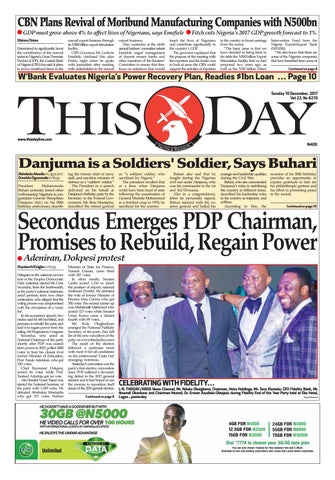
Secondus Emerges PDP Chairman, Promises to Rebuild, Regain Power Adeniran, Dokpesi protest
Onyebuchi Ezigbo in Abuja Delegates to the national convention of the Peoples Democratic Party yesterday elected Mr. Uche Secondus, from the South-south, as the party’s national chairman, amid protests from two other contenders, who alleged that the voting process was compromised with the circulation of a ‘unity list’. In his acceptance speech, Secondus said he felt humbled, and promises to rebuild the party and lead it to regain power from the ruling All Progressives Congress. Secondus, who acted as National Chairman of the party shortly after PDP was ousted from power in 2015, polled 2000 votes to beat his closest rival former Minister of Education, Prof. Tunde Adeniran, who got 230 votes. Chief Raymond Dokpesi, scored 66 votes while Prof. Taofeed Adedoja got no vote. Also Senator Umar Tsauri was elected the National Secretary of the party with 1,549 votes. He defeated Abubakar Mustapha who got 371 votes. Former
Minister of State for Finance, Nanadi Usman, came third with 287 votes. In other results, Senator Garba scored 1,316 to clinch the position of deputy national chairman (North). He defeated the wife of former Minister of Finance Inna Ciroma who got 350 votes. The second runner up was Abdulmalik Mahmood who scored 325 votes while Senator Umar Kumo came a distant fourth with 89 votes. Mr. Kola Ologbodiyan emerged the National Publicity Secretary of the party. (See full list of the new executives of the party on www.thisdaylive.com) The result of the election followed a particular trend with most if not all candidates on the controversial ‘Unity List’ emerging victorious. Yesterday’s convention was the party’s first elective convention since PDP suffered a devastating defeat in the 2015 general election and it had hoped to use the exercise to reposition itself ahead of the 2019 general election. Continued on page 8
CELEBRATING WITH FIDELITY… L-R: THISDAY/ARISE News Channel, Mr. Nduka Obaigbena; Chairman, Heirs Holdings, Mr. Tony Elumelu; CEO Fidelity Bank, Mr. Nnamdi Okonkwo; and Chairman Nestoil, Dr. Ernest Azudialu-Obiejesi; during Fidelity End of the Year Party held at Eko Hotel, Lagos ...yesterday Kunle Ogunfuyi
2
T H I S D AY SUNDAY DECEMBER 10, 2017
T H I S D AY SUNDAY DECEMBER 10, 2017
3
4
T H I S D AY SUNDAY DECEMBER 10, 2017
6$0( %$1. ,03529('
(;3(5,(1&( *(7 7+( 201,&+$11(/ $'9$17$*( (QMR\ WKH IUHHGRP WR FKRRVH IURP DQ\ RI RXU LPSURYHG 2PQLFKDQQHO VROXWLRQV .HHS HQMR\LQJ RXU HYHU LPSURYLQJ EDQNLQJ VHUYLFHV
)LQJHUSULQW /RJLQ /RDQ 5HTXHVW
1HZ /RRN DQG )HHO
6SHQG $QDO\VLV
P9,6$
2QH SDVVZRUG IRU DOO SODWIRUPV
T H I S D AY SUNDAY DECEMBER 10, 2017
5
6
T H I S D AY SUNDAY DECEMBER 10, 2017
T H I S D AY SUNDAY DECEMBER 10, 2017
7
8
͚͸˜ ͺ͸͚Ϳ Ëž T H I S DAY, T H E S U N DAY N E W S PA P E R
PAGE EIGHT SECONDUS EMERGES PDP CHAIRMAN, PROMISES TO REBUILD, REGAIN POWER Though there were eight candidates for the party’s topmost position, one of them, Chief Olabode George, withdrew his participation less than 24 hours to the election, while four others – Mr. Jim Agbaje, Otunba Gbenga Daniel, Chief Rasheed Ladoja and Mr. Olusegun Aderemi withdrew from the race at the convention ground, thus leaving the remaining four – Mr. Secondus, Prof. Adeniran, Chief Dokpesi and Prof. Adedoja- to slug it out. However, following intense lobby and horse trading involving an influential bloc in the party which favored Uche Secondus, a former acting national chairman, he was already tipped to win the race even before actual voting began. It was however not a smooth sail as some chairmanship aspirants complained bitterly about their being schemed out of the process. Prior to voting, a list tagged ‘Unity list’ containing names of candidates said to have been endorsed by the party to win their offices, was circulated. Top on the unity list was Secondus. The circulation of the ‘unity list’ at the convention ground was vehemently protested by one of the aspirants, Dokpesi. Dokpesi, who addressed journalists faulted the elections, describing it as a charade, warning such may destroy the party. Dokpesi said the voting process had been compromised, following the distribution of a ‘unity list’ containing names of candidates believed to have won
elections into various national leadership positions in the party. He explained that the 21 names of candidates contained in the list appeared on the ballot papers as number one and in the voting boots as number one. He said complaints were lodged to the chairman of the PDP electoral committee Gabriel Susuan who confirmed that he had seen the list with some delegate but he was overwhelmed and could do little or nothing about it. Dokpesi said it was unfortunate that a party which was just getting out of a major leadership crisis would be involved in acts of impunity and election malpractice. He however called on the party leadership to urgently rectify what he called an anomaly and a charade before it becomes another major challenge in the party ahead of 2019 general elections. Also reacting to the election yesterday night, another aspirant, Adeniran said the circulation of the list of candidates while voting was yet to take place was absurd, adding that it had tainted the entire process. He said although the arrangement put in place by the convention planning committee was very good, the organisers were overwhelmed by fraudulent people who would never let democracy thrive. "The desperados are the ones perpetrating this act. On the circulation of the ‘unity list’, he described it as absurd. This is the type of imposition we have been talking about. And when it is coming from
those who are supposed to guide people to make free choice, then, of course, the consequences will be there," he said. He accused those he regarded as agents of imposition and impunity of being behind the unity list. These people, he said, were bent on destroying the party and would never let internal democracy and free choice to exist. Adeniran alleged that the list were printed on the official PDP letter headed paper. "I believe it couldn't have come from any other source except the powers that be and their sponsors," he said. On whether he would accept the outcome of the result, he said: "We signed the peace accord and agreed that we will accept once it is free and fair. But when the conditions were not met, we are not bound to accept it.". However a member of the convention planning committee and former minister of Environment, John Odey, described the alleged circulation of candidates’ list as a non issue. He said that the list could not be traced to anyone since it was not signed. The former minister said that the process at the convention was democratic despite the complaint over the circulation of the unity list by unknown persons. Meanwhile, the disaffection created by the failure to micro zone the position of the national chairman zoned to the South, was not entirely laid to rest before the convention was held. On the eve of the convention, one of chairmanship aspirants, Olabode
George, addressed the media announcing his withdrawal from the race. George, a former deputy national chairman of the party, expressed displeasure over what he described as failure of the party and its leaders to uphold the arrangement arrangement which micro zoned the chairmanship to the South-west. He also accused Governor Wike of insulting the South West by saying they have not contributed much to the PDP to warrant their insistence on occupying the national chairmanship position. Following the withdrawal of George from the race, other five aspirants from the zone followed suit by pulling out of the race as well. Although not stated, many believed that these aspirants may have been aggrieved by what they perceived as unfair treatment of the zone and decided to pull out and also to boost the chances of Prof. Adeniran who is also from the zone. George, who withdrew from race 24 hours to the commencement of the exercise, also blamed the monetisation of the chairmanship race for his withdrawal, saying that the PDP is on the verge of self- destruct. "Let me make abundantly clear that I, Olabode George, did not step down for anybody. I will not step down for anybody but what I am doing is to withdraw from the race on principle and against the observed wrong," he said. Though the convention was billed to commence at 10am, as early as 6.30am on Saturday,
delegates started trooping to the Eagle Square, venue of the convention, located in the Three Arms Zone. Security was tight within and around the venue as a combined team of security operatives was on ground. Only duly accredited party members and journalists were allowed into the convention ground. All the PDP governors, former President Goodluck Jonathan, former Vice President Atiku Abubakar, former Vice President Namadi Sambo, past PDP governors and ministers were among leaders of the party at the convention, where they expressed optimistism that PDP would win the 2019 presidential election. Former President Goodluck Jonathan who led other leaders to flag off the elective convention said the chances of the PDP at the next election was bright. "Our party has done extremely well in managing the affairs of this country. Let it be known, in all nooks and crannies of our country, that the PDP is back to reclaim its rightful place in the affairs of our nation. "As we have always done, we are ready to return Nigeria to the path of steady and robust economic growth, driven by sound sectoral reforms, infrastructural renewal, gender balance, youth entrepreneurial development and job creation," former President Jonathan said. Jonathan criticised the APC-led administration for turning its anti-corruption war into persecu-
tion of opponents, adding that such practice would soon end. On his part, former Vice President Atiku Abubakar said in the 16years that PDP governed the nation, it succeeded in keeping it united, peaceful and prosperous. "We made mistakes, but we put our nation first. We did not favour only states that voted for us and punish those that did not. We favoured all. And we also know that 5% and 97% do not add up to 100%," he said. Atiku, whose comment was his first at a major function of the PDP since rejoining the party early this month, regretted that APC government had continued in the same act of blaming previous governments for the nation’s woes rather than solve problems it was elected to address. He said PDP was the party that would restructure Nigeria into a modern nation with working institutions and a system that gives back power to the people. In his welcome address, chairman of the dissolved National Caretaker Committee, Senator Ahmed Makarfi, said his committee had been able to navigate through difficult circumstances to be able get to the current stage of the party. "We have laid a foundation for the effort at rebuilding the party," he said. On reconciliation, Makarfi said the party had succeeded in getting everyone to make sacrifices.
in the country. While reacting to an earlier statement by Emefiele that the disbursement of the MSMEDF was still very low, Ambode called for a further reduction of the interest rate of the fund from the nine per cent it is presently, to about five per cent. “As a government, we decided to create an Employment Trust Funds of N10 billion and we are giving out loans at five per cent. So, I am saying that if you want to activate a particular sector, you shut your eyes to profit-making sometimes. “As a state, we have helped over 6,000 persons. So, if you want to touch the people at the lower level, there has to be something different for them,� he advised. According to Ambode, for Nigeria to attain its potential, its economy must grow by 6.7 per cent per annum. This, he said was critical to reduce the level of poverty in the country, prevent social unrest as well as unlock the full potential of the country. Ambode frowned on what he described as over-regulation in the country. This, according to him has negative consequences on the economy. He called for a stronger collaboration among the regulators to promote access to finance in Nigeria. Meanwhile, the CBN on Friday closed the market for the week with sale of the sum of $303.9 million in the foreign exchange market. The breakdown of the total sales indicated that much priority was given to the real sector of the economy with the sale of 75 per cent of the day’s sales amounting to $229.89 million for raw materials and machinery. Confirming the sales, in a statement yesterday, the
Acting Director, Corporate Communications Department of the CBN, Mr. Isaac Okorafor, hinted that various sums were also offered to other vital sectors like the agriculture and airline which got $24.68 million and $12.467 million respectively, while petroleum products got 36.89 million. On the performance of the forex market in the out-going year, the director noted with nostalgia that the naira exchange rate had not only remained stable and considerable accretion to the foreign reserves but Bank had so far met all the legitimate demands from genuine customers In another development, one of the leading rating agencies, Fitch Ratings has cut its 2017 economic growth forecast for Nigeria to one per cent, from the 1.5 per cent it had estimated previously. Nigeria returned to growth in the second quarter of 2017 after shrinking by 1.5 per cent in 2016 but the recovery has been fragile because oil revenues remain depressed and hard currency is short. Speaking at a Fitch event in London, Reuters quoted the agency’s Director for Sovereigns, Jermaine Leonard, to have added that although Nigeria’s 2018 budget had an oil production target of 2.3 million barrels per day (bpd), the Fitch forecast was just above two million bpd. This was partly linked to a potential flare up in violence in the Niger Delta as elections approach in 2019, he said. Fitch currently rates Nigeria at B+ with a negative outlook, which reflected the fact that there were still a lot of elements which could take it down, said Leonard. “But at this point we are cautiously optimistic,� he noted.
Read concluding part on www.thisdaylive.com
CBN PLANS REVIVAL OF MORIBUND MANUFACTURING COMPANIES WITH N500BN our export stimulations facilities in the past and some of them still remain moribund, and we have also told our Development Finance Department to take a look at companies like Multi-trex and another company that is also into cocoa processing that is somewhere in Ibadan. “We are going to be working with them to see that we really get their production back on track. By doing this we are going to be creating more jobs for our people. “Other than just creating jobs, we will see that it will afford opportunity to increase our export earnings for the good of the country because those export earnings are also necessary,� he said. Emefiele pointed out that since the last two years when the country saw significant drop in its revenue as a result of the slide in crude oil prices, the central bank and federal government had been thinking of various means to raise its non-oil revenue so as to be able to withstand shocks. According to Emefiele, the new management of NEXIM had displayed clear understanding of the issues affecting the non-oil sector. He hinted that the CBN's Development Finance Department as well as his Special Adviser on Agriculture would, in the next one week, put together a framework on how the funds would be disbursed. Under this programme, Emefiele said the acronym -PAVE- Produce, Add Value and Export, had been re-introduced. “So, we had a lot of engagements with the exporters and we would be looking at various products in the non-oil sector: cocoa, cashew nuts, palm produce, sesame seeds, solid minerals and rubber. “We are saying that to create
jobs for our people, there is a need is a need for us to advance further to value addition and begin to talk about processing of exportable items like rather than export raw cashew. We are thinking of exporting processed cashew. Rather than export raw cocoa, we are thinking of giving support to companies that process cocoa to cocoa butter and cakes and all that.� Furthermore, Emefiele said it was agreed at the meeting that there were some elements of undocumented export transactions. According to him, the exporters agreed to put a stop to the incidence of undocumented exports. He stressed that all transactions that would receive funding from the CBN would be for documented export transactions only, saying before the facilities would be provided to the exporters, they would commit through their banks or through NEXIM that they would repatriate the forex. “So, we are saying that the source of revenue into the country should not just be oil, neither should it just be foreign portfolio investments or foreign direct investment alone,� he stated. The CBN Governor also disclosed plan to set up an Anchor Borrowers’ Programme (ABP) for non-oil exporters. “Here, we are saying for instance that we have so many cocoa farmers, primary rubber producers or palm oil producers who are in the villages or in the communities and we are saying that we are going to develop a framework that would make finance available to them through NEXIM and through the framework to be set up, where they can access some intervention funds. “The export companies
would act as their off takers and anchors. For instance, you have a farmer in the village or a couple of farmers that have a cooperative, what happens is that the cooperative would work with the cocoa exporters and the exporters would be the off-taker of the cocoa produce, but the funding would pass through the central bank to the banks or through NEXIM, and goes through the exporters to the primary farmers. “With that there is an opportunity to off-take those products from the farmers. But the details of the framework would be worked out. “But I can say that it is also part of the encouragement we have received from government that let all we are doing not be about rice, tomato or maize, but that lets go to other areas where there are cash crops like cocoa, rubber, to export, earn foreign exchange to lubricate and run our economy,� he added. According to Emefiele, the plan also covers the solid minerals sector. Delivering a welcome address at the bankers’ committee retreat in Lagos, with the theme: “Improving Financial Access, Job Creation and Inclusive Growth in Nigeria,� Emefiele pointed out that until Nigeria’s economic growth move higher than four per cent, it may be difficult to feel the impact of public policies. Specifically, he told his audience at the meeting, which also had in attendance the Governors of Lagos, Jigawa and Kebbi as well as the Minister of Agriculture that: “Growth must be seen to exceed four per cent, before we can say it has started permeating the lives and well-being of our people.� The National Bureau of Statistics (NBS) recently revealed that
the Nigerian economy grew by 1.4 per cent in the third quarter (Q3) of this year, higher than the revised growth rate of 0.72 per cent recorded in the second quarter. But Emefiele stressed the need for members of the Bankers’ Committee to ensure they continue to play their financial intermediation role to achieve this. “In the last three years, the central bank has its N220 billion micro, small and medium scale enterprises development funds (MSMEDF) available. “But as I speak, just less than 50 per cent of this fund has been drawn. But when we tell people that these fund is available at nine per cent, they keep asking for the fund. “So, there is a gap. We have these funds while people on the other side are saying they haven’t seen the fund. So, there is a disconnect. And those who rightfully stand in a position to do this are all of us. “We should stand and be counted as we journey towards achieving growth in this country,� he told his audience. According to the CBN Governor, programmes such as the Anchor Borrowers Program (ABP) has helped to drive productivity in Nigeria’s agriculture sector by providing finance to large numbers of small holder farmers across the country. He put the total amount invested in the ABP at over N45billion, saying the program has been highly effective in improving production, by smallholder farmers of items such as rice, maize and soya beans. In his address, Lagos State Governor, Akinwunmi Ambode, called for a low-cost, wellfunctioning financial system
T H I S D AY, T H E S U N D AY N E W S PA P E R ˾ DECEMBER 10, 2017
9
SUNDAY COMMENT
Editor, Editorial Page PETER ISHAKA Email peter.ishaka@thisdaylive.com
HUMAN RIGHTS AND THE REVOLT AGAINST SARS…(1) Security agents are ironically the greatest violators of human rights
F
ollowing an alleged anti-judicial killing in Lagos of a young man by some operatives of the notorious Special Anti-Robbery Squad (SARS), there were uproars in the social media last week with many Nigerians recounting tales of brutality in the hands of the men who ordinarily should shield them from harm’s way. From Port Harcourt to Oyo to Enugu to Abuja to Kano and Maiduguri, it would seem that the officers and men of SARS have become law unto themselves. So horrific were the testimonies (some of them with video evidence) that the Inspector General of Police, Mr Ibrahim Idris, had to intervene by instituting a reform to reorganise the unit. However, as we join the rest of the world to mark the international human rights day, it is important to highlight that the defining paradox of Nigeria’s unenviable human rights record is that the greatest violations are committed in the name of security. Even before the SARS revelations, most of the cases of abuse that have been reported and documented by Amnesty International have been linked to security and law enforcement operatives in the line of duty. The police and the military have been reported to carry out extra judicial killings, torture or rape, most often to humiliate citizens. In all civilised societies, mere suspicion does not constitute an offence or grounds for inflicting punishments. Persons accused of any crime are charged to court if not for anything, at least to avoid a miscarriage of justice. But on the basis of unproven allegations, sometimes without any allegation at all, personnel of our law enforcement agencies would subject innocent citizens to all manner of molestations. For instance, the
scale of public reactions and the evidences being provided by those who have encountered the brutalities of SARS, according to the Country Director of Amnesty International, Mr Osai Ojigho, revealed very clearly “that the concerns of the Nigerian people are reaching boiling point,” adding that “all incidents of violence meted out by this notorious police unit must be independently investigated, and those found to be responsible must be prosecuted in fair trials.”
U
It is important to highlight that the defining paradox of Nigeria’s unenviable human rights record is that the greatest violations are committed in the name of security
Letters to the Editor
S U N DAY N E W S PA P E R EDITOR TOKUNBO ADEDOJA DEPUTY EDITORS VINCENT OBIA, OLAWALE OLALEYE MANAGING DIRECTOR ENIOLA BELLO DEPUTY MANAGING DIRECTOR KAYODE KOMOLAFE CHAIRMAN EDITORIAL BOARD OLUSEGUN ADENIYI EDITOR NATION’S CAPITAL IYOBOSA UWUGIAREN
T H I S DAY N E W S PA P E R S L I M I T E D EDITOR-IN-CHIEF/CHAIRMAN NDUKA OBAIGBENA GROUP EXECUTIVE DIRECTORS ENIOLA BELLO, KAYODE KOMOLAFE, ISRAEL IWEGBU, IJEOMA NWOGWUGWU GROUP FINANCE DIRECTOR OLUFEMI ABOROWA DIVISIONAL DIRECTORS PETER IWEGBU, FIDELIS ELEMA, ANTHONY OGEDENGBE DEPUTY DIVISIONAL DIRECTOR OJOGUN VICTOR DANBOYI SNR. ASSOCIATE DIRECTOR ERIC OJEH, PATRICK EIMIUHI ASSOCIATE DIRECTORS HENRY NWACHOKOR, SAHEED ADEYEMO CONTROLLERS ABIMBOLA TAIWO, UCHENNA DIBIAGWU, NDUKA MOSERI GROUP HEAD FEMI TOLUFASHE ART DIRECTOR OCHI OGBUAKU II DIRECTOR, PRINTING PRODUCTION CHUKS ONWUDINJO TO SEND EMAIL: first name.surname@thisdaylive.com
nfortunately, the challenge of human rights abuse in Nigeria goes beyond the police as an institution or SARS as a unit. In recent times, women who escaped from the barbarism of Boko Haram to seek protection from security forces have reported even worse abuse in the hands of Nigerian soldiers. The fight against terrorism in the Northeast has provided an alibi for soldiers to carry out extra judicial killings because they were without recourse to either the accepted rules of warfare or the rule of law. In the Southeast, recent onslaughts against the renegade Indigenous People of Biafra (IPOB) resulted in fatalities. Incidentally, this weekend marks the second year anniversary of the killings, in Kaduna by soldiers, of hundreds of Shiites Movement members. Their leader, Sheikh Ibrahim el-Zakzaky and his wife are still in incarceration. In the Niger Delta, whole communities have been sacked or traumatised in the name of security by soldiers who are often ill-trained and hardly could differentiate armed militants from innocent bystanders. The root of these human rights violations is an embarrassing ignorance on the part of security operatives of the basic rights of citizens in a democratic society. Correspondingly, we are often dealing with a rank and file who themselves do not understand their obligations in the protection of fellow citizens and their basic rights. Aside all these, elected governments that routinely adopt abusive policies cannot be trusted to protect people from abuses by operatives of state. Interestingly, fellow Nigerians empathise with each other when in distress and largely respect each other’s basic rights and dignity. But when the armed agents of the state come into the picture, a hostile relationship also comes into play. At other times, politicians sow hatred among peaceful neighbours by inviting armed agents of state to unleash violence. So, either as politicians or practitioners of organised violence, the state is the biggest source of concern in human rights abuses in Nigeria today. ––To be concluded tomorrow
TO OUR READERS Letters in response to specific publications in THISDAY should be brief (150-200 words) and straight to the point. Interested readers may send such letters along with their contact details to opinion@thisdaylive.com. We also welcome comments and opinions on topical local, national and international issues provided they are well-written and should also not be longer than (950- 1000 words). They should be sent to opinion@thisdaylive.com along with the email address and phone numbers of the writer.
A MEMO FROM BONN
A
fter two weeks of deliberations, negotiations and meetings dragging late into the night, the 23rd session of the Conference of Parties came to a close in Bonn, Germany. Questions linger however; questions on what took place in Bonn, questions as to the landmark decisions that were made, questions as to implementation plans over the next one year. These questions, I will attempt to answer in this memo from Bonn. This year’s Conference of Parties gives us reason to re-assess our priorities, and rethink our game plan as a country. This year was the first year the COP was chaired by a small island state- Fiji -and the push, drive and commitment of fellow small island states to see their goals achieved in the negotiations was pal-
pable. And their goals are goals that concern developing nations, chief among which was the clamour for financing from developed countries through the loss and damage (L&D) dedicated financing mechanisms. Expectedly, developed countries antagonised the move, as accepting the concept of loss and damage would mean their acceptance of the fact that developed countries have caused major irreparable loss to the rest of the world. Germany had earlier opened the conference on the first day with an announcement of an additional 100 million Euros to support climate change adaptation in developing countries. It is ironical then why it was difficult for a bloc of countries to which they belong to commit to financing for loss and damage? This very easily shows the rest of the world how developed countries will not accept responsibil-
ity quickly. In fact, the European Union and Australia suddenly began to raise claims of there being no scientific proof linking climate change to extreme weather conditions. What this portends for us in this part of the world is a need to start thinking ahead; developing financing methods to cushion budget shortfalls in addressing issues of climate change, potential loss and damage, adaptation and mitigation. I have suggested elsewhere that the African Development Bank should fly Green Bonds which are increasingly becoming attractive in the international stock market. Also, de-risking financial instruments and generally pooling capital market investments for Green development is a great way of financing climate in the Nigeria. There should also be the consideration of a regional capital market for Africa to float
such bonds in order to attract private sector funding on a continental level. In order to do this, there is a dire need for knowledge dissemination on green investments to provide a repository for financial analysts, investors and private actors to properly understand the climate investment market. There is also the need to use local expertise to pool investments with a view to benefiting local communities, who are most affected by the effects of climate change. The Abidjan Declaration of ECOWAS concluded in June this year speaks to this. Some other very interesting occurrences at the COP this year was Syria’s signing of the Paris Agreement, something many have praised, but a few have maligned as being not well thought out for a war-torn country. Despite the criticisms, the move remains a commendable one, and one that typifies the United States as the child in the circle being taunted by other children for peeing on her pants. Another develop-
ment which puts Trump’s government on edge is the ‘We are Still In’ movement which was showcased at the COP by Governor Jerry Brown of California, a movement that brings thousands of US citizens together as they continue implementing the Paris Agreement, regardless of Trump’s stance. The lesson to take away from this is that we, the citizens, are powerful, and that if we should one by one commit to taking action to combat climate change and its effects, we can do a lot of good, even more for our country that has signed the Paris Agreement. At the COP, the Gender Action Plan was also launched for the first time, a plan of action to ensure more inclusiveness for the female gender in climate activities; negotiations, high-level decisions, policymaking, adaptation and mitigation programmes, loss and damage activities, financing, etc. ––Caleb Adebayo is a lawyer with the firm of Wole Olanipekun and Co.
10
T H I S D AY, T H E S U N D AY N E W S PA P E R Ëž ͚͸˜ ͺ͸͚Ϳ
SUNDAYNEWS
News Editor Abimbola Akosile E-mail: Ă‹ĂŒĂ“Ă—ĂŒĂ™Ă–Ă‹Ë›Ă‹Ă•Ă™Ă?Ă“Ă–Ă?̜ÞÒÓĂ?ĂŽĂ‹ĂŁĂ–Ă“Ă Ă?Ë›Ă?Ă™Ă—Ëœ ͸΀͸ͺ͚͚͝Ϳ͞͝Π̙Ă?Ă—Ă? Ă™Ă˜Ă–ĂŁĚš
KSA, Omawumi Light Up Ikoyi Club
ECONOMIC RETREAT L-R: Jigawa State Governor, Alhaji Mohammed Badaru Abubakar; Lagos State Governor, Mr. Akinwunmi Ambode; and Chairman Bankers’ Committee and Governor, Central Bank of Nigeria, Mr. Godwin EmeďŹ ele, during the 9th Annual Bankers’ Committee Retreat at the Renaissance Hotel, Ikeja, Lagos...yesterday
Juju maestro, King Sunny Ade and delectable songstress, Omawumi were special acts at the International Night 2017 at Ikoyi Club 1938. The annual event which usually features King Sunny Ade was given a fillip this year with the addition of Omawumi. Dressed in a shimmering gold coloured off-the-shoulder gown, Omawumi thrilled the audience with new and old songs taken from her debut and sophomore albums. Her mellifluous voice was a delightful curtain raiser to a grand evening that proved a rallying point for both old and new members of Ikoyi club. Speaking in the intermission between Omawumi’s performance and King Sunny Ade’s arrival on stage, the Chairman of Ikoyi Club 1938, Mr. Babatunde Akinleye thanked members for turning out in large numbers and wishing them the best of the season.
W’Bank Evaluates Nigeria’s Power Recovery Plan, Readies $1bn Loan Chineme Okafor in Abuja According to it, the PSRP, a comprehensive programme of policy, legal, regulatory, operational and financial interventions aimed at restoring service efficiency and long-term viability of the power sector, would be implemented through 2021. The statement added that it would also improve transparency, service delivery and reestablish investor confidence in the sector, and equally accelerate electricity access in the country especially through off-grid public private partnerships. It explained that the meetings assessed the level of progress Nigeria had recorded in implement-
ing the first phases of the PSRP, following from similar high-level meetings both parties previously had in Abuja in December 2016 and in Washington during the 2017 World Bank and IMF Spring Meetings. On the progress made by Nigeria so far with the PSRP, it said: “The federal government of Nigeria clarified progress made to date and next steps on key components of the PSRP. The federal government has prepared a financing plan to ensure financial sustainability of the power sector and included it in the Medium-Term Expenditure Framework and Fiscal Strategy Paper submitted to the National Assembly in October 2017.� The statement further noted
that, “The financing plan will be monitored regularly and incorporate contingencies should the sector shortfall deviate from the base case assumptions until retail tariffs are adjusted in line with improved service delivery to attain cost recovery by 2021.� The PSRP, it added, would have measures to contain costs and carefully manage contingent liabilities to ensure cost-reflective and affordable electricity tariffs. “In this context, it was agreed that existing generation infrastructure assets will need to be optimised before the sector assumes new financial obligations that could not be supported. Furthermore, least cost planning for the interconnected grid
system will be institutionalised and its governance arrangements elaborated in the PSRP,� it stated. Both parties equally noted that they would expect the programme to enjoy the support of all arms of government including the National Assembly. On the possibility of a market restructuring, the statement said: “The parties agreed that the process of ‘Market Reset’, redefining the revenue requirement of the sector based on new performance parameters and detailed investment plans, will be implemented rigorously, transparently and in a highly consultative manner.� It added that the ‘Market Reset’ would be led by the Nigerian Electricity Regulatory Agency
(NERC), and that the government will respect the independence of the NERC to do this, while providing it sufficient resources to undertake its mandate. The statement further stated that the World Bank delegation was pleased with the progress of the country in implementing the early actions of the PSRP, adding: “The World Bank is committed to assisting the federal government with programme implementation working closely with the PSRP implementation monitoring team, which reports directly to the His Excellency, the Vice-President of Nigeria.� “The World Bank will continue the preparation of the proposed $ 1 billion Performance Based Loan
(PBL) to support the programme. The federal government and the World Bank Group agreed on the necessary next steps to present the PBL to the World Bank’s Board of Executive Directors for their consideration,� it explained. Similarly, the Senior Director for Energy and Extractive Industries at the World Bank, Riccardo Puliti, was quoted in the statement to have said: “The discussions we had with the government demonstrated that there is strong momentum in the power sector and government commitment to taking the critical next steps that will allow us to present the Performance Based Loan to our Board of Executive Directors.�
Arab Nations Mount Pressure on Trump over Jerusalem
10 Killed as Fulani Herdsmen Invade Community in Kogi
Demola Ojo
Yekini Jimoh in Lokoja
The tension and controversy generated by President Donald Trump’s recognition of Jerusalem as capital of Israel is yet to settle following Saturday’s emergency meeting by Arab foreign ministers in the Egyptian capital, Cairo. The meeting is designed to formulate a unified response to President Trump’s decision to recognise Jerusalem as Israel’s capital, a move that has sparked anger and protests in the Arab world. The Arab League meeting, which brings together foreign ministers from memberstates, is taking place as protests continued for three consecutive days in the West Bank and Gaza Strip. In Cairo, the head of Egypt’s largest Christian church announced he would not meet U.S. Vice President
Mike Pence when he visits Cairo on Dec. 20. A similar decision was made Friday by the head of Al-Azhar, the world’s supreme seat of learning for Sunni Muslims. Hundreds of worshippers protested Trump’s decision after Friday prayers at Al-Azhar mosque, but security forces prevented them from marching to the city centre. Trump’s announcement on Jerusalem, and his intention to move the US Embassy there, triggered denunciations from around the world, with even close allies suggesting he had needlessly stirred more conflict in an already volatile region. The city’s status lies at the core of the Israeli-Palestinians conflict, and Trump’s move was widely perceived as siding with Israel. Even small crises over Jerusalem’s status and that
of the holy sites in its ancient Old City have sparked deadly bloodshed in the past. It was not immediately clear what the foreign ministers will decide on in terms of concrete measures to counter Trump’s decision, but Arab diplomats have spoken of submitting a draft resolution condemning the move to the U.N. Security Council and unspecified measures touching bilateral ties between Arab League member states and Washington. The diplomats also speculated that an Arab summit might be called to convene following the foreign ministers’ meeting, a proposition the diplomats said was already embraced by several member states. The diplomats spoke on condition of anonymity because they were not authorised to brief the media.
Some Fulani herdsmen weekend invaded two local government councils respectively in Kogi State, where they reportedly killed 10 persons and then set their farmlands on fire. The incident took place on Friday in Omala and Yagba West local government councils respectively. According to an eye-witness account yesterday, some Fulani herdsmen invaded Ogabifo village near Agbenema community in Omola local government council of the state on Friday with their cattle. According to the source, the Fulani herdsmen invaded the farmland and fed their cattle with the produce of the farm, and when the owner of the farm with his family approached them, they attacked the farmer and his family and chased them to the village
where about 10 people were reportedly killed. THISDAY further gathered that after invading the village, the Fulani herdsmen went back to the farm and destroyed the crops there and then ran away. A source (name withheld) said the Fulani herdsmen numbering five were fully armed with AK 47 rifles and other dangerous weapons. The source also confirmed to THISDAY that the villagers have run away from the various houses as the Fulani herdsmen promised to invade the village again. In another similar incident, Fulani herdsmen have also invaded another farm land in Yagba West local government council of the state. An eye-witness disclosed to THISDAY yesterday that the Fulani herdsmen with over 30 cattle invaded a rice farm
owned by a woman in Omi, destroyed the rice farm and chased the farmers from their farm land. A farmer, who doesn’t want his identity to be known, disclosed to THISDAY that the Fulani herdsmen were fully armed when they arrived at the farmland. He added that other farmers were in their farms working when they heard several gunshots when the Fulani herdsmen invaded the farms. He stated that it was by God’s grace that they escaped from their farms. He therefore appealed to the state government to take a proactive step by calling the Fulani herdsmen to order. The Kogi State governor, Alhaji Yahaya Bello last week had said that he would not introduce any anti-grazing law to curtail the activities of Fulani herdsmen in the state.
T H I S D AY SUNDAY DECEMBER 10, 2017
11
12
T H I S D AY SUNDAY DECEMBER 10, 2017
13
T H I S D AY SUNDAY DECEMBER 10, 2017
13*7"5& 7*&8*/(
UI %FDFNCFS $PDLUBJMT 1. *."9 $JOFNB -FLLJ QPXFSFE CZ
4UFSMJOH #BOL 1MD 4 5 3 * $ 5 - : # : * / 7 * 5 " 5 * 0 /
&RQQHFW
14
T H I S D AY, T H E S U N D AY N E W S PA P E R Ëž ͚͸˜ ͺ͸͚Ϳ
NEWS
HONOURING MADAM EKE
L-R: Chairman, Board of Directors, Nigeria Sovereign Investment Authority, Olajide Zeitlin; CEO, Nigeria Stock Exchange, Oscar Onyema; GMD FBN Holdings, UK Eke; Group Chairman, FBN Holdings, Oba Otudeko; Managing Director, Masters Energy Group, Dr. Uche Sampson Ogah, at the funeral rites of Madam Ahudiya K. U. Eke, mother of UK Eke, held in Abiriba, Abia State‌recently
FG to Track Donor Funds through Annual Budgets Ndubuisi Francis in Abuja
To make for effective national planning, funds from donor agencies into the country for ministries, departments and agencies (MDAs) will now be reflected in annual budgets. Although the modalities for going about it is still unclear, a top government official told THISDAY on telephone Saturday that there currently exists no complete record of what comes into the country as donor funds to the MDAs. According to him, funds extended to the MDAs through donor agencies are not captured
in the budgets, hence such funds are not officially tied to projects captured in annual budgets. In order to streamline the budgeting process, avoid duplication of resources, he stated that donor funds will now be tracked by the federal government. The essence, the source said, is to make for effective national planning, and ensure proper documentation of inflows into the MDAs of government. The Minister of Budget and National Planning, Senator Udoma Udo Udoma recently hinted at a public function that
Nigeria Must Create 4m Jobs Annually to Ensure Growth, Says Ambode Abimbola Akosile
Lagos State Governor, Mr. Akinwunmi Ambode on Saturday said for Nigeria to meet its growth ambitions and achieve full economic potential, concerted efforts must be made to create at least four million jobs annually and as well jettison policies that stifle development. Speaking at the opening session of the 9th Annual Bankers’ Committee Retreat of the Central Bank of Nigeria (CBN) held at Renaissance Hotel in Ikeja, Lagos, Ambode said it was time for the government to review such policies that inhibit growth, and as well come up with a well-functioning low cost financial system that will work for all Nigerians. While describing the theme of the retreat – ‘Improving Financial Access, Enabling Job Creation and Driving Inclusive Growth in Nigeria’, as apt, the Governor said same was at the heart of the nation’s economy and are important determinants of the
country’s future prosperity, but that all hands must be on deck to create more jobs for the people and ensure 6.7 per cent annual growth rate. He said: “To meet our growth ambitions we need jobs. Figures from the National Bureau of Statistics show that in employment terms, from a labour force population of about 81 million people, we currently have 11.5 million people unemployed in Nigeria and 17 million people under-employed with the total employment is around 52.6 million while the working age population grows by 3.7 per cent every year. So, to make a meaningful dent on un-employment and underemployment, and to reduce poverty (which is at over 60 per cent), we need to be creating at least four million jobs per year. “Where do banks fit into all of this? Well, the reality is if we do not have a well-functioning banking sector, all of this is not possible. Both investment and day-to-day commerce requires the intermediation of banks.
donor funds will henceforth be captured in annual budgets, but did not elaborate. It is still hazy how the government intends to pursue this objective. Udoma had also recently advised development partners to ensure that their development initiatives in Nigeria align with the nation’s objectives, pointing out that although the county would like some foreign aid, its major focus was generating enough revenue internally. He stated that Nigeria would appreciate the assistance of the United States of America in providing technical support for the development of transportation
infrastructure and agricultural sector as the country intensifies work on its economy Udoma argued that although Nigeria is looking inwards for more revenue, it would also appreciate external support especially in the form of technical assistance. The minister stated that the development initiatives of development partners in Nigeria should align with the objectives of the country. Meanwhile, the 2015 Audited Report of federal MDAs indicates that over the years, the funds in the Ecological, Stabilisation and Development of
Natural Resources were never invested, according to extant laws. “Audit evidence showed that the funds always have favourable balances at the end of each year. It will be economically beneficial to invest the amounts in these funds and the interest accruing there from would reduce the level of domestic debts that had escalated to trillions of naira. “In the same vein, if these funds were invested, the amounts of federal government bonds floated with the accrued charges and the effect on CRF (Consolidated Revenue Fund
(CRF) balances would have also reduced; also, the interest accruing from investing the balances would result in more funds for the three tiers of governments,� the report, recently pasted on the website of the Office of the Auditor-General for the Federation said. The report also observed the non-establishment of an agency to administer the Ecological Fund, saying the audit revealed that amounts totaling N596,137,481,709.94 were deducted from the Federation Account to the Ecological Fund between June 1999 and December 2015.
NBC Set to Demarcate Boundary between A’Ibom, Cross River
Buhari Greets Oyebode at 70
Okon Bassey in Uyo
President Muhammadu Buhari has felicitated with erudite scholar and renowned Professor of International Law, Prof. Akin Oyebode, on the occasion of his 70th birthday. The president, according to a statement by his Special Adviser, Media and Publicity, Mr. Femi Adesina, said he delightfully joined the academia, his professional colleagues, family and friends of the scholar to wish him a happy birthday. According to him, “Oyebode has spent 44 years in research, teaching and writing seminar papers that both institutions and governments have found most
The federal government is poised to put a demarcation mark to finally bring to rest years of communal vendetta between Akwa Ibom and Cross River states. The Akwa Ibom Deputy Governor, Mr. Moses Ekpo, stated this during a sensitisation campaign visit to Mbiabo Clan in Itu Local Government Area on Saturday. The Mbiabo Clan is one of the communities in Itu Local Government Area of Akwa Ibom State that had been in boundary conflict with neighbouring Ikot Offiong village in Cross River State The deputy governor, who was represented by the Commissioner for Lands and Town Planning, Mr. Ime Ekpo, said government would not rest on its oars until all neighbouring communities live in peace. He appealed to the people of Mbiabo Clan and other boundary communities to remain calm and eschew violence. “The boundary demarcation is not to divide communities that have been living together but for
administrative purposes. You must cooperate with Government to bring peace and development to your communities,� Ekpo said. The National Boundary Commission, he said, is about to begin the demarcation exercise which is intended to put to rest the age long boundary hostility between the people of Itu LGA, and Odukpani LGA in Cross River State. Ekpo assured the people that government would remain firm and just in the demarcation exercise without ceding communities to one another. The deputy governor, who is also the Chairman of the State Boundary Committee, warned youths not to allow themselves to be used by others to unleash mayhem that the boundary crisis was known for. He urged the women to advise their children to desist from acts capable of disrupting the peace during the conduct of the demarcation exercise. Ekpo expressed government sympathy with the people of Mbaibo Clan who have been displaced from their traditional home for the last 18 years.
Omololu Ogunmade in Abuja
relevant for development. “President Buhari commends Oyebode’s diligence, discipline and exceptional brilliance in bringing fresh perspectives to international law at a period like this in the history of mankind. “As he turns 70 years and retires from the university, the President affirms that Oyebode’s contribution to nation building would always be remembered and preserved by posterity, believing that more opportunities will be waiting for research, networking and seminal presentations. “President Buhari prays that the Almighty God will grant the scholar longer life, good health and wisdom to serve the nation,� the statement added.
Genesys Technology Conference
Ă?Ă˜Ă?Ă?ĂŁĂ? Ă?Ă?Ă’Ă˜Ă™Ă–Ă™Ă‘ĂŁ Ă&#x;ĂŒËœ Ă‹Ă˜ Ă“ĂŽĂ?Ă‹Ëœ Ă?ĂœĂ?ËÞÓà ÓÞã Ă‹Ă˜ĂŽ Ă•Ă˜Ă™ĂĄĂ–Ă?ĂŽĂ‘Ă?Ě‹ĂŒĂ‹Ă?Ă?ĂŽ ÚÖËÞĂ?Ă™ĂœĂ— ĂŽĂ?Ă?Ă“Ă‘Ă˜Ă?ĂŽ ÞÙ ĂŽĂœĂ“Ă Ă? Ă“Ă˜Ă˜Ă™Ă Ă‹ĂžĂ“Ă™Ă˜Ëœ ĂšĂœĂ™ĂŽĂ&#x;Ă?ÞÓà ÓÞã Ă‹Ă˜ĂŽ Ă?Ă?Ă™Ă˜Ă™Ă—Ă“Ă? Ă™Ă&#x;ÞÚĂ&#x;Ăž Ă“Ă˜ Ă“Ă‘Ă?ĂœĂ“Ă‹ Ă’Ă‹Ă? Ă‹Ă˜Ă˜Ă™Ă&#x;Ă˜Ă?Ă?ĂŽ ĂšĂ–Ă‹Ă˜Ă? Ă?Ă™Ăœ Ă“ĂžĂ? Ă™Ă&#x;ÞÒĂ?Ă‹Ă?Ăž ĂœĂ?Ă‘Ă“Ă™Ă˜ Ă?Ă™Ă˜Ě‹ Ă Ă?ĂœĂ‘Ă?Ă˜Ă?Ă? Ă?Ă™Ă˜Ă?Ă?ĂœĂ?Ă˜Ă?Ă? ÞËÑÑĂ?ĂŽ ËŤ Ă?Ă˜Ă?Ă?ĂŁĂ? Ă‘Ă˜Ă“ĂžĂ?ËŹËœ Ă?Ă?Ă’Ă?ĂŽĂ&#x;Ă–Ă?ĂŽ ÞÙ ÞËÕĂ? ÚÖËĂ?Ă? Ă™Ă˜ Ă?Ă?Ă?Ă—ĂŒĂ?Ăœ ͯͳ˛ Ă?Ă?Ă™ĂœĂŽĂ“Ă˜Ă‘ ÞÙ ÞÒĂ? Ă™ĂœĂ‘Ă‹Ă˜Ă“Ă?Ă?ĂœĂ?Ëœ ÞÒĂ? Ă—Ă‹Ă“Ă˜ Ă™ĂŒĂ”Ă?Ă?ÞÓà Ă? Ă™Ă? ÞÒĂ? Ă?Ă Ă?Ă˜Ăž Ă“Ă? ÞÙ ĂŽĂ“Ă?Ă?Ă&#x;Ă?Ă? Ă–Ă‹ĂžĂ?Ă?Ăž ĂžĂ?Ă?Ă’Ă˜Ă™Ă–Ă™Ă‘ĂŁ ĂžĂœĂ?Ă˜ĂŽĂ? Ă‹Ă? Ă“Ăž Ă‹Ă?Ă?Ă?Ă?ĂžĂ? ÞÒĂ? ĂœĂ?Ă‘Ă“Ă™Ă˜ Ă‹Ă˜ĂŽ ÞÙ ĂšĂœĂ™Ă?Ă?Ă?Ăœ ĂšĂœĂ™Ă?Ă?Ă?Ă?Ă“Ă™Ă˜Ă‹Ă– Ă“Ă˜Ă?Ă“Ă‘Ă’ĂžĂ? ĂšĂ‹ĂœĂžĂ“Ă?Ă&#x;Ă–Ă‹ĂœĂ–ĂŁ Ă?Ă™Ăœ ÞÒĂ? ĂšĂ‹ĂœĂžĂ“Ă?Ă“ĂšĂ‹ĂžĂ“Ă˜Ă‘ Ă?ĂžĂ‹ĂœĂžĂ&#x;ĂšĂ? ÞÒËÞ ĂĄĂ“Ă–Ă– Ă‹Ă–Ă?Ă™ ĂŒĂ? Ă?âÚÙĂ?Ă?ĂŽ ÞÙ ÚÙÞĂ?Ă˜ĂžĂ“Ă‹Ă– Ă“Ă˜Ă Ă?Ă?ĂžĂ™ĂœĂ? ĂŽĂ&#x;ĂœĂ“Ă˜Ă‘ ÞÒĂ? Ă?Ă Ă?Ă˜ĂžË› Ă’Ă? Ă“Ă˜Ă“ĂžĂ“Ă‹ĂžĂ“Ă Ă? ĂĄĂ“Ă–Ă– Ă?Ă™Ă?Ă&#x;Ă? Ă™Ă˜ Ă&#x;Ă˜ĂŽĂ?ĂœĂ‘ĂœĂ‹ĂŽĂ&#x;Ă‹ĂžĂ?Ă? Ă‹Ă˜ĂŽ Ă?Ă‹ĂœĂ–ĂŁ Ă‘ĂœĂ‹ĂŽĂ&#x;Ă‹ĂžĂ?Ă?Ëœ ĂžĂ?Ă?Ă’Ă“Ă?Ă?Ëœ Ă?ĂžĂ‹ĂœĂžĂ&#x;ĂšĂ? Ă“Ă˜ ÞÒĂ? Ă™Ă&#x;ÞÒĂ?Ă‹Ă?Ăž Ă‹Ă˜ĂŽ ÙÞÒĂ?Ăœ ĂœĂ?Ă‘Ă“Ă™Ă˜Ă? Ă™Ă? ÞÒĂ? Ă?Ă™Ă&#x;Ă˜ĂžĂœĂŁËœ ÞÒĂ? ÞÙÚ ĂžĂ’ĂœĂ?Ă? Ă“Ă˜Ă˜Ă™Ă Ă‹ĂžĂ“Ă Ă? Ă Ă?Ă˜ĂžĂ&#x;ĂœĂ?Ă? åÓÞÒ Ă‹ Ă?Ă?Ă?ĂŽ Ă?Ă&#x;Ă˜ĂŽ Ă™Ă? ÍœÍŻÍŽËœÍŽÍŽÍŽ Ă?Ă‹Ă?Ă’Ë›
15
T H I S D AY, T H E S U N D AY N E W S PA P E R Ëž ÍŻÍŽËœ Í°ÍŽÍŻÍľ
Anti-CorruptionDay:HonourCommitments, Implement Policies Instituted against Corruption, Buhari Urged t As YIAGA canvasses sustained awareness Abimbola Akosile in Lagos and Senator Iroegbu in Abuja
As the world and Nigeria commemorate the 2017 Anti-corruption Day, the Civil Society Legislative Advocacy Centre (CISLAC) has called on President Muhammadu Buhari to immediately honour promises and commitments and fully implement various policies instituted against corruption without fear or favour. In a statement issued by its Executive Director, Mr. Auwal Ibrahim Musa (Rafsanjani), the organisation also enjoined the National Assembly to “descend from potential activities that could sabotage anti-corruption effort and support legislative processes and activities that aid anti-
corruption.� The organisation also demanded adequate protection and encouragement for whistle-blowers, and called for intensified media and public consciousness in demanding transparency and accountability in governance. “We condemn in totality the recent developments in the nation’s fight against the scourge of corruption, which manifest in selective approach and procedure, and deliberate political reluctance permeating the fight against corruption in the country. “While we are aware of the various commitments including the 2016 Anti-Corruption Summit in London and campaign promise by the Present administration to combat
corruption in all ramifications without fear or favour, we find it disturbing that official corruption is deeply embedded and fast becoming a permanent fixture whose subculture melts seamlessly into the public servants’ daily life. “We are worried over the administration’s continued unwillingness to exert appropriate sanction against erring officials found wanting in cases of silent but illegitimate re-engagement of the former Chairman of the Presidential Pension Reform Task Team, Abdulrasheed Maina, who was disengaged from service by the previous administration over N2.7b Pension Fraud; non-investigated N120bn security scam attributed to the serving Inspector-General
DANJUMA A SOLDIERS’ SOLDIER, SAYS BUHARI “On behalf of the Federal Executive Council, my family and all Nigerians, please accept my warm felicitations on your 80th birthday. “I share in the grace and joy that comes with this special day, having keenly followed your leadership trajectory over the years in selfless service to the nation, courageous military career and building a versatile business empire. “As you turn 80 years, the meritorious role you played during the Nigerian civil war easily comes to mind, and as a nation, we are grateful for your numerous interventions in the political space to ensure peace, stability and secure a future of
one nation for our children. “I believe your birthday is unique and memorable for the life you live in constantly looking out for the weak and vulnerable among us, which naturally inspired the TY Danjuma Foundation, and more recently, your acceptance to serve as Chairman of the Presidential Committee on North East Initiative,� the president stated. The president further wished DanjumaGod’sblessingsofgood health and longer life to continue in the service of humanity. In a related development, All Progressives Congress (APC) National Stalwart, Asiwaju Bola Ahmed Tinubu, has said the
Continued from Pg. 1
life of General Danjuma (rtd.) personified the history of Nigeria in many ways. “All those who know you know that you have always acted with the interests and the wellbeing of our beloved nation in heart and mind. Duty to nation and the preservation of this nation and its progress have been your lodestar,� Tinubu said. In a moving tribute to Danjuma titled ‘Tinubu to TY Danjuma: Your Life Personifies History of Nigeria’ personally signed by Tinubu and released on Saturday by his Media Office, the APC leader described the retired general as a model soldier and a hero.
of Police (IGP), Ibrahim Kpotum Idris; the hypocritically unresolved alleged breach of due process in the award of $25 billion contract involving the Group Managing Director (GMD) of the Nigerian National Petroleum Corporation (NNPC), Dr. Maikanti Baru. “We are concerned over the administration’s emerging dwindling capability in handling high profile corruption cases, giving chances to culprits to walk freely on the street and positive signal to potential culprits to freely engage in corruption. “We observed that the manner in which systemic corrupt practices are encouraged and celebrated, especially in the public sector, if not rapidly addressed will ultimately erode citizens’ trust and confidence in governance
and eventually backpedal the gains and recorded progress from anti-corruption in the country�, the organisation noted “We find the persistently apparent disregard for relevant anti-corruption bills and the needless legislative time and resources dedicated in pushing for passage of NGO Bill by the National Assembly, as a potential setback to anti-corruption efforts and mechanisms in the country. “We are bothered that, despite various administrative promises and commitments to combat corruption, corruption remains a menace crippling Nigeria’s socio-economic development including the fastfalling educational standard, dilapidating health care, bad roads, rising unemployment that precariously breeds social
vices like vandalism, armed robbery, kidnapping, youth agitation, poorly motivated security personnel, youth under-development, bad governance, and the eroded public services�, it added. In a related development, the Youth Initiative for Advocacy Growth and Advancement (YIAGA) has canvassed for sustaining awareness by different groups interested in the anti-corruption crusade in the country especially civil society organisations. Executive Director of the organisation, Samson Itodo said citizens should be adequately informed of different corrupt cases going on in the country and be able to track such cases, adding that mapping data on corrupt cases is essential to awareness on the fight against corruption.
Aiteo Appoints Olanipekun, Agabi, Five Other SANs into Nigerian Legal Team Ejiofor Alike
As parts of their determination to engage reputable local and international law firms to defend their legal and politicallymotivated cases, the Aiteo Group and its Executive Vice Chairman, Mr. Benedict Peters have appointed top Nigerian lawyers to complement their international representation efforts within the country. The team, led by Chief Wole Olanipekun, a Senior Advocate of Nigeria (SAN), comprises senior lawyers - Kanu Agabi (SAN) and Chief Akin Olujinmi
(SAN), both former Attorneys General and Ministers of Justice of the Federation. Other senior lawyers in the team include, renowned constitutional and human rights lawyer Chief Mike Ozekhome (SAN, Messrs Paul Usoro (SAN), Rotimi Ogunesi (SAN) and A U Mustapha (SAN). Others lawyers include Ebenezer Obeya, Chief Andrew Oru, Mrs Boma Alabi, Messrs Chidi Nobis-Elendu, Emeka Ozoani and Joseph Nwatu. Announcing these appointments in a statement yesterday, Aiteo Group’s Senior Manager
in charge of Corporate Communications, Ndiana Matthew, described Olanipekun as Nigeria’s Avant-Garde lawyer, and the country’s leading trial lawyer. Agabi, an accomplished litigator, served Nigeria twice as Attorney General as did Olujinmi whose core practice is also litigation. Ozekhome’s reputation as one of Nigeria’s foremost Constitutional Law and Human Rights advocates draws from a lifelong career of fighting oppression and injustice through courts and social advocacy.
L-R: Managing Director, Transcorp Hotels Plc, Valentine Ozigbo; Member, House of Representatives, Hon. Chris Azubogu; Founder, Nigeria and Entrepreneurship: Summit & Honors (NESH) Emeka Ugwu-Oju; President, Art Walk Exhibitions & Events, Chief Kingsley Okafor; MD/CEO, Development Bank of Nigeria, Anthony Okpanachi; Director, Public Affairs, Nigeria Communications Commission, Anthony Ojobo, at the First Abuja Art Walk for Peace organised by Art WalkExhibitions and Eventsand held atGanaStreet, Maitama, Abuja...recently
L-R: Executive Director Centre LSD, Dr. Otive Igbuzor; Chairman, House of Representatives Committee on Drugs, Narcotics and Financial Crimes, Hon. Kayode Oladele; Legal Director, Civil Society Legislative Advocacy Centre, Adesina Oke; Executive Director CISLAC, Auwal Musa Rafsanjani; Africa Director MacArthur Foundation, Dr. Kole Shettima; and Executive Director, HEDA Resource Centre, Mr. Olanrewaju Suraj, who were members of the Nigerian delegation to the Global Forum on Assets Recovery which took place in Washington D.C., USA...recently
L-R: Executive Director, Sterling Bank, Mr. Yemi Odubiyi; Managing Director/CEO, Mr. Yemi Adeola; the outgoing ED, Mr. Lanre Adesanya; Executive Director, Finance and Strategy, Mr. Abubakar Suleiman and Executive Director, Kayode Lawal, during a send-forth dinner for Adesanya in Lagos...recently
L-R: President, Rotary Club of Singapore, Dr. Shahul Hameed; Secretary, Rotary Mega Club of Lagos Island, Mamta Debroy; Chairman Tolaram Group, Mohan Vaswani; President Rotary Mega Club of Lagos Island, Sanjeev Tandon; Charter President of the Club, Vinod Garg; past President, Rotary Club of Singapore, Dr. Yap Lee; wife of the President, Rotary Mega Club of Lagos Island, Geetika Tandon; District 9110 Governor’s spouse, Funmilayo Ogunbadejo and her husband, Dr. Adewale Ogunbadejo, at the exchange of Rotary International ags in Victoria Island, Lagos...recently
16
ÍŻÍŽËœ Í°ÍŽÍŻÍľ Ëž THISDAY, THE SUNDAY NEWSPAPER
OPINION Issues And Challenges of Restructuring Nigeria (1) Bukar Usman argues the impossibility of resurrecting the 1963 Constitution
T
he 1999 Constitution of the Federal Republic of Nigeria (as amended) has provisions for the necessary steps that must be taken and adhered to in amending any of its provisions. Similar provisions were made in the previous constitutions of Nigeria. The procedures for changing or altering the constitution are complex and cumbersome. The framers of the constitution deliberately made it so to discourage frivolities and unwarranted tinkering with the constitution so as to preserve the unity of Nigeria. The call for the restructuring of Nigeria which in essence is a call for partial or wholesale review of the current 1999 Constitution should be treated under those provisions. It is the perceived difficulties in compliance with those provisions that tend to make some people want to circumvent the process by condemning the existing constitution altogether as a product of a non-democratic process. Some of these people are even calling for a new one that would emerge through what they perceive as the “democratic process.� There is no doubt that the restructure advocates are few and localised to some sections of the country. However, many of them are respected and influential in the society. Among them are notable politicians, bureaucrats, academics, lawyers, clerics, traditional rulers and ex-servicemen. Some of them have held public offices. Others are still serving. Some never held public office. There are also notorious armchair critics and non-conformists among them. Some of the advocates are also fairly well off in the society. They cannot therefore be accused of acting on selfish grounds or for material gains. But it is quite apparent that they are out to promote, in the main, sectional interests and agenda that could erode the pillars of our national unity. Some of them promote their views with all the force at their disposal. Others threaten to unleash unimaginable calamity on the nation if their largely narrow and untenable wishes are not granted within a given time, ignoring the undeniable fact that nation-building is a continuous project. However, there are those who joined the bandwagon in calling for restructuring without knowing the full import of what the concept and content of restructuring entails. This reminds one of the episode under the Gowon administration when some students took to the streets in demonstration, shouting, “Ali Must Go!� Non students joined them innocently, echoing “Ali Must Go!� without knowing what the students were protesting against. Nigeria had witnessed and successfully coped with
agitations of both serious and comical elements. Viewed closely, the restructure advocates essentially anchor their arguments on certain misgivings and perceptions in form and style of governance. They perceive intolerable imbalance in the federal structure, as currently constituted; imbalance in appointments and imbalance in the distribution of resources. They equally perceive the system of governance in practice as unitary, contrary to their yearnings for federalism. The question is: what are the likely solutions to the myriads of perceptions and arguments for restructuring Nigeria? Some of the advocates of restructuring propose a return to the 1963 Constitution. They justify this by arguing that it was the only constitution in the nation’s history that was freely negotiated by our revered civilian political leaders. The three initial regions and later four, created by that constitution, performed wonderfully as units of development under the political and administrative structure. Indeed, there is no doubt that the regions recorded unmatched developments within the rather short time they were operative. The restructuring advocates point out that all the subsequent constitutions were handed down by the military. They emphasise that the 1999 Constitution currently in operation was a product of the military and that it is a carryover of the unitary system of governance imposed by military-style governance. Hence they call for a re-enactment of “true federalism� and “true fiscal federalism�, the like of the 1960s which left the regions with sufficient resources to perform. They argue along this line of postulations contrary
Regardless of the nostalgia for the 1963 Constitution in the mind of many of the agitators, the structure, systems and practices of that era cannot realistically be superimposed on the existing structure
to the fact that the current 36 states of the federation get more money than the former regions. But what are the reasons that made Nigeria to jettison the regional arrangement of the 1960s, if it indeed worked satisfactorily? Memories are short. Some people seem to forget that it was similar agitations like the current clamour to restructure that brought about the balkanisation of Nigeria into states, ostensibly to redress perceived imbalance that might jeopardise the existence of Nigeria as a country. Emerging from a hard-earned independence, the nationalists could not contemplate such a suicidal act and therefore sacrificed their individual ambitions to sustain the unity of the country. In their anxiety to bury the ghost of regionalism permanently and to shun the revival of regionalism under any guise, they were not prepared to even tolerate the existence of the residual “common services� after the abolition of the regions. The regional assets were shared to the last kobo, sometimes after a bitter acrimony among the successor states. Some promising regional industrial, commercial and financial undertakings of the likes of Industrial Investment and Credit Corporation (IICC), Eastern Nigeria Development Corporation (ENDC) and Northern Nigeria Development Corporation (NNDC), inherited by the successor states, were starved of funds and allowed to collapse or pale into insignificant entities. Those who propose, for an experimental period, the creation of “Geo-economic Zonal Commissions,� as a more practicable answer to the clamour for restructuring, need to revisit the circumstances of the demise of IICC, ENDC, NNDC, Oil Mineral Producing Areas Development Commission (OMPADEC) and similar institutions and also critically examine the performance of the Niger Delta Development Commission (NDDC). Likewise they should examine the performance of the River Basin Development Authorities. Of course, a new commission has recently been approved for the North-East. Its take-off and success in meeting the objectives of its establishment and the expectations of the people in its areas of operations may inform the nation better and encourage or discourage the establishment of such geo-economic commissions. But would the agitators patiently wait for such evaluation? ––Usman was a Permanent Secretary in the Presidency (See concluding part on www.thisdaylive.com)
Varsity Unions And The Earned Allowances’ Strike The unions on strike should hold their leaders to account, writes Oludayo Tade
O
n December 4, 2017 the Non-Teaching Staff Unions (National Association of Academic Technologists (NAAT); Senior Staff Association of Nigerian Universities (SSANU); and Non Academic Staff Union of Educational and Associated Institutions (NASU)) in public universities resumed their suspended strike. This time, it is about the failure of the federal government (FG) to explain how and why it ‘shared’ the N23billion disbursed earned allowances disproportionately. Rationally so, it may be strange to have heard as Nigerians that out of the said amount, academic staff earned allowances for 22 ‘verified varsities’ by the FG was allocated N18.34 billion while non-teaching earned allowances for 24 varsities was N4. 6billion. To some in this line of thought, since the number of non-teaching who are support staff are more than the academic staff, they ought to receive more while to others, it is simply an explanation of the ‘why’ that is required. But these are not ‘free-for-all’ type of monies, they must be earned, meaning that if you do not fall into the specified type of jobs entitled to earn it, you can only hear of it. This is why it is necessary that union leaders make available to their members the 2009 agreements reached with FG in order not to mislead them or cause cross union acrimonies. Union members, including ASUU members, must go beyond passive membership to knowing what their leaderships are negotiating for them beyond reading about it in the newspapers. A line in the University of Ibadan Anthem says “A mind that knows is a mind that is truly free�. How was the N23billion allowances arrived at? To what extent is union leadership culpable? Is the disbursed monies arrived at from the computation/entries made by unions themselves? The Federal Ministry of Education through the Director of ICT (Ifegwu. K Oji), on behalf of the Permanent Secretary, had written a letter to the Accountant General of the Federation on October 30, 2017 on the payment of ‘verified’ submissions from universities on earned allowances. It was based on the verification of the claims made by universities through a five-man committee in the Education Ministry that it recommended that the amount quoted in the preceding paragraph be made. Note that the submissions were principally coordinated by the unions at the varsity level which were then taken to the negotiation table by the leadership of unions (I am sure of that of ASUU). However, it was on the basis of non-submission of entries/claims that academic staff at University of Ilorin and University of Nigeria Nsukka got no disbursement while their non-teaching staff got N207.5million and N447.1million respectively. A few examples of those who got for both ‘ASUU’ and Non-teaching as the monies were labelled would suffice here: ABU, Zaria (ASUU:
N2.075,440,687.64; Non-Teaching: N331, 087,210.45); University of Ibadan (ASUU: N1.626,117,386.20; Non-Teaching: N105,709,758.33); OAU (ASUU: N1.571,133,153.50; Non-Teaching: N168, 272, 921.18); UNIPORT (ASUU: N863,729,534.11; Non-Teaching: N326, 130,552.69); UNILAG (ASUU: N935,033,419.92: N23,220,355.15). But does staff membership qualify a person to receive these allowances? NO. There are ‘hearers’ and ‘takers’. In the former category are those who wish they receive the allowances but were not employed as at the period being captured or are out of the captured jobs that are entitled to the allowances. The ‘takers’ meet these criteria. It is important to state here that the N23billion being paid is to offset earned academic allowances for the year 2009 and 2010. Recall that part of the Memorandum of Action (MoA) leading to the suspension of last ASUU strike was the promise by FG to pay N23billion out of the N128billion owed as earned academic allowances. The FG still owes allowances for 2011 through to 2017. To drive home my points, a quick review of 2009 ASUU and SSANU agreements as it relates to allowances is necessary. In the 2009 agreement between ASUU/FG, it was agreed that ‘entitled academic staff’ shall be paid earned allowances for undertaking the following assignments: postgraduate supervision allowance (Lecturer 1: N15,000 ; Senior Lecturer: N20,000; Reader and Professor: N25,000 per annum for a maximum of five students); Industrial supervision/teaching practice (Assistant Lecturer to Lecturer 1: N60,000 ; Senior Lecturer: N80,000; Reader and Professor: N100,000 per annum); External Examiner postgraduate thesis (Master: N80,000; Doctorate N105,000 per thesis) Internal (Master: N45,000; Doctorate: N65,000 per thesis); postgraduate study grants (Science based: Master degree N350,000; Doctorate: N500,000 per session) Non science based: Master: N250,000; Doctorate: N350,000 per session. Other items in ASUU earned allowances agreement with monies attached are Honoraria for undergraduate and postgraduate examinations; External assessment of Readers/Professors (N200,000), Responsibility allowances for Deputy Vice Chancellor/Librarian (N750,000), Provosts/Deans/Directors (N500,000), their deputies (N350,000), Head of Department/Sub-Dean (N250,000), Exam officer (N150,000), Hall warden (N150,000);and Excess workload (Graduate Assistant to Lecturer I: N2,000; Senior Lecturer to Professor: N3,500 per hour). For SSANU, the 2009 contract with FG states “both teams agreed that Earned allowances demanded by SSANU and the rates applicable should be left at the discretion of the individual University Governing Councils but paid to qualified staff at rates specified by way of the
benchmark�. Captured are responsibility allowance (Registrars and Bursars: N750, 000 per annum; other Heads of Departments/Units: N300,000 per annum); shift duty, overtime and duty tour to some workers “would be paid allowances at prevailing government rates�; Excess Workload Allowance shall “be paid to officers on CONTISS 13 at a rate of N3,500 per hour�. On Sabbatical Leave it was agreed that SSANU members on CONTISS 09 and above shall be entitled subject to University Governing Council regulation while Laboratory/ Workshop/Studio/Clinical/Hazard allowance was to be paid only to staff “regularly and routinely exposed� to hazard at the rate of N180, 000 per annum. Also, Technical to Chief Technical Officers are to be paid between N60, 000 and N100, 000 as may be determined by the University Governing Councils. What these two cases imply is that NOT all staff have entitlements to earn allowances except she/he performs the stipulated assignments not minding whether they are ASUU, SSANU, NASU or NAAT and in some cases leaving the final decision in the hands of University Governing Councils. As such no member of SSANU, NASU, or NAAT should accuse ASUU of scheming them out of the allowances or issue threat to their lives. ASUU leadership needs to be commended for agreeing (with FG) to sacrifice part of their N23billion to offset allowances of the non-teaching staff based on the promise that they will receive their balance when next tranche is paid. As a duty, ASUU negotiates for the revitalisation of public varsities through funding and ONLY for her members’ welfare and not for other unions. Therefore members of other unions must hold their leadership responsible if they have been negotiated out of agreements. They must hold them responsible for telling them half-truths or total falsehood or denying them the right to know what their stakes are. FG is to blame partly for the strike. Had it acknowledged the letter written by the Non-teaching Unions and made little explanations, the unions would not have felt totally disregarded. The point is, the Unions leadership cannot absolve itself of complicity in the ongoing strike perhaps owing to the complacency of their members. It will amount to an injustice for a registrar to work but be asked to ‘share’ his earned allowance with his office clerk. You can only ‘share’ in what you are entitled to and not in what you are not ‘contractually’ captured. Nigerians know that our enemies are the principalities and powers in high places and our grievances must be properly channelled. ––Dr Tade, a sociologist wrote via dotad2003@yahoo.com.
17
T H I S D AY, T H E S U N D AY N E W S PA P E R ˾ DECEMBER 10, 2017
LETTERS TowardsABetter Democratic Culture In Nigeria
F
or many Nigerians, democracy in our land has not really lived up to its universally acclaimed status. Indeed, not quite a few people are of the view that democracy has failed the nation. So glaring is the failure and so painful are the betrayals of the true fathers of democracy in the country, some of whom had to pay the supreme price in order to ensure that democracy is deeply entrenched in our political culture. In a land that is abundantly blessed with enormous resources and potential, it’s only a few that are connected to the powers that live in affluence while the majority wallows in abject poverty. Poverty, maternal deaths, unemployment, insecurity, corruption, electoral malpractices, unstable power supply, lack of good drinking water and poor road network, among others, have continued to be the blight of our beloved nation. In some states, workers are being owed salaries for months while pensioners suffer same fate, leading in some cases to needless deaths. Considering all this, it becomes quite essential for one to take another look at Abraham Lincoln’s simple, concise and universally recognised definition of democracy as “the government of the people, by the people, and for the people”. Lincoln’s definition is a theory that emphasises the nitty-gritty of democracy, which is all about the people. Hence a democracy is built on the equality of the people; the freedom of
Lai Mohammed
these people to associate with one another for the realisation of their ideals and the defence, promotion of their interests, giving the freewill to citizens to exhibit their legitimate rights. It is, therefore, a system of government that is absolutely centered on the people. The literal meaning of “democracy” comes from a combination of two Greek words, demos (people) and kratos (rule), and at its core is a concept that emphasises “democracy is a form of government in which the people rule”. The term originated in Athens and was a part of the standard classification of regime forms that distinguished rule by one (monarchy), several (aristocracy) and
many (democracy). However, beyond the literal meaning, there have been considerable debates over the criteria that distinguish democracies from non-democracies. It can be argued that democracy is a system of government that makes the opportunity to participate in the process of decision making open to all who are willing and interested. It is also a system of government that recognises individual rights, as well as a system of representation and electoral system based on the principle of one man one vote and one vote one value. When the phrase “dividends of democracy” came in the nation’s political lexicon in 1999 after the termination of military
rule, many did not realise its power to affect and infect the possibilities for political perception in Nigeria as well as Nigerians’ view of obligations and responsibilities in a democracy. Today, however, the phrase sits atop the hierarchy of politically significant and oftdeployed concepts; it enjoys the acceptance of pro-government propagandists and opposition intellectuals alike. The unfolding democratic experience in Nigeria provides a practical theory of autocracy being craftily deployed along with other performances of power that bastardise or mimic the democratic concepts of popularity, consent, and public acceptance. The mix of these symbols have forced blackmail and insinuation which led elected officials to invent and reinvent ways of performing power that are a depressing throwback to military rule and one-party dictatorships. When power is fully personalised as is gradually becoming the case in Nigeria, the result is that the destiny of the person of the leader and that of the state are conflated. And this is manifest not just in the occasional rhetorical outbursts of self-interested political officials, having at the back of our minds that absolute power corrupts absolutely. Corruption constitutes one of the greatest challenges and threats to the consolidation of Nigeria’s Fourth Republic. The incidence of corruption in the country reached a crescendo in 2004 when a German-based non-governmental organisation
The Russian Revolution: 100 Years After
O
n November 28, Mr. Obadiah Mailafia published article of the above title, which was among few articles in the Nigerian media that commemorated and reflected on the epic and momentous event of the early 20th century, the Russian Revolution of the October socialist victory of the Bolshevik party. As he rightly acknowledged, the revolution was daringly “a seismic upheaval that shook the world to its foundation.” However, he wondered why “a backward country like Russia,” would have been the scene of the earth-shaking event, since according to him, “when Karl Marx was producing his weighty tomes urging workers of the world to unite and overthrow their capitalist oppressors, he hardly had Russia in mind.” At this point, he referred to Friedrich Engels as Marx’s “English collaborator.” Fredrich Engels was never an Englishman. He was a German born in the Rhineland of Wuppertal, nearby the contemporary finance and fashion city of Dusseldorf on November 28, 1820. He lived in England where he ran the family cotton mill and was known best as Marx chief collaborator in elaborating the theory of scientific socialism. His insight and experience of the English industrial situation culminated in one of his major works, “The condition of workers
in England.” Mr. Obadiah Mailafia also wrote that “Stalin’s New Economic Policy forced Russia to the 20th century”. Again, Stalin was never remotely connected to the New Economic Policy (NEP), a framework of market economy introduced by Lenin in 1918. It was actually Stalin’s forced collectivisation that inspired the Stalin witch-hunt and purge of key Bolshevik figures like Leon Trotsky and especially Mikhail Bukharin, who was credited to have suggested that “peasants should get rich,” echoed many years later by the Chinese eminent reformer, Deng Xiaoping who urged the peasants that to “be rich is glorious.” And moreover, there is actually nothing in the Russian revolution that was the seed of its collapse. Hegel’s philosophical idealism to which Mr. Obadiah relied for his erroneous conclusion has been largely upturned by the materialist philosophy of Ludwig Feaurbach before Marx and Engels shredded it with dialectical and historical materialism. The regime collapse of the Soviet Union could never have discredited the rigour of the scientific theory of socialism. Typical of most people with modest intellectual rigour to interrogate Marxism and the scientific theory of Socialism, Mr Obadiah claimed to have “toyed with Marxism as most young people of my time did.”
Marxism is however too serious to be merely “toyed” with, and the consequence for having to “toy” is obviously the deficiency of rigour and depth to understand. Such deficiency should never be extrapolated to the arrogance of disdain. The rigour and discipline of intellectual depth is not necessarily acquired by sheer academic exposure to even the best universities in the world. The credibility of Marxism and its eternal universal value is laying out the critical theoretical infrastructure which illuminates the road map that constantly search for questions – calling into questions where others only see ready-made answers and vulgar evidence. Writing in the forward of first volume of Das Kapital, Professor Enerst Mandell pointed out that, Marx’s principle aim was to lay bare the laws of motion which govern the origins, the rise, the development, the decline and the disappearance of a given social form of economic organisation and not seeking universal laws of organisation and in fact, the essential thesis of Das Kapital is that no such law exist. Marxism is not a scheme of political project or economic organisation of any particular place and time but basically a scientific theory to unmask and interrogate social forms in any particular stage of historical development. The conclusion of each particular stage is not valid for all times and all circumstances. The
profound theoretical universal insight of Marxism – Leninism bears fruit in economic and social organisation, when interrogated to the specific condition of historical context and existing situation. The Communist Party of China has been particularly adroit in this synthesis and has produced an awesome economic success and social progress that the world has never seen before. The Communist Party of China has consistently affirmed its abiding faith in the scientific and eternal value of Marxism Leninism as its practical guide. Building socialism with Chinese characteristics is the advanced development of Marxism-Leninism in the particular context of China’s existential reality. The party avows that without Marxism Leninism, it would never have found the path to advance on the road of its core national priority of modernisation and inclusive development. At the just concluded 19th National Congress of the Communist Party of China, its general secretary, also the President of the country, Xi Jinping re-affirmed that the party “must uphold the four cardinal principles – keeping unswervingly to the path of Socialism, uphold the people’s democratic dictatorship, the leadership of the Communist party of China and Marxism-Leninism and Mao Zedong Thought. ––Charles Onunaiju, Director, Centre for China Studies, Utako, Abuja.
called Transparency International in its 2004 Corruption Perception Index(CPI) report projected Nigeria as the second most corrupt country in the world(132nd out of 133 countries surveyed). The way forward is for the war on corruption to be pushed beyond political propaganda, nepotism, intimidation and witch-hunting of political opponents. Government must muster sufficient political will to punish any corrupt public officer, irrespective of his or her status in the society. In addition, legislation should be enacted by the National Assembly, stipulating stringent penalty for corruption related offences. Also, aside tackling corruption headlong, our democracy must be able to guarantee all universally accepted norms of freedom. Democracy will not bear the expected dividends when voices of dissent are muzzled and government cannot be held accountable. Transparency in governance, freedom of expression, freedom of choice, respect for the rights of the minorities, and the legitimacy of opposition are among significant features of democracy. Therefore, everything must be done to ensure that these critical elements are well preserved in our democracy.
It is also important that the people, who in real essence are the embodiment of democracy, take control of the entire process. They must understand that democracy is not just about election. Most often, the electorate would go to sleep immediately after an election. But then, this is wrong. The people need to be alert and ensure that elected public officials do not take the electorate for granted. The people must always insist on good governance while also putting on creative cap of self-empowerment. The family unit, social organisations, schools and colleges and the media must help people to overcome the shackles of helplessness in the face of our daunting problems. Yes, it is true that our expectations are not really being met in terms of dividends of democracy. Nevertheless, our democratic setbacks may not yet entitle us to reject democracy altogether or to be receptive to non-democratic options. If democracy is working for other nations, it should for us. All we need to do is to play the game according to the rules and we shall get expected results. –––Dennis Erezi, National Broadcast Academy, Ikeja, Lagos.
OPEN LETTER TO KADUNA STATE HOUSE OF ASSEMBLY
I
write to draw the attention of Alhaji Aminu Shagali, Speaker, Kaduna State House of Assembly, to the ongoing massive sacking of civil servants by the Executive Governor of Kaduna state, Malam Nasir El-Rufai. Mr Speaker sir, you are aware in the last two years of this administration, the state civil servants have been subjected to all manner of hardship through repeated screening carried out by the state government. While nobody can deny the fact that considerable success had been recorded in the exercise through the flushing out of ghosts workers, the ongoing sacking of workers in the state came to us as rude shock. Governor El-Rufai has admitted during a town hall meeting that the state government has been able to save N500 million monthly through the screening, money that would have gone to ghosts workers. At the same forum, the governor told the audience that the state’s internally generated revenue has improved dramatically. This is to attest the state financial viability. The recent termination and compulsory retirement of 4,042 local government staff for what the state governor called “redundant workers” is untimely. It has come at a wrong time, considering that the economy is in bad shape, despite reports that we are out of recession. Sir, if you can recall, the governor has never promised to sack any worker. With this dramatic turn of event, those who unanimously
voted the governor in 2015 general election have started losing confidence in him. The governor must have weighed his policy before he went ahead to implement it. Sir, the members of the state house of assembly are representative of the people of the state and need to act fast to tame the excesses of the governor. The implications of the massive sacking in the state are many and can be summarised as follows: One, the insecurity pervading the state may likely shoot up due to thousands of sacked workers who would flood the already saturated labour market. Two, many sacked civil servant cannot be able to feed their families because they are being thrown out from work. There are no ready alternatives. Three, there may be frustration and premature deaths among the workers due to health- related problems. Looking at the above implications, the state house of assembly should hurriedly come to the aid of the affected workers who are the victims of injustice. The members of staff are not redundant as the governor wants us to believe. They want to work but the system is very defective. The governor should have channelled his energy and time to reform the local governments, release adequate funds to them to carry out development projects instead of driving out thousands of workers from their jobs in the name of reform. –Ibrahim Mustapha, Pambegua, Kaduna State.
18
THISDAY, THE SUNDAY NEWSPAPER Ëž ÍŻÍŽËœ Í°ÍŽÍŻÍľ
INTERNATIONAL
The Problems with US’ Recognition of Jerusalem as Israel’s Capital
C
onsistent with his electoral promise ‘to look at the world’s challenges with open eyes and fresh thinking,’ as well as not ‘solve our problems by making the same failed assumptions and repeating the same failed strategies of the past,’ because ‘old challenges demand new approaches,’ President Donald Trump announced the US government’s recognition of Jerusalem as the official capital of the State of Israel on Wednesday, December 6, 2017. The recognition not only put an end to the US 70-year old policy on TelAviv as the political capital of Israel, but also unnecessarily subjects the good people ofAmerica to greater insecurity and hostility. True, the recognition can also be considered as a part fulfilment of the campaign promises of Donald Trump, even if it is a recognition that has the potential to greatly undermine US global interests. And true enough, the recognition reminds of Professor Jean Baptiste Duroselle of the University of Paris, Sorbonne, who theorised that ‘tout empire pĂŠrira (every empire shall perish). Every empire shall perish is acceptable a theory, especially if we admit that whatever has a beginning must also have its end. The issue, however, is the silence over the manner of bringing the empire to an end. This is precisely why the US recognition of Jerusalem as capital of Israel appears to be a pointer to an end of US greatness in global leadership affairs. The way Donald Trump is governing the United States appears to be largely driven by offensive-defensive strategy that first unnecessarily antagonises without due regard for possible hostile reactive measures against US citizens. The recognition cannot but create political bile and problems of monumental proportion that the Donald Trump administration may not be able to control in the near future. It is important to note that the immediate implication may not simply be the tension or insecurity of life and property to be created by anti-American recognition. This is because the recognition is not consistent with social fairness and justice, international law, quest for peace and security in the Middle East. Donald Trump’s recognition speech is hostile to peace-making in the region. US mediation efforts in the Israelo-Arab conflict over the years have also failed because they were fraught with dishonesty of purpose. The basic principle of mediation in international law and relations is that a mediator must not simply be acceptable to the disputing parties but must not be partisan in the mediation processes. The United States is openly partisan and does not bother about whatever anyone thinks about it. For instance, the US is the most reliable ally of Israel and has always used its veto to block any hostile UN resolution on Israel. This is why the US is never on record to be an honest broker in peace-making on the question of the Middle East crisis. The US, by so doing, has always encouraged Israel to disrespect international law, disregard the international community’s policy stand on the resolution of the Middle East crisis. Additionally, the US Congress adopted by ‘an overwhelming bipartisan majority,’ the Jerusalem EmbassyAct in 1995. TheAct requested for the relocation of US Embassy from TelAviv to Jerusalem over which there is dispute of national sovereignty. For various reasons, and particularly because of the issue of need for a Palestinian State, which also intends to make Jerusalem its capital, allAmerican governments since the adoption of theAct have not implemented the request. They have been issuing waivers. Donald Trump is now the first US president to frontally act against the position of the international community. As at today, and consistent with international diplomatic practice which requires that all diplomatic missions be accredited to a receiving state should be in the political capital of the state, Israel is playing host to 86 embassies and all of them are in TelAviv. There is no single diplomatic mission in Jerusalem. The US embassy is likely to be the first and possibly the only embassy to be located in Jerusalem. How
VIE INTERNATIONALE with
Bola A. Akinterinwa Telephone : 0807-688-2846
e-mail: bolyttag@yahoo.com
do we explain Donald Trump’s rationale for the recognition? President Trump saysAmerican ‘presidents issued these waivers under the belief that delaying the recognition of Jerusalem would advance the cause of peace. Some say they lacked courage, but they made their best judgments based on facts as they understood them at the time. Nevertheless, the record is in.After more than two decades of waivers, we are no closer to a lasting peace agreement between Israel and the Palestinians. It would be folly to assume that repeating the exact same formula would now produce a different or better result.’ Thus, the first main reason given by Donald Trump is that US policy has not been helpful to peace-making and the formula has to be revisited by giving expression to the 1995 Jerusalem EmbassyAct. Another reason is that ‘Israel is a sovereign nation with the right, like every other sovereign nation, to determine its own capital.Acknowledging this as a fact is a necessary condition for achieving peace.’ True, Donald Trump cannot be more correct. However, it is precisely how sovereign rights are exercised in light of global interests that largely determine whether or not there will be peace. Israel, assisted by the United States, has always flouted international resolutions on the matter. This is why peace has been difficult to achieve as an objective. Athird consideration is the religious and democracy factor. According to Donald Trump, ‘Jerusalem is not just the heart of three great religions, but it is now also the heart of one of the most successful democracies in the world. Over the past seven decades, the Israeli people have built a country where Jews, Muslims, and Christians and people of all faiths are free to live and worship according to their conscience and according to their beliefs.’ The question here is this: have the Jews, Muslims and Christians been prevented from worshiping according to their conscience when the capital has been TelAviv? Afourth reason, in the thinking of the United States, is that there was ancient Israel and there is modern Israel. The Jewish people ofAncient Israel made the City of Jerusalem their capital. In contemporary Israel, the Jewish people also still want to make Jerusalem their capital. Considering that, ‘today, Jerusalem is the seat of modern Israeli government, it is the home of Israeli parliament, the Knesset, as well as the Israeli Supreme Court, it is the location of the official residence of the Prime Minister and the President, and it is the headquarters of many government ministries,’ President Trump strongly, but wrongly, believes that recognising Jerusalem as the capital of Israel is ‘in the best interests of the United States ofAmerica and the pursuit of peace between Israel and Palestinians.’ We do not share this viewpoint for various reasons. It will be difficult for the US and all its allies to come out and criticise any other country in the foreseeable future of not respecting international law, when the US is openly aiding and abetting Israel to act contrary to international agreements. The North Korean nuclear saga is a case in point. The US is arguing that North Korea is not complying with
international instruments prohibiting nuclear tests. How will the US be able to condemn any other country when it is the agent provocateur in the Israeli occupation of the Palestinian territory? In illustrating this point of illegality of the US recognition, it is useful to provide a background analysis to the illegal act of recognition. First, it is important to note that the act of recognition is not in itself illegal. It is a manifestation of the exercise of sovereignty. For a state to exist in international relations, recognition is often required before a state can establish a diplomatic mission but non-recognition does not prevent the existence of a state. Besides, recognition is not required in the location of a political capital. What is more often than not required is the location of diplomatic missions in very secure areas, especially where their persons will be most difficult to be violated. Second, Donald Trump stated that ‘the United States remains deeply committed to help facilitate a peace agreement that is acceptable to both sides’ and that he would do everything in his power ‘to help forge such an agreement.’ We contend here again that it is not possible for a partisan umpire or mediator to seek acceptable agreement to two warring parties.Already, the pronouncement of the recognition has not only been generating heated controversy but also violent protests. Thirdly, and perhaps most importantly, the genesis of the Middle East crisis is in conflict with the act of recognition. It was a Zionist scientist, Chaim Weizmann, who pressured and persuaded the British government to issue a public statement in favour of the establishment of a Jewish national home in Palestine, in light of the major contributions of the Jews to the British war effort against the Turks during World War 1. The British government acceded to the pressure and came up with the 1917 Williams Balfour Declaration which was ratified by the then League of Nations. On this basis, Britain was given the mandate to rule over Palestine in 1922. This development created mixed feelings at the level of Jews andArabs. The Jews were quite happy that they would soon possibly have a home, hence the beginning of their immigration back to Palestine, following their persecution by Nazi Germany. As noted by the US NationalArchives, ‘the arrival of many Jewish immigrants in the 1930s awakenedArab fears that Palestine would become a national homeland for the Jews. By 1936, guerrilla fighting had broken out between the Jews and theArabs. Unable to maintain peace, Britain issued a white paper in 1939 that restricted Jewish immigration into Palestine. The Jews, feeling betrayed, bitterly opposed the policy and looked to the United States for support.’ This was part of the first foundations of the Israelo-American solidarity in the quest for a homeland for the Jews. President Franklin Delano Roosevelt had sympathy for the Jews but told theArabs that ‘the United States would not intervene without consulting both parties,’ which created doubts in the minds of theArabs. President Harry S. Truman who succeeded Roosevelt accepted the Balfour Declaration, considering that the Jews needed a homeland following the holocaust to which they had been subjected. The sympathy of the United States for the Jews led to the establishment of anAnglo-American Committee of Inquiry, which made a ten-point recommendation inApril 1946. One of the recommendations was the Need for Peace in Palestine but there would not be peace.As further noted by the US National Archives, ‘British,Arab and Jewish reactions to the recommendations were not favourable. Jewish terrorism in Palestine antagonised the British, and by February 1947Arab-Jewish communications had collapsed. Britain, anxious to rid itself of the problem, set the United Nations in motion, formally requesting onApril 2, 1947, that the UN GeneralAssembly set up the Special Committee on Palestine (UNSCOP). This committee recommended that the British mandate over Palestine be ended and that the territory be partitioned into two states.’ The Jews, some of whom wanted the totality of the Palestinian land, as well as theAmericans, accepted the partitioning but the Arabs vehemently opposed. TheArab League Council therefore directed its member states to move their troops to the Palestinian border in October 1947. On May 14, 1948, the Provisional government of Israel proclaimed a New State of Israel which was immediately recognised by President Truman on that same day. As drafted and approved by President Truman, ‘This government has been informed that a Jewish State has been proclaimed in Palestine, and recognition has been requested by the (Provisional) Government thereof. The United States recognises the provisional government as the de facto authority of the new (State of) Jewish State of (Israel). The words in bracket were the words inserted by President Truman before he approved the draft letter of recognition.
The Bile and Problems
US president Donald Trump and Israeli Prime Minister Benjamin Netanyahu in Jerusalem...recently
What is particularly noteworthy about the letter is that the recognition came immediately after the proclamation of the new state. Besides, the US considered the Israeli government as a provisional one, and more importantly, that the provisional government was simply a de facto, and not a de jure one. Since the proclamation of the State of Israel, the Middle East has never known peace, as theArabs and the Israelis have fought three wars with Israel always winning the battles but neither winning the war nor peace. The wars were fought in 1948, 1967, and 1973. In 1948, Israel captured the Western half of Jerusalem and occupied it. Since then Israel lays claim to ownership through effective occupation of the land. (See concluding part on www.thisdaylive.com)
19
T H I S D AY, T H E S U N D AY N E W S PA P E R ˾ DECEMBER 10, 2017
BUSINESS
Business Editor Vincent Obia Tel: 08054681757 Email: vincent.obia@thisdaylive.com
NSE: Stanbic IBTC, RenCap, Cordros, Seven Others Transact N1.49tn in 11 Months LAST WEEK Economy Moody’s Investors Service said Nigeria’s credit profile was constrained by the continued exposure of the sovereign balance sheet to shocks, weak institutions and elevated deficits. According to the rating agency’s annual report, Nigeria’s credit strength include the large size of its economy and robust medium-term growth prospects supported by its domestic demand. The report, however, suggested that the country would need to seek additional sources of revenue from the non-oil sector to augment its oil revenue. The organisation had in an earlier report put Nigeria on B2 (stable) even as it downgraded eight of the nation’s major banks. Aviation The International Air Transport Association predicted that African carriers collectively were likely to make small losses of about $100 million in 2018. A statement issued by IATA’s Director-General, Alexandre de Juniac, in Geneva, said the forecast followed a collective net loss of $100 million by the airlines in 2017. Juniac said a stronger forecast economic growth in the region was expected to support demand growth of eight per cent in 2018, slightly outpacing the announced capacity expansion of 7.5 per cent.
Dealers trading on the floor of the Nigeria Stock Exchange
Bamidele Famoofo
The top 10 stockbrokers registered to render investment services especially in the equities segment of the Nigerian capital market transacted businesses worth N1.49 trillion on behalf of investors (foreign and domestic) within 11 months in the outgoing 2017 financial year. They were responsible for 94.63 per cent of total revenue generated in the market in the review period. Altogether, the 10 stockbroking firms accounted for sale of 97.89billion ordinary shares which translated to 67.89 per cent of total volume turnover on the NSE in 11-month period, which ended on November 30, 2017. Stanbic IBTC Stockbrokers Limited (SISL) was topmost among the 10 stockbrokers, who are leading dealing members on the Nigerian Stock Exchange (NSE). SISL, a stockbroking firm which is a wholly-owned subsidiary of Stanbic IBTC Holdings Plc, and member of the Standard Bank Group, was responsible for the chunk of the turnover value and emerged second best in term of volume drive in the review period. According to data released by NSE this December on the performance of top 10 stockbrokers, SISL accounted for N371.14 billion or 23.54 per cent of turnover value in 11 months in the equities market. “The company was set up to provide world class stockbroking services to local as well as foreign investors in the Nigerian capital
CAPITAL MARKET market and we are the largest stockbroking house in Nigeria with a market share of over 15.41 per cent of the value of the shares traded on the floor of the Nigerian Stock Exchange in year 2016,” the company claimed. Following SISL are Rencap Securities (Nig) Limited, Cordros Securities Limited, Meristem Stockbrokers Limited and CSL Stockbrokers Limited, which were most outstanding both in turnover volume and value among the leading 10 firms. Rencap Securities (Nig) Limited, which is part of the Renaissance Capital Group, an emerging markets-focused investment firm, came a little far away behind SISL on the value chart with N211.41billion representing 13.41 per cent of total value of transactions conducted in the review period. Rencap Securities was however ranked third on the volume chart with 11.16billion units of shares traded for N211.41billion. Rencap came immediately after CSL Stockbrokers Limited on the volume table as it came fourth and accounted for 5.95 per cent of turnover volume. Cordros Securities Limited, which ranked third in terms of turnover value, accounting for 13.25 per cent or N208.88 billion in the review period was not named among top five leaders in turnover volume. Meristem Securities Limited also appeared in the top five value chart with a total turnover value
of N164.56billion, averaging N14.96 billion per month and accounting for 10.44 per cent of aggregate turnover by top 10 stockbrokers as at November 2017. However, CSL Stockbrokers Limited, which belongs to the FCMB Group featured both on the top five value and volume charts. The firm with over 30 years operating history on the Nigeria Stock Exchange, came very closely after Meristem on the turnover value table with N162.42billion, accounting for 10.30 per cent in the period. CSLS, a fully owned subsidiary of FCMB Group Plc. which prides itself in providing Institutional and corporate brokerage The bullish trend continued on the Nigerian bourse as we see some counters touch one-month high… Although, we believe that the underlying fundamentals for most of these counters remain solid, the recent rally might be due to more speculative demand
services to investors and select issuers, ranked third on turnover volume table with 11.16billion units of shares, which represented 7.74 per cent of total turnover by top 10 stockbrokers. Meanwhile, buying interests in the Nigerian equities have been sustained in recent times as analysts at Stanbic IBTC Stockbrokers Limited said it hits a one-month high on Wednesday, December 6, 2017.
Stock market analysts at Cordros Securities Limited as well as the former agreed that the upbeat in the market in 2017, which peaked in the last month of the year, not minding the festive mood, will be sustained by fundamentals. “The bullish trend continued on the Nigerian bourse as we see some counters touch one-month high. Zenith ($5.1mn) value traded closed the day at N26.04- still trying to break free completely from the sort of N25 resistance level. Interesting to note that we have seen an increased level of domestic participation in the market in recent times. Although, we believe that the underlying fundamentals for most of these counters remain solid, the recent rally might be due to more speculative demand”, SISL analysts disclosed. Their counterparts at Cordros on Wednesday pointed out that the rally in the equities market was as a result of growing demand across most sectors. “The month-to-date and year-to-date returns increased to 2.98 per cent and 45.40 per cent, respectively. We think demand will persist on the back of strong market fundamentals”. As the end of trading on Thursday on the Nigerian bourse, All Share Index (ASI), which has been on the rise in recent times closed at 39,532.14 as about 1.06 billion units of ordinary shares changed hands in 8,464.00 deals for about N10.16billion. Equity capitalisation closed at N13.77 trillion on Thursday.
Tax The Federal Inland Revenue Service collected N17 billion from tax evaders through the Voluntary Assets and Income Declaration Scheme (VAIDS) between June and December. The Chairman of the Service, Babatunde Fowler, disclosed this in Abuja at a public enlightenment workshop on VAIDS organised by the Federal Ministry of Finance and FIRS. He said the scheme encouraged voluntary disclosure of previously undisclosed assets and income for the purpose of payment of all outstanding tax liabilities to boost revenue collection. “Another N6 billion is expected to be paid before the end of December. Also, 50 million dollars have been declared by individuals with properties and investment overseas, so VAIDs is also providing foreign exchange for the country,” he added. NNPC The Nigerian National Petroleum Corporation again emphasised that there was no plan to increase the prices of petroleum products both at the ex-depot level and pump price ahead of the forthcoming yuletide. The NNPC in a release said the exdepot petrol price of N133.38 per litre and the pump price of N143/ N145 per litre have not changed noting that the corporation had enough stock of fuel to ensure seamless supply and distribution of products across the country. The corporation noted that its downstream subsidiary companies namely the Petroleum Products Marketing Company (PPMC) and NNPC Retail Limited were fully geared up to ensure that motorists enjoy uninterrupted access to petrol throughout the nation.
20
T H I S D AY, T H E S U N D AY N E W S PA P E R ˾ DECEMBER 10, 2017
BUSINESS/ECONOMY
Containerised goods at the port waiting to be shipped
As FG Introduces New Export, Import Guidelines… Olaseni Durojaiye writes on the new guidelines for import and export, which the federal government plans to implement from January he federal government has made effort to improve the ease of doing business in the country, particularly as it concerns international trade, with the introduction of new guidelines for export and import. The government wants to address some of the nagging complaints by players in the sector. Expected to kick off in the New Year, the new policies largely align with global best practices.
T
Indeed, the need for diversification of the nation’s economic base has necessitated exploration of the economic potentials of different sectors of the economy, including export. Mindful of that, the federal government had moved to streamline operations at the ports. Part of this was a reduction of government agencies at the ports. The latest export and import guidelines are seen by economy watchers as being a furtherance of that initiative and welcomed by many.
Removal of Red Tape The guidelines are meant to fast track the export and import business and address one of the main problems faced by operators in the sector – time spent exporting or importing goods. Before now, exporters complained about a cumbersome documentation process and long delay before goods are exported. The long delays often lead to losses, as perishable goods rot in containers while documentations and clearance permits are perfected. Industry insiders blame the long delays on proliferation of agencies at the ports and the time it takes some of the government agencies to attend to the exporters. Operators in the sector have for long clamoured for a centralised export agency that would handle everything that has to do with export. According to Managing Director of SCL Logistics, Nduka Udeh, all the agencies concerned with export should be housed in a centralised location, preferably near the ports. Speaking with THISDAY, Udeh stated, “That’s the Chinese model. When the Chinese wanted to position Huawei as a leader in the telecoms industry, they came out with a policy that no Huawei goods should be at the ports for more than 24 hours. The policy ensures that they must have their export clearance within 24 hours; so when companies were negotiating for deals, whilst a Siemens will tell you that it will take a month for your goods to arrive, in a week or thereabout Huawei has delivered the same goods. That is the kind of process that we need to put in place to grow our non-oil export and truly diversify the economy away from over dependence on oil.”
Enabling Business Environment In February, the federal government announced plans to reduce the numbers of agencies at the nation’s seaports to six. The initiative was part of the decisions reached at an expanded meeting of the Presidential Enabling Business Environment Council. A statement from the PEBEC said,“The reforms are to be implemented by the Enabling Business Environment Secretariat, which became operational in October 2016 and has Dr. Jumoke Oduwole, the Senior Special Assistant to the President on Industry, Trade and Investment as its coordinator. “Also, work is on-going to streamline the number of agencies operating at the nation’s ports to just six. Council also listened to updates on the proposed Single Window Initiative at the ports, which is expected to become operational by Q4 2017.” Latest Guidelines The Minister of Finance, Mrs. Kemi Adeosun, announced the latest import and export guidelines at a forum in Abuja recently. Before coming up with the guidelines, the federal government had
considered concerns expressed by the trading public regarding the palletisation policy. Adeosun explained that the review of the Nigerian Export and Import Guidelines was motivated by the desire of the present administration to deepen ease of doing business in Nigeria, in line with the Executive Order 1. She said attention had been focused principally on measures to ensure drastic reduction in time spent on processing of exports, ensure 24 hours clearance of imported cargoes, and block leakages of revenue accruable to the government. The minister said Nigeria had moved to the 145th position out of the 189 countries in the World Bank’s ease of Doing Business Index for 2018. Adeosun said the government had adopted a number of measures to improve trading across the country’s border. The measures include reduction of documentation requirements from 10 to seven days for exports; and from 14 to eight days for imports. She said additional responsibilities had also been given to the Nigeria Customs Service and Nigeria Ports Authority, and sanctions had been introduced to enforce compliance. The minister said the Sensitisation Workshop was,“an auspicious start to interact with the trading public and is tailored to enlighten the relevant stakeholders on the major provisions of the 2017 revised Import and Export Guidelines.” Stakeholders’ Views President of the Manufacturers Association of Nigeria, Dr. Frank Jacobs, welcomed the new guidelines but noted that palletising goods would reduce the contents of a container. Jacobs added that it would impact production cost. He also noted
Having to put all goods in pallets will reduce what can go into a container and this will affect production cost and it means adding more cost. Besides, some products, due to shape and sizes, for example, automobiles, cannot be palletised
that not all goods could be palletised even as he disclosed that MAN had made representation to government. He also stated that the association expected government to grant it concession. Jacobs explained,“The only aspect that some of our members have complained about is the aspect of palletising. Having to put all goods in pallets will reduce what can go into a container and this will affect production cost and it means adding more cost and our members are not happy about that. Besides, some products, due to shape and sizes, for example, automobiles, cannot be palletised.” In the same vein, the Lagos Chamber of Commerce and Industry has expressed concerns about aspects of the guidelines. In a statement obtained by THISDAY, the chamber argued that some aspects of the guidelines “portend weighty unintended adverse consequences for business which are obviously not in tune with the current disposition of government on Ease of Doing Business.”It added, “The economics of investment of some businesses will be completely upturned if the guidelines are implemented in its current form.” The statement signed by Director General of LCCI, Mr. MudaYusuf, said,“The worrisome aspect of the circular is the section that stipulates as follows: ‘Shipping Lines shall ensure that Nigeria bound containerised cargo are palletised. Shipping Lines and other carriers that failed to adhere strictly to palletised cargo shall be asked to take back on board the non-palletised cargo. “The LCCI appreciates the good intentions of government in coming up with this policy. But the reality is that not all containerised cargo is amenable to palletisation. Some of these include tires, chemicals in drums, and plastic raw materials in bags, powdered milk and similar products which are imported in bags. Palletisation of these products will be clumsy, aggravate the cost of freights, cause gross underutilisation of container space, creates risk of damage to cargo, among other unintentional negative consequences.” The chamber stated,“While the request of the stakeholders is being considered, the implementation of the palletisation component of the guidelines be suspended.”
T H I S D AY, T H E S U N D AY N E W S PA P E R ˾ DECEMBER 10, 2017
21
BUSINESS/MONEY
CBN Tight Monetary Measures Continue to Plummet Inflation Determined to ensure it continues to plunge the consumer price index and reaches its single-digit rate target by 2018, the Central Bank of Nigeria has continued to retain its tight monetary measures to fight inflation, writes Kunle Aderinokun
E
Nasarawa State University Keffi, Dr. Uche Uwaleke, acknowledged that the declining rate of inflation was a positive development for the economy. Uwaleke suggested that the CBN should sustain the measures it had adopted, with a view to achieving its target of single-digit inflation “Although food inflation fell slightly from 20.32 per cent in September to 20.31 per cent in October, food prices are still high due to supply shortages caused by low access to fertiliser and insecurity, especially farmers-herdsmen clashes. “With headline inflation trending downwards since February this year, I have no doubt that, barring any unexpected shock such as sudden drop in crude oil prices, increase in pump price of fuel or electricity tariffs, the single digit target of the CBN will likely be met,” he posited. In the same vein, Executive Director, BGL Capital Ltd, Femi Ademola, believed, “The inflation is behaving in line with consensus expectations although still higher than our expectation.” According to him, “At the beginning of the year, we suggested that two factors will mitigate inflation upside in 2017; the base effect and curtailed demand due to recession. Hence we projected an average inflation of below 15per cent in 2017. While inflation has been on consistency decline since March 2017, especially the month on month inflation rate that is now below 1per cent, the headline inflation remains strong at close to 16per cent.” “Be that as it may, we have recorded a consistent decline in inflation due to several reasons including stable and more liquid foreign exchange market, improved productivity and the commencement of the harvest season; all in addition to the high base effect,” Ademola added.
fforts by the Central Bank of Nigeria to ensure monetary and price stability, which is one of its core mandates, appear to be yielding fruits as the consumer price index (CPI) has continued to maintain a downward streak. Specifically, the CPI, which measures inflation, increased by 15.91 per cent (year-on-year) in October, representing 0.07 percentage points drop from 15.98 per cent of the previous month. The latest decline in CPI made it the ninth consecutive disinflation - slowdown in the inflation rate - in headline year-on-year inflation since January 2017, according to the National Bureau of Statistics, which published the CPI report recently. Control CBN has maintained a tight monetary stance with a view to taming inflation and bringing it to a single-digit rate. When in July 2016, it became apparent that inflation wanted to spiral out of control, the apex bank raised the monetary policy rate(MPR), the benchmark interest rate, by 200 basis points to 14 per cent from 12 per cent, left the cash reserve ratio (CRR) and liquidity ratio unchanged at 22.5 per cent and 30 per cent, respectively, as well as retained the asymmetric window at +200 and -500 basis points around the MPR. And since then, the monetary authority has left the policy rates unchanged at the respective positions to ensure price stability. Besides, the CBN also introduced a raft of policies to bolster its foreign exchange management and ultimately strengthen the value of the naira. Shortly before it tightened the monetary stance in July, mid June, the CBN re-introduced the flexible exchange rate regime whereby the market was to operate as a single market structure through the interbank/autonomous window. Also, as part of the framework, the exchange rate was designed to be market-driven using the Thomson-Reuters Order Matching System as well as the Conversational Dealing Book. Few months after this policy, that is, sometime in April, the banking regulatory authority consolidated its foreign exchange market reform with introduction of the Investors’ and Exporters’ FX Window. The I & E Window was established to boost liquidity in the FX market and ensure timely execution and settlement for eligible transactions. The window through which the CBN was recently reported to have intervened to the tune of $18.36 billion has been able to stabilise the exchange rate and converged the parallel market exchange rate and the Nigeria Autonomous Foreign Exchange (NAFEX) market rate. Analysis Though the inflation slowed down, increases were recorded in all COICOP divisions that yield the headline index. According to NBS, “While average headline year-on-year inflation for the first five months of the year (January to May 2017) stood at 17.45 per cent, average headline year on year inflation for the next five months of the year (June to October 2017), stood at 16.01 percent indicating disinflation from June to date, compared to from January to May 2017. “On a month-on-month basis, the Headline index increased by 0.76 percent in October 2017, 0.02 percent points lower from the rate of 0.78per cent recorded in September. This represents the fifth consecutive month on month contraction in headline inflation since May 2017.” Further to the foregoing analysis, NBS also revealed that,“While average headline month-onmonth inflation for the first five months of the year (January to May 2017) stood at 1.54 percent, average headline month on month inflation for the next five months of the year (June to October 2017), stood at 1.06 percent indicating disinflation from June to date compared to from January to May 2017.”This indicates that while prices have remained high in 2017, they have tended to slow down their pace of increase since May 2017 both on a year on year and month on month basis. The percentage change in the average composite
Emefiele CPI for the twelve-month period ending in October 2017 over the average of the CPI for the previous twelve-month period, which has also trended downwards since May 2017 was 16.97 per cent, showing 0.2 per cent point lower from 17.17 percent recorded in September 2017. Nevertheless, NBS pointed out that,“The Urban index rose by 16.19 per cent (year-on-year) in October 2017, up by 0.01 percent point from 16.18 percent recorded in September and the Rural index increased by 15.67 percent in October 2017 down from 15.81 percent in September 2017. On month-on-month basis, the urban index rose by 0.82 percent in October 2017, down from 0.84 per cent recorded in August, while the rural index rose by 0.72 per cent in October 2017, down from 0.74 percent in September.” The corresponding twelve-month year-on-year average percentage change for the urban index, according to statistics agency, was 17.57 percent in October. This was less than 17.87 percent reported in September 2017, while the corresponding rural inflation rate in October was 16.41 per cent compared to 16.52 per cent recorded in September 2017. “High food price and food price pressure continued into September though generally at a slower pace. The Food Index increased by 20.31 per cent (year-on-year) in October, down marginally by 0.01 per cent points from the rate recorded in September (20.32 per cent). While average year on year food inflation for the first five months of the year (January to May 2017) stood at 18.67 per cent, average year on year food inflation for the next five months of the year (June to October 2017), was higher at 20.22 per cent indicating higher food price inflation on average in the second five months of the year compared to the first five months,”it stated. “On a month-on-month basis, the food sub-index increased by 0.85 percent in October, down from 0.87per cent recorded in August. This represents the fifth consecutive disinflation in month on month inflation since a 2017 high of 2.57per cent in May 2017. October 2017 also represents the lowest recorded month on month inflation since September 2016. While average month on month food inflation for the first five months of the year (January to May 2017) stood at 2.01 per
Outlook Going forward, Ademola reasoned that, if the aforementioned conditions remain the same,“We could expect to see a lower inflation rate in the cent, average month on month food inflation for early 2018 despite expected increase in prices during the next five months of the year (June to October the festive season.” Similarly, in their estimate, analysts at United 2017), stood at 1.27 per cent indicating a general slow-down in the rise in food prices from June Capital Ltd projected that inflation would decline to date compared to from January to May 2017, further to 15.70 per cent in November, with continued though the rate of price increases has remained stability in the FX market, coupled with expectation of stable harvest season. generally higher on a year on year basis. “A thorough analysis of the CPI numbers for the “The average annual rate of change of the food sub-index for the twelve-month period ending month of October indicated that the moderation in October 2017 over the previous twelve month in headline inflation rate to 15.91per cent was average was 19.14 per cent, 0.26 per cent points broadly driven by a surprise reduction in the from the average annual rate of change recorded food sub-index which slowed to 20.3per cent y/y in September (18.88) per cent. The rise in the food and declined 2bps m/m in Oct-17. Additionally, index, in October 2017 was caused by increases in we observed that despite y/y marginal increase prices of bread and cereals, meats, oils and fats, coffee in core inflation sub-index to 12.1per cent in Oct tea and cocoa, milk cheese and eggs, vegetables -17, the m/m component of the sub-index fell for the fourth consecutive month to 0.8per cent and fish,” it added. in Oct-17, further supporting the slowdown in the headline rate. Overall, the slowdown in food Views Economic analysts expressed no surprise at sub-index is an indication that pressure on food the continued decline in inflation especially with prices continues to reduce. The continued stability better management of the economy. Particularly, in the FX market as well as expectation of stable the analysts made reference to efficient management harvest season should see inflation trend further of the foreign exchange, improved productivity and down in the coming months. We therefore see the generally, relative stability in policy decisions as headline inflation number moderating to 15.70per factors contributing to the continued downward cent in November,” they submitted. But with strong conviction, the CBN Governor, movement of the CPI. The CEO, Global Analytics Consulting,Tope Fasua, Godwin Emefiele, at the end of the last two-day said,“We should expect a measured and gradual Monetary Policy Committee meeting in Abuja, said deceleration of inflation given a better management the bank was working hard, with the support of of the economy in the short term. Exchange rate other important monetary and fiscal policy authorities management is better now and policy decisions to bring inflation down to single digit. “When we talked about exiting recession in the have led to relative stability.” Noting that,“That aspect of inflationary pressure second quarter of this year, many people did not is basically taken care of,” Fasua, however, added believe. We are optimistic that our forecast to hit that,“What should worry us is the effect of so called single digits by next year will come to pass,” said Paris Club ‘refunds’ which are basically monies Emefiele. The governor believed, “With tenacity, lots of being refunded to governors by the FG, being over-deductions from state accounts in the 1990s.” work, aggression and commitment by policy makers To him, “These monies are being spent with (monetary, fiscal and trade), we will get there and no checks and balances and may cause excess in a short time.” “As policy makers, we cannot rest on our oars. liquidity in the system. The problems remain on the fiscal side. I’m afraid that even if we achieve the We need to remain focused. For a country that 12 per cent inflationary target for next year a lot of grows her population by an average of three per volatility is upfront owing from an unsustainable cent, nothing short of going back to the historical levels of about six per cent would be considered debt regime.” Also, Head of Banking and Finance Department, good,” he added.
22
T H I S D AY, T H E S U N D AY N E W S PA P E R ˾ DECEMBER 10, 2017
BUSINESS/MONEY
FMDQ OTC Records N115tn Turnover in 10 Months In 10 months, beginning from the first trading day in January 2017 till the last trading in October of the same year, transactions worth N115.32 trillion have exchanged hands at the FMDQ OTC market. That amount is big enough to finance Nigeria’s proposed 2018 budget 13 times. Bamidele Famoofo reports
A
s at the last trading day in the month of October 2017, investors at the FMDQ OTC Securities Exchange have sealed deals worth over N115 trillion through the over-the-counter (OTC) trading platform. The average daily turnover in the market stands at N554.43billion. According to FMDQ OTC Securities Exchange, investors engage in business activities for 208 days in those 10 months. On the flip side, investment in the capital market trails the money market, where more of short-term interest-yielding instruments are traded. According to data made available by the Nigerian Stock Exchange (NSE) for October, 2017, the equities market, where long-term interest-yielding instrument (share) is traded recorded a total turnover of N59.03billion from the sale of about 5.31billion units of ordinary shares of listed companies. On the average, it will take about nine months for the equities market to achieve a turnover of one day in the fixed income and currency market. While average turnover in the fixed income market stood at N11.51trillion in one month, total market capitalisation for all equities listed on the NSE as at December 6, 2017 stood at N13.61trillion. FMDQ OTC Securities Exchange is a Securities and Exchange Commission (SEC) registered over-the-counter (OTC) market, with dual responsibilities of a securities and a self-regulatory organisation. Its primary focus is on fixed income instruments and currency trading. Breakdown of transactions in the review period showed that investors are more comfortable with instruments that would yield a return to them in the barest minimum time (short-term) which is responsible for dearth of long-term investment fund in the economy. Therefore, Treasury Bills (T-bill) which usually will attract return on investment (ROI) in a maximum of one year has remained investors’ toast in the fixed income market over the years. According to FMDQ OTC Securities Exchange, investment in treasury bills accounted for 43.8 per cent of total turnover recorded in the OTC market as at end of October 2017. The amount splashed on T-Bills by investors in the review period amounted to N50.53 trillion or 43.8 percent, which made T-Bill the most-sought-after investment instrument. This was followed by money market instruments (Money Market (Repos/ Buy-Backs and Unsecured Placements/ Takings) which accounted for 22.32 percent or N25.74trillion of total transactions. Investments in foreign exchange and foreign exchange derivatives totalled N29.42 trillion. However, foreign exchange accounted for 13.7 percent of the 115.32 trillion that exchanged hands in the OTC market in the review period with N15.75 trillion injected in that segment of the market while FX derivatives at N13.67trillion represented 11.9 percent of total turnover recorded in the market in 10 months. Transactions in federal government bonds amounted to N8.24trillion or 7.2 percent of gross turnover while unsecured placements accounted for 1.1 percent of turnover at N1.26trillion. Other products patronised by investors in the market, though at a lower scale, included Eurobonds, N80.72billion, Other bonds (agency, sub-national, corporate & supranational), which attracted N25.57billion from investors. Investors only spent N22.90 billion on money market derivatives in the review period. No investment was recorded in the commercial paper (CP) section of
Source: FMDQ OTC Securities Exchange
the market within the period of 10 months reviewed. Month-on-month Performance The fixed income and currency (FIC) market was at its best at the end of first quarter in 2017, when Nigeria was still being ravaged by its worst recession in two decades. Total transactions (turnover) in the market were put at N13.42trillion, having increased by 10.50 percent from N12.15trillion accrued by market dealers in the month of February, 2017. Dealing members in the OTC Market are banks, Clients (private investors) and the Central Bank of Nigeria (CBN). The commercial banks, however, plays the intermediary role between itself and the client and/or the CBN. Howbeit, investment in the FIC market started on a low note in 2017 with turnover dropping by 13.9 per cent from N12.3trillion in December 2016 to N10.65trillion in January, 2017. Investments in both fixed income securities and currencies recorded an upbeat in February with turnover growth of 12.01 per cent as value rose to N12.15 trillion. There was, however, a significant drop in activities in the market in the first month of the second quarter as total revenue accrued
The Treasury Bills market accounted for 37.20 percent (38.45 per cent in September) while FGN2 bonds recorded 6.51 percent (9.09 per cent in September) of total turnover in October. Activities in the Foreign Exchange (FX) market accounted for 36.92 percent (36.49 per cent in September)
by dealing members in the month of April dropped by 34.68 percent from N13.42trillion to N8.79trillion. Turnover, however, picked up by 7.32 percent to N9.49trillion in May, 2017. The biggest growth in 10 months was recorded at the end of second quarter in 2017 when Nigeria exited its worst-ever recession in 20 years as turnover in the fixed income and currency expanded by 32.98 per cent. The increase was as a result of an inflow of about N3.13trillion into the economy through the FIC market in June, raising gross turnover to N12.62trillion from N9.49trillion in May. According to the NBS, in the second quarter of 2017, the nation’s Gross Domestic Product (GDP) grew by 0.55 percent (year-on-year) in real terms, indicating the emergence of the economy from recession after five consecutive quarters of contraction since first quarter 2016. “This growth is 2.04 per cent higher than the rate recorded in the corresponding quarter of 2016 (–1.49 per cent) and higher by 1.46 per cent points from rate recorded in the preceding quarter, (revised to –0.91 per cent from –0.52 per cent). Quarter on quarter, real GDP growth was 3.23 per cent,” the NBS said. “During the quarter, aggregate GDP stood at N26,986,005.20million in nominal terms, compared to N23,547,466.91 million in Q2 2016, resulting in a Nominal GDP growth of 14.60 per cent,” the report added. Since June 2017, turnover in the market never got close to the low of N8.79trillion recorded in April 2017, though July and September recorded a decline. As at October turnover stood at N12.18trillion, which represented 7.39 per cent increase compared to N11.34 trillion turnover recorded in the month of September. According to the FMDQ OTC report for the month of October, turnover year-on-year increased by 47.19 per cent (N3.90trillion) in the month. “The Treasury Bills market accounted for 37.20 percent (38.45 per cent in September) while FGN2 bonds recorded 6.51 percent (9.09 per cent in September) of total turnover in October. “Activities in the Foreign Exchange (FX) market accounted for 36.92 percent (36.49 per cent in September) while Money Market (Repurchase Agreements [Repos]/Buy-Backs & Unsecured Placements/Takings) accounted for 19.27 percent (15.92% in September) of total turnover for the reporting period”, the report revealed. Contribution of Dealing Banks to Turnover The top 10 dealing member (banks), accounted for 71.51 percent (N82.46trillion) of the overall turnover in the market, with the top three, accounting for 47.75 per cent (N39.38trillion) of this sub-section of the market. Stanbic IBTC Bank PLC, Access Bank PLC and Ecobank Nigeria Limited topped the league table, ranking 1st, 2nd and 3rd respectively, in the value traded for the overall OTC market, maintaining their positions in the league table as the top three banks for seven consecutive months. The other dealing member (banks) maintained their positions on the league table with the exception of First Bank of Nigeria Limited, swapping position with Standard Chartered Bank Nigeria Limited, and both now occupying 5th and 6th places respectively; and Union Bank of Nigeria PLC, swapping position with Guaranty Trust Bank PLC, and both now occupying 9th and 10th places respectively.
23
T H I S D AY, T H E S U N D AY N E W S PA P E R ˾ DECEMBER 10, 2017
BUSINESS/ECONOMY
How FG’s Forex Policy is Boosting Reserves, Local Manufacturing CBN’s policy that restricts access to foreign exchange for importation of 41 items is forcing manufacturers to look inwards, thereby boosting local manufacturing and conserving reserves, writes Obinna Chima
A margarine manufacturing plant
T
he saying, “Necessity is the mother of invention,” which means difficult situations inspire ingenious solutions, can be fittingly used to describe the outcome of the Central Bank of Nigeria’s decision about two years ago to restrict access to foreign exchange for the importation of 41 items. The CBN was heavily criticised when the policy was announced. But the banking sector regulator maintained then that it was basically borne out of the need to conserve scarce forex, and make firms in the country to look inwards in line with its drive to support the federal government’s import-substitution strategy. Restricted Items The CBN had in June 2015 classified 41 items as “Not Valid for Foreign Exchange”, on the grounds that they could be produced in Nigeria and there was no rationale for depleting the country’s reserves on their importation. Some of the affected items were rice, cement, margarine, palm kernel, palm oil products, vegetable oils, meat and processed meat products, vegetables and process vegetable products, poultry, tomatoes/tomato paste, soap and cosmetics, and clothes. Others included Indian incense, tinned fish in sauce, cold rolled steel sheets, galvanised steel sheets, roofing sheets, wheelbarrows, head pans, metal boxes/containers, enamelware, steel drums and pipes, wire mesh, steel nails, wood particle boards and panels. The action was taken at a time the economy was confronted with falling Gross Domestic Product growth rate, rising inflation, persistently high interest rates, falling foreign reserves, and depreciating exchange rate.
by 99 per cent to only 784 metric tonnes. The significant reduction in imports of rice from Thailand saved over US$600 million to Nigeria in 2016 alone. Interestingly, the fall in imports has been largely filled by a boost in local rice production. For example, employees at Labana Rice Mills in Kebbi State are trying to keep pace with demand, processing 320 tonnes of rice a day, a 250 per cent increase from the previous year. From Kano, UMZA rice has expanded its milling capacity substantially to the extent that with the recent bumper paddy harvest, the company today takes delivery of over 100 trucks of paddy rice daily. Clearly, the reliance on imported items had led to a huge demand of forex and significant depreciation of the naira through the years. The country’s external reserves, which have been used to defend the naira from spiralling out of control, had also been under pressure as a result of the country’s huge import bills. Besides negatively impacting the country’s exchange rate and external reserves level, excessive importation had led to a near decimation of the country’s manufacturing industry. The comatose state of manufacturing was reflected in the country’s high unemployment and underemployment numbers. In order to curtail Nigeria’s reliance on imports as well as reduce the deleterious effects of excessive importation, the CBN has continued to stress the need to pursue import-substitution strategy that on the one hand, limits access to forex, which then makes it difficult to import, and on the other hand, supports the country’s manufacturing sector. According to analysts at Financial Derivatives Company Limited, import-substitution has many benefits, including improved employment and forex preservation.
Foreign Reserve Accretion The dogged implementation of the forex restriction policy has led to a 65 per cent drop in the country’s monthly import bill, from an average of $5.5 billion to $1.9 billion as of half year 2017. In 2016, the first year of implementation of the policy, the country’s import bill fell to $2.1 billion. This has helped the accretion of the country’s foreign reserves, which currently is at its 40-month high of $38.2 per cent. In January 2014, Nigeria’s reserves were about $40 billion and by October 2016, it had dropped to $23 billion, all because of the haemorrhaging of foreign exchange. The present value shows a significant improvement. In fact, in 2016, which was the first full year of implementation of the policy, rice exports to Nigeria fell
The Unilever Story As part of the gains of the CBN foreign exchange restriction policy, Unilever Nigeria last week inaugurated its new Blue Band Factory in Agbara, Ogun State. The establishment of the factory was fallout of the policy that restricted 41 items from accessing FX from the interbank market. CBN Governor, Mr. Godwin Emefiele, who inaugurated the new factory, stressed the need for the country to focus on job creation to cater for Nigeria’s rising population and create job opportunities for the country’s youth. He also emphasised on the need for private sector support, saying government alone cannot create jobs. Emefiele recalled how Unilever was encouraged to establish the Blue Band margarine factory after it
was faced with the ban on the 41 items that included margarine. “I must thank Unilever for doing what they have done today,” Emefiele said. “The restriction of FX for the 41 items came on board about two years ago. At that time, we were criticised.” The CBN governor recalled,“Before that time, Unilever had a factory producing Blue Band margarine. But margarine was also part of the 41 items. The managing director and the executive team of Unilever Nigeria visited me in Abuja and said they wanted us to grant them some form of forbearance. “I said there was not going to be any forbearance and encouraged them to re-establish the factory in Nigeria, because at the time their factory had been dismantled in Nigeria and taken to another country. And he (Unilever managing director) made a promise that between 12 to 18 months the factory would be re-established in Nigeria.” According to Emefiele, based on the promise by Unilever’s management, the CBN granted the company some form of forbearance that made it easy for them to import margarine into Nigeria for a period. He noted that the CBN kept monitoring the company to ensure that they did not renege on their promise, adding,“I must say that the managing director of Unilever is a man of his word and he kept to the promise that he was going to re-establish that factory. “The entire essence is to say that by re-establishing that factory here in Nigeria, he is creating direct jobs for Nigerians in this factory and creating indirect jobs for Nigerians by virtue of the fact that he will buy palm oil, which is the key ingredient that he uses in producing margarine.” He expressed the readiness of the apex bank to support any firm that wanted to establish a factory in Nigeria. “I keep saying we do not have the foreign exchange to allocate to import products that can be produced in Nigeria. I am happy that Unilever has proved us right that Blue Band margarine can be produced in this country,”Emefiele stated. He added, “So far, they are doing about 10,000 metric tonnes per annum and he has promised that he is going to ramp it up to 50,000 metric tonnes. By doing so, you create jobs, which is what we are talking about. By creating jobs, you save the country FX that is needed to create jobs.” Going down memory lane, Emefiele said when he drove past the Agbara industrial estate in Ogun State, he passed some of the companies he had visited as
a young credit officer and banker, but they were all closed down. According to Emefiele,“At that time, Unilever was producing Blue Band margarine. The company that was producing glass has shut down; also the fluorescent companies have closed down. But the promise I am making to everybody, just as I made to Unilever, is that if there is any company that wants to set up shop in any part of this country, we will do all we can to assist it. “If you want to re-establish your factory and you need our funding assistance, count on us to support you. Like I said, creating jobs is not just the responsibility of the central bank, we need support from the private sector and that is why we are making the promise that if there is an investor that is ready, he should count on us.” On his part, ExecutiveVice President, Unilever Nigeria and Ghana, Mr.Yaw Nsarkoh, restated the commitment of the multinational to Nigeria. According to Nsarkoh, although the company has been in Nigeria for over 90 years, the past few years have been the best. He said the new plant consumed 50 per cent energy less than the company’s previous plant, but produced a higher output. Nsarkoh said the toughness of the circumstances his company found itself in during the forex scarcity forced its management team to be innovative and think extremely deeply about the model they were operating in Nigeria. He also pointed out that owing to the tough times Unilever had made significant improvements in all parts of its business, including improving human capital. Nsarkoh explained,“Although we have been in Nigeria for 94 years, we can say without fear that the past few years have been some of the best years of Unilever in Nigeria. That is why at a time when many people are having conversation about whether they should continue with Nigeria or not, we were in the forefront of investments, not just in plant or equipment, but also in many other aspects of our business in respect to people, our brands and we now employ thousands of people in our distribution chain. “That forward thinking approach by Unilever has been rewarded by the market abundantly.The commissioning of the Blue Band factory is, therefore, an example of Unilever’s long-term approach and also our belief in a multi-stakeholder’s approach to business. “We believe passionately that the growth journey is one that is embarked on with all departments and make sure you not only share a common vision, but also a common desire to improve the market.”
T H I S D AY, T H E S U N D AY N E W S PA P E R ˾ DECEMBER 10, 2017
24
BUSINESS/ENERGY
Curbing Perennial Fuel Crisis To end the incessant fuel crisis, Ejiofor Alike writes that the NNPC should rejig the Direct Sale-Direct Purchase Contracts, previously referred to as offshore crude oil processing agreements and crude-for-products exchange arrangements, to include big local and international players with credible footprints in the downstream sector and capacity to supply the country with petrol
S
ince the federal government partially liberalised the downstream sector by increasing the pump price of petrol from N86.50 to N145 per litre on May 11, 2016, there has been stability in fuel supply. However, the serenity in fuel supply was interrupted recently, shortly after the Independent Petroleum Markers Association of Nigeria threatened to shut down over 900 filling stations in Lagos and Ogun states by December 11, if the Nigerian National Petroleum Corporation continued to undersupply petrol to its members. Allegation IPMAN had accused NNPC of supplying petrol to private depot owners and undersupplying the corporation’s Ejigbo Depot, which serves more than 900 filling stations in Lagos. Though the spokesman of NNPC, Mr. Ndu Ughamadu, insisted that the Ejigbo Satellite Depot was fully stocked and carrying out regular loading services, contrary to the claims by the marketers, IPMAN had argued that depot owners were given priority by the corporation. Chairman of Lagos State chapter of IPMAN, Mr. Alanamu Balogun; Vice Chairman, Pastor Gbenga Ilupeju; and Secretary, Prince Kunle Oyenuga, alleged in a statement that the NNPC was undersupplying its members and also frustrating them by reneging on the bulk purchase agreement it signed with its members to supply the product to them at ex-depot price of N133.28k per litre. IPMAN argued that with undersupply from the NNPC, its members sourced products from the Depot and Petroleum Marketers Association, which allegedly buys at N117 per litre from the NNPC and resells to IPMAN members at N141 per litre. The marketers said at that price it would be unrealistic for them to continue to sell to the end users at the regulated price of N145 and break even in business. “We have held many meetings with both the NNPC and DAPMAN, questioning why the NNPC supplies fuel to DAPMAN at N117 per litre and DAPMAN will turn around to sell the same fuel to IPMAN members at N141 and the NNPC wants marketers to sell to the public at N145 per litre,” IPMAN said. The association added,“The NNPC made it as a condition that we must renew our agreement with it or we will not get fuel supply. This agreement has been renewed, yet, the NNPC has refused to supply us with fuel.The same agreement the NNPC signed with us is what it signed with DAPMAN. While DAPMAN gets supplies, IPMAN members are being denied fuel supply, which means the NNPC officials are into a game. The federal government should step into this matter between now and December 11 to avoid fuel crisis.” But the NNPC spokesman insisted that the Ejigbo Satellite Depot had consistently dispensed petrol at the approved price of N133.28 per litre, contrary to allegations that it was sold at a higher price. Veracity of IPMAN’s Claim In a circular with reference number A.4/9/017/C.2/ IV/690 dated May 11, 2016 and signed by the then acting Executive Secretary of the Petroleum Products Pricing Regulatory Agency, Mrs. SE Iyoyo, the federal government had directed the marketers of petroleum products to sell petrol within the retail price band of N135 to N145 per litre. PPPRA also fixed the indicative ex-depot price between N123.28 and N133.28 per litre for petrol that had been discharged by vessels into the depots. However, for petrol that is still in the mother vessel on the high sea, the ex-depot price or coastal price was fixed between N116.63 and N126.63 per litre, as marketers incurred additional expenses to hire daughter vessels to move the product to the depots. After the May 11, 2016 partial liberalisation, there
Vehicles on queue for fuel in Abuja
was stability, as the private marketers were able to import product. But with the scarcity of foreign exchange, the capacity of the private marketers to access forex was weakened, and the NNPC gradually became the sole importer of petrol for all the private marketers. While the NNPC imports cargoes and discharges in the private depots at N123.28 and N133.28 per litre, the corporation also sells directly from the mother vessels at the high seas to the major marketers and depot owners at the approved coastal price of between N116.63 and N126.63 per litre. The marketers, however, alleged that they paid unofficial fees to NNPC officials to access products at government-approved prices. So, after paying unofficial fees to buy from NNPC at official prices, the depot owners jerk up ex-depot price to between N140 and N143 per litre, against the approved range of N123.28 to N133.28, which seems to validate IPMAN’s claim. Current Shortages Investigation reveals that the marketers actually jerk up the ex-depot price of petrol due to the inability of NNPC to wet the whole country with product, which stems from the failure of some oil trading companies to abide by the terms of the Direct Sale-Direct Purchase contracts between them and the NNPC. Under the DSDP scheme, some oil traders take NNPC’s crude to refiners abroad and bring back equivalent value of petrol. But due to lack of capacity to import petrol, some of the oil trading companies, it was learnt, opted to import diesel for November/December 2017 contracts instead of petrol as stipulated in the DSDP contracts. NNPC had in April this year signed about $6 billion worth of deals with local and international traders to exchange about 330,000 barrels per day of crude oil for imported petrol. The deals, which
were previously referred to as offshore crude oil processing agreements and crude-for-products exchange arrangements, are now known as DSDP agreements. Under the latest DSDP scheme, the NNPC excluded the big players with strong footprints in the downstream sector, such as Italy’s ENI, India’s Essar, Shell-BP, Forte Oil, Mobil (11Plc), Oando, Conoil, and NIPCO, in an apparent move to empower smaller companies. Even international oil trading giants, such as Total, Vitol and Trafigura, that made the list were allocated the same small volumes of crude – 33,000 barrels per day – with smaller Nigerian downstream players in the list. THISDAY gathered that these oil traders engaged by the NNPC were supposed to bring back petrol into the country after taking crude oil to the international refiners. It was, however, learnt that in the months of November/December, some of these companies converted their DSDP contracts into diesel, as they could not bring back petrol as a result of the high cost of the product in the international market. The implication, it was learnt, is that the market is flooded with diesel, which is also imported by the other private marketers as a deregulated product, while petrol, which other marketers lack capacity to import and have been relying on NNPC for supply, becomes a scarce product, leading to the current crisis. A source at NNPC, who confirmed this development, told THISDAY that when petrol became expensive in the international market, some of the oil traders approached NNPC to convert their contracts to diesel and the corporation obliged their request. The source explained: “Ordinarily, diesel is not supposed to be under the DSDP contracts because all the marketers import diesel since it is deregulated. The problem is petrol, which is not fully deregulated and not imported by the private
marketers. Some of the companies engaged in DSDP agreements lack capacity and only execute the contracts when it is convenient for them. When petrol was expensive, they requested the NNPC to change their contract to diesel and the market was flooded with diesel because all other marketers also import diesel. Now, there is shortage of petrol in the market because the NNPC, which should import petrol, mismanaged the DSDP by allowing the trading companies to import diesel instead of petrol.” He explained that unless the NNPC reviewed the DSDP and involves the big players, the supply gap may widen and linger till Christmas. Though the NNPC’s spokesman had exonerated the DSDP scheme from the current fuel crisis, he acknowledged that the crisis was as a result of the threat by the IPMAN to shut down filling stations on December 11. Speaking on the DSDP contracts, Ughamadu said the scheme had its own challenges like every other new concept but added that these challenges were not responsible for the current queues in some filling stations. Indeed, the threat by IPMAN led to panic-buying, which aided the crisis as Ughamadu observed, but IPMAN would not have made the threat if there was sufficient petrol in the system to wet the whole country. It was the inadequate supply to its members, resulting from the mismanagement of DSDP scheme, that triggered IPMAN’s threat, which fuelled the current crisis. To avert the impending dangers, the NNPC needs to involve the big players in the DSDP contracts. Since the NNPC has become the sole importer of petrol, the corporation must rejig the DSDP scheme to boost importation of cargoes by the big players that have bold footprints in the downstream sector.
25
T H I S D AY SUNDAY DECEMBER 10, 2017
23(1,1*
$ 1(: :25/' 2)
3266,%,/,7,(6
3HWUROH[ 2LO DQG *DV $QQRXQFHV 7KH &RPPLVVLRQLQJ RI 6XE 6DKDUDQ $IULFD V /DUJHVW 3HWUROHXP 6WRUDJH )DFLOLW\
3(752/(; 7$1. )$50 '(&(0%(5 $0 3HWUROH[ 0HJD 2LO &LW\ ,EHIXQ 2JXQ 6WDWH 1LJHULD
6SHFLDO *XHVW RI +RQRXU
+LV ([FHOOHQF\
3URI <HPL 2VLQEDMR 6$1 *&21 9LFH 3UHVLGHQW RI WKH )HGHUDO 5HSXEOLF RI 1LJHULD
$QG RWKHU HPLQHQW SHUVRQDOLWLHV
$ 1(: :25/' 2) 3266,%,/,7,(6 6WULFWO\ E\ ,QYLWDWLRQ
26
T H I S D AY SUNDAY DECEMBER 10, 2017
T H I S D AY SUNDAY DECEMBER 10, 2017
71
27
T H I S D AY, T H E S U N D AY N E W S PA P E R ˾ DECEMBER 10, 2017
INTERVIEW Kachikwu: How Nigeria Weathered Pressure to Cut Daily Oil Output At the November meetings of the OPEC and non-OPEC ministers in Vienna, Austria, where a decision to extend an oil production cap agreement they reached in 2016, was extended by one year, Nigeria’s oil minister, Dr. Ibe Kachikwu, entertained questions from Chineme Okafor, before and after the meetings on issues relating to Nigeria’s stance with the output cap, as well as pressures from member countries to have her join. Excerpts.
W
e’ve seen oil prices rise, and volumes cut back on the back of OPEC, non-OPEC cooperation, but what can go wrong at this moment?
we wouldn’t impact so much in the market, but we’ve recovered fairly dramatically. We are doing about 1.75mbd of pure crude, 350,000bd of condensate. Largely, we have done recovery in excess of 2mbd including condensates.
What can go wrong is that suddenly we hit a plateau of number that will really again incentivise shale producers. I get very edgy once we begin to approach the $65 per barrel mark. Sweet crude right now is about $65/b, so, it gets very edgy, but then the only thing that is keeping it calm is how predictable and long lasting are these numbers, there is a bit of uncertainty. Those who are investing, the shale producers will say ‘well, if we throw our money in again and three months down these people hit down again, what is going to happen, are we going to lose billions again,’ so, that is keeping a bit of the emotions. What other thing can go wrong (is that) technology can move so fast that the demand for oil may basically deep faster than before. Already, inventories are going down, demand curves are reasonably okay but you have seen a lot of technology race, and that is usually what happens when there is price uncertainty. People begin to look at other alternatives – the solar, and electric vehicles. Countries that do not move fast enough to sell off hydrocarbon stocks laying in their backyards very soon – best predictions between 10 to 15 or maybe 20 years, and certainly for Nigeria, we need to begin to run this race and I’m not exactly sure we’ve gotten the momentum and how this race is being run.
So, what’s the deal for Nigeria, does she still have her exemption? Exemption means you are not participating in the cut, remember OPEC agreed to cut 1.2 million barrels when all of these started in 2016. The whole idea was to tighten the market and improve price. Two countries were exempted and even with that exemption there were some responsibilities tied to it, it wasn’t an open carte blanche to just flood the market. The exemption technically stays because no number has been fixed. If you look at the agreement that was signed, it is still a blank for Nigeria and Libya. It took a lot of fight over the last few weeks. The obligation to be responsible still continues, and they will like to project that unlike what happened in 2017 when we were audacious to move from 1.2mbd to 1.7mbd, that they will not expect that kind of volume of movements in 2018, that they will like to see 2018 predicated on the marks of 2017. They however understand there might be fluctuations here and there, but the hope is that you are not throwing too much. So, there is no obligation, there is an explanation, there is an information but you are still enjoying the exemption.”
How did you get through the pressure?
How do you mean, could you explain better? We believe that every year, we are going to have budgets and oil planted in it and we are going to have oil fund it and life just continues but the bad news here is that this is not going to last for too long.
What’s Nigeria’s position going into the OPEC meeting? The language for Nigeria has changed, it is not so much exemption anymore, it is more of cap in the sense that whenever we say they exempt us, people don’t like it, and they think you have an unlimited window to produce. Luckily, natural and unnatural factors have helped us to show discipline but the moment you begin to hit 2 million barrels of pure crude, people begin to panic that it is 200,000 barrels added into the market every day. My position right now is that Nigeria is already in it and we are part of those delivering those positives.
How is this going to play out for Nigeria in 2018 - an election year? 2018 for Nigeria is a very critical year, there are a lot of things we started but we haven’t driven as fast as we should. We need to drive these policies as fast as we should, we need to have cost of production hit its bottoms because we are still massaging it but we need to force it down otherwise if prices hit again below $40 per barrel, we are going to have major problems. We need to look at efficient producers and incentivise them. Contracting can no longer be based on one year thing, we are going to have to tie up long term sales. We need to move into refining and get the best value added. We need to cut through the chase of modernising our refineries and move on, sometimes I think people in the industry don’t get it or maybe those of us in the policy space don’t get it. In my times in these meetings, I realise how much the Gulfs are doing to move themselves away from the dependence on the traditional models of production and sales and Nigeria has got to up its ante.
Kachikwu What do you think is really stopping you, who is not talking or listening now? I think it is policy layering. Policies have to be cascaded through different agencies before it gets an effect, but the reality is that the more privatised an environment is, the more you cut the chase. The more private sector begins to drive these things, the faster we are. The work we are doing in the NNPC and DPR, trying to get them to the commercial side has to be fast. The assembly needs to work faster in terms of what it does with the PIB, and we need to have a conscious policy of rewarding performance in the sector so that those who are least producers are incentivised. Anybody in the OPEC platform who is quite frankly still importing refined petroleum products in the next one or two years is going to be in some difficulties.
why is this taking so long? The security issue, it is big elephant in the room, but so far we have managed to hold. The Vice President has helped, a lot of engagements have helped, and I have gone back to begin to have these engagements again and begin to craft the MoUs. The problem is always in the shifting of goal posts, we have to make sure we define roles in the MoUs we are going to craft now. What is important is crafting firm MoUs. The critical missing gap is that there is always a misunderstanding between those out there and those of us who are in the Niger Delta, in terms of where is the beef, because I keep saying that at the heart of every militancy is money. If investments continue to roll in and people get jobs, the place becomes calm, but when those disappear and the place is bland, people look to the federal government for the promises but the promises disappear with the investors.
Are the realities hitting your 2019 ambition? Every day it gets more worrisome, decisions have been made faster. We need to work together and I need to work more collaboratively with the NNPC in terms of delivering those. We need to find those investors and luckily they are very excited but you know excitement money is money on the table for few days and then it finds another willing market. There is a lot of competition for international investment money and we need to begin to make sure that we capture some of ours before the interest in Nigeria lapses. 2018 is going to be very serious work time to deliver on refineries.
The Niger Delta issues aren’t resolved yet,
What is your position on the outcome of the meetings? At the time we joined this, we were producing about 1.2 million barrels per day, and my case was that there was absolutely no way any one was going to keep me down to those 2016 numbers. They said what we were producing at that time, stay with it and give us a cut, and I said no, what I was producing at that time was nowhere near my capacity of 2.5mbd, we stopped producing 2.5mbd some seven years ago due to all kinds of problems, so they then gave us a freeway in the expectation that somehow when we are recovering
Representing Nigeria and Libya, I was able to say that it was until March, that we’ve a signed commitment, we have not recovered enough, militancy was still hanging on us and that Nigeria has paid its price over the seven years when we moved from 2.5mbd to about 2.2mbd, and worse still when we did 1.2mbd, we donated more than 1mbd to everybody to help stabilise the market. My point was that you cannot take away an exemption before the time runs, and now you’re rolling over for one year, roll us over for one year. We have not behaved irresponsibly, you knew we always had capacity for 2.5mbd and that our last production was 2.2mbd before we started having problems and we have not done anything to show we are taking advantage of the market, and those arguments were bought thankfully.
Will this have any impact on Nigeria’s budget? Local budget was predicated on 2.3mbd. We could rightly say that in swing production, the highest we ever did this year was 1.85mbd, even if we assume to take that as existing capacity, we also did about 350,000bd in terms of condensates, so taking it together, it is about 2.2mbd. I think that you could have some swings in terms of condensates and oil in that parameters to keep it at 2.3mbd, but more importantly is that even if you don’t, the prices have swung from the budget figure of $45 to $63 per barrel for Nigeria, so, we have 30 per cent increase in pricing which should be able to compensate adequately for this.”
A review is up in June, would you push for more for Nigeria? You live to fight another day, let me celebrate what I have gotten over the last one year, and then continue to fight. But, it is a possibility, which is why understanding the dynamics of oil politics is key to doing this. Over the last two weeks, I paced from here to Saudi Arabia, UAE, and Iran, just to build in consensus, getting my African members to understand why it is important that we are stable, and all that played out.
28
T H I S D AY, T H E S U N D AY N E W S PA P E R ˾ DECEMBER 10, 2017
& ( #
EŽǀĞŵďĞƌ WD/ ZĞĂĚŝŶŐƐ ZĞŝŶĨŽƌĐĞ /ŵƉƌŽǀŝŶŐ ŽŶĚŝƟŽŶƐ ŝŶ EŝŐĞƌŝĂŶ ƵƐŝŶĞƐƐ ŶǀŝƌŽŶŵĞŶƚ
^ŝŵŝůĂƌůLJ͕ ŶŽŶ%ŵĂŶƵĨĂĐƚƵƌŝŶŐ WD/ ĞdžƉĂŶĚĞĚ ĨŽƌ ƚŚĞ ϳƚŚ ĐŽŶƐĞĐƵƟǀĞ ŵŽŶƚŚ͕ ƐĞƩůŝŶŐ Ăƚ ϱϳ͘ϲƉƚƐ ;ƵƉ ĨƌŽŵ ϱϰ͘ϵƉƚƐ ŝŶ KĐƚŽďĞƌͿ͕ ǁŚŝĐŚ ĨƵƌƚŚĞƌ ƌĞŝŶĨŽƌĐĞƐ ƚŚĞ ĨĂĐƚ ƚŚĂƚ ďƵƐŝŶĞƐƐ ĐŽŶĚŝƟŽŶƐ ŚĂǀĞ ŝŵƉƌŽǀĞĚ͘ Ɛ ƐƵĐŚ͕ ƵƐŝŶĞƐƐ ĐƟǀŝƚLJ ;ϱϵ͘ϰƉƚƐͿ͕ EĞǁ KƌĚĞƌƐ ;ϱϴ͘ϰƉƚƐͿ͕ /ŶǀĞŶƚŽƌŝĞƐ ;ϱϴ͘ϬƉƚƐͿ ĂŶĚ ŵƉůŽLJŵĞŶƚ ;ϱϰ͘ϲƉƚƐͿ ŝŶĐƌĞĂƐĞĚ ϭ͘ϵƉƚƐ͕ Ϯ͘ϳƉƚƐ͕ ϰ͘ϲƉƚƐ ĂŶĚ Ϭ͘ϮƉƚƐ D%Ž%D ƌĞƐƉĞĐƟǀĞůLJ ŝŶ EŽǀĞŵďĞƌ͘ ĐĐŽƌĚŝŶŐůLJ͕ ϭϱ ŽĨ ƚŚĞ ϭϴ ƐƵďƐĞĐƚŽƌƐ ŝŵƉƌŽǀĞĚ ǁŝƚŚŝŶ ƚŚĞ ƉĞƌŝŽĚ ƵŶĚĞƌ ƌĞǀŝĞǁ͘ ^ŝŶĐĞ ƚŚĞ ŝŵƉƌŽǀĞŵĞŶƚ ŝŶ ĂĐĐĞƐƐ ƚŽ ĨŽƌĞŝŐŶ ĞdžĐŚĂŶŐĞ ƐƚĂƌƟŶŐ ĨƌŽŵ ǁŚĞŶ ƚŚĞ E ĐƌĞĂƚĞĚ Ă ƐƵƉƉůLJ ǁŝŶĚŽǁ ĨŽƌ Wd ͬ d ĂŶĚ ƚƌĂǀĞů ĂůůŽǁĂŶĐĞƐ͕ ƚŚĞ WD/ ŚĂƐ ƌŝƐĞŶ Ăƚ ĂŶ ŝŶĐƌĞĂƐŝŶŐ ƌĂƚĞ ĨƌŽŵ ĂƐ ůŽǁ ĂƐ ϰϰ͘ϲƉƚƐ ŝŶ &Ğď% ϮϬϭϳ ƚŽ ĂďŽǀĞ ϱϬ͘ϬƉƚƐ ŝŶ Ɖƌŝů%ϮϬϭϳ ǁŚĞŶ ƚŚĞ /ŶǀĞƐƚŽƌƐ͛ ĂŶĚ džƉŽƌƚĞƌƐ͛ &y ǁŝŶĚŽǁ ǁĂƐ ůĂƵŶĐŚĞĚ ĂŶĚ ƌĞŵĂŝŶĞĚ ĂďŽǀĞ ƚŚŝƐ ůĞǀĞů Ɵůů EŽǀ%ϮϬϭϳ͘ dŚŝƐ ŚŝŐŚůŝŐŚƚƐ ƚŚĞ ĚĞƉĞŶĚĞŶĐĞ ŽĨ ĚŽŵĞƐƟĐ ŵĂŶƵĨĂĐƚƵƌŝŶŐ ĂƐ ǁĞůů ĂƐ ŶŽŶ% ŵĂŶƵĨĂĐƚƵƌŝŶŐ ĂĐƟǀŝƟĞƐ ŽŶ ĂĐĐĞƐƐ ƚŽ ĨŽƌĞdž͘
tĞ ŽƉŝŶĞ ƚŚĂƚ ƚŚĞ ƉŽƐŝƟǀĞ ƚƌĞŶĚ ŝŶ WD/ ƌĞĂĚŝŶŐƐ ǁŝůů ďĞ ƐƵƐƚĂŝŶĞĚ ŝŶƚŽ ƚŚĞ EĞǁ zĞĂƌ ŽŶ ƚŚĞ ďĂĐŬ ŽĨ ĚĞŵĂŶĚ ŐƌŽǁƚŚ ĂƐƐŽĐŝĂƚĞĚ ǁŝƚŚ zƵůĞƟĚĞ ƐĞĂƐŽŶ ĂŶĚ ƉŽƐŝƟǀĞ ŽƵƚůŽŽŬ ĨŽƌ ƚŚĞ &y ŵĂƌŬĞƚ͘ zĞƚ͕ ƚŚĞ ǁĞĂŬ ĐŽƌƌĞůĂƟŽŶ ƌĞĐĞŶƚůLJ ŽďƐĞƌǀĞĚ ďĞƚǁĞĞŶ EŽŶ%Kŝů ƐĞĐƚŽƌ ŐƌŽǁƚŚ ĂŶĚ WD/͕ ƉĞƌŚĂƉƐ ƐƵŐŐĞƐƚƐ ƚŚĂƚ ƚŚĞ ƐĂŵƉůĞ ƵƐĞĚ ŝŶ WD/ ƐƵƌǀĞLJ ŵĂLJ ŶŽƚ ďĞ ĐŽŶƐŝƐƚĞŶƚůLJ ƌĞƉƌĞƐĞŶƚĂƟǀĞ ŽĨ ƚŚĞ ďƌŽĂĚĞƌ ĞĐŽŶŽŵLJ͘ ,ĞŶĐĞ͕ ǁĞ ƌĞŵĂŝŶ ĐŽŶƐĞƌǀĂƟǀĞ ŽŶ ĨŽƵƌƚŚ ƋƵĂƌƚĞƌ ' W ŐƌŽǁƚŚ Ăƚ ϭ͘ϳй ĂŶĚ ŽƵƌ ĨƵůů LJĞĂƌ ŐƌŽǁƚŚ ĞƐƟŵĂƚĞ Ăƚ Ϭ͘ϳй͘
/Ŷ ƚŚĞ ŵĂƌŬĞƚƐ ŝŶ ƚŚĞ ƵƌĂƐŝĂŶ ĐůĂƐƐŝĮĐĂƟŽŶ͕ ƚŚĞ &ƌĂŶĐĞ ϰϬ ;нϭ͘ϲйͿ ĂŶĚ 'ĞƌŵĂŶLJ y dZ y ;нϮ͘ϱйͿ ǁĞƌĞ ƚŚĞ ŽŶůLJ ŐĂŝŶĞƌƐ ĨŽƌ ƚŚĞ ǁĞĞŬ͘ KŶ ƚŚĞ ŇŝƉƐŝĚĞ͕ ,ŽŶŐ <ŽŶŐ͛Ɛ ,ĂŶŐ ^ĞŶŐ ĚĞĐůŝŶĞĚ ϭ͘ϰй t%Ž%t ŽŶ ƚŚĞ ďĂĐŬ ƉƌŽĮƚ%ƚĂŬŝŶŐ ŝŶ ƚŚĞ LJĞĂƌ͛Ɛ ďĞƐƚ ƉĞƌĨŽƌŵĞƌƐ͕ ǁŚŝĐŚ ůĞĚ ƚŽ ƚŚĞ ůĂƌŐĞƐƚ ĚĂLJ%ƚŽ%ĚĂLJ ĚĞĐůŝŶĞ ŝŶ ϭϯ ŵŽŶƚŚƐ ŽŶ tĞĚŶĞƐĚĂLJ͘ ^ŝŵŝůĂƌůLJ͕ :ĂƉĂŶ͛Ɛ EŝŬŬĞŝ ϮϮϱ ĐůŽƐĞĚ ƚŚĞ ǁĞĞŬ ŇĂƚ͘ WĞƌĨŽƌŵĂŶĐĞ ĂĐƌŽƐƐ ƚŚĞ Z/ ^ ǁĂƐ ŵŝdžĞĚ͕ ĂůďĞŝƚ ŶĞŐĂƟǀĞůLJ ƐŬĞǁĞĚ͘ /ŶĚŝĂ͛Ɛ ^ ƐĞŶƐ ;нϭ͘ϯйͿ ĂŶĚ ƌĂnjŝů͛Ɛ / Ks ^W ;нϭ͘ϯйͿ ďŽƚŚ ŐĂŝŶĞĚ ǁĞĞŬ%ŽŶ%ǁĞĞŬ ǁŚŝůĞ ƚŚĞ ^ŽƵƚŚ ĨƌŝĐĂŶ &d^ ͬ:^ ůů ^ŚĂƌĞ ;%Ϯ͘ϯйͿ͕ ZƵƐƐŝĂ͛Ɛ Zd^ ;%ϭ͘ϴйͿ ĂŶĚ ŚŝŶĂ͛Ɛ ^ŚĂŶŐŚĂŝ ŽŵƉ ;% Ϭ͘ϵйͿ Ăůů ĚĞĐůŝŶĞĚ ĨƌŽŵ ƚŚĞ ƉƌĞǀŝŽƵƐ ƉĞƌŝŽĚ͘ ^ŽƵƚŚ ĨƌŝĐĂ͛Ɛ ĞƋƵŝƚLJ ŵĂƌŬĞƚ ůĞĚ ůŽƐĞƌƐ ƵŶĚĞƌ ŽƵƌ ĐŽǀĞƌĂŐĞ ƚŚŝƐ ǁĞĞŬ ĨŽůůŽǁŝŶŐ ƚŚĞ ƌĞƐŝŐŶĂƟŽŶ ŽĨ ^ƚĞŝŶŚŽī /ŶƚĞƌŶĂƟŽŶĂů͛Ɛ K ĂŵŝĚƐƚ ĂůůĞŐĂƟŽŶƐ ŽĨ ĂĐĐŽƵŶƟŶŐ ŝƌƌĞŐƵůĂƌŝƟĞƐ͘ dŚĞ ƐƚŽĐŬ ŚĂĚ ďĞĞŶ ĂŵŽŶŐƐƚ ƚŚĞ ƚŽƉ ϭϬ ůŝƐƚĞĚ ƐƚŽĐŬ ŽŶ ƚŚĞ &d^ ͬ:^ ůů ^ŚĂƌĞ /ŶĚĞdž ďLJ ŵĂƌŬĞƚ ĐĂƉŝƚĂůŝnjĂƟŽŶ ďĞĨŽƌĞ ƚƵŵďůŝŶŐ ŽǀĞƌ ϲϬй ĂŌĞƌ ƚŚĞ ŶĞǁƐ ďƌŽŬĞ͕ ǁŚŝůĞ Ăůů ŽƚŚĞƌ ƐƚŽĐŬƐ ƌĞůĂƚĞĚ ƚŽ ƚŚĞ ĐŽŵƉĂŶLJ ĂůƐŽ ĨĞůů͘
) * + , . / 0 1 )(
) * + , . / 0 1 )(
1$(* )-$1 *$,1 ($.1 /$)1 ))$-)$+* )$,, )$)+ )/$0-
+0((( +.((( +,((( +*((( +((((
*0((( *.(((
*.$+4 **$14 *($14 )1$(4 ).$(4 )-$-4 ),$04 ),$+4 )+$(4 ))$14
*,) .( +$*, 1/$-) *$(1 *$)1$0/ ($-,1$0 *0
%-$,4 %-$,4 %,$14 %,$14 %,$04 %,$/4 %+$/4 %+$.4 %+$.4 %+$.4
^ĞŶƟŵĞŶƚ ŝŶ ƚŚĞ EŝŐĞƌŝĂŶ ƋƵŝƚLJ DĂƌŬĞƚ ǁĂƐ ďƵůůŝƐŚ ƚŚŝƐ ǁĞĞŬ ĂƐ ƚŚĞ ůů ^ŚĂƌĞ /ŶĚĞdž ƚƌĞŶĚĞĚ ƵƉǁĂƌĚƐ ĨŽƌ ƐĞǀĞŶ ĐŽŶƐĞĐƵƟǀĞ ĚĂLJƐ ƚŽ ĐůŽƐĞ Ăƚ Ă ϯϳ%ŵŽŶƚŚ ŚŝŐŚ ŽŶ dŚƵƌƐĚĂLJ ďĞĨŽƌĞ ƉĂƌŝŶŐ ŐĂŝŶƐ ŽŶ &ƌŝĚĂLJ ĚƵĞ ƚŽ ƉƌŽĮƚ% ƚĂŬŝŶŐ͘ ŽŶƐĞƋƵĞŶƚůLJ͕ ƚŚĞ ůů ^ŚĂƌĞ /ŶĚĞdž ; ^/Ϳ ƌŽƐĞ ϯ͘ϱй t%Ž%t ƚŽ ƐĞƩůĞ Ăƚ ϯϵ͕Ϯϱϳ͘ϱϯ ƉŽŝŶƚƐ͘ ĐĐŽƌĚŝŶŐůLJ͕ zd ƌĞƚƵƌŶ ĞdžƉĂŶĚĞĚ ƚŽ ϰϲ͘ϭй ǁŚŝůĞ ŵĂƌŬĞƚ ĐĂƉ ĂĚĚĞĚ Eϰϱϳ͘ϲďŶ ƚŽ ĐůŽƐĞ Ăƚ Eϭϯ͘ϳƚŶ͘ ,ŽǁĞǀĞƌ͕ ĂĐƟǀŝƚLJ ůĞǀĞů ǁĂƐ ŵŝdžĞĚ ǁŝƚŚ ĂǀĞƌĂŐĞ ǀĂůƵĞ ƚƌĂĚĞĚ ũƵŵƉŝŶŐ ϯϵ͘ϵй ƚŽ Eϳ͘ϵďŶ ǁŚŝůĞ ĂǀĞƌĂŐĞ ǀŽůƵŵĞ ƚƌĂĚĞĚ ĨĞůů ϭϭ͘Ϭй ƚŽ ϲϲϯ͘Ϯŵ ƵŶŝƚƐ͘ dŚĞ ŵŽƐƚ ƚƌĂĚĞĚ ƐƚŽĐŬƐ ďLJ ǀĂůƵĞ ǁĞƌĞ E/d, ;Eϳ͘ϰďŶͿ͕ 'h Z Edz ;Eϰ͘ϴďŶͿ ĂŶĚ h ;EϮ͘ϳďŶͿ͖ ďLJ ǀŽůƵŵĞ͕ & E, ;ϯϭϬ͘ϴŵͿ͕ h^dK z/E^ ;ϮϵϮ͘ϭŵͿ ĂŶĚ E/d, ;ϮϴϮ͘ϰŵͿ ůĞĚ͘ dŚĞ ǁĞĞŬ ƐƚĂƌƚĞĚ Žī ŽŶ Ă ŵŽĚĞƌĂƚĞůLJ ƉŽƐŝƟǀĞ ŶŽƚĞ͕ ǁŝƚŚ ƚŚĞ ďĞŶĐŚŵĂƌŬ ŝŶĚĞdž
*.$+4 **$14 *($14 )1$(4 ).$(4 )-$-4 ),$04 ),$+4 )+$(4 ))$14
).1$+4 -,$-4 )1.$,4 %*$/4 -($.4 1.$04 *($(4 .+$.4 ,0$/4 ))($(4
),$/" ,-$," *$*" )1$(" 1$*" ,$." +$0" -$0" -$1" )($("
%-$,4 %-$,4 %,$14 %,$14 %,$04 %,$/4 %+$/4 %+$.4 %+$.4 %+$.4
%*+$/4 *(.$14 %1$/4 )/$14 %1$)4 **$04 1($(4 %./$14 *+$14 %+($(4
0$-" -1$-" ($0" .-$*" ,$." )($*" ,$." ,$+"
($-" *$/" ($," )$(" ($," ($/" ($)" ($)" ($+" ,$."
+$(" )+$-" ($-" +$+" ($." )$*" ($1" ($." /$+" )$,"
($-" )$(" ($*" ($." )$(" ($/" ($*" ($)" ($+" )$0"
($+" -$(" ($*" )$)" ($)" )$*" ($." ($." ($1" ($+"
+(% !%)/
)-% !%)/
+)% %)/
).% %)/
()% %)/
).% %)/
()% %)/
)/% %)/
ŽŵĞƐƟĐ DĂƌŬĞƚ ƌĞǀŝĞǁ Θ KƵƚůŽŽŬ
!" #" # !# %! $ !# %
**0$() -.$/0 +$(0 1*$/ )$11 *$(1$($-+ ,0 */
(*% %)/
ĨƌŝĐĂŶ ŵĂƌŬĞƚƐ ǁĞƌĞ ƐŝŵŝůĂƌůLJ ďĞĂƌŝƐŚ ĂƐ ŽŶůLJ ϭ ŝŶĚĞdž ƵŶĚĞƌ ŽƵƌ ĐŽǀĞƌĂŐĞ % ƚŚĞ EŝŐĞƌŝĂŶ ůů ^ŚĂƌĞ /ŶĚĞdž ;нϯ͘ϱйͿ % ĂƉƉƌĞĐŝĂƚĞĚ ǁĞĞŬ%ŽŶ%ǁĞĞŬ͘ ŐLJƉƚ͛Ɛ 'y ϯϬ ůĞĚ ƚŚĞ ůŽƐĞƌƐ͕ ĚŽǁŶ Ϯ͘Ϭй͕ ƚƌĂŝůĞĚ ďLJ <ĞŶLJĂ͛Ɛ E^ ϮϬ ;%ϭ͘ϳйͿ ĂŶĚ 'ŚĂŶĂ͛Ɛ '^ ŽŵƉŽƐŝƚĞ ;%ϰďƉƐͿ͘
!" &%" # !# %! $ !# %
/$), )*$1, *$(. ($-0 .$* )( )$))$*. ) )-$1-
)0% %)/
*,((( (+% %)/
/Ŷ ƚŚĞ ĚĞǀĞůŽƉĞĚ ŵĂƌŬĞƚƐ͕ ƚŚĞ h͘^͘ ^ΘW ϱϬϬ ĂŶĚ E ^ Y ƐŚĞĚ Ϭ͘Ϯй ĂŶĚ Ϭ͘ϱй t%Ž%t ƌĞƐƉĞĐƟǀĞůLJ͘ ,ŽǁĞǀĞƌ͕ ƚŚĞ h< &d^ ůů ^ŚĂƌĞ ĂƉƉƌĞĐŝĂƚĞĚ Ϭ͘ϵй t%Ž%t ĂƐ ƚŚĞ ƉŽƵŶĚ ƐƚĞƌůŝŶŐ ƐůŝĚ ĨŽƌ ŵƵĐŚ ŽĨ ƚŚĞ ǁĞĞŬ ĚƵĞ ƚŽ ŵĂƌŬĞƚ ƌĞĂĐƟŽŶ ƚŽ Ă ƐůƵŐŐŝƐŚ ƌĞƐŽůƵƟŽŶ ƚŽ ƌĞdžŝƚ ƚĂůŬƐ ƌĞŐĂƌĚŝŶŐ ƚŚĞ /ƌŝƐŚ ďŽƌĚĞƌ ĚŝƐƉƵƚĞ͘ ZĞůĂƚĞĚůLJ͕ ĞĂƌůLJ ŽŶ &ƌŝĚĂLJ ŵŽƌŶŝŶŐ͕ Ă ďƌĞĂŬƚŚƌŽƵŐŚ ŽŶ ďŽƌĚĞƌ ƚĂůŬƐ ǁĂƐ ƌĞĂĐŚĞĚ͘
# ' $%!# # # %!#(
)0% %)/
dŚĞ ŵĂŶƵĨĂĐƚƵƌŝŶŐ WD/ ĞdžƉĂŶĚĞĚ ĨŽƌ ƚŚĞ ϴƚŚ ĐŽŶƐĞĐƵƟǀĞ ŵŽŶƚŚ͕ ƐĞƩůŝŶŐ Ăƚ ϱϱ͘ϵƉƚƐ͕ Ϭ͘ϵƉƚƐ ŚŝŐŚĞƌ ƚŚĂŶ ϱϱ͘ϬƉƚƐ ƌĞĐŽƌĚĞĚ ŝŶ KĐƚŽďĞƌ͘ dŚŝƐ ŐƌŽǁƚŚ ǁĂƐ ŵĂũŽƌůLJ ĚƌŝǀĞŶ ďLJ ĨĂƐƚĞƌ ŝŶĐƌĞĂƐĞƐ ŝŶ Ăůů ƐƵď%ĐĂƚĞŐŽƌŝĞƐ ŽĨ ƚŚĞ ŝŶĚĞdž͕ ŝŶĐůƵĚŝŶŐ WƌŽĚƵĐƟŽŶ >ĞǀĞů ;ϱϵ͘ϯƉƚƐͿ͕ EĞǁ KƌĚĞƌ ;ϱϰ͘ϯƉƚƐͿ͕ ^ƵƉƉůŝĞƌ ĞůŝǀĞƌLJ dŝŵĞ ;ϱϲ͘ϬƉƚƐͿ͕ ŵƉůŽLJŵĞŶƚ >ĞǀĞů ;ϱϯ͘ϳƉƚƐͿ ĂŶĚ /ŶǀĞŶƚŽƌŝĞƐ ;ϱϳ͘ϭƉƚƐͿ ǁŚŝĐŚ ŐƌĞǁ Ϭ͘ϵƉƚƐ͕ ϭ͘ϱƉƚƐ͕ Ϭ͘ϱƉƚƐ͕ Ϭ͘ϲƉƚƐ ĂŶĚ Ϭ͘ϲƉƚƐ ƉŽŝŶƚƐ D%Ž% D ƌĞƐƉĞĐƟǀĞůLJ͘ ŽŶƐĞƋƵĞŶƚůLJ͕ ĞdžƉĂŶƐŝŽŶƐ ǁĞƌĞ ƌĞĐŽƌĚĞĚ ŝŶ ϭϮ ŽĨ ƚŚĞ ϭϲ ƐƵďƐĞĐƚŽƌƐ͘ WĞƚƌŽůĞƵŵ Θ ĐŽĂů ƉƌŽĚƵĐƚƐ͕ ƉƌŝŶƟŶŐ Θ ƌĞůĂƚĞĚ ƐƵƉƉŽƌƚ ĂĐƟǀŝƟĞƐ͕ ĐŽŵƉƵƚĞƌ Θ ĞůĞĐƚƌŽŶŝĐ ƉƌŽĚƵĐƚƐ͕ ƚĞdžƟůĞ͕ ĂƉƉĂƌĞů͕ ůĞĂƚŚĞƌ Θ ĨŽŽƚǁĞĂƌ͕ ƉůĂƐƟĐ Θ ƌƵďďĞƌ ƉƌŽĚƵĐƚƐ͕ ĐŚĞŵŝĐĂů Θ ƉŚĂƌŵĂĐĞƵƟĐĂů ƉƌŽĚƵĐƚƐ͕ ĨƵƌŶŝƚƵƌĞ Θ ƌĞůĂƚĞĚ ƉƌŽĚƵĐƚƐ͕ ƉĂƉĞƌ ƉƌŽĚƵĐƚƐ ĂŶĚ ĐĞŵĞŶƚ Θ ƉƌŝŵĂƌLJ ŵĞƚĂů Ăůů ƌĞĐŽƌĚĞĚ ŐƌŽǁƚŚ ŝŶ ƚŚĞ ƉĞƌŝŽĚ ǁŚŝůĞ ĂƉƉůŝĂŶĐĞƐ Θ ĐŽŵƉŽŶĞŶƚƐ͕ ĨĂďƌŝĐĂƚĞĚ ŵĞƚĂů ƉƌŽĚƵĐƚƐ ĂŶĚ ƚƌĂŶƐƉŽƌƚĂƟŽŶ ĞƋƵŝƉŵĞŶƚ ƐĞĐƚŽƌƐ ǁĞĂŬĞŶĞĚ ŝŶ ƚŚĞ ŵŽŶƚŚ͘ dŚĞ ĞůĞĐƚƌŝĐĂů ĞƋƵŝƉŵĞŶƚ ƐĞĐƚŽƌ ǁĂƐ ŇĂƚ͘
WĞƌĨŽƌŵĂŶĐĞ ŽĨ ŐůŽďĂů ĞƋƵŝƚLJ ŵĂƌŬĞƚƐ ƚŚŝƐ ǁĞĞŬ ǁĂƐ ůĂƌŐĞůLJ ďĞĂƌŝƐŚ ĂƐ ŵĂũŽƌŝƚLJ ŽĨ ƚŚĞ ŝŶĚŝĐĞƐ ƵŶĚĞƌ ŽƵƌ ĐŽǀĞƌĂŐĞ ƚƌĞŶĚĞĚ ƐŽƵƚŚǁĂƌĚƐ͘ ZĞůĂƚĞĚůLJ͕ ŝŶ ƚŚĞ ĐŽŵŵŽĚŝƟĞƐ ŵĂƌŬĞƚ͕ Žŝů ƉƌŝĐĞƐ ƐůŝĚ ĂƐ ƌĞŶƚ ƌƵĚĞ ƉƌŝĐĞ ƉĂƌĞĚ ϭ͘Ϭй t%Ž%t ƚŽ h^ΨϲϮ͘ϳϮͬď ;ĂƐ ŽĨ ǁƌŝƟŶŐͿ ĚĞƐƉŝƚĞ ƚŚĞ KW ĂŶĚ ĂůůŝĞƐ͛ ĂŐƌĞĞŵĞŶƚ ƚŽ ĞdžƚĞŶĚ ƉƌŽĚƵĐƟŽŶ ĐƵƚƐ ƵŶƟů ϮϬϭϴ LJĞĂƌ ĞŶĚ͘ dŚĞ ĚƌŽƉ ŝŶ Žŝů ƉƌŝĐĞƐ ĐĂŶ ůĂƌŐĞůLJ ďĞ ƟĞĚ ƚŽ ƚŚĞ ƌŝƐĞ ŝŶ h͘^ ƐŚĂůĞ ŝŶǀĞŶƚŽƌŝĞƐ͕ ĚĞƚĂŝůĞĚ ŝŶ ƚŚĞ ŵĞƌŝĐĂŶ WĞƚƌŽůĞƵŵ /ŶƐƟƚƵƚĞ͛Ɛ ; /Ϳ ƌĞƉŽƌƚ ƌĞůĞĂƐĞĚ ĚƵƌŝŶŐ ƚŚĞ ǁĞĞŬ͘
(+% %)/
dŚĞ E ƌĞĐĞŶƚůLJ ƌĞůĞĂƐĞĚ ƚŚĞ WƵƌĐŚĂƐŝŶŐ DĂŶĂŐĞƌƐ͛ /ŶĚĞdž ;WD/Ϳ ^ƵƌǀĞLJ ZĞƉŽƌƚ ĨŽƌ EŽǀĞŵďĞƌ ĂŶĚ ŝŶ ůŝŶĞ ǁŝƚŚ ƚŚĞ ƉŽƐŝƟǀĞ ƚƌĞŶĚ ǁŚŝĐŚ ďĞŐĂŶ ŝŶ Ɖƌŝů ϮϬϭϳ͕ ƚŚĞ ƐƵƌǀĞLJ ƐŚŽǁĞĚ ƐƵƐƚĂŝŶĞĚ ŝŵƉƌŽǀĞŵĞŶƚƐ ŝŶ ƚŚĞ ŵĂŶƵĨĂĐƚƵƌŝŶŐ ĂŶĚ ŶŽŶ%ŵĂŶƵĨĂĐƚƵƌŝŶŐ ƐĞĐƚŽƌƐ͘ dŚĞ ĐŽŶƟŶƵŽƵƐ ĞdžƉĂŶƐŝŽŶ ŝŶ WD/ ƌĞĂĚŝŶŐƐ ŝƐ ďƌŽĂĚůLJ ĂƩƌŝďƵƚĂďůĞ ƚŽ ŝŵƉƌŽǀĞĚ ůŝƋƵŝĚŝƚLJ ĂŶĚ ƐƚĂďŝůŝƚLJ ŝŶ ƚŚĞ &y ŵĂƌŬĞƚ ʹ ĂŶĐŚŽƌĞĚ ďLJ ŚŝŐŚĞƌ Žŝů ƌĞĐĞŝƉƚ ĂŶĚ ŝŶĐƌĞĂƐĞĚ ƉŽůŝĐLJ ŇĞdžŝďŝůŝƚLJ % ǁŚŝĐŚ ŚĂǀĞ ďƵŽLJĞĚ ďƵƐŝŶĞƐƐ ĂŶĚ ŝŶǀĞƐƚŵĞŶƚ ƐĞŶƟŵĞŶƚ͘
'ůŽďĂů ƋƵŝƚLJ DĂƌŬĞƚ ƌĞǀŝĞǁ Θ KƵƚůŽŽŬ
)1% #%)/
EŽǀĞŵďĞƌ WD/ ZĞĂĚŝŶŐƐ ZĞŝŶĨŽƌĐĞ /ŵƉƌŽǀŝŶŐ ŽŶĚŝƟŽŶƐ ŝŶ EŝŐĞƌŝĂŶ ƵƐŝŶĞƐƐ ŶǀŝƌŽŶŵĞŶƚ
ŵĂƌŐŝŶĂůůLJ ĂĚĚŝŶŐ ϴ ďƉƐ ŽŶ ƚŚĞ ďĂĐŬ ŽĨ ƉƌŝĐĞ ĂƉƉƌĞĐŝĂƟŽŶƐ ŝŶ ŽŶƐƵŵĞƌ 'ŽŽĚƐ ƐƚŽĐŬƐ% E ^d> ;нϭ͘ϮйͿ ĂŶĚ E/' Z/ E Z t Z/ ^ ;нϬ͘ϵйͿ͘ &ƌŽŵ dƵĞƐĚĂLJ Ɵůů dŚƵƌƐĚĂLJ͕ ŵĂƌŬĞƚ ƉĞƌĨŽƌŵĂŶĐĞ ƐƵƌŐĞĚ͕ ƌŝƐŝŶŐ ϭ͘ϰй͕ ϭ͘ϱй ĂŶĚ ϭ͘Ϯй ƌĞƐƉĞĐƟǀĞůLJ͘ dŚĞ ƌĂůůLJ ǁĂƐ ůĂƌŐĞůLJ ĚƵĞ ƚŽ ƐƵƐƚĂŝŶĞĚ ďƵLJŝŶŐ ŝŶƚĞƌĞƐƚ ŝŶ ůĂƌŐĞ ĐĂƉ ƐƚŽĐŬƐ % E/d,͕ h ͕ E ^d> ͕ E/' Z/ E Z t Z/ ^ ĂŶĚ E' D͘ KŶ &ƌŝĚĂLJ͕ ŵĂƌŬĞƚ ĚƌŽƉƉĞĚ Ϭ͘ϳй ĂƐ ƉƌŽĮƚ ƚĂŬŝŶŐ ĞŶƐƵĞĚ͘
ĞƐƉŝƚĞ ƚŚĞ ďƵůůŝƐŚ ĂŐŐƌĞŐĂƚĞ ƉĞƌĨŽƌŵĂŶĐĞ͕ ƐĞĐƚŽƌ ƉĞƌĨŽƌŵĂŶĐĞ ĨŽƌ ƚŚĞ ǁĞĞŬ ǁĂƐ ůĂƌŐĞůLJ ŵŝdžĞĚ ƚŚŽƵŐŚ ƐŬĞǁĞĚ ƚŽǁĂƌĚƐ ƚŚĞ ƉŽƐŝƟǀĞ ƌĞŐŝŽŶ ĂƐ ϯ ŽĨ ϱ ^ĞĐƚŽƌ ŝŶĚŝĐĞƐ ĂƉƉƌĞĐŝĂƚĞĚ ĂŐĂŝŶƐƚ Ϯ ĚĞĐůŝŶĞƌƐ͘ >ĞĂĚŝŶŐ ƚŚĞ ŐĂŝŶĞƌƐ ǁĂƐ ƚŚĞ ŽŶƐƵŵĞƌƐ 'ŽŽĚƐ ŝŶĚĞdž͕ ƵƉ ϲ͘ϭй ĂŐĂŝŶƐƚ ƚŚĞ ďĂĐŬĚƌŽƉ ŽĨ ƐƵƐƚĂŝŶĞĚ ďƵLJŝŶŐ ŝŶƚĞƌĞƐƚ ŝŶ ďĞůůǁĞƚŚĞƌƐ % E ^d> ;нϳ͘ϮйͿ ĂŶĚ E/' Z/ E Z t Z/ ^ ;нϵ͘ϲйͿ͘ /Ŷ ƚŚĞ ƐĂŵĞ ǀĞŝŶ͕ ƚŚĞ ĂŶŬŝŶŐ ŝŶĚĞdž ǁĂƐ ƉƌŽƉƉĞĚ ϱ͘ϯй ŚŝŐŚĞƌ͕ ĚƌŝǀĞŶ ďLJ ŐĂŝŶƐ ŝŶ E/d, ;нϳ͘ϵйͿ͕ d/ ;нϳ͘ϲйͿ͕ ^^ ;нϭϱ͘ϱйͿ ĂŶĚ h ;нϭϬ͘ϬйͿ ǁŚŝůĞ ƚŚĞ /ŶƐƵƌĂŶĐĞ ŝŶĚĞdž ;нϬ͘ϮйͿ ǁĂƐ ďƵŽLJĞĚ ďLJ ĂƉƉƌĞĐŝĂƟŽŶƐ ŝŶ >/E< ^^hZ ;нϵ͘ϳйͿ ĂŶĚ E D ;нϳ͘ϴйͿ͘ ŽŶǀĞƌƐĞůLJ͕ ƚŚĞ /ŶĚƵƐƚƌŝĂů 'ŽŽĚƐ ĂŶĚ Kŝů Θ 'ĂƐ ŝŶĚŝĐĞƐ ĨĞůů ϭ͘ϰй ĂŶĚ Ϭ͘ϱй ƌĞƐƉĞĐƟǀĞůLJ͕ ĚƌĂŐŐĞĚ ďLJ dKd > ;%ϱ͘ϰйͿ͕ &KZd ;%ϯ͘ϮͿ ĂŶĚ E' D ;%ϭ͘ϲйͿ͘ /ŶǀĞƐƚŽƌ ƐĞŶƟŵĞŶƚ ĂƐ ŵĞĂƐƵƌĞĚ ďLJ ŵĂƌŬĞƚ ďƌĞĂĚƚŚ ŝŵƉƌŽǀĞĚ ƚŽ Ϯ͘ϯdž ;ĨƌŽŵ ϭ͘ϳdž ƌĞĐŽƌĚĞĚ ƚŚĞ ƉƌĞǀŝŽƵƐ ǁĞĞŬͿ ŽǁŝŶŐ ƚŽ ϰϱ ĂĚǀĂŶĐĞƌƐ ǀĞƌƐƵƐ ϮϬ ĚĞĐůŝŶĞƌƐ͘ dŚĞ ďĞƐƚ ƉĞƌĨŽƌŵĞƌƐ ƚŚŝƐ ǁĞĞŬ ǁĞƌĞ & E, ;нϮϲ͘ϯйͿ͕ hZz ;нϮϮ͘ϵйͿ ĂŶĚ &/ >/dz ;нϮϬ͘ϵйͿ ǁŚŝůĞ ƚŚĞ ǁŽƌƐƚ ƉĞƌĨŽƌŵĞƌƐ ǁĞƌĞ dKd > ;% ϱ͘ϰйͿ͕ /Ed Z t ;%ϱ͘ϰйͿ ĂŶĚ , >> Z D^ ;% ϰ͘ϵйͿ͘ /Ŷ ƚŚĞ ĐŽŵŝŶŐ ǁĞĞŬ͕ ǁĞ ĞŶǀŝƐĂŐĞ ƐŽŵĞ ƉƌŽĮƚ ƚĂŬŝŶŐ ďLJ ŝŶǀĞƐƚŽƌƐ ŝŶ ĞĂƌůLJ ƚƌĂĚĞƐ͘ EĞǀĞƌƚŚĞůĞƐƐ͕ ǁĞ ŵĂŝŶƚĂŝŶ Ă ƉŽƐŝƟǀĞ ŶĞĂƌ ƚĞƌŵ ŽƵƚůŽŽŬ ŽŶ ƚŚĞ ŵĂƌŬĞƚ ĂƐ /ŶƐƟƚƵƟŽŶĂů ŝŶǀĞƐƚŽƌƐ ĞŵďĂƌŬ ŽŶ LJĞĂƌ%ĞŶĚ ƉŽƌƞŽůŝŽ ƌĞďĂůĂŶĐŝŶŐ͘
DŽŶĞLJ DĂƌŬĞƚ ZĞǀŝĞǁ ĂŶĚ KƵƚůŽŽŬ /Ŷ ĂŶ ƵŶĞdžƉĞĐƚĞĚ ŵŽǀĞ͕ ƚŚĞ E ŚĂůƚĞĚ ƚŚĞ ŝƐƐƵĂŶĐĞ ŽĨ KDK ďŝůůƐ ƚŚŝƐ ǁĞĞŬ͕ ďƵĐŬŝŶŐ Ă ƚƌĞŶĚ ŽĨ ĐŽŶƐŝƐƚĞŶƚ KDK ŵŽƉ%ƵƉƐ ĂůƚŚŽƵŐŚ ĮŶĂŶĐŝĂů ƐLJƐƚĞŵ ůŝƋƵŝĚŝƚLJ ƌĞŵĂŝŶĞĚ ŝŶ ĚĞĮĐŝƚ Ăůů ƚŚƌŽƵŐŚ ƚŚĞ ǁĞĞŬ ƐĂǀĞ ĨŽƌ dŚƵƌƐĚĂLJ͘ ŽŶƐĞƋƵĞŶƚůLJ͕ ƌĂƚĞƐ ŽŶ ŵŽŶĞLJ ŵĂƌŬĞƚ ŝŶƐƚƌƵŵĞŶƚƐ ĂŶĚ ƐŚŽƌƚ ƚĞŶƵƌĞĚ ďŝůůƐ ŵŽĚĞƌĂƚĞĚ ĚƵƌŝŶŐ ƚŚĞ ǁĞĞŬ ŶŽƚǁŝƚŚƐƚĂŶĚŝŶŐ ƟŐŚƚ ůŝƋƵŝĚŝƚLJ ŝŶ ƚŚĞ ƐLJƐƚĞŵ͘
29
T H I S D AY, T H E S U N D AY N E W S PA P E R ˾ DECEMBER 10, 2017
/Ŷ ƚŚĞ ĐŽŵŝŶŐ ǁĞĞŬ͕ KDK ĂŶĚ d ďŝůůƐ ǁŽƌƚŚ EϳϬ͘ϲďŶ ĂŶĚ Eϭϰϳ͘ϱďŶ ǁŝůů ďĞ ŵĂƚƵƌŝŶŐ͘ tŚŝůƐƚ ǁĞ ĞdžƉĞĐƚ ƚŚĞ ŵĂƚƵƌŝŶŐ d ďŝůůƐ ƚŽ ďĞ ƌŽůůĞĚ ŽǀĞƌ͕ ƚŚĞ E ŵĂLJ LJĞƚ ƐƚĂůů ŝƐƐƵĂŶĐĞ ŽĨ KDK ďŝůůƐ͘ dŚƵƐ͕ ďĂƌƌŝŶŐ ĂŶLJ KDK ŵŽƉ ƵƉ͕ ǁĞ ĞdžƉĞĐƚ ƌĂƚĞƐ ƚŽ ĨƵƌƚŚĞƌ ŵŽĚĞƌĂƚĞ ŝŶ ƚŚĞ ƐĞĐŽŶĚĂƌLJ ŵĂƌŬĞƚ ĨŽƌ d ďŝůůƐ͕ ǁŚŝůƐƚ ŵŽŶĞLJ ŵĂƌŬĞƚ ƌĂƚĞƐ ƌĞŵĂŝŶ ŝŶ ƐŝŶŐůĞ ĚŝŐŝƚ͘
ƚ ƚŚĞ &D Y Kd ĨƵƚƵƌĞƐ ŵĂƌŬĞƚ͕ ƚŚĞ ƚŽƚĂů ǀĂůƵĞ ŽĨ ŽƉĞŶ ĐŽŶƚƌĂĐƚƐ ŽĨ ƚŚĞ EĂŝƌĂ ƐĞƩůĞĚ Kd ĨƵƚƵƌĞƐ ĐŽŶƚƌĂĐƚƐ ƐƚŽŽĚ Ăƚ h^Ψϯ͘ϭďŶ ŽŶ &ƌŝĚĂLJ͕ ϴƚŚ ĞĐĞŵďĞƌ͘ dŚĞ WZ ϮϬϭϴ ŝŶƐƚƌƵŵĞŶƚ ǁĂƐ ƚŚĞ ŵŽƐƚ ƐƵďƐĐƌŝďĞĚ ǁŝƚŚ ƚŽƚĂů ǀĂůƵĞ ŽĨ h^ΨϲϰϬ͘ϵŵ ǁŚŝůĞ ƚŚĞ ůĞĂƐƚ ƐƵďƐĐƌŝďĞĚ ǁĂƐ ƚŚĞ EKs ϮϬϭϴ ǁŝƚŚ Ă ƚŽƚĂů ǀĂůƵĞ ŽĨ h^ΨϯϮ͘Ϭŵ͘
&ŽƌĞŝŐŶ džĐŚĂŶŐĞ DĂƌŬĞƚ ZĞǀŝĞǁ ĂŶĚ KƵƚůŽŽŬ
tŝƚŚ KW ͛Ɛ ĚĞĐŝƐŝŽŶ ƚŽ ĞdžƚĞŶĚ ƐƵƉƉůLJ ĐƵƚƐ ĂŐƌĞĞŵĞŶƚ Ɵůů ƚŚĞ ĞŶĚ ŽĨ ϮϬϭϴ ĂŶĚ ĐŽŶƟŶƵĞĚ ƚĞŶƐŝŽŶ ŝŶ ƚŚĞ DŝĚĚůĞ ĂƐƚ͕ ĐŽŶƐĞŶƐƵƐ ĞdžƉĞĐƚĂƟŽŶ ĨĂǀŽƵƌƐ ƐƚĂďŝůŝƚLJ ŝŶ ĐƌƵĚĞ Žŝů ƉƌŝĐĞƐ ĂďŽǀĞ h^ΨϲϬ͘Ϭͬď͘ ,ĞŶĐĞ͕ ƐŚŽƌƚ ƚŽ ŵĞĚŝƵŵ ƚĞƌŵ ŽƵƚůŽŽŬ ĨŽƌ EŝŐĞƌŝĂ͛Ɛ Žŝů ĞĂƌŶŝŶŐƐ ĂŶĚ &y ŵĂƌŬĞƚ ůŝƋƵŝĚŝƚLJ ƌĞŵĂŝŶƐ ďƌŽĂĚůLJ ƉŽƐŝƟǀĞ͘
DŽŶĞLJ ŵĂƌŬĞƚ ƌĂƚĞƐ ʹ KƉĞŶ ƵLJ ĂĐŬ ;K Ϳ ĂŶĚ KǀĞƌŶŝŐŚƚ ƌĂƚĞ ;KsEͿ ŽƉĞŶĞĚ ƚŚĞ ǁĞĞŬ ŝŶ ĚŽƵďůĞ ĚŝŐŝƚƐ͕ ĂůďĞŝƚ ƐůŝŐŚƚůLJ ŵŽĚĞƌĂƟŶŐ ƚŽ Ϯϭ͘ϱй ĂŶĚ Ϯϯ͘ϯй ƌĞƐƉĞĐƟǀĞůLJ ;ĨƌŽŵ Ϯϱ͘ϴй ĂŶĚ Ϯϵ͘ϭй Ăƚ ůĂƐƚ ǁĞĞŬ͛Ɛ ĐůŽƐĞͿ ĚĞƐƉŝƚĞ ŶĞŐĂƟǀĞ ůŝƋƵŝĚŝƚLJ ďĂůĂŶĐĞ ŽĨ EϯϮ͘ϭďŶ ĨƌŽŵ Ă ƐƵƌƉůƵƐ ĐůŽƐĞ ŽĨ Eϭϴϯ͘ϵďŶ ƚŚĞ ƉƌŝŽƌ ǁĞĞŬ͘ dŚĞ ǁĞĂŬĞƌ ůŝƋƵŝĚŝƚLJ ǁĂƐ ůĂƌŐĞůLJ ŽŶ ƚŚĞ ďĂĐŬ ŽĨ h^ΨϭϬϬ͘Ϭŵ ^D/^ ƐĂůĞƐ ƚŚĞ ƉĞdž ďĂŶŬ ĐŽŶĚƵĐƚĞĚ ƐĂŵĞ ĚĂLJ͘ ůƚŚŽƵŐŚ ĮŶĂŶĐŝĂů ƐLJƐƚĞŵ ůŝƋƵŝĚŝƚLJ ƟŐŚƚĞŶĞĚ ĨƵƌƚŚĞƌ ŽŶ dƵĞƐĚĂLJ͕ ĐůŽƐŝŶŐ ŝŶ ĚĞĮĐŝƚ ŽĨ EϵϮ͘ϴďŶ͕ LJĞƚ͕ ŵŽŶĞLJ ŵĂƌŬĞƚ ƌĂƚĞƐ ƚƌĞŶĚĞĚ ůŽǁĞƌ ƚŽ ϭϲ͘Ϭй ĂŶĚ ϭϲ͘ϳй ƌĞƐƉĞĐƟǀĞůLJ ĂŶĚ ĨƵƌƚŚĞƌ ŵŽĚĞƌĂƚĞĚ ƚŽ ϭϯ͘ϴй ĂŶĚ ϭϰ͘ϴй ŵŝĚ ǁĞĞŬ ĂƐ ƐLJƐƚĞŵ ůŝƋƵŝĚŝƚLJ ĚĞĮĐŝƚ ŝŵƉƌŽǀĞĚ ƚŽ Eϳϱ͘ϵďŶ͘ ,ŽǁĞǀĞƌ͕ ŽŶ dŚƵƌƐĚĂLJ ƚŚĞ ŝŵƉĂĐƚ ŽĨ KDK ŵĂƚƵƌŝƚLJ ǁŽƌƚŚ EϭϭϬ͘ϰďŶ ǁĂƐ ĞǀŝĚĞŶƚ ĂƐ ƌĂƚĞƐ ĚŝƉƉĞĚ ƚŽ ϲ͘ϯй ĂŶĚ ϳ͘ϯй ƌĞƐƉĞĐƟǀĞůLJ͕ ďƌŝŶŐŝŶŐ ƐLJƐƚĞŵ ďĂůĂŶĐĞ ƚŽ ĐůŽƐĞ ŝŶ ĞdžĐĞƐƐ ŽĨ Eϳϴ͘ϬďŶ͘ /Ŷ ƚŚĞ ĂďƐĞŶĐĞ ŽĨ KDK ƐĂůĞƐ͕ ƚŚĞ K ĂŶĚ KsE ƌĂƚĞƐ ĐůŽƐĞĚ ƚŚĞ ǁĞĞŬ Ăƚ ϱ͘Ϯй ĂŶĚ ϲ͘ϯй ƌĞƐƉĞĐƟǀĞůLJ͕ ŝŶĚŝĐĂƟŶŐ Ă ϮϬ͘ϳ ĂŶĚ ϮϮ͘ϴ ƉĞƌĐĞŶƚĂŐĞ ƉŽŝŶƚƐ ĚĞĐƌĞĂƐĞ td ͘
ƚ ƚŚĞ ƐƚĂƌƚ ŽĨ ƚŚĞ ǁĞĞŬ͕ ƚŚĞ E ƐƵƐƚĂŝŶĞĚ ŝƚƐ ŝŶƚĞƌǀĞŶƟŽŶ ŝŶ ƚŚĞ &y ŵĂƌŬĞƚ ǀŝĂ ^ĞĐŽŶĚĂƌLJ DĂƌŬĞƚ /ŶƚĞƌǀĞŶƟŽŶ ^ĂůĞƐ ;^D/^Ϳ͕ ŝŶũĞĐƟŶŐ h^ΨϭϬϬ͘Ϭŵ ƚŽ ŵĂŝŶƚĂŝŶ ƐƚĂďŝůŝƚLJ ŝŶ ƚŚĞ &ŽƌĞŝŐŶ ĞdžĐŚĂŶŐĞ ŵĂƌŬĞƚ͘ ,ĞŶĐĞ͕ ƌĂƚĞƐ ǁĞƌĞ ďĂƌĞůLJ ĐŚĂŶŐĞĚ Ăƚ Ăůů ƐĞŐŵĞŶƚƐ ŽĨ ƚŚĞ ŵĂƌŬĞƚ͘ ůƚŚŽƵŐŚ ƚŚĞ E &y ƐƉŽƚ ƌĂƚĞ ǁĞĂŬĞŶĞĚ ƐůŝŐŚƚůLJ Ăƚ ƚŚĞ ƐƚĂƌƚ ŽĨ ƚŚĞ ǁĞĞŬ ƚŽ EϯϬϳ͘ϬϬͬΨϭ͘ϬϬ ĨƌŽŵ EϯϬϲ͘ϬϬͬΨϭ͘ϬϬ ƌĞĐŽƌĚĞĚ ƚŚĞ ƉƌĞǀŝŽƵƐ &ƌŝĚĂLJ͕ ƚŚĞ ƉĞŐ ƐŚŝŌĞĚ ƵƉǁĂƌĚ ĞǀĞƌLJ ŽƚŚĞƌ ĚĂLJ ƚŽ ĐůŽƐĞ Ăƚ EϯϬϲ͘ϰϱͬh^Ψϭ͘ϬϬ ŽŶ &ƌŝĚĂLJ͘ ƚ ƚŚĞ /ŶƚĞƌďĂŶŬ ŵĂƌŬĞƚ͕ ƌĂƚĞ ĚĞƉƌĞĐŝĂƚĞĚ ϮϭŬŽďŽ t Ž t ƚŽ EϯϲϬ͘Ϯϵͬ h^Ψϭ͘ϬϬ ĨƌŽŵ EϯϲϬ͘Ϭϴͬh^Ψϭ͘ϬϬ ƚŚĞ ƉƌĞǀŝŽƵƐ ǁĞĞŬ͘
WĞƌĨŽƌŵĂŶĐĞ ŝŶ ƚŚĞ dƌĞĂƐƵƌLJ ŝůůƐ ŵĂƌŬĞƚ ƚŚŝƐ ǁĞĞŬ ǁĂƐ ůĂƌŐĞůLJ ďƵůůŝƐŚ ĂƐ ĂǀĞƌĂŐĞ ƌĂƚĞ ĂĐƌŽƐƐ ƚĞŶŽƌƐ ĐůŽƐĞĚ ůŽǁĞƌ ŽŶ Ăůů ƚƌĂĚŝŶŐ ƐĞƐƐŝŽŶƐ͘ dŚĞ ǁĞĞŬ ŽƉĞŶĞĚ ŽŶ Ă ƉŽƐŝƟǀĞ ŶŽƚĞ ǁŝƚŚ ďƵLJŝŶŐ ŝŶƚĞƌĞƐƚ ŝŶ ŵĞĚŝƵŵ ƚĞƌŵ ŝŶƐƚƌƵŵĞŶƚƐ͖ ŚĞŶĐĞ ĂǀĞƌĂŐĞ ďĞŶĐŚŵĂƌŬ d ďŝůůƐ ƌĂƚĞƐ ĚŝƉƉĞĚ ϭ͘ϭй ŽŶ ĂǀĞƌĂŐĞ ƚŽ ĐůŽƐĞ Ăƚ ϭϲ͘ϱй͘ LJ ŵŝĚ ǁĞĞŬ͕ ĂǀĞƌĂŐĞ ƌĂƚĞ ŚĂĚ ƐĞƩůĞĚ Ăƚ ϭϱ͘ϴй ;ĚŽǁŶ ϯϭďƉƐͿ ĚƵĞ ƚŽ ƐƚƌŽŶŐ ĂƉƉĞƟƚĞ ĨŽƌ ƐŚŽƌƚ ĚĂƚĞĚ ďŝůůƐ͘ ǀĞƌĂŐĞ ƌĂƚĞ ĐůŽƐĞĚ ůŽǁĞƌ ŽŶ dŚƵƌƐĚĂLJ ;ĚŽǁŶ ϭϯďƉƐ ƚŽ ϭϱ͘ϳйͿ ĂŶĚ ĞǀĞŶƚƵĂůůLJ ĐůŽƐĞĚ ƚŚĞ ǁĞĞŬ Ăƚ ϭϱ͘ϰй͕ ŝŵƉůLJŝŶŐ Ă Ϯ͘ϭй ĚĞĐůŝŶĞ t Ž t͘
&Žƌ ƚŚĞ ĮƌƐƚ ƚǁŽ ƚƌĂĚŝŶŐ ĚĂLJƐ͕ E & y ƌĂƚĞ ƚƌĂĚĞĚ Ăƚ Eϯϱϵ͘ϵϭͬ^hΨϭ͘ϬϬ ĂŶĚ Eϯϱϵ͘ϴϯͬ h^Ψϭ͘ϬϬ Ăƚ ƚŚĞ /ŶǀĞƐƚŽƌƐ ĂŶĚ džƉŽƌƚĞƌƐ͛ ;/Θ Ϳ tŝŶĚŽǁ͘ E & y ƌĂƚĞ ƐƚĂLJĞĚ ŇĂƚ Ăƚ Eϯϱϵ͘ϴϯͬ h^Ψϭ͘ϬϬ ĨƌŽŵ tĞĚŶĞƐĚĂLJ Ɵůů &ƌŝĚĂLJ͕ ŝŶĚŝĐĂƟŶŐ ĂŶ ϴŬŽďŽ ĂƉƉƌĞĐŝĂƟŽŶ t Ž t͘ ^ŝŵŝůĂƌůLJ͕ ƚŚĞ ŶĂŝƌĂ ƚƌĂĚĞĚ ŇĂƫƐŚ ŝŶ ƚŚĞ ƉĂƌĂůůĞů ŵĂƌŬĞƚ͕ ĐůŽƐŝŶŐ Ăƚ Eϯϲϯ͘ϬϬͬh^Ψϭ͘ϬϬ ŽŶ Ăůů ƚƌĂĚŝŶŐ ĚĂLJƐ͘ ĐƟǀŝƚLJ ůĞǀĞů ŝŶ ƚŚĞ /Θ &y ǁŝŶĚŽǁ ƐƚƌĞŶŐƚŚĞŶĞĚ ĐŽŵƉĂƌĞĚ ƚŽ ƚŚĞ ƉƌĞǀŝŽƵƐ ǁĞĞŬ͕ ĂƐ ƚŽƚĂů ǀŽůƵŵĞ ŽĨ ƚƌĂŶƐĂĐƟŽŶƐ ƌŽƐĞ ƚŽ h^ΨϵϬϬ͘ϱŵ ĂƐ ŽĨ dŚƵƌƐĚĂLJ͕ ϭϴ͘ϲй ĂďŽǀĞ h^Ψϳϱϵ͘Ϯŵ ƌĞĐŽƌĚĞĚ Ăůů ƚŚƌŽƵŐŚ ůĂƐƚ ǁĞĞŬ͘
ŽŶĚƐ DĂƌŬĞƚ ZĞǀŝĞǁ ĂŶĚ KƵƚůŽŽŬ ^ŝŵŝůĂƌ ƚŽ ƚŚĞ dƌĞĂƐƵƌLJ ŝůůƐ ŵĂƌŬĞƚ͕ ƉĞƌĨŽƌŵĂŶĐĞ ŝŶ ƚŚĞ ůŽĐĂů ŽŶĚƐ ŵĂƌŬĞƚ ǁĂƐ ďƵůůŝƐŚ ƚŚŝƐ ǁĞĞŬ ǁŝƚŚ ĂǀĞƌĂŐĞ LJŝĞůĚ ĐůŽƐŝŶŐ ůŽǁĞƌ ŽŶ Ăůů ƚƌĂĚŝŶŐ ƐĞƐƐŝŽŶƐ ĂƐ ŝŶǀĞƐƚŽƌƐ ĐŽŶƟŶƵĞ ƚŽ ƐƚƌĂƚĞŐŝĐĂůůLJ ƉŽƐŝƟŽŶ ŝŶ ŐŽǀĞƌŶŵĞŶƚ ƐĞĐƵƌŝƟĞƐ ĂŌĞƌ ƚŚĞ E ĨĂŝůĞĚ ƚŽ ĐŽŶĚƵĐƚ ĂŶLJ KDK ĂƵĐƟŽŶ ƚŚŝƐ ǁĞĞŬ͘ ǀĞƌĂŐĞ LJŝĞůĚ ĂĐƌŽƐƐ ƚĞŶŽƌƐ ŽƉĞŶĞĚ ƚŚĞ ǁĞĞŬ Ăƚ ϭϰ͘ϳй ǁŝƚŚ ďƵLJŝŶŐ ĂĐƟǀŝƟĞƐ ĐĞŶƚƌĞĚ ŽŶ ƚŚĞ :h>z ϮϬϮϭ ;ĚŽǁŶ ϮϳďƉƐͿ ĂŶĚ D z ϮϬϭϴ ;ĚŽǁŶ ϮϱďƉƐͿ ŝŶƐƚƌƵŵĞŶƚƐ͘ &ŽůůŽǁŝŶŐ ƚŚĞ ƉŽƐŝƟǀĞ ĐůŽƐĞ͕ ƉĞƌĨŽƌŵĂŶĐĞ ƐƵďƐĞƋƵĞŶƚůLJ ƌĞŵĂŝŶĞĚ ƵƉďĞĂƚ ĂƐ ĂǀĞƌĂŐĞ LJŝĞůĚ ĨĞůů ϲďƉƐ ƚŽ ϭϰ͘ϲй ŽŶ dƵĞƐĚĂLJ͕ ϭϵďƉƐ ƚŽ ϭϰ͘ϰй ŽŶ tĞĚŶĞƐĚĂLJ ĂŶĚ ϱďƉƐ ŽŶ dŚƵƌƐĚĂLJ͘ ůƚŚŽƵŐŚ ƚŚĞ ďƵůůŝƐŚ ƐĞŶƟŵĞŶƚ ǁĂƐ ĞǀŝĚĞŶƚ ĂĐƌŽƐƐ ƚĞŶŽƌƐ͕ LJŝĞůĚƐ ĨĞůů ĨĂƐƚĞƌ Ăƚ ƚŚĞ ƐŚŽƌƚ ĞŶĚ ŽĨ ƚŚĞ ĐƵƌǀĞ͕ ĐŽŶƐŝƐƚĞŶƚ ǁŝƚŚ ƚŚĞ ƌĂůůLJ ƐĞĞŶ ŝŶ d ďŝůůƐ͘ ǀĞƌĂŐĞ LJŝĞůĚ ĐůŽƐĞĚ ƚŚĞ ǁĞĞŬ Ăƚ ϭϰ͘Ϯй͕ ĚŽǁŶ ϱϭďƉƐ t Ž t͘
/Ŷ ƚŚĞ ĐŽŵŝŶŐ ǁĞĞŬ͕ ƚŚĞ DK ǁŝůů ďĞ ĐŽŶĚƵĐƟŶŐ ŝƚƐ ůĂƐƚ ŽŶĚ ĂƵĐƟŽŶ ĨŽƌ ƚŚĞ LJĞĂƌ͖ ZĞ ŽƉĞŶŝŶŐ ƚŚĞ :h>z ϮϬϮϭ ĂŶĚ D Z , ϮϬϮϳ ŝŶƐƚƌƵŵĞŶƚƐ ǁŝƚŚ ŽīĞƌ ĂŵŽƵŶƚƐ ƌĂŶŐŝŶŐ ĨƌŽŵ Eϰϱ͘Ϭ Eϱϱ͘ϬďŶ ĞĂĐŚ͘ 'ŝǀĞŶ ƚŚĞ ŽŶŐŽŝŶŐ ƌĂůůLJ ŝŶ ƚŚĞ ƐĞĐŽŶĚĂƌLJ ŵĂƌŬĞƚ͕ ŶĞĂƌ ƚĞƌŵ ĞdžƉĞĐƚĂƟŽŶ ŽĨ ŵŽŶĞƚĂƌLJ ĞĂƐŝŶŐ ĂŶĚ ĂďƐĞŶĐĞ ŽĨ ƉƌŝŵĂƌLJ ŵĂƌŬĞƚ ŝƐƐƵĂŶĐĞƐ ƚŚŝƐ ǁĞĞŬ͕ ǁĞ ĞdžƉĞĐƚ ŵĂƌŐŝŶĂů ƌĂƚĞƐ Ăƚ ƚŚĞ ĂƵĐƟŽŶ ƚŽ ďĞ ƌĞůĂƟǀĞůLJ ůŽǁĞƌ ƌĞůĂƟǀĞ ƚŽ ůĂƐƚ ŵŽŶƚŚ͛Ɛ ĂƵĐƟŽŶ͘ /Ŷ ƚŚĞ ^Ƶď ^ĂŚĂƌĂŶ ƵƌŽďŽŶĚ ŵĂƌŬĞƚ͕ ƐĞŶƟŵĞŶƚ ǁĂƐ ŵŝdžĞĚ ĂĐƌŽƐƐ ^ŽǀĞƌĞŝŐŶ ďŽŶĚƐ ǁĞ ƚƌĂĐŬ͘ zŝĞůĚƐ ƌŽƐĞ ŽŶ ^ŽƵƚŚ ĨƌŝĐĂŶ ;нϴďƉƐͿ ĂŶĚ /ǀŽƌLJ ŽĂƐƚ ;нϱďƉƐͿ ďŽŶĚƐ ĂŶĚ ĚĞĐůŝŶĞĚ ŽŶ 'ŚĂŶĂŝĂŶ ; ϱďƉƐͿ ĂŶĚ EŝŐĞƌŝĂŶ ; ϯďƉƐͿ ^ŽǀĞƌĞŝŐŶƐ ǁĞ ƚƌĂĐŬ͘ /Ŷ ǁŚĂƚ ŚĂƐ ďĞĞŶ Ă ƐƚĞůůĂƌ LJĞĂƌ ĨŽƌ ^^ &ƌŽŶƟĞƌ DĂƌŬĞƚƐ & z ďŽŶĚƐ͕ < Ez ϮϬϭϵ ;нϭϭ͘ϮйͿ͕ ', E ϮϬϮϲ ;нϭϬ͘ϵйͿ ĂŶĚ ', E ϮϬϮϯ ;нϵ͘ϲйͿ ĂƌĞ ƚŚĞ ďĞƐƚ ƉĞƌĨŽƌŵŝŶŐ ŽŶ ƉƌŝĐĞ ƌĞƚƵƌŶ͘ WĞƌĨŽƌŵĂŶĐĞ ĂĐƌŽƐƐ EŝŐĞƌŝĂŶ ŽƌƉŽƌĂƚĞ ƵƌŽďŽŶĚƐ ǁĂƐ ůĂƌŐĞůLJ ƉŽƐŝƟǀĞ ƚŚŝƐ ǁĞĞŬ ǁŝƚŚ ƚŚĞ ĞdžĐĞƉƟŽŶ ŽĨ ^^ ϮϬϮϭ ;zdD ƵƉ ϮďƉƐ ƚŽ ϴ͘ϳйͿ͘ zŝĞůĚƐ ĨĞůů ŽŶ & E, ϮϬϮϬ ;ĚŽǁŶ ϯϰďƉƐ ƚŽ ϴ͘ϵйͿ ĂŶĚ &/ >/dz ϮϬϭϴ ;ĚŽǁŶ ϯϭďƉƐ ƚŽ ϰ͘ϬйͿ ƚŽ ƚŽƉ ƚŚĞ ůŝƐƚ ŽĨ ďĞƐƚ ƉĞƌĨŽƌŵĞƌƐ͘ ŐĂŝŶƐƚ ƚŚĞ ďĂĐŬĚƌŽƉ ŽĨ ŝŵƉƌŽǀŝŶŐ ŵĂĐƌŽĞĐŽŶŽŵŝĐ ĂŶĚ ĐŽƌƉŽƌĂƚĞ ĨƵŶĚĂŵĞŶƚĂůƐ ĂƐ ǁĞůů ĂƐ ĨĂǀŽƵƌĂďůĞ Žŝů ƉƌŝĐĞ ĞŶǀŝƌŽŶŵĞŶƚ͕ Ăůů EŝŐĞƌŝĂŶ ŽƌƉŽƌĂƚĞƐ ƵƌŽďŽŶĚƐ͕ ƉĂƌƟĐƵůĂƌůLJ dŝĞƌ Ϯ ďĂŶŬƐ͕ ŚĂǀĞ ĐŽŶƟŶƵĞĚ ƚŽ ĞŶũŽLJ ďƵLJŝŶŐ ŝŶƚĞƌĞƐƚ ǁŝƚŚ ƉŽƐŝƟǀĞ zd ƌĞƚƵƌŶ͘ / DKE ϮϬϭϵ ƌĞŵĂŝŶƐ ƚŚĞ ďĞƐƚ ƉĞƌĨŽƌŵŝŶŐ ǁŝƚŚ Ă ƌĞƚƵƌŶ ŽĨ Ϯϳ͘ϰй ǁŚŝůĞ E/d, ϮϬϮϮ ŚĂƐ ƚŚĞ ůĞĂƐƚ ǁŝƚŚ zd ƌĞƚƵƌŶ ŽĨ ϯ͘ϱй͘
" ! & $ !" % 3.%#-&.2#, &0'/0-#.$& &20*$1 '/0 " .%&5
*$+&0
" :(7(49> "7:89 (41 0.,70(4 7,<,70,8 ',409/ (41 (4.59, ,3,49 ,892, 0.,70( **,88 (41 #409,+ (41 -57 -70*( 52+04.8 2* *5)(41 "7(484(9054(2 4* (-(7., -70*( ! " ,9752,:3 ,;,2563, #402,;,7 0.,70( !9(4)0* " 52+04.8 :044,88 0.,70( (4+5 579, 02 "59(2 0.,70( 153: 02 (23 # 5- 0.,70( 54502 0+,209> (41 (4.59, !:.(7 ,-04,7> 25:7 0228 5- 0.,70( :895+0(4 (4+ 220,+ 48:7(4*, # 599204. 5 :20:8 ,7.,7 0.,70( 75:6 2* "7(484(9054(2 576 5- 0.,70( 0(354+ (41 7,8*5 ' :88548 0.,70( 49,74(9054(2 7,<,70,8 (+):7> 0.,70( #4054 (41 5- 0.,70( /,30*(2 (4+ 220,+ 75+:*98 !9,7204. (41 2(=5!309/ 204, 548:3,7 0. % (48(7+ 48:7(4*, 54904,49(2 ,048:7(4*,
300&.2 0*$&
0&4*/31 0*$& )#.(&
300&.2 !&*()2*.(
0*$& )#.(& "
0*$& )#.(& .%&5 2/ #2&
5 = = = = =
=
= =
! # " % $ ' % # '$ * #
ƌŽŬĞƌĂŐĞ +$ $ , $ % #) &' $"
$! #+$ , #+$ % #) &' $"
= = =
= = = = = = = = = = =
=
= = = = = =
= = = =
= = =
5 =
= =
= = = = = = = = = = = = = = = = = = = = = =
= = = = = = = = = = = = = = =
*4*.%&.% "*&,%
#0.*.(1 "*&,%
/ŶǀĞƐƚŵĞŶƚ ZĞƐĞĂƌĐŚ $ %' "$'(# , %$"$'(# % #) &' $" "$'$! " $! , $ " $! % #) &' $"
30
T H I S D AY, T H E S U N D AY N E W S PA P E R Ëž ͚͸˜ ͺ͸͚Ϳ
MARKET NEWS
DMO Intensifies Enlightenment on Federal Savings Bond Goddy Egene The DMO Debt Management Office (DMO) has intensified efforts to  enlighten investors on the benefits  of investing in the Federal Government Savings Bond (FSB). The FSB was launched last March  to encourage retail investors to invest and enjoy stable  and tax-free returns among other benefits. However, the patronage is remains  low. But in order to reach out to  more retail investors, DMO has intensified the drive to have Nigerians invest in the FSB. Only recently  the  agency took the enlightenment campaign to traders at Gudu District market   in the Federal Capital Territory(FCT), Abuja.  The Director, Portfolio Management Department, DMO,   Mr. Oladele Afolabi, told the  traders  at the market    that the federal  government was   committed to promoting a good savings culture amongst Nigerians. A Mutual fund (Unit Trust) is an investment vehicle managed by a SEC (Securities and Exchange Commission) registered Fund Manager. Investors with similar objectives buy units of the Fund so that the Fund Manager can buy securities that willl generate their desired return. An ETF (Exchange Traded Fund) is a type of fund which owns the assets (shares of stock, bonds, oil futures, gold bars, foreign currency, etc.) and divides ownership of those assets into shares. Investors can buy these ‘shares’ on the
That commitment, he said, led to the grassroots campaign to encourage people to invest in the  FSB.  “We are here so that you (traders) can see us and know that what the federal government is offering is real. Government wants you to save and earn good interest on what you save. Saving with your government is the best way to save,� Afolabi told the audience.  In a presentation, Mrs. Bose Olafisoye of DMO told the traders that the FSB belongs to the people, therefore, the decision of the DMO to engage with ordinary Nigerians on the streets, in the markets as well as Churches and Mosques.   Speaking at the event also, chairman of the Gudu Amalgamated Traders Association, Chief Bond Nnamani, urged his members to seize the opportunity offered by the DMO to have additional savings especially one guaranteed by the full faith of the federal government. The Gudu market outing is the first of many other awareness
floor of the Nigerian Stock Exchange. A REIT (Real Estate Investment Trust) is an investment vehicle that allows both small and large investors to part-own real estate ventures (eg. Offices, Houses, Hospitals) in proportion to their investments. The assets are divided into shares that are traded on the Nigerian Stock Exchange. GUIDE TO DATA: Date: All fund prices are quoted in Naira as at 7-Dec-2017, unless otherwise stated.
initiatives that the DMO will be undertaking to have Nigerians invest in the savings bond.  The federal government issues the savings bond every month in tenors of two and three  years with a minimum subscription of N5, 000. Interest on the savings bond is tax free. Speaking on how to increase investors’ patronage, analysts at FSDH Research had   said the DMO and the stockbrokers can organise investors’ road shows in various cities and schools across  the  country. “This  will  be  an  avenue  to  directly  engage  retail  investors  on  the need for them to hold the bonds in their investment portfolio. The DMO can work  with  some  identified  large corporate organisations that have large number of employees to encourage their employees to invest in the Bonds on a monthly basis. The DMO can also work with government agencies to encourage civil servants to invest in the bond,� the analysts stated.
Offer price: The price at which units of a trust or ETF are bought by investors. Bid Price: The price at which Investors redeem (sell) units of a trust or ETF. Yield/Total Return: Denotes the total return an investor would have earned on his investment. Money Market Funds report Yield while others report Year- to-date Total Return. NAV: Is value per share of the real estate assets held by a REIT on a specific date.
DAILY PRICE LIST FOR MUTUAL FUNDS, REITS and ETFS MUTUAL FUNDS / UNIT TRUSTS AFRINVEST ASSET MANAGEMENT LTD aaml@afrinvest.com Web: www.afrinvest.com; Tel: +234 1 270 1680 Fund Name Bid Price Offer Price Yield / T-Rtn Afrinvest Equity Fund 187.03 188.40 47.52% Nigeria International Debt Fund 234.96 236.46 11.24% ALTERNATIVE CAPITAL PARTNERS LTD info@acapng.com Web: www.acapng.com, Tel: +234 1 291 2406, +234 1 291 2868 Fund Name Bid Price Offer Price Yield / T-Rtn ACAP Canary Growth Fund 0.82 0.83 17.84% ACAP Income Funds 0.64 0.64 81.59% AIICO CAPITAL LTD ammf@aiicocapital.com Web: www.aiicocapital.com, Tel: +234-1-2792974 Fund Name Bid Price Offer Price Yield / T-Rtn AIICO Money Market Fund 100.00 100.00 18.07% ARM INVESTMENT MANAGERS LTD enquiries@arminvestmentcenter.com Web: www.arm.com.ng; Tel: 0700 CALLARM (0700 225 5276) Fund Name Bid Price Offer Price Yield / T-Rtn ARM Aggressive Growth Fund 19.33 19.91 56.53% ARM Discovery Fund 397.66 409.65 38.47% ARM Ethical Fund 27.43 28.26 22.77% ARM Money Market Fund 1.00 1.00 17.73% AXA MANSARD INVESTMENTS LIMITED investmentcare@axamansard.com Web: www.axamansard.com; Tel: +2341-4488482 Fund Name Bid Price Offer Price Yield / T-Rtn AXA Mansard Equity Income Fund 154.29 155.37 46.69% AXA Mansard Money Market Fund 1.00 1.00 18.12% CHAPELHILL DENHAM MANAGEMENT LTD investmentmanagement@chapelhilldenham.com Web: www.chapelhilldenham.com, Tel: +234 461 0691 Fund Name Bid Price Offer Price Yield / T-Rtn Chapelhill Denham Money Market Fund 100.00 100.00 18.68% Paramount Equity Fund 12.07 12.38 28.96% Women's Investment Fund 98.08 100.60 15.94% CORDROS ASSET MANAGEMENT LIMITED assetmgtteam@cordros.com Web:www.coronationam.com , Tel: 012366215 Fund Name Bid Price Offer Price Yield / T-Rtn Cordros Money Market Fund 100.00 100.00 17.85% CORONATION ASSEST MANAGEMENT investment@coronation.com Web:www.coronationam.com , Tel: 012366215 Fund Name Bid Price Offer Price Yield / T-Rtn Coronation Money Market Fund 1.00 1.00 18.18% Coronation Balanced Fund 1.08 1.10 9.10% Coronation Fixed Income Fund 1.02 1.05 3.81% FBN QUEST ASSET MANAGEMENT LTD invest@fbnquest.com Web: www.fbnquest.com; Tel: +234-81 0082 0082 Fund Name Bid Price Offer Price Yield / T-Rtn FBN Fixed Income Fund 1,129.56 1,130.73 11.37% FBN Heritage Fund 152.30 153.64 36.63% FBN Money Market Fund 100.00 100.00 22.00% FBN Nigeria Eurobond (USD) Fund - Institutional $112.07 $112.97 8.91% FBN Nigeria Eurobond (USD) Fund - Retail $111.54 $112.44 9.14% FBN Nigeria Smart Beta Equity Fund 172.77 175.33 53.47% FIRST CITY ASSET MANAGEMENT LTD fcamhelpdesk@fcmb.com Web: www.fcamltd.com; Tel: +234 1 462 2596 Fund Name Bid Price Offer Price Yield / T-Rtn Legacy Equity Fund 1.44 1.46 54.26% Legacy Short Maturity (NGN) Fund 2.96 2.96 15.33% FSDH ASSET MANAGEMENT LTD coralfunds@fsdhgroup.com Web: www.fsdhaml.com; Tel: 01-270 4884-5; 01-280 9740-1 Fund Name Bid Price Offer Price Yield / T-Rtn Coral Growth Fund 2,969.78 3,007.71 34.98% Coral Income Fund 2,441.23 2,441.23 17.12% GREENWICH ASSET MANAGEMENT LIMITED assetmanagement@gtlgroup.com Web: www.gtlgroup.com ; Tel: +234 1 4619261-2 Fund Name Bid Price Offer Price Yield / T-Rtn Greenwich Plus Money Market Fund 100.00 100.00 17.51% INVESTMENT ONE FUNDS MANAGEMENT LTD enquiries@investment-one.com Web: www.investment-one.com; Tel: +234 812 992 1045,+234 1 448 8888 Fund Name Bid Price Offer Price Yield / T-Rtn Abacus Money Market Fund 1.00 1.00 17.90% Vantage Balanced Fund 2.13 2.16 27.03%
Vantage Guaranteed Income Fund 1.00 1.00 18.62% Kedari Investment Fund (KIF) 114.07 114.07 17.56% LOTUS CAPITAL LTD ďŹ ncon@lotuscapitallimited.com Web: www.lotuscapitallimited.com; Tel: +234 1-291 4626 / +234 1-291 4624 Fund Name Bid Price Offer Price Yield / T-Rtn Lotus Halal Investment Fund 1.20 1.22 20.79% Lotus Halal Fixed Income Fund 1,048.75 1,048.75 11.25% MERISTEM WEALTH MANAGEMENT LTD info@meristemwealth.com Web: http://www.meristemwealth.com/funds/ ; Tel: +234 1-4488260 Fund Name Bid Price Offer Price Yield / T-Rtn Meristem Equity Market Fund 14.03 14.16 45.23% Meristem Money Market Fund 10.00 10.00 18.73% PAC ASSET MANAGEMENT LTD info@pacassetmanagement.com Web: www.pacassetmanagement.com/mutualfunds; Tel: +234 1 271 8632 Fund Name Bid Price Offer Price Yield / T-Rtn PACAM Balanced Fund 1.23 1.26 23.81% PACAM Fixed Income Fund 10.96 11.02 5.44% PACAM Money Market Fund 10.00 10.00 16.77% SCM CAPITAL LIMITED info@scmcapitalng.com Web: www.scmcapitalng.com; Tel: +234 1-280 2226,+234 1- 280 2227 Fund Name Bid Price Offer Price Yield / T-Rtn SCM Capital Frontier Fund 132.20 134.34 30.36% SFS CAPITAL NIGERIA LTD investments@sfsnigeria.com Web: www.sfsnigeria.com, Tel: +234 (01) 2801400 Fund Name Bid Price Offer Price Yield / T-Rtn SFS Fixed Income Fund 1.42 1.42 13.94% STANBIC IBTC ASSET MANAGEMENT LTD assetmanagement@stanbicibtc.com Web: www.stanbicibtcassetmanagement.com; Tel: +234 1 280 1266; 0700 MUTUALFUNDS Fund Name Bid Price Offer Price Yield / T-Rtn Stanbic IBTC Balanced Fund 2,252.81 2,266.50 23.05% Stanbic IBTC Bond Fund 175.65 175.65 14.09% Stanbic IBTC Ethical Fund 1.01 1.03 32.47% Stanbic IBTC Guaranteed Investment Fund 218.06 218.06 16.68% Stanbic IBTC Iman Fund 181.36 183.72 39.70% Stanbic IBTC Money Market Fund 100.00 100.00 17.68% Stanbic IBTC Nigerian Equity Fund 9,781.18 9,897.02 29.00% Stanbic IBTC Dollar Fund (USD) 1.06 1.06 6.00% UNITED CAPITAL ASSET MANAGEMENT LTD unitedcapitalplcgroup.com Web: www.unitedcapitalplcgroup.com; Tel: +234 803 306 2887 Fund Name Bid Price Offer Price Yield / T-Rtn United Capital Balanced Fund 1.32 1.34 18.37% United Capital Bond Fund 1.49 1.49 22.41% United Capital Equity Fund 0.92 0.94 36.76% United Capital Money Market Fund 1.00 1.00 17.40% ZENITH ASSETS MANAGEMENT LTD info@zenith-funds.com Web: www.zenith-funds.com; Tel: +234 1-2784219 Fund Name Bid Price Offer Price Yield / T-Rtn Zenith Equity Fund 12.91 13.10 31.94% Zenith Ethical Fund 13.57 13.73 23.28% Zenith Income Fund 18.94 18.94 14.49%
REITS NAV Per Share
Yield / T-Rtn
11.41 131.99
1.01% 6.47%
Bid Price
Offer Price
Yield / T-Rtn
11.98 146.98 113.35
12.08 150.16 115.50
38.51% 48.57% 49.59%
Fund Name FSDH UPDC Real Estate Investment Fund SFS Skye Shelter Fund
EXCHANGE TRADED FUNDS Fund Name Lotus Halal Equity Exchange Traded Fund SIAML Pension ETF 40 Stanbic IBTC ETF 30 Fund
VETIVA FUND MANAGERS LTD Web: www.vetiva.com; Tel: +234 1 453 0697 Fund Name Vetiva Banking Exchange Traded Fund Vetiva Consumer Goods Exchange Traded Fund Vetiva GrifďŹ n 30 Exchange Traded Fund Vetiva Industrial Goods Exchange Traded Fund Vetiva S&P Nigeria Sovereign Bond Exchange Traded Fund
funds@vetiva.com Bid Price
Offer Price
Yield / T-Rtn
4.76 9.15 18.01 20.71 144.43
4.80 9.23 18.11 20.91 146.43
71.79% 29.99% 51.93% 29.66% 13.79%
The value of investments and the income from them may fall as well as rise. Past performance is a guide and not an indication of future returns. Fund prices published in this edition are also available on each fund manager’s website and FMAN’s website at www.fman.com.ng. Fund prices are supplied by the operator of the relevant fund and are published for information purposes only.
31
T H I S D AY, T H E S U N D AY N E W S PA P E R ˾ DECEMBER 10, 2017
TR
UT H
& RE A SO
N
LIFE LESSONS WITH AYO AROWOLO
ayo.arowolo@thisdaylive.com
09067059433 (SMS only)
THERE IS WISDOM IN
SILENCE
my attitude. First, I started saving money and ensured that I did not spend up to what I earned. Over time from my saving, I started ordering used books abroad for my personal development. Those two things helped in advancing my career; and I would say that they helped me also to become who I am today.
LESSON
4
There is always a day of judgment. There is always a day of judgment; you will always have to give an account of your stewardship. I got this lesson very early in life. My father was a Police officer and an itinerant one for that matter: he had to move from place to place. To ensure I had a stable education, he decided to leave me with For Shyngle Wigwe, 83, an accomplished engineer, broadcaster and soldier, the road to the a relative in Port-Harcourt, Rivers State. top came with a blend of passions. Wigwe, now a pastor at the Redeemed Christian Church of During the holiday, I decided to visit God (RCCG), was also a recipient of the Leader Without Title (LWT) award from the Centre for my father in Enugu and my uncle, the Values in Leadership (CVL), Lagos. In this life lessons interview, Wigwe said that finishing well guardian, gave me one Shilling. It was in life requires the grace of God and application of some wisdom nuggets. Enjoy the lessons. a lot of money then. At the rail station, I spent it on frivolous things, leaving LESSON to work for myself. I searched for contracts and just enough money for the transportation. My He who keeps his mouth preserves I got one: the construction of drainage along father eventually got to know what happened his life Aba Road, in Port Harcourt. While at it, I felt ; he gave me heavy beating and some other It is often said, that the fish that closes the workers I hired were not digging it well and humiliating punishment. As he was flogging its mouth escapes the hook. That is the truth. I decided to show them how to do it, just about me, I kept emphasising that I did not steal When I was in the Army, I was sent to Kaduna the time I was digging my wife came visiting. the money, that I was given the money to buy on a short posting to man the One Brigade She saw me digging and broke down in tears things. He said, ‘yes, the money belonged to workshop. There, I shared a flat with Major thinking I had become a labourer. I didn’t tell you, but the point I am making is that if you Chukwuma Kaduna Nzeogwu, one of the her I had become a contractor, just as I didn’t had not spent the money extravagantly the leaders of the 1966 coup. There was a particular tell her when I was going to join the Army. The way you did, you would have been able to day a Brigadier summoned me to his office truth is that when I am strongly convinced save some of it for the rainy day. The money and spoke derogatorily against the Igbos and about a course of action, I don’t allow people would still be yours. You would always give the GOC (General Officer Commanding) then, to dissuade me, and I do that by keeping it to an account of things put in your care even if General Aguiyi Ironsi. I felt bad about that and myself and that has really helped me even it is your money, talk less of what belongs to I related it to Nzeogwu who tried to calm me in the choice of my down, promising that he would deal with the wife. The truth is Brigadier and his likes very soon. I didn’t know that by the time you how he was going to do that being just a Major. begin to share with But shortly after I returned to Lagos, there people what you was a coup and without knowing those who want to do, you get were behind it, I reasoned that Nzeogwu must all kinds of advice and have done this! But I didn’t say it out. If I had, sometimes you could I would have been arrested as part of the coup be discouraged - a big plotters and probably killed because soon after, lesson here. it was announced that the leader of the coup was Nzeogwu. I would have been arrested and LESSON accused of having knowledge of the coup plan. You must But thank God that I didn’t say anything in the change your hearing of anyone. That taught me a lesson: if attitude to others.’ So, I learnt that lesson, and I have lived you want to keep your life, you have to keep change your altitude. your mouth shut. When you open your mouth When I was in secondary school, Enugu was with it since then. too wide, you are heading for destruction. That the capital of the Eastern Region (of Nigeria). is why I don’t talk anyhow. I advise people to That was where we went to do the labour LESSON watch their tongues. God has stationed helpers exchange programme. My father was based in
– Shyngle Wigwe
1
3
LESSON
2
It is not every decision you share with others. After the Civil War, those who were Nigerian Army officers but then fought on the side of Biafra were screened. Some of us who were willing were reabsorbed into the Nigerian Army, but I refused to return to the Army. Eventually, I was discharged with all my entitlements. I asked my wife to live with her parents in Calabar, Cross River State, while I stayed in Port- Harcourt. I, then, took a decision
Enugu and I lived with him until I had a job and secured a room. I would always give my entire salary to my father who helped me to manage everything. He would give me transport fares and I would still have some change left till the end of the month. But after some time, the Police authorities transferred him and I was left alone. In the first month after he had left, I finished spending my salary five days before the end of the month and I had nothing left on me. I had to drink Garri for five days, and I had diarrhea. I had to reason that if I should continue that way, I might not live up to 30 years. So, I changed
5
for us on the way. On April 10, 2013, I went to Port-Harcourt to preach after which I decided to visit my village to preach also. It was a Sunday. While preaching, I started feeling uncomfortable and I quickly ended my message and returned to my seat. But the situation worsened, and I was rushed to the hospital from the church. At the hospital, the National Youth Service Corps (NYSC) doctors who were there, because it was a local hospital, did not know what to do. But as God would have it that moment, there was a female doctor who came all the way from
Abraka, in Delta State. She wasn’t working in the hospital, but she came from time to time to attend to her mother who was hypertensive. So, she was there that particular day. When she saw my condition, she took charge and was able to stabilise me. The question I asked is: what if she was not there that day at the moment? I would have been dead. Now look at her story, she said she actually contemplated going to church first, and thereafter come and attend to her mother. However, on a second thought, she decided to first come to the hospital before going to church and it turned out that she was sent there to save life. That is why I say that God has stationed helpers for us on our way. There is the hand of God in the life of every man. If we keep close to him, no one will die one second before his time. He stationed a helper for me in that hospital to wait for me. He knew I would be going there; He knows the end from the beginning.
LESSON
6
The life you live in your youth matters. You must have a stable family. If you don’t have a stable family, you have no wife around you, your children are not sufficiently responsible, and when you get old you are on your own. You need to have people that care for you. It does not really matter how much money you have in your old age because you can’t look after yourself. You need support all the time. A stable nuclear family is very important because you have no control over your extended family. You must keep a decent family; you must look after your family. When you grow old, you also see people who will look after you. It is not about the amount of money you have saved: you need caring people around you. Again, you must be interested in the welfare of others.
LESSON
7
Leadership is earned through sacrifice. My father lost his father while he was still in primary school. So, he was not able to school beyond Standard Six then. That also affected his ability to shoulder our education beyond secondary school. He went through a lot of denials to train us. After my secondary education, I got a job with the Nigerian Broadcasting Service (NBS) in 1954. That same period, my junior brother and I got admissions into the Nigerian College of Arts, Science and Technology but my father could not finance us due to his financial situation. After reviewing everything, I then came up with a creative scheme which my father accepted which was that I would give my slot to my brother while I worked things out to take care of his school fees and upkeep. As God would have it, things worked out positively as I was able not only to be able to finance my brother’s education, I also was also able to be trained abroad as an engineer. There was nobody in our family, not necessarily my direct children that was qualified to go to school that was not sponsored. There is joy in the family because of the sacrifice. Leadership is not what you can get out of the system, but what you can give. (Read full lessons at http://tinyurl.com/ y8bodjaa)
MISTAKE That I stopped digging the ground because my wife saw me and broke down. I shouldn’t have stopped; I should have continued to teach those people a lesson that day. It was a missed opportunity for me to drive home a point. But I succumbed to the emotion of my wife.
ADVICE 1.‘Lives of great men reached and kept, were not attained by sudden flights; but they, while their companions slept, kept toiling upwards through the night’, from our headmaster, Mr. P.K Briggs 2. Seeth thou a man diligent in his business, he shall stand before kings and not before mean men. Proverbs 22:29.
BOOKS The Bible. The7 Habits of Highly Effective People, by Stephen R. Covey. Black Box Thinking, by Matthew Syed.
32
T H I S D AY SUNDAY DECEMBER 10, 2017
A
WEEKLY PULL-OUT
THE EXPERIENCE! EXCITING HOURS OF PRAISE
10.12.2017
34
T H I S DAY, T H E S U N DAY N E W S PA P E R Ëž ÍŻÍŽ, Í°ÍŽÍŻÍľ
COVER
Adefarasin presenting certiďŹ cate to Ambode
THE EXPERIENCE!
EXCITING HOURS OF PRAISE What started as one man’s mission to provide an atmosphere for people to worship God has become a platform for national unity, youth empowerment, commerce and hospitality, writes Vanessa Obioha
E
ven though he’s been organising gospel concert for the past 11 years, Paul Adefarasin, clergyman and convener of the largest gospel concert in Africa, The Experience, has not been able to overcome the tense disposition that accompanied the first outing. He is nervous each time the show draws near. Half of the time he is scared that the responsibility keeps increasing; becoming more daunting than he imagined. His anxiety goes beyond the worries of technicality. He’s more concerned about the congregants. How do they feel? How do people facilitate The Experience? How does it impact on the zeal of young people? What will be the impact of the concert on the audience? Although, these concerns are hardly voiced, they can be seen on the way he immerses himself into planning and execution of each edition. He is on his toes most of the time. Despite the over 2000 volunteers working with him on the project, the priest believes in thorough supervision. That fateful Friday morning, before he went for the general press conference with the performers at the concert, a media parley with him and a select group of journalists was scheduled. It was
his first unscripted encounter with the media. For a man who addresses hundreds of people regularly, it was interesting to note that he was tense for a meeting with a small group of people. He modestly shook hands with the personalities who were gathered at the Sky Restaurant of Eko Hotels and Suites, Victoria Island, Lagos as he walked in. After the introductions were made, he humbly admitted that he was very nervy, a fact most people found intriguing due to his regular work as a pastor. Was he acting his own script? But it was clear that he wasn’t feigning it. He was indeed a bit on the edge. He constantly rubbed his palms. At times, he would recline on the seat but most times he sat upright, leaning closer to address the individuals. However, he needed not worry as the gentlemen of the press used their persuasive skills to put him at ease. Within few minutes he had regained his composure. As the conversation picked up pace, one could not help but notice the joy and pride radiating on the face of the clergyman. It was in no way egotistical. Indeed, Adefarasin who heads the Rock Cathedral has a good reason to be proud. The Experience which he said he stumbled upon has gone beyond the initial plan he had in mind. What started as one man’s mission to evangelise souls through soul-lifting gospel music has become pilgrims’ destination of sorts; bringing people from all over the world to Lagos in the month of December. Every year, The Experience pools hundreds of thousands of persons to Tafawa Balewa Square in Onikan, Lagos for an unforgettable night of endless praise and worship to the Almighty. Featuring both local and international gospel artistes, the concert does not only appeal to gospel musicians but also pools secular musicians as well as celebrities in other sectors. It is one of the most popular events of the yuletide season and usually holds on the first Friday in
35
DECEMBER 10, 2017 ˾ T H I S DAY, T H E S U N DAY N E W S PA P E R
COVER
Don Moen performing at the Experience
Chioma Jesus
December. “We were particular on creating a moment for people who love God regardless of their concept of God to come into a space and atmosphere where many more people can interact and have an encounter with the Creator. The result of that is that it became something many young people, including myself wanted to belong to. They brought their talent, skill, gift and experience to help. It has become quite significant and a good thing that it is coming out of Nigeria. Most times, we hear only negative things about Nigeria but The Experience has been able to showcase excellence, good organisation and resilience of young people.” Due to the mammoth crowd it pulls, The Experience attracts commercial activities. Yearly, vendors of food, drinks, and other products converge at the venue to sell their wares to the worshippers. Adefarasin even noted that The Experience has empowered a lot of entrepreneurs. “The other great thing that has happened as a result of the concert is that it has empowered small and medium scale entrepreneurs. We call them The Experience Entrepreneurs. Out of this concert, we have created a fashion industry, security, hospitality, sound engineering and entertainment SMEs. Most of them have developed strong businesses as a result of leaning on The Experience. I am so glad to share this platform with them because they always bring amazing ideas to the table.” One of the things that puzzles the public is how Adefarasin has been able to put up such a great show every year without a charging fee. The very eloquent pastor answered it this way. “It is a great miracle of God that he gave us right thinking minds as human beings. We are all planning, strategising, thinking, meeting at tables all year long, thinking through what challenges we have had in the previous year and how we could improve. We look for professionals who are great in their jobs in the industry and welcome them on board. For example, we had challenges with regards to power. We looked for the sustainable alternative, so that if we have issues in that respect, we are layered; same with sound engineering. We have done the same thing with managing the artistes. With 17 acts and between 60 and 70 people on the microphone, it requires lots of coordination and we haven’t had the time to rehearse in our many services. We are always careful of the succession of performances so that it will be seamless. We believe God is the rock. We do everything to signify excellence. We train the best. We seek the best indigenous and when there is need for expatriates, we bring in the best so that they can transfer their knowledge to our local engineers and they too can become great in their fields. As far as it concerns managing human traffic which is enormous, I don’t have the exact numbers for you but I think it is in hundreds of thousands considering the size of the entire Race Course
Abba Folawiyo with the cheerful Ifeanyi Adefarasin
and the immediate environment. In some parts of the arena, we have 60 people in a square metre. Sometimes, when we ask them to sit, a fellow will have one person sit on his left lap, another on the right, and even one on the floor. This scenario is really scary to us. The ushers are very organised. We have the emergency units and most of the people working with us are volunteers. It’s a clean experience. It’s the best you can get on this side of the world.” Ususally, fears of insecurity are often a major concern with such events, Adefarasin and his team have been able to curtail this menace by working with the best trained hands in the field. Through the support of Lagos state services in areas of traffic control and emergency services, the show is yet to record any tragedy. For instance, it is a sure-sight to see officials of the Lagos State Traffic Management Agency directing traffic or armed law enforcement personnel parading the surroundings of the venue and maintaining orderliness. Regarding the common touts who usually cause chaos at such concerts, Adefarasin humorously called himself the ‘Baba Agbero’ of the area. He said the church frequently holds services with the touts at the National Stadium and tries to meet their needs. Another sector that has largely benefited from the concert is the hospitality and tourism sector. As the musical show attracts more and more people within and outside Nigeria, the hospitality sector enjoys a boom in their business as people seek their services. Likewise the tourism sector as the event provides firsttime visitors an opportunity to explore the city of Lagos. Undeniably, The Experience has provided exposure to local gospel artistes as well as build
synergy between them. These interactions have yielded musical collaborations like Nathaniel Bassey and Micah Stampley; Don Moen and Frank Edwards among others. It gladdens Adefarasin’s heart that the local artistes are having global exposure. He believes such exposure gives room for greater opportunities. He cited the musical relationship between Don Moen and Frank Edwards as an example. The ‘Mma mma’ crooner had performed on international stages alongside the American gospel artiste. It is this kind of association that makes him foresee an Experience with only indigenous artistes. The most significant thing about this relationship is the cultural export. It has become a given to hear regular performers like the award-winning American gospel artiste, Donnie McClurkin, sing the Ibo song ‘Imela’ or like he did in this year’s edition, render a song in Yoruba. Not a few were amazed when they heard Don Moen sing in Ibo language on his recording with Frank Edwards titled ‘Ka Anyi Bulie’. Perhaps, the most celebrated achievement of The Experience is its promotion of national unity, a feat the Governor Akinwunmi Ambode of Lagos State acknowledged at this year’s edition. He commended Adefarasin and his church for dismantling the barriers of political affiliation, ethnic origin and doctrinal differences through the music concert and engendering a legacy of love, peace and unity. Incidentally, Ambode was seen sharing friendship with his archrival in the 2015 governorship race, Mr. Jimi Agbaje. The governor was particularly impressed by the latest corporate social responsibility of the church - a donation of ICT infrastructure to 100 schools in the state. This he said was a good testament to
Adefarasin’s leadership qualities who presented the handover certificate for the ICT infrastructure donation to the governor. One of the clear messages promoted by The Experience is the abundance of competence and excellent leadership in the country. Like previous edition, this year’s The Experience was also mind-blowing. A foretaste was given at the press conference where the anchor Ijeoma Onyeator of Channels TV persuaded the convener and artistes to sing freestyle. Themed ‘Jesus Our King’, the 12th edition of The Experience was a sight to behold as every nook and cranny of the venue was occupied. The crowd outside was no less intimidating as those who couldn’t make it inside watched the performances on stage from the huge screens strategically positioned outside. The Lagos Metropolitan choir kicked off the show with an electrifying performance while Tope Alabi brought it to a rousing close. Artistes who performed at this year’s event included BeeJay Sax, Tope Alabi, Onos Ariyo, Eben, Sonnie Badu, Micah Stampley, Travis Greene, Chevelle Franklin, Donnie McClurkin, Don Moen, Tim Godfrey, Chioma Jesus, Nathaniel Bassey, violinist Manuel Druminsky who performed the national anthem with Segun Obe and Chee; the Midnight Crew and Frank Edwards. Each of these artistes was a delight to watch as they rendered inspiring performances that left people in awe and worship of the Most High. The Experience has also been a miracle ground where marriage proposals are made and souls are healed. Although the organisers have made great efforts to expand its reach, there are still places in Nigeria where the show is unknown or have little impact. As the journalists pointed out areas that The Experience needed to improve on, Adefarasin listened with rapt attention and promised to bring it to the notice of the experts in charge. Such areas included higher quality streaming and reaching out to people from other parts of the country who cannot afford the trip to Lagos or have access to DStv where the omnibus of the event is shown. While all these factors account for great achievement, the clergyman said they would all count for nothing if it does not please God. It took him a while to come to this conclusin. “I like to think that the Almighty One is smiling down at me. God is bigger than everything in the world and He can do anything. “Just to see him smile gives me the sense that He is not out of sight. Not by merit but purely by His benevolence, magnanimity, particularly His grace and that for me is the biggest achievement. When you think about the concert, it’s not about the musicians but the multitude. There’s a difference between when you are worshipping with just three or four persons and when you are worshipping with hundreds and thousands of people which creates a bigger sense of unity.”
36
T H I S D AY SUNDAY DECEMBER 10, 2017
T H I S D AY SUNDAY DECEMBER 10, 2017
61
62
T H I S D AY SUNDAY DECEMBER 10, 2017
T H I S D AY SUNDAY DECEMBER 10, 2017
63
64
T H I S D AY SUNDAY DECEMBER 10, 2017
T H I S D AY SUNDAY DECEMBER 10, 2017
65
66
DECEMBER 10, 2017 ˾ THISDAY, THE SUNDAY NEWSPAPER
INFOGRAPH
ADVERTISEMENT
Ƨ:³:%? ¨¨Ɲ O? ǔ :%? Ʒ :³®ư%³Û À® ®Èv¨ ?À v® çvÈ ³® v®Ã v ½À ÛvÈ Û³¨Ë®ÈvÀâ À³Ë½ ® ³ ® Û Ëv¨Ã ³À vÃó vÈ ³®ÃƜ ®³È ³½ ÀvÈ ³À ½À³ïÈ ³À ³À ³È À ³ À v¨ ½ËÀ½³Ã ÃƜ ËÈ Ü vÛ ³À v® ç È Ã ¨Û à ®vÈ ³®v¨¨â ³À ®È À®vÈ ³®v¨¨â ³À È ½À³³È ³® ³ ó v¨ Ü ¨ vÀ Ɯ Û ¨³½ ®ÈƜ vÀ ÈâƜ ³À À à vÀ È À³Ë ³ ¨ çvÈ ³® ³ À óËÀ ÃƛƸ ư O È ³® űųƜ ¨¨ ³À v® È È³ ½À³Û ³À È ÃÈv ¨ à ®È ³ È :³®ư%³Û À® ®Èv¨ ?À v® çvÈ ³® L ˨vȳÀâ ³ Ãà ³® ³À È O˽ ÀÛ Ã ³®Ɯ ³ư ³À ®vÈ ³® v® 9³® ȳÀ ® ³ :³®ư%³Û À® ®Èv¨ ?À v® çvÈ ³®Ã ƪ:%?Ãƫ Ɯ Û ¨ O³ Èâ ?À v® çvÈ ³®Ã ƪ O?Ãƫ È Ɯ ® : À v ³À À ¨vÈ vÈÈ ÀÃƛ ƪ( űŴűƫ
S à ¨¨ v½½¨ à ȳ â³Ë â³Ë vÀ vƪ®ƫƝ L ¨ ³Ëà ³ â
IÀ ÛvÈ O ³³¨ ƪ ® ¨Ë ® Ë® Û Àà Èâƫ
³³½ ÀvÈ Û O³ Èâ
V® ³® IÀ³ Ãà ³®v¨ Ãó vÈ ³®
ÀÈ Ãv® Ãó vÈ ³®
9 v
O³ *ÃÃË Ã Ü È È ¨¨
S ¨¨ à ˮ® ÃÃvÀâ vÃ È À vÀ Ŵ á ÃÈ ® À ˨vȳÀâ Àv ܳÀ§Ã Ë ® :%?à ® : À vƛ
S ³¨¨³Ü ® Ã È ³®Ã ³ È ¨¨ Û ³¨vÈ ³ËÀ À È È³ À ³ ³ vÃó vÈ ³® v® Ü ¨¨ À vÈ v ® ÃÈÀvÈ Û Ǫ ½À³ ËÀv¨ ³ÈȨ ® §Ã ® È á ËÈ ³® ³ ³ËÀ ÛvÀ ³Ëà à ÀÛ ÃƝ
y y y y
IvÀÈ ³ È ³½v® à v® ¨¨ 9vÈÈ ÀÃ È ƪ 9 ƫƛ ³½v® à *® ³ Svá È ƪ *S ƫƛ Svá à v® 4 Û Ã ƪ ½½À³Û 4 ÃÈ ³À ³¨¨ È ³®ƫ Èƛ _v¨Ë ư Svá È v® _v¨Ë ư Svá ® ®È Èƛ
y y y y
$ Àv¨ *®¨v® L Û ®Ë O ÀÛ ƪ ÃÈv ¨ à ®Èƫ Èƛ :vÈ ³®v¨ I¨v®® ® ³ Ãà ³® Èƛ 9³® â 4vË® À ® IÀ³ È ³® Èƛ $ ®v® v¨ L ½³ÀÈ ® ³Ë® ¨ Èƛ
¨vâ ® IÀ³¦ È *½¨ ®ÈvÈ ³®
9v® vȳÀâ L ÃÈÀvÈ ³®
À ®v¨ çvÈ ³® ³ V®À ÃÈ À ?À v® çvÈ ³®Ã
y O È ³®Ã ŭŭƪŭƫƜ ŭůƪŰƫ v® ůųƪŭưŮƫ v§ È
y :%?à ½¨ ®È ½À³¦ ÈÃ È vÈ ½À³Û
y O È ³® ŮŰƪŭƫ ³ È ¨¨ À ®v¨ ç à ý ï
v® vȳÀâ ³À :%?à ȳ À ÃÈ À Ü È È ³ Ãà ³®ƛ y S Ã Û ³¨vÈ Ã È Ã ³® v® È À ½À³® à ³ È ÀÈ ¨ ŮŮ ³ È *®È À®vÈ ³®v¨ ³Û ®v®È ³À Û ¨ v® I³¨ È v¨ L Èà ƪ* ILƫƛ y : À v ÀvÈ ï È * IL ³® 2˨â ŮŵƜ ŭŵŵůƛ
Ã˽½³ÀÈ ³À È ç ®ǀà ½³Ü À ®Èƛ y O È ³® ŮŲƪŭƫ v® Ůųƪŭƫ ³ È ¨¨ v® vÈ :%?à ȳ À ¿Ë ÃÈ ³À ³ Û À ® ® È v ½ ½ À ³ Û v ¨ ³ À ½¨ ®ÈvÈ ³® ³ ½À³¦ ÈÃƛ y S ½À³Û à ³® ³ È Ã Ã È ³® Ü ¨¨ vËà ¨vâ ® ½À³Û ® À v¨ È À È v¨ Ã˽½³ÀÈ Ǫ à ÀÛ Ã â :%?Ãƛ
:%?à ®Û³¨Û ® ǀÜ ¨ vÀ Ɯ À à vÀ Ɯ v¨È Ɯ À ¨ Ɯ v À ˨ÈËÀ Ɯ ® ËÃÈÀâƜ Ë vÈ ³®Ɯ È Ã˽½¨â ³ v ® È Ã ³À v®â ³È À à ¨vÀ ½ËÀ½³Ã Ãǀ Ü È ³ËÈ À ÃÈÀvÈ ³® v® ÀÈ ï vÈ Ë® À È Èƛ y O È ³® ŮŰƪŮƫ ³ È ¨¨ ½À³Û Ã È vÈ v® ® Û Ëv¨ ³½ ÀvÈ ® v® Ë®À ÃÈ À :%? Ü ¨¨ ½vâ v ï® ³ :űŬŬƜŬŬŬ ³À ŭŴ ³®È à ½À ó® ®È ³À ³È ƛ
IË ¨ ( vÀ ® ` ® à vâƜ À ŭůÈ Ǫ S ËÀà vâƜ À ŭŰÈ DZ ŭŬv v ¨â ³® À ® (v¨¨ ŮůŲƜ : Ü Ë ¨ ® Ɯ (³Ëà ³ L ½À à ®ÈvÈ Û ÃƜ :vÈ ³®v¨ Ãà ¨âƜ ˦vƛ
ZZZ HLHQLJHULD RUJ
LQIR#HLHQLJHULD RUJ
(,(1,*(5,$
ARTS & REVIEW A
PUBLICATION
THE INVERTED PYRAMID PAGE 65
10.12.2017
A REEL TRIBUTE FOR A LEGEND Dick Tiger
EDITOR OKECHUKWU UWAEZUOKE/ okechukwu.uwaezuoke@thisdaylive.com
68
DEC ÍŻÍŽËœ Í°ÍŽÍŻÍľ Ëž THISDAY, THE SUNDAY NEWSPAPER
ARTS & REVIEW\\MOVIES
A REEL TRIBUTE FOR A LE
Movie buffs can look forward to a biopic on the late Nigerian boxing legend Richard “Dick Tiger� Ihet between the South African filmmaker Zola Maseko and Nigerian film producer Mahmood Ali-Balogun
A
n international blockbuster movie is about to be made on the life of Dick Tiger, arguably the greatest ever boxer to have come out of Africa. In the 1960s Dick Tiger won the world middleweight title on two occasions, and then stepped up to equally become the undisputed light-heavyweight champion of the world. After Dick Tiger defeated the American boxer Gene Fullmer via a seventh round TKO at Liberty Stadium, Ibadan on August 28, 1963, to retain his world middleweight title, the mauled American fighter said: “I went to Nigeria to fight (Dick Tiger) and, of course, I don’t know what happened over there. I had nothing. He beat me. He beat me bad. My mother and father could have been judge and referee and I couldn’t have won a round, wouldn’t have won a round. I mean, he beat me that bad.� It pumps my heart to break the great news that a groundbreaking movie about to be shot on the Dick Tiger phenomenon is poised to put Nigeria up the elevated pedestal of the global stratosphere. It is crucial to state that Dick Tiger was born as Richard Ihetu on August 14, 1929 in Amaigbo, Orlu of present-day Imo State. The idea of the feature film entitled Dick Tiger originated from the South African ace filmmaker Zola Maseko, director of the 2004 celebrated movie Drum. He is collaborating with a Nigerian producer, Mahmood Ali-Balogun, the renowned director of the multi-awardwinning film Tango with Me. It’s a case of the best of South Africa and Nigeria meeting to showcase Africa to the world with Imo State as base. Governor Rochas Anayo Okorocha who has hosted President Zuma of South Africa and erected his statue in Imo State has this co-production between South Africa and Nigeria as a crowning glory. Hollywood stars would shine in Nigeria. Chiwetel Ejiofor is on the cards as a lead alongside the delectable Idris Elba. The film Dick Tiger is planned as a period masterpiece by the Director Zola Maseko, in the manner of his film Drum which was set in Africa of the 1950s. Producer Mahmood Ali-Balogun is quite busy with the Nigerian groundwork, having visited Dick Tiger’s hometown of Amaigbo and apprised the Imo State authorities of the coming boon. Ali-Balogun has also discussed with the Dick Tiger Foundation in Nigeria and has been granted access to the lionized boxer’s memorabilia. The multi-million dollar project will be shot on locations spanning Nigeria, South Africa, Liverpool and New York. It is proposed that aside from Chiwetel Ejiofor and Idris Elba, Nigerian screen sirens such as Genevieve Nnaji and Rita Dominic, who incidentally are from Imo State, would equally star. The film Dick Tiger will rival Martin Scorsese’s movie Raging Bull, based on the riotous career of the recently departed middleweight world champion Jake La Motta, for class. There is no doubt that it will gain world attention like the film on Muhammad Ali starring Will Smith. Telling the true-life story of the esteemed world champion in the film Dick Tiger, according to Director Zola Maseko “is what Nigerian cinema needs at this moment, a film that can shine the international spotlight on this vast country and set new standards for Nigerian cinema.� Dick Tiger’s son, Dick Tiger Jnr, has already given his assent to the project. The classy Nollywood actor Bobby Michaels, a nephew of Dick Tiger, based in South Africa has been a bulwark of strength tying all the
Dick Tiger meets with the boxing legend Joe Louis
Ali-Balogun and Maseko knots. The tribute that The New York Post wrote about Dick Tiger after his death on December 14, 1971 is germane here. According to The New York Post: “Dick Tiger started on his hands and knees cleaning chicken hoops on his father’s farm in Amaigbo, Orlu in Nigeria. He ended up working as a man’s room attendant for 96 dollars a week at the Museum of Natural History
in Washington DC. In between he fought 82 bouts, becoming a world champion and Nigerian hero.� It is incumbent on Governor Okorocha to utilise this once-ina-lifetime opportunity to immortalise the great native son as he is already interested in internationalising the state. The Dick Tiger story indeed reads like a fairy-tale. He left his rural birthplace of
Amaigbo to the harsh urban streets of Aba where he was a bottle-picker, bicycle repairer and water vendor. A British Army Commander stationed in Aba after World War II, Colonel Richard Diamond, saw the prospects of his young African namesake as a boxer and introduced him to boxing in 1952 at the relatively old age of 23. He won the national middleweight title in Lagos in May 1954. In December 1955, he travelled to Liverpool, England to further his professional boxing career. He suffered tremendously from cold and homesickness, but he somewhat trudged on, fighting and winning the British Empire (Commonwealth) middleweight title in March 1958 by defeating Pat MacAteer in Liverpool. He got married to his sweetheart from back home, Abigail (nee Ogbuji) in 1959 and then moved to the United States of America in a striking drive to conquer the world of professional boxing. Dick Tiger won what was then called the National Boxing Association (NBA) world title in 1962 in San Francisco, California, USA by defeating Gene Fullmer over 15 tough rounds. He had a rematch with Fullmer which ended in draw before retiring the American from boxing in the iconic fight that took place in Liberty Stadium, Ibadan, in August 1963. Queen Elizabeth of Britain bestowed Dick Tiger with the Order of the British Empire (OBE) in 1963. He lost the middleweight title to Joey Giardello in December 1963, only to regain the title from the same boxer in October 1965. He finally lost the undisputed world middleweight title to Emile Griffith in Madison Square Garden, New York in April, 1966. Dick Tiger then amazingly stepped up in weight to win the undisputed world light-heavyweight title by defeating Jose Torres
69
THISDAY, THE SUNDAY NEWSPAPER Ëž ÍŻÍŽËœ Í°ÍŽÍŻÍľ
ʜ ˺˺
EGEND
Ă&#x; ĂžĂ’Ă‹Ă˜Ă•Ă? ÞÙ Ă‹ Ă?Ă™Ă–Ă–Ă‹ĂŒĂ™ĂœĂ‹ĂžĂ“Ă™Ă˜ Ă˜Ëœ Ă?Ă‹ĂŁĂ? Uzor Maxim Uzoatu
in December 1966. He retained the title by defeating Torres in a rematch on May 16, 1967. Dick Tiger lost the title to Bob Forster in May 1968 via a fourth round knockout, the only KO he ever suffered in his long career. Wracked by the raging Nigeria-Biafra War, Dick Tiger lost everything. He ended up by taking up a job as a porter on 96 Dollars at the American Museum of Natural History. He was sadly diagnosed to be suffering from advanced liver cancer that could not be cured. He then relocated to a sanatorium where he hoped to die until a sportswriter from Sports Illustrated saw him and raised the funds with which he was transported home to Nigeria. Throngs of supporters lined the road to the airport to welcome home the hero. Many others visited the dying Tiger in his house in Aba. He passed away on December 14, 1971. Through the film Dick Tiger Nigeria is poised to an esteemed position in international moviemaking. The co-production between South Africa and Nigeria is the grand prospect needed to match African movies with Hollywood. Incidentally, it is about the life of the Imo State-born boxing legend Dick Tiger, and the film is being shot at a time Governor Okorocha is bent on internationalising the state as a first amongst equals. The film Director Zola Maseko of South Africa who received the Golden Stallion of Yennenga top prize at FESPACO 2005 and the Nigerian Producer Mahmood Ali-Balogun who won the MNET award in 1999 are indeed esteemed breakthrough pathfinders with the film Dick Tiger.
The Inverted Pyramid; Adapted from a novel by Emeka Dike
THISDAY, THE SUNDAY NEWSPAPER ˾ DECEMBER 10, 2017
70
CICERO
Editor Olawale Olaleye Email wale.olaleye@thisdaylive.com, SMS: 08116759819
IN THE ARENA
Reforming the Nigeria Police Force BeyondtheendSARScampaign,acomprehensivereformoftheNigeriapoliceislongoverdue,writesOlawale Olaleye
A
ddressing some of the ‘flaws and drawbacks’of the Nigeria police, Michael Ositadinma Duru, a guest writer on a certain social media platform, gave some insightful review some three years ago and today, they are still as relevant as they were then. “It is quite debilitating and annoying that the government institution established to foster peace and security; be the hope of the common man, downtrodden and victim of class abuse or harassment by the rich has turned to be a tormentor and enemy to Nigerian citizens. Most people prefer to relinquish their valuables and rights when molested or abused. “Some prefer to swallow their pain, anger and pride, when their rights are being trampled upon by the influential ones than going to the police or court to seek redress. Many are jailed for the crime they know nothing about. Many are roasting in police cells today, because they don’t have money to bail themselves. Many cases are left untouched and untreated because the complainant has no resources to push their case files. “Many debts are not recovered today just because seeking the help of Nigerian Police Force will eventually result to sharing that money if recovered from the debtor between the police and the owner. Many personnel of the Nigeria Police Force are seen today as monsters because of their negative behaviour and attitude to either the accused or the complainants. “Many of our ladies are raped today while in police custody.What about the story and testimonies of our commercial motorists, drivers and commuters?They are singing and saying negative things about the Nigerian Police Force because they are mostly victims of police brutality and extortions.” The reality as painted here by Mr. Duru isn’t far-fetched. Indeed, it could be identified as one of the factors responsible for a recent protest against the Special Antirobbery Squad (SARS) tagged #EndSARS on the social media and across the country. Many Nigerians, a majority of them celebrities, had taken to their social media pages to protest and call for the scrapping of the Special Anti-robbery Squad.This, of course, followed series of complaints shared online by some of the youths over alleged harassment and assault by the SARS operatives. Using the hashtag #EndSARS, the call was directed to the federal government to scrap the police unit.This was immediately followed with a petition to the National Assembly for prompt intervention.
Nigeria Policemen at a training ground Some of the experiences and comments shared included: @UncleAjala“SARS: Special anti-robbery squad are now doing the robbery in Nigeria. SARS that were created to stop robbery are now robbing people. @Kingtyra“If by Monday nothing has been said or done, 10,000 women are going to march bare chested all the way to the biggest SARS station in Lagos to tell them to stop harassing and killing men @Isimaodeh“Nigerian youths are scared to walk on the streets of their own country because they could be arrested or worse killed for having beards, cars, wearing nice clothes using iPhones by those, who are meant to protect them. Enough is enough #EndSARS @simi“People are not supposed to be afraid of the people that are supposed to be looking after us.A couple (of) weeks ago at almost midnight my friends and I had a gun pointed at us for laughing. #EndSARS @segalink“The fact that SARS use POS to rob shows how constitutionalized this nationwide racket is and how highly rooted it is.They cannot pretend now.#EndSARS
@olofofo“I’ve also been harassed by a head of SARS in Ibadan. He certainly used his powers on me. I’ve experienced both the good and ugly. #EndSARs Expectedly, this attracted the attention of the Inspector General of Police, Idris Ibrahim, who immediately ordered the re-organisation of SARS across the country. Idris, in a statement on Monday, signed by CSP Jimoh Moshood, Force Public Relations Officer Force Headquarters, said“The Nigeria Police Force has observed the recent trends of event on the Social Media on the #ENDSARSNOW and the controversy being generated by the innuendos from the allegations and other misconceptions as it concerns the operational roles and activities of the Special Anti-Robbery Squad (SARS), a detachment of the Nigeria Police Force. He, however, said the police zonal commands, state commands and divisions would continue to operate anti-crime units/ sections, crime prevention and control squads and teams imperative to prevent and detect crimes and criminalities in their Area of Responsibilities, and other crack squads
necessary to sustain law and order and protection of life and properties in their Area of Responsibilities (AOR). That the police leadership responded almost immediately to the nationwide social media protest is an indication of a distinguishing breakaway from the unsavoury leadership disposition of the past, at least. But the idea of what a police force should be is still a far cry from what presently obtains. Therefore, the police leadership would do well by transcending the mere re-organisation of SARS or the investigation of the activities of the personnel of just a detachment of the force.The truth is that the entire police force requires a thorough reform for a rebirth of this all-important security arm. From swirling allegations of corruption to palpable inefficiency and crass unprofessionalism as evidenced by their modus operandi, the Nigeria police are not anyone’s friend, let alone an institution that the people are proud of.The reform is no doubt timely and necessary, but importantly, it should cut across the board for a genuine rebirth of the police.
P O L I T I CA L N OT E S
Please, Don’t Take the Terror Alert Lightly
G Mohammed...his ministry dismissed the threat
overnments of the United Kingdom and the United States recently alerted of a likely terror attack in the yuletide period, especially in Abuja, the nation’s capital and offered advice to their citizens on how best to stay safe during the period. This is also because a majority of their people live here, thus, the need to act responsibly in the interest of those in the diaspora was sacrosanct. But in its reaction, the Nigerian government dismissed the advice and said it had in place, sufficient security measures that would thwart any terrorist plans in the country during the period. Government through its ministry of information
said it was perfectly in control and the people should fear not. But the police had also come out to affirm that there was threat indeed. So, who is right or wrong? The truth is that it is actually within the right of government to act responsibly and provide leadership at such a time and in such a situation. But government must sincerely take this advice on threat alert seriously and ensure that intelligence with respect to this is not just dismissed, especially that the police already concur. In addition to the measures taken to ensure safety of lives and property, government must educate the people on how to keep themselves safe at a time like this. The protection of the people and their properties must remain sacrosanct.
T H I S D AY, T H E S U N D AY N E W S PA P E R ˾ DECEMBER 10, 2017
72
BRIEFINGNOTES Delta in Historic First with 2018 Budget The presentation and passage of Delta State’s 2018 Budget was done with an unprecedented speed, passed 42 days after it was presented to state legislature on October 19, 2017. Omon-Julius Onabu, in this piece, examines the motive behind a development that may have put the Ifeanyi Okowa administration in a positive spot
D
elta State Governor, Dr. Ifeanyi Okowa, presented the 2018 budget estimates of N298 billion to the State House of Assembly on Thursday, October 19, 2017, the second State after Kaduna to submit its 2018 Budget proposals to the State House of Assembly. And in exactly six weeks, the House passed the Appropriation Bill albeit increasing the initial estimate by about N10 billion. The original proposed budget figure for the 2018 fiscal year represents an increase of N3.62 billion or 1.21 per cent of the 2017 approved budget of N294 billion. However, after going through the legislative works, the state legislature gave it a jack-up, approving a total figure of N308 billion. Understandably, this has caught the attention of political and economic analysts, who seem to believe that this portends a positive development that could rub off on other states, most of which are yet to send next year’s budget proposal to their respective legislatures. To the Delta State Commissioner for Economic Planning, Dr. Kingsley Emu, the early passage of the Delta State Budget for the 2018 fiscal year was achieved by diligent hard work on the part of the Executive in purposeful collaboration with the legislative arm of government. He said the success story behind the early passage of the 2018 budget in the state was clearly a function of the robust synergy between the Okowa-led executive team and the state lawmakers. Such a feat would be practically impossible in an atmosphere of acrimony between the Executive and the Legislature. “The early passage of the budget, I can tell you, is a product of hard work, commitment and robust synergy between the executive and the legislative arms of the state.” According to Dr. Emu, “From Day-one of this administration, we had our programmes carefully laid out through a meticulous process. Our medium term development plan was on time for three years (2016 - 2019). We had the various policy committees in place just as we had our FSP out early enough, immediately after the federal government gave hint on the exchange rate volume. So, it became very easy for us to collate.” He explained that his ministry as economic planning unit does a lot of quarterly report from all segments. “By June this year, we had embarked on meetings with the various Ministries, Departments and Agencies (MDAs) in the state, particularly with the respective permanent secretaries, preparatory to the 2018 budget. “Also, the template for the collation was given out and they were given one month for return. By the end of August, this year, all the documents that we needed were ready. With all this, we were able to determine what we planned to do next year and being adequately guided by the Medium Term Development Plan, it became much easier for us to address the budget issues that we had. More so, after our various meeting with the different permanent secretaries and the DPRs, we afterwards met with the various commissioners at Exco (executive council meeting) where the budget was debated extensively.” In a nutshell, Emu said the speedy passage of the Delta 2018 Budget was achieved as a result of cooperation between the commissioners and members of the State House of Assembly. “It therefore, goes to show that with cooperation, we can do a lot more in the state.” The 2018 proposed budget is 298,078,478,899. But after legislative processes, the sum of 308.88 billion naira was passed, representing an increase of about 10 billion naira. The increase, according to the Speaker, Delta State House of Assembly, Sheriff Oborevwori, was necessitated by the need to capture some critical areas that were left out in the original bill. Key sectors of the 2018 budget include 147.5 billion naira for recurrent expenditure and 150.5 billion naira for capital expenditure. Others are general administration 1.5 billion naira, Desopadec 28 billion naira.
Governor Okowa presenting the 2018 Appropriation Bill to the State House of Assembly Passage of the bill followed a report presented at plenary by the Vice-Chairman, House Committee on Finance and Appropriation, Hon. Emeka Nwaobi, who noted that “the committee received and collated inputs, observations and recommendations from the various sub-committees and considered them one after the other.” He said proposed estimates were reduced for some sectors while adjustment and increases were made in certain other areas based on critical needs. The budget estimates passed second reading on October 24, 2017 and the House’s sub-committees and the House Committee on Finance and Appropriation made relevant scrutiny, Nwaobi noted, disclosing that the committee carried out a comprehensive and analytic consideration of the bill and observed that it was presented in tandem with contemporary global economic framework, adding that the appropriation bill was tied to well refined and specific projects The Majority Leader, Hon. Tim Owhefere, subsequently moved for acceptance of the report for further necessary consideration and was seconded by Hon. Emeka Elekeokwuri. And consequent upon the motion by the Majority Leader, seconded by Emeka Elekeokwuri, the 2018 Appropriation Bill was read the third time and duly passed. Speaker Oborevwori commended the members for their efforts and support in expediting action on the rigorous process culminating in the speedy passage of the all-important bill, and sued for their continuous cooperation in the interest of the entire state. Presenting the estimates christened “Budget of Hope and Consolidation” to the legislature, Governor Okowa said the amount comprised the sum of N147.5 billion or 49.48% for recurrent expenditure and N150.5 billion or 50.52% for capital expenditure. The estimates also showed the sum expected as income from various sources including statutory allocation from the federation account, internal and miscellaneous sources. The governor said the sum of N71.3 billion would be generated internally (IGR), the sum of N37.8
billion from statutory allocation including mineral derivation fund and the N10.7 billion. The foregoing added to total estimated capital receipt from other sources is put at N37.8 billion, bringing the grand total revenue estimates to N298.0878 billion for financing the capital and recurrent expenditure during the 2018 fiscal year. Of this amount, road infrastructure is expected to take the lion share of the revenue with education and health also receiving significant attention in the budget, which the governor noted was meant to ensure the sustenance of the current development tempo of the state government especially in those critical sectors. “In line with our growth aspirations, the sum of N49.3 billion is earmarked in the proposed 2018 budget to sustain the current momentum in road infrastructure, including drains,” Okowa said. However, the sum of N28 billion would go the Delta State Oil Producing Areas Development Commission (DESOPADEC) under the estimated revenue for the year. Education is allocated over N18 billion while health would take N6.6 billion of the budget, the governor said, even as another N2.2 billion was set aside for the state’s health insurance programme. The governor noted that “Delta State has 1,021 primary and 469 secondary schools with 443,813 pupils and 332,760 students respectively”, and that many of these schools have been renovated, furnished and new ones built. “Between SUBEB (State Universal Basic Education Board) and Ministry of Basic Education, government has so far spent in excess of N16 billion in this respect,” Okowa further said, saying, “In the 2018 fiscal year, the sum of N18.7 billion is allocated to the education sub-sector for capital projects.” Nonetheless, the Delta State Commissioner for Finance, Olorogun David Edevbie, speaking at a post-budget briefing, noted that prospects for sustained economic stability in the state and Nigeria at large, which advised the state’s budget of Hope and Consolidation, drew from the restoration of peace in the Niger-Delta region.
Specifically, Delta’s quantum of monthly crude oil production has shot up remarkably following the repair and restoration of the Escravos Trunk earlier destroyed by militants and causing oil production in the state to nosedive and its position on the table of oil producing states as well. Edevbie urged the federal government to continue on the path of dialogue with stakeholders in the NigerDelta, owing to the obvious gains to the nation from peace restoration in the oil-rich region. Also speaking on the budget breakdown, the economic planning commissioner, Dr. Emu, noted that the Okowa administration had been able to cope through very challenging financial times since inception through prudent planning and expenditure. He noted that although the state was bugged down by a huge debt burden at the time the price of oil was as low as $30 per barrel, a situation aggravated by months of national economic recession, the proposed budget was an expression of optimism by the government, which he said found “creative ways of prudent spending” in order to ensure appreciable performance of the 2017 approved budget. “We are optimistic that we will be able to meet this target. We are blocking all leakages and we have been able to do that with significant levels of success.” He noted that certain initiatives recently introduced to shore up internally generated revenue (IGR) would complement the expected rise in the allocation from the federation account to achieve the total estimates. Emu, who pointed that economic planning in government was a rigorous and complex exercise, assured the people that the administration hoped to stimulate the local economy in the coming fiscal year through increased spending in the social sector as well as religious pursuit of the various aspect of the ‘SMART Agenda’ of the Okowa government, including the various agricultural, job creation and entrepreneurial programmes, targeting young graduates and other categories of youths.
73
T H I S D AY, T H E S U N D AY N E W S PA P E R ˾ DECEMBER 10, 2017
CICERO/INTERVIEW
Ayorinde: Ambode Has Redefined Governance Mr. Steve Ayorinde is the Commissioner for Information & Strategy in Lagos State. In this interview with Gboyega Akinsanmi, Ayorinde provides insight into how the administration of Governor Akinwunmi Ambode has redefined governance in Lagos State in the last ten quarters and what would be its focus in the next six quarters
T
he administration of Governor Akinwunmi Ambode is already 30 months old. So far, how is the journey? It has been a great journey. It has been indeed wonderful. Either 30 months or two and half years, we actually look at it in a deeper strategic perspective. Therefore, what we see is the first ten quarters. Already, ten quarters have gone. We have six more quarters to go. It is important for us to approach our steps on a four-year journey on quarterly basis. Yes, we have four years. For some people, it might be long. But actually, it is like four days. If we look at it perhaps on monthly basis, it might be too hasty. So, we look at it on quarterly basis. It means in two and half years, your first ten quarters will have defined what you actually seek to define because the last eight of the 10 quarters means your first two years after the first six months of the inauguration. Those are crucial years. We are just crossing that path because the first two years after the first six months as well as the next one year means four out of the remaining six quarters are extremely important. We are happy because if you look at the last eight quarters, we have succeeded in redefining governance. How have we succeeded? We have fulfilled our electoral promises in terms of key areas we promised to touch. In that fulfillment, it means that some are done deals and the others are at the stage whereby we can say we have established solid foundations that we are now building on. So, the last eight quarters are erected solid foundations that the next quarters out of the remaining six will be built on. If you look at it from three main areas: security of lives and property, job creation and employment as well as infrastructure development, we have scored very well. Of course, we are equally building our deliverables on these foundations that we have erected. What then will be the focus of the Ambode administration in the next eight quarters? We have actually started in three main areas in addition to the three core areas we have already established. Remember, the three we have established are being relegated to the background. But the focus is what we are already facing. We are focusing on the environment. It is important to us because of the position of Lagos State as the most populated state in Nigeria, the most populous city state in Africa and the city with the largest concentration of black race anywhere in the world with 24 million people still counting. Therefore, when you have a mega city like Lagos,` it comes with its own attendant issues of the environment, waste management, flood control, landscaping and beautification. With the step-by-step approach to the Cleaner Lagos Initiative (CLI), we believe permanent solution has come for the state’s environmental challenges. We can see what the government is doing on the one hand with the VisionScape Group, which is the driver of the CLI and the manner we have been able to resolve the lingering misunderstanding with the PSP operators. We are now settling out of court and there are back in the fold so that every can now cooperate with the state government. Now that they have seen the larger picture, they have discovered that the Ambode government is not ready to sideline anybody. As the core component of our effort to look after the environment, the CLI is germane and will resonate throughout the remaining six quarters. We want a Lagos that will be a lot cleaner. We want a Lagos that will be a lot greener. We want a Lagos where parks and gardens will return. We want Lagos where parks will be more functional with free WiFi service. This has reflected in what the new management of LASPARK is doing. Apart from what the Ministry of the Environment and CLI are looking after, LASPARK, which is in charge of greenery, gardens and parks, is also beautifying every open area in Lagos State on a
Ayorinde
more sustainable basis. We want sanitation to be key. The whole package for the environment is one of the key areas we are focusing in the next six quarters. How was the court suit with the PSP operators resolved? The PSP operators opted to discontinue the lawsuit having reached an amicable resolution with the Lagos State Government. It has nothing to do with the overall import of the CLI. In the last six months, it has been one step after the other. It is not a 100-metre dash. It is a marathon. Therefore, you have to approach it gradually and steadily with good breath so that you do not go out of steam. Along the line, we have launched environmental corps. Already, we have recruited and trained 27,500 people who will be involved in street sweeping. Because most of the things that will be used are regrettably coming from abroad, we have ordered about 1,000 electronically monitored compactors. We are also distributing electronically monitored waste bins across the state. For the first time, 27,500 are already employed directly into the scheme to look after every part of Lagos State. Unlike the previous order that concentrate on basically Lagos Island, we want Alimosho, Ayobo, Badagry, Epe, Ikorodu, Ikotun and Iyana-Ipaja among others to be as clean as Ikoyi, Ikeja, Maryland Surulere or Victoria Island. That is the focus of the CLI. Like I said, it is not a 100-metre dash. But we are approaching it gradually, and people are cooperating with the state government. There is so much expectation with respect to the plan of the state government to reconstruct 183 inner-city roads. Are the local governments not cooperating enough? The road projects are not largely within the purview of the local government. What happened was that we needed to go through the bid all over again. Yes, we have had a pre-selection after our initial advertisement. But the quotations became unrealistic after exchange rate
stabilized. What contractors quoted then was no longer obtainable. We need to go through it again. But because it was realised that rather than just going though what will have appeared to be simpler process of saying all those that were considered to be successful will represent their budget, we thought it better to start afresh so that we will not go into the problem of saying this was what we quoted, this was what we bid for and this is the variation because to dollars. We do not want all those little shenanigans to stall the process. We readvertised and called for fresh bids. People have submitted bids afresh on realistic budget templates. So, winners for the bids are already being selected in the ranks of all local contractors that submitted bids. The winners for the bids will be announced any moment from now. Immediately after the announcement, the contractors can go to work. If we could achieve 114 inner-city roads within six months, of course, 183 inner-city roads will succeed. And then, it will touch all the 20 local government areas (LGAs) and 37 local council development areas (LCDAs) in the state. As we did the other time, between six and nine months, we will deliver all the roads. Tourism occupies a prime place under the Ambode administration. And much has been done to promote Lagos beyond its shore in the last 30 months. What then are the gains of Ambode’s tourism campaign? A lot more people, who visited Lagos State in 2016, were captured as tourists and visitors. In the first three quarters of 2017, the figures of people coming through our airport, people staying our hotels and investors showing interests to build more hotels, resorts and restaurants, have increased sustainably. The figure for the first quarter of 2017 is a lot higher than the preceding year. In the same way, the figure of 2016 is a lot higher than the preceding year in terms of touristic activities. Of course, this can be traced to the assurance that on the one hand visitors and tourists have in the commitment the Ambode administration has accorded tourism and cultural products as well as the assurance
that the investors are getting, first through other investors that are coming. Do not forget that in 2016, about 90.1 percent of investors that entered into Nigeria came into Lagos. Second, they are getting assurance from their airline operators, consulates and embassies. But you cannot treat tourism in isolation. You also need to talk about internal visitors – local and domestic. We know it with the security of people that is at the top notch, with the number of hotels that are springing up and with the number of contents that Lagos is providing for tourists and visitors, even locally and domestically. In this context, domestics mean people coming from West Africa. A lot more people are coming. When they come, we see it in our tax records. We see it in our tax collection. Do not forget Lagos State owns 25% of Eko Hotels and Suites. As at this year, Eko Hotels and Suites is probably the most profitable hotel entity in the country. You can trace that to the volume of visitors staying there and the volume of entertainment activities that are targeted at the residents, local and domestic visitors as well as international visitors. It might not be what you see in Dubai or even in Cape Town as now. But we have since left where we used to be five or six years ago in terms of tourists coming into Lagos State. They are now coming in droves because the Ambode administration is making deliberate and painstaking effort towards tourism. We are cleaning the waterways. We are channeling the waterways. It means that this administration is not thinking of water transportation alone, but also of tourism on the waterways. The body language of Governor Ambode says a lot to the heart of tourism promotion. He is the first governor that expanded the scope of Lagos countdown from one to five locations. And he attended each of the five locations in the two previous editions. He says one of the best cultural ambassadors that Africa has ever had is Fela Anikulapo Kuti. He says each time when visitors come, they want to come to Ikeja. Apart from Lagos Island, one of the key areas those visitors – whether they are business travelers or they are religious tourists – come to is Ikeja. Guess what they want to see in Ikeja. They want to go to African Shrine and they want to go to Fela’s house, which has been transformed to Kalakuta Republic. This is what the governor did very smartly. He supported Fela’s legacy and assisted in completing Fela’s museum to coincide with the 20th anniversary of his departure. Ambode then became the first sitting governor to go to African shrine to witness a concert. That sends good assurance to investors and visitors. How is the Lagos State Government handling the refusal of the Federal Government to comply with the judicial pronouncements on the power of the state governments to control their inland waterways and collect consumption tax within their territories? Lagos is a law-abiding state. I do not think there is any problem. However, we notice some degree of overzealousness, perhaps ignorance on the part of officials of some agencies of the Federal Government. We are lucky because Lagos State is in the party with the ruling All Progressives Congress (APC). The manner in which Lagos State used diplomacy, wisdom and dialogue to get an approval for the takeover of the Oshodi-Airport road and Presidential Lodge is the same way we are already approaching the two issues relating to the power to control inland waterways and collect consumption tax. Without doubt, Lagos is always on the right side of the law. You cannot go wrong when you are acting legally. Therefore, it does not matter how long it is for other party to see reasons. Impunity cannot survive in democratic era. We believe both the Nigerian Inland Waterways Authority (NIWA) and Nigerian Tourism Development Corporation (NTDC) will see reasons to respect what the law says.
74
T H I S D AY, T H E S U N D AY N E W S PA P E R Ëž DECEMBER 10, 2017
PDP 2017 NATIONAL CONVENTION
R–L: National Chiarman, National Caretaker Committee, Senator Ahmed Makarfi; Former President Goodluck Jonathan and the Chairman Board of Trustee of the Party, Senator Walid Jubril Photos: Godwuin Omoigui.
R-L: Former Vice President Abubakar Atiku, former Vice President Namadi Sambo and former Niger State governor, Aliyu Babangida
L-R: Former Governor of Bauchi State , Ibrahim Shehu Shema; National Publicity Secretary, Dayo Adeyeye; Dave Iorhemba and PDP Convention chairman, Governor Ifeanyi Okowa of Delta State
L-R: Former Senate President, Senator David Mark and former governor of Akwa Ibom State, Godwin Akpabio
L-R: Governor David Umahi of Ebonyi State and one of his predecessors , Senator Sam Egwu
L-R: Governor Nyesom Wike of River State and Governor Ayodele Fayose of Ekiti State
L-R: Contestant for PDP Chairmanship, Professor Tunde Adeniran and another party member
L-R: National Secretary, Senator Ben Obi; Governor Ifeanyi Ugwuanyi of Enugu State and the new PDP National Chairman, Mr. Uche Secondus
L-R: Former governor of Jigawa State, Sule Lamido and another PDP member
Governor Ibrahim Dangwambo of Gombe State with delegates from his state
75
T H I S D AY, T H E S U N D AY N E W S PA P E R ˾ DECEMBER 10, 2017
PDP 2017 NATIONAL CONVENTION
For PDP, the Power Equation Changes Yesterday’s outcome of the PDP National Convention has altered the subsisting power calculus within the party, writes Olawale Olaleye
A
week to the elective national convention of the Peoples Democratic Party (PDP) had given an indication of a stiff contest, triggered by a seemingly fluid scenario. With several gunning for the party’s chairmanship, the interests were no doubt multi-dimensional and the actors, unusually rigid. It was going to be the survival of the fittest, especially when the place of money seemed to have been initially relegated, considerably. The goal was clear! Unfortunately, those were mere assumptions, not supported by any reliable facts and figures. It took just 24 hours of high-power networking, alleged deployment of huge funds and an insane political horse-trading to unsettle some of the earlier extrapolations, which today, paved the way for the new power equation in the former ruling party. It is, therefore, no longer news that the new chairman of the PDP, after a hotly contested election, is a former deputy national chairman and immediate past acting national chairman of the party, Uche Secondus, from Rivers State. Evidently a protégé of Governor Nyesom Wike of Rivers State, Secondus rose from the position of obscurity in the earlier calculations of the chairmanship race to emerge the man to beat. His governor, Wike, had taken his candidacy upon himself, rallied his colleagues, other key regions and the stakeholders in the party to give Secondus the edge that eventually led him to victory. From first securing the endorsement of Rivers State PDP to the South-south region and South-east before finally penetrating the northern caucuses, Secondus rose stoutly to become the man to beat, thus altering whatever subsisting equation that was in the lead up to the exercise. If anything, the initial thinking was that the
Secondus being celebrated by delegates at the convention new chairman of the PDP would come from South-west. But Wike’s power of networking and consensus-building put a stop to the South-west’s quest. However, in what appears like history might be
repeating itself in the emerging political calculus of the nation, another man from Rivers State, Wike, might be the cynosure of attention in the 2019 elections as the balance of power seems to weigh heavily in his favour, effectively counting more
from yesterday’s convention. This appears synonymous to the role the immediate past governor of the state, Hon. Rotimi Amaechi, played in the emergence of President Muhammadu Buhari in 2015. While it may be true that the correct account of the Buhari presidency might have been adulterated by vested interests, there is no contradicting the role of Amaechi in the emergence of Buhari, starting from his victory at the party’s convention as its standard bearer to the general election. It may not be completely out of place to situate some selfish projections in the resolve of Amaechi to have Buhari push out former President Goodluck Jonathan, who incidentally is from his part of the country, what was more pronounced was the narrative that the nation was almost grounded by corruption, insecurity and general lack of capacity as well as the will power to make hard choices, all of which were believed to have defined the era before the coming of Buhari. As if a dramatic turn of fate, practically all the issues that converged to chase Jonathan out of office are still very much alive and there is gradual surge from within the PDP to seize power back from APC, a movement of like-minds about to be led by another Rivers man and a sitting governor, Wike. What is however not certain in the case of Wike is for what purpose he has elected to lead the movement? Is he in this to negotiate and secure his place in the emerging equation, because unlike Amaechi, he is a first time governor, who badly seeks re-election in 2019? But could it be that he is in this to ‘change the change’ as the new slogan that is subtly pervading the polity? Whichever way, one thing is certain: the power lever in the PDP has been significantly altered and all the subsisting equations are subject to the kind of change that only suits the ‘aims and objectives’ of those behind the ‘legit coup’ that has just seen the PDP emerge from an elective convention.
The Intrigues, Horse-trading that Paved Way for Secondus Onyebuchi Ezigbo in Abuja
T
he election of Mr.Uche Secondus new national chairman of the PDP yesterday came with a lot of intrigues and horse trading resulting in some of the aspirants withdrawing from the race. First it was the disagreement among the stakeholders of the PDP in the South over micro zoning. Before the 2016 botched national convention of the party, the southern leaders of the party had met in Port Harcourt to draw up a micro zoning arrangement that ceded the national chairman’s seat to the South-west. However, following the legal tussle that ensued over the legality of the convention, all efforts to hold fresh convention by the party failed and the matter dragged on until July this year when the Supreme Court ruled in favour of the national caretaker committee to end the leadership crisis. However with the fixing of a new date for the national convention, party stakeholders from the South-west expected that the South would be guided by the previous micro zoning arrangement and that the zone would be allowed to produce the chairman. But that was not the case as other zones - the South-south and South-east did not agree to it. Since there was no mutual agreement on the matter, the contest for the chairmanship seat became open to all aspirants from the South. It was on this basis that the former acting national chairman, Uche Secondus; and the founder of DAAR Communications Plc, Raymond Dokpesi; joined the race along with seven other aspirants from the South-west. The aspirants from the South-west were Chief Bode George, Jimi Agbaje, Rashidi Ladoja, Gbenga Daniel, Taoheed Adedoja and Olusegun Aderemi. Most of the South-west aspirants protested to the PDP leadership concerning its inability to enforce micro zoning of positions zoned
to the South. Under the circumstance, some of the South-west aspirants decided to reach out to the northern states for strategic alliance. Their lobby yielded fruit when a group of northern PDP elders met and took a decision to support aspirants from the South-west zone for the chairmanship contest. While the controversy over micro zoning was going on, Uche Secondus was perfecting alliance with the states in the South-east that could give him block votes. His calculations was that the zone has large number of delegates which would swing victory for him. Secondus also relied on the enormous influence of his state governor, Nyesom Wike,
to lobby to win more support for his candidacy. The disaffection created by the failure to micro zone the position was not entirely laid to rest before the convention was held. So it was not surprising that the matter still reared its head again when on the eve of the convention of the frontline aspirants, George addressed the media announcing his withdrawal from the race. George expressed displeasure over what he described as failure of the party and its leaders to uphold the practiced micro zoning. He also accused Governor Wike of insulting the South West by saying they have not contributed much to the PDP to warrant their insistence on
occupying the national chairmanship position. Following the withdrawal of George from the race, other five aspirants from the zone followed suit by pulling out of the race as well. Although not stated, many believed that these aspirants may have been aggrieved by what they perceived as unfair treatment and decided to pull out. Prior to voting, a list tagged ‘Unity list’ containing names of candidates said to have been endorsed by the party to win their offices, was circulated. Top on the unity list was Secondus. By the time votes were tallied in the early hours of Sunday, he had emerged the new chairman of the party
Challenges Before the New Leadership Tobi Soniyi considers some of the issues the new leadership of the Peoples Democratic Partymustaddressbeforethepartycanmakeimpactinthenextgeneralelection
A
fter ruling the country for 16 years, losing power to the All Progressives Congress was very devastating to the Peoples Democratic Party. Instead of adjusting quickly to the new reality as an opposition party, members of the PDP went on a blame game, holding one another responsible for the party’s loss in the 2015 general elections. Hardly had the party gotten over the blame game than it was plunged into a leadership crisis that threatened to completely destroy it. It took a judgement of the Supreme Court for the gladiators to bury the hatchet. The national caretaker committee, which was set up and headed by Ahmed Makarfi, quickly went into action by setting up a couple of committees, chief among which was the reconciliation committee.
Reconciliation With the party divided into factions in virtually all the states, reconciling the warring factions proved a daunting challenge. The reconciliation process was still ongoing before last Saturday’s elective convention, which ushered in Uche Secondus as National Chairman. Therefore, the first challenge the new leadership has to contend with is reconciling members of the party. Apart from the inherited quarrels within the party, the convention that produced this new exco also appears to have pitched South-west members of the party against the party at the national level. How the new chairman embarks upon the process of solving the disputes will be crucial. Luckily for Secondus, he can count on the PDP Reconciliation Committee led by the Governor of Bayelsa State, Chief Seriake
Dickson. But this will not be easy.
Credibility Problem The withdrawal of all South-west candidates from the chairmanship race because of alleged imposition of candidates has seemed to taint the credibility of the election. Some have alleged that the election is a charade. The new exco will have a credibility problem. There are fears that the impunity which the party promised to put behind it is still very much within the party. Secondus’s job, it seems, was further made difficult by the decision of the defunct caretaker committee led by Makarfi to suspend the senator representing Ogun East Senatorial District, Buruji Kashamu. Kashamu had said his suspension might lead the party to “self-destruct and extinction.”
Continued on Page 78
76
T H I S D AY, T H E S U N D AY N E W S PA P E R Ëž DECEMBER 10, 2017
EVENTS
I
t was a memorable day for the family, friends and well wishers of Mrs. Eno EdetTraore as she marked her 80th Birthday Anniversary recently in Lagos. Here are the photographs of some of the personalities at the event. Photos:Sunday Adigun
Celebrant, Chief Mrs. Eno Edet-Traore cutting her 80th birthday cake L-R: Prof. Ekunday Simpson and Mr. Tony Adedoyin
L-R: Mrs. Egonu and Mrs. Bola Awa Dr. Babatunde Dabiri and Alhaja Kudirat Sanusi
L-R: Seun Way and Rotola Williams
L-R: Mrs. Chinelo Egbuna and Mrs.Stella Nicks
L-R: Oueen Ingrid; Adelice Ingrid; and Bella Ingrid.
L-R: Mr. Traore Tombe; Dr.Lambert Shumbusho; and Mr. Coeneille Karekesi
T H I S D AY, T H E S U N D AY N E W S PA P E R ˾ DECEMBER 10, 2017
77
EVENTS
The Celebrant, Chief Mrs, Eno Edet Traore mindle, joing by her Children and grand Children to cut her 80th Biirthday Cake Anniversary
L-R: Dr. Tafjana Copic; the Celebrant Chief Mrs. Eno Edet-Traore; and Dr. Amy Shumbusho
Mr. Lampe Sylvoun and Mrs. Lampe Anpelijue
L-R: Dr. Apara Sanmi and Dr. Amaka Umolu
Dr. Gbenga Dada––– and Dr. Ogechi Ojunta
L-R: Laura Ede;Adanna Okpara; and Mariam Nnanedo
Mr. and Mrs. Claude Mwamba
78
T H I S D AY, T H E S U N D AY N E W S PA P E R Ëž ÍŻÍŽËœ Í°ÍŽÍŻÍľ
FOCUS
A Letter to My Fresher Self: Surviving Cambridge as a Black Girl Micro-aggressions, assimilation and hair struggles are part of every black girl’s Cambridge experience. Ore Ogunbiyi writes to her fresher self, reecting on how her race has deďŹ ned her time here
W
hen you walk into your first supervision, you will probably be the only black girl in the room. Get used to it, because it won’t get much better. But don’t let that scare you and, more importantly, don’t let anyone make you feel small or misplaced. Don’t be silent in attempts to assuage your white peers and supervisors. You’ve earned your place there, so make your presence known. Don’t ever feel the need to make yourself palatable, or bitesize. Instead, fill the room with examples of Nkrumah and Mobutu that your supervisor thinks are ‘adventurous’, and enjoy unpacking the racism in the works of Kant that your degree so glorifies. Their discomfort is not your problem. You will have supervisors who will call you defensive and angry, and who will project their own prejudiced stereotypes onto you as you walk into the room. Cry in private, write a killer essay, and prove them wrong. You will also have supervisors who will understand and appreciate your need to veil your work in your own experiences, who will recognise its value and reward you for it. So, bathe every essay in black girl magic and write in resistance to the Eurocentrism of academia that did not see you coming. It’s not always easy, though. The Black Jacobins you really want to read probably won’t be on your reading lists, you won’t find the support you need when you want to write your dissertation on Nigeria, and trying to go the extra mile to show your supervisors what a decolonised curriculum could look like will exhaust you. But where you can, do it anyway. Don’t be surprised when your lecture on industrialisation makes no mention of slavery, or when your white friends don’t understand why that’s a problem. Don’t be afraid to ask the unnerving questions at the end of the lecture and leave them shook. You will arrive and feel a pressure to be someone else. You won’t realise as you subconsciously try to play up to what you think a typical Cambridge student does. You’ll change your accent, go to events you know you don’t enjoy, and try to befriend people that aren’t like you in attempts to conform – but you’ll only be able to keep this up for so long. When the real you resurfaces and you find the courage to admit to your new friends, and to yourself, that you actually hate Wednesday Cindies and VKs, you’ll be okay. When you come back next term with braids, don’t let your housemates smell and touch your hair. It may take you a while to muster up the courage to tell people to stop, and to remind people that you are not some exotic creature to be caressed – but when you find the strength, do it anyway. Oh. Boys? Don’t bother. Tell every aunty that is telling you that you are going to Cambridge to find yourself a husband, that much to their disappointment, it’s not going to happen. You’ll learn quickly that desirability is racialised and that not everyone
Ore Ogunbiyi (left) with other students
loves your dark skin as much as you do, that society’s beauty standards don’t include people that look like you. So, when someone hits you with “you’re fit for a black girl�, tell them that’s not a compliment. You are beautiful, and to the people who don’t see that, even your own, let it be their loss. Find the beauty in your blackness in spite of the people who can’t. Don’t forget that, regardless, you belong here. You’ll have people who think you are here to tick a ‘diversity’ box. You will also be asked time and time again whether or not you go to the other university in Cambridge because people will have a tough time conceptualising the fact that you could possibly have earned your place here. You won’t find people who look like you memorialised on the walls and that won’t make it any easier - but don’t forget that you belong. You will stand out and be made conscious of your difference for your whole time here and not everyone will get it. Not everyone will get what it is about existing in Cambridge as a black girl that makes it difficult or why. You will meet a lot of people who proclaim they are ‘not racist’ but don’t recognise how their inaction makes them complicit, why you value safe spaces, or
even why your experience of Cambridge is necessarily different. Remember that it isn’t your duty to lecture and to explain because the emotional labour will take its toll. You are not the appointed spokesperson for black people, and don’t feel the pressure to be. Nearly 100 Cambridge academics release statement of solidarity with Lola Olufemi Remember that you are not alone. Black women may be few and far between here, but find them, build a sisterhood and strengthen each other. Find shoulders to cry on because you will need them. Find support systems that work for you, and take solace in them. Communities like the African Caribbean Society will be there to make you feel at home again. Take time to look after yourself. Bake and cook jollof even amid the stress that tries to break you. It will get better. I don’t know if that’s because you will become immune to the blows, or because you will get stronger – but it will get better. You’ll find ways to make Cambridge work for you and you will be fine. In fact, you’ll be more than fine. You’ll make friends for life, you’ll leave your mark and eventually, you’ll enjoy it. –––Culled from varsity.co.uk
t CHALLENGES BEFORE THE NEW LEADERSHIP tContinued from Pg. 75 Kashamu is a major pillar of the party in the South-west and the PDP may be taking a risk if it fails to bring him back into its fold. He is capable of further destabilising the party in the South-west. Bringing the South-west into the mainstream of the party will prove tricky and daunting, yet, it is a task that must be done. Otherwise, PDP will pay dearly for it during the next general
elections.
Bringing Back Former Members After reconciling warring members of the party, the next challenge that the new exco must give attention to is to bring back those who left the party for the ruling APC. There are many of them. If some of them cannot return immediately because they are already holding key positions in the APC government, secret agreements can be reached with them to defect close to the next general elections. Former Vice President Atiku Abubakar who retuned to the PDP recently had already appealed to other defectors to come back to the party. The new leadership of the party must first identify these people and begin to approach them one by one.
Aggressive Membership Drive
Professor Adeniran
While the PDP is still basking in the euphoria of electing a new exco after two years of in-house fighting, it must remind itself that it had done very little to sell itself to the public. While the APC government’s uninspiring performance has made the PDP to consider itself a better alternative, it is important to remind the party that many Nigerians still see the PDP as a party of crooks that mercilessly looted the nation’s treasury. The party has not done much to change this perspective. While PDP was quick to accuse the APC of embarking on a witch-haunt of its members,
it has not denied the fact that its members looted the treasury brazenly. Many Nigerians still view the PDP as a party of thieves that cannot be trusted. Changing this perspective and narration is a task that the new leadership must carry out meticulously. PDP cannot afford to be complacent. The argument by the PDP that it did better than APC is too early to hold true. PDP was in power for 16 years. APC has yet to do three years. It is difficult to see the basis for such comparison.
A situation where those who have money and power only decide what happens in the party will send the PDP back to the brink. What happened recently in Anambra during the governorship election held in the state was a stark reminder of the lingering contradictions in PDP. Members of the party brazenly worked against the party’s candidate, Oseloka Obaze in that election. It will be difficult for the party to win the presidency with such happenings. How to rein in those who undermine the party will prove a challenge to the new exco.
Women and Youth
Leadership
Women tend to be more loyal to their party than men. The new leadership of the party should embark on membership drive targeting women. Nigeria has more youths among its population. Many of them are disillusioned and need hope. The PDP can offer them this hope.
Nigeria expected the PDP to lead a virile opposition, having had the opportunity to govern the country for 16 years. However, since it lost the 2015 general elections, the party has not been there for Nigerians. It is expected of the new exco to take the party back to leadership position by providing alternative and credible approach to governance.
Tackling Impunity One of the reasons the PDP almost collapsed is the fact that it allowed impunity to reign. It disrespected its own constitution, forcing people to lose faith in the party. To restore people’s faith in the party, PDP must abide by its own rules. It must respect the wishes of the people. A situation where someone wins a primary election but the slot is given to someone who did not take part in the election would discourage members.
Preparing the Party for 2019 General Elections It is going to be the responsibility of the new leaders to lead the party to the 2019 general elections, unless the party sends the exco packing before that election. To prepare and lead the party to the general elections, the party must address all the tasks raised above. There is an urgent need to rebuild the party. It is not going to be an easy job
T H I S D AY SUNDAY DECEMBER 10, 2017
79
80
T H I S D AY SUNDAY DECEMBER 10, 2017
T H I S D AY SUNDAY DECEMBER 10, 2017
81
82
T H I S D AY SUNDAY DECEMBER 10, 2017
T H I S D AY SUNDAY DECEMBER 10, 2017
83
84
T H I S D AY, T H E S U N D AY N E W S PA P E R Ëž DECEMBER 10, 2017
IMAGES
T
he funeral rites of the late Chief Isaac Ibitoye Bello, a community leader in Ayetoro Gbede Ijumu, Kogi State held penultimateSaturdaywithacelebrationservice atSt.Peter’sAnglicanChurch,AyetoroGbede. The children of the deceased, 94, at a grand reception, led family members, friends, colleaguesandacquaintancestogivetheirfather a befitting farewell. Photos: Julius Atoi
Cross section of the children: Femi Bello, Kayode Bello, Raphel Ikuenayo and his wife, Jumoke (nee Bello), Segun Bello and Sunday Bello
Femi Bello and wife, Obasi
Barrister Segun Bello, with the widow, Mrs. Elizabeth Bello
L-R: Chief S K Adedoyin and his wife Grace
L-R: Prince Sola Akanmode and Hon. T. Jay Yusuf
Akinwande and Toluntola Ademosu
L-R: Senator Smart Adeyemi and Dan Kunle
Senator Tunde Ogbeha (r ) and Kola Ologbondiyan
L-R: Major-Gen. Abejirin and Barrister Funso Fayomi
85
T H I S D AY, T H E S U N D AY N E W S PA P E R ˾ DECEMBER 10, 2017
IMAGES
L-R: Eniola Bello and his wife, Helen
˾ ̋ ˝ Yomi Awoniyi and hiw wife, Tokunbo
L-R: Babatunde Adedoyin and his wife, Yetunde
R-L: Oba Elasami Alade and Maj Gen Funso Owonibi (rtd)
L-R: Mrs. Blessing Bolorunduro and her husband, Abraham with Nkechi Bello Odofin
L-R: Mr. Richard Akanmode, Prof. Joash Amupitan and Richard Olonishua
L-R: Mr. Rufus Bello with wife, Joy and Mrs. Taiye Ehimoro with husband, Ola
Young Tobi and Hajia Hadiza Kabir
L-R: Murtala Mohammed, Risikatu Ahmed and Hawa Ahmed Jidda
Barrister and Mrs. Paul Ajetumobi
86
T H I S D AY SUNDAY DECEMBER 10, 2017
T H I S D AY SUNDAY DECEMBER 10, 2017
87
88
T H I S D AY SUNDAY DECEMBER 10, 2017
T H I S D AY SUNDAY DECEMBER 10, 2017
89
90
T H I S D AY SUNDAY DECEMBER 10, 2017
T H I S D AY SUNDAY DECEMBER 10, 2017
91
92
T H I S D AY, T H E S U N D AY N E W S PA P E R ˾ DEEMBER 10, 2017
SUNDAYSPORTS
Edited by Demola Ojo Email demola.ojo@thisdaylive.com
Manchester Rivals Face-off in Top-of-Table Clash as United Host City
T
he Premier League’s top two go head to head at Old Trafford on Derby Day as Jose Mourinho’s side aim to close the gap on City to five points with a win. While his team have been preparing for the clash, the Portuguese says that derby matches can throw up unforeseeable challenges that he cannot control. “Football is unpredictable,” Mourinho said. “As a manager, I can try to define a game plan and work a direction but you don’t know what can happen. There are so many things that are out of my control that can totally transform the direction of the game. “For me, it’s one more big match against one of the best teams in the country. We are a better team than last year - I think Man City is also better than last season.” City are unbeaten in the league this season but did lose their first game of the campaign in midweek when they were beaten 2-1 by Shakhtar Donetsk in the Champions League. “I am a manager to play these kinds of games on the biggest stages. That’s why we are here,” Pep Guardiola said. “I will enjoy it, definitely. I am looking forward to arriving and playing. I love to be there, working out what we can do to beat them. After, we shake hands. “Winning, drawing or losing, we are not going to win or lose the Premier League. It’s an important game because you can win points but it’s the same for them. All we are thinking is how to play well and win the game.” Zlatan Ibrahimovic, Phil Jones and Nemanja Matic are available for today’s game while Marouane Fellaini will be assessed ahead of the game. Paul Pogba starts a three-match ban today after he was sent off in last weekend’s win at Arsenal, joining captain Michael Carrick and defender Eric Bailly on the sidelines. Manchester City playmaker David Silva is fit for the Old Trafford trip after overcoming a knock but captain Vincent Kompany is doubtful with an unspecified problem. Makeshift left-back Fabian Delph has recovered from a sickness bug but defenders John Stones (hamstring) and Benjamin Mendy (knee) are still out.
Manchester United midlfielder Ander Herrera (in red) duels with City midefielder Kevin de Bruyne After losing four Premier League games in a row against Manchester City, Manchester United have lost just one of their last five derbies against them (W2 D2 L1). Jose Mourinho’s side are on the longest current unbeaten home run in the Premier League (24 games - W14 D10 L0), with their last such defeat at Old Trafford coming against Manchester City in September 2016 (1-2).
Manchester City have now won 13 successive league matches - a joint-record within a single topflight season, alongside Chelsea (2016-17), Arsenal (2001-02), Preston and Sunderland (both 1891-92). If Pep Guardiola’s side win this match then they will equal the all-time English top-flight league record of 14 consecutive victories; set by Arsenal between February and August 2002. Jose Mourinho has won just four of his 19 manage-
rial meetings with Pep Guardiola in all competitions (W4 D7 L8), with just one of those wins coming in league competition (2-1 with Real Madrid at Barcelona in April 2012). These are the two tightest defences in the Premier League this season, with Manchester United (9) having conceded one goal fewer than Manchester City (10); this despite facing more than double the tally of shots on target (64 v 27).
Rampant Liverpool Host Revived Everton at Anfield
T
he Merseyside derby kicks off a huge day of football in the Premier League as Liverpool and Everton do battle at Anfield today. It will be SamAllardyce’s third game in charge of the Toffees with his side hitting a spot of good form at just the right time, keeping clean sheets in each of their last three outings,includinga3-0winagainstApollonLimassol in the Europa League on Thursday. Allardyce has urged his side to stick to their own game plan and not let the enormity of the Merseyside derby occasion intimidate them. “The whole occasion is a great test for the players,” Allardyce said. “It is one they need to rise to and no matter how well Liverpool are playing at the moment it is a derby and anything can happen. All I can ask the players is to play their best game. “We don’t want to let the occasion overawe us... We
know we probably won’t have as much possession as Liverpool do but we need to ensure we maximise it when we do and use it in the right manner. Then when we get a chance, we need to be very clinical. Hopefully that can give us a good performance and at the end of that a result.” Liverpool’s only defeat in their last 20 games in all competitions at Anfield either side of last summer (W12 D7) was a 2-1 loss to Sam Allardyce’s Crystal Palace on April 23 in the Premier League. Liverpool also won their midweek European clash - a 7-0 victory against Spartak Moscow in the Champions League - to extended their unbeaten run to nine games in all competitions. “The challenge for all of us in the stadium is that we don’t expect that we play football like we did in the last 20 minutes against Moscow,” Jurgen Klopp said. “That was confident, that was flying, all that
Liverpool strikers Mohamed Salah and Robert Firmino celebrate a goal stuff - we have to start from the ground, from the basics again.
“We have to be ready for hard challenges. But, from our side for sure, it should not be only hard. That’s all that we know about a game like this, and then we can win the game.” Phil Jagielka is set to return to the Everton squad for today’s Merseyside derby. The defender missed the Premier League victories over West Ham and Huddersfield but is fit again, although he and Michael Keane may have to settle for spots on the bench after back-to-back clean sheets. James McCarthy and Yannick Bolasie are back in training and nearing returns. Liverpool left-back Alberto Moreno could be sidelined for up to six weeks with an ankle injury. The defender will be assessed by a second specialist over the weekend but the fear is the problem, sustained in Wednesday’s win over Spartak Moscow, could keep him out until the new year.
Conte Throws in Towel as UK-based Boxer Risks West Ham Stun Chelsea Deportation to Nigeria
C
helsea manager Antonio Conte declared his side’s Premier League title defence over after Marko Arnautovic’s goal condemned the champions to a 1-0 defeat at West Ham United yesterday. Chelsea’s defeat, their first in eight league games, left them 11 points adrift of leaders Manchester City, who visit second-placed Manchester United today’s Manchester derby. “We have to consider that this is the fourth game we’ve lost in 16 games,” Conte told Sky Sports at the London Stadium. “In my previous experience, it won’t be possible to fight for the title. With four defeats in 16 games, we must have another target.” Elsewhere, Tottenham Hotspur ended a run of four games without victory with a thumping 5-1 home win over Stoke City at Wembley in which
Harry Kane scored twice. Having previously been beaten by Burnley, Manchester City and Crystal Palace, Chelsea have lost just one fewer game than in the entirety of their triumphant 2016-17 campaign. Austria internationalArnautovic struck in the sixth minute, neatly exchanging passes with Manuel Lanzini and cutting inside Cesar Azpilicueta before curling a low shot past Thibaut Courtois. It was West Ham’s first win in nine league games and confirmed the progress they have made under new manager David Moyes, who saw his side narrowly beaten 2-1 at Manchester City last weekend. “The win, the spirit of the team, how they stuck together and more importantly a lot of the basics were done well today,” said Moyes. “All that really pleased me.”
A
boxing champion living in London is facing deportation to Nigeria, despite competing for England on six occasions, the UK-based Mail Online reports. Bilal Fawaz, 29, was detained at the Tinsley House immigration centre, after several failed applications for UK residency. Fawaz won the ABA light-middleweight championship about three years ago. “I am a national champion - in 2014 I even boxed for England against Nigeria, the country they want to deport me to,” The Sun newspaper quoted him as saying. The boxer was brought to London by his uncle when he was 14. He says he is stateless as his parents are Lebanese migrants in Nigeria who also do not have Nigerian citizenship, according to Mail Online.
PREMIER LEAGUE RESULTS & FIXTURES West Ham Burnley Crystal Palace Huddersfield Swansea Tottenham Newcastle Southampton Liverpool Man United
1-0 1-0 2-2 2-0 1-0 5-1 2-3 v v v
Chelsea Watford Bournemouth Brighton West Brom Stoke City Leicester Arsenal 1pm Everton 3:15pm Man City 5:30pm
T H I S D AY, T H E S U N D AY N E W S PA P E R Ëž ÍŻÍŽËœ Í°ÍŽÍŻÍľ
High Life
93 ͎͎͜;ʹ͜͜ͳ;ͳͰ
...Amazing lifestyles of Nigeria’s rich and famous
A Party to Remember...As TY Danjuma Celebrates 80th Birthday
G
en. Theophilus (TY) Danjuma is that rare icon fate invents to stun mortality. He is simply matchless in depth and humanity. Thus to his loved ones, Danjuma is a rare gem. There is no such thing in nature or humankind that measures up to his integrity and grace. If you ask them, his children, in-laws and grandchildren would earnestly tell you that he is irreplaceable in their lives and their world is better enriched by his presence. By his industry, lofty politics and compassion, Danjuma excites uncommon adulation which remains the treasure of icons and Africa’s most revered statesmen. Thus as the former military chief and foremost statesman, clocked 80 yesterday, Saturday, there was a party to celebrate an icon whose positive influence on their lives is immeasurable. It was also used as a thanksgiving ceremony for a highly rewarding lifetime. You could not have forgotten so soon when some people were spreading malicious lie against Danjuma, claiming that the retired military officer is afflicted by a grave ailment that might lead him to an untimely grave. According to the
Ladi Balogun
FORMER FCMB MD SEPARATES FROMWIFE, BANKE To Ladi Balogun, love was the thorn that pricked his strides in the valley of marriage. He hurt and bled from sting. Since his celebrated marriage to Banke Alakija, crashed some years ago, he has put his heart under lock and key. Bliss deserted Ladi Balogun’s marriage in unexpected hours, like a crushed knight fleeing the gates of a fallen fortress. To the former Managing Director (MD) of First City Monument Bank (FCMB), the love that warmed the inner cockles of his heart soon
mischief makers, Danjuma’s ailment was so grievous that he had to be flown out of the country in search of an urgent cure to his sickness. However, contrary to the malicious rumour being spread about him, the oil magnate is actually hale and hearty. Danjuma is not afflicted with any sickness. Danjuma, one of the country’s foremost retired military generals, made his money in the oil and gas sector. A distinguished and highly successful businessman, General T.Y. Danjuma is the founder and Chairman of South Atlantic Petroleum Limited (SAPETRO). In his early life, he had a brilliant career in the Nigerian Army and retired as Chief of Army Staff in 1979. Danjuma’s SAPETRO and NAL/Comet Group, are some of the most successful indigenous oil and gas and shipping agencies/ terminal operators in Nigeria. The celebrant is a recipient of the Grand Commander of the Order of the Niger (GCON) national honour, which is the highest award given in Nigeria to a non-head of state. He also has several other national and international awards and titles, as well as honorary doctorate degrees from notable Nigerian and foreign Universities. became the thorn that pierced his lungs while he inhaled the fragrance of passion. Thus his marriage to Banke crashed while they were busy doing other things. The couple certainly fell out of love, forgetting that where there is no love, there is no ardour. They simply stopped tolerating each other. They could no longer bear to live as man and wife while their passion subsided and their home became a wretched cove of distrust and hatred. Sources close to the estranged couple revealed that their marriage crashed due to irreconcilable differences. Banke allegedly refused to play second fiddle to Ladi. She was not submissive and couldn’t fulfill the role of dutiful wife, friend, lover and confidant to her husband, according to Ladi’s apologists. On the other hand, Banke’s friends argued that her mother-in-law (Ladi’s mother), had too much influence on him. They claimed her influence on her son contributed in no small measure to the short-lived marriage. And contrary to belief that the marriage recently hit an iceberg, the couple allegedly separated from each other a long while ago but they succeeded in keeping it under wraps to avoid the noise and scandal that could result from undue media exposure. While no one is sure if they would ever reconcile and remarry, it is an open secret that the couple are happy without each other. Ladi, for instance, is having the time of his life. He allegedly hangs out more now. Whether Ladi
Theophilus Danjuma
and  Banke will reunite, only time will tell.
VETERAN SOCIALITES,EYIMOFE ANDDOROTHYATAKE,SOFTPEDAL A single breaker may recede; but the tide eventually comes in, always. That is why change remains the world’s most revered phenomenon. When its wind blows, even the sturdiest of oaks bends to its gale; the forest tree that wouldn’t is soon uprooted by the fierceness of its mildest storm. But while every new change spells good tidings for some, for others, it brings the worst of life’s vicissitudes. Call it good or bad, positive or negative, the bottom-line is, it was some kind of change that has unraveled. That is the question
some socialites are asking about the duo of Dr. Eyimofe Atake and his wife Dorothy. Eyimofe is a quiet man now. After a glorious stint, spanning several decades on the social circle, it seems that the irrepressible forces of nature have combined to make Eyimofe and Dorothy to slow their roll. How time changes! It seems just like yesterday that the couple made high society space their oyster, wining and dining and luxuriating in the finest things life dished their way. As members of Nigeria’s high society, they lived life to the hilt and being fashionable and stylish, the couple always ranked high in the pantheon of those expected at high octave events. In the days when they held sway, no party was
Eyimofe and Dorothy Atake
T H I S D AY, T H E S U N D AY N E W S PA P E R Ëž ÍŻÍŽËœ Í°ÍŽÍŻÍľ
94
HIGHLIFE
Pomp and Glamour... Buhari’s in-Law’s Daughter, Maimuna Indimi, Marries
O
ne of Nigeria’s richest oil billionaires, and President Buhari’s inlaw, Mohammed Indimi, gave his beautiful daughter, Maimuna Indimi, out in marriage last Thursday in Maiduguri. According to culture, the Henna ceremony which is one of the activities required for Maimuma Indimi and Mustafa Masango to become husband and wife took place in Borno State. Indimi, who is never apologetic for his lust for opulence, believes no expense will be too much to give his daughter a memorable wedding. As you read, his residence is a haven of jollity and excitement. It was a classy event. From the calibre of the eminent Nigerians and Africans who graced the occasion, one need not be told that the bride’s father is an influential man. You couldn’t have forgotten so soon some months ago,
when In the presence of friends, family and select associates, with the idyllic city of Madrid providing the perfect backdrop and ambience, billionaire Mohammed Indimi made a grand entry into the Septuagenarian club. He didn’t enter alone, literally. The Borno Stateborn founder and chairman of Oriental Energy Resources ensured that all his 20 children and grandchildren and their spouses were ferried from across the world to the scenic Spanish capital to celebrate his 70thbirthday with him. Indeed, it is not every day that septuagenarians like him look around and see all their fruits joyfully gathered in one place to celebrate. And the billionaire philanthropist could not help but burst into tears as his children and grandchildren gathered round and jointly sang him a birthday song.
complete without them. The couple held the society scene spellbound, dictating its pulse at will and never letting up in the fashion department whenever it mattered. But as time went by, however, younger socialites started sprouting, giving them a good run for their fashion and socialising facility. They have not completely buckled down, but they choose the gigs they attend these days, leaving the jumping around for the young folks. Or have you seen them at any party lately?
INTRIGUES AS FINDINGS REVEAL REASON FOR EMPLOYEES’ REBELLION AGAINSTNTDC BOSS Conflict is the immemorial refuge of incompetent, lazy and often belligerent workers. They find not only sanctuary in indolence but also a kind of superiority, soothing to their macerated egos as heroin
Folorunsho Coker
appeases the lust of the unrepentant addicts. There is no gainsaying staff of the Nigerian Tourism Development Corporation (NTDC) aptly personify the proverbial indolent, corrupt worker. Ask Folorunsho Coker, incumbent Director-General (DG) of the tourism corporation. Few days after staff of the Federal establishment went to town, protesting and spreading unprintable rumours about their new DG, findings revealed the real reason for their animosity towards him. A highly placed source in the establishment revealed that since Coker took over the reins of office at the establishment, he has been struggling with an uphill task to re-orientate and improve the lot of employees of the corporation. Many of them are incompetent and highly incorrigible, according to the source. Findings revealed that staff of the corporation are ridiculously too many, they are not computer literate and do not exhibit any attempt at developing their skills or improving their worth to the government agency. Thus Coker’s emergence as the corporation’s new boss manifested as a rude shock to the workers who were used to the old ways of doing things. Another source, a mid-level manager within the agency also revealed that most of the corporation’s staff are very lazy and used to bullying past DGs hence their annoyance at the new DG’s refusal to bend and bow before them. Since Coker’s assumption of office, he has blatantly refused to be bullied and dictated to by staff of the NTDC hence their decision to embark on protest and spread unjustifiable rumours against him. The corporation staff are notable for perpetrating such antics against their former bosses but has failed to produce the desired result against their new boss who insists that
Mustafa Musango and Maimuna Indimi
they quit the shenanigans and exhibit the professionalism and ethics required of their offices. It would be recalled that staff of the NTDC recently embarked on protest marches against the leadership of their new DG, Coker. They waited till he was away from office before embarking on the protest. The Minister for Information and Culture, Lai Mohammed, however, intervened and urged the workers to sheathe their swords and wait for Coker’s return in order to arrive at an amicable solution to the crisis.
JENNIFERATIKU ISMISSINGIN ACTION Being the second wife of a former Vice President of Nigeria especially a well-heeled one with enviable political pedigree like Atiku Abubakar has multiple spin-offs. Jennifer, the
Turaki of Adamawa’s second wife, knows this. And despite being an American citizen, Jennifer has a special place in the social fixture of Nigeria that seems unrivalled. Blessed with a finesse that seems uncommon on this side of the divide, and a bottomless purse that put her in confrontation with the American government sometime back, Jennifer was a serious contender for Titi, Atiku’s second wife for the slot of first lady. That was then. But instead of bothering herself with such inanities and vainglorious pursuit, the fairskinned woman concentrated on ensuring that her husband had a strong financial footing in the United States. Though her whirlwind emergence on the social scene was heralded by controversies, Jennifer could hardly be caught napping in the fashion department. Her lithe figure and shimmering skin added verve to her every ensemble. But for sometime now, not much is being heard about her. Jennifer is conspicuously missing and we can’t help but wonder what has happened to the apple of Atiku’s eyes, now that Atiku is ready to contest in the presidential election. Is she still smarting from the many scandals that have rocked her world in the past?
SADEKASSIM,YINKAOSOBU BACK ASFRIENDS
Jennifer Atiku
The social circuit presents the perfect formula for celebrity feuds to unravel right in the full glare of a gossip-obsessed world. Tinseltown pulsates with bullying, backstabbing, boyfriend or girlfriend grabbing, gossiping and what seems like plain cruelty at times. With all this nastiness, what should be kept private between friends, couples or co-workers often plays out for the entire world to see. And the details are usually too nasty to digest. Interestingly, a celebrated marriage between a cocker spaniel and a tabby cat couldn’t have generated greater
T H I S D AY, T H E S U N D AY N E W S PA P E R Ëž ÍŻÍŽËœ Í°ÍŽÍŻÍľ
95
HIGHLIFE
Oil Magnate, Dapo Abiodun, Immortalises Son, Gbemiga Ëž Ùå Ă?ĂŁĂŽĂ?Ă˜ Ă“Ă– ĂŒĂ™Ă?Ă? Ă?Ù×ÚÖĂ?ĂžĂ?ĂŽ Ă–Ă‹ĂžĂ? Ă’Ă?Ă“ĂœËŞĂ? Ă&#x;Ă˜Ę¨Ă˜Ă“Ă?Ă’Ă?ĂŽ ĂšĂœĂ™Ă”Ă?Ă?Ăž
T
he sad, surreal story of Olugbemiga Abiodun’s death a.k.a DJ Olu, moves his family and friends to tears as you read. But Dapo Abiodun, his father and founder of Heyden Oil, draws solace from the fact that he (Olu) was older than the days he lived and the breaths he drew. The deceased eortlessly combined the wisdom of old age with exuberance of youth thus manifesting as an inspiring bridge between, young and old, past and present. While alive, the past throbbed through him in a mighty rhythm and the future pounded the drums of eternity to which he swayed as the tides and seasons swayed. Pity he had to depart the world so soon. But DJ Olu made his mark on the world; the brilliant, adventurous entertainer and entrepreneur left pieces of his soul and rousing nature behind. For instance, besides his entertainment exploits, he was in the ďŹ nal stages of completing a state-of-the-art car wash in his neighbourhood, Victoria Garden City (VGC). The project was among several ventures embarked upon by the deceased in his lifetime. The magnitude of the car wash project left his loved ones in wonder. His father for instance, didn’t know that the project exceeded the middling frame of the random car wash services across the country. Confronted with the magnitude of the initiative, the Chairman of
uproar than a public display of friendliness between Yinka Osobu and Sade Kazeem. The hitherto estranged duo gave a lot of people ample reasons to squint their eyes and furrow their brows when they discarded their celebrated togas as sworn enemies to be friends again. In the last couple of years, Yinka, Managing Director of CMC, a highbrow furniture company, and her former best friend, Sade, fell apart over allegations of husband snatching drama. It was a bitter quarrel that polarised members of the high society into the feuding camps. In spite of intervention from different quarters, Sade and Yinka refused to back down from their high horses, and instead opted to remain sworn enemies for life. Somehow, however, both seemed to have discovered a common ground as they are now good friends.
IT’S NOTTRUE...WOLE SOYINKA’S SON,TUNLEWA, DIDN’TMARRY OLDERWOMAN
Nneka and Tunlewa Soyinka
Heyden Oil resolved to tie all loose ends of the almost ďŹ nished project. And as soon as it was completed, the billionaire oil magnate threw its doors open in a grand commissioning ceremony. Intrigued by the pageantry and sheer size of the carwash service, friends, neighbours and prospective clients thronged its impressive expanse to support the family and identify with the project. Many expressed their eagerness to patronage the service and recommend it to more people. Several guests at the grand opening of the carwash acknowledged its worth as a beďŹ tting monument or immortalisation of the extraordinary life and humanity of the deceased. It would be recalled that DJ Olu’s demise elicited questions as to how and why such a tragedy should befall him at the prime of life. His unfortunate demise threw his family and friends in a state of despair because the deceased touched so many lives at so many dierent levels. Those who know him described him as a very down to earth, generous, kind-hearted, idealist who inspired others even while hope seemed a futile venture. Family and friends at home and abroad commiserated with the Abiodun’s in the wake of DJ Olu’s death. Despite the outpour of love and goodwill to the bereaved family, parents and siblings of the deceased aren’t ďŹ nding it easy to come to Prof. Wole Soyinka has come out to debunk once again, and for the last time perhaps, repeated insinuations that his son, Tunlewa, is married to an older woman. Nobel laureate, Prof. Wole Soyinka on Tuesday lamented that some people were trying to use him to start a tribal war in the country. Soyinka spoke at the Freedom Park on Lagos Island during the presentation of two books - ‘Between Defective Memory and the Public Lie’ and ‘Green Cards, Green Gods’ under Intervention six and seven series. Soyinka, who was reacting to the negative social media reportage of the wedding of his son, Tunlewa, and Nneka Ekechukwu said some people were trying to get at him by painting the wedding in bad light. According to Soyinka, his son and Nneka had become victims of other people’s viciousness, asking whether it was a crime now for people to get married, while taking a swipe at the social media. He said the reports on social media said his son, a 20-year old man wedded a 30-year old woman, which he said was purely a lie as his son is 27 years while Nneka is 26 years old. “In the so called social media, some people went and published the pictures in the wedding which took place in June. Nobody heard about it, I like to do things quietly, so very limited people received invitation. But why publish on your facebook such egregious lies saying my son was 20 years old and married a 30 year old woman? Soyinka said he knew well that his son, Tunlewa is 27 years while Nneka is 26 years. According to him, they had the right to marry, adding that there was an underlying reason behind such obnoxious report on social media. “When I say these things are not spontaneous, it is part of what I am talking about. You sat down and you concocted a story. You have a purpose. “What that purpose is, I know because it is not really those kids you are getting at, it is Wole Soyinka, it is not even the parents of the girl; the internet maggots who creep out from time
Dapo Abiodun
terms with the heart-wrenching and enduring agony that accompanies the death of a loved son and brother. It is however, the family’s ultimate wish to forever elongate and treasure memories of the to time to try and get into the world that they are still alive,� he lamented. Soyinka added that the social media concocted another lie that he refused to attend his son’s wedding in the first place and that he had to be persuaded to do so, a report he found very offensive. In his words: “They go further to say that Wole Soyinka refused to attend the wedding in the first place, that I had to be persuaded. I approved the wedding. I don’t understand this, nobody, not even my late parents would try to stop me from marrying anybody whom I wanted; so it is inconceivable that I will say to any of my children that I disapproved the person you want to marry, it is not possible, go and talk to any of them. So what right has anybody to sit down and said that I refused to attend and that I had to be persuaded eventually?�
BEHINDGOVERNORYAHAYA BELLO’SELYSIAN GATES...
joyous days and priceless moments they spent with Olugbemiga. And what better way to achieve that than immortalising the deceased by completing and running his extraordinary car wash service. early. He pursued and acquired money in markedly different tradition from the ways of his peers. While too many of his peers, gained from their wealth only the fear of losing it, he gained from his wealth, comfort, contentment and a deep sense of purpose. Yahaya has completed his state-of-the-art country home on Mahmoud Atta Street, GRA Okene. Dignitaries including Abdul Rahman Ado Ibrahim, Ohinoyi of Ebira land, joined the governor during the house-warming ceremony. When the house was under construction in August, some residents of the exclusive residential area complained that the governor converted the street entrance to his private gate. But Bello carried on with the project, while Kingsley Fanwo, spokesman of the governor, said his principal had made a better provision for the affected residents. As an aside, Kogi State workers and pensioners are still groaning under the burden of unpaid salaries running into months.
˞ ̓ Nobody forgets Governor Yahaya Bello of Kogi State’s mansion in a hurry. Behind the gates of the impressive manor, luxury saunters in a colourful garb. The interior depicts Bello’s dreams of bliss; you could be forgiven for mistaking it for the fabled Atlantis. The panes of quaint decor, embroidered fabric and devices ornaments the insides like the damasked wings of the pyralid. Amid its enchanting premises, you could get lost, especially if you are a first time visitor. Recurrent callers at the mansion have been known to marvel and keel over in humility, in deference to its lavish treats. Outside, the building is garlanded with arcs and flowers, and bunches of knot-grass. Bello’s manor is a testament of class. No doubt. However, he would be unable at acquire such luxury had he not taken the right steps in his pursuit and acquisition of money. Bello cultivated the money habit very
Yahaya Bello
Sunday December 10, 2017
TR
UT H
& RE A S O
N
Price: N400
MISSILE Bode George to PDP “The Peoples Democratic Party has now mangled and distorted its soul and spirit. There is no morality here anymore. There is no sanity or any sense of enlightened civility” – Former PDP National Deputy Chairman (South), Chief Olabode George, while berating the party’s handling of its national chairmanship contest
SIMONKOLAWOLE SIMONKOLAWOLELIVE!
simon.kolawole@thisdaylive.com, sms: 0805 500 1961
Thou Shall Not Underrate Atiku
F
or years, he was rejected at the polls and given a tag that demarketed him among the electorate. His opponents said they knew how to get people to vote against him — just dress him up in the uncomplimentary toga and voters would avoid him like a raging plague. He tried as much as he could to explain that what people were saying about him was not true. That did not change the minds of his critics. Anytime he announced his intention to become president of Nigeria, many would scoff and ask: what exactly does this man want? Why is he so desperate to become president? Is it a must? Can’t he just accept that Nigerians would never vote for him? But in 2015, everything changed. It was like a movie. The same Gen. Muhammadu Buhari, tagged as a religious bigot and dressed in the uncomplimentary toga of a jihadist for 12 years, suddenly became the darling of Nigerian voters outside his “core north” stronghold. The PDP stalwarts who said they knew how to win against him were shocked at the momentum he started gathering, even among those who disdained him for ages. Indeed, before the election was postponed, a survey suggested Buhari would beat President Jonathan by at least 11 million votes. The election was moved and Jonathan gained some ground but still lost — although by a more respectable margin. And that is why I am bemused by the way APC stalwarts and top officials of the Buhari administration are toying with the threat posed by the obvious presidential ambition of Alhaji Atiku Abubakar, former vice-president, who has left the ruling party for the PDP. Much has been said about the rolling stone that gathers no moss; just imagine how many times Atiku has changed parties in 10 years. Much has also been said about his seeming desperation to be president. But by far the biggest toga that has been designed for Atiku, like babanriga, is the stigma of corruption. Mention Atiku and the first thing that comes to the mind is “corruption”. I guess this will be the marketing strategy of the APC campaign machinery in the countdown to the 2019 presidential election. Of course, we are making certain assumptions already — that Buhari would run, barring any change of course, and that Atiku would get the presidential ticket of the PDP, which, for all you care, is the most feasible platform to confront the APC. We could well be getting our assumptions wrong that there is an imminent Buhari vs Atiku match-up. It is actually more likely for Buhari to be a candidate than for Atiku to get the PDP ticket, judging by the internal struggles in his party. But we are just assuming that PDP would see Atiku as its best bet. Why shouldn’t Buhari take Atiku for granted? One, because Jonathan also took Buhari for granted. Until it was too late. True, there was always a mortal fear of Buhari in Jonathan’s camp, but they always consoled themselves by concluding that only certain parts of the north would embrace him, and he would never become president of the whole of Nigeria without a significant slice of the votes from other parts of the country. There was a permanent assumption, based on facts and figures, that Buhari lacked national appeal, would not do well outside his northern cocoon and was definitely unelectable. I am also hearing today that Atiku is unelectable.
Atiku Two, the Jonathan strategists thought that by casting Buhari and APC as religious symbols, they would scare the hell out of non-Muslims and “moderate” Muslims. APC and Buhari were consistently linked to Boko Haram. The violence that followed Buhari’s loss in 2011 was given as a clear evidence of his taste for blood and his links to the Boko Haram fundamentalists. But when it was time for Buhari to become president, all these mattered not anymore. What this tells me is that the “corruption” tag on Atiku might not carry as much weight as it used to. The “jihadist” toga actually endeared Buhari to some voters. The corruption toga may endear Atiku to some voters. I was shocked by what I heard at my barber’s shop recently. He said something to the effect that since Atiku is corrupt, he should know the “in and out” of corruption in Nigeria and is therefore the right person to fight it. On a previous visit, he had told me (I enjoy listening to his analyses, I must say) that Buhari is largely unaware of the stealing in his government because he is too detached, allowing things to be done behind his back. By saying Atiku will know the “in and out”, he was suggesting that Atiku is better placed to fight corruption. I could not believe my ears, but my ears hardly deceive me. By the way, my barber said he voted for Buhari in 2015. What he said next set off an alarm. He quoted his friend as saying “Buhari is fighting corruption but we don’t have food and jobs”. I have been amazed at the way my barber has turned against Buhari in the last two years. He has moved from making excuses for Buhari to dismissing the same excuses. If this represents a trend among a class of voters, then it would be risky for Buhari to take anything for granted. Incidentally, I went to the barber’s shop with my doctor
who said although he is disappointed with Buhari, he will never vote for Atiku — again because of the fear of corruption. This could be another trend in a different class of voters, who knows? Three, who would the political class be more comfortable with between Buhari and Atiku? By political class, I mean the politicians. Many of those who toiled for Buhari in 2015 have been complaining to whoever cares to listen that they have not been rewarded. Globally, you play politics because you want political power. You don’t sit down at home and expect to be appointed. In a country like the UK, “technocrats” (as we call them in Nigeria) join parties to get elected into government or get appointments or both. In Nigeria, “technocrats” are sitting at home watching TV and saying “we are not politicians — go and win the election, then come and appoint us”. Many of the politicians who worked for Buhari in 2015 are complaining bitterly and saying he is not worth fighting for again. There are hundreds of federal government vacancies that remain unfilled. We have been hearing of an “impending” cabinet reshuffle for over a year now. Except Buhari repairs his relationship with his political foot soldiers, he stands the risk of finding it difficult to convince them to put their necks on the line for him again. Atiku, on the other hand, is a professional politician. He knows how to play the game. The typical Nigerian politician would be more at home with Atiku than they would be with Buhari. This is a fact Buhari would ignore to his own hurt. Four, and finally, the nightmare scenario would be a disposition of “Anyone But Buhari” among the voters. There are many people who still argue that Buhari did not win the 2015 election; rather, they think Jonathan lost it. They believe it was more of a vote against Jonathan than a vote for Buhari. So it was a case of “Anyone But Jonathan”. Buhari was positioned as a better alternative. If this analysis is correct, even partially, then Buhari would have to up his game if he wants to do a second term. Atiku is already positioning himself as the better alternative, and it appears his message is targeted mainly at the youth. Ordinarily, I wouldn’t love to be commenting on the 2019 elections in December 2017. I am so appalled that our understanding of democracy in Nigeria seems limited to elections. We seem to get excited only by elections. In fact, we are already discussing 2023 elections and what zone will produce the president and what zone will provide the vice-president. That is the way we are. We were created for elections. We exist for elections. Still, I chose to discuss 2019 today because it offers me an opportunity to, as it were, highlight Buhari’s vulnerabilities. The threat of Atiku — and Atiku is a metaphor for opposition in this instance — should make this government know that it cannot take the love and trust of Nigerians for granted. Complacency set in long ago. Those who voted for Buhari in 2015 did so with certain expectations. I am not too sure they can sincerely say they are better off today or that they still harbour the same level of enthusiasm. The enormous goodwill has shrunk in quantity and in quality or, if you will, in volume and in value. Introspection, genuine self-assessment, is very critical for Buhari at this point. He must assess where things went wrong. Atiku is knocking on the door
And Four Other Things… CHIBOK BOY Anytime I see the picture of Ahmadu Ali, the little victim of Boko Haram, something melts in me. The boy from Chibok became paralysed after he was run over by a Boko Haram motorcycle. He would have gone the way of thousands of luckless victims but for fortune that smiled on him. With the help of the Dickens Sanomi Foundation, the boy has undergone surgery in Dubai and is back on his feet. Mr. Igho Sanomi, the CEO of Taleveras and chairman of the foundation, applied the icing on the cake by announcing a scholarship for Ali up till university level. Given the unending mindless exploitation of IDPs in this country, there is at least something to cheer me up. Touching. ‘KILLER WIFE’ Ms Maryam Sanda, the woman who allegedly stabbed her husband to death in Abuja after reportedly seeing some text messages on his phone, is currently being detained at the Suleja prison in preparation for her trial. There is nothing to argue about that. What I find disturbing and incomprehensive is that her six-month-old baby is being brought to court, perhaps to witness the trial. She cried all through court proceedings on Thursday. Some things are pretty simple, aren’t they? What was the baby doing in court? And why is a woman accused of such a grievous crime being allowed within a touching distance of the vulnerable, little girl? Befuddling. POLISH POLICE Anybody who has encountered the special anti-robbery squad (SARS) of the police will understand that the ongoing campaign to #EndSARS is not irrational. But ending SARS does not solve the problems. The entire police force is fundamentally flawed: from recruitment and training to equipment and operations. There is a patent disregard for human dignity. It would appear the police officers themselves are produced in a dehumanised environment and then unleashed on the society to vent their frustrations on hapless citizens. Scrap SARS and something worse will replace it. Reform the entire police force and see a difference. Symptoms. REMEMBERING TAFIDA I was at the Yar’Adua Centre in Abuja on Friday and watched prominent people pay tribute to Major-General Shehu Musa Yar’Adua. The former No. 2 man died in questionable circumstances 20 years ago while serving a jail term over an alleged coup plot against Gen. Sani Abacha. Ambassador Patrick Dele Cole’s testimony struck me the most: anytime people spoke Hausa around Yar’Adua in the presence of non-Hausa speakers, he would ask them to speak English since not everybody could understand what they were saying. Yar’Adua had a pan-Nigerian spirit, built bridges all over the country and promoted democracy till his death. Hero.
Printed and Published in Lagos by THISDAY Newspapers Limited. Lagos: 35 Creek Road, Apapa, Lagos. Abuja: Plot 1, Sector Centre B, Jabi Business District, Solomon Lar Way, Jabi North East, Abuja . All Correspondence to POBox 54749, Ikoyi, Lagos. EMAIL: editor@thisdaylive.com, info@thisdaylive.com. TELEPHONE Lagos: 0802 2924721-2, 08022924485. Abuja: Tel: 08155555292, 08155555929 24/7 ADVERTISING HOT LINES: 0811 181 3086, 0811 181 3087, 0811 181 3088, 0811 181 3089, 0811 181 3090. ENQUIRIES & BOOKING: adsbooking@thisdaylive.com