Crude Oil Rises to Highest Since mid-2015 on Saudi Purge, Tighter Markets High Brent price forces Asians to reduce imports by 11% Ejiofor Alike with agency report Crude oil prices hit their highest since July 2015 yesterday as Saudi Arabia’s
crown prince cemented his power over the weekend with an anti-corruption crackdown, while markets continued to tighten. This came as imports of
West African crude by Asian countries were expected set to fall by 11 per cent in November, compared to October arising from soaring Brent prices, high freight
rates and some Chinese independent refiners hitting their import quotas. Brent crude futures traded 47 cents higher at $62.54 a barrel, after hitting a session
peak of $62.90, a 28-month high. U.S. West Texas Intermediate (WTI) crude rose 34 cents to $55.98 a barrel, having broken $56 for the first time since
July 2015. Saudi Crown Prince Mohammed bin Salman at the weekend reportedly Continued on page 6
Paradise Papers: Saraki Denies Hiding Assets, Violating Laws… Page 10 Tuesday 7 November, 2017 Vol 22. No 8237. Price: N250
www.thisdaylive.com TR
UT H
& RE A S O
N
FG, Delta State Appeal to Avengers for Patience Suspected militants kill British hostage, release three others Tompolo, splinter group engage in recriminations Navy says it’s ready to thwart threat Omololu Ogunmade in Abuja, Emmanuel Addeh in Yenagoa, Omon-Julius Onabu in Asaba and Idowu Sylvester in Warri with agency report
The federal and the Delta state government yesterday appealed to the Niger Delta Avengers (NDA) to put paid to its threat at the weekend to resume hostilities in oil-rich
region, admitting that their demands were in tandem with the development plans for the region. Making this appeal at the State House, Abuja, after
a meeting with President Muhammadu Buhari, the Minister of Niger Delta, Mr. Usani Uguru, said the federal government was committed to the development of the region,
citing a recent presidential directive for the take off of the Maritime University, Okerenkoko, with N5 billion as one of such commitments. His appeal came just as
the British Foreign and Commonwealth Office (FCO) confirmed yesterday that one of the British hostages, Mr. Ian Continued on page 6
NON-FUNDING OF CONSTITUENCY PROJECTS...
Buhari Faces Disenchanted Lawmakers During Budget Presentation Today N’Assembly leadership lobbies for calm Damilola Oyedele in Abuja The delay by the executive arm of government in releasing the N100 billion earmarked for the funding of constituency projects in the 2017 budget is currently strengthening a plot by lawmakers to convey their displeasure to President Muhammadu Buhari when he presents the 2018 budget to a joint session of the National Assembly today. Since the passage of the 2017 budget five months age, not a dime has been released for the
constituency projects dear to the hearts of the lawmakers. The constituency projects were captured under the N2.6 trillion capital spending plan for 2017, but the executive arm of government has so far released only N436 billion for what it termed priority capital projects. The president is billed to address the members of the National Assembly at 2 p.m. today to present the N8.6 trillion Appropriation Bill Continued on page 6
Lagos Bridges to be Demolished for New Railway Lines... Page 10
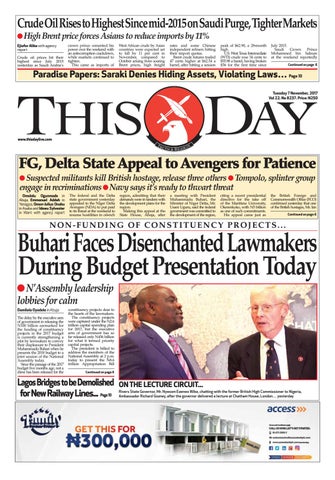
ON THE LECTURE CIRCUIT... Rivers State Governor, Mr. Nyesom Ezenwo Wike, chatting with the former British High Commissioner to Nigeria, Ambassador Richard Gozney, after the governor delivered a lecture at Chatham House, London… yesterday
2
T H I S D AY TUESDAY NOVEMBER 7, 2017
T H I S D AY TUESDAY NOVEMBER 7, 2017
3
4
T H I S D AY TUESDAY NOVEMBER 7, 2017
T H I S D AY TUESDAY NOVEMBER 7, 2017
5
T H I S D AY TUESDAY NOVEMBER 7, 2017
7
ͻ ŽŶƟŶƵĞĚ ŽŶ ƉĂŐĞ ϯϰ
6
TUESDAY, ÍżËœ ͺ͸͚Ϳ Ëž T H I S D AY
PAGE SIX FG, DELTA STATE APPEAL TO AVENGERS FOR PATIENCE Squire, who was kidnapped last month in Delta State, has been killed and three others freed. Squire was one of four Britons abducted by suspected militants on 13 October in the state. But even as the threat of resumption of hostilities was sending jitters down the government’s spine, a splinter militant group, the Reformed Niger Delta Avengers (RNDA), and ex-militant leader, Mr. Government Ekpemupolo, better known as Tompolo, yesterday engaged in recriminations over who was behind the threat. The NDA at the weekend had threatened to withdraw from further dialogue with the federal government. The militia group, which was responsible for several attacks on oil installation last year and had more than halved Nigeria’s oil output, said it would resume attacks on the facilities over the federal government’s failure to meet its demands. But the Niger Delta minister, who commended the collaboration among stakeholders in the region so far including the Avengers, said yesterday that the patience and understanding shown so far should be sustained until all efforts come to fruition. According to him, the goal to establish modular refineries as
alternative to illegal refining activities was still ongoing, disclosing that the government in its commitment to bring the plan to fruition had placed advertisements in the media and people had shown interest. Furthermore, Uguru explained that patience was required to bring this project to conclusion because the project requires the creation and design of the necessary procedures for the operation of such refineries, a process he said would require some time to complete. He explained that the process needed to be thoroughly designed with a view to ensuring its sustainability, observing that even though the project was designed to be private sector-driven, the federal government was also involving state governments to avoid sabotage after its commencement. The minister, however, added that the door was always open for any group in the region which intends to engage the federal government in any kind of dialogue or discussion over emerging issues, saying such groups will be warmly received. “My message is not just verbal, it has been demonstrated by the fact that at all times, the government of which I am part in my role as minister
in charge of the region, we have been appealing to them to just be patient with us, because most of the time, the issues that are brought up are those that tend to portray the quest for development of the region. And that is all we have been doing. “They should be patient with us. These issues raised genuinely for the benefit of the people of the region are being attended to. “For instance, the Okerenkoko University, you are aware that the vice-president has directed that that the university must take off. And he also directed that a minimum of N5 billion be budgeted for the take off of the university. “So it’s a matter of patience knowing that some of these things have a procedure. It will not be because it did not happen the way they wanted that it would not happen. Everything has a planning phase and a phase for execution. “We are glad so far that all the parties have listened to one another – the government, the Avengers, elders and so on – and we would wish that this continues. “So we would advise that all of us should remain calm and see the things that we agitated for coming little by little. “The first issue that all the promises that have
been made are not coming to fruition is not correct, because I just talked about the university. “The other issue is the communities being part of the surveillance of the petroleum infrastructure in the region. And of course, you know that the consideration of modular refineries, which they had also talked about as a subsect of how they can be engaged instead of what is called illegal refineries, are also going on because the process of building a refinery or even getting the necessary procedure to establish such is not just a one day affair. “Advertisements have been placed. People have indicated interest and of course, to make sure that it is sustainable, the government is getting the state governments involved, but they will be private sector-driven so that all concerned will be on a common page to be able to be sure that when ever it takes off, there is no frustration or sabotage. “Then, your next issue of meeting with the Avengers, for us as a government, there hasn’t been any group from the region that has tried to meet with any arm of government that has been rebuffed. “So if any person makes such overtures, we will be happy to receive them. We have been receiving different groups. We are
not limiting our dialogue or discussions to any particular group. “So anybody that says he is relevant in the process and comes forth, we will be happy to receive them,� he stated. Also making a similar appeal to the militants in the region yesterday, the Delta State government appealed to the Avengers not to resume attacks on oil and gas infrastructure in the Niger Delta. Acting Delta State governor, Mr. Kinsley Otuaro, while appealing to the militants to rescind the decision, assured them of the federal government’s commitment to continue the peace process on the Niger Delta’s regional development. The region and Delta State in particular were just heaving a sigh of relief after the cessation of hostilities a year ago, he said, adding that violence could never be an alternative to peace anywhere. He cautioned that apart from the economic losses and security concerns, resumed hostilities were bound have grave consequences for the environment in the areas where the oil facilities are located. Otuaro noted that a lot of progress has been recorded in the oil and gas industry following the cessation of violent activities in
the region in the last few months, resulting in increased oil output and revenue to both the state and federal government. He said President Buhari had on several occasions reiterated the federal government’s commitment to addressing the development concerns of the Niger Delta region and urged the militant groups to give government a chance to do so in a peaceful atmosphere engendered by dialogue. Joining in, in the appeal the Chief Press Secretary (CPS) to the state governor, Mr. Charles Aniagwu also urged the militants to sheathe their swords, saying the state had the most to lose should they go ahead with their threat. In a statement yesterday, he said: “We passionately appeal to the Niger Delta Avengers not to resume hostilities because Deltans will be the greatest losers. “We are barely recovering from the effect of previous attacks and it is our honest appeal that they still give peace a chance by allowing for peaceful engagement with the federal government and other stakeholders. “This appeal for peace remains imperative because without the atmosphere of peace, no meaningful negotiations and development can
China’s Ministry of Commerce reportedly increased the overall crude import quota for 2017 but cut the volume allocated to independent refiners, known as “teapot refiners�, by 17 per cent. Other factors that have continued to weigh are the wide spread between Brent and Dubai crude swaps and what was described as the backwardated structure in oil futures since September. Backwardation is a market condition in which it is more attractive to sell oil immediately than store it,
the crude also loses value as it heads to Asia. The Brent-Dubai spread has been fluctuating around $2.50 a barrel since midOctober, close to the endSeptember 10-month high of $2.59 a barrel. According to oil traders, the wide spread has made crude priced off Brent more expensive to Asian buyers, who have been increasingly looking at cheaper U.S. oil. U.S. crude oil exports hit a fresh record high last week at 2.1 million barrels per day, according to the U.S. Energy Information Administration.
Continued on page 8
CRUDE OIL RISES TO HIGHEST SINCE MID-2015 ON SAUDI PURGE, TIGHTER MARKETS tightened his grip with the arrest of royals, ministers and investors, including prominent billionaire Alwaleed bin Talal and the powerful head of the National Guard, Prince Miteb bin Abdullah. Reuters quoted analysts as saying that Saudi Arabia, the world’s largest oil exporter, will not change its policy of boosting crude prices. Prince Mohammed’s reforms include a plan to list parts of state-owned oil company Saudi Aramco next year, and a higher oil price is seen as beneficial for its market capitalisation.
Saudi Energy Minister, Khalid al-Falih said that while there is “satisfaction� with a production-cutting deal between the Organisation of the Petroleum Exporting Countries (OPEC) and other producers led by Russia, the “job is not done yet�. OPEC is expected to extend a cut of around 1.8 million barrels per day into the whole of 2018. Also boosting oil prices, US energy companies cut eight oil rigs last week to 729, in the biggest reduction since May 2016.
While supplies are tightening, analysts said demand remains strong. Barclays Bank raised its forecast for the average Brent price in the fourth quarter of this year by $6 to $60 a barrel, and its full-year 2018 forecast by $3 to $55 a barrel. Speculators have also increased to a record high their bets on gains in the price of Brent. However, Asian loadings of West African crude are set to fall by 11 percent in November as a result of expensive Brent prices, high freight rates and some
Chinese independent refiners hitting their import quotas, industry sources said. Reuters reported that China’s loadings of West African crude were set to fall for a second month by four per cent in November at 1.235 million bpd versus October at 1.287 million bpd, despite the shorter month. The report quoted trading sources at several Chinese refiners as saying that the decline was in part due to independent refiners having either reached or nearly reached their crude import limit for the year.
BUHARI FACES DISENCHANTED LAWMAKERS DURING BUDGET PRESENTATION TODAY for 2018. However, some lawmakers, especially those in the House of Representatives, have threatened to make their displeasure known over the non-release of funds for the constituency projects by booing Buhari and repeatedly interrupting his address, THISDAY gathered. But the leadership of the National Assembly, which is not unaware of the move, has been lobbying members to ensure that there is calm and an air of normalcy is maintained during the budget presentation. THISDAY further gathered that separate meetings by the leadership of the Senate and the House would hold Monday night to ensure that Buhari’s presentation is hitch-free. Both chambers would also hold executive sessions ahead of the budget presentation where the presiding and principal officers will be expected
to plead with aggrieved lawmakers. The lawmakers, comprising a high percentage of first timers in the federal parliament, are aggrieved over the fact that Buhari’s failure to implement the “mutually agreed� constituency projects, is affecting their chances of seeking reelection in 2019. According to some lawmakers who spoke with THISDAY off the record, they were particularly angry that while the executive is planning to terminate the lifespan of the 2017 budget at some 25-40 per cent of its implementation, there has been no commitment towards funding their constituency projects. “Forget what Udo Udoma (Minister of Budget and National Planning) and Kemi Adeosun (Minister of Finance) said during the hearing on the implementation of the 2017 budget; they said 40 per
cent would be implemented with 60 per cent rolled over into the 2018 budget. “But the way we are going with the push to restore the budget calendar to January-December, only 25 per cent of the 2017 budget would be implemented. “Effectively, this cuts off the zonal intervention funds appropriated for constituency projects. The 2017 budget is the budget before the campaign year, which is 2018. Many of us have nothing on the ground in our constituencies to warrant re-election,� a senator who preferred not to be named said. A member of the House also recalled that with 80 per cent released for the zonal intervention funds in the 2016 budget, expectations were high that there would be full release in the 2017 budget. The member, who is serving his first term, said Buhari has been unfair to
the legislature generally. “For our colleagues who are ‘second timers’, some of them have the wherewithal to do some little projects on their own. Their chances of coming back are a little better than those of us who are here for the first time. “After I had told my people that certain projects were coming and they have clapped for me, do I go back and say the funds were not released? Buhari has been unfair to us, honestly, and this is our chance to get back at him. “Presidents are booed all over the world, so let that be our own way of showing we are displeased,� he said. But an aide of the one of the principal officers disclosed that leadership of the National Assembly was concerned over the development. “Of course, the lawmakers have every right to be pained. They want to retain their seats and the non-implementation of
constituency projects is hurting their chances. “But Senate President Bukola Saraki and the Speaker, Hon. Yakubu Dogara just want them to allow him (Buhari) to present his address and go in peace. “They are trying to avert a situation where he would be booed,� the aide said. “Saraki and Dogara are meeting separately with the new SGF (Secretary to the Government of the Federation), Mr. Boss Mustapha this (Monday) afternoon. I am sure they would transmit the message through him to the president that members are angry,� the aide added. The constituency projects, which are primarily social intervention projects facilitated by lawmakers for their constituencies during budget cycles, have been a constant source of friction between the Buhari-led executive and the eighth National Assembly.
TOP GAINERS DIAMONDBANK UNITEDCAPITAL LEARNAFRICA FIDELITYBANK UPDC TOP LOSERS CHAMPBREW TOTAL NEWRESTASL
NGN NGN % 0.10 1.16 9.4 0.22 3.38 6.9 0.05 1.05 5.0 0.08 1.68 5.0 0.14 2.97 4.9 NGN NGN % 0.12 2.32 4.9 11.00 225.00 4.6 0.28 6.15 4.3 LAWUNION 0.03 0.68 4.2 HONYEWELL 0.09 2.10 4.1 HPE Nestle Nig Plc â‚Ś1,290.00 Volume: 466.522 million shares Value: N2.903 billion Deals: 4,274 As at yesterday 06/11/17 See details on Page 31
8
TUESDAY, Ϳ ͺ͸͚Ϳ ˞ T H I S D AY
NEWS
Italy Probes Deaths of 26 Nigerian Women from Migrant Boats Italian prosecutors are investigating the deaths of 26 Nigerian women - most of them teenagers - whose bodies were recovered at sea. According to the BBC, there are suspicions that they may have been sexually abused and murdered as they attempted to cross the Mediterranean. Five migrants are being questioned in the southern port of Salerno, Italy. A Spanish warship, Cantabria, docked there carrying 375 migrants and the dead women, following several rescues. Twenty-three of the dead women had been on a rubber boat with 64 other people. Italian media reported that the women’s bodies were kept in a refrigerated section of the warship. Most of them were aged 14-18. Most of the 375 survivors brought to Salerno were sub-Saharan Africans, from Nigeria, Senegal, Ghana, The Gambia and Sudan,
the daily La Repubblica reported. Among them were 90 women - eight of them pregnant - and 52 children. There were also some Libyan men and women on board. People-smuggling gangs charge each migrant about $6,000 (ÂŁ4,578) to get to Italy, $4,000 of which is for the trans-Saharan journey to Libya, according to the Italian aid group L'Abbraccio. Many migrants have reported violence, including torture and sexual abuse, by the gangs. Of them, 111,552 (nearly 75 per cent) came via the Central Mediterranean route to Italy. The number who died on that route was 2,639, the IOM said. The others arrived in Greece, Cyprus or Spain. The total is less than half the 335,158 who arrived in the same period of 2016. Last year the total for Greece was higher than that for Italy.
Italy wants to determine how the 26 young Nigerian women died
FG, DELTA STATE APPEAL TO AVENGERS FOR PATIENCE take place. “Resumption of hostilities will not be in the interest of our people but a major setback to the plans and aspirations of the state. “We have continued to appreciate our brothers in the struggle for their continued patience and cooperation while we engage the federal government on ways to attend to the various issues being raised by the group. “As a state, we have made several interventions to make life more meaningful for oil bearing communities, especially in the area of road construction in the creeks and without the enabling peace we cannot progress in that direction.�
Navy Ready Tackle Threat
to
But even as the federal and Delta state governments appealed for calm and continuing dialogue, the Chief of Naval Staff, Vice Admiral Ibok-Ete Ibas said yesterday that the Nigerian Armed Forces were prepared to contain any threat of hostilities by the Avengers and other militants in the region. He said the threat by Avengers did not meet the Nigerian Armed Forces unprepared and vowed that nothing would be spared in the task of protecting the nation’s critical assets. Ibas gave the assurance while speaking to journalists at the Nigerian Navy School of Engineering in Sapele, Delta State. He noted that the efforts of the Nigerian Navy to eliminate sea piracy were already yielding positive results. Vice Admiral Ibas, who was on a tour of the facilities and stations in Delta State, added that increased oil output in the Niger Delta was a
testimony to the success of the Navy’s strategy to curb criminal activities in the region’s creeks. Ibas said the Nigerian Navy and the other arms of the Armed Forces were prepared to take on challenge, adding that the Navy would devote its resources to protect the nation’s assets. “The threat by the Niger Delta Avengers, threat by kidnappers, threat by sea robbers, sea pirates and threats by all criminals are threats that the Armed Forces of Nigeria have a responsibility to contain, we don’t wait until a threat comes from anywhere before we act. “What we are doing is protecting lives and properties so that any threat, especially against the nation’s assets or individuals, is taken very seriously and the Nigerian Navy will continue to do what it has to do to protect the assets and properties of Nigeria,� he said.
British Hostage Killed Meanwhile, a British hostage kidnapped last month in Delta State has been killed and three others freed, the British Foreign and Commonwealth Office (FCO) confirmed yesterday. Ian Squire was one of four Britons taken by suspected militants on 13 October from the oil-rich Delta area. The British High Commission and Nigerian authorities negotiated the release of Alanna Carson, David Donovan and Shirley Donovan. The FCO said it had been a “traumatic time� for those involved, reported the BBC. An FCO spokesperson said that Nigerian authorities were investigating the kidnapping, adding: “Our
staff will continue to do all we can to support the families.� The four Britons were abducted at about 02:00 local time last month, when suspected militants stormed a rural community they were living in. According to reports, Dr. and Mrs. Donovan have lived in Nigeria for the past 14 years, running a charity called New Foundations, which gave aid to remote villages in the oil-rich Niger Delta. Relatives of the four said they were “delighted and relieved� that Ms. Carson, and Dr. and Mrs. Donovan, had returned safely. “Our thoughts are now with the family and friends of Ian as we come to terms with his sad death,� they said in a statement issued on their behalf. “This has been a traumatic time for our loved ones who were kidnapped and for their families and friends here in the UK,� it said. The FCO currently advises against all but essential travel to much of Delta State, saying there is a “high threat of criminal kidnap�.
Tompolo, Militia Group Trade Barbs It is uncertain if the kidnapping had any link to the threat issued last weekend by the Avengers, which is headquartered in Delta State, to resume hostilities in the region, but as news of the death of one of the British hostages and the release of three others got out, ex-militant leader, Government Ekpemupolo, also known as Tompolo, yesterday distanced himself from the planned attack on oil facilities by the militia group, maintaining, however, that Nigeria was at a crossroads. Tompolo, who has been in hiding since the Economic and Financial
Crimes (EFCC) declared him wanted over corruption allegations when he was a contractor for the Nigerian Maritime Administration and Safety Agency (NIMASA), also warned the NDA and the splinter RNDA not to link him to their planned hostilities against the federal government. According to a statement issued by his media consultant, Mr. Paul Bebenimibo, the former commander of the Movement for the Emancipation of the Niger Delta (MEND) stated that nothing would make him to resort to the destruction of oil facilities he once protected in a contractual arrangement under the Goodluck Jonathan administration. “The attention of High Chief Government Ekpemupolo, alias Tompolo, the Ibeebidouwei of Ijaw Nation, has been drawn to media statements by the Niger Delta Avengers (NDA) and the Reformed Niger Delta Avengers (RNDA), accusing him of working with Federal Government of Nigeria, thereby maligning the Niger Delta, on the one hand, and working against the Federal Government of Nigeria as the brain behind the planned attack of oil facilities in the region, on the other hand. “Ordinarily, we would have ignored these media statements by these so-called Avengers and Reformed Avengers because it is not a new tactic by these groups in bringing Tompolo’s name to whatever thing that happens in the Niger Delta region because of his legal battle with the government. “Let it be stated at this point that Tompolo is not the only person having legal issues with the present government. “Let us also state here that these accusations do
not take away from the fact our dear country is at a crossroads. Eminent Nigerians have repeatedly said in recent times that Nigeria has never been divided like this since her independence in 1960,� he said. Tompolo called on the federal government to urgently address the issues and agitations currently troubling millions of Nigerians. “The restructuring/ true federalism of Niger Deltans in the oil industry, the Ogoni clean-up campaign, relocation of the headquarters of the international oil companies, establishment of modular refineries, resumption of academic activities at the Nigerian Maritime University, Okerenkoko, and so on, are very germane issues that the government needs to address now, so as to shame mischievous elements in the polity. “We wish to reiterate our stand that nothing will make Tompolo to resort to the destruction of oil facilities that he once protected under a contractual arrangement. Those that have ears, let them hear,� he warned. However, a coalition of militants under the RNDA dismissed Tompolo’s claim that he was not behind the recent threat to resume hostilities in the Niger Delta, saying rather than look elsewhere for the forces behind the Avengers, Tompolo should be quickly reined in by the authorities to neutralise the threat. A statement by leader of the RNDA, ‘Majar-General’ Johnmark Ezonebi, alleged: “RNDA wishes to state categorically that the socalled high command of the Niger Delta Avengers (NDA) is none other than Tompolo who is presently on the wanted list and is hiding in the creeks for sins against the region.
“He used the struggle to empower himself and his immediate family and a few cronies. The selfacclaimed spokesperson of NDA known as MajorGeneral Murdock Agbinibo is none other than one of the apostles of Tompolo who has deserted his Warri home and is on the run with his master.� Further refuting claims that the RNDA comprises disgruntled politicians in the region, Ezonebi accused the Avengers as well as Tompolo of using the Niger Delta struggle to empower themselves and their families. The group said it severed ties with Tompolo and the NDA when it became obvious that the struggle had been “personalised for selfish gains, even when some of our dedicated fighters had paid the supreme price for the region�. “We wish to state that the statement by NDA is clearly the hand of Esau and the voice of Jacob because of the way the federal government treated PANDEF (Pan-Niger Delta Elders’ Forum), following the withdrawal of the mandate by militants,� the RNDA added. The coalition vowed to join hands with the federal government to “smoke out� Tompolo and his boys from the creeks where they claimed he is currently hiding. It described the Avengers’ threat as a cover up to get the government’s attention, declaring that there was no NDA until Tompolo was declared wanted by the EFCC. The group wondered why the activities of the Avengers centres around only Gbaramatu Kingdom in Warri South West Local Government Area of Delta State and Burutu which share boundaries with Gbaramatu Kingdom, Tompolo’s homestead.
T H I S D AY TUESDAY NOVEMBER 7, 2017
9
ͻ ŽŶƟŶƵĞĚ ŽŶ ƉĂŐĞ ϯϰ
10
TUESDAY NOVEMBER 7, 2017 ˾ T H I S D AY
NEWS
News Editor Davidson Iriekpen Email davidson.iriekpen@thisdaylive.com, 08111813081
In Departure from the Past, SGF Solicits Senate’s Support Mustapha acknowledges Saraki’s role in Buhari’s victory Damilola Oyedele and James Emejo in Abuja In a departure from the frosty relationship between the executive and the legislature since the berth of the President Muhammadu Buhari’s administration, the presidency has commenced moves to smoothen its interactions with the Senate and the entire National Assembly. This was evident when the newly appointed Secretary to the Government of the Federation (SGF) Mr. Boss Mustapha paid a courtesy call on the leadership of the Senate led by Senate President Bukola Saraki yesterday. In a related development, Speaker of the House of Representatives, Hon. Yakubu Dogara yesterday maintained that there is currently no rivalry between the legislature and executive arms of government, contrary to beliefs in some quarters. Rather, he said both are partners in progress. The new SGF specifically acknowledged and lauded the crucial role played by Saraki in Buhari’s victory at the 2015 presidential elections. Mustapha, who was accompanied by the committee
of Permanent Secretaries, said the executive and the legislature are not rivals and are not in competition with each other, but rather are joint partners in the Nigerian enterprise. He earlier held a closed-door meeting with Saraki, which lasted for about 30 minutes. The move by the SGF is a far departure from that of his sacked predecessor, Mr. Babachir David Lawal, who had famously engaged in a war of words with the lawmakers over their constituency projects. The events which culminated in his eventual sack were initiated by an investigation of a Senate committee, whose indictment he had described as ‘balder-dash.” But Mustapha, at the meeting with Saraki extended a hand of friendship to the legislature, and expressed readiness to work with the lawmakers to recover “lost grounds”. Without the keen support of the legislature, the Buhari led executive would be unable to achieve its promises to restore security, diversify the economy, and fight corruption, the SGF said. “I bring, like I said, the greetings of the Presidency because as the Secretary to the Government, my
responsibility is to coordinate the implementation of government policies and to ensure that these policies are synergised in such a manner that we would be able to deliver to the people of Nigeria the good things of life which they rightly deserve,” he said. “In doing that, I will not be able to succeed in that task, if I do not get the cooperation of the National Assembly and that is why I am here today to extend the hand of friendship and to solicit for the cooperation of the National Assembly because our constitution is very explicit when it comes to the principle of Separation of Powers,” Mustapha added. The role of the National Assembly, which includes legislation for good governance and providing oversight to ensure appropriated
Dogara: N’Assembly, Executive partners, not rivals
funds are judiciously used, is quite distinct, Mustapha said and noted that these roles, therefore, place an enormous responsibility on the legislature in the development of Nigeria. “I will say this and I will say it quite frankly sir, we are not in competition with the National Assembly. We are not rivals with the National Assembly. We are joint partners in this enterprise. If the National Assembly does not cooperate with the Presidency, I am not very sure we will be able to achieve the desired result that we want to see given the mandate that we have freely received from the people of Nigeria. “ So, this is basically to come and assure you that in every area that you are soliciting for the cooperation of the Presidency, being
the Secretary to the Government, I would ensure that the National Assembly receives that cooperation because jointly if we work together, whatever has been lost in the past we can quickly redeem and recover and make progress so that by the time the first four-year mandate that we received comes to an end we can show on our scorecard that these were the promises we made,” he said. Saraki, in his remarks, welcomed the extended hand of friendship and described the visit as symbolic as it signifies a new phase in the executive-legislative relations. “Your visit truly shows your intention of ensuring that you use your period as SGF to ensure that we truly work together to mak e Nigeria great. You are very right and I think people like us are not surprised
because we know your antecedents. You know that in the presidential system that we are running in this democracy, it is not possible for us to be able to achieve all our goals if the Executive and Legislature do not have - not just an okay relationship - a fantastic and very close relationship. Relatedly, Speaker of the House of Representatives, Hon. Dogara maintained that there’s currently no rivalry between the legislature and executive arms of government, contrary to beliefs in some quarters. Rather, he said both are partners in progress. Speaking when he received the new (SGF), Mr. Mustapha in his office, he described the appointment of the latter as “a round peg in a round hole, or a square peg in a square hole”.
Paradise Papers: Saraki Denies Hiding Assets,Violating Laws In apparent reaction to the new details contained in the leaked Paradise Papers which shed new light on the murky dealings of the offshore financial industry, the President of the Senate, Dr. Bukola Saraki has denied hiding any assets and violating any laws as alleged by the ‘paradise papers’ discoveries where he is accused of sitting on the board of an offshore company, while he was Governor of Kwara State. Governments must take urgent steps to crack down on tax evasion and aggressive tax avoidance by wealthy individuals and companies, Amnesty International said yesterday after the leaked Paradise Papers. “When people do not pay their fair share of tax, it’s the poor who suffer the most. At a time when governments around the world are slashing spending on health, education, housing and welfare support, it’s shameful that so many wealthy individuals and companies are being allowed to stow away billions of dollars in tax havens,” said Iain Byrne, Economic, Social and Cultural Rights Advisor at Amnesty International. “Governments must do more to stop tax havens - and the accountants, lawyers and consultants who work in them - from aiding and abetting this grand-scale tax abuse. We’ve heard too many empty promises. The time has come for action.” Tax evasion and avoidance deprive governments of much of the revenue they need to guarantee the economic and social rights that they are legally bound to deliver on. These include rights to the goods and services that everybody should be able to enjoy to lead a dignified life, such as a decent place to live, essential healthcare and education,
and adequate welfare support. “The appalling revelations in these papers and the ensuing outcry should prompt the international community to urgently look at finding global solutions to tax abuse, and at ways of holding those responsible to account,” said Iain Byrne. “We owe it to the world’s most vulnerable people to make sure the richest individuals and most powerful corporations pay their way.” The Paradise Papers contain details of the offshore financial affairs of hundreds of politicians, celebrities, wealthy individuals and multi-national companies contained in a trove of 13.4 million leaked documents. The documents were initially leaked to the German newspaper Süddeutsche Zeitung. The paper then contacted the International Consortium of Investigative Journalists to oversee an investigation involving 96 media partners, including the BBC, the Guardian and the New York Times. More revelations are due to be published in the next few days. In a swift reaction, Saraki has denied hiding any assets and violating any laws as alleged by the ‘paradise papers’ discoveries where he is accused of sitting on the board of an offshore company, while he was Governor of Kwara State. A statement issued by his Special Adviser on Media and Publicity, Mr. Yusuph Olaniyonu, said Saraki registered the company Tenia Limited, in 2001 before he ventured into politics. The statement added that the firm from incorporation till date has never been used for any transaction, and therefore could not have been used to hide assets.
NEW BEGINNING
L-R former Senate Chief Whip , Senator Stella Omu, Guest of honour, Maj.Gen. Paul U. Omu (rtd), Mrs. Efe Egbarin-Davis cutting the tape to inaugurate the Williams Courtyard yesterday in Bwari -Abuja
Lagos Bridges to be Demolished for New Railway Lines Minister of Transportation Rotimi Amaechi on Monday said the laying of tracks of Lagos-Ibadan standard gauge rail line would start in December. He also said that Jibowu and Costain bridges in Lagos would be demolished to give way for the new railway lines. According to the News Agency of Nigeria (NAN), Amaechi made the remarks in Lagos when he met with the Steering Committee of the project and the China Civil Engineering Construction Company (CCECC).
The minister said “the two bridges that we may likely demolish are Jibowu and Costain to give way to the rail lines. “But we are rebuilding them immediately; we are not going to abandon them. “The challenges will be in the cities like Lagos, Abekouta and Ibadan because we have to pay compensation, look at the water pipes, gas pipes, houses and cables. “In Lagos especially, we deal with bridges, electric cables and water pipes and other assets.” Amaechi also said that CCECC
was consulting with Lagos State Water Corporation, Nigeria National Petroleum Corporation( NNPC), among others, to facilitate relocation of water and gas pipe lines that were parallel to railway line. He added that CCECC would start laying tracks by December in Lagos, noting that parts of the rail lines that would be used for the project would arrive the country by end of November. The minister while inspecting the level of work done, called for speedy work by CCECC so as to meet the deadline.
He called on Inspector General of Police, Ibrahim Idris, to ensure that adequate security was provided for officials of CCECC handling the construction of the rail line. He urged the Coordinator of the project, Mr Leo Tim, to complete the necessary documentation to facilitate provision of security on site by relevant security agencies. The minister visited Ijoko, Papalanto, Itori and Ewekoro community in Ogun State as part of the monthly site monitoring to ensure the project met the timeline by December 2018.
Suicide Bombers Kill Mother, Son in Madagali Daji Sani in Yola The Madagali Local Government Area Chairman, Muhammad Yusuf, has confirmed that two male suicide bombers have attacked a house in Tsilda village in Madagali Local Government Area of Adamawa State, killing an elderly woman and her son. While confirming the attack to THIDAY through a phone call the
chairman added that the two male attackers sneaked in to the village and detonated two bombs, killing themselves and two of their victims. Yusuf said the incessant attacks on the council have created a lot fears and tension to the extent that some residents are beginning to flee to other communities for refuge He also confirmed the attack on Irmirsa community, saying one of the insurgents died in shoot out
and that local hunters and soldiers had mobilised to track down the terrorists. The area had been under Boko Haram control before it was liberated in 2015 but the insurgents are still launching attacks on the council till date.. He said the attack occurred around 8:30 to 9 pm on Sunday,. A vigilante helping in the fight
Against insurgency said the bodies of the two attackers and those of their victims were recovered from the scene yesterday morning when residents trooped to witness the damage. In another attack on Irmirsa community, a Fulani herder was said to have been wounded while cattle and sheep were taken away on Sunday by suspected members of Boko Haram.
T H I S D AY TUESDAY NOVEMBER 7, 2017
11
12
T H I S D AY TUESDAY NOVEMBER 7, 2017
T H I S D AY TUESDAY NOVEMBER 7, 2017
13
14
T H I S D AY Ëž Ëœ ÍľËœ Í°ÍŽÍŻÍľ
COMMENT
Editor, Editorial Page PETER ISHAKA Email peter.ishaka@thisdaylive.com
ALI’S INTERPRETATION OF BUHARI GOVERNMENT Godwin Etakibuebu commends the comptroller-general of Nigeria Customs for his frankness
R
etired Colonel Hameed Ibrahim Ali was appointed Comptroller-General of the Nigeria Customs Services on August 27, 2015, by President Muhammadu Buhari, without any career experience in the Customs and Excise. He was purely a military man, having been appointed by the late Head of State, General Sani Abacha, as Governor of Kaduna State from August 1996 to August 1998. Of course, Colonel Ali, born on January 15, 1955, would have known his superior officer General Buhari, for a long time but facts emanating from the grapevine pointed out that there was an establishment of intimate relationship between the two when the former served as Governor of Kaduna State. It was reported that he “served out the interest� of his retired “Oga� very dedicatedly. It must have been relationship built and maintained overtime that resulted in the appointment of Hameed Ali as comptroller general. Whichever way the relationship started, one thing for sure is that both men are particularly close. They share the same value and both understand themselves in all facets of human endeavours. By the way, let it be pointed out that Colonel Hameed Ali holds a Bachelor and Master’s degrees in Criminology. In addition to the academic laurel, the man is said to be very audacious in pursuance of his set goals. Finally, it is agreed that he shares almost the same level of religious “enthusiasm and sentiment� with the president. The conclusion in this preamble is to prove the fact that both men are bonded. It is therefore on this template that Colonel Ali’s evaluation of President Buhari government, last week, should be given further examination for some reasons. In the first place, the man took identifiable risk by assessing the performances of his boss, in all ramifications, within a given period of time. It is not acceptable way of life in the civil service, public service or the military for a junior to write the “Annual Performances Assessment Report� [APAR] of a senior. This is more a “forbidden fruit� in the military, where deferment to order of hierarchy is a matter of life and death. Yet, this is exactly what this usually blunt retired colonel did last week in Abuja at the inauguration of the office complex of the Buhari Support Organisation (BSO), in his capacity as the national coordinator of the organisation. Listen to what he said: “But let me say here without fear of being contradicted that I think half way through the journey, we are losing our core values. We are losing our vision and mission and I think that the idea of our being here today is to look critically at what we need to do to get back on track.
THE NIGERIA CUSTOMS SERVICES COMPTROLLER GENERAL HAS DONE HIS BIT IN HELPING A FALLING FRIEND TO STAND UP
There is no doubt that we have derailed because we are not doing what we say we want to do. Why is it so?� he asked. He continued: “We need to find an answer to that. If we do find an answer, then what should we do to get us all back on track? We owe this great nation and the 180 million Nigerians the duty to give good governance. Good governance is what they voted for and good governance is what they expect to get and they deserve that�. The man deserves to be appreciated for his candid observation presented lucidly on the uncommon table of audacity. In writing his boss’ assessment report, he put it very clearly by saying “we are losing our vision and mission and I think that the idea of our being here today is to look critically at what we need to do to get back on track�. How many people would be able to conclude with the boldness of admitting that “there is no doubt that we have derailed because we are not doing what we say we want to do?� What he said in pure, plain and simple language is that President Buhari and his government has derailed for the path of true governance. Though his claim in identifying the Peoples Democratic Party [PDP] “members in the APC as responsible for the derailment of the President� better be seen against the background of mischief, his revelation nevertheless is all our “derailing president� needs to come back on track of good governance. And that is if he is willing to get things right. The Nigeria Customs Services Comptroller General has done his bit in helping a falling friend to stand up. By so doing, the colonel has joined the gang of two other people in the entire APC that wished the president to succeed. First was Aisha Buhari, the president’s wife, who blew whistle against massive corruption in the Villa very recently, but had earlier said that if the husband continued in this path [now defined as derailment path] she might not be campaigning for him in 2019. The second is Senator Shehu Sani, representing Kaduna Central Senatorial District in the Senate, who has always shouted that Buhari government “is missing it�. Can we give kudos to the three Musketeers and pray that the president listens to them and do what is right? Will President Buhari listen to this gospel truth, coming from his own committed friend? I have my doubts. I have my fears. I have my cogent reasons for entertaining both doubts and fear. I may be wrong though, but, again, I doubt it because of how much dependent Muhammadu Buhari is on the Abubakar Malamis, Abdulrahman Dambazaus and Abba Kyaris of the Nigerian Animal Kingdom. Etakibuebu, a veteran journalist, wrote from Lagos
A SURE HAND AT THE WHEEL
The Aregbesola Government in Osun is doing its bit to transform the education sector, writes Kunle Owolabi
E
ducation is essential for everyone. It is an indispensable part of life, both personally and socially. But in our own part of the world, unequal standard of education or sadly, total absence of it, is still a major problem that needs to be solved. The importance of education is undeniable for every single person. Thus, it is unarguable to say that education is pivotal to human life and development. Every individual needs knowledge. Only with qualitative education can people gain knowledge and enlarge their world views. This is in tandem with Biblical saying that ‘My people perish for lack of knowledge.’ In other words, people become more useful and civilised if educated. In areas where residents are not able to receive an appropriate education, life cannot be as thriving and prosperous as locations where there is a high standard for education. Education plays such a rudimentary role in our society that we cannot even imagine a life without it. It is a vital element of the civilisation of human society. Not only does it help us develop healthy surroundings but it also generates an advance community. As a matter of fact, everything we create today is based on the knowledge that we obtain throughout our life by way of education. It is the same education that opened the vista to the yet-unknown world that scientists stumbled on to discover and invent groundbreaking equipment and gadget, resulting in a high technology nowadays. The more developed life becomes, the more necessary education is for everyone. Even at the risk of sounding immodest, without education, life would be disastrous,
disappointing and rather detrimental. Consequently, every responsible government must do everything humanly possible to make education accessible to every youth of knowledge- seeking age bracket. Education is therefore synonymous to the future any human being or nation. The future of a people or country rests on this pedestal, the lack of which guarantees a gloomy future for such people or country. It is this future that occupies the mind of the Government of the State of Osun on all policies formulation. The Governor, Ogbeni Rauf Aregbesola, made it top priority since the beginning of his administration in 2010. Seeing the abysmal state the education sector was when he took over as the chief executive, the governor quickly put on his thinking cap. He called education summit where the future of the children of the state was placed on the table and given thorough assessment so as to properly plan for their future. The summit was chaired by the Nobel Laureate, Professor Wole Soyinka. And a comprehensive long-term policy was fashioned out. The education programme in the state has followed the laid down recommendations of the summit, which started with school reclassifications and school free feeding programme. Government is now on the last lap of the summit’s recommendations, the building of new schools. Recently, another state-of-the-art school was launched in Ilesa. This ultramodern Ilesa Government High School, Ilesa, brought the number of the state-of-the-art senior secondary schools inaugurated to five out of 11 of such schools at various levels of completion. Fakunle-Unity School, Osogbo and Oduduwa High School, Ile-Ife, have been completed, awaiting launching. The remaining
four schools at Ila-Orangun, Iwo, Ikirun and Ikire, which are under construction, would also be completed before the end of the year. Two first class traditional rulers, the Ooni of Ife, Oba Adeyeye Eniitan Ogunwusi and the Owa Obokun of Ijesaland, Oba Adekunle Aromolaran led a pack of traditional rulers, who showered encomiums on the Governor Rauf Aregbesola’s education strides at the inauguration of yet another mega secondary school, in Ilesa. It will be recalled that last year, President Muhammadu Buhari was also in the SouthWest state to inaugurate one of the 3000-capacity, Osogbo Grammar School. Oba Ogunwusi and Oba Aromolaran in their separate remarks lauded the state government over its investment on education and showered Governor Aregbesola with royal blessings. Ooni, who was impressed by the size of hall, the classrooms and other modern facilities, noted that the governor would be remembered for good. Ooni counselled politicians to strive to do what will make people remember them for good, saying, “Just like former Governor Lateef Jakande of Lagos State is being remembered in all spheres of life today, Osun people will reference Aregbesola in years to come.� The facilities in the new schools are second to none and ones hitherto not seen in this part of the continent south of the Sahara. As befiting a modern architecture, the school complex has 72 classrooms of 49 square-metres each capable of sitting 49 students, six offices for study groups, six laboratories, 18 toilets for young ladies, 18 toilets for young men, one science library, one art library, one facility manager’s office, one bookshop, one sick bay, one bursar’s office, three principals’ offices,
three general staff office, one senior principal’s office, one record store and one security shed/ reception. Besides, there are 1000 square-metres of floor space hall capable of sitting 1000 students for external examinations. This hall has storage for equipment, utility storage, a stage, office space, storage for documents, four female toilets and four male toilets. Sports is not left behind as the school boasts of an Olympic-size football field, seven-lane sprinting tracks for 100 metres and 400 metres events, a pavilion and an outdoor basketball court that doubles as tennis court. Also equipped with stand-alone transformer for powering electricity and a borehole, the school cost N1.3 billion, including the cost of furnishing, landscaping and electronic boards. At the end of his tenure next November, Aregbesola’s government would have constructed brand new state-of-the-art 20 elementary schools, 22 middle schools and 11 high schools. Aregbesola captured the essence of education and the essence of preparing for the future this way: “All these are in fulfilment of our promise to provide functional basic education. This stems from our conviction that every child is owed basic education. It is a fundamental and inalienable right of every child. We have gone to this length and committed such huge amount on education because we are preparing for the future. A good basic education fulfils the definition of literacy as the ability to read and write and is a solid foundation on which other superstructure of vocational training or higher education can be built.� Owolabi wrote from Osogbo
15
T H I S D AY • TUESDAY, NOVEMBER 7, 2017
EDITORIAL BIAFRA MINES VERDICT RAISES QUESTIONS Was the federal government out of court settlement in Biafra mines’ case altruistic?
I
n a landmark decision, the ECOWAS Community Court of Justice, otherwise called the ECOWAS Court, last week ordered the federal government to clear live landmines, bombs and other remnants of dangerous weapons left behind during the civil war. The court also awarded damages to victims of the negligence and costs to clear the post-war lethal materials still littering some communities in 11 states in the South East, South South and North Central. About 302 communities cutting across Benue, Enugu, Abia, Cross River, Ebonyi, Delta, Akwa Ibom, Rivers, Anambra and Imo States were affected. The case started in 2012 when some civil war mine victims dragged the federal government before the ECOWAS Court to demand compensation as well as rehabilitation of their communities. But on October 24, counsels to both parties filed an application for an out-of-court settlement, on grounds that they had reached agreeable terms. The snag in the story is that the suit for compensation for the Biafra war victims was instituted by Deminers Concept DID THE FEDERAL Nigeria Limited, a company owned GOVERNMENT SETTLE by Bala Yakubu, OUT OF COURT IN A BID a retired military TO BRING SUCCOUR TO officer. INNOCENT VICTIMS OF Meanwhile, the THE CIVIL WAR WHO ARE primary purpose of STILL LIVING WITH THE the suit was comTRAUMA OR IS IT BECAUSE mercial: to secure OF SOME PERSONAL the patronage of the INTEREST? federal government on demining the region of unexploded ordinances. That perhaps explains the terms of the judgment. While N50 billion will go to 493 identified victims of these unexploded ordinances, the remaining N38 billion will go to the company, owned by a retired military officer believed to be connected to some people within the current administration. In granting their wishes, the court ruled that the federal government should “pay, without delay, compensation in the sum of N50 billion in full
Letters to the Editor
and final sum to the victims, their families and communities” and the sum of N38 billion “for the purposes of carrying out total demining and destruction, rebuilding of public buildings, mine centre activities, construction of classrooms” and other facilities. In addition, the federal government was expected to establish a National Mine Action Centre in Owerri, Imo State, for victims in the Southeast. The court asked that the government should make the settlement in “a reasonable time, not exceeding 45 days” from the day of the judgment.”
O T H I S DAY EDITOR IJEOMA NWOGWUGWU DEPUTY EDITORS BOLAJI ADEBIYI, JOSEPH USHIGIALE MANAGING DIRECTOR ENIOLA BELLO DEPUTY MANAGING DIRECTOR KAYODE KOMOLAFE CHAIRMAN EDITORIAL BOARD OLUSEGUN ADENIYI EDITOR NATION’S CAPITAL IYOBOSA UWUGIAREN
T H I S DAY N E W S PA P E R S L I M I T E D EDITOR-IN-CHIEF/CHAIRMAN NDUKA OBAIGBENA GROUP EXECUTIVE DIRECTORS ENIOLA BELLO, KAYODE KOMOLAFE, ISRAEL IWEGBU, IJEOMA NWOGWUGWU GROUP FINANCE DIRECTOR OLUFEMI ABOROWA DIVISIONAL DIRECTORS PETER IWEGBU, FIDELIS ELEMA, ANTHONY OGEDENGBE DEPUTY DIVISIONAL DIRECTOR OJOGUN VICTOR DANBOYI SNR. ASSOCIATE DIRECTOR ERIC OJEH ASSOCIATE DIRECTORS HENRY NWACHOKOR, SAHEED ADEYEMO CONTROLLERS ABIMBOLA TAIWO, UCHENNA DIBIAGWU, NDUKA MOSERI GENERAL MANAGER PATRICK EIMIUHI GROUP HEAD FEMI TOLUFASHE DIRECTOR, PRINTING PRODUCTION CHUKS ONWUDINJO TO SEND EMAIL: first name.surname@thisdaylive.com
rdinarily, we support the idea of demining the affected areas. Biafra, the violence and all the emotive issues connected with it kept recurring in our national landscape 50 years after its declaration and 47 years after the end of the civil war because of the arrogance of power and the ineffectual handling of many of the after effects of the 30-month war. The mines and bombs, many of the crippled and handicapped, are constant reminders of the brutal civil war which claimed more than one million lives. To the extent that genuine grievances must be addressed in the interest of national cohesion and stability, meeting these communities midway in an out of court negotiation to find solution and a possible closure to a sore and politically explosive issue is the right way to go. But questions are being raised as to why a government that is notorious for disobeying court orders would obey this particular order. This is against the backdrop that the same regional court had given rulings in the past that were obeyed in the breach by a government that has also shown scant regards for many rulings from our local law courts. The pertinent question that therefore arises is: Did the federal government settle out of court in a bid to bring succour to innocent victims of the civil war who are still living with the trauma or is it because of some personal interest? Until that question is answered, it will be difficult to believe that the federal government decision on this matter is altruistic.
TO OUR READERS Letters in response to specific publications in THISDAY should be brief (150-200 words) and straight to the point. Interested readers may send such letters along with their contact details to opinion@thisdaylive.com. We also welcome comments and opinions on topical local, national and international issues provided they are well-written and should also not be longer than (9501000 words). They should be sent to opinion@thisdaylive.com along with the email address and phone numbers of the writer.
A BETTER FUTURE IS POSSIBLEMINISTRATION
I
have always said that the present and future of Nigeria can only be salvaged by the few exceptional Nigerian youths who are defiantly willing to bell the cat for the freedom of everyone. In my 66 years on planet earth as a citizen of Nigeria, I have been privileged to meet outstanding/exceptional young Nigerians who are wired with immense potential. Only needing proper guidance and encouragement provided by someone they can connect with, a Big brother or Fada figure leader. As The AreaFada I believe that my divine role is simply to connect the dots and inspire a generation that a better future is possible - if they dare. I thank God that my life and struggles through my tenacity, consistency, and sagacity, have inspired millions to chase their dreams. Today in Nigeria, take it or leave it, those who make up the only moral voice for the masses and all disenchanted peoples of our great nation are the exceptional youths of the OurMumuDonDo movement. Also, the young Nigerians in the diaspora who have clearly distinguished themselves in their different fields of endeavour, have not only proved their mettle to the world but they have also placed Nigeria in a good light before the nations of the world. Time and time again, these youths have shown that indeed, a better Nigeria is possible. The exceptional youths of the OurMumuDonDo movement have proven to the world that it is not the size of the army that counts but the tenacity of the few.
It is on record that when President Muhammadu Buhari was away in London wasting taxpayers’ money on an undisclosed ailment, it was the exceptional Nigerian youths of the OurMumuDonDo movement that forced him back to Nigeria to carry out his presidential duties. Though the price these exceptional youths paid for their highly commendable feat was too steep. How can I forget the young man who took multiple dagger stabs while shielding me? Their courage I will never forget. Again, for the past two weeks, these same youths have been asking the president to ActOrQuit; to take decisive action against corruption. When President Buhari refused to disclose the content of the Secretary to the Government of the Federation’s report directly involving the former SGF Babachir Lawal and former DG, National Intelligence Agency Ayodele Oke, it was these same exceptional youths who drummed up such loud campaign #BuhariActOrQuit, before the president eventually sacked them. Still, these youths have insisted that the president must disclose the content of the infamous SGF report and also ensure that Lawal and Oke are duly prosecuted according to law. Judging by the meritorious strides of the OurMumuDonDo youths, therefore, I am under no illusion that Nigeria is beginning to discover the critical mass that will rescue her from the accursed architects of mediocre, impunity and colossal failure in governance. Whilst the exceptional Nigerian youths of the OurMumuDonDo movement continue to stand up to evil defending the present and
future of Nigeria, it is crucial for other Nigerian youths who are still sagging and dulling to rise to this call of nationalism and ensure that Nigeria does not perish during their time. Dear Nigerian youths, the time to organise yourselves into a formidable force is now. There can be no better time to rise and fight for the good of Nigeria. Those who wish to live in a Nigeria that works for everyone without any regard for ethnic, religious, or political slant must identify with the glorious cause the exceptional youths of the OurMumuDonDo movement are fighting. My people day don break. The only chain we have to loose is our fear. At 66, the only thing I have decided to dedicate the rest of my life to is how Nigerian youths across the globe can reconnect, regroup, reorganise, consolidate and unify to become an indivisible force that will erect a new Nigeria that works for all. For this reason, therefore, I urge all exceptional Nigerian youths to not let this time to make Nigeria great pass them by. Be brave. Be defiant. Be daring. Be inquisitive. Be resilient. Never tolerate injustice. We must define the mood of our nation and we must breathe life into our frustration and our shared suffering, so we can jointly fight and find a lasting solution to them. Finally, Never Give Up on our Great country Nigeria! OurMumuDonDo! Areafada CharlyBoy, President of All Frustrated Nigerians
16
T H I S D AY ˾ TUESDAY, NOVEMBER 7, 2017
POLITICS
Group Politics Editor Tobi Soniyi Email tobi.soniyi@thisdaylive.com 08033146139 SMS ONLY
EXECUTIVE BRIEFING
Southern Governors Make a Statement Even if it was merely for show, the decision of the Southern Governors’ Forum to reconvene in Lagos after a 12-year break, sent a clear signal to the federal government: states are looking inwards for solutions to their common challenges, writes Gboyega Akinsanmi
The Governors
B
eyond their divergent political underpinnings, the governors of states in the southern part of the country eventually reconvened at Lagos House, Ikeja two weeks ago, lending credence to calls by diverse ethnic nationalities and socio-cultural organisations for comprehensive restructuring of Nigeria’s governance architecture. Amid much expectation, the Southern Governors’ Forum (SGF) returned to the roundtable. Its reconvention was sudden, though well-timed given diverse issues it lined up for deliberation among member states. At the heart of the summit was the quest for more devolution of powers, responsibilities and resources from the federal government to the states. The summit was indeed a reunion of old political allies from three different geo-political zones – South-east, South-south and South-west. And almost all governors from the catchment states attended its return summit. However, the governors from Anambra, Cross Rivers, Delta and Imo States delegated their deputies to represent them at the reconvention of southern states. Unlike the Northern State Governors Forum (NSGF) that regularly meet on issues of common interest despite different political affiliation and ideological background, the SGF had gone into a 12-year lull before its comeback summit, which Lagos State Governor, Mr. Akinwunmi Ambode argued, was resuscitated at a most appropriate time in the country’s political history. As indicated in Ambode’s four-page address, the return of the SGF became imperative in the face of diverse issues that hamstring
governance at all levels. The issues are identified in a statement the Secretary to the Lagos State Government, Mr. Tunji Bello issued before the summit. The issues ranged from armed robbery to kidnapping, devolution of powers and fiscal federalism. Largely, the country’s governance structure has been blamed for the inability to address these issues. Within this structure, the wherewithal of the states keeps dwindling. Perhaps due to reliance on petro-dollars, productive sectors and healthy competition among federating units are no longer reckoned with. So, most states can no longer fund themselves with handouts from the Federation Accounts. Apparently, these issues have dominated the public discourse since the return to civil rule in 1999. They have equally become more strident in the last two and half years than any era in the political history of Nigeria.
Tinubu said that from time to time, our northern brothers have met on issues common to each member state
However, there is no national consensus yet on how to forge ahead as an indivisible entity or make the federation work without let or hindrance. At these instances, the southern governors put behind whatever might have divided them in the past and reconvened again. Contrary to some critics, the reconvention of the SGF is not about building a political alliance against the North. Rather, as Ambode argued, it was to harmonise positions on diverse issues of interest common to all its member states. In the Beginning Contrary to divergent positions some critics have held, the history of the SGF indeed predates its last-week summit. In 2001, precisely, the forum first crept into the lexicon of national politics. The SGF, a non-partisan platform for 17 governors in three geo-political zones in the South, held its inaugural summit at the Akodo Beach Resort, Ibeju-Lekki, Lagos. It was then under the administration of Asiwaju Bola Tinubu. But at its conception, Ambode observed, the SGF was received with mixed feelings. For some, he said, the SGF was an essentially sectional platform or a potentially divisive instrument. Others, he said labelled the forum another superfluous talk shop of doubtful utility. Even though these ill feelings from different quarters trailed its creation, the forum eventually snowballed into the national political space with a definite mandate. Tinubu, its convener, explained the need for the forum, which he said, had become imperative “to enable its member states regularly meet and publicly articulate common positions on issues of interest.”
He cited the example of the NSGF. He then strongly urged his counterpart from the South to embrace what had become a tradition in the rank of the northern governors. Tinubu said that from time to time, our northern brothers have met on issues common to each member state. Likewise, he said, they have articulated common positions of interests in the polity. Rather than disapproving or disparaging such meetings, Tinubu then made a strong case for the SGF, which he said, should be encouraged and supported to enable the South speak with one voice. As a result, he said the country’s democracy and federal system “can only be strengthened when various groups and component parts of the country are free to discuss and pursue their perceived common aspirations within the framework of the law.” Tinubu, thus, defined the modality and rationale for such an engagement, which he argued, should regularly discuss issues of interest and take common position. He observed that there “are unquestionably issues of common interests to all states in the southern region of Nigeria. This does not mean that there are no matters, which the South-east, South-south or South-west respectively, may feel constrained to pursue separately at other fora.” Despite the nobility of its conception, the SGF only managed to survive for four years. On February 25, 2005, the forum lost its voice in the country’s public space. Unlike the northern counterpart, its state governors could not rise above their political differences and sectional politics in the pursuit of interests, which are common to all states in the South at large. The Accomplishment
17
T H I S D AY ˾ TUESDAY, NOVEMBER 7, 2017
POLITICS Under four years it then functioned, Ambode said the SGF “became a significant voice on matters of critical import both to the South in particular and Nigeria as a whole.” By implication, he argued, what the forum was able to accomplish during the short period of its existence should encourage the new crop of southern governors to deploy it in the interest of national unity. Ambode gave insight into the working of the SGF saying that between 2001 and 2005, it held nine meetings. By inference, the SGF was able to meet twice every year before it went into a 12-year lull. Between June 2015 and September 2017, however, reports showed that the NSGF had held 30 meetings, suggesting that the northern governors “meet at least every month.” Even though it went into lull, the SGF recorded enviable accomplishment within the period of four years it first existed. He thus cited the case of 13 per cent derivation. He explained that the SGF’s collective advocacy for the special allocation to oil-producing states resulted in the current formula of 13 per cent accruing to oil producing states from the Federation Account on the basis of derivation. Aside the 13 per cent derivation, Ambode explained how the SGF’s strategic intervention contributed to the strengthening of the country’s practice of true federalism, which he said, was evident in a judgment the Supreme Court delivered in 2002. Under four years, he explained, the SGF made critical input into the country’s governance structure and national development at large. Likewise, he noted that the apex court then declared illegal and unconstitutional the prevalent practice of deducting monies from the Federation Account as a first line charge for the funding of Joint Venture Contracts, NNPC priority projects, servicing federal government’s external debts, the judiciary and Federal Capital Territory and other federal obligations. In addition to the court decision on unconstitutional deductions, Ambode cited how the SGF’s collective advocacy led to the abolition of special funds the federal government created “to enable it draw funds from the Federation Account to pay for matters that fell within its exclusive responsibility before sharing whatever was left with the state and local governments.” Beyond what the SGF accomplished between 2001 and 2005, Ambode cited the struggle of Lagos State in the pursuit of true federalism. He explained several battles the state had fought and won since 1999, which according to him, had systematically strengthened her autonomy, enhanced her fiscal viability and positioned her as the fifth largest economy in Africa. Over the years, he said the state “has won legal control over the management of its environment, control of urban and physical planning and regulation of overhead masts.” Also, he noted that the state “has won jurisdictional control over the registration and regulation of hotels, restaurants and event centres.” He added that it gained control of her inland waterways. The implication, according to him, is huge. He noted that the victory “does not belong to Lagos alone. Rather, he said, the victory belongs to all other states in the federation and which they must explore significantly. If Lagos has been able to achieve so much fighting singly, the SGF can accomplish much more by thinking, planning, strategising and acting together.” Renewed Vision Across political divides in the South, the return of the SGF elicited excitement in some quarters and trepidation in other quarters. Also, its return terminated a lull of 12 unbroken years the forum, for no clear reason, had created in the national space. As some analysts observed, its return would perhaps end discordance on issues of common interest in the South. Indeed, the SGF had achieved much during the period it first existed. But Ambode said its resuscitation “is coming at a most appropriate time,” perhaps in the recent history of Nigeria. He thus pointed out diverse political happenings and institutional realignment in the country to justify the resuscitation of the forum. Specifically, he cited the example of the two chambers of the National Assembly. He explained that the Senate and the House of Representatives are currently harmonising their
Even though its outcome did not meet people’s expectation, the summit had redefined the agitation for a negotiated restructured Nigeria
meeting at Lagos House, Ikeja. It eventually came up with a six-point resolution, which approved increasing agitations for true federalism and defined the future of Nigeria, which it believed, should remain indivisible despite quest for restructuring. In a unanimous resolution it issued after the summit, the SGF first demanded true federalism and devolution of powers, which it defined as a strategic instrument to make federating units independent of the national government and reposition them to address diverse issues of governance cropping up in different territorial jurisdictions nationwide. Aside, the SGF agreed to collaborate for the growth of their respective domestic economies. Likewise, the SGF emphasised the need to identify and develop strategic infrastructure projects, which it said, would strengthen stronger economic ties and create more opportunities for citizens from the states in the South-east, South-south and South-west. In addition to its commitment to a united indivisible Nigeria and its position on true federalism and devolution of powers, the SGF restated commitment to security of lives and properties of the citizens, which diverse reports showed, constituted the bane of development and governance, especially with the rising cases of kidnapping and armed robbery among others. Consistent with its renewed vision for sustained collaboration, the SGF resolved to hold regular summit in order to forge strategic partnership among member states. So, it scheduled to hold its next meeting in Port-Harcourt, Rivers State. Also, it appointed Ambode as its Chairman of the forum. It equally appointed Bayelsa State Governor, Mr. Seriake Dickson and his Ebonyi counterpart, Mr. David Umahi as co-Chairmen of the forum.
Hosted the meeting
Tinubu hosted the inaugural SGF meeting
differences on the proposed amendments of the 1999 Constitution of the Federal Republic of Nigeria before the amendments “are transmitted to the state Houses of Assembly for approval.” On this ground, Ambode argued that it had become imperative for the forum “to comprehensively look at the proposed amendments with a view to working with our respective Houses of Assembly to ensure a coordinated response on our part that will strengthen the practice of democracy, federalism, constitutionalism and the rule of law.”
Under four years it functioned, Ambode said the SGF became a significant voice on matters of critical import both to the South in particular and Nigeria as a whole
He said there “is still a lot to be done. There is certainly a lot to be done about true federalism, an issue that requires urgent, meticulous and proactive attention from the forum. No less disturbing is the failure to undertake the periodic review of the revenue allocation formula as provided for by the 1999 Constitution to reflect evolving realities.” He pointed out another critical matter, which he argued, should engage the SGF is “to enhance the viability of the state and local governments as well as their capacity to fulfill their developmental roles in the polity.” He lamented that states “are being disparaged for always carrying begging bowls to Abuja in quest of hand-outs from the federal government. “This is a function of our present national constitution that burdens the federal government with activities and responsibilities that rightly fall within the province of the states. The productivity and revenue-generating capacities of most of the states are thus stifled thus turning them into no better than street beggar states incapable of even meeting routine obligations of paying workers’ salaries and pensions without federal support.” The Aftermath The comeback summit was significant. For about four hours, the forum held a close-door
Sustaining the Forum Even though its outcome did not meet people’s expectation, the summit had redefined the agitation for a negotiated restructured Nigeria. So, the Afenifere Renewal Group (ARG) canvassed the need “to ensure sustained collaborations that would guarantee Nigeria’s socio-economic development. It is a clear indication of the acute need for sustained collaborations.” The ARG, therefore, explained the decision of the forum “to unequivocally demand for true federalism and devolution of powers.” Also, it said it was the basis of and for Nigeria’s unity and continued existence. Without true federalism, the group noted that Nigeria “is bound to plunge deeper into decline across all facets of socio-economic indices. “Those who are opposed to the restructuring of the governance arrangement of Nigeria, despite the avalanche of evidence for its imperativeness, want to see this country ruined alongside the promising destinies of its citizens. Therefore, it is ripe to collaborate across different divides to save Nigeria. We look forward to other cross-zonal collaborations like the Southwest and Northwest Governors meeting, for instance.” Also, it explained the significance of the summit. First, it said if sustained, the summit would realise the collective need of the people. Second, it added that the forum “will engender institutional structures that can effectively address the unresolved national question, thereby putting Nigeria on the right path to constitutional democracy and functional fulfillment. It thus noted that the agenda before the southern governors “has its noble place in the global aspiration for the sustenance of the dignity of humanity and fundamental human rights and must therefore not be sacrificed for political or ethnocentric exigencies. We hope that our governors will prove themselves
18
TUESDAY, NOVEMBER 7, 2017 ˾ T H I S D AY
FEATURES
Acting Features Editor Charles Ajunwa Email charles.ajunwa@thisdaylive.com
Unveiling the Presidential Diary While the government of President Muhammadu Buhari believes so much has been done in achieving the change mantra the administration promised Nigerians, the Presidential Diary hopes to tell the story through its publications. Martins Ifijeh writes
A cross section of dignitaries led by wife of the Vice-President, Mrs. Dolapo Osinbajo (middle), cutting the cake at the launch of Presidential Diary Magazine in Abuja...recently
I
t is no longer news that for every administration to gain the confidence of those they govern, they must be able to carry them along in their activities and projects through information linkages that can tell their stories generously. This is often what those in power, especially in Nigeria, say is missing with the circular journalism, as they believed only a handful of their achievements are projected to the public, an approach they presume leads to a disconnect between them and the citizens whom they govern. But in order to avoid this in President Muhammadu Buhari-led government, a group of seasoned journalists led by the image-maker and Director of Special Duties at the National Agency for Food and Drugs Administration and Control (NAFDAC), Dr. Abubakar Jimoh, has championed the Presidential Diary Magazine, a publication dedicated to telling the stories of Buhari’s change mantra, it's activities, projects and intentions. Unveiled recently in Abuja by the wife of the President, Mrs. Aisha Buhari, the Magazine is expected to roll out publications monthly, focusing on all sectors in the country, from economy to agriculture, security, health, sports, among others. As with events that have the presence of the matriarch of the Presidential Villa, the public presentation of the journal that catalogues the activities of President Buhari and Vice-President Yemi Osinbajo was characterised by glamour and high
profile fashionista. Among those who graced the unveiling were the Speaker of the House of Representatives, Hon. Yakubu Dogara, Senator Ahmed Yerima, the Director General of the National Orientation Agency (NOA), Dr. Garba Abari and former Minister of State for Science and Technology, Pauline Tallen. Speaking during the unveiling, Mrs. Buhari said this will bridge the information gap between the federal government and the citizens, adding that it would afford Nigerian journalists the opportunity to continue to
So much is being done that people do not hear about. From today, you should know how much we all rely on you and depend on you. You are the ones who can bring the gladness to the hearts of Nigerians
educate and inform the citizens at all times, The First Lady, who was represented by the wife of the Vice-President, Dolapo Osinbajo called on Nigerian journalists not to stop doing their work with the gravy task it deserved. She emphasised the importance of always reminding the media why it must live up to expectations, adding that some Nigerians might not leave their communities all of their lives, but know about happenings across the world through media reports. “I want us to know how important words are. Beyond the things we see, words are the next most important things. The education we have comes as a result of the pains we have had. Journalists tell us the things we all know collectively. “We must not underestimate the importance of the media in our country. It is easy to say something but hard to put it down in writing. I implore all of you, journalists, to do your work with the gravitas that it requires.” She explained that some people never leave the radius of their communities or nations till the day they die but through the work of journalists, they are able to expose to them the things that they cannot see with their eyes. “For this reason, I commend you and implore you to continue with this good work. So much is being done that people do not hear about. From today, you should know how much we all rely on you and depend on you. You are the ones who can bring the gladness to the hearts of
Nigerians,” she stressed. The Chairman of the Editorial Board of the magazine, Alhaji Mohammed Tukur, who kept his welcome address short, commended the management of the magazine, stating that this was a step in the right direction, as Nigerians deserve to know what their leaders were doing in every step of the way towards governing them. On his part, the Coordinator, Jimoh said the idea of setting up the publication was borne out of the need to give voice, resoundingly, to the administration of President Buhari. “It is a magazine conceived and designed to provide a platform for projecting the noble intentions, change agenda and vision of Mr. President,” Jimoh said. He added: “I and a host of other professional colleagues conceived the initiative to begin this magazine. We believe in this administration, and believe also that the task of informing, educating and sensitising Nigerians cannot be left only for government agencies and their spokesmen.” Jimoh explained that the Presidential Diary Magazine was conceived by a group of like-minds; those who believe in the administration of President Buhari. Adding that these persons are made up of seasoned journalists, public affairs analysts, alongside men and women, young and old, irrespective of language, culture and tribe, who believe in the change agenda of the administration. “Before the coming of this administration, these persons yearned for change because they were tired of the state of affairs as it
19
Ëž T H I S D AY TUESDAYËœ ÍľËœ Í°ÍŽÍŻÍľ
FEATURES
Wife of the Vice-President, Mrs. Dolapo Osinbajo receiving a copy of the Presidential Diary Magazine from its Initiator/Editorial Adviser, Dr Abubakar Jimoh, during the public presentation and oďŹƒcial launch of the Magazine in Abuja
were. We therefore decided to come together to rebuild this confidence in Nigeria that this government can reclaim our lost glory and take us to that pristine age. The only channel for doing this is not by carrying out propaganda or engaging in all sorts of media hypes, but by articulating the policies and programmes of this government in this magazine; through constructive narratives and photographs of what is on ground. “We believe that pictures speak volume of words, therefore, we don’t just tell, we show. In the last two and a half years of this administration, a lot has been achieved from security to economy and manpower
Before the coming of this administration, these persons yearned for change because they were tired of the state of affairs as it were. We therefore decided to come together to rebuild this conďŹ dence in Nigeria that this government can reclaim our lost glory and take us to that pristine age. The only channel for doing this is not by carrying out propaganda or engaging in all sorts of media hypes, but by articulating the policies and programmes of this government in this magazine; through constructive narratives and photographs of what is on ground
Jimoh...Presidential Diary will bring our leaders closer to the citizens
development. All these achievements are captured monthly in every edition of the magazine. You can confirm this in every edition that you pick up. None of these achievements and many more, are left out, and we hope to sustain this as long as President Muhammadu Buhari remains in office to deliver on his change agenda to Nigerians in all walks of life,� Jimoh said. He said while the magazine was conceived out of love for Mr. President and his agenda immediately after inauguration as the President of Nigeria, him, men and women of goodwill sat down to articulate the policies and programmes of the government that was coming. “When we found out that they fit into the yearnings and expectations of the people, we decided to key in and give it the needed support. It is only a blind man who will not appreciate a good soup; even at that, he should be convinced by its aroma and agree that the soup is indeed a good one.� To what extent are you achieving this task of informing and sensitising Nigerians on the policies and programmes of the government? Jimoh said: “We have never thought it will be easy to do this. There are those who have eyes but cannot see. There are also those who can see but are
not convinced, and there are those who may be convinced but pretend they are not. “To these die-hard skeptics, we try as much as possible to back up our facts with figures and photographs. For instance, we cannot say activities of Boko Haram have truly been degraded by this administration without providing you with evidences. We don’t just tell, we show. “So far, we are happy that a lot of people, including ‘doubting Thomas’s’ are believing in this administration and they want to see it succeed. The President and his team are also happy with our contribution to the administration. The wife of the President, Her Excellency, Mrs. Aisha Muhammadu Buhari, the Honourable Minister of Justice and Attorney-General of the Federation, Abubakar Malami, Special Adviser to the President on Media and Publicity, Mr. Femi Adeshina, SSA (Media and Publicity) to the President, Malam Garba Shehu and other top government functionaries have actively supported our efforts,� he explained. Jimoh disclosed that aside from giving detailed coverage of interventions from the president and his team, job creation is a major goal of the magazine. On how the magazine will be circulated, he said at the moment, the magazine’s presence
was being felt all over the country in all states of the federation, especially in states that believe in the change agenda. “We are happy to announce the support of state governments that are identifying with us. We enjoy the support of a good number of them and that of certain individuals and corporate organisations in and outside the country. Embassies and foreign missions of Nigeria are also identifying with us in numerous ways. “At the moment, many of them use and process the information contained in this magazine in rating the achievements of this administration. Every month, we avail them of copies, the way we do to all Ministries Departments and Agencies (MDAs), group and organisations in and outside the country. This we do without charge,� he said. He explained that the magazines are given out free of charge to Nigerians, as it is stated clearly ‘Not for Sale’ on the cover. “In order to get the desired effect, in terms of wide readership, we decided not to sell the magazines. This does not mean that they are printed free. This group of like minds including my humble self who is the initiator pools our meager resources, time and energies together to ensure the publication of this magazine. And we believe that our efforts and commitments to this cause is not in vain.� What will be the fate of this magazine if the current administration is not returned to power in 2019? The seasoned journalist said: “We believe in policies and programmes that are people-oriented. For us, people-oriented programmes outlive people, governments and administrations. “Therefore, we believe that the seed Mr. President and his team is planting has started yielding fruits. We will continue to defend and nurture them and sensitise Nigerians towards national growth and development. So we cannot begin to contemplate this question because millions of Nigerians know that there is a silent revolution taking place now and more time is required to gain traction and firm foundation,� he added. On his part, the Attorney-General of the Federation and Minister of Justice, Abubakar Malami, who was represented by Juliet Ibeakwu, assured that the president who was elected on the promise to reduce corruption drastically, has not lost sight of the wishes of the electorate. Stressing that the federal government was open to partnering with the media to confront corruption, he assured his office will utilise the resources available to it in the implementation of national strategy on fighting corruption.
20
T H I S D AY TUESDAY NOVEMBER 7, 2017
21
T H I S D AY Ëž Ëœ ÍľËœ Í°ÍŽÍŻÍľ
BUSINESSWORLD R A T E S MONEY MARKET OBB OVERNIGHT
͹ʹ˛͹͹ ͹͡˛ͲͰ
A S
A T
REPO CALL 1-MONTH 3-MONTH
Group Business Editor ChikaAmanze-Nwachuku Email: chika.amanzenwachukwu@thisdaylive.com 08033294157, 08057161321
N O V E M B E R R ͹͡˛͜͹ ͹͜˛ʹ; ͹͡˛͡Ͱ
S & P INDEX INDEX LEVEL 1-DAY MONTH-TO-DAY QUARTER-TO-DAY YEAR-TO-DAY
͹͎ͯ˛;͹ ͎˛ͯͯ ͎˛ͯͲ ͳ˛ͯʹ ͯ͜˛ͳͰ
3 ,
2 0 1 7 EXCHANGE RATE ͹͎ͳ˛͎͡˚ͯ
Quick Takes CBN, VISA, Others Meet on E-fraud The Central Bank of Nigeria (CBN), in collaboration with VISA and other electronic payment solution companies, will be meeting at this year’s eighth edition of the Annual Payment Systems and Fraud Conference being organised by the Electronic Payment Providers Association of Nigeria (E-PPAN). The event, scheduled to hold in Lagos tomorrow, is being hosted in partnership with the Nigeria Electronic Fraud Forum (NeFF), the Committee of Chief Compliance Officers of Banks in Nigeria (CCCOBIN); the Information Security Society of Africa-Nigeria (ISSAN); Association of Chief Audit Executives of Bank in Nigeria (ACAEBIN) and other industry stakeholders. A NeFF report had indicated that Nigerian economy loses N2.19 billion to e-fraud annually just as it said that cases of electronic fraud increased by 82 per cent between 2015 and 2016.
104 Youths Bag Shell Scholarships
ANNUAL WALK FOR NATURE
L-R: President, Nigeria Conservation Foundation (NCF) Board of Trustees, Izoma Philip Asiodu; Head, Corporate Social Responsibility (CSR) & Sustainability, Fidelity Bank Plc, Chris Nnakwe; and the Commissioner for Environment, Lagos State, Samuel Babatunde Adejare at the 2017 edition of the annual Walk for Nature (WFN) held at the State House, Marina, Lagos ‌recently
Osinbajo Blames NAPIMS for Long Contracting Cycle in Oil and Gas Industry Stories by Ejiofor Alike The Vice President of Nigeria, Prof. Yemi Osinbajo has blamed the National Petroleum Investment Management Services (NAPIMS), a subsidiary of the Nigerian National Petroleum Corporation (NNPC) for the long contracting cycle in the Nigerian oil and gas industry. Speaking at the recent 55th anniversary of the Oil Producers Trade Section (OPTS) of the Lagos Chamber of Commerce and Industry (LCCI) held in Lagos recently, Osinbajo stated that NAPIMS delays
ENERGY approval processes in the oil and gas sector, stressing that the country should ramp up the industry reform to reduce the bureaucratic bottlenecks in the contracting processes. Osinbajo, who delivered the keynote address on “Nigeria: An Investor Friendly Destination,� said all the studies conducted on the Nigerian oil and gas industry since 1999 had agreed that the role of the government in the sector needed to be better clarified. According to him, studies
have also shown that the policy, regulatory and commercial institutions need to be given a re-focused mandate to ensure “better sector governance, transparency of regulations and operations, accountability of institutions and the removal of opaqueness around the industry.� Osinbajo said the federal government had gone to address some of these issues with an overhaul of sector policies. He said the Federal Executive Council (FEC) had given approval for a new national oil and gas policy, while a new
fiscal policy has been developed and currently undergoing approval processes. The Vice President added that the country has taken deliberate steps to reform, which according to him, is the basis of these policies. In order to ensure the sustainability of these policies, Osinbajo said the country was in the process of legislating these policy positions within the next few months. He identified the strategic objectives of the new oil policy Continued on page 22
OPTS: Costs of Nigeria’s Oil and Gas Projects Higher By 100% Over $500m spent on security in 2016 A new report released by oil and gas companies operating in Nigeria has shown the existence of a Nigeria-specific cost premium for the petroleum sector, with operating costs and projects costs significantly higher than in other countries by as much as 100 per cent. The oil and gas producers stated that they spend five times more on security than their global peers, with over $500 million spent in 2016 on security services such as escort vessels, convoys and guards. According to the operating
ENERGY companies, they also rely on costly transportation options for personnel and goods, such as helicopter transport and aviation as a result of the insecurity of Nigeria’s waterways. The report prepared by the Oil Producers Trade Section (OPTS) of Lagos Chamber of Commerce and Industry (LCCI) identified a cost premium of between 15 per cent and 65 per cent for operating costs, and 35 per cent and 100 per
cent for costs of projects. OPTS identified insecurity, overregulation and bureaucracy, as well as inadequate infrastructure as the major divers of costs in Nigeria. The report noted that security environment in the country has remained volatile, particularly in the Niger Delta, adding that security challenges result in cost premium for the oil and gas sector, affecting both operational and project costs. “Operational costs are impacted by incessant militant attacks and sabotage, illegal
bunkering, piracvy, kidnapping and armed robbery. In June 2016, production dropped to its lowest level in 20 years following a series of attacks on petroleum producing assets, including the Forcados pipeline, Escravos 24-inch gas pipeline, and Qua Iboe export line,� the report explained. The report further stated that when security incidents occur, unforeseen costs and losses are incurred. The oil and gas producers Continued on page 22
More than 100 pupils from Nigeria’s six geo-political zones have been awarded full-board six-year secondary school scholarships by the Shell Nigeria Exploration and Production Company (SNEPCo) in the third set of the NNPC/SNEPCo National Cradle-to-Career (NC2C) programme designed to give top quality education to bright but indigent youths. The latest awards bring to 267 the total sponsorship since the NNPC/SNEPCo NC2C was introduced three years ago. The latest beneficiaries have joined the other recipients who are enrolled in six leading private schools – Lead Forte Gate College, Lagos; Premiere Academy, Abuja; Nigerian Tulip International College, Kaduna; St. Francis Catholic Secondary School, Lagos; Top Faith International Secondary School, Akwa Ibom State; and Grundtvig International Secondary School, Anambra State. During the award ceremony held at Lead Fort Gate College, Lekki in Lagos last Tuesday, Lagos State Deputy Governor, Dr. Idiat Adebule, commended SNEPCo for the success of the NC2C which she said had achieved its purpose by helping to bridge educational inequalities resulting from socio-economic differences. Represented by the Permanent Secretary, Ministry of Education, Mr. Adesina Odeyemi, the deputy governor added, “SNEPCo has kept faith with the commitment of supporting indigent Nigerian youths to attend some of the best secondary schools in the country and helping to reduce the number of school dropout before completion of basic education.�
OVH Energy Inaugurates Jetty ASPM Limited, a subsidiary OVH Energy Marketing will today launch its Lagos Mid-stream Jetty (LMJ) to boost importation of petroleum products in the country. The jetty was constructed at a cost of $150 million and was designed to increase the vessel delivery capacity and off-loading efficiency of petroleum products at Apapa Lagos. The jetty has been identified as an immensely valuable asset in the OVH Energy stable as it will allow 45,000DWT vessels to berth and discharge their products without lightering and demurrage. The cost saving across the industry will be in excess of $120 million per annum. The jetty is expected to lead to significant reductions in the cost of importing petroleum products into Nigeria. The jetty had few months ago berthed its first cargo following statutory checks; the MT FALCON NOSTROS, which was a 22,000MT cargo vessel.
“There is still work to be done in reducing bureaucratic bottleneck in award of contracts and generally, in obtaining approvals, in your case, from NAPIMS�
Vice President of Nigeria, Prof. Yemi Osinbajo
22
T H I S D AY Ëž Ëœ ÍľËœ Í°ÍŽÍŻÍľ
BUSINESSWORLD OSINBAJO BLAMES NAPIMS FOR LONG CONTRACTING CYCLE IN OIL AND GAS INDUSTRY
to include: to create a marketdriven oil and gas industry; to maximum production and processing of hydrocarbons; to move away from oil as a source of income to oil as a fuel for economic growth; to minimise the environmental footprint of oil exploration and production; and to manage the balance between depleting oil resources and renewable energy. “In the gas sector, our policy interventions aspire to move the economy from oil to gas; diversify the gas supply options within Nigeria to ensure security of supply; extend penetration in the domestic market to facilitate the growth of electric power, agriculture and industries; to increase the presence of the Nigerian gas in the international market; to operate a gas industry with a clear division of roles between the public and private sectors and public sector policy making, implementation and regulation; private sector investment and operations and to end and commercialise gas flaring and address all the environmental issues that are associated with it and provide enabling environment for increased private sector participation in the gas business,� he explained. OPTS: COSTS OF NIGERIA’S OIL AND GAS PROJECTS HIGHER BY 100%
cited such unforeseen costs and losses to include; unplanned expenditure for emergency repairs arising from attacks and vandalism, as well as deferral of production and loss of income for the government and the operators as a result of disruption of operations. On average, the report said about 400,000 barrels of oil equivalent per day was deferred in 2016 as a result of security challenges. The report also noted that preventive costs to safeguard lives and property in Nigeria are significant, adding that Nigeria’s oil and gas operators spend five times more on security than their global peers.
Group Business Editor
Chika Amanze-Nwachuku AgriBusiness/Industry Editor
Jonathan Eze
Comms/e-Business Editor
Emma Okonji
Capital Market Editor
Goddy Egene
Senior Correspondent
Raheem Akingbolu (Advertising) Correspondents
Chinedu Eze (Aviation) Linda Eroke (Labour) Eromosele Abiodun (Maritime) Ejiofor Alike (Energy) James Emejo (Nation’s Capital) Obinna Chima (Money Mkt) Chineme Okafor (Energy) Reporters
Nume Ekeghe (Money Market) Nosa Alekhuogie (Cap Mkt)
NEWS
Fayemi: FG, States, LGAs Shared N9.9bn Solid Mineral Revenue in July 2017 Peter Uzoho The Minister of Mines and Steel Development and Chairman, National Stakeholders’ Working Group (NSWG) of the Nigeria Extractive Industries Transparency Initiatives (NEITI), Dr. Kayode Fayemi, has stated that N9.9billion revenue generated directly from the solid mineral sector was shared by the three tiers of government in July, 2017. He said NEITI’s intervention through recommendations in solid minerals audit report, led to the sharing of monies from the sector by the three tiers of government and other beneficiaries in line with section 162 of the 1999 constitution on derivation. Fayemi made the disclosure at the NEITI South West Zonal Outreach and Stakeholders’ engagement meeting held at the weekend in Abeokuta, Ogun State. The minster, who was represented at the occasion by a member of NSWG of NEITI, Alhaji Lawan Gana Lantewa, also revealed that his ministry had received to the tune of N30billion from the Natural Resources development Fund for exploration, research, geosciences data generation and improved mines field security. Fayemi also noted that the conduct of the Fiscal Allocation and Statutory Disbursement Audit (FASD) by NEITI resulted in the setting up of the Natural Resources Development Fund to develop alternative sources of revenue, adding that before he joined NEITI, the fund was used in contravention of its intended purpose. “NEITI truly, has been that
beacon of light shining in dark places. We are about embarking on another round of this Fiscal Allocation and Statutory Disbursement audit. In the previous audit we were able to cover just nine pilot states and more states only Ondo was captured from the South West zone,� Fayemi said. He said in response to the desire of the current administration to diversify the economy, the present NEITI Board had directed greater attention to the solid minerals sector. Declaring the meeting
open, Ogun State Governor, Senator Ibukunle Amosun, expressed displeasure over what he described as unfair treatment of the state by the federal government in spite of its contribution to federation’s account. According to the governor who was represented by the Chief of Staff, Chief Tolu Odebiyi, NEITI’s 2014 solid minerals audit report, established Ogun state as one of the top two states in Nigeria in terms of solid minerals production volumes, fiscal value and royalty payment to the Federation
Account. He pointed out that the same Report stated that the state accounted for 25.3 per cent of total solid minerals production in Nigeria in 2014 with total value of N6.3billion and N315million royalty payments to the Federation Account. “The popular saying is that, to whom much is given, much is expected. It is therefore, most unfair that despite our contributions to the National Gross Domestic Product (GDP), as at February, 2017, the State still ranks 32nd out of 36 States and
the Federal Capital Territory on the Gross Summary of Statutory Revenue Allocation and Value Added Tax (VAT) to both the State and the Local Governments, together. This is not fair to the State and her people,� Amosun said. He, however, said for Nigeria to fully harness the solid minerals potentials in the South-West zone and other parts of the country, there was urgent need to reexamine the existing laws that govern the exploitation of these mineral resources.
FOR UNINTERRUPTED FUEL SUPPLY
L-R: Managing Director, Retail, Emadeb Energy Services Limited, Mrs. Olugbesoye Olujimi; Chief Executive OďŹƒcer, Emadeb Energy Services Limited, Mr. Adebowale Olujimi; former Executive Secretary, Petroleum Products Pricing Regulatory Agency (PPPRA), Mr. Reginald Stanley; Managing Director, Pipelines and Product Marketing Company (PPMC), Mr. Umar Ajiya; and Executive Director, Commercials, PPMC, Mr. Billy Okoye during the inauguration of Emadeb’s mega ďŹ lling station along Oshodi-Apapa Road in Lagos‌ recently
Nigeria Needs 120,000km of Fibre for Efficient Broadband Oghenevwede Ohwovoriole in Abuja The Executive Vice Chairman (EVC) of the Nigerian Communications Commission (NCC) Prof. Umar Garba Danbatta, has disclosed that Nigeria needs 120,00 kilometers of optic fibres for her to achieve efficiency in broadband penetration. He disclosed this at his inaugural lecture titled, “Diversifying the Economy through the Telecommunications Sector.’ The lecture was the 23rd professorial lecture at the Bayero University Kano. According to the EVC, “We are doing it in a small way courtesy of the universal service provision funds. We are like plugging the gaps at about the rate of 10% per year which means it will take us about 20 years to plug all the gaps. “This way of doing it is not very effective and we need to fast track this measures that we have put in place. The only way to do it is to resort to technological solutions dedicated to rural areas that will plug the gaps minimum two to three years. “We have such technology in mind as I talk to you. We have deployed one solution and it’s very effective; it has plugged a number of gaps. We hope that we will be able to replicate this strategy like
I said to ensure we plug the gaps in the next two to three years.� Danbatta also expressed the hoped that citizens in the rural areas will be empower in the digital financial inclusion of the federal government. The NCC boss continued: “We have licenses we will like to do, it about trillions; the infraco which you are very much aware is out. We divided the country into seven zones. We hope we will be able to license the remaining zones; so far four are remaining to be licensed. “We hope we can license more fibre optics licenses. These licenses will provide metric fibre networks within cities as the name of the license denotes and we hope; that we will be able to also license more distance entities’ He added that through the three strategies which are within the mandate of the NCC, it could be able to double the amount of fibre in the country, saying it is still work in progress. Stressing the need to diversify the economy and reducing over dependent on oil and gas, the NCC vice chairman said the spectrum is like crude oil and that it is what drives telecommunication. He also stated that the FG is making a lot of money from the sale of spectrum licenses.
He added: “The main focus is diversifying the economy and
reducing our over dependence on oil and gas. Spectrum is
like crude oil, it is what drives telecommunications.
Intels is Empowering Women, Communities in N’Delta, SaysMonarch Nigeria’s Oil and Gas logistics giant, Intels Nigeria Limited has trained and empowered no fewer than 300 women in the Niger Delta region through its innovative Women Empowerment Programme Scheme Synergy (WEPSS). WEPSS was instituted to enable the women become leaders and to also promote a positive and strong image for Nigerian women. A statement, weekend, quoted the Paramount Ruler of Onne Clan in Rivers State, King John Dennis Osaronu, to have enumerated the tremendous impact of the company on the lives of community dwellers. “Intels is a company Nigerians must be proud of�, the Royal Father said, adding apart from its huge investment and creation of thousands of jobs in the Niger Delta region, Intels has impacted positively on the lives of millions of Nigerians. Speaking with some journalists in his Palace in Onne recently, the Monarch said: “Thirty years ago, Onne was a virgin forest. Onne as
you see today was not what it was about 25 to 30 years ago. Even the port area was forest. We used to go there to hunt for monkeys and catch crabs – we called it crab land until Intels came in. “Before Intels came, the area was abandoned right from the time of Umaru Dikko as the Minister of Transport. Since Intels came into our community, we have got so many changes and things are going on so well with us. “They have empowered our children, men and women. They have built roads and provided us medical services. Recently they built us a 10-kilometre tarred road. They have built for us three schools and given us drainage system for the community.� According to the Monarch, Intels also built a modern ultra-modern market constructed at the cost of N1billion and provided solar street lights for the community. Speaking on the women empowerment scheme in its corporate social responsibility report, Intels Nigeria Limited
said: “Nigerian women are hardworking and blessed with innate skills. What we are doing at WEPSS is to offer them world-class training in fashion design ad sewing so that those sills can become economically-productive skills. This will in turn provide the security of regular income for the women and their families and as a result, support government’s poverty alleviation drive.� The company said the scheme would encourage female entrepreneurship in the country. Beneficiaries of the WEPSS training may choose to work in the Onne Free Zone or decide to set up their own businesses and become self-employed. WEPSS, according to Intels, is just one of several initiatives developed by the company to support communities and empower people in the Niger Delta area and other parts of the country. The company provides free medical services and scholarships to undergraduates and secondary school students across the country.
T H I S D AY Ëž Ëœ ÍľËœ Í°ÍŽÍŻÍľ
23
BUSINESSWORLD
ENERGY
Effective Legislation Needed for Gas Devt The absence of legislation meant to encourage gas development has continued to hamper the implementation of the country’s gas-to-power agenda, Ejiofor Alike reports Since Nigeria became a major player in the global energy market, most of the relevant regulations have continued to prioritise crude oil exploration and production with little focus on gas finds. Most of the laws in the oil and gas sector are grounded on the Petroleum Act of 1969, as amended, which governs crude oil production activities. In the absence of specific regulations on the development of the gas industry, all efforts have been geared towards oil production. With over 183 trillion standard cubic feet of proven gas reserves and 600 trillion standard cubic feet of unproven gas reserves, according to the American Geological Survey, Nigeria is reputed as a gas province with little crude oil reserves of about 36 billion barrels. But despite Nigeria’s abundant gas resources, there have been no deliberate efforts to explore gas as most of the gas finds in the country are accidental finds made in the course of searching for oil. The absence of legislations to define gas terms and create the certainty that could incentivise investments have made Nigeria to sit on huge oil reserves and still lacks gas to power her industries and electricity generating stations. Existing regulations Apart from the Petroleum Act of 1969, the country has several gas-related legislations but these do not address the issue of gas development. For instance, the Associated Gas Re-injection Act of 1979 and the Associated Gas Re-injection Regulation of 1980 were targeted largely at eliminating gas flare in the country and providing for penalty against erring operators. Also the NLNG Fiscal Incentives, Guarantees and Assurances Act 2004 provided the assurances and comfort needed by foreign investors to stake $6 billion to build the Nigeria LNG, which has arguably become the most successful company in Nigeria. The Associated Gas Framework Agreement of 1992 focused on the fiscal area to incentivise gas utilisation projects, while the latest gas regulations issued in 2008 to impose Domestic Supply Obligations (DSOs), among others, focused on domestic gas utilisation with no emphasis on gas E & P. Even on the contractual arrangement between the federal government and the multinational oil majors in Production Sharing Contracts (PSCs) in the deep waters have not provisions for gas terms. It is expected that when gas is discovered in the deep waters in the course of searching for oil, the operators will enter into new agreement with the federal government. This provision has largely been ignored as some of the deepwater fields have been producing hydrocarbons without any deliberate efforts to sign agreements on the gas finds. The Petroleum Industry Bill (PIB), which intended to consolidate these regulations into one single document, could not be passed after almost 10 years. Enacting regulation on gas In the absence of effective regulations to harness the country’s huge gas resources, operators have called for new regulations that would focus exclusively on gas exploration and development. One of the most recent calls was made by petroleum engineers under the aegis of the Nigeria Council of the Society of Engineers (SPE), which urged the federal government to provide the terms for investors to develop gas in deep offshore terrain. SPE had also raised concern over ongoing plans by the federal government to cancel the 1992 Associated Gas Framework Agreement (AGFA). AGFA, which was introduced in 1992, but has never been fully implemented. AGFA contains a package of fiscal incentives for utilisation of gas. Chairman of SPE, Nigeria Council, Dr. Saka Matemilola had told journalists ahead of 2017 Oloibiri Lecture Series & Energy
Uquo Gas Plant Forum (OLEF 2017) held recently in Abuja that a favourable gas terms would incentive investors to develop gas in the deep offshore. He said huge undeveloped gas resources were locked up in the offshore terrain as a result of lack of terms for the development of gas in this challenging environment. Matemilola argued that the current policy where oil producers in the deep offshore do not have right over the gas resources do not encourage investment. “But the question is what gas terms will make it profitable? Don’t forget that operating in deep offshore is a lot more expensive than onshore and some offshore. So, you have to give the right terms,� he said .According to him, the issue of gas pricing is a major issue, adding that the current policy where the government directs the gas producers to sell at a particular price does not encourage investment in gas infrastructure. “But there are small companies in some other areas where it is a willing-buyer, willing-seller
My view is that for us to achieve maximisation of our potential for a gas-intensive future, a lot of what today is either contractual or policy-based has to be legislated and not just in secondary legislation but in primary legislation because that is what is going to create the certainty that investors need to be able to invest in gas projects, which are long term projects
agreement. And you see that that is where a lot of companies are interested because I cannot go and look for funds and you tell me that I can’t sell above this particular price when someone is willing to buy at that price because the person who is buying it at the market rate knows that it is profitable. That is why he is buying it at that rate, anyway. But if a company is forced to sell at a particular rate, which the company thinks will not make economic sense, it will be very tough,� Matemilola explained. He also raised concern on government’s plan to stop the implementation of the Associated Gas Framework Agreement (AGFA), adding that the government should find alternative policy to AGFA. “It has not been replaced yet, but that is something government needs to think about a replacement because the policy is still going round through stakeholders’ engagement. The government needs to be careful about the implication because if with AGFA in place currently, what that means is that if you have oil infrastructure and gas is there, you can then net off the cost of the gas infrastructure from the whole. I understand the government trying to say that it favours companies that have oil and gas. How about the companies that have only gas? These companies won’t have oil profit to use to net off gas infrastructure when they want to start the gas,� he added. He insisted that the government should work out incentives that will make it easy for investors to be willing to invest in gas infrastructure. According to him, the gas industry needs to diversify from just exporting through Nigeria LNG and make sure that domestic gas is profitable as well for those who want to invest, so as to also to spur gas-based industries for the benefit of the economy. He noted that in The Netherlands and Western Europe where the oil and gas industry is mature, the requirements for incentivising investors in the gas sector are quite different. Also speaking at the event, a member of SPE, Nigeria Council, Mr. Rotimi Adefarasin identified specific incentives that could spur investment in gas sector. “The enabling environment is for those who want to build infrastructure to do it. That is why in some countries, you may find investors enjoy tax holidays for certain period of years to enable them recoup their investment and plough that back into the industry to make sure that the industry keeps improving by the day,� Adefarasin explained. In a more detailed presentation on the subject, Partner and Head of Energy and Natural Resources at Streamsowers & Kohn, Mr. Chiagozie Hilary-Nwokonko recently
called on the federal government to enact effective legislations to develop the Nigerian gas sector, stressing that the current legislation of Petroleum Act of 1969 prioritised crude oil production. Hilary-Nwokonko, who spoke during a three-day Nigeria Gas Summit 2017, which ended recently in Lagos, argued that for the country to maximise her potentials in the gas sector, all the political, regulatory, structural and fiscal challenges in the gas sector have to be addressed and all contractual or policybased issues legislated. In his lead presentation on “Updating the Nigerian Gas Framework for a Gas Intensive Future,� Hilary-Nwokonko, who was a member of the technical committee of the Special Task Force for the review and implementation of the previous version of the Petroleum Industry Bill (PIB), stated that the current legislative framework is insufficient to catapult Nigeria into the gas-intensive future. Hilary lauded the federal government’s National Gas Policy but argued that the country needs an effective legislation for the new policy to be implemented. “We have all heard about the huge natural gas endowment that Nigeria has; the large market that we have in principle; the even larger regional markets and the sub-par performance so far in harnessing these resources to meet our requirements in Nigeria. Most of what actually happened in Nigeria in terms of gas has been more export-led or export-oriented. But going forward, I think we all agree that with what is happening in the broader world and also what is likely to have in Nigeria, that we are destined for a gas-intensive future. The thing is how do we get there; how do we deliver that and how do we maximise the potentials that we have,� Hilary-Nwokonko said. He said for the country to achieve its potentials in the gas sector, effective legislations have to be developed to create the needed certainty that would incentivise investments. “My view is that for us to achieve maximisation of our potential for a gas-intensive future, a lot of what today is either contractual or policy-based has to be legislated and not just in secondary legislation but in primary legislation because that is what is going to create the certainty that investors need to be able to invest in gas projects, which are long term projects,� he explained. With the protracted oil and gas reform and absence of a gas legislation to provide clarity of terms that will incentivise investments, gas suppliers have continued to groan under unfavourable investment climate, which has hampered Nigeria’s efforts to make gas available for power generation.
T H I S D AY Ëž Ëœ ÍľËœ Í°ÍŽÍŻÍľ
24
BUSINESSWORLD
INDUSTRY
Tackling Influx of Substandard Products The Standards Organisation of Nigeria’s enforcement team recently swooped on purveyors of sub-standard sugar and flour. Jonathan Eze writes that the development will help to curb the menace of unworthy products in Nigeria Vitamin A is a fat-soluble vitamin that is naturally present in many foods. It is important for normal vision, the immune system and reproduction. It also helps the heart, lungs, kidneys and other organs of the human body. Hence, consuming pasta, sugar and other flourbased products without vitamin A fortification is believed to contribute to blindness, maternal mortality and other poor outcomes in pregnancy and lactation, including diminishing the ability to fight infections, thus the regulation on Vitamin A fortification through food vehicles like sugar, flour and flour based products like pasta. So, as part of its efforts to protect Nigerians from the hazards associated with consumption of such products, the Standards Organisation of Nigeria (SON) enforcement team recently swooped on locations and outlets where such products were being sold or warehoused and confiscated them. These included the North-east States of Adamawa, Borno and Yobe as well as Sokoto, Zamfara, Kebbi, Kano and Jigawa in the North-west. A similar operation also took place in different parts of Lagos, with value running into billions of naira confiscated. The operations which were carried out simultaneously in all the states, covered warehouses, stores, markets and trucks in transit following classified information from sister security agencies, patriotic Nigerians and the results of SON nationwide market surveillance activities. Director General of the (SON) Mr. Osita Aboloma, said he was inundated with security reports and consumer complaints on smuggling and circulation of large consignments of unfortified sugar and flour based products across the country. These according to him, was in clear contravention of the country’s regulations on fortifying sugar, flour based products and vegetable oil with Vitamin A as specified in the Nigerian Industrial Standards for the products. The regulation according to Aboloma was in order to protect Nigerians from Vitamin A deficiency, which has been established as the leading cause of preventable childhood blindness. In his words, “About 250,000 to 500,000 malnourished children in the developing world go blind each year from a deficiency of Vitamin A, (VAD) while about half of them die within a year of becoming blind�. The SON DG posited that VAD is said to contribute to maternal mortality and other poor outcomes in pregnancy and lactation, including diminishing the ability to fight infections, thus the regulation on Vitamin A fortification through food vehicles like sugar, flour and flour based products like pasta. The seized products, he said, have been confirmed not to be registered as required by law, carrying misleading labelings, not fortified with Vitamin A, while many of the consignments were suspected to have been smuggled into the country for inability to provide necessary import documentation. SON Director of Operations, Felix Nyado, who coordinated the nationwide raid, told THISDAY that products including over four truck loads of unfortified and substandard Sugar, and three truck loads of unfortified, wrongly labeled and suspected substandard Flour and Pasta valued at several millions of Naira were confiscated across the eigh states of Sokoto, Zamfara, Kebbi, Kano, Jigawa, Adamawa, Borno and Yobe. The suspected substandard, unfortified and wrongly labeled imported sugar include Nardini, Coplasca, Carolo, Arapora, USJ Ajoao, Usina Santa Isabel, Cooper and Curpersucar brands, while some of the flour based products apprehended were Oba Makarna and Selva Spaghetti, Chef’s Choice, riboca, Serina and Safina pasta among others. He reiterated the determination of SON to sustain the nationwide mop up of all unfortified food products in circulation against the requirements of the Nigerian Industrial
OďŹƒcials of Standards Organisation of Nigeria (SON) ransacking stores and markets in search of substandard pastas, sugar, our in Lagos Standards wherever they are found, in the interest of the nation, particularly children and mothers. Nyado admonished product distributors, wholesalers and retailers to join the quality vanguard by avoiding stocking of substandard and injurious products in order to discourage the importers of such products. A total of 10 suspects arrested during the exercises have been interrogated and are helping SON and the security agencies in their investigations, while samples of the seized products are being tested at SON internationally accredited food and micro nutrient laboratories in Lagos. “They will be duly charged to court on conclusion of investigations in line with the SON Act 14 of 2015â€? the statement said. In the Lagos operation , SON operatives moved swiftly, sealed a warehouse and shops stocked with uncertified pasta, flour and sugar in different areas of the state, and also raided major markets in the. Referring to the Lagos Operation, Aboloma said the products were smuggled in with no import documentation and registration numbers, adding that they could lead to dangerous health hazards to unsuspecting consumers who buy them. Aboloma added that the enforcement exercise would continue as a way of ensuring that only goods that meet the minimum requirement of the Nigeria Industrial Standards (NIS) were sold in the country. “As far as we are concerned, these products do not meet our standard specifications. There are no documentations to show how they got into the country. They are not supposed to be on our shelvesâ€?, Aboloma said. He said the sale of uncertified pasta, flour and sugar in the country is particularly worrisome considering that there is a government policy on their fortification with Vitamin A as a way of preserving the sight of Nigerians. “Flour, pasta and sugar are foods that Nigerians consume regularly and if they are not fortified with the necessary vitamins, the Nigerian consumers would be prone to blindness and other sight problemsâ€?, he said. The irony of this ugly trend is that these expired products were shipped into the country by local importers. Why would some
merchants indulge in the trade malpractice of importing into the country products that have grave health and mutational implications for Nigerians? This is one of the many concerns of the current administration of this agency. It has been daily confronted with unethical trade and manufacturing practices that leaves the lives and welfare of Nigerians endangered, despite its regular and consistent campaigns against such practices. Imagine for example, shipping into the country, products with propensity to endanger the lives of innocent consumers, like some of them losing their sight on account of the low quality profile of the products they have consumed. In fact, statistics show that about 250,000 to 500,000 malnourished children in the developing world go blind each year from deficiency of Vitamin A, (VAD) while about half of them die within a year of becoming blind�. Nigeria accounts for a sizeable proportion of this number. This is in spite of the fact that there is a government policy on the fortification of sugar and flour with vitamin A to enable the teeming population of Nigerians has healthy eyes. Thought the policy has been in place for years, it has been obeyed more in the breach than otherwise, thus exposing Nigerians to blindness and other sight-related diseases. This is a stack reality that stares the SON in the face, but which the agency is standing firmly against. Through its efforts, lot of Nigerian companies have complied with the policy of fortification of flour and flour-based products with vitamin A, but not so with the firms responsible for most of the imported variants. These imported brands have short shelf life, but Nigerians tend to be attracted by their colourful packaging as well as comparatively low prices, but without appreciating their health implications. On his part, Deputy Director, Head of Market Surveillance, Suleiman Issa, added that the campaign to eradicate substandard imported sugar, flour and flour products in the country, would continue, assuring Nigerians that wherever these products are found, they would be removed.
“These products do not have product registration on them for us to know that they have undergone the necessary testing and certification. I will advise Nigerians to look out for the labelling, registration numbers of SON and NAFDAC. “Any product that is not certified and is smuggled is very risky and unwholesome for consumption. Any shop where we see even a pack of imported non-conforming flour-based products would be removed, we will hold the owner responsible until he takes us to the source�, he said. In his words, “The fortification is a mandatory policy of the federal government. Any sugar, flour or pasta that must be consumed in Nigeria must be fortified with Vitamin A. This is why this exercise is very important to the consumers. He advised importers, vendors to desist from selling flour-based products that can endanger people’s health. He said the SON’s effort to stamp out substandard products in the country, required the collective efforts of Nigerians, urging market women particularly, not to patronise uncertified brands. “This is just the beginning. We will continue the exercise, and that is why we are urging Nigerians to be wary of unwholesome imported products. We are aware that some of these products are smuggled in the dead of the night using unofficial routes. We will continue to checkmate those behind their importation�, he said. According to him, the SON would intensify its efforts at those routes where the products are brought in, while also sensitise the Nigerian populace, on the implication of patronising and consumption of uncertified imported products. “He advised shop owners not to shelve or sell unwholesome imported pasta, flour, salt and other products.� Earlier, Aboloma said the importation of unwholesome products was a way of killing local industries, in addition to constituting health and economic risks. He said most of such products dumped in Nigeria cannot be sold in the country of origin, but are shipped to Africa and smuggled in through unauthorised routes.
25
T H I S D AY Ëž Ëœ ÍľËœ Í°ÍŽÍŻÍľ
Firm to Generate Power from Waste in Ondo State Plans â‚Ź180m investment
Segun James As part of efforts to key into the industrialisation agenda of the governor of Ondo state Mr. Oluwarotimi Akeredolu by harnessing waste in the country for productive use, Typha Cenia Nigeria Limited, a Port Harcourt, Rivers state - based company in partnership with Ecoteko, Finland, is to build three waste to energy power plants in the state that will generate 7.8 megawatts of power each per day. The Executive chairman of Typha Cenia, Dr. Solomon
Edebiri disclosed this in Ikare, Ondo state, while speaking at a town-hall meeting in Ikare organised by the office of the Special Adviser to the Governor on Political Matters, Mr. Austin Pelemo. Edebiri disclosed that under the arrangement, the government is not expected to contribute any fund into building the plants which are expected to be located in each of the three senatorial districts of the state. According to him, the waste to power technology which is operational all over Europe; is
designed to convert municipal waste to energy, adding that with the new technology, 300 tons of municipal waste will generate 7.8mw of electricity per day, which is enough to power the entire district. He said: “Today, we have come to identify with Mr. Governor’s vision and agenda on industrialisation and to announce to the people of Ondo State that Typha Cenia in collaboration with our European partners, Ecoteko, Finland, are willing to establish three waste to Energy plants in each of the three Senatorial
districts with each costing 60m Euros. Under our foreign direct investment initiative, the government of Ondo State will not be required to contribute any funds to this project. The return on investment period will however be worked out with the government.� He stressed that the project involves the collection of waste from their sources to the plant area from where it will then be converted into electricity. “All that is required now is to work out the details with the State government. “With Power the available
huge potentials of Ondo State from Chocolate, ceramic and glass production can be realised. This can also lead to the springing up of small and medium scale enterprises (SMEs) in the state. As you know, SMEs are the hallmark of industrialisation in any society.� said Edebiri. According to him, the benefits of stable power supply in any society are enormous; incuding easy establishment of small and medium scale enterprise and establishment of various forms of infrastructure. Besides this, he stressed that constant supply of
power makes for a safer community, enables healthier families, creates employments, reduces rural-urban migration, improved social amenities, job creation and improves security. Edebiri later handed over the proposal to the Chairman of the Occasion and Deputy Governor of the State, Mr. Agboola Ajayi, who was represented by the Federal Commissioner representing the state in National Salaries, Incomes and Wages Commission (NSIWC), Mr. Wole Iroaye Onibudo, who promised to deliver it the governor.
Petroleum Explorationists Seek Diversification of Nigerian Economy Ejiofor Alike As the adverse low crude prices regime slows down the Nigerian economy as a result of the dwindling oil revenue, petroleum geologists and geophysicists under the aegis of the Nigerian Association of Petroleum Explorationists (NAPE) have lent their voice to the calls for the diversification of the Nigerian economy. The President of NAPE, Mr. Abiodun Adesanya told journalists in Lagos at the weekend ahead of the association’s 35th Annual International Conference and Exhibition that Nigeria currently maintains an economically unstable negative net
energy trade balance in which the nation exports virtually all the crude oil produced and imports a substantial part of its refined petroleum products needs. He argued that the country under-utilises other energy sources such as bitumen, coal, lignite, and shale oil, thereby leading to a mono commodity economy that is largely dependent on crude oil export. Adesanya said it was against the backdrop of low oil price, dwindling oil revenue, that there have been strident calls for the nation to diversify her economy from the monolithic economy and absolute depen-
dence on oil into other areas to sustain the nation in terms of revenue generation “The inevitable slowing down of the economy occasioned by the adverse crude oil prices regime still persists. Before Nigeria officially acknowledged we are in a recession, low oil prices had resulted in the slowdown in projects as well as the stopping of exploration activity in some fields. In the upstream, there had been a sharp cut-back in projects with companies instead, focusing on short term activities and production sustenance. Successive administrations have enunciated economic policies
and strategies on how to diversify the nation’s economy from oil to other sectors like agriculture, mining and tourism,� he explained. Adesanya insisted that the Nigerian economy has not diversified at the anticipated rate, adding that the contributions from non-oil sector still remains low. “A recent International Monetary Fund (IMF) report indicates that a diversified economy based on several sources of income is more resilient and able to recover faster from different shocks as any weakness in any particular sector can be mitigated through the strong performance in other
sectors,� he added. He stated that NAPE believes that to build a more diversified and more resilient economy it must include finding and enhancing new opportunities and prudently allocate its revenue which comes mainly from oil and gas to the development of other sectors of the economy. The NAPE president said it was against this backdrop of the foregoing that the association will at its 35th Annual International Conference & Exhibition be examining strategies to tackle these realities. According to him, the conference, which holds in Lagos from November 19 -23, 2017,
will deliberate on major critical issues in a quest to address the challenges in the Nigerian energy industry. The Theme is “A Roadmap for Nigeria’s Oil and Gas Industry in a Diversifying Economy�. Adesanya added that the conference will also throw its searchlight on survival strategies for petroleum exploration and exploitation in a challenging environment and also examine the effectiveness in the existing policies to drive growth in the oil and gas industry so as to come up with initiatives for the development of road maps and new policy initiatives.
26
T H I S D AY TUESDAY NOVEMBER 7, 2017
A
07.11.2017
WEEKLY PULL-OUT
CELEBRATING A LEGAL ICON AT 90
Alhaji A Abdul Ganiyu Folorunsho Abdulrazaq, SAN
2/DASHBOARD
07.11.2017
Admissibility of Original Copy of a Public Document PAGE 4
Osinbajo, Karibi-Whyte, Others, Task Judiciary on Speedy Trial of Criminal Cases PAGE 5
Justice Ajanah Expresses Displeasure Over Prosecution of Cases in Kogi State PAGE 5
NBA-SBL Sets Up Business Law Clubs in 12 Universities PAGE 5
BOSAN Dinner: Beyond the Partying PAGE 6
QUOTABLES 'We are committed to making sure that the young men and women of the Niger Delta, are properly engaged. We will look at the Amnesty issues. We will make sure that Amnesty continues. Some people, have been trying to suggest that we close down Amnesty. That is not true. We have made provision for Amnesty, than has ever been made, and we have made more provision for social intervention.' – Prof Yemi Osinbajo, SAN, Vice President, Federal Republic of Nigeria
I am as baffled as you. I really don't know what happened. But I know that he (Maina) has been properly placed on the watch list so he cannot sneak into this country without the knowledge of the law enforcement agencies. Something is very, very wrong somewhere.’ – Ibrahim Magu, Acting Chairman, Economic and Financial Crimes Commission
‘A Lawyer Must Be Self-Confident, Industrious With Outstanding Integrity’ PAGE 6
The Unsatisfactory State of our Justice System (6) PAGE 7
ONIKEPO BRAITHWAITE EDITOR JUDE IGBANOI DEPUTY EDITOR AKINWALE AKINTUNDE REPORTER TUNDE BUSARI GROUP HEAD OCHI OGBUAKU II ART DIRECTOR
/3
Issues in ‘Mainagate’
D
Sneaking In and Out o you remember the incantations of the famous Nigerian Magician, Professor Peller? - “O ri changa, babari changa”, “the more you look, the less you see”! This seems to be exactly what is happening in ‘Mainagate’. Some of the main actors in the so-called fight against corruption, that is, the Attorney-General of the Federation, the Department of State Services, the Immigration Department and Ministry of Interior, the Head of Service, were all certainly in the know that the wanted man (fugitive) was back in town. What is even more baffling, is that the Economic and Financial Crimes Commission (EFCC), has launched a man-hunt for Maina, now that he has disappeared. Why was he not picked up when he came into the country, and resumed work at the Ministry? I choose not to use the term ‘sneak’ into the country, as it is pretty obvious (even to a baby), that Maina came back into the country somewhat openly, with the knowledge, connivance, and complicity of several government agencies and officials. If so many people, including those that worked with Maina in the Ministry for the one month or so after his resumption, knew he was there, can the EFCC in all good conscience claim that it was unaware? Assuming, but not conceding, that the EFCC was oblivious of Maina’s presence in the country, then we can only conclude that the EFCC is sloppy and not on top of its game. Abdulrasheed Maina, the former Chairman of the Pension Reform Task Team (PRTT) under former President Jonathan’s Administration, is wanted in connection with a N2 billion fraud with Pension funds. As far as I am concerned, stealing Pensioners’ hard earned money, is one of the worst crimes that one can be accused of. Depriving helpless old people of their entitlements, after they have spent their youth working, is abominable. The thought of it makes one emotional, and moves one to tears. Maina is accused of owning properties that someone of his station, ordinarily, cannot afford. He vehemently denies the allegations of fraud, and instead, claims that his Task Force uncovered a N100 billion Pension Scam, and recovered N282 billion cash, as a result of which he is being hunted, witch hunted and framed by ‘Pension Thieves’, who are also after his life, to ensure that they are not exposed. Whatever the case, this is a matter that requires thorough investigation, not even by the “Secret Seven” or “Famous Five” (fictional child detectives created by Enid Blyton), but by James Bond (007) of the fictional British Secret Service (created by Ian Fleming), who is always able to solve his cases, unlike our own authorities who can never seem to unravel any mystery (up till today, we still do not know who killed Dele Giwa, Funso Williams and Bola Ige). Unanswered Questions So many questions arise from Mainagate. Who are the alleged Pension Thieves? Where is the N282 billion Maina recovered? How did the allegation of fraud against Maina arise? Has the allegation been investigated? Was Maina really framed? Did anyone shoot at Maina’s car and try to kill him? Was it because Maina’s life was in danger that he escaped to Dubai or was it to escape prosecution? The properties that some claim belong to Maina, do they actually belong to him (after all, the Acting Chairman of the EFCC has recently denied ownership of foreign properties which he is accused of owning)? If the properties are found to be Maina’s, how was he able to purchase them? Did he come into an
inheritance that enabled him to purchase the properties? Who facilitated Maina’s return to Nigeria? Who reinstated and promoted Maina? Why did the President sack Maina, if Maina is innocent as he claims, especially as the President’s Aides say that the President thinks his decisions through before he makes them? Can the President lawfully sack Maina? What is the effect of this incident on the fight against corruption? If Maina is found to be culpable, how devastating a blow will it have on the fight against corruption and the credibility of Government and the APC? If Maina is found guilty, what will happen to the agencies and government officials who were involved in Maina’s return, reinstatement and promotion? Why are government officials always quick to distance the President from actions taken which may be less than ideal, should the Head not be held accountable for what happens under his watch? Public Service Rules While we must await the outcome of the investigation of Mainagate, to receive the answers to most of our unanswered questions, we can address the issue of his sack, reinstatement and promotion now. It seems that, in the first place, Maina was sacked by the former Head of Service on the instructions of former President Jonathan, for ‘absconding from duty and evading arrest’. The then Senate President, Senator David Mark, had written to the former President, requesting that Maina be dismissed, for refusing to appear before the Senate, after being summoned. The Public Service Rules (PSR) contains the regulations and laws that guide the conduct of officers in the Public Service. Chapter 3 Section 3 of the PSR provides for misconduct and serious misconduct in the Service. Section 030301 lists less serious misconduct that can lead to termination or retirement, including immoral and unruly behaviour, dishonesty, habitual lateness to work. The list is not exhaustive. Section 030402 provides for serious acts of misconduct, which include conviction on a criminal charge (not a minor traffic or sanitary offence), absence from duty without leave, bribery and corruption, false claims against government officials, nepotism
Abdulrasheed Maina
and any other form of preferential treatment. Whether serious or less than serious misconduct, the PSR provides that in all cases, acts of misconduct must be able to be investigated and proven. The ultimate penalty for serious misconduct is dismissal from the Public Service (Section 030407). There are other provisions in the PSR for other types of discipline like demotion and suspension. To the best of our knowledge, the allegations against Maina have not been proven. If indeed, Maina’s life was in danger, then he had good reason to abscond. Knowing his reason for absconding, is key, as if it was to preserve his life, he cannot be said to have abandoned his duties per se. After all, we all know that self-preservation is the first law of nature. Even though the list of misconduct is not exhaustive, evading arrest is not one of the improper conduct that is listed in the PSR, conviction is. Failure to appear before the Senate when summoned, does not also seem to be one of the infractions that merits dismissal under the PSR. Constitutional Provisions Section 11(1)(b) of Part 1 Third Schedule to the 1999 Constitution of the Federal Republic of Nigeria (as amended in 2010)(1999 Constitution) gives the Federal Civil Service Commission (FCSC) the power to discipline and dismiss public officers, in this case, without prejudice to the powers vested in the President. Section 030102 contained in Section 6 to the Schedule to the PSR, gives power to dismiss officers in the Public Service to the Federal Civil Service Commission (FCSC). Some have argued that, Section 5(1) (a) of the 1999 Constitution which vests the Executive Powers of the Federation in the President, and allows him to exercise them either directly or through other government officials, also permits the President to dismiss public officers. In both cases, Maina’s sack did not go via the FCSC route, but the Presidential one; in the case of President Jonathan, he exercised his executive power through the Head of Service, and in the case of President Buhari, he exercised his executive power directly. It is unclear whether the lists
ONIKEPO BRAITHWAITE
THE ADVOCATE onikepo.braithwaite@thisdaylive.com onikepob@yahoo.com
"ASSUMING, BUT NOT CONCEDING, THAT THE EFCC WAS OBLIVIOUS OF MAINA’S PRESENCE IN THE COUNTRY, THEN WE CAN ONLY CONCLUDE, THAT THE EFCC IS SLOPPY AND NOT ON TOP OF ITS GAME"
of misconduct, investigation and proof thereof, leading to dismissal as laid out in the PSR come into play when the executive power is exercised, or whether the President is allowed to just wake up on the wrong side of his bed, hate your face and sack you. Chapter 2 Section 7 020701-(a) of the PSR provides thus: “Except where powers of appointment or promotion have been delegated, no promotion shall become effective until they have been approved by the Federal Civil Service Commission”. Section 11(1)(a) of Part 1 Third Schedule to the 1999 Constitution also gives the FCSC power to appoint persons to offices in the Federal Civil Service. On the recommendation of the Attorney-General of the Federation and the Senior Staff Committee of the Ministry of Interior, the FCSC approved the reinstatement of Maina. The Head of Service claims that she did not approve of this decision, and therefore, never communicated the FCSC’s approval to Maina or approved his posting to Ministry of Interior. She also claimed to have briefed the President about the implication of reinstating Maina, and the effect it would have on the fight against corruption The bottom line is that, the whole saga stinks to high heaven. Whether it is Maina that is guilty of wrongdoing, and was still reabsorbed into the system by those that are meant to be spearheading the fight against corruption, or Maina was framed by other government officials and is innocent, or the President had knowledge of Maina’s return and the other goings on, and only sacked him because he was constrained to do so because of the outcry, whichever way, it is a monumental embarrassment to Nigeria.
4/LAW REPORT
07.11.2017
Admissibility of Original Copy of a Public Document
T
tion. He relied on PDP v INEC (2014) 17 NWLR (Pt. 1437) 525; DAGGASH v BULAMA (2004) 14 NWLR (Pt. 892) 144. Finally, he urged the court to hold that, the evidence of PW1 was neither incoherent nor contradictory.
Facts
he Appellant was charged before the High Court of Kano State, for committing the offence of rape contrary to Section 283 of the Penal Code Law. He was alleged to have had sexual intercourse with one Hafsat Musa, aged 7 years, against her will and inflicted injuries on her in his room at Kofar Gesto Quarters, Karaye Local Government of Kano State. The victim testified as PW1 along with other three witnesses, while the Appellant testified for himself and called three other witnesses as well. Three exhibits were tendered by the Prosecution; Exhibit A and B were the Confessional Statement of the Appellant and the Medical Report issued after examination of the victim at the hospital. The trial Judge found the Appellant guilty, convicted him and sentenced him to 10 years imprisonment and a fine of N200,000.00. The Appellant appealed to the Court of Appeal, which Court dismissed the appeal and affirmed the conviction and sentence of the Appellant by the trial Court. The Appellant, still dissatisfied, appealed to the Supreme Court. Issue for Determination: Whether the learned Justices of the Court of Appeal were right to have relied on the inadmissible testimony of PW1 as well as Exhibit B, which failed to comply with the requirements of the Evidence Act, in affirming that the guilt of the Appellant for the alleged offence of rape was proved beyond reasonable doubt as required by law. Argument It was argued on behalf of the Appellant, that the trial judge drew a conclusion on the competence of PW1 (the victim who was a minor) to give evidence, when the preliminary questions and answers put to her were not reflected in the records as required by law. He argued that, the trial judge did not comply with section 209(1) and (3) of the Evidence Act. He further relied on the case of DAGAYYA v THE STATE (2006) 7 NWLR (Pt. 980) 637 at 640. He submitted that, the non-compliance with section 209 of the Evidence act makes PW1 an incompetent witness. What more, he stated that, the evidence of PW1 was very incoherent and full of material contradictions. He submitted that, the trial court erred by relying on such evidence to convict the Appellant. He relied on IGBI v THE STATE (2000) 3 NWLR (Pt. 648) 169. The Appellant also argued that, the trial court ought not to rely on Exhibit ‘B’ as evidence corroborating the testimony of PW1, to convict him. He contended that Exhibit ‘B’ failed to satisfy the basic requirements and conditions precedent to its admissibility. He argued that, Exhibit ‘B’ is a public document within the meaning of section 102 (a) (iii) of the Evidence Act. Hence, it is only the certified true copy of Exhibit ‘B’ and no other kind is admissible, even where the original is available. He relied on section 103, 104(1), (2) (3) and 105 of the Evidence act. He also relied on the case of ARAKA v EGBUE (2003) 17 NWLR (Pt. 848) 1 at 18; ANATOGU v IWEKA II (1995) 8 NWLR (Pt. 415) 547 at 571. Counsel for the Respondent, in response to the Appellant, stated that there is nowhere it is made a requirement, that a trial judge must record the preliminary questions and answers he put to the child in the record of the court. He submitted that, the requirement is for the judge to form an opinion whether the child understands the nature of an oath and possess an intelligence to give evidence before it. He also submitted that, contrary to the submission of the Appellant’s counsel, PW1 was a competent witness and that both the trial court and the lower court, were right in relying on her evidence to convict the Appellant. He relied on OGUNBAYO v STATE (2007) SC (Pt. 11) 1. Counsel submitted further that, the evidence of PW1 was incoherent and filled with material contradictions. The Respondent argued that, the argument of the Appellant’s Counsel in respect of Exhibit ‘B’, was a complete misconception of the nature and effect of same as an original document. He further contended that, Counsel totally misconceived the actual interpretation of Section 18(1) of the Interpretation Act. He stated that the fact that Section 18(1) of the Act makes a Police Officer a Public Officer, does
Hon. Clara Bata Ogunbiyi, JSC
In the Supreme Court of Nigeria Holden at Abuja On Friday, the 30th Day of June, 2017 Before Their Lordships Clara Bata Ogunbiyi Kudirat Motonmori Olatokunbo Kekere-Ekun Ejembi Eko Paul Adamu Galinje Sidi Dauda Bage Justices, Supreme Court SC.363/2015 Between Gambo Idi ........ Appellant And The State. ........Respondent Lead Judgement delivered by Hon. Clara Bata Ogunbiyi, JSC
not make any document emanating from him, in the exercise of his duties as an Investigation Police Officer, a public document. He further submitted that, the documents tendered as Exhibit ‘B’ were original documents, and thus, required no certifica-
"DOCUMENTS MAY BE PROVED BY EITHER PRIMARY OR SECONDARY EVIDENCE, AND THAT THE PRIMARY EVIDENCE, IS THE DOCUMENT ITSELF, WHILST THE SECONDARY EVIDENCE, IS THE CERTIFIED TRUE COPY OF THE ORIGINAL, WHERE THE DOCUMENT IS A PUBLIC DOCUMENT WITHIN THE MEANING OF THE ACT... PRIMARY DOCUMENT, THEY ARE ORIGINAL AND ARE ADMISSIBLE IN EVIDENCE"
Court’s Judgement and Rationale The Supreme Court, in resolving the issue of the admissibility of the testimony of PW1, held that where a minor is called upon as a witness to give evidence in a case, the law under the express provision of section 209(1) & (3) of the Evidence Act stipulates that the court is duty bound to conduct a preliminary enquiry to ascertain whether or not the minor possessed sufficient intelligence to answer the questions that will be put to her, also that she understands the duty of speaking the truth. The Court stated that, the law is established that this special procedure requires the learned trial judge to put first, certain questions that are unrelated and unconnected with the facts in issue to the minor, who ought to provide answers intelligently. The Supreme Court quoted the entry of the lower court in the record as follows: “I have asked the witness, as to her age, her school, her family life, the existence of bad and the consequence of speaking the truth, and I am satisfied that she can give evidence on oath. These words of the learned trial judge, in my view show sufficient compliance with section 209(1) of the Evidence Act, 2011 and the evidence of PW1 was properly received at the trial”. The Supreme Court disagreed with the Appellant’s Counsel who posited that, the questions and answers are to be recorded in black and white. The Court stated that Counsel for the Appellant is asking for a re-writing of the provisions of the law as there is nowhere it is made a requirement that the trial judge must record the preliminary questions and answers be put to the child in the record of the court. The contention by the Appellant, the Supreme Court held, is not a requirement of the law and therefore, not within reason. The purpose for the requirement, is rather meant for the trial judge to form an opinion whether the child understands the nature of an oath and possesses intelligence enough to give evidence before it. On the issue of the admissibility of Exhibit ‘B’, the Supreme Court, relying Section 85 of the Evidence Act, held that, documents may be proved by either primary or secondary evidence, and that the primary evidence is the document itself, whilst the secondary evidence, is the certified true copy of the original, where the document is a public document within the meaning of the Act. The Court further held, relying on the authority of TOBIK INVESTMENT LTD v GTB PLC (2011) 17 NWLR (Pt. 1276) 240, that documents emanating from the Nigeria Police, especially documents to be used in Courts are public documents which only certified true copies are admissible in evidence. However, this requirement does not include documents contained in the case diary which is a subject and result of investigation. By Section 127(1) & (2) of the Criminal Procedure Code, which includes Exhibit ‘B’, are primary document, they are original and are admissible in evidence. The Court also cited and relied on KWARA STATE MINISTRY OF AGRICULTURE v SGP NIG LTD (1998) 11 NWLR (Pt. 575) at 583 where it was stated that “a public document is admissible as primary evidence without certification”. Finally, the Supreme Court held, on the issue of contradictions in the evidence of PW1, that the law is well entrenched and established that, it is not all contradictions in the testimony of the prosecution witnesses that are fatal. For any of such to be detrimental, it must be substantial and fundamental. The court relied on STATE v SALISU BABUGA (1996) 7 NWLR (Pt. 460) 279. Their Lordships held that the appeal lacked merit and affirmed the conviction and sentence of the Appellant. Appeal Dismissed. Representations: Wilson O. Diriwari for the Appellant O.I. Oladunmoye for the Respondent. Reported by Optimum Law Publishers Limited Publishers of the Nigerian Monthly Law Reports (NMLR))
07.11.2017
NEWS/5
Justice Ajanah Expresses Displeasure Over Prosecution of Cases in Kogi State Yekini Jimoh in Lokoja
L-R: Justice Arome Akogwu, Justice Nasiru Ajanah, the Chief Judge of Kogi State, Alhaji Yahaya Ademu, the Chief Registrar of the High Court and the Deputy Registrar, Mr. Salihu Zubair, during the visit of the Chief Judge to Kabba Prison recently
Osinbajo, Karibi-Whyte, Others, Task Judiciary on Speedy Trial of Criminal Cases Alex Enumah in Abuja Vice President Prof Yemi Osinbajo, SAN, former Justice of the Supreme Court, Justice Adolphus Karibe-Whyte, and stakeholders in the justice sector, on Wednesday charged players in the judiciary sector, to strive towards speedy dispensation of criminal cases in the country. The charge was given at a symposium on Speeding Up Criminal Litigation in Nigeria, organised by the Initiative for Socio-Cultural Fairness and Equity (FISE), in conjunction with Conference of Western Attorneys General (CWAG), Africa Alliance Partnership, which held in Abuja. In an address, Osinbajo urged players in the judiciary, to always follow the rules of the court in the handling of criminal matters to avoid delay, adding that the Administration of Criminal Justice Act (ACJA), 2015, was passed into law purposely to avoid unnecessary delay in the trial of criminal and corruption cases. The Vice President, who
was represented by Prof Bolaji Owasanoye of the Presidential Advisory Committee Against Corruption (PACAC), however, lamented that the ACJA, so far, has not lived up fully to expectations. He identified the absence of a case management, as being the clog in the wheel of speedy dispensation of justice in the country, stressing that the tool is not just aimed at speeding up trials, but ensuring that cases are concluded and justice is served. He said that, if all ministers in the temple of justice imbibe the principle of case management, it will put an end to impunity as the system ensures that those found guilty, are sent to jail and those found to be innocent, are freed on time. Osinbajo said an improved justice system, would not only inspire confidence in the legal system, but would attract foreign investment into the country. He therefore, commended the organisers of the symposium, for gathering stakeholders
to brainstorm on how to eradicate delays in the nation's justice system. Earlier in his opening remarks, the Chairman of the occasion, and a retired Justice of the Supreme Court, Justice Adolphus KaribeWhyte, attributed the delay of criminal trials, to tactics of some lawyers. He stated that lawyers, especially those on the defence, are fond of asking for adjournments in the hearing of cases for flimsy reasons, and urged Judges to stop granting adjournments, when there is no need for it. He said that the introduction of Plea and Case Management Hearing (PCMH), will help in the management of criminal litigation and sentencing in the country, and added that the purpose of the PCMH, is to enable the court to deal before hand with all the issues about the case that may derail or cause delays of the trial. Also speaking, Director, CWAG AAP, Markus Green, who noted that the judicial system is key to moving
litigation forward, emphasised the role of training for judicial officers. He said the symposium which is aimed at improving justice delivery in Nigeria, is in line with CWAG AAP's mandate of promoting the rule of law and international cooperation. He said CWAG provides and supports joint training programmes, international collaboration platforms, information exchange and knowledge sharing amongst others. According to him, the organisation is currently working with justice departments and law enforcement bodies, such as the office of the Attorney-General, Department of Public Prosecution, the Police, academic bodies and other organisations, in several African countries. Topics discussed at the workshop include, Case Management Orders and Directions, Prosecuting Criminal Cases in Nigeria: Issues and International Perspectives - USA and ICTY System of Criminal Litigation.
NBA-SBL Sets Up Business Law Clubs in 12 Universities Jude Igbanoi The Nigerian Bar Association’s Section on Business Law, is in its effort to catch young business lawyers in their prime, engaging law students at the university level. In a media chat last Tuesday, the NBA-SBL Chairman, Mr. Olumide Akpata, said the Section has concluded plans to establish SBL Clubs in 12 universities, evenly distributed amongst private, federal and state universities across the 6 geo-political zones in Nigeria. Akpata also pointed out that, his tenure would focus mainly on capacity building for Nigerian lawyers, and ensuring that specialisation is practically entrenched and deepened in Nigeria’s legal
practice. He said a situation where most Nigerian lawyers, are involved in litigation and real estate should change. Legal practice in other jurisdictions have since moved beyond this, as there are quite a number of emerging areas in law that are yet to be fully tapped, he said. The SBL’s 18 committees are up and running, and two additional Committees on Agriculture and Solid Minerals, were inaugurated a few weeks ago, bringing the total of SBLCommittees to 20. The SBL Committees have since engaged in various workshops and training programmes for their members, to broaden their scopes and enhance their skills in related areas of practice. The
Committee on Taxation, on October 26, had a successful workshop on ‘How Laws and Regulations Can Help in Insurance Penetration in Nigeria.’ The Aviation Committee yesterday held its workshop ‘Regulators and Airline Operators’ at the Westwood Hotel, Ikoyi Lagos. The Construction Committee will hold its workshop in Port Harcourt, later this month. In the first quarter of next year, the Section will hold its SBL Young Lawyers Conference, specifically targeted at young lawyers who desire to build a career in business and commercial law practice. According to Akpata, the SBL is also set to launch its Business Law Quarterly
Journal, in a few weeks. The journal he said will feature five well researched articles, case reviews and book reviews, and it will be published in print and e-formats. Also in the works, is the Centre for Commercial Law Studies, which is expected to commence various programmes in commercial law in collaboration with the Nigerian Institute of Advanced Legal studies and it will be coordinated by Mr. Osaro Eghobamien, SAN. Plans by the SBL Council, are already in full gear to hold the 2018 Annual SBL Law Conference at the Transcorp Hilton Hotel, Abuja.
The Chief Judge of Kogi State, Justice Nasiru Ajanah, has expressed his displeasure over the lack of professionalism in the prosecution of cases in the State. Justice Ajanah made this known recently, during his tour of Federal Prisons in the State, in order to decongest the prisons. During the prison visit, a total of 21 inmates awaiting trial in four of the Prisons in Kogi State, namely Federal Medium Prison in Koton-Karfi, where thirteen inmates awaiting trial, were released. Also, six inmates were also released from Okene Federal Medium Prison, while one was released from Idah and Kabba prison respectively. “I must say that I am not quite happy with the attitude of the prosecution in particular, the Police and the Ministry of Justice. “Most of the cases, are those that I feel they should
have rendered advice or they ought to have taken proper steps to ensure that the accused persons face trial. “It should be noted, as it is well known, that persons accused of any offence are presumed innocent until they are convicted. “I felt very sad when I noticed that some of those standing trial, have spent over one year in detention more than the time allowed by the Constitution", he said. The Chief Judge therefore, called on Police and the Justice Ministry, to hasten the prosecution of the remaining accused persons to ensure justice. On the part of the court, Ajanah directed the trial courts, not to adjourn criminal cases beyond two weeks, adding that they should not keep any case hanging. To clear pending criminal cases, he said there would be another assizes between the months of November and December.
Law Firm Threatens to Sue Offor for Allegedly Refusing to Pay his Workers’ Entitlement Akinwale Akintunde Falana & Falana’s Chambers, a Lagos-based law firm, has asked the Chairman of Chrome Group, Sir Emeka Offor, to pay his workers who are owed over N1.1billion, or face a legal action. The law firm, in a letter dated August 16, 2017, written to Offor on behalf of the staff of Chrome Group, is demanding the immediate payment of all outstanding salaries owed the workers, in addition to the remittance of all statutory deductions from their salaries since July, 2015. According to the letter signed by Samuel Ogala of Falana & Falana’s Chambers, the law firm is acting on behalf of “all the staff of Chrome Group and others associated with it nationwide”, whose salaries and emoluments have not been paid by Offor. “Our clients’ brief is that, since July, 2015 till date, you (Offor) willfully refused to pay their salaries and entitlements, remit their pension deductions and contributions to their pension administrators, and refused to remit the PAYE taxes deducted to the tax authorities. “They have also worked for your companies, without you providing the mandatory healthcare insurance as required by the National Health Insurance Act till date,” the letter reads. While accusing Offor of breaching resolutions reached towards clearing the arrears, the workers said efforts to resolve the issues peacefully have been unsuccessful. “Our clients made several
representations to your good self, to amicably resolve these issues, but you have consistently breached all resolutions jointly agreed between you and them, to pay their outstanding salaries and remittance of their statutory deductions to the appropriate government agencies. “Your actions further contravene all known labour laws, and is termed as an unfair labour practice, and has put our clients and their families under a degrading condition, as they can no longer pay their bills and earn a decent living, even though they work day and night to keep your business afloat. “Our clients’ right to their wages having worked for your companies, is non-negotiable, and as such they are entitled to be paid all outstanding salaries and allowances being owed them in full”, the firm said. The workers are demanding that the N1,139,806,054.94, being their outstanding salaries and wages between September, 2015 and August this year, be paid to them forthwith, and all pension deductions and contributions outstanding to them from July, 2015 to August 31 amounting to N244,172,464.80, be remitted to the pension fund administrators. They want Pay as You Earn (PAYE), deducted from the staff payroll from July, 2015 to August, 2017, amounting to N153,775,382.58, to be remitted to the States/Federal Capital Territory (FCT) Internal Revenue Board, and N579,219,429.58, being their disengagement
CONTINUED ON PAGE 6
6/
07.11.2017
BOSAN Dinner: Beyond the Partying Jude Igbanoi
For the Body of Senior of Advocates of Nigeria, its not all wining and dining, as its members converge at the Intercontinental Hotel on Saturday November 11, for its maiden banquet. According to the Organising Committee, several other activities have been planned to commemorate the momentous event, including endowments and scholarships for law students in various institutions.
In the series of events, members of the Inner Bar, will also take time to address a number issues that affect its members, which have in the past few years, cast the exalted rank in negative light. It is on record that a worrisome number of Senior Advocates are standing trial in various courts across the country, for various offences bordering on corruption. A few have actually been suspended or have had their ranks withdrawn. For such a highly esteemed body,
it is only logical that it should have a time of introspection, with a view in cleansing its Aegean’s stables. The historic occasion will provide averitable opportunity for its members to address these concerns, and reclaim its pride of place and prime position in the legal profession. One other issue that may engage the attention of the learned Silks, could be that of standards and requirement for the award of the rank. Although there had been a recent review of the requirements for the conferment of SAN, some think a lot more still needs to be done. The agitation for the abolition of the rank
is another issue that would likely come up in the discourse. A campaign by a section of the legal community commenced a few years ago, calling for the abolition of the rank, protesting amongst others, what they perceive as undue privileges accorded members of the Inner Bar. BOSAN has never officially issued a position statement on the issue, but individual SANs have been countering these campaigns. The Chairman of the Organising Committee, Mr. Damian Dodo, SAN, said the event would be an annual one and would be held in different cities across the country.
LAW FIRM THREATENS TO SUE OFFOR FOR ALLEGEDLY REFUSING TO PAY HIS WORKERS’ ENTITLEMENT CONTINUED FROM PAGE 5 benefits as at August 3, be paid to their bank accounts. “We demand that you take immediate steps within seven days of the receipt of this letter, to act on it and meet our clients’ demands. “We have their instructions to commence a legal action against you and your companies, and also petition against you, to the various government agencies whose laws you have consistently breached by failing to remit the deducted pension, PAYE and Health Insurance", the firm wrote. Sir Emeka Offor, is a leading Peoples Democratic Party (PDP) financier, known for his interests in oil and gas, power and construction. His company was awarded a turnaround maintenance (TAM) contract, to fix the refineries. In the 1990s, his company got a contract for the 115,000 barrels per day (bpd) Warri Refinery and Petrochemicals Company, in Delta State. In 2014, the Jonathan Administration reportedly awarded Chrome Energy the TAM contract for both the old 60,000 bpd Port Harcourt and the 150,000 bpd new Port Harcourt refineries. With the refineries not functioning optimally,
some have criticised the TAM contracts. Former President Olusegun Obasanjo, accused Offor’s firm of lacking the capacity. Meanwhile, Offor through his lawyer, Mr. Jeff Njikonye, blamed “the general economic meltdown and recession” as leading to a “halt” in Chrome Group’s businesses and closure of its office. Responding to Falana & Falana’s Chambers’ letter, Njikonye said the workers claims are bogus, presumptuous and are straightaway, repudiated. Njikonye said Offor’s companies, have had no jobs in recent times as to meet their financial obligations. "The totality of your claims, allegations, inclusive of monetary claims and allegations of unfair labour practices and failure to make remittances, are with respect, gold digging and grossly unsubstantiated. They are unequivocally repudiated. “Sequel to the general economic meltdown and recession, our client’s businesses suffered frustration commencing from March, 2015 and grounded to a halt in September, 2015. “Consequently, our client had no job to execute
and closed office, starting from September, 2015. It is reasonably inferable from the circumstances above, that the contracts of employment of staff were consequentially discharged by frustration, since the office was closed, and there was no job going on or tasks performed by staff. “If our client’s businesses revive as our client hopes they will, our client will determine whom to re-engage as staff and on what terms and conditions such re-engagement will be", Offor’s lawyer wrote. Offor’s lawyer told Falana & Falana’s Chambers, that the businessman will meet the workers in court should they choose to sue. “With this insight, we hope you will guide whoever might have briefed you appropriately, and desist from further malicious demands and comments, as contained in your letter under reference. “Be assured that, our client is not perturbed by your threats of legal action, and threatened report of our client to government agencies. “We have our client’s full instructions to meet your case, if you have the luxury of proceeding with your unsubstantiated cause", Njikonye added.
But the workers lamented that despite the fact that Chrome Group, including its subsidiary Kastech Engineering Ltd, claimed to be bankrupt, as clearly alluded by the company, they are still appearing on bid list of major projects of Shell and NNPC. “They have been included in the bid list of Bonga South West - Aparo field development project, a Shell project (FPSO package). “Industry players say this is despite the fact that, its involvement in similar project of ADDAX Petroleum, resulted in massive fraud that contributed to the financial problems of the company. “We wonder how such a company, will prequalify for a project worth more than $10 billion for a multinational company, when it lacks capacity and is bankrupt. Same applies to NNPC gas transmission project worth more than $1 billion. “It’s more painful that, all this is happening under the nose of the APC government that had vowed to prevent the likes of our boss from perpetuating mismanagement, as they did under PDP government of Goodluck Jonathan”, the workers said.
Legal Personality of the Week Adam Olori-Aje
‘A Lawyer Must Be Self-Confident, Industrious With Outstanding Integrity’ I am Adam Olori-Aje, a graduate of Common and Islamic Law (combined honours), I am also a Notary Public. I did my NYSC with the Department of Civil Litigation of the Federal Ministry of Justice. I am an advocate with versatile and extensive experience, in several facets of legal practice. My tutelage and legal experience is from the Chambers of N.O.O. Oke, SAN & Co. While there, I was exposed to all aspects of legal practice, before setting up my firm. I was also a Corporate and Commercial Law Lecturer with the Accounting Professional Class – (ANAN) Learning Centre, F.C.T (Abuja) for about five years. I believe that I am an advocate, with an unrelenting bias and irrevocable commitment to litigation and advocacy. Worthy of note, is my tremendous work with reputable firms such as Yusuf Olaolu Ali, SAN & Co, and Smithworth Partners, where I gathered ample experience in all areas of law. I have appeared, and I am still appearing in all hierarchies of courts in Nigeria. I have handled and am still participating in good number of contentious cases in the superior courts of records in Nigeria. I have acted in a number of transactions at the formative stage, taking over and /or restructuring of companies. I have handled and led several other legal teams, in a number of both local and international multilateral and bilateral engagements, and I have also represented several private multinational organisations. I have also acquired sizeable experience of Nigeria legislation, and actively participated as a Research Fellow on the Ministerial Committee on the Review of the Laws of the Federation of Nigeria, 2004. I have served in several capacities in Muslim Lawyers Association of Nigeria at the National level, and presently the Chairman of the Abuja Chapter. I am a
titioner, is everyday without the entrenchment of the rule of law. I am in a persistent state of discomfort as long as I ruminate about the rate of injustice, perversion of justice system, violation of the rights of citizens, obvious disregard and disrespect for judicial pronouncements. What was your most memorable experience as a Lawyer? I would say the day of my first appearance at the Court of Appeal; Ibadan Division presided over by late Hon. Justice Onalaja few days after my call to Bar. It was when my principal, N.O.O. Oke, SAN, a gallant advocate, left me in court to move a motion with a rider while pointing at the client seated in the court room, “You have your name to protect, if you like don’t handle the matter well”. I felt happy after the proceeding, almost equal to the joy I felt when I called to the Bar. Adam Olori-Aje
Fellow of the Institute of Professional Managers and Administrators. Have you had any challenges in your career as a Lawyer, and if so, what were the main challenges? Can there be anything more challenging than choosing to be a social engineer, particularly determining to be an advocate? Everybody around you, sees you differently. It is in all respects quite challenging, demanding and could be very frustrating at times. What propels me is my passion for justice, giving hope and succour to the oppressed and above all, the grace of God. What was your worst day as a Lawyer? The worst day of every conscious legal prac-
Who has been most influential person in your life? No other person can fit into those shoes, but my father, Imam S.M.B. Olori-Aje of blessed memory. My father of so many beautiful colours. My teacher in Arabic and Islamic Institute. My moral instructor in the house. A role model par excellence. My pillar of support. The personality I so much adore; from whom I gathered arsenals to confront challenges of all times. Why did you become a Lawyer? It is the grace of God driven by my passion, dedication and commitment to contribute my own quota to the enthronement of justice and fair play in the land. This informed naming my law firm Terseley Chambers. Couched out from an Arabic word Tasliyyah meaning SOLACE.
What would your advice be to anyone wanting a career in Law? My advice to those aspiring for a career in law is that, you must first possess inherent qualities which will assist you to withstand all professional pressures. You must have the commitment to serve mankind. You must be self confident, industrious with outstanding integrity. Competence and extra-ordinary perseverance, like my principal used to put it, is key. Frustration and all forms of challenges would definitely come, but an aspirant who wants a career in law and young at heart, must always have it at the back of his/her mind that, the proverbial saying that “a faint heart does not win a fair lady”. If you had not become a Lawyer, what career would you have chosen? If I had not been a Lawyer, I would have chosen to be purely an Islamic scholar and tutor of Islamic jurisprudence, with special preference for exegesis of the Glorious Quran (Tafseer). This area of knowledge, has attracted my attention and practice for many years. Alongside, I would have been a farmer, with a preference for animal husbandry and value added services. Where do you see yourself in ten years? Being a Muslim, I know of part of today and yesterday that came before it, but it is only God that determines tomorrow. I have an unflinching belief and trust in Him, that if He can solely and absolutely push me this far in this profession having started from scratch, I shall sail through to greatness in it. I pray and hope with more dedication, determination, a positive attitude and commitment to serve humanity, more landmark achievements and enviable accomplishments, will be recorded personally and for humanity in general.
07.11.2017
SPECIAL REPORT/7
The Unsatisfactory State of our Justice System (6) Corruption in the Administration of Justice System In the sixth, in a series of write-ups on the Unsatisfactory State of our Administration of Justice System, Olawale Fapohunda and Onikepo Braithwaite, write that the need to develop and implement a set of adequate corruption-combatting policies in the justice system, has become increasingly imperative, specifically in the broader context of the national fight against corruption ‘”Police officers are the type of public officials to whom bribes are most commonly paid in Nigeria. Of all adult Nigerians who had direct contact with a police officer in the 12 months prior to the survey, almost half (46.4 per cent), paid that officer at least one bribe, and in many cases, more than one, since police officers are also among the three types of public officials, to whom bribes are paid most frequently (5.3 bribes per bribe-payer over the course of 12 months) in Nigeria. At the same time, the average bribe paid to police officers, is somewhat below the average bribe size. Although fewer people come into contact with judiciary officials than with police officers over the course of the year, when they do, the risk of bribery is considerable: at 33 per cent, the prevalence of bribery in relation to prosecutors is the second highest, closely followed by judges and magistrates, at 31.5 per cent. The experience of corruption in encounters with public officials whose duty it is to uphold the rule of law, can lead to the erosion of trust in public authority” ...Corruption in Nigeria/ Bribery: Public Experience and Response (UNODC July 2017)
I
Corruption and Justice Sector Reform n our previous write-ups, we suggested that the prevention and combating of corruption in the Administration of Justice, should be a priority objective of reforms in the justice sector. In the broader context of the national fight against corruption, this is fundamental. It is our considered opinion that, until corruption within the justice sector is severely controlled or eradicated, most legal and programmatic mechanisms put forth by the Buhari Administration, to reduce corruption in other sectors, will be significantly undermined. Investigating and prosecuting corruption across government and private sectors in Nigeria, requires an efficient justice system. One of the main reasons for citizens’ lack of confidence in our Justice Institutions, is that corruption is viewed as an endemic phenomenon. This is a matter of concern, because it is the integrity of the justice system that sustains its credibility. Status quo It is inexplicable that, despite the fact that the issue of corruption in the justice system is today a common vocabulary of politicians, NGOs, media, lawyers and other justice seekers, the phenomenon still strives. Anecdotal evidence about corrupt activities in the sector, is plentiful and by some credible reports, the situation is getting worse. It seems to us that, the main reason for this is the high level of tolerance for corruption within the justice sector. The general public perceives the phrase “corruption in the judicial system”, to refer exclusively to bribes taken by judges and magistrates. Corruption occurs at every stage of the justice chain. There are a number of everyday real life examples, across the sector. The Nigeria Police for example, has spent a significant part of its budget on signage’s and media adverts, in an attempt to educate Nigerians that ‘bail is free’. The reality of most bail seeking Nigerians, is that bail is not free. Indeed, police bail can also be expensive, when the cost of buying stationeries to document the accused person is included.
Chief Justice of Nigeria, Hon. Justice Walter Onnoghen
Attorney-General of the Federation and Minister of Justice, Abubakar Malami, SAN
In the judiciary, it would appear that justice seekers, litigants, lawyers and judicial administrative staff in many of our courts, are united by a ‘cash and carry culture’. Payments of bribes, have become the normal and acceptable way of processing case files. Even lawyers and litigants who consider themselves law-abiding, do not hesitate to pay a bribe to a court clerk to expedite a case file, or to a commissioner for oaths to swear to an affidavit, or to a bailiff to serve a court process. Prison Officers, are also not immune from allegations of corrupt practices. It has been severally alleged that in many prisons, prisoners have to pay bribes, to facilitate their access to courts. Causes of Corruption in the Justice Sector We have identified public tolerance, as a significant reason why corruption thrives in the justice sector. Until justice seekers adopt a zero tolerance approach to corruption, at least as it relates to bribe giving, corruption within the justice system will continue. No less important, is also the inability of governments at the Federal and State levels, to pay attention to important concerns across the sector. As we have previously alluded to, there has been too much talk and less action, leaving the sector vulnerable to corruptive influences. Some of the better-known causes of corruption within the justice sector include: Lack of Professional Benefits: The remuneration system, including wages and other employment benefits, retirement and working conditions of those within the justice system, is meagre, and in most cases, does not adequately correspond to the functions of the office, nor allow for an acceptable standard of living. It is our view that, many of the main officials who work in the justice sector, pursue self- serving, rather than public serving ends, largely because they work
Inspector General of Police, Ibrahim Idris
under abominable conditions. Low salaries, limited training opportunities, overcrowded and dilapidated office facilities, with little or no support staff or equipment, are some of the principal concerns in this regard. A justice system replete with individuals who are ill informed, underpaid and overworked, is a well-tested recipe for corruption. Appointment, Promotion, Dismissal: The issue of the lack of transparency and due process across the justice system in appointments, promotions, and dismissals has in many ways, led to nepotism and political patronage. For emphasis, the frequently absent objective and merit-based standards in the appointment and promotion process, continues to be a major stumbling block, in dealing with corruption within the sector. Role of the legal profession: Anticorruption measures for the judicial system, do not rest solely within the court structure. Frequently overlooked, is a recognition that the legal profession contributes to corruption of the judiciary, by acting as a conduit between the litigant and the Judicial Officer. The Nigerian Bar Association, has a responsibility to expose and reduce bribery within the justice system, by imposing strict sanctions against any of its members, who engage in corrupt judicial practices. Role of Law Faculties: The culture of bribing decision-makers, begins at a very young age. It is not uncommon for law students, to bribe school administrators and law professors to be admitted, to receive passing grades, or to ultimately graduate from the law faculty. The legal education system must be significantly improved, including increasing the compensation of academics and mandatory courses on professional ethics, so that law students who become Nigeria’s future lawyers and judges, are no longer learning how to manipulate the system, but rather how to succeed within it.
"IT IS OUR CONSIDERED OPINION THAT, UNTIL CORRUPTION WITHIN THE JUSTICE SECTOR IS SEVERELY CONTROLLED OR ERADICATED, MOST LEGAL AND PROGRAMMATIC MECHANISMS PUT FORTH BY THE BUHARI ADMINISTRATION TO REDUCE CORRUPTION IN OTHER SECTORS, WILL BE SIGNIFICANTLY UNDERMINED"
Comptroller-General of the Nigerian Prisons Service, Ja'afaru Ahmed
A Forward Looking Agenda Corruption within the justice system, is multi-faceted and multi-layered, and to be effectively combated, must have committed leadership in each of our justice institutions. In addition to committed leadership, there must be collaboration and cooperation, between and among our justice institutions. It is worth repeating that, the ideal of a corrupt free justice system, remains largely a challenge, due in large part, to the fragmented institutional structure and the resulting lack of co-ordination among the relevant justice institutions. We have suggested the idea of a single forum, in which the three arms of government, agencies with a justice sector mandate, and civil society organisations, meet to discuss and agree on concrete interventions for the justice sector. We have previously appealed to President Muhammadu Buhari and Chief Justice Onnoghen, to consider setting up National Council on Administration of Justice (NCAJ), to provide high-level policy making, implementation and oversight of interventions, in the Justice Sector. The mandate of the NCAJ, will be to ensure a coordinated, efficient, effective and consultative approach, in the administration of justice and reform of the justice system. With specific reference to combatting corruption within the Justice system, the NCAJ can be mandated to do the following: (1) Undertake an independent assessment of corruption in the administration of justice system. Evidence of corruption, and not just suspicions or popular belief, is required in order to effectively assess corruption, and develop a framework of anti-corruption policies. (2) Enforce merit-based employments and appointments across the institutions in the justice sector, and create appropriate legal and institutional framework to increase job security and stability, (3) Undertake an independent review of Salaries and working conditions across the justice sector, with a view to taking practical measures aimed at eliminating the necessity to supplement paltry income, with bribes. (4) Embark on public education, aimed at transforming societal attitudes towards the justice system. The insufficient dissemination of information to the public, on how the justice system is organised and works, often leads to lost confidence, and to an artificial spread of corruption.
8/COVER
07.11.2017
07.11.2017
COVER/9
Celebrating a Legal Icon at 90 An All-Nigerian Person – Belgore
He is the first lawyer and the first Senior Advocate of Nigeria from the North. Alhaji Abdul Ganiyu Folorunso Abdulrazaq, OFR, SAN has left his footprints in the sands of time. As the father of many lawyers turns 90 this week, while he spoke to Onikepo Braithwaite and Jude Igbanoi on a few current issues, S.M. Alfa Belgore, the former Chief Justice of Nigeria, Mohammed Mustapha A. Akanbi, and Aare Afe Babalola, SAN, pay tribute to the ebullient and consummate lawyer
A
lhaji Abdul Ganiyu Abdulrazaq, SAN, who will celebrate his 90th birthday on Monday, November 13, 2017, is the first lawyer from the Northern part of Nigeria, being called to the Inner Temple, London in 1955. He was also the first Northerner to be gazetted, a substantive appointment as a High Court Judge in 1968, an appointment which he politely declined. A graduate of Trinity College, University of Dublin, Alhaji Abdulrazaq holds a BA Hons, LLB, MA and H.Dip-Educ. He attended the Kalabari National College, Buguma, and the Africa College, Onitsha, where he was contemporaries with Prof Ben Nwuabueze, SAN. An eminent jurist. He has been a Life Bencher since 1971, and was the Chairman of the Body of Benchers in 1984. A nationalist, he was the Legal Adviser to the Northern Peoples Congress (NPC), and attended all the Constitutional Conferences leading up to Nigeria's Independence in 1960. He was a member of the House of Representatives (1964-1966), Nigeria's Ambassador to Cote D'Ivoire (1962-1964), Federal Minister of State for Railways (1965-1966), and the first Kwara State Commissioner for Finance, and later, Health & Social Welfare (1967-72). He is the Founder and Proprietor of the first Private Secondary School in Kwara State, Ilorin College, Ilorin (ICI). Alhaji Abdulrazaq has been a member of the Disciplinary Committee of the NBA since 1995, and was the President of the Nigerian Stock Exchange (2000-2003). He holds the titles, Tafida of Zaria and Mutawali of Ilorin, as well as Grande Officer De La Ordre National De Cote D'Ivoire and Officer of the Order of the Federal Republic (OFR) What is your opinion on the current debate on Restructuring? It is very healthy for a Federation as ours, to periodically review its Grundnorm, not only is it a reaction to new realities and occasional mischief in its provisions, but also to ensure peace, order, stability, and good governance. The history of constitutional review, started way back in 1914 till 1999. I am privileged to have actively participated in every constitutional drafting or review since 1957, and l believe that at the end of the day the problem is essentially not with the document, but with some of its operators. Restructuring is an enigmatic term, it is like the proverbial elephant, your view depends
upon where you stand. Essentially, political restructuring also has its mischief, which is attempting to gain maximum advantage for your community, ethnic group, state or region. The problem is that, in a Federation like ours, your gain is someone else's loss, as political restructuring comes with economic, if you like, serious financial implications. Can we realistically collapse States into regional governments? Will devolving more revenue share to States and Local Governments, ensue better responsible usage and higher impact on the communities? How can States become self- sustaining, and depend less on the Federation account? I don't know what happened, but the achievements of the regional governments in the First Republic, are there for all to see. At the end of the day, it is really about good governance and selflessness in public service . How can Restructuring be achieved? Have l accepted the central thesis of restructuring or indeed defined it? No. Because l sincerely believe that the constitution of Nigeria has all the essential organs, powers and mechanisms in place for a just, fair-minded and socially conscious executive, legislative or judicial officer to efficiently operate and impact fairly on the society at large. Of course, you may rightly tinker with aspects of the constitution to cure new realities; however, in a constitutional democracy, it can only be done through the law makers, the Houses of Assembly and the Parliament, here the National Assembly. With all due respect, the President cannot by fiat or Executive Order, command constitutional review. So my advice is that, the debates and conferences are all well and good, 'better talk talk, than war war'; at the end of the day, take your resolutions in groups or individually, to lobby your respective Representatives in Parliament to effect change. If your Representative does not do your bidding, vote him out. But please, please, do not stone him, as l see is now happening (laughs). Indeed all our leading public officers, should daily imbibe Chapter 2 of the 1999 Constitution, which is the Fundamental Objectives and Directive Principles of State Policy. It overrides any Party policy or manifesto . What is your opinion on the IPOB agitation, and call for Igbo Secession? Though l am an indigene of Ilorin, l was born in Onitsha, and l schooled up till secondary school, in the old Eastern region. I speak Igbo fluently, and my most enduring friendships are with statesmen like Alex Ekwueme, and both Professors Ben
I
have known Abdul-Razaq since 1955, when he came back from the United Kingdom. He has been more like an elder brother ever since. Since I knew him, I have always respected him. Abdul-Razaq, comes from a much respected family in Ilorin. He is of the Yoruba stock in the town. He was however, born in Eastern Nigeria, and grew up both in Onitsha and Port Harcourt, where he had his early education. Many people did not know him in Ilorin, until he became a lawyer. My former colleague in the Supreme Court, who was Abdul-Razaq’s teacher in secondary school, Justice Chukwudifu Oputa, always told me about his life in school, both in Onitsha and Port Harcourt. Oputa was both his teacher and principal. Abdul-Razaq was once a teacher in Ahmadiyya Secondary School (now Ansar-Ud-Deen School), Olushi Street, Lagos Island, with late Justice Kayode Eso from Ilesha. Kayode Eso himself, attended the same secondary school that I attended, that is, Ilesa Grammar School, where I was from 1951-1956. On Abdul-Razaq’s return to Nigeria from abroad in the mid-1950s, the Ilorin people received him very well; so also did the then government of Northern Nigeria. He was initially based in Zaria as a private legal practitioner. His late younger brother, AbdulMumini, later joined him there. Mumini was my colleague in legal studies in England, although he was called to the bar before me, the reason being that, even though I was lucky to pass my examinations early, I had not finished the mandatory professional dinner at the Inner Temple, London. One fact that many people never realise is that, Abdul-Razaq is the first Northerner, to be a lawyer in the Western sense. Before the
British came, Nigeria had Islamic scholars in the North, with tremendous knowledge of Islamic Law from which the British even borrowed a lot. But like those from France, Germany, Italy, Turkey, Saudi Arabia and the like, who were learned in their national laws, they could not be called lawyers in England, unless they were employed in their universities to teach foreign laws; but such were not lawyers in the English sense, unless they took the London Bar Examination and passed. Abdul-Razaq is an all-Nigerian person, as he speaks the three major Nigerian languages: Hausa, Igbo and Yoruba, very fluently. He is very simple and straight-forward. Despite the fact that he is a legal man, he speaks quietly, and on issues before him. Although it is very difficult to practice in Nigeria, he never allowed political practice, to affect his professional conduct. Because of his honesty and conduct, as a person who would not allow political principle to destroy what he believed in, he was not made Attorney-General of Northern Nigeria. He was neither aggressive about contesting elections, nor holding political office. Despite this, political leaders in the North respected him for his honesty, as a result of which the then Premier of Northern Nigeria, Sir Ahmadu Bello, the Sardauna of Sokoto, insisted he must be appointed a diplomat. And so he was appointed Ambassador to Ivory Coast. In terms of community service, AbdulRazaq has done very well in promoting secondary school education. To me personally, the greatest thing one can do as a human being, is to respect and be kind to his place of origin. Abdul-Razaq could have built a secondary school anywhere in the world, but he decided to site his school in Ilorin. That was at a time when the
"ABDUL-RAZAQ IS AN ALLNIGERIAN PERSON, AS HE SPEAKS THE THREE MAJOR NIGERIAN LANGUAGES: HAUSA, IGBO AND YORUBA, VERY FLUENTLY. HE IS VERY SIMPLE AND STRAIGHTFORWARD. DESPITE THE FACT THAT HE IS A LEGAL MAN, HE SPEAKS QUIETLY, AND ON ISSUES BEFORE HIM" community greatly needed more space for the teeming and qualified primary school leavers, in dire quest for secondary education. God will reward him for this. I am very happy that Abdul-Razaq has attained this age. Despite his age now, as a nonagenarian, he is of a very sound mind, in truth and honesty. He remains a humble man, whom I have great respect for. As a person, I enjoy visiting him once a while, to exchange pleasantries and benefit from his wisdom and wealth of experience. I pray Almighty Allah, to reward him with many more years in good health. And I also pray that, Nigeria will have so many patriots like him. Honourable Justice S.M. Alfa Belgore, GCFR, Retired Chief Justice of Nigeria, President of the Administrative Tribunal of the African Development Bank, the only African Life- Bencher of the Inner Temple, London. Belgore also presides over the National Council of State’s Committee on the award of National Honours.
A Legal Icon of Simplicity and Integrity – Akanbi
M
Alhaji Abdul Ganiyu Folorunso Abdulrazaq, SAN Nwabueze, SAN and Green Nwankwo, who were my classmates. The Igbos are an essential part of Nigeria, and Biafra as a concept, was borne rightly or wrongly, out of a perception of marginalisation. I cannot speak for my brothers from the East, but l know that most Igbo leaders, public servants, business tycoons and accomplished professionals, will not sincerely advocate secession as a solution, considering the unparalleled huge human, economic and material investment in Nigeria, which paradoxically in itself,
"THE IGBOS ARE AN ESSENTIAL PART OF NIGERIA, AND BIAFRA AS A CONCEPT, WAS BORNE RIGHTLY OR WRONGLY, OUT OF A PERCEPTION OF MARGINALISATION"
is a vote for Nigeria. History is an essential subject that needs to be taught in our schools, to ensure that our youths are not goaded to rabid hatred, through biased social media or film narratives of Nigerian history. Conversely, any government in power, should also ensure a sense of belonging of all to the Country, through balanced representation and equitable resource management. I have every confidence that the Nigerian Union, will endure as long as responsible and responsive leadership prevails.
y memory of AGF AbdulRazaq goes to the early 1960s. I first met him, when he was in private legal practice in Zaria, while I was then a State Counsel in Kaduna. We have both related very well, ever since. Following his return from a pilgrimage to Saudi Arabia in 1963, his wife, Raliat hosted a party for the husband, to which I was invited, necessitating my travelling to Zaria from Kaduna, where I was based. Although we both belong to the same legal profession, he is by far my senior, whom we defer to as a senior brother and a distinguished political leader; who later became a Minster in Tafawa Balewa’s cabinet, before the termination of Nigeria’s First Republic by the military. On the other hand, it was his younger brother, Mumini Abdul-Razaq, also a lawyer, who was
my own contemporary. Abdul-Razaq is a legal icon, who epitomises simplicity, humility, humanity and integrity. Those of us who have been privileged to observe him at close quarters, can testify to the fact that, he would never compromise on the truth in his avowed commitment to entrenching a just and egalitarian society, no matter whose ox is gored. He is a role model par excellence, and a proud
"ABDUL-RAZAQ IS A QUINTESSENTIAL GENTLEMAN, WHO BELIEVES IN NIGERIA’S POSSIBILITIES, A PATRIOT WHO HAS INVESTED, AND CONTINUES TO INVEST HIS ENORMOUS INTELLECT AND RESOURCES, IN THE QUEST FOR A BETTER NIGERIA, AND HE DOES THIS WITH CIVILITY"
emblem of the legal profession. Abdul-Razaq is a quintessential gentleman, who believes in Nigeria’s possibilities, a patriot who has invested, and continues to invest his enormous intellect and resources in the quest for a better Nigeria, and he does this with civility. I have known him to be a distinguished and quiet worker, not given to the loud noise of many of his compatriots. What a thoroughly civilised and complete gentleman! In family life, I find Abdul-Razaq a fine and good example of what a father should be, to his children. He has bequeathed to them all, sound education, such that today. his life is also enriched by his children, male and female, who are well grounded in their various businesses and professional callings. He is certainly leaving a worthwhile legacy, as some of his children and grandchildren, have themselves taken after him in the legal profession and CONTINUED ON PAGE 10
10/COVER
07.11.2017
A Bright and Brilliant Star of the Nigerian Bar – Babalola
I
consider it a great honour, to be invited to reminisce on Alhaji Abdul Ganiyu Folorunso AbdulRazaq, OFR, SAN, eminently one of the bright and shining stars of the Inner Bar in Nigeria, who turns 90 on November 13, 2017, having been born on November 13, 1927, in the ever boisterous city of Onitsha, in the present Anambra State of Nigeria. His exploits in the Bar and Politics, Business and Education, are not surprising bearing in mind that he enjoys this enviable record of being the first Lawyer of Northern Nigerian extraction, and the accolade of being father of legal practice in Northern Nigeria. I have known AGF Abdul-Razaq at close quarters, in the course of my legal practice, and I have always appreciated him as a gentle man in every sense of the word. He is profoundly religious, and a good family man. This charming, knowledgeable and honourable man, with a warm disposition, is a Bar man to the core. That he is considerate and humble, can be at any point in time, taken for granted. He is utterly dependable and unrepentantly reliable. I am happy about his achievements at the Bar, which include his being the
first Lawyer from the North and the First Senior Advocate of Nigeria, SAN, from Ilorin. His brilliance and the very professional way he conducts himself both at the Bar and outside of it, will remain indelible in our psyche. As a practicing Lawyer, he believes fervently in the Rules, and keeps such Rules to the letter. He has mentored not a few, who are today, clear leaders and high flyers in various callings, no wonder the Mutawali of Ilorin, is loved by many. A foundation student at the then University College, Ibadan in 1948, who later
"HIS EXPLOITS IN THE BAR AND POLITICS, BUSINESS AND EDUCATION, ARE NOT SURPRISING, BEARING IN MIND THAT HE ENJOYS THIS ENVIABLE RECORD OF BEING THE FIRST LAWYER OF NORTHERN NIGERIAN EXTRACTION, AND THE ACCOLADE OF BEING FATHER OF LEGAL PRACTICE IN NORTHERN NIGERIA"
A LEGAL ICON OF SIMPLICITY AND INTEGRITY – AKANBI the world of business. Abdul-Razaq is a big advocate of education who has dedicated much of his life and resources to assisting those who come his way, especially in the matters of education, of which many in Ilorin and elsewhere have been direct beneficiaries. In his most active years, he was a very hardworking and an extremely purpose-driven man. His life exudes, love by constantly giving, especially to the cause of education. Abdul-Razaq has blazed so high and inspired many of my generation, to develop an insatiable appetite and love for education. It is to his great
registered at the Inner Temple London from 1951 to 1954, was called to the Bar as a Barrister-at -Law on February 8, 1955 at the prestigious Inner Temple. No wonder he has always been a lover of quality education, as a result of which he later founded Ilorin College, now Government High School, Ilorin and became its first Principal upon take-off in 1967. This is one of the things we share in common: Lawyers who became proprietors of schools, for whereas AGF is the Founder and Proprietor of Government of High School, Ilorin, God has imbued me with the grace to establish the increasingly popular Afe Babalola University, Ado-Ekiti (ABUAD). Your turning 90, a well-deserved grace from the Almighty Allah, does not come to me as a surprise. Rather, I see and acknowledge it, as a veritable opportunity for you to do more in your service to the Bar, your primary constituency, and the nation which you love so much, and indeed to humanity, the fulcrum of your dream. While congratulating you most heartily on this momentous occasion, which in any case is a clarion call to further service, one can only wish you good
health and peace of heart, as well as divine wisdom to continue the good works, to continually be relevant in the scheme of things in Nigeria, and even beyond. Congratulations and Happy Birthday, my Learned Silk. Aare Afe Babalola, SAN, Founder and Chancellor, Afe Babalola University, Ado-Ekiti.
CONTINUED FROM PAGE 9
credit to have established the first private secondary school in Ilorin, and indeed, the whole of old Kwara State, at a time when private ownership of post-primary institutions was not in vogue. That school, which was then called Ilorin College, now Government High School, Ilorin, has produced prominent citizens not only in Kwara State, but throughout Nigeria. Many have attained milestones, through Abdul-Razaq and his educational venture. I have been greatly inspired by his impactful life of service, especially in contributing to nurturing generations of nation-builders, through
the school he founded. I must confess that I have personally drawn inspiration from him, and followed his footstep of improving the standard and quality of education by also establishing a school, Nana Aishat Academy, named after my mother who nurtured me to great heights. With Abdul-Razaq’s numerous achievements in various spheres of human endeavour, especially his contributions to the field of law, as well as in education and community service generally, his name has been documented in letters of gold, on the positive side of history. I am quite
proud, to be associated with his very illustrious and eminent profile, as a first-rate lawyer of historic fame. I join his numerous admirers, to give glory to the Almighty Allah for such enviable achievements and selfless services to humanity, as he joins the rare special club of nonagenarians, a grand club that only very few mortals have the grace of attaining. Hon. Justice Mohammed Mustapha Akanbi, Retired President of the Court of Appeal, Pioneer Chairman of the Independent Corrupt Practices and Other Related Offences Commission (ICPC).
Mortgaged Property: Court to Hear Family Suit Against Bank, Registrar of Titles Nov. 13 Akinwale Akintunde Justice Beatrice Oke-Lawal of an Ikeja High Court, has fixed November 13, 2017, to hear a suit instituted by the Administrators of the Estate of the late Samuel Iyiola Omotoso against Ecobank Nigeria Plc and Registrar of Titles, Lagos State over the landed property situate at 5, Oduduwa Street, GRA Ikeja, Lagos. The Estate Administrators in the suit with No: ID/3967GCMW/17, which emanated through Originating Summons filed by Rotimi Aladesanmi are, Mrs. Oluwafunmilayo Nwafor, Mrs. Omowumni Olugunja, Mr. Elijah Omotoso and Mr. Emmanuel Omotoso, who are the children of the deceased. The Administrators are contending the propriety of a Mortgage Deed dated August 24, 2001 and registered as No 14 at page 14 in volume 2044 at the Lagos State Land Registry in respect of the property, upon which a credit facility of N155 million was extended to JNC Limited by Ecobank. They contended that there was no loan advanced to alleged borrowing company, JNC Ltd, by the 1st defendant (Ecobank) pursuant to, or consequent upon the deed of tripartite legal mortgage registered as No. 14 at page 14 in volume 2044 at the Lagos State Land Registry. According to the Claimants, no amount was stated on the deed of tripartite legal mortgage as loan covered by the mortgage, neither is there any date for 'repayment' of any loan stated.
They are praying the court to determine three issues: whether by virtue of the deed of conveyance registered as No.32 at page 32 in volume 1605 at the Lagos State Lands Registry, Alausa, Ikeja between Adeleke Adedoyin and Samuel Iyiola Omotoso, as well as the Letters of Administration issued in respect of the Estate of Late Samuel Iyiola Omotoso, the Estate is vested in the Claimants. The Claimants also want the court, to determine whether by virtue of the Letters of Administration issued by the Lagos State High Court in respect of the Estate of Late Samuel Iyiola Omotoso, the handwriting analysis of the signature of the deceased on the mortgage deed is a forgery, and whether the said Samuel Iyiola Omotoso was not and could not have been party to the said mortgage deed at all. Further more, the Claimants want the court to determine, whether the fact that JNC Limited, which is the borrower on the mortgage deed, is a legal nonentity and that there was no loan advanced at all before the demise of Samuel Iyiola Omotoso, who was stated to be the Guarantor. Consequently, they are seeking a declaration that the tripartite mortgage deed between Ecobank Nigeria Plc, JNC Limited and Samuel Iyiola Omotoso, is not valid, null and void and of no effect, whatsoever. They also want an order, setting aside the tripartite mortgage in respect of the property, as well as an order directing the Registrar of Titles Lagos State (2nd defendant), to forthwith
remove from the register the mortgage deed registered as No. 14 at page 14 in volume 2044 at the Lagos State Land Registry, Alausa, Ikeja. The Summons is supported by 17-paragraph affidavit, deposed to by one Akpobome Deniran, a Legal Practitioner with Rotimi Aladesanmi & Co., and a written address in support of the motion and exhibits, which include a forensic report examination and comparison of signatures from the Special Fraud Unit of the Nigeria Police, Ikoyi, Lagos. Responding to the suit, the defendants in a preliminary objection, urged the court to strike out the suit for being fundamentally flawed, having been commenced through an originating summons instead of writ of summons. The defendants stated that, the suit lacked merit, as they were properly in possession of the property by reason of the tripartite mortgage deed. The defendants averred that, they did not forcibly take possession of the property on November 10, 2016 as deposed to by the applicants, but that AMCON took possession of the property on March 31, 2016, pursuant to the order of court. They further averred that the deed of legal mortgage, entitles AMCON to sell, assign, retain possession, and occupy the land, the subject-matter of the mortgage. "The true position of events is that late Samuel Iyiola Omotoso, was the initial owner of the property at No. 5 Oduduwa Street, GRA, Ikeja,
Lagos whose title is registered as No. 32 at page 32 in volume 1605 at the Land Registry. "That the 1st defendant (Ecobank) granted several facilities to JNC Limited, which were secured with a Deed of Legal Mortgage dated 24th August, 2011, and entered between the 1st defendant and Mr. Samuel Iyiola Omotoso, over the property at No. 5 Oduduwa Street, GRA, Ikeja, Lagos and subsequently registered as No. 14 at Page 14, Volume 2044 of the Lagos State Land Registry at Alausa, Lagos. "That the Deed of Legal Mortgage, was executed by the parties in February, 2009, but the Deed was registered in 2011 during the perfection process, to meet the registry requirement since the date on the mortgage forms should not be backdated. "That upon the expiration of the facility granted by the 1st defendant, JNC Ltd defaulted in its obligations towards the 1st defendant. "That following the inability of the said JNC Ltd to meet the repayment terms of the facilities granted to it, the loan was sold and assigned to the Assets Management Corporation of Nigeria (AMCON) via a Loan Purchase & Limited Servicing Agreement dated 6th April, 2011", Ecobank averred. According to the defendant, Section 44 of the Constitution, does not apply to land taken possession of based on a mortgage. They also averred that, there is a loan purchase agreement between AMCON and Ecobank Plc, in respect of JNC Limited account and many other accounts.
07.11.2017
COVER/11
'AFRICAN DISPUTES SHOULD BE ARBITRATED IN AFRICA'
Mrs. Ad Adedoyin Rhodes-Vivour
12/COVER
07.11.2017
‘African Disputes Should be Arbitrated in Africa’ As the Chartered Institute of Arbitrators Nigeria Branch, held its 2017 Annual Conference in Lagos last week, the Chairman of the Institute, Adedoyin Rhodes-Vivour delivered her Welcome Address, discussing frontline issues in Arbitration and ADR in Africa, and soliciting the support of the three arms of Government, to enhance Arbitration in Nigeria
Y
arbitration involving African parties, were arbitrated upon mainly by non-Africans. There are calls within Africa for modern arbitration laws, an up-to-date legal framework. We have developed expertise in the field, we are building capacity, we have set up arbitral institutions, we have acquired training and education of international standards, and many Africans have developed international reputations in the field. Yet, there is still more to be done. We need to build on the efforts thus far.
Welcome
our Excellency the Executive Governor of Lagos State, Honourable Justices of the Court of Appeal, the Honourable Chief Judge of Lagos State, My Lords, the Attorney-General of Lagos State, President, Nigeria Bar Association, Heads of Professional Organisations, Distinguished Ladies and Gentlemen. It gives me great pleasure to welcome you on behalf of the Chartered Institute of Arbitrators Nigeria Branch, to the 2017 Annual Conference holding in Lagos, the Centre of Excellence. Our Institute, an international organisation, with branches in over 133 countries of the world, is eminently considered worldwide, as the gold standard in arbitration education and training. About the Institute The Institute was established in 1915, to provide a membership organisation for arbitrators, with a view to raising the status of arbitration to the dignity of a distinct and recognised position, as one of the learned professions. The vision of its founding fathers has been actualised, and today the Institute has a growing membership composed of 15,000 members across 133 countries, and supported by an international network of 38 Branches across all 6 continents of the world. A few months back, the Institute announced its 15,000th member, a member from Singapore. Today the Institute is eminently regarded as the world’s leading centre of excellence, for the promotion and facilitation of dispute resolution. The Nigeria Branch, is one of the global body’s fastest growing branches. The Branch was approved in 1999, and today we have Chapters in Abuja and Port- Harcourt, and hope to have other Branches within the country in the near future. We have over 1137 members, thus, availing users a choice of highly trained and experienced arbitrators and mediators of international repute. Our members are represented on the major international arbitration institutions and organisations such as International Centre for Settlement of Investment Disputes (ICSID) headquartered in Washington D.C United States of America; International Chamber of Commerce (ICC) Paris; The Permanent Court of Arbitration (PCA) The Hague, Netherlands; London Court of International Arbitration (LCIA) London and International Council for Commercial Arbitration (ICCA) The Hague, Netherlands. Our Branch collaborates with institutions with similar objectives, in the interest of furthering arbitration and ADR, as the preferred means of dispute resolution. We are committed to advocating a conducive environment in our jurisdiction, for the practice of ADR. The Institute provides education and training for arbitrators, mediators and adjudicators. It also acts as a global hub for practitioners, policy makers, academics and those in business, supporting the global promotion, facilitation and development of all ADR methods.
Annual Conferences Our Annual Conferences have been held for the past 17 years. Our conferences are intellectually stimulating, and create an opportunity for discussion amongst all players in the field, including practitioners from diverse backgrounds, both within and outside our shores. Our priority is to ensure that arbitration and alternative dispute resolution, continue to meet the needs of users and the challenges of modern times. We consider ourselves privileged, to have such a distinguished gathering with us. The 2017 Conference The theme of our 2017 Annual Conference is “Strengthening the Building Blocks of Arbitration in Africa.” Africa has come of age, and has emerged as a major player in the international arbitration field. Its role has changed from being a ‘user’, to being an active participant in all its ramifications. There is a growing number of African Arbitral Centres, across the African region. Visionary African Governments, are working to develop their countries into arbitration hubs, with the realisation that an internationally recognised arbitration hub, sends the
"'A SUPPORTIVE JUDICIARY, IS ESSENTIAL TO THE CONTINUING EFFICACY OF ARBITRATION AS AN EFFECTIVE AND ATTRACTIVE DISPUTE RESOLUTION PROCEDURE" right message to investors. A perception of political and legal stability, a stable and transparent judiciary, a secure and safe environment, gives investors the confidence to invest. African lawyers, have realised the importance of developing specialist arbitration skills. Africans are now actively calling for African disputes to be heard in Africa, and not exported to international centres. We have moved beyond the times where
Frontline Issues in Arbitration and ADR in Africa The 2017 Conference, is focused on contemporary frontline issues in Arbitration and ADR in Africa. The topics have been carefully chosen to give insight to the challenges facing the development of arbitration in Africa. Enforcement of arbitration awards, remains a major challenge and ensuring that arbitration is divorced from a negative perception as a first step before litigation, is critical. Developing the mindset that arbitration agreements and awards are to be respected, is vital to the continuing efficacy of the process. Is the Nigerian court system perceived as efficient, in line with global standards? Are our courts international in outlook, commercial in skill, and with a clear understanding of arbitration? Honourable Justice James Allsop of the Federal Court of Australia stated that, “the success of any particular jurisdiction as it pertains to international commercial arbitration depends on the quality and qualities of its commercial courts”. The Hon. Justice emphasised that Commercial courts, as supervising seat courts and as enforcing courts, are a critical integer in the successful operation of the international commercial arbitral legal order. Ensuring that the process is transparent, cost effective and expeditious, are vital. Is protectionism good for Africa or is it an obstacle to the growth of international arbitration in Africa? The effect of protectionism, positive or negative, needs to be carefully considered and the way forward charted. Do we sincerely appreciate the impact of arbitration-friendly regimes, on the socio-economic wellbeing of our citizens? Is our legislative framework of an international standard, one which engenders the confidence of investors and all users? The power of Nigerian courts, to issue anti-arbitration injunctions restraining the continuation of foreign arbitral proceedings, in the light of the Court of Appeal’s decision in SPDC v CRESTAR INTEGRATED NATURAL RESOURCES LIMITED 2016 9 NWLR Part 1517 Page 193 where the Court held that being an international arbitration, the provision of Section 34 which prohibits the intervention by the courts, (except as provided under the Act), is not applicable to foreign arbitration? Have all obsolete arbitration laws been repealed? Are we keeping up with the challenges of arbitration in the digital age, and properly utilising modern forms of technology to advance the practice of arbitration? Online Dispute Resolution (ODR), is being promoted for quickly, efficiently and conveniently resolving disputes. It avoids face to face meetings and costly travel time and expenses. The next two days, provide the op-
CONTINUED ON PAGE 13
T H I S D AY TUESDAY NOVEMBER 7, 2017
27
28
T H I S D AY ˾ TUESDAY, NOVEMBER 7, 2017
PROPERTY & ENVIRONMENT Lafarge Africa Campaigns for Good, Safe Roads in Nigeria Beyond building good roads in Nigeria, more emphasis is being placed on safety of the users of this vital infrastructure. Lafarge Africa, a foremost producer of cement and a leading proponent of concrete roads, has embarked on this crucial campaign to save lives. Bennett Oghifo reports
I
t is imperative to build good roads, using materials that best suit the terrain, like concrete or asphalt or a combination of both. However, safety should be a major ingredient while developing this infrastructure. This is the campaign embarked upon by Lafarge Africa, a foremost producer of cement in Africa and a proponent of concrete roads. Statistics on carnage on Nigerian highways is pretty much disturbing. In 2016, data compiled by the Federal Roads Safety Commission (FRSC) show that commercial vehicles accounted for 53.8% of transportation in Nigeria and that 8,876 commercial vehicles were involved in road accidents. The figures become more frightening when corroborated by the classification of Nigeria as the most dangerous country in Africa based on the number of deaths recorded in road accidents per thousand population. Much of these accidents are caused by drivers of articulated vehicles. Accidents caused by ‘trailer drivers,’ truth be told, are accidents waiting to happen. In part, this is because no formal training is required to be a truck driver. In the highly hierarchical world of heavy duty road haulage, the dream of every motor-boy is to graduate to a truck driver. The many privileges attached to the office of ‘driver’ of heavy goods vehicles (trucks/trailers/ articulated vehicles) make the position aspirational to any motor boy or mate. Whereas motor boys are mules that do all the heavy lifting associated with any journey and eventually offload goods conveyed by trucks, drivers are just that: drivers. They do nothing. Becoming the next truck driver is no rocket science. Most truck drivers started out as motor boys who were crudely taught by other truck drivers, who themselves were taught by drivers before them in a crude and cyclical mentoring system: driver-teaches-motorboy-becomes-driver-teaches-motor-boy. No stringent requirements are attached to becoming a motor boy. Oftentimes, all that is required is to show more brawn than brains; demonstrate a persistent drive and willingness to learn or to display boldness by having a ‘strong’ face, any of which would be well-complemented by filial or geographic affinity to the driver/ mentor. Upon ‘graduation,’ a driver’s professional life usually follows a
Lafarge Africa CEO, Michel Puchercos using truck driving simulator in their institute… recently
pattern: travel plans are made ‘asthe-spirit-moves’; there is inadequate understanding of traffic regulations; and there is poor mastery of the trucks whose maintenance are taken for granted by owners who would rather save the money for some other things. Added to these is the challenge of bad road networks. These, combined, make the roads unsafe every hour of the day, as confirmed by a truck driver, Paul Etim, who is in his early 40s but looks at least 30 years older. “Drivers take chances. Sometimes, they also squander the allowances meant for truck maintenance and repairs of faulty truck part,” he said, stressing, “Brakes and brake lights are never okay; wipers do not work and there are no extra tyres, no fire extinguishers; no seat-belts and broken pointer lights, so it becomes impossible to keep the trucks in perfect condition on bad roads.” When asked if he attended any driving school before he became a driver, Paul, without remorse, said ‘No.’ He started out as a motor-boy who watched his driver at work and, through trial and error, became a driver, too. Like him, most drivers of haulage vehicles are not versed in the art and science of their profession, but they
almost always follow the same pattern of behaviour. Every journey is preceded by a puff of marijuana and a shot of local gin to sustain ‘mental alertness’ on the long drive. Drunk, reckless and nonchalant, these drivers risk everything to embark on dangerous journeys. On their lucky days, they return and, expectedly, celebrate with bottles of beer and local gin. If unlucky, they lose control while driving and run into other trucks or even regular commercial buses and private cars. Worried by the unacceptable rates of accidents and the absence of properly regulated driving institutes for drivers of articulated vehicles, Lafarge Africa Plc, Nigeria’s leading cement and building solutions provider, recently launched a N132 million driver behaviour modification programme as part of a strategically structured safety initiative to train truck drivers. In the plan, the Lafarge Africa Driving Institute will train a first batch of 200 truck drivers as part of a three-year strategic training plan for 600 drivers. This initiative, which is the first of its kind in Nigeria, will help to shape driver behaviour, build transport capacity and engender excellence and road safety. It will also enhance fleet utilization, productivity and
employment opportunities. Bruno Hounkpati, Director, Logistics at Lafarge Africa Plc, said: “The primary aim of our Driving Institute is to model drivers’ behaviour from the outset while equipping them with adequate training for truck driving. The school will ensure skilled drivers with safe driving skills that contribute to safer roads in Nigeria. It will promote professionalism among truck drivers and create jobs with our third-party transport companies.” The school is in partnership with Transport Services Limited, a fleet management company and the FRSC. Selected trainees will go through an initial rigorous screening, thorough in-classroom training, state of the art driving simulator and on the road coaching and assessment. Lafarge has carefully selected the instructors with strong local and international experience and certification to ensure trainees are taken through the highest standard of driver training. Going forward, Lafarge contractors will only use drivers from the school. Head of the driving school, Osaze Aghatise, said: “One major way to reduce road related incidents and achieve our goal of zero harm is to raise the standard of driver training in
our operation and ensure drivers think about safety first and always while on the road. This requires the right training and coaching to understand the risks involved in performing a task, to shape behaviours and to develop safety processes.” Classroom subjects will include vehicle instrumentation and inspection; speed management; night driving; risk perception and town driving; cargo handling and documentation; trip planning; personal health and emergency procedures. On the road, trainees will be taught basic control; space management; skid control and recovery as well as diagnosing vehicle malfunction. With little drops as the launch of the truck drivers training programme by Lafarge Africa, it is safe to expect drastic reduction in the rate of road traffic accidents occasioned by negligence or over-confidence on the part of truck drivers. This success of this initiative, one also hopes, will spur other corporate organisations or owners of haulage businesses to replicate the efforts of Lafarge Africa to preserve valuable lives and, with the needless loss of goods, help enterprise to flourish. Most important is the hope that, with behaviour modification, the ‘kings of the road’ will learn to respect other road users.
Dumpsites: Lagos Promises to Improve Turnaround time of PSP Operators Lagos State Government has promised to open up avenues at the Olusosun and Igundu dumpsites to improve the turnaround time of waste dump by PSP operators. The PSP operators, who protested and marched to the government house to present their grievances to Governor Akinwunmi Ambode, were told by the Commissioner for The Environment, Dr. Babatunde Adejare of the government’s resolve to assist them. Adejare had to lead the PSP operators to one of the
Olusosun dumpsite at Ojota to demonstrate what the government intends to do to ease their work. The Chairman of the PSP operators, Mr. Olabode Coker had informed the commissioner that operators spend between a day and two at the dumpsites waiting for their turn to dump waste, a process, he claimed should not take more than 30 minutes if the system worked properly. Coker said the two dumpsites in use were inaccessible and that this situation inhib-
ited turnaround time for his members. “Basically, you are expected to pick waste from the metropolis and drop them at the dumpsite within 30 minutes but now, we are sleeping in the place for two days with the concessionaries awarded to do the job.” He urged the government to assist the concessionaires to enable them build the sanitary landfill sites early. “In the dumpsite, there is, only one bulldozer, if there is government intervention in the dump sites, there is no reason to stay
for one hour at the dumpsites. The resultant effect is that Lagosians are experiencing terrible waste problem because of the dumpsites, which are saturated with waste.” On the recent out of court settlement with the government over the state’s decision to jettison them for a new investor, for the collection and disposal of wastes in Lagos State, Coker said the critical issue is that it was agreed that every operator with capacity to operate with
a minimum of two trucks is eligible to be licenced as an operator. He however expressed worries that about 122 of their member with adequate capacity are yet to absolved in the scheme as agreed during the settlement meeting Coker further stated that the operators do not also want to be limited to commercial waste, which attract about N300million a month unlike the domestic waste that generate N800 per month. An operator, Madam Ladeola
alleged that their plight may stem from sabotage, stating that “the PSP operators are still functioning. We are doing our jobs. Some of us can go two rounds, but how can we do that when our loaded trucks are yet to be evacuated? “We want to appeal to the governor to intervene in the dumpsite and provide the funding, they cannot leave the concessionaires only for that job because it is affecting the environment and the waste fleet all around Lagos is increasing by the day.”
29
T H I S D AY ˾ TUESDAY, NOVEMBER 7, 2017
PROPERTY & ENVIRONMENT
Lagos to Homeowners: You can’t Sell your Property Except we Reject it first Demolishes unauthorised structures in housing estates Segun James Lagos state government and owners of properties in stateowned housing estates are now at loggerheads over the government’s policy of ‘right of first refusal’, which stipulates that they sell or transfer their property to it first before considering anyone else. The government has also embarked on the demolition of structures in its housing estates that are marked as unauthorised buildings. The government, in a flyer by the Lagos State Building Investment Company (LBIC), distributed to all allotees,
specifically told owners and occupiers of flats and bungalows in is estates that the LBIC “will begin to exercise its rights of first refusal as contained in its extant letters of allocation/letter of change of ownership” of such properties. The decision of the LBC is coming on the heels of the demolition of shops and business premises within the 16 government estates in Lagos, a situation which has led to the disruption of economic and social activities within the various estates. At a meeting with the residents of Abesan Housing Estate, with over 6,000 occupiers, the Managing Director of the
LBIC, Ms. Folashade Folivi made it clear to the people that it was only after the LBIC had refused to buy-back such properties at a price that would be determined by the company that the owners could offer such property to others. The LBIC managing director stated that “any person whose title or interest aforesaid is derived from LBIC and who intends to sell a flat/bungalow should kindly obtain the requisite ‘Intent to Transfer Ownership Form’ at our legal department.” The decision, according to many residents of the various estates, has become a double jeopardy for most of
them who want to sell their property and move out of the estates as their means of livelihood have been destroyed, following the demolition exercises carried out within the various estates. The residents association at Abesan Housing Estate, during a stakeholders’ meeting with Folivi, pleaded that in view of the vastness and extent of the estate, the demolition exercise would affect over 60,000 people resident in the estate with over 40,000 of them rendered jobless. They wondered why the LBIC would suddenly resort to demolition of the shops and business premises when the
company had earlier demanded for the payment of permits to operate such structures within the estate. The association in its address to Folivi, read by its president, Pastor Kehinde Ogundimu cried that since the exercise started, there had been an increase in stealing and robbery activities in the estate. The people cried that since the exercise began, a number of residents have died due to shock and the untold hardship that was occasioned by the demolition. Besides, they stated that “with the total demolition, LBIC will lose over N25 million annually as revenue that could have been generated from the
structures as ground rent,” while the Ikeja Power Distribution Company would lose over N30 million within the same period. They therefore pleaded that the decision on the demolition exercise should be critically looked into as, according to them, cases of rape and antisocial activities have become rampant as the youth and jobless have resorted to thuggery and hooliganism. They cried that the “total demolition will not be fair to all parties concerned and this will not be beneficial to all concerned. Also, it will not bring better relationships between the residents and the LBIC.”
Edo Govt to Set up Specialised Court for Property Offenses Adibe Emenyonu in Benin City The Edo State Government has revealed plans to set up a specialised court across the state as part of its ongoing efforts to attract more investors in the property development sector. This much was disclosed by former Inspector General of Police, IGP, and Chairman, Edo State Private Property Protection Task Force, Dr. Solomon Arase, at the Government House in Benin City, on the state’s efforts at creating the enabling environment for investors in property development. “The state governor has promised to speed up the process to create specialised courts which will enable us prosecute individuals and groups involved in illegal land allocation which stifles economic development,” Arase said. The thinking in Edo State government circle is that the specialised courts will assist in the speedy and timely dispensation of property-related
legal matters which is a basic requirement in attracting investors into the state’ property sector. Investors are believed to be discouraged from investing in the state because of the activities of the outlawed Community Development Associations (CDAs). Dr. Arase further said that the state is also making efforts to rehabilitate members of the outlawed CDAs through the setting up of farms and technical institutions across the state to provide the youths who were members of the CDAs with skills and better means of livelihood. The former IGP stated also that the taskforce is also collaborating with traditional institutions to sanitise the process of allocating landed property to developers. The chairman commended the synergy between the state governor and the Oba of Benin in creating the legal framework to address the chaotic and illegal activities of the CDAs which worked against the growth of the state in the past.
Stakeholders Advocate Sustainable Waste Management Policy Grace Ogbonna Minister of Federal Capital Territory (FCT), Mallam Muhammad Musa Bello, the Managing Director/CEO, of Mezzagers Environmental Services, Mr. Abidemi Sanusi, and other top government officials over the week end seek a new sustainability new path for an effective and efficient waste management policy in the country. At a brainstorming session in a summit on: “Sustainable Management of Municipal Waste, Challenges, opportunities and policies” in Abuja, Bello, who was represented by the Acting Director, Abuja Environmental Protection Board (AEPB), Mrs. Omolola Olanipekun, said government has started the process of evolving a mechanism that will lead to workable policy on waste management. Present at the round the Abuja 1st Abuja round table summit are: The director in the Federal Ministry of Environment, Mr. Jide Oladipo and Mrs. Miranda Amachree, of
the National Environmental Standards and Regulations Enforcement Agency (NESREA). Bello asserted that waste generation and management a priority area for the present administration, stressing: That is why this summit is a “stitch in time” to chart a way forward by examining and deliberating on available policies and current regulations on waste management in the country towards redefining the state of environment especially in the territory. According to him, it is high time everybody graduated from collect and dump process and incorporate meaningful strategies into the nation’s waste management stream for the development of the country. Bello said effective utilisation of resources from waste will empower the people by tapping into the valuable aspects of waste management. I have this believe, that waste is no waste at all, but waste through which other useful resources that can create wealth, he said.
L-R: Category Marketing Manager, PZ Wilmar, Chioma Mbanugo; Head, Corporate Services, Africa, PZ Cussons, Abiola Laseinde; Finance Director, HPZ, Dipo Dawodu; Lagos State Commissioner for the Environment, Dr. Babatunde Adejare; General Manager, External & Regulatory Affairs, PZ Cussons, Mohammed Tahir; and the Special Adviser to the Governor on Environment, Hon. Babatunde Hunpe, after the 2017 walk for nature in Lagos… recently KOLA OLASUPO
Buildcon Presents new Estate, Real Estate Relies More on Opportunities at Lekki Free Technology Trade Zone Anita Mba
Buildcon Global Services Limited, a real estate company, has commenced its new project, the Pracht Court located in Ajah, Lagos. The company is also giving opportunities to subscribers to own landed property in the Lekki Free Trade Zone (LFTZ), the fast-growing business hub of Lagos State. Pracht Court, located at a serene environment, offers top-notch luxury, comfort, maximum security and affordability. The estate consists of four-bedroom terrace (smart) houses, which incorporate advanced automation systems to provide residents with sophisticated monitoring and control over the building’s functions. It is being constructed by highly-skilled architects and engineers with vast knowledge in critical innovations required in a dream home. The Chief Executive Officer of Buildcon Global Services Limited, Mrs. Bukunola Gadzama explained that the success recorded at the company’s Pracht Gardens Estate, located in Ikota, Lagos, motivated the company to
embark on Pracht Court. According to her, a four bedroom terrace home is worth N50 million with a 30 percent initial deposit and balance payable spread over two years. The unique features of the estate includes home automation system, central water system and treatment plant, 24 hours world-class security, a swimming pool, a club house, a tennis court, beautiful landscape and underground electricity. As part of the exclusive benefits, subscribers are allowed to determine the progress and internal finishing of their homes and use of internal spacing. They are also entitled to six months liability period with Buildcon responsible for all repairs. Gadzama said Buildcon is also offering opportunities for people to own parcels of land at the LFTZ. A plot of land measuring 648 square metres in the area sells for N2.5million, outright purchase, and N3million for payment plan where a subscriber is required to make 30 percent initial deposit with completion within the period.
Alongside interest rates, government policies and demographics, Technology is poised to become a major driver of the real estate market in the foreseeable future. Given the rapid influence over many facets of other industries, the real estate industry is not left out. As technology continues to advance, tech trends are gaining more traction in the industry and the Nigerian market is starting to adopt some trending practices. The market has utilised traditional methods for so long, it is somewhat unwilling to adopt major changes to its practices because it has not so much been affected or bitten by the technology bug. There are big areas of opportunities for innovation across the industry already being used in more mature markets. Tech is being used to improve other areas of real estate such as mortgage processes, construction, laws/ regulations, and marketing. The existence of such platforms and applications makes lives and work simpler. The most prevalent use of tech has been focused on property listings dominated by
a few notable platforms, making it easier for industry leaders to reconsider how tech can make their lives easier and improve business processes. These innovators have showcased the power of tech as it can affect the industry by operating property online marketplaces primarily for sales and lettings of residential and commercial properties, so far it has proven to be very viable, quick and an easy way to get results. This seems like a rather obvious tool but the industry is one that has adequately generated wealth on it’s own for so long without necessarily relying on external factors like tech thus there is the lack of urgency to upgrade practices. Developers and owners are embracing online services as a way of engaging prospects and by so doing, circumventing agency fees. The upside is that it allows for transparency as prospects are exposed to a broader selection of properties, thus making comparison easier. The downside however is that puts a lot of unqualified agents out of work, with their roles evolving from agents to advisors which demands some in-depth knowledge of the market.
30
T H I S D AY ˞ ˜ NOVEMEBER 7, 2017
BUSINESS/MONEYGUIDE
Lagos Targets 60,000 Jobsthrough New Initiative Ugo Aliogo, Lawal Afolabi Ă‹Ă˜ĂŽ Omotayo Ajayi The Lagos State Commissioner for Environment, Dr. Babatunde Adejare, has expressed the resolve of the State Governor, Mr. Akinwunmi Ambode, to create 60,000 direct and indirect jobs through the Cleaner Lagos Initiative (CLI). Adejare, who disclosed this in Lagos yesterday at the onboarding of the ward resident contractors to oversee the work of the 27,500 community sanitation workers, said the 60,000 workers would be well paid and treated well. He also stated that the state government would ensure that their salaries are paid as at when due, as well as ensure that they are given the necessary support to make them discharge their duties effectively.
According to him, the initiative is also a poverty alleviation strategy by the state government. Adejare explained that the ministry is working to ensure that the waste collection equipment gets to all areas in the state. He pointed out that due to the logistics challenges; the project would be in phases “because all the equipment cannot be brought to Lagos once.� He stated that the ward contractors are a very critical part of the CLI, stressing that the state governor had called for the sweeping of the 377 wards. He added: “We have a vision of keeping the state very clean. These ward contractors have been carefully chosen to make sure that the 27,500 community sanitation workers that we are employing that they oversee them at each of the wards.
“Thereafter, they will become fully in charge of them, and this entails replacing the equipment the state has given them such as uniforms. Also, the ward contractors will ensure that community sanitation workers are performing their duties as they have been assigned to do. “We have done a lot of things before now which will make it possible for this initiative to work. This is another phase of it. “We are going to have a ground launch of the CLI tentatively in first week of December, by then we will have covered a large percentage of the state. I’m assuring you that soon we will cover the entire state. “It has been our plan to cover all the wards in the state. The state governor has said that he wants Ayobo to be as clean as Victoria Island.�
Leap Africa Boss Harps on Entrepreneurial Devt The founder of LEAP Africa, Ndidi Nwuneli has stressed the importance of entrepreneurs in economic transformation. Nwuneli who was the guest speaker at the graduation of the 13 Executive Programme of the Lagos Business School recently, further stated that for Nigeria to be reckoned with in the comity of nations in the world, individuals who are innovative, visionary and ethical would be required in the country. She therefore challenged the new graduates to think of ways they can do things differently and implored them to “leave their egos and differences and
work together to build a better Nigeria.� Also, the Vice-Chancellor, Pan Atlantic University, Lagos, Professor Juan Elegido, was quoted in a statement to have congratulated all the graduates and implored them to be good ambassadors of the institution by putting to use the knowledge they have acquired to better the country and the African continent. He also applauded the graduates for their zeal to study at LBS despite the economic recession which could deter many professionals from investing in their self-development. Similarly, the Dean, Lagos
Business School, Dr. Enase Okonedo, congratulated the graduates and new alumni of the institution and appreciated them for their commitment which according to her, enabled the institution to equip itself to be able to contribute its quota of providing quality education and professional development to individuals and corporate bodies The Chief Executive Officer of Rexton Industries Limited, Ify Ukachukwu, who graduated from the Owner Managers Programme (OMP 22) said she felt gratified being a graduate of the LBS.
Citibank Organises Forum for Banking Industry Nume Ekeghe Citi said it recently concluded a week-long cash and trade seminar for banking industry professionals. The seminar had over 45 participants from various banks in the industry. In a statement at the weekend, the bank stated that the annual seminar was a demonstration of Citi’s commitment to using its global resources and expertise to improve the knowledge base of Nigeria’s banking professionals. The course was designed to provide both intermediate analysis of international cash &
trade policies and processes and an insight into current global developments and emerging trends. The forum also provided an excellent opportunity for interactive discussions between key operators in the local market. According to Citi Financial Institution’s Head in Nigeria, Mr. David Oji: “Citi’s objective is to share with participants important developments in international trade and payments and to provide a better appreciation of the fundamentals governing these aspects of international banking.
“These seminars are targeted in particular at bankers who are directly responsible for processing cash & trade transactions and/or marketing related products.� The seminar was officially opened by the CEO of Citi Nigeria, Mr. Akinsowon Dawodu. Dawodu highlighted Citi’s partnership with other banks in the industry and reinforced Citi’s commitment to improving the standard of banking for all key stakeholders including regulators, banks and customers.
MARKET INDICATORS MONEY AND CREDIT STATISTICS Broad Money (M2)
21,851,454.31
-- Narrow Money (M1)
9,890,813.10
---- Currency Outside Banks
1,523,239.91
---- Demand Deposits
8,367,573.19
-- Quasi Money
11,960,641.22
Net Foreign Assets (NFA)
9,732,990.89
Net Domestic Assets(NDA)
12,118,463.42
-- Net Domestic Credit (NDC)
26,821,446.81
---- Credit to Government (Net)
4,824,226.22
---- Memo: Credit to Govt. (Net) less FMA
7,834,536.74
---- Memo: Fed. and Mirror Accounts (FMA)
--3,010,310.52
---- Credit to Private Sector (CPS)
21,997,220.59
--Other Assets Net
--14,702,983.39
Reserve Money (Base Money)
5,486,804.65
--Currency in Circulation
1,868,735.07
--Banks Reserves
3,268,266.17 Ëž Ă™Ă&#x;ĂœĂ?Ă? Ě‹
Money Market Indicators (in Percentage) Month
August 2017
Inter-Bank Call Rate
22.63
Minimum Rediscount Rate (MRR) Monetary Policy Rate (MPR)
14.00
Treasury Bill Rate
13.35
Investors Offered Business Opportunities in S’African City
Savings Deposit Rate
4.08
1 Month Deposit Rate
8.86
3 Months Deposit Rate
10.14
Peter Uzoho
6 Months Deposit Rate
11.51
12 Months Deposit Rate
11.40
Prime Lending rate
17.69
Maximum Lending Rate
31.20
As investors grapple with the choice of where to invest and make quick returns on investment with relative certainty, Matlosana, a municipal council in North West Province of South Africa, has been described as one of the business destinations for smart businessmen. This was disclosed at a threeday trade and infrastructure investment conference organised by the municipality at the Rio Hotel Casino and Convention Resort in Klerksdorp recently, which exposed huge business opportunities in the mining, agriculture, manufacturing,
tourism and transportation sectors in the economy. Aimed at diversifying the city’s economy away from mining and creating jobs for the youths, the conference brought together indigenous and foreign investors from different sectors of the economy to discuss .sectorspecific topics. Over 300 business owners, industry experts and the public sector participated in the conference. However, declaring the city ready for investors, Executive Mayor, City of Matlosana, Ms. Maetu Kgaile, in her welcome address disclosed government’s action plan aimed at creating a conducive business atmosphere
for both foreign and local investors. “We have looked at our competitive advantages to put together a plan for development, job creation and investment. Our competitive offerings to domestic and international investors include our easy access to Gauteng, as well as regional markets of Botswana and Namiba,� she said. “We in the City of Matlosana, the largest city in the province, have assembled a team to put together bankable projects which can attract domestic and international investment.
(MILLION NAIRA)
AUGUST 2017
Ëž Ă™Ă˜Ă?ĂžĂ‹ĂœĂŁ ÙÖÓĂ?ĂŁ Ă‹ĂžĂ? Ě‹ ͯ͹Ϲ
OPEC DAILY BASKET PRICE AS AT FRIDAY NOVEMBER 3, 2017
The price of OPEC basket of fourteen crudes stood at $59.15 a barrel on Friday, compared with $58.49 the previous day, according to OPEC Secretariat calculations. The OPEC Reference Basket of Crudes (ORB) is made up of the following: Saharan Blend (Algeria), Girassol (Angola), Oriente (Ecuador), ZaďŹ ro (Equatorial Guinea), Rabi Light (Gabon), Iran Heavy (Islamic Republic of Iran), Basra Light (Iraq), Kuwait Export (Kuwait), Es Sider (Libya), Bonny Light (Nigeria), Qatar Marine (Qatar), Arab Light (Saudi Arabia), Murban (UAE) and Merey (Venezuela). SOURCE: OPEC headquarters, Vienna
31
T H I S D AY Ëž Ëœ ÍľËœ Í°ÍŽÍŻÍľ
MARKET NEWS
NAHCO Share Price Appreciates as Yakubu Becomes MD/CEO Goddy Egene The share price of Nigerian Aviation Handling Company (NAHCO) appreciated yesterday as the market reacted positively to the appointment of a substantive managing director/chief executive officer (MD/CEO) for the company. In a notification to the Nigerian Stock Exchange (NSE),
NAHCO said Mr. Idris Yakubu has been appointed as MD/ CEO effective November 3, 2017. He replaces Mrs. Folashade Ode, who has been acting as the CEO of the company. The stock appreciated by 2.5 per cent from N3.18 to close higher at N3.26. The company explained that Yakubu is coming with a vast wealth of experience, spanning 28 years in financial management,
leadership, strategy, business development, organisational change and business renewal. Prior to his appointment as the MD/CEO, Yakubu served as Executive Director, Skye Bank Plc, after many years in Fidelity Bank Plc, United Bank for Africa Plc and Continental Merchant Bank Plc. “Yakubu has extensive experience in delivering agreed
Strategic Business imperatives. A consummate relationship manager, team builder and turnaround specialist, Yakubu was a key member of the Fidelity Bank Consolidation Implementation Team at Fidelity/FSB between October & December 2005 serving as Chairman, Marketing and Products Sub Committee, and was a key member of the team that led the bank to achieve the
heights attained, till mid - 2015. He was appointed by the Central Bank of Nigeria as a Member of the Intervention Board to help stabilise Skye Bank Plc and chart its future course following the dissolution of the Bank’s Board by the regulator, in July 2016,� the company said. Yakubu holds a Masters’ Degree in Banking & Finance (MBF) from the University of Lagos, a Masters’ Degree in
Business Administration from Ahmadu Bello University, Zaria as well as a Bachelor of Science Degree in Accounting from the University of Jos. He attended Executive and Management training at Harvard Business School, Oxford Said Business School, INSEAD, Wharton School and Kellogg School of Management, amongst others.
PRICES FOR SECURITIES TRADED AS OF 03/11/2017
˾ TUESDAY, NOVEMBER 7, 2017
32
Nigeria Daily Stock Market Report: dŚŝƐ ĂLJ ĨƌŝŶǀĞƐƚ ϰϬ /ŶĚĞdž ĚĞĐůŝŶĞƐ ϮďƉƐ
Tuesday, November 7, 2017
THISDAY AFRINVEST 40 INDEX
dŚŝƐ ĂLJ ĨƌŝŶǀĞƐƚ ϰϬ /ŶĚĞdž ůŽƐƚ ϲďƉƐ ŽŶ DŽŶĚĂLJ ƚŽ ĐůŽƐĞ Ăƚ ϭ͕ϰϵϬ͘ϵϵƉƚƐ͘ DŽŶĚĂLJ͛Ɛ ŶĞŐĂƟǀĞ ƉĞƌĨŽƌŵĂŶĐĞ ǁĂƐ ĚƌĂŐŐĞĚ ďLJ ůŽƐƐĞƐ ŝŶ E/d, ;Ͳϭ͘ϳйͿ͕ h ;ͲϬ͘ϭйͿ ĂŶĚ dKd > ;Ͳϭ͘ϬйͿ ǁŚŝĐŚ ĐƵŵƵůĂƟǀĞůLJ ĂĐĐŽƵŶƚ ĨŽƌ ϭϵ͘ϰй ŽĨ ƚŚĞ ŝŶĚĞdž͘ dŚŝƐ ĂLJ ĨƌŝŶǀĞƐƚ /ŶĚĞdž ŚĂƐ ŐĂŝŶĞĚ ϰϵ͘ϯй zd ͘
Fundamental Performance Metrics for THISDAY AFRINVEST 40 Index
Ticker
Current Price
ƋƵŝƟĞƐ DĂƌŬĞƚ KƉĞŶƐ ƚŚĞ tĞĞŬ EĞŐĂƟǀĞ͙͘ E^ ^/ ĚŽǁŶ ϮďƉƐ
dŚĞ >ŽĐĂů ŽƵƌƐĞ ƚƌĞŶĚĞĚ ƐŽƵƚŚǁĂƌĚƐ Ăƚ ƚŚĞ ĐůŽƐĞ ŽĨ DŽŶĚĂLJ͛Ɛ ƚƌĂĚŝŶŐ ƐĞƐƐŝŽŶ ĂƐ ƚŚĞ ůů ^ŚĂƌĞ /ŶĚĞdž ŵĂƌŐŝŶĂůůLJ ĚĞĐůŝŶĞĚ ϮďƉƐ ƚŽ ƐĞƩůĞ Ăƚ ϯϲ͕ϵϯϬ͘ϴϯ ƉŽŝŶƚƐ ǁŚŝůĞ zd ƌĞƚƵƌŶ ŵŽĚĞƌĂƚĞĚ ƚŽ ϯϳ͘ϰй͘ DŽŶĚĂLJ͛Ɛ ŶĞŐĂƟǀĞ ƉĞƌĨŽƌŵĂŶĐĞ ǁĂƐ ƉƌŝŵĂƌŝůLJ ĚƌĂŐŐĞĚ ďLJ ůŽƐƐĞƐ ŝŶ =(1,7+ ;Ͳϭ͘ϬйͿ͕ 8%$ ;ͲϮ͘ϬϮйͿ͕ ,17%5(t ;Ͳϯ͘ϱйͿ ĂŶĚ 727$/ ;Ͳ ϰ͘ϳйͿ͘ ^ŝŵŝůĂƌůLJ͕ ŵĂƌŬĞƚ ĐĂƉŝƚĂůŝnjĂƟŽŶ ƐŚĞĚ Eϴ͘ϬďŶ ƚŽ ƐĞƩůĞ Ăƚ EϭϮ͘ϴƚŶ͘ ĐƟǀŝƚLJ ůĞǀĞů ǁĂƐ ŵŝdžĞĚ ĂƐ ǀŽůƵŵĞ ŝŵƉƌŽǀĞĚ ϭϵ͘ϰй ƚŽ ƐĞƩůĞ Ăƚ ϰϯϭ͘ϭŵ ƵŶŝƚƐ ǁŚŝůĞ ǀĂůƵĞ ƚƌĂĚĞĚ ĚĞĐůŝŶĞĚ Ϯϱ͘ϴй ƚŽ ĐůŽƐĞ Ăƚ EϮ͘ϳƚŶ͘ ĂŶŬŝŶŐ /ŶĚĞdž ŵĞƌŐĞƐ ƚŚĞ ůŽŶĞ 'ĂŝŶĞƌ
WĞƌĨŽƌŵĂŶĐĞ ĂĐƌŽƐƐ ƐĞĐƚŽƌƐ ǁĂƐ ůĂƌŐĞůLJ ďĞĂƌŝƐŚ ĂƐ ϯ ŽĨ ϱ ƐĞĐƚŽƌĂů ŝŶĚŝĐĞƐ ĐůŽƐĞĚ ŝŶ ƚŚĞ ƌĞĚ͕ ŽŶĞ ĐůŽƐĞĚ ŝŶ ƚŚĞ ŐƌĞĞŶ ĂŶĚ ƚŚĞ ŽƚŚĞƌ ŇĂƚ͘ dŚĞ ĂŶŬŝŶŐ ŝŶĚĞdž ĞŵĞƌŐĞĚ ƚŚĞ ůŽŶĞ ŐĂŝŶĞƌ ŽǁŝŶŐ ƚŽ ƉƌŝĐĞ ĂƉƉƌĞĐŝĂƟŽŶ ŝŶ *8$5$17< ;н ϭ͘ϯйͿ͘ dŚĞ ŶĞŐĂƟǀĞ ƉĞƌĨŽƌŵĞƌƐ ǁĞƌĞ ůĞĚ ďLJ ƚŚĞ /ŶƐƵƌĂŶĐĞ ŝŶĚĞdž ǁŚŝĐŚ ƐŚĞĚ Ϭ͘ϴй ŽŶ ĂĐĐŽƵŶƚ ŽĨ ƐĞůů ͲŽīƐ ŝŶ 0$16$5' ;Ͳϯ͘ϮйͿ ĂŶĚ 1(0 ;Ͳϯ͘ϳйͿ͘ dŚĞ Kŝů Θ 'ĂƐ ŝŶĚĞdž ƚƌĂŝůĞĚ͕ ĚŽǁŶ Ϭ͘ϳй ĚƵĞ ƚŽ Ă ĚŽǁŶƟĐŬ ŝŶ 727$/ ;Ͳϰ͘ϳйͿ ǁŚŝůĞ ƉƌŽĮƚ ƚĂŬŝŶŐ ŝŶ ,17%5(: ;Ͳϯ͘ϱйͿ ĂůƐŽ ĚƌĂŐŐĞĚ ƚŚĞ ŽŶƐƵŵĞƌ 'ŽŽĚƐ ŝŶĚĞdž Ϭ͘Ϯй ůŽǁĞƌ ĚĂLJ ŽŶ ĚĂLJ͘ /ŶǀĞƐƚŽƌ ^ĞŶƟŵĞŶƚ ^ƚĂLJƐ WŽƐŝƟǀĞ
ĞƐƉŝƚĞ ƚŚĞ ŵĂƌŬĞƚ͛Ɛ ďƵůůŝƐŚ ƉĞƌĨŽƌŵĂŶĐĞ͕ ŝŶǀĞƐƚŽƌ ƐĞŶƟŵĞŶƚ ĂƐ ŵĞĂƐƵƌĞĚ ďLJ ŵĂƌŬĞƚ ďƌĞĂĚƚŚ ;ĂĚǀĂŶĐĞƌƐͬĚĞĐůŝŶĞƌƐ͛ ƌĂƟŽͿ ŝŵƉƌŽǀĞĚ ƚŽ ϭ͘Ϯdž ĨƌŽŵ ϭ͘ϭdž ƌĞĐŽƌĚĞĚ ŽŶ &ƌŝĚĂLJ ĂƐ Ϯϯ ƐƚŽĐŬƐ ĂĚǀĂŶĐĞĚ ĂŐĂŝŶƐƚ ϭϵ ĚĞĐůŝŶĞƌƐ͘ dŚĞ ďĞƐƚ ƉĞƌĨŽƌŵŝŶŐ ƐƚŽĐŬƐ ǁĞƌĞ ',$021' ;нϵ͘ϰйͿ͕ 8&$3 ;н ϳ͘ϬйͿ ĂŶĚ ),'(/,7< ;нϱ͘ϬйͿ ǁŚŝůĞ ƚŚĞ ǁŽƌƐƚ ƉĞƌĨŽƌŵĞƌƐ ǁĞƌĞ &+$03,21 ;Ͳϰ͘ϵйͿ͕ 727$/ ;Ͳϰ͘ϳйͿ ĂŶĚ $,56(59,&( ;Ͳϰ͘ϰйͿ͘ 'ŝǀĞŶ ƚŚĞ ĐŽŶƟŶƵĞĚ ƌĂůůLJ ŝŶ ŐůŽďĂů Žŝů ƉƌŝĐĞƐ ĂŶĚ ƐƵďƐĞƋƵĞŶƚ ŝŵƉƌŽǀĞĚ ďƵLJŝŶŐ ŝŶƚĞƌĞƐƚ ŝŶ EŝŐĞƌŝĂŶ ĂƐƐĞƚƐ͕ ǁĞ ĞdžƉĞĐƚ ŝŶǀĞƐƚŽƌ ƐĞŶƟŵĞŶƚ ƚŽ ƌĞŵĂŝŶ ƉŽƐŝƟǀĞ ŝŶ ƚŚĞ ŶĞĂƌ ƚĞƌŵ ĂůƚŚŽƵŐŚ ǁĞ ĚŽ ŶŽƚ ƌƵůĞ ŽƵƚ ƉŽƐƐŝďŝůŝƚLJ ŽĨ ƉƌŽĮƚ ƚĂŬŝŶŐ ŝŶ ƐŽŵĞ ůŽǁ ĐĂƉ ƐƚŽĐŬƐ ƚŚĂƚ ŚĂǀĞ ƌĞĐĞŶƚůLJ ĂƩƌĂĐƚĞĚ ƉŽƐŝƟǀĞ ŝŶǀĞƐƚŽƌ ƐĞŶƟŵĞŶƚ͘ ŽŵƉĂŶLJ ŝŶ &ŽĐƵƐ͗ ŝĂŵŽŶĚ ĂŶŬ WůĐ ;͞ ŝĂŵŽŶĚ͟Ϳ ŝĂŵŽŶĚ ĂŶŬ WůĐ ;͞ ŝĂŵŽŶĚ͟ Žƌ ͞ƚŚĞ ĂŶŬ͟Ϳ͕ ŝƐ ŽŶĞ ŽĨ EŝŐĞƌŝĂΖƐ ĨĂƐƚĞƐƚ ŐƌŽǁŝŶŐ ƌĞƚĂŝů ďĂŶŬƐ ŝŶ ŽƵƌ dŝĞƌͲϮ ĐŽǀĞƌĂŐĞ ǁŝƚŚ ĂŶ ĂƐƐĞƚ ƐŝnjĞ ŽĨ Eϭ͘ϵƚŶ ĂƐ Ăƚ ϵD͗ϮϬϭϳ͘ /Ŷ Ă ƌĞĐĞŶƚ ĚĞǀĞůŽƉŵĞŶƚ͕ ŝĂŵŽŶĚ ĂŶŬ WůĐ ĂŶŶŽƵŶĐĞĚ ŝƚ ŝƐ ŝŶ ƚŚĞ ĮŶĂů ƐƚĂŐĞƐ ŽĨ ĚŝǀĞƐƟŶŐ ŝƚƐ ϵϳ͘ϭй ĞƋƵŝƚLJ ƐƚĂŬĞ ŝŶ ŝĂŵŽŶĚ ĂŶŬ ^͘ Ͳ ƚŚĞ ƉĂƌĞŶƚ ĐŽŵƉĂŶLJ ŽĨ ŝƚƐ &ƌĂŶĐŽƉŚŽŶĞ tĞƐƚ ĨƌŝĐĂŶ ƵƐŝŶĞƐƐĞƐ Ͳ ĨŽƌ Ă ĐŽŶƐŝĚĞƌĂƟŽŶ ŽĨ Φ ϲϭ͘Ϭŵ͘ dŚĞ ĚĞĐŝƐŝŽŶ ǁĂƐ ŶŽƚ ƐƵƌƉƌŝƐŝŶŐ ŐŝǀĞŶ ƚŚĞ ĐŚĂůůĞŶŐĞƐ ƚŚĞ ĂŶŬ ŝƐ ĨĂĐŝŶŐ ǁŝƚŚ ƌĞŐĂƌĚƐ ƚŽ ĐĂƉŝƚĂů ĂĚĞƋƵĂĐLJ͘ Ɛ Ăƚ ,ϭ͗ϮϬϭϳ͕ ŝĂŵŽŶĚ͛Ɛ Z ƐƚŽŽĚ Ăƚ ϭϱ͘ϰй Ͳ ŶĞĂƌ ƚŚĞ ƌĞŐƵůĂƚŽƌLJ ŵŝŶŝŵƵŵ ŽĨ ϭϱ͘Ϭй͘ dŚĞ ŶĞĞĚ ƚŽ ƌĂŝƐĞ ĐĂƉŝƚĂů ƚŽ ĐŽŵƉůLJ ǁŝƚŚ ƉƌƵĚĞŶƟĂů ƌĞƋƵŝƌĞŵĞŶƚ͕ ǀŝƐͲăͲǀŝƐ ƚŚĞ ĂŶŬ͛Ɛ ƐƚƌĂƚĞŐŝĐ ŽďũĞĐƟǀĞ ƚŽ ďĞ ƚŚĞ ĨĂƐƚĞƐƚ ŐƌŽǁŝŶŐ ĂŶĚ ŵŽƐƚ ƉƌŽĮƚĂďůĞ ƌĞƚĂŝů ďĂŶŬ ŝŶ EŝŐĞƌŝĂ͕ ƚŚƵƐ ŶĞĐĞƐƐŝƚĂƚĞĚ ĚŝǀĞƐƟŶŐ ĨƌŽŵ ŝƚƐ ŶŽŶͲĐŽƌĞ ĂƐƐĞƚƐ ĂŶĚ ĨŽĐƵƐŝŶŐ ƉƌŝŵĂƌŝůLJ ŽŶ ƚŚĞ EŝŐĞƌŝĂŶ ƌĞƚĂŝů ďĂŶŬŝŶŐ ŵĂƌŬĞƚ͕ ǁŚŝĐŚ ĂĐĐŽƌĚŝŶŐ ƚŽ ƚŚĞ ĂŶŬ ŚĂƐ ǀĂƐƚ ƉŽƚĞŶƟĂů ĚƵĞ ƚŽ ƐƚƌŽŶŐ ĨƵŶĚĂŵĞŶƚĂůƐ ĂŶĚ ŵŝůůŝŽŶƐ ŽĨ ƉĞŽƉůĞ ǁŚŽ ĂƌĞ ĞŝƚŚĞƌ ƵŶĚĞƌďĂŶŬĞĚ Žƌ ƵŶďĂŶŬĞĚ͘ /Ŷ ŝƚƐ ƌĞĐĞŶƚůLJ ƌĞůĞĂƐĞĚ ϵD͗ϮϬϭϳ ƌĞƐƵůƚƐ͕ ƚŚĞ ĂŶŬ ƌĞĐŽƌĚĞĚ Ă ϭϮ͘Ϭй zͲŽͲz ŐƌŽǁƚŚ ŝŶ ŐƌŽƐƐ ĞĂƌŶŝŶŐƐ ƚŽ EϭϲϮ͘ϰďŶ ƵƉ ĨƌŽŵ Eϭϰϱ͘ϬďŶ ŝŶ ϵD͗ϮϬϭϲ͘ dŚŝƐ ŝŶĐƌĞĂƐĞ ŝƐ ůĂƌŐĞůLJ ĂƩƌŝďƵƚĂďůĞ ƚŽ ŝŶĐƌĞĂƐĞĚ ŝŶƚĞƌĞƐƚ ŝŶĐŽŵĞ ĨƌŽŵ ŝŶǀĞƐƚŵĞŶƚ ƐĞĐƵƌŝƟĞƐ ǁŚŝĐŚ ƌŽƐĞ ϯϵ͘ϱй ŽǀĞƌ ƚŚĞ ƉĞƌŝŽĚ͘ /ŵƉĂŝƌŵĞŶƚ ĐŚĂƌŐĞƐ ƐŚƌĂŶŬ ďLJ ϭϮ͘ϯй zͲŽͲz ƚŽ Eϯϱ͘ϯďŶ͕ ƌĞŇĞĐƟŶŐ ƚŚĞ ŚŝŐŚ ďĂƐĞ ŽĨ ƚŚĞ ƉƌĞǀŝŽƵƐ LJĞĂƌ͘ ĞƐƉŝƚĞ Ă ϱ͘Ϭй zͲŽͲz ŵŽĚĞƌĂƟŽŶ ŝŶ ƉĞƌƐŽŶŶĞů ĞdžƉĞŶƐĞƐ Ͳ ƉŽƐƐŝďůLJ ĚƵĞ ƚŽ ƚŚĞ ďĂŶŬƐ ŵŝŐƌĂƟŽŶ ŽĨ ŵŽƌĞ ƚƌĂŶƐĂĐƟŽŶƐ ƚŽ ŝƚƐ ŽŶůŝŶĞ ĂŶĚ ŵŽďŝůĞ ďĂŶŬŝŶŐ ƉůĂƞŽƌŵƐ ʹ ŽƉĞƌĂƟŶŐ ĞdžƉĞŶƐĞƐ ũƵŵƉĞĚ ϴ͘ϵй zͲŽͲz ƚŽ Eϳϴ͘ϯďŶ͘ ^ŝŵŝůĂƌůLJ͕ W d ƌŽƐĞ ϳϭ͘ϰйzͲŽͲz ƚŽ Eϲ͘ϳďŶ ƌĞůĂƟǀĞ ƚŽ Eϯ͘ϵďŶ ŝŶ ϵD͗ϮϬϭϲ ǁŚŝůĞ W d ŐƌĞǁ ϲϴ͘ϯйƚŽ Eϱ͘ϵďŶ ĨƌŽŵ Eϯ͘ϱďŶ ŝŶ ϵD͗ϮϬϭϲ͘ EĞƚ ŵĂƌŐŝŶ ĨŽƌ ƚŚĞ ƉĞƌŝŽĚ ĂůƐŽ ŝŶĐƌĞĂƐĞĚ ƚŽ ϯ͘ϲй ƵƉ ĨƌŽŵ Ϯ͘ϰй ŝŶ ϵD͗ϮϬϭϳ͘ &Žƌ Yϯ͗ϮϬϭϳ ƐƚĂŶĚĂůŽŶĞ͕ ŝĂŵŽŶĚ͛Ɛ ƉĞƌĨŽƌŵĂŶĐĞ ǁĂƐ ůĂƌŐĞůLJ ƵŶŝŵƉƌĞƐƐŝǀĞ ĂƐ ŐƌŽƐƐ ĞĂƌŶŝŶŐƐ ĨĞůů ϳ͘ϱй YͲŽͲY ƚŽ Eϯϵ͘ϲďŶ ĨƌŽŵ EϰϮ͘ϴďŶ ŝŶ YϮ͗ϮϬϭϳ͘ EĞƚ ŝŶƚĞƌĞƐƚ ŝŶĐŽŵĞ ĂůƐŽ ŵŽĚĞƌĂƚĞĚ ϴ͘Ϭй YͲŽͲ Y ƚŽ EϮϳ͘ϴďŶ ĨƌŽŵ EϯϬ͘ϮďŶ ŝŶ YϮ͗ϮϬϭϳ ǁŚŝůĞ Ă ƉƌĞͲƚĂdž ůŽƐƐ ŽĨ Eϰ͘ϭďŶ ǁĂƐ ĚĞĐůĂƌĞĚ ĨƌŽŵ Ă ƉƌŽĮƚ ŽĨ Eϱ͘ϮďŶ ŝŶ ƚŚĞ ƉƌĞǀŝŽƵƐ ƋƵĂƌƚĞƌ͘ KƵƌ ŶĞĂƌ ƚĞƌŵ ŽƵƚůŽŽŬ ĨŽƌ ŝĂŵŽŶĚ ĂŶŬ ŝƐ ŵŝdžĞĚ ĂƐ ǁĞ ĞdžƉĞĐƚ ƐĞŶƟŵĞŶƚ ƚŽ ďĞ ďŽůƐƚĞƌĞĚ ďLJ ƌĞĐĞŶƚ ĞīŽƌƚ ƚŽ ĐĂƉŝƚĂůŝnjĞ ŽƉĞƌĂƟŽŶ͘ ,ŽǁĞǀĞƌ͕ ĚƵĞ ƚŽ ǁĞĂŬ ĂƐƐĞƚ ƋƵĂůŝƚLJ ĂŶĚ ĚĞĐůŝŶŝŶŐ LJŝĞůĚƐ ŽŶ ŝŶǀĞƐƚŵĞŶƚ ƐĞĐƵƌŝƟĞƐ͕ ǁĞ ŚĂǀĞ Ă ͞,K> ͟ ƌĂƟŶŐ ŽŶ ĚŝĂŵŽŶĚ ďĂŶŬ ǁŝƚŚ Ă ϭϮͲŵŽŶƚŚ ƚĂƌŐĞƚ ƉƌŝĐĞ ŽĨ Eϭ͘Ϯϰ ŝŵƉůLJŝŶŐ͕ Ă ϲ͘ϵй ƵƉƐŝĚĞ ƉŽƚĞŶƟĂů ƌĞůĂƟǀĞ ƚŽ Ă ĐƵƌƌĞŶƚ ŵĂƌŬĞƚ ƉƌŝĐĞ ŽĨ Eϭ͘ϭϲ͘
Afrinvest Securities Limited
(RC 603 315)
(A Dealing Member of the Nigerian Stock Exchange)
Previous Current Price Weighting Change
Price Change YTD
Price Change Index to Date
ROE
ROA
P/E
P/BV
49.3%
49.1%
20.3%
6.5%
6.8x
0.7x
4.2%
11.5%
69.0%
69.0%
26.0%
4.3%
8.7x
2.1x
4.9%
11.5%
Divinden Earnings d Yield Yield
THISDAY AFRINVEST 40 1,490.99
0.06%
Guaranty Trust Bank PLC
41.75
1.3%
22.7%
2
Nigerian Brew eries PLC
144.99
0.0%
10.3%
-2.0%
-2.0%
18.9%
8.6%
35.7x
6.5x
2.5%
2.8%
3
Zenith Bank PLC
25.69
-1.0%
13.5%
74.2%
74.2%
21.7%
3.2%
5.1x
1.1x
7.9%
19.7%
4
Dangote Cement PLC
6.4%
1
227.00
0.0%
6.4%
30.5%
30.5%
30.4%
15.7%
15.7x
4.5x
3.7%
0.0%
6.9%
59.3%
59.3%
78.4%
19.0%
33.6x
22.2x
0.8%
3.0%
0.5%
4.5%
72.7%
72.7%
15.1%
2.0%
4.1x
0.6x
6.4%
24.6%
17.2%
2.2%
4.3x
0.7x
7.7%
23.5%
11.4x
0.4x
2.9%
8.8%
0.6x
3.6%
-19.5%
7.8x
2.0%
5
Nestle Nigeria PLC
1,290.00
6
Access Bank PLC
10.14
7
United Bank for Africa PLC
9.70
-2.0%
5.4%
115.6%
115.6%
7.00
-0.7%
4.5%
109.0%
109.0%
2.6%
0.3%
17.00
0.0%
2.9%
65.4%
65.4%
-14.6%
-1.3%
8
FBN Holdings Plc
9
Ecobank Transnational Inc
10
Lafarge Africa PLC
51.45
0.0%
1.8%
25.6%
25.6%
47.1%
9.8%
495.00
0.0%
1.8%
30.3%
30.3%
-12.4%
-6.7%
5.0x
SEPLAT Petroleum Development C
12
Unilever Nigeria PLC
40.00
0.0%
1.5%
25.7%
25.7%
50.3%
8.4%
24.6x
9.4x
0.2%
4.1%
13
Stanbic IBTC Holdings PLC
42.52
0.0%
3.0%
183.5%
183.5%
28.7%
3.4%
9.8x
2.6x
1.4%
10.2%
14
Guinness Nigeria PLC
102.00
2.0%
1.4%
29.8%
29.8%
4.5%
1.4%
71.8x
3.6x
0.6%
5.99
0.0%
1.3%
27.4%
27.4%
40.7%
4.2%
2.7x
0.6x
15
Oando PLC
16
Forte Oil PLC
0.6x
20.1%
11
40.00
0.0%
0.5%
-52.6%
-52.6%
44.3%
3.7%
10.1x
4.5x
0.0%
0.4%
-42.3%
-42.3%
32.6%
12.0%
8.5x
2.4x
-21.0%
1.4% 37.0% 9.9%
17
11 PLC
161.03
18
Total Nigeria PLC
225.00
-4.7%
0.5%
-24.7%
-24.7%
37.3%
7.4%
8.4x
2.9x
2.7%
11.9%
19
Okomu Oil Palm PLC
65.00
0.0%
1.1%
61.8%
61.8%
37.4%
25.9%
8.7x
2.8x
2.3%
11.5%
20
UAC of Nigeria PLC
18.38
-3.3%
0.7%
11.4%
11.4%
6.3%
2.2%
11.8x
0.8x
5.3%
8.5%
21
Conoil PLC
28.00
0.0%
0.4%
-25.3%
-25.3%
12.8%
3.5%
8.1x
1.1x
11.1%
12.3%
22
Fidelity Bank PLC
5.0%
11.7%
1.68
5.0%
0.9%
100.0%
100.0%
8.0%
1.1%
1.5x
0.2x
8.3%
68.2%
Dangote Sugar Refinery PLC
15.35
-0.3%
1.1%
151.2%
151.2%
23.8%
10.3%
6.0x
2.6x
3.3%
16.7%
24
Flour Mills of Nigeria PLC
34.50
-2.7%
0.8%
86.6%
86.6%
10.4%
2.6%
8.7x
0.9x
2.9%
11.5%
25
Custodian and Allied Insurance
3.80
0.0%
0.4%
-2.3%
-2.3%
18.9%
7.6%
4.0x
0.7x
7.4%
25.2%
-2.2%
23
26
7 UP Bottling Co PLC
88.00
0.3%
-31.8%
-31.8%
-56.7%
-13.9%
4.3x
27
Julius Berger Nigeria PLC
29.33
0.0%
0.3%
-24.0%
-24.0%
-12.2%
-1.2%
1.5x
28
FCMB Group Plc
1.12
3.7%
0.4%
1.8%
1.8%
0.9%
0.1%
13.1x
0.1x
29
Transnational Corp of Nigeria
1.51
4.1%
0.6%
73.6%
73.6%
19.6%
4.1%
6.0x
1.0x
30
Diamond Bank PLC
1.16
9.4%
0.4%
31.8%
31.8%
2.5%
0.3%
4.5x
0.1x
31
Presco PLC
64.00
0.0%
0.5%
59.6%
59.6%
53.3%
31.5%
3.2x
1.1x
2.3%
31.7%
32
PZ Cussons Nigeria PLC
23.10
0.4%
0.5%
59.3%
59.3%
11.5%
5.8%
19.8x
2.2x
2.2%
5.1%
33
International Brew eries PLC
45.20
-3.5%
0.7%
144.3%
144.3%
24.6%
7.4%
47.3x
10.8x
34
Cadbury Nigeria PLC
10.28
1.7%
0.3%
-0.1%
-0.1%
4.5%
1.6%
29.3x
1.7x
3.4%
35
Union Bank of Nigeria PLC
6.12
-1.3%
0.3%
28.2%
28.3%
5.6%
1.2%
7.8x
0.4x
12.8%
36
Chemical and Allied Products P
34.12
0.0%
0.2%
6.6%
6.6%
84.3%
38.5%
14.9x
10.5x
1.01
-1.9%
0.2%
32.9%
32.9%
6.1%
0.6%
5.3x
0.3x
25.00
0.0%
0.3%
58.7%
58.7%
61.2%
23.6%
5.2x
22.2%
2.1%
1.9x
1.2%
19.3%
2.4%
Sterling Bank PLC GlaxoSmithKline Consumer Niger
39
AXA Mansard Insurance PLC
2.10
-3.2%
0.1%
25.7%
25.7%
11.9%
3.9%
10.5x
1.2x
Continental Reinsurance PLC
1.38
1.5%
0.1%
39.4%
39.4%
9.6%
4.4%
8.1x
0.7x
T ic k er
7.6% 16.6%
6.7%
37
T o p 10 G a ine r s
-7.8% 8.9%
6.4%
38
40
-19.1%
18.8%
9.5% 12.4%
T o p 10 T r a d e s b y V o l u m e
P ric e
P ric e C hg %
T ic k er
Vo lum e
P ric e C hg %
1.16
9.4%
FB NH
43.5
-0.7%
UC A P
3.38
7.0%
T R A N SC OR P
27.2
4.1%
F ID ELIT YB K
1.68
5.0%
A F R IN SUR E
20.0
0.0%
LEA R N A F R C A
1.05
5.0%
D IA M ON D B N K
18.2
9.4%
UA C -P R OP
2.97
4.9%
UB A
16.9
-2.0%
ET ER N A
4.35
4.8%
F ID ELIT YB K
12.3
5.0%
C A VER T ON
1.35
4.7%
GUA R A N T Y
8.9
1.3%
UP L
2.71
4.6%
A C C ESS
8.5
0.5%
F ID SON
3.95
4.2%
Z EN IT H B A N K
7.7
-0.9%
VIT A F OA M
2.97
4.2%
FCM B
7.2
3.7%
D IA M ON D B N K
T o p 10 T r a d e s b y V a l u e
T o p 10 L o s e r s P ric e
P ric e C hg %
T ic k er
Value
P ric e C hg %
2.32
-4.9%
NB
452.4
0.0%
225.00
-4.7%
GUA R A N T Y
370.5
1.3%
A IR SER VIC E
6.15
-4.4%
FB NH
305.0
-0.7%
LA WUN ION
0.68
-4.2%
Z EN IT H B A N K
198.2
-0.9%
H ON YF LOUR
2.10
-4.1%
GUIN N ESS
183.0
2.0%
N EM
1.31
-3.7%
UB A
164.9
-2.0% -2.2%
T ic k er C H A M P ION T OT A L
IN T B R EW
45.20
-3.5%
7UP
123.7
UA C N
18.38
-3.3%
N EST LE
118.4
0.0%
M A N SA R D
2.10
-3.2%
D A N GSUGA R
97.6
-0.3%
F LOUR M ILL
34.50
-2.7%
D A N GC EM
94.1
0.0%
Investment Research
Brokerage Ayodeji Ebo | aebo@afrinvest.com
Robert Omotunde | romotunde@afrinvest.com
Bolaji Fajenyo | bfajenyo@afrinvest.com
Omotola Abimbola | oabimbola@afrinvest.com
33
˾ TUESDAY, NOVEMBER 7, 2017
MARKET NEWS
Lafarge Africa, UniCem, Atlas Cement Merge to Increase Market Share Goddy Egene
Explaining the importance of from 4.5 to over 10 million metric the merger, Chairman of Lafarge tons per year with a diversified Shareholders of Lafarge Africa Plc Africa, Mr. Bolaji Balogun said it product range.” The board of Lafarge Africa yesterday approved its merger will lead to many benefits for all assured stakeholders that there will with Atlas Cement and United stakeholders. Chief Executive Officer be no significant impact on the Cement Company (UniCem), two wholly-owned subsidiaries of the of Lafarge Africa said, Michel employees of UniCem and Atlas building solutions provider. The Pucherchos, said: “The merger and on their terms and conditions shareholders gave the approval at is part of the asset consolidation of employment. Both companies an extraordinary general meeting we began in June 2014. It will will transfer their assets, liabilities solidify our market position in and undertakings including real held in Lagos. They hailed the merger and Nigeria particularly our presence and intellectual property rights to urged the board and management in the South-South and South-East Lafarge Africa. Atlas Cement, based in to ensure that the exercise translates regions. We have seen our installed to higher market share and returns. cement production capacity grow Port-Harcourt, has moved from A Mutual fund (Unit Trust) is an investment floor of the Nigerian Stock Exchange. vehicle managed by a SEC (Securities and A REIT (Real Estate Investment Trust) is an Exchange Commission) registered Fund Manager. investment vehicle that allows both small and Investors with similar objectives buy units of the large investors to part-own real estate ventures (eg. Fund so that the Fund Manager can buy securities Offices, Houses, Hospitals) in proportion to their that willl generate their desired return. investments. The assets are divided into shares that An ETF (Exchange Traded Fund) is a type are traded on the Nigerian Stock Exchange. of fund which owns the assets (shares of stock, bonds, oil futures, gold bars, foreign currency, GUIDE TO DATA: etc.) and divides ownership of those assets into Date: All fund prices are quoted in Naira as at 03shares. Investors can buy these ‘shares’ on the Nov-2017, unless otherwise stated.
supplying ordinary Portland billion fresh capital from existing Cement to providing cement investors through a Rights Issue. solutions to the oil and gas sector. Shareholders of the cement It serves as the hub for Lafarge manufacturing firm had in June Africa’s ready-mix operations in approved the proposal by the the South-South and South-East company to raise N140 billion. markets. Production capacity However, the company at Calabar-based UniCem was formally applied to raise about doubled in 2016 to five million N132 billion through the issuance metric tons consolidating the cement of 3,097,653,023 ordinary shares of maker’s leading position in the 50 kobo each at N42.50 per share region. on the basis of five new ordinary Lafarge Africa Plc recently share for every nine ordinary share applied to the Nigerian Stock s held as at November 1, 2017. Exchange (NSE) to raise N132 Shareholders of the company Offer price: The price at which units of a trust or ETF are bought by investors. Bid Price: The price at which Investors redeem (sell) units of a trust or ETF. Yield/Total Return: Denotes the total return an investor would have earned on his investment. Money Market Funds report Yield while others report Year- to-date Total Return. NAV: Is value per share of the real estate assets held by a REIT on a specific date.
had given the approval for the rights issue with a charge to the directors that the company would remain listed on the NSE. Balogun, had said that the rights issue, which is the first since 2005, represents an important step in resolving the company’s foreign currency exposure and impact on its earnings. According to him, apart from reducing debt of the company, the right issue provides all shareholders opportunity to increase their investment in the company.
DAILY PRICE LIST FOR MUTUAL FUNDS, REITS and ETFS MUTUAL FUNDS / UNIT TRUSTS AFRINVEST ASSET MANAGEMENT LTD aaml@afrinvest.com Web: www.afrinvest.com; Tel: +234 1 270 1680 Fund Name Bid Price Offer Price Yield / T-Rtn Afrinvest Equity Fund 179.11 180.19 41.18% Nigeria International Debt Fund 233.91 235.12 10.69% ALTERNATIVE CAPITAL PARTNERS LTD info@acapng.com Web: www.acapng.com, Tel: +234 1 291 2406, +234 1 291 2868 Fund Name Bid Price Offer Price Yield / T-Rtn ACAP Canary Growth Fund 0.81 0.82 16.44% ACAP Income Funds 0.62 0.62 78.16% AIICO CAPITAL LTD ammf@aiicocapital.com Web: www.aiicocapital.com, Tel: +234-1-2792974 Fund Name Bid Price Offer Price Yield / T-Rtn AIICO Money Market Fund 100.00 100.00 17.87% ARM INVESTMENT MANAGERS LTD enquiries@arminvestmentcenter.com Web: www.arm.com.ng; Tel: 0700 CALLARM (0700 225 5276) Fund Name Bid Price Offer Price Yield / T-Rtn ARM Aggressive Growth Fund 18.03 18.58 46.05% ARM Discovery Fund 375.81 387.14 30.86% ARM Ethical Fund 26.37 27.17 18.05% ARM Money Market Fund 1.00 1.00 17.80% AXA MANSARD INVESTMENTS LIMITED investmentcare@axamansard.com Web: www.axamansard.com; Tel: +2341-4488482 Fund Name Bid Price Offer Price Yield / T-Rtn AXA Mansard Equity Income Fund 151.87 152.93 44.39% AXA Mansard Money Market Fund 1.00 1.00 18.27% CHAPELHILL DENHAM MANAGEMENT LTD investmentmanagement@chapelhilldenham.com Web: www.chapelhilldenham.com, Tel: +234 461 0691 Fund Name Bid Price Offer Price Yield / T-Rtn Chapelhill Denham Money Market Fund 100.00 100.00 19.04% Paramount Equity Fund 11.57 11.87 23.63% Women's Investment Fund 94.94 97.47 12.28% CORDROS ASSET MANAGEMENT LIMITED assetmgtteam@cordros.com Web: www.cordros.com, Tel: 019036947 Fund Name Bid Price Offer Price Yield / T-Rtn Cordros Money Market Fund 100.00 100.00 18.32% CORONATION ASSET MANAGEMENT investment@coronation.com Web: www.coronation.com, Tel: 012366215 Fund Name Bid Price Offer Price Yield / T-Rtn Coronation Money Market Fund 1.00 1.00 17.70% Coronation Balanced Fund 1.00 1.01 0.47% Coronation Fixed Income Fund 1.00 1.03 1.56% FBN CAPITAL ASSET MANAGEMENT LTD invest@fbnquest.com Web: www.fbnquest.com; Tel: +234-81 0082 0082 Fund Name Bid Price Offer Price Yield / T-Rtn FBN Fixed Income Fund 1,107.54 1,108.67 9.35% FBN Heritage Fund 147.29 148.54 32.11% FBN Money Market Fund 100.00 100.00 17.90% FBN Nigeria Eurobond (USD) Fund - Institutional $111.45 $112.60 8.43% FBN Nigeria Eurobond (USD) Fund - Retail $110.83 $111.98 8.58% FBN Nigeria Smart Beta Equity Fund 157.91 160.26 40.27% FIRST CITY ASSET MANAGEMENT LTD fcamhelpdesk@fcmb.com Web: www.fcamltd.com; Tel: +234 1 462 2596 Fund Name Bid Price Offer Price Yield / T-Rtn Legacy Equity Fund 1.39 1.42 49.47% Legacy Short Maturity (NGN) Fund 2.92 2.92 13.74% FSDH ASSET MANAGEMENT LTD coralfunds@fsdhgroup.com Web: www.fsdhaml.com; Tel: 01-270 4884-5; 01-280 9740-1 Fund Name Bid Price Offer Price Yield / T-Rtn Coral Growth Fund 2,913.19 2,953.57 32.49% Coral Income Fund 2,406.83 2,406.83 15.49% GREENWICH ASSET MANAGEMENT LIMITED assetmanagement@gtlgroup.com Web: www.gtlgroup.com ; Tel: +234 1 4619261-2 Fund Name Bid Price Offer Price Yield / T-Rtn Greenwich Plus Money Market Fund 100.00 100.00 17.65% INVESTMENT ONE FUNDS MANAGEMENT LTD enquiries@investment-one.com Web: www.investment-one.com; Tel: +234 812 992 1045,+234 1 448 8888 Fund Name Bid Price Offer Price Yield / T-Rtn Abacus Money Market Fund 1.00 1.00 17.87% Vantage Balanced Fund 2.08 2.11 24.12% Vantage Guaranteed Income Fund 1.00 1.00 18.51% Kedari Investment Fund (KIF) 112.67 112.67 16.12%
LOTUS CAPITAL LTD fincon@lotuscapitallimited.com Web: www.lotuscapitallimited.com; Tel: +234 1-291 4626 / +234 1-291 4624 Fund Name Bid Price Offer Price Yield / T-Rtn Lotus Halal Investment Fund 1.16 1.18 16.85% Lotus Halal Fixed Income Fund 1,036.53 1,036.53 10.04% MERISTEM WEALTH MANAGEMENT LTD info@meristemwealth.com Web: http://www.meristemwealth.com/funds/ ; Tel: +234 1-4488260 Fund Name Bid Price Offer Price Yield / T-Rtn Meristem Equity Market Fund 13.14 13.25 35.96% Meristem Money Market Fund 10.00 10.00 18.82% PAC ASSET MANAGEMENT LTD info@pacassetmanagement.com Web: www.pacassetmanagement.com/mutualfunds; Tel: +234 1 271 8632 Fund Name Bid Price Offer Price Yield / T-Rtn PACAM Balanced Fund 1.21 1.23 21.19% PACAM Fixed Income Fund 10.87 10.92 4.52% PACAM Money Market Fund 10.00 10.00 14.02% SCM CAPITAL LIMITED info@scmcapitalng.com Web: www.scmcapitalng.com; Tel: +234 1-280 2226,+234 1- 280 2227 Fund Name Bid Price Offer Price Yield / T-Rtn SCM Capital Frontier Fund 127.22 129.06 25.34% SFS CAPITAL NIGERIA LTD investments@sfsnigeria.com Web: www.sfsnigeria.com, Tel: +234 (01) 2801400 Fund Name Bid Price Offer Price Yield / T-Rtn SFS Fixed Income Fund 1.41 1.41 12.88% STANBIC IBTC ASSET MANAGEMENT LTD assetmanagement@stanbicibtc.com Web: www.stanbicibtcassetmanagement.com; Tel: +234 1 280 1266; 0700 MUTUALFUNDS Fund Name Bid Price Offer Price Yield / T-Rtn Stanbic IBTC Balanced Fund 2,200.37 2,213.70 20.19% Stanbic IBTC Bond Fund 172.77 172.77 12.22% Stanbic IBTC Ethical Fund 0.98 1.00 28.57% Stanbic IBTC Guaranteed Investment Fund 214.59 214.59 14.82% Stanbic IBTC Iman Fund 171.66 173.87 32.21% Stanbic IBTC Money Market Fund 100.00 100.00 17.75% Stanbic IBTC Nigerian Equity Fund 9,526.82 9,638.81 25.64% Stanbic IBTC Dollar Fund (USD) 1.05 1.05 5.00% UNITED CAPITAL ASSET MANAGEMENT LTD unitedcapitalplcgroup.com Web: www.unitedcapitalplcgroup.com; Tel: +234 803 306 2887 Fund Name Bid Price Offer Price Yield / T-Rtn United Capital Balanced Fund 1.31 1.32 17.30% United Capital Bond Fund 1.49 1.49 22.26% United Capital Equity Fund 0.89 0.91 32.36% United Capital Money Market Fund ZENITH ASSETS MANAGEMENT LTD Web: www.zenith-funds.com; Tel: +234 1-2784219 Fund Name Zenith Equity Fund Zenith Ethical Fund Zenith Income Fund
1.00
Bid Price 12.68 13.33 18.75
1.00 18.50% info@zenith-funds.com Offer Price 12.86 13.48 18.75
Yield / T-Rtn 30.40% 21.64% 13.37%
NAV Per Share
Yield / T-Rtn
11.41
1.01%
131.57
6.13%
Bid Price
Offer Price
Yield / T-Rtn
11.03
11.13
27.75%
REITS Fund Name FSDH UPDC Real Estate Investment Fund SFS Skye Shelter Fund
EXCHANGE TRADED FUNDS Fund Name Lotus Halal Equity Exchange Traded Fund SIAML Pension ETF 40
138.35
141.32
39.84%
Stanbic IBTC ETF 30 Fund
107.00
109.01
41.20%
VETIVA FUND MANAGERS LTD Web: www.vetiva.com; Tel: +234 1 453 0697 Fund Name Vetiva Banking Exchange Traded Fund Vetiva Consumer Goods Exchange Traded Fund Vetiva Griffin 30 Exchange Traded Fund Vetiva Industrial Goods Exchange Traded Fund Vetiva S&P Nigeria Sovereign Bond Exchange Traded Fund
funds@vetiva.com Bid Price
Offer Price
Yield / T-Rtn
4.58 8.78 17.16 19.83 140.87
4.62 8.86 17.26 20.03 142.87
65.36% 24.75% 44.96% 24.17% 11.07%
The value of investments and the income from them may fall as well as rise. Past performance is a guide and not an indication of future returns. Fund prices published in this edition are also available on each fund manager’s website and FMAN’s website at www.fman.com.ng. Fund prices are supplied by the operator of the relevant fund and are published for information purposes only.
TUESDAY NOVEMBER 7, 2017 ˾ T H I S D AY
34
INTERNATIONAL
email:foreigndesk@thisdaylive.com
Sutherland Springs: Men Chased Texas Church Shooting Suspect Two men are being hailed as heroes for pursuing the gunman suspected of killing at least 26 people at a Texas church, according to a BBC report. Johnnie Langendorff told local media he had chased the gunman after seeing “two men exchanging gunfire”. “The shooter... fled in his vehicle, the other gentleman came and said we need to pursue him,” he said. The attack happened at the First Baptist Church in Sutherland Springs, a small town in Wilson County. At least 26 people, aged from five to 72, were killed and 20 others were wounded when the gunman opened fire during Sunday service. Speaking to local TV station Ksat.com, Mr Langendorff said: “I pulled up to the intersection where the shooting happened. I saw two men exchanging gunfire,
the other being [a] citizen of the community. “He came to my vehicle in distress with his weapon. He explained very quickly what happened. He got into the truck and I knew that it was time to go.” He said the pair had driven at speeds of up to 95mph (153km/h) until the gunman lost control of his car and crashed. “We led police to him,” he said. “Everybody else was headed to the church.” The suspected gunman was later found dead of a self-inflicted gunshot wound inside his vehicle, police said. The car contained several weapons. No details have emerged about the man who pursued the gunman along with Mr Langendorff. Mr Langendorff’s Facebook page has been inundated with messages of support since the shooting. One says: “God bless
you, Johnnie. You are a true American hero”. Officials confirmed the identity of the gunman on Monday as Devin Patrick Kelley, 26, of New Braunfels, TX. The suspected attacker’s in-law relatives occasionally worshipped at the church, Sheriff Tackitt said, but were not there at the time. Kelley is reported to have been discharged from the US air force in 2014 following a court martial for assaulting his wife and child. The motive for the killings is not yet clear. BBC also reported that the suspected Texas church gunman had three guns and had been involved in a domestic row with his mother-in-law. The youngest victim is an 18-month-old, officials said. US media report many of the victims are of the same family.
Liberia Court Indefinitely Delays PresidentialVote The Supreme Court on Monday indefinitely delayed a vote for Liberia’s new president, ordering the electoral commission to resolve an opposition party’s complaint for fraud before the runoff can be held, AFP reports.
The decision throws Liberia’s first democratic transition in seven decades into uncertainty. Africa’s first elected female leader, the Nobel laureate Ellen Johnson Sirleaf, is stepping down after transitioning her nation out of a long civil war.
Supreme Court Chief Justice Francis Korkpor said the National Elections Commission (NEC) was prohibited “from conducting the runoff election until the complaint filed by the petitioners is investigated,” referring to the opposition Liberty Party.
T H I S D AY TUESDAY NOVEMBER 7, 2017
35
36
TUESDAY NOVEMBER 7, 2017 ˾ T H I S D AY
NEWSEXTRA
Wike Asks International Community to Save Nigeria’s Democracy Rivers State Governor, Nyesom Ezenwo Wike, has declared that there is an urgent need for the international community to save Nigeria’s democracy from imminent collapse by mounting sufficient pressures on the All Progressives Congress (APC) federal government to uphold the rule of law and guarantee the integrity of the electoral system. Wike also stated that the current flawed revenue sharing formula in the country has made development difficult in states as the federal government carts away 53 per cent of national revenue, while the 36 states share a meagre 22 per cent. Wike spoke yesterday at the Royal Institute of International Affairs (Chatham House), London when he delivered a lecture on the
topic: “Defining Development for Rivers State and Steps to Sustainable Implementation.” The governor said: “There is need for the international community to save the country and its democracy from imminent collapse by putting sufficient pressures on the federal government to uphold the rule of law, guarantee the integrity of the electoral system and do socio-economic justice to all segments of the Nigerian society. “The fact cannot be disputed that states bear greater development burden than the federal government. However, under the flawed revenue allocation regime, the federal government alone retains 53% of national revenue and allocates only 22% to the entire 36 states of the federation. “Obviously, when 22% per cent
Herders, Farmers’ Clash Prompts Security Deployment in C’River North Worried by the clash between Fulani herdsmen and farmers in Ugaga community in Yala Local Government Area which claimed one life and injured another, Cross River State Governor, Ben Ayade, has directed immediate deployment of all the security apparatus in the state to forestall breakdown of law and order in the area. Ayade who disclosed this to journalists shortly after an emergency state Security Council meeting in Government House, Calabar, yesterday stated that the meeting was one of his proactive steps in stemming the security crisis in the area from escalating and to protect lives and property of the citizenry. In his words, “We have already deployed the military, police and other security agencies to ensure that the situation is brought under control and as we speak, the area is calm and peaceful.” The clash between the herdsmen and farmers came against the backdrop of the full implementation of the anti-open grazing bill recently passed into law by the Benue State government.
According to Ayade, “During our meeting, we did an analytical appraisal of the situation and we have come out with a very strong active points that must be implemented urgently. “One of such measures is to immediately institute a mediation team comprising the security operatives, the fulani community, and my Special Adviser on nonindigene affairs as well as the leader of Hausa/ Fulani community in the state.” The governor who admitted that the anti-grazing law of Benue State has put a lot of pressure on Cross River, particularly along border communities and towns, lamented that the state now bears the brunt of that law, adding that“ If the federal government does not come to lend its support to the state, what will happen is that they are leaving the farmers and the herdsmen to take on themselves.” Ayade noted that as a result of the full implementation of the anti-open grazing law by the Benue State government, “there has been a mass exodus of Fulani herdsmen to Cross River.
UN Commends Jonathan for Electoral Reforms, Lauds His Role in Promoting Peace in Africa The United Nations has commended former President Goodluck Jonathan for the electoral reforms he initiated during his tenure, and for the good works he has been doing to promote peace and stability in Africa. In extolling Jonathan’s achievements, the UN prayed that the institutions he built and the high standards he established in organising credible and peaceful elections are maintained and sustained in Nigeria. The global organisation made this known during a courtesy call onJonathan last weekend by a delegation led by Ambassador Mohamed Ibn Chambas, the United Nations Special Representative of the Secretary-General for West Africa and the Sahel, and Chairman of theCameroon-Nigeria Mixed Commission (CNMC). Speaking of the 2015 general elections, Chambas who was accompanied by the UN Resident/ Humanitarian Coordinator and UNDP Resident Representative Mr. Edward Kallon, commended ex-President Jonathan’s roles in
stemming the tide of agitations which threatened Nigeria’s unity ahead of the elections. He said: “What we noticed in 2015 was that there was a display of maturity in the way the elections were handled. There was hardly any major incident between the then ruling Peoples Democratic Party (PDP) and the All Progressives Congress (APC). The problems were mostly internal to parties.” According to him, the delegation came to express their appreciation to Jonathan for the good works he has been doing to promote democracy, peace, and stability in Africa, adding that the ex-President “still continues to do good with his decision to serve as the leader of one of the election observation missions to the forthcoming presidential run-off in Liberia.” Chambas further told the former President that the UN was seeking his support to ensure the success of a scheduled all party stakeholders forum similar to the inter-party peace forum which held under the Jonathan Administration.
of national revenue is dis-aggregated among 36 states, what comes to each state is not more than 0.6 per cent on the average per annum, which by any stretch of imagination is incapable of funding serious developmental programmes for any state”. He said the country is in serious political and economic decline, pointing out that Nigeria is presently caught up in a serious existential crisis, which is selfevident. According to Wike: “The politicisation and active involvement of key national institutions, such as the Independent National Electoral Commission and the police in the rigging of the re-run elections in Rivers State was not only an affront to democracy, such acts constitute a serious invitation to chaos with destructive consequences of unknown dimensions.” The governor explained to the international community that despite generating a huge percentage of the nation’s resources, Rivers State has suffered untold neglect and deprivation by the federal government over the years. He said: “As an integral part of the country, Rivers State is entitled to development support from the federal government through the direct provision of projects and programmes in the state. This is even more so
considering the state’s enormous contributions to the national revenue bowl. Unfortunately, this is not the case as the federal government continues to neglect and marginalise the state in the provision of development projects. “For instance, the federal government has not undertaken any new development project in the state for the last two decades. Even the existing ones, such as the Port Harcourt international airport, the two seaports and the East – west highway have severely degenerated without attention for years. These are important economic projects that needed to function maximally to drive the socio-economic development of the state, yet the federal government continues to turn a blind eyes to them with impunity”. Wike lamented the developmental challenges that have bedevilled Rivers State, despite her enormous resources. He said though previous administrations have played key roles in developing the state, the immediate past Amaechi administration stagnated development through unbridled theft of state funds during an era of resource boom. “Although successive governments tried to move it forward, the eight years of the immediate past government
were the most regrettable in the State’s history as there were no tangible achievements to justify the huge resources that accrued to the state during the period of unprecedented oil boom. Instead, so much public money was either siphoned into private pockets or wasted on bogus and unsustainable projects”, he said. He noted that despite the ugly state that the Amaechi administration left the state, his administration has over the last 29 months embarked on meaningful development projects and programmes in the areas of infrastructure, human capital development and security of lives and property. He said: “We picked up this challenge as a matter of urgent priority by launching the “operation zero pothole programme” on our first day in office, which has successfully repaired and cleared most of our streets and roads of potholes. “Thereafter, we dedicated an unprecedented 65% of the State’s capital expenditure to the provision of infrastructure. As at today, we have committed over 170 billion naira to construct, upgrade and expand several roads, bridges and jetties and linking up communities and settlements across the entire state”. The governor added: “We increased public spending on
education from 4.2% to about 10% on the average and deployed substantial resources for the renovation and equipping of over 180 basic education and secondary schools across the state to improve the quality of education at that level. “We have also constructed, upgraded and rehabilitated several faculty buildings, lecture halls, workshops, staff offices as well as student hostels in all the tertiary institutions. These interventions have expanded access, improved quality and placed our tertiary institutions on the path to producing the skillful and innovative graduates that we need to drive the development of the state and the nation. “Within the last two years of our administration, we have renovated 13 general hospitals in 13 local government areas of the state, established a teaching hospital for the State University to train medical personnel as well as restarted work on the construction of 3 regional health facilities and a mother and child hospital which were started but abandoned by the previous administration. “We recognise the importance of the private sector in the healthcare delivery system. Consequently, we have also supported private hospitals in the state with interestfree revolving loans to enable them to improve their facilities and deliver better services to the public”.
WORTHY AMBASSADOR
L-R: President Michael Higgins of Republic of Ireland, receving formal letter of credence from Ambassador Uzoma Emenike
Finally,Tejuosho Forfeits Illegally Acquired Asset to Lagos Govt Deputy speaker denies knowledge of litigation Gboyega Akinsanmi Former Deputy Speaker of Lagos State House of Assembly, Hon. Funmilayo Tejuosho, has forfeited two wings of a 5-bedroom semidetached house located at 3A Sasegbon Street, Ikeja GRA, which the report of a panel of inquiry on illegal sale of public assets said was illegally acquired. Tejuosho, a serving four-term lawmaker, finally forfeited the property yesterday after the incumbent Deputy Speaker of the State House of Assembly, Hon. Wasiu Eshilokun-Sanni formally took over the building, which was allocated to him in 2015 as his official residence.
The Clerk of the State House of Assembly, Mr. Sanni Azeez and the Director of Lagos State Staff Housing Board, Mr. Dele Oyewunmi, among others handed over keys to the two wings of a 5-bedroom semi-detached duplex, which previous deputy speakers in the state had used before Tejuosho moved in when she was nominated as the deputy speaker in 2007. After she was impeached in 2009 as the Deputy Speaker, Tejuosho had remained in the apartment, thereby denying successive deputy speakers from occupying their official residence. After the handover yesterday, Eshilokun-Sanni, explained how the residence was allocated, noting that he got “a letter of allocation from the Clerk
of the Lagos State House ofAssembly thatHouseNo.3ASasegbonStreet,Ikeja GRAwas allocated to me as my official residence in 2015. Subsequently, he said he sent his officers“tofindoutthestateofmyofficial residence. They reported to me that it wasoccupied.IreportedtotheClerkand Speaker of the House of Assembly to avoid undue conflict on it. “Thereafter, the Speaker constituted a panel headed by the Majority Leader, Hon. Sanai Agunbiade and after several weeks, they reported their findings”. He, therefore, explained that the House of Assembly had treated the matter with much empathy, magnanimity and tenacity of
purpose before it was finally handed over to him. Confronted on whether litigation on the asset had been resolved, Eshilokun-Sanni said he was not aware of any litigation, noting that the building was the official residence of the deputy speaker and that past deputy speakers had lived in the building. THISDAY had on Sunday reported that the state government had begun revoking its assets illegally acquired by highly placed persons in Ikeja GRA, Ikoyi, Magodo, Lekki and Victoria Island others in line with the report of a panel of inquiry it set up to probe the sale of such assets between 2006 and 2016.
TUESDAY NOVEMBER 7, 2017 ˾ T H I S D AY
37
NEWSEXTRA
APC Members in Edo Demand Stomach Infrastructure from Obaseki Adibe Emenyonu inBenin City Members of the All Progressives Congress (APC) in Edo State, have called on Governor Godwin Obaseki to fulfill the “stomach infrastructure” promises he made during his electioneering campaign The Oredo Local Government Area chairman of the party, Godwin Alabi, , made the call in his welcome address at Urhokpota Hall, Benin City during the “thank you” visit by the governor to the local government which he incidentally comes from to mark his one year in office. “I want to thank the governor for all that he has been doing in the state. But one thing I will not forget to talk about is stomach infrastructure for members. This is part of your electioneering promises to the members of the party in the state. I know with your able lieutenants and advisers that will be a thing of the past. Sir, I only tell you as a reminder”, he said. Coincidentally, the state governor hails from Oredo local government area. During a similar visit of the governor to Edo Central senatorial district, party faithful also expressed
anger over alleged marginalisation of the area. The aggrieved youths branded placards and T-shirts denouncing the APC and its government in the state for paying lip service to their welfare. They also lamented bad roads, lack of public utilities in the locality and blamed the party for orchestrating a political and economic ostracism of the Esan people, with particular reference to their communities. The State Chairman of the party, Anselm Ojezua, and the deputy speaker of the State House of Assembly, Victor Edoror, are from the local government. Agitation for “stomach infrastructure” was also said to have dominated the governor’s visit to Esan South-east local government area of the state. In his remark, Ojezua noted that labourer is entitled to his wages. Ojezua who called it political patronage, added that stomach infrastructure was much more obvious in politics than in any other venture. “I also want to assure you that a labourer is entitled to his
wages. Everybody knows that , and it is clear much more in politics than anything else. We have been patience for about one year and I can assure you that going into the next year you will begin to see and feel many things”, he added. Responding, Obaseki assured the party members that he will fulfill all the promises made during his campaign He added that no party member would benefit from political patronage if he failed to actively participate in unit and ward activities. According to him, “I promised that every ward will have political appointee. So, everything I will do in government, I will do through the party. If you do not attend unit meetings, if you did not participate at the unit level or ward level, and if I want to give contract I will not give you. “Everything I will do I will do through the party structure. You cannot be local government chairman or ward councilor if you don’t attend unit meetings. The party must be strong so that I can use the party to govern because without the party I am nothing.
Kaduna Teachers Threaten to Shut Down Schools John Shiklam inKaduna The Kaduna State chapter of the Nigerian Union of Teachers (NUT) has given the state government a two week ultimatum to rescind its decision to sack 21,780 primary school teachers. The union has also dragged the state government before the industrial court over the issue. The teachers were said to have failed a primary four exam, administered on them during a recent competency test by the government. The state government had already advertised for the recruitment of 25,000 teachers to replace those who failed the exam. But at a press conference yesterday in Kaduna, the NUT said arrangements had been concluded for an indefinite strike if the state government did not suspend the planned sack within two weeks. State chairman of the union, Comrade Audu Amba, who read an open letter to Governor El-Rufai during the press conference said it was Initially agreed by all stakeholders in the education sector that the pass mark
for the competency test be pegged at 60 per cent, while those who are unable to score up to 60 per cent be retrained. “The NUT, Kaduna State wing as a responsible stakeholder in the educational sector even though aware of the position of the law as it relates to the body statutorily empowered to regulate the teaching profession, cooperated with the Kaduna State government under the mistaken believe that the intention of the state government was altruistic, in the sense that it is aimed at enhancing state. “However, with the benefit of hindsight, we now know better” Amba said. He regretted further that “in a classical display of bad faith which started as a rumour, the Kaduna State government unilaterally and arbitrarily pegged the pass mark for the competency test at an unprecedented 75 per cent “That, the NUT, Kaduna State wing wrote a letter to you, appealing to your conscience to rescind the decision above, but as usual, you ignored the letter and went ahead with your avowed determination to impose your will against the
consensus of bonafide stakeholders in the educational sector. Amba reads the letter further: “The NUT subsequently as a last resort and in the spirit of constitutional democracy, rule of law, due process decided to approach the National Industrial Court, Kaduna division to adjudicate on the issue of whether the Kaduna State government has the statutory power to conduct the competency test and which Court processes have been served on you and the office of the Attorney General. “However, contrary to all standards of decency in a democratic setting and in spite of the service of Court process on the Kaduna State government, you have gone ahead to publish on your tweeter handle, a list of teachers who purportedly passed the competency test by scoring 75 per cent and above. “All the above, leaves the Kaduna State wing of the NUT with no option other than to serve the instant notice in compliance with the wishes of its members expressed at the meeting of the state wing executive council held on the 6th November, 2017”.
Daria Media Announces Media Training and Scholarships Daria Media has announced two unique and ground-breaking initiatives targeted at revolutionizing journalism practice in Nigeria adding that entries open Monday November 6 and close Monday November 20, 2017. The company, which is promoted by Kadaria Ahmed, former BBC journalist, editor of 234next and host of the Channels TV talk show, Straight Talk and The Core, will be holding a 3-city journalism training for aspiring journalists. The 3 cities are Kano, where she went to school; Uyo, where she served out her National
Youth Service and Lagos where she works and calls home. The training will pay especial attention to the worrisome fake news phenomena and unwholesome PR gimmicks which have dogged the journalism practice in recent times. It will underscore the urgent need to rejuvenate the mass media towards practicing independent, competent, ethical and socially responsible journalism more than ever before especially for those reporting in/on Nigeria. It will also provide participants with a handle on how to build
commerciallyviableandsustainablemedia outfits as a means of circumventing issues of ethics, professionalism and partisanship. AccordingtoastatementfromDaria Media, “The Daria Workshop Series is a training platform for budding journalists; helping them to connect to the reality of journalism practice, clear out illusions and identify their unique niche and place in the continued existence of their field of endeavour. The program will be delivered by trainers from Beyond Broadcasting, Premium Times and Daria Media.”
38
T H I S D AY TUESDAY NOVEMBER 7, 2017
39
T H I S D AY ˾ TUESDAY, NOVEMBER 7, 2017
TUESDAYSPORTS
Group Sports Editor Duro Ikhazuagbe Email duro.ikhazuagbe@thisdaylive.com
Emenalo Quits Chelsea Job Former Super Eagles player, Michael Emenalo has quit as Chelsea’s technical director. The English Premier League champions announced on its website yesterday that Emenalo, a key confidant of club owner, Roman Abramovich, was standing down from his role at Stamford Bridge. Emenalo acted as a link between the first team and the Blues board, had an influence on transfers, including Chelsea’s muchscrutinised loan strategy, and was involved in developing players from the academy. The former Nigerian international, who joined Chelsea in 2007 and has been technical director since 2011, has already been linked with a position at Monaco. “Chelsea Football Club today announces that technical director Michael Emenalo has decided to stand down from his role,” the club said in a statement. “Michael arrived at Chelsea in 2007 and in 10
years at Stamford Bridge has contributed to a period of unprecedented success for the first team and academy.” Emenalo said it had been a difficult decision to make, adding: “I have had the privilege to work alongside some of the most talented people in the world of sport over the past 10 years and I will depart incredibly proud of the achievements we have made. “I wish Chelsea every success and look forward to following the club’s future triumphs from afar.” Chelsea chairman Bruce Buck praised Emenalo’s work. “He has had a tremendous impact on the club over the past 10 years and this is evident in everything we have achieved,” he said. “We are sorry to see him go but understand his desire to move on and explore new challenges.” Chelsea have had seven permanent managers in the period since Emenalo first arrived, plus Guus Hiddink
ROLE CALL OF MANAGERS DURING EMENALO’S TIME Avram Grant (2007-08) Luiz Felipe Scolari (2008-09) Ray Wilkins (2009, caretaker) Guus Hiddink (2009, interim) Carlo Ancelotti (2009-11) Andre Villas-Boas (2011-12)
Roberto Di Matteo (2012) Rafael Benitez (2012-13) Jose Mourinho (2013-15) Steve Holland (2015, caretaker) Guus Hiddink (2015-16, interim) Antonio Conte (2016-)
Lagos Women Run in line with Ambode’s Initiative for Women The General Coordinator of the Lagos Women Run, Tayo Popoola, has disclosed that the event which has been scheduled to hold on Saturday November 11, 2017 is in line with the Lagos State’s Government’s initiative for women. The state governor, Mr. Akinwunmi Ambode, is always happy when he sees women engage in sports events with a common purpose of eradicating vices which negatively affects womanhood. She noted that: “The Lagos Women Run is a 10 kilometre run where women from different spheres of life will converge to do a lot of things together. It’s not just about a group of women in a sports competition racing to reach the finish line so as to win the prize money. It is a run that comes in many facets
with a lot of attachments. There will be women who will come and run against cancer, some will run for campaign against women brutality and other social vices against the wellbeing of women which have been frowned at by the society. “The Lagos State government has initiated a lot of programmes to campaign against all these and seeing the Lagos Women Run boost the initiative through sports is a measure that has been commended by the Governor himself especially as the Run’s objective is to get women to the starting point of fitness through RUN. Among other, the event is expected to bring awareness to the general public about issues affecting women such as Sexual abuse, female child education, family and issues of equality.”
Guard Bounce Nadal at Paris Masters Rafael Nadal, one of the world’s most famous tennis players, has had an awkward moment at the entrance to the Paris Masters courts. A guard initially failed to recognise him and refused to allow him in. “Hello sir, have you got your pass?” the security guard asked the world’s number one tennis player, and a surprised Nadal responded: “I don’t have it with me.” The guard asked Nadal who he was and got the famous name in response. The Spaniard was then immediately allowed through to the training courts.
The awkward moment was captured by French Canal+ Sport TV. Nadal later pulled out from the tournament with a knee injury before facing Serbian player Filip Krajinovic in the quarter-finals on Friday. In the finale of the Paris Masters on Sunday, American player Jack Sock won his first Masters 1000 title after beating qualifier Krajinovic. Nadal, 31, widely regarded as one of the greatest tennis players in history, has won 16 grand slams, two Olympic gold medals, and four Davis Cups with the Spanish national team.
Emenalo
(twice) and Rafael Benitez as lengthy interim appointments. Head coach Antonio Conte’s expressions of frustration at Chelsea’s summer recruitment,
plus some indifferent results, had led to speculation over his future but Conte and Emenalo had a good working relationship and the Italian
said he was sorry to see him leave the club. During his time at Stamford Bridge, Chelsea won three Premier League titles, three FA
Cups, the League Cup, Europa League and the Champions League in 2012 as well as achieving huge success in youth football.
WORLD CUP 2018 QUALIFIER
Mikel Expected in Eagles Rabat Camp Today Femi Solaja Nigeria Football Federation (NFF) officials confirmed yesterday that Super Eagles Captain, John Mikel Obi, will be arriving the team’s camp in Rabat today. Team administrator Dayo Enebi Achor confirmed that the Tianjin Teda skipper in the Chinese Super League will be arriving camp with goalkeepers Francis Uzoho and Daniel Akpeyi to join Oghenekaro Etebo, Alex Iwobi, Olanrewaju
Kayode, Henry Onyekuru, Chidiebere Nwakali, Kelechi Iheanacho, Uche Agbo and Chidozie Awaziem who all arrived in Casablanca just after noon yesterday and were immediately driven to Rabat. Less than an hour after the set led by Etebo, Turkey-based defender Kenneth Omeruo and Israel-based duo of John Ogu and Anthony Nwakaeme also arrived at the Mohamed V Airport, Casablanca. They were also immediately driven to Rabat, where the
team is quartered at the Golden Tulip Farah. The first batch of players to hit Rabat include; Ahmed Musa, Wilfred Ndidi, Mikel Agu and goalkeeper Ikechukwu Ezenwa. Spokesman of the NFF, Ademola Olajire, confirmed yesterday that Nigeria’s FrancoGerman coach, Gernot Rohr, has replaced injured midfielder Ogenyi Onazi with defender Kenneth Omeruo, while Girona FC of Spain forward Olanrewaju Kayode takes the
place of Moses Simon, who is also knocked out by injury. On Friday, the Super Eagles, with the Russia 2018 World Cup ticket already in their pocket, will fly to Constantine, where they face the Fennecs at the Stade Mohamed Hamlaoui from 8.30pm Algeria time on Friday. On Saturday, the Nigerian team will fly aboard a chartered flight to Krasnodar, the Russian city that will host Tuesday’s international friendly against Argentina.
Port Harcourt Holds Captain’s Star Lager Thrills Football Fans Tourney November 18 In Abuja with Live EPL Games The Port Harcourt Club 1928 Golf Section will organise a valedictory Captain’s Cup tournament to officially wind up the tenure of its outgoing captain, Emmanuel Okene. The 18-hole tournament, to be played on November 18-19, is at the instance of members of Port Harcourt and their corporate sponsors. The kitty is in acknowledgement of the contributions of Okene and the committee to the affairs of the club. Okene, the Chairman of Gasstock Oil and Gas, is the second individual to serve on the committee as captain for two terms at Port Harcourt, matching the record set by his predecessor, Adokiye Ikpoki. The Captain’s Cup is the
climax of recent activities in Port Harcourt. The exciting times began on October 28 with Pabod Day to mark the signing of a year contract by the brewers for the sponsorship of the monthly medal. It was followed by the Memorial on October 29 while the NNPC Rosebowl Amateur tournament is scheduled for November 11. For the Captain Cup, the field will compete in various categories including men’s net, gross and veteran; ladies net and gross, invited guests and the professional competition. In addition to the normal prizes attached to the competition, there will be token prizes for longest drive, nearest to the pin and a raffle draw.
Foremost beer brand, Star Lager Beer thrilled hundreds of football fans in Abuja as it hosted them to what is arguably the largest footballviewing set up in Nigeria. The centre tagged the Star Fan Park was set up at the Dreams Active Recreation Park in Wuse II and saw over 1000 football fans gather to watch the Arsenal vs Manchester City and the Chelsea vs Manchester United games on Sunday the 5th of November, 2017. The much-anticipated games were screened live at the Star Fan Park making it the sixth time Star Lager Beer will host football fans to its Star Fan Park as the beer brand has been to cities like Jos, Port Harcourt, Enugu, Ibadan and Lagos to delight football fans with
live viewing of the Nigeria Professional Football League matches. Star Lager Beer was introduced into the Nigerian market on June 2, 1949 as the first indigenously brewed beer in a market that was dominated exclusively by imported brands. The beer brand is largely responsible for the growth of the Nigerian indigenous beer industry as its success story has influenced the introduction of other successful brands. Star is wholly indigenous and synonymous with Nigeria and football. It has a long history of supporting consumers’ passion in football and has continued to create premium experiences for fans across the country on match days.
Tuesday November 7, 2017
TR
UT H
& RE A S O
N
Price: N250
MISSILE Malami to Obono Obla “You are hereby directed to refrain from any further action or taking any step in your capacity as the Chairman of the Special Investigation Panel on the Recovery of Public Property with immediate effect...Furthermore, you are required to henceforth seek clearance from the Honourable Attorney General of the Federation and Minister of Justice before granting any media interview or making press releases on official matters” – Attorney General and Minister of Justice, Abubakar Malami removing Chief Okoi Obono Obla as chairman, special task force for the recovery of government property and gagging him from further making public statements.
TUESDAY WITH REUBENABATI abati1990@gmail.com
Buhari and the Allegation of Northernization
P
erhaps the biggest news this week so far, has been the attempt by the Presidency to debunk the allegation that President Muhammadu Buhari has been kinder to Northerners and Muslims in the recruitment of persons into his administration. The published list, itself a response to an earlier indictment by the BusinessDay newspaper, has been dismissed as incomplete, selective and misleading but all of that draws attention to a crisis at the heart of Nigerian politics, nay African politics. Matthew Hassan Kukah once described this in our context as “the-myonisation-of-power”. That is when a Nigerian from a particular part of the country becomes President, his people including his kinsmen and his friends and associates from his community and other parts of Nigeria see his ascendance as their own opportunity to have a taste of the national cake. They fight over the proverbial cake. Invariably, they benefit from what is called the politics of proximity. They get appointed to the best positions. They gain better access to the seat and the man of power than everyone else. Nigeria is not alone in this regard. The same politics plays out in other African countries. In Kenya, John Githongo, their once-upon-a-time anti-corruption czar, in a book on him, the author, Michela Wrong complains that what prevails in Kenyan politics is the syndrome of “it-is-our-turn-toeat.” In that country, the emergent politics is not even just about what to eat, it is about ego, elite contestation, dynastic rivalry and power. Wrong is right in many ways. That drama has been played out in the recent elections in Kenya but here in Nigeria, we have also been dealing with the same crisis since independence. The question has been and remains: who gets the better share of the Nigerian national cake? Nigerian political actors do not see their country as a country that is structured for progress, sustainable development and unity. They see it as a cake to be shared. In their imagination and consideration, the cake is so big, it is more than enough for everybody, but they have seen that since independence, some people get a bigger share of it, and the more access a particular group gets to power, the more advantage it procures for its people. Thus, any person who occupies a position - be it in the public or private sector space is subjected to instant, accustomed suspicion and harassment. No matter how well-meaning the person may be, the person is monitored closely to see if his appointees or associates would be persons from his church, mosque, community, ethnic group, or old school network. Ethnicity, religion and other social indicators are often the alarm signals. This is the background to the allegation and accusation that President Muhammadu Buhari is systematically reNorthernizing Nigeria. The prefix re- is instructive because one of the biggest fears in Nigeria is that the political North, for there is no such thing as a monolithic Northern Nigeria, or a strictly binary Nigeria, as the Western press assumes,
Buhari is determined to dominate the South, the entire South according to a script written and acted out by the British colonialists and sustained by their local successors. Indeed, the Nigerian military did not help matters by practically Northernizing Nigeria with the politics of vendetta and imperialism that propelled the Nigerian military establishment in power. The myth and reality of Northern domination has nonetheless also done much damage to the idea of national unity in Nigeria, even if there is enough evidence to establish the sad fact that, every ethnic group in the country is involved in a struggle for dominance. The dominant truth is that Nigerians do not trust one another. It does not matter where they are, or whatever the level of their education or exposure, or the opportunities they have, they are all ethnic gladiators at heart and should they struggle to be nationalistic, their kith and kin will continually remind them of the need to obey and serve the tribe. I use the word tribe here, deliberately against current convention. It is for the foregoing reason that I consider the attempt by the Presidency to write off the allegation of Northern domination under President Muhammadu Buhari as futile. Ethnic politics in Nigeria is both a matter of fact and perception. I offer four seemingly simple explanations of the phenomenon. It is the fact first, that whenever a President from a particular ethnic extraction arrives in Abuja, the fashion mode of the city changes overnight. Under President Olusegun Obasanjo (1999-2007), the various watering holes of Abuja adjusted their fashion codes. Even to the night-clubs, people wore the Yoruba attires and caps. The people of the South West including the Yoruba taxi drivers of Abuja became very voluble. It was their time. It was their turn. The moment President Obasanjo left, the Mallams returned, that is the powerbrokers of the North, with the emergence of President Umaru Yar’Adua. Hausa language became the language of Abuja. President Yar’Adua died in office and his deputy succeeded him. President Goodluck Jonathan, Nigeria’s first Ijaw President also changed the face of fashion in Abuja. His kinsmen
and their colourful robes and walking sticks became the new face of Abuja. I recall in those days, the security people insisting that walking sticks would not be allowed inside the Villa because according to them, a walking stick is a weapon! I doubt if anybody these days is still swinging any such weapons around Abuja. Two, when a Christian President is in power in Nigeria, the most active part of the Villa would be the Chapel. By the same token, if it is a Muslim President, the mosque in the Villa gains special focus. There is never any doubt about the locus of affinity in Nigerian politics. In an extremely superstitious society such as we have, our leaders don’t joke with their spiritual wellbeing. Every big man’s wife is a prayer warrior. “My wife is a prayer warrior”, is a common refrain in the corridors of power. The people that pray for the big man, from his wife to her relatives and the spiritual consultants eventually become so influential they could in fact influence appointments and state policy. African leaders are so insecure, we must someday attempt an intellectual assessment of the damage they have done to the governance process in Africa, with their insecurity and fears. Three, cronyism is a strong factor in African politics. Our leaders are only comfortable with the people that they know. Whoever is not known personally must have a Godfather or a minder that can be consulted. When people win power in Nigeria, they don’t hand it over to other people that easily. Everything is transactional. There are no big or average men – they are all looking for what is in it for them. And this is what has held Nigerian down. If anyone investigates the real underbelly of Nigeria, there will be no country anymore because it is Nigeria that feeds all the big men. It is in reality an unproductive country with the rich depending on oil revenue and deceiving the poor and the underprivileged. Our big men appoint cronies. They are afraid of tomorrow. Four, democracy was meant to help and advance our society. But we do not have properly organized political parties. We also do not have politicians in the sense of having people who are committed to the common good. Nigerian politicians don’t owe allegiance to any body of ideas. They are here today. They are there tomorrow. I recently accosted a Nigerian politician who was quite prominent in the PDP-Jonathan administration. He has since realigned and he is speaking up, loudly and boldly for the APC-Buhari administration. I asked him how it is so easy for him to change camp so smoothly. His answer is that when you move from Manchester United to Chelsea, your job is to score against Man-U. This is the most apt description of Nigerian politics that I have ever heard. Politics, like governance in Nigeria, is a game, a play, a profitable illusion. We, the ordinary people are the ones who put so much weight on it. So when anyone accuses President Buhari of favouring his own people, such a person
misses the point about the way Nigeria is. Let me just drop this one here: in the First Republic under Aguiyi-Ironsi, as short as that period was, Igbos, with their man in power, dominated the Federal Civil Service. The Hausa-Fulani, whenever it was their turn in power, lowered the standards and the admission scores and positioned themselves. There is now a Federal Character clause in the Nigerian Constitution, but Nigerians know that they stand a chance to benefit more only when their kinsman is in charge at the centre. It is Buhari’s turn today. It is the Hausa-Fulani’s time. The Presidency has offered a so-called list of appointees, but the forensic analysis of that list that has been attempted has shown that the best positions in the most strategic sectors are in the hands of the core Hausa-Fulani. That is how the game is played, sadly. And let me add this: it is a pity the list did not disclose the identity of the cooks and closest aides in the Presidential Villa. These are very strategic positions too, but which Nigerian President would allow a man who does not speak his language to cook for him or enter his bedroom? Nigeria is a country that is ruled and driven by fear and insecurity even at the highest levels. Nigerian leaders are as scared and as insecure as the people they lead. While struggling to be Nigerian, and nationalistic, they don’t ever forget their ethnic roots and the burden of Nigerian history. We have a list which says President Buhari has appointed persons from across Nigeria but how inclusive is that list? We need, therefore to deal with the big issues, not givens. We must insist that Nigeria needs such a leader who can break the ceilings. For us that will be the true definition of change, and the extension of transformation; in the process, imagined and extant givens will fail and the country can be transformed. What Nigerians want when they complain about marginalization and the absence of federalism is that they want a country that is based on a foundation of merit, justice and equity. They want a meritocratic society where the best and the brightest can aspire to the highest levels in society regardless of their ethnic, religious or geographical extraction. It is possible to interpret change otherwise as infrastructure, but a developing country will always need infrastructure, depending on the commitment and discipline of succeeding administrations. We need now and later, a value-driven leadership, which also adds value in space and time. To be sure that we are on the same page, our obsession with ethnicity and nepotism is a poor reminder of how poorly our country continues to turn out. The day a Nigerian can serve his or her local government, state, Senatorial district, state and the Federal Government without anyone asking where he or she comes from, but strictly on the basis of merit and accomplishments, then may be, indeed may be, then we would have a country again. For now, we are at best, a possible country in search of a nation.
Printed and Published in Lagos by THISDAY Newspapers Limited. Lagos: 35 Creek Road, Apapa, Lagos. Abuja: Plot 1, Sector Centre B, Jabi Business District, Solomon Lar Way, Jabi North East, Abuja . All Correspondence to POBox 54749, Ikoyi, Lagos. EMAIL: editor@thisdaylive.com, info@thisdaylive.com. TELEPHONE Lagos: 0802 2924721-2, 08022924485. Abuja: Tel: 08155555292, 08155555929 24/7 ADVERTISING HOT LINES: 0811 181 3086, 0811 181 3087, 0811 181 3088, 0811 181 3089, 0811 181 3090. ENQUIRIES & BOOKING: adsbooking@thisdaylive.com