IMF Advises Nigeria to Recapitalise Banks External reserves now $34bn as CBN predicts organic convergence of exchange rates Obinna Chima Following the intense weakening of Nigeria’s macroeconomic environment,
resulting in the deterioration of asset quality and rise in non-performing loans (NPLs) in the banking industry, the International Monetary Fund
(IMF) has advised the Central Bank of Nigeria (CBN) to consider asking the country’s lenders to recapitalise. The Senior Resident
Representative and Mission Chief for Nigeria, African Department, IMF, Mr. Amine Mati, gave this advice while presenting a paper titled:
“Coherent Set of Policies for Greater Exchange Rate Flexibility,” at the 2017 Chartered Institute of Bankers of Nigeria’s (CIBN) investiture,
which took place in Lagos at the weekend. Against the backdrop of Continued on page 12
Adeosun: Vested Interests Opposing FG’s Economic Reforms… Page 10 Monday 30 October, 2017 Vol 22. No 8229. Price: N250
www.thisdaylive.com TR
UT H
& RE A S O
N
OGFZA, Intels Bicker over Audit, Allegations of Unlawful Operations… Page 53
APC Leaders in Make or Mar Meeting Today over Direction of Government Iyobosa Uwugiaren and Onyebuchi Ezigbo in Abuja Ahead of tomorrow’s National Executive Committee (NEC) meeting of the All Progressives Congress (APC), the party’s national caucus will hold crucial talks with President Muhammadu Buhari at the Presidential Villa today, THISDAY has learnt. The meeting comes against the backdrop of a growing disenchantment among party leaders and the rank and file
over perceived marginalisation by the president who they accuse of sidelining them in the appointments he has made since he assumed office in 2015. THISDAY, however, gathered that Buhari and his loyalists might seek to use the leadership meeting to try to secure a badly needed vote of confidence for his administration. Securing the confidence vote Continued on page 12
Southern Leaders Push for National Consensus on Restructuring Atiku: Nigeria more divided than ever Tobi Soniyi and Gboyega Akinsanmi in Lagos, Onyebuchi Ezigbo in Abuja The agitation for the restructuring of the country gathered more steam at the weekend as Eminent Leaders of Thoughts, a group of Southern leaders clamouring for the rebalancing of the Nigerian federation, said it would meet next week to review emerging position of the North on the issue. The meeting is expected to initiate a Southern synergy
that would interface with those of Northern leaders on the imperatives of tinkering with the current federal structure, which many people believe has inhibited the country in its march towards economic growth and development. The leaders of thought’s meeting will hold under the aegis of Project Nigeria Movement, led by Prof. Ben Nwabueze (SAN), which is already making overtures to Northern leaders for a meeting Continued on page 10
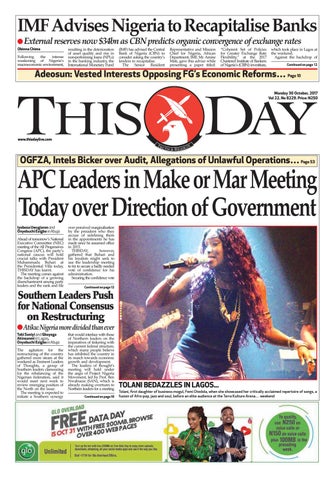
TOLANI BEDAZZLES IN LAGOS... Tolani, first daughter of business mogul, Femi Otedola, when she showcased her critically acclaimed repertoire of songs, a fusion of Afro-pop, jazz and soul, before an elite audience at the Terra Kulture Arena… weekend
2
T H I S D AY MONDAY OCTOBER 30, 2017
T H I S D AY MONDAY OCTOBER 30, 2017
3
4
T H I S D AY MONDAY OCTOBER 30, 2017
T H I S D AY MONDAY OCTOBER 30, 2017
5
6
T H I S D AY MONDAY OCTOBER 30, 2017
T H I S D AY MONDAY OCTOBER 30, 2017
7
8
T H I S D AY MONDAY OCTOBER 30, 2017
T H I S D AY MONDAY OCTOBER 30, 2017
9
10
MONDAY, ͻ˜ ͺͿ ˾ T H I S D AY
PAGE TEN
Adeosun: Vested Interests Opposing FG’s Economic Reforms Obinna Chima The Minister of Finance, Mrs. Kemi Adeosun, yesterday stated that ongoing efforts by the federal government to institute reforms in the economy have continued to be resisted by those she described as “vested interests within and outside the system.” Adeosun said this in an article she wrote titled: “Positioning Nigeria for a prosperous future,” made available to THISDAY at the weekend. But the minister maintained that the government would not be deterred, insisting that the reforms would continue. She said: “But we are not fazed. The work of reform goes on. It is, to borrow from the Nigerian novelist, Chinua Achebe, morning yet on Creation Day. Not very long from now, Nigerians and the world will look back on this recession we have just emerged from, and realise that it was the turning point in Nigeria's journey to true growth and greatness. “Let me point out that the most important elements of any reform effort tend to be the least flamboyant. We are confident that in the
months and years ahead, Nigerians and the world will see the full impact of the foundational resetting that the Buhari administration has been focused on since 2015.” She pointed out that since mid-2014, when the price of crude oil fell dramatically, the country’s finances became challenged. According to her, the country historically depended on crude oil for as much as 70 per cent of government’s revenues, and 90 per cent of foreign exchange earnings. Adeosun explained: “The outcome, pressure on government’s finances, was by no means unusual. A similar fate befell most oil-rich countries around the world. “Where Nigeria possibly stood out was in the fact that during the preceding three years when oil prices were in excess of 100 dollars per barrel, the government did little in terms of saving and investing for the future. “Our Sovereign Wealth Fund, which was established in October 2012 with just US$1 billion, did not receive any further inflow during the oil price boom. Instead, billions of dollars were
squandered through corrupt oil and defence contracts. It is a terrible thing for a country to fall on hard times without a savings buffer. “There was nothing unexpected about our downturn. It was the inevitable result of the choices we made or didn’t make during the years of boom.” But Adeosun stated that what was remarkable, yet not as talked about, was the way the Buhari administration worked so hard to exit the recession, reset the economy and reposition it for a brighter future for the present and future generations of Nigerians. In her opinion, the Buhari administration had been laying the foundation for an economic growth that would make a real impact in the lives of citizens. She added: “The downturn has inspired unprecedented levels of fiscal responsibility, in line with President Buhari’s determination to fight Nigeria’s endemic corruption. “Shortly after taking office, he issued a Presidential order mandating the immediate implementation of the Treasury Single Account (TSA) system, consolidating
thousands of government accounts scattered across deposit money banks into a unified system that is transparent and easy to centrally monitor and track. “Under the old system, it was common for government accounts to be converted into personal use, but under the TSA this is impossible. Also, the proliferation of accounts encouraged rent-seeking rather than questionable practices. “Budgetary reform has also taken a lot of our time and attention. We are pioneering the use of software to prepare our annual budgets, which allows greater transparency and the ability to track changes.” The minister added: “We have insisted on using biometric verification in the deployment of our Social Investment Programme, which includes a job scheme for unemployed graduates, a School Feeding Scheme for Primary School Pupils, a Conditional Cash Transfer scheme targeting a million of our poorest citizens, and a Micro-Credit scheme for artisans, farmers, and traders. In the past, the Social Investment payments would have been done as cash handouts.
“A similar insistence on biometric verification for the federal payroll has resulted in the detection of tens of thousands of bogus beneficiaries – or ‘ghost workers’, as we often refer to them, in Nigeria – and savings running into billions of naira every month. “We are pursuing unprecedented cooperation with foreign governments and powers, as part of our transparency and the anti-corruption drive. For the simple reason that a disproportionate amount of public funds looted in Nigeria end up in the United Arab Emirates’, Nigeria has signed bilateral agreements with the UAE Government on extradition, exchange of information, and repatriation of stolen public funds. “One strong demonstration of our political will has been a Whistleblowing Scheme we launched months ago that empowers citizens to report public corruption. The impact in terms of recoveries has exceeded our expectations. The tighter rein on public finances allowed us to invest US$500m in our Sovereign Wealth Fund, during a recession. “A lot of the work we have done over the last two
and half years has been focused on dismantling the old ways of doing things, rebuilding them, and empowering and fortifying our institutions with technology to block loopholes, discourage abuse, and prevent a relapse into the destructive ways of the past.” According to her, the new Nigeria which the citizens desire would not happen without the kind of foundational reform being laid by the present government, that imposes on its citizens new ways of thinking and of doing things. “The early results are already being seen. A concerted focus on agriculture has seen our rice imports from Thailand dropping by 90 per cent between 2015 and 2016, and replaced by locally grown variants. “As oil has let us down, we have started to do what we should have done decades ago, invest in agriculture and mining. Throughout the recession, agriculture recorded healthy growth. As we emerge from the recession, its impact is certain to multiply and position Nigeria for a prosperous future,” she said.
worsening spate of agitations all over the country. He said: “All of you must be aware of the recent agitations from different parts of the country, with some groups threatening violence and, in some cases, secession. “These agitations are the result of a number of factors, which I will not bother going into at this time, although since you are all enlightened men and women, I have no doubt that you are well and fully aware of what they are. “As a result of these various forces, the Nigeria of today appears more divided than it has ever been before.” The former vice-president, who traced the origin of Federal Government Colleges popularly known as ‘Unity Schools’ to the end of the civil war, said the idea of setting up the schools was to foster national unity and cohesion. He said that Nigeria’s best brains were trained at the unity schools not only to be academically sound, but to see themselves as Nigerians rather than as Igbo or Hausa or Yoruba or any other tribe. He however lamented that such laudable virtues were fast being eroded with the present state of affairs in the country. “Our country is not at war in the sense of guns and bombs, but the level of inter-ethnic discontent, hatred, and hate speech is at an all-time high,” he said. Atiku told the students and alumni of the Federal Government College, Okigwe, that Nigeria needed them now more than ever. He said: “The glory of what was begun here 40 years ago must not be allowed to die. It must be propagated throughout all our country. That is a responsibility that you must all meditate on as you
celebrate with one another over the next few days of this grand occasion. “That is also the responsibility that you must carry on your shoulders as you depart to your various locations across the globe. Whether locally or from the diaspora, you must each and every one of you see yourselves as entrusted with a critical role in mending the cracks that hate and divisions have marked in the social and political life of our great country, Nigeria. “This is the time to lace your boots. This is the time to roll up your sleeves. This is the time to give back. Nigeria once gave you her best and it is time for Federal Government College, Okigwe, to give her best back to Nigeria.”
SOUTHERN LEADERS PUSH FOR NATIONAL CONSENSUS ON RESTRUCTURING to harmonise their views on the controversial issue. However, one of the Northern leaders expected to be contacted, former VicePresident Atiku Abubakar, was in Okigwe, Imo State at the weekend, lamenting the deepening divide in the country, putting the problem at the door steps of the skewed nature of the Nigerian federation. “Never have we been this divided in the history of our country,” the former vice-president told students and members of Federal Government College, Okigwe Old Students’ Association, who were celebrating the school’s 40th anniversary. But hope for a solution to the mounting divisions in the country beckons with the overture to the North for a national meeting on restructuring. The quest for restructuring has been tied down by lack of consensus among the proponents. While the South appears to have a settled view of how and what should change in the country, the North has not been too forthcoming on the issue, save for clamouring for true federalism. However, Nwabueze said his group is determined to change that. A notice of the meeting sent out by the Head of the Secretariat of Project Nigeria Movement (PNM), Mr. Olawale Okunniyi, to members of the leaders of thought, said the meeting would take place in Lagos. He also said that the PNM’s secretariat was already putting together the machinery for an inclusive platform of both Northern and Southern leaders of thought to agree and negotiate the restructuring of the country through a new constitution. The Lagos meeting,
according to him, would consider the position of the North on restructuring and explore the possibility of harmonising it with that of the south. He said Nwabueze and some Southern leaders had been carrying out national consultations to facilitate a negotiated consensus among stakeholders on the restructuring of Nigeria, explaining that the PNM meeting would prepare the grounds for a national consensus on restructuring. A group of Northern leaders of thought named Friends of Democracy (FD) had last week released a Northern proposal on the restructuring of the country, with a suggestion that the country should return to the 12-states structure, among other issues. Okunniyi said the PNM secretariat had commenced informal talks with the Northern Elders Forum (NEF) secretariat as well as some members of FD on how best to move the ongoing debates and process of restructuring forward. Okunniyi said consultations were also ongoing with the Pro National Conference Organisation Action Group (PRAG), led by Alhaji Shettima Yerima, and others in the youth organ of the group on how best to facilitate the proposed people-driven independent national conference on restructuring, in the event that all efforts to make the federal government address the agitations for restructuring fail. PRONACO had last month announced that it had already adopted its 2007 peoples constitution as a working document for its proposed peoples national conference scheduled to commence in January 2018.
“We are not leaving any stone unturned in this matter of democratic constitutional restructuring, which is conceived to help the country achieve political stability and economic prosperity of the diverse peoples of Nigeria. So all efforts and initiatives in this regard are already being synchronised to ensure a productive outcome,” Okunniyi said.
Afenifere Backs Southern Governors Meanwhile, the Afenifere Renewal Forum (ARG) yesterday asked the Southern Governors Forum (SGF), a bi-partisan platform for the 17 governors in three geopolitical zones in the South, to sustain the call for true federalism and devolution of powers. The ARG, a pan-Yoruba socio-political think-tank, which also set a fresh agenda for the forum, explained the need to ensure sustained collaborations that would guarantee Nigeria’s socioeconomic development. In a statement by its Publicity Secretary, Mr. Kunle Famoriyo, ARG noted that the SGF’s demand for true federalism and devolution of powers was apt and timely. The SGF had reconvened at Lagos House, Ikeja last Monday, 12 years after its last summit, canvassing true federalism and devolution of powers within a united and indivisible Nigeria. It also agreed to collaborate in the growth of their economies of the three geopolitical zones in the South, while emphasising the need to develop strategic infrastructure projects within the states in the region. The ARG commended the timely meeting of the southern governors, saying: “It is a clear indication of
the acute need for sustained collaborations that will speak to our development as a people and nation.” It added that the decision of the SGF to unequivocally demand for true federalism and devolution of powers was the basis for Nigeria’s unity and continued existence. “There is no doubt that without true federalism, our dear country is bound to plunge deeper into decline across all facets of socioeconomic indices. “Those who are opposed to the restructuring of the governance arrangement of Nigeria, despite the avalanche of evidence for its imperativeness, want to see this country ruined alongside the promising destinies of its citizens.”
Nigeria More Divided But even as leaders and groups in Southern region continue the clamour for restructuring, Nigeria’s former vice-president at the weekend lamented the growing discontent and agitations in the country, saying there had never been a time that the country had been as divided as it is today. Speaking while delivering a goodwill message at the Old Students’ Association of the Federal Government College, Okigwe in Imo State, he said though there was no full scale war in the country at the moment, he expressed regret over the level of inter-ethnic discontent, hatred, and hate speech, noting that it was worrisome. Atiku, who is the grand patron of the school, said the celebration of its 40th anniversary came at a critical time in the country’s history, coinciding with the
TOP GAINERS LEARNAFRICA CAVERTON BOCGASES AXAMANSARD UPDC TOP LOSERS TOTAL UACN FORTEOIL
NGN NGN % 0.04 0.84 5.0 0.06 1.26 5.0 0.19 4.15 4.8 0.09 4.15 4.6 0.12 2.70 4.6 NGN NGN % 12.25 232.75 5.0 0.95 18.05 5.0 2.01 38.29 4.9 INTERBREW 2.58 49.20 4.9 NASCON 0.83 15.94 4.9 HPE Nestle Nig Plc ₦1,230.00 Volume: 250.893 million shares Value: N3.008 billion Deals: 3,968 As at Friday 27/10/17 See details on Page 35
T H I S D AY MONDAY OCTOBER 30, 2017
11
12
MONDAY, ͻ˜ ͺͿ ˾ T H I S D AY
NEWS IMF ADVISES NIGERIA TO RECAPITALISE BANKS low oil prices, dwindling oil revenue, foreign exchange scarcity and a crippling recession, the last two years saw significant deterioration in the country’s macroeconomic indicators, which exposed the banks to risks. Owing to this, the banking sector’s NPLs climbed to as high as 15 per cent. Mati stressed the need for the banks to remain strong so that they would be able to play their roles in the economy. He explained: “We believe the banking sector should be strong to support the economy. So it is important we recapitalise the banks to make sure that they are very strong. “The regulators should try to make sure that the banks operate in line with international standards to be able to withstand any shocks.” He, however, endorsed the CBN’s tight monetary policy stance, saying it had helped in gradually easing inflationary pressure and brought about exchange rate stability. But he urged the central bank to continue in its pursuit of a unified exchange rate, just as he acknowledged efforts that had been made by the CBN in eliminating pressure in the forex market. He noted that the country exited the recession in the second quarter of the year, driven by improvements in the oil and agriculture sectors. On the fiscal side, Mati said the drop in the country’s oil revenue, which according to him accounts for 70 per cent of its earnings, led to an increase in the fiscal deficit. “As a consequence, Nigeria’s vulnerability increased,” he explained. Mati acknowledged, nonetheless, that the move by the Nigerian government to substitute its domestic debts with foreign loans, would give banks the opportunity to lend to the private sector. According to him, “Private sector credit has remained low because of the attractive treasury
bill yields. “If government borrows less domestically, there would be more space for banks to channel credit to the private sector. There is need to increase tax revenue, even though it takes time to achieve that. “In terms of structural reforms, improving infrastructure and power would be essential to improve productivity of businesses, especially small and medium scale enterprises (SMEs).” Mati also stressed the need for structural reforms in the economy to achieve sustainable growth. He said: “There are significant headwinds that Nigeria has faced and there are some important steps that had been taken in terms of monetary and fiscal policies. “But more needs to be done, especially in terms of structural reforms to spur growth as quickly as possible, following the challenges that the country faces. “The good news is that there is the Economic Recovery and Growth Plan (ERGP). “But a lot of people tell me that Nigeria has lots of plans, but implementation is sometimes difficult. So Nigeria must ensure it implements the ERGP,” he added. Also, speaking to journalists at the end of the event, the Deputy Governor, Financial System Stability, Dr. Joseph Nnanna, who was one of the fellowship awardees of the CIBN, said the country’s external reserves had increased to $34 billion, from $33 billion reported last month. Nnanna assured Nigerians that the stability in the forex exchange market would be sustained, saying that the much-desired exchange rate convergence would take place organically, with the interplay of demand and supply. The CBN deputy governor explained: “The IMF always talks about the need to have a single rate. The single rate can happen organically or
inorganically. “For us at the CBN, we believe organic convergence is the way to go. Inorganic convergence which is forced, will always produce arbitrage and that is what we don’t want. “We have brought the exchange rate from almost N500 to a dollar; today it has come down through the continuation of heterogenous policies. “We didn’t force it down, it came down organically or naturally and that is the way it is expected to be. “We have achieved stability and the stability is here to stay.
Sustainability is already evident as the external reserves are growing. As I speak, it is $34 billion.” He added: “When we had volatility, the reserves went as low as $20 billion. But let me say one thing, Nigeria can make do with a reserves level of $20 billion. “But it was the press who gave the impression that if the reserves fell below $20 billion, there would be problem. No, there would be no problem. All we need to manage the economy properly are reserves that can cover at least three
months of imports.” Nnanna described the Investors’ and Exporters’ (I & E) window as “a mighty success”, saying it has “performed beyond our expectations”. “Within a few months of the window’s introduction, we have seen a volume of over $10 billion. It is a huge success and I believe other countries can copy that from us. “The convergence is happening slowly. As such, you can give credit to the policy makers that made that to happen,” he added. Some other honorary
awardees at the event included the Executive Governor, Central Bank of Liberia, Mr. Milton Alvin Weeks; Managing Director/Chief Executive of Fidelity Bank Plc, Mr. Nnamdi Okonkwo; Managing Director/ Chief Executive, Infrastructure Bank Plc, Mr. Kunle Oyinloye; CEO, Citibank Nigeria, Mr. Akin Dawodu; former CEO, Keystone Bank, Mr. Philip Ikeazor; Chief Consultant, B. Adedipe Associates, Dr. Abiodun Adedipe; and Director, Other Financial Institutions, CBN, Mrs. Tokunbo Martins, among others.
AT THE WEDDING OF THE YEAR... L-R: Speaker, House of Representatives, Rt. Hon. Yakubu Dogara (left) with the National Leader of the All Progressives Congress (APC), Chief Bola Tinubu, during the engagement and wedding of Senate President Bukola Saraki’s daughter, Halimat Oluwatosin Saraki and Omooba Adebola Olukoya, in Lagos… weekend speaker’s media office
APC LEADERS IN MAKE OR MAR MEETING TODAY OVER DIRECTION OF GOVERNMENT has become very necessary in view of the president’s unconcealed interest in running for a second term in office in 2019. Among those expected to attend the crucial meeting are the National Chairman of the party, Chief John Odigie Oyegun; the National Leader, Senator Bola Tinubu; Senate President Bukola Saraki; Speaker of the House of Representatives, Mr. Yakubu Dogara; all the APC state governors; and former interim National Chairman, Chief Bisi Akande. Former Vice President Atiku Abubakar might not attend the meeting as his media aide, Mr. Paul Ibe told THISDAY that he was outside the country. A lot has happened in the APC in the last two years, leaving the party largely polarised and appears to be on the brink of implosion. Most of the political gladiators in the party have either clashed over competing interests or engaged in verbal exchanges over the handling of issues relating to the party and its administration. The APC administration led by Buhari has also come under sharp criticism from both within and outside the
ranks of the party for what many described as the poor handling of the affairs of government. While some APC stakeholders have accused the president of not carrying them along in terms of appointments, other Nigerians especially from the opposition have criticized the administration for its alleged bias in its anti-corruption war, sectionalism and poor performance, among other issues. A top party member who spoke to THISDAY at the weekend said that the battle line has been drawn between the pro and anti-Buhari elements and that the meeting at the Presidential Villa promises to be a heated one. For instance, the source said the National Working Committee (NWC) led by Oyegun, which has long been alienated from the president since his medical trips to London is expected to ventilate its grievances at the meeting. It further was learnt that the NWC would be leading a protest on the poor funding of the party’s operations, which has been blamed on the president. Another issue that might
come up during the meeting is the complaint by the Atiku that he has not been carried along by the Buhari administration and the party. Party leaders who spoke with THISDAY yesterday in confidence said that the meeting is crucial to the survival of the party. An aggrieved member of NEC said: “APC is at a point of rebellion and an unmanageable stage, and the grenades are about to explode,” adding: “If we refuse to take critical decisions at the meetings, we will have missed the huge opportunity to save our party.” He explained further: “Our party members are not happy with the current state of affairs in our party and government; they worked and laboured to install a government but those who are currently being appointed in key positions of government today were not with us during the campaign. “The danger I am seeing, which many of those surrounding the president are apparently not seeing is the coming national convention of our party that will commence in February next year. “In the past few years,
the party structures at all levels were rendered useless; they were used and abandoned. Are you going to remove them and elect new members, thinking they will be happy? That will be the end of APC. “They said the leadership of the party is not active and as a result some governors and senators want the National Chairman, Chief John Odigie Oyegun removed for selfish political motives. “My question is: Do they expect the national chairman to start fighting the president on the pages of newspapers? Do they expect him to start shouting, when he has access to the President?” Throwing more light on the difficulty the national chairman and his colleagues have going through, the NEC member said they had informed Buhari in the past about sorry state of the party, “telling him that the leadership of the party was not happy”. The growing discontent in the party also found expression in last weekend’s outburst by one of the president’s close associates, the Comptroller-General of the Customs, Col. Hameed Ali (rtd), who lamented
that the administration was increasingly losing grounds due to the infusion of people who did not share his vision or never took part in the journey to get to the corridors of power. Ali had said: “Let me say here without fear of being contradicted that I think half way through the journey, we are losing our core values. We are losing our vision and mission and I think that the idea of our being here today is to look critically at what we need to do to get back on track. “There is no doubt that we have derailed because we are not doing what we say we want to do. Why is it so? We need to find an answer to that. If we do not find answer, then what should we do to get us all back on track? “We owe this great nation and the 180 million Nigerians the duty to give good governance. Good governance is what they voted for and good governance is what they expect and deserve.” A chieftain of APC in the FCT chapter, Alhaji Tijani Abdullahi Markafi, said that topmost on the agenda of the meetings slated for today and tomorrow would be the
need for urgent reforms in the area of party discipline, finance and organisation, saying the party would need to agree on an effective reward system for stakeholders on account of being members of the party in government. According to him, “During the 2015 elections, Nigerians – young and old – who voted en masse for APC were certain that President Muhammadu Buhari’s leadership would save the country from the throes of the misrule of the Peoples Democratic Party (PDP). “In fairness to the new administration, it addressed itself to the onerous task of rebuilding the country and delivering on election promises which were largely hinged on curbing corruption, restoring the economy and security of the nation. “However, there are different perspectives on the extent to which it has successfully tackled these challenges. While spokespersons for the government are beating their chests on how successfully interventions have positively affected the situation, opposition elements have remained unimpressed.”
T H I S D AY MONDAY OCTOBER 30, 2017
13
14
T H I S D AY Ëž Ëœ ÍąÍŽËœ Í°ÍŽÍŻÍľ
COMMENT
Editor, Editorial Page PETER ISHAKA Email peter.ishaka@thisdaylive.com
MODELLING LAGOS SMART CITY
The Lagos master plan should be implemented in phases, argues Willie Eleje-Abili
M
y article, “Lessons from Rwanda “, in THISDAY of October 24 was an attempt to examine the character of Lagos and other smart cities around Nigeria, in the light of truths which were assumed to be self-evident about the standard of a model city-state like Singapore. But, for the demand of brevity, that article must have left the reader wondering to what effect, if indeed the Rwandan example was instructive. To that question we now turn, for I believe that, if one should give the answer to a question, he should be able to search it out. Around the year 2000, emerged a charismatic leader, who had a fascinating dream about Lagos as a mega-city. We began to see a transformation in the physical landscape with greenery, street-lighting, metro-rail line, bus rapid transit lanes. Before then, a generation of kids grew up in Lagos without experience of novel recreation. But we also began to see a resurgence of classical urban artifacts like amusement parks and cinemas and with them, a re-invention of the middle class. Lagos is now one big construction site, with modern bus terminus, world class transport interchange and organised aquatic inter-modalities. Strategic link roads such as Ajibulu, Okota fly-over, Lekki hanging bridge, to mention a few, are unlocking potential and releasing latent energy. The challenge of modelling Lagos Smart City-State revolves around organising the society and managing demographic pressures on social infrastructure. Principal among which is waste management, maintenance culture and socio-cultural re-orientation. Everyday, more than 20,000 people come into Lagos, while birth rate is also growing exponentially. So, while state security and welfare is provided arithmetically, population is growing geometrically. If I were in a position so to do, I would implement the Lagos master plan in phases beginning with Victoria Island, Ikoyi, Etiosa axis of low hanging fruits, which I would render an exclusive demonstration centre of inspiration, such that, experience gathered in that phase, can be applied to improve the process, than trying to do all at once and end up doing little or nothing at all. But what is of serious concern is that the air, land and sea gateways to Lagos and indeed the country are in a sorry state. Apapa, which is the sea-gateway, is rapidly becoming one big tanker and trailer-motor park, such that Creek Road, an important industrial arterial, has ceased to exist since around 2005, shutting down an economic value-chain of multiplier effect. Today there is massive downturn in commerce and industry around Apapa, because, we now have a continuum of stationary articulated vehicles on the fly-over mushrooming its way into other key Lagos central business districts and most of them are laden not with export but import cargo which would not improve our balance of trade. The incredible traffic situation has been compounded by on-going attempt to re-surface Apapa Wharf road with down-reaching drainage that would soon become a refuse dump, a project believed to be in counterpart funding with Dangote, who, in the stead of community relations, would recoup his cost exposure with tax rebates. The fact is that with the perennial logjam on the road through Tin-Can Island, Apapa has become a cul-de-sac and with three major seaports and inherent industrial and commercial activities, the district traffic carrying capacity has been far exceeded. I therefore see no reason to expect that the on-going work on Wharf road though necessary, should be expedient. What should be expeditious is how to get the Apapa port railway operations working to evacuate the cargoes, which would otherwise go by road. Now, if we should not be concerned about Apapa, since mercantilism would care-less about ennobling sight and sound, provided it does not get in the way of amassing wealth, what about the Murtala Muhammed International
THE CHALLENGE OF MODELLING LAGOS SMART CITY-STATE REVOLVES AROUND ORGANISING THE SOCIETY AND MANAGING DEMOGRAPHIC PRESSURES ON SOCIAL INFRASTRUCTURE. PRINCIPAL AMONG WHICH IS WASTE MANAGEMENT, MAINTENANCE CULTURE AND SOCIO-CULTURAL REORIENTATION
Airport road which is supposed to be the first impression of more sophisticated visitors that may be contemplating bringing investment capital? As soon as you emerge from an infra-dig ambience around the arrival hall, you are serenaded by a short stretch of drive. But unfolding as one degrading vista, the Airport road would not be that representative of Lagos and if indeed, would not present the city in any good light at all. Unfortunately, there is usually a traffic hold-up on that stretch, which ensures an extended spectacle of bad impressions. As you drive by NAHCO, you would find that bogus edifice are now springing up around the air-force base vicinity, where one could take a leisurely work, occluding the beautiful landscape. As you drive over to the junction around the Hajj Camp, you encounter a motley crowd of commuter taxis in shouting blue, hurdled together and howling on top of their voices. Further down, you are confronted by a rag-tag of roadside hawkers of dogs aside roast-corn followed by scarecrows of tricycles known as Keke-NAPEP. You then observe that littered all over are polyethylene materials and disused carcass of cars, vandalised streetlights falling over themselves, an expansive median over-grown with weed, a plume of carbon monoxide and dust haze, horns honking madly, juke boxes blaring, men wolfing down meals over sewage, which by the way are served in non-bio-degradable disposable plastic plates, total laissez faire and anomie. Now, if the penultimate governor of Lagos could interprete the vision of a greater Lagos and the incumbent administration is trying to prove that the dream can be sustained, it is very much in doubt, if the vision has been communicated to citizens, such that they can own the process of bringing it to full effect. So, there is no commensurate cultural renewal to the massive physical transformation. Unfortunately, a leader can give you a chance to become your dream but cannot become you. He shows a form but you are the platform of traction. No one compels you to eat with washed hands, so why should it be government that will tell you not to defecate in the water-front or to dispose your refuse in the garbage bin? The fact is that, knowledge in itself, cannot make one do right or wrong, what we need as a people is a lot more consideration of own-self, for it is a people that are lacking in understanding that will be getting what they are not deserving. I believe that most investors around Lagos only find the sheer volume of market irresistible and they are not usually caucasians but portfolio businessmen from around the Maghreb and Southeast Asia, who come in as economic refugees to ease their fiscal pressure and bolt out as though from a latrine. The late sage, Obafemi Awolowo, was a man of fabulous dreams. He had a dream of Ibadan as a city that can compare with top African cities of his time, like Cairo. At a time when Africa was largely in the dark, he built the Cocoa House around the late 1950s, a sky-scrapper such as was only replicated in Malaysia in the late 1990s, with Oil-palm money. He erected an exotic Congress Building - the Mapo Hall and founded the Ivy-league University of Ife. He built the then magnificent hill-top Liberty Hotel, the Adamasingba Stadium, the Moor Plantation and introduced free education. But what is perhaps more intriguing is that, he introduced television to Ibadan before Paris, Dublin and Brussels. I believe that the dignity of the human soul, fantastic inspiration, social emancipation and mass mobilisation occupied the defining leit motif of his dream of a mega-city state. Ibadan has not lived up to his vision, probably because his Achilles heel was that, no one followed closely after that could sustain the legacy of his dream. Lagos should learn from the mistake of Ibadan.
ODIGIE-OYEGUN’S SCORECARD AND THE TASK AHEAD Tijani Abdullahi MarkaďŹ urges reform in party discipline and organisation
A
s the national caucus and National Executive Committee (NEC) of the All Progressives Congress (APC) meets in Abuja October 30-31, 2017, top on the agenda will be the need for urgent reforms in the area of party discipline, finance and organisation. Also, the party will need to agree on effective reward system for party stakeholders on account of being members of the party in government. During the 2015 elections, Nigerians – young and old – who voted en masse for APC were certain that President Muhammadu Buhari’s leadership would save the country from the throes of the misrule of the Peoples Democratic Party (PDP). In fairness to the new administration, it addressed itself to the onerous task of rebuilding the country and delivering on election promises which were largely hinged on curbing corruption, restoring the economy and security of the nation. However, there are different perspectives on the extent to which it has successfully tackled these challenges. While spokespersons for the government are beating their chest how successfully interventions have positively affected the situation, opposing elements are unimpressed. As in this kind of situation, the truth lies between the two extremes. But what is not in doubt is that, in addition to plugging government revenue leakages, the administration has made significant progress in repairing the nation’s battered image through its fight against corruption and insurgency. It has also scored high on rehabilita-
tion and reconstruction of the insurgency-ravaged North East. In addition, the environment for free speech has remained unfettered, an area in which the Buhari administration has not been given enough credit. Despite clinching the presidential and 24 governorship elections, while maintaining majority in the National Assembly, APC, led by Chief John Odigie-Oyegun, has not thrown its weight around in the manner of Third World dictatorships. It has relished defections in the last two and half years from geo-political zones, such as the South South and South East where the APC was not strong in the past. While there have been tensions in the party, it must be conceded that APC was formed by a collection of vibrant opposition parties who bought into the objective of upstaging an entrenched political party (PDP) which boasted to rule for the next 60 years. It would be naïve to expect such tendencies to disappear overnight and drop their respective interests. For isn’t politics the struggle for relevance, power and interests, however disguised? PDP has never claimed to be the cohesive assemblage of politician. However, this did not prevent it from holding on to power for all of 16 years! Even in the most sophisticated democratic system, you will always find in-fighting, unwillingness of some powerful interests in the party to toe party lines on even the most delicate issues. There will always be persons who are unwilling to subjugate their individual political ambitions to party preferences.
Top party chieftains will always complain – personally and through proxies – of being sidelined in party affairs. As show of frustration, top party chieftains, aggrieved over party positions/decisions, will always sulk or withdraw from party activities. Thus, the coup in the National Assembly elections; the protest votes in the Osun West Senatorial by-election; the staying away from party activities by powerful members from some parts of the country; and withdrawal of financial support to the running of the party at the national level are to be expected. So are the persistent calls by disgruntled members of the party who have lost out in the internal politics of the party for the ouster of the national APC leadership. However, as its leaders converge on Abuja the national caucus and NEC meetings, they need to reflect on whether the removal of say the national chairman will necessarily end the upheaval. Won’t amendments to the party’s constitution to do with discipline and finance offer better prospects for harmony in the party in the end? In any case, has the APC-led government given the APC National Chairman due courtesy in governance? Indeed, party leaders need to engage the government on the following issues: Greater inputs of the APC national leadership into appointments into political positions in government and distribution of political patronage to strengthen party loyalty and motivation of party faithful; the need for increase in the pace at which persons whose political loyalty is not to APC are removed from political offices to create room for APC members. There is
need for an urgent review of all appointments made by the immediate past administration, with a view to making sure that all appointees understand and work in line with the APC’s change agenda. These are more likely to lead to better functioning of the party’s national leadership and ultimately rob off on the lower chapters than divisive personnel changes. Even in the face of mudslinging, blackmail and baseless allegations directed at him, the APC national chairman’s goal of providing leadership and ensuring a focused, united, strong APC is unwavering. Chief Odigie-Oyegun has successfully balanced the interests of the powerful blocs within the APC. Perhaps if the PDP had such cool-headed leadership, it would not have been brought to its present knees. The party’s National Working Committee (NWC) under his leadership embarked on very successful consultative meetings with APC governors and the party’s National Assembly caucus. The consultations have resulted in very positive outcomes, amongst which the resolution of the legislative-executive impasse that led to the passage of the 2017 national budget. There is now a monthly meeting between the party’s NWC, governors and the leadership of the National Assembly. Resolutions from these meetings resulted in the inauguration of the party’s committee on restructuring, addressed some financial issues within the party and aided ongoing reconciliation efforts in the party. MarkaďŹ , an APC Chieftain, wrote from Abuja
15
T H I S D AY Ëž Ëœ ÍąÍŽËœ Í°ÍŽÍŻÍľ
EDITORIAL YET ANOTHER POPULATION WARNING There is need to invest massively in education
A
ccording to the latest ďŹ gures from the United Nations International Children’s Emergency Fund (UNICEF), Nigeria currently accounts for 20 per cent of all the births in Africa and ďŹ ve per cent of the global total. In a report titled, “Generation 2030 Africa 2.0: Prioritising investments in children to reap the demographic dividend,â€? UNICEF projects that one in every 13 births globally would take place in Nigeria by 2050. “Nigeria currently accounts for nearly 20 per cent of all of Africa’s births and 5 per cent of the global total. Between 2016 and 2030, 120 million births will take place in Nigeria alone – more than all the births in Europe – accounting for 6 per cent of the global total for that period.â€? To underscore the challenge, UNICEF stated: “In 1950, Africa had just above 10 per cent of the world’s children. By 2100, if current trends persist, around 50 per cent of all the world’s children will be African. By 2030, the end year for achieving the 2030 Agenda for Development, Africa’s NIGERIA’S YOUNG under-18 populaPOPULATION COULD tion is projected to BE A DEMOGRAPHIC increase by around ADVANTAGE ONLY IF 170 million, reaching a total of 750 million. THE GOVERNMENT CAN By mid-century, DESIGN APPROPRIATE around 42 per cent of POLICIES IN THAT the world’s births, 41 DIRECTION per cent of all underďŹ ves, 38 per cent of all under-18s, and 36 per cent of all adolescents will be African.â€? In stressing the need to invest in the potential of the projected one billion children in Africa, Marie-Pierre Poirier, UNICEF’s Regional Director for West and Central Africa, said if leaders on the continent can step up “investments in children and youth now, transforms its education systems and empowers women and girls to participate fully in community, workplace and political life, it will be able
Letters to the Editor
to reap faster, deeper and longer dividends from its demographic transitionâ€?. However, she also added that “if investments do not occur in Africa’s youth and children, the once-in-a-generation opportunity of a demographic dividend may be replaced by a demographic disaster, characterised by unemployment and instability.â€? The authorities can take the positive in that report. At a time when the population of many countries in Europe and Asia is ageing, Nigeria’s young population could be a demographic advantage but only if the government can design appropriate policies in that direction. There is therefore the need to invest massively in education as prescribed by the UNICEF report. There is also the need for development in infrastructure so as to ensure sustainable support for the bulging size of our national population. For instance, clean water is a ďŹ nite resource everywhere in the world and more so in our country where access is not guaranteed for the vast majority, especially in the rural areas.
T H I S DAY EDITOR DEPUTY EDITORS ˜ MANAGING DIRECTOR DEPUTY MANAGING DIRECTOR CHAIRMAN EDITORIAL BOARD
EDITOR NATION’S CAPITAL
T H I S DAY N E W S PA P E R S L I M I T E D EDITOR-IN-CHIEF/CHAIRMAN GROUP EXECUTIVE DIRECTORS ˜ ˜
˜ GROUP FINANCE DIRECTOR DIVISIONAL DIRECTORS ˜ ˜ DEPUTY DIVISIONAL DIRECTOR
SNR. ASSOCIATE DIRECTOR ASSOCIATE DIRECTORS ˜ CONTROLLERS ˜ ˜
GENERAL MANAGER
GROUP HEAD DIRECTOR, PRINTING PRODUCTION TO SEND EMAIL: ďŹ rst name.surname@thisdaylive.com
TO OUR READERS Letters in response to speciďŹ c publications in THISDAY should be brief (150-200 words) and straight to the point. Interested readers may send such letters along with their contact details to opinion@thisdaylive.com. We also welcome comments and opinions on topical local, national and international issues provided they are well-written and should also not be longer than (9501000 words). They should be sent to opinion@thisdaylive.com along with the email address and phone numbers of the writer.
WHY NORTHERN NIGERIA LAGS
I
f a line is drawn to equally divide Nigeria into two equal halves, one would notice that the peoples of the southern half take extreme pride in their homestead of origins, especially their villages. They “go out� in their youth to seek work but return back home upon retirement or as old age beckons to live in their villages and their district headquarters; those of means even build retirement “country homes� where the family gathers at Christmas or some other important moments. The fine point to note here is that, no matter how harsh the environment of their homesteads or no matter the security threats that marauding herdsmen present, these Southern folks still retire to the land of their ancestors; their returning home translates to capital in-flows that they are able to influence directly and to capital remittances that their children, grandchildren, and in-laws inside and outside Nigeria make every so often. This is where the North differs significantly from the South; the northerners have all but turned their back on their villages and districts and they are
A
gainst the background that Nigeria is not showing any sign of achieving the set goals in such critical areas as job creation, food security, universal basic education, provision of shelter for all and poverty eradication, we should be concerned about a population growth that cannot be matched with a sustainable infrastructure and social services. It is a scary scenario. It is a simple economic fact that population growth that is not matched with commensurate development in the socio-economic sector and education for the citizenry can only breed chaos. With experts warning of the dire consequences of our uncontrolled population growth, the prognosis is that there may come a time when it would be difďŹ cult for us to feed the ever increasing number of citizens. Given that an idle (and largely illiterate population) such as we breed in Nigeria is a disaster waiting to happen, policymakers should begin to focus their attention on how to avert this ticking time bomb.
now veritable city-dwellers in perpetuity. Where a “big-man� or an “alhaji� should have been the nucleus of his community in the rural area, these communities are devoid of an influential presence in retirement, and feeling ever so dejected and seeing no purpose to the beauty of rural living, the masses then embark on massive rural-city migrations thus terribly congesting urban spaces. When Northern cities are becoming choked, they embark on journey to the South crammed into trucks like expendable haulage. The elite from the North do not make it any easy each time they lazily pronounce that “every Nigerian has the right to live anywhere;� they could not have been more incorrect because every piece of Nigerian soil is a good wealth-holding resource and encouraging people to think migration where there exist no real sense of national and tribal integration is creating frustrations and potential future ethnic tensions. Sunday Adole Jonah, Department of Physics, Federal University of Technology, Minna
AN OPEN LETTER TO THE EFCC CHAIRMAN
S
ir, on Thursday, October 12, 2017, I was at your office in Abuja to find out the authenticity of a text message that was sent to my phone through 08060088645 and accredited to the EFCC regarding my petition against the ITF’s Office. Sir, I was with a complaint letter regarding the message in question, which was received and acknowledged by a woman at the reception at exactly 11:45am. However, before the collection of my letter by your staff, the following drama happened. She went through the letter and thereafter, shouted at me and said that my case cannot be treated there. According to her, my petition against the ITF Office has been transferred to the EFCC’s office in Kaduna for investigation and I am expected to go there. Sir that was the same message I got, which necessitated my visit to your office. After hearing that from her, I tried to explain to her that I reside in Abuja and my petition was as well submitted in EFCC Head Office here in Abuja. Aside that, I
don’t have financial capability that can facilitate my movements from Abuja to Kaduna for the investigation as expected from me. Nevertheless, the woman in question was not interested to listen to me but rather, she shouted at me, calling me a noise maker and finally asked me to get out of the office. I was angry but as a gentleman, I took it calmly. The Executive Chairman Sir, even though I am not having enough resources but I am doing everything within my strength to contribute to the fight against corruption in the country. Therefore, I should be encouraged to do more. The attitude of your staff towards me is demoralising. I know that she may not even forward my complaint to your office and that’s the more reason why I am using this medium to deliver my message to you. Having said that, Sir, I will not be able to be moving from Abuja to Kaduna for the investigation as expected. So, something should be done for the sake of justice. Awunah, Pius Terwase, Mpape, Abuja
16
T H I S D AY MONDAY OCTOBER 30, 2017
17
T H I S D AY ˾ MONDAY, OCTOMBER 30, 2017
Group Politics Editor Tobi Soniyi Email tobi.soniyi@thisdaylive.com 08033146139 SMS ONLY
POLITICS
M O N D AY D I S C O U R S E
Mr President, Time to Disband Your Cabinet Aside from lack of performance, members of President Muhammadu Buhari’s cabinet continue to cause him scandalous embarrassment. Rekindling public trust in the president demands that he disbands the Federal Executive Council, writes Tobi Soniyi
Adeosun
A
lmost one year into another period of election circle, there are people in Nigeria who are still asking the question: has President Muhammadu Buhari actually taken over power? They are asking the question because they believe that once Buhari assumes office, miracles and wonders will start to happen. You can’t blame them either. There was nothing the All Progressives Congress (APC) did not promise to do if elected into power. It promised to stop medical tourism; power would become stable; and that millions of jobs would be created, just to mention a few. Two years after, the electorate have not seen the miracles and are now wondering whether the miracles will ever happen. In a cloudy atmosphere like ours, one thing that is very clear to see is the under performance of the Buhari’s cabinet. It is obvious that the president’s team cannot deliver and the proper decision to make is to disband the team now. If the purpose of their appointment is to reward them for their support during the campaign, then the president has done more than enough. Sir, before they completely destroy you and what you stand for, let them go. Flashback to September 6: The Minister of Women Affairs, Mrs. Aisha Alhassan passed a vote of no confidence on the president when she announced her preference for former vicepresident Atiku Abubakar as president in the next general election. Her position is a clear demonstration that the minister does not share the ideals the president stands for. Despite this obvious disloyalty, she remains a minister today. Yet she is supposed to help drive the president’s policies and governmental ideals. Fast-forward to 27 October, 2017: Hameed Ali, the Comptroller-General of the Nigeria Customs Service (NCS), who is not given to playing politics said that the APC government “cannot move forward” because 50 percent of
Alhassan
those in the current administration are from the Peoples Democratic Party (PDP). Speaking at the official commissioning of the national headquarters of Buhari Support Organisations (BSO) in Abuja, the customs CG said the Buhari administration ought not to have allowed PDP members to call the shots in the government. He said some of those who played major roles for the party to come to power in 2015 had not been fully appreciated. “Today, with all sense of responsibility, I want to say that we have 50 percent of PDP in our government. How can we move forward with this load? How can we achieve our target with this load? It is a spoilt system. “When you come in, you shake off everybody and bring in your own. That is what democracy is all about. Today, we have members of PDP calling the shots. That is what we will begin to fight for; we will fight for our rightful position, our vision and our mission for this government. “I will, therefore, ask my colleagues of the BSO to go back to the study room. This is a commission, but it is also the beginning of the fight for good governance. We must get back to the trenches, draw our own battle plan and battle line. “I enjoin you that the same commitment we had in 2015, I employ you to bear with us and
If the purpose of their appointment is to reward them for their support during the campaign, then the president has done more than enough
commit yourself to a better future for Nigeria. We will be calling on you from now on and we will be working day and night. We must do so because we want to save our name and the name of the president for what he is doing.” That is coming from one Buhari’s most trusted allies. Ali is not someone you can associate with frivolity. Mr. President sir, another of your trusted ally, in fact, your most intimated friend - your wife and our First Lady, Mrs. Aisha Buhari had earlier raised the alarm. About a year ago, precisely on 14 October 2016, Aisha, in an interview with the BBC said she might not support your bid for a second term because your government had been hijacked by outsiders. This is how she put it: “The president does not know 45 out of 50 of the people he appointed and I don’t know them either, despite being his wife of 27 years.” She said people who did not share the vision of the ruling All Progressives Congress (APC) were now appointed to top posts because of the influence a “few people” wield. “Some people are sitting down in their homes folding their arms only for them to be called to come and head an agency or a ministerial position,” she said. You were so infuriated by your wife’s outburst that, while in Germany, you made the famous (some think it was infamous) statement that she belonged to the kitchen. “I don’t know which party my wife belongs to, but she belongs to my kitchen and my living room and the other room”, you said while standing alongside German Chancellor Angela Merkel, a symbol of what women can do when men listen to them. Sir, if there is anyone who loves and cares about you, that person is Aisha (not Alhassan but maybe she cares too) Buhari is that person. Please reflect on what she said. She is also not known for frivolity. But before then, the Senate President, Dr
Bukola Saraki was the first to raise the alarm. On 27 June, 2016, the Senate President who was then facing double prosecution: one for alleged violation of the Code of Conduct for Public Officers and the other over alleged forgery of the Senate Rules, said some individuals within the Buhari government were running “a government within the government.” The president’s aides attacked Saraki and called him all sorts of names. A couple of months later, the wife of the president vindicated him. Mr. President, a word is enough for the wise especially when the word comes from those who on daily basis pray for your success. Therefore, waste no further time by disbanding the cabinet. Assuming the above reasons are not enough for you to make up your mind, here are supplementary justifications to do so. They Keep Piling up Scandals Let us begin with recent happenings. The surreptitious manner in which a fugitive of the law, Mr. Abdulrasheed Maina was allowed into the country was most embarrassing and scandalous. He did not report to the Economic and Financial Crimes Commission that declared him wanted, rather he was given security protection, re-absorbed into the civil service and given double promotion! This is the most scandalous act in Nigeria’s recent history. Sir, the proper decision to take is to relieve the ministers involved in this act of their appointment. The Inspector General of Police and the Director General of the Department of State Security should have gone by now for their roles. Collectively, by their actions they have rubbished that which you stand for. Mr. President sir, there are no good reasons to retain them. The Minister of Justice, Abubakar Malami and his interior counterpart, Abdulrahman Dambazau have not satisfactorily explained their roles either. As long as you retain them, CONT’D ON NEXT PAGE
18
T H I S D AY ˾ MONDAY, OCTOMBER 30, 2017
POLITICS
MONDAY DISCOURSE
M R P R E S I D E N T, T I M E T O D I S B A N D YO U R C A B I N E T
Dambazau
no one is ever going to take your war against corruption serious. Before the Maina scandal broke out, the nation was just about recovering from the incompetent manner in which the allegations raised in the letter written to the president by the Minister of State for Petroleum Resources, Dr Ibe Kachikwu were handled. Nigerians might have, for now, decided to allow the sleeping dog to lie, but they have not forgotten. In the nearest future, they will remind you. As former president Olusegun Obasanjo would say, ‘there is nothing like a frivolous petition.’ The allegations leveled against the Inspector General of Police by the Senator representing Bauchi Central Senatorial District, Isah Misau are so weighty that they should not be ignored. Trying to silence him by filing spurious charges against him does not help the fight against corruption.
They Are Also not Performing Despite the president’s best efforts, the economy remains in doldrums. Most households have difficulty getting by. It also does not look like the present economic team possesses the magic wand to turn the situation around. The proper step to take is to send the economic team home and constitute another team to inject fresh ideas into the process. This is very important because the masses that came out in their thousands to vote for Buhari to become president are the worst hit by the economic downturn. On October 18, 2017, members of the House of Representatives called on the Federal Government to tackle the problems of poverty in the country. Following a letter written by the president to the lawmakers to inform them of his plan to present the 2018-2020 Medium-Term Expenditure Framework (MTEF) and Fiscal Strategy Paper (FSP) to the lower chamber, a motion was sponsored by the chairman, Committee on Poverty Alleviation, Muhammad Wudil wherein he “calls on the Federal Government to be more effective in implementing various programmes aimed at tackling poverty in the country.” Another member of the House, Ayo Omidiran, described how poverty “was biting most Nigerians, including lawmakers.” She said that every member is feeling the pangs of poverty. “Many of our constituents depend on us for their basic needs. They are feeling the pangs of poverty. People now go to their neighbours’ houses to seek help, which is embarrassing already. In turn, many of them run to us, asking for one favour or another.” The cabinet has not been able to address the alarming level of unemployment. Those in charge of labour appeared not to have a clue on how to create jobs. However, efforts by the government to block wastages must be commended. But the stimulus that will revive the economy appeared slow in coming thus
Malami
making it difficult for people to really feel the impact of the fiscal responsibility measures put in place by the government. It is not only the team handling the economy that has failed Nigerians; those leading the anti-corruption war are also turning out to be incompetent. As a result of the way some of the people appointed into offices by the president are carrying on, the fight against corruption has lost credibility and it looks more like a war against those opposed to the president. Several weeks after the report of investigation into the allegations against the suspended Secretary to the Federal Government, Babachir Lawal, and the Director General of the Nigerian Intelligence Agency, Ayo Oke was submitted to the president, nothing has been heard about the report. Those leading the fight against corruption are themselves becoming complicit in corrupt acts. Many are beginning to doubt the president’s sincerity and commitment to the fight against corruption. “If Buhari needs his war against corruption to be taken seriously, he needs to first clean up his own house, the All Progressives Congress,” writes Bekeh Utetiang, an author. Even the governor of Rivers State, Mr. Nyesom Wike, blamed the ineffectiveness of the president’s fight against corruption on the inability of institutions to act independently. Wike, during a courtesy visit by officials of Chatham House, The Royal Institute of International Affairs, UK, to Government House, Port Harcourt, said that “political influence has weakened the fight against corruption. It is difficult to fight corruption when the institutions are weak. Claiming to fight corruption with weak institutions may just be a political ploy to attract sympathy from western countries.” For Prof. Chidi Odinkalu, the absence of a coherent strategy has been a major drag in the fight against corruption.
Now to security. The administration appears to have limited its definition of security to the fight against Boko Haram. But security is more than that. To begin with, the success recorded in the fight against Boko Haram had been wiped out by the resurgence in attacks by the sect. Yes, the government deserves commendation for confronting the insurgents’ heads on, but it appears that we rolled out the drums too early.
If it is this easy to kidnap police officers, can we say this government has delivered on security? Absolutely not
We celebrated the defeat of Boko Haram when we have yet to defeat the insurgents. Therefore, even the war against Boko Haram can benefit from fresh ideas. Other security challenges remain. Kidnapping appears to be on the increase even though there is no statistics to justify this assertion except for news reports. Police officers who are saddled with the responsibility of protecting the people from being kidnapped are being picked up like fowls. At a meeting with Commissioners of Police and other senior officers recently, the Inspector General of Police (GP), Mr. Ibrahim Idris castigated officers for allowing themselves to be kidnapped. He described as most embarrassing and annoying the recent kidnap of the Divisional Police Officer (DPO) in charge of Sarkin Pawa in Niger State. Superintendent of Police (SP) Amos Aliyu was abducted near his home at Turin Fulani by unidentified persons. He urged policemen to be careful and protect themselves first. He also told commissioners of police that they would be vicariously liable should anything happen to any policeman under them. He said: “There should be more visibility policing. Policemen should be deployed in flashpoint areas to take care of security because the presence of police in those areas would help in the reduction of crime. “We must take the protection of our officers seriously. We have a problem; two days ago, one of our DPOs was kidnapped. How can you be a DPO, you have all the policemen under your command and then you start driving as if you don’t have anybody. “You allow the useless kidnappers to pick you and your orderly, it is very embarrassing. We had the same issue in Zamfara state where an ACP going on leave travelled alone. It is embarrassing. “Utilize the men you have and you must protect yourself first. You can only protect others when you are protected because you are a target. “The information we are receiving is that our ACP’s vehicle was abandoned in a bush and he has not been seen which obviously means that he has been kidnapped. How can we be living with such situation? It is becoming an embarrassment. DPOs and other personnel should be careful of their movement.” If it is this easy to kidnap police officers, can we say this government has delivered on security? Absolutely not.
the Ministry of Finance and the Central Bank of Nigeria appear to be working at cross purposes just like the Minister of State for Petroleum Resources, Ibe Kachikwu is being undermined by the Group Managing Director of the Nigerian National Petroleum Corporation, Maikanti Baru. The economy is not working partly because there is no synergy between the finance minister, Kemi Adeosun and the CBN Governor, Godwin Emefiele. Perhaps, in no other sector where division has threatened to derail the government war against corruption than in the battle of supremacy between the Attorney General of the Federation and Minister of Justice, Mr. Abubakar Malami and the acting chairman of the Economic and Financial Crimes Commission, Ibrahim Magu. The AGF has to publicly demand for the files of people investigated for high profile corruption to be handed over to him. Malami blamed the suspension of the country from the Egmont Group for the inability of the EFCC to separate the Financial Intelligent Unit from the commission. But the EFCC under Magu would accept no such responsibility. Observers believe that the office of the AGF is not only antagonistic to the EFCC but undermining it. They cite the letter allegedly written by the AGF to pave way for Maina to surreptitiously return to the country, get reinstated and promoted. Whichever way one looks at it, this is not good for the anti-corruption war. Also, the fact that the Department of State Security would write a report against Magu and send it to the Senate so that Magu, an appointee of the president, would not get cleared is another indication of the lack of synergy in the system. Why not just whisper your fears to the president instead of causing a public show? The Presidential Advisory Committee against Corruption has also been at loggerheads with the AGF. This does not bode well for the war against corruption. To get the anti corruption war back on track, this cabinet should go.
In-house Fighting
The People no Longer Trust Them
This government has been unable to deliver because of internal wrangling. That is another reason to disband the cabinet. The fight against corruption and the struggle to strengthen the economy are two major areas worse hit by lack of unanimity of purpose. Several times,
For obvious reasons, the people have lost confidence in the ability of members of the president’s cabinet to deliver. They have turned out, individually and collectively, not to be the agents of change the president charged them to be.
President is Half Way Through Another compelling reason for a change of cabinet is that time is no longer on the president’s side to deliver on his campaign promises. Since it is clear that the present cabinet is not inspiring, there is an urgent need to get new hands that can turn the situation around for good. Very soon, campaign for the next general election will start. Mr. President sir, time is not on your side.
T H I S D AY MONDAY OCTOBER 30, 2017
19
20
MONDAY, OCTOBER 30, 2017, Ëž T H I S D AY
FEATURES
Acting Features Editor Charles Ajunwa Email charles.ajunwa@thisdaylive.com
As IDP Migration Takes a Toll As Nigeria confronts the Boko Haram insurgency, the surge in the number of refugees has increased overtime. This conflict-induced migration is taking a toll on several socio-economic sectors, ranging from environmental pollution, farming and even food security. Paul Obi writes
B
eneath a tree, Mr. Philemon Emmanuel joined other men to while away time, playing games, as sunset chimes towards the south. The women clustered together in whispers over the uncertain future. The surroundings made up of shanties, makeshift buildings and wooden houses bear footprint of complete lack and want. As one approaches, the ambiance of squalour, wreck and poverty stare you in the face. That's Emmanuel's new home - the New Kuchingoro Internally Displayed Persons (IDPs) camp, housing about 1,567 IDPs, and located on the outskirts of Abuja, the Nigerian capital. But before 2009, Emmanuel was a rich farmer in Gwoza Local Government Area of Borno State, North-east, Nigeria, about 896 kilometres from Abuja. In 2013, he owned a large farmland where he cultivated beans in a nearby local government. Then, life was assuring and promising for the Emmanuels. However, as Boko Haram attacks peaked, security of life became more paramount to Emmanuel and other farmers than farming and living in a conducive environment. "There is one local government we use to call Konduga in Borno State, so we used to go there for farm work. We were farming there when Boko Haram started attacking that local government," Emmanuel told THISDAY. "They were following us from farm to farm using axe, if they meet you they will ask questions, and if they were not satisfied, they will just kill you. That is what happened in that village before we ran into our village in Gwoza Local Government. In February 2013, they started coming towards our village; I just entered motor and came to Abuja. Before April 2014, they had attacked all the villages in Gwoza Local Government," he narrated. If migrating from Boko Haram held territories was the only option left for the IDPs, settling down in their new home was not promising either. Abuja, the Federal Capital, had no provision for IDPs or refugees' camps. Therefore, the consequences for IDPs' migration from
If migrating from Boko Haram held territories was the only option left for the IDPs, settling down in their new home was not promising either. Abuja, the Federal Capital, had no provision for IDPs or refugees' camps. Therefore, the consequences for IDPs' migration from North-east to Abuja propelled by Boko Haram insurgency became legion. The IDPs had to settle in shanties and ďŹ lthy environment; their farming suffered a setback and the nation was also confronted with severe food security and shortage
Women at the new Kuchingoro IDP camp
An IDP pupil, Malachy Samuel, returns from school
North-east to Abuja propelled by Boko Haram insurgency became legion. The IDPs had to settle in shanties and filthy environment; their farming suffered a setback and the nation was also confronted with severe food security and shortage. Back home in Borno State, it was not like the IDPs in New Kuchingoro Camp were idle. They had a life, a promising one despite the ordinary challenges that characterised the daily Nigerian lifestyle. "Majority of us especially
Gwoza people, we are good farmers. And that place - in Konduga Local Government, I had about 120 ridges of beans," he said. "So by the grace of God I harvested about 50 bags of beans, Boko Haram even carried 30 bags because they came with their vehicle; they put 30 bags in their vehicle because their vehicle cannot take more than that 30 bags. So they carried 30 bag and left 20 bags for me and I tried to find my way to carry them (20 bags) and ran into our village," Emmanuel narrated
his ordeal from grace to grass. In their new found home, IDPs very often find it nostalgic whenever they sought land for farming. Beyond the availability of land, the weather and texture of their land was more adaptable to their crops than what is obtainable in Abuja and its environs. You might want to say it's a matter of climate change effect. Given the shortage of rainfall in the North-east, farming of beans thrive better there as opposed to Abuja, the North-central, where
21
MONDAY, OCTOBER 30, 2017, ˾ T H I S D AY
FEATURES
rain is constant. In the case of Abuja IDPs from Borno State, the blessings that rainfall offers is more of a cause to their farming occupation, especially beans farming. "We have a beautiful land there, in that place, once you spray chemical, you are not going to spray again. But in this Abuja and Nasarawa, you know everyday rain use to fall, but in that our area, rain will not fall like this," Emmanuel stressed. He added that "once you dig your land and plant on it; you can get the chemical they use to call Germazol, if you spray it and at the end of the day you are just waiting for harvest time. You will harvest the beans. But in this place, I think we spray about four times before we harvest," he observed. The inability of farmers like Emmanuel to cultivate crops such as beans has food security implications for Nigeria at a larger scale. About 200,000 metric tons of beans from Borno State are shifted annually to the Southern part of Nigeria. Between 2012 and 2015, when Boko Haram insurgency became fierce, there were rampant cases of shortage of beans, and other crops like tomatoes, vegetables and meat. Figures released last month by the National Bureau of Statistics (NBS) in its report titled ‘CPI and Inflation Report’ indicated that there has been an increase of 20.32 per cent in Food Price Indexes (FPI) from 20.25 in August, 2017. The figures correlate previous year’s FPI. The NBS report stipulated that the hike in Food Price Indexes was as a result of increase in foods items such as beans, potatoes, cereals, fish and meat - items that are produced where Boko Haram insurgency is worst hit. Succinctly, as IDPs like Emmanuel fled from Boko Haram, farming of crops and food items had devastating effects, thereby, precipitating Nigeria's food security challenges. That said, Emmanuel's story and his precarious experience present the plight of IDPs caught up in various conflicts bedevilling the country. Another IDP, Hannatu Andrew, with similar experience, bemoaned the living condition at the camp. Not only that, as IDPs create new homes, the population also increases. An increase in population also means more building of shanty toilets with open defecation, waste dump and other environmental degradation activities. Emmanuel painted a gory picture of the environment in New Kuchingoro IDPs camp, stating that, "we have toilet, but people are not taking care of it. Some people don't want to use the toilets; they are afraid of toilet infection, so they prefer go to bush and other places," he said. Thus, the nexus between Boko Haram insurgency and other related crises runs through different layers. Connecting the various Boko Haram related conflicts with each other, Head of Communications, United Nations (UN) Office for the Coordination of Humanitarian Affairs (OCHA), Samantha Newport, who spoke to THISDAY in Abuja, said the Boko Haram conflict is now multifaceted, with different shades and contexts, as exemplified by Emmanuel's ordeal. She described the conflict as "very complicated and complex.” "So you need to look at different aspects of the conflict and what we will call root causes. And climate change and the environmental concerns are definitely part of that complex equation," Newport who has visited Borno several times, said.
In their new found home, IDPs very often find it nostalgic whenever they sought land for farming. Beyond the availability of land, the weather and texture of their land was more adaptable to their crops than what is obtainable in Abuja and its environs
The new Kuchingoro IDP camp
Emmanuel from Gwoza, Borno at Abuja IDPs camp.
Newport further summed up the complexity of the insurgency and the consequences of IDPs' migration, stating that, "when we think about how the conflict started; why the conflict started; you know at the United Nations we often look at the lack of development and the poverty levels that were already existing in the North-east. So, even the people of the North-east of Nigeria lived on farming, lived on livestock and people lived on fishing. Perhaps you know life was not easy and produce was not bountiful, but it was peaceful and certainly the situation was better to the one we have today which is marred by conflict violence, force displacement. And of course, all of these, in terms of the environment, is underpinned by climate change. So, we have seen desertification and also for example 50 years ago the Lake Chad was the sixth largest lake in the world and today due to the over use of water, prolonged droughts, the levels of the lake have receded and no longer the resource it was. All of this is within the context of population growth and you know Nigeria is set to double by 2050 which is extraordinary, in which ever way you look at it. So I think for the humanitarian crisis itself in the North-east, also has an impact on the environment," she said. Speaking further on the environmental impacts of IDP camps, an Environmentalist, Mike Simire explained that the presence of IDPs is bound to increase the population of an area, with the resultant consequences of "poor sanitation, disposable waste system, which may expose the camp and IDPs to severe flooding." Simire held that such activities are likely to intensify climate change effects. But according to Prof. Emmanuel Oladipo, a university don and climate change expert, an
empirical research must have to be carried out to ascertain the extent to which IDP camps and activities therefrom impact the environment and climate change. Oladipo argued that there are no clear-cut basis and indicators pointing to impacts of IDP camps on the environment. Instructively, IDPs migration and conflicts associated with such are immense in various ramifications. In its Displacement Tracking Matrix (DTM) Project report 2016, the International Organisation for Migration (IOM) postulated that about seven million Nigerians are caught up in the web of Boko Haram insurgency. The report contended that about 1.9 million people have been displaced owing to "intensification of attacks, violation of human rights and humanitarian standards, counter insurgency activities and chronic insecurity." Speaking to THISDAY on efforts to mitigate environmental challenges brought about by IDPs camps in Abuja, the Director, FCT Emergency Management Agency (FEMA), Alhaji Idris Abbas, stated that there is no statutory provision or law for the establishment of IDPs in the city. He maintained that the best option is to relocate the IDPs back to their state of origin or closer to where the conflict is. "There is no official camp for IDPs wherever in the FCT. You called it camp, and we call it settlement. Wherever you have IDPs, they just chose to stay there, and we just follow them. We are not supposed to set up any camp far from the scene of conflict, that's the best international practice," Abbas submitted. But such attempt to explain away government inaction to provide succour for IDPs mark a great and impending threat looming large and waiting to be unleashed. It is glaringly a failure on the part of government to fulfill its
obligations to ensure human dignity, protect the vulnerables and provide the basic necessities of life. It also amount to reneging from its pledges and statutory commitment to protect persons of all shades, including IDPs. For instance, and within the framework for the African Union Convention for the Protection and Assistance of Internally Displayed Persons in Africa under the Kampala convention, of which Nigeria is a signatory, state parties agreed as their cardinal objective to "promote and strengthen regional and national measures to prevent or mitigate, prohibit and eliminate root causes of internal displacement and provide for durable solutions; establish a legal framework for protecting and assisting IDPs in Africa." It is doubtful if Nigeria is living up to such expectations and framework holistically. As it stands, the IDPs in New Kuchingoro, Abuja, now have zero-appetite for hope vis a vis rescue. Nigeria needs no other evidence; the evidence and stark reality could be found in the lives of IDPs. Emmanuel echoed the bitter pill of where not to be an IDP, stating that, "in our village, we have good houses but look at where we are living now, look at the batchers that we are living in. If rain fall now, it falls on everybody, rain is disturbing everybody here. People are just suffering here." Within the afore-mentioned context, the story of Boko Haram insurgency and the compelling migration of IDPs is that which men, women, children, unborn generations, the state, nonstate actors and society in general are victims. The consequences are also numerous: from the negative effect on Nigeria's farming and agricultural system, to environmental degradation and rise on climate change effect and to food security challenges, Nigeria appears to be buying time and postponing the evil day.
21
MONDAY, OCTOBER 30, 2017, ˾ T H I S D AY
FEATURES
rain is constant. In the case of Abuja IDPs from Borno State, the blessings that rainfall offers is more of a cause to their farming occupation, especially beans farming. "We have a beautiful land there, in that place, once you spray chemical, you are not going to spray again. But in this Abuja and Nasarawa, you know everyday rain use to fall, but in that our area, rain will not fall like this," Emmanuel stressed. He added that "once you dig your land and plant on it; you can get the chemical they use to call Germazol, if you spray it and at the end of the day you are just waiting for harvest time. You will harvest the beans. But in this place, I think we spray about four times before we harvest," he observed. The inability of farmers like Emmanuel to cultivate crops such as beans has food security implications for Nigeria at a larger scale. About 200,000 metric tons of beans from Borno State are shifted annually to the Southern part of Nigeria. Between 2012 and 2015, when Boko Haram insurgency became fierce, there were rampant cases of shortage of beans, and other crops like tomatoes, vegetables and meat. Figures released last month by the National Bureau of Statistics (NBS) in its report titled ‘CPI and Inflation Report’ indicated that there has been an increase of 20.32 per cent in Food Price Indexes (FPI) from 20.25 in August, 2017. The figures correlate previous year’s FPI. The NBS report stipulated that the hike in Food Price Indexes was as a result of increase in foods items such as beans, potatoes, cereals, fish and meat - items that are produced where Boko Haram insurgency is worst hit. Succinctly, as IDPs like Emmanuel fled from Boko Haram, farming of crops and food items had devastating effects, thereby, precipitating Nigeria's food security challenges. That said, Emmanuel's story and his precarious experience present the plight of IDPs caught up in various conflicts bedevilling the country. Another IDP, Hannatu Andrew, with similar experience, bemoaned the living condition at the camp. Not only that, as IDPs create new homes, the population also increases. An increase in population also means more building of shanty toilets with open defecation, waste dump and other environmental degradation activities. Emmanuel painted a gory picture of the environment in New Kuchingoro IDPs camp, stating that, "we have toilet, but people are not taking care of it. Some people don't want to use the toilets; they are afraid of toilet infection, so they prefer go to bush and other places," he said. Thus, the nexus between Boko Haram insurgency and other related crises runs through different layers. Connecting the various Boko Haram related conflicts with each other, Head of Communications, United Nations (UN) Office for the Coordination of Humanitarian Affairs (OCHA), Samantha Newport, who spoke to THISDAY in Abuja, said the Boko Haram conflict is now multifaceted, with different shades and contexts, as exemplified by Emmanuel's ordeal. She described the conflict as "very complicated and complex.” "So you need to look at different aspects of the conflict and what we will call root causes. And climate change and the environmental concerns are definitely part of that complex equation," Newport who has visited Borno several times, said.
In their new found home, IDPs very often find it nostalgic whenever they sought land for farming. Beyond the availability of land, the weather and texture of their land was more adaptable to their crops than what is obtainable in Abuja and its environs
The new Kuchingoro IDP camp
Emmanuel from Gwoza, Borno at Abuja IDPs camp
Newport further summed up the complexity of the insurgency and the consequences of IDPs' migration, stating that, "when we think about how the conflict started; why the conflict started; you know at the United Nations we often look at the lack of development and the poverty levels that were already existing in the North-east. So, even the people of the North-east of Nigeria lived on farming, lived on livestock and people lived on fishing. Perhaps you know life was not easy and produce was not bountiful, but it was peaceful and certainly the situation was better to the one we have today which is marred by conflict violence, force displacement. And of course, all of these, in terms of the environment, is underpinned by climate change. So, we have seen desertification and also for example 50 years ago the Lake Chad was the sixth largest lake in the world and today due to the over use of water, prolonged droughts, the levels of the lake have receded and no longer the resource it was. All of this is within the context of population growth and you know Nigeria is set to double by 2050 which is extraordinary, in which ever way you look at it. So I think for the humanitarian crisis itself in the North-east, also has an impact on the environment," she said. Speaking further on the environmental impacts of IDP camps, an Environmentalist, Mike Simire explained that the presence of IDPs is bound to increase the population of an area, with the resultant consequences of "poor sanitation, disposable waste system, which may expose the camp and IDPs to severe flooding." Simire held that such activities are likely to intensify climate change effects. But according to Prof. Emmanuel Oladipo, a university don and climate change expert, an
empirical research must have to be carried out to ascertain the extent to which IDP camps and activities therefrom impact the environment and climate change. Oladipo argued that there are no clear-cut basis and indicators pointing to impacts of IDP camps on the environment. Instructively, IDPs migration and conflicts associated with such are immense in various ramifications. In its Displacement Tracking Matrix (DTM) Project report 2016, the International Organisation for Migration (IOM) postulated that about seven million Nigerians are caught up in the web of Boko Haram insurgency. The report contended that about 1.9 million people have been displaced owing to "intensification of attacks, violation of human rights and humanitarian standards, counter insurgency activities and chronic insecurity." Speaking to THISDAY on efforts to mitigate environmental challenges brought about by IDPs camps in Abuja, the Director, FCT Emergency Management Agency (FEMA), Alhaji Idris Abbas, stated that there is no statutory provision or law for the establishment of IDPs in the city. He maintained that the best option is to relocate the IDPs back to their state of origin or closer to where the conflict is. "There is no official camp for IDPs wherever in the FCT. You called it camp, and we call it settlement. Wherever you have IDPs, they just chose to stay there, and we just follow them. We are not supposed to set up any camp far from the scene of conflict, that's the best international practice," Abbas submitted. But such attempt to explain away government inaction to provide succour for IDPs mark a great and impending threat looming large and waiting to be unleashed. It is glaringly a failure on the part of government to fulfill its
obligations to ensure human dignity, protect the vulnerables and provide the basic necessities of life. It also amount to reneging from its pledges and statutory commitment to protect persons of all shades, including IDPs. For instance, and within the framework for the African Union Convention for the Protection and Assistance of Internally Displayed Persons in Africa under the Kampala convention, of which Nigeria is a signatory, state parties agreed as their cardinal objective to "promote and strengthen regional and national measures to prevent or mitigate, prohibit and eliminate root causes of internal displacement and provide for durable solutions; establish a legal framework for protecting and assisting IDPs in Africa." It is doubtful if Nigeria is living up to such expectations and framework holistically. As it stands, the IDPs in New Kuchingoro, Abuja, now have zero-appetite for hope vis a vis rescue. Nigeria needs no other evidence; the evidence and stark reality could be found in the lives of IDPs. Emmanuel echoed the bitter pill of where not to be an IDP, stating that, "in our village, we have good houses but look at where we are living now, look at the batchers that we are living in. If rain fall now, it falls on everybody, rain is disturbing everybody here. People are just suffering here." Within the afore-mentioned context, the story of Boko Haram insurgency and the compelling migration of IDPs is that which men, women, children, unborn generations, the state, nonstate actors and society in general are victims. The consequences are also numerous: from the negative effect on Nigeria's farming and agricultural system, to environmental degradation and rise on climate change effect and to food security challenges, Nigeria appears to be buying time and postponing the evil day.
22
T H I S D AY MONDAY OCTOBER 30, 2017
23
T H I S D AY ˾ MONDAY, OCTOBER 30, 2017
BUSINESSWORLD R A T E S MONEY MARKET OBB OVERNIGHT
A S
A T
REPO 15.83% 18.75%
CALL 1-MONTH 3-MONTH
21.33% 22.92% 23.83%
O C T O B E R S & P INDEX INDEX LEVEL 1-DAY MONTH-TO-DATE
309.83% 0.01% 0.01%
Group Business Editor Chika Amanze-Nwachuku Email chika.amanzenwachukwu@thisdaylive.com 08033294157
2 7 , S & P INDEX 1/4 TO DATE YEAR TO DATE
2 0 1 7 4.86%% 18.18%
EXCHANGE RATE N305.75//1US DOLLAR* *AS AT LAST FRIDAY
Quick Takes FirstBank Marks World Savings Day
ACCOUNTING TO SHAREHOLDERS
L-R: Legal Director/Company Secretary, Mr. Rotimi Odusola; Chairman, Guinness Nigeria Plc, Mr. Babatunde Savage; Managing Director/Chief Executive Officer, Guinness Nigeria Plc, Mr. Peter Ndegwa; and Non-Executive Director, Guinness Nigeria Plc, Mr. Ronald Plumridge, at the 67th annual general meeting, which held at the Transcorp Hilton Hotel, Abuja … recently
THISDAY Model Portfolio’s Gains Hit 19.5% on Renewed Demand Goddy Egene The cumulative gains recorded by THISDAY Model Portfolio (TMP) hit 19.5 per cent last week as all the five separate portfolios posted positive performance. After rising to 17.2 per cent in the 16th week of its introduction, the TMP growth fell back to 16.7 per cent the previous week. However, it appreciated to 19.5 per cent last week, indicating a growth of 2.8 per cent and outperformed the Nigerian Stock Exchange (NSE) All-Share Index index that depreciated by 0.48 per cent. TMP, an initiative of THISDAY Economic and Financial Intelligence Unit (TEFIU), is designed to enable leading stockbrokers and invest-
CAPITAL MARKET ment houses in the country share their trading skills and methodologies with ordinary investors. The investment houses involved in the project are Afrinvest Limited, FSDH Securities Limited, Capital Assets Limited, Meristem Limited and Lead Advisory Limited. TMP consists of five different portfolio types constructed individually in conjunction with five leading stockbroking firms in the country with different investment objectives. The project involved asking each of the partner stock broking houses in the country to construct a portfolio of 10 stocks selected according to
their individual best judgement and using their best and well tested stock selection and investment strategies. They were then asked to each deploy an imaginary fund of N10 million to invest on the ten stocks in whatever proportions they considered best. By the close of last Friday, which marked the 18th week of its introduction, the TMP has generated a total return of N9.751 million on a combined hypothetical portfolio value of N50 million. All the portfolios performed positively last week. Portfolio E that had slipped into the negative territory the previous week, recovered last week from negative 0.4 per cent to positive 1.08 per cent. Also, Portfolio A that fell to 12.5 per cent two weeks
ago, climbed to 12.8 per cent last week. In the same vein, Portfolio B that recorded a marginal decline to 19.8 per cent previous week, jumped to 22.5 per cent last week. But Portfolio C retained the number one spot with the highest gain of 31.7 per cent as at the week ended October 27, up from 28.9 per cent the previous week. This means that N10 million deplored has appreciated to N13.168 million. Portfolio D improved from 22.8 per cent the previous week, to 29.4 per cent last week, indicating that theN10 million has grown to N12.945 million. A further analysis of Portfolio C showed that except Continued on page 24
CBN Reads Riot Act to Exporters over Non-repatriation of Export Proceeds Obinna Chima The Central Bank of Nigeria (CBN) has reiterated its resolve to heavily sanction exporters that fail to repatriate their export proceeds within the stipulated days for oil and gas as well as for non-oil exports. Specifically, it stressed that any exporter that defaults in the repatriation of export proceeds within the stipulated period shall be barred from accessing all banking services including access to the foreign exchange market. The central bank gave the warning in a circular titled: “Re: Repatriation of Export Proceeds (Oil and Non-oil),” signed by its
ECONOMY Director, Trade and Exchange Department, Mr. W.D. Wotring, a copy of which was posted on its website at the weekend. The three-paragraph circular explained: “Further to the provisions of the circular Reference: TED/FEM/FPC/GEN/01/005 of February 19, 2015,on the above subject, exporters are hereby reminded that failure to repatriate their exports proceeds within the stipulated 90 days for oil and gas and 180 days for non-oil exports constitute a breach of the extant regulation. “Consequently, any exporter that defaults in the repatriation
of export proceeds within the stipulated period shall be barred from accessing all banking services including access to the foreign exchange market. Please note and ensure compliance accordingly.” The central bank had earlier this month stated that exporters that fail to repatriate their forex earnings within the stipulated time would be blacklisted from the banking system. The acting Director, Corporate Communications, CBN, Mr. Isaac Okorafor, had stressed that any exporter that fails to abide by the rules would be sanctioned and would not have the opportunity to transact business with any bank.
The CBN Director, Banking Supervision, Ahmed Abdullahi had also explained that “there is a provision in the foreign exchange manual that requires all exporters to repatriate the proceeds of their exports. The fact is that a number of exporters don’t. The Bankers Committee deliberated on that matter and felt that there is a need to sanction those exporters appropriately.” As part of efforts to boost activities in the non-oil sector of the economy, the CBN recently unveiled a N500 billion low interest rate non-oil export facility. The banking sector regulator in Continued on page 24
First Bank of Nigeria Limited will be joining the rest of the world to commemorate the 2017 World Savings Day. As part of the activities lined up for the day, the Bank would be taking its Financial Literacy campaign to 30 secondary schools across the six geo-political zones of the country to teach secondary school students the importance of having a savings culture. This year’s event themed ‘Our Future Starts with Savings’ aligns with FirstBank’s FutureFirst programme, specially designed to equip students with the knowledge of money management, early entrepreneurship skills, and financial independence whilst stimulating the development of a savings culture at an early age. The World Savings Day is an annual event designed to raise awareness on the importance of savings as a path to financial empowerment. The event is expected to increase the levels of financial literacy and financial inclusion, especially among the unbanked and underbanked populace globally, while it ultimately culminates in a stable and sound financial system and positive economic environment. To encourage parents to imbibe the savings culture as well as teach their children to save, FirstBank has provided two major savings products for children and teenagers. The products, KidsFirsts (0 – 12 years) and MeFirst (13 – 17 years), have been carefully designed to meet the financial needs of the given demographics whilst also ensuring that the accounts holders acquire the rudiments of banking and financial literacy as they grow into adulthood..
Simba Introduces Farmtrac Tractors
One of Nigeria’s Agricultural solutions and consultancy companies, Simba Agric & Power Industries Limited, has launched the globally renowned Farmtrac brand of tractors in the country. The new range of tractors was launched at the recently concluded AgrikExpo organised by the Nigeria AgriBusiness Group (NABG) as part of its 2017 conference held at International Conference in Abuja. Farmtrac tractors are manufactured in India by Escorts, a leading engineering company that operates in the sectors of agri-machinery, construction and material handling equipment, railway equipment and auto components. Speaking at the event, the Head of Simba Agric Division, Mr. Akshay Talwar, disclosed that Simba Agric. & Power Industries Limited recognises the need to offer the latest technology products in the agri-machinery sector to boost mechanisation and enhance the sector. “We are very delighted to be introducing these new range of tractors to our customers especially during this AgrikExpo; Simba has always been in the forefront of innovation in Nigeria offering quality products and unrivalled after sales service with our well trained team of engineers across the country. We have been in the business of serving agricultural communities and the rural economy for 30 years in Nigeria, and we are very confident that these tractors will play a vital role in our mission to lead the revolution in agriculture mechanisation and modernisation across the country’’ he said.
CAC Sensitises Public on Reforms
As part of efforts towards deepening communication with its customers, the Corporate Affairs Commission (CAC) has embarked on sensitisation visits to key cities in Nigeria. Organised in collaboration with the Presidential Enabling Business Environment Council (PEBEC), exercise is intended to bring together management of the commission, stakeholders and members of the public to interact on issues pertaining to the current reform initiatives of the commission to provide enabling business environment in the country. The programme which is the first in the series kicked off in Lagos and is part of the 60 Days Action Plan of the federal government on Ease of Doing Business in Nigeria. In her opening address at the event, the acting Registrar General, Lady Azuka Azinge, informed the stakeholders and participants of the commission’s reform initiatives on Ease of Doing Business and registration services.She stated that the commission had deployed the Company Registration Portal (CRP) which enables registration services online 24/7. Entrepreneurs and members of the public can now register their businesses online from the comfort of their homes and offices within 24 hours.
“The borrowing will enable the country to bridge the gap in the 2017 Budget currently facing liquidity problem to finance some capital projects”
Minister of Finance,
Mrs. Kemi Adeosun
T H I S D AY ˾ MONDAY, OCTOBER 30, 2017
24
BUSINESSWORLD CBN READS RIOT ACT TO EXPORTERS OVER NONREPATRIATION OF EXPORT PROCEEDS
the guidelines had stated: “The Non-Oil Export Stimulation Facility (ESF), said the fund was established to support the diversification of the economy away from oil and to expedite the growth and development of the non-oil export sector.” According to the guidelines for operating the fund, the CBN will invest in a N500 billion debenture to be issued by Nigerian Export-Import Bank (NEXIM) in line with section 31 of CBN Act. It further stated that the facility was essentially designed to redress the declining export credit and reposition the sector to increase its contribution to revenue generation and economic development. It will improve export financing, increase access of exporters to low interest credit and offer additional opportunities for them to upscale and expand their businesses in addition to improving their competitiveness. The guidelines further stated that the Nigerian Export – Import Bank (NEXIM) shall be the Managing Agent of the Non-Oil Export Stimulation Facility (ESF). It shall be responsible for the day-to-day administration of the Facility and rendition of periodic reports on the performance of ESF to CBN. “Facilities with a tenor of up to three (3) years, would be granted at a maximum all-in interest rate of seven and half percent (7.5%) per annum; Facilities with tenor of over three (3) years, would be granted at a maximum all-in interest rate of nine percent (9%) per annum. “Export of goods wholly or partly processed or manufactured in Nigeria; Export of commodities and services, which are permissible and excluded under existing export prohibition list; Imports of plant and machinery, spare parts and packaging materials, required for export oriented production that cannot be produced locally; Export value chain support services such as transportation, warehousing and quality assurance infrastructure; Resuscitation, expansion, modernisation and technology upgrade of non-oil exports industries and; Stocking Facility/Working capital,” the guidelines added.
Group Business Editor
Chika Amanze-Nwachuku AgriBusiness/Industry Editor
Jonathan Eze
Comms/e-Business Editor
Emma Okonji
Capital Market Editor
Goddy Egene
Senior Correspondent
Raheem Akingbolu (Advertising) Correspondents
Chinedu Eze (Aviation) Linda Eroke (Labour) Eromosele Abiodun (Maritime) Ejiofor Alike (Energy) James Emejo (Nation’s Capital) Obinna Chima (Money Mkt) Chineme Okafor (Energy) Reporters
Nume Ekeghe (Money Market) Nosa Alekhuogie (AgriBusiness)
NEWS
THISDAY MODEL PORTFOLIO’S GAINS HIT 19.5% ON RENEWED DEMAND one stock, others have delivered positive returns since the start of the TMP exercise. The only negative return is five per cent. On
the other hand, the highest positive return is 71.9 per cent, trailed by 71.4 per cent. This was followed by 65.8 per cent, 47.3
per cent and 36 per cent gains respectively. Others included: per cent; 25 per cent; 22 per cent; 8.4 per cent; and 4.0 per cent.
In Portfolio B, the stocks with negative performance remained two with 12.5 per cent and 2.1 per cent. However,
the highest price gainers among the stocks in this portfolio improved are 71.9 per cent and 71.4 per cent. The third stock was 36.5
per cent, followed by 25.3 per cent. Others are: 21.9 per cent; 14.6 per cent; 8.4 per cent; and 5.6 per cent.
US Consulate Raises Awareness on Cybersecurity Emma Okonji The US Consulate General in Lagos has encouraged Nigerians and the rest of the world to guard against possible cyber attacks and to be more cautious and avoid releasing information that could be used against them, while browsing online. Addressing a large gathering of people from across different sectors of the Nigerian economy during the 14th Annual National Cyber Security Awareness Month (NCSAM), organised by the US Consulate General in Lagos, in collaboration with government and industry players, the US Consul-General John Bray noted that Cybersecurity is everyone’s responsibility, even as he strongly advised on safe use of the internet. The advice is coming on the heels of the increasing number of cyber attacks on
individuals, organisations and government agencies across the globe, a situation that made the Cybersecurity Ventures to predict that the global community could lose more than $6 trillion annually by 2021, if enough awareness is not raised about cybersecurity. With the number of internet users growing daily, law enforcement officials expect the number of victims to increase, as well as the value of their losses. Experts have also estimated that without good cybersecurity in place, nearly half of the entire G-20 economy will be lost to cybercriminals. Bray stressed the need for increased awareness on cybersecurity matters, which he said, remained critical to any nation. He said the awareness campaign was designed to help encourage
individuals to protect their computers and the nation’s critical cyber infrastructure, in an era of increased cyber attacks. “All around the globe, we have seen individuals, companies, and governments become the victims of cyber attacks. For this reason, in 2009, a former US President Barak Obama called for an increase in education and dialogue about cybersecurity in the Cyberspace Security Review. As part of the policy review, the Department of Homeland Security created an ongoing Cybersecurity awareness campaign -Stop. Think.Connect, which is a national public awareness campaign designed to raise awareness on cybersecurity and make people more vigilant to achieve the practice of safe online habits,” Bray said. He enjoined Nigerians to be part of the campaign strategy,
which he said, would afford them the opportunity to be connected to partners and subject matter experts who are committed to increasing online safety, cybersecurity tips, messaging, articles, and presentations, and monthly discussions highlighting current cyber issues and trends. Speaking on general cybercrime activities in West Africa, the representative of the US Federal Bureau of Investigation (FBI) in Nigeria, Mr. Rolland Avedician, said the average age of cybercriminals across West Africa is between 19 and 29 years, while stressing the need to address this group of teenagers on how best to use their talents and energies. He said the proliferation of smartphone devices across West Africa and the entire globe, has led to the increase in mobile phone attacks, and
warned mobile phone users whose phones are connected to the internet, to be more cautious while using their mobile phones and mobile devices to browse the internet. He said several information were being traded online and advised people to be careful in giving out their personal or family information to strangers on the internet. The Police, who was part of the forum, also delivered paper on cybercrime, and advised Nigerians to stay clear from online criminal activities, since the Police have been empowered by the 2015 Cybersecurity law to prosecute any offender. The Chief Operating Officer, Cyber Code Ltd, Mr. Olatunji Igbalajobi, spoke on cyber ethics, while Mr. Paul Biba of the US Consulate General Lagos, spoke on the convergence of cybersecurity and traditional security in business and government.
United Capital Restates Commitment to Delivering Superior Value Goddy Egene United Capital Plc, a leading investment banking Group in Africa, has restated its commitment to corporate goals despite the sustained economic challenges in the operating environment. According to the company, the resilient pursuit of its Pan African strategy to be the financial and investment role model across Africa, deploying innovation, technology and specialist skills to exceed client expectations while delivering superior value for all stakeholders is driven by its people. The company explained that its impressive performance year after year was a testament to the dedicated and knowledgeable personnel of United Capital across various levels and skill sets. “The company is supported by a Board of professionals with extensive experience across various sectors and disciplines. Board member Ambassador J.K. Shinkaiye, was recently elected Chair-
man of the Association of Retired Career Ambassadors of Nigeria, Abuja Chapter as well becoming a recipient of the Distinguished Alumni Award from the Department of Sociology at the University of Lagos. The achievements of United Capital’s Board and Management personnel are a direct reflection of the leading institution it is,” the company said. Industry analysts have said United Capital Plc has been able to record impressive results and providing innovative investment banking solutions to governments, companies and individuals across in Nigeria and across the continent due to the solid intellectual capacity within the organisation. As the first and only investment banking firm to list on the exchange, United Capital Plc has consistently delivered favourable dividends to shareholders and increased earnings across its various businesses, in spite of macroeconomic challenges unique to its operating terrain. Management has
made it a priority to ensure stakeholder groups are satisfied with each transaction. This has led to the customer focused mantra of the company’s leadership right at the top, starting with the Group CEO, Oluwatoyin Sanni. Her leadership and vision has propelled United Capital to be not just a Nigerian market leader but a Pan African powerhouse. Her recent nomination as Business Woman of the Year by CNBC Africa’s AABLA Awards is a true testament to the leadership at the top. The firm recently bagged the ‘Deal of the Year’ Award at the 2017 BusinessDay Banker Awards for their strategic role in executing Nigeria’s first ever $300 Million Diaspora Bond. Other notable achievements this year included: MD, United Capital Securities, Jude Chiemeka’s appointment to the New Product Development Committee for the Association of Stockbroking Houses of Nigeria; MD, United Capital Trustees, Tokunbo Ajayi’s
appointment as President, The Association of Corporate Trustees and Director, Capital Markets, Babatunde Obaniyi’s appointment as Director of Publicity, Association of Issuing Houses of Nigeria.
Sanni
United Capital Plc grew its gross earnings for the nine months ended September 30, 2017 by 10 per cent to N6.2 billion, while it ended the period with profit after tax of N3.274 billion.
T H I S D AY ˾ MONDAY, OCTOBER 30, 2017
25
BUSINESSWORLD
MARKET REPORT
Nigerian Bourse Plunges Despite Positive Results, Retention on MSCI Frontier Index Goddy Egene and Nosa Alekhuogie The Nigerian stock market remained bearish last week to close 0.34 per cent lower despite impressive nine months results by most companies and the decision of the MSCI to retain Nigeria indexes in the MSCI Frontier Markets. The MSCI Frontier Markets Index captures large and mid cap representation across 29 frontier markets (FM) countries. And the MSCI Nigeria Indexes were added to the review list for potential reclassification to Standalone status in September 2016 due to issues in the foreign exchange market leading to impairment in the ability of institutional investors to repatriate capital. But on April 21, 2017, the Central Bank of Nigeria (CBN) established the Investors’ and Exporters’ FX Window which aims to improve liquidity in the foreign exchange (FX) market. Market participants have said that since the establishment of this window, funds can be repatriated at close to the official rate. Besides, concerns on the spreads and delays which investors have earlier experienced have also eased. Apparently pleased by these developments, MSCI last Friday announced its decision to retain the MSCI Nigeria Indexes in the MSCI Frontier Markets Indexes. MSCI will also no longer apply the special treatment for the MSCI Nigeria Indexes announced on April 29, 2016. More specifically, and as part of the upcoming November 2017 Semi-Annual Index Review , MSCI will implement all index review changes, including changes in the Number of Shares (NOS) and Foreign Inclusion Factors (FIF) that have been postponed since April 29, 2016. These changes will be made for securities classified in Nigeria in the MSCI Nigeria Indexes and in indexes which Nigeria is a component of. Despite, these positive news, the market closed on a bearish note as the NSE All-Share Index fell 0.34 per cent to close lower at 36,462.26. But the market capitalisation appreciated by 0.20 per cent due to additional listing of shares in Guinness Nigeria Plc. According to analysts at Meristem Securities Limited, a number of other companies posted results showing remarkable growths in top-line and bottom-line, however, sell sentiments towards bellwether stocks in the industrial and consumer goods sectors drove the market to a negative close. “In the coming week, we expect an upturn in the market mood as we expect investors to take advantage of the significant losses recorded by certain heavyweights,” the analysts said.
Daily Market Performance Trading at the stock market resumed on a negative note on Monday as profit taking persisted causing the NSE ASI to close 0.48 per cent lower at 36,411.73. Similarly, the market capitalisation depreciated by same margin to be at N12.53 trillion. Losses recorded by Zenith Bank, ETI, Nigerian Breweries, Lafarge Africa, and Transcorp propelled the decline. However, the value of stocks traded on the first day of the trading went up by 43.4 per cent as invested staked N2.70 billion on 253.53 million shares in 3,609 deals. The three most actively traded sectors were: Financial Services (195.00 million shares), Conglomerates (26.48 million shares), and Consumer Goods (12.17 million shares). The three most actively traded stocks were: Access Bank (68.74 million shares), FBNH (27.27 million
close at N12.57 trillion. The appreciation recorded in the share prices of Access Bank, UBA, Nigerian Breweries, Zenith Bank, and FBN Holdings was mainly responsible for the gain recorded on third day of trading. But value of stocks traded fell by 32.9 per cent to N1.81 billion invested in 199.85 million shares in 3,657 deals. The three most actively traded sectors were: Financial Services (160.12 million shares), Conglomerates (13.24 million shares), and Services (11.76 million shares), while the three most actively traded stocks were: UBA (33.58 million shares), Access Bank (21.64 million shares) and Fidelity Bank (20.68 million shares). The bull run was halted on Thursday as another round of profit taking set in, cutting the index by 0.29 per cent to close at 36,517.48. Losses suffered by Nigerian Breweries, GTBank, UBA, PZ Cussons, and Diamond Bank were mainly responsible for the decline. The market maintained the downward on Friday with a fall of 0.15 per cent to close the week lower at 36,462.26. The depreciation recorded in the share prices of Total, Unilever, UBA, Access Bank, and Guinness was mainly responsible for the loss recorded in the index.
Market Turnover
shares) and Transcorp (26.06 million shares). Apart from the NSE Oil & Gas Index that closed flat all other sectors fell. The NSE Industrial Goods Index led the pack, shedding 4.0 per cent. The NSE Insurance Index trailed with a decline of 1.2 per cent, while the NSE Banking Index declined 0.5 per cent. The NSE Consumer Goods Index shed 0.2 per cent. However, on the second trading day, the market rebounded as investors reacted to more impressive results released by
companies. The benchmark index rose by 0.33 per cent to close at 36,531.62, just as the market capitalisation of the exchange added N41.2 billion to close higher at N12.6 trillion. The positive performance was broadly driven by gains in Nigerian Breweries (+2.6 per cent), Zenith Bank (+0.8 per cent) and Dangote Sugar Refinery Plc (+2.8 per cent). Two sectors trended northwards, two closed in the red , while one was flat. The NSE Consumer Goods Index recorded the gainers with 1.2 per
cent led gainers, rising by 1.2 per cent following price appreciation in Nigerian Breweries (+2.6 per cent) and Dangote Sugar (+2.8 per cent). The NSE Banking Index trailed with 0.06 per cent due to upticks in Zenith Bank (+0.8 per cent) and Access Bank (+1.3 per cent). Conversely, the NSE Insurance Index closed 0.6 per cent, just as the NSE Industrial Goods I shed 0.2 per cent. The market rose further on Wednesday with the index appreciating by 0.33 per cent to close at 36,531.62. Similarly, market capitalisation added N100.3 billion to
Despite the index closing lower, investors traded more shares as they staked N16.403 billion on 1.394 billion shares extended 19,195 deals, as against 872.892 million shares valued at N14.016 billion that exchanged hands in 19,047 deals the previous week. The Financial Services Industry remained the most active, leading with 1.116 billion shares valued at N10.153 billion traded in 9,942 deals, thus contributing 80.05 per cent and 61.90 per cent to the total equity turnover volume and value respectively. The Consumer Goods Industry followed with 95.005 million shares worth N3.251 billion in 4,443 deals. The third place was occupied by Conglomerates Industry with a turnover of 90.194 million shares worth N645.159 million in 1,136 deals. Trading in the top three equities namely – United Bank for Africa Plc, Access Bank Plc and FBN Holdings Plc, accounted for 515.058 million shares worth N4.458 billion in 3,088 deals, contributing 36.95 per cent and 27.17 per cent to the total equity turnover volume and value respectively.
Price Gainers and Losers Meanwhile, 33 stocks appreciated last week, compared with 23 gainers the previous week, while 32 stocks depreciated as against 34 equities recorded the previous week. NASCON Allied Industries Plc led the price gainers with 20.7 per cent, trailed by Dangote Flour Mills Plc. Fidelity Bank Plc appreciated by 15.2 per cent, just as UAC of Nigeria Plc chalked up 12 per cent. Fidson Healthcare Plc and Dangote Sugar Refinery Plc garnered 8.8 per cent and 8.4 per cent respectively. Other top price gainers included: Learn Africa Plc (6.3 per cent); Custodian and Allied Plc (5.8 per cent); Honeywell Flour Mills Plc (5.7 per cent); Glaxosmithkline Consumer Nigeria Plc (5.0 per cent). Conversely, Cutix Plc led the price losers with 22.3 per cent, trailed by Forte Oil Plc (14.2 per cent). AXA Mansard Insurance Plc shed 10.2 per cent, just as Jaiz Bank Plc went down by 9.1 per cent. University Press Plc, Lafarge Africa Plc and Diamond Bank Plc shed 7.6 per cent, 7.1 per cent and 5.4 per cent in that order. May & Baker Nigeria Plc, Nigerian Breweries Plc and Total Nigeria Plc closed 5.3 percent, 5.1 per cent and 5.0 per cent in that order.
26
T H I S D AY ˾ MONDAY, OCTOBER 30, 2017
BUSINESSWORLD
INSIDE BROAD STREET
A view of Lagos financial district
AKINWUNMI IBRAHIM
World Bank Predicts Further Rise in Commodity Prices in 2018 Obinna Chima The World Bank has predicted that oil prices would rise to $56 a barrel in 2018 from $53 this year, as a result of steadily growing demand, agreed production cuts among oil exporters and stabilising United States shale oil production. In addition, the Bank predicted that the surge in metals prices was expected to level off next year. Oil prices rallied on Friday, sending the global crude benchmark above $60 a barrel for the first time in more than two years and lifting the U.S. benchmark for the commodity to its highest finish in nearly eight months. Prices found support on speculation that the Organisation of the Petroleum Exporting Countries and other major producers would agree to extend their production-cut deal through the end of the next year. To this end, Brent, the global benchmark rose 1.9 per cent to close at $60.44 a barrel. That was the highest settlement for a front-month contract since July 2015. The contract rose about 4.7% for the week. But the World Bank in its October Commodity Markets Outlook, pointed out that prices for energy commodities – which include oil, natural gas, and coal -- were forecast to climb four percent in 2018 after a 28 percent leap this year. The metals index was expected to stabilise in the coming year, after a 22 percent jump this year as a correction in iron ore prices is offset by increased prices in other base metals. Also, prices for agricultural commodities, including food commodities and raw materials, were anticipated to recede modestly in 2017 and edge up next year. “Energy prices are recovering in response to steady demand and falling stocks, but much depends on whether oil producers seek to extend production cuts,” the Senior Economist and lead author of the Commodity Markets Outlook, John Baffes said. “Developments in China will play an important role in the price trajectory for metals.” The oil price forecast saw a small downward revision from the April outlook and is subject to risks. Supplies from producers such as Libya, Nigeria, and Venezuela could be volatile. “Members of the Organisation of the Petroleum Exporting Countries and other producers could agree to cut production further, maintaining upward pressure on prices. “However, failure to renew the agreement could drive prices down, and could increase production from the U.S. shale oil industry. Natural gas prices are expected to rise 3 percent in 2018, while coal prices are seen retreating following a climb of nearly 30 percent in 2017.
MARKET INDICATOR “China’s environmental policies are anticipated to be a key factor determining future trends in coal markets. Iron ore prices are forecast to tumble 10 percent in the coming year but tight supply should push up prices for base metals including lead, nickel and zinc,” it added. According to the report, downside risks to the forecast include slower-than-anticipated demand from China, or an easing of production restrictions on China’s heavy industries. Gold prices were anticipated to ease next year on expectations of higher U.S. interest rates. Agriculture prices were however expected to edge up in 2018 due to reduced supplies, with grain and oils and meals prices rising marginally. “Agricultural commodities markets are well-supplied and the stocks-to-use ratios (a measure of how well supplied markets are) of some grains are forecast to be at multi-year highs.“However, favorable weather patterns, well-supplied global food markets, and relatively low world prices do not necessarily imply ample food availability everywhere. “Drought conditions that are by some accounts the worst in 60 years, have caused crops failures in parts of Ethiopia, Somalia and Kenya and led to severe food shortages. Conflicts in South Sudan, Yemen and Nigeria have driven millions of people from their homes and left millions more in need of emergency food,” it added. The World Bank’s Commodity Markets Outlook provides detailed market analysis for major commodity groups, including energy, metals, agriculture, precious metals, and fertilizers. The report includes price forecasts to 2030 for more than 45 commodities. It also provides historical price data and supply, demand, and trade balances for most commodities.
Interbank Market After rising to as high as 148 per cent last Monday, the overnight tenor of the Nigerian Interbank Offered Rate (NIBOR) reduced significantly to 18..75 per cent on Friday, reflecting the improved liquidity position in the interbank naira market. The overnight tenor had risen to as high as 148 per cent last Monday, before dropping to 120 per cent on Tuesday as news of a Federal High Court ex parte order instructing all Nigerian banks to forfeit all monies held in accounts without bank verification numbers (BVNs) to the federal government in 14 days from the date the order was given, filtered into the market. But the inflow from Federal Accounts Alloca-
tion Committee (FAAC) helped to ease the tight naira liquidity of the market. Traditionally, FAAC allocation passes through the banking system. The Accountant-General of the Federation, Mr. Ahmed Idris, disclosed that the federal government, states and local governments shared N558.082billion in October compared to N637.704 shared in the previous month. Idris made this known at the end of the monthly FAAC meeting in Abuja. According to him, the sum was inclusive of Value Added Tax (VAT).
CBN Injects $481m in One Week The Central Bank of Nigeria (CBN) last week injected a total of $481 million into the interbank foreign exchange market. A breakdown of this showed that while $195 million was pumped in at the beginning of the week, the banking sector regulator injected an additional $285,759,449, to meet requests in four sectors of the economy. Details obtained from the CBN indicated that the agricultural, airlines, petroleum and raw materials were the four sectors that received various sums of allocation forex allocation from the CBN based on requests put forward by their respective banks. Confirming the figures, the acting Director, Corporate Communications Department, CBN, Isaac Okorafor, said the intervention underlined the high levels of transparency of the Bank in foreign exchange management. According to him, the CBN would continue to play its role in easing the foreign exchange pressure on manufacturing and agricultural sectors through sales under the new flexible Foreign Exchange regime. The CBN has consistently injected funds into in the interbank foreign exchange market to ensure liquidity, thereby easing pressure on the local tender currency. Meanwhile, the naira closed at N360 to the dollar on the Bureau De Change segment yesterday.
Adeosun Clarifies Borrowing The Minister of Finance, Mrs. Kemi Adeosun, last week explained that the federal government was not desirous of borrowing fresh loans, but seeking to refinance what is known as legacy or inherited debts. Her explanation was sequel to reactions trailing the request by the executive arm of government to the National Assembly seeking approval of the sum of $5.5 billion to help finance the 2017 Budget. The minister, who featured on an Arise TV programme, the broadcast arm of THISDAY Newspapers, said the APC-led government would channel $3billion of the $5.5 billion into refinancing inherited debts from the previous
administration. She stated: “Let me explain the $5.5 billion borrowing because there have been some misrepresentations in the media in the last few weeks. The first component of $2.5 billion represents new external borrowing provided for in the 2017 Appropriation Act to part finance the deficit in that budget. “The borrowing will enable the country to bridge the gap in the 2017 Budget currently facing liquidity problem to finance some capital projects.” She added: “For the second component, we are refinancing existing domestic debt with the $3 billion external borrowing. This is purely a portfolio restructuring activity that will not result in an increase in the public debt. “What we are simply doing is moving that debt from owing naira to owing dollars, but because it’s an external borrowing, we have to go back to the National Assembly for approval.
Code of Corporate Governance The Financial Reporting Council of Nigeria (FRC) last week opened up on plans to reintroduce its proposed harmonised National Code of Corporate Governance (NCCG) that was suspended by the federal government early this year due to controversies surrounding the policy. The NCCG was suspended following concerns raised by private sector operators with certain aspects of the code and the announcement by the General Overseer of the Redeemed Christian Church of God (RCCG), Mr. Enoch Adeboye that he was stepping down as head of the church in compliance with the tenure limit stipulated by the code of conduct not-for-profit bodies. Adeboye’s decision to step down as head of the church also prompted President Muhammadu Buhari to sack the former executive secretary of FRC, Mr. Jim Obaze. However, the incumbent executive secretary and chief executive of the FRC, Mr. Daniel Asapokhai, revealed the decision to revisit the corporate governance code during an interview. According to him, a draft document would be presented to members of the public in the next six months for input and suggestions by stakeholders. The new FRC boss, in his response to a question from THISDAY, said a board committee to supervise the planned reintroduction of the code has been constituted. He, however, did not disclose details of the framework of the NCCG that his organisation intends to bring back to existence. Asapokhai explained: “On revisiting the code, the work has started. The board committee to supervise that work has been constituted. They have had their first meeting and they understand the scope of work that needs to be done.
T H I S D AY ˾ MONDAY, OCTOBER 30, 2017
BUSINESSWORLD
27
APPOINTMENT
Elebute Appointed Chairman KPMG Africa KPMG, one of the global professional services firms, has announced the appointment of Kunle Elebute as the new Chairman for KPMG Africa, a position that he would take on, in addition to his current role as the National Senior Partner (NSP) for KPMG in Nigeria. Elebute brings client service and leadership credentials, alongside in-depth knowledge of the African market and business environment, with over 35 years of professional experience advising clients in the private/public sectors in Nigeria, West and Sub-Sahara Africa. Prior to his appointment as the KPMG Africa Chairman, he had been the National Senior Partner for KPMG in Nigeria since October, 2016. Before that, he was the Head of Advisory Services with responsibility for Deal Advisory, Management Consulting, Risk Consulting and Information Technology Advisory. Elebute qualified as a Chartered Accountant in 1986 and
has led various strategic and transformational projects for local & global clients. He was admitted as a Partner in 1996 and over the years, he has shown exemplary leadership, heading various functions and sectors including the Financial Services Audit Practice, Financial Advisory Services, the Financial Services Industry (FSI) and ‘Infrastructure, Government & Healthcare’ (IGH). A statement from KPMG Nigeria explained that with this new appointment, Elebute is now a member of the KPMG Global Board and continues to sit on the KPMG Europe, Middle East & Africa (EMA) Board. Elebute serves on various not-for-profit Boards such as the Nigerian Economic Summit Group, Society for Family Health, and the American Business Council amongst others. Commenting on his appointment, he said: “With 33 offices servicing 54 countries, KPMG is well represented across the
African continent. The Firm’s extensive network of practices enables KPMG to ensure that our clients have access to a blend of professionals who are well versed with local conditions, giving them access to skilled resources, no matter where they are in Africa. “I am honored to take on this position of leadership for KPMG in Africa. As Africa continues to record an interesting interplay of rapid development across many economic sectors with disruption, rapid change and technological evolution; our commitment to inspire confidence and empower change in all we do for clients is one thing that unifies all the KPMG member firms on the continent. “We recognise that our commitment comes with a huge responsibility to many organisations across the continent and that is why everything we do is underpinned by a shared set of values that guide our every action, none more so than our focus on integrity.”
CSCS Appoints Jalo-Waziri Substantive MD Board of Directors of the Central Securities Clearing System (CSCS) Plc has announced the appointment of Mr. Haruna Jalo-Waziri as the Managing Director/ Chief Executive Officer of the company effective November 1, 2017. Jalo-Waziri replaces Mr. Bola Adeeko who was appointed Interim Chief Executive Officer effective January 1, 2017. As Managing Director/Chief Executive Officer of CSCS, Jalo-Waziri is expected to drive the next phase of CSCS strategic goals in respect of diversification of the company’s revenue base, promoting strategic alliances with peer Central Securities Depositories and other financial market entities within and across the African region, as the company continues to advance towards becoming the globally respected and
leading Central Securities Depository in Africa. Commenting on the appointment, the Chairman of CSCS Plc, Mr. Oscar Onyema said: “Jalo-Waziri has vast industry knowledge coupled with a clear understanding of the company’s values and strategic vision. He has been involved in several innovations in the capital markets. These attributes make him a right choice to effectively lead our company”. Onyema also commended the out-going Interim Chief Executive Officer, Mr. Bola Adeeko for his accomplishments during his short stint, saying “Adeeko has done tremendously well in executing the approved plans and objectives of the company which has led to significant improvements in operations and profitability of the company.” Jalo-Waziri was until his appointment the Executive
Director, Capital Markets, the NSE. An economist with a record of professional and leadership excellence, he brings to CSCS a wealth of experience spanning over 20 years in capital market. His experience covers regulation, investment management, deal origination and trading. A consummate professional, Jalo-Waziri was the CEO of UBA Asset Management Limited and UBA Stockbrokers Limited. He also founded Kakawa Asset Management Limited. Prior to this, he had worked at the Securities and Exchange Commission (SEC) and Afrinvest West Africa (formerly SECTRUST). Jalo-Waziri is a graduate of the University of Maiduguri where he studied Economics and has an MBA from Tafawa Balewa University Bauchi. He is an alumnus of Lagos Business School and the Venture Capital Institute of America.
S/N
CUSTOMER
ITEM OF IMPORT
1
CORONATION MERCHANT BANK
SUBCRIPTION FEES
26-Oct-17
306.45
999.60
2
CORONATION MERCHANT BANK
SUBCRIPTION FEES
26-Oct-17
306.45
999.60
3
CORONATION MERCHANT BANK
SUBCRIPTION FEES
26-Oct-17
306.45
443.64
4
CORONATION MERCHANT BANK
SUBCRIPTION FEES
26-Oct-17
306.45
361.80
5
CORONATION MERCHANT BANK
SUBCRIPTION FEES
26-Oct-17
306.45
431.04
6
FIDSON HEALTH CARE
ARTHOCARE CAPSULES
26-Oct-17
330.60
51,186.00
7
CORONATION MERCHANT BANK
PAYMENT FOR MEDIA PUBLICATION
26-Oct-17
330.60
23,814.00
8
GMT NIGERIA LTD (INTERNATIONAL BREWERIES PLC.)
MAIZE GRITS WHITE NON GMO FREE BAGS
26-Oct-17
330.60
15,000.00
9
CROWN FLOUR MILLS LIMITED
ANIMAL FEEDS (CONSISTING OF FISH OIL)
26-Oct-17
330.60
10,000.00
10
GMT NIGERIA LTD (FRIESLANDCAMPINA WAMCO NIGERIA PLC)
EVAPORATED UNSWEETENED FULL CREAM MILK PEAK
26-Oct-17
330.60
102,500.00
11
WORLDWIDE COMMERCIAL VENTURES LTD.
COW AND GATE INFANT FORMULA PRODUCTS
26-Oct-17
330.60
50,000.00
12
WORLDWIDE COMMERCIAL VENTURES LTD.
COW AND GATE INFANT FORMULA PRODUCTS
26-Oct-17
330.60
67,500.00
13
PROMASIDOR NIGERIA LIMITED
TECHNICAL FEES
26-Oct-17
330.60
80,000.00
14
GMT NIGERIA LTD (INTERNATIONAL BREWERIES PLC.)
MAIZE GRITS WHITE NON GMO FREE BAGS
26-Oct-17
330.60
60,000.00
15
CROWN FLOUR MILLS LIMITED
ANIMAL FEEDS (CONSISTING OF FISH OIL)
26-Oct-17
330.60
40,000.00
16
CROWN FLOUR MILLS LIMITED
5,000 MTS OF ARGENTINA CORN
26-Oct-17
325.50
100,000.00
17
CROWN FLOUR MILLS LIMITED
5,000 MTS OF ARGENTINA CORN
26-Oct-17
325.50
60,000.00
18
CROWN FLOUR MILLS LIMITED
WHEAT LATVIAN MILLING WHEAT
26-Oct-17
325.50
400,000.00
19
CROWN FLOUR MILLS LIMITED
SIX NEW CATERPILLAR D3612 DIESEL GENSET
26-Oct-17
325.50
950,000.00
20
CROWN FLOUR MILLS LIMITED
ANIMAL FEEDS
26-Oct-17
325.50
30,000.00
21
QUINTESSENTIAL FOODS NIGERIA
WHEAT GERMAN WHEAT IN BULK 12.5% PROTEIN
26-Oct-17
325.50
200,000.00
22
EXIM SATELLITE VENTURES LTD
PULP BOARD
26-Oct-17
320.50
155,973.50
23
SAHARA ENERGY RESOURCE NIGERIA LTD
5,000 METRIC TONS (+/-5%) OF GASOIL
26-Oct-17
330.00
900,000.00
24
AVANTI INDUSTRIES LIMITED
GENERAL PURPOSE POLYSTYRENE INJECTION POLIMAXX GP150
26-Oct-17
330.00
20,000.00
25
AVANTI INDUSTRIES LIMITED
GENERAL PURPOSE POLYSTYRENE
26-Oct-17
330.00
33,000.00
26
BSV INDUSTRIES LIMITED
POLYVINYL CHLORIDE
26-Oct-17
330.00
130,000.00
27
DANA MOTORS LTD.
NEW KIA BRAND VEHICLES IN SEMI KNOCKED DOWN-
26-Oct-17
330.00
35,227.80
28
EKO SUPREME RESOURCES NIGERIA LIMITED
ACUTEX, ODORIFEROUS SUBSTANCE, TINOPAL CBSX( OB), SODIUM CARBONATE(DENS), SPECKLES
26-Oct-17
330.00
40,000.00
29
FAREAST MERCANTILE (NEW HOME PRODUCTS INDUSTRIES LIMITED)
SALT OF PALMITIC ACID
26-Oct-17
330.00
100,000.00
30
FLOUR MILLS NIG. PLC.
1,900M/TONS OF U.S. No. 2 OR BETTER SOFT RED WINTER WHEAT WITH MINIMUM PROTEIN OF 905% IN BULK
26-Oct-17
330.00
250,000.00
31
FRIESLANDCAMPINA WAMCO NIGERIA PLC
GUM BASE MP - GROWING UP MILK 1 X 25KG BAG
26-Oct-17
330.00
180,000.00
32
FRIESLANDCAMPINA WAMCO NIGERIA PLC
WHOLE MILK POWDER INSTANT 28/37.5 BAG
26-Oct-17
330.00
355,000.00
33
GMT NIGERIA LTD (INTERNATIONAL BREWERIES PLC.)
MALT-EUROPE; 2R/6R PALE BLEND BULK
27-Oct-17
330.00
40,000.00
34
IRON PRODUCTS INDUSTRIES LTD.
TRACTORS IN CKD/SEMI TRAILER TRI-AXLE IN CKD
27-Oct-17
330.00
25,000.00
35
KGM INDUSTRIES (NIGERIA) LIMITED
PP COPOLYMER - GRADE AW564
27-Oct-17
330.00
44,572.27
36
MINL LIMITED
VARNISH & COATING
27-Oct-17
330.00
16,750.00
37
MINL LIMITED
INDUSTRIAL RAW MATERIALS
27-Oct-17
330.00
200,000.00
38
NATURAL PRIME RESOURCES NIGERIA LIMITED
ACUTEX, TINOPAL CBS-X (OB) ODORIFEROUS
27-Oct-17
330.00
140,000.00
39
PROMASIDOR NIGERIA LIMITED
BULK MULTI-PLY BAGS MIKSI FAT-FILLED MILK POWDER INSTANT FORTIFIED (Raw Material for
27-Oct-17
330.00
181,383.30
40
PROMASIDOR NIGERIA LIMITED
BULK MULTI-PLY BAGS MIKSI FAT-FILLED MILK POWDER INSTANT FORTIFIED (Raw Material for
27-Oct-17
330.00
537,214.40
41
RELIANCE CHEMICAL PRODUCTS LTD
LINEAR ALKYL BENZENE
27-Oct-17
330.00
200,000.00
42
ROYAL POWER AND ENERGY LIMITED
CKD UPS SYSTEM 3KVA HP MAX
27-Oct-17
330.00
55,342.00
43
ROYAL POWER AND ENERGY LIMITED
CKD UPS SYSTEM 6KVA HP MAX
27-Oct-17
330.00
30,000.00
44
SEVEN UP BOTTLING CO. PLC
SPARE PARTS FOR MACHINERY IN BOTTLING PLANT
27-Oct-17
330.00
247,000.00
SHIVLILA POLYMERS LIMITED
PLASTIC RAW MATERIAL: HIGH DENSITY POLYETHYLENE MARLEX TR-144
27-Oct-17
330.00
97,600.00
SHIVLILA POLYMERS LIMITED
PLASTIC RAW MATERIAL: LINEAR LOW DENSITY POLYETHYLENE EXXONMOBIL 1001AV
27-Oct-17
330.00
181,125.00
SHIVLILA POLYMERS LIMITED
PLASTIC RAW MATERIAL: LINEAR LOW DENSITY POLYETHYLENE EXXONMOBIL EXCEED 1018KB 247.50MTS
27-Oct-17
330.00
339,075.00
SHIVLILA POLYMERS LIMITED
PLASTIC RAW MATERIAL: LOW DENSITYN POLYETHYLENE LOTRENE FE3000
27-Oct-17
330.00
220,000.00
STARSONIC NIGERIA LIMITED.
INDUSTRIAL MOULDS TO BE USED IN PLASTIC MANUFACTURING.
27-Oct-17
330.00
31,451.50
VEEVEE PAPERS PRODUCTS LIMITED
INDUSTRIAL RAW MATERIAL FOR CARTON INDUSTRYFLUTING MEDIUM
27-Oct-17
330.00
100,000.00
VEEVEE PAPERS PRODUCTS LIMITED,
INDUSTRIAL RAW MATERIAL FOR CARTON INDUSTRYFLUTING MEDIUM
27-Oct-17
330.00
60,000.00
WANDEL INTERNATIONAL (NIG) LTD
TVS STAR HLX 100CC KS (AGD) MOTORCYCLES IN CKD TVS BRAND, ENGINE TYPE: 4 STROKE PETROL
27-Oct-17
330.00
60,000.00
YINKA OBA FAOM NIG LTD
POLYMERIC POLYOL SP44-10
27-Oct-17
330.00
40,000.00
YINKA OBA FAOM NIG LTD
POLYMERIC POLYOL SP44-10
27-Oct-17
330.00
50,000.00
CBN
UNUTILIZED BALANCE
27-Oct-17
197.00
0.52
CBN
UNUTILIZED BALANCE
27-Oct-17
321.00
0.01
CBN
UNUTILIZED BALANCE
27-Oct-17
197.00
1,754.13
CBN
UNUTILIZED BALANCE
27-Oct-17
330.00
4,219.71
Unity Bank Names Aminu Babangida Board Chairman Chairman of Board of Directors of Unity Bank Plc, Mr. Thomas A. Etuh has retired from the bank’s board with effect from October 4th, 2017 and Alhaji Aminu Babangida (the erstwhile Vice Chairman of the Board) has been appointed the new chairman in line with the bank’s succession plan. A statement from the bank said the appointment of Babangida has been approved by the Central Bank of Nigeria(CBN). The bank said Babangida, undoubtedly takes the mantle of leadership with a vibrant enterprise mindset coming from vast experience of driving entrepreneurship and diversified background spanning the oil and gas industry, education and
international equity market. He was appointed to the board of Unity Bank Plc in March, 2011 as a non-executive director. His role as vice chairman before his ascendancy has effectively positioned him to steer the vision and strategy of the institution as well as achieve the mandate of anchoring a profitable entity. He has served in a number of Board Committees including Board Audit Committee, Board Information Technology Strategy Committee and Chaired the Board Governance and Nominations Committee as well as the Board Credit Committee respectively. Babangida, Co-founder/ Chief Executive Officer of
Phoenix Energy, attended Regents Business School and Westminster Business School, both in London, United Kingdom, where he obtained a BA in International Business and an MA in International Business Management, respectively. He is a member of the Institute of Directors (IOD), Bank Directors Association of Nigeria (BDAN) and Chartered Institute of Bankers of Nigeria. Babangida will bring his wealth of experience as the bank consolidates on the achievements of his predecessor, while equally charting new courses to strongly propel the institution for the realisation of its strategic business objectives that is squarely anchored on retail banking.
DATE OF FUND PURCHASE
DATE OF FUND PURCHASE
S/N
CUSTOMER
EXCHANGE RATE
1
UNITY
23-Oct-17
305.65
10,000.00
2
ACCESS
26-Oct-17
305.75
10,000.00
3
CBN
26-Oct-17
330.10
100,000.00
4
CBN
26-Oct-17
330.10
400,000.00
5
CITIBANK
27-Oct-17
305.75
15,000.00
6
CBN
27-Oct-17
329.50
4,939,741.27
7
CBN
27-Oct-17
325.00
30,000.00
8
CBN
27-Oct-17
325.00
200,000.00
9
CBN
27-Oct-17
320.00
155,973.50
10
CBN
27-Oct-17
325.00
1,510,000.00
1
TOTAL AMOUNT
2
AVERAGE AMOUNT
7,370,714.77 818,968.31
USD AMOUNT
EXCHANGE RATE
USD AMOUNT
T H I S D AY ˾ MON ˜ ͱͮ˜ Ͱͮͯ͵
28
BUSINESS
NEWS
NAICOM Decries Delay in Review of Insurance Act 2003 Ebere Nwoji The National Insurance Commission (NAICOM), has decried the continued delay in the review of insurance Act 2003 by the National Assembly, saying, the proposed insurance bill when passed, would ensure that policies are up to date and implemented in a timely fashion. The Commissioner for Insurance, Alhaji Mohammed Kari, who stated this at the 2017 National Insurance Conference organised by the National Association of Insurance and Pension Correspondents (NAIPCO) in Lagos, said the commission had made several attempts to review the Act without success. According to him, at the birth of the present administration, the Minister of Finance, Mrs. Kemi Adeosun in February 2016,constituted a 10-member committee to review the Insurance (Consolidated) Bill, which seeks to make the bill conform to the ideals of contemporary insurance practice as well as ensuring an efficient and effective insurance industry in the country. He said the committee concluded its assignment in June 2016 but since then no action has been taken by the lawmakers to this effect.
According to him, the 2003 Insurance Act, when reviewed, would help the commission to maintain high standards in the authorisation, supervision and good conduct of insurance business, without compromising regulatory impartiality. Kari, noted that insurance industry’s experience with legislations in Nigeria could best be described as sweet and sour, adding that the insurance industry, had fallen victim to legislations over the years and the scars have remained very visible to date. “In recent years, we have had legislations in Nigeria which have inadvertently inhibited the growth of insurance and its contribution to the nation’s Gross Domestic Products. You may want to ask how? “Only a few years back, the workmen compensation, which is a product of the insurance industry anywhere in the world was severed by a legislation, notwithstanding the resistance and position of insurance operators to the new legislation. The conflict of interest created by that legislation still lives with us. Of course, we are aware of the legislation that equally severed pension from insurance”, he recounted. He said at the present stage of insurance development in
Nigeria, the industry needs laws that conform to modern practice and laws that take into account the potential role or impact of insurance on policyholders, insurers, regulators and government adding that with society facing huge challenges, the role of insurance becomes ever more vital. “In the meantime and within the ambit of the existing laws, the commission has widened its regulatory and supervisory roles on insurance entities with the aim of building the trust and confidence of policyholders and at the same time promoting the safety and soundness of the insurance industry. “We will continue to work closely with the industry and other stakeholders, especially co-regulators in the financial services sector to promote a healthy insurance industry in Nigeria within the existing legislations”, he stated. He noted that despite the good working relationship that exists between the commission and pear regulators such as PenCom, CBN, SEC, NCC, etc, there exist conflicts created by legislations in certain areas where interpretations of sections of the law is viewed differently.
MMA2: Senate Wades into FAAN, BiCourtney Disagreement Ugo Aliogo The Senate Committee on Aviation has promised to resolve the protracted disagreement between the Federal Airports Authority of Nigeria (FAAN) and Bi-Courtney Aviation Services Limited (BASL) over the concession of the domestic terminal of the Murtala Muhammed International Airport (MMIA), Lagos. The terminal known as MMA2 was given out to BASL on Build Operate and Transfer (BOT) arrangement. The Chairman Senate Committee on Aviation, Mallam Muhammad Aliero, explained that litigation is not the best option in addressing the crisis, assuring the committee would play its role in ensuring that the issue is resolved amicably. Aliero, who disclosed this at the Senate Committee Inspection Tour MM2 as part of its oversight function, said at the moment the case is in court, and therefore would not want to make further comments on the issue. He however stated that the committee would do its best to see what can be done in resolving the issue, stating that it is not proper to allow the crisis to continue which he said would amount to loss of revenue for both parties and the nation. Aliero further explained that it is important that the issue is resolved early, adding that the 36 years and 12 years agreement should also be considered. “We are aware you have
made huge investments here because of the confidence you have in the country and we would not want a situation where everything you have invested would be wasted. We will examine the two sides of the story; the side of FAAN and Bi-Courtney, then ensures that justice prevails. The issue will be given the necessary attention required”, he stressed. In his remarks, the Chief Officer Bi-Courtney Aviation Service Limited Capt. Jari Williams, said the concession agreement was given to the firm in 2007 for an initial 12 years but was extended to 36 years, stressing that the project had been up scaled to cater for the facilities they have, “the initial design was just a month such as the Abuja Old Domestic Airport.” Williams, who explained that the process of getting the contract award was started off by few contractors awarded by FAAN, but he stated that from the start of the project, there were a lot of breaches in the concession agreements which he noted began with the keeping open of the General Aviation Terminal (GAT). He further stated that the GAT is a part of the dancing jet that was incorporated for this project, adding that they have been managing to keep the terminal going using 50 percent of the accrued revenue that was supposed to come in. “The biggest problem is that the disregard to the concession agreement. If you want to give a concession agree-
ment in the new system for foreign companies to come and help us develop our airports. The first we do is that to give out one terminal out to a particular company. Then the next year we will give out another terminal to another company to build. If not because of the distorted development, we would have finished with the Hotel, the Mono-rail, and the Conference Centre. According to him, “There was a big design package for this project, however we are where are because of the slow pace of growth. The revenue loss is obviously huge. Despite that we still have to maintain this terminal building. Our prayer today is that for the operations to stop so that we can have good working relationship with FAAN. “We have gone through a lot of litigations; therefore we need to look at all the litigations. Nigeria Civil Aviation Authority (NCAA) is a critical player in development in any country. They must be an impartial judge and independent. They should also be able to litigate all the problems during concession agreements issues. We should be allowed to continue with our concession agreement. The local flights should be allowed to use the facilities to deliver services to Nigerians and improve their operations. Whenever the Senate is ready to look into our case, we are ready to come over and make a presentation.”
T H I S D AY ˾ MON ˜ ͱͮ˜ Ͱͮͯ͵
29
BUSINESS
NEWS
Statistician General Optimistic about Investment Prospects in Nigerian Ugo Aliogo The Statistician General, National Bureau of Statistics (NBS), Dr. Yemi Kale, has stated that there are still great investment prospects for investors who want to invest in the economy, despite the current challenges facing the country. Kale who disclosed this last week in Lagos at the Institute of Directors (IoD) October 2017 members evening with the theme: ‘Beyond Recession: Outlook for the Nigeria Economy’ organised by the Institute declared that the
investment outlook is very much positive, and the country has a large market which makes her a viable investment hub. He also noted that the country has enjoyed a 6 per cent growth rate in the past amid infrastrucc tural challenges and expressed confi nfidence that if the country can still strive despite these myriads of challenges, therefore there is hope for a better and stronger economy if these challenges are addressed. He explained that there is a huge difference between the economy and the capital growth rate fi figures, adding that
less than two percent of stocks of a company in the economy are in the capital market. The NBS Statistician further noted that the capital market is not the full representation of the companies in the economy, adding that the market gives information where the economy is going, not its present position. He added: “The statistics released by the NBS are reliable especially based on the comments we are receiving from foreign investors, donor agencies and the International Monetary Fund (IMF). They commend us for the data. Most African
countries send their staff to NBS for training and some request us to send our experts to them so they can learn from us. “Therefore even if there is still a lot of work to do push the economy forward, I think we have made signifi ificant progress. There is high prospects for output growth (especially in agriculture and minerals) in short term, but domestic risks in medium term, and external risks in long term. “A prudent economy with shrewd business managers are meant to save during the period of boom, this will ensure that
during scare period, the economy has something to fall back on. We need to pay attention to the agricultural value chain, and the Food and Beverage sector.” In his remarks, the chairman and President of the Council, Alhaji, Ahmed Mohammad, said despite the country’s exit from the recession, the recovery of the economy is still far off, adding that macro economy indicators such as Gross Domestic Product (GDP) growth, inflation and unemployment and others can be viewed as aftermath of policy choices.
He also stated that as an institute, they are mindful of the feelings expressed by Nigerians about the economy, stating that as directors, they monitor the dwindling growth of businesses and feel the pains of employees, “some of whom are being owned salaries for several months.” Mohammad explained that it was imperative for directors to interacts, share experiences and brainstorm over the state of the economy and come out with critical recommendations that would ameliorate the situu ation and offer suggestion to our policy makers.
Air Passengers May Rise to 7.8 Overland Airways Resumes Billion in 2036 Asaba-Abuja Flights Chinedu Eze The International Air Transport Association (IATA) has announced that it expects 7.8 billion passengers to travel in 2036, a near doubling of the four billion air travelers expected to fly this year. The world body said the prediction was based on a 3.6% average Compound Annual Growth Rate (CAGR) noted in the release of the latest update to the association’s 20-year air passenger forecast. “All indicators lead to growing demand for global connectivity. The world needs to prepare for
a doubling of passengers in the next 20 years. It’s fantastic news for innovation and prosperity, which is driven by air links. It is also a huge challenge for governments and industry to ensure we can successfully meet this essential demand,” said IATA’s Director General and CEO, Alexandre de Juniac. IATA said the biggest driver of demand would be the AsiaPacific region, noting that the region would be the source of more than half the new passengers over the next two decades. At this point, China would displace the United States as
the world’s largest aviation fi as trafffic to, market (defined from and within the country), IATA added, noting that this has moved two years closer since last year’s forecast. “We now anticipate this will occur around 2022, through a combination of slightly faster Chinese growth and slightly reduced growth in the US. The UK will fall to fifth place, surpassed by India in 2025, and Indonesia in 2030. Thailand and Turkey will enter the top ten largest markets, while France and Italy will fall in the rankings to 11th and 12th respectively.
Overland Airways, Nigeria’s frontline carrier has announced the start of its flight services from Abuja to Asaba, Delta State from October 31, 2017. The Asaba-Abuja fights, according to the airline, would operate three times a week, Tuesdays, Thursdays and Sundays at 12:00 p.m.; while the Abuja-Asaba flights will operate at 10:30a.m. fl on Tuesdays, Thursdays and Sundays. The flight services will be operated with Overland Airways globally renowned ATR turboprop aircraft with superior technological design for unmatched performance on
short-distance flights in terms of economic reliability, safety and comfort. Overland Airways is Nigeria’s longest-serving most consistent scheduled commercial airline providing uninterrupted flight services in Nigeria over the past 15 years. With expanding routes including Lagos, Ilorin, Asaba, Abuja, Dutse, Minna, Bauchi, Jalingo, Akure and Ibadan, Overland Airways looks to begin regional flights in West African soon. Overland Airways fi fills the gap in flight connectivity between Asaba and Abuja, thereby easing the inconvenience of passengers
face on the route and providing strong support to the economy in Delta State and surrounding regions. According to Chief Executive Offi f cer (CEO), Overland Airways, Capt. Edward Boyo, the economic recovery in the nation requires strong committ ment among all stakeholders to reinvigorate the economy. He said: “More so, the accelerated development of the economy of Delta State is strategic to the development of the economies of various regions in the country especially the South-East and South-South regions.
30
T H I S D AY Ëž MONDAY, OCTOBER 30, 2017
BUSINESSWORLD
APPOINTMENT
Dissecting the NPA, Intels Contract Azibola Omekwe in this article x-rays the ingredients that make up the Pilotage Monitoring and Supervision Agreement between the Nigerian Ports Authority and Integrated Logistics Services Nigeria Ltd and the legal questions
It is no news any more that the government of President Muhammadu Buhari has authorised the Nigerian Ports Authority (NPA) to forthwith commence the termination process of the Pilotage Monitoring and Supervision Agreement between NPA and Integrated Logistics Services Nigeria Limited (INTELS) on the ground that the said agreement was void ab initio. If going by the content of THISDAY Newspaper edition of 11thOctober 2017, the Attorney General of the Federation vide a letter dated 27th September 2017, directed the Managing Director of NPA to commence the said process. To begin with, my good friend Tommy Oshie, an erudite scholar who masterfully laid bare the legal implications of the imbroglio between both parties, provided the legal background to this piece. There are several phases or angles to the issue at hand, but since the fulcrum of it lies with the constitutionality or otherwise we shall be moved to look at it from that basis first. Going by what is contained in the letter to the Managing Director of NPA, the AGF is only asking NPA to unilaterally determine its relationship with INTELS. It suffices to say that the parties’ mutual agreement is to be terminated. Without really applying any sophisticated rule of interpretation it is only commonsensical that the said Sections 80 and 162 of the Constitution that the AGF is relying on simply require that all revenues generated by or on behalf of the Federal Government be
deposited into The Federation Account; the said account which is by no means a special one. Without more, by S.162 (10) of the 1999 Constitution (as amended), it is clear that revenue means “any income or returns accruing to or derived by the government of the federation from any source�. And it is not unclear that government makes or earns its revenues from either direct investment or through statutory functions of its agencies, one of which is NPA. NPA being a principal agency of the government generates revenues when a statutory function is efficiently and sufficiently carried out. That is to say when the NPA does not work efficiently it does not earn revenue efficiently for the government too. This is a follow up to S.7 (a) in the NPA Act, which provides that the functions of the NPA shall be to: “Provide and operate in the ports such facilities as appear to its best calculated to serve the interest of Nigeria�. Another look at S.7 (d) of the NPA Act shows that the NPA is to provide for the approaches to all ports and the territorial waters of Nigeria, such pilotage services and aids including clearing, deepening and improving of all waterways. It therefore means that the NPA has the sole power to provide pilotage services. Choosing to contract such pilotage service(s) here to INTELS is not outside its functions. A combined effect of Sections 8 (1)(L) and 9 of the same NPA Act empowers the Authority to enter into agreement with any person
for the provision or operation of the ports facilities and other functions and power other than the power to make regulations, which is exclusively reserved for the Authority. Going by the above, it is an emphatic Yes to say that the NPA has been acting under its statutory powers in its agreement with INTELS. Reports have it that INTELS as an independent contractor has had a 28% monetary commission for its services rendered. What this means is that the NPA on behalf of the government earns 72% as its revenue after settling independent service provider(s). With utmost respect that 72% money is the final revenue earned by the Authority for the government which is to go into the Treasury Single Account (TSA) that the AGF is seemingly canvassing for. At this juncture what makes up revenue for the federal government in this quest as provided for in Sections 80(1) and 162 (1) and (10) respectively is the 72% accruing to NPA and not the 28% accruing to the independent service provider like INTELS. But supposing it is true that the contract agreement is unconstitutional is it within the place of the AGF to instigate a party to unilaterally terminate the said contract other than an originating motion for interpretation? The answer is Capital NO. What about the principle of pacta sunt servanda governing contracts? It is sad how the AGF was curious without looking at the facts. The issue at hand involves rights and obligations. It is further sad how he was blind
to the fact that the said agreement has an arbitration clause that must first be explored. From the political background, it is seen as this: the government is only groping for any means, by hook or crook, to constrict Atiku Abubakar in his likely ambition for 2019 election even when he has not announced. It is unfortunate how the government is bereft of how best to market itself to the electorate but has chosen fruitless ventures. It is as simple as this, if you are scared that someone is likely to take your position it only behooves on you to do more to merit that seat. It is not enough to go about killing an A-Class sector of the economy and putting innocent Nigerians off work and scaring away prospective foreign investors, frustrating revenues generation for the purpose of a fight that would definitely turn out to be frivolous, baseless and counter productive. It is worthy of note that latest reports now have it that INTELS has rendered “apologies� to the government. This is a beautiful public relations approach in sustaining the almost threatened sector. But notwithstanding the apologies from INTELS and without holding brief for the company, this piece is only intended to x-ray the ingredients that make up the contractual relationship between the parties and more importantly, to serve as guide to the AGF against other curious actions that will only end up misleading the citizenry. t)PO "[JCPMB 0NFLXF XSPUF GSPN "CVKB
Facebook Launches Africa’s First SME Council in Nigeria Emma Okonji As part of ongoing commitment to help support small and medium sized enterprises (SMEs) throughout Africa, Facebook has launched its Nigerian SME Council, the first on the continent, designed to boost SME development in Nigeria and the rest of Africa. Through the Nigerian SME Council, Facebook plans to reach out to other African counties to develop their SME ecosystem. The Nigerian SME Council brings together Facebook Africa’s SME team and Nigerian
business owners from a range of industries, in a partnership designed to provide better digital tools for business and customer growth. The SME Council is made up of a combination 15 vibrant start-ups and established SMEs from a range of industries, and each business brings with them a wealth of unique experiences in understanding and embracing digital and mobile strategies, as well as reaching the Nigerian customer, making them ideally positioned to offer support to other companies who need it. Speaking at the launch,
Facebook’s SMB Sales Manager for Europe, Middle East and Africa (EMEA), Abi Williams, said: “Small businesses form the backbone of most of the thriving economies in the world, driving sustainable growth and creating jobs, and those in Nigeria are no different. Facebook is strategically positioned to help SME’s grow their businesses, and with a vibrant SME sector, Nigeria is a natural choice in launching our very first SME Council on the African continent. With 35 million people in other countries connected to a Nigerian busi-
ness on Facebook, the global market has never been closer for Nigerian SMEs.� Most of the SMEs Council members present at the launch, testified how Facebook as a social media platform, has helped in growing their businesses and giving their businesses unprecedented exposures. One of the SMEs Council members cum Head of Innovation and Marketing at GIG Group, Mr. Ifeanyi Azubike, said that the launch of the Council would boost SME growth through funding and other relevant assistance.
According to him, “It is difficult for government to support SME funding because there is no pull of money anywhere that was set aside by government for SME development. The SME Council is therefore a good initiative that will boost the growth of SME ecosystem in Nigeria and the rest of Africa. For example, we have over 9 million Nigerians that visit Facebook on a daily basis and majority of the 9 million Nigerians are SMEs that need financial support and mentorship, which I think the SME Council will be of
immense help to address their challenges.� The Nigerian SME Council is made up of 15 small-to-medium sized business owners in varying sectors and locations across Nigeria, including Lagos, Abuja, Enugu and Kano. The Council joins 10 SME Councils across the globe, including North America, Ireland, UK, Germany, France, Italy, Sweden, Poland, India and Brazil.! and the Council members are expected to meet a minimum of twice a year with Facebook and Instagram teams to discuss successes and challenges, business ideas and solutions.
T H I S D AY MONDAY OCTOBER 30, 2017
31
32
T H I S D AY MONDAY OCTOBER 30, 2017
T H I S D AY MONDAY OCTOBER 30, 2017
33
34
T H I S D AY ˞ ˜ OCTOBER 30, 2017
BUSINESS/MONEYGUIDE
ABCON Sensitises BDCs on BVN Validation Obinna Chima The Association of Bureaux De Change Operators of Nigeria (ABCON) in collaboration with the Nigeria Interbank Settlement System (NIBSS) has sensitised BDCs on usage and deployment of Bank Verification Number (BVN) Validation Portal provided by the NIBBS. Speaking on the exercise, ABCON President, Alhaji Aminu Gwadabe, said the BVN validation programme was part of the confidence-building agenda of the association to ensure that BDC operators abide by the rules guiding the Nigerian foreign exchange market. He said the exercise became necessary, given that the world was going digital, adding that BDCs under his leadership must stay ahead of the pack by deploying time-tested technology to deliver seamless services to their numerous customers. According to him, the sensitisation programme was held in the six geopolitical zones – namely Kano, Lagos, Awka and Abuja, among others. The programme, he added, was attended by over 3,500 registered
operators across the country. He added: “The ABCON/ NIBSS Sensitisation Programme on BVN Validation Portal has been on in the last two months. We are happy that all our six geopolitical zones have been covered. It is our own input to the CBN’s policy implementation and an opportunity to take confidence-building in BDCs’ operations to the next level.� According to Gwadabe, his members were willing and committed to abiding by the CBN’s regulations on the forex market. “The CBN directed BDCs to validate the authenticity of BVN that clients wanting to buy forex submit to them. Already, the BVN is becoming very important to government, hence, we are thinking ahead and equipping our members with the right skills and technology. We are committed to ensuring that our members do not fall short of regulatory requirements,� he said. He said the BDCs have supported the CBN to achieve exchange rate stability as seen in the naira exchanging at N360/$1 at the weekend, from over
N520/$1 last February. Gwadabe, however, appealed to the central bank to help BDCs reduce rising bank charges associated with their transactions. “BDCs are charged N1,000 per N1 million transaction and with each operator paying as much as N67,000 for the N67 million monthly transactions. These charges are too high, and I urge the CBN to help reduce the charges which are becoming huge burden on BDC operators,� he said. The CBN had directed all licenced BDCs to ensure that all transactions they consummate have the BVN of the buying customers. The information must be included in the forex returns to the regulator. In the case of corporate customers, the BVN of a director of an authorised signatory of the entity must be provided to the BDC. Gwadabe explained that to ensure a hitch-free implementation of the directive, the CBN has continuously provided list of all licensed BDCs to the NIBSS to enable the firm make available the necessary hardware token that would be used by the BDC in accessing the NIBSS portal.
NCCN Set to Launch Nigeria’s Sub-national Competitive Index The National Competitiveness Council of Nigeria (NCCN) plans to launch its Nigeria’s first Sub-National Competitive Index this week. The council explained that the move would help spur growth-friendly policies. According to the NCCN, the index to be launched evaluates the competitiveness of Nigeria’s 36 states and FCT through metrics that examine growth, development and productivity potential. It explained in a statement that the NCCN’s index drew from resources of the World Economic Forum, World Bank, Mexico’s IMCO and HBS’s Prof Michael Porter. The NCCN also stated that it received funding from Ford Foundation, the Tony Elumelu Foundation, and resource support from the EU Energy Initiative Partnership Dialogue Facility (EUEI PDF) to drive initiatives targeted at fiscal balance, healthy publicprivate policy contestation and unleashing private enterprise potential. “The NCCN Sub-National
Index is a potent tool for catalysing business-friendly policies that will spur job-rich growth in Nigeria’s 36 states,� NCCN Chief Executive Officer, Chika Mordi said. “The findings of NCCN SubNational Index underscore the salience of state governments in Nigeria’s overall economic growth potential.� The NCCN sub-national is expected to enable states to identify ways to maximise growth and development potential. State policies and actions hold the key to boosting Nigeria’s overall growth. It added: “Nigeria faces a well-documented overdependence on oil for fiscal revenue that has stifled incentives for private sector growth and remains insufficient for sustainable poverty reduction.� According to OPEC, the oil and gas sector accounts for about 35 per cent of gross domestic produc t and petroleum exports revenue represents over 90 per cent of total exports revenue. In the last four years, oil contributed over 60 per cent of government’s revenue
(2016 - 64.27%, 2015 - 65.38%, 2014 - 67.47%, 2013 - 69.77%) according to the National Bureau of Statistics. Gross capital formation as a percentage of GDP remained inadequate for growth compared to other emerging economies (Algeria 51%, Mexico - 23%, South Africa - 21%, Nigeria - 15%). Also, operational costs are high, the lack of adequate infrastructure constitutes a binding constraint for manufacturing and agriculture, and structural rigidities suffocate diversification and industrialisation efforts. “Perhaps the most disturbing aspect of today’s context is Nigeria’s rising youth population, which is an unutilised demographic window of opportunity that is fast turning to a ticking demographic bomb in the form of a massive army of unemployed youths. 62.27% of the population is under the age of 25, Countries such as the US, China, Japan, and South Korea achieved economic growth and poverty reduction by exploiting a similar demographic window of opportunity.
STL Trustees Wins Award The STL Trustees Limited said its position as one of leading brands in the Nigerian corporate trust industry has been reaffirmed with its recent recognition as the “NonInterest Trustees of the Year 2017� during the 3rd African International Conference on Islamic Finance organised by The Metropolitan Skills Limited in conjunction with the Islamic Finance Council and the Islamic Finance Institute of Southern Africa. This award category was the first of its kind in the history of the African International Conference on Islamic Finance and STL is being awarded in recognition of its competence and expertise
in delivering cutting-edge trust solutions in the area of non interest financial instruments which is fast evolving in Nigeria. STL Trustees Limited was a delegate Trustee to the first Sukuk Issuance in Nigeria and the Osunstate Sukuk Al-Ijara, which was issued by the government to finance the construction of modern elementary, middle and high schools in the state. Also, the company currently acts as Trustees to some emerging sub-sovereign and sovereign-backed sukuk issues, corporate sukuk issues as well as a couple of ongoing Ethical Funds. STL was also recently appointed as a Delegate Trustee to
the first sovereign Sukuk issued in Nigeria - the N100 billion FGN Road Sukuk, which was issued by the federal government to fund the construction and rehabilitation of some roads across the six geo-political zones in the country. Speaking on the development, the company’s chief executive officer, Funmi Ekundayo said: “We believe so much in our core values which include commitment, innovation and professionalism. Our business model is unique to us and we believe strong in constantly innovating our business model because we operate in an industry that evolves by the day and is extremely dynamic.�
MARKET INDICATORS MONEY AND CREDIT STATISTICS
(MILLION NAIRA)
AUGUST 2017 Broad Money (M2)
21,851,454.31
-- Narrow Money (M1)
9,890,813.10
---- Currency Outside Banks
1,523,239.91
---- Demand Deposits
8,367,573.19
-- Quasi Money
11,960,641.22
Net Foreign Assets (NFA)
9,732,990.89
Net Domestic Assets(NDA)
12,118,463.42
-- Net Domestic Credit (NDC)
26,821,446.81
---- Credit to Government (Net)
4,824,226.22
---- Memo: Credit to Govt. (Net) less FMA
7,834,536.74
---- Memo: Fed. and Mirror Accounts (FMA)
--3,010,310.52
---- Credit to Private Sector (CPS)
21,997,220.59
--Other Assets Net
--14,702,983.39
Reserve Money (Base Money)
5,486,804.65
--Currency in Circulation
1,868,735.07
--Banks Reserves
3,268,266.17 Ëž Ă™Ă&#x;ĂœĂ?Ă? Ě‹
Money Market Indicators (in Percentage) Month
August 2017
Inter-Bank Call Rate
22.63
Minimum Rediscount Rate (MRR) Monetary Policy Rate (MPR)
14.00
Treasury Bill Rate
13.35
Savings Deposit Rate
4.08
1 Month Deposit Rate
8.86
3 Months Deposit Rate
10.14
6 Months Deposit Rate
11.51
12 Months Deposit Rate
11.40
Prime Lending rate
17.69
Maximum Lending Rate
31.20 Ëž Ă™Ă˜Ă?ĂžĂ‹ĂœĂŁ ÙÖÓĂ?ĂŁ Ă‹ĂžĂ? Ě‹ ͯ͹Ϲ
OPEC DAILY BASKET PRICE AS AT THURSDAY OCTOBER 26, 2017
The price of OPEC basket of fourteen crudes stood at $56.45 a barrel on Thursday, compared with $56.33 the previous day, according to OPEC Secretariat calculations. The OPEC Reference Basket of Crudes (ORB) is made up of the following: Saharan Blend (Algeria), Girassol (Angola), Oriente (Ecuador), ZaďŹ ro (Equatorial Guinea), Rabi Light (Gabon), Iran Heavy (Islamic Republic of Iran), Basra Light (Iraq), Kuwait Export (Kuwait), Es Sider (Libya), Bonny Light (Nigeria), Qatar Marine (Qatar), Arab Light (Saudi Arabia), Murban (UAE) and Merey (Venezuela). SOURCE: OPEC headquarters, Vienna
35
T H I S D AY ˾ ˜ ͱͮ˜ Ͱͮͯ͵
MARKET NEWS
Nigerian Breweries Records N24bn Profit, Declares N7.9bn Interim Dividend Goddy Egene Nigerian Breweries Plc has announced an interim dividend of N7.997 billion for the nine months ended September 30, 2017. The dividend, which translates to N1.00 per share, was recommended following improved performance recorded by the leading brewing firm for the nine months.
Nigerian Breweries posted revenue of N254.7 billion in 2017, up from N222.7 billion in the corresponding period of 2016. Cost of sale rose from N125 billion to N148 billion, while gross profit stood at N106.6 billion as against N97.4 billion in 2016. Marketing and distribution expenses rose from N43.35 billion to N49.4 billion, while administrative grew from
T H E MAIN BOARD ÍÞÓàÓÞã ß××ËÜã ÙØ ÙËÜÎ ÏÎÏÜËÖ ÙØÎ Ë×Ï ͖͒˛͖͕ϯ ͓͓͑͑ ͒͗˛͑͑ϯ ͓͚͑͒ ÏÎÏÜËÖ ÙÞËÖÝ ÙËÜÎ ÙÞËÖÝ ÙØÎ ÍÞÓàÓÞã ÙÞËÖÝ ËÓÖã ß××ËÜã ̙ ÛßÓÞÓÏÝ̚ ÍÞÓàÓÞã ß××ËÜã ÙØ ÙËÜÎ ÜÙÚ ÜÙÎßÍÞÓÙØ ˛ ÜÙÚ ÜÙÎßÍÞÓÙØ ÙÞËÖÝ ÓàÏÝÞÙÍÕ˹ ØÓ×ËÖ ÚÏÍÓËÖÞÓÏÝ ˛ ÓàÏÝÞÙÍÕ˹ ØÓ×ËÖ ÚÏÍÓËÖÞÓÏÝ ÙÞËÖÝ ÙÞËÖÝ ÓàÏÜÝÓʨÏÎ ØÎßÝÞÜÓÏÝ ˛ ˛ ˛ ˛ ˛ ˛ ˛ ÓàÏÜÝÓʨÏÎ ØÎßÝÞÜÓÏÝ ÙÞËÖÝ ÙÞËÖÝ ˹ ßÓÖÎÓØÑ ÙØÝÞÜßÍÞÓÙØ ˛ ßÓÖÎÓØÑ ÙØÝÞÜßÍÞÓÙØ ÙÞËÖÝ
ØÐÜËÝÞÜßÍÞßÜÏ˹ ÏËàã ÙØÝÞÜßÍÞÓÙØ ˛ ˛
ØÐÜËÝÞÜßÍÞßÜÏ˹ ÏËàã ÙØÝÞÜßÍÞÓÙØ ÙÞËÖÝ ÏËÖ ÝÞËÞÏ ÏàÏÖÙÚ×ÏØÞ ˛ ÏËÖ ÝÞËÞÏ ÏàÏÖÙÚ×ÏØÞ ÙÞËÖÝ ˹ ÙÞËÖÝ ßÞÙ×ÙÌÓÖÏÝ˹ ßÞÙ ËÜÞÝ ʶ ßÞÙ×ÙÌÓÖÏÝ˹ ßÞÙ ËÜÞÝ ÙÞËÖÝ ÏàÏÜËÑÏÝ̋̋ ÜÏáÏÜÝ˹ ÓÝÞÓÖÖÏÜÝ ˛ ˛
˛ ˛ ˛ ÏàÏÜËÑÏÝ̋̋ ÜÏáÏÜÝ˹ ÓÝÞÓÖÖÏÜÝ ÙÞËÖÝ ÏàÏÜËÑÏÝ̋̋ ÙØ̋ ÖÍÙÒÙÖÓÍ ̋͘ ˛ ˛ ÏàÏÜËÑÏÝ̋̋ ÙØ̋ ÖÍÙÒÙÖÓÍ ÙÞËÖÝ ÙÙÎ ÜÙÎßÍÞÝ ˛ ˛ ÙÙÎ ÜÙÎßÍÞÝ ÙÞËÖÝ ÙÙÎ ÜÙÎßÍÞÝ̋̋ ÓàÏÜÝÓʨÏÎ ˛ ˛ ÙÙÎ ÜÙÎßÍÞÝ̋̋ ÓàÏÜÝÓʨÏÎ ÙÞËÖÝ ÙßÝÏÒÙÖÎ ßÜËÌÖÏÝ ˛ ÙßÝÏÒÙÖÎ ßÜËÌÖÏÝ ÙÞËÖÝ ÏÜÝÙØËÖ˹ ÙßÝÏÒÙÖÎ ÜÙÎßÍÞÝ ˛ ˛ ÏÜÝÙØËÖ˹ ÙßÝÏÒÙÖÎ ÜÙÎßÍÞÝ ÙÞËÖÝ ÙÞËÖÝ ËØÕÓØÑ ˛ ˛ ˛ ˛ ˛ ˛ ËØÕÓØÑ ÙÞËÖÝ
ØÝßÜËØÍÏ ËÜÜÓÏÜݘ ÜÙÕÏÜÝ ËØÎ ÏÜàÓÍÏÝ
˛ ˛ ˛ ˛ ̙ ̚ ˛ ˛ ˛ ˛
ØÝßÜËØÍÏ ËÜÜÓÏÜݘ ÜÙÕÏÜÝ ËØÎ ÏÜàÓÍÏÝ ÙÞËÖÝ ÓÍÜÙ̋ ÓØËØÍÏ ËØÕÝ ÓÍÜÙ̋ ÓØËØÍÏ ËØÕÝ ÙÞËÖÝ ÙÜÞÑËÑÏ ËÜÜÓÏÜݘ ÜÙÕÏÜÝ ËØÎ ÏÜàÓÍÏÝ
ÙÜÞÑËÑÏ ËÜÜÓÏÜݘ ÜÙÕÏÜÝ ËØÎ ÏÜàÓÍÏÝ ÙÞËÖÝ ÞÒÏÜ ÓØËØÍÓËÖ ØÝÞÓÞßÞÓÙØÝ ʶ ˛ ÞÒÏÜ ÓØËØÍÓËÖ ØÝÞÓÞßÞÓÙØÝ ÙÞËÖÝ
DEALS
MARKET PRICE
Ù˛ ÙÐ ÏËÖÝ ͒ ͒ 2 2 2
ßÜÜÏØÞ ÜÓÍÏ ͚͙˛͘ ͔͖͒
Ù˛ ÙÐ ÏËÖÝ ͒͒ ͕ ͖͒ Ù˛ ÙÐ ÏËÖÝ ͖ ͖ ͓͑
ßÜÜÏØÞ ÜÓÍÏ ͕͕˛͙͒ ͕͗ ßÜÜÏØÞ ÜÓÍÏ ͑˛͙͘
N16.48 billion to N17 billion in line with rising inflationary trend. However, net finance charges (NFC) fell from N10.2 billion in 2016 to N7.9 billion in 2017. As a result, Nigerian Breweries ended the period with profit before tax (PBT) of N34.42 billion, showing an increase of 24 per cent above the N27.79 billion in 2016, just as profit after tax rose from N20.1 billion in 2016
N I G E R I A N QUANTITY TRADED
VALUE TRADED ( N )
ßËØÞÓÞã ÜËÎÏÎ ͖͒͑ ͒͑͑ ͓͖͑ ͓͖͑ ͓͖͑
ËÖßÏ ÜËÎÏÎ ͔͒͑˜͙͖͒˛͕͒ ͔͒͘˜͚͒͘˛͙͑ ͓͕͒˜͔͑͒˛͓͒ ͓͕͒˜͔͑͒˛͓͒ ͓͕͒˜͔͑͒˛͓͒
ßËØÞÓÞã ÜËÎÏÎ ͕͒˜͓͙͑ ͖˜͓͑͒ ͕͗˜͕͚͑ ßËØÞÓÞã ÜËÎÏÎ ͖͔͒˜͕͑͘ ͖͔͒˜͕͑͘ ͚͚͒˜͙͚͘
ËÖßÏ ÜËÎÏÎ ͒˜͙͙͘˜͓͕͑˛͓͑ ͓͕͑˜͒͗͒˛͕͑ ͓˜͓͒͘˜͙͖͒˛͗͑ ËÖßÏ ÜËÎÏÎ ͚͒͒˜͓͗͗˛͗͑ ͚͒͒˜͓͗͗˛͗͑ ͓˜͓͕͗˜͕͖͓˛͓͑
Ù˛ ÙÐ ÏËÖÝ ͒ ͒ ͕ ͖͗ ͕͙ ͒͒͑ ͒͒͑
ßÜÜÏØÞ ÜÓÍÏ ͑˛͙͘ ͑˛͗͗ ͔˛͘͘ ͑˛͙͘ ͖͒˛͒
ßËØÞÓÞã ÜËÎÏÎ ͒͑͑ ͖͑͑ ͒͑˜͑͑͑ ͕˜͙͕͑˜͚͖͓ ͔͖͑˜͔͔͗ ͖˜͓͑͒˜͚͖͒ ͖˜͓͑͒˜͚͖͒
ËÖßÏ ÜËÎÏÎ 78 ͔͖͒ ͔͖˜͚͑͑˛͑͑ ͔˜͙͑͘˜͔͖͘˛͗͗ ͖˜͖͕͑˜͖͒͑˛͔͕ ͙˜͙͚͙˜͖͔͚˛͑͑ ͙˜͙͚͙˜͖͔͚˛͑͑
Ù˛ ÙÐ ÏËÖÝ ͒ ͒ Ù˛ ÙÐ ÏËÖÝ ͖ ͖ Ù˛ ÙÐ ÏËÖÝ ͖͗ ͖͗ ͒͘
ßÜÜÏØÞ ÜÓÍÏ ͕˛͚͘
ßËØÞÓÞã ÜËÎÏÎ ͓͑͑ ͓͑͑ ßËØÞÓÞã ÜËÎÏÎ ͒͑˜͓͓͘ ͒͑˜͓͓͘ ßËØÞÓÞã ÜËÎÏÎ ͒˜͖͗͗˜͒͒͘ ͒˜͖͗͗˜͒͒͘ ͒˜͗͗͘˜͙͔͒
ËÖßÏ ÜËÎÏÎ ͚͖͙ ͚͖͙ ËÖßÏ ÜËÎÏÎ ͔͖͘˜͕͗͘˛͕͑ ͔͖͘˜͕͗͘˛͕͑ ËÖßÏ ÜËÎÏÎ ͔˜͕͚͔˜͗͗͘˛͕͚ ͔˜͕͚͔˜͗͗͘˛͕͚ ͔˜͙͑͘˜͓͓͘˛͖͔
ßËØÞÓÞã ÜËÎÏÎ ͒͑͑˜͑͑͑ ͒͑͑˜͑͑͑ ßËØÞÓÞã ÜËÎÏÎ ͖˜͒͗͑ ͓͙͙˜͚͖͒ ͖͒˜͓͔͒ ͒˜͔͙͗˜͚͕͒ ͒˜͔͓͘˜͓͒͒ ßËØÞÓÞã ÜËÎÏÎ ͗˜͚͕͘ ͗˜͚͕͘ ßËØÞÓÞã ÜËÎÏÎ ͗͒͗˜͖͑͑ ͔͕͖˜͚͚͑ ͙͕˜͕͙͓ ͒˜͓͙͑˜͗͑͑ ͒͒͘˜͖͑͑ ͓˜͚͓͒˜͖͕͒ ßËØÞÓÞã ÜËÎÏÎ ͔͒͗˜͙͙͑ ͔͔͒˜͖͚͓ ͓͑͘˜͕͓͘ ßËØÞÓÞã ÜËÎÏÎ ͕͒͑˜͙͒͒ ͕͒͑˜͙͒͒ ßËØÞÓÞã ÜËÎÏÎ ͓͔͑˜͖͖͑ ͕͔˜͕͖͒ ͓͕͗˜͚͖͗ ͕˜͙͚͗˜͙͔͚
ËÖßÏ ÜËÎÏÎ ͖͑˜͑͑͑˛͑͑ ͖͑˜͑͑͑˛͑͑ ËÖßÏ ÜËÎÏÎ ͒͒˜͖͖͙˛͕͑ ͒͘˜͔͗͒˜͚͙͑˛͗͒ ͙͑͒˜͚͖͖˛͗͘ ͖͒͗˜͙͑͘˜͕͕͒˛͓͘ ͕͒͘˜͖͖͑˜͓͑͘˛͕͑ ËÖßÏ ÜËÎÏÎ ͖͗͘˜͔͚͑˛͒͒ ͖͗͘˜͔͚͑˛͒͒ ËÖßÏ ÜËÎÏÎ ͓˜͕͒͑˜͖͚͖˛͑͑ ͓˜͓͖͒˜͙͔͓˛͚͑ ͒˜͕͚͒˜͙͓͘˛͑͘ ͒˜͓͙͒˜͔͒͑˛͑͑ ͙͔͔˜͑͒͑˛͑͑ ͘˜͚͙͚˜͖͕͘˛͚͘ ËÖßÏ ÜËÎÏÎ ͒˜͓͒͘˜͓͑͗˛͔͒ ͚͘˜͒͒͑˜͔͒͑˛͔͖ ͙͑˜͓͙͓˜͔͚͑˛͕͙ ËÖßÏ ÜËÎÏÎ ͓͙͚˜͙͖͑˛͚͘ ͓͙͚˜͙͖͑˛͚͘ ËÖßÏ ÜËÎÏÎ ͓˜͖͚͗˜͔͔͘˛͙͑ ͒˜͕͓͕˜͚͚͘˛͖͘ ͕˜͓͑͒˜͔͒͘˛͔͘ ͓͗͘˜͙͔͒˜͔͓͖˛͚͕
ßËØÞÓÞã ÜËÎÏÎ ͒͒˜͕͗͘˜͚͚͕ ͒˜͕͚͒˜͔͚͔ ͖͙˜͙͚͒ ͙˜͕͓͒˜͙͑͗ ͓͑˜͔͚͑˜͔͖͒ ͒˜͙͑͒˜͚͖͗ ͓͖˜͚͚͕˜͓͓͚ ͖˜͓͘͘˜͓͔͔ ͓͖͒˜͓͓͖ ͔͖͑ ͙͑͑ ͔͘˜͚͗͗˜͕͚͒ ßËØÞÓÞã ÜËÎÏÎ ͓͕͒˜͙͓͗ ͖͔͑˜͒͑͑ ͓͑͑ ͔˜͑͑͑ ͕͕˜͕͕͒ ͚͑͑ ͖˜͒͑͑ ͒˜͑͑͑ ͕͑͒˜͑͑͑ ͒˜͑͑͑ ͔͙͕ ͒˜͕͒͘˜͖͒͑ ßËØÞÓÞã ÜËÎÏÎ ͒˜͑͑͑ ͓͖˜͒͑͑ ͓͗˜͒͑͑ ßËØÞÓÞã ÜËÎÏÎ ͒˜͑͑͑ ͒˜͑͑͑ ßËØÞÓÞã ÜËÎÏÎ ͕͖͑˜͖͗͘ ͔͓͖˜͕͑͑ ͒˜͑͑͑ ͔˜͖͔͑˜͕͔͑ ͓͒˜͙͔͑ ͙˜͕͕͘˜͚͖͚ ͓͒˜͚͕͘˜͙͙͑
ËÖßÏ ÜËÎÏÎ ͗͘˜͙͑͒˜͔͗͘˛͙͒ ͚͚͑˜͒͒͘˛͚͙ ͖͗͑˜͔͘͘˛͖͑ ͗˜͙͑͗˜͚͚͒˛͚͒ ͕͘͘˜͖͒͑˜͑͒͘˛͚͖ ͒˜͕͒͘˜͓͚͘˛͓͑ ͙͒˜͓͓͓˜͚͑͑˛͔͑ ͓͘˜͖͑͘˜͕͔͒˛͕͑ ͒˜͙͖͒˜͖͑͑˛͕͒ ͓͗͘˛͖ ͕͙͑ ͗͒͑˜͓͑͒˜͕͖͒˛͙͙ ËÖßÏ ÜËÎÏÎ ͓͒͗˜͗͒͒˛͓͑ ͖͔͑˜͓͚͖˛͑͑ ͒͑͑ ͕˜͑͘͘˛͑͑ ͔͗˜͚͒͗˛͕͗ ͕͖͑ ͓˜͖͖͑˛͑͑ ͖͑͑ ͓͑͑˜͖͑͑˛͑͑ ͖͑͑ ͚͓͒ ͚͓͑˜͕͗͗˛͙͕ ËÖßÏ ÜËÎÏÎ ͓˜͑͑͘˛͑͑ ͓͘˜͒͒͒˛͑͑ ͓͚˜͙͒͒˛͑͑ ËÖßÏ ÜËÎÏÎ ͒˜͕͕͑˛͑͑ ͒˜͕͕͑˛͑͑ ËÖßÏ ÜËÎÏÎ ͒˜͔͚͚˜͔͕͑˛͚͒ ͒˜͙͕͑˜͖͚͘˛͑͑ ͖͑͑ ͕˜͙͚͗˜͔͔͓˛͕͒ ͓͒͒˜͚͗͗˛͗͑ ͔͒˜͕͒͘˜͕͖͑˛͚͕ ͔͙˜͖͖͚˜͚͚͘˛͙͘
Ù˛ ÙÐ ÏËÖÝ ͒ ͒ Ù˛ ÙÐ ÏËÖÝ ͔ ͕͗ 7 ͓͙͑ 282 Ù˛ ÙÐ ÏËÖÝ ͙͒ ͙͒ Ù˛ ÙÐ ÏËÖÝ ͔͔ 22 ͔͓ ͖͒ ͒͒ ͔͒͒ Ù˛ ÙÐ ÏËÖÝ ͓͖ ͚͙ ͓͔͒ Ù˛ ÙÐ ÏËÖÝ ͕͒ ͕͒ Ù˛ ÙÐ ÏËÖÝ ͓͗ ͒͘ ͕͔ ͖͚͕ Ù˛ ÙÐ ÏËÖÝ ͒͗͘ ͓͗ 27 ͚͗ ͓͚͒ ͓͕ ͒˜͖͔͑ ͔͘ ͔͔ ͒ ͒ ͓˜͒͑͘ Ù˛ ÙÐ ÏËÖÝ ͚ ͗ 2 2 ͖ ͒ 2 ͒ 2 ͒ 2 ͔͔ Ù˛ ÙÐ ÏËÖÝ ͒ 2 ͔ Ù˛ ÙÐ ÏËÖÝ ͒ ͒ Ù˛ ÙÐ ÏËÖÝ ͔͒ ͒͗ ͒ ͙͗ ͗ ͔͓͒ ͓͖͕
ßÜÜÏØÞ ÜÓÍÏ ͔͕˛͙͔ ßÜÜÏØÞ ÜÓÍÏ ͓˛͓͒
ßÜÜÏØÞ ÜÓÍÏ ͑˛͖ ßÜÜÏØÞ ÜÓÍÏ ͓˛͔͖ ͗͑˛͚͓ ͒͗˛͖͒ ͒͒͘˛͖ ßÜÜÏØÞ ÜÓÍÏ ͒͑͗˛͖ ßÜÜÏØÞ ÜÓÍÏ ͕˛͒ ͗˛͒ ͙͒ ͒˛͒ ͘˛͔͑ ßÜÜÏØÞ ÜÓÍÏ ͚ ͗͑͑ ßÜÜÏØÞ ÜÓÍÏ ͓˛͙͑ ßÜÜÏØÞ ÜÓÍÏ ͓͒˛͒͗ ͔͕
ßÜÜÏØÞ ÜÓÍÏ ͗˛͗ ͑˛͙͗ ͚˛͙ ͑˛͙͕ ͓͔˛͙ ͒˛͔͒ ͑˛͘ ͕˛͙ ͕˛͚ ͑˛͙͔ ͑˛͖ ßÜÜÏØÞ ÜÓÍÏ ͑˛͖͚ ͒˛͖͑ ͑˛͖ ͒˛͖͚ ͑˛͚͘ ͑˛͖ ͑˛͖ ͑˛͖ ͑˛͖ ͑˛͖ ͑˛͖ ßÜÜÏØÞ ÜÓÍÏ ͓˛͖͙ ͒˛͙͑ ßÜÜÏØÞ ÜÓÍÏ ͒˛͕͘ ßÜÜÏØÞ ÜÓÍÏ ͔˛͖͑ ͔˛͔͓ ͑˛͖ ͒˛͔͒ ͒͘ ͔˛͘
to N24 billion in 2017. Commenting on the results, the Company Secretary/Legal Adviser, Nigerian Breweries Plc, Mr. Uaboi Agbebaku said: “Despite the continued challenging business environment, revenue in the first nine months of the year grew compared to the corresponding period in 2016.” According to him, following the company’s continued focus on
STO C K
internal efficiencies under its Cost Leadership programme, results from operating activities improved, which combined with lower NFC resulted in increased profitability in the period. Agbebaku explained that the interim dividend is payable subject to deduction of withholding tax at the appropriate rates, on Thursday, 23rd November, 2017 to all shareholders registered in
the books of the company at the close of business on Wednesday, 15th November, 2017. The company maintained that whilst the operating environment for the remainder of the year is expected to remain challenging, it is confident that, barring unforeseen circumstances, the company is well placed to deliver a good return on investment to shareholders.
E XC H A N G E
MAIN BOARD ÙÞËÖÝ ÏËÖÞÒÍËÜÏ ÜÙàÓÎÏÜÝ ʶ ÏËÖÞÒÍËÜÏ ÜÙàÓÎÏÜÝ ÙÞËÖÝ ÒËÜ×ËÍÏßÞÓÍËÖÝ ˛ ˛ ʶ ˛ ̋ ˛ ÒËÜ×ËÍÏßÞÓÍËÖÝ ÙÞËÖÝ ÙÞËÖÝ
ÏÜàÓÍÏÝ ˛
ÏÜàÓÍÏÝ ÙÞËÖÝ ÜÙÍÏÝÝÓØÑ ãÝÞÏ×Ý ÜÙÍÏÝÝÓØÑ ãÝÞÏ×Ý ÙÞËÖÝ
ÙÞËÖÝ
ßÓÖÎÓØÑ ËÞÏÜÓËÖÝ ˛ ˛ ˛ ˛ ˛ ßÓÖÎÓØÑ ËÞÏÜÓËÖÝ ÙÞËÖÝ ÖÏÍÞÜÙØÓÍ ËØÎ ÖÏÍÞÜÓÍËÖ ÜÙÎßÍÞÝ ˛ ÖÏÍÞÜÙØÓÍ ËØÎ ÖÏÍÞÜÓÍËÖ ÜÙÎßÍÞÝ ÙÞËÖÝ ËÍÕËÑÓØÑ˹ ÙØÞËÓØÏÜÝ ˛ ËÍÕËÑÓØÑ˹ ÙØÞËÓØÏÜÝ ÙÞËÖÝ
ÙÞËÖÝ ÏÞËÖÝ ˛ ˛ ÏÞËÖÝ ÙÞËÖÝ ÙÞËÖÝ ØÏÜÑã ÛßÓÚ×ÏØÞ ËØÎ ÏÜàÓÍÏÝ ʶ ØÏÜÑã ÛßÓÚ×ÏØÞ ËØÎ ÏÜàÓÍÏÝ ÙÞËÖÝ
ØÞÏÑÜËÞÏÎ ÓÖ ËØÎ ËÝ ÏÜàÓÍÏÝ
ØÞÏÑÜËÞÏÎ ÓÖ ËØÎ ËÝ ÏÜàÓÍÏÝ ÙÞËÖÝ ÏÞÜÙÖÏß× ËØÎ ÏÞÜÙÖÏß× ÜÙÎßÍÞÝ ÓÝÞÜÓÌßÞÙÜÝ ˛ ˛ ˛ ˛ ˛ ÏÞÜÙÖÏß× ËØÎ ÏÞÜÙÖÏß× ÜÙÎßÍÞÝ ÓÝÞÜÓÌßÞÙÜÝ ÙÞËÖÝ âÚÖÙÜËÞÓÙØ ËØÎ ÜÙÎßÍÞÓÙØ âÚÖÙÜËÞÓÙØ ËØÎ ÜÙÎßÍÞÓÙØ ÙÞËÖÝ ÙÞËÖÝ ÎàÏÜÞÓÝÓØÑ ÎàÏÜÞÓÝÓØÑ ÙÞËÖÝ ÙßÜÓÏÜ˹ ÜÏÓÑÒÞ˹ ÏÖÓàÏÜã ̋ ˛ ÙßÜÓÏÜ˹ ÜÏÓÑÒÞ˹ ÏÖÓàÏÜã ÙÞËÖÝ ÙÞÏÖÝ˹ ÙÎÑÓØÑ ˛ ÙÞÏÖÝ˹ ÙÎÑÓØÑ ÙÞËÖÝ ÜÓØÞÓØÑ˹ ßÌÖÓÝÒÓØÑ ̙ ̚ ˛ ÜÓØÞÓØÑ˹ ßÌÖÓÝÒÓØÑ ÙÞËÖÝ ÜËØÝÚÙÜÞ̋ ÏÖËÞÏÎ ÏÜàÓÍÏÝ ÜËØÝÚÙÜÞ̋ ÏÖËÞÏÎ ÏÜàÓÍÏÝ ÙÞËÖÝ ßÚÚÙÜÞ ËØÎ ÙÑÓÝÞÓÍÝ ʶ ˛ ßÚÚÙÜÞ ËØÎ ÙÑÓÝÞÓÍÝ ÙÞËÖÝ ÙÞËÖÝ ÙËÜÎ ÙÞËÖÝ ËÓÖã ß××ËÜã ̙ ÛßÓÞÓÏÝ̚ ÍÞÓàÓÞã ß××ËÜã ÙØ ÙËÜÎ Ï ÙÜÞÑËÑÏ ËÜÜÓÏÜݘ ÜÙÕÏÜÝ ËØÎ ÏÜàÓÍÏÝ ÙÜÞÑËÑÏ ËÜÜÓÏÜݘ ÜÙÕÏÜÝ ËØÎ ÏÜàÓÍÏÝ ÙÞËÖÝ ÙÞËÖÝ Ï ÙËÜÎ ÙÞËÖÝ ËÓÖã ß××ËÜã ̙ ÛßÓÞÓÏÝ̚ ÍÞÓàÓÞã ß××ËÜã ÙØ ÙËÜÎ ËØÕÓØÑ ËØÕÓØÑ ÙÞËÖÝ ÞÒÏÜ ÓØËØÍÓËÖ ØÝÞÓÞßÞÓÙØÝ ÞÒÏÜ ÓØËØÍÓËÖ ØÝÞÓÞßÞÓÙØÝ ÙÞËÖÝ ÙÞËÖÝ
ßÓÖÎÓØÑ ËÞÏÜÓËÖÝ ßÓÖÎÓØÑ ËÞÏÜÓËÖÝ ÙÞËÖÝ
ÙÞËÖÝ ÙËÜÎ ÙÞËÖÝ ÛßÓÞã ÍÞÓàÓÞã ÙÞËÖÝ
DEALS
MARKET PRICE
͓˜͕͗͒ Ù˛ ÙÐ ÏËÖÝ ͒ ͒ Ù˛ ÙÐ ÏËÖÝ ͔͒ ͓͒ ͕ ͗ 2 ͔͘ ͔͙
ßÜÜÏØÞ ÜÓÍÏ ͑˛͖ ßÜÜÏØÞ ÜÓÍÏ ͒˛͑͒ ͕͒˛͖͘ ͒ ͑˛͗͗ ͒˛͚͖
Ù˛ ÙÐ ÏËÖÝ ͒ ͒ Ù˛ ÙÐ ÏËÖÝ ͒ ͒ 2
ßÜÜÏØÞ ÜÓÍÏ ͒˛͔
Ù˛ ÙÐ ÏËÖÝ 7 2 7 ͒͒ ͒ ͓͑ ͕͙ Ù˛ ÙÐ ÏËÖÝ ͖͒ ͖͒ Ù˛ ÙÐ ÏËÖÝ ͔ ͒ ͕ ͗͘
ßÜÜÏØÞ ÜÓÍÏ ͒͒˛͓͖ ͗˛͙͑ ͓͚˛͗ ͕˛͓͙ ͑˛͙͘ ͕͓
ßÜÜÏØÞ ÜÓÍÏ ͑˛͖
ßÜÜÏØÞ ÜÓÍÏ ͒˛͕͖ ßÜÜÏØÞ ÜÓÍÏ ͔͗˛͕͖ ͚˛͚͗
QUANTITY TRADED
VALUE TRADED ( N)
͙͘˜͚͓͗˜͚͚͑
͕͚͗˜͖͑͗˜͔͓͚˛͖͚
ßËØÞÓÞã ÜËÎÏÎ ͔͙͘˜͑͑͑ ͔͙͘˜͑͑͑ ßËØÞÓÞã ÜËÎÏÎ ͖˜͒͘͘˜͕͚͑ ͒͒͑˜͔͖͒ ͖˜͖͑͒ ͒͒˜͑͑͑ ͚͑͑ ͖˜͔͕͑˜͖͕͑ ͗˜͕͓͑˜͖͕͑
ËÖßÏ ÜËÎÏÎ ͔͚͗˜͑͑͑˛͑͑ ͔͚͗˜͑͑͑˛͑͑ ËÖßÏ ÜËÎÏÎ ͖˜͙͒͘˜͖͑͘˛͑͑ ͒˜͖͖͒˜͔͙͒˛͙͙ ͕˜͑͘͘˛͒͑ ͘˜͔͑͗˛͓͑ ͒˜͙͔͗˛͑͑ ͗˜͕͔͘˜͖͖͙˛͙͒ ͘˜͓͒͒˜͖͖͙˛͙͒
ßËØÞÓÞã ÜËÎÏÎ ͓˜͕͔͙ ͓˜͕͔͙ ßËØÞÓÞã ÜËÎÏÎ ͒͑͑˜͑͑͑ ͒͑͑˜͑͑͑ ͓͒͑˜͕͔͙
ËÖßÏ ÜËÎÏÎ ͔˜͓͔͑˛͓͒ ͔˜͓͔͑˛͓͒ ËÖßÏ ÜËÎÏÎ ͖͑˜͑͑͑˛͑͑ ͖͑˜͑͑͑˛͑͑ ͖͔˜͓͔͑˛͓͒
ßËØÞÓÞã ÜËÎÏÎ ͒͒˜͕͖͑ ͓˜͚͚͘ ͒˜͓͖͒˜͓͒͘ ͕͒͒˜͕͓͚ ͔͑͑ ͓͔˜͔͚͑ ͒˜͔͚͕˜͕͙͗ ßËØÞÓÞã ÜËÎÏÎ ͚͓͘˜͙͒͗ ͚͓͘˜͙͒͗ ßËØÞÓÞã ÜËÎÏÎ ͑͘˜͔͑͑ ͒͑͑ ͑͘˜͔͒͑ ͓˜͓͖͗˜͚͕͗
ËÖßÏ ÜËÎÏÎ ͔͒͑˜͒͑͑˛͑͑ ͒͘˜͔͓͓˛͗͗ ͔͖˜͚͑͘˜͓͓͑˛͔͑ ͕͗͑˜͕͔͒˛͓͕ ͓͕͚ ͚͙͘˜͒͘͘˛͕͑ ͔͘˜͚͑͘˜͔͓͑˛͗͑ ËÖßÏ ÜËÎÏÎ ͒˜͕͓͒˜͙͕͑˛͔͑ ͒˜͕͓͒˜͙͕͑˛͔͑ ËÖßÏ ÜËÎÏÎ ͓˜͖͖͓˜͖͚͔˛͖͑ ͒˜͑͒͗˛͑͑ ͓˜͖͖͔˜͚͗͑˛͖͑ ͕͒˜͕͖͑˜͖͓͘˛͕͑
Ù˛ ÙÐ ÏËÖÝ ͒ ͒ ͒
ßÜÜÏØÞ ÜÓÍÏ ͚˛͖͘
ßËØÞÓÞã ÜËÎÏÎ ͓˜͑͑͑ ͓˜͑͑͑ ͓˜͑͑͑
ËÖßÏ ÜËÎÏÎ ͙͒˜͖͕͑˛͑͑ ͙͒˜͖͕͑˛͑͑ ͙͒˜͖͕͑˛͑͑
Ù˛ ÙÐ ÏËÖÝ 2 2 Ù˛ ÙÐ ÏËÖÝ ͗͘ ͗͘ Ù˛ ÙÐ ÏËÖÝ ͒͗ ͓͑ ͓͓͚ ͓͑ ͒ ͒͗ ͔͓͑ Ù˛ ÙÐ ÏËÖÝ 2 2 ͔͙͓
ßÜÜÏØÞ ÜÓÍÏ ͑˛͖
ßËØÞÓÞã ÜËÎÏÎ ͙͒˜͑͑͑ ͙͒˜͑͑͑ ßËØÞÓÞã ÜËÎÏÎ ͒˜͓͓͘˜͕͔͕ ͒˜͓͓͘˜͕͔͕ ßËØÞÓÞã ÜËÎÏÎ ͔͖˜͒͑͑ ͓͙͕˜͕͔͗ ͚͖͑˜͓͓͑ ͓͒˜͑͒͘ ͒͑͑ ͙˜͙͓͗ ͒˜͓͕͖˜͚͚͗ ßËØÞÓÞã ÜËÎÏÎ ͖˜͖͒͑ ͖˜͖͒͑ ͓˜͚͚͒˜͓͙͔
ËÖßÏ ÜËÎÏÎ ͚˜͑͑͑˛͑͑ ͚˜͑͑͑˛͑͑ ËÖßÏ ÜËÎÏÎ ͙˜͓͔͕˜͕͑͗˛͖͒ ͙˜͓͔͕˜͕͑͗˛͖͒ ËÖßÏ ÜËÎÏÎ ͒˜͚͒͑˜͚͙͙˛͕͗ ͙͙͗˜͕͚͘˛͓͘ ͖͗˜͔͚͚˜͔͚͗˛͘͘ ͔˜͓͖͒˜͖͒͒˛͑͘ ͔˜͙͑͘˛͑͑ ͓˜͕͑͑˜͚͑͒˛͓͒ ͕͗˜͚͑͘˜͓͕͗˛͚͖ ËÖßÏ ÜËÎÏÎ ͓˜͕͖͑˜͖͑͒˛͖͑ ͓˜͕͖͑˜͖͑͒˛͖͑ ͕͘˜͔͙͖˜͚͕͘˛͚͗
Ù˛ ÙÐ ÏËÖÝ ͒ ͒ Ù˛ ÙÐ ÏËÖÝ 2 ͔ ͖ Ù˛ ÙÐ ÏËÖÝ ͒ ͔ ͕ Ù˛ ÙÐ ÏËÖÝ ͒ ͒ 2 Ù˛ ÙÐ ÏËÖÝ 7 ͗ ͔͒ Ù˛ ÙÐ ÏËÖÝ ͕͒ ͒ ͖͒ ͕͑ ͔˜͙͗͘
ßÜÜÏØÞ ÜÓÍÏ ͑˛͖
ßËØÞÓÞã ÜËÎÏÎ ͖͖˜͑͑͑ ͖͖˜͑͑͑ ßËØÞÓÞã ÜËÎÏÎ ͖͖͘ ͓͚˜͚͑͑ ͓͚˜͖͗͗ ßËØÞÓÞã ÜËÎÏÎ ͒˜͑͑͑ ͔͒˜͑͑͑ ͕͒˜͑͑͑ ßËØÞÓÞã ÜËÎÏÎ ͖͑͑ ͒˜͑͑͑ ͒˜͖͑͑ ßËØÞÓÞã ÜËÎÏÎ ͒͑͒˜͖͑͑ ͕͗˜͙͑͒ ͕͒͘˜͙͖͒ ßËØÞÓÞã ÜËÎÏÎ ͓͕͘˜͚͔͘ ͒˜͑͑͑ ͓͖͘˜͚͔͘ ͖͓͔˜͚͙͚ ͒͒͒˜͕͗͑˜͚͓͒
ËÖßÏ ÜËÎÏÎ ͓͘˜͖͑͑˛͑͑ ͓͘˜͖͑͑˛͑͑ ËÖßÏ ÜËÎÏÎ ͓˜͕͖͗˛͖͘ ͓͗˜͗͑͘˛͙͑ ͓͚˜͓͖͔˛͖͖ ËÖßÏ ÜËÎÏÎ ͔˜͖͖͑˛͑͑ ͗͒˜͓͔͗˛͗͑ ͖͗˜͔͒͘˛͗͑ ËÖßÏ ÜËÎÏÎ ͔͖͖ ͓˜͚͒͑˛͑͑ ͓˜͖͕͖˛͑͑ ËÖßÏ ÜËÎÏÎ ͓͖͘˜͙͗͗˛͖͑ ͕͒͒˜͓͗͗˛͕͖ ͔͚͑˜͖͓͙˛͚͖ ËÖßÏ ÜËÎÏÎ ͓͕͓˜͓͔͔˛͙͗ ͖͑͑ ͓͕͓˜͔͔͘˛͙͗ ͖͘͘˜͔͕͘˛͚͗ ͒˜͖͑͗˜͙͑͗˜͔͓͓˛͙͙
Ù˛ ÙÐ ÏËÖÝ ͒ ͒ ͒ ͒
ßÜÜÏØÞ ÜÓÍÏ ͑˛͚
ßËØÞÓÞã ÜËÎÏÎ ͒͑͑˜͑͑͑ ͒͑͑˜͑͑͑ ͒͑͑˜͑͑͑ ͒͑͑˜͑͑͑
ËÖßÏ ÜËÎÏÎ ͚͑˜͑͑͑˛͑͑ ͚͑˜͑͑͑˛͑͑ ͚͑˜͑͑͑˛͑͑ ͚͑˜͑͑͑˛͑͑
Ù˛ ÙÐ ÏËÖÝ ͓͚͘ ͓͚͘ Ù˛ ÙÐ ÏËÖÝ ͕͒͑ ͕͒͑ ͕͚͒
ßÜÜÏØÞ ÜÓÍÏ ͖͒˛͑͒
ßËØÞÓÞã ÜËÎÏÎ ͕͙˜͕͗͘˜͚͗͑ ͕͙˜͕͗͘˜͚͗͑ ßËØÞÓÞã ÜËÎÏÎ ͒˜͙͕͗˜͚͗͑ ͒˜͙͕͗˜͚͗͑ ͖͑˜͖͓͒˜͔͙͑
ËÖßÏ ÜËÎÏÎ ͓͘͘˜͓͕͗˜͓͔͕˛͓͒ ͓͘͘˜͓͕͗˜͓͔͕˛͓͒ ËÖßÏ ÜËÎÏÎ ͖˜͔͕͖˜͖͚͚˛͙͗ ͖˜͔͕͖˜͖͚͚˛͙͗ ͔͓͘˜͚͚͗˜͙͔͔˛͙͑
Ù˛ ÙÐ ÏËÖÝ ͒͑ ͒͑ ͒͑ ͕͓͚ ͕˜͓͒͗
ßÜÜÏØÞ ÜÓÍÏ ͚͒͗
ßËØÞÓÞã ÜËÎÏÎ ͕͖˜͗͗͘ ͕͖˜͗͗͘ ͕͖˜͗͗͘ ͖͑˜͚͙͒˜͕͒͗ ͒͗͒˜͚͔͚˜͑͗͘
ËÖßÏ ÜËÎÏÎ ͘˜͔͗͘˜͓͔͚˛͔͑ ͘˜͔͗͘˜͓͔͚˛͔͑ ͘˜͔͗͘˜͓͔͚˛͔͑ ͕͑͘˜͑͗͘˜͔͑͘˛͒͑ ͒˜͚͗͘˜͙͕͗˜͔͚͖˛͚͙
ßÜÜÏØÞ ÜÓÍÏ ͕˛͒͘ ßÜÜÏØÞ ÜÓÍÏ ͔͖˛͕͚ ͔˛͓͕ ͓͗˛͖ ͓͖͘˛͚͚ ͔͚˛͔͑ ͓͑͘ ßÜÜÏØÞ ÜÓÍÏ ͔͙͑
ßÜÜÏØÞ ÜÓÍÏ ͕˛͕ ͑˛͚͒ ßÜÜÏØÞ ÜÓÍÏ ͔˛͖͗ ͕˛͚͙ ßÜÜÏØÞ ÜÓÍÏ ͑˛͙͗ ͓˛͚͒ ßÜÜÏØÞ ÜÓÍÏ ͓˛͔͘ ͓˛͖͘ ßÜÜÏØÞ ÜÓÍÏ ͑˛͚ ͑˛͖
ßÜÜÏØÞ ÜÓÍÏ ͔˛͓
36
˾ MONDAY, OCTOBER 30, 2017
MARKET NEWS
Vetiva Bullish on Dangote Cement’s Full Year Performance Goddy Egene
that DCP reported a 37 per cent period (eight per cent increase y/y rise in revenue to N604 billion and to seven million metric tonnes MT). Quarter on quarter (Q/Q) Investment analysts at Vetiva growing its revenue from Drilling Research have said stakeholders down to Nigeria, the Cement giant revenue growth was also modest should expect an impressive recorded a 35 per cent year on across the region, up three per performance from Dangote year (y/y) rise in revenue from cent to N67 billion. “The strong Q3’17 performance Cement Plc (DCP) for the year its Nigerian operations by 35 per from the company’s Pan-African ending December 31, 2017. DCP cent to N417 billion. In a review of the company’s businesses, according to the report, already recorded a profit after tax of N193 billion for the nine Pan African operations, the was driven by price increases in months ended September 30, 2017, Vetiva report indicated that DCP South Africa and Ethiopia. Also, showing increase of 44 per cent operation revenues grew by 40 per revenues were driven by the Congo above the N133.5 billion recorded cent to N192 billion amidst price plant (1.5 million MT) which came in the corresponding period of 2016. increases and a gradual ramp up onstream as planned and has so Vetiva said results highlighted in volumes over the nine-month far added 5,000 MT to Group’s A Mutual fund (Unit Trust) is an investment floor of the Nigerian Stock Exchange. vehicle managed by a SEC (Securities and A REIT (Real Estate Investment Trust) is an Exchange Commission) registered Fund Manager. investment vehicle that allows both small and Investors with similar objectives buy units of the large investors to part-own real estate ventures (eg. Fund so that the Fund Manager can buy securities Offices, Houses, Hospitals) in proportion to their that willl generate their desired return. investments. The assets are divided into shares that An ETF (Exchange Traded Fund) is a type are traded on the Nigerian Stock Exchange. of fund which owns the assets (shares of stock, bonds, oil futures, gold bars, foreign currency, GUIDE TO DATA: etc.) and divides ownership of those assets into Date: All fund prices are quoted in Naira as at 26shares. Investors can buy these ‘shares’ on the Oct-2017, unless otherwise stated.
volumes. Overall, the Group and Ibese (coal usage 9M’17: 56 per reported a 10 per cent y/y rise cent vs H1’17: 43 per cent) plants. On a Q/Q basis, Q3’17 EBITDA in 9M’17 volume to 16.5 million across Pan-African operations rose MT,” the report said. In addition to the top-line five to N13 billion, spurred by revenue growth, the Vetiva report cost moderations across plants noted that DCP achieved a 64 as well as higher prices across per cent y/y increase in group certain regions. The Vetiva report noted EBITDA to N294 billion, driven by persistent strong pricing in that the recent foray of Dangote Nigeria, positive contributions Industries Limited (DIL) into road from Pan-African operations, and construction with cement opens continued ramp up in use of coal up a fresh avenue to push volumes at Obajana (coal usage 9M’17: 57 in Nigeria over the medium to per cent vs H1’17: 38 per cent) long term. Offer price: The price at which units of a trust or ETF are bought by investors. Bid Price: The price at which Investors redeem (sell) units of a trust or ETF. Yield/Total Return: Denotes the total return an investor would have earned on his investment. Money Market Funds report Yield while others report Year- to-date Total Return. NAV: Is value per share of the real estate assets held by a REIT on a specific date.
“AG Dangote Construction Company Limited, a member of DIL, has already launched and completed construction projects such as the Itori-Ibese road and the Obajana-Kabba road as part of the company’s CSR initiatives. Currently, the company, in conjunction with Flour Mills of Nigeria, is carrying out renovations on the Apapa wharf road. Vetiva analysts expect this new arrangement to support volume growth in the near to medium term,” the report said.
DAILY PRICE LIST FOR MUTUAL FUNDS, REITS and ETFS MUTUAL FUNDS / UNIT TRUSTS AFRINVEST ASSET MANAGEMENT LTD aaml@afrinvest.com Web: www.afrinvest.com; Tel: +234 1 270 1680 Fund Name Bid Price Offer Price Yield / T-Rtn Afrinvest Equity Fund 176.70 177.66 39.24% Nigeria International Debt Fund 233.71 234.81 10.57% ALTERNATIVE CAPITAL PARTNERS LTD info@acapng.com Web: www.acapng.com, Tel: +234 1 291 2406, +234 1 291 2868 Fund Name Bid Price Offer Price Yield / T-Rtn ACAP Canary Growth Fund 0.82 0.82 16.55% ACAP Income Funds 0.61 0.61 75.45% AIICO CAPITAL LTD ammf@aiicocapital.com Web: www.aiicocapital.com, Tel: +234-1-2792974 Fund Name Bid Price Offer Price Yield / T-Rtn AIICO Money Market Fund 100.00 100.00 17.94% ARM INVESTMENT MANAGERS LTD enquiries@arminvestmentcenter.com Web: www.arm.com.ng; Tel: 0700 CALLARM (0700 225 5276) Fund Name Bid Price Offer Price Yield / T-Rtn ARM Aggressive Growth Fund 17.74 18.28 43.71% ARM Discovery Fund 371.55 382.75 29.38% ARM Ethical Fund 26.37 27.17 18.05% ARM Money Market Fund 1.00 1.00 17.78% AXA MANSARD INVESTMENTS LIMITED investmentcare@axamansard.com Web: www.axamansard.com; Tel: +2341-4488482 Fund Name Bid Price Offer Price Yield / T-Rtn AXA Mansard Equity Income Fund 148.03 149.07 40.74% AXA Mansard Money Market Fund 1.00 1.00 18.06% CHAPELHILL DENHAM MANAGEMENT LTD investmentmanagement@chapelhilldenham.com Web: www.chapelhilldenham.com, Tel: +234 461 0691 Fund Name Bid Price Offer Price Yield / T-Rtn Chapelhill Denham Money Market Fund 100.00 100.00 19.04% Paramount Equity Fund 11.57 11.87 23.63% Women's Investment Fund 94.94 97.47 12.28% CORDROS ASSET MANAGEMENT LIMITED assetmgtteam@cordros.com Web: www.cordros.com, Tel: 019036947 Fund Name Bid Price Offer Price Yield / T-Rtn Cordros Money Market Fund 100.00 100.00 29.10% FBN CAPITAL ASSET MANAGEMENT LTD invest@fbnquest.com Web: www.fbnquest.com; Tel: +234-81 0082 0082 Fund Name Bid Price Offer Price Yield / T-Rtn FBN Fixed Income Fund 1,102.30 1,103.39 8.87% FBN Heritage Fund 146.45 147.69 31.36% FBN Money Market Fund 100.00 100.00 17.91% FBN Nigeria Eurobond (USD) Fund - Institutional $111.40 $112.56 8.39% FBN Nigeria Eurobond (USD) Fund - Retail $110.81 $111.97 8.56% FBN Nigeria Smart Beta Equity Fund 160.22 162.61 42.33% FIRST CITY ASSET MANAGEMENT LTD fcamhelpdesk@fcmb.com Web: www.fcamltd.com; Tel: +234 1 462 2596 Fund Name Bid Price Offer Price Yield / T-Rtn Legacy Equity Fund 1.37 1.40 47.34% Legacy Short Maturity (NGN) Fund 2.91 2.91 13.33% FSDH ASSET MANAGEMENT LTD coralfunds@fsdhgroup.com Web: www.fsdhaml.com; Tel: 01-270 4884-5; 01-280 9740-1 Fund Name Bid Price Offer Price Yield / T-Rtn Coral Growth Fund 2,888.37 2,928.07 31.36% Coral Income Fund 2,398.60 2,398.60 15.10% GREENWICH ASSET MANAGEMENT LIMITED assetmanagement@gtlgroup.com Web: www.gtlgroup.com ; Tel: +234 1 4619261-2 Fund Name Bid Price Offer Price Yield / T-Rtn Greenwich Plus Money Market Fund 100.00 100.00 17.94% INVESTMENT ONE FUNDS MANAGEMENT LTD enquiries@investment-one.com Web: www.investment-one.com; Tel: +234 812 992 1045,+234 1 448 8888 Fund Name Bid Price Offer Price Yield / T-Rtn Abacus Money Market Fund 1.00 1.00 17.95% Vantage Balanced Fund 2.06 2.08 22.48% Vantage Guaranteed Income Fund 1.00 1.00 18.38% Kedari Investment Fund (KIF) 112.17 112.17 15.60%
LOTUS CAPITAL LTD fincon@lotuscapitallimited.com Web: www.lotuscapitallimited.com; Tel: +234 1-291 4626 / +234 1-291 4624 Fund Name Bid Price Offer Price Yield / T-Rtn Lotus Halal Investment Fund 1.15 1.17 16.06% Lotus Halal Fixed Income Fund 1,030.96 1,030.96 9.49% MERISTEM WEALTH MANAGEMENT LTD info@meristemwealth.com Web: http://www.meristemwealth.com/funds/ ; Tel: +234 1-4488260 Fund Name Bid Price Offer Price Yield / T-Rtn Meristem Equity Market Fund 13.12 13.23 35.78% Meristem Money Market Fund 10.00 10.00 18.82% PAC ASSET MANAGEMENT LTD info@pacassetmanagement.com Web: www.pacassetmanagement.com/mutualfunds; Tel: +234 1 271 8632 Fund Name Bid Price Offer Price Yield / T-Rtn PACAM Balanced Fund 1.20 1.22 20.46% PACAM Fixed Income Fund 10.84 10.89 4.25% PACAM Money Market Fund 10.00 10.00 13.95% SCM CAPITAL LIMITED info@scmcapitalng.com Web: www.scmcapitalng.com; Tel: +234 1-280 2226,+234 1- 280 2227 Fund Name Bid Price Offer Price Yield / T-Rtn SCM Capital Frontier Fund 125.27 127.63 23.69% SFS CAPITAL NIGERIA LTD investments@sfsnigeria.com Web: www.sfsnigeria.com, Tel: +234 (01) 2801400 Fund Name Bid Price Offer Price Yield / T-Rtn SFS Fixed Income Fund 1.40 1.40 12.10% STANBIC IBTC ASSET MANAGEMENT LTD assetmanagement@stanbicibtc.com Web: www.stanbicibtcassetmanagement.com; Tel: +234 1 280 1266; 0700 MUTUALFUNDS Fund Name Bid Price Offer Price Yield / T-Rtn Stanbic IBTC Balanced Fund 2,194.67 2,207.77 19.87% Stanbic IBTC Bond Fund 171.10 171.10 11.13% Stanbic IBTC Ethical Fund 0.97 0.99 27.27% Stanbic IBTC Guaranteed Investment Fund 213.64 213.64 14.31% Stanbic IBTC Iman Fund 169.69 171.87 30.70% Stanbic IBTC Money Market Fund 100.00 100.00 17.87% Stanbic IBTC Nigerian Equity Fund 9,484.40 9,295.69 23.11% Stanbic IBTC Dollar Fund (USD) 1.04 1.04 4.00% UNITED CAPITAL ASSET MANAGEMENT LTD unitedcapitalplcgroup.com Web: www.unitedcapitalplcgroup.com; Tel: +234 803 306 2887 Fund Name Bid Price Offer Price Yield / T-Rtn United Capital Balanced Fund 1.31 1.32 16.97% United Capital Bond Fund 1.50 1.50 22.54% United Capital Equity Fund 0.88 0.89 30.36% United Capital Money Market Fund 1.00 1.00 18.50% ZENITH ASSETS MANAGEMENT LTD info@zenith-funds.com Web: www.zenith-funds.com; Tel: +234 1-2784219 Fund Name Bid Price Offer Price Yield / T-Rtn Zenith Equity Fund 12.53 12.71 28.95% Zenith Ethical Fund 13.23 13.38 20.34% Zenith Income Fund 18.69 18.69 13.01%
REITS NAV Per Share
Yield / T-Rtn
11.41 131.31
1.01% 5.92%
Bid Price
Offer Price
Yield / T-Rtn
10.78 137.25 106.72
10.88 140.23 108.73
24.92% 38.74% 40.84%
Fund Name FSDH UPDC Real Estate Investment Fund SFS Skye Shelter Fund
EXCHANGE TRADED FUNDS Fund Name Lotus Halal Equity Exchange Traded Fund SIAML Pension ETF 40 Stanbic IBTC ETF 30 Fund
VETIVA FUND MANAGERS LTD Web: www.vetiva.com; Tel: +234 1 453 0697 Fund Name Vetiva Banking Exchange Traded Fund Vetiva Consumer Goods Exchange Traded Fund Vetiva Griffin 30 Exchange Traded Fund Vetiva Industrial Goods Exchange Traded Fund Vetiva S&P Nigeria Sovereign Bond Exchange Traded Fund
funds@vetiva.com Bid Price
Offer Price
Yield / T-Rtn
4.55 9.03 17.12 19.60 140.14
4.59 9.11 17.22 19.80 142.14
64.29% 28.29% 44.63% 22.74% 10.51%
The value of investments and the income from them may fall as well as rise. Past performance is a guide and not an indication of future returns. Fund prices published in this edition are also available on each fund manager’s website and FMAN’s website at www.fman.com.ng. Fund prices are supplied by the operator of the relevant fund and are published for information purposes only.
T H I S D AY MONDAY OCTOBER 30, 2017
37
38
T H I S D AY MONDAY OCTOBER 30, 2017
T H I S D AY MONDAY OCTOBER 30, 2017
39
40
T H I S D AY MONDAY OCTOBER 30, 2017
T H I S D AY MONDAY OCTOBER 30, 2017
41
42
T H I S D AY MONDAY OCTOBER 30, 2017
T H I S D AY MONDAY OCTOBER 30, 2017
43
44
T H I S D AY MONDAY OCTOBER 30, 2017
T H I S D AY MONDAY OCTOBER 30, 2017
45
46
T H I S D AY MONDAY OCTOBER 30, 2017
˾ MONDAY, OCTOBER 30, 2017
47
,*(3,$ $,.9 51&- $3-(5 (2135
10'$9 &51%(3
" ! ' $ !" &
ƋƵŝƟĞƐ DĂƌŬĞƚ ZĞǀŝĞǁ ĂŶĚ KƵƚůŽŽŬ
60'$/(05$. (3)13/$0&( (53,&4 )13 # ! 0'(8
^ĞŶƟŵĞŶƚ ŝŶ ƚŚĞ ůŽĐĂů ďŽƵƌƐĞ ǁĂƐ ďƌŽĂĚůLJ ďĞĂƌŝƐŚ ƚŚŝƐ ǁĞĞŬ ĂƐ ƚŚĞ ůů ^ŚĂƌĞ /ŶĚĞdž ĚĞĐůŝŶĞĚ ŽŶ ϯ ŽĨ ϱ ƐĞƐƐŝŽŶƐ ƚŽ ĐůŽƐĞ Ăƚ ϯϲ͕ϰϲϮ͘Ϯϲ ƉŽŝŶƚƐ͕ ŝŵƉůLJŝŶŐ Ă ϯϰďƉƐ ĚĞĐůŝŶĞ tͲŽͲt ĂŶĚ Ă zd ƌĞƚƵƌŶ ŽĨ ϯϱ͘ϳй͘ dŚĞ ǁĞĞŬ ƐƚĂƌƚĞĚ Žī ŝŶ ƚŚĞ ƌĞĚ ĂƐ ƚŚĞ ŵĂƌŬĞƚ ĚƌŽƉƉĞĚ ϰϴďƉƐ ŽŶ DŽŶĚĂLJ ďĞĨŽƌĞ ŵŽĚĞƌĂƚĞ ƌĞƉƌŝĞǀĞƐ ŽŶ dƵĞƐĚĂLJ ;нϯϯďƉƐͿ ĂŶĚ tĞĚŶĞƐĚĂLJ ;нϮϲďƉƐͿ͘ ,ŽǁĞǀĞƌ͕ ŵĂƌŬĞƚ ďƵĐŬĞĚ ŐĂŝŶƐ ŽŶ dŚƵƌƐĚĂLJ ;ͲϮϵďƉƐͿ ĂŶĚ ĞǀĞŶƚƵĂůůLJ ĐůŽƐĞĚ ůŽǁĞƌ ŽŶ &ƌŝĚĂLJ ;ͲϭϱďƉƐͿ͘ dŚĞ ĚƌĂŐ ŝŶ ƚŚŝƐ ǁĞĞŬƐ͛ ƉĞƌĨŽƌŵĂŶĐĞ ŝƐ ůĂƌŐĞůLJ ĂƩƌŝďƵƚĞĚ ƚŽ ƉƌŽĮƚ ƚĂŬŝŶŐ ŝŶ t W K ; Ͳϳ͘ϭйͿ͕ &KZd ;Ͳ ϭϰ͘ϮйͿ E/' Z/ E Z t Z/ ^ ;Ͳϱ͘ϬйͿ ĂŶĚ dKd > ;Ͳϱ͘ϬйͿ͘ KŶ ƚŚĞ ĐŽŶƚƌĂƌLJ͕ ĂĐƟǀŝƚLJ ůĞǀĞů ƐƚƌĞŶŐƚŚĞŶĞĚ ĂƐ ĂǀĞƌĂŐĞ ǀŽůƵŵĞ ĂŶĚ ǀĂůƵĞ ƚƌĂĚĞĚ ĞdžƉĂŶĚĞĚ ϱϵ͘ϳй ĂŶĚ ϭϳ͘Ϭй tͲŽͲt ƚŽ Ϯϳϴ͘ϴŵ ƵŶŝƚƐ ĂŶĚ Eϯ͘ϯďŶ ƌĞƐƉĞĐƟǀĞůLJ͘ dŚĞ /ŶĚƵƐƚƌŝĂů 'ŽŽĚƐ ĂŶĚ /ŶƐƵƌĂŶĐĞ ŝŶĚŝĐĞƐ ǁĞƌĞ ƚŚĞ ďŝŐŐĞƐƚ ůŽƐĞƌƐ ĚŽǁŶ ϯďƉƐ tͲŽͲt ĂƉŝĞĐĞ ŽŶ ĂĐĐŽƵŶƚ ŽĨ ƉƌŽĮƚ ƚĂŬŝŶŐ ŝŶ t W K ;Ͳϳ͘ϭйͿ͕ E' D ;ͲϬ͘ϱйͿ͕ D E^ Z ;ͲϭϬ͘ϮйͿ ĂŶĚ E D ;Ͳϰ͘ϱйͿ͘ ^ŝŵŝůĂƌůLJ͕ ƚŚĞ ĂŶŬŝŶŐ͕ ŽŶƐƵŵĞƌ 'ŽŽĚƐ ĂŶĚ Kŝů Θ 'ĂƐ ŝŶĚŝĐĞƐ ĨĞůů ϭďƉ ĂƉŝĞĐĞ tͲŽͲt͘ dŚŝƐ ǁĞĞŬ͛Ɛ ĂŶŬŝŶŐ ŝŶĚĞdž ƉĞƌĨŽƌŵĂŶĐĞ ǁĂƐ ƉƌŝŵĂƌŝůLJ ŽŶ ĂĐĐŽƵŶƚ ŽĨ ůŽƐƐĞƐ ŝŶ E/d, ;Ͳϭ͘ϭйͿ ĂŶĚ / DKE ;Ͳϱ͘ϱйͿ͕ ǁŚŝůĞ ƚŚĞ ŽŶƐƵŵĞƌ 'ŽŽĚƐ ŝŶĚĞdž ǁĂƐ ĚƌĂŐŐĞĚ ďLJ ĚĞƉƌĞĐŝĂƟŽŶƐ ŝŶ E/' Z/ E Z t Z/ ^ ;Ͳϱ͘ϬйͿ͕ /Ed Z t ;Ͳϯ͘ϱйͿ ĂŶĚ hE/> s Z ;ͲϮ͘ϴйͿ ĂŶĚ ƚŚĞ Kŝů Θ 'ĂƐ ŝŶĚĞdž ǁĂƐ ǁĞŝŐŚĞĚ ĚŽǁŶ ďLJ &KZd ;Ͳϭϰ͘ϮйͿ ĂŶĚ dKd > ;Ͳϱ͘ϬйͿ͘ ĞƐƉŝƚĞ ƚŚĞ ďĞĂƌŝƐŚ ƉĞƌĨŽƌŵĂŶĐĞ ƚŚŝƐ ǁĞĞŬ͕ /ŶǀĞƐƚŽƌ ƐĞŶƟŵĞŶƚ ĂƐ ŵĞĂƐƵƌĞĚ ďLJ ŵĂƌŬĞƚ ďƌĞĂĚƚŚ ;ĂĚǀĂŶĐĞƌƐͬĚĞĐůŝŶĞƌƐ ƌĂƟŽͿ ǁĂƐ ƉŽƐŝƟǀĞ ŝŵƉƌŽǀŝŶŐ ŽŶ ůĂƐƚ ǁĞĞŬ͛Ɛ Ϭ͘ϳdž ƚŽ ĐůŽƐĞ ƉŽƐŝƟǀĞ Ăƚ ϭ͘ϭdž ĂƐ ϯϮ ƐƚŽĐŬƐ ĂĚǀĂŶĐĞĚ ĂŐĂŝŶƐƚ ϯϬ ĚĞĐůŝŶĞƌƐ͘ dŚĞ ďĞƐƚ ƉĞƌĨŽƌŵĞƌƐ ƚŚŝƐ ǁĞĞŬ ǁĞƌĞ E ^ KE ;нϮϬ͘ϴйͿ͕ E'&>KhZ ;нϭϵ͘ϲйͿ͕ &/ >/dz ;нϭϱ͘ϯйͿ ǁŚŝůĞ ƚŚĞ ǁŽƌƐƚ ƉĞƌĨŽƌŵĞƌƐ tͲŽͲ t ǁĞƌĞ hd/y ;ͲϮϮ͘ϯйͿ͕ &KZd ;Ͳϭϰ͘ϮйͿ ĂŶĚ D E^ Z ;Ͳ ϭϬ͘ϮйͿ͘ &ŽůůŽǁŝŶŐ ƚǁŽ ĐŽŶƐĞĐƵƟǀĞ ǁĞĞŬƐ ŽĨ ŶĞŐĂƟǀĞ ƌĞƚƵƌŶ͕ ǁĞ ĞdžƉĞĐƚ ďĂƌŐĂŝŶ ŚƵŶƟŶŐ ƚŽ ĞŶƐƵĞ ŝŶ ƚŚĞ ǁĞĞŬ ĂŚĞĂĚ ĂƐ ŝŶǀĞƐƚŽƌƐ ƚĂŬĞ ƉŽƐŝƟŽŶ ŝŶ ƚŚĞ ĞƋƵŝƟĞƐ ŵĂƌŬĞƚ͘
633(05 3,&(
,&-(3
3,&( 3(7,164 3,&( +$0*( 633(05 3,&( +$0*( 0'(8 51 "(,*+5,0* +$0*( # $5(
# !
,7,0'(0 $30,0*4 ' #,(.' #,(.'
!
8
8
;)8)5:? "8;9: )52
>
>
1/-81)5 8-= -81-9
>
>
(-51:0 )52
>
>
)5/6:- -4-5:
>
>
-9:3- 1/-81)
>
>
++-99 )52
>
>
#51:-, )52 .68 .81+)
>
>
63,15/9 3+
>
>
+6*)52 "8)595):165)3 5+
>
>
).)8/- .81+)
! " -:863-;4 -<-3674-5:
#513-<-8 1/-81)
>
>
!:)5*1+ " 63,15/9
>
>
;155-99 1/-81)
>
>
)5,6
>
>
68:- 13
>
>
>
>
>
>
"6:)3 1/-81)
>
>
264; 13 )34
>
>
# 6. 1/-81)
65613
>
>
1,-31:? )52
>
>
>
)5/6:- !;/)8 -.15-8?
>
>
36;8 1339 6. 1/-81)
>
>
;9:6,1)5 )5, 331-, 59;8)5+-
>
>
# 6::315/ 6
>
;31;9 -8/-8 1/-81)
>
86;7 3+
>
>
"8)595):165)3 687 6. 1/-81)
>
>
1)465, )52
>
>
>
>
8-9+6
ŽŵƉĂŶLJ ŝŶ &ŽĐƵƐ͗ &ŝƌƐƚ ĂŶŬ ,ŽůĚŝŶŐ ŽŵƉĂŶLJ WůĐ ;͞& E,͟Ϳ
( ;99659 1/-81)
>
>
5:-85):165)3 8-= -81-9
>
>
),*;8? 1/-81)
>
>
#5165 )52 6. 1/-81)
>
>
0-41+)3 )5, 331-, 86,;+:9
>
>
!:-8315/ )52
>
>
3)>6!41:0 315- 659;4-8 1/-8
>
>
& )59)8, 59;8)5+-
>
>
65:15-5:)3 -159;8)5+-
>
>
& E ,ŽůĚŝŶŐƐ WůĐ ;͞& E,͟ Žƌ ͞ƚŚĞ 'ƌŽƵƉ͟Ϳ ŝƐ ŽŶĞ ŽĨ EŝŐĞƌŝĂΖƐ ůĂƌŐĞƐƚ ,ŽůĚŝŶŐ ŽŵƉĂŶŝĞƐ ǁŝƚŚ ŝƚƐ ďĂŶŬŝŶŐ ĚŝǀŝƐŝŽŶ ʹ &ŝƌƐƚ ĂŶŬ EŝŐĞƌŝĂ >ŝŵŝƚĞĚ ǁŝƚŚ ŽǀĞƌ ϭϮϯ LJĞĂƌƐ ŽĨ ďƵƐŝŶĞƐƐ ŽƉĞƌĂƟŽŶƐ ʹ ĂĐĐŽƵŶƟŶŐ ĨŽƌ ϵϮ͘Ϭй ŽĨ 'ƌŽƐƐ ĞĂƌŶŝŶŐƐ ĂƐ Ăƚ &z͗ϮϬϭϲ͘ dŚĞ 'ƌŽƵƉ ŚĂƐ Ă ƚŽƚĂů ĂƐƐĞƚƐ ŽĨ Eϰ͘ϳƚŶ ĂŶĚ ƌĂŶŬƐ ĂƐ Ă dŝĞƌͲϭ ďĂŶŬ ďLJ ĨƌŝŶǀĞƐƚ ĐůĂƐƐŝĮĐĂƟŽŶ͘ & E, ŐƌŽƐƐ ĞĂƌŶŝŶŐƐ ŐƌĞǁ ϱ͘Ϯй zͲŽͲz ;ĨƌŽŵ Eϰϭϳ͘ϰďŶ ƚŽ Eϰϯϴ͘ϵďŶ ŝŶ ϵD͗ ϮϬϭϳͿ͘ dŚŝƐ ǁĂƐ ůĂƌŐĞůLJ ƐƵƉƉŽƌƚĞĚ ďLJ ŝŶƚĞƌĞƐƚ ŝŶĐŽŵĞ ;ƵƉ Ϯϳ͘ϴй ƚŽ Eϯϱϲ͘ϭďŶ ŝŶ ϵD͗ϮϬϭϳͿ ĂƐ ƚŚĞƌĞ ǁĂƐ Ă ŶŽƟĐĞĂďůĞ ĚŝƉ ŝŶ ŶŽŶͲ ŝŶƚĞƌĞƐƚ ŝŶĐŽŵĞ ;ĚŽǁŶ ϰϯ͘ϳй ƚŽ EϮϱϰ͘ϯďŶ ŝŶ ϵD͗ϮϬϭϳͿ͘ dŚĞ ĂŶŬ ůĞǀĞƌĂŐĞĚ ŽŶ ŝŶƚĞƌĞƐƚ ĨƌŽŵ ůŽĂŶƐ ĂŶĚ ŐŽǀĞƌŶŵĞŶƚ ƐĞĐƵƌŝƟĞƐ ďƵƚ ǁĂƐ ƵŶĂďůĞ ƚŽ Ɛƚ ŶŽŶͲĐŽƌĞ ŝƚĞŵƐ ĚƵĞ ƚŽ ƚŚĞ ŚŝŐŚ ďĂƐĞ ƐƚĞŵŵŝŶŐ ĨƌŽŵ ϮϬϭϲ &y ŐĂŝŶƐ͘ EŽƚǁŝƚŚƐƚĂŶĚŝŶŐ͕ ŝŵƉĂŝƌŵĞŶƚ ĐŚĂƌŐĞƐ ĚŝƉƉĞĚ ϭϰ͘ϵй zͲŽͲz ;ĨƌŽŵ Eϭϭϰ͘ϳďŶ ƚŽ Eϵϳ͘ϲďŶ ŝŶ ϵD͗ϮϬϭϳͿ͘ Ɛ Ă ƌĞƐƵůƚ͕ W d ƌĞĐŽƌĚĞĚ ϳ͘ϴй ŐƌŽǁƚŚ zͲ ŽͲz ƚŽ Eϰϱ͘ϴďŶ͘ ůƐŽ͕ Yϯ͗ϮϬϭϳ ƐƚĂŶĚĂůŽŶĞ ƉĞƌĨŽƌŵĂŶĐĞ ǁĂƐ ůĂƌŐĞůLJ ŝŵƉƌĞƐƐŝǀĞ͘ dŽƉ ůŝŶĞ ƌŽƐĞ ϭϭ͘ϳй ;ĨƌŽŵ Eϭϰϭ͘ϵďŶ ƚŽ Eϭϱϴ͘ϱďŶ YͲŽͲYͿ͕ ƐƵƉƉŽƌƚĞĚ ďLJ ďŽƚŚ ŝŶĐƌĞĂƐĞƐ ŝŶ ŝŶƚĞƌĞƐƚ ŝŶĐŽŵĞ ;ƵƉ ϰ͘ϲй ƚŽ EϭϮϯ͘ϳďŶͿ ĂŶĚ ŶŽŶͲŝŶƚĞƌĞƐƚ ŝŶĐŽŵĞ ;ƵƉ ϯϮ͘й ƚŽ Eϯϰ͘ϴďŶͿ͘ /Ŷ ĂĚĚŝƟŽŶ͕ /ŶƚĞƌĞƐƚ ĂŶĚ ŽƉĞƌĂƟŶŐ ĞdžƉĞŶƐĞƐ ĚŝƉƉĞĚ ϯ͘ϭй ĂŶĚ ϳ͘ϳй ƚŽ Eϯϯ͘ϰďŶ ĂŶĚ Eϱϲ͘ϮďŶ ƌĞƐƉĞĐƟǀĞůLJ ŽīƐĞƫŶŐ ƚŚĞ ϰ͘ϳй YͲŽͲY ƌŝƐĞ ŝŶ ŝŵƉĂŝƌŵĞŶƚ ĐŚĂƌŐĞƐ͘ KǁŝŶŐ ƚŽ ƚŚŝƐ͕ ƚŚĞ ĂŶŬ ƌĞƉŽƌƚĞĚ Ă ϮϮ͘ϲй YͲŽͲY ƌŝƐĞ ŝŶ W d ƚŽ Eϭϲ͘ϰďŶ͘ ƵƌŝŶŐ ƚŚĞ LJĞĂƌ͕ ƚŚĞ ƐŚĂƌĞ ƉƌŝĐĞ ŽĨ & E, ǁŝƚŶĞƐƐĞĚ ƐŝŐŶŝĮĐĂŶƚ ĂƉƉƌĞĐŝĂƟŽŶ ǁŝƚŚ zd ƌĞƚƵƌŶ ĐƵƌƌĞŶƚůLJ Ăƚ ϴϱ͘ϰй ;ϮϳͬϭϬͬϮϬϭϳͿ͘ dŚŝƐ ŝƐ ƉĂƌƚůLJ ĂƩƌŝďƵƚĞĚ ƚŽ ŝŶǀĞƐƚŽƌƐΖ ĐŽŶĮĚĞŶĐĞ ŝŶ ŵĂŶĂŐĞŵĞŶƚ ƐƚƌĂƚĞŐLJ ƚŽ ĐƵƚ ĐŽƐƚ ĂŶĚ ďŽůƐƚĞƌ ƉƌŽĮƚĂďŝůŝƚLJ ĂƐ ǁĞůů ĂƐ ƐƵƉƉŽƌƚĞĚ ďLJ ƐƚƌŽŶŐ ĂƉƉĞƟƚĞ ĨŽƌ ĞƋƵŝƟĞƐ ƐŝŶĐĞ Ɖƌŝů͘ tĞ ŚĂǀĞ Ă ͞ hz͟ ƌĂƟŶŐ ŽŶ & E, ǁŝƚŚ Ă ϭϮ ŵŽŶƚŚ ƚĂƌŐĞƚ ƉƌŝĐĞ ŽĨ Eϳ͘ϯϵ͕ ŝŵƉůLJŝŶŐ Ă ϭϲ͘ϴй ƵƉƐŝĚĞ ƌĞůĂƟǀĞ ƚŽ ĐƵƌƌĞŶƚ ŵĂƌŬĞƚ ƉƌŝĐĞ ŽĨ Eϲ͘ϭϱ͘
1 2 $ ,0 ( 3 4 " 1+ 2 -8
$
$ ! %
"
! !
!!# #
3 $ ' ( 4 % 9 ! 1 . 6 / (
81+ - 0/
" 1+ 2 -8
$6 3;4 -
81+ - 0/
" '
%
#
!
( "
#
!#
1 2
1 2 1 4 ( 3 4 " 1+ 2 -8 " " #
3 $ ' ( 4 % 9 ! $ . 6 (
" 1+ 2 -8
$)3;-
81+ - 0/
81+ -
81+ - 0/
#
( "
!
# !!
#" &
!"
$ "
!" #
!#
!
"
%
!!
!#
81+ -
$ !"
!"
# " '
$ ,(* *)+%
1 2
"'
!
" & ' #
& ' #
" & " ' #
& ' #
48
T H I S D AY MONDAY OCTOBER 30, 2017
49
MONDAY OCTOBER 30, 2017 ˾ T H I S D AY
INTERNATIONAL
email:foreigndesk@thisdaylive.com
Catalonia Independence: Huge Barcelona Pro-Spain Protester Gather for Rally Hundreds of thousands attended a rally for Spanish unity in Barcelona after Catalonia was stripped of its autonomy for declaring independence, according to a BBC report. Many of those protesting in the region’s largest city chanted that sacked Catalan leader Carles Puigdemont should be jailed. Mr Puigdemont’s dismissal followed Spain’s central government take-over of Catalan institutions. On Sunday, a minister in Belgium said he could get political asylum there. Spain has been gripped by a constitutional crisis since a referendum, organised by Mr Puigdemont’s separatist government, was held earlier this month in defiance of a ruling by the Constitutional Court which had declared it illegal. The Catalan government said that of the 43% of potential voters who took part, 90% were in favour of independence. The Guardia Urbana, a Catalan municipal police force, said at least 300,000 people had turned out in Barcelona. Organisers and the government in Madrid put the turnout a more than a million people. Veteran Catalan politician Josep Borrell, a former president of the European Parliament, told demonstrators that Catalonia’s former separatist leaders had no right to speak on behalf of the entire region.
50
T H I S D AY MONDAY OCTOBER 30, 2017
T H I S D AY MONDAY OCTOBER 30, 2017
51
52
T H I S D AY MONDAY OCTOBER 30, 2017
MONDAY OCTOBER 30, 2017 ˾ T H I S D AY
53
NEWS
News Editor Davidson Iriekpen Email davidson.iriekpen@thisdaylive.com, 08111813081
OGFZA, Intels Bicker over Audit, Allegations of Unlawful Operations Logistics firms threaten to sue agency over false, malicious charges Eromosele Abiodun The Oil and Gas Free Zones Authority (OGFZA) and Intels Nigeria Limited (INL) at the weekend disagreed over allegations that the logistics firm was involved in unlawful operatons. OGFZA had ordered a comprehensive compliance audit into the operations of Intels Nigeria Limited (INL) in the last 10 years (2006-2016). OGFZA said it appointed a team of auditors to carry out the compliance audit of Intels, which is a concessionaire of the Nigerian Ports Authority (NPA), because of the company’s serial violation of the laws and regulations governing operations in the free zone and its refusal to submit to inspection of its records, warehouses and equipment imported under the zero duty regime of the free zone in compliance with the OGFZA Act. Intels Nigeria Limited is also a licensee of OGFZA. In a letter to the Managing
Director of Intels, drawing his attention to the serial breaches, the Managing Director of OGFZA, Mr. Umana Okon Umana, accused Intels and its affiliate companies of having “transferred and sold off their assets” imported into the free zone under the zero duty regime which only free zone companies are entitled to, “without the approval and consent of the authority,” in contravention of Section 12(6)(a-b) of the OGFZA Act, which states as follows: “Where any goods which are dutiable on entry into the customs territory are sent from the export free zone into the customs territory, the goods shall be subject to the provision of the customs, excise tariff, etc. (Consolidation) Act and any regulations made thereunder, and if the goods are intended to be disposed of in the customs territory, shall not be removed from the Export Free Zone unless— The consent of the authority has been obtained; and b) The relevant customs authorities are satisfied that all
imports restrictions relevant thereto have been complied with and all duties payable in connection with the importation thereof into customs territory have been paid.” Giving background to the unlawful actions by Intels, Umana, explained that on March 20 2017, the authority issued a new Standard Operating Procedure (SOP) to enforce the laws and regulations in the free zone. He revealed that two days after the issue of the new SOP, 16 affiliate companies of Intels filed applications for deregistration from the free zone, adding that ll 16 letters were signed by Mike Epelle. Further investigation revealed that the revised SOP was intended to stop unlawful and illegal practices that were prevalent in the zone based on an improbable arrangement that allowed an affiliate of Intels,
called Development Management Service (DMS), to take over the powers of OGFZA, which is the regulatory authority of the oil and gas free zones, for the issuance of directives and conveyance of approvals to the Nigeria Customs Service on the movement of cargoes in the zone without the approval of OGFZA, contrary to the OGFZA law. The procedure, it was gathered, raised a question of conflict of interest with regard to the impartiality of DMS regulating transactions involving Intels and its affiliates. To stop the unacceptable practice, the new SOP made it mandatory that all requests for transfer of cargoes from the free zone had to be made to the authority in keeping with the law, to protect the interest of government and other stakeholders in the zone. Investigation revealed that it was in the wake of the new
SOP that 16 affiliate companies of Intels rushed applications for deregistration from the free one in one day, just two days after the new SOP came into effect. OGFZA promptly informed the companies that in line with section 15 (1) of the OGFZA Act that they would have to be audited to ensure that their assets are fully accounted for and that appropriate revenue payable to the federal government is remitted when the assets are disposed off. In keeping with section 15(1) (a-c) of the Act, a joint team of OGFZA and NCS was set up to visit the premises of the companies to inspect the records and equipment of the companies, preparatory to final deregistration, but the companies refused to submit to the compliance audit, which suggest that they had something to hide. Intels had similarly refused to submit to the inspection of
its records and equipment in compliance with the OGFZA Act after the authority received report that it had disposed of its assets without the consent of OGFZA. Findings showed that the assets that had been unlawfully disposed of by Intels and its affiliate companies, including Prodeco, a construction firm, add up to 3,000 project vehicles, trucks, cranes, forklifts, and a large number of assorted construction equipment at some point. Sources at the NCS said the unlawful sale of assets imported into the free zone amounts to smuggling, which is a crime punishable under Nigeria laws. In the letter, OGFZA also drew the attention of Intels to the fact that its free zone operating licence, which had expired since December 31, 2016, had not been renewed
Cont’d on page 54
Emefiele Showcases Nigeria’s Investment Opportunities to Foreign Investors Obinna Chima The Central Bank of Nigeria (CBN) Governor, Mr. Godwin Emefiele, has urged investors to pack their bags and come over to Nigeria, saying the nation’s returns on investment in all sectors of the economy are among the best in the world. According to a statement last night, The CBN Governor made this remark while addressing an elite gathering of capital and money market players, investment bankers, treasurers and other fund managers at the London Stock Exchange, in collaboration with the Nigerian Stock Exchange at the weekend. Emefiele said: “Nigeria is ready for business.” The CBN governor who was said to have drawn intermittent applause from the gathering, told the story of how Nigeria emerged from what he described as it’s worst recession in decades. He revealed on-going reforms and the huge opportunities available to investors in several sectors notably agriculture, solid minerals and infrastructure. According to the statement, the CBN was particularly applauded by participants for its ingenious management of the foreign exchange market which saw the recovery of the naira as well as the reforms in the funding of agriculture as demonstrated in the success of the Anchor Borrowers Programme and the establishment of the highly successful Investors and exporters window of the foreign exchange market. Present at the occasion were the British Minister for International Developemt Hon. Priti Patel, CEO of the London Stock Exchange, Mr. Nikhil Rathi; CEO of the Nigerian Stock Exchange, Mr Oscar Onyema; Minister of Solid Minerals, Dr
Kayode Fayemi; Director General, Debt Management office (DMO), Mrs Patience Oniha; Governor of Edo state, Dr Godwin Obaseki; and Mr Ike Chioke, Group CEO of Afrinvest. Also at the occasion, the Nigerian Banking sector report conducted by Afrinvest was launched and it showed that Nigerian banks remained resilient and profitable, in spite of the headwinds emanating from the current economic situation in the country. Part of the highlights of the occasion was the honour given to Emefiele to ring the opening bell for trading last Friday at the London Stock Exchange. In his address, Chioke stressed that “this is the right time for foreign investors to re-engage with the Nigerian economy.” He elucidated the stable macroeconomic environment that now exists in Nigeria, and the extensive reforms in diverse industries that continue to create a favourable environment for long term investments. “We stand on the side of optimism that the glass is half full. With a population of 180 million people growing at 2.8% and indicators that show positive GDP growth, certainly, the Nigerian economy is one to watch. “This forum, therefore, comes at a topical moment, and we are proud to lend our voice to the international community that Nigeria is open for business. This is the time to come back.” “We have already seen strong reforms in the agriculture, power and oil & gas sectors. In addition, there have been commendable efforts to improve the ease of doing business in Nigeria, including the introduction of Visa on Arrival,” he added.
ARISE WOMEN
L-R: Former Deputy Governor of Lagos State, Princess Sarah Sosan; Head of Service, Lagos State, Mrs. Ademola Olabowale; Convener, Arise Women, Siju Iluyomade; Wife of the Vice President, Dolapo Osinbajo; Wife of Edo State Governor, Betsy Obaseki; her Imo State Counterpart, Nneoma Rochas Okorocha; and Special Assistant to the President on Sustainable Development Goals, Princess Orelope Adejoke Adefulire, during the Arise Women’s 2017 Conference in Lagos....weekend
S’East Govs Task INEC on Anambra Guber Poll Christopher Isiguzo in Enugu The South East Governors’ Forum rose from a closed door meeting in Enugu yesterday with an appeal to the Independent National Electoral Commission (INEC) to ensure that nothing stops the conduct of the November 18 governorship election in Anambra State. The forum expressed satisfaction at the willingness and readiness of residents of Anambra to participate in the election. Members of the outlawed Indigenous People of Biafra (IPOB) are presently mobilising to stop the election. But briefing journalists after their meeting at the Government House in Enugu, the chairman of the forum and Governor of Ebonyi State, Governor Dave Umahi, said nothing should stop the election.
The meeting was also attended by members of the National Assembly from the zone, leadership of Ohanaeze Ndigbo and speakers of South-east Houses of Assembly. The forum also expressed concern on the deplorable condition of the Akanu Ibiam International Airport in Enugu and called for the urgent intervention of the federal government in upgrading the facilities. Umahi said the enlarged meeting which included other political leaders from the area, became necessary following the urgent need to address the infrastructural decay in the area. He said members of the forum had met with President Muhammadu Buhari on the need to address the infrastructural challenges in the area. “Further to our meeting with the
president, the meeting call on the federal government to take urgent steps in repairing the roads, especially this dry season,” he said. The governor listed the worst affected roads as the Enugu-9th Mile- Onitsha Road, 9th Mile-Makurdi Expressway, Enugu-Port Harcourt Road, Aba-Ikot-Ekpene Road and Okigwe-Owerri Road. “Equally important is the deplorable condition of the Akanu Ibiam International Airport, especially the runway, terminal buildings and cargo shelter. “We request that urgent steps be taken to address the problems at the airport,” he said. Umahi said that the forum had resolved to hold the maiden South East Economic Summit in partnership with DFID from Nov. 11 to Nov. 13, 2017. “We also approved the visit of
Brenthurst Foundation of South Africa to the South East from Nov. 6 to Nov. 11 on economic mission,” he said. Umahi said the meeting expressed satisfaction at the willingness and readiness of residents of Anambra to participate in the Nov. 18 governorship election in the state. “We urge INEC to ensure that the election takes place as scheduled, “ he said. Among those who attended the meeting included Governors Ifeanyi Ugwuanyi of Enugu State, Okezie Ikpeazu of Abia State, Deputy Governor ofAnambra, Nkem Okeke, Deputy Governor of Imo State, Prince Eze Madumere. Others included the President General of Ohanaeze Ndigbo, John Nnia Nwodo, Deputy Senate President, Ike Ekweremadu,, among others.
54
MONDAY OCTOBER 30, 2017 ˾ T H I S D AY
NEWS
Court Asks SERAP to Commence Proceedings to Compel N’Assembly to Disclose Members’ Earnings Tobi Soniyi in Lagos A Federal High Court in Lagos has given the Socio-Economic Rights and Accountability Project (SERAP) leave for judicial review and an order of mandamus compelling the Senate President, Dr Bukola Saraki and the Speaker of the House of Representatives, Yakubu Dogara, to account for the spending of the running cost and disclose the monthly income and allowances of each senator and member. A statement by SERAP said Justice Rilwan Aikawa gave the ruling last Friday. “I have looked at the papers filed by SERAP and I am satisfied that leave ought to be granted in this case,” the judge reportedly said. If the case succeeds, it could help Nigerians to know how the National Assembly spent N500 billion as running cost between 2006 and 2016.
However, courts do not grant an order of mandamus as a matter of course. The respondents also have the option of challenging the judgment on appeal. The case also asks the court to compel the leadership of the National Assembly to disclose monthly allowances of each member. Justice Aikawa granted the order for leave following the hearing of an argument in court on exparte motion by SERAP counsel Ms. Bamisope Ibidolapo. The suit numbers FHC/L/ CS/1711/16 and FHC/L/ CS/1710/16 filed in December 2016 followed allegation by Abdulmumin Jibrin that senators and House of Representatives members have pocketed N500 billion as ‘running cost’ out of the N1 trillion provided for in the National Assembly budgets between 2006 and 2016. Former President Olusegun
Obasanjo also alleged that each senator went home with nothing less than N15million monthly while each member received nothing less than N10million monthly. The order by Justice Aikawa has now cleared the way for SERAP to advance its case against the Senate President and the Speaker of the House of Representatives. The motion on notice is set for Tuesday December 12, 2017 for the hearing of argument on why Saraki and Dogara should not be compelled to publish details of the spending on the running of the National Assembly and the exact monthly income and allowances of each senator and member The suits read in part: “Obedience to the rule of law by all citizens but more particularly those who publicly took oath of office to protect and preserve the constitution is a desideratum to good governance and respect for the rule of law. In a democratic
society, this is meant to be a norm; it is an apostasy for government to ignore the provisions of the law and the necessary rules made to regulate matters.” “The defendants will not suffer any injury or prejudice if the information is released to the members of the public. It is in the interest of justice that the information be released. Unless the reliefs sought herein are granted, the defendants will continue to be in breach of the Freedom of Information Act, and other statutory responsibilities. “Up, till the time of filing this action the defendants/ respondents have failed, neglected and/or refused to make available the information requested by SERAP. The particulars of facts of the failure, negligence and refusal are contained in the verifying affidavit in support of the application
and shall be relied upon at the hearing of this application. The defendants/respondents have no reason whatsoever to deny SERAP access to the information sought for.” SERAP argued that by virtue of Section 1(1) of the FOI Act 2011, it was entitled as of right to request for or gain access to information which is in the custody or possession of any public official, agency or institution. It said: “Under the FOI, when a person makes a request for information from a public official, institution or agency, the public official, institution or agency to whom the application is under a binding legal obligation to provide the plaintiff/applicant with the information requested for, except as otherwise provided by the Act, within seven days after the application is received. “The information requested for by SERAP relates to information about spending of N500 billion as
running cost between 2006 and 2016, and the monthly income and allowances of each Senator and member. The information requested by SERAP does not come within the purview of the types of information exempted from disclosure by the provisions of the FOI Act. The information requested for, apart from not being exempted from disclosure under the FOI Act, bothers on an issue of National interest, public concern, social justice, good governance, transparency and accountability.” It submitted that Section 4(a) of the FOI Act 2011 was a mandatory and absolute provision which imposes a binding legal duty or obligation on a public official, agency or institution to comply with a request for access to public information or records except where the FOI Act expressly permitted an exemption or derogation from the duty to disclose.
Ciroma Endorses Adeniran as PDP National Chairman Onyebuchi Ezigbo inAbuja A founding father of the Peoples Democratic Party (PDP), Alhaji Adamu Ciroma, at the weekend in Abuja endorsed the candidature of Prof. Tunde Adeniran, one of the party’s national chairmanship aspirants. Ciroma, also a former governor of Central Bank of Nigeria (CBN), described Adeniran as a trustworthy person whose pedigree and trackrecord of discipline, integrity and loyalty to the party and the country marked him out as the most suitable for the top PDP position. The elder statesman spoke during the aspirant and his campaign team’s visit to his (Ciroma’s) residence and extolled Adeniran’s leadership qualities, saying he had followed with keen interest the aspirant’s career since his days as a lecturer at the University of Ibadan and Secretary of the Mass Mobilization for Self-Reliance, Social Justice and Economic Recovery (MAMSER). A statement by the Director of Media and Publicity of the Tunde Adeniran Campaign Organisation (TACO), Mr. Taiwo Akeju, quoted Ciroma as saying: “I am happy to receive you all in my house this afternoon. It is a privilege also for me to see all these great Nigerians like Prof. Jerry Gana; former Deputy Senate President, Senator Ibrahim Mantu; former Ministers, Mrs. Fidelia Njeze, Hajia Zainab Maina and Mr. Tom Aguiyi-Ironsi; the Director-General of the campaign, Alhaji Shehu Musa Gabam; and an array of former senators, members of the House of Representatives and state houses of assembly, commissioners and advisers from the various geopolitical zones coming together to work for a common goal of rescuing our great party after the 2015 electoral defeat. “With what I see today, it is very clear that the dream of the founding fathers of the PDP is very much alive and that means there is hope for our party and Nigeria as a whole.” He charged the aspirant to promote the unity and oneness of Nigeria, telling him and his team to remember that the dream of
Nigeria’s founding fathers, which was built on the principle of unity in diversity, were the core values and principles on which the PDP was formed. Ciroma urged all Nigerians to continue to promote the unity and progress of the country in every position they might find themselves. “It is because we see ourselves as one nation that gave me the opportunity to obtain my degree at the University of Ibadan. Today I do not see myself as only a Hausa man. I see myself as a Yoruba man, based on the relationships that I built while in the university,” he said. In his speech, Gana extolled Adeniran’s leadership: “When the time to contest for the party’s chairmanship came, many of the leaders of the party, including all of us here carried out a detailed study of the kind of leadership the PDP needs at this material time. “We went round the country to ask questions from the people so that we can avoid the mistake of the past. The result of the exercise shows that the PDP needs a transparent, disciplined, dedicated, experienced and loyal leader.” He added: “Also integrity was considered. It was at this point that we all came to the conclusion that for the party to regain her place in Nigeria’s political space, Prof. Adeniran is the man that possesses all the qualities that were listed. “Therefore, we are here today to present the most favoured, qualified and trusted candidate for the job of the chairman of our great party to you for your blessing.” Akeju said earlier in the week, the campaign train visited the PDP caucus in the National Assembly where the party’s lawmakers pledged their support for Adeniran because of his dedication, loyalty and contributions to the party since its inception in 1998. He said they also said he had no baggage that the opposition could use to blackmail him if he becomes the national chairman. The campaign train, according to Akeju, would be in the North-east this week in continuation of its zonal tour towards the December 9 national convention.
FRIENDS OF UDOHS
L-R: Chief Executive, SO & U, Mr. Udeme Ufot; son of the late Mrs. Elizabeth Udoh, Mr. Uwem Udoh; and Chairman of The Abuja Inquirer, Dan Akpovwa, during the funeral obsequies for Mrs. Udoh, a community leader, in Ikot Ubo, Akwa Ibom State....yesterday.
OGFZA, INTELS BICKER OVER AUDIT, ALLEGATIONS OF UNLAWFUL OPERATIONS following Intels’ failure to comply with conditions precedent to the renewal of licence, which includes payment of any outstanding amount due to the authority and presentation of any other documents, returns or information which the authority may require. Although Intels has paid the licence renewal fee, it has failed to comply with the other conditions for licence renewal as stipulated in section 35 (a-c) of the 2003 Oil and Gas Free Zones Regulations. Sources noted that by refusing to allow the authority to inspect its records and warehouses, Intels has failed to comply with section 35(c) of the Oil and Gas Export Free Zones Regulations 2003 for the renewal of licence. Intels has been accused by many of disdain for the laws of Nigeria and of committing several acts of impunity. The NPA is also currently in a serious contractual dispute with Intels over its failure to comply with the Treasury Single Account (TSA) policy. Following the compliance failure, the NPA had announced the cancellation of a multi-million dollar pilotage contract with the
company. But in its response, Intels threatened legal action against OGFZA and Umana for levelling “false and malicious allegations” against the company. It said not only are the allegations, injurious to the business interest, but also its reputation. The company said it was compiling the losses being suffered by the organisation due to Umana’s actions both in his official and private capacity. “We have no doubt that as these are deliberate actions, you are well aware of the consequences as these are clearly crude, irresponsible and off-limits. At the appropriate time, we will initiate necessary legal measures to ventilate this grievance,” INL said. It listed some issues of contention between it and OGFZA, which it said Umana capitalised on to disparage the reputation of the company. The issues, according to the company, included the refusal of OGFZA to renew the 2017 Operating License for it; the imposition of land charges by OGFZA; nullification of its Industry Wide Standard Tariff
(IWST) and other port related charges by OGFZA. Intels also frowned at Umana’s “penchant for conveying messages to government agencies and clients injurious to its business interest and reputation; non-payment for its premises occupied by OGFZA at Onne and Heliconia Park Estate. It said it had engaged OGFZA in discussions with a view to resolving the matters amicably, in line with its conviction that a harmonious working relationship will be of mutual benefits to the two organisations and will be in the overall interest of both parties. “However, it has now become imperative to formally address the various issues on both the law and facts with the hope that OGFZA will be better guided to retrace its ill-advised actions,” the company said. “OGFZA has refused to release INL licence for 2017 on the ground that INL has to pay all charges and fees demanded by the OGFZA notwithstanding that INL has paid in full the renewal fee for the licence.” “In the circumstance, we demand that OGFZA should forthwith issue INL licence for 2017.”
According to the company, OGFZA’s position is misconceived and ill-advised. Intels further stated that OGFZA “seems to be suffering from a confused interpretation of what could be described as free zone related activities as against other port or NPA related activities. “We are aware that there are few cases of overlap, but those are easily traceable to transactions involving free zone cargoes and in those instances the role of the OGFZA is clearly defined along with aspects of the transaction for which it is entitled to charge fees. Still, such fees do not extend to the rates covered by NPA related activities,” it stated. Intels went further to demand the payment of debts owed it by OGFZA. These include OGFZA’s indebtedness in the sum of $27,548.85 and N24,912,510.42 for the various services provided by Intels to OGFZA as well as the sum of $1,719,246.28 for use of its facilities by OGFZA at various locations including Onne, Heliconia Park Estate, Aba Road Estate both in Port Harcourt, Rivers State and Warri, Delta State.
55
T H I S D AY ˾ MONDAY, OCTOBER 30, 2017
MONDAYSPORTS
Group Sports Editor Duro Ikhazuagbe Email duro.ikhazuagbe@thisdaylive.com
F I FA W O R L D C U P L A R G E S S
NFF Ponders Appearance, Minute-based Bonus for Eagles Olawale Ajimotokan in Abuja The Nigeria Football Federation (NFF) is proposing a sharing formula that will see the Super Eagles benefit from the FIFA World Cup money only based on the number of matches and total minutes played by each member of the national team in Russia. The Super Eagles, who remained unbeaten in the continental qualifying campaign, will make their sixth World Cup appearance in Russia in June next year, hoping that money related disputes will not distract their participation. It has been reported that NFF officials are keen to resolve the bonus arrangement with the players, including what they stand to reap from the FIFA money, by the end of the year. But THISDAY reliably scooped at the weekend that as a departure from the traditional flat rates across board, NFF is considering paying the Eagles only based on the number of matches and minutes played by each player. The implication of this according to an official privy to the negotiation is that not
all the players will receive equal payment in Russia. In line with the plan, players who make more contribution in terms of number of games will be paid more than the bit players and those only going to Russia as mere squad members. The FIFA windfall is aside the structured and approved match bonus which the NFF will offer the players for every match apart from the graduated bonuses for advancing to the knockout stages of the tournament. Nigeria is entitled to a $12.5 million cheque from FIFA for qualifying for Russia 2018. The African federation stands to get more pay-out according to how successful they are in the latter stages of the World Cup. But sharing the FIFA money has always generated row leading to national embarrassment between players and officials. At the last World Cup in Brazil in 2014, the Eagles skipped a training session in Brasilia before their round of 16 game with France following row with NFF over money. They only agreed to play after government hurriedly sent $5million cash by a
private plane to Brazil. THISDAY checks revealed that NFF will only share
the net fee received from FIFA to the players as the football body will deduct
some percentage as tax and sundry expenses on accommodation, security,
transport and feeding which will be transferred to the federation.
L-R: General Manager, SuperSport West Africa, Felix Awogu; Managing Director, MultiChoice Nigeria, John Ugbe; Sports Minister, Solomon Dalung; Ex-International, Austin Jay Jay Okocha; and General Manager, Marketing and Sales MultiChoice Nigeria, Martin Mabutho, during the Nigeria leg of the English Premier League Trophy Tour to Lagos …last Friday abiodun ajala
Golf: Kwara Open Gets Joshua Wants WBC, WBO Titles to Unify Heavyweight Category November 7 Tee-off Date The 2017 Kwara Open Golf Championship has been confirmed to tee-off from Tuesday November 7 to Sunday November 12, at Ilorin Golf Club in Kwara State. The event’s confirmation followed the assurance given by the Executive Governor of the State, Gov. Abdufattah Ahmed to the golfing community that the government was working to restore some key golf events that the state was popular for. According to the Chief Executive Officer of Sluqfort Nigeria Limited, the consulting firm managing the event, Luqman Owolewa, the event has been prioritised by the government, hence its coming soon after the governor gave the his words
to the Professional Golfers Association of Nigeria (PGAN) on seeing the state return as the golf hub of the country. Kwara State Government, BUA Group, Sterling Bank Plc, Medview Airlines and Airtel are sponsors of the tournament. Over 300 golfers would be at the six-day championship which will attract professional players from different countries of the West African sub-region, including, Ghana, Ivory Coast, Togo, Equatorial Guinea and Senegal. The event would tee-off with 72 holes professional round from Tuesday November 7th to Friday November 10th while amateur players will jostle for honours on November 11th and 12th.
Amosun Congratulates Joshua Ogun State Governor, Senator Ibikunle Amosun, has congratulated boxing superstar, Anthony Joshua, for successfully defending his IBF Heavyweight world title, by defeating Carlos Takam in the 10th round at the Principality Stadium in Cardiff. The governor, in a statement signed by the state’s Commissioner for Information and Strategy, Otunba Dayo Adeneye, described the feat by Joshua, an indigene of Ogun State, as a pride to the state and the nation as a whole. “His strings of success are simply a manifestation of the gene of a true son of Ogun
State, who are born to be victorious and do exploits in all fields of human endeavour. “It also demonstrates the ‘Ogun Standard’, which is the mantra of the new Ogun State, noted for excellence” he added. The governor said the development can also be seen from the standpoint of the doggedness and determination of an average Nigerian. While wishing the boxer luck in his future encounters, Amosun admonished Nigerian youths to unearth their untapped skills, and once again put Nigeria in top ranking in sports worldwide.
Anthony Joshua has said that “the possibilities of 2018 are great” after cementing a record-breaking year with a dogged win over Carlos Takam. The British WBA and IBF heavyweight champion built on his April win over Wladimir Klitschko by stopping Takam in 10 rounds at a captivated Principality Stadium in Cardiff. Now, his promoter, Eddie Hearn, is insisting that a meeting with WBC champion Deontay Wilder “has to happen”, while coach Rob McCracken hopes a bout
against WBO king Joseph Parker presents itself first. “The possibilities are bubbling nicely in the distance,” said Joshua, 28. “I’m not worried about 2018 because of the potential possibilities to come. “I want the other two belts out there, whether it’s Wilder first or Parker.” Both bouts - but Wilder in particular - would serve to elevate Joshua’s seemingly unstoppable rise through global sport further. “This was just the type of fight, experience and adversity that Anthony Joshua
needed,” said Britain’s former undisputed heavyweight champion Lennox Lewis. “He wasn’t at his best, but you won’t always be - and it’s those times you have to find a way.” Britain has been swept along by the unbroken run of knockouts and belief Joshua can walk through anyone has arguably seeped in. That is ultimately still possible - but so early in his career, it is far from straightforward. Joshua’s instinctive love for a brawl is still visible. That could prove dangerous against the biggest punchers
and, after stopping 36-yearold Takam on Saturday, he admitted he still needs warnings from his corner at points where he simply gets “too cocky”. There also remains a slightly reckless side which someone like Wilder - with 37 knockouts from 38 wins - could punish. “He dominated Takam but what we need to understand here is this is a man who has had 20 pro contests on the back of an amateur career that was barely 40 fights old,” said BBC boxing correspondent Mike Costello.
NWFL Condemns Police Dikko Deserves FIFA Job, Says Egbe Attack on Taraba Queens The Nigerian Women Football League (NWFL) has condemned the recent police attack on players of Taraba Queens at the Taraba State Government House allegedly on the orders of the government. Players of FC Taraba and Taraba Queens were last Thursday assaulted by the Nigeria Police during a peaceful protest demanding their almost one and half year unpaid salaries in Jalingo, the state capital. The football players had gathered at the State House to protest their unpaid salaries and in the process stopped visitors and staff from entering the premises. The players accused the Taraba State government of deliberately refusing to pay
their salaries and bonuses despite the recent bailout funds it received from the Federal Government. Police personnel attached to the Taraba State Government House and other security officials swooped on the players armed with horsewhips, rifles and tear gas and in the process three players were injured while several others were detained. Speaking on the development, NWFL Chairperson, Aisha Falode said, “we don’t want to believe that the government will direct the police to beat up footballers, who came to demand for their salaries and bonuses. “I want to appeal to Governor Darius Dickson Ishaku to look into this case and bring everybody involved in the ill-treatment of the players to book.”
Chief Executive Officer (CEO) of Monimichelle, a sports facility construction outfit, Ebi Egbe, has declared that the appointment of Shehu Dikko into FIFA’s Football Stakeholders Committee as deserving. Egbe stated that Dikko who is the chairman of the nation’s league organising outfit, LMC, is a knowledgeable football buff that deserves to be in FIFA. “I am happy Dikko has joined the league of the few Nigerians in FIFA. Just like Amaju Pinnick, Dikko is doing a good job here at home. It is good they are getting the recognition they deserve out there at the global level,” Egbe said. Egbe stressed that FIFA’s recognition would motivate Dikko into doing more, even as he noted that the nation’s domestic league has been getting better under Dikko’s
leadership. It is recalled that Dikko was also last month appointed into CAF’s CHAN Championship organizing committee. Back home, the Kaduna state born football administrator is the chairman of NFF Marketing, Television and Sponsorship Advisory committee. Dikko’s FIFA appointment makes him the third Nigerian in the world soccer governing body. NFF president, Amaju Pinnick and Justice Ayotunde Phillips are the other two Nigerians in FIFA at the moment.
R’Madrid Beaten Champions Real Madrid yesterday suffered an embarrassing 2-1 defeat at La Liga first-timers Girona and is now eight points behind league leaders Barcelona.
Monday October 30, 2017
TR
UT H
& RE A S O
N
Price: N250
MISSILE Ali to Buhari “There is no doubt that we have derailed because we are not doing what we say we want to do. Why is it so? We need to find an answer to that. If we do not find an answer, then what should we do to get us all back on track?” – Comptroller General of Customs and Excise, Col., Hameed Ali (rtd) lamenting the apparent derailment of the President Muhammadu Buhari’s administration believed to have been hijacked by an interloping cabal.
eniola.bello@thisdaylive.com
@eniolaseni 08055001956
Four Chinks in Buhari’s Armour T he consensus of opinion to my last week’s article (For Buhari, 2019 Began in 2015) on this page was that President Muhammadu Buhari lacks the capacity to be as strategic as my analysis attempted to locate him. And most people answered in the affirmative, my concluding question, Was it simply coincidence at work? My colleague Wale Olaleye captured nicely the preponderance of views in a text message: “ You took Buhari to a strategic realm he is not intellectually wired to attain even if granted a memory waiver. These are sheer coincidences he can never consciously get close to.” However, my attitude is that a general, like Buhari, who has attended many military institutions where strategy is inculcated as an article of faith would naturally internalize a few things about power - its acquisition and uses. After all the late military leader General Sani Abacha, despite being publicly ridiculed for not passing Staff College, outsmarted the best of our politicians in the power game, and for five years held the nation by the balls. Most politicians in this clime seem not to realize that, in politics as in war, strategy is everything. An anecdote will be appropriate at this point. Sometime in May 2016, I was on a team of senior journalists from selected newspapers in an interview session with President Muhammadu Buhari to mark his one-year anniversary in office. Seated on a U-shaped table in one of the smaller conference rooms at the Aso Rock Villa, members of the team, some seven or eight of us, were only allowed one question at a time in a dry, rigid format that made it impossible to ask follow-up questions to make for an intellectually engaging interview. Presidential spokesman Femi Adesina, who had earlier laid the ground rules, moved in anti-clockwise direction, calling each member of the team the moment the president was through answering a question. Adesina went round the table twice and closed the session. Aside from his opening statement when he spoke briefly on the economy, among other issues, getting the president to answer questions on the economy was like attempting to make stone absorb water. Always in his elements on any issue on security and corruption, the president would repeat his opening statement to every question on the economy, while shutting down the questioner with a blank, withering stare. And he couldn’t be bothered if the question asked had any bearing to the opening statement he offered to repeat. I came away from the session dissatisfied, disappointed and a little angry, but not without appreciating the rigidity in the interview format as Adesina’s way of protecting his principal. As you would see presently this anecdote would serve as my entry door to Buhari’s failings in examining the four chinks in his armour, and as in last week, using Robert Greene’s 33 Strategies of War as a guide. Before his election in 2015, it was an open secret that Buhari was very weak on the economy, despite all the resources and energy invested in rebranding him. Somehow a man who had once ruled the country for 20 months, who had failed in three presidential election contests, and who had entered the presidential race for the fourth time at a time the economy was becoming traumatized did not make any effort to improve and develop himself in arguably his greatest area of weakness. He was comfortable to live in the past and to be so judged. Even after one year in office at the time of that interview, his understanding of the economy, which he
Buhari
had promised to turn around in his campaign promises, was passé. That violates Greene’s (the) Guerrilla-War-of-the-Mind Strategy wherein he advises a leader to shun unnecessary attachments to the past, avoid tired formulas, but learn to strike out in new directions. Reinforcing this in The Death-Ground Strategy, Greene affirms that that leader who fails to cut loose from the past and enter unknown territory would be half involved in what he does, be unable to engage the present, as nothing would seem urgent to him. “What most often weighs you down and brings you misery is the past…” A quick application of this strategy on Buhari, starting with his reputation for parochialism: promised to pay greater attention to the 97% that voted for him as against the 5% that did not; appointed about 95% of security chiefs from the north; advised the World Bank to focus on the north for its projects; north favoured in recruitment to government agencies and in making senior executive appointments; and ministers from the north have better access to him and therefore more powerful. He’s even advanced to nepotism by appointing as ministers and personal aides, particularly in the Villa, a complex network of nephews and nieces and in-laws and other family members. Check. There is the long-standing reputation for blaming others for every difficulty: the administration has blamed the PDP (Peoples Democratic Party) and former President Goodluck Jonathan for every of its failing and difficulty, including the latest scandal involving the recall of Abdulrasheed Maina of the Pension Board fame. Check. There’s the reputation of being lethargic: it took more than six months to form a cabinet; several agencies have no boards; there’s been no action on charges of misdemeanor against suspended SGF Babachir Lawal and Intelligence chief Ayo Oke, the report of their investigation having been submitted for months. Check. Then of course is the reputation of being weak on the economy: for an economy that had, long before the 2015 election, been advertised as a possible recession candidate, it took Buhari less than six months of taking over to, with every of his economic policy, crash the value of the naira which he had promised to strengthen, increased fuel prices which he had vowed to reduce, caused foreign investors to bail out, fast-tracked inflation from single to double digit, worsened the unemployment situation where he had promised jobs, and sped the engine of the economy into recession. There was only a gradual reversal of the lamentable situation
after the economy was almost grounded and when he had to travel to London on his first medical vacation. Check. Imprisoned behind the walls of the past, and relying on the same jaded methods, it was difficult for the administration he heads to be innovative and inventive. The result is unwholesome national misery. Two, in the Perfect Economy Strategy, Greene advises the leader to pick his battles carefully and not surpass his limits, or overextend himself in order not to end up exhausted and vulnerable, or make the war unduly expensive. “Consider the hidden costs of war: time lost, political goodwill squandered, an embittered enemy bent on revenge”, writes Greene. It doesn’t appear Buhari has so far picked his battles carefully. The administration anti-corruption war has been noisy in form but hollow in substance, a lot of motion but little or no movement. There has been a lot of media trial but some shambolic action where it matters - in the courts. Suspects are unnecessarily detained without trial, charges are duplicated, cases are withdrawn and re-filed, there is no rigour in building convictable evidence against those arraigned, and getting conviction has been a tall order despite the carefully leaked media reports of the alleged refund of billions stolen. It is a testament to the poverty of prosecution of the corruption cases that former petroleum minister Diezani Alison-Madueke would be fighting to be brought back home for trial, rather than in the UK where she had initially escaped to. In the light of the cases of others being prosecuted on corruption charges, she must have realized that it would be easier to play the judicial process in Nigeria and walk. As a result, the administration’s political goodwill on that front has been massively eroded, partly because of the time lost without any meaningful progress, and partly, and more crucially, because of the perception that the anti-corruption war is selective as top administration officials and presidential aides accused or even indicted on corruption charges are, as Senator Shehu Sanni inimitably described it, sprayed with deodorant. The anti-graft war, arguably Buhari’s strongest campaign point in the build up to the 2015 election, is today all but a huge joke. The war against the opposition People’s Democratic Party (PDP) has fared no much better. The administration’s penchant for blaming the PDP for its failings and problems after more than two years in office is tiresome and laughable. The easy resort to blame-game creates the impression that the administration has no solution to the country’s problems and therefore hides behind a veil of excuses; and a president who is either not in charge of affairs or is incapable of taking responsibility. The mistakes of the last two years have given the PDP, which was dead and almost buried, a platform to rise like a phoenix and initiate the process of regeneration. Meanwhile, Buhari’s war on some key members of the coalition that brought him to power has weakened his All Progressives Congress (APC). Bola Tinubu is unhappy. Bukola Saraki is nursing his wounds. Atiku Abubakar is frustrated. Rabiu Kwankwaso is bitter. So bad is the atmosphere in the APC that the party has not been able to convene a broad-based meeting of its leaders in the last two years. With most boards of agencies yet to be constituted, there is a feeling of disconnect in the party’s rank and file, the government not having been seen to have empowered party members or at least give them a sense of belonging. Since the 2015 election, Buhari has not made enough efforts to win new support
base even as every step his administration has taken daily erodes the base of the support he enjoyed in that election. Rather than woo to his side the two zones - southeast and southsouth – which he believed gave him 5% votes in 2015, he has, with his pro-north policies and contemptuous disregard for their fears, further antagonized them. The southwest does not think Buhari has done enough to get their support for a second term, and Tinubu’s believed (mal) treatment complicates matters. The people of the north central and other minority Christians in the north are seething at the administration’s paralysis in curbing the indiscriminate attacks and killings by herdsmen, whose spokesmen the Miyetti Allah Cattle Breeders Association once had Buhari as patron. Even among the elite of the northwest and northeast zones, there is a general feeling of unease at the brazen nepotism in Buhari’s appointments. Three, the application of The Righteous Strategy, which should ordinarily be the administration’s strong point, has become its Archilles’ heel. The righteous strategy is moving to occupy the moral high ground, fighting for a just cause, questioning the enemies’ motives and making them appear evil, deploying guilt as a moral weapon to narrow the opposition’s support base. By constantly whining about PDP maladministration to explain away the country’s problems, and serially blaming Jonathan for digging the grave of the country’s recession, Buhari and his aides wanted to occupy the moral high ground. They were, however, caught in their own trap in that their initial policy choices worsened the economic situation. And the much-celebrated anti-corruption war lost credibility; Buhari’s aides and associates accused of corruption were either peremptorily cleared one after the other, or the report of their investigations was not released. In the circumstance, Buhari was wide open for a moral attack of counter punches from friends and foes alike. “Corruption is fighting back”, the administration’s usual response, has become an empty refrain. Four, in all this, there is no sign that Buhari has in place an Exit Strategy, which Greene says is “the height of strategic wisdom essential to avoid all conflicts and entanglements from which there are no realistic exits.” According to Greene, “You are judged … by how well you bring things to an end. A messy or incomplete conclusion can reverberate for years to come, ruining your reputation in the process.” Shia’s Ibrahim el-Zakzaky and immediate past NSA Sambo Dasuki are now attracting pity due to prolonged detention without trial. Senate President Bukola Saraki successfully ringed his trial at the Code of Conduct Tribunal into a political witchhunt, particularly with government decision to appeal. The structure of government, especially the nature of strategic appointments and recruitments, which has brazenly been in favour of the north and which widens the country’s fault lines, the south has found unsettling. Buhari’s has left many wars in messy or incomplete conclusion, and in the process created bitter enemies. With Buhari’s reputation standing on feet of clay, the APC coming apart at the seams, the administration punching far below its weight, and the people consumed by anger fuelled by hunger and misery, those who think the president has unassailable claim to a second term may need to return to the drawing board. To restore faith in his administration, Buhari would have to do something extraordinary. From what we have seen of his actions and inactions since 2015, can he? I have my doubts.
Printed and Published in Lagos by Leaders & Company Limited . Lagos: 35 Creek Road, Apapa, Lagos. Abuja: Plot 1, Sector Centre B, Jabi Business District, Solomon Lar Way, Jabi North East, Abuja . All Correspondence to POBox 54749, Ikoyi, Lagos. EMAIL: editor@thisdaylive.com, info@thisdaylive.com. TELEPHONE Lagos: 0802 2924721-2, 08022924485. Abuja: Tel: 08155555292, 08155555929 24/7 ADVERTISING HOT LINES: 0811 181 3086, 0811 181 3087, 0811 181 3088, 0811 181 3089, 0811 181 3090. ENQUIRIES & BOOKING: adsbooking@thisdaylive.com