Afrinvest Partners THISDAY to Provide Capital Market Insight Goddy Egene Leading wealth advisory firm, Afrinvest (West Africa) Limited, and THISDAY Newspapers have partnered to launch the THISDAY/Afrinvest 40, a capital market index that measures the daily stock performance of some of the largest companies trading on the Nigeria Stock Exchange
(NSE). Starting from today, the index will be published in THISDAY Newspaper every weekday, while indepth analyses focusing on macroeconomic, sectoral and company issues will be published in THISDAY, The Sunday Newspaper every Sunday. The THISDAY/Afrinvest
40 Index is made up of 40 stocks, which cut across the various sectors on the NSE. The companies include premier corporations like Nigerian Breweries Plc, Guaranty Trust Bank Plc, Dangote Cement Plc, Flour Mills of Nigeria Plc, Cadbury Nigeria Plc and Glaxo SmithKline Plc, among others. Commenting on the decision to limit the index
to 40 companies, Ike Chioke, Group Managing Director of Afrinvest, said: “It is very difficult to effectively track every single security trading in the country. To get around this, we have taken a smaller sample of the market that is representative of the whole. “The stocks within the THISDAY/Afrinvest 40 index were selected on the basis of
liquidity, tradability (float) and size (market capitalization). “Collectively, the stocks of these 40 companies account for 94.0% of total market capitalization and approximately 42.0% of tradable float.” On the value of the index to the investing public, Chioke Continued on page 56
Chioke
Monday 16 October, 2017 Vol 22. No 8215. Price: N250
www.thisdaylive.com TR
UT H
& RE A S O
N
NNPC: Western Europe, Asian Countries Major Destinations for Nigeria’s Oil… Page 57
No Plan to Bequeath Unserviceable Debts to Nigerians, Says Adeosun as Concerns Mount Emefiele: Foreign lenders to expand credit lines to Nigerian banks Kunle Aderinokun, Chika Amanze-Nwachuku, Obinna Chima, Nume Ekeghe in Washington D.C. and Onyebuchi Ezigbo in Abuja Despite mounting concerns and the warning by the International Monetary Fund (IMF) of the heightened risks associated with greater reliance on foreign borrowing, the
Minister of Finance, Mrs. Kemi Adeosun has said that the federal government would not be reckless with foreign borrowings as it maintains an expansionary fiscal policy. She also assured Nigerians that it would not bequeath a portfolio of unserviceable debts to future generations Continued on page 56
Presidency Blames PDP for Restructuring Agitations Says no such thing as $25bn NNPC contracts Senator Iroegbu in Abuja The presidency has blamed the growing clamour for the restructuring of the Nigerian federation on those opposed to the Muhammadu Buhari administration, particularly the Peoples Democratic Party (PDP), despite the fact that
the ruling All Progressives Congress (APC) is not antagonistic to restructuring. The Special Adviser to the President, Media and Publicity, Mr. Femi Adesina made this known at the weekend while speaking on Continued on page 10
World Bank: We Have over $8.5bn Investments Scattered Across Nigeria... Page61
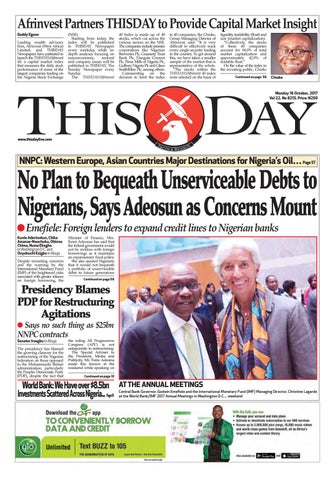
AT THE ANNUAL MEETINGS Central Bank Governor, Godwin Emefiele and the International Monetary Fund (IMF) Managing Director, Christine Lagarde at the World Bank/IMF 2017 Annual Meetings in Washington D.C.... weekend
2
T H I S D AY MONDAY OCTOBER 16, 2017
T H I S D AY MONDAY OCTOBER 16 2017
3
4
T H I S D AY MONDAY OCTOBER 16, 2017
T H I S D AY MONDAY OCTOBER 16 2017
5
6
T H I S D AY MONDAY OCTOBER 16, 2017
T H I S D AY MONDAY OCTOBER 16 2017
7
8
T H I S D AY MONDAY OCTOBER 16, 2017
T H I S D AY MONDAY OCTOBER 16 2017
9
MONDAY, ;˜ ͺͿ ˾ T H I S D AY
10
PAGE TEN
NGF Consultant, Melrose to Challenge Forfeiture Order on Paris Club Fees Uncovers discrepancies in debt deductions Tobi Soniyi One of the consultants engaged by the Nigeria Governors’ Forum (NGF) to verify and reconcile the data generated in respect of the over-deductions on states and local government accounts on the London and Paris Club debts for the period 1995-2002, Melrose General Services Limited has accused the Economic and Financial Crimes Commission (EFCC) of obstruction and has vowed to stop the attempt by the anti-graft agency to get a forfeiture order on its consulting fees for the services rendered to the NGF. Melrose has also revealed that there were inconsistencies in the data generated in respect of over-deductions on states and local government accounts on the London and Paris Club debts. EFCC last Friday had obtained a temporary forfeiture order from the Federal High Court in Lagos for a total of N1,442,384,857.84 found in the bank accounts of three firms, which it claimed had impersonated the consultants engaged by the NGF to analyse the Paris/London Club loan refunds due to the states. The EFCC alleged that the defendants obtained N4.3 billion from the NGF by making false claims. Listed as defendants in an ex parte application taken before the court were Melrose, WASP Networks Limited and Thebe Wellness Services. The firms were accused of impersonating a consortium of consulting firms engaged by the governors’ forum for the “verification, reconciliation and recovery of over-deductions on Paris and London Club loans
on the accounts of states and local governments between 1995 and 2002”. The EFCC said the original firms engaged by the governors’ forum were GSCL Consulting and Bizplus Consulting Services Limited. An investigator with the EFCC, Usman Zakari, alleged that the managing partner of the first defendant, Melrose, Robert Mbonu, made a false representation to the NGF, causing the forum to pay N3.5 billion to his company’s company on December 14, 2016. Zakari said the money was credited into the Access Bank account of Melrose, adding that the respondents dissipated and laundered about N2.3 billion out of the money between December 15, 2016, and January 20, 2017, leaving a balance of N1.2 billion. Counsel for the EFCC, Ekene Iheanacho, told Justice Cecilia Mojisola Olatoregun of the Federal High Court that it would best serve the interest of justice for the respondents to be ordered to forfeit the N1.4 billion temporarily to prevent them from dissipating same. The judge granted the application and ordered the EFCC to publish the order in a national daily. She gave anyone interested in the funds 14 days to appear before her to show cause why the funds should not be forfeited permanently. But Melrose in a statement yesterday informed THISDAY that in certain instances the amounts to be refunded were overstated to the tune of $30 million. The firm said it was merely carrying out a professional duty
for its client, the NGF. Melrose said it had briefed its lawyers to file an appropriate response to the action instituted by the EFCC. The company said: “This matter has been handed over to our lawyers, and we will not jeopardise the process by making the details of our defence public at this stage. “We wish to inform all our partners, clients, stakeholders and well wishers that this matter is now in the courts and will be effectively dealt with.” The company’s spokesman, Christabel Omonemu who spoke to THISDAY explained that in the course of its work, which took several months, the firm made some observations relating to some inconsistencies in the modelling and computation used by the consultants to the states in arriving at the un-reconciled balances. He said the firm had undertaken an extensive review of the data from the states based on data generated by the states’ consultants. Omonemu said: “Prior to the initial payment, we submitted a report of our findings, which was accepted by our client (the NGF), and had just began mobilising our team of accountants to undertake a physical verification of the actual data from their various sources in the states, when we were stopped and prevented from doing so by the actions of the EFCC. “In terms of the actual exercise, our preliminary findings have revealed instances where the excess amounts to be refunded to some states were not precise, but open
and unreconciled figures, and in certain instances, the amounts were either overstated to the tune of up to $30 million, or under-stated in one case. “Knowing that the initial payment to states was for only 25 per cent of the total, and the states badly needed the funds to pay the backlog of salaries, pensions and other arrears, we, in good judgment decided that the issues of over payments and under payments will be resolved and reconciled with the states in question during the later stages of the exercise,” he stated. The company accused the EFCC of making deliberate efforts to tarnish its image and the reputation of its highly regarded professionals who are also former bankers. He said if the commission had been diligent, it would have discovered that Melrose was duly engaged by the NGF to use its expertise in reconciling payments made by the various states in respect of multilateral loans and debt repayments. Omonemu said investigation into the matter started in January 2017 and that the company has been subjected to unwarranted publicity and untold harassment while carrying out its legitimate duty. He also explained that the company’s account has been frozen since February this year, as the EFCC placed a Post-NoDebit (PND) on the account. According to him, the company has kept quiet all this while to allow EFCC carry out its investigation. He said: “Having waited for over eight months with no word from EFCC, we deemed
it necessary to make a demand on our accounts, from our bankers – Access Bank. “We suspect this might have prompted the rather rushed forfeiture order made after eight months of placing a Post-No-Debit (PND) on our corporate accounts. “We are a highly reputable firm of financial and risk management professionals. Some of the services we render include bad loan recoveries on behalf of banks, and on the other hand, we undertake reconciliation mandates from clients who may have been overcharged by their bankers for loans granted and lead the process of such negotiations.” He said the mandate received from the NGF was within the company’s purview and a terrain it was familiar with. “Our letter of award and terms of reference was very clear – to verify and reconcile the data generated in respect of the over-deductions on states and local government accounts on the London and Paris Club debts for the period 1995-2002. “Our fees were negotiated as a percentage of recoveries made, and the job was awarded on a ‘no-cure no-pay’, i.e. on a strictly performance basis,” he added. He said EFCC’s activities had caused reputational damage and grounded some of the company’s operations. “We wonder why the EFCC will go to such lengths just to embarrass and tarnish the image and reputation of some highly regarded professionals who are also former bankers. “We are not aware of the exact details released by EFCC,
and the court order filed at this time. But we are sure that a responsible government agency saddled with the responsibility to fight corruption and financial crimes will have done their checks and investigation properly before making any false statements to the public. “Our clients have also since released statements on the confirmed legitimacy of our appointments as consultants for this exercise and our performance,” he explained. When news first broke that EFCC was investigating its contractors, NGF had issued a statement confirming that Melrose was one of the consultants engaged and documented by it to facilitate the recovery and disbursement of the Paris Club refunds, saying the consultant was also paid an amount commensurate with the services it provided, among other numerous consultants that were involved in the process. The NGF also maintained its earlier position that it had done nothing illegal as far as the disbursement of the Paris Club refunds to states and the consultants were concerned, adding that the forum got all the necessary approvals to act in the manner it did. The statement signed by its Head, Media and Public Affairs, Mr. Abdulrazque B. Barkindo said it was not in the NGF’s purview to determine how Melrose or other consultants disbursed or utilised the consultancy fees paid to them. The forum had advised EFCC not to drag it into how its suppliers, lawyers, contractors and consultants spent their legitimate incomes and revenues.
Czechoslovakia which refused to restructure and today are no more on the world map. Dr. Ilechukwu, on his part, canvassed for the restructuring of the country along regional lines, saying: “The six regional structure that seemed to have gained reasonable mileage among a large segment of our population should be constitutionalised.” He added: “I will support the call for a six regional arrangement with some minor readjustments. The goal of restructuring is political stability and economic development and it devolves certain responsibilities from the central government limiting its area of influence to such issues as fiscal policies, military/defence, foreign policy, immigration and national elections. “This will make the federating units the main drivers of our economy and catalysts of national development and transformation. Nigerians are today crying and pointing to restructuring because in it lies their comfort and security.” Other discussants were a former member of the House of Representatives, Hon. Nkoyo Toyo and the Director General, Institute for National Transformation, Prof. Vincent Anigbogu. The presidency yesterday also denied reports that $25 billion in oil contracts were awarded by the Nigerian National Petroleum Corporation (NNPC). The statement by the presidency was yet another response to a memo by the Minister of State for Petroleum Resources, Dr. Ibe Kachikwu to the president in which he accused the Group Managing Director of the Nigerian National
Petroleum Corporation (NNPC) of awarding contracts valued at $25 billion without recourse to the corporation’s board. Kachikwu has since denied alleging a contract scandal or corruption, maintaining that he only complained about the absence of governance in contract awards in NNPC. Speaking on the issue yesterday, the vice-president’s spokesman, Laolu Akande said a closer look at each of the reported projects showed that none of them was a procurement contract. “What is more important is that when you look diligently at the referenced projects/ transactions one by one, you will see, as NNPC has shown, that none of them was actually a procurement contract,” Akande said while speaking to reporters in Abuja. “When I tweeted on Thursday morning last week, I had indicated that the vice president, while acting as president approved the joint venture financing arrangements. “But for some curious reasons, a few media reports used that tweet to report that I said the then acting president approved N640 billion worth of oil contracts. Such reporting is both false and misleading. “Take both the crude term contract and the direct sale, direct purchase (DSDP) agreements for instance, these are not procurement contracts involving the expenditure of public funds. “Both transactions are simply a shortlisting process, in which prospective off-takers of crude oil and suppliers of petroleum products are selected under agreed terms, and in accordance with due process,” he said.
Akande said attaching monetary values to the said transactions was arbitrary, adding that “whenever there is a monetary value on any consignment of crude oil lifted in this country by any firm, the proceeds go directly to the federation account and not to any company”. “In fact, the Buhari administration in the implementation of the TSA has closed down multiple NNPC accounts in order to promote transparency and probity,” he added.
PRESIDENCY BLAMES PDP FOR RESTRUCTURING AGITATIONS the theme, “Disintegration or Restructuring,” at the 8th Annual Lecture series of a civil society group, The Change We Need Nigeria Initiative, held in Abuja. But he was faulted by the Abia State governor, Dr. Okezie Ikpeazu, spokesman of the Yoruba socio-cultural group, Afenifere, Yinka Odumakin and the lead discussant at the lecture series, Dr. Cosmas Ilechukwu who all protested the labeling of proponents of restructuring as opponents of the government. Adesina, who said restructuring has always been part of Nigeria’s political and historical evolution, noted that the recent spate of agitations from various quarters were being instigated by the opposition. In particular, he blamed the opposition PDP for prompting the calls for restructuring, saying: “I begin to be suspicious at times that this call for restructuring is another form of opposition politics. “When you find people who had been in power for 16 years are now the champions of restructuring, so restructuring has become another form of opposition.” The federal government, according to him, was not opposed to the restructuring of the country, but will not allow anything that will lead to its disintegration, as the Buhari administration will do everything possible to ensure that Nigeria remains one united people and nation. “This government is not antagonistic towards restructuring but the government will not brook any form of restructuring that would destabilise the country,” he said, adding that
the principle of power devolution contained in the APC manifesto was a form of restructuring. He said: “Don’t forget that the All Progressives Congress government has set up a committee to aggregate views on what restructuring actually is and that committee is moving around the country. If it did not believe in restructuring, why waste time on it? “And the president himself has said there are genuine grievances in different parts of the country, which can be discussed. But it does not mean that the country must disintegrate because of the genuine grievances that we have.” Ikpeazu, however, countered Adesina’s position by saying that it was not true to say that restructuring was being promoted by the opposition. Represented by Hon. Godwin Adindu, the governor said restructuring is pertinent to the future of the country, as there is no issue that deserves more mentioning now than the restructuring of Nigeria. He said: “Uncertainty and hopelessness have pervaded Nigeria’s political landscape in recent times, making it necessary for all the ethnic nationalities to come together to renegotiate the future of the country,” adding that issues of power devolution to the states, fiscal federalism, state policing and regional economic diversification should be on the front burner. He, however, condemned and denounced those calling for the disintegration of Nigeria through hate speeches, by bearing arms and ethnic strife. He said all hands must be on deck to ensure an indivisible entity through self-sacrifice and
patriotism. Odumakin also disagreed with Adesina, arguing that there have always been calls for restructuring since the forceful amalgamation of the country in 1914, stressing that the unity of Nigeria has always being negotiated. “So to say that the unity of Nigeria is not negotiable is a fallacy,” he said. He accused the APC-led government of insincerity on the issue of restructuring, stressing that the party boycotted the 2014 National Conference contrary to the “misinformation” propagated by the president’s Senior Special Assistant, Media and Publicity Mallam Garba Shehu recently. Odumakin advised that those who speak on behalf of government or the presidency to acquaint themselves with the facts before they speak. “The rise of the nationalist movement that agitated for Nigeria’s independence and all the constitutional conferences that led to independence were nothing but negotiations. There were major milestones in these negotiations. “It is therefore my consideration that the whole idea of non-negotiability of Nigeria’s unity only developed on the strength of keeping the rent from oil from the Niger Delta and proceeds from VAT generated by Lagos. It has nothing to do with the love of the union beyond reaping without sowing,” he said. Odumakin added that the country has the option of restructuring or disintegrating, warning that if the country failed to restructure now, it may end up being defunct like the former Soviet Union, Yugoslavia,
Continued on page 56
TOP GAINERS CHAMPBREW DIAMONDBANK NEM REDSTAR INTERBREW TOP LOSERS CCNN UNIPRESS FORTEOIL
NGN NGN 0.24 2.66 0.09 1.05 0.07 1.37 0.26 5.46 1.99 41.89 NGN NGN 0.50 9.68 0.11 2.22 2.00 48.00 FIRST ALUM 0.02 0.50 UNITY BANK 0.02 0.52 HPE Nestle Nig Plc ₦1,240.50 Volume: 159.613 million shares Value: N2.242 billion Deals: 3,243 As at Friday 13/10/17 See details on Page 33
% 9.9 8.5 5.3 5.0 4.9 % 4.9 4.7 4.0 3.8 3.7
T H I S D AY MONDAY OCTOBER 16 2017
11
12
T H I S D AY MONDAY OCTOBER 16, 2017
T H I S D AY MONDAY OCTOBER 16 2017
13
14
T H I S D AY Ëž Ëœ ÍŻÍ´Ëœ Í°ÍŽÍŻÍľ
COMMENT
Editor, Editorial Page PETER ISHAKA Email peter.ishaka@thisdaylive.com
MAXIMISING NIGERIA’S SHIPPING POTENTIAL
John Odafe writes that even with its shortcoming, NIMASA is gradually revitalising the maritime sector of the economy
W
hen it was built, the builders boasted, it was the safest ship in the world. ‘Unsinkable’ ran the headlines of 1912. But in a haste to make New York on time and an over-reliance on nature’s friendliness, the Titanic, steaming at almost full speed, ran into an iceberg that put a pin to its claims as ‘unsinkable.’ The Titanic went down the ocean floor on its maiden voyage on April 14, 1912. And that singular incident perhaps, more than ever in the modern world, brought to bear the imperativeness of maritime safety. The sinking got a global maritime attention. The U.S Navy started patrolling the North Atlantic to search and broadcast warnings on ice bergs. By 1913, the Revenue Cutter Service, which preceded the U.S Coast Guard, started monitoring icebergs and issuing out warnings from February to July annually. In the same year, the first Safety of Life at Sea (SOLAS) Convention emerged to improved safety at sea. The Titanic’s sink quenched not only the lives of those that died but signalled a threat to the economy at that time. While shipping had always been a source of curiosity, commerce and leisure, its relevance has continued to grow bigger in the modern world. And Nigeria, as Africa’s biggest economy and with about 850km of coastline and over 3, 000km of inland waterways, shipping has huge potential. While this is being tapped, the fact is that Nigerians are yet to maximise the potential. Recently applauded for remitting N9.975bn and $46.025 million in 2016 as against N4.955bn remitted in 2015, to the federal purse, the Nigerian Maritime Administration and Safety Agency (NIMASA) is set to revitalise the maritime sector and eliminate substandard shipping across the country. The agency disclosed its seriousness to tackle non-compliance of maritime safety and security standards in the country at a recent harmonised NIMASA stakeholders’ interactive session held in Lagos. Part of the renewed strategies includes the automation of the processes of the Nigerian Ship Registration Office which would be accessed by ship owners and prospective owners on an online and real-time basis. Also, given that the country’s marine environment is of concern to the agency, it has stated that it has put the necessary apparatus in place to ensure that Nigeria’s maritime space is kept clean in accordance with international conventions. And relating to its levies, NIMASA proclaimed its collection was being carried out in line of best practices and sequel to international conventions. The agency also said it will ensure all policy tests would be tested and re-tested to ensure conforming. “There is an urgent need for NIMASA to engage relevant agencies with a view to initiating measures designed to develop passenger, containerised, wet and dry cargo transportation in Nigeria’s internal waterways,� NIMASA said in the communique it issued after the session. “The calculation of NIMASA’s three per cent levy on all wet cargoes shall be based on freight tonne, which is cubic measurement and in line with the provisions of the MARPOL Convention, all tankers operating in Nigerian waters are required to have in place adequate and sufficient insurance cover to minimise the risk of losses sequel to oil spills and tanker accidents.� Already, it is an open secret that the country is just coming out of a global reputation of having internal insecurity including activities of sea pirates mitigated. But to NIMASA, trying to not only to rejuvenate the country’s maritime economy but also to spur it on further, is not a small feat. However, under the current leadership of Dr. Dakuku Peterside as Director General, the agency is making giant strides. At the third confer-
RECOGNISING THE IMPORTANCE OF MARITIME INDUSTRY TO THE ACTUALISATION OF THE COUNTRY’S GROWTH GOALS, THE NUMBER FOUR CITIZEN REITERATED ON THE HUGE RESPONSIBILITY PLACED ON NIMASA
ence of the Association of Africa Maritime Administrations (AAMA) which held in Abuja in April 2017, Dr Peterside was unanimously elected first President of AAMA. This elevation surely brings more responsibility on Nigeria to set a standard on the continent. And Peterside is ready for the show. That NIMASA aims to redesign the maritime landscape of Nigeria is ambitious, given its apparent shortage of manpower. Currently, Nigeria needs 50, 000 seafarers in the maritime industry, disclosed the Speaker of the Federal House of Representatives, Hon. Yakubu Dogara, recently. But the nation only boasted of about 3, 000 seafarers as at 2009. He was quoting figures obtained from NIMASA. The speaker was speaking at the public hearing of two bills concerning the maritime industry – ‘A Bill For An Act To Establish The Nigeria Maritime University, Okerenkoko In Delta State And For Other Related Matters (HB. 1032)’ and ‘A Bill For An Act To Establish The Maritime University, Oron Akwa Ibom State And To Make Comprehensive Provisions For Its Management And Administration And Other Related Matters.’ Recognising the importance of maritime industry to the actualisation of the country’s growth goals, the number four citizen reiterated on the huge responsibility placed on NIMASA. “Maritime Sector is key in achieving the federal government’s Economic Recovery and Growth Plan that was launched in March this year 2017,� Dogara said at the hearing. “Availability of requisite trained manpower in sufficient numbers is key to the growth and sustenance of Nigeria’s maritime sector.� He also harped on the fact that despite the enactment of the Cabotage Act in 2003 to reserve crewing of nationals in domestic shipping, both Coastal and Inland. Dogara, however, lamented the dearth of manpower with the required skills and training and deplored the situation whereby Nigeria couldn’t train manpower in the maritime despite its place of pride in the global maritime space. To ensure the maritime industry is effectively covered for safety, trained manpower is a sine qua non. But with this deficit, NIMASA is in a bind. However, the agency, working with vision, initiated the Nigeria Seafarers Development Programme (NSDP). And Nigerians enlisted in this programme were sent to study maritime-related courses such as Nautical Science, Naval Architecture and Marine Engineering in foreign universities. The dividends are being tapped but it is still not enough. Many of these trainings should and can be domesticated. And this is the crux of these two bills at the National Assembly. The Nigeria Maritime University which is to be located in Okerenkoko Warri, Delta State, will have facilities to provide structured training as provided by the International Maritime Organisation (IMOs) under STCW Conventions. Then, there is the bill that seeks to upgrade the Maritime Academy of Nigeria, Oron, Akwa Ibom State, to a degree-awarding institution. Aside just awarding degrees, the bill will seek to upgrade facilities and teaching aids in line with IMOs STCW Convention (The International Convention on Standards of Training, Certification and Watchkeeping for Seafarers) 1978. This agreement which was amended in 1995 and 2010 sets qualification standards for Masters, Officers and Watch Personnel on seagoing merchant ships. Speaking at the public hearing, Dogara said that global maritime economy has become more knowledge driven. And Nigerians should produce local high level manpower to fill the gap.
Odafe wrote from Lagos
HIDING IN PLAIN SIGHT
The call for the suspension of Ibe Kachikwu, Minister of State for Petroleum Resources, is mischievous, argues Tobias Iyoyo
T
he recent call by two eminent senators of the Federal Republic, Tayo Allasadura and Shehu Sani that President Muhammadu Buhari should suspend from office the Hon. Minister of State, Petroleum Resources, Dr. Emmanuel Ibe Kachikwu and the GMD of the Nigerian National Petroleum Corporation, Dr. Maikanti Baru, to pave way for investigation of both men is a strange call. The call that Ibe Kachikwu should be suspended is curious and smacks of injustice masquerading as justice, fairness and equity. In the eyes of all fair-minded Nigerians, this is a naked attempt to sacrifice Kachikwu in order to appease the very cabal he has accused of carrying out messy deals in the nation’s oil company with impunity. For the record, Ibe Kachikwu and Maikanti Baru are not feuding over improper sharing of loot. Rather, one of them, Kachikwu, who is a superior officer to Baru, has written a memo to the president alleging that the junior officer over whom he should have oversight responsibility has been by-passing him and refusing to be subordinated to him. Additionally, that Baru has been performing his duties without adhering to due process. The memo written by Kachikwu became public knowledge only because it was unfortunately leaked. If it had not, it would have been a normal administrative step taken by a responsible superior officer to another higher officer for
adjudicatory redress. In order places where there is a sense of true fairness, justice and good conscience, Ibe Kachikwu would be highly commended for his high sense of responsibility and insistence that the right things be done according to law and regulations. Here in our country where, unfortunately, anything goes, calls are being made for his suspension. Let us get things clear: what the nation has on its hands now is not a case of ‘two fighting.’ Far from it. It is a case of one party alleging that the other party has committed a wrong and that that party should be stopped on his tracks before he does grievous damage to the entire polity. To therefore equate them and recommend an equal disciplinary action is to turn the face of justice upside down. That call for Ibe Kachikwu’s suspension is therefore not a call for justice but one that injustice be carried out against a public officer who has had the courage of his conviction to voice the uncomfortable truth that some huge wrongs have been done and that a higher authority who has the power and authority to do something about it should do that thing quickly to prevent further committal of such wrongs. His only offence is that in calling for a redress, he has unwittingly questioned the reputation of some. Anchoring his own call for Kachikwu’s suspension, Allasaadura said the argument that there is also an allegation that when Kachikwu was GMD and Minister, he had approved
contracts worth $25 billion without the approval of the Board. We are mixing things up here. The senator is trying to give a dog a bad name in order to hang it for the simple reason that when Kachikwu was operating, there was no board yet constituted for the NNPC which is why he was taking contracts above the management threshold to Mr. President and FEC for approval. This is not to be confused with Baru’s times where a board has duly been put in place with the chair as the Honourable Minister of State and he has chosen to sideline this duly constituted board. Baru’s decision to sideline the board is deliberate, provocative and mischievous for even if the board has no power under the law to approve contracts and other important administrative issues, what stops him for recognising and according the board its respect if Baru is confident that he is living above board? When a demand is made that certain officers who are facing allegations of wrong doing be suspended from office pending the conclusion of investigation before they are either exonerated or found culpable and relieved of their duties, it is in order that they do not use their influence and access to vital information to jeopardise investigation. Here, the situation we are dealing with is that Ibe Kachikwu is not in any position to jeopardise any investigation; it is Baru who is and is the one who should rightly be suspended if we to get to the bottom of Kachikwu’s grave
allegations against him. This is not a case of trying to balance things up in order to please all sides. This is not a case of handling the North-South divide in our country nor is it a case of the Christian-Muslim divide. Ibe Kachikwu should not be sacrificed for having the courage to raise issues that have embarrassed the president and the cabal that is holding this nation by the jugular. Supporting the two senators’ call will amount to visiting a grave injustice against Ibe Kachikwu. Knowing our country for the way it is run, one is very sure that if Ibe Kachikwu is suspended alongside Baru, it will just be an excuse for the cabal to ease him out of the way and give them a convenient excuse to look for a more pliant fellow who will do their bidding in the very sensitive Ministry of Petroleum Resources. Even in the event that the two are sacked from their positions, Ibe Kachikwu will be rubbished while Baru will be told to bid his time and wait for the storm to die after which he is ushered into another even more lucrative office for his good service to the cabal. We have become used to this type of gimmick and will therefore not sit down quietly and pretend that the call for Kachikwu’ssuspension is indeed in good faith. It is not. It is in very bad faith that will reward this first class technocrat with evil for agreeing to serve his fatherland. Iyoyo wrote from Port Harcourt
15
T H I S D AY Ëž Ëœ ÍŻÍ´Ëœ Í°ÍŽÍŻÍľ
EDITORIAL ABATTOIRS AND PUBLIC HEALTH Health authorities could do more to improve the state of abattoirs
T
stink. In many of these states, some butchers are still killing cows and preparing their meat on the wet, dirty, muddy oor. In many of these abattoirs, the vicinity is littered with heaps of waste materials. In fact, in most cases, it is almost as if the abattoir is synonymous with waste.
he ďŹ ndings by different studies keep pointing to one fact: the increasing health hazards in consuming the beef prepared in many parts of the country. This is because most abattoirs in the affected areas are in an unacceptable condition, with the beef most often left in open spaces and thus attracting all kinds of contamination. This phenomenon, as we have noted several times on this page, poses a clear and present danger to the health of Nigerians.
On several occasions, we have had course to express serious concerns over the manner of producing, handling and transporting beef from abattoirs to the different points of sale because they are inimical to the health of the ďŹ nal consumers. And there appears to be no credible step by the authorities to arrest the problem. This may also explain why members of the Nigerian business and political elite, as studies have shown, prefer imported, frozen poultry products, even when no one can guarantee the safety of these THE GENERAL PUBLIC AS imported products. WELL AS THE CRITICAL Against the STAKEHOLDERS IN THE background that BUSINESS SHOULD statistics indicate that Nigerians BE ADEQUATELY ENLIGHTENED ON HOW TO consume over 300 million kilogrammes HANDLE BEEF of beef a year, the authorities should be serious by establishing modern and hygienic slaughter houses in every state of the federation. The health of every citizen should concern every responsible and responsive government, especially when it comes to what they daily consume. Unfortunately, this is not the case in many parts of the country, including the Federal Capital Territory (FCT), Abuja. Except Lagos and few other states, which have made remarkable efforts towards ensuring a healthy and hygienic abattoir condition by upgrading some of their abattoirs over the years to suit their laws, in several states across the country, such facilities
Letters to the Editor
Meanwhile, after these animals are slaughtered, the fur is burnt off in the open, using ďŹ rewood and lorry tyres, each producing smoke continuously on daily basis. These tyres constitute the greater part of the fuel. Apart from the hazard it poses to the health of consumers, the practice also produces lots of smoke that pollute the area. The environmental implication of such practice is better imagined. In all, the facilities of these abattoirs are generally being operated under unhygienic conditions, mainly due to lack of certain basic amenities.
W
T H I S DAY
EDITOR DEPUTY EDITORS ˜ MANAGING DIRECTOR DEPUTY MANAGING DIRECTOR CHAIRMAN EDITORIAL BOARD
EDITOR NATION’S CAPITAL
T H I S DAY N E W S PA P E R S L I M I T E D
EDITOR-IN-CHIEF/CHAIRMAN GROUP EXECUTIVE DIRECTORS ˜ ˜
˜ GROUP FINANCE DIRECTOR DIVISIONAL DIRECTORS ˜ ˜ DEPUTY DIVISIONAL DIRECTOR
SNR. ASSOCIATE DIRECTOR ASSOCIATE DIRECTORS ˜ CONTROLLERS ˜ ˜
GENERAL MANAGER
GROUP HEAD DIRECTOR, PRINTING PRODUCTION TO SEND EMAIL: ďŹ rst name.surname@thisdaylive.com
e therefore reinstate our position that the manner in which animal carcasses are handled during slaughter, loading and transportation from the abattoir to various points of sale must change. Indeed, almost as a matter of routine, majority of the butchers convey their meat on bicycles, motorbikes, motorised tricycles and sometimes on some rickety meat vans, under unhealthy conditions. The beef is simply packed and transported without regard to safety measures. It may not be obvious but there are serious health consequences for the consumers of such exposed beef. Although medical experts differ somewhat as to the exact causes of the cancer scourge in our country, there seem to be some agreement that the major cause is the habit of the people. Increased awareness campaigns, improvements in public health are all likely to lead to a decrease in the incidence of this killer disease. We therefore feel the general public as well as the critical stakeholders in the business should be adequately enlightened on how to handle beef. This should be the responsibility of the health and environment authorities at both the federal and state levels. By so doing, we will be able to save our people from cheap deaths.
TO OUR READERS Letters in response to speciďŹ c publications in THISDAY should be brief (150-200 words) and straight to the point. Interested readers may send such letters along with their contact details to opinion@thisdaylive.com. We also welcome comments and opinions on topical local, national and international issues provided they are well-written and should also not be longer than (9501000 words). They should be sent to opinion@thisdaylive.com along with the email address and phone numbers of the writer.
2023: WILL IGBO PLAY THE REAL POLITICS?
A
s we gradually move towards 2019 and 2023, I am beginning to get worried whether Igbo is putting their act together to take a shot at the Presidency in 2023 when the North would have completed their eight years. I am worried because I do not know whether we understand the dynamics of the politics we must play to position an Igbo for the exalted office in the land. Are we thinking or considering the political party that will bring us close to the Presidency in 2023? Is it PDP, APGA or APC? If it is PDP are we playing the real politics? If it is APGA what are we doing to take APGA across to those who will vote for our candidate? If it is APC what are the plans to key in to the ruling party? Of all these three parties mentioned above which one presents the shortest distance to the Presidency in 2023? Now let me analyse these three parties, their stand, capacity, spread and leadership. APGA rules only one state out of 36 states in Nigeria. It is only domiciled in Anambra State and has not moved beyond Anambra State to reach out to other Nigerians. For an Igbo to be elected to the exalted office other Nigerians especially HausaFulani, Yoruba and others must vote for him. Without sounding immodest Anambra State occupies a unique position in Igbo land. Anambra is the engine room of Igboland politics and they
lead the way. Now if the state that will lead others to the main stream is saddled with APGA, where is the plan to work with others? If you ask me I will suggest that we do the needful by joining other Nigerians to play the real politics. APGA cannot lead Igbo anywhere in the politics of Nigeria. If Yoruba can sacrifice ACN to form an alliance with other Nigerians to give birth to APC, Igbo needs to think again. What of PDP? Now, this party is still being pulled down by internal contradictions, credibility crisis and hangover of 16 years of massive looting of Nigeria. The PDP may not be the option for Igbo because for 16 years the party was in power, the South East was officially and systematically neglected. Besides PDP just zoned the presidency to the North and assuming their candidate wins in 2019 what is the guarantee that the winner will not seek a second term in 2023? Therefore, I do not think PDP is the shortest distance for Igbo Presidency or the way to go. Now what of APC? To all intents and purposes I think APC provides the best platform and the shortest distance for Igbo presidency in 2023, and Igbo must take this very seriously. To do this, Igbo must look at this big picture. Igbo must consider everything. Igbo must sacrifice APGA for the big business in 2023. Igbo must swallow this bitter pill in order to be politically relevant in Nigeria again. Pride, arrogance, political stupidity,
bloated self-worth, persecution complex, selfish sense of superiority, leadership complex, etc., must be jettisoned for other Nigerians to trust us. We must also prove to other Nigerians that we love them and Nigeria. Trust is the key factor. Let us stop the hate speech and ethnic bigotry and work for a new Nigeria of our dream. Igbo must stop the Biafra project because a lot is at stake. It is counterproductive and provocative. If we are sensible and I think we are, we should be faced with the choice of the best option for Igbo in Nigeria. The best option is that Nigeria offers the biggest market for Igbo in Nigeria. We must rise now to remove the huddles and take the hard decisions. We must not give those who make us to look little the oxygen we breathe. Let them suffocate for us to make progress. It always seems impossible until the deed is done. Let us selectively and productively deploy committed men and women in Igboland to work with other Nigerians to create a new Nigeria. We need war of sense now and not war of words and bullets. Someone once told me that if a man stands in a place for so long without making a move, lizard will climb him thinking it is a tree. We have made political mistakes for a long time and mistakes are allowed. After all he who makes no mistakes makes no progress. This is the time for Igbo to move on in Nigeria. Joe Igbokwe, Lagos
16
T H I S D AY MONDAY OCTOBER 16, 2017
17
T H I S D AY ˾ MONDAY, OCTOMBER 16, 2017
Group Politics Editor Tobi Soniyi Email tobi.soniyi@thisdaylive.com 08033146139 SMS ONLY
POLITICS
M O N D AY D I S C O U R S E
Why Buhari Must Not Allow Tensions to Escalate For President Muhammadu Buhari to deliver on his campaigns promises, he needs a conducive environment and the responsibility to make this happens rests squarely on him, writes Tobi Soniyi No Excuses for Failure
W
hen we call on President Muhammadu Buhari to take the lead by showing leadership in resolving crises in the country, his supporters take offence and urge him on to continue to escalate the tension. Well, what those edging him on don’t realise is that the president needs a peaceful atmosphere to generate the resources he needs to actualise his campaign promises. For instance, when Nigeria Delta militants blow up pipelines and other facilities, oil production nose dives. The ill-informed may think that the loss is that of the nation. Yes, but it will also hamper the president’s power to deliver on his promises. And if he fails to deliver, Nigerians will not accept the excuses that he fails because the militants blew up pipelines. They will assume, rightly in our views, that the president is incompetent and also lacks the capacity to deliver. This is so because, all over the world, it is the responsibility of those in government to solve problems and challenges. That is why they come out to seek election. After winning they select those who can help them deliver. Anyone who lacks the capacity to bring about amicable resolution of crises has not business aspiring to leadership position because when the challenges arise, he will be found wanting. It is not acceptable as the president had done and continue to do: blaming past regimes for his inability to deliver. When we thought we have had enough of the blame game, the president again alluded to it in his independence day broadcast when he said: “However, in spite of oil prices being an average of $100 per barrel and about 2.1m barrels a day, that great piece of luck was squandered and the country’s social and physical infrastructure neglected. We were left with no savings and huge infrastructure deficit.” Nigerians knew things were bad and knew that the ugly situation was the handiwork of the Peoples Democratic Party and have chosen the president and his party, the All Progressives Congress to change the course of Nigerian history for good. Reminding them of this at every opportunity is bad politics. Making excuses by blaming others is an abdication of that weighty responsibility placed in the hands of the president and his party. The president will not be allowed to say I fail because the militants blew up pipelines or because the Indeginous People of Biara (IPOB) was agitating for secession or that people were calling for restructuring. No. It is the responsibility of the president to manage these crises and others that may come up in the course of his tenure. That is why he must manage them in a way that will allow him to have the peaceful atmosphere he desires to deliver in his electoral promises. The president and his aides must drop the impression that they are doing the nation a favour by resolving these crises. In reality, they are merely delivering on their mandate. That is what the president was elected to do. That is why he has the nation’s resources at his disposal.
Belated, But Welcomed Instead of castigating Igbo leaders as he did in his October 1st broadcast, when he said, “I am very disappointed that responsible leaders of these communities do not want their hot-headed youths what the country went through”, the proper step to take was to meet with them and seek their help to douse the tension there.
Buhari
His meeting last week with leaders of the South-east region led by the Deputy Senate President Ike Ekweremadu, although a little late, is a big relief and will go a long way in dousing tension. If it is backed up with genuine and concrete steps, may change the narrative in the south-east. Apart from promising to ensure completion of on going projects in the zone and the president also said that new one would be initiated. He also promised the leaders, comprising governors and ministers from the region, the
If the president delivers on his own promises, he can also insist the southeast leaders keep to their promises. Together, they can change the narratives in the region
President of Ohaneze, Chief Nnia Nwodo and representatives from the National Assembly, that he would visit states in the zone soon. “I want to assure you that I came into government with a clear conscience and I will also leave with a clear conscience,’’ he said. That is reassuring. The president also said that the region would benefit more from roads and coastal rail projects, which he said were of critical importance to the economy. He also declared that 2nd Niger Bridge, the East-West Road and the Coastal rail project, are receiving utmost attention from his administration. The president should latch on to the promise made by Nwodo that ``we are ready to work with you. We are determined to work with you. We know you are a decisive leader and we know God will continue to give you the wisdom to govern Nigeria.’’ When asked if he believed the president would keep his promises, Nwodo said: “There is no reason for me to doubt them because this is the first time I have had this interaction with him. I have the feeling that he spoke to us very frankly.”
If the president delivers on his own promises, he can also insist the south-east leaders keep to their promises. Together, they can change the narratives in the region. While it is too early to conclude that we have made substantial progress in resolving the impasse in the south-east, the meeting raises hope of such progress.
Don’t Forget the Niger Delta One of the early challenges that confronted this government was the determination of the militants in the Niger Delta to disrupt oil production. They successfully crippled production. The president’s immediate response which was to send military to the region did not work. In its May 21, 2016, the Financial Times wrote: “Attacks by a new militant group based in the region where more than half of the Nigeria’s oil is produced, have reduced the country’s output to the lowest in more than two decades. “Acts of sabotage by the Niger Delta Avengers has his Nigeria’s output, taking CONT’D ON NEXT PAGE
18
T H I S D AY ˾ MONDAY, OCTOMBER 16, 2017
POLITICS
MONDAY DISCOURSE
W H Y B U H A R I M U S T N OT A L LO W T E N S I O N S T O E S C A L AT E it down from 2.2 m barrels a day to 1.4m, according to Emmanuel Ibe Kachikwu, head of the state-run-oil company. This, alongside other outages in Libya, Venezuela and Canada has added to the upward pressure on oil prices, as well as hitting the west Adrian country’s economy.” However, the situation changed for the better after the Kachikwu and the Vice President adopted dialogue and reached out to leaders in the region who in turn persuaded the militantans to have a changed of heart. Although peace had since returned to the region, the federal government needs to deepen its engagement with the the people in order to sustain the peace. The situation in the region can be likened to an uneasy calm. Unresolved issues that can snowball into crisis and turn back the progress made so far are many. Government should not renege on its promise to allow the people from the region to participate in oil production. There is also a subsisting judgment of a Federal High Court in Asaba, Delta State which awarded the sum of N99 Billion as damages to the people of Gbaramatu communities of Delta State for the invasion of their territories by soldiers. The judge, Ibrahim Buba had ordered the Federal Government to pay the people N99.9 billion damages for gross violation of their rights by the Joint Task Force in Delta State. The task force in May 5th, 2009 descended on the community killing, maiming innocent residents while properties worth millions of naira were equally destroyed. Instead of taking the law into their hands, the community came together and filed a suit at the Federal High Court in Asaba on June 22, 2009. Their lawyer, Mr Larry Selekeowei, SAN filed the suit against the President of the Federal Republic of Nigeria, the Attorney General of the Federation and Major General Sarkin Yarkin Bello (for himself and on behalf of the Joint Task Force in Delta State) as 1st, 2nd and 3rd defendants respectively. After hearing both the plaintiffs and the defendants, Justice Ibrahim Buba held as follows: “That the bombardment of the plaintiffs’ communities in the Gbaramatu Kingdom of Warri South West Local Government Area of Delta by the Defendants resulting in the demolition/destruction of houses, household furniture/wares, boats, canoes, domestic animals and displacement of members of the communities is in violation of section 217 (2) (c) of the 1999 constitution and is therefore unconstitutional. “That the sum of N49 billion is awarded in favour of the plaintiffs as special damages against the defendants jointly severally. “That the sum of N50 billion is also awarded as aggravated and punitive damages against the defendants jointly and severally for the unlawful bombardment and sacking of the plaintiffs’ communities which resulted in wanton destruction of their houses, household furniture and other wares, their domestic animals, canoes, boats, sacred places, artifacts etc and which resulted in total displacement of members of the communities for minimum of three months from 15th May 2009, the effect of which was that members of the communities were living in the swampy mangrove forests in subhuman conditions while others were in a concentration camp and suffered loss of income, disease, and mental torture and the education of thier children of school age was disrupted.” The communities had written to President Muhammadu Buhari for the payment of the judgment debt. But they got no response so far. While Dr Goodluck Jonathan was president, the communities wrote twice to the then Attorney General of the Federation, Mohammed Adoke SAN, asking the Federal Government to comply with the judgment. However, the government neither complied with the judgment nor challenged it on appeal. The government should engage the communities and work out a solution. A return of hostility in the Niger Delta will derail the economic plans of this government. Engage Restructuring Advocates There are obviously ways to defeat the clamour for restructuring. Perhaps the president isn’t aware of this and someone
Ekweremadu
has to tell him. No doubt, the present arrangement is not working and can benefit from some adjustments, nevertheless, if leaders truly commit themselves to treating Nigerians fairly, equitably, and justly agitation for restructuring will reduce. To achieve this, the president must give Nigerians a sense of belonging. We only agree we are one when the Super Eagles or other Nigerian teams are playing football. This has to change. The president must rise above sentiments and treat the Nigerian people as a people. The president should also embrace rule of law. He should rule in accordance with the law. When a court of competent jurisdiction makes an order against the government, it must be obeyed. In this wise, the government should immediately comply with judgments ordering him to release the leader of the Islamic Movement of Nigeria, Ibrahim Zakzaky and the former of National Security Adviser to Goodluck Jonathan as president, Sambo Dasuki. Address the high level of unemployment in the country. It does not appear that government understands and appreciates how bad the unemployment situation is, otherwise, it would have declared an emergency in the sector. The approach adopted by the president isn’t yielding the desire result. The country needs a radical approach to job creation. Tackle insecurity. There is obviously a correlation between unemployment and insecurity. Too many people have no jobs. This poses a challenge to the security of the country. Many unemployed graduates are turning into scammers using the Internet. People are now being kidnapped for as small as one thousand naira!
The government should engage the communities and work out a solution. A return of hostility in the Niger Delta will derail the economic plans of this government
The fight against corruption needs a fresh perspective. The government obviously deserves commendation for blocking loopholes through which money is stolen from the system. However, lack of transparency is undermining confidence in the fight against corruption. As it is today, no agency knows exactly how much had been recovered. Besides, despite the government’s best efforts shady deals are still taking place. It is worrisome that despite reports indicting the police as the most corrupt institution, the leadership has yet to come up with any radical strategy to stop this. Corruption in the police remains rampant. It has even become normal. Corruption in all its ramifications must be fought to a standstill. Lawyers and judges should not be allowed to use rule of law and due process to frustrate the fight against corruption. It also appears that those appointed by the president to fight crimes are themselves aiding or protecting the corrupt. A Lagos based lawyer, Ebun-Olu Adegboruwa recently dramatised this in what he called the All Progressives Congress reversal of fortune. He noted that Senator Isah Misau alleged that there was a massive financial and moral corruption permeating the Nigeria Police Force, including questionable promotions of officers. His allegation was confirmed by the Police Service Commission. The commission had declared that some promotions in the police did not follow due process and thus subject to reversal. Consequently, the Senate set up a committee to investigate allegations of moral and financial corruption in the police. Ordinarily, a government committed to fighting corruption should support the initiative of the Senate. Instead the Attorney-General of the Federation filed criminal charges against Senator Isa Misau, at the Federal Capital Territory High Court, Abuja, for injurious falsehood, forgery, among others. The Inspector-General of Police also filed a suit at the FCT High Court, seeking an injunction to stop the Senate from investigating allegations of corruption against him. Adegboruwa asks the same question agitating the minds of many Nigerians: “So, where are we now, APC and the ruling government? I ask again, where exactly are we now?” That is how not to fight corruption.
Herdsmen, Farmers Clashes Unresolved Although there appears to be a decline in
clashes between farmers and herdsmen, there is no evidence suggesting that the root cause of the clashes have been resolved. Because the federal authorities have yet to device a solution, states have been looking inward enacting laws that are likely to exacerbate the clashes rather than reduce them. An expert in water and disaster management, Dr. Joachim Ezeji, attributed the wave of conflicts between herdsmen and farmers to poor water management practices across the country. He said: ‘’Where economic growth is impacted by rainfall, episodes of droughts and floods have generated waves of migration and statistical spikes in violence within countries’’. According to him, where large inequities prevail, people move from zones of poverty to regions of prosperity which can lead to increased social tensions as is currently the case with herdsmen from the north moving southwards. He attributed the root cause of the conflict to the current water management practices in Nigeria. Ezeji, said: ‘‘In many parts of Nigeria, water management cannot satisfactorily cope even with current climate variability, so that large flood and drought damages occur. “As a first step therefore he suggests that the Federal Ministry of Water Resources (FMWR) and its agencies such as the River Basins, should embrace the incorporation of improved information about current climate variability into water –related management because it would assist adaptation to longerterm climate change impacts.” Obviously, solution to this problem will not come very easy because it will involve a change in lifestyles for the herdsmen. However, government can and should take a bold step to find a solution. First, it should start by educating the people. A farmer should understand that the Fulani man does not necessarily hate him but trying to earn a living. The same explanation should be made to herdsmen. Perhaps, both the farmers and the herdsmen can come out with a workable solution if government facilitate such negotiation. Such efforts will address the problems created by mutual suspicion between the farmers and the herdsmen. There is an urgent need to address and correct the misunderstanding that surrounds these clashes. People are no longer seeing the issue as an economic crisis. That constitutes a danger to the survival of this country. It is a wishful thinking to pretend this problem does not exist or that it will disappear on its own. Experts have suggested the adoption of ranching as the solution. But persuading the herdsmen to change adopt a new lifestyle is requires political will from the government.
Be More Decisive in the North-East Former-President Goodluck Jonathan’s administration was adversely affected by the insurgency in the north-east. While it is not clear the extent to which Boko Haram affected governance under his regime, many agreed that his handling or mishandling of the north-east crisis contributed to his losing the presidential election. The present administration has recorded significant success in the fight against Boko Haram, it is yet to win the war. Buhari has yet to fully secure the country. This is another reason why he can not afford to start another war either in the south-east or south-south. He also needs the support of all the regions to succeed in the north-east. He has already gone half way of his four years tenure and he will need to declare a total victory in the war against the insurgents to win the support of the country. The government should identify the factors making total victory in the region difficult and should address them with all sincerity. Instead of deploying armed forces in the south, the president should deploy them to the north-east to secure the whole of the country once-and-for all. The president should also endeavour to let the country know the exact situation in the region. Overstating the achievements recorded by the armed forces is not helping the situation.
T H I S D AY ˾ MONDAY, OCTOMBER 16, 2017
19
PERSPECTIVE
Options Before Nigeria In discussing issues relating to the Nigerian structure, author Michael Owhoko, calls for primordial sentiments to be put aside, saying as things stand now, objectivity is being overwhelmed by emotions
N
igeria has been through quite a lot in recent times than at any other time in its political history, but at this very moment, aside the almost resolved security challenges facing Nigeria, issues relating to self-determination and restructuring are some of the burning issues that the government of the day is grappling to manage. As it is, close observer will easily say the incumbent leadership of the federal government is not favourably disposed to restructuring, whereas, sentiments have easily been aroused by proponents and opponents of the restructuring debate. Unfortunately, while the civil society and geopolitical interests have been calling for some changes in the Nigerian constitution as a way to perfect and strengthen the union that constitutes Nigeria, the citizenry are not adequately motivated to fully join the clamour either because of lack of clear understanding of the issues at stake or are overwhelmed by economic concerns. First, either for or against restructuring as currently being canvassed, it is obvious that the people of the South and the North are not on the same page. Nigerian must understand that as a multi-ethnic society with diverse cultural dissimilarities, the country qualifies as a sociologically complex society, posing a serious challenge to the country’s continued existence as one united nation. This makes it imperative as a matter of necessity to do the needful and embark on a constitutional amendment that will give birth to a restructured new Nigeria. Secondly, in discussing issues relating to the Nigerian structure, which evidently, is defective, and the sustained clamour for a truly federal constitution, primordial sentiments must be avoided because as things stand, objectivity is being overwhelmed by emotions depending on who is looking at what issues and the side of the divide on which he or she is rooted. The overall consequence of this will be unhelpful to decision-making process, as emphasis may be on sectional rather than national interest, even at the highest level of governance. In reality, the Northern Protectorate, which comprises mainly the Hausa-Fulani people and the Southern Protectorate, made up of the Yoruba, Igbo and the Niger Deltans, are initially district nations with separate cultural peculiarities before they were merged by the British colonial masters strictly for business and administrative purposes in the 1914 amalgamation. Though the motive was not clear, but it is certainly not unconnected with achieving cost efficiency without passing the incidence of the cost of administration to the home country. This was so because the Northern Region was already experiencing budget deficit at the time when the Southern Protectorate had a robust budget with surplus. From the onset, not many Nigerians were happy about the forced marriage. In fact, in one of his reactions to the Nigerian nationhood, the leader of the Northern People’s Congress (NPC), the Sardauna of Sokoto, late Sir Ahmadu Bella once said: “The mistake of 1914 has come to light and I shall like to go no further again.” Likewise, the leader of the Action Group (AG), late Chief Obafemi Awolowo also said: “Nigeria is not a nation. It is a mere geographical expression. There are no Nigerians in the same sense as there are English, Welsh, or French. The word Nigeria is a mere distinctive appellation to distinguish those who live within the boundaries of Nigeria and those who do not.” Chief Awolowo, in his book, The Peoples’ Republic, further confirmed the brittleness of the Nigerian state when he said, “It is incontestable that the British not only made Nigeria, but also hand it to us whole on their
Nnamdi Azikiwe, Ahmadu Bello and Obafemi Awolowo
surrender of power. But the Nigeria, which they handed over to us, had in it the forces of its own disintegration. It is up to contemporary Nigerian leaders to neutralize these forces, preserve the Nigerian inheritance, and make all our people free, forward-looking and prosperous.” The two men were apparently referring to the unhealthy amalgamation of 1914, and from then till now the Nigerian people themselves have not shown signs of willingness to unite, a confirmation that Nigeria is only a British intention and except other viable options are explored, the fragile peace in the country can still snowball into total disintegration because the country is surely on the precipice. The most reliable option available to Nigeria is a federal system of government as practised in the country in the first republic from 1960 till 1966. I say this because the fear of Nigeria’s founding fathers has always been that the colonial masters failed to take into consideration the ethnic and cultural differences which ultimately shape peoples’ perception and decisions, hence as it is today, the allegiance of Nigeria’s founding fathers was to their respective regions, and by extension, current leadership, though surreptitiously. Nigeria purportedly operates a federal system of government today, but the main defect is the absence of the features of that form of government, namely, autonomy of the federating units. This is conspicuously missing as evident from the dependency structure between the states and the centre. In a truly federal system, certain characteristics pertaining to the federating units are present, and some of these include state-owned constitution, regional police, coat of arm, and so on. This level of autonomy allows the units to adopt peculiar and independent style of administration to address their specific
The bane of Nigeria’s problem is the transition from federal system to the unitary system as perpetrated by the military during their illegal incursions into politic
needs incidental to their culture, values and heritage. Then there is also something very vital that true federalism guarantees and that is fiscal federalism. This defines and provides the framework of financial relationship between the centre (federal government) and the rest of the states. Chief among what proponents of restructuring are actually calling for and which are enumerated in my book: Nigeria on the Precipice: Issues, Options and Solutions - Lessons for Emerging Heterogeneous Democratic Societies , is a constitution that promotes fiscal federalism under which each region is at liberty to generate its own resources and discharge its statutory responsibilities within the limit of its resources, while also maintaining its status as an autonomous state within the federation. Truth is, researchers, analysts and wellmeaning Nigerians have collectively agreed that the bane of Nigeria’s problem is the transition from federal system to the unitary system as perpetrated by the military during their illegal incursions into politics in 1966. It was during that period that the principle of derivation, an element of fiscal federalism, which was designed to ensure equity by way of compensation to the area from where mineral resources are extracted, was abandoned, whereas, when cocoa, groundnut and oil palm were sources of revenue in the country, the principle of derivation was applied. This was why the western, northern and eastern regions benefited from 50 percent derivation as provided for by the 1963 constitution. Now, the challenge is, the Nigerian economy is largely dependent on oil, hence it occupies a place of prominence in the country’s revenue matrix but unfortunately, the exploration of oil in the Niger Delta region has not only had very negative effects on the environment, but the abrogation of the derivation principle has stripped it of its due share of national revenue, making the people of the region to have less to show for the quantum of wealth being taken out of their land. The derivation principle is currently pegged at a minimum of 13 percent. Currently, Nigeria is draped with unresolved national issues that are capable of relapsing into an albatross around its neck because these issues are also the forces pulling apart the people of the country. Every ethnic group and every section has one grievance or the other against the Nigerian state. As indicated in my book
and in consonance with other opinionated Nigerians, the resentments are as a result of the flawed process that led to the emergence of Nigeria as a country. The somewhat reluctance of government to address these challenges is exacerbating concomitant frustration in the country and this is slowly but gradually killing the spirit of patriotism with regrettable decline in commitment towards national unity without which there cannot be any meaningful progress. For instance, the Biafra agitation is nothing but one of the symptoms of discontent, so too the militancy in the Niger Delta Region is an indication of frustration in the Niger Delta. The Nigerian nation is not working, particularly due to the application of wrong solutions induced by insincerity and hypocrisy and as a result, the future of the country is bleak, and, this explains why the clamour for restructuring is gaining unprecedented dimension more than at any time in history. The way for Nigeria to go is true federalism, which guarantees fiscal federalism, and implicitly, financial autonomy. This will ensure equity in the administration of revenue because the pattern of revenue sharing formula has remained a bone of contention between federal and state governments. In such circumstance, the principle of derivation serves as a mechanism against revenue injustice, but where true federalism fails to be accepted, confederalism becomes the other available option. Also, the steady escalation of tension in the country can be doused if the ruling class can throw pride to the wind and chart the path of peace and honour in their approach to resolving the current challenges facing the country by conducting a referendum. Through a referendum, the people can actively participate in deciding which system of government to adopt. Referendum is a political instrument for resolving political questions. It is an aggregation of the wish of the people. Nigeria has the potential to grow capacity for global relevance, but suppression of the wishes of the people is capable of frustrating this hope. So, let us concede ethic and sectional pride and allow the country to be repositioned through restructuring to enthrone justice and equity aimed at achieving peace, happiness and progress. - Owhoko, wrote in from Lagos
MONDAY, OCTOBER 16, 2017, ˾ T H I S D AY
20
FEATURES
Acting Features Editor Charles Ajunwa Email charles.ajunwa@thisdaylive.com
Bayelsa’s New Measures for Schools' Protection Emmanuel Addeh takes a look at the measures adopted by the Bayelsa Government to ensure that some form of protection is provided for school children in the state
Dickson with some excited school pupils
F
rom July, 1764 when what is today known as the Enoch Brown School Massacre, perhaps the earliest shooting to happen in a school environment, occurred in the United States of America, securing learners has been a subject leaders attach a lot of importance. In that incident, four American Indians walked into the school premises in Pennsylvania, shot and killed the schoolmaster before proceeding to kill nine defenceless children. Physical violence against school children is not new, but in the last few years it has gained prominence in the country, following the heartwrenching activities of extremists up North. Starting with the mindless and barbaric killing of 29 innocent school children in the early hours of February 25, 2014, at the Federal Government College (FGC), Buni-Yadi, in Gujba Local Government of Yobe State, things have not remained the same. That event was closely followed about two months later by the massive abduction of schoolgirls in Chibok, Borno State, North-east Nigeria, by the Boko Haram sect, an incident the nation is yet to recover from. The incident in which the sect forcibly took away 276 learners from Chibok Girls Secondary School that night of 14-15 April, 2014, has not only remained a blight each time the Nigerian story is told, but also further depleted what was left of the country’s already battered international image. A couple of years later, the attention moved to the South-west, where eight students and two employees of the Nigeria Turkish International School, Isheri, Ogun State , were taken away by some suspected militants. That event was followed by the abduction of six students from the Lagos City Model College which had some months earlier witnessed the
kidnapping of a Vice Principal and four pupils using the same entry and exit, according to reports. These cases of kidnappings between late
I want to call on people of Bayelsa State to work with organs of government, law enforcement agencies, community leaders and also to collaborate and get ready to work with the officials of the Education Safety Corps that will be appointed pursuant to the law I have just signed into existence. If we are going to keep young people in these schools, then it is important we start planning and thinking of how to protect them and the facilities provided, which we have started installing all across the state
2016 as well as early and mid 2017, obviously caught the security apparatuses in Lagos and Ogun States napping and brought to the fore the need to devise well thought-out arrangements to ensure that learners are protected in the school environment. Despite the security challenges in the Niger Delta, incidents of kidnapping students for a ransom have not been recorded, at least none in the public space. But do leaders need to wait for disasters which are clearly under the control of humans to spiral out of control before taking extensive action? Evidently, many people agree that the mark of a true leader is being able to anticipate the future and putting in place plans and actions to mitigate the effect of some outcomes that are unfavourable to their people. That thinking probably informed the idea of a special protection corps for students in public schools which was first mooted by the Governor of Bayelsa State, Mr. Seriake Dickson, in January, though many did not know what form it would take. However, as the idea continued to crystallise, it appeared that it could just be the panacea needed to end the invasion of schools by hoodlums who take advantage of security lapses to wreak havoc, cause pains in countless hearts and create a bad image both nationally and internationally. Beyond making political statements and policies which are never implemented, what is different with the setting up of the Special Education Safety Corps, ahead of the compulsory boarding scheme of the government, it seems, is the attempt to institutionalise the protection of children and public property in schools in the state. In essence, the task of the newly set up corps would be to provide security for all public schools in the state, with the support of the
law enforcement agencies. To show its seriousness, the government sent a bill to the Bayelsa State House of Assembly, indicating that the whole idea was to prevent various crimes in public primary and secondary schools in the state. The bill, sponsored by the Leader of the House and member representing Sagbama Constituency I, Peter Akpe, after the third reading was unanimously passed by members. The Corps, according to the bill which has been passed into law and assented to by the governor, is to be headed by a retired senior security officer who is to serve as the commandant. Capt Aleibiri Mezeh, has already been appointed in that stead. Another clause in the law is that whereas in a few cases where security guards exist in schools, they are usually old and fragile, members of the present corps must be between the ages of 18 and 45. They are also expected to respond and alert police and other security agencies about crimes, arrest suspects and generally maintain peace during sports and major events and their service will be 24 hours. There will also be local government sector coordinators who will work closely with the police, Department of State Services (DSS), the Nigerian Security and Civil Defence Corps (NSCDC), the military and other security agencies. Aside the issue of kidnapping, the Speaker, Mr. Konbowei Benson, who presided over the session, said that the bill was timely because it will help deal with the resurgence of cultism among students in Bayelsa. The governor was also upbeat while assenting to the new law tagged ‘The Education Safety Corps Law, 2017’, three months after he sent it to the State House of Assembly for consideration and passage.
MONDAY, OCTOBER 16, 2017, ˾ T H I S D AY
21
FEATURES
He thanked members of the Assembly for considering the bill as a priority and for passing it in record time, the same way they have always done since the inception of his administration. While calling on the people of the state to support the new direction and collaborate with those to be appointed as officials for the safety corps, he noted that by extension, the law will further enhance local security. "I want to call on people of Bayelsa State to work with organs of government, law enforcement agencies, community leaders and also to collaborate and get ready to work with the officials of the Education Safety Corps that will be appointed pursuant to the law I have just signed into existence," he said. According to Dickson, who urged those to be saddled with making the recommendations to focus on sound minds who can fit into the objective of the new law, only young people with proven character will be appointed as officials of the outfit. The governor explained that the latest law was another window of opportunity to lawfully provide employment opportunities to about 2,000 young women and men that will help to secure facilities in schools and communities. Dickson added, "If we are going to keep young people in these schools, then it is important we start planning and thinking of how to protect them and the facilities provided, which we have started installing all across the state.” The governor explained that the proactive measure were taken to avoid what happened in other places, stressing that, as a caring government, the safety of the pupils in its various schools had to be given proper attention. He confirmed that members of the corps will be given proper orientation by security agencies, in order to properly guide them in their line of duty and ensure that they have a seamless operation. But by that move, it is believed that the Bayelsa government is also upholding the rights of the child which is part of the Sustainable Development Goals (SDGs), failure of which means the constitutional and international commitments towards children is breached. It also gives teeth to the domestication of the national Child’s Rights Act, signed by the governor on the 6th May, 2016 which criminalises violence against children and sets out the role of every stakeholder in preventing and responding to violence against children. The statistics are bewildering. Indeed, a national survey by the National Population Commission, supported by the United States Centres for Disease Control and Prevention and UNICEF, launched last September, found that six in 10 children suffer one or more types of violence before they reach the age of 18 years. It also concluded that one in two young people suffers physical violence, one in four girls and one in 10 boys suffer sexual violence, while one in five boys and one in six girls suffer emotional violence. With the commencement of the students’ security programme and selection of those who will be saddled with the task of protecting Bayelsa children, it is hoped that violence against those who will shape the future of the state is curbed. But how will the programme be funded if government always complains about the disparity between programmes it intends to execute and the finance to implement them? Former Bayelsa State Commissioner for Information now Commissioner for Education, Mr. Jonathan Obuebite, told THISDAY that all the sides to the programme have been
With the commencement of the students’ security programme and selection of those who will be saddled with the task of protecting Bayelsa children, it is hoped that violence against those who will shape the future of the state is curbed
Governor Seriake Dickson (left), Clerk of the Assembly, Mr. Aaron Timiye and Speaker, Kombowei Benson, during the former's signing of the Education Safety Corps Law, 2017...recently
Students of Ijaw National Academy, Kaiama
adequately covered and that it would be essentially self-sustaining. “With over N55 billion already invested in education by this government, the governor believes that all the investments and their beneficiaries have to be protected, so that they will not expire with the change of government. “In about two months, the Education Development Trust Fund (another law passed recently) already has over N500m. Aside the contribution of the governor, his deputy and all civil servants to this fund, five per cent of the entire IGR every month is set aside for the trust fund. So also is the students’ loan fund which allows students access to funds to pursue their dreams to any level. “The students’ safety bill has already been passed into law and is operational. What we are doing now is to train those employed in the scheme and we are ensuring that security checks
are carried out on them and as you may know, they are being trained by the Nigeria Police. “After training, they are given uniforms and well kitted. The head of the outfit is an experienced security expert. We do not want what happened in Lagos to happen here. We are trying to be proactive. The lives of our children are very important to us,” the former government Spokesman said. Will the programme also cover those in the riverine areas, who could even be easier to abduction because of the terrain? Obuebite responds in the positive and adds that the security programme will be spread across both land and water. “It’s for every public school. Everywhere. Further than that, the private institutions must also key into it since they are all our children. “The idea is to make sure that all schools are safe. But those to be deployed to private
schools will also be trained and retrained by the government. There is no other state where this is being done. “We are backing these policies by law so that these things are institutionalised. It is not likely that the Bayelsa House of Assembly will succumb to whoever comes in after this governor that establishing this model was wrong. Society will say no, students and parents will reject it. “And the good thing is that this can be sustained with the EDTF fund. So, the programme is well covered. We are starting with 2000 members of the corps, which will eventually expand,” he said. But as the safety programme for Bayelsa’s future leaders kicks off in earnest, the hope of many is that ensuring its sustainability and workability are two things that those entrusted with the duty of making it a success must take seriously.
22
IMAGES
T H I S D AY ˾ MONDAY˜ ͯʹ˜ Ͱͮͯ͵
Photo Editor ÌÓÙÎßØ ÔËÖË Email ËÌÓÙÎßØ˛ËÔËÖË̶ÞÒÓÝÎËãÖÓàÏ˛ÍÙ×
L-R; FRSC Corps Marshal, Dr, Boboye Oyeyemi; Executive Chairman , Joint Tax Board, Chief (Sir) Oseni Elamah and Executive Chairman , Kaduna State Internal Revenue Service, Mukhtar Ahmad During a Meeting of FRSC, Chairmen of State Internal Revenue and their Motor Vehicle Registration Consultants at the FRSC Hq Abuja... recently
L-R:President,WomenArise,Dr.JoeOdumakin;StatenursingCoordinator,AidsHealthcareFoundation(AHF),Christy Awunor; Chief Social Welfare Officer,Ministry of Women Affairs and Social Development,Mrs Fawekun Oyeyemi;Advocacy and marketting Manager,AHF,Steve Aborisade and teenage girls from various schools during the distribution of free sanitary pads donated by AHF to mark the 2017 International day of a girl child held in Abuja..recently Julius Atoi
L-R; Director, Information Communication and Technology, Mr. Emmanouil Revmatas; Director, Mobile, Mr. Olumide Ojo; Business Manager, Mr. Hungbae Kim and, Popular Media Personality/MC, Mr. Ebuka obi Uchendu at the launch of the newest Samsung Galaxy Note 8 Smartphone held in Lagos…recently
L-R; Brand Manager, Natures Gentle Touch, Anita Anosike; General Manager, Natures Gentle Touch, Chijioke Anaele; Co-Producer of “Omoye”, Rotimi Salami, and Nigerian actor Kiki Omeili at the press conference to announce the movie “Omoye” sponsored by Natures Gentle Touch in Lagos...recently
Marketing Manager, OLX; Fifemayo Aiyesimoju; Country Manager, OLX, Lola Masha; Co-Founder & Director Wilson’s Juice Co, Seun Abolaji and PR & Communications Lead, Uche Nwagboso during the monthly OLXSpeakerSeries in Lagos...recently
L-R: Head, Business Development, Sales & Marketing (Africa), China Europe International Business School, Dr. Thelma Opara; Manager, Stanbic IBTC Bank Plc, Ibadan Main Branch, Mr. Olufemi Adelugba; Consultant, F.O. Adeosun and Company, Mrs. Funmilayo Adeosun; and Chief Executive Officer, Epsilom Books and Educational Services, Mr. Akerele Muideen, at Stanbic IBTC Bank 2017 SME Capacity Building Series in Ibadan, Oyo State... recently
L-R: Managing Director, Shell Nigeria Exploration and Production Company, Bayo Ojulari; and the Managing Director, The Shell Petroleum Development Company of Nigeria (SPDC) Ltd and Country Chair, Shell Companies in Nigeria, Osagie Okunbor, receiving Chairman, Nigeria Economic Summit Group, Bukar Kyari and the Vice President, Prof. ‘Yemi Osinbajo at the Shell exhibition stand at the opening of the 23rd Nigeria Economic Summit in Abuja...recently
L-R; Parliament of Nigeria, Senator Lanre Tejuoso; and Global Health Council, United States of America, Danielle Heiberg during the Civil Society Policy Forum on Country Designations and Simultaneous Transition at the 2017 lMF/World Bank Meeting in Washington DC, USA...recently abiodun ajala
T H I S D AY ˾ MONDAY, OCTOBER 16, 2017
23
BUSINESSWORLD NIBOR OVERNIGHT 1-MONTH
R A T E S 15.7500 20.1166
3-MONTH 6-MONTH
A S
21.9968 24.1449
A T
NITTY 1-MONTH 3-MONTH 6-MONTH
Group Business Editor Chika Amanze-Nwachuku
Email chika.amanzenwachukwu@thisdaylive.com 08033294157
J U L Y 18.6377 19.0469 20.4914
6 ,
9-MONTH 12-MONTH
2 0 1 7 21.3478 22.3668
EXCHANGE RATE N306.35/ 1 US DOLLAR* *AS AT LAST FRIDAY
Quick Takes Dow Committed to Innovations
Dow Packaging and Specialty Plastics’ has said it is playing an integral role in Africa’s development by focussing on innovative and sustainable solutions within key sectors that are critical drivers of growth and prosperity. Commercial Vice President, Packaging & Specialty Plastics, Europe Middle East and Africa,MEA. Javier Constante stated this, noting that in order to do this effectively, it is vital that they work with their strategic partners so as to take these innovations even further. Constante revealed this last week when he met with its key value chain partners and customers from West Africa to highlight innovations that are focused on making the African region safer, healthier, cleaner and more sustainable in Lagos. He said: “One of the major drivers for packaging growth is the fact that urbanisation and modern lifestyles are on the increase throughout Africa. As a result, there is an increased demand for food safety, shelf life and supply chain transportation. Packaging innovation is vital in achieving this. For example, flexible plastic packaging can extend the shelf life of food from three days to over 14 days in store, with in-store waste reduced from an average three of stock to less than one per cent.” He added that “Flexible plastic packaging plays a significant role in spurring economic development and supporting a more sustainable world. Two of Dow’s initiatives, Fresh to Table and Move it Safely, focus on how sustainable packaging can protect food in-transit and on store shelves, guarding against contaminates and sealing in freshness.”
Kaduna, PAN, Verdant Zeal Partner
WOOING INVESTORS
L-R: Publisher, Global Finance Magazine, Mr Joseph Giaraputo; presenting the ‘Best Bank in Nigeria 2017 Award to the Managing Director/CEO, First Bank of Nigeria Limited, Dr Adesola Adeduntan, at the Global Finance World’s Best Banks’ Awards during the IMF/ World Bank Annual Meetings in Washington DC
THISDAY Model Portfolios Rise Further Goddy Egene THISDAY Model Portfolio (TMP) recorded another positive performance last week with the cumulative gain hitting 17.2 per cent within 16 weeks of its introduction. TMP consists of five different portfolio types constructed individually in conjunction with five leading stockbroking firms in the country with different investment objectives. Last week ended October 13, 2017, marked the 16th week the TMP was introduced and it has generated a total return of N8.602 million on a combined hypothetical portfolio value of N50 million. The return translates to 17.2 per cent, compared with 16.8 per cent posted for the week ended October 6, 2017. TMP, an initiative of THISDAY
CAPITAL MARKET Economic and Financial Intelligence Unit (TEFIU), is designed to enable leading stockbrokers and investment houses in the country share their trading skills and methodologies with ordinary investors. The investment houses involved in the project are Afrinvest Limited, FSDH Securities Limited, Capital Assets Limited, Meristem Limited and Lead Advisory Limited . The project involved asking each of the partner stock broking houses in the country to construct a portfolio of 10 stocks selected according to their individual best judgement and using their best and well tested stock selection and investment strategies . They were then asked to each deploy an imaginary fund of N10 million to invest on the ten stocks in whatever
proportions they considered best. The various portfolio have shown resilience and impressive performance over the weeks. An analysis of the individual portfolio indicates that portfolio C maintained its number one spot with 28.6 per cent last week, improving from 27.6 per cent the previous week. In all, that portfolio value has increased from N10 million to N12.857 million. This means that the portfolio has returned N2.857 million on the N10 million deployed. Similarly, Portfolio D maintained the number two spot, generating a return of N2.222 million or 22.2 per cent as at last week. This is an improvement on the 20.9 per cent recorded the previous week. Also, Portfolio B, which posted a return of N1.83
million or 18.3 per cent the previous week, rose further to N2.062 million or 20.6 per cent last week. Portfolio A remained at the fourth position recording growth of 14 per cent, up from 13.7 per cent the previous week. However, Portfolio E, recorded a decline last week to 0.6 per cent, compared with 3.8 per cent two weeks ago. This means the N10 million deployed 16 weeks and rose to N10.380 million two weeks ago, has declined to N10.060 million as at the close of trading last Friday. A further analysis of the individual portfolios, show that Portfolio C, which has delivered the highest return of 28.6 per cent across board, has all the 10 stocks in the positive territory. The highest gainer among the Continued on page 24
The Verdant Zeal annual innovention series has expanded in scope and subject matter to hold the 1st Innovention Round Table for SMEs and Start up Entrepreneurs with the theme, “How Innovation Drives Entrepreneurship, The Case for SMEs and Start-Ups. Jointly organised by Verdant Zeal in partnership with Kaduna State Government and PAN Nigeria, The innovention round table is propelled by the success achieved with the annual Innovention Series which has held since 2012 but with a renewed vision to impact key economic hubs across Nigeria. Scheduled to hold in Kaduna State, a key economic hub in Northern Nigeria, the event will create a free platform for all employers of labour, e-commerce solopreneurs and SMEs to appreciate the place of innovation in business growth. Speaking on the new initiative, The Executive Vice Chairman, Verdant Zeal Group and event convener, Dr. Tunji Olugbodi noted that for the last six years, Verdant Zeal has convened the Innovention Series, a corporate social responsibility (CSR) initiative instituted in 2012 to examine the development of Africa, discuss the Nigerian project as well as pinpoint opportunities for development and growth within the continent.
ConcretesRecommended forRoadConstructions
To build lasting roads and in keeping up with global best practices in road construction, Head, Road Segment, Lafarge Africa Plc, Mr. Femi Yusuff, has recommended using concrete road technology as the way forward. Consequently, he submitted that that cement manufacturing companies have embarked on concrete road projects in some parts of the country in order to put Nigeria on the global map of countries using concrete roads to boost their economy and productivity. “With over 40 million metric tonnes of cement being produced locally by the three key producers (Lafarge, Dangote, BUA) the country now has enough cement capacity for concrete road projects,” he said. He noted that Lafarge, for instance, has implemented some concrete road projects in three Nigerian cities: Calabar, Osogbo and Gombe. He said: “We have done a 7.5km Lafarge-Unicem Evacuation Road, Calabar; N700 million 8km road in Maiganga, Gombe State, through our subsidiary, Ashaka Cement; a 20 kilometer Oban road linking Calabar – Cameroun road at Mfamosing, and a road project in Oshogbo, Osun State. Asphalt is fine but has capacity to tear and wear within two to three years and to be reconstructed after 15 years; Concrete roads is more expensive, about 10-15 per cent expensive than asphalt, but in the long-term, it is better and cheaper because it last for 30 years and requires little or no maintenance compared to asphalt that last for an average of 15 years.”
NPA: Termination of INTELS’ Contract Constitutional Eromosele Abiodun Following threat by INTELS Nigeria Limited to challenge the recent termination of the boats pilotage monitoring and supervision agreement by the Nigerian Ports Authority (NPA), the authority has insisted that its action was in line with the constitution of Nigeria. In a statement released over
MARITIME the weekend, the NPA stated that it relied on the advice of the Attorney General of the Federation (AGF) and Minister of Justice, in arriving at the decision to terminate the contract. This is just as INTELS has warned that the action by NPA would force it to reconsider its
multibillion dollar investment at the Badagry deep seaport in Lagos, adding that the investment would have created thousands of direct and indirect jobs for Nigerians. It said it had invested too much in the country and if the Nigerian government was not prepared to respect the sanctity of its contract, it was ready to head to the courts to challenge NPA’s action.
Meanwhile, the NPA revealed that the legal advice from the AGF was sought after more than one year of attempts to get INTELS to comply with the federal government’s directive on the Treasury Single Account (TSA) “The first such correspondence was through a letter written by Continued on page 24
“Africa’s development, which must be private-sector led and entrepreneurially driven, will have at its heart, young African innovators and their transformative ideas. Only they will create the millions of jobs Africa needs” Tony Elumelu, Founder,
Tony Elumelu Foundation
T H I S D AY ˾ MONDAY, OCTOBER 16, 2017
24
BUSINESSWORLD NPA: TERMINATION OF INTELS’ CONTRACT CONSTITUTIONAL
the former Executive Director, Finance and Administration, Mr. Olumide Oduntan on June 28, 2016 directing the company to pay all revenues collected on behalf of the NPA into the TSA sub account at the CBN. “All further attempts by the authority to get the company obey this directive was met with various excuses until the authority wrote to seek the AGF’s legal advice on how to proceed with the NPA/INTELS relationship in a letter dated May 31, 2017. “The legal advice contained in a September 27, 2017 letter addressed to the Managing Director of the Authority, Hajia Hadiza Bala Usman, by the Attorney General of the Federation (AGF) and Minister of Justice, Mallam Abubakar Malami (SAN) expressly stated as follows : “For the avoidance of doubt, the agreement for the monitoring and supervision of pilotage districts in the Exclusive Economic Zone of Nigeria on terms inter alia that permits INTELS to receive revenue generated in each pilotage district from service boat operations in consideration for 28 per cent of total revenue as commission to INTELS is void, being a contract ex facie illegal as formed for permitting INTELS to receive federal government revenue contrary to the express provisions of Sections 80(1) and 162(1) and (10) of the 1999 Constitution of the Federal Republic of Nigeria (as amended), which mandates that such revenue must be paid into the Federation Account/ Consolidated Revenue Fund. “In the premise of the above, the conflict between the agreement and the TSA policy presents a force majeure event under the agreement, and NPA should forthwith commence the process of issuing the relevant notices to INTELS exiting the agreement which indeed was void ab initio.” The NPA added, “As a responsible agency of the federal government, the Authority, therefore proceeded to act as advised, which is to terminate the contract forthwith. The authority has taken note of threats by INTELSs to withdraw its investment plans in Nigeria and must point that business thrives in favour of everyone involved only when the laws of the country of operation are adhered to.
Group Business Editor
Chika Amanze-Nwachuku AgriBusiness/Industry Editor
Jonathan Eze
Comms/e-Business Editor
Emma Okonji
Capital Market Editor
Goddy Egene
Senior Correspondent
Raheem Akingbolu (Advertising) Correspondents
Chinedu Eze (Aviation) Linda Eroke (Labour) Eromosele Abiodun (Maritime) Ejiofor Alike (Energy) James Emejo (Nation’s Capital) Obinna Chima (Money Mkt) Chineme Okafor (Energy) Reporters
Nume Ekeghe (Money Market) Nosa Alekhuogie (AgriBusiness)
NEWS
THISDAY MODEL PORTFOLIOS RISE FURTHER stocks in the portfolio since the introduction of the TMP is 54 per cent. Another stock followed with 47.2 per cent, while the
third highest gainer recorded 37.7 per cent, while the fourth highest gainer is 34.8 per cent. Others included: 24 per cent;
22 per cent; 19 per cent; 12.0 per cent; 10.6 per cent and 2.5 per cent. Portfolio B, which has recorded an overall return of
22 per cent, has only two negative performing stocks as at last Friday. The highest price gainer among the stocks
in this portfolio is 54 per cent, followed by another stock with 41.9 per cent, while another appreciated by 37.6 per cent.
Opaluwah: FG Can Use Local Content Policy to Meet Infrastructural Deficit Eromosele Abiodun A fellow of the Nigerian Society of Engineers and Director of Procurement at the Federal Ministry of Health, Dr. Samson Opaluwah has said that a well thought out local content policy will bridge the infrastructural deficit currently being experienced in the country. Speaking at the recently concluded Nigeria’s Construction Industry Hall of fame 2017 in Lagos, Opaluwah said local content is a global science which involves the commitment of specialised engineering industry
to leverage on the capacity and capability of indigenous country people and businesses in order to support a long term development of the nation’s infrastructural efficiency. Opaluwah suggested that the template of the Nigerian Oil and Gas Industry Content Development Act Number 2 of 2010 whose jurisdiction covers the industry, need to be adopted for all sectors of the economy pending enactment of a law on Nigeria Content Development to govern the economy. Already, there is a draft on this before the National As-
sembly but Opaluwa opined that every passing day is an opportunity lost for the country. Opaluwah in his paper titled, “Local Content and Economy- building Capacity for Growth: A strategic Approach,” noted that it was now imperative to jump start the nation’s national development which according to was subjected several false starts in the past. He explained that the state of the Nigerian national infrastructure is directly related to the non-committal posture of the foreign contractors whose
NIPOST Restructures for Efficiency, Celebrates World Post Week Emma Okonji In order to remain competitive and key into the new technology trend that is driving global businesses, the Nigerian Postal Service (NIPOST) has restructured its operations into seven zones with 106 districts that are being headed by District Managers. This is just as the newly created Lagos Zone, comprising Lagos State and Ota in Ogun State, with 12 districts, was officially launched alongside the celebration of the 49th anniversary of the world post week in Lagos, recently. The restructuring of NIPOST took effect after its old 38 territorial structures were collapsed into seven zones, to promote efficiency in its national operations. In her welcome address during the celebrations, the Lagos Zonal Manager, Mrs. Adebola Ayeni, commended the Postmaster General/CEO of NIPOST, Bisi Adegbuyi, for his initiative to restructure NIPOST for efficiency. According to Ayeni, the restructuring brought about a lot of internet-based products and services that would engage the youths, who are the millennials as well as the adults who are the digital migrants. “With the restructuring, new products and services have been introduced to make NIPOST more competitive and efficient in service delivery,” Ayeni said. She listed the newly intro-
duced internet-based products and services to include IPS Track and Trace, E-stamp, E-commerce, E-insurance, Postal and Money Order Online Purchase, Post Office Card approved by MasterCard, NIPOST Agency Banking, Bank of Agric Agency Banking, and Address Verification System, among others. She called on the general public to take advantage of the newly introduced products and services and experience faster and safer delivery of items. Commenting on the theme of this year’s World Post Week, ‘Serving A New Society: Delivery Beyond Your Door Step,’ Ayeni said NIPOST would continue to innovate to change the face of postal service in Nigeria, relaunch NIPOST back to public consciousness and bring back the Nigerian youths into the post offices. Deputy Speaker, Lagos State House of Assembly, Hon. Wasiu Sanni, who was represented by one of the assembly members, Gbenle Adeshola, advised NIPOST to become more innovative in order to address the competition and threats posed by new technology and the social media. He said NIPOST must adjust to emerging technology realities, and remain competitive in business. He however commended the restructuring initiative in NIPOST, which he said, would help it to grow its
eCommerce business. The General Manager, EMS/ Parcel Nigeria, Dr. Asuquo Abianga, who was the first keynote speaker at the World Post Week celebration, spoke extensively on innovative technologies that would enable postal operations perform more efficiently for better service delivery to customers. He said modern technologies have helped the parcel delivery chain to become receiver-centralised, as consumers are now better informed about the status of their delivery, via tracking. He therefore called for more investments on the part of NIPOST, in the area of Information Technology (IT) infrastructure, as a means of raising its operational efficiencies. The second keynote speaker, who is Senior Lecturer, Department of Political Science, University of Lagos, Dr. Maryam Quadri, emphasised the need for NIPOST to use modern technology in driving innovation around postal services. According to her, “Postal customers today are different from the customers of years back. The needs of today’s customers are changing rapidly with the changes in the social, economic and political world. The emergence of new technologies and trend in digital transformation has thrown up a big challenge for postal service worldwide.”
primary motive for participating in the economy is purely for profit. Opaluwah, whose public service career took him round five federal ministries as procurement expert, said that the long term or life circle of the projects handled by foreign contractors is not their primary concern Specifically, he said: “Hence, for a sustainable development agenda, there is no alternative to a dependence on in-country expertise for obvious reason. We need to empower, equip, and support Nigerians to take full
charge of the levers of national development.” “Nigeria has witnessed, in the last fifty years, a high volume of capital flight from its petro-dollar earnings due to the inability to put in place and sustain a viable policy of maximizing the value for money derived from developmental expenditure in the public and private sectors of the economy.This has highly retarded economic growth by stunting the desired incountry capacity to service the nation’s developmental needs.
Anambra Exports First Cargo of Agriculture Produce to Europe Chinedu Eze The plan to export farm produce to Europe and other international destination has been realised by the Anambra State Government when the first batch of the consignment was airlifted last weekend. The first export, which was to Europe include tonnes of yams, potatoes, pineapples, bitter leaf, okro and other perishable agriculture produce were airlifted by Ethiopia Airlines cargo flight through the export section of the Murtala Muhammed International Airport, Lagos. The farm produce valued at millions of Naira were packaged by ABX World, a cargo firm at the airport and conveyed to the airport by trucks owned by the state government designated for the movement of agricultural produce from the state. Speaking at the Skyways Aviation Handling Company Limited (SAHCOL) export shed, the Managing Director, Anambra State Investment Promotion and Protection Agency (ANSIPPA), Mr. Joe Billy Ekwunife said the initiative was to promote over 4,000 farmers in the state. He said the state government embarked on the farm produce export to boost the local economy and expose agricultural produce from Anambra into the international market. “The governor has designated this agency to coordinate all
investment coming to Anambra state which is part of what you are seeing today, the export of all the agric produce in collaboration with our partner, ABX world. The products being exported today include but not limited to yams, potatoes, pineapples, okra, ugu, and bitter-leaf. The destination of the produce is Europe; other destinations will be added subsequently. “I would like to quickly add that to official flag of this particular project that is on-going by the executive governor of Anambra state will take place at the Enugu International Airport on the 31st of October, 2017.” He said the state government, in collaboration with ABX World, has developed capacity for farmers by providing them with parking houses, conditioning centers to package their farm produce for export in line with global requirements. “Anambra state, like I said, in collaboration with ABX has developed a lot of cognitive with farmers, developing a lot of parking houses, conditioning centres. And I can tell you that this has employed directly and indirectly over 4000 farmers independently working and whatever they produce is guaranteed to be purchased. So it’s no longer when they produce yams they carry it on their heads going to market because the yam is already guaranteed to be paid.
T H I S D AY MONDAY OCTOBER 16 2017
25
26
T H I S D AY ˾ MONDAY, OCTOBER 16, 2017
BUSINESSWORLD
INSIDE BROAD STREET
A view of Lagos financial district
AKINWUNMI IBRAHIM
IMF: Fiscal Policies Can Bridge Income Inequality Gap Nume Ekeghe in Washington DC The International Monetary Fund (IMF) has revealed that income inequality among people around the world has been declining in recent decades. This, the fund stated, was due to countries like China and India’s incomes catching-up to advanced economies. However, it pointed out that inequality has increased, particularly in advanced countries. The fund stated this in its new Fiscal Monitor, released on the sidelines of the just concluded IMF/World Bank annual meetings in Washington DC. “But the news is not all good. Inequality within countries has increased, particularly in advanced economies. Since the global economic recovery has gained pace and is now widespread, policymakers have a window of opportunity to respond with reforms that tackle inequality, and our new Fiscal Monitor shows how the right mix of fiscal policies can make the difference. “Fiscal policy accounts for a large share of differences in inequality across countries. In advanced economies, fiscal policy offsets about a third of income inequality before taxes and transfers—commonly known as market income inequality—with 75 percent coming from transfers,” it added. The report noted that spending on education and health also affects market income inequality over time by promoting social mobility, including across generations. In developing economies, it further noted that fiscal redistribution was much weaker, given lower and less progressive taxes and spending. “There is no one-size-fits-all strategy. Redistribution should reflect a country’s specific circumstances, including underlying fiscal pressures, social preferences, and the government’s administrative and tax capacity. Also, taxes and transfers cannot be considered in isolation. Countries need to finance transfers, and the combination of alternative tax and transfer instruments that countries chose can have very different implications for equity. “While some policies may have conflicting effects on growth and distribution, our empirical evidence shows it is possible to achieve inclusive, sustainable growth with the right mix of policies. Efficiency and equity can and must go handin-hand,” it added. According to the report, policymakers have many choices to achieve efficient and equitable results. The Fiscal Monitor focuses on three policy debates: progressive taxation, universal
MARKET INDICATOR basic income (UBI), and public spending on education and health, It showed that personal income tax progressivity had declined steeply in the 1980s and 1990s, and had remained broadly stable since then. The average top income tax rate for OECD member countries fell from 62 per cent in 1981 to 35 percent in 2015. In addition, tax systems were less progressive than indicated by the statutory rates, because wealthy individuals have more access to tax relief. “Importantly, we find that some advanced economies can increase progressivity without hampering growth, as long as progressivity is not excessive. A UBI, defined as a cash transfer of an equal amount to all individuals in a country,has been widely debated by economists for decades. “There is now renewed interest, associated with perceptions of the effects of technology and artificial intelligence on the future of work. The Fiscal Monitor does not advocate for or against UBI, but contributes to the policy debate by presenting facts and arguments relevant for evaluating a UBI. “A UBI has potential for having a significant impact on inequality and poverty as it covers all individuals at the bottom of the income distribution. But, being universal means it is costly,” it added. The Fiscal Monitor estimated that it would cost the average advanced economy 6½ per cent of GDP to provide a UBI set at 25 percent of median per capita income, and the estimates vary considerably across countries. Thus, the discussion of a UBI cannot be disentangled from a discussion of its financing to make it budget neutral. Key considerations for its introduction, it stated, were its consistency with other fiscal priorities-to avoid crowding out investments in infrastructure, education and health, for instance-and the method of financing, which needs to be efficient and equitable. The report noted that a UBI could be an option where it substitutes for inequitable and inefficient social spending. “Despite progress, gaps in access to quality education and health care services between different income groups in the population remain in many countries. For example, in advanced economies, males with tertiary education live up to 14 years longer than those with secondary
education or less. “Better public spending can help, for instance, by reallocating education or health spending from the rich to the poor while keeping total public education or health spending unchanged. The Fiscal Monitor finds that closing the inequality gap in basic health coverage could raise life expectancy, on average, by 1.3 years in emerging and developing countries,” it stated. Recognition for Emefiele The Governor of Central Bank of Nigeria (CBN), Mr. Godwin Emefiele has urged global investors to take advantage of huge opportunities in the Nigerian economy, saying the environment is good for investment. Emefiele spoke just as Forbes Magazine bestowed on him the Forbes’ 2017 ‘Best of Africa Achievement’ award in Washington DC. Emefiele, in his remarks after receiving the award, told his audience that Nigerians are hospitable and good people, saying “that is why we make bold to say Nigeria is good for business.” He added: “There are very big countries in the world you will visit today and say you want to invest. The returns are not as high as you have in Nigeria. We want to invite you. That for me is the message we have here today. Come to Nigeria, Nigerians will receive you. “Come to Nigeria, you will be happy in Nigeria. We are battling with unemployment in Nigeria, and that is the reason again the President called on the Federal Ministry of Agric, CBN, Minister of Employment, Labour and Productivity, and some important stakeholders including the governors together and said there was a need to start thinking about how we can create jobs for our people through agriculture; that agriculture should not be seen as business that is meant for the poor, that you can make money from agriculture. “Countries that have progressed have done so because they took the agriculture sector very seriously. We are determined to make agriculture the sector where people make money and we have decided to put in place the Anchor Borrowers Programme (ABP). Renewable Energy Nigeria has requested the World Bank Group and the International Monetary Fund (IMF) to scale up the provision of and access to renewable energy in order to deliver development results and meet global climate goals. Nigeria’s position on renewable energy and regional
integration was presented by the Minister of Finance, Mrs. Kemi Adeosun, during the G24 Finance Ministers and Central Bank Governors meetings at the annual meetings. Adeosun stated that scaling up renewable energy was a “win-win area” to deliver development results and contribute to the global climate goals. She said: “We have a major energy infrastructure gap to meet the needs of industrialisation. Providing access to energy to all parts of Nigeria, both urban and rural, is a priority. If we succeed, we estimate that this could unleash the development potentials of two-third of our population of 180 million.” The minister added that generation of renewable energy was a financially attractive option for reaching rural populations. She further emphasised the need for business models from other countries to serve as a template in the provision of affordable energy. Investment in Human Capital Worried about the Nigeria’s abysmally level of investment in human capital development, particularly in health, education and social protection, with healthcare getting a spend of less than one per cent of the GDP, the World Bank has concluded plans to massively invest in the country’s manpower. President of the World Bank Group, Mr. Jim Yong Kim, disclosed this while responding to a question. Kim urged policy makers in Nigeria to look beyond oil prices and start to develop strategies that would ensure sustainable growth for the economy. “Over this next year, not only in Nigeria but in all of Africa. We are going to focus on accelerating investments in human capital we call it but investments in health, education, social protection, so that Africa can prepare itself for the next phase in economic development,” Kim said. “You know, in my very first meeting with President Buhari, he said specifically that he would like us to shift our focus to the northern regions of Nigeria and we’ve done that. Now, it has been very difficult. The work there has been very, very difficult. I think Nigeria, of course, has suffered from the dropping oil prices. I think things are just now getting better. But the conversation we need to have with Nigeria, I think, is in many ways, related to the theme that I brought to the table just this past week which is, investment in human capital. The percentage of GDP that Nigeria spends on healthcare is less than one per cent,” he explained.
T H I S D AY MONDAY OCTOBER 16, 2017
27
T H I S D AY ˾ MONDAY, OCTOBER 16, 2017
28
BUSINESSWORLD
APPOINTMENT / AWARDS
Signal Alliance Achieves Gold Certification Signal Alliance, a leading systems integrator in cloud advisory, enn terprise infrastructure, IT security, managed services and business applications, has achieved Cisco Gold Certification. To earn Gold Certification, Signal Alliance had to meet rigorous standards set forth by Cisco in networking competency, service, support and customer satisfaction.
CEO of Signal Alliance, Adanma Onuegbu, said: “We are very excited to receive Cisco Gold certifi ification. Gold status reflects fl Signal Alliance commitment to working with Cisco and to bring top-notch technical expertise to our customers from design and architecture through to delivery. The Cisco Channel Partner Program provides a framework for partners to build the sales, technical
and Cisco Lifecycle Services skills required to deliver Cisco solutions to end customers. Through the program’s specializations and certifi ifications, Cisco recognizes Signal Alliances’ expertise in deploying solutions based on Cisco advanced technologies and services.” According to her, using a third-party audit process, the program validates Signal Alliances’
Kids Win Millions in Indomie Awards to Mark Anniversary Dufil, fi makers of noodles brand – Indomie, has unveiled its new 10 Indomie Independence Day Heroes identities.The project is a social responsibility initiative of Dufil fi Prima Foods Plc and it is designed to extol and support the exemplary accomplishments of children who have shown courage and determination in situations that ordinarily would bring fear. At the 2017 edition held recently, 10 winners were rewarded with millions of naira worth of scholarship each as against three winners that were produced in previous years. This means that, three winners were awarded from each category of the award (physical bravery, social bravery and intellectual bravery). The 10th winner is for the most outstanding bravery act. The winners for Intellectual Bravery are 13 years old Paul
David from Markurdi, who invented radio station; 14 years old Joel Clement from Kano who constructed Incubator for hatchh ing eggs. Winner for Physical Bravery are: 14 years old Zulka Mohammed from Adamawa, who saved group of children from terrorist attack; 14 years old Ubong Akpan from Akwa Ibom that saved the life of a nursing woman and Adejorin Oluwatobiloba, 15 years old that rescued a girl from kidnappers. Other winners from Social Bravery are 15 years old Olarr enwaju Oluwafemi from Ibadan who used football competitions to campaign against crimes; 12 years old John Blessing from Ogun who advocates against child abuse and 8 years old Wealth John from Nasarawa who saved a girl from child marriage. Also, Chibuoyim Nnakwe, 11 years old who saved a mother
from impending death won the award for the most outstanding bravery act for the year. In her goodwill message, the Minister of Women Affairs and Social Development, Senator Aisha Jummai Alhassan, commended and congratulated Dufi ufil Prima Foods on the occasion of the 10th edition of IIDA. The Independence Day Heroes Award to Nigerian children that have shown extraordinary acts of bravery and determination in the face of danger to their lives and diffi f cult challenges in the society is indeed an addition to the success story of Dufi ufil Prima Foods, having made Indomie a household name in Nigeria. While delivering the keynote address at the event, the Execuu tive Director, The Caleb Group of Schools, Mr. Graham Stothard Lagos, described the winners as ‘the wealth of the nation.’
technology skills, business practices, customer satisfaction, presales and post-sales support capabilities, and other critical factors that customers consider when choosing a trusted partner. “As a Cisco Gold Certifi ified Partner, Signal Alliance has met the requirements for attaining the broadest range of expertise across multiple technologies by achieving Cisco advanced
specialisations in four areas,” Onuegbu said. She listed the areas to include Enterprise networks architecture, Security architecture, Collaboration architecture and Data centre architecture. In addition, Signal Alliance can now commit to the highest level of expertise on Cisco lifecycle services and extend our practice across enterprise networks, security, collaboration, data centre, and
IP next-generation networks, Onuegbu said. Signal Alliance is a leading systems integrator in Nigeria, providing ICT solutions to the enterprise and SMB markets, focused around cloud advisory, enterprise infrastructure, IT security, business applications, collaboration, data center, business data analytics and managed services.
Task Systems Celebrates 30 Years of Quality Service Delivery Task System has clocked 30 years of dedicated service delivery in the Information Technology (IT) sector. Founded by serial digital enn trepreneur and Chairman, Zinox Group, Leo Stan Ekeh, Task as it fondly called, is one of the few Nigerian-owned companies that has consistently thrived in the face of the peculiar challenges in the Nigerian business terrain for over three decades. For aspiring entrepreneurs looking to build a business that will not only out-live them, but one that is equipped to effortlessly ride the turbulent waves of business sustenance, remaining a by-word for excellent service delivery in the process, Task Systems Ltd, fi represents one of the most fitting case studies. Structured, ambitious, consistent, resilient and imbued
with the uncommon tenacity and nimbleness to constantly re-invent in the face of the changing dynamics of modern business. The 30th anniversary celebraa tion was held at the company’s corporate headquarters in Gbagada, Lagos, the breakfast session planned to celebrate Task at 30, quickly turned into an effusive out-pouring of encomiums and emotions as representatives of the Original Equipment Manufacturers (OEMs), two former Managing Directors, current and ex-staff of Task Systems Ltd as well as management and staff of the respective companies in the Zinox Group, turned up in their numbers to honour Task. Also present were staff of e-commerce giant, Yudala and digital entertainment outfi tfit, New Concept Media Group
(NCMG), among others. With Chairman, Zinox Group, Ekeh and former Managing Directors of the company, Mr. Dave Ibelegbu and Mr. Stanley Okpalaeke featuring prominently, attendees at the event were taken down memory lane through a multimedia presentation which covered the founding vision behind the Task dream, the landmark strides recorded in the ICT sector and the future prospects of the business. Emotions also ran high on the day with the moving contribution of Mrs. Ngozi Nwude, a longserving staff of the company who started out as an ancillary staff but today works in the Accounts department. The speeches of Messrs Ibelegbu and Okpalaeke were wistful, witty and loaded with memories of their time at the helms of affairs at Task.
T H I S D AY ˾ MONDAY, OCTOBER 16, 2017
29
BUSINESSWORLD
MONDAY INTERVIEW
Emefiele: CBN Will Not Rest Until Nigeria Achieves Sustainable Growth Central Bank of Nigeria Governor, Mr. Godwin Emefiele has assured Nigerians that the central bank will continue to implement policies that would help the economy attain sustainable growth. Emefiele, who said this while receiving the Forbes’ 2017 ‘Best of Africa Achievement’ award in Washington D.C., also urged global investors to come and invest in Nigeria. Kunle Aderinokun, Chika Amanze-Nwachuku, Obinna Chima and Nume Ekeghe present the excerpts: Recalling the Turbulent Times I want to thank Forbes for finding me worthy of receiving this award on behalf of the Central Bank of Nigeria tagged: “Best of Africa”. But I think what is most important here is to thank Nigerians for standing with us particularly during the very difficult times. I say difficult times then, although I make bold now to say we are out of it. Like you all know, the last three years have been tumultuous not just for Nigeria, but the global economy, arising largely from the external shocks that hit, particularly the commodity exporting countries. The shocks no doubt led to the plummeting of Nigeria’s reserves as crude oil price fail to a point where it dropped by February 2016 to as low as $28 per barrel. If you compare this price to the time when it averaged $100 per barrel for five straight years from 2009 to middle of 2014, you will all agree with me that we have gone through a lot. Another shock that hit Nigeria like other countries was the United States normalisation to the point that in the last quarter of 2016, about $40 billion left emerging and frontier markets back to US. Geo-political tensions also affected flow of funds, including Nigeria and these climaxed when we recorded negative growth. It also got to a point in the third quarter of 2016, where we got negative 2.3 per cent. We also saw inflation hitting us badly. By January 2016, inflation was just nine per cent, but by January 2017, prices have gone up and inflation had hit us up to 18 per cent and Nigerians no doubt became uncomfortable. We, at monetary policy committee, felt that at this level, something needed to be done. In a study at CBN, we came to a conclusion that at the level it would be difficult to stimulate growth. So we decided to take inflation head on. We are happy today that we are doing about 16 per cent now and will be tamed with other policies in place. It is also important to talk about what happened to our reserves. By June 2014, Nigeria’s reserves stood at about $37 billion. As a result of the shock, by October 2016, with all the measures we have taken, it dropped to about $23 billion. We felt that having taken all the measures so far -currency adjustments three times, from N155 to N168 to N197 and above N200- and February this year, a section of the market hit N525- we said something had to be done. But I am happy today that we are here. We also want to thank our friends, who have shown confidence in us. The foreign investor community has also been very supportive. We took some of the decisions that they didn’t like, but I know that we have taken one this time around that excited them. The opening of the investors and exporters fx window has been particularly exciting to them. Where We are Today And I must say that in six months, we have seen about $10 billion in inflows into Nigeria as a result of the opening of that window. We feel so grateful to them for showing the confidence in Nigeria again. But I think all this also is because President Muhammadu Buhari has always said that: we had unfortunately been hit by this exogenous shock and it had resulted in inflation and plummeting in reserves, but that we needed at some point to look at the items Nigeria imports into the country. Nigeria is a big market, no doubt, 180 million people growing at an average population rate of three per cent annually. It is certainly a big market. But then, it is important to cast our mind back and begin to ask ourselves:
patronise Nigerians. This has created jobs for us. That is the spirit of Nigerians. This is part of the reasons the President said we needed to patronise Made-in-Nigeria and I am happy that we are doing this. But I think it is also important that we thank everybody, particularly Nigerians. Exiting Recession Yes, we have just managed to exit the recession with a fragile growth of 0.5 per cent; we have seen inflation trending downwards, we have seen exchange rate and reserves looking stronger and firmer. But I think we are determined to continue to push further to see to it that Nigeria returns to its historical growth path. 0.5 per cent or two per cent is not the historical growth path for Nigeria. Nigeria is a country that must grow at a rate that is at least twice the population growth rate (six per cent or seven per cent). And until we achieve that, we are not going to rest on our oars. To see that Nigerians are happy again and that we grow the country. God has bestowed us as leaders; he has given us the opportunity to serve our people. God has put these in our hands and we do owe them the responsibility to ensure that we put policies in place that will make Nigeria good for everybody. We want to continue to join hands with our friends in the foreign investment community to do that.
Emefiele There was a time in Nigeria when we produced everything we were eating. We were producing rice, palm oil etc. Nigeria was the highest producer and exporter of palm oil in the world with over 40 per cent market share sometimes in the 60s and 70s. But unfortunately because we found oil, we decided to take things easy. What we are saying is that: the President said we had tested this before, we had done it before, it is not about re-inventing it again. Still on the 41 Items Our climate is good, let us fold our sleeves and begin to feed ourselves again, and save our reserves for some of those items that we cannot produce as a country. And that has
Nigeria has a lot of potential. The environment is good, the climate is good. Nigerians are hospitable and good people. That is why we make bold to say Nigeria is good for business
led to where we are today. We are delighted we put forex restriction on 41 items. We were castigated and I was reading in the Economist magazine that what we did was to just move around the home and pick items including toothpicks. I think it is important to know what we are doing. If you go to China, where they are producing the toothpicks, those things can be produced in a place that is less than a quarter of a room. How much does it involve to invest in the equipment that is used in producing toothpicks. We were importing toothpicks. Bamboo is what is used in producing toothpicks. And there is a company in Nigeria today, where people come out of school and are now producing toothpicks, creating jobs for our people. That is what is found in the spirit of Nigerians. A couple of weeks ago, I picked up a toothpick that is being produced by a Nigerian. That toothpick is stronger than the one that is being imported from China. But I think as far as we are concerned, it is about creating jobs for our people. Nigeria is the largest producer of cassava. We were importing starch and glucose. Nigerian companies that could produce starch and glucose would go to companies that needed starch and glucose and all the companies were telling them was our stock levels are high. They said they would visit them when their stock levels go low. But unfortunately, their stock level did not go low until we imposed the forex restriction on these items. Their stock level went low and they started to now patronise Nigerian companies that were producing starch and glucose. Today, companies that require starch and glucose for their pharmaceuticals and formulations
Nigeria Ripe for Investment Nigeria has a lot of potential. The environment is good, the climate is good. Nigerians are hospitable and good people. That is why we make bold to say Nigeria is good for business. There are very big countries in the world you will visit today and say you want to invest. The returns are not as high as you have in Nigeria. We want to invite you and that for me is the message we have here today. Come to Nigeria, Nigerians will receive you. Come to Nigeria, you will be happy in Nigeria. We are battling with unemployment in Nigeria, and that is the reason again the President called on the Federal Ministry of Agric, CBN, Minister of Employment, Labour and Productivity, and some important stakeholders including the governors together and said there is a need to start thinking about how we can create jobs for our people through agriculture; that agric should not be seen as business that is meant for the poor, that you can make money from agriculture. Countries that have progressed have done so because they took the agric sector very seriously. We are determined to make agric the sector where people make money and we have decided to put in place the Anchor Borrowers Programme. Before we introduced the ABP, farmers go to farm rice and all the yield they were getting was one to 1.5 metric tonnes per hectare. After we started the ABP, today we are beginning to see farmers getting yield as high as eight metric tonnes per hectare, reducing their costs and making it possible to make their money in rice cultivation. We have seen that there is a need for us to think about how we improve the wealth of our rural community. We started that journey and through rice, we have achieved that. The Nigerian government is confident that through agriculture, the wealth of our people can be boosted. And that is the journey we are on. We want to invite all of you, our friends and foreign investor friends; I heard the President of the Corporate Council for Africa talked about the fact that there are foreign investors that are interested in agriculture in Nigeria. We welcome you. Come, Nigeria will receive you.
T H I S D AY ˾ MONDAY, OCTOBER 16, 2017
30
BUSINESSWORLD
NEWS
FMBN Faults Creation of Parallel Housing Finance Programmes by World Bank F Adedayo Akinwale in Abuja The Federal Mortgage Bank of Nigeria (FMBN) has expressed its displeasure over the creation of a parallel housing finance programmes by the World Bank, saying it will lead to duplication of efforts on the part of government and other stakeholders. The Managing Director, FMBN, Ahmed Dangiwa
expressed concern while receiving World Bank team in his offi f ce in Abuja recently, noting that the action would deprive the sector of the needed synergy and slow down the expected growth in the housing industry. In a statement issued by the Unit Head, Corporate Communication Group Kaoje Ahmed, the FMBN boss said there was need for the two
organisations to sustain and deepen the relationship that exist for the overall interest of the housing sector in the country. He stated: “The World Bank should have confidence in the FMBN and contribute towards improving its capacity in the provision of affordable housing in the country rather than focusing on creating parallel housing finance programmes that will lead to duplication of efforts on
the part of Government and other stakeholders.” He expressed determination of the new management of the bank to engage with stakeholders and development partners for mutual cooperation and support in order to achieve the mandate of the Bank. He emphasised that the bank is actively engaging the private sector in mobilising resources for affordable housing delivery for the low and medium income earners
who constitute the bulk of the Nigerian population in order tackle Nigeria’s housing short Dangiwa, therefore sought the support of the World Bank in the areas of technical assistance and capacity building. The World Bank Team leader, Mr. Simon Walley said the visit was part of efforts of meeting relevant and key stakeholders in the housing industry to seek their views on how to move the sector forward.
He said the World Bank has learnt from FMBN being a key player in the Nigeria mortgage industry and has had several meetings in the past in a bid to move the Industry. Walley commended the bank for deploying new initiatives and products to improve the housing finance needs of Nigeria, while also lauding the Cooperative Housing Loan window and advised FMBN to exploit it to the fullest.
SON Bursts Cable Cloning Syndicate in Lagos of g The Standards Organisation pp ((SON)) has apprehended g Nigeria nin clon p specialised y a syndicate g g of certiified made in Nigeria ing A statement g cables in Lagos. f ce of the Director from the offi General, Mr. Osita Aboloma, was y said that the syndicate located at 5, Collins Street p Street in Ojo Akapo pp Opposite g Alaba Area of Lagos. g to the statement, According was p the successful operation y a combined team carried out by Protection Unit p of the Special Police attached g of the Nigeria of the p to SON, operatives g Force Criminal Investigation and g in Lagos p Department p f cials of SON Inspectorate offi Directorate. p and Compliance p specialises y The syndicate g g unregistered p in importing and substandard cable brands g and g y New Age like Verginity, Sunrise which are then rerolled, g as p rebranded and repackaged cable g certified made in Nigeria brands for sale to unsuspecting consumers, it said. It added that about 2,647 g of cables waiting to be bags g five cartons cloned, 22 bags, and 270coils of already cloned
g and cables and two re-rolling were q p g equipment rebranding premises. evacuated from the p g in the caught p Two culprits g the certified process of cloning p cables were g made in Nigeria arrested at the scene and p g the Police with are helping g investigations. of the p The implications activities, accordy syndicates’ g to the statement, would ing p include inadvertent purchase and use of substandard cables g consumers; p y unsuspecting by of certified g de-marketing cables as a g made in Nigeria result; loss in sales and revenue local manufacturers g y genuine by p y of cables; reduction in capacity utilization and attendant job losses g g NigeThe SON DG urged p rians to continue to provide useful information to assist serve them g y agencies g regulatory better in the overall interest p p of the Nation and its people. will be p “The suspects prosecuted in line with the p provisions of the SON Act p 14 of 2015 on conclusion of the statement g investigation” added.
CSR: NBC to Impact 10,000 Youths through Empowerment p them a platform p well as provide g interaction with for meaningful In line with its commitment business leaders and mentors. would also p Participants p empowerment, y to youth y g a three-day p y be taken through g Company Bottling g Nigerian g p designed Limited (NBC) has launched business skill workshop them with essential p a train- to provide p ‘Youth Empowered’, j project business skills such as p p g p programm g workshop ing business g and and time management, p empower pp to support, fi financial g g negotiation, planning, with basic p y provide youths p y, communication and life and business skills for literacy, p sales skills that would help p development p their personal and self-sustenance. The them thrive in the business g launch of the initiative took environment. The trainings y p y physically, p y with would take place g recently place in Lagos p with on-line versions available g stakeholders from government to reach a total p organisaa- and is expected g and non-governmental youths. of 10,000 y tions in attendance. g Public p y Legal, The company’s g at the Youth Emp Speaking g g Affairs and Communications powered launch, NBC Managing p said g Director, Sade Morgan, y g Polymenakos Director, George was committed p j youth remain a the project said: “The y in y g youths p p to empowering group j focal stakeholder g major g their y intervention communities, liberating in our community g one pp y fortunes and supporting and sustainability g programs p sustaing NBC of the government’s y initiatives. Over the years, goals; g p y development g ability has built and maintained strong g extreme poverty y trust into our ‘eradicating community g gy which has and hunger’. strategy, p corporate The Founder of Rise Netdriven our business to invest j g y Akerele-Ogunsiji, and resources work,, Toyosi p time,, expertise chalp g her speech g y relevant initiatives to while giving in locally to take their y g the youths facilitate socio-economic devell- lenged g in y investing y by of our communities, future seriously p opment youth. ventures that would advance g the y y amongst p especially p p y had earlier the cause of their development The company p press statement and success in the workplace g ap stated through general. She noted issued on the initiative that it and life in g that the era of youth relying on p participants to take p g was designed to cater pp government support g g p in Lagos, g workshops through g Port-Harcourt and Kano, to for their needs was no longer g and time p them discover themselves, feasible in this age help government attitude given the g g and g understand their strengths developmental opportunities, as to solving unemployment.
Raheem Akingbolu
COURTESY VISIT
L-R: Senior Staff, ff National Office for Technology Acquisition and Promotion (NOTAP), Mr. Raymond Okenwa; Senior Staff, ff Dataflex, Mr. Peter Fuwape; another Senior Staff, ff NOTAP, Mr. Aliyu Mani; Director General NOTAP, Dr. Danazumi Ibrahim; Managing Director, Dataflex, Mr. Andy Nwani, and management staff, ff NOTAP, Mr. Abdulrahaman Lawal, during a courtesy visit to Dataflex in Lagos... recently
Bi-Courtney y Denies Indebtedness to FAAN, Insists Agency is Owing N200bn Chinedu Eze Bi-Courtney Bi Courtney Aviation Services Limited (BASL) has denied any indebtedness to the Federal Airports Authority of Nigeria (FAAN) as alleged by labour, which last weekend noted that the concession of the domestic terminal (MMA2) being operated by BASL, was not a successful transaction, as Nigerians were made to believe. Labour said the concession, done on Build, Operate and Transfer (BOT) arrangement had pit falls, including the huge debts the terminal operator owed FAAN. But spokesman of BASL, Chief Steve Omolale said in a press statement that the company was not owing FAAN. “Our attention has been drawn to the press conference of the National Union of Air Transport Employees (NU-
ATE), Air Transport Senior St ff A Staff Association i ti off Ni Nigeria i (ATSSAN) and the National Union of Pensioners (NUP) held on October 10, 2017. At the press conference, the unions stated that Bi-Courtney Aviation Services Limited (BASL), operaa tor of the Murtala Mohammed Airport Two (MMA2), owe FAAN the sum of N200 billion. We have decided to respond to prevent the unions from misleading the public,” he said. Omolalle said Bi-Courtney was not indebted to FAAN, but on the contrary, it was FAAN and the Federal Government that were indebted to BiCourtney for an amount now in excess of N200 billion, adding that N132billion of this sum was confirmed by a court of competent jurisdiction in 2012 in the case of Bi-Courtney Ltd vs. AG Federation (FHC/ABJ/ CS/50/2009).
“Contrary to the clear provisions pro isions of the Concession Agreement, the CoordinatAgreement Coordinat ing Committee set up by the Attorney-General of the Federation and the decision of the Court of Law, FAAN continues to operate the General Aviation Terminal (GAT), which belongs to Bi-Courtney, thus depriving BASL of over 50% of its revenue. This is a very poor advertisement for any nation seeking to attract private capital for development. “The unions are aware of this position but have chosen to fabricate irresponsible falsehoods in a bid to discredit BASL and mislead the public. Fortunately, the public is more discerning. It is common knowledge that the aforementioned unions (NUATE, ATSSAN and NUP) actually challenged the Concession Agreement in court and
lost the case in Appeal No. CA/A/141/M/2009,” Omolale said said. He also observed, “It appears that the unions are seeking to undermine the decision of a Federal Court. There is no better time to remind the unions that Nigeria is a country of laws and all citizens are bound by the laws of the country. “We at MMA2 are very proud that we run the most effi fficient airport terminal in Nigeria. We have demonstrated clearly that, if given the opportunity, a Nigerian company is capable of delivering exceptional services, particularly in the provision of critical infrastructure. Given that we operate on fi five per cent of the revenue of Murtala Mohamm med. International Airport, our achievements over the years are deserving of commendation from all quarters,” Omolale added.
Group Set to Boost Waste Collection Initiative Ugo Aliogo, Afolabi Lawal, and Mary Efuwape Visionscape Group is set to distribute one million bags for waste collection to every household in Lagos State under the Cleaner Lagos Initiative (CLI) as part of measures to address indiscriminate dumping of waste. Speaking at a meeting in Lagos
with Visionscape Area Operations Managers of Local Government Areas and Community Developp ment Associations (CDAs), the Operations Director Visionscape, Tarak Sahay, said through the initiative they are creating awareness on properly waste management and the need for segregation of the waste before disposal.
He expressed confi n dence that the initiative would impact positively waste disposal culture in the state, adding that they are making frantic efforts through their operation managers in the CDAs to make the bags available to every household to avoid littering. The Visionscape chief called on the operations managers to
use the networks they have created to distribute these bags to households in the CDAs and LGAs, adding that if this feat is achieved, it would be a significant milestone for the initiative. Sahay said: “Residents should dispose the waste at nearby bins so that our collection vehicles collect them there.
T H I S D AY MONDAY OCTOBER 16, 2017
31
MONDAY, OCTOBER 16, 2017 Ëž T H I S D AY
32
BUSINESS/MONEYGUIDE
CBN Pumps $306 Million into Forex Market Obinna Chima Players in the retail segment of the Nigerian interbank foreign exchange (forex) market received a $306.3 million boost from the Central Bank of Nigeria (CBN) on Friday, following bids received from forex dealers by the Bank. This is just as the naira appreciated by 21 kobo weekon-week to close at N360.43 kobo on the NAFEX. The central bank on Friday indicated that the deals in the retail window represent requests from the various sectors in the Secondary Market Intervention Sales (SMIS), thereby providing a boost to the respective sectors. The Acting Director, Corporate Communications Department, Mr. Isaac Okorafor, revealed that the central bank would continue to increase liquidity based on genuine demands in the market to enhance forex stability.
He reminded Nigerians that the CBN had kept faith with its resolve to sustain liquidity in the forex market and that the Bank had ensured that pressures on the market were removed by its continuous interventions. But the naira exchanged at an average of N364 to a dollar on the Bureau de Change (BDC) segment at major trading points in Lagos, Abuja, Port-Harcourt and Kano. While receiving his Forbes’ 2017 ‘Best of Africa Achievement’ award in Washington DC last week, CBN Governor, Mr. Godwin Emefiele, disclosed that in the past six months, Nigeria has seen about $10 billion in inflows through the Investors’ and Exporters’ (I & E) window. He commended foreign investors for showing the confidence in Nigeria once again. “But I think all this also is because President Muhammadu Buhari has always said that: we had unfortunately been hit
by this exogenous shock and it had resulted in inflation and plummeting in reserves, but that we needed at some point to look at the items Nigeria imports into the country. “Nigeria is a big market no doubt, 180 million people growing at an average population rate of three per cent annually. It is certainly a big market. But then it is important to cast our mind back and begin to ask ourselves: There was a time in Nigeria when we produced everything we were eating. “We were producing rice, palm oil etc. Nigeria was the highest producer and exporter of palm oil in the world with over 40 per cent market share sometimes in the 60s and 70s. But unfortunately because we found oil, we decided to take things easy. What we are saying is that: the President said we had tested this before, we had done it before, it is not about re-inventing it again,� Emefiele explained.
MARKET INDICATORS
Afrinvest to Launch 2017 Nigerian Banking Sector Report Afrinvest (West Africa) Limited is set to present the 2017 edition of its Annual Nigerian Banking Sector Report at the London Stock Exchange (LSE) on October 27, 2017. The presentation of the report is scheduled as the anchor event of the Nigeria Banking & Investment Forum: Capital Markets Partnership hosted by the LSE in collaboration with the Nigerian Stock Exchange and in partnership with Afrinvest. Governor of the Central Bank of Nigeria, Mr. Godwin Emefiele, has been confirmed as the special guest of honour at the event. According to a statement, Group Managing Director of Afrinvest, Ike Chioke, said this year’s report titled “Nigeria Reopens for Business� was timely
and instructive, adding it was being launched at an important phase in the country’s economic resurgence, following the recent exit from a four-quarter long recession. He explained: “We are proud to launch the 2017 Nigerian Banking Sector Report before a host of international economic and financial market experts in London on the back of the nation’s recovery from economic recession, and we are confident that it would further enhance appreciation of Nigeria’s financial services sector. “The report presents an optimistic outlook on the economy due largely to the positive performance of the banking sector. It offers critical insight on how recent gains in market performance can be consolidated
to boost investor confidence and ensure sustained growth, and what possible threats can derail current positive trends.� Commenting on the collaboration with the NSE and Afrinvest, Co-Head, Emerging Markets, LSE, Ibukun Adebayo said: “Our desire is to innovate with Nigeria, and we are keen to explore opportunities for London’s global investment community in Nigerian markets.� “The Nigeria Banking & Investment Forum: Capital Markets Partnership provides a unique platform to highlight the competitive landscape that exists, and show critical international investors, regulators and stakeholders where real value can be found in frontier capital markets.�
Stanbic IBTC Bank Empowers SMEs in Lagos, Oyo
MONEY AND CREDIT STATISTICS
(MILLION NAIRA)
DECEMBER 2016 Broad Money (M2)
23,840,392.42
-- Narrow Money (M1)
11,520,166.67
---- Currency Outside Banks
1,820,415.90
---- Demand Deposits
9,699,750.76
-- Quasi Money
12,320,225.75
Net Foreign Assets (NFA)
9,353,504.03
Net Domestic Assets(NDA)
14,486,888.39
-- Net Domestic Credit (NDC)
26,970,297.97
---- Credit to Government (Net)
4,595,579.89
---- Memo: Credit to Govt. (Net) less FMA
7,436,917.79
---- Memo: Fed. and Mirror Accounts (FMA)
-2,841,337.90
---- Credit to Private Sector (CPS)
22,374,718.08
--Other Assets Net
-12,483,409.58
Reserve Money (Base Money)
5,837,322.41
--Currency in Circulation
2,179,174.28
--Banks Reserves
3,318,344.71 Ëž Ă™Ă&#x;ĂœĂ?Ă? Ě‹
As part of effort at promoting growth of Small and Medium Enterprises (SMEs), Stanbic IBTC Bank has stressed the importance of capacity building. To this end, the bank recently kicked off the 2017 SME Capacity Building Series, now in its 4th season for entrepreneurs in Lagos and Ibadan with six more cities to follow. According to a statement, the sessions provided a viable platform for the bank to equip entrepreneurs, promoters of enterprises and business managers in Lagos and Ibadan with the fundamentals of building a sustainable business in Nigeria, benefits of efficient operations management, value of digital marketing, imperatives of keeping business records, understanding the implication of the activities in growing balance sheets, developing keen eyes on managing cash flows among others. The bank partnered the China Europe International Business School (CEIBS) whose expert facilitators, the statement explained, have wealth of experience in SME business development, entrepreneurship development, entrepreneurial
finance, business strategy and value chain development. Abimbola Osuchukwu, a Chartered Accountant and an expert business management training facilitator, took the participant through a section on how to determine required funds to enable business owners manage their cash flows, determine the required funds needed to enable them meet their growth strategy and understand the valuation of businesses and how to manage resources. Business tips were also given such as financial discipline, setting sales prices right, keeping proper records, preparing annual budget, knowing the differences between profit and cash, manage cash flow properly, getting and reading accounting reports at least weekly, conducting Monthly Performance Review, (MPR), periodically reviewing internal controls and using professional accountant for independent audit, compliance and tax matters. The entrepreneurs were also exposed to the correlation between brand sales and service. Factors influencing development of the global economy such as the development of e-business channels, greater mobility of
labour force and skills, changing consumer demographics, increased importance of common trading areas such as ECOWAS and European Unions. According to the facilitator, going global will compensate falling sales in shrinking domestic markets, enhance and grow sales and profits, lengthen and broaden products life cycles, reduce the cost of production activity, gain better competitive status, improve the dimensions of quality and increase responsiveness to customer needs and satisfaction. Other issues treated are customer acquisition and retention, strategy for growing business, efficient use of sales and marketing, challenges of running business in Nigeria such as political, economic, social, technological, environmental and legal. Head, Enterprise Banking, Stanbic IBTC Bank, Mr. Babatunde Akindele, said the bank was committed to providing the right support and solutions for individuals and businesses to achieve their goals. “Stanbic IBTC boasts of highly trained and motivated staff that have expertise in enterprise financing and support,� he stated.
MANAGED FUNDS Month
December 2016
Inter-Bank Call Rate
10.39
Minimum Rediscount Rate (MRR) Monetary Policy Rate (MPR)
14.00
Treasury Bill Rate
13.96
Savings Deposit Rate
4.18
1 Month Deposit Rate
8.53
3 Months Deposit Rate
8.80
6 Months Deposit Rate
10.23
12 Months Deposit Rate
10.76
Prime Lending rate
17.09
Maximum Lending Rate
28.55 Ëž Ă™Ă˜Ă?ĂžĂ‹ĂœĂŁ ÙÖÓĂ?ĂŁ Ă‹ĂžĂ? Ě‹ ͯ͹Ϲ
OPEC DAILY BASKET PRICE AS AT THURSDAY OCTOBER 12, 2017 The price of OPEC basket of fourteen crudes stood at $54.44 a barrel on Thursday, compared with $54.54 the previous day, according to OPEC Secretariat calculations. The OPEC Reference Basket of Crudes (ORB) is made up of the following: Saharan Blend (Algeria), Girassol (Angola), Oriente (Ecuador), ZaďŹ ro (Equatorial Guinea), Rabi Light (Gabon), Iran Heavy (Islamic Republic of Iran), Basra Light (Iraq), Kuwait Export (Kuwait), Es Sider (Libya), Bonny Light (Nigeria), Qatar Marine (Qatar), Arab Light (Saudi Arabia), Murban (UAE) and Merey (Venezuela
SOURCE: OPEC headquarters, Vienna
MONDAY, OCTOBER 9, 2017, ˾ T H I S D AY
33
MARKET NEWS
Emuwa: Union Bank Being Positioned as Leading Financial Institution Goddy Egene The Group Chief Executive Officer of Union Bank of Nigeria, Mr. Emeka Emuwa has said the bank is being positioned as one of the Nigeria’s leading financial institutions. Emuwa stated this last week at the Nigerian Stock Exchange (NSE) while addressing capital market stakeholders on the ongoing N50 billion Rights
Issue. According to him, the rights issue is one of the key steps being taken to reposition the financial institution. He said: “This year, the bank is a hundred years old and we would not be here without all our stakeholders including our shareholders. As we prepare to launch into the future, we launched our N50 billion Rights Issue in order to raise the capital
T H E MAIN BOARD Activity Summary on Board DEBT Federal Bond Name 15.54% FGN FEB 2020 16.00% FGN JUN 2019 Federal Totals DEBT Board Totals Bond Activity Totals Daily Summary (Equities) Activity Summary on Board EQTY AGRICULTURE Crop Production OKOMU OIL PALM PLC. PRESCO PLC Crop Production Totals Livestock/Animal Specialties LIVESTOCK FEEDS PLC. Livestock/Animal Specialties Totals AGRICULTURE Totals CONGLOMERATES Diversified Industries A.G. LEVENTIS NIGERIA PLC. JOHN HOLT PLC. S C O A NIG. PLC. TRANSNATIONAL CORPORATION OF NIGERIA PLC U A C N PLC. Diversified Industries Totals CONGLOMERATES Totals CONSTRUCTION/REAL ESTATE Building Construction ARBICO PLC. Building Construction Totals Infrastructure/Heavy Construction JULIUS BERGER NIG. PLC. Infrastructure/Heavy Construction Totals Real Estate Development UACN PROPERTY DEVELOPMENT CO. LIMITED Real Estate Development Totals CONSTRUCTION/REAL ESTATE Totals CONSUMER GOODS Automobiles/Auto Parts DN TYRE & RUBBER PLC Automobiles/Auto Parts Totals Beverages--Brewers/Distillers CHAMPION BREW. PLC. GUINNESS NIG PLC INTERNATIONAL BREWERIES PLC. NIGERIAN BREW. PLC. Beverages--Brewers/Distillers Totals Beverages--Non-Alcoholic 7-UP BOTTLING COMP. PLC. Beverages--Non-Alcoholic Totals Food Products DANGOTE FLOUR MILLS PLC DANGOTE SUGAR REFINERY PLC FLOUR MILLS NIG. PLC. HONEYWELL FLOUR MILL PLC NASCON ALLIED INDUSTRIES PLC Food Products Totals Food Products--Diversified CADBURY NIGERIA PLC. NESTLE NIGERIA PLC. Food Products--Diversified Totals Household Durables VITAFOAM NIG PLC. Household Durables Totals Personal/Household Products P Z CUSSONS NIGERIA PLC. UNILEVER NIGERIA PLC. Personal/Household Products Totals CONSUMER GOODS Totals FINANCIAL SERVICES Banking ACCESS BANK PLC. DIAMOND BANK PLC ECOBANK TRANSNATIONAL INCORPORATED FIDELITY BANK PLC GUARANTY TRUST BANK PLC. JAIZ BANK PLC STERLING BANK PLC. UNITED BANK FOR AFRICA PLC UNION BANK NIG.PLC. UNITY BANK PLC WEMA BANK PLC. Banking Totals Insurance Carriers, Brokers and Services AIICO INSURANCE PLC. CONTINENTAL REINSURANCE PLC CORNERSTONE INSURANCE COMPANY PLC. AXAMANSARD INSURANCE PLC N.E.M INSURANCE CO (NIG) PLC. NIGER INSURANCE CO. PLC. STANDARD TRUST ASSURANCE PLC STANDARD ALLIANCE INSURANCE PLC. UNITY KAPITAL ASSURANCE PLC UNIVERSAL INSURANCE COMPANY PLC WAPIC INSURANCE PLC Insurance Carriers, Brokers and Services Totals Micro-Finance Banks FORTIS MICROFINANCE BANK PLC NPF MICROFINANCE BANK PLC Micro-Finance Banks Totals Mortgage Carriers, Brokers and Services INFINITY TRUST MORTGAGE BANK PLC Mortgage Carriers, Brokers and Services Totals Other Financial Institutions AFRICA PRUDENTIAL REGISTRARS PLC CUSTODIAN AND ALLIED PLC DEAP CAPITAL MANAGEMENT & TRUST PLC FCMB GROUP PLC. STANBIC IBTC HOLDINGS PLC UNITED CAPITAL PLC Other Financial Institutions Totals
DEALS
MARKET PRICE
we require to grow the business and position the Bank as one of Nigeria’s leading financial institutions.” In his remarks, the Executive Director, Market Operations and Technology, Mr. Ade Bajomo, the Executive Director of the NSE said: “We are pleased that Union Bank has chosen this platform to inform the market of its N50b Rights Issue.
N I G E R I A N QUANTITY TRADED
VALUE TRADED ( N )
No. of Deals 1 1 2 2 2
Current Price 98.7 135
Quantity Traded 105 100 205 205 205
Value Traded 103,815.41 137,197.80 241,013.21 241,013.21 241,013.21
No. of Deals 11 4 15 No. of Deals 5 5 20
Current Price 44.18 46
Quantity Traded 41,208 5,201 46,409 Quantity Traded 153,470 153,470 199,879
Value Traded 1,887,024.20 240,161.40 2,127,185.60 Value Traded 119,266.60 119,266.60 2,246,452.20
Current Price 0.78
No. of Deals 1 1 4 56 48 110 110
Current Price 0.78 0.66 3.77 0.78 15.1
Quantity Traded 100 500 10,000 4,840,952 350,363 5,201,915 5,201,915
Value Traded 78 315 35,900.00 3,807,735.66 5,054,510.34 8,898,539.00 8,898,539.00
No. of Deals 1 1 No. of Deals 5 5 No. of Deals 65 65 71
Current Price 4.79
Quantity Traded 200 200 Quantity Traded 10,272 10,272 Quantity Traded 1,656,711 1,656,711 1,667,183
Value Traded 958 958 Value Traded 375,647.04 375,647.04 Value Traded 3,493,667.49 3,493,667.49 3,870,272.53
No. of Deals 1 1 No. of Deals 3 64 7 208 282 No. of Deals 18 18 No. of Deals 33 22 32 15 11 113 No. of Deals 25 98 123 No. of Deals 14 14 No. of Deals 26 17 43 594
Current Price 0.5
Quantity Traded 100,000 100,000 Quantity Traded 5,160 288,915 51,123 1,386,914 1,732,112 Quantity Traded 6,947 6,947 Quantity Traded 616,050 345,909 84,482 1,028,600 117,500 2,192,541 Quantity Traded 136,880 133,592 270,472 Quantity Traded 140,811 140,811 Quantity Traded 203,505 43,451 246,956 4,689,839
Value Traded 50,000.00 50,000.00 Value Traded 11,558.40 17,613,098.61 801,955.76 156,078,414.27 174,505,027.04 Value Traded 675,390.11 675,390.11 Value Traded 2,410,595.00 2,125,832.90 1,491,827.07 1,128,310.00 833,010.00 7,989,574.97 Value Traded 1,172,206.13 79,110,103.35 80,282,309.48 Value Traded 289,850.97 289,850.97 Value Traded 2,596,373.80 1,424,799.57 4,021,173.37 267,813,325.94
Quantity Traded 11,476,994 1,149,393 58,189 8,142,068 20,039,315 1,081,695 25,994,229 5,772,233 251,225 350 800 73,966,491 Quantity Traded 214,682 503,100 200 3,000 44,144 900 5,100 1,000 401,000 1,000 384 1,174,510 Quantity Traded 1,000 25,100 26,100 Quantity Traded 1,000 1,000 Quantity Traded 450,576 325,400 1,000 3,530,043 12,830 8,474,959 12,794,808
Value Traded 76,018,367.81 990,711.98 560,377.50 6,806,919.19 477,105,071.95 1,417,729.20 18,222,090.30 27,705,413.04 1,185,050.41 276.5 408 610,012,415.88 Value Traded 126,611.20 530,295.00 100 4,770.00 36,196.64 450 2,550.00 500 200,500.00 500 192 902,664.84 Value Traded 2,700.00 27,111.00 29,811.00 Value Traded 1,440.00 1,440.00 Value Traded 1,399,304.19 1,084,759.00 500 4,689,332.14 211,696.60 31,174,405.94 38,559,997.87
No. of Deals 167 26 27 69 219 24 1,530 73 33 1 1 2,170 No. of Deals 9 6 2 2 5 1 2 1 2 1 2 33 No. of Deals 1 2 3 No. of Deals 1 1 No. of Deals 31 16 1 68 6 132 254
Current Price 34.83 Current Price 2.12
Current Price 2.35 60.92 16.15 117.5 Current Price 106.5 Current Price 4.1 6.1 18 1.1 7.03 Current Price 9 600 Current Price 2.08 Current Price 12.16 34
Current Price 6.6 0.86 9.8 0.84 23.8 1.31 0.7 4.8 4.9 0.83 0.5 Current Price 0.59 1.05 0.5 1.59 0.79 0.5 0.5 0.5 0.5 0.5 0.5 Current Price 2.58 1.08 Current Price 1.47 Current Price 3.05 3.32 0.5 1.31 17 3.7
Given that the market is driven by timely, relevant and accurate information, interaction with the market through this forum is very welcome and we encourage the Bank to continue.” The bank is offering 12.1 billion of 50 kobo each at N4.10 per share to existing shareholders on the basis of five new shares for every seven shares already held as at August 21, 2017. The
STO C K
offer commenced on Wednesday, September 20 and is expected to close on Monday, October 30. Chapel Hill Advisory Partners Limited is lead issuing house, while FSDH Merchant Bank Limited and Stanbic IBTC Capital Limited are joint issuing houses. Already, market operators said the N50 billion would boost Union Bank’s performance and deliver good returns to
shareholders going forward. The bank recorded improved results for the half year(H1) ended June 30, 2017. Union Bank recorded gross earnings of N73.7 billion, showing a growth of 23 per cent from N60 billion in the corresponding period of 2016. Interest income was boosted by naira devaluation-fueled foreign currency loan book to hit N58.3 billion, up from N44.3 billion.
E XC H A N G E
MAIN BOARD FINANCIAL SERVICES Totals HEALTHCARE Healthcare Providers UNION DIAGNOSTIC & CLINICAL SERVICES PLC Healthcare Providers Totals Pharmaceuticals FIDSON HEALTHCARE PLC GLAXO SMITHKLINE CONSUMER NIG. PLC. MAY & BAKER NIGERIA PLC. NEIMETH INTERNATIONAL PHARMACEUTICALS PLC PHARMA-DEKO PLC. Pharmaceuticals Totals HEALTHCARE Totals ICT IT Services TRIPPLE GEE AND COMPANY PLC. IT Services Totals Processing Systems CHAMS PLC Processing Systems Totals ICT Totals INDUSTRIAL GOODS Building Materials ASHAKA CEM PLC BERGER PAINTS PLC CAP PLC CEMENT CO. OF NORTH.NIG. PLC MEYER PLC. LAFARGE AFRICA PLC. Building Materials Totals Electronic and Electrical Products CUTIX PLC. Electronic and Electrical Products Totals Packaging/Containers BETA GLASS PLC. GREIF NIGERIA PLC Packaging/Containers Totals INDUSTRIAL GOODS Totals NATURAL RESOURCES Metals ALUMINIUM EXTRUSION IND. PLC. Metals Totals NATURAL RESOURCES Totals OIL AND GAS Energy Equipment and Services JAPAUL OIL & MARITIME SERVICES PLC Energy Equipment and Services Totals Integrated Oil and Gas Services OANDO PLC Integrated Oil and Gas Services Totals Petroleum and Petroleum Products Distributors CONOIL PLC ETERNA PLC. FORTE OIL PLC. MOBIL OIL NIG PLC. MRS OIL NIGERIA PLC. TOTAL NIGERIA PLC. Petroleum and Petroleum Products Distributors Totals Exploration and Production SEPLAT PETROLEUM DEVELOPMENT COMPANY LTD Exploration and Production Totals OIL AND GAS Totals SERVICES Advertising AFROMEDIA PLC Advertising Totals Courier/Freight/Delivery RED STAR EXPRESS PLC TRANS-NATIONWIDE EXPRESS PLC. Courier/Freight/Delivery Totals Hotels/Lodging TOURIST COMPANY OF NIGERIA PLC. TRANSCORP HOTELS PLC Hotels/Lodging Totals Printing/Publishing LEARN AFRICA PLC STUDIO PRESS (NIG) PLC. Printing/Publishing Totals Transport-Related Services NEWREST ASL NIGERIA PLC NIGERIAN AVIATION HANDLING COMPANY PLC Transport-Related Services Totals Support and Logistics CAVERTON OFFSHORE SUPPORT GRP PLC C & I LEASING PLC. Support and Logistics Totals SERVICES Totals EQTY Board Totals Daily Summary (Equities) Activity Summary on Board ASeM FINANCIAL SERVICES Mortgage Carriers, Brokers and Services OMOLUABI MORTGAGE BANK PLC Mortgage Carriers, Brokers and Services Totals FINANCIAL SERVICES Totals ASeM Board Totals Daily Summary (Equities) Activity Summary on Board PREMIUM FINANCIAL SERVICES Banking ZENITH INTERNATIONAL BANK PLC Banking Totals Other Financial Institutions FBN HOLDINGS PLC Other Financial Institutions Totals FINANCIAL SERVICES Totals INDUSTRIAL GOODS Building Materials DANGOTE CEMENT PLC Building Materials Totals INDUSTRIAL GOODS Totals PREMIUM Board Totals Equity Activity Totals
DEALS
MARKET PRICE
2,461 No. of Deals 1 1 No. of Deals 13 12 4 6 2 37 38
Current Price 0.5
No. of Deals 1 1 No. of Deals 1 1 2
Current Price 1.3
No. of Deals 7 2 7 11 1 20 48 No. of Deals 15 15 No. of Deals 3 1 4 67
Current Price 11.25 6.08 29.6 4.28 0.87 42
Current Price 1.01 14.75 1 0.66 1.95
Current Price 0.5
Current Price 1.45 Current Price 36.45 9.69
QUANTITY TRADED
VALUE TRADED ( N)
87,962,909
649,506,329.59
Quantity Traded 738,000 738,000 Quantity Traded 5,177,490 110,135 5,015 11,000 900 5,304,540 6,042,540
Value Traded 369,000.00 369,000.00 Value Traded 5,178,570.00 1,551,318.88 4,770.10 7,063.20 1,836.00 6,743,558.18 7,112,558.18
Quantity Traded 2,438 2,438 Quantity Traded 100,000 100,000 102,438
Value Traded 3,023.12 3,023.12 Value Traded 50,000.00 50,000.00 53,023.12
Quantity Traded 11,405 2,997 1,215,127 141,429 300 23,390 1,394,648 Quantity Traded 792,168 792,168 Quantity Traded 70,030 100 70,130 2,256,946
Value Traded 130,100.00 17,322.66 35,970,022.30 604,431.24 249 987,177.40 37,709,302.60 Value Traded 1,142,840.30 1,142,840.30 Value Traded 2,552,593.50 1,016.00 2,553,609.50 41,405,752.40
No. of Deals 1 1 1
Current Price 9.75
Quantity Traded 2,000 2,000 2,000
Value Traded 18,540.00 18,540.00 18,540.00
No. of Deals 2 2 No. of Deals 76 76 No. of Deals 16 20 229 20 1 16 302 No. of Deals 2 2 382
Current Price 0.5
Quantity Traded 18,000 18,000 Quantity Traded 1,722,434 1,722,434 Quantity Traded 35,100 284,436 905,220 12,017 100 8,826 1,245,699 Quantity Traded 5,150 5,150 2,991,283
Value Traded 9,000.00 9,000.00 Value Traded 8,234,046.51 8,234,046.51 Value Traded 1,190,988.64 886,497.72 56,399,639.77 3,215,511.70 3,708.00 2,400,901.12 64,097,246.95 Value Traded 2,045,501.50 2,045,501.50 74,385,794.96
No. of Deals 1 1 No. of Deals 2 3 5 No. of Deals 1 3 4 No. of Deals 1 1 2 No. of Deals 7 6 13 No. of Deals 14 1 15 40 3,786
Current Price 0.5
Quantity Traded 55,000 55,000 Quantity Traded 575 29,090 29,665 Quantity Traded 1,000 13,000 14,000 Quantity Traded 500 1,000 1,500 Quantity Traded 101,050 46,801 147,851 Quantity Traded 274,973 1,000 275,973 523,989 111,640,921
Value Traded 27,500.00 27,500.00 Value Traded 2,645.75 26,607.80 29,253.55 Value Traded 3,550.00 61,623.60 65,173.60 Value Traded 355 2,190.00 2,545.00 Value Traded 275,866.50 114,662.45 390,528.95 Value Traded 242,233.86 500 242,733.86 757,734.96 1,056,068,322.88
Current Price 4.71 Current Price 35.49 3.24 62.5 275.99 39.03 270 Current Price 380
Current Price 4.4 0.91 Current Price 3.65 4.98 Current Price 0.68 2.19 Current Price 2.73 2.57 Current Price 0.9 0.5
No. of Deals 1 1 1 1
Current Price 0.9
Quantity Traded 100,000 100,000 100,000 100,000
Value Traded 90,000.00 90,000.00 90,000.00 90,000.00
No. of Deals 279 279 No. of Deals 140 140 419
Current Price 15.01
Quantity Traded 48,467,690 48,467,690 Quantity Traded 1,684,690 1,684,690 50,152,380
Value Traded 727,624,234.12 727,624,234.12 Value Traded 5,345,599.68 5,345,599.68 732,969,833.80
No. of Deals 10 10 10 429 4,216
Current Price 169
Quantity Traded 45,766 45,766 45,766 50,198,146 161,939,067
Value Traded 7,736,239.30 7,736,239.30 7,736,239.30 740,706,073.10 1,796,864,395.98
Current Price 3.2
34
˾ MONDAY, OCTOBER 16, 2017
MARKET NEWS
Idoko-Akoh: IST Will Ensure Speedy Resolutions of Capital Market Disputes Goddy Egene
and Securities Act (ISA) 1999 Idoko-Akoh as chairman. The IST and the ISA 2007 as amended, began sitting two weeks ago, first The Chairman of Investment and is an independent specialised in Abuja and then Lagos last week Securities Tribunal (IST), Mr. Isaiah civil court that operates a fast- to resolve disputes in the market. But the IST chairman assured Idoko-Akoh has said the Tribunal track adjudicatory system with places high premium on investors the mandate, among others, to stakeholders that the Tribunal would interest and will thus ensure market provide accessible, affordable, put interests of investors first, saying of speedy resolutions of disputes timely as well as efficient means of there won’t be the capital market in the nation’s securities market. settling/resolving disputes arising if there are no investors. “In the capital market, the Idoko-Akoh stated while from transactions in the Nigerian interests of the investors are speaking to journalists on the capital market. However, the IST was paramount. If they are not there, sidelines of the Tribunal’s sitting inactive for more two years before then there is no market. And in Lagos last week. The IST established under the federal government recently one of the ways of keeping the section 224 of the Investments appointed new members with interest of the investors is to have A Mutual fund (Unit Trust) is an investment floor of the Nigerian Stock Exchange. vehicle managed by a SEC (Securities and A REIT (Real Estate Investment Trust) is an Exchange Commission) registered Fund Manager. investment vehicle that allows both small and Investors with similar objectives buy units of the large investors to part-own real estate ventures (eg. Fund so that the Fund Manager can buy securities Offices, Houses, Hospitals) in proportion to their that willl generate their desired return. investments. The assets are divided into shares that An ETF (Exchange Traded Fund) is a type are traded on the Nigerian Stock Exchange. of fund which owns the assets (shares of stock, bonds, oil futures, gold bars, foreign currency, GUIDE TO DATA: etc.) and divides ownership of those assets into Date: All fund prices are quoted in Naira as at 12shares. Investors can buy these ‘shares’ on the Oct-2017, unless otherwise stated.
a good enforcement mechanism. the market, good rate of return. If Whatever infraction that may come there is no transparency and good up, is addressed through a good rate return, nobody will come and enforcement mechanism. And the invest in our markets,” he said. According to him, IST has come IST offers that If everybody is happy, then the market will move to put things properly and restore on. The world now is global, confidence among investors that if Nigerian economy cannot exist they have disputes in the market, without foreign element coming they should be resolved through in to boost it and the foreigners the mechanism of the Tribunal. He disclosed that members of cannot come in if they have no confidence that if they come in the IST are working very hard to to invest, they will go back with ensure that disputes are resolved good returns, and coming to invest, within the three months stipulated they need to see transparency in by the law that established it. Offer price: The price at which units of a trust or ETF are bought by investors. Bid Price: The price at which Investors redeem (sell) units of a trust or ETF. Yield/Total Return: Denotes the total return an investor would have earned on his investment. Money Market Funds report Yield while others report Year- to-date Total Return. NAV: Is value per share of the real estate assets held by a REIT on a specific date.
“For the over two years that the IST has been dormant, many investors and stakeholders have been crying. We want to adhere strictly to the time stipulated to resolve and even ensure that most of the cases are disposed off before the three months because timeliness is very important in taking investment decisions. If the time is going to be too long, then the purpose is defeated. Here, we are coming up with a radical departure from what used to be the position,” Idoko-Akoh stated.
DAILY PRICE LIST FOR MUTUAL FUNDS, REITS and ETFS MUTUAL FUNDS / UNIT TRUSTS AFRINVEST ASSET MANAGEMENT LTD aaml@afrinvest.com Web: www.afrinvest.com; Tel: +234 1 270 1680 Fund Name Bid Price Offer Price Yield / T-Rtn Afrinvest Equity Fund 177.42 178.29 39.77% Nigeria International Debt Fund 233.25 234.24 10.33% ALTERNATIVE CAPITAL PARTNERS LTD info@acapng.com Web: www.acapng.com, Tel: +234 1 291 2406, +234 1 291 2868 Fund Name Bid Price Offer Price Yield / T-Rtn ACAP Canary Growth Fund 0.81 0.82 15.98% ACAP Income Funds 0.63 0.63 78.62% AIICO CAPITAL LTD ammf@aiicocapital.com Web: www.aiicocapital.com, Tel: +234-1-2792974 Fund Name Bid Price Offer Price Yield / T-Rtn AIICO Money Market Fund 100.00 100.00 18.20% ARM INVESTMENT MANAGERS LTD enquiries@arminvestmentcenter.com Web: www.arm.com.ng; Tel: 0700 CALLARM (0700 225 5276) Fund Name Bid Price Offer Price Yield / T-Rtn ARM Aggressive Growth Fund 17.42 17.95 41.10% ARM Discovery Fund 366.72 377.78 27.70% ARM Ethical Fund 25.75 26.52 15.24% ARM Money Market Fund 1.00 1.00 17.75% AXA MANSARD INVESTMENTS LIMITED investmentcare@axamansard.com Web: www.axamansard.com; Tel: +2341-4488482 Fund Name Bid Price Offer Price Yield / T-Rtn AXA Mansard Equity Income Fund 144.19 145.21 37.09% AXA Mansard Money Market Fund 1.00 1.00 18.36% CHAPELHILL DENHAM MANAGEMENT LTD investmentmanagement@chapelhilldenham.com Web: www.chapelhilldenham.com, Tel: +234 461 0691 Fund Name Bid Price Offer Price Yield / T-Rtn Chapelhill Denham Money Market Fund 100.00 100.00 19.04% Paramount Equity Fund 11.57 11.87 23.63% Women's Investment Fund 94.94 97.47 12.28% CORDROS ASSET MANAGEMENT LIMITED assetmgtteam@cordros.com Web: www.cordros.com, Tel: 019036947 Fund Name Bid Price Offer Price Yield / T-Rtn Cordros Money Market Fund 100.00 100.00 19.70% FBN CAPITAL ASSET MANAGEMENT LTD invest@fbnquest.com Web: www.fbnquest.com; Tel: +234-81 0082 0082 Fund Name Bid Price Offer Price Yield / T-Rtn FBN Fixed Income Fund 1,097.15 1,098.24 8.39% FBN Heritage Fund 145.91 147.15 30.88% FBN Money Market Fund 100.00 100.00 17.70% FBN Nigeria Eurobond (USD) Fund - Institutional $113.09 $114.15 9.96% FBN Nigeria Eurobond (USD) Fund - Retail $112.36 $113.42 10.01% FBN Nigeria Smart Beta Equity Fund 154.48 156.74 37.21% FIRST CITY ASSET MANAGEMENT LTD fcamhelpdesk@fcmb.com Web: www.fcamltd.com; Tel: +234 1 462 2596 Fund Name Bid Price Offer Price Yield / T-Rtn Legacy Equity Fund 1.37 1.39 46.81% Legacy Short Maturity (NGN) Fund 2.89 2.89 12.62% FSDH ASSET MANAGEMENT LTD coralfunds@fsdhgroup.com Web: www.fsdhaml.com; Tel: 01-270 4884-5; 01-280 9740-1 Fund Name Bid Price Offer Price Yield / T-Rtn Coral Growth Fund 2,889.77 2,929.66 31.42% Coral Income Fund 2,383.74 2,383.74 14.39% GREENWICH ASSET MANAGEMENT LIMITED assetmanagement@gtlgroup.com Web: www.gtlgroup.com ; Tel: +234 1 4619261-2 Fund Name Bid Price Offer Price Yield / T-Rtn Greenwich Plus Money Market Fund 100.00 100.00 17.85% INVESTMENT ONE FUNDS MANAGEMENT LTD enquiries@investment-one.com Web: www.investment-one.com; Tel: +234 812 992 1045,+234 1 448 8888 Fund Name Bid Price Offer Price Yield / T-Rtn Abacus Money Market Fund 1.00 1.00 18.00% Vantage Balanced Fund 2.08 2.10 23.66% Vantage Guaranteed Income Fund 1.00 1.00 18.48% Kedari Investment Fund (KIF) 111.22 111.22 14.62%
LOTUS CAPITAL LTD fincon@lotuscapitallimited.com Web: www.lotuscapitallimited.com; Tel: +234 1-291 4626 / +234 1-291 4624 Fund Name Bid Price Offer Price Yield / T-Rtn Lotus Halal Investment Fund 1.14 1.16 15.67% Lotus Halal Fixed Income Fund 1,025.28 1,025.28 8.93% MERISTEM WEALTH MANAGEMENT LTD info@meristemwealth.com Web: http://www.meristemwealth.com/funds/ ; Tel: +234 1-4488260 Fund Name Bid Price Offer Price Yield / T-Rtn Meristem Equity Market Fund 13.01 13.12 34.61% Meristem Money Market Fund 10.00 10.00 18.82% PAC ASSET MANAGEMENT LTD info@pacassetmanagement.com Web: www.pacassetmanagement.com/mutualfunds; Tel: +234 1 271 8632 Fund Name Bid Price Offer Price Yield / T-Rtn PACAM Balanced Fund 1.19 1.21 19.73% PACAM Fixed Income Fund 10.84 10.88 4.19% PACAM Money Market Fund 10.00 10.00 13.95% SCM CAPITAL LIMITED info@scmcapitalng.com Web: www.scmcapitalng.com; Tel: +234 1-280 2226,+234 1- 280 2227 Fund Name Bid Price Offer Price Yield / T-Rtn SCM Capital Frontier Fund 120.97 123.09 19.37% SFS CAPITAL NIGERIA LTD investments@sfsnigeria.com Web: www.sfsnigeria.com, Tel: +234 (01) 2801400 Fund Name Bid Price Offer Price Yield / T-Rtn SFS Fixed Income Fund 1.39 1.39 11.34% STANBIC IBTC ASSET MANAGEMENT LTD assetmanagement@stanbicibtc.com Web: www.stanbicibtcassetmanagement.com; Tel: +234 1 280 1266; 0700 MUTUALFUNDS Fund Name Bid Price Offer Price Yield / T-Rtn Stanbic IBTC Balanced Fund 2,193.76 2,206.98 19.82% Stanbic IBTC Bond Fund 170.20 170.20 10.55% Stanbic IBTC Ethical Fund 0.98 0.99 27.92% Stanbic IBTC Guaranteed Investment Fund 212.31 212.31 13.60% Stanbic IBTC Iman Fund 171.08 173.29 31.77% Stanbic IBTC Money Market Fund 100.00 100.00 18.21% Stanbic IBTC Nigerian Equity Fund 9,521.67 9,632.53 25.56% Stanbic IBTC Dollar Fund (USD) 1.04 1.04 4.00% UNITED CAPITAL ASSET MANAGEMENT LTD unitedcapitalplcgroup.com Web: www.unitedcapitalplcgroup.com; Tel: +234 803 306 2887 Fund Name Bid Price Offer Price Yield / T-Rtn United Capital Balanced Fund 1.32 1.33 18.01% United Capital Bond Fund 1.45 1.45 18.69% United Capital Equity Fund 0.85 0.87 26.90% United Capital Money Market Fund 1.00 1.00 18.50% ZENITH ASSETS MANAGEMENT LTD info@zenith-funds.com Web: www.zenith-funds.com; Tel: +234 1-2784219 Fund Name Bid Price Offer Price Yield / T-Rtn Zenith Equity Fund 12.53 12.72 28.92% Zenith Ethical Fund 13.15 13.29 19.82% Zenith Income Fund 18.61 18.61 12.46%
REITS NAV Per Share
Yield / T-Rtn
11.41 131.15
1.01% 5.79%
Bid Price
Offer Price
Yield / T-Rtn
10.89 136.28 106.79
10.99 139.23 108.80
26.16% 37.76% 40.93%
Fund Name FSDH UPDC Real Estate Investment Fund SFS Skye Shelter Fund
EXCHANGE TRADED FUNDS Fund Name Lotus Halal Equity Exchange Traded Fund SIAML Pension ETF 40 Stanbic IBTC ETF 30 Fund
VETIVA FUND MANAGERS LTD Web: www.vetiva.com; Tel: +234 1 453 0697 Fund Name Vetiva Banking Exchange Traded Fund Vetiva Consumer Goods Exchange Traded Fund Vetiva Griffin 30 Exchange Traded Fund Vetiva Industrial Goods Exchange Traded Fund Vetiva S&P Nigeria Sovereign Bond Exchange Traded Fund
funds@vetiva.com Bid Price
Offer Price
Yield / T-Rtn
4.50 8.99 17.09 20.47 138.72
4.54 9.07 17.19 20.67 140.72
62.50% 27.72% 44.39% 28.16% 9.43%
The value of investments and the income from them may fall as well as rise. Past performance is a guide and not an indication of future returns. Fund prices published in this edition are also available on each fund manager’s website and FMAN’s website at www.fman.com.ng. Fund prices are supplied by the operator of the relevant fund and are published for information purposes only.
T H I S D AY MONDAY OCTOBER 16, 2017
35
36
T H I S D AY MONDAY OCTOBER 16, 2017
T H I S D AY MONDAY OCTOBER 16, 2017
37
38
T H I S D AY MONDAY OCTOBER 16, 2017
T H I S D AY MONDAY OCTOBER 16, 2017
39
40
T H I S D AY MONDAY OCTOBER 16, 2017
T H I S D AY MONDAY OCTOBER 16, 2017
41
42
T H I S D AY MONDAY OCTOBER 16, 2017
T H I S D AY MONDAY OCTOBER 16, 2017
43
T H I S D AY ˾ MONDAY, OCTOBER 16, 2017
44
CITYSTRINGS Royal Honour for Oshiomhole
Acting Features Editor Charles Ajunwa Email charles.ajunwa@thisdaylive.com
Adibe Emenyonu writes on the recent reception organised by the Oba of Benin to celebrate Adams Oshiomhole’s outstanding achievements as governor of Edo State for eight years
Oshiomhole (1st left) receiving bronze gift from Oba Ewuare II (middle)
T
here is no doubt that his eight years reign as governor of Edo State was eventful and colourful. This is because the man, Comrade Adams Oshiomhole met a state in complete comatose and had to begin afresh. His admirers are always quick to point out that the only legacies he met on ground were those left by Brigadier-General Samuel Osaigbovo Ogbemudia and Prof. Ambrose Folorunsho Alli, both of blessed memory. However, after administering the state for eight years, Benin City, the Edo State capital rose to become one of the beautiful cities in the country from the appellation, ‘Ancient City of Benin’. Ditto other towns of the state were transformed through good road network and other infrastructure. It was on this premise that the revered Oba of Benin Kingdom, HRM, Omo N’Oba N’Edo Uku Akpolokpolo, Oba Ewuare II, Oba of Benin had to honour Oshiomhole for his outstanding achievements while in office. It was for these reasons that the governors of Sokoto and Kebbi States, Hon. Aminu Waziri Tambuwal and Senator Abubakar Atiku Bagudu respectively, Chairman of THISDAY Group and Arise TV, Prince Nduka Obaigbena, business mogul, Capt. Hosa Okunbo (rtd), Minister of State Health, Dr. Osagie Ehanire, graced the occasion to witness the ceremony. Also on hand were representative of Senate President, Dr. Bukola Saraki, Senator Matthew Urhoghide; representative of Speaker, House of Representatives, Alhaji Aminu Dogara, Pally Iriase. Traditional rulers were also not left out. The Otaru of Auchi, HRH Aliru Momoh Ikelebe III and other traditional rulers and
A lot of encomiums have already been showered on the former governor but we felt we needed to host him at the palace ground for promoting the Edo culture and doing what past governors thought were impossible. He was committed to duty, achieved what past administrations could not achieve and showed great respect to the Benin Monarchy
Oshiomhole display the bronze gift presented to him by Oba Ewuare II
the Otaru of Igarra, HRH Oba Emmanuel Adeche Saiki II. Also in attendance were lawmakers from the Edo State House of Assembly, the Secretary to the State Govern-
ment, Osarodion Ogie, the Chief of Staff to Obaseki, Taiwo Akerele, among others. Welcoming his guests to the colourful occasion that was graced by serving governors,
captains of industry, and other dignitaries, Oba Ewuare II described the tenure of former governor Oshiomhole as eventful and an era that opened the way to socioeconomic development of the state. According to the revered monarch, “a lot of encomiums have already been showered on the former governor but we felt we needed to host him at the palace ground for promoting the Edo culture and doing what past governors thought were impossible. He was committed to duty, achieved what past administrations could not achieve and showed great respect to the Benin Monarchy.” The Oba prayed for Oshiomhole and presented a special gift, a bronze bust of
T H I S D AY ˾ MONDAY, OCTOBER 16, 2017
45
CITYSTRINGS
R-L: Wife of Edo State governor, Mrs. Betsy Obaseki, Governor Godwin Obaseki, Kebbi State governor, Alhaji Atiku Bagudu, former governor of Edo State, Adams Oshiomhole, Chairman/Editor-in-Chief, THISDAY Newspapers and ARISE Television, Prince Nduka Obaigbena and Sokoto State governor, Alhaji Aminu Tambuwal, at the royal reception organised by the Omo N’Oba N’Edo Uku Akpolokpolo, Oba Ewuare II, in honour of Oshiomhole in Benin City...recently
From the citation, it is clear that Oshiomhole made a watershed in Nigerian politics. His coming into governance saw a new trajectory. One point not made in the citation is that he is the first political leader who stood out using politics to unite Edo people that today, we all speak as Edo people and not as Etsako, Esan or Owan. We have a lot to be grateful to him. Before I came, he made my job easier. He cleared the path. What I am doing is just to continue from where he stopped. I thanked Oshiomhole because he provided leadership Otaru of Auchi (L) and other traditional rulers at the event
the former governor to him. Bestowing the honour on Oshiomhole at the palace ground, Benin City, Oba Ewuare II said the event is like “icing on the cake” to express the people’s gratitude to Oshiomhole for promoting the Benin traditional institution, culture and creating unity among the people of the state. The Oba also noted that Oshiomhole demonstrated a strong will and capacity to transform the state in such a way that he made possible what past administrations in the state thought was impossible. “For showing tremendous respect for the Benin Royal Family, traditional institution, and for your wonderful eight years performance, may the Almighty God and our ancestors continue to be with you,” the Oba noted. Speaking at the ceremony, Edo State Governor, Mr. Godwin Obaseki who was accompanied by his wife, Betsy, thanked the Oba for what he described as “a unique event”. Speaking further, Obaseki said if he recollects, what the Oba did by honouring Oshiomhole has never happened before in Edo State, noting that “what your Royal Majesty done with this honour is to challenge me to say I am commanding you; maybe if you do better, I will also consider honouring you.” Obaseki said the lesson he drew from the ceremony was that there is always a reward
Cultural dance troupe entertaining guests at the occasion
for those who truly serve their people. “From the citation, it is clear that Oshiomhole made a watershed in Nigerian politics. His coming into governance saw a new trajectory. One point not made in the citation is that he is the first political leader who stood out using politics to
unite Edo people that today, we all speak as Edo people and not as Etsako, Esan or Owan. “We have a lot to be grateful to him. Before I came, he made my job easier. He cleared the path. What I am doing is just to continue from where he stopped. I thanked
Oshiomhole because he provided leadership that what we are doing today is just to thank him,” Obaseki stated. Responding, Oshiomhole expressed gratitude to the Oba for the honour done him, adding that though there are levels of gratitude, “what you have done is very surprising and I cannot express the joy because if I have accomplished anything, it is because I have a father who stood by me.” Oshiomhole added: “I am deeply touched with your prayers. When I was in trouble, the Benin Traditional Family stood by me. I can’t fail to forget the very crucial role of Oba Erediauwa. I recall the role the Oba played when the State House of Assembly then tried to constitute an obstacle to development of the state in my first budget and Oba Erediauwa came to the rescue.” On the bronze gift which symbolised the royal honour, Oshiomhole said the gift was a summary of his life when he was young as he looked more handsome, but that with tear gas and falling on the streets of Lagos, Abuja, Port Harcourt while protesting against governments inaction on workers’ welfare, his look became distorted. He thanked the Oba for the royal gift and described it as the summary of his life’s struggle. He urged his successor to aspire to do more than he did and urged Edo people to be patient with the Obaseki-led administration.
46
˾ MONDAY, OCTOBER 16, 2017
Nigeria’s top 50 stocks based on market fundamentals
13-Oct-17
12-Oct-17
% Change
Capitalisation
EPS
P/E
P/S
Div. Yld Price/ Book Value
Table 1 Market Statistics Mkt Indicators
Open 12-Oct-17
NSE All Share Index NSE Market Cap (N'Trillion)
36,732.24 12.64
36,848.17 12.68
0.32 0.32
155.15 12.08
155.60 12.12
0.29 0.29
01 Dangote Cement Plc
223.50
224.00
-0.22%
3,808,553,405,017.50
13.34
15.95
4.93
3.76%
4.40
02 Nigerian Breweries Plc
165.00
165.08
-0.05%
1,308,301,646,520.00
3.58
51.23
4.64
1.96%
8.77
03 Guaranty Trust Bank Plc
42.00
41.70
0.72%
1,236,109,527,408.00
4.49
8.79
2.78
4.48%
2.16
1,240.50
1,240.00
0.04%
983,290,080,606.00
10.00
122.02
5.32
2.38%
31.32
05 Zenith Bank Plc
25.50
25.26
0.95%
800,610,591,543.00
4.13
5.52
1.41
7.89%
1.02
Table 3 Top 5 Gainers
06 Stanbic IBTC Holdings Plc
42.00
41.19
1.97%
420,000,000,000.00
2.85
14.20
2.59
0.25%
2.88
Stock
07 United Bank for Africa Plc
9.23
9.20
0.33%
334,860,027,952.06
1.99
4.81
0.91
6.26%
0.78
16.90
16.75
0.90%
310,107,415,533.50
0.68
26.61
0.56
3.44%
0.53
9.76
9.75
0.10%
282,337,003,118.56
13.18
0.76
0.76
5.50%
0.64
67.00
67.00
0.00%
266,021,962,015.00
0.03 2,338.93
3.81
1.90%
6.49
480.00
480.00
0.00%
265,588,950,240.00 -82.02
-5.88
4.21
3.30%
0.71
56.00
54.50
2.75%
255,074,501,360.00
15.36
1.18
5.26%
1.04
04 Nestle Nigeria Plc
08 Ecobank Transnational Incorporated 09 Access Bank Plc 10 Presco Plc 11 Seplat Petroleum Dev. Co. Ltd 12 Lafarge Africa Plc 13 FBN Holdings Plc
3.71
6.09
6.11
-0.33%
218,602,333,103.28
0.16
35.99
0.35
2.55%
0.35
14 Unilever Nigeria Plc
44.00
44.00
0.00%
166,465,035,000.00
0.81
49.26
2.17
0.13%
12.95
15 Dangote Sugar Refinery Plc
13.69
13.85
-1.16%
164,280,000,000.00
2.01
6.92
0.77
3.60%
2.19
100.00
99.25
0.76%
150,588,818,800.00
-3.06
-25.17
1.12
4.16%
2.94
41.89
39.90
4.99%
137,996,102,339.20
0.02 1,642.11
4.58
0.68%
11.11
253.00
253.00
0.00%
85,899,024,761.00
43.58
5.43
0.28
5.92%
3.41
29.71
29.71
0.00%
77,966,086,825.77
3.71
7.82
0.14
6.90%
0.72
6.00
6.00
0.00%
72,207,713,364.00
0.29
23.59
0.18
10.95%
0.43
21 Okomu Oil Palm Plc
66.37
66.37
0.00%
63,311,006,700.00
5.15
12.75
4.36
0.15%
3.68
22 Forte Oil Plc.
48.00
50.00
-4.00%
62,519,092,944.00
3.66
13.66
0.50
6.90%
1.38
166.00
166.00
0.00%
59,858,813,492.00
22.61
7.69
0.67
4.14%
2.92
1.52
1.45
4.83%
58,855,916,086.00
-0.03
-43.98
0.83
0.00%
0.57
90.00
90.00
0.00%
57,653,132,670.00 -21.86
-4.21
0.52
2.39%
5.47
1.40
1.40
0.00%
40,547,619,968.80
0.39
3.54
0.26
11.68%
0.21
27 Julius Berger Nig. Plc
29.33
29.33
0.00%
38,715,600,000.00
-2.89
-11.83
0.32
4.39%
0.64
28 National Salt Co. Nig. Plc
13.20
13.20
0.00%
34,972,586,589.60
0.91
14.26
1.88
4.23%
4.28
29 U A C N Plc
16.20
16.00
1.25%
31,118,003,069.40
3.37
4.44
0.38
6.68%
0.38
30 Sterling Bank Plc
1.03
1.00
3.00%
29,654,130,669.78
0.18
5.86
0.27
8.57%
0.35
31 Diamond Bank Plc
1.14
1.05
8.57%
26,402,843,423.52
-0.29
-4.02
0.13
0.00%
0.12
32 Mansard Insurance Plc
2.51
2.46
2.03%
26,355,000,000.00
0.25
7.57
0.96
2.63%
0.99
33 Glaxo Smithkline Consumer Nig. Plc
21.00
21.00
0.00%
25,113,406,248.00
3.02
6.95
1.67
1.43%
1.50
34 PZ Cussons Nigeria Plc
23.90
23.90
0.00%
23,900,000,000.00
5.69
4.73
1.87
0.37%
0.72
35 Cap Plc
32.50
32.50
0.00%
22,750,000,000.00
2.17
15.89
3.54
3.33%
16.77
36 Custodian And Allied Insurance Plc
3.60
3.60
0.00%
21,174,711,102.00
1.06
3.35
0.51
3.93%
0.64
37 FCMB Group Plc
1.05
1.05
0.00%
20,792,846,320.05
0.09
13.13
0.13
8.93%
0.12
10.50
10.50
0.00%
19,721,121,420.00
-0.64
-18.74
0.70
10.77%
2.15
39 Wema Bank Plc
0.50
0.50
0.00%
19,287,233,040.50
0.07
7.59
0.37
0.00%
0.41
40 Honeywell Flour Mill Plc
2.01
2.01
0.00%
15,939,697,292.58
-0.40
-5.19
0.35
7.62%
0.50
41 Continental Reinsurance Plc
1.44
1.38
4.35%
14,936,751,809.28
0.30
4.51
0.54
8.96%
0.69
42 Cement Co. Of North.Nig. Plc
9.68
10.18
-4.91%
12,164,640,774.88
1.29
6.96
0.70
1.11%
0.90
43 Skye Bank Plc
0.51
0.51
0.00%
7,078,953,719.10
-2.93
-0.21
0.05
49.18%
0.08
44 Wapic Insurance Plc
0.50
0.50
0.00%
6,691,369,126.00
0.18
2.78
0.85
6.00%
0.41
45 Unity Bank Plc
0.52
0.54
-3.70%
6,078,455,729.84
0.19
3.16
0.08
0.00%
0.08
46 Resort Savings & Loans Plc
0.50
0.50
0.00%
5,664,866,202.00
0.03
17.71
3.72
0.00%
1.94
47 Nigerian Aviation Handling Company Plc
3.40
3.40
0.00%
5,522,343,750.00
0.36
9.51
0.69
5.88%
0.85
48 Fidson Healthcare Plc
3.34
3.34
0.00%
5,010,000,000.00
0.50
6.46
0.41
1.56%
0.69
49 UACN Property Development Co. Limited
2.85
2.85
0.00%
4,898,437,485.75
-0.90
-3.23
0.79
24.05%
0.15
50 AIICO Insurance Plc
0.54
0.56
-3.57%
3,742,310,419.20
1.48
0.38
0.14
8.93%
0.45
16 Guinness Nig Plc 17 International Breweries Plc 18 Total Nigeria Plc 19 Flour Mills Nig. Plc 20 Oando Plc
23 Mobil Oil Nig Plc 24 Transnational Corporation Of Nigeria Plc 25 7-Up Bottling Comp. Plc 26 Fidelity Bank Plc
38 Cadbury Nigeria Plc
TOTAL
12,115,291,115,559.10
TOTAL MARKET CAP
12,683,756,725,635.00
% OF MARKET CAP Annotation - MA* = Simple Moving Average
95.52%
Thisday BGL 50 Index Thisday BGL 50 Market Cap (N'Trillion)
Close 13-Oct-17
Change %
Open Close Change % 12-Oct-17 13-Oct-17
Diamond Bank Plc International Breweries Plc Transnational Corporation Of Nigeria Plc Continental Reinsurance Plc Sterling Bank Plc
1.05 39.90 1.45
1.14 41.89 1.52
8.57 4.99 4.83
1.38 1.00
1.44 1.03
4.35 3.00
Table 4 Top 5 Losers Stock
Open Close Change % 12-Oct-17 13-Oct-17
Cement Co. Of North.Nig. Plc Forte Oil Plc. Unity Bank Plc AIICO Insurance Plc Dangote Sugar Refinery Plc
10.18 50.00 0.54 0.56 13.85
9.68 48.00 0.52 0.54 13.69
-4.91 -4.00 -3.70 -3.57 -1.16
Market Ends Week with 0.32% Gain on the Last Trading Day Market pulse on the Nigerian Stock Exchange (NSE) today - Friday, October 13th, 2017 ended positive as the market closed green. This was further highlighted by positive performance from the NSE Subsectors: Banking, Insurance and Consumer Goods (Save Oil & Gas). Also, trading activities increased in volume as 159.61 million shares worth N2.24 billion in 3,243 deals exchanged hands today. This is an increase from the 443.68 million shares worth N3.18 billion in 2,993 deals were carried out on Thursday. Topping in volume terms are: Diamond Bank Plc, Access Bank Plc and Transnational Corporation Of Nigeria Plc; while Stanbic IBTC Holdings Plc and Guinness Nig. Plc ended trading as the most active stocks in value terms. Today, Brent crude oil price rose to US$57.11 per barrel from a closing figure of US$56.25 per barrel on Thursday. The All Share Index (NSEASI) closed positive with 0.32% (+115.93) increase to close at 36,848.17 from 36,732.24 the previous trading day. Market capitalization appreciated in tandem to N12.64 trillion from N12.62 trillion of prior trading day. Similarly, the Thisday BGL 50 Index closes with an increase of 0.24% to 155.15 from 154.77 recorded at the end of the previous trading day, while its market capitalization stood at N12.08 trillion from N12.05 trillion of the previous trading day. A total number of 28 stocks gained on the bourse today while 13 stocks declined, leaving 51 stocks unchanged. Leading the pack again was Champion Breweries Plc led with a gain of 9.92% to close at N2.66 per share. It was followed by Diamond Bank Plc with a gain of 8.57% to close at N1.14 per share. Others on the gainers’ list include: N.E.M Insurance Co (Nig.) Plc, Red Star Express Plc and International Breweries Plc. On the decliners’ list, CCNN Plc led with a loss of 4.91% to close at N9.68 per share. It was followed by University Press Plc with a loss of 4.72% to close at N2.22 per share. Others on the decliners list include: Forte Oil Plc, First Aluminium Nigeria Plc and Jaiz Bank Plc. Diamond Bank Plc emerged the toast of investors as it topped the Thisday BGL 50 Index gainers’ list with a gain of 8.57% to close at N1.14 per share. It was followed by International Breweries Plc with a gain of 4.99% to close at N41.89 per share. Others on the gainers chart include: Transnational Corporation Of Nigeria Plc, Continental Reinsurance Plc and Sterling Bank Plc. On the decliners’ list, CCNN Plc led with a loss of 4.91% to close at N9.68 per share. It was followed by Forte Oil Plc with a loss of 4.00% to close at N48.00 per share. Others on the decliners’ list are: Unity Bank Plc, AIICO Insurance Plc and Dangote Sugar Refinery Plc. REQUIRED DISCLOSURE This report has been prepared by BGL Plc. BGL Plc does and seeks to do business with companies covered in its research reports. As a result, the firm may have a conflict of interest that could affect the objectivity of this report. Investors should use this report as one of many other factors in making their investment decisions.
For more details go to www.thisdaylive.com
47
˾ MONDAY, OCTOBER 16, 2017
"$ #!"% ! ! ! ! « !
/ 0 # *.' 12 "1+2-8
/ 0 1# &' 2 $7
81+-
!
81+- 0/
$6 3;4-
81+- 0/
! '
( "
"'
!
$ ! "'$% %'%& ! ' %
" !&' !
&$ ! % %% "!% & % ) % & $ ! * . / $"% 4-7> " &" "% & 58,:6:-49 #" !&%, ) $ &'$! ( ! &" 59-4>- $ +,
$ &
ĐĂƉŝƚĂůŝnjĂƟŽŶ ŝŶĐƌĞĂƐĞĚ ďLJ Eϭϴϭ͘ϱďŶ ƚŽ EϭϮ͘ϳƚŶ͕ ĂůƚŚŽƵŐŚ ĂĐƟǀŝƚLJ ůĞǀĞů ĚĞĐůŝŶĞĚ ĂƐ ĂǀĞƌĂŐĞ ǀŽůƵŵĞ ĂŶĚ ǀĂůƵĞ ƚƌĂĚĞĚ ƐŽŌĞŶĞĚ ϭϲ͘ϳй ĂŶĚ Ϯϴ͘ϱй t " &"
!!#
!"
&
! "
"
'
$ !"
#
!
#
/ 0 / 2 ' 12 "1+2-8
ϯϭϬ͘ϵŵ ƵŶŝƚƐ ĂŶĚ EϮ͘ϳďŶ ƌĞƐƉĞĐƟǀĞůLJ͘ dŚĞ ǁĞĞŬ ƐƚĂƌƚĞĚ Žī ŽŶ Ă ƉŽƐŝƟǀĞ ŶŽƚĞ ŽŶ ƚŚĞ ĮƌƐƚ ƚƌĂĚŝŶŐ % %% "! .'# 4-6>/ '& & $ & #' !% "! dƵĞƐĚĂLJ ĂŶĚ tĞĚŶĞƐĚĂLJ ĂƐ ŝŶǀĞƐƚŽƌƐ ŬĞĚ ƉƌŽĮƚ ;ĚŽǁŶ Ϭ͘Ϯй ĂŶĚ Ϭ͘ϯй ƌĞƐƉĞĐƟǀĞůLJͿ͘ ,ŽǁĞǀĞƌ͕ ƚŚĞ ƐĞŶƟŵĞŶƚ ƌĞďŽƵŶĚĞĚ ŽŶ dŚƵƌƐĚĂLJ ĂŶĚ &ƌŝĚĂLJ ĂƐ ŝŶǀĞƐƚŽƌƐ ƉŽƐŝƟŽŶĞĚ ŝŶ ƉƌĞǀŝŽƵƐ ĚĞĐůŝŶĞƌƐ͘
# ,4'
"1+2-8
$)3;-
$ "
( "
%#
!"
#
# !!
#
! "
!"
!
#
#
!
! ' !" # "'
"'
81+- 0/
" ! ' $ !" & ;5,)4-5:)3 -8.684)5+- -:81+9 .68 " ! ' $ !" 5,->
" t͕ ĚƵĞ ƚŽ ƐƚƌŽŶŐ ƌĂůůLJ ŝŶ D E^ Z ;нϮϱ͘ϱйͿ ĂŶĚ
*%+'1
.?49-5>/- 0 % ! * " ")
ĂƉƉĞƟƚĞ ĨŽƌ 'h Z Edz ;нϯ͘ϮйͿ ĂŶĚ E/d, ;нϮ͘ϬйͿ͘
"'
/ 0 1# &' 2 $7
$"% " - !%'$ ! ! * ! $%, '# 9-;>
! * ##$ & 4-6> " % $ %' & " %&$"!
81+- 0/
&"$ # $ "$ ! ) % $ + ' % % ! %
.?7-3>/ ! .?6-9>/- $ +, & ! !
!
81+-
"
%' &, $ % ! 4-:> " "! & " !% !
/ ,4- '
"1+2-8
*%+'1
411'.3 1*%'
"'23'1 411'.3 2 1*%' !'*()3*.( )#.('
" "
1*%' )#.(' "
1*%' )#.(' .&'6 3/ #3'
6
6
*5*.&'.& #1.*.(2 "*',& "*',&
# "' ;)8)5:? "8;9: )52
>
>
1/-81)5 8-= -81-9
>
>
( "
(-51:0 )52
>
>
)5/6:- -4-5:
>
>
!"
-9:3- 1/-81)
>
>
!!
++-99 )52
>
>
>
>
>
>
>
>
WŽƐŝƟǀĞ ƐĞŶƟŵĞŶƚ ƚŽǁĂƌĚƐ E' D ;нϮ͘ϳйͿ͕ EE
#
#51:-, )52 .68 .81+)
;нϮϬ͘ϭйͿ hZz ;нϭ͘ϲйͿ͕ ĂŶĚ 'h/EE ^^ ;нϭ͘ϱйͿ
63,15/9 3+
"
+6*)52 "8)595):165)3 5+
>
>
>
>
ďƵŽLJĞĚ ƚŚĞ /ŶĚƵƐƚƌŝĂů ĂŶĚ ŽŶƐƵŵĞƌ 'ŽŽĚƐ /ŶĚŝĐĞƐ
%
) ( ! 88 #% ! 7 #% " t ƌĞƐƉĞĐƟǀĞůLJ͘
! "
# /ŶǀĞƐƚŽƌ ƐĞŶƟŵĞŶƚ ƐƚƌĞŶŐƚŚĞŶĞĚ ĨƵƌƚŚĞƌ ƚŽ ϭ͘ϴdž ;ĨƌŽŵ ϭ͘ϲdž ƌĞĐŽƌĚĞĚ ůĂƐƚ ǁĞĞŬͿ ĂŌĞƌ ϰϬ ƐƚŽĐŬƐ ĂĚǀĂŶĐĞĚ ĂŐĂŝŶƐƚ ϮϬ ĚĞĐůŝŶĞƌƐ͘ D E^ Z ;нϮϱ͘ϱйͿ͕ EE ;нϮϬ͘ϭйͿ ĂŶĚ >/E< ^^hZ ;нϭϳ͘ϯйͿ ǁĞƌĞ ƚŚĞ ďĞƐƚ # $ "$ ! %&" % ) & )"$%& # $ "$ ! ) $ . 45-9>/, . 44-8>/ ! . ;-3>/- % 5 $! ! % % "$ $ % " ! % ! ! '%&$ "" % " # ! % ! &" &$ ! $" ! *& ) , ) *# & # $ "$ ! &" $ ( ! + !( %&"$%͛ ĂƐƐĞƐƐŵĞŶƚƐ ŽĨ ĞĂƌŶŝŶŐƐ ƋƵĂůŝƚLJ͘ ,ŽǁĞǀĞƌ͕ ĂƐ
# $
).)8/- .81+) ! " -:863-;4 -<-3674-5:
#513-<-8 1/-81)
!"
!:)5*1+ " 63,15/9
>
>
# !! ;155-99 1/-81)
>
>
)5,6
>
>
68:- 13
>
>
>
>
" "
"6:)3 1/-81)
>
>
>
>
>
>
# 264; 13 )34
#
# 6. 1/-81)
>
65613
"'
1,-31:? )52
>
>
!# )5/6:- !;/)8 -.15-8?
>
>
#
>
>
#!" ' ;9:6,1)5 )5, 331-, 59;8)5+-
>
>
#
# 6::315/ 6
;31;9 -8/-8 1/-81)
86;7 3+
>
>
" ! "8)595):165)3 687 6. 1/-81)
>
>
1)465, )52
>
>
>
>
36;8 1339 6. 1/-81)
>
>
ǁĞ ƌĞŵĂŝŶ ŽƉƟŵŝƐƟĐ "! 5 $! ! %, ) *# &
!
8-9+6
ŵĂƌŬĞƚ ƉĞƌĨŽƌŵĂŶĐĞ ƚŽ ƐƚĂLJ ƉŽƐŝƟǀĞ ŝŶ ƚŚĞ ŶĞĂƌ ƚĞƌŵ͘
(
( ;99659 1/-81)
>
>
" %
5:-85):165)3 8-= -81-9
>
>
dŚĞ d,/^ z ĨƌŝŶǀĞƐƚ ϰϬ /ŶĚĞdž ĐůŽƐĞĚ ŇĂƚ ůĂƐƚ ǁĞĞŬ
# ' ),*;8? 1/-81)
>
#
#5165 )52 6. 1/-81)
>
>
0-41+)3 )5, 331-, 86,;+:9
>
>
>
>
ďƵƚ ĐŽŶƟŶƵĞƐ ƚŽ ŽƵƚƉĞƌĨŽƌŵ ǁŝƚŚ zĞĂƌ ƚŽ ĂƚĞ ƌĞƚƵƌŶ
ŽĨ ϰϴ͘Ϯй ƌĞůĂƟǀĞ ƚŽ ŵĂƌŬĞƚ ďĞŶĐŚŵĂƌŬ ŽĨ ϯϳ͘ϭй͘
!" !:-8315/ )52
& ! 3)>6!41:0 315- 659;4-8 1/-8
>
>
! & )59)8, 59;8)5+-
>
>
" !# 65:15-5:)3 -159;8)5+-
>
>
$ ,(* *)+% $ ! %
" & ' #
& ' #
" & " ' #
& ' #
48
T H I S D AY MONDAY OCTOBER 16, 2017
T H I S D AY MONDAY OCTOBER 16 2017
49
50
T H I S D AY MONDAY OCTOBER 16, 2017
51
MONDAY OCTOBER 16, 2017 ˾ T H I S D AY
INTERNATIONAL Somalia: At Least 137 Dead in Mogadishu Blasts A massive bomb attack in a busy area of the Somali capital Mogadishu on Saturday is now known to have killed at least 137 people, police say. Hundreds more were wounded when a lorry packed with explosives detonated near the entrance of a hotel. It is one of the deadliest attacks in Somalia since the Islamist al-Shabab group launched its insurgency in 2007. It is not clear who staged the bombing, but Mogadishu is a target for al-Shabab militants battling the government. President Mohamed Abdullahi “Farmajo” Mohamed has declared three days of mourning for the
victims of the blast. Local media reported families gathering in the area on Sunday morning, looking for missing loved ones amid the ruins of one of the largest bombs ever to strike the city. Police official Ibrahim Mohamed told AFP news agency the death toll is likely to rise. “There are more than 300 wounded, some of them seriously,” he said. Officials also confirmed that two people were killed in a second bomb attack in the Madina district of the city. A BBC Somli reporter at the scene of the main blast said the Safari Hotel had collapsed, with people trapped under the rubble.
An eyewitness, local resident Muhidin Ali, told news agency AFP it was “the biggest blast I have ever witnessed, it destroyed the whole area”. Meanwhile, the director of the Madina Hospital, Mohamed Yusuf Hassan, said he was shocked by the scale of the attack. “Seventy two wounded people were admitted to the hospital and 25 of them are in very serious condition. Others lost their hands and legs at the scene. “What happened yesterday was incredible, I have never seen such a thing before, and countless people lost their lives. Corpses were burned beyond recognition.”
Liberia Announces Runoff Election Between Weah, Boakai A runoff vote for the presidency of Liberia will be held between former footballer star, George Weah and incumbent Vice President, Joseph Boakai, the electoral commission said yesterday. With over 95 per cent of votes counted in the West African country, Weah has taken 39.0 per cent of the votes and Boakai 29.1 per cent - neither of them near the 50 per cent required to win the
presidency outright after the first round of voting last week. Voters cast their ballots Tuesday, marking the West African nation’s first smooth transition of power from one democratically elected leadership to another in more than 70 years. The country’s 2.1 million registered voters were choosing the successor to Nobel Peace laureate Ellen Johnson Sirleaf, Africa’s first
female elected head of state, who is stepping down after serving two six-year terms, as mandated by Liberia’s constitution. Sirleaf has led Liberia through a period of peace in the aftermath of a 14-year civil war that ended in 2003. But the country remains plagued by corruption and is still trying to recover from the Ebola crisis that killed 5,000 people in 2014 and 2015.
Harvey Weinstein: Met Police Investigate New Sex Assault Claims Police are investigating three further sexual assault allegations involving Harvey Weinstein in London, the BBC understands. The Metropolitan Police says a second victim alleges she was
assaulted in Westminster in 2010 and 2011 and in Camden in 2015. Officers are already looking into claims a woman was assaulted by Mr Weinstein in the 1980s.
The film producer has denied any allegations of non-consensual sex. No arrests have been made over any of the allegations, police say
email:foreigndesk@thisdaylive.com
52
T H I S D AY MONDAY OCTOBER 16, 2017
T H I S D AY MONDAY OCTOBER 16 2017
53
54
T H I S D AY MONDAY OCTOBER 16, 2017
T H I S D AY MONDAY OCTOBER 16 2017
55
MONDAY, ;˜ ͺͿ ˾ T H I S D AY
56
NEWS NO PLAN TO BEQUEATH UNSERVICEABLE DEBTS TO NIGERIANS, SAYS ADEOSUN AS CONCERNS MOUNT of Nigerians. Adeosun made this known in Washington D.C. at a joint media briefing with the Governor of the Central Bank of Nigeria, Mr. Godwin Emefiele, at the end of the 2017 Annual Meetings of the IMF and the World Bank Group. The IMF had warned Nigeria and other low income countries that greater reliance on foreign borrowing may at some point expose their economies to vulnerability arising from debt service burden, foreign exchange risk, and a sudden jump in long-term interest rates, if the funds are not put to good use. The warning came a day after President Muhammadu Buhari had sought the approval of the National Assembly for additional foreign borrowing of $3 billion to re-finance domestic maturing debts and the issuance of a $2.5 billion Eurobond/Diaspora Bond to fund the 2017 capital budget. However, Adeosun explained that the federal government has adopted an expansionary fiscal policy with an enlarged budget in order to deliver a fundamental structural change to the economy, thereby reducing the country’s exposure to crude oil. “Why are we borrowing? Mobilising revenue aggressively was not advisable, nor indeed possible, in a recessed economy. But as Nigeria now reverts to growth, our revenue strategy will be accelerated. “This is being complimented by a medium-term debt strategy that is focusing more on external borrowings to avoid crowding out the private sector. “This would also reduce the cost of debt servicing and shift the balance of our debt portfolio from short-term to longer-term instruments. This government will be very prudent around debt. We won’t borrow irresponsibly,” said Adeosun. Adeosun explained that the increase in external debt was a result of the significant decline in the country’s earnings, which according to her plummeted by about 85 per cent. She said the government also felt that laying off thousands of workers in the civil service was not the way to stimulate growth. She added: “Also, when we came into office, about 27 states could not pay the salaries of their workers. If we had allowed that situation to persist, we would have been in depression by now. “So we took the view as a government that the best thing to do was to stimulate growth and spend our way out of trouble, get the state governments to pay salaries, make sure the federal government pays and invests in capital infrastructure. “Once growth is restored, you will begin to systematically reduce your dependence on borrowing.” On the efforts by government to increase the tax base, Adeosun was emphatic that the solution to borrowing by the federal government would be for Nigerians to pay their taxes. “If you pay the taxes properly, there is no need to borrow. Of course, there is the responsibility on the part of government to be
more responsible and efficient. We are really focusing on this. We are trying to find ways to cut costs. But fundamentally we must invest. “We don’t have the power (electricity) we need, we don’t have the roads yet and there is a lot of money required to fund these projects. If we are able to move our tax to GDP ratio from just six per cent, where it is now, to 10 per cent, it would significantly reduce the amount we need to borrow. “And that would have a wider effect on the economy, reduce borrowing and bring down the interest rate. It will also create head room for the private sector to borrow, because they are currently being crowded out,” Adeosun said. Also, responding to the concerns over rising public debt among the state governments, the minister explained that any state government that wants to borrow must get approval from her ministry, and a debt sustainability analysis would be undertaken. According to her, if such loan requests by state governments are more than 40 per cent of their revenue, they are turned down. “So people are talking of how many loans we are approving, they don’t talk about how many loans we are turning down. Many do not go through and we are constantly monitoring state governments to ensure that the debts that they take on are sustainable. “The problem with some of the states that have debt problems are legacy issues that were there before they came in. But since we came in, we have been very strict, trying to make sure states do not borrow more than they can service. “Nigeria’s debt to GDP ratio is one of the lowest. We are at 19 per cent, but most advanced countries have over 100 per cent. I am not saying we need to move to 100 per cent, but I am saying we need to tolerate a little more debt in the shortterm to deliver the rail projects, the roads and power so as to generate economic activities, jobs, which would be used to pay back the debt. “But I assure you that this government is very prudent around debt. We don’t borrow recklessly and we have no intention of bequeathing unserviceable debts on Nigerians,” she added. Furthermore, the minister said the luxury tax policy planned by the federal government was being finalised, adding that it would cut across the ECOWAS region. She said the tax plan would have to go through a legal process, including the Customs Union in the sub-region, for it to be finalised. “It is no news that Nigeria’s tax contributes just six per cent to GDP. Another country with such low tax base is Saudi Arabia. They just introduced Value Added Tax (VAT) for the first time. “The problem we have in the country is not just that the system needs to be overhauled,
it is also that people are not complying and this is because there are no consequences. “We have just started with Voluntary Asset and Income Declaration Scheme (VAIDS) as a measure to tackle that and the response is impressive. “In fact, people have started declaring and I have had a number of approaches from high net worth people asking me to speak on their behalf to state governors to allow them time to comply because their personal taxes are payable to state governments. “I have encouraged every governor that everyone who comes to declare should be given enough time to pay up. This is because the amount of tax that they would have to pay is large. “We are doing this because we don’t want a situation whereby this leads to stifling economic activities. If someone comes quickly and willingly wants to pay, we have to show reasonableness by acceding to his request. “Whether taxing the rich will increase public revenue or not, it is all about public revenue to which they are obligated for public services. In any tax system, the burden must be borne by anyone whose income is allowed to bear it, so those with higher incomes should by definition, bear a greater part of the burden. “The problem currently is that those at the lower rungs are the ones paying. If the man at traffic control, with little income, pays at source, why would we not pursue the billionaire or the trillionaire to pay out of his income? “We need to change the mindset in the country with regards to taxes, and so far we are encouraged by the responses of companies to this tax amnesty. “During these meetings, I have been able to speak to a number of ministers like those from Indonesia and Argentina that have completed theirs in order to exchange ideas and get their progress report. “From their response, we are on track and they predicted that at the end there will be a rush to beat the deadline for the amnesty,” she said. In his remarks, Emefiele said owing to the positive economic growth recorded by Nigeria, foreign banks had pledged to raise their credit lines to Nigerian banks in order to boost lending and stimulate business activities in the country. He also revealed that foreign banks were now more confident with the direction of the Nigerian economy. Emefiele said it was gratifying for him to see most of the correspondent banks during IMF/World Bank meetings making positive comments about the Nigerian economy, especially about efforts made in stabilising the foreign exchange market. “We held meetings with a couple of correspondent banks and it was interesting and nice to see them making some positive comments. They are showing more confidence in the economy
and making commitments that they would make credit lines available to Nigerian banks, even in larger sizes. “For me, what is gratifying is that in the midst of the global recovery, Nigeria itself has shown signs of recovery, especially the turnaround in the GDP, from contraction to about 0.55 per cent. That for me shows that we are on the right path,” Emefiele said. He also revealed that some foreign direct investors were interested in investing in the country’s infrastructure and agriculture sectors. Responding to a question on his projection for the naira, Emefiele pointed out that as accretion of Nigeria’s external reserves continues and the economic fundamentals get stronger, the nation’s currency would definitely strengthen. He said the central bank would continue to monitor the banks to ensure that there are no threats that would alter the strategic health of the industry “to the point where we begin to think about some threats that will destabilise the system and therefore create problems for the economy”. He urged Nigerians living abroad to continue to remit foreign currencies to the country, just as he spoke on plans to develop a policy that would link the country’s credit bureaus to foreign borrowing. “We are working on how to actually link our credit bureau arrangement with foreign borrowing, so that once there is a linkage between Nigeria and the foreign credit system, and it becomes easy for Nigerians abroad to borrow from Nigeria and also get some form of attachment to the credit that they have abroad, either in the United States or the United Kingdom. “With that, it should be easy for them to access credit, then begin to build their businesses so that they can retire to Nigeria rather than retire abroad,” Emefiele said. On the banking system, he noted that there has been a lot of attention on the banking sector again, but assured the press that there would be no bank failure. “From our view, we are saying no bank should fail in our environment, whether you are big or whether you are small, and what we would continue to do is to see to it that we put in place strong prudential guidelines that will continue to guide them. “Be it capital or liquidity, all these we would put in place to continue to strengthen, to ensure the banks remain strategically healthy to be able to perform the roles and responsibilities they are supposed to play in an economy so as to achieve growth and development,” he said.
clarified that the Muhammadu Buhari-administration plans to use the $5.5 billion foreign loan to finance development projects that will impact positively on the economy. The party explained that the foreign loans will be invested in infrastructure projects such as the Mambilla hydropower project, construction of a second runway at the Nnamdi Azikiwe International Airport, Abuja, provide counterpart funding for rail projects, and for the Bodo-Bonny road, with a bridge across the Opobo channel. The ruling party, which was reacting to the criticism of the Peoples Democratic Party (PDP) on the plan by the administration to borrow $5.5 billion, asked the PDP to wake up to the new realities that the days of borrowing to pay salaries and fund bogus projects were long gone. In a statement issued by the APC National Publicity Secretary, Mallam Bolaji Abdullahi, APC accused the PDP of deliberately spewing falsehood as means of seeking a return to power in 2019. The ruling party said that in developing economies, governments typically resort to borrowing to finance economic development projects because taxation and other revenue streams may not necessarily provide sufficient funds for economic development. “The recent borrowing plans proposed by the Muhammadu Buhari administration is no different, as the president has clearly stated in his request to the National Assembly that the loans will be used to finance the 2017 budget deficit and invest in critical and verifiable infrastructure project which will ultimately grow the economy,” APC said. The PDP had in its statement questioned the rationale behind the government’s move to increase the country’s foreign debt at a time its economy was still fragile. The opposition party said the loan request before the National Assembly would amount to consciously mortgaging the future of unborn generations. However, APC yesterday dismissed PDP’s criticism, especially the claim that it “meritoriously” governed the country for 16 years and “handed over a buoyant economy to the APC in 2015”. It accused PDP of failing to utilise the country’s high earnings from crude oil during its tenure to invest in infrastructure and build up
savings for the rainy day. APC said before it assumed office in May 2015, the PDP-led government had borrowed N473 billion out of the N882 billion budgetary provision for borrowing to ostensibly fund recurrent expenditure, including salaries and overheads. “Really, what could be further from the truth? The APC considers the claim as a new height of PDP’s insensitivity to the populace and has further exposed the PDP as a party unrepentant for the rot it left the country after its 16-year rule. “Even when crude oil sold above $100, the immediate-past PDP-led administration struggled to build savings. In addition, the Excess Crude Account was misspent. Poor capital expenditure meant badly needed infrastructure development was put on hold. “This forced construction companies with government contracts to cut back and sack thousands of workers. “Nigerians will sadly recall how in the lead up to President Buhari’s assumption of office, former finance minister and coordinating minister of the economy, Dr. Ngozi OkonjoIweala in May 2015, revealed that Nigeria was borrowing to pay government salaries. “On April 2016, OkonjoIweala who also served as finance minister under President Olusegun Obasanjo between 2003 and 2006 and again under President Goodluck Jonathan between 2011 and 2015 also blamed the country’s present economic situation on the zero political will of immediate past government to save for the rainy day. “Today, the successive national budgets of the APC administration have prioritised and increased budgetary allocations for capital projects as one of the strategic ways to stimulate economic growth in the country. “The economy has started responding to the policy initiatives of the government as evidenced in the improvement and stability of the naira exchange rate, increase in the country’s foreign reserves, and the recent announcement by the National Bureau of Statistics (NBS) that the country has officially come out of the recession,” APC said. The party urged members of the National Assembly to rise above sundry sentiments and approve the president’s external borrowing request, saying it was pro-people and in the overall best interest of the country.
PRESIDENCY BLAMES PDP FOR RESTRUCTURING AGITATIONS
Just as Adeosun defended the federal government’s external borrowing plan, the All Progressives Congress (APC) also
He further said there had been adverts seeking expressions of interest in compiling the shortlist for the prospective off-takers of crude oil and suppliers of petroleum products under agreed terms. On the Ajaokuta-Kaduna-Kano (AKK) gas pipeline contract, Akande said it is a “contractorfinanced contract which has not yet been finalised or awarded”
and as such, “still making its way to the Federal Executive Council”. He said: “There were also three presidential approvals given on joint venture financing arrangements, meaning loans to cater for cash call obligations. One of these was okayed by the president in 2015, and two by the then acting president in 2017.”
“With a team of experienced investment research analysts, Afrinvest has distinguished itself as, perhaps, the foremost provider of cutting-edge research and intelligence on the Nigerian economy, including up-todate investment and trading information on equities and fixed income markets, using its very robust database, which it has maintained for nearly two decades.”
Afrinvest (West Africa) Limited is a leading independent investment banking firm with a focus on West Africa and active in four principal areas: investment banking, securities trading, asset management, and investment research. Over the past decade, Afrinvest Research has published its annual Banking Sector Report, which x-rays the current growth challenges and outlook of the
Nigerian banking landscape within the context of the domestic and global economy. The THISDAY/Afrinvest 40 Index will be published in THISDAY Newspaper every weekday and every Sunday and it will feature a wide range of valuable information, including macroeconomic research, fixed income and equity market analyses, industry analyses, as well as company analyses.
APC Upbraids PDP over Borrowing
AFRINVEST PARTNERS THISDAY TO PROVIDE CAPITAL MARKET INSIGHT explained: “THISDAY/Afrinvest 40 is based on detailed technical analyses of the stocks of the 40 publicly-traded stocks, looking at historical trends – that is, general direction of a market, or of the price of an asset - and changes in price to determine the future direction of prices. “As a rule of thumb, it is best to trade with trends. This implies that if the general trend
of the market is headed up, you should be very cautious about taking any positions that rely on the trend going in the opposite direction. “The THISDAY/Afrinvest 40 Index can, thus, serve as a useful guide for investors in the Nigerian capital market,” he stated. Speaking on the partnership with Afrinvest, the Chairman/ Editor-in-Chief THISDAY
Newspapers, Mr. Nduka Obaigbena, said: “One of our responsibilities as the newspaper of record and most influential publication in the country is to educate and enlighten the public, and this concerns every sphere of life, including information on business and market trends that would help our readers make smart investment decisions. Afrinvest is a natural partner for this venture.
MONDAY OCTOBER 16, 2017 ˾ T H I S D AY
57
NEWS
News Editor Davidson Iriekpen Email davidson.iriekpen@thisdaylive.com, 08111813081
Gani Adams Succeeds MKO Abiola as New Aare Ona Kakanfo Ademola Babalola in Ibadan The Alaafin of Oyo, Oba Lamidi Adeyemi, yesterday announced the National Coordinator of the Oodua Peoples Congress (OPC), Chief Gani Adams, as the 16th Aare Ona Kakanfo of Yorubaland. He succeeds the last occupant of the title, the late business mogul, Chief M. K. O. Abiola, who was the presumed winner of the annulled June 12, 1993, presidential election. Abiola died in detention in 1998, leaving the title vacant since then. A palace source who confirmed the declaration to journalists last night, said a letter of appointment was issued to Adams during the 79th birthday celebration of Alaafin in Oyo and that other announcement and traditional rites would follow in the coming days. Last Saturday, past and present political office holders in Oyo State and at the national level organised a lecture to mark the Alaafin’s birthday celebration held at the Atiba hall. With the theme: ‘Alaafin’s Economic Empowerment, Youth Development and the Quest for Greater Oyo,’ the politicians, including a serving senator, Monsurat Sunmonu; House of Representatives member, Akeem Adeyemi; the Chairman, Pilgrims Welfare Board, Alhaji Taofeek Akeugbagold, and former Commissioner for Works and Transport who also doubles as governorship aspirant of the ruling
All Progressives Congress ahead of 2019 election, Yunus Akintunde, attributed their success stories to Alaafin who they regarded as “the magic wand and God send helper,” for their political career. Akintunde, who tagged his lecture Alaafin’s capacity building, said the monarch remained the greatest ever living royal father in black Africa who wields political, economic and infrastructural powers to develop the town and its people, which prior to Oba Adeyemi ascension to the throne of his forbears was nothing to write home about. The ex-works commissioner listed several road rehabilitation, reconstruction and infrastructural facilities brought to Oyo during his short stint in government, and highlighted a number of challenges of the town but was quick to add that, “with the never say-die spirit of Alaafin, all the grey areas will soon be over and Oyo will forever remain in the forefront of developmental greatness of the entire state. Kabiyesi’s intellectual prowess, philanthropy and uncanny love for development are legendary and we shall continue to drink from the milk of your fatherly gestures.” Responding, Alaafin expressed appreciation to the people of Oyo, stressing: “It was rare to be alive and bear testimony to the great things one has done to develop human and material resources that are abound here. I am very happy that in my lifetime, people appreciate my
NNPC: Western Europe, Asian Countries Major Destinations for Nigeria’s Oil Chineme Okafor in Abuja Demands for Nigeria’s crude oil blends have remained quite high from countries in Western Europe and Asia, a report of the Nigerian National Petroleum Corporation (NNPC) has disclosed. According to the July 2017 edition of the monthly financials and operations report of the NNPC which was released yesterday in Abuja by the corporation, Western European countries like the Netherlands, Spain, France, and Britain as well as India and Indonesia in the Asian and Far East have in the last one year, between May 2016 and May 2017, bought more of Nigeria’s crude oil. An appendage to the main report stated that within the periods, about 240 million barrels of Nigeria’s crude oil were sold to countries in Western Europe 177 million barrels to Asian and Far East countries, 106 million barrels to African countries, 92 million barrels to North America, and 18 million barrels to South American countries. It said South Africa, Ivory Coast and Togo were the dominant importers from Africa with about 42 million barrels, 17 million barrels, and 12 million barrels imported respectively by them within the period. Similarly, the report disclosed that within the month of July this year, the corporation made loss of about N12 billion from its operations. It attributed the loss to the shutdown of its Kaduna and Warri refineries as well as the
unavailability of some units at its Port Harcourt refinery. Operational difficulties at both the Trans Niger Pipeline (TNP) and Que Iboe and Bonga terminals were also linked to the July deficit. “The 24th publication recorded a trading deficit of N11.87 billion which is an additional loss of N6.68 billion relative to the previous month’s deficit of N5.19 billion. “The unimpressive performance of the downstream is mainly due to high crude oil inventory and the shutdowns of KRPC and WRPC during the period; also the unavailability of some of the major secondary units in PHRC in July 2017 accounted for the non-production of some light ends product with the corresponding increase in OPEX as a result of several maintenance interventions. “Other drags to this month performance includes shut down of Trans Niger Pipeline and production shut-in to Que Iboe terminal and Bonga terminal,” the report said. Meanwhile, the Nigerian Association of Road Transport Owners (NARTO) has disclosed that the NNPC has paid off about N80 billion freight bills owed them by the Petroleum Equalisation Fund (PEF). NARTO President, Kassim Ibrahim Bataiya, stated this when his association paid a courtesy visit on NNPC’s Group Managing Director, Dr. Maikanti Baru, in Abuja. A statement from the Group General Manager, Public Affairs of NNPC, Mr. Ndu Ughamadu, stated this.
footprints in the sand of time. “When Yunus was dropped as commissioner, I went to meet the governor and attacked him. I queried what he did wrong. I said we needed to know what he did. And the governor was surprised I could come down to Ibadan on
Yunus and since then, he multiplied the honour and respect he has for me. Many did not know I had no hand in his removal because the governor appointed my daughter as his replacement. “Some people used the opportunity to create a wedge
between me and Yunus but he was very wise. I never quarrelled with him and I dare sayYunus is very clean and upright. He used his position to bring developments to Oyo and I am proud of him,” Alaafin added. Dignitaries from far and near, including Deputy Speaker, Oyo
State House of Assembly, Hon. AbdulWasiu Musa; Commissioner of Police in the state, Abiodun Odude, Adams, Bishop Ayo Ladigbolu, Osolo of Isolo, Lagos, Oba Kabiru Agbabiaka, and scores of traditional rulers in Oyo and Oke-Ogun areas, were in attendance.
LET THE PROJECT BEGIN...
L-R: Managing Director, Julius Berger Nigeria Plc; Mr. Wolfgang Goetsch; Chairman; Mr. Mutiu Sunmonu; wife and representative of Member of the Board of Directors, Mrs. Nnenna Obiejesi, Dr. Ernest Azudialu-Obiejesi; Divisional Manager, Mr. Guido Abel, Head, Media Relations Office, Prince Moses Duku and Divisional Manager, Dr. Lars Richter during the flag-off of the Bodo-Bonny road project In Bonny, River State...recently
Emefiele: Macroeconomic Environment Needed for Sustainable Growth Ndubuisi Francis in Abuja The Governor of the Central Bank of Nigeria (CBN), Mr. Godwin Emefiele, has stated that financing was not the magic wand but a conducive macro-economic environment was required to provide support for the economy to achieve sustainable growth and development. He stated that investment in science, technology and innovation (STI) holds the key to economic progress and development. According to him, development globally is largely driven by the ability to develop, distribute and exploit intelligence to achieve competitive edge, create wealth and improve on the welfare of the citizenry. Emefiele spoke during a lecture titled: ‘Financing Science, Technology and Innovation (STI) for the Development of Agro-Allied Industries in Nigeria,’ delivered to the participants of Senior Executive Course 39 at the National Institute of Policy and Strategic Studies (NIPSS)
Kuru, Jos, Plateau State. The CBN governor who was represented by the bank’s Deputy Governor in charge of Corporate Services, Alhaji Suleiman Barau, said development worldwide is largely driven by the ability to develop, distribute and exploit intelligence to achieve competitive edge, create wealth and improve on the welfare of citizenry. Breakthroughs in STI, particularly in information and communication technology (ICT), he said, had brought technology to the reach of an overwhelming number of the global population, increasing their frontiers to explore and even expand innovations further into limitless opportunities. He noted that myriad of challenges hinder the financing of STI or in deed entire agricultural value chain, listing the challenges to include access to finance, cost of borrowing and absence of alternative known traditional sources for funding. Emefiele added that financing of STI in Nigeria has had to largely
depend on incentives, direct loans, budgetary provisions and support from international donor agencies. According to him, records show that budgetary allocation to the Ministry of Science and Technology for 2015, 2016 and 2017 as a percentage of total was abysmal 0.66 per cent, 0.87 per cent and 0.93 per cent of total budgetary provision respectively. This is far too low to achieve the drive towards harnessing STI to develop agro-allied industries as well as other sectors, he said. Emefiele disclosed that it was the realisation of these gaps that pushed the CBN into playing a major role under its intervention schemes to provide funding at a single digit interest rate to agriculture and inclusive agroindustrial industries. He listed these intervention schemes to include the Nigeria Incentive-based Risk Sharing System for Agricultural Lending (NISRAL), the Agricultural Credit Guarantee Scheme (ACGS), the Commercial Agricultural Credit Scheme(CACS),
the Small and Medium Scale Enterprises Refinancing and Restructuring facility (SMERRF), the Anchor Borrowers’ Programme (ABP) and Youth Entrepreneurship Development Programme (YEDP). The CBN governor noted that if Nigeria was to achieve its goal of food sufficiency and a diversified economy, more attention must be paid to implementing financing for agro-allied industries by the government. He called for deliberate policies capable of encouraging non-government investors and enhancement of the financing framework in the context of access and low interest rate for the commercially attractive STI and agro- allied businesses that would require both tactical and strategic solutions. Emefiele however said financing was not the magic wand but a conducive macro-economic environment required to provide the support for the economy to achieve sustainable growth and development.
Another Six Killed in Fresh Onslaught in Plateau Community Seriki Adinoyi in Jos At least six persons were again killed in the early hours of yesterday in Taagbe village, near Kent Academy in Bassa Local Government Area of Plateau State by gunmen suspected to be herders. No fewer than five others were reportedly injured and rushed to the hospital, while at least 10
houses were burnt in the attack which lasted for about an hour from 12a.m. Confirming the incident, the state Police Public Relations Officer, Mr. Terna Tyopev, said: “Yes, there was an attack on a village in Bassa local government area; six persons were killed, five others injured, and about 10 houses burnt in the overnight raid.” He added that no arrest has
yet been made, but that more policemen have been deployed to the area, promising that perpetrators would be brought to book. Meanwhile, residents of Taagbe have expressed worries that in spite of the indefinite dusk-todawn curfew imposed on local government area on Friday by Governor Simon Lalong, attacks on the communities have continued unabated.
They also lamented that some soldiers deployed to the area went around on a house-to-house search to collect the few weapons they have in their homes for self-defense, yet they did not protect them from the attackers. The attack followed an earlier threat on Dong Kassa, a community behind Jos Wild Life Park, about five kilometres away from Taagbe, on Saturday night.
58
MONDAY OCTOBER 16, 2017 ˾ T H I S D AY
NEWSEXTRA
Bail out Funds to States Illegal, Says Ex-RMAFC Boss Two-time Chairman of the Revenue Mobilisation Allocation and Fiscal Commission (RMAFC), Mr. Hamman Tukur, has said the bailout funds to state governments by the current administration have been all together illegal. Tukur who spoke to the Economic Confidential in his office in Kaduna, queried the rationale for such disbursement, labelling it as illegal. “President Muhammadu Buhari gave out a lot of money to states recently in the name of bailout. Who gave him that money? How did he get access to the Federation Account, or the authority to release that money? Did he go through appropriation for approval? If he released the money before it was approved, then it is illegal,” Tukur queried. “In any case, who told the states to be broke? Who stole their money? He (Buhari) should have asked the state governors where their money was. Some people argue that the money used for the bailout was from the Nigeria LNG dividend. But, the constitution is very clear: all revenues of government must go into the Federation Account first before anything.” He said: “The only exception that is made is written in the
constitution itself, and that is armed forces, including the military, police and Federal Capital Territory (FCT). Anybody or agency paying tax to government for whatever description it should be channelled to the Federation Account.” Tukur also recalled that RMAFC also rejected such move during the Obasanjo administration. “Yes, I think it was only when Obasanjo asked for $5.3 billion to finance NIPP (National Integrated Power Project) that the commission said he cannot take it from the Federation Account without recourse to the other tiers of government. “We told him that if he wanted any money, he should take it from the federal government’s share of the money, and then go to the National Assembly for approval. “You are aware of the recent bail-out by the federal government to states. The president should tread softly. We have to caution President Buhari the same way we did to Obasanjo when he wanted $5.3 billion. “When the commission said he cannot take the money, one day he had to send the then Secretary to the Government of the Federation, Alhaji Yayale Ahmed to come and tell the commission that he wanted
Dangote, Mbeki Launch Afrochampions Initiative in Lagos to Foster Regional Growth Jonathan Eze Prominent African leaders under the aegis of the Afrochampions Initiative at the weekend, charted a course to transform the continent with the aim to make it a destination for international investments. The initiative, jointly chaired by African’s richest man, Alhaji Aliko Dangote, and former President of South Africa, Thabo Mbeki, called for greater integration of African economies to enable the continent develop free trade among African Union member nations. Present at the launch were the Vice President Yemi Osinbajo, former President Olusegun Obasanjo, Commissioner for Trade and Industry of the African Union, Ambassador Albert Muchanga, Aigboje Aig-Imokhuede, Executive Secretary of Nigerian Export Promotion Council (NEPC), Segun Awolowo, Tonye Cole of Sahara Energy among others. According to the group, regional integration is a necessary requirement for the continent’s development but has remained at a very low level. “We still have one of the lowest trade integration levels under 20 per cent while Asia is at 40 per cent and European integration is very much further ahead at about 60 per cent. “The fact remains that other regions play as a bloc but Africa is still largely splintered into several economies and the ease of doing business across the region remains a significant challenge.” In his remarks, Osinbajo noted that the Continents Free Trade Area Initiative (CFTA), launch of the African passport and free movement of persons showed how the continent intended to grow in regional integration, which also showed how quickly the continent
could move. He said the conference of the African Heads of State in July focused on a lot of those initiatives “and I am convinced that we are on the threshold of seeing a deeper and more integrated African market.’’ The vice president explained that the move was a strategic priority for the country to enable a single integrated African market deep enough to exploit all the potential in the country. He noted that it was obvious that Afican giants had sprang up in manufacturing, banking sector and in telecommunications. In the same vein, former President Olusegun Obasanjo expressed appreciation and commendation for the initiative and added that while the initiative had put the private and public sectors together, it needed to integrate the financial institutions. Dangote on his part, said the Afrochampions initiative is for African businesses to cater to African needs to accelerate development in the continent and create more jobs to tackle unemployment of youths in the continent. He acknowledged that it was the first time that leaders from Africa’s multinational companies would meet, not to discuss their sector and ad-hoc investment opportunities, but to exchange views on Africa’s transformation and on what contributions they may have. Dangote promised to work with his colleagues to make the club a unique platform on which “We as African business leaders, can overcome our differences and speak with one voice, to foster reforms facilitating trade between our states with investments in strategic projects and synergies between our countries.”
that money. I said no, the money does not belong to me, but the Federation Account. What that means is that all the three tiers of government that own the Account must be aware and agree that the money be withdrawn for the purpose. “Then the formula for sharing between the federal, states and local
governments would apply. There should be no question of states staying somewhere to allocate what the local governments want. This is wrong. The money in the Federation Account belongs to the federal, states and the local governments. This is democracy. “That is what applies to the National Population Commission.
If the Commission says one village is 200,000 people, before anyone can undo it and change that decision, it would pass through a lot of processes. “That is why one of the key responsibilities of the commission is to mobilise government revenue to the Federation Account before allocating. It is total. Exceptions are
clear, so that no one can pretend” “What that means is that wherever any revenue has not been remitted to the Federation Account by any agency, the commission must ask questions. If any money must be released, the National Assembly must be approached for supplementary appropriation,” he said.
MERITORIOUS AWARD
L-R: Head, Corporate Communications, Asset Management Corporation (AMCON), Jude Nwauzor; former President, Chief Olusegun Obasanjo; Head, Real Estate and Construction, AMCON, Mr. Tajudeen Ahmed; and Head, General Support Services (GSS), AMCON, Mr. Usman Abubakar, when the former president presented the trio of AMCON with the Businessday Banking Awards 2017 Special Recognition and Commendation Award for Excellence in Banking in Lagos....weekend
Adewole: Nigeria Almost Polio-free, Commends WHO’s Efforts on Disease Control Senator Iroegbu in Abuja The Minister of Health, Prof. Isaac Adewole, has declared that Nigeria would officially be pronounced polio-free soon. This is coming as he commended the tremendous efforts of the World Health Organisation (WHO) that have helped the country especially in humanitarian activities and containing the spread of diseases not only in the North-east region but in the entire country. Adewole said the assistance of the global body to Nigeria in curtailing the polio and other prevalent diseases, especially among children, could not be over-emphasised. Addressing a joint press conference in Abuja at the weekend with the WHO Regional Director for Africa, Dr. Matshidiso Moeti,
he said WHO played prominent role in helping Nigeria to achieve its present polio-free status. The minister also assured Nigerians that the country would soon be declared polio-free as there has been no sighting of a new case since the last one that was reported at the north-east part of the county in 2016. He said the WHO visit led by Moeti is not only expected to strengthen support of the body to Nigeria in her fight against humanitarian emergencies but also to advocate the effective implementation of the ‘Transformation Agenda’ of the Regional Director. “Though the aim of her visit is the North-east, the organisation however will be working across the country. She is also here to assess our policies on Universal Health
Care and how far we have been in achieving this,” he said. Also speaking, the regional director said WHO was ready to partner the country to rebuild the health systems especially in the North-east devastated by the Boko Haram insurgency. She reaffirmed the WHO’s commitment to partner Nigeria on matters of mutual interest regarding international health development in Africa and Nigeria in particular, especially on the current response to polio eradication and monkey pox outbreak. Moeti, who was on a two-day official visit to Nigeria to assess the organisation’s humanitarian activities in the North-east had earlier in the day flagged off an integrated polio and malaria campaign in Borno State commended the Nigerian
government for early alert of the WHO on cholera and suspected monkey pox cases in the country. She said WHO has raised 113 mobile health teams to complement capacity of the Borno State Government fight against child-killer diseases that claimed 58 lives from the outbreak of cholera last August. The killer diseases, she said, included cholera, polio, malaria, measles, pneumonia, typhoid and whopping cough. She said the deployment of mobile health teams would enable the affected population have direct access to health care delivery services, before the diseases hit various communities. She said the United Nations health agency is to support Nigeria with measles campaigns and enlightenment to prevent next year’s outbreak in the North.
Army Wraps up Military Exercise in South-east Paul Obi in Abuja The General Officer Commanding (GOC), 82 Division of the Nigerian Army, Major General Adamu Baba Abubakar, representing the Chief of Army Staff Lieutenant General TY Buratai, has said the Nigerian Army has formally declared the end of Operation Python Dance II in the South-east. A statement by the spokesman of 82 Div., Col. Sagir Musa, said yesterday that the ceremony took place in Sector 1 Tactical Headquarters at Umuahia, Abia State, at about 1900 to 2000 hours on Saturday, with the traditional activation of a campfire to formally
signify the successful completion of the exercise. General Abubakar commended all the officers, soldiers and personnel of paramilitary organisations that collaborated and synergised, worked tirelessly and commendably throughout the one-month period during the exercise. He remarked further that the achievements recorded during the exercise in the areas of attainment of the mission specific training objectives, improvement in peace and security, curtailing the menace of violent irredentist groups in the theatre of the exercise – Southeastern part of Nigeria – was remarkable.
On the part of the government and people of Abia State, the representative of the governor, Mr. Emmanuel Nwabuko expressed the appreciation of the government and people of the state for the numerous achievements of the exercise in terms of improvement of peace, security and stability in the state. He remarked further that the collaborative relationship with the Nigerian Army could be traced to the time when in 2010-2011 kidnappers, armed robbers and other hoodlums paralysed economic and social activities in the state, “it was the army that rescued us”. “So we are ready to always leverage on this relationship
whenever the need arises,” he added. In attendance were the representative of the Chief of Training and Operations, Army Headquarters, Brigadier General Ndalolo, Defence Headquarters observer team led by Commodore Shammah, the Security Adviser to Abia State governor, Captain Idonsi Awa (rtd) and the Commanders of 14 and 34 Brigades, Brigadier-Generals AK Ibrahim and IH Bature. Others were the Commanders of 44 Engineer Brigade, 82 Division Garrison, and Supply and Transport Brigadier-Generals Mark Mamman, LA Adegboye and EA Anaryu, respectively.
MONDAY OCTOBER 16, 2017 ˾ T H I S D AY
59
NEWSEXTRA
Dogara: National Assembly to Pass Bill Seeking to End Poverty James Emejo in Abuja Speaker of the House of Representatives, Hon. Yakubu Dogara, yesterday said the National Assembly is currently working to pass laws which are targeted at poverty eradication in the country. He said poverty eradication is closely linked to food security and rural development- and also linking poverty with social unrest. Speaking while delivering his remarks at a sensitisation programme tagged “kick out poverty” organised by Elizabeth Foundation, a non-governmental organisation to commemorate the United Nations Day for Eradication of Poverty, he noted that recent data from the Nigerian Bureau of Statistics indicate that no fewer than 112 million Nigerians (representing 67.1 per cent) of the country’s estimated population of 167 million people) now live below poverty level. According to him: “The global poor is already above the one billion mark. UNDP sources rate Nigeria’s poverty rate at 62.6 per cent per capita income at $1,280 and human development index at 0.47. These figures are simply unacceptable and challenge all of us to rise to the occasion and vanquish poverty, want, disease and ignorance not only in Nigeria but in the whole world. It is inconsistent with the social objectives set out in Chapter 2 of the Fundamental Objectives and Directive Principles of State Policy in our Constitution. “I dare say that there is also a nexus between poverty and social unrest and insurgency. Thus, as it is clear from the theme for this year’s International Day for Eradication of Poverty, poverty eradication is a sure path to peace building. A society with more satisfied basic needs is less likely to turn to violence in
solving its problems.” He cited previous attempts at eradicating poverty through several programmes and policies, including those geared towards providing primary healthcare and developing agriculture, and highlighted some of the challenges which hindered the operations of these agencies. Dogara said: “Nigeria as a country has evolved several programmes and policies and also set up several institutions to deal with the menace of poverty. These can be identified in the National Rolling Plans. Some of these programmes include: Operation Feed the Nation OFN), Green Revolution, Better Life for Rural Women, Family Economic Advancement Programme and more recently, National Poverty Eradication Programme (NAPEP). They also include Primary Healthcare programme (aimed) at bringing preventive health to the grassroots); Agricultural Development Programme (ADP) in all states of the Federation; establishment of the People’s Bank (to extend small credit facilities to small businesses in the formal sector of the economy); National Economic Recovery Fund (to provide easy access to credit by small and medium scale enterprises); National Directorate of Employment (to promote self-employment); SURE-P (a waste to wealth, self-employment programme); SMEDAN; NHIS; Several Agricultural and rural development policies, programmes and institutions are in place. Indeed the entire MDGs and now SDGs programmes which Nigeria is committed to deals substantially with the question of poverty eradication.” “Some of these programmes have been successful, some have not due to a variety of reasons which include poor funding, lack of proper
coordination and commitment, poor design and evaluation mechanisms, lack of continuity occasioned by regime change, corruption, lack of ‘community ownership’ arising from top-bottom approach, etc.” Nonetheless, he said efforts were being made by the National Assembly to stem the tide of poverty in the country and the proposed legislation to create the National Poverty Eradication Commission, which would see to the sustainable implementation of poverty eradication programmes. He said: “The National Assembly of Nigeria has been involved over the year in the fight against poverty. You may wish to note that, the National Assembly is presently processing a bill which seeks to create a National Poverty Eradication Commission. The objective of the commission is to among other things, ensure the sustainable implementation of poverty eradication programmes, maintain outreach with International Donor organisations and create social safety nets for the poor.” “Also, both the Legislative Agenda of the 8th House of Representatives and the Senate emphasise the commitment to promotion of pro-people legislative measures and interventions to reduce poverty. In the House of Representatives in particular, there is a standing Committee on Poverty Eradication. Indeed, the National Assembly has either passed or is in the process of passing many laws aimed at building infrastructure and tackling poverty. Indeed government anti poverty programmes and Social Safety Nets policy and programmes like N-Power, Conditional Cash Transfers to the poor, School Feeding Programme, has received enthusiastic budgetary support by the National Assembly.”
Lagos Unveils Liberation Statue in Honour of Fela Anikulapo Gboyega Akinsanmi The Lagos State Government yesterday unveiled ‘Liberation Statue in memory of the late Afrobeat pioneer and human rights activist, Fela Anikulapo Kuti to mark his posthumous 79th birthday and 20th anniversary of his passage. Perhaps to avoid a barrage of criticism the statue might generate, the state government clarified that the “Liberation” statue “is not an image of Fela, but a symbol of Fela’s philosophy.” The statue was formally unveiled by the state governor, Mr. Akinwunmi Ambode, yesterday alongside Fela’s children namely; Oluwayeni, Oluseun and Kunle Anikulapo-Kuti among other family members. Also at the unveiling of the Liberation statue are human rights activist, Mr. Femi Falana; Senator Solomon Olamilekan-Adeola; APC South West Women Leader, Mrs. Kemi Nelson, former Deputy Governor of Lagos State, Femi Pedro and a member of the House of Representatives, Hon. James Faleke, among others. After he unveiled the statue amid accolades, the governor paid a visit to the Kalakuta Museum
at Gbemisola Street, Ikeja where Olufela Olufemi Anikulapo-Kuti, the eldest son of the late Afrobeat pioneer presented him souvenirs. The Liberation Statue, which symbolically depicts the image of the late Afrobeat legend without head, was created by Abolore Sobayo, an artist with keen political consciousness and erected at the Allen roundabout, Ikeja standing in an opposite direction to the statue of late Premier of old Western Region, Chief Obafemi Awolowo. In an emotion-laden speech, Ambode paid tribute to the late legend, specifically pointing the attention of the guests to the manner Fela made the world sit up and take notice of the energy of African art and music. Even though he died two decades ago, Ambode said it had become imperative “to remember and honour Fela who challenged us as individuals and as a people to free our minds of all inhibitions and actualise our true potential. Fela, 20 years after his death, is still alive as a movement of social consciousness and justice against oppression in our society.” He noted that Fela was an enigmatic artiste, who used the platform of his art “to agitate for social and human rights by
challenging the government and people to explore development through social and economic activities that are rooted in African values.” He therefore, explained that the government and people of Lagos State chose to celebrate the late legend with the unveiling of the Liberation Statue on October 15 to mark his 79th birthday. He noted that it “has been 20 years since he passed on, but the memories he left us will remain evergreen. This monument should be the first of many to celebrate the icon who gave us Afro beat. “We celebrate a man who voluntarily turned his back on a life of comfort and privilege, and took up his saxophone as a weapon to fight for the liberation of our people from neo-colonialism and bad governance. “The statue is not an image of Fela but a symbol of Fela’s philosophy. This artwork was created as a form of respect and remembrance to this legend; what he stood for and fought for with his music; his mythology; struggle for freedom; fight for human dignity; social consciousness; courage and Pan-Africanism,” the governor explained.
60
MONDAY OCTOBER 16, 2017 ˾ T H I S D AY
NEWSEXTRA
Afam Fast Power: NBET May Write to Return $350m Eurobond to DMO As pressure to vire agency’s Eurobond fund to project mounts
Chineme Okafor in Abuja The Nigerian Bulk Electricity Trading Plc (NBET) might give back to the Debt Management Office (DMO) the $350 million Eurobond proceed it got from the federal government in 2013
as part of its capitalisation funds following increasing pressure on its management to sign off a part of it to fund the 240 megawatts (MW) Afam emergency power project the ministry of power is building, THISDAY has learnt. Reliable sources who are
Gunmen Attack Former IG, Ibrahim Coomassie’s House, Kill Policeman Ibrahim Shuaibu in Katsina Two hoodlums riding on a motorbike at the weekend attacked the policemen posted on guard duty at the residence of a former Inspector General of Police (IG), Alhaji Ibrahim Coomasie, in Katsina. The incident, THISDAY gathered, took place at about 8p.m. last Saturday. Coomasie who also holds a traditional title of Sardaunan Katsina, is the Chairman of the Arewa Consultative Forum (ACF). THISDAY gathered that the hoodlums met a stiff resistance from the policemen who prevented them from having access into the residence. According to a statement signed by the spokesman of the Katsina State Police Command, Gambo Isha, yesterday during the gun duel, one Sergeant Musa Ibrahim attached to 27 Police Mobile Squadron, Katsina gallantly lost his life. The statement revealed that
police patrols teams led by the state Commissioner of Police, Mr. Besen Dabiya-Gwana, arrived at the scene when the hoodlums had escaped. It was also learnt that the corpse of the deceased policeman had been deposited at the mortuary of Katsina General Hospital. However, the other injured policeman, Corporal Shitu Maikudi, was hit by a stray bullet on his leg when he was coming out of the residence in mufti. The injured police officer was also rushed to General Hospital Katsina for treatment. The police also recovered 18 empty shells of expended ammunition at the scene of the incident. The police spokesman said the command was assiduously making efforts to arrest the fleeing hoodlums and recover their operational arms. He also assured the indigenes of the state to go about their lawful business without any fear as the command was on top of the situation.
conversant with the development told THISDAY yesterday in Abuja that the ministries of power and finance have continued to pile pressure on the agency to signoff the release of the fund by the Nigeria Sovereign Investment Authority (NSIA) but it remained reluctant to do so because of the possible future implications. To avoid the controversies that this may generate, the management of the NBET it was learnt may have rather opted to officially return the money to the DMO, and from which the ministries could take it. According to reports, Afam fast power was procured by the power ministry with no known budgetary facility or statutory funding in place. Even at that, the ministry has also not publicly disclosed the total cost of the project. In addition, experts have stated that it was not competitively procured in line with Nigeria’s procurement laws, and a petition written by a group of energy experts against the project to the Economic and Financial Crimes Commission (EFCC) which THISDAY obtained, indicated that the EFCC had started
an investigation into claims that government officials want to take from NBET’s $350 million with the NSIA to fund it. EFCC, it was further learnt, had invited a couple of these officials for questioning on the claims. One of those allegedly invited for clarification was the Managing Director of NBET, Dr. Marilyn Amobi, whom a letter signed by the head of advance fee fraud section in EFCC, Ebelo Friday, and dated April 27, 2017, was addressed to. Similarly, the petition stated that both ministries had initially asked the NSIA to release $34 million from the $350 million to offset the initial payments to General Electric (GE) for the construction of the trailer-mounted 240MW emergency power plant, but NSIA Managing Director, Mr. Uche Orji, refused ,unless with a written consent from the NBET. Following this, THISDAY further gathered that a meeting between the two ministries, DMO and NBET, was held last week, at which the NBET was told that the $350 million belonged to the
government and that it could use it for whatever purpose it deemed fit. “That money is gone, they have decided to take it, and Azura will come on stream in May, eight months earlier. This is going to be a big challenge to NBET,” said one of the sources who preferred not to be mentioned in the paper. Another of the sources who also wanted to remain anonymous, stated: “There was a meeting last week between the minister of finance, minister of power, permanent secretary power, and finance. As well as the DG DMO and MD NBET, amongst others, and NBET was told point blank that the money belongs to the government and since NBET is a government agency, government will now provide a sort of letter to back whatever obligations they enter.” “However, NBET is not comfortable with that and would be sending a letter to the DMO and minister of finance this week to say they have to return the money to the DMO, and they can take it from DMO,” the source added.
One of the sources further explained that the letter of guarantee the ministries are proposing in place of the $350 million would be immaterial to potential investors. “Government serially makes such promises and fail, and I doubt if any serious investor will rely on a letter from the government. If that money goes, the NBET is bankrupt, and what it is doing now is that it is insisting, just to hedge, that the money was given to it by the DMO from the Eurobond proceeds on the directive of the government, and as such, it would have to return the money to the DMO and then the ministry of power and finance can go there and take it, but they are saying no to that and that NBET should disburse the money by itself,” the source added. When contacted to clarify this development, the Permanent Secretary in the ministry of power, Mr. Louis Edozien, did not respond to calls or text messages sent to his phone. Edozien picked the first call on his phone but did not speak as he immediately dropped.
Three NDLEA Officers Killed in Kogi Yekini Jimoh in Lokoja Unknown gunmen suspected to be armed robbers last Friday night ambushed six officers of the National Drug and Law Enforcement Agent (NDLEA) on duty, killing three on the spot in Okene, Kogi State. The three victims are Onwumere Nicholas, Peter Ebun and Abdulrahman Musa. According to an eyewitness, Mr. Joel Abraham, who disclosed this to journalists yesterday, the attack occurred around 8:30p.m. when six officers of the agency were on duty at one
of their posts around the main gate of the Federal College of Education (FCE) Okene. He further narrated that the incident also left three other officers unhurt. Abraham noted that the hoodlums ran away with two guns belong to the officers killed. Confirming the incident to journalists yesterday, the Kogi State Commandant of NDLEA, Alhaji Idris Bello, said three of his men were killed while on patrol, adding that the agency and other sister organisations in the state had put all necessary plans in motion to arrest the perpetrators of the heinous act.
KillerVaccine: Return Children to School, IPOB Urges Parents David-Chyddy Eleke in Awka The Indigenous People of Biafra (IPOB) has called on parents in the South-east to allow their children return to school today, saying “soldiers who came to inject their children to death have left the zone.” IPOB in a statement signed by its Publicity Secretary, Emma Powerful, said the directive was important because the soldiers had been withdrawn from schools and banned from continuing with the exercise. He said: “We want to use this
opportunity to inform parents and guardians, particularly those in Anambra State to return their children to school on October 16, 2017. Right now, IPOB has ascertained that Nigerian soldiers have stopped the vaccination programme.” Powerful stated further that IPOB would continue to monitor the situation in schools and around Biafraland and particularly Anambra State until the alleged plot by the All Progressives Congress (APC)-led federal government and their accomplices in Igbo land are totally terminated.
KEEP THE AWARDS COMING
L-R: Head of Agriculture and Export Desk, Sterling Bank, Mrs. Bukola Awosanya; Managing Director, CEO, MainOne Cable Company,Mrs. Funke Opeke; General Manager, Corporate Banking, Sterling Bank,Mrs. Mojisola Bakare; and Chief Marketing Officer, Sterling Bank,Henry Bassey, at the Businessday Banking Awards 2017 where Sterling Bank emerged the best bank supporting agriculture in Nigeria....weekend
Jubilation as Bayelsa Constructs Sagbama-Ekeremor Road Dickson promises to complete project in 2018 The people of Ekeremor Local Government Area in Bayelsa State were in jubilation mood at the weekend as Governor Seriake Dickson, for the first time in the history the state, drove on the Angalabiri-Aleibiri section of the ongoing Bayelsa West senatorial road from Sagbama to Ekeremor. Accompanied by the Deputy Governor, Rear Admiral Gboribiogha John Jonah (rtd), former Deputy Governor of Sokoto State, Alhaji Muhktar Shagari, and other top government functionaries, Dickson inspected the progress of work on the road project. The governor, who made brief stop-over at Angalabiri, Ofoni and Ayamasa communities, said his administration has fulfilled the promise he made to the people
during the governorship campaigns. He said: “They don’t know what we go through to bring about development in this our difficult environment. I had to invite my good friend, Alhaji Muhktar Shagari, to accompany me so that he can see for himself how much this area is in need of development. “Most importantly, they don’t know what we go through to bring about some semblance of development and so many more of our leaders will be invited to go round our state. Let them go into the creeks and see the conditions under which we live.” Describing the project as strategic to the socio-economic development of the state, the governor said he was proud of his achievements,
stressing that his administration has achieved 60 per cent completion of the road, which had been on the drawing board over the last four decades. He said it was due to the long neglect of the federal road, which was being handled by the Niger Delta Development Commission (NDDC) that the state government took over the project to fast-track the development of the area. Dickson who assured the people that the road would get to Ekeremor by the end of next year, expressed gratitude to the chiefs and people of the area for supporting his administration and voting the Peoples Democratic Party (PDP) in the last elections, which have brought the dividends of democracy.
In Aleibiri community, Dickson paid a courtesy visit on the Alei of Aleibiri, Chief Simon Ebebi. Speaking on behalf of the paramount ruler, Chief Suru Oyarede expressed appreciation to the Dicksonled administration for his people-oriented projects. He particularly commended the state government for its commitment to the construction of the senatorial road, which he noted would link many communities in the hinterland. The distance of the road from Sagbama to Ekeremor is over 100 kilometres. The project, which was awarded to both Dantata-Sawoe and Setraco at a cost of N30 billion, is expected to be completed in December 2018.
MONDAY OCTOBER 16, 2017 ˾ T H I S D AY
61
NEWSEXTRA
World Bank: We Have over $8.5bn Investments Scattered Across Nigeria World Bank Group said it has an investment portfolio of about $8.5 billion scattered across states and regions in Nigeria. The Senior Communications Officer, World Bank Nigeria, Olufunke Olufon, said this in a statement issued in Abuja yesterday. She said the investments were to assist the 36 states of the federation and the federal capital territory (FCT) to reduce poverty and foster prosperity. Olufon, according to The Cable, noted that the explanation followed concerns raised by Nigerians over the
comment by World Bank President, Jim Yong Kim that President Muhammadu Buhari asked the bank to shift its intervention focus to north-eastern states. She said the bank was also working with federal and state governments, as well as development partners on speedy delivery of critical interventions to people of the north-east which urgently needs assistance. “In 2015, the government of Nigeria requested World Bank support to respond to the humanitarian and development
PDP Speakers Call for Devolution of Powers Segun Awofadeji in Gombe The Peoples Democratic Party (PDP) Speakers’ Forum has called on the National Assembly to as a matter of urgency and necessity revisit the issue of devolution of powers in the current constitution amendment process. The forum’s position was contained in a document issued after its maiden meeting held in Gombe at the weekend signed by the Chairman of its communiqué committee, Hon. John Gaul Lebo, Speaker, Cross Rivers State House of Assembly. The forum also insisted on a constitution amendment process that must be holistic in order to strengthen the country’s democracy to create true federalism. They said these positions were necessitated by the economic, political and social development coupled with the agitations arising from the different quarters of the country. Lebo explained that devolution of powers was unanimously considered as a priority during one of the constitutional review meetings, but they were surprised
that the National Assembly later kicked against it. “The constitutional review process has been on since the last two years. In these two years, we’ve had not less than four meetings and the last one was in Lagos. “It was resolved unanimously that one of the most prominent issues in the constitutional review process was the issue of devolution of power. “Devolution of powers was a priority to all of us and we resolved on the basic items that must form the devolution of powers. So we were surprised when members of the National Assembly voted differently and rejected devolution of powers. “Other items like the autonomy of the state legislature, autonomy of local government were there. “We don’t want to be selfish by protecting our interests against the interests of the country, that is why we said this devolution of powers must be part of the process,” he explained. The PDP Speakers’ Forum also resolved to fully support the party during its December 9, 2017, National Convention holding in Lagos.
crisis in the north-east of Nigeria,” the statement read. “To assess the needs of the nearly 15 million people in the region impacted by the crisis, the World Bank Group, the UN and
the European Union carried out a Recovery and Peace Building Assessment (RPBA). “And based on the findings of the assessment, World Bank’s 775 million dollars support
to the north-east focuses on restoring basic education, health services, agricultural production, and livelihood improvement opportunities.” Olufon added that the World
Bank Group was doubling its resources to address fragility, conflict and violence at the subnational and national levels and help to stabilise places that were affected by high poverty and influx of people.
Ehanire, Minister’s Brother Regains Freedom Dr. Andy Ehanire, the abducted brother of Minister of State for Health, has regained freedom from the hands of his abductors. The Police Public Relations Officer (PPRO), Police Command in Edo State, Moses Nkombe, who confirmed the release of Ehanire yesterday, said the feat followed concerted efforts by police operatives. Nkonbe explained that constant
change in locations delayed the quick release of Ehanire. He explained that “each time we have them on radar, they will change location but we were working on them and finally he was released yesterday (Saturday) at about 22:30hrs.” The PPRO, according to PMNews, was however silent on whether any ransom was paid to the abductors before
the release. He also disclosed that the kidnapped musician, Osayomore Joseph, was yet to be released by his captors. He explained that the command had deployed tactical teams with necessary technical strategies to ensure the release of the musician, stressing that the abductors had already established contact with the victim’s family.
Ehanire, the Chief Executive Officer of Ogba Zoo and Nature Park in Benin, was said to have been released at an undisclosed location in Warri, Delta. Meanwhile, Ehanire had since reunited with members of his family. He was abducted on September 24 at his place of work, while the three police men who were there were shot dead.
PEOPLE’S GOVERNOR
Governor of Bayelsa State, Hon. Seriake Dickson (centre) flanked by a jubilant mammoth crowd, who are grateful to him for making them sight a vehicle in their community for the first time, because of the ongoing construction of the Sagbama-Ekeremor road project which now enable vehicles to reach Ofoni community in Sagbama Local Government Area of the state. Lucky Francis
THE MISEDUCATION OF MAIKANTI BARU In this instance, the position of chairman has been assigned by the president who doubles as the Minister of Petroleum Resources to his Minister of State for Petroleum Resources. The same Act further states: “A member of the Board who has any interest in any company or other concern with which the Corporation proposes to make any contract or arrangement or any interest in such contract or arrangement shall disclose to the Board the fact of such interest and the nature thereof, and such disclosure shall be recorded in the minutes of the Board, and such member shall take no part in any deliberation or decision of the Board relating to such contract or arrangement.” How are members of the board expected to make full disclosure if all contracts – procurement, management, crude oil lifting, loan, agency, lease, conveyance, etc. – are not brought to their attention? Even if we were to accept Baru’s argument that he obtained the approval of the president, who by the NNPC Act can appoint an alternate chairman, “provided that nothing in the foregoing shall be construed as preventing the exercise by the Minister himself of any power so delegated”, the question to ask is does the Nigerian Constitution allow Buhari to usurp and assign to himself the role of Minister of Petroleum Resources, or minister of any other ministry for that matter? Perhaps, it is high time lawyers who know their onions challenge the constitutionality
of a president conferring upon himself the role of Minister of the Federal Republic of Nigeria. Former President Olusegun Obasanjo did this for eight years; the late President Umaru Yar’Adua did likewise, albeit briefly, and now Buhari has continued along the same path. Section 138 of the Constitution expressly states: “The President shall not, during his tenure of office, hold any other executive office or paid employment in any capacity whatsoever.” Section 147(1) goes further to state: “There shall be such offices of Ministers of the Government of the Federation as may be established by the President,” while Subsection 2 of the same section states: “Any appointment to the office of Minister of the Government of the Federation shall, if the nomination of any person to such office is confirmed by the Senate, be made by the President.” Deriving from the above, I find it inconceivable that three presidents have consistently violated the spirit and letters of the constitution without challenge. It is very clear in black and white that Buhari has no constitutional backing whatsoever to assign to himself the post of Minister of Petroleum Resources. Like Obasanjo before him, his injecting himself into the system has created governance chaos, including Baru’s admission and later denial that the president approved loans/contracts for NNPC when he was receiving treatment for his illness in the United Kingdom and had transmitted
power to Osinbajo. If it is later discovered that there has been a cover up as to who actually approved the said loans/contracts, this portends a major constitutional crisis and is an impeachable offence. But I digress. The NNPC Act also requires the Minister of Petroleum Resources, in this case Buhari, to submit the memos devolving from his ministry and its parastatals to FEC for final ratification. To date, I am not aware that FEC at the end of its meetings has announced that approval has been given to any NNPC contract whatsoever. Policies from the Ministry of Petroleum Resources have certainly been approved, but no contract approvals have been made public. If announcements on contract approvals for road projects, hospital projects, power projects, education projects, and so on, running into several billions of naira or dollars are made public at the end of FEC meetings, why are those of NNPC being exempted from the same treatment? Is there anything special about oil contracts that make them exempt from full disclosure? The truth of the matter is that Buhari is acting with the same impunity started by his predecessors in office. Obasanjo as oil minister was known to give the same anticipatory approvals to his two NNPC GMDs – Jackson Gaius Obaseki and Funsho Kupolokun – without sending his memos to FEC for final approval. It was not until a few weeks before the end of his second tenure that the former president brought
in the ubiquitous Ghana-must-go bags full of NNPC memos, for which he had given anticipatory approvals, to FEC for final ratification. This should not be allowed to continue unchallenged. Kachikwu’s memo in the final analysis once again brought to light the opacity and poor governance structures in Nigeria’s oil and gas sector. NNPC despite its pretensions at transparency by making public its management accounts, still fails to comply with its Establishment Act requiring it to audit its accounts. It is not just NNPC that is guilty of this violation. So many agencies of government are guilty of the same offence. That is why I am all for the enactment of the Petroleum Industry Bill (PIB) which has sat in the National Assembly un-passed for 10 years. The problem is that NNPC has always been seen and used as a conduit for slush funds by successive governments. It is for this singular reason the sixth, seventh and eight National Assemblies have gone through the motions of legislating on the PIB, but never getting it passed. There are too many vested interests in government, the National Assembly, NNPC and among the IOCs that prefer for the rot to subsist and continue to fester. It is only through the PIB, paving the path to the balkanisation of NNPC, its proper corporatisation and the eventual sale of some its shares through a public offer on the stock exchange, that we can even begin to imagine a national oil company of our dreams.
T H I S D AY ˾ MONDAY, OCTOBER 16, 2017
62
MONDAYSPORTS
Group Sports Editor Duro Ikhazuagbe Email duro.ikhazuagbe@thisdaylive.com
Akwa Utd Wins Maiden Aiteo Cup Oil firm takes over sponsorship of CAF awards Duro Ikhazuagbe Akwa United and Niger Tornadoes exhibited the worst of Nigeria’s club football before new Confederation of African Football (CAF) President, Ahmad, yesterday in the final of the maiden AITEO Cup at the Agege Stadium. At the end of a drab 90 minutes, Akwa United won the ensuing penalty kicks 3-2 to pocket the sponsor’s N25million while Tornadoes got N10million. Gabriel Okechukwu scored the winning last spot kick for the Uyo team. Although Akwa United bagged the right to represent Nigeria at the next CAF Confederation Cup, the 2017 final of the previous Federation Cup was not a worthy advertisement for Nigerian club football. There certainly was nothing to cheer all through the clash of the oldest football competition in the country. On a day football fans in Lagos had looked forward to seeing those skills and enthralling moments that the former Challenge Cup was known for, what both NPFL clubs displayed sent most fans into sleep mode inside the Agege Stadium. In the first half, there were no clear-cut chances created by both teams. Friday Ubong was denied a clear sight on goal by a timely header by Niger
Tornadoes defender Reuben Ogbonnaya. Akwa United striker Musa Newman was let down by a poor first touch right inside the box late in the first 45 minutes. The second half was equally not better than the first before the spot kicks. Interestingly, substitute Okechukwu who converted the last kick, failed to convert the biggest chance of the day in the 85th minute when he was clear on goal with only goalkeeper Mustapha Aliko to beat but. Akwa United’s goalkeeper Olorunleke Ojo won both the Best Goalkeeper and Most Valuable Player awards while his Coach, Abdu Maikaba, was adjudged the Best Coach. Akwa United’s forward Christian Pyagbara also claimed the Top Scorer’s award with his seven goals in this year’s competition. This win is Akwa United’s second Federation Cup triumph after the Uyo club first won the competition two years ago. Meanwhile, sponsor of the Federation Cup, Nigerian oil company, AITEO Group, has taken over the sponsorship of the annual CAF Awards organised by the CAF. Te l e c o m m u n i c a t i o n s company Globacom has been sponsoring the awards since 2005 but AITEO announced yesterday that it has taken over the role. The CAF Awards recognise
Akwa Utd players celebrating the AITEO Cup victory in Lagos... last night
the best players, coaches, administrators and teams in Africa annually.
“We are now proud to take our corporate social investments in developing
African football by sponsoring @CAF Online award… More to follow,” AITEO tweeted on
Sunday along with a picture of CAF President Ahmad in Lagos.
Edo Dep Gov, Eguavoen, Star in Dalung Urges N’Assembly to Plan Funding of Sports in 2018 of Youth and any meaningful success to be process of running to the will be organised soon to chart Oba Ewuare II Anniversary Match Minister Sports, Solomon Dalung, recorded by Nigerian athletes president at every slightest a new course of action for Adibe Emenyonu in Benin City Edo State Deputy Governor, Rt Hon. Philip Shaibu at the weekend led the All Stars FC of Benin against the Austin Eguavoen captained Ex-players of Bendel Insurance FC of Benin in a novelty match to mark the coronation anniversary of Oba of Benin, His Royal Majesty, Ewuare II who was physically present at the game. The deputy governor who scored the winning goal of the match played right inside the Samuel Ogbemudia stadium as part of activities marking the Oba’s one year anniversary of his coronation, dedicated his goal to the Benin monarch. He said the Oba was his father just as the revered monarch calls him his son, adding that he was ready
to play again and again to celebrate the Oba. Presenting the giant trophy to Shaibu after the match, Oba Ewuare praised his physical fitness despite the heavy stress of his office as deputy governor. The monarch said he was particularly pleased that he could make out time to watch the football match in commemoration of his first year on the throne of his forefathers. It was fun as the Enigie (Dukes) and selected palace chiefs engaged themselves in entertaining the monarch in 20 minutes novelty football which saw the dukes triumphing in penalty shoot outs. Speaking shortly after the game, the Oba of Benin commended the organisers of the event, urging Edo people to love themselves and encourage charity.
Oba Ewuare 11 (right) presenting trophy to Captain of Edo All Stars FC and Deputy Governor of the state, Rt Hon Philip Shaibu at the Samuel Ogbemudia Stadium in Benin... Saturday
has appealed to the National Assembly to appropriate sufficient funds for sports in the 2018 budget. Nigeria will participate in three major sporting events in 2018 – the Commonwealth Games in Gold Coast, Australia between April 4 and 15; the FIFA World Cup in Russia from June 14 to July 15; and the FIBA World Cup for women in Spain from the 22nd to the 30th of September. Dalung reasoned that for
at the world stage in a busy 2018 calendar, there must be adequate funding for these teams. “We all know that the recent success of the Super Eagles who recently booked a 2018 World Cup ticket was as a result of direct support from President Muhammadu Buhari who had to personally intervene at critical times during the qualification campaigns.” The minister said that the
opportunity for financial intervention for sports may be difficult to sustain at the long run considering the numerous international sporting events lined up for 2018. In proffering solutions, the minister announced that a fund-raise dinner will soon be held. “A stakeholders dinner which will also include the National Assembly, state governments and all other concerned sports stakeholders
our participation at the World Cup.” With many stakeholders calling for early World Cup preparations for the Mundial, Dalung said that it may be an impossible task if something urgent is not done to raise the needed funds. “In fact, let’s not be deceived. There was no budgetary allocation for the Super Eagles preparation for the 2018 World Cup in the 2017 budget.”
Israeli Wins Lagos Gov’s CupTennis Police Golfer Emerges Ikeja Champion Debutant, Deniz Khazaniuk from Israel, yesterday marked her first appearance on Nigerian soil in a remarkable way by winning the women’s singles trophy of Futures 4 of the 17th Governor’s Cup Lagos Tennis Championship at the Lagos Lawn Tennis Club, Onikan. The Israeli player who was cheered all the way by the Jewish community in Lagos who stormed the venue in their numbers in the final against Swiss Conny Perrin, was glad winning the first leg ended 4-6 6-1 6-3. It was an upset as Khazaniuk was the tournament Number 4 seed who defeated the Number 1 seed. For Khazaniuk, winning the first leg was a great boost for her ambition of playing in the Australian Open next January, as this would boost her ranking
to secure qualification for the Grand Slam. She was so much grateful to the Jewish community in Lagos and Nigerians who supported her in the final. The Men’s Single was won by Serbian Pedja Krstin who defeated Stephan Fransen in straight set of 6-2,6-3. In the Doubles Finals, Croatian brothers, Ivan and Matej Sabanov beat Tom Jomby and Johan Sebastien Tatlot, while the pair of Ayla Aksu from Turkey and Ana Veselinovic from Montenegro defeated the duo of Conny Perrin of Switzerland and Valeriya Strakhova of Ukraine. Meanwhile, the second leg (Futures 5) has started with the qualifying matches decided at the weekend to pave way for real action in the Main Draws which serve off today.
Nine handicapper, Alaba Adetunji, a police officer has won the 2017 Ikeja Ladies Club Championship. The event was concluded at the Ikeja Golf Club in Lagos recently. Adetunji outsmart over 80 other competitors for the title where she returned 164 gross score over 36 holes pipping nearest contender, Chinyere Alamu, with nine shots. “I am overwhelmed by the support accorded me by all here; the caddies, my fellow players, and most especially my office, The Nigerian Police Force, who encouraged me with more practise time,” she said after lifting the winner’s price. The win is her first after winning the event in 2013 and 2014. Alamu was gracious in defeat, she said Adetunji “ deserved the honour”. Pamela
Wu placed third at the event. Chairperson of the Ladies Section of the club, Mrs Oby Jolayemi, said the event was a reward for the outstanding effort that lady golfers have put into their effort this golfing season. “We have a very impressive lady’s section and a lot of players are all showing huge interest in the game. This event is traditional Major here and we are pleased with turn out of players from here and other golf clubs. “Of note is our men’s section who have been very supportive of our activities led by Captain Niyi Latinwo and our various ceremonial players who supported our Championship: Princess Yew Anderson Onileere; Johnson Ndukwu and Muyiwa Kupoluyi”
T H I S D AY MONDAY OCTOBER 16 2017
63
Monday October 16, 2017
TR
UT H
& RE A S O
N
Price: N250
MISSILE Akande to Buhari “He has not told us he is running in 2019. Anybody in our party is free to become the president of Nigeria as long as he indicates interest” – Former national chairman of the All Progressives Congress (APC), Chief Bisi Akande throwing the contest for the party’s presidential ticket open to all members on grounds that President Muhammadu Buhari has yet to declare interest to seek re-election.
IJEOMANWOGWUGWU BEHIND THE FIGURES
ijeoma.nwogwugwu@thisdaylive.com
The Miseducation of Maikanti Baru E xactly a year ago, the Financial Reporting Council of Nigeria (FRCN), by its Establishment Act, tried to introduce a National Code of Corporate Governance. Had it not been suspended by the Ministry of Industry, Trade and Investment a few months after it had come into effect, the three-in-one code sought to provide a new code of corporate governance for the private and public and sectors and not-for-profit organisations, including religious bodies. The code was all-encompassing and sought to unify, harmonise and would have superseded all the existing sectoral corporate governance codes in Nigeria such as those regulating licensed pension operators, banking, discount houses, telecommunications and insurance. But the minute it came into effect for the private sector and not-for-profit bodies, it hit a speed bump. It was rejected by the private sector for being in conflict with the Companies and Allied Matters Act (CAMA), would have led to the exit of several CEOs who had spent more than 10 years as heads of their companies, the downsizing of the number of executive directors allowed on a board, and the appointment of new directors. Despite the reservations of the private sector, it took the announcement by Mr. Enoch Adeboye, the General Overseer of the Redeemed Christian Church of God (RCCG) that he would be stepping down from his position as head of the church in compliance with code, for the code to be suspended. Adeboye’s announcement also led to the sack of the Executive Secretary of the FRCN, Mr. Jim Obaze. Personally, I saw the suspension of the code as very unfortunate. Any concerns over certain aspects of the code that may have deterred investments or impeded the smooth running of private and public sector organisations including NGOs, could have been modified through stakeholder engagement until a code that is acceptable to all was fashioned out and a consensus reached to review the code every three to five years to ensure that it remains in consonant with the times. That Obaze was sacked and the code suspended because Adeboye, the head of a powerful church, was to step down from his exalted perch was unacceptable. If private and public sector organisations are expected to abide by corporate governance tenets, the same tenets must, as a matter of urgency, be extended to NGOs and faith bodies which take funds from the public. They must be made to adhere to the same rules and not excluded from being made accountable and transparent just because they provide humanitarian and spiritual services. Churches and mosques, after all, own and operate schools, hospitals, tertiary institutions, shops and businesses that are profit-oriented. Some even lease their private jets to the federal government to convey millions of dollars in cash to procure arms for the military from the black market, so why should they be made exempt from accounting for their sources and application of funds. The danger of entrenching a culture of opacity in the administration of churches, mosques and the NGOs is that they could engage in illicit arms, drugs and human trafficking and funding terrorist activities in plain sight and keep getting away with it. It has happened in other countries, so Nigerians
Baru
should not delude themselves into thinking that similar illicit activities cannot be replicated here. Unsurprisingly, the Nigerian government’s mishandling of the National Code of Corporate Governance has been replicated in the last two weeks in its handling of the letter written by the Minister of State for Petroleum Resources, Dr. Ibe Kachikwu to President Muhammadu Buhari highlighting the absence of due process in the award of contracts by the Nigerian National Petroleum Corporation (NNPC) and the appointment of senior executives of the corporation. Instead of rebuking the Group Managing Director of NNPC, Dr. Maikanti Baru and ordering him to adhere to the chain of command and take his contracts and the relevant appoints to the NNPC Board for proper oversight, it deviated from the issue of governance, which was the substance and essence of Kachikwu’s letter. Rather, what we have been regalled with are sheepish, misguided and diversionary attempts by the presidency and Baru to engage in a popularity contest to defend the indefensible. Starting from the beginning, the presidency was embarrassed that Kachikwu’s letter, which also highlighted the minister’s inability to get audience with the president, was leaked. For a government that has championed a Whistle Blowing Policy and whose legislature is in the process of enacting a law to give legal teeth to the policy, the reaction of the presidency deviated from the principle of encouraging whistleblowers to bring to light actions and activities that encourage and throw the doors open to impunity and rent seeking. It would be disingenuous for the administration to think that whistleblowing should start and stop at exposing fraud and outright theft from the treasury. The spirit and legislative framework for the Whistle Blowing Policy should also encompass due process, encourage transparency and oversight because where these are ignored impunity and corruption will forever remain entrenched in the Nigerian psyche and culture. Fighting corruption is not limited to catching, exposing and prosecuting looters of the treasury. It is also about installing the right institutional framework to ensure that corruption does not thrive. Second, Baru’s response to the issues raised by Kachikwu in the memo was laced with misinformation and errors and what many of us saw as a Freudian slip, which sent the presidency and NNPC into overdrive to make
a distinction between a “loan” and a “contract”. In his bid, with Buhari’s approval, to dismiss the award of contracts without recourse to the NNPC Board, Baru informed us that Kachikwu had no business ascribing values to the Crude Term Contracts and Direct-Sale Direct-Purchase Contracts (which incidentally are oil swaps but were renamed by Kachikwu because of the sleaze associated with them under past administrations), just because they were not procurement contracts. Let us be clear, all contracts, and there billions of them, have a value, be it material or monetary. Even a marriage contract between a man and women is premised on the vows that they have made to each other to love, honour and obey, in sickness and in health, for richer or for poorer, till death do them part. When one party to the marriage fails to honour these vows, the other party could head to court to terminate the marriage contract. Even the Law of Contract states that a contract can only be deemed to have been formed when there is an “offer”, an “acceptance”, “consideration” and a “mutual intent to be bound”. For this reason, I was bemused when VicePresident Yemi Osinbajo, a Senior Advocate of Nigeria (SAN), went out on a limb last Friday to make a distinction between a “loan” and a “contract”. Surely, as a highly regarded lawyer, the vice-president must know that a loan is in effect a contract. In this particular instance, an “offer” of loans had been made by a financial institution(s), an “acceptance” had been made by the international oil companies (IOCs) as NNPC’s joint venture partners, the IOCs would have been compelled to pay interest for the loans as the “consideration”, and both parties would have been bound by the loan agreement. Not stopping at that, Nigeria would have to repay the IOCs by permitting them to lift more crude oil than the Joint Operating Agreement (Contract) binding them to the agreement stipulates. Besides, all loans from financial institutions are covered by a loan contract/agreement stipulating the terms and conditions of the contract/agreement, effectively rendering Osinbajo’s clarification on what he actually approved – loan or contract – needless. It was merely an attempt at semantics and failed to hoodwink those who knew better. In the same vein, NNPC’s crude term contracts and oil swaps have a value to them. When oil traders, companies or refineries are selected to lift Nigeria’s crude oil and either sell it in the international market or swap for petroleum products for one year, the quantum of crude that is assigned to all the traders put together can be computed and multiplied by the federal government’s budget benchmark for crude oil and the given period during which they are allowed to lift the country’s oil. From this, it is very, very easy to ascribe a value to both contracts, irrespective of whether they are procurement contracts or not. Moreover, if the federal budget every year is premised on a crude oil benchmark of a certain value and oil production output of a certain number of barrels per day, from which Nigeria earns more than 70 percent of its revenue, which is also included in the budget, what makes it impossible to ascribe a value to the crude term contracts and oil swaps that are assigned to oil traders on an annual basis? As a corollary, no trader submits an expression of interest to lift and sell Nigeria’s
crude oil or engage in swaps because it is a charitable organisation. The trader does so because it will derive a commission (or consideration). Should the traders divert the proceeds from the sale of crude oil or oil swaps, Nigeria stands to lose billions of dollars as revenue. Lest we forget, the Berne Declaration report from Switzerland in 2013 did allude to opaque oil deals and diversion by traders of Nigeria’s oil. It is for this reason the selection process for the appointment of traders must not just meet the procurement guidelines of the NNPC Tenders Board and the Public Procurement Act, but also the NNPC Board and the Federal Executive Council (FEC). That way, should any diversion take place and Nigeria loses billions of dollars in the process, it is not only the members of the tenders committee that can and should be held liable, but also the members of the Board of Directors of NNPC and the Minister of Petroleum Resources. Another issue raised by Baru in his response is the fact that the Secretary to the Government of the Federation (SGF) had provided the guidelines for the procurement/award of NNPC contracts, citing the make up and processes of the NNPC Tenders Board and the provisions of the Public Procurement Act that empowers the Bureau of Public Procurement (BPP) to give a No Objection to contracts that meet a certain threshold. All well and good! But what he failed to inform us is where the rules of the NNPC Tenders Board and provisions of the Public Procurement Act preclude the NNPC Board from performing its oversight functions. The importance of this cannot be overlooked, because Baru’s position has set a precedent that affects not just the NNPC Board but all boards of agencies and departments of the federal government. Should we accept it, then the executive might as well dissolve all the governing boards of its agencies and departments, and the National Assembly proceed to amend their Establishment Acts to expunge the relevant sections that provide for the setting up of the boards. Baru even went ahead to state that his decision not to seek the approval of his board stemmed from the fact that Kachikwu who was his predecessor had sought the same clarification from the SGF. The NNPC boss was not truthful; at the time Kachikwu headed the corporation and doubled as the Minister of State for Petroleum Resources, NNPC had no Board of Directors, so he sought and got all his approvals from the president. The NNPC board was only constituted when Kachikwu was relieved of his position as the corporation’s GMD. Without citing the section of the NNPC Act that deals with the powers of the board, Baru needs to be reminded that the Act is very clear on the oversight functions of the NNPC Board and its powers to consider and approve the “work plans” and “budgets” of the corporation. I wonder how he expects the board to provide oversight to these two functions if the award of contracts and appointment of senior executives are not brought to its attention. The Act is even clear that the “fixing of the seal of the corporation shall be authenticated by the signature of the chairman and any person authorised in that behalf by the board”. Continued on page 61
Printed and Published in Lagos by Leaders & Company Limited . Lagos: 35 Creek Road, Apapa, Lagos. Abuja: Plot 1, Sector Centre B, Jabi Business District, Solomon Lar Way, Jabi North East, Abuja . All Correspondence to POBox 54749, Ikoyi, Lagos. EMAIL: editor@thisdaylive.com, info@thisdaylive.com. TELEPHONE Lagos: 0802 2924721-2, 08022924485. Abuja: Tel: 08155555292, 08155555929 24/7 ADVERTISING HOT LINES: 0811 181 3086, 0811 181 3087, 0811 181 3088, 0811 181 3089, 0811 181 3090. ENQUIRIES & BOOKING: adsbooking@thisdaylive.com