Wammako Assures of Fairness in NNPC GMD Probe PENGASSAN NNPC branch supports Baru
Chineme Okafor in Abuja and Mohammed Aminu in Sokoto Chairman of the nine-man Ad hoc Committee set up by the Senate to investigate petition against Dr. Mainkanti Baru, the Group Managing Director of
the Nigeria National Petroleum Corporation( NNPC), Senator Aliyu Wamakko, has promised to be fair and just in carrying out the assignment. In a statement signed by his Special Assistant on Media and Publicity, Bashir Rabe Mani,
Senator Wamakko pledged to work assiduously in the discharge of the assignment. The lawmaker said the committee would carry out a holistic investigation into the activities of NNPC Trading Ltd and also investigate the
petition against Baru sent to President Muhammadu Buhari by the Minister of State for Petroleum, Dr. Ibe Kachikwu, Kachikwu had accused Baru in the leaked petition, dated August 30, of failing to adhere to due process in the award
of several multibillion dollar contracts and appointing senior executives of NNPC without his input or that of the NNPC board, which he chairs. Following a motion moved by Senator Samuel Anyanwu at plenary last Wednesday,
the Senate had constituted a nine-member ad-hoc committee headed by Senator Wamakko to probe allegations against NNPC Trading, and also mandated the committee to investigate the Continued on page 9
To Expedite Corruption Trial, Federal High Court Reshuffles Judges... Page 10 Sunday 08 October, 2017 Vol 22. No 8207
400
www.thisdaylive.com TR
UT H
& RE A S O
N
El-Rufai: Kaduna Will Support Buhari in 2019 Bugaje, others lead new northern group, question president’s change agenda John Shiklam in Kaduna Governor Nasir el-Rufai of Kaduna State declared yesterday in Kaduna, the state capital, that the leadership of the ruling All
Progressives Congress in the North-west state had resolved to support President Muhammadu Buhari ‘s re-election in 2019. El-rufai made the declaration during a town hall meeting
organised by the government to get the people’s inputs for the 2018 budget. However, on the same day in Kaduna, a new northern group, Arewa Initiative for
Good Governance, alleged that the Buhari administration had not delivered the change it promised Nigerians two years after coming to power. AIGG made the allegation during the
inauguration of its officials and presentation of its charter. It said the country had not experienced meaningful development in the last two decades, as “every cycle of elections leaves us worse than
the previous one.” Proclaiming the Kaduna APC’s determination to work for Buhari’s victory, el-Rufai said, Continued on page 9
For the 6th Time, Nigeria Qualify for World Cup Defeat Zambia 1-0 Demola Ojo The Super Eagles of Nigeria yesterday prevailed 1-0 in a tense match against the Copper Bullets of Zambia at the Godswill Akpabio Stadium in Uyo to qualify for next year’s FIFA World Cup in Russia. Arsenal’s Alex Iwobi scored in the 73rd minute a few minutes after coming on as a substitute to hand Nigeria all three points against a stubborn Zambia side
that threatened on occasion to spoil the home side’s celebrations. The win means Nigeria – unbeaten with 13 points after five matches - have an unassailable lead over second place Zambia who have seven points with a round of matches to go for both teams. The other teams in the group, Cameroon and Algeria, were already eliminated from Continued on page 9
Having delivered the 'baby World Cup' in 1985, we hope that Buhari will deliver the main World Cup in 2018 — Amaju Pinnick, NFF President
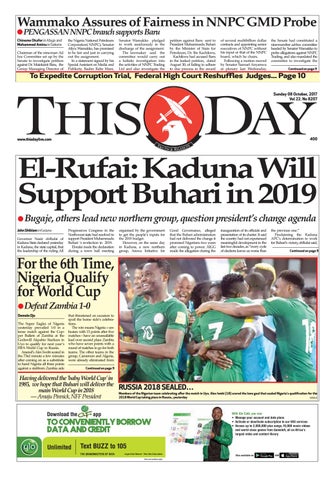
RUSSIA 2018 SEALED… Members of the Nigerian team celebrating after the match in Uyo. Alex Iwobi (18) scored the lone goal that sealed Nigeria's qualification for the 2018 World Cup taking place in Russia...yesterday google
2
T H I S D AY SUNDAY OCTOBER 8, 2017
T H I S D AY SUNDAY OCTOBER 8, 2017
3
T H I S D AY SUNDAY OCTOBER 8, 2017
4
, '2 127 &2817 '$<6 , PDNH WKH GD\V FRXQW ZLWK P\ YHU\ KHOSIXO (YHUJUHHQ $FFRXQW
T H I S D AY SUNDAY OCTOBER 8, 2017
5
6
T H I S D AY SUNDAY OCTOBER 8, 2017
T H I S D AY SUNDAY OCTOBER 8, 2017
7
8
T H I S D AY SUNDAY OCTOBER 8, 2017
9
SUNDAY, OCTOBER 8, 2017 • T H I S D AY T H E S U N D AY N E W S PA P E R
PAGE NINE
To Expedite Corruption Trial, Federal High Court Reshuffles Judges Affected 10 judges to swap residences Tobi Soniyi in Lagos In a clear demonstration of renewed commitment to make sure corruption and financial crimes cases are determined faster, the Acting Chief Judge of the Federal High Court, Justice Abdul Adamu Kafarati, has announced a major reshuffle of judges. In the shake-up, announced on October 3, ten judges have been transferred from their present divisions to other divisions across the country. A copy of the circular obtained by THISDAY at the weekend reads: "In view of the recent circular by the Hon. Chief Justice of Nigeria regarding the need to clear
corruption and criminal cases, I have decided to reshuffle the current posting of judges as contained hereunder. "The judges affected by this transfer are expected to resume in their new divisions on the 23rd October, 2017 and they are to take over the residence occupied by the judges they are taking over from." The directive that judges affected by the transfer should take over residence occupied by those they are taking over from may be aimed at ensuring quick relocation of all the judges to their new stations. Among the affected judges are: Justice S. Saidu, from Kwara State but presently sitting at the Port Harcourt's
division of the court, now moves to Lagos; Justice B.B. Aliyu from Zamfara State sitting at the Yola division now moves to Port Harcourt; Justice I.M. Sani from Kaduna State currently sitting at Lokoja division is to resume in Uyo; Justice I.L. Ojukwu from Abia State currently sitting at Uyo division, now moves to Abuja; and Justice D.U. Okorowo from Enugu State currently sitting at Ekiti division now moves to Lokoja. Others are: Justice Uche Nma Agomoh, an indigene of Abia State who currently sits at the Port Harcourt division, will now to resume at the Ekiti division; Justice F.O. Giwa-Ogunbanjo,
who hails from Ondo State, moves from Abeokuta to Port Harcourt; Justice Adamu Turaki Muhammed from Jigawa State currently sitting at the Abeokuta division now moves to Port Harcourt; Justice Ibrahim Watila from Borno State, who presently sits at the Port Harcourt division, moves to Abeokuta; and Justice A.M.Z. Anka from Zamfara State, moves from Lagos to Yola. During the special session of the Supreme Court to mark the commencement of the 2017/2018 legal year, the Chief Justice of Nigeria, Justice Walter Onnoghen, had expressed concern at the slow pace at which corruption cases
were determined by the courts. He said: "We, in the judiciary are fully aware and in fact worried by concerns expressed by members of the public on the very slow speed with which corruption cases in particular are being heard or determined by our Courts." The CJN then noted that although the Administration of Criminal Justice Act contains many commendable provisions aimed at speeding up the process of criminal prosecution generally, it was clear that, "we still need to employ more strategies to support and strengthen this law in fast tracking the criminal justice system." He consequently directed all
heads of courts to compile and forward to the National Judicial Council, comprehensive lists of all corruption and financial crime cases being handled by their various courts. He also directed them to designate in their various jurisdictions, one or more courts, depending on the volume of such cases, as special courts solely for the purpose of hearing and speedily determining corruption and financial crime cases. "Where such cases come on appeal, to either the Court of Appeal or the Supreme Court, Special Dates on each week, shall be fixed solely for hearing and determining such appeals," Onnoghen had said.
"Ibe Kachikwu was removed as the GMD of NNPC by President Muhammadu Buhari and replaced with an engineer per excellence and one of the most respected senior management staff of NNPC with a record of zero tolerance in corruption who has grown through the ladder and worked over the years in almost all sectors within NNPC in the person of Dr. Maikanti K. Baru on 4th of July, 2016. "This was greeted with applause by oil and gas players and in particular all the staff of NNPC due to the known track record of the new GMD. Staff morale was boosted and productivity was enhanced with only the announcement of Dr Baru as the GMD of NNPC who is a known anti-corruption crusader like President Buhari." They noted that they had observed developments that followed Kachikwu's letter and concluded that: "The allegations
against NNPC top management are unsubstantiated, false and lacks all professional and simple logical reasoning. Several far reaching decisions have been painstakingly taken by the present top management of NNPC that has resulted in several achievements in the operations of NNPC within the last one year." "NNPC has enjoyed the best industrial atmosphere under the present top management of NNPC with a zero record of disharmony which is the first of its kind in the history of oil and gas in Nigeria. "We are convinced that the recent re-organisation in NNPC is in good faith and in tandem with our call for allowing internal growth in the system through hardwork and positive appraisals. We
shall continue to reject bringing in friends and cohorts into management positions in NNPC at the detriment of dedicated staff with all the requisite qualifications within the system," they noted. Continuing, the workers union said: "It is on record that for the first time in the history of NNPC, concrete and realistic efforts are being made to bring back our ailing refineries to full production. This is in keeping with President Buhari's resolve to make the refineries work to full capacities and in conflict with the intention of few people in the corridors of power who are bent on selling our national assets to themselves. The present top management of NNPC should be commended for that giant stride."
WAMMAKO ASSURES OF FAIRNESS IN NNPC GMD PROBE petition written by Kachikwu. Since the petition leaked, there had been calls for a thorough investigation of the issues raised by the minister, including demands for the suspension of Baru pending the conclusion of the investigation. But in a move that could further exacerbate the already tensed situation NNPC, and by imlication Nigeria's oil industry, members of the Petroleum and Natural Gas Senior Staff of Nigeria (PENGASSAN) NNPC branch, yesterday took sides with the group managing director of the corporation, who had been accused by the minister of state for Petroleum Resources of not adhering to due process and breaching extant regulations at the NNPC. The Group Executive Committee (GEC) of the branch’s PENGASSAN said in a statement that was signed by its Secretary, Comrade Sulaiman Sulaiman, in Abuja that the allegations raised by Kachikwu
in the letter were false. They rather accused the minister of superintending over a corporation they said was largely unstable when he was its GMD. The unions even alleged that Kachikwu attempted to sell the corporation's four refineries in Port Harcourt, Warri, and Kaduna, to his cronies at giveaway prices. "Dr. Ibe Kachikwu was appointed as the NNPC's chief executive to wide public acclaim in August, 2015 by President Muhammadu Buhari. He has recorded several achievements as GMD which among others include the corporation's reorganisation at the management level in a bid to increase efficiency through reduction in directorates, although they were later increased again. "In a bid to provide employees with general updates on the corporation's progress, launched a series of weekly podcasts which is sent
to the over 13,000 members of staff. His closeness with the media was an advantage to NNPC as its major plights and predicaments were always on spotlight. "On November 11, 2015, Kachikwu was named the minister of state petroleum resources by the president. There were promises and theoretical task and targets set by the then HMSP/GMD which were never realised before he was removed as GMD on the 4th of July 2016. Uncertainty and very low staff morale characterised the 11 months of the then GMD and industrial peace and harmony eluded the corporation during that period," said the union in the statement. The union further stated: "Attempts were made to hand over the nation's refineries at give-away prices to cronies through the back doors using different concepts as against their complete rehabilitation policy of Buhari administration.
EL-RUFAI: KADUNA WILL SUPPORT BUHARI IN 2019 "We in Kaduna State, our party leadership, have come out clearly to say that Kaduna is for Buhari come 2019, if God wills. And he shall be victorious again. “So I urge you to continue to pray for him, for God to continue to grant him good health so that he can continue in office to continue his good and just governance.” Though, Buhari has not announced his intention to seek a second term, El-rufai has been canvassing for his re-election, and has repeatedly slammed those opposed to another term in office for the President. He recently took on the Minister of Women Affairs, Aisha Alhassan, who declared that she would support former Vice President Atiku Abubukar in 2019 even if Buhari runs. Meanwhile, a new northern group, AIGG, questioned Buhari’s change agenda, saying Nigeria’s democracy is not producing leaders that can foster security, prosperity, and development. The group said, “The nation is further sinking into the abyss of underdevelopment" on Buhari’s watch. Members of the group include former political adviser to exPresident Olusegun Obasanjo, Dr. Usman Bugaje; leader of a faction of the ruling APC in
Kaduna State, Mataimaki Tom Maiyashi; and former Secretary to the Government of Plateau State, Sylvanus Lot. Others are Dr. Kabiru Tsafe, Hajiya Amina Ladan Baki, and Dr. Yima Sen. The group, in its charter read by Sen, said poverty had deepened and become entrenched in the face of enormous oil revenue while corruption had become endemic and systemic, "defying even regimes that rode to power on the crest of fighting corruption.” It decried, "The eroding of societal values, how the economy has been underperforming, pauperising the masses, fuelling crime and insurgencies; how the teeming jobless youth have been abandoned with no hope on the horizon; how the millions of out-of-school-children have been ignored as their numbers keep swelling; how governance has been reduced to prebendal politics; and how our political parties, especially their leadership recruitment mechanisms, keep churning out incompetent, irresponsible and corrupt leaders.” AIGG said the society was being consumed by a dangerous political culture that seems endlessly predicated on pecuniary considerations, violence, and sundry crimes. According to AIGG, "This
rogue political culture has calibrated our leadership recruitment mechanism in our political system to produce inept and clueless leaders who only know how to swindle the electorate and loot their treasuries dry. All projections on this trajectory are indicating that we are heading to a failed state and a failed society as evident by the rising and horrifying social conflicts and violence. "Some studies by international analysts have been setting dates for our collapse as a nation. Now that our hope for rebirth after the heavily fought 2015 elections is yet to come to fruition, we must wake up from our slumber and complacency and salvage our society before it becomes too late. "We further recognise that rather than continue to curse the darkness, it is better that we light a candle, in other words, we stop agonising and start organising.” The group said, "We have resolved to conscientise, recruit and mobilise all the good men and women, in and out of politics, in the public and private sectors, young and old, from every tribe and religion, from every walk of life, together into one platform in order to create the critical mass, move
en masse in one direction and ensure that the flawed leadership recruitment mechanism in our political system is remedied. "This we also agree can work best when we are able to create a grassroots movement that can mobilise the whole society for this reform, very much like previous anti-democratic struggles. "Thus, this movement must resonate with the concerns of the wider society and articulate the solutions in clear terms that define the role of every stratum of society. "We, therefore, commit ourselves to participate in this process of a political rebirth with all our strength and understanding, to move together into a carefully considered political platform to ensure that our political life is reformed to produce conscientious, competent and courageous leaders that will be guided by the fundamental principles of democracy, accountability and responsible leadership for the moral, social, political and economic development of our country. "We pledge our honour, dignity, and integrity that we shall give this mission the uttermost priority and will not allow partisan political considerations or any personal interests to stand in our way. So help us God!”
FOR THE 6TH TIME, NIGERIA QUALIFY FOR the competition before their meeting yesterday which the Indomitable Lions won 2-0 to stay third on six points. President Muhammadu Buhari led the congratulatory messages showered on the team after their epic performances stretching back to the first qualifying match. So far, Nigeria have won four and drawn one of their five matches. President Buhari, who was Head of State when Nigeria won her first international football competition at Under 17 level in 1985, described the "hard-earned" victory of the Eagles as “very sweet, soothing and a 57th Independence Anniversary gift to the nation.” President, Nigeria Football Federation, Amaju Pinnick, yesterday stated "with today's victory, preparations for the World Cup has started. Having delivered the 'baby World Cup' in 1985, we hope that Buhari will deliver the main World Cup in 2018." The pulsating match saw missed chances at both ends by the time Shehu Abdullahi provided the cut-back for Iwobi to finish from inside the box in the 73rd minute. Odion Ighalo, John Mikel Obi, Victor Moses and Moses Simon had all gone close for the Super Eagles but failed to score. Zambia goalkeeper Kennedy Mwenne also produced an acrobatic save to deny Wilfred Ndidi in the second half as the Eagles mounted pressure on their
opponents. Earlier, Augustine Mulenga thought he had put Zambia ahead in the 22nd minute, but his effort was ruled out for offside. Fashion Sakala, Alex Ng'onga and Enock Mwepu also had chances for the Chipolopolo but the 2012 African Champions failed to punish a sometimes frantic Eagles defence. But substitute Iwobi, who also scored in the reverse fixture in Ndola last October, finished off a decent attack to send Nigeria to a third straight World Cup appearance. Victor Moses had a great opportunity to add a second towards the end, but the Chelsea wing-back slipped inside the box. Nigeria qualified after breezing through a group dubbed the "Group of Death" and expected to go down to the wire. At the time the qualifying groups were announced, Algeria were the highest rated team on the continent while Cameroon were crowned African champions early this year, just two matches into the qualifying games. However, despite not qualifying for the past two African Cup of Nations (in 2015 and 2017), the Eagles have once again proven to be one of the very best teams on the continent by returning to the world stage. At previous World Cups, Nigeria have reached the second round in 1994, 1998 and 2014, but exited the tournament in the group stage in 2002 and 2010.
10
OCTOBER 8, 2017 ˾ T H I S D AY, T H E S U N D AY N E W S PA P E R
SUNDAY COMMENT
Editor, Editorial Page PETER ISHAKA Email peter.ishaka@thisdaylive.com
BUHARI’S T ROUBLED P RESIDENCY PresidentBuharimustdomoretocounterthegravechallengesoftheadministration
T
here was an abysmal lack of statesmanship in the speech delivered last Sunday, October 1, by President Muhammadu Buhari to mark the 57th Independence anniversary of Nigeria. Aside rehashing the recurrent theme in his recent public utterances that only the states and National Assemblies were the proper forum for discussing the idea of restructuring the country on which there was already a broad consensus, the speech in its entirety dripped with sloppy partisanship. In a democracy, every forum is a legitimate venue for the articulation of grievances: beer parlour, campuses of institutions of learning, media platforms, ethnic association meetings, market places, town halls, etc. In fact, it is from these venues and their multiple agitations about In a democracy, every what irks the people forum is a legitimate the lawmakers, venueforthearticulation that whether in the states or of grievances: beer at the centre, derive their parlour, campuses of agenda. It is therefore institutions of learning, a strange democracy in which the parliament media platforms, generates public opinion ethnic association and discourse and also meetings, market legislates on the issues places, town halls, etc. that arise therefrom. It is from these venues However, the challenge facing the Buhari and their multiple presidency today goes agitations about what irks the people that the beyond his speeches or his rigid stance on relawmakers, whether structuring. With his antiin the states or at the corruption campaign centre, derive their unravelling, critical members of his governagenda ment and political party are also fighting dirty in the public arena. From the Inspector General of Police, Mr. Ibrahim Idris, who is being accused of sundry acts of impropriety and professional misconduct by a serving Senator of the ruling All Progressives Party (APC), Isa Misau, to the Nigerian National Petroleum Corporation (NNPC) Group Managing Director, Dr. Maikanti Baru, also battling allegations of mismanagement from the Minister of State for Petroleum, Dr. Ibe Kachikwu, it would appear that the centre can no longer hold for the administration.
I
S U N DAY N E W S PA P E R EDITOR TOKUNBO ADEDOJA DEPUTY EDITORS VINCENT OBIA, OLAWALE OLALEYE MANAGING DIRECTOR ENIOLA BELLO DEPUTY MANAGING DIRECTOR KAYODE KOMOLAFE CHAIRMAN EDITORIAL BOARD OLUSEGUN ADENIYI EDITOR NATION’S CAPITAL IYOBOSA UWUGIAREN
T H I S DAY N E W S PA P E R S L I M I T E D EDITOR-IN-CHIEF/CHAIRMAN NDUKA OBAIGBENA GROUP EXECUTIVE DIRECTORS ENIOLA BELLO, KAYODE KOMOLAFE, ISRAEL IWEGBU, IJEOMA NWOGWUGWU GROUP FINANCE DIRECTOR OLUFEMI ABOROWA DIVISIONAL DIRECTORS PETER IWEGBU, FIDELIS ELEMA, ANTHONY OGEDENGBE DEPUTY DIVISIONAL DIRECTOR OJOGUN VICTOR DANBOYI SNR. ASSOCIATE DIRECTOR ERIC OJEH, PATRICK EIMIUHI ASSOCIATE DIRECTORS HENRY NWACHOKOR, SAHEED ADEYEMO CONTROLLERS ABIMBOLA TAIWO, UCHENNA DIBIAGWU, NDUKA MOSERI GROUP HEAD FEMI TOLUFASHE ART DIRECTOR OCHI OGBUAKU II DIRECTOR, PRINTING PRODUCTION CHUKS ONWUDINJO TO SEND EMAIL: first name.surname@thisdaylive.com
Letters to the Editor
n a letter dated August 30, 2017 and addressed to the president but leaked to the media last week, Kachikwu accused Baru of insubordination, and called for the cancellation of the recent appointments by the NNPC. Kachikwu also appealed to President Buhari to move in quickly to save the NNPC and the oil industry from a systemic collapse arising from what he described as the lack of transparency and accountability in the management of human and financial resources. Since Buhari is the substantive Petroleum Minister, Kachikwu’s letter was more an indictment of him than Baru. Therefore, the easiest way to restore order on the matter is to underline the sanctity of hierarchy which requires that the GMD submits his policy and major administrative initiatives through the NNPC Board which is presided over, in this instance, by the minister of state. While there are, of course, all manner of underhand insinuations that this development provokes, we must insist on the primacy of due process and the need to ensure orderly administrative work flow in the critical oil and gas sector. Meanwhile, when the foregoing is added to the pending case of the suspended Secretary to the Government of the Federation, Mr Babachir Lawal and the Director General of the National Intelligence Agency (NIA), Mr Ayo Oke, as well as the lack of clarity about the position of the Economic and Financial Crimes Commission (EFCC) acting chairman, Mr Ibrahim Magu whose nomination has twice been rejected by the Senate, we get a clear picture of a presidency bogged down not only by inertia but also by an inability to clearly define its essence. While the irreducible minimum under the current dispensation is the elementary dictum that the buck stops at the desk of the president, mounting instances of tardiness in taking prompt decisions on matters of transparency and accountability have begun to taint the personal integrity which initially qualified President Buhari for the job. Indeed, as things stand, all the raging issues of deficits of enlightened governance and lack of fidelity to rudimentary public morality run counter to the avowed commitment by this administration to right the wrongs of our past. In all of this, the prevalent public disillusionment occasioned by severe economic hardship is being capped by a thorough sense of betrayal of election promises. Therefore, the responsibility is now on President Buhari to move quickly to retrieve his administration from the vice-grip of embarrassing incompetence, worrisome clannishness and shrinking nationalism.
TO OUR READERS Letters in response to specific publications in THISDAY should be brief (150-200 words) and straight to the point. Interested readers may send such letters along with their contact details to opinion@thisdaylive.com. We also welcome comments and opinions on topical local, national and international issues provided they are well-written and should also not be longer than (950- 1000 words). They should be sent to opinion@thisdaylive.com along with the email address and phone numbers of the writer.
KACHIKWU, BARU AND THE NNPC
T
he Minister of State for Petroleum, Dr. Ibe Kachikwu, last week, raised an alarm at his sidelining in the affairs of the state- owned Nigerian National Petroleum Corporation by the Group Managing Director, Dr. Maikanti Baru. He went on to allege that the latter awarded a whopping $26 billion juicy contract without following due process. Kachikwu, the hitherto egghead groomed by Harvard University, has been rendered so ineffective that he has been allegedly denied access to President Muhammadu Buhari since his return from medical vacation in England. He also
went on to say that many important appointments were made without consulting the board. He heard about them like every other Nigerian. The GMD hardly attends board meetings and he has entrenched a culture of fear in the parastatal that lays the golden egg. So many issues arise from this Kachikwu scream. Baru is accountable to Buhari, who doubles as petroleum minister, and the Chief of Staff, Abba Kyari, who is also a member of the NNPC board. Could he have awarded such a huge contract unilaterally? Is he the sole signatory to NNPC contracts? Could it be possible that
Buhari is in the know? Could Kachikwu be held in contempt as he comes from a less favoured tribe? Let’s look at the way and manner he was removed as the helmsman of the NNPC last year to pave way for the surreptitious northern agenda. Is he just being tolerated for the sake of the now much discredited federal character? Why is there a conspiratorial silence from the Presidency on this matter since Baru is an appointee of the president? The administration came to power on the wave of the change slogan, which promised to be a departure from the old order of corruption and impunity.
Why hasn’t Baru been asked to publicly state his side of the story in a government that claims to have zero tolerance for corruption? Why is there a sense of deja vu that Buhari is the petroleum minister now that $26 billion has been allegedly mismanaged? The fight against corruption has become a gargantuan joke as no single successful prosecution has been recorded so far. The Babachir Lawal and Ayodele Oke’s alleged corruption saga still remain puzzles with no prosecutions or the cases even being conclusive yet. The wave of public opinion is fast swinging against the idea that Buhari is incorruptible, with disillusionment fast setting in. Some of his critics
even went as far as vehemently criticising his time as Chairman of the defunct Petroleum Trust Fund and one wonders why his handling of the petroleum sector always tends to raise a lot of dust. It is commendable that the Senate has risen up to the occasion by inaugurating a committee to probe the allegations raised by Kachikwu, headed by former Sokoto State Governor, Senator Aliyu Wamakko. While the act is cheering news, we hope that the recommendations see the light of day, as many probe committees just make a lot of noise with no results at the end of the day. –––Tony Ademiluyi, anthonyademiluyi@yahoo. com
T H I S D AY SUNDAY OCTOBER 8, 2017
11
12
T H I S D AY, T H E S U N D AY N E W S PA P E R ˾ ˜ ͺͿ
SUNDAYNEWS
News Editor Abimbola Akosile E-mail: ËÌÓ×ÌÙÖ˲ËÕÙÝÓÖÏ̶ÞÒÓÝÎËãÖÓàÏ˛ÍÙט ͺͻͿ;ͻ ̙Ý×Ý ÙØÖã̚
Monkeypox: FG Maps out Comprehensive Response as Disease Spreads to Rivers t Confirms 13 cases in Bayelsa, 3 suspected cases in Rivers t Health workers, patients’ family members mostly at risk Abimbola Akosile ÓØ ËÑÙÝ ËØÎ Senator Iroegbu ÓØ ÌßÔË
The federal government has mapped out a comprehensive strategy that would help stem the spread of Monkeypox, a new disease outbreak in the country, which has affected between 13 and 16 people in the two states of Bayelsa and Rivers. This was confirmed yesterday by the Director-General and Chief Executive Officer of the National Centre for Disease
Control (NCDC), Dr. Chikwe Chikweazu, who told THISDAY that the government was collaborating with the state, local government and other relevant institutions to prevent further spread of the disease. Ihekweazu said the NCDC had begun to increase its surveillance system across the country as well as list all the affected persons, daily monitoring their movements, development and improving the capacity of the healthcare
laboratories as part of measures to check the spread of the disease. “We are strengthening our surveillance system, get the list of all the contacts of patients, monitoring them daily and that way we are confident we are going to stop them. There will be one or two more cases most likely but I don’t think we will see an expanding outbreak. “Over the past year, the NCDC has ramped up efforts to support the work we do in
the country through the state health department and Local Government Disease Control. So, the awareness of Nigerians is very high about disease outbreak and we are also strengthening our laboratory capacity. I think in this area of the work that we do, there is developed architecture of prevention and response across the country right now,” he stated. While assuring the people that the current measures being put in place would limit further
spread of the disease, he however, acknowledged that there were three suspected cases in Rivers State in addition to the 13 confirmed in Bayelsa. He said: “I don’t see a much wider spread, because the measures taken by the Bayelsa State government in collaboration with NCDC has been very great. There will be one or two more cases. People caring for sick patients and family members are mostly at risk and the critical thing, especially for health workers is to wear glove while family members should take them to hospital as soon as possible. If you have to touch them make sure you wash your hands with soap and water afterwards. Together, we are strengthening surveillance “The disease is not worse than it is and not as bad as it is made out to look. We have not had any fatality apart from the 13 cases so far reported (in Bayelsa). We don’t expect to have any fatalities as most of the patients have recovered
except few. Despite the very scary pictures circulating, my advice to Nigerians is to stay calm. This is not a disease they should be worried about as everything is being done in the local, state and national level to limit the spread of the disease outbreak.” Ihekweazu however reiterated that the Centre was working very hard to control the spread of monkeypox in Bayelsa. He said a Rapid Response Team (RRT) from NCDC was immediately deployed to support the Bayelsa State government in the investigations and public health response. “Doctors and healthcare providers have been advised on what to do; the key thing is to bring in patients with characteristic rash on their face which is what stands monkeypox out from other diseases. Monkeypox looks like an extreme case of chickenpox, but a little bit more severe and the disease looks and sounds a lot worse than it actually is.
Ex-Presidential Spokesman, Adeniyi, for Unilorin Book Launch
STRATEGIC VISIT L-R: Founder, NESH, Emeka Ugwu-Oju; Speaker, House of Representatives, Rt. Hon. Yakubu Dogara; and Member representing Nnewi North /South /Ekwusigo Federal Constituency, Hon Chris Azubogu, during a courtesy visit to the speaker in Abuja ahead of the 2017 NESH Oil and Gas Roundtable & Dinner Reception for NESH Peace Honorees slated for October 13
Operation Crocodile Smiles Commences in Six N’Delta States t Operation Python Dance: Release report on South-east, army urged Sylvester Idowu ÓØ ËÜÜÓ ËØÎ David-Chyddy Eleke ÓØ áÕË
The Nigerian Army says it has deployed troops for the commencement of ‘Operation Crocodile Smile’ in the six Niger Delta states. The General Officer Commanding (GOC) 6 Division, Nigerian Army, Port Harcourt, Maj.-Gen. Enobong Udoh, said this on Saturday while addressing troops to signal commencement of the exercise. Udoh said the operation was confidence building patrol rather than a show of force as widely reported. “Operation Crocodile Smile is not a show of force but a confidence-building patrol that seeks to reassure the people of Rivers state and the Niger Delta that the army is ready to work. “We are ready to work in close synergy and collaboration with other security services and agencies of government to ensure that there is peace and security for the people. “Our operation aims to reassure the public that we are ready to fight crimes like cultism, militancy, and kidnapping so that
people can go about their business without fear,” he said. Udoh said troops would carry out collaborative patrols with the Nigerian Police, Federal Road Safety Corps, Nigerian Immigration Service and the Department of State Security (DSS). Others are Nigerian Security and Civil Defense Corps, Nigerian Customs Service and personnel of the Nigerian Prison Service. He said the division would carry out the exercise in Akwa Ibom, Bayelsa, Delta and Rivers states while another formation would cover other states in the Niger Delta. “Army, police and other security services was established to ensure peace; enforce law and order and create the enabling environment for economic activities to thrive. This is our ultimate mandate, and, as such, we urge Nigerians to give us the necessary support to enable us to succeed,” he said. Meanwhile, against opposition by different groups and civil society organisations, the Joint Task Force code named Operation Delta Safe yesterday kick started Operation Crocodile
Smile 11 with display of heavy weaponry on major roads of Warri and neighbouring towns in Delta State. The creeks and waterways were not left out as the Navy components of JTF patrolled with Navy ships apparently to show off its capability to ward off any threat and combat criminal activities in that area. THISDAY observed that the commencement of the exercise was devoid of any opposition and confrontation, instead residents trooped out to admire the soldiers as well as the heavy and deadly equipment on display by the military. Officers and men of the Nigerian Army, Navy, Police and elements of Nigerian Security and Civil Defence Corps drove round Warri, Sapele and Ughelli towns in a convoy of trucks, Hilux vans and armour with residents hailing them. Prior to the commencement of the exercise, Sector One Commander of JTF, Colonel Alhassan Grema and Commander of 3rd Battalion, Nigerian Army, Effirun, Major Ahmed Abdulkadir had drilled the participating personnel
and briefing on rules of engagement concerning the exercise. Assistant Public Relations Officer, 2 Brigade, Benin, Captain Mohammed Maidawa said the commencement of Operation Crocodile Smiles 11 was successful devoid of any hitch. Meanwhile, former aviation minister, Chief Osita Chidoka has called on the Nigerian Army to make public the report of its investigation on the activities of military men in the South east while carrying out the military exercise; Operation Python Dance 11. Chidoka, who is the United Progressives Party, PPA governorship candidate for the Anambra governorship election said this was necessary as Igbos commence the 50th remembrance of the horrific massacre of the innocent in Asaba during the civil war. He called on the federal government to use the occasion to heal the wounds caused by the civil war on the Igbo by issuing an official regret. He noted that the fact that Igbos still hold unto the memories of the ugly incident of 50 years shows that there is dire need for genuine healing.
Former Presidential spokesman and popular THISDAY newspaper columnist, Olusegun Adeniyi, is billed to be the Executive Reviewer at the public presentation of a documentary book on the tenure of outgoing Vice-Chancellor of the University of Ilorin, Prof. AbdulGaniyu Ambali (OON), next Friday October 13. Adeniyi, who is currently the Chairman of the Editorial Board of THISDAY Newspaper, was the Special Adviser, Media and Publicity to the late President Umaru Musa Yar’Adua. The book presentation is one of the major highlights of the activities kick-starting the 33rd Convocation ceremonies of the University. Entitled ‘The Ambali Years: A Chronicle of the Landmark Achievements of Prof. Abdul-
Ganiyu Ambali (2012 – 2017)’, the book is authored by the Head of the institution’s Corporate Affairs Department, Mr. Kunle Akogun. Written in breezy, easyflowing prose, the six-chapter compendium details all the activities and accomplishments of Prof. Ambali since October 16, 2012, when he took over from his predecessor, Prof. Is-haq Oloyede, to October 15, 2017, when he will be bowing out. In a chat with newsmen, Akogun said “the choice of Mr. Adeniyi as the Book Reviewer is deliberate because the veteran journalist and authoritative columnist will be on a familiar terrain, being an accomplished communicator and, in particular, being my former boss at THISDAY Newspaper, where I once served under him as Group News Editor”.
Osinbajo Off to London, Delivers 2017 Africa Summit Lecture Omololu Ogunmade ÓØ ÌßÔË
Vice President Yemi Osinbajo yesterday left Nigeria for London to participate in this year’s Africa Summit scheduled to take place today and tomorrow. With the theme ‘What Makes Africa Work’, Osinbajo, according to a statement by his spokesman, Mr. Laolu Akande, said the Africa Summit would be hosted by the Financial Times of London. He described the summit as a global forum and one of the leading conferences in the world on African business and economic matters, pointing out that Financial Times, as a medium, has had a relationship with the African continent for 125 years. At the summit which he
said would attract global leaders, economic experts, investors and intellectuals from Africa and around the world, Akande said Osinbajo would discuss the increasing economic prospects in Africa and highlight the progress of President Muhammadu Buhari’s administration, especially through the federal government’s medium-term Economic Recovery and Growth Plan (ERGP) to the global audience. “The summit which will also include presentations from other leaders and speakers will feature first-hand experiences and interactions from government and business leaders in the continent, while providing credible opportunities and encouraging foreign investments.”
13
T H I S D AY THURSDAY OCTOBER 8, 2017
:H DUH
7KH )LUVW IURP $IULFD &RQJUDWXODWLRQV 6XSHU (DJOHV
3URXGO\ VSRQVRUHG E\ DLWHR
2ǸFLDO 2SWLPXP 3DUWQHU
7+( )8785( ,6 $,7(2 #DLWHRJUS #DLWHRJUS DLWHR JUS
WKH ZLQQLQJ SDUWQHUVKLS
14
Ͷ˜ Ͱͮͯ͵ ˾ THISDAY, THE SUNDAY NEWSPAPER
OPINION NGO Regulation Bill The bill constitutes a violation of people’s freedom of thought, expression and association, argues Adewale Kupoluyi
A
nother controversy is raging in the National Assembly, as a result of the contentious bill sponsored by the Deputy Majority Leader of the House of Representatives, Umar Buba Jibril, representing Lokoja/Kogi Federal Constituency. The bill is recommending the setting up of yet another government agency, to be known as the NGO Regulatory Commission that is meant to issue licences to all NGOs, which would require renewal of such licenses every two years. In other words, if the commission’s board declines to renew any group’s licence, the NGO would cease to operate in the country. The board would further look into how funds received from donors are spent, and if any NGO spends its funds without the commission’s permission, it would amount to a crime that could attract a prison term of up to 18 months. In addition, the commission would be headed by an Executive Secretary, as the President’s appointee for five years, as well as a 17-member Governing Board, to be led by a Chairman. The bill also provides that all NGOs should submit reports to the board about their finances, where they get it from, and how much. Before an NGO spends any money it has received, it should disclose such and if it refuses, it has violated the law. Not only that, the bill requires NGOs to comply with all national and foreign policies, as any violation of the bill remains a crime that is punishable with prison terms. Similarly, any judgement of the court against the body cannot be enforced, except with the express permission of the serving Attorney-General of the Federation, among others. According to the sponsors of the bill, the idea behind the move is to ensure transparency and accountability in the way NGOs collect and use funds. They argue that the bill is not peculiar to Nigeria; but exists in many African and European countries. For emphasis, a non-governmental organisation is a non-profit, independent and voluntary citizens’ group that is motivated by people with common interest. They perform crucial service and humanitarian functions, public accountability, advocating and monitoring policies and encouraging political participation. No doubt, NGOs remain crucial contributors to the process of implementing policy and delivering services, as major providers of public information and sustenance of democracy across the world. Should the law makers have a rethink over the bill? Yes, due to a number of reasons. First, the idea of creating yet another federal agency, which would add serious burden to public bureaucracy and draw on the lean resources just for the purposes of restricting free speech and shutting down avenues in which civil rights of citizens are promoted, is untenable. Civil society bodies are a very important component in the task of expanding the democratic space and citizens’ rights. They play strategic role in enlightening the people and
promoting their access to issues like social security, justice, liberty and the abolition of certain harmful socio-cultural practices that tend to hamper human rights and personal dignity. NGOs also complement efforts of the media, as the Fourth Estate of the Realm, by making governments accountable and calling attention to how people can be better served. Unfortunately, the unpopular bill is capable of making civil society organisations become mere parastatals of government. The bill could be said to constitute a deliberate violation of people’s freedom of thought, opinion, expression and freedom of association, as provided by the 1999 Nigerian Constitution (as amended), in addition to other international laws to which the country is a signatory. However, some NGOs have been found to engage in excesses, such as corrupt practices and the promotion of strange foreign traditions, such as same-sex marriage or activities that can be said to be against existing laws in the country. Recent developments have equally shown that some people have registered NGOs just to solicit funds for selfish motives. NGOs were also reported to have funded activities of insurgents and anti-democratic elements. Not only that, the upsurge in the exploitation of the sick, the needy and the physically-challenged persons could be attributed to the operations of some unregistered and illegal NGOs in the country. The proliferation of NGOs could be traced to the 1990s, following an attempt to expand both the liberal democratic approach and a neo-liberal economic order to governance. NGOs are then seen as the key engines in the drive towards positive change. In Nigeria, the rise in the activities of NGOs actually began in the late 1980s. With the progression of such platform, the proliferation of NGOs may not be divorced from the prevailing economic
The idea of creating yet another federal agency, which would add serious burden to public bureaucracy and draw on the lean resources, just for the purposes of restricting free speech and shutting down avenues in which civil rights of citizens are promoted, is untenable
climate, whereby unemployment is a big issue, as many able-bodied men and women continue to roam the streets. As no jobs are forthcoming, they would ordinarily want to try their hands on anything, just to survive. Of course, one of such options could be the floating of NGOs with people of like-minds, to earn a living. Despite much criticism against the NGO bill, the Deputy Majority Leader has said that the House would still pass the bill, to forestall illegal activities of some of the organisations, assuring that churches, mosques and market women associations are not affected by the bill. This posturing, of promoting an unpopular cause, such as this, is wrong and undemocratic. Irrespective of how beautiful and well-thought out the bill may appear to the lawmakers, a fair assessment of the pros and cons of the bill shows that its disadvantages far outweigh its merits. Such was the case of a similar anti-people bill that was once proposed before the Senate before it was dumped, when the people rose against the initiative. Titled, “Bill for an Act to Prohibit Frivolous Petitions and Other Matters Connected Therewith”, it sought to control online media by imposing a two-year jail term for an abusive statement released by any user. The bill, which was sponsored by the Deputy Senate Leader, Senator Bala Ibn Na’Allah, representing Kebbi South Senatorial District, was meant to imprison or impose a N2 million fine or both, if a person transmits false information about a public servant through the platform. The bill further proposed up to seven years in prison or $25,000 fine for anyone, who intentionally propagates false information capable of inciting the general public against the government through electronic message. It equally provided that “anyone disseminating an abusive statement, which intends to set the public against any person and group of persons, an institution of government or such other bodies established by law”, via the social media, faced two years in prison or $10,000 fine or both. At the end, Nigerians strongly kicked against the bill and it suffered sudden death. Such rejection should be repeated now for the NGO bill. Therefore, in the interest of collective will, good governance and democratisation process, it is better and a wise counsel for the House of Representatives to suspend further deliberations on the proposed bill. I am aware that many people are already signing petitions in this regard, through the social media. Beyond these measures, Nigerians should ensure that further legislative actions on the bill are stalled by participating in the public hearing. By that, the citizenry would be seen as being participatory, patriotic and involved in running the affairs of their nation. This is the clarion call! ––Kupoluyi wrote from Federal University of Agriculture, Abeokuta
Teachers’ Empowerment: Beyond Lip Service Tayo Ogunbiyi argues that teachers should be well provided for
W
orld Teachers’ Day is celebrated annually worldwide to bring together governments, multi- and bilateral organisations, NGOs, private sector, teachers and experts in the field of teaching. Held annually on October 5, since 1994, World Teachers’ Day commemorates the anniversary of the signing of the 1966 UNESCO/ILO recommendation concerning the status of teachers. In commemoration of this year’s event, governments across the country once again waxed lyrical about the need to empower teachers with the requisite tools and trainings. Leading the pack in this annual ritual is the Minister of Education, Adamu Adamu, who, while relating to the theme for this year, “Teaching in Freedom, Empowering Teachers,” said teachers deserved to be appreciated for their role in nation-building. The truth, however, is that there is really nothing new about all that was said about the value and status of teachers in the course of this year’s celebration. They are all stale stuff. Nothing has been done to bring about a fundamental change in the teaching profession as well as the status of teachers. If we are to move beyond the annual rite of merely uttering niceties about teachers, we swiftly need to soberly reflect on the status of Nigerian teachers and the conditions under which they work. To this end, all stakeholders need to place priorities on major issues facing the teaching profession and how they can be urgently addressed. Considering the overall relevance of teachers to nation-building, much still needs to be done to uplift the profession. It is an open secret that nowadays every child wants to be
something else but a teacher, which is a sad reminder of their worth in the society. Now that the euphoria surrounding the WTD is over, it is pertinent to properly address issues of education in the country. For any nation to attain lofty heights, close attention must be paid to the teaching profession. Teachers hold the key to the future since they help to mould future leaders. They don’t just teach, they nurture the younger ones to maturity, to understand the world and to understand themselves. Hence, every investment in teachers is a worthy one. According to2014 Nobel Peace Prize winner, Malala Yousefzai: “One child, one teacher, one book, and one pen, can change the world.” A society that refuses to empower teachers will only be promoting ignorance. Ultimately, the price that a nation might have to pay for encouraging ignorance almost often exceed what it needs to do to uphold education. This is why every nation of the world must fully come to terms with the need to further enhance the competence of teachers at all levels. It is in doing this that the critical issue of nation-building, especially in Third World countries, could be effectively tackled. In other words, building in a nation without first building teachers would basically amount to chasing shadows. Therefore, beyond the pomp and pageantry of this year’s teachers’ day, all stakeholders in the education sector need to reflect on the state of teachers and education. This is the time to go beyond paying lip service to capacity building for teachers. Concerted efforts should be made by appropriate authorities to improve the working conditions of teachers. We need to do everything to restore the dignity of the teaching profession. The private schools, in particular, must
stop the dehumanisation of teachers. Some of them pay peanuts to teachers as salaries. Perhaps, more hurting is the fact that some teachers even work without any clear-cut terms of engagement with their employees. A nation that toils with the wellbeing of its teachers inadvertently puts her future in serious jeopardy. Without putting in place the proper machinery to improve the working condition of teachers, all efforts to bring about the realisation of the national mass literacy project would simply go down the drain. Consequently, the successful execution of the mass literacy project could only be made possible with the active participation of a well-motivated, properly trained and competent teaching force. Relevant governmental and non-governmental organisations, therefore, need to intensify efforts towards developing the competence of teachers across the country. Undoubtedly, the destiny of every nation is shaped, reinforced and actualised in the classrooms. The quality of lawyers, doctors, accountants, engineers, politicians, administrators and other professionals that a country has is determined by the worth of what transpires in the classroom. According to Confucius : “To put the world in order, we must first put the nation in order; To put the nation in order, we must put the family in order; To put the family in order, we must cultivate our personal life; And to cultivate our personal life, we must first set our hearts right.” Since a well nurtured teaching force lies at the heart of every societal progress, to get our hearts right, we need to get our teachers right. ––Ogunbiyi wrote from the Ministry of Information & Strategy, Alausa, Lagos
15
T H I S D AY, T H E S U N D AY N E W S PA P E R ˾ OCTOBER 8, 2017
LETTERS Beyond The Independence Celebration
O
n Sunday, October 1, Nigeria celebrated 57 years of independence. It was a celebration that reminded us of our long walk to freedom – how our founding fathers fought to salvage us from the crippling grip of the white supremacists. It reminded us of that day when we broke the shackles of colonialism, that day when we heaved a great sigh of relief. That day when we told ourselves, yes we can. It reminded us of that day when we truly attained the status of nationhood and chose to serve our fatherland with love, strength and faith. But beyond the independence celebration, we must begin to think of ways to address the multifarious problems that have continued to plague our nation. We must strive to prove we are the true giant of Africa. We must not continue to crawl. In the North-east, the menace of insurgency has continued unabated, crippling educational activities. Over 2,295 teachers have been killed and 19,000 have been displaced with almost 1,400 schools destroyed and the majority unable to open because of extensive damage,
Buhari
as reported by UNICEF. Most saddening is the recent increase in the use of children as ‘human bombs’, which has gradually created a climate of mistrust among communities in the Northeast. According to the report by UNICEF, 83 children have been used by Boko Haram to carry out bomb attacks in north-eastern Nigeria, a development that is four times higher than it was for the
entire 2016. Although we commend our security operatives for their efforts so far in containing the scourge of insurgency, a lot more need to be done if the menace must be exterminated. The constant rise in the rate of unemployment in Nigeria is another issue that must be addressed by the government. Our youths must not continue to roam the streets for lack of jobs. According to a recent
report by the National Bureau of Statistics, there was a total of 28.58 million persons in the labour force, either unemployed or underemployed, in the fourth quarter of 2016 compared to 27.12 million in the third quarter, 26.06 million in the second quarter and 24.5 million in the first quarter of the year under review. Consequent upon the continued rise in the number of unemployed youths is the ever increasing rate of social vices. Like the saying goes, an idle mind is the devils workshop. It is important to note at this point that our joy at independence was immeasurable, given the pomp and circumstance that surrounded the celebration. Of course, it feels great when you can take decisions without interference. The number of people in attendance at the Tafawa Balewa Square, Lagos, venue of the celebration, showed how long we had waited for that day. In his speech at independence, Sir Abubakar Tafawa Balewa, who was then the Prime Minister, said: “This is a wonderful day and it is all the more wonderful because we have awaited our independence with increasing impatience, compelled to
LOOKING FOR OIL IN THE NORTH
A
national newspaper carried a very curious story recently that the Nigerian National Petroleum Corporation had already started a process that will lead to the exploitation of oil and gas in the Sokoto Basin. Apparently, what led to this interesting piece of news was the visit of the Sokoto State governor, Aminu Tambuwal, to the NNPC Group Managing Director, Maikanti Kachalla Baru. A statement reportedly issued by Tambuwal’s spokesman quoted the NNPC GMD as having said: “We have been on the issue of exploration in the frontier basins and so far some measures of steps have been taken. We have already purchased aeromagnetic data and it is being interpreted to determine the sedimentary thickness and the basin configuration….” Ordinarily, this is very splendid news, and for which the agent provocateurs who are promoting the search for oil in the Sokoto Basin ought to receive commendation. After all, what sense is there in allowing 95% of all crude oil earnings, and the driver of our economy come from only one section of the country? Having allowed that over the years, our scale of preferences over the years as a country had always tilted against the tide of the agricultural power of the North. Not only have the groundnut pyramids disappeared without any trace, the cotton fields of Malumfashi, Funtua and Daudawa in Katsina State have all lost their shine. I hear that the reason why these cotton fields have nearly
become extinct is that attention of the governors of the North is on the easy money flowing in from oil. Therefore, having abandoned this critical sector of the Nigerian economy in favour of the greasy revenue from crude oil export, the once vibrant North became a lame tiger. Not only did it have the lowest human development indices in West Africa in the late 80s and early 90s, it became a breeding ground for terrorists. Therefore, if the search for oil in the Sokoto Basin is to checkmate the tendency of going cap in hand to the federal government for funds for development, well that should be understandable. But why the heck do I keep having this throbbing sensation that ultimately, there is another reason why the North is desperately searching for oil in the Sokoto Basin. It is bad enough that a region with such vast human and natural resources will not run unless it gets its share from a common purse. But is the desperate search for oil in the Sokoto Basin anything to do with the calls for a restructuring of Nigeria? I think so. But no matter how desperate the North is for a post-Nigeria/Lugardian economy, this search is downright belated and plainly puerile. On page 492 of David Landes’ book, The Wealth and Power of Nations, and the chapter titled “Losers”, confirms that even though oil in the Gulf still has about 130 years to go, and that desperate searches are going on daily, in the next 10 or 15 years, assuredly nobody will
need the oil. As a student in Europe some time ago, I had the privilege of touring certain cities, like Freiburg, Leipzig, Breslau and Potsdam. While there, I discovered that very intense meetings were already going on by day and by night to wean the European economy from reliance on fossil fuels. At a home in Berlin, a certain woman who had lost her husband and right arm in an accident sustains herself and family by selling excess energy from the solar photo-voltaic panels constructed on her roof to the national grid. But the move to move from fossil fuels to renewable energy did not start today. It has already taken shape, especially with the fact that newly elected German Chancellor Angela Merkel needs to begin to look for ways to cope with the Green Party’s drastic demand to jettison fossil fuels for electric cars and renewable energy. With the worldwide push to mitigate climate change and discard oil in the next decade, looking for oil in the Sokoto Basin now is a bit odd. If the North does not realise it, it is potentially the richest region in Nigeria today, what with its vast human, material and agricultural potential. And talking about its agricultural potential, perhaps Alhaji Tambuwal and the NNPC GMD may not have realised that nearly all the foods we consume today in some states down South – beans, yam, watermelons, pepper, onions, meat, cucumber and the rest are from the North. The AuchiBenin-Abuja road is in the state it is because vehicles laden with agricultural produce ply
that road to no end with cows, watermelon, yams, pepper, tomatoes and cucumber. If this is not evidence that the North has one of the most vibrant agricultural economies in Nigeria, then I don’t see what would be that evident. Let me tell you a story about a German friend of mine who visited Jos, Plateau State, recently. Germans love our mangoes and since he had heard that Adamawa State has the largest mango plantation in the whole of West Africa, he went into a shop seeking canned mango juice. He said to his bewilderment that all the canned mango juices he found in the supermarket on that occasion were either from Malaysia, India or China. Oil is not what will solve the problem of the North. Let the North see what the Niger Delta, and indeed the Nigerian state has done with oil, and how it is the omen of most of our woes. Oil will only deepen and promote issues which promote poverty and poor governance systems. As a first step to a restructured Nigeria and one which has devolved powers from the centre to the grassroots, let the North first dismantle certain cultural and human practices which have never promoted inclusivity of both the banza and bokwoi, practices which confine it to the backwaters of today’s currency. After that, the North can right away begin to develop an agricultural policy which has a strong export promotion potential. Looking for oil in the Sokoto Basin is a veritable waste of time. –––Bob MajiriOghene Etemiku, ANEEJ, Benin City.
watch one country after another overtaking us on the road… But now, we have acquired our rightful status and I feel sure that history will show that the building of our nation proceeded at the wisest pace: it has been thorough and Nigeria now stands well-built upon foundations.” This speech shows how much our independence was cherished. It shows the dreams our forebears had when they were fighting to be free. Indeed, they foresaw a future brighter than a star-studded night. A future when we all shall live as one despite our ethnic and religious divides. Now is the time to rise up and address the issues which have constituted a huge source of nightmare to us as a nation. Now is the time. Now is the time to ensure that the dreams of our fathers are achieved. Those in government must do
well to represent our interest. We the citizens also owe them a duty to wish them well. The demands for selfactualisation in the South-east occasioned by structural imbalances in the country - fewer numbers of states and local governments, lesser revenue accruals, political representation, federal employments and political appointments – must be looked into. The activities of herdsmen in the North-central, which have left countless number of people dead and others maimed, must be addressed and terrorism stamped out. We must not fail to recall the giant strides of our heroes past – how they fought to give us a sense of belonging. There is still hope for a better Nigeria. A Nigeria of dreams. ––Odigbo Chidinma, odigbomary99@gmail.com
OGUN AND MERCHANTS OF FIGURES
T
he recent reports in the media, with the headlines, “Figures on the rise, infrastructure deficit persists,” as well as “States overshoot borrowing limits”, make interesting reading, especially the aspects that relate to Ogun State. It seems our country is being turned into a figuremarket. It has now become the stock-in-trade of the opposition elements to bandy about any figure that suits their fancy as the debt profile of Ogun State. Unfortunately, the current government is not interested in buying or selling in that fake figure-market of the opposition parties. From N300 billion they alleged just before the last election, it came down to N200 billion towards the end of 2016. Since then, it oscillates between N70 billion, N100 billion and N150 billion! Could it be that Governor Ibikunle Amosun had a money-making machine which he suddenly used to offset a large chunk of the alleged N300 billion to leave an alleged balance of N70 billion, N150 billion or N200 billion? The fact is, these political detractors are not interested in the verifiable figures that the government repeatedly provides at the height of their figure-manipulation hysteria. So, what do you do as a focused government? You simply ignore them and allow them to clap with one hand. The public is not deceived. The masses appreciate the commitment of the Amosun administration to their security and welfare. Imagine the latest figure manipulation! One report, for instance, says, “Delta State’s debt profile rose from N93.3bn in 2011 to N331.95bn in 2016; that of Ogun State rose steadily from N4.5 billion to N103.75 billion; and Plateau State moved its own from N24. 2bn to N104 billion, all within a period of five years.” What a colossal lie! The unreconciled debt inherited by the Amosun government was N62 billion. After further reconciliation, the actual debt was in the neighbourhood of N80 billion. So, from where did the figure of N4.5 billion in 2011
emanate? One also wonders how N102 billion became N103.75 billion! It is equally surprising that the report did not mention the monthly Internally Generated Revenue of N6 billion, a milestone achieved under the Amsoun administration. It means if the government were to theoretically freeze the development projects, which are still in high demand across the state, it could wipe off the debt in about six months! Even the report that listed Ogun among states that exceeded the debt/Federal Allocation ratio did not factor in the fact that the state, under the Amosun administration, had long depended less and less on the central purse and focused on its rising IGR, which has now put it in a position to clear any debt in less than a year if it ever chose to halt development projects. Besides, the report, which has now been upended by a few voices, clearly stated that the “data had not been compared to the Gross Domestic Product of the states.” One wonders why the so-called Labour Party, which exists on the pages of newspapers, should dissipate its energy through an unrestrained campaign of calumny against the Amosun administration. One should expect the party to start mobilisation for the next election so that it can take over from the party in power and then take the state to its fantasised heaven of bliss! But how do you win an election when you have no structure on ground? The Labour Party could not even produce candidates for the last council polls in the state, let alone win a councillorship position. Yet it cries the loudest on the pages of newspapers. Just as different debt figures are bandied about by the opposition, the world-class model schools constructed by the current forward-looking government have not been spared of the figure manipulation. –--Soyombo Opeyemi, densityshow@yahoo.com
16
THISDAY, THE SUNDAY NEWSPAPER ˾ Ͷ˜ Ͱͮͯ͵
INTERNATIONAL
Nigeria at 57: The Challenge of National Untruth and Injustice
T
he environmental conditioning of political governance in Nigeria is, at best, very inclement. The inclemency is traceable to both domestic and international factors. But one common factor in both cases is self-serving policy, double standards lifestyle and insincerity of purpose as foundation of governance. At the international level, for instance, the United Nations Security Council (UNSC) is preaching the gospel of human rights and the need for democratisation worldwide, but has not itself shown any preparedness for the same democratisation within the framework of the UNSC. The Five Permanent Members of the UNSC (US, United Kingdom, France, China and Russia), often referred to as the P-5, hide under Article 109 of the UN Charter to hold the entire members of the organisation into ransom. For example, as provided for in paragraph 1 of Article 109, ‘a General Conference of the Members of the United Nations for the purpose of reviewing the present Charter may be held at a date and place to be fixed by a two-thirds vote of members of the General Assembly and by a vote of any seven members of the Security Council. Each Member of the United Nations shall have one vote in the conference.’ Explained differently, the UN Charter can always be reviewed but subject to the convening of a conference, the date and venue of which has to be fixed by two-thirds of the membership of the United Nations General Assembly (UNGA). The two-thirds membership of the UNGAmust include, at least, any seven members of the UNSC. While this paragraph appears to allow the initiative to come from the non-P-5 members, paragraph 2 of the same Article 109 leaves the finality of whatever vote to be decided by any member to the P-5. As contained in the paragraph, ‘any alteration of the present Charter recommended by a two-thirds vote of the conference shall take effect when ratified in accordance with their respective constitutional processes by two-thirds of the Members of the United Nations, including all the Permanent Members of the Security Council.’ Thus, making the inclusion of all the P-5 a part-condition for the validity of the ratification is an inherent impediment to any possible alteration which can take the form of an amendment, review, modification, etc. Thus, anything to be done to the UN Charter must be done with the consent of the P-5. In this regard, paragraph 3 says ‘if such a conference has not been held before the tenth annual session of the General Assembly following the coming into force of the present Charter, the proposal to call such conference shall be placed on the agenda of that session of the General Assembly, and the conference shall be held if so decided by a majority vote of the members of the General Assembly and by a vote of any seven members of the Security Council.’ This means that a review or alteration conference can still be held without the consent of any member of the P-5 for as long as there is the yes vote of seven members of the Security Council. However, this provision does not necessarily override the right of use of veto or the principle of unanimity for which Articles 23-26 and 108-110 have also clearly provided. Explicated differently, Article 27 allows a permanent member to prevent the adoption of any substantive Council decision. This provision has been largely responsible for the delay in the full democratisation, and particularly the review, of veto power as provided for in the UN Charter. According to Article 27, ‘decisions of the Security Council on all other matters shall be made by an affirmative vote of nine members, including the concurring votes of the permanent members provided that, in decisions under Chapter VI, and under paragraph 3 of Article 52, a party to a dispute shall abstain from voting.’ This provision necessarily raises the question of big power politics, which appears to be aiding and abetting disintegration in Nigeria. That Information Minister, Lai Mohammed, accused France and Britain a fortnight ago of aiding and abetting the IPOB, is an illustration of the place of big power politics. Big power politics is a very critical issue. In fact, one of Nigeria’s fine diplomatists, Ambassador L.O. Oladejo Oyelakin, gave an idea of how the world would look like in the twenty-first century, considering what the United States and Western Europe do. As he put it, ‘if the United States attempts to supervise the world as a global man, a hitherto unknown entity with lethal weapons might precipitate military action which could embarrass the United States.’
VIE INTERNATIONALE with
Bola A. Akinterinwa Telephone : 0807-688-2846
e-mail: bolyttag@yahoo.com
Buhari
Additionally, he observed that ‘a powerful country in Eastern Europe may call off the American bluff and team up with Germany to form, for example, the Russian-German axis. Such alliance may constitute another power and thus bring about a Cold War. China, too, may gain ascendancy and become an equal rival of the United States. The twenty-first century might then witness rapid build-up of armaments which the United States or any other country might not be able to contain.’ Consequently, Ambassador Oyelakin further contended, ‘what will happen in the twenty-first century is hard to predict but it would largely depend on the United States and her foreign policy, which, itself, may be dictated by the discovery of another source of energy’ (vide L.O. Oladejo Oyelakin, The Nigerian Diplomatic Practice (Lagos: NIIA, 2014, p. 624). We cannot agree more with Ambassador Oyelakin. The current foreign policy of the United States under President Donald Trump encapsulates all the predictions of Ambassador Oyelakin. The ascendancy of China in global politics is already a truism. Emergence of North Korea as a nuclear weapon state, regardless of whatever international opposition and sanctions, is another reality. What is particularly noteworthy about the case of North Korea is that, against the wishes of international law and the foreign policy interests of the big powers, North Korea has defied the global community in an attempt to further its own national interests. The insincerity of purpose and politics of double standards that should be underscored here is that the existing nuclear powers do not want any new nuclear power to emerge, but are regularly enriching their own nuclear arsenals. They aid and abet some countries in their orbit of influence to acquire nuclear capacity and capability, while preventing others from acquiring it. This is one illustration of double standards in international relations that threatens global peace and security. This is the international environment of political governance in Nigeria. The essence of the foregoing is to show that, on the one hand, the
The environmental conditionings of Nigeria at 57 are unnecessarily inclement because of selfishness, dishonesty of purpose at the governmental level, acquiescence and promotion of untruth by the very people charged with the responsibility of fighting it, and most disturbingly, because of the use of esprit de corps or taking manu militari measures to cover up societal ills and indiscipline. Without doubt, PMB may mean well, but meaning well becomes questionable in the face of partisan silence over officially reported cases of unfairness and injustice
international community is constantly giving the impression that it is seriously and honestly seeking international peace and security, while, in deeds, it is not for various reasons. Manufacturers of conventional weapons cannot but be thrown out of business if there is to be peace and security everywhere. There will also not be any room and opportunity for interference and intervention, as well as show of military force in the domestic affairs of other countries as prohibited in Article 2, paragraph 7 of the UN Charter. In fact, there will also not be any good basis for foreign aid or assistance were the world to be completely free from global political chicanery. It is, indeed, the factor of disorderliness in developing countries that the big powers have been capitalising on to survive and sustain their self-acclaimed leadership of the world. Most unfortunately too, the foundations of political governance, and particularly good governance, in Nigeria are not, stricto sensu, patterned after those of global governance, as greater emphasis is placed on individual interest and not on national interests in Nigeria. The big powers largely and frequently defend their national interests in Nigeria. However, in Nigeria, it is more of individual, selfish interests that are promoted, cherished, compensated and honoured. Any individual seriously and honestly seeking to defend national unity, growth and development, is often sanctioned and persecuted immediately on the altar of anti-Nigeria sermons. But true enough, who is to be blamed for lack of good governance in Nigeria? The basic elements of good governance, as we are told by the ‘Unique and Predominant Thought,’ are: transparency in political and economic governance, accountability in financial management and allocation of common patrimony, individual and collective freedom of expression, and freedom of justice. These elements have not been allowed to grow and develop to the level of culture, because, Nigeria, as a concept, or nation, or people or otherwise cannot be said to exist on the minds of most Nigerians. Many people purport to be patriotic, but, if really they are, their acts of patriotism cannot be enduring or enough. They only want Nigeria as it is for selfish reasons. The truth, if it be told, is that it is not possible for any salary earner in Nigeria to be a millionaire not to mention being billionaires unless they are business people. There are many public and civil servants that are trillionaires and not simply billionaires. Where do they get the money from as salary earners? Who really are the people involved? Is it not precisely the very people charged with the responsibility of keeping the public funds? People now steal with reckless abandon simply because there is no Nigerianess on their minds. And most unfortunately too, the more you succeed in stealing, the more and higher the chieftaincy titles given by community leaders. Award of National honour is now more of politics than of merit. Perhaps most disturbingly, as a result of the policies of state creation introduced by General Yakubu Gowon following the end of the 19671970 civil war, and which put an end to regionalism, the opportunity to grow and develop Nigeria as a nation on the minds of the people of Nigeria created an unintended new challenge, which is the quest for self-identity, through requests for more ethnic-driven states. It should be noted that creation of states with the ultimate objective of bringing political governance to the door steps of the people is not the problem per se but the mania of the governance. It is the mania that has been the major impediment to nation-building, and especially, a united and strong Nigeria. Let us give some random examples. First, how do we explain the failure of the Lagos Metroline (LML)? The sum of N75 million was paid for feasibility study for the LML project in 1984. N698.50k million was to be the total cost of the project. Work actually started by Messrs Interinfra, a consortium of 19 French companies. The Shehu Shagari-led Federal Government guaranteed the project. Messrs Interinfra was to provide 85% of the foreign cost as Buyer Credit at 7.75% fixed interest rate for the whole period of the loan. The repayment of the loan was to start four years after coming into force of the contract and was to be made in 20 halfyearly instalments from that time. Even though the project was to be self-sustaining after the first four years of operation, it is on record that the Federal Government did not fund the project. Why? Anew military administration – that of Group Captain Gbolahan Mudasiru succeeded Alhaji Lateef Jakande who started the project, as governor of Lagos. The project was cancelled under the pretext that the project cost was prohibitive, even though the amount that was said to be prohibitive was jointly negotiated and agreed to ab initio. In a nutshell, Interinfra referred the breach of contract to a court of arbitration and Nigeria was not only found guilty but was also penalised: Nigeria was required to pay more than twice the initial required project cost as damages. With serious pleas, Nigeria had to pay, at least, one billion naira which is more than the initial total cost of the project, and without actualisation of the LML project. Lateef Jakande described the situation as more than a tragedy: It was a ‘double tragedy. The metroline was cancelled on the ground that N698.50k million was too much to pay. Now we have to pay a fine of 100 million dollars or N1 billion to the French Consortium for breach of contract, without getting the metroline.’ This is an expression of economic myopia and bad political and economic governance in Nigeria. Asecond example is again Lateef Jakande-related. Alhaji Jakande as Minister of Works and Housing collected deposits from interested members of the public in April 1994 for houses that were meant to be built and allocated by end of December 1994. (See concluding part on www.thisdaylive.com)
17
T H I S D AY, T H E S U N D AY N E W S PA P E R ˾ OCTOBER 8, 2017
BUSINESS
Business Editor Vincent Obia Tel: 08054681757 Email: vincent.obia@thisdaylive.com
LAST WEEK Foreign Remittances Nigeriaisexpectedtoreceive$22billion via foreign remittances, according to the latest edition of the World Bank’s Migration and Development Brief. The bank also said remittances to low and middle-income countries were on course to recovery in 2017 after two consecutive years of decline. “Among major remittance recipients, India retains its top spot, with remittances expected to total $65 billion this year, followed by China – $63 billion, the Philippines – $33 billion, Mexico – a record $31 billion, and Nigeria – $22 billion.”Thebankprojectedremittances to Sub-Saharan African countries to grow by 10 per cent in 2017.
Containers loaded with goods and ready for shipping at the Lagos port
IMF: Trade Between Sub-Saharan Africa, China Jumps 40-fold in 20yrs Says trade slumped 54% in 2015 Slowdown hinged on China’s shift from investment, export to domestic consumption Delayed adjustment to commodity price decline constrains growth in Nigerian economy, others Kunle Aderinokun Ahead of its 2017 annual meetings, which begins tomorrow, the International Monetary Fund has said trade between in the sub-Saharan Africa (Nigeria and others) and China rose more than 40-fold in 20 years as China’s share of African exports jumped from 1.6 per cent in 1995 to 16.5 per cent in 2015 and imports significantly increased from 2.5 per cent to 23.2 per cent over the same period. However, trade slowed in 2015, when the value of African exports to China stood at $48 billion, having fallen from $105 billion in 2014, representing a slump of 54.29 per cent. IMF, which disclosed this in its newly-released Annual Report 2017, noted that China’s rapid growth had boosted its demand for raw materials, many of which came from Africa, which led to the massive growth in the 20-year period. The fund, however, pointed out that, currently, China’s growth was slowing with the drivers of its growth shifting from investment and exports to domestic consumption, a process referred to as “rebalancing.” According to the Bretton Woods institution, “A recent analysis prepared by the IMF shows that this shift had a particularly big impact on commodity exporters, many of which are in Africa: in 2015, the value of African exports to China fell to $48 billion from $105
ECONOMY billion in 2014, putting pressure on exchange rates and foreign exchange reserves. Sharply lower government revenue in commodity-intensive countries has forced them to cut public spending, including on badly needed infrastructure and social services. The short-term pain is acute.” Stating that, “not all the news is bad, though,” the IMF noted that, “ Looking for more opportunities abroad, Chinese enterprises and financial institutions have expanded their direct investment and lending in Africa, notably in non-resourceintensive countries, which continue to enjoy high growth.” “Over the medium term, this investment offers opportunities to sub-Saharan Africa to become part of global value chains, boosting muchneeded structural transformation on the continent,” the fund reasoned. “Every cloud has a silver lining,” said coauthor of the IMF analysis, Roger Nord. “While falling commodity prices hurt Africa in the short term, China’s shift to more consumption is an opportunity for Africa to accelerate its much-needed structural transformation.” IMF explained that its activities in FY2017 focused on pressing global issues: trade, its impact on growth and employment; productivity, whose slowing has affected incomes; inclusive growth policies, to address
inequality worldwide; gender equality, for the global economy to reach its potential; and debt management, to help some member countries adjust to lower revenues. IMF attributed the constrained growth in sub-Saharan Africa to delayed adjustment to commodity price decline. “In 2011 and more acutely since mid-2014, the decline in commodity prices has put severe strains on the 23 sub-Saharan African economies that rely significantly on commodities for However, trade slowed in 2015, when the value of African exports to China stood at $48 billion, having fallen from $105 billion in 2014, representing a slump of 54.29 per cent.
their exports. In these countries, the ensuing decline in export proceeds and budgetary revenues has led to a rapid deterioration in the external and fiscal balances, particularly in oil exporters,” it stated. As a result, it added, “pressures on exchange rates emerged, international reserves declined, and both public debt and arrears increased. Growth in resource-intensive countries has slowed markedly since 2014, compared with the previous period of buoyant growth.” According to the Bretton Woods
institution, this picture contrasted sharply with the rest of the countries in the region, which had continued to enjoy strong momentum, as they also enjoyed tailwinds from a lower energy import bill. “Growth for sub-Saharan Africa as a whole reached just 1.4 percent in 2016—its worst performance in more than two decades.” “The authorities in the sub-Saharan African countries most affected have started to adjust policies, but the adjustments have been slow and insufficient, creating uncertainty, holding back investment, and running the risk of generating even deeper difficulties in the future,” said African Department Division Chief, Céline Allard, who oversaw preparation of the April 2017 Regional Economic Outlook: Sub-Saharan Africa—Restarting the Growth Engine. Pointing out that, as commodity prices are expected to remain low, IMF suggested that, “the hardest-hit countries urgently need to adjust if they want to restore macroeconomic stability and revive growth.” “They need to combine fiscal consolidation with exchange rate flexibility where feasible. And this rebalancing will be durable only if these countries at the same time boost domestic revenue mobilisation, foster diversification, and address long-standing weaknesses in the business climate to attract investment in new sectors.”
FX Market In continuation of its efforts to sustain foreign exchange liquidity, the Central Bank of Nigeria intervened in the interbank Foreign Exchange Market to the tune of $195 million. Figures released bytheapexbankshowedthatitoffered the total sum of $100 million to the wholesale segment, while the Small and Medium Enterprises segment received$50million.Theinvisiblessegment, comprising tuition fees, medical payments, and BasicTravel Allowance, amongothers,received$45million.ActingDirector,CorporateCommunications DepartmentatCBN,Mr.IsaacOkorafor, while confirming the figures, said the bankingwatchdogwaspleasedwiththe state of the forex market, adding that theregulatorwillcontinuetointervene in order to sustain the liquidity in the marketandguaranteetheinternational value of the naira. Oil Workers Petroleum and Natural Gas Workers Senior Staff Association and the National Union of Petroleum and Natural GasWorkers threatened to embark on a nationwide strike over a backlog of salaries owed their members.This was containedinacommuniquésaftertheir joint National Executive Council meeting.The associations said the salaries were owed following the inability of federal government to settle the accumulated debts of over N800 billion owedoilmarketers.Thestatementsaid thestrikehadbecomeabsolutelynecessaryfollowingthedeterioratingwelfare oftheirmembersworkinginthevarious companies owned by oil marketers. Bank Charges As part of its efforts to protect bank customersfromexploitation,theCentral Bank of Nigeria recovered over N50 billion from erring banks as excessive charges imposed on customers. The bank’s spokesperson, Isaac Okorafor, saidtheCBNwasdeterminedtoensure that no customer was overburdened withexcessivechargesfromtheirbanks. Hesaidthatthemoneywasrecoveredby theConsumerProtectionDepartmentof the bank over the last three years after customerscomplainedaboutexcessor illegal charges by their banks. N330 Billion Bonds Federal Government plans to raise between270billionand330billionnairadenominatedbondsinthefourthquarter of the year. The Debt Management Office, in its latest issuance calendar, saiditwouldauctionbetweenN135and N165 billion worth of bonds maturing in 2021 and the same amount of the debtmaturingin2027.Thegovernment issues bonds each month to help fund itsbudgetdeficit,supportthelocaldebt market and maintain a benchmark for companies to follow. The federal government expects a shortfall of $7.5 billion for its 2017 budget,whichitplanstoraiseinforeign loans from the World Bank, offshore and domestic markets.
18
˜ ˞ OCTOBER 8, 2017
BUSINESS/ENERGY
Buhari
Kachikwu
Baru
Kachikwu’s Memo Tests Buhari’s Resolve to Clean up NNPC The run-in between the Minister of State for Petroleum Resources, Ibe Kachikwu, and Group Managing Director of the Nigerian National Petroleum Corporation, which was aggravated by a recent memo to President Muhammadu Buhari, would test the strength of the president’s desire to rid the corporation of sleaze. Chineme Okafor reports
I
n August 2012, ahead of the privatisation of the electricity generation and distribution companies created from the unbundling of the defunct Power Holding Company of Nigeria, a former power minister, Professor Barth Nnaji, who was part of the privatisation exercise, reportedly stepped down from his position following an allegation of inappropriate interferences in the process. Simply because a ďŹ rm he once had dealings with was involved in one of the bidding consortiums for the 776 megawatts (MW) capacity Afam power plant in Rivers State, Nnaji, a seasoned power systems expert with lots of reputation to protect, was accused of inuencing proceedings in the exercise to the advantage of the consortium. Acting in the spirit of transparency, and to keep the privatisation exercise, which had taken a lot from Nigeria to get to the level it was then, Nnaji opted to resign his position as minister. The then president, Dr. Goodluck Jonathan, accepted the resignation to save the exercise, which was also heavily opposed by various interests. The PHCN privatisation was then concluded by another minister, Professor Chinedu Nebo, who was appointed to replace Nnaji, and the government handed over the generation and distribution companies to their eventual preferred bidders in 2013. Buhari’s Clean-up Mission Fast-track to 2015, when a new government headed by President Muhammadu Buhari took over from Jonathan and promised to reform Nigeria’s oil industry and clean up years of sleaze at the NNPC. To do this, Buhari in August 2015 appointed Dr. Ibe Kachikwu and charged him to reform the state-run oil corporation. In carrying out the task, Kachikwu retired and replaced top ofďŹ cers in the NNPC with mostly new ofďŹ cers he tapped from the private sector. He also launched massive reform exercises to get the country’s oil industry up from its inefďŹ ciencies. But Kachikwu was later replaced
by Dr. Maikanti Baru as NNPC’s head, after he was appointed Minister of State for Petroleum Resources and board chair of NNPC by Buhari. Taking over from Kachikwu as NNPC’s Group Managing Director, Baru equally continued with reforms initiated in the corporation but with some modiďŹ cations. His operations in the NNPC were however rumoured to have rufed Kachikwu, but these rumours were frequently debunked by ofďŹ cials in both the ministry and NNPC as wild imaginations of interests against the reforms in the industry and NNPC. At a time, Kachikwu and Baru even disagreed on what it cost Nigeria to produce a barrel of crude oil from its oil ďŹ elds when they gave contradicting ďŹ gures on cost per barrel. Also, when a personnel change was recently effected at the corporation, reports alleged that Kachikwu, as the board chair of NNPC, was not carried along in the process. But Kachikwu never spoke out on the development. However, industry experts raised concern about a possible fractured relationship between the two. Leaked Memo Notwithstanding, what came as a continuation of the supremacy battle between Kachikwu and Baru soon emerged from a memo written to Buhari by Kachikwu, accusing Baru of agrant violation of due process in the award of contracts and acts of insubordination. In the memo, which was dated August 30, the minister accused the NNPC boss of labelling him as“corruptâ€?,“anti-north,â€?and also being“in collusion with militantsâ€?, and indicated that this was done to convince the president on the need to sideline him in the decision-making process in the state-run oil ďŹ rm. He also alleged that Baru awarded about $24 billion major contracts without his input or review by the NNPC board, adding that the contract procurements were done without recourse to the board. The minister listed major contracts awarded by Baru without the input of the NNPC board to
include $10 billion crude term contracts; $5 billion direct sales direct purchase (DSDP) contracts; $3 billion AKK pipeline contract; ďŹ nancing allocation funding contracts worth $3 billion; and NPDC production service contracts valued at $3 to $4 billion. He added that he wrote the letter to the president after concerted efforts to have a one-on-one appointment with him at the State House failed since his return from medical leave in the UK. But in all of this, the NNPC maintained a stoic position, preferring to stay away from the conversation. Its spokesperson, Mr. Ndu Ughamadu, stated that he was not privy to the contents of the letter and that it was not addressed to the corporation. Stakeholders’ Reaction Industry operators and stakeholders, including rights groups and labour unions, have requested Buhari to undertake a full inquest into the operation of the oil industry. Though the Senate has indicated it would investigate the internal intricacies of Kachikwu’s letter to Buhari, as well as the allegations against Baru, groups such as the Socio-Economic Rights and Accountability Project, has sent an open letter to Buhari requesting him to urgently refer the Kachikwu’s allegations of corruption and abuse of ofďŹ ce against Baru to both the Economic and Financial Crimes Commission and the Independent Corrupt Practices and Other Related Offences Commission for investigation. They urged the president to also allow the right form of prosecution if there were sufďŹ cient evidence against Baru. SERAP’s request was not different from that of the NLC. Similarly, other industry experts, who linked the disagreement between Kachikwu and Baru to a possible ambiguity in the line of authority created by Buhari’s retention of the substantive oil minister portfolio, stated that the development had created an uncertainty in the actual locus of authority or power of approval in the ministry and
the industry at large. They warned that the danger from the development included the unsettling of the reforms and possible return of investment apathy in the sector. According to them, the credibility of the government was at stake before the global investment community whom they had constantly tried to convince that transparency and due process was at the heart of its reforms in the country’s oil sector. A former president of the Nigerian Association for Energy Economics (NAEE) and professor of energy at the University of Ibadan, Professor Adeola Adenikinju, told THISDAY by telephone that Kachikwu’s letter to Buhari disclosed that there was a big division in the ministry, which the president needs to quickly address. Adenikinju explained that if Baru was guilty of the allegations levelled against him by Kachikwu in the letter, then it would be appropriate for Buhari to clearly deďŹ ne the line of authority to avoid future instances of such division. He said,“That shows that there is a big division in the ministry, and that the line of authorisation is not very clear, which perhaps makes the GMD go to the president and not the board. The president has to clear this uncertainty because investors will obviously run away if they ďŹ nd that they don’t know where the locus of power is or who is clearly in charge.â€? He further explained, “I think that what the minister is calling for and which he stated in his letter was that the board has its responsibilities, and that it should be respected. Not looking at the board or going straight to the president for approvals means that there is no clear delineation of authority.â€? Going forward, analysts are of the view that there should also be a clear, direct and unfettered line of communication between the President, who is the minister of Petroleum, and the minister of state in the ministry so that issues can be attended to speedily.
19
˜ ˞ OCTOBER 8, 2017
BUSINESS/ENERGY
NERC’s New Metering Options, Lifebuoy to Discos, Consumers
More than four million out of about seven million registered consumers in the 11 distribution networks in the Nigeria’s electricity market do not have meters installed at their consumption points, partly because the Discos have not invested enough to bridge the gap. Notwithstanding the challenges, the Nigerian Electricity Regulatory Commission recently said it was considering three new approaches to achieve total metering for the market, Chineme Okafor writes
T
he Nigerian Electricity Regulatory Commission (NERC) has indicated that it was considering three innovative options to improve the metering obligations of electricity distributions companies (Discos) to their customers, and also completely eliminate the regime of estimated billing of consumers by Discos. According to a document the commission posted on its website, and which was obtained by THISDAY, the three options under consideration are Meter Service Providers (MSP) scheme, modified Credited Advance Payment for Metering Implementation (CAPMI), and franchising in rural and urban settlements. As at August 2017, NERC records stated that the total number of customers registered by the 11 Discos as eligible electricity users within their respective networks was 7,476,856, while those metered were 3,451,611, thus leaving a metering gap of 4,025,611 and a collective metering percentage of 46.16. Also within the records, four Discos – Abuja, Ikeja, Eko, and Benin were tops in their meter deployment efforts with their 52.17 per cent, 55.95 per cent, 60.73 per cent, and 69.49 per cent respective deployments, while the likes of Enugu, Kaduna, Kano, andYola trailed behind with their meagre 27.72 per cent, 37.24 per cent, 34.43 per cent, and 23.61 per cent deployment levels. Ibadan, Jos, and Port Harcourt Discos, however maintained average meter deployment percentage of 41.35 per cent, 48.72 per cent, and 48.54 per cent respectively. Because the electricity sector privatisation, which was concluded in 2013, predicated the share purchase agreements of the Discos upon various agreed Average Technical Commercial and Collection (ATC&C) loss reduction levels for the Discos, a 100 per cent metering plan within a timeframe was thus expected of the Discos to ensure comprehensive coverage of consumers. Also, the comprehensive roll-out of metering facilities was expected to guarantee and protect the Discos’ revenue, minimise losses to them in technical and commercial levels, as well as protect customers from unfair and estimated billing, which has been massively abused by the Discos despite an existing regulatory methodology enacted by the NERC. Previous Attempts But while the metering gap existed even before privatisation, there had been previous efforts before and after privatisation – majorly by NERC, to cut down on the number of Nigerian electricity consumers without meters. The domineering objective being to eventually end estimated billing and adopt 100 per cent metering as the basis for billing all electricity customers in Nigeria, the sector inherited a meter maintenance fee or charges that were then levied on consumers by defunct Power Holding Company of Nigeria (PHCN) for meter deployment and maintenance. These charges were eventually cancelled as a component of electricity bills or tariff to consumers by the NERC after it ruled that they didn’t in any way advance the deployment of meters by the Discos, and so had no reasons to be continued. The regulator further pushed the Discos to respect their metering obligations to their customers as contained in their share purchase agreements, and even introduced a respite it called the Credited Advance Payment for Metering Implementation (CAPMI) in which consumers were free to advance payments to their Discos to procure and install meters to them and get rebate in the form of electricity units over a period necessary to offset their individual investments in the meters. Eventually, the CAPMI scheme turned inadequate to close the metering gap after it was discovered
Technicians working on electricity meters by NERC that the Discos also abused it and were diverting consumers’payments to them for meters to other ventures and not living up to their obligations. The regulator subsequently closed down the scheme and asked the Discos to clear existing orders from consumers in the CAPMI scheme, while continuing their investments in metering. New Approaches But following the slow pace of investments in metering by the Discos, NERC then announced its consideration of three new options that could be adopted to close up the metering gap. Under the MSP scheme, which looked more like the introduction of a new value chain – metering, in the market, NERC explained that MSPs could be financial institutions, venture financiers or even Original Equipment Manufacturers (OEMs) and meter manufacturers with the capacity to provide comprehensive meter services to electricity customers. It said the MSPs would own the metering infrastructure on a lease basis including replacement of faulty and obsolete meters, but will also enter into medium to long term meter service agreements with Discos, which would then integrate in their vending systems provisions that allow the MSPs to get deductions from customers’ vending. Likewise, it explained that guarantees for this financing option could come from the World Bank or a N39 billion metering loan the federal government recently disclosed that it would provide for the sector. In terms of obligations within the MSPs, NERC stated that Discos would provide details of customer base for the scheme to provide financing, the MSPs would provide financing for procurement, installation and maintenance of metering infrastructure, while NERC will approve all metering agreements between Discos and MSPs.
Also, MSPs would be expected to supply meters to Discos based on supply and installation contract, Discos will then own and maintain the meters. They will also retain billing and collection activities while collection accounts will be backed up by irrevocable payment orders. The ultimate goal, however, would be to provide meters to consumers but with the financial burden of such venture taken off the shoulders of the Discos. In terms of the benefits of the MSPs option, NERC said: “A large number of customers will be metered quickly in NESI, issues of electricity theft and meter bypass will be eliminated due to enhanced vigilance by MSPs, increased revenue protection for Discos due to focus on billing and collection, guaranteed repayment arrangement will encourage financiers to support MSPs.� It, however, stated that there were other considerations such as Discos’ reluctance to cede control over the meter as part of their assets and financiers possible request for more stringent guarantees and conditions for participation in the scheme, which could stand in the way of this option. The other option, according to NERC, would be a modification of the CAPMI mechanism, which it jettisoned before because of Discos’ repeated failure to comprehensively respect the terms of their engagement with customers in the CAPMI. The commission explained that the scheme would be modified to have shrewd transparency in monitoring payment made by customers as well as input measures to guard against delays in meter installation and making of refunds to consumers for the investments. On franchising as another potential option, the regulator noted that Discos would be allowed to enter franchise agreements with agents, who will retail electricity at an agreed discount to consumers
but in line with NERC’s regulations, codes and metering requirements. Electricity sold within this arrangement is, however, expected to be bulk metered by Discos at designated energy injection points, while agents check meters for internal energy accounting. It also said the option had benefits that included faster meter roll-out, cost-efficiency, and ease of revenue collection in designated locations, as well as being less prone to the incidence of theft. While these new metering options are largely expected to help the Discos achieve comprehensive metering of consumers under their networks, safeguard their revenues and energy, as well as end the abused practice of estimated billing, NERC, however, stated that they would not be adopted for implementation outside of existing metering strategies adopted and being implemented by the Discos, indicating that these three would serve to amplify the efforts of Discos in closing their metering gaps as well as provide assurance to consumers that an end to estimated billing could be near in sight. On the other side, the new approach would equally open up a new market for new players in the meter supply chain, in addition to strengthening local meter suppliers, which had frequently complained of poor patronage from the Discos. As was stated by the Minister of Power, Works and Housing, Babatunde Fashola, at a recent policy dialogue on the power sector organised by the Lagos Chamber of Commerce and Industry (LCCI): “It would enable other businesses that are not distribution companies to supply meters. The core business of the Discos is not meter supply, their core business is distributing power but it needs meters to do so. Those who specialise in manufacturing, supplying and installation of meter would now go into that business subject to license by NERC.�
20
˜ ˞ OCTOBER 8, 2017
BUSINESS/CAPITAL MARKET
NSE building, Lagos
Campared with S’Africa, Kenya Exchanges, Investors Reap Higher YTD Returns from NSE By Bamidele Famoofo
Y
ear to date, the Nigerian Stock Exchange has outperformed its leading peers in Africa and by implication; this means investors are enjoying good returns on their investment in Nigeria. Statistics sourced from Bloomberg puts the year-to-date (YTD) returns on the NSE as at Thursday, October 5, 2017 at 33.11 per cent while in one year, investors have enjoyed mouth-watering 2,846.49 per cent returns on their investment. On the other hand, the Johannesburg Stock Exchange (JSE), reputed to be the biggest and oldest stock exchange in Africa, has offered less to investors when compared to the NSE. JSE Limited, which ALSI closed on Thursday at 12,317.00, offered investors 12.53 per cent YTD returns and 13.32 per cent in one year. In Kenya, investors at the Nairobi Stock Exchange, which ALSI on Thursday, closed at 160.97, have only been able to get YTD return on investment of 20.72 per cent while in one year, returns stood at 22.50 per cent. It would appear that the Nigerian equity market is fulfilling the prediction of the Chief Executive Officer of the Nigerian bourse, Mr. Oscar Onyema, who, when speaking on the 2017 outlook for the market, said investors should expect a positive performance in 2017. According to Onyema, who is the current President of African Securities Exchanges Association (ASEA), the capital market is a subsector of the Nigerian economy and the World Bank has projected it will recover from its recession in 2017 with a modest growth of 0.6 per cent. Onyema noted that the positive forecast by the World Bank and the initiatives put in place by the NSE, was enough reasons for investors to be optimistic about recovery of the market in 2017. But notwithstanding the optimism of the NSE boss at the close of the 2016 fiscal year, the market began on a negative note in 2017 as the NSE All-Share Index fell by 5.1 per cent to close lower at 25,516.34 in the first quarter. The market capitalisation shed N426 billion to close Q1 at N8.829 trillion, from N9.255 trillion. Explanation offered by analysts for what led to the market’s poor performance in first
quarter was a combination of many factors. They include the decision of investors to drift to fixed income securities, exit of foreign investors due to foreign exchange (forex) challenges and poor corporate results engendered by difficult operating environment. The Chief Executive Officer, APT Securities and Funds Limited, Kasimu Kurfi, argued that the last quarter in the market in 2016 experienced scarcity of foreign exchange, which led to the devaluation of naira. He also pointed out that when there was scarcity of foreign exchange, it denied foreign investors the access into the country, which definitely will affect the market negatively. Kurfi added that President Muhammadu Buhari’s ill health also contributed to the poor performance of the market as there was not any clear information from the presidency about the president health. “There were uncertainties and our market doesn’t work with uncertainties because the more the uncertainty, the more the market misbehaves. Another factor is the economy itself, which closed on a negative note in the last quarter of 2016, when the economy dropped into recession.� Turnover at the exchange in the first quarter of 2017 was less than N2 billion on the average per day, and that contributed to poor performance of the market, which also took its toll on the All-Share Index. But after the lull in stock market activities, which dovetailed from 2015 to first quarter in 2017, a progressive turnaround has been seen beginning from second quarter of 2017, when the All Share Index (ASI) recorded a growth of 2.29% ,gaining 7,371 basis points from end of first quarter, 2017. The ASI closed at 33,177 basis points in the second quarter while market capitalisation on the floor of the NSE also appreciated by same margin, gaining N2.5 trillion between March and end of the second quarter, 2017 and closing at N11.45trillion. Though growth has not been steady since the beginning of the third quarter till date, YTD returns remained positive at over 30%. ASI rose by 7.20 per cent from 33,117.48 on June 30, 2017 to 35,504.62 on August 31, 2017. Market capitalisation improved by 6.90 per cent to N12.24 trillion from N11.45 trillion during the same period. Relative to end-December 2016, capital market indices rose by 32.10 and 32.30 per cent, respectively. Members of the Monetary Policy Committee
(MPC) of the Central Bank of Nigeria, at their last meeting held in September, attributed the new lease of life the stock market in Nigeria is enjoying at the moment to growing investor confidence, due to improvements in foreign exchange management. According to the MPC, total foreign exchange inflows through the Central Bank of Nigeria (CBN) rose by 1.98 per cent in August 2017, compared with the previous month. Total outflow increased by 7.03 per cent during the same period, as a result of increased international remittances, inclusive of public sector and JVC payments, which rose by 58.59 per cent in the period under review. Specifically, the committee noted the success of the Investor and Exporters’ (I &E) window of the foreign exchange market and traced this not
The year-to-date (YTD) returns on the NSE as at Thursday, October 5, 2017 is 33.11 per cent while in one year, investors have enjoyed mouth-watering 2,846.49 per cent returns on their investment. On the other hand, the Johannesburg Stock Exchange (JSE) has offered less to investors when compared to the NSE. JSE Limited, which ALSI closed on Thursday at 12,317.00, offered investors 12.53 per cent YTD returns and 13.32 per cent in one year
only to foreign investor confidence but also to the zeal and commitment of Nigerian exporters, who have demonstrated preference for the window to the parallel market. The committee observed that the I&E window had increased liquidity and boosted confidence in the market with over US$7.0 billion inflow in the last five months. The committee promised to continue to introduce policies that will improve the confidence of foreign investors in the country’s macroeconomic management regime. Meanwhile, analysts at Cordros Securities Limited have attributed the market’s poor performance in the last two months in the justconcluded third quarter of 2017, to the absence of any fundamental news in the market but are optimistic that the sizeable gains YtD left some legroom for profit-taking in the market. Foreign Investors The recently released Foreign Portfolio Investment (FPI) report for August by the NSE shows that investors’ participation in Nigerian bourse rebounded significantly. Total FPI transactions increased by 244 per cent to N208.34 billion from N60.50 billion recorded in the previous month, reflecting improving confidence in the I&E FX window from the offshore community. More precisely, foreign inflow during the month was at a high of N165.47 billion (from N38.44 billion in July), compared to outflow of N42.87 billion, resulting in net inflow of N122.60 billion (compared to N16.38 billion in July). Consequently, foreign share of total trade in the local market increased to 52 per cent, overtaking the locals for the first time since June 2016. The same report shows that institutional investors accounted for 79.3 per cent of total local trades, from 60 per cent in July. “The negative performance for the review month was notwithstanding the improving macro environment, as shown by the recentlyreleased September PMI data, signalling that both manufacturing and non-manufacturing activities expanded for the sixth and fifth consecutive months respectively, to 55.3 and 54.9�, the NSE disclosed. Barring any unforeseen circumstances, it is expected that investors in the stock market in Nigeria will continue to take profit, even as corporate companies begin to churn out their last quarter results, which investors are expected to latch on.
˜ ˞ OCTOBER 8, 2017
21
BUSINESS/APPOINTMENTS
Meet CBN’s New Deputy Governor, Aishah Ahmad Vincent Obia profiles the new deputy governor nominee for the Central Bank of Nigeria In a country where the commanding heights of politics and the economy seem to be the exclusive preserve of a gerontocracy based on old-time connections, the appointment of 39-year-old Ahmad really ushers in change
Aishah Ahmad
T
he new Central Bank of Nigeria Deputy Governor nominee, Aishah Ahmad, is young for the post by today’s standards. In a country where the commanding heights of politics and the economy seem to be the exclusive preserve of a gerontocracy based on old-time connections, the appointment of 39-year-old Ahmad really ushers in change. The Niger-born mother of two comes to her job with a rich banking background, spanning experiences in investment banking, retail banking, wealth management, consulting, and ďŹ nancial advisory. Born October 26, 1977, Ahmad, the wife of Abdallah Ahmad, a retired Brigadiergeneral, was until her appointment Head, Consumer Banking and Privilege (Wealth) at Diamond Bank Plc, a post she has held since June 2014. She has since November 2015 been the chairperson, Executive Council, Women in Management, Business and Public Service, a Nigeria-based non-proďŹ t organisation established in 2001. WIMBIZ is dedicated to addressing issues affecting women professionals in business, particularly
with regard to the promotion of leadership development and capacity building. It was founded by 13 women and one man who sought to resolve issues concerning women in the workplace and in business. A graduate of Accounting from the University of Abuja, Ahmad had worked with NAL Bank Plc, Stanbic IBTC Bank Plc, and Zenith Bank Plc. She was Head, Private Clients/Private Banking, Stanbic IBTC; Head of Business Development, Zenith Capital Limited; Head, Retail Banking (Energy Group), Zenith Bank Plc; Private Banker/Head Private Banking Unit, NAL Bank Plc; and Chief Financial OfďŹ cer, Manstructs Group.
She holds a Master of Science degree in Finance and Management from the CranďŹ eld School of Management in the United Kingdom, and a Master of Business Administration with specialisation in Finance from the University of Lagos. She also holds the award of Chartered Financial Analyst, a gold standard ďŹ nancial market qualiďŹ cation for professionals with careers/trainings as investment managers, ďŹ nancial analysts, credit analysts, portfolio managers. Ahmad also has the Chartered Alternative Investment Analyst award. Ahmad, who started her banking career with First Interstate Bank Plc as Executive Assistant, Treasury Group, has also worked
The Niger-born mother of two comes to her job with a rich banking background, spanning experiences in investment banking, retail banking, wealth management, consulting, and ďŹ nancial advisory
with Bank of New York Mellon (UK) and Synesix Financial Limited (UK). She was in May appointed as member, Board Of Directors, SOS Children’s Villages Nigeria, an organisation dedicated to providing“quality care, education & health services to at-risk children and families in 135 countries and territories.â€? She served as a member of the steering committee for Cherie Blair Foundation’s Technology for Growth project, a learning programme for female entrepreneurs developed in conjunction with the Enterprise Development Centre of Lagos Business School. President Muhammadu Buhari on Thursday transmitted a letter to the Senate announcing Ahmad’s appointment, according to a statement by the president’s special adviser on media and publicity, Femi Adesina. The statement said, “In accordance with the provisions of Section 8(1) (2) of the Central Bank of Nigeria (Establishment) Act 2007, President Buhari urged the Senate President, Dr Bukola Saraki, to consider the expeditious conďŹ rmation of Mrs Ahmad, who would then resume work immediately.â€? If conďŹ rmed by the Senate, Ahmad, a would-be lone female in the committee of CBN deputy governors, would be replacing Kwara-born Dr. Sarah Alade, herself also an only woman deputy governor until she retired from the apex bank on March 22 as Deputy Governor, Economic Policy Directorate. Both are from the North-central geopolitical zone. Ahmad says she has been inspired by a generation of successful women leaders, like former United States First Lady and ex-presidential candidate Hilary Clinton. The new CBN deputy governor nominee is quoted as saying last year,“Hillary Clinton, who happens to be my ‘birthday mate’, has been a strong inuencer over the years. I admire her ability to stay focused on making an impact and my admiration for her has only been validated by her recent nomination as the US Democratic presidential candidate.â€? She has also been quoted as saying,“I was lucky to have very early positive and visible role models of women working outside the home and making a big difference in their careers. One of my grandmothers created a distinguished career in the nursing ďŹ eld, being one of the early recipients of an international education, and I have many aunties who are doing great things in their various businesses and careers. “I must credit my mother for inspiring my strong work ethic. She’s been successful at diverse careers in pharmacology, accounting and as a business woman, including managing a family.â€?
22
˜ ˞ OCTOBER 8, 2017
BUSINESS/TELECOMS
NCC Moves to Protect Subscribers with Directive on Data Rollover The recent directive by the Nigerian Communications Commission that all telecoms operators must henceforth give a 14-day window to subscribers, after the expiration of their monthly data subscriptions, to exhaust their unused data bundle before rolling over, is a regulatory directive that would excite many Nigerians. Emma Okonji reports
T
here are myriads of complaints from telecoms subscribers that service providers do not give them enough time to exhaust their monthly data subscription plans before they are either disconnected or forced to roll over the excess data bundle to the next month after purchasing another monthly data plan. To address this concern, the Nigerian Communications Commission recently issued a directive to the telecoms operators. ‘Year of Telecoms Consumers’ NCC, the telecoms industry regulator, penultimate week, issued a directive that all telecoms operators must allow a 14-day window, after the expiration of the 30 days data plan, to enable subscribers completely use their current monthly data subscription plans, before rolling over the unused data to the next month after purchasing a new monthly data plan. The decision of NCC to address the ubiquitous complaint by subscribers is in line with its resolve to always protect the interest of telecoms consumers. The resolve followed the regulatory body’s declaration of 2017 as the year of telecoms consumers. Although the directive may likely affect the revenue stream of telecoms operators, especially the smaller operators, they have no choice but to comply with the regulatory directive. This is more so as no service provider would want to violate the regulator’s directive, for fear of sanction. Executive Vice Chairman of NCC, Professor Umar Garba Danbatta, penultimate week, directed all telecoms operators in the country to henceforth give customers a 14-day grace period to exhaust their remaining data after the expiration of the 30 days validity period for monthly data subscriptions. The monthly data subscriptions of all the telecommunications operators in the country give customers a 30-day period to exhaust their subscriptions or rollover unused data by subscribing for another 30 days data before the expiration of the previous one. Danbatta gave the directive in Minna, capital of Niger State, during a telecoms consumer forum organised by the NCC. He was represented at the event by Hellen Obi. Danbatta advised the consumers to call NCC on the toll-free line, 622, if their complaints were not resolved by their network providers, assuring them that the commission will take up the matter and resolve it, where the operators failed to do so. “NCC has mandated all network providers to give their subscribers 14 days of grace after the 30 days expiration of their data, if they still have data left and cannot recharge, to get their data rolled over,� Obi said. According to Obi, “The commission, which is the independent regulatory authority for the telecommunications industry in Nigeria, declared year 2017 as the year of the telecoms consumer in recognition of the importance of the consumer to the phenomenal growth and development in the telecoms sector. “The year of telecom consumer, which was formally launched by Danbatta, is in tandem with the 8-point agenda of the commission, aimed at protecting, educating, and empowering consumers towards ensuring sustainable growth and further development in the telecom sector.� Obi said the consumers’ forum was organised around the country to educate consumers on their rights and privileges in the relationship with their service providers. She revealed that the NCC had signed a memorandum of understanding with the Central Bank of Nigeria, which mandated the CBN to advise the banks on enlightenment of their customers on fake messages that often requested them to send their bank verification numbers or account details. Equal Protection Looking at the implication of the NCC’s directive on data rollover and the 14 days window, Chairman of the Association of Licensed Telecoms Operators of Nigeria, Gbenga Adebayo, said the telecoms service providers had to comply with the directive, since it is a regulatory directive. Adebayo, however, raised some salient points, which in his views, must be addressed by the NCC to protect the telecoms operators from running at a loss, just the same way NCC is protecting telecoms consumers from what is perceived by many as the excesses of telecoms operators. “Telecoms operators have no choice than to comply with the directive, but the bottom line is that NCC is protecting
Smart phones
the consumers at the detriment of the service providers, in relation to the 14 days compulsory window for data rollover,� Adebayo said. “The smaller operators will definitely lose money in the process because they spend so much money to maintain their networks.� He explained that the NCC needed to understand the large number of subscribers that would benefit from the directive, who usually have unused data at the end of the initial 30 days validity period of their data bundle subscriptions. According to Adebayo, “Directives of this nature will underscore the importance of the data floor price that was suspended by NCC, following complaints from the same telecoms subscribers that the NCC is protecting. In protecting the telecoms consumers, NCC must also balance the situation by revisiting the suspended data floor price, which seeks to fix a new price cap for data services across networks.� He said if NCC must enforce the 14 days window on data rollover, it should also consider the reintroduction of the suspended data floor price in order to cushion the effect of the loss of revenue that operators would face based on the directive. Data Floor Price Data price floor is one of the regulatory safeguards normally put in place by the telecommunications regulator to check anticompetitive practices, particularly, by the dominant operators. It is a minimum price on data services as stipulated by government or the regulator. Giving reason why it was introduced in the first instance, Director, Public Affairs at NCC, Mr. Tony Ojobo, said the introduction of price floor for data services in the country was to address market distortions, unhealthy price wars and value erosion that could threaten the concerns of the service providers. NCC had on November 1, 2016 written to the mobile network operators on the determination of an interim price floor for data services after a stakeholder’s consultative meeting on October 19, 2016. As at November 1, 2016, the industry average for data tariff floor for dominant operators, including, MTN Nigeria Communications Limited, EMTS Limited (Etisalat),
now 9mobile, and Airtel Nigeria Limited, was N0.53k/MB. But the interim price floor as introduced by NCC, which was to commence with effect from December 1, 2016, seeks to increase the industry average for data tariff from 53k/ MB to 90k/MB. But the smaller operators/new entrants, like Smile Communications, Spectranet, and ntel, charged different rates. Smile Communications charged N0.84k/MB, Spectranet charged N0.58k/MB and ntel charged N0.72k/MB. Considering the initial rate of 45k/MB, which MTN charged, and the new rate of N90k/MB, as contained in the interim floor price for data services, which was supposed to take effect from December 1, 2016, MTN went ahead to inform its over 61 million subscribers that it would increase data tariff with effect from December 1, 2016. The information to MTN subscribers, which was sent via Short Message Service, otherwise known as text message, raised a lot of dust among subscribers across networks, who started calling on NCC and the operators to rescind the decision on data tariff hike. Following the complaints from subscribers, NCC decided to suspend any further action in that direction till date. Adebayo says if NCC must enforce the 14 days window on data rollover, it should also revisit the suspended data floor price, which seeks to increase data tariff. Need to Protect Telecom Consumers Protecting telecoms consumers has been the utmost priority of the regulator, little wonder NCC declared 2017 as the year of the telecoms consumers. The commission has vowed to protect the consumers. While launching the year of telecoms consumers in Lagos a few months ago, Danbatta said consumers were the reason for the great feat attained in the telecoms industry since the inception of Global System for Mobile Communications in 2001. He said consumers had spent their hard earned monies to pay for telecoms services over the years and they are the reason why the operators are still in business. Danbatta said he would do everything possible to protect the consumers, which, obviously, is behind the 14 days window for data rollover, among other incentives for telecoms subscribers.
23
˜ ˞ OCTOBER 8, 2017
BUSINESS/MEDIA
ADVAN: Great Expectations as Ani-Mumuney Steps in As encomiums continue to pour in for the Group Head, Marketing and Corporate Communications at First Bank, Folake Ani-Mumuney, who was recently elected President of Advertisers Association of Nigeria, expectations are high among stakeholders that she would ensure a more proactive ADVAN, being a woman with immense industry clout. Raheem Akingbolu reports
I
t was not the ďŹ rst time a president would be elected for the Advertisers Association of Nigeria, but the outcome of penultimate week’s election, which produced the ďŹ rst female president of the association, was notable. Beyond the fact that the new helmsman of the advertisers’ association, Mrs. Folake AniMumuney, is a woman, the fact that she is the spin doctor for the country’s number one ďŹ nancial brand is a powerful statement of faith in the advertising industry by corporate Nigeria. Ani-Mumuney, who defeated the Marketing Director, PZ Nigeria, Mrs. Bukola Bandele, to become the 10th president of ADVAN, is the ďŹ rst female leader of the association since it was established in 1992. She took over from the Marketing Director of Remita, Mr. David Okeme. The new president, who will work with a strong team made up of eminent marketing executives from reputable organisations, is expected to run the affairs of the association for the next two years. She would be expected to re-positioning ADVAN and make it more vibrant and sensitive to the expectations and yearnings of the marketing profession and relevant stakeholders. Ani-Mumuney will work with Head, Media and Digital Unit of Nigerian Breweries Plc, Wasiu Abiola, who was elected the First Vice President of ADVAN, as well as Executive Head, Corporate Communications, Stanbic IBTC, Nkiru Olumide-Ojo, who emerged the Second Vice President. The association’s new treasurer is Unilever’s Nnnena Osi, while Product Manager, Indomie, Onome Asagbra, now holds the publicity portfolio in ADVAN’s new executive. Task Ahead Ani-Mumuney and her team are expected to hit the ground running. Already, she has indicated her interest in the prioritisation of data as a prerequisite for good media planning and measurement. While highlighting the imperative of data in marketing after her inauguration at the 2017 ADVAN Marketing Day, Ani-Mumuney said the biggest reason for the failure of marketing campaigns was the wrong application of data in planning and execution of campaigns. She emphasised that data tells businesses what their customers like, what wins them businesses, and what causes them to lose valuable opportunities. She said,“Data presents a very interesting conundrum for us going forward; it provides the insight to make informed decisions. And, ultimately, if you do not make informed decision, marketing will not be effective and if it is not effective our return on investments will be challenged and questioned by our chief ďŹ nancial ofďŹ cers,â€? Challenges As one of the sectoral bodies in the Advertising Practitioners Council of Nigeria (APCON), ADVAN occupies a special position because members of other associations want to catch their attention. Despite this, over the years, the association is believed to have been very lackadaisical about its main objectives, especially as it concerns advocacy that revolves around rates and protection of local interest in the industry. Commenting on why ADVAN is not catching up with other sectoral bodies, an advertising practitioner, Mr. Niyi Bakare, said being employees in some companies, ADVAN members were not under pressure to achieve any of the objectives. Bakare said,
Ani-Mumuney and her team are expected to hit the ground running. Already, she has indicated her interest in the prioritisation of data as a prerequisite for good media planning and measurement
gap in the industry. Till the establishment of ADVAN in 1992, Nigerian advertisers had negligible input with regards to issues affecting the marketing industry. Decisions on rate increase and other crucial concerns were concluded without thought to the interest of the advertiser, who actually ‘pays the piper’. Whereas, the interests of the other sectors in the industry’s value chain were well represented by their respective associations. This has since changed; it can only be better.�
Ani-Mumuney
“The reason is simple: they are the brands’ owners, from whom others are sourcing for businesses. As a result of this, complacency tends to set in for successive executives of ADVAN because they have nothing to lose if they fail to achieve a particular objective.â€? To this end, the new leadership is expected to make the association more vibrant and deal with core advertising issues. In recent times, ADVAN has also been criticised by some players in the marketing communications industry for not protecting the interest of local marketing communications practitioners when it comes to engagement of agencies. In the area of pitch exercise, marketing practitioners have also called on the new leadership to ensure a level playing ďŹ eld for practitioners. Commendation However, many practitioners have commended the association for its contribution to the industry over the years. According to the publisher of Marketing Edge, a wholly Marketing Communication magazine, Mr. John Ajayi, ADVAN has since its inception played a pivotal role in stabilising and championing the cause of integrated marketing communications services in Nigeria.
Ajayi said,“As a body of advertisers who are the paymasters, it has consistently advocated and ensured value -adding services to brands marketing expenditure. Oftentimes, ADVAN has midwifed and guaranteed win - win situations for all vendors and trade partners involved in brand management and marketing services. It has also prevailed on industry regulators to ensure a level playing and healthy competitive environment. “With the ascension of its new executive under the indomitable amazon, Folake AniMumuney, with her well selected ‘A’ team executive members, there is no doubt the body will double on its past and previous achievements. The Folake Ani-Mumuney that I know is a round peg in a round hole. With her impeccable character, educational and career pedigree, she can drive ADVAN to a higher height and also attract other stakeholders in setting a new standard for growth and development of the marketing sector.� To Deputy Provost of the Nigerian Institute of Journalism, Mr. Jide Johnson, ADVAN has done well in the area of stakeholders’ engagement. According to him, “ADVAN has done a lot in the area of stakeholders’ engagement and bridging the knowledge
The Woman, Folake Ani-Mumuney Ani-Mumuney is a seasoned marketer and communicator, who heads the marketing and corporate communications functions globally for FBN Holdings Plc, the parent company of First Bank of Nigeria. In her marketing career, which spans 22 years, Ani-Mumuney has gained valuable experiences across key sectors, like banking, aviation, FMCG, manufacturing and oil and gas. During this period, she has held varied roles, leading strategy and business planning, process reengineering, new business development and marketing. She served as Manager, Brands, Policies and Communications, Europe and Africa, British Airways Plc; Chief Marketing and Communications OfďŹ cer, Dangote Group; and Group Head, Marketing and Corporate Communications, FirstBank. An alumnus of the Harvard Business School, Ani-Mumuney holds a ďŹ rst degree in Philosophy, obtained in Nigeria; a second degree in Law from the United Kingdom; and a Diploma in Business Computing Systems Analysis and Design also from the U.K. In an interview with THISDAY after her election, Ani-Mumuney said she felt honoured by the conďŹ dence reposed in her by her colleagues and pledged to build upon the foundation laid by the immediate past executive led by Okeme. She promised to operate an open door policy and resolve some of the challenges confronting the industry through regular dialogue with stakeholders and execution of strategic programmes, which her executive will unveil soon. This, she believes, will make the association achieve meaningful results for the beneďŹ t of all members and the country at large.
24
T H I S D AY, T H E S U N D AY N E W S PA P E R ˾ OCTOBER 8, 2017
NIGERIA’S TOP 50 STOCKS BASED ON MARKET FUNDAMENTALS
Okomu Oil Palm Company Plc: Increased activity within core business areas crucial to company’s performance
O
komu Oil Palm Company PLC is a legally registered company in Nigeria and is active in the rubber and oil palm plantation industry. In 1976, the Nigerian government launched a programme for the creation of huge industrial palm plantations. It also created the Okomu plantation in the same year in response to the country’s vegetable oil deficit, and Socfin was asked to take on the running of the Okomu Oil Palm Company. The privatisation of the plantations implemented in 1990 encouraged the Socfin Group to acquire a majority stake in Okomu. In 1998, crop diversification led to the introduction of rubber cultivation. In 2014, Okomu pursued its growth further by doubling the processing capacity of its oil mill and continuing to replant its oldest palm groves and rubber trees in order to improve productivity. GROWTH IN REVENUE ON THE BACK OF CORE BUSINESSES Okomu Oil’s revenue shows an extensive growth as it increased by 65.33% to N12.47 billion in June 2017 from N7.55 billion in June 2017 as a result of increase of 65.36% in local sales over the period to its wide range of distributors and customers and export sales rose by 64.09%. Local sales of Okomu products form 89.73% of total sales. This depicts the high consumption locally and a potential to generate better revenue with increased production to meet exportation needs. Cost of sales grew notably to N1.29 billion from N649 million over the period; representing a substantial growth of 98.08%. The increment rose from the combined effect of rises in various components of operational expenditures especially: raw materials. Oil palm and rubber rose by 98.11% and 97.78% respectively, which we believe shows partly the inflation position caused by prevailing macro-economic headwind in the economy. Expectedly, gross profit grew by 62.25% to N11.19 billion in the half-year 2017 from N6.90 billion reported a year earlier.
IN LINE WITH OUR REVIEW OF OKOMU’S CURRENT OPERATIONS, WE BELIEVE THAT THE COMPANY HAS THE CAPACITY CONTINUE TO BOOST ITS PERFORMANCE WITH INCREASED ACTIVITY WITHIN ITS BUSINESS AREAS IN AN INDUSTRY WITH HIGH GROWTH POTENTIA
PROFITABILITY INCREASES BOOSTED BY FINANCIAL INCOME Management of expenditures by the Company resulted in growth to N3.26m in the six-month ended, June 2017 from N2.86 billion in the corresponding period of 2016; hence indicating an increase of 13.90%. The operating expenses include administrative expenses and distribution expenses. Also, financial income rose on the back of increased interest on deposit by a massive 821.78% in interest on deposit. On the other hand, financial cost on the back of foreign exchange fluctuations increased to N366m which represents 117.08% increment when compared with June 2016 figure of N168m. Okomu Oil Palm Company Plc recorded a significant growth of 100% in profit before tax to N7.81 billion in the half-
year ended, June 2017 over N3.91 billion reported in the corresponding period of 2016. Hence, income tax grew to N1.58 billion from June 2016 figure of N314m, thereby leading to a record of 73.63% growth in profit after tax to N6.24 billion from N3.59 billion which was reported in June 2016. KEY FINANCIAL RATIOS REFLECTS IMPROVED PERFORMANCE The Company’s balance sheet shows positive changes in total assets, net assets and total liabilities which grew by 24.42%, 28.24% and 15.74% respectively as at half-year ended, June 2017, when compared to half-year ended, June 2016. Total asset currently positions at N30.49 billion while total liabilities stood at N8.68 billion; and N21.82 billion marks shareholders’ value. Moreover, with respect to returns, the company’s return on average equity (ROAE) improved to 32.12% while return on average assets (ROAA) stood at 22.67% as at June 2017. The Company’s liquidity ratio - current ratio – improved to 2.33x from 2.23x as at December 2016. Okomu’s management shows effectiveness in its operation with a profitability margin of 49.98%. DESPITE THE OPPORTUNITIES, THE VALUE CHAIN IS YET TO BE FULLY OPTIMISED Findings reveal that the country imports 42% of palm oil needed for consumption annually despite the country’s abundant endowment of the natural resources required for palm oil production. The country consumes about 2m metric tonnes per annum as palm oil products serve as primary raw material for many companies. The industry is yet to fully take advantage of the presence of a huge market for its outputs both in and out of Africa. Although, with Nigeria being is the highest producer of palm oil in Africa there is still a vast opportunity to meet demand around the globe. This we believe is a huge potential for Okomu Oil Palm Company Plc.
Valuation Metrics 6-Oct-17 Recommendation
BUY
Target Price (N)
74.54
Current Price (N)
63.21
Market Cap (N'm)
60,297
Outstanding Shares (m)
953.91
Rolling EPS (N)
7.97
Rolling PE Ratio
7.93x
Forward EPS (N)
8.75
Forward PE
7.22x Source: NSE Data, BGL Research
Unaudited Half-Year 2017 Financial Turnover (N’m)
12,475
Profit Before Tax (N'm)
7,811
Profit After Tax (N'm)
6,235
Pre-tax Margin (%)
62.61%
Source: Company’s Data 2017, BGL Research
Audited Year End 2016 Financial Results Turnover (N'm)
14,365
Profit Before Tax (N'm)
5,906
Profit After Tax (N'm)
4,962
Pre-tax Margin (%)
41.11%
Source: Company’s Annual Report 2016, BGL Research
Shareholding Information Shareholders
% Holding
Dangote Industries Limited
62.12%
Public Float
33.88%
Outstanding Shares (m)
953,910
Source: Company’s Data 2017, BGL Research
WE RECOMMEND A BUY In line with our review of Okomu’s current operations, we believe that the Company has the capacity continue to boost its performance with increased activity within its business areas in an industry with high growth potential. We therefore forecast using a combination of the adjusted price to earnings multiple (P/E) valuation model, a weighted 6-month target price of N74.54, which represents a 26.07% upside on the current stock price. We place a BUY recommendation on the shares of Okomu Oil Palm Company Plc.
25
T H I S D AY, T H E S U N D AY N E W S PA P E R ˾ OCTOBER 8, 2017
NIGERIA’S TOP 50 STOCKS BASED ON MARKET FUNDAMENTALS
FIDELITY BANK PLC:Top-line and bottom-line earnings records impressive growth
F
idelity Bank (The Bank) was incorporated as a Limited Liability Company in 1987 and commenced operations in 1988 as Fidelity Union Merchant Bank Limited. After 11 years, it leveraged on the emerging opportunities in the commercial and consumer end of financial services in Nigeria, by converting to commercial banking in 1999. It obtained universal banking license from the Central Bank of Nigeria (CBN) in February 2001. The bank quoted its shares on the Nigerian Stock Exchange (NSE) on 17 May, 2005. Fidelity Bank Plc released financial results for the halfyear ended, 30th June 2017 shows an impressive growth of 22.15% in gross earnings over the corresponding period of 2016. Profitability also grew significantly by 65.59% to N9.04 billion in the six month period ended, June 30, 2017 compared to N5.46 billion recorded in the halfyear of 2016. The Bank recently kept up with its regular dividend payment at the end of the full year 2016 as it paid a recommended dividend of N4.05 billion (on the basis of N0.14 per share) for every 50 kobo share.
INTEREST INCOME SUBSTANTIALLY IMPACTS GROSS EARNINGS Gross earnings increased by 22.15% to N85.82 billion in the six month period ended, June 30th, 2017 compared to N70.26 billion recorded in the half-year 2016. Interest income grew by 27.80% to N72.85 billion from N57.01 billion in June 2016 spurred by substantial growth of 29.43 and 69.66% in interest from loans and advances and treasury bills available for sale respectively. The Bank’s interest expense increased by 48.02% to N38.15 billion in the half-year 2017 from N25.78 billion reported in the corresponding period of 2016. A breakdown of the components of interest expenses shows that the increase was triggered by a significant rise of 55.67% in interest expense on term deposits, 14.42% from expenses on debts issued and 256.46% in expenses on current account over the period. The growth in gross earnings was despite decline of 2.15%
WE BELIEVE THE BANK MANAGEMENT WILL FOCUS ITS EFFORTS TOWARDS STRENGTHENING ITS INCOME GENERATION FROM FINANCIAL INTERMEDIATION AS WELL AS OTHER ELECTRONIC BANKING PLATFORMS AND CONTINUE TO ENSURE EFFECTIVE COST REDUCTION IN OPERATION TO ENABLE INCREASED PROFITABILITY
in non-interest income (on the back of 21.80% decline in fee and commission income) to N12.97 billion from N13.15 billion over the same period in 2016. This was primarily due to substantial decline of 83.07% on commission derived from e-banking activities indicating that the Bank can increase its non-interest income through effectiveness of various e-banking channels.
PROFITABILITY FURTHER IMPACTED BY OPERATING EXPENSES The Bank recorded a huge increase in profit before tax (PBT) to N10.22 billion in June 2017 from N6.13 billion recorded in June 2016, representing a growth of 66.68%. Growth
in PBT is due to substantial growth of 759.37% in total operating income to N3.81 from N443m and 1.77% decline in operating expenses to N30.91 billion from N31.46 billion in June 2016 reflects effective management of expenses. The management will be able to maximize shareholders value with continued expenses management and growing income in the e-banking share which offers huge potential. The Bank’s income tax expense grew by 75.52% to N1.18 in halfyear 2017 from N674m a year ago. Expectedly, profit after tax (PAT) grew by 65.59% to N9.04 billion in 2017 from N5.46 billion in the corresponding period of 2016.
NOTABLE IMPROVEMENT IN PROFITABILITY RATIO Fidelity Bank’s assets witnessed a diffident increase of 0.81% to N1.31 trillion as at June 2017 from the figure N1.30 trillion reported as at December 2016. The caution evident in loans and advances growth is significant of the Bank’s reaction to carefully assess potential risk as the current tough and uncertain operating environment increases chances of risk occurrence. Similarly, total liabilities grew by 0.33% to N1.12 trillion as at June 2017 from N1.11 trillion as at December 2016; and a growth of 3.77% in equity over the last six months period to N192.34 billon from N185.40 billion. After-tax return on average equity (ROAE) for half-year ended, June 30th 2017 stood at 0.69% which is the same as its return on asset from 0.42% return on asset a year ago. However, After-tax return on asset (ROA) rose to 4.70% from 2.94% as at December 2016. Net profit margin rose to 10.53% from 7.77% a year ago. RECOMMENDATION: BUY We believe the Bank management will focus its efforts towards strengthening its income generation from financial intermediation as well as other electronic banking platforms and continue to ensure effective cost reduction in operation to enable increased profitability. Although, the Bank need to maintain an effective and reserved risk management system to enhance assets quality and mitigate increase in impairment charges during the year, nevertheless a
Valuation Metrics
6-Oct-17
Rating
BUY
Target Price (N)
1.64
Current Price (N)
1.35
Market Cap (N'm)
39,099
Outstanding Shares (m)
28,963
Rolling EPS (N)
0.46
Rolling PE Ratio
2.94x
Forward EPS (N)
0.52
Forward PE
2.61x Source: NSE Data, BGL Research
Half-Year 2017 Unaudited Results Gross Earnings (N'm) Profit Before Tax (N'm)
85,821 10,219
Profit After Tax (N'm)
9,036
Pre-tax Margin (%)
11.91% Source: Company Data 2017, BGL Research
FYE December 2016 Audited Results Gross Earnings (N'm) Profit Before Tax (N'm) Profit After Tax (N'm) Pre-tax Margin (%)
152,021 11,061 9,904 7.28%
Source: Company Report 2016, BGL Research
Shareholding Information Shareholders
% Holding
Public Float
100%
Outstanding Shares (m)
28,974.8
Source: Company Report 2017, BGL Research
well-managed lending facility to customers will boost its earnings. Considering the current and expected performance of Fidelity Bank going forward, we make a projected gross earning of N177.50 billion and a net income of N13 billion in the current financial year ending December 2017. This translates to a forward EPS of N0.52. Using the price to earnings multiples method of valuation, we arrive at a 6-month average target price of N1.64 for the Bank’s stock, which represents a 21.48% increase over the current stock price. We therefore recommend a BUY on the shares of Fidelity Bank Plc.
26
T H I S D AY, T H E S U N D AY N E W S PA P E R ˾ ˜ ͺͿ
MARKET NEWS
Dangote Cement Withdraws Bid for South African Cement Firm Goddy Egene Dangote Cement Plc(DCP), which is the most capitalised company listed on the Nigerian Stock Exchange (NSE) last Friday announced the withdrawal of its interest to acquire the entire share capital of PPC Limited, South Africa’s leading cement firm. Dangote Cement had last month confirmed that it communicated its interest to acquire the entire share capital of PPC to the board of directors
of the South Africa’s firm. But DCP had explained, though, that the acquisition talks were still at the preliminary stage and the transaction remained a potential transaction. “Further details will be published subsequently, as appropriate,” the company had stated last month. However, in a notification to the NSE on Friday, DCP said its board of directors had on October 5, formerly notified the board of directors of PPC that it(DCP) no longer had an interest
A Mutual fund (Unit Trust) is an investment vehicle managed by a SEC (Securities and Exchange Commission) registered Fund Manager. Investors with similar objectives buy units of the Fund so that the Fund Manager can buy securities that willl generate their desired return. An ETF (Exchange Traded Fund) is a type of fund which owns the assets (shares of stock, bonds, oil futures, gold bars, foreign currency, etc.) and divides ownership of those assets into shares. Investors can buy these ‘shares’ on the
in acquiring the entire share capital of PPC. Before now, analysts had said the acquisition of the South African firm would fit into DCP’s expansion strategy and boost its future performance. DCP had embarked on expansion of its operations to other African countries. And the Chairman of the Dangote Cement, Alhaji Aliko Dangote last May told shareholders that the Pan-African diversification programme provided the essential foreign
floor of the Nigerian Stock Exchange. A REIT (Real Estate Investment Trust) is an investment vehicle that allows both small and large investors to part-own real estate ventures (eg. Offices, Houses, Hospitals) in proportion to their investments. The assets are divided into shares that are traded on the Nigerian Stock Exchange. GUIDE TO DATA: Date: All fund prices are quoted in Naira as at 5-Oct-2017, unless otherwise stated.
currency and streams of cash to operate the company despite the challenges that characterised 2016. According to him, the Nigerian economy fell into recession in 2016, inflation peaked at 18.6 per cent, while resurgence in attacks on oil and gas pipelines in South left Ibese and Obajana factories short of fuel. He, however, noted that the results of strategic decisions taken a years ago enabled Dangote Cement to strengthen its business and
consolidate its position in a year when many others in Nigeria and across the rest of Africa have struggled against economic downturn. “Our Pan-African diversification has provided cash streams from countries such as Senegal, Cameroon and Zambia, which have provided us with essential foreign currency as foreign exchange controls made it difficult for us to obtain dollars for operations. Furthermore, we were able to borrow money in these countries’ local currencies,
thus reducing our exposure to foreign currency shortages in Nigeria. In addition, we began to generate foreign currency sales from exports of cement from Nigeria to Ghana,” Dangote said. Having delivered improved full-year results for 2016, Dangote Cement Plc recorded another improved performance for half year ended June 30, 2017, sending positive signals to investors to expect another bounteous harvest at the end of the year.
Offer price: The price at which units of a trust or ETF are bought by investors. Bid Price: The price at which Investors redeem (sell) units of a trust or ETF. Yield/Total Return: Denotes the total return an investor would have earned on his investment. Money Market Funds report Yield while others report Year- to-date Total Return. NAV: Is value per share of the real estate assets held by a REIT on a specific date.
DAILY PRICE LIST FOR MUTUAL FUNDS, REITS and ETFS MUTUAL FUNDS / UNIT TRUSTS AFRINVEST ASSET MANAGEMENT LTD aaml@afrinvest.com Web: www.afrinvest.com; Tel: +234 1 270 1680 Fund Name Bid Price Offer Price Yield / T-Rtn Afrinvest Equity Fund 174.86 175.69 37.74% Nigeria International Debt Fund 233.02 233.98 10.22% ALTERNATIVE CAPITAL PARTNERS LTD info@acapng.com Web: www.acapng.com, Tel: +234 1 291 2406, +234 1 291 2868 Fund Name Bid Price Offer Price Yield / T-Rtn ACAP Canary Growth Fund 0.80 0.81 14.28% ACAP Income Funds 0.63 0.63 79.62% AIICO CAPITAL LTD ammf@aiicocapital.com Web: www.aiicocapital.com, Tel: +234-1-2792974 Fund Name Bid Price Offer Price Yield / T-Rtn AIICO Money Market Fund 100.00 100.00 18.60% ARM INVESTMENT MANAGERS LTD enquiries@arminvestmentcenter.com Web: www.arm.com.ng; Tel: 0700 CALLARM (0700 225 5276) Fund Name Bid Price Offer Price Yield / T-Rtn ARM Aggressive Growth Fund 16.74 17.25 35.62% ARM Discovery Fund 356.61 367.36 24.18% ARM Ethical Fund 25.28 26.04 13.15% ARM Money Market Fund 1.00 1.00 18.45% AXA MANSARD INVESTMENTS LIMITED investmentcare@axamansard.com Web: www.axamansard.com; Tel: +2341-4488482 Fund Name Bid Price Offer Price Yield / T-Rtn AXA Mansard Equity Income Fund 142.71 141.71 34.73% AXA Mansard Money Market Fund 1.00 1.00 18.76% CHAPELHILL DENHAM MANAGEMENT LTD investmentmanagement@chapelhilldenham.com Web: www.chapelhilldenham.com, Tel: +234 461 0691 Fund Name Bid Price Offer Price Yield / T-Rtn Chapelhill Denham Money Market Fund 100.00 100.00 19.04% Paramount Equity Fund 11.57 11.87 23.63% Women's Investment Fund 94.94 97.47 12.28% CORDROS ASSET MANAGEMENT LIMITED assetmgtteam@cordros.com Web: www.cordros.com, Tel: 019036947 Fund Name Bid Price Offer Price Yield / T-Rtn Cordros Money Market Fund 100.00 100.00 19.70% FBN CAPITAL ASSET MANAGEMENT LTD invest@fbnquest.com Web: www.fbnquest.com; Tel: +234-81 0082 0082 Fund Name Bid Price Offer Price Yield / T-Rtn FBN Fixed Income Fund 1,158.73 1,159.91 14.04% FBN Heritage Fund 143.48 144.68 28.69% FBN Money Market Fund 100.00 100.00 18.03% FBN Nigeria Eurobond (USD) Fund - Institutional $112.06 $113.12 8.98% FBN Nigeria Eurobond (USD) Fund - Retail $111.36 $112.42 9.05% FBN Nigeria Smart Beta Equity Fund 150.99 153.19 34.11% FIRST CITY ASSET MANAGEMENT LTD fcamhelpdesk@fcmb.com Web: www.fcamltd.com; Tel: +234 1 462 2596 Fund Name Bid Price Offer Price Yield / T-Rtn Legacy Equity Fund 1.35 1.37 44.68% Legacy Short Maturity (NGN) Fund 2.89 2.89 12.63% FSDH ASSET MANAGEMENT LTD coralfunds@fsdhgroup.com Web: www.fsdhaml.com; Tel: 01-270 4884-5; 01-280 9740-1 Fund Name Bid Price Offer Price Yield / T-Rtn Coral Growth Fund 2,837.61 2,875.92 29.04% Coral Income Fund 2,376.57 2,376.57 14.05% GREENWICH ASSET MANAGEMENT LIMITED assetmanagement@gtlgroup.com Web: www.gtlgroup.com ; Tel: +234 1 4619261-2 Fund Name Bid Price Offer Price Yield / T-Rtn Greenwich Plus Money Market Fund 100.00 100.00 17.91% INVESTMENT ONE FUNDS MANAGEMENT LTD enquiries@investment-one.com Web: www.investment-one.com; Tel: +234 812 992 1045,+234 1 448 8888 Fund Name Bid Price Offer Price Yield / T-Rtn Abacus Money Market Fund 1.00 1.00 18.22% Vantage Balanced Fund 2.06 2.09 22.67% Vantage Guaranteed Income Fund 1.00 1.00 18.45% Kedari Investment Fund (KIF) 110.92 110.92 14.32%
LOTUS CAPITAL LTD fincon@lotuscapitallimited.com Web: www.lotuscapitallimited.com; Tel: +234 1-291 4626 / +234 1-291 4624 Fund Name Bid Price Offer Price Yield / T-Rtn Lotus Halal Investment Fund 1.13 1.15 14.59% Lotus Halal Fixed Income Fund 1,046.85 1,046.85 8.85% MERISTEM WEALTH MANAGEMENT LTD info@meristemwealth.com Web: http://www.meristemwealth.com/funds/ ; Tel: +234 1-4488260 Fund Name Bid Price Offer Price Yield / T-Rtn Meristem Equity Market Fund 12.73 12.85 31.81% Meristem Money Market Fund 10.00 10.00 18.96% PAC ASSET MANAGEMENT LTD info@pacassetmanagement.com Web: www.pacassetmanagement.com/mutualfunds; Tel: +234 1 271 8632 Fund Name Bid Price Offer Price Yield / T-Rtn PACAM Balanced Fund 1.19 1.21 19.51% PACAM Fixed Income Fund 10.83 10.87 4.13% PACAM Money Market Fund 10.00 10.00 13.95% SCM CAPITAL LIMITED info@scmcapitalng.com Web: www.scmcapitalng.com; Tel: +234 1-280 2226,+234 1- 280 2227 Fund Name Bid Price Offer Price Yield / T-Rtn SCM Capital Frontier Fund 120.97 123.09 19.37% SFS CAPITAL NIGERIA LTD investments@sfsnigeria.com Web: www.sfsnigeria.com, Tel: +234 (01) 2801400 Fund Name Bid Price Offer Price Yield / T-Rtn SFS Fixed Income Fund 1.38 1.38 10.96% STANBIC IBTC ASSET MANAGEMENT LTD assetmanagement@stanbicibtc.com Web: www.stanbicibtcassetmanagement.com; Tel: +234 1 280 1266; 0700 MUTUALFUNDS Fund Name Bid Price Offer Price Yield / T-Rtn Stanbic IBTC Balanced Fund 2,165.28 2,178.03 18.26% Stanbic IBTC Bond Fund 169.09 169.09 9.83% Stanbic IBTC Ethical Fund 0.96 0.97 25.32% Stanbic IBTC Guaranteed Investment Fund 211.59 211.59 13.22% Stanbic IBTC Iman Fund 166.04 168.17 27.88% Stanbic IBTC Money Market Fund 100.00 100.00 18.19% Stanbic IBTC Nigerian Equity Fund 9,311.35 9,417.96 22.78% Stanbic IBTC Dollar Fund (USD) 1.04 1.04 4.00% SIAML PENSION 40 131.72 134.58 33.15% UNITED CAPITAL ASSET MANAGEMENT LTD unitedcapitalplcgroup.com Web: www.unitedcapitalplcgroup.com; Tel: +234 803 306 2887 Fund Name Bid Price Offer Price Yield / T-Rtn United Capital Balanced Fund 1.31 1.32 16.99% United Capital Bond Fund 1.42 1.42 16.46% United Capital Equity Fund 0.84 0.86 24.69% United Capital Money Market Fund 1.00 1.00 18.50% ZENITH ASSETS MANAGEMENT LTD info@zenith-funds.com Web: www.zenith-funds.com; Tel: +234 1-2784219 Fund Name Bid Price Offer Price Yield / T-Rtn Zenith Equity Fund 12.39 12.57 27.15% Zenith Ethical Fund 13.00 13.13 18.39% Zenith Income Fund 18.56 18.56 12.24%
REITS NAV Per Share
Yield / T-Rtn
11.41 131.02
1.01% 5.69%
Bid Price
Offer Price
Yield / T-Rtn
10.56 133.20 103.87
10.66 136.09 105.82
22.42% 34.65% 37.07%
Fund Name FSDH UPDC Real Estate Investment Fund SFS Skye Shelter Fund
EXCHANGE TRADED FUNDS Fund Name Lotus Halal Equity Exchange Traded Fund SIAML Pension ETF 40 Stanbic IBTC ETF 30 Fund
VETIVA FUND MANAGERS LTD Web: www.vetiva.com; Tel: +234 1 453 0697 Fund Name Vetiva Banking Exchange Traded Fund Vetiva Consumer Goods Exchange Traded Fund Vetiva Griffin 30 Exchange Traded Fund Vetiva Industrial Goods Exchange Traded Fund Vetiva S&P Nigeria Sovereign Bond Exchange Traded Fund
funds@vetiva.com Bid Price
Offer Price
Yield / T-Rtn
4.39 8.88 16.55 19.45 138.46
4.43 8.96 16.65 19.65 140.46
58.57% 26.17% 39.96% 21.81% 9.23%
The value of investments and the income from them may fall as well as rise. Past performance is a guide and not an indication of future returns. Fund prices published in this edition are also available on each fund manager’s website and FMAN’s website at www.fman.com.ng. Fund prices are supplied by the operator of the relevant fund and are published for information purposes only.
27
T H I S D AY, T H E S U N D AY N E W S PA P E R ˾ OCTOBER 8, 2017
TR
UT H
& RE A S O
N
LIFE LESSONS WITH AYO AROWOLO
ayo.arowolo@thisdaylive.com
09067059433 (SMS only)
LESSON
5
Spiritual The joy of the Lord is my strength. I was born of Christian parents, I have had a Christian upbringing, and so my spiritual life is guided by the Bible. My God has been very loving, very kind, and very forgiving. And I give Him all the glory for everything he has done to me and through me. If I may quote a favourite hymn I love very well: Tell out my soul, the greatness of the Lord Uncounted blessings give my spirit voice Tender to Him, the promise of His word In God my Saviour shall my heart rejoice
LESSON
1
Career No one is completely in control of his life’s journey. Upon reflection on my life’s journey, especially how I came to choose Medicine as a career, the only conclusion I could come up with is that no person is in complete control of his life’s journey. A good part of one’s attainment during the journey had already been determined before birth, anyway through the inherited GENE. Did I choose Medicine as a career? My answer would be that perhaps if I had been born and raised under different circumstances, I would not be what I am today. What I know is that I began to have a say in my own life, after I left home for Lagos at 13. So, up until that time, I cannot recall that I did anything except what my parents or my teachers wanted me to do. I remember I started school in 1930. My late father enrolled all his children in school because he was convinced about what the missionaries were saying about the value of education. Majority of the people were farmers in those days, and the choice was either you send your child to school or put the child in the farm. My father was both a blacksmith and farmer. Maybe I would have ended up a blacksmith or a farmer if he had followed the popular trend in those days that a child should toe the line of his parents. Where a child starts will be determined by the circumstances of the time and also of the parents. When you are born of poor parents, the struggle is going to be very hard to get to the top. But what we don’t know is the extent to which predestination will prevail in his or her life. A child may be born of poor parents and end up becoming the President of his or her country. When I look back, I think I must have done very well in primary school, because I did not spend eight years which was usual at that time. I spent six. When I got to secondary school in Lagos where I should have spent six years, I spent only five, because I started from class two instead of class one. Even at that, I led the class all the years up to 1940. I passed Junior Cambridge Examinations in Form IV in 1938, and Senior Cambridge in Form VI in 1940, with five distinctions out of eight subjects, and I also won most of the school’s prizes. The school was CMS Grammar School, Lagos, the oldest and still the best secondary school in Nigeria today as far as I am concerned. Our principal then, who was a Whiteman, Mr. L. J. Lewis, wanted me to be a teacher. So, he got me admitted to Yaba Higher College, the first post-secondary educational institution in Nigeria. When I gained an admission into Yaba Higher College in 1941 (I was admitted without exams). I spent a week in the Arts class which I did not like. I came back to tell my principal that I preferred Science subjects, and that I would like to be a doctor. That choice was not unconnected with an earlier experience in Sagamu where I grew up. A doctor used to visit the town once a week from Ijebu-Ode at that time, and his arrival was usually announced by the ringing of the church bells. He came to give injections, usually to people he did not have time to examine. So, when I told my principal that I wanted to study Medicine, he said “okay, if that is what you want.” I was moved from the Arts class to the Science class. That was the beginning of my medical career. To me, it was just fun that I could do Science because I preferred Physics, Chemistry and Biology to Latin and Greek. That was the beginning of what amounted to the seven-year journey that led me from the Higher College to Yaba Medical School, and from there to the Lagos General Hospital where we did our clinical training in 1947. I became a doctor after obtaining my first Diploma in Medicine, L.S.M. (Licentiate of the School of Medicine of Nigeria). The point I am making is that I could not say that I consciously chose to study Medicine. I firmly believe that it was a divine arrangement. Once I realised that I decided I was going to give that career my very best, and that was what I did.
in one’s bank account. That could be an aspect of wealth. But to me, real wealth means being fulfilled in the assignment God has committed into your hands, and being able to put smiles in the faces of other people who are in need. I am not a businessman in the Nigerian sense of the word, but my life-long business has been, and still is, to take care of the sick, to promote health and prevent sickness, through health education, and to help the poor and the needy as best as I can.
LESSON
6
Fun time Have fun by doing what is purposeful. If fun time is what amounts to lack of purpose or seriousness in what one does, then I have no time for such things. However, I certainly enjoy relaxation with playing a few games, listening to Radio and watching Television.
LESSON
7
ONLY GOD’S GRACE CAN GUARANTEE SUCCESS
Prof Theophilus Ogunlesi Here are his daily routines: He wakes up by 5:00a.m (except Sundays when he is up by 3:00a.m to prepare for church, Bible study, e.t.c.); listens to the Radio daily from about 7:00a.m till about 9:00a.m; receives visitors till 11.00a.m., and from that time till about 11:00p.m, he is at his desk, writing, reading and updating some of his eight manuscripts. Welcome to the world of Emeritus Professor Theophilus Ogunlesi, the 94-yearold father of Bayo Ogunlesi, the only Blackman that was in the United States’ President Donald Trump’s Economic Think Tank, which the latter later disbanded a few weeks back. He is the latest recipient of CVL’s the Leaders Without Title (LWT) Awards slated for next week at the University of Ibadan. In his chat with me in his Sagamu residence, in Ogun State, Professor Ogunlesi, the first Nigerian Professor of Medicine at the University of Ibadan (UI) told me that one of the reasons he still puts in so much into each working day is that he wants to pull out what is left inside of him, through God’s grace, before it is all over. Enjoy his reflections. I believe that this is applicable to every career in life.
LESSON
2
Family/Parenting Good upbringing gives a child initial advantage. I picked up many vital lessons from the way my father raised me up by inculcating in me basic Christian values. My wife and I followed his footsteps while we were raising all our own children. We did as much as we possibly could to make our children true Christians. Our children were brought up never to tell lies; we tried to instill in them true Christian values. We knew the friends they kept. Therefore, we were not surprised that they turned out the way we expected them to be. Thank God! Sometimes children are affected positively or negatively by the way the parents themselves live. There must be agreement between father and mother. A home where father and mother speak with one voice makes it easier for the child to develop his or her talents. I know that no home is perfect, but our children did not face any serious problems growing up.
LESSON
3
Health There is a need for regular checkups. Because I studied Medicine, I am in a position to appreciate and to tell others what it takes to be healthy. I did not control the food I ate as a child, but since I became a doctor in 1947, I have looked after my health. The average Nigerian should have a health card on his or her medical records are kept; he/she should have a doctor who does his/her annual checkup. You need to know that you have a normal blood pressure; that your vision is okay; that you are not overweight; and you need to have a good diet and regular exercises. Exercise is important if you want to be healthy. At my age, I still do exercises. How did I survive till 94? Answer: Grace of god….
LESSON
4
Money/wealth Having cash is not the same as being wealthy. A lot people are having a wrong interpretation of what wealth really means. So, they believe that being wealthy means having a lot of money
Personal Development Reading develops the mind. I do much of reading and writing now, even though retired but not tired. Reading develops the mind because you are sharing the thoughts of people who have knowledge of a particular subject or field. A sensible individual will continue to learn until he or she dies. Reading should be part of the life of every person who is able to read. The five senses should be used maximally. I have eight manuscripts which I have not fully developed. I keep working on them, hoping that I can still get at least some of them published before my time is up.
BEST ADVICE RECEIVED God Almighty has been my best adviser. He is my master, best adviser and best friend. Another favourite hymn says we must be ready to TRUST AND OBEY, FOR THERE IS NO OTHER WAY….
BOOKS Professional books apart, I believe that the best book to read daily is The HOLY BIBLE. The book of Common Prayers and Hymnal Companion are worthy supplements. Also, I have my personal library which I update from time to time.
MESSAGE FOR NIGERIANS My message to my fellow Nigerians is a simple one, but I would like this message to be accompanied with a prayer – PRAYERS FOR EARS TO LISTEN and THE WILL TO DO.
LEGACY Only God’s grace can guarantee success in our lives. Since I am very fond of hymns, let me begin with the words of another of my favourite hymns: O for a thousand tongues to sing My dear Redeemer’s praise The glories of my God and King The triumph of His grace What I am trying to say in effect is that with just only a tongue which I have, I cannot fully acknowledge and express my gratitude to God for keeping me alive and well these 94 years. He has also crowned them with many modest achievements – a good home and family, a few firsts here and there, and so on. But the legacy which I cherish most is the name – THEOPHILUS OLADIPO OGUNLESI. The Bible says – “A good name is better than riches.” (Proverbs 22:1) PRAISE THE LORD!!
28
OCTOBER 8, 2017 ˾ THISDAY, THE SUNDAY NEWSPAPER
INFOGRAPH
ADVERTISEMENT
#OpenNASS #OpenNASS #OpenNASS #OpenNASS #OpenNASS #OpenNASS #OpenNASS #OpenNASS #OpenNASS #OpenNASS #OpenNASS #OpenNASS #OpenNASS #OpenNASS #OpenNASS #OpenNASS A CALL FOR TRANSPARENCY #OpenNASS #OpenNASS #OpenNASS #OpenNASS #OpenNASS1#OpenNASS2#OpenNASS3#OpenNASS #OpenNASS #OpenNASS #OpenNASS #OpenNASS #OpenNASS #OpenNASS #OpenNASS #OpenNASS #OpenNASS #OpenNASS #OpenNASS #OpenNASS #OpenNASS #OpenNASS #OpenNASS #OpenNASS #OpenNASS #OpenNASS #OpenNASS #OpenNASS ASSEMBLY AND 10 STATES#OpenNASS #OpenNASSNATIONAL #OpenNASS #OpenNASS #OpenNASS #OpenNASS #OpenNASSBudget #OpenNASS #OpenNASS #OpenNASS #OpenNASS*125bn #OpenNASS #OpenNASS #OpenNASS #OpenNASS #OpenNASS 120.4bn #OpenNASS #OpenNASS #OpenNASS #OpenNASS #OpenNASS #OpenNASS #OpenNASS 116bn #OpenNASS #OpenNASS #OpenNASS #OpenNASS #OpenNASS 115.5bn #OpenNASS #OpenNASS #OpenNASS #OpenNASS #OpenNASS #OpenNASS #OpenNASS #OpenNASS 115bn #OpenNASS #OpenNASS #OpenNASS #OpenNASS 110.2bn #OpenNASS #OpenNASS #OpenNASS * #OpenNASS #OpenNASS #OpenNASS #OpenNASS #OpenNASS 102.55bn #OpenNASS #OpenNASS #OpenNASS #OpenNASS #OpenNASS #OpenNASS 94.46bn #OpenNASS #OpenNASS #OpenNASS #OpenNASS #OpenNASS #OpenNASS 90.56bn #OpenNASS #OpenNASS #OpenNASS #OpenNASS 69.9bn #OpenNASS #OpenNASS #OpenNASS #OpenNASS 69.3bn #OpenNASS #OpenNASS #OpenNASS #OpenNASS #OpenNASS #OpenNASS #OpenNASS #OpenNASS #OpenNASS #OpenNASS #OpenNASS #OpenNASS #OpenNASS #OpenNASS #OpenNASS #OpenNASS #OpenNASS #OpenNASS #OpenNASS #OpenNASS #OpenNASS
NIGERIA @ 57
Finally releasing its budget in May 2017, the National Assembly increased its annual budget from N115 billion to N125 billion in 2017.
In the past 10 years, the National Assembly has spent N1.15 trillion without any audited reports.
Surprisingly, the budget of some states are less than the National Assembly's budget.
Did you know that the National Assembly Budget is higher than the individual Budgets of 10 States in Nigeria?
National Assembly
Adamawa State Population: 4.2 Million
Niger State Population: 5.6 Million
Anambra State Population: 5.5 Million Zamfara State Population: 4.5 Million Taraba State Population: 3.1 Million
Money released to the National Assembly is a statutory transfer which is not subject to revenue performance of the country and must be compulsorily released to it.
Abia State Population: 3.7 Million Ekiti State Population: 3.3 Million
Who will spend the N125 Billion of the NASS' 2017 Budget?
Gombe State Population: 3.3 Million
109 Senators
Nasarawa State Population: 2.5 Million
Legislative Aides
Yobe State Population: 2.5 Million
National Institute of Legislative Studies
360 House of Representatives members
National Assembly Service Commission
Source: NASS, Budgit Research Inf ogr aphics b y:
inf o@eienigeria
EiEnigeria
@EiEnigeria
inf o@y ourbudgit. c om
BudgIT ng
@BudgIT ng
www.yourbudgit.com
A
WEEKLY PULL-OUT
08.10.2017
CAESARIO DE-MEDEIROS A PERSONA WRAPPED IN MANY COLOURS
30
T H I S DAY, T H E S U N DAY N E W S PA P E R ˾ Ͷ, Ͱͮͯ͵
COVER
The Barman TV judges and winner, Johnson Dogbey (2nd left)
CAESARIO DE-MEDEIROS
A PERSONA WRAPPED IN MANY COLOURS No doubt he has had an interesting 32 years. What with coming up with a novel scheme that earned him N10 million at the age of 19. Caesario de-Medeiros was the brain behind inclusion of Nigeria’s name in the Guinness Book of World Records through a non-stop dance contest. His work experience covers a diverse landscape including media, wine and spirit, entertainment and food retail. His latest venture seeks to put the shine on the vocation of bartending. Vanessa Obioha reports
T
here are different layers to the persona of Caesario de-Medeiros. Depending on which fabric you want to see (or the one he is willing to reveal at a time), he is like an Egungun (masquerade) wrapped in many colourful
DE-MEDEIROS
attires. There is the young man who comes from an interesting lineage. His great-grandfather is a European Portuguese who settled in Dahomey, present day Benin Republic. He had 57 children, one of which was his grandfather, the son of a Ghanaian woman. His grandfather grew up in Dahomey, served in the French army and would later marry Herbert Macaulay’s granddaughter, Ajike Lucinda Campbell. This makes his father part Portuguese, part Ghanaian and partly Nigerian. However his father settled in Nigeria and ended up with a French nurse. His relatives are spread across the West Coast according to Caesario. His career is another intriguing part that leaves many gob smacked. Rio as he is fondly called by friends has an interesting LinkedIn profile. It reads: “I am a marketing professional with 10+ years of experience across a diverse landscape from Media, Entertainment, Food retail, Chemical Manufacturing, FMCG Distribution, Alcohol & Spirits Marketing, Training & Development and Product Design. I have built three successful startups including
Africa Hospitality Limited (AHL) founded in 2011 and over the course of my career, I have been responsible for executing successful market entry strategy for more than one global brand into West Africa (a terrain that I know very well from the expansion of AHL into Ghana & Ivory Coast) and revitalising several indigenous iconic Brands. I am always looking for the next big challenge.” If you are still wondering what makes the profile interesting, perhaps, his age should interest you. Rio is 32 years. He doesn’t really look his age. You may walk past him and assume he is just another familiar face in the crowd. Or you may be fascinated by his long pointed nose. All that is secondary. What is essential is his ability to garner an intimidating volume of experience within three decades of his life. It started when he was a child. Raised by a father who ran the popular French restaurant chain in Lagos, Frenchies, and a mother who was excellent at baking pastries, Rio was introduced to the world of business very early in life. At age eight, he was making a living from baking cakes, pies, and tarts for friends and family. The monies were not handsomely huge but served as pocket money for one or two needs. Often times, he would daydream that he was a rich man. He would take his father’s cheque book and write himself a cheque that had many zeroes. It looked silly at the time but that young
31
OCTOBER 8, 2017 ˾ T H I S DAY, T H E S U N DAY N E W S PA P E R
COVER HIS GREAT-GRANDFATHER IS A EUROPEAN PORTUGUESE WHO SETTLED IN DAHOMEY, PRESENT DAY BENIN REPUBLIC. HE HAD 57 CHILDREN, ONE OF WHICH WAS HIS GRANDFATHER, THE SON OF A GHANAIAN WOMAN. HIS GRANDFATHER GREW UP IN DAHOMEY, SERVED IN THE FRENCH ARMY AND WOULD LATER MARRY HERBERT MACAULAY’S GRANDDAUGHTER, AJIKE LUCINDA CAMPBELL. THIS MAKES HIS FATHER PART PORTUGUESE, PART GHANAIAN AND PARTLY NIGERIAN. HOWEVER HIS FATHER SETTLED IN NIGERIA AND ENDED UP WITH A FRENCH NURSE. HIS RELATIVES ARE SPREAD ACROSS THE WEST COAST ACCORDING TO CAESARIO
man’s dream would eventually be a reality. Having completed his secondary school education at an early age, Rio applied for a diploma course in Computer Engineering at the University of Lagos. Along the line, he fell in love with Marketing while working at the entertainment arm of the Silverbird Group; the arm that organises the Most Beautiful Girl in Nigeria beauty pageant. He was 18 years old when he started working with the group. He tried to change his course of study in the university to Marketing but it was against the school’s rule; so settled for Mathematics. While still at Silverbird, he conceived the brilliant idea of the Guinness World Book of Records Danceathon. It was through this competition that celebrity dancer, dance instructor, fitness coach and choreographer, Kafayat Shafau, popularly known as Kaffy, was discovered. She won the contest for dancing non-stop for 55 hours and 40 minutes. Rio was the sole brain behind that concept but because he was an employee of the group, he couldn’t take full credit. By age 19, Rio was smiling to the bank with his first N10 million naira. He had just done the first online promotional campaign in Nigeria for Eva bottle water. Through his newly registered company, Madeira Productions Ventures, Rio hired two of his friends and together they brainstormed and came up with the ingenious idea to scout for a new face for the brand, but through the internet. It was the first of the kind and the internet was just gaining familiarity with the Nigerian public. At the time, brands got their models by recruiting students from universities who go through modeling sessions before finally being picked. Rio’s idea was a game changer, something his client needed at the time. The task wasn’t easy peas for the young man. He built a website, employed an Indian company to do some coding on the site, rented an office apartment, did some travelling and other things to ensure that he delivered a brilliant work. At the end of the day, he was N10 million richer. “I was like wow! I was completely overwhelmed. I did what any 19 year-old will do; I had the time of my life. I spent more on travelling. I went to United States of America, Russia, UK, South Africa, Senegal, and other interesting places. I did a lot of travelling and Russia was probably the most interesting destination that I visited at the time because it was an odd place for a young African boy to end up in out of curiosity. I bought a car; a Honda accord, gave my mum some money.” He laughed as we sat at the poolside bar of Eko Hotels and Suites. From Silverbird Group, he moved to Food Concepts, owners of Chicken Republic. He headed the marketing department and opened three stores in South Africa for the brand. It wasn’t long before Rio had another brainwave.
This time, it happened across the pond. An old friend of his was having his Masters graduation in the UK, so Rio hopped on the plane to celebrate the special day with his friend. It was while they were having a meal at a restaurant in Leicester that the idea sprang up. Actually, he had been toying with the idea for a while. “I used to think on this concept of opening a Chinese restaurant but a kind of fast food and very urban. Like a non-traditional Chinese restaurant that serves breakfast. I told my friend that the idea is really funky and something that could actually work in Lagos, Victoria Island precisely. I suggested we could also do deliveries to offices and have breakfast very early, because my biggest problem in Lagos back then was having to leave home very early and nowhere was open until 8am. But if you are on the road at 5.30am or 6am, you want to be able to grab something on your way to work. That was my value proposition, to have a restaurant that is open early for breakfast at 6am and also doing deliveries. So we agreed to put something together when we returned back to Lagos.” When the duo got back to Lagos, they went property hunting in Victoria Island and found one; started a business plan, created a brand name, Treehouse, and were almost ready to kick off the business, but temptation came. The property they rented was formerly a popular bar and night club, called 007. The duo decided to turn their monies around and open a pop up club instead. “It was the rave of the moment. Clubs will open during December and then close later. This was mid-October so we thought if we could do a two-week renovation, tidy the place a little bit, and then face our restaurant business the following year because offices are closed in December. It was wrong timing, so we decided to start in April when businesses are picking up. That’s how we got into the bar business.” Branching into the bar business turned out to be more than an eye opener for Rio. His penchant for excellence led him to realize the gaping lack of skilled bartenders in the industry. He was left with the choice to travel back to South Africa where he had met a couple of skilled bartenders. He was able to convince a bartender who brought two other bartenders to Nigeria to assist in the new bar called Sugar Cane Bar. The building was however called Zamunda. It was around this time that he set up the Africa Hospitality Limited- an agency that offers skills development to bartenders as well as consult for wines and spirits. In the first year, he trained 400 bartenders for free. Running such an agency and business required formal education in the field. He attended the Wines and Spirits Education Trust and buried himself in books about bartending, and wines and spirits business. Today he is a connoisseur in bartending.
“When I walk into a bar, the first thing I look at is the counter. This is the engine room of the bar so I’m looking at the set up. Do they have running water? Clean work area? That will determine what I will order. If there is any issue, then there will either be a problem with hygiene or indicate the sort of bartender that runs the bar; if he is organised, confused, clean or dirty. There is so much you can deduct from the counter of a bar. Then I will look at the back bar. What you stock is a reflection of your understanding of spirits so what I see in your shelf tells me a lot about who owns the business. Your personality will always come through with the brands that you stock.” With the knowledge garnered, Rio came up with another brilliant idea. Under the aegis of his new media company, HA! HA! Media which he co-founded with Chioma Onyenwe, he launched an online TV reality show: The Barman TV. As the name implies, it is a competition centered on bartending. The competition was open only to West Africans and for that first outing, they received 85 applicants. Through series of selections and trainings from seasoned judges including him; a Ghanaian Johnson Dogbey emerged the winner. The initial plan was to reward the winner with intensive training in different bartending schools in London, Rome and South Africa. The plan however changed when it became obvious that Johnson an out-of-job bartender had already become so well versed from the pre-contest prep sessions that he did not need to go to the bartending schools anymore. “The main goal of the competition is to give the contestants value; that self-confidence that they can actually make a living out of this. I give you an example, the other day we were at one of the top bars in Berlin and one of the contestants had issues with the barman. Can you imagine that, an African having problem with a white man making his drink. It only means that his self-confidence had gone past the roof. That’s the idea of the Barman TV, projecting that bartending is a career if you take it seriously, it will take you places. We are teaching them how to fish, that’s why we don’t have a cash prize and there will never be a cash prize. Johnson will lecture in South Africa. He is not going to learn anything because they were trained by professionals during the competition.” The Barman TV has started receiving applications for the second season which kicks off next year. Unlike the first season, auditions will hold in five cities in West Africa: Lagos, Accra , Dakar , Abidjan and Douala but the main competition will still hold in Nigeria. He further stressed the importance for a bartender to be trained. “A bartender can train himself but to be a qualified bartender, you have to invest in some sort of formal
certification. There are bartending schools depending on your country and there are lot of online courses. The one we are affiliated to is the Wine and Spirits Education Trust which is in the UK. That is where I started off. They offer courses online for professionals and their certificates are recognised in 70 countries around the world. In fact, in the UK it is a prerequisite to get any job in the beverage industry. Certification goes up to a diploma level where you can become a Master of Wine. At any point in time, there is only a maximum of 300 Master of Wines award in the whole world so it’s a very ambitious award. You could also learn on the job, but you still need an avenue to practice what you are learning. Going beyond that, you can learn Mixology, the art of mixing drinks. Even beyond that there is something called Flare Bartending which is adding more theatre to your craft. There is Craft Bartending which concentrates on making everything from the scratch; everything is fresh, no concentrates. “I guess there are some basic things that a bartender should know. It’s a very complex world but the basics include serving drinks in the right glass, right temperature, knowing your spirits and understanding the different spirits; and where they are made so that you can engage your guests. When a guest asks for rum and you have more than three types of rum, you should be able to suggest the right kind for him or her. No one can open your head and put that. You have to be interested in your craft. Some bartenders don’t do more than they need to, because it was not something they wanted to do originally. They refused to grow their love for the craft. You ask for a whisky, and you get it a long glass when it should come in a whisky glass or you ask for a whisky and coke and you get it in a short glass when it should come in long glass. These are some of the basics they should have.” Looking back to his achievement so far, Rio can only say that life has been an interesting journey. He has had his fair share of ups and downs but his success story goes beyond monetary terms. “I have had an interesting career. People laugh when I say career because they feel I’m still young. Success is personal. It has nothing to do with what the other person has or has not achieved. I don’t believe there is a universal definition of success. Success to some people is not money, to some is leaving a legacy, writing a book, it could be anything, raising your children, being a good parent. It’s really about what you define as personal success. For me success would be doing something that can be remembered and impacting other people’s lives positively. I’m not motivated by money at all.” Oh, did I mention he is a divorced father of four children. At 32 years, that is success!
32
T H I S D AY, T H E S U N D AY N E W S PA P E R Ëž Íś, Í°ÍŽÍŻÍľ
Ě“ ÍŽÍśÍŻÍŻÍ˛Í˛ÍˇÍłÍąÍ°Í˛Ëœ nseobong.okonekong@thisdaylive.com
D’BANJ Rewards C.R.E.A.M Subsrcibers With Cash
M
irth and merry nestled on the suave visage of superstar singer, D’banj, at the one year anniversary event of his innovative digital talent hunt platform, Creative Reality Entertainment Arts Music, CREAM, held Wednesday, September 27th, at the Renaissance Hotel, Ikeja, Lagos. His excitement is understandable. One of Nigeria’s most successful music stars of all time, D’banj said he conceived the CREAM idea because “I was being inundated right, left and centre by people who wanted to ‘blow’. It was a time too that I wanted to reach out to those talents in Ogbomosho, Langtang and everywhere else who could not come to Lagos to achieve their dreams but have the talent and passion to do music.� He added, “I wanted a platform that can help find creative talent from anywhere in Africa and give them a fair chance of making their creative dreams come true, from the comfort of their homes.� CREAM, thus, started with a mission to offer a veritable platform for uncut musical talents across the country to have their songs recorded and released, shoot musical videos for deserving up and comers and help unknowns secure collaboration with established acts. At the outset in September 2016, there were only a few hundreds of tentative subscribers on the platform. By July 2017, D’banj sensationally revealed that the CREAM platform had grown into a staggering 2million subscriber base and is now worth an estimated $100million. He made this declaration late July with an Instagram post, stating, “7:7:17; a dream that started on paper and went live today exactly a year ago, to help CREATIVE talents find their Dreams across Nigeria.� He stated further, “A year later, it has become the channel that I was looking for in 2012. It has gotten a Global Label Distribution Deal for my people (African Talents) to birth the Label @DCREAMRECORDS and has just been valued above a US$100 million Dollars. I’m so humbled; just want to thank God, my family, my FANs, ACS, critics and my partners. And, I want to tell you, no matter what, believe in God and believe in yourself!� While the first set of beneficiaries on the platform were Rayce, TK Swag, MKJ, Leke Benson and Legend Courage, the lives of many other subscribers have altered dramatically with cash prizes ranging from N50, 000 to N1million during the monthly draws. He also used the occasion of the anniversary to dispel insinuations that CREAM is a scam. “I have a great team of judges and A n R which includes Godwin Tom and Harrysong, Ice Prince, Wande Coal, to help mentor the artistes we are bringing on board. So, it’s not a lottery platform, the lottery part of it is just an added incentive. The winners are usually chosen PARATECH LOOKS TO THE FUTURE OF INFO TECH The little boy may not have understood what was going on that Saturday afternoon. It was the commissioning of a new enterprise at in the Ajah area of Lagos, but all that his impressionable mind could grapple was that the niceties of the ceremony-a tape was cut by the Guest-ofhonour Pastor Nnaemeka and a door was opened to usher the beginning of Parach Tech Limited. “Daddy, so this was all about the opening of a door’? With this query, he made a huge statement about the commencement of a business that is projected from a humble beginning to the ends of the world. In the plan of the Lagos State Government and the owners of the new company, the imagination of the little boy has already been captured according to Mr. Samuel Bemi, Chief Operationg Officer of Parach Tech. Lagos State has already started a Kid Coding scheme that helps children in primary and secondary school understand how to write computer software. Parach Tech is one of the private sector driven efforts to give a shot in the arm to the efforts of the state government. Parach Tech is also a hub for business, giving an opportunity to businessmen and women who may want to use its space
D’banj, A winner, Harry Song and an Executive of the Company by judges so even if I help the artistes shoot a video, they still need to make money, look good and move around, and for those who have already received their money, they know it is not a scam.� At the one year anniversary event, different winners drawn from across the country were presented their cheques. Speaking on the challenge of the initiative, D’banj, whose new album, King Don Come, is already a chart-force, said the widespread distrust among Nigerians makes some winners doubt even their own winnings. “Some people have been registering on the CREAM platform and winning prizes ranging from a million naira to N50, 000, but I noticed that whenever we call the artistes to inform them of winning huge amounts of money, they become scared and don’t bother coming to claim their prizes, it is understandable because of the present situation of the country. They think it is a scam, they think it’s unreal, but I am here to tell you that it is not a scam, I have invited them here for you to see,� he said.
“I HAVE A GREAT TEAM OF JUDGES AND A N R WHICH INCLUDES GODWIN TOM AND HARRYSONG, ICE PRINCE, WANDE COAL, TO HELP MENTOR THE ARTISTES WE ARE BRINGING ON BOARD�
over a short or medium term. Studies leading to certificates by international IT certification bodies like by Oracle, CISCO can be obtained through painstaking studies at Parach Tech. Bemi said, ‘We are an IT firm with a difference. We have a direction. We have vision. We have core values. This will live beyond us. It is something big that will go all around the world in terms of IT services. We want to play our part to impart of the IT knowledge we have to the next
generation. This is an Information Technology company set up by IT professionals to meet the business needs of small, medium and large companies. We want to be the IT company of choice known for excellence in delivery.’
Samuel Bemi
D’banj
NIGERIA TRAVEL WEEK TARGETS 40 MILLION DOMESTIC TRAVELLERS Nigeria tourism is set to turn the bend as the trio of Avantgarde Tours Limited, Afro Tourism West Africa Limited and Rewards Travels and Tours Limited, team up to excite the travel industry with a new platform, Nigeria Travel Week (NTW), which is not only meant to be a befitting end of year event but a window to promoting Nigeria. Speaking during the media unveiling of the new travel project, the Managing Director of Avantgarde Tours Limited, Efetobo Awhana, who is also the CEO of NTW and spearheading this epoch making platform, disclosed that it is gear at promoting domestic tourism by making Nigerians see need to patronise the country’s tourism as it targets 20% of Nigerians exploring the country in the next five years with over 20 million direct and indirect jobs created. According to him, NTW ‘‘is a multi – day tourism event platform that aims to drive the Nigeria tourism sector by bringing
together buyers, consumers, travel technologies, tourism/travel service providers and the media to network, review and discuss the development of tourism in Nigeria.’’ The over one week event, billed to hold between November 20 and 29, including pre and post event hosted buyers familiarisation tours, he said is aimed at achieving the following: To help nurture healthy leisure lifestyles and change the ‘Nigerian’ perception that travel is luxury; To promote domestic tourism in Nigeria and thus ensure a proper balance in the ‘Africans travelling Africa’ campaign on the continent; and To change the media and general narrative of Nigeria as a “Boko Haram and Corruption Country� to a Rich Ecotourism and Cultural Tourism Destination. The goals as revealed by him include to achieve 20% of Nigerians travelling Nigeria in five years and to create 2,000,000 direct and indirect jobs by 2022 as it impresses it on the Nigeria public that travel increases creativity, boosts health, improves satisfaction and happiness; Nigeria as a destination worth first consideration for leisure and short breaks and that travelling Nigeria and Africa helps fight poverty in Nigeria and on the African continent even as it shows the international community that Nigeria as a destination is endowed with unique tour-
OCTOBER 8, 2017˾ T H I S D AY, T H E S U N D AY N E W S PA P E R
57
ENTERTAINMENT
BetterHalf Talk-Show Premieres, Partners with Zenera Consulting Vanessa Obioha Audacious, real, entertaining and savvy are some of the words extolled on the much-anticipated lifestyle television series ‘BetterHalf talk show’ by Godman Akinlabi at its unveiling recently. Centred on relationships and marriages, the talk show boasts of interesting topics that are mostly discussed in closets. However, Akinlabi is tearing the veil down by bringing these issues to the fore. For instance, he explores real-life issues in topics like Friendly Exes, How your Spouse Spells Love, Good Guys vs Bad Guys. The show is an offshoot of a special Twitter event which the Akinlabi holds every Friday with the hashtag #MrMrsBetterHalf. The conversation shares practical tips on building successful relationships, and has featured on the top 100 British “trending topics” on Twitter. “The BetterHalf series is not exactly new because it has run on Twitter for four years. However, positive feedback has necessitated the live show to accommodate more viewers and encourage participation by a cross section of our target audience not necessarily active in the digital space. We have launched the talk show in Nigeria today and look forward to going global in the future.” To be sure, Akinlabi is no stranger to matters of the heart. A trained engineer, he has been counselling couples for the past two decades and has written books on relationships.
Arguably, this is evident in the relaxed manner he gets his guests to actively participate on the show. The willingness of the guests to bare it all while being civil is perhaps, Akinlabi’s trump card. In one of the episodes, a married lady revealed that her husband feels loved when she is more intimate with him. This active participation by renowned relationship experts, discussants and a diverse audience mix sets the stage for robust exchange of ideas to build sustainable relationships. Although, he is a clergyman, Akinlabi who is popularly known as PeeGee clarified that BetterHalf is a non-religious and non-ethnic platform which seeks to critically analyse and address issues affecting married people and those in relationships leading to marriage. “Every religion teaches love. Pastors and Imams get divorced. Love is a universal language. Relationships principles are religious neutral. Relationships are driven by fundamental principles that are universal and timeless. The BetterHalf Show opens a window on the practical responsibilities partners need to adopt to excel in various types and stages of relationships. Whilst challenging the naïve optimism that relationships can be based on mere emotions, the show provides the insights required to excel by leveraging the experiences of others. Transcending religious, cultural and ethnic biases, The BetterHalf Show seeks to break whatever myths and undefined notions people have about relationships while also educating and counselling partners and singles on relationship best”.
EDA BOY RELEASES NEW JAM New kid on the block Eda Boy is set to take the music scene by storm. The Cross River native recently released a new dance track entitled ‘Fine Woman’. The track was produced in such a way that every beat will leave you wanting to move your feet to the tune. Produced by Bahbow and mixed by Swaps, Fine Woman is groovy, with a hint of pizazz as the beat is particularly catchy. The perfect hype song when sitting in traffic or looking to have a good chill session with your buddies. It also subtly samples Ed Sheeran’s ‘Shape of you’. The young artiste is an undergraduate studying at Houdegbe North American University in Benin Republic while pursuing his passion in music. The debut track is his first official single released on the Edimas Music Label. Eda Boy’s genre of music is tagged as R&B, Hip-Hop and what he likes to denote as ‘a little dash of party Jams’. His passion for music definitely rings true in this brand new track.
ism attractions and an array of tourism investment opportunities Awhana also disclosed that the activities slated for the platform, which include media (Radio and TV) tour, ffamiliarisation tours, travel roundtable, ttourism Cup (Golf), vvillage square, travel hangout and NNigeria tourism awards, would hold at different locations, such as: Wheatbaker Hotel, Freedom Park, Ikoyi Club, Lekki Leisure Lake and Federal Palace Hotel. ZAINAB BALOGUN IS GRATEFUL, OPTIMISTIC OVER NEW EBONYLIFE FILM She never dreamt of it. Never an-
Efetobo
ticipated that her rise to stardom will be this meteoric. When she returned to the country few years ago, her plan was to add value to her industry. But all that changed when she joined the EbonyLife TV family. From being a TV presenter and producer, Zainab Balogun has become a leading actress in the company’s film production arm. Her first stunt was in the movie ‘The Wedding Party’, where she played the role of a wedding planner. Her comical character was one of fan’s favourite. Now in the latest flick by the media company, Royal Hibiscus Hotel, Balogun clinched the leading star role, Ope, a disillusioned chef who returns to Nigeria and discovers that going home can bring unexpected surprises. The film premiered recently at the Toronto International Film Festival. Looking back at her career journey, Balogun feels grateful to be a member of EbonyLife. “It is something I never dreamt of. When I was told last year that we would be going to Toronto for The Wedding Party, it didn’t really hit me how big this is until we got there, stood on the stage and saw the response from the international audience. Then to now shoot another movie where I’m the lead character. This is my first lead so it’s like achievement upon achievement. I’m extremely overwhelmed, blessed and happy that I have to show people these talents I have. I have been a member of the EbonyLife for three years and to have their support is really amazing. Finding the right kind of people to work with is very important. The kind of people who want to push you and support you. I’m grateful to have that kind of family.” Balogun owes much of her success to her diligence towards her craft. She is not the type that just shows up for audi-
L-R: Deji Ashiru, MD/CEO, CONTEC Global Energy Ltd; Meka Olowola, Managing Partner, Zenera Consulting; Bola Akinlabi, wife of the Producer, Betterhalf Show; Godman Akinlabi, Producer and Saheed Adejuwon, Chief Operating Officer, Buzz Digital Ltd at the launch of Betterhalf Show in Lagos recently.
Throwing its weight behind the show is one of Nigeria’s leading branding and reputation management firm and sponsors of the launch, Zenera Consulting. Meka Olowola, Managing Partner of the firm explained why the firm is supporting the talk show: “Zenera Consulting has invested in supporting the scourge of drug abuse, rehabilitating sexually abused children and helping vulnerable and displaced children over the past few years as part of our social investment drive. However, we’ve realised that tion without rehearsals, she said in a brief interview, “You will always find notes on my script because I want to give in my best.” For this particular role, she had to do a whole lot of research in the culinary world. “I have to do a thorough research before auditioning for this role. What is it about chefs that makes them unique? What is it about cooking food that makes you feel good? It’s the smell, the feel, the taste. I discovered that cooking looks easy but it’s a bit complicated. I love to cook and I think I’m not bad at it.” By no means is she a clairvoyant, but Balogun predicted that Royal Hibiscus Hotel will outdo The Wedding Party before its Toronto screening. Going by the standing ovation the new film received at the Toronto International Film Festival, Balogun’s assertion may be right. According to reports by the media company’s agency, R&B PR, Royal Hibiscus Hotel had a sold-out premiere at the festival. Balogun starred alongside renowned Nollywood actors Jide Kosoko and Rachel Oniga who played her parents. Other members of the cast include Kenneth Okolie, Toni Tones, and Kemi ‘Lala’ Akindoju. Ishayo Bako directed the movie.
social vices have their roots in dysfunctional families. So the most proactive strategy is to lay the foundation for sustainable relationships that will breed individuals responsible to themselves and society; hence our sponsorship of this event.” The BetterHalf series will be released twice a week (Tuesdays and Sundays). Season One of the show (comprising 13 episodes) has been completed and Season Two is anticipated to commence this quarter.
Zainab
9ICE, SMALL DOCTOR MARK INDEPENDENCE DAY CELEBRATION WITH LAGOS FANS AT LEGEND’S REAL DEAL EXPERIENCE For many Lagos residents who thronged to the venue of the Legend’s Real Deal Experience Independence Day event, the memories of the day would linger for a long time as superstar duo of 9ice and Small Doctor both rocked the stage. Known for their hit songs like “Gongo Aso” and “Penalty”, the duo delivered exhilarating performances to thousands of fans who had turned up in large numbers at the Adura Football Field in Alakuko. 9ice however had a swell time on stage. A die-hard fan of his music, identified as Ayoola Idris presented him with a painting. The excited fan couldn’t hide his elation as he joined the artiste on stage. He didn’t miss the opportunity to express his undivided loyalty to the artiste. Respected as one of Nigeria’s wave making artistes, 9ice or “Alapo Meji” as he is popularly called delivered all shades of an awesome performance on the night. Armed with his unique vocals, very relatable strong lyrics and a fantastic stage presence, alongside a full complimentary live band, 9ice dished out hit upon hit as the ecstatic crowd reveled in an unending sing-along with the star. As if that was not enough, Small Doctor also
mounted the stage amidst loud cheers by fans and fun lovers at the Adura Football Field. True to his credibility on the streets and a massive loyal fan base, the self-proclaimed “omo iya teacher” performed his biggest hits from which have gained a cult-like following across the country from “Gbera” to “Mosquito Killer” to the satisfaction of the cheering crowd. In its unique tradition, some members of the audience went home smiling. Winner of the online talent competition, Joe Bizy, on Legend’s social media pages was rewarded with a N50, 000 cash prize, while more fans and customers went home with exciting prizes like flat screen TVs, generators, refrigerators and other household items. In addition, attendees also got the opportunity to experience the different unique elements of Legend Extra stout in a live simulation room. The Real Deal Experience tour 2017 which kicked off in February in Nnewi brings Nigeria’s biggest music stars to various cities around the country to entertain consumers and fans and give them the wonderful experience they crave for.
58
T H I S D AY, T H E S U N D AY N E W S PA P E R ˾ OCTOBER 8, 2017
ENTERTAINMENT NEWS
British Author Wins 2017 Nobel Prize in Literature Vanessa Obioha 62 year-old Kazuo Ishiguro emerged winner of the 2017 Nobel Prize in Literature. The committee described him as a writer of great integrity whose creative works uncovered the abyss beneath our illusory sense of connection with the world. His most successful book is ‘The Remains of the Day’, a gripping novel that mirrored the enigmatic life of a butler who was in charge of an English manor house. Themes like loyalty, love, dignity and legacy were explored in the book which was later adapted to the silver screen. The film which featured Anthony Hopkins would later earn an Academy award nomination as well as win the Man Booker Prize for Fiction in 1989. Other fictional works that have earned the author laurels include ‘Never Let Me Go’ published in 2005 and his latest novel ‘The Buried Giant’ published two years ago.
Originally from Japan, Ishiguro moved to Britain when he was five years old. He studied English and Philosophy at the University of Kent in England in the 1970s. He later studied creative writing at the University of East Anglia. He launched his literary career in 1982 when he published his first book, ‘A Pale View of Hills’. He described his win as “a magnificent honour, mainly because it means that I’m in the footsteps of the greatest authors that have lived. The world is in a very uncertain moment and I would hope all the Nobel prizes would be a force for something positive in the world as it is at the moment,” he said. “I’ll be deeply moved if I could in some way be part of some sort of climate this year in contributing to some sort of positive atmosphere at a very uncertain time.” Ishiguro is the 114th winner of the Nobel Prize In Literature.
Kazuo Ishiguro
TAYLOR SWIFT, SHAWN MENDES LEAD 2017 MTV EMAS NOMINATIONS Taylor Swift is leading the pack in the MTV Europe Music Awards with six nominations. The ‘Look What You Made Me Do’ crooner is nominated in the ‘Best Artist’, ‘Best Look’, ‘Best Pop’, ‘Best Video’, ‘Biggest Fans’, and ‘Best US Act’, categories. Following her closely is Shawn Mendes who clinched five nods. He is in a fierce competition with Ed Sheeran, Ariana Grande, Kendrick Lamar, Miley Cyrus and Taylor Swift in the ‘Best Artist’ category. Ed Sheeran also got four nominations alongside Kendrick Lamar. Sheeran is nominated in ‘Best Live’, ‘Best Artist’, ‘Best Song’ and ‘Best UK & Ireland Act’. The 2017 MTV EMAs will air live from London’s SSE Arena, Wembley on Sunday, November 12, and hosted by Rita Ora. JARED LETO TO PLAY HUGH HEFNER IN NEW BIOPIC Straight from Blade Runner 2049, Oscar-winning star, Jared Leto will be playing the Playboy character, Hugh Hefner in a new biopic. Although he never had a one-on-one encounter with the Hefner who passed on recently, his rousing interest in the personality earned him a role. To be directed by Brett Ratner, the biopic will take an interesting look at the Playboy founder whom many had regarded as a sex revolutionist. It will feature his dabble into other businesses like the casinos, television networks and clubs. Ratner also hopes to revive Hefner’s late 60s talkshow Playboy After Dark. Ratner is not the first film-maker to pursue his interest in Hefner but was considered the perfect creative partner by Playboy Magazine Founder. With Leto on ground, Ratner who is also a good friend to the actor believes he will interpret the role peerlessly. ANOTHER RAPE VICTIM COMES FOR ROMAN POLANSKI This time, a Swedish actress joined the list of women accusing the film-maker of sexually abusing her. The woman named Renate Langer says the film-maker raped her in the town of Gstaad when she was 15, in 1972, five years before Polanski pleaded guilty in the United States to having unlawful sex with Samantha Geimer – aged 13 at the time – but fled the country before he could be sentenced. Now 61, the former actress told the Swiss Police that she met Polanski while working as a model in Munich and travelled with him to a house in Gstaad, where he raped her. Langer’s accusation comes shortly after another woman who identified herself as Robin held a press conference in August, accusing Polanski of raping her too. Langer said she drew courage from Robin’s bold act. She is now the fourth woman to accuse the film-maker of sexual abuse. While the Swiss Police are yet to decide if criminal charges will be filed, Polanski considered what happened in the past a closed episode of his life. He has been a fugitive of the US judicial system since he fled the country,but in France, he is revered for his creativity. OSCAR PISTORIUS’ FAMILY TO TAKE LEGAL ACTION AGAINST BLADE RUNNER KILLER PRODUCERS The family of South African Paralympian, Oscar Pistorius are very unhappy with the makers of a US drama Blade Runner Killer, scheduled for release next month. The movie which focuses on the life of the sprinter who murdered his girlfriend four years ago, is a gross misrepresentation of the truth, according to the family. They argued that the filmmakers are rather portraying the prosecutor’s version. Pistorius who is currently serving a six-year prison sentence made catchy headlines during his trial. The paralympian argued that he never intentionally shot his girlfriend Reeva Steenkamp in 2013, that he had thought she was an intruder. The highly televised trial saw the prosecutors presenting facts and evidence that finally nailed Pistorius to the crime. In the film, a South African actor based in the US Andreas Damm, plays Pistorius while a German model, Toni Garrn, plays Steenkamp. The trailer shows a tumultuous relationship between the sprinter and his model girlfriend which leads to the murder. Highly infuriated by the narrative of the film, Pistorius’ family is threatening to sue the makers of the US film, A+E networks, a joint venture between Disney and ABC Television Group. Also, the Steenkamps publicly denied endorsing the film and expressed upset on learning about the movie’s plot.
Taylor Swift
CÉLINE DION GETS EMOTIONAL AT LAS VEGAS SHOW Just two days after the deadly shooting that left scores dead in Las Vegas, Céline Dion held her scheduled show at the Colosseum at Caesars Palace on Tuesday night. Apparently touched by the turnout at her concert, the singer acknowledged the victims and pledged proceeds from her show to the victims of the mass shooting. “I hope that you’re doing OK. I never start the show like this — standing in front of the curtain, just talking — but tonight is very different,” she said amidst tears in a video uploaded by TMZ. “After Sunday night’s incredibly tragic event, all of us here find ourselves asking a similar question: For you it’s, ‘Do we still go to Céline’s show on Tuesday night, only two days after the nightmare?’ For me, it’s, ‘Can I still do my show? Should I still do my show only two days after the nightmare?’ So I want you to know that the proceeds for tonight’s show are being donated to victims’ families on your behalf. Thank you so much for being here tonight.” GLEE ACTOR MARK SALLING AGREES TO PLEAD GUILTY TO CHILD PORN CHARGES Mark Salling, one of the lovable characters in TV musical series Glee has finally acceded to charges arising from his possession of child pornography. He admitted to using the Internet over several months in 2015 to download thousands of images of child pornography. Investigators executed a search warrant on Dec. 26, 2015 and found about 25,000 still images and 600 videos of child pornography and 29,000 images of child erotica. He will register as a sex offender and participate in counselling or psychiatric treatment under the plea deal. Salling is also expected to pay $50,000 to each victim seeking restitution and also agreed not to come in contact with any person under the age of 18 unless the legal guardian is present or has been notified of this conviction. Salling will likely face four to seven years prison sentence, 20 years of supervised release and a fine in an amount to be determined by the court.
Jared Leto
Céline Dion
Oscar Pistorius
59
OCTOBER 8, 2017 Ëž T H I S DAY, T H E S U N DAY N E W S PA P E R
ON THE COUCH
I Had My First Degree at 58 Years Oba Ashimiyu Adebowale Dada-Otta (Elegbe of Egbe Kingdom) Interviewed by Funke Olaode
W
here is the place of people of Egbe among the Yorubas?
According to history, Egbeland was founded in 17th century by two great warriors called Kudaki and Akeja who migrated from Ile-Ife. The inhabitants are predominantly Aworis and their traditional occupations were farming, hunting and trading. These two families were not related by blood but they married each other. That is the genesis of the current two ruling houses of Kudaki and the Akeja. I belong to the Kudakis and was installed Oba in 2007. I recently marked my 10th year anniversary on the throne.
How would you describe your growing up? Egbe dates back to the days of old mud houses. There were no roads. What we had was a footpath. My father’s house is in Ija Compound. Ikotun town was a village. The Local Authority Primary School was founded in 1955 during Chief Awolowo’s free education programme. Of course there was no electricity but as kids we knew that it existed somewhere else such as Lagos Island. But like the popular saying that you don’t miss what you don’t have, we forged ahead. We used to trek from Egbe to Mushin during market days to sell our farm produce. Lagos Island was like London to us while growing up. I visited Lagos in 1962 on excursion and later went fully to learn automobile mechanic where I spent the next six years.
What factors shaped your life? It was my father. He was a farmer and politician. My foray into politics dates back to my primary school days. My father who was a member of Action Group (AG) of the late Chief Obafemi Awolowo of political era influenced me. There was a time he took me on a bicycle to Ikeja District Council where I helped him to sign some documents. From then on, I began to emulate him as a politician. You know ours was a polygamous setting with numerous children. I didn’t allow the circumstances to affect me. I made myself available to him and watched his footsteps during the political dispensation. Sometimes he would go to meetings in Alimosho and from there I began to gather enough knowledge of politics.
At what stage did you embrace
Oba Ashimiyu Adebowale
politics fully? In the 1960s and 70s during Gen. Yakubu Gowon’s era he instituted local government elections in all the states. I was based outside Egbe then. I supported a friend who eventually won the councillorship in Alimosho. When his tenure expired after four years, the elders sent for me that I should come back to Egbe to attend meetings. This was toward late 70s. The party system later emerged and I pitched my tent with the Unity Party of Nigeria. I was elected as a councilor from 1979-1983. Two years as councilor and another two years as supervisory councilor for health. From there, I became popular in Alimosho area. Our chairman then was Alhaji Fatai Akinyemi. We were enjoying the moment, unfortunately, military intervention came and disrupted the system and we all took a back seat in politics. After some years, another political party emerged under Gen. Badamosi Babangida: Social Democratic Party and National Republican Convention. I was elected the Party chairman of the party overseeing Ikotun, Egbe, Ijegun, Abaranje
and Isheri. We were doing this until 1998 when another party emerged: The AD, APP and PDP. I worked with the grassroots to give AD footing in Alimosho.
You have held various political positions with a little education‌ I developed myself along the way. Mine was a staggered education that took me over 40 years to achieve due to lack of funds. With determination and commitment nothing is impossible. After my primary education in 1961 I went to Lagos to learn automobile engineering and dabbled into business along the line. I later acquired secondary school certificate 23 years after in 1984 and in 2007 I had my first degree in History and International Studies from Lagos State University at 58 years graduating with a Second Class Upper.
Why did you decide to pursue an education attainment that took almost 40 years to achieve? It was the urge to be relevant in the political arena that pushed me to go and
acquire a degree. I contested for local government chairmanship in 1998/99 under Alliance for Democracy (AD). Unfortunately, there was a mock election in Alimosho here which placed Ayo Akinyemi above me. A degree holder was awarded 100 marks while school certificate only got 10 marks. I am a grassroots mobiliser but lost that mock election. I decided to sit for ‘O’ Levels and passed and applied for a degree programme in LASU as a Part-Time student and had a Bachelor of Arts Degree (BA). I now contested for Local Government chairmanship in 2003 when Asiwaju Bola Tinubu created 37 Local governments in addition to the existing 20. I was first appointed as First Executive Secretary and later elected as Executive Chairman in 2004. I served for three years. I was still serving my tenure when the late Oba died. I didn’t show interest being an Oba because I am a politician. But fate played otherwise and I was selected and elected to be the Oba of Egbe in 2007. I resigned my appointment and became an Oba. I remember we went to Asiwaju Ahmed’s Bordillion home to have a meeting and he (Asiwaju) told me to choose between the three: being an Oba, retain my position or take appointment as Commissioner for Chieftaincy and Local Government Affairs. I was speechless because I knew the end of my political career was near. I decided to resign to govern my people. Among the three contenders for the position of Oba, I got 18 votes among 20 kingmakers.
How do you strike a balance between being a natural ruler and religious leader? I am a Muslim by religion. I went to Mecca in 1983. You give what is due to Caesar to Caesar. I can’t jettison the tradition of my people. I can’t say that because I am an Oba, I am alien to tradition. Don’t forget that in Yorubaland, there is no Oba that can say that he doesn’t have more than one religion. I may not be there physically to participate in what they are doing but I try to support them in my own little way.
What changes would you like to see in your lifetime? I would like to see a more united Nigeria. Again, I want government interventions in all the suburbs of Alimosho, in terms of development of infrastructure. We can’t leave it to government alone.
COLOURS OF LIFE WITH KOKO KALANGO
A National Response
R
epeatedly, throughout history, leaders have led their followers in a course of action that resulted in collective good. When the British army was trapped in Dunkirk, France, during World War 2 and defeat was impending, King George 6th called for a National Day of Prayer on 26th May 1940. Around the country people trouped to churches to pray. Immediately after, two events occurred which have been referred to as the Miracle of Dunkirk. A violent storm grounded the Luftwaffe which had already killed thousands on the beaches and a great calm on the channels allowed about a thousand little boats sail out to the rescue. Eventually 338,000 Allied troops, rather than the estimated 45,000, were saved and made it back to England. In his We Shall Fight on the Beach speech, Winston Churchill described the rescue as ‘a Miracle
of Deliverance’. He said “we must be careful not to assign to this deliverance the attributes of victory. Wars are not won by evacuation�. Around 788 B.C., the king of Nineveh led his people to seek God’s mercy in response to Jonah’s prophesy of impending judgment. In a significant act of supplication through mourning and fasting, the nation went before God. Their repentance led to God’s forgiveness and averting of the pronounced judgment. The king of Nineveh, King George VI and many other leaders, have been able to make a positive difference of national proportion by rallying people to turn to God in times of crises. Today the news is rife with disturbing reports from around the world; snipers on the rampage, wars and rumours of wars, hurricanes and tsunamis, terrorism, nuclear threats and agitation for cessation. While
some of these challenges may be within our power to manage, others are not. It is the later the makes us feel very vulnerable. At times like this, when we realise just how thin the line between life and death is, we should begin to ask ourselves serious questions about our existence. When we have reached the end of the road and we do not know what to do, it is time for us to turn to God. And He has promised: ‘If my people, which are called by my name, shall humble themselves, and pray, and seek my face, and turn from their wicked ways; then will I hear from heaven, and will forgive their sins, and will heal their land’ (2 Chronicles 7:14). Just as leaders on the national stage can make a difference, so can leaders on a smaller stage – in offices, in families, in constituencies, in communities. Followers can also make a difference by mobilising
their peers, friends, associates and families to seek God. If we all did something from our little corners, it will still amount to a national response. And this response should include repenting from our wicked ways, fasting, humbling ourselves and praying. God has promised to answer when we call. Divine intervention will make the difference, in Nigeria as it did in Britain and Nineveh. r"GUFS B CSFBL PG BMNPTU ZFBST * BN IBQQZ UP SFTVNF XSJUJOH UIJT DPMVNO *O UIF MBTU EFDBEF * IBWF DPNF BDSPTT QFPQMF JO BJSQPSUT JO PGĂ DFT BU GVODUJPOT XIP LFFQ VSHJOH NF UP XSJUF BHBJO "NPOHTU UIFN JT 5)*4%": $IBJSNBO /EVLB 0CBJHCFOB XIP PODF TBJE UP NF i8IZ EJE ZPV TUPQ XSJUJOH GPS VT %PO U ZPV LOPX JU JT B DBMM u 8FMM GPMLT * BN BOTXFSJOH UIF DBMM BHBJO TP IBQQZ SFBEJOH
60
T H I S DAY, T H E S U N DAY N E W S PA P E R ˾ Ͷ, Ͱͮͯ͵
ENCOUNTER
Bolanle Austen-Peters: Why I Dropped Law for the Arts By Funke Olaode
B
olanle Austen-Peters is often described as a game changer who stormed the entertainment industry with a bang and has continued to stay at the top. She is a lawyer turned culture promoter. What many do not know is that she always loved Theatre arts, particularly Dance. Like many in her generation, she sought to satisfy her parents with her career. And that was how she became a lawyer. But the last seven years have been an exhilarating period of self-discovery. Her wholehearted embrace of her passion for the performing arts have enabled her to beak new grounds. Her father, Chief Afe Babalola, SAN, a lawyer turned educationist is a legal luminary of note. It was not by accident that Austen-Peters first t oed his line after her first degree in Law from the University of Lagos and an MSc from London School of Economic. She would later work at the United Nations as a lawyer before calling it quits to follow her dreams. She has totally lost interest in the law. The wig and gown will never be found on her again. Her father has also become very supportive. In the last 12 months, Austen-Peters has hit the international mark. First, her award winning ‘Wakaa the Musical’ was the first Nigerian stage play to grace a London Theatre. This past August also saw the Ado-Ekiti state born culture promoter going back to the British terrain to showcase the finest of Nigerian culture at The Shaw Theatre in West London in a six-day stage play. Both productions have patriotic side that she is so very proud of. “Last year was Wakaa! Now Saro The musical. It is very fine and I am happy to do this because we often complain that people don’t understand us as Nigerians, that people don’t know about our culture but we do nothing about it. People learn about you if you export your culture through music, stage play and movies. Like in the Shaw Theatre, they didn’t know anything about Nigerian theatre. But this year, they gave us a discount, they have been so welcoming because they were overwhelmed by the quality and the number of people that came to the show last year. It is like a game changer. That is essentially what we are doing. The vibes have been impressive because we have a lot
of partners and different organisations that support us such as MTN and Bank of Industry. We have so much good will that is very why it is easy to get the push from our partners,” she said. How Austen Peters explained why she jettisoned the law for the theatre. “I was working as an international lawyer with the United Nations and when I returned home I wanted to do something that I was passionate about and clearly the arts was fascinating. When I started out I didn’t realise that I have this much in me. The more you do it the more you know that you are gifted. It was easy for me and if I had had my way from the onset may be I would have been a dancer, writer.” She recounted what she considers the most important achievements of staging her plays in London “As you know, there are combination of people living abroad. So people learn about who we are. What Wakaa and Saro are doing is about education: People learn about who we are. And we are building on the success of acceptance both home and abroad. I am glad that we have been able to showcase Nigerian culture to the global audience. You know anywhere you go you will always see a South African, an American, the question is where are Nigerians? We are changing perception, we are changing content, we are changing the way people see us. Infrastructure is critical to arts because without theatre, without museum, galleries you can’t really do anything. It is like movies.” Speaking further on the years of systematic planning that went into developing and exporting her plays, she said, “We started stage play about seven years ago through our Terra Kulture Initiative. We opened our doors and as we began to grow the industry slowly. Theatre had died down and over the past seven years, the brand has grown steadily now it is crossing borders. Wakaa and Saro might go to the United States of America next year.” Like every new venture, it was difficult initially. However, with sponsorship rolling in, things are looking up on the brighter side.” For those who are yearning for something new, Austen Peters let the cat out of bag. By end of this year, Nigerians are going to see a brand new production and is going to be called Fela and the Kalakuta. It is going to be focusing on the life of the late legend. It is based on the true story which will be organized collaboration with his family.
I WAS WORKING AS AN INTERNATIONAL LAWYER WITH THE UNITED NATIONS AND WHEN I RETURNED HOME I WANTED TO DO SOMETHING THAT I WAS PASSIONATE ABOUT AND CLEARLY THE ARTS WAS FASCINATING. WHEN I STARTED OUT I DIDN’T REALISE THAT I HAVE THIS MUCH IN ME. THE MORE YOU DO IT THE MORE YOU KNOW THAT YOU ARE GIFTED. IT WAS EASY FOR ME AND IF I HAD HAD MY WAY FROM THE ONSET MAY BE I WOULD HAVE BEEN A DANCER, WRITER
Bolanle Austen-Peters
ARTS & REVIEW A
PUBLICATION
SHONIBARE, 59 OTHER ARTISTS FOR ART X LAGOS PAGE 64
08.10.2017
A MONUMENTAL CONTROVERSY Awolowo's statue
EDITOR OKECHUKWU UWAEZUOKE/ okechukwu.uwaezuoke@thisdaylive.com
62
OCT Ͷ˜ Ͱͮͯ͵ ˾ THISDAY, THE SUNDAY NEWSPAPER
ARTS & REVIEW\\VISUAL ARTS
A MONUMENTAL CONTROV
CriticsareupinarmsagainsttherecentlyunveiledstatueofChiefObafemiAwolowoinIkeja,whilethe andtheartistputupastoutdefencefortheworkofart.Butcanartbelegislated?OkechukwuUwaezu
F
irst, there was calm while the “Hosanna” moment lasted... Lagos State Governor Akinwunmi Ambode deserved the accolades trailing his unveiling of a 20-feet statue immortalising Chief Obafemi Awolowo. For it was high time the iconic late politician and premier of the now defunct Western Region got a befitting statue in Lagos. What does it matter that a smaller statue of the man still stands at Allen Roundabout? In a show of solidarity, dignitaries – consisting among others of dewy-eyed “Awo” acolytes and family members – came in large numbers to the venue of the ceremony at that junction where Obafemi Awolowo Way intersects with the road leading to the Lagos Television (LTV) in Ikeja. Obviously, the events of that Tuesday, September 26 dredged up the fond memories of the legendary politician in the consciousness of these people, who publicly acknowledge him as their political patriarch. For the governor, who later declared before Awolowo’s family members at the Ikeja-based Lagos House that he and the current generation of leaders had a lot to learn from the late statesman, waxed philosophical: “If there is anything I really want to do … it is to touch humanity and the only example that I could see, that had greater vision than anybody else, is in more or less everything that Papa Awolowo stood for.” Actually, the idea of depicting a “sitting” Chief Awolowo was his. Perhaps, this may not have conformed to the posture the late politician was known for. Yet, the statue was meant to be a statement about his perception of the political sage. “I wanted to see him sit down majestically and actually looking at all of us and saying ‘Okay, after 30 years where are you?’ That is the reason why we did that because I wanted to see him sit down and not standing all the time.” Then… the critics, emerging from all corners, bared their fangs and howled: “Crucify! Crucify!” Many deemed the depiction of a “sitting” Chief Awolowo outrageous. Would it not have been better to show him standing – perhaps, with two fingers raised in his well-known victory sign? To others, it was sacrilegious that the late statesman could be shown sporting laced boots, a flagrant violation of etiquette for anyone dressed in the traditional “agbada”. Out there, criticisms were hurled at both the artist and the state government. Opinions, informed enough to be taken seriously, were vehemently. One of them, titled “Right Honoree, Wrong Monument”, written by US-based Olúf mi Táíwò in PM News. For Táíwò, who teaches at the Africana Studies and Research Center of Cornell University, in Ithaca, New York, “raising a statue to Awolowo” was not the problem. Rather, he rooted for monuments of a different kind. “If you really want to build monuments to the man, build monuments that need no plaques on them, that cannot be toppled by future vagabond executives, that will ensure that his ideas and thoughts, ideals and principles, are shared, expounded, debated, criticised, and widely diffused through all the institutions where minds are moulded and the future is prepared,” he argued. “Make resources available for scholars, young and old, wishing to study and write on Awolowo’s ideas, supporting the publication of books and journals of
Lincoln
Awolowo significant academic merit dedicated to critical engagements with Awolowo’s and similar ideas. These can be in form of fellowships, residential and non-residential, regular conferences, and huge material support for academic publications.” But another US-based Nigerian scholar, Dele Jegede, was less charitable in his criticism posted on his Facebook wall. Professor Jegede, no doubt a credible voice in the visual arts scene, did acknowledge that the idea of erecting a new statue in honour of Awolowo was “laudable for its ability to immortalise a national hero and, perhaps more importantly, sear his image in the memory of everyone who is [opportune] to see his statue.” Yet, his scathing verdict on the newly-unveiled Awolowo statue was that it “falls severely short of the colossal idea that inspired its commission”. This, in his opinion, would make the work unfit to be displayed as a public work of art. “It is, to put it directly, a poor representation of Chief Awolowo. The proportions are way off the mark, and, indeed, reveal an image that is completely antipodal to all the attributes that one has come to associate with the sage. The physicality of the sculpture considerably diminishes the eminence of the subject matter; in its shrunken and undignified sitting posture, this statue significantly whittles the vitality—the aura, the élan vital—that this cerebral Nigerian hero embodies...” The revered artist ended his Facebook tirade with a call on the governor to “tear down this
monstrosity!” A monstrosity? Really? Certainly, that would be laying it on a bit too thick! Controversial though the work may be, it does have its strong points. The designer, Hamza Atta, had put up a stout defence for the statue in an interview with the Lagos society publication City People. “A standing Awo has already been done before,” he argued. “Our philosophy is not to copy but to create original works of art. Awolowo was a thinker. This is the side of him that we want to highlight. He always spoke of mental magnitude and the fact that the world has changed from one of brawn power to one of brain power. That is why he championed education.” Atta, the managing director of Polystrene Industries, said his outfit had executed other projects like the Kano Monument as well as the statues of Mobolaji Bank-Anthony, Lateef Jakande and Bola Ahmed Tinubu. Originally trained as a lawyer, his long experience in design, production and construction stood him in good stead to execute the project. It all began when Atta’s Poly 3D Art Studios was contacted by Terra Kulture, who as the consultants were engaged to put art in public spaces around the Lagos megapolis in commemoration of Lagos @ 50. This was sometime in January, this
year. There was subsequently an interlude of research and data-gathering on the subject before the actual execution of the sculpture, which took three months. The making of the sculpture, itself, was done by six artists. “The core is made of steel and polystyrene of various densities and it is coated with a hard coat for weather proofing and then painted with bronze paint.” Reacting to the complaints about the statue’s laced shoes, Atta said: “What we did was to create a work of art that would celebrate our own… We spent so much time on the detail of those shoes to show what a gentleman this great sage was. Everybody cannot like what we have done but there are so many who absolutely love it.” The Lagos State Government’s official reaction re-echoed the assertion that the statue is a “piece of artwork expressing the artist’s impression of the late sage and not a photograph.” A statement issued by the Special Adviser to the Governor on Tourism, Arts and Culture Adebimpe Akinsola said the artwork can be subjected to several interpretations. On the contention that a sitting position went against everything Chief Awolowo stood for, Mrs Akinsola thought it was high time the public saw a different aspect of the man. “The reality is that Chief Awolowo was a colossus who cannot be stereotyped,” she argued. “Stereotyping such a highly intriguing personality only exposes the lack
63
THISDAY, THE SUNDAY NEWSPAPER ˾ BER 8, 2017
ʶ ˺˺
VERSY
Ï ËÑÙÝ ÞËÞÏ ÙàÏÜØ×ÏØÞ uokweáÙØÎÏÜÝ
of depth of the totality of what the late sage represents.” She alluded to the well-known Abraham Lincoln statue – sculpted by Daniel Chester French (1850–1931) and depicted in a sitting position – to buttress her stance. Of course, the state government had other considerations that transcended artistic correctness and aesthetic attribute. One of them bordered on the desire to inspire the unborn generations. The late Chief Awolowo was only one of the heroes and heroines so recognised and celebrated by the state government like the late MKO Abiola, Ayodele Awojobi, Gani Fawehinmi and Kudirat Abiola, among others. Interestingly, the family of the late icon not only applauded the statue, but also commended the efforts of the Lagos State Government. “I love the statue and I think Hamza did justice to his memory,” the late premier’s grandson, Segun Awolowo said. “As for the large boot, I believe the symbolism is that his shoes are still too big to fill after all this while.” True: the Awolowo family’s endorsement may not have taken the wind off the critics’ sails. Yet, it lifts the veil on their subjectivity. For ever since cultural Art Bolshevism asserted itself, matters of creativity have been rather difficult to legislate.
The Inverted Pyramid; Adapted from a novel by Emeka Dike
64
OCTOBER 8, 2017˾THISDAY, THE SUNDAY NEWSPAPER
ARTS & REVIEW\\ART FAIR
SHONIBARE, 59 OTHER ARTISTS FOR ART X LAGOS Yinka Olatunbosun
T
he word is out: 13 leading international art galleries, 60 artists will converge at the Civic Centre in Victoria Island, Lagos for the second edition of the three-day international art fair, Art X Lagos. Among these is the BritishNigerian artist, Yinka Shonibare, whose phenomenal works had been the subject of discourse in many international media platforms and are reasons for a collective awe. Shonibare, who lives with a physical disability, performs most of his tasks through his sketches which are interpreted in sculptural forms by his assistants under his close supervision. Meanwhile, Shonibare is just one of the many artists, both established and emerging, who will be around on November 3 for the VIP Preview of ArtX. Also featuring are Zanele Muholi (South Africa), Jeremiah Quarshie (Ghana), Modupeola Fadugba (Nigeria), Nandipha Mntambo Swaziland), Virginia Chihota (Zimbabwe), Boris Nzebo (Cameroon), Babajide Olatunji (Nigeria), Pamela Phatsimo Sunstrum (Botswana), Amadou Sanogo (Mali) and Portia Zvavahera (Zimbabwe). With Missla Libsekal as curator, this year's fair will feature performance art, installation, photography and video art. The art conversations will be spread across the various areas of specializations which will help to build capacity in the field. To steer the wheels for this conversational showpiece, eight artists had been selected Yinka Shonibare's Twins II by the curator. They are Nastio Mosquito (Angola), ies drawn from Nigeria, Ghana, South Africa, United Kingdom, Pere Ortin, Lemi Ghariokwu (Lagos), Yaw Owusu (Ghana), Cameroon and Senegal as well as for stakeholders in these counRahima Gambo (Abuja), Johnson Uwadinma (Port Harcourt), tries. Tokini further disclosed that one of the fair's leading sponsors, Olu Amoda (Lagos), Wura Natasha Ogunji (Nigeria/ USA). Access Bank will present its debut special collection- seven wooden Also included in the participants for the artists' talks are Njideka sculptures by Ben Enwonwu MBE, originally commissioned by the Akunyili Crosby, the Nigerian-born, US-based artist recently Daily Mirror in 1960 to mark the artist's 100th natal anniversary. shortlisted for the Future Generation Art Prize 2017. At the wrap of the event on November 5, “ArtX Prize with In her remarks during the press conference held at The WheatAccess” will be presented to the winner amongst the best young baker Hotel, Ikoyi, the founder and director, ArtX Lagos, Tokini artists in Nigeria. Peterside, described the fair as a contribution to the positioning of Meanwhile, the most energetic segment of the fair, “ArtX Live! modern and contemporary African art at the forefront. With Absolut” returns this year with its exciting lagoon-front live “The world is waking up to the potential of Africa’s art market music. The Marketing Director, Pernod Ricard Nigeria, Craig Van and we have witnessed very exciting developments in recent Niekerk, who was the Absolut brand representative at the event, years, of which ArtX Lagos is one,” she began. described the fair and the live show as “a natural fit for the Absolut She established Art X to increase the visibility of Africa’s most brand”. Absolut will also partner with Art X to introduce the “Art innovative artists, and widen Nigeria's connection to the contem- X Absolut Commission” which is an installation that is created in porary art scene. Although renowned art gallery owners have led response to present day societal urgencies, supporting freedom of the way in promoting many Nigerian and international artists, expression. The inaugural commission will invite Olatunde Alara, a Tokini's idea for this edition is to create a melting pot for 13 galleryoung artist living and working in Lagos.
PUBLICATION
Rewriting Cultural Narratives Yinka Olatunbosun
and associates in the cultural community is quite impressive. For instance, he enjoys a working relationship with Prof Wole Soyinka dedamola Oladele Ogundele strikes you as a young, owing much of it to being one of his media partners for the Lagos Black Heritage Festival. fun-loving man at first glance but all you need to grasp Commenting on art writing in Nigeria, Ogundele observed that his persona is a few more minutes of light conversations that run deep in thoughts. Proudly an “Ijesha man”, he is the traditional media had laid a good foundation for new media very keen in supporting arts and culture in Nigeria so he founded engagement but he believes that the former should evolve with the changing dynamics in media practice. Asiri Magazine, five years ago. The magazine is a production For him, managing an online cultural magazine without sponof Wildeye Creative Solutions Ltd where he works as Creative sors can be financially draining. Ogundele also observed that the Director. Ogundele is a frequent face at Freedom Park, Lagos art scene has developed progressively in the last five years with art Island for sober reasons such as managing the public relations exhibitions, festivals, dance and theatrical performances. affairs of the park-like cultural hub and for networking. On one of For Asiri, starting an online radio and producing well searched those moments, he found this reporter and mentioned that Asiri documentary movies form the next level. Apilot broadcast on online radio was sustained for four months last year. Magazine is five. It could have been 10 years and truthfully so “We have pioneered a couple of initiagiven the ubiquitous nature of the brand in cultural tives but some among the few we community in Lagos. Explaining his reasons for have on our list include the ‘Colours supporting the arts, Ogundele maintained that he of the Land Project’ an art initiative set out to be different right from inception. we did to celebrate World Tourism Asiri Magazine derived its name from a Day in (2015),this project was well Yoruba word, “Asiri” which means “secret”. The acknowledged by the UNESCO magazine invariably unearths the secret stories office in Nigeria,” he said. “When behind many cultural spots and historical artefacts. the Ilojo Bar was destroyed on Lagos Ogundele traced the reason for his content to the Island on September 10 2016,we were growing thirst for knowledge of history, heritage at the scene a day after the building and culture. Although when he started the online was destroyed and we kicked off magazine, people tried to discourage him, telling a campaign with Legacy 1999 to him he was only wasting his time. bring awareness to the destruction “But something just kept me going on, little of that heritage site. Our most recent appreciation and positive comments here and there initiative is the ‘Amintacciyar Hanya kept me growing. It could be better, that’s why I will Arewa’ Project which means ‘Safe be here working to make sure it does,” he said. Passage to the North’ in English, Highly influenced by his grandparents, Ogunthe main idea is to create narratives dele was taught to take a second look at every situaround history, art, heritage around ation and to always ask questions. As the Yoruba northern history and put these adage holds, “the one who ask for directions hardly information on our website, so much misses his way”. Ogundele kept to the right career when you search for anything as path beginning with his undergraduate years at regards northern Nigeria, instead of Obafemi Awolowo University, Ile-Ife, living up to seeing the Boko Haram and other the institution’s motto, “For Learning and Culture”. vices, what you will see are the beauty Though his pursuit might not have made him a of northern Nigeria.” Ogundele wealthy man instantaneously, his wealth of friends
A
BOOKS
As LABAF Enters Its 19th Edition in November...
T
he 9th edition of the Lagos Book & Art Festival, LABAF focusing on the theme: Eruptions: Global Fractures & Collective Humanism,” will hold November 6-12 at the Freedom Park, Lagos. The pre-festival events hold from November 6 to 8 at various venues, while the main festival holds from November 9 to 12. Explaining the theme, the programme directorate of the festival, says: “The theme is primarily inspired by the convulsions in the global political and economic space; the sort of angst that’s led to the emergence of Donald Trump and now upsurge of the 'supremacist' and rightists' movements in the United States; the decision by 17.4million British voters to leave the European Union; the siege on Europe by Islamic militias; the crises in the Middle-east, which have led to millions of refugees besieging Europe; the resurgence of 'separatist' rhetoric from some youths in different regions of Nigeria etc. We wish to examine the implications of all these actions on the fundamental rights and privileges of affected people; and in general, our collective humanity”. The 2017 festival is “dedicated to the Poet laureate, Professor Niyi Osundare, stated Toyin Akinosho, secretary general of the Committee for Relevant Art, CORA, promoters of the festival. He described Osundare as a “true national and cultural icon,” who has influenced generation of younger poets and writers, helping them to find their voice and developing their own styles. The 18th edition was dedicated to the dramatist, Professor Femi Osofisan, who, as Festival Special Guest of Honour was present at all the sessions of the festival the promoters of the festival that started in 1999 as a “literacy and human capital development campaign.” The festival will also honour some icons in the Nigeria culture and creative industry sector, who clock landmark birthday anniversary (usually those just attaining the milestone ages of 80s,70s and 60s) in the course of the year. Programme chair of CORA, and Curator of the festival, Jahman Anikulapo said, “as it is traditional with the CORA, in deciding our theme for every edition, we always look at most cogent development in global political and cultural circuit and try to weigh in on the effects of such on the condition of our collective humanity. This year we have resolved to look at emergent strange tendencies in world politics that is rapturing political establishments; for instance, Brexit in the UK; the emergence of an extremist like Donald Trump as president of the bastion of democracy, the United States. And we already have warnings that some parts of Europe could also have their own Trump-like character emerging as leader! These developments obviously have grave implications for our shared humanity and the spirit of free interactions among various peoples of the world. You could see such effects in the demonization of the Syrian refugees by some political leaders in Europe; and continuous threats from Mr Trump to segregate and profile people who are not of his skin colour and racial convictions.” Anikulapo said the central programme team of the CORA is assembling publications, authors visual arts contents that treat issues around the theme. About 25 publications have been identified as the BOOKS OF THE FESTIVAL, and will feature in the various readings, reviews, conversations, discussions sessions that will feature in the week-long festival. He reminded, however, that at the LABAF, the book rather that the writer is usually the determinant of the direction of programming. “The book is the Megastar at our ‘fiesta of Ideas and Life’, after all the writer is only as Big as the idea contained in his or her work, he declared, while thanking the festival guests, patrons, volunteers, “whose various contributions have always made every edition a rounded success.”
Giving Back the Rainbow Way
A
summer programme for children was recently organised by the Rainbow Book Club (R. B. C.) in an indigent community in Lagos recently. Besides helping spread the joy of reading, the programme, according to the Rainbow Book Club founder Mrs Koko Kalango, was an opportunity to involve teenagers in humanitarian works. It was also the intention of the literary club to help the millennials imbibe the culture of giving back. Mrs Kalango trained the four volunteer/facilitators (Tara Bond, Tarari Idara, Seyi Sobowale and Ayomikun Kosoko) and led them to run the programme at Bethesda School in the Ikota community. The volunteers were joyfully welcomed by over 45 enthusiastic students from the junior secondary and senior primary classes. The school where the programme ran is owned by Bethesda Child Support Agency, a non-profit organisation (NGO) established in 2001. The primary focus of Bethesda is to mobilise efforts of government, private sector and other development agencies towards securing educational opportunities for children in poor communities. Every Bethesda child is on full scholarship. According to the teen-facilitators, at the beginning they were unsure of what the experience would be like. But by the time the programme was coming to an end, they all expressed their desire to volunteer again in the future. The summer programme focused on the book, 17 Secrets of High Flying Students by Fela Durotoye. The facilitators made the book club sessions interactive, fun and educative, sharing their experience to support the tips provided in the book. At the end of the programme, gifts were presented to various children for active participation, remarkable improvement, interest and effort.
65
THISDAY, THE SUNDAY NEWSPAPER Ëž T ÍśËœ Í°ÍŽÍŻÍľ
ARTS & REVIEW\\THEATRE
Scenes from WAKAA...
WAKAA'SWAKEUPCALL
Yinka Olatunbosun
"L
adies and gentlemen, welcome to Wakaa the musical,� bellowed the male voice blaring through the speakers inside the Congress Hall, Transcorp Hilton Hotel, Abuja. The guests swarmed the hall, many trying to find appropriate seats according to their wrist tags, shared in VIP and VVIP categories. An hour earlier, the cocktail outside the hall set the tone for the command performance of Wakaa the Musical, a Bolanle Austen Peters Production. It was the last of the eight-day long series of performances with a 70-man cast and crew working tirelessly to meet the audience’s expectations. For the audience at the command performance, the show comes with certain fringe benefits. If one is smart enough, a selfie is guaranteed against the background of special guests drawn from the Presidency. As expected, the Minister of Information and Culture, Lai Mohammed arrived alongside the Special Guest of honour, Vice President, Professor Yemi Osinbajo and his wife, Dolapo. The Senate President, Dr. Bukola Saraki was also in the front seat that was reserved for the distinguished guests. “This is my constituency,� declared Bolanle Austen-Peters, the playwright and director of Wakaa as she sighted the media team from Lagos at one of the cocktail stands. She had her entourage on her heels. Wait a minute- Austen-Peters now has an entourage. Years ago, she literarily walked through the doors to art and culture revival and advocacy almost alone with her cultural hub, Terra Kulture, serving as a makeshift performance venue, amongst other functions. After
seeing Fela the musical, a BroadwayHollywood collaboration, berth in Nigeria, she knew she couldn’t walk alone. Following the commercial success of Saro the musical, a Lagos story with an existentialist thrust, she wrote “Wakaa the musical�, and with assistance from her technical team, she has consciously built a bankable project. Driving up her productions to world-class standards, she ventured into repertoire theatre, touring indigenous and international destinations to showcase the talents drawn from Nigeria. After her sold out shows in London, WAKAA the musical arrived in Abuja for the special independence edition. In her opening remarks, AustenPeters described the musical as a satire on the Nigerian society. Laced with romance, Wakaa is essentially an articulation and appropriation of popular contemporary Nigerian music in delivering socio-political commentary. Of more relevance was the reference to the migration issue, a hot global topic. Set in Nigeria and UK, WAKAA relives the everyday episodes of Nigerians who aim for success in the heart of a foreign land. Disappointments, failure and lack of patriotic spirit mark the temperament of many young Nigerians who vested their promising future in fruitless material pursuits outside the Nigerian shores. The playwright constructs a real, yet scary picture of a crossroad- between seeking greener pastures overseas and contributing positively to public service at the risk of being stained with corrupt practices prevalent in the country. Tosan is the young Nigerian whose uncle, Otunba Sagay is a corrupt governor. Tosan is also in a love net with Kike, a materialistic lady with an insatiable appetite for shopping. His love rival, Rex is a trained medical practitioner and a serial philanderer who got served. He is conned by an online female love interest who facilitates his journey to the UK. On his arrival, he discovers that his beau
is not a white woman, but an African and in final revelation, a Nigerian. Dele, another Nigerian medical practitioner turned street musician, has his dreams of a better life in London ripped as his Nigerian education has no value in the UK labour market. Through these vignettes of narratives, the playwright preaches patriotism, a relevant theme on independence day celebration. Back to the performance, the most captivating of the ensemble was the lighting. There was a generous use of floodlights, as expected in a musical, and a few follow-spots that delineated the lead characters from the others in some of the scenes. Next was the costumes, which were predominantly sourced from sequined fabrics to add the glamour to each characterisation. Though sequins are hardly part of an academic gown, their inclusion attested to the fantastical nature of the designs, simply put, larger than life. Perhaps, the most important element of a musical is the sound production. To start with, the Congress Hall is not built as a standard theatre venue. Without acoustic elements, the music emanating from the speakers started off on a very pitchy note. Then about four scenes into the performance, the volume seemed a little more moderated. That again is a reminder that a state-of-the-art, purpose built theatre facility is needed in the nation's federal capital territory to accommodate performances of such magnitude. With songs drawn mostly from a playlist of popular Nigerian artists such as Olamide, Sunny Ade, Sound Sultan and the legendary, Fela Anikulapo Kuti, the musical took hard
punches in light-hearted comedy that mocks governance and electioneering process in Nigeria. It’s quite daring on the part of the playwright to touch on widely publicised scandals in public service and performing it under the watch of many of some of the key players in the political drama. WAKAA was able to inform, educate and entertain at the same time although the character, Tosan's patriotic line about dying as a man of integrity deserved an applause than just silence. Maybe, a food for thought it was. The secretary, MTN Foundation, one of the lead sponsors of WAKAA, Nonny Ugboma, explained why the organisation is supporting the arts with a huge sense of responsibility. “Nigeria has such a rich culture, diversity and lots of talents. We just got back from London for Sharp. Some of them were there. It was an amazing production with sold out shows. And now in Abuja, it is fitting into Independence Day celebration. I want to encourage the other production houses to toll the line. We are facilitating this so that more people can embrace Nigerian production s. Typically, over the years, people have moved away from anything Nigerian and had become westernised. That’s why we call this movement a renaissance. Theatre is where the soul of entertainment is and we're happy to be part of it,� she said. Austen-Peters, in her opening remarks, called on government to review the educational curriculum in Nigeria so as to equip Nigerian youths with requisite skills that match their individual passion. Citing herself as an example, Austen-Peters said her production team is made up of individuals who are not necessarily graduates of arts or theatre but with raw talents in performing arts. She remarked that the right training will help build a knowledge economy that will contribute largely to the development of the creative sector. She expressed gratitude to MTN Foundation, FIRS and other sponsors for the show which woke the city up from its slumber.
Senator Chris Anyanwu, El- Anatsui Headline LIMCAF Lagos Zone Exhibition Olufunke Adepuji
O
ne of Africa’s most renowned and bestĂ?Ă?Ă–Ă–Ă“Ă˜Ă‘ Ă‹ĂœĂžĂ“Ă?ĂžĂ?Ëœ ĂœĂ™Ă?Ă?Ă?Ă?Ă™Ăœ El Anatsui has endorsed the 11-year old Life In My ÓÞã ĂœĂž Ă?Ă?ĂžĂ“Ă Ă‹Ă–Ëœ Ă?Ă‹Ă–Ă–Ă?ĂŽ Ë› Ă’Ă“Ă? ĂŁĂ?Ă‹ĂœËœ ÞÒĂ? Ă’Ă‹Ă˜Ă‹Ă“Ă‹Ă˜Ě‹ĂŒĂ™ĂœĂ˜ Ă?Ă—Ă?ĂœĂ“ĂžĂ&#x;Ă? ĂšĂœĂ™Ă?Ă?Ă?Ă?Ă™Ăœ Ă™Ă? Ă‹ĂœĂž Ă‹Ăž ÞÒĂ? Ă˜Ă“Ă Ă?ĂœĂ?ÓÞã Ă™Ă? Ă“Ă‘Ă?ĂœĂ“Ă‹Ëœ Ă?Ă&#x;Ă•Ă•Ă‹Ëœ ĂĄĂ’Ă™ Ă’Ă‹Ă? Ă”Ă&#x;Ă?Ăž ĂŒĂ?Ă?Ă˜ announced as the Sculptor Laureate by
ÞÒĂ? Ă‹ĂšĂ‹Ă˜ ĂœĂž Ă?Ă?Ă™Ă?Ă“Ă‹ĂžĂ“Ă™Ă˜Ëœ Ă’Ă‹Ă? Ă&#x;Ă˜ĂŽĂ?ĂœĂžĂ‹Ă•Ă?Ă˜ ÞÙ Ă?ĂšĂ™Ă˜Ă?Ă™Ăœ Ă‹Ă–Ă– ÞÒĂ? Ă?Ă™Ă&#x;Ăœ Ă™Ă&#x;Ă?Ă? ĂœĂ“Ă¤Ă? Ă“Ă˜Ă˜Ă?ĂœĂ? ÞÙ ÞÒĂ? Ă˜Ă?âÞ Ă?ĂŽĂ“ĂžĂ“Ă™Ă˜ Ă™Ă? ÞÒĂ? Ă‹Ă•Ă‹Ăœ ĂœĂž Ă“Ă?Ă˜Ă˜Ă‹Ă–Ă?Ëœ Ă‹Ë› Ă•Ë› Ă‹Ë› Ă‹Ă•ËŠ ĂœĂžË› Ă’Ă“Ă? Ă“Ă? Ă“Ă˜ Ă‹ĂŽĂŽĂ“ĂžĂ“Ă™Ă˜ ÞÙ Ă‹ Ă?Ă‹Ă?Ă’ ĂŽĂ™Ă˜Ă‹ĂžĂ“Ă™Ă˜ Ă’Ă? Ă—Ă‹ĂŽĂ? Ă–Ă‹Ă?Ăž ĂŁĂ?Ă‹Ăœ ÞÙ Ă?Ùà Ă?Ăœ Ă?Ù×Ă? Ă™Ă? ÞÒĂ? ĂœĂ“Ă¤Ă?Ă?Ë›
Ă˜ Ă‹Ă˜Ă™ĂžĂ’Ă?Ăœ ĂŽĂ?Ă Ă?ÖÙÚ×Ă?Ă˜ĂžËœ ĂĄĂ?Ă–Ă–Ě‹Ă•Ă˜Ă™ĂĄĂ˜ Ă?Ă™ĂœĂ—Ă?Ăœ ÔÙĂ&#x;ĂœĂ˜Ă‹Ă–Ă“Ă?Ăž Ă‹Ă˜ĂŽ Ă—Ă?ĂŽĂ“Ă‹ ĂšĂœĂ™ĂšĂœĂ“Ă?ĂžĂ™Ăœ Ă?Ă˜Ă‹ĂžĂ™Ăœ Ă’ĂœĂ“Ă? Ă˜ĂŁĂ‹Ă˜ĂĄĂ&#x; Ă’Ă‹ĂŽ Ă™Ă˜ Ă‹ĂžĂ&#x;ĂœĂŽĂ‹ĂŁËœ Ă?ÚÞĂ?Ă—ĂŒĂ?Ăœ 30 opened the Lagos Zone Exhibition of ÞÒĂ? Ă?Ă?Ă?ÞÓà ËÖ Ă‹Ăž ÞÒĂ? ĂœĂ?Ă?Ă?Ă˜ĂžĂ–ĂŁĚ‹Ă™ĂšĂ?Ă˜Ă?ĂŽ Ă’Ă™Ă&#x;Ă‘Ă’Ăž ĂŁĂœĂ‹Ă—Ă“ĂŽ ĂœĂž Ă?Ă˜ĂžĂœĂ?Ëœ Ă“Ă˜ Ă•Ă™ĂŁĂ“Ëœ Ă‹Ă‘Ă™Ă?Ë› The Lagos exhibition which is one of ÞÒĂ? Ă?Ă™ĂœĂ?ĂœĂ&#x;Ă˜Ă˜Ă?Ăœ Ă?Ă˘Ă’Ă“ĂŒĂ“ĂžĂ“Ă™Ă˜Ă? ÞÒËÞ Ă?Ă?ĂœĂ Ă? Ă‹Ă? selection platforms for young artists whose
ĂĄĂ™ĂœĂ•Ă? ĂĄĂ“Ă–Ă– Ă›Ă&#x;Ă‹Ă–Ă“Ă?ĂŁ Ă?Ă™Ăœ ÞÒĂ? ĂœĂ‹Ă˜ĂŽ Ă“Ă˜Ă‹Ă–Ă? Ă˘Ă’Ă“ĂŒĂ“ĂžĂ“Ă™Ă˜ Ă‹Ăž ÞÒĂ? Ă?Ă˜ĂŽ Ă™Ă? Ă?ĂžĂ™ĂŒĂ?ĂœËœ Ă‹ĘľĂœĂ‹Ă?ĂžĂ?ĂŽ Ă—Ă‹Ă˜ĂŁ ĂšĂœĂ™Ă—Ă“Ă˜Ă?Ă˜Ăž artists and enthusiasts including
ÙÖËÎĂ? Ă?Ă’Ă“Ă˜Ă™Ă˜Ă™ĂĄĂ™Ëœ Ă•Ă?Ă?Ă’Ă“ ĂĄĂ™Ă?Ă&#x;Ě‹
Ă‘ĂŒĂ™ Ă‹Ă˜ĂŽ Ă–Ă&#x;Ă—Ă“ĂŽĂ? ĂœĂ?Ă?Ă?Ă‘Ă&#x;Ă˜Ë› Ă–Ă?Ă™ Ă‹Ăž ÞÒĂ? Ă Ă?Ă˜Ă&#x;Ă? ĂĄĂ?ĂœĂ? ĂŒĂ™ĂŁĂ?Ă‘Ă‹ ĂŽĂ?×ÙÖË Ă‹Ă˜ĂŽ ÞÒĂ? Ă™ĂœĂšĂ™ĂœĂ‹ĂžĂ? ĘĽĂ‹Ă“ĂœĂ? Ă“ĂœĂ?Ă?ĂžĂ™Ăœ Ă™Ă? Ă“ĂœĂžĂ?Ă– Ă“Ă‘Ă?ĂœĂ“Ă‹Ëœ Ă—Ă?Ă•Ă‹ ĂšĂ‹ĂœĂ‹Ë› ĂšĂ?Ă˜Ă“Ă˜Ă‘ ÞÒĂ? Ă‹Ă‘Ă™Ă? Ă˘Ă’Ă“ĂŒĂ“ĂžĂ“Ă™Ă˜ Ă?Ă˜Ă‹ĂžĂ™Ăœ Ă˜ĂŁĂ‹Ă˜ĂĄĂ&#x; ĂœĂ?Ă—Ă‹ĂœĂ•Ă?ĂŽ ÞÒËÞ “artists are the windows and the witnesses of our society and its Ă?ĂœĂ‹Ă‘Ă“Ă–Ă“ĂžĂŁËœËŹ Ă‹ĂŽĂŽĂ“Ă˜Ă‘ ÞÒËÞ ˍåÓÞÒ ÞÒĂ? ĂšĂ?Ă˜etration of our part of the world by
ÎÓÑÓÞËÖ Ă—Ă?ĂŽĂ“Ă‹Ëœ Ă“Ăž Ă“Ă? Ă˜Ă™ĂĄ Ă?Ă‹Ă?ĂŁ ÞÙ Ă?ÒÙåĂ?Ă‹Ă?Ă? Ă‹Ă˜ĂŽ Ă—Ă‹ĂœĂ•Ă?Ăž Ă‹ĂœĂž Ă‘Ă–Ă™ĂŒĂ‹Ă–Ă–ĂŁ ÞÒĂ?ĂœĂ?ĂŒĂŁ Ă—Ă‹Ă•Ă“Ă˜Ă‘ the art scene more exciting where artists Ă˜Ă™ Ă–Ă™Ă˜Ă‘Ă?Ăœ Ă’Ă‹Ă Ă? ÞÙ Ă‘Ă™ ĂŒĂ?Ă‘Ă‘Ă“Ă˜Ă‘ Ă?ĂœĂ™Ă— ĂŽĂ™Ă™Ăœ ÞÙ ĂŽĂ™Ă™Ăœ ÞÙ Ă?Ă?Ă–Ă– ÞÒĂ?Ă“Ăœ ĂĄĂ™ĂœĂ•Ă?ËŹË› Ă?Ă“Ă‘Ă˜Íš Ă’Ă? Ă?Ă˜Ă‹ĂžĂ™ĂœËœ ĂĄĂ’Ă™ ĂŽĂ?Ă?Ă?ĂœĂ“ĂŒĂ?ĂŽ Ă’Ă?ĂœĂ?Ă?Ă–Ă? Ă‹Ă? Ă‹Ă˜ Ă‹ĂœĂž Ă‹Ă?ÞÓà ÓĂ?Ăž ĂĄĂ’Ă™ ĂŒĂ&#x;ĂŁĂ? Ă‹ĂœĂž ĂœĂ?Ă–Ă‹ĂžĂ“Ă˜Ă‘ ÞÙ åÙ×Ă?Ă˜ËŞĂ? Ă˜Ă?Ă?ĂŽĂ?Ëœ ÞÒĂ?ĂœĂ?Ă?Ă™ĂœĂ? Ă?Ù××Ă?Ă˜ĂŽĂ?ĂŽ Ă?Ă™Ăœ Ă“Ăž Ă?ĘĽĂ™ĂœĂž ÞÙ ÚÙĂ?Ă“ĂžĂ“Ă™Ă˜ Ă‹ĂœĂž Ă?Ă™Ăœ Ă?Ă™Ă?Ă“Ă‹Ă– ĂŽĂ?Ă Ă?ÖÙÚ×Ă?Ă˜Ăž Ă‹Ă? Ă‹ Ă?ĂžĂœĂ™Ă˜Ă‘ Ă‹Ă?ĂšĂ?Ă?Ăž Ă™Ă? ÞÒĂ? Ă?Ă?Ă‹ĂœĂ?Ă’ Ă?Ă™Ăœ ÞÒĂ? ÚÙĂ?ÓÞÓà Ă? ĂžĂœĂ‹Ă˜Ă?Ă?Ă™ĂœĂ—Ă‹ĂžĂ“Ă™Ă˜ Ă™Ă? Ă™Ă&#x;Ăœ Ă?Ă™Ă?Ă“Ă?Þã˛ ÞÒĂ?Ăœ ĂšĂœĂ?Ă?Ă&#x;ĂœĂ?Ă™Ăœ Ă¤Ă™Ă˜Ă‹Ă– Ă?Ă˘Ă’Ă“ĂŒĂ“ĂžĂ“Ă™Ă˜Ă? ÞÒÓĂ? ĂŁĂ?Ă‹Ăœ ĂĄĂ?ĂœĂ? Ă’Ă?Ă–ĂŽ Ă“Ă˜ ĂŒĂ&#x;Ă”Ă‹Ëœ ĂŒĂ‹ĂŽĂ‹Ă˜Ëœ Ă&#x;Ă?Ă’Ă“Ëœ ĂŁĂ™ Ă‹Ă˜ĂŽ Ă˜Ă&#x;Ă‘Ă&#x;Ë›
66
OCT Ͷ˜ Ͱͮͯ͵ ˾ THISDAY, THE SUNDAY NEWSPAPER
ARTS & REVIEW\\ BOOK REVIEW
TIME FOR A STRUCTURED ENGAGEMENT Ernie Onwumere
T
hese are very trying times for our country, when many ethnic groups in Nigeria are campaigning for the restructuring of our country and some are pushing for an independent state of their own. Whichever part of the divide you belong, the fact remains that the Nigerian nation seems not to be meeting the demands of the various tribes that make up the nation since the 1914 amalgamation and subsequent independence in 1960.The insecurity of Nigeria has not been this bad. The policies and lopsided appointments of the federal government have worsened the issue and provided the opportunity for the agitators to win easy converts both from their tribe and across the region. The converts include an assemblage of minorities and those genuinely denied a share of their constitutional entitlements. Regrettably, the federal government appears to be fanning the embers of disunity rather than addressing the obvious injustice that is glaring in appointments and execution of projects. The frenzied approach with which the government has gone about the issue of response to the agitators, especially the IPOB, is a rare show of brute force. One would have expected a structured engagement with the deployment of diplomacy in navigating through the murky waters. The government, as usual, would declare October 1 as a public holiday to celebrate our independence as a nation. One would ask: are all the ethnic groups making up the nation truly free and the resources extracted from the regions shared following the federal character structure? I have observed that the excitement and the expectations associated with the celebration have been relegated to the rear because of the resentment for government management of our resources and concentration of political appointments to a sector of the country without considering the interest of coowners in the Nigerian Nation. Although high preparations are in highest gear all over the country ostensibly because an independence anniversary in the life of a nation is very significant, the preparations are low keyed primarily due to the recession and apparent confrontation from those being marginalised. Accordingly, in the midst of the ceremonies being organized at both public and private levels, there are very few attempts to do something more concrete about finding solutions to the myriad of national problems that have slowed down the progress of Nigeria. So far, there has been a more pronounced emphasis on deploying government media machineries in propaganda than on reinventing the Nigerian nation whose gargantuan potential greatness has been mired in a cumulative mess all these years. That is why it is a welcome and commendable development that a patriotic and notable Nigerian has devoted his time, energy and resources to thinking about the problems of Nigeria and proposing possible solutions that can move us forward. This concerned Nigerian, an active leader in many economic ramifications of our national life, has decided to donate an enduring useful contribution to societal reformation. The result of this one man’s selfless effort is the book being reviewed here: NIGERIA: NEED FOR THE EVOLUTION OF A NEW NATION by Mazi Sam I. Ohuabunwa. The book is a serious intellectual attempt at dissecting the diseased Nigerian condition and proposing viable ways of amelioration so that a new nation can be birthed from the atrophy of yesteryears. Comprising ten (10) solid chapters written in a lucid and accessible style, the author takes us through the various troublesome aspects of our national life where ameliorating attempts must start to evolve a new Nigeria. Thus Chapter One comes captioned as A Dream Aborted, tracing the beginning of the journey of an independent Nigeria from 1960 through the 70s, 80s to the 90s. As the author was already 10 years old at the time of Nigeria gaining independence, he was quite aware of the bright beginning of a great promise. The new Nigeria was radiant and vibrant, rearing to launch into great nationhood. Nigerians were like Alice in Wonderland, as they carried themselves with pride and optimism towards a brighter future. Life was good and the
living standard was quite high. Education was qualitative and affordable, with opportunities for scholarship awards for brilliant students. Healthcare was excellent and cheap to get. Other social infrastructure and conditions were decent as you would have a well-ordered society. The author experienced all that good life in the newly independent Nigeria and captures the story vividly. But then, there was a twist in the Nigerian tale when political leaders started misbehaving and military coups began to intervene in our national life. The lofty dreams of the beautiful beginning and a promising future began to disappear in the ruins of successive military adventurism, multi-layered corruption and political fraud that seeped into every aspect of Nigerian life. Having x-rayed where Nigeria was coming from and how it, unfortunately, got to where it is today, Chapter Two of the book launches into the necessity of political reformation as a way to begin the process of evolving a new nation that we all desire. Thus the author explores the various organic dynamics of our political construct: federal political structure, the six geo-political regions, devolution of power, derivation principle, political parties and internal democracy in political parties. It is interesting that the author declares his support for a radical political revolution, scenehowever, from Wakaa... but one without bloodletting. In NigeriaAtoday, there is a growing public opinion that only a bloody revolution can give us a new Nigeria. Eminent Nigerian patriots like Professor Ben Nwabueze, a foremost constitutional lawyer, has proposed that only a violent revolution can save Nigeria from becoming a failed state. So, it seems pacifist ideologues like Mazi Sam Ohuabunwa still have a lot of radical opinions to contend with in realizing a new Nigeria. In Chapter Three, the author underscores the quality of leadership and governance as a major undermining factor in our national underdevelopment. For him, the choice of the right and competent political leadership should be based on merit, principles and integrity in order to foster a new nation on all
fronts. There is no disputing that fact because while Nigeria is stupendously endowed in many respects, leadership and governance have always been our spoiling negation. As there cannot be quality leadership and governance without proper political elections and meritorious public appointments, Chapter Four examines the electoral process and proposes ways to re-introduce integrity into it all, so that the recurring problem of electoral fraud and controversies can become a thing of the past. Chapter Five examines the major machineries of governance – the Executive, Legislature and Judiciary - and the vital roles they play in the making or marring of our nation. Of course, the author also recommends ways like the speedy dispensation of justice, application of modern technology, promotion of investment milieu and fighting of corruption by which the three crucial vehicles of governance can be made more functional and cost-effective in making a positive impact on the lives of Nigerians. In Chapter Six, the economy comes into full focus. And the author extensively applies his experiential knowledge from involvement in significant national economic policy formulations like Vision 2020 to analyse what is wrong with the Nigerian economy. As a company chief executive himself and an entrepreneur, he also identifies job creation, poverty alleviation, electric power, transportation and other critical infrastructure as central to our national economic recovery. Meanwhile, in a highly endowed country of abundant human talents like ours, the author does not forget to devote a chapter in his book to the all-important factor of human capital. Thus, building competitive human capital and restoring the dignity of man are social issues duly explored in Chapter Seven. This is a worthy consideration because political leadership and governance would be ineffective without a quality citizenry to make the desired societal change happen. Today, security of life and property seems to be at the lowest ebb in Nigeria, as armed robbery, kidnapping, assassination, ritual murders, political banditry and the like are as rampant as the air we breathe. It is then in order as the author takes a serious look at policing and security in Nigeria and recommends effective measures which can help us create a safe haven for all Nigerians and foreign investors. This is the focus of Chapter Eight of NIGERIA: NEED FOR THE EVOLUTION OF A NEW NATION. Moving on, the interconnection between leadership and followership in a society like ours becomes the concern of the author in Chapter Nine. There are an observation and recommendation that the quality of leadership is necessarily influenced by the quality of followership. Thus the civic responsibilities of both individual and corporate citizens of Nigeria are harped upon to ensure harmony with the right leadership. The author rounds up his thought-provoking analyses and recommendations in Chapter Ten of the book with a more personal story of his life, which has a lot to do with service to humanity, call to leadership, noble principles which he lives by and a God-driven value system. Mazi Sam Ohuabunwa has given us, in the book, a mirror that reflects our battered national essence and how we can reinvent our destiny. His analysis is right on the spot and his recommendations are as idealistic and pragmatic as they come. The truth is that Nigeria is never short of ideas and solutions to evolve a new nation. The problem is lack of political will to change the current narratives. And of course, the multicultural, multi-religious nature of our society has always been a decisive factor in how we can move forward without primordial sentiments rearing their ugly heads as drawbacks. Most of the recommendations that the author puts forward in the book are being daily repeated in many different ways as policy papers and informed opinions in the public mass media, but are the targeted people listening? If they listen, do they act on all these recommended solutions? The rat-race to materialism and megalomaniac occupation of power, morbid capitalism, moral cesspit, value poverty, unprecedented political marginalization in governance and lack of decisive political will are among serious issues that will make peaceful change impossible in Nigeria. The reality is that a more radical revolution is what Nigeria may need to evolve a new state. All the same, NIGERIA: NEED FOR THE EVOLUTION OF A NEW NATION is a highly recommended and commendable intellectual gift to Nigeria in a period when everybody is jostling to have their voice heard and the citizens are being hounded for speaking out against oppression. Seeing Nigeria with so much promise, so many natural and human endowments, and so little to show for its 57 years of independence, reading and applying the insights contained in Ohuabunwa’s book prescribes a better way for leaders and citizens of Nigeria to approach the current power restructuring blowing across the country. ––––Onwumere is a cultural activist, book enthusiast and brand management consultant based in Lagos.
67
THISDAY, THE SUNDAY NEWSPAPER ˾ T Ͷ˜ Ͱͮͯ͵
ʶ ˺˺
THREE BARDS IN SEARCH OF A PRIZE Michael Jimoh
"I
don’t think the Nigeria Prize for Literature is a climb down for me as a poet. Because of the prestige of the prize, it should go to an established poet. So, the point of climb down for me is not tenable.” So did one of the three shortlist for this year’s LNG’s prize for poetry confess to two journalists who met and spoke with him late last month in the pristine and loudly silent ambience of Opal Suite at Eko Hotel & Suites in Victoria Island, Lagos. I was with Evelyn Osagie of The Nation, one of the shortlisted poets sitting between us, a staff of Nigeria Liquefied Natural Gas, Elkanah Chanwai, sitting opposite and fiddling with his phone and possibly listening or not. NLNG had invited journalists to meet the trio of Ogaga Ifowodo, Tanure Ojaide and Ikeogu Oke, the last three poets standing out of more than 180 that entered for the poetry competition this year. That would be the first time in the history of a prize established since 2004 that journalists would be invited to meet the potential winners of the gas company’s award for literary excellence. Usually, after the announcement of the initial long list of 11, the Committee for Relevant Arts, CORA, for short, would liaise with the company and host a public event to bring the authors face to face with the public. The long list would be shortened to three and then a winner would be announced a month or so after. This time, the understanding among the discerning was that the judges had deadlocked on the three shortlists, Ifowodo’s A Good Mourning, Ojaide’s Song of Myself: Quartet and Oke’s The Heresiad: Operatic Poetry. So, why not hear from them individually and then judge the merits or demerits of their work by the public through the press? That was the assumption. Unfortunately, many of the journalists who interviewed them had not read their entries, except for a few. As it is, the ball is still in the court of the judges to crown Nigeria’s poet laureate for 2017. In the judges’ estimation, they have all written well, for as John Sheffield, a seventeenth century English writer and critic once observed, “Of all those arts in which the wise excel, nature’s chief masterpiece is writing well.” And now, like the biblical three wise men on the trail of the new-born Jesus, the Nigerian poets are on their own private odyssey to become a laureate among an already crowded constellation of Nigeria’s literary stars. After a hefty three-course lunch that should otherwise send an incautious reporter to sleep, Oke got us on the edge of the sit. He arrived dressed as a Zulu warrior, complete with an Ogbuefi cap, without Shaka’s short fighting sword though, but with a spotless flywhisk nonetheless. His was one sartorial expression that caught you off guard. The Heresiad has similarly taken the literary establishment in Nigeria by storm. Nearly 550 lines in heroic couplet, it is Miltonian in scope and has taken the poet 27 years to write. “I started writing it in 1989 in Calabar,” Oke told me. At the time, he didn’t have the award in mind. Of course, the Nigeria Prize for literature was still years away. With each passing day, week, month, year, Oke wrote lines upon lines, like a bricklayer adding a few more blocks until the building is completed. Like Lucifer after his fall in Milton’s Paradise Lost and his cohorts making a case for the dethronement of man, the characters in The Heresiad also argue for and against the death of an author who has transgressed a ruler. It is impossible not to think of Salman Rushdie as a model for Zumba, Oke’s embattled protagonist. Hear Zumba in one of his moments of distress: “The contours of his worries thus surveyed,/ Our author, Zumba, bent his knees and prayed:/ ‘Gracious monarch, please don’t take my life -/ Spare a thought for Mercy – that’s my wife -/ And our children who, without a crime,/ May lose their father long before their prime.” On and on it goes, nearly six hundred lines of rhymes going back and forth on whether to kill or spare a writer. In the end, Zumba is saved. It is impossible for any reader not to marvel at Oke’s hard work in The Heresiad, especially the rhyme scheme so effectively deployed. Oke himself
Oke acknowledged the influence of Alexander Pope, 18th century English poet who famously invented heroic couplet. “Pope is a poet I read and admire so much,” Oke insists. That style is precisely the problem some critics see in The Heresiad. No contemporary poem should be written the way Oke has done. It is like taking writing, poetry this time, several centuries back, to the time of Pope. Odia Ofeimun, himself an accomplished poet, admits that Oke has done enormous work with The Heresiad. “Ikeogu is one of our most enterprising poets and The Heresiad is a particularly ambitious work,” he told me. “It comes at you as a laboured text in pursuit of the kind of eighteenth century poetic diction that Henry Wardsworth Longfellow damned in his Introduction to the Lyrical Ballads. He has turned his back on the poetry of everyday speech to rummage in what he calls, but I would not accept as, heroic couplets. What he has done yields a stylistic dead end that I would not recommend as a model for Nigerian or African poetry in 2017.” Asked about that, Oke rose stoutly to his own defense, insisting that “poets should exercise faith in themselves, in their creativity. I don’t think that artists should work according to the prescription of other people. Do your work and have the boldness to produce it and put it out there for people to judge.” Oke feels it an honour to be shortlisted with Ifowodo and Ojaide, poets he is quite familiar with their works and who he admires. He also says that if he wins, all well and good. But if he doesn’t, life will go on. Life will also go on for Ifowodo and Ojaide if they win or not. When we met Ojaide at the same venue, life seemed to be going swimmingly. Like his contenders, he has been chaperoned all week by staff of LNG at the swank hotel overlooking the ocean, very much like cosseted progenies, making sure everything went well, making sure they lacked nothing. Ojaide had just had lunch and was modestly dressed in light green brocade, his voice even more modest, avuncular and clearly the oldest of the three candidates hoping to become Nigeria’s poet laureate early next week. Indeed, it was Ojaide who told Evelyn and I he is not above the Nigeria Prize for Literature as mentioned in the opening quote of this piece. The reason is not hard to see. He has won every possible literary prize you can think of, home and away, starting from 1987 when he won the Commonwealth Poetry Prize for the Africa Region. Others have followed closely: All-Africa Okigbo Prize for Poetry in 1988, 1997, BBC Arts and Africa Poetry Award in 1988, the Association of Nigerian Authors Poetry Award in 1988, 1994, 2003 and 2011. If awards can trace the trajectory of an author’s career, Ojaide’s has been very successful. He is also a good poet, a damn good one. This nomination as one of the last three poets standing, and a likely winner at that, is confirmation of his artistry and craftsmanship. Song of Myself: Quartet is a lively collection of more than 90 poems ranging from his native Niger Delta to far flung places such as Lampedusa in Italy and Kilifi in Kenya. The themes are as varied, sometimes taking digs at distrustful traditional rulers in the Niger Delta
Olajide who make frequent trips to Abuja to collude with government at the expense of the masses in the Niger Delta, sometimes taking gentle jibes at poets like him in “Wayo Man.” In it, Ojaide writes, “Once you hail me a minstrel, a poet of a kind,/ I won’t fault you for calling me wayo man./ Do I not fabricate tall tales, call them lies,/ to be applauded by large theatre audiences/ do I not turn facts to fiction, don’t call them faction,/ for readers to argue about them as one or the other/ do I not swear by the pen that fiction is fact/ factoring in gullibility of intelligent readers?” In “Exile Island,” for instance, Ojaide imagines the environmental despoliation that would still be part of an already polluted community in the Niger Delta: “And here in Amassoma, hundreds of years later,/ I come for inspiration for songs not yet sung/ to the town whose name excoriates my people’s/ conscience; I come to research trunks of stumps./ To Amassoma, exile island of helpless forebears,/ I come a lugubrious heart for rites of atonement.” Hearing Ojaide talk and browsing his Song, you get the impression of a truly informed mind, just about anything. There is a reference to Guernica (pronounced Genica) one of Picasso’s most famous paintings depicting the destruction of a town in the north of Spain during the Spanish civil war. The poem itself concerns Gbaramatu, a kingdom by the Warri River after its destruction by the Nigerian military when they flattened the community in their search for Tompolo, a militant in the Niger Delta. Of course, Tomoplo was not anywhere nearby. But Ojaide was there. The wailing of the women of Gbaramatu was unforgettable to him, wailing, he now remembers “that is comparable to the wailing of those in Guernica.” Ojaide’s colleagues old and young hail him for his tenacity and sheer dedication to poetry. Ofeimun is one and had this to say about him: “Ojade is already very much part of the Nigerian canon,” he says by way of general assessment. “His Songs of Myself is a bold restatement of his much admired poetry. But that is the rub, as Shakespeare lovers would say. The elevation of language capsizes in this collection to the point of banality. It is not just a case of “if you have read one, you have read all.” It is a case of the master using himself as his own model.” Ojaide himself has been voluble about the poetry or creative writing of younger Nigerian writers. On the day we met him, he wondered, rhetorically, how young writers now can write “poetry without having a proper understanding of English?” Besides that, to be able to write well, you have to read extensively and be familiar with works by senior and accomplished authors, the masters such as the Achebes, Clarks, Soyinkas, Okpewhors, etc. “I read them long before I started writing.” Ifowodo is one writer who lays a good claim to having read the masters. Indeed, on the day I interviewed him, I went with a guest, Tosin Otitoju, a blogger and poet who also entered the poetry competition. She was courageous and humble enough to admit it. Straight away, without any cue, she asked Ifowodo when he became conscious of poetry. Straight away, Ifowodo started
Ifowodo reciting Pablo Neruda’s “Body of a Woman,” all of it, in a stentorian voice as if he just read it yesterday. We were mesmerized. So have the judges been bowled over by his collection, A Good Mourning, a book that is no more than 80 pages but has a thing or two to mule over anywhere in the world and on just about any topic that is fodder for his poetic cannon. The opening poem, “History Lessons,” is a remembrance of his days in secondary school, the same time he came across Neruda’s poem. Ifowodo did not start out as a poet. He read law at the University of Benin but poetry has become part of him as the creeks are an environmental reality in the Niger Delta where he comes from. Such is the worth of his poems that some have been published in Times Literary Supplement and one collection, Migrations, an African Italian anthology, recommended years back by Kongi himself for the Lagos Book Heritage Festival. What is remarkable about Ifowodo’s poetry, in A Good Mourning, according to Professor Harry Garuba, author of Shadow and Dreams and teacher at the University of Witwatersrand, Cape Town is “the calm, controlled lyricism.” For Garuba, it is “testament to the power of the aesthetic to raise a soulful song, a cry for social justice.” The poem from which the book derives its title, “A Good Mourning,” is a lyrical paean for justice. It is dedicated to MKO Abiola and traces the businessman’s rustic upbringing, Nigeria’s near collapse after the June 12 election. “Had he kept to gathering/ firewood, scouring the forests/ of Abeokuta for dead branches/ to keep the pot boiling/ in an old woman’s kitchen/ he might be alive today.” It is by far the longest poem in the collection but captures and compresses a brief history of Nigeria into a veritable tale of “soulful song.” Most of the poems follow this trend, not mindful of the title, oxymoronic as it is. Can anyone imagine what good can come from mourning? Such is Ifowodo’s juxtaposition of sorrowful moments in time with celebration of life. “To name a hero” is dedicated to Festus Iyayi, a writer, university don and activist, who died under very questionable circumstances years ago. Another is dedicated to Bola Ige, whose assassination has befuddled Nigerians till today. In the “Forbidden Tree,” the title poem for Ige, Ifowodo writes: “Death strolled into your bedroom like a bosom friend/ for whose coming and going you had kept the doors ajar,/ Death borne by the steady hands of paid hoodlums/ felt well enough at home to need just one bullet.” On his new collection, Ofeimun admits that Ifowodo’s A Good Mourning “stands out because it draws attention to the techniques of its high quality, by the freshness of truly new poetry, one that holds a key for the present into the future.” In no distant time, Ifowodo, Ojaide or Oke would be the last poet standing in LNG’s highly regarded and prestigious award for literature. That person, alone, would become the new face of Nigerian, nay, African poetry. Meanwhile, the entire literary establishment in Nigeria, and the contenders themselves are waiting with febrile anticipation, waiting for one of the judges to announce on Monday October 9 that the winner is… ––Jimoh writes from Lagos
68
T H I S D AY SUNDAY OCTOBER 8, 2017
Celebrating the Life of A Pioneer, Leader, Mentor and Friend
Chief (Dr) Charles S. Sankey January 12, 1924 – September 28, 2017
Chairman, Citibank Nigeria Limited (1984–2010) Your pioneering led to many firsts… Your leadership and mentorship groomed leaders – past, present and future… Your friendship was valued by many of us who worked with you and experienced your professionalism, integrity and passion for work and life.
Rest in Peace Chairman Yemi Cardoso
Managing Directors Francis Rozario Amirapu Somasekhar Naveed Riaz Michel Accad Arif Usmani Khalid Qurashi Emeka Emuwa Omar Hafeez Akin Dawodu
Company Secretaries Kofo Dosekun Yemi Adeola Seye Kosoko Sola Fagbure
69
T H I S D AY, T H E S U N D AY N E W S PA P E R ˾ OCTOBER 8, 2017
CICERO
Editor Olawale Olaleye Email wale.olaleye@thisdaylive.com, SMS: 08116759819
IN THE ARENA
Fayose: The Joke of a Governor A recent presidential declaration by the Ekiti State Governor, Ayodele Fayose, is a condemnable distraction, writes Olawale Olaleye
T
he Ekiti State Governor, Mr. Ayodele Fayose, penultimate Thursday, treated Nigerians to another ignoble episode of his familiar comedy show. He wants to be the next president of Nigeria. That, of course, is within his right as an eligible Nigerian to exercise. The timing, however, was in clear contravention of the Electoral Act, which prescribes the commencement of campaigns 90 days before the election. Contemptuous of this legal provision, Fayose held a major declaration in Abuja, the nation’s capital that fateful Thursday, with his branded vehicles and posters donning the capital city. He had in attendance many of his regular crowd, including party men and women, who shared the sentiment of his aspiration, amidst whom he talked tough. “I am a supporter of competence and capacity, especially now that this country needs young and able leaders that can take our country out of this present state of hopelessness… Most importantly, despite that the party has zoned the presidency to the North, it may interest you that no one has come out in this manner to show interest, and our party should not wait or beg anyone to fly its flag. “Do we now say that if no one comes out from the North, the party won’t have a candidate? When I was contesting for the governorship of Ekiti State, they were about 22 aspirants but I defeated them to become the governor. The party needs a candidate like me with a penchant for defeating the incumbents in electoral contests,” he said. Taking a swipe at the All Progressives Congress (APC) for alleged incompetence and poor governance, Fayose said, “Like they lied to win election, the APC government of President Buhari has been deceitful for over two years, and an end must come to this deceptive government by 2019. “My party leaders, standing before you is Peter (The Rock) Ayodele Fayose, the man already destined by God to take Nigeria out of the present political and economic stagnations. You are all witnesses to my commitment to this party in this difficult period, where I have demonstrated uncommon courage that makes me
Fayose
stand out as capable of leading our country at this time,” he posited amongst other things. Surprised that this is coming from Fayose? Certainly not! So, what is the hue about? Good question! The shock, however, is that here is a sitting governor, completely ignorant of the extant provisions guiding the electoral process. Therefore, when you place such electoral illiteracy
side-by-side with the fact that ignorance is not permissible in the court of law, you can’t but wonder how the Ekiti people arrived at the Fayose governorship. For a man privileged to experience power again after a humiliating exit many years ago, Fayose has been nothing but utter embarrassment to even rudimentary leadership traits. His idea of leadership is pedestrian.
His school of thought is perverted. His principles of power is rash and of course, his age of ideas is so tawdry that his like should never have been found anywhere near where he is now. Thus, when you take a holistic look at Fayose, it is not enough to worry about the defective age of his ideas; the real worry is ensconced in his capacity to see through new vistas of ideas, if and when introduced to him. But what is evident now is that Fayose still lives in his ugly past – a past so primitive and overwhelming that he is unable to see beyond it. Although the Chairman of the Independent National Electoral Commission (INEC), Prof. Mahmood Yakubu, has come out to warn politicians and political parties to immediately end all forms of campaign connected to the 2019 general election, INEC’s approach to such blatant infraction should be stiffer than merely talking and with commensurate sanctions. Yakubu, who handed down the warning during a consultative meeting with the media in Abuja on Tuesday, said any such electioneering campaign was contrary to Section 99 of the Electoral Act 201 (as amended). The section says: “For the purpose of this Act, the period of campaigning in public by every political party shall commence 90 days before polling day. It was against this backdrop that the INEC chair said, “We want to draw the attention of political parties and candidates that are already going round the country campaigning for 2019 that INEC, the only agency responsible for the release of timetable and schedule of activities, hasn’t done so. And anything that anybody does is illegal under the law. We should wait for the timetable for the campaign. The release of timetable does not mean the commencement of campaign.” Whilst INEC’s statement here is deemed weak and unable to do justice to the issue at hand, it is important to make scapegoats of this deliberate disregard for the laws of the land especially by those, who not only should know by virtue of their status and position in the society, but swore to uphold these laws. Fayose is a clear example and deserves to learn from his intentional violation of the Electoral Act.
P O L I T I CA L N OT E S
Kachikwu’sMemo and theLeadership Question
T President Buhari and Kachikwu
he letter by the Minister of State for Petroleum Resources, Dr. Ibe Kachikwu, to President Muhammadu Buhari, which was leaked anonymously, raised very critical and damning allegations against the Group Managing Director of NNPC, Maikanti Baru. These allegations are not what anyone should gloss over, espe-
cially that they are a sad reminder of an ugly past, made popular by a former governor of the Central Bank of Nigeria (CBN), Sanusi Lamido Sanusi, also against the corruption at NNPC. A few years after Sanusi unceremoniously left office, revelations from that corporation have so far vindicated him. Given the nature of these allegations, all eyes are on President Buhari. The jury is still out.
T H I S D AY, T H E S U N D AY N E W S PA P E R ˾ OCTOBER 8, 2017
70
BRIEFINGNOTES
Adeniyi Oyebade, Tukur Buratai and Adeyemi Adetola
A Case for the Dismissed 38 Army Officers A year and a half after the alleged wrongful dismissal of 38 army officers for sundry offences, the cry for justice has never been this loud. Olawale Olaleye writes
T
he case involving the 38 army officers, who were alleged to have been wrongfully dismissed from service last year, came to an interesting stop in the week that just ended. Major Daniel Ehicheoya, a representative of the Chief of Army Staff, Lt. General Yusuf Tukur Buratai, was walked out by the Senate Committee on Ethics, Privileges and Public Petitions, when he appeared at its hearing last Wednesday, following a petition by Lt. Col. Abdulfatai Mohammed on his malicious compulsory retirement. Mohammed’s case is part of a petition involving 21 other officers: two Major Generals, five Brigadier Generals, eight Colonels and seven Lieutenant Colonels, who were all compulsorily retired in June 2016, allegedly for no justifiable reasons. The committee members had expressed displeasure that Buratai, despite his insistence that the letter inviting him to testify before them must be signed by the Chairman of the Committee, instead of the Clerk as is the normal practice still chose to send a Major to the hearing. It was against this backdrop that the committee members refused to take submissions from Ehicheoya of the Nigerian Army Directorate of Legal Services. The committee chair, Senator Samuel Anyanwu, considered Buratai’s decision to shun the committee an insult. “I was called two weeks ago that the Chief of Army Staff said I must sign the letter to him personally. So, how come he is not here? It is an insult to us. When invitation letters are signed, it is by the Clerk, but he insisted I sign his. We have invited the Air Force Chief, and he came here,” said Anyanwu as committee members took turns to address the petitions against the Nigerian army, dwelling on the alleged injustice that is now popular with the dismissal of the officers. The Army had through its public relations department, published a release, which mentioned the retirement of the 38 officers over a year ago. Although not specific, the story was a mumbled allegation that the dismissed officers were caught committing a range of offences
during the 2015 elections. This, according to the army, included the fact that they played one role or the other in the corruption said to have taken place in the office of former National Security Adviser, Colonel Sambo Dasuki, accused of diverting over $2 billion of the money meant for the purchase of weapons that would have been deployed in combat against the Boko Haram sect. At that time the retirements were announced, there were fears that the purge might have affected mainly senior officers from the South as 29 of the 38 officers were said to have come from the southern part of the country. Whilst the media department of the Army said it was inclined to supplying further information on the development, albeit on demand, there really wasn’t any specific reason for their dismissal (adorned in the garb of retirement) except for a blanket excuse of sundry offences. But they were indeed not afforded the right to fair hearing as most of them were never invited to appear before the internal panels (being the standard procedure of the army) that probed the allegations of alleged misconducts of the military officers during the elections of 2015 or the panel that investigated the alleged Arms’ budget diversion. There might have been some elements of truth about certain officers’ involvement in the alleged arms deal given the complexity of the assignment, the fact that many other officers were merely included in the list of those to be dismissed, and tried without fair hearing raises genuine suspicion and concern. And for almost two years since this happened, the officers involved, a majority of them with promising career in the service to fatherland, had done everything within their powers, contact and network to seek justice and have it (justice) delivered without let or hindrance. Thus, from the petitions to President Muhammadu Buhari to those already in the National Assembly and a frantic attempt at meeting with the Senate President, Senator Bukola Saraki, whom some of the officers have described as the only accessible politician with a voice that bears significant weight, the Army can of course not run away from doing justice to the matter. In
fact, it is not expected to just do justice but seen as having done so. Suffice it to mention that Saraki is said to have agreed in principle to meet with the officers, who had reached out to him through alternative means, his leadership of the Senate through the Ethics Committee has further shown to be sensitive and alive to its responsibility by already treating the matter at the committee level. The handling of the hearing on the matter in which Buratai failed to appear is a commendable step by the Senate leadership that would help situate the rule of law in context and ensure that justice is adduced its place in the polity. However, in their petition to the president, the 38 senior army officers, who described their dismissal from the Nigerian Army as wrongful, accused the Minister of Defence, Brig-General Mansur Dan Ali (rtd), Chief of Defence Staff, General Abayomi Olonisakin, and Buratai of victimizing innocent senior officers. They specifically alleged that Ali, Olonisakin and Bruatai abused their offices with impunity by maliciously punishing innocent officers. In the petition dated August 22, 2017 and addressed to President Buhari by the law firm of Abdul Muhammed LP, the officers recalled that at the beginning of the Buhari administration, two panels were instituted to inquire into allegations of electoral malpractices by Nigerian Army personnel and allegations of corruption associated with arms procurement under the office of the former National Security Adviser (NSA). The officers also noted that sometime in June 2016, the Nigeria Army under the leadership of the troika of Ali, Olonisakin and Buratai presided over an abrupt sitting of the Army Council that saw to the punishment by compulsorily retiring the 38 of them. They told President Buhari that after their unjust retirement, some of the officers wrote letters of redress for the president’s consideration of their individual cases, through the Chief of Defence Staff as provided by the Harmonised Terms and Conditions of Service (Officers) 2012 but the military authorities deliberately refused to show proof of transmitting the said letters to the president as required by regulations.
According to them, although it was claimed by the military that they were “retired”, they were indeed dismissed going by the proper construction of their circumstances. “I must point out that the very public nature of the declaration of compulsory retirement of the 38 officers has undermined the individual reputations of these senior army officers and frustrated their respective efforts as securing a livelihood for their families,” said Abdul Muhammed, who signed the petition, adding that 18 of the senior army officers that were dismissed did not at any time appear before any one of the two panels that were set up or any other inquiry or investigation for that matter. “Additionally, many of these officers have no relationship whatsoever with election duties or procurement office as falsely alleged by army leadership. Most importantly, Your Excellency, none of the 38 senior officers that were compulsorily retired was at any time ever charged or tried by a court martial or found guilty of any offence in line with due process of the armed forces extant rules and regulations, before they respectively heard of their retirement in the media. Interestingly, none of these officers has been informed of the particulars of any alleged offence till date,” the petition explained. On the whole, the fact that the president is a retired officer of the Nigerian army is a consolation of sort. It is expected that he would have a better understanding of the plight of these officers and probably, a clue of their alleged victimisaton. Of course, decent societies the world over are guided by the idea of ‘reward and sanction’ in their various social interactions. But neither of both is expected to be delivered in vacuum. This is why the dismissal of these army officers must be given a deserving attention and addressed appropriately. The culture of impunity or the tendency of it is very likely in human gatherings, regardless of who is involved. Therefore, allegations cannot just be made from the blues and without thorough verification, and yet sacrificing the future of 38 people over nothing. This is a challenge for the president and how he rises up to it will further locate and situate the fast vanishing goodwill of his government.
71
T H I S D AY, T H E S U N D AY N E W S PA P E R ˾ OCTOBER 8, 2017
CICERO/REPORT
Judiciary: A Wholesome Strategy toTackling Graft With the new strategies unveiled for the speedy trial of graft case by the Chief Justice of Nigeria (CJN), Justice Walter Onnoghen, penultimate Monday, Davidson Iriekpen writes that the ball has now shifted to the anti-corruption agencies to up the ante in their investigative and prosecutorial prowess
A
s part of efforts to step up the anti-corruption fight by the judiciary, the Chief Justice of Nigeria (CJN), Justice Walter Onnoghen, penultimate Monday ordered the setting up of special courts to fight the cankerworm. At a special session of the Supreme Court, where he administered oath on 29 new Senior Advocates of Nigeria (SAN), he ordered the heads of courts to designate at least one court in their various jurisdictions as special courts solely for the purpose of hearing and speedily determining corruption and financial crime cases. To ensure the effectiveness of this new measures, Justice Onnoghen gave marching orders to all heads of courts to clamp down on both the prosecution and the defence counsel, who indulge in unethical practice of deploying delay tactics to stall criminal trials. To this effect, the heads of courts will henceforth report cases of unnecessary delays to the National Judicial Council (NJC), which in turn, would transmit them to the Legal Practitioners Privileges Committee (LPPC), in the case of SANs, and the Legal Practitioners Disciplinary Committee (LPDC), in the case of other legal practitioners. In the event where such cases come on appeal to the Court of Appeal or the Supreme Court, the CJN directed the relevant departments to fix special dates solely for hearing and determining such appeals. To properly monitor and effectively enforce the new policy, Justice Onnoghen announced that the NJC would constitute an AntiCorruption Cases Trial Monitoring Committee (ACTMC) at its 88th meeting to be saddled with the responsibility of ensuring that both the trial and the appellate courts handling corruption and financial crime cases key into and abide by the renewed efforts at ridding the country of the cankerworm of corruption. He said with pre-election appeals cases now out of the way, the Supreme Court would henceforth channel its energy towards clearing as many of the corruption and financial crime cases as possible. “Heads of courts are now to report such cases to the NJC, which in turn, would transmit them to the Legal Practitioners Privileges Committee, in the case of Senior Advocates, and Legal Practitioners Disciplinary Committee in the case of other Legal Practitioners. Heads of courts have been directed to designate in their various jurisdictions, one or more Courts, depending on the volume of such cases, as special courts solely for the purpose of hearing and speedily determining corruption and financial crime cases. “Where such cases come on appeal, to either the Court of Appeal or the Supreme Court, Special Dates on each week, shall be fixed solely for hearing and determining such appeals. We are under no illusion that the fight against corruption would be an easy one, as we are already aware that when you fight corruption, corruption fights back but we are determined to win it. We require all hands to be on deck to fight this monster. We in the Supreme Court, having reduced the pre-election appeals in the course of the Third
Walter Onnoghen, Chief Justice of Nigeria Term of the last Legal year, will devote much of this First Term in dealing, by way of task work, with the identified 18 EFCC, ICPC, and economic crime cases alongside the normal civil, criminal, and political cases,” he said. Today, most analysts believe that corruption is the greatest problem confronting the nation. Those, who seek change for a better Nigeria, have been calling on the judiciary to come to the country’s rescue. They have often argued that the general lack of political will of the government and the insufficient capacity of the judiciary to deal with the complex and time-consuming proceedings were the reason corruption was on the rise in the country. There is also the allegation that the inability to deal with corruption inside the judiciary and the need to strengthen its integrity was an integral part of the overall corruption problem. Section 40 of the EFCC Establishment Act, 2004 frowns at unnecessary delay of cases filed by the anti-graft agency and stay of proceeding should the defendant(s) appeal any application. The section states that, “Subject to the provi-
sions of the 1999 Constitution, an application for stay of proceedings in respect of any criminal matter brought by the commission before the High Court shall not be entertained until judgment is delivered by the High Court.” But judges handling corruption cases have often ignored this section. Not only do they allow defendants to get away with long adjournments, they also grant stay of proceedings at the slightest appeal and also frequently granted bail and permissions to defendants to travel abroad for medical check-ups each time they file application to that effect. This, perhaps, among other reasons, have often made successive chairmen of the commission to blame the judiciary for not cooperating with anti-graft agencies to tackle corruption head-on. As laudable as the new idea by Justice Onnoghen might seem, many observers feel it is not practicable. For instance, during his brief tenure as CJN, Justice Dahiru Musdapher, as part of his efforts to correct the general impression that the judiciary was not performing its
Section 40 of the EFCC Establishment Act, 2004 frowns at unnecessary delay of cases filed by the anti-graft agency and stay of proceeding should the defendant(s) appeal any application... But judges handling corruption cases have often ignored this section. Not only do they allow defendants to get away with long adjournments, they also grant stay of proceedings at the slightest appeal and also frequently granted bail and permissions to defendants to travel abroad for medical check-ups each time they file application to that effect.This, perhaps, among other reasons, have often made successive chairmen of the commission to blame the judiciary for not cooperating with anti-graft agencies to tackle corruption head-on
constitutional role of tackling corruption in the country, issued a practice directive to judges handling corruption cases to ensure that they conclude trial within six months or dispose of them if the prosecution is not willing to prosecute the matter diligently. Justice Musdapher, a few weeks after, directed that specially selected judges be dedicated and designated to handle corruption and economic crime-related cases. All these came to naught when these measures could not generate convictions from the high profile corruption cases in courts. Against the backdrop of allegations that the anti-graft agencies themselves were responsible for the lack of conviction in corruption cases, many analysts are therefore wondering how they would leverage on the new idea by Justice Onnoghen to put their houses in order since it is what they have been agitating for a long time. For instance, at the heat of the allegations that the judges of his court were not cooperating with anti-corruption agencies to tackle corruption in the country, the immediate past Chief Judge of the Federal High Court, Justice Ibrahim Auta, was forced to put the blame on the agencies. During a courtesy visit on a chairman of the commission, he explained that rather than always blame the court for not doing enough on the corruption cases before them, the judges were often helpless because the commission in their cases make quick dispensation of the cases not easy either. Auta not only berated the commission for poor investigation of corruption cases, but faulted a situation, where the commission will file about 150 to 200 count-charges in court against a suspect when just three or four count charges can send the suspect to prison. He also faulted the frequent amendment of charge sheets, which according to him always makes the case to start afresh each time this is done. He added that incessant amendments to charges filed by the commission and too many charges in one case for the accused to take a plea, among other such actions, amount to “dancing in one spot.” The CJ further stated that when prosecution lawyers object to charges and the judge adjourns for further hearing, he is faced with a request to amend the charge sheet or the challenge of the EFCC refusing to produce witnesses on the adjourned dates. All these, according to him, add to the length of prosecution time. He reprimanded the commission for lacking investigative and the prowess to prosecute corruption cases. He stated that bogus count charges, frequent amendment of charges and the rush to arrest a suspect without investigation were a problem for the commission. As a way out, the CJ suggested that in cases, where the charges against a suspect are numerous, the key ones should be used while the less important ones should be dropped in order to save time on hearing the cases. He also suggested that the EFCC should endeavour to conclude investigations before arraigning suspects in courts so as to avoid a situation, where charges would have to be amended. This way, he said corruption cases could be concluded in good time. “Another challenge that the judiciary faces with EFCC is the amendment of charges. When charges number up to 150 and in the process of hearing, EFCC comes up with amendments, the process would have to begin all over again,” adding that these factors contributed to dragging corruption cases in courts. A former Chief Judge of Lagos State, Justice Ayotunde Phillips had cause to lambast anticorruption agencies for always rushing to arrest suspects without evidence. The judge held that it was imperative that security agencies such as the EFCC, first establish reasonable suspicion against a suspect before putting effect to his or her arrest.
72
T H I S D AY, T H E S U N D AY N E W S PA P E R ˾ OCTOBER 8, 2017
CICERO/REPORT
Buhari and Atiku at a function
2019:Taraba as a Possible Battleground State The turn of developments in Taraba State has shown that the state is one to pay serious attention to in the countdown to the 2019 elections, writes Wole Ayodele
T
imes are really changing. Unlike the 2015 APC presidential primary election, when all the delegates from Taraba State endorsed and voted overwhelmingly for former Vice-President, Alhaji Atiku Abubakar, there are ominous signs that the state chapter of the party is currently polarised. Recent developments as well as the utterances of party stakeholders in the state clearly indicate that the party is already divided between elements loyal to Abubakar and those sympathetic to the cause of President Muhammadu Buhari. The party had gone into the 2015 election as a united and cohesive force, which to a very large extent was responsible for its strong showing in the general election even though it lost to the PDP. But as the preparations for the next elections draw nearer and political actors and gladiators begin their intrigues and scheming ahead of the elections, it is apparent that the two factions are working at cross purposes and are prepared to undermine each other. Though the leadership of the party in the state has continued to deny that the party is factionalised, it is no longer secret that there is a growing resentment to the continued stranglehold of Senator Aisha Jummai Alhassan on the party leading to the formation of the Integrity Group. It has therefore become evident that the ongoing squabble between the two camps is not unconnected to their quest to control the party
machinery ahead of the 2019 elections at the state and national levels. The formation of the integrity group, which is being led by Alhaji Uba Mairiga, a former deputy governor of the state, was not unconnected with the clarion call on Alhassan by APC youths across the sixteen local government councils to be the party’s standard bearer in the 2019 gubernatorial election, which she is most likely to heed to. Knowing that Alhassan’s emergence as the party’s candidate may be a fait accompli, those opposed to her quickly regrouped to form the integrity group through which they are rallying opposition to her candidature, which they’ve been expressing at several fora. But while the crux of the conflict between the two camps at onset was the gubernatorial ticket of the party come 2019, the recent endorsement of Atiku for the 2019 election by Alhassan has broaden the scope of the conflict with the integrity group acting as a counterforce by throwing its support for Buhari as the APC presidential candidate. Members of the integrity group routing for Buhari include former acting governor of the state, Alhaji Garba Umar; former minister of labour, Senator Joel Ikenya; Senator Yusuf Abubakar, Chief David Sabo Kente and former chairman of the party, Ambassador Hassan Ardo Jika, as well as Senator Abubakar Tutare. In company with Senator Alhassan is the longest serving PDP state chairman in the country, Chief Abdulmumini Vaki, who is now a chieftain
of APC, Hon Garba Garba-Chedde representing Bali/Gassol federal constituency as well as the state party executives. Though INEC is yet to lift the lid on political campaigns, the two groups, having publicly expressed where their loyalty and support lie, have been throwing tantrums at each other and trying to strengthen their positions with the integrity group being more vicious. Knowing full well that Alhassan has the party executive on her side, the integrity group recently leveled several allegations against the leadership of the party, some of which are the accusations that it was serving selfinterests and shutting its doors against new members. Addressing journalists at a press conference in Jalingo, Mairiga accused the party leadership of lacking transparency and undermining the core values of the party in order to serve selfish interests. He further accused the Alhaji Sani Chul-led leadership of bias against a majority of party members in the state. Mairiga equally noted that the party had witnessed massive influx of high profile politicians into it in recent times but expressed disappointment that the Chul leadership has been reluctant to encourage the growth of the party due to fear of losing certain interests. But debunking Mairiga’s claims, Chul described the allegations as baseless and unfounded saying the leadership of the party had never denied anyone member of the party and that whoever that was interested in joining the party must follow the
party’s rule and procedures by joining the party at the ward level. Chul further disclosed that the party had not received any complaint of wrongdoing from any member, adding that the party’s door remained wide open for whoever has complaints to make just as he enjoined all members to work for collective progress and ensure the party’s success in 2019 since the party has no faction in the state. A chieftain of the party in Jalingo, Alhaji Hadi Hassan told THISDAY that the division within the party would soon be a thing of the past, because according to him, “It is very normal for people to have varying interests in a political party but I want to assure you that the issues would be amicably resolved very soon” He maintained that Senator Alhassan remained the leader of the party in the state, because she has been the one funding the party since inception and her interest cannot be compromised. In the same vein, another chieftain of the party, Hon Ishaya Gani said it is imperative for the members of the party to come together and forge a common front in the best interest of the party. Gani, who is a former member of Taraba State House of Assembly between 2007 and 2015 expressed solidarity with Alhassan, saying the story of the party in the state cannot be written without her featuring prominently. But as it is, the state may be up for the former vice president in 2019 in the event of a contest between him and Buhari.
73
T H I S D AY, T H E S U N D AY N E W S PA P E R ˾ OCTOBER 8, 2017
SUNDAYINTERVIEW
Anyaoku
Anyaoku: We’ve Never Been This Divided Chief Emeka Anyaoku, the third Secretary-General of Commonwealth and former Minister of External Affairs, is an accomplished diplomat with enviable record in Foreign Service. In this interview with Gboyega Akinsanmi at his Lugard residence in Ikoyi, he provides the grounds to restructure Nigeria’s current governance architecture in order to defuse the tendencies, which according to him, portend grave threat to the corporate existence of Nigeria, if not quickly and effectively addressed. Chief Anyaoku, who looks forward to marking his 85th birthday on January 18, brokered the Abuja Peace Accord between the presidential candidates in the 2015 presidential election, a commitment that helped avert violence after the election. In the face of the hydra-headed challenges confronting the country after 57 years of independence, Anyaoku sees a ray of hope only if Nigeria is reinvented to reflect the order of the 1963 Constitution. Excerpts:
N
igeria is already 57. Is it a federation of your expectation? I think we should celebrate the fact that we have existed as a sovereign country for 57 years. It is an accomplishment. But we must at the same time resolve to deal effectively with a number of serious challenges that we are facing at this moment. Some of these challenges are existential. They portend threat to the future existence of this country if they are not properly tackled. I do not want to go into these challenges. But I will just mention few of them. We have armed insurgency in the North-eastern part of the country. We have some elements agitating for
secession of the South-eastern part of the country. We have militancy in the Niger Delta. We have Fulani herdsmen wreaking havoc in many parts of the country. We are just recovering from recession. These are the challenges that we must tackle as a country. I do not think that there cannot be any denial of the fact that the country is not performing well as it should perform given its endowment, resources and human capital. Since independence, some of these challenges have been recurring, though they now manifest in different dimensions. How then can they cost Nigeria its existence? No, no, no. As a country, I do not think we have ever been faced with this number of agitations and
militancy since independence. Since the 1967 Civil War, I do not think this country has ever been as divided as it is now in the face of these challenges. So, I am not so sure that the notion that Nigeria was always able to pull back from the brink will be valid under the present circumstances. Why do you think the notion may not be valid now? I am not sure, because these agitations, insurgencies and activities of Fulani herdsmen can lead to breakdown of law and order in different parts of the country at the same time. It may not be easy for our security forces to cope with all of them at the same time. Already, Boko Haram in the North-east is stretching our military. Now, the military is in the South-east
for Operation Python Dance. And the same military is saying they may come to South-west and South-south for Operation Crocodile Smile. It is doubtful that they can sustain the efforts to deal with agitations and insurgency if they are to intensify. How do you evaluate the Operation Python Dance in the Southeast? Ideally, in any country, the military should not be involved in domestic situations except in rare cases of emergency. Domestic law and order is a matter for the police. Of course, the military has to be involved in the North-east, because Boko Haram has been waging war against Nigeria. It Continued on Page 74
74
T H I S D AY, T H E S U N D AY N E W S PA P E R ˾ OCTOBER 8, 2017
SUNDAY INTERVIEW t 8& "3& 36//*/( " '&%&3"5*0/ 0/-: */ /".& t Continued from Page 73 is debatable that the military should be involved in the South-east. From all I have read so far, there has been no effort in the South-east to wage war against Nigeria. From what they claimed, there have been unarmed agitations and protests. Of course, the military has come in because the agitations and protests are based on secession. This has serious security implication for the country. Before secessionist agitations became worse, did you speak with leaders at different levels on the need to address their concerns? No. I have not intervened on matters of these agitations. What I have been advocating is that we must restructure our governance architecture. I believe that these situations that are threatening the existence of our country can be more effectively handled if we restructure the governance structure we have at the moment. In fact, I will say the root cause of many of the challenges we have at the moment is the inadequacy of the governance architecture that we have. On the economic front, for example, the fact that we have 36 federating units means we spend up to 80 per cent of our revenue just on administration. No country has developed on the basis of allocating up to 80 per cent of its revenue to just administration. Secondly, among the 36 states, only Lagos and to some extent Kano can generate revenue to plan their development unlike what we had in the years after independence. With the 1963 Constitution, Nigeria was a true federation of four regions. Each region had its own constitution. And each region is viable enough to produce to sustain its own development. We were making greater strides in development. Then, we had in the Northern Region the famous groundnut pyramid, vast plantation of cotton that sustained the textile industry and high quality hide and skins that were marketed abroad as Morocco leather. We had minerals like tin and copper in Jos, Plateau. The Northern Nigeria was making the real reasonable progress in development. In the Western Nigeria, the cocoa industry was boosted by the Chief Obafemi Awolowo government to an extent that it enabled the Western Region introduce the universal primary education. The Western Region was the first to bring in television service in Africa. In the Eastern Region, Dr. Michael Opara was boosting the production of palm produce in the country. Then, Nigeria was the largest producer of palm produce in the world. In the Mid-West Region, Sir Denis Osadebe was boosting rubber production. We had massive rubber plantation in the Mid-West, which encouraged Michelin to set up tyres factory in Nigeria. Michelin has since closed down, because the 36 states are viable for economic development. At the Asiwaju Bola Ahmed Tinubu colloquium five years ago, you started a campaign for six-region federation. But this campaign has gone beyond the media. Specifically, how have you been engaging the leadership to achieve a re-negotiated Nigeria? I have taken part in some of the discussions that have been held under the umbrella of the Patriot currently being chaired by Prof. Ben Nwabueze. Let me say this, I have since then slightly revised my view on the federating units. Instead of the six federating units that I was advocating then, I am now persuaded by recent developments that we should have eight federating units. You may ask me which two federating units we should add to make it eight. I would say I am persuaded that the Middle Belt Region has a strong case of becoming a region of its own because agitation for Middle Belt Region, in fact, predated our independence. It is one of those agitations that have been sustained over the years. Also, I think what used to be Mid-West Region could be revived so that we have eight regions instead of the six geo-political zones we have at the moment. And again, I should make one point on the political front about the present structure we are operating in the country. The present structure gives so much power to the centre. It is rarely a federation
Anyaoku:...the root cause of many of the challenges we have at the moment is the inadequacy of the governance architecture we are running at the moment. We are running a federation only in name. In practice, it is unitary system, because Abuja is the all-powerful element in the structure. The result of that is that the competition for the control of Abuja or the presidency has become so intensified. It is not only intensified, but has also exacerbated our four climes: religion, ethnicity, politics and economy. The competition is motivated by each ethnic group and each religious group in an attempt to control the country. That is very destabilising. Whereas if we have regions that are reasonably autonomous in terms of development and in terms of internal security responsibilities, we will return to the situation we had in the years before and immediately after the independence. The Sadauna of Sokoto, Sir Ahmadu Bello who would have been Prime Minister, chose instead to remain in Kaduna as a Premier. And he then sent his lieutenant, Sir Tafawa Balewa, to Lagos to be the Prime Minister. At that period, the competition for the federal power was not attractive. He saw the Northern Region as the viable basis of developing the region. The All Progressives Congress has set up a Committee on restructuring under the chairmanship of the Kaduna State Governor, Mallam Nasir Ahmed el-Rufai. At different public fora in different parts of Nigeria, the northern leaders have opposed the calls for restructuring on the grounds that it could break the country. Do you share their fear?
As a country, I do not think we have ever been faced with this number of agitations and militancy since independence. Since the 1967 Civil War, I do not think this country has ever been as divided as it is now in the face of these challenges. So, I am not so sure that the notion that Nigeria was always able to pull back from the brink will be valid under the present circumstances
I do not think that restructuring Nigeria will lead to breakup. It is a valid statement. Indeed, restructuring will create the basis for greater unity of the country. The suggestion that restructuring will lead to breakup is totally fallacious. What will lead to breakup is if these agitations are not dealt with. The agitations include the plan of Boko Haram to set up a Caliphate System in the North and the Indigenous People of Biafra (IPOB) wants to set up a state of Biafra. And the Niger Delta militants are saying if their views are not upheld, they would declare Niger Delta Republic. We had talks at the summit in Ibadan and there were some elements that talked about Oduduwa Republic. These are symptoms that underline dissatisfaction with the present structure of governance in the country. A restructured Nigeria will bring back the sense of nationalism and unity that existed in the immediate years after independence. Then the regions were competing for development in a healthy manner. There was no threat at all. No person complained of marginalisation except the Middle Belt. The idea that restructuring will lead to disintegration is a false idea. Indeed, a good number of national leaders have called for a restructured Nigeria, but they have not emphasised how optimal result is achievable. How does Nigeria restructure without conflict or breakup? What I am saying is that we can restructure if the current pressure and clamour for restructuring is to be maintained. It is my hope that the Muhammadu Buhari Presidency will recognise the widespread nature of the clamour. Having done so, we proceed to set up a constitution drafting committee. I mean a constitution drafting committee that will be broadly representative of different sectors of this country. It will start with the cultural groups, which include Afenifere, Ohaneze, Arewa Consultative Forum (ACF) and Ijaw National Council (INC) among others. Representatives of traditional rulers, representatives of youths, representatives of women, representatives of trade unions and some constitutional lawyers must be included in the constitution drafting committee. The president can take the initiative to set up such a committee now. And that committee or constituent
75
THISDAY, THE SUNDAY NEWSPAPER ˾ OCTOBER 8, 2017
SUNDAY INTERVIEW t THE SUGGESTIONTHAT RESTRUCTURINGWILL LEADTO BREAKUP ISTOTALLY FALLACIOUS t
I am full of fear for the future of the country. Already, Nigeria is listed in the rank of potential failed state. I find it absolutely unacceptable and totally worrying… How did we come to that? We arrived at that point because of the current state of affairs in the country. And if that state of affairs is not adequately addressed through restructuring, the situation in my view will continue to get worse until possibly we become a truly failed state, which we all do not want assembly will then take the 1963 Constitution and also take account of changes that had occurred in the country since then. It will consider reports of national conference that was organised by President Olusegun Obasanjo. And indeed, it will consider reports of national conferences organised under the regimes of former President Goodluck Jonathan, Gen. Ibrahim Babangida and Gen. Sani Abacha. The committee will take account of all reports of the constitutional conferences and produce a draft constitution for a restructured Nigeria. And that draft constitution will be sent as an Executive Bill from the Presidency to the National Assembly. The National Assembly will be asked to consider it and also provide legislation for a referendum which does not exist in the country’s constitution. Once that is adopted, it would be put to national referendum. At the end of the process, we will have a constitution that can be truly described as we, the people of the Federal Republic Nigeria, have firmly agreed and solemnly resolved to…. This is very practical. Good as you proposed. But what do you think are the consequences of not restructuring Nigeria? I am full of fear for the future of the country. Already, Nigeria is listed in the rank of potential failed state. I find it absolutely unacceptable and totally worrying. I was in the service of my country when we all loved to say we were Nigerians. Then, Nigerian Passports were recognised and respected abroad. But now, our passport is treated with absolute lack of respect in many parts of the world. How did we come to that? We arrived at that point because of the current state of affairs in the country. And if that state of affairs is not adequately addressed through restructuring, the situation in my view will continue to get worse until possibly we become a truly failed state, which we all do not want. What message are you getting from the international community? First and foremost, we have a large diplomatic representation in Nigeria. The number of countries that have diplomatic representation in Nigeria is a large number. All the diplomatic envoys in Nigeria will be writing reports to their home governments, telling them what is happening in Nigeria. Already, there is evidence of Nigerians being deported so easily from many countries now than it used to happen. These are practical evidence to show that the international community is not unaware of what is happening in Nigeria. I read in the newspapers recently that the European Union and the US Government did not regard the IPOB as a terrorist organisation. We give them cause to interfere in our domestic affairs. As an internationalist, I resent that. I resent foreign interference in our domestic issues. But at the same time, I acknowledge that we give them cause to interfere in domestic affairs. When things were running well like the years after our independence, no country would intervene in our domestic affairs. There was no country that made statements about Nigeria other than complimentary statements. But now, we have criticisms from abroad. That should be worrying.
Anyaoku At the level of Patriots, is there any plan to visit President Buhari on the need to restructure Nigeria? Well, the Patriots have adopted the umbrella of Project Nigeria. People discussing have centrally been representatives from the South-west, South-east, South-south and some are from the Middle Belt. And the plan is to have a discussion with representatives of our brothers and sisters from the northern zones. And my hope is that after such dialogue between representatives from all over the country, we will have a plan that will then be put to the President. We will say to him, please, respond to this clamour for restructuring. I was very pleased to read a recent report that the President was not opposed to restructuring or devolution of power. If that report is correct, it shows that the president is aware of the widespread nature and the strength of clamour for restructuring. That is indeed a good sign. With the 2019 general election less than two years away, can we still restructure Nigeria before electioneering kicks off? I do not think restructuring will affect the election in any way. Rather, I think if the federal government responds positively to the clamour, we can begin to take the steps I have outlined one after the other as soon as we enter into 2018. These steps could be completed before 2019 general election. And the 2019 general election will be held under a new constitution. You facilitated a peace accord that former
On the economic front, for example, the fact that we have 36 federating units means we spend up to 80 per cent of our revenue just on administration. No country has developed on the basis of allocating up to 80 per cent of its revenue to just administration
President Jonathan and President Buhari signed before the 2015 presidential election. How did it happen? The 2015 general election would have been violent. I was concerned then that if then General Buhari did not win the election, we would have violence not only in the North, but also other parts of the country. On the other hand, if President Jonathan did not concede defeat, there would be violence in the Niger Delta. That was why I strongly moved for the Abuja Peace Accord, which committed all presidential candidates principally to two things, first to discourage their members and supporters from employing violence during the campaign and secondly, to accept the result of the election. Eventually, the country was saved. At the preBuhari inauguration banquet, you would recall that there were two speeches. Former President Goodluck Jonathan delivered the first speech. I delivered the second speech. I titled my speech: ‘Proposing the Toast to Democracy’. In my speech, I made two main points. First, I said the country owed a debt of gratitude to Jonathan for having readily and willingly conceded defeat to Buhari. The second point, which I made looking directly at Buhari, was to tell him that people voted for him not just on the basis of his campaign promises, but on the basis of people’s perception of his personal character. I went on to list four attributes that attracted people to vote for him. First, they saw him a disciplined individual. Second, they believed him when he said he would fight corruption. Third, they admired his frugal lifestyle. I would say Buhari was the only Head of State who lived in a bungalow and who was not involved in ostentatious lavish party. Fourth, the people believed that he genuinely care for the welfare of the masses. That is why the masses fight and die for him. I expressed hope and expectation that his administration would be built with these attributes. I made these points in the speech I delivered at the pre-inauguration banquet on May 28, 2015. More than two years after the pre-inauguration banquet, do you still share the view? I actually know you are still coming to that. But I will not say anything again Beyond all you have said, what then is your message to President Buhari? My message is to the country and particularly to the federal government: Please recognise the strength and widespread nature of the clamour for restructuring and respond to that clamour positively.
76
T H I S D AY, T H E S U N D AY N E W S PA P E R ˾ Ͷ˜ Ͱͮͯ͵
PERSPECTIVE
Tambuwal, Masari, Okorocha, Shettima, Lalong and Bagudu
In Imo, 5 Northern GovsWave Olive Branch Nduka Nwosu
T
he day had begun with great expectations of witnessing first-hand the over 1000 projects Governor Rochas Okorocha says he has executed for the people of Imo. No one knew five northern governors on a peace mission to the South east and South south were in Imo to round off their visit, rest and complete their assignment of seeking for a peaceful co-existence among Nigerians no matter where they are domiciled. And possibly help the Imo governor cut his birthday cake after a robust celebration with the state women’s wing of the All Progressives Congress (APC). Governor of Borno State and chairman Northern Governor Forum Kashim Shettima hinted he had to leave the killings going on in his state to join Governor Aminu Tambuwal of Sokoto State, Simon Lalong of Platueau State, Aminu Bello Masari of Katsina State and Abubakar Atiku Bagudu of Kebbi State, to attend to a more urgent national assignment. He said: “What we wanted to forestall actually was a mass movement of Nigerians from one part of the country to another. It was a very dangerous signal. That is why we have a moral obligation as stakeholders to make things work in this country. We are all part of the leadership challenges we are facing, and none of us can exonerate him or herself from blame.” Okorocha had invited over 50 senior journalists, editors and columnists to see for themselves what looks like a mirage to critics too eager to inform the world Imo State under Okorocha is clustered with abandoned projects. The governor was on the wheels taking the journalists round some of these projects. He insisted he is not a man who leaves his projects half way and by seeing what he has done, work in progress cannot be written off as an incomplete project. Has he identified who his successor would be to ensure his good works are not dumped by someone who does not share the same vision as he has? Okorocha said yes but refused to disclose who this person is and on prodding said he would rather not do so now for security reasons. Okorocha has had a turbulent third quarter of the year with the demolition of the Ekeukwu market and its relocation resisted by the traders who had challenged him in court. Unfortunately a life was lost through a stray bullet and his adversaries went to town to give him a bad publicity. Interestingly among his over 1000 projects are new markets where street traders dotted all over the state capital had been relocated paving way to reconstruct the city according to an existing master plan. Obviously in the short run many an indigene would feel uncomfortable with the wind of change the governor’s policies are creating in certain quarters but in the long run long after he has left, his contributions for re-building the state may be applauded. In his interaction with the visiting journalists while waiting for his guests from the north, Nnamdi Kanu and his Independent People of Biafra-IPOB took the front burner and emotions rose for and against. While a lot of Kanu’s kinsmen were angry that the let’s have a referendum campaigner may have gone off the handle with minimum compromise from elders who wished to guide him, he was not totally condemnable in bringing the issues affecting the Igbo in the polity to national attention. We’ve had his like in the recent past - the Gani Adams, the Tompolos and many others who were not crucified, they argued. Why is Kanu being vilified out of context for expressing his non-violent views? Some asked. Okorocha in welcoming the chairman of Northern Governors Forum, Shettima, did acknowledge the fact that there was trepidation in the Southeast over the attitude of President Muhammadu Buhari, who has relegated the zone to the backseat for not giving him electoral backing. This feeling of abandonment among the people of the South East, Okorocha added, may be one of perception but advised from the viewpoint of a statesman that “as untrue as this may be, it remains the
general feeling of the people in this part of the world. So, you coming to bridge the gap is a right step in the right direction.” Beyond that, Okorocha did ask pointedly, “who is Nnamdi Kanu to decide for Rochas when to go to war.” Of course this view represents the opinion of many a Biafran who passed through the heat of war for almost 36 months. Kanu met an Owerri and Umuahia largely transformed from the ravages of the Nigerian-Biafran conflict. Okorocha himself saw the Nigerian Air Force decapitate his town Orlu on an afternoon he attempted to use his catapult to bring down the pilot and his bomber aircraft until his brother Gerald prevented him from going further. He at a tender age of seven stopped the Biafran soldiers from conscripting his father into the army offering himself as a replacement with un-paralelled bravery for his age as he insisted on taking hold of the Madison automatic gun to demonstrate his capability and willingness to go to war if the need arose. The young Okorocha had no doubt witnessed so many deaths and suffering left behind by the ravages of war. Since Kanu and his generation did not experience this, the tendency to seek a rebirth of Biafra against perceived marginalisation in the Nigerian experiment becomes a surging desire. Okorocha and Shettima disagreed. Okorocha reminded those proponents of marginalisation that under the Jonathan Administration, the Igbo had so much going for them but what did their leaders do to help recreate the falling infrastructure in the zone beyond lining their pockets by playing prebendal politics? “The hard truth is that Igbo play the worst politics in Nigeria, they play this politics because of sentiments protecting one of their own from the South-South, and now the northerners have understood that they can become president with or without the Igbo. We must condemn what is happening and find a way to re-engineer ourselves to the system. I have never supported IPOB.” The Imo governor advised the Igbo to apply wisdom in approaching issues of governance and inclusion in the political space reminding them someday the Igbo might be considered for the Presidency of this great nation and must not be found wanting, given that all the geographical zones of the country have had their take of Aso Rock tenancy. According to Okorocha, the Igbo must count their blessings with their wealth spread across the entire country unlike those from other ethnic divides who have little investment in the Southeast. On the issue of IPOB, he was emphatic that the organisation was not healthy for the people of the South East. Agreed the Igbo has the right to complain of marginalisation, is the separatist ideology being propagated by IPOB the best way to go about it, he queried, insisting there were superior arguments that could be brought to the political space in the on-going conversation on Southeast marginalisation. “If there is a crisis now, there is no Hausa man in Igbo land who has a duplex, there is no Yoruba man who has a room and parlour or a N20 million investment in Igbo land, but Igbos have trillions of naira virtually everywhere. The same people are asking for secession. If Igbo are asked to go, what happens? They would lose their property, and all of us are keeping quiet, supporting IPOB,” the Imo governor argued vehemently insisting the IPOB was too primitive for the Igbo nation to follow in their quest to right the perceived wrongs in playing critical role in the Nigerian political space. As if Atiku Abubakar was listening to Okorocha, he reminded his people just last week the Igbo was devastated by the civil war but have remarkably emerged from the ruins more prosperous unlike their northern brothers and sisters who still live in mud houses. Shettima spoke eloquently along the way and those who knew him from a distance could not believe his persuasive force on matters of national discourse. However it was contentious whether IPOB was in anyway comparable to Boko Haram to warrant his assertion that it was a more frightening episode when compared to the terrorist organisation affiliated to the deadly Islamic State of Iraq
and Syria, with the thousands of deaths and the maimed it has left in its wake. Shettima who was waving an olive branch brought a brotherly handshake of peace and convincingly reminded all the devastation that could have been triggered with reprisal attacks from the north and the east. The Borno State governor explained that the creation of Nigeria was not a mistake, referring to the founding fathers - Herbert Macaulay, Nnamdi Azikiwe, Ahmadu Bello and Obafemi Awolowo, prompting citizens wherever they are to allow tolerance, love and an accommodating spirit to be their watchwords in relating with each other. Boko Haram had just left another devastating attack that took out over 20 lives just before Shettima and his entourage left their various seats of governance to embark on their journey to the Southeast. His words: “Only this morning, 25 people were killed in my state via explosions carried out by three suicide bombers, but I have to be on this mission because of what it means to the nation,” For him no sacrifice was too small to keep Nigeria’s unity intact, which was why he retreated the IPOB scenario called for a sense of urgency in dealing with the emerging drums of war, a catastrophe that could consume the nation. His extempore delivery pointedly called on every Nigerian to be patriotic reaffirming that agitations on restructuring were genuine and deserved attention. Tambuwal followed this up in response to the complacency of the National Assembly’s response to restructuring. The House of Representatives under him, he restated, had a robust discusson on restructuring and that he remained a proponent of restructuring the country even as the debate rages. Shettima went on to commend his host for his vocal condemnation of IPOB and more importantly steering Imo people away from the IPOB agitation and reaping the benefits of a peace loving state, in particular the governors of the Southeast for their uncommon leadership quality exhibited in combating the secessionist agitation “in these trying moments of the nation’s contemporary political history,” because as he put it, “in politics, perception counts and symbolism matters. So we are here largely to identify with our governor colleagues; to visit the northern communities in their states and to reassure them that our governor colleagues are equal to the task.” Of course the pan-cultural outfit Ohaneze Ndigbo leadership seems to have set the ball rolling making timely visits to the north assuring the Igbo communities out there that there was no cause for alarm. And like Shettima expounded, what the country owed its citizens are justice, equity and fairness. Okorocha was happy to play host and reminded his other guests he was doing what he was expected to do and that they were perfectly at home spending their night in the beautiful confines of Government Guest House. Next day the delegation met the Hausa community in the state capital and got the assurance of safety and cordial relationship they needed in these trying times. They were too eager to report Okorocha is indeed the type of landlord you would want to live with for the rest of your life, the ideal Nigerian leader that is. The Sarikin Hausawa, Alhaji Saidu Suleiman, was emphatic that the Imo State governor had always been a monument of peaceful co-existence building bridges of friendship with healthy policies that impact positively on his residents. Expectedly, Okorocha’s media friends were too eager to know if his Presidential ambitions were still germane given that President Buhari was yet to declare his willingness to contest. Will President Muhammadu Buhari be contesting in 2019? He was asked. Okorocha was quick in his response: “My name is Owle Anaya Rocha’s Okorocha and not Muhammadu Buhari. “It is only President Buhari that will say whether he is contesting or not. As far as I am concerned, President Buhari is well now; he is very strong, so, it is left for President Buhari to say whether he will run or not. He has the character to lead this country. We will wait for him to make his statement for 2019.”
77
OC Ͷ˜ Ͱͮͯ͵˾THISDAY, THE SUNDAY NEWSPAPER
PERSPECTIVE
Extractive Sector Transparency, Value Maximisation and Nigeria’s Economic Recovery Waziri Adio
I
have been asked to speak about “Transparency in the Extractive Sector: Driving Wealth Creation and Sustainable Revenue as Solution to Economic Recession”. Since we are technically out of recession, I feel it would be more useful to talk about how we can use our natural endowments to drive economic recovery in Nigeria and to also talk about other things we need to do to ensure that the attendant growth from the primary advantage granted by resource endowment is deepened, sustained, and shared. I will pursue two theses in this intervention: one, our natural resource endowments can translate to real and sustained prosperity only if we maximise the opportunities they offer and only if we manage the revenues derived from them in a prudent, transparent and accountable manner. In our almost 60 years of independence, we have not done that. Two, and somewhat contradictorily, we need to look beyond natural resources for our development. The wealth of nations, it is now established, is not under the ground but over it.
Nigeria and the Paradox of Plenty In terms of natural resource endowments, our country could as well be the biblical Promised Land, a land flowing with milk and honey, just that the milk and the honey have not been appropriately harnessed to nourish and benefit the mass of our people. Nigeria is richly endowed with oil and gas, still highly prized sources of domestic and industrial energy across the globe. With 37.1 billion barrels of proven oil reserves, Nigeria has the 11th largest oil reserves in the world and is the world’s eighth largest exporter of crude oil. The first level of paradox is well known: Nigeria exports crude oil and imports refined petroleum products to meet most of its local needs. The total installed capacity of our four refineries is 445, 000 barrels per day, with actual utilisation sometimes below 20%. A quick comparison with Singapore can help with perspective. Singapore has a population of 5.6 million people (compared to ours of 186 million), produces a little over 20, 000 barrels of crude oil per day (compared to ours of average of 2 million barrels per day), is the 78th producer of oil in the world (compared to ours at 8th) but has an oil refining capacity of 1.54m barrels per day (compared to ours that could be lower than 100,000 barrels per day). Nigeria is sometimes described as a gas country that has some deposits of oil. With proven gas reserves of 180.1 trillion cubic feet, we have the 9th largest gas reserves in the world. Though gas utilisation is improving, a very significant proportion of our associated gas is flared, with dire implication not just on the people and the environment but on prosperity in terms of lost electricity and income. According to figures from the Nigerian National Petroleum Corporation (NNPC) and the Department of Petroleum Resources (DPR), though gas flaring was slashed by 26% within ten years, sum of $850m and 3500 megawatts of electricity were lost to gas flaring in 2015 alone. Despite being a major oil and gas producing country for 60 years, it is clear that we have not fully optimised and maximised the opportunities in the oil and gas value chain. The picture is grimmer in the solid minerals sector, where Nigeria is blessed with large deposits of 44 different minerals spread across the country. According to data from the Ministry of Mines and Steel Development, Nigeria has, among others, 639 million metric tonnes proven reserves of coal but production is only at 0.04 million metric tonnes; has 3 billion metric tonnes proven reserves of iron ore but production is only 0.07 million metric tonnes; has 5 million metric tonnes proven reserves of lead/zinc but production is at 0.6 million metric tonnes; has one million metric ounces proven reserves of gold but production is 0.14 million ounces; and has 568 million metric tonnes proven reserves of limestone but production only at 11 million metric tonnes. Thus, despite the abundance of solid minerals in the country, production has been low and the sector has contributed minimally to national output. Solid mineral sector, according to the NBS, only accounted for 0.12% of GDP and 1.45% of total non-oil exports in 2015. Remember for a moment that Nigeria used to be a major mining country, that some of our cities developed around solid minerals (Jos, the Tin City; Enugu, the Coal City), and that the solid minerals sector used to be a major employer of labour and used to contribute about 5% to our GDP in the ’60s.
Partly because of low optimisation and largely because of governance issues, natural resource endowment has not translated to prosperity for the mass of Nigerians. Nigeria has one of the lowest development indicators in the world. The 2016 UNDP Human Development Report, which measures human development in terms of educational attainment, life expectancy and per capita income ranked Nigeria 152 out of 188 countries, behind South Africa, Kenya, Gabon and Ghana, and not among the top 20 in Africa. In a related vein, data from NBS show that the period between 1980 and 2010 witnessed a steady increase in poverty rate in Nigeria. While 27.2% of Nigerians were considered poor in 1980, this increased to 46.3% 1985 then 69% in 2010. In raw figures, the number
Kayode Fayemi, Minister of Solid Minerals Development of Nigerians adjudged to be poor increased from 17.1 million in 1980 to 112.47 million in 2010, an increase of 558%. The massive inflow of rents from the oil sector has not made a positive dent on human welfare in Nigeria. This illustrates not just the paradox of poverty in the midst of plenty but has turned Nigeria into the most cited example of the phenomenon of resource curse.
Table 1: Comparison of Human Development Indices Human Development Index Life expectancy at birth Expected years of Mean years of Gross national income (HDI) (years) schooling (years) schooling (years) (GNI) per capita (2011 PPP $) Nigeria 0.527 53.1 10.0 6.0 5,443 Developing countries 0.668 70.0 11.8 7.2 9,257 Sub-Saharan Africa 0.523 58.9 9.7 5.4 3,383 World 0.717 71.6 12.3 8.3 14,447 Least developed 0.508 63.6 9.4 4.4 2,385 countries
Source: Human Development Report 2016 Table 2: Trends in Poverty Incidence in Nigeria
Year 1980 1985 1992 1996 2004 2010
Poverty Incidence (%)
Estimated Population (mil ion)
Population in Poverty (mil ion)
27.2 46.3 42.7 65.6 54.4 69.0
65 75 91.5 102.3 126.3 163
17.1 34.7 39.2 67.1 68.7 112.47
Source: NBS
Resource Curse: A Paradox Foretold Ordinarily, natural resources should be synonymous with blessings. So the idea of resources and curses occurring together in the same sentence and in reality is not only an oxymoron but the very definition of paradox. But it is real. The story of many resource-intensive countries, including ours, has amply and sadly demonstrated this. Beyond anecdotal evidence or the conflation of coincidence with causality, it has been proven empirically by Jeffrey Sachs and others that resource-rich countries mostly perform worse economically than those not similarly endowed. True, there are a few resource-rich countries that have escaped resource curse. But these countries—such as Norway, Canada, Malaysia, UAE and Botswana—are the exceptions rather than the norm. The exceptions have however also shown that resources do not come studded with curses. It is the risks and choices that resource-endowment predispose the ruling elites and the larger societies of resource-intensive countries to that turn natural resources from potential enablers of prosperity to uncanny facilitators of poverty. Resource-intensive countries are usually prone dependence, delusions and distortion, three afflictions which translate to high levels of corruption, incessant conflicts and a dysfunctional ethos of politics and society and ultimately to poor economic outcomes. The first of such afflictions manifests in the form of what is called
The picture is grimmer in the solid minerals sector, where Nigeria is blessed with large deposits of 44 different minerals spread across the country.According to data from the Ministry of Mines and Steel Development, Nigeria has, among others, 639 million metric tonnes proven reserves of coal but production is only at 0.04 million metric tonnes; has 3 billion metric tonnes proven reserves of iron ore but production is only 0.07 million metric tonnes; has 5 million metric tonnes proven reserves of lead/zinc but production is at 0.6 million metric tonnes; has one million metric ounces proven reserves of gold but production is 0.14 million ounces; and has 568 million metric tonnes proven reserves of limestone but production only at 11 million metric tonnes
the Dutch Disease. Deriving its name from the paradoxical outcome of the discovery of large gas reserves by the Netherlands in 1959, this concept describes what could happen when a country experiences sudden and massive inflow of foreign exchange because of the high price of its natural resources in the international market. This is likely to result in raising the value of the country’s currency but with the net and negative effect of making its other exports expensive and therefore non-competitive and imports relatively cheaper. This in turn creates what is called the crowding out effect, where the export of natural resources crowds out other sectors of the economy such as agriculture and manufacturing and which are in turn crowded out by cheap imports. The country ultimately becomes a mono-cultural economy, depending on the valuable natural resource for its export, for most of its foreign exchange and for government revenues. In addition, the country becomes dependent on imports to meet most of its household and industrial needs. Does this sound like a country we all know? This double-dependence would not be a problem as long as the price of the primary product stays high. But it is also a known fact that commodity prices fluctuate and despite the existence of cartels such as OPEC that try to constrain supply to keep prices high, resource-dependent countries are price takers and prone to be boom-and-bust cycles. Resource-dependent countries are thus usually advised to save during boom times as insurance against bust times. Another common prescription is for resource-dependent countries to deliberately diversify their export and revenue base. But they hardly save for the rainy day and they hardly, beyond lip services, diversify their revenue and export base. This is because the elite and even the citizens of resource-rich countries, flushed with sudden and massive wealth, become deluded. They think the good times will last forever. They take the easy road. They make choices that are not sustainable. They mistake natural wealth for real wealth. But while benefits of booms are usually narrowly confined, the burdens of busts are usually widely dispersed, leading to the kind of economic meltdown that Nigeria is slowly emerging from. The other affliction of resource-dependence is that it distorts not just the structure of the economy but also that of politics and the society. The economy shifts from a tax and productive economy to an extractive one. This changes the dynamics between the citizens and those in authority, leading to what some have called the unholy pact: “we will not bother you about taxes, and you will not bother us about what we do resource rents.” Transparency and accountability thus go out of the window; corruption not only increases but also becomes the norm. This also changes the organising philosophy of politics from one driven by service to one animated by extraction of benefits for selves and clients. Public office becomes unduly attractive and the intense competition for access fuels conflicts. When revenue uncertainties co-join with low national productivity, high import-dependence, predatory politics, pervasive corruption, and constant conflicts, the vicious cycle of resource curse is complete. But it has also been established that resource curse is not destiny. It is not inevitable. ––Being a paper delivered by Mr. Waziri Adio, Executive Secretary of NEITI, at the 3rd Annual Lecture of the Dauda Adegbenro Foundation Held at the University of Ibadan (See concluding part on www.thisdaylive.com)
78
T H I S D AY, T H E S U N D AY N E W S PA P E R ˾ Ͷ˜ Ͱͮͯ͵
With Lagos DNA Centre, There’s Hope for Resolution of Paternity, Criminal Cases Ayodeji Afolabi
I
n a recent judgment, a Lagos High Court threw out a criminal case involving the rape of a three-year-old girl. The case was thrown out not on the strength of the fact that the little girl in question was not violated, but there was no strong and compelling evidence to link the man that was charged to court for the alleged rape to the said crime. In the end, the accused person in the said case was discharged and acquitted, but the victim and her family were left to continue to contend with the consequences of the crime. Many cases have suffered the same fate as that of the little girl above, on the strength of lack of evidence and in law, any doubt whatsoever must be resolved in favour of the accused person. Over the years, the issue of lack of evidence to sustain allegation of crime has led to the frustrating dismissal of many prominent cases, and on the other hand, left to even conviction of innocent people wrongly accused of committing crime. Such era can be conveniently said to have come to an end in Nigeria as Lagos State Governor, Mr Akinwunmi Ambode, last week commissioned a state-of-the-art DNAand Forensic Centre built by the State Government which is the first of its kind not only in Nigeria but West Africa. With the opening of the centre, it can also be said that the era of delay and huge cost associated with DNAtesting and forensic analysis on wide ranging issues such as crimes, paternity question, among others, is now a thing of the past. Speaking during the historic commissioning of the DNAcentre, Lagos State Attorney General and Commissioner for Justice, Mr Adeniji Kazeem, said the development was an eloquent testimony of the commitment of Governor Ambode’s administration to security of lives and property and judicial sector reform. Kazeem, who recalled the significant investments in security by the present administration, such as lighting the streets, providing law enforcement officers with the requisite tools needed to fight crime and introducing local policing, among others, said the DNA centre would give a massive boost to support the judicial system, law enforcement and criminal investigation. While highlighting four critical benefits derivable from the DNAcentre, the Attorney General said with the centre, the process of securing a crime scene and collecting forensic evidence would now be professionally done using modern scientific methods which would ensure a more professional investigation process as prosecutors would now utilize standard protocols and procedures for collecting evidence including ensuring that chain-of-custody is maintained at all stages. Secondly, Kazeem said the justice system can now move away from relying almost exclusively on confessional statements to secure conviction, as the process of collecting scientific evidence would now be possible thus giving confidence to the criminal justice system and those deployed to run it. Thirdly, he said a scientific process that can help prosecutors exonerate or convict a suspect has now been established thereby ensuring that the justice system is respected, and it earns the confidence of the society at large. Fourthly, the Attorney General said with the centre, the State now has a reliable DNAdatabase that will enable investigators and law enforcement officers identify crime patters and identify suspects, adding that for the first time, it will now be possible to collect DNAevidence from crime scenes and bank the evidence, while the DNAprofile will make it possible for investigators to establish reoccurring patters, and link the same criminals to multiple crimes. “The DNAcrime laboratory will especially be helpful when dealing with organised crime, including automobile theft, home burglaries and extortion. Many of these crimes are organised, gang related and committed by the same people. With DNAforensics, the DNAfrom the crime scenes and from suspects will be put in a DNAdatabase,” Kazeem said. Also speaking at the commissioning of the centre, Governor Ambode said the development would go a long way in resolving all form of crimes, paternity issues and others through technology which is the modern trend across the world. He described the
The facility has capacity to provide the police, prosecutors, defense attorneys and private citizens with crime scene processing; serological screening for blood and semen; DNA analysis of bone, teeth and hair; maternal and paternal relationship DNA analysis; expert witness and case handling services; paternal and maternal ancestry DNA analysis; cold case file review and mass disaster human identification
Governor Akinwunmi Ambode (2nd right), Managing Consultant, Lagos State DNA and Forensic Centre, Dr. Richard Somiari (right); Secretary to Lagos State Government, Mr. Tunji Bello (2nd left); and Commissioner of Police, Mr. Imohimi Edgal (left); during the commissioning of the Lagos State DNA and Forensic Centre, Lagos Island, recently DNACentre as a significant milestone and a symbolic manifestation of his administration’s policies in reforming the justice sector and in line with his vision to make the safe for residents and investors, adding that with the completion of the centre, the State was joining other advanced countries of the world which had embraced technology to make life easier for people in all spheres of existence. His words: “From the domestic front to our places of work; from the way we learn, to doing business, the use of technology has become a way of life. You will therefore understand why our administration had no hesitation in approving this project which serves amongst other things, as an effective method of bringing perpetrators of crime to book and ensuring quick dispensation of justice.” The governor recalled that from inception, his administration realized the fact that security was key to good governance and sustainability of investment to make life better for the people, a development he said necessitated the heavy investment in security equipment, recruitment and training of security personnel to assist law enforcement agencies in the maintenance of public peace and security. The interventions, Governor Ambode said, had translated into tremendous success by the reduction in the incidents of crimes in the state, adding that the DNACentre was another move demonstrating the state government’s resolve to stay ahead of criminals through scientific-led investigations. Giving details of the DNACentre, Governor Ambode said the facility has capacity to provide the police, prosecutors, defense attorneys and private citizens with crime scene processing; serological screening for blood and semen; DNAanalysis of bone, teeth and hair; maternal and paternal relationship DNAanalysis; expert witness and case handling services; paternal and maternal ancestry DNAanalysis; cold case file review and mass disaster human identification. While assuring that the government would not rest on its oars in coming up with initiatives to secure the state, Governor Ambode said with the commissioning, the government would now move to the second stage of building additional capacity in the areas of Toxicology; Trace Evidence and Controlled Substance Analysis; Fingerprint and Latent Prints; Firearms, Ballistics and Tool Marks; Digital Forensics; and Questioned Documents Examination. According to him, “The development of these other forensic sections at the facility will complement the DNAforensic section and enhance the level of services offered today. “Before now, most, if not all DNAanalysis and testing were performed outside Nigeria, a situation that caused longer turn-around times and an overall higher cost of bringing closure to a case. “I am therefore convinced that the establishment of the Lagos DNA& Forensic Centre will improve the speed and quality of evidence collected to assist our courts in the quick dispensation of justice. This centre is a definite boost for our administration’s justice sector reform programme. It shows that our covenant with Lagosians to create a safe and secure state is being kept,” Ambode said. On his part, Managing Consultant of the Lagos State DNA and Forensic Centre, Dr Richard Somiari, who was hired from the United States to manage the Center, said with the coming on board of the centre which has the technology and expertise to support all
DNAtesting needs, prosecutors, defence lawyers and law enforcement personnel, among others can now take advantage of the centre on various issues such as consultation on new and old cases, crime scene processing, evidence collection, serological screening for blood, semen and saliva, DNAanalysis, mass disaster victim identification and cold case files review. He said all the latest DNAanalysis procedures currently possible can be performed at the centre, including Short Tandem Repeat (STR), male specific Y-STR, biological relationship and ancestry tests, while evidentiary biological samples such as blood stains, hair roots, bone, teeth, saliva and semen can be tested and compared to reference samples such as blood and buccal swabs. Somiari added that with the DNACentre, “Gone are the days when crimes cannot be solved just because there was no eyewitness; gone are the days when sexual crimes cannot be solved partly because of the lack of DNAevidence; gone are the days when a murder investigation is limited to the use of traditional and unscientific techniques; gone are the days when prosecutors will rely on confessional statements during trials; gone are the days when we must wait for weeks or months to determine if a biological relationship exists between two individuals as result can now be ready in less than two hours; and gone are the days when human remains recovered from disasters e.g after a plane crash, building collapse or fire, can only be identified outside Nigeria.” In his goodwill message at the commissioning of the DNA Centre, Consul General of United States Embassy in Lagos, Mr John Bray, congratulated Governor Ambode and the people of Lagos State for successfully completing the building of “the first DNAForensic Centre not only in Nigeria but in West Africa,” saying that the development would enhance justice and progress. Bray, who had worked as a law enforcement officer in United States for twenty-five years before being posted to Lagos, said the State Government deserved commendation for the foresight and vision to undertake such project as the DNAForensic centre, adding that there was no question about the fact that the facility is of world class standard. “The inscription on the logo of Lagos State Government says ‘Justice and Progress’. This is what the Lagos State DNAand Forensic Centre is all about. Having worked with the United States Law Enforcement for twenty-five years, I must commend the Lagos State Government for the foresight and vision to undertake this project which is of world class standard and the first of its kind in West Africa,” Bray said. Also, Lagos State Commissioner of Police, Mr Imohimi Edgal, said the completion of the centre was another first by the Lagos State Government and one of the greatest moves by any state government towards boosting security and justice delivery. He said with the opening of the centre, the State Police Command would now reopen unresolved high-profile cases hitherto frustrated by lack of solid evidence. “I am perhaps the happiest person here today because this will enhance my job. We have a lot of pending high profile cases that we have not resolved yet. These cases, we intend to revisit with this new centre coming on board,” the CP said. For sure, the DNACentre is going to facilitate enforcement of laws and ultimately make Lagos, that is increasingly becoming a secured place more secured. ––Afolabi writes from Lagos.
T H I S D AY, T H E S U N D AY N E W S PA P E R ˾ TOBER 8, 2017
79
PERSPECTIVE/RIGHT OF REPLY
Nigeria at 57, Challenge of Inclusion and the Ugwuanyi Model Laurence Ani
E
ach time I ponder Nigeria’s widening ethnic fissures and the provincial outlook it has bred, it is mostly the lyrics from a song by Stevie Wonder that readily comes to mind: “What happened to the world we knew.” The opening line from the song, Yester-me, Yester-you, Yesterday, aptly captures our befuddling existential dilemma and, indeed, strikes a resonant chord as we celebrate another independence anniversary under the grim shadow of ethnic bigotry and saw the country yet again almost pushed off the brink. Being as it was then in the throes of a bitter civil war, this song released in 1969 voiced a perfect query to the fledgling Nigerian state where just about a decade earlier a Fulani man was elected the mayor of Enugu and an Igbo man had won a regional assembly seat in Lagos. For sure, it won’t be the first time many readers of this essay would be hearing that Enugu once had a mayor of Fulani origin. But there’s no doubt that many may still cynically regard this compelling tale as one of those fabulous feel-good platitudes usually invoked by politicians to get out the votes. Such cynicism is not without basis, for whereas the era that fostered such idealism in the country’s politics is one we often recall with fondness, very little is done ironically to suggest a conscious attempt to recreate same. As incredulous as it may seem, the first mayor of Enugu was a Fulani man named Umaru Altine and his accession to that office was not a product of affirmative action. Nor was it a quixotic pan-Nigerian decision. He actually won an election, and the fact he did is testament to the cosmopolitan worldview that characterized the country’s politics at the time. Mallam Altine’s ascendancy is strong proof that one’s tribe and creed scarcely mattered in the political decisions Nigerians made sometime in our history especially in the 1950s and early ‘60s. That was some six decades ago, yet it seems like millenniums apart compared to the Nigerian situation today with all its ethno-religious chasms. Pondering the events that scuttled those halcyon days fills one with a sense of disappointment and memories of what might have been had the noble virtues of nationhood not succumbed to base instincts. This was a theme that featured prominently in a phone discussion I had a few weeks ago with Mr. Bala Altine, first son of Enugu’s pioneer mayor who recalled fond memories of his time in the Coal City. Besides winning the mayoral contest by a landslide in 1954 his father also won reelection in 1956, doing so on both occasions as a member of the NCNC, a nationalist party founded by Sir Herbert Macaulay and Dr. Nnamdi Azikiwe. Azikiwe (the Igbo man referenced earlier as having won a legislative seat in the west) was the party’s helmsman during Altine’s electoral triumph and it is instructive he gave his support to a “settler” from Sokoto and not to a fellow easterner. That action was emblematic of the broad cultural worldview internalized by that era’s politicians and voters alike. As recalled earlier, the shocking levels of descent to sectionalism
Ugwuanyi makes our pining for the ‘50s-style political renaissance seem like poorly disguised hypocrisy as clearly seen in the rabid tribal rhetoric spewed daily in the press and social media. Why do we express a spontaneous outrage and scream racism when Nigerians are treated shabbily in foreign countries but have no qualms subjecting fellow Nigerians to worse degrees of indignities? Why do we rationalize acts of injustice perpetrated by our kinsmen and yet denounce similar actions when we are at the receiving end? At the root of this widening national fault lines is a feeling of discontent and alienation fueled mostly by the absence of inclusiveness in governance. Bridging such divide is a necessary first step to rebuilding trust and national cohesion. Nowhere has this increasingly emerged as an imperative than in Enugu State whose governor, Ifeanyi Ugwuanyi, has worked relentlessly to tear down walls of exclusion. This has earned him plaudits even from opposition political parties in the state as witnessed recently during a reception organised by the Enugu State government in honour of retired Major General Chris Eze, Nigeria’s ambassador to India with concurrent accreditation to Bangladesh and Nepal. Speaking in praise of the governor’s bipartisan inclination former president of the Senate, Dr. Ken Nnamani, said: “Our national vice chairman has alluded to the fact that we are enjoying peace in Enugu State, and we are enjoying somebody that has a large heart, someone whose actions are not based on political affiliation.” Nnamani, a chieftain of the All Progressives Party (APC) further
enjoined other states to emulate what is happening in Enugu State. Indeed, Enugu offers a lot of lessons in inclusive governance that should serve as shining exemplars. It is perhaps the only state with a non-native as member of a state security committee as seen in the appointment of a Bauchi State indigene to the Enugu State Peace and Security Committee. Such can only yield salutary outcome the most remarkable being the fact that Enugu has consistently been ranked as one of the states with the highest peace and security indices in Nigeria. There is of course the case of Gov. Ugwuanyi’s appointment of Dr. Azikiwe’s son as a senior adviser, a gesture that totally bucks the longstanding norm of excluding non-natives from job opportunities and political offices. Although this appointment has largely been celebrated as a gesture honoring the memory of Nigeria’s first president, it’s important to note that it wasn’t simply one made on account of the appointee’s (Mr. Uwakwe Azikiwe) ancestry. To the governor, it didn’t matter he was from Anambra; what mattered was his brilliance. The quest for inclusion also reflects in the recent employment of 50 visually-impaired persons by the Enugu State government and scholarship awards to 200 physically-challenged. These are no perfunctory gestures meant to score political points. They are actions shaped by empathy, a strong conviction that a country’s progress is inextricably tied to the fortunes of its inhabitants and, apparently, by the wise counsel of the late Pope John Paul II that “a society will be judged on the basis of how it treats its weakest members”. The level of inclusiveness in governance could as well be glimpsed via the development standard between the city and the rural communities which, more often than not, disproportionately favours the former. Governor Ugwuanyi has long expressed a desire to change this development anomaly which results in a regular influx from our rural communities into cities already grappling with excessive population and barely sufficient utilities. Fittingly, this desire got an ample mention in his inaugural speech. “Enugu State under us will pay special attention to rural development because majority of our people live in the rural areas. We will create more urban areas to boost economic growth,” he pledged. Twenty-eight months later, words have been matched with requisite action and the outcome is a government that continues to receive huge acclaim on diverse scales of assessment. The new cities project launched by the Ugwuanyi administration and which has seen a rapid infrastructure upgrade of some major towns across the state’s senatorial zones is consistent with that goal to offer equal opportunities to all irrespective of tribe, creed and economic status. The signing of the Child Rights Act is of course another bold step that reflects the governor’s commitment to enthroning an equitable society and protecting the rights of the vulnerable. These are explicitly justice writ large, standing as beacons to the Nigerian experience as we commemorate the country’s 57th independence anniversary. ––Ani, formerly editor of THISDAY, The Saturday Newspaper and later Saturday Telegraph, lives in Enugu.
Herdsmen/Farmers’Clashes:OgbehDerservesCommendationNotRebuke Innocent Adikwu
T
he article – “Ogbeh’s illogic on herdsmen, farmers clashes” – published at page 70 of THISDAY Newspaper of Sunday, September 17, must have jolted many readers, knowing that Chief Audu Ogbeh, the Minister of Agriculture and Rural Development, is one of the few Cabinet Ministers in the Buhari administration that are rated highly for their achievements. Nigeria did not experience food shortages in the midst of a recession and acute shortage of foreign-exchange precipitated by the monumental looting by the immediate past administration and compounded by the sharp fall in the price of crude oil largely because of the efficient management of affairs in the Agriculture Ministry. The writer of this caustic article, Anayo Okolie, was angry that the Minister said at the National Conference on the Transformation of Nigerian Livestock Industry held in Abuja recently that planning and funding were needed to address the problem of frequent clashes between herdsmen and farmers. The question is: What can any Ministry or Government for that matter do without planning and funding through budgetary provision? Indeed, the National Conference on the Transformation of Nigerian Livestock Industry convened by the Federal Ministry of Agriculture is a strong indication of the eagerness of the Minister to find a lasting solution to a protracted crisis that past governments have failed to adequately resolve. Anayo Okolie in his write-up quoted the Minister as having said the following at the conference, but curiously disregarded or failed to understand the nexus between the statements and the determination to tackle the root causes of the herdsmen/farmers crisis:-
“To solve this problem requires a great deal of planning and expenditure. You can’t think that after one meeting, then recommendations come, you want to solve the problem; you don’t have all the funds at once, because this is a problem that has been with us for quite a while, it’s just growing and getting worse. “The budget we have can’t cope. The state governors must be involved. Other stakeholders, who want to keep ranches, cattle must be here. If we don’t have the money, we ask the FAO, the World Bank or AfDB, because that is their job – to help us out. Then, we draw our design, do a costing and pass it on to them. “The reason for this new approach is to put this matter before all Nigerians. It’s our problem. Quarrelling, hauling abuses at each other, raising suspicions, anger and all that will not help. We have a problem, we must solve it and solutions are not that difficult to find, which is why we have invited virtually everybody we think will help in providing solutions – state governors, experts, ministries, consultants, the World Bank, the FAO – we want to sit together and design a solution. A country which has at least 45 million hectares of empty land has no business allowing farmers and cattle rearers to fight,” he stated. It takes a lot of malice and prejudice to ignore the Minister’s statement and go ahead to attempt to ridicule him. The atrocities committed by herdsmen around the country are well known and have been condemned. The Federal Government has directed security agencies to clamp down on the marauding herdsmen and many state governments are taking measures to protect their people from the excesses of the herdsmen. But the best solution to the lingering problem lies in addressing the root causes. It is a fact that when grazing areas shrink pastoralists compete over limited resources, increasing the potential for conflicts. Nigeria had a well-defined cattle route, supported by about 480
grazing reserves across the country. That’s almost all disappeared as states took control and put the land to other uses. The herdsmen, however, have not been adequately educated on these changes and they continue to move their animals along the old routes that have new owners. The heavy cattle traffic is sustained by the strong demand for beef. About 80,000 cows are slaughtered and consumed in Nigeria daily. Nigerian cattle rearers don’t have that much. Therefore there is a lot of cross-border activities by herdsmen from neighbouring countries in search of new grazing terrain and for trade. ECOWAS treaty allows such free movement across the borders. Some of the herdsmen may not even be Nigerians, all the more reason why the national conference was desirable. What many of us don’t know about the herdsmen is that they will be happy to stay in any location where they have adequate grass and water for their animals rather than taking risks roaming with their cattle in order to find fresh pastures on which to graze. This underscores the wisdom in inviting state governors who are the custodians of land, and those who may develop ranches to the conference to talk with Food and Agricultural Organisation, the World Bank and African Development Bank to address the root causes of herdsmen/farmers clashes. It is disheartening that Anayo Okolie could willingly ridicule a person whom he himself acknowledged “many Nigerians have respect for” for proffering a solution to an intractable problem without suggesting any alternative, except of course that he feels the Federal Government should have treated the herdsmen the same way it is handling the IPOB members. At this point, the veil was off and one could sense Anayo’s bitterness. He is in fetters of bitterness and is indiscriminately throwing brickbats at the Buhari government.
It is pertinent to mention that the Federal Government has taken measures to curtail the menace of herdsmen, but a lot still needs to be done. Developing grazing infrastructure that will guarantee the herdsmen pastures to feed the cattle in cattle colonies or ranches all year round will be a viable option as this reduces the need for livestock herding and roaming for the purpose of finding fresh pastures. On the other hand, secession is treason and cannot and should not be equated with the criminal acts of herdsmen. It has something in common with the insurgency of Boko Haram which seeks to carve its independent caliphate out of Nigerian territory; IPOB wants to create a Republic of Biafra out of Nigeria. One would have thought the type of comments by Anayo Okolie belong only on the internet where false and fake news thrive under anonymity, but to accommodate and dignify it in a reputable newspaper like THISDAY on Sunday, is to say the least unfortunate and disturbing. Anayo Okolie didn’t hide his motive when he fumed: “If the Federal Government could go all out to whip the Indigenous People of Biafra(IPOB) and its leader Nnamdi Kanu in line, what is difficult in reining in the herdsmen and farmers?” A Minister who brought together state governors, who are the custodians of land, representatives of the World Bank, Food and Agricultural Organisation and African Development Bank, representatives of farmers and herdsmen, relevant ministries and departments and experts to agree on a solution to the incessant clashes between herdsmen and farmers; a Minister who strongly feels that Nigeria which has at least 45 million hectares of empty land has no business allowing farmers and cattle rearers to fight should not be ridiculed, but commended for his patriotism. –––Adikwu is a Media Consultant based in Abuja.
80
T H I S D AY, T H E S U N D AY N E W S PA P E R Ëž ÍśËœ Í°ÍŽÍŻÍľ
Ëš
Making Sense of Obaze’s Education Plan for Anambra Chima Christian
T
he Anambra governorship election is now upon us. And as such, it is incumbent on the candidates to present their bona fides to the electorate. Interestingly, some candidates are doing this with vigour. Others seem to consistently evade the issues; busying themselves with irrelevant political talks and innuendos that have little or no bearing on the lives of the people they aspire to continue governing or govern. One major contender has, however, remained focused on the issues. Utilising every opportunity to espouse his views, which often times, reflect his deep thinking and character. That candidate is Mr. Oseloka H. Obaze, the PDP’s flag bearer. Not yielding to temptations of being drawn in to the fray of name calling, mud slinging, character assassination and campaign of calumny that seems to have dominated the campaign, Obaze has insisted on discussing only the issues. Thus, living up to his professional bidding as a career diplomat and a well refined gentleman. Obaze leaves no one in doubt as to what he intends doing in office, if given the privilege to serve Anambra State in the capacity of an executive governor. His towering edge over the competition is his clear understanding of what the issues are and a piece by piece plan of how to address them. Obaze’s manifesto is clear and concise. No promises of building castles in the air, turning water into wine or making a Naira equal to a Dollar. Perhaps, nothing in his plan stands out like his proposed education policy framework for Anambra. And none does he communicate more frequently and eloquently to the voting public. Apparently because of his international exposure and experience at the United Nations where he formerly served as a top official, the core theme of Obaze’s education plan for Anambra is to adopt the UNESCO policy recommendation of 26% budgetary allocation to education. He further plans to devote 10% of the 26% allocation to private schools and schools run by missions. His reasoning being that such schools also train Anambra children. As at today, only two states in Nigeria - Kwara and Sokoto states - have met this 26% threshold. Anambra state government currently devotes a paltry 3% of its budget to education. Thus starving the all important sector the much needed steam. The PDP candidate sees a new Anambra where amenities in Anambra schools will be greatly improved to meet modern standards. Beyond amenities, qualified and properly remunerated teachers, teacher training and retraining, access to computer and Internet facilities, teaching and learning aids, appropriately sized classrooms, as well as well furnished laboratories - which are all essential to 21st century learning - will be catered for by the greatly increased funding.
Obaze
With 10.5 million Nigerian children currently not enrolled in school, statistics say Nigeria has the highest number of out-ofschool children. Agreed, the largest chunk of this group are not domiciled in the state, Obaze aspires to serve, but he has plans to ensure that all Anambra children, regardless of parent’s income cadre, have access to quality education. The public policy expert agrees with Article 26 of the Universal Declaration of Human Rights which makes a case for basic education for all. The declaration has it that “Everyone has the right to education. Education shall be free, at least in the elementary and fundamental stages.� Obaze proposes to give all Anambra school children from Nursery School to JSS 3 free but quality education. Unlike conventional politicians who mouth campaign rhetorics and promises they have little or no grasp of, Obaze has worked out the number of school children in this target group and knows the exact amount of money the state government needs to invest to achieve that purpose. He also factored into his plans how to secure the grants and finances needed to kickstart and sustain the
policy initiative. In addition to ensuring free basic education, Obaze plans to run an inclusive education system. To him, the state has a responsibility to ensure that people living with disabilities enjoy all privileges, human rights and fundamental freedoms on an equal basis with others. While it is true that no government originally sets out to marginalise people living with disabilities, the inability of policy formulators to deliberately make plans for such people technically sidelines them in the scheme of things. On the flip side, Obaze has said his administration will pay extra attention to school children with special needs. Offering specifics in a particular gathering, Obaze gave illustrations with how government-backed subsidy of sun screens and reading lenses to students living with albinism can ensure a more inclusive education system. Obaze proposes, as an official government policy, that classroom teachers be provided supplementary trainings on how to handle special needs children. This is in addition to his stated plans of properly funding special needs schools like schools for the; blind, deaf, dumb, autistic, etc. With the understanding that Mid-level manpower or blue collar skilled personnel are imperative to the development of any nation, Obaze’s education plan pays acute attention to vocational training and professions that require certification. The PDP governorship candidate plans to fund tertiary institutions and other institutes in Anambra to run short certification courses for masons, bricklayers, carpenters, painters, cobblers, electricians, mechanics, vulcanizers, bakers, caterers, farmers and the likes. This idea of tertiary education stems from the glaring fact that not all can afford University degrees the way our education system is currently structured. Obaze believes our society will be better for it if we have people trained, skilled and certified in Mid-level manpower jobs. With his comprehensive education policy framework, Obaze has shown that his government, if elected, will prioritise education and ensure that Anambra children are properly equipped to excel in a highly competitive 21st century global marketplace. While other candidates make promises, Obaze, as an expert in public policy, goes the extra mile of laying down step by step plans of how to achieve his visions for Anambra. One added advantage is that he served as the ninth Secretary to the Anambra State Government. In his days as the SSG under Gov. Peter Obi, he put these plans to bear and, for the first time, Anambra really became the “Light of the Nation.� Will Ndi Anambra elect him come November 18 to serve in a higher capacity? Nobody knows. But one thing is sure: the coming election will be a referendum between a new way of doing things and the old way. ––Chima, a good governance advocate and a public policy analyst, writes from Nnewi, Anambra state.
BRAND NEW PILOTS CONDOLENCE VISIT L-R: Governor Ifeanyi Ugwuanyi of Enugu State (3rd left) and his deputy, Hon. Mrs. Cecilia Ezeilo (3rd right) pose L-R: Chief Executive Officer of Wosley Oil and Gas Limited and first son of the deceased, Ade Aladegbami, with Captains Osita Ohagwasi (2nd right); Kenechukwu Eze (right); Emmanuel Chime (2nd left); and Onyekachi Owo-onu, indigenes newly certified as Helicopter Pilots through the sponsorship of the state government
and immediate past governor of Ondo State, Olusegun Mimiko, at the burial ceremony of Pa Titus Aladegbami at Ebony Vaults, Ikoyi, Lagos...recently
CELEBRATING CPJ CHRISTIAN CENTRE L-R: Chairman of the occasion and convener of CPJ, Abraham Sam Aiyedogbon; keynote speakers Rev. Fr. R-L: Senior Pastor, Christ Treasure Centre, Apostle Tope Aladenusi; Senior Pastor, Covenant Christian Emmanuel Ojeifo, Dr. Otive Igbuzor, and Dr. Abiola Afolabi-Akiyode at the special anniversary conference of Catalyst for Global peace and Justice Initiative (CPJ) held in Lagos...recently
Centre, Pastor Poju Oyemade; and Pastor (Mrs.) Busola Aladenusi, at the inaugural service of Christ Treasure Centre in Yaba, Lagos...recently ÒÙÞÙË? ÞÙÚ Ă•Ă&#x;ÞÞ
T H I S D AY, T H E S U N D AY N E W S PA P E R ˾ OCTOBER 8, 2017
81
NEWS Kachikwu/Baru: NUPENG Urges Caution Temitope Omabegho
GROOMING THE EXECUTIVES R-L: TEXEM CEO, Dr. Alim Abubakre; Vice Chair, BCA, Clive Carpenter; and the British High Commissioner, H.E. Paul Arkwright, during the TEXEM executive development programme held in Victoria Island, Lagos...recently
The Petroleum Tanker Drivers’ branch of the National Union of Petroleum and Natural Gas (NUPENG) has called for caution in the handling of the petition against Group Managing Director of the Nigerian National Petroleum Corporation (NNPC), Dr. Maikanti Baru. The National chairman of the union, Comrade Salmon Oladiti, in a statement, advised President Muhammadu Buhari to ignore the wailings of those pursuing private interest under the guise of national interest. Oladiti warned against unnecessary politicisation and promotion of certain entrenched interests in the oil industry, both in the upstream and downstream sectors, to the detriment of the nation. He claimed that individuals not comfortable with certain huge achievements of the NNPC boss have been working to create confusion in the industry to ensure that Baru was sacked from office. He specifically noted the ongoing resuscitation of the NNPC depots across the country, which he said were dismissed as obsolete by previous management of
Court Reaffirms Lagos Govt’s Authority over Inland Waterways In Brief Says NIWA lacks constitutional power to regulate state waterways Lagos judiciary to commence new legal year Monday Abimbola Akosile A Federal High Court in Lagos has affirmed the power of the Lagos State Government to legislate and control the inland waterways within the territory of the State. The court, in a judgment Friday on a suit with reference number FHC /L/CS /1098/07 filed by fishermen operating in Eti-Osa Local Government Area of the State, held that the National Inland Waterways Authority (NIWA) lacked the
constitutional power to regulate inland waterways within the State, and thereby declared all licences granted the plaintiffs as null and void. The Court of Appeal in Lagos had, in a recent judgment, upheld the power of the Lagos State Government through the State’s House of Assembly to legislate on the inland waterways within the State. Plaintiffs in the suit before the Federal High Court - Ewenla Fishermen Cooperative Society Limited, Afenifere Fish Sellers
Better-Life Igbokusu, Eti-Osa Fishermen Cooperative Society Limited, Kolawole Giwa Balogun, and Alhaji Folani Oladipupo Sikiru suing for themselves and on behalf of all fishermen / women and fish sellers in EtiOsa had filed the suit asking that NIWA be declared as the body statutorily empowered to manage, control and regulate land interest within 100 meters of all declared Federal Waterways in Nigeria, and that the license on the right of way granted to them by NIWA is valid and subsisting.
It was also contended by the plaintiffs that any license granted by the Lagos State Government over the declared federal waterways in particular, Peninsular of Lagos Lagoon was ultra vires, illegal and of no effect whatsoever. The defendants in the suit included NIWA, Governor of Lagos State, Lagos State Government, Wemco Limited and unknown persons, according to a release issued by Assistant Director, Public Affairs, Ministry of Justice, Mr. Kayode Oyekanmi.
the industry before Baru assumed office. The NUPENG chairman further submitted that private individuals not comfortable with the refurbishment of the NNPC depots and were seeking to buy the national assets and ultimately turn them to private depots were behind the orchestrated plot to paint the NNPC boss in bad light before President Buhari. He said: “Our stand is that we are in support of what he has been doing, especially in the downstream sector. What Dr. Baru has been doing is in the interest of Nigeria and our union and the larger downstream sector as a whole. “Before Dr. Baru came on board, there were moves to privatise all the depots into private hands. Petroleum marketers and other stakeholders, we were being told that the depots were decrepit and could no longer function. “Their mission was to privatise all the depots in the country into private hands. Those administering the corporation before him were empowering their cronies in the private depots. Since Dr. Baru assumed office as GMD, NNPC, he said all these depots are national assets and must be made to work.
AAU Alumni Convention 2017 All is now set for the 2017 Convention of the Alumni Association of Adekunle Ajasin University, Akungba Akoko, Ondo State, as the event has been scheduled for October 12 and 13. The event promises to celebrate the glory of the school and the institution; and also create opportunities for new growth for all the great alumni of the University. The Chairman of Planning Committee, Mr. Kunle Adetoba, in a statement, said, “The first day of the convention will feature Students Empowerment Programme: SEP 3.0, entitled, The Brand Called You!; Mentoring Exchange; Induction of graduating students and Stakeholders Cocktail. The second day will feature Annual Lecture, entitled, “Strategies for Transforming from Cost Center to Profit Center: Personal and Organizational Perspectives”; Panel Discussion; Induction into the AAUA Hall of Fame, Donation to the University, among others.” Adetoba added that the SEP 3.0 would be handled by Mr. Patrick Oluyide, a Business Consultant and Strategist, and Worldwide Alumni President, while the Annual Lecture would be delivered by Mr. Yinka Olugbodi, Managing Consultant and Team Lead at the Team Building International, Lagos. This will be an opportunity for alumni with businesses to showcase their enterprise and make more profitable reconnections.
Former ICPC Board Nominee, Maimuna Texem Organises Another Aliyu, Fingered in EFCC Corruption Case Executive Devt Programme
GAC Motors Presents New GS4 SUV to Idyl, Winner of The Voice Nigeria
AnayoOkolie
It was all glamour and fun fare at the Ligali Ayorinde showroom the location of the presentation of the GAC GS4 to Idyl the Voice Nigeria Winner in continuation of GAC Motor’s support for Nigeria’s creative industry. Over the past few years, GAC has made presentation of vehicles to star performers in the creative industry. GAC Motors a well-established brand and a manufacturer of high quality and innovative vehicles based on its development strategy, associates its brand with contributing and supporting to rise to success, nurturing small ideas to big success. After almost four months of practicing, rehearsing and self-appraisals, with several 48 other contestants in producers’ auditions, blind auditions, battle rounds, knockouts and live performance shows, a winner has finally emerged. Mr. Daniel Diongoli with stage name IDYL
The Economic and Financial Crimes Commission has accused Abuja-based ex-banker, Mrs. Maimuna Aliyu, of involvement in a corruption case being prosecuted by the commission. In a new application filed by EFCC prosecutor, Mr. Ben Ikani, against former Minister of the Federal Capital Territory, Senator Bala Mohammed, and his son, Shamsuddeen, Aliyu was alleged to have served as proxy to the former minister in unlawful property dealings in and around Abuja while he was in office. A recent report had quoted EFCC as saying that Mohammed and his son “have denied ownership and connection” to the buildings in question. But EFCC insisted “preliminary investigation has revealed that the properties listed on the schedule are unlawfully acquired through
corrupt practices by the former minister and his son while in office as the Minister of the Federal Capital Territory.” The commission claimed its investigation revealed that some of the properties were procured through proxies and nominees of the former minister. It stated in a new application, “The crux of this application is that the respondents are being investigated for offences bordering on abuse of office, land scams, corruption and corrupt practices, money laundering and diversion of revenue of government while being the Minister of the Federal Capital Territory, Abuja.” EFCC said the properties were held in the names of different companies and one Maimuna S. Aliyu, whom it described as Mohammed’s proxy, allegedly, used to acquire the houses at 1A and 2A of No. 7 Gana Street, Maitama, Abuja.
These Executive Minds (TEXEM), a UK based organisation, has organised yet another successful executive development programme. TEXEM’s executive programme for executives of organisations in the Nigerian private and public sector was held at Intercontinental Hotel, VI, Lagos, in September, with a good number of senior executives in attendance. The theme of the programme was “Influencing and Negotiating for Value Creation in Turbulent Times and Prosperity”, and it was delivered by Ambassador John Buck and General Sir Nick Parker who both have vast experience in the areas of negotiating and influencing across multiple countries. General Parker was formerly the Commander-in-Chief, Land Forces, and is presently a Senior Associate Fellow at Royal United Services Institute while Ambas-
sador Buck is a Founding Director of Ambassador Partnerships and a former Director of British Gas and Ambassador of UK to Portugal. Based on the present global change, it has become paramount for leaders to improve and develop their influencing and negotiating skills which are crucial to the financial and reputational growth of their organisations. TEXEM put the programme together to help executives achieve the primary objective. Directors who attended the programme include Karen Daniels, Olufunke Smith, Abiodun Famuyiwa, Shehu Aliyu, Charles Osondu, Mr. O. Prakash Singh, Mr. Collins Ogbu, Mr. Mohammed Salaudeen, Mr. Funminiyi Odetayo, Sanusi Ismaila, Gbemi Sijuade, Ruth Osime, Victor Danboyi Ojogun, Queen Nkwocha, Innocent Unah, and Anthony Ogedengbe.
The Chief Host of the event and representative of the GAC Brand in Nigeria, Chief Diana Chen, in her address congratulated the winner and expressed her delight in supporting the Nigerian creative industry. She noted that “Idyl represents a number of Nigerian Youth and the message GAC Motor seeks to communicate to young Nigerians through this sponsorship is clear, hard work pays. Yes, Idyl has won the contest and earned himself those prizes and, above all, the pleasure of driving home the superb GAC GS4 SUV.” In his speech at the Winner’s Press Conference held at the CIG Motors Lagos Head office, Lagos, Idyl thanked GAC Motors for supporting the industry as a whole, stating that GAC has made the right choice of platform to develop the brand image in Nigeria considering the explosion of talent being discovered in the last few years.
82
T H I S D AY, T H E S U N D AY N E W S PA P E R ˾ OCTOBER 8, 2017
IMAGES
T
heWeddingFathiaofRabia(daughter ofMallam Ibrahim Lamorde)and Shamsiddeen ShuaibuAbdulahi washeldatAnnurMosqueinAbuja recently.Thefollowingarethephotographsofsomeoftheguestsattheceremonyattended by many dignitaries from across the country. Photos: Godwin Omoigui
L-R: Rabia Ibrahim Lamorde, and the groom , Shamsideen Shuaibu Abdullahi
L-R: Magafin gana of Sokoto, Alhaji Hassan Danbaba, President Dangote Group of Companies, Alhaji Aliko Dangote, Chief host and former EFCC Chairman, Ibrahim Lamorde, and Chairman CEO, Quits Aviation Services Ltd , Mr. Sam Iwuajoku
L-R: Former Governor of Kogi State , Ibrahim Idris, and former deputy Senate President Senator Ibrahim Mantu
L – R: Former EFCC Chiarman, Nuhu Ribadu; Chief host, Ibrahim Lamorde; and Governor Abdulaziz Yari of Zamfara State
L-R: Governor Aminu Tambuwal of Sokoto State, Estate mogul, Mr. Fatimilahen and Alhaji Sule
L-R: Managing Director, Access Bank, Herbert Wigwe and Chief Fola Adeola
Former Speaker, House of Representatives , Honourable Ghali Na’aba(r) and Mofe Bayo
L-R: Justice M. L. Shuaibu of Court of Apeal , Ibrahim Lamorde and Usman Aliyu
L-R: Senator Andy Ubah and Alhaji Ahmed Yusuf
83
T H I S D AY, T H E S U N D AY N E W S PA P E R ˾ OCTOBER 8, 2017
IMAGES
L-R: P. S. Topma, Col. Raymond Ochei and Alhaji Umar Sifawa
L-R: Alhaji Yusuf Usman, Ahmed Umar Fintiri and Ambassador James Barka
Deputy Inspector General of Police Maigari Dikko and Deputy Inspector General Adamu Abubakar
L-R: Inpector General of Police, Ibrahim Idris, Umar Shehu Ambursa and former Inspector General of Police, Mr. Ibrahim Ringim
L-R: Former Inspector General of Police Abba Sulaiman and Commissioner of Police Chika Maidama
L-R: Professor Shehu Abdullahi, Director General, National Information Technology and Development Agency, Dr. Isa Pantami and Imam Mohammed Saleh
L-R: Chris Oboh and Senator Emmanuel Akpabio
L-R: Representatives of Oba of Lagos State
L-R: Chidi Ajaegbu ; Sonny Allison and Sam Onukwe
L–R: Director General Nigeria Governors” Forum, Asishana Okauru, and his wife, Ifueko
R-L : Chief Joe- Kyari Gadzama and Mr. Biola Olusola
T H I S D AY, T H E S U N D AY N E W S PA P E R ˾ OCTOBER 8, 2017
84
SUNDAYSPORTS
Edited by Demola Ojo Email demola.ojo@thisdaylive.com
Russia 2018: Buhari, Saraki, Dogara Congratulate S’ Eagles on Qualification Omololu Ogunmade, Damilola Oyedele and James Emejo in Abuja
P
residentMuhammaduBuhariledcongratulatory messages streaming from across the country as the Super Eagles of Nigeria defeated the Chipolopolo of Zambia at the Godswill Akpabio International Stadium, Uyo, yesterday to qualify for the Russia 2018 World Cup. The president, according a statement by his chief spokesman, Mr. Femi Adesina, described “the hard-earned” victory of the Eagles as “very sweet, soothing and a 57th Independence Anniversary gift to the nation.” The president applauded the team for being the first African country to qualify for Russia 2018 FIFAWorld Cup tournament, with a match left to play. Adesina also said the president joined millions of football-loving Nigerians to rejoice with the players and their coaching crew and called on all Nigerians to apply the values of perseverance, resilience, discipline, hard work and team-spirit which he said propelled the footballers to excel since the beginning of the qualifying matches, to all sectors of national life. “The President promised that the Federal Government will continue to support the team within available resources so that the nation will maximise the unifying potentials of sports in general and football in particular. “He enjoined the entire team and Nigerian Football Federation (NFF) officials to remain steadfast and focused when they begin preparations for the global football fiesta in order to make Nigeria proud. “President Buhari urged public, private organisations and well-meaning Nigerians to continue to assist the Super Eagles as the team heads for a sixth appearance at the summit of football competition. “The President also appreciates the government of Akwa Ibom State for the invaluable support it has been rendering to the football team, describing it as worthy of emulation,” the statement added. Meanwhile, Senate President, Dr. Abubakar Bukola Saraki, also congratulated the Super Eagles and all Nigerians on the nation’s qualification for the World Cup. Saraki, in a statement signed by his Special Adviser on Media & Publicity, Yusuph Olaniyonu, said that being in Uyo to witness first-hand the dedication, poise and consistency of our players has given hope to all Nigerians that our team
Nigeria’s goalscorer, Alex Iwobi, congratulated by a government delegation led by Minister of Works, Power and Housing, Babatunde Fashola
will represent Africa well at the next World Cup. “I want to congratulate our players for the way that they have played throughout this whole qualifying phase,” the President of the Senate said, “It is my hope, and the hope of millions across the country that our Super Eagles will represent our nation and the continent well at next year’s World Cup. “It was great to have been in Uyo to cheer you on to victory,” Saraki stated. The President of the Senate also stated that the Senate would work to ensure that our players are well equipped and well-prepared for the 2018 outing, while also urging the Nigerian Football Federation and the Ministry of Sports to not take its feet off the pedal ahead of 2018. “Right now, we must begin to plan and work towards victory for our Super Eagles,” Saraki said,
“They have made us proud on the field, now, the NFF, the Ministry of Sports, the sponsors, and all concerned stakeholders must work together to ensure that our players and the team thrive at the World Cup. “As our players continue to make us all proud and demonstrate the greatness in our diversity, I want to also congratulate all Nigerians. We can truly achieve great things when we come together.” Speaker of the House of Representatives, Hon. Yakubu Dogara, also congratulated the team. In a statement issued by Turaki Hassan, his Special Adviser on Media and Public Affairs, Dogara hailed members of the national team for their dedication and patriotism, and commitment to doing Nigeria proud. He said: “The Super Eagles have once again
made us all very proud. Being the first African team to qualify for the World Cup is no small feat, and the sense of patriotism and dedication to national duty must be commended by all.” He further pledged the commitment of the House of Representatives to prioritising sports development and ensuring better welfare for athletes. According to him: “The team can rest assured that they will always have the support of the House, as we’ve proven over time that the welfare of our athletes and development of sports in the country are of utmost importance to us.” “They have done a great job flying the Nigerian flag and we wish them success at the World Cup tournament in Russia next year.” The Speaker called for early preparations for the 2018 World Cup.
Tunisia Close to Qualification, DRC Still in the Hunt
Y
Abdullahi posing witih his prize
Abdullahi Wins Man of the Match Award
A
northosis Famagusta defender Shehu Abdullahi was voted Man of the Match in the Super Eagles 1-0 win against Chipolopolo of Zambia in yesterday’s 2018 FIFAWorld CupAfrican qualifying Group B match in Uyo. The Cyprus-based defender put in a robust performance, patrolling the right flank of the Eagles and providing sup-
port for the winger ahead of him, which alternated between Victor Moses and Moses Simon. Abdullahi crowned his effort with a delightful assist that led to Alex Iwobi’s goal which secured the win and qualification for Nigeria. For emerging the best player of the match, Abdullahi was presented with a cash prize of N1 million as well as 10 bags of rice.
oussef Msakni capped an outstanding display with a hat-trick and Naby Keita was sent off for violent conduct as Tunisia came from behind to beat Guinea 4-1 and remain at the top of World Cup qualifying Group A. However, the Democratic Republic of Congo are still in the hunt after beating Libya 2-1 in Monastir. Tunisia seized the initiative in the group when they took four points from their double header against the Congolese during the last international break, and stay three points clear ahead of their final qualifier at home against Libya. DR Congo, who have scored more than their rivals, would pip Tunisia to top spot if they beat Guinea at home and the North Africans lose in their final fixture, but look set to rue their capitulation at home in Kinshasa on matchday four. The same grit that saw Nabil Maaloul’s side come from two goals down to snatch a draw from
their nearest rivals last month was evident again as they bounced back after falling behind when Guinea’s Keita opened the scoring with a clever finish after 37 minutes. Having earlier hit the bar, Msakni responded moments before the break with a free kick, before adding a second 15 minutes from time. The Al-Duhail playmaker was again at the heart of things late on, when he played in Mohamed Amine Ben Amor to kill off the contest with the visitors’ third in the 84th minute. The outstanding Msakni completed his hat-trick at the death after tapping home Ali Maaloul’s magnificent cross, while Keita was sent off for slapping an opponent late on. Congo also stuttered en route to three points when Libya’s Elmutasem Al Musrati struck in the 69th minute to cancel out Cedric Bakambu’s opener. The in-form Villarreal forward capped off a period of Congolese
pressure with a scrappy goal to give the Leopards the lead in the 50th minute. However, Wilfred Moke nabbed the winner for the Leopards in the 74th minute after some dismal defending to keep Florent Ibenge’s side in the hunt, although they’ll know that Tunisia will be overwhelming favourites to get the job done at home against Libya in their final fixture next month.
RUSSIA 2018 WCQ RESULTS Libya 1-2 Guinea 1-4 Cameroon 2 - 0 Nigeria 1-0 Morocco 3 - 0 S/Africa 3-1 Cape Verde 0 - 2 Uganda 0-0
DR Congo Tunisia Algeria Zambia Gabon Burkina Faso Senegal Ghana
85
T H I S D AY, T H E S U N D AY N E W S PA P E R Ëž ÍśËœ Í°ÍŽÍŻÍľ
High Life
͎͎͜;ʹ͜͜ͳ;ͳͰ
...Amazing lifestyles of Nigeria’s rich and famous
Essence And The Woman! Bola Shagaya Is 57...Shelves Birthday Plans
I
n Hajia Muinat Bola Shagaya, everybody sees ravishing beauty and then they ask for her name. Her smile is addictive, like the liquid courage that frees male inhibitions and lets a rat sing poetry to a hummingbird. One of Nigeria’s richest women, Hajia Bola Shagaya, would clock 57, Tuesday, October 10th. However, unlike the past couple of years, there would be no elaborate celebrations to mark the day. She has reportedly instructed her inner circle that there would be no party except for a low key thanksgiving in her Abuja home for few friends and family members. Hailed as one of Africa’s richest women with a net-worth of over $1billion, the money to spend on a glamorous birthday is far from the problem; sources say the Kwara born business mogul is being wary of the mood of the nation which does not call for
such rolling out of the drums. Another source said she is planning big for her 60th birthday in three years’ time. Hajia Shagaya is the founder and CEO of Bolmus Group International, a diversiďŹ ed Nigerian conglomerate with interests in oil, real estate, banking, communications and photography. The real estate development arm of the group builds and owns dozens of luxury residential properties in some of Nigeria’s priciest neighbourhoods. An Economics and Accountancy graduate of Armstrong College in California, Hajia Shagaya is the CEO and founder of Voyage Oil and Gas Limited which was awarded an oil exploration license by the Nigerian government in 2012 while her other oil company, Practoil Limited, is one of the largest importers and distributors of base oil in Nigeria.
Bisi Olatilo and wife, Folashade
THE RICH AND FAMOUS STORM BISI OLATILO’S WIFE, FOLASHADE’S 60 BIRTHDAY PARTY Ace broadcaster and media mogul, Bisi Olatilo only needs the tiniest of reasons to throw a party that would wow guests and send gate-crashers swooning. And when it’s about his beloved wife, Folashade, he goes the whole hog, spares no expense and harnesses all his contacts and connections to flatter and fete her. Turning 60 may have added a few wrinkles to the visage of Folashade, it has however not taken away her winsome beauty and happy outlook on life. There is nothing gorgeous about being draped in the finery that constricts the heart and soul. Folasade understands this priceless fact hence her predilection for modesty and unabashed humility. The
ravishing socialite who is reputed for her quiet demeanour effortlessly exudes dignity and class. While her husband has remained one of the most enduring faces and names in the Nigerian media space for the past three decades, Folashade shies away from the klieg lights and has successfully retained her anonymity. In spite of that, last weekend, as she celebrated her 60th birthday, she was a picture of profound joy and exultation for attaining age 60, 36 of which she had spent legally with the BISCON World TV boss. The birthday ceremony started with a thanksgiving ceremony at the Christ Livingspring Apostolic Ministry, CLAM, Omole, Lagos. This was followed by an elaborate reception at the Olatilos’ Magodo Phase 11 home where many prominent Nigerians – many of who are her husband’s
Bola Shagaya
acquaintances – like billionaire industrialist and Chairman of Eleganza Group, Chief Rasaq Akanni Okoya; former Cross River State governor, the dashing Donald Duke; billionaire Lotto merchant, Chief Kessington Adebutu; Chief Mike Inegbese of Ineh Mic Holdings; billionaire businessman and founder of Heyden Petroleum. Prince Dapo Abiodun; and former Speaker of the Ogun State House of Assembly, Mrs. Titi Oseni, among many others, turned up to celebrate with her. As one of the most sought after MCs and multi linguists, the husband of the celebrator has anchored many high profile events for governments and high-net worth individuals; this accretion of social experience came into play as the Olatilos ensured that every minute spent by their guests was enjoyed to the brim. FAME JUNKIES‌ABOUTTHE OONI AND HIS DESPERATE BRIDES-TO-BE Since the parting of ways between the Ooni of Ife, Oba Adeyeye Ogunwusi, and Olori Wuraola, many names have continued to spring as potential brides. Imaginative and infantile as ever, social media has helped immeasurably in conjuring different names as brides. Earlier in the week, blogosphere went abuzz and awash with the name of one Emmanuella Ropo as the Ooni’s bride to be. The only link between the two was their photograph taken at a social function recently. Though beautiful and in her late 30s, Emmanuella does not tick the appropriate boxes for a prospective Olori. She is a
single mother of three and has been married twice. Her last known lover was one engineer who is said to be a friend of the Oonis. A native of Ogun State, Emmanuella was also said to have had a thing with an Abeokuta-based Fuji musician. The concerned lady has since gone on to debunk the widespread report. Sources close to her say the story was the evil machination of one of her friends, a prominent woman police in Lagos, with whom she has fallen apart. “If this popular woman police does not have a thing to do with the plot to embarrass Ella and pit her against their common friends, how come the website that broke the news is owned by a former crime reporter who is known to have a good relationship with the Police Rank and File,� the source asked. Mum has however been the word from the Ooni. But palace aides reportedly disclosed
Oba Adeyeye Ogunwusi
T H I S D AY, T H E S U N D AY N E W S PA P E R ˾ Ͷ˜ Ͱͮͯ͵
Ͷʹ
MFM G.O., Pastor Daniel Olukoya, Faces Allegation of Illegal Importation of Goods in US Court
T
he head of one of Nigeria’s foremost Pentecostal churches, Pastor Daniel Olukoya, of the Mountain of Fire and Miracles Ministries (MFM), will, this October, appear in a US Court over a petition filed by some former pastors and members accusing the General Overseer of engaging in fraudulent activities in the US, including evasion of duties owed to US authorities. The petitioners were riled when Olukoya’s MFM took them to court over monetary and property disputes. According to online reports, the church, in an action filed in the Circuit Court for Prince Georges’ County of Maryland, U.S.A, is seeking declaratory judgment and damages against Pastors Lawrence Adetunji, Ronke Adetunji, and 11 former members of Mountain of Fire and Miracles Ministries, Bowie, Maryland. Also joined in the suit is Christ the Truth Ministry, the successor-church of MFM Bowie. “At issue are real property described as 5506 and 5503 Church Road in Bowie, Maryland, which were acquired by MFM Bowie in 2001 and 2004 respectively. Also in contention are funds for the MFM building in Bowie. MFM International (Lagos) claims that the property acquired with the contributions and offerings of the members of MFM in Bowie, without assistance of any form from Mr. Olukoya or MFM headquarters, are property of MFM headquarters by way of trust.” The plaintiffs claim further that when Pastor Adetunji and most members of MFM in Bowie decided not to associate further with the denomination, Pastor Adetunji was under an obligation to hand over the properties and funds to MFM headquarters. In their response, the
that Emmanuella does not even have a relationship with the revered monarch, much more feature on the list of prospective brides. More so, the Ooni, a palace source said, can never marry a woman that has been through motherhood. RASAQ OKOYA FETES JUSTICE OGUNTADE, AS HE BECOMES NIGERIA’S HIGH COMMISSIONERTO UK
…RETIRED JUDGE PREPARES FOR SON’S WEDDING
It’s an established fact that if organising high society parties with the right mix of guests, gourmet food and endless exotic champagnes and cognacs known to connoisseurs were art, you may jolly well call billionaire industrialist, Chief Rasaq Akanni Okoya, the Michelangelo. And if that skill were classical music, please, call him Mozart. The money man knows how to deploy his vast wealth to serenade and stun those close to him. However, when his lifelong friend, Justice Adesola Oguntade, retired Justice of the Supreme Court, was appointed Nigeria’s High Commissioner to the United Kingdom, Chief Okoya had more than enough reasons to throw the gates of his sprawling Oluwa Ni Sola Estate on the Lekki-Ajah Expressway open to fete a friend in whom he is well pleased. It was a private but classy black tie event. Everybody came
defendants allege that they decided to sever their relationship with MFM and its leadership because of the illegal and fraudulent activities of MFM International, Lagos. They allege that MFM International was in the practice of knowingly and deliberately making false claims to evade U.S. customs duties and taxes on books exported from Nigeria to U.S; and that the plaintiffs carried out these illegal activities for many years. Olukoya was accused of seeing to the shipment of prayer books (specifically, “70 Days Prayer & Fasting” and “Pray Your Way Into [current year]” to various U.S.based MFM branches with a cover letter categorising the books as “donations” to be distributed to local parishioners. However, once delivered to the United States, instructions were then emailed to U.S. pastors by MFM International and/or MFM USA instructing them of the price they must charge parishioners for the books. The pastors were then instructed to remit the earnings of their sales to MFM International. The defendants disclosed that, although this practice had been going on for many years, on or about 2013, MFM International started shipping their books directly to U.S. Customs in Baltimore, along with the cover letter stating that the books were “donations”. The Defendants asserted that they did not become aware of the illegal practice until 2015. They stated further that when they became aware, and having no powers over MFM and its leadership “to influence or change their behaviour, they had to sever all ties in order to curtail their (defendants’) unwitting participation in plaintiffs’ illegal actions. The defendants also argued that MFM International could not lay claim to the
in full compliance with the dress code. The host was everywhere ensuring the guests were well attended to. So, was his wife, Shade, who sees in Mrs. Oguntade a mother figure cum best friend. At the event were movers and shakers of high society like Otunba Subomi Balogun, Chief Kessington Adebutu, Senator Demola Seriki and former Deputy Governor of Lagos State, Otunba Femi Pedro. Meanwhile, the Oguntades are pulling all the stops to give their son a befitting wedding ceremony come November. Venue of the white wedding is the Grosvenor Chapel, Mayfair, London, while the reception holds at Waldorf Hilton, London. The engagement took place
Justice Adesola Oguntade
Pastor Daniel Olukoya
property because they contributed nothing towards the acquisition of the property, not even when the defendants requested for assistance by way of a loan to meet some of their financial
obligations. They declared that no valid trust was created over their property for the benefit of the plaintiffs. The case comes up for hearing on October 14, 2017.
last Thursday in Lagos, a few days before Justice Oguntade was hosted by Okoya. TOKUNBO AFIKUYOMI CELEBRATES WIFE AT50 ...TOP POLITICIANS STORM LONDONTO FELICITATE WITHTHE COUPLE
Former Lagos Senator, Tokunbo Afikuyomi, is back into political reckoning. Though he has not been ‘awarded’ any political portfolio, he seems to have wormed his way back into the Lagos political establishment. When his wife, Modupe, celebrated her 50th birthday last weekend, many Lagos legislators led by the Speaker of the House of Assembly, Rt. Hon Mudasiru Obasa, stormed London. The mother of three boys was beside herself with excitement as she bobbed and weaved alongside her friends on the dance floor. The men were not left out of the dance spree led by the popular politician known as STA (acronym for Senator Tokunbo Afikuyomi). Since Afikuyomi returned to the Lagos political fold and by extension, the Asiwaju Bola Ahmed Tinubu political family, he has been found worthy of some sensitive assignments, notably as Chairman of at the state primaries of the All Progressives Congress held at the Teslim Balogun Stadium, Surulere, last June. The primaries degenerated into an orgy of violence during
Modupe Afikuyomi
which the former Commissioner for Tourism and Culture was beaten blue black by party thugs disgruntled with the leadership over brazen imposition of candidates in the recently held LG elections. He has also been quite vocal on national issues especially as they concern his principal, Tinubu. The testimony of this rebound into political reckoning was visible at the birthday ceremony of his wife where good money was put to good use to celebrate his better half. LAGOS MEETS OGUN...AS OTUNBA OLALEKAN BELLO’S SON WEDS BARRISTER OLADAPO GIWA’S DAUGHTER Two prominent families; Barrister Hakeem Oladapo Giwa,
87
T H I S D AY, T H E S U N D AY N E W S PA P E R ˾ Ͷ˜ Ͱͮͯ͵
HIGHLIFE
Truce At Last: Pat Utomi, Former Governor Uduaghan Reconciled By Father Kukah
Y
es, few weeks ago, they lunged and tore at each other like heatcrazed feral cats, but as you read, the bitterness and angst that seized their souls and drove them apart have brought them back together. Weeks after the former Governor of Delta State, Dr. Emmanuel Uduaghan, and his estranged friend and kinsman, Prof. Pat Utomi, threw barbs and vile pot-shots at each other, revered Catholic priest, Bishop Mathew Kukah, has brokered a truce between them. Utomi fanned the embers of discord when he claimed at an event in Warri, Delta State, that both Uduaghan and
his predecessor, Chief James Ibori, mortgaged the future of Delta State through heavy debts incurred during their 16year in power. Uduaghan seized the opportunity of a People’s Democratic Party, PDP, event, last July to reply Prof Utomi, urging him to drop the idea of being governor of Delta State and go for a councillorship position at his Ward to learn the ropes of politics and governance. With that, the slanging match between the two prominent Deltans heightened. The barbs went back and forth until Bishop Kukah intervened and reconciled them. For now, peace has returned between Prof. Utomi and Dr. Uduaghan.
a prominent Lagos politician and Otunba Lekan Bello, regarded as one of the richest men from Ogun State, would pull all their weight and resources as their kids get married in a few weeks. Dimeji Bello, a spitting image of his billionaire father is a trained oil and gas analyst who specialises in Asset Inspection and Maintenance of oil wells. He is currently a Commercial Attaché at the Paris Stock Exchange Listed Assystem/ MPH, in Nigeria. His beautiful bride, Motunrayo, is a Lagos-based corporate communications executive and daughter of Barrister Giwa, a Russia-trained lawyer and respected name in the Lagos political circuit where he has been a major player for the past three decades. The bride’s father, on the other hand, is a former Commissioner of Finance in the administration of Otunba Gbenga Daniel and is the chairman of Finance and Commercial Services Limited, an investment banking and real estate firm. The bride’s big aunty is Mrs. Mosun Belo-Olusoga, chairman of Access Bank Plc. The new couple would also have royal backing as Otunba Bello and his wife, Yeye Adetokunbo, are very close to the Awujale of Ijebuland, Oba Sikiru Adetona, and have been dubbed his adopted children. The Giwa and Bello marriage is expected to bring together many old friends from the two states and across political and business divides. BURDEN OF A BILLIONAIRE ... HOWMUSA DANJUMA’S EX-WIFE, CAROLINE, LOSTBOYFRIENDTO ALCOHOL BINGE…THE DAVIDO CONNECTION The last couple of days must have been enormously rueful for billionaire businessman, Musa Danjuma. He didn’t lose any relative; far from it. But his prestige and pride are being sullied by those still linking him with his estranged wife, Caroline (nee Ekanem), a spasmodic actress. Caroline got married to Musa, the younger brother of one of Nigeria’s wealthiest men, retired General T Y Danjuma, in 2007. The
Former Governor Emmanuel Uduaghan, Bishop Mathew Kukah and Prof. Pat Utomi
marriage produced three kids; two boys and a girl. However, the couple parted ways due to allegations of wife battery. But that is not the story. The half-caste actress had shockingly revealed yesterday that she was intimate with Tagbo Umeike, a close friend of music star, Davido, who reportedly died after a binge-gone-wrong, Tuesday, October 3rd. Incidentally, the day was his birthday. As the story goes, Tagbo and Davido and other members of their posse had gone to a bar in Lekki, Lagos, to have fun. It was a public holiday and the following day was Tagbo’s birthday. So, there was cause to let their hairs down in the way rich kids know how best to. Tequila was for starters and there was a N200, 000 bet on Tagbo drinking some rounds. In a viral video, a member of the crew could distinctly be heard telling the deceased ‘Tagbo, you no get body o’, translated to mean “Don’t drink much, you know you are a light head’. Paying no heed to the concerned friend, Tagbo was, also, distinctly heard replying how much he would get if he gulped the Tequila. The night went on for the merrymakers. And everybody reportedly disappeared for more nocturnal endeavours. Davido was publicly seen around midnight at the
Caroline Danjuma
G12 Bar in Elegushi where he went for a performance. Unbeknownst to them, or so Davido wants the world to believe, Tagbo, drunk and locked in his car to rest, ostensibly, was stone cold dead. The following morning, Caroline took to her Instagram account to call out Davido, asking him about the circumstances surrounding Tagbo’s death and stopping short of calling him the murderer. Caroline later took down the post but maintained that she wanted to know how the pale-looking Tagbo died. Caroline’s vehemence was what prompted posers as to her relationship with the deceased. She would confess, in an interview with Stella Dimoko Korkus, that she was indeed dating Tagbo. A couple of respondents went as far as saying she was seeing Tagbo before leaving Musa. The mother of three however denied he was the father of her last child, a girl. “I met Tagbo when i was legally divorced and out of my ex’ house to start a new life. My daughter is three years old and I only met Tagbo last year, so it’s not possible that Tagbo is the father of Elizabeth,” she said.
Pastor Kayode Salau
preacher is expexted to bring his lofty ideas on leadership to bear on the theme of the summit. And to also share profound perspectives on issues in Nigeria so as to deepen understanding on varying concerns in building a better nation. Amongst other salient issues, the forum will delve on the imperative of peace and sustainable POPULAR LONDON-BASED PASTOR, development in Nigeria given the KAYODE SALAU,TO ADDRESS ferocious calls for equity and the BRITISH MPS deep mark of poverty in the country Popular London-based Pastor at the moment. According to the and founder of The Kings Christian organisers of the forum, having Centre (TKCC), Pastor Kayode tested and forward-thinking leaders Salau, will be addressing some from Nigeria and the UK at a time members of the British Parliament when Nigerians are yearning for on the state of affairs in Nigeria. improved governance to proffer As a guest speaker at a forum deeper perspectives to myriad of that is marked out to commemorate pressing national issues will help in Nigeria’s 57th year independence the fight and elimination of many which will be held in the British of the identified challenges faced by Houses of parliament on 18th Nigeria. October 2017, the dandy pastor The summit will be hosted by will be speaking on the role of faith senior members of British Parliament leaders in nation-building and on namely Iain Stewart, Advisor on the present development in Nigeria. International Development, and Pastor Salau, a certified John C. John Howell, the Prime Minister’s Maxwell speaker, is reputable for Envoy on Trade to Nigeria, to name his captivating sermons on spiritual just a few of the notable participants growth, financial breakthrough from the British establishment. This and leadership which has seen him event will also attract influential inspire a new generation of leaders policymakers and top business in christendom and the larger society. figures who are passionate about The handsome and charismatic Nigeria.
Sunday, October 8, 2017
TR
UT H
& RE A S O
N
Price: N400
MISSILE Wike to APC “When they said judges were accused of corruption, they were told to step aside. They have not told anyone to step aside so that they can conclude investigation. When you are in office, investigation will be compromised. It is for Nigerians to see. Are we fighting corruption? The corruption they are fighting is against some people who are their opponents. All of us are victims. I have never seen this kind of scandal in my political career.” - Governor Nyesom Wike, while reacting to the allegations in the leaked petition against NNPC GMD, Mainkanti Baru, by the Minister of State for Petroleum, Ibe Kachikwu.
The Forgotten Conversations
A
keen follower of the perennial debate on the state of the Nigerian union would have noticed some patterns by now: your diagnosis of the problem inevitably determines your prescription. If you think the problem with Nigeria is the 1914 amalgamation, your prescriptions will most likely be built around “de-amalgamation” or creating a loose union — what they call “open relationship” in the Western world. If you think the problem is federalism, you will vigorously push for “true federalism” and such like. If you think the problem is revenue allocation, you will fight for the Nigerian definition of “fiscal federalism” — by which is meant “higher derivation payment”. If you are sold on the argument that the problem is the presidential system of government, your prescriptions will naturally focus on that. If you are convinced, like me, that the root cause of our underdevelopment is the absence of good governance, you will inevitably spend your time campaigning for quality leadership that will build strong institutions, design good systems and inspire patriotic followership. I have seen countries develop under various conditions and systems — unitary, federal, quasi-federal, presidential, parliamentary, democratic, dictatorial, homogeneous, heterogeneous, etc — but I am yet to see a country develop under poor leadership. Your diagnosis logically determines your prescription. My bias is always evident in my writings. I always blame leadership. But I am not demanding that Nigeria should become like Japan by Christmas. I am a little realistic. All I seek is a leadership that is determined to deliver the basic things of life: potable water for the poor, hospitable hospitals for the lowly, good education for underprivileged, regular power supply and motorable roads. Pardon my naivety, but I do not think we need Sharia to end meningitis and cholera in Gusau, or balkanisation to build roads in Aba, or 1963 constitution to run good primary schools in Ibadan. But that’s me. In any case, while we await the manifestation of the Nigeria of our dream — either the “balkanised” Nigeria, or the “1963 Nigeria”, or the “good governance” Nigeria — there are other critical issues we can devote a fraction of our energies to along the line. We just can’t fold our arms and do nothing simply because the Nigeria of our dream is yet to materialise. In the meantime, we can revive some critical conversations that focus on our common challenges, irrespective of “tribe and tongue”. I have chosen three of such today: one, the Armageddon in the education sector; two, the doom among the youth population; and three, the calamity awaiting the federation revenue. Some statistics need to sink in properly. There are about 13 million Nigerian children who will never attend primary school — that is the highest number of any country in the world today. That is more than the entire population of the Republic of Benin. Among the lucky ones who attend primary schools, millions do not attend class regularly and the poorest don’t make it to secondary school. They terminate at Primary 4, 5 or 6. Where are they now? And about 70% of those who manage to write WAEC fail. Where do those who fail go? About 1.6 million candidates write UME every year, and only 450,000 places are available in
Buhari the universities. Where do the rest go? These statistics need as much attention as the clamour for state police and regionalism. In the year 2017, nearly 180 years after missionaries introduced Western education to Nigeria, there are still over 13 million children who will never see the four walls of a school. They will never learn to read and write. Over 13 million of them! If this does not tug at your conscience, nothing else will. What is the future of these illiterate generations? What will they become tomorrow? Are they among those we call leaders of tomorrow? Sadly, most of our leaders are busy accumulating obscene wealth while a horrible future unfolds before their very eyes. And, I want to ask, even for those who attend school, what is the quality of instruction? How many teachers know what they are teaching? What is the quality of classroom infrastructure? Are there desks? Are there books? Do the poor pupils eat the basic proteins — meat, fish and milk — which are necessary for brain development? We are teaching Chemistry without chemicals. We have libraries without books. As Beautiful Nubia sang, “Why do we lie to the children about their future when we are not building good schools?” And we have many leaders — Muslim, Christian, north and south, Igbo, Yoruba, Hausa — who are looting the treasury while our education system rots. Our today is like this because of what we failed to do yesterday. But what are we doing today to prevent a more tragic tomorrow? We are already reaping the fruits of the wickedness in high places. The doomsday is no longer a prediction. Some 91 million Nigerians are under the age of 30. That is more than the combined populations of Ghana, Côte d’Ivoire, Republic of Niger and Burkina Faso. How many of our U-30s have the basic skills to make anything meaningful out of their lives? And among those who manage to pull through all the way to the university, where are the jobs? It is one thing to be unemployable; it is another for there to be vacancies.
Do we ever make a link between these horrifying statistics and the growth of Boko Haram, IPOB, Badoo, Niger Delta militants, kidnappers, internet fraudsters, political thugs and armed robbers in the country? The jobless youth are getting employed somewhere! Do these statistics mean anything to us at all as we continue to focus our energies on “tribe and tongue”? Are these statistics significant enough to engage the energies of the political elite who are busy bickering over the distribution of plum jobs in government? How many of their children attend public schools? How many of their children are enrolled in Nigerian public schools with no desks and no teachers? I have just highlighted the Armageddon in the education sector and the doom among the youth population, but we seem to have forgotten our conversation on the imminent calamity in the oil-based federation revenue. We had a foretaste in 2015 and 2016 when crude oil prices hit the floor and we could not pay salaries and the exchange rate went haywire and the stock market caught fire and the country fell on its knees. The message was very clear: without oil revenue, we cannot breathe. Only Lagos state could pay its workers without bleeding; the rest 35 states fainted. The federal government went into more debts. We were badly exposed as petro-parasites. But that is just introduction to trouble. The real trouble is that the future of oil — which we have been talking about without really talking about it — is doomed. Many more countries are discovering hydrocarbon and reducing their dependence on imports while many are developing alternatives that are cheaper and more environment-friendly. To add insult to injury, some of the biggest energy consumers have set deadlines to phase out vehicles that use our oil. But you know what we are busy doing in Nigeria? We are looking for oil in Borno and Sokoto states. Who is going to buy it? We are still sleeping. We are not ready to wake up yet. It’s called the sleep of death. If we are wise in this country, we should be worried that our future is under serious attack and begin to act immediately and collectively. Most of our public schools, from primary to tertiary, are a disgrace. We have an exploding youth population that is mostly unskilled, underemployed, unemployable and unemployed. We should be concentrating our energies on building the human resources that will take us a better future. We are still building our hopes on natural resources. We do not appear to care about tomorrow. Most of our conversations are contrived to heat up Nigeria. Those who should give us direction are leading us astray. Most of the people who direct public discourse are hardly interested in these issues. They are more excited about ethnic and religious issues — that is where they get their adrenaline from. When you raise issues about potable water, maternal mortality, infant mortality, sanitation, roads, malnutrition, unemployment and police brutality, they say you are living in denial or trying to be politically correct. Their real interest is the elite struggle for political power and personal share of the national cake. Who cares about the tens of millions of unschooled children and unemployable youth all over the federation? Yet, these are the conversations we should be having.
And Four OtherThings… UNILAG MESS My alma mater, the University of Lagos, represents everything that is wrong with Nigeria. After postponing its post-UME test, it still emerged that the school was not ready. Hundreds of teenagers were subjected to traumatic conditions on Wednesday at the test centres. After arriving at the school as early as 7am, many of the candidates did not write the test until 7pm. And to think some came from outside Lagos! Some of these youngsters, denied food and water, fainted. Many computers set up for the test did not work. Some candidates were beaten by soldiers for being “unruly”. And now we would be told the candidates failed. Is this a human society? Rubbish. GOD BLESS ZAHRA My star of the week is Zahra Buhari, daughter of the president. A few hours after she posted a message on social media criticising the sickening state of the state house clinic, there was a response from the appropriate quarters! Newspapers have been doing the story for a while, but the state house permanent secretary, Mr. Jalal Arabi, could not be bothered. Now he’s bothered! Can Zahra please drive on a few federal roads across the country and help us post the pictures? Can Zahra please help us comment on the state of other hospitals in Nigeria? A visit to ABUTH, LUTH and UNTH (yes, federal character) will help. Keep posting, Zahra, we love you. Impact. KACHIFO, KACHIKWU? Is Dr. Ibe Kachikwu, minister of state for petroleum resources, on his way out? His weighty letter to President Muhammadu Buhari on the conduct of Mr. Maikanti Baru, NNPC GMD, paints the picture of someone who is frustrated and ready to call it a day. Truth be told: Buhari’s government is in disarray — there are too many cases of insubordination, power play and unpunished impropriety. As the chaotic APC government continues to mess up, I’m further amused that the pathetic PDP is equating the award of contracts by NNPC with the diversion of security funds to 2015 electioneering. But, then, what is the difference between APC and PDP? #OneChance. EDO ANARCHY What is happening in Edo state? It is one tale of woe after the other as criminal gangs unleash horror on the state. A professor was killed last week. Kidnapping is becoming rampant. It is believed that all hell has been let loose since Mr. Godwin Obaseki, the governor, began to dislodge touts and extortionist gangs from the streets. Meanwhile, the police commissioner, Mr. Haliru Gwandu, has a lot of question marks on him. He has been transferred out of the state since July but Mr. Ibrahim Idris, the inspector general of police, has chosen to retain him there for reasons we can only speculate, in the light of the weighty allegations against Idris himself. Bemusing.
Printed and Published in Lagos by THISDAY Newspapers Limited. Lagos: 35 Creek Road, Apapa, Lagos. Abuja: Plot 1, Sector Centre B, Jabi Business District, Solomon Lar Way, Jabi North East, Abuja . All Correspondence to POBox 54749, Ikoyi, Lagos. EMAIL: editor@thisdaylive.com, info@thisdaylive.com. TELEPHONE Lagos: 0802 2924721-2, 08022924485. Abuja: Tel: 08155555292, 08155555929 24/7 ADVERTISING HOT LINES: 0811 181 3086, 0811 181 3087, 0811 181 3088, 0811 181 3089, 0811 181 3090. ENQUIRIES & BOOKING: adsbooking@thisdaylive.com