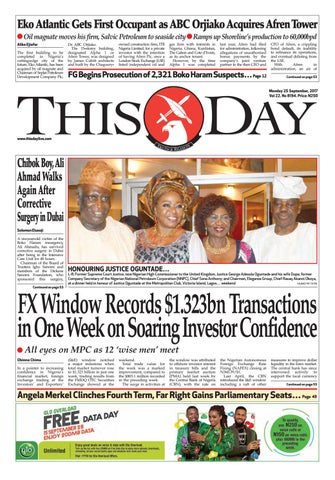
Eko Atlantic Gets First Occupant as ABC Orjiako Acquires Afren Tower Oil magnate moves his firm, Salvic Petroleum to seaside city Ramps up Shoreline’s production to 60,000bpd Alike Ejiofor The first building to be completed in Nigeria’s cutting-edge city of the future, Eko Atlantic, has been acquired by oil magnate and Chairman of Seplat Petroleum Development Company Plc,
Dr. ABC Orjiako. The 15-storey building, designated Alpha 1 or Afren Tower, was designed by James Cubitt architects and built by the Chagoury-
owned construction firm, ITB Nigeria Limited, for a private investor with the intention of having Afren Plc, once a London Stock Exchange (LSE) listed independent oil and
gas firm with interests in Nigeria, Ghana, Kurdistan, The Gabon and Cote d’Ivoire, as its anchor tenant. However, by the time Alpha 1 was completed
last year, Afren had filed for administration, following allegations of unauthorised bonus payments by the company’s joint venture partner to the then CEO and
FG Begins Prosecution of 2,321 Boko Haram Suspects… Page 12
CFO of Afren, a crippling bond default, its inability to refinance its operations, and eventual delisting from the LSE. With Afren in administration, an air of Continued on page 53
Monday 25 September, 2017 Vol 22. No 8194. Price: N250
www.thisdaylive.com TR
UT H
& RE A S O
N
Chibok Boy, Ali Ahmad Walks Again After Corrective Surgery in Dubai Solomon Elusoji A six-year-old victim of the Boko Haram insurgency, Ali Ahmadu, has survived corrective surgery in Dubai after being in the Intensive Care Unit for 48 hours. Chairman of the Board of Trustees Igho Sanomi and members of the Dickens Sanomi Foundation, who sponsored this surgery, Continued on page 53
HONOURING JUSTICE OGUNTADE…
L-R: Former Supreme Court Justice, now Nigerian High Commissioner to the United Kingdom, Justice George Adesola Oguntade and his wife Dupe; former Company Secretary of the Nigerian National Petroleum Corporation (NNPC), Chief Sena Anthony; and Chairman, Eleganza Group, Chief Rasaq Akanni Okoya, at a dinner held in honour of Justice Oguntade at the Metropolitan Club, Victoria Island, Lagos… weekend mubo peters
FX Window Records $1.323bn Transactions in One Week on Soaring Investor Confidence All eyes on MPC as 12 ‘wise men’ meet Obinna Chima In a pointer to increasing confidence in Nigeria’s financial market, foreign exchange trading at the Investors’ and Exporters’
(I&E) window notched a major milestone when total market turnover rose to $1.323 billion in just one week, trading results from the FMDQ OTC Securities Exchange showed at the
weekend. Total trade value for the week was a marked improvement, compared to the $803.1 million recorded in the preceding week. The surge in activities at
the window was attributed to offshore investor interest in treasury bills and the primary market auction (PMA) held last week by the Central Bank of Nigeria (CBN), with the rate on
the Nigerian Autonomous Foreign Exchange Rate Fixing (NAFEX) closing at N360.39/$1. Last April, the CBN introduced the I&E window including a raft of other
measures to improve dollar liquidity in the forex market. The central bank has since intervened actively to support the local currency Continued on page 53
Angela Merkel Clinches Fourth Term, Far Right Gains Parliamentary Seats… Page 49
2
T H I S D AY MONDAY SEPTEMBER 25, 2017
T H I S D AY MONDAY SEPTEMBER 25, 2017
3
4
T H I S D AY MONDAY SEPTEMBER 25, 2017
T H I S D AY MONDAY SEPTEMBER 25, 2017
5
6
T H I S D AY MONDAY SEPTEMBER 25, 2017
T H I S D AY MONDAY SEPTEMBER 25, 2017
7
8
T H I S D AY MONDAY SEPTEMBER 25, 2017
T H I S D AY MONDAY SEPTEMBER 25, 2017
9
10
T H I S D AY MONDAY SEPTEMBER 25, 2017
T H I S D AY MONDAY SEPTEMBER 25, 2017
11
12
MONDAY, SEPTEMBER 25, 2017 ˾ T H I S D AY
STARTERS
FG Begins Prosecution of 2,321 Boko Haram Suspects 220 detainees to be released
Two-Minute Briefing NEWS Osinbajo: Buhari Has Ears for
Lawful Agitations The federal government at the weekend again warned that it would not tolerate or allow any group operating rom any section of the country to use any form of agitation to disrupt the peace of the country. Page 54
EDITORIAL The Challenge of Clean Water
No fewer than 663 million people across the globe live without access to clean water, and the vast majority of them are in rural areas, according to a newWorld Bank report. Page 15
POLITICS Beyond IPOB’s Proscription
To end the agitation for succession in the South-east, the authorities will have to do more than just outlaw the Indigenous People of Biafra Page 16
FEATURES Unraveling Unresolved Crimes
Suspected Boko Haram members, Muhammadu Sani (left), Ishaq Adam and Yusuf Yau Saidu Tobi Soniyi in Lagos The Attorney General of the Federation and Minister of Justice, Mr. Abubakar Malami (SAN) will on Monday, October 9, 2017, begin the prosecution of 2,321 suspected members of Boko Haram. A statement issued yesterday by Mr. Salihu Isah, Special Adviser, Media and Publicity to the minister said the suspects were being detained in various detention facilities across the country. While there are 1,670 detainees held at a detention facility in Kainji another 651 detainees are in detention in Maiduguri. Isah also said that 220 detainees have been recommended for release and will participate in the deradicalisation programme for want of evidence. In order to fast-track the prosecution of the cases, he said the justice minister had approved a list of prosecutors to handle the cases, adding that the Legal Aid Council had equally agreed to provide counsel to represent accused persons that cannot afford lawyers. He said four judges had been designated by the Chief Judge of the Federal High Court to hear the cases at Kainji and dispose of them expeditiously. According to him, 13 cases had been concluded, with nine convictions secured while 33 cases were on trial at various Federal High Court divisions. Another 116 cases have been filed but the suspects were yet to be arraigned. He said the trial of those detained in Kainji would start first to be followed by those detained in Maiduguri. However, not all the 1670 detainees in Kainji would face prosecution. They will either be recommended for trial or for the deradicalisation programme. International donor agencies have expressed concern at the slow pace or non-existent prosecution of those arrested for complicity in the atrocities
committed by the insurgents. Amnesty International has also condemned the prolonged detention of suspects without trial. The AGF’s spokesman explained that the prosecution was slow because most of the cases were poorly investigated with confessions being the only evidence. Isah said lack of forensic evidence and absence of cooperation between investigators and prosecutors at preinvestigation stages also contributed to the difficulty in establishing prima facie cases against some of the suspects. Other factors which he said contributed to government’s inability to effectively prosecute the suspects were: poor logistic facilities to transport defendants from detention facilities to courts for trial; scarcity of skilled/ trained forensic personnel to handle investigations of complex cases; inadequate security for counsel handling terrorism cases; and converting military intelligence to admissible evidence. The statement said: “It is expected that the special prosecutions will start with the detainees in Kainji followed closely by the disposal of cases of the detainees in Giwa Barracks, Maiduguri until the cases are exhausted. “The Office of the National Security Adviser (ONSA), as the coordinator of terrorism matters, is expected to assist the court by providing the relevant detainees access to deradicalisation programmes where necessary. “This is the report of an on-thespot assessment of the facilities and other incidentals preparatory to the commencement of trial of the over 1,600 suspected Boko Haram terrorists detained in a military detention facility located in Wawa Barracks, Kainji, New Bussa, Niger State, following successes recorded by the Nigeria Army and other security agencies in the fight against terrorism in Nigeria.
“A team comprising representatives of the Office of the National Security Adviser, Federal High Court and Office of the Attorney-General of the Federation were dispatched to Kainji from the 12th to 14th of September, 2017 to carry out the assessment and to discuss with the relevant authorities and organisations on final preparations for the all-important national assignment,” it read. The statement categorised the suspects into four groups: “Boko Haram suspects who were hitherto investigated by the Joint Investigation Team set up by the Defence Headquarters, otherwise known as DHQ/JIT, and case files transmitted to the Attorney-General of the Federation and after a careful review of the cases based on their individual merit – it was discovered that they have no prima facie cases that will sustain a charge against them in any court of law, hence were recommended for release and handing over to the Office of the National Security Adviser (ONSA) for rehabilitation and/or de-radicalisation. “The second category is the set of suspects that the attorney-general found prima facie cases against and charges already filed at the Federal High Court, Abuja Division who are also mostly in the detention facility under reference and may be willing to plead guilty for lesser sentences. “The other category is made up of suspects whose case files are either recommended for further investigations or that have no investigations conducted on them at all, hence they do not have case files that will warrant the Attorney General of the Federation to form any opinion in respect of their cases. “The fourth category is made up of suspects whose cases were reviewed and prima facie cases were found and may be willing to opt for a full trial.”
The Lagos State Government has finally completed the construction and equipment of the first DNA and Forensic Centre inWest Africa. Gboyega Akinsanmi writes that this would go a long way in… Page 20
BUSINESS 20,684 Assets Valued at N392bn on Collateral Registry The CBN Governor, Mr. Godwin Emefiele has revealed that movable assets valued at N392 billion have been registered on the National Collateral Register (NCR) as at August 24, 2017. Page 23
CITY STRINGS Taming Crime in Abuja
Abuja is begging for urgent attention as a result of increasing criminal activities. Kasim Sumaina, Udora Orizu, Ononso NwaforOrizu and Cynthia Ndukwe who went round the city, report Page 44
INTERNATIONAL Angela Merkel Clinches Fourth Term, Far-right Party Gains Parliamentary Seats Angela Merkel is set to return for a fourth consecutive term in office in an election that witnessed a farright party AfD gaining… Page 49
SPORTS Ghana Defeats Nigeria 4-1 to
Retain WAFU Cup Nigeria’s home-based Super Eagles lost the 2017 WAFU Cup of Nations trophy to Black Stars of Ghana 4-1 last night. Page 62
T H I S D AY MONDAY SEPTEMBER 25, 2017
13
14
T H I S D AY Ëž Ëœ Í°ÍłËœ Í°ÍŽÍŻÍľ
COMMENT
Editor, Editorial Page PETER ISHAKA Email peter.ishaka@thisdaylive.com
NIS AND THE CONTRIBUTORY PENSION SCHEME
S
Solomon E. Leggjack canvasses the removal of the Immigration Service from the contributory pension scheme
ince the publication of the scheduled public hearing by the House of Representatives Committee on pensions for Thursday, September 28, 2017 and the invitation of all relevant stakeholders for the submission of memoranda on the bill to amend the Pension Reform Act 2014 and to exclude members of the Nigeria Police Force (NPF), Nigeria Immigration Service (NIS), etc., and other related agencies from the application of the contributory pension scheme (CPS), there has been palpable excitement and gloom on the faces of personnel of these agencies. The widely reported undisguised opposition of PTAD, PENCOM and organised labour to the excision of the paramilitary services from the so-called CPS is not only the sole cause of the grief and gloom but also considering our statutory responsibilities and the enormity of associated risks of our work environment. The clamour for the passage of this bill – Pension Reform Amendment Act No.2 of 2014 is legitimate and reasonable if viewed against the backdrop of Decree 75 of 1993, of which section 3 clearly specified, the NPF, Nigeria Customs Service (NCS), NIS, Nigeria Prisons Service (NPS), National Intelligence Agency (NIA) and Department of State Services (DSS) as paramilitary bodies. Accordingly, any suitable pension programme set up for any or some of these paramilitary bodies must be good for all the paramilitary services. The removal of DSS, NIA and the NPF from the CPS, good as it has been, should by necessary implication dovetail into a legal and mandatory excision of the unaffected paramilitary services particularly now that the clamour for it has become very loud, relentless and pervasive amongst the affected services. Additionally, it must be admitted that the unfavourable nature of the CPS by way of woeful failure to meet the retirement aspirations of our personnel, like other arms bearing, paramilitary agencies - the DSS, NIA and NPF was responsible for their request and subsequent excision from the scheme. This unending agitation by personnel of the NIS to be removed from the CPS stems from the unsavoury and perilous challenges and experiences retired colleagues have had to face in the course of their retirements. These include: a situation where a former or retired CGI on consolidated salary – who earned N1,661,000.00 per month while in service is now paid a meagrely N101,000.00 as monthly pension; and a chief superintendent of Immigration (COMPASS 12) who earned monthly salary of N160,000.00 while in service now receives a monthly handout of N75,000.00 as pension. If the foregoing is not pathetic enough then, the inability or refusal of National Pension Commission and PENCOM to pay NIS personnel who voluntarily retired from the service and payment of death benefits to
THE UNENDING AGITATION BY PERSONNEL OF THE NIS TO BE REMOVED FROM THE CPS STEMS FROM THE UNSAVOURY AND PERILOUS CHALLENGES AND EXPERIENCES RETIRED COLLEAGUES HAVE HAD TO FACE IN THE COURSE OF THEIR RETIREMENTS
children and next of kin of officers and men who died in active service as JTF members in the North East operations and elsewhere over the years now, is to say the least, inexcusable. To further add salt to a festering injury, Pension Transitional Arrangement Department (PTAD) has blatantly refused NIS due representation on PTAD in accordance with section 42(3) of the Pension Reform Act 2014 for effective liaison; in addressing pension related complaints of retired personnel. Apart from the foregoing which are undoubtedly weighted in favour of the NIS and other paramilitary agencies to exit the CPS, it is pertinent to note that members of the House of Representatives had previously found that our inclusion into the CPS was done in error hence sponsored this bill as a corrective measure. Similarly, if what obtains elsewhere is anything to go by then the Indian and Pakistani Governments Pension Schemes for paramilitary and security forces is recommended for adoption in Nigeria. The pension schemes of these two countries not only exclude them from contributory pension arrangements but effectively place them in mainstream military pension scheme – having recognised that they have frequently and increasingly been deployed for civil disturbances and other related duties – outside their core mandate statutory functions. The above represents the lot or work environment of NIS personnel and other paramilitary agencies in Nigeria at the moment. In consideration of the foregoing, we make bold to state that the NIS and her personnel do not belong to any known labour union – including the NLC. Therefore we view the opposition of organised labour to our desire for excision from CPS as uncharitable and amoral and should be ignored since they neither represent us nor speak for us. Similarly, the reported opposition of PTAD and PENCOM, if it is true is but self-serving as they are mere pension scheme administrators for civil servants and NOT our employers and as such lack the moral plank to do so – since they are neither contributors nor beneficiaries. In conclusion therefore, it is the plea, hope and earnest expectations of NIS personnel that Honourable Members of the House of Representatives would favourablly consider and legislate for the excision of the NIS and other paramilitary services from the CPS. If the federal government would in her wisdom re-align the NIS, Customs and Prisons Services with the Nigeria Police as far back as 1992 and have also approved the removal of some security agencies – including the NPF from the CPS, it would be fair, just and reasonable to accede to the NIS demand for excision from the contributory pension scheme. Leggjack is Deputy Comptroller of Immigration, Rivers State Command, Port Harcourt
WHO WILL SAVE NIGERIANS ABROAD?
T
Adewale Kupoluyi argues that the government could do more for Nigerians outside the country
he latest onslaught on Nigerians took place a few days ago with the killing of one Mr. Clement Ofoma in South Africa. The 35-year-old Ofoma was a native of Obosi, Idemili North Local Government Area of Anambra State. According to the embittered wife of the victim; about 10 South African policemen arrested him for allegedly dealing in drugs. “They searched our house, his store and other places, but did not find any substance. In the process, they tortured him to confess where he kept the drugs, but my husband insisted he had nothing. The police used cellophane bag to cover his face and at a point, he was struggling to breathe and became unconscious. By the time they took him to a hospital, he was pronounced dead�, she said. Before Ofoma’s case, another Nigerian, Kingsley Ikeri, an indigene of Imo State, was allegedly killed by the police during interrogation for allegedly being in possession of drugs. Similarly, one Uchena Eloh was said to have been strangled to death by South African policemen. One Tochukwu Nnadi was equally confronted by the police on allegations of drug peddling. He was said to have neither resisted arrest nor struggled with his captors but was still choked to death. Other victims of reported and pathetic onslaught against Nigerians include those of Monday Okorie, Gideon Ogalaonye, Adeniyi Olumoko and Christian Onwukaike, among others. Other examples would suffice: 125 Nigerians were once humiliated and deported by the South African government, for allegedly carrying fake yellow fever vaccination certificates, just as the renowned playwright and Nobel Laureate, Professor Wole Soyinka, was denied entry into that country on flimsy excuse. Much of South African’s hostilities against Nigerian have been attributed to Xenophobia. The severity of these hostilities led the Nigerian and South African governments jointly signed a Memorandum of Understanding (MoU) in 2013 with a view to reinforcing diplomatic ties between both countries. Apart from South Africa, Nigerians have been found to have been executed in Saudi
Arabia, Singapore and China over drug-related offences. Similarly, a septuagenarian, Fausat Abosede was said to have come to Brazil, as a result of a promised medical help by a Nigerian but was later abandoned in the country. With help coming from no quarters, she decided to return home but was arrested at the Brazilian airport when hard drugs were found in a bag someone allegedly gave her to help deliver in Nigeria. A similar case was said of one Lara Salami, who was arrested at the Sao Paulo Airport when drugs stuffed in candles were discovered in her luggage. There was also one Amaka Isilabo, who allegedly went to Brazil after graduating from the university and joined the drug peddling business to raise money for her wedding. Nigerians in Ukraine once protested against the arrest of a Nigerian student for allegedly defending himself against six teenagers, who attacked him at the entrance to his apartment. Olaolu Femi was allegedly remanded in custody by the Ukrainian police, who refused to take the case to court, claiming that they had not been able to get an interpreter for him after spending close to one year in jail without trial. Femi Oladipupo, an engineering graduate student in Philippines was said to have disappeared without a trace. His lifeless body was later found in another city a few kilometres from Manila. Godspower Okirie, who hailed from Rivers State, was brutally murdered in Sampaloc, a neighbourhood of Manila City, Philippines. Another popular case was that of Stephen Lawrence, the Nigerian boy who was murdered by some white racist gang in the United Kingdom. Each time I get to read about the plight of Nigerians in foreign lands, I feel greatly saddened, depressed and perturbed that my fellow country men and women suffer endlessly and are simply marked-down for offences they really knew nothing about. Regrettably, the government appeared not to have done much in protecting its citizens from such dangers in foreign lands. This posturing is both unacceptable and indefensible. The Chairman, House of Representatives’ Committee on Diaspora
Matters, Representative Rita Orji, has condemned the alleged lackadaisical attitude of the federal government towards the protection of Nigerians outside the country, describing it as a ‘conspiracy of silence’. Although, the Minister of Foreign Affairs, Geoffrey Onyeama as well as the Minister of Interior, Gen. Abdul-Rahaman Dambazau (rtd) recently visited South Africa to hold talks with officials of the country. The talks were aimed at seeking permanent solution to the crisis with the establishment of an Early Warning Unit (EWU), meant to curb all forms of violence. Similarly, the Senior Special Assistant to the President on Foreign Affairs and Diaspora, Hon. Abike Dabiri-Erewa, has enjoined the African Union and the South African government to take decisive steps to protect Nigerians while the Chairman, Senate Committee on Foreign Affairs, Sen. Monsurat Sunmonu had earlier summoned Nigeria’s High Commissioner to South Africa over the matter. A lot still needs to be done. It is sad that fellow citizens have left the country with great hopes, having been frustrated by lack of jobs at home. For many, it had been a lifelong desire and nothing else mattered to them until they eventually made their way abroad. Not a few of them took loans, sold houses, cars, left lucrative jobs and even threw a lavish send-forth party before embarking on the search for the Golden Fleece. Maltreatment of Nigerians abroad stems from unnecessary persecutions, poor legal representation, false accusations, harassment and other forms of racial abuses. In many cases, these unfortunate citizens receive little assistance or protection from Nigerian embassies and high commissions. For instance, many Nigerians often wait in frustration for several months without succeeding in getting their passports renewed. During this period, they are forced to live like fugitives while some end up being arrested and deported. The main excuse by our embassies is that of shortage of machines that could produce the required passports. The way Nigerians are continually being treated abroad does not give the impression of any lasting solution in
sight. This is at variance with what obtains in any serious nation worth dying for. As a way forward, the Ministry of Foreign Affairs should publish travel advisories with updated information. This becomes handy in the sense that some Nigerians do not really know what to expect in foreign countries. The detailed information contained in the publication would provide vital enlightenment and security tips. The ministry should take up the case of every Nigerian illegally killed or harassed in South Africa and other nations in local courts for prosecution. The Nigerian Bar Association should urgently intervene in this regard by collaborating with government. Furthermore, the Big Brother policy of Nigerian diplomacy should be critically reviewed because it seems not sustainable under the current dispensation, as the nation has not benefitted much from such, going by the South Africans experience despite the prominent role played by Nigeria in its liberation from apartheid. Currently, South Africa has many thriving investments in Nigeria that churn out hundreds of billions of naira in annual profits. Is this what Nigeria should get in return? Despite the harshness, provocation and acts of wickedness, Nigerians abroad should desist from taking laws into their hands through reprisal attack, as extrajudicial killing or jungle justice is totally wrong. On a final note, there is the patriotic need for all to deeply reflect on the state of our nation and tame the monster that drives people away. The rate of unemployment is daily skyrocketing, insecurity abounds and the cost of living is intolerably expensive while access to basic social infrastructure continues to be out of the reach of the common man. Addressing these should be the top priority of government. For now, Nigerians living in the Diaspora, who have nothing tangible doing should to return home rather than remaining there and being killed mercilessly. After all, there is really nothing like home! Kupoluyi wrote from Federal University of Agriculture, Abeokuta
15
T H I S D AY Ëž Ëœ Í°ÍłËœ Í°ÍŽÍŻÍľ
EDITORIAL THE CHALLENGE OF CLEAN WATER
N
The authorities may do well to address the shortcomings in water supply
o fewer than 663 million people across the globe live without access to clean water, and the vast majority of them are in rural areas, according to a new World Bank report. In Nigeria, the numbers of those without access to safe water and sanitation are also huge. The report, launched on August 28 at the World Water Week in Sweden, further revealed that in many countries, services did not reach the poor while children have continued to suffer as a result. And to the extent that improving access to clean water will have significant implications for poverty reduction and human development outcomes, this is a report that the authorities cannot ignore. It is rather unfortunate that Nigeria’s level of access to clean water is markedly lower than those of other peer countries in the region. That 57 million people in Nigeria continue to live without access to improved water while 130 million people use unimproved sanitation POTABLE WATER AND facilities is unacIMPROVED SANITATION ceptable. A research SERVICES ARE VERIFIABLE conducted by the MEASURES FOR FIGHTING Water and Sanitation POVERTY AND DISEASES Programme (WSP) of the World Bank revealed that the socioeconomic impacts of poor sanitation alone cost the country about $2 billion each year. A section of the 185-page report titled ‘Nigeria: A Wake-up Call’ provided a glimpse at the water and sanitation sector in the country. Under the Nigeria Water Supply, Sanitation, and Hygiene Poverty Diagnostic, the report revealed that only 29 per cent of Nigerians have access to improved sanitation. The report noted further that 130 million Nigerians did not meet the MDG standards for sanitation, while Nigeria’s water sector faced significant challenges. Even when 61 per cent of Nigerians have access to improved water, only 31 per cent have access to
Letters to the Editor
improved water on premises. Potable water and improved sanitation services are verifiable measures for fighting poverty and diseases. Yet, in the absence of water from piped supplies and protected wells, millions of Nigerians living in both rural and urban areas consume what is available. In many rural communities, the challenge is critical as women and children trek long distances to fetch water from contaminated streams and ponds. For those who can afford it, especially in the major cities and towns, boreholes are indiscriminately dug. But that too constitutes its own problems as it undermines the water table and threatens future supply of the commodity.
A
T H I S DAY
EDITOR DEPUTY EDITORS ˜ MANAGING DIRECTOR DEPUTY MANAGING DIRECTOR CHAIRMAN EDITORIAL BOARD
EDITOR NATION’S CAPITAL
T H I S DAY N E W S PA P E R S L I M I T E D
EDITOR-IN-CHIEF/CHAIRMAN GROUP EXECUTIVE DIRECTORS ˜ ˜
˜ GROUP FINANCE DIRECTOR DIVISIONAL DIRECTORS ˜ ˜ DEPUTY DIVISIONAL DIRECTOR
SNR. ASSOCIATE DIRECTOR ASSOCIATE DIRECTORS ˜ CONTROLLERS ˜ ˜
GENERAL MANAGER
GROUP HEAD DIRECTOR, PRINTING PRODUCTION TO SEND EMAIL: first name.surname@thisdaylive.com
TO OUR READERS Letters in response to specific publications in THISDAY should be brief (150-200 words) and straight to the point. Interested readers may send such letters along with their contact details to opinion@thisdaylive.com. We also welcome comments and opinions on topical local, national and international issues provided they are well-written and should also not be longer than (9501000 words). They should be sent to opinion@thisdaylive.com along with the email address and phone numbers of the writer.
LEADERSHIP CURSE IN THE SOUTH EAST
T
he coming of democracy or civil rule in Nigeria in 1999 has thrown open a can of worms and indeed exposed the varying degrees of rapid deterioration of political leadership. The above assertion is not to invalidate the rich literature that speaks about spectacular leadership failures in all facets of Nigeria since after the colonial rulers left for the United Kingdom. For instance, in the Second Republic, a globally acclaimed novelist and writer Professor Chinua Achebe had authored a book “The Trouble with Nigeria� in which he rightly argued that Nigeria is accursed with poor and bad leadership. Professor Achebe of the blessed memories stated that the Nigerian geography or climate is not the source of worry but that leadership failure presents the worst kind of problems occasioning the crippling of development of the country. Again, long before the publication, Chinua Achebe, Wole Soyinka and a host of other excellent writers had also written lots of books on how messy Nigeria’s leadership profile had assumed even in the First Republic or soon after the political independence in 1960. In all of these scenarios, the military which frequently seized political power had contributed in the deterioration of leadership qualities in the polity.
ltogether, the report painted a gloomy picture of the Nigerian condition that is all too evident, especially with poor children said to be about four times more likely to get diarrheal disease than rich children and that public expenditure in water and sanitation was limited and of poor quality. Besides, across most water-utility indicators, Nigeria under-performed in comparison to African and global averages, according to the report which noted that nearly 30 per cent of water points and water schemes failed within their first year of operation in our country. What the foregoing says is that public officials, at all levels, as well as key stakeholders must begin to develop effective policies and interventions to address shortcomings in access to clean water. Such efforts should be targeted at the most vulnerable in society, specifically those who experience the greatest burden of poverty. But to generate a sustained impact, there must be a synergy in what the various actors are doing so that a combination of such interventions will have more impact than the sum of their parts. Particularly noteworthy is the fact that access to piped water on premises in urban areas declined from 32 per cent in 1990 to 7 per cent in 2015. Yet until we make access to water in Nigeria a right and not a privilege as it currently appears to be, it will be difficult to get many things right.
So it can safely be argued that Nigeria’s leadership troubles predate the advent of civil rule in 1999. This is because the processes that characterised the introduction of the extant grundnorm (1999 Constitution) were shrouded in conspiratorial manipulations, suggesting that the military rulers handpicked the writers of that constitution to insert and import lots of provisions that completely favour a particular zone of the country which is the North from where most of the top military rulers originated in the over 30 years of military interventions in politics. For instance, the sharing formula of federally generated revenues is in such a distorted status that some states from where the crude oil resources are derived aren’t adequately compensated. But the birth of elective government in 1999 also delivered the unforeseen issues of electoral manipulations by godfathers who have consistently imposed their surrogates in offices in the different levels both at the state and federal level. The worst affected region or geopolitical zone of the Nigerian state is the South East of Nigeria whereby these rash of impositions of bad politicians as office holders have progressively denied majority of the people living in the South East the benefits that usually come from good governance, accountability and sustainable development. Emmanuel Onwubiko, head, Human rights writers Association
NO GOVERNOR HAS GOT IT RIGHT
D
iscerning minds would recall the basic responsibilities of a government to its people as espoused in O.A. Lawal’s high school economics text: every government is responsible to its people in the areas of food, clothes, and shelter. This threesome is the kernel around which everything else revolves and if a government can fulfil its obligations in these areas, everything else naturally falls into place as a result of hard work of the population in general and the breadwinner in particular. Thus, it is still a surprise that no governor in Nigeria, past or presently serving, has quite got this basic tenet of governance right. It is a shame that nearly all the governors think that the monthly financial allocation from the central government in Abuja (or Lagos, as it were) is to serve and swell their personal egos and the egos of their families, friends, and administrative associates. By failing in their primary responsibilities, especially in the area of providing decent accommodation, Nigerians then wallow in slum dwellings a couple of notches below pigsties, with raw sewage for company and preventable diseases here and there. It most times befuddles the imagination to contemplate how our gover-
nors are happy to carry on amidst this deprivation as if all is well whilst expending so much resource on themselves to keep up appearances and dine with foreign dignitaries who are always left aghast as to how a people can be so poor in the midst of plenty. If truth must be told, it is not the responsibilities of low income earners to strive to acquire plots of land in city centres and then commence to deface these locales by building slum apartment dwellings. It is the responsibility of state governors to build decent template-based housing units with sewage processing and all-encompassing external concrete-flooring or tarmac-flooring thrown in the midst to discourage breeding of pests like flies, mosquitoes, fleas, gnats and vermin like rats and cockroaches. People only aspire to build their own homes when their levels of income have improved markedly. When government has built homes for the people, the challenges of providing food and clothing significantly pales because Nigerians would toil and sweat to ensure that this duo can be got with minimal government assistance. Thus, now is the time to stop issuing complicated policy statements and promises and get down to the act of simple governance. Sunday Adole Jonah, Department of Physics, Federal University of Technology, Minna
16
T H I S D AY ˾ MONDAY, SEPTEMBER 25, 2017
POLITICS
Group Politics Editor Tobi Soniyi Email tobi.soniyi@thisdaylive.com 08033146139 SMS ONLY
M O N D AY D I S C O U R S E
Beyond IPOB’s Proscription To end the agitation for succession in the South-east, the authorities will have to do more than just outlaw the Indigenous People of Biafra
Buhari should dangle the carrot
W
hile the federal government is still enjoying the euphoria of successfully proscribing the Indegenous People of Biafra (IPOB), it will be well advised to reflect on a recent statement by a former military governor of Kaduna State, Abubakar Umar Umar had said: “President Muhammadu Buhari’s insistence that the unity of Nigeria is a settled issue is a nationalistic wish and is no surprise coming from a veteran of a civil war fought to keep the country one. “However, this does not take into account the mood of the nation as indicated by the growing agitations for self-determination, restructuring and many other similar demands. If indeed the president is able to ignore and silence those agitators, it will be a case of suspended animation.” It is also a wishful thinking for the government to assume that by prohibiting IPOB, the agitation in the South-east will disappear. The half-hearted approach bieng adopted by government to deny the allegation that the south-east is not being marginalised won’t go far enough. If it is in possession of the facts that state otherwise, it should immediately release those facts to the pubic. If the President Muhammadu Buhari-led administration hoped that all it needed to do to douse tension in the south-east was to outlaw IPOB, it should flash back to 2013. On June 4, 2013, the then president, Dr Goodluck Jonathan officially declared Boko Haram a terrorist organisation. On that day the president approved the gazetting of an order declaring Boko Haam’s
activities as acts of terrorism. The order, which was gazetted as the Terrorism (Prevention) (Proscription Order) Notice 2013. affected both Boko Haram (Jamaatu Ahlis-Sunna Liddaawati Wal Jihad) and Jama’atu Ansarul Muslimina Fi Biladis Sudan (Ansaru). The order was approved by Jonathan pursuant to section 2 of the Terrorism Prevention Act, 2011 (As Amended). A statement by his Special Adviser on Media and Publicity, Rueben Abati, said this “officially brings the activities of both groups within the purview of the Terrorism Prevention Act and any persons associated with the two groups can now be legally prosecuted and sentenced to penalties specified in the Act”. The statement said the proscription order also warned the general public that any person “participating in any form of activities involving or concerning the collective intentions of the said groups will be violating the provisions of the Terrorism Prevention Act”.
If proscription did not stop a violent organisation like Boko Haram, it is an illusion to assume that it will stop the IPOB agitation.
Section 5 (1) of the act prescribes a term of imprisonment of not less than 20 years for any person who “knowingly, in any manner, directly or indirectly, solicits or renders support for the commission of an act of terrorism or to a terrorist group. “For the purposes of subsection (1) of section, “support” includes – (a) incitement to commit a terrorist act through the internet, or any electronic means or through the use of printed materials or through the dissemination of terrorist information; (b) receipt or provision of material assistance, weapons including biological, chemical or nuclear weapons, explosives, training, transportation, false documentation or identification to terrorists or terrorist groups; (c) receipt or provision of information or moral assistance, including invitation to adhere to a terrorist or terrorist group; (d) entering or remaining in a country for the benefit of, or at the direction of or in association with a terrorist group; or (e) the provision of, or making available, such financial or other related services prohibited under this Act or as may be prescribed by regulations made pursuant to this Act.” When it was proscribed in 2013, Boko Haram was just four years into violent attacks on the country. By then, it had effectively established itself in northeastern part of the country. By then, Ansaru had carried out fewer attacks and largely focused on the kidnap of foreigners and attack on security personnel. Apart from proscribing these two groups, the president also declared a state of emergency in Borno, Yobe, and Adamawa in order to curtail the activities of the insurgents after other options appeared not to be working.
On November 14, 2013, the Bureau of Counterterrorism of the State Department of the United States of America designated Boko Haram and Ansaru as Foreign Terrorist Organizations (FTOs). FTOs are foreign organizations that are designated by the Secretary of State in accordance with section 219 of the Immigration and Nationality Act (INA), as amended. FTO designations play a critical role in our fight against terrorism and are an effective means of curtailing support for terrorist activities and pressuring groups to get out of the terrorism business. Before then the U.S. had officially labelled the Boko Haram leader, Abubakar Shekau, a terrorist and placed a $7 million (N1.1 billion) bounty for his capture. The Decision to Treat IPOB as Boko Haram, a Mistake The decision to declare IPOB a terrorist organization appeared hasty as government has not yet exhausted all avenues for dialogue. The fact that professor emeritus, Ben Nwabueze, SAN was able to extract a commitment from Nnamdi Kanu to jettison the demand for secession for restructuring shows that a peaceful resolution of the IPOB quagmire was still a possibility. Besides, in reality, there are major differences between IPOB and Boko Haram. To classify both as the same as the nation security agencies had tried to do is another mistake. IPOB might have caused civil disobedience but it was not violent. In contrast, security agencies had consistently used excessive force against IPOB. CONT’D ON NEXT PAGE
17
T H I S D AY ˾ MONDAY, SEPTEMBER 25, 2017
POLITICS
MONDAY DISCOURSE
BEYOND IPOB’S PROSCRIPTION Before the decision to declare IPOB a terrorist organization, there was a security report at the Office of the National Security Adviser to the President declaring IPOB as a threat to the nation’s security. The report also declared Niger Delta militants, Islamic Movement of Nigeria, Muslim Brotherhood, ISIS Recruitment Cells, Armed Herdsmen, Cattle Rustling and Gun running Syndicates as enemies of the state. Classified documents described as ‘2016 Annual Threat Assessment’, show that a multi agency and multi disciplinary organization called the Intelligence Fusion Centre (IFCc) has been created to analyse information from different sources and agencies with respect to threat to the country. IFC will then integrate all information gathered by different security agencies into a single intelligence product. The IFC, intelligence sources, said would make it easier for security agencies to share information. In determining which organisation constitutes a threat to the country, the IFC considers both intent and capability. “For it is the combination of these two factors that most sharply characterises the significance of these threats to the security of Nigeria,” the 2016 Annual Threat Assessment states. The above classification, perhaps explains the decision to clamp down on both the IMN and IPOB. The classification is not only mischievous but dangerous. Niger Delta militants have been very consistent in their message: they want to take control of their resources. Why should people seeking to have a larger share of their resources be declared an enemy of state? Why should a group seeking self-determination be declared enemy of the state? At different fora, the government had tried to explain the herdsmen-farmer clashes as economic issue but had failed to convince Nigerians. This is because, it has failed to view other agitations objectively. Subject to further research, the herdsmen-farmers clashes may indeed be economic factors at play. But this government lacks the credibility to make that argument. International Community Not Deceived Besides, while the decision of Jonathan to outlaw Boko Haram received the support of the international community, countries all over do not share the Nigerian government’s views on IPOB. That is another reason this government will have to tread carefully. International community is not buying into the federal goverment’s narratives. The reason is not far-fetched. It makes little or no sense at all to categorise IPOB and Boko Haram in the same class. The European Union had already rejected the decision of the federal government classifying IPOB a terrorist organization. President of the European Union Commission, Mr. Jean-Claude Junker, had warned the Nigerian security personnel against what he described as their ill hearted and unprofessional handling of democratic issues and the rights of the people. Junker cautioned the Nigerian military chiefs that they must employ every democratic tenet to handle issues that concern the agitations of the citizens in Nigeria. “It is the people’s right to agitate and make a request from their government; self-determination is a right enshrined in the United Nation Charter. The people of Biafra have every right to request for a referendum, they have been in this struggle for a while now they have never killed or shot a bullet instead they are the victims of attacks and murder. “The entire EU hereby condemns the brutal attack on IPOB members and leadership under the pretentious disguise of a military exercise (Operation Python Dance). The Nigerian military is warned to adopt democratic tenets in handling citizens. “The EU will not sit and watch things go undemocratic in the largest economy of the West African region,” he warned Junker also made the point that he would raise IPOB’s request for a referendum among the caucus of the EU, stating that the Biafra request for a referendum was not different from that of the Catalonians in Spain and the Scots in Britain. He urged the Nigeria government to rise above the suppression of voices of dissent and handle issues with every tenet of maturity and democracy.
there is no Yoruba man who has a room and parlour or a N20 million investment in Igbo land, but Igbo have trillions of naira virtually everywhere. The same people are asking for secession. If Igbo are asked to go, what happens? They would lose their property, and all of us are keeping quiet, supporting IPOB! It was very childish, and those behind this should stop, that is my advice. South-South has produced the president, South-West has produced a president and Vice President, the north has produced many presidents, it is hoping that one day in the next shift, by whatever arrangement, the next people that should be considered is the South-East by Nigeria’s sharing formula. So, where are we in our wisdom and the intelligence? That is my position on IPOB; my advice is that Igbo should change their style and condemn IPOB in a manner that should be done and let us flow with the rest of Nigeria for now because we shall benefit more than anyone else.”
Nwabueze once persuaded Kanu to drop agitation for secession
Back to the Proscription of Boko Haram Despite the fact that Boko Haram had perpetuated a lot of violence to deserve to be prohibited, the group became more deadly after it was proscribed. It is not clear what benefits accrued to the country from the decision to proscribe Boko Haram. It neither weakened nor degraded the insurgents. Rather, the decision appeared to have strengthened the resolve of the group to unleash violence on the country. If proscription did not stop a violent organisation like Boko Haram, it is an illusion to assume that it will stop the IPOB agitation. Interesting, one of the political parties that merged to form the ruling All Progressives Congress, the Action Congress of Nigeria issued a warning when Boko Haram was proscribed. That warning remains relevant today. ACN in a statement by Lai Mohammed, who luckily is the Minister for Information and Culture today said the decision to prosribe Boko Haram and Ansaru was wrong. Then he said that desirable as it might be in tackling the terrorist organisations, the decision to proscribe the two groups violated the constitution by stifling the press and tampering with the fundamental human rights of Nigerians. He said the order also made it easy for an increasingly intolerant government to clamp down on the opposition, which its saw as an irritant. ACN then called on the Federal Government to clarify the knotty and vague areas of the open-ended order, that may end up punishing journalists and infringing on the civil liberties of the citizens more than it would curtail activities of the sects. The party said: ‘’Against the background of insinuations in government circles, let us be clear that we do not condone the activities of these sects that have killed and maimed innocent Nigerians and turned a section of the country into a battle field.. “Terrorism in all its ramifications is condemnable, and no responsible government will allow any group, no matter its name, grievances or ideology, to carry out terrorist acts unchecked. “But we believe that whatever action government takes— even in an emergency— must pass the constitutional test, especially since the relevant sections of the Constitution have not been suspended.” It said the offensive section of the order is Section 5 (1), which prescribes a term of imprisonment of not less than 20 years ‘’for any person who knowingly, in any manner, directly or indirectly, solicits or renders support
It is the people’s right to agitate and make a request from their government; self-determination is a right enshrined in the United Nation Charter
for the commission of an act of terrorism or to a terrorist group.” ACN said “support,” as defined by the order, includes “incitement to commit a terrorist act through the Internet, or any electronic means or through the use of printed materials or through the dissemination of terrorist information. “Is this subsection not in conflict with Chapter II Section 22 of the Nigeria Constitution which says ‘The press, radio, television and other agencies of the mass media, shall at all times be free to uphold the fundamental objectives contained in this chapter and uphold the responsibility and accountability of the government to the people?’ “By stifling the press, is the order not abridging a part of the fundamental human rights guaranteed every citizen under Chapter Four of the Nigerian Constitution in Section 39 (1), which states thus: ‘Every person shall be entitled to freedom of expression including freedom to hold opinions and to receive and impart ideas and information without interference?’” ACN said the Nigerian government must take a cue from what obtains in other countries, especially in the USA, which are also battling terrorism, adding that the media in those countries had continued to report freely on activities of the global terrorist organisation, Al-Qaeda, despite the horrendous attacks it had carried out in the US and Europe, among others. Now that the table has turned and the APC is in power, the question is is the party observing the admonition raised above by one of its affiliates? Yes, IPOB Is a Nuisance No doubt, IPOB is a nuisance, but the group’s narratives can be countered to isolate it from the generality of the people in the south-east. Rather than do this, the armstrong tactics adopted by government tuned Kanu into a hero overnight. South-east leaders must accept their own shares of the blame. They are sometimes incoherent in their response to Kanu. Although, they tried to present u noted front, they in secret have their divisions. The Imo State Governor, Rochas Okorocha is not well-liked in the south-east but it will be difficult to fault him when in an interview with the Vanguard he said: “On the issue of IPOB, whether we want to believe it or not, IPOB is not good for the South East, and it is not the best way for us to complain about marginalisation to the Federal Republic of Nigeria. There are better ways; the IPOB way is too primitive. If IPOB must do a thing like that it should have changed the name and fought the way Ijaw youths fought, Arewa youths fought, and they would have made more impact. For everything that comes from the Igbo man, we love to go to the extreme. Now you want to separate yourself from Nigeria, meanwhile, South-South will not go with you, Edo, Rivers will not go with you. If you cut us off here now as South east, if I need to go to Rivers State, I will go and ask for passport and visa, and we are keeping quiet to say this. If there is a crisis now, there is no Hausa man in Igbo land who has a duplex,
Time to Deescalate Tension Some have advised the president to adopt a stick and carrot approach in dealing with the crisis in the south-east. President Muhammadu Buhari should consider this approach. Having wielded the big stick, this may be the right time to dangle the carrot. Last week’s solidarity visit to the south-east by six governors from the north is a welcome development. May be, it is time ithe presidet visited the south-east to address some of the misgivings against him in the region. The idea of running the country on a tripod Abuja-KatsinaLondon is not helping the president. In the alternative, the president should reach out to those who command respect in the south-east. Professor Ben Nwabuze is one of them. He can also talk to members of his cabinet from the region. Unfortunately, the signals coming from law enforcement agencies are not reassuring. Despite the violence recorded in the past, they are still threatening to unleash more violence. An Intimidated Judiciary An exparte order is not granted as a matter of course. The cardinal rule ‘audi alteram partem’ is so sacrosanct that the other party that will be affected by the exparte order ought to be heard by the court. This has been codified in section 36 of the constitution. There are also clear exceptions to the rule. Whether the IPOB’s case falls under the exceptions may depend on whose views you share. What is not in doubt is that we now have a judiciary is afraid of ruling against government. One wonders what injury government will suffer if the judge who heard the IPOB’s case had ruled that the respondent be put on notice. That would have strengthened public confidence in the judiciary. But a judge who remembers that not long ago the houses of some of his colleagues were raided may not want to take the risk. Already, IPOB has filed an application to set aside the order prohibiting it on the grounds that the exparte order was made without jurisdiction, as the order was granted against an entity unknown to law. It also said that there was a clear suppression and misrepresentation of facts in the Attorney General affidavit evidence, pursuance to which the order was granted. IPOB said the order was unconstitutional, as it was made in clear violation of its constitutionally guaranteed rights to self determination; Article 20(1) of the Africa Charter on Human & Peoples Rights, now domesticated into our law under (Ratification and Enforcement Act) (Cap 10) Laws of the Federation of Nigeria 1990; right to fair hearing, right to freedoms of expression, and the press and rights to peaceful assembly and association; clearly provided for under Sections 36, 39 and 40 of the 1999 Constitution of the Federal Republic of Nigeria as (Amended) 2011. It also said that a declaratory order could not be made pursuant to an exparte application, without hearing from the party against whom the order was made. IPOB also said it had no history of violence in the exercise of their right to self determination. After hearing from IPOB, will the judge be bold enough to undo what he had already done? Not sure an Intimidated judge would be able to do that.
18
T H I S D AY MONDAY SEPTEMBER 25, 2017
T H I S D AY MONDAY SEPTEMBER 25, 2017
19
20
MONDAY, SEPTEMBER 25, 2017, ˾ T H I S D AY
FEATURES
Acting Features Editor Charles Ajunwa Email charles.ajunwa@thisdaylive.com
Unraveling Unresolved Crimes The Lagos State Government has finally completed the construction and equipment of the first DNA and Forensic Centre in West Africa. Gboyega Akinsanmi writes that this would go a long way in unraveling unresolved crimes and stemming new ones not only in the state but across the federation
P
revious administrations – civilian and military – attempted at different times to put paid to huge records of unresolved crimes in Lagos State. From the Bola Tinubu era to the Babatunde Fashola period, the Lagos State Government had recognised the centrality of deoxyribo-nucleic acid (DNA) facility if the trend of unresolved crimes must end, not just in the metropolis, but also in the federation. But none of these administrations was able to put up a DNA centre to burst the cycle of unresolved crimes in the state. Concerned as it was then, the Fashola government came up with a plan to build a comprehensive forensic laboratory, which former Commissioner for Works and Infrastructure, Dr. Femi Hamzat then said, would cost N82 billion and was designed to serve all West African countries. Given the project cost then, Hamzat argued that it would make sense to construct the forensic infrastructure under the public-private partnership arrangement. He then cited the reconstruction of the 10-lane Lagos-Badagry Road to the DNA facility the administration proposed to construct somewhere before Badagry. Yet, the Fashola administration could not really achieve this lofty feat. Amid optimism, however, Ambode came to office in 2015. And he inherited huge files of unresolved crimes. For instance, the murder of Alhaja Kudirat Abiola, wife of late Chief MKO Abiola has not been fully resolved over two decades after and the trial of the prime suspect, Major Hamza Al-Mustapha still unconcluded. Also, the murder of Pa Alfred Rewane, a chieftain of the National Democratic Coalition (NADECO), remains unresolved. Almost all the prime suspects died in prisons. Aside huge records of unresolved crimes it inherited, the Ambode administration was confronted with different crime incidents at its inceptions. The incidents ranged from traffic theft to armed robbery, burglary and cult violence, to which the administration responded both tactically and strategically. At least, according to crime statistics, a 65 per cent crime reduction was recorded one year after. But Ambode’s sustained intervention did not end cases of unresolved crimes and delayed justice. The murder of the Managing Director of Lekki Worldwide Investment Limited, Mr. Tajudeen Disu, which is yet to be resolved too, threw up the imperative of a DNA facility. Also, the sudden rise in the trend of kidnapping in the state re-echoed the inevitability of the DNA technology to burst heinous crimes. All for justice Amid these heinous challenges, Ambode eventually conceived the DNA initiative almost one year into his administration with at least three clear mandates, which the State Attorney-General and Commissioner for Justice, Mr. Adeniji Kazeem said, would redefine the state’s criminal justice administration and open windows for dispensing justice in all criminal matters without delay Among others, Kazeem spelt out three core mandates the Lagos State DNA and Forensic Centre (LSD&FC) was established to perform one after the other. First, he said the centre was set up to deplete the state’s records of unresolved crimes and bring masterminds of heinous crime incidents to book, a real reason Ambode reeled out programmes to build the DNA centre under one and half years.
Lagos State DNA and Forensic Centre
located opposite Bookshop House, CMS, Lagos Island
Ambode speaking on the significance of the DNA centre to justice sector reform
Second, Kazeem cited the need to end the culture of delayed justice, which he said, cost the state government much in
For Ambode, the establishment of the forensic centre represents a radical justice reform. At least, according to him, it is the first in the history of Nigeria and the most comprehensive centre in West Africa
terms of funding criminal prosecution and in terms of wasting precious time of the court. With DNA facility in place, according to him, there is end in sight for undue delay in criminal prosecution. Unlike in the previous years, he explained, suspects will now be confronted with stronger empirical evidence that they can hardly deny during the prosecution. With stronger empirical evidence presented before the court, the attorney-general said a suspect “will have to plead not guilty. And this comes with gains first for the state government and second for the suspects. In this instance, the suspect may plead guilty and asks for some mitigation when confronted with such evidence. It saves time of the court and in the process taxpayers’ monies.” Before the advent of the DNA infrastructure, Kazeem lamented the burden of prosecuting criminal cases in the state.
Kazeem acknowledged that it “often takes a lot of time to prosecute criminal cases. It takes much time to get witnesses. It is also time-consuming to put together evidence and so forth.” But now that the forensic laboratory has been completed, he said, the era of undue delayed in criminal prosecution will drastically decline. Likewise, the attorney-general said the forensic would serve the purpose of resolving issues around will and testament. For him, it is an area that the centre will bring empirical evidence to determine paternity of an individual. He said such cases often “arise everywhere in Nigeria. We often witness cases whereby someone dies, the issue whether a child belongs to him or not can be resolved at the centre.” Lastly, Kazeem cited the usefulness of the DNA centre to identify degraded human bodies. When Dana Air Flight 992 crashed in June 3, 2012, the state had to result to use such a technology in South Africa to identify the remains of the victims. Even though the deceased has been buried, the attorney-general noted that experts “can obtain samples from the remains of the victims and subject to DNA test. “In conflict situation, human bodies might been degraded beyond recognition. We can obtain samples from the degraded bodies and compare them with the identity of their relations. Only recently, some students were kidnapped. Even when the students have been rescued, there is a way the cloth they wear can be subject to DNA test. Sometimes, other DNAs may have been transferred to these clothing. It also can help determine the identity of their captors,” Kazeem explained. A radical reform Like other megacities in the world, the Solicitor-General, Mrs. Funmilola Odunlami justified the establishment of the centre. She argued that the emergent rate of crime was indeed a sufficient ground for the centre, which she said, would be unveiled this week. Over the years, she said, Lagos has faced more sophisticated crimes and criminals who are determined to escape the long
21
MONDAY, SEPTEMBER 25, 2017, ˾ T H I S D AY
FEATURES
arm of the law. But with the forensic centre, she said the possibility of escaping the long arm of the law “has been foreclosed because the centre will always provide stronger empirical evidence required for criminal prosecution or for bursting heinous crime.” She, therefore, said the state government initiated the process of establishing the forensic centre “to demonstrate its commitment to criminal justice reform.” For Ambode, the establishment of the forensic centre represents a radical justice reform. At least, according to him, it is the first in the history of Nigeria and the most comprehensive centre in West Africa. To complement the forensic centre, the solicitorgeneral noted that under Ambode, that is not the only justice sector reform the governor has initiated since he assumed office in 2015. Before the DNA centre, Odunlami pointed out different reforms the administration had implemented under two years. First, she cited the procurement of N4.76 billion security equipment for the Lagos State Police Command. She, also, cited Light-up Project, which she said, had created an entirely different environment unsafe for the activities of the men of the underworld She, equally, cited the sustained partnership between the state government and all security agencies on crime flashpoints in different parts of the state. But all these initiatives have not completely faced out criminals from the shores of the state, which according to him, explained the result to the use of technology “to make investigation, prosecution and adjudication more dependable and effective.” On these grounds, the Managing Consultant of LSD&FC, Dr. Richard Somiari gave insight into the background to the centre. As a megacity, Somiari said Lagos required a centre for DNA analysis “to support criminal investigations, law enforcement and the preservation of DNA evidence for the state’s judiciary system.” He explained that crime fighting “is better measured with the DNA technology.” He acknowledged that such a centre did not previously exist in Nigeria even though DNA analysis “has been recognised worldwide as the most powerful and accurate form of human identification (HID). Until now, most, if not all DNA analysis requirements in Nigeria are performed outside the country or the instruments available for in-country testing are based on older technologies that utilise cumbersome protocols that are time consuming and sometimes inaccurate.” Somiari said the fact that such a comprehensive facility was not available in Nigeria before underscored the need for it. Also, she explained the imperative of the DNA facility in the world of the 21st Century. She, thus, said the LSD&FC “has requisite technology and trained personnel to provide the highest level of DNA testing currently possible and that meets international standards.” Already, Somiari said the centre had started operation with the capacity “to analyse evidence and casework DNA rapidly and the capacity to store DNA from suspects, crime scenes and disaster victims. It can now
The DNA centre has the state-ofthe-art equipment, computational tools and servers required for operations. All equipment comes with the standard manufacturers’ warrantee. The laboratory is equipped with all items, regents and consumables expected in a world class DNA forensic lab
One of the laboratories at the centre
operations in Lagos State. “The DNA centre has the state-of-the-art equipment, computational tools and servers required for operations. All equipment comes with the standard manufacturers’ warrantee. The laboratory is equipped with all items, regents and consumables expected in a world class DNA forensic lab. This includes equipment for DNA sample receiving, evidence examination, processing, analysis and reporting.”
Forensic equipment already installed at the centre.
Another forensic equipment installed at the centre.jpg
provide DNA forensics services to support crime scene investigation, law enforcement, human remains identification, paternity,
maternity, sibling testing, preservation of reference and DNA evidence, investigating rape cases and defense and internal security
Sustaining the centre Before this strategic intervention, the attorney-general explained that Nigeria had depended on South Africa “to conduct DNA analysis, processing and testing despite the central role of the DNA in forensic investigation, law enforcement and justice sector worldwide.” Yet, he said a high-powered DNA analysis centre “is not available in Nigeria and the DNA facility in Ghana has limited capacity.” Kazeem’s narrative is indeed an indication that Nigeria “has lost so much in foreign exchange and in time for failure to establish a DNA facility before now. By implication, according to him, most, if not all the DNA testing needs are performed outside Nigeria. It often leads to longer turnaround times and an overall higher cost of bringing closure to investigation and prosecution of crimes.” Now that a DNA centre has been established in Lagos, Kazeem said it would “fulfill an unmet need for DNA profiling, a forensic technique that is now used worldwide. DNA Profiling is an extraction of DNA from body fluids, semen, nails, hair and other DNA generic sources. This will controvert evidence of alibi and confirm physical presence of the suspect at the scene and the origin of DNA to the suspect.” He said the centre would not only fulfill the growing DNA profiling needs of the judicial process. Rather he said it would definitely be a source of revenue for the state by serving the public, other states and neighbouring countries, noting that its standard “international requirements.” Other stakeholders, mainly security agencies, will benefit from it because it supports all levels of DNA collection from people and objects. Sustaining the DNA centre has raised a lot of questions. But according to Somiari, that will not be a challenge for all any reason. He disclosed that the Ambode administration had already worked out a maintenance strategy “to ensure the centre function effectively.” He, also, disclosed that the administration had signed a two-year management agreement with ITSI-Biosciences, LLC . Under the agreement, the attorney-general explained that the US-based company would manage the centre for the first two years. During the period, according to him, the ITSI-Biosciences, LLC would train select staff members of the Lagos State Government. It will train the trainers, share vital knowledge and transfer expertise to the select state officials under the two-year agreement.
22
IMAGES
MONDAY, SEPTEMBER 25, 2017, ˾ T H I S D AY
Photo Editor Abiodun Ajala Email abiodun.ajala@thisdaylive.com
British-Ghanaian actress, Ama Abebrese; Nollywood actress, Oghenekaro Itene; Congolese Actress, Sandra Seghers and Nigerian Actor, Ramsey Nouah – all ACF Brand Ambassadors during the Africa Cinematography Festival unveiling of Brand Ambassadors in Lagos...recently.
L-R; Deputy Director, Creative Arts, Lagos State Ministry of Tourism, Arts and Culture, Mr. Babatunde Annan; Assistant Director, Research and Development, Lagos State Ministry of Tourism, Arts and Culture, Mrs. Yetunde Simpson; and General Manager, On and One Event Ltd./Organizer of Bear Festival, Mr. Akinola Oluwaleimu, at a Press Conference on Bear Festival, held in Lagos...recently sunday adigun
L-R: Member, Coalition of Nigeria Apostolic Leader (CNAL), Rev. Ladi Thompson; Convener, CNAL, Bishop Okwudili Ossai; Member, Apostle Wale Adefarasin; and Co- Convener, Bishop Abraham Olaleye, at the press briefing on Non-Violent Communication project to promote peace in Lagos...recently etop ukutt
L-R; Zonal Head, Ikeja 2 of First City Monument Bank (FCMB), Mrs. Adejumoke Arije; Executive Director, Access Field Limited, Ambassador Femi Sowemimo; one of the winners of a television set at the third Lagos Regional draw of the “FCMB Millionaire Promo Season 4”, Mr. Oluwasegun Osho; an official of the National Lottery Regulatory Commission, Mr. Uwakuche Durugo and Retail Head, Lagos Region, FCMB, Funmilola Paseda, during the promo draw ceremony held at Agege, Lagos...recently
L-R; Corporate Services Manager, Fidson Healthcare Plc, Mr Sylvester Iriogbe; Winner of Fidson’s Prize for Best Graduating Fellow, Dr. Ervihi-Uva Luper and Product Manager, Fidson Healthcare Plc, Mr Ignatius Shebayan during the presentation of Fidson Prize for Best Graduating Fellow-Faculty of Family Medicine at the 35th Convocation Ceremony of the National Postgraduate Medical College of Nigeria, Lagos...recently
L-R:Director, Royal Exchange PLC, Adeyinka Ojora; Company Secretary, Ms Sheila Ezeuko; Executive Director, Marketing Operations & Technology,Nigerian Stock Exchange (NSE), Ade Bajomo; Chairman, Royal exchange Plc, Mr Kenny Odogwu,and Group MD,Alhaji Auwalu Muktari,during the closing gong ceremony at the NSE by the Royal Echange Plc in Lagos ...recently Abiodun Ajala
L – R: Trustee, N.O Idowu Foundation Mr Yemi Idowu; President, Pan-African Associations of Surgeons, Dr Koffi Herve Yangni-Angate; Oyo State Deputy Governor, Chief Moses Alake Adeyemo; Chairman Senate Committee on Health Senator Lanre Tejuosho and Managing Director and CEO, AXA Mansard health, Mr Tope Adeniyi at the commissioning of the N.O Idowu Community health Centre in Eniosa-Onibepe, Oyo State...recently
L-R; Operations Director. Mr. Tarak Sahay; Operations Manager, Mr. Tunji Sasore;, Chief Operations Officer, Mr. Thomas Forgacs and, Operations Manager,Lagos West Mr. Aravindu Valmeekan, all of Visionscape, during Cleaner Lagos Initiative (CLI) Area Managers Meeting at Visionscape Office, Ogudu, GRA, Lagos....recently
23
T H I S D AY ˾ MONDAY, SEPTEMBER 25, 2017
BUSINESSWORLD NIBOR OVERNIGHT 1-MONTH
R A T E S 15.7500 20.1166
3-MONTH 6-MONTH
A S
21.9968 24.1449
A T
NITTY 1-MONTH 3-MONTH 6-MONTH
Group Business Editor Chika Amanze-Nwachuku
Email chika.amanzenwachukwu@thisdaylive.com 08033294157
J U L Y 18.6377 19.0469 20.4914
6 ,
9-MONTH 12-MONTH
2 0 1 7 21.3478 22.3668
EXCHANGE RATE N306.35/ 1 US DOLLAR* *AS AT LAST FRIDAY
Quick Takes Firm Bags ISO Certification
WOOING INVESTORS
L-R: Chairman of the occasion, Prof. Fabian Ajogwu (SAN); Minister of Finance, Mrs. Kemi Adeosun; Chief Executive, Stanbic IBTC Holdings Plc, Mr. Yinka Sanni; and Chief Executive, Stanbic IBTC Bank, Dr. Demola Sogunle, at the 2017 Standard Bank East to West Africa Investors’ Conference in Lagos ... recently
20,684 Assets Valued at N392bn on Collateral Registry Obinna Chima The Central Bank of Nigeria (CBN) Governor, Mr. Godwin Emefiele has revealed that movable assets valued at N392 billion have been registered on the National Collateral Register (NCR) as at August 24, 2017. According to him, 136 financial institutions, 22 commercial banks, 106 microfinance banks, one non-bank financial institution, three merchant banks, three development finance institutions and one non-interest bank have registered 16,236 financing statements for 20,684 movable assets on the NCR as at the aforementioned date. He disclosed this in the central bank’s Movable Assets newsletter, a copy of which was obtained at the weekend. He pointed out that financial
ECONOMY institutions traditionally prefer fixed assets, such as land and building as collaterals for loans, while majority of the micro, small and medium enterprises (MSMEs) can only provide movable assets such as inventory and equipment. Emefiele recalled that in his maiden press briefing upon assumption of office in June 2014, he stated that one of his vision was to create a people centred central bank. According to him, one of the key strategies to achieve this was to significantly improve the credit culture in the Nigerian Banking System, by designing and introducing a robust system that effectively reduces information asymmetry, assists lenders to make good credit decisions and ultimately improve access
to credit by MSMEs. He pointed out that top of that agenda was the establishment of a Secured Transaction and National Collateral Registry (ST&NCR). “That promise has now been fulfilled with the commencement of live operations of the National Collateral Registry on May 25, 2016 and the accent to the Secured Transactions in Movable Assets Act, 2017 by the Acting President Professor Yemi Osinbajo on 30th May, 2017,” he added. The NCR initiative was in collaboration with the International Finance Corporation (IFC). The NCR is expected to unlock access to credit, which has always been a major concern to Nigerian MSMEs, The registry allows financial institutions, bank and non-bank, to register their priority interest
in movable assets as collateral for loans. It is an on-line, real time notice based registry that allows borrowers to prove their creditworthiness and potential lenders to assess their ranking priority in potential claims against particular collaterals. There is empirical evidence, that the establishment of collateral registries has increased lending to MSMEs in other jurisdictions. In China, for example, the adoption of the collateral registry resulted in 84 per cent of SMEs securing their loans using movable assets. The use of the registry in Mexico also grew loans secured with movables by four times while 45 per cent of total loans went to the agricultural sector. Similarly, in Afghanistan, Continued on page 24
Despite Challenges, Analysts Bullish on Banking Stocks Goddy Egene Investors in the banking sector should expect impressive returns going by the projections of some investment and financial analysts. According to the analysts, although the recession of 2016 and the devaluation of the naira heightened risk environment for the banking sector, the banks put up a good performance in the first half (H1) of 2016. Analysts at FBN Quest said despite the subdued loan growth picture, banks have been able to deliver strong revenue and earnings growth, capitalising on pricing and foreign exchange (fx)-related gains.
CAPITAL MARKET “H1 2017 profit before tax (PBT) growth averaged 32 per cent thanks to double-digit growth on both revenue lines. We expect the trend in H1 to carry on into H2 such that loan growth by the end of 2017 averages a modest four per cent. Having rebounded strongly in 2016 to an average of 18.6 per cent, we forecast the return on average equity (ROAE) for our universe to decline to 17.3 per cent due to base effects: fx-related gains, though visible in 2017, are not as significant as they were in 2016. Our 2018E average ROAE forecast
is 16.5 per cent. GTBank and Stanbic IBTC Bank are forecast to deliver ROAEs well above the sector-average, in the 27-35 per cent range over the next two years,” they said. The analysts said asset quality risks have been kept under control with the nonperforming loan (NPL) ratio of their universe averaging 5.4 per cent in second quarter (Q2) 2017. “While restructurings have helped, the regulator deserves some credit for strengthening banks’ risk management processes after the last crisis. Although we expect some deterioration in asset quality in H2, we do not expect a doomsday
scenario. We forecast a year-end average NPL ratio of 6.1 per cent, with all except Diamond Bank (12 per cent) reporting ratios in the mid-single digit range. Tier 2 banks Diamond and FCMB Group face the highest risk from asset quality deterioration given that their capital ratios are the lowest in the group – 15.4 per cent and 17.3 per cent respectively,” FBN Quest said. Speaking on the prices of stocks in the sector, the analysts said they have a broadly neutral view on the sector at current levels. “Compared with the 0.82x Continued on page 24
Whyte Cleon Limited, one of Nigeria’s fastest-growing outsourcing and human resource companies has charted a new path within the human resource industry by receiving the highly-coveted ISO Certification from the Standards Organisation of Nigeria (SON) after having operated its quality management system in conformity with the NIS ISO 9001: 2015 for payroll outsourcing, recruitment, training, personnel outsourcing and human resource administration. The CEO of Whyte Cleon Limited, Mrs. Adenireti Adebayo while confirming this development said the company was the first to attain the feat within the human resource industry in Nigeria. According to Adenireti, “This was achievable due to the grace of God and the hard work of our team who made sure all our processes are operated only in accordance with accepted international standards and practices.” Corroborating this, the Head of Marketing & Service Delivery for Whyte Cleon Limited, Mr. Yakubu Wuyep, said the success of the company was due to its values and philosophy of teamwork, respect, integrity, professionalism and empathy. He went further to say the qualities were part of the reasons why blue chip companies and market leaders prefer Whyte Cleon Limited. Located in Victoria Island, Lagos, Whyte Cleon Limited, commenced operations as a HR Outsourcing and Consulting Company in 2010, specialising in functional areas such as personnel outsourcing, recruiting, talent acquisition, head hunting, payroll administration, assessment solutions & testing, psychometric testing, learning and development solutions, among others.
NSE Okays Trading on Fortis Shares
The Nigerian Stock Exchange has approved the resumed trading on shares of Fortis Microfinance Bank Plc on the floor of the exchange. The NSE had caused a temporary technical suspension on its shares due to late rendition of its 2016 Audited Annual Accounts to the regulatory body. However, the Exchange, in a correspondence referenced NSE/LRD/LE1/09/17, dated September 13, 2017 and addressed to the Company Secretary approved for the shares of Fortis MFB to resume trading on the floor of NSE, having satisfied regulatory requirements. The letter, signed by the NSE’s acting Head, Listings Regulation Department, Godstime Iwenekhai read in part: “Having submitted your audited accounts for the period ended 31 December 22 August 2017; the Exchange wishes to inform you that it has lifted the suspension of trading in the shares of your Bank which is in line with Rule 3.3, Rules for filing of Accounts and Treatment of Default filing, Rulebook of The Exchange (Issuers’ rules)…” The audited accounts has since been approved by the Central Bank of Nigeria (CBN) and submitted to the NSE. In order to maintain its place as a market leader in the Nigerian and African Microfinance markets, the bank recently launched its five-year strategic plan that will enable it become the dominant microfinance brand by heavily investing in technology to drive financial and economic inclusion. It was granted a national microfinance banking license in 2015 with the clear mandate to open shop in all 36 states of the federation including the Federal Capital Territory (FCT) and currently has presence in over 22 stated including the FCT.
Firms Partner to Host Africa Segment
Advertising Week Europe, a foremost international marketing, advertising, and technology event has entered into a partnership with Republicom, an Integrated Marketing Communication group in Nigeria to host the first ever Africa Segment from March 20 to 24, 2017 in London.Advertising Week Europe is a hybrid of inspiring thought leadership, entertainment and special events celebrating the industry and its people. The event which is in its fifth edition, this year will make Africa the center stage with two key sessions to be presented by Republicom with the theme: “Africa’s Mobile Revolution”.The keynote address is expected to spotlight Africa and the impressive growth in the GSM sector looking at it from the economical standpoint and the growth opportunities that still exist in the sector.
“Digital innovation is where the bank is going and as a group, we have clearly set a target to try and achieve not less than 100 million customers by 2020”
Managing Director, Ecobank Nigeria Limited,
Mr. Charles Kie
T H I S D AY ˾ MONDAY, SEPTEMBER 25, 2017
24
BUSINESSWORLD 20,684 ASSETS VALUED AT N392BN ON COLLATERAL REGISTRY
with the operations of the new centralised collateral registry, 90% of loans by financial institutions were granted to SMEs, Emefiele explained. He added: “In this regard, i am hopeful that the commencement of operations of the NCR will have tremendous impact on MSME lending in Nigeria, as we strive to increase lending by banks to the sub-sector to about 10 per cent from 0.067 per cent in the next few years. “I am happy to note that the strategy this yielding positive results. The lack of access to credit for MSMEs in Nigeria has resulted in a huge financing gap. “Records showed that in 2016, loans to MSMEs by deposit money banks as a percentage of their total loans and advances to the economy declined to 0.067 per cent from 0.099 per cent achieved the preceding year.” He said there was no gainsaying, that the lack of access to finance had been one of the major impediments to the development of the sub-sector in Nigeria today, saying that it was expected that the Registry will motivate banks to accept moveable assets as collateral Furthermore, the CBN Governor anticipated that it would boost production and create employment, adding that increased access to credit would increase productive capacity and generate employment. “The Registry will cut down the cost of verifying borrowers by 35 per cent and therefore reduce the cost of credit and non-performing loans,” he added. DESPITE CHALLENGES, ANALYSTS BULLISH ON BANKING STOCKS
price to book (P/B) multiple the sector is trading on currently, our fair values imply that the sector should trade at 0.92x for an average ROAE in 2018E of 16.5 per cent. Zenith, FCMB and Diamond show the greatest upside potential (over 30 per cent), based on our price targets. However, we continue to tread cautiously around tier 2 names. Besides Zenith, our only outperform-rated name, absolute valuations are not compelling enough to argue strongly for aggressive accumulation of tier 1 names also,” they said.
Group Business Editor
Chika Amanze-Nwachuku AgriBusiness/Industry Editor
Jonathan Eze
Comms/e-Business Editor
Emma Okonji
Capital Market Editor
Goddy Egene
Senior Correspondent
Raheem Akingbolu (Advertising) Correspondents
Chinedu Eze (Aviation) Linda Eroke (Labour) Eromosele Abiodun (Maritime) Ejiofor Alike (Energy) James Emejo (Nation’s Capital) Obinna Chima (Money Mkt) Chineme Okafor (Energy) Reporters
Nume Ekeghe (Money Market) Nosa Alekhuogie (AgriBusiness)
NEWS
Kari: Some Insurance Firms Are Too Financially Feeble Ebere Nwoji The Commissioner for Insurance, Alhaji Mohammed Kari, has said that some insurance firms operating in Nigeria are financially too weak. He also noted that these firms that are too financially feeble to operate are violating rules and regulations of the insurance industry in their bid to raise money for workers’ salaries. Kari, made the remark in his keynote address at the 2017 Insurance Professionals’ Forum held in Abeokuta. Ogun State. He said: “Insurance institutions must therefore review and where necessary, enhance their capital, risk management and governance in order to survive the interesting future ahead. Barring hindrances such as high costs of implementation, paucity of requisite data and skills and political obstacles; we posit that an intelligence implementation of a strategic consolidation in Nigeria will boost the overall performance of the industry and position it as one of the foremost in the continent”. Kari, who noted that his remarks should not be mistaken for another call for recapitalisation and consolidation exercise in the industry also said that the Nigerian insurance market deserves to be reckoned with internationally hence the need for operators to cooperate with each other. According to him, “Our market by all standard deserves to be reckoned with in the International playground of insurance, but how can we when we operate in uncoordinated silos. We have to wake up, sort ourselves out and be ready to play our role at
least in the sub-region.” He lamented that the conduct of some of Nigeria’s insurance professionals is to say the least, appalling even as he urged the Chartered Insurance Institute of Nigeria, (CIIN) to take a critical look at the development with a view to coming up with measures to arrest it. “We look forward to a day when a professional will be de-certified by the Institute for unprofessional conduct. Cases abound around us in other professions where the privileges of a practitioner are withdrawn for some unacceptable act in his calling”, he observed.
The Commissioner said when the President of CIIN, Funmi Babington -Ashaye and some members of her team visited his office in Abuja, he emphasised on the need to ensure members of the institute uphold the ethics of the profession. He therefore called on the CIIN to review its Code of Conduct for members in order to be in tune with the current international best practice. “There is obvious need to enforce discipline in the system and there cannot be a better a place to start than from the members of the Institute. In the spirit of self-regulation, the Commission therefore demands
She noted that when the economy was growing at an impressive rate and prospering, all sectors, including the insurance industry, also flourished. According to her, similarly, since the economy has been experiencing serious macroeconomic challenges which currently manifest in sharp drop in productive and economic activities, high unemployment and crime rates, delinquent credit facilities and failure of many businesses, the insurance business is inevitably affected. She noted that the need to meet insurance obligations have actually increased with these challenges.
WORKING VISIT
L-R: Permanent Secretary, Ministry of Communications, Alhaji Abdullahi Mashi; Minister of Communications, Barrister Adebayo Shittu; and Director General, Bureau of Public Enterprises (BPE), Mr. Alex A. Okoh, during a working visit by the privatisation boss to the minister in Abuja…recently
Seized Arms: Container Examination Followed Due Process, Says TICT The management of Tin Can Island Container Terminal (TICT) has said that contrary to media reports, the positioning and subsequent physical examination of a container of arms seized by the Nigeria Customs Service at the Tin Can Port followed due process. Legal Manager of TICT, Mrs. Maryann Olopade, said in a statement in Lagos on Thursday that it was mischievous to speculate that the terminal operator was “in trouble” over the seized container of arms. She said: “We have observed with great displeasure the false, unverified and unprofessional statement published in some newspapers. For the avoidance of doubt and in the interest of the well-meaning citizens of this great Country Nigeria, we wish to state as follows: “Container No GESU 2555208-0, was discharged on our terminal on the 2nd of September 2017, from the Vessel M/V Bella Schulte Voyage 23582, it was booked on the 5th of September 2017 for examination on the 6th of September 2017, the booking for examination was duly reflected in the examination list for 6th of September 2017 and the list was delivered to the Customs CIU unit, and other Government Agencies. “In line with the said
that the Institute gives an accelerated attention and incept the process of reviewing and enforcing the Code of Conduct for members, failure of which we would be left no option but to enforce it as contained the law”, he said. Babington-Ashaye, on her part, said the theme of this year’s forum, ‘Solvency, Stability and Growth- Exploring Possibilities’, was specially and carefully chosen to draw attention to some of the critical challenges currently facing the insurance industry so that operators can evolve strategic solutions for the benefit of the industry.
booking the container was rightly positioned for examination, and the seal of the said container was cut on the instruction of Customs Officers. “Following the discovery of the ammunitions in the said container, TICT as a responsible corporate citizen has rendered and continues to render every necessary assistance and information to assist the customs in the investigation of this matter, which such information has resulted in the interception of another container belonging to the same consignee also containing ammunitions. TICT having acted at all times with every sense of responsibility is therefore surprised at the misinformation to the general public on this matter.” Olopade explained that TICT’s function as a terminal operator is limited, amongst other things, to the receipt of containers from carrying vessels and delivery of same to the consignee’s, and as such TICT is not in any position to determine the type or nature of the cargo consigned in any container. “Furthermore, we wish to assure the good people of our country Nigeria and indeed our esteemed client’s that we remain committed to deliver service with every sense of responsibility,” she added.
NCC Restates Commitment to Consumer Protection Emma Okonji The Nigerian Communication Commission has highlighted the importance of consumers in the telecoms industry, even as it stressed the need for consumer satisfaction and protection as enshrined in the eight Point Agenda of the Commission. The Executive Vice Chairman of NCC, Prof. Umar Garba Danbatta, who was represented at the consumer parliament by the Executive Commissioner, Stakeholders Management at NCC, Mr. Sunday Dare stated this at the 81st edition of Telecom Consumer Parliament held in Lagos last week. He said the NCC being a consumercentric regulatory organisation, would continue to take into cognizance, the second and sixth items on the 8 Point Agenda, which focuses on the rights and privileges of the telecoms consumers, adding that they are the core drivers of the Commission’s Year of Telecom Consumer initiative because they focussed addressing consumer protection, empowerment and improved service quality. Danbatta explained that
all NCC’s initiatives such as SIM Card registration, Mobile Number Portability, National Broadband Policy implementation, development of 2442 and 622 short codes, as well as various consumer awareness campaigns are to ensure consumer satisfaction and protection. “We are grateful to consumers for responding positively to the telecommunications revolution. Consumers have continued to spend significant portion of their disposable income on telecommunication services as it continues to improve quality of life, businesses and social engagements. “If all these initiatives, projects, investments and efforts were met with low consumer patronage, the telecommunications revolution would have been an unqualified failure. It is really the investment of the consumer through patronage of services that has encouraged the build out and supported service provision. Thus, there is need to celebrate and recognize the consumer as the boss and centre on which the entire telecoms industry revolves round. As boss, consumers should dictate the direction
of growth of telecoms in the country, because he who pays the piper dictates the tune,” he said. The NCC boss added that the Commission had taken steps to ensure that the telecommunications sector remains vibrant and carries out its regulatory functions to ensure that the companies operating in the industry are healthy. Where necessary, NCC has made interventions to prevent disruptions to consumer experience. The Director, Consumer Affairs Bureau at NCC, Abdullahi Maikano, expressed delight that the Telecoms Consumer Parliament has proven to be an innovative way of bringing all stakeholders together to discuss and proffer solutions to industry-wide issues, especially issues that touch on consumer interest and well-being. According to him, “For us at the NCC , the consumer continues to occupy a pride of place in our activities, hence the management of the NCC has continued to provide significant resources to ensure that the Telecom Consumer Parliament is held regularly for the benefits of the consumers and the industry as a whole.”
T H I S D AY ˾ MONDAY, SEPTEMBER 25, 2017
25
BUSINESSWORLD
MARKET REPORT
Investors Recover N166bn as Stock Rebounds Goddy Egene and Nosa Alekhuogie
and GTBank was mainly responsible for the rebound witnessed in the market. But while the index closed higher, the value of stocks fell by 59.9 per cent to N2.83 billion invested in 137.35 million shares in 2,977 deals. The three most actively traded sectors were: Financial Services (74.95 million shares), Industrial Goods (21.34 million shares), and Conglomerates (12.30 million shares), while the three most actively traded stocks were: Meyer (20.00 million shares), Access Bank (14.92 million shares) and Transcorp (12.08 million shares) Just as when the rebound recorded on Wednesday would be sustained on Thursday, the market depreciated marginally by 0.05 per cent to close at 35,188.97. The stocks that contributed to the negative performance on Thursday were: Access Bank, Zenith Bank, Dangote Cement, Total, and Dangote Sugar.
Most investors smiled from the Nigerian equities market last week as their investments recovered from the losses recorded the previous week. The market had slipped back into the bears’ territory on weak investors’ sentiments. However, amid the volatility, the market gained N165.8billion in capitalisation to close at N12.234 trillion, while the Nigerian Stock Exchange All-Share Index appreciated by 1.28 per cent to close higher at 35,488.81. Similarly, all other Indices finished higher during the week with the exception of NSE Consumer Goods and NSE Oil/Gas indices that depreciated, while the NSE ASeM Index closed flat. The NSE Industrial led with 2.94 per cent followed by the NSE Banking Index with 2.39 per cent, just as the NSE Insurance Index appreciated 1.4 per cent. Conversely, the NSE Oil & Gas Index led the decliners, falling by 3.03 per cent trailed by the NSE Consumer Goods Index with 0.23 per cent. Daily Market Performance The equities began the week with negative performance the NSE AllShare Index fell by 0.38 per cent to close at 34,873.07. Similarly, value of trading dipped by 47.9 per cent. The depreciation recorded in the share prices of Access Bank, Lafarge Africa, Seplat, Nigerian Breweries, and Zenith Bank was mainly responsible for the negative close. However, Neimeth International Pharmaceuticals Plc led the highest price gain, shedding 8.5 per cent, trailed by Seplat with 5.0 per cent. Oando Plc and Cutix Plc went down by 4.9 per cent and 4.7 per cent respectively. Transcorp, Jaiz Bank Plc, and Presco Plc closed lower by 4.5 per cent, 4.2 per cent and 4.1 per cent in that order. Other top price gainers included: FCMB Group Plc (3.7 per cent); FBN Holdings Plc (3.3 per cent); NAHCO Plc(3.2 per cent);Nigerian Breweries Plc (2.8 per cent) and Lafarge Africa Plc (1.9 per cent). On the positive side, Newrest ASL Nigeria Plc led the price gainers with 4.9 per cent, trailed by Cadbury Nigeria Plc with 4.6 per cent with 4.6 per cent. C & I Leasing Plc added 4.2 per cent, while GTBank Plc and N.E.M Insurance Plc appreciated by 2.7 per cent and 2.5 per cent respectively. Meanwhile, investors staked N1.54 billion on 162.73 million shares in 3,225 deals, down by 47.9 per cent from N2.96 billion. The three most actively traded sectors were: Financial Services (122.49 million shares), Industrial Goods (23.11 million shares), and Conglomerates (5.59 million shares), while the three most actively traded stocks were: Access Bank (35.38 million shares), Meyer (18.90 million shares) and Fidelity Bank (18.60 million shares). In terms of sectoral performance, three of five indices closed in the red. The NSE Oil & Gas Index led with 3.0 per cent on account of profit taking in Seplat (-8.6 per cent) and sell-offs in Oando (-5.0 per cent). The NSE Consumer Goods Index followed with a decline of 1.2 per cent due to a decline in Nigerian Breweries (-2.9 per cent) whilst the NSE Industrial Goods Index shed 0.8 per cent on account of Lafarge Africa (-1.9 per cent). On the bulls’ side, the NSE Banking Index led with a 0.9 per cent gain on the back of GTBank (+2.7 per cent) while the NSE Insurance Index added 0.2 per cent due to upticks in NEM (+2.5 per cent) and Linkage Assurance Plc (+1.7 per cent). The market maintained a negative momentum on Tuesday with a lower decline in the index. Specifically, the
index fell 0.08 per cent to close lower at 34,846.82. According to analysts at Meristem Securities Limited said the market remained awash with bearish sentiments, as sell pressures noted on certain heavyweight stocks in the consumer goods, banking and oil & gas space continue to drag market performance. However, they said: “We expect an upturn of activities by the end of the trading week.” A total of 24 stocks depreciated while 14 appreciated yesterday. FBN Holdings Plc, Seven-Up Bottling Company Plc and N.E.M Insurance led the price losers with 4.9 per cent apiece, trailed by Transcorp Plc with 4.7 per cent. Fidson Healthcare Plc shed 4.1 per cent, while PZ Cussons Nigeria Plc declined by 4.0 per cent. Sterling Bank Plc closed 3.8 per cent lower, just as Skye Bank Plc, UAC of Nigeria Plc and Dangote Flour Mills Plc went
down by 3.7 per cent and 2.9 per cent respectively. On the positive side, Linkage Assurance Plc led the price gainers with 5.0 per cent, trailed by AXA Mansard Insurance Plc with 4.7 per cent. Jaiz Bank Plc and Nestle Nigeria Plc added 4.4 per cent and 1.9 per cent respectively. However, the value of trading surged by 84 per cent as investors committed N2.83 billion to N174.65 million in 3,783 deals up from N1.54 billion invested in 162.73 million shares in 3,225 deals the previous day. The three most actively traded sectors were: Financial Services (139.39 million shares), Consumer Goods (11.29 million shares), and Conglomerates (11.02 million shares), while the three most actively traded stocks were: GTBank (33.83 million shares), FCMB (12.58 million shares) and FBN Holdings (12.52 million shares). A further analysis of the market
performance showed that three out of the five sectors depreciated led by the NSE Oil & Gas Index led decliners with 1.0 per cent loss on the back of sustained profit taking in Seplat (-1.5 per cent). It was followed by the NSE Industrial Goods Index that shed 0.4 per cent on account of Lafarge Africa (-0.9 per cent). Also, the NSE Consumer Goods Index fell by 0.2 per cent owing to losses in Nigerian Breweries (-1.2 per cent) and PZ (-4.0 per cent). On the flipside, the NSE Insurance Index gained 0.9 per cent on the back of sustained interest in AXA Mansard (+4.7 per cent) and Linkage Assurance(+5.0 per cent) just as the NSE Banking Index closed 0.4 per cent higher. However, the market rebounded on Wednesday with the index appreciating by 1.04 per cent to close at 35,207.89. The appreciation recorded in the share prices of Access Bank, Lafarge Africa, Dangote Cement, Nigerian Breweries,
Broker Performance Report Start Date 18/09/2017 through End Date 22/09/2017 Print Date 22/09/2017
Top 10 Brokers by Volume Rank
Broker
Description
Quantity
% of Volume
1
RSNL
RENCAP SECURITIES (NIG) LIMITED
266,809,436
12.17
2
CSL
CSL STOCKBROKERS LIMITED
231,266,756
10.55
3
SISB
STANBIC IBTC STOCKBROKERS LIMITED
225,270,585
10.28
4
FIMA
FINMAL FINANCE COMPANY LIMITED
155,026,533
7.07
5
EFCP
EFCP LIMITED
154,772,719
7.06
6
GWCH
GREENWICH TRUST LIMITED -BRD
122,085,263
5.57
7
ARMS
A.R.M SECURITIES LIMITED - BRD
77,823,635
3.55
8
CSSL
CARDINALSTONE SECURITIES LIMITED
68,335,452
3.12
9
MCSE
MORGAN CAPITAL SECURITIES LIMITED
60,566,131
2.76
10
CHDS
CHAPEL HILL DENHAM SECURITIES LTD - BRD
53,132,639
2.42
1,415,089,149
64.55
Top 10 Total Volume NOTE: The top 10 Stockbrokers are responsible for 64.55% of the total volume between 18/09/2017 and 22/09/2017
Top 10 Brokers by Value Rank
Broker
Description
Value
% Value
1
CSL
CSL STOCKBROKERS LIMITED
7,327,311,876.28
20.51
2
SISB
STANBIC IBTC STOCKBROKERS LIMITED
6,489,695,603.28
18.17
3
EFCP
EFCP LIMITED
6,008,216,924.80
16.82
4
RSNL
RENCAP SECURITIES (NIG) LIMITED
5,009,887,917.87
14.03
5
ARMS
A.R.M SECURITIES LIMITED - BRD
2,115,651,372.07
5.92
6
CHDS
CHAPEL HILL DENHAM SECURITIES LTD - BRD
1,150,438,881.27
3.22
7
CSEC
CORONATION SECURITIES LIMITED
426,783,274.63
1.19
8
FACN
FALCON SECURITIES LIMITED
329,144,191.08
0.92
9
CSSL
CARDINALSTONE SECURITIES LIMITED
313,631,265.02
0.88
10
APEL
APEL ASSET LIMITED - BRD
305,420,053.94
0.86
29,476,181,360.24
82.52
Top 10 Total Value NOTE: The top 10 Stockbrokers are responsible for 82.52% of the total value between 18/09/2017 and 22/09/2017 Published by The Nigerian Stock Exchange ©
Page
1 of
1
Market Turnover Meanwhile, investors traded 1.096 billion shares worth N17.859 billion in 16,070 deals in contrast to a total of 896.618 million shares valued at N15.368 billion that exchanged hands the previous week in 17,048 deals. However, the Financial Services Industry remained the most actively traded leading with 880.597 million shares valued at N13.614 billion traded in 8,994 deals, thus contributing 80.33 per cent and 76.23 per cent to the total equity turnover volume and value respectively. The Industrial Goods Industry followed with 69.174 million shares worth N676.248 million in 881 deals. The third place was occupied by Consumer Goods Industry with a turnover of 49.288 million shares worth N2.870 billion in 3,077 deals. Trading in the top three equities namely, Guaranty Trust Bank Plc, Access Bank Plc, Jaiz Bank Plc accounted for 450.567 million shares worth N10.942 billion in 1,834 deals. Also traded during the week were a total of 58 units of Exchange Traded Products (ETPs) valued at N90,475.00 executed in five deals compared with a total of 1,265 units valued at N145,720.20 transacted two week ago in eight deals. Similarly, a total of 178 units of Federal Government Bonds valued at N163,407.05 were traded last week in two deals, compared with a total of 5,290 units valued at N5.030 million transacted the preceding week in 15 deals. Price Gainers and Losers The price movement chart displayed 25 equities that appreciated in price higher than the 23 of the previous week., while 35 equities depreciated , lower 45 equities recorded two weeks ago. Linkage Assurance Plc led the price gainers’ chart with 11.8 per cent, trailed by Continental Reinsurance Plc with 9.7 per cent. GTBank Plc appreciated by 7.0 per cent, just as C & I Leasing Plc garnered 6.7 per cent. Skye Bank Plc and Unilever Nigeria Plc chalked up 5.7 and 5.5 per cent respectively. Other top price gainers include: Newrest ASL Nigeria Plc (4.9 per cent); Cadbury Nigeria Plc (4.6 per cent); Forte Oil Plc (4.1 per cent0 and African Prudential Plc (4.0 per cent). Conversely, Nigerian Enamelware Plc led the price losers with 16.6 per cent followed by Caverton that shed 9.1 per cent. Neimeth International Pharmaceuticals Plc went down by 8.5 per cent. Other top price losers were: Transcorp Plc (7.5 per cent); Cutix Plc (7.3 per cent); AIICO Insurance Plc (6.9 per cent); Champion Breweries Plc (6.8 per cent); Seplat (6.4 per cent); Presco Plc (5.6 per cent) Union Bank of Nigeria Plc (5.5 per cent).
T H I S D AY ˾ MONDAY, SEPTEMBER 25, 2017
26
BUSINESSWORLD
INSIDE BROAD STREET
A view of Lagos financial district
AKINWUNMI IBRAHIM
CBN to Mop Up N123.5bn Obinna Chima The Central Bank of Nigeria (CBN) is expected to continue its open market operations (OMO) mop up as N123.5 billion maturing instrument hits the market this week. Despite system liquidity in deficit on all trading days of the week, the central bank continued with its daily OMO mop-ups, which took place on four days of the week. Also, activities in the treasury bills market stayed soft last week on account of the weaker liquidity levels. A breakdown of the activities during the week by Afrinvest West Africa Limited, showed that on Monday, average rate on benchmark tenors settled at 17.6 per cent, marginally down by one basis point, from the preceding Friday, as buy sentiment on shorter tenored instruments offset the impact of sell offs recorded across longer-dated bills. It also showed that on Wednesday, there was a treasury bills maturity of N140.9 billion, which was rolled over at the primary market auction (PMA). Also, the CBN offered N28.1 billion of the 91-day (subscription: N23.3 billion, allotment: N22.8 billion); N23.7 billion of the 182-day (subscription: N33.2 billion, allotment: N24.7 billion); and N89.1 billion of the 364-day (subscription: N502.9 billion, allotment: N168.4 billion) instruments at marginal rates of 13.2%, 16.8% and 17.0% respectively. It noted that due to lower stop rates at the treasury bills PMA and excess subscription for longer dated bills offered, sentiment was bullish last Thursday as average rate eased to 17.4 per cent, but increased to 17.5 per cent on Friday, down 0.2 per cent week-on-week. “In the coming week, we expect rates to remain at similar levels as an OMO maturity worth N123.5 billion hits the system, although we believe the CBN will continue with its OMO mop up,” it added. A member of the CBN’s Monetary Policy Committee (MPC), Dr. Doyin Salami had in his personal comment at the last MPC meeting,
MARKET INDICATOR released last week, expressed concern that the most challenging issue in the economy was the adoption of a quantitative easing (QE) stance by the management of the central bank. Salami had said: “It is clear that the CBN has provided ‘piggy bank’ services to the federal government. To prevent the effect of continuous and massive injections of cash to fund the federal government showing up in sharply higher inflation and currency weakness, the central bank now applies ‘special auctions’. “We thus find ourselves at a point where government borrowing from the CBN is ‘neutralised’ by raising the Cash Reserve Requirement (CRR) of banks, thereby limiting private sector access to credit. In other words, the private sector is deliberately ‘crowded-out’. “It is ironic that the government, in need of tax revenues – having in the first half of the year accumulated its full-year deficit – is constraining the private sector,” he had added. But the Chief Executive Officer of Financial Derivatives Company Limited, Mr. Bismarck Rewane, told THISDAY Thursday that the continuous and massive injections of cash by the central bank to fund the federal government’s expenditure through ways and means (or quantitative easing) would help reflate the economy, stressing that there was no easy way out of a recession. Money Market Even as liquidity levels stayed tight all through the week, money market rates traded within a tight band between Monday and Thursday but surged on Friday. On Monday, open buy back (OBB) and overnight rates eased marginally to 10.3 per cent and 11.4 per cent, from 11.3 per cent and 12.2 per cent respectively due to inflow of bond coupon payment which offset wholesale FX auction announced same day.
In addition, the CBN conducted an OMO auction in which a total of N60 billion was offered but subscription stood at N17.6 billion which was allocated in full. OBB and overnight trended lower on Tuesday to 9.5% and 10.3% respectively as system liquidity improved due to refund from retail SMIS auction. Similar to Monday, another OMO auction was floated in which N60 billion was offered while total subscription and allocation stood at N14.9 billion. Rates eased further on Wednesday but closed higher on Thursday at 10.7% (OBB) and 11.6% overnight as debits for the treasury bills PMA (N215.9 billion) held midweek and OMO auction (N207.7 billion) offset the impact of the OMO maturity (N140 billion). Owing to these, the OBB and overnight rates surged to 35% and 38% at the close of the week, up 23.7% and 25.8% week-on-week respectively. Forex Market The naira strengthened at all segments of the FX market last week as the CBN sustained pace of intervention while foreign investors positioned for treasury bills sold mid-week. At the official market, the CBN continued with its weekly SMIS sales worth $100 million for spot and short tenured forwards under 60 days while the official rate improved from N305.95/$1 the preceding Friday to N305.90/$1 last Monday before eventually closing the week at N305.85/$1. This implied a marginal three basis points appreciation week-on-week. Similarly, at the interbank market, the domestic currency depreciated from N354.99/$1 on Monday to N356.99/$1 on Wednesday, but strengthened to N353.50/$1 by the close of the week, up 0.4% week-on-week. But at the parallel market, the naira exchanged for N367.00/$1 at the end of the week. In the FMDQ OTC Futures market, the total value of open contracts fell by US$68.2m to settle at US$2.6bn this week. The SEP 20 2017 instrument worth US$383.3m matured during the week and was replaced with the SEP 26 2018 instrument. The most subscribed instrument is the
DEC 27 2017 (US$372.4m) which currently trades at N356.91/US$1.00 while the least subscribed is the MAY 30 2018 (US$52.2m) which trades at N359.41/US$1.00. Bond Market Review The bullish sentiment in the domestic bond market which has lasted for two weeks extended to last week’s trading sessions with increased buying interest observed across tenors. Earlier in the week, market performance was characterised by sell offs across tenors before the trend was reversed by mid-week and sustained till the end of the week. Activity on the first trading the day of the week was soft as average yield across Benchmark bonds opened the week flat at 16.3% (same as the preceding Friday) as buy interest in the JAN 2022 instrument (-8bps) was broadly offset by sell offs in the MAR 2027 (+8bps) instrument. Average yield marginally increased 1bp on Tuesday as sell sentiment on the JUN 2019 (+7bps) and APR 2037 (+5bps) bonds outweighed interest in the JAN 2022 (-5bps) instrument. However, performance was bullish last Wednesday and Thursday due to improved Investor appetite on account of the expectation of lower stop rates at the T-bills PMA executed on Wednesday. Hence, there was increased buying across the yield curve which drove yields 6bps downward on average on Wednesday and a further 15bps on Thursday to eventually settle at 16.1%. The bullish trend lingered into Friday as average yield closed the week at 16.1%, down 0.5% week-on-week. “In the coming week we expect to see a bearish performance at the start of the week as investors free up funds to partake in the September Bond auction,” Afrinvest stated. The bearish performance witnessed across African Eurobonds was sustained last week as US Fed Chairman guided on one additional rate hike in 2017 and released measures to unwind its US$4.5tn balance sheet. Consequently, yields rose across all trading SSA Eurobonds, save for the GHANA 2017 (-2.6%) and GABON 2017 (-0.4%). The largest sell offs were recorded in the ZAMBIA 2024 (+28bps), ZAMBIA 2022 (+27bps) and SOUTH AFRICA 2019 (+24bps) Eurobonds. The NIGERIA 2023, KENYA 2024 and ZAMBIA 2024 remain the best performing YTD with returns of 9.1%, 8.5% and 8.0% respectively.
T H I S D AY MONDAY SEPTEMBER 25, 2017
27
T H I S D AY ˾ MONDAY, SEPTEMBER 25, 2017
28
BUSINESSWORLD
MONDAY INTERVIEW
Kie: Branches Not the Future of Banking
Managing Director, Ecobank Nigeria Limited, Mr. Charles Kie, in this interview, spoke about how digitisation is shaping the future of banking. He also spoke about steps by the bank to significantly increase its customer base and improve experience across its alternative banking channels. Chika Amanze-Nwachuku and Obinna Chima present the excerpts: Can we have an overview of where the bank is headed under your leadership? During my first interaction with the press, I made it clear that what Ecobank Nigeria was trying to achieve in this market was to reposition itself and become a market leader in the next five years. Being a market leader means having leadership economics, particularly from profitability perspective and ensuring that not only we become one of the most profitable banks in the market, but also that we achieve competitive and level of customer service and also create an environment where our people feel really motivated to work with us. To support that, we designed a strategy last year and one of the key aims of that strategy is also to ensure that we bring innovation into that market. And that innovation in that market translates into ensuring that the digital journey that we embarked on would create an environment that would ease access to financial services and cost of access to financial services to the lowest possible. To demonstrate how serious we are about this agenda, last year, we introduced to the market, a mobile app that has features that almost no other bank in this market had and we have consistently been improving the services on that platform. One of them is the fact that for the first time in the Nigerian market, we are offering the possibility of making payments through QR Code with Masterpass. It is a partnership that we have with MasterCard, which allows payment to be made using the phone as opposed to using cards or point of sales (PoS) terminals. Today, I can claim that we are the only bank through which you can make instant transfers from Nigeria to almost all other countries where Ecobank is present – more than 30 countries in the continent. Digital innovation is where the bank is going and as a group, we have clearly set a target to try and achieve not less than 100 million customers by 2020. For Nigeria, that would translate into not less than 40 million customers and we have designed a clear agenda to achieve that. Obviously, that translates into ensuring that our service to our customers significantly improves. Most importantly, we also create value for our shareholders by ensuring that our cost of operating in this country also comes down significantly. Indeed, that is happening. In less than 18 months, if you look at our financials by the end of June 2017, we have been able to improve our cost-to-income (CIR) from more than 60 per cent, to only 45 per cent. Obviously, it is one of the best in the market. This was achieved on the back of taking a strategic view in terms of our expense management and in making sure that we achieve operational excellence in some key measures that we have taken; one of which was obviously the fact that we had to reduce the number of our branches. But it is important for our customers to understand that reducing the number of branches was precisely designed to improve our services to them and to make sure that instead of going to branches for transactions, they could actually use all our digital channels as a means of transacting, thereby making their lives easy and reducing their cost of transacting within the industry. The other thing that we are doing is to ensure that we have a team that is actually in line with the prospect of growth that we have clearly set for ourselves. That is why we have advertised to call for new graduates, because we are recruiting and we would be recruiting several hundreds of young Nigerians in the next few years. We would train them to be the next generation of leaders in the industry, but more importantly in Ecobank Nigeria, because as we also move into the digital space, the team that would have to face our customers also has to reflect the kind of clientele that we are effectively looking for. Therefore, by bringing the new generation of leaders in your organisation, we would be able to also create a completely different rapport with our customers. To support that, at the end of this month, after a thorough review in our organisation, we would also be promoting not less than 1,000 people. What we are trying
Kie to achieve is also to ensure that our staff are motivated and put in positions that reflect the work that they do and that they are given the opportunity to grow within Ecobank Nigeria. That is because we are here to stay and support the Nigerian economy. It is important that as a pan-African bank, we also make it clear that one of our key roles is to support the development of the countries where we operate. So in Nigeria, we think the right thing to do is to have a platform that supports the key industries of the country and that we also have a platform that effectively brings the cost of operating in this country at the lowest level. In your digitalisation process, how do you think your customers can cope with some
It is important that as a pan-African bank, we also make it clear that one of our key roles is to support the development of the countries where we operate. So in Nigeria, we think the right thing to do is to have a platform that supports the key industries of the country and that we also have a platform that effectively brings the cost of operating in this country at the lowest level
of your electronic channels in areas where the brick and mortar branches have been closed down, in the light of the network failures that are rampant in the system? Let me be very clear on this, there are many channels that we are using to support financial inclusion. So, when we talk about enhancing digitisation of our platforms, what exactly do we mean by that? What do customers go to branches to do typically? They go and deposit money or they go and withdraw money. Today, frankly, why would someone go into a branch to withdraw money or transfer money? That was why ATMs were put together in most places to allow customers to just withdraw without having to go into the branches. Digitisation is not just about the app. Today, you don’t need to have access to internet to transact on your mobile. That is why you have USSD technology that is available and you don’t need to download it. If you use it, you will see that you have access to all the features. We are even going the extra mile because at the moment we are working to make sure that our customers experience exactly the same level of excitement that they have on the app when they use normal phones. I think it is important that in this journey, while we look at what doesn’t work, that we also look at the real innovation and improvements that are being brought into the industry. How many banks can claim that with your phone today you can go to a merchant and pay with just taking a picture of a QR Code? Until recently, we were the only bank. Is that innovation? Yes it is. Does that make the lives of our customers easy? Yes it does. So, these are some of the things that we want to do. Obviously, like in any innovation, there is a learning curve and there are adjustments. We want to make sure that while that adjustment takes place, the customers also continue to enjoy the platform that we have. In the branches that we have and we have kept, obviously in the next few weeks, the customers would see something different because we have decided to significantly improve the kind of fulfilment that they have when they go into our branches,
so that even if the digital channels are not available, they can have ease of transacting. But you should know for sure that branches
Most importantly, we also create value for our shareholders by ensuring that our cost of operating in this country also comes down significantly. Indeed, that is happening. In less than 18 months, if you look at our financials by the end of June 2017, we have been able to improve our cost-toincome (CIR) from more than 60 per cent, to only 45 per cent. Obviously, it is one of the best in the market. This was achieved on the back of taking a strategic view in terms of our expense management and in making sure that we achieve operational excellence in some key measures that we have taken; one of which was obviously the fact that we had to reduce the number of our branches
T H I S D AY ˾ MONDAY, SEPTEMBER 25, 2017
29
BUSINESSWORLD
MONDAY INTERVIEW
KIE: BRANCHES NOT THE FUTURE OF BANKING are not the future of banking. Let us be clear about it. Today, you also notice that the banks that are seen to be among the most profitable in the country do not even have 300 branches. Today we have 404, after we tried to close 75. So, we still have a network which is one of the most important in this country. It is important to state that as we create value for our shareholders, we also make sure that our customers enjoy the platforms that we have made available for them, both the physical and digital platforms.
When it comes to consumer lending, I have made it clear that our target is to have 40 million customers. We have set a target, knowing that today we have approximately seven million customers. That gives you an idea of where we want to go. It now becomes for us, a key driver for anything we are trying to do, particularly when it comes to making sure that the channels for transacting for those 40 million customers have been made available for them
So how do you allay the fears globally that the digitally focused fintechs are most likely to damage the operational model of traditional banks? That is where partnership comes to play. You must know that the banking industry is actually partnering most of the fintech companies in order to make sure that they come together with solutions. It is not competition. It is obviously disruptive, but it is about building such partnership in such a way that the end user finally enjoys the outcome of what is made available to the market. And that is exactly what we are doing as an organisation. Has the credit creation appetite of Ecobank Nigeria changed and what should we expect in terms of credit creation going forward? We would continue to support the economy in the sense that we know today some of the industries require the support of the banking sector. It may not seem to be popular, but I think it is important to state that agriculture is a sector that needs support. Manufacturing is a sector that needs support. The implication of supporting the industries is the significant improvement in the country’s forex reserves. Obviously, capital is scarce and allocating capital to specific industries has to go with the right assessment of the risk that we are taking and the returns that would be generated out of those assets. It is a fact that today, the level of non-performing loans (NPLs) in the industry is quite high and that is because some of the industries with which most of the assets were allocated to in the past suffered some downturns. Today, that is impacting the whole industry and the country as a whole. So, it is not about just saying that the credit appetite would reduce, but it is about making sure that proper allocation is made to the right industries and applying the best economic return assessment to ensure that we create value while doing that. In your investors’ presentation, you talked about Nigeria being challenging country. So, in what areas are you facing challenges? It is not secret that this country was in recession and even if they said we slightly got out of recession last quarter, it is still fragile. Forex was an issue for a long time in this market and its availability has also put a lot of pressure on banks. As I mentioned, the NPL in the industry has risen. So, from a Group perspective, when a currency like the naira depreciates, while the Group reports in dollar, there is obviously an impact. It means that for us to deliver the same level of returns to our shareholders, our bank in Nigeria has to do much more from not only revenue perspective, but also from a profitability perspective. So, let me put this conversation into two perspectives – the country and the macro dynamics. As I mentioned, the environment in which we operate today as a bank, because of the forex challenges and the industries that have suffered from the nonavailability of forex which is also impacting the ability to produce and the ability for them to meet their obligations, translated into higher NPLs. The cost structure that we have, as you can imagine, can only go up. When you are running on diesel generators the whole day to support your branches to be in operation and knowing well where the oil price is, you can imagine what kind of impact that can have on your earnings. Notwithstanding all of that, as I mentioned, we managed to bring down our CIR to 45 per cent, from 62 per cent the previous year, which is a tremendous achievement. That is from the macro side. On the Ecobank Nigeria side, what we did was to make sure that we restore the fundamentals of sustainable profitability as we move forward. That is why as part of the measures that were taken, there was a resolution vehicle that was created at the end of last year. That resolution vehicle allowed
Kie us to move some of our assets to the group and as a consequence, we got some injection of liquidity into the bank and that supported our ability to continue to operate and improve our profitability. And we would continue on that path to ensure that as we close 2017, we are able to deliver on the expectation that the group has set. As you probably know, Ecobank Nigeria represents between 35 and 40 per cent of the Group. Still talking about NPLs, how is Ecobank Nigeria able to manage its loan portfolio? Again, when it comes to NPLs, it is a com-
The other thing that we are doing is to ensure that we have a team that is actually in line with the prospect of growth that we have clearly set for ourselves. That is why we have advertised to call for new graduates, because we are recruiting and we would be recruiting several hundreds of young Nigerians in the next few years. We would train them to be the next generation of leaders in the industry, but more importantly in Ecobank Nigeria, because as we also move into the digital space, the team that would have to face our customers also has to reflect the kind of clientele that we are effectively looking for
bination of two things – it is a combination of your total loan book and the loans that had been accessed as being damaged. Therefore, your ability to recover some of these loans is critical in ensuring that you bring down the NPLs. And a lot of efforts have been put in ensuring that our customers who are in that position are effectively brought back to the bank through the right conversation as to how they are going to repay some of their loans. It is important that we keep that conversation going because there is no way a bank, not only Ecobank, can survive without ensuring that they effectively recover some of their loans irrespective of whether we are in a recession or not. That is because a recession cannot be used as an excuse not to meet obligations. Obviously, because we continue to support the economy, we would ensure that our loan book also progresses in line with whatever new loans that we are expanding to those sectors that we have mentioned. Retail banking is one area a lot of your peers are aggressively moving into. What is Ecobank Nigeria doing to withstand competition in that segment of the market? When it comes to consumer lending, I have made it clear that our target is to have 40 million customers. We have set a target, knowing that today we have approximately seven million customers. That gives you an idea of where we want to go. It now becomes for us, a key driver for anything we are trying to do, particularly when it comes to making sure that the channels for transacting for those 40 million customers have been made available for them. That is where digitisation comes into play. We would not be moving away from that because that is where the industry is going. People would increasingly be transacting on their phones. Without any doubt, today you can sit down anywhere and make transfers. Just two years ago, think of the process you would have to go through to make a simple transfer. That has completely changed. Today, I can take my phone and make transfer, not only in Nigeria, but also abroad. That is where things are going. So, the more you make such products and channels available to consumers, the more obviously you deepen your penetration into the consumer space, thereby achieving the level that we have in mind. Obviously, that doesn’t mean we would be doing it alone. We would be building partnerships. That is where agency banking comes into play because we are not
going to do it on our own. We have to build partnership with some agents – those who are closer to the customers, so as to make sure that they distribute our products. We need to make sure that we have the platform to support it and we need to make sure that all of these platforms talk to each other in order to facilitate that transaction base. What really is the bank doing in agriculture since you said it is one of your focal points? Obviously, it wouldn’t be appropriate for me to start disclosing the names of my customers. But what I can tell you is that obviously, this is a sector that we are looking at very closely. Again, there is always a lot of conversation around whether commercial banks are the most appropriate to support agriculture. But we have to be mindful of the fact that agriculture is a value chain and there are several steps from growing to selling; and finding the right space in which you can support the value chain is what really matters, so that each of the stakeholders in that value chain plays his role. The government will play its role in ensuring that the environment is made easy enough for agriculture to thrive and create condition for consumption and export to also be made as easy as possible and then to ensure that the logistics around moving products from one point to another is also made easy. So, we have to look into all the value chain so that you don’t just believe that since it is something that has to do with farmers, it is something that nobody wants to touch. So, what are you doing with SMEs? On the SMEs, it is exactly the same story. If you take a country like Nigeria, it has a population of about 200 million people. There is no way large corporates alone can support the economy of this country. The backbone of this country is really the SMEs. The mistake not to make is to think that SMEs should be looked into exactly the same way large corporates should be looked into. When you talk about SMEs, the mistake not to make is to bundle them into one segment and think that they all look the same. What we are doing today is that we looked into the segmentation of the SMEs and ensured that we also talk to the right people at the right level. The reason why I am saying this is because there is a large difference between the one man SME business that would be trading by going to China to buy goods to sell and an SME that is part of the value chain support large corporates. There is a wide range of constituencies within that value chain and you cannot look at them the same way.
30
T H I S D AY MONDAY SEPTEMBER 25, 2017
T H I S D AY MONDAY SEPTEMBER 25, 2017
31
32
MONDAY, SEPTEMBER 25, 2017 Ëž T H I S D AY
BUSINESS/MONEYGUIDE
Nigeria-EU Trade Hits â‚Ź20 Billion Obinna Chima Trade Counselor and Head of Trade and Economic section of the European Union (EU) Delegation to Nigeria & ECOWAS, Filippo Amato, has put the total value of trade between Nigeria and the EU in 2016 at â‚Ź19.9 billion in 2016. Amato disclosed this while briefing journalists ahead of the 6th edition of the EU-Nigeria Business Forum titled: ‘Youth as an Engine of Broad-based Economic Transformation,’ scheduled to hold in Lagos between October 5th and 6th. According to him, in spite of the effect of the significant recession on Nigeria’s trade, the bilateral trade between the two nations remained strong. He said the success of the
Economic Recovery and Growth Plan (ERGP) launched by the federal government this year, depends on active private sector participation and requires effective confidence building to attract investors. “On the other hand, creating jobs that will stimulate the economy and provide sustainable employment, particularly for young people, is crucial for both the present and the future of Nigeria,� he added. According to him, the forthcoming forum would focus on youth in ICT and agri-business, which are key sectors to support growth and diversification of the Nigerian economy. He further pointed out that the forum aims among other things, to identify the key role of youths in digital economy
and the potential of ICT in crosscutting themes with experiences shared from the EU; strengthen EU and Nigeria’s business relations through identification of opportunities in the agri-business space in creating jobs, boosting exports and addressing local food security problems; and identify the opportunities in addressing local infrastructure challenges and in establishing an EU-Nigeria dialogue. The EU-Nigeria Business forum is a collaborative effort of the European Union and its member states present in Nigeria and has been held every year since 2012. It serves as a platform for investors and business people to gather essential market information and build strategic partnerships to boost domestic investments and access to the EU market.
German Govt Urges Nigeria to Harness Resources for Growth The German Federal Republic has urged the tipped Nigerian government to harness her vast natural and human resources as well as big market by giving priority to skills acquisition and training. Speaking recently during the graduation ceremony for a new set of apprentices in Office Administration profession of the on-going German Dual Vocational Training Partnership with Nigeria (G-DVTPW-N), the German Consul General to Nigeria, Mr. Ingo Herbert, specifically tasked the government to pay special attention to vocational training. Herbert, who was represented by the Political, Cultural and Press Attache of the Consulate General of the Federal Republic of Germany, Lagos, Sebastian Polzin called on Nigerian Government to borrow from Germany that brought its economy out of doldrums
through DVT. According to him, as a result of the introduction of the training Germany today has the lowest unemployment rate in the world and not less than 95 per cent of its youths are gainfully employed. Speaking in the same vein, the Short Term Expert and German DVT Trainer in Nigeria, Martin Hug said: “In Germany the employers and the industry demanded the dual vocational training in 1950 because they needed employees with basic skills and with specific knowledge. “Dual Vocational training brings a great advantage to the employers and the employees. Through the combination of theoretical and practical elements the trainees receive basic skills and a broad knowledge in their field. After 12 months the employers get highly qualified staff.�
The G-DVTPW-N programme Coordinator, Mr. Kehinde Stephen Awoyele commented: “German Dual Vocational Training Partnership with Nigeria, is an initiative of Federal Republic of Germany and is geared towards rising the employability bar of Nigerian youths and reducing poverty in the country. “It is financed by the German Federal Ministry for Economic Cooperation and Development (BMZ) and conducted by sequagGmbH. It’s steered by the CCI Giessen-Friedberg as the German project partner. “The partnership programme focuses on Office Administration, Industrial Mechanics, Industrial Electronics and Technical Facility Management professions- the first phase of the project ran successfully from 2012-2015, and it is now in the second phase that will terminate in 2018.�
Ecobank Rewards More Customers in Promo A total of 30 customers of Ecobank Nigeria have been rewarded with 15 per cent of their monthly contribution in their ‘Target Savings Account’ with the bank. The lucky winners emerged from the first draw of the promo which started in August. The winners included Garba Suleiman Dalha of Kano - Bello Road branch; Nduonyi Sunday Matthew of Apapa-Warehouse Road branch in Lagos; Ugwu Lilian of Abuja-Gwagwalada branch FCT; Ezekwem Amoge Caroline of Onitsha-Old Market Road branch, Anambra State and Ezema Helen Chinyere of Bonny-Mission Road 2 branch in Rivers State amongst others. All the winners were contacted through telephone calls at the draw venue and advised to visit
their branches for confirmation. The draw event which held at the bank’s head office in Lagos was supervised by officials of promo regulatory bodies including National Lottery Regulatory Commission (NLRC), Consumer Protection Council (CPC) and Lagos State Lotteries Board. The Group Head, Personal Banking of Ecobank, Olukorede Demola – Adeniyi, in a statement said the promo aims at rewarding customers who want to build up savings with the bank to meet their future financial goals or execute specific desired projects. She reiterated that the promo was designed to reward both new and existing customers of the Bank within the six months period of the promo from August 1, 2017 to January 31, 2018.
Demola – Adeniyi advised the banking public to take advantage of the campaign in order to enjoy its benefits. She also enjoined the existing customers to increase their savings in order to qualify and win in any of the subsequent draws. Customers participating in the Ecobank Target Saving promo are expected to save and retain a minimum amount of money from N10, 000 monthly for 1month to qualify for entries into the monthly draws where 30 winners will emerge every month. A total of 60 winners will emerge at the grand draw slated to take place in January 2018 ,with each of the winners having double of their total contributions during the promo period.
FirstBank Celebrates Sustainability Week FirstBank of Nigeria Limited has dedicated a whole week for celebrating its corporate responsibility and sustainability (CRS) initiatives from September 25th to 29th, 2017. The CRS week was themed: “Promoting Kindness, Putting You First,� and would witness the culmination and consolidation of the bank’s interventions in social responsibility, promoting
random acts of kinds across communities in the six geo-political zones of Nigeria and FirstBank subsidiaries in United Kingdom and sub-Saharan Africa. The bank said the programme is a reflection of its brand promise to always put its customers first, adding that it reinforces its role in driving sustainable development in the communities where it operates. “The CRS
week is specially designed to reignite acts of kindness in our society and the events are tailored towards re-orientating the society along the right values; encouraging the citizenry to intentionally create positive impact in their immediate environment. “One of the major highlights of the week has been dubbed the SPARK initiative Staff Promoting Acts of Random Kindness.
Buhari
MARKET INDICATORS MONEY AND CREDIT STATISTICS
(MILLION NAIRA)
DECEMBER 2016 Broad Money (M2)
23,840,392.42
-- Narrow Money (M1)
11,520,166.67
---- Currency Outside Banks
1,820,415.90
---- Demand Deposits
9,699,750.76
-- Quasi Money
12,320,225.75
Net Foreign Assets (NFA)
9,353,504.03
Net Domestic Assets(NDA)
14,486,888.39
-- Net Domestic Credit (NDC)
26,970,297.97
---- Credit to Government (Net)
4,595,579.89
---- Memo: Credit to Govt. (Net) less FMA
7,436,917.79
---- Memo: Fed. and Mirror Accounts (FMA)
-2,841,337.90
---- Credit to Private Sector (CPS)
22,374,718.08
--Other Assets Net
-12,483,409.58
Reserve Money (Base Money)
5,837,322.41
--Currency in Circulation
2,179,174.28
--Banks Reserves
3,318,344.71 Ëž Ă™Ă&#x;ĂœĂ?Ă? Ě‹
MANAGED FUNDS Month
December 2016
Inter-Bank Call Rate
10.39
Minimum Rediscount Rate (MRR) Monetary Policy Rate (MPR)
14.00
Treasury Bill Rate
13.96
Savings Deposit Rate
4.18
1 Month Deposit Rate
8.53
3 Months Deposit Rate
8.80
6 Months Deposit Rate
10.23
12 Months Deposit Rate
10.76
Prime Lending rate
17.09
Maximum Lending Rate
28.55 Ëž Ă™Ă˜Ă?ĂžĂ‹ĂœĂŁ ÙÖÓĂ?ĂŁ Ă‹ĂžĂ? Ě‹ ͯ͹Ϲ
OPEC DAILY BASKET PRICE AS AT 21, THURSDAY 2017 Vienna, Austria, 22 September 2017--The price of OPEC basket of fourteen crudes stood at $54.59 a barrel on Thursday, compared with $54.06 the previous day, according to OPEC Secretariat calculations. The OPEC Reference Basket of Crudes (ORB) is made up of the following: Saharan Blend (Algeria), Girassol (Angola), Oriente (Ecuador), Zafiro (Equatorial Guinea), Rabi Light (Gabon), Iran Heavy (Islamic Republic of Iran), Basra Light (Iraq), Kuwait Export (Kuwait), Es Sider (Libya), Bonny Light (Nigeria), Qatar Marine (Qatar), Arab Light (Saudi Arabia), Murban (UAE) and Merey (Venezuela) SOURCE: OPEC headquarters, Vienna
MONDAY, SEPTEMBER 25, 2017 ˾ T H I S D AY
33
MARKET NEWS
Honeywell Flour Mills Posts N4.3bn Profit, Pays N476m Dividend Goddy Egene and Nosa Alekhuogie Shareholders of Honeywell Flour Mills Plc last Friday approved N475.812 million for the year ended March 31, 2017. The dividend, which translates to six kobo per share, was approved at the annual general meeting (AGM) of the company held in Lagos.
The company recorded revenue of N53.23 billion, up by five per cent compared with N50.88 billion posted in the 2016. Gross profit soared by 191 per cent from N4.36 billion to N12.71 billion. The company achieved a profit before taxation, of N5.47 billion in 2017 from a loss of N2.869 billion in 2016, while profit after tax stood at N4.304 billion as against a loss of N3.023
T H E MAIN BOARD Activity Summary on Board DEBT Federal Bond Name 15.54% FGN FEB 2020 16.00% FGN JUN 2019 Federal Totals DEBT Board Totals Bond Activity Totals Daily Summary (Equities) Activity Summary on Board EQTY AGRICULTURE Crop Production OKOMU OIL PALM PLC. PRESCO PLC Crop Production Totals Livestock/Animal Specialties LIVESTOCK FEEDS PLC. Livestock/Animal Specialties Totals AGRICULTURE Totals CONGLOMERATES Diversified Industries A.G. LEVENTIS NIGERIA PLC. JOHN HOLT PLC. S C O A NIG. PLC. TRANSNATIONAL CORPORATION OF NIGERIA PLC U A C N PLC. Diversified Industries Totals CONGLOMERATES Totals CONSTRUCTION/REAL ESTATE Building Construction ARBICO PLC. Building Construction Totals Infrastructure/Heavy Construction JULIUS BERGER NIG. PLC. Infrastructure/Heavy Construction Totals Real Estate Development UACN PROPERTY DEVELOPMENT CO. LIMITED Real Estate Development Totals CONSTRUCTION/REAL ESTATE Totals CONSUMER GOODS Automobiles/Auto Parts DN TYRE & RUBBER PLC Automobiles/Auto Parts Totals Beverages--Brewers/Distillers CHAMPION BREW. PLC. GUINNESS NIG PLC INTERNATIONAL BREWERIES PLC. NIGERIAN BREW. PLC. Beverages--Brewers/Distillers Totals Beverages--Non-Alcoholic 7-UP BOTTLING COMP. PLC. Beverages--Non-Alcoholic Totals Food Products DANGOTE FLOUR MILLS PLC DANGOTE SUGAR REFINERY PLC FLOUR MILLS NIG. PLC. HONEYWELL FLOUR MILL PLC NASCON ALLIED INDUSTRIES PLC Food Products Totals Food Products--Diversified CADBURY NIGERIA PLC. NESTLE NIGERIA PLC. Food Products--Diversified Totals Household Durables VITAFOAM NIG PLC. Household Durables Totals Personal/Household Products P Z CUSSONS NIGERIA PLC. UNILEVER NIGERIA PLC. Personal/Household Products Totals CONSUMER GOODS Totals FINANCIAL SERVICES Banking ACCESS BANK PLC. DIAMOND BANK PLC ECOBANK TRANSNATIONAL INCORPORATED FIDELITY BANK PLC GUARANTY TRUST BANK PLC. JAIZ BANK PLC STERLING BANK PLC. UNITED BANK FOR AFRICA PLC UNION BANK NIG.PLC. UNITY BANK PLC WEMA BANK PLC. Banking Totals Insurance Carriers, Brokers and Services AIICO INSURANCE PLC. CONTINENTAL REINSURANCE PLC CORNERSTONE INSURANCE COMPANY PLC. AXAMANSARD INSURANCE PLC N.E.M INSURANCE CO (NIG) PLC. NIGER INSURANCE CO. PLC. STANDARD TRUST ASSURANCE PLC STANDARD ALLIANCE INSURANCE PLC. UNITY KAPITAL ASSURANCE PLC UNIVERSAL INSURANCE COMPANY PLC WAPIC INSURANCE PLC Insurance Carriers, Brokers and Services Totals Micro-Finance Banks FORTIS MICROFINANCE BANK PLC NPF MICROFINANCE BANK PLC Micro-Finance Banks Totals Mortgage Carriers, Brokers and Services INFINITY TRUST MORTGAGE BANK PLC Mortgage Carriers, Brokers and Services Totals Other Financial Institutions AFRICA PRUDENTIAL REGISTRARS PLC CUSTODIAN AND ALLIED PLC DEAP CAPITAL MANAGEMENT & TRUST PLC FCMB GROUP PLC. STANBIC IBTC HOLDINGS PLC UNITED CAPITAL PLC Other Financial Institutions Totals
DEALS
MARKET PRICE
billion in 2016. Consequently, the company declared a dividend of six Kobo per ordinary share to the shareholders. Speaking during the AGM, Chairman of Honeywell Flour Mills, Dr. Oba Otudeko, said that the company’s current performance indicated a leap from the results of the financial year 2016. He attributed the improved earnings and profits to the company’s
N I G E R I A N QUANTITY TRADED
VALUE TRADED ( N )
No. of Deals 1 1 2 2 2
Current Price 98.7 135
Quantity Traded 105 100 205 205 205
Value Traded 103,815.41 137,197.80 241,013.21 241,013.21 241,013.21
No. of Deals 11 4 15 No. of Deals 5 5 20
Current Price 44.18 46
Quantity Traded 41,208 5,201 46,409 Quantity Traded 153,470 153,470 199,879
Value Traded 1,887,024.20 240,161.40 2,127,185.60 Value Traded 119,266.60 119,266.60 2,246,452.20
Current Price 0.78
No. of Deals 1 1 4 56 48 110 110
Current Price 0.78 0.66 3.77 0.78 15.1
Quantity Traded 100 500 10,000 4,840,952 350,363 5,201,915 5,201,915
Value Traded 78 315 35,900.00 3,807,735.66 5,054,510.34 8,898,539.00 8,898,539.00
No. of Deals 1 1 No. of Deals 5 5 No. of Deals 65 65 71
Current Price 4.79
Quantity Traded 200 200 Quantity Traded 10,272 10,272 Quantity Traded 1,656,711 1,656,711 1,667,183
Value Traded 958 958 Value Traded 375,647.04 375,647.04 Value Traded 3,493,667.49 3,493,667.49 3,870,272.53
No. of Deals 1 1 No. of Deals 3 64 7 208 282 No. of Deals 18 18 No. of Deals 33 22 32 15 11 113 No. of Deals 25 98 123 No. of Deals 14 14 No. of Deals 26 17 43 594
Current Price 0.5
Quantity Traded 100,000 100,000 Quantity Traded 5,160 288,915 51,123 1,386,914 1,732,112 Quantity Traded 6,947 6,947 Quantity Traded 616,050 345,909 84,482 1,028,600 117,500 2,192,541 Quantity Traded 136,880 133,592 270,472 Quantity Traded 140,811 140,811 Quantity Traded 203,505 43,451 246,956 4,689,839
Value Traded 50,000.00 50,000.00 Value Traded 11,558.40 17,613,098.61 801,955.76 156,078,414.27 174,505,027.04 Value Traded 675,390.11 675,390.11 Value Traded 2,410,595.00 2,125,832.90 1,491,827.07 1,128,310.00 833,010.00 7,989,574.97 Value Traded 1,172,206.13 79,110,103.35 80,282,309.48 Value Traded 289,850.97 289,850.97 Value Traded 2,596,373.80 1,424,799.57 4,021,173.37 267,813,325.94
No. of Deals 167 26 27 69 219 24 1,530 73 33 1 1 2,170 No. of Deals 9 6 2 2 5 1 2 1 2 1 2 33 No. of Deals 1 2 3 No. of Deals 1 1 No. of Deals 31 16 1 68 6 132 254
Current Price 6.6 0.86 9.8 0.84 23.8 1.31 0.7 4.8 4.9 0.83 0.5
Quantity Traded 11,476,994 1,149,393 58,189 8,142,068 20,039,315 1,081,695 25,994,229 5,772,233 251,225 350 800 73,966,491 Quantity Traded 214,682 503,100 200 3,000 44,144 900 5,100 1,000 401,000 1,000 384 1,174,510 Quantity Traded 1,000 25,100 26,100 Quantity Traded 1,000 1,000 Quantity Traded 450,576 325,400 1,000 3,530,043 12,830 8,474,959 12,794,808
Value Traded 76,018,367.81 990,711.98 560,377.50 6,806,919.19 477,105,071.95 1,417,729.20 18,222,090.30 27,705,413.04 1,185,050.41 276.5 408 610,012,415.88 Value Traded 126,611.20 530,295.00 100 4,770.00 36,196.64 450 2,550.00 500 200,500.00 500 192 902,664.84 Value Traded 2,700.00 27,111.00 29,811.00 Value Traded 1,440.00 1,440.00 Value Traded 1,399,304.19 1,084,759.00 500 4,689,332.14 211,696.60 31,174,405.94 38,559,997.87
Current Price 34.83 Current Price 2.12
Current Price 2.35 60.92 16.15 117.5 Current Price 106.5 Current Price 4.1 6.1 18 1.1 7.03 Current Price 9 600 Current Price 2.08 Current Price 12.16 34
Current Price 0.59 1.05 0.5 1.59 0.79 0.5 0.5 0.5 0.5 0.5 0.5 Current Price 2.58 1.08 Current Price 1.47 Current Price 3.05 3.32 0.5 1.31 17 3.7
relentless focus on lower cost sourcing for raw materials and foreign exchange and increased efficiency in manufacturing. “In FY2017, we reaped the benefits of a well-executed input cost management strategy. Our results show continued growth and a substantial step-up in profitability despite the volatile economic environment. It was achieved largely
STO C K
through improved efficiency. Our manufacturing function drove further efficiencies through continuous improvement projects that enhanced engineering and plant maintenance processes and ensured higher levels of production efficiency,” Otudeko said. The chairman assured shareholders of the board and management’s dedication, diligence and commitment to the
company’s mission to produce consistently good quality flour and other wheat based products for the complete satisfaction of its highly valued customers and consumers. Speaking in the same vein, Managing Director of the company, Mr. Lanre Jaiyeola, noted that the company was making significant changes to its business in order to lay a better platform for the years ahead.
E XC H A N G E
MAIN BOARD FINANCIAL SERVICES Totals HEALTHCARE Healthcare Providers UNION DIAGNOSTIC & CLINICAL SERVICES PLC Healthcare Providers Totals Pharmaceuticals FIDSON HEALTHCARE PLC GLAXO SMITHKLINE CONSUMER NIG. PLC. MAY & BAKER NIGERIA PLC. NEIMETH INTERNATIONAL PHARMACEUTICALS PLC PHARMA-DEKO PLC. Pharmaceuticals Totals HEALTHCARE Totals ICT IT Services TRIPPLE GEE AND COMPANY PLC. IT Services Totals Processing Systems CHAMS PLC Processing Systems Totals ICT Totals INDUSTRIAL GOODS Building Materials ASHAKA CEM PLC BERGER PAINTS PLC CAP PLC CEMENT CO. OF NORTH.NIG. PLC MEYER PLC. LAFARGE AFRICA PLC. Building Materials Totals Electronic and Electrical Products CUTIX PLC. Electronic and Electrical Products Totals Packaging/Containers BETA GLASS PLC. GREIF NIGERIA PLC Packaging/Containers Totals INDUSTRIAL GOODS Totals NATURAL RESOURCES Metals ALUMINIUM EXTRUSION IND. PLC. Metals Totals NATURAL RESOURCES Totals OIL AND GAS Energy Equipment and Services JAPAUL OIL & MARITIME SERVICES PLC Energy Equipment and Services Totals Integrated Oil and Gas Services OANDO PLC Integrated Oil and Gas Services Totals Petroleum and Petroleum Products Distributors CONOIL PLC ETERNA PLC. FORTE OIL PLC. MOBIL OIL NIG PLC. MRS OIL NIGERIA PLC. TOTAL NIGERIA PLC. Petroleum and Petroleum Products Distributors Totals Exploration and Production SEPLAT PETROLEUM DEVELOPMENT COMPANY LTD Exploration and Production Totals OIL AND GAS Totals SERVICES Advertising AFROMEDIA PLC Advertising Totals Courier/Freight/Delivery RED STAR EXPRESS PLC TRANS-NATIONWIDE EXPRESS PLC. Courier/Freight/Delivery Totals Hotels/Lodging TOURIST COMPANY OF NIGERIA PLC. TRANSCORP HOTELS PLC Hotels/Lodging Totals Printing/Publishing LEARN AFRICA PLC STUDIO PRESS (NIG) PLC. Printing/Publishing Totals Transport-Related Services NEWREST ASL NIGERIA PLC NIGERIAN AVIATION HANDLING COMPANY PLC Transport-Related Services Totals Support and Logistics CAVERTON OFFSHORE SUPPORT GRP PLC C & I LEASING PLC. Support and Logistics Totals SERVICES Totals EQTY Board Totals Daily Summary (Equities) Activity Summary on Board ASeM FINANCIAL SERVICES Mortgage Carriers, Brokers and Services OMOLUABI MORTGAGE BANK PLC Mortgage Carriers, Brokers and Services Totals FINANCIAL SERVICES Totals ASeM Board Totals Daily Summary (Equities) Activity Summary on Board PREMIUM FINANCIAL SERVICES Banking ZENITH INTERNATIONAL BANK PLC Banking Totals Other Financial Institutions FBN HOLDINGS PLC Other Financial Institutions Totals FINANCIAL SERVICES Totals INDUSTRIAL GOODS Building Materials DANGOTE CEMENT PLC Building Materials Totals INDUSTRIAL GOODS Totals PREMIUM Board Totals Equity Activity Totals
DEALS
MARKET PRICE
2,461 No. of Deals 1 1 No. of Deals 13 12 4 6 2 37 38
Current Price 0.5
No. of Deals 1 1 No. of Deals 1 1 2
Current Price 1.3
No. of Deals 7 2 7 11 1 20 48 No. of Deals 15 15 No. of Deals 3 1 4 67
Current Price 11.25 6.08 29.6 4.28 0.87 42
Current Price 1.01 14.75 1 0.66 1.95
Current Price 0.5
Current Price 1.45 Current Price 36.45 9.69
QUANTITY TRADED
VALUE TRADED ( N)
87,962,909
649,506,329.59
Quantity Traded 738,000 738,000 Quantity Traded 5,177,490 110,135 5,015 11,000 900 5,304,540 6,042,540
Value Traded 369,000.00 369,000.00 Value Traded 5,178,570.00 1,551,318.88 4,770.10 7,063.20 1,836.00 6,743,558.18 7,112,558.18
Quantity Traded 2,438 2,438 Quantity Traded 100,000 100,000 102,438
Value Traded 3,023.12 3,023.12 Value Traded 50,000.00 50,000.00 53,023.12
Quantity Traded 11,405 2,997 1,215,127 141,429 300 23,390 1,394,648 Quantity Traded 792,168 792,168 Quantity Traded 70,030 100 70,130 2,256,946
Value Traded 130,100.00 17,322.66 35,970,022.30 604,431.24 249 987,177.40 37,709,302.60 Value Traded 1,142,840.30 1,142,840.30 Value Traded 2,552,593.50 1,016.00 2,553,609.50 41,405,752.40
No. of Deals 1 1 1
Current Price 9.75
Quantity Traded 2,000 2,000 2,000
Value Traded 18,540.00 18,540.00 18,540.00
No. of Deals 2 2 No. of Deals 76 76 No. of Deals 16 20 229 20 1 16 302 No. of Deals 2 2 382
Current Price 0.5
Quantity Traded 18,000 18,000 Quantity Traded 1,722,434 1,722,434 Quantity Traded 35,100 284,436 905,220 12,017 100 8,826 1,245,699 Quantity Traded 5,150 5,150 2,991,283
Value Traded 9,000.00 9,000.00 Value Traded 8,234,046.51 8,234,046.51 Value Traded 1,190,988.64 886,497.72 56,399,639.77 3,215,511.70 3,708.00 2,400,901.12 64,097,246.95 Value Traded 2,045,501.50 2,045,501.50 74,385,794.96
Quantity Traded 55,000 55,000 Quantity Traded 575 29,090 29,665 Quantity Traded 1,000 13,000 14,000 Quantity Traded 500 1,000 1,500 Quantity Traded 101,050 46,801 147,851 Quantity Traded 274,973 1,000 275,973 523,989 111,640,921
Value Traded 27,500.00 27,500.00 Value Traded 2,645.75 26,607.80 29,253.55 Value Traded 3,550.00 61,623.60 65,173.60 Value Traded 355 2,190.00 2,545.00 Value Traded 275,866.50 114,662.45 390,528.95 Value Traded 242,233.86 500 242,733.86 757,734.96 1,056,068,322.88
No. of Deals 1 1 No. of Deals 2 3 5 No. of Deals 1 3 4 No. of Deals 1 1 2 No. of Deals 7 6 13 No. of Deals 14 1 15 40 3,786
Current Price 4.71 Current Price 35.49 3.24 62.5 275.99 39.03 270 Current Price 380
Current Price 0.5 Current Price 4.4 0.91 Current Price 3.65 4.98 Current Price 0.68 2.19 Current Price 2.73 2.57 Current Price 0.9 0.5
No. of Deals 1 1 1 1
Current Price 0.9
Quantity Traded 100,000 100,000 100,000 100,000
Value Traded 90,000.00 90,000.00 90,000.00 90,000.00
No. of Deals 279 279 No. of Deals 140 140 419
Current Price 15.01
Quantity Traded 48,467,690 48,467,690 Quantity Traded 1,684,690 1,684,690 50,152,380
Value Traded 727,624,234.12 727,624,234.12 Value Traded 5,345,599.68 5,345,599.68 732,969,833.80
No. of Deals 10 10 10 429 4,216
Current Price 169
Quantity Traded 45,766 45,766 45,766 50,198,146 161,939,067
Value Traded 7,736,239.30 7,736,239.30 7,736,239.30 740,706,073.10 1,796,864,395.98
Current Price 3.2
34
Ëœ ÍşÍ˝Ëœ ͺ͸͚; Ëž T H I S D AY
MARKET NEWS
THISDAY Model Portfolios Remain Positive, Outperform Market THISDAY Model Portfolio (TMP), which comprises five different portfolio types constructed individually in conjunction with five leading stockbroking firms, has continued to post positive performance.  The portfolio, which took effect from July 3, 2017 has outperformed the Nigerian Stock Exchange All-Share Index (ASI). While the NSE ASI gained 5.2 per cent between July 3 and July 22, 2017, the TMP has recorded a growth of 12.7 per cent between July 3 and August
15, 2017. By the close trading last Friday,   one of the portfolios in the TMP has appreciated by 15.6 per cent while another gained 14 per cent. THISDAY Model Portfolio, an initiative of THISDAY Economic and Financial Intelligence Unit (TEFIU), is designed to enable leading stockbrokers and investment houses in the country share their trading skills and methodologies with ordinary investors.   The investment houses involved in the project
A Mutual fund (Unit Trust) is an investment vehicle managed by a SEC (Securities and Exchange Commission) registered Fund Manager. Investors with similar objectives buy units of the Fund so that the Fund Manager can buy securities that willl generate their desired return. An ETF (Exchange Traded Fund) is a type of fund which owns the assets (shares of stock, bonds, oil futures, gold bars, foreign currency, etc.) and divides ownership of those assets into shares. Investors can buy these ‘shares’ on the
are Afrinvest Limited, FSDH Securities Limited, Capital Assets Limited, Meristem Limited and Lead Advisory Limited. The partner stockbroking houses constructed a portfolio of 10 stocks selected according to their individual best judgement and using their best and well tested stock selection and investment strategies.  The firm that constructed portfolio A, for instance had said: “The portfolio is made up of majorly non-speculative counters which are projected to
floor of the Nigerian Stock Exchange. A REIT (Real Estate Investment Trust) is an investment vehicle that allows both small and large investors to part-own real estate ventures (eg. Offices, Houses, Hospitals) in proportion to their investments. The assets are divided into shares that are traded on the Nigerian Stock Exchange. GUIDE TO DATA: Date: All fund prices are quoted in Naira as at 21-Sept-2017, unless otherwise stated.
outperform general performance of the benchmark index.�  The firm had added that despite the current weak appetite for equities, we believe these stocks will also benefit from any positive twist in sentiment and may lead to sporadic fantastic gains. On its part, the firm that constructed portfolio B noted that  “it is a diversified portfolio consisting of value and growth stocks in different sectors of the Nigerian economy in order to reduce the overall portfolio risk for
the investors. The selected stocks have strong fundamentals and have history of good dividend payments. Therefore, the portfolio is an ideal investment for large institutional investors, high net-worth individual investors and any investors who desire regular cash flow and consistent investment appreciation.� Similarly, the representative of the firm that constructed Portfolio D said:�The primary objective of this shadow portfolio type is the preservation of the capital and to also provide stable and moderate
returns. The target individuals are investors with low risk appetite such as retirees, pensioners and institutional investors such as cooperatives, schemes, investment clubs and associations.� The Editor-at-Large, THISDAY Newspapers, Ayo Arowolo  had said the whole idea is to begin to generate interest from the general public on the stock market when they see how carefully constructed combination of stocks from experienced fund managers can still generate moderate and consistent returns.�
Offer price: The price at which units of a trust or ETF are bought by investors. Bid Price: The price at which Investors redeem (sell) units of a trust or ETF. Yield/Total Return: Denotes the total return an investor would have earned on his investment. Money Market Funds report Yield while others report Year- to-date Total Return. NAV: Is value per share of the real estate assets held by a REIT on a specific date.
DAILY PRICE LIST FOR MUTUAL FUNDS, REITS and ETFS MUTUAL FUNDS / UNIT TRUSTS AFRINVEST ASSET MANAGEMENT LTD aaml@afrinvest.com Web: www.afrinvest.com; Tel: +234 1 270 1680 Fund Name Bid Price Offer Price Yield / T-Rtn Afrinvest Equity Fund 168.87 169.58 32.99% Nigeria International Debt Fund 232.61 233.42 9.99% ALTERNATIVE CAPITAL PARTNERS LTD info@acapng.com Web: www.acapng.com, Tel: +234 1 291 2406, +234 1 291 2868 Fund Name Bid Price Offer Price Yield / T-Rtn ACAP Canary Growth Fund 0.79 0.80 13.59% AIICO CAPITAL LTD ammf@aiicocapital.com Web: www.aiicocapital.com, Tel: +234-1-2792974 Fund Name Bid Price Offer Price Yield / T-Rtn AIICO Money Market Fund 100.00 100.00 18.92% ARM INVESTMENT MANAGERS LTD enquiries@arminvestmentcenter.com Web: www.arm.com.ng; Tel: 0700 CALLARM (0700 225 5276) Fund Name Bid Price Offer Price Yield / T-Rtn ARM Aggressive Growth Fund 16.51 17.01 33.74% ARM Discovery Fund 352.21 362.83 22.65% ARM Ethical Fund 25.21 25.97 12.86% ARM Money Market Fund 1.00 1.00 18.30% AXA MANSARD INVESTMENTS LIMITED investmentcare@axamansard.com Web: www.axamansard.com; Tel: +2341-4488482 Fund Name Bid Price Offer Price Yield / T-Rtn AXA Mansard Equity Income Fund 139.80 140.79 32.92% AXA Mansard Money Market Fund 1.00 1.00 18.71% CHAPELHILL DENHAM MANAGEMENT LTD investmentmanagement@chapelhilldenham.com Web: www.chapelhilldenham.com, Tel: +234 461 0691 Fund Name Bid Price Offer Price Yield / T-Rtn Chapelhill Denham Money Market Fund 100.00 100.00 19.91% Paramount Equity Fund 11.56 11.85 23.47% Women's Investment Fund 95.00 97.43 12.30% CORDROS ASSET MANAGEMENT LIMITED assetmgtteam@cordros.com Web: www.cordros.com, Tel: 019036947 Fund Name Bid Price Offer Price Yield / T-Rtn Cordros Money Market Fund 100.00 100.00 19.70% FBN CAPITAL ASSET MANAGEMENT LTD invest@fbnquest.com Web: www.fbnquest.com; Tel: +234-81 0082 0082 Fund Name Bid Price Offer Price Yield / T-Rtn FBN Fixed Income Fund 1,136.04 1,137.17 11.96% FBN Heritage Fund 140.20 141.44 25.78% FBN Money Market Fund 100.00 100.00 19.77% FBN Nigeria Eurobond (USD) Fund - Institutional $110.72 $111.73 7.67% FBN Nigeria Eurobond (USD) Fund - Retail $110.15 $111.17 7.86% FBN Nigeria Smart Beta Equity Fund 147.49 149.63 30.99% FIRST CITY ASSET MANAGEMENT LTD fcamhelpdesk@fcmb.com Web: www.fcamltd.com; Tel: +234 1 462 2596 Fund Name Bid Price Offer Price Yield / T-Rtn Legacy Equity Fund 1.30 1.33 39.89% Legacy Short Maturity (NGN) Fund 2.87 2.87 11.83% FSDH ASSET MANAGEMENT LTD coralfunds@fsdhgroup.com Web: www.fsdhaml.com; Tel: 01-270 4884-5; 01-280 9740-1 Fund Name Bid Price Offer Price Yield / T-Rtn Coral Growth Fund 2,811.48 2,853.65 27.95% Coral Income Fund 2,362.75 2,362.75 13.39% GREENWICH ASSET MANAGEMENT LIMITED assetmanagement@gtlgroup.com Web: www.gtlgroup.com ; Tel: +234 1 4619261-2 Fund Name Bid Price Offer Price Yield / T-Rtn Greenwich Plus Money Market Fund 100.00 100.00 15.75% INVESTMENT ONE FUNDS MANAGEMENT LTD enquiries@investment-one.com Web: www.investment-one.com; Tel: +234 812 992 1045,+234 1 448 8888 Fund Name Bid Price Offer Price Yield / T-Rtn Abacus Money Market Fund 1.00 1.00 18.33% Vantage Balanced Fund 2.03 2.05 20.58% Vantage Guaranteed Income Fund 1.00 1.00 17.85%
LOTUS CAPITAL LTD fincon@lotuscapitallimited.com Web: www.lotuscapitallimited.com; Tel: +234 1-291 4626 / +234 1-291 4624 Fund Name Bid Price Offer Price Yield / T-Rtn Lotus Halal Investment Fund 1.12 1.15 13.71% Lotus Halal Fixed Income Fund 1,042.08 1,042.08 8.37% MERISTEM WEALTH MANAGEMENT LTD info@meristemwealth.com Web: http://www.meristemwealth.com/funds/ ; Tel: +234 1-4488260 Fund Name Bid Price Offer Price Yield / T-Rtn Meristem Equity Market Fund 12.25 12.35 26.72% Meristem Money Market Fund 10.00 10.00 18.96% PAC ASSET MANAGEMENT LTD info@pacassetmanagement.com Web: www.pacassetmanagement.com/mutualfunds; Tel: +234 1 271 8632 Fund Name Bid Price Offer Price Yield / T-Rtn PACAM Balanced Fund 1.17 1.19 17.74% PACAM Fixed Income Fund 10.78 10.85 3.78% PACAM Money Market Fund 10.00 10.00 14.44% SCM CAPITAL LIMITED info@scmcapitalng.com Web: www.scmcapitalng.com; Tel: +234 1-280 2226,+234 1- 280 2227 Fund Name Bid Price Offer Price Yield / T-Rtn SCM Capital Frontier Fund 119.89 122.00 18.31% SFS CAPITAL NIGERIA LTD investments@sfsnigeria.com Web: www.sfsnigeria.com, Tel: +234 (01) 2801400 Fund Name Bid Price Offer Price Yield / T-Rtn SFS Fixed Income Fund 1.37 1.37 10.19% STANBIC IBTC ASSET MANAGEMENT LTD assetmanagement@stanbicibtc.com Web: www.stanbicibtcassetmanagement.com; Tel: +234 1 280 1266; 0700 MUTUALFUNDS Fund Name Bid Price Offer Price Yield / T-Rtn Stanbic IBTC Balanced Fund 2,134.30 2,146.33 16.55% Stanbic IBTC Bond Fund 165.83 165.83 7.71% Stanbic IBTC Ethical Fund 0.93 0.94 21.43% Stanbic IBTC Guaranteed Investment Fund 210.05 210.05 12.39% Stanbic IBTC Iman Fund 164.48 166.56 26.67% Stanbic IBTC Money Market Fund 100.00 100.00 18.52% Stanbic IBTC Nigerian Equity Fund 9,126.85 9,229.04 20.33% UNITED CAPITAL ASSET MANAGEMENT LTD unitedcapitalplcgroup.com Web: www.unitedcapitalplcgroup.com; Tel: +234 803 306 2887 Fund Name Bid Price Offer Price Yield / T-Rtn United Capital Balanced Fund 1.30 1.31 16.33% United Capital Bond Fund 1.41 1.41 15.19% United Capital Equity Fund 0.83 0.85 24.04% United Capital Money Market Fund 1.00 1.00 18.43% ZENITH ASSETS MANAGEMENT LTD info@zenith-funds.com Web: www.zenith-funds.com; Tel: +234 1-2784219 Fund Name Bid Price Offer Price Yield / T-Rtn Zenith Equity Fund 12.24 12.42 26.06% Zenith Ethical Fund 12.92 13.06 18.00% Zenith Income Fund 18.48 18.48 11.76%
REITS
NAV Per Share
Yield / T-Rtn
11.41 130.37
1.01% 5.16%
Bid Price
Offer Price
Yield / T-Rtn
10.46 102.01
10.56 103.93
21.29% 34.62%
Fund Name FSDH UPDC Real Estate Investment Fund SFS Skye Shelter Fund
EXCHANGE TRADED FUNDS
Fund Name Lotus Halal Equity Exchange Traded Fund Stanbic IBTC ETF 30 Fund
VETIVA FUND MANAGERS LTD Web: www.vetiva.com; Tel: +234 1 453 0697
Fund Name Vetiva Banking Exchange Traded Fund Vetiva Consumer Goods Exchange Traded Fund Vetiva Griffin 30 Exchange Traded Fund Vetiva Industrial Goods Exchange Traded Fund Vetiva S&P Nigeria Sovereign Bond Exchange Traded Fund
funds@vetiva.com Bid Price
Offer Price
Yield / T-Rtn
4.27 9.25 16.33 19.55 132.45
4.31 9.33 16.43 19.75 134.45
54.29% 31.40% 38.16% 22.43% 4.64%
The value of investments and the income from them may fall as well as rise. Past performance is a guide and not an indication of future returns. Fund prices published in this edition are also available on each fund manager’s website and FMAN’s website at www.fman.com.ng. Fund prices are supplied by the operator of the relevant fund and are published for information purposes only.
T H I S D AY MONDAY SEPTEMBER 25, 2017
35
36
T H I S D AY MONDAY SEPTEMBER 25, 2017
T H I S D AY MONDAY SEPTEMBER 25, 2017
37
38
T H I S D AY MONDAY SEPTEMBER 25, 2017
T H I S D AY MONDAY SEPTEMBER 25, 2017
39
40
T H I S D AY MONDAY SEPTEMBER 25, 2017
T H I S D AY MONDAY SEPTEMBER 25, 2017
41
42
T H I S D AY MONDAY SEPTEMBER 25, 2017
T H I S D AY MONDAY SEPTEMBER 25, 2017
43
44
MONDAY, SEPTEMBER 25, 2017, ˾ T H I S D AY
CITYSTRINGS
Acting Features Editor: Charles Ajunwa Email charles.ajunwa@thisdaylive.com
Taming Crime in Abuja Abuja is begging for urgent attention as a result of increasing criminal activities. Kasim Sumaina, Udora Orizu, Ononso Nwafor-Orizu and Cynthia Ndukwe who went round the city, report
Utako Motor Park
Dakibiu Valliage within FCT
M
athias Okwe, an Assistant Editor (Business) with The Guardian, based in the nation’s capital, Abuja, recently escaped death; but not without life-threatening injuries inflicted on him by his attackers. Some armed thieves recently attacked him and beat him up mercilessly in Apo area of Abuja on his way home after closing hours. He had stopped at a dark junction in Apo where he was observing the traffic rules at a junction when some armed young boys robbed him. They collected his phones, a laptop and other valuable items inside his car. A police source told THISDAY in confidence that they have been “overwhelmed” by the upsurge of robbery cases in Abuja in the
last few months. The attacks, according to the police source, take place in different dark spots in Abuja.
Despite its beautiful design and the glamour, Abuja, the Nigeria's capital, is fast losing its uniqueness and no thanks to criminal activities that are rearing their ugly heads within the city centre and its environs
“People are now being told never to stop at traffic lights at night. The one at the Zone 4, end of IBB Way, is very notorious. Some armed bad boys usually hide in the bushes on the right side of the road, only to spring out to attack any car that stops for traffic light. Vigilance is the word now in Abuja,” the police source added. The swelling ugly situation in the nation’s capital contradicts what Robert Harrison said: "The capital of a republic, should possess, and should exhibit to all sections of it, an ambience of beauty and safety.” According to him, in a capital, there is so much to see and you can’t see it all in just one visit. The nation’s capital is one of the most popular tourists’ destinations and should offer a wide range of attractions and activities. A well-rounded trip should include
exploring the region’s historic landmarks, parks and neighbourhoods. To really capture the essence of the city, he said, “one should look beyond the obvious attractions and spend some time exploring some of the smaller and more unique destinations as well.” But Abuja City abhors these beautiful qualities that Harrison spoke about many years ago. The Federal Capital Territory (FCT), Abuja, was created in the 80's to replace Lagos State as the capital to reflect what Robert Harrison has postulated. The swelling population of the city is not helping matters. According to the United Nation, Abuja had swelled by 139.7 per cent between 2000 and 2010, making it the fastest growing city in the world. To be sure, as of 2015, the city was
45
MONDAY, SEPTEMBER 25, 2017, Ëž T H I S D AY
CITYSTRINGS
Utako Village
Bello...should leave his comfort zone to protect lives and property in Abuja
experiencing an annual growth of at least 35 per cent and still retaining its position as the fastest growing city on the African continent and one of the fastest growing cities in the world. The city has witnessed a huge influx of people into it - the growth has led to
The flashpoints where these criminals operate, as investigations revealed, are Area 1 Bridge, BanexMabuchi axis, MabuchiNext Shopping Mall axis, Mabuchi-Gwarinmpa axis, Jabi-Airport Road axis, various under bridges in the city centre and villages within the city centre
the emergence of satellite towns, such as Karu, Gwagwalada, Lugbe, Kuje and smaller settlements towards which the planned city is sprawling. The unofficial metropolitan area of Abuja is said to have a population of well over three million, making it the fourth largest metropolitan area in Nigeria, surpassed only by Lagos, Kano and Ibadan. As at 2016, the metropolitan area of Abuja was estimated at six million persons, placing it behind only Lagos, as the most populous metro area. Despite its beautiful design and the glamour, Abuja, the Nigeria's capital, is fast losing its uniqueness and no thanks to criminal activities that are rearing their ugly heads within the city centre and its environs. THISDAY checks revealed that the city has been left to itself and at the mercies of hoodlums who waste no time to disposes innocent people of their belongings on a daily basis. The flashpoints where these criminals operate, as investigations revealed, are Area 1 Bridge, Banex-Mabuchi axis, Mabuchi-Next Shopping Mall axis, Mabuchi-Gwarinmpa axis, Jabi-Airport Road axis, various under bridges in the city centre and villages within
IG Ibrahim Idris
the city centre. No day passes without reports of stolen car and passengers being robbed of their belongings. THISDAY checks also revealed how the city is in serious need of touch as every corner is a hideout for perpetration of horrendous activities like prostitution, and use of hard-drugs. At Utako Village, foul smell greets you on approaching it within a distance. It's a village of the original inhabitants of Abuja, but an abode to all and sundry. The rich patronises Utako Village for some unholy activities while the poor struggles to make ends meet. Criminal elements also take refuge in the place after their criminal activities within the city centre. According to a resident in Utako Village, Abel Okoye, "We don't have anywhere else to go since we cannot afford good home. Here at Utako, we are happy because, we don't spend much money before getting to our places of work. “Though, the living condition here is far below what one should think, but what can one do? The major problem we have here
at Utako Village is criminal activities and prostitution. Even the rich come here to patronise them. We urge the government to intervene as the smell of Indian hemp and fear of being dispossessed of your belongings is there too," he lamented. Like Utako Village, Dakibiu Village in Jabi District also has its ugly side with dirty environment, lack of good roads and shanty settlement. A resident, Mr. Shamsudeen Mustapha, told THISDAY that the village is becoming a home for many criminals in Abuja. Also, THISDAY check revealed that the popular Jabi Motor Park is not left out of these nefarious activities by touts within the park as they were seen smoking Indian hemp at will when THISDAY visited the park. The story is not different in Dutse community in Apo. One major problem faced by the Dutse inhabitants are illegal brothels located in strategic places, so as to avoid the wrath of law enforcement officials. The residents pleaded with the government to employ more personnel at the police post in the area.
46
T H I S D AY MONDAY SEPTEMBER 25, 2017
47
T H I S D AY MONDAY SEPTEMBER 25, 2017
48
T H I S D AY MONDAY SEPTEMBER 25, 2017
MONDAY, SEPTEMBER 25, 2017 ˾ T H I S D AY
INTERNATIONAL
email:foreigndesk@thisdaylive.com
Angela Merkel Clinches Fourth Term, Far-right Party Gains Parliamentary Seats Damilola Oyedele in Berlin, Germany
German Chancellor Angela Merkel is set to return for a fourth consecutive term in office in an election that witnessed a far-right party AfD gaining a foothold in the German parliament, according to the official exit polls. The anti-Muslim and antiimmigration AfD had won 13.5 per cent of the vote – not different from what the initial prognosis of the election had hinted. With the historic result, its first in half a century, it has officially become the third largest party in the Bundestag, to the consternation of many. The prognosis came in at about 5.10pm Nigerian time (and 6.10pm local time). The ARD poll further confirmed that Merkel’s conservative CDU/ CSU alliance had won 32.5% of the vote, thus retaining its position as the largest party in Germany’s parliament. But its former coalition partner, the social democratic SPD, has opted go into opposition after hitting a historic low of just 20 per cent, its worst showing since the Second World War. Its leader Martin Schulz had ruled out any possibility of the party going back into coalition with Ms Merkel. This decision leaves the Chancellor with
the possible option of going into coalition with the liberals and the Greens – the so called “Jamaica Coalition” because the colour of the parties is similar to the Caribbean country’s flag. This would be the first time such a coalition would be formed at German national level. But such hurriedly cobbled coalition have sometimes occurred in Germany’s state parliaments. In her address to her party’s supporters, Mrs Merkel said she had hoped for a “better result” while talking about“extraordinary challenges”and promising to listen to the “concerns and anxieties” of AfD voters in order to win them back. In her speech following the release of the exit poll, Ms
Merkel attacked “illicit migration”, promising that “internal and domestic security” would be one of the focuses of coming months – an apparent nod to the AfD’s priorities. Meanwhile, the election saw small parties improving on their 2013 performance, with the liberal FDP returning to the Bundestag with 10.5 per cent of the vote, the Greens clinching 9.5 per cent, and the left-wing Die Linke on 9 per cent. Both the turnout and voter participation seem to have improved since the previous election. Mr Schulz’s decision to drop the coalition with Ms Merkel – a pact that has cause rifts within the SPD– was informed by his wish to see Ms Merkel replaced as chancellor.
49
50
T H I S D AY MONDAY SEPTEMBER 25, 2017
T H I S D AY MONDAY SEPTEMBER 25, 2017
51
52
T H I S D AY MONDAY SEPTEMBER 25, 2017
53
˾ MONDAY, SEPTEMBER 25, 2017
PAGE FIFTY-THREE EKO ATLANTIC GETS FIRST OCCUPANT AS ABC ORJIAKO ACQUIRES AFREN TOWER uncertainty befell Alpha 1 but this was lifted some months ago when Orjiako, an orthopaedic surgeon, with extensive interests in the oil and gas sector spanning more than two decades, bought the property
With the acquisition of the building, THISDAY learnt that Orjiako has commenced the relocation of one of his exploration and production firm – Salvic Petroleum – to Alpha 1. When contacted to
confirm the acquisition of the building, Orjiako denied that he had bought the tower, however, top officials who work for Gilbert and Jack Chagoury who are behind the development of Eko Atlantic City, and two bank CEOs in
the know of the transaction, maintained that he bought the building in his wife, Henrietta Orjiako’s name. Another source claimed that Orjiako was not interested in making his latest acquisition public in order to keep his
L-R: Senator Florence Ita-Giwa; celebrant and Chairman, Chisco Transport, Chief Chidi Anyaegbu; Chairman, Globe Motors, Mr. William Anumudu; former Deputy Governor, Central Bank of Nigeria (CBN), Mr. Ernest Ebi and his wife Elizabeth, at the 61st birthday party held in honour of Anyaegbu by close friends in Ikoyi, Lagos… weekend mubo peters
creditors at bay. Although Orjiako holds the majority interest in Salvic Petroleum, the company is chaired by Mr. Oye Hassan Odukale, who is also the MD/CEO of Leadway Assurance Limited, and has his wife, Henrietta, as its executive vice chairman. Another director of the company includes Ikem Okafor who doubles as its CEO. Salvic will be remembered for its attempt to take over the Strategic Alliance Agreement (SAA) held by Jide Omokore’s Atlantic Energy Drilling Concept (AEDC) for the financing of six oil blocks operated by the Nigerian Petroleum Development Company, the E&P subsidiary of the Nigerian National Petroleum Corporation (NNPC), until the deal fell through last year. Despite its inability to get the federal government’s approval for the SAA after a competitive tender, Salvic has turned its sights on providing services as a sub-contractor to Shoreline Natural Resources Limited and its partner, UK-based Heritage Oil, operator of Oil Mining Lease (OML) 30. OML 30, located 35km east of Warri in Delta State, is a joint venture oil block held
by NPDC (55 per cent) and Shoreline/Heritage (45 per cent). Shoreline/Heritage acquired their interest in the block from Shell in 2013 during the second round of asset sales held by the Anglo/Dutch multinational and its partners. A senior official of Shoreline confirmed that Salvic, with its track record in E&P operations, has helped to ramp up production in the prolific oil block, which has 11 fields, to 60,000 barrels per day. The Shoreline official also confirmed that his company has leased some space in Alpha 1 for proper integration of its personnel with the staff of Salvic. The Shoreline oil block was one of many affected by heightened militancy in the western Niger Delta last year, especially when the Niger Delta Avengers (NDA) bombed the 87km Trans Forcados Pipeline (TFP), forcing many producers in the region to shut-in production. The TFP was eventually repaired by Abbeycourt, another firm founded by Orjiako in the 1990s, enabling Shell to reopen the Forcados Oil Terminal (FOT) in Delta State.
FX WINDOW RECORDS $1.323BN TRANSACTIONS IN ONE WEEK ON SOARING INVESTOR CONFIDENCE while keeping domestic liquidity conditions tight. Most activities now occur on the I&E window, with Fitch Ratings recently acknowledging that the rate on the I&E “should now be considered the relevant exchange rate”. As of August 11, total turnover on the forex window was put at $4 billion and trading volumes and values have continued to rise. In addition, the forex window
has helped banks shore up their forex liquidity this year. Managing Director, Ecobank Nigeria Limited, Mr Charles Kie at the weekend said steps taken by the CBN so far to stabilise the forex market had been positive. According to Kie, “Nobody wants to come back to a situation whereby Letters of Credit (LCs) cannot be paid because that has an impact on the credibility of any financial
institution.” He said the I & E window has created a platform that makes forex available and makes it easy for the price of the currency to be determined by supply and demand. “This is positive for the economy. And that has allowed some flows. When the naira finds its right price in the market, there is no way investor flows would not come in. “And as more investor flows
CHIBOK BOY, ALI AHMAD WALKS AGAIN AFTER CORRECTIVE SURGERY IN DUBAI visited Ali in the hospital, a statement by the foundation said yesterday. During the surgery, doctors described Ali as, “a very strong boy who is determined to live”. Ali, who was left for dead under a tree after an attack by the Islamists on the Chibok community in Borno State in 2014, was flown out by the foundation for treatment to the Emirati city, where he underwent a successful surgery and started to walk again yesterday. According to Mr. Hassan Hua of Global Initiative for Peace, Love and Care (GIPLC), coordinator of the medical visit: “Young Ali’s recovery after surgery has been described as a miracle and very rapid, to everyone’s surprise. “Doctors had expected physiotherapy to start the process of his feet movement four weeks after the surgery. Determined to walk, Ali got up on his feet this Sunday morning, seven days after surgery and started walking. “Ali kept saying in Hausa, ‘I want to go back to Chibok
and then join the Boys Brigade’.” Nuhu Kwajafa, Founder of GIPLC, the organisation that coordinated young Ali’s surgery, said after the procedure: “After five hours in surgery on September 17 and 48hrs in the intensive care unit, to God be the Glory Ali Ahmadu Chibok had a very successful procedure and is currently stabilising and recovering. “It has been a divine journey starting from far away Chibok in 2014, a little boy left for dead, underneath a tree, after a vicious Boko Haram attack, to where we are today... “My special thanks go to the National Assembly leadership, the Senate President and the media, for bringing public awareness to young Ali and for all their support. “In young Ali, we have a fighting spirit, a resolute and charming soul, beating all the odds to survive and walk again. This reflects so truly the Nigerian spirit, we are indeed grateful to God,” he remarked.
Sanomi Foundation and GIPLC make it possible: Six-year-old Ali walks again after successful surgery
come in, obviously that has an impact on the rate of the naira to the dollar. “We have seen some improvements and I believe things can further improve. I believe if the economy is properly diversified and sources of forex are diversified, that will definitely allow re-balancing of the economy and improve foreign currency liquidity,” he added. Meanwhile, as the 12-member CBN Monetary Policy Committee (MPC) meeting commences today, experts have expressed divergent views on the likely outcome of the meeting. While some expect the MPC to slightly lower interest rates in order to support economic growth, some believe that the committee would keep all the key monetary policy tools unchanged, considering the fragile macroeconomic environment. After five consecutive quarters of contraction, the Nigerian economy recorded a GDP growth rate of 0.55 per cent in the second quarter (Q2) of 2017 but remains susceptible to exogenous shocks and a high inflationary environment. At the last meeting of the MPC in July, while the Monetary Policy Rate (MPR) was retained at 14 per cent, the Cash Reserve Requirement (CRR) and liquidity ratio were kept at 22.5 per cent and 30 per cent, respectively. Inflation, on the other hand, has only slowed to 16.01 per cent in August, with the food component of the Consumer Price Index (CPI) still at an eight-year high, a concern which members of the committee would factor tomorrow and Wednesday when deciding on whether to lower rates or leave them
unchanged. Analysts at Afrinvest West Africa Limited said at the weekend that the MPC members would overwhelmingly vote to retain policy rates at current levels. They noted that over the last three weeks, rates had been dropping sharply in the treasury bills market in response to the possible nearterm easing of monetary policy and a reduction in the supply of longer-dated bills since CBN stopped offering 364-day bills at its OMO auctions. Afrinvest noted that there has been a bull-flattening pattern (longer-term rates falling faster than shorter ones) at primary and secondary auctions for treasury bills, as investors aggressively position in longer-dated bills. “Given that market sentiments are often leading indicators of policy rate changes, we expect the MPC to take notice of recent movements in the yield curve. “We believe MPC would maintain status quo on all rates next week given the need to consolidate gains on stabilising forex and inflation rates,” Afrinvest said. But Financial Derivatives Company Limited (FDC), in a note at the weekend, stated that the financial and business communities would be waiting with bated breath for the outcome of what the economic and research advisory firm described as one of the most important and symbolic meetings of the committee in recent times. This, according to the FDC, was because the meeting will be taking place at a time when political and populist considerations would “overshadow the policy and economic imperatives”.
“The most likely outcome is a split decision and a compromise around the maintenance of the status quo with fringe adjustments to the CRR and the width of the asymmetric corridor,” FDC stated. The Ecobank Nigeria boss, however, noted that high interest rates discourage investment. “What that means is that clearly, we need to create an environment where investments, which are critical for GDP growth, is made easy and cost-efficient. “If the cost of production of any good in the country is so high, how do you want inflation to come down? “So there is a need for the whole macroeconomic environment to ensure that inflation goes down and secondly, that the interest rate also reflects the level where it can create sustainable investments and high returns to the country,” he said.
TOP GAINERS NGN NGN PZ CUSSONS 1.20 25.22 UNILEVER 2.10 44.10 C & I LEASING 0.06 1.27 UBA 0.42 8.97 FBNHOLDINGS 0.26 5.63 TOP LOSERS NGN NGN JBERGER 1.54 29.33 NCR 0.34 6.63 CAVERTON 0.05 1.09 ETERNAL 0.15 3.30 INTERBREW 1.40 37.55 HPE Nestle Nig Plc ₦1,230.00 Volume: 192.204 million shares Value: N3.678 billion Deals: 2,814 As at 22/09/17 See details on Page 33
% 5.0 5.0 4.9 4.9 4.8 % 4.9 4.8 4.3 4.3 3.5
MONDAY, SEPTEMBER 25, 2017Ëž T H I S D AY
54
NEWS
Ă?ĂĄĂ? ĂŽĂ“ĂžĂ™Ăœ Davidson Iriekpen Ă—Ă‹Ă“Ă– davidson.iriekpen@thisdaylive.com, 08111813081
Osinbajo: Buhari Has Ears for Lawful Agitations Okon Bassey Ă“Ă˜ ĂŁĂ™ The federal government at the weekend again warned
that it would not tolerate or allow any group operating from any section of the country to use any form of
Rivers Not Part of Agitation for Secession, Says Wike
Insists bad governance cause of agitation
Ernest Chinwo Ă“Ă˜ Ă™ĂœĂž Ă‹ĂœĂ?Ă™Ă&#x;ĂœĂž
out that what is going on is not correct. Under this dispensation, votes no longer count. I have Rivers State Governor, Nyesom faith that we will come out of Wike, has declared that the state the present predicament.� is not part of any agitation for  The governor explained secession in the country. that one of the reasons why He, however, stated that unless politicians act irrationally is Nigerians experience good because they know that Police governance at the federal level, and INEC can manipulate results agitations would continue across in their favour. different parts of the country. He called for better security Wike spoke yesterday at a and justice for all federating units special church service at Saint to give all Nigerians a sense Mark’s Anglican Church, of belonging and de-escalate Rumuomasi, Port Harcourt tension across the land. to mark the country’s 57th He reiterated his call for the Independence anniversary. investigation of alleged criminal He said: “In as much as you activities of the Special Anticontinue to have bad governance, Robbery Squad (SARS), which people will continue to agitate he said has become a notorious across the country. criminal gang. “We give God the glory In his sermon, Bishop of that we are still one, despite the Diocese of Evo, Church of the agitations and challenges. Nigeria (Anglican Communion), God has blessed this country. Rt Rev Innocent Ordu, said We are not part of those who Nigeria has developed despite want to secede. Rivers State will her many challenges. never be part of that.� He urged Nigerians to respect The governor, however, the laws of the country, support pointed out that the country constituted authorities and work cannot continue with the current for the growth of the country. level of impunity and injustice, The Independence church saying that it was time for the service attracted top government right thing to be done. officials, security agencies and He said: “People must speak traditional rulers.
agitation to disrupt the peace of the country. Vice President Yemi Osinbajo made the declaration while addressing the people of Akwa Ibom State during his state visit to commemorate the 30th anniversary of the creation of the state. The grand reception of the anniversary was attended by past military and civilian governors of the state, the Governors of Gombe, Delta, Ekiti, Taraba States, the Oni of Ife, and the Managing Director of the Niger Delta Development Commission (NDDC), members of the National Assembly, states assembly, and traditional rulers from the 31 council areas, captain of industries, among others.
President Muhammadu Buhari, he said, is at all times prepared to engage and listen to the grievances of every group in the country provided such agitations are lawful and channeled through appropriate quarters. He said: “We must not take for granted the steady progress of our economic growth and stability not just as a state but as a country; peace is the foundation of enduring prosperity and for peace to reign everywhere in Nigeria all of us as Nigerians  must make necessary sacrifices. “We are in a situation where we must take seriously the admonition to love one another, whatever complaints
we may have must not be an excuse to subvert the social order. “The Buhari government is prepared to engage and listen patiently to all sections of the country and to act in the best interest of the nation and its people. “You and I as individual also have major role to play, citizens everywhere should never sit idle when misguided elements in our midst recklessly destroy the common bonds of friendship, brotherhood that have been built through tribe and tongue for decades. “It is our duty to speak up and convey the message of peace and reconciliation, a message which is common to cultures and religion in
Nigeria.� The vice president said the federal government was interested in the development of the Ibom Deep Seaport and would support financially and otherwise in ensuring the project succeed or completed. The state Governor, Udom Emmanuel, had earlier noted that the state came to being after years of persistent struggling, praising the former military President, General Ibrahim Babangida (rtd), for creating the state on September 23, 1987. The governor who lauded the past leaders of the state for their vision and ingenuity in developing the state, promised to continue to build on their experiences to move the state forward.
Disclose Your Medical Expenses, Group Tells Buhari Ugo Aliogo A non-governmental organisation, Advocacy for Societal Rights Advancement and Development Initiative (ASRADI), is seeking the full disclosure of how much President Muhammadu Buhari has so far spent on his medical treatment in London. The group in a Freedom of Information (FoI) application signed by its Executive Director, Adeolu Oyinlola, which was addressed to the president, sought to know who has been paying the president’s medical bills up till now, as well as what it cost to station an aircraft at Stansted Airport, London for 103 days. The president once more left New York for London, last Thursday after participating in the 72nd Session of the United Nations General Assembly. In addition, ASRADI sought to know “who defrayed the aircraft parking charges; how many crew members operated the aircraft and how much it cost to accommodate the crew in the United Kingdom for the length of time they remained there,� in the FOI application.  Also, the group stated in a separate FoI application to the Governor of the Central Bank
of Nigeria (CBN), Mr. Godwin Emefiele, urged the central bank to furnish it with information on the amount of foreign exchange that had been released so far in respect of the president’s medical treatment, and aircraft parking charges at Stansted Airport in the United Kingdom. ASRADI added: “Please note that the FoI Act 2011 stipulates that a response to this our application must be forwarded to us within seven days of receipt.� In a related development, the group also disclosed that it had forwarded a protest letter to the Attorney-General of the Federation (AGF) and Minister of Justice, Abubakar Malami, concerning what the group believed amounted to spitting in the eye of transparency. In the petition, which it titled: ‘Freedom of Information Act: Central Bank of Nigeria’s Noncompliance’, the group expressed dismayed that the CBN failed to respond to an application it forwarded to the regulator since March 29, 2016,  requesting for information on appointments made by the CBN between July 1, 2014 and March 1, 2016, as well as advertisements relating to those appointments or waivers from the Federal Character Commission.
HONOUR FOR SERVICE
Vice President, Yemi Osinbajo (middle); flanked by Akwa Ibom State Governor, Mr. Udom Emmanuel (left), presenting an award to Senate Minority Leader, Chief Godswill Akpabio, at a state banquet to mark the state’s 30th anniversary in Uyo...yesterday
USAID Announces $550m Humanitarian Assistance for Nigeria, Others Tobi Soniyi Ă“Ă˜ Ă‹Ă‘Ă™Ă? Nigeria will benefit from the United States’ $550 million humanitarian assistance to countries ravaged by food insecurity. This was announced last Thursday in New York  by the Administrator of the United States Agency for International Development (USAID), Mr. Mark Green. Making the announcement, Mark said: “Today I am announcing more than $550 million in additional humanitarian assistance from the United States to the millions of people affected by food insecurity and violence in Yemen, South Sudan, Nigeria, and Somalia – the so-called ‘our famines.’â€? According to him, the funding would provide lifesaving food
and health care for vulnerable groups that have been affected by these crises.  He said: “This funding brings our total contribution of humanitarian assistance to over $2.4 billion for these four crises since the beginning of this fiscal year.� He stated that the US would remain the world’s leading humanitarian donor. “Whether it’s responding to an earthquake, drought, or conflict, America is committed to standing shoulder to shoulder with people in their hour of need. It is who we are as Americans,� he added.  Green stated that America would continue to provide lifesaving humanitarian assistance to those suffering as a result of famine, food insecurity, drought, and conflict, all of which he said was  driving
the greatest movement of people since World War II. He said:  “In the face of this unprecedented need, we are continuing to show leadership.� He, however, admitted that humanitarian assistance alone would not solve the crises. He said: “We need long-term political solutions that address the drivers of conflict and insecurity. Those four famines or near-famines that I referred to – we have to remind ourselves they are entirely man-made. “As global humanitarian needs grow, we are also working to build resilience to stave off additional needs for humanitarian assistance and emergency assistance in the future.� Green said US would work  to end the root causes of famine, conflict, and insecurity, and helping to
build resilient communities and families and governments as well. He said: “At USAID, our teams around the clock work daily to promote human dignity and elevate the human condition. Our assistance is not a handout; it is a hand up, and over the long run we seek to help our partners by building in-country community capacity, to strengthen governance, and to mobilize domestic resources. Our message is clear: The United States stands ready to help those in need.â€? Green also announced additional $264 million in additional humanitarian assistance for the people of Iraq. He explained that the US Government had provided nearly $1.7 billion in humanitarian assistance for the Iraq crisis since 2014.Â
55
MONDAY, SEPTEMBER 25, 2017˾ T H I S D AY
NEWSXTRA
No Islamisation Agenda Behind N100bn Sukuk, Adeosun Replies CAN Sukuk bond is stealth Jihad, Christian elders insist Obinna Chima The Minister of Finance, Mrs. Kemi Adeosun, has advised Nigerians to disregard the allegation by the Christian Association of Nigeria (CAN) that the N100 billion Sukuk bond recently offered by the federal government was meant to Islamise the country. Adeosun said this in an interview with journalists on the sidelines of an investors’ conference organised by Stanbic IBTC in Lagos at the weekend. According to her, the bond offering which closed last Friday, was issued to raise funds for infrastructure development. Adeosun said the government had identified projects the funds raised would be deployed to. She explained: “So, there is no religious driver behind it. It is really a financial product to meet the financial needs. This particular one of N100 billion is going to be used for road projects. “We have identified the road projects that it is going to be tied to and there is no religious attachment to it. South Africa even did a sovereign Sukuk before Nigeria. So, there is no Islamisation agenda at all.” The minister stressed that
the Sukuk was part of the government’s programme to deepen the financial market. Furthermore, Adeosun disclosed that the framework for the debt instrument predated the present government. “The committee started work in 2011. So, they have been working on it for six years, to structure products that would be compliant. Really, the Sukuk is about two things -one it is about raising money and deepening the financial market. “We need to include many people in the market to raise the money that is needed for infrastructure. We have already introduced the savings bond which is for small investors. “They were saying the process of getting into government securities was too complex, so we made the product for them. And this is another product. We have other products that we are coming up with,” she said. According to the minister, a lot of investors were not even bothered about the ethical consideration surrounding the Islamic bond. “Funny a lot of investors that we have been marketing the bond to are just looking at the yield. So, it is really just another product which we hope would
deepen the market and bring more people in. “Not everybody want to do bond or treasury bills. And we are still going to bring out more products,” she added. CAN had opposed the floating of the Sukuk bond by the federal government, alleging it was meant to Islamise the country through the back door. CAN in a statement by its General Secretary, Rev. Musa Asake, had demanded the abrogation of the laws and framework behind the bond and threatened to seek legal redress if that was not done. Meanwhile, the National Christian Elders Forum (NCEF) yesterday insisted that the Sukuk bond was a surreptitious Jihad, contrary to Sections 1 and 10 of the 1999 Constitution. The group in a statement by its Chairman, Chief Solomon Asemota, argued that even though other nations had adopted it, “the Nigerian
Constitution forbids such infraction.” According to Asemota, Nigeria is a multi-religious and multi-ethnic society and the tenet of Sharia is opposed to the constitution. “Sharia and democracy can never co-exist in harmony,” he added. The NCEF chairman noted an earlier statement by the Nigerian Supreme Council of Islamic Affairs (NSCIA) objecting to the statement of CAN on Sukkuk Bond in the country. “While we share the concern of all well-meaning citizens of Nigeria that peace and mutual tolerance must be maintained, we cannot close our eyes to egregious infractions on the constitution and the advent of religious extremism and insurgency in the country, of which the Christian community seems to be the prime target, while Islamic religious extremists are the antagonists. “Proponents of Sharia-
Compliant Finance (SCF) often convey the impression that SCF is an “ethical” financial system whose roots and practice are to be found in the Quran, hadiths and traditions of early Islam. “In fact, it was invented out of whole cloth in the mid-20th century by Muslim Brotherhood figures like Sayyid Qutb and Sayyid AbulA’la Al-Mawdudi. “Its purpose was to provide yet another method to penetrate and undermine nonSharia societies by stealthily insinuating Sharia into their free markets,” he explained. The group described the allegation that CAN is Islamophobic as untenable and purely mischievous, saying if leaders of Islam in Nigeria had demonstrated inability to call Boko Haram and Fulani herdsmen to order, after the atrocities both terrorist organisations had committed largely against Christians, churches, Christian businesses and Christian communities, “it
would be unfair and unjust for the same leaders of Islam to turn around and accuse Christians of Islamophobia. “It is akin to slapping a man and yet complain that the man screamed. Do leaders of Islam expect Christians to keep mute while violent Jihad (Boko Haram, Fulani herdsmen) and stealth Jihad also known as stealth jihad with money (Sukkuk) are all used to negate Section 38 (1) of the constitution and destroy the secularity of the Nigerian state?” Asemota asked. However, the N100 billion Sukuk bond has been described as a huge success as a lot of institutional investors, and retail investors participated in the offer. The offer to the public for the N100 billion seven-year sovereign Sukuk opened on September 14, 2017 after a roadshow by the DMO and closed to investors on September 22, 2017 according to the offer circular on the DMO’s website.
Kano Govt, Chinese Firm Sign MoU for $600m Textile Industrial Park Ibrahim Shuaibu ÓØ ËØÙ
The Kano State Government has signed a Memorandum of Understanding (MoU) with Shandong Ruyi Technology Group of China for the establishment of a $600million Textile Industrial Park in the state. The Secretary to the State Government, Alhaji Usman Alhaji, and the company’s Chairman, Mr. Yafu Qiu, signed the agreement at the company’s headquarters in Jining, Shandong, China, according to statement made available to THISDAY by Mr. Salihu Tanko Yakasai, the Director General of Media to Governor Abdullahi Ganduje. The statement explained that Shandong Ruyi is China’s leading innovative technology textile enterprise, adding that the planned multi-million dollar investment in Kano would be its biggest in Africa upon completion. Speaking shortly after the ceremony, the state governor, Ganduje, who had earlier visited one of the group’s factories, described the event as “the biggest Foreign Direct Investment expected in the state in recent times. “I thank you for the invitation to visit one of your factories and from what I have seen in your production line, your facilities are world-class. One can only imagine the number of jobs that would be created and the value that would be
added to our economy when your plant commences operation in Kano,” he stated. Ganduje informed his host that Kano has put in place facilities for textile clusters across its 44 local government areas and requested the group to visit the state and inspect them, with a view to incorporating them into the Textile Industrial Park. He assured the company that his administration would create an enabling environment for the smooth take off of its project, pointing out that his administration was taking steps to ensure that Kano becomes the number one destination for investment not only in Nigeria but in the West Africa sub-region. On his part, the Chairman of Ruyi Group, Mr. Yafu Qiu, said the investment is to hasten growth and support global development, noting that having the governor come personally for the signing of the MoU has boosted his confidence for the successful implementation of the project. According to him, his company would also look at the possibility of executing a solar power project specifically for the Textile Industrial Park, even as he expressed the desire to collaborate with the government towards enhancing the capacity of its on-going hydro power project at Tiga and Challawa. He added that the company would also look into the possibility of investing in existing textile companies in Kano.
CELEBRATING SAUDI’s NATIONAL DAY
L-R: Kebbi State Governor, Atiku Bagudu; Kano State Deputy Governor Prof. Hafeez Abubakar; Vice Consul-General Saudi Consulate, Kano, Yousef Ibrahem Alghamdi; Yobe State Governor, Ibrahim Gaidam; Jigawa State Governor, Badaru Abubakar; Zamfara State Deputy Governor of Zamfara State, Ibrahim Wakkala Muhammad; and others cutting the cake to mark Saudi Arabia national day in Kano...weekend
Senator Alleges Offer of Bribe to Kill Petroleum Industry Governance Bill James Sowole ÓØ ÕßÜÏ
one thing that made him proud as a Nigerian was the passage The senator representing Ondo of the bill by the Senate. North senatorial district and the He spoke in his constituency Chairman, Senate Committee office in Akure, the Ondo on Petroleum (Upstream), Tayo State capital, after receiving Alasoadura, at the weekend a commendation letter from said there are several forces the Correspondents’ Chapel of working against the Petroleum the Nigeria Union of Journalists Industry Governance Bill (NUJ), Ondo State Council. (PIGB). “The politics behind it was The senator said he rejected a more than what you had to do huge amount of money offered to get the bill passed. In fact, him as a bribe to frustrate the there was a day I was abused passage of the bill which had by a set of people who came been in the Senate for more to lobby me for the bill not than 13 years. to be passed. Alasoadura said he declined “They offered me money to collect the bribe not that but I said no, that the little he did not need money but money God has provided because he was conscious of for me is enough to cater the kind of legacy he wanted for my well-being and that to leave behind for his children of my family. and grandchildren. “The politics, lobbying and The federal lawmaker said so on from those who did not
want the bill to see the light of the day was terrible. Unless you can withstand pressure, you won’t be able to do what I did. “By the time we were to take the bill to the floor of the Senate for passage, we booked for three days because we thought it would be stormy. But to the glory of God, the bill was passed in two hours. “This is because I did a lot of underground work like meeting people, convincing them about the need for the bill, especially people who were not satisfied with some areas in the bill. “We then gave them reasons to believe that everything had been taken care of in the bill and that nobody would be shortchanged. At the end of the day, before the final passage of the bill, 52 senators had
signed,” he said. Expressing optimism that the bill would soon be passed in the House of Representatives, Alasoadura said the Senate was in the process of passing three other bills relating to petroleum resources which he listed as Administration Bill, Host Community Bill and the Fiscal Bill. He said: “We want to run as fast as we can and see if we can finish all the bills before the end of this year because next year when politics starts and we may not be able to have much concentration as we were doing now.” The senator, who said the country was not mature enough to have state police, disclosed that the Senate would revisit the devolution of powers bill earlier rejected by it.
56
MONDAY, SEPTEMBER 25, 2017˾ T H I S D AY
NEWSXTRA
Catholic Church Kicks against NGO Bill Paul Obi ÓØ ÌßÔË The Catholic Church yesterday took a swipe at the proposed Non-Governmental Organisation (NGO) bill pending before the House of Representatives, accusing the legislators of pursuing only selfish ends. The Executive Director, Caritas Nigeria, an arm of the Catholic Secretariat of Nigeria (CSN), Rev. Fr Evaristus Bassey, said the bill was disingenuous in many respects. He said: “Caritas Nigeria and JDPC are organs of relief and development on behalf of the Catholic Bishops Conference of Nigeria and are registered as Incorporated Trustees under the Corporate Affairs Commission of Nigeria. “Caritas Nigeria and JDPC observe that most Catholic Dioceses and Archdioceses and Christian Churches that are registered in Nigeria under the CAC are registered as Incorporated Trustees and therefore fall under the NGO categorization; therefore unless a separate categorisation is established for religious organisations, by law they are seen as incorporated Trustees and therefore as NGOs.” Bassey argued that “Caritas Nigeria and JDPC have refrained
from making any public statements hitherto because in the spirit of collaboration, we have been working with the House Committee on NGOs and Development Partners to come up with a legal framework that was mutually acceptable. Caritas Nigeria and JDPC have attended public hearings in the past on similar bills on the control NGOs, which did not see the light of the day as Acts of Parliament. “Caritas Nigeria and JDPC are now constrained to make public its position based on the groundswell of public opinion and condemnations that have greeted the new NGO bill as presented by the Deputy Majority Leader of the House of Representatives. “We would like to state as follows: Caritas Nigeria and JDPC have raised issues during interactive sessions with the Hon. Speaker organised by Situation Room on why there have been not less than eight attempts on the floor of the House to control NGOs instead of providing public financial support to NGOs as is done in many nations of the world. “To this end, Caritas Nigeria and JDPC and other NGOs would only accept an NGO Bill that would guarantee public
financial support especially to humanitarian NGOs without compromising the independence of the NGOs.” He added that Caritas Nigeria and JDPC appreciate the need for members of the House to be acknowledged by their constituencies as having put forward a bill for consideration. “However this should not be at the expense of the reputation of the entire House; presently the National Assembly is perceived as a cesspool of corruption, and such bills that seem to put the House on a face-off with citizens only portray the House as intent on protecting a ‘Lootocracy’ that should not be questioned, hence the intent on muzzling NGOs. “This bill is not in the interest of the House itself. Caritas
Nigeria and JDPC advise more collaboration between House Committees and the leadership; for as the majority leader, Hon. Umar Jubril should have been aware of efforts between the House Committee on NGOs and Development Partners and CSOs, including Caritas Nigeria and JDPC.” Bassey observed that “Hon. Jubril’s disruptive effort is highly suspicious, especially against the backdrop of such security threats as the herdsmen attacks which are being seen as part of a sinister agenda of domination. “Knowing fully well that his religion demands him to use his position to promote and protect religion, is this Hon. Umar’s subtle way of promoting and protecting his religion by setting
up a framework in which others might be persecuted?” he asked. The Catholic Church further advised that “in the light of all the deep concerns expressed by well meaning citizens, the National Assembly dropped all attempts to legislate on NGOs and allow NGOs originate such legislation themselves as private member’s bill. “It should be noted that, while we may have a few bad eggs among the NGOs, the main concern of all arms of government should be how to change the perception of Nigerians about government as ineffective, corrupt, wasteful and lacking of vision. “Now that Hon. Umar Jubil has made a name for himself, he should withdraw the bill and
stop adding fuel to an already heated polity. The bill should not move further than it has reached already. “Caritas Nigeria and JDPC urge all NGOs that employ staff to collect and remit PAYE of their staff to their various States Revenue services, make the mandatory annual returns to Federal Inland Revenue Service (FIRS) after their annual audits, and get the SCUML certification from EFCC as required, especially if they receive foreign funding, as we believe rightly that there are already enough regulatory frameworks on ground to make superfluous any self-seeking piece of legislation,” Bassey stressed.
Top Jordanian Military Commander Arrives Nigeria
To hold talks on air power, hardware, training
Paul Obi ÓØ ÌßÔË As a follow up to the bilateral talks between President Muhammadu Buhari and the Jordanian Prime Minister, Hani Al Mulki, at the just concluded 72nd United Nations General Assembly (UNGA), in New York, United States, a top military officer of the Jordanian military arrived Abuja yesterday on a working visit. President Buhari and Al Mulki held bilateral talks at the sidelines of the 72nd UNGA, with the Jordanian leader pledging to assist Nigeria fight terrorism, particularly, the Boko Haram insurgency. The visit, according to Nigerian Air Force (NAF) Director of Public Relations and Information, Air Commodore Olatokunbo Adesanya, is sequel to several military exchange between the two nations. He said: “The Commander of the Royal Jordanian Air Force (RJAF), Major General Yousef Al-Hnaity, has arrived in Abuja, Nigeria on a week-long working visit. “The visit, which is at the invitation of the Chief of the Air Staff, Air Marshal Sadique Abubakar, is aimed at further exploring areas of possible collaboration between the RJAF and the Nigerian Air Force (NAF).” Adesanya explained that “Major General Yousef Al-Hnaity of Jordan and his delegation arrived at the Nnamdi Azikiwe
International Airport Abuja today at exactly 1.56p.m. “It is recalled that Air Marshal Abubakar visited Jordan in August this year to initiate collaboration between the RJAF and the NAF. “The visit by the CAS was fruitful, leading to a promise by the RJAF to provide necessary military assistance and training to the NAF. “While in Nigeria, the top military officer from Jordan will pay a courtesy call on the Minister of Defence, the Chief of Defence Staff and the CAS, all in Abuja” Adesanya stated that AlHnaity “will visit several NAF bases including the ones in Kaduna and Lagos. “Furthermore, the Jordanian military chief will interact with NAF frontline pilots in Maiduguri and Yola. “It is hoped that Nigeria would greatly benefit from the visit of Major General Yousef Al-Hnaity, particularly in the area of capacity building for NAF pilots and aircraft engineers, who could train with their Jordanian colleagues. “Besides, it is noteworthy that Jordan shares similar security challenges with Nigeria. “Accordingly, the visit is also expected to facilitate the sharing of experiences that would positively impact on the global efforts to deal with terrorism,” Adesanya added.
DIPLOMATIC MEETING
Minister of Foreign Affairs, Mr. Geoffrey Onyeama (right), meeting with the Algerian Foreign Minister, Abdelkader Messahel, at the 72nd United Nations General Assembly in New York....yesterday
Ambode Mourns Passage of Chief Imam of Lagos, Akinola Lagos State Governor, Mr. Akinwunmi Ambode, yesterday expressed sadness over the death of the Chief Imam of Lagos, Sheikh Garuba Ibrahim Akinola. Akinola, died yesterday in Lagos at the age of 79. The governor in a condolence message signed by his Chief Press Secretary, Mr. Habib Aruna, described the development as a great loss to the Muslim community, the state and the country in general. He said the late cleric would be sorely missed and remembered for his bold and courageous sermons which stood him out in the present-day Nigeria. The governor said the late cleric was a great man of God who spoke truth to power not minding whose ox was gored, and contributed immensely to the growth and development of the state. He said: “It is with deep sense of great loss but total submission to the will of
God that I note the demise of the Chief Imam of our dear state, Alhaji Garuba Akinola. He was indeed a respected cleric who was always mindful of his integrity and used his sermons to engineer positive changes in the behaviour and character of his followers. “He was a devout Muslim; humanist and bridge builder and would be remembered for his fairness, boldness and thought-provoking sermons.” Ambode, while commiserating with the family of the late cleric, urged them to take solace in the fact that he lived a fulfilled life and contributed immensely to the peaceful coexistence in the State until his demise. “On behalf of my family and the people of Lagos State, I like to specially commiserate with the immediate family of the deceased and the Muslim community for this great irreparable loss,” the governor said.
Five Northern Governors Salute Saudi Arabia on National Day Governor Ibrahim Gaidam of Yobe State and his Kano, Jigawa, Kebbi and Zamfara States’ counterparts have congratulated the Kingdom of Saudi Arabia and its leadership as the country marked its national day at the weekend. Speaking on behalf of the other governors who attended the ceremony organised by the Saudi Consulate in Kano at weekend, Gaidam said the Saudi National Day celebrations “offer opportunity for deep reflection on the milestones that have been achieved by the kingdom…and for the review of the historic cultural ties between Saudi Arabia and Nigeria.” The governor, who travelled down memory lane to situate the relations between the old Kanem Borno Empire, comprising of present day Borno and Yobe States with the Kingdom of Saudi Arabia, said relations
between Nigeria and Saudi should continue to wax stronger. “We should continue to diversify and strengthen these relations for the mutual benefit of our countries,” he said. An Independence cake to mark the Saudi Day was jointly cut by the Vice Consul-General of the Saudi Consulate, Mr. Yousef Ibrahem Alghamdi and dignitaries, including Gaidam, Kano State Deputy Governor Prof. Hafeez, Governor Atiku Bagudu of Kebbi State, Governor Badaru Abubakar of Jigawa State and the Deputy Governor of Zamafara State Alhaji Ibrahim Wakkala. The Vice ConsulGeneral of the Saudi Consulate, Alghamdi, said relations between Nigeria and Saudi Arabia has been growing for many years and would get even stronger in the years ahead.
T H I S D AY MONDAY SEPTEMBER 25, 2017
57
58
T H I S D AY MONDAY SEPTEMBER 25, 2017
T H I S D AY MONDAY SEPTEMBER 25, 2017
59
60
MONDAY, SEPTEMBER 25, 2017˾ T H I S D AY
NEWSXTRA
TCN Boss: How Manitoba Failed in Its Management Contract Chineme Okafor ÓØ ÌßÔË Recent disclosures by the interim Managing Director of the Transmission Company of Nigeria (TCN), Mr. Usman Gur Mohammed, on how Canadian firm, Manitoba Hydro International (MHI), ran its management contract with the federal government on TCN have indicated that the firm failed in its contract to reinvigorate the TCN and pull it out of inefficiencies. Mohammed, in a presentation he made in one of the technical sessions at the just concluded National Council on Power (NACOP) which held in Jos, capital of Plateau State, explained that instead of repositioning the TCN, MHI left the transmission company worse than it met it. He said within the four years of MHI’s management of TCN, the company witnessed a sharp rise in its top level workforce, in addition to a procurement process that was far from meeting standard procurement practices. Following the privatisation of successor generation and distribution companies of defunct Power Holding Company of Nigeria (PHCN), the government in line with the power sector reforms, contracted MHI to manage the TCN for an initial period of three years.
The contract which was first signed between the government and MHI in 2012 for a base period of three years, expired in 2015 and was subsequently renewed for another term of one year before it eventually expired in 2016, and not renewed. But speaking on his experience since taking over the TCN, Mohammed who was recruited from the African Development Bank (AfDB) by the government, stated: “Three of the key findings of the change management consulting we did for TCN in 2005 were that TCN had too many non-technical staff, TCN has aging workforce at that time, and TCN was top heavy – when we say top heavy, we mean it has too many general managers vis-à-vis the working the staff. “At that time, TCN had 10 general managers and two executive directors, but when we came in now, we inherited TCN with 46 general managers and 134 assistant general managers. “What does that mean, it means the organisation that had 10 general managers and it was described as top heavy has been transformed into 46. It used to have 11 assistant general managers, but the situation was worsened by the management contract of the Manitoba Hydro.” He however stated that his management was beginning
to reverse this, and has now reduced the number of general managers from 46 to 25, and 134 assistant general managers to less than 50. “The strategy we are using is that we are not telling anybody who is a general manager to go, what we are doing is that anybody who retires and that position does not exist, it will not be filled, that is it,” Mohammed added. He also said that MHI did not audit the accounts of TCN all through its tenure, and that the procurement process used during the period was far below acceptable standards. According to him, “Throughout the four years of Manitoba Hydro contract management of TCN, there was no single audit of TCN, it was when we came in that we mobilised and within a month and half, we submitted the audit report of TCN from 2012 to 2014, and after another two months we submitted 2015, and about to submit 2016. We are also in process of recruiting auditor to audit 2017. “We removed the general manager procurement and called BPP (Bureau of Public Procurement) to train people on procurement because what they were doing was to eliminate people they don’t want and give to people they want.
MONDAY, SEPTEMBER 25, 2017Ëž T H I S D AY
61
NEWSXTRA
National Assembly Already Restructuring Nigeria, Says Gemade Bassey Inyang Ă“Ă˜ Ă‹Ă–Ă‹ĂŒĂ‹Ăœ The senator representing Benue North East senatorial district, Chief Barnabas Gemade, has stated that the National Assembly has already commenced the restructuring
of Nigeria. Gemade stated this against the backdrop of the current clamour for the restructuring of the Nigerian federation coming from many quarters across the country. He disclosed this when
Metuh Faults Lawyer’s Claim over EFCC Case Onyebuchi Ezigbo Ă“Ă˜ ĂŒĂ&#x;ÔË The former National Publicity Secretary of the Peoples Democratic Party (PDP), Mr. Olisa Metuh, has taken exception to the claim by a legal practitioner, Chief Robert Clarke, alleging that he was given ‘billions of Naira’ by the ‘last regime’ to promote his party. He said that he would expect Clarke to retract his statement since he is fully aware of the true position of Metuh’s case with the Economic and Financial Crimes Commission (EFCC). Metuh said Clarke, had falsely asserted among other things, that he (Metuh) was given ‘billions of Naira’ by the last regime to promote his party. He described the attempt by the lawyer to link the ongoing court case to corrupt enrichment was false and unfounded. “We find it very curious that Clarke left the subject of the interview, which were solutions to issues of agitations by IPOB and political restructuring, to rather engage in media trial of Metuh’s case with unfounded assertions. “While we expect Chief Clarke (SAN) to retract his statement and desist from such in the future, it is also instructive to note that whereas Chief Metuh is at liberty to use legitimate means available within the law to address such, he has maintained his comportment
in pursing his case, despite his manifest ill-health, believing strongly that justice will prevail in the end.� he said. In a statement issued by the Special Assistant to the former PDP Spokesman, Richard Ihediwa, he said that Clarke is fully aware of the facts of the case and also knows that Metuh was not given billions of naira and that he is not charged with corrupt enrichment.  “Equally instructive is the fact that this same Clarke, was one of the lawyers that held discussions with Chief Metuh after the closure of the case of the prosecution and who, after thoroughly studying the charges and the records in court, held on point and authority of the law that the EFCC has no case; that Chief Metuh is innocent; that the entire matter was an ‘unnecessary persecution by government’. His legal opinion was that there was no way the government could have charged Chief Metuh without first convicting Col. Dasuki or perhaps charge them together. In fact, following his conviction that there was no case in the matter, Chief Clarke, SAN offered to be in Chief Metuh’s defence team and would have been so engaged, but for the fact that his brief was not perfected on issues of fees,� he said.
Fayemi, Ajimobi, Amosun, Others for Adegbenro Lecture on Extractive Industries Top government officials and key players in the private sector will gather in Ibadan on Wednesday at the third annual programme of Dauda Adegbenro Foundation to discuss transparency in the extractive industries. The event, holding at the University of Ibadan, has at its theme: ‘Transparency in the Extractive Industries: Driving wealth creation and sustainable revenue as solution to economic recession.’ According to a statement at the weekend by the organisers of the event, the occasion, to be chaired by Minister of Solid Minerals Development, Dr. Kayode Fayemi, has Oyo State Governor, Senator Abiola Ajimobi as chief host and his Ogun State counterpart, Senator Ibikunle Amosun, as a special guest of honour. The Executive Secretary, Nigerian Extractive Industries Transparency Initiative (NEITI), Mr. Waziri Adio, will be the lead
speaker at the annual lecture. Dr. Doyin Salami of Lagos Business School and Head of Geology Department, University of Ibadan, Prof. Olugbenga Ajayi Ehinola are among other panelists to join Adio to discuss the topical issue. Among other important guests expected at the lecture are Kwara State Governor, Alhaji Abdulfatah Ahmed and  former Managing Director, Guaranty Trust Bank, Mr. Fola Adeola. The Dauda Adegbenro Foundation was set up in 2013 by prominent Nigerians to immortalise  the late Alhaji Dauda Adegbenro, former Premier of Western Region during the turbulent First Republic. He was a forthright, brave and transparent politician who demonstrated unflinching loyalty to democratic ideals at a troubled period in Nigeria’s history and throughout his lifetime.
he spoke to journalists at the sideline of southern region sugar sensitisation workshop on Nigeria sugar master plan for stakeholders in the sugar sub-sector, held in Calabar at the weekend. Stressing that the National Assembly has commenced the restructuring of the country through the periodic amendment of the nation’s constitution, Gemade said the restructuring being clamoured for can only be attained with due process, which he noted the federal lawmakers represent. “The National Assembly is actually the right body at this material time to restructure the country, and it is already doing a restructuring by amending the constitution,� Gemade said.
According to the minister who is a chieftain of the All Progressives Congress (APC), restructuring of Nigeria can only be done by members of the National Assembly, who are elected representatives of the people. “The restructuring of this federation is required under due process and not under an imaginary arrangement. The constituted due process is the representatives of the people,� said Gemade who once served as the National Chairman of the Peoples Democratic Party (PDP). Gemade who indicated that he was not against restructuring, however, argued that it was wrong for some proponents of restructuring to attempt
forcing down the report of the 2014 National Conference on Nigerians. He pointed out that the congregation at the 2014 National Conference did not represent the National Assembly who are constitutionally recognised as the people’s representatives. He said membership of the conference cannot be substituted for the elected representatives of the people of the component constituencies of Nigeria. Gemade’s position on restructuring with regards to the roles of the National Assembly is similar to the position of the federal government as communicated to Nigerians by President Muhammadu Buhari  in his address to the nation on August 21 this year,
after he returned to the country, last month, after observing 103 days of medical leave in London. In the address which last for about six minutes, Buhari had stated: “Every Nigerian has the right to live and pursue his business anywhere in Nigeria without let or hindrance. “I believe the very vast majority of Nigerians share this view. “This is not to deny that there are legitimate concerns. Every group has a grievance. But the beauty and attraction of a federation is that it allows different groups to air their grievances and work out a mode of co-existence. “The National Assembly and the National Council of State are the legitimate and appropriate bodies for national discourse.�
ON TOP OF HER GAME
Zuriel Oduwole addressing 80,000 people on girls’ education and global issues at Place De La Concorde, Paris‌recently
Sahara Group Advocates Digital Revolution at UN Meeting The Executive Director at the Sahara Group, Tonye Cole, has said the industrialisation of Africa in the next decade must be owned and led by Africans with key support from the private sector as well as regional and multilateral organisations. Citing the need for a robust “digital infrastructure,� Cole urged African leaders to commit to having a digital highway that connects the various nations.  “It will form the basis upon which everything else will thrive. It will unleash jobs for our teeming youths, deliver education to the uttermost corners of the continent, connect farmers and entrepreneurs to the world, deliver healthcare to remote locations and inspire electrification projects across borders.� Cole who is also co-funder of the leading African energy conglomerate, represented the private sector on a panel during a session on Africa at the recently concluded 72nd United Nations General Assembly in New York.
Themed: ‘Third Industrial Development Decade for Africa (IDDA3, 2016-2025): From political commitments to actions on the ground,’ the session sought to address, among others, the environmental, social and economic challenges and opportunities that the continent faces in its quest for sustainable development. According to Cole, a strategic digital revolution would also expose abuse and injustice, enhance law enforcement and justice, address inequality and transparency, build strong institutions and foster partnerships towards actualising sustainable development. “The digital revolution can help develop stronger institutions as well as civil society groups. It can enhance law enforcement and good governance and be a critical component in ensuring free and fair elections,� he added. In 2016 the United Nations Industrial Development Organisation (UNIDO) proclaimed the decade 2016-2025 as IDDA3 following a United
Nations General Assembly resolution - signalling the need for collaborative efforts geared towards ensuring the continent fits into plans aimed at realising the 17 SDGs by 2030. Cole highlighted the continent’s youthful population, agriculture and education as avenues that can be explored to foster development in Africa. He said Sahara Group’s corporate responsibility interventions show that people empowerment is critical to achieving industrialisation. “As we push for industrialisation, let us remember that the foundation for the most successful industry in any society is human capital. It is the educated mind, equipped heart, enhanced intellect and free soul that will come up with ideas that impact society, inventions that liberate humanity and solutions that better our world,� he stated. Cole concluded by remarking that the industrialisation of Africa in the next decade should be a global agenda. “Africa is core
and central to achieving the 2030 SDGs and if those goals are to be achieved, it cannot be done without the successful implementation of IDDA3.â€? The panel was moderated by CNN News anchor, Zain Asher. Introductory remarks were given by Li Yong, Director General, UNIDO, and Ms. Amina Mohammed, former Nigeria’s Minister for Environment and Deputy Secretary General of the United Nations. Speakers on the panel included Mr. Edgar Lungu, President of Zambia, Mr Hailemariam Desalegn, Prime Minister of Ethiopia and Mr. Mokgweetsi Masisi, Vice-President of Botswana, amongs many other notable dignitaries. Key messages ranged from forging strong partnerships among stakeholders of IDDA3, to building resilient infrastructure, promoting inclusivity, establishing sustainable industrialisation and fostering collaboration and innovation among African countries.Â
62
Ëœ ÍşÍ˝Ëœ ͺ͸͚Ϳ Ëž T H I S D AY
MONDAYSPORTS
Group Sports Editor Duro Ikhazuagbe Email duro.ikhazuagbe@thisdaylive.com
Ghana Defeats Nigeria 4-1 to Retain WAFU Cup Ezenwa emerges tournament’s Best Goal Keeper
Duro Ikhazuagbe Nigeria’s home-based Super Eagles lost the 2017 WAFU Cup of Nations trophy to Black Stars of Ghana 4-1 last night. Eagles failed to match the form that previously earned them 2-0 victory against the hosts in their last Group A game on Monday. They were poor in every department of the WAFU Cup final except in the goal area where Ikechukwu Ezenwa did his best to emerge the Best Goal Keeper of the tournament. Ezenwa kept clean sheet in Nigeria’s first four matches before poor defending  exposed him to the four goals he conceded last night. A brace from Stephen Sarfo, a penalty from Vincent Atingah and an injury time strike from Winnful Cobbinah handed the Black Stars the trophy they won last in 2013. Nigeria’s consolation goal was scored by Rabiu Ali in the dying seconds of the added time from a free kick given few metres outside the 22metres box of the Black Stars. Straight from kick off, the Ghanaians showed they were out to avenge that earlier group stage defeat. They mounted pressure on Eagles backline with the first real effort on goal in the 15th minute courtesy of a long range strike from Emmanuel Lomotey. But his 25-yard effort sailed inches wide of the post. Lomotey was in the thick of the action again ten minutes later, pouncing on a loose ball inside the box but he was magnificently denied by the acrobatics of the Nigerian keeper from 14-yards out. Ezenwa was definitely at his best in the 35th minute with another superb save, diving low to his left to turn a low 18-yard
shot from Isaac Twum around the post. Eagles flip-flop defending, with Stephen Eze, the biggest culprit, manifesting in series of the easy passages. Central defender, Olamilekan Adeleye Aniyikaye, had to leave the field injured in the 40th minute and was replaced by Emmanuel Ariwachukwu. With the clock ticking for the end of the first half, Stephen Sarfo fired Ghana in front with a thunderous strike from the edge of the box. The start of the second half failed to produce any fireworks until the 58th minute when substitute Patrick Razak was fouled inside the box, only a minute after coming on, and the referee pointed to the penalty spot. Vincent Atingah stepped up for the Ghanaians and doubled their lead with a well-placed spot-kick. A reckless tackle by Stephen Eze on Patrick Razak as he was driving into the Nigerian box earned Ghana another penalty in the 77th minute. Stephen Sarfo stepped-up for to score his second goal of the game to put the Black Stars 3-0 ahead. The only down side for the Ghana was the expulsion of Vincent Atingah after receiving his second yellow card in the 90th minute. Black Stars’ fourth goal was scored by Winnful Cobbinah in the 93rd minute following a goalmouth scramble inside the box. Rabiu Ali’s lone goal for Nigeria was the last kick of the game watched by CAF President, Ahmad and some of his executive committee members. In the third place match played earlier, Niger republic defeated Benin 2-1 to win the bronze of the tournament.
Ambode Okays Reconstruction of Onikan Stadium Lagos State Governor, Mr. Akinwunmi Ambode yesterday approved the rehabilitation and upgrade of the 5,000 capacity Onikan Stadium, near Tafawa Balewa Square Lagos Island, in order to make it meet the expectations of a 21st century sporting facility. The stadium’s upgrade is also in line with the new Onikan-Marina Regeneration plan. In a statement issued by the State’s Commissioner for Information and Strategy, Mr. Steve Ayorinde, the state government said the upgrade demonstrates its commitment to use sports as a potent tool for development and job creation; adding that the stadium, which is the oldest in Nigeria, was originally built in 1930 but was last renovated in the 1980s. According to the commissioner, the reconstruction of the stadium is in consonance with the vision
Black Stars celebrating the 4-1 defeat of home-based Super Eagles in Cape Coast‌ yesterday
N AT I O N A L Y O U T H G A M E S FA L L O U T
141 Athletes, Officials in Niger Grumble over Unpaid Allowances Laleye Dipo in Minna
Over 140 athletes and officials that participated in the National Youth Games held in Ilorin Kwara State recently are now grumbling over their unpaid allowances. The athletes and officials who have been visiting the state’s Sports Council in Minna since their return from the Games over two weeks ago have appealed to Governor Abubakar Sani Bello to come to their rescue. THISDAY checks at the weekend revealed that officials of the Sports Council have also been
avoiding the athletes since their arrival as they no longer know what excuse to give them for the non payment of the allowances. It was gathered that the athletes and their officials were being owed over N49million. Further checks by THISDAY revealed that before the athletes departed Minna for the Games, they were told that they would be paid only three days allowance pending when the state’s Ministry of Finance will release the approved budget. The athletes and officials were told that the Sports Council had to borrow N10m from one staff to
enable the team leave for Ilorin. One of the officials who spoke with THISDAY on condition of anonymity said each athlete was given N9,000 for three days while the officials got N15,000 for the same period. The money according to the findings was far below the newly approved basic traveling allowance  BTA of N12,000 for senior civil servants and N5000 for junior workers per day. according to the official, for the 10 days period the games lasted, nobody surfaced from Minna to pay the balance of the remaining seven days to
both the officials and athletes. “We learnt that the commissioner came to Ilorin but he did not visit us in the camp, he left for Minna without seeing any of us,� the official alleged. All efforts to speak to the Commissioner for Sports Alhaji Mammam Musa was abortive as he was always said to be in a meeting. Niger State placed 10th on the overall medals table winning six gold, two silver and one bronze in the Games won by Delta State with Akwa Ibom second and Ondo State third.
Cordros Capital Supports Special Olympics Nigeria
As part of its Corporate Social Responsibility (CSR) initiative to mark her 10 years anniversary, Cordros Capital Limited, a leading Financial Services company based of the present administration to in Lagos donated 100 per cent of its transform the facility and other commission earned on all clients’ infrastructure within the locality equity trades executed on the floor into a tourism hub and make of the Nigerian Stock Exchange on the stadium available for various Wednesday, August 30, 2017 to sporting activities, especially Special Olympics Nigeria. football. In line with its culture of giving “The upgrading of the stadium back to the society, it also donated will rekindle the interest of football a separate sum of  N500,000 to fans in local league, as well as advance Special Olympics Nigeria promote sports tourism, take sports (SO Nigeria) sports programmers to greater heights and encourage and health initiatives for people youth activities,� he said. with intellectual disabilities. While noting that the upgraded At the presentation held last stadium will further cement the Friday at the Special Olympics State’s desire to attain a Host City Nigeria office located in Maryland status for local and international Lagos, Chief Financial Officer, tournaments, Ayorinde remarked Cordros Capital Limited, Mr. that it would also impact positively Akinsola Akinyemi, attested that on the State’s revenue generation. the company was proud to be Elaborating on the scope of the associated with Special Olympics upgrade, the commissioner said Nigeria and its activities, which the work would entail complete have been impacting positively demolition of the existing facility, and putting smiles on the faces of removal of the old turf, pitch, people with intellectual disability underground drainage and artificial in Nigeria. pitch base. He noted that the company
L- R: Team Lead, Corporate Finance, Cordros Capital Limited, Osaze Osunde; National Director, Special Olympics Nigeria, Naomi Saliu Lawal; Chief Financial OďŹƒcer, Cordros, Akinsola Akinyemi; Head, Channels Sales, Cordros, Shola Bola Audu; Head, Investments, Cordros, Adegbolahan Aina; and Research and Strategy Executive, Cordros, Boluwatife Sorungbe, during the presentation of a cheque to Special Olympics Nigeria‌recently was delighted at the opportunity to partner SO Nigeria to foster inclusion, integrity and acceptance of people living with intellectual disability, particularly at a time when Cordros Capital is celebrating a milestone of 10 years in the financial services sector. In her remarks, Head, Channel Sales, Mrs. Sola Bola-Audu, also noted that the company had followed the activities of Special
Olympics Nigeria and deemed it worthy to identify with the organization to strengthen its cause. She also emphasized that initiatives that seek to empower people living with intellectual disability, which is at the core of SO Nigeria objectives deserves support. While responding to the gesture, National Director, Special Olympics Nigeria, Ms.
Naomi Saliu-Lawal, expressed appreciation to the Management and Staff of Cordros Capital Limited for choosing to collaborate with SO Nigeria to stop the exclusion of people with intellectual disabilities in Nigeria. She commended Cordros Capital as a responsible corporate organization with genuine interest to improve the lives of people in its business community.
T H I S D AY MONDAY SEPTEMBER 25, 2017
63
Monday September 25, 2017
TR
UT H
& RE A S O
N
Price: N250
MISSILE Adetumbi to Restructuring Agitators “Whether we ought to have done it earlier than now or not is open for debate. But the principles of asking the public what do you think? What is your view? Is not something we should shout down in any democracy and coming from a political party, it is something that we should encourage and promote.” – Secretary of the APC Committee on True Federalism, Senator Olabunmi Adetumbi chastising agitators of restructuring to allow the President and National Assembly handle the demands for a better Nigeria.
ALEXOTTI OUTSIDE THE BOX
alex.otti@thisdaylive.com
Python Dance: Killing A Fly With A Sledge Hammer
I
t has been one hell of a week or two particularly in the south eastern part of Nigeria. Prior to this time, the Indigenous People of Biafra, (IPOB), had assumed such a larger than life image that it could order a sit-at-home strike and people would comply strictly. The jury is still out concerning the reason why the order recorded that kind of total compliance. There have been debates about Nigerians loving public holidays and that the order coincided with another public holiday and that people actually complied out of fear of attack, if they were found on the road on the said day. The one I found most ludicrous is the argument about Nigerians loving public holidays. May be they were right about civil servants who were hardly committed to their jobs, since there was hardly any demand on them, but I also know that majority of businesses in the South East are private sector concerns and this is the sector that hates public holidays with a passion. In essence therefore, there must be something else that made the people comply with the sit-at-home order. Fast forward to mid-September, I read that the army was launching what it codenamed “Operation Python Dance 2” in the South East and part of the South-South. I was worried as my understanding of the situation was that this operation may trigger hostilities with IPOB. I reasoned that others would see it the same way and warn them to steer clear of the Python even if for some strange reasons, it is a dancing one. But somehow, I was wrong. Our people did not read the handwriting on the wall. They were looking at other targets meanwhile, it was about them. So, for that reason, they were unprepared and were caught napping. Some of the governors who I had thought had agreed with the President on the operation were as shocked as I was. They didn’t seem to be aware! They heard it the same way, we lesser mortals, heard it. But, they are known as the Chief Security Officers of the States in question. May be this was not security enough to require their attention. The first “dance” took place around Kanu’s house. It was widely reported in the media that the military shot rather indiscriminately at civilians who could only retaliate by throwing stones and in the process, several people, including military men, were injured. The military promptly denied these reports, explaining that they were merely test driving their armored truck which had just come back from repairs. While we were digesting that, it became known that even more serious attacks were launched on unarmed civilians between the towns of Umuahia and Aba. Very chilling pictures and reports of the attacks were being circulated daily in the social media. I must confess that I could not withstand the sight of some of the gory pictures and could not continue to watch them. There were subsequent reports about the military declaring IPOB, a terrorist organization and warning that anyone with the Biafra flag or insignia was going to be “dealt with”. The Governors of the South East States were to emerge from their Governor’s forum meeting to proscribe IPOB and asked aggrieved people to articulate their issues and forward through their representatives in the legislature. In the first place, as a believer in the principles of democracy, fundamental human rights and the sanctity of life, I am of the opinion that rolling out the army under any guise to face unarmed citizens was totally uncalled for and cannot be justified in the circumstance. We may never know the actual number of casualties since some of the corpses may never be recovered, but the reports and images were horrible. The primary job of the military has to do with waging war with enemies of the state, and ward off external aggression. It is only
Kanu in situations of a violent breakdown of law and order which the police is unable to contain that the attention of the military is considered an option. The situation in the South East did not look anything like that. It is also important to state that like the carpenter whose solution to any problem is nail and hammer, so also is the military, who thinks first of the gun and bullets whenever it is confronted with any challenge. Under Obasanjo, the military was sent ostensibly to restore peace and order in Odi, a little town in Bayelsa State. By the time the dust settled, except a church, there was nothing standing in the whole town. We should have learnt something from the Odi experience. We had argued in this column that some of the crises including insurgency and separatist movements were traceable to poor leadership and hunger. The number of young people that respond to Nnamdi Kanu’s call can only be explained by the fact that they cannot see a future in this country. Their description of Nigeria is anything but dignifying. Wishing those away or approaching them with brute force can only drive them underground. If that is what we intend to achieve, then we have recorded success. I, however, don’t agree that the solution is to muscle the young agitators and send them underground. And that was the reason I heaved a sigh of relief when the governors of the South east started to engage with them before Python Dance. I thought it was the right thing to do, rather than the hitherto ineffective strategy of ignoring them. The “ignore-them-strategy” lasted too long. It is instructive that Nnamdi Kanu’s base was his father’s residence and palace in Afaraukwu Ibeku, Umuahia. This place is a stone throw from the seat of government of Abia State. I had thought that the government of Abia State should have on its own, opened a dialogue with the leader of IPOB in the spirit of good neighborliness, but alas, nothing was done. Having had the first meeting which, according to the elder statesman Prof. Ben Nwabueze, was successful, I had expected that subsequent meetings would consolidate on the gains of that first meeting. Sadly, subsequent meetings did not hold as brute force was now introduced instead. This left me with a lot of questions. Was the Federal government actually aware and being briefed about the meetings with the group? Were the governors aware that Operation “Python Dance” was in the works? If they knew, what was their response? Could they have stopped it, if indeed they considered the engagements with Kanu and his group, serious? After the killings, the governors had
another meeting where they proscribed IPOB. Now, I do not know how decisions are made by the governor’s forum, but this particular decision left me very confused. I don’t want to go into the legal technicality of whether the Governor’s Forum which in my understanding, is a forum for peer review, has powers to make that kind of pronouncement or not. I was wondering, if the governors considered that just a few days before, they were negotiating with the leadership of the body that they had just outlawed? In fact, negotiations were still ongoing as the next scheduled meeting was September 18. What is it that had changed to make these governors do a summersault the way they did? Could having been attacked by the army be a reason to call off a dialogue and declare the group illegal? In other words, when did they become illegal? Now to IPOB, my position is that in a participatory democracy, agitations are normal to the extent that they are non-violent and in accordance with the laws of the land. Listening to some arguments, people have alleged that Nnamdi Kanu set up an army and a Biafran National guard. I must also say that I saw some of the pictures on the social media. What I did not see was that they were armed even with Clubs and sticks! In my own estimation, I thought this was just a joke. An army that is not armed is but a group of people standing in a line. Once you remove arms from an army, they become ordinary people. In any case, the government has its own ways of getting information and if it had information about arms, I would have expected the suspects to be invited for a chat either by the police or other security agencies. That this did not happen points to only one fact, that they were not armed. The group had also maintained its stand against violent confrontation. Having said that I also have some issues with the whole thing about secession of Biafra. I had argued in the past that history is replete with situations where people called for referendum and lost. The most recent was Brexit which led to the breakaway of Britain from European Union. This referendum did not only ensure the unfortunate breakup of the EU, but the early resignation of Prime Minister David Cameron, who, when he set up a date for the referendum was not only confident that the ‘Nos’ would win, but that remaining in the EU was good for Britain. I had also drawn attention to the two referenda held in Quebec region of Canada that had been seeking self-determination for a long time. The proponents kept losing the votes and the people voting were those who secession should ostensibly benefit. Clearly, they didn’t want to secede. It is therefore important to note that the fact that you seek self-determination does not mean that a referendum for it would succeed. Secondly, granted that the Igbos have been given the shortest end of the stick in several decades, (a matter for another day), I have been an advocate of alternative strategies to achieve equity, justice and fairness in our nation. And I believe that it is possible to achieve these in a restructured and united Nigeria. I also firmly believe that a larger and more equitable Nigeria is better than a balkanized set of small countries. But I am not one of those people that believe that there is anything that is not negotiable. It is on this basis that I would again call for the discussion of the terms along which we can peacefully live together as one nation. It is also my considered view that the problems that we are grappling with today, would not go away, if Biafra, Oduduwa or Arewa were to become sovereign nations. Why do I say so? If you take Biafra for instance, the problems of ethnicity will not go away, even if the language is the same. There is no guarantee that the
Abia man would not discriminate against the Imo man. Just like the Enugu man and the Ebonyi man may be at each other’s throat when there is no perceived external enemy. After all, after the creation of states in the South east, some states dismissed civil servants who were then from other states as a result of the creation. That problem lingers on till date. I have also been a victim of primordial prejudice and discrimination even in the state from where I come. In the run up to the 2015 general election, I was attacked and vilified by a set of miscreants with the active support of the government of the day, insisting that because I didn’t come from a particular section of the state, I should not present myself for election. When the electorate ignored them and was set to vote me, these miscreants and charlatans placed caskets in public places in Aba, threatening voters with death if they voted for me on Election Day. This devilish act was also supported by some otherwise “respectable” leaders and elders in the state. So the issue of discrimination cannot just go away because new countries have been created. Enlightenment and exposure help to curb bigotry and discrimination. Still on IPOB, there is a saying that charity begins at home. A good place to start the agitation is the states in the South East. Other than Anambra, there have been consistent cases of bad governance and brazen stealing of public funds by thieving leaders in the zone. I single out Anambra because it was lucky to have an Ngige who dismantled godfatherism and Peter Obi who worked very hard for the people and now Willie Obiano who combined Strategy with brilliance and skills to make the state a theatre of development. Meanwhile, Anambra has no oil and no derivation. The state of other parts of the South East is marked by decay, de-industrialisation, failing infrastructure, squalor, insecurity and debt. It is, therefore, my opinion that we should hold our leaders more accountable and actually channel our agitation to how the resources that have accrued to the states have been used without losing sight of the bigger picture. They should also show leadership in moments of crises. To the Federal government I will like to suggest that it is time to begin a process of healing and easing of tension in the polity. We should resist the temptation of using the army to quell every little protest. If we must remain a democracy, we must increase our tolerance level of alternative views and actions. It must be a conscious effort made to reduce the conflicts in the system. The government should promote dialogue and intelligent debates in dealing with disagreements. The government should take a look at its prisons and release citizens that are neither criminals nor convicted inmates. In this list would be members and leaders of IPOB and other agitators who have been detained in the last two years, including the ones recently arrested in Abia State. The government should also release religious prisoners including El Zakzaky and his followers and others who have been incarcerated for holding different views. The government should not spread the army too thin and open many flanks of war and operations. The government has enough in the fight against Boko Haram and corruption. I have no doubt that if the government does these, the tension in the land will be considerably reduced and the government will focus on reviving and diversifying the economy, creating jobs, and fixing infrastructure. This in itself will reduce agitations and productively engage our youths who will cease to be idle. It will also solve the hunger problem which has spiked in the recent times. Our true enemies remain hunger, corruption and docility, not our citizens.
Printed and Published in Lagos by Leaders & Company Limited . Lagos: 35 Creek Road, Apapa, Lagos. Abuja: Plot 1, Sector Centre B, Jabi Business District, Solomon Lar Way, Jabi North East, Abuja . All Correspondence to POBox 54749, Ikoyi, Lagos. EMAIL: editor@thisdaylive.com, info@thisdaylive.com. TELEPHONE Lagos: 0802 2924721-2, 08022924485. Abuja: Tel: 08155555292, 08155555929 24/7 ADVERTISING HOT LINES: 0811 181 3086, 0811 181 3087, 0811 181 3088, 0811 181 3089, 0811 181 3090. ENQUIRIES & BOOKING: adsbooking@thisdaylive.com