Kale: Economic Recovery is a Gradual Process Obinna Chima The Statistician General of the Federation, Dr. Yemi Kale yesterday reiterated that economic recovery was a gradual process, stressing that Nigerians would not feel the impact of the country’s exit from the recession overnight. Speaking in an interview
on Arise News Channel, the broadcast arm of THISDAY Newspapers, the National Bureau of Statistics (NBS) boss noted that the first step to come out of an economic recession was to halt the contraction, which the nation
has been able to achieve. After contracting for five consecutive quarters, the Nigerian economy exited the recession in the second quarter of 2017, as data on the country’s gross domestic product (GDP) growth rate
released by the NBS Tuesday showed that the economy grew at 0.55 per cent in the second quarter (Q2) of 2017. However, some Nigerians have continued to criticise the NBS report, saying they were yet to feel the impact of the
economic turnaround. But Kale who took his interviewers on Arise News Channel through reasons why the nation was able to reverse the contraction, however, stressed that the GDP growth attained in the second quarter
South-west Leaders Demand Regionalism… Page 52
was still fragile. According to him, the economy started slowing down from six per cent, before it slumped to five per cent, and continued spiraling downwards. “Nobody was paying attention then. The numbers Continued on page 50
Friday 8 September, 2017 Vol 22. No 8177. Price: N250
www.thisdaylive.com TR
TODAY'S WEATHER
ABUJA 25°C-33°C
MAIDUGURI 31°C-31°C
UT H
& RE A S O
ENUGU 25°C-28°C
N
KANO 27°C-33°C
LAGOS 24C-27°C
PORT HARCOURT 20°C-30°C
Alhassan Doubles Down on Comment, Saying Buhari Promised Not to Run in 2019 In visit to State House, says president is not naïve APC chieftain: There’s no alternative to Buhari Omololu Ogunmade in Abuja with agency report With the dust yet to settle over her BBC Hausa Service interview in which she declared her support for former Vice-President Atiku
Abubakar, the Minister of Women Affairs, Mrs. Aisha Alhassan, has also revealed that Buhari had told his party members before the 2015 elections that he would only seek one term in office. Alhassan was quoted
in a Reuters interview on Wednesday as saying: “In 2014/2015 he said he was going to run for only one time to clean up the mess that the (previous) PDP government did in Nigeria. And I took him for his word that he is
not contesting in 2019.” She said Buhari made the promise in 2015 to members of the All Progressives Congress (APC) but gave no further details. Alhassan, who had also declared her support for
Atiku during a visit to his home during the Sallah break, reiterated her position in the Reuters interview that she would resign if Buhari seeks re-election and would support the former vice-president if he decides to run.
Her visit to Atiku and declaration supporting him went public when a video of the visit went virile, a position she reaffirmed in the BBC interview. Continued on page 12
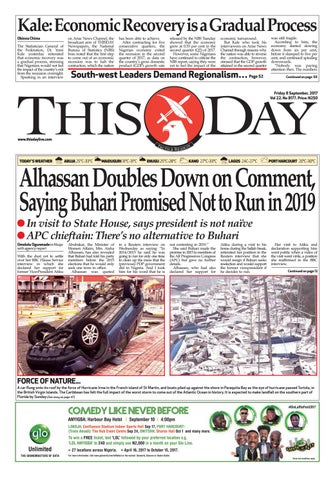
FORCE OF NATURE... A car flung onto its roof by the force of Hurricane Irma in the French island of St Martin, and boats piled up against the shore in Paraquita Bay as the eye of hurricane passed Tortola, in the British Virgin Islands. The Caribbean has felt the full impact of the worst storm to come out of the Atlantic Ocean in history. It is expected to make landfall on the southern part of Florida by Sunday (See story on page 47)
2
T H I S D AY FRIDAY SEPTEMBER 8, 2017
T H I S D AY FRIDAY SEPTEMBER 8, 2017
3
4
T H I S D AY FRIDAY SEPTEMBER 8, 2017
T H I S D AY FRIDAY SEPTEMBER 8, 2017
5
6
T H I S D AY FRIDAY SEPTEMBER 8, 2017
5
N 175,000 Inclusive of VAT Date: September 25 - 29, 2017 Venue: Lagos Business School, Km 22, Lekki-Epe Expressway, Ajah, Lekki, Lagos. Make payment to: Fidelity Bank Plc Acc. Name: Export Management Programme Fee Collections Account Acc. No.: 5020131070 Sort Code: 18-50-08 or pay via (please present your slip at the School to get a receipt of payment)
EXPORT MANAGEMENT PROGRAMME 5 (2017 Series)
Export Management Programme Proven platform to gain practical insights on non-oil exports
Overview For over three (3) decades, oil exports have remained the main foreign exchange earner for Nigeria. However, recent developments in the global market and local oil sector have heightened the need for Nigeria to diversify its economy away from oil. Boosting non-oil exports and building strong and sustainable export capability is now at the heart of Nigeria's diversification strategy. Exporting not only improves foreign exchange revenue, but countries most successful in export have stronger link to wealth creation, employment generation and sustainable poverty reduction. Based on the focus of the Nigerian government on promoting exports, Fidelity Bank Plc, Lagos Business School and Nigerian Export Promotion Council initiated the Export Promotion Capacity Building Programme. This 5-day programme is designed to equip participants with the knowledge, tools and skills required to develop their export businesses in line with global standards.
Programme Outline Overview of Nigeria's export activities Assessment of the Potentials to become a Successful Exporter Once payment has been made, Accessibility of Export Markets – EU, UAS, ASIA, etc. kindly visit export.fidelitybank.ng to Definition and Implementation of the activities required to make a product complete your registration or market-ready send an email to the undersigned for confirmation. Understanding, Selection and Implementation of Supply Chain Management for Exports Reservations/Additional Definition and Implementation of Financial Management for Exports Information Selection and Application of on-going Export Development Business Contact: Processes Anthony E. Odabor Facilitators: Dr Frank Ojadi, LBS Faculty; Dr Obinna Muogboh, LBS Faculty; Key Phone: 08055438699 industry experts in Quality Management for Exports; Financial Management Email: anthony.odabor@fidelitybank.ng experts; NEPC experts, etc. Nkechi Iwegbu Phone: 0802 478 2906 E-mail: niwegbu@lbs.edu.ng
Powered by:
Target Audience This 5-day programme is targeted at entrepreneurs, prospective exporters, financiers of exports, export sector regulators, MSMEs, state and federal government agencies, logistics service providers and any other interested parties.
In partnership with:
T H I S D AY FRIDAY SEPTEMBER 8, 2017
7
8
T H I S D AY FRIDAY SEPTEMBER 8, 2017
T H I S D AY FRIDAY SEPTEMBER 8, 2017
9
10
T H I S D AY FRIDAY SEPTEMBER 8, 2017
T H I S D AY FRIDAY SEPTEMBER 8, 2017
11
FRIDAY, ΀˜ ͺ͸͚Ϳ Ëž T H I S D AY
12
PAGE TWELVE
Sagay is a Loose Cannon, Call HimtoOrder,SenateTellsBuhari Senators are un-armed robbers, PACAC chairman maintains
Tobi Soniyi in Lagos and Damilola Oyedele in Abuja
There’s no love lost between the Senate and the Chairman of the Presidential Action Committee on Anti-Corruption (PACAC), Professor Itse Sagay (SAN), as the Senate has called on President Muhammadu Buhari to call the professor to order. The Senate is again angry with Sagay for consistently spreading falsehood against the National Assembly and acting like he is under the influence of some substance. The Senate described Sagay as a senile, loose cannon and one of the divisive elements in the president’s administration who believe their relevance is enhanced only when they create constant tension between the legislature and the executive, or pit members of the executives against one another. Senate spokesman, Senator Sabi Abdullahi, in a strongly worded statement issued yesterday, accused Sagay of using every opportunity to disparage the National Assembly, using uncouth
and unprintable words to describe legislators and the institution. Abdullahi was reacting to Sagay’s speech at a recent public lecture in Lagos organised by the Society of International Law, where the presidential aide disparaged the lawmakers. The statement from the Senate said: “Ordinarily, we would ignore Sagay whose statements and attitude present him as a rascal and sadist instead of a former university teacher. “However, his last speech in Lagos during which he was reeling out false and exaggerated figures about the salaries and allowances of legislators and also lied about the passage of anti-corruption bills showed that he just deliberately sets out to undermine the legislative institution and lower its reputation in the estimation of right thinking members of the society and we therefore believe we should put him in his rightful place. “As an academic whose creed should be to find facts and make comments based on truth, we believe that Sagay should stop spreading beer parlour rumours
about the salaries and allowances of legislators when he could simply get the facts from the Revenue Mobilisation and Fiscal Allocation Commission (RMFAC) which is the body constitutionally charged with the responsibility of fixing salaries and allowances of all public officials. “Let us make it clear that our salaries and allowances are open books and the details can be taken from the RMFAC by any interested party. “Prof. Sagay at his lecture in Lagos also made comparisons which did little credit to his background as a lecturer, as he was talking of the salary of the United States President and that of a Nigerian legislator. That is like comparing oranges with apples. “Only a senile, jaded, rustic and outdated Professor of Law like Sagay will make such a comparison which falls flat on its face, even to an ordinary layman. Surely, Sagay is basing his analysis on street talk.� The Senate also took on Sagay for stating that it had not passed any legislation to aid the war against corruption, and went
on to reel out the anti-corruption legislations it has passed in the last two years. “Sagay could not even check the records before proclaiming that ‘the National Assembly has not passed a single bill for the promotion of the anti-corruption war since it commenced business in July 2015’. “First, the 8th National Assembly was inaugurated on June 9, 2015 not July. Also, it is on record that the Senate has passed the Whistle Blowers’ Protection Bill, Witness Protection Bill, Mutual Legal Assistance in Criminal Matters Bill and the Nigerian Financial Intelligence Agency Bill. “This man talks like a man who is constantly under the influence of some substance and perhaps possessed, as he employs the language of a tout with no civility. “He is probably constantly excited and incensed by the fact of having his first opportunity to find himself in the corridors of power. “He pontificates and talks as if the war against corruption of the Buhari administration depends
solely on him to survive. He once publicly attacked the Attorney General of the Federation and accused him of not doing enough to prosecute the war. “In the Lagos speech, he took a blanket swipe at the judiciary and rubbished that entire institution, which he as a lawyer has the professional, ethical and constitutional duty to respect. “This is a man who cannot stand for councilorship election and win. We challenge him to state what his contributions are in the election of our amiable president, Muhammadu Buhari, and what new ideas he has contributed to making the fight against corruption more effective since his appointment. “With an easily excitable man like him as head of an advisory body, the nation has continued to lose anti-corruption cases in courts due to the failure of his advice. He needs to do more work and talk less because media prosecution cannot win the war on corruption,� Abdullahi stated. When asked to react to the Senate’s comments, Sagay
laughed it off, saying: “Truth is bitter. Yes, truth is very bitter. They are reacting to something I wrote. They know that they are guilty of everything. They know I have told the truth about them. “They know that they are completely robbing the country of its resources. How can you have a body in any nation, which gave itself the right to allocate any amount it likes to itself before it will agree to pass the budget? “They make themselves so rich and powerful while the rest of the country, the masses are struggling; where there is so much poverty, the masses are struggling. “There is armed robbery, militancy, kidnapping, because there is no money and because a few people abuse their positions and allocate the resources of the nation to themselves. That is the point I made. “They exist for themselves and they don’t care what happens to Nigerians. I maintain my position. That is why Obasanjo (the former president) called them un-armed robbers and they could not reply because they know it is the truth,� Sagay insisted.
N’Delta Agitators Rescind Quit Notice to Northerners, Yoruba Declare support for PANDEF, suspend planned attacks on oil facilities
Idowu Sylvester in Warri Following in the footsteps of the Coalition of Arewa Youth, agitators in the Niger Delta yesterday formally rescinded the quit notice recently handed down to Nigerians of Yoruba and Northern extraction resident in the oil-rich region. The agitators also declared their support for the Pan Niger Delta Forum (PANDEF), whose leadership they had previously disowned, to lead the Niger Delta region in the ongoing negotiations with the federal government. They also announced the suspension of the planned attacks on oil and gas installations in the region and set aside their intention to declare the Republic of Niger Delta on October 1. In a statement issued by the agitators yesterday, after their meeting on Wednesday night, the coalition led by ‘General’ John Duku said that the withdrawal of the quit notice, among other threats, was a sequel to the intervention of PANDEF and Nigeria Ethnic Nationality Youth Leaders Forum (NENYLF), led by its acting National Chairman, Mr. Imoh Okoko. They however demanded for
the sack of the Group Managing Director of the Nigerian National Petroleum Corporation (NNPC) Dr. Maikanti Baru and his replacement by a person from the Niger Delta. The statement said: “After a series of meetings yesterday (Wednesday) between the high command of the Coalition of Niger Delta Agitators led by General John Duku and the leadership of the Nigeria Ethnic Nationality Youth Leaders Forum (NENYLF) led by the Acting National Chairman, Comrade Imoh Okoko, coupled with the intervention of Pan Niger Delta Forum (PANDEF), the Coalition of Niger Delta Agitators, which comprises over 250 groups with their leaders and representatives present at yesterday’s meeting, officially withdraw our quit notice issued to the Northerners and Yorubas living in Niger Delta region; call off planned resumption of attacks on oil and gas installations across the Niger Delta region and beyond from September 10, 2017; suspend the October 1, 2017 declaration of the Niger Delta Republic; declare support for the Pan Niger Delta Forum; demand restructuring and the removal of the Group
Managing Director of NNPC. “We have also resolved to work with PANDEF and give it our maximum support and we urge the federal government to continue dialogue and implement the 16-point demand presented by PANDEF on behalf of the Niger Delta region. “This comes after extensive consultations across the Niger Delta region, which we discovered that it is only PANDEF that has been working round the clock to resolve the Niger Delta issues and has people of proven integrity. “It is a clear fact that working with any rival group such as the Pan Niger Delta Congress (PNDC) is not in the interest of the Niger Delta. “The meeting also resolved that the oil and gas companies should relocate their headquarters to Niger Delta region. We also resolved to put on hold the issue of the return of oil blocks owned by Northerners and the Yoruba to the Niger Delta people and demand that the NNPC should revisit their recent appointments, and urge the federal government to replace the GMD of NNPC with an indigene of the Niger Delta in the interest of peace, equity, fairness and justice.
“We also thank the Nigeria Ethnic Nationality Youth Leaders Forum and the Pan Niger Delta Forum for the major roles they played during the series of meetings which resulted in our withdrawal of the quit notice and we therefore agree that from now on the Nigeria Ethnic Nationality Youth Leaders Forum should be our representatives, mediators and contact point. “We mandate them to liaise with the oil, gas, marine and service companies operating in Niger Delta region. We also use this medium to declare total support for the current board of the Niger Delta Development Commission (NDDC), and we warn all groups calling for the removal of the MD, Mr. Nsima Ekere, to desist from it as such a plan is evil and detrimental to the development of the Niger Delta region. “We therefore appeal to the federal government to release funds owed the NDDC for the development and sustenance of peace in the Niger Delta region. The NDDC has a major role to play in sustaining peace in the Niger Delta region. “Finally, we call on all our partners, groups within and
outside the Niger Delta region, as well as all the agitating groups in the Niger Delta region to support PANDEF and give them all the needed support to enable them continue to dialogue with the federal government, in order to move the Niger Delta forward. “Meanwhile, we wish to appeal to the Pan Niger Delta Congress to work with PANDEF for the interest of the Niger Delta region, and we want to assure all the indigenes of Niger Delta and the general public that while we await the outcome of the dialogue between PANDEF and the Nigerian government, we shall not fail to respond to any issue that may threaten the collective well-being of the Niger Delta people.� Those who signed the statement were General John Duku (Niger Delta Watchdogs and Convener, Coalition of Niger Delta Agitators); General Ekpo Ekpo (Niger Delta Volunteers); General Osarolor Nedam (Niger Delta Warriors); Major-Gen. Henry Okon Etete (Niger Delta Peoples Fighters); Major-Gen. Asukwo Henshaw (Bakassi Freedom Fighters); and Major-Gen. Ibinabo Horsfall (Niger Delta Movement for Justice). Others included Major-Gen.
ALHASSAN DOUBLES DOWN ON COMMENT, SAYING BUHARI PROMISED NOT TO RUN IN 2019 “If today Mr. President says he is running in 2019, I will go to him respectfully and thank him for giving me an opportunity to serve and then tell him that I have to resign because my political godfather may be
running,� said Alhassan. Meanwhile, the minister remained unyielding yesterday over her stance, when she insisted that the president was not naïve. Alhassan, who doubled-down
on her position while responding to questions from State House correspondents in Abuja, said she could not determine what Buhari’s reaction would be to her public support for the former vice-president, who she termed
her “godfatherâ€?, but reasoned that the president was not naĂŻve. But should the decision lead to the termination of her position in the cabinet, Alhassan was swift to state without any fear of equivocation that everything
that has a beginning must surely have an end. She said she had stated all that needed to be said on the matter when she spoke on the Continued on page 50
Duke Emmanson (Niger Delta Fighters Network); Major-Gen. Inibeghe Adams (Niger Delta Freedom Mandate); MajorGen. Abiye Tariah (Niger Delta Development Network); MajorGen. Joshua Ebere (Renewed Movement for Emancipation of Niger Delta); Major-Gen. Jeremiah Athony (Movement for Actualisation of Niger Delta Republic); Major Francis Okoroafor (Niger Delta Freedom Redemption Army); and Colonel Nelson Okochi Walter, among other representatives of groups across the Niger Delta.
TOP GAINERS NGN NGN % GUINNESS 8.94 96.33 10.2 DANGCEM 9.79 216.91 4.7 STANBIC 1.49 39.90 3.8 AIICO 0.02 0.57 3.6 AFRIPRUD 0.11 3.19 3.5 TOP LOSERS NGN NGN % SEPLAT 24.10 457.90 5.0 NCR 0.36 6.97 4.9 MAYBAKER 0.15 3.00 4.7 SKYEBANK 0.03 0.60 4.7 FBNHOLDINGS 0.26 5.76 4.3 HPE Nestle Nig Plc â‚Ś1,220.00 Volume: 222.691 million shares Value: N4.168 billion Deals: 4,622 As at yesterday 7/9/17 See details on Page 44
T H I S D AY FRIDAY SEPTEMBER 8, 2017
13
14
T H I S D AY Ëž Ëœ ÍśËœ 2017
COMMENT
Editor, Editorial Page PETER ISHAKA Email peter.ishaka@thisdaylive.com
HIGH COST OF ACCESSING POLITICAL POWER It is time to play down on money politics, writes Ayo Oyoze Baje
A
s we continue to bemoan successive inept, ineffective and clueless political leadership in Nigeria we must not lose sight of how most of our politicians got into power, in the first instance. Truth be told, the high cost of accessing political power is at the heart of the ever increasing incident of financial corruption as perpetrated by not a few politicians in the corridors of power. They spend humongous sums of money, with some politicians having to sell some valuable physical assets, borrow money from banks, commit ritual murders or bend to the weird wishes of some powerful godfathers to get elected into office. Their allegiance, when they eventually succeed, would obviously be to their paymasters rather than the electorate who they lie to during sundry electioneering campaigns. The piper, as the wise ones say, dictates the tune. As a former Senate President, Adolphus Wabara once alluded to the fact that politics is more like business in Nigeria. You invest huge sums of money so as to reap bountifully, by way of fat pay packages, spurious allowances and inflated contracts. With all these firmly in place can that intelligent, patriotic but poor citizen ever get to the pedestal of political power? And will our type of democracy ever favour those on the lowest rung of the societal ladder? I have my doubts. We must admit however, that the political structure has always been skewed ab nitio in favour of the rotten rich, at the expense of the poor masses, for eons. Unfortunately, this is one aspect of the presidential system of government we have willy-nilly adopted from the United States. Hence, the clamour for a return to parliamentary system devoid of bicameral legislature by some concerned Nigerians. According to Adebowale Olorunmola who has looked critically at this rather troubling issue, former United States President, Barack Obama in ‘The Audacity of Hope’ (2006), touched tellingly on the power of money in politics when he wrote that incumbent “Peter Fitzgerald had spent $19 million of his personal wealth to unseat his predecessor, Carol Mosley Braun�. Also, John C. Green (2006) highlighted the significance of money to party politics among other resources and factors which political parties utilise in the process of trying to control the levels of political power. Though the 1999 constitution of the Federal Republic of Nigeria (as amended) specifies in Section 225 (1-6) the conditions and the scrutiny of the sources of funds and expenses of political parties these are never followed to the letters. For instance, Section 225 (3)(a) and (b) as well as 225 (4) forbid political parties from foreign funding of any kind. Section 226 (1-3) demands annual reports of account from political parties. Also significant is that the Electoral Act (2010) stipulates the ceiling of expenses by candidates and political parties for specific elective positions. The maximum limits are pegged at: N1 billion for presidential candidates, N200 million for governorship candidates, and N40 million and N20 million respectively for Senate and House of Representatives candidates. But what about the
NOW IS THE TIME TO DE-EMPHASISE MONEY POLITICS AND PUSH FOR CLEAR-CUT PARTY MANIFESTOES THAT SEEK LASTING SOLUTIONS TO THE PEOPLE’S PRESSING NEEDS
exorbitant sums of money they pay at the party level to pick nomination forms? It is on record that the fund raising, as was carried out by both the All Progressives Congress(APC) and the Peoples Democratic Party (PDP) ahead of the 2015 elections were done with little or no regard to existing legal provisions. Campaign expenses, for both presidential candidates, Muhammadu Buhari of the APC and Dr. Goodluck Jonathan of the PDP overshot the N1 bn limit. Allegations were rife that cash was illegally used to buy votes and permanent voters cards. State administrative resources were used by incumbent officials to facilitate party activities. Yet, ‘the Independent National Electoral Commission (INEC), the regulatory body, is yet to investigate, prosecute and sanction erring parties and candidates for infringements. This has been the case since the transition to democratic governance in 1999’. This mentality of winning at all cost is injurious to the health of the Nigerian economy. With regard to the academic exercise on campaign funding in Nigeria, Falodi stated that ‘the probe into the Office of the National Security Adviser (ONSA) to former President Goodluck Jonathan revealed that public funds to the tune of US$2.1billion meant for equipping the Nigeria military were diverted to finance party activities for the 2015 general elections’. In a similar vein, former Governor Joshua Dariye of Plateau State allegedly diverted state ecological funds to campaign activities of his party, the PDP. As the 2019 general elections inch closer, much has to done to redress the anomalies that have only those with the cash to throw around to buy their way into electoral offices. Much as we have tinkered with the Electoral Act 2002, 2006 and 2010 there are still some loopholes. For instance, though Section 91(9) states that “no individual or other entity shall donate more than one million naira to any candidate�, Section 93(2)(b) gives political parties leverage to receive unlimited amounts above the threshold. This is contradictory. Each party is required to record and keep “the name and address of any person or entity that contributes any money or assets which exceeds N1 million�. Some candidates latched on the lacuna to technically overshoot the limit by transferring the extra cash to their party. Other donors also took advantage of the provision to donate funds running into billions of naira, on behalf of several unnamed friends. The way forward is for INEC to prosecute anyone found wanting for infringing on political finance regulations. The gross lack of deterrence is a huge factor contributing to the rising cost of elections in Nigeria. Besides, Nigerians should emphasise more on the content of character, ability to deliver on the promises made during campaigns and the unfailing element of trust of the candidates than how much money each can dole out. Political posts should not go to the highest bidder. Now is the time to de-emphasise money politics and push for clear-cut party manifestoes that seek lasting solutions to the people’s pressing needs.
OF LIONS, PIGS AND RATS
Godwin Etakibuebu writes it would have been better for the President’s image maker to keep quiet
G
eorge Orwell, born Eric Author Blair in Motihari Bengal, India in 1930, wrote that powerful novel, “Animal Farm�, which was published in 1945. The book which has remained one of the best books in recent memory spoke of the kingdom founded by a group of animals that needed freedom from the oppressive system of government of human beings. The kingdom created by the animals was based on equality and equity. However, with passage of time some animals became more equal than others. It was an interesting narration about the metaphor of the animal kingdom as pigs and dogs later emerged as those animals that became more equal than others. Yes, pigs and dogs turned the table against all other animals in that kingdom. Come to think of it, George Orwell’s animal kingdom would have included predators like Lion, Tiger, Hyena, Leopard, Wolf and other killer-animals, yet it was pigs and dogs [all domestic animals] that planned a successful coup which turned the table against their equals. Today’s exercise is not really about reviewing George Orwell’s Animal Farm. It is to use the book as a mirror to view and re-identify those animals that became more equal. I was not too sure any more the names of those animals that took over the kingdom hence l had to go through the book again. I needed to convince
myself that rat was included among the animals that became more equal than others. Alas, rats were never mentioned. If rats were not given a place of honour in that book, how come Mallam Garba Shehu, President Muhammadu Buhari’s image maker – would tell the whole world that “rodents and rats� overthrew the president from his office just after 104 days of absence from the office? Could it be true that the rats were powerful enough in Nigeria to “overthrow� a retired Major General Buhari from office? Surely, I was scared on hearing the news about rodents and rats carrying out a successful “coup� against such a tough military officer with in-depth knowledge about coup plotting and execution. If anyone is in doubt, all such person needs to do is to wind the hand of the clock back to the night of December 31, 1983, when the same Muhammadu Buhari overthrew the democratically elected government of Alhaji Shehu Shagari, thereby putting an end to the Second Republic. There must not be any argument about the perfection of General Buhari in coup making or not. Suffice to accept the fact of his emergence as the military head of state of that costly venture in 1983 as enough evidence of his versatility in the coup business. Still looking at the man’s background in evaluating the claim of Garba Shehu on this “overthrow� issue, let us cross-check one more fact.
Our own Maradona, the “evil genius� himself, former President Ibrahim Babangida, once admitted that he was involved in all coups, starting from 1966, “except the one of Dimka�. Given this admission, Babangida stands tall as first among equals when it comes to the business of coups. Yet, it took this knowledgeable coup plotter 20 months of planning and analysing before he could overthrow General Muhammadu Buhari. The need for drawing this analogy is to enable re-evaluation of the veracity of Garba Shehu’s claim that a man General Ibrahim Babangida found most difficult to overthrow until after months of hard labour could now be “overthrown� by “rodents and rats� just after days of absence from office. My fellow countrymen [whao]! Does it remind you of some broadcasts in the past during the military era? This is one lie taken too far into the realm of absurdity. Let us come to the real issue. President Buhari was joyfully welcomed back to Nigeria from medical holiday in the United Kingdom. He was away for exactly 102 days. For the whole 102 days, Garba Shehu did not tell Nigerians what the ailment of their president was as if they [Nigerians] that are paying the bill of the “holiday� never existed. There were too many things that Garba Shehu ought to have done for the image of his boss that he did not do. While Nigerians were thanking God for preserving their president’s life, all that Garba
Shehu could do was to tell Nigerians that the only reason the president chose to work from home, as against his office, was because “rodents and rats� invaded his office while he was away and, maybe, carted away every vital files that had to do with state’s secrets in addition to “serious damage done to electrical gadgets�. Was it compulsory for Garba Shehu to talk? Wouldn’t it have been a path of wisdom and honour for this man to keep his mouth shut? Whatever name Shehu is called as a result of that terrible blunder, l may want to come to the conclusion that he brought it upon himself. He deserves the bashing he got worldwide, including that of Mario Puzo [the celebrated author of The Godfather]’ verdict of, “Fools Die�. However, l will like to draw the curtain by saying that when image makers become image destroyers, then there is urgent need for the principal to re-evaluate the sagacity of his judgment in the issue of appointments. There are too many wolves and hyenas in this “Lion’s kingdom�, as attested and affirmed by the beautiful wife of the “Lion King� himself, Mrs Aisha Buhari, to allow “rodents and rats� capture the kingdom. Or is the Lion still sleeping? I pray the Lion does not sleep for too long because of the damage being done to his Kingdom by Garba Shehu’s rodents and rats. Etakibuebu, a veteran journalist, wrote from Lagos
15
T H I S D AY Ëž Ëœ ÍśËœ 2017
EDITORIAL ADDRESSING CASES OF BUILDING COLLAPSE There is need to overhaul the nation’s building and construction regulations
I
n order to address the problem of the all-too frequent cases of collapsed buildings in the country, the National Council on Lands, Housing and Urban Development recently resolved that the Nigerian Society of Engineers (NSE) should liaise with the Council for the Regulation of Engineering in Nigeria (COREN) to institute an investigation and identify culprits. Participants at the meeting also approved the setting up of a committee to review the urban planning law and urged the government to facilitate the early passage of the bill for the enforcement of the provisions of the revised Nigeria National Building Code that is currently before the National Assembly. This is a step in the right direction. All over the country, there is a glaring failure of the regulating agencies to properly perform their supervisory roles, giving rise to a situation where quacks have taken over the building sector. Indeed, some land speculators have also become estate developers and self-styled construction experts all rolled into one. From the architecTHERE IS A GLARING tural design stage to FAILURE OF THE civil and structural REGULATING AGENCIES engineering, actual TO PROPERLY PERFORM construction and THEIR SUPERVISORY project completion, ROLES, GIVING RISE TO most of these characA SITUATION WHERE ters seem interested QUACKS HAVE TAKEN only in how to cut costs, even if it means OVER THE BUILDING circumventing laid SECTOR down regulations. Such a state of affair can only breed the kind of disaster we experience from time to time. Ordinarily, the construction of a building is expected to be managed by qualiďŹ ed professionals including structural engineers, mechanical engineers, electrical engineers, architects and quantity surveyors, among others. All these professionals are
to be supervised by site engineers and inspectors whose duty it is to ensure that everything is done in accordance with approved plans and standards, but above all, they are expected to pay attention to the use of the quality of materials. It is therefore unfortunate that in spite of the abundance of a great number of building and construction professionals in Nigeria, buildings still collapse like packs of cards. In other climes buildings don’t just collapse every other day. From the architectural design stage to civil and structural engineering, actual construction and completion of a project, efforts are made to ensure that stipulated regulations are strictly adhered to and there are no shortcuts aimed at minimising costs. That unfortunately is not the case in our country today. Yet, as we have repeatedly argued, unless drastic steps are taken and building codes implemented to the letter, the nation will continue to experience these serial disasters with the attendant avoidable loss of innocent lives.
T H I S DAY
EDITOR DEPUTY EDITORS ˜ MANAGING DIRECTOR DEPUTY MANAGING DIRECTOR CHAIRMAN EDITORIAL BOARD
EDITOR NATION’S CAPITAL
T H I S DAY N E W S PA P E R S L I M I T E D
EDITOR-IN-CHIEF/CHAIRMAN GROUP EXECUTIVE DIRECTORS ˜ ˜
˜ GROUP FINANCE DIRECTOR DIVISIONAL DIRECTORS ˜ ˜ DEPUTY DIVISIONAL DIRECTOR
SNR. ASSOCIATE DIRECTOR ASSOCIATE DIRECTORS ˜ CONTROLLERS ˜ ˜
GENERAL MANAGER
GROUP HEAD DIRECTOR, PRINTING PRODUCTION
I
t is very clear that we have continued to witness this unfortunate occurrence on a frequent basis is due largely to unethical dealings by project promoters. In most of the instances, the collapse could be attributed the distortion of original building plans by adding more oors regardless of the weight the foundation was erected to carry. To add to all these is the failure of oversight and negligence by the appropriate authorities for supervision and monitoring of physical structure that are prone to collapse due to wear and tear. While we reiterate our recommendation that appropriate sanctions be meted to those who may be found guilty of the criminal negligence that led to many of the fatal collapse of buildings in recent years, we subscribe to the decision for a complete overhaul of the nation’s building and construction regulations. That is the only way to stop what has become serial disasters with the attendant avoidable loss of innocent lives.
TO SEND EMAIL: ďŹ rst name.surname@thisdaylive.com
Letters to the Editor
TO OUR READERS Letters in response to speciďŹ c publications in THISDAY should be brief (150-200 words) and straight to the point. Interested readers may send such letters along with their contact details to opinion@thisdaylive.com. We also welcome comments and opinions on topical local, national and international issues provided they are well-written and should also not be longer than (9501000 words). They should be sent to opinion@thisdaylive.com along with the email address and phone numbers of the writer.
SPORTS AND THE BUHARI EFFECT
O
ne way nations have succeeded in engaging the energies of the youths positively and keeping them away from social vices is through sports. Apart from keeping them busy all year round, youths manifest their potential just as sporting activities provide legitimate means of livelihood for them. This is why from the time he won election in 2015, President Muhammadu Buhari, who was military head of state when Nigeria launched itself into the global football arena following the winning of the FIFA U-17 tournament in China by the Golden Eaglets team latched in on sports as a means of keeping Nigerian youths busy as well as achieve a change in the narrative about Nigeria as one of the most corrupt nations. The decision reflected in his inaugural speech when he pledged readiness, zeal and tenacity of purpose to re-address and reposition every vital sector/aspect of the nation and this included sports development. President Buhari also charged the Ministry of Sports to work out modalities for actualising the agenda and entrusted the responsibility on the shoulders of the Minister of Sports, Mr. Solomon Dalung. Working on the sports development template of the president, Dalung has proved that it is possible for Nigeria to regain its lost glory in sports. He has opened up the space for sports which over the years was dominated by football. In the process, new generations of young Nigerians, who will excel and do Nigeria proud in international competitions have been raised. Dalung also believes that “sports can move Nigeria out of recession, provides employment, stands out as foreign exchange earner and can help build tourism base. If money is invested in sports it will take many youths off the streets and serves as a unifying factor’’.
A list of sports development package, which has characterised Dalung’s tenure as sports minister includes the revival of a long time moribund secondary schools and university games for talent hunt. Same is being planned for primary schools. So far the efforts by the ministry is yielding results going by the laurels won by athletes from May 2015 when the current administration came into office . Records show that since 2015, Nigeria has won the FIFA Under-17 male football championship, Bronze medals in world wrestling championship, gold in Afro-Basketball championship, Silver in Africa Under-16 female championship, gold and silver medals in IPC Asia open International power lifting championship, gold medal in World English Language Scrabble championship, gold medal in CAF Under-23 Cup of Nations Championship, Silver in Cruiser weight at the World Boxing Championship, Gold medal and the FIFA Under-17 male football championship. One of the decisions that has brought sports back in the hearts and minds of Nigerians is a handsome cash reward system that has made sports a major attraction for Nigerian youths. It will also be recalled that President Buhari in January of 2016 gave cash rewards of N2 million to each member of the Golden Eaglets team who won the 1985 FIFA Under-17 male football championship. Other athletes who won laurels in sporting engagements in 2015 also received cash rewards. The winning streak continued on August 27 when Nigeria’s female basketball team, D’Tigress lifted the 2017 FIBA Women Afrobasket trophy. Nigeria last won the title in 2005. Achieving the feat is a sign that the best is yet to come in sports. As a mark of appreciation and in his characteristic manner, President Buhari at a Federal Executive Council meeting which held on August 30 rewarded the respective players with N1 million each. The president assured the team, its managers and the Nigeria Basketball Federation of his support and
that of the federal government in order to ensure that the team excels in the world basketball ball championship scheduled to hold in Spain. The application and manifestation of the change mantra of the Buhari administration and the doggedness of Dalung has infected and affected the national senior football team, the Super Eagles. The way and manner the team dominated the Indomitable Lions of Cameroon at the world cup qualifying match that ended 4-0 in favour of the Super Eagles on September 1 shows that the team is now a new improved national squad. Nigerians were shocked by the performance of team which embarrassed the nation recently when it lost a home match to the South African national side at the same venue. The victory which has been described as a Salah gift to the president is another pointer that Nigeria will regain its lost glory in football. Apart from cash rewards, the Ministry has also promoted sports by increasing the revenue base of respective sports federations, made appreciable improvements in the local professional football league, secured the hosting right of African beach soccer tournament, appointed a new technical adviser to overhaul and build a new Super Eagles team . It is important to note that through the efforts of the ministry, a U.S.-based Nigerian athlete finished sixth in rowing event at the Olympics. This marked the first time a Nigerian featured in the event. It is also on record that the present administration ensured the election of NFF President Amaju Pinnick into the CAF executive Committee. A lot of other sports policy changes have been made since Dalung became minister. With the measures, policies and programmes lined up by the Buhari administration to reposition sports sector, it is obvious that the federal government is determined to take sports to another level. Chief Cassidy Madueke, Abuja
16
T H I S D AY FRIDAY SEPTEMBER 8, 2017
T H I S D AY ˾ FRIDAY, SEPTEMBER 8, 2017
17
Group Politics Editor Tobi Soniyi Email tobi.soniyi@thisdaylive.com 08033146139 SMS ONLY
POLITICS
PERSONALITY FOCUS
Senior Advocates at War over Power to Free Prisoners Davidson Iriekpen wonders who between the two Senior Advocates of Nigeria Sebastine Hon and Femi Falana - is right on the controversial powers of chief judges to release prisoners
C
onstitutional lawyer, Chief Sebastine Hon (SAN), recently stirred the hornet’s nest when he declared that state chief judges do not have the power to grant pardon to offenders. In a statement, Hon said the only authorities imbued with constitutional powers of pardon or amnesty are the president, after consultation with the Council of State (under section 175), or the governor of a state, acting in consultation with an advisory council of the state on prerogative of mercy, established by a law of such state. He said that while the president could pardon those accused or convicted of federal offences, the governor of a state could only pardon those accused of state offences. “The practice of chief judges, particularly of the states, granting pardon or amnesty to offenders has been going on for quite some time now; but I make bold to say that such practice is clearly unconstitutional. Section 35(4) of the 1999 Constitution as amended has stipulated that anybody accused of an offence shall be arraigned in court within a reasonable time and that it is only that court that could make an order remanding such person in prison ordering his release from custody - either conditionally or unconditionally. “Clearly, therefore, there is no pre-conviction authorisation for pardon or release from custody by any chief judge, acting in his administrative capacity. In respect of state chief judges, section 270(2)(a) of the constitution has merely established the office of a state chief judge with no specific functions assigned thereto. This then means such chief judges perform functions assigned to them by their respective state high court laws and high court rules.” Explaining further, he said even if such state laws granted powers of pardon to the state chief judges, “such laws become, by the fiat of the inconsistency rule, unconstitutional, by virtue of section 1(3) of the 1999 Constitution.” Hon stated that since such laws, being in conflict with sections 35(4), 175 and 212, respectively, of the 1999 Constitution, were null and void to the extent of their inconsistency, under and by virtue of section 1(3) of the constitution. He said: “I wish to also observe that most states have not constituted the advisory council on prerogative of mercy, as enjoined by section 212 of the constitution, thereby leaving a lacuna which the state chief judges, out of good but unconstitutional intentions, from time to time seek to fill. I therefore, counsel state chief judges to halt their routine prison amnesties. Rather, the various state houses of assembly should enact legislation establishing the state advisory council on prerogative of mercy, to make the various state governors perform their constitutional functions in this regard. While I note that the various state chief judges have good intentions - for instance of decongestion of the prisons, the constitution of Nigeria is the supreme law; and having spoken on the issue, those relevant provisions thereof should not be breached, no matter how worthy the intentions of the chief judges might be.” In the past seven months, some state chief judges, in attempting to decongest prisons, have freed over 700 inmates from the nation’s prisons. For instance, in Ebonyi State, Justice Alloy Nwankwo, freed 38 inmates serving in Abakaliki and Afikpo prisons during a jail delivery exercise. He hinged his action on the constitutional right conferred on the Chief Justice
Falana
Hon
of the Federation (CJN) and the chief judges of states by the 1999 Constitution. He said the exercise was to decongest the prisons by releasing awaiting trial inmates who have been in custody without trial over a period of time. In Kano State, the Acting Chief Judge, Justice Nuradeen Sagir, freed 12 inmates who had overstayed in captivity. A statement signed by the Public Relations Officer of Kano State Judiciary, Alhaji Baba Jibo, said the inmates were released when the chief judge visited Goron Dutse prison and reviewed their case files. Jibo added that action of the chief judge was pursuant to the power conferred on him by Section 1 of the Criminal Justice (Released from custody) Special Provisions Act 1977. In Lagos State, Justice Oluwafunmilayo Atilade, has so far freed over 200 inmates from the Kirikiri Maximum, Ikoyi and Badagry prisons. While ordering the release of the inmates she said: “I pronounce you free, pursuant to the provisions of Sections 1(1) of the Criminal Justice (Release from Custody) Special Provision Act 2007 as
well as Section 35 of the 1999 Constitution.” But Hon said the only authority that has the constitutional powers to pardon or give amnesty is the president, after consultation with the Council of State (under section 175), or the governor of a state, acting in consultation with an advisory council of the state on prerogative of mercy, established by a law of such the state. No sooner had he raised the objection than he was challenged by another senior lawyer and activist, Mr. Femi Falana (SAN), who faulted his submission, saying that the Chief Justice of Nigeria and the chief judges of states were empowered by the Criminal Justice (Release From Custody) (Special Provisions) Act to order the release of any person, if satisfied that the detention of that person was unlawful. Falana said it was curious to note that in the statement credited to Hon, no reference was made to the relevant laws on the subject matter. “However, by virtue of section 11 of the Prisons Act (Cap P29) Laws of the Federation of Nigeria, 2004, the Chief Justice of Nigeria and the Chief Judges are among prison visitors ex officio. But while the Chief Justice is empowered to visit all prisons in Nigeria, chief judges are restricted to conduct prison visit in their areas of jurisdiction. Such visitors shall exercise such functions as may be prescribed in respect of the prisons to which their appointments or authorisations relate,” he said. Not satisfied, Hon swiftly issued a counterstatement wherein he said: “I ordinarily would have kept quiet; but I think the good people of Nigeria need to know better. In other words,
Like every argument among lawyers, it will take a judicial pronouncement to lay the controversy to rest.
Falana’s reasons for taking that position are, with respect, not known to law. The position itself is completely wrong.” He said it was shocking for Falana, after admitting that he (Hon) had relied on sections 35(4), 175 and 212 of the constitution, to say ‘It is curious to note that in the press statement credited to Hon no reference was made to the relevant laws on the subject matter.’ He said: “Rather, he (Falana) is the person who is running away from the constitution and taking refuge under laws that are lower to the constitution!” Hon also declared as shocking Falana’s submission that since the Prisons Act, 2004 and the Criminal Justice (Release from Custody) (Special Provisions) Act fall under Item 8 of the Exclusive Legislative List of the Constitution, they were constitutional! He said: “This is my first time of hearing this constitutional theory! Listing of legislative items under the legislative lists is only intended to draw the line, in a federal setup like ours, between what the federal government on the one hand and the federating states on the other hand have competence to legislate on and is not a licence to enact unconstitutional legislation. The constitution cannot under section 1(3) be providing that an act or a law will be unconstitutional if it conflicts with the constitution and at the same time, under the legislative lists, be saying the opposite of this. “And before we forget, it was the same Falana, who a couple of weeks ago stated that the provisions of the EFCC Act which required confirmation by the Senate of the appointment of the EFCC Chairman, were unconstitutional. Was the EFCC Act not made pursuant to the powers granted by the Constitution in the legislative list? For the avoidance of any doubt, section 35(4) of the 1999 Constitution has covered the field on what should be done to any person accused of an offence; and there is no room for any administrative action by the Judiciary. Only judicial actions can lead to the release of detained persons, hence any administrative action, apart from the one in sections 175 and 212 will be directly in conflict with the said section 35(4).” Responding again, Falana said he maintained his earlier position that the Chief Justice of Nigeria and chief judges were empowered by law to conduct prison visits and order the release of any prison inmate if satisfied that the detention of that person is manifestly unlawful. He said even though he drew Hon’s attention to the relevant provisions in law, his “learned colleague” did not change his position. “In fact, in his curious rejoinder to my intervention in the needless debate, Mr. Hon, SAN, did not pay any attention to both laws as he insisted that his shaky submission on the matter was unassailable,” he added. Falana stressed that the prisoners had not been pardoned but merely released from illegal prison custody, noting that such prisoners could be rearrested and prosecuted by the government. He said this was different from a convict being pardoned by the President or a governor. He cited Falae v. Obasanjo (No 2) (1999) 4 NWLR (Pt 599) 476. He added that in the case of Edwin Iloegbunam & Ors v. Richard Iloegbunam & Ors (2001) 47 WRN 72, the Court of Appeal had upheld the constitutional validity of the Criminal Justice (Release from Custody) (Special Provisions) Act. CONT’D ON NEXT PAGE
T H I S D AY ˾ FRIDAY, SEPTEMBER 8, 2017
18
POLITICS
PERSPECTIVE
Deconstructing Oseloka Obaze Valentine Obienyem digs into the life of Oseloka Obaze, the candidate of the Peoples Democratic Party in the forthcoming Anambra governorship election, who initially was reluctant to return to Nigeria from his base in the United States but now wants to stay for good
S
everal centuries ago, a young metaphysical Yogi found it difficult explaining Yoga to a noninitiate. Exasperated, he declared that: “It is only through Yoga that Yoga may be known”. We face such frustrations in our daily life. Not too long ago, the then Governor of Anambra State, Mr. Peter Obi was going to introduce Mr. Oseloka Obaze to me – as he contemplated how to attract him from the comfort of his United Nations office in New York to join hands in building a new Nigeria. When it seemed I did not take notice of the attributes he used to describe Mr. Obaze, he said: “Val, it needs seeing Oseloka in action, following him through what he does for you to understand the man”. For Obi – who usually administers praises in small doses – to give a full doze on OHO as he is popularly called means there is something spectacular about the man. As far as I was concerned then, may God help us to convince him to come back to Nigeria for me to have the opportunity of studying him, having in view the character traits that Obi had mentioned. In the meantime, from professional habit, I undertook a background check on Obaze, and established that he is a man of substance and accomplishments. We can actually say with surety about him, as Chathan said of Garibaldi, that he is “One of those men who are no longer to be found but in the pages of Plutarch”. Regarded as the father of Biography, Plutarch, in a language that was distinctly his, pared and compared great Romans with great Greeks, in the hope that he would pass on some moral stimulus or heroic impulse of those great men to his readers. Oseloka’s life – properly written – will be an inspiration to any one privileged to read it. A native of Ochuche Umuodu in Ogbaru Local Government Area of Anambra State, a town noted for its affability, he was born in 1955 in Ogidi, the home town of a man that considered him a great friend, Professor Chinua Achebe; a man Oseloka has never ceased reverencing for his character, principles and solid family life. In his E-Mail messages, he permanently signs off with a quote from the literary Icon: “One of the truest tests of integrity is its blunt refusal to be compromised”, which also summarises his character. The detailed correspondence of his ideas with those of Achebe – the two men being coins of the same mould and mint though different in dates – is the story for another day. OHO was inured to self-control by the stoic examples of his parents and teachers. Like all fond parents, they wanted best education for him, such that he attended Christ the King College (CKC) and Dennis Memorial Grammar School (DMGS), both in Onitsha. Particularly keen on the primacy of education in the lives of men throughout the ages, he pursued learning relentlessly. He attended the University of Nebraska, Lincoln, USA, where he obtained a Master’s degree in
Obaze...in the race for Anambra State House
Political Science and International Relations as well as Nebraska Wesleyan University, where he studied Political Science. He also attended professional courses in a number of internationally-acclaimed institutions in Italy, Austria and Sweden – specializing in varied aspects of international relations and diplomacy, including Dialogue and Mediation. This saw him being part of the UN team that travelled to different countries to promote peace and concord. From his first appointment into the United Nations in 1991 by the then Secretary-General, Javier Perez de Cueller, OHO participated in official missions to over 100 countries. His travels make one recall the saying of the wise one that education comes one-fourth from the teacher, one-fourth from travel, one-fourth from experience and the last quarter from books. Indeed, Oseloka Obaze had utilized the opportunities to acquire education from the four noted sources. In his pilgrimage on earth, OHO has contributed significantly to the advancement of civilization internationally as well to the growth and development of his State and country at large. Prior to his assignments with the United Nations, he had served
He was promptly engaged by the United Nations, which identified in him the qualities needed to lead men along the parts of universal dignity.
meritoriously in Nigeria’s Ministry of Foreign Affairs for about a decade – 1982 to 1991. Though progressing in his career, he resigned his appointment on principle due to certain policies antithetical to his strong belief in the universally-acclaimed rights of men. He was promptly engaged by the United Nations, which identified in him the qualities needed to lead men along the parts of universal dignity. As the Governor of Anambra State determined to lead in accordance with best practices, it was very tough call for Mr. Peter Obi. He sought earnestly for men and women of integrity and competence that would work with him in administration and the formulation and implementation of policies and programmes that would elevate Anambra to a model State. One of the lessons of history is that when we search for good people – like a man searching for a wife – we are faced with the reality that such people are not only in short supply, but difficult to find. Having identified Oseloka Obaze as a potential member of his team, there was the greater challenge of persuading him to leave the United Nations for home. It was not an easy task, and it took over a year to conclude the process of OHO’s return. Peter Obi persevered as he knew he would add value to his administration of Anambra State. Oseloka’s fame is highly acclaimed – to Occidental and Oriental eyes alike. Solid with experience, travel and practical statesmanship, he is really a man of substance. People and institutions who come in contact with him continually express panegyrics of him. His superiors have nothing but eulogies of him even as his contemporaries and subordinates acknowledge his positive drive and frankness. As he disengaged from
the service of the United Nations in 2012, the Secretary General, Ban Ki-moon said in a personal letter to Obaze dated 26 July, 2012,: “In your long distinguished career … you have proven yourself as a most dedicated, dependable and competent staff member. Throughout your service, you have unfailingly upheld the highest standards of efficiency, competence required of an international civil servant”. In the same vein, one of his erstwhile colleagues gave this testimony: “I have worked with him and I can tell you that he is a first-class diplomat who could re-phrase in courteous elegance, the unvarnished utterances of any master. I can also tell you that he is a model of diplomatic courtesy, his language always polite. He can be described as a realist and a rationalist who pierces the moral phrases of men that govern states to the actual motives of policy.” As the Secretary to Anambra State Government, those that knew him were aware of what he would do even as people that expressed surprise on why so much energy was committed to wooing one man back home looked at him grudging to prove his mettle. OHO was mettlesome enough, for he started by re-designing the structure and operations of the Office of the Secretary to the State Government to become a centre of attrition rather than attraction. He thus rendered the Office service-oriented in the best professional way possible. Soon, the staff began commenting on his obstinate incorruptibility and addiction to principles, which engendered a veritable epidemic of honesty in that Office. Steadily, everybody started appreciating him, such that whenever a big task or a Committee was needed to tackle any issue, the State Executive Council [EXCO] would be united in saying “Let OHO head it”. Thus, he headed many strategic Committees and became the Anambra’s Ambassador Plenipotentiary. Who best did the State have to interface with the likes of Professors Chinua Achebe, Wole Soyinka, Chukwuemeka Ike, among others? His sally into politics under APGA was short-lived. In an evident conspiracy of the party’s leadership – that he would be even more meticulous than Obi in the use of public funds – OHO was disqualified on the absurd ground that he had no APGA Registration Card! He got the message and laughed over it. It is on record that he was one of those who expressed a strong desire to quit Anambra Government service after the tenure of Mr. Peter Obi, but was persuaded to stay on by his successor. When things started falling apart in terms of deviation from real governance, he had to resign. It is remarkable that the day he was vacating office, civil servants gathered in great throngs along the path he would drive out from, and many, according to eye witnesses, wept in bidding him farewell. Some carried placards stating: “We have lost a saint”. Obienyem wrote in from Lagos
S E N I O R A D V O C AT E S AT WA R O V E R P O W E R T O F R E E P R I S O N E R S To solidify his argument, Falana went to other jurisdictions where similar powers are conferred on judge. For instance, he explained that the Supreme Court of India on September 16, 2014, directed magistrates and session judges to visit prisons in their districts for two months to identify and release under trial prisoners who had already been held in custody for half of the maximum period prescribed by law for the offences for which they were charged, excluding under trial prisoners whose offences attract
death penalty. Falana said a similar development happened in Pakistan, when through the country’s chief justice’s intervention, the prison management announced a remission of 60 days to the entitled jail inmates apart from those convicted of espionage, subversion, terrorism, and murder. The statement partly read: “Just last month, the Principal Judge of the High Courts of Uganda, Justice Yorokamu Bamwine, directed all high court judges and magistrates to release
all prisoners who have overstayed on remand without trial. From the foregoing, our Chief Judges are on terra firma in exercising their powers under the Criminal Justice (Release from custody)(Special Provisions) Act in ordering the release of under trial prisoners during prison visits. Apart from the decision of the Court of Appeal in the case of Iloegbunam v Iloegbunam supra which has upheld the validity of the Act, section 8 of the Administration of Criminal Justice Act,
2015 has imposed a duty on chief judges to appoint high court judges and magistrates to visit detention centres once a month with a view to ensuring that the indigent under trial prisoners are not detained without legal justification in line with paragraph 55 of the United Nations Rules for the Treatment of Prisoners which have been adopted by Nigeria.” Like every argument among lawyers, it will take a judicial pronouncement to lay the controversy to rest.
19
T H I S D AY Ëž Ëœ ÍśËœ 2017
BUSINESSWORLD
Group Business Editor Chika Amanze-Nwachuku Email chika.amanzenwachukwu@thisdaylive.com 08033294157
ÍŻ Íś Í° ÍŽ ÍŻ Íľ NIBOR OVERNIGHT 1-MONTH
NIBOR 21.3750% Ͱͯ˛͎͎͹͜ Ϲ
3-MONTH 6-MONTH
22.5331% ͰͲ˛ʹ͜ͳʹϹ
NITTY 1-MONTH 3-MONTH 3-MONTH
Ͱ͎˛ͯ͜Ͱ;Ϲ ͯ͡˛͹͜ͳͳϹ 16.2693%
6-MONTH 9-MONTH 12-MONTH
Ͱͯ˛͹͜ʹͯϹ Ͱͯ˛ͳ͎ͳ͜Ϲ 22.4006%
EXCHANGE RATE N305.35//1US DOLLAR* ĚŠ
Quick Takes Medview Takes Delivery of B777 Aircraft
Med-View Airline has taken delivery of Boeing B777-200ER aircraft toboostitsinternationalroutesnetwork. Theaircraftwithregistration numberCS-TFMarrivedtheMurtalaMuhammedInternationalAirport, Lagos earlier in the week to the jubilation of airline sta and airport workers. The company said the modern generation aircraft would be positioned on Sunday to service the Lagos-London route. The aircraft is conďŹ gured to sit a total of 326 passengers- 24 (at bed seat) business class and 302 economy. Medview said since its debut on the Lagos- London route, on November 20, 2015, it operated with B767 and later B747, which is now being replaced with B777 aircraft. Speaking at a brief reception, Med-View Airline Chief Operating OďŹƒcer/Accountable Manager, Lookman Animashaun said the deployment of the B777 on London route is part of the airline strategy to rebrand its international operations, especially the London route. He said the airline would soon commence operations to West African Francophone countries- Abidjan (Cote’d’ Ivoire), Conakry (Guinea) and Dakar (Senegal).The COO disclosed that Dubai will be added to the airline route network in November.
MEDVIEW AIRCRAFT DELIVERY
L-R: Chief Operating Officer, Med-View Airline Plc, Lookman Animashaun receiving Capt. Jose Dores, Capt. Bruno Parga, and First Officer Paulo Marques, on the arrival of Med-View Airline’s new aircraft, Beoing 777-200 at the Murtala Mohammed International Airport, Ikeja, Lagos ...recently
NCAA: US FAA Will Renew Nigeria’s Category 1 Safety Status Chinedu Eze The Nigerian Civil Aviation Authority (NCAA) has expressed optimism that the US Federal Aviation Administration (FAA) will renew Nigeria’s Category 1 Safety Status which enables her registered aircraft to fly to the United States. A source from the NCAA told THISDAY that from the scores which the team made available to the regulatory authority, Nigeria passed the audit. He explained that the agency would wait for the official statement from FAA before making official announcement. According to the NCAA source, under the present Director-General of NCAA, Captain Muhtar Usman, Nigeria
AVIATION has been able to scale through the audit successfully and that showed that the NCAA has continued to record improvement. It was also gathered that Nigerian airports would be audited by the US Transport Security Administration in November this year. Spokesman of the NCAA, Sam Adurogboye explained that the airport assessment was not part of the eight critical elements audited by FAA when the team examined the industry a fortnight ago, noting that comprehensive audit of the airport would take place when TSA team visits Nigeria in November this year.
“Nigeria has done very well in this year’s FAA audit. In fact from the scores made available to us we scored very highly so we know we have retained Category 1 but this will become official when FAA issues their report. In fact, we scored 100 percent in legal compliance. Those who think that Nigeria will not scale through the audit will now be disappointed. “The current Director-General has done very well and he has improved the NCAA. Don’t forget that it was under him that the last audit was conducted and we did very well. I wish to note that airport assessment was not part of the eight critical elements examined by the FAA team, but usually that is done by the TSA which normally comes
around November. So I want you to know that Nigeria has retained the Category 1 Safety status but we must wait for the report from FAA before we make it official,� Adurogboye said. The US FAA carries out the assessment of the NCAA’s compliance with section of the International Civil Aviation Organisation (ICAO) Standard and Recommended Practices (SARPS) as contained in Annexes 1, 6 part 1 and 8. This includes general policies, procedures and definitions, approved maintenance organisation and flight operations. Asurogboye said that FAA used the International Aviation Safety Assessment (IASA) Continued on page 20
Stakeholders Blame Declining Revenue from Ports on Customs Seizures Eromosele Abiodun Freight Forwarders in the country have blamed the declining federal government’s revenue from the ports on seizure of goods by the Nigeria Customs Service (NCS) over minor defaults. The National Association of Government Approved Freight Forwarders (NAGAFF) stated this while calling on the customs authorities to avoid a total shot-down of revenue from the ports. National Publicity Secretary, Stanley Ezenga, who spoke on behalf of NAGAFF, emphasised that trade related matters in breach of extant laws must not be treated by extreme punishment of seizure but rather, “a process that shall
MARITIME enhance corrective measures and penalty thereto in form of additional duty payment to serve as deterrent.� He said: “It is the opinion of NAGAFF that the Government is aware that importers and exporters will always want to cheat with a view to maximising profit and accordingly provisions are made for corrective measures and penalty thereto. The import guidelines 2006 as amended and Customs laws provided for such remedy except in extreme cases of breaches including banned goods. Seizure of trade goods over minor defaults should be an extreme case of default because a time shall come when the Customs will not have any cargo to seize
or collect revenue from. We sincerely believe that the way forward to mitigate these trade infractions is for the Customs examiners to perform proper Customs examination of laden containers,� NAGAFF said. The freight forwarders added: “Without prejudice to the relevant sections of Customs laws bothering on untrue declaration of imports for customs purposes, there is the urgent need for the NCS personnel to realise that the only way the Nigerian importers can be compliant to import regulations is a situation whereby they shall be asked not to pay customs duty and other charges anymore. It is written in the Bible that tax collectors are never liked by the people so long as payment of tax is concerned.
“In the opinion of NAGAFF, it is a fact that the import policy under destination inspection and the relevance of Pre- Arrival Assessment Report (PAAR), which is advisory, are strategic to customs operations. In this regard, the importance of proper Customs examination of laden containers should be the arbiter to mitigate loss of revenue due to the government. Customs examination is so simple and unambiguous to actualise. In so far as we cannot disassociate the government operatives from the corrupt society, it is our view that there should be an element of loyalty to the authority which the operatives agreed to serve, respect and protect.� This, they added, is very Continued on page 20
United Increases Airbus A350 Order
United Airlines has increased the number of A350 XWB aircraft it plans bring into its eet, updating and expanding its previously existing order for 35 A350-1000 to 45 A350-900 wide-body aircraft to replace older, less eďŹƒcient aircraft in order to support future growth of the airline.Airbus described the A350-900 as the cornerstone member of the A350XWB (Xtra Wide-Body) family, which is shaping the future of air travel.“The aircraft typically seats 325 passengers in a standard three-class conďŹ guration and features state-of-the-art comfort and amenities, oering an exclusive ight experience to passengers on board with the new Airspace by Airbus cabin. The A350-900’s unique combination of payload and true long-range range capabilities makes it an ideal aircraft for United Airlines’ international route system. These aircraft will be the ďŹ rst Airbus widebodies to join United’s global eet,â€? said the global aircraft manufacturer.“For the past year, United has done a complete review to ensure that we have the right long-term eet strategy, and it was clear that the A350 aligns with our replacement needs and our network,â€? said Andrew Levy, Chief Financial OďŹƒcer of United Airlines. “The combination of the range performance and eďŹƒciencies make the A350 an attractive aircraft for United.â€? “This updated and expanded order is a strong reaďŹƒrmation of the A350 XWB Family,â€? said John Leahy, Chief Operating OďŹƒcer – Customers. “United and Airbus have had a long and strong partnership for many years, and we’ve worked together to ensure their requirements for the future are met, if not exceeded.
Aviation Fuel Price May Increase
HurricaneHarveyhasdiminishedintoatropicaldepressionandleftthe U.S. Gulf Coast, but its eect on the national jet-A fuel market could last for three to four weeks, according to Joel Hirst, vice president of sales for Avfuel. “The good news is that many companies like Avfuel have preparedness plans to cover natural disasters and many of our partners do as well,â€? he said. “While the storm closed several reďŹ neries and pipelines, which led to problems, they were able to do controlled closes. This will allow them start back up in a much quicker fashion. We will start to see some reďŹ neries and critical pipeline segments reopen over the weekend.â€? Ainonline.com reports that Hirst said fuel deliveries in some areas aected by the storm or pipeline shutdowns have been delayed as truck run distances from terminals have increased to compensate for the closures and long tanker truck loading lines have formed at some terminals. And while jet-A prices have increased in some locations by up to 20 cents per gallon and likely will continue to increase rapidly, with the exception of some isolated locations within the storm impact area, airports are not running out of fuel, but fuel deliveries are being delayed as fuel needs to be trucked in from longer distances. “The supply network just expands to the next level until the primary ones come back on line,â€? he said. “Anytime you have an event like this, prices do move up, but when things do restore over the next three to four weeks and things get caught back up again, it will correct itself.
“If a central bank in our position were to abandon its pursuit of low inflation and decide to implement expansionary monetary policy in order to engender rapid economic growth, the outcome for inflation would be much worse“
Central Bank of Nigeria Governor
Godwin EmeďŹ ele
20
T H I S D AY Ëž Ëœ ÍśËœ 2017
BUSINESSWORLD NCAA: US FAA WILL RENEW NIGERIA’S CATEGORY 1 SAFETY STATUS
checklist and ICAO guidance material and the team also assessed the state’s aviation law, regulations and oversight capabilities in accordance with the eight critical elements as defined in the ICAO document 9734. The team also assessed the Nigerian aviation industry on legislation, regulations, organisation, technical staff, quality and training, technical guidance tools, licensing, certification approval and continuous surveillance. Part of the eight critical elements include Aviation Security Programmes and Regulations This includes the provision of adequate national-level programmes and regulations to address national requirements emanating from aviation security legislation others include the provision of standardised implementation procedures, equipment and infrastructures in conformance with Annex 17 Standards (and security-related provisions contained in other STAKEHOLDERS BLAME DECLINING REVENUE FROM PORTS ON CUSTOMS SEIZURES critical to the revenue functions of the customs organisation and security of the Nigerian state. “Among others is for Customs to engage the trading public through sensitisation on the ills of non-compliance with import regulations and the consequences of smuggling to the economy. We, in NAGAFF, shall continue to advocate that a holistic approach to resolving these avoidable seizures should be that importers and exporters must be made to build up integrity in their declarations for customs purposes. And on the part of the customs examiners, the need for proper customs examination cannot be overemphasised, “they said. The group added that the carnage of avoidable seizures of trade goods has to stop in the interest of the economy and the revenue collection functions of the service. “We want to reiterate that laws are made for man and not man for the law. Any law that brings hardship in its essence is a bad law and should be set aside.
NEWS
Bala-Usman: NPA Committed to Improving Access to Apapa Ports Stories byEromosele Abiodun The Managing Director of the Nigerian Ports Authority (NPA), Ms. Hadiza Bala-Usman has restated the Authority’s commitment to improving the port access roads. Over the past couple of weeks, stakeholders have expressed concern over the state of access roads to the Lagos Port Complex in Apapa. The dilapidated state of the road since almost two decades has been a source of concern to stakeholders including the NPA, whose prime facilities are located in that axis. The NPA said in a statement that the poor state of the roads informed its decision to collaborate with other stakeholders who agreed to a Memorandum of Understanding facilitated by the Federal Ministry of Power Works and Housing to reconstruct the entire Wharf Road. These stakeholders, the NPA added, include Dangote Group and Flour Mills plc. It added that although repair of roads is not its statutory responsibility, it has committed the sum of N1.8 billion to the reconstruction of the Wharf Road, adding that contractors from Messers AG Dangote Construction Company were mobilised to site in July 2017. “In anticipation of the congestion that the current reconstruction was bound to
cause, the NPA had set up a committee then chaired by the General Manager, Western Ports on the decongestion of Port access roads. “The committee included representatives of the Lagos State government, the Federal Road Safety Corps, Nigerian Army, Nigerian Navy, Ports Police Command, and Department of State Services and other major stakeholders including truckers as mainly represented by the Association
of Maritime Truck Owners (AMARTO) “To further alleviate the envisaged congestion, the Authority awarded the contract for palliative works on Creek Road to Messers CGC Nigeria Limited. Palliative works was carried out on the damaged portion of the roadway and is now designated an alternative route in and out of the Lagos Port Complex. Further repair works were equally carried out on other
alternative routes around the corridor, “it stated. It added: �In addition, realising the need for a bleeder route to relieve pressure on Wharf Road during construction, the GM of the NPA Western Zone heads a committee of all Terminal Operators, Millers and other stakeholders which worked to fashion out ways of fixing the Tin Can axis route with enduring palliatives works while the wharf road
construction is ongoing. A major achievement of the committee is the identification and location of a number of privately owned sites suitable to accommodate a minimum of 6,000 trucks at any particular time. To ensure that this initiative does not run into any institutional impediments, the committee engaged with land owners in the area and has established contacts with the Lagos State Government.�
MEDIA PARLEY
L-R: Mr. Ebenezer Boluwade, of Agric and Export Finance Department, Sterling Bank Plc; Coordinator, NatnuPreneur, Mr. Adewole Gbolade; and Adelana Ogunjirin of Agric Finance Unit, Heritage Bank Plc; at the Heritage Bank-NatnuPrenenur Press Conference on Food Security initiative held in Lagos...recently
Customs Generates N183bn in Eight Months The Nigeria Customs Service (NCS), Tincan Island Port Command has announced that it generated N183 billion between January and August 2017. The command said in a statement that the development was sequel to the coordinated activities and innovative spirit of its comptroller and the entire officers/men. Customs Area Controller, Comptroller Bashar Yusuf said the command has had a sustained high revenue profile since the beginning of the year, a feat that the Controller attributed to deliberate creative policies and stimulus plans aimed at blocking all possible areas of
revenue loss. He stated specifically that the revenue for August alone stood at over N28 billion, which is the highest in the annals of the command, particularly in the corresponding periods over the years past. “Generally speaking, the command generated N183 billion between January and August, 2017 as against the sum of N156 billion during the same period in reference, despite global economic recession. “It therefore implies that but for the exclusion of forty-one (41) items from Forex window; the command could have doubled its revenue profile. “Analysis of the result showed
that the Command is becoming more thorough in its Revenue drive, to the extent that all high yielding Revenue consignments are closely monitored to avoid circumvention of procedure,�he said. The controller stated that the Customs high command expects so much from the command and as such, “the command will continue to develop adequate operational template and modalities that will be capable of entrenching integrity in the acumen of our operations.� He pointed out that all officers/men of the command have a compelling need to discharge their functions in line
with the change mantra of the Comptroller-General of Customs Col. Hameed Ibrahim Ali (Rtd). The Comptroller extolled the virtues of the customs management and vowed to sustain and surpass the revenue target of the command in line with the expectations of the Nigeria Customs Service management. In the same vein, the controller appreciated the compliance level of stakeholders in the port to fiscal policies of the federal government in terms of trade while advising few recalcitrant ones to toe the path of sanity through honest declaration in their documentations noting that integrity, due diligence, honest
declarations and transparency are key elements in 21st Century customs operations. Speaking further, the controller spoke about the importance of leadership skills as critical to success and advised O/C Terminals and other senior officers to exhibit a high moral/ ethical standard that would showcase quality leadership for the actualisation of set goals and objectives. On his plans for the ember months, the Comptroller pointed out that high cargo traffic is usually expected at this period of the year and advised importers to desist from importing uncustomed goods in view of its implication.
Ship-owners Charged to Give Preference to Nigerian Seafarers Group Business Editor
Ă’Ă“Ă•Ă‹ Ă—Ă‹Ă˜Ă¤Ă?Ě‹ ĂĄĂ‹Ă?Ă’Ă&#x;Ă•Ă&#x; AgriBusiness/Industry Editor
Ă™Ă˜Ă‹ĂžĂ’Ă‹Ă˜ äĂ? Comms/e-Business Editor
Ă—Ă—Ă‹ Ă•Ă™Ă˜Ă”Ă“ Capital Market Editor
ÙÎÎã Ă‘Ă?Ă˜Ă? Senior Correspondent
Ă‹Ă’Ă?Ă?Ă— Ă•Ă“Ă˜Ă‘ĂŒĂ™Ă–Ă&#x; (Advertising) Correspondents
Ă’Ă“Ă˜Ă?ĂŽĂ&#x; äĂ? (Aviation) Ă“Ă˜ĂŽĂ‹ ĂœĂ™Ă•Ă? (Labour) ĂœĂ™Ă—Ă™Ă?Ă?Ă–Ă? ĂŒĂ“Ă™ĂŽĂ&#x;Ă˜ (Cap Mkt) ÔÓÙĂ?Ă™Ăœ Ă–Ă“Ă•Ă? (Energy) Ă‹Ă—Ă?Ă? Ă—Ă?ÔÙ (Nation’s Capital) ĂŒĂ“Ă˜Ă˜Ă‹ Ă’Ă“Ă—Ă‹ (Money Mkt) Chineme Okafor (Energy ) Reporters
Ă&#x;Ă—Ă? Ă•Ă?Ă‘Ă’Ă? (Money Market) Ă™Ă?Ă‹ Ă–Ă?Ă•Ă’Ă&#x;ÙÑÓĂ? (Maritime)
The Director General of the Nigerian Maritime Administration and Safety Agency (NIMASA), Dr. Dakuku Peterside has again assured seafarers in the country that their welfare is critical to the growth of the sector, hence the agency will do all within its means to implement all International Maritime Organisation (IMO) and International Labour Organisation (ILO) conventions regarding the welfare of the seafarers. Speaking during the celebration of the ‘Day of the Seafarers’ in Onne, Rivers state, Peterside said that the National Joint Industrial Council (NJIC) com-
prising tripartite stakeholders, have reconvened to fashion out a decent wage and improved working and living conditions for the seafarers in line with the provisions of the convention and comparable to what is obtainable internationally. “It is therefore expected that once the collective bargaining agreement is signed, ship-owners will commence its full implementation�, he stated. The NIMASA boss who further reiterated the agency’s commitment to engaging shipowners and seafarer employers on the need to provide gainful employment to qualified Nige-
rian seafarers whom he said are very important, called on shipowners to give some level of preference to the seafarers especially in the Cabotage trade as against the practice of engaging foreign seafarers. “As Nigerians and maritime operators we should be proud of our seafarers and also encourage them to develop their careers/ competences like their foreign counterparts, “he said. He also informed stakeholders that the agency will leaving no stone unturned in ensuring full implementation of the Cabotage Act for the benefit of Nigerians. “Cabotage Act is undergoing
review and it is the Agency’s position that the review will take care of all the grey areas in the application, processing and granting of waiver to the extent it should be seen to give some level of advantage to Nigerian seafarers especially in the areas of employment and specialised training,� he said. While assuring the seafarers of the agency’s continuous support, the DG stated that NIMASA will continue to give priority to capacity building initiatives in order to actualise its vision of making NIMASA a world class organisation in line with global best practices.
This, according to him, has also made the Agency to develop a multi-strategy approach to encouraging young school leavers to take a career at sea through the Nigerian Seafarers Development Programme (NSDP). He said the NSDP initiative of the agency which was conceived in 2008 in order to bridge the gap observed in the death of seafarers in the country has so far facilitated the training of 2,259 young Nigerians in various fields of maritime studies in reputable Maritime Institutions in the United Kingdom, Egypt, Romania, India and the Philippines.
T H I S D AY Ëž Ëœ ÍśËœ 2017
21
BUSINESSWORLD
NEWS
Amaechi Inaugurates Interim Committee to Reposition Maritime Academy, Oron Kasim Sumaina in Abuja The federal government on Wednesday inaugurated an Interim Management Committee with the mandate to reposition the Maritime Academy of Nigeria (MAN) in Oron, Cross River State, as an institution that will bridge the gap of technical know-how that currently exists in the maritime sector. Inaugurating the Committee in Abuja, the Minister of Transportation, Rotimi Amaechi hinted that the kind of graduates that the institution is currently producing as well as the facilities is a shame to the country. The minister stated that the report of the one month Committee set up on the 20th of January 2017 revealed that there was derailment by the Academy
from its core mandate and complete decay in all aspects. According to him, “The magnitude of the problems exposed in the interim report more than justified the time taken to produce the result; ranging from curricular to cadets admission and welfare. Consequently, it took the committee two months to submit the interim report�. He added: “Indeed, it is in appreciation of your tremendous work that the government considered it expedient to appoint you to manage the affairs of the Academy by implementing those recommendations in your report and all other measures necessary to achieve the desired result.� He reaffirmed that the ministry would provide the necessary
resources that will enable the school function. “Once again, I assure you of the ministry’s cooperation and support in the course of the assignment. As much as possible, I and indeed the management team of the Ministry will remain accessible to you all the time and wish you all the best. “I thank you for the tremendous work you have already done and that I have no doubt you will work even harder to transform the Academy into a place that not only me and you but all Nigerians will be proud of.� Responding, the Chairman of the Committee, Adebayo Saromi said that the committee will work on all the recommendations in the initial report in turning around the fortune of the school.
Firms Graduate Lagos Youths with ICT, Customer Service Skills Nigerian youths to realise over 50 students from difEmma Okonji
Some youths, selected from the slum areas of Lagos, will today be celebrated, after being empowered with basic Information and Communications Technology (ICT) and customer service skills. The youths numbering 35, went through a 13-month training programme at the Ekobits Academy. They were trained in Graphics and Design, Web Design and Development, Work Ethics and Professionalism, Attitude and Behaviour, Business Plan, Photography and Video Editing, Basic ICT Skills and Excellence in Customer Service. The training, which was facilitated by Poise Nigeria in partnership with Oxfam Novib and Butterfly Works, was designed to transform lives of youths from the slum areas of Lagos that could not further their education to higher institutions. The youth empowerment project was designed to support government’s plan to empower
their creative and productive energies to achieve sustainable growth, and improve their living standards. The graduation ceremony which will take place today at Poise Training School, will have several multinational companies like Tech Points, Gr8jobsng, Printivo, Sterling Assets, Aiki, Ovie Brum Foundation, etc, in attendance to interview the graduates for potential job placements and internship opportunities at their organisations. EkoBits is part of the network of Bits Schools that offer demand aligned training in creative technology targeted at youth from the less privileged community. EkoBits Academy is an initiative of the Work in Progress Alliance, Oxfam Novib and Butterfly Works, a social and design innovations studio in the Netherlands, which partnered and set up Nairobits in Nairobi, Kenya in 1999 and has since been involved in springing up bits school around the world. Since its inception in Nigeria through Poise, it has trained
ferent slums in Lagos like Otodogbame, Itedo, Ajiran, Ikate, Babalola areas that cannot afford to further their education in to higher institutions and empower them through several trainings in basic technology. Speaking on the training initiative, the Chief Executive Officer of Poise Training School/partner of the project, Mrs. Ukinebo Dare, stated that the platform was set out to empower young people with skills and values that would enable them make lasting contributions in every sphere of life. “Nobody knows the exact population of the slum district of Lagos but it is estimated to be as high as 100,000 and unfortunately the inequalities for youths living in the slum begins from their childhood and so by denying youths equal opportunities, Nigeria will be unable to tap into the potential that exists within its young populations and mobilise that talent for the benefit of society as a whole,� Dare said.
Propak West Africa 2017 Releases Conference Timetable Propak West Africa has released its much anticipated annual conference timetable to the general public. Propak West Africa, which is being organised by Afrocet Montgomery, in a statement, confirmed 22 conference sessions and over 30 expert speakers, in its forthcoming conference, that is free to attend. The conference, which opens September 19 at the Landmark Centre in Lagos, for its 5th edition, is expected to attract over 3,000 visitors. Propak West Africa is an international platform for the packaging, plastics and print communities, where thousands of industry professionals and leading brands
will come together to share market insights, cutting-edge technology developments and expertise. Business Development Director, Afrocet Montgomery, Emma Hooper, said: “We are extremely pleased to welcome a variety of respected industry speakers to the Propak conference this year. Each session has been selected to reflect a broad range of themes within the industry such as business strategy, efficiency, sustainability as well as sessions focused on different vertical sectors like food processing, print, pharmaceuticals and many more.� Among the industry experts confirmed, is packaging giant,
Tetra Pak’s Managing Director, Phillipe De Louche, who will take to the stage to discuss ‘Breakthrough packaging technology to boost efficiency for food producers’. He said: “The purpose of the session is to share Tetra Pak’s experience on developing suitable products for low income consumers, and to convey how a well-balanced approach can work miracles for increasing the demand and cementing a sustainable business.� With the launch of the brand new ‘Print and Digital Expo’ pavilion, the conference is expected to focus on the print industry with a full day of dedicated sessions in addition to technical print seminars.
RISK MANAGEMENT WATCH Robert Mbonu
Risk Culture – “Do As I Say, Not As I Do?� Do you wonder why peoples’ behaviours differ depending on the environment they find themselves? Ever wondered why some passengers behave orderly at Heathrow airport in London, but jump the queues, and become rowdy once they arrive at the airport in Lagos? Could the reason lie in the fact that sanctions are firmly applied to unruly behaviour in the United Kingdom, and maybe not in Nigeria? It boils down to respect for laws and constituted authority, recognition of sanctions and rewards. The way of life, especially the general customs, and beliefs of a particular group of people, which influence their behaviour at a particular time, is the meaning of culture. As risk is about uncertainty in facing the future, it is logical that a desirable risk culture would position the organisation (including government ministries, departments and agencies) to be proactive and law abiding. An example of a desirable risk culture is one that maintains a healthy tension between the organisations entrepreneurial activities for creating enterprise value, and its activities for protecting enterprise value so that neither one is too disproportionately strong relative to the other. “Risk culture� refines the concept of organisational culture to focus particularly on the collective ability to take managed risk and to minimise threats, but cease opportunities. If we agree that environments influence behaviours, risk professionals as leaders must strive to entrench a culture that is conducive to effective risk management. Each individual brings to work their own attitude, behaviour and culture towards managed risk taking and risk based decision making. Those are determined by a number of factors; Individual propensity and personality 1. 2. Past experience 3. Fear of being punished 4. Fear of failure 5. Expectation of success and associated reward 6. Understanding of the expectations of the organisation Some of these, the organisation can affect, but individual propensity, personality and past experience cannot be changed. This is why the setting of boundaries is so important; this will affect in particular the fear of being punished, and expectation of success and associated reward. Setting out clear boundaries and a context for these boundaries, will help to change attitudes, behaviours and thereby change the culture of the organisation. The culture of an organisation develops over time from the cumulative traits of the employees. This describes and governs the ways a company’s owners and employees think, feel and act. It refers to the shared values, attitudes, standards, and beliefs that characterize members of the organisation. Corporate culture is rooted in an organisation’s goals, strategies, structure, and approaches to employees, customers, investors and the greater community. The culture in an organisation arises from the repeated behaviour of its members. These behaviours are shaped by the underlying values, beliefs and attitudes of individuals, which are partly inherent but are also themselves influenced by the prevailing culture in the organisation. Culture is more than a statement of values – it relates to how these translate into concrete actions.
The wider stakeholder requirements and the timing of threats and opportunities inform boundaries. Ethics can help in determining the longer-term impact of boundary setting and consideration of the wider stakeholder requirements. Governance and scrutiny provide the backdrop for ensuring that the risk culture is appropriate for the organisation. When setting boundaries for managed risk taking and risk based decision making, there needs to be a common acceptance throughout the organisation of the importance of the continuous management of enterprise threats and opportunities, including clear accountability for and ownership of specific risks and risk areas. This allows transparent and timely information that flows up and down the organisation with bad news rapidly communicated without fear of blame. Risk event reporting and whistle blowing encourages learning from mistakes and near misses. In avoiding blame cultures, appropriate risk taking behaviours should be rewarded and encouraged and inappropriate behaviours should be challenged and sanctioned. There should also be sufficient diversity of perspectives, values and beliefs to ensure that the status quo is consistently and rigorously challenged. Risk appetite as part of a learning culture, and using risk events and near misses is one of the tools that can be used to break down and banish a blame culture. The crucial link in all of this is that the organisation sets out its risk appetite and within that, should set out the boundaries within which each individual can take managed risks without fear of punishment. It goes without saying that this needs to be reinforced strongly through repeated behaviour throughout the organisation. Some people become technical experts within their comfort zone but those who rise to be CEOs are the ones who are prepared to break eggs to make omelettes. People’s fear of acting outside their comfort zone makes them look for someone to tell them what to do. We also call this not sticking their head out, or keeping their head below the parapet. It causes the organisation to stagnate, stall and even falter. Conversely if there is clear and transparent encouragement for people to act on their own initiative and innovate by taking managed threats and opportunities then innovation can take place and people can be stretched to achieve more and more. I remember with nostalgia and look forward to a reintroduction of “The War Against Indiscipline�. A period characterised by orderliness, rule of law, and respect for authority in Nigeria. Just as corporate culture plays a big role in determining the success of any business, a reorientation of our national psyche for the rule of law and order, will guarantee our success as a nation. We must practice the good that we preach. t.CPOV '&31 $*3. 6, )$*# .T3. 4UFSO TUVEJFE &OHJOFFSJOH JT BO FYQFSJFODFE #BOLFS BOE &OUFSQSJTF 3JTL .BOBHFNFOU QSPGFTTJPOBM &BSOFE B QPTU HSBEVBUF EFHSFF JO 3JTL .BOBHFNFOU GSPN /FX :PSL 6OJWFSTJUZ 4UFSO 4DIPPM PG #VTJOFTT BOE JT B NFNCFS PG UIF *OTUJUVUF PG 3JTL .BOBHFNFOU 6, $BO CF SFBDIFE PO 4.4 0OMZ FNBJM SN SJTLNHU!HNBJM DPN
22
T H I S D AY Ëž Ëœ ÍśËœ 2017
BUSINESSWORLD
AVIATION
Dana Recruits, Trains More Nigerian Pilots Chinedu Eze One of Nigeria’s airlines, Dana Air has announced the recruitment and training of more Nigerian Pilots in Johannesburg, South Africa and Madrid, Spain, as part of its contribution to the growth and development of the Nigerian aviation industry. The airline also said it has introduced a Special Services Unit, which consists of welltrained males and females to among other functions, attend to passengers with special needs, urgent complaints, update passengers on current promos and benefits of Dana Miles at the airports in Lagos, Abuja, Port Harcourt, Uyo and Owerri. According to the Accountable Manager of Dana Air, Mr. Obi Mbanuzuo, ‘Dana Air is
committed to the growth and development of the Nigerian aviation industry. As at 2015, more than 500 Nigerian pilots were unemployed but with our recruitment and frequent training both locally and abroad since 2015, we have been able to reduce the number, by engaging these pilots and paying for their training in South Africa and Spain.� He added: “We will continue to encourage professionalism in the industry and support our Nigerian Pilots to ensure constant growth and development in the industry.’’ On the newly introduced Special Services Unit, Obi said that Dana Air introduced the unit to further deepen customer service, offer multiple issuesolving options and provide
seamless travel experience for our teeming guests. “Only recently, we won World Stage Economic Summit’s Nigerian Airline of the Year award for being inventive with our customer service and products, and there is need to keep raising the bar of service excellence, so we do not let our guests who keep nominating Dana Air for awards down.’’ The airline said it has flown 2.7 million passengers in the last eight years, so it is one of the leading airlines in Nigeria with over 27 daily flights from Lagos to Abuja, Port Harcourt, Uyo and Owerri, adding that Dana is reputed for its innovative online-products, unrivaled on-time performance and World-class in-flight service.
13th Akwaaba African Travel Market Opens Sunday The organiser of Akwaaba African Travel Market has announced that all is set for the 13th edition of the annual event, which is the biggest travel and tourism fair in West Africa. The three-day event will be held at the prestigious Eko Hotel and Suites, Victoria Island, Lagos from 10th September to 12th September. In this year’s event, there is going to be a Chef Challenge; a culinary contest to confirm the country in West Africa that cooks the best jollof rice. The event will be declared open by the Director General, National Council of Arts & Culture (NCAC), Otunba Olusegun Runsewe. “The jollof rice challenge has already created buzz and excitement amongst the competing countries. The chef challenge is organised with the sole aim of promoting culinary tourism in Africa. It will have chefs from Nigeria and Ghana competing for the best jollof rice and a group of Nigerian chefs will compete for the best prepared rice in varieties. “The 2nd Africa Travel
and Tourism Conference will hold on the 2nd day of 13th Akwaaba, speakers and Panelist during the Travel and Tourism Conference will be addressing topics and dealing with issues such as “One year of Accident free commercial aviation. What did Africa do right?� African Airlines and profitability, the real issues: airport perspective, regulations perspective, airlines’ perspective,� the organiser of the Market, Ikechi Uko said. According to him, the President /CEO, Sabre Network NMC, West Africa, Mr Gbenga Olowo who is the guest speaker would be speaking on the topic: “2016: Commercial Aviation Accident Free Year. What Did Africa Do Right�, a topic that is germane to the African aviation sector. Olowo is an Economist and Business Administrator with uninterrupted cognate experience in Aviation sector. Uko said the Women in Tourism conference 2017, would have Deputy Minister of Tourism Zimbabwe, Anastacia Ndlovu as guest speaker with
the theme: Women in Tourism; Challenges and the Future. This session will allow leading women in tourism to discuss on the various challenges facing women in tourism and move towards curbing these challenges for now and the future. The third day, he said, would feature Youth in Tourism Conference 2017 with the CEO of Tambollo, Sekimi Ifederu as guest speaker. “This Conference seeks to address the challenges Young people in travel business face in promoting Domestic Tourism in Nigeria and also bring the youth in tourism together, as it seeks to mainstream them into the organised travel and tourism business. Also the event will have a Wedding Destination session. The session will feature destination experts and moderated by seasoned destination wedding manager and CEO ‘Once Upon A Destination’, Mrs Seyi Olusanya, to explore top targeted wedding destinations and honeymoon spots by couple across Africa.
Africa Records Growth on Global Air Freight African carriers posted the largest year-on-year increase in demand of all regions in July 2017 with freight volumes growing 33.7 percent - the second fastest monthly rise in seven years. Capacity increased by 4.5 percen over the same time period. Demand has been boosted by very strong growth on the trade lanes to and from Asia which increased 80 percent year-on-year in June (latest available data) and by 65 percent in the first half of the year. Data released by the International Air Transport Association (IATA) for global air freight markets showed that demand, measured in freight tonne kilometers (FTKs), increased by 11.4 percent in July 2017 compared to the same
period a year ago. This was the fourth time in five months that double-digit annual growth was recorded. July’s year-on-year increase in demand is nearly four times higher than the ten year average growth rate of 3.1 percent. Freight capacity, measured in available freight tonne kilometers (AFTKs), grew by 3.7 percent year-on-year in July 2017. Demand growth continues to significantly outstrip capacity growth, which is positive for airline yields and the industry’s financial performance. The robust growth in air cargo demand is consistent with an uptick in global trade, rising export orders and upbeat business confidence indicators. There are, however, signs that demand growth for air
freight may be nearing a peak. Seasonally-adjusted air freight volumes were flat in June and fell in July; and the global inventory-to-sales ratio has stabilized. Air cargo often sees a boost in demand at the beginning of an economic upturn as companies look to restock inventories quickly. This tapers as inventories are adjusted to new demand levels. “July was a strong month for air cargo with double-digit growth. And for the third consecutive month demand for air freight grew at a faster pace than demand for air travel. While the outlook for the rest of the year remains positive, there are signs that the cyclical growth period may be nearing a peak,� said IATA’s Director General and CEO, Alexandre de Juniac.
W
AIR WATCH
Raging Controversy in Aviation
C
riticisms have continued to trail the appointment and deployment of sta of the aviation industry Ă?Ă“Ă˜Ă?Ă? ĂœĂ?Ă?Ă“ĂŽĂ?Ă˜Ăž Ă&#x;Ă’Ă‹Ă—Ă—Ă‹ĂŽĂ&#x; Buhari came into power. But the latest reorganisation is stormier than ever as it continues to reverberate due to perceived injustice in the exercise. There is a resounding debate and arguments ĂšĂ?ĂœĂ?Ă™ĂœĂ‹ĂžĂ“Ă˜Ă‘ ĂŽĂ‹Ă“Ă–ĂŁ Ă‹Ă?ÞÓà ÓÞÓĂ?Ă? Ă‹Ăž ÞÒĂ? Ă?ĂŽĂ?ĂœĂ‹Ă– Ă“ĂœĂšĂ™ĂœĂžĂ? Ă&#x;ĂžĂ’Ă™ĂœĂ“ĂžĂŁ Ă™Ă? Ă“Ă‘Ă?ĂœĂ“Ă‹ Ě™ ̚˞ ÞÒÙĂ&#x;Ă‘Ă’ Ă“Ă˜ Ă’Ă&#x;Ă?Ă’Ă?ĂŽ ĂžĂ™Ă˜Ă?Ă?Ëœ Ă‹Ă? ËÔÓË Ă‹Ă–Ă‹Ă—Ă‹ĂžĂ&#x; Ă—Ă‹ĂœĚ‹ Ă–Ă&#x;Ă—Ă‹Ă’Ëœ ÞÒĂ? Ă?ĂœĂ?ÞåÒÓÖĂ? Ă“ĂœĂ?Ă?tor of Human Resources and Administration of the agency was deployed to Accident Investigation Ă&#x;ĂœĂ?Ă‹Ă&#x; Ě™ ̚˛ Ă’Ă? Ă—Ă?ĂŽĂ“Ă‹ Ă“Ă? Ă‹ĂĄĂ‹Ă?Ă’ åÓÞÒ ĂœĂ?ĂšĂ™ĂœĂžĂ? ÞÒËÞ ÞÒĂ? Ă“Ă˜Ă“Ă?ĂžĂ?Ăœ Ă™Ă? ÞËÞĂ?Ëœ Ă Ă“Ă‹ĂžĂ“Ă™Ă˜Ëœ Ă?Ă˜Ă‹ĂžĂ™Ăœ Ă‹ĂŽĂ“ Ă“ĂœĂ“Ă•Ă‹Ëœ ĂœĂ?×Ùà Ă?ĂŽ a seasoned aviator as the Director of Human Resources and replaced her with a car dealer Sirika ĂĄĂ’Ă™Ă?Ă? Ă™Ă˜Ă–ĂŁ Ă•Ă˜Ă™ĂĄĂ–Ă?ĂŽĂ‘Ă? Ă™Ă? Ă‹Ă Ă“Ă‹ĂžĂ“Ă™Ă˜ ĂŒĂ?Ă?Ă™ĂœĂ? Ă˜Ă™ĂĄËœ Ă‹ĂšĂšĂ™Ă“Ă˜ĂžĂ—Ă?Ă˜Ăž Ă™Ă? Ă˜Ă™Ă˜ Ă‹Ă Ă“Ă‹ĂžĂ™ĂœĂ? ÞÙ ÞÒĂ? ĂœĂ‹Ă˜Ă• Ă™Ă? Ă‘Ă?Ă˜Ă?ĂœĂ‹Ă– ĂĄĂ‹Ă? ĂĄĂ‹Ă–Ă•Ă“Ă˜Ă‘ ÞÙ ÞÒĂ? Ă‹Ă“ĂœĂšĂ™ĂœĂž ÞÙ ÞËÕĂ? Ă’Ă“Ă? ĘŽĂ“Ă‘Ă’ĂžĂ?Ë› managers and assistant general managers. Ù×Ă? ĂšĂ?ÙÚÖĂ? ĂĄĂ?ĂœĂ? Ă?Ă’Ă™Ă?Ă•Ă?ĂŽ Ă‹ĂŒĂ™Ă&#x;Ăž ÞÒĂ? ĂŽĂ?ÚÖÙã×Ă?Ă˜Ăž Ă?Ă?Ă˜Ă“Ă™Ăœ Ă–Ă‹ĂŒĂ™Ă&#x;Ăœ ÙʊĂ?Ă“Ă‹Ă– Ă“Ă˜ ÞÙÖÎ ÞÒËÞ Ă™Ă? Ă—Ă‹ĂœĚ‹ Ă–Ă&#x;Ă—Ă‹Ă’ Ă‹Ă˜ĂŽ Ă’Ă?Ăœ ĂœĂ?ÚÖËĂ?Ă?Ă—Ă?Ă˜Ăž Ă“Ă˜ Ë› Ă‹Ă˜ĂŁ ÞÒĂ? Ă‹Ă—ĂŒĂ“ĂžĂ“Ă™Ă˜ Ă™Ă? Ă‹Ă˜ ÙʊĂ?Ă?Ăœ Ă“Ă˜ Ă™Ăœ Ă‹Ă˜ĂŁ Ă™Ă? ÞÒĂ? ĂĄĂ’Ă™ Ă?ÚÙÕĂ? ÞÙ Ă‹ĂœĂ‘Ă&#x;Ă?ĂŽ ÞÒËÞ ÞÒĂ? Ă—Ă“Ă˜Ă“Ă?ĂžĂ?Ăœ aviation agencies is to rise to the position of the had the right to remove or deploy anybody but they general manager because any oďŹƒce above that admitted that Umar-Elumah deployment was in is politicised and at the whimsy of the minister. He very bad taste. Ă–Ă‹Ă—Ă?Ă˜ĂžĂ?ĂŽ ÞÒËÞ ĂœĂ?Ă?Ă?Ă˜Ăž Ă‹ĂœĂŒĂ“ĂžĂœĂ‹ĂœĂŁ Ă‹ĂšĂšĂ™Ă“Ă˜ĂžĂ—Ă?Ă˜ĂžĂ? ĂŽĂ?ĘŽĂ‹ĂžĂ? ÞÙÚ ÙʊĂ?Ă“Ă‹Ă– Ă“Ă˜ ÞÒĂ? Ă‹Ă Ă“Ă‹ĂžĂ“Ă™Ă˜ Ă?Ă?Ă?ĂžĂ™ĂœËœ ĂĄĂ’Ă™ Ă‹Ă?Ă•Ă?ĂŽ Ă˜Ă™Ăž ÞÙ any hope that even such sta may rise to become a be named said: “What I can say is that the minister Ă?Ă˜Ă?ĂœĂ‹Ă– Ă‹Ă˜Ă‹Ă‘Ă?ĂœË› just decided to show his power and his action could ËŤ Ă? ĂĄĂ™ĂœĂ•Ă? Ă’Ă‹ĂœĂŽËœ Ă‹ĂŽĂ’Ă?ĂœĂ?Ă? ÞÙ ÞÒĂ? ĂœĂ&#x;Ă–Ă?Ă?Ëœ Ă?Ù××ÓÞĂ? Ă’Ă“Ă—Ă?Ă?Ă–Ă? be described as intimidation because not only that to his job but if at the time that person is reaching his ÞÒĂ? ĂĄĂ™Ă—Ă‹Ă˜ Ě™ Ă—Ă‹ĂœĚ‹ Ă–Ă&#x;Ă—Ă‹Ă’Ěš Ă’Ă‹Ă? ĂšĂ&#x;Ăž Ă“Ă˜ ÍŻÍľ ĂŁĂ?Ă‹ĂœĂ? Ă“Ă˜ ĂšĂ?Ă‹Ă•Ëœ ĂŁĂ™Ă&#x; ĂŒĂœĂ“Ă˜Ă‘ Ă‹Ă˜ Ă™Ă&#x;ĂžĂ?Ă“ĂŽĂ?Ăœ ÞÙ ĂšĂ&#x;Ăž Ă‹Ăž ÞÒËÞ ÚÙĂ?Ă“ĂžĂ“Ă™Ă˜ Ă’Ă?Ăœ Ă”Ă™ĂŒ Ă“Ă˜ Ëœ Ă?Ă’Ă? ĂĄĂ‹Ă? ĂŽĂ&#x;Ă–ĂŁ Ă?×ÚÖÙãĂ?ĂŽ Ă‹Ę°Ă?Ăœ ĂŽĂ&#x;Ă? Ă’Ă? Ă“Ă? Ă‹Ă?ĂšĂ“ĂœĂ“Ă˜Ă‘ ÞÙ ĂŒĂ?Ëœ ĂĄĂ’Ă‹Ăž ĂŽĂ™ ĂŁĂ™Ă&#x; ĂžĂ’Ă“Ă˜Ă• ĂĄĂ“Ă–Ă– ÒËÚÚĂ?Ă˜ ĂšĂœĂ™Ă?Ă?Ă?Ă? Ă‹Ă˜ĂŽ Ă?Ă’Ă? ĂœĂ™Ă?Ă? Ă?ĂœĂ™Ă— ÞÒĂ? ĂœĂ‹Ă˜Ă•Ă? ÞÙ ĂŒĂ?Ă?Ù×Ă? ÞÙ Ă’Ă“Ă? Ă—Ă™ĂœĂ‹Ă–Ă?ËŁ Ă’Ă‹Ăž ĂŽĂ™ ĂŁĂ™Ă&#x; ĂžĂ’Ă“Ă˜Ă• ĂĄĂ“Ă–Ă– ÒËÚÚĂ?Ă˜ ÞÙ ÞÒĂ? a director. Hers was not a political appointment. I ËʾÓÞĂ&#x;ĂŽĂ? Ă™Ă? ÞÒÙĂ?Ă? ĂŒĂ?Ă?Ă™ĂœĂ? Ă’Ă“Ă—ËŁ Ă™ ĂŁĂ™Ă&#x; ĂžĂ’Ă“Ă˜Ă• Ă’Ă? ĂĄĂ™Ă&#x;Ă–ĂŽ ĂœĂ?Ă?Ă‹Ă–Ă– ĂĄĂ’Ă?Ă˜ ÞÒĂ? Ă?Ă™ĂœĂ—Ă?Ăœ Ă“ĂœĂ?Ă?ĂžĂ™Ăœ Ă™Ă? Ă Ă“Ă‹ĂžĂ“Ă™Ă˜ Ă?Ă?Ă&#x;ĂœĂ“ĂžĂŁËœ ĂŒĂ? ĂŽĂ?ĂŽĂ“Ă?Ă‹ĂžĂ?ĂŽ Ă–Ă“Ă•Ă? Ă’Ă“Ă? Ă?Ă?Ă˜Ă“Ă™ĂœĂ? ĂĄĂ’Ă™ ĂĄĂ?ĂœĂ? ĂŽĂ?Ă˜Ă“Ă?ĂŽ ÞÒËÞ ĂœË› Ă?Ă˜ĂŽĂ?Ă–Ă– Ă‘Ă&#x;Ă˜Ă?ĂŽĂ™ ĂĄĂ‹Ă? Ă?ÞÓÖÖ Ă“Ă˜ Ëœ Ă’Ă? ĂĄĂ‹Ă? Ă˜Ă™Ăž position of aspiration?â€? the labour oďŹƒcial rhetoriĂœĂ?×Ùà Ă?ĂŽ ĂĄĂ’Ă?Ă˜ Ă‹ Ă˜Ă?ĂĄ Ă“Ă˜Ă“Ă?ĂžĂ?Ăœ Ă?Ă‹Ă—Ă? ĂŒĂ?Ă?Ă‹Ă&#x;Ă?Ă? Ă’Ă? Ă?Ă‹Ă–Ă–ĂŁ Ă‹Ă?Ă•Ă?ĂŽË› ĂœĂ™Ă?Ă? Ă?ĂœĂ™Ă— ÞÒĂ? ĂœĂ‹Ă˜Ă•Ă? Ă‹Ă˜ĂŽ ĂĄĂ’Ă?Ă˜ Ă’Ă? Ă’Ă‹ĂŽ ĂšĂ&#x;Ăž Ă“Ă˜ ͹ͳ ĂŁĂ?Ă‹ĂœĂ?Ëœ The recently appointments made by the minister his appointment was extended because he had not Ă‹ĘĽĂ?Ă?ĂžĂ?ĂŽ ÞÒĂ? Ă“Ă‘Ă?ĂœĂ“Ă‹Ă˜ Ă“ĂœĂ?ÚËĂ?Ă? Ă‹Ă˜Ă‹Ă‘Ă?Ă—Ă?Ă˜Ăž Ă‘Ă?Ă˜Ă?ĂŁ reached 60 years in service. The appointments Ě™ Ěš ĂĄĂ’Ă?ĂœĂ? Ă’Ă? Ă‹ĂšĂšĂœĂ™Ă Ă?ĂŽ ÞÒĂ? Ă‹ĂšĂšĂ™Ă“Ă˜ĂžĂ—Ă?Ă˜ĂžËœ ĂšĂœĂ™Ă—Ă™Ă—Ă‹ĂŽĂ? ÞÒĂ?Ă˜ ĂŽĂ“ĂŽ Ă˜Ă™Ăž Ă‹ĘĽĂ?Ă?Ăž Ă’Ă“Ă—Ë› Ă’Ă“Ă? ĂĄĂ™Ă—Ă‹Ă˜ Ă“Ă? ͳͰ tion and redeployment of top management sta years and still has eight years in service.â€? of the agency with immediate eect. According to Ă? Ă‹ĂŽĂŽĂ?ĂŽË? ËŤ ĂŁ ĂœĂ?Ă—Ă™Ă Ă“Ă˜Ă‘ Ă’Ă?Ăœ Ă?ĂœĂ™Ă— Ă‹Ă˜ĂŽ Ă‹ Ă?Ă“ĂœĂ?Ă&#x;Ă–Ă‹Ăœ Ă“Ă?Ă?Ă&#x;Ă?ĂŽ ĂŒĂŁ ÞÒĂ? Ă“Ă˜Ă“Ă?ĂžĂœĂŁ Ă™Ă? ĂœĂ‹Ă˜Ă?ĂšĂ™ĂœĂžĂ‹ĂžĂ“Ă™Ă˜Ëœ Ă?Ă?Ă˜ĂŽĂ“Ă˜Ă‘ Ă’Ă?Ăœ ÞÙ Ă”Ă&#x;Ă?Ăž Ă?Ă™Ăœ Ă?Ă‘Ă™ ĂžĂœĂ“ĂšËœ ÞÒĂ? Ă—Ă“Ă˜Ă“Ă?ĂžĂ?Ăœ Ă‹ĂœĂ™Ă&#x;Ă• Ă—Ă‹Ăœ ĂĄĂ‹Ă? Ă?Ă™Ă˜Ę¨ĂœĂ—Ă?ĂŽ Ă‹Ă? Ă?Ă&#x;ĂŒĂ?ĂžĂ‹Ă˜ĂžĂ“Ă Ă? Ă”Ă&#x;Ă?Ăž ĂĄĂ‹Ă˜ĂžĂ?ĂŽ ÞÙ Ă?ÒÙå Ă’Ă“Ă? ÚÙåĂ?ĂœË› Ă? Ă•Ă˜Ă™ĂĄĂ? Ă?Ă&#x;Ă–Ă– ĂĄĂ?Ă–Ă– Director of Safety Electronics and Engineering ÞÒËÞ ÞÒÓĂ? ĂĄĂ“Ă–Ă– Ă‹ĘĽĂ?Ă?Ăž Ă’Ă?Ăœ Ă‘ĂœĂ‹ĂžĂ&#x;ÓÞã Ă‹Ă˜ĂŽ ĂšĂ?Ă˜Ă?Ă“Ă™Ă˜ Ă‹Ę°Ă?Ăœ Ă?ĂœĂ Ă“Ă?Ă? Ă”Ă&#x;Ă?Ăž Ă‹Ă? ĂœË› Ă‹ĂŒĂœĂ“Ă?Ă– Ă•ĂšĂ?Ă˜ ĂĄĂ’Ă™ ĂĄĂ‹Ă? Ă&#x;Ă˜ĂžĂ“Ă– ĂšĂ&#x;ĘľĂ“Ă˜Ă‘ Ă?Ă™ Ă—Ă‹Ă˜ĂŁ ĂŁĂ?Ă‹ĂœĂ? Ă“Ă˜ Ă?Ă?ĂœĂ Ă“Ă?Ă?Ë› ÙåĂ?Ă Ă?ĂœËœ Ă˜Ă™ĂŒĂ™ĂŽĂŁ Ă˜Ă™ĂĄ ÞÒĂ? Ă?Ă˜Ă?ĂœĂ‹Ă– Ă‹Ă˜Ă‹Ă‘Ă?ĂœËœ Ă?Ă‹ĂœĂ?Ă’ Ă‹Ă˜ĂŽ Ă?Ă?Ă?Ă&#x;Ă?Ëš Ă“Ă Ă“Ă– can question whether he has the right to do what Ă“Ă–Ă“ĂžĂ‹ĂœĂŁ Ă™Ě‹Ă™ĂœĂŽĂ“Ă˜Ă‹ĂžĂ“Ă™Ă˜ ĂĄĂ‹Ă? Ă?Ă–Ă?Ă Ă‹ĂžĂ?ĂŽ ÞÙ Ă“ĂœĂ?Ă?ĂžĂ™Ăœ Ă™Ă? Ă’Ă? ĂŽĂ“ĂŽ ĂŒĂ?Ă?Ă‹Ă&#x;Ă?Ă? ÞÒĂ? Ă&#x;Ă˜ĂŽĂ?ĂœĂ?Ă&#x;ĂœĂœĂ?Ă˜ĂžĂ? Ă’Ă‹Ă Ă? ÒÓÔËĂ?Ă•Ă?ĂŽ Operations. The Directorates of Human Resources the civil service rules and brought politics into Ă‹Ă˜ĂŽ ĂŽĂ—Ă“Ă˜Ă“Ă?ĂžĂœĂ‹ĂžĂ“Ă™Ă˜ Ă’Ă‹Ă Ă? Ă?Ă›Ă&#x;Ă‹Ă–Ă–ĂŁ ĂŒĂ?Ă?Ă˜ Ă—Ă?ĂœĂ‘Ă?ĂŽËœ åÓÞÒ the system. But we gathered that Umar-Elumah Ă?Ă™ĂœĂ—Ă?Ăœ Ă?Ă˜Ă?ĂœĂ‹Ă– Ă‹Ă˜Ă‹Ă‘Ă?ĂœËœ Ă&#x;Ă?ÞÙ×Ă?Ăœ Ă?ĂœĂ Ă“Ă?Ă?Ă?Ëš Ă“Ă? Ă Ă?ĂœĂŁ Ă?Ă–Ă™Ă?Ă? ÞÙ ÞÒĂ? Ę¨ĂœĂ?Ăž Ă?Ă‹Ă—Ă“Ă–ĂŁ Ă‹Ă˜ĂŽ Ă“ĂœĂ“Ă•Ă‹ Ă•Ă˜Ă™ĂĄĂ? Ă?ĂœĂ Ă“Ă?Ă™Ă—Ëœ Ă‹Ă“ĂœĂ‹ Ă‹Ă?Ă’Ă“Ăœ ĂžĂ‹Ă•Ă“Ă˜Ă‘ Ùà Ă?Ăœ Ă‹Ă? Ă“ĂœĂ?Ă?ĂžĂ™Ăœ Ă™Ă? ÞÒÓĂ?Ëž Ă?Ă™ Ă’Ă? Ă”Ă&#x;Ă?Ăž ĂĄĂ‹Ă˜ĂžĂ?ĂŽ ÞÙ Ă?Ă˜Ă&#x;ĂŒ ÞÒËÞ ĂœĂ?Ă–Ă‹ĂžĂ“Ă™Ă˜Ă?Ă’Ă“Ăš Human Resources and Administration. In the same Ă‹Ă˜ĂŽ ÞÒËÞ Ă“Ă? Ă?âËĂ?ÞÖã ĂĄĂ’Ă‹Ăž Ă’Ă? Ă’Ă‹Ă? ĂŽĂ™Ă˜Ă?ËœËŹ Ă‹Ă˜ Ă‹Ă Ă“Ă‹ĂžĂ“Ă™Ă˜ Ă Ă?Ă“Ă˜Ëœ ĂœË› ×ÙÒ Ă˜Ă“Ă?Ę¨Ă™Ă•Ëœ Ă?Ă™ĂœĂ—Ă?ĂœĂ–ĂŁ Ă™Ă? ÞÒĂ? Ă“Ă˜Ă‹Ă˜Ă?Ă? Ă‹Ă˜ĂŽ Ă“Ă˜Ă?Ă“ĂŽĂ?Ăœ ÞÙÖÎ Ë› Ă?Ă?Ă™Ă&#x;Ă˜ĂžĂ? Ă?ĂšĂ‹ĂœĂžĂ—Ă?Ă˜Ăž Ă‹Ăž ĂĄĂ‹Ă? ĂœĂ?ĂŽĂ?ÚÖÙãĂ?ĂŽ ÞÙ Ă‹Ă˜ĂŁ Ă™Ă? ÞÒĂ? ĂĄĂ™ĂœĂ•Ă?ĂœĂ? Ă‹Ă˜ĂŽ Ă?Ù×Ă? Ă&#x;Ă˜Ă“Ă™Ă˜ ÙʊĂ?Ă“Ă‹Ă–Ă? Ă“Ă˜ Ă‹Ă? Ă“ĂœĂ?Ă?ĂžĂ™Ăœ Ă™Ă? Ă“Ă˜Ă‹Ă˜Ă?Ă? Ă‹Ă˜ĂŽ Ă?Ă?Ă™Ă&#x;Ă˜ĂžĂ? ĂĄĂ’Ă“Ă–Ă? Ă‹ĂœĂ? ĂœĂ?ĂŒĂ&#x;ĘŠĂ˜Ă‘ ÞÒĂ? ĂœĂ?Ă?Ă?Ă˜Ăž Ă‹ĂšĂšĂ™Ă“Ă˜ĂžĂ—Ă?Ă˜Ăž Ă‹Ă˜ĂŽ ĂœË› Ă’Ă‹Ă–Ă“ĂŽ ÎÙÒ Ă—Ă?Ă–Ă? Ă“Ă? ÞÙ Ă’Ă?Ă‹ĂŽ ÞÒĂ? Ă&#x;ĂŒĂ–Ă“Ă? ĘĽĂ‹Ă“ĂœĂ? saying that even though the minister had the right Ă?ĂšĂ‹ĂœĂžĂ—Ă?Ă˜Ăž Ă™Ă? ÞÒĂ? Ă‹Ă‘Ă?Ă˜Ă?ĂŁ Ă‹Ă? Ă?Ă˜Ă?ĂœĂ‹Ă– Ă‹Ă˜Ă‹Ă‘Ă?ĂœË› ÞÙ Ă‹ĂšĂšĂ™Ă“Ă˜Ăž ĂŽĂ“ĂœĂ?Ă?ĂžĂ™ĂœĂ?Ëœ Ă’Ă? Ă—Ă&#x;Ă?Ăž Ă‹ĂšĂšĂ™Ă“Ă˜Ăž Ă?Ù×Ă?ĂŒĂ™ĂŽĂŁ Ă?Ă‹Ă?ĂžĂ“Ă˜Ă‘ ÞÙ ÞÒÓĂ? Ă‹ĂšĂšĂ™Ă“Ă˜ĂžĂ—Ă?Ă˜Ăž Ă‹Ă˜ĂŽ ÙÞÒĂ?Ăœ Ă‹ĂšĂšĂ™Ă“Ă˜ĂžĂ—Ă?Ă˜ĂžĂ?Ëœ withcognacexperiencethatshouldhelptheagency Ă‹ Ă?Ă?Ă˜Ă“Ă™Ăœ ÙʊĂ?Ă“Ă‹Ă– Ă™Ă? ÞÙÖÎ ÞÒËÞ ÞÒĂ? Ă‹Ă‘Ă?Ă˜Ă?ĂŁ ÞÙ Ă‘ĂœĂ™ĂĄËž Ă‹Ă˜ĂŽ Ă˜Ă™Ăž Ă‹ Ă–Ă“Ă‹ĂŒĂ“Ă–Ă“ĂžĂŁË› ĂŽĂ™Ă?Ă? Ă˜Ă™Ăž Ă•Ă˜Ă™ĂĄ ÞÒĂ? ĂšĂ?ĂŽĂ“Ă‘ĂœĂ?Ă? Ă™Ă? Ă?Ù×Ă? Ă™Ă? ÞÒĂ? Ă‹ĂšĂšĂ™Ă“Ă˜ĂžĂ?Ă?Ă?Ëœ Ă Ă?Ăœ ÞÒĂ? ĂŁĂ?Ă‹ĂœĂ?Ëœ Ă‹Ă Ă“Ă‹ĂžĂ“Ă™Ă˜ Ă–Ă‹ĂŒĂ™Ă&#x;Ăœ Ă&#x;Ă˜Ă“Ă™Ă˜Ă? Ă’Ă‹Ă Ă? especially the one that headed accounts and the one belaboured themselves over issues concerning that would be succeeding him. appointing non-professionals in the aviation ËŤ Ă’Ă?Ă˜ ×ÙÒ Ă?Ă‹Ă—Ă?Ëœ Ă–Ă‹ĂŒĂ™Ă&#x;Ăœ ĂšĂœĂ™ĂžĂ?Ă?ĂžĂ?ĂŽ Ă Ă?Ă’Ă?Ă—Ă?Ă˜ĂžĂ–ĂŁ agencies which are highly dependent on technical against his appointment and the minister changed his Ă?Ă•Ă“Ă–Ă–Ă?Ë› Ăž Ă‹ ÞÓ×Ă? Ă–Ă‹ĂŒĂ™Ă&#x;Ăœ Ă‘Ă‹Ă Ă? Ă&#x;Ăš Ă™Ă˜ ÞÒĂ? Ă‹ĂœĂ‘Ă&#x;Ă—Ă?Ă˜Ăž ÞÒËÞ Ă‹ĂšĂšĂ™Ă“Ă˜ĂžĂ—Ă?Ă˜Ăž Ă?ĂœĂ™Ă— Ă?Ă&#x;ĂŒĂ?ĂžĂ‹Ă˜ĂžĂ“Ă Ă? ÙʊĂ?Ă“Ă‹Ă– ÞÙ Ă?Ă™Ă˜ĂžĂœĂ‹Ă?Þ˞ Ă‹ĂšĂšĂ™Ă“Ă˜ĂžĂ—Ă?Ă˜Ăž Ă™Ă? ĂŽĂ“ĂœĂ?Ă?ĂžĂ™ĂœĂ? Ă“Ă? ÚÙÖÓÞÓĂ?Ă‹Ă–Ëœ ĂĄĂ’Ă“Ă?Ă’ Ă—Ă?Ă‹Ă˜Ă? ĂŒĂ&#x;Ăž Ă’Ă? Ă’Ă‹Ă? Ă˜Ă™ĂĄ ĂŒĂ?Ă?Ă˜ ÞËÕĂ?Ă˜ ÞÙ Ă‹Ă? Ă“ĂœĂ?Ă?ĂžĂ™Ăœ Ă™Ă? ÞÒËÞ Ă‹ ĂĄĂ™ĂœĂ•Ă?Ăœ ĂĄĂ’Ă™ Ă?ĂžĂ‹ĂœĂžĂ?ĂŽ ĂĄĂ™ĂœĂ• Ă‹Ă? Ă?Ă Ă?Ă– Íś ÙʊĂ?Ă?Ăœ Ă“Ă˜Ă‹Ă˜Ă?Ă? Ă‹Ă˜ĂŽ Ă?Ă?Ă™Ă&#x;Ă˜ĂžĂ?Ë› Ă&#x;Ăž ĂĄĂ’Ă‹Ăž Ă“Ă? Ă?Ă&#x;ĂœĂšĂœĂ“Ă?Ă“Ă˜Ă‘ Ă‹ĂŒĂ™Ă&#x;Ăž Ă?Ă™Ă&#x;Ă–ĂŽ Ă™Ă˜Ă–ĂŁ ĂœĂ“Ă?Ă? ÞÙ ÞÒĂ? ÚÙĂ?Ă“ĂžĂ“Ă™Ă˜ Ă™Ă? Ă?Ă˜Ă?ĂœĂ‹Ă– Ă‹Ă˜Ă‹Ă‘Ă?ĂœË› the appointments is that some personnel who were Any appointment above that is deemed political. Ă?ĂšĂ&#x;Þã Ă?Ă˜Ă?ĂœĂ‹Ă– Ă‹Ă˜Ă‹Ă‘Ă?ĂœĂ? Ă?Ă‹Ăž Ă?Ă™Ăœ Ă?âË×Ă? Ă‹Ă˜ĂŽ Ă‹Ę°Ă?Ăœ ÞÒĂ?ĂŁ Ă&#x;Ăž ĂŽĂ“Ă?Ă?ĂœĂ?ĂžĂ“Ă™Ă˜Ă‹ĂœĂ“Ă–ĂŁËœ Ă—Ă‹Ă˜ĂŁ Ă™Ă? ÞÒĂ? ÚËĂ?Ăž Ă—Ă“Ă˜Ă“Ă?ĂžĂ?ĂœĂ? ÞÙÙÕ Ă?âË×Ă? ÞÙ ĂŒĂ? ĂšĂœĂ™Ă—Ă™ĂžĂ?ĂŽ Ă‹Ă? Ă?Ă˜Ă?ĂœĂ‹Ă– Ă‹Ă˜Ă‹Ă‘Ă?ĂœĂ?Ëœ Ă&#x;Ă?Ă&#x;Ă‹Ă–Ă–ĂŁ ÚÓĂ?Ă•Ă?ĂŽ ÞÒĂ?Ă“Ăœ ĂŽĂ“ĂœĂ?Ă?ĂžĂ™ĂœĂ? Ă?ĂœĂ™Ă— ÞÒÙĂ?Ă? ĂĄĂ’Ă™ Ă’Ă‹ĂŽ Ă?Ù×Ă? ĂšĂ?ÙÚÖĂ? ĂĄĂ?ĂœĂ? ĂŒĂœĂ™Ă&#x;Ă‘Ă’Ăž Ă?ĂœĂ™Ă— Ă™Ă&#x;ĂžĂ?Ă“ĂŽĂ? ÞÙ ÞËÕĂ? ÞÒÙĂ?Ă? ĂŒĂ?Ă?Ă˜ Ă“Ă˜ ÞÒĂ? Ă“Ă˜ĂŽĂ&#x;Ă?ĂžĂœĂŁËœ Ă?Ù×Ă? ĂœĂ?ĂžĂ“ĂœĂ?ĂŽËœ Ă?Ù×Ă? ×Ùà Ă?ĂŽ Ă™Ă˜ ÚÙĂ?Ă“ĂžĂ“Ă™Ă˜Ă?Ë› Ă˜Ă? Ă™Ă? Ă?Ă&#x;Ă?Ă’ ĂšĂ?ĂœĂ?Ă™Ă˜Ă? Ă“Ă? Ă‹ĂŒĂ“ĂœĂ&#x; ÙÒË××Ă?ĂŽ Ă?ĂœĂ™Ă— ÞÒĂ? Ă“Ă˜ĂŽĂ&#x;Ă?ĂžĂœĂŁ Ă‹Ă˜ĂŽ Ă?Ù×Ă? Ă?ÞÓÖÖ Ă™Ă˜ ÞÒĂ? Ă”Ă™ĂŒËž Ă™Ă˜Ă–ĂŁ ĂĄĂ’Ă™ Ă’Ă‹Ă? ĂŒĂ?Ă?Ă˜ Ă‹ĂšĂšĂ™Ă“Ă˜ĂžĂ?ĂŽ Ă?Ă˜Ă?ĂœĂ‹Ă– Ă‹Ă˜Ă‹Ă‘Ă?ĂœËœ Ă?Ă?Ă™Ă&#x;Ă˜ĂžĂ?ËœËŹ few were brought in from outside and they headed the oďŹƒcial said. commercial areas of the agencies. But industry Some industry sources insist that Umar-Elumah was observers said that what is peculiarly dierent with removed in the ego trip to whittle some powers in the Ă“ĂœĂ“Ă•Ă‹ËŞĂ? Ă‹ĂšĂšĂ™Ă“Ă˜ĂžĂ—Ă?Ă˜ĂžĂ? Ă“Ă? ÞÒËÞ Ă—Ă‹Ă˜ĂŁ Ă™Ă? Ă’Ă“Ă? Ă‹ĂšĂšĂ™Ă“Ă˜ĂžĂ?Ă?Ă? big game of family ďŹ ght among the current power Ă˜Ă?Ă Ă?Ăœ Ă’Ă‹ĂŽ Ă‹Ă Ă“Ă‹ĂžĂ“Ă™Ă˜ Ă?âÚĂ?ĂœĂ“Ă?Ă˜Ă?Ă?Ëœ Ă‹ĂŽĂŽĂ“Ă˜Ă‘Ëœ ĂŒĂ?Ă?Ă“ĂŽĂ?Ă? ÞÒĂ? ĂŒĂœĂ™Ă•Ă?ĂœĂ? Ă‹Ă˜ĂŽ Ă˜Ă™ĂžĂ?ĂŽ ÞÒËÞ ÞÒĂ? Ă“Ă˜Ă“Ă?ĂžĂ?Ăœ Ă—Ă‹ĂŁ ĂŒĂ? ĂžĂ’ĂœĂ“Ă Ă“Ă˜Ă‘ Ă‹ĂšĂšĂ™Ă“Ă˜ĂžĂ—Ă?Ă˜Ăž Ă™Ă? ĂŽĂ“ĂœĂ?Ă?ĂžĂ™ĂœĂ?Ëœ Ă“ĂœĂ“Ă•Ă‹ Ă?âÞĂ?Ă˜ĂŽĂ?ĂŽ ÞÒĂ? in the animosity the deployment has created.
T H I S D AY Ëž Ëœ ÍśËœ 2017
23
BUSINESSWORLD
AVIATION
Uko: Ghana Has Become Viable Operational Hub for West Africa Travel expert and organiser of Akwaaba African Travel Market, Ikechi Uko says that by putting the right infrastructure and policies in place, Ghana has become the attraction for international and regional airlines in West Africa. He spoke to Chinedu Eze. Excerpts: It is surprising that more foreign airlines land in Ghana than Nigeria, while it is said that Nigeria has at least 60 percent of the passengers in West Africa. Why is it so? I think that Ghana doesn’t have many airlines of its own while Nigeria can be said to have like five or six. Ghana has only two now-Starbow and AWA. And these ones don’t really carry a lot of passengers, so they chose an easier route to making a hub which is giving out fifth freedom right to many airlines; even non African airlines. So this increased the viability of the Katoka International Airport, Accra, as a hub for other airlines. So in Nigeria you have Arik and Medview, to some extent Air Peace trying to create something like a hub but as at now I think only Medview is really doing international, Arik scaled down its operations. But in Ghana, Ghana serves as West African hub for South African Airways. Kenya Airways has fifth freedom rights out of Ghana, Tap Portugal, Royal Air Maroc, Emirates and the country is offering a lot more to anybody who wants to use Accra. This opened up opportunities for smaller airlines in West Africa which cannot create their own hub in their place to hook into Ghana. So you have Air Burkinabe, Mali, Air Cote D’Ivorie, all of them now trying to fit into the market as spokes to the hub, not created by Ghanaian airlines but created by these other airlines which take people out of Ghana. And I am sure you know that South Africa Airways flight to Ghana and out of Ghana is now the premium route in Africa for them. So Ghana on its own is not becoming a hub because it is running an airline; it is just that it has created the space and opportunity for others to utilise its airport. Knowing that relatively the passengers are not there, why is it that those airlines are attracted, what are the incentives that make them to go to Accra? It is so because there is no dominant player in the West Coast, the nearest places to America and South America is the West Coast of Africa. So you can connect China from East Africa, so Ethiopian Airlines and Kenya Airways have an advantage there. But in West Africa, Nigeria and Senegal, and to some extent, Abidjan ought to be the hubs to connect the Western part of the world and that is not happening. So Lome becomes a hub for Ethiopian Airlines (ET), ET is connecting South Africa via Asky, Brazil, New York and very soon London and Paris. So South Africa is connecting Washington and very soon London from Accra. Now, you can say that the passengers are not in Accra, but there is a vacuum in West Africa. How many aircraft seats are there between West Africa and America? There are less than 3,000 seats and there are more than 3,000 passengers. This is the reason why a lot of people fly through Europe because there are no enough aircraft seats in the West Coast. So somebody needs to fill in those gaps. And in the absence of Nigeria’s own airlines to fill in that gap, and you have a lot of Nigerians who have the need for that service, so Ghana decided to provide those rights to these foreign carriers. Ghana is not growing because of its own strength; it is growing because there is a vacuum. Would you say then that Nigeria is hostile to foreign airlines? Nigeria is not hostile to foreign airlines; Nigeria is hostile to its own airlines-the Nigerian airlines. The airlines are not getting the kind of support they need to be able to compete, but everybody sees them as private businesses. Yes they are private businesses but they carry our flag, they represent us. All the Chinese companies represent China and they are supported by the Chinese government and that is how it should be. The airline is an extension of your foreign affairs,
Uko
it is an extension of your own power, and it is an extension of your whole national brand. It is the first encounter people have with you. If something happens aboard a Nigerian airline it is assumed that it happened in Nigeria, so until that airline lands somewhere and passes you, you are under that flag. So Nigeria is not hostile to foreign airlines per say, but there is this believe in Nigeria that you shouldn’t let other airlines grow until we are able to grow. It has taken us 18 years of democracy and we still haven’t grown a strong airline. Are we going to tell Nigerians who want to go to America and other places, don’t go until we are able to grow these airlines? That is the argument people bring out in public space, oh we shouldn’t open up our airspace. But there is a need by the passenger to go to these places. As at now it benefits only European carriers, so anybody who says we shouldn’t have our own airlines I see him as agent of these European carriers because such argument is benefiting those people. It is not benefiting anybody except the European carriers who already control the market. What do you think Ghana did to achieve this, because it is not only airlines that are going to Ghana, even international agencies from West Africa are relocating to Ghana, the few in Nigeria are also going to Ghana, including companies that have major market in Nigeria are locating their headquarters in Ghana. What do you think
is the problem? There is a reason why Nigerians are asking for restructuring; every Nigerian has come to understand that things are not working well in Nigeria. We might be pretending to ourselves because we are Nigerians but these foreigners owe us nothing. And they have made economic decisions to keep their businesses going. Some of these companies are 120 years old, 50 years old or 70 years old and they have learnt how to survive and they know the environment in Nigeria now is not conducive for them to grow. So the NGOs which operate in Nigeria are headquartered in Ghana because Ghana is the nearest English speaking country. They have similar culture, similar laws, and a former British colony so it favours them. Because they could have been in Benin or Togo but they have chosen Ghana. Ghana has realised that it is creating that environment that makes it easy for these companies to operate. For the fact that Nigerians are asking for restructuring, is the final admission by Nigerians that something is wrong with the system we run. And if Nigerians have come to that understanding and agreement, the foreigners have also seen that, so the decision of them moving out of Nigeria and operating into Nigeria from outside is their own way of telling you, we know things are not right. But the good thing about it is that almost every Nigerian has come to the understanding that something is wrong with our system. So we have the chance to correct that system.
Why is it that airfare charges by foreign airlines in Nigeria is relatively costly? One is the exchange rate, two, demand, three, recovering their cost. But do you think foreign airlines spend more money operating in Nigeria? There are challenges that they have in Nigeria which they try to cover with money. For example, what is hardship allowance, which is only paid to these airline officials that work in Nigeria and other areas that are seen as harsh environment? You offer people money as a way of overcoming those perceived challenges. By the time things start working seamlessly in Nigeria cost will normally come down. You could see how the simplifying of passenger processes at the international terminal of Lagos airport has reduced even how people behave. You are having less fight, the only fight you now have is when Nigerian airlines don’t bring baggage of Nigerians abroad. But you could see those encounter of quarantine trying to seize bread, gala, egusi and the rest, it is all eliminated because you don’t get to meet them. In the past there were a lot of things that raised the temperature and the cost of everything at the airport. So the airport slowly, slowly is becoming softer and easier for passengers. CONTINUED ON PAGE 25
T H I S D AY Ëž Ëœ ÍśËœ 2017
24
Akala: FG Can Diversify the Economy via Export of Agriculture Produce Executive Director, Foundation for Partnership Initiatives in the Niger Delta, Dr. Dara Akala, in this interview with Eromosele Abiodun revealed how the government can diversify the economy by producing and exporting agricultural commodities as well as how investment in agriculture can end restiveness in the Niger Delta. Excerpts Palm Oil (TPO) and Special Palm Oil (SPO) as imports of refined palm oil are banned while crude palm oil imports are subject to combined import tariffs of 35 per cent, and are invalid for official foreign exchange access. Please explain further. This is the interplay of market forces at work. SPO is indeed one of the banned items on the CBN list, while crude palm oil imports now attract a hefty tariff. The combined effect of government policies is that the supply of the refined oil products – Special Palm Oil (SPO), Refined Bleached and Deodorised Palm Olein (RBDO) etc – is reduced as the bulk is imported into the country. Even with demand staying at the same level, scarcity normally triggers price increases. As you may be aware, the highly refined oil products are those used in industries. So, the shortage in the availability of imported SPO and RBDO implies that more technical palm oil (crude oil) is being purchased for processing into SPO, and more SPO is also being processed into RBDO. It is the pull of the demand by the need of industrial users of refined palm oil that drives demand down the line in a domino effect.
The Foundation for Partnership Initiatives in the Niger Delta (PIND), Market Development for the Niger Delta Programme (MADE), a DFID funded programme recently collaborated to produce a report from your study on the effect of naira devaluation on agricultural value chains in the Niger Delta. What informed this effort? As a foundation established to build partnerships for peace and equitable economic development in the Niger Delta region, we work closely with market actors in three agricultural value chains, which include palm oil, cassava and aquaculture. So, we had a close look at the ways that the recent changes in foreign exchange policy and trade policy was affecting their business operations and decision-making. This change in dynamic, in turn, affected our interventions, and we had to be as nimble as the market actors we were working with to ensure that our work continues to achieve its goal of increasing income and employment in the region. So this report was about taking a step back to see what the real opportunities and challenges are and where government, private sector and donor organisations working within the agricultural ecosystem should direct their energies to maximise the development impact. That is why this report has recommendations to help private sector better navigate the evolving economic environment; and to donor organisations on how to shape their interventions for relevance and effectiveness, as well as to government on how they can work with all the key actors to strengthen the gains and mitigate the challenges. Akala
What were your ďŹ ndings? We found that the impact of this import restrictions and the floating of the currency differs from one agricultural value chain to another, but here are some impacts that are concurrent across board. You find that the devaluation has led to significant increases in costs of major inputs over the last two years, which influences cost of production across all the value chains. Energy prices, including power and diesel, are largely driven by foreign exchange costs, and are a significant cost component for processors along the aquaculture, cassava and palm oil value chains, and for some primary producers in the poultry value chain. Agricultural inputs such as fertilizers and crop protection products, which are of special interest to PIND and MADE, have also seen huge price increases. In addition to price increases, farmers are also experiencing difficulties accessing these products as local production capacity is currently inadequate. Nevertheless, it has to be said that it is not all doom and gloom as there is a silver lining in the current harsh economic conditions. For example, because of the sharp rise in the price of imported rice, Nigerians are shifting to locally produced rice and more importantly, to other substitutes such as cassava products. This is driving demand in the food market for cassava, which is good news for cassava farmers. What lessons can the Nigerian government learn from your ďŹ ndings? One key thing for government is that a coordinated approach to policy development for agriculture, including understanding the impact of trade policy on the sector, is the key to diversification of the Nigerian economy. There have been some gains with regards to improved productivity and access to market as a result of the import tariffs and weakened naira, but it is important to remember that the government’s hand was forced. The Nigerian
government has always preferred a strong naira, and when these kinds of foreign exchange policy decisions are made, they are often not with agriculture in mind. With the growing importance of agriculture in our economy, it is important that we plan towards certain agricultural outcomes with carefully considered policies that foster an enabling environment for private sector actors to operate. Based on the ďŹ ndings of the survey, how can the government and international organisations with focus on agriculture reshape interventions to reect the economic realities as it affects some value chains like aquaculture, poultry, palm oil and cassava sectors? Let us take it one by one. As regards aquaculture, the huge increases in the price of quality feed –doubling, in some cases - is hampering the growth of a competitive sector. This imposes a lot of pressure on the poor, small-scale fish farmers, forcing them to improve the efficiency of their operations, or go out of business. For efficiency to improve, they must be feeding correctly and must also be able to manage the water quality of their ponds. This can create greater demand for productivity training, which international organisations and government can provide to boost these farmers’ incomes. In the cassava value chain, the increased selling price of fresh cassava roots and the value addition in garri production have resulted in a positive effect in income for smallholder farmers, who produce most of the cassava in Nigeria. Many development programs are currently promoting good agricultural practices to drive further productivity gains for smallholder farmers. Even though we are currently witnessing increases in the demand for garri and fufu among others, there is a
limit to which the food market can absorb the increased production of cassava tubers. Therefore, to avoid the cyclical boom and bust in the cassava market, interventions can focus on linking cassava farmers with industrial processors who are now finding it difficult to compete with the food market for cassava tubers. Additionally, we have seen the value of cassava substitution as energy source in animal feed production, and development programs can work with market actors to develop this on a commercial scale, So as to provide an alternative market for bumper harvests of cassava. For palm oil, the current record level prices provide a unique opportunity to catalyse widespread cultivation of the oil palm tree. The bulk of the production of fresh fruits now comes from the wild groves with relatively low yield in palm oil. So, the introduction of improved seedlings allied with an aggressive training programme in best management practices in small to medium oil palm holdings is a practical way for assuring that the current gains are sustained. A complementary programme would be the promotion of the adoption of the small-scale improved processing technology by processors to increase the yield of oil per tonne of fresh fruit bunches. In poultry, the increase in price of vaccines presents a huge challenge for poultry farmers. The inability of the National Veterinary Research Institute (NVRI) to produce enough NCD vaccine, and the reduced importation of vaccines has resulted in shortages in the market. The price rise for a live bird in the market appears to sufficiently cover the price rises for inputs, which implies that poultry farming is still a commercially viable enterprise. It is therefore an opportunity to expand the reach of interventions that promote the use of vaccines in the enterprise. According to your report, palm oil subsector has seen increased demand for both Technical
The federal government wants to generate foreign reserves from other sources, like exporting agricultural products. As a matter of fact, they have started exporting yams to Europe and the United States. What impact will this have on food security in the country? The export of agricultural commodities to generate foreign exchange for the country is a welcome development any day. For too long, the nation has been over-dependent on oil; that is why we are referred to as a monoproduct economy. Producing and exporting agricultural commodities would help to diversify the productive base of the economy. As you rightly pointed out, we have started exporting yams; a step in the right direction. However, the question that raises is – what is the size of the market for yams? Are the consumers not Nigerians and other Africans in Diaspora? One of the current trends observable in the economy is a massive drive for export by the private sector. The price paid for cocoa beans in Nigeria is sometimes higher than that on the global market these days. Other products like vegetables, spices and even fruits are being exported. It can be said without equivocation that our agricultural exports are primary produce without any value addition. Many companies and individuals engage in exports these days just to generate forex to be able to purchase foreign goods to import into Nigeria. So one more must ask: when are we going to see any meaningful value addition to our agricultural produce? Until we do this, we are not going to see the multiplier effects of agricultural exports in the economy. And, to conclude, you raised the issue of the potential impact of exports on food security. I don’t really have that fear in the sense that a lot more people are going into agricultural production these days. The export opportunities would help to expand the market for the various products. In the absence of this, we will witness a glut in the market with many producers losing their investment and ultimately being driven out of the sector. Besides, Nigerians are very resilient and innovative with an uncommon ability to adapt to situations. As we speak, a lot of the palm oil that we find in the markets is from Ghana but don’t ask me how they manage to arrive here. CONTINUED ON PAGE 25
T H I S D AY Ëž Ëœ ÍśËœ 2017
25
BUSINESSWORLD
INTERVIEW
UKO: GHANA HAS BECOME VIABLE OPERATIONAL HUB FOR WEST AFRICA they have started a second international airport at Bugesera and it will be ready in 13 months. That is a country whose economy is not up to one tenth of Lagos. That is vision. Zimbabwe has had a struggling economy for years, but they have invested in a new airport in Victoria Falls which opened under 20 months and already it is having flight, over supply of seats from all the African carriers and that will drive tourism. Zambia is making investment; almost every other person is making investment in aviation. I don’t really want to bring up Ethiopia, so we need to make that investment now. But I can’t see that kind of money now being approved and supported by Nigerians. So that is a major problem.
Would you say Ghana has better airport infrastructure? Their airport is friendlier, it is a small airport but it is friendlier. And I once read Dele Momodu comparism of the two airports; they have borrowed money and are building a new extension which will be ready by April next year, so it is a smarter airport, a friendlier airport. On Wednesdays there is a keyboardist there in the evening serenading people as you are walking in out of your aircraft. Playing old highlife tunes and welcoming you to the country, so it is friendlier. But in Nigeria, MMA2 is a smart airport terminal and if our international airport evolves as the new terminal is coming on stream, let’s expect that it will also be the same. People like me who pass through airports all over the world every week, airport is part of your home, so the friendlier, the easier it is the better your life is. It shouldn’t always be a war zone. Imagine if you have to pass through that every other day, how challenging it is for you. So for international airlines which fly to 120 airports, the Lagos airport would be a challenge to them. This Ghana airport is being managed by government agency, Ghana Airport Company Limited (GACL), now we have Federal Airports Authority of Nigeria (FAAN), but when you look at it people tend to think that there is lack of efďŹ ciency with the running of airports in Nigeria? I wouldn’t know what happens behind but for me as a Nigerian, I know the challenges, I know that things are old and I know the efforts being put in some of the airports so I can appreciate that. But I listened to other passengers who are not Nigerians, you sit down with them and they talk and they say that the airports of the country with the biggest economy in Africa are not of standard. They are being polite, because you have seen smaller airports. We went through a small airport. I was telling somebody that Kaduna airport is the neatest airport I have seen in Nigeria. Maybe because it is new or refurbished, the toilets are neat and for me toilet is key. That is the only airport I have seen that has neat toilet, besides MMA2. So the things we need to do to improve our environment, to improve our airports are within our power, they are within our capacity to do. Would you say there is lack of commitment to do things better in Nigeria? The whole system in Nigeria has challenges. If someone has fever and you don’t even know what the fever is and you keep giving him Panadol, you are not containing the fever. So the problem of Nigeria is not the problem of FAAN. It is not the problem of NCAA, it is a problem of the system, it is a foundation on which we have built everything. If we can rework the system to make it a lot more efficient, it is the system that is important. Some of us are shouting we want national carrier, we want national carrier, the national carrier will still have to be built on this system that is faulty. So, when you have a system where there is no trust, anything being done by the minister is not seen by the union as a good thing. Mr. Chris Aligbe once wrote an article on how the labour union of Nigeria Airways stopped Nigerian Airways from installing the airport computer infrastructure. If that was done then we would have been the first people to automate check-in, but the union came and destroyed it. So when there is no national consensus, when there is no trust, people in Nigeria don’t believe in the government agents. The Minster might say FAAN should give Accident Investigation Bureau (AIB) five percent of their revenue, and you say why?
Uko
So people question anything. So you find out that in this mutual suspicion everybody forgets the goal, which is creating a better airport for travellers. But currently people who work in aviation environment believe that the system is supposed to serve them, so they become the principal for aviation in Nigeria. So, the focus is no more on providing good service to people, running an efficient airport, giving passenger satisfaction and growing a national economy, the focus is now on the workers. So it becomes the welfare of the workers that becomes paramount. And that is where our problem is. Industry observers say that over the years decisions and policies done in the industry are usually self serving. Don’t you think that this is the reason why the policies don’t seem to promote the industries? The thing is that there is mutual suspicion; nobody believes that the government is capable of doing the things they said they would do. So this mutual suspicion is what creates the problem. Now, I also can’t say the ministry or the government have ulterior motives but based on the history of what we have seen in Nigeria, that is why Nigerians don’t seems to trust government officials. Because based on their own experience, the government officials have not always done what they said they are supposed to do. If you check back to some of the positions taken by government officials in the past you can now conclude that those positions are done for selfish reasons. There were indications that in the aviation community the forceful takeover of Arik Air by the federal government was seen as autocratic. What is your view about that? I would look at it from two ways: Arik is a Nigeria company; it is not an international company, so we cannot say that what a Nigerian government did for a Nigerian company to protect its own environment should be interpreted in any way by foreign organisations. Nigerians probably know what is best for them than
foreigners would know. For the case of Arik, it is normal because that is not the way America would take over its own airline. Probably not how a British organisation would be handled by its own government, but that is how Nigeria handled its own. Don’t you think that such actions affect our image? That is probably why it is said that Nigerian airlines pay very high insurance premium because of some of the things that we have done wrong in the past. That is why I am telling you that until we work on the system under which Nigeria operates, we are going to have this flip flop. My prayer is that we do it sooner because once those places (operational hub) are established it is difficult for you to change what is established. What do you recommend as solution to the problems of airlines and airport infrastructure in Nigeria? I don’t think there is any magic wand that Nigeria can apply. Nigerians as a whole do not accept aviation as strategic part of the government of Nigeria. So if today we say let’s devout a billion dollars to revamping aviation in Nigeria, Nigerians are going to fight that. They will say that people want to allocate a billion dollars to themselves. So because there will be difficult buy-in by the Nigerian public, any major effort to revamp aviation in Nigeria will be met with a lot of scepticism. So the first way is to win back the confidence of Nigerians by putting people who Nigerians believe can deliver in positions where they can make positive change. And that is why you look for people with brand power, who have proved their own competence, and if you put those people in those places they might win over the confidence of Nigerians. When you win over the confidence of the Nigerian through small wins, you can now go for the big stuff. This is because you need to invest a huge amount of money in infrastructure. Rwanda is not one tenth of Lagos economy,
Why it is that trade in West Africa is hampered by high fares by even Africa airlines? The fares from Nigeria to Dakar could even be compared to something near Nigeria to Dubai, why is it so? It is due to market forces. When there is a monopoly and there are only 300 0r 400 seats available on a route that has 1,500 passengers, what do you do? You will begin to hike the price, $300 they will pay, $500 they will pay, $600 they will pay because the option is flying through Europe, so it is just monopoly and which will be solved by Opens Skies. Because the argument has been Lagos-Accra, EntebbeNairobi, these are monopoly routes and you could see how high the fares are. The opening up of Lagos-Accra in the last six months prompted the fares to come down. So what is killing Africa now is protectionist policies, not of government but by African airlines. The governments are willing to pursue open skies but each airline in each country is making sure their routes are protected. So the entrance of competition on any route in Africa has dropped the price. If you check anywhere the big players in Africa play, the prices have dropped. So where they don’t play, the prices are high and Entebbe-Nairobi is because Uganda does not have a national airline and Kenya Airways has captured that route and can afford to charge any amount. So every airline takes advantage of such monopoly. But it is adversely affecting trade in Africa because aviation opens up trade then drives tourism, so when there is no route or the route is very expensive, it is a disincentive. So if you open up the skies of Africa, but what has now happened is that there is this fear by most people, that Kenya Airways, Ethiopian Airlines are going to come and takeover. They are the most adventurous carriers now. But RwandAir has joined them, RwandAir has opened up a hub in Benin, they actually got a seventh freedom right out of Benin. So they are forming the national carrier of Benin to fly all over. So that is the second Asky we are going to have in Benin Republic. Air Cote d’Ivoire has been trying to create a hub in Cotonou, RwandAir has it. Open skies would have prevented this hub building around everybody because they are building extra hub as a way of circumventing the open skies. So the new RwandAir airline in Benin is not going to be RwandAir it is going to fly as a West African airline and the population is here, 350 million people, forty airports. So we are deceiving ourselves by not doing open skies because these other airlines have found a way around it. Ethiopian Airlines definitely has found a way round open skies, it is still at a cost but they can do better. So I think the best thing is probably what Ghana is doing, open up your sky and collect the money, increase your tax, which they have done. So with the taxes out of Ghana are higher than any other place around here. But they have opened up, so the government makes money from the taxes.
AKALA: FG CAN DIVERSIFY THE ECONOMY VIA EXPORT OF AGRICULTURE PRODUCE From your experience in the Niger Delta, can investment in agriculture help to end the youth restiveness in that region? Absolutely, yes. Youth restiveness is caused by a lack of opportunities in various economic spheres, and deliberate and planned investment targeted at creating opportunities for the youth in the Niger Delta region will help keep them positively engaged. Here, I am not talking of slash-and-burn agriculture or the hoe-and-cutlass technique of cultivation that makes farming
looked down upon as a profession. It is important to make farming attractive, even to the significant unemployed population of graduates in the region. Some of the ways by which we can achieve this is for government to engage in massive land development. By this, I mean opening up large parcels of agricultural land that will allow for mechanised operations, allocating these to the youth and embarking on practical hands-on training in the art of farming. Also, everyone does not have to be
a farmer; some of them could be trained to provide services in land preparation, processing and even commodity trading. From your experience and the outcome of your report, what could the CBN have done different to avoid the impact of naira devaluation on agricultural value chains? I believe the CBN could have done a scenario analysis to forecast the possible impacts of the policy pronouncements and to plan remedial
actions. I don’t think anything like that was done. For example, we have seen that even though product prices have risen in various value chains, the attendant rise in the cost of production means that the very small producers are not able to take advantage of the market opportunities. Instead, as was observable in the case of small-scale fish farmers, they were squeezed out of production. A remedial action could have been providing access to affordable credit to be able to stay in production.
A
26
T H I S D AY FRIDAY SEPTEMBER 8, 2017
WEEKLY PULLOUT
WEEKEND Acting Features Editor: Charles Ajunwa Email: charles.ajunwa@thisdaylive.com
LIVING | P31
COLLAGE | P36
THISLIFE | P37
FILE
WHAT A NETWORK MARKETER CAN TEACH YOU ABOUT SUCCESS ACTING EDITOR CHARLES AJUNWA / charles.ajunwa@thisdaylive.com
28/COVER
08.09.2017
What a Network Marketer Can Teach You About Success Solomon Elusoji tells the story of a woman who resigned from the military and struggled for years as an entrepreneur before she discovered network marketing. Today, she earns seven figures every month Two years after Feyintola Foluso-Onagoruwa lost her mother, at the age of 16, the government paid her family N15,000 as retirement benefit. This meagre sum had a lasting impact on Feyintola who decided, then, to aspire to become better than her mother, at least financially-wise. When she clocked 18, during her final year of a Nursing Diploma, she was recruited by the Military to become a Nursing Cadet. But after seven years in the Nigerian Air Force, she realised the job had very little career prospects. “I saw that if I stayed there for 30 years, I was not in control of what that career would give me,” Foluso-Onagoruwa told this reporter during an interview in Lagos recently. “And in the seven years that I spent there, I had no savings, because nobody taught me how to budget. So we just collect salary and we are waiting for the next one.” She also felt being a military career woman might be detrimental to maintaining a blissful matrimony. She resigned. Her decision was unpopular among friends and family, including her father, who felt a military career was stable and predictable and was a good thing. But Foluso-Onagoruwa wanted something more than short-term stability. In 1993, the year she left her military job, she started to sell fresh fish in Epe. Later, she delved into catering, car importation and even sold clothes. “I did not have an affinity for business, but I knew I wanted to have money, live a good life,” she said. “So I simply said choosing the path of an employee is not very rewarding, because I didn’t want what happened to my mum to happen to me. I realised the only thing I could do was to be an entrepreneur.” In 1994, she had seen a vision of herself in the midst of money, doling it out to people and encouraging them to also gun for success. “I was telling them ‘if I can make it, you can make it too.” But six years into her entrepreneurship journey, there was no significant breakthrough. The networking business In 1999, Foluso-Onagoruwa heard about Network Marketing. She had been invited to a business presentation delivered by a Kenyan man at Ilupeju, Lagos. “It was there I realised that Network Marketing is a platform for personal development,” she said. “I saw that it’s not the typical political work environment. There is no promotion board, no quota system, you choose the people you want to work with, and you can work from anywhere in the world. It’s more of mental work.” Although she didn’t have money to start the business, she borrowed and signed up for Golden Neo-Life Diamite (GNLD). Within one year, she had invested about half a million naira into the business. But the products she was to sell expired in her house and she had to throw them away. “It went wrong because I did not have proper mentorship,” Foluso-Onagoruwa said. “We were doing it like normal buying and selling, but Network Marketing is completely different.” Rather than throw in the towel, she decided to equip herself. One book stood out as a fantastic resource for her: ‘Your First Year in Network Marketing’ by Mark Yarnell and Rene Reid Yarnell. “I read that book three times,” she said. “I realised that the industry is big, that there were over 3,000 companies; I realised that it was just a business model of moving products from the manufacturer to the end user with just one middleman. So I realised the mistakes I made. I told myself that if some people are succeeding in this business, I would also succeed.” In July 2000, she renewed her GNLD distributorship license, with a resolve to do it better. But three days later, one of her friend’s husband introduced her to a different Network Marketer: Forever Living. She was impressed with the company’s range of products and decided to switch over. But
She went on to say that ‘team building’ is where the big money is. “Network Marketing allows you to recruit and form a team of professionals like you, with everybody doing a little,” she said. “Everyone has access to an average of 250 people; so if you have a team of 10, that means you have 2,500 customers and you get a commission on each sale: that’s what is called leveraging. That’s what the rich know that they want you to know. Until you can leverage your time and money, you will remain poor.” Foluso-Onagoruwa gives the feeling that anyone can succeed in Network Marketing. When this reporter asked her what kind of people are not suited for profession, she replied: “People without self motivation, people who are not ready to do anything that is hard, and people who want you to tell them that they will make money without breaking a sweat.” For anyone who wants to get into the business, Foluso-Onagoruwa explained, they must understand the company they are signing up for: what is the composition of their management team? Are they quoted on the stock market? Do they have a physical address? Do they have court cases? How happy are their existing distributors? What is their compensation plan? What are they selling? “If you see a company that is into Network Marketing and they say they are not selling anything, please run, it is fraud,” she said. The mark of a great Network Marketing company, however, is the level of the support and training plan available for distributors. “The two big skills you need is retailing and recruiting,” she said. “You should ask them how do I sell. And then the third skill is coaching: how to build a team for success. At a point, you must be able to stand on your own. In Network Marketing, it is not what works, it is what duplicates.”
Foluso-Onagoruwa...a woman with a dogged will
since she had just renewed her GNLD license, she had little money to spare. Again, she took the form on credit and her friend’s husband agreed to borrow her N32,000. Today, she has gone on more than 30 all expenses paid foreign trips with her husband, sponsored by her Network Marketing company; earns seven figures every month and has qualified for five brand new cars. But Foluso-Onagoruwa feels she’s just getting started. “I have been in the industry for about 18 years,” she said. “I have read about 200 books on Network Marketing. And I have watched the industry grow, crash, grow, seen a lot of companies rise and fall. But in all of these, I feel that the industry is just about taking off on a professional level. I’ve learnt so much and I am convinced that it is the business of the 21st century.” The economics of network marketing Network Marketing, also known as Multilevel marketing, is a huge business. In 2011, the industry generated sales of almost $30 billion in America. Worldwide, some 92m distributors grossed $154 billion, according to the Direct Selling Association, an industry group. According to left-wing publication, The
Economist, “Multilevel marketers take pains to distinguish their businesses (which are legal) from pyramid schemes (which are not). In a pyramid, recruitment is everything. People pay to participate, and are rewarded by finding others willing to pay to join. At some point the supply of new recruits dries up and the pyramid collapses. Multilevel marketing is not like this. Legitimate firms rely on sales of real products for their income, not on fees charged to new recruits.” Still, critics contend that Network Marketing relies on recruitment, not sales of its products to genuine customers. The history of Network Marketing is disputable, but it is generally believed that the concept was popularised by ‘Nurtralite’, formerly known as California Vitamin Company, which produces food supplement products. In the 1940s, the company engaged in direct selling. “An average manufacturer spends about 30 to 40 per cent of his profit on advertising,” FolusoOnagoruwa told this reporter. “But in Network marketing, such money is spent on research and development and also to pay personal bonuses to its distributors. One, you earn retail profit; two you earn the personal bonus – and all you need to do is just engage in storytelling.”
Preaching the gospel Next year, Foluso-Onagoruwa will turn 50. “I don’t have to work again for life,” she told this reporter. But her current mission is to help more people reach her level of financial stability. “In my journey, I have realised that Nigeria is the freest country in the world,” she said. “The challenge we have is that we don’t really know what we want. We’ve all been brought up to think like slaves, to look at the government as the slave master that must provide everything.” But the government, she contends, is limited in what it can do to guarantee happiness. “There is something called financial education,” she noted, “that’s what we have to seek.” She harped on the power of leverage as the route to wealth. “If you want to become wealthy, you use the power of leverage. And the three areas to become a business owner: incorporation, franchising and network marketing. You need lots of cash and capital for the first two, which many of us don’t have. But in Network Marketing, you need your social contacts and time. And as long as you are ready to learn and work, you can become a business owner without having lots of money. “Technology has made it easier and faster. Now, we are doing Network Marketing professionally. It is easier to build now, but you must be teachable. We don’t read after graduation, we don’t do self development, we believe so much in physical struggle. In Nigeria, it is as bad as some pastors telling their members not to do Network Marketing. “The average black man does not know the value of time, because we are not paid per hour, so people waste time. You close from work at five and you spend the rest of the day watching television. These days we have to explain to people why you need a second and third stream of income. The challenge is getting people that are teachable and ready to learn; there are books to read and trainings to attend. It is basically learning about leadership and self discipline.”
29/XTRA
08.09.2017
Obaze: I Want to Do Things Right for the People of Anambra Oseloka Henry Obaze is a renowned international public servant. He served as the Secretary to the Government of Anambra State under governors Peter Obi and Willie Obiano before he voluntarily pulled out. In this interview select journalists, he spoke about his life as a public servant and why he is contesting to become the governor of Anambra State under the platform of the Peoples Democratic Party. Peter Uzoho was there Can you give us insight into your background? I am a Nigerian citizen; and hail from Ochuche Umuodu in Ogbaru Local Government Area of Anambra State. I was educated in Nigeria, the United States and Europe, and worked in the Ministry of Foreign Affairs before joining the United Nations system in New York. I returned to Nigeria in 2012 and served as the Secretary to the Government of Anambra State in the administration of Mr. Peter Obi. I also worked for the present governor, Chief Willie Obiano before separating from the services of the Anambra State Government on principle. In addition to writing on public policy matters, I run Selonnes Consult Ltd. A governance, policy, and management outfit in Awka. What informed your voluntary retirement from the United Nations to join the Anambra State Government, which was like moving from the mountain top to a valley? I do not see it that way. The highest point in my career as a public servant is the opportunity to serve my people. In the United Nations, I was fulfilled that I had a platform through which I served the entire world, but happier that at home I had the opportunity of giving a little back to where I started. Directly, I do not belong to the United States where I lived. I do not belong to over 65 countries I had travelled to trying to mediate in various crises. Despite my exposure, am at ease when I'm in my home town among the locals. So I belong to Anambra State, in the midst of my people and I derive the greatest pleasure by being among them and contributing whatever I can to their well-being and happiness. If you are true to self, a special joy goes with being amongst your people. Was being among your people the sole reason you left the UN system? During the Christmas season of 2010 and early part of 2011, the then governor of Anambra State, Mr. Peter Obi approached me to come back home and help in the re-positioning of the state as a frontline state in Nigeria. Initially, I was skeptical about the invitation; given the character of the generality of politicians in our country. Although I had kept abreast with his governance trajectory especially as it related to MDGs from afar, when he persisted with phone calls, I did further research about his public perception index. People that I spoke with were unanimous in asserting that he was genuine and totally committed to good governance. The feed-back suggested that he was one of the best governors striving honestly to transform the state for the better. Satisfied with that, we continued to discuss. He wanted me to join him immediately, especially after reading some special commendation about me from the UN Office. In essence, both of us, without knowing it, were conducting back-ground checks on the other. I cannot go into details, but after several meetings, I accepted his invitation to serve. It took me over one year to disengage from the services of the United Nations as I had been scheduled for some critical assignments to many troubled parts of the world for dialogue and mediation. Today, I am proud that I was part of Peter Obi administration. With the benefit of hindsight since you returned to Nigeria, do you regret leaving the UN for local politics? I believe I have provided some answers to this question. Properly understood, public service is the crown of one’s career as it offers one the opportunity to serve humanity. As a Christian, once you serve humanity following the precepts of the gospel, you are thereby serving
Obaze
God. The problem with some of us in Nigeria is that we hardly distinguish between serving self and serving the people. Be assured that the best part of my public life has been the time I spent serving the people of Anambra State. This is not necessarily in terms of remuneration, but with regard to contributing to the welfare of my own people. In the United Nations, I was comfortable and travelling across the world; but here in Anambra, one spends time cutting through the bush to some remote communities, wading through mud to access flooded communities, visiting erosion-devastated areas, and so on. In doing all these, one increasingly appreciates that service is mostly about those that really need it. Any action in that context adds value. Our people suffering in the villages are those that need quality service and that was what motivated me to seek the governorship of Anambra State. By contesting, are you implying that the man there is not doing well? Everybody has his or her God-given abilities. I believe the man is doing according to his ability, which does not necessarily translate into happiness for the people. Of course, there are many things he is doing which I will do differently, but again, it is a matter of priority and taste. Let me once more underline the point of departure and difference. I've been blessed and privileged to travel around the world and thus disposed to appreciating what good governance is all about. Good governance and service delivery is not about grandiose projects; it's about small things that work seamlessly. The bottom line is efficiency, efficiency, be it in waste management, education, healthcare delivery or urban planning. We will strive for utmost efficiency in the most cost-effective ways. Contextually, I am very confident of my abilities; and my thrust is to tell the people what I will do for them and expect them to make informed decisions. What would you do differently? I have the privilege of working with the then governor, Mr. Peter Obi who laid a solid foundation for the sustained growth and development of Anambra State. I was happy to be part of that administration because justice and equity guided
the conception and location of projects even as accountability and transparency were respected. He really endeavoured to institute a new order in the state. If I become the Governor, no matter how challenging the economic situation is, I will build on the savings Obi made for the state. Not to save is suicidal – for individuals, families, groups, organisations, state and countries alike. Interestingly, as he made the savings, he did not compromise on the development of Anambra State, through cutting the excessive cost of governance. I shall continue in this direction and also ensure that government appointments are based on need and not on patronage or nepotism. It must be stressed continually that good governance is about the deliverables to the people; basic needs and all, and allowing the people to use their God-given talents to flourish. Our people should not work for government; government must work for our people. Needless to say, there must be a secure environment and promises made must be redeemed. We must continue to draw lessons from history. When Obi assumed office as governor in 2006, he started by completing 13 road projects inherited from his predecessor, Dr. Chris Ngige. On roads, I will do the same from where the incumbent stopped; though many of them are abandoned. Under my administration, the people of Anambra State will be informed of our various revenue sources, amounts and their utilisation. As an insider, I'm aware that the Obi administration cleared its inherited arrears of salaries and did not default in paying public servants as and when due. Regular payment of workers’ salaries helps oil the wheels of governance. Taking care of public servants goes beyond giving them some rice at festivities and celebrating the gesture as if we have discovered a hidden truth. Under the current administration, how many civil servants are aware that government has since stopped paying its share of their contributory pension scheme, which has put their future at great peril. The unpaid pension contribution is being used to settle the high and low supporters of the government. What is the value in giving a 15 million Naira car to an individual who already had 10 cars, while the investment of 500 public servants due for retirement are not being meant. It's a scandalous governance narrative. In the area of health services, I am saddened that the erstwhile excellent partnership established by the Obi administration with the Church has been truncated. The last allocation given to faith-based and Mission health facilities in the state was even less than what the Obi administration used to grant to one hospital. Politics is politics but governance is about the people. I am aware that the funds in the MDG (now SDG) Account - through which the then Governor Peter Obi assisted mission-run health and educational institutions – have been diverted to the so-called “Security Vote”. This among other reasons why I decided to pursue the service option of contesting the governorship to do things right for the people of Anambra State. You will recall that in the latter part of 2016 I publicly proclaimed that Anambra has been high jacked. In my administration, government-owned health facilities will be given due attention, especially in equipment and health consumables. We must restore the health foundation laid by Peter Obi, and restore the health of our people. How do we explain how the state regressed from debt-free status in Obi’s tenure to huge indebtedness to banks and contractors? A study my team conducted reveals that with the current slide, the socio-economy of Anambra State will collapse in barely a decade’s time. We need to re-direct the path to sustainability and stability.
Every Anambra indigene must query the rationale for the claim by the current administration that it attracted over US$7.5 billion in investments. Why this deluge of lies and deceit? Though I've been out of government, I remain a member of the attentive public. Of this much I'm aware. Trading Economics of Nigeria reported not long ago that the actual foreign direct investment (FDI) that flowed into Nigeria in 2014 and 2015 were US$4.69 billion and US$3.06 billion respectively. The projected figure for 2016 is US$3.12, based on figures available from the first two quarters of 2016. So, if we accept that the Anambra State government attracted an estimated $7.5 billion in DFI in three years, it presupposes that more than half of the FDI that entered into Nigeria during the past three year are domiciled in Anambra. The inevitable question becomes: What of the other four viable states? As regards producing 230 metric tonnes of rice per annum, what this equates to is 20 ship loads of rice at 250,000 bags per ship, and 4.7 million bags overall. Where is such a huge production being warehoused? Those who are good in mathematics will have to figure that one out. As I see it, it's either the policymakers in the present government are being economical with the truth or its media hands are being clever by half. Most recently the achievement highlight was the export of Ugu vegetable leaves worth over US$5 million. Whatever excitement there was of the news, on deeper reflection and analysis, I realised the claim was skewered. The hardheaded question Ndi Anambra must ask, is the same I asked myself: what does it take to grow, harvest, package, preserve and export Ugu of such an amount of US Dollars? In even the largest farm in the state, what could be the portion of land allocated to the cultivation of Ugu – a highlyperishable plant? The value chain for such huge export of a highly perishable commodity does not exist. So what does a government hope to gain by lying to the people? You cannot build a society on a foundation of lies, propaganda and deceit, because they have very short life-spans. But what is most worrisome is that if something is not done soon enough to check this trend, those creating this confusion would have disappeared before the enormity of their havoc is realised. If you are elected governor, what will be your major priorities? I was part of the team that designed the Anambra Integrated Development Strategy (ANIDS). Though I was not in government when it took off, I contributed a paper – for free - to the then Governor Peter Obi on what I think should be done so that our people will benefit from his administration. One of the things I suggested, which I was happy was adopted, was the main-streaming of the Millennium Development Goals into the framework of his programme of action for the state. Thus, it was possible to undertake successfully, projects and programme in all sectors simultaneously. Besides developing all sectors, I shall concentrate in ensuring that we have potable water supply in the cities of Onitsha, Awka, Nnewi and Aguata in the first place. I added Aguata because we know the challenges they go through getting potable water. Water is one of the little things that matter in the lives of people. For instance, rather than wastefully commit N15 billion to the three fly-overs that ended up causing more traffic congestions, I would invest the sum in the provision of potable water to Awka and Onitsha. The impact of that investment on the lives of the people will far exceed that of the fly-overs, CONTD ON PAGE 33
30/NEWS
08.09.2017
Catholic Praise Concert Season 3 Excites Mary Ekah It was another period for Christians to uplift their spirits and obtain anointing, spiritual grace and fulfilment as the Catholic Church recently held third season of its annual praise concert tagged, ‘Catholic Praise Concert”. Held at the St. Leo Catholic Church Ikeja, the Praise Concert is a one-day, Gospel music concert which has become an annual Catholic evening of Praise offering to God for Christians. It features some of the best-known musical talents in the gospel music genre. It featured praise, worship, dance, and special highlight performances. Creative Director and Producer, Catholic Praise Concert, Peter Egbumokei explained that “The Catholic Praise Concert” is a festival of praise; it is an offering of praise to God. It is an evening when we put aside all our ungodly differences, to gather as Christians. Even though it is a Catholic Church programme, it is opened to all denominations and even to non-Christians. The word of God says that the Spirit inhabits our praise and it is only the living that can praise God and basically we gather ourselves to do just that.” Egbumokei who said this year’s event was the third edition, noted, “We have had a previous edition in 2014, 2015 and the 2017 edition is the season 3 of it. It has been getting bigger and better. This year we have a larger lined up of artists, we have
Some Reverend Sisters during a performance at the ‘Catholic Praise Concert’
more than 20 artists from different genres and from different Christian denominations to perform. “Basically we are bringing best talents from all over because God deserves nothing but the best. It’s a Catholic event and we do things the best way no matter what people want to say. Others might have started earlier on but even in the Bible it says that the race is not for the swift, neither is it to the strong. It is the Holy Spirit that gets us going and takes us to the destination where God wants us to go”, he said just before the concert kicked off. “It is not history that we as Catholic are
doing this today because we have done the first and second editions and this is the third edition and we also had the unusual praise last year, so it is no longer a case of we don’t, we do now. And like one of our priests once said, ‘the Catholic Church is like a sleeping giant and when it wakes, everybody had better beware’. The unique thing about the Catholic Praise Concert, he said was that “Catholic means universal and we are having a universal Christian praise offering unto God. We have a mixed of Catholic and non-Catholic ministering at this concert. We have traditional and, cotemporary that is what is missing
Late Obiamaka Orakwe: Group Cries Out for Justice Mary Ekah The Committee of Friends For Humanity (COFFHA), an interest group for women, has described as dehumanising and disgusting the infamous rape incidents taking place among children in the recent times, the latest being the one that claimed the life of a young budding and intelligent girl of 14 years old, Obiamaka Ngozika Orakwe, who was violently raped by some young men to death. COFFHA President, Mrs. Carol Ufere who lamented bitterly over the ugly incident, noted, “As parents particularly mothers we are alarmed by this development and we feel very sad and insecure. Government must ensure the safety of our children by providing adequate security in our communities.” She stressed that incidence of rape from studies continues to gain grounds worldwide because people pretend it does not exist, adding, “We tacitly accept the degradation of women while positing some behaviour of women as the root cause of rape. There is no denying anymore that rape is endemic to our culture and calls for a drastic approach for its eradication.”
COFFHA President, Mrs. Carol Ufere
Ufere who said this was a cry to government as a matter of urgency to put in place monitoring devices and surveillance on streets, added that government at all levels should find ways to gainfully engage the many of the youths loitering the streets. “Government must put in place and carry out punitive measures to deter other youths, no matter whose children they are, from
such heinous crimes. We are using this medium to, particularly implore the Lagos State Government to add to their cap of many laurels, and help put an end to this ugly menace,” COFFHA President added. COFFHA, Ufere said was not unaware of efforts of the state government through its Domestic Violence Department to protect women from all forms of gender-based violence. While lauding the government achievements so far, COFFHA however stressed the situation at hand calls for a review of existing efforts so as not to thwart the good intentions and great achievements of the state in this area. “We are pained to see that this menace is not abetting, rather it's on the increase to the extent that a group of young boys will brazenly break into a home in broad daylight and commit such evil. As the famous saying goes, ‘The hottest places in hell are reserved for those who in time of moral crisis choose to remain neutral’. COFFHA will not remain neutral at a time like this. Our mission is to serve individuals and families in the poorest communities in the society, drawing strength from our individual diversities, resources and experiences,” the group noted further.
Organisers Roll Out Handsome Prizes for Queen Moremi Ajasoro 2017 As preparations for this year’s edition of Queen Moremi Ajasoro (QMA)beauty pageant get underway, organisers of the yearly event have rolled out mouthwatering prizes for the next coveted queen and other contestants. Billed to hold in Lagos in November, the winner of this second edition of the pageant will cart home a brand new car from one of the sponsors of the event in addition with N5 million investment funds to formally launch QMA Impact Investment Fund as part of the project. In addition, the new queen automatically earns the title of Cultural Ambassador to the Ooni of Ife, Oba Adeyeye Enitan Ogunwusi Ojaja II, who is the grand patron of the House of Oduduwa and promoter of the beauty pageant. With this, she will enjoy the rare privilege of accompanying the royal father to many of his engagements both within and outside the country while expected to model the highest queenly characters that Queen Moremi Ajasoro were known for. Also, the queen will be fitted and styled all through her one year reign by the headline designers, makeup artists, and stylists of the beauty pageant, which include Mon’ Ami - Larry Kay Ojomo of Mon’ Ami Clothing, whose first set of collections
Ibidunni Ighodalo Foundation Announces 2017 Parent-in-Waiting Conference
Heritage Ambassador of Queen Moremi Ajasoro Legacy, Princess Ronke Ademiluyi
for the event was showcased on London runway during the recently held Africa Fashion Week in London. Speaking on this development, the Heritage Ambassador of Queen Moremi Ajasoro Legacy, Princess Ronke Ademiluyi, said it was a welcome development and a sign that the event would live to its billing as a super beauty pageant different from others because of the royal and cultural spin to it and the creative elements that
come with it. Ademiluyi, who is the founder of both Africa Fashion Week Nigeria and London, disclosed that more prizes are expected as a number of the sponsors and partners are yet to come up with their promised packages. She said that once the partnership deals are concluded that the packages would be disclosed to the public even as she called on more corporate bodies and individuals to sign up with the event as there are more opportunities for sponsors and partners to come on board to make the event a signature pageant for the country. According to her, many applications have been received since the application portal was opened to the public for the event that is opened to Nigerian ladies from any part of the country under ages 18 and 25 with a minimum qualification of secondary school certificate and statistics of five feet and five inches among others. Once the vetting of the applications ends in September, she said that auditions would commence in three cities, Ibadan, Ife and Lagos, which would then be followed by the grand finale, which she said promises to be as colourful and eventful as they come.
Ighodalo
The Ibidunni Ighodalo Foundation (IIF) has announced that the maiden edition of its Parent-in-Waiting Conference will hold at the Shell Hall of the Muson Centre, Lagos tomorrow. According to Ibidunni Ighodalo, founder, the Ibidunni Ighodalo Foundation, “the aim of the conference is to create awareness on the rising cases of infertility, its early detection, causes and treatments as well as alternative methods of conceiving such as In Vitro Fertilisation (IVF), egg donation and surrogacy. The conference will feature seminars and plenary breakout sessions to be led by medical experts and testimonies from couples that have waded through the waters of infertility and come out at the other side.” She also disclosed that recipients of its 2017 IIF Fertility Grant will be announced at the conference. “This year, the Foundation will be giving 10 couples grants that offer funding towards fertility treatments of various kinds. It would be recalled that in 2016 the foundation partnered with certified fertility clinics in Nigeria to provide fertility services to couples dealing with the financial strain of fertility treatments. Success stories from the first batch of grant recipients that includes the birth of twins to one of the couples will also be shared during the conference,” she said. It would be recalled that in 2016 the foundation partnered with certified fertility clinics in Nigeria to provide fertility services to 28 couples dealing with the financial strain of fertility treatments, which has led to various successful stories, including deliveries
3,000 Catholic Men Pray for Nigeria Over three thousand Catholic men from the Lagos Archdiocese gathered at St. Gregory College South West, Ikoyi from August 10th-13th for four days to seek the face of God regarding the situation of Nigeria and its well-being. With the theme of the convention tagged, ‘The master is here waiting for you’ picked from John 7 vs 21, the men came from all the Catholic parishes in Lagos to join their faith together to ask God to have mercy on Nigeria and change the present economy and insecurity situation of the nation. The Vicar General, Lagos Island and Mainland, Very Reverend Monsignor Bernard Okodua who represented the Archbishop of Lagos as chief host of the induction ceremony and 15th Anniversary Mass while delivering his homily said that that Christian fathers should learn to serve God with their heart by having a strong faith in their God instead of behaving like Syncretic Christians who indulge in the act of serving God and mammoths at the same time. He urged Christian fathers to live responsible Christians lives worthy of emulation so that children can have good Christian morals to grow up with. He advised the CMO members to be up and doing in the affairs of the nation so that good leadership can return to our nation. The President, Lagos Archdiocese Catholic Men Organisation, Mr. John Aigbohoade told journalists that the organisation decided to pray for the nation because it is only when there is peace in the land that there will be peace in our homes. The four days annual convention was aimed at praying for Christians and family and the nation. The convention helped our men to be renewed spiritually as Catholic priests were invited to enlighten our members on how to be close to God. Awards were given to 12 persons for their selfish commitment to the organization while four priests were given pastoral award. The Convention planning Chairman, Mr. Emmanuel Iweha said that this year event witnessed a lot of activities like Night Vigil, business empowerment talk, medical health talk, Spiritual talks and daily Mass which has really helped members to come closer to God after four days of spiritual renewal.
31/LIVING
08.09.2017
MMS Hall of Fame Seeks Senate Revisit Of 35% Affirmative Action Bill Mary Ekah MMS Woman of Fortune Hall of Fame (WoFHoF) Initiative, a Lagos-based not-for-Profit organisation, has called on the Nigerian Senate to revisit the rejected amendment Bill on 35 per cent affirmative action for appointment of women into positions of authority, describing the rejection as a gender equality prejudice against Nigerian women, already proven to be the goose that lays the golden eggs in leadership and economy. The organisation observed that the Senate acted in breach against the United Nation’s (UN) goal for gender equality as stipulated in the 2030 Sustainable Development Goal (SDGs), which among other things, seeks to eliminate gender imbalance in leadership positions by increasing the percentage of women at the management level in all sectors of the economy. In its renewed move to amend the Nigerian constitution, the Senate, under Bill no.11, sought to include the clause to provide for 35 per cent affirmative action at the federal level and 20 per cent at the state level. But while the Senate rejected it, the lower house, House of Representatives upheld it. If accepted as proposed, it means that 35 per cent of the collective appointments into positions of authority at the federal level will
MMS WofHof Initiative Chairman of Board of Trustees, Mrs. Margaret Orakwusi
be reserved for women, particularly ministerial positions, as 20 per cent equivalent takes place across the states of the federation. Speaking in her capacity as the Chairman of Board of Trustees (BOT) of MMS WofHof Initiative, Mrs. Margaret Orakwusi, said the Senate acted in ignorance because the senators lose nothing if they allow the bill to sail through. “I believe that is either that those who voted against it didn’t understand what it means or that they didn’t appreciate women or deliberately do not want to encourage women
to get married. Where does this hurt anybody that such a bill wouldn’t be allowed to sail through? What the men in the Senate have forgotten is that any vote for the women is a vote for their mothers, wives and daughters. I am not happy that the bill could not sail through and I hope that it is revisited. A lot of people suffer unjustly because of this. We need to promote women,” she noted. Orakwusi, who is also the chairman of Nigerian Ship Owners’ Forum condemned the flagrant display of chauvinism at the plenary session by one of the senators, who said that women would take over everything from the men if the bill sails through. “I watched one of the Senators who didn’t quite make sense to me, with all due respect; when he said, ‘Women are everywhere, if we do it now they would soon take over everything!’ When it suits some people, they say women are more than men in this country. This means that women’s votes are more than the men. We aren’t even asking for 50 per cent but we are asking for 35 per cent. “This wouldn’t have been necessary if we had the money to contest elections, show good representation and lobby. However, we recognise that we are more but we don’t have the necessary funding to be there so we are asking for 35 per cent to be left for women just for political
appointments. When it suits a male politician, he recognises that women are more trustworthy, diligent and industrious. So Nigeria needs all those positive attributes of a woman especially at this time of the nation’s development. We have had men all the while, so why can’t we give the opportunities to women,” she added. MMS WofHof Initiative, also known as MMS Hall of Fame, in collaboration with the Federal Ministry of Women Affairs and Social Development, was conceptualised in 2012 with the aim of discovering, moulding, celebrating women role models and impacting African women for gainful change. Now fully registered as non-governmental organisation, it is a gender advocacy, mentoring and training platform for the younger generation of women in maritime, finance, aviation, logistics, oil and gas sectors as well as in political leadership. It has over the years become a hall of women of virtue, integrity, and professionalism, with about 50 women of substance inducted into the hall of fame. In a rare privilege, they make themselves available for mentorship programme where they are paired with mentees for guide. The 2017 edition of the annual hall of fame is scheduled for Thursday, October 26, 2017, at Eko Hotels and Suites, Victoria Island, Lagos.
Katunga Media Berths Unique Corporate Retreat Katunga Media a fast growing Media and Events franchise has put together a unique corporate retreat platform for fast thinking corporates who see the need to foster team spirit and cohesion within all levels of the institution from the Board down to the work force as they better prepare themselves for the emerging opportunities being thrown up by a rebounding economy. Katunga, according to its Managing Director,
Mr. Mannie Udoh, has concluded plans with four of the better established Holiday resorts in the country – La Campagne Tropicana, Whispering Palms in Badagry, The Epe Resort and the Inagbe Resort to provide participating firms with a serene and conducive environment to “detach, retool, re-access and re-strategise’’ as they plan to push for an increased market share. Udoh continues by stating that the initiative is not only limited to players within the organised
private sector but the public sector, government parastatals, legislative Houses and other such public institutions can also take advantage of this opportunity as it offers some soft benefits including wellness and fitness programmes. The highlight of the retreats would be a football match between ex super eagles and members of the participating companies. This according to Katunga has been included to add spice, further enhance team bonding while ensuring a
healthy and perfect get away aimed at warding off stress-related health and mental issues that come with operating under such conditions the market place portends. Katunga Media believes very strenuously in the possibilities that avail themselves to the serious player especially with the immense benefits a recovering economy throws up hence its belief that only a better prepared workforce either in the public or private sector with the
Honeywell Tasks Youth on Skills Development Honeywell Flour Mills Plc has tasked youths to channel their skills and energies to ventures that will be productive to them and the society. This, the company noted, will go a long way in solving social vices and make them have a direction to realise their dreams by building their careers. Managing Director, Mr. Lanre Jaiyeola who stated this in Lagos during a youth-based basketball programme organised by former world star, Olumide Ayodeji, noted that the company will continue to focus its corporate social responsibility on activities that promote skills development among youths in realising the importance of that age group to the nation’s socio-economic development. Jaiyeola, represented by Team Lead, Activation,
Mr. Olufemi Adebayo said “at Honeywell Flour Mills, we are socially responsible organisation. We support good causes, especially causes that have to do with children. The company will try to support any good cause within our available resources, laudable causes that can take our country forward, help to develop our children in the area of sports, in academics,” he said. Besides, he said in efforts to make the society feel the company’s impacts, “we have made basketball a choice, not just to discover talents, but also to build talents. Beyond that, it is also to remove the youths from the streets, from social vices and make them have a direction to realise their dreams by building their careers.” Ayodeji (left), Adebayo (middle) with some of the youth
IoD Calls Professionals to Practice Ethics Rebecca Ejifoma The Institute of Directors Nigeria (IoD) has called on all professionals in the country to practice the code of conducts with no compromise. The call was made by the Chairman, Standard Chartered Bank, Sir Demi Omotosho, in his speech at the new members induction ceremony of 87 members held in Lagos recently. “Professionals should practice the code of conducts with no compromise,” he said. He described the situation in the country as sad. “There is a yawning gap between declaration and real practice. This is very bad. To a large extent, not practicing it is responsible for poverty, insecurity, impunity in the country today. You can trace all these problems to malpractice. Hence, professionals should practice what they preach.” According to him, Nigeria needs to construct a country of integrity and one void of corrupt practices. Adding, he beckoned on everyone to uphold the oaths they swear and practice the
One of the IoD awardees receiving his award at the event
codes. “There is inability to comply with our own
self rules and standards. We have collapsed buildings and roads have gone bad with months
of construction.” On this note, Omotosho urged the new inductees to uphold the standard and not compromise their practice. “It is, therefore, my hope and prayer that our members being inducted today will understand and appreciate the weight of the code of ethics and make us proud.” He recommended that: “Leadership of our professional bodies should encourage whistle blowing, adding, “Leadership of our various professional bodies must lead by example; walk their talk – not talking alone and rarely filling the chair. There should be no “esprit de corps” and no ‘godfatherism’; hence, you must be counted on the side of discipline as a leader.” One of the new inductees, Mr. Christian Omosu, expressed displeasure over some entities. “The code of conduct is not practised by some entities. The speaker quoted rightly that in some international companies, you don’t find Nigerians there anymore because they don’t trust Nigerians anymore. We need to do things right.”
32/ LIVING
08.09.2017
The Revolution in Nigeria Prisons To Pastor Benson Iwegwu, the ex-convict is a menace to society on returning from prison unless he is rehabilitated. As the head of the Prison Fellowship of Nigeria, he has embarked on reformation of the system. Segun James reports By the time you are reading this, 50 inmates of the Nigeria’s premier prison, Kirikiri Prison in Lagos would have graduated and on their way to new lives as reformed citizens of the Federal Republic of Nigeria. The 50 were part of a stream of over 1,200 inmates that have been rehabilitated and sent on the way to success by the Prison Fellowship of Nigeria (PFN), a Christian faith denomination group founded by Pastor Benson Iwegwu, a lawyer who believes that the nation’s prison system instead of being a reformation system has become a breeding ground for hardened criminals, and worse still, creating more criminals of young venerable and impressionable youths who enter the prison for minor infractions but ended up as hardened criminals once out of the system. Iwegwu is not new to the system. As a lawyer, he has had cause to defend and sometimes prosecute such persons who ended up in prison once convicted. He also found, from experience that such persons once released, within a few weeks or months were back in jail for other offences. It has become a vicious cycle that has put the larger society in great danger, hence the formation of the PFN, a Non-Governmental Organisation (NGO) dedicated to prisoner reform and rehabilitation. Since 2009, and within its limited budget, the PFN has rehabilitated over 1,200 inmates who have not only graduated from various universities in the country, but have become successes in their various fields. Today, 50 more of such inmates are graduating in various vocational and professional programmed mentored by PFN in collaboration with the Small and Medium Enterprise Development Agency of Nigeria (SMEDAN), the Covenant University and the Nigeria Prison Service. Called the Life Recovery Pre-Release Empowerment Programme, it is aimed at reducing recidivism among ex-prisoners and to empower the inmates before exiting the prison. The programme is designed not only to address the spiritual life of the inmates, but also their personal and emotional issues including
Iwegwu
any psychological problems that will expose them to criminal behaviour again. To complete the process, they are empowered with business and entrepreneurial training and skills that are designed to ensure a life out of crime after prison. While the SMEDAN role in the scheme was exposing the inmates to vocational skills, the Life Recovery Pre-Release Empowerment Programmed is not based on any precise curriculum instead it draws from critical disciplines helpful in the reformation and treatment of the inmates. SMEDAN also provides business and entrepreneurial study. The role of the Covenant University is the provision of psycho-analytic counselling and support and therapy in order to address the personality dysfunction in the inmates during their prolonged incarceration in the prison, while the role of the PFN is to provide the spiritual and vocational content of the programme.
Impressed by the efforts of the PFN, the Director General of SMEDAN, Dr. Dikko Umar Radda, paid a visit to the prison to see for himself the level of success that has been recorded by the programme since it started. Radda said that the success of the Kirikiri programme was a polit scheme for others in the country as the agency looks forwards to helping in the rehabilitation and re-integration of the inmates. The programme according to Iwegwu, is designed to rehabilitate inmates who have less than two years to their release date. However, the programme does not include awaiting trial inmates who constitute over 75 per cent of inmates in the Nigerian prison system. According to Iwegwu, “the inmate has soul, spirit and body. While we provide the spiritual and vocational skills that will see them living a crime free and more fulfilling life after prison, it is important that they have a total education that will ensure they do
not return a to a life of crime after prison.” Iwegwu said that the educational programme was designed into two modules of 18 months. Six months inside the prison and another 12 months post prison experience after which they are given “seed money” by the PFN to start a new life that is crime free and rewarding. He said that the programme has been a success since it started in 2009 as records have shown that none of the graduates of the programme have returned to a life of crime. He stressed that it has taken a lot of commitment and goodwill of people and others agencies to get the programme going. On how the progamme funds its activities, Iwegwu said that “for us, it is a flagship programme that is not run by one organisation but partners that send out messages that reformation, rehabilitation and re-integration of ex-inmates is a collective social responsibility. “To ignore the reformation of inmates is to jeopardise our collective safety and security and compromise our national well-being and safety. That for example, there are over 4,000 inmates in the Kirikiri Medium Prison. That is well above its 1,700 built-up capacity; and many of them, over 70 per cent are awaiting trial inmates!” On why the concentration on Kirikiri Prison alone given the many prisons in the country, Iwegwu said that the paucity of fund and the fact that it is the biggest prison in the country accounted for this. On his motivation, Iwegwu said that for decades, many ex-inmates have been shuttling from one prison to the other as they go back to prison after being arrested for the same crime over and again. He said that this is what fuelled escalation and sophistication of crime in the country, adding that this anti social attitude must be looked into for the greater good of the larger society which bear the brunt of such behaviour. As the 50 inmates graduate, Iwegwu and the PFN hope that they would find their new vocation useful like others in the past and never return back to prison.
As Ezekiel Omisore Turns 90 Solomon Elusoji A distinguished elder of the Omisore Dynasty, Engr. Ezekiel Iyiola Omisore, has joined the league of nonagenarians. To mark the milestone, a symposium of scholars was held in his honour recently in Lagos, and it was themed ‘Sustainability in the Built Environment: The Nigerian Perspective’. One of the speakers at the symposium was former Vice Chancellor of the University of Lagos, Prof. Oyewusi Ibidapo-Obe, who noted in nation building, perfection is not achieved in the short run. “What is important is to ensure steady progress anchored by propriety, equity and justice.” The first class graduate of Mathematics also lauded Omisore, who he described as a man who belongs to the “first generation of Nigerian engineers, a pioneer builder of the nation, a devoted patriot, a disciplined, astute and forthright person.” Another speaker at the symposium was a former Executive Secretary of the National Universities Commission (NUC), Prof. Peter Okebukola, who spoke on the topic ‘Education as Corner Stone of Sustainability in an Built Environment and Nation Building’. “Education is key for the development of skills and knowledge for growing the economy and spawning new industries,” he said. “It is necessary for promoting health, because knowledge about diseases, nutrition and hygiene is best preventive medicine – and knowledge is the prerequisite for inventing new cures; and education is also important for applying new technologies and
L-R: Former Vice Chancellor University of Lagos, Prof. Oyewusi Ibidapo-Obe, the celebrant, Engr Iyiola Omisore, and former Executive Secretary, National Universities Commission, Prof. Peter Okebukola, at the symposium
the advancement of new knowledge because it provides the training essential for scientists and other professionals including architects and engineers like Baba Arole Iyi Omisore.” The third speaker at the symposium was the Deputy Chief Coordinator of the Olusegun Obasanjo Presidential Library, Mr. Ayo Patrick Aderinwale, who pointed out that all
the country’s built infrastructures has been bastardised by inept, corrupt and mindless leaders that took over from the founding fathers of modern Nigeria. “There is urbanisation of poverty as it relates to the development of slums in city centres and the erosion of our city master plans, and public utilities like railways have been reversed
against man and nature.” Speaking in the same vein, The son of the nonagenarian engineer, Tokunbo Omisore, said “with the synopsis of the three distinguished lecturers I have no doubt in my mind that the country should be bothered on restructuring our educational system before considering any other thing.”
33/ TRAVEL, LEISURE & TOURISM
08.09.2017
13th Akwaaba African Travel Market Opens on September 10 Mabel Benson All is set for the 13th edition of Akwaaba Travel Market, the biggest travel and tourism fair in West Africa. The three-day event will be held at the prestigious Eko Hotel and Suites, Victoria Island, Lagos, from 10th September to 12th September. And to spice this year's event, there is going to be a Chef Challenge; a culinary contest to confirm the country in West Africa that cooks the best jollof rice. The event will be declared open by the Director General, National Council of Arts and Culture (NCAC), Otunba Olusegun Runsewe. The jollof rice challenge has already created buzz and excitement amongst the competing countries. The chef challenge is organised with the sole aim of promoting culinary tourism in Africa. It will have chefs from Nigeria and Ghana competing for the best jollof rice and a group of Nigerian chefs will compete for the best prepared rice in varieties. The 2nd Africa Travel and Tourism Conference will hold on the second day of 13th Akwaaba, speakers and panelists during the Travel and Tourism Conference will be addressing topics and dealing with issues such as ‘One year of accident free commercial aviation. What did Africa do right?’ African Airlines and profitability, the real issues, airport perspective, eegulations
Deputy Minister of Tourism Zimbabwe, Anastacia Ndlovu
perspective, airlines’ perspective. The President /CEO, Sabre Network NMC, West Africa, Mr. Gbenga Olowo who is the guest speaker will be speaking on the topic: ‘2016: Commercial Aviation Accident Free Year. What Did Africa Do Right’, a topic that is germane to the African aviation sector. Olowo is an Economist and Business Administrator with uninterrupted cognate experience in Aviation sector. While the Women in Tourism conference 2017, will have Deputy Minister of Tourism Zimbabwe, Anastacia Ndlovu as guest speaker with the theme: Women in Tourism; Challenges
and the Future. This session will allow leading women in tourism to discuss on the various challenges facing women in tourism and move towards curbing these challenges for now and the future. While the third day will feature Youth in Tourism Conference 2017 with the CEO of Tambollo, Sekimi Ifederu as guest speaker. This conference seeks to address the challenges Young people in travel business face in promoting Domestic Tourism in Nigeria and also bring the youth in tourism together, as it seeks to mainstream them into the organised travel and tourism business. Also the event will have a Wedding Destination session. The session will feature destination experts and moderated by seasoned destination wedding manager and CEO ‘Once Upon A Destination’, Mrs. Seyi Olusanya, to explore top targeted wedding destinations and honeymoon spots by couple across Africa. As the demand for tourism increases for various reasons, weddings, honeymoon and family get-a-ways cannot be ignored as a pull factor for tourism. Adding more glamour and razzmatazz to the event is Carnival Calabar who will be on hand to thrill visitors. The 13th Akwaaba is set to offer those who have only seen the Carnival Calabar on TV the opportunity to have a firsthand glimpse of the biggest street
party in Africa. The National Troupe of Ghana will also share the stage with Carnival Calabar with performances to keep visitors entertained. A vibrant must attend three-day business to business event presenting a diverse range of destinations to Africa and international travel professionals, it is a unique opportunity for African travel trade markets to meet, negotiate, network and conduct businesses with players from elsewhere. Maison Fahrenheit Hotel, one of the uniquely designed hospitality facilities in Lagos in partnership with Akwaaba African Travel Market for the 13th edition will be hosting a cocktail event at an after party for Akwaaba African Travel Market delegates. The hotel located on the Island has 26 exceptionally decorated room and 4 suites with a varied mix of Svengali’s trademark, exquisite and sassy colour combinations. With an electric fusion of ultra-modern and vintage décor, the rooms are relatively spacious and airy with abundant natural light, ocean views mod cons and pristine designer bathrooms. Designed by international interior designers, Masion Fahrenheit Hotel has a lot of the items in its rooms that specifically depicts an exotic lifestyle of guests at the hotel. The Rue 80 Bar and Lounge of the hotel presents a breath-taking views of the Atlantic Ocean setting the backdrop for this avant-garde rooftop Lounge.
Dream Cosmetics Gives Succour to SOS Orphanage Village Mary Efuwape Unarguably, thousands of children in Nigeria and beyond are deprived of a solid educational foundation, healthcare, and other amenities. But as part of efforts to give back to the society, Dream Cosmetics recently donated various items to SOS Children's Villages, Isolo, to complement the efforts of the foundation. SOS families provide a loving home for children who are no longer able to live with their parents. The children attend the SOS Kindergarten together with local children from the community after which they go on to complete their primary education at the SOS Hermann Gmeiner School. In order to ensure that children have access to essential educational, nutritional and health services, SOS Children's Villages began its work in Isolo in 1973. Speaking with THISDAY during the visit, the Executive Director, Corporate Affairs and Sales Director, Uchenna Okonkwo said: “I commend what the motherless and orphanage homes are doing and Dream Cosmetics and Topwide Industries will continue to show thorough support to those in need, children and adults alike.
Managing Director of Dream Cosmetics, Uchenna Harris Okonkwo; presenting Dream Cosmetics Products to the children of SOS Orphanage Villages,Isolo branch, flanked by the Area Sales Manager of Dream Cosmetics, Babatunde Ojumola; in Lagos...recently
According to him, “We carry a vast range of brands and one of our prime brands is Boudchou for babies and children. For this, we wanted to give back to those that are unable to get an
adequate reception of the Boudchou brand. On why the company chose SOS Orphanage, Okonkwo noted that SOS Orphanage is an internationally recognised orphanage with a
well structured operation scheme. He stated that they have four stations around Nigeria and respective stations overseas. “Our donation and presentation will certainly reach other children around the nation and the globe. They also do well to pair children with father figures and mother figures so the children are giving a sense of adoption and belonging to a family.” Okonkwo advised other companies to continue to do their best to give back to the society and community in different states and local governments, adding that at the end, it's a rewarding expenditure. He disclosed that the aim of the Dream Cosmetics is to offer consumers at all stages options in globally recognised brands of cosmetics and daily skin and body care through our high end distribution medium. “We also aim to continue innovating manufacturing practices in Nigeria and with the help of our current federal administration, we can achieve this.” The industrial industry in Nigeria, Okonkwo said requires a makeover. Good and adequate manufacturing practices need to be adhered to and quality products from Nigeria and Africa wholly demonstrated in the larger global scale.
2017 Oodua Image Awards Holds in Houston This year’s edition of Oodua Image Awards will hold in the city of Houston, United States of America on Friday, October 13, 2017 at Sienna Hall, 11916 Bissonnet Street, Houston. TX.77099 A statement by the National Coordinator, Aare Seyi Ogunlusi, said the event is being organised by Yoruba Youth Corporation, North America, and Raymond Sowemimo Foundation in collaboration with FirstOmega Entertainment. “Our 2016 edition was attended by notable and top dignitaries from Nigeria and United
States, it was attended by HRM Oba Ganiyu Aderibigbe Asuno, Jemade I , the Paramount Ruler of Odo-Ayandelu Kingdom, Hon. Segun Olulade; Chairman of the House Committee on Health Services 7th Assembly, Lagos State, Attorney O.J Lawal, Chief Adeniyi Adekunle ;theApesin of IGBOGUN/IBOGUN LAND, Ifo Local Government of OgunState, President of Egbaland in Houston; Engineer George Shofoluwe. Artistes from Nigeria include ace actor/comedian Wale Akorede (Okunu), Tayo Odueke (Sindodo),
Kemi Afolabi, Seyi Edun and others. “Oodua Image Awards 2017 will attract dignitaries and delegates from Nigeria, United State, United Kingdom and other parts of the world. Many Yoruba artistes like Yewande Adekoya (Omo Elemosho), Adeniyi Johnson, Kabira Kafidipe( Araparegangan) and a U.S.-based comedian; Segun Pryme just to mention a few will be at this year’s event while the Ace musician, juju and highlife maestro, Toyosi Ogundele (Da’jazzytee) with his band will be on band stand.
Some of the activities lined up at this year’s event include Fashion Show, Cultural Dance, Empowerment Seminar/ Lecture, Drum Session, Dinner /Awards Nite, Raffle Draw and many more. Gate fee is just $25. Oodua Image Awards 2017 will be host by Nollywood Actress; Queen Oluwa (Saratu) and Dj Cool. This year’s Oodua Image is to be host by Queen Oluwa, a Nollywood actress, popularly called “Saratu”, “Iyawo Elenu razor” and a U.S.-based entertainer; “Kool Baba”.
OBAZE: I WANT TO DO THINGS RIGHT FOR THE PEOPLE OF ANAMBRA which have merely boosted the egos of those in the corridors of power. If you say you are developing Awka, you have to start from little basic things of life such as water, electricity and health services. If you are sincere about developing Awka, the state capital, why did you evacuate over 50 per cent of the electricity supply meant for the city to other places - when you could have supported the Enugu Electricity Distribution Company (EEDC) to secure alternatives that will not affect supply to Awka? Again, before Peter Obi left office, plans had been concluded to build an Awka, Greenwood Project at Agu-Awka. If the N15 billion fritteredaway on unplanned fly-overs was committed to the project, it would have had better, more enduring effects. If that N15 billion was alternatively used to complete the dual carriageway to Umunya, where Obi stopped, you are aware it will have more positive impact on the people of the state and
re-imbursement by the federal government is guaranteed. Alas, this government constructed fly-overs without even the permission of the federal government– a willful waste of resources. You mean you would not continue with what the present governor is doing? I have not said so. Purposeful and adaptive leadership and governance, is about weighing options and determining what is most beneficial to the people. Certainly, good public-interest projects and programmes will be evaluated positively and further enhanced; others will be tweaked and mainstream or grandfathered with a view to yielding higher public interest dividend and return on investment. Since we must adopt global best practices, I will also review projects and programmes commenced by the Obi administration which may have been abandoned. In the end, we shall settle for what is best for the people of Anambra State. It's common knowledge that Mr. Peter
Obi attracted some industries and gave others required support to start seamlessly. These included SABmiller, Krisoral, Innoson, among others. Before he left government in March 2014, Distell, another world giant, and Niemeth Pharmaceuticals had concluded arrangements to set up their facilities in the state. We shall revisit these investor programmes and ask pertinent questions why some became moribund and others sold to investors who did not follow through on their contractual obligations. Ultimately, our goal remains to attract foreign and domestic investors who like the industries Obi supported, stand ready to offer employment, directly and indirectly, to our people. What is your message to the people of the state? We are at the cusp of a new dawn in Anambra. I encourage Ndi Anambra to study scrupulously the bona fides and antecedents of those presenting themselves for election and make informed choices. Let the choices be predicated on known values;
more so, the record of incumbent administration and tangible realities on ground, if any. Furthermore, interpersonal relations, justice, equity and an appreciation of the dynamics of good governance must serve a critical variables for any evaluation. With all modesty, I understand fully what international development partners are looking for. Focus, transparency and results-based programmes remain imperative. As an interlocutor, agencies, funds and programmes in the United Nations common system, seeing me as one of their own, will be well disposed to offering Anambra State the assistance it may require. As a consultant, I have proffered options to federal and state governments. If I can do that for them, you can imagine what I can do for my own state. With my international connections, nobody is better placed than I to attract other international agencies to the state. I did it under Mr. Peter Obi and I will do it again – if I am offered the chance to serve.
34/XTRA
08.09.2017
‘Spoken Word is a Necessary Tool for Social Cohesion and Thought Provocation’ Ndukwe Onuoha is a Spoken Word artist and a seasoned advertising executive who recently released his debut spoken words album. In this interview with Nume Ekeghe, he speaks on how to commercialise this art
Onuoha
How did you get into Spoken Word? First, generally speaking, I started writing poetry at about age thirteen or thereabout. Like most things cliché, my elder sister annoyed me one day - I don't even remember the exact incident - but I decided to put down exactly how I felt in verse. Now, before then, I had been reading a lot of poetry books for secondary school students and the like. Now, to Spoken Word. In 2009 or thereabout, I met a group of talented poets who were doing amazing stuff for the culture, using diverse platforms like Anthill, Chill and Relax, Taruwa and the likes. Watching these people perform inspired me to write my first set of Spoken Word pieces and, their encouragement gave me the courage to get on stage and perform them. What inspires you? When you really think about it, every day brings its own set of inspirations, be it an item in the news or something as simple as a drizzle. Everything is inspiring. However, I'll say that my biggest inspiration is people. Interacting with others always lead to different thoughts and questions which, if interrogated deeply and consistently, most often than not lead to a line or a phrase that can be unraveled into a full poem. At other times, just watching or listening to other poets is as big enough an inspiration as one can get! How do you deal with memorisation in your performances?
To be honest, this is one of the most challenging things for me to do. I'm a scatterbrain. My mind is always racing, so being able to sit down and memorise one poem is a thing I still have to perfect. However, I find that listening to the poems over and over again, as well as good old repetition helps as well.
I'm the Creative Director of 7even Interactive, a marketing communications company based in Lagos. In my capacity as the CD, I lead a group of talented, restless, inquisitive and daring team of young creatives who I am not only happy to call colleagues, but very proud to call friends.
Can Spoken Word be a commercial product that feeds poets? I believe it can. There are fine examples of people who do nothing but Spoken Word poetry, travelling the world on the strength of their craft - and I'm talking about Nigerians. So, yes, just as we have authors who only just write, we have poets whose source of livelihood is Spoken Word poetry. In fact, we need more of these people. Speaking of being commercial, specifically, what I have tried to do with my album is infuse music with my words in such a way that when you listen to it, you don't just hear the words, but you appreciate each track on the level you would, say, the music you're listening to right now on YouTube. This way, my poetry is more relatable, and the barrier for stepping into the world of poetry is not set too high for some to see it as an academic exercise. I don't just want people to hear my poems; I want them to 'feel' each track.
Your firm recently won an award, can you speak on that also? We won a bronze at Africa's biggest advertising festival, Loeries, for our CSR campaign on rape and domestic violence. As a matter of fact, we were not just the only Nigerian agency to win in this year's Loeries, but the only agency in the whole of West Africa to do so! For this, I am very grateful to the team, from the agency's COO, Taiwo Agboola, to all the guys in the team that made this happen, despite the tight schedule, as well as crazy deadlines from our clients.
What do you want to achieve with Spoken Word in the next five years? I don't see Spoken Word as entertainment, even though we may use some of its
elements as techniques to make our craft more accessible. For me, we Spoken Word poets are, like the griots of old, custodians of the present cultural space in which we find ourselves. Through our craft, we inform, interrogate and educate society about the times in which we find ourselves. Spoken Word is a necessary tool for social cohesion and thought provocation. That is what I would love to, not only by myself but with the whole Spoken Word community, achieve with this gift in the years to come. Asides from Spoken Word, can you speak on your job in advertising?
What can we expect from you going forward and any advice to upcoming artists? To be honest, I don't consider myself as an artist in that sense of the word. I'm a poet. Now, as to what can be expected of me in the future, simply put, more work. I have to keep working to write more pieces, meet set deadlines and make sure that what we have started here doesn't just end as a fine experiment. To my fellow poets, my advice is simple: keep on keeping at it. One day, our words spoken in little corners will reverberate all through the world.
35/ENTREPRENEUR
08.09.2017
Shaping the Future of Nigerian Youths Mabel Benson writes on how Access Bank Plc is shaping the future of Nigerian youths through its entrepreneurial skills acquisition programme
CEO and GMD Access Bank Plc, Herbert Wigwe, Harvard Kennedy School of Government student, Toyosi AkereleOgunsiji, Group Head Inclusive Banking, Ope Wemi-Jones, Deputy Managing Director Access Bank, Roosevelt Michael Ogbonna, during a courtesy visit by young scholars from Harvard Kennedy School of Government and
Access Bank CEO and GMD, Herbert Wigwe (middle), taking selfie with UNILAG delegates from the National Economic Students Association (NESA) of the University of Lagos, when the latter presented an award of The Most Supportive Organisation to the bank…recently
Access Bank CEO and DMD, Herbert Wigwe (middle), flanked by UNILAG delegates from the National Economic Students Association (NESA) of the University of Lagos, when the latter presented an award of The Most Supportive Organisation to the bank…recently
On the morning of Friday, 26 August 2011, Nigeria had a taste of modern-day terrorism. Members of the Boko Haram extremist group bombed the headquarters of the United Nations in FCT, Abuja. Lives were lost, property were destroyed, the whole nation was thrown into mourning, and messages poured in from across the world to comfort the Nigerian people through those trying times. It is six years after; Boko Haram has been largely suppressed by the federal military and the prospects of a nation rid completely of terror looks promising, however, the scar of the past six years has not completely healed. The young men and women who have lived most and perhaps, all of their lives in the North-east are the worst hit victims of the devastating terrorism. It is challenging to be a young man or woman in Nigeria, but when you also have to grapple with the unpleasant experiences of terrorism; losing loved ones, seeing your schools closed, losing your means of livelihood, your home and even your friends, then it is doubly so. Rebuilding the lives of the youths in the North-east Being the youth-friendly bank it is, Access Bank partnered with the National Youth Service Corps to build integrated skills acquisition and vocational centres in the North-east and empower 500,000 young Nigerians with different vocational skills that would help them alleviate poverty, drive sustainable economic growth and live better lives. Construction of the centres has commenced in Gombe State and serving corps members will be deployed to the centres as part of their compulsory one year service. By partnering with a very strategic youthfocused government agency as the NYSC,
Access Bank is helping to shape the future of Nigeria through its investment in youth development. For it is not just terrorism that threatens the future of the Nigerian youth. The education system also does little to prepare her for the realities of the 21st century world; so that when she has gone through years of study and finally graduates, she suddenly finds herself grossly unprepared, inadequately trained and unable to forge ahead and build a truly remarkable life. This initiative by Access Bank will help half a million of such young people acquire the skills needed to get their lives back on track. An economically-empowered youth population is a catalyst for the prosperity of the nation. They will not only drive economic growth, they will also improve the security of our cities and secure the future of Nigeria. Putting young people back to work across the nation Youth unemployment is clearly a major challenge in Nigeria. In fact, the National Bureau of Statistics (NBS) in a recent report said Nigeria’s unemployment rate rose 14.2 per cent in the fourth quarter of 2016. The total number of persons in full employment also decreased by 977,876 or 1.8 per cent compared to the third quarter, and decreased by 1.92 million or 3.5 per cent when compared to fourth quarter of 2015. We can blame the government, but nowhere in the world does the government solely provide employment opportunities. By investing in Nigeria’s youth population, Access Bank has shown outstanding corporate leadership and commitment to addressing this problem. Through its Access Entry Level Training Programme, young Nigerians across the nation undergo a 4-month intensive training
programme at the bank’s School of Banking Excellence. These young graduates are given a unique opportunity to receive the best industry training and even land a job with the bank. Through this initiative alone, thousands of young Nigerians have acquired valuable skills to meet the demands of the very competitive labor market, while several others have been employed by the bank and have gone on to build meaningful careers in the banking and financial services sector. Ready-Set-Work initiative In furtherance of Access Bank’s commitment to youth development, the bank also partnered with the Lagos State Government on a 13-week employability programme to equip young people in the state with high-demand marketplace skills. An initiative of the Lagos State Government, Ready-Set-Work “was conceived to address employability and employment challenges that face today’s graduates, empowering them with the right skills and knowledge that will make them valuable in the marketplace.” The programme will adequately prepare final and penultimate year students and fresh graduates to meet the demands of the job market, through a series of training, and Access Bank, as a forward-thinking organisation, is working with the state government to ensure the success of the programme. A major complaint by employers of labor in Nigeria is that many Nigerian graduates lack the fundamental skills to thrive in the workplace due to the poor syllabus taught in schools and also the lack of working experience by the young lads. To help resolve this challenge and help young graduates land their dream jobs, Access Bank created an internship programme to absorb these graduates after they must have undergone
the Ready-Set-Work training. Through the paid internship placement, the young candidates get the very important real-life working experience and are better-prepared to excel on the job. A worthy recognition Good deeds of this magnitude hardly ever go unrecognised, which perhaps explains the recent visit by a delegation of students of the Harvard Kennedy School of Government and Massachusetts Institute of Technology (MIT) to the Access Bank headquarters. The visiting scholars had come to Lagos to learn more about urban development and innovation, democratic governance and emerging trends in the public policies of Lagos State and Nigeria, and recognising the huge impact Access Bank is making on the Nigerian youth, decided to visit the bank’s headquarters in Lagos. The group, received by the bank’s CEO and Group Managing Director, Herbert Wigwe and a delegation of the National Economics Students Association of the University of Lagos, who coincidentally were there to present an award of ‘The Most Supportive Organisation’ to the bank, commended Access Bank for its contribution to gender and youth empowerment in Nigeria. Access Bank Plc has continued to distinguish itself as a forward-thinking brand, and a committed partner in nation-building. It is not every day you find a business, much less a bank, commit so much funds, manpower and numerous other resources to developing young people in its host community or country. Just like Access Bank, more businesses need to jump in on the Nigerian project. If the young people in whose hands the future of this nation lies do not get the help they need, how do we expect them to help the nation in return?
36
T H I S D AY FRIDAY SEPTEMBER 8, 2017
37/THISLIFE
08.09.2017
Iseoluwa
Iseoluwa Abidemi flanked her mother Mrs. Gloria Abidemi and her project manager, Frank Harrison-Uke
A Rising Star With the thoughtful support and encouragement from her parents and her project manager, the emergence of talented child singer, Iseoluwa Abidemi on Nigeria’s music scene is a step in the right direction to nurture her creativity and inspire other up-and-coming talents, writes Ferdinand Ekechukwu Sparkly and beautiful, she gesticulates as she responds to questions. Standing opposite a coterie of guests who had converged during the unveiling of her first official single album and video at her family home in Shimawa, Ogun State, her countenance is bright and resplendent. To the delight of her listening audience, her self-titled song was said the first of many to be released. And to think she’s just 12 and the first of three kids, privileged to be from a home where parentage is valuable, arouses positive feeling of some sorts. This so because not too many teenagers are like her, especially in this clime where many female children are school dropouts left to fend for themselves, doing all sorts of menial jobs from street hawking to house cleaning. In her precocious wisdom, she tells other kids who are not opportune or given the kind encouragement she has received from her parents, but would like to be like her: “Never stop trying, keep going, be as bold as you want to be and never be discouraged.” For Iseoluwa Abidemi, hers is a peculiar case - a destined child, gifted with a sonorous voice to propagate the doctrine believed to be of great importance: the gospel of Christ. To her, “I want to show the wonderful works of God and His existence through my music.
So I am not going secular because I want to sing the gospel. I want to use my music to influence my world positively. I also want to study Law though music is my passion.” An amazing singer, Iseoluwa favours soul singer Asa and Nathaniel Bassey as her role models. And she has catapulted herself into the limelight following the release of her maiden album. The child singer, daughter of Mr. and Mrs. Rotimi and Gloria Abidemi, reminds one of former child star, Benita Okojie. Like Benita, Iseoluwa is a testimony that untapped talents abound among young people. Interestingly also, with her emergence on the music scene, one is of the belief that she is set to fill the space left by Benita long after the ‘Osemudiamen’ crooner went off the music scene. A former student of Emerald Primary School, Ogun State, now in form 9 at Chrisland High School, VGC, Iseoluwa, being a budding talent in church and now out with her first official single album titled ‘Iseoluwa’ produced by Jmetz, may well be said to be in good stead. Jmetz is an arranger, song writer, bass guitarist and a music producer who over the years, has worked as church music director and with various musical bands. He has worked with a couple of studios as co-producer/studio engineer before establishing his own music studio called
Jmetz Production which has recorded a couple of artistes in Nigeria. Narrating her journey into music, Iseoluwa said, “I’m a young girl whose musical talent was discovered at age five by my mum, who also is a singer herself in church. I became a prominent singer in my school choir at Emerald Primary School, Ogun State, taking lead and back up roles. My tender voice, when discovered, was subjected to vocal lessons by my music teacher Mr. Frank.” According to the young artiste, “At age 11, my mum, dad and Mr. Frank, my teacher, saw the need to encourage me to explore my musical talent by recording my first single titled ‘Iseoluwa’ meaning the work of God. The song talks about the greatness of God through his wonderful works.” Her visibly elated mother, Mrs. Gloria Abidemi, at the event, pointed out that she discovered her child’s talent a very long time ago. “When she’s carried away, she starts scribbling and singing out what she is writing. Although music is her passion, it still has to be education first.” A promising child with an aspiration nurtured by her supportive parents and her teacher, after hearing how beautiful her voice sounded in her first single, her parents decided to support her further by sponsoring her second song titled ‘Joyous
Praise’, which is a collection of praise songs sang in a distinct and different way. Her project manager, Frank Harrison-Uke, at the unveiling, said, ‘Iseoluwa's work has been encouraging. He observed that after the likes of Tosin Jegede and Benita Okojie, there has been no kid star and this has made the children to adopt adult’s music. Adding that ‘Iseoluwa' is young and needs to be promoted. To him, it is one thing for an artiste to bring out a work, but it is another thing for the work to be sustained. “We have been able to put things together and we have drawn a plan. She needs to be on the faces of the people therefore we want to ensure she is very busy with music we would work on different programs at different times." Iseoluwa appreciates God, her parents and the producer who worked tirelessly to see the birth of the project. “I thank everyone present at this conference, I thank my parents as well for the opportunity. I also appreciate my producer, Mr. Frank for the encouragement. I want to go far in music and I want to also excel at my studies.” With the young gospel artiste making her entry into the music scene, it is expected that the right plans and strategies are maintained to take her to the next level in her academics and music career.
38/XTRA
08.09.2017
'Strong Youth Coalition is Needed for SDGs Attainment' To achieve the Sustainable Development Goals as well as the Development Plans for 2030, the Director, United Nations Information Centre, Ronald Kayanja and other speakers at the 2017 Nigerian Youth SDG Group summit in Lagos, have said that Nigerian youths are key actors and their participation in the SDGs implementation is inevitable, Peace Obi reports The Nigerian SDG Group, a youth–led civil society organisation has as part of its programmes marking the 2017 International Youth Day recently organised a summit in Lagos to create more awareness for youths' participation in the Sustainable Development Goals (SDGs) in Nigeria. Tagged ‘Nigerian Youths SDGs Summit’, the event which attracted youths from different parts of the country was aimed at building a common understanding of the transformational opportunities the SDGs presents to Nigerian youths. And to fashion out innovative strategies for the successful realisation of the development goals. According to the organisers, part of the recommended strategies for its realisation includes domestication of the goals as well as the involvement of youths from different. Speaking at the event, the Director, United Nations Information Centre, Ronald Kayanja who commended the organisers, said that Nigerian youths are critical stakeholders in the implementation of the SDGs in the country. He noted that the development goals which target to achieve a better society and good living condition in and around the world, is about the future and about the youths. And that in addition to working with the private sector, civil society organisations and development partners, the United Nations also wants to have a coalition of young people in Nigeria working with the Sustainable Development Goals. The Director hinted that the SDGs is about the youths and achieving a youth coalition which is critical in the process. He advised that more summits should hold in different parts of the country for a wide spread of the message. And that considering the fact that Nigeria, Africa blessed with huge youth population, the participation of the Nigerian youths has become inevitable. "And I hope that at the end of the day, we are going to have the desired coalition and the nucleus of that coalition is to support SDGs in Nigeria. This is because we cannot achieve sustainable development in Nigeria without the involvement of the youths. The youths are more than 60 per cent of this country and the goals are about them." Linking youth restiveness and violence to poor management of youth population, the UN official said that adequate engagement of youths in productive activities would serve as a preventive measure. "We are talking about transforming our world by 2030. The youths
Robert Auta, Co-coordinator, Nigerian Youth SDG Group, Daniel Nwaeze, Nsikan Ekaette, Director, United Nations Information Centre, Ronald Kayanja, Chioma Ileka, Winifred Imoyera and Mojisola Araba
are stakeholders. One of the challenges we have, not only in Nigeria but the whole of Africa is the youth population. If the youth population is not engaged in productive activities, we will have revolution that we don’t want. "So, that is why sustainable development goals is one of those preventive actions to stop violence so that we can have peace. And the key group we need in this sense is the young people. That is why today is very important and this is the starting point to having more youth summits around the country on SDGs,” he said. Stating that budgetary provisions are made by governments for SDGs implementation, Kayanja however said that governments in addition to partnering NGOs, Civil Society Organisations and development partners, also work with organised youth groups. Adding that with a strong coalition and strong voice, youths can get funding from government towards the attainment of the set goals. "We want the youths to come together as a coalition and make sure that they understand and participate in implementing the agenda 2030 in Nigeria. "They are the ones going to be leading this country in the future. And when young people have a strong coalition and they come together with one voice, they will get the funding. The federal government has some money they are setting apart every year in the budget through which
Ramsey Nouah, Olamide, Eedris for ACTDF Finale in Port Harcourt Mabel Benson With top artistes like Ramsey Nouah, Ejike Asiegbu, Olamide, Faze, Eedris Abdukareem and Azadus on the bill, the stage is now set for the grand finale of the African Children Talent Discovery Foundation (ACTDF) ‘Unleash Your Talent 2017’ holding at Hub Event Centre, Odili Road, Port Harcourt, Rivers State on Friday September 8. Aside prominent entertainers that will be attending, some governors have also been confirmed to grace the star-studded event. Speaking on preparations being put in place for the epoch making event at a press briefing held at Eko Hotel and Suites, Victoria Island, Lagos, during the week, President of ACTDF, Noah Dallaji, an engineer, said that following the conclusion of the zonal auditions in Ibadan, Lagos, Nasarawa, Bauchi, Port Harcourt, Abuja, Enugu, Ekiti and Kaduna, the foundation is ready for the grand finale at the Garden City. “We had a very successful audition. We are now ready for the grand finale. Already three contestants had been shortlisted in each category of acting, music and dancing. At the finale in Port Harcourt, winners will emerge and each would get N1 million contract with a manager and producer to be appointed for him or her from the industry. The winners will also get cash prizes and they will join us
on our trip to the United States of America for exposure,” he explained. According to Dallaji, the programme is aimed at developing and discovering talents while integrating the participants into the mainstream of society for nation building. “Our primary objective is to showcase the talents of young people who are full of sadness because of their hopelessness but here is hope coming their way,” he observed. Also speaking, Ramsey Nouah said: “It is a great initiative. It will help not only to develop the young ones but also to strengthen the entertainment industry.” On his part, Eedris Abdukareem whose rapper son, Derek, did freestyle at the briefing, as a prelude to his major performance at the finale, said he was delighted to be part of the programme. “I am happy that ACTDF is giving the up and coming artistes an opportunity to showcase their talents. We need more of this because government alone cannot do everything. I am happy that my son is coming up and he’s going to perform at the grand finale in Port Harcourt. This is a big deal for us,” he enthused. ACTDF has been doing a lot of humanitarian activities that have seen the less privileged being integrated into schools, taken care of through scholarship and other forms of developmental projects in communities where they need help.
the private sector partner with the government on the SDGs and other development partners. The funding is not really so much a problem, the issue is how we get involve. And we want the young people to get involve. If there is any country that can achieve agenda 2030 and SDGs, it's Nigeria. The country has the money, she has the human resources to do it. All we need is to mobilize this group of people in this country to make sure we achieve this blueprint,” Kayanja posited. In his keynote address, Mr. Olusuen Onigbinde commended government's efforts towards the SDGs especially for appointing a Special Adviser on SDGs. The Team Lead BudgIT, however said that the goals can be best achieved if government and citizenry can change their approach to public resources and imbibe the principles of accountability. According to him, the SDGs are not solutions in themselves but "an output of a working system. So, let's do much more to get that system effectively working with right application of public resources. "We need to change our approach to public resources. The SDGs will be met using public resources and that is why conversations are on how to optimise public revenues while reducing the current expenditure." On young people's role, Onigbinde said that massive awareness was needed to actually get
them actively involved. And that since the SDGs are globally accepted goals that actually define the well-being of a country. "We must do much more in terms of awareness. And after awareness the next thing we should to do is to track public resources that are tied to the SDGs. What are the projects that are tied to education, poverty reduction, environment, etc. Track these projects and effectively give feedback on them. Accountability is critical but we don't do enough it,” Onigbinde said. And for one of the coordinators of the Nigerian SDG Group, Daniel Nwaeze, said the group's major target was to bring young people working on different goals in their various smaller spaces together to work as a team. According him, it will among others enable them share ideas, attain visibility, partnership, cut down on the resources and make greater impact in achieving the SDGs and the agenda 2030 in Nigeria. "We believe working independently will definitely not achieve anything unlike when we come together as young people and work as a team, we will achieve more. We want to bring young people together, build enough and qualitative data on how young people are working towards SDG and how we can transform those data and positive energy of young people towards pushing for the agenda of the SDGs in Nigeria. "This is because we stand to achieve massive impact, visibility, partnership. Because one of the key issues on the SDGs is young people being able to build partnership and visibility with the work that they are doing. So, by bringing everybody together, we work as s team, we can ride on each other's platform and ultimately achieve these goals." The Co-founder, Climate Wednesday, Mr. Olumide Idowu whose team is working on health, education and environment said the best way to realising the goals was for the SDGs to be localised. And by doing that, "we can translate it to our personal realities." He said, "what we are doing is to make sure that the voice of Nigerian youths are heard. We also want to see what we can do as a group without necessarily monetary involvement towards realising these goals. How we can collaborate instead of working independently and replicate it in different states. That is going to go a long way in our drive to achieve the SDG. It is also going to give us the strong platform to generate more funds to make it happen,” Idowu said.
Legend Extra Stout Joins the Felabration Train Nigeria’s fastest growing stout brand, Legend Extra Stout will be joining millions of Nigerians to celebrate the life and times of Nigerian’s foremost musical icon, the late Fela Anikulapo Kuti at this year’s Felabration. The annual festival which kicks off on Monday, October, 9 will run for one week and end on Sunday, October 15; which coincides with Fela’s birthday. This year’s festival is themed ‘The Prophecy’. Felabration has been listed amongst the Fest300 Festivals 2017 (check and confirm this) and has grown into a huge weeklong musical event in Nigeria. The festival attracts thousands of visitors annually from all over the world to the New Africa Shrine and is an official tourist destination of The Lagos State Government. Legend Extra Stout’s support for the festival is aimed at reinforcing the brand’s ideal and quality. The brand also hopes to connect with its existing and targeted consumers who will experience the unique bitter tasting stout in the midst of the fun and excitement that comes with the festival. The week-long event promises to be a season of excitement and entertainment, as Legend Extra Stout will bring its realness and uniqueness to Felabration. Speaking on the brand’s presence at Felabration and its commitment to its consumers, the Marketing Manager – Mainstream Lager and Stout Brands, Nigerian Breweries Plc, Mr. Emmanuel Agu, said, “Fela Anikulapo is not
just an international Music Icon, Fela made a difference in this world with his music and he left an indelible mark across the world. He gave us an exciting brand of music that was distinctively original. “Interestingly, Legend Extra Stout is an exciting brand which strives to reach its consumers through invigorating platforms like Felabration. For us, the festival is a season of fun and excitement and Legend Extra Stout has put everything in place to ensure fun seekers are relaxed, entertained and refreshed at Felabration.” Since its inception, Felabration has been held every year with the exception of 1999. This year’s edition also marks the 20th anniversary of Fela’s death in 1997. Instituted by Fela’s daughter, Yeni Kuti, the festival will incorporate musical performances, an art competition, Afrobics Talent Hunt, Fela Debates, Symposium, Secondary Schools Debate and the Felabration Carnival. Reiterating on the brand’s presence at Felabration, the Brand Manager Stout Nigerian Breweries, Oluseun Lawal stated that, “Felabration is a big contributor to Nigerian culture and entertainment. Nigerians love their music and culture and Legend Extra Stout aims to meet its consumers where their interests lie.” Over the years Felabration has attracted many high class musical acts from all over the world like Hugh Masakela, Femi Kuti, Lucky Dube, Awilo Longomba, Baba Maal, Les Nubians, King Sunny Ade, Lagbaja, Asa and 2baba to name a few.
T H I S D AY FRIDAY SEPTEMBER 8, 2017
39
T H I S D AY ˾ FRIDAY, SEPTEMBER 8, 2017
40
CITYSTRINGS
Acting Features Editor Charles Ajunwa Email charles.ajunwa@thisdaylive.com
A School’s Giant Strides In spite of the challenges, the Nigerian Military School, Zaria, continues to strive to uphold its cherished tradition of discipline and excellence, writes John Shiklam
Nigerian Military School, Zaria
T
he Nigerian Military School (NMS), Zaria, has continued to play a vital role in producing the manpower needs of the Nigerian Army since its establishment in 1951. The establishment of the school is particularly tied to the history of the Nigerian Army and the process of decolonisation. In 1951, the West African Command of the Royal West African Frontier Force which gave birth to the Nigerian Army, muted the idea of a Boys Company to be patterned after the Boys Wing of the British Army in each of its four colonies: Nigeria, The Gold Coast (Ghana), Sierra Leone and the Gambia. The Boys Company of Nigeria was established with a vision “to inculcate a family tradition into the force” by enrolling children of serving Nigerian Army personnel to be trained as soldiers to replace the departing colonial Non-Commissioned Officers. The school was initially named Boys Company of Nigeria with a population of 30 boys divided into four Houses, namely Exam, Inglis, Fairbanks and Swynuerton. In 1960, the name was changed to the Nigerian Military School, the names of the companies (hostels) were also changed to prominent cities in the country. The school currently has a population of 1,222 Boys drawn from across the country
who are admitted based on quota system. They are divided into seven companies named after the cities of Kaduna, Lagos, Ibadan, Enugu, Abuja, Calabar and Zaria. Boys from 12 years are admitted for the six-year programme at the end of which they write the Senior Secondary School Certificate Examination (SSCE) and those who chose to join the army are eventually recruited having attained the age of 18 while those who do not want to join the army are allowed to opt out. Since its establishment, the school has grown from strength to strength, making it one of the reputable institutions that have
In the 66 years of its existence, the school has contributed immensely to nation building especially in the moulding of men and officers of the Nigerian Army as well as professionals in various fields of endeavours
produced many prominent army top brass and politicians as well. In the 66 years of its existence, the school has contributed immensely to nation building especially in the moulding of men and officers of the Nigerian Army as well as professionals in various fields of endeavours. Among prominent Nigerians who graduated from the school are the Minister of Interior, Lt. Gen. Abdulrahman Danbazau, Chief of Defence Staff, Gen. Abayomi Gabriel Olonisakin, suspended Secretary to the Government of the Federation (SGF), Mr. David Babachir Lawal and the governor of Niger State, Alhaji Abubakar Sani Bello, among several others. Located in the same vicinity with the Nigerian Army Depot Zaria, the NMS, till date maintains its tradition of discipline and high academic standard. Admission into the school is highly competitive as only the best five candidates who passed the exam are selected for admission from each state of the federation, including the Federal Capital Territory (FCT), Abuja. The school is being funded solely by the Nigerian Army, although parents pay a token as development levy for the maintenance of infrastructural facilities . Commandant of the school, Brig. Gen. Mukhtar Mohammed Bunza, in an interview with journalists in the school said the boys
undergo both military and academic training, after which they will decide either to join the army or opt out. He disclosed that out of the 171 boys that are passing out this year, only five of them have indicated their desire to opt out while the rest will be absorbed in the army. “We have the education wing that is responsible for the academic activities in line with the national policy on education and the military wing that ensures that the boys are equally trained and grounded as professional soldiers. “These are the two things that the school does in ensuring that both are achieved without one interfering with another. All aspects of military training are being taught in the school. We carried out all normal practical exercises for them to also see before going out to the field to see,” he explained. However, the military training was suspended for six years (2011-2016) following complaints by the United Nations (UN) about child soldiers until in July last year when the Chief of Army Staff (COAS), Lt. Gen. Tukur Buratai ordered for its resuscitation. He said those who passed out during the period that the military aspect of the training was suspended, felt bad that after the rigorous training they went through,
41
CITYSTRINGS
The Boys during training
The School Library
Inside the Nigerian Military School, Zaria
L-R: Alhaji Muhammed Buhari, Alhaji Abdul Ahmed Mustapha, Mrs. Mosun Belo-Olusoga and Prof. Isiaka A Commandant of the NMS, Brig. Gen. Mukhtar Mohammed Bunza
they couldn’t be absorbed into the army. “The issue with the suspension of the military training was that the military wing was still there and the boys were being trained but they were not handling arms (during the six years of the suspension) and once you suspend the practical handling of arms, you cannot see them as soldiers. “The United Nations child soldier issue led to the suspension of the military training, but on the other hand, we have similar institutions currently in the United States of America (USA) and the United Kingdom (UK) and other countries of the world. “In fact, there is a leader of one of the military schools from UK who came to this school. The fact is that this is government approved institution, there is no way you can accuse government institution of involving in child soldering. “When the COAS visited us last year, I told him the problem, because the boys felt very terribly bad that after the training for six years, at the end of the day, they will just go home like that. So the COAS gave directive for the immediate resuscitation of the military training,” Bunza explained. He said the boys are the babies of the Nigerian Army and as soon as they passed out from school and they gain admission into the university, they have automatic sponsorship to further their education while serving in the army. In spite of its 66 years of existence, the school, like other institutions has gone through its thick and thin, especially in the area of provision of infrastructure and basic facilities. Bunza was appointed Commandant at a time when the decay in the school was so alarming and on assumption of office, he had to take urgent steps to ameliorate the situation. Recalling the deplorable condition of the school, he said “when I took over mantle of leadership, I discovered that there are a lot of challenges, most especially, infrastructural
decay which was very alarming! “Of course the first point of call was the Nigerian Army, the owners of the school. What I did was to compile all the infrastructural requirement and then forwarded the catalog to the Nigerian Army and I’m pleased to tell you that the Nigerian Army have greatly come to the rescue of the school. “The COAS visited us in July last year. He went round the school and when he saw the level of infrastructural decay, he ordered the immediate renovation of some of the structures which include the six soldiers accommodation, Chief Clark residential accommodation, the military wing of the school, the computer room and other areas of intervention. “We discovered that over the years, even the bedding of the boys were actually in a very sorry state, and when we reported to the Chief of Army Staff, he gave approval and released funds for the purchase of new beddings, blankets, mosquito nets and bed sheets.” He said the COAS responded swiftly by approving funds which led to the rehabilitation
A geography garden has been constructed to aid the understanding of the study of geography among students of the school. The moribund paint factory belonging to the school was revived to compliment internally generated revenue
and execution of projects that have revamped the institution. For instance, more toilets were constructed while the existing ones were rehabilitated. There is steady water supply following the rehabilitation of the borehole by the school’s Hall of Fame with a backup generator for regular pumping of water. Similarly, 15 dedicated generators were provided for other boreholes to ensure adequate water supply. Bunza converted the Nigerian Army Museum building into the Education Wing, thereby providing well-spaced and convenient offices to education instructors. Some facilities at the Medical Inspection Room were also upgraded and an Isolation Room was carved out for Boys with communicable diseases. A geography garden has been constructed to aid the understanding of the study of geography among students of the school. The moribund paint factory belonging to the school was revived to compliment internally generated revenue. The Commandant said the paint produced from the factory is being used extensively for painting the structures in the school, adding that the school will soon commence the sale of the paint to members of the public as soon as the army authorities give approval. Bunza also approached some government agencies, corporate organisations and individuals for assistance to improve facilities at the school. This effort has paid off as some of them responded very positively by initiating various projects in the school. For instance, the Chief of Defence Staff, Gen. Olonisakin who graduated from the school in 1973 renovated and modernised the Cookhouse and the seven dining halls of the various Companies. The suspended Secretary to the Government of the Federation, Lawal also renovated
two blocks of classrooms and a computer laboratory while another former student of the school and Minister of Interior, Lt. Gen. Abdulrahaman Danbazau (rtd) donated N2 million for the renovation of the school library, named after his father who served as RSM of the school. Similarly the Corps Commander Education, Brig. Gen LF Abdullahi donated N2 million for the renovation of Calabar Company. Ex-Boys of the school who graduated in 1976, 1977 and 1981 who are based in the United Kingdom also donated classroom furniture to the school. Corporate organisations like the Nigerian Communications Commission (NCC) constructed Information and Communication Technology (ICT) Centre for the school, equipped with 21 computers under its School Digital Awareness programme while the National Information Communication Technology Development Agency (NITDA) desktop computer supported with solar panel and inverters. Also, the Nigerian Deposits Insurance Corporation (NDIC), sponsored the construction of a Language Laboratory for the teaching of French and Arabic languages. Bunza expressed gratitude to the COAS, Lt. Gen. Buratai, for restoring the NMS to its traditional statutory role by authorising the resumption of military training and for facilitating the upgrading of facilities. According to him, the COAS has approved the construction of a perimeter fence by the southern flank of the school as well as the renovation of RSM and Chief Clerk houses, the NMS Military Wing, six Soldiers accommodation blocks as well as Kaduna and Lagos companies. While many public schools have virtually collapsed as a result of corruption and poor management, the military have continued to ensure standard and excellence in their institutions to the admiration of many Nigerians. The NMS has served Nigeria well.
T H I S D AY Ëž , ÍśËœ 2017
42
BUSINESS/MONEYGUIDE
CBN Moves to Mitigate Risk in USSD Transactions Obinna Chima As part of efforts to mitigate risk by bank customers that carry out transactions through Unstructured Supplementary Service Data (USSD), the Central Bank of Nigeria (CBN) has unveiled to members of the public an exposure draft on the regulatory framework for banking platform. The central bank stated this in the draft framework that was posted on its website yesterday. It pointed out that the implementation of the system in Nigeria has created multiple USSD channels to customers, thereby increasing their exposure to risk, without common standard for all. The proposed framework, according to the CBN, therefore seeks to establish rules and risk mitigation considerations when implementing USSD for financial services offering in Nigeria. It noted that USSD based financial transactions require end-to-end encryption to protect the integrity of the financial information. The mobile phone has become a verifiable tool for enhancing financial inclusion with the advent of mobile payments, m-commerce, m-banking and other implementation fforei
nancial transactions based on mobile money. The providers of mobile-based financial services have options of adopting varying technologies for enabling access and transmitting data including SMS, USSD, interactive voice response (IVR) and wireless application protocol. The central bank pointed out that recently, providers of mobile telephony-based financial transactions are increasingly adopting USSD technology while the range of services supported by their mobile transactions services using the USSD channel is broadening rapidly. “Among financial services provided through the channel include account opening, balance and other enquiries, money transfer, airtime vending, bill payment, internet/ mobile banking detail retrieval, and one-time password,� it added. The USSD technology is a protocol used by the GSM network to communicate with a service provider’s platform. It is a session based, real time messaging communication technology which is accessed through a string which starts normally with asterisk (*) and ends with gas (#). It has a shorter turnaround time
than SMS and unlike SMS, it does not operate by store and forward which indicates that data are neither stored on the mobile phone or on the application. USSD technology is considered cost effective, more user-friendly, faster in concluding transactions, and handset agnostic. “The vast applications of the USSD technology in terms of available service have raised the issue of risks inherent in the channel. In this regard, concerns have been expressed on the likely exposure of CBN approved entities to the possible breaching of the USSD-based financial services in view of likely vulnerabilities in the technology and the ever growing threats. “Furthermore, the implementation in Nigeria has created multiple USSD channels to customers, thereby increasing their exposure to risk, without common standard for all. “This framework therefore seeks to establish rules and risk mitigation considerations when implementing USSD for financial services offering in Nigeria. USSD based financial transactions requires endto-end encryption to protect the integrity of the financial information,� it stated.
Afreximbank to Boost Lending in Africa The African Export-Import Bank (Afrexcompromisarakatil said its $300 million offer in depositary receipts to private investors is expected to boost capital for lending to industries on the continent. The depositary receipts offer investors the same rights as normal shareholders, but issuing them does not come with the same regulatory requirements as issuance of normal shares. Reuters quoted the bank’s Executive Vice President for Governance and Legal, George Elombi, to have said that the fresh capital would help Afreximbank to secure further funds through borrowing, to lend to investors who wish to process African commodities like cocoa growers in Ivory
Coast. “There is a need to do something about the industrial base in the continent. Otherwise we will continue to be exposed to periodic market shocks in export commodities,� Elombi told a news conference in the Kenyan capital. “The money we are trying to raise is intended to address that particular concern.� The continent exports most of its commodities in raw form to be processed abroad, curbing its earnings and reducing jobcreation opportunities through new factories. The Cairo-based Afreximbank, which focuses on boosting trade in and with Africa through financing, has assets of $12.46 billion, with $10.84 billion of that being
loans. It is owned by a range of shareholders including African governments and central banks. The depositary receipts by Afreximbank, which are priced at $4.30 per unit with a minimum investment size of $30,000, are aimed at the sophisticated investor like pension funds. Kenyan lender CBA Group is one of the transaction advisers for the deal, a representative for CBA Capital told the same news conference. The offer is open until September 22 and they will be listed on stock exchange of Mauritius on October 4, allowing secondary trading in the depositary receipts to commence
MARKET INDICATORS MONEY AND CREDIT STATISTICS Broad Money (M2)
23,840,392.42
Ě‹Ě‹ Ă‹ĂœĂœĂ™ĂĄ Ă™Ă˜Ă?ĂŁ Ě™ ÍŻĚš
11,520,166.67
---- Currency Outside Banks
ÍŻËœÍśÍ°ÍŽËœÍ˛ÍŻÍłË›ÍˇÍŽ
---- Demand Deposits
ÍˇËœÍ´ÍˇÍˇËœÍľÍłÍŽË›ÍľÍ´
-- Quasi Money
12,320,225.75
Net Foreign Assets (NFA)
9,353,504.03
Net Domestic Assets(NDA)
ÍŻÍ˛ËœÍ˛ÍśÍ´ËœÍśÍśÍśË›ÍąÍˇ
Ě‹Ě‹ Ă?Ăž Ù×Ă?Ă?ÞÓĂ? ĂœĂ?ĂŽĂ“Ăž Ě™ Ěš
26,970,297.97
Ě‹Ě‹Ě‹Ě‹ ĂœĂ?ĂŽĂ“Ăž ÞÙ Ùà Ă?ĂœĂ˜Ă—Ă?Ă˜Ăž Ě™ Ă?Þ̚
4,595,579.89
Ě‹Ě‹Ě‹Ě‹ Ă?Ă—Ă™Ë? ĂœĂ?ĂŽĂ“Ăž ÞÙ Ùà Þ˛ Ě™ Ă?Þ̚ Ă–Ă?Ă?Ă?
ÍľËœÍ˛ÍąÍ´ËœÍˇÍŻÍľË›ÍľÍˇ
Ě‹Ě‹Ě‹Ě‹ Ă?Ă—Ă™Ë? Ă?ĂŽË› Ă‹Ă˜ĂŽ Ă“ĂœĂœĂ™Ăœ Ă?Ă?Ă™Ă&#x;Ă˜ĂžĂ? Ě™ Ěš
Poverty and state violence, not religion, are driving young Africans to join militant groups, the United Nations said on Thursday, after interviewing almost 600 recruits. It is easiest for organisations like al-Shabaab and Boko Haram to recruit young people who are unemployed and frustrated about lack of opportunities and services in remote areas, the U.N. Development Programme (UNDP) said. But researchers found about 70 percent of recruits said their “tipping point� was a government action, often the arrest or killing of a friend or relative by security forces. “Contrary to popular narratives, those who join extremist groups tend to have lower levels of religious or formal education and less understanding of the meaning of religious texts,� Reuters quoted UNDP to have
said in a statement. “Actually understanding one’s religion can strengthen resilience to the pull of extremism.� Interviews with non-militant youths showed that receiving at least six years of religious schooling reduced the likelihood of joining an extremist group by a third. The Islamist Boko Haram group, whose brutal eight-year campaign in northeast Nigeria shows no sign of ending, accounted for more than half of 33,000 deaths caused by militant attacks in Africa between 2011 and 2016, the U.N. said. Although more than half of interviewees cited religion as a reason for joining an extremist group, 57 percent did not read religious texts or understood little to nothing of them. The study was based on interviews carried out between 2015 and 2017 in six countries,
including Kenya, Nigeria and Somalia, mostly in detention facilities, with most of those interviewed having joined militant groups voluntarily. Researchers found people’s sense of neglect started in childhood, with young people growing up to resent the lack of economic opportunities or chance of change, and distrusting the state to provide services or respect human rights. More than four in 10 said they were jobless before joining the organisation, while 34 percent said employment was the most immediate need when they signed up. But for many the tipping point was state violence. “Such an individual could, upon witnessing or experiencing perceived abuse of power by the state, be tipped over the edge into extremism,� the report said.
-2,841,337.90
Ě‹Ě‹Ě‹Ě‹ ĂœĂ?ĂŽĂ“Ăž ÞÙ ĂœĂ“Ă Ă‹ĂžĂ? Ă?Ă?ĂžĂ™Ăœ Ě™ Ěš
22,374,718.08
--Other Assets Net
-12,483,409.58
Reserve Money (Base Money)
ÍłËœÍśÍąÍľËœÍąÍ°Í°Ë›Í˛ÍŻ
Ě‹Ě‹ Ă&#x;ĂœĂœĂ?Ă˜Ă?ĂŁ Ă“Ă˜ Ă“ĂœĂ?Ă&#x;Ă–Ă‹ĂžĂ“Ă™Ă˜
Í°ËœÍŻÍľÍˇËœÍŻÍľÍ˛Ë›Í°Íś
Ě‹Ě‹ Ă‹Ă˜Ă•Ă? Ă?Ă?Ă?ĂœĂ Ă?Ă?
3,318,344.71 Ëž Ă™Ă&#x;ĂœĂ?Ă? Ě‹
MANAGED FUNDS Month
December 2016
Inter-Bank Call Rate
UN: Poverty, Others Push Africans to Militancy
Ě™ Ěš
DECEMBER 2016
͎ͯ˛͹͡
Minimum Rediscount Rate (MRR) Monetary Policy Rate (MPR)
ͯͲ˛͎͎
Treasury Bill Rate
ͯ͹˛͡ʹ
Savings Deposit Rate
Ͳ˛ͯ͜
1 Month Deposit Rate
͜˛ͳ͹
3 Months Deposit Rate
͜˛͎͜
6 Months Deposit Rate
͎ͯ˛Ͱ͹
12 Months Deposit Rate
͎ͯ˛;ʹ
Prime Lending rate
ͯ;˛͎͡
Maximum Lending Rate
Ͱ͜˛ͳͳ Ëž Ă™Ă˜Ă?ĂžĂ‹ĂœĂŁ ÙÖÓĂ?ĂŁ Ă‹ĂžĂ? Ě‹ ͯ͹Ϲ
OPEC DAILY BASKET PRICE AS AT, WED, 6 SEPT 2017 The price of OPEC basket of fourteen crudes stood at $51.88 a barrel on Wednesday, compared with $50.82 the previous day, according to OPEC Secretariat calculations. The OPEC Reference Basket of Crudes (ORB) is made up of the following: Saharan Blend (Algeria), Girassol (Angola), Oriente (Ecuador), ZaďŹ ro (Equatorial Guinea), Rabi Light (Gabon), Iran Heavy (Islamic Republic of Iran), Basra Light (Iraq), Kuwait Export (Kuwait), Es Sider (Libya), Bonny Light (Nigeria), Qatar Marine (Qatar), Arab Light (Saudi Arabia), Murban (UAE) and Merey (Venezuela). SOURCE: OPEC headquarters, Vienna
43
˾ FRIDAY, SEPTEMBER 8, 2017
Nigeria’s top 50 stocks based on market fundamentals
7-Sept-17
6-Sept-17
% Change
Capitalisation
EPS
P/E
P/S
Div. Yld Price/ Book Value
Table 1 Market Statistics Mkt Indicators
Open 6-Sept-17
NSE All Share Index NSE Market Cap (N'Trillion)
35,609.07 12.27
36,116.19 12.45
1.42 1.42
150.14 11.69
152.38 11.86
1.49 1.49
01 Dangote Cement Plc
216.91
207.12
4.73%
3,696,256,461,218.55
13.34
15.95
4.93
3.76%
4.40
02 Nigerian Breweries Plc
184.00
182.60
0.77%
1,458,954,563,392.00
3.58
51.23
4.64
1.96%
8.77
03 Guaranty Trust Bank Plc
38.54
38.51
0.08%
1,134,277,647,292.96
4.49
8.79
2.78
4.48%
2.16
1,220.00
1,220.00
0.00%
967,040,627,440.00
10.00
122.02
5.32
2.38%
31.32
05 Zenith Bank Plc
23.75
23.76
-0.04%
745,666,727,417.50
4.13
5.52
1.41
7.89%
1.02
Table 3 Top 5 Gainers
06 Stanbic IBTC Holdings Plc
39.90
39.01
2.28%
399,000,000,000.00
2.85
14.20
2.59
0.25%
2.88
Stock
07 Ecobank Transnational Incorporated
18.00
18.00
0.00%
330,291,921,870.00
0.68
26.61
0.56
3.44%
0.53
08 United Bank for Africa Plc
8.82
8.87
-0.56%
319,985,422,160.04
1.99
4.81
0.91
6.26%
0.78
09 Access Bank Plc
9.60
9.91
-3.13%
277,708,527,657.60
13.18
0.76
0.76
5.50%
0.64
68.39
68.39
0.00%
271,540,925,107.55
0.03 2,338.93
3.81
1.90%
6.49
457.90
482.00
-5.00%
12 Lafarge Africa Plc
53.50
52.80
13 FBN Holdings Plc
5.76
14 Dangote Sugar Refinery Plc
04 Nestle Nigeria Plc
10 Presco Plc 11 Seplat Petroleum Dev. Co. Ltd
253,360,792,322.70 -82.02
-5.88
4.21
3.30%
0.71
1.33%
243,687,246,835.00
3.71
15.36
1.18
5.26%
1.04
6.02
-4.32%
206,756,886,481.92
0.16
35.99
0.35
2.55%
0.35
13.50
13.05
3.45%
162,000,000,000.00
2.01
6.92
0.77
3.60%
2.19
15 Guinness Nig Plc
96.33
87.39
10.23%
145,062,209,150.04
-3.06
-25.17
1.12
4.16%
2.94
16 Unilever Nigeria Plc
38.05
38.05
0.00%
143,954,422,312.50
0.81
49.26
2.17
0.13%
12.95
17 International Breweries Plc
35.57
35.57
0.00%
117,176,446,889.60
0.02 1,642.11
4.58
0.68%
11.11
232.98
233.00
-0.01%
79,101,797,584.26
43.58
5.43
0.28
5.92%
3.41
30.00
29.00
3.45%
78,727,115,610.00
3.71
7.82
0.14
6.90%
0.72
6.30
6.53
-3.52%
75,818,099,032.20
0.29
23.59
0.18
10.95%
0.43
21 Forte Oil Plc.
49.70
49.70
0.00%
64,733,310,819.10
3.66
13.66
0.50
6.90%
1.38
22 Okomu Oil Palm Plc
65.64
65.64
0.00%
62,614,652,400.00
5.15
12.75
4.36
0.15%
3.68
165.01
166.00
-0.60%
59,501,824,182.62
22.61
7.69
0.67
4.14%
2.92
90.30
90.30
0.00%
57,845,309,778.90 -21.86
-4.21
0.52
2.39%
5.47
1.25
1.30
-3.85%
48,401,246,781.25
-0.03
-43.98
0.83
0.00%
0.57
30.87
30.87
0.00%
40,748,400,000.00
-2.89
-11.83
0.32
4.39%
0.64
1.35
1.31
3.05%
39,099,490,684.20
0.39
3.54
0.26
11.68%
0.21
13.00
13.00
0.00%
34,442,698,914.00
0.91
14.26
1.88
4.23%
4.28
1.02
1.03
-0.97%
29,366,226,488.52
0.18
5.86
0.27
8.57%
0.35
14.51
14.50
0.07%
27,871,742,255.37
3.37
4.44
0.38
6.68%
0.38
1.19
1.18
0.85%
27,560,862,871.92
-0.29
-4.02
0.13
0.00%
0.12
32 PZ Cussons Nigeria Plc
25.94
25.94
0.00%
25,940,000,000.00
5.69
4.73
1.87
0.37%
0.72
33 Glaxo Smithkline Consumer Nig. Plc
21.00
21.00
0.00%
25,113,406,248.00
3.02
6.95
1.67
1.43%
1.50
34 Cap Plc
34.50
34.50
0.00%
24,150,000,000.00
2.17
15.89
3.54
3.33%
16.77
35 Custodian And Allied Insurance Plc
3.60
3.50
2.86%
21,174,711,102.00
1.06
3.35
0.51
3.93%
0.64
36 FCMB Group Plc
1.06
1.10
-3.64%
20,990,873,427.86
0.09
13.13
0.13
8.93%
0.12
37 Mansard Insurance Plc
1.95
1.95
0.00%
20,475,000,000.00
0.25
7.57
0.96
2.63%
0.99
10.90
10.90
0.00%
20,472,402,236.00
-0.64
-18.74
0.70
10.77%
2.15
39 Wema Bank Plc
0.50
0.51
-1.96%
19,287,233,040.50
0.07
7.59
0.37
0.00%
0.41
40 Honeywell Flour Mill Plc
2.05
2.05
0.00%
16,256,905,198.90
-0.40
-5.19
0.35
7.62%
0.50
41 Continental Reinsurance Plc
1.45
1.45
0.00%
15,040,479,252.40
0.30
4.51
0.54
8.96%
0.69
42 Cement Co. Of North.Nig. Plc
8.90
8.90
0.00%
11,184,432,117.40
1.29
6.96
0.70
1.11%
0.90
43 Skye Bank Plc
0.60
0.63
-4.76%
8,328,180,846.00
-2.93
-0.21
0.05
49.18%
0.08
44 Wapic Insurance Plc
0.50
0.50
0.00%
6,691,369,126.00
0.18
2.78
0.85
6.00%
0.41
45 Unity Bank Plc
0.56
0.56
0.00%
6,546,029,247.52
0.19
3.16
0.08
0.00%
0.08
46 Resort Savings & Loans Plc
0.50
0.50
0.00%
5,664,866,202.00
0.03
17.71
3.72
0.00%
1.94
47 Nigerian Aviation Handling Company Plc
3.07
3.01
1.99%
4,986,351,562.50
0.36
9.51
0.69
5.88%
0.85
48 UACN Property Development Co. Limited
2.88
2.91
-1.03%
4,949,999,985.60
-0.90
-3.23
0.79
24.05%
0.15
49 Fidson Healthcare Plc
3.11
3.11
0.00%
4,665,000,000.00
0.50
6.46
0.41
1.56%
0.69
50 AIICO Insurance Plc
0.57
0.55
3.64%
3,950,216,553.60
1.48
0.38
0.14
8.93%
0.45
18 Total Nigeria Plc 19 Flour Mills Nig. Plc 20 Oando Plc
23 Mobil Oil Nig Plc 24 7-Up Bottling Comp. Plc 25 Transnational Corporation Of Nigeria Plc 26 Julius Berger Nig. Plc 27 Fidelity Bank Plc 28 National Salt Co. Nig. Plc 29 Sterling Bank Plc 30 U A C N Plc 31 Diamond Bank Plc
38 Cadbury Nigeria Plc
TOTAL
11,864,421,061,096.60
TOTAL MARKET CAP
12,448,266,179,945.90
% OF MARKET CAP Annotation - MA* = Simple Moving Average
95.31%
Thisday BGL 50 Index Thisday BGL 50 Market Cap (N'Trillion)
Open 6-Sept-17
Guinness Nig Plc Dangote Cement Plc AIICO Insurance Plc Flour Mills Nig. Plc Dangote Sugar Refinery Plc
87.39 207.12 0.55 29.00 13.05
Close 7-Sept-17
Change %
Close Change % 7-Sept-17 96.33 216.91 0.57 30.00 13.50
10.23 4.73 3.64 3.45 3.45
Table 4 Top 5 Losers Stock
Open 6-Sept-17
Seplat Petroleum Dev. Co. Ltd Skye Bank Plc FBN Holdings Plc Transnational Corporation Of Nigeria Plc FCMB Group Plc
Close Change % 7-Sept-17
482.00 0.63 6.02 1.30
457.90 0.60 5.76 1.25
-5.00 -4.76 -4.32 -3.85
1.10
1.06
-3.64
Market records gains consecutive as it appreciates by 1.42% Market pulse on the Nigerian Stock Exchange (NSE) today - Thursday, September 7th, 2017 ended positive as the market closed green. This was further highlighted by positive performance from the NSE Subsectors: Consumer Goods (Save Banking, Insurance and Oil & Gas). However, trading activities decreased in volume as 222.69 million shares worth N4.17 billion in 4,622 deals exchanged hands today. This is a decrease from the 281.84 million shares worth N5.42 billion in 4,066 trades were carried out on Wednesday. Topping in volume terms are: Sterling Bank Plc, Royal Exchange Plc and Fidelity Bank Plc; while Nestle Nigeria Plc and Zenith Bank Plc ended trading as the most active stocks in value terms. Brent crude oil price today currently sells at US$54.31 per barrel while it closed at $54.20 per barrel the previous Wednesday. The All Share Index (NSEASI) closed positive with 1.42% (+507.12) increase to close at 36,116.19 from 35,609.07 the previous trading day. Market capitalization appreciated in tandem to N12.45 trillion from N12.2 trillion of prior trading day. Similarly, the Thisday BGL 50 Index closes with a increase of 1.49% to 152.38 from 150.14 recorded at the end of the previous trading day, while its market capitalization stood at N11.86 trillion from N11.69 trillion of the previous trading day. A total number of 19 stocks gained on the bourse today while 22 stocks declined, leaving 48 stocks unchanged. Leading the pack again was Guinness Nig. Plc led with a gain of 10.23% to close at N96.33 per share. It was followed by Dangote Cement Plc with a gain of 4.73% to close at N216.91 per share. Others on the gainers’ list include: AIICO Insurance Plc, Flour Mills Nig. Plc and Africa Prudential Registrars Plc. On the decliners’ list: Seplat Petroleum Dev. Co. Ltd led with a loss of 5.00% to close at N457.90 per share. It was followed by NCR Nigeria Plc with a loss of 4.91% to close at N6.97 per share. Others on the decliners list include: May & Baker Nigeria Plc, Skye Bank Plc and FBN Holdings Plc. Guinness Nig. Plc re-emerged the toast of investors as it topped the Thisday BGL 50 Index gainers’ list with a gain of 10.23% to close at N96.33 per share. It was followed by Dangote Cement Plc with a gain of 4.73% to close at N216.91 per share. Others on the gainers chart include: AIICO Insurance Plc, Flour Mills Nig. Plc and Dangote Sugar Refinery Plc. On the decliners’ list, Seplat Petroleum Dev. Co. Ltd led with a loss of 5.00% to close at N457.90 per share. It was closely followed by Skye Bank Plc with a loss of 4.76% to close at N0.60 per share. Others on the decliners’ list are: FBN Holdings Plc, Transnational Corporation Of Nigeria Plc and FCMB Group Plc. REQUIRED DISCLOSURE This report has been prepared by BGL Plc. BGL Plc does and seeks to do business with companies covered in its research reports. As a result, the firm may have a conflict of interest that could affect the objectivity of this report. Investors should use this report as one of many other factors in making their investment decisions.
For more details go to www.thisdaylive.com
T H I S D AY ˾ , SEPTEMBER 8, 2017
44
MARKET NEWS
NSE All-Share Index Gains 1.4% as Market Sustains Bull Run Goddy Egene and Nosa Alekhuogie The stock market sustained its positive performance yesterday as the Nigerian Stock Exchange (NSE) All-Share Index rose by 1.4 per cent to close at 36,112.37, while market capitalisation added N174.8 billion to close higher at N12.4 trillion. After days of bearish run due to profit taking, the
bulls returned on Wednesday. That bullish momentum was sustained helped by bellwether stocks. Guinness Nigeria Plc led the price gainers with 10.2 per cent, trailed by Dangote Cement Plc which rose by 4.7 per cent. Investors have increased demand for shares of Guinness following its impressive results for the full year ended June 30, 2017. Details of the audited showed
T H E MAIN BOARD
DEALS
MARKET PRICE
a revenue of N125.919 billion in 2017, up from N101.973 billion in 2016. Net finance cost increased from N6.763 billion to N7.524 billion, making the brewing to end the year with an operating profit of N10.186 billion, up from N4.415 billion in 2016. Profit after tax stood at N1.923 billion, hence the directors have recommended a dividend of N963.7 million. The company
N I G E R I A N QUANTITY TRADED
STO C K
VALUE TRADED ( N )
Daily Summary as of 22/02/2016 Printed 22/02/2016 14:36:10.010
Daily Summary (Bonds) No Debt Trading Activity Daily Summary (Equities) Activity Summary on Board EQTY AGRICULTURE Crop Production OKOMU OIL PALM PLC. PRESCO PLC Crop Production Totals Livestock/Animal Specialties LIVESTOCK FEEDS PLC. Livestock/Animal Specialties Totals AGRICULTURE Totals CONGLOMERATES Diversified Industries A.G. LEVENTIS NIGERIA PLC. TRANSNATIONAL CORPORATION OF NIGERIA PLC U A C N PLC. Diversified Industries Totals CONGLOMERATES Totals CONSTRUCTION/REAL ESTATE Infrastructure/Heavy Construction JULIUS BERGER NIG. PLC. Infrastructure/Heavy Construction Totals Real Estate Development UACN PROPERTY DEVELOPMENT CO. LIMITED Real Estate Development Totals CONSTRUCTION/REAL ESTATE Totals CONSUMER GOODS Beverages--Brewers/Distillers CHAMPION BREW. PLC. GUINNESS NIG PLC INTERNATIONAL BREWERIES PLC. NIGERIAN BREW. PLC. Beverages--Brewers/Distillers Totals Beverages--Non-Alcoholic 7-UP BOTTLING COMP. PLC. Beverages--Non-Alcoholic Totals Food Products DANGOTE SUGAR REFINERY PLC FLOUR MILLS NIG. PLC. HONEYWELL FLOUR MILL PLC NASCON ALLIED INDUSTRIES PLC N NIG. FLOUR MILLS PLC. TIGER BRANDED CONSUMER GOODS PLC Food Products Totals Food Products--Diversified CADBURY NIGERIA PLC. NESTLE NIGERIA PLC. Food Products--Diversified Totals Household Durables VITAFOAM NIG PLC. Household Durables Totals Personal/Household Products P Z CUSSONS NIGERIA PLC. UNILEVER NIGERIA PLC. Personal/Household Products Totals CONSUMER GOODS Totals FINANCIAL SERVICES Banking ACCESS BANK PLC. DIAMOND BANK PLC ECOBANK TRANSNATIONAL INCORPORATED FIDELITY BANK PLC GUARANTY TRUST BANK PLC. SKYE BANK PLC STERLING BANK PLC. UNITED BANK FOR AFRICA PLC UNION BANK NIG.PLC. UNITY BANK PLC WEMA BANK PLC. Banking Totals Insurance Carriers, Brokers and Services AIICO INSURANCE PLC. CONTINENTAL REINSURANCE PLC CONSOLIDATED HALLMARK INSURANCE PLC LASACO ASSURANCE PLC. AXAMANSARD INSURANCE PLC N.E.M INSURANCE CO (NIG) PLC. UNITY KAPITAL ASSURANCE PLC WAPIC INSURANCE PLC Insurance Carriers, Brokers and Services Totals Micro-Finance Banks NPF MICROFINANCE BANK PLC Micro-Finance Banks Totals Other Financial Institutions AFRICA PRUDENTIAL REGISTRARS PLC CUSTODIAN AND ALLIED PLC FCMB GROUP PLC. STANBIC IBTC HOLDINGS PLC UNITED CAPITAL PLC Other Financial Institutions Totals FINANCIAL SERVICES Totals HEALTHCARE Pharmaceuticals FIDSON HEALTHCARE PLC
6 6 12
30.00 34.00
19 19 31
recommended a dividend of N963.7million for the year ended June 30, 2017, showing an increase of 28 per cent compared with N752.9 million in 2016. The Managing Director/CEO, Guinness Nigeria, Mr. Peter Ndegwa, said that the results were driven by a relentless focus on executing our strategy and keeping costs down. “Despite the challenging economic conditions, we have
12,629 11,640 24,269
374,530.15 421,345.20 795,875.35
1.25
1,078,511 1,078,511 1,102,780
1,358,964.30 1,358,964.30 2,154,839.65
5 68 13 86 86
0.77 1.13 20.47
33,500 6,740,423 65,995 6,839,918 6,839,918
25,070.00 7,635,453.96 1,344,425.15 9,004,949.11 9,004,949.11
13 13
41.50
31,970 31,970
1,409,214.78 1,409,214.78
5 5 18
5.20
28,901 28,901 60,871
154,716.48 154,716.48 1,563,931.26
6 24 7 98 135
2.85 118.85 20.00 99.00
190,900 53,000 15,200 429,541 688,641
528,079.00 6,201,924.95 293,757.00 42,728,789.84 49,752,550.79
9 9
168.50
166,476 166,476
28,285,937.95 28,285,937.95
54 38 6 12 1 29 140
5.61 19.00 1.37 6.86 6.65 1.27
2,120,306 314,421 40,000 119,863 433 3,285,739,119 3,288,334,142
11,610,520.13 5,953,792.96 55,716.00 842,442.48 2,736.56 4,074,348,894.07 4,092,814,102.20
11 54 65
17.86 700.00
18,825 98,360 117,185
329,518.50 68,567,962.00 68,897,480.50
11 11
4.46
99,050 99,050
420,455.00 420,455.00
13 21 34 394
21.90 28.00
36,887 133,117 170,004 3,289,575,498
820,034.75 3,737,067.92 4,557,102.67 4,244,727,629.11
82 51 21 25 200 41 16 147 11 15 67 676
4.10 1.49 15.60 1.21 16.70 1.07 1.76 2.95 5.30 0.63 0.98
3,962,506 2,163,396 278,470 790,900 4,847,312 1,969,858 1,204,932 8,586,418 39,752 501,617 5,920,564 30,265,725
16,210,255.82 3,314,106.88 4,136,459.40 958,864.34 80,963,793.44 2,115,552.11 2,087,767.85 25,302,954.71 205,645.40 316,018.71 5,813,502.17 141,424,920.83
14 8 2 3 7 10 1 1 46
0.80 0.90 0.50 0.50 2.06 0.76 0.50 0.50
200,107 276,500 5,004,000 1,000,000 351,540 327,285 37,708,135 10 44,867,577
160,838.67 251,350.00 2,502,000.00 500,000.00 720,728.80 245,325.31 18,854,067.50 5.00 23,234,315.28
1 1
1.08
4,760 4,760
4,950.40 4,950.40
31 7 105 7 20 170 893
2.46 4.00 0.85 14.15 1.31
1,149,464 27,041 31,257,120 38,035 708,255 33,179,915 108,317,977
2,830,722.84 104,002.06 26,613,309.20 537,985.34 931,556.31 31,017,575.75 195,681,762.26
27
2.69
614,065
1,572,223.05
remained focused on executing our company’s total beverage strategy which gained further traction with strong growth in our international premium spirits portfolio following our first full year of distribution,” he said. Stanbic IBTC Holdings Plc, which also released an improved results for the half year to June 30, 2017, closed as the third highest price gainer.
It chalked up 3.8 per cent. AIICO Insurance Plc, African Prudential Plc, and Dangote Sugar Refinery Plc garnered 3.6 per cent, 3.5 per cent and 3.4 per cent respectively. Conversely, Seplat Petroleum Development Company Plc led the price losers with 5.0 per cent, trailed by NCR Nigeria Plc with 4.9 per cent. May & Baker Nigeria Plc and Skye Bank Plc shed 4.7 per cent apiece.
E XC H A N G E
MAIN BOARD GLAXO SMITHKLINE CONSUMER NIG. PLC. MAY & BAKER NIGERIA PLC. NEIMETH INTERNATIONAL PHARMACEUTICALS PLC Pharmaceuticals Totals HEALTHCARE Totals ICT IT Services TRIPPLE GEE AND COMPANY PLC. IT Services Totals ICT Totals INDUSTRIAL GOODS Building Materials ASHAKA CEM PLC BERGER PAINTS PLC CAP PLC CEMENT CO. OF NORTH.NIG. PLC PORTLAND PAINTS & PRODUCTS NIGERIA PLC LAFARGE AFRICA PLC. Building Materials Totals Electronic and Electrical Products CUTIX PLC. Electronic and Electrical Products Totals Packaging/Containers BETA GLASS CO PLC. Packaging/Containers Totals INDUSTRIAL GOODS Totals OIL AND GAS Energy Equipment and Services JAPAUL OIL & MARITIME SERVICES PLC Energy Equipment and Services Totals Integrated Oil and Gas Services OANDO PLC Integrated Oil and Gas Services Totals Petroleum and Petroleum Products Distributors CONOIL PLC ETERNA PLC. FORTE OIL PLC. MOBIL OIL NIG PLC. TOTAL NIGERIA PLC. Petroleum and Petroleum Products Distributors Totals Exploration and Production SEPLAT PETROLEUM DEVELOPMENT COMPANY LTD Exploration and Production Totals OIL AND GAS Totals SERVICES Automobile/Auto Part Retailers R T BRISCOE PLC. Automobile/Auto Part Retailers Totals Courier/Freight/Delivery RED STAR EXPRESS PLC Courier/Freight/Delivery Totals Printing/Publishing LEARN AFRICA PLC Printing/Publishing Totals Transport-Related Services AIRLINE SERVICES AND LOGISTICS PLC NIGERIAN AVIATION HANDLING COMPANY PLC Transport-Related Services Totals Support and Logistics CAVERTON OFFSHORE SUPPORT GRP PLC Support and Logistics Totals SERVICES Totals EQTY Board Totals Daily Summary (Equities) Activity Summary on Board ASeM CONSUMER GOODS Food Products MCNICHOLS PLC Food Products Totals CONSUMER GOODS Totals ASeM Board Totals Daily Summary (Equities) Activity Summary on Board PREMIUM FINANCIAL SERVICES Banking ZENITH INTERNATIONAL BANK PLC Banking Totals Other Financial Institutions FBN HOLDINGS PLC Other Financial Institutions Totals FINANCIAL SERVICES Totals INDUSTRIAL GOODS Building Materials DANGOTE CEMENT PLC Building Materials Totals INDUSTRIAL GOODS Totals PREMIUM Board Totals Equity Activity Totals
DEALS
MARKET PRICE
QUANTITY TRADED
VALUE TRADED ( N)
32 4 6 69 69
25.33 0.94 0.69
551,998 16,020 597,000 1,779,083 1,779,083
13,903,164.18 15,299.40 412,110.00 15,902,796.63 15,902,796.63
1 1 1
1.69
500 500 500
805.00 805.00 805.00
16 9 4 6 10 31 76
24.00 9.30 35.78 8.62 3.36 80.50
110,727 40,229 26,700 142,300 299,900 14,373,223 14,993,079
2,707,053.97 362,501.29 992,680.00 1,227,076.00 966,480.00 1,157,057,077.16 1,163,312,868.42
6 6
1.51
134,500 134,500
204,240.00 204,240.00
5 5 87
50.00
24,529 24,529 15,152,108
1,165,135.50 1,165,135.50 1,164,682,243.92
2 2
0.50
24,262 24,262
12,131.00 12,131.00
90 90
3.47
3,827,573 3,827,573
13,288,632.05 13,288,632.05
21 7 8 21 7 64
18.34 1.84 342.00 150.00 145.00
81,125 100,300 20,300 16,295 13,699 231,719
1,505,034.50 182,832.00 6,595,470.00 2,396,080.60 1,959,692.96 12,639,110.06
33 33 189
318.00
389,934 389,934 4,473,488
124,037,602.56 124,037,602.56 149,977,475.67
1 1
0.50
941 941
470.50 470.50
5 5
3.80
32,870 32,870
127,756.40 127,756.40
13 13
0.89
624,500 624,500
538,430.00 538,430.00
1 22 23
2.29 4.00
4,588 251,094 255,682
10,001.84 1,001,583.80 1,011,585.64
1 1 43 1,811
1.68
10,000 10,000 923,993 3,428,226,216
16,000.00 16,000.00 1,694,242.54 5,785,390,675.15
2 2 2 2
1.21
270,464 270,464 270,464 270,464
327,261.44 327,261.44 327,261.44 327,261.44
306 306
11.45
13,929,679 13,929,679
159,605,439.23 159,605,439.23
278 278 584
3.74
10,438,552 10,438,552 24,368,231
39,515,087.18 39,515,087.18 199,120,526.41
35 35 35 619 2,432
139.83
38,770 38,770 38,770 24,407,001 3,452,903,681
5,304,666.00 5,304,666.00 5,304,666.00 204,425,192.41 5,990,143,129.00
2 2 2 2 2 10 10 10
2,330.00 2.33 6.02 11.09 18.07
3,000 20 20 20 15 3,075 3,075 3,075
6,986,000.00 46.70 120.20 221.80 270.65 6,986,659.35 6,986,659.35 6,986,659.35
Daily Summary (ETP) Exchange Traded Fund Name NEWGOLD EXCHANGE TRADED FUND (ETF) VETIVA BANKING ETF VETIVA CONSUMER GOODS ETF VETIVA GRIFFIN 30 ETF VETIVA INDUSTRIAL ETF Exchange Traded Fund Totals ETF Board Totals ETP Activity Totals
45
˾ FRIDAY, SEPTEMBER 8, 2017
MARKET NEWS
Oando Secures SEC’s Approval to Hold 40th AGM Goddy Egene The management of Oando Plc has said that the company is finalising arrangements for its 40th annual general meeting (AGM), scheduled for Monday, September 11, 2017, in Uyo, Akwa Ibom State. Following the response of the Securities & Exchange Commission to petitions raised by Alhaji Dahiru Mangal and Ansbury Inc. objecting to the AGM, the management of
Oando Plc, led by the Group Chief Executive Officer, Wale Tinubu, has stated that it remains committed to acting in the best interests of all its shareholders. Giving updates on the matter, Oando management said: “The Securities & Exchange Commission (SEC) constituted a Special Task Team to review the petitions by Alhaji Dahiru Mangal and Ansbury Inc. To date, the Company has fully co-operated with the SEC,
A Mutual fund (Unit Trust) is an investment vehicle managed by a SEC (Securities and Exchange Commission) registered Fund Manager. Investors with similar objectives buy units of the Fund so that the Fund Manager can buy securities that willl generate their desired return. An ETF (Exchange Traded Fund) is a type of fund which owns the assets (shares of stock, bonds, oil futures, gold bars, foreign currency, etc.) and divides ownership of those assets into shares. Investors can buy these ‘shares’ on the
availed them of all documents requested, and provided clarification and appropriate rebuttals to the issues raised. According to the management, the company received a letter from the SEC on Wednesday, 23rd August, 2017, requesting that Oando postpones its 40th AGM so that the commission could look into the shareholding positions contained in the company’s 2016 Audited Financial Statements as it was at variance with those
floor of the Nigerian Stock Exchange. A REIT (Real Estate Investment Trust) is an investment vehicle that allows both small and large investors to part-own real estate ventures (eg. Offices, Houses, Hospitals) in proportion to their investments. The assets are divided into shares that are traded on the Nigerian Stock Exchange. GUIDE TO DATA: Date: All fund prices are quoted in Naira as at 06Sept-2017, unless otherwise stated.
alleged by the petitioners. “Oando responded officially on Wednesday, 23rd August, 2017, addressing all the issues raised by the SEC and concluded that it would not be in the best interests of the company or our shareholders to postpone the AGM. In a letter dated Thursday, 31st August, 2017, the SEC wrote to the company and categorically stated: “Following the submission of an Interim report by the Special Task Team, the commission is of the opinion
that it is unable to identify any material findings that would warrant the postponement of the Company’s 40th AGM scheduled to hold on September 11, 2017. Consequently, Oando PLC can proceed with its 40th AGM as currently scheduled,” the company said. Oando said the SEC’s response is in line with the company’s initial position that the request from SEC that Oando postpones its AGM, which was premised upon the
allegations and claims raised by the petitioners lacked merit. “The reason being that the issues raised by the petitioners were fully and properly disclosed by the company in its audited financial statements and have received Board, shareholder and where required SEC approval. Other matters highlighted by the petitioners could have been directed to the company and would have received the necessary clarification,” Oando said.
Offer price: The price at which units of a trust or ETF are bought by investors. Bid Price: The price at which Investors redeem (sell) units of a trust or ETF. Yield/Total Return: Denotes the total return an investor would have earned on his investment. Money Market Funds report Yield while others report Year- to-date Total Return. NAV: Is value per share of the real estate assets held by a REIT on a specific date.
DAILY PRICE LIST FOR MUTUAL FUNDS, REITS and ETFS MUTUAL FUNDS / UNIT TRUSTS AFRINVEST ASSET MANAGEMENT LTD aaml@afrinvest.com Web: www.afrinvest.com; Tel: +234 1 270 1680 Fund Name Bid Price Offer Price Yield / T-Rtn Afrinvest Equity Fund 171.10 171.58 34.65% Nigeria International Debt Fund 230.62 231.18 9.01% ALTERNATIVE CAPITAL PARTNERS LTD info@acapng.com Web: www.acapng.com, Tel: +234 1 291 2406, +234 1 291 2868 Fund Name Bid Price Offer Price Yield / T-Rtn ACAP Canary Growth Fund 0.81 0.82 16.36% AIICO CAPITAL LTD ammf@aiicocapital.com Web: www.aiicocapital.com, Tel: +234-1-2792974 Fund Name Bid Price Offer Price Yield / T-Rtn AIICO Money Market Fund 100.00 100.00 18.80% ARM INVESTMENT MANAGERS LTD enquiries@arminvestmentcenter.com Web: www.arm.com.ng; Tel: 0700 CALLARM (0700 225 5276) Fund Name Bid Price Offer Price Yield / T-Rtn ARM Aggressive Growth Fund 16.95 17.46 37.28% ARM Discovery Fund 358.29 369.10 24.76% ARM Ethical Fund 25.42 26.19 13.80% ARM Money Market Fund 1.00 1.00 18.23% AXA MANSARD INVESTMENTS LIMITED investmentcare@axamansard.com Web: www.axamansard.com; Tel: +2341-4488482 Fund Name Bid Price Offer Price Yield / T-Rtn AXA Mansard Equity Income Fund 141.44 142.43 34.47% AXA Mansard Money Market Fund 1.00 1.00 18.68% CHAPELHILL DENHAM MANAGEMENT LTD investmentmanagement@chapelhilldenham.com Web: www.chapelhilldenham.com, Tel: +234 461 0691 Fund Name Bid Price Offer Price Yield / T-Rtn Chapelhill Denham Money Market Fund 100.00 100.00 19.60% Paramount Equity Fund 11.50 11.80 22.89% Women's Investment Fund 93.23 95.62 10.21% CORDROS ASSET MANAGEMENT LIMITED assetmgtteam@cordros.com Web: www.cordros.com, Tel: 019036947 Fund Name Bid Price Offer Price Yield / T-Rtn Cordros Money Market Fund 100.00 100.00 19.30% FBN CAPITAL ASSET MANAGEMENT LTD invest@fbnquest.com Web: www.fbnquest.com; Tel: +234-81 0082 0082 Fund Name Bid Price Offer Price Yield / T-Rtn FBN Fixed Income Fund 1,123.24 1,124.33 10.79% FBN Heritage Fund 140.16 141.38 25.73% FBN Money Market Fund 100.00 100.00 18.35% FBN Nigeria Eurobond (USD) Fund - Institutional $110.81 $111.52 7.61% FBN Nigeria Eurobond (USD) Fund - Retail $109.82 $110.53 7.39% FBN Nigeria Smart Beta Equity Fund 149.81 151.99 33.06% FIRST CITY ASSET MANAGEMENT LTD fcamhelpdesk@fcmb.com Web: www.fcamltd.com; Tel: +234 1 462 2596 Fund Name Bid Price Offer Price Yield / T-Rtn Legacy Equity Fund 1.32 1.35 42.02% Legacy Short Maturity (NGN) Fund 2.85 2.85 11.08% FSDH ASSET MANAGEMENT LTD coralfunds@fsdhgroup.com Web: www.fsdhaml.com; Tel: 01-270 4884-5; 01-280 9740-1 Fund Name Bid Price Offer Price Yield / T-Rtn Coral Growth Fund 2,863.33 2,907.37 29.85% Coral Income Fund 2,347.06 2,347.06 11.54% GREENWICH ASSET MANAGEMENT LIMITED assetmanagement@gtlgroup.com Web: www.gtlgroup.com ; Tel: +234 1 4619261-2 Fund Name Bid Price Offer Price Yield / T-Rtn Greenwich Plus Money Market Fund 100.00 100.00 15.91% INVESTMENT ONE FUNDS MANAGEMENT LTD enquiries@investment-one.com Web: www.investment-one.com; Tel: +234 812 992 1045,+234 1 448 8888 Fund Name Bid Price Offer Price Yield / T-Rtn Abacus Money Market Fund 1.00 1.00 18.37% Vantage Balanced Fund 2.05 2.08 22.22% Vantage Guaranteed Income Fund 1.00 1.00 17.91%
LOTUS CAPITAL LTD fincon@lotuscapitallimited.com Web: www.lotuscapitallimited.com; Tel: +234 1-291 4626 / +234 1-291 4624 Fund Name Bid Price Offer Price Yield / T-Rtn Lotus Halal Investment Fund 1.12 1.14 13.09% Lotus Halal Fixed Income Fund 1,040.29 1,040.29 8.20% MERISTEM WEALTH MANAGEMENT LTD info@meristemwealth.com Web: http://www.meristemwealth.com/funds/ ; Tel: +234 1-4488260 Fund Name Bid Price Offer Price Yield / T-Rtn Meristem Equity Market Fund 12.75 12.75 31.40% Meristem Money Market Fund 10.00 10.00 18.96% PAC ASSET MANAGEMENT LTD info@pacassetmanagement.com Web: www.pacassetmanagement.com/mutualfunds; Tel: +234 1 271 8632 Fund Name Bid Price Offer Price Yield / T-Rtn PACAM Balanced Fund 1.16 1.18 16.85% PACAM Fixed Income Fund 10.76 10.82 3.57% PACAM Money Market Fund 10.00 10.00 17.29% SCM CAPITAL LIMITED info@scmcapitalng.com Web: www.scmcapitalng.com; Tel: +234 1-280 2226,+234 1- 280 2227 Fund Name Bid Price Offer Price Yield / T-Rtn SCM Capital Frontier Fund 119.17 121.35 17.64% SFS CAPITAL NIGERIA LTD investments@sfsnigeria.com Web: www.sfsnigeria.com, Tel: +234 (01) 2801400 Fund Name Bid Price Offer Price Yield / T-Rtn SFS Fixed Income Fund 1.36 1.36 9.06% STANBIC IBTC ASSET MANAGEMENT LTD assetmanagement@stanbicibtc.com Web: www.stanbicibtcassetmanagement.com; Tel: +234 1 280 1266; 0700 MUTUALFUNDS Fund Name Bid Price Offer Price Yield / T-Rtn Stanbic IBTC Balanced Fund 2,147.42 2,158.70 17.25% Stanbic IBTC Bond Fund 162.94 162.94 5.83% Stanbic IBTC Ethical Fund 0.95 0.97 24.68% Stanbic IBTC Guaranteed Investment Fund 208.54 208.54 11.58% Stanbic IBTC Iman Fund 167.97 170.13 29.37% Stanbic IBTC Money Market Fund 100.00 100.00 18.66% Stanbic IBTC Nigerian Equity Fund 9,330.31 9,430.67 22.98% UNITED CAPITAL ASSET MANAGEMENT LTD unitedcapitalplcgroup.com Web: www.unitedcapitalplcgroup.com; Tel: +234 803 306 2887 Fund Name Bid Price Offer Price Yield / T-Rtn United Capital Balanced Fund 1.29 1.30 15.25% United Capital Bond Fund 1.38 1.38 13.43% United Capital Equity Fund 0.85 0.83 23.68% United Capital Money Market Fund 1.00 1.00 18.00% ZENITH ASSETS MANAGEMENT LTD info@zenith-funds.com Web: www.zenith-funds.com; Tel: +234 1-2784219 Fund Name Bid Price Offer Price Yield / T-Rtn Zenith Equity Fund 12.29 12.48 26.56% Zenith Ethical Fund 13.02 13.16 18.88% Zenith Income Fund 18.57 18.57 12.34%
REITS NAV Per Share
Yield / T-Rtn
11.41 129.68
1.01% 4.61%
Bid Price
Offer Price
Yield / T-Rtn
10.47 103.26
10.57 105.21
21.40% 36.27%
Fund Name FSDH UPDC Real Estate Investment Fund SFS Skye Shelter Fund
EXCHANGE TRADED FUNDS Fund Name Lotus Halal Equity Exchange Traded Fund Stanbic IBTC ETF 30 Fund
VETIVA FUND MANAGERS LTD Web: www.vetiva.com; Tel: +234 1 453 0697 Fund Name Vetiva Banking Exchange Traded Fund Vetiva Consumer Goods Exchange Traded Fund Vetiva Griffin 30 Exchange Traded Fund Vetiva Industrial Goods Exchange Traded Fund Vetiva S&P Nigeria Sovereign Bond Exchange Traded Fund
funds@vetiva.com Bid Price
Offer Price
Yield / T-Rtn
4.31 9.17 16.75 19.77 132.61
4.35 9.25 16.85 19.97 134.61
55.71% 30.27% 40.16% 23.80% 2.85%
The value of investments and the income from them may fall as well as rise. Past performance is a guide and not an indication of future returns. Fund prices published in this edition are also available on each fund manager’s website and FMAN’s website at www.fman.com.ng. Fund prices are supplied by the operator of the relevant fund and are published for information purposes only.
46
T H I S D AY FRIDAY SEPTEMBER 8, 2017
Hearty CONGRATULATIONS TO OUR
70
BOSS We, your former colleagues at NNPC, felicitate with you on this joyous occasion of your 70th Birthday. Your towering leadership qualities impacted us positively and imparted invaluable values to us, which still guide us. No doubt, your life has been a source of great inspiration to many and we pray that you will continue to be a fountain of blessing to humanity. The pleasant memories we shared will forever linger. As you steadily march on in life, we pray that God Almighty bestows on you, good health, sound mind and divine wisdom.
AT
Happy Birthday, Sir!
Signed: Engr. Phillip Chukwu Godwin Okonkwo Goddy Jedy-Agba. OFR Yusuf Matashi Mrs Olajumoke Ogbimi Mrs Eno Ekanem Farouk Ahmed
Dr. Taiwo Idemudia JP
47
FRIDAY SEPTEMBER 8, 2017 ˾ T H I S D AY
INTERNATIONAL
email:foreigndesk@thisdaylive.com
FG Offers to Help Caribbean Islands Devastated by Hurricane Irma The Federal Government of Nigeria has offered to assist the ravaged islands of Antigua and Barbuda in Northern Caribbean currently struck by Hurricane Irma. In a chat with ARISE Television, a THISDAY Newspaper sister broadcast network, the Antigua and Barbuda’s Ambassador to Nigeria, Wallace Williams, disclosed that the Nigerian government has expressed readiness to act the role of a big brother in helping the country to ameliorate the devastating impacts of the hurricane on the people of the island. Williams said the Prime Minister had mandated him to begin consultations and discussion with the federal government on how they can intervene and assist them. According to him, the small country would need support in terms of providing health facilities by medical volunteers, technical support from engineers and construction personnel that would assist in rebuilding the island. He also urged Nigerian and other investors to make good use of the situation by looking beyond the disaster and see the investment opportunities opened to them especially towards aiding and enhancing bilateral trades between the two countries. The envoy added that the country and its citizens are confident that Nigeria would play a vital role in their rebuilding process as a way of reciprocating the support it gave it during the vote as a member of the United Nations Security Council. He noted that in the next few days, he would be inundated with areas of priority where they would
need urgent interventions. His words: “We are shocked and devastated by the disaster and the Prime Minister has been actively mobilising rescue operations for the victims. He has also mandated me to begin discussion with the Federal Government of Nigeria whom we see as a big brother to assist us in rebuilding what we have lost in construction, communications, engineering and even providing volunteer doctors and medical personnel to assist us in this dire time of need. “We supported Nigeria during her quest for a seat at the United Nations Security Council and we are optimistic that they would reciprocate our gesture by providing relief materials to us and in other forms.” Hurricane Irma has caused widespread destruction across the Caribbean, reducing buildings to rubble and leaving at least nine people dead. The small island of Barbuda is said to be “barely habitable.” Officials warn that St. Martin is almost destroyed, and the death toll is likely to rise. Irma is a category five hurricane, the highest possible level. It is currently north of the Dominican Republic, heading towards Turks and Caicos. The low-lying Turks and Caicos islands, a British overseas territory, are said to be at risk of a storm surge, with the possibility of destructive waves up to 6m (20ft) higher than usual. Virginia Clerveaux, director of the Turks and Caicos Department of Disaster Management and Emergencies, told the BBC that even inland areas could be inundated.
Madrid Moves to Block Catalonia Independence Bid Spanish Prime Minister Mariano Rajoy vowed Thursday to take legal action to block an independence referendum in Catalonia which he branded an “intolerable act of disobedience”. Rajoy gathered his cabinet for an emergency meeting to formally ask Spain’s Constitutional Court to once again rule against the plebiscite called for October 1. He also said all 947 mayors in Catalonia would be warned over their “obligation to impede or paralyse” efforts to carry out the vote which he said is unconstitutional. Catalonia’s regional parliament, which is controlled by separatists, voted late on Wednesday to push ahead with the referendum in the wealthy northeastern region which includes Barcelona, sparking the country’s deepest political
crisis in 40 years. The Catalan parliament will also meet again later Thursday to examine a “transition law” laying out how the region would function if the majority of its 7.5 million inhabitants vote in favour of seceding from Spain. Spain’s top prosecutor meanwhile said “criminal charges are being prepared” against the leaders of the Catalan parliament as well as officials in the regional government who prepared the referendum decree and that voting materials would be seized. General prosecutor Jose Manuel Maza told reporters the officials could be charged, among other things, with disobedience, abuse of power and embezzlement. Maza added that regional prosecutors, assisted by police, had been told to investigate any actions taken to organise the vote.
Exiled Chinese Billionaire Guo Wengu Seeks US Asylum A New York-based property tycoon who has accused top Chinese officials of corruption has applied for political asylum in the US, his lawyer said. Guo Wengui, also known as Miles Kwok, believes he is “perceived as a political opponent of the Chinese regime”, Thomas Ragland told the BBC. Beijing has sought Mr Guo’s
arrest, but charges against him are unclear. State media outlets have accused the 50-year-old of bribing a viceminister, a charge which Mr Guo has denied. “He fears that the Chinese regime would seek retribution for the things he’s been saying and the exposure he’s been responsible for,” Mr Ragland said on Thursday.
“We are now trying to remind them [the people of the islands] that this is a category 5, and in the history of the Turks and Caicos islands this is the largest storm we have ever been impacted or threatened by. “So there is a need to ensure that we have maximum preparations in place... We have been saying to persons to ensure that they are prepared, ensure they can shelter safely, they have sufficient food and drinking water for two to three days.” Meanwhile, the head of the US emergency agency has said that Hurricane Irma will have a “truly devastating” impact when it hits southern coastal areas of the United States. “The majority of people along the coast have never experienced a major hurricane like this,” Federal Emergency Management Agency (FEMA) chief, Brock Long, told CNN. The most powerful Atlantic storm in a decade, Irma has sustained wind speeds of 285km/h (180mph). Hurricane Irma first struck the dual-island nation of Antigua and Barbuda. At least one death, of a child, was reported on Barbuda, where Prime Minister Gaston Browne said about 95% of the buildings had suffered some damage. “It’s absolute devastation,” he said after flying over the island, home to some 1,600 people. “The island is literally under water. In fact, I’m of the view that, as it stands now, Barbuda is barely habitable.” He told the BBC that 50 per cent of the Barbuda population were now homeless and that it would cost $100m (£80m) to rebuild the island. However, Antigua, with a population of 80,000, escaped major damage, with no loss of life, he said earlier.
CHANGE OF NAME
I, formerly known and addressed as AMOO RUKAYAT OLAMIDUN now wish to be known and addressed as SHODERU RUKAYAT OLAMIDUN. All former documents remain valid. The general Public take note. I, formerly known and addressed as OLASUNKANMI FOLUKE ELIZABETH now wish to be known and addressed as ADENIYI FOLUKE ELIZABETH . All former documents remain valid. The general Public take note. I, formerly known and addressed as OHIAFI BOSEDE EUNICE. now wish to be known and addressed as KOLAWOLE BOSEDE EUNICE. All former documents remain valid. The general Public take note. I, formerly known and addressed as SYLVIA EHULU ODIACHI now wish to be known and addressed as ^z>s/ ,h>h K / ,/ͳ REINL. All former documents remain valid. The general Public take note.
CONFIRMATION OF NAME
dŚŝƐ ŝƐ ƚŽ ĐŽŶĮ ƌŵ ƚŚĂƚ /͕ USIADE DORIS ONYEKEOZUNI & USIADE DORIS refers to the same & one person. All documents bearing the above names remain valid. ĂŶŬƐ͕ ĐŽƌƉŽƌĂƚĞ ŽƌŐĂŶŝƐĂƟ ŽŶƐ͕ embassies & general public should please take note.
48
T H I S D AY FRIDAY SEPTEMBER 8, 2017
,1 7+( )('(5$/ +,*+ &2857 +2/'(1 $7 /$*26 1,*(5,$
3$*(
3$*(
3$*(
3$*(
49
T H I S D AY FRIDAY SEPTEMBER 8, 2017
3$*(
3$*(
3$*(
FRIDAY, ΀˜ ͺ͸͚Ϳ Ëž T H I S D AY
50
NEWS
A President’s 32" Screen
Garba Shehu
When Bayo Omoboriowo, the restless personal photographer of President Muhammadu Buhari barged in on the president requesting to have his picture taken as he watched the match between the Super Eagles of Nigeria and the Indomitable Lions of Cameroun, it certainly didn’t occur to him that he was opening a window to the world on the facts of life of a man who was single-handedly responsible for the 2015 victory for the All Progressives Congress (APC). Bayo said to me that it was the best picture of his short professional career. Buhari has been known to be a disciplined retired military general who lived a simple and austere life devoid of ostentation. He is not known to have the common vices associated with politics and politicians. He neither smokes nor drinks alcohol. He didn’t belong to any rich or royal families. He is known to have grown up with an enthusiastic desire to serve and his choice to serve in the army was not, therefore by accident. Even at 74, Buhari is known to enjoy better health than people much younger until of course, the recent bout of illness from which he has recovered. I think the reason that Bayo wanted to have that picture was a burning desire in him, and in all of us to show that the President is well again and has resumed
his normal life. What a majority of Nigerians saw in that picture was a lot more than that. The many who saw those images and shared them to millions of others on the social media with their comments. It was a major revelation of the lifestyle of this public figure that has changed politics in Nigeria and Africa for good. They gave all sorts of interpretations to the TV set, the TV stand, the curtains, chairs and about every item visible to the eye in those pictures. The image also had the effect of projecting the popularity of the president on the social media. From our official channels on Facebook, including that of the president, the Special Adviser, Femi Adesina and my own, we had thousands of comments and shares. We equally had a bountiful number of replies, tweets and re-tweets on Twitter. More than 80 per cent of all these were positive. I present here to the reader, a few random choices: Umar Yakubu@Umaryakubu: “This man’s simplicity makes one wonder why we hassle for so much in life.� Musa Garba Bawa @ khalamuddeen: “PMB all the way, no shaking 2019 In-Shaa-Allah. Mal. Garba Shehu continue the good work we are 100% in support. Let Super Eagles win.� Adamu Kassim @Kasimupro: “Truly this man is a leader. I will sell my TV to buy something like this.� Femi Fakolade@femikolade:
remember where or when last I saw this TV stand in any politician’s home. @MBuhari is so simple.â€? Ezekiel Dan@vandamie: “This President LG TV is LCD not LED let alone Smart TV. He’s so humble and real. How I wish he’s not this old.â€? Ole Gunner Silksjaur:@ Asaemzii: “I love leaders like u! That’s why I will be voting Raila Odinga to be the 5th President of Kenya. Change is inevitable this time. #UhuruVsRaila2.â€? Sulaiman @Smoosty: “Ur simplicity and humility made me fall for you‌Glad to have you as my President.â€? Abdulkadir Wanka@ abdulkaiwanka: “The same TV stand I usually complain my grandma of using bcos its outdated is wat my President uses‌simplicity at its peak.â€? Fatima Mohammed@
timezglobal: (In posting the lavish parlor of an ex-president) “Who can compare Baba’s sitting room to this? This is absolute humility! May God guide and protect our dear President.â€? Horay of Ife@shalamsee: “Humility at its peak‌ this impressed me.â€? Baba Salami @sola Salami “Baba still dey use VHS?â€? Jamal Bibinu@jamalbab: “I love your simplicity sir! So humble my President, has anyone noticed d TV stand n cushions not the ones in vogue?â€? Akhimie Godwin on Facebook: “Look at this selfless man, using an old television set and old furniture. I will always support you because of your modest lifestyle, unlike an average Nigeria(n) politician who will acquire all what they don’t need. Sai Buhari for life!â€? Emmanuel Udom: “Where on earth do you find a president of the most populous black nation on earth living a moderate life? It can only be Muhammadu Buhari. An answered prayer; that’s what Buhari is, a man of integrity, a man of impeccable character. Sai Buhari for 2019; he deserves it, we’ll prevail on him to continue with the good job he’s doing.â€? Nasiru Yola: “The epitome of simplicity‌ such a decent man will only be abhorred by the ill-informed or the fantastically corrupt‌ carry on PMB‌.â€? Ijale Timothy: “A born patriotic leader. God give you health to deliver this country beyond 2019.
Love you my PRESIDENT.� Adamu Bashir Njobdi: “If I wish to be a local government chairman, my living room will be far better than the current president. May Allah continue to bless and give my president sound health. #PMB till 2023�. I have two narratives to add to these positive sentiments. One, in the course of the campaign, I remember the then candidate Buhari being ushered into a lavish guesthouse of a serving governor. Each of the single seats was as big as a settee or a bed, if you like. President Buhari jocularly commented that the chairs alone have filled up the room: why this big? Two, many may recall that when he gave out his daughter in marriage sometime last year, the president ruled out the use of government funds in all of the activities. His reason was that this was a private, family event and should be kept as such. And so it was. A country struggling with its economy should consider herself lucky with a leader who husbands state resources as prudently as he does his personal resources. All politicians have their selling points. For Buhari, it is his simplicity, honesty, incorruptibility and personal integrity. Let the naysayers dispute!
They start purchasing less and because of that and producers only produce what they can sell. “So, once producers see that members of the public are no longer buying their products, they reduce production and reducing production means you are cutting jobs because you don’t need that many people to produce anymore. “So, they lay off a lot of people and the more you lay off people, less people have income to spend in the economy, so they buy less and then it continues in that way,� Kale said, as he tried to explain what economists term the cyclical flow of income, in a manner that was relatable. According to him, as soon as dollars started becoming available, the reserves of the central bank started increasing, adding that because the Niger Delta disruption was reversed, crude oil production also improved. “The CBN started releasing dollars to manufacturers and then it pulled back their cost
and they now gradually started hiring more people,� he added. Kale emphasised that a recession was purely about negative output. “It is not about poverty, it is not about unemployment. It is not about the prices of goods in the market and about the health or education system. These are obviously related, but in terms of when you say an economy is in or out of a recession, those things are not taken into consideration. “In the computation of the GDP, they are not considered. They matter, but as a policymaker, you have to understand what the different indicators are talking about. “If somebody wants to take care of inflation, you look at the inflation report and if you want to look at output, you look at the GDP report. “As a policymaker, you can’t be mixing these things up. You have to understand what each of these items mean and how
they relate to each other. “Based on international standards and methodology used all over the world, this is what a recession means regardless of whether the man on the streets does not believe. We report based on international conventions and standards,� he said. He pointed out that there is a link between manufacturing, output and the oil sector, adding however that agricultural output in the country is immune to oil production and prices. “If you look at the numbers, we came out of recession because the oil sector recovered, manufacturing recovered and agriculture maintained its growth. “However, there are sectors that are not affected by dollars like manufacturing. Throughout 2016, if you noticed, agriculture maintained its growth. People in that sector don’t care what is happening to the exchange rate. They produce their rice and others,� he added.
Buhari watching the Nigeria-Cameroun match on his 32" TV “We brought nothing to this world and we shall go with nothing.â€? Badong Joshua@Joshua_ badong: “This alone shows how caring and all inclusive leadership style of our president.â€? Olademeji@Omoniyi22: “Look at the home of our dear noble PMB, just very simple‌God bless you.â€? Ohalem Charles Bekee @ ohakem_b: “Simple.â€? Thywill Mac Diri @MacDiri: “This TV is 32". This man is a simple pal.â€? Chibuzo@ogopans: “I love dis (this) man soo much.â€? Bayo Lee@triplebayo: “Modest sitting room belonging to such a humble man! Well done.â€? Nuel @nuelinc: “This man is super humble‌.imagine my president’s set of electronics‌. love you plenty sir.â€? iamLaBelle@sallyz80: “Can’t
t4IFIV 4FOJPS 4QFDJBM "TTJTUBOU UP UIF 1SFTJEFOU .FEJB BOE 1VCMJDJUZ XSJUFT GSPN "CVKB
KALE: ECONOMIC RECOVERY IS A GRADUAL PROCESS are there. From five per cent it went to three per cent, two per cent and down to negative. It has been happening for a while, but nobody was paying attention. “So, the same way, the recovery will be a gradual process. The first step is to arrest the decline. Once you stop the slump, then you can now build on it. That is the stage we are in now. It doesn’t mean that things are now alright. “Look at manufacturing, during the recession, employers laid off workers, they cut down on advertisement and in the process the advertising companies lost revenue, sacked staff and cut back on other services,� he pointed out. According to him, the country exiting the recession was based on 46 different economic activities. In those 46 activities, he said some grew while some contracted. Shedding more light on how the NBS arrived at its data, Kale said when the entire sectors were
aggregated total output came to 0.55 per cent. He explained: “It does not mean that the entire economic activities were negative. Of the 46 economic activities, 21 still remained negative which suggested that everything was not yet well. But the other 25 that went positive were enough to push up the overall figure. So, that was basically what happened. “So the man on the street would say he didn’t feel the growth, but there is a reason for that: the broader sectors that drove the growth were agriculture and industry. Industry is basically mining, manufacturing and crude oil production. “Whether I have money in my pocket or not, does not stop the oil from flowing from the Niger Delta. So, when you say oil production grew the economy, the man on the street will not feel it because it has nothing to do with his pocket,� he explained. He noted that improvement in
dollar supply to manufacturers arising from the growth in the country’s external reserves as well as improved crude oil production, contributed to the economic expansion. “Manufacturers need dollars and to get dollars which depends on the forex reserves of the central bank and the forex reserves of the central bank is dependent on oil prices and oil production. “So, when oil prices go down, oil production goes down and the amount of dollars available reduces, this impacts on manufacturers negatively, because they go to the black market to buy at higher rates and their cost of production goes up. “As their cost of production goes up, they may have to pass the cost on to consumers and as the cost of their goods go up, people’s purchasing power goes down, because they can’t purchase the same amount of goods they used to purchase.
ALHASSAN DOUBLES DOWN ON COMMENT, SAYING BUHARI PROMISED NOT TO RUN IN 2019 BBC Hausa Service and hence, could no longer comment on the matter. “No, I have no comment. What will I say now? I have said all in BBC Hausa. Get someone who speaks Hausa very well to translate it for you,� she said. Asked what the impact of her loyalty to Atiku would have on her relationship with Buhari, Alhassan said she did not know because she had not set her eyes on the president since the interview, but believed that the president was not inexperienced. “How will I know? I have not seen the president but I don’t think the president is not an inexperienced person,� she said. On whether her position would not cost her, her place in the cabinet, Alhassan said it is God who gives and takes, stressing that everything that has a beginning also has an end. “God gives and God takes. That is all and I have said it all in Hausa. You know that there is an end to everything. Let the will of God be,� she stated.
Alhassan has been in the eye of the storm following the release of a video of her visit to Atiku during the Eid-el-Kabir celebrations, where she described the former vice-president as “His Excellency� and father of the nation come 2019 and pledged that the people of Taraba were behind him. The leaked video prompted her invitation on the BBC Hausa Service where she affirmed her stance in the video, reiterating that Atiku had been her godfather from her days in the civil service up to the time she joined politics and hence, it was too late for her to desert him. She was adamant to the extent of stating that even if Buhari opted to seek re-election in 2019, she would not hesitate to tell him that her loyalty would not be to him but to Atiku. On Wednesday, Atiku had also accused Buhari and the APC-led federal government of sidelining him despite helping the government to win the 2015 election.
Although there has been no official reaction from the APC or presidency to Alhassan’s explosive statements, a chieftain of the APC and its senatorial candidate in Bayelsa State in 2015, Hon. Preye Aganaba said yesterday that the APC might not have any alternative than to field Buhari to run for a second term in 2019. Aganaba also said the minister was being unfair and uncharitable to the president. “She has a right to her choice but I think she is not being fair. If she wants to make such a public statement as a serving minister, she should resign her appointment,� he said. Aganaba, who served as a member of the president’s transition committee after the 2015 election, said Buhari was still the rallying point for the party and that no one has been able to match his popularity. Speaking in an interview with reporters in Abuja, Aganaba said despite challenges facing the country, he believes the
president is still held in high esteem by his supporters. “So, I don’t think for now that the APC has any other choice than to re-elect President Buhari, though people are free to contest, nobody is stopping them, this is APC where we usually have free and fair primaries. “The last presidential primary in Lagos, President Buhari won more than half of the votes,� he said. When reminded about the uncertainty surrounding Buhari’s health, the APC chieftain said: “If President Buhari runs in an election today, he is going to win. I don’t think the president is terminally ill, and like every other human being, people fall sick but the problem is because he is the president, he is in government and you begin to hear stories but he is back. “I saw him yesterday, he was looking very fresh, at least he rested very well in Daura.� Aganaba also said he was not bothered about the Nigerian economy, expressing confidence
that it will soon be fixed. “For me, I’m looking at the politics of various zones because that will determine how we will win the election. We definitely will win, but the question is by what margin? “These are the issues and then if we can also do well at the National Assembly elections. “During the last APC presidential primary, the campaign slogan for Buhari was ‘12 million assured votes’, and I don’t think one single vote has left that 12 million assured votes. In fact, more have even been added. “On the governance front, I think we have done well. Yes, may be not where we are suppose to be because we also did not know what to expect when we came in 2015, but we have done well. “A few days ago, we heard about the story of Nigeria exiting the recession, the prices of food stuff are coming down too. In Abuja here, where I live, I get a minimum of 20 hours of
electricity and some days light does not go off for five days and so on,� he said. On the various crises facing the ruling party, Aganaba assured his interviewers that “they will be amicably resolved before the next election�. “Whether you like it or not, we are going into the elections and we cannot go into the elections with a divided house. In 2013, I saw leaders of this party brought together under a dysfunctional system and we went into the elections in 2015 and we won. “So, I still believe in the ability of this party to do the same thing before 2019,� he said. Also speaking on the various agitations from the Niger Delta, Aganaba advised the government and Nigerians to ignore the agitations. He said most of the calls were political from people seeking relevance from government. “For me, I think they should be ignored because when they want to destroy pipelines, nobody announces it,� he said.
FRIDAY SEPTEMBER 8, 2017 ˾ T H I S D AY
51
NEWS
News Editor Davidson Iriekpen Email davidson.iriekpen@thisdaylive.com, 08111813081
FG, NARD Reach Agreement on Suspending Doctors’ Strike Adjourn conciliation meeting to Nov 2
Senator Iroegbu in Abuja The federal government has reached agreement with the National Association of Resident Doctors of Nigeria (NARD) towards the suspension of the current strike embarked upon by doctors, while efforts would be made to implement and further review the terms of the agreement. The strike may be suspended soon after NARD’s meeting to consider the agreement reached with the federal government. This decision was announced in a communique issued yesterday morning after a marathon meeting that started by 12.30 midnight on Wednesday between the federal government team led by the Minister of Labour and Employment, Chris Ngige, and the health sector led by the President of NARD, Dr. Onyebueze John, and President of Nigerian Medical Association (NMA), Dr. Mike Ogrima. Other members of the conciliation committee were the executives of the NMA, NARD, Committee of Chief Medical Directors (CMDS)/ Medical Directors (MDs), Ministry of Health, Office of the Head of Civil Service of the Federation (OHCSF), Office of the Secretary to the Government of the Federation (OSGF), Ministry of Finance, Budget Office of the Federation (BOF), and National Salaries, Income and Wages Commission (NSIWC). The meeting that was convened following the strike embarked upon by the doctors on September 4, considered the Memorandum of Terms of Settlement dated August 31, 2017, with the parties addressing the six-point issues of concern to the members of NARD.
According to the communique signed by all relevant parties, NARD executives will meet today to consider the agreements reached in the conciliation meeting in order to decide on suspending the industrial action. The meeting stated NARD’s position that despite the signed Memorandum of Terms of Settlement, the industrial action by its members emanated from a distrust of government commitment to execute its own end of the terms of settlement. On his part, Ngige expressed displeasure that NARD members embarked on strike in spite of the signed collectively agreed terms of settlement on August 31, 2017, and conciliation in progress, in line with the provisions of Section 5 of the Trade Disputes Act, CAP. T8, Laws of the Federation of Nigeria (LFN), 2004. The issues of concern to NARD that were addressed at the meeting included failure to pay the salary shortfall of 2016 and January to May 2017. On this, the meeting acknowledged the need for resident doctors to receive their full salaries, and deliberated extensively on the accounting difficulties encountered in the disbursement of salaries to non – regular payrolls labeled ‘Non Regular Allowances’ as against regular payrolls covered by the IPPIS platform. The meeting further noted how the Office of the Accountant General of the Federation (OAGF) did receive one Authority to Incur Expenditure (AIE) of the sum of N13.2 billion to address the shortfalls in public sector, including payment of the salaries of affected doctors in Federal Tertiary Health Institutions (FTHI) but has failed to do so.
But after due considerations by the meeting especially of the document submitted by NARD on ‘Salary Shortfall’, it was agreed that the OAGF has to employ checks and balances in disbursing government funds. They noted that though verifications had been done by the Presidential Initiative on Continuous Audit (PICA), there was still need to carry out authentications, adding that payment would therefore be made directly to the affected FTHI for doctors and other staff that have been authenticated, and additionally, a soft copy would be forwarded to the parent ministry (Ministry of Health), Ministry of Labour and Employment, CMDs, NARD and NMA. The committee further considered that FTHIs on list A of the document submitted by NARD that have been authenticated by OAGF were expected to receive
payments on or before September 8 as OAGF tendered a mandate containing 8 FTHIs and pledged to forward an additional list of the remaining FTHIs to the Central Bank of Nigeria (CBN) for necessary action between September 7 and 8, 2017. Also, that the second batch (list B) mandate will be treated as soon as their AIE is sent to OAGF since NARD claimed that PICA had verified the shortfalls. Other issues considered at the meeting were the failure to rectify the salary shortfalls from August 2017. The meeting noted and agreed with NARD demand for a 100 percent payment of salaries to its members. However, it was observed that the shortfalls were basically experienced by those not on the IPPIS platform termed ‘Non Regular Allowances/Payments’. The challenges on this issue were
discussed extensively and it was noted that the OAGF was currently capturing the paramilitary staff on the IPPIS platform and would be ready to deal with members of NARD by first week of October precisely October 4, 2017. In this regard, it was expected that the 100 per cent payment would be implemented as from October 2017, as September salaries were already at advanced stage of preparation. However, any shortfall that occurred will be treated together with that of August 2017. To this end, “the meeting agreed that NARD national officers are to present the outcome of the re-negotiated Memorandum of Terms of Settlement to an emergency meeting of its members by September 8 with a view to suspending the strike once there is evidence of payment of the mandate as presented to the meeting, to the
affected Institutions.” It also agreed that “no member of NARD will be victimised as a result of the strike if suspended, after the emergency meeting of September 8, 2017,” with the conciliation meeting adjourned to reconvene on November 2, 2017. Those who signed the communique were Ngige, Ogirima, John; Director (IPPIS) OAGF, Mr. Gideon S. Mitu; DD (EXP) Social, BOF, Mr. Olufehinti Olusegun; Chairman Committee of CMDs and MDs of FHTI, Prof. Thomas Agani; (Inspectorate), OAGF, Mr. lM. K. Usman; Permanent Secretary, GSO, OSGF, Dr. R. P. Ugo; PS (SWO), OHCSF, Mr. Didi Walson Jack; Chairman, NSIWC, High Chief R. O. Egbule; Minister of Health, Prof. Isaac Adewole, and the Minister of State, Labour and Employment, Prof. Stephen Ocheni.
MASSOB Claims Lagos, Abuja as Biafraland Christopher Isiguzo in Enugu The Movement for the Actualisation of Sovereign State of Biafra (MASSOB) yesterday declared that Lagos and the Federal Capital Territory (FCT) belong to Biafran people in view of the population of Ndigbo in the areas. The group also condemned the alleged sacking of Igbo traders from a portion of land at the Trade Fair complex and FESTAC Town in Lagos after they had invested billions of naira developing the areas. The leader of the group, Uchenna Madu, made the declaration in Enugu during a mini-rally to receive the leader of another pro-Biafra group, Biafra National Guard (BNG), the acclaimed military wing of all pro-Biafra groups, Innocent Oji, who regained his freedom last month after spending 11 years in detention. Madu said it was now a new ideology among the pro-Biafra movements to regard any area where a large population of Igbos live, invest and contribute immensely for the development of the area as part of Biafra land. “Some years back, a portion
of land at Trade Fair complex and FESTAC Town were conceded to our people for development in Lagos. After spending billions of naira in developing this part of Lagos for the economic growth of Nigerian government, today, information reaching us is that federal government is conniving with the Lagos State government to retrieve the land, the platform, all the investment and everything from people of Biafra. “This is part of the pathological hatred; this is part of the jealousy and reason for Biafra agitation. And we are warning because we now believe that everywhere Igbo man is, is part of Biafra. That is the latest ideology we have. We don’t want to confine ourselves to a particular place; we now believe that wherever our foot touches is our land that is Biafra. Lagos is also Biafra, Abuja is also Biafra. “Anywhere our people are that place is Biafra. So what we are saying now is that that part of Lagos that our people developed with their money is also part of Biafra and we cannot leave,” he said. He however advised Ndigbo
Cont’d on pg 52
MAITAMA SULE LIVES ON
L-R: Justice Mamman Nasir; Vice President Yemi Osinbajo; former Vice Presidents, Atiku Abubakar; and Dr. Alex Ekweme, at the book launch (Genius Orator) of late Ambassador Alhaji Maitama Sule in Abuja....yesterday
FG, ASUU Enters Another Marathon Meeting Hint strike may be called off soon Senator Iroegbu in Abuja The federal government has engaged in another round of meeting with the Academic Staff Union of Universities (ASUU) with the hope of resolving the lingering industrial action. This is coming barely 24 hours after the non-academic staffs of the nation’s tertiary institutions announced it would join ASUU in an indefinite strike starting September 11. However, before the commencement of the latest round of meeting, there were indications that the grey areas will successfully be resolved and the striking teachers will agree to go back to class. The chief conciliator and Minister of Labour and Employment, Senator Chris Ngige, in his opening remarks
yesterday in Abuja, gave a ray of hope by saying that a lot has been done to reconcile their areas of differences prior to yesterday meeting. Ngige said various dialogues was held between ASUU and the Minister of Education which is the direct employer of union members,” adding that members of the government team had also met to look into the request of ASUU. He said: “The meeting, therefore, is convened to smoothen rough edges to bring the almost one month strike to an end. “We are to break down areas of mistrust, to have a collective bargaining agreement so that education system will go back to life and move forward with academic calendar of our universities.” The minister appreciated the
NLC President, Ayuba Wabba, and the Special Adviser to the President on National Assembly Matters (Senate), Senator Ita Enang, and other heads and representatives of government parastatals and agencies involved in the negotiation process. The two parties met last on August 17, 2017, with the aim to adjourn for just a week, but couldn’t meet again until the Sallah holiday break. The Minister of Education, Mallam Adamu Adamu, on his own part expressed hope that the meeting would be a short one and a departure from the protracted negotiations the labour minister had with the National Association of Resident Doctors of Nigeria (NARD) that lasted for almost 18 hours. ”It is my hope that this meeting is going to be a short one. I said
this because most of the issues raised have been dealt with. The two most important outstanding issues, Allowances, and revitalisation of university system will be dealt with at this meeting,” Adamu said. On his part, the National President of ASUU, Prof. Biodun Ogunyemi, said having conveyed its position in a letter to the FG team, ASUU came to the meeting with an open mind, believing that government would play its own part. “Sir, we thank you for the observation of the letters that have been exchanged. We have conveyed the position of our members, we also waiting for the response to our letter. “Once we are able to resolve the contending issues we will go back to brief our members and take the final decision on when to call off the strike,” he added.
52
FRIDAY SEPTEMBER 8, 2017 ˾ T H I S D AY
NEWSEXTRA
South-west Leaders Demand Regionalism Shola Oyeyipo As the quest for restructuring continues to gain greater momentum in Nigeria, the Yoruba people of the South-west extraction yesterday resolved in a consensus agreement that the country must return to regional government in the interest of peace and national development. Rising from a summit tagged: ‘Restructuring: The Yoruba Agenda 2017’ held at Adamasingba Stadium, Ibadan, Oyo State, and chaired by renowned legal luminary, Chief Afe Babalola (SAN), which attracted notable Yoruba leaders drawn from across party divide and various walks of life, the people insisted that unless the country returns to a federal system of government as obtained in the 1960 and 1963 constitution, the crisis associated with over-centralisation of power will persist. The meeting of eminent Yoruba leaders attributed mass misery in the country with poverty level at 72 per cent, unemployment rate put at 65 per cent, internal immigration and internal displacement, security threat in form of Boko Haram insurgency, herdsmen – farmer clashes, organised crimes and other anti-social vices to the haphazard structure created by the unitary system of government. Noting that Nigeria is moving dangerously on the edge of the slope and that it requires urgent steps to restructure to a federal constitution, the summit, in a communique signed by the duo of Babalola and the Chairman, Planning Committee of the summit, Dr. Kunleolajide, which was read by the National Publicity Secretary, Afenifere, Mr. Yinka Odumakin, reiterated that the Yoruba nation remained convinced that only a federal system can sustain the country. The communique reads: “ Yoruba insists that Nigeria must return to a proper federation as obtained in the 1960 and 1963 constitutions. This has been our position since 1960 Ibadan conference and development in Nigeria over the last 50 years reinforce our conviction. “Yoruba are clear that restructuring does not mean different things to different people
other than that a multi-ethnic country like Nigeria can only know real peace and development if it is run only along federal lines. The greatest imperative for restructuring Nigeria is to move from a rent-seeking and money sharing anti-development economy to productivity by ensuring that the federating units are free to own and develop their resources. They should pay agreed sums to the federation’s purse to implement central services.” The Yoruba people therefore suggested among other things that the federating units be it states, zones or regions must be governed by written constitution to curb impunity at all levels, Nigeria should be a federation comprised of six regions and the Federal Capital Territory (FCT), that the federal government should make laws and only have powers in relation to items specified on the legislative list contained in the constitution of the federation while each region should have in its constitution enumerated exclusive and concurrent legislative lists and that nationalities or settlements should be at liberty to elect to be part of any region other than the region in which the current geopolitical zone places them. Other issues raised as panacea for unity, justice, peace and fair play were that states should determine items to be included on the legislative lists in the regional constitution, powers to create state should be within the exclusive powers of the region while powers to create local governments and assign functions to them should be vested in the states, that the sharing ratio of all revenues raised by means of taxation shall be 50 per cent to the states, 35 per cent to the regional government and 15 percent to the federal government and that for a period of 10 years from the commencement of the operation of the new constitution there shall be a special fund for the development of minerals in the country. Earlier, Babalola who was the chairman of the summit had advocated peaceful resolution of the topical issue, stressing that “the agitation for secession is an ill-wind that does no good. No matter the
MASSOB CLAIMS LAGOS, ABUJA AS BIAFRALAND to bring their investments nearer Biafra mainland like South-east and South-south geopolitical zones of Nigeria, where they had more guarantee for safety and protection. Madu welcomed Oji back and expressed gratitude to God for preserving him for the 11 years he spent in detention for the cause of Biafra actualisation. Earlier, Oji thanked Madu for keeping the struggle for Biafra alive and fighting for his freedom throughout his long years of incarceration. He expressed the hope that Biafra would be achieved in less than one year from now, even as he blamed Britain for the prolonged struggle and the alleged killing of Igbos by Fulani herdsmen and Nigerian authorities. “By the grace of God this struggle will not last beyond
one year from now because we have our strategy. But if the federal government feels we cannot do anything, let them go and arrest our supreme leader Nnamdi Kanu, for them to see what we can do. “Have it in your mind today that Britain is aware of what is happening in the zoo called Nigeria, all these things they are doing to us is caused by Britain. I’m using this opportunity to warn Britain and their government once again. If they say they are not behind what Fulani herdsmen are doing to our people, killing our people and raping our women and other things, they should come out openly and deny it and ask Nigeria to let us go, otherwise when it will happen nobody should be talking about genocide, Britain should be held responsible,” he noted.
motive of the conveners of Berlin Conference, we have lived together for over 100 years having been married by fiat of the Europeans. It is better to dialogue and restructure the country. No woman wants a dissolution of a marriage if the parties live in comfort and are prosperous. It is incumbent on the leaders to make the country so prosperous that nobody would agitate for recession. So, according to him, it is best that the government implement the outcome of the Sovereign National Conference saying “what we need today is the implementation of outcome of the conference which shall be the people’s constitution and shall not be subject to any amendment by any of the organs of the existing Senate or House of Representatives. If necessary, it may be referred to a referendum. It is my view that the people’s constitution should be in place before we attain 60 years after independence.” He added: “It is restructuring that would curb overconcentration of power in the centre and reduce corruption, promote harmony and unity and make the country metamorphose into a nation.” Representing the South-south region at the event, a former Nigerian security chief, Chief Albert Horsfall, said the people of his geo-political zone who have been on the vanguard of resource
control are on the same page with the South-west in their quest for a restructured Nigeria. Horsfall said: “We of the South South have for several years run the economy of this country; we provided the engine room that runs Nigeria yet we are still expecting to have a privilege to run our own affairs. We do not want federation based on unitary system. We are not mad; we are agitating for our rights.” According to him, “What we are talking about here started it long ago by we Niger Deltans You recall the agitation for resource control. You can call me Mr. Resource Control. We of the South-south have for several years run the economy of Nigeria, yet we still want to be able to run our affairs. Part of our agitation is that what you produce, you should contribute to the country. “We believe in Nigeria but we do not want a federation in unitary system; somebody produces something, somebody, because of a population that is claimed and not proven, tells you what to do with your resources. During the civil war, we produced the manpower, the leg work, the fighting force that kept the country together, therefore, I plead with you, restructuring should start with the South-south. Civilisation came to this country from the shores of South-south. Restructuring must
start from the South-south. What we understand by restructuring is that you provide your resources and control it.” His counterpart from the Southeast who was also at the event, the President-General, Ohanaeze Ndigbo, Chief John Nnia Nwodo also contended that restructuring is the best way to go for Nigeria arguing that “In a restructured Nigeria, only those who can till their land will be rich,” adding that “I want to tell you that we (South-east people) support your motion for a restructured Nigeria.” He cited the examples of Netherland and California, a county and state in America that are maximising their potential. On his part, the Ekiti State Governor, Mr. Ayodele Fayose, took a swipe at the Yoruba leaders for not taking up the restructuring struggle frontally. He expressed displeasure over the antics of some unnamed leaders of the region who he said stand against the people in the demand for a better structured Nigeria. In attendance at event were notable leaders which include among others, the Ooni of Ife, Oba Eniitan Adeyeye Ogunwusi; Afenifere leaders, Chief Reuben Fasoranti, Chief Olu Falae, Chief Ayo Adebanjo, former Minister of Education, Mr. Tunde Adeniran; fomer Minister of Information,
Mr. Walter Ofonagoro; former Minister of Foreign Affairs, Senator Ike Nwachukwu, former Media aide to former President Goodluck Jonathan, Dr. Doyin Okupe, former Leader of the Alliance for Democracy, Chief Mojisoluwa Akinfenwa; daughter of the Chief Obafemi Awolowo, Dr Olatokunbo Awolowo-Dosunmu; former Governors of Ogun and Ondo States, Otunba Gbenga Daniel and Dr. Olusegun Mimiko. Also in attendance were Senator Gbenga Kaka, President, Yoruba Council of Elders, Prof Idowu Sofola, Mr. Wale Oshun, Orangun of Ila, Oba Wahab Oyedokun, Oba Lekan Balogun, Otun Olubadan of Ibadanland, Oba Latifu Adebimpe, Ashipa Balogun of Ibadanland, Archbishop Ayo Ladigbolu, retired archbishop of Methodist Church Nigeria, Alaafin of Oyo, Oba Lamidi Adeyemi who was represented by Bashorun of Oyo, high Chief Yusuf Ayoola, Mr Babatunde Oduyoye, AD chieftain, Dr Yemi Farunmbi, foremost Yoruba leader, Senator Babafemi Ojudu, Chief Adeniyi Akintola, Gani Adams, Chief Labake Lawal, embattled Iyaloja of Ibadanland, OAdebola Olaife represented Ogun State Governor, Senator Ibikunle Amosun, and several other respected leaders of the Southern part of the country.
SUKUKMAKING WAVES
L-R: Assistant Director, Planning and Development, Federal Ministry of Power, Works and Housing, Danlele Yila; Managing Director, Lotus Capital Financial Services Ltd, Mrs. Hajara Adeola; Director-General, Debt Management Office (DMO), Ms. Patience Oniha; Deputy Managing Director, FBN Merchant Bank Ltd, Mr. Taiwo Okeowo; and Deputy Director, Central Bank of Nigeria (CBN), Mr. Demenongu Yanfa, during the SUKUK pre-offer Road Show with investors by the DMO in Lagos....yesterday.
Siemens to Add 459MW to National Grid by 2018 The Chief Executive Officer of Siemens Nigeria, Onyeche Tifase, has said the company aims to add 459MW to the national grid by 2019 through its Azura Edo Independent Power Project. According to the company, the project is expected to add 3GW to the national grid by 2020 upon completion. In a statement signed by Keshin Govender, Media Relations Officer of the company, the company quoted international studies to have said: “Nigeria could potentially achieve over seven per cent annual GDP growth, making it a top-20 economy by 2030. “This translates into 70 million people being moved above the poverty line in little more than a
decade. But the fact remains that this potential will never be realised without sufficient access to end-toend electrification, which is the backbone of any thriving economy. This includes power generation, transmission, distribution and the efficient application of electrical energy through automation.” The Azura Edo Independent Power Project (IPP) is an open cycle gas turbine, which has the capacity of accounting for approximately 20% of Nigeria’s projected installed capacity of 12.5GW by 2020. The company, according to The Cable, advised the country to “shift away from the traditional notion of generating large volumes of power for the entire population from only a handful of large centralised sources.
“We are now turning to smaller decentralised sources to generate electricity closer to the people who use it. “In a decentralised system, there are more small-scale individual producers that are all connected to the grid, ensuring an effective and reliable supply where it is needed. There are many technologies that make up decentralised power generation, including gas, solar, wind and hydro.” According to the statement, manual revenue collection opens up the door for corruption and electricity theft, which reduces power availability to paying customers. It advised that smart digital grids be used where the electricity network sends and receives accurate data and
information in real-time. “All of this dramatically improves revenue collection and cash flow compared to current standard transfer specification meters that are limited to manually recorded prepayment functions residing on the meter.” The power sector recovery programme initiated by the federal government aims to implement power sector reform, reduce losses in DisCos, enhance the sector’s financial viability, increase access to electricity services, and mobilise private sector investment. The Minister of Power, Works and Housing, Babatunde Fashola had announced that the distribution companies (DisCos) lacked the capacity to distribute all the power generated, leading to losses.
FRIDAY SEPTEMBER 8, 2017 ˾ T H I S D AY
53
NEWSEXTRA
TCN: 11 Discos Rejected 22,277.53MW of Electricity in Eight Days Chineme Okafor in Abuja The Transmission Company of Nigeria (TCN) has disclosed again that the 11 electricity distribution companies (Discos) in the power sector are still in the habit of refusing to take maximum electricity loads allocated to them for distribution
to their various consumers. The TCN said in a weekly electricity allocation log it posted on its twitter handle - @TCN_Nigeria, which THISDAY obtained yesterday in Abuja that between August 27 and September 3, 2017 - a period of eight days, the 11 Discos comprising of Abuja, Benin, Eko, Enugu,
Senate C’ttee Vows to Expose Banks Used for MMM Damilola Oyedele in Abuja The Senate Committee on Information Communication Technology (ICT) and Cybercrime has vowed to expose commercial banks used to perpetuate the fraud by the Mavro Mondial Movement (MMM) scheme which collapsed recently, robbing participants of a yet-to-be determined amount of money. The committee’s Vice Chairman, Senator Foster Ogolo (Bayelse West), while speaking yesterday at a meeting with some stakeholders in the financial sector including the Central Bank of Nigeria (CBN), said the banks would be sanctioned. He disclosed that an international expert specialising at revealing cyberspace and banking crimes was already in Nigeria at the invitation of the committee over the matter. This, he said, was necessary to ensure that banking platforms are not used for such fraud in the future. “We need to secure our cyberspace and financial sector against all forms of crimes or frauds
as seen with the MMM operators who came in collaborations with insiders, expressly entered into the banking system, duped and bolted out. “We have to stop anything meant to defraud us from getting or hacking into our digital system and the first step now, is to first expose all the banks involved in the MMM fraud,. “As a chartered fraud examiner, when the scam called MMM ponzi scheme came with its 30 per cent interest in 30 days early last year, I told people then that it was a fraud but many refused to listen and some of them later learnt their lessons in bitter ways,” Ogolo lamented. The senator also disclosed that the Senate is working on legislation that would make digital education compulsory in primary and secondary schools. Stakeholders at the session agreed on the need for the urgent creation of centralised data base anchored on the National Identity Card to arrest hacking and cybercrime in the economic sector.
Ibadan, Ikeja, Jos, Kaduna, Kano, Port Harcourt, and Yola, refused to take up and distribute a total of 22,277.53 megawatts (MW) of power produced by power generation companies (Gencos). This is despite current records from both the Nigerian Electricity Regulatory Commission (NERC) and International Renewable Energy Agency (IRENA) indicating that well over 89 million Nigerian citizens do not have any form of electricity connections to their homes. Yet, the Discos according to the TCN records refused to take up an average of 2,784.6MW every day for distribution to their customers, thereby suggesting that the rejected volumes were produced by the Gencos, and the TCN willing to transmit them. According to the records, on August 27, the Discos collectively rejected a total of 1,351.47MW; the next day, they allowed a whopping 3,129.05MW to waste; while on August 30, they simply could not take up 2,841.1MW that was generated.
Similarly, their load rejection acts continued on August 31, when they failed to accept 2,656.46MW of power that was generated; on September 1, they could not take 2,713.95MW; as well as on September 2 and 3 when they could not take 3,010.59MW and 3,267.17MW respectively. According to the record, Ikeja, Ibadan, and Enugu Discos were among the top in the load rejection acts of the Discos. The record showed the load rejection acts of the Discos to include: “August 27: Abuja Disco - 143.27MW; Benin Disco - 134.71MW; Eko Disco -92.97MW; Enugu Disco -166.33MW; Ibadan Disco - 172.11MW; Ikeja 396.24MW; Jos - 79.14MW; Kaduna - 117.43MW; Kano - 32.22MW; Port Harcourt Disco - 3.14MW; Yola Disco - 13.91MW. “28/08/017: 335.32MW; 268.55MW; 298.83MW; 311.68MW; 375.50MW; 638.26MW; 167.82MW; 264.03MW; 212.01MW; 165.22MW; 91.83MW respectively. “29/08/017: 358.71MW; 298.67; 359.22MW; 296.03MW; 421.14MW;
652.83MW; 183.85MW; 277.73MW; 200.40MW; 158.68MW; 100.48MW.” It further continued respectively as: “30/08/017: 288.32MW; 237.90MW; 268.70MW; 285.95MW; 332.49MW; 600.92MW; 144.38MW; 248.99MW; 203.11MW; 156.39MW; 73.95MW. “31/08/017: 235.34MW; 250.22MW; 272.26MW; 261.86MW; 325.91MW; 595.69MW; 106.06MW; 224.16MW; 179.57MW; 124.88MW; 80.51MW. “01/09/017: 283.95MW; 219.55MW; 282.48MW; 248.01MW; 314.32MW; 624.36MW; 125.60MW; 215.60MW; 212.38MW; 116.06MW; 71.64MW. “02/09/017: 304.52MW; 227.35MW; 302.66MW; 283.53MW; 359.48MW; 635.80MW; 152.80MW; 243.00MW; 227.89MW; 190.48MW; 83.08MW. “03/09/017: 297.25MW; 285.27Mw; 320.54MW; 310.07MW; 404.54MW; 619.11MW; 156.84MW; 298.35MW; 255.51MW; 230.02MW; 89.67MW.” Also, based on the reports of the sector’s performance within
the period which the Advisory Power Team in the Office of the Vice President shared, most of the Discos have continued to experience challenges with their networks. The advisory team’s report linked the poor distribution capacities of the Discos to the frequent outages at their feeders. Recently, the Minister of Power, Works and Housing, Mr. Babatunde Fashola, said that Nigeria currently has up to 6,863MW of electricity that can be sent to homes and industries in the country, but due to the failures of the distribution facilities of the 11 Discos, that amount of power cannot get to homes and offices of their customers. Fashola, explained at a sector meeting that due to improvements in gas supply to thermal power plants in the South and adequate rains in the reservoirs of the hydro plants in the North, the country could conveniently generate 6,863MW and transmit 6,700MW of it, but the entire power would not get to consumers because the 33KV infrastructure of the 11 Discos were constrained.
UNICEF: 1.4m IDPs in Danger of Cholera Outbreak Senator Iroegbu in Abuja The UNICEF has warned that the health and wellbeing of 1.4 million Internally Displaced Persons (IDPs), including 350,000 children under the age of five, living in cholera ‘hotspots’ in North-east of the country could be in danger. UNICEF in a statement yesterday by the Chief of Communication, Ms Doune Porter, said the outbreak occurs as ongoing violence and military efforts against insurgents in the region have displaced more than 1.7 million people and left over 3.6 million without adequate access to basic water services. According to Porter, an estimated 28 people have died from cholera, while 837 are suspected to have been infected with the disease, including at least 145 children under the age of five. She stated that the “outbreak was first identified in the Muna Garage camp for the displaced in Maiduguri. “The outbreak has spread to as many as six other locations in the state. UNICEF and partners have rapidly scaled up their response to the cholera outbreak, as heavy rains multiply the risk of disease and malnutrition for conflict affected children.” Also, the UNICEF Deputy Representative in Nigeria, Pernille Ironside, said: “Cholera is difficult for young children to withstand at any time, but becomes a crisis for survival when their resilience is already weakened by malnutrition, malaria and other waterborne diseases. “Cholera is one more threat among
many that children in northeast Nigeria are battling today in order to survive.” Ironside however, assured that a cholera preparedness plan has been in place before the rains began. She said religious leaders, community heads and local volunteers have been mobilised to encourage good hygiene practices and help refer suspected cases to health facilities. She also said water is chlorinated at access points in the camps and across host communities in an effort to curb the spread of disease as the rainy season continues. The UNICEF Representative said that since the outbreak was confirmed, there has been a closely coordinated water, sanitation and hygiene (WASH) and health rapid response, driven by the Borno State Government with support from WHO, UNICEF and international non-governmental organisations, including the setup of a cholera treatment centre at the Muna Garage Camp. “As the impact of the rains is felt, UNICEF has also scaled up its nutrition and child health programmes across the three northeast Nigerian states most affected by conflict. So far this year, UNICEF has treated over 110,000 children suffering from severe acute malnutrition, distributed nearly 120,000 mosquito nets and provided emergency primary health care services to over three million people in these states. The response continues despite increased security concerns, reduced access because of floods and a heavily damaged health system.
MASS COMM DEPT INAUGURATED
Dean, Faculty of Mass Communication, Bayero University, Kano (BUK), Professor Umaru Pate (right), conducting the Minister of Information and Culture, Alhaji Lai Mohammed; and other dignitaries round the complex of the Faculty of Mass Communication, BUK shortly after the minister inaugurated the complex in Kano...yesterday
Lagos Faults FG’s Design for Oshodi-Airport Road Gboyega Akinsanmi The Lagos State Government yesterday disclosed that it would not adopt the federal government design for the reconstruction of 10lane Oshodi-Murtala Muhammed International Airport road, noting that it had a better plan than the federal government earlier designed. Contrary to what the federal government had designed decades ago, the state government disclosed that its design for the road accommodated two flyovers, three pedestrian bridges one U-turn ramped bridge and interlocking paving stones walkway among others. The state Governor, Mr. Akinwunmi Ambode, faulted the federal government design yesterday at a stakeholders’ meeting held at the Welcome Centre Hotel, Airport Road, urging residents, stakeholders and motorists plying the axis to be patient with the state government. Ambode, who was represented
by the Commissioner for Waterfront Infrastructure Development, Mr. Adebowale Akinsanya, specifically noted that the state government had developed a better design for the reconstruction of the road with a distance of 5.7064 kilometres. He explained that the new design, which the state government developed, was more than what the federal government designed for the road, disclosing that the road “has two service lanes, 20 laybys, three pedestrian bridges, two flyovers and one ramped bridge among others.” Unlike the design of the federal government that has eight lanes, the governor noted that the state government had designed a 10-lane highway apart from other road infrastructure that accompanied it, thereby soliciting the cooperation from all stakeholders to fast-track the reconstruction. He explained that the road presently was a two-lane dual carriageway with on either side with worn-out existing asphaltic
pavement dotted with surface cracks, corrugation and large pot holes. The governor stated that the route alignment from the International Airport had three major spurs leading to Ikeja metropolis via the Toll Gate and Local Airport, as the second spur led to the Isolo-Mafoluku axes while the third spur led to Oshodi and Apapa expressway. He stated that the stakeholders meeting was in line with the inclusive governance mantra of the present administration to run an open, robust and all inclusive government where citizens would not only have a voice but also determine the direction and scope of developmental projects. “Let me also state that in spite of the huge financial resources being committed to this project which is being sourced from the Internally Generated Revenue (IGR) of the state government, the project will be toll-free. “This project is expected to give a modern face-lift to Nigeria’s international gateway through
reconstruction/upgrade of the existing dual carriageway of two lanes on either side into a 10-lane expanded gateway with five lanes on either side to conform with International standards obtainable in developed nations of the world. “The expanded gateway will enhance vehicular movement from the International Airport unto the Apapa-Oshodi expressway and to immediate environs of Ikeja metropolis, Isolo and Mafoluku axes. “It will also eliminate the gridlock experienced by commuters travelling outside the country and those coming in, while the construction of the various bridges and upgrade of the road will solve the traffic gridlock and reduce travel time.” The Permanent Secretary, Ministry of Works & Infrastructure, Mr. Jimi Hotonu, said the government convened the forum in order to declare its intention and addressed anxiety of stakeholders on the project.
54
FRIDAY SEPTEMBER 8, 2017 ˾ T H I S D AY
NEWSEXTRA
CSOs, Journalists Decry NGO Regulatory Bill, Say It Poses Danger to Democracy Tobi Soniyi Leading figures from the Nigerian and global academia, media, civil society, law and multi-national organisations from Africa, Asia, Europe, and North America have called on Nigeria to withdraw the Non Governmetal Organisations (NGO) Regulatory Commission Bill currently being considered by the National Assembly. In a statement issued yesterday, the 54 signatories pointed out
that the bill “is clearly intended to encourage the excesses of bad government.” They called on all Nigerians to condemn the attempt by the National Assembly to pass the law which seeks to control and undermine the operations of NGOs in Nigeria. They said: “In the grand scheme, this NGO Bill will create a government apparatus with ungoverned discretion to determine whether an NGO exists
Ohanaeze Sets up Committee to Monitor Anambra Guber Poll David-Chyddy Eleke in Awka The Anambra State chapter of Ohanaeze Youth Council has constituted a committee to monitor the processes of the state governorship election to ensure credibility. The group said among other things, that the committee would evaluate the contestants and make recommendation of which of them is a more credible choice for the youths of the state. Chukwuma Okpalaezeukwu who addressed journalists during the inauguration of the committee,
charged it to eschew selfishness and work towards the emergence of a youth friendly governor. He announced that Hon. Chinemerem Oguegbe, the National Coordinator of Anambra New Generation Vanguard, would chair the group, while six other members of the group would work with him. Oguegbe, while making his acceptance speech, charged the Independent National Electoral Commission (INEC) and security agencies to ensure that the poll is credible, while also urging politicians to play by the rule of the game.
or for how long it will operate based on the dominant political whims of the day. “As drafted, it has no place in a democracy and is clearly intended to encourage the excesses of bad government.” They contended that the bill endangered constitutional guarantees of freedom of association, assembly, speech and even of freedom of conscience and religion and “will license unconstitutional discrimination too.” The statement noted that “NGOs have been integral to Nigeria’s democratisation,” adding that “because of the sacrifices and leadership of NGOs in confronting years of military misrule, members of the National Assembly can have the benefits and powers they enjoy today.” The signatories concluded that the NGO Regulation Bill is “a distraction, a threat to Nigeria’s hard-won democracy and a dis-incentive to investment at a time that the country need it. It is both insensitive and unconscionable.” According to them, the proposals in the bill will bring back to life all the intolerance and high handedness of military rule, by clamping down on voluntary organisations,
stifling free speech, restricting other political freedoms and dishonouring the tremendous sacrifices that ordinary Nigerians make to sustain their civic life. While advising the National Assembly to work on other aspects of life that would help the country, they said there were enough laws governing the activities of NGOs in Nigeria. “Nigeria’s problem is not an absence of legislation but with implementing them effectively,” they added. They advised the National Assembly to prioritise the serious business of the people by helping the country get out of its current difficulties. “If it chooses this path, it will find willing and enthusiastic partners in Nigeria’s vibrant civil society and NGO community,” the statement added. In September 2017, the House of Representatives Committee on Civil Society will hold a public hearing on the bill. They therefore, appealed to Nigerians of goodwill to lend their voices in condemning the bill and encourage the National Assembly to withdraw it from consideration. They said: “Nigeria is going through one of its most difficult times. Nigeria’s democracy is endangered. The executive is
operating in disturbing levels of opacity. “The reputation of the judiciary remains mired in serious allegations of corruption. Many Nigerians are suffering the consequences of negative economic growth, leading to desperate livelihood conditions. Insecurity afflicts nearly every part of the country in the form of Boko Haram atrocities, inter-communal conflicts, rising kidnappings, massive fatalities from conflicts between pastoralists and farmers, and growing number of internally displaced persons (IDPs). Poor health outcomes and indicators as a result of the continual reduction of life expectancy, increase in the incidence of malnutrition, high rate of maternal and child mortality among others. “In the face of these existential problems, this NGO Bill is a distraction, a threat to Nigeria’s hard-won democracy and a disincentive to investment at a time that the country need it. It is both insensitive and unconscionable. Along with other proposals such as the bill to regulate social media content, grant amnesty to treasury looters and give immunity to legislators, it is part of a growing list of abuse of legislative powers.” Among those who signed the
statement are a former UN Special Rapporteur on the Freedom of Association, Chief Maina Kiai, a former President, Civil Liberties Organisation, CLO, Ayo Obe, Life Bencher and a former President, Nigerian Bar Association (NBA), Olisa Agbakoba (SAN), a former President, West African Bar Association (WABA), Femi Falana (SAN), and Co-Chair, National Steering Committee, Nigeria Open Government Partnership (OGP) and Executive Director, Media Rights Agenda, Edetaen Ojo as well as Chairman, Governing Council, Section on Public Interest & Development Law (SPIDEL), Nigerian Bar Association (NBA) Dr. Chidi Anselm Odinkalu. Others are: Director, Centre for the Study of Human Rights, London School of Economics & Political Science, (LSE), London UK, Prof. Chetan Bhatt, Executive Director, Centre for Democracy and Development (CDD) West Africa, Abuja Nigeria, Idayat Hassan, Executive Director, Women’s Rights Advancement and Protection Alternative (WRAPA), Nigeria, Saudatu Mahdi, a former Member, House of Representatives, Abuja, Dr Wale Okediran, Chairman, Editorial Board, Thisday Newspapers, Lagos Nigeria, Olusegun Adeniyi, and Publisher of The Cable, Simon Kolawole.
T H I S D AY ˾ FRIDAY, SEPTEMBER 8, 2017
55
FRIDAYSPORTS
Group Sports Editor Duro Ikhazuagbe Email duro.ikhazuagbe@thisdaylive.com
New AFN Board Members at War over Constitution of Sub-committees
Duro Ikhazuagbe
After returning from its first outing at the 16th IAAF World Championships in London with no medal, the newly constituted board of the Athletics Federation of Nigeria (AFN), is embroiled in personality clash that may further drag the fortunes of track & field in the country deep into oblivion. Majority members of the AFN board are accusing its President, Ibrahim Gusau, of running the federation like a personal fief. Gusau who is a former member of the Federal House of Representatives is being accused of single handedly constituting committees for the federation. Last Tuesday, the AFN Secretary General, Amaechi Akawo, released a list of committee members supposedly approved by the federation board. But in a swift move, the Vice-president of the federation, Olamide George and other members of the board, discountenanced the list. They insisted that there was no board meeting where such decisions were reached. The board members therefore called on athletics aficionados to dismiss the purported list as it did not emanate from the AFN board that has the constitutional mandate to constitute and approve the sub-committees. “As far as we are concerned, the sub-committees of the AFN
have not been constituted because the board has not met to deliberate on them and other issues necessary to enable us hit the ground running especially after our participation at the IAAF World Championships in London last month,” said George, a former national 400m hurdler. To ensure fairness, George who is a member of the Ondo State House of Assembly called on Gusau to call a board meeting to iron out the issue of constituting sub committees. “I remember I called on the President, Honourable Ibrahim Gusau to urgently call for a board meeting to enable us review our performance at the 16th IAAF World Championships in London and map out technical and marketing plans for 2018 which is two seasons in one for us. “The Commonwealth Games is coming up in April 2018 while the African Championships will hold in July/August which means we should have hit the ground running as soon as the World Championships ended in London. I am thus shocked to hear that the sub-committees have been constituted without the knowledge of board members because there was no board meeting called to that effect,” revealed George to reporters in Lagos yesterday. Brown Ebewele, the man elected to head the technical arm of the AFN believes the purported list was a joke carried too far.
2 0 1 7 KW E S E P R E M I E R L E AG U E
Final 8: Pillars Through to Final, Pick Continental Ticket After a tensed semi final battle between Kano Pillars and Kwara Falcons of Ilorin, Kano Pillars emerged victorious beating Kwara Falcons 69-59 points to zoom into the finals of the 2017 Kwese Premier League holding at the Indoor Gym of the Sani Abacha Stadium, Kano. The clash between the two conference champions was a thriller of sort with the Falcons giving Pillars a big fight. With the win Pillars becomes the first team in the Final 8 championship to book a continental ticket. Kano Pillars star Abubakar Usman scored the game’s highest with 24 points while Nwafor Josep and Eli Ibrahim contributed 10 points each with Dele Ademola completing highest scores with 11 points for the hosts. Hard-fighting Falcons player Mojuba Oyeleye scored 18 points to finish as the Ilorin based team’s highest scorer. Mathew Omonya expressing happiness for emerging as the first team to reach the final and aim for the ultimate N20m prize money said the cash prize was their biggest motivation: “ When the prize money was announced we became extra motivated to go all out for the win. “It was a hard fought battle but we had to surmount the
hurdle because we didn’t want to be left out of the largesse. The money was a big motivation for us and we thank the sponsor Kwese Sports for this. Our eyes are on the trophy and the sponsorship prize money,” stressed Omonya. Meanwhile, in line with the Tijjani Umar led faction of the NBBF board’s philosophy of reaching out to the less privileged and giving back to the society, coaches and players participating at the Kwese Premier League Final 8 yesterday visited the Nasarawa Children’s Home in Kano. The Community Outreach Service instituted by the Umar led board a couple of years ago is part of activities flagged off in the ongoing Kwese Premier Basketball League Final 8 Championship holding at the Indoor Hall, Sani Abacha Stadium, Kano. Umar, who led some members of the board, former national team coaches, coaches of clubs at the Final 8, former national team players and some players in the ongoing league, referees and technical officials to deliver some gift items said: “Today we identify with the less privileged to show that we care and are willing to support them to aspire and become great in life.”
“As far as I am concerned, the AFN sub-committees have not been constituted and the board will meet soon to constitute them as stipulated by the code of governance handed over to the AFN by the Sports Ministry during
our inauguration,” stressed Ebewele. Sports Writers Association of Nigeria (SWAN) representative on the board of the AFN, Dare Esan, told THSIDAY that he was not aware of any subcommittee constituted in the
federation. Esan was particularly shocked that the federation’s president could unilaterally constitute the sub-committees. “All over the world the position of the technical committee chairman or
technical director of an athletics federation has always been filled by individuals with huge coaching experience and background in sports science because sports, especially track and field has gone really scientific.”
DEL POTRO SHOCKER FOR FEDERER...
Argentina’s Juan Martin del Potro stunned Roger Federer yesterday in four sets to reach the US Open semi-finals. The 24th seed won 7-5 3-6 7-6 (10-8) 6-4 to reach the last four, thrilling his large contingent of supporters in New York
Underdogs Rule on NPFL Final Day George Akpayen The most competitive championship in the world, the Nigeria Professional Football League (NPFL), comes to a final stop this Saturday after nine months of incredible moments trimming down the race for the title to just two teams; Plateau United and MFM FC. All season, and even before the start of the campaign, there has been a constant spin by pundits on how the title race will shape up and who will finish in the top-three or survive the drop. Now all that will come to a halt like train on a steam engine whistling to a stop. The talk centered on the big guns Rangers International and Enyimba who have won the title seven times apiece as well as Rivers United that recruited some of the best talents in the country plus a pre-season in Spain. However Jos club, Plateau United and MFM FC have rewritten that script. Two teams battling for survival last season have switched things and it is safe to call it the ‘season of the underdogs.’ TITLE RACE It now seems like yesterday when Rangers International were crowned champions of the NPFL at their Nnamdi Azikiwe Stadium home ground
in front of their faithful amid a sea of red and white on 2 October, 2016. Eleven months after the Rangers story of winning a first league title in 32 years, a different narrative unfolded with two teams Plateau United and MFM FC, who have never won the trophy, going into the final day neck and neck. One point separates table-topping Plateau United on 63 points and second-placed MFM. So the NPFL will witness a 19th champion this Saturday no matter where the pendulum swings. As the season wore on, things remained the same at the top. After every match day, Plateau United kept remaining at the top of the standings except on only four occasions when MFM wrested top spot from them on Match-days 1, 14, 16 and 18. After every match-day, the top looked the same. Kennedy Boboye’s Plateau United went on a seven-game unbeaten run at the outset of this season until Akwa United ended that run on Match-day 8 with a 2-1 win after goals from Christian Pyagbara and Ibrahim Alhassan before Chima Ndukwu came off the bench to half the deficit. It was expected that Boboye’s men would lose momentum like previous teams Sunshine Stars and Abia Warriors he has
managed did in past seasons. Instead Plateau United have looked so assured in top spot like a well worn-slippers that fits them. But they face outgoing champions Rangers who they have only managed just one win against in their last five NPFL meetings on the final day. Add to that, Boboye’s team have failed to win in their last three league matches - a 1-1 draw at home to Rivers United and two losses on the road to ABS FC and Wikki Tourists. Plateau United captain Elisha Golbe believes they are focused, and unfazed by the numbers. He told npfl.ng: “We are battle ready, we are looking forward to lifting the league title. The game against Rangers is like a cup final for us and we are taking it very seriously. We have not come this far to miss out on the trophy.” On the other hand, MFM has largely depended on home form to stay in the race. Eighteen of their 17 victories (51 per cent, being the highest this season) have been at their Agege Stadium ground. Heavy defeats at FC Ifeanyiubah, Nasarawa United and Niger Tornadoes have not helped their goals difference. On this basis, some pundits are already handing the title to Plateau United considering MFM’s final day opponents are
El-Kanemi who are undefeated in their last 31 home matches since a 3-1 defeat to Akwa United in March last year. BIG BOYS FALTER INTO CONTINENTAL TUSSLE With MFM and Plateau United already assured of CAF Champions League spots, two of the big hitters are now left scrambling for what looks like crumbs from the table - a place in the less-fancied CAF Confederation Cup. Rangers, Rivers United and Kano Pillars initially tipped to finish in the top-three have found the going tough while the fight for third place is now between Akwa United and Enyimba with the former having their tails between their legs going into the final day. The Peoples Elephant are favourites to land the final place in the top-three ahead of Akwa United as they have a point superior over Abdu Maikaba’s team. Nevertheless they have to prove that when they face relegation-threatened Katsina United at the UJ Esuene Stadium in Calabar where they have won their last 13 home games. The Promise Keepers will only hope Katsina United do them a favour while they aim to pull off a win over Kano Pillars as the race for third place is out of their hands to determine.
Friday, September 8, 2017
TR
UT H
& RE A S O
N
Price: N250
MISSILE Osinbajo to Separatist Agitators “Our energies and resources shouldn’t be spent again on the debate about division. Our manifest destiny is to be a great nation, not to be a nation where we are talking about division. We must focus our time, our energies and our resources on being that great nation that God has called us to be” – Vice President Yemi Osinbajo cautioning separatist agitators against engaging in divisive debate that would further polarized the country rather than uniting it.
AKINOSUNTOKUN DIALOGUE WITH NIGERIA
akin.osuntokun@thisdaylive.com
In Need of Shock Therapy I t is safe to assume that all enlightened Nigerians are agreed on the proposition that Nigeria is in dire need of a drastic reset and redirection towards a development oriented society. Rather than revolution, I call the need a shock therapy-‘sudden and drastic measures taken to solve an intractable problem’. This perspective is derived from the identification of the underdevelopment malaise of Nigeria as the syndrome of a consumption driven (as opposed to development driven) economy. The interminable socio political crisis Nigeria has endured mostly stem from contestations over access and expropriation of the national largesse. Needless to suggest that if our primary concern and motivation is the development of Nigeria, we would complement rather than antagonise one another. There would be no need to obsess for power in Abuja and the lesser tiers of government if the motive for political participation is to add value; to ask- as in the idealistic exhortation of John F Kennedy, ‘not what your country can do for you but what you can do for your country’. Karl Marx and Max Webber of the differing socialist and capitalist schools of thought similarly (theoretically) attested the primacy of the work and productivity ethic to national aspirations for development. ‘From each according to his ability and to each according to his need’ is the utopian evangelical mission statement of Marxism. In his attribution of capitalist development as a derivative of the Protestant ethic-of being motivated to produce wealth as a calling (beyond the desire and gratification of personal consumption) Webber was making the same call. On the main issue of the day, namely the proposal of a constitutional restructuring of Nigeria, both proponents and opponents are equally pledged to the common objective of the ethical overhaul of Nigeria. Where the two camps begin to diverge is the instrumentality through which this end may be best achieved. What then are the options available? The spectrum of options runs the gamut of the propositions of the political status quo bulwarks like former President Olusegun Obasanjo and incumbent President Mohammadu Buhari to the fundamentalist repudiation platforms of Nnamdi Kanu. Between the status quo bound responses of the two Presidents and the extremism of the secessionist contenders lies the middle ground advocacy for restructuring. Said Obasanjo “My own restructuring is what I have said, we have to restructure our mentality, we have to restructure our mind, we have to restructure our understanding of Nigeria. What country do we want? And if we decide on what kind of country we want, how do we get that country? All hands on deck, how do we get inclusive, how do we get every Nigerian feeling a sense of… having a stake in the country”. On his return from extended medical attention abroad, Buhari reflected ‘This is not to deny that there are legitimate concerns.
Buhari
Every group has a grievance. But the beauty and attraction of a federation is that it allows different groups to air their grievances and work out a mode of co-existence. The National Assembly and the National Council of State are the legitimate and appropriate bodies for national discourse. The national consensus is that, it is better to live together than to live apart’ On behalf of Nnamdi Kanu, Professor Ben Nwabueze stated their joint position thus “President Buhari will be looking for trouble if he tries to usurp the constitutional powers of the people to ask for a better Nigeria through a change in structure. The power to restructure belongs to the people, not the National Assembly, and the government must not toy with this for the peace of the nation. Kanu has mandated me to declare to Nigeria that he is ready to call off the struggle for Biafra if progress is made in restructuring Nigeria.” The truth is that the election of President Mohammadu Buhari in 2015 was neither accidental nor unwitting. Those who voted for him knew precisely why they cast their ballots accordingly. The preference was attributable to either one or a combination of the following factors. First was the facility of the perennial ethno regional predicate of Nigerian politics; second was the reinforcement of the former by the near total ethno regional animus of the Moslem North on the perception of being cheated of their turn at the Nigerian political throne ( following the premature exit of late President Umaru Yar’adua); third was the rounded personification of this pan Islamic/regional irredentist outrage by the political profile of Buhari; fourth was the conspicuous and self-destructive incompetence of the Goodluck Jonathan Presidency; fifth was the allure of federal government power to the dominant faction of the South West political establishment; sixth was the covert support of the international community. The most significant, for the purpose of our
presentation today, was Buhari’s reputation of a tough minded anti-corruption, anti-impunity crusader. The reason it is significant is that the critical support of the national intelligentsia and the international community was predicated on the philosophy that whatever he lacks in detribalised nationalist profile would be offset by his potential ability to tame runaway impunity and paralytic corruption in Nigerian public life-the prioritisation of the utility of the latter over the deep seated misgivings of the former. The enormity of the scourge of corruption and impunity was reckoned to have attained such proportions that little else mattered. Buhari himself captured the rationale in the pithy campaign rhetoric that ‘Nigeria needs to kill corruption before corruption kills Nigeria’. On the assumption of office in 2015, the President wasted little time in giving credence to the saying that a leopard does not change its spots. On a goodwill visit to the United States and in the presence of bewildered American officials, he, in remarkable candour, wondered aloud why anyone should expect him to deal equally with those who gave him 95% and those who grudgingly gave 5%. In fairness, he, in characteristic tactlessness, was merely overstating an implicit doctrine of partisan politics. In the United States (redoubt of western democracy) for instance, brazen partisanship is exemplified in the standard practise of Democratic Party and Republican Party Presidents to alternately appoint ideological partisans to the bench. Pushing the boundaries of acceptable partisan behaviour, Buhari subsequently upped the ante to a point where legitimate partisanship degenerated to outright nepotism. Still, the prevalent opinion was that this disappointment is acceptable collateral damage for the promise of the anticipated deployment of messianic zeal to humble corruption and associated vices. But in vain does Nigeria wait. Going back to the drawing board we made the following findings: First the fault does not all lie in Buhari’s star. Second is the limitation of the contextual difference between military dictatorship and democracy. By definition, democracy has to necessarily constrain the leadership latitude license of dictatorship and so the latitude that enabled Buhari to exercise those virtues (as military head of state) was rendered nugatory in a checks and balance participatory political milieu. Third is the toll of naturally degenerative advancing years-both physiologically and in old age compromised political character that could no longer meet the demands of ethically defiant aggressive leadership. Fourth was the desire to fill the vacuum for an Islamic North irredentist leadership provoked by the regional loss of political hegemony hitherto enjoyed unfettered before 1999. In other words, his political behaviour is liable to the interpretation of his return to the pinnacle of political power as a mission to re-establish Northern hegemony in the politics of the Fourth republic. These three
factors constitute the hurdle that has precluded him from manifesting the anticipated shock therapy leadership utility. Beyond Buhari and before 1999 there was the predisposition of projecting and perceiving military intervention in Nigerian politics as serving the shock therapy utility. However, after repeated loss of credibility and governance failure especially since the 1993 debacle, public perception of military rule intervention has become that of a cure worse than the disease. Whatever the extenuation, the reality today is that a combination of happenstances including governance inertia and poor crisis management skills has once again driven Nigeria to the cusp of acute socio political disorder. The ramifications of a potential Buhari Presidency failure are far reaching. It will foster loss of faith in the capacity of the status quo to self-correct and undermines the notion that all it takes to solve the governance problem of Nigeria is a federal character search for the right leadership. In the aspiration for the socio political reformation of Nigeria, leadership change is the irreducible minimum-which falls short of the promise of other available options and beggars the following posers: When would the meritorious leadership emerge? For how long can Nigeria be subjected to the whimsical experimentation and expectation of the messiah? And If and when the messiah cometh, is his kingdom not subject to term limitation? I have argued several times on this page that it is scientifically wrong to predicate the enduring development of a modern society on individual leadership capacity and competence. Such a philosopher king predicated utopia belongs in the antiquity of Athenian democracy and the fertile imagination of Plato. In the design of any human mechanism, science assumes the worst case scenario not the best case. If I may again borrow the American democracy analogy, the American constitution does not assume that good and competent actors would constitute government. As a matter of fact, it assumes the contrary and thereby instituted structural (federalism) and institutional constraints of checks and balances and separation of powers to limit the damage that mediocre or rogue leadership can inflict. This is the containment strategy whose utility is being presently validated in the reining-in of the one man wrecking crew of Donald Trump. Political advocacy has been my caller identification and I shall remain true to myself once again. Since the departure and deviation point of 1966 we have experimented with a number of shock therapy measures and all seemed to have ended in futility. Shouldn’t we go back to the drawing board and embark on a journey of rediscovery? Beyond its theoretical and practical applicability to our unique aspiration for unity amidst diversity there is also the potential of restructuring (federalism) serving the utility of shock therapy-a structural reinvention of Nigeria, but a reinvention nonetheless.
Printed and Published in Lagos by THISDAY Newspapers Limited. Lagos: 35 Creek Road, Apapa, Lagos. Abuja: Plot 1, Sector Centre B, Jabi Business District, Solomon Lar Way, Jabi North East, Abuja . All Correspondence to POBox 54749, Ikoyi, Lagos. EMAIL: editor@thisdaylive.com, info@thisdaylive.com. TELEPHONE Lagos: 0802 2924721-2, 08022924485. Abuja: Tel: 08155555292, 08155555929 24/7 ADVERTISING HOT LINES: 0811 181 3086, 0811 181 3087, 0811 181 3088, 0811 181 3089, 0811 181 3090. ENQUIRIES & BOOKING: adsbooking@thisdaylive.com