Intel’s Volpi Steps Up Battle Against Wale Tinubu over Control of Oando Petitions SEC, seeks to stop company’s AGM Oando: This is an attempt to force us to buyout Volpi Ejiofor Alike One of the founders and majority shareholder of Intels Nigeria Limited, operator of the oil and gas logistics terminals in Onne, Rivers State and Warri, Delta State, Mr. Gabriele Volpi, has stepped
up his battle against the group chief executive officer of Oando Plc, Mr. Wale Tinubu over control of Oando, citing alleged mismanagement, cooked books and huge debts,
THISDAY has learnt. Accordingly, Ansbury Investments Inc., a firm set up by Volpi, a multi-billionaire who holds dual Italian and Nigerian citizenship, with
extensive interests in oil and gas, ports logistic services and real estate spanning 40 years in Nigeria, has written a petition to the Securities and Exchange Commission (SEC) and is
seeking to stop Oando from holding its Annual General Meeting (AGM) slated to take place in Uyo, Akwa Ibom State on September 11. He is also pushing for the
FG, NARD Meet Today to Resolve Doctors' Strike… Page 47
removal of Tinubu and his deputy, Mr. Omamafe Boyo, over their inability to repay an $80 million loan, which he lent them. However, Oando has pushed back on the allegations, with a Continued on page 10
Wednesday 6 September, 2017 Vol 22. No 8175. Price: N250
www.thisdaylive.com TR
TODAY'S WEATHER
ABUJA 25°C-33°C
MAIDUGURI 31°C-31°C
UT H
& RE A S O
ENUGU 25°C-28°C
N
KANO 27°C-33°C
LAGOS 24C-27°C
PORT HARCOURT 20°C-30°C
Despite Exiting Recession, FG Admits Growth Remains Fragile Buhari expresses hope recovery will improve living standards Senate elated at improvement in nation’s economy Omololu Ogunmade, Damilola Oyedele and James Emejo in Abuja The federal government’s reaction yesterday to the news of Nigeria’s emergence from the economic recession was subdued, as the government admitted that the country’s economic growth remained
fragile and vulnerable, despite the cheering news from the National Bureau of Statistics (NBS) that the economy grew by 0.55 per cent in the second quarter of 2017, after five consecutive quarters of contraction. The NBS yesterday confirmed THISDAY’s Continued on page 10
With Population Growth at 2.7%, Nigeria Still Not Out of the Woods
Obinna Chima
Notwithstanding that the Nigerian economy turned the corner by recording an expansionary GDP growth rate in the second quarter (Q2) of 2017, Nigerians, especially the country’s policymakers, should be under no illusion that the economy is out of the woods.
N E W S A N A LY S I S Although the GDP figures released by the National Bureau of Statistics (NBS) yesterday showed that the economy grew by 0.55 per cent in Q2 2017, affirming that the Continued on page 46
Again, FEC Meeting Cancelled over Public Holiday... Page 47
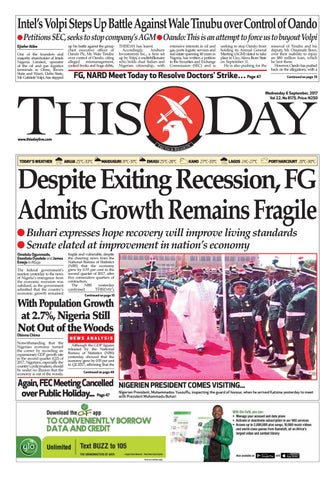
NIGERIEN PRESIDENT COMES VISITING... Nigerien President, Muhammadou Yusouffu, inspecting the guard of honour, when he arrived Katsina yesterday to meet with President Muhammadu Buhari
2
T H I S D AY WEDNESDAY SEPTEMBER 6, 2017
T H I S D AY WEDNESDAY SEPTEMBER 6, 2017
3
4
T H I S D AY WEDNESDAY SEPTEMBER 6, 2017
T H I S D AY WEDNESDAY SEPTEMBER 6, 2017
5
6
T H I S D AY WEDNESDAY SEPTEMBER 6, 2017
T H I S D AY WEDNESDAY SEPTEMBER 6, 2017
7
8
T H I S D AY WEDNESDAY SEPTEMBER 6, 2017
T H I S D AY WEDNESDAY SEPTEMBER 6, 2017
9
WEDNESDAY, ͞˜ ͺ͸͚Ϳ Ëž T H I S D AY
10
PAGE TEN DESPITE EXITING RECESSION, FG ADMITS GROWTH REMAINS FRAGILE exclusive report that the country’s gross domestic product (GDP) had grown by 0.55 per cent in Q2 2017, from -0.91 per cent in Q1 2017 and -1.49 per cent in Q2 2016. However, reacting to the Q2 GDP report from the NBS, the Economic Adviser to the President, Dr. Yemi Dipeolu, cautioned that the economy remained vulnerable to “exogenous shocks or policy slippages�. Dipeolu, who said the end of the recession was welcome, reasoned nonetheless that it was imperative to intensify the implementation of the Economic Recovery and Growth Plan (ERGP) as well as diversification of the economy to achieve the desired results. “Overall, the end of the recession is welcome but economic growth remains fragile and vulnerable to exogenous shocks or policy slippages. “Accordingly, it remains essential to intensify efforts going forward on the implementation of the ERGP to achieve desired outcomes including sustained inclusive growth, further diversification of the economy, the creation of jobs and improved business conditions,� he said. Dipeolu, who said the GDP figures gave cause for “cautious optimism� in the face of falling inflation, pointed out that unemployment and food inflation have remained high as a result of the cost of transportation and what he described as seasonal factors. “The GDP figures give grounds for cautious optimism, especially as inflation has continued to fall from 18.72 per cent in January 2017 to 16.05 per cent in July 2017. “Foreign exchange reserves have similarly improved from a low of $24.53 in September 2016 to about $31 billion in August 2017. “Unemployment, however, remains relatively high, but job creation is expected to improve as businesses and employers increasingly respond more positively to the significantly improving business environment and favorable economic outlook. “Besides, as key sectoral reforms in both oil and nonoil sectors gain traction, the successful implementation of ERGP initiatives such as N-Power and the social housing scheme will boost job creation. “Food inflation also bears
TOP GAINERS C & I LEASING NEM GUINNESS SKYEBANK FBNHOLDINGS TOP LOSERS SEPLAT JBERGER LAFARGE
NGN NGN % 0.05 1.05 5.0 0.05 1.05 5.0 3.77 79.27 4.9 0.03 0.64 4.9 0.28 5.98 4.9 NGN NGN % 24.52 465.98 5.0 1.62 30.87 4.9 2.84 54.14 4.9 CADBURY 0.57 10.90 4.9 TOTAL 12.00 233.00 4.9 HPE Nestle Nig Plc â‚Ś1,220.00 Volume: 230.029 million shares Value: N4.774 billion Deals: 4,188 As at yesterday 5/9/17 See details on Page 40
watching, as it has remained quite high and volatile due mostly to high transport costs and seasonal factors such as the planting season. “Investments in road and rail infrastructure increased supply and availability of fertilizer and improvements in the business environment should contribute to the easing of food prices,� he pointed out. The economic adviser described the positive growth of the economy as the byeproduct of output from both the oil and non-oil sectors, disclosing that the growth in the oil sector was predicated on its stability, compared to the crisis it experienced last year. However, he noted that even though the non-oil sector was characterised by successive quarterly growth, the growth was not as strong as the Q2 2016 due to the fragile economic conditions. Describing the consistent growth in agriculture at 3.01 percent as encouraging, Dipeolu also said growth in the manufacturing sector was positive even though it was lower than its performance in the previous quarter. He further noted that growth in industry, electricity and gas, foreign trade and capital importation as well as improved foreign exchange, all contributed to Nigeria’s economic progress. “The figures released by the National Bureau of Statistics for the second quarter of this year (Q2 2017) showed that the economy grew in Q2 2017 by 0.55 per cent, from -0.91 per cent in Q1 2017 and -1.49 per cent in Q2 2016. “This in effect means that the Nigerian economy has exited the recession after five successive quarters of contraction. “This positive growth is attributable to both the oil and non-oil sectors of the economy. Growth in the oil sector, which has been negative since Q4 2015, was positive in Q2 2017. It rose by 1.64 per cent as compared to -15.60 in Q1 2017, an increase of up to 17 percentage points. “This improvement is partly due to the fact that oil prices which have improved slightly from the lows of last year have been relatively steady as well as the fact that production levels were being restored.
“The non-oil sector grew by 0.45 per cent in Q2 2017, a second successive quarterly growth after growing by 0.72 per cent in Q1 2017. This growth, which was not quite as strong as it was in Q2 2016, reflects continuing fragility of economic conditions. “However, given that nearly 60 per cent of the non-oil sectors’ contribution to GDP is influenced by the oil sector, growth in the oil sector will help boost the rest of the economy. “The positive growth seen in agriculture when the rest of the economy was contracting was maintained at 3.01 per cent which is encouraging, especially if seasonal factors are taken into account. “Manufacturing growth was also positive at 0.64 per cent and although lower than the previous quarter’s growth of 1.36 per cent, it was a noticeable improvement over the -3.36 per cent experienced in Q2 2016 and a continuation of the turnaround of the sector. Solid minerals which remain a priority of the administration, also continued to grow. “Overall, industry as a whole grew by 1.45 per cent in Q2 2017, after nine successive quarters of contraction starting in Q4 2014. “This positive development was somewhat overshadowed by the continued decline in the services sector which accounts for 53.7 per cent of GDP. “Nevertheless, electricity and gas, as well as financial institutions, grew by 35.5 per cent and 11.78 per cent respectively in Q2 2017. “The GDP figures give grounds for cautious optimism especially as inflation has continued to fall from 18.72 per cent in January 2017 to 16.05 per cent in July 2017. “Foreign exchange reserves have similarly improved from a low of $24.53 in September 2016 to about $31 billion in August 2017. “In the same vein, capital importation grew by 95 per cent year-on-year, driven by portfolio and other investments but also notably by foreign direct investment which increased by almost 30 per cent over the previous quarter. “Foreign trade has also contributed to improving economic conditions with exports amounting to N3.1
trillion in Q2 2017 while imports which increased by 13.5 per cent amounted to N2.5 trillion in the same period. The overall trade balance thus remained positive at N0.60 trillion,� he stated. Also reacting to the NBS report, President Muhammadu Buhari yesterday said the real impact of the end of recession would be better felt when ordinary Nigerians experience a meaningful improvement in living standards. Buhari, according to a statement by his spokesman, Malam Garba Shehu, made the remark while receiving the President of Niger, Alhaji Mahamadou Issoufou in Daura, Katsina State. According to Shehu, Buhari was “very happy� to hear that the country was finally out of the recession, adding that the real gain would be improved living standards for Nigerians. He quoted the president as saying, “Certainly I should be happy for what it is worth. I am looking forward to ensuring that the ordinary Nigerian feels the impact.� The statement added that Buhari commended all managers of the economy for their hard work and commitment, observing that more work needed to be done to improve the growth rate. “Until coming out of recession translates into the meaningful improvement in peoples’ lives, our work cannot be said to be done,� the president was quoted to have said. The statement also said the Nigerien president, in his remarks, said he was very delighted to see Buhari in good health and prayed the Almighty God to continue to strengthen him. “President Issoufou said he used the opportunity of the visit to discuss some bilateral and regional issues with President Buhari, which included the fight against Boko Haram, the economic challenges in the Lake Chad Basin and other developmental concerns that directly affect the livelihoods of the citizens of both countries. “The Nigerien president was accompanied on the visit by a former prime minister of the West African country, Dr. Hamid Algabid, and the President of the Economic,
Social and Cultural Council of Niger, Mr. Moussa Moumouni Djermakoye,� the statement added. In its comment on the NBS data, the Senate also expressed happiness at the report confirming that the country’s economy grew by 0.55 per cent in the second quarter of 2017. In a statement signed by its spokesperson, Senator Aliyu Sabi Abdullahi, the Senate described the development as a commendable one, coming after five consecutive quarters of contraction. The Senate said the improved performance of trade, manufacturing, agriculture and oil sectors, was an indication that with carefully aligned policies and legislative interventions, Nigeria’s economy could thrive beyond current forecasts and expectations. “The Senate received the Q2 NBS economic report with great excitement. We are delighted that government’s response to the economic recession has began to yield tangible results,� the statement read. “The public will recall that in the days following the announcement of the 2016 recession, the Senate initiated steps and tabled 21 recommendations that it submitted to the executive for immediate action. “We also listed out economic priority bills, many of which have now been passed, or at the final stage. “We are also happy to note that many of the economic recommendations, specifically in the areas of retooling our agriculture and trade policies were adopted. “This shows that the ‘all hands on deck’ approach was necessary from both branches of government,� it observed. The Senate added that although the nation was now out of the recession, it was still committed to ensuring that the high rate of unemployment and the high cost of living are reduced. “Rising unemployment in the country is an issue that is of much concern to all of us. Additionally, the rising cost of food prices and basic services in the country still affects millions of households. “That is why we will continue to work on our
laws, specifically in the areas of access to credit to promote more opportunities for small business owners, and opening up more sectors to private sector participation, so that there will be more competition in our markets — which will lead to lower prices. “We will also continue to work with the executive to ensure that our policy and legislative objectives, specifically as they relate to the economy, are well-aligned,� the Senate said. Similarly, the Speaker of the House of Representatives, Hon. Yakubu Dogara expressed delight over the latest report of the NBS indicating that the country had exited the recession. In a statement issued last night by his spokesman, Turaki Hassan, the Speaker said the House was gladdened by the performance of the economy in the last quarter. He said this positive result was an indication that the economic policies of the APC administration are on track. He said the task ahead was to ensure sustained efforts by both the executive and the legislature in fast tracking programme implementation for even more rapid economic growth and development. According to him, “We must now channel our energies towards measures aimed at job creation for millions of Nigerians, addressing the widening socio-economic inequalities, and creating opportunities for all Nigerians. “The House of Representatives will more than ever before step up its partnership with the executive in this regard by introducing as well as supporting all measures designed to boost the economy and put food on the tables of all Nigerians. “This informed the passage of the Federal Competition and Consumer Protection Commission Bill which should go a long way in attracting foreign direct investment, creating job opportunities for our people and providing a healthy and conducive business environment for the private sector to thrive. “We will implore the president to assent to this revolutionary bill as soon as it is concurred by the Senate and transmitted to him,� it stated.
INTEL’S VOLPI STEPS UP BATTLE AGAINST WALE TINUBU OVER CONTROL OF OANDO senior official in the company informing THISDAY that Oando’s AGM would go ahead as planned and accused Volpi of resorting to blackmail in order to force Tinubu and his deputy to buyout Ansbury. In 2012, Volpi had through his company, Ansbury, invested about $700 million in Ocean and Oil Development Partners Limited (OODP BVI), a special purpose vehicle registered in the British Virgin Islands, by acquiring a 61.9 per cent stake in the firm, while a company owned by Tinubu, Withmore Limited, held 38.10 per cent of the stake in OODP BVI. Volpi, who also has extensive business interests in Angola, is alleging that he lent $80 million to Withmore to enable Tinubu, whom he said he trusted at the time, to acquire the 38.10 per cent stake in OODP BVI. Tinubu had approached Volpi to invest in the British Virgin Islands-registered firm when Oando Plc was seeking to acquire ConocoPhillips’ upstream oil and gas assets in Nigeria for $1.5 billion, a deal eventually consummated in 2014. OODP BVI, in turn, owns
99.99 per cent of the shares of Ocean and Oil Development Partners Nigeria Limited (OODP Nigeria), which holds 55.96 per cent of the shares in Oando Plc, the oil and gas company listed on Nigerian and Johannesburg Stock Exchanges. THISDAY gathered that the grievances of Ansbury, which is now claiming to own 100 per cent of the shares of OODP BVI and 99.99 per cent of OODP Nigeria over Withmore’s inability to repay the $80 million loan, effectively whittling down Tinubu and Boyo’s interest in Oando Plc to 1.2 per cent, stemmed from the alleged mismanagement of the company by Tinubu and Boyo. Ansbury, it was also learnt, is said to be alarmed over the alleged “huge financial mismanagement, very high debt and cooked books� of Oando. Ansbury is alleging that Oando is in a very bad shape, despite the official financial communications from the company to the contrary. It was further learnt that Ansbury took the decision to remove the CEO, and sack the entire board and management
since March 2017. Apart from removing Tinubu and sacking the board of directors, Ansbury is also planning to reject any proposal seeking approval for the remuneration of the CEO and other directors of Oando and also reject the approval of the company’s 2016 annual report at its next AGM. Speaking on the crisis of confidence between the shareholders, a source in Ansbury said: “The situation is that Withmore never repaid the loan, and Ansbury is struggling to recover the $80 million and the shares of OODP BVI. “So the reality is that Ansbury controls 100 per cent of OODP BVI, that control the 99.99 per cent of OODP Nigeria, that is the main shareholder of Oando Plc. “As far as we are concerned, Oando, in which we are the majority shareholder due to our indirect interest in the quoted company, is being mismanaged, its accounts are being cooked, and it has huge liabilities that have eroded the value of the company.� To buttress this claim and stop the AGM from going ahead, Ansbury on May 3rd and
4th submitted a petition to SEC in Lagos and Abuja, respectively, in which it drew the attention of the regulator to the alleged state of affairs in Oando and sought its intervention. THISDAY further gathered that Tinubu is aware of the plan by Ansbury to remove him and was said to have commenced moves to stop his ouster. Aware that Ansbury is not in a position to take control of OODP Nigeria at the moment, Tinubu was said to have initiated steps to retain his control over Oando. The Oando CEO was alleged to have quickly called the AGM in order to obtain the approval of the shareholders of the company’s 2016 annual report, keep himself as CEO of the company, retain the current board of directors who are in his corner and get approval for his remuneration and that of the directors. Tinubu was also alleged to have approved the notice of the AGM with the minimum notice and slated it to take place in Uyo, which the Ansbury source described as a remote location, in order to keep the latter’s shareholders at bay. According to a notice of
the 40th AGM of Oando, which was signed by its chief compliance officer and company secretary, Ms. Ayotola Jagun and published on August 15, the AGM will be held in Akwa Ibom State Hall, Uyo on September 11. THISDAY, however, gathered that in order to checkmate Tinubu, Ansbury has asked SEC to put the AGM on hold to allow Ansbury to take over OODP Nigeria and to avoid a meeting where the major shareholder is not allowed to attend. In the first petition to SEC, Ansbury alleged serious financial abuse and accused the management of Oando of gross abuse of corporate governance tenets in its running of the company. The petition was titled, “Serious Concern to Corporate Governance Existence, Gross Abuse of Corporate Governance and Financial Management in Oando Plc – Request for Urgent Regulatory Intervention.� In the petition, Ansbury cited page eight of the company’s annual report of 2016, alleging that the “strong uncertainty Continued on page 46
T H I S D AY WEDNESDAY SEPTEMBER 6, 2017
11
12
T H I S D AY WEDNESDAY SEPTEMBER 6, 2017
T H I S D AY WEDNESDAY SEPTEMBER 6, 2017
13
14
T H I S D AY ˞ ˜ ʹ˜ 2017
COMMENT
Editor, Editorial Page PETER ISHAKA Email peter.ishaka@thisdaylive.com
JUSTICE UNITES, INJUSTICE DIVIDES Sonnie Ekwowusi argues that the authorities could do more for the country’s unity
S
cathing criticisms continue to trail the recent lopsided appointments at the Nigerian National Petroleum Corporation (NNPC) or what some have dubbed as the Northernisation of the NNPC. Critics argue that the aforesaid appointments not only tilt in favour of the North but that they betray President Buhari’s insistence that the unity of Nigeria is not negotiable. To buttress their argument, the critics argue that in the 15 top NNPC managerial appointments that were recently made ostensibly in line with the geo-political zones, the North clinched 10 positions; South-West got three positions; South-South was given two positions while South-East was given none. What this means is that no Igbo man was found worthy to be appointed as anything in the newly-restructured NNPC. The North tops the top managerial appointments with Malami Shehu as the new Managing Director of the Port Harcourt Refining Company (PHRC); Muhammed Abah, Managing Director, Warri Refinery; Umar Ajiya, Managing Director, Nigerian Products Marketing Company (NPMC); Bala Wunti, Group General Manager, Corporate Planning and Strategy (CP&S); Usman Yusuf, Group General Manager/Senior Technical Assistant; Mrs Ahmadu-Katagum, Group General Manager (Shipping) in the Downstream Autonomous Business Unit; Kallamu Abdullahi, Group General Manager in charge of the Renewable Energy Division in the Downstream Autonomous Business Unit; Dr Shaibu Musa, Managing Director, NNPC Medical Services Limited; Ibrahim Birma, Group General Manager, Governance, Risk and Compliance Division; Farouk Ahmed, Managing Director, Product Marketing-Retiring. As I said earlier, President Buhari does not easily forget to remind us that the unity of Nigeria is not negotiable. But the lopsided appointments at the NNPC contradict the president’s statement that the unity of Nigeria is not negotiable. It is a big irony that while President Buhari keeps on harping that the unity of Nigeria is not negotiable or cannot be re-negotiated, the behaviour and actions of the Buhari government as exemplified in the aforesaid lopsided political appointments depict the government as promoting disunity and disloyalty. Words are not enough. We want action. The words of the government should be matched with external action because justice is realised in external act. Commitment to unity of Nigeria ought to have been seen in the policies and activities of the Buhari government especially in the recent appointments at the NNPC. The federal government should be reminded again that justice is at the root of the Nigerian question. Unity of Nigeria can only thrive in the crannies of justice not in the tapestry of injustice, or in the iron grips of slavery let alone under the yoke of oppression. Justice unites, injustice divides. An injustice means that something belonging to someone is taken away from him. You cannot be holding what belongs to me by virtue of justice with one hand and at the same time be inviting me to belong to one Nigeria. That is hypocrisy par excellence. That is double dealing. The whole battle of humanity since creation has been a battle against injustice. The greatest corruption that can be found in any government is injustice. Reinhold Niebuhr’s aphorism not only holds but equally rings true today: “Democracy is possible because of man’s
WITH JUSTICE YOU CAN UNITE ALL ETHNIC NATIONALITIES IN NIGERIA. WITH JUSTICE IN PLACE WE CAN SEE THE END OF SECESSIONIST AGITATIONS IN NIGERIA
capacity for justice; democracy is necessary because of man’s inclination to injustice�. Therefore if President Buhari really wants to forge true Nigerian unity in this democracy he should ensure that commutative justice is done to the various Nigerian communities. If Nigeria were practicing true federalism; if the various ethnic groups and geo-political zones in the country were fairly accommodated in the Nigerian union there probably would have been nothing like secessionist and separatist agitations in the country today. Distinguished constitutional lawyer Prof. Ben Nwabueze has recently said that IPOB’s leader Nnamdi Kanu has confided in him that he is ready to drop the Biafra agitation if justice and restructuring of Nigeria are manifestly seen to be done in Nigeria. You can see the healing power of justice. With justice you can unite all ethnic nationalities in Nigeria. With justice in place we can see the end of secessionist agitations in Nigeria. Kanu and Nwabueze are not alone in the cry for justice. Most Nigerians across the different divides cry out for justice and restructuring of Nigeria. But paradoxically the action of the government betrays its words. If the Buhari government wants unity in Nigeria it should remove the obstacles to the realisation of unity in Nigeria. Tackle the causes of secessionist and separatist agitations in Nigeria. Remedy the present lop-sided political appointments in Nigeria. Let Nigerian citizens exercise their right to freedom of expression. Do not use the military to suppress the expression of public opinion in the public space in reminiscent of Buhari/Idaigbon draconian Decrees Two and Four of 1984. If you want the unity of Nigeria to thrive then wage war against the murderous Fulani herdsmen making Nigerians feel like strangers in their own fatherland. If you want the unity of Nigeria, promote equity and fairness. Treat the goose and the gander equally. Don’t commit injustice in re-arresting Nnamdi Kanu while letting the Arewa youths off the hook. Government is called a good government because of its justice. No government that takes pride in promoting injustice can be called a good government. Without justice, said St. Augustine, what are kingdoms but great robberies? Therefore the Buhari government should fulfil its obligation of justice to the citizens and federating units. This is the whole idea of democracy. If justice is lacking the esprit de corps in one Nigeria that brings unity in a country will be lacking too. Unity is that inner acceptance, that freedom and free will to live together. Unity binds upon consent. It is not secured by intimidation or dictatorial imposition. Unity is a lived experience. How is the inner acceptance or consent secured? By giving Nigerian citizens and Nigerian communities their respective dues in Nigeria in accordance with the principles of freedom, equality and justice as enshrined in our constitution. An all-inclusive government in conformity with the principles of justice and pursuant to section 14(3) of the 1999 Constitution unites, whereas an all-exclusive government in conformity with the principles of injustice divides. The Buhari government should go and do the former.
THE DANGERS OF SUCCESS
Walter Onnoghen, Chief Justice of Nigeria, is living up to expectations, writes Dan Amor
F
or those conversant with the politics, intrigues, subterfuge and roadblocks that characterised the emergence and final confirmation of Hon. Justice Walter Samuel Onnoghen as substantive Chief Justice of Nigeria (CJN), the current attempt by fifth columnists and political jobbers to blackmail or even cast a smear on his image cannot be surprising. As if the avoidable drama of his appointment and confirmation has not brought enough shame to the country, these ubiquitous interests who felt they lost out when the Senate cleared Onnoghen to be sworn in as the Chief Justice of Nigeria against their wishes, have refused to give up. They now masquerade behind willing and irresponsible characters to undertake a campaign to impugn the hard-earned reputation of Justice Onnoghen as the early signs indicate that he cannot be bent. Since his confirmation in March this year, the feeling among Nigerians is that a round peg has been put in a round hole. Recently, however, a few individuals have rendered themselves to be used to undertake a campaign that throws mud at the person of the Chief Justice of Nigeria and discredits the institution he heads. As always, the penchant for politicians is to use the media to pull down our revered institutions not sympathetic to their narrow prejudices is once more at play. Needless to say this is taking a monumentally destructive toll on the judiciary. If, indeed, it is not a virulent media blitz of his carefully taken steps to reposition the judiciary, it would be a calculated lampoon on his reform agenda or a sweeping denunciation of his attempt to sanitise the much abused adjudicatory system or a violent muckraking of judicial officers under his watch. It is common knowledge that in the fine tradition of the judiciary, it hardly talks back when attacked; yet that should not be a reason for, as they say, every Tom, Dick and Harry to seize every slight
opportunity to insult this respected institution or the respected head of that institution, in this case, the Chief Justice of Nigeria. In a fusillade of venomous attacks laced with lies, sarcasm and dry humour, these people are unrelenting in their plan to bring Nigeria`s judiciary to the gutter through their dislike for the person of the Chief Justice of Nigeria. Like a scripted drama, one of them, Livingstone Wechie, appeared on the Africa Independent Television (AIT) Focus Nigeria programme on Tuesday, August 29 to drive home their nefarious agenda. Mr. Wechie who claimed to have represented a body that goes by the name, “The Integrity Group�, openly called for the resignation of the CJN. His grouse was that the CJN had honoured the invitation of the Rivers State Governor, Mr. Nyesom E. Wike to flag off the construction of judges quarters in the state. Honouring that invitation and performing that important duty of laying the foundation of houses for judicial officers, in the understanding of Wechie, is evidence that the CJN had compromised and should therefore resign from office. How infantile! Wechie, while admitting that “the provision of residential accommodation for justices to retire with is a very welcome development�, and while also calling on every government in Nigeria to follow the footsteps of Governor Wike as this will “discourage mendacity in the judiciary�, at the same time quipped that the said project which the CJN did flag off “was not captured in any accessible or available budget of Rivers State�. Is it all that is required for the Chief Justice of Nigeria to resign? This is taking activism to not just a sheer pedestrian rabble but to a ridiculous and questionable dimension. For instance, every well informed Nigerian knows that the Cross River State governor, Prof. Ben Ayade, is the first governor in the current administration to have attracted President Muhammadu Buhari to a state to flag off the governor’s two signature projects, the
260-kilometre Calabar-Ikom-Obudu digital highway and the new Calabar Port channelisation project in 2016. These laudable projects were not actually captured by the Cross River State government budget as at the time the president performed the ground-breaking ceremony. Does this mean that any sane Nigerian activist from Cross River State would suddenly go on air to call for the president’s resignation or his impeachment by the Senate because the projects for which he performed the groundbreaking were not captured in the state budget? President Buhari had honoured the invitation of Governor Ayade and consequently performed the groundbreaking ceremony with so much fanfare only to discover later that there was no approved Environmental Impact Assessment (EIA) or a budget for the project which the governor had designated as one of his signature projects. I cannot recall anyone asking the president to resign on account of his not investigating the circumstances surrounding the superhighway before giving it a presidential stamp of approval through the groundbreaking ceremony. It would be recalled that Wechie’s last appearance on AIT on the said date was the fourth or fifth time he had appeared on the programme. I recall watching him confess how he had personally petitioned the Economic and Financial Crimes Commission (EFCC) and other anti-graft agencies to arrest and prosecute Transportation Minister, Rotimi Amaechi, for allegedly embezzling the commonwealth of Rivers State during his two-term tenure as governor. In fact, he was emphatic that President Buhari should not appoint Amaechi as minister so as not to taint the federal government’s anti-corruption war. When the president ignored all antagonists and went on to appoint and swear in Amaechi as minister, Wechie remained adamant and appeared on the television a couple more times castigating Amaechi and the federal government for promoting corruption in the
country due to the minister’s inclusion in the federal cabinet. It therefore must have come as a rude shock to many of us when the same Wechie shamelessly appeared on another episode of the programme as a turncoat, now praising Amaechi and castigating Governor Wike. As an indigene of Rivers State, Wechie can be pardoned for taking and changing sides intermittently as he deems fit. However, to drag the name of the high office of the Chief Justice of Nigeria into the local politics of Rivers State is the height of irresponsibility. To say that the Hon. Chief Justice of Nigeria ought to have studied the budgets of states and derermined what would have been appropriated for a particular project before honouring an invitation to perform the groundbreaking ceremony of a project like the one in Rivers State is like asking him to carry out oversight functions outside his constitutional mandate. It may therefore be necessary to remind Wechie and those beating the drums for him that Justice Walter Onnoghen has an agenda which is already in the public domain, to reform the nation’s judiciary which stagnated for decades even as other arms of government progressed. Though unnamed entrenched interests delayed his confirmation despite his qualifications and steering leadership qualities and constitutional provisions, Hon. Onnoghen should now be left alone to do his work. Using the Wechies of this world to insult the occupant of the exalted office of the Chief Justice of Nigeria will further open the country to ridicule among the comity of democratic nations of the world. The Supreme Court is undoubtedly and indubitably the nation’s most powerful legal arena, the court in which the meaning of the laws of the land is finally decided. It is indeed apposite to warn that we should not play politics with our judiciary, for therein lies our only redemption as the safety valve or sole arbiter to the common man. Amor wrote from Abuja
15
T H I S D AY ˞ ˜ ʹ˜ 2017
EDITORIAL THE CHALLENGE OF REMAND HOMES There is urgent need to fix the remand homes in the country
T
he Government Remand Home, Sapele, Delta State, has had far less attention from the authorities than required and we can see the consequences. In 2013, no fewer than 11 members of a notorious criminal gang escaped from the conďŹ nes of the home. Many of them are still at large. Recently, 25 inmates, within the age bracket of 14 and 17, who were held for offences ranging from rape, robbery, burglary to murder, overwhelmed their handlers and forcibly exited the correctional facility. The inmates, who are now on the run, according to reports, were angry because the correction ofďŹ cer locked them in without food and went to church. When she returned at midday, according to the report “the angry inmates attacked her and ed through the back fence of the home and with only three staff on duty, there was little they could do.â€? The treatment of juvenile offenders at Sapele is reective of the national attitude towards children in correctional homes. Their conditions are not remarkably different from THE POOR LIVING those of adults in CONDITIONS IN THE conict with the law. REMAND HOMES ARE Like the prisons, the A VIOLATION OF THE few remand homes CHILDREN´S RIGHT TO in the country are HEALTH, NUTRITION, more or less opEDUCATION, AND pressive institutions RECREATION aimed at punishing offenders rather than rehabilitating them. The institutions are decrepit, ill-equipped and the inmates ill-fed. They are denied humane treatment and have no access to recreational and sporting activities. Even more, they also lack relevant educational and vocational trainings to equip inmates to live a sustainable life when they eventually return to the larger society. Indeed, a recent study at the Port Harcourt Remand Home in Rivers State revealed that the place was poorly conďŹ gured to manage juvenile offenders. And as the Sapele incident acutely demonstrated, many of the personnel are not only
Letters to the Editor
ill-trained, but grossly insufďŹ cient. Some time in 2009, Dimeji Bankole, former Speaker of the House of Representatives, could not control his emotions when he visited the Bortal Remand Home in Abeokuta, Ogun State, to launch an Information Communication Technology (ICT) centre for the institution. He was greatly disturbed by the plight of the inmates whose age ranged from eight to 15 years. At the occasion, Bankole said the Nigerian society would be better off if its leaders could address the ills aficting the youth before their attitudes were formed.
T T H I S DAY
EDITOR DEPUTY EDITORS ˜ MANAGING DIRECTOR DEPUTY MANAGING DIRECTOR CHAIRMAN EDITORIAL BOARD
EDITOR NATION’S CAPITAL
T H I S DAY N E W S PA P E R S L I M I T E D
EDITOR-IN-CHIEF/CHAIRMAN GROUP EXECUTIVE DIRECTORS ˜ ˜
˜ GROUP FINANCE DIRECTOR DIVISIONAL DIRECTORS ˜ ˜ DEPUTY DIVISIONAL DIRECTOR
SNR. ASSOCIATE DIRECTOR ASSOCIATE DIRECTORS ˜ CONTROLLERS ˜ ˜
GENERAL MANAGER
GROUP HEAD DIRECTOR, PRINTING PRODUCTION TO SEND EMAIL: ďŹ rst name.surname@thisdaylive.com
he attendant result of the poor, difďŹ cult and deprived environment in the custodial institutions is such that many of the young offenders are transformed to hardened criminals. They often plot their escapes and later constitute themselves into greater burden and danger to the society. There are no reliable statistics, but there is no doubt that many of the children in the remand homes across the country are from the poor in society; those in dire need of care and protection. Many of them lived on the street and engaged in any activities to scrape by before running afoul of the law. Unfortunately, the prevailing depressed economy in the country is no doubt accentuating the problem of juvenile crimes as many families are increasingly becoming unable to live up to the challenge of parenthood. But the country owes those children in corrective institutions care and protection. The poor living conditions in the remand homes are a violation of the children´s right to health, nutrition, education, and recreation. Nigeria is signatory to the Convention for the Rights of the Child (CRC) and the African Charter, and thus the treatment of the young offenders must conform to international standards. There is therefore an urgent need to ensure that these institutions are well funded and provided with their basic needs. The inmates must be equipped with the basic skills to ďŹ t easily into the larger society at the end of their reformation, and to fulďŹ ll their full potential.
TO OUR READERS Letters in response to speciďŹ c publications in THISDAY should be brief (150-200 words) and straight to the point. Interested readers may send such letters along with their contact details to opinion@thisdaylive.com. We also welcome comments and opinions on topical local, national and international issues provided they are well-written and should also not be longer than (9501000 words). They should be sent to opinion@thisdaylive.com along with the email address and phone numbers of the writer.
INFRASTRUCTURAL DEVELOPMENT IN KWALI COUNCIL
W
hile the controversy rages over the autonomy of local government councils in Nigeria, the Kwali Area Council in FCT, Abuja is not leaving any stone unturned in delivering democracy dividends to the residents of the area. The Kwali Area Council under the able leadership of Hon. Joseph Shazin has adopted robust developmental strategies towards ensuring the development of the area council. To this end, the administration has embarked on various projects especially the rehabilitation of some road networks, schools, water boreholes and repair of office rooms at the secretariat. It is interesting to note that the Hon. Shazin administration has continued to deliver on its mandate to the people despite the paucity of funds arising from a significant drop in the monthly federal allocations. The developmental strides they have so far recorded in a little over one year into the Shazin’s three-year administration can be attributed to the superlative leadership style of the chairman and his team. On assumption of office he realised the peculiar needs of his people which are mostly development -related and he hit the ground running by tackling them sector by sector. Having laid a road map for the realisation of the most basic
of the needs which is education, his administration has now embarked on the provision of motorable roads to the longabandoned remote villages and agrarian communities. It is noteworthy that most of the projects the Shazin administration has focused on are people – oriented and to commemorate his first year in office he inaugurated various projects like the timber market, and the cattle market at Koroko. He also launched renovated class room blocks, office blocks and toilet facilities in the Pilot Science Primary School, Kwali and Yangogi Primary School. He has also drilled several water boreholes in some Kwali communities. These achievements are remarkable considering that some local government councils in the country usually give lame excuses for their inability to deliver life-changing projects to their people. The difference is the commitment leaders bring to bear on the responsibilities entrusted to them. In the case of Kwali Area Council, Hon. Joseph Shazin and his team have continued to work tirelessly to improve the lives of Kwali residents. They have also proven that despite the lean federal allocation, with prudent management, the local government can still provide some developments to the residents within available resources. The implication of the drop in Nigeria’s national oil earnings is that both states, local and federal governments are affected.
The solution however lies in innovative thinking and prudent management of human and materials resources and this is what is playing out in Kwali Area Council where Joseph Shazin steers the ship with humility, wisdom and knowledge. His many years of experience as an educationist, teacher and administrator have amply equipped him to manage the area council well. He has also been able to accomplish significant milestones based on the cooperation of the people, staff of the area council and traditional rulers. Kwali area council has today become an example of how local governments in Nigeria should operate and this achievements and style of leadership are worthy of emulation. In this era of diversification governments at all levels have a duty to ensure that other means of generating revenues are explored in order to meet the increasing demands of their constituents. In the case of Kwali area council, agriculture happens to be the mainstay of the economy and it is gratifying to note that the Shazin administration has been supporting farmers with necessary tools and implements to ply their trade. Abuja being the seat of the federal government is already witnessing expansion and surrounding areas like Kwali with its strategic location can take advantage of the opportunities that will result from the expansion of the city centre. Chukwudi Enekwechi, Abuja
16
T H I S D AY WEDNESDAY SEPTEMBER 6, 2017
T H I S D AY WEDNESDAY SEPTEMBER 6, 2017
17
18
T H I S D AY ˾ WEDNESDAY, SEPTEMBER 6, 2017
MIDWEEKPOLITICS
Group Politics Editor Tobi Soniyi Email tobi.soniyi@thisdaylive.com 08033146139 SMS ONLY
THE NEWSMAKER
Alaibe Mulls His Political Futures
After assessing the place of the Ijaw nation in the unfolding political situation in the country, political leaders in Bayelsa State visited Timi Alaibe and urged him to come out and be the voice of his people. Will he heed the call? Segun James went in search for the answer
T
he delegation to the Lagos home of Chief Timi Alaibe was made up of eminent Bayelsa state leaders both in the polity and traditional institution. The mission: the political reality in the country requires that someone outside government should come out and speak on behalf of the Ijaw not just as the voice and conscience but as a leader at this critical time in the history of the country. They told him that they have come to urge him to lead the people and that he could not afford to refuse them. It was not an unusual request but it is coming at a time Alaibe had given politics a wide berth to concentrate on his business. But how should he respond to his people? This was his dilemma as he considered the people’s request and a return to the familiar terrain of politics. In 2006 as part of the runs towards the 2007 general election, Alaibe as the Executive Director, Finance and Administration of the Niger Delta Development Commission (NDDC) was clearly the leading and favourite aspirant to pick the Peoples Democratic Party (PDP) governorship ticket; after all, the state’s party structures were under his control and he was expected to secure the ticket. But barely a few weeks to the party’s governorship primaries, a most bizarre thing happened. In a freak political mistake, the Bayelsa State PDP chairman, Chief Fred Agbedi, at a private gathering at Alaibe’s home handed the PDP flag to him saying that was the way the flag would be handed to him after the primaries. It was a fatal mistake. His enemies immediately cashed in on it. The video of the event soon surfaced in Abuja and before long the chairman was suspended and Alaibe lost control of the party structures, a situation which allowed the incumbent governor, Dr. Goodluck Jonathan to coast home to victory at the primaries. Like a true party man that he is, Alaibe decided not to contest against Jonathan. Following the turn of events, President Olusegun Obasanjo persuaded Alaibe who still had the advantage not to contest against Jonathan. The then president then advised that all elective positions both in the National Assembly and the state’s house of assembly be shared between Jonathan and Alaibe at two to one ratio respectively. To further placate Alaibe, Obasanjo promoted him to the Managing Director of the Niger Delta Development Commission (NDDC). As the managing director, Alabe decided to concentrate his efforts at creating the Niger Delta master plan for development instead of the arbitrary development engaged in by his predecessors. Since then, Alaibe has never seriously considered contesting again even though he did make one or two attempts after that. This was the situation until the coming of the elders. Alaibe was born on the 10th day of June, 1962 in the Ijaw village of Igbainwari in Opokuma, Bayelsa State, Nigeria, to the family of late Pa Emmanuel Mmadu Alaibe. He is the third of five children. His early life was quite tumultuous and difficult as his parents were of modest, but hardworking background. However, despite his humble beginning, young Timi encouraged by his parents, was very determined from an early age to get education. When not in school, Timi would accompany his parents to the farm a trip that entailed crossing the river in crude wooden canoe. It was this experience that taught young Timi the importance of hard work, at an early age.
Alaibe...will he take another shot at politics?
This invaluable work ethic has guided him all through his life. When he is not attending to chores or helping his parents in the farm, young Timi spent much of his childhood with his age mates frolicking in the local village river and going fishing with locally made fishing rods and hooks. The bond of friendship he forged with his childhood playmates during those early years of his life are still as strong today. His formative years were spent at the cities of Warri, Port Harcourt and Lagos. And in each one of these cities, Timi quickly gained popularity among the neighbourhood kids for his remarkable swimming skills. Despite his having achieved great success in life, Timi Alaibe is a man who has not forgotten where he came from. He is always at home in his village of Igbainwari in Opokuma. He began his elementary education at Isoko Primary School, Marine Beach, Apapa, Lagos from 1967 to 1970. When his parents moved to Port Harcourt in 1970, he was enrolled at Christ the King School, Oromenike, Port Harcourt between 1970 through 1973. There, he earned his First School Leaving Certificate. Upon completing his primary education, young
Due to his passion and dedication to ending violence in the Niger Delta region through empowerment, Alaibe was appointed as the Managing Director and Chief Executive Officer of the commission a position he held until April 2009 when his tenure expired
Timi returned to his village of Igbanwari in Opokuma. He enrolled at the Government Secondary School, Kaiama, in Bayelsa State for his secondary education from 1974 through 1979 where he earned his West African School Certificate. Academically, Timi Alaibe was an exceptionally brilliant student distinguishing himself in both English and mathematics. Timi still managed to graduate with honors, despite the fact that he had to cross the local river on canoe to attend school at Kaiama - a testament to his tenacity and dedication to learning. He never allowed his underprivileged background to hinder his academic progress. Timi soon gained admission into the Rivers State University of Science and Technology from where he graduated with a Bachelor of Science (BSc) degree in Accounting. After a brief professional career, Timi felt a need to enhance his academic credentials. He figured that a post graduate degree would further equip him for the corporate world. He applied to, and gained admission into the Obafemi Awolowo University (OAU) Ile Ife, Nigeria for his post graduate studies in Business Administration. He obtained a Master of Business Administration (MBA) degree. Upon completion of his Master’s degree program, Timi Aaibe returned to professional life at Peat Marwick Ani Ogunde and Co (now KPMG) initially as a trainee accountant. In 1986, he joined African Continental Bank as Head of Operations and rose to become Branch Manager at Okrika branch, in Rivers State. He worked at different positions at the bank for several years, before deciding to move on to other professional challenges. He then soon secured a position at the All States Trust Bank in 1991, as Assistant Manager in charge of risk management and credit control. A year later, in 1992, he was appointed the vice president of the Cosmopolitan Bancshares Ltd a top tier finance and investment company. In 1994, he joined Societe Generale Bank Ltd (now Heritage Bank PLC) as Manager, Corporate Banking Division. He served as the Bank’s Assistant General Manager in 1998 and then its General Manager, Corporate and Investment Banking in 2000.
During his years in the private sector, Alaibe has always known that at some point he would have to venture into the public sector of the country to contribute his talent in fixing some of the ills hampering the country’s development. His foray into the public sector came in 2001, when the Obasanjo as president noticed his managerial and leadership capabilities, appointed him as the Executive Director, in charge of Finance and Administration, at the then newly created Federal Government’s Niger Delta Development Commission (NDDC). His office instituted an effective and efficient governance structure that guided the management of the commission. Along with his colleagues, he set in motion a coordinated response mechanism to address the short, medium and long-term challenges of the Niger Delta. These included integrated regional development master plan, interim action plan for key projects in the Niger Delta states, as well as programmes for skills acquisition, re-orientation and empowerment of youths in the region. Due to his passion and dedication to ending violence in the Niger Delta region through empowerment, Alaibe was appointed as the Managing Director and Chief Executive Officer of the commission a position he held until April 2009 when his tenure expired. He was soon saddled with the more challenging task of nurturing the Demobilisation, Rehabilitating and Re-integration of ex-youths from the creeks back into society. His immediate constituents were 20,192 warring youth who accepted the amnesty proclamation in 2009. He took the challenge with the zeal of priesthood. Although he held the office for about a year, he put in place a five-year framework for the efficient implementation of the Demobilisation, Demobilisation and Reintegration Program. Today, as the Federal Government reflects on some of the initial successes of this program, Timi Alaibe stands tall as the midwife of that process. With the delegates gone, is Timi Alaibe venturing back into politics and public domain, he refused to say as the lure to contest the Bayelsa state governorship may draw him into the foray.
T H I S D AY ˾ WEDNESDAY, SEPTEMBER 6, 2017
19
UPDATE AND TRENDING
MIDWEEKPOLITICS
Akeredolu, Mimiko Spar over Debt James Sowole revisits the ongoing dispute between the Ondo State governor, Mr Oluwarotimi Akeredolu and his predecessor, Dr. Olusegun Mimiko over the state’s indebtedness James Sowole revisits the ongoing dispute between the Ondo State governor, Mr Oluwarotimi Akeredolu and his predecessor, Dr. Olusegun Mimiko over the state’s indebtedness
W
hen the announcement came that the Governor of Ondo State, Mr Oluwarotimi Akeredolu, SAN had scheduled the much awaited inauguration of his newly appointed commissioners and special advisers to Wednesday, August 30, many people had thought that the event would be the usual political jamboree characterised by praise singing and intermittent chanting of party slogans when the event is ongoing. Those who attended the event also expected the governor to assign portfolios to his commissioners and special advisers as everybody as friends and relatives anxiously waited with bated breath to know which ministry would be given to their own relation and friends. But they were all disappointed. However, apart from the failure to assign portfolios to the commissioners and advisers, the governor also used the opportunity to paint a grim picture of the state’s finances. The revelation made by the governor on the state of the state’s elicited another round of controversies that will linger for long. The crowd that witnessed the inauguration at the main hall of the International Event Centre, The Dome, which was filled beyond capacity, was stunned when midway into his speech, the governor started rolling out the state’s finances since February 2017, when he was inaugurated. While some people expressed disbelief on the figures read out by the governor, others particularly those suspected to have served in one capacity or the other under the immediate past administration of Mimiko, wondered why it took Akeredolu six months before coming out to tell the people the position of the state’s finances he inherited. Painting a gloomy picture of the finances of the state, Akeredolu claimed that the immediate past administration of Mimiko left behind a whooping debt of N220 billion. The governor said his administration inherited an internal debt of N53,719billion and an external debt of N17,485 billion. He further disclosed that unpaid salaries and allowances left by his predecessor from August to December, 2016 amounted to N17, 279 billion, adding that the unpaid salaries and allowances from January to February 2017 was N6, 911billion. “Ondo State Pension Liabilities: N4,800,965,850.00, Ondo State Gratuity: N15,043,537, 042.74, Unpaid Local Government Salaries and Allowances Aug to Dec: 2016 N9,320,568,782.41. Unpaid Local Government Salaries and Allowances (Jan. to Feb., 2017): N5,192,437,503.30, Local Government Pension Liabilities: N25,237,348,457.26, Local Government Gratuities Liability: N20,965,598,590.61, Contractors’ Liabilities: N39,740,423,934.76, Outstanding payment requests in the Office of the Accountant-General without cash backing: N5,451,352,494.25,” he said. Akeredolu, who debunked the claim of the last administration that it left a sum of N20 billion, said his government only met a sum of N9,956billion in the coffers of the state, lamenting that things would be difficult for the new government with a debt of over N220 billion. “With a total inherited debt of over N220 billion, it should not be difficult for anyone to know that the government’s capacity for seeming elastic adjustment to cater for the people has been stretched to its limit”, he said. Akeredolu said with what he met on ground, there is no gain asserting the obvious; that the administration is not in any position for frivolities. “All of us must gird our loins for the great task ahead. The picture is not good. Therefore, all acts with the potential of pushing us deeper into economic crisis must be jettisoned”, he added. However, Akeredolu said the disclosure of the state’s debt profile should not be misconstrued as politics pleading that media practitioners should subject the information to the crucible
Between Akeredolu and Mimiko, the truth lies somewhere
of serious scrutiny and analysis. “The knowledge of true financial status of the state Government will guide and moderate the craving desires of all and sundry. Expectations of performance from the government must be anchored on reality. “Government officials must bear this fact in mind, always. It will be easy for the people to show understanding when they know the truth. The economic condition of this State is precarious” he said. Akeredolu advised friends and relations of the newly sworn in commissioners and special advisers not to over-burden them with too much requests as there would be no money to run the government as usual.
While members of the ruling APC considered Akeredolu’s speech as a revelation of problems created by Mimiko for the incumbent administration, others, particularly Mimiko’s supporters concluded that the governor was only preparing the ground upon which he will lay the blame for his failures in the future should he fail to perform
“I admonish members of families and friends of political appointees to desist from mounting undue pressure on them. They have been called upon to work for the collective glory of the state. This, to me, is a sacred social contract between them and posterity. They must be assisted to fulfil their destinies”, he said. But in a swift reaction to Akeredolu’s claims, Mimiko declared that his government did not leave behind a debt of N220 billion. He also contradicted the governor’s claimed that he left N9,956 billion in the state’s coffer even as he insisted that he left N20 billion. Speaking on behalf of his former boss the commissioner of information, under Mimiko, Mr Kayode Akinmade urged the people of the state to discountenance the claims by Akeredolu. He said: “We urge the government and interested citizens of our state to avail themselves of the true state of our indebtedness from the Debt Management Office (DMO) and the Nigeria Extractive Industries Transparency Initiative (NEITI). The reports are clear and unambiguous about the fact that Ondo State remained the least borrowed of the six south western states and of the nine oil producing states as aour administrations exit in February, 2017.” Akinmade insisted that the former administration left N20 billion in the coffers of the state and that Akeredolu was not saying the truth about the finances of the sunshine state. Giving the breakdown of the money left behind the Mimiko’s administration, Akinmade explained that the amount included N7.37.billion in the state’s current account; N7.53 billion as fixed deposit; N1.2billion in the Millennium Development Goal (MDG) Account; $346,000 and 443,000Euro in the domiciliary account, including the N825million Sure-P fund at the Local Government Account.
Akinmade said all the monies came late during the tenure of Mimiko and were to be used to offset a chunk of the salaries owed workers before the then Accountant General made a curious disappearance The former commissioner stated that the Mimiko government did not incur any foreign debt in all its eight years. “Also, the external debt stock as at February 2017 was US49,958,268.49, which (if translated at 1 US $ = N305) is N15.23billion. All of these external debt stocks were inherited from previous administrations. Again, we did not contract any external loan for all of our eight years. Well aware of the fact that government is a continuum, we continued to service the debts, some of which spanned over twenty years. “Internal debt profile, we aver, stood at N53.159 billion comprising mainly of salary bail-out loan of N13.76billion, Excess Crude Account loan N9.79 billion, Canada Restructuring FGN Bond N4.13billion, CBN budget support N7.5billion and Ondo State 7-Year bond of N17.6billion. Of all the above listed indebtedness, only the Ondo State 7-Year Bond was directly incurred by our government to build major infrastructure across the state,” Akinmade explained. While members of the ruling APC considered Akeredolu’s speech as a revelation of problems created by Mimiko for the incumbent administration, others, particularly Mimiko’s supporters concluded that the governor was only preparing the ground upon which he will lay the blame for his failures in the future should he fail to perform. The people of Ondo State believe that the last has yet to be heard on the claims and counter claims. Nevertheless, they expect Akeredolu to hit the ground running after taken six months to appoint commissioners.
T H I S D AY Ëž Ëœ Í´Ëœ Í°ÍŽÍŻÍľ
20
FEATURES
Ă?ĂžĂ“Ă˜Ă‘ Ă?Ă‹ĂžĂ&#x;ĂœĂ?Ă? ĂŽĂ“ĂžĂ™ĂœË? Ă’Ă‹ĂœĂ–Ă?Ă? Ă”Ă&#x;Ă˜ĂĄĂ‹ Ă—Ă‹Ă“Ă– Ă?Ă’Ă‹ĂœĂ–Ă?Ă?˛ËÔĂ&#x;Ă˜ĂĄĂ‹ĚśĂžĂ’Ă“Ă?ĂŽĂ‹ĂŁĂ–Ă“Ă Ă?Ë›Ă?Ù×
Elumelu's Diagnosis on Military and Leadership As the Nigerian military stretches its personnel in various areas of conflict nationwide, the need for strategic leadership has also become pertinent. Chairman of Heirs Holdings and Founder of Tony Elumelu Foundation, Mr. Tony Elumelu, using his private sector experience, recently provided the imperative for reliable leadership in the Armed Forces. Paul Obi writes
Elumelu delivering a lecture at the Armed Forces Command and Sta College, Jaji, Kaduna State...recently
N
igeria at present is confronted by many challenges that have continued to raise the question of strategic leadership. Of truth, the nation's military has constantly proven itself in providing that quality leadership needed to steer the ship of the country afloat. Yet, there are times where the military overstretches itself, a situation that put more burdens on the shoulders of the Armed Forces. At a recent lecture held at the National Defence College (NDC), Abuja, the Chief of Defence Staff (CDS), General Gabriel Olonisakin, in a paper titled 'A New Approach to Leadership in the Armed Forces of Nigeria', harped on the need for sustainable leadership among the Armed Forces. Olonisakin further hinted that quality leadership was instrumental in victories recorded recently on the war against Boko Haram insurgency and other acts of terrorism. In the same token, the clamour for a reliable leadership has continued to be in the front burner in the nation's military affairs. Director of Military Intelligence (Army), Major General Abubakar Tarfa, speaking at this year’s Guards Brigade Third Quarter Inter-unit Cross-country Competition, held at Mambila Barracks, Abuja, said the increasing spate of insecurity in the country has tended to overstretch the Armed Forces thereby hampering Army formations and personnel training across the Armed Forces. He added that the increasing demand for security presence across the country had negatively affected the Nigerian Army formations, thereby halting Army's goal for effective and efficient military engagement. Tarfa stated
that "with careful planning, innovation and commitment, quality training of personnel by formations could still be achieved. He said: "Training was an important aspect of every Army, it was also the bedrock of every successful military campaign. "An event of this nature is intended to enhance the combat survival and readiness of an individual soldier which is undoubtedly dependable on his or her level of training
Leadership is about instilling conďŹ dence in your people because as a leader, you rarely hardly ever operate on your own. As a continent, we are endowed with so much, we should not be where we are. We need purposeful leaders in Africa to lead us, we need African countries to become much more successful than we are today, it requires leadership and we need to raise the standard of living of our people in Africa – it requires leadership
and fitness. It would also build the combat efficiency of the participating units as well as improving the combat proficiency of Guards Brigade," he stressed. Thus, it is in the light of this drive for strategic leadership that the Chairman of Heirs Holdings and Founder of Tony Elumelu Foundation (TEF), Mr. Tony Elumelu, last week gave a lecture at the Armed Forces Command and Staff College, Jaji, Kaduna State, on how the military can tap from private sector leadership perspective. In his lecture, Elumelu x-rayed the principles of leadership, with the private sector as the focus. He argued that leadership in its true sense within the public sector was not different from the private sector. The TEF founder maintained that the only point of difference was in the approach. He said: "Leadership to me in public sector is not actually different from leadership in the private sector and to me, leaders are made and not born. We can discuss this even though some people think otherwise. Successful leaders define what success means so that when they succeed it is not by chance. They understand it, they define it. They don’t just take a role, they understand the role, understand what it takes to succeed, define what success means so that when success comes they can see it. "If you stretch this to the private sector, you might also wonder why two companies set out at the same time and depending on the circumstances, and with the same licenses given the same day, one company 50 years, 10 years, 20 years down the line succeeds and goes global and another company fails. The reason is because of leadership. "So, leadership should excite people who
want to know why, as I said before, two countries- one is succeeding one is failing, one has more resources yet, not doing well. Companies starting out the same time, the same environment and one is succeeding and the other is not succeeding. It means therefore that leadership should be taken very seriously. "And so, when I got this invitation from your institution to share my perspective especially on the private sector leadership, I thought it was indeed another great effort by your historic institution to further advance issues and discourse on leadership. So, the question is: why do some leaders get it right and others fail to get it right or is there even destiny in the issue of leadership? Are some people destined to become good leaders and others are not destined to become great leaders?" He asked. Elumelu further held that "leadership is about instilling confidence in your people because as a leader, you rarely hardly ever operate on your own. As a continent, we are endowed with so much, we should not be where we are. We need purposeful leaders in Africa to lead us, we need African countries to become much more successful than we are today, it requires leadership and we need to raise the standard of living of our people in Africa – it requires leadership. And so as they say in the bible, who shall I send? Are you available? Are you ready? We need to work together and be relentless until we recover what has been lacking on our continent.� At the interactive session, Elumelu who harped on the antidotes to success, stated that, "I would say that people make all the difference and I
T H I S D AY Ëž Ëœ Í´Ëœ Í°ÍŽÍŻÍľ
21
FEATURES
Elumelu (middle) anked by top military oďŹƒcers
Gen. Gabriel Olonisakin, CDS
Elumelu at the lecture
think that strategy is less than 10 per cent of what leads to success. What leads to success is execution and execution does not occur if you do not have the right people and if you have the right people and you are not able to mobilise them, you will not be able to get the best out of them. "So, I would say amongst many other things, the most critical success factor is the people equation, getting it right – getting the right people, incentivising them, creating a feeling of friendship, making people stand up to go to work for a generational purpose, feeling important and at times what people want is not so much, it is just recognition, respect and pointing them in the right direction. "So, when you have this, I call it leprous finger, you have to exorcise it as soon as possible. If you let it linger, it spreads and it affects the other fingers so the thing you do in that situation is to exorcise, and before you exorcise, try and see if you can treat that leprous finger and how do you do so - counselling, talking, correction,� he explained. Concerning discipline and leadership, Elumelu explained that "first is to give everyone the benefit of doubt, I think most people want to conform, want to be disciplined. At times, training and development make a lot of difference in the company environment. People make some honest mistakes because they have not been trained properly. You also see the issue of clarity of purpose, people need to understand, sometimes you see some honest tendencies in
any organisation and you ask yourself, are these honest tendencies, honest mistakes? You
I must on behalf of the private sector of Nigeria commend the Nigerian Armed Forces‌You can’t do business where there is no security and you guys have done well and we are seeing certain challenges in our national life and how the Armed Forces have come in and I would say that is your way of playing your own role in the country’s development.You know for a country to develop, all the engines must be blasting at full capacity, it’s not just one sector, it’s all sectors playing their own roles so that collectively we can position our country
correct them but I say to leaders, you have to be fair but firm, in an organisation where you are firm but fairness is lacking you won’t get it right. "If you are firm but fairness is lacking, you won’t get it right. So, discipline for me starts from people understanding the rules, the dos and the don’ts. Training people, incentivising people to behave appropriately and when people deviate, a lot of others are watching and you deal with that situation. So, when you choose to correct, you correct. You do it for the good of the organisation, you do it not because it is what you will like to do but it is what you need to do in order to succeed so that’s for the issue of discipline," he pointed out. On military loyalty and how that impacts on leadership, Elumelu said: "I think what you are doing here is wonderful, it’s definitely a step in the right direction because everyone of you, you all belong to the larger society and it is nice that the principles that you imbibe, the principles you leave here with, you share them with a lot of others. And today, we live in a world where even on Facebook alone, you can share more ideas. You need to let people know what is right. Also, I think what you people are doing, I must on behalf of the private sector of Nigeria commend the Nigerian Armed Forces and I would like you to clap for yourselves. "You can’t do business where there is no security and you guys have done well and we are seeing certain challenges in our national
life and how the Armed Forces have come in and I would say that is your way of playing your own role in the country’s development. You know for a country to develop, all the engines must be blasting at full capacity, it’s not just one sector, it’s all sectors playing their own roles so that collectively we can position our country," Elumelu stressed. On the essence of the lecture, Elumelu explained that he was "impressed coming here and the fact that your Commandant thought it was good to bring a private sector player to your conversation is also another effort in playing your own role in ensuring that we have good leadership. We must all leave here with the understanding that a nation gets the leadership it deserves. Collectively, we should keep encouraging ourselves as brothers and sisters to make sure we do the right thing," he observed. While the Nigerian military continue to improve daily, both in leadership and at the battlefield fronts, Elumelu's diagnosis and his attempt to connect the dots on leadership and military prowess and professionalism are at the very core of any nation's defence system. As the Nigerian Armed Forces confront security challenges in various fronts, effective leadership is required for the military to stay on course. The quest to bridge that gap is to create a synergy for leadership that thrives on a broader scope, inclusiveness, learning, scientific, technical and more result-oriented. That appears to be Elumelu's demands on military and leadership.
22
IMAGES
T H I S D AY Ëž Ëœ Í´Ëœ Í°ÍŽÍŻÍľ
Photo Editor ĂŒĂ“Ă™ĂŽĂ&#x;Ă˜ ÔËÖË Email Ă‹ĂŒĂ“Ă™ĂŽĂ&#x;Ă˜Ë›Ă‹Ă”Ă‹Ă–Ă‹ĚśĂžĂ’Ă“Ă?ĂŽĂ‹ĂŁĂ–Ă“Ă Ă?Ë›Ă?Ù×
L-R; British Foreign Secretary, Boris Johnson MP; Corporate Relations Director, Viola Graham-Douglas and Managing Director, Peter Ndegwa both of Guinness Nigeria during a courtesy visit by the Foreign Secretary to Guinness Nigeria Ogba Brewery in Lagos-recently
L-R; Choirmaster, Christ Anglican Church Bariga, Mr. Olumide Osineye; Chairman 8th edition of the diocese of Lagos West Choral Competition, Mr. Adetunji Adesanya; Chairman of the occasion, Mr. Ayotunde Jagun; Chief Olusegun Osunkeye; and the Lord Bishop of Diocese of Lagos West, Anglican Communion, Rt. Revd. Dr. James Olusola Adedeji, during the prize presentation to Christ Anglican Church Bariga, as the winner of the competition in Lagos‌.recently sunday adigun
R-L: Former President, Institute of Chartered Accountant (ICAN), Mr. Emmanuel Ijewere and General Manager, Proudly Nigerian Campaign Organisation, Mr. Michael C. Abugo, during the installation ceremony of Mr. Ijewere as a Board Member of the organisation in Lagos... recently kolawole alli
L-R, Managing Director RB West Africa, :Rahul Murgai; Mother of Ngozichukwu, Mrs Opara; winner of IHAVEEVENTONE2 challenge, Ngozichukwu Opara and, Marketing Director, RB West Africa, Aliza Leferink during the presentation of the Hyundai 110 Car to the winner of the 2nd Edition of the campaign, in Lagos...recently
Founder Alder Consulting, Leke Alder; Chairman, Intergroup South Africa, Doug DeVillers; Group Managing Director, CMC Connect, Yomi Badejo-Okusanya; Group Managing Director, Verdant Zeal, Tunji Olugbodi and Company Secretary, First Bank Holdings, Tijani Borrodo, during the session on ‘Essence of Legal Branding’ at the 2017 Nigerian Bar Association (NBA) Annual Conference in Lagos...recently.
R-L; Swedish Exxpert Advisor, Dr. Sven-Thore Holme;,Vice Chancellor,University of Nigeria Nsukka, Prof B.C. Ozumba and Founder,Nigeria and Entrepreneurship:Summit & Honors( NESH ), Emeka Ugwu-Oju during a Stakeholders Luncheon to unveiled a Science Park Project initiated by the University of Nigeria, Nsukka at the Campus, Nsukka...recently
L-R; Chairman,Motor Mechanics and Technicians Association of Nigeria (MOMTAN), Alhaji Marufu Arowolo; Representative of Sector Commander, FRSC, Mrs. Emma Fekoya; Acting Chief Executive Officer, OVH Energy, Mrs. Olaposi Williams; Chief Marketing Officer Commercial, OVH Energy Marketing, Mr Alastair MacNaughton; Chief Finance Officer, Mr Sow Mamadou; and Chairman, Nigeria Automobile Technicians Association (NATA), Mr Jacob Omonide Fayeun, at the OVH Energy Oleum Academy season 1V induction ceremony, to train 200 mechanics in Lagos...recently
23
T H I S D AY Ëž Ëœ Í´Ëœ Í°ÍŽÍŻÍľ
BUSINESSWORLD
Group Business Editor Chika Amanze-Nwachuku Email chika.amanzenwachukwu@thisdaylive.com 08033294157
ÍŻ Íś Í° ÍŽ ÍŻ Íľ NIBOR OVERNIGHT 1-MONTH
NIBOR 21.3750% 21.0038 %
3-MONTH 6-MONTH
22.5331% 24.6856%
NITTY 1-MONTH 3-MONTH
20.1827% 19.3855%
6-MONTH 9-MONTH
21.3861% 21.5058%
EXCHANGE RATE N305.35//1US DOLLAR* ĚŠ
Quick Takes Sterling Bank Empowers Children
FUND MANAGERS MEET
L-R: Member, Board of Trustees(BoT), Fund Managers Association of Nigeria (FMAN), Mr. Deji Alli; President, Dr. Ore Sofekun, FMAN; and another member of BoT, Mr. Adedotun Sulaiman, at the annual general meeting of the association in Lagos‌recently sunday adigun
SterlingBankPlcsaidithascompletedthetrainingof70kidsoncoding language at its 2017 summer code camp in Lagos in furtherance of its commitment to strengthening early childhood education practice in the country.The summer code camp which had children between the ages of six and 15 in attendance was organised in collaboration with Audax Code School. Chief Marketing OďŹƒcer of Sterling Bank, Mr. HenryBassey,explainedinastatementthattheaimoftheprogramme was to expose young Nigerians to digital technologies at an early age and to bridge the national digital skills gap. Bassey said the fun-ďŹ lled summer code camp also served as an avenue to empower children and teachers in both rural and urban areas, foster creativity and critical thinking skills through ICT learning while expanding career opportunities for the African youth through STEM Education. He added that the 10-day camping session was a period of study and fun for the children who “were exposed to scratch game development and storytelling, python programming and class storytelling as well as music and sounds, game development, introduction to HTML and project presentation.â€? The CMO said the code school was also an initiative to appreciate the bank’s “I Can Saveâ€? account holders who had a certain minimum balance in their respective accounts. In his remarks, Chief Executive OďŹƒcer of Audax Code School, Mr. Emeka Onyenwe said: “The 2017 summer code camp was a great success.
Facebook, Instagram Promote Tourism
Report: Only 1% of Nigerians Enjoyed During Economic Boom Obinna Chima Only the top one per cent of Nigerians enjoyed while the level of inequality increased during the oil boom that predated the recent economic recession in the country, a report has stated. The Financial Derivatives Company Limited, stated this in its Economic Bulletin for August 2017, obtained recently. According to the research and financial advisory firm, the opportunity for real economic impact on the average Nigerian was squandered. It noted that prior to the economic crisis; Nigeria enjoyed the benefits of the oil boom. Crude oil prices were above $100pb, “leaving the foreign reserves
ECONOMY bloated and the exchange rate at a reasonable level considering the overdependence on crude oil.� The country had an influx of foreign direct investment (FDI) and foreign portfolio investment (FPI) which led to increased output levels and employment. A subsequent stock market boom caused major companies, especially banks, to become public. Furthermore, it stated that the continued crude oil exploration, discovery and extraction led to a strong positive outlook on the Nigerian economy – making it the perceived largest economy in Africa.
“The irony was that Nigeria didn’t enjoy the full benefits of an economic boom due to mismanagement of resources and systemic corruption. “Typically an economic boom brings higher average incomes, lower government borrowing and improved public services but Nigeria did not experience these. “Only the top one per cent enjoyed it while the wealth gap increased. The opportunity for real economic impact on the average Nigerian was squandered,� it argued. The report, which was focused on business cycle, described it as the downward and upward movement of gross domestic product (GDP) within a country’s long term growth
trend. It is the pattern of expansion, contraction and recovery in the economy and can be tracked primarily in terms of GDP and unemployment. Business Cycle describes the fluctuations and oscillations in economic activity that an economy experiences over a period of time. There are a number of schools of thought on the business cycle theory which offer different reasons for the fluctuations. For instance, the Keynesian view is that governments can alleviate the impact of a recession and shorten its spell by cutting taxes and increasing spending. The same analysis indicates that a government can also prevent an Continued on page 24
10 Stockbroking Firms Trade N1.1tn Shares on NSE in Eight Months Goddy Egene Stanbic IBTC Stockbrokers Limited, Cordros Securities Limited, RenCap Securities Limited, Meristem Stockbrokers Limited and CSL Stockbrokers Limited are the five stockbrokers among the top 10 brokers that accounted for N1.080 trillion traded at the stock market from January to August 2017. Data obtained from the Nigerian Stock Exchange (NSE) showed that the 10 stockbroking firms traded 70.71 per cent of the total value of stocks exchanged in the review period and 46.28 per cent in terms of volume. Specifically, Stanbic IBTC Stockbrokers led in value terms trading N299.592 billion,
CAPITAL MARKET which is 19.61 per cent. Cordros Securities Limited followed with N196.645 billion or 12.87 per cent. Recap Securities Nigeria Plc recorded N147.179 billion or 9.63 per cent, while Meristem Stockbrokers Limited and CSL Stockbrokers Limited facilitated N105.004 billion (6.8 per cent) and N81.429 billion (5.33 per cent) respectively. ARMS Securities Limited traded N58.598 billion, which is 3.84 per cent, while FBN Securities Limited accounted for N52.636 billion or 3.45 per cent. Others among the to 10 are: United Capital Securities Limited-N47.019 billion(3.08 per
cent); EFCP Limited-N46.566 billion (3.05 per cent); and Chapel Hill Denham Securities Limited-N45.537 billion (2.98 per cent). Further analysis of the performance, in volume terms, showed that Stanbic IBTC Stockbrokers maintained the number one spot, trading 9.974 billion shares or 8.26 per cent. Capital Assets Limited accounted for 7.175 billion shares or 5.94 per cent. Rencap Securities Nigeria Limited recorded 6.683 billion shares which is 5.54 per cent, while CSL Stockbrokers Limited and United Capital Securities Limited accounted for 5.882 billion shares or 4.87 per cent and 5.701 billion shares or 4.72 per cent in that order.
Other top brokers are: Meristem Stockbrokers Limited-4.601 billion shares (3.81 per cent); ARM Securities Limited-4.492 billion shares (3.72 per cent); Cardinalstone Securities Limited-3.888 billion shares (3.22 per cent); FBN Securities Limited-3.765 billion shares (3.12 per cent) and Morgan Capital Securities Limited-3.791 billion shares(3.07 per cent). The high value of trading was boosted by Mobil Oil Nigeria Plc and Dangote Cement that recorded a major transaction in the review period. While Nipco Investment Limited staked about N90 billion on 60 per cent stake in Mobil Oil Nigeria Continued on page 24
Facebook and Instagram representatives were in Kigali last week attended the AnnualWorldTourism Conference in Rwanda, to discuss and explore ways in which social media can be used to eectively drive tourism growth across the continent. Showcasing how both platforms could be used as a tool to creatively help change the narrative of Africa as a tourist destination, the team also took part in a live panel discussion exploring the ‘Evolution of Online Travel and Lifestyle Tourism: Leveraging Africa’s Diversity’. The event, developed by the Rwanda Development Board, the Corporate Council on Africa (CCA) and the AfricaTravel Association (ATA), saw government oďŹƒcials, tourism ministers, tourism boards and business professionals from across the world and the Continent descend onto the capital. Showcasing how tourism operators and agencies can leverage Instagram, Facebook Live and Facebook 360, the Facebook and Instagram team discussed how new technologies can be used to create a seamless experience for both the tourist and the operator; from immersive travel experiences to entice potential customers, to using WhatsApp and Facebook Messenger to allow tourism companies to build customer service channels and communicate with customers prior to booking, during their trip and on their return home. Commenting on Facebook’s involvement in the WorldTourism Conference, the Public Policy Manager for Africa at Facebook, Akua Gyekye, said: “Social platforms oer tourism agencies and companies in Rwanda and across the Continent, wonderful opportunities to put their countries ďŹ rmly on the map.
Marriott Celebrates 10th Anniversary
For the past decade, the Chief Operating OďŹƒcer Middle East for Marriott International and founder of the company’s ‘Road to Awareness’ campaign, Guido De Wilde, has dedicated days and months of his life to cycling in Europe in the name of charity and as part of the campaign launched in 2008. It all began 10 years ago when a handful of senior associates at Starwood Hotels & Resorts, decided to take on a three-day cycling challenge in the French Alps in aid of UNICEF: “We wanted to give back to the community – it’s part of our nature as hoteliers, being the kind of people who like to look after and support others. The generosity, spirit, and commitment demonstrated by our associates across the region who take part each year always inspires me and makes me so proud,â€? Guido said. In the nine years since its launch, the campaign has raised close to $7 millionwiththegoalofmakingapositivedierencetounderprivileged children living in the communities that the group’s hotels operate in. The three-day bike ride continues to be a major highlight of the programme.
“I think we need to pay a lot of attention to agriculture; we need to pay a lot of attention to SMEs and most importantly, the power sector
GMD/CEO, Access Bank Mr. Herbert Wigwe
24
T H I S D AY Ëž Ëœ Í´Ëœ Í°ÍŽÍŻÍľ
BUSINESSWORLD REPORT: ONLY 1% OF NIGERIANS ENJOYED DURING ECONOMIC BOOM excessive boom by increasing taxes and cutting spending during expansionary periods. Monetarists do not agree with this view and prefer to look at business cycles as irregular and noncyclical fluctuations and believe that changes in the economy are the result of monetary phenomena. The Schumpeter’s Theory of Innovation emphasises investment and monetary expansion in business cycles and is of the view that innovation and technological advancements are responsible for upward fluctuations. The four stages of business cycle include: expansion; peak; contraction; and trough Nigeria had slipped into a recession (contraction stage) in 2016, marked by five consecutive quarters of negative GDP growth: 0.36% in first quarter 2016; -2.06% in second quarter; -2.24% in third quarter; -1.3% in fourth quarter and -0.52% in first quarter 2017. This was primarily due to the fall in the price of crude oil which saw prices drop from about $100 per barrel (pb) in 2014 to a staggering $27pb in early 2016. The shock to the country’s revenue stream sent it straight to a contraction. The fall in crude prices led to reduced government spending and a foreign exchange crisis. Reserves depleted and exchange rates depreciated to record levels. 10 STOCKBROKING FIRMS TRADE N1.1TN SHARES ON NSE IN EIGHT MONTHS Plc, some foreign investors invested about N86.1 billion for 2.3 per cent stake in Dangote Cement Plc. This was the third time foreign investors bought into Dangote Cement, where Africa’s richest man, Aliko Dangote has a controlling stake. In 2013, South Africa’s Public Investment Corporation (PIC) bought 1.5 per cent for $289.3 million. Similarly, in 2014, Sovereign fund Investment Corp of Dubai (ICD) acquired 1.4 per cent for $300 million.
Group Business Editor
Ă’Ă“Ă•Ă‹ Ă—Ă‹Ă˜Ă¤Ă?Ě‹ ĂĄĂ‹Ă?Ă’Ă&#x;Ă•Ă&#x; AgriBusiness/Industry Editor
Ă™Ă˜Ă‹ĂžĂ’Ă‹Ă˜ äĂ?
BUA Group Invests $2bn in Nigerian Cement Industry Goddy Egene BUA Group, one of Nigeria’s largest conglomerates, has invested about $2 billion in the Nigerian cement industry with capacities in excess of over 12 million tonnes per annum. Chairman/Chief Executive Officer, BUA Group, Abdulsamad Rabiu, made this disclosure last week at the inauguration of the $1billion Obu Cement factory in Okpella, Edo State by Vice President Yemi Osinbajo. According Rabiu, the unveiling of the complex, which comprises the three million tonnes BUA Cement, Obu Plant line 1 and the ground breaking of the second line of the same capacity, was an important milestone for BUA Group, the Cement industry and the Nigeria economy as they will not only make the country self-sufficient in cement production but also a net exporter of the commodity. The foremost industrialist noted that the construction of a second cement plant line of three million tonnes was essential as the success and impressive efficiency of the Obu cement plant in its first year of operation was over 90 percent of capacity utilisation. He said: “This marks an important milestone, not only for the BUA Group but
Capital Market Editor
ÙÎÎã Ă‘Ă?Ă˜Ă? Senior Correspondent
Ă‹Ă’Ă?Ă?Ă— Ă•Ă“Ă˜Ă‘ĂŒĂ™Ă–Ă&#x; (Advertising) Correspondents
Ă’Ă“Ă˜Ă?ĂŽĂ&#x; äĂ? (Aviation) Ă“Ă˜ĂŽĂ‹ ĂœĂ™Ă•Ă? (Labour) ĂœĂ™Ă—Ă™Ă?Ă?Ă–Ă? ĂŒĂ“Ă™ĂŽĂ&#x;Ă˜ (Cap Mkt) ÔÓÙĂ?Ă™Ăœ Ă–Ă“Ă•Ă? (Energy) Ă‹Ă—Ă?Ă? Ă—Ă?ÔÙ (Nation’s Capital) ĂŒĂ“Ă˜Ă˜Ă‹ Ă’Ă“Ă—Ă‹ (Money Mkt) Chineme Okafor (Energy ) Reporters
Ă&#x;Ă—Ă? Ă•Ă?Ă‘Ă’Ă? (Money Market) Ă™Ă?Ă‹ Ă–Ă?Ă•Ă’Ă&#x;ÙÑÓĂ? (Maritime)
also for the Nigerian cement industry and the Nigerian economy in general as we witness the official inauguration of the three million tonnes Obu cement plant, as well as the ground breaking of the second line of three million tonnes plant. Similarly, BUA has started the construction of another greenfield cement plant in Sokoto State with an annual capacity of 1.5 million
tonnes at a cost of over $300 million which will be inaugurated in 2018. Additionally, our investments in the 2 cement lines in Edo State represent the largest non-oil and gas related investment in the whole of the South-Southern region of Nigeria. With these, BUA will have invested over $2 billion dollars in the Nigerian cement industry with capacities in excess of over 12 million
tons per annum within the course of a decade. Rabiu noted that over 10 years Nigerian integrated cement manufacturing policy which has transformed the country’s cement industry is a signal that Nigeria is closely attaining self-sufficiency in cement production and net exportation. Meanwhile, Osinbajo
has described the plant as a consolidation of Nigeria’s self-sufficiency in cement and a big boost to the nation’s export capacity. While congratulating Rabiu and the staff for the remarkable achievement, Osinbajo said the BUA Cement Factory, Okpella, as a consolidation of Nigeria’s self-sufficiency in cement and a big boost to the nation’s export capacity.
SHOWCASING FCMB MICROFINANCE BANK
L-R: Head, Financial Control of FCMB MicroďŹ nance Bank, Mr. Kolawole Oke; Managing Director of the Bank, Mr. Adetunji Lamidi; Veteran Actor and Chief Executive OďŹƒcer of Centrestage Limited, Dr. Sola Fosudo; frontline movie Director/Producer, Mr. Bakre Adeoye and Head, Business Development of FCMB MicroďŹ nance Bank, Mr. Friday Nwokolo, during the signing ceremony of a Memorandum of Understanding for the production and broadcast of a television drama series to showcase the ďŹ nancial literacy and empowerment programmes of FCMB MicroďŹ nance Bank, which took place in Lagos...recently
Nigeria’s Insurance Sector Faces Bright Prospects Obinna Chima The Nigerian insurance industry presents growth opportunities owing to low penetration level of the sector. In recent times, a number of global insurers have entered into the country to tap into these growth prospects. Allianz, a German-based insurance company, was the latest foreign entrant into the Nigerian insurance industry. Some of international firms that had entered into the market through acquisition of local insurance companies were Prudential, Old mutual and Sanlam. This, according to analysts at Lagos-based CSL Stockbrokers
Limited, implies that investors are optimistic on the strong growth potential and improving fundamentals of the insurance sector. “The Nigerian insurance market’s key strength relates to the country’s demographic profile in that the market has an emerging middle class and a young and growing population. The primary developments seen in the industry are on the back of regulatory changes. “There have been increases in capital requirements aimed at driving industry consolidation through the creation of a smaller number of larger and well capitalised insurers. “In addition, a “no premium, no cover� rule which ensures that no insurer will grant cover
without fully receiving the premium or a premium receipt from the relevant broker was introduced, which has led to improvements in the payment of premiums to insurers, improving their cash flows and liquidity,� CSL Stockbrokers Limited added. Germany’s Allianz revealed last week that it plans to pay $35 million for 98 per cent stake in Nigerian insurer, Ensure Insurance, in a push for growth in Africa, where many people are uninsured. Foreign insurers are banking on growing premium as the continent develops its infrastructure and a consumer class demands protection from risk. A Reuters report had disclosed that Allianz said that it would acquire the
stake from UK-based holding company Greenoaks Global Holdings. Ensure Insurance offers life and non-life cover to businesses and retail clients and generated 11 million euros ($13 million) in gross premiums last year. The Allianz group has operations in 16 African countries and views the Ensure acquisition as an opportunity to tap into Nigeria’s strong demographics and economy. “The transaction gives Allianz access to the fifth-largest insurance market in Africa and is in line with our strategy to capture long-term growth opportunities on the continent,� said Allianz Africa spokeswoman Bettina Sattler. “It is also a market with significant entry barriers,
which is another reason why this acquisition is a great opportunity for us. Entering Nigeria with a team that knows the market was essential for us.� Allianz expects the acquisition to close this year and said it intends to retain Ensure’s management team. The German insurer plans to focus on property and casualty insurance, particularly underwriting industrial and speciality risk in the energy sector as well a large complex risks such as infrastructure. “In the past two years, we have been quite visible in Nigeria, sharing our riskmanagement expertise in power, oil and gas, as well as cyber insurance,� Sattler had said.
‘Nigeria Can Become Global Energy Powerhouse through Digitsation’ Goddy Egene
Comms/e-Business Editor
Ă—Ă—Ă‹ Ă•Ă™Ă˜Ă”Ă“
NEWS
The Chief Executive Officer, Siemens Nigeria, Onyeche Tifase has said that Nigeria can become a global energy power house through a digital revolution in its oil and gas facilities. Tifase said in a statement that digitalisation in the energy sector involves the better use of data to manage and control multiple operations, which will drive efficiencies in energy management and automation systems, declar-
ing that workers in a digital industrial environment enjoy a massive increase in skills and productivity. According to her, with potential $300 billion added to the African economy by 2026 through the adoption of digitalisation, Nigeria would receive a significant portion of that figure to advance its burgeoning oil and gas market. However, she said that to make this a reality, the federal government should include a robust digitalisation policy and supporting legislation
its Economic and Recovery Growth Plan 2017-2020. The Siemens Nigeria boss said digital development is not confined to new oil and gas facilities. “Existing oil and gas infrastructure, from pipeline to refinery, can easily be upgraded to digital automation. This means that Nigeria’s ageing oil refineries in Port Harcourt, Warri and Kaduna can be optimised with digitalisation. These facilities were built as early as 1978 but could be made far
more efficient and productive, thereby significantly reducing Nigeria’s dependency on imported petroleum products. The benefits of this investment would be measured in billions of dollars. Effective integration of digital technologies could reduce capital expenditure in the oil and gas sector by up to 20 per cent, cut upstream operating costs by up to five per cent and downstream costs by up to 2.5 per cent,� she said. Nigeria’s best approach will be a combination of local skills and knowledge, and the
expertise and experience of a proven international partner able to deliver digital technologies and automation, together with traditional instrumentation and controls, across the entire energy value chain. This further supports backward integration of skills and technical competence in Nigeria’s limited skilled workforce. According to her, recent PwC report suggests that by end-2019 Nigeria could assume the status of the largest producer of refined petroleum products in Africa.
T H I S D AY Ëž Ëœ Í´Ëœ Í°ÍŽÍŻÍľ
25
BUSINESSWORLD
NEWS
Benin Disco, Delta, Thames Sign MoU on Isoko Power Plant Ejiofor Alike The Benin Electricity Distribution Plc (BEDC) has signed a Memorandum of Understanding (MOU) with Thames Energy Limited and the Delta State Government on the construction of a 20 megawatt-capacity power plant as part of the efforts to ensure that over 200 commercial entities around Ozoro in Isoko Local Government areas of Delta State have improved access to electricity supply. Speaking during the MOU signing ceremony, which took place at BEDC’s Head Office in Benin, the Managing Director and Chief Executive Officer of BEDC, Mrs Funke Osibodu said the company was poised to make the project a reality with a view to improving on the socio-economic development of the Isoko people and Delta state at large. Osibodu, who argued that no urban renewal or development was complete without power supply, said BEDC’s involvement in the deal was informed by the quest and commitment at improving the quality of life of customers through the provision
of reliable and stable electricity supply with limited interruptions. Also contributing, Executive Director, Commercial, Dr Abu Ejoor commended the people of Ozoro for creating a peaceful and friendly environment for the project to take off. He said the project when completed will improve the lots of the people, create jobs, reduce poverty and create enterprise. The Managing Director of Thames Energy Limited, Mr Akpovi Oyo assured that the power plant project would be completed within 18 months saying that power was one of the biggest industries which required tapping into with a view to enable sustenance in the economy. He said the project would ginger Deltans into improving the lots of its people,create jobs and reduce poverty, explaining that: “it is an off grid project where 20megawatts of electricity would be installed in the first phase, while the second, third and fourth phase will come up based on demand.� “In a couple of weeks, a ground breaking will be done for construction to kick off immediately,� he pledged,adding
that Delta State required five of such power plants in key areas.� In his remarks, Delta State Commissioner for Urban Renewal, Hon. Ilolo Oghenekaro commended BEDC for its display of professionalism in the packaging of the project, declaring that Delta State was committed to the development of key infrastructure that will improve the economy. “You cannot renew any urban centre without critical infrastructure like power, hence the basis for the Delta State government’s partnership with BEDC and Thames Energy on the project� he said. “Power is the biggest industry that is emerging out of the 21st industry which will be bigger than telecoms and there is need to key in into the sector in such a way that it will help everybody. Delta State is willing to provide any form of assistance to make this project a success,� he added. President General of Isoko nation, High Chief Iduh Amadhe commended the commitment of BEDC to the Isoko nation assuring that they will create an enabling environment for the project to succeed.
NAICOM Appoints Didam As MD/CEO Unitykapital Assurance Insurance Industry regulator, the National Insurance Commission, (NAICOM) has approved the appointment of Mr. Polycarp Didam Osee as the substantive Managing Director/Chief Executive Officer of UnityKapital Assurance Plc. This took effect from August 1st, 2017. Didam, is a thorough bred insurance professional with membership of numerous esteemed professional bodies. He is an Associate of the Chartered Insurance Institute of Nigeria (ACIIN); a member of the Nigerian Institute of Management, (MNIM); the National Institute of Marketing
of Nigeria (MNIMN); and the Institute of Directors (IOD). He is also an alumnus of the prestigious Lagos Business School; Abubakar Tafawa Balewa University, Bauchi; and the University of Lagos. He holds MBA (Management) from Abubakar Tafawa Balewa University, Bauchi and Masters of Managerial Psychology from the University of Lagos. With quality experience in life and general business marketing, insurance broking services, risk and advisory services, he brings to bear over two decades of exemplary leadership in the industry.
He has worked in leading companies and broking firms in the insurance industry including Industrial and General Insurance (IGI), AXA Mansard Insurance Plc, and was also a one-time Managing Director/ CEO of Guinea Insurance Plc and Fin Insurance Company Limited On resumption of duty in UnityKapital Assurance, he said the company would emerge one of the top insurance brands in the country and will be commitment to offering the very best of insurance practice in the Nigeria and ensuring prompt claims settlement.
2017 CAMCONIA Retreat Begins Sept 14 The Corporate Affairs and Branding Managers of insurance companies under the auspices of the Nigerian Insurers Association (CAMCONIA) has scheduled its 2017 annual retreat for September 14-16 at the Grand Inn Hotels Ijebu-Ode, Ogun State. The theme of this year’s retreat is ‘Achieving Positive Corporate Identity and Superior Brand Management in a Turbulent Economy.’ CAMCONIA Chairman, who is also the Head of Corporate Communications of STACO Insurance Plc, Dr. Tunde Odeyemi, while unveiling plans for the retreat said it is an annual event for CAMCONIA members to come together away from their normal day to day
busy working environment in a conducive ambient to rob minds and brainstorm on issues of paramount importance for the growth of the industry. Topics to be treated at the retreat according to, Odeyemi include ‘Contemporary Techniques for Managing Media Relations and Negative Press, Building on Corporate Reputation: Issues, Challenges and Strategies for Growing Brand Equity in a Turbulent Economy: The Nigeria Experience. Other topics to be treated at the retreat according to Odeyemi include “Crisis Communication, Evaluation, Strategies and Effective Positioning Ethical issues in Crisis Communication and Reputation Management and Harnessing Marketing Communication
Strategies for Positive Corporate Image.� He said all the topics will be handled by seasoned and experienced facilitators who will do justice to them in order to achieve the objective of the retreat. He said the retreat will expose members of the association to strategies for cultivating sustainable media relations and how to respond appropriately to negative publicity or bad press; Put participants ahead of the curve by helping them realise the full potentials of the media and effectively engaging them; empower participants with tested contemporary tools for building and managing organisation’s reputation even at the height of turbulence or economic downtimes.
ELEVATING TO THE NEXT LEVEL Marie-Therese Phido
When Your Values Are Not Evenly Distilled I traveled on Air Peace for the first time this weekend. The flight from Lagos to Warri was pleasant and smooth. Good customer service at the Lagos Airport and the flight took off fairly on time, which was not too bad considering the experience we’ve had from other airlines in the industry in recent times. But, it was a completely different story returning to Lagos via the Benin airport on Sunday afternoon.
Ă? ÑÙÞ ÞÒĂ?ĂœĂ?Ëœ Ă‹Ă˜ĂŽ Ă?Ă™Ă&#x;Ă˜ĂŽ Ă™Ă&#x;Ăž ÞÒËÞ Ă?Ă’Ă?Ă?Ă•Ă“Ă˜Ă‘ Ă“Ă˜ was chaotic. Standing in front of the Check in Ă?Ă™Ă&#x;Ă˜ĂžĂ?Ăœ Ă‹Ă˜ĂŽ Ă“Ăž ĂŒĂ?Ă“Ă˜Ă‘ ĂŁĂ™Ă&#x;Ăœ ĂžĂ&#x;ĂœĂ˜ ÞÙ ĂŒĂ? Ă‹ĘľĂ?Ă˜ĂŽĂ?ĂŽ ĂžĂ™Ëœ ĂŽĂ“ĂŽ Ă˜Ă™Ăž Ă‘Ă&#x;Ă‹ĂœĂ‹Ă˜ĂžĂ?Ă? ÞÒËÞ ĂŁĂ™Ă&#x; ĂĄĂ™Ă&#x;Ă–ĂŽ ĂŒĂ? Ă‹ĘľĂ?Ă˜ĂŽĂ?ĂŽ to. Names were being brought from places Ă˜Ă™ĂŒĂ™ĂŽĂŁ Ă•Ă˜Ă?ĂĄË› Ăž ĂŽĂ“ĂŽĂ˜ËŞĂž Ă—Ă‹ĘľĂ?Ăœ ÞÒËÞ ĂŁĂ™Ă&#x; Ă’Ă‹ĂŽ ĂšĂœĂ“Ă™ĂœĂ“ĂžĂŁ Ă‹ĘľĂ?Ă˜ĂŽĂ‹Ă˜Ă?Ă? ĂŒĂ?Ă?Ă‹Ă&#x;Ă?Ă? ĂŁĂ™Ă&#x; Ă’Ă?Ă–ĂŽ Ă‹ business class ticket. Ę°Ă?Ăœ Ă?ĂžĂœĂ&#x;Ă‘Ă‘Ă–Ă“Ă˜Ă‘ ÞÙ Ă‘Ă?Ăž ĂŁĂ™Ă&#x;Ăœ ĂŒĂ™Ă‹ĂœĂŽĂ“Ă˜Ă‘ ÚËĂ?Ă? and being about to be checked into the plane also came with additional challenges of bad customer service. I was not the only one who Ă?Ă&#x;ĘĽĂ?ĂœĂ?ĂŽ ÞÒÓĂ? Ă?Ă’Ă‹Ă—ĂŒĂ™Ă–Ă“Ă? ĂžĂœĂ?ËÞ×Ă?Ă˜ĂžË› Ă‹Ă˜ĂŁ ÙÞÒĂ?Ăœ passengers had to tell the check in oďŹƒcials that they needed to ensure that customers were treated well and those with a higher class ticket should get the service they paid extra for. Ă’Ă“Ă? Ă?Ă?Ă–Ă– Ă™Ă˜ ĂŽĂ?Ă‹Ă? Ă?Ă‹ĂœĂ? Ă‹Ă˜ĂŽ ÞÒĂ? ËʾÓÞĂ&#x;ĂŽĂ? Ă™Ă? ÞÒĂ? check in oďŹƒcials was very negative. I am sure this type of behavior is not what the airline’s management wants for its business. But one person in one location has decided to behave contrary to the values the business wants to portray.
Ă?Ă‹ĂŁ ÞÒÓĂ? ĂŒĂ?Ă?Ă‹Ă&#x;Ă?Ă?Ëœ Ă?Ă˜Ă”Ă™ĂŁĂ?ĂŽ ÑÙÙÎ Ă?Ă?ĂœĂ Ă“Ă?Ă? Ă“Ă˜ one location and very poor service in another Ă–Ă™Ă?Ă‹ĂžĂ“Ă™Ă˜Ëœ åÓÞÒ ÞÒĂ? Ă?Ă‹Ă—Ă? Ă™ĂœĂ‘Ă‹Ă˜Ă“Ă?Ă‹ĂžĂ“Ă™Ă˜Ë› Ă’Ă‹Ăž ÞÒÓĂ? Ă?Ă&#x;Ă‘Ă‘Ă?Ă?ĂžĂ?Ëœ Ă“Ă? ÞÒËÞ ÞÒĂ? ĂŒĂ&#x;Ă?Ă“Ă˜Ă?Ă?Ă? Ă’Ă‹Ă? ĂžĂœĂ“Ă?ĂŽ ÞÙ Ă“Ă˜Ă?ÞÓÖÖ ÑÙÙÎ Ă?Ă&#x;Ă?ÞÙ×Ă?Ăœ Ă Ă‹Ă–Ă&#x;Ă?Ă?Ëœ ĂŒĂ&#x;Ăž Ă?Ù×Ă? ĂšĂ?ÙÚÖĂ? have not imbibed these values suďŹƒciently Ă‹Ă˜ĂŽ Ă?Ă™Ă˜Ă?Ă“Ă?ĂžĂ?Ă˜ĂžĂ–ĂŁ Ă‹Ă?ĂœĂ™Ă?Ă? ÞÒĂ? ĂŒĂ&#x;Ă?Ă“Ă˜Ă?Ă?Ă?Ë› Ă’Ă“Ă? Ă’Ă‹Ă? ĂœĂ‹Ă—Ă“Ę¨Ă?Ă‹ĂžĂ“Ă™Ă˜Ă? Ă?Ă™Ăœ ÞÒĂ? ĂŒĂ&#x;Ă?Ă“Ă˜Ă?Ă?Ă?Ëœ Ă?Ă?ĂšĂ?Ă?Ă“Ă‹Ă–Ă–ĂŁ because it is a service oriented business. What appears to be happening is that the airline has taught its sta the requisite skills Ă‹Ă˜ĂŽ ĂžĂ?Ă?Ă’Ă˜Ă“Ă›Ă&#x;Ă?Ă? ÞÙ Ă‘Ă?Ăž Ă“ĂžĂ? ĂĄĂ™ĂœĂ• ĂŽĂ™Ă˜Ă?Ëœ ĂĄĂ’Ă“Ă?Ă’ Ă“Ă? Ă?Ă‹Ă?ĂŁ ÞÙ ĂŽĂ™Ëœ ĂŒĂ&#x;Ăž Ă—Ă‹ĂŁ ĂŒĂ? Ę¨Ă˜ĂŽĂ“Ă˜Ă‘ Ă“Ăž ĂŽĂ“ĘŠĂ?Ă&#x;Ă–Ăž ÞÙ Ă?Ă˜Ă?Ă&#x;ĂœĂ? ÞÒËÞ Ă“ĂžĂ? ĂŒĂ?Ă–Ă“Ă?Ă?Ă?Ëœ Ă Ă‹Ă–Ă&#x;Ă?Ă? Ă‹Ă˜ĂŽ ËʾÓÞĂ&#x;ĂŽĂ?Ă? Ă‹ĂœĂ? ĂŒĂ?Ă“Ă˜Ă‘ Ă“Ă—ĂŒĂ“ĂŒĂ?ĂŽËœ ĂĄĂ’Ă“Ă?Ă’ Ă“Ă? Ă—Ă&#x;Ă?Ă’ Ă’Ă‹ĂœĂŽĂ?Ăœ ÞÙ Ă‹Ă?Ă’Ă“Ă?Ă Ă?Ë› Ă’Ă“Ă? Ă“Ă? ĂĄĂ’ĂŁ ÞÒĂ?ĂœĂ? Ă“Ă? Ă‹Ă˜ Ă&#x;Ă˜Ă?Ă Ă?Ă˜Ă˜Ă?Ă?Ă? in the quality of service I received in the two locations. Ă?Ă?Ă™ĂœĂŽĂ“Ă˜Ă‘ ÞÙ Ă“Ă?Ă’Ă‹Ă?Ă– ĂŁĂ‹ĘľËœ ÞÒĂ? Ă‹Ă&#x;ĂžĂ’Ă™Ăœ Ă™Ă? ÞÒĂ? Ă?ĂĄ Ă™ĂœĂ• Ă“Ă—Ă?Ă? ĂŒĂ?Ă?ĂžĂ?Ă?Ă–Ă–Ă?ĂœËœ Ă–Ă‹ĂžĂ?Ă™ĂœĂ—Ë? Ă?Ăž ÙÞÓĂ?Ă?ĂŽ Ă“Ă˜ Ă‹ ÙÓĂ?ĂŁ Ă™ĂœĂ–ĂŽËœ ĂĄĂ’Ă™ Ă?Ă‹Ă“ĂŽËœ ËŤĂ“Ăž Ă“Ă? Ă?ĂœĂ&#x;Ă?Ă“Ă‹Ă– to translate the core values into behaviors that are easy to understand by your employeesâ€? Ă‹Ă˜ĂŽ Ă—Ă“Ă˜ Ă‹Ă–Ă“Ă¤ĂŒĂ‹Ă˜Ëœ Ă?ĂœĂ™Ă— Ă’Ă“Ă? Ă‹ĂœĂžĂ“Ă?Ă–Ă? Ă™Ă˜ Ùå ÞÙ Ù××Ă&#x;Ă˜Ă“Ă?Ă‹ĂžĂ? Ă‹Ă˜ĂŽ Ă˜ĂžĂ?Ă‘ĂœĂ‹ĂžĂ? Ă™Ă&#x;Ăœ Ă™ĂœĂ? Ă‹Ă–Ă&#x;Ă?Ă? Ă˜ĂžĂ™ Ă™Ă&#x;Ăœ ĂœĂ‘Ă‹Ă˜Ă“Ă?Ă‹ĂžĂ“Ă™Ă˜Ëœ ĂĄĂ’Ă™ ĂŒĂ™ĂžĂ’ Ă“ĂŽĂ?Ă˜ĂžĂ“Ę¨Ă?ĂŽ Í´ ĂĄĂ‹ĂŁĂ? ÞÙ Ă?Ù××Ă&#x;Ă˜Ă“Ă?Ă‹ĂžĂ? ÞÒĂ? Ă?Ă™ĂœĂ? values to every member of the organization Ă‹Ă? Ă“Ă˜ĂŽĂ“Ă?Ă‹ĂžĂ?ĂŽ ĂŒĂ?ÖÙåË? Ëž Ă“Ă Ă“Ă˜Ă‘ ÞÒĂ? Ă Ă‹Ă–Ă&#x;Ă?Ă? ĚŽ Ă?Ă‹ĂŽĂ“Ă˜Ă‘ ĂŒĂŁ Ă?âË×ÚÖĂ? Ă“Ă? ÞÒĂ? best communication tool any leader possesses. Ă?Ă&#x;ĂœĂ Ă?ĂŁ Ă?Ă™Ă˜ĂŽĂ&#x;Ă?ĂžĂ?ĂŽ ĂŒĂŁ Ă?ÖÙÓʾĂ? Ă’Ă‹Ă? Ă?Ă™Ă&#x;Ă˜ĂŽ ÞÒËÞ ;͎Ϲ Ă™Ă? ÞÒĂ? Ă?×ÚÖÙãĂ?Ă?Ă? ĂĄĂ’Ă™ Ă‹Ă‘ĂœĂ?Ă?ĂŽ ÞÒËÞ ÞÒĂ?Ă“Ăœ companies had performed well ďŹ nancially said their executive management team Ă?ĂšĂ?Ă‹Ă•Ă? ÞÙ ÞÒĂ?Ă— ÙʰĂ?Ă˜ Ă‹ĂŒĂ™Ă&#x;Ăž ÞÒĂ? Ă?Ă™ĂœĂ? Ă Ă‹Ă–Ă&#x;Ă?Ă? associated with the culture of the company. Ă–ĂŒĂ?ĂœĂž Ă‹Ă˜ĂŽĂ&#x;ĂœĂ‹Ëœ Ă‹ Ă?Ă‹Ă—Ă™Ă&#x;Ă? ĂšĂ?ĂŁĂ?ÒÙÖÙÑÓĂ?ĂžËœ Ă?Ă™Ă“Ă˜Ă?ĂŽ ÞÒĂ? ĂžĂ?ĂœĂ— ËŤĂ™ĂŒĂ?Ă?ĂœĂ Ă‹ĂžĂ“Ă™Ă˜Ă‹Ă– Ă–Ă?Ă‹ĂœĂ˜Ă“Ă˜Ă‘ËŹ ĚŽ Ă’Ă&#x;Ă—Ă‹Ă˜ beings are social and learn by observing others. Ă’Ă?ĂœĂ?Ă?Ă™ĂœĂ?Ëœ Ă“Ăž Ă“Ă? Ă“Ă—ĂšĂ™ĂœĂžĂ‹Ă˜Ăž Ă?Ă™Ăœ ĂŁĂ™Ă&#x; Ă‹Ă˜ĂŽ ÙÞÒĂ?ĂœĂ? in your organisation that have inuence to live the values so that others can learn. Can it be that the values were not being exhibited by the leadership in the said location? Ëž Ă?Ă‹Ă?Ă’Ă“Ă˜Ă‘ ÞÒĂ? Ă Ă‹Ă–Ă&#x;Ă?Ă? ĚŽ Ă˜ĂžĂ?Ă‘ĂœĂ‹ĂžĂ“Ă˜Ă‘ ÞÒĂ? values into new employees’ orientation
training program. It is helpful to tell the story or the reason behind each value chosen and what your organisation expects in terms of ĂŒĂ?Ă’Ă‹Ă Ă“Ă™Ă&#x;ĂœĂ? ĂœĂ?Ă–Ă‹ĂžĂ?ĂŽ ÞÙ ÞÒĂ? Ă Ă‹Ă–Ă&#x;Ă?Ă?Ë› Ă˜ Ă“Ă˜ĂžĂ?ĂœĂ?Ă?ĂžĂ“Ă˜Ă‘ data from “Recognition Linked to Core Values Delivers Increased ROIâ€? shows that 88% of employees who know their core values say they are engaged compared to 54% of respondents who say they did not know any of their company’s core values. Ëž Ă?Ă?Ă™Ă‘Ă˜Ă“Ă?Ă“Ă˜Ă‘ ÞÒĂ? Ă Ă‹Ă–Ă&#x;Ă?Ă? ĚŽ Ă?Ă“Ă˜Ă?Ă™ĂœĂ?Ă“Ă˜Ă‘ ÞÒĂ? behaviours of people who are demonstrating the core values by rewarding them in real time. Based on the article “Recognition Linked to Ă™ĂœĂ? Ă‹Ă–Ă&#x;Ă?Ă? Ă?Ă–Ă“Ă Ă?ĂœĂ? Ă˜Ă?ĂœĂ?Ă‹Ă?Ă?ĂŽ ËŹËœ ;͡Ϲ Ă™Ă? employees say recognition tied to core values gave them a stronger sense of company goals and objectives. Some companies would have ÞÒĂ? ËŤ Ă™ĂœĂ? Ă‹Ă–Ă&#x;Ă? ×ÚÖÙãĂ?Ă? Ă™Ă? ÞÒĂ? Ă™Ă˜ĂžĂ’ËŹ ĂĄĂ’Ă?ĂœĂ? every member of the organisation vote for the person they view as endorsing the core values Ă™Ă? ÞÒĂ? Ă?Ă™Ă—ĂšĂ‹Ă˜ĂŁ ÞÒĂ? Ă—Ă™Ă?ĂžËœ Ă‹Ă˜ĂŽ ÞÒÓĂ? ĂšĂ?ĂœĂ?Ă™Ă˜ Ă“Ă? recognized company wide. Ëž Ă“ĂœĂ“Ă˜Ă‘ Ă˜Ă?ĂĄ ĂšĂ?ÙÚÖĂ? ĂŒĂ‹Ă?Ă?ĂŽ Ă™Ă˜ ÞÒĂ? Ă Ă‹Ă–Ă&#x;Ă?Ă? ĚŽ Recruiting people who already have values that are in alignment with the company’s core Ă Ă‹Ă–Ă&#x;Ă?Ă?Ë› Ă’Ă“Ă? ĂšĂ™Ă“Ă˜Ăž Ă“Ă? Ă–Ă“Ă˜Ă•Ă?ĂŽ ÞÙ ÞÒĂ? Ù×ÚĂ?ĂžĂ?Ă˜Ă?ĂŁ
Ă?Ă?ĂŒĂ?ĂœĂ‘ ×ÙÎĂ?Ă– ĂĄĂ’Ă“Ă?Ă’ ĂŽĂ?Ă—Ă™Ă˜Ă?ĂžĂœĂ‹ĂžĂ?Ă? ÞÒËÞ Í°ÍŽĎą of an individual (above the surface of an iceberg) is mostly the technical competencies Ă“Ë›Ă?Ë› Ă?ĂŽĂ&#x;Ă?Ă‹ĂžĂ“Ă™Ă˜Ëœ ĂĄĂ™ĂœĂ• Ă?âÚĂ?ĂœĂ“Ă?Ă˜Ă?Ă?Ëœ ĂĄĂ’Ă?ĂœĂ?Ă‹Ă? ͎͜Ϲ (the hidden/below the surface of an iceberg) is all about the essence of the individual i.e. values and beliefs. Competency-based recruiting has been focusing on hiring people based on the “below the surfaceâ€? competencies Ă‹Ă? ÞÒÙĂ?Ă? Ă?Ă‹Ă˜Ă˜Ă™Ăž ĂŒĂ? ĂžĂœĂ‹Ă“Ă˜Ă?ĂŽË› Ă™Ă&#x; Ă?Ă‹Ă˜ Ă‹Ă–ĂĄĂ‹ĂŁĂ? Ă?Ă‹Ă?Ă“Ă–ĂŁ ĂžĂœĂ‹Ă“Ă˜ Ă‹ ĂšĂ?ĂœĂ?Ă™Ă˜ Ă™Ă˜ ÒÙå ÞÙ ĂŽĂ™ Ă‹ Ă”Ă™ĂŒËœ ĂŒĂ&#x;Ăž it becomes much harder to train a person to have the same values as your organisation. Ëž Ă?Ă Ă“Ă?ĂĄĂ“Ă˜Ă‘ ĂšĂ?ÙÚÖĂ? ĂŒĂ‹Ă?Ă?ĂŽ Ă™Ă˜ ÞÒĂ? Ă Ă‹Ă–Ă&#x;Ă?Ă? ĚŽ Ă˜Ă?Ă™ĂœĂšĂ™ĂœĂ‹ĂžĂ“Ă˜Ă‘ Ă?Ă™ĂœĂ? Ă Ă‹Ă–Ă&#x;Ă?Ă? Ă‹Ă? ĂšĂ‹ĂœĂž Ă™Ă? ĂŁĂ™Ă&#x;Ăœ performance management process. Each core value comes with a set of behaviors that are measurable and speciďŹ c that forms part of performance review. Reviewing people based on values is interrelated with rewarding people for demonstrating the values. During ĂšĂ?ĂœĂ?Ă™ĂœĂ—Ă‹Ă˜Ă?Ă? ĂœĂ?Ă Ă“Ă?ĂĄĂ?Ëœ ĂŁĂ™Ă&#x;Ăœ Ă—Ă‹Ă˜Ă‹Ă‘Ă?ĂœĂ? Ă?Ă‹Ă˜ coach and support employees on how to demonstrate the core values which eventually lead to recognition and rewards. Ëž Ă?ĘľĂ“Ă˜Ă‘ ĂšĂ?ÙÚÖĂ? Ă‘Ă™ ĂŒĂ‹Ă?Ă?ĂŽ Ă™Ă˜ Ă Ă‹Ă–Ă&#x;Ă?Ă? ĚŽ Ă? Ă—Ă?Ă˜ĂžĂ“Ă™Ă˜Ă?ĂŽ Ă‹ĂŒĂ™Ă Ă?Ëœ Ă“Ăž Ă“Ă? Ă Ă?ĂœĂŁ Ă’Ă‹ĂœĂŽ ÞÙ ĂžĂœĂ‹Ă“Ă˜ Ă‹ person to behave consistently in alignment with core values if they don’t truly have those Ă Ă‹Ă–Ă&#x;Ă?Ă? ÞÒĂ?Ă—Ă?Ă?Ă–Ă Ă?Ă?Ë› Ă™ Ă—Ă‹ĘľĂ?Ăœ ÒÙå ÑÙÙÎ Ă™Ă? Ă‹ ĂšĂ?ĂœĂ?Ă™ĂœĂ—Ă?Ăœ ÞÒËÞ Ă?×ÚÖÙãĂ?Ă? Ă“Ă?Ëœ Ă‹Ăž ÞÒĂ? Ă?Ă˜ĂŽ Ă™Ă? ÞÒĂ? ĂŽĂ‹ĂŁËœ ĂŁĂ™Ă&#x;Ăœ Ă™ĂœĂ‘Ă‹Ă˜Ă“Ă¤Ă‹ĂžĂ“Ă™Ă˜ Ă˜Ă?Ă?ĂŽĂ? ÞÙ Ă—Ă‹Ă“Ă˜ĂžĂ‹Ă“Ă˜ Ă“ĂžĂ? credibility and commitment to its core values. Ensure that people who stay in the company have the ability to demonstrate behaviors ĂœĂ?Ă–Ă‹ĂžĂ?ĂŽ ÞÙ ÞÒĂ? Ă?Ă™ĂœĂ? Ă Ă‹Ă–Ă&#x;Ă?Ă?Ë› Ă™Ăœ Ă?âË×ÚÖĂ?Ëœ Ă“Ă? ĂŒĂ?Ă“Ă˜Ă‘ ethical or customer service oriented is the key ÞÙ ĂŁĂ™Ă&#x;Ăœ Ă?Ă™ĂœĂ? Ă Ă‹Ă–Ă&#x;Ă?Ă?Ëœ Ă“Ăž ĂĄĂ™Ă&#x;Ă–ĂŽ ĂŒĂ? ĂŽĂ?ĂžĂœĂ“Ă—Ă?Ă˜ĂžĂ‹Ă– to keep an employee who is not living these Ă Ă‹Ă–Ă&#x;Ă?Ă? Ă–Ă“Ă•Ă? ĂŒĂ?Ă“Ă˜Ă‘ ĂœĂ&#x;ĂŽĂ? ÞÙ Ă?Ă&#x;Ă?ÞÙ×Ă?ĂœĂ?Ëœ Ă˜Ă™ Ă—Ă‹ĘľĂ?Ăœ how well he is doing his job. One employee has the power to destroy your brand by not living your organisation’s values. Distill your values with diligence. ĚŽ Marie-Therese Phido is Sales & Market Strategist and Business Coach Email: mphido@elevato.com.ng tweeter handle @osat2012 TeL: 08090158156 (text only)
T H I S D AY Ëž Ëœ Í´Ëœ Í°ÍŽÍŻÍľ
26
UBA Reaps Benefits of Pan-African Expansion Combining efficiency with robust digital offerings, United Bank for Africa Plc has started reaping the benefits its operations across the African continent, ending the first half of 2017 with N222 billion in earnings and N43 billion as profit, writes Goddy Egene Notwithstanding consistent liquidity mop-up by the Central Bank of Nigeria (CBN), we maintained an average balance sheet liquidity ratio of 42 per cent. Further reinforcing the bank’s capacity is the strong BASEL II capital adequacy ratio of 20 per cent, which underpins our ability to grow, as the macro risks decline,� he said.
Doing business in African countries is very difficult due to challenges such as poor infrastructure and policies inconsistencies. While poor infrastructure makes it highly expensive to do business in most countries on the continent, inconsistent policies make planning difficult and rubbish even the most effective strategy. These challenges have made many companies to restrict their operations to either one country or expand to a very few countries. However, United Bank for Africa (UBA) Plc, took the bull by horn some years back and expanded its operations to many countries across the Africa. UBA has subsidiaries in about 19 countries. They are: UBA Ghana; UBA Cameroon SA; UBA Cote d’ivoire; UBA Liberia, UBA Uganda; UBA Burkina Faso; UBA Chad SA; UBA Senegal SA; UBA Benin; UBA Kenya; UBA Tanzania; UBA Gabon; UBA Guinea; UBA Sierra Leone; UBA Mozambique; UBA Congo DRC; and UBA Congo Brazzaville. With these subsidiaries across Africa, UBA has become a true Pan-African financial institution, empowering many economies on the continent. Going the audited results for the half year (H1) ended June 30, 2017, UBA has started reaping the benefits of its bold move to expand to other African countries. According to the financial institutions, the other African subsidiaries (exNigeria) contributed 32 per cent of its earnings in H1 of 2017. Half-year ďŹ nancial performance The audited 2017 H1 results showed improved growth across major performance indicators. UBA grew its gross earnings by 34.5 per cent to N222.7 billion in 2017, from N165.6 billion recorded in corresponding period of 2016. Interest income rose from N107 billion to N155 billion, while net interest income grew by 58 per cent to N101.4 billion, compared with N64.1 billion posted in 2016. Fees and commission income stood at N36.5 billion, showing a margin decline compared with N36.9 billion in 2017, while net trading and foreign exchange income improved from N19.6 billion to N28.3 billion in 2017.Impairment charges were N9.44 billion, showing a rise of 38 per cent from N6.8 billion in 2016. In spite of the impact of Naira devaluation and double digit inflation in Nigeria and a number of other African countries where UBA operates, the group managed through its cost lines to deliver a Profit Before tax (PBT) of N57.5 billion, showing a growth of 65.5 per cent over N34.8 billion recorded in the corresponding period of June 2016. Similarly, profit after tax (PAT) rose by 56.2 per cent to N42.3 billion, as against N27.1 billion recorded in the half-year of 2016. UBA closed the H1 with total assets of N3.69 trillion, a growth of 5.3 percent, while gross loans stood at N1.6 trillion, showing a four per cent growth when compared to the N1.5 trillion recorded as at December 31, 2016. Reflecting a strong capacity for internal capital generation, the group’s shareholders’ fund grew by eight per cent to N483.1 billion, whilst it delivered an annualized 18.2 per cent return on average equity (RoAE).Net margin improved from 16.4 per cent to 19 per cent in 2017. Based on the improved performance, the directors recommended an interim dividend of 20 kobo per share for the H1. Bank Explains Performance Commenting on the performance, the Group Managing Director/CEO, UBA, Kennedy Uzoka, said: “The results again demonstrate the strong momentum of the bank, as we deliver continuous improvement across our businesses and key performance metrics.â€? He added: “Unwavering focus on customer service excellence is translating to strong operational and financial efficiency gains. We have achieved better pricing on assets and liabilities, leading to continued improvement
Uzoka in the net interest margin to 7.3 per cent. Leveraging our service-focused strategy and treasury management, we grew non-interest income by 17 per cent year-on-year, reinforcing our transaction-banking-led approach towards deepening financial inclusion in sub-Saharan Africa.� According to him, UBA has made considerable progress in its retail banking penetration, gaining market share in deposits, at a time when a sizeable percentage of households are challenged due to inflationary pressures on disposable income. The bank grew its retail savings and current account deposits by 23 per cent and five per cent year-to-date (YTD) respectively.
Speaking in the same vein, the Group Chief Financial Officer, Ugo Nwaghodoh said that the bank had “a strong start in the year, despite protracted recession in Nigeria, our largest market. Our profit after tax of N42 billion translates to 18.2 per cent return on average equity, broadly in line with our 2017FY guidance.� He said the bank’s African subsidiaries (exNigeria) contributed 32 per cent of the Group’s earnings, leveraging on digital offerings to gain market share across the different markets. “We maintain our discipline of banking only quality and profitable assets, a conservative stance which reflects on our asset quality.
UBA HALF YEAR FINANCIAL SUMMARY 260 240
JUNE 2017 N222.7Bn
220 200 180
JUNE 2016 N165.6Bn
160 140 120
JUNE 2017 N101.4Bn
100
JUNE 2017 N94.4Bn JUNE 2016 N64.1Bn
80
JUNE 2016 N74.5Bn
60 40
JUNE 2017 JUNE 2016 N9.4Bn N6.8Bn
20 0
GROSS EARNINGS
NET INTEREST INCOME
OPERATING EXPENSES
JUNE 2017 N42.3Bn JUNE 2016 N27.1Bn
CREDIT IMPAIRMENT PROFIT AFTER CHARGES TAX
Analysts’ Assessment Reviewing the H1 results, analysts at Cordros Capital Limited said UBA recorded a significant growth in gross earnings, driven by impressive growth across income lines – interest income (+44.25 per cent) and non-interest revenue (+16.01 per cent). “Over H2, we believe the improved yields on interest earning assets (expanded 205 bps to 12.32 per cent in H1-17) – from repricing of loans and elevated yields on investment securities – will remain robust. Hence, for 2017F, we forecast 50 bps y/y expansion in asset yield to 12.15 per cent , resulting in interest income growth of 22.18 per cent y/y to N322.53 billion. On NIR, we believe the gains on FX trading (due to fx related gains and derivative transactions) and growth in fixed income securities trading will persist for the rest of the year (albeit marginal over H1), and as a result, we forecast NIR growth of 24.9 per cent to N132.01 billion for 2017F. Accordingly, we have raised our gross earnings growth forecast higher to 49.44 per cent (previously 30.28 per cent) in 2017F to N470.50 billion,� they said. On funding cost, the analysts said they have reviewed their 2017F cost of funds estimate 43 bps higher to 4.11 per cent, translating to an interest expense growth of 27.82 per cent to N126.25 billion. “Our upward review is driven by the surge in interest charge on borrowings, a development we attribute to the bank’s recently issued USD500 million Eurobond at a yield of 7.875 per cent and a range of bilateral facility secured during the year – and Fed Rates hikes impact on LIBOR linked borrowings,� they said. They explained that the expansion in cost of risk during the period stemmed from an additional N8.57 billion provision for specific credit loss impairment, which they believe relates to exposure to general commerce, manufacturing, oil & gas, and power. “ At 4.2 per cent in H1 2017, NPL was wellahead of 2016FY’s 3.90 per cent. For 2017F, we estimate UBA’s NPL to increase to 4.80 per cent , from 3.90 per ent in FY-16, and cost of risk is expected to remain elevated over H2-17, to 2.00 per cent by year end, translating to a credit loss provision of N32.04 billion in 2017F,� they added. The analysts noted that despite the impact of both the change in the treatment of AMCOM levy (which resulted in a one-off charge on other opex) and the increases in personnel expenses and depreciation expense on total opex (37.35 per cent), efficiency measures still improved over H1 2017(supported by the significant growth in operating income), with cost to income ratio contracting 80 bps to 58.60 per cent. “For the rest of the year, we believe cost will moderate across key lines, thus, we forecast 22.22 per cent growth in opex to N186.38 billion, translating to a 593 bps contraction in cost to income ratio to 56.77 per cent , while we expect operational leverage to rise to 5.1x, compared to 4.9x in FY of 2016. According to them, overall, they forecast PBT and PAT growth of 74.51 per cent and 14.28 per cent to N109.87 and N82.58 billion respectively, equating to 14.28 per cent expansion in EPS (2017F: N2.28). They said: “Following the upward adjustment to EPS, we raised our target price by 12.17 per cent to N12.62 (previous: N11.25) and rolled forward our valuation to 2018. Our current 12-month TP implies upside potential of 31.59 from current levels, consequently, we recommend a BUY on the stock. UBA is currently trading at 2017F P/ BVPS of 0.7x (below the peer average of 0.9x, but in line with the 5-year average of 0.7x) and 2017 FP/E of 4.5x.
T H I S D AY Ëž Ëœ Í´Ëœ Í°ÍŽÍŻÍľ
27
Monetary Policy as Gamble? Obinna Chima wonders if an accommodating monetary policy regime, as advocated by some analysts would be effective in an economy that is under recession In a recent address to members of the Nigerian Bar Association (NBA), at their 2017 Annual General Conference in Lagos, the Central Bank of Nigeria (CBN) Governor, Mr. Godwin Emefiele stressed that monetary policy alone cannot deliver everything in an economy. He confessed that the CBN’s monetary policy has its limitations when dealing with the challenges that confront a nation during recession. According to him, one of the major lessons learnt from the global financial crises of 2008-2009 was the need to develop an adequate framework and appropriate tools for managing financial stability, particularly macro-prudential and micro-prudential policies and crisis management continuum. Emefiele pointed out that a casual look at the problems that hit the economy two to three years ago, “even for the untrained eye, will reveal that these are daunting challenges in their individual rights�. Emefiele is not alone in suggesting that too much was being expected of central bankers in promoting growth and reducing unemployment. Similar sentiment came from the Chair of former president Barack Obama’s Global Development Council, Mohamed El-Erian, who in his book titled: “The Only Game in Town,� highlighted the challenges that confront central banks globally. El-Erian noted that central banks had been considered the only game in town and wondered whether the very high expectations placed on them might backfire in the future. According to him, ever since the 2008 global financial crisis, central banks had ventured, not by choice, but by necessity, ever deeper into unfamiliar and tricky terrain of unfamiliar unconventional monetary policies as well as heavily intervened in the functioning of markets. He also revealed that during the 2008 financial crisis, in the US, “a myriad of emergency funding windows were opened to enable cash to be injected into the financial system, and from virtually any and all directions.� Indeed, central banks globally are confronted with varying degree of challenges. In Nigeria, faced with the challenge of the slump in crude oil prices in 2014, which thereafter snowballed into a foreign exchange crisis, the Central Bank of Nigeria had to continuously adjust its policies to achieve the desired results. However, after contracting for five consecutive quarters, the Nigerian economy finally exited the recession, as data on the country’s gross domestic product (GDP) growth rate released on Tuesday by the National Bureau of Statistics (NBS) showed that the economy grew at 0.55 per cent in the second quarter (Q2) of 2017. Dilemma of Monetary Policy Emefiele noted that the real dilemma that confronts central bankers was that the issue of trade-off in the outcomes of economic variables. “For example, one would expect that given the Bank’s core mandate to pursue low inflation, the central bank would implement policies geared towards that. “In order to tackle high inflation, the correct monetary policy would be to tighten money supply either by increasing the Cash Reserve Requirement (CRR) of banks, mopping up money through increased open market operations, or raising the liquidity ratio of banks. “Doing any or a combination of these would help to moderate inflationary. Yet, if a central bank in our position were to abandon its pursuit of low inflation and decide to implement an expansionary monetary policy in order to engender rapid economic growth, the outcome for inflation would be much worse. “This is because an expansionary monetary policy would require reducing the CRR and liquidity ratios and increasing money supply. Obviously, with much more money in circulation, inflation would be worse. “In view of the dilemma of tackling these problems simultaneously, the optimal solu-
CBN Governor, Godwin EmeďŹ ele tion would be to prioritise and address them sequentially. “Given our core mandate, and the pervasive effect of high inflation and exchange rate volatility, we chose to tackle these two head-on. It is important to highlight that high inflation is a significant inhibitor of economic growth,â€? he explained. According to the CBN governor, high inflation was not only harmful to growth in the long run, but discourages saving and inhibits planning and investment, as people become more sceptical over the direction of prices of goods and services. As a result, achieving low inflation, he said, remains a major priority for the CBN, saying that if the central bank had chosen to reduce interest rates and increase money supply under the circumstances, it would have further deepened the recession while foreign
investment outflows would have worsened foreign exchange reserves accretion. Emefiele said in order to contain the challenges, the CBN took a number of countervailing policy actions both at the management level and at its MPC, such as to maintain a tight monetary stance in order to contain rising inflation and encourage FX inflows into the country. “More importantly, however, in order to further extricate the lingering bottlenecks, increase transparency and boost supply in the FX market the CBN, in April 2017, introduced the special Investors’ and Exporters’ (I&E) FX window. The establishment of that special (I&E) window has tremendously facilitated market-driven transactions,� he added. Limitations The Director General of the West African
Institute for Financial and Economic Management, Prof. Akpan Ekpo, aligned with Emefiele, saying the effectiveness of monetary policy tools during an economic recession is limited. “Right now, we are in a recession and monetary policy cannot do anything. What we need now is more of a fiscal stimulus and there should be no delay in policy implementation. We need structural reforms now.� However, Ekpo advised that once the economy comes out of recession, the central bank should concentrate on using monetary policy to enhance growth instead of fighting inflation. To analysts at Lagos-based CSL Stockbrokers Limited, attempt to loosen monetary policy during a recession, may affect attempts to stimulate the economy. “Moreover, a rate cut aimed at stimulating demand could make things worse for the economy, as it would likely lead to a widening current account deficit, worsen inflation, exacerbate foreign exchange shortages and push real interest rates deeper into negative territory,� they added. Also, analysts at Ecobank Nigeria Limited urged the CBN to sustain and deepen its foreign exchange management policies. But the Director General, Lagos Chamber of Commerce and Industry (LCCI), Mr. Muda Yusuf said: “We would like to see a better interest rate regime. We feel the current interest rate is too high for businesses. But the position of the CBN is that relaxing its tight monetary policy would pose a risk to inflation. “But our view is that under the prevailing interest rate regime, businesses would find it very difficult to succeed. “But the good thing is that we have seen some improvement in foreign exchange policy regime, which is a consolation for us. So, gradually, we hope they would get to a point where they begin to relax the monetary policy condition.� Analyst for FXTM, Lukman Otunuga noted that with Nigeria’s GDP for the first quarter of 2017 still in recessionary territory, the damage of depreciating oil prices still lingers on with social economic issues. The foregoing therefore shows the need for increased collaboration between the fiscal and monetary policy authorities in order to do everything possible to steer the economy onto the road of positive economic growth and unleash the country’s untapped potential.
T H I S D AY Ëž Ëœ Í´Ëœ Í°ÍŽÍŻÍľ
28
BUSINESSWORLD
INSURANCE
CPS: 21 PFAs Generate N6.5tn Assets in 12 Years Ebere Nwoji The 21 Pension fund Administrators operating in Nigeria, between 2004 and 2017 generated a total of 7,592,157 contributors who contributed N6.6 trillion assets. Also between April and June 2017, they generated a total of 97,713 Retirement Savings Accounts (RSA) holders who registered with them . Out of this, 77,024 came from the private sector employers, 11,542 came from state government while 9,148 came from federal government. From June 2004 when the Contributory Pension Scheme (CPS) commenced in Nigeria and June, 30th, 2017, the total number of RSA holders registered by the operators stood at 7,592,157 contributors. A breakdown of this showed that 1,898,386 registered from
federal government employees,1,537,436 registered from state government employees while 4,156,335 contributors registered from private sector, making the sector the leading sector in compliance with the Pension Reform Act 2014. Disclosing this in his paper on pension biometrics, at the recent media retreat organised by the Pension Fund Operators Association of Nigeria ( PenOp) ,the Executive Director Operations, Crusader Sterling Pensions, Conrad Ifode said a breakdown of how each of the 21 pension fund operators have performed in terms of RSA registration showed that from inception of the scheme in 2004 to June 30th 2017, IBTC topped the list of the performance indicator by registering 1, 590,012 contributors followed by Trust Fund Pensions with 706,507 contributors. Sigma Pensions registered 670,405
contributors, ARM Pensions, 669,562 and Premium Pensions 612,743. Others are Leadway Pensure with 526,803, Pension Alliance with 468,064, Legacy Pension 364,513,Crusader Pensions with 282,664 and NLPC Pensions with 265,148. Also First Guarantee Pensions registered a total of 243,859 within the period, AIICO Pensions 213,580, OAK Pensions 182,829 contributors, NPF Pensions registered 161,796, Fidelity Pensions157,822,FUG Pensions 117,334 while APT pensions registered 114,598.
IEI-Anchor Pensions registered 108393 while AXA Mansard Pension registered 67,17, Investment One registered 62, 331 while IGI Pensions registered 5,339 contributors. Also a review of their second quarter 2017 performance showed that IBTC pensions, registered 16,932 contributors, ARM registered 10,432, followed by Leadway Pensure which registered 9,207, Premium Pensions with 6,761, Sigma Pensions with 5,618, Pension Alliance with 5,498, Legacy Pensions with 5,439,Fidelity
Pensions with 5,218,NLPC Pensions with 4,918, Trust Fund with 4,750 FIRST Guarantee Pensions with 4,338, Crusader Pension with 3,737 and IEI -Anchor Pensions with 2,985. Also FUG Pensions with 2,152, AIICO Pensions with and 2,109 APT Pensions with 1,738 contributors registered. AXA Mansard Pensions registered 1,666, NPF Pensions 1,352 while Investment Pensions registered 1,245 contributors. Ifode reviewing the CPS operations in its 12 years
of existence in Nigeria said in overall, the contributory pension scheme is working in accordance with how it was foreseen with an industry AUM of N6.5 Trillion He said workers contributions are paid by their employers regularly, while exceptions are followed up by Recovery Agents. “ The PFA’s comply with their legal obligations. The contributors have their funds safe. After being in place for 12 years, no frauds have taken place nor has any PFA gone bankrupt�, he observed.
Law Union and Rock Insurance Posts N2.76bn Premium in Half-year Law Union and Rock Insurance Plc has said that it recorded a gross premium written of N2.76 billion during the first half of 2017, representing a growth of 17 percent over N2.37 billion recorded during a similar period in 2016. The company’s Managing Director, Jide Orimolade, who disclosed this while addressing journalists in Lagos recently informed that the profit after tax of the company rose by 4per cent during the same period under review from N307.3 million in 2016 to N318.7 million in 2017 He however said the company witnessed increased claims report due to the flooding in the half quarter, pointing out that the underwriting firm, outfit paid a gross claim of N622.5 million during the first half of the current year. He said the company is now committed and strategically positioned to consolidate on the profit earned this year to delight its shareholders and all other stakeholders. Orimolade also stated that the company has developed and released four new products to the market in 2017 which fit into insurance for small medium enterprises (SMEs). The products are I-Salute, Doctor-on-Cover, GPA-4-Schools and Sure Pay. Explaining the benefits and targets of each of the new products, the Law Union and Rock Insurance boss, said that I-Salute was designed to provide support and relieve to officers and their families in event of accidents that result in any or a combination of bodily injury requiring and resulting in medical expenses; permanent disability preventing the person from
carrying on with his/her regular business or activities, death, injury, permanent disability or death resulting from armed robbery attack is also covered. He said Doctors-on-Cover was designed to help medical doctors comply with the law, as well as protect them from unforeseen legal liabilities that could prevent them from practicing what they love. According to him, “GPA-4Schools is a Group Personal Accident product designed for Schools and Students/ Pupils at all levels of education – Kindergarten, Nursery, Primary, Secondary and Tertiary. It provides cover against accidental death or permanent disability of the insured Parent or Guardian and also the medical expenses incurred as a result of any accident involving any insured Parent or Student/Pupil. “Sure Pay is an insurance product that provides some level income security in event of loss of employment. It guarantees the payment of an agreed amount of monthly income up to six months after job loss.� He also said the company would improve on its product distribution strategy through partnership in recognition of the fact that partnership/synergy is a strategic alliance tool to reach potential ecosystem grid through decisive business development and marketing penetration. “In view of the fact that the organisation holds its customer with high esteemed, he assured that the company is committed to continuous improved relationship with them. “Additionally, he said plans have been concluded to develop new retail products, in the area of agricultural insurance, among others�, he added.
DIASPORA FESTIVAL BADAGRY
R-L: Senior Special Adviser to the President on Diaspora and Foreign Aairs, Mrs. Abike Dabiri-Erewa; Team Member Heritage Bank’s Brand Management & Compliance Unit, Mrs. Ozena Utulu; State Sole Administrator Yamkri Game Reserves, Habu Mamman; representative of Bauchi State Governor, Barr. Mohammed Abubakar and Executive Director, PANAFEST and Member Diaspora Festival Badagry, Mr. Rabbi Halevi; during the 2017 edition of Diaspora Festival Badagry, titled, ‘Door of Return Ceremony Badagry,’ which was co-sponsored by Heritage Bank Plc...recently
Insurance Rebranding Royal Exchange Reports Project to Commence Q1st 19% Rise in ProďŹ t in HalfNext Year year Insurance industry rebranding education and awareness across project is set to commence in the first quarter of 2018. This was recently revealed by the vice chairman subCommittee Publicity of the Insurers Committee, Mrs. Ebelechukwu Nwachukwu, who is also the Managing Director, Zenith Insurance Company Limited. Nwachukwu, disclosed this at a media parley in Lagos over the weekend, noting that the committee, is working to get insurance brokers and loss adjusters on board. She reasoned that since they are all parts of the industry, they would all pull efforts together to ensure the project succeeds. The rebranding project, an innovation of the Insurers’ Committee, which comprises the managers of the 58 registered insurance companies as well as the National Insurance Commission (NAICOM), is aimed at deepening insurance acceptance and penetration through massive insurance
all states of the federation. When commenced, Lagos State and Federal Capital Territory Abuja, are expected to be the pilot states. Information on the industry’s rebranding project was first communicated to the media by the Chairman Sub -committee on Publicity of the Insurers Committee, Mr. Oye Hassan Odukale, who is also Managing Director, Leadway Assurance Limited. He had said that the first phase of the multi-million Naira project would utilise the online medium such as Facebook, Twitter, among other online platforms to create awareness on the need to subscribe to insurance products and services, following the rapid increase in the number of internet and online users in the country. According to him, this would later be followed by jingles on broadcast media, while also utilising the print and bill board media.
Royal Exchange Plc, has announced profit after tax (PAT) of N203.3 million in the first half of 2017. This represents 19 percent increase from N171.14 million premium recorded by the company in the corresponding period in 2016. The company also announced 11percent increase in its Gross Written Premium for the period from N8.43 billion in 2016 to N9.37 billion in 2017. Announcing this in the unaudited financial statement of the company released to the public, the Group Managing Director , Royal Exchange Plc, Alhaji Auwalu Muktari, said that 2017 first half Gross Premium Income of the company, witnessed a moderate growth of 6.3 percent to stand at N6.86 billion over N6.46 billion recorded in first half 2016. Net Premium Income for the period amounted to N4.72 billion, representing a marginal growth of 2.5 percent over that of half year 2016, which stood at
N4.60 billion. Total Net Claims paid for the period under review amounted to N1.76 billion, a decrease of 10 percent from half year 2016, figure of N1.95 billion. “This feat was achieved as a result of stringent underwriting policies implemented throughout the company in the period under review�. “By focusing on the growth objectives set forth at the beginning of the year, which included an increased focus on the retail and corporate markets, amongst others, we have been able to achieve moderate growth and the board and management of the company are definitely optimistic for the second half of the year�, Muktari stated. According to him, the beginning of the 2017 financial year witnessed difficulties in the Nigerian economy, but as evidenced by the Royal Exchange results and those of other firms in the Nigerian Stock Market, there is renewed optimism in the Nigerian economy.
T H I S D AY Ëž Ëœ Í´Ëœ Í°ÍŽÍŻÍľ
29
Taraba’s New Initiative for Food Sufficiency Jonathan Eze writes that Governor Darius Ishaku of Taraba State is revolutionising agriculture in the state with the recent launch of the greenhouse farm by Vice-President Yemi Osinbajo There is no gainsaying the fact that the greenhouse technology is the way of the future in agriculture. It enables farmers to condition their crop, use less water, less labour, get higher yields and be able to guide against pest infestation According to Governor Darius Ishaku of Taraba, agriculture is the most viable option for economic diversification aimed at reducing teeming unemployment and guaranteeing food sufficiency. The Greenhouse farm is a multi-billion naira project established by Taraba State government for the cultivation of vegetables for the state and the country at large. At the commissioning, Osinbajo said the federal government will partner Taraba to improve agriculture in order to attain food sufficiency in the country. The Vice President maintained that Agriculture is the only surest means to engaging the youth productively and free the country from the present recession, saying that the country will soon be on the part of greatness if Agricultural activities are enhanced across the country. He noted that with what he has seen on ground, the federal government will support Taraba State Government considering the drive and dynamism employed and stressed that this is what the country needs at the moment. “One of the thing that emerges, is that, Nigeria has all the talents, all the kind of resourcefulness, hard-working people, determined people that can make our country easily the greatest in Africa and certainly one of the best in the world. “I think that what we have seen in Taraba, and the young people working here, it can only tell us one thing that we haven’t started yet, we haven’t even begun yet, when the world sees us, technology wise, no one will believe that it is the same Nigeria. This country is surely on the path to greatness and I am completely convinced that we will thread that path. “We have been working with several state Governments, especially in the area of Agriculture, because we believe very strongly that Agriculture is the way out of the recession and it is also the pivot for our economic recovery and growth plan. We believe that Agriculture is what will provide the majority of jobs and agro processing which will also provide excellent opportunities,� he said. Accordingly, Osinbajo said he was impressed with the Greenhouse project and stressed that this is a typical example of the opportunities that Agriculture can provide and that the present administration is poised to build roads to link one Agricultural hotbed to the other. Osinbajo remarked that Federal Government is committed to partnering with state Governments that are serious and hardworking and said he is confident Taraba can produce all that the nation needs in term of food and other Agricultural needs. He further commended Ishaku for the giant strides recorded in the state and attributed it to his ingenuity and resourcefulness and added that the Greenhouse is a victory of technology particularly in the production of high quality vegetables all year round and at the moment the vegetables are being consumed in Abuja, Lagos, Port Harcourt and Kaduna states. Responding, Ishaku told the Vice President that Taraba State has comparative advantage in Agriculture, particularly in rice farming, saying that rice is being farmed twice a year in the state. He added that if given the desired support from the Federal Government, Taraba can confidently feed the whole of Nigeria with rice and therefore will save Nigeria about 8 billion dollars that is being regularly spent on the importation of foreign rice every year. The governor informed the Vice President that Taraba is blessed with all climatic conditions which makes it favourable to cultivate all kinds of crops, explaining that, the Highland is suitable for the cultivation of Tea, Coffee and cocoa, in the middle we have groundnuts, rice, cotton,
Cassava farm sorghum and in the lowlands we have palm oil and the famous rosewood which is popularly called mandril wood among others. He noted with pride that Agriculture is the backbone of Taraba State and every possible avenue is being explored to support the local farmers with farm inputs and implements and the distribution of over 5 million improved cassava stems. The governor said Taraba is the nature’s gift to the nation has huge potentials in tourism, particularly, Gashaka which has the largest natural park in West Africa, the kashimbilla Dam and many others. Other projects included the Jalingo Primary water scheme which is expected to gulp over N6 billion, restored water in Wukari, Ibi, Zing and have so far sunk over one hundred and fifty boreholes across town and villages in the state and appreciated JAICA for assisting Taraba State government with drilling rig. He pleaded with the Vice President to assist the state by reimbursing the over 30 billion Naira used in the construction of federal roads in the state and appealed to the Federal Government to allow the state to take possession of the silo in state so that it would be used by TAPMA to store grains that would be bought from farmers. In his contribution, the Taraba State Deputy Governor, Engr. Haruna Manu, solicited for support from the Federal Government so that the current Agricultural revolution ongoing in the state will be enhanced. Manu impressed on the Federal Government to as a matter of urgency put the Kashimbila Dam to use and to also commence work at the Mambila Hydro Power Dam in Gembu so that the current perennial power supply in the country will be a thing of the past. Earlier in his speech, the state Commissioner for Agriculture, David
Ishaya Kassa said Taraba is a unique state in the country flowing with milk and honey and coupled with its unequaled beauty and lots of potential in Agriculture. Kassa said since the Governor took over the mantle of leadership in the state, a road map has been designed which covers outgrowers scheme, provision of improved seedlings, particularly, the rice value chain, the establishment of cocoa grading center in Takum, negotiation with Dangote group of companies has been completed to begin sugarcane farming and the prompt payment of counterpart funds among other. On the other hand, the Israeli contractor handling the project commended the resilience of Governor Ishaku for working relentlessly to ensure that the project comes to reality and expressed optimism that the Greenhouse project will launch Taraba State to limelight. The contractor assured that they will continue to give the state desired technical expertise, saying that engaging in Agriculture is the most vibrant and fastest means of development and self-reliance and stressed that it is the only potential that has the capability to accommodate large chunk of people and added that with Agriculture nothing is impossible. Meanwhile, an expert in Agro business highlighted the importance of the project to the State economy and what Nigeria stand to gain from the project. Site Manager, ONIDA Agro company, Chief James Uchenna said the project is capable of generating millions of dollars for the State. “Take for instance, cucumber takes 45 days from the day of planting in the nursery to the harvesting, and we have 18 Green Houses with dimension of 98Ă—48; meaning two of them make one hectare.
“So if you are selling one cucumber for N100, multiply it by the number of stems in each of the green houses, that’s lot of money and we are going to have green pepper, punk leaves, tomatoes and other vegetables all grown here and in every 45 days, we are harvesting and selling, that’s a whole lot of money. “This is going to be an all year round farming which will check importation of tomatoes and other vegetables. At the moment, Nigeria import even tomatoes from South Africa and China to meet local demand and this project will fill that gap. “Already we have a cold room here and soon our Cooling Vans will arrive which will be used to distribute fresh vegetables across the Country,� he explained. The site manager who said the project was first of its kind in Nigeria, said so far about 200 indigenes of the State are working and earning a living from the project, noting that apart from selling fresh vegetables, the project will serve as a factory where improved seedlings will be processed and sold to farmers. It has also being noted that Taraba Agro Green House Project is capable of generating $50 million dollars annually and called on other States in the Country to emulate Taraba by constructing similar economic viable projects in their States to create jobs and reduce poverty. “Apart from the huge economic importance of the Taraba Green House Project, it will also serve as a training centre for students studying Agriculture related courses in higher institutions across the Country. “Other States in Nigeria should take advantage of this modern technology to improve their revenue. Look at Israel, though located in the desert, they have taken advantage of this technology and they are earning foreign exchange from it,� he said.
T H I S D AY Ëž Ëœ Í´Ëœ Í°ÍŽÍŻÍľ
30
BUSINESSWORLD
NEWS
‘Economic Downturn in Nigeria Adversely Affecting Productivity’ Obinna Chima The Employee Assistance Professionals Association of Nigeria (EAPAN) has said that the economic downturn in Nigeria is adversely affecting the workplace with unfavourable implications for productivity, work schedule, ethics, motivation, welfare as well as at the association prospect for new members. This formed a communique by the association at the end of its 2017 national conference in Lagos recently. The EAPAN is the official voice of Employee Assistance (EA) profession in Nigeria. EAPA Nigeria is a member and a branch of EAPA international which is the world’s largest, oldest and most respected membership organisation for Employee Assistance Professionals. The 2017 national conference, the third of its kind, assembled a wide array of top professionals, scholars and captains
of industry with the aim to promote Employee Assistance Program (EAP), improve membership and propose psycho-social answers to the debilitating organisational and national issues. The group also noted that the growth in population and production in the country were unmatched, therefore urging EAPA Nigeria to rise up to the challenge by providing barometer for the workplace. The communique also noted that mental health conditions were on the rise; particularly depression, violence and suicidal tendency. “Statistics show that people in productive age bracket and youths are significantly represented in mental health issues ranging from substance abuse to violent behaviours traceable to social and economic dislocation. Organisations in Nigeria are yet to tap the rich potentials of the EAP to improve wellness and wealth. “Companies using EAP
reported significant benefits in human and economic terms. The Nigerian constitution and labour-related laws are adequately provided for the practice, EA professionals would drive it through awareness creation, advocacy and collaboration with relevant authorities,� it added. Therefore, it recommended that EAPAN should heighten its awareness and advocacy activities in the workplace, adding that the association would engage with authorities, government institutions and other professional associations to gain recognition and collaboration. “Programmes and interventions of EAP, HR and Medical practices are to be harmonised for the full benefits of employees and employers through an integrated solution. Private and public health facilities should be worker-friendly for effective healthcare delivery, caring attitude and fit-for-work assessment.
“The university system is assigned dual role of EAP research and ensuring its own workplace EAP interventions for students and staff. Wellness in the workplace is a collective responsibility; fellow employees are enjoined to be vigilant and report unusual behaviours. “EAP is dynamic and futuristic, it must therefore adjust to demographic changes of the employees and ultimately foster appropriate HR policies. Participants should make and be the change in their various spheres of influence. “Salary and remuneration should be supported by intrinsic benefits and allied motivational tools for the effective wellness of the employees. Over time, the culture of care and wellbeing of employees should scale down from the big companies to medium, small and micro-enterprises (MSME) through aided implementation of existing laws,� they added.
The EAPA-Nigeria President, Dr. Marcellinus Nwaogu, in his welcome address, expressed concerns about the �rise in stress symptoms, accidents, workplace violence, “presenteeism�, mental breakdown, low productivity, depression, suicide, substance abuse, domestic violence, “as our organisations in Nigeria continue to struggle for survival under recession and insurgency, the employees would remain restless, agitated, disengaged or even demoralised due to uncertainties in the workplace.� The Commercial Counsellor of the United States Embassy, Mr. Brent Omdhal, in his keynote speech on behalf of the U.S. Ambassador to Nigeria, Mr. W. Stuart Symington, highlighted the commitment of USA to Nigeria to save lives, support organisations to be productive and support the course of integrity in the workplace. He called on the managers of the Nigerian economy to recognise the enormous
potential held by the Nigerian youthful population, pointing out however that a mismanagement of the opportunity could lead to a “burst�. He stressed the need for integrity not only in the workplace but also in national life. The technical sessions featured four professional papers and one case study each cascading into panel discussion session. The first professional paper titled: “Mental Health in the Workplace: Depression, Suicide and Violence,� unveiled the latent dangers, costs and consequences of unattended mental health issues in the Nigerian workplace and posited that “there is no health without mental health�. The second paper dealt with: “Wellness Tools for Workforce Engagement: Motivation and Transformation� in which the presenter identified different components of wellness and tools for effective positive results
Heritage Bank Partners FG, LASG Heritage Bank Plc has partnered the Office of the Senior Special Adviser to the President on Diaspora and Foreign Affairs and the Lagos State Government (LASG) to organise the 2017 edition of Diaspora Festival Badagry with the theme: “Door of Return Ceremony Badagry.� The “Door of Return� ceremony, according to a statement, forms the ideological basis of the festival, and symbolises the emancipation of the black race as well as an expression of the Diaspora string and affiliation to African culture and heritage. It was also an advocacy programme that raised awareness about the continuous fight against oppression, neo-colonialism and enslavement and represented a symbolic boat trip by notable black persons in the Diaspora (emigrants, descendants of slaves and leaders of thoughts) where the boat convey them to the ‘Point of No Return’ in Badagry which is the door way through which slaves were charted away as chattels to the plantations in the Americas, with the intention of never to return to their homeland again. The two-day event featured carnival procession, boat regatta, fishing competition, dark era procession, diaspora dinner, beauty pageant, fashion show, cultural displays, heritage site visits, heritage night, the festival market, international music, concert and talent hunt. The event was graced by senior officials in the Presidency, traditional rulers, corporate bodies and tourists who travelled from far and near to witness various activities that were featured, a development which made the ancient city of Badagry to come alive. Speaking on Heritage Bank’s involvement in the programme, a member of the bank’s Brand Management & Compliance Unit, Mrs. Ozena Utulu, said Heritage Bank partnered with the organisers of the fiesta because it was an event that promoted
the African heritage and culture and resonated with what the brand stood for. She explained: “Heritage Bank speaks and is proud of the African cultural heritage, which is the essence of who and what they are,� adding that the bank was committed to Africans in Diaspora because when they returned, they will need a financial institution to bank with and Heritage Bank will be there to care for them. Also speaking during the event, the Senior Special Adviser to the President on Diaspora and Foreign Affairs, Mrs. Abike Dabiri-Erewa, who declared that the ‘Door- of- No-Return made popular during the transatlantic slave trade in Africa has now become the Door of Return to Africans in the Diaspora through Badagry, also noted that the development would showcase the African continent to the world in good light and on a positive note. The marketing consultant to the project, the CEO of Agile Communications Limited, Mr. Rufai Ladipo, described the Diaspora Festival Badagry as an iconic and symbolic festival with a long tradition of celebrating the best in diversity in a rich African culture and heritage. “Over the past five years, this much loved festival has attracted 500,000 footfalls as well as national and international audiences,� Ladipo observed, adding that the festival has gained considerable traction as one of the West Africa tourist attractions in the month of August which is recognised internationally as a tourism month. He said the festival was a celebration of the strong seated roots in Africa cultures, its spread and its influence in the Diaspora, remarking that the festival is a platform that amplifies and draws awareness to modern slavery and neo-colonialism and remembers the victims of the transatlantic slave trade.
WE ARE OPEN FOR BUSINESS
L-R: Head of Commercial, Leadway Assurance Company Ltd, Mr. Gboyega Lesi; Divisional Director/Head Life Commercial, Leadway Assurance Co. Ltd, Mr. Adebayo Okuwobi; Executive Director, Leadway Assurance Co. Ltd, Mr. Tunde Hassan-Odukale; Executive Director, Leadway Assurance Co. Ltd, Ms. Adetola Adegbayi; Head of Business Development, Leadway Pensure PFA, Mr. Osaghae Osarhieme and Head of Human Resources Department, Mrs. Kunbi Adeoti, during the unveilling ceremony of the Leadway Assurance Mobile OďŹƒce in Lagos... recently kolawole alli
Shoprite Investors Vote on Ex-CEO’s $13m Share Sale Shoprite Holdings Limited shareholders are expected to vote on whether to approve a proposed repurchase of about 1.7 billion rand ($131 million) of shares from former Chief Executive Officer Whitey Basson. Basson exercised a put option on May 2 that meant Cape Town-based Shoprite would buy 8.58 million shares from the ex-CEO, who stepped down as head of Africa’s biggest food retailer at the end of last year. The original sale price of 211.01 rand a share was later reduced to 201.07 rand, the 30-day weighted average price up to when Basson decided to use his put option. At least 75 percent of voting shareholders have to be in favor of the repurchase for it to be approved. According to Bloomberg, Shoprite shares fell 0.5 percent
to 222 rand at the close in Johannesburg on Monday, valuing the company at 133 billion rand. Billionaire Christo Wiese, Shoprite’s largest shareholder and South Africa’s fourth-richest person with a net worth of $5.6 billion, said August 22 he wasn’t expecting significant opposition from investors. The put option, agreed to in 2003, ensured Basson didn’t “flood the market� with shares while he worked for the company and was also part of an incentive to retain him in the role, which he held for almost four decades, Wiese said at the time. If the deal isn’t approved, Basson should have no difficulty selling the shares to money managers over the next few months, Syd Vianello, an independent retail analyst in Johannesburg, said by phone.
Bitcoin Tumbles as PBOC Declares Initial Coin Offerings Illegal Bitcoin tumbled the most since July after China’s central bank said initial coin offerings are illegal and asked all related fundraising activity to be halted immediately, issuing the strongest regulatory challenge so far to the burgeoning market for digital token sales. The People’s Bank of China said on its website Monday that it had completed investigations into ICOs, and will strictly punish offerings in the future while penalising legal violations in ones already completed. According to Bloomberg, the regulator said that those who have already raised money must provide refunds, though it didn’t specify how the money would be paid back to investors. It also said digital token
financing and trading platforms are prohibited from doing conversions of coins with fiat currencies. Digital tokens can’t be used as currency on the market and banks are forbidden from offering services to initial coin offerings. “This is somewhat in step with, maybe not to the same extent, what we’re starting to see in other jurisdictions -- the short story is we all know regulations are coming,� Managing Partner at Kenetic Capital Limited, in Hong Kong, Jehan Chu. “China, due to its size and as one of the most speculative IPO markets, needed to take a firmer action.� Bitcoin tumbled as much as 11.4 percent, the most since July, to $4,326.75.
31
T H I S D AY Ëž Ëœ Í´Ëœ Í°ÍŽÍŻÍľ
BUSINESSWORLD
Ondo State Empowers Teachers in Digital Technology Emma Okonji Ondo State government, in partnership with SAP, is set to train and empower its teachers in digital technology, ahead of the SAP Africa Code Week (ACW). SAP’s Africa Code Week (ACW) initiative, has received accolades as a critical leverage to bridge the continent-wide digital divide, as well as being a significant launch-pad for youth empowerment in the digital era. Governor of Ondo State, Mr. Oluwarotimi Akeredolu, gave a rousing speech where he thanked SAP and ACW key and primary partners (UNESCO YouthMobile, the Cape Town Science Centre, the Galway Education Centre and Google) for their vision of every African child empowered though ICT. The governor spoke through the Deputy Governor, Mr. Agboola Ajayi, at a two-day Train-the-Trainer hands-on workshop organised by SAP in partnership with the state. Based on the globallyacclaimed scratch interface developed by the MIT Media Lab to simplify the face of coding for the young generation, the training is aimed at imparting coding skills to secondary school teachers across the three Senatorial Districts in the run up to Africa Code Week 2017 – which will take place from 18 to 25 Octoberacross 35 countries. The Governor said he considered the workshop as very relevant since the time has come for Government and the private sector entities to work together to promote digital access, improve ICT skills and create opportunities for youths in our ever-competitive and dynamic world. “It is also gratifying to note that SAP shares this philosophy that we need to join forces to bridge the digital skills and gender gap continent-wide. I am therefore very happy that
SAP is deploying their skilled volunteers to train teachers in Ondo State who, will in turn, will train the next generation of ICT savvy youths,� the governor said. Akeredolu said the state desires that the citizenry of Ondo State participate actively in the new economy, benefiting from the opportunities it presents. To facilitate this, the Government is championing many ICT initiatives such as the planned establishment of Tech Hubs in each of the three senatorial districts, to make governance more effective and efficient. “This will provide an enabling environment for different categories of youths and ICT enthusiasts to acquire and develop different skills in information and communication technology, which can be deployed for economic gains as ‘techpreneurs’, the governor said. Speaking further on ACW 2017, Director of EMEA Corporate Social Responsibility at SAP and Africa Code Week Global Lead, Claire GillissenDuval, said; “Leveraging freely accessible teaching materials like Scratch, ACW Train-theTrainer workshops provide a sound, scalable structure for inter-group knowledge sharing, unlocking people’s potential and desire to serve as resources for each other. In the knowledge sharing age we live in, this is the key to scaling digital literacy initiatives in a sustainable way, across all communities.� Managing Director, SAP West Africa, Pedro Guerreiro, stated that ACW would reinforce SAP’s commitment to education, creating a full lifecycle of skills support for young people in Africa. With a goal to empower 200,000+ teachers and positively impact the lives of 5M young Africans over the next 10 years, ACW is built to be sustainable and provide long-term impact.
NEWS
GE Targets to Reduce Cost of Oil Production with Baker Hughes Merger Ejiofor Alike The Chief Executive Officer, sub-Saharan Africa, Bakers Hughes, a GE Company (BHGE), Mr. Ado Oseragbaje has stated that the merger of Bakers Hughes and GE Oil and Gas would provide the technology that would reduce the cost of crude oil production in Nigeria. Speaking to journalists on the activities of his company, which was created out of the merger, Oseragbaje said cost could only be reduced by cost cutting or using more efficient technology. “If you talk to our customers; if you talk to the regulators; if you talk to our partners; there is a tremendous excitement right from the moment that we announced this merger in October 2016. There has been a tremendous excitement about it all the way till today simply because the industry can see
a lot of benefits and can also see how those efficiencies can translate directly to cost benefits. The other thing that you know is that to reduce your cost, there are two ways to do it. It is either you cut the cost itself or you are more efficient with the same cost. If you look at it in terms of an oil and gas company and what is happening, what it means is that they produce more with the same cost. There are several ways that they can do that. It is either the equipment is more reliable or the predictability of the reservoir and the producibility of the reservoir improve. So, when you start to look at some of the things that we would launch into the market, particularly as well around the digital offerings, one of the things is again unique to GE is our offering around the digital trend,� he explained. He disclosed that GE would
deploy the technology that would make machines more efficient, more predictable and more intelligent across the entire chain to the reservoir. Oseragbaje, who also explained the merger between the two entities, further stated that the “idea behind BHGE is borne out of a long term strategy of GE looking at how technology can make an impact to the industrial sector�. “So, GE Oil and Gas started about 22 years ago through a series of acquisitions and the whole idea from that is how could we use technology to improve productivity in the industrial space? Really, as GE, we initially came from that standpoint looking at technology and its application on industry. As things progressed, we got a better understanding of the industry and we felt that our portfolio is incomplete because
we did not have big footprint in the upstream services. That is the backdrop from GE’s standpoint,� he explained. According to him, GE did not have meaningful foot print in well construction and certain other areas in the exploration and production (E & P) segment. “So, we started thinking of how to do it. We were trying to find a company that had similar values to GE Oil and Gas. If you look at Baker Hughes, a lot of fundamental core values of Baker Hughes is very similar to GE Oil and Gas. What do I mean by that? There is a tremendous commitment to health and safety; there is a tremendous commitment to integrity; there is a passion for technology and the application of technology. In fact, if you look at the heritage of Baker, it is very similar to the heritage of GE Oil and Gas.,� he said.
YOU ARE CERTIFIED
L-R: Regional Vice President, Africa and Middle East, the International Air Transport Association ( IATA), Mr. Albakri Mohammad Ali; Chief Operating OďŹƒcer Arik Air, Capt. Roy Ilegbodu; Receiver Manager, Arik Air, Oluseye Opasanya; Area Manager, South West Africa IATA, Dr. Fatokun Samson and Head, Regional Vice President, Africa and Middle East, IATA, Mr. Stancu Alexandru, during the presentation of the IATA Ground Operations Manual (IGOM) CertiďŹ cate to Arik Air at the airline’s head oďŹƒce at the Murtala Muhammed Airport, Lagos... recently
natnuPreneur Kick Starts CBN Anchor Borrower Programme in Lagos Ten poultry farmers registered under Nigeria’s foremost broiler out-grower scheme, natnuPreneur, have become the first beneficiaries of the Central Bank of Nigeria (CBN)’s poultry Anchor Borrowers Scheme (ABP). The farmers took delivery of 1,000 birds each in a ceremony, which held at Erikorodo farm settlement, Ikorodu, Lagos recently. The event had the CBN, Bank of Agriculture (BOA), the Ministry of Agriculture Lagos state, AMO Farms, Erikorodo Poultry Farmers’ Association well represented. A total of 10,000 day old chicks (DOCs) were formally handed over to the beneficiaries following the delivery of 38 tonnes of feeds for the six weeks rearing period, three days prior. Addressing journalists shortly after the handing over ceremony, the Coordinator of natnuPreneur, Mr. Gbolade Adewole expressed satisfaction at the success of the event pointing out that
it is another feather added to the cap of the natnuPreneur initiative. “This is another success we are recording here today. It is a thing of joy for us at Amo Farms to have our farmers kick start the pilot phase of this CBN initiative. It tells you that there is something we are doing right and I can assure that this scheme will be a success�. “With the technical support and training we render farmers through our team of Animal Scientists, veterinary doctors, customer satisfaction representatives, I am sure that in the next six weeks, our farmers would have successfully reared these chicks into healthy broilers, which we’ll be buying back from them, at the agreed off-take price� he said. Speaking earlier, Head of the Development Finance Office (DFO) CBN Lagos, Mr. Adebisi Adedeji, reiterated the apex bank’s commitment towards reducing Nigeria’s food importation and encouraging
locally produced food both for consumption and export. Adebisi explained that as part of realising the food security goal of the Federal Government, the CBN in collaboration with Amo Farm Sieberer Hatchery Limited, has engaged 33 farmers registered under the natnuPreneur out-grower scheme, in a pilot phase of broiler production. Explaining the role of the CBN in the programme, Adebisi said: “This is the pilot phase for the poultry farmer’s ABP in Lagos. This might appear like a small project at the moment but we assure you that by the end of this year, there will be hundreds and if possible thousands of farmers involved in this scheme. The scheme will cut across other areas of agriculture, but, we are starting with poultry because, unlike others, it’s not seasonal. The CBN has invested a lot into this programme and we will still invest more. What we have done is to provide the farmers with the finance needed to buy the birds, the feed and other
inputs necessary materials to successfully rear the birds.� He said that as part of measures already in place to ensure the success of the scheme, a ready market has been prepared for the farmers in natnudO foods through natnuPreneur broiler out-grower scheme. He assured them that, market changes will not affect their selling price as the already agreed selling price will apply at the end of the cycle notwithstanding possible market changes. In his words, “The Anchor, natnudO Foods, who is also the off taker, has guaranteed that they will buy off all the produce at the end of the cycle at a fixed price. So it’s not a situation where the farmers at the end of the day will be looking for a market or people to sell their produce to, there is a ready market for them. Also, price risk as a result of market changes will not affect them because; the broilers will be bought at the agreed price. So it’s a win –win situation for all the parties involved� he said.
He expressed optimism that in the next six weeks the DOCs would be ready for culling, and assured that it will be a successful outing. While also addressing the farmers, the General Manager, Policy and Strategy, AMO Group, Mr. Toromade Francis, noted that the achievement is an addition to the success natnudO Foods has recorded with its natnuPreneur scheme. He added: “For us this is not the first time. So far, we have onboarded about 1,219 natnuPreneur farmers nationwide, culled over 3.8 million birds and paid over N4Billion to farmers across the country. So, this is just an addition to what we have done.� He advised the farmers to be committed, effective and prudent while assuring them that natnudO Foods being the anchor to the programme will provide all technical support needed for them to succeed. He assured them that the chicks, feed and other inputs that have been given to them are of the
highest quality. “I assure you that, as the anchor in this programme, we will support you with all the technical assistance you require, as we assume that after six weeks, you would have been able to achieve the weight expected. This is a journey which is starting today and we hope that by this time next year, we should be harvesting hundreds of thousands of chickens from these farms. We have increased the capacity of our abattoirs, we have decentralised and are now processing in Port Harcourt and Kaduna just to ensure that we accommodate all the chickens that you will raise, we’re also constructing an abattoir in Uyo.� he said. Speaking on behalf of the farmers, Captain Eka Justus, the Chairman, Erikorodo Poultry Farmers Association thanked the CBN, BOA, Lagos state ministry of Agriculture and AMO Farms for the opportunity and promised that the farmers will not disappoint them.
T H I S D AY Ëž Ëœ Í´Ëœ Í°ÍŽÍŻÍľ
32
EDUCATION Revamping Education, Fostering Devt through Media In recognition of the media’s role in improving the quality of education and in fostering national development, stakeholders in the education sector recently converged on the MUSON Centre, Lagos at the instance of the state chapter of the Nigerian Institute of Public Relations for its fourth stakeholders’ conference where far-reaching recommendations were made. Uchechukwu Nnaike reports The Nigerian education sector has over the years been grappling with several challenges, thus the call on government at all levels to declare a state of emergency in the sector has continued gain momentum. Some of the identified problems confronting the sector are poor funding, problem of access to quality education, poorly trained and motivated teachers, outdated curriculum and equipment, unconducive learning environment, declining reading culture and poor learning outcome, among others. In view of the contending issues in the sector, the Lagos State chapter of the Nigerian Institute of Public Relations (NIPR) recently held its fourth stakeholders’ conference with the theme ‘Media, Communication and the Challenge Quality Education for National Development’ to engage stakeholders in the sector, including the media and communication practitioners for better perspectives and evolve strategies to enhance scholastic quality for the coming generation in the country. Setting the tone for the conference, the Chairman, Lagos chapter of NIPR, Mr Olusegun McMedal said stated that the crisis in the country’s education system is not one of money, men, morale or resources, saying, “these are plentiful with a large consumer market. The real crisis lies in leadership, management and perennial selfishness. “There is an obvious depreciation in the quality of education obtainable in Nigeria today when compared to the past. Currently, the Nigerian education system is renowned for its outdated syllabus, inadequate funding, epileptic power supply, poorly motivated staff and substandard facilities. “That no Nigerian university was ranked in the top 500 and only one in the top 1,000 in the 2017 Times Higher Education World Ranking of University facilities is indeed very worrisome to say the least. The best Nigerian University was ranked just 601st.� He stressed that the theme was premised on the belief that the future of a state/nation is a function of the quality of education obtainable in the society, adding, “we should never be satisfied until all Nigerians have access to quality education for Nigeria to prosper, achieve and excel. In her paper, ‘Role of the Media in Promoting Reading Culture in Nigeria’, the Head, Department of Mass Communication, University of Lagos, Professor Abigail Ogwezzy-Ndisika, said with an estimated 1-14 billion adult and children worldwide who still lack basic literacy skills, it has become imperative to close the literacy gap to avoid having more people who will end up being marginalised as it were. And the only way to achieve that is through reading and learning. She described reading as the springboard of any literacy programme, saying that it has a critical role to play in the overall development of an individual and the nation at large. “As an essential tool for lifelong learning, reading also has a critical role to play in man’s survival.� She regretted that there is a decline in the reading culture in Nigeria and that research has shown that more than half of the adult and youth population in Nigeria hardly ever read a book. “Some of them blame their changing reading habits on technological development. So instead of reading, they spend more hours on electronic and social media.� While highlighting the role of the media in promoting reading culture, Ogwezzy-Ndisika stressed that there are opportunities that can be exploited from internet and communication technology for the promotion of reading culture. “One of it is the integration of ICT in education through enabling policy environment, supported by appropriate regulatory framework.�
L-R: The Chairman, Lagos chapter of the Nigerian Institute of Public Relations (NIPR), Mr. Segun McMedal; the Director Press Relations, Federal Ministry of Information, Mrs. Priscillia Ihuoma; the founder/Chairman, Chrisland Group of Schools, Dr. Winifred Awosika; and the founder and Chairman, Silverbird Group, Senator Ben Murray Bruce, at the fourth Lagos NIPR stakeholders’ Conference‌ recently
“ICT has the potential to harness reading culture among students if properly deployed. It also has the potential as we have established to enhance learning and provide students with new sets of skills, to further the objectives of long distance learning, to facilitate and improve the training of teachers and to minimize the costs associated with the delivery of traditional instruction.� She therefore recommended that there should be a sustained media advocacy that would promote reading and writing culture; reading should be included in the nursery and primary school curriculum so that reading can be taught as a subject and not subsumed in every other subject. She called for a national readership promotion campaign, which will help to inculcate the culture of reading in children, adding that there must be a deliberate effort to mobilise Nigerians to imbibe the reading culture in all their endeavours. “Government at all levels and stakeholders particularly proprietors of schools and institutions must build functional libraries to boost the reading habits and culture of pupils and students. There are only few schools with good and functional libraries while majority have outdated books on some tacky shelves. It is important that the libraries should be e-complaint to ease the stress of reading from hard copies.� She also advised schools to encourage the establishment of structures like the readers’ club, press clubs, and debate societies as they have proved useful in reviving reading habits. According to her, parents also have a role to play by creating incentives and sanctions as well as the promotion of the reading habit in the home setting. “Government needs to be committed to manpower development and it must as part of a strategic plan to promote the reading culture build or partner the private sector to build well stocked libraries in different locations in the country and encourage initiatives like book tours, workshops, seminars and discussions where a National Book Policy (NBP) could be developed and adapted toward specific societal need.� In a keynote address on the theme ‘Media, Communication and the Challenge of Quality Education for National Development’, the founder and Chairman Silverbird Group, Senator Ben Murray Bruce noted that the job of the media
is to present the facts and allow the audience process those facts and reach their own conclusions. However, he said the problem the world is now facing with the media and which has given birth to the rise of fake news and alternative facts is that maybe because of the encroachment of non-professionals into what used to be a very professional industry, the media is now stepping way out of its territory and is no longer presenting just the facts, but is now also projecting its own opinions and attempting to help or manipulate the audience into drawing the conclusions it wants them to draw. Thus he said Nigeria needs a media organisation that will tell the country’s story to the rest of the world just like other countries do otherwise the country will continue to be seen in a negative way as projected by foreign media organisations. “They do not tell you that Nigerians are the most educated people in America. Not one of the most educated people, but the most educated bar none. Some of you are looking surprised because you have never heard this before. You now see why we need our own media? “Are you aware that 27,000 Nigerian doctors are practicing in America and that 77 per cent of all black doctors in America are Nigerians? When CNN reported about how Dr. Oluyinka Olutoye performed the ground breaking surgery that involved taking a foetus out of its mum’s womb, operating on it and putting back they did not tell you he was a Nigerian. They promoted him as an American doctor. But if they catch an Olutoye committing credit card fraud, they will label him a Nigerian even if he has a US passport.“When Anthony Joshua was arrested with drugs, British newspapers called him a Nigerian, but when he won the heavy weight boxing championship of the world he became British faster than you could bat your eyelids. “What I will say to you is that whether your media is just your social media platforms or you grow up to run or own your own newspaper, radio station or TV station, use whatever media you have to project Nigeria positively because no matter where you go, your value is tied to that of Nigeria�, Bruce said. Sharing his thoughts on the state of education in the country, Bruce said Nigerian youths go abroad to acquire university education because
of the poor state of facilities in the country’s universities. He stressed the need for the government to privatise education at all levels; allow professionals to manage the sector so that admissions and recruitments will be based solely on merit. According to him, privatisation will prevent mediocrity in the system and improve infrastructure, adding that parents that can afford to pay their children’s school fees would be made to pay while those that cannot afford it would be awarded scholarships by the government. In her remarks, the founder, Chrisland Schools Limited and Chancellor, Chrisland University, Chief Winifred Awosika described education as the bedrock for any nation’s development and that any nation that will survive in this 21st century must not pay lip service to the issue of quality in education and other fields of endeavour. “In nations where education is given its pride of place, development in all spheres has been achieved. I personally believe, and it is my philosophy that no half measure ever takes anyone to the pinnacle of success. Therefore nothing but the best in education must be our goal if our children must compete favourably with their peers all over the world.�She said when she compares the standard and quality of education she received in her days with what obtains today, “in spite of the advancement in technology, it is disheartening to note the wide gap. “Aside the issue of inadequate funding, inadequate professional and qualified educators, inadequate/substandard teaching and learning facilities, there is also the dire need to boost the morale and psyche of the educators by paying them good salaries, and providing enabling working conditions.�To revive the education sector, Awosika stressed the need to review school curricula to ensure they are relevant to what obtains in the world and can proffer solutions that will meet personal, local, national and global needs. “We must ensure that we do not lower the standard or water it down in any way. “We must encourage synergy between the public and private schools, so that the students can learn from one another. The government should encourage owners of private schools and come up with policies that can assist and not stifle them.
T H I S D AY Ëž Ëœ Í´Ëœ Í°ÍŽÍŻÍľ
33
EDUCATION
Experts Harp on Teachers’ Access to Resources for Better Impact Funmi Ogundare Experts have stressed the need for teachers to have more access to resources that would enable them improve their knowledge and make an impact on future leaders. Speaking at the Edu-Aid conference organised by the Covenant Christian Centre (CCC) for public and private school teachers in Lagos recently, the Lead Consultant, Tchinasah Limited, Mrs. Maureen Awulonah highlighted some of the challenges facing teachers apart from knowledge
gap. “One is the fact that parents do not allow them to do their jobs, they have a mind-set of what they want for their children but when you bring such children to school, the teachers diagnose the best way to teach them. “Sometimes parents do not agree so you see them moving their children from one school to the other. The other problem is that private schools are better than government schools and it is a little more difficult for those working in private schools because of the long
Lagos Shuts Sub-standard Private Schools The Director General, Office of Education Quality Assurance, Lagos State Ministry of Education, Mrs. Ronke Soyombo recently embarked on an enforcement exercise to the six education districts in the state to close down substandard schools and to give them relocation notice. The move was to ensure quality teaching and learning in conducive, healthy and secured school environment for pupils. Soyombo reiterated the state government’s commitment towards providing good education for pupils of private primary and secondary schools in conducive and secured environment through zero tolerance for substandard schools in the state. “The Lagos State government is committed to ensuring standard, quality education and safeguarding pupils
“children these days are more exposed and enlightened, the internet is open for information and with active learning, we can engage children through writing, reflecting, critical thinking and we can bring all of that to the class if we equip the teachers to understand that they are the agent for active learning.� A senior lecturer at the Department of English Language, University of Lagos, Dr. Yewande Ntekim-Rex in her paper, ‘2030 Sustainable Development Goal and How it Concerns Us’, said the ultimate goal of the Sustainable Development Goals (SDG) is to transform the world, adding that education plays a pivotal role in achieving the goals by
2030. “In achieving the SDG, the present curriculum in Nigeria must be reworked to address the present economic and social realities within our context,� she said, while highlighting the strategies teachers could employ in addressing the SDGs with the pupils “By 2030 the global population of these pupils will be in the prime of their lives. Teachers should begin to shape their attitudes and unlock creativity among them.� In his paper, ‘The Psychology of Learning and Behaviour’, a psychologist and Executive Director of Xpos Technologies Group, Mr. Adeoye Abodunrin said narratives on education has
to change in order to address the crisis of human capital and shape a new culture for better tomorrow, adding that education should function to serve societal needs. “Education should not bother pupils with what they do not need for their future. The aim of learning should be for behavioural change not necessarily for passing grades. When teachers give test to their pupils, it is for diagnostic reason so as to know the nature of pupil’s problems and address it. He suggested that teachers should employ the strategy of observing students during interactive sessions, assess their capability and capacity.
across schools in the state. The enforcement exercise is to ensure strict compliance to the state ministry of education’s approved guidelines of ensuring conducive and standardised environment, quality teaching and learning, safeguarding and child protection practice.� Soyombo said the Deputy Governor of Lagos State, Mrs Idiat Oluranti Adebule frowns at the operation of a school in a residential building for security, safeguarding and child protection reasons, inadequate classrooms, school compound used as church and inadequate toilet facilities. Other areas of dis-affection, the director general said include insecurity of lives and properties due to structural defect, dirty and unkept environment not conducive for effective teaching and learning and unapproved schools.
Okowa’s Aide Awards Scholarship to Delta Students In a bid to give back to the society and as an expression of his philanthropic disposition, an aide on Special Duties (Media) to the Delta State Governor, Mr. Ossai Ovie Success has awarded scholarships to indigenes of the state studying at his alma mater, College of Education, Warri. He awarded the scholarship during the Master and Miss COEWA 2017 competition, where Sandra Izebuokhale emerged as the winner during the Urhobo Cultural Day. According to him: “Today I am privileged to be the political aide to Delta State Governor; as a young boy growing up, I feel the pains of students seeing them struggling to fund their education, hence the need to assist the few students I can assist within my ability. “I know how it feels facing educational challenges, I know how it feels when you have no money for your upkeep, I know how it feels when you are broke in school, I know how it feels when you are struggling in school. “I will not stop helping the needy as long I am in the position to help them; it is all joy helping those who are in need. This scholarship is in line with Okowa’s SMART agenda
hours they put in.� Awulonah who spoke on ‘Active Learning in the 21st Century Classroom’, noted that the teaching profession is rapidly changing as a result of technology, adding that it is no longer the traditional ‘arm chair teaching. “The teachers’ role in this century is more of a facilitator and having the ability to effectively use space, content, means and method in enhancing active learning in the classroom. Our role as teachers is to help every child discover their purpose and help them walk in it.� She appealed to teachers to equip themselves by checking for resources online, attending trainings that would enhance their knowledge, saying,
of putting smile on the faces of students and Deltans at large� Ossai added that in the past two years of the current administration, Deltans have witnessed unprecedented transformation in the education system. “Okowa’s government has brought a positive development in the area of education. The education system needs our support as individuals. The government cannot do it all; we all need to invest in the system.� He urged the students to remain focused adding that with education, the future is bright. The beneficiaries are Miss Bold and Beautiful, Temidayo Akinlusi; Miss Sosan, Favour Nwokeleme; Master Coewa 2017 second runner up, Mr. Marvelous Benjamin and incoming President of Urhobo Students Association led by Omosuvwe Endurance of Business Education. The event was also attended by the Councillor representing Ovwian Ward 11 in Udu Local Government Area, Hon. Benjamin Sharta, who also awarded scholarship to Master COEWA, David Agamwonyi, Mr. Uyo Amos, Personal Assistant to the Rector of Delta State Polytechnic, Ozoro, Rufus Perejitei, Francis Omovigho.
L-R: A former, Vice-Chancellor, University of Lagos, Prof. Oye Ibidapo-Obe; celebrant, Chief Ezekiel Iyi Omisore; and former Executive Secretary, National Universities Commission (NUC), Professor Peter Okebukola, at a symposium to mark Omisore’s 90th birthday, at the Yoruba Tennis Club, Lagos‌ recently sunday adigun
Foundation, UNESCO, EWAN Hails Return Microsoft Train 50 Students of Post-UTME, Warns Adedayo Akinwale in Abuja
The Zariah Elizabeth Foundation (TZE Foundation), UNESCO, with support from Microsoft, recently trained 50 public school students and 10 teachers in Abuja on basic skills in web and mobile applications development. The Executive Director of the foundation, Mr. Akindayo Akindolani, said the training was aimed at introducing students to the world of ‘coding’ at an early stage and also start a code club in the schools with the aim of transferring the knowledge to them with the support of partners. He added that the programme, which is part of the UNESCO’s Youthmobile initiative, was also aimed at engaging a critical mass of young people to acquire basic technical skills needed to develop, promote, and
sell locally relevant mobile applications. “It would serve as a useful tool for addressing local issues of sustainable development and youth empowerment.� Akindolani said the training would last for 10 days, stressing that the teachers would also be trained to enable them provide technical and mentorship support for students thereafter. “We believe that learning programming skills will benefit students in enormous ways. The future is hinged on technology, in whatever career they chose, technology is going to give them an edge. “One of our major objectives is towards building the next set of developers that will eventually emerge as the next Bill Gates, Mark Zuckerberg that Nigeria and Africa will be proud of,� he said.
Varsities against Excesses An umbrella body of journalists across media organisations covering education in Nigeria, the Education Writers’ Association of Nigeria (EWAN), has applauded the return of the post-Unified Tertiary Matriculation Examination tests, saying that it is the outcome of its summit on the issue last year. The Chairman and Secretary, Mr. Tunbosun Ogundare and Mojeed Alabi in a statement, lauded the minister’s position on the maximum N2,000 fees to be charged by institutions and warned the authorities of the individual schools against flouting it. The Minister of Education, Mallam Adamu Adamu had in June 2016 banned the conduct of post-UTME by tertiary institutions, accusing them of extorting innocent candidates.
EWAN had immediately after the ban was announced, gathered together stakeholders, including a former education minister, a former NUC executive secretary, vice-chancellors and leaders of workers’ unions across universities, polytechnics and colleges of education to appraise the situation and offer unbiased positions on the matter. According to the statement: “The view of stakeholders as expressed in a communiquĂŠ issued at the end of the summit which held in August 2016 at the University of Lagos had insisted that there was yet no alternative to post-UTME and that the adoption of SSCE results for the purpose of admission alone would lead to the proliferation of ‘miracle centres’ for SSCE.â€?
T H I S D AY Ëž Ëœ Í´Ëœ Í°ÍŽÍŻÍľ
34
EDUCATION
Niger Govt to Renovate 200 Schools Laleye Dipo in Minna The Niger State Government has concluded plans to construct and renovate 200 schools before the commencement of the new academic session this month. This will bring the number of schools either constructed or renovated by the APC administration to 475. The administration had started what it termed “the whole school renovation approach scheme� under which the first 275 schools were either renovated or constructed. The Senior Special Assistant to Governor Abubakar Sani Bello on Media and Publicity, Mr Jide Orintunsin, who disclosed this in a statement, said the governor has given the approval for the job to start immediately.
“The construction and renovation of the schools which cut across the basic education level is in fulfilment of Governor Sani Bello’s restoration agenda for the education sector following decades of neglect by past administrations� “Bello directed that construction and renovation works in the schools should be completed on or before September 25, schools’ resumption date to enable returning pupils access their classrooms for the new academic session.� Giving a breakdown of the successes recorded by the whole school renovation approach scheme, Orintunsin said nine secondary schools, three in each of the three senatorial districts, were renovated and equipped with state-of-the-art classrooms, laboratories, workshops equipment, as well
as hostels and staff quarters were renovated to boost teaching and learning. In addition he disclosed that seven critical primary schools were also rehabilitated under the initiative across the three geopolitical zones of the state. He added that government constructed and renovated blocks of classrooms, offices, stores and toilets in 88 primary and junior secondary schools in eight local government areas of Niger South Senatorial District; 82 similar schools built and rehabilitated in nine councils of Niger East Senatorial District; and 81 in Niger North Senatorial Zone. The statement stated that government had supplied 22,738 teachers and pupils’ chairs and tables to the various schools within the lifespan of the administration.
L-R:TheVice-Chancellor, Baze University, Professor MammanTahir and Head, Association of Certified Chartered Accountants (ACCA) Nigeria, Thomas Isibor, during the signing of a Memorandum of Understanding (MoU) by both institutions in Abuja‌ recently
King’s College Graduates 551 Students King’s College, Lagos recently held its 2017 prize-giving and valedictory service, where it graduated about 551 students. The programme, which was well attended by guests, parents, staff, old boys and the representative of the minister of education, saw the presentation of prizes to outstanding students of the college and the presentation of the outgoing graduands to the assembly by the registrar. In his farewell remarks, the outgoing Principal, Mr. Oluseyi Thomas said the college was celebrating its graduands for making the school proud, as it focuses on the primary business of educating the Nigerian child, adding that it was also to reward their excellent performance and contributions in the last one year.
He thanked the students, staff, parents and other stakeholders for the support he enjoyed during his two years stewardship at the college. The Director, Basic and Secondary Education, Mrs. Anne Okonkwo congratulated students and staff of the college while advising the graduands to keep the flag flying by allowing their lives to reflect sound values instilled in them at the college. Awards and prizes were presented to students who performed well in their academics, as well as in inter and intraschool academics competition. Some of the awards were first position in Wood Work among federal government colleges in the West Africa Senior School Certificate Examination (WASSCE); first
position in Chemistry in National Examinations Council (NECO); first position team-masters in spelling bee competition; and first position in T.N Child Initiative essay competition. The individual awards include: Master Yaya Ibrahim got the best student in Ikoyi Run (senior category), 2016/2017; most innovative student went to Miss Joko Ahmed; and Master Samuel David got the best debator, the school also recorded 93.02 per cent in five credit pass in 2016 WAEC and 95.03 per cent in NECO. The programme witnessed the launch of a book, ‘Challenges of Life’, written by Master Tochukwu Nwokoye, a graduating special needs student.
Foundation Organises Free Coaching for Indigent Students A non-governmental organisation, Rotimi Paseda Educational Foundation recently organised one-month free holiday coaching classes for over 10,000 indigent students across the three senatorial districts in Ogun State in an effort to enhance the knowledge of students in primary and secondary schools during the ongoing long vacation. The free classes which held at 12 locations across the state, began on August 7
and ended on September 1. Beneficiaries were drawn from primary three to junior secondary and senior secondary schools. In his remarks, the Coordinator, Mr. Ibikunle Ayodele, said education must be free at all levels in the state, adding that it is key to a nation’s rapid economic growth which implies that everybody must be learned. “The free education as envisioned by the initiator of the programme is to bring succour and relief to parents who
cannot afford to send their children and wards to attend holiday coaching classes, as a way of improving their learning skills. So, we are to touch the lives of students positively with sound educational system and also widen their scope of knowledge at all levels. “Ours is to ensure the provision of a conducive learning environment while not losing sight of making available a free cost teaching and learning materials to both the employed teachers and students.�
‘Daddy Must Have Wet the Bed Not Me!’ It appears nowadays that there are too many issues that children are prematurely privy of. Parents seem to be less careful to conceal what they discuss, explore and experience in the presence of their children. He wet the bed. Consequently, children immaturely handle much information to the shame, embarrassment and oftentimes downfall of their parents or in extreme cases, their family. As you know, information that is moulded by experience and maturity produces stability, order, consolidation, progress and dignity. “Your daddy wets the bed?� asked a child who could not be more than nine years old. “Yes he does, he has diabetes and says that’s why!� “Adults don’t wet the bed, that’s disgraceful!� countered the other boy. Oh, yes! Some adults wet the bed and no, it is not disgraceful. It is however a frustrating medical condition that can damage an individual’s emotional wellbeing and exclude them socially. In America, as by the National Association for Continence, 42 million America adults are affected by bedwetting and nocturnal enuresis (bedwetting at night). In the UK, bedwetting affects about one in 100 people, mainly men. More than 100,000 teenagers in the UK wet the bed, some occasionally while others develop nightly. Some adults have been wetting the bed since childhood while others develop the problem during adulthood. Bedwetting in adults is usually treatable and can be caused by a number of reasons including physical injuries, medication, surgery, weak pelvic floor muscles and genetics. Adults who wet the bed at night often have problems in the daytime as well. You may find many of them having to rush to the toilet urgently. More specific causes of nocturnal enuresis are: Poor bladder control where there is a lack of the necessary muscle and nerve control. A tendency to produce a lot of urine at night. Urine infection (for recent starters) - A urine infection can irritate the bladder and make it more difficult to hold urine. Alcohol, coffee, tea and diuretic medication- Diuretics are medications that are used to treat high blood pressure and some heart problems. They encourage the kidneys to make more urine. The listed beverages have a similar effect. It’s best to avoid drinking them for at least three hours before going to bed. Sleeping tablets: These may make the individual sleep so soundly that they do not wake up when the bladder is full. Diabetes: In diabetes, the blood sugar is too high; the kidneys rise to the rescue and try to lower the sugar by making lots of sugary urine. Diabetics tend to pass more urine day and night. They are also usually thirsty. Emotional stress and anxiety: Other conditions such as the expansion of the prostate glands, neurological problems and sleep apnoea can result in bedwetting. A change will happen with diligence! What you can do: Do not blame yourself or feel guilty and dirty. Resolve to work diligently at resolving your problem. Monitor your fluid intake: Try limiting your fluid intake a few hours before bed. Cut down on alcohol and avoid drinking caffeinated and carbonated fluids at night. Set an alarm clock to wake you two hours into bed time and a couple of hours before your usual waking time. Completely empty your bladder before going to bed. Frequent urination during the day, caused by an overactive bladder can carry over into night time bedwetting in adults. Retain your bladder by gradually increasing your bladder’s capacity. You could start by emptying your bladder every hour throughout the day and resist the urge when you are not scheduled to go. Gradually increase the time interval between toilet breaks as you regain bladder control. Change your bed. Some people have found that sleeping in a different bed, moving to a different room or even just moving their bed into a different position helps. Stay dry by using absorbent undergarments, incontinent pads and beddings. See a doctor- For a fortnight or more before you do so, keep a diary detailing when you wet the bed. This information will help the doctor in his recommendation and prescription. Beware of how and when you discuss this kind of issues with your children. Omoru writes from the UK
35
T H I S D AY Ëž Ëœ Í´Ëœ Í°ÍŽÍŻÍľ
Okebukola Advocates System Approach to Achieving Sustainability in Built Environment Funmi Ogundare A former Executive Secretary, National Universities Commission (NUC), Professor Peter Okebukola, has called for a system approach to solving human resource problems particularly in the education sector so as to ensure sustainability in the built environment. Okebukola, who made the call recently at the 90th birthday symposium of Chief Ezekiel Iyi Omisiore with the theme, ‘Sustainability in the Built Environment: The Nigerian Perspective’, held recently at the Yoruba Tennis Club, Lagos,
said students must be exposed to practical experience in the field which would lead to positive output. “We have a lot of ground to cover in solving the problems in the built environment; we need to consider the inputs, process and outcomes of students and teachers alike in the engineering and architecture programmes. For the students, we need to look at their reading culture and equipping them for better values, teachers’ welfare and training, as well as curriculum must also be looked into.� In his paper, ‘Education as Cornerstone of Sustainability
in a Built Environment and Nation Building’, he recalled a survey that was conducted in 2014 on students passing out of secondary school, saying that practical skills, knowledge and discipline were shallow. “At that period, the academic calendar was unstable and teachers were poorly prepared for the students they want to teach.� Okebukola eulogised the celebrant, saying that he is one of the earliest product of the system who contributed to nation building and the country’s built environment through the knowledge, skills
and values obtained through education. “What was education like in his days and what is it like today as we celebrate his birthday? This gap analysis will be the basis for prescribing solution to challenges facing the education sector as a pathway to ensuring better delivery of education and a restoration of the glory days of the sector.� He said such restoration would significantly impact the future of Nigeria as a nation and the quality of the built environment. “No nation striving for ac-
celerated development does so without huge investment in education. There is a compelling body of research concluding that education is the main plank for socio-economic and political development which impact directly and indirectly on the built environment.� He suggested that the celebrant could institute an award for the best student in engineering in selected universities to keep his name in perpetuity, as well as donate a building to mark his 100th birthday. The former Vice-Chancellor, Federal University Ndufu-Alike,
Ikwo, Ebonyi State, Professor Oyewusi Ibidapo-Obe, described the built environment as that which replicates the human environment in a nearly static and non-stochastic fashion, adding that it is designed for efficiency. In his paper, ‘Rome was not Built in a Day: An Engineer’s Perspective to Nation Building’, he said “engineering makes living worthwhile; engineering searches for ways and means of ensuring that life is more abundant. As monuments need maintenance to keep them in functional and efficient state so also are nations.�
Staff Union Vows to Stay off Provost’s Appointment Process Yekini Jimoh in Lokoja The Senior Staff Union of Colleges of Education, FCE, Okene branch has resolved not to interfere with the process of appointing a new provost for the college when the term of the current Provost, Dr. Iyela Ajayi expires in October. The association at an extraordinary meeting to review the activities in the college in recent weeks, resolved to dissociate itself from the call by the Colleges of Education Academic Staff Union (COEASU) on the federal government to discontinue the ongoing process, describing the call as an invitation to the dark days of persistent industrial disputes in the institution. Sometime ago, COEASU, FCE, Okene had called on the governing council of the
college to halt the process, citing irregularities and lack of confidence in the governing council. However, a statement issued at the end of the extraordinary meeting stated that the decision to make its position clear was as a result of the concern regarding threat to peace being enjoyed in the institution. It also passed a vote of confidence on the governing council Chairman Sa’a Abubakar and the Dr. Iyela Ajayi led management. The union said it aligns itself with the ongoing process to appoint a new provost, adding that any attempt to scuttle it will bring back industrial dispute to the college. “There is no price too much to sustain the cherished peace in the college in the last eight years.�
Ondo Poly Lecturers Commence IndeďŹ nite Strike The Academic Staff Union of Polytechnics (ASUP) of Rufus Giwa Polytechnic, Owo, Ondo State has declared an indefinite strike over the non-payment of 10 months salary arrears. The union is also protesting the alleged neglect of the institution by the Oluwarotimi Akeredolu-led administration. At a news conference held at the Press Centre of the Nigeria Union of Journalists (NUJ), Ondo State, the ASUP Chairman, Mr Rafiu Ijawoye, said the institution can no longer bear the inglorious state of neglect and deprivation of its legitimate demands. “It is in view of these appaling situations that the union is constrained to embark on this total strike action as aforesaid and demand as follows: “Payment of our 16 months CONPOCASS arrears by the management of the institution effective from July 2009 (it should be noted that all sister institutions within the state have been paid this arrears aside RUGIPO). “Payments of 10 months unpaid staff salaries for the months of June 2016 to
January 2017 as well as July and August 2017; payments of 2015 and 2016 promotion arrears; total compliance with court order in respect of ASUP members that suffered political persecution from the former administration through nonpayment of their outstanding salaries of reinstated acedemic staff.� The union also lamented the decaying infrastructure, abandonment of ongoing projects, inadequate lecture rooms, acute shortage of accommodation and non-availability of seats in the lecture rooms. “We have a situation where students have to remain on their feet during lectures. As a matter of fact, the situation becomes more worrisome during examinations when students virtually sit on themselves.� Ijawoye explained that the most annoying thing was that despite owing 10 months salaries arrears, the institution has embarked in surreptitious employment. He alleged that within 14 days, over 50 persons had been employed under the guise that it was done on the instruction of the governor.
The out-going Principal of King’s College Lagos, Mr. Anthony OluseyiThomas and some members of staff cutting the valedictory cake during the college’s 2017 prize-giving and valedictory service... recently
Foundation Awards N29m Scholarship to Six Indigent Students
Lawmaker Donates 48 Computers to Sokoto Secondary Schools
Yinka Kolawole in Osogbo
Mohammed Aminu in Sokoto
The Yomi Otubela Foundation, in conjunction with the Office of the Ooni of Ife, has awarded scholarship worth N29,817,500 to six qualified indigent students in the south west. The founder, Chief Yomi Otubela while speaking during the presentation of the award at the Ooni’s Palace in Ife, Osun State said the scholarship scheme supported by Lagooz School, Lagos as a non-governmental, non-religious and non-profit organisation established to design and drive humanitarian programmes that propagate and sustain the advancing of the Nigerian child’s socio-moral and socio-economic status through diverse scholarships from primary school level to university within Nigeria. “The mission and vision is to see Nigerian children educated,
to create future leaders with clear vision for transformational change and to promote status of vulnerable and disadvantaged youth, men and women� He added that this year’s YOF mathematics scholarship examination which took off at various centres across the South-west Geo-political zone comprising of Lagos, Osun and Ondo States had over 200 participants. The six best recipients of the scholarship are Lawrence Isreal, Oladele Love, Umar Quasim, Farada Lawal, Olawunmi Precious and Mary Adekunle. Otubela thanked the Ooni of Ife, Oba Adeyeye Enitan Ogunwusi for supporting the foundation with resources. In his remarks, the monarch commended Otubela and Lagooz School for the scholarship programme. “I thank God and the Yomi Otubela Foundation for the brave steps they took towards educating indigent
A member representing Kebbe/Tambuwal Federal Constituency in the House of Representatives, Hon. Abdulsamad Dasuki, has donated 48 computer sets, laptops and accessories to secondary schools in Kebbe and Tambuwal Local Government Areas of Sokoto State. Presenting the items to the beneficiaries in Tambuwal LGA, Dasuki said the gesture was part of his contribution towards improving learning in schools in his constituency. He said the provision of the computer sets was part of his contribution to ensure the success of the state of emergency declared in the sector by the state government, as well as to support students of the area to acquire ICT skills for their personal development. “As you are aware, just last month, I donated 50 laptops to students of Sokoto State
University, Polytechnic and Shehu Shagari College of Education. “So, we are doing everything possible to ensure that our students in secondary schools in Tambuwal and Kebbi local government councils are acquainted with information and communication skills so that they will be well prepared by the time they complete their secondary education. “This is part of such contribution towards improving learning in schools in the area. ICT is now the vogue globally and we cannot afford to lag behind,� Dasuki stated. He said the gesture was in addition to the construction of 11 boreholes in some communities in the constituency. He also announced plans to empower youths in the area to engage in commercial farming. “I am ready to provide financial support to our youths to enable them engage in profitable commercial farming.
T H I S D AY Ëž Ëœ Í´Ëœ Í°ÍŽÍŻÍľ
36
CITYSTRINGS
Ă?ĂžĂ“Ă˜Ă‘ Ă?Ă‹ĂžĂ&#x;ĂœĂ?Ă? ĂŽĂ“ĂžĂ™ĂœË? Ă’Ă‹ĂœĂ–Ă?Ă? Ă”Ă&#x;Ă˜ĂĄĂ‹ Ă—Ă‹Ă“Ă– Ă?Ă’Ă‹ĂœĂ–Ă?Ă?˛ËÔĂ&#x;Ă˜ĂĄĂ‹ĚśĂžĂ’Ă“Ă?ĂŽĂ‹ĂŁĂ–Ă“Ă Ă?Ë›Ă?Ù×
Imparting Writing Skills Emmanuel Addeh writes on the latest efforts by the Robert Sunday Iworiso Foundation, a non-governmental organisation in collaboration with the Association of Nigerian Authors and Bayelsa Ministry of Education, to inspire youngsters to acquire good writing skills through essay competitions
L-R: ANA Bayelsa Chairperson, Dr.Bina Nengi-Ilagha, State Education Commissioner, Markson Fefegha, Winner of the grand Prize, Martin Franklin, Chief John Iworiso, a director of the foundation and a representative of Sterling Bank, at the maiden Bayelsa Essay Writing Competition...recently
The participating students in session
O
n Wednesday, August 23, 2017, young Martin Franklin (Jnr) of the Ijaw National Academy (INA), Bayelsa State, smiled home with an award of N1 million after winning the maiden Bayelsa Essay Writing Competition for students of Senior Secondary Schools in the state. In the same vein, Miss Sweet-Owei Blessed of Tare Pet Montessori School and Miss Ayamieye Tamara-Ifie of Biedomo Premier School emerged second and third with cash prizes of N250,000 and N150,000 respectively. The trio were among 100 participants selected from post primary schools in Bayelsa and had been tucked away in Kaiama, Kolokuma/Opokuma, along with a team of assessors to select the best among them.
So, during those three days which also featured a ‘writers' conference’ which witnessed some of the best brains in the
The Essay competition is one of several ways through which we hope to discover the untapped potential and to truly engage students and inspire them to become change agents and make them the true leaders of tomorrow that they are born to be
business imparting writing skills on the students, the team of assessors, including Dr. Bina Nengi-Ilagha, the ANA Chairman in Bayelsa instructed the students on the standard of writing that would be acceptable to the panel. The students drawn from the eight local government councils of the state were expected to dissect the topic ‘Education as an Imperative for National Development and Global Relevance’. The event, the organisers said, would inspire students to shun all forms of vices, including cultism and redirect them to useful ventures that will be beneficial to them in the future. During a briefing to intimate the public of the programme and seek their participation, the organisers had said that the trend of rising
cultism among young people had become disturbing, vowing that the competition would ensure that there is reward for hard work. Before the train moved to Kaiama, speaking earlier in Yenagoa to formally announce the competition, Chairman of the Organising Committee, Mr. Micheal Afenfia, the immediate past ANA Chairman in the state, who was flanked by Dr. Nengi-Ilagha, the current chair, noted that the star prize for the competition would be N1 million. The programme sponsored by the foundation, Afenfai said, would promote and reward intellectual prowess, rather than the celebration of people with questionable characters. “The Robert Sunday Iworiso Foundation prize would be awarded to the boy or girl with the winning essay. “The winner would be rewarded and
T H I S D AY Ëž Ëœ Í´Ëœ Í°ÍŽÍŻÍľ
37
CITYSTRINGS
A cross section of some of the 100 participating students
celebrated openly because we want to reverse the horrendous poetry that celebrates cultists and criminals above those that are studious and focused on changing the perception of the state,� Afenfai, a writer said. He pointed out that the essay competition was another means to tell the world that in Bayelsa there are abundant talents and not the frequent negative narrative being ascribed to the people. The Robert Sunday Iworiso Foundation, founded over a year ago by Daniel IworisoMarkson, Chief Press Secretary to the Bayelsa State governor, is named after his late father and had earlier collaborated with Helping Hands International on giving entrepreneurial skills to over 200 Indigenes. A director of the foundation, Chief John Iworiso explained that the essay writing competition was part of a series of activities to engender meaningful change and development in the society. He stressed that the aim was to discover talented pupils of Bayelsa extraction, with untapped potential that would replace the likes of Prof. Wole Soyinka, Prof. Pepper Clark and Dr. Gabriel Okara, all three renowned writers. Iworiso used the opportunity to thank Governor Seriake Dickson for the ‘huge investment’ he has made in education, human capacity and critical infrastructure, stressing that in a few years to come the state will benefit from the current investment. According to him, the foundation would L-R: Mr. Michael Afenfai, ex-ANA chair, Bayelsa, father of the winner, Mr. Iwebolaboladen Isuofagha, the winner Martin Franklin (Jnr), CPS to Bayelsa Governor, Mr. Daniel Iworiso-Markson and mother of the winner, Mrs. Inebubaraye Isuofagha, during the family's visit at the Government House, Yenagoa
I am happy and surprised to emerge as the winner. I really thank my classmates, my teachers, the foundation, the state government and my parents for giving me the privilege. I want to use this medium to advise those who don't take delight in writing to indulge in the habit as it will make you creative and be able to pass great messages that even wars cannot pass
soon commence Book Clubs in all secondary schools in the state with the sole aim of impressing on them the need to develop a culture of reading. "As you all know, readers are ultimately leaders and as such, in our quest to raise a new generation of leaders for our region, the concept of a Book Club will go a long way to instill in our students the importance of reading,� he said. During the event, Iworiso urged the winner of the first prize to seize the unique opportunity to not only enjoy the limelight but also make his family and Bayelsa State proud. He reiterated the commitment of the foundation in ensuring that it lives up to its motto of fulfilling dreams as well as turning smiles into laughter especially among the less-privileged. He added: "The Essay competition is one
of several ways through which we hope to discover the untapped potential and to truly engage students and inspire them to become change agents and make them the true leaders of tomorrow that they are born to be.� Iworiso thanked the Bayelsa State Ministry of Education and the ANA in the state for accepting to organise the competition in conjunction with the foundation. On his part, the State Commissioner for Education, Elder Markson Fefegha, who was a guest at the event, stated that the government was excited that so far the state has benefited from the strategic and timely investment it has made in education which he said available records have shown. He thanked the organisers of the competition for keying into the vision of the state government in promoting academic excellence. Ten finalists later emerged before the final three winners who were presented with
cheques by officials of the foundation's official bankers, Sterling bank. In a short speech, the winner of the N1 million 16-year-old Franklin, expressed delight over the programme and urged the sponsor , Mr. Iworiso-Markson to ensure that the programme is sustained to give the lessprivileged the opportunity to go to school. He added, “I am happy and surprised to emerge as the winner. I really thank my classmates, my teachers, the foundation, the state government and my parents for giving me the privilege. “I want to use this medium to advise those who don't take delight in writing to indulge in the habit as it will make you creative and be able to pass great messages that even wars cannot pass,� he advised. The event was punctuated by several performances, including reciting of poems, reading from excerpts of novels and dancing.
T H I S D AY Ëž , SEPTEMBER 6, 2017
38
BUSINESS/MONEYGUIDE
Bankers’ Institute Seeks Interest Rate Reduction Peter Uzoho The President/Chairman of Council, Chartered Institute of Bankers of Nigeria (CIBN), Prof. Segun Ajibola, has said that the current high interest rate charged commercial banks is stifling the growth of businesses. Speaking at the 2017 CIBN Graduates Induction and Prize Award in Lagos recently, he said the CIBN was already engaging with different stakeholders to work out modalities of providing an enabling environment for professionals with entrepreneurial spirit. He said the Institute recently participated at a roundtable organised by the Senate where discussions were held on how to make bank loans more affordable in terms of interest charges. Ajibola, who spoke on the theme: ‘Entrepreneurship Mindset: A Critical Success Factor for the 21st Century Professional’, said that entrepreneurship had been a veritable solution as the global economies continue to find viable alterna-
tives toward addressing social and economic challenges. The Institute inducted a total of 1,034 graduates, which included 42 graduates of the Chartered Banker MBA; 234 Associates (ACIBs); 689 Microfinance Certified Bankers (MCIB) and 69 Diploma graduates. He added: “Companies tend toward hiring independent contractors and freelancers instead of full-time employees. Analysts predicted that performance economic system will likely overturn the concept of full-time works that focus on lifetime careers. “The primary factor that will facilitate this transition is digital disruption that makes workforce increasingly mobile and virtual, thereby decoupling jobs and location.� Ajibola implored the new inductees that were conferred with CIBN certificates to translate the knowledge they acquired into an entrepreneurial mindset. “Wherever you find yourself, whether employed in the private, public sector
or self-employed, the critical success factor is to think, feel, speak and act like a business owner. For those in the paid employment, there must be a paradigm shift from civil service mentality of whether the owner sells the bunch of palm leaves or not, the load carrier will collect his due. “Also the slogan I will do it well, when I start my own business. You may not do any better, because in the words of Aristotle, `we are what we repeatedly do,� he added. He said the induction was opportunity to admit student members who had passed the prescribed examinations, fulfilled all other conditions set by the Governing Council into the Associateship (ACIB) and Microfinance Certified Bankers (MCIB) cadres. In his presentation, the founder, Augusto & Co. Limited, Olabode Augusto, said the rate at which the economy was creating jobs was not keeping pace with the population growth.
MARKET INDICATORS
CBN Injects $250m in Forex Market Obinna Chima The Central Bank of Nigeria (CBN) yesterday injected of another $250 million into various segments of the interbank foreign exchange market. Figures obtained from the CBN indicated that the Retail Secondary Market Intervention Sales (SMIS) segment of the market received the highest intervention with a total of $100 million, small and medium scale enterprises (SMEs) window received a boost of $80 million while the invisibles segment, comprising Business/ Personal Travel Allowances, school tuition, medicals, etc. was allocated the sum of $70 million to meet the demands of customers. Confirming the figures, the Bank’s spokesman, Isaac Okorafor, noted with delight the recent Quarter 2, 2017 Report by the National Bureau of Statistics (NBS) which indicated that Nigeria has gotten out of
recession and hinged part of this success to the regular intervention of the Bank in the forex market, to boost liquidity in the market, ensuring timely execution and settlement for eligible transactions and also make forex available to the real sector and industrial capacities, critical to the Nigerian economy. The spokesman also reminded the public of the CBN Governor, Mr. Godwin Emefiele’s prediction few months ago that the Nigerian economy would be out of recession at the end of the third quarter, 2017, which is largely due to the monetary policy stance of the CBN. This has been confirmed by the NBS Report. The Bank had last week injected a total of $547 million into the market. Emefiele had predicted on 23rd May, 2017 that at the end of third quarter 2017, Nigeria would be out of recession. Emefiele had confidently underscored the possibility of
the exit based on the obvious positive economic indices such as downward trending inflation rate, improvement in the GDP growth rate, noting that negative growth rate had decelerated quite significantly, coupled with improvement in the quantum of foreign exchange going to the real sector and industrial capacities. In his prediction, Emefiele had said: “We’ve seen positive signs in various economic sectors, I am very confident that at the end of the third quarter, we will be out of this and I still hold that position�. The development, coming at the heels of more stable exchange rate regime, coupled with declining inflation rate, from 16.10 per cent in June down to 16.05 per cent in July, 2017, it is believed that these factors will provide salutary macro-economic conditions for growth, as anchored on current monetary policy stance of the CBN.
OBG Partners NESG on Nigeria’s Industrialisation Report Nume Ekeghe Nigeria’s efforts to enhance her investment climate as part of broader efforts to drive nonoil growth will be mapped out in a forthcoming report by the global research and consultancy firm, Oxford Business Group (OBG). The report: ‘Nigeria 2017,’ would chart the country’s plans to roll out a raft of industrial clusters in line with its vision of shifting the emphasis away from hydrocarbons and encouraging local manufacturing and consumption. The OBG’s publication would also explore a national drive under way to boost technical and vocational training as a means of tackling skills mismatches in the job market and addressing the growing problem of youth unemployment. The latest developments in Nigeria’s important agricultural sector would be another focus,
with coverage of both the opportunities emerging for investors as modernisation efforts take shape, alongside the challenges that producers face, including post-harvest losses. The report is expected to also shine a spotlight on the country’s energy sector, with in-depth analysis of government plans to increase the contribution made by renewables to the mix. In addition, concerns relating to the country’s debt profile when compared with those of other African economies will be examined. The Nigeria Economic Summit Group (NESG) had signed a further memorandum of understanding (MoU) with OBG for its forthcoming publication. Under the MoU, the group, which is a long-standing partner of OBG, would collaborate on the report. Commenting on the initiative, the CEO of NESG, Laoye
Jaiyeola, said he expected OBG’s new report to chart the reforms aimed at driving growth in the medium term, such as those being implemented in Nigeria’s energy sector, while also considering the issues that remained unaddressed, led by infrastructural gaps and the bottlenecks that businesses face. “Despite several governmentled initiatives, the poor condition of Nigeria’s roads, together with weak airport infrastructure, is driving up business costs and limiting the growth of the private sector, which is the country’s largest employer and its engine for job creation,� he said. “I look forward to working with Oxford Business Group’s team once again and analysing the steps taken to support private sector growth, while also highlighting the areas where industry players hope to see further improvements forthcoming.�
MONEY AND CREDIT STATISTICS
(MILLION NAIRA)
DECEMBER 2016 Broad Money (M2)
23,840,392.42
-- Narrow Money (M1)
11,520,166.67
---- Currency Outside Banks
1,820,415.90
---- Demand Deposits
9,699,750.76
-- Quasi Money
12,320,225.75
Net Foreign Assets (NFA)
9,353,504.03
Net Domestic Assets(NDA)
14,486,888.39
-- Net Domestic Credit (NDC)
26,970,297.97
---- Credit to Government (Net)
4,595,579.89
---- Memo: Credit to Govt. (Net) less FMA
7,436,917.79
---- Memo: Fed. and Mirror Accounts (FMA)
-2,841,337.90
---- Credit to Private Sector (CPS)
22,374,718.08
--Other Assets Net
-12,483,409.58
Reserve Money (Base Money)
5,837,322.41
--Currency in Circulation
2,179,174.28
--Banks Reserves
3,318,344.71 Ëž Ă™Ă&#x;ĂœĂ?Ă? Ě‹
MANAGED FUNDS Month
December 2016
Inter-Bank Call Rate
10.39
Minimum Rediscount Rate (MRR) Monetary Policy Rate (MPR)
14.00
Treasury Bill Rate
13.96
Savings Deposit Rate
4.18
1 Month Deposit Rate
8.53
3 Months Deposit Rate
8.80
6 Months Deposit Rate
10.23
12 Months Deposit Rate
10.76
Prime Lending rate
17.09
Maximum Lending Rate
28.55 Ëž Ă™Ă˜Ă?ĂžĂ‹ĂœĂŁ ÙÖÓĂ?ĂŁ Ă‹ĂžĂ? Ě‹ ͯ͹Ϲ
OPEC DAILY BASKET PRICE AS AT, MON, 4 SEPT 2017 The price of OPEC basket of fourteen crudes stood at $50.20 a barrel on Monday, compared with $49.52 the previous Friday, according to OPEC Secretariat calculations. The OPEC Reference Basket of Crudes (ORB) is made up of the following: Saharan Blend (Algeria), Girassol (Angola), Oriente (Ecuador), ZaďŹ ro (Equatorial Guinea), Rabi Light (Gabon), Iran Heavy (Islamic Republic of Iran), Basra Light (Iraq), Kuwait Export (Kuwait), Es Sider (Libya), Bonny Light (Nigeria), Qatar Marine (Qatar), Arab Light (Saudi Arabia), Murban (UAE) and Merey (Venezuela). SOURCE: OPEC headquarters, Vienna
39
˾ WEDNESDAY, SEPTEMBER 6, 2017
Nigeria’s top 50 stocks based on market fundamentals
5-Sept-17
31-Aug-17
% Change
Capitalisation
EPS
P/E
P/S
Div. Yld Price/ Book Value
Table 1 Market Statistics Mkt Indicators
01 Dangote Cement Plc
205.00
205.00
0.00%
3,493,304,018,025.00
13.34
15.95
4.93
3.76%
4.40
02 Nigerian Breweries Plc
180.10
180.03
0.04%
1,428,031,069,928.80
3.58
51.23
4.64
1.96%
8.77
03 Guaranty Trust Bank Plc
39.00
39.19
-0.48%
1,147,815,989,736.00
4.49
8.79
2.78
4.48%
2.16
1,220.00
1,220.00
0.00%
967,040,627,440.00
10.00
122.02
5.32
2.38%
31.32
05 Zenith Bank Plc
23.10
23.00
0.43%
725,259,006,456.60
4.13
5.52
1.41
7.89%
1.02
Table 3 Top 5 Gainers
06 Stanbic IBTC Holdings Plc
38.52
38.27
0.65%
385,200,000,000.00
2.85
14.20
2.59
0.25%
2.88
Stock
07 Ecobank Transnational Incorporated
17.95
18.00
-0.28%
329,374,444,309.25
0.68
26.61
0.56
3.44%
0.53
08 United Bank for Africa Plc
9.01
9.10
-0.99%
326,878,532,161.22
1.99
4.81
0.91
6.26%
0.78
09 Access Bank Plc
9.90
9.67
2.38%
286,386,919,146.90
13.18
0.76
0.76
5.50%
0.64
68.39
68.39
0.00%
271,540,925,107.55
0.03 2,338.93
3.81
1.90%
6.49
465.98
490.50
-5.00%
257,831,539,651.74 -82.02
-5.88
4.21
3.30%
0.71
12 Lafarge Africa Plc
54.14
56.98
-4.98%
246,602,383,993.40
3.71
15.36
1.18
5.26%
1.04
13 FBN Holdings Plc
5.98
5.70
4.91%
214,653,850,896.16
0.16
35.99
0.35
2.55%
0.35
14 Dangote Sugar Refinery Plc
13.19
13.50
-2.30%
158,280,000,000.00
2.01
6.92
0.77
3.60%
2.19
15 Unilever Nigeria Plc
37.75
39.29
-3.92%
142,819,433,437.50
0.81
49.26
2.17
0.13%
12.95
16 Guinness Nig Plc
79.27
75.50
4.99%
119,371,756,662.76
-3.06
-25.17
1.12
4.16%
2.94
17 International Breweries Plc
35.57
37.00
-3.86%
117,176,446,889.60
0.02 1,642.11
4.58
0.68%
11.11
6.60
6.81
-3.08%
79,428,484,700.40
0.29
23.59
0.18
10.95%
0.43
233.00
245.00
-4.90%
79,108,588,021.00
43.58
5.43
0.28
5.92%
3.41
20 Flour Mills Nig. Plc
29.00
29.00
0.00%
76,102,878,423.00
3.71
7.82
0.14
6.90%
0.72
21 Forte Oil Plc.
49.70
49.00
1.43%
64,733,310,819.10
3.66
13.66
0.50
6.90%
1.38
22 Okomu Oil Palm Plc
65.64
65.64
0.00%
62,614,652,400.00
5.15
12.75
4.36
0.15%
3.68
167.50
165.11
1.45%
60,399,706,385.00
22.61
7.69
0.67
4.14%
2.92
90.00
92.00
-2.17%
57,653,132,670.00 -21.86
-4.21
0.52
2.39%
5.47
1.33
1.30
2.31%
51,498,926,575.25
-0.03
-43.98
0.83
0.00%
0.57
30.87
32.49
-4.99%
40,748,400,000.00
-2.89
-11.83
0.32
4.39%
0.64
1.30
1.35
-3.70%
37,651,361,399.60
0.39
3.54
0.26
11.68%
0.21
13.00
13.00
0.00%
34,442,698,914.00
0.91
14.26
1.88
4.23%
4.28
1.06
1.06
0.00%
30,517,843,213.56
0.18
5.86
0.27
8.57%
0.35
30 U A C N Plc
14.60
14.98
-2.54%
28,044,620,050.20
3.37
4.44
0.38
6.68%
0.38
31 PZ Cussons Nigeria Plc
27.30
27.30
0.00%
27,300,000,000.00
5.69
4.73
1.87
0.37%
0.72
1.13
1.16
-2.59%
26,171,239,533.84
-0.29
-4.02
0.13
0.00%
0.12
33 Glaxo Smithkline Consumer Nig. Plc
21.01
21.01
0.00%
25,125,365,012.88
3.02
6.95
1.67
1.43%
1.50
34 Cap Plc
34.50
34.50
0.00%
24,150,000,000.00
2.17
15.89
3.54
3.33%
16.77
35 FCMB Group Plc
1.10
1.07
2.80%
21,782,981,859.10
0.09
13.13
0.13
8.93%
0.12
36 Custodian And Allied Insurance Plc
3.60
3.60
0.00%
21,174,711,102.00
1.06
3.35
0.51
3.93%
0.64
37 Mansard Insurance Plc
1.95
1.95
0.00%
20,475,000,000.00
0.25
7.57
0.96
2.63%
0.99
10.90
11.47
-4.97%
20,472,402,236.00
-0.64
-18.74
0.70
10.77%
2.15
39 Wema Bank Plc
0.51
0.50
2.00%
19,672,977,701.31
0.07
7.59
0.37
0.00%
0.41
40 Honeywell Flour Mill Plc
2.01
2.01
0.00%
15,939,697,292.58
-0.40
-5.19
0.35
7.62%
0.50
41 Continental Reinsurance Plc
1.45
1.47
-1.36%
15,040,479,252.40
0.30
4.51
0.54
8.96%
0.69
42 Cement Co. Of North.Nig. Plc
9.00
9.00
0.00%
11,310,099,894.00
1.29
6.96
0.70
1.11%
0.90
43 Skye Bank Plc
0.64
0.61
4.92%
8,883,392,902.40
-2.93
-0.21
0.05
49.18%
0.08
44 Wapic Insurance Plc
0.50
0.50
0.00%
6,691,369,126.00
0.18
2.78
0.85
6.00%
0.41
45 Unity Bank Plc
0.55
0.57
-3.51%
6,429,135,868.10
0.19
3.16
0.08
0.00%
0.08
46 Resort Savings & Loans Plc
0.50
0.50
0.00%
5,664,866,202.00
0.03
17.71
3.72
0.00%
1.94
47 Nigerian Aviation Handling Company Plc
3.10
3.23
-4.02%
5,035,078,125.00
0.36
9.51
0.69
5.88%
0.85
48 UACN Property Development Co. Limited
2.91
2.91
0.00%
5,001,562,485.45
-0.90
-3.23
0.79
24.05%
0.15
49 Fidson Healthcare Plc
3.18
3.34
-4.79%
4,770,000,000.00
0.50
6.46
0.41
1.56%
0.69
50 AIICO Insurance Plc
0.57
0.56
1.79%
3,950,216,553.60
1.48
0.38
0.14
8.93%
0.45
04 Nestle Nigeria Plc
10 Presco Plc 11 Seplat Petroleum Dev. Co. Ltd
18 Oando Plc 19 Total Nigeria Plc
23 Mobil Oil Nig Plc 24 7-Up Bottling Comp. Plc 25 Transnational Corporation Of Nigeria Plc 26 Julius Berger Nig. Plc 27 Fidelity Bank Plc 28 National Salt Co. Nig. Plc 29 Sterling Bank Plc
32 Diamond Bank Plc
38 Cadbury Nigeria Plc
TOTAL
11,615,552,122,560.30
TOTAL MARKET CAP
12,202,765,880,762.80
% OF MARKET CAP Annotation - MA* = Simple Moving Average
95.19%
NSE All Share Index NSE Market Cap (N'Trillion) Thisday BGL 50 Index Thisday BGL 50 Market Cap (N'Trillion)
Open 31-Aug-17
Close 5-Sept-17
Change %
35,504.62 12.24
35,403.92 12.20
-0.28 -0.28
149.60 11.65
149.18 11.62
-0.28 -0.28
Open Close Change % 31-Aug-17 5-Sept-17
Guinness Nig Plc Skye Bank Plc FBN Holdings Plc FCMB Group Plc Access Bank Plc
75.50 0.61 5.70 1.07 9.67
79.27 0.64 5.98 1.10 9.90
4.99 4.92 4.91 2.80 2.38
Table 4 Top 5 Losers Stock
Open Close Change % 31-Aug-17 5-Sept-17
Seplat Petroleum Dev. Co. Ltd Julius Berger Nig. Plc Lafarge Africa Plc Cadbury Nigeria Plc Total Nigeria Plc
490.50 32.49 56.98 11.47 245.00
465.98 30.87 54.14 10.90 233.00
-5.00 -4.99 -4.98 -4.97 -4.90
Market starts week bearish with 0.28% loss Market pulse on the Nigerian Stock Exchange (NSE) today - Tuesday, September 5th, 2017 ended negative as the market closed red. This was further highlighted by negative performance from the NSE Subsectors: Banking, Consumer Goods and Oil & Gas (Save Insurance). However, trading activities increased in volume as 230.03 million shares worth N4.77 billion in 4,188 deals exchanged hands today. This is an increase from the 266.51 million shares worth N4.04 billion in 2,263 trades were carried out on Thursday. Topping in volume terms are: Access Bank Plc, UBA Plc and Zenith Bank Plc; while Nigerian Breweries Plc and Nestle Nigeria Plc ended trading as the most active stocks in value terms. Brent crude oil price today currently sells at US$53.24 per barrel while it closed at $52.34 per barrel on Monday. The All Share Index (NSEASI) closed negative with 0.28% (-100.70) decrease to close at 35,403.92 from 35,504.62 the previous trading day. Market capitalization depreciated in tandem to N12.20 trillion from N12.24 trillion of prior trading day. Similarly, the Thisday BGL 50 Index closes with a decrease of 0.28% to 149.18 from 149.60 recorded at the end of the previous trading day, while its market capitalization stood at N11.62 trillion from N11.65 trillion of the previous trading day. A total number of 21 stocks gained on the bourse today while 24 stocks declined, leaving 49 stocks unchanged. Leading the pack was C&I Leasing Plc led with a gain of 4.99% to close at N79.27 per share. It was followed by NEM Insurance Plc with a gain of 4.46% to close at N1.17 per share. Others on the gainers’ list include: Guinness Nig. Plc, Skye Bank Plc and FBN Holdings Plc. On the decliners’ list, Seplat Petroleum Dev. Co. Ltd led with a loss of 5.00% to close at N465.98 share. It was followed by Julius Berger Nig. Plc with a loss of 4.99% to close at N30.87 per share. Others on the decliners list include: Lafarge Africa Plc, Cadbury Nigeria Plc and Total Nigeria Plc. Guinness Nig. Plc emerged the toast of investors as it topped the Thisday BGL 50 Index gainers’ list with a gain of 4.99% to close at N79.27 per share. It was followed by Skye Bank Plc with a gain of 4.92% to close at N0.64 per share. Others on the gainers chart include: FBN Holdings Plc, FCMB Group Plc and Access Bank Plc. On the decliners’ list, Seplat Petroleum Dev. Co. Ltd led with a loss of 5.00% to close at N465.98 per share. It was closely followed by Julius Berger Nig. Plc with a loss of 4.99% to close at N30.87 per share. Others on the decliners’ list are: Lafarge Africa Plc, Cadbury Nigeria Plc and Total Nigeria Plc. REQUIRED DISCLOSURE This report has been prepared by BGL Plc. BGL Plc does and seeks to do business with companies covered in its research reports. As a result, the firm may have a conflict of interest that could affect the objectivity of this report. Investors should use this report as one of many other factors in making their investment decisions.
For more details go to www.thisdaylive.com
T H I S D AY Ëž , SEPTEMBER 6, 2017
40
MARKET NEWS
ETI Secures $250m Loan Facility to Boost Operations Goddy Egene and Nosa Alekhuogie Ecobank Transnational Incorporated (ETI), the Lome, Togo-based parent company of the Ecobank Group yesterday signed a five-year senior unsecured loan facility of $250 million from Deutsche Bank AG. In a notification to the Nigerian Stock Exchange
(NSE) yesterday, ETI explained that the Public Investment Company (PIC) of South Africa, which is one of the major institutional shareholders of ETI, is providing full credit support to Deutsche Bank in this transaction via a sub–participation of risk. According to the financial institution, this new facility of $250 million would be used primarily to refinance maturing
T H E MAIN BOARD
DEALS
MARKET PRICE
facilities. ETI recently reported profit growth of 21 per cent for the half year(H1) ended June 30, 2017. In the H1 results, ETI recorded gross earnings of N389 billion, up 41 per cent from N273 billion in the corresponding period of 2016. Profit before tax rose by 11 per cent to N46.2 billion in 2017, from N41.6 billion in
N I G E R I A N QUANTITY TRADED
STO C K
VALUE TRADED ( N )
Daily Summary as of 22/02/2016 Printed 22/02/2016 14:36:10.010
Daily Summary (Bonds) No Debt Trading Activity Daily Summary (Equities) Activity Summary on Board EQTY AGRICULTURE Crop Production OKOMU OIL PALM PLC. PRESCO PLC Crop Production Totals Livestock/Animal Specialties LIVESTOCK FEEDS PLC. Livestock/Animal Specialties Totals AGRICULTURE Totals CONGLOMERATES DiversiďŹ ed Industries A.G. LEVENTIS NIGERIA PLC. TRANSNATIONAL CORPORATION OF NIGERIA PLC U A C N PLC. DiversiďŹ ed Industries Totals CONGLOMERATES Totals CONSTRUCTION/REAL ESTATE Infrastructure/Heavy Construction JULIUS BERGER NIG. PLC. Infrastructure/Heavy Construction Totals Real Estate Development UACN PROPERTY DEVELOPMENT CO. LIMITED Real Estate Development Totals CONSTRUCTION/REAL ESTATE Totals CONSUMER GOODS Beverages--Brewers/Distillers CHAMPION BREW. PLC. GUINNESS NIG PLC INTERNATIONAL BREWERIES PLC. NIGERIAN BREW. PLC. Beverages--Brewers/Distillers Totals Beverages--Non-Alcoholic 7-UP BOTTLING COMP. PLC. Beverages--Non-Alcoholic Totals Food Products DANGOTE SUGAR REFINERY PLC FLOUR MILLS NIG. PLC. HONEYWELL FLOUR MILL PLC NASCON ALLIED INDUSTRIES PLC N NIG. FLOUR MILLS PLC. TIGER BRANDED CONSUMER GOODS PLC Food Products Totals Food Products--DiversiďŹ ed CADBURY NIGERIA PLC. NESTLE NIGERIA PLC. Food Products--DiversiďŹ ed Totals Household Durables VITAFOAM NIG PLC. Household Durables Totals Personal/Household Products P Z CUSSONS NIGERIA PLC. UNILEVER NIGERIA PLC. Personal/Household Products Totals CONSUMER GOODS Totals FINANCIAL SERVICES Banking ACCESS BANK PLC. DIAMOND BANK PLC ECOBANK TRANSNATIONAL INCORPORATED FIDELITY BANK PLC GUARANTY TRUST BANK PLC. SKYE BANK PLC STERLING BANK PLC. UNITED BANK FOR AFRICA PLC UNION BANK NIG.PLC. UNITY BANK PLC WEMA BANK PLC. Banking Totals Insurance Carriers, Brokers and Services AIICO INSURANCE PLC. CONTINENTAL REINSURANCE PLC CONSOLIDATED HALLMARK INSURANCE PLC LASACO ASSURANCE PLC. AXAMANSARD INSURANCE PLC N.E.M INSURANCE CO (NIG) PLC. UNITY KAPITAL ASSURANCE PLC WAPIC INSURANCE PLC Insurance Carriers, Brokers and Services Totals Micro-Finance Banks NPF MICROFINANCE BANK PLC Micro-Finance Banks Totals Other Financial Institutions AFRICA PRUDENTIAL REGISTRARS PLC CUSTODIAN AND ALLIED PLC FCMB GROUP PLC. STANBIC IBTC HOLDINGS PLC UNITED CAPITAL PLC Other Financial Institutions Totals FINANCIAL SERVICES Totals HEALTHCARE Pharmaceuticals FIDSON HEALTHCARE PLC
6 6 12
30.00 34.00
19 19 31
2016, while profit after tax moved from N31.1 billion in 2016 to N37.7 billion in 2017, show a growth of 21 per cent. Customers’ deposits stood at N4.235 trillion, while loans and advances ended at N2.899 trillion, compared with N2.82 trillion. Commenting on the results, Group Chief Executive of ETI, Mr. Ade Ayeyemi, had said: “Our audited half year results
12,629 11,640 24,269
374,530.15 421,345.20 795,875.35
1.25
1,078,511 1,078,511 1,102,780
1,358,964.30 1,358,964.30 2,154,839.65
5 68 13 86 86
0.77 1.13 20.47
33,500 6,740,423 65,995 6,839,918 6,839,918
25,070.00 7,635,453.96 1,344,425.15 9,004,949.11 9,004,949.11
13 13
41.50
31,970 31,970
1,409,214.78 1,409,214.78
5 5 18
5.20
28,901 28,901 60,871
154,716.48 154,716.48 1,563,931.26
6 24 7 98 135
2.85 118.85 20.00 99.00
190,900 53,000 15,200 429,541 688,641
528,079.00 6,201,924.95 293,757.00 42,728,789.84 49,752,550.79
9 9
168.50
166,476 166,476
28,285,937.95 28,285,937.95
54 38 6 12 1 29 140
5.61 19.00 1.37 6.86 6.65 1.27
2,120,306 314,421 40,000 119,863 433 3,285,739,119 3,288,334,142
11,610,520.13 5,953,792.96 55,716.00 842,442.48 2,736.56 4,074,348,894.07 4,092,814,102.20
11 54 65
17.86 700.00
18,825 98,360 117,185
329,518.50 68,567,962.00 68,897,480.50
11 11
4.46
99,050 99,050
420,455.00 420,455.00
13 21 34 394
21.90 28.00
36,887 133,117 170,004 3,289,575,498
820,034.75 3,737,067.92 4,557,102.67 4,244,727,629.11
82 51 21 25 200 41 16 147 11 15 67 676
4.10 1.49 15.60 1.21 16.70 1.07 1.76 2.95 5.30 0.63 0.98
3,962,506 2,163,396 278,470 790,900 4,847,312 1,969,858 1,204,932 8,586,418 39,752 501,617 5,920,564 30,265,725
16,210,255.82 3,314,106.88 4,136,459.40 958,864.34 80,963,793.44 2,115,552.11 2,087,767.85 25,302,954.71 205,645.40 316,018.71 5,813,502.17 141,424,920.83
14 8 2 3 7 10 1 1 46
0.80 0.90 0.50 0.50 2.06 0.76 0.50 0.50
200,107 276,500 5,004,000 1,000,000 351,540 327,285 37,708,135 10 44,867,577
160,838.67 251,350.00 2,502,000.00 500,000.00 720,728.80 245,325.31 18,854,067.50 5.00 23,234,315.28
1 1
1.08
4,760 4,760
4,950.40 4,950.40
31 7 105 7 20 170 893
2.46 4.00 0.85 14.15 1.31
1,149,464 27,041 31,257,120 38,035 708,255 33,179,915 108,317,977
2,830,722.84 104,002.06 26,613,309.20 537,985.34 931,556.31 31,017,575.75 195,681,762.26
27
2.69
614,065
1,572,223.05
demonstrated the benefits of our diversified business model. Despite a fragile macroeconomic backdrop in most of our markets, we still generated a 15.6 per cent return on tangible equity and further improved our cost-to- income ratio to 60.6 per cent, driven by our continued cost reduction initiatives across the network.� According to him, revenues increased five in constant
currency, and highlighted encouraging growth in our Trade and FICC, businesses, thanks to encouraging client activity and improving foreignexchange markets. He noted that overall, the bank is making good progress on its strategy and continue to serve our customers diligently. We look forward to the second half of the year with excitement.
E XC H A N G E
MAIN BOARD GLAXO SMITHKLINE CONSUMER NIG. PLC. MAY & BAKER NIGERIA PLC. NEIMETH INTERNATIONAL PHARMACEUTICALS PLC Pharmaceuticals Totals HEALTHCARE Totals ICT IT Services TRIPPLE GEE AND COMPANY PLC. IT Services Totals ICT Totals INDUSTRIAL GOODS Building Materials ASHAKA CEM PLC BERGER PAINTS PLC CAP PLC CEMENT CO. OF NORTH.NIG. PLC PORTLAND PAINTS & PRODUCTS NIGERIA PLC LAFARGE AFRICA PLC. Building Materials Totals Electronic and Electrical Products CUTIX PLC. Electronic and Electrical Products Totals Packaging/Containers BETA GLASS CO PLC. Packaging/Containers Totals INDUSTRIAL GOODS Totals OIL AND GAS Energy Equipment and Services JAPAUL OIL & MARITIME SERVICES PLC Energy Equipment and Services Totals Integrated Oil and Gas Services OANDO PLC Integrated Oil and Gas Services Totals Petroleum and Petroleum Products Distributors CONOIL PLC ETERNA PLC. FORTE OIL PLC. MOBIL OIL NIG PLC. TOTAL NIGERIA PLC. Petroleum and Petroleum Products Distributors Totals Exploration and Production SEPLAT PETROLEUM DEVELOPMENT COMPANY LTD Exploration and Production Totals OIL AND GAS Totals SERVICES Automobile/Auto Part Retailers R T BRISCOE PLC. Automobile/Auto Part Retailers Totals Courier/Freight/Delivery RED STAR EXPRESS PLC Courier/Freight/Delivery Totals Printing/Publishing LEARN AFRICA PLC Printing/Publishing Totals Transport-Related Services AIRLINE SERVICES AND LOGISTICS PLC NIGERIAN AVIATION HANDLING COMPANY PLC Transport-Related Services Totals Support and Logistics CAVERTON OFFSHORE SUPPORT GRP PLC Support and Logistics Totals SERVICES Totals EQTY Board Totals Daily Summary (Equities) Activity Summary on Board ASeM CONSUMER GOODS Food Products MCNICHOLS PLC Food Products Totals CONSUMER GOODS Totals ASeM Board Totals Daily Summary (Equities) Activity Summary on Board PREMIUM FINANCIAL SERVICES Banking ZENITH INTERNATIONAL BANK PLC Banking Totals Other Financial Institutions FBN HOLDINGS PLC Other Financial Institutions Totals FINANCIAL SERVICES Totals INDUSTRIAL GOODS Building Materials DANGOTE CEMENT PLC Building Materials Totals INDUSTRIAL GOODS Totals PREMIUM Board Totals Equity Activity Totals
DEALS
MARKET PRICE
QUANTITY TRADED
VALUE TRADED ( N)
32 4 6 69 69
25.33 0.94 0.69
551,998 16,020 597,000 1,779,083 1,779,083
13,903,164.18 15,299.40 412,110.00 15,902,796.63 15,902,796.63
1 1 1
1.69
500 500 500
805.00 805.00 805.00
16 9 4 6 10 31 76
24.00 9.30 35.78 8.62 3.36 80.50
110,727 40,229 26,700 142,300 299,900 14,373,223 14,993,079
2,707,053.97 362,501.29 992,680.00 1,227,076.00 966,480.00 1,157,057,077.16 1,163,312,868.42
6 6
1.51
134,500 134,500
204,240.00 204,240.00
5 5 87
50.00
24,529 24,529 15,152,108
1,165,135.50 1,165,135.50 1,164,682,243.92
2 2
0.50
24,262 24,262
12,131.00 12,131.00
90 90
3.47
3,827,573 3,827,573
13,288,632.05 13,288,632.05
21 7 8 21 7 64
18.34 1.84 342.00 150.00 145.00
81,125 100,300 20,300 16,295 13,699 231,719
1,505,034.50 182,832.00 6,595,470.00 2,396,080.60 1,959,692.96 12,639,110.06
33 33 189
318.00
389,934 389,934 4,473,488
124,037,602.56 124,037,602.56 149,977,475.67
1 1
0.50
941 941
470.50 470.50
5 5
3.80
32,870 32,870
127,756.40 127,756.40
13 13
0.89
624,500 624,500
538,430.00 538,430.00
1 22 23
2.29 4.00
4,588 251,094 255,682
10,001.84 1,001,583.80 1,011,585.64
1 1 43 1,811
1.68
10,000 10,000 923,993 3,428,226,216
16,000.00 16,000.00 1,694,242.54 5,785,390,675.15
2 2 2 2
1.21
270,464 270,464 270,464 270,464
327,261.44 327,261.44 327,261.44 327,261.44
306 306
11.45
13,929,679 13,929,679
159,605,439.23 159,605,439.23
278 278 584
3.74
10,438,552 10,438,552 24,368,231
39,515,087.18 39,515,087.18 199,120,526.41
35 35 35 619 2,432
139.83
38,770 38,770 38,770 24,407,001 3,452,903,681
5,304,666.00 5,304,666.00 5,304,666.00 204,425,192.41 5,990,143,129.00
2 2 2 2 2 10 10 10
2,330.00 2.33 6.02 11.09 18.07
3,000 20 20 20 15 3,075 3,075 3,075
6,986,000.00 46.70 120.20 221.80 270.65 6,986,659.35 6,986,659.35 6,986,659.35
Daily Summary (ETP) Exchange Traded Fund Name NEWGOLD EXCHANGE TRADED FUND (ETF) VETIVA BANKING ETF VETIVA CONSUMER GOODS ETF VETIVA GRIFFIN 30 ETF VETIVA INDUSTRIAL ETF Exchange Traded Fund Totals ETF Board Totals ETP Activity Totals
41
˾ WEDNESDAY, SEPTEMBER 6, 2017
MARKET NEWS
Guinness Nigeria Records N1.9bn Profit, Declares N964m Dividend Goddy Egene Guinness Nigeria Plc has recommended a dividend of N963.7million for the year ended June 30, 2017, showing an increase of 28 per cent compared with N752.9 million in 2016. The dividend, which translates to 64 kobo per share, followed profit recorded by the company for the year. As against a net loss of N2.347 billion recorded by Guinness Nigeria in 2016. The company posted a net profit of N1.923
billion in 2017. Details of the audited results showed a revenue of N125.919 billion in 2017, up from N101.973 billion in 2016. Net finance cost increased from N6.763 billion to N7.524 billion, making the brewing company to end the year with an operating profit of N10.186 billion, up from N4.415 billion in 2016. Profit after tax stood at N1.923 billion, hence the directors have recommended a dividend of N963.7 million. Commenting on the
A Mutual fund (Unit Trust) is an investment vehicle managed by a SEC (Securities and Exchange Commission) registered Fund Manager. Investors with similar objectives buy units of the Fund so that the Fund Manager can buy securities that willl generate their desired return. An ETF (Exchange Traded Fund) is a type of fund which owns the assets (shares of stock, bonds, oil futures, gold bars, foreign currency, etc.) and divides ownership of those assets into shares. Investors can buy these ‘shares’ on the
performance, Managing Director/CEO, Guinness Nigeria, Mr. Peter Ndegwa said that “the results were driven by a relentless focus on executing our strategy and keeping costs down.” He added: “Despite the challenging economic conditions, we have remained focused on executing our company’s total beverage strategy which gained further traction with strong growth in our international premium spirits portfolio following our first full year of distribution.”
floor of the Nigerian Stock Exchange. A REIT (Real Estate Investment Trust) is an investment vehicle that allows both small and large investors to part-own real estate ventures (eg. Offices, Houses, Hospitals) in proportion to their investments. The assets are divided into shares that are traded on the Nigerian Stock Exchange. GUIDE TO DATA: Date: All fund prices are quoted in Naira as at 31Aug-2017, unless otherwise stated.
In December 2015, Guinness Nigeria Plc became the first total beverage alcohol company in Nigeria when it acquired the rights to distribute International Premium Spirits (IPS) including Johnnie Walker Scotch whisky and Bailey’s liqueur in Nigeria. This was quickly followed in January 2016 by the acquisition of the rights to distribute McDowell’s, a United Spirits Limited (USL) whisky brand. Ndegwa said: “Our gross profit of N48.3bn is as a result of volume growth, pricing benefit and a favourable
sales mix as we continued to invest in our expanded brand portfolio during the year. Part of that investment includes the N4.7billion spirits line for locally manufactured spirits which we commissioned in Benin. These strategic acquisitions and expansions have filled the gaps in the spirits brand base allowing us to compete across all categories of the alcoholic beverage market in Nigeria. We remain committed to executing our productivity agenda with a strong focus
on cost reduction, distribution and operational efficiencies.” Speaking in the same vein, Chairman, Guinness Nigeria Plc, Mr. Babatunde Savage, said that the company remains committed to the Nigerian market. “It is pleasing to see that the decisions we have taken in recent years have helped to position the company for sustained business growth. We are grateful for the strong support that our shareholders have afforded us over the years,” he added.
Offer price: The price at which units of a trust or ETF are bought by investors. Bid Price: The price at which Investors redeem (sell) units of a trust or ETF. Yield/Total Return: Denotes the total return an investor would have earned on his investment. Money Market Funds report Yield while others report Year- to-date Total Return. NAV: Is value per share of the real estate assets held by a REIT on a specific date.
DAILY PRICE LIST FOR MUTUAL FUNDS, REITS and ETFS MUTUAL FUNDS / UNIT TRUSTS AFRINVEST ASSET MANAGEMENT LTD aaml@afrinvest.com Web: www.afrinvest.com; Tel: +234 1 270 1680 Fund Name Bid Price Offer Price Yield / T-Rtn Afrinvest Equity Fund 171.10 171.56 34.64% Nigeria International Debt Fund 230.41 230.95 8.91% ALTERNATIVE CAPITAL PARTNERS LTD info@acapng.com Web: www.acapng.com, Tel: +234 1 291 2406, +234 1 291 2868 Fund Name Bid Price Offer Price Yield / T-Rtn ACAP Canary Growth Fund 0.81 0.82 16.28% AIICO CAPITAL LTD ammf@aiicocapital.com Web: www.aiicocapital.com, Tel: +234-1-2792974 Fund Name Bid Price Offer Price Yield / T-Rtn AIICO Money Market Fund 100.00 100.00 18.74% ARM INVESTMENT MANAGERS LTD enquiries@arminvestmentcenter.com Web: www.arm.com.ng; Tel: 0700 CALLARM (0700 225 5276) Fund Name Bid Price Offer Price Yield / T-Rtn ARM Aggressive Growth Fund 17.06 17.58 38.20% ARM Discovery Fund 359.81 370.66 25.29% ARM Ethical Fund 25.49 26.26 14.08% ARM Money Market Fund 1.00 1.00 18.16% AXA MANSARD INVESTMENTS LIMITED investmentcare@axamansard.com Web: www.axamansard.com; Tel: +2341-4488482 Fund Name Bid Price Offer Price Yield / T-Rtn AXA Mansard Equity Income Fund 142.38 143.38 35.37% AXA Mansard Money Market Fund 1.00 1.00 18.81% CHAPELHILL DENHAM MANAGEMENT LTD investmentmanagement@chapelhilldenham.com Web: www.chapelhilldenham.com, Tel: +234 461 0691 Fund Name Bid Price Offer Price Yield / T-Rtn Chapelhill Denham Money Market Fund 100.00 100.00 19.60% Paramount Equity Fund 11.50 11.80 22.89% Women's Investment Fund 93.23 95.62 10.21% CORDROS ASSET MANAGEMENT LIMITED assetmgtteam@cordros.com Web: www.cordros.com, Tel: 019036947 Fund Name Bid Price Offer Price Yield / T-Rtn Cordros Money Market Fund 100.00 100.00 20.37% FBN CAPITAL ASSET MANAGEMENT LTD invest@fbnquest.com Web: www.fbnquest.com; Tel: +234-81 0082 0082 Fund Name Bid Price Offer Price Yield / T-Rtn FBN Fixed Income Fund 1,126.43 1,127.52 11.08% FBN Heritage Fund 140.19 141.42 25.76% FBN Money Market Fund 100.00 100.00 18.42% FBN Nigeria Eurobond (USD) Fund - Institutional $110.01 $110.99 6.97% FBN Nigeria Eurobond (USD) Fund - Retail $109.24 $110.22 6.96% FBN Nigeria Smart Beta Equity Fund 150.18 152.37 33.39% FIRST CITY ASSET MANAGEMENT LTD fcamhelpdesk@fcmb.com Web: www.fcamltd.com; Tel: +234 1 462 2596 Fund Name Bid Price Offer Price Yield / T-Rtn Legacy Equity Fund 1.31 1.34 40.96% Legacy Short Maturity (NGN) Fund 2.85 2.85 10.78% FSDH ASSET MANAGEMENT LTD coralfunds@fsdhgroup.com Web: www.fsdhaml.com; Tel: 01-270 4884-5; 01-280 9740-1 Fund Name Bid Price Offer Price Yield / T-Rtn Coral Growth Fund 2,873.67 2,918.12 30.32% Coral Income Fund 2,341.24 2,341.24 11.26% GREENWICH ASSET MANAGEMENT LIMITED assetmanagement@gtlgroup.com Web: www.gtlgroup.com ; Tel: +234 1 4619261-2 Fund Name Bid Price Offer Price Yield / T-Rtn Greenwich Plus Money Market Fund 100.00 100.00 15.06% INVESTMENT ONE FUNDS MANAGEMENT LTD enquiries@investment-one.com Web: www.investment-one.com; Tel: +234 812 992 1045,+234 1 448 8888 Fund Name Bid Price Offer Price Yield / T-Rtn Abacus Money Market Fund 1.00 1.00 18.26% Vantage Balanced Fund 2.06 2.08 22.47% Vantage Guaranteed Income Fund 1.00 1.00 18.06%
LOTUS CAPITAL LTD fincon@lotuscapitallimited.com Web: www.lotuscapitallimited.com; Tel: +234 1-291 4626 / +234 1-291 4624 Fund Name Bid Price Offer Price Yield / T-Rtn Lotus Halal Investment Fund 1.12 1.14 12.88% Lotus Halal Fixed Income Fund 1,038.75 1,038.75 8.05% MERISTEM WEALTH MANAGEMENT LTD info@meristemwealth.com Web: http://www.meristemwealth.com/funds/ ; Tel: +234 1-4488260 Fund Name Bid Price Offer Price Yield / T-Rtn Meristem Equity Market Fund 12.77 12.87 32.09% Meristem Money Market Fund 10.00 10.00 18.96% PAC ASSET MANAGEMENT LTD info@pacassetmanagement.com Web: www.pacassetmanagement.com/mutualfunds; Tel: +234 1 271 8632 Fund Name Bid Price Offer Price Yield / T-Rtn PACAM Balanced Fund 1.15 1.18 16.43% PACAM Fixed Income Fund 10.74 10.80 3.36% PACAM Money Market Fund 10.00 10.00 17.36% SCM CAPITAL LIMITED info@scmcapitalng.com Web: www.scmcapitalng.com; Tel: +234 1-280 2226,+234 1- 280 2227 Fund Name Bid Price Offer Price Yield / T-Rtn SCM Capital Frontier Fund 119.17 121.35 17.64% SFS CAPITAL NIGERIA LTD investments@sfsnigeria.com Web: www.sfsnigeria.com, Tel: +234 (01) 2801400 Fund Name Bid Price Offer Price Yield / T-Rtn SFS Fixed Income Fund 1.36 1.36 9.06% STANBIC IBTC ASSET MANAGEMENT LTD assetmanagement@stanbicibtc.com Web: www.stanbicibtcassetmanagement.com; Tel: +234 1 280 1266; 0700 MUTUALFUNDS Fund Name Bid Price Offer Price Yield / T-Rtn Stanbic IBTC Balanced Fund 2,148.15 2,159.52 17.29% Stanbic IBTC Bond Fund 162.37 162.37 5.46% Stanbic IBTC Ethical Fund 0.96 0.97 25.32% Stanbic IBTC Guaranteed Investment Fund 207.90 207.90 11.24% Stanbic IBTC Iman Fund 169.87 172.07 30.84% Stanbic IBTC Money Market Fund 100.00 100.00 18.61% Stanbic IBTC Nigerian Equity Fund 9,322.25 9,422.54 22.88% UNITED CAPITAL ASSET MANAGEMENT LTD unitedcapitalplcgroup.com Web: www.unitedcapitalplcgroup.com; Tel: +234 803 306 2887 Fund Name Bid Price Offer Price Yield / T-Rtn United Capital Balanced Fund 1.29 1.30 15.25% United Capital Bond Fund 1.38 1.38 13.43% United Capital Equity Fund 0.85 0.83 23.68% United Capital Money Market Fund 1.00 1.00 18.00% ZENITH ASSETS MANAGEMENT LTD info@zenith-funds.com Web: www.zenith-funds.com; Tel: +234 1-2784219 Fund Name Bid Price Offer Price Yield / T-Rtn Zenith Equity Fund 12.30 12.48 26.62% Zenith Ethical Fund 13.05 13.19 19.17% Zenith Income Fund 18.57 18.57 12.34%
REITS NAV Per Share
Yield / T-Rtn
11.41 129.68
1.01% 4.61%
Bid Price
Offer Price
Yield / T-Rtn
10.53 103.10
10.63 105.04
22.08% 36.06%
Fund Name FSDH UPDC Real Estate Investment Fund SFS Skye Shelter Fund
EXCHANGE TRADED FUNDS Fund Name Lotus Halal Equity Exchange Traded Fund Stanbic IBTC ETF 30 Fund
VETIVA FUND MANAGERS LTD Web: www.vetiva.com; Tel: +234 1 453 0697 Fund Name Vetiva Banking Exchange Traded Fund Vetiva Consumer Goods Exchange Traded Fund Vetiva Griffin 30 Exchange Traded Fund Vetiva Industrial Goods Exchange Traded Fund Vetiva S&P Nigeria Sovereign Bond Exchange Traded Fund
funds@vetiva.com Bid Price
Offer Price
Yield / T-Rtn
4.35 9.30 17.07 20.54 132.05
4.39 9.38 17.17 20.74 134.05
57.14% 32.11% 42.79% 28.60% 2.42%
The value of investments and the income from them may fall as well as rise. Past performance is a guide and not an indication of future returns. Fund prices published in this edition are also available on each fund manager’s website and FMAN’s website at www.fman.com.ng. Fund prices are supplied by the operator of the relevant fund and are published for information purposes only.
42
T H I S D AY WEDNESDAY SEPTEMBER 6, 2017
T H I S D AY WEDNESDAY SEPTEMBER 6, 2017
43
44
T H I S D AY WEDNESDAY SEPTEMBER 6, 2017
45
WEDNESDAY SEPTEMBER 6, 2017 ˾ T H I S D AY
INTERNATIONAL
email:foreigndesk@thisdaylive.com
Daca Dreamers: US ScrapsYoung Undocumented Immigrants Scheme An Obama-era scheme to protect young undocumented immigrants is to be scrapped, US Attorney General Jeff Sessions has announced. The Deferred Action for Childhood Arrivals (Daca) programme was introduced five years ago. It guards some 800,000 so-called “Dreamers”, mostly from Latin American countries, against deportation, providing work and study permits. But critics say it amounts to an amnesty for illegal immigrants. US President Donald Trump took a hard line on immigration while
campaigning for office last year and said he planned to “immediately terminate” Daca if elected. However, since then he has said he finds the subject “very, very tough”. In a stinging attack on Daca, Mr Sessions described the policy introduced by President Barack Obama it as an “open-ended circumvention of immigration laws” and a “unilateral executive amnesty”. “The nation must set a limit on how many immigrants we admit each year,” he said. “We cannot admit everyone who would like to come here, it’s just
that simple.” What is Daca? The programme protects young illegal immigrants in the US from deportation and provides temporary permits for work and study. In order to qualify for Daca, applicants under the age of 30 submit personal information to the Department of Homeland Security. They must go through an FBI background check and have a clean criminal background, and either be in school, recently graduated or have been honourably discharged from the military.
North Korea Nuclear Crisis: Putin Calls Sanctions Useless Russian President Vladimir Putin has said pursuing further sanctions against North Korea is “useless”, saying “they’d rather eat grass than give up their nuclear programme”. The US said on Monday it would table a new UN resolution on tougher sanctions in the wake of the latest test of a nuclear bomb by the North on Sunday. Mr Putin also said that the ramping up of “military hysteria” could lead to global catastrophe. He said diplomacy was the only answer. China, the North’s main ally, has also called for a return to negotiations.
Meanwhile, North Korea’s ambassador to the UN in Geneva, Han Tae-song, said his country’s
recent “self-defence measures” were a “gift package addressed to the US”.
WEDNESDAY, ͞˜ ͺ͸͚Ϳ Ëž T H I S D AY
46
NEWS INTEL’S VOLPI STEPS UP BATTLE AGAINST WALE TINUBU OVER CONTROL OF OANDO regarding the going concern status of the group had already arisen in 2015 and strengthened in 2016 as clearly pointed out by the auditors in their report�. The petitioners also alleged that “operational management closed with a consistent loss of over N7.68 billion, significantly worse than 2015�, arguing further that “the net loss for the year from continuing operations in 2016 amounts to N25.8 billion, adding to the net loss of N34.9 billion of the previous year (2015)�. Ansbury also informed SEC that Oando’s “current liabilities as at December 31, 2016, far exceeds the current assets by N263.7 billion, confirming serious financial imbalance from the previous financial year�. It added: “The profit for the year 2016 (N3.94 billion) only derives from the positive flow generated from the sale of consistent part of the group’s assets, which was not enough to fully repay outstanding debts and has significantly decreased the possibility of generating future cash flows to repay current liabilities. “The already severe debt situation of the group highlighted by the management under notes will deteriorate even further if certain potential liabilities became due, such as: (i) the increase in the liabilities deriving from a price adjustment inherent in the sale of downstream business (already valued at N50 billion and in accordance with the counterpart); (ii) pending legal suits against the group (equal to N608.2 billion), have a high possibility to succeed against the company as projected by the management. The total value of suits pending is higher than the current sales of the entire group. “Based on the foregoing, we hereby request that SEC should urgently intervene and adopt all measures deemed appropriate in order to protect the interest of investors, which is one of the principal mandates of SEC, most especially the interest of
shareholders of Oando Plc in view of the severe financial situation and imminent disruption of the affairs of the company, which the current management of the company does not seem to be able to cope with,� the petitioners noted. On the allegation of gross abuse of corporate governance tenets levelled against Tinubu and his management team, Ansbury argued that despite the severe financial situation of the company, the management has kept on increasing the remuneration of directors. “This action and the progressive impoverishment of the group seems directed towards a liquidation of the latter more than restructuring and reorganisation, taking into consideration the fact that both the strategy adopted by the management till now and the projected divestiture are not sufficient to service the existing debt,� the petitioners explained. Ansbury urged SEC to convene an extraordinary general meeting (EGM) urgently to sack the entire board and management so as to save the company from imminent collapse. In another separate petition dated August 17, 2017, and signed on behalf of Ansbury by Andrea Carollo, the investment firm also urged SEC to postpone Oando’s AGM, pending the resolution of the shareholding matter. “Further to our previous letters on the captioned matter, we write to request your urgent assistance in postponing the Oando AGM, pending the resolution of the shareholding matter previously raised. We reiterate the statement made in our previous letters that Ansbury holds 61.90 per cent of the shareholding in OODP BVI, which in turn, holds 99.99 per cent of the shares in OODP Nigeria, which in turn holds approximately 56 per cent of Oando shares. “Notwithstanding this, Ansbury has no visibility of, or input in the management
of Oando, or in fact OODP Nigeria,� Ansbury explained in the second petition. In response to Ansbury’s petitions, SEC constituted a task force and invited the representatives of Ansbury to give reasons why SEC should intervene and stop the AGM. THISDAY obtained the minutes of the 10-man task force, which had Mr. Charles Udorah as its chairman. Others who sat on the task force included Nasiru Muhammed, Abubakar Ambursa, Tafa Maikyau, Mr. Rotimi, Bisi Makojuola, Mr. Somibi, Mr. Silvano Bellinato, Mr. Mike Epelle, Mrs. Joke Aliu, and Mr. Cephas Caleb. According to the minutes, the task force met at the fourth-floor meeting room of SEC Towers in Abuja on August 30, 2017, and after deliberations, it came up with what it called “possible steps to be taken going forward�. One of the three steps it suggested was that Ansbury should write a letter to Oando in response to the notice of the meeting stating that there is no valid representation for OODP Nigeria. The task force also suggested that “Ansbury should file an action in court for an order postponing the AGM, or in the alternative, for an order of injunction restraining Oando Plc from entertaining any representation from OODP Nigeria during the AGM�. The task force also advised Ansbury to prepare a detailed written submission stating the grounds upon which SEC should postpone the AGM. “Ansbury’s request to postpone the meeting will effectively constitute SEC into a court of law. The proper thing for Ansbury to do is to seek legal redress in a court of law. Further, Ansbury has other causes of action against Withmore. “For example, even the ‘police report’ attached to the letter written to Ansbury and signed by Wale Tinubu and Omomafe
Boyo was not a police report but a mere letter written by a private company and signed by a retired DSP. “This is clearly false information that can be successfully challenged in court,� the task force said. The task force further held that the company (Oando) is a going concern and SEC could always intervene to reverse decisions that were not properly arrived at the AGM when it concludes its investigation. “Suspending the AGM is not likely to resolve or aid the resolution of the issues raised in the resolution. Where the AGM holds, will not affect SEC’s powers to subsequently deal with the issues raised in the petition as it deems fit,� the task force concluded. However, THISDAY gathered that the outcome of the meeting did not go down well with Ansbury, as SEC was said to have preferred to continue its investigation. “The truth is that the postponement of the AGM is a matter of public interest. It is true that if SEC does not postpone the AGM, it will encourage a general meeting where, from one side, the minority shareholders will not be in a position to vote properly, as they do not have the privilege of the full facts of the affairs of the company – facts that are well known to SEC. “Also, the major shareholder will be deprived of the opportunity to participate and vote at the AGM. SEC is fully aware of the situation and this is clearly against the fair functioning of the stock market,� explained the Ansbury source. The source wondered why SEC would allow such market infractions to go on unheeded when Tinubu only controls 1.2 per cent of the shares of Oando due to Withmore’s indebtedness to Ansbury. “This has a major negative impact on the credibility of the functioning of the financial markets in Nigeria. A foreign
investor invested nearly $1 billion in Oando and this is the situation. “Who else will invest in Nigeria from abroad if there is no support from the market regulator and the authorities?� the source queried. In response to Ansbury’s petitions to SEC, Oando had acknowledged in a published statement that two petitions were filed with SEC alleging gross abuse of corporate governance and financial mismanagement. Oando has however argued that the petitions had no merit, as the issues raised had received approval from the board, shareholders and even SEC, where required. The company also stated that the other matters highlighted by the petitioners could have been directed to the company for necessary clarification. Oando also noted that Ansbury, “the petitioner is not a shareholder of the company, but a shareholder in a company domiciled in a jurisdiction outside Nigeria which in turn holds shares in a Nigerian investment company that is a shareholder in Oando�. The company added that it has availed SEC with all documents requested, adding that as a public company listed on both the Nigerian and Johannesburg Stock Exchanges, it would provide full disclosure of the outcome as soon as the SEC inquiry is completed. Also, a senior executive of Oando who preferred not to be named, dismissed the allegations made by Ansbury against Tinubu and other directors of the firm, stressing that its investment was in a foreign firm, OODP BVI, and the dispute between it and Withmore had gone to arbitration for a resolution of the dispute. He also dismissed the allegations of financial mismanagement and doctoring of Oando’s books, stating that a representative of Ansbury, Mr. Francesco Cuzzocrea had
sat on the Oando board from July 25, 2013, to February 19, 2016, and had approved the company’s account for 2015 and never raised any objections. He added that Ansbury’s $80 million loan, by the loan agreement, was not due for repayment. “All this is arising because Ansbury is under financial strain and wants us to buy them out. But doing so at this time would be injurious to Oando because it has other obligations,� he said. Opening up on Oando’s indebtedness, the company source said the company borrowed $900 million from the banks to acquire the oil and gas assets of ConocoPhillips, of which $600 million had been repaid to the lenders. “In addition to the reduction of the loans associated with the ConocoPhillips acquisition, we have reduced our total indebtedness to the banks from $2.5 billion to $600 million in two and a half years. “We have been open about our loans and repayments and out statements were approved by Ansbury’s representative on the board, Francesco Cuzzocrea. “So all this is an attempt to rubbish and blackmail Oando to buyout Ansbury’s shareholders because they are under financial pressure. “But this company (Oando) has assets worth $3.5 billion and our ConocoPhillips fields are now producing about 40,000 barrels of crude oil per day. So it will be ridiculous for Ansbury’s shareholders to expect us to strip our assets just because they want out. “Besides, the dispute among the OODP BVI shareholders is currently in arbitration, so we would rather see that run its course than engage in a war with Ansbury. “We are also aware of the attempt to push Wale Tinubu, Mofe Boye and other directors out, but this will not succeed. And we intend to go ahead with the AGM as planned,� the Oando official said.
the government continues to crowd out the private sector. All the financial services sector did was to invest in treasury bills; that is what drove growth in the sector. “Meanwhile, the real sectors of the economy such as manufacturing and agriculture suffered because they could not borrow at the high-interest rates offered by the banks. That was the main differentiator between Nigeria and South Africa,� he said. Also, although the Chief Economist for Africa at Standard Chartered Bank, Razia Khan, welcomed the transition back into positive territory for the Nigerian economy, she said she had expected stronger growth. According to Khan, while improved oil production had driven some of the recoveries, she said the output numbers provided by NBS (1.84 million bpd) suggested that a further upside from this source might be limited. This, Khan warned, “is not at all a robust GDP print� for the country. “We also need to take into account that the revised estimate for Q1 GDP growth had an even sharper contraction in GDP at the start of the year (-0.91% yearon-year from -0.52% previously). “So while many will focus on the headline move back into positive territory, some of that optimism must necessarily be tempered. It still falls far short of the growth rates the Nigerian economy should be achieving. “The one hope is that an
improved forex backdrop will see further acceleration in the non-oil GDP performance over the coming months. Improved execution of the capital expenditure budget should also help,� she noted. To Lagos-based CSL Stockbrokers Limited, the capital flows which had exited the Nigeria economy last year due to unclear monetary policies, inflationary pressures, and foreign exchange illiquidity, were now flowing back into the economy following the forex policy changes in February. The firms stated further that with the introduction of the investors’ and exporters’ FX window (I &E window), and the subsequent harmonisation of FX rates, foreign investors that previously sat on the sidelines were fast moving back into Nigeria. In all, the consensus among analysts was the need for badly needed structural reforms to take Nigeria out of the woods. The reforms, they posited, should be a combination of monetary and fiscal policies that would create jobs, increase the disposable income of Nigerians and lift more citizens out of poverty. The good thing is that the federal government’s response to the GDP data released by the NBS yesterday has been subdued. This was the surest sign that the managers of the economy were very conscious of the fact that the figures were merely esoteric and would only be felt when living standards begin to look up.
WITH POPULATION GROWTH AT 2.7%, NIGERIA STILL NOT OUT OF THE WOODS economy has finally exited the recession, concerns remain that the growth could stutter, given the nation’s high population growth rate of 2.7 per cent and the attendant low income per capita, uncertainty in the oil markets, tepid consumer spending, and high inflation and unemployment rates. It is noteworthy that the muted Q2 2017 growth rate of 0.55 per cent (year-on-year) was 2.04 per cent higher than the corresponding quarter of 2016 (-1.49%) and higher by 1.46 percentage points over the -0.91 per cent recorded in the preceding quarter, but 1.95 percentage points lower than the South African economy, which like Nigeria exited its recession in the same period under review by growing by 2.5 per cent. According to the report, Nigeria’s economic recovery was driven principally by the performance of four main economic activities comprising oil, agriculture, manufacturing and trade. Clearly, the growth rate was driven mainly by oil sector GDP, which recovered significantly by 17.04 percentage points from the -15.40 per cent recorded in Q1 2017 to 1.64 per cent in Q2 2017, reflecting the relative peace in the Niger Delta and increased oil output from the region. Expectedly, this rubbed off positively on the electricity and gas sector, which also grew significantly by 35.5 per cent, compared to the contractions of 5.04 per cent in Q1 2017 and 10.46 per cent in Q2 2016.
Nevertheless, while oil GDP expanded considerably in the second quarter of 2017, non-oil GDP only grew slightly by 0.45 per cent, down from 0.72 per cent in the preceding quarter. The non-oil sectoral breakdown showed that agriculture sector, which should be the main growth driver in the government’s quest to diversify the economy, grew by only 3.01 per cent in Q2 2017, down from 3.39 per cent in Q1 2017 and 4.53 per cent in Q2 2016. Manufacturing also declined to 0.64 per cent, compared to 1.36 per cent in Q1 2017, while trade which has a dominant share of GDP remained negative at -1.62 per cent, but the contraction in the sector decelerated from the -3.08 per cent recorded in Q1 2017. The NBS report further showed that industry grew positively by 1.45 per cent in Q2 2017, after nine consecutive quarters of negative growth since Q4 2014. Similarly, financial services sector grew by 11.78 per cent in Q2 2017, compared to 0.60 per cent in Q1 2017 and -13.24 per cent in Q2 2016. But while the figures showed that the economic contraction appears to have petered out, Nigeria’s per capita income did not grow fast enough because its population growth rate of almost 3 per cent outpaced GDP growth. Of greater significance, the Q2 2017 growth rate was primarily oil sector driven, which should sound a note of caution to the managers of the economy and policy makers, because further growth in the sector would most likely be muted in subsequent
quarters, and brings to the fore the need to implement policies that would drive non-oil sector growth. Indeed, Lagos-based Financial Derivatives Company (FDC), a financial advisory and research firm, pointed out that as the economy slowly crawled out of the recession, there was evidence to show that Nigeria is afflicted by general poverty, with abject poverty in the North-eastern part of the country. The per capita income is used to measure the average income in a given population, and is used to compare the wealth of one population with those of others. It also measures a country’s standard of living and helps to ascertain a country’s development status. It is one of the three measures used for calculating the Human Development Index (HDI) of a country. Buttressing his firm’s view in a phone chat with THISDAY yesterday, the chief executive of FDC, Mr. Bismarck Rewane explained that with the growth rate at 0.55 per cent and population growth at 2.7 per cent, the situation remains dire because Nigeria produces 14,000 children everyday. At 0.55 per cent, the output growth rate can only cater to 3,000 children, he said. “So, if you go by growth alone, 11,000 children would starve to death. What this means is that your growth rate is below your population growth rate, so for you to take care of the unemployed, you would need to grow at about 5.5 per cent.
And we are far below what is needed to start celebrating. “All you will see in Nigeria now is that everybody would want to start taking credit for what they did not do. What happened was essentially driven by increased oil production, so nobody should take any credit for that. “Secondly, the sectors that recorded growth were electricity and gas, trade and financial services. Electricity went up because the pipelines were not sabotaged and we saw a spectacular performance in the sector. “Trade performed because of the improved availability of foreign exchange to the sector. In terms of financial services, all they did was basically to take deposits and buy treasury bills, while credit to the private sector contracted. “Now, the sectors that went down were agriculture, manufacturing, construction and real estate, because all of these were hit by high-interest rates. The implication is that if we don’t bring down interest rates, growth is going to be anaemic,� he warned. In comparing Africa’s two largest economies, Rewane said the reason the South African economy grew by 2.5 per cent while the Nigerian economy stuttered to 0.55 per cent was because the South African central bank reduced interest rates, thus making access to capital cheaper for businesses and individuals. “We cannot grow our economy if interest rates remain high and
WEDNESDAY SEPTEMBER 6, 2017 ˾ T H I S D AY
47
NEWS
News Editor Davidson Iriekpen Email davidson.iriekpen@thisdaylive.com, 08111813081
FG, NARD Meet Today to Resolve Doctors’ Strike Government directs federal hospitals to engage doctors on ad-hoc basis Senator Iroegbu, KuniTyessi in Abuja David-Chyddy Eleke in Awka and Victor Ogunje in AdoEkiti The Minister of Labour and Employment, Senator Chris Ngige, has said the federal government will meet with the National Association of Resident Doctors of Nigeria (NARD) today to resolve the ongoing industrial action. Ngige in a statement issued yesterday by the Deputy Director (Press) in the ministry, Mr. Samuel Olowookere, said conciliatory meeting would be held with NARD and other stakeholders in the sector. “Towards apprehending the strike embarked upon by NARD, after reaching an agreement with the federal government on issues in dispute,” he said. Ngige said: “There will be a crucial conciliatory meeting with the president and executive of NARD, president and executive of the Nigeria Medical Association (NMA), officials of the Federal Ministry of Health led by the Minister, Prof. Isaac Adewole and other stakeholders.” The Minister of Health, Professor Isaac Adewole has directed Chief Medical directors/Managing Directors of federal hospitals to immediately engage the services of Locum Doctors to augment the services of consultants, NYSC doctors and doctors on internship pending the resolution of the ongoing strike by the resident doctors. This was contained in a circular Ref. No. C. 3132/Vol. V/116, of September 5, 2017, addressed to all CMDs/MDs of federal tertiary health institutions across the country. In a statement signed by the
Director, Media and Public relations, in the ministry, Ms. Boade Akinola, it stated that the directive was an attempt to reduce the increased workload of consultants, NYSC doctors and house officers, thereby preventing reduction in quality of service delivery to patients. The minister had earlier approved the use of armed forces, police and Federal Road Safety Commission (FRSC) health facilities in ensuring continuous provision of health care services in the hospitals. This new directive is to further provide additional support to the federal government hospitals to strengthen service delivery. The government is committed to fulfilling her mandate of providing health to its citizens no matter the circumstances we find ourselves,” the statement noted. However, resident doctors working at the Chukwuemeka Odumegwu Ojukwu Teaching Hospital yesterday shunned the ongoing nationwide strike embarked upon by medical doctors by appearing at their duty posts. THISDAY gathered that most of the doctors were at their duty posts attending to patients at the hospital and carrying out other duties. A nurse attached to consulting room 1, who simply identified herself as Kasie said the resident doctors were on duty. She said: “There is no strike here in Amaku. As you can see, the doctors are both in the consultation rooms attending to patients.” Though the doctor on seat could not be reached for comment, the hospital was generally busy as people were going about their normal duties. According to the Chief Medical
Again, FEC Meeting Cancelled over Public Holiday This week’s Federal Executive Council (FEC) meeting will not hold due to inadequate time to prepare the documents for the meeting, the Minister of Information and Culture, Alhaji Lai Mohammed,
has announced. In a statement issued in Kano yesterday, the minister said the two-day public holidays declared for the Eid-el-Kabir celebrations left little or no time to prepare for the weekly meeting.
Former Supreme Court Judge, Nwokedi Dies at 91 A retired Supreme Court judge, Justice Paul Nwokedi, has died. He died last Sunday at the age of 91. When contacted yesterday, one of the sons of the late jurist, Mr. Uche Nwokedi (SAN), confirmed the demise of his father to THISDAY. Justice Nwokedi was the pioneer Chairman, National Human Rights Commission (NHRC). He was also Chairman of the National Law Reform Commission for 10 years and at one time, chaired both Law Reform and Human Rights at the same time. The late jurist was also a former Chief Judge of the old Anambra State. His hard work, competence and judicial sagacity propelled him to the highest peak of his career when he was elevated to the Supreme
Court Bench. Born on November 3, 1926, Nwokedi started his elementary education at Holy Trinity School, Onitsha. From there, he moved to St. Gregory’s College, Lagos. He worked briefly and thereafter studied on his own until he was able to acquire his Bachelor of Arts (B.A) degree in London. He studied law at LSE London. When the Zikist Movement was formed at St. John’s School, Aroloya, Lagos, he was a member of the committee of students in Lagos at the time. He later joined the Zikist Movement and was one of its leaders. Justice Nwokedi had practised law for about 17 years before he was appointed a judge of East Central State, comprising Anambra, Enugu, Ebonyi and Imo State.
Director of the teaching hospital, Dr Basil Nwankwo, Anambra State has peculiar issue saying, “that is the reason why we are not joining the strike.” Meanwhile, at the General Hospital in Onitsha, the case was different as resident doctors were not on duty. Though, patients were seen at the OPD department, there was no doctor on seat to attend to them. Speaking with THISDAY, Mrs. Ekwutosi Omasi, said she had been in the hospital since 10a.m. with her sick mother to see the doctor only to be told that doctors were on strike. She lamented the high cost of private hospitals in Onitsha, saying
NARD shuns strike in Anambra, Ekiti
she is only a petty trader and cannot afford to take her diabetic mother to a private hospital. Resident doctors at Ekiti State University Teaching Hospital (EKSUTH) will tomorrow join the nationwide strike declared by NARD to press home their demands. The doctors said they decided to put the strike on hold due to the ongoing accreditation of surgery department of the hospital scheduled to end today. NARD President, EKSUTH chapter, Dr. Tunji Olaoye, said the doctors would join their counterparts across the country by downing tools from Thursday because of
poor welfare. Olaoye revealed that Ekiti State Government which owns the hospital, owes resident doctors six months arrears of salaries which he said has made life difficult for them. EKSUTH NARD boss said apart from arrears of salaries owed, doctors are not being placed appropriately which is affecting their career progression. Olaoye said: “We are joining the strike next Thursday after the ongoing accreditation exercise might have ended on Wednesday. We want to appeal to our patients to bear with us. “The problem with we Nigerians is insensitivity to issues that affect
workers. Several ultimatums were issued but no response from the government until the action began. “When somebody is not well taken care of, how do you expect him to give his best? Resident doctors a re j u s t a s e g m e n t o f medical workers, we have consultants on ground and other health workers. “ M o s t o f the times, we don’t jump to strikes, but the resolution depends on the government and as soon as government meets our demands, we will return to work.”
TOUCHING LIVES
L-R: Presiding Bishop of The Redeemed Evangilical Mission (TREM)/Celebrant, Bishop Mike Okonkwo; winner of the 2017 Mike Okonkwo Educational and Youth Initiative (MOEYI) Essay Competition, Alexandra Nwigwe, of Vivian Fowler Memorial College, Bishop Peace Okonkwo; President, Lagos Chamber of Commerce and Industry/Guest Speaker, Mrs. Nike Akande; and President, Erisco Foods Ltd, Chief Eric Umeofia, during the Bishop Mike Okonkwo 18th annual lecture in Lagos....yesterday . Etop Ukutt
Hurricane Harvey: Barkindo Assures US of Market Stability Oil rises on hints of extension of output cuts Ejiofor Alike withagency reports The Secretary General of Organisation of Petroleum Exporting Countries (OPEC), Mr. Mohammad Sanusi Barkindo, has written to the Secretary of Energy of the United States, Rick Perry, conveying his condolences for the tragic loss of lives in the wake of Hurricane Harvey and assuring the US that the cartel is committed to market stability in the oil market and would mitigate any current or future supply disruptions. This is coming as crude oil prices rose yesterday over hints that OPEC and non-OPEC members could extend the oil production cut deal when it expires in March 2018.. In the letter dated September 5, 2017, Barkindo also expressed OPEC’s solidarity with the people and government of the US during these trying times, particularly those in the flood afflicted areas of Louisiana and Texas. “ May I extend my deepest condolences to all those who have lost loved ones or been injured
in this natural catastrophe of unfathomable proportions. OPEC will continue its ongoing efforts to ensure much needed stability in the oil market, to contribute to mitigating any disruption to current or future supply,” Barkindo wrote. Barkindo noted that Hurricane Harvey came after two years of contraction in the oil market and lagging investment in the oil industry, which he described as a great concern to all stakeholders. According to him, OPEC is committed to working together with others for the stability and security of the oil market, which is so important for sustained economic growth and the advancement of global prosperity. In a related development, crude oil prices rose yesterday following reports that Russia and Saudi Arabia are considering extending the oil production cut deal agreed between both OPEC and non-OPEC members once it expires in March 2018. Global benchmark crude, Brent, was trading 0.29 per cent higher at $52.50 per barrel, while West Texas Intermediate was over one
per cent higher at $47.79. Since the original agreement was announced last November, Brent has gained around six per cent while WTI has moved 13 per cent higher. Russia’s Energy Minister, Alexander Novak, who is a key architect of the output cut deal that was extended by nine months last May, was quoted by the domestic news agency (Tass) as saying yesterday that representatives from the two countries had talked about an extension but that no specific decisions had yet been reached. CNBC reported that Novak’s comments followed similar remarks attributed to Iranian Oil Minister, Bijan Zanganeh, last Monday night that participants’ compliance with the terms of the deal had been improving. “I think the oil market is balanced. OPEC members’ compliance with output cuts have not fallen in the last six months; it has increased,” Zanganeh was quoted by Reuters as saying via the Iranian oil ministry’s news agency SHANA. The minister was also reported
to have added that unofficial talks between deal participants are currently underway. Libya and Nigeria, the two OPEC members exempt from the current oil production cut deal, have been invited to participate in the producer group’s latest ministerial committee meeting September 22. The two countries have been asked to attend the meeting in Vienna, Austria, to identify the latest developments in their oil sectors, Kuwait’s OPEC Governor, Haitham al-Ghais, had told Al-Rai newspaper last Sunday. The OPEC and non-OPEC deal has so far led to a pullback of around 1.2 million barrels per day (bpd) of production generated by OPEC members and around an additional half of that figure again by non-OPEC participants. However, compliance has been weakening according to monitors at the International Energy Agency (IEA), who claimed that OPEC members’ levels of compliance slipped to their poorest in six months in June as several countries elected to produce beyond the agreed limits.
48
WEDNESDAY SEPTEMBER 6, 2017 ˾ T H I S D AY
NEWS
Anambra Poll: Court Orders Substituted Service on Kanu, IPOB The Federal High Court in Abuja yesterday granted the
request seeking to serve court processes on Nnamdi Kanu
El-Rufai Orders Reopening of Tertiary Institutions in Southern Kaduna John Shiklam in Kaduna The Kaduna State Government has ordered the reopening of tertiary institutions in the southern part of the state about nine months after they were closed down. The College of Education, Gidan Waya, the Kafanchan Campus of the Kaduna State University (KASU) and the School of Nursing, Kafanchan were closed down in December last year following security challenges that rocked the area. The state Governor, Mallam Nasir el-Rufai, announced the reopening of the schools yesterday when stakeholders from Southern Kaduna paid him a visit at the Government House, Kaduna. He said the reopening of the schools was due to the marked improvement in the security situation in the area. The governor also disclosed that the state government had decided to adopt a multi-campus structure for all its tertiary institutions, a decision that would ensure the location of at least one tertiary institution to every local government area. The governor explained that the new policy has been approved by the state executive council as a means to expand access to higher education and make accreditation of courses more cost-effective and respond concretely to the desire by several communities to host tertiary institutions. According to him, a multicampus structure will help to make the state’s tertiary institutions more
inclusive and expand the range of courses that students can study by making most courses available in all campuses. “This multi-campus policy will be implemented in a way that assigns at least one tertiary institution to each of the 23 local government areas. The laws of some of our institutions are already being amended to reflect this,” he said. He reiterate the commitment of the state government to transform KASU into a world-class university in the long-term. The governor thanked the delegation, which included the Catholic Bishop of Zaria, Bishop George Dodo and Air Commodore E. K. Jekada (rtd), for helping to stabilise and restore peace in Southern Kaduna. “I salute you for helping to uphold a common humanity, for keeping the voice of reason alive. It is voices like yours that are helping to anchor peace, upsetting the designs of people who think that a relentless focus on ethnicity and religion is the best way to advance their personal agenda. “We are determined not to allow anyone to profit from strife. Thank you for your contributions to the steady advance of peace,” el-Rufai said. Members of the delegation applauded the governor for reopening the schools and for adopting the multi-campus structure.
Okowa Urges N’Assembly to Speed up Passage of PIB To boost investors confidence in the oil and gas sector, Delta State Governor, Dr. Ifeanyi Okowa, has urged the National Assembly to speed up the process of passing the Petroleum Industry Bill (PIB). Okowa made the call yesterday when he received on call, Nigerian Ambassador to the Socialist Republic of Vietnam, Ambassador Francis Efeduma on courtesy call. According to the governor, “We will continue to call on the National Assembly to speed up the issues concerning the PIB because, it is important for further development, particularly in the gas sector. The gas sector has a lot of potential particularly in the petro-chemical industry and it is our hope that we will look very strongly in this direction. “I believe that with a well spelt out rules of engagement in the PIB that investments in the gas sector, even for local consumption and to power our energy sources, will be very important and also, further processing of the gas for various petro-chemical industries.” He stressed that “there is no doubt that our key areas will be in the oil and gas sector, principally at this moment is the fact that the gas sector is not truly developed, it is
our hope that very soon, the National Assembly will get through with the PIB because that is also key for any new investment to come in.” He continued: “Nigeria is still very attractive for foreign direct investment; I think we are lucky that as at today, we are able to stabilise our forex policy; with a stable currency, it becomes easier for the investors to plan and now that it is stabilised, a lot of work is being done towards ensuring some reasonable stability in the years to come concerning our energy source and I believe too that we are going to become more attractive because of the population of this nation being the most populous African nation. Obviously, is a nation that many investors will be attracted to.” He noted that Delta State is investor-friendly with a lot of potential waiting to be tapped, adding that apart from the oil and gas sector, the state is rich in soil for the cultivation of rice, palms oil, cassava, among others. Earlier, Efeduma informed the governor and members of the state executive council who witnessed the event that as the Nigerian ambassador, he would ensure good diplomatic relationship and also, ensure that investors are attracted to the country.
and the Indigenous People of Biafra (IPOB) through substituted service. The court, however, ordered that other respondents in the matter, namely, the Inspector-General of Police (IG), the Commandant General, Nigeria Security and Civil Defence Corps(NSCDC) and the Attorney-General of the Federation be served personally. Justice B.O. Quadri gave the order, following an ex-parte application by Mr. Richard Ndubuaku, for an order of court for substituted service of all the processes of the court on the defendants by publishing them in two national newspapers. Ndubuaku, who made the application through his counsel, Mr Smart Iheazor, also asked
the court to make an order restraining the respondents, whether by themselves, members or agents from disrupting the forthcoming Anambra election. According to the News Agency of Nigeria (NAN), he also asked the court to make an order restraining Kanu and all members of IPOB from interfering, intimidating and harassing all registered and eligible voters in the November 18 Anambra election. He further asked the court to prevent Kanu and IPOB from mobilising its members either by threat or undue influence to scuttle the election, pending the determination of the originating summons.
Iheazor told the court that his client premised his application on the grounds that Kanu and IPOB had severally made utterances and threats which were published in newspapers which they had not denied or retracted. “From the antecedents of Kanu and the activities of IPOB, they are capable of carrying out their threat. “Serving the processes of this suit on them by publishing in two national newspapers will bring same to their knowledge as it will be dangerous and difficult to effect personal service on them. “The applicant has several businesses and business interests and houses in Onitsha and Awka with over 100 staff that will be affected if
the threats of Kanu and IPOB are carried out,” he said. Iheazor further explained that the applicant was almost 70 years old and may lose all his life investments in Awka and Onitsha and may not withstand the destruction of his life long struggle. The judge, however, only granted the order of substituted service on Kanu and IPOB, and refused all the other reliefs sought by the applicant and asked that all parties in the suit be put on notice. In refusing to grant the other reliefs sought by Ndubuaku , the judge said that the federal government has the capacity to ensure that elections held in Anambra. He adjourned the matter until October 10 for hearing.
DON’T FAIL LAGOSIANS
L-R: Lagos State Governor, Mr. Akinwunmi Ambode; outgoing Commissioner of Police, Mr. Fatai Owoseni; and the new Commissioner of Police, Mr. Imohimi Edgal , during a courtesy visit by the new commissioner at the Lagos House, Ikeja....yesterday
Teriba: The Largest Investment Opportunities are Under Govt Control Segun James and Shola Oyeyipo The federal government has been advised to sustain the momentum away from recession through the implementation of policy reforms that are capable of replacing the income the country lost during the five quarters of recession through investments. Making the call yesterday during an interview on ARISE Television, a THISDAY Newspaper sister broadcast network, the Chief Executive Officer of Economic Associates, Dr Ayodele Teriba, who attributed the recession to the country’s overdependence on oil and the consequential cyclical downturn which has been reversed by the doubling of oil prices, said Nigeria needs massive investments and privatisation. According to him, “That an economy that has seen
contraction is recovering, it is recovery. The issue however is whether it is going to be sustained. “Nigeria needs to attract foreign direct investment and embark on massive privatisation. Oil production is back to its potential. We couldn’t be asking for more from oil. What the country needs now is adequate liquidity. Let investors come in now.” As a way of boosting investment, he urged the government to release some of the major aspects of the national economy still under its control for private sector investment. “You don’t need to say too much to persuade investors, any investor who sees a country that was unstable before becoming stable would be interested but government should know that large investment opportunities are still under government monopoly, unless government opens
the space investors cannot come.” Teriba advised the federal government to open the investment space for the private sector to come and invest in the economy just as it did in the telecoms sector. He said it was gladdening that the nation has moved out of recession, but it has to sustain the momentum by opening the investment space for the private sector. He insisted that for the nation to attract investment to drive the economy, government must allow investors to participate in key growth areas where the government presently holds a monopoly. “The need to act in realisation that the main obstacles before investors that the largest investment opportunities are currently under government monopoly like railways, power transmission, pipelines, health and the education
sector all of which Saudi Arabia is opening for partial privatisation; but unless government open up these space, however willing investors are, they can invest in the largest opportunity areas as it did in telecoms.” On what is driving the recovery that has seen Nigeria out of recession, Teriba opined that it was the “cyclical component. The recession came because of the cyclical downturn; and that has been partially reversed. Oil price has virtually doubled from what it was from last year. “Production has increased, so the current recovery is primarily driven by the cyclical uptur n. But th e susten an c e o f t h e s e require the policy reforms that are being put in top gear including attracting and retaining significant investment t h a t i s w h e n y o u can ensure sustained growth and recovery.”
WEDNESDAY SEPTEMBER 6, 2017 ˾ T H I S D AY
49
NEWSEXTRA
NANS Gives FG Two Weeks Ultimatum to Resolve ASUU Strike HURIWA asks Buhari to resolve industrial actions Senator Iroegbu and Kuni Tyessi in Abuja Following the ongoing indefinite strike by the Academic Staff Union of Universities (ASUU), the National Association of Nigeria Students (NANS) has given university lecturers a two-week ultimatum to resume classes, failure of which there will be a massive, non peaceful protest nationwide. Also, to press home its demands, the students wrote a letter to President Muhammadu Buhari which they delivered to the Ministers of Education and Labour, Malam Adamu Adamu and Dr. Chris Ngige, through the Permanent Secretary in the Ministry of Education, Mr. Sunny Echonu. The National President of the association, Aruna Kadiri, who addressed journalists at the Unity Fountain in Abuja, lamented that incessant strikes by the university lecturers have become part of their curriculum and this is unacceptable. He registered the union’s displeasure towards ASUU’s refusal to honour the last meeting that was scheduled between it and the federal government, claiming that if only the university lecturers had attended the meeting, there was a possibility that the pending issues would have being resolved. “Today’s peaceful protest by NANS is just a part of its own continued engagement with both parties. Consequently, we hereby demand that the federal government should do everything within its powers to ensure a quick resolution of the impasse. ”That if after two weeks both parties are not able to resolve the issues, the students, under NANS shall embark on a mass action to call global attention to the numerous plights of the Nigerian students. It is our hope that as responsible parties, the federal government and ASUU would take urgent steps to resolve the issues and reopen our universities.” In receiving the letter at the entrance of the ministry of education, the permanent secretary who thanked the students for conducting themselves in an orderly manner, and pledged that the
letter would be forwarded to the appropriate quarters. While pleading with the students to remain peaceful in their pursuit, he assured that negotiations are ongoing and hopefully before the expiration of two weeks, the crisis would be resolved and students would go back to their respective institutions. Meanwhile, the ongoing leadership tussle between rival groups of NANS took a new twist yesterday when one of the rival president, Kadiri, was bundled out of the Unity Fountain, Abuja. Crisis started when enraged students numbering over 200 chased away Kadiri who was parading himself as President of the NANS in opposition to their affirmed leader, Chinonso Obasi. Witnesses stated that Kadiri had planned to stage an unauthorised protest against the ongoing strike by ASUU at the Unity Fountain when the students loyal to the President of NANS, Chinonso Obasi swooped on him and he fled from the scene. The students on getting winds of what they considered as unauthorised protest, moved to the venue to stop the organiser, insisting that he does not have the authority to speak on behalf of Nigerian students. According to the students, Kadiri is a meddlesome interloper who has consistently tried to cause disaffection in the leadership of the Nigerian students by giving awards to some discredited politicians who are facing criminal cases at the Economic and Financial Crimes Commission (EFCC) and Independent Corrupt Practices and Other-Related Offences Commission (ICPC). The students while insisting that the authentic President of NANS remained Obasi, called on Kadiri to desist from further parading himself as President . Some of the student sources claimed: “The dubious activities of the same Aruna Kadiri was said to have been responsible for the cancellation of South Zonal Congress of NANS which held at the College of Education, Ilesha, Osun State where he
15 Contracted, One Under Surveillance After Lassa Fever Outbreak in Kogi Yekini Jimoh in Lokoja The Kogi State Commissioner for Health, Dr. Saka Audu has disclosed that the late Aisha Jimoh, who died of Lassa fever contacted 15 persons, adding that out of the number, one person is under surveillance. According to the commissioner, one of the brother to the late
Aisha was already showing the symptoms of the disease, stressing that he would be transferred to the Irrua Specialist Hospital in Edo State for further medical care. He added that they are trying to track down others that had contact with the late girl. He also stressed that the state Rapid Respond Team is doing everything possible to curtail the spread in the state.
was accused of bribing the Zonal Coordinator and other stakeholders with the sum of N200,000 at the venue of the convention for him to be recognised”. Although, he was allowed to speak, Kadiri was said to have fled immediately Obasi with his executives arrived the venue of the convention from Ghana where they had gone to attend the All African Students Union Summit.” However, the Human Rights Writers Association of Nigeria (HURIWA) has urged President Muhammadu Buhari to personally see to the quickest resolution of the ongoing industrial actions in the tertiary educational institutions and the public health sector. National Coordinator
of HURIWA, Emmanuel Onwubiko, and the National Media Affairs Director, Miss Zainab Yusuf, said in a statement yesterday that as a person who by age can be considered a consummate statesman, the president ought to show more than passive interest in bringing about functional and an effective education and health sectors. The rights group reminded President Buhari that when he took over power from former President Shehu Shagari on December 31, 1983, as a military officer, he had cited the collapse of the critical education and health sectors as one of the reasons for the military’s intervention in governance. The rights group, however, added that even after the current president had won political
office and sworn in for over two years, his administration has not prioritised the education and health sectors which formed the basis for his involvement in the taking over of the democratic space even as the then military general. HURIWA noted that most persons have raised rational and empirically justifiable concern that the president has continued to patronise foreign health and educational services and institutions for his own benefit and that of his offsprings, just like all other political office holders, thereby occasioning critical question around the issues of the genuineness of his government public healthcare and educational policies. “We humbly urge president Buhari to be a statesman in the
real sense of it by directing the quickest resolution of all outstanding issues afflicting the collapsing national health and education sectors. Resident and public healthcare providers and members of the Academic Staff Union of University (ASUU) who deserve to operate in conducive environment so that they can provide qualitative services to Nigerians at all times. We do also expect there medical and academic practitioners to pursue other mechanisms of resolving trade and professional unions’ related crises than often resorting to total clampdown on academic and healthcare services which adversely endangers the health and academic wellbeing of ordinary citizens,” the group added.
SENSITISATION PRESS CONFERENCE
L-R: President, Government College Ughelli Old Boys’ Association (GCUOBA), Lagos Branch, Col. D.J. Binitie (rtd); Acting President-General Worldwide, GCUOBA, Mr. Charles Majoroh; Chairman, National Dinner Organising Committee, Mr. Alfred Okoigun; and member, National Dinner Organising Committee, Dr. Victor Aganbi, at a press conference to sensitise the press and the public on the forthcoming annual national dinner of GCUOBA in Lagos....yesterday Abiodun Ajala
Fresh Fears over Ekwueme’s Home as Construction CompanyVacates Erosion Site David-Chydd Eleke in Awka There are fresh fears for the safety of the homes of some residents of Oko community in Orumba North Local Government Area, Anambra State, including the home of the former Nigerian Vice President, Dr. Alex Ekwueme. This is because Rhino Construction Services, the company handling the gully erosion project at Nanka and Oko communities where large portion of land has been washed away by erosion, has decided to pull out of the project. THISDAY gathered that the ancestral home of the former vice president which has been on the danger list for two years has finally been chopped off by the gully erosion as a result of the rains, and may cave in anytime. THISDAY learnt that residents of both Oko and Nanka communities have decried their fate as the company sets to pull out of the site.
A staff of Rhino Construction Services, who spoke to THISDAY on condition of anonymity, said the company was moving out after the completion of the first phase of the job to tame the erosion and has waited for over a year for the commencement of the second phase of the job. “We completed this project since June last year, and we have even done extra work hoping that the federal government will approve the commencement of the second phase of the job, but from what we gathered, the Anambra State Government has written to the federal government asking them to hands off the job as the World Bank was taking over. “What we have done in this first phase of the job can sustain this project for another 10 years, but the federal government needs to approve palliative works on the project for it to last that long. This is
because we all know that the World Bank will not commence work on the site immediately. “Procurement process for projects takes years, and even in the state, there are some other projects that the World Bank is handling that has lasted years without being awarded, and it would not by-pass those ones to award this one,” he stated. The source said the period that would be spent for the commencement of the World Bank contract would hamper the work already done on the project if palliative work was not done on it. He said it would be useless for government to leave the N2billion project to collapse because of lack of palliative that won’t cost much. He said: “It was specified in the contract paper that the job would come in phases, but we have only done the phase one, and since then, we have waited to be mobilised for the second phase and that is not forth
coming, so we have to move our equipment out.” Some residents of the community who spoke to THISDAY expressed sadness on the refusal of the government to commence the second phase, and even said it would be more catastrophic for Nanka and Oko communities if the construction company leaves. Former member of the House of Representatives and erstwhile aide of Ekwueme, Chief Handel Okoli, who spoke to THISDAY said the decision by the company to leave would simply throw the two communities into further troubles. Okoli said: “If not for the work the company has done so far, more houses would have collapsed into the gully. Ekwueme has tried his best to reach out to President Muhammadu Buhari on the erosion threat on his home, he has even paid a visit and written several letters, all to no avail.”
50
WEDNESDAY SEPTEMBER 6, 2017 ˾ T H I S D AY
NEWSEXTRA
N180m Contract Debt Judgment Sparks Management Row in ECOWAS Commission Court determines appeal Oct 12 Alex Enumah in Abuja Management staff of the Economic Community of West African States (ECOWAS) Commission are currently exchanging blame over factors that led to the commission incurring a contract debt to the tune of N180m. The debt was incurred following the failure of the commission to pay a contractor -Vision Kam-Jay Investment Ltd for services rendered to the commission. The commission had on November 11, 2014 awarded two contracts to the firm for the supply, installation and maintenance of two 15 KVAinverters for power and associated equipment at its Niger House and RiverPlazaServerRoombothinAbuja. The contract was awarded in two tranches of N35.7million and N20.6million to make a total N56.4million contract sum and at a completion period of four weeks, The contractor, Vision Kam-Jay Investment Ltd was said to have executed the jobs within the period and to the specification as contained in the contract paper signed by the Commissioner General, Administration and conference Mr. Stephen Nartey. Upon completion, he was issued a job completion certificate dated December 18, 2014 jointly signed by the Director, Community Computer Centre Mr. Osei Tutu and a Programme Officer, ICT Folake Olagunju Oyinda, to clear him for payment in line with the contractual agreement endorsed by the commission and the contractor. However, trouble started when the commission, in breach of the
agreement, made the first tranche payment of N35.7million and ignored the second tranche of N20.6million despite several demands. The trouble got to the peak when the contractor through its counsel Mr. Ocholi James, (SAN) dragged the commission before the ECOWAS court on December 8, 2015 and prayed for order of the court compelling the commission to pay the contractor the outstanding N20.6million and 10 per cent interest per day on the amount from April 16, 2015 till the debt is liquidated. In the court action, the plaintiff also demanded N500million as general damages. The contractor claimed to have lost its partnership with its American counterpart and operational certificate due to refusal of the commission to honor the debt. However, in the judgment of October 6, 2016, the ECOWAS court found the commission liable for breach of contract and ordered it to pay the plaintiff the N20.6million principal contract sum and one per cent interest per day from April 16, 2015 till the judgment debt is fully liquidated. As at April 16, 2015, the commission had delayed payment for 120 days in breach of the contract agreement provisions. The three-man panel of Justices on Friday, Chijioke Nwoke, Micah Wilkins Wright and Yaya Boro, counselled the commission to always exhibit responsibility and commitment in executing contracts in future. The Justices in their unanimous
judgment noted that the unfortunate laxity on the part of officers of the commission occasioned the losses to the defendants. But rather than complying with the court verdict, the commission filed a notice of appeal to the same court praying for a review of its judgment of October 6, 2016. Although judgment in the appeal was fixed for October 12, 2017, the commission ahead of the judgment day, opted for out of court settlement with the plaintiff and convened a high powered meeting
on May 8, 2017 attended by its management and lawyers to the contractor. In the resolution of the meeting signed by the Commissioner in-charge of General Administration and Finance Mr. Stephen Nartey and the Director, Legal Affairs, Mr. Daniel Lago, for the commission and Mr. John Uttuh Junior for the contractor, both parties agreed that as at May 15, 2017, the sum of N178.2million had accrued from the judgment debt to be
paid to the contractor. However, after persuasion and negotiation, the contractor made concession and agreed to accept N20.6million as the principal sum and N150million as the accrued interest totaling N170.6million and which the commission agreed to pay. The commission agreed to first pay up the N20.6million principal sum and the N150million balance in two installments of N75million by July and September 2017. In another breach of agreement
however, the commission settled the N20.6m principal sum and refused to honour the N150m balance in flagrant disobedience to the orders of the ECOWAS court made on October 6, 2016. In a buck-passing game, the commission in an internal memo to the President of the Commission took swipe at the Financial Controller of the commission for being responsible for the plight of the commission with refusal to pay the contract debt on time to the contractor.
FACILITY TOUR
L-R: British Foreign Secretary, Boris Johnson; Corporate Relations Director, Viola Graham-Douglas; and Managing Director, Peter Ndegwa, Guinness Nigeria during a courtesy visit by the Foreign Secretary to Guinness Nigeria Ogba Brewery in Lagos....weekend
Chimamanda Ngozi Adichie Makes Waves at Edinburgh Book Festival Edinburgh being the city it is, standing ovations are rare even at its Book Festival, and handed out as sparingly as its university doles out honorary degrees. So when, at 10:45p.m. on Saturday night, Chimamanda Ngozi Adichie’s audience stood to applaud her, at the end of a day on which she’d been made an honorary DLitt, it was a rare double indeed. First Minister Nicola Sturgeon helped. She’s a long-term fan and it showed. She deliberately hadn’t, for example, seen the film of Adichie’s Half of a Yellow Sun “because I never watch films of books I love”. She’s clearly read Americanah, and as for Adichie’s latest book, her feminist manifesto Dear Ijeawele, “it should be given out at schools everywhere”. To Adichie, “feminism isn’t about theory, it’s about the practicalities of changing the world”. It’s not about the moral superiority, because “women are ordinary, normal” – but of course equal. It’s dishonest to pretend that women are morally superior or to pretend that they are always strong. She doesn’t even buy into the idea of the sisterhood “because there are certain women I just don’t support”. “I can think of one in particular,” Sturgeon concurred. Adichie’s rage against dishonesty runs deep: attempts to boost selfesteem in schools by awarding “A for effort” is a misplaced kindness;
“I only got As when I did well.” But when she did, at college in America, she also saw the layered subtlety of racism. “The professor said the best essay had been written by someone called Adichie and asked who that was. When I put up my hand, I could see, just for a fleeting moment, that he was surprised, because he didn’t expect the best grade to go to someone who’s black. Whereas I’m from Nigeria, where we take a glass of arrogance for breakfast, and I thought, ‘How can he possibly be surprised?’” This was a warm conversation that flowed effortlessly from American racism (“I wasn’t black until I went to the US”) to – naturally – Donald Trump, then historical fiction, the importance of reading, and of ending the stigma of mental illness (Adichie suffers from depression), not least in Nigeria. Wise, witty and wonderful, Adichie deserved that standing ovation. And if Nicola Sturgeon ever needs another job, she does make a good Book Festival chair. “Can fiction ever be too real?” someone asked Ian Rankin in the preceding event. The answer, paraphrased, was No, which is why he loves blurring the boundaries between fiction and reality and piling on the detail to make Rebus and his city so believable that people
turn up here half-expecting to see the grizzled retired detective (now off the fags and suffering from COPD) propping up the Oxford Bar. Rankin revealed that he is working on a new Rebus novel to follow Rather Be The Devil (“All I need is a plot and a title by Christmas”) but that’s not even the half of it. He’s bought back the TV rights to Rebus and playwright Gregory Burke is working on a long-form TV drama; there’s a new radio series; a Christmas short story, an episode of My Teenage Diaries (he did a page a day from 12 to 32) for Radio 4, and an ongoing Rebus exhibition at the Writers’ Museum in Edinburgh. Once upon a time, though, it looked as though Rebus was going to be a London cop. Former EastEnders star Leslie Grantham wanted to buy the TV rights and move the action to London. Incidentally, in case anyone’s interested, Rankin wouldn’t mind having a crack at writing a Bond novel (“It’s about time we had a Scottish Bond again”). The day began with Daniel Gray talking about the varied and often serendipitous ways books reach deep inside us. His own book, the engaging Scribbled in the Margin, began that way too. He was in a Wetherspoon’s in Durham with his then five-yearold daughter, and to occupy her, he asked her to look at the shelf of
bought-by-the-yard second-hand books and bring him back one with a blue cover. Back she came with JB Priestley’s Delights, which might sound a bit of an oxymoron from that famously grumpy Yorkshire writer, but is actually a series of lovely essays about the pleasures of life even in grim 1947 Britain. Seventy years on, Gray has made this his territory too, applying it his two great loves: books and football, and sometimes as in Harry Pearson’s The Far Corner, both. In the Q&A, someone asked which was the book he mentioned had made him cry while reading it the previous day. Ethan Canin’s A Doubter’s Almanac, he replied, which made me look forward to Canin’s event with Paul Beatty even more. Before it began, the man sitting next to me told me Beatty’s The Sellout – first American winner of the Man Booker prize – was the funniest novel he had ever read. We were both disappointed. Beatty said his novel was “about people who are lost trying to figure out where they are in their community”, and that he always tries to write something new. Beyond that, a veil of diffidence descended. No, he didn’t write for response, or out of his own experience, didn’t have any influences on his writing, and no, he didn’t think he was a particularly funny writer, and that didn’t matter
to him either. Neither author read from their work, but Canin did at least hint at what we were missing: a novel about a mathematician out to prove the unprovable, who turns to womanising and drink but whose son tries to find the sliver of good in him. These days, he said, writing a beautiful sentence didn’t to him matter as much as it used to. Emotional truth mattered more. Fine, but maybe when he next comes back, he could at least read a couple of paragraphs? Who knows, it might even make some of us cry. Fortunately, Hari Kunzru’s event with David Mitchell expunged any doubts about uncommunicative writers. Kunzru’s reading perfectly set up the themes addressed in his novel White Tears – a bluesdrenched story of music and ghosts set in contemporary New York but reaching back into 1920s Mississippi and the men who played the blues just as the music started to register on America’s consciousness. The lights dimmed and some of those early sounds came back, in all their ghostly, scratchy imperfection, and the novel’s themes – cultural appropriation, record-collectors’ greed, love – sharpened into focus along with them. Mitchell’s questioning – precise, informed, relaxed, affectionate (the two are long-standing friends) was an added bonus. I particularly liked
this one: “Are novels constructed from the timber of wrong trees that we have barked up?” I might even culturally appropriate it myself. What else? Social justice, past and present. There was lots of that, from Michael Rosen’s sympathetic study of Emile Zola’s exile in suburban south London when he fled into exile in 1898 (along with his mistress and wife, in that order) to avoid jail – or lynching – in the Dreyfus affair. We’d do well, he said, to remember Zola: it took real courage to rally to the defence of the unjustly accused French officer Dreyfus and stand against the rampant anti-semitism of the age; indeed, Zola’s pamphlet Pour les Juifs is, he reckons, the first ever piece attack on anti-semitism written by a non-Jew. Respect. Maybe we need a Zola of our own – or at least someone riding to the defence of our public services. That, at least, seemed the audience consensus after hearing Polly Toynbee and David Walker’s tour d’horizon of Britain’s ever-shrinking state and the misery it is leaving in its wake. Things are much worse down south, they conceded, but on either side of the Border there’s only one solution: more taxes. Perhaps fortunately, perhaps not, Nicola Sturgeon wasn’t in the audience.
Culled from SCOTSMAN
WEDNESDAY SEPTEMBER 6, 2017 ˾ T H I S D AY
51
NEWSEXTRA
Kashamu Attacks Makarfi, Accuses Him of Plotting to Destroy PDP in S’West Tobi Soniyi in Lagos The senator representing Ogun East senatorial district, Buruji Kashamu, has accused the Chairman of the National Caretaker Committee of the Peoples Democratic Party (PDP), Ahmed Makarfi, of plotting to destabilise the party in the South-west. In a letter to Makarfi, a copy of which was obtained by THISDAY, Kashamu kicked against the plan by the national leadership of the party to hold a national convention in December. He said rather than reconciling the factions in the Ogun State chapter of the party, Makarfi chose to take side with one of the factions. The senator said the problems in the South-west PDP was caused by the complications of Makarfi’s desire to compensate his “unpopular supporters in the zone during his litigations against Ali Modu Sheriff.” Kashamu stated that just like Sheriff, Makarfi is nursing a presidential ambition, and warned him not to allow his ambition destroy the party. He said: “You glaringly nurture a presidential ambition as well as Sheriff, which understandably both of you are denying, awaiting the right moments. That’s why I had nothing personal against you for fighting up to the Supreme Court for matters dear to your perception. “However, upon your judicial
victory, it is absurdly unthinkable for you to be acting as if others have no such rights.” Kashamu accused him of disobeying court orders and asked: “Should you by the benevolence of Allah, become the president of the federal republic, is this how you would handle national and intra-zonal disputes?” He asked Makarfi what he stand to gain if the PDP is paralysed in the South-west. “I wish to also think that you are not deliberately working with your caretaker members to destroy the PDP in the Southwest, particularly Ogun State. Otherwise, one is left to wonder why ordinarily easy and righteous reconcillatory steps are difficult for you to take. Rather, you increasingly complicated the matters for no logical reasons other than extreme self interests and parochial repayments for support of your stand, or lack of same; during your National leadership tussle with Sheriff,” he added. Kashamu warned that Makarfi’s actions could lead to chaos and breakdown of law and order in the Southwest if care was not taken. He said if not that the injured parties chose to be law abiding by resorting to courts instead of resorting to self help, hell would have been let loose in the Southwest as a result of Makarfi’s actions. Excerpts from the letter read:In the present PDP South, in west circumstances sir, you have been
unfairly partisan and economical with the truth in your handling of the matter. Several letters had been written to you by the legitimate South-west zonal exco and that of Ogun State. Details of subsisting orders and judgments of competent courts of jurisdiction were clearly stated. It is to be expected of you to have verified the validity and subsistence of these legal processes if indeed you’re law abiding and a leader given to administratively respecting the rule of law. Reasonably, it is upon this initial due diligence that you could now fairly and honestly settle the issues in dispute out of court. Thus,
such credible reconciliation could then be filed in the courts as out of court settlement as judgement. Unfortunately, uptil now, you have neither responded to issues addressed to you in multiple letters nor called the contending interests for the South-west zonal and Ogun State excos for reconciliation. Rather, you arbitrarily in league with your recent PDP National leadership litigations allies; recognised a disbanded South-west exco by a subusisting court order and include flagrant disobedience to court judgements unappealed and recent orders of court illegally chose to dissolve the Ogun State excos.
Why didn’t you call the parties in dispute over the South-west zonal and Ogun State excos as you did to those in disputes over Oyo, Osun and Lagos States? Is there no disputes in Ekiti and Ondo states with consequent parallel excos? Why didn’t you dissolve the Ekiti State exco? Is Ekiti PDP exco monolithic without any rancour, the same with Ondo State exco?” Kashamu said he would have left the party with his supporters but for the love he had for the party. He said: “Or else, what is to be said of the institutional
schemer, legendary manipulator and pathological liar - Gbenga Daniel; aspiring to succeed you as the national chairman!!! Gbenga Daniel that thrives on commission from any and whatever political engagements without qualms? Gbenga Daniel that can do multiple contradictory things concurrently? With capacity to make a U-turn at jet speed of 1000miles/hr without a summersault! “Is it Fayose, the psychiatric political dreamer; unable to administer a state well and yet aspiring to be president of Nigeria against the tide of popular zoning arrangements?”
Electric Power Exhibition Flagged off in Lagos Sunday Okobi One of Nigeria’s leading power exhibitions which is dedicated to the burgeoning African power industry has commenced in Lagos yesterday at the Landmark Centre, and will end on September 7. The exhibition which was officially inaugurated by the Managing Director, Transmission Company of Nigeria (TCN), Usman Gur Mohammed, is set to again attract the power industry stakeholders and its market value chain, from decision makers and business leaders to experts and trade professionals who will gather to deliberate the latest trends and
progression within the country’s power sector. Speaking at the official opening ceremony, Mohammed noted that “the exhibition plays a key role in promoting the latest products and solutions both locally and internationally, while putting the spotlight on issues such as solar power and energy efficiency.” He added: “Although we are making great progress towards a more stable power market, such as the recent announcement of the Building Energy Efficiency Code (BEEC), we are still a way to go in various ways and products such as this that gives us the opportunity to all meet in one
place and discuss where to go next.’’ He stated that the 2017 edition is the largest till date and will bring together over 100 exhibitors from 11 countries, offering visitors a first look at some of the latest products available on the market covering power generation, solar and transmission and distribution. Power related companies from Turkey, China and India which also attended the exhibition, have also showcased the latest solutions to power challenges from their respective markets. “This year’s Power Nigeria Agenda, which begins today
(yesterday) and will run throughout the three days, and it is a free-to-attend event which will bring municipal, Disco, financial, manufacturing, and solar leaders together to discuss the nation’s electricity deficiencies and solutions with the greater electricity market.” Mohammed while delivering the keynote address set the tone for the day’s sessions which focused on ideas to reaching electricity customers across Nigeria and how best to mitigate financial risk across the T&D value chain. Day two of the conference will take a holistic look at the current state of Nigeria’s solar market, he added.
WEDNESDAY SEPTEMBER 6, 2017 ˾ T H I S D AY
52
CRIME&PUNISHMENT Lagos Records 852 Domestic Violence Cases in Nine Months Set to launch short code to report cases Between January and September 2017, a total of 852 cases of domestic violence and related cases were recorded in Lagos State, the state Domestic and Sexual Violence Response Team (DSVRT) has disclosed. Speaking yesterday at a media
parley held at the Bagauda Kaltho Press Centre, Alausa to commemorate the domestic and sexual violence awareness month, the state Attorney General and Commissioner for Justice, Mr Adeniji Kazeem, said out of the total number, there were 564 domestic
Suspected Militants Kill Cop, Injure Many in Bayelsa Emmanuel Addeh in Yenagoa There was confusion in Ogbia Local Government Area, Bayelsa State on Monday night when a gang of heavily armed Niger Delta militants attacked a police checkpoint and a nearby police station in Kolo area of the council. But while there were conflicting versions of how the incident occurred, the police authorities in the state said yesterday that the suspects were resisting arrest when they were confronted by the security operatives, which resulted in the clash. During the incident which happened at about 8.30p.m., a police sergeant was killed, while a corporal and many civilians, who are currently receiving treatment in one of the hospitals in the area, were seriously injured. Also, several arms belonging to the policemen were said to have been carted away by the hoodlums with the police assuring that they are already on the trail of the militants. Many youths from Kolo community, afraid of being implicated in the matter, have since deserted the area, it was learnt yesterday. A source said the armed attackers, four in all, were stopped during a stop and search operation at the checkpoint by the policemen who discovered stolen petroleum products in the vehicle. An argument reportedly ensued while the policemen were questioning members of the gang, before one of them alighted and opened fire on the policemen. However, another source from
the area said the operatives who man the checkpoint were notorious for collecting bribes from the known oil thieves who ply the road, adding that the disagreement that led to the shooting was as a result of negotiation on how much the suspects should pay. While the Sergeant died instantly, the corporal was lucky as he was only attacked with cutlasses. The other two policemen were reportedly chased into the nearby police station by the gang before retreating. Two civilians who tried to rescue the policemen when the militants mobilised against them and some other residents in the crowd during the attack also sustained severe injuries. Spokesperson of the state police command, Mr. Asinim Butswat, who confirmed the incident, accused members of the community of conniving with the militants to mob the policemen who were on official duty. “The Bayelsa State Police Command wishes to use this medium to inform the general public that on t September 4, 2017 at about 2030hrs, policemen on vehicular patrol along Kolo 2 in Ogbia Local Government area were attacked by unknown gunmen. “Based on a tip-off, the policemen intercepted a vehicle conveying suspected militants. Two of the suspects were arrested and handcuffed but resisted any attempt by policemen to search their vehicle”, Butswat said in a statement in Yenagoa. He added: “In the ensuing uproar, members of the community gathered around the vehicle and rescued the arrested suspects and
Police Arrest Eight for Cultism in Anambra David-Chyddy Eleke in Awka No fewer than eight suspected cultists, among them two girls and six boys, have been arrested for cultism in Anambra State. The suspects were arrested in the early hours of yesterday at Ihiala, Ihiala Local Government Area of the state by the Special Anti-cultism Squad(SPACS) of the state Police Command. SPACS Commander, Christopher Bassey, a Chief Superintendent of Police (CSP), who confirmed the arrest to journalists, blamed negligence on the part of most parents and the crave for money as responsible for the rot in the society.
The cultists, who confessed to be members of Vipers and Junior Vikings Confraternity (JVC ), vowed to be of good behaviour if set free. Two of them, a boy and a girl, who said they were siblings (names withheld), said they were students. They revealed they were led into cultism by their friends. Others who pleaded for forgiveness, were a girl and five other boys, who were also students of undisclosed schools in the state. The SPACS Commander, Bassey, said: “Parents pay more attention to pursuing money than their family and this gives the children the opportunity to join bad companies.”
violence cases, 60 defilement cases, 30 rape cases, 11 attempted rape, 123 child neglect and abuse cases, and 84 other cases. Kazeem, who is also the Chairman of DSVRT, disclosed that the trend from the data showed an increase in men coming forward to report cases of domestic violence, just as he said this year alone, a total number of 55 men came forward to report in contrast to 14 men that reported last year. He said the data revealed that most of sexual assault cases were perpetrated in the afternoon during weekdays, while corroborating that 95 per cent of the perpetrators of sexual violence are known to the victims, which according to him, necessitated the need to embark
on sensitisation campaigns for parents on parenting skills and child abuse prevention tips as well as trainings for children on child’s rights, child abuse, safety and how to preserve evidence. While some of the cases have been charged to court, Kazeem said the state government through the Ministry of Youth and Social Development and other stakeholders, provided shelter for the survivors. Aside that, the commissioner said all the survivors of sexual assault received medical attention from comprehensive Primary Health Care Centres and referral centres, among other efforts to properly rehabilitate and reintegrate them into the society. Kazeem, however, noted that under the present administration,
the interventions of DSVRT were gradually breaking the silence around issues of sexual and gender based violence in the state. “There is a growing confidence urging people to speak out more, there is an astronomical increase in reporting of cases in the media. Lagos has indeed revolutionise the way sexual and gender based violence is being tackled in Nigeria with all the pioneering initiatives of Governor Akinwuni Ambode,” Kazeem said. Besides, the attorney general revealed that the state government has concluded plans to launch a short service code that would afford residents the opportunity of reporting cases of domestic violence, sexual abuse, child abuse and other related offences with ease.
He said the initiative was aimed at ensuring that victims of all forms of abuse reach out to the appropriate agencies and receive timely information on what to do and where to get assistance. “This would be achieved by members of the public using keywords, that is, ‘Child Abuse to 6820’ or *6820# and an interactive menu browser to get the relevant information from such users such as name, location, specific case or complaint which would in turn ensure that the whole response team is automatically activated. “Anybody that needs to report a case of child abuse, rape or domestic violence or requires a child or a woman to be rescued can make use of the platform and should receive timely and accurate information,” Adeniji said.
HE IS AN INTERLOPER
Factional President of the National Association of Nigerian Students (NANS), Aruna Kadiri, being bundled out of Unity Fountain by the faction loyal to Chinonso Obasi in Abuja...yesterday
Robbers Attack Journalist in Edo Adibe Emenyonu in Benin City What began like a normal day last Monday ended up in sorrow for a retired photojournalist with the Nigerian Observer Newspapers, Mr. Lucky Agie, who was attacked by suspected armed robbers on his way home. Trouble started for Agie, now a freelancer after retirement, when he boarded a taxi along Akpakpava road in Benin City not knowing that the passengers inside the vehicle were armed robbers. He was attacked with dangerous objects, beaten and thrown out of the vehicle into a valley after being dispossessed of his belongings, including his camera worth over N400,000, ATM card, identity cards and cash. A good Samaritan rescued him and took him to a private hospital where he is currently recuperating. Narrating his ordeal to journalists at the private hospital with a heavily bandaged right eye,
stitched head and swollen face, Agie said: “I watched the first half of the Cameroun versus Nigeria match at the NUJ Press Centre, and wanted to go home. I tried to start my car but it could not after colleagues helped me to push it severally. So I decided to go by public transport, and I was dropped off at Akpakpava and entered a taxi, an Audi 80 painted in the state colours. Some passengers were inside including a lady which gave me the courage to enter the vehicle because I am always wary not knowing that the lady was part of the gang. “I flagged the driver down that I was going to Ewa Road junction, I immediately paid the driver when I entered the vehicle and he said he didn’t have change, so one of the passengers behind gave him N100 and he added N50 which he gave to me as my change. Just before Second Junction, near Total Filling Station, one of the passengers alighted and another entered who now sat with me in the front seat,
and immediately the driver drove off, they started beating me and hitting me with objects that injured my head and my eyes, they even tried to strangle me with my shirt which they tore. “They took my D-90 camera, my ATM card, my NUJ ID card, my official ID card and everything I had on me. They asked for my ATM card PIN which I gave them but they continued to beat me telling me they were going to throw me into the Ikpoba River. I didn’t have any strength to retaliate as blood was gushing out of my body until they got to Ikpoba Hill, and after the bridge, pushed me into the valley and continued beating then left me apparently unconscious as I faintly heard one of them saying let’s finish him. “After they drove off, I was able to struggle out of the valley and tried to wave at passersby to help me until a Good Samaritan came and took me in his taxi to the hospital. I was only able to remember my elder brother’s
number who lives in Abuja. I called him and he reached my people in Benin-City who now came to see me. I have told my younger brother to report the matter at the police station.” Consequent upon this, the Chairman of Edo State Council of Nigeria Union of Journalists (NUJ), Roland Osakue, shortly after leading some members of the union to visit Agie, called on security agencies to check the spate of robberies and killings in the state, saying the attacks especially against journalists were becoming alarming. He noted that many journalists have been robbed while some escaped by whiskers in various parts of the state capital. He noted the notorious area as Ekenwan road, Airport road, Urubi-Uselu-Ugbowo-Oluku road among others. Few weeks ago, a journalist with NTA Benin, Lawrence Okojie, was murdered by gunmen few metres from his house after the close of work.
T H I S D AY ˾ WEDNESDAY, SEPTEMBER 6, 2017
53
WEDNESDAYSPORTS
Group Sports Editor Duro Ikhazuagbe Email duro.ikhazuagbe@thisdaylive.com
WORLD CUP 2018 QUALIFIER
Eagles to Get Full Bonus for Draw in Yaounde Saraki, Ekweremadu, NSA laud team’s double header performances against Cameroon Duro Ikhazuagbe
committee member. With Nigeria comfortably in charge of the Group B of the Russia 2018 qualifiers and only needing a draw against the Chipolopolo to seal the passage to the Mundial, Pinnick insisted that Nigeria will not take anything for granted. “Even before the conclusion of this second match against Cameroon in Yaounde, we had started the arrangements for the match against Zambia. The Chairman of Organizing Committee (NFF 1st VP, Seyi Akinwunmi) will travel to Uyo this week to see Governor Udom Emmanuel of Akwa Ibom State and they will go through the check-list together. Pinnick said nothing will be taken for granted in preparing to host the Zambians in Uyo. “Nothing will be left to chance. It is a very big match, and the way things have turned out against Cameroon, it is now an even bigger match than the ones we played against Cameroon. There must be no room for error,” revealed the NFF chief. Meanwhile, President of the Senate, Dr. Abubakar Bukola Saraki, his deputy, Ike Ekweremadu and the Nigeria Sports Awards (NSA) have commended the Super Eagles over their good performance in the ongoing World Cup qualifying series which has put them at a vantage position to qualify for the 2018 tournament in Russia.
The Nigeria Football Federation (NFF) early hours of yesterday announced full bonuses for Super Eagles players and officials for the 1-1 draw with the Indomitable Lions of Cameroon in Yaounde on Monday evening. This gesture from the NFF is coming on the heels of the crucial Match day 5 clash of the World Cup 2018 qualifier with Zambia in Uyo on October 7. President of the NFF, Amaju Pinnick, made the announcement of the full bonus of $5,000 to each of the 23 Super Eagles players on board the ARIK Air Bombadier CRJ 1000 aircraft flying the Nigerian delegation back from Yaounde on Tuesday morning. The African champions fought back valiantly in the second half to equalize Nigeria’s one goal lead from first half. Moses Simon gave Eagles the edge in the 30th minute to silent the partisan Cameroonian fans. Apparently satisfied with the valuable four points Nigeria snatched from the six at stake against Cameroon, Pinnick, offered to further lift the morale of the Eagles with the full bonus for a master-class performance. “When the draw was made last year, people said ours was the Group of Death. But you have stayed very much alive with scintillating performances and done the nation very proud,” began the NFF chief who is also a CAF executive
L-R: Shehu Abdullahi, Ogenyi Onazi and other Super Eagles teammates celebrating the 1-1 draw with Cameroon last Monday in Yaounde
Saraki in a statement by his Special Adviser on Media and Publicity, Mr. Yusuph Olaniyonu, in Abuja lauded the Eagles for the feat over Cameroon. “You have proved your mettle in the last two matches and came top in your group
with 10 points,” Saraki said. “Your win over Cameroon on Friday and a draw with the same opponent on Monday brought great joy to us all,” he noted. In his reaction, the Deputy President of the Senate, Ekweremadu noted that the
performance so far is a good development for the country and urged the players not to relent until after the final match in the series. “This is a brave outing. With this result, Nigeria has one leg in Russia 2018 and no doubt it’s good news for Nigeria football,”
he remarked shortly after the match on Monday. In a related development, the organisers of the Nigeria Sports Awards (NSA), Unmissable Incentives Limited, also congratulate the team for its performance in both Uyo and Yaounde.
Zambia Beats Algeria to Yobo Hails Team over Feat against Cameroon Pile Pressure on Nigeria Zambia has become the new and only rivals of Nigeria for a ticket to next year’s World Cup after the Chipolopolo’s shocked 1-0 defeat of hosts in Constantine last night. However, the Super Eagles will book their flight to Russia 2018 with a draw at home to the resurgent Chipolopolo on October 7. Zambia now have seven points from four matches, just three points behind leaders Nigeria. Both Cameroon, who have three points, and Algeria on a point have been effectively ruled out of the race to Russia 2018. A second half strike by Patson Daka, MVP of this year’s Under-20 AFCON hosted and won by Zambia, was the hero for the Copper Bullets when he put away a loose ball inside the box after 66 minutes. Skipper and goalkeeper Kennedy Mweene kept his
GROUP B
Team Nigeria Zambia Cameroon Algeria
P 4 4 4 4
W 3 2 0 0
D 1 1 3 1
country in the game when he saved a Riyad Mahrez penalty in the first half. Mweene also pulled off several big saves to ensure Zambia record a double over the North Africans after they won the first game 3-1 in Lusaka last Saturday. Nigeria defeated Zambia 2-1 in Ndola in October 2016, but the Southern Africans are now a team reborn with the injection of several players from the Under-20s, who went on to shine at the recent Under-20 World Cup in Korea, as well as new discoveries in the country’s COSAFA and CHAN campaigns.
YESTERDAY’S RESULTS DR Congo 2-2 Tunisia Algeria 0-1 Zambia Ivory Coast1-2 Gabon S’Africa 1-2 Cape Verde B’Faso 2-2 Senegal Congo 1-5 Ghana Egypt 1-0 Uganda
L 0 1 1 3
GF 10 6 3 3
GA 3 4 7 8
GD 7 2 -4 -5
Pts 10 7 3 1
Former Nigeria Captain, Joseph Yobo, yesterday commended the Super Eagles for going to Yaounde to record a 1-1 draw against the reigning African champions, the Indomitable Lions in the World Cup 2018 qualifier played on Monday. The ex international who capped 102 times for the senior national team, said yesterday in Lagos that the feat needed to be celebrated because it is not easy going to Yaounde to pick a point off the Cameroonians. “This is a very commendable feat. It is always very difficult to go to Yaounde to get a point. It is even more difficult when the Indomitable Lions know that the opposition is Nigeria they
Yobo
see as rivals in the continent,” recalled Yobo who led Eagles to win AFCON 2013 in South Africa He insisted that beating Cameroon in the first leg of the double header Russia
2018 qualifier in Uyo last Friday means that Nigeria is on the march again to claiming greatness in global soccer. “Beating Cameroon in Uyo was a massive feat by this generation of Super Eagles. It shows that we are moving back to the top of African football once more. We have not recorded this kind of good run in a World Cup qualifier in a long while that I can recall,” observed Yobo who represented the Super Eagles at three FIFA World Cups and six Africa Cup of Nations tournaments. The Rivers State-born former centre back who is a year older today, called on the team to remain focused and proactive
now that Nigeria is as good as grabbing the Group B ticket to Russia 2018. “Now that the youthful team has been able to go this far in the qualifiers, we just need to remain focused and conclude the run with another win or draw at worse against Zambia in our next game on October 7 in Uyo,” observed Yobo who made his senior international debut against Zambia in a 2002 FIFA World Cup qualifier on 24 March, 2001. He attributed the four points Nigeria picked from the six at stake in the two games with Cameroon to the inclusion of more experienced players in the squad that played the Lions.
N P F L’ S 2 0 1 6 / 1 7 M AT C H D AY 3 8
Ice Prince Listed to Thrill Jos Stadium Fans Popular Nigerian Rap Star, Ice Prince, is set to thrill football fans at the Star Fan Park at Jos Township Stadium, venue of the final league match between Plateau United FC and Enugu Rangers FC on Saturday September 9th, 2017. An initiative of Star Lager Beer in partnership with the Nigerian Professional Football League (NPFL), Star Fan Park brings music, entertainment and all-round fun to NPFL match
venues across the country. According to programme of event, in addition to teams’ rivalry, intense passion, chanting and banters which usually characterise match days, Star Lager will be adding loads of entertainment including Ice Prince’s performance to further excite the thousands of football fans who will gather to watch the game. Commenting on Star Lager Beer’s support for the local
league through the Star Fan Park activations, Portfolio Manager, National Premium, Nigerian Breweries Plc., Tokunbo Adodo said: “Star Lager Beer is proudly Nigerian and will continue to partner key stakeholders to develop the local league. “Our goal is to make the local league attractive to watch. Star Lager will continue to give fans a better footballing experience, by bringing some of Nigeria’s
biggest music stars to entertain the fans, while also rewarding them with exciting prizes. “We also believe this will continue to positively impact viewership and attendance at different match venues across the country. If as a fan, you know there’s a very high likelihood of meeting your favourite music star at the stadium, you’ll definitely want to go see that match,” stressed Adodo.
54
T H I S D AY WEDNESDAY SEPTEMBER 6, 2017
T H I S D AY WEDNESDAY SEPTEMBER 6, 2017
55
Wednesday September 6, 2017
TR
UT H
& RE A SO
N
Price: N250
MISSILE
Sultan of Sokoto to Arewa Youths “If anybody or group of persons plans negative attack on Igbo, he or they should attack me first because I am against the so-called ultimatum issued by the Arewa youths that Igbo should leave the north” – The Sultan of Sokoto Alhaji Sa’adu Abubakar, rebuking the Arewa Youths who gave a quit notice to the Igbo people resident in the north.
KAYODEKOMOLAFE THE HORIZON
kayode.komolafe@thisdaylive.com
0805 500 1974
So What Will Be the Outcome of this Debate?
I
t is not only the ardent proponents of restructuring who should be interested in the outcome of the prevalent debate on the issues of the Nigerian federalism. Even those who are not quite enthusiastic about the idea of restructuring ought to ponder the synthesis that should emerge at the end of the heated national conversation if only because of the unstoppable momentum it has generated. The matter is made more problematic by the seeming lack of structure to the debate. The point at issue here is a very practical one. And it should bother the government as well as those Professor Biodun Jeyifo has described as “restructurenistas.” To address this practical question the political gap should be bridged between President Muhammadu Buhari and the National Assembly on the one hand and those whose legitimate battle cry is “restructuring or nothing” on the other hand. The tone of the debate should, therefore, be tempered in that direction in order to achieve a worthwhile outcome. It is wrong to dismiss all those agitating for restructuring as separatists. Visible among the proponents of restructuring are eminent Nigerians motivated by nothing but patriotism. Their antecedents make this to be self-evident. Their contributions to the debate have been civil and illuminating. It is equally fallacious and malicious to label those who hold contrary views in the debate as enemies of Nigeria only good to be savaged with their character assassinated. Some participants in the important debate are simply incapable of civilised conversations. All sides to the debate should be wary of those waving the flags of anarchism and opportunism. For these characters, restructuring has become an industry of endless conferences. Yes, an industry is certainly emerging if you consider how much resources, time and energy invested in the business of constitution - making by way of national conferences, drafting committees, constituent assemblies at least in the last 40 years. It is important to take the wind out of the sails of those elements bent on pursuing the unhelpful polar positions on restructuring. For Buhari, the podium for the debate on emergent issues of the distorted Nigerian federalism is firmly located in the National Assembly. Now, on a closer look, the position of the administration is not merely passing the buck and it should not be seen as such as some patriots might be tempted to do in the circumstance. Meanwhile, the National Assembly has carried on with its business of constitution amendments as if it is oblivious of the groundswell of opinions for a more fundamental approach to restructure the federation. The other day the Senate even rejected devolution of powers when if some restructuring campaigners have their way Nigeria would become a confederation. The National Assembly has not displayed the due sensibilities to the political ferment in the land. This has heightened the lack of confidence of proponents of restructuring in the National Assembly as the avenue to achieve the goal of making the Nigerian federalism workable. For example, in the agenda of the Southern Leaders of Thought (SLT) is the making of an entirely new constitution with the imprimatur of the people in a referendum. That is a more radical proposition than the amendments being processed by the lawmakers in Abuja. It might be more practicable to pursue the quest for
Buhari fiscal federalism and redrawing of the territorial map of Nigeria working through the National Assembly. Can the southern leaders push through their proposal of creation of eight regions (four in the south and four in the north) out of the existing 36 states through the National Assembly? The proposed regions from the 19 northern states are Northwest, North-Central, Middle Belt and Northeast while the 17 southern states would be merged into the Southwest, Mid-West, Southeast and South-South. It requires multi-lateral compromises to achieve this goal of the Southern Leaders of Thought. Is there the possibility of such compromises by the various sides to the debate? Meanwhile, the wider the gulf between the government on the one hand and the political forces outside power on the other the more remote the possibility of a generally acceptable outcome at the end of the day. So a national consensus on the methodology of restructuring is an imperative of the moment. After all, by definition, federalism itself implies continuous negotiation between the centre and the federating units as well among the parts of the federation. There is no federalist practice anywhere in which the element of negotiation is no more implicit in it. Whatever the outcome of the current debate, future generations of Nigerians might still have cause to re-examine the union to suit their circumstance as long as the federation exists. To be sure, this will certainly not be the end of history. The alternative to this spirit of negotiation (with the implicit shifting of grounds) is perhaps a revolution, which is not on the horizon. In any case, some forces are pushing for anarchy in every part of the country. Historically, the ruling class played decisive roles in staging national democratic revolutions that helped in forging the structures of many western nations. There is no indication that the Nigerian ruling class is capable carrying out such a task as they are overwhelmed by their primordial outlook. How can a consensus be forged? The barriers on the way of this national conversation should be broken. The barriers are ethnic, regional, partisan, religious etc. in nature. For example, there will be a Yoruba summit tomorrow at the Adamasingba Stadium in Ibadan, the political capital of the South West. It would be interesting to see how the various (and often antagonistic)
strands of the Southwest power bloc would respond to the idea of merging existing six states into a region much less negotiating with other factions of the Nigerian ruling class. While some Yoruba leaders were signing the document on creation of regions at the southern leaders forum others were probably busy preparing the documents for an Ijebu State and an Ibadan State among other agitations for state creation nationwide. The fact seems to be forgotten that under the military the states were created in response to agitations and lobbies by some elements of the ruling class. The slogan then was that state creation brought development closer to the people. Decades later, it is now discovered regretfully that the states are no more viable and would need to be merged to make them strong federating units. It will also be interesting to see how the southwest governors and lawmakers in the national and six state legislatures respond to the Ibadan Summit. Will the members of the All Progressives Congress (APC) and the People’s Democratic Party (PDP) take a common Yoruba position at the summit? The road to a national consensus on restructuring will have been taken when the lawmakers articulate the positions of the power blocs. Unfortunately, the trend nationwide is for some factions of the respective blocs to assume to own the gospel truth of political opinions in their regions. Those who think differently are considered heretics. Beyond this, the debate is not loud on some issues. Whether restructuring means creation of 36 more states or a reversion to the 1960 three-region structure, these issues are inescapable. The first is that Nigerian unity is worth defending not as a romantic enterprise, but as an existential necessity for all regions and ethnic groups of Nigeria. Devolution of powers could make governance more effective depending on the orientation of those responsible for governance. The principle of justice and equity clearly supports fiscal federalism. Federalism is more effective when the federating units are strong enough to be playing their constitutional roles. However, the negotiation for restructuring should be deft enough so as not weaken the centre to extent of impairing its capacity to be responsible for the whole. This debate should not be conducted as if Nigeria has recorded zero integration since 1914. It is sheer hypocrisy on the part of the Nigerian elite (from all ethnic groups and regions) to deny the patent existence of integrative forces. The members of the elite have solid material interests to keep Nigeria united based on equity and social justice. Every part of Nigeria needs a united Nigeria as much as Nigeria needs every part to be a great African nation. The second point to stress is that all the different formulae of restructuring are only addressing the vertical questions of the most effective political map for Nigeria. For instance, at the Ibadan Summit tomorrow, the name of Chief Obafemi Awolowo would be invoked as the great exponent of federalism. His works, Path to Nigerian Freedom and Thoughts on Nigerian Constitution, might be quoted. By the way, a statement in one of the books that “Nigeria is mere geographical expression,” is perhaps the most famous out -of -context quotation in the restructuring debate. However, it will also be good to cite the other works of Awolowo especially The People’s Republic and The Strategies and Tactics of the People’s
Republic of Nigeria. The other works embody Awolowo’s social democratic thoughts on how to banish poverty and underdevelopment from the Federal Republic of Nigeria. Awolowo was not only about “true federalism,” but also more fundamentally he offered ideas about the welfare of all Nigerians wherever they were located. Whatever the outcome of this debate, the horizontal issues of the political economy will not be automatically solved. These issues which actually define Nigeria (beyond being unitary or truly federal) are poverty, disease, ignorance and widening inequality. They are the issues of every part of Nigeria. If few regions or more states are created the issues will still define the regions and states unless a change in governance orientation reverses this trend of underdevelopment. With profound respect, proponents of restructuring should be suggestible enough to inject some political economy thoughts into the debate. There is hardly a political economy approach to the otherwise rich debate. A few weeks ago, a fellow columnist, Alex Otti, drew readers’ attention on this page to the damning verdict of the Development Finance International and Oxfam on Nigeria. The report published in July drew a nexus between poverty of the majority of the people and worsening inequality: “Nigeria has the unenviable position of being at the bottom of the Commitment to Reducing Inequality (CRI) Index. Its social spending (on health, education and social protection) is shamefully low, reflected in very poor social outcomes for its citizens. More than 10 million children in Nigeria do not go to school and 1 in 10 children do not reach their fifth birthday. The Africa Progress Panel has demonstrated that despite Nigeria’s positive economic growth for many years, poverty has increased, and the proceeds of growth have gone almost entirely to the top 10% of the population. The CRI Index shows that while Nigeria collects significant tax revenues from oil, there is huge potential for it to raise more tax, for example on personal incomes, and so it scores very badly on this aspect too. Finally, Nigeria’s treatment of workers and women in the workplace also puts it near the bottom of the rankings.” Nigeria would not receive this sort of verdict if the Fundamental Objectives and Directive Principles of State Policy embodied in the Chapter II of the 1999 Constitution were made justiciable to ensure justice in the socio-economic structure of Nigeria. Yes, this is also a structural question directly touching the daily lives of the people! The Southern Leaders of Thought have called for the deletion of Section 162 of the Constitution so that revenues would be residual matters. It would also be good to call for the Chapter II to be made justiciable in a new Constitution that may emerge at the end of the debate. With that, those who would administer the structure (whether of 72 states or eight regions) would be compelled to make heavy social investment in basic education, primary healthcare, social housing etc. The outcome of the debate should be a restructured federation in which the centre and federating units could muster the capacity to deliver social justice by combatting mass poverty, ignorance and disease. Otherwise it would end up as the usual power game of the elite without any positive impact on the people.
Printed and Published in Lagos by THISDAY Newspapers Limited. Lagos: 35 Creek Road, Apapa, Lagos. Abuja: Plot 1, Sector Centre B, Jabi Business District, Solomon Lar Way, Jabi North East, Abuja . All Correspondence to POBox 54749, Ikoyi, Lagos. EMAIL: editor@thisdaylive.com, info@thisdaylive.com. TELEPHONE Lagos: 0802 2924721-2, 08022924485. Abuja: Tel: 08155555292, 08155555929 24/7 ADVERTISING HOT LINES: 0811 181 3086, 0811 181 3087, 0811 181 3088, 0811 181 3089, 0811 181 3090. ENQUIRIES & BOOKING: adsbooking@thisdaylive.com