Aiteo: We Have No Corrupt Relationship with Alison-Madueke Ejiofor Alike Aiteo Group has described as scandalous and defamatory, a publication alleging without any foundation whatsoever, that the company maintained a corrupt relationship with the
erstwhile Nigerian Minister for Petroleum Resources, Mrs. Diezani Alison-Madueke. According to a statement issued yesterday by the Senior Manager in charge of Corporate Communications at Aiteo Group, Mr. Ndiana-Abasi
Matthew, the company stated that any objective reader of the defamatory article published by an online newspaper, Premium Times, “would readily come to the irresistible conclusion that the publication is, to all intents and purposes, prejudicially
designed to tarnish the image and reputation of the company as well as that of our Executive Vice Chairman.”. “As some of these matters are sub-judice, we are unable to comment entirely on all issues raised. However, global best
practice demands that we tender this rebuttal for the sake of shareholders, host communities, over 11,000 people who derive their livelihood from the company and the general public,” said the statement.
The company further said at no time in its history, had any of its directors or employees ever been involved in any form of criminal or immoral business, other conduct or Continued on page 10
Tears, Eulogies as Suntai is Laid to Rest .... Page 14 Sunday 20 August, 2017 Vol 22. No 8158
www.thisdaylive.com TR
UT H
& RE A S O
N
N400
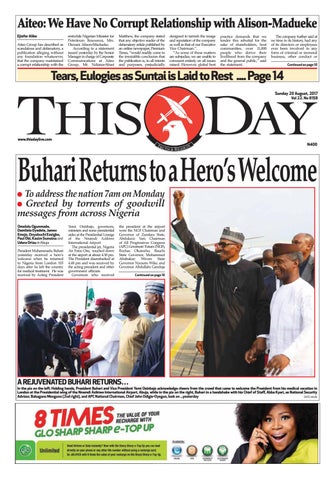
Buhari Returns to a Hero’s Welcome To address the nation 7am on Monday Greeted by torrents of goodwill messages from across Nigeria Omololu Ogunmade, Damilola Oyedele, James Emejo, Onyebuchi Ezeigbo, Paul Obi, Kasim Sumaina and Udora Orizu in Abuja President Muhammadu Buhari yesterday received a hero’s welcome when he returned to Nigeria from London 103 days after he left the country for medical treatment. He was received by Acting President
Yemi Osinbajo, governors, ministers and some presidential aides at the Presidential Lounge of the Nnamdi Azikiwe International Airport. The presidential jet, Nigeria Air Force One, touched down at the airport at about 4.30 pm. The President disembarked at 4.48 pm and was received by the acting president and other government officials. Governors who received
the president at the airport were the NGF Chairman and Governor of Zamfara State, Abdulaziz Yari; Chairman of All Progressives Congress (APC) Governors' Forum (NGF), Rochas Okorocha; Bauchi State Governor, Mohammed Abubakar; Wivers State Governor Nyesom Wike; and Governor Abdullahi Ganduje Continued on page 10
A REJUVENATED BUHARI RETURNS… In the pix on the left: Holding hands, President Buhari and Vice President Yemi Osinbajo acknowledge cheers from the crowd that came to welcome the President from his medical vacation in London at the Presidential wing of the Nnamdi Azikiwe International Airport, Abuja, while in the pix on the right, Buhari in a handshake with his Chief of Staff, Abba Kyari, as National Security STATE HOUSE Adviser, Babagana Monguno (2nd right), and APC National Chairman, Chief John Odigie-Oyegun, look on ...yesterday
2
T H I S D AY SUNDAY AUGUST 20, 2017
T H I S D AY SUNDAY AUGUST 20, 2017
3
4
T H I S D AY SUNDAY AUGUST 20, 2017
T H I S D AY SUNDAY AUGUST 20, 2017
5
6
T H I S D AY SUNDAY AUGUST 20, 2017
T H I S D AY SUNDAY AUGUST 20, 2017
7
8
T H I S D AY SUNDAY AUGUST 20, 2017
T H I S D AY SUNDAY AUGUST 20, 2017
9
10
ͺ˜ ͺͿ ˾ T H I S DAY, T H E S U N DAY N E W S PA P E R
PAGE TEN B U H A R I R E T U R N S TO A H E R O ’S W E LC O M E of Kano State. Others were Chief of Defence Staff, Gen. Gabriel Olonisakin; Chief of Army Staff, Lt. Gen. Tukur Buratai; Chief of Naval Staff, Rear Admiral Ibok Ekwe Ibas; and Chief of Air Staff, Air Marshall Abubakar Sadique. Also at the airport to receive him were the Chief of Staff, Malam Abba Kyari; Minister of Information, Lai Mohammed; his counterparts in the Federal Capital Territory (FCT), Mohammed Bello, and Women Affairs, Aisha Alhassan. Other include Special Adviser to the President on Media and Publicity, Mr. Femi Adesina; Special Adviser to the President on Political Matters, Senator Babafemi Ojudu; Senior Special Assistant to the President on Media and Publicity, Malam Garba Shehu; Personal Assistant to Buhari on Digital/Online Media, Lauretta Onochie; Senior Special Assistant on Diaspora Matters; Mrs. Abike Dabiri-Erewa, and Senior Special Assistant to the President (Office of Vice President) on Media and Publicity, Mr. Laolu Akande, among others. His wife, Aisha, who had gone to London to join him on August 6 for the third time, did not accompany him back, as sources said she would return to the country at a later date. A rejuvenated Buhari, who skipped the inspection of guards of honour, shortly after the national anthem was rendered, walked into the Presidential Lounge before heading for his waiting car. OBuhari, who will address the nation at 7am on Monday, waved to the crowd who had come to welcome him, as he headed to his residence in the Presidential Villa. At the Villa, he was joined by the acting president and the
governors including Kogi State Governor Yahaya Bello, who was not at the airport. Speaking with journalists at the residence of the president, Osinbajo said given the huge number of persons who crowded the road to welcome the president, it was quite clear that Nigerians were excited to have the president back in the country. "As you can see from the many Nigerians who lined up on the road to receive the President as he came back, many Nigerians are happy that the President is hale and hearty and that he has come back. "It was a natural reaction, most people heard of his arrival only a few hours before then, but as you can see, the response was so spontaneous. So, I think that people were so exited and very happy," he stated. In his own submission, Wike said he was happy like some other Nigerians that the president is alive, stating that it is unnecessary to play politics with the president's health. "We are happy that he is alive and that is why l am here today to rejoice with the family. We should not play politics with everything. We are here talking about health and irrespective of the party l belong to, you can see that I am here today to rejoice with the family. That is what it is supposed to be. Don't play politics with health issues. Don't do that. So, irrespective of what is going on out there, one is happy to be here," Wike stated. On his part, Bello said the recovery of the president was symbolic coming at the time the nation is also recovering from its economic crisis. "The message to Nigerians is that the recovery and
recuperation of the President is in some sense symbolic of the recovery of Nigeria. Nigeria is going to recover. We are on the path of strong economic recovery and this is an excellent sign that the country is on the right side. There is great hope. There is great excitement and we are going to make it as a nation," Bello said. In his own reaction to the president's return, Adesina said it was not prompted by the recent protests led by Charles Oputa and Dele Adeyanju calling for his return or resignation. The protest spread to t New York and United Kindgom last week. Adesina said he knew about his return some days earlier. "The return of the President has nothing to do with the protest. It is about continuing with the work he started. Some of us knew about his return some days back. Remember that the acting president held on effectively and they will continue the work together. We left the work of announcement with the managers of the acting President," Adesina said. GOODWILL MESSAGES Welcoming the President, Senate President Bukola Saraki, noted that the President will resume with greater vigour. He reiterated the commitment of the Senate to continue to work with the Executive to improve the living standards of Nigeria and ensure overall national development. Saraki, in a statement signed by his Special Adviser on Media and Publicity, Mr. Yusuph Olaniyonu, expressed appreciation to God, for the safe return and recovery of the President. “I thank Almighty Allah for bringing President Muhammadu Buhari back whole, hale and
AITEO: WE HAVE NO CORRUPT RELATIONSHIP WITH ALISON-MADUEKE activity with the former Petroleum minister, any NNPC or other government official or agent. Aiteo also said it never benefitted from the Strategic Alliance Agreements (SAAs) referenced in the article. “We were a major player in the Nigerian oil sector importing petroleum products for NNPC and exporting naphtha, fuel oil and condensates and already a flourishing and prosperous group by any standards long before Mrs Alison-Madueke’s appointment as Minister of Petroleum Resources. Aiteo’s core area of business has been the trading and distribution of sundry petroleum products since its inception in 1999. Furthermore, the NNPC has publicly confirmed that no Aiteo entity is indebted to NNPC or any of its subsidiaries,” Aiteo said. The company said, “The article purported that Aiteo has been linked to the alleged 2015 INEC bribery scheme but failed to state in which way it arrived at this conclusion simply because no such reality exists. It is only those seeking to deliberately besmirch the hardearned reputation of Aiteo as Nigeria’s foremost indigenous oil and gas company that will dubiously link the company, in the manner that the publication has done.” The company said it was with respect to the false
inferences concerning OML 29 that the true motive of the authors of the publication came to light. “The truth is that the sale of OML 29 to the Aiteo Consortium by Shell, was conducted under international best practices, with Aiteo emerging as the preferred bidder due to its superior technical and commercial competence. The rigor and transparency under which the bid was conducted by the owners of the purchased interest, Shell, Total and Agip, made it unnecessary and impossible for anyone to influence the outcomes inordinately. These allegations are therefore wrong and should not have been published,” Aiteo explained. “That Aiteo is able to announce a production increase of 400 per cent from about 23kbpod a year ago to averaging over 90kbpod, is a testament to the technical robustness of our work force and the prudence and professionalism of our management team,” Aiteo added. “Despite our open-door policy to media enquiries, the authors claimed to have attempted to contact us several times. However, it is a shame that none of those efforts extended to using the contact details on our corporate website. We have long seen this coming, as it
is apparent to Aiteo and any keen observer, that there is vested interest behind the unsavoury publications, and that there is an orchestrated campaign of calumny on an international level against an indigenous company that has gone global in outlook and outreach,” Aiteo explained. The company further stated: “We are now left with no choice but to consider legal action against organisations who have or will allow themselves to be irresponsibly and unlawfully used in this smear campaign. Aiteo Group’s contribution to the overall financial capacity of the country cannot be overemphasised. Our activities have contributed several millions of US Dollars to the country’s coffers and led to direct foreign investment worth more than US$4 billion, in addition to several other corporate social investments.” It said, “Despite laborious struggle to present Aiteo as a corporate entity with questionable credentials and poor track record in the industry, we make bold to say that our business is driven by a commitment to integrity, transparency and accountability, and that commitment is the cornerstone of our resilience and accomplishments, and which underpins Aiteo's resolve to provide Nigeria consistently with integrated energy solutions that power the future.”
hearty. I am thoroughly delighted that President Buhari has returned home after his medical vacation", the Senate President said, “I was privileged to have met him twice in London during the period of the vacation. After our first meeting, I told Nigerians there was no cause for alarm. After our recent lengthy meeting on Thursday this week, I informed Nigerians that Mr. President's return home was imminent,"Saraki said. "In all, we must thank Almighty God for sparing all our lives and granting Mr. President a most remarkable recovery. His return marks a new lease of life for this administration. I am confident that Mr. President will resume with even more vigour to pursue an economic agenda that will improve the welfare of all Nigerians." " On our part, the Senate is ready to work closely with the Executive and bend over backwards to support Mr. President. I congratulate all Nigerians on Mr. President's return. We thank the Acting President for his hard work in holding fort and steering the ship of governing the nation during this period." Speaker of the House of Representatives, Hon. Yakubu Dogara, expressed gratitude to Almighty God for granting the President healing and journey mercies back home. Dogara, noted that the president's recovery and safe return home attests to the healing power of God owing to the fervent prayers of Nigerians who prayed day and night for him. He said: "It is now time for us all to continue to pray for the President for the perfection of the healing and divine rejuvenation to enable Mr. President steer the affairs of the Nation in the right direction. "On our part, the House of Representatives, wish to assure Mr. President of our determination, support and commitment towards delivering on our promises to the Nigerian people as members of the same government. Mr. President can always count on our support in this regard. " The All Progressives Congress (APC) said the return of President Muhammadu Buhari would no doubt signal increased efforts to fulfill promises made to Nigerians. While welcoming Buhari back home after his medical vacation to the United Kingdom, APC assured that the administration was poised to fulfill all electoral promises . In a statement issued on Saturday by the National Publicity Secretary, Malam Bolaji Abdulahi, the party expressed thanks to the Vice President, Prof. Yemi Osinbajo, for "his competent leadership in the absence of President Buhari and especially commends him for his effort to unite the country and drive the recovery of the national economy. "The APC also thanked all Nigerians who had prayed ceaselessly for the speedy recovery and safe return of the President, and assured them that the APC-led Federal Government was poised to fulfill all the electoral promises the party made to Nigerians. On its part, the Peoples Democratic Party (PDP) said
that it joined other Nigerians to welcome back the President and expressed the hope that he had recovered enough to stir the ship of state. In a statement issued late Saturday evening by its National Publicity Secretary, Dayo Adeyeye, PDP said it believes that Buhari is healthier now to assume his responsibility at the helm of the country's affairs. "We thank the Almighty for saving his life and pray that He grants him better health and understanding on how to rescue our poor economy and relieve Nigerians from the current hardship," it said. APC national stalwart, Asiwaju Bola Ahmed Tinubu, also expressed joy at the president’s return. In a statement by his Media Office, Asiwaju Tinubu, said the President had always been a man of moral fortitude, discipline, strength and dedication, adding that these attributes helped him battle medical challenges. Tinubu said: “It has been a heartening thing to see that our nation has matured to the point where governance continued in a meaningful, seamless manner during the president's absence. This again was a sign of the harmony between President Buhari and Vice President Yemi Osinbajo. “On this day, it is even more heartening to think of the things that can now be achieved with President Buhari back to lead the nation. “Today is a glad and happy one for those who wish Nigeria well. While we celebrate the President's return, we also must quickly turn to the hard and heavy work at hand. “With President Buhari back and with the nation united behind him, we can accomplish excellent things. May we do our best to become our best. “These same attributes will lead him to success in surmounting our national challenges.” TIMELINE President Buhari left Nigeria on May 7 after receiving 82 Chibok girls who were freed by Boko Haram, after three years in captivity. He left the country to receive treatment in London for an undisclosed ailment. He was not sighted in public until July 23, when a delegation of the All Progressives Congress (APC) led by its National Chairman, Chief John Odigie-Oyegun, visited him. Also in the APC delegation were the Chairman of APC Governors' Forum and Imo State governor, Rochas Okorocha; Kogi State governor, Yahaya Bello, his counterparts in Kaduna and Nasarawa States, Nasir el-Rufai and Umaru Tanko al-Makura, and the Minister of Transportation, Rotimi Amaechi. The visit was compelled by an earlier allegation by the Governor of Ekiti State, Ayodele Fayose, that Buhari had been incapacitated and was on life support in a London hospital. The inability of anyone to sight Buhari in the public further fuelled the allegation and it took the visit to dismiss it. But the visit did not totally dismiss the allegation as some cynics including a former Minister of Aviation, Chief Femi Fani-Kayode, claimed that the visit was a mere fabrication of the ruling party. Fani-Kayode claimed that the photograph
of the visit as circulated online was taken in Nigeria and was only intended to mislead the public and douse tension. The insinuation propelled the necessity for another visit by members of the Nigerian Governors' Forum (NGF) supported by the Presidency on July 26. In order to disabuse the minds of every citizen that the earlier visit was untrue and that the president was indeed not incapacitated as claimed by Fayose and Fani-Kayode, two governors on the platform of the opposition PDP were part of the trip. They were Dave Umahi (Ebonyi) and Udom Emmanuel (Akwa Ibom). The delegation was led by the NGF Chairman and Governor of Zamfara State, Abdulaziz Yari. Also in the delegation were Umar Ganduje (Kano), Kashim Shettima (Borno), Samuel Ortom (Benue) and Abiola Ajimobi (Oyo). The visit of NGF delegation was followed by that of his media team and some other aides led by the Minister of Information and Culture, Lai Mohammed, on July 11. Also in the media team were Special Adviser to the President on Media and Publicity, Mr. Femi Adesina; Senior Special Assistant to the President on Media and Publicity, Malam Garba Shehu; Personal Assistant to Buhari on Digital/Online Media, Lauretta Onochie, and Mrs. Abike Dabiri-Erewa, Senior Special Assistant on Diaspora Matters. Again, on Thursday, August 17, seven days later, Buhari was visited by Senate President Bukola Saraki and Speaker of the House of Representatives, Yakubu Dogara. Finally, on August 18, Buhari was visited by the General Overseer of the Redeemed Christian Church of God (RCCG), Pastor Enoch Adeboye, 24 hours before his return to Nigeria. Prior to his return, protest marches were staged in Abuja by both pro and anti Buhari elements. On August 7, a group of protesters led by rights activist, Dele Adeyanju, and maverick entertainer, Charles Oputa, caused a stir in Abuja as they insisted on Buhari's return or resignation on moral grounds. The protesters anchored their agitation on the theme expressed in pidgin English, "Our Mumu Don Do," which being translated means "we have been foolish enough." On August 10, a solidarity march in support of the President by the Coalition for Good Governance and Change Initiative was held in Abuja. The “Our Mumu Don Do” protest almost turned violent when organisers attempted to stage another one at the popular Wuse Market in Abuja. They were chased away by stonethrowing youths. On August 17, protesters also converged on Nigeria House in New York, with "Our Mumu Don Do" placards calling on Buhari to either return home or resign. Also on August 18, protesters kept a vigil in front of Abuja House in London, where Buhari was residing, brandishing "Return Home or Resume" placards. r4FF NPSF SFQPSUT BOE QIPUPT PO QBHFT
T H I S D AY SUNDAY AUGUST 20, 2017
11
12
AUGUST 20, 2017 ˾ T H I S D AY, T H E S U N D AY N E W S PA P E R
SUNDAY COMMENT
Editor, Editorial Page PETER ISHAKA Email peter.ishaka@thisdaylive.com
THE CREDIBILITY OF LEGISLATIVE INVESTIGATIONS The National Assembly needs to streamline the procedure for the exercise of its investigative powers
T
he investigative power of the National Assembly embedded in its oversight function over the executive branch of government is again under scrutiny. Several citizens and groups are complaining that with some recent actions, the federal legislature might be overreaching itself. The latest complainant is the Lagos Chamber of Commerce and Industry, which has called for restraint from the National Assembly to avoid what is fast becoming an expensive distraction to the private sector, erosion of investor’s confidence and collateral damage to the economy. Citing the investigation by the joint committees of the Senate on Customs and Maritime Authority into an alleged N30 trillion revenue loss and missing 228 vessels, the chamber said the procedure adopted by the lawmakers was capable of adversely affecting the brand image of some of the private companies under enquiry. Publishing names of corporate organisations in the media over unsubstantiated allegations, according to the chamber, “has considerable reputational cost and collateral damage to such companies” aside the weighty consequences such also bear on the brand equity of the organisations. The chamber also decried the frequency of summons to Abuja of otherwise busy chief executives who are based in Lagos to appear sometimes for frivolous issues and with the insistence by the lawmakers that there can be no representation. The investigative power of the legislature is derived from Sections 88; 89; 128 and 129 of the 1999 Constitution (as amended) as part of the comprehensive efforts to institute a regime of checks and balances in governance with the primary objective being to assert transparency and accountability in the conduct of public affairs. We have no problem with this measure aimed at enthroning good governance in the country.
H
In exercising its investigative power, the National Assembly must take into account the necessity for highest level of probity and integrity in the conduct of its hearings in such a way that no one is left in any doubt about its intention for public good
Letters to the Editor
S U N DAY N E W S PA P E R EDITOR TOKUNBO ADEDOJA DEPUTY EDITORS VINCENT OBIA, OLAWALE OLALEYE MANAGING DIRECTOR ENIOLA BELLO DEPUTY MANAGING DIRECTOR KAYODE KOMOLAFE CHAIRMAN EDITORIAL BOARD OLUSEGUN ADENIYI EDITOR NATION’S CAPITAL IYOBOSA UWUGIAREN
T H I S DAY N E W S PA P E R S L I M I T E D EDITOR-IN-CHIEF/CHAIRMAN NDUKA OBAIGBENA GROUP EXECUTIVE DIRECTORS ENIOLA BELLO, KAYODE KOMOLAFE, ISRAEL IWEGBU, IJEOMA NWOGWUGWU GROUP FINANCE DIRECTOR OLUFEMI ABOROWA DIVISIONAL DIRECTORS PETER IWEGBU, FIDELIS ELEMA, ANTHONY OGEDENGBE DEPUTY DIVISIONAL DIRECTOR OJOGUN VICTOR DANBOYI SNR. ASSOCIATE DIRECTOR ERIC OJEH, PATRICK EIMIUHI ASSOCIATE DIRECTORS HENRY NWACHOKOR, SAHEED ADEYEMO CONTROLLERS ABIMBOLA TAIWO, UCHENNA DIBIAGWU, NDUKA MOSERI GROUP HEAD FEMI TOLUFASHE ART DIRECTOR OCHI OGBUAKU II DIRECTOR, PRINTING PRODUCTION CHUKS ONWUDINJO TO SEND EMAIL: first name.surname@thisdaylive.com
owever, since 1999, the exercise of that power has been controversial, particularly so because of the tension that it keeps generating between the executive and the legislative arms of government. Ministers and heads of agencies have in the executive have at different times complained about the near harassment embedded in the several investigative summon from both chambers of the federal legislature, including over issues that ought to be handled by law enforcement agencies or, in the worst case scenario, administrative departments of the executive. More exasperating is the steady trend of inconclusive investigations by the legislature even when a lot of energy, time and resources of both public and private citizens had been expended. This worrisome trend had given rise to the unfortunate and rife perception that the purpose of some of these investigations were far from being in public interest. A less charitable view was that they were no more than an instrument of shakedown and blackmail by the lawmakers. There is no doubt that the legislative power of investigation to expose corruption and foster good governance is a desirable provision of the constitution, which every citizen must support and seek its enforcement. Indeed, the exercise of the power by the seventh Senate to investigate the fuel subsidy regime of the President Goodluck Jonathan administration exposed the massive scam that the intervention policy had become and its outcome saved the nation billions of naira afterwards. But like a couple of other wellintended provisions of the constitution, the investigative power of the legislature is subject to abuse, and, as we have seen in several cases, would appear to have been abused as many of our lawmakers tend to turn it into a weapon of settling personal or political scores. It is therefore in order to avoid this abuse that we agree with the Lagos Chamber of Commerce and Industry that the power needs to be exercised with utmost discretion. In exercising its investigative power, the National Assembly must take into account the necessity for highest level of probity and integrity in the conduct of its hearings in such a way that no one is left in any doubt about its intention for public good.
TO OUR READERS Letters in response to specific publications in THISDAY should be brief (150-200 words) and straight to the point. Interested readers may send such letters along with their contact details to opinion@thisdaylive.com. We also welcome comments and opinions on topical local, national and international issues provided they are well-written and should also not be longer than (950- 1000 words). They should be sent to opinion@thisdaylive.com along with the email address and phone numbers of the writer.
UNIVERSAL HEALTH COVERAGE: A FLASHBACK TO KWARA MODEL
I
n the era of boom, quality healthcare for those in the informal sector was terrible. With the nationwide recession, it is much worse. The thought of how to overcome the difficulty and provide for the masses gave birth to the Kwara Health Insurance Scheme, initiated over a decade ago by Dr. Abubakar Bukola Saraki as governor of Kwara State in 2007. It is fitting that Saraki now President of the Nigerian Senate, will blaze the trail in the introduction of a Health Insurance Scheme to Nigeria. A medical doctor, whose father, Abubakar Olusola Saraki, was also a medical doctor, with a long history of having compassion for the masses, the younger Saraki inherited this trait. Therefore, concerned about the health challenges of Kwarans, especially those in the informal sector, and their lack of access to quality and affordable healthcare, Saraki’s
first programme shortly after he was sworn in as the Governor of Kwara State in 2003 was the introduction of the Kwara Health Insurance Scheme. The scheme has continued to benefit thousands of Kwarans. As Senate President, Saraki recently canvassed for the introduction of a similar scheme for those in the informal sector across the country. While receiving World Health Organisation (WHO) Regional Director for Africa, Dr. Matshidiso Rebecca Moeti, who was accompanied by the Hon. Minister of Health, Prof. Isaac Adewole, Minister of State for Health, Dr. Osagie Ehanire, and other top management staff of the Federal Ministry of Health, Saraki said that one of the strategies to achieve Universal Health coverage was to provide a health insurance scheme to the informal sector of the country. “The Universal Health Coverage is something that is dear to my heart.
I remember when I was Governor of Kwara State, I introduced informal health insurance scheme to those who are unemployed in rural areas as I have always believed that the formal sector can take care of itself”, he said. What Saraki, a modest man who rarely sings his own praise, did not tell his audience was that when he became the Governor of Kwara State, he inherited a healthcare system that was worst than hospitals being mere consultancy centres. Kwarans died in thousands because they could not afford the cost of medical care which made them resort to herbs and traditional healing, which in turn caused more damage instead. Working with local and international partners like the Dutch Government, The Health Insurance Fund, Hygeia Community Health, PharmAccess Foundation and others, Saraki started the pilot project in one of the 16 local government areas in
the state. Upon payment of N200, then in 2003, every individual was entitled to medical treatment for the rest of a financial year. Beneficiaries enjoyed free consultation, supply of drugs, medical investigation, blood transfusion, ultra sound scan and minor surgeries such as Caesarian Section, appendectomy, circumcision, evacuations and others. The insurance scheme also covers maternal and child care, chronic diseases, hypertension and diabetes, minor surgeries such as caesarean section, hernia, circumcision, appendectomy, evacuation surgeries as well as the treatment of lifestyle and some non-communicable diseases and other primary healthcare activities. The then state government also designed a scheme that worked through community leaders. There is a Board of Trustees for each community, usually headed by the traditional ruler. The board mobilised the community for participation and manage the scheme for optimum performance.
In Edu local government, where the pilot project took off, the scheme enjoyed tremendous patronage. The General Hospital in Tsonga that previously hardly attended to 10 patients in a day had over 5000 patients in the first month. Nearly everyone in the town, from the traditional ruler to the peasant farmer, registered for the scheme. Buoyed by the success of the pilot scheme, Saraki expanded to other local government areas in the state before he handed over to the current governor, Abdulfatah Ahmed, in 2011. The scheme had covered 10 out of the 16 local government areas with 400 communities. Within the same period, over 3,000 births and more than 600 caesarean sections were carried out. The scheme was limited to rural areas because Saraki was concerned about how to subsidise healthcare and make it affordable for those living on one dollar and below per day. ---Fatigun is a former Chairman of Ekiti LGA in Kwara State.
T H I S D AY SUNDAY AUGUST 20, 2017
13
14
T H I S D AY, T H E S U N D AY N E W S PA P E R ˾ UGUST 20,2017
SUNDAYNEWS
News Editor ÌÓ×ÌÙÖË ÕÙÝÓÖÏ E-mail: ËÌÓ×ÌÙÖ˲ËÕÙÝÓÖÏ̶ÞÒÓÝÎËãÖÓàÏ˛ÍÙט ͺͻͿ;ͻ ̙Ý×Ý ÙØÖã̚
ChidokaEmergesUPPCandidate,asOneDies inAnambra GuberPrimary David-Chyddy Eleke ÓØ áÕË
VISIT TO AMBODE L-R: Board member, Interior Designers Association of Nigeria (IDAN), Debola Omooba; Vice President, IDAN, Ifeyinwa Ighodalo; Executive Governor, Lagos State, Mr. Akinwunmi Ambode; Chairman Board of Trustees, IDAN, Ekuah Abudu; and Secretary General of IDAN, Tola Akerele, during a courtesy visit to the governor by IDAN in Lagos...recently
Tears, Eulogies as Suntai is Laid to Rest Wole Ayodele ÓØ ËÖÓØÑÙ
Tears and eulogies poured uncontrollably yesterday at the obsequies for the former governor of Taraba State, Danbaba Suntai. Thousands of people gathered at the Jolly Nyame Stadium in Jalingo, the state capital, and Suntai in Bali Local Government Area to witness the solemn event. There was a moving outpouring of testimonies to his compassionate deeds as countless numbers of people who were touched by the former governor’s kind gestures gave a teary account of his charity. Dignitaries from all walks of life including the Governors Solomon Lalong (Plateau), Ayo Fayose (Ekiti) and Ibrahim Dankwambo (Gombe) as well
as former governor of Benue State, Gabriel Suswam attended the funeral service held at the Jolly Nyame Stadium, Jalingo. Other dignitaries that were on hand to pay their last respect to Suntai who died on June 28 at his residence at Orlando, Florida in the United States of America, include the first Executive Governor of Taraba, Rev. Jolly Nyame, the pioneer military Governor of Taraba, CP Ambrose Afolahan, Deputy Senate Minority Leader, Senator Emmanuel Bwacha, Senator Isa Lau and representatives of the governors of Adamawa, Benue and Nasarawa States. Eulogising Suntai, Governor Darius Ishaku described him as an epitome of humility with a great sense of humour and
passion for the development of the state. He expressed gratitude on behalf of the entire people of the state to all Nigerians especially those who stood by the late governor during his trying moments and in death, saying their show of love was a great source of strength to the family and the people of the state. He particularly thanked former President Goodluck Jonathan and retired General T.Y. Danjuma for their great efforts towards ensuring that Suntai survived the plane crash he had on October 25, 2012 saying the family and the entire people of the state remain eternally grateful to them. He however urged Suntai’s family and all his loved ones to
be consoled by his legacies and good virtues stressing that his memory would remain indelible in the minds of the people of the state especially for what he believed and stood for. Speaking earlier, Governor Fayose urged the people of Taraba to imbibe Suntai’s virtues and continue to promote the good things he stood for while alive, particularly the development of Nigeria and Taraba. Also speaking, Governor Ibrahim Dankwambo said the late governor meant and did well for the people of the state and was committed to its progress which was evident in the numerous developmental strides he made. The officiating minister at the funeral service, The Most
Rev. Musa Philibus, who took his Bible reading from Philippians Chapter 1 verse 21 enjoined Nigerians to live a life of service to humanity, bearing in mind that all must die to give account of their stewardship. Philibus, who is the President of the Lutheran Church of Christ in Nigeria (LCCN) said there is glory and happiness in death when we live a life that pleases God. Suntai was finally laid to rest at 5.15 pm at his country home in Suntai after a brief ceremony which had in attendance Governor Ishaku, the state deputy governor, Haruna Manu, Senator Bwacha, Speaker of the State Assembly, Abel Peter Diah and the State PDP Chairman, Victor Bala Kona.
World Humanitarian Day: Civilians, Aid Workers, Must Not Be Targets of Attacks, UN, Saraki Insist Abimbola Akosile ÓØ ËÑÙݘ Damilola Oyedele ÓØ ÌßÔË ËØÎ Seriki Adinoyi ÓØ ÙÝ
The United Nations SecretaryGeneral, Mr. António Guterres, yesterday condemned attacks on civilians during crises globally, especially aid workers providing helps to victims of conflicts. Guterres’ stance was corroborated by the President of the Nigerian Senate, Bukola Saraki, who also joined other world leaders and international organisations to insist that civilians must never be targets in conflict situations around the world. In his message on the World Humanitarian Day, Guterres called for urgent protection, support and treatment for traumatic sexual violence and abuse of thousands of women and girls in Nigeria, Iraq, Syria, South Sudan, the Democratic Republic of Congo, and elsewhere. The World Humanitarian Day is observed annually on Aug. 19, to pay tribute to aid workers who risk their lives in humanitarian service, and rally support for people affected by crises worldwide. It was designated by the General Assembly to coincide with the date of the 2003 bombing of the UN headquarters in Baghdad, Iraq,
in which 22 staff were killed. The UN chief expressed regret that 65 million civilians were currently uprooted from their homes as a result of crises. According to him, armed conflicts are tearing communities and countries apart, forcing record numbers of people from their homes to rely on humanitarian aid for their survival and protection. He said “every year on World Humanitarian Day, we shine a spotlight on the millions of civilians around the world whose lives have been caught up in conflict. On this day, we also take a moment to honour the brave health and aid workers who are targeted or obstructed as they set out to help people in need. “We pay tribute to the government employees, members of civil society and representatives of international organisations and agencies who risk their lives to provide humanitarian aid and protection. In spite of our efforts, civilians, including medical and humanitarian workers, continue to bear the brunt of intense conflicts around the world. “Hospitals and supplies are attacked, looted and obstructed by fighting parties. In cities like Juba and Aleppo, housing, markets, schools and vital
civilian infrastructure have been destroyed.” Guterres stressed that crises had turned many countries into an incubator for lethal epidemics that have killed thousands of 9,000 people while health services and water and sanitation infrastructure were collapsing under the strain. “In Iraq, Syria, South Sudan, the Democratic Republic of the Congo, Nigeria and elsewhere, thousands of women and girls urgently need protection, support and treatment for traumatic sexual violence and abuse. The result of these crises is the record number of people – more than 65 million – forced to flee their homes. No one is winning these wars. We are all losing,” he said. This year, on World Humanitarian Day, he said the UN and partners were calling on all global leaders to do everything in their power to protect people caught up in conflict. “Let the world know, `civilians are not a target’. I invite you to stand with us in solidarity with civilians in conflict, and with the health and aid workers who risk their lives to help them. Get involved with our online campaign. “On World Humanitarian Day, let us commit to doing everything in our power to protect
women, girls, men and boys in the line of fire, and to give them hope of a better future,” the UN scribe urged. In commemoration of the World Humanitarian Day, Saraki, through the official Twitter page of the Office of the Senate President - @SPNigeria – also stated that the 8th Senate would continue to remain committed to supporting the nation’s Armed Forces in ensuring that families, aid workers, and other civilians that are caught in conflict situations are not affected by violence. “As the World commemorates World Humanitarian Day 2017, we must all take a second to reflect on the successes that we have recorded in routing out the rampant violent extremism that plagued our nation just a few years ago. “We must also never forget that hundreds of thousands of Nigerian families and millions of lives are still affected by the residual impact of terrorism and the Boko Haram menace. Many survivors are still in the process of recovering, while many families will never again be the same. “On this note, Nigeria and Nigerians must join the United Nations and the rest of the world in reaffirming that civilians like host communities and aid
workers must never be targets in conflicts. Innocent lives must never be victims. Vulnerable communities should never be attacked. “As we do this, we must all work towards ensuring that where we are going as a nation, will be better off than where we have been. This is why the 8th Senate will continue to remain committed to supporting the executive and our Armed Forces as they rout the last elements of the insurgency. “We will also continue to support the humanitarian recovery and reconstruction efforts, to ensure that Nigeria’s over two million Internally Displaced Persons (IDPs) are resettled and rehabilitated. As a nation, we have our work cut out for us. However, we shall overcome,” the President of the Senate, said. Meanwhile, as part of activities to mark the 2017 International Humanitarian Day, Manumar Foundation has partnered Silver Lining for the Needy Initiative (SLNI) to educate Plateau state women on safe delivery and exclusive breastfeeding to help reduce maternal and child mortality rate in Nigeria.
The United Progressive Party (UPP) has elected former Minister of Aviation Osita Chidoka as its candidate for the November 18 governorship election in Anambra State. Chidoka polled 1,222 votes to defeat his opponent, Hon. Chudi Offodile, who got 87 votes in the primary election, which held in Awka, yesterday. The chairman, Local Organising Committee of the primary election, Chief Chris Uche, who announced the result, said, “Based on the figure I have, Chief Osita Chidoka has been elected the candidate of the party for the governorship election of Anambra.” A total of 1,473 votes were cast, while 19 votes were announced as voided. Meanwhile, Offodile announced his withdrawal from the race at about 11am, while delegates were being accredited for the polls. He did not adduce any reason for his action, but THISDAY gathered that Offodile withdrew from the election over lack of confidence in the exercise. The two-term member of House of Representatives had days to the primary election complained of alleged falsification of the delegates list by officials of the party. One person was also feared dead in the violence that erupted at the venue of the accreditation of delegates yesterday.
Mysterious Deaths Not Caused by Lassa Fever, Says Kogi Govt Yekini Jimoh ÓØ ÙÕÙÔË
The Kogi State government yesterday revealed that those who died from a mysterious disease in the state were not victims of Lassa fever. The state government also said it would investigate and count the number of grave sites of those affected to determine the actual number of people who died as a result of the mysterious disease suspected to be gastroenteritis and malaria. Addressing newsmen in Lokoja yesterday, the Commissioner for Health, Dr. Saka Audu, dispelled the rumour of 62 people killed by alleged strange ailment in Yagba West Local Government Area of the state, saying it was the initial information given by the Fulani leader in the villages. He further disclosed that the epidemic started six weeks ago at Okunran, Okoloke and Isanlu-Esa all in Yagba West local government and appealed for calm from the people, saying the state is addressing the situation.
15
T H I S D AY, T H E S U N D AY N E W S PA P E R Ëž ÍşÍ¸Ëœ ͺ͸͚Ϳ
SUNDAYNEWS Don’t Resume Before ConďŹ rmation, Senate Warns PenCom, CBB, ICPC Nominees Abimbola Akosile in Lagos and Damilola Oyedele in Abuja The Senate has advised the nominees into the headship of three Federal Government institutions whose names were recently announced not to resume work until their nominations are confirmed in accordance with the provision of the constitution and the establishment laws of the affected institutions.
The nominees affected by the Senate directive are Alhaji Ali Usman who has been nominated to become the Director General of the Pension Commission (PenCom), Dr. Mohammed Isah nominated as chairman of the Code of Conduct Bureau (CBB) and Prof. Bolaji Owasanoye, the chairman nominee of the Independent Corrupt Practices Commission (ICPC). The stance of the Senate is a
counter-move to the directive by Acting President Yemi Osinbajo asking the nominees to assume duty in acting capacity pending their confirmation by the National Assembly chamber. The presidential directive was contained in a statement issued by Permanent Secretary and Director Press Office of the Secretary to the Government of the Federation, Bolaji Adebiyi, on Friday in Abuja.
Osinbajo, in the statement, had directed the newly appointed heads of the National Pension Commission (NPC), Code of Conduct Bureau (CCB), and the Independent Corrupt Practices and other Related Offences Commission (ICPC) to assume duty. The statement said the appointees were directed to assume duties in acting capacities pending their confirmation by the Senate
AMNESTY FORUM R-L: Secretary-General, Amnesty International, Mr. Salil Shetty; Director, Amnesty International Nigeria, Osai Ojigho; and Member, Board of Trustees, Amnesty International Nigeria, Auwal Musa Rafsanjani, at the AI International Council Meeting held in Rome, Italy...recently
Those People Alleging Marginalisation Have Hidden Agenda, Says Uba Abimbola Akosile and Yinka Olatunbosun The former President, Catholic Brothers United, Lagos, Mr. Vincent Uba, has asserted that those Nigerians who are alleging marginalisation have a hidden agenda. Uba said such Nigerians were merely using marginalisation as a disguise to agitate for secession. Uba called on Nigerians to shun hate speech as well as other unlawful conducts that can threaten national unity and peaceful coexistence of all citi-
zens irrespective of their religion or ethnicity. He made the call in a press release titled ‘In One Nigeria I Stand’ made available to THISDAY, in the wake of the recent clamour for secession as well as the widespread rumour that President Muhammadu Buhari has plans to Islamise Nigeria. While remarking that the outcry of marginalisation in certain quarters of the country was not new, Uba maintained that right from Nigeria’s independence, there have been cries of marginalisation from every section of the
country; hence the clamour for secession from Nigeria. “The clamour for Biafra has become so rampant. The social media, which is awash with this Biafran clamour, is now a medium to disseminate lies, insults and negative propaganda against Buhari government,� he wrote. He also observed that during the colonial era, colonial masters were accused of favouring a particular section of the country. In his view, those who fan the embers of marginalisation are the ones who have hidden
agenda. “They are hiding under the umbrella of marginalisation to clamour for secession from Nigeria,� he claimed. On the recent massacre at a Catholic Church in Anambra, he observed that the sad occurrence was reportedly a fallout of communal feud between rival individuals which was peddled in the social media to be caused by Jihadist Muslim groups. He advised the federal government to bear true allegiance to Nigeria and the constitution and avoid paying lip service to protecting the sovereignty of Nigeria.
Ighodalo: Sterling Bank Committed to Providing Best Working Environment Anayo Okolie Chairman of Sterling Bank Plc, Mr. Asue Ighodalo, has reiterated the bank’s commitment to providing its employees with the best possible working environment. He made the disclosure during an inspection of the bank’s new Head Office Annex located along the busy Ikorodu Road in Lagos. The new annex is equipped with a gym and game room which has game consoles and a
pool table to ensure employees have fun at work. The facility also has a clinic and is fitted with solar panels, which generate clean energy in line with the bank’s environmental sustainability agenda. Commending the bank’s management for desiring to give its employees one of the best working environments possible, Ighodalo said the new workplace would ensure optimal productivity, job satisfaction and talent retention. He noted that although some
of the bank’s competitors also have head office annexes, Sterling Bank decided to be different as part of a deliberate effort to become the number one bank of choice in the country. “We have done it differently, we have done it well and I am very proud of the team that did this job and I think they have done a great job.� Ighodalo explained that the inspection provided him with the opportunity to interact with employees of the Bank as well as some of the customers who were in the bank at the time of
the inspection. He said the Bank would strive to always to give its employees everything they need to feel appreciated, and motivated to work hard. Also speaking, Managing Director and Chief Executive of Sterling Bank, Mr. Yemi Adeola, said although the bank’s head office is on the Lagos Island like most of the competition, a decision was taken to build the annex in the mainland area of Lagos to maximise benefits available from business opportunities in the metropolis.
However, the Senate yesterday issued the warning in a statement by its spokesperson, Senator Aliyu Sabi Abdullahi. “The leadership of the Senate has been inundated by enquiries from individuals from across the country who want to know whether the statement from the office of the Secretary to the Government of the Federation to the effect that the nominees into the headship of PenCom, Code of Conduct Bureau and ICPC should resume work immediately pending their confirmation by the Senate was as a result of an understanding between the executive and the legislature. “We will like to advise the Acting President who was quoted to have given the directive for the resumption of the nominees that the directive was illegal and not right. The Senate will not support any action that is not in line with the law,� “We advise the nominees to hold on until they are cleared by the Senate as required by the law before resuming in their respective offices. We do not want anything that will cause any problem between the executive and the legislature�, Abdullahi stated. According to a Premium Times online publication, it is not clear if the Senate will consider
clearing the nominees as it had earlier vowed not to clear such nominees presented by the Executive until the controversy over Ibrahim Magu as head of anti-corruption agency, the Economic and Financial Crimes Commission (EFCC), is resolved. The lawmakers want Mr. Magu removed, having refused to confirm his appointment twice, but the presidency insists he would continue in office, the report noted. In his statement, Adebiyi said the directive for them to assume duties was to ensure that there was no vacuum in certain important federal institutions. The appointees, according to Premium Times online, are as follows: National Pension Commission, Ali Ahmed – acting Chairman, Funso Doherty – acting Director-General, Manasseh Denga – acting Executive Commissioner. Others are: Abubakar Magawata – acting Executive Commissioner, Ben Oviosun acting Executive Commissioner, Nyerere Anyim – acting Executive Commissioner At the Code of Conduct Bureau the nominees include Muhamma Isah as acting Chairman, Murtala Kankia – acting Member, and Emmanuel Attah – acting Member.
Dangote Cement Rewards Retailers in New Bonanza Cement retailers who participated in the ongoing second season of Dangote Cement Retailers Bonanza smiled home recently when the company surprised them with their prizes at various locations across the country. In Mararaba market, Illorin, Kwara state, a surprised Mrs. Ganiyat Abiola who emerged the star winner in the state couldn’t hide her delight when she saw the Dangote Cement team arrive at her shop to deliver her star prize of 1200 bags of cement with 40-foot container, worth over N4 million. Likewise in Edo state where six star winners emerged one after another each week respectively. Umeh Chukwu Donatus emerged winner from Auchi winning 600 bags and a 20-foot container, while the first prize went to Mr. Nosahire Omokaro, who won 1200 bags and 40-foot container. The other winners Cletus Amuno, Madam Dorothy Osas, Izoduwa Isaac and Osaretin Osayi won 600 bags each with 20-foot containers. Mr. Gbadegoye Anthony of the Goodness and Mercy Company was the star winner in Ibadan.
The carnival like event threw the markets into frenzy mood as other retailers and buyers joined in the dancing in celebration with the winners; thus halting buying and selling momentarily in the markets, as truck boys had a field day displaying their skills as some of them lifted bags of cement with their feet. The Dangote Cement Retailers Bonanza kicked off last year with the aim to reward loyal retailers and help them shore up their businesses. Whenever retailers buy up to 300 bags, they are given a coupon which they fill their contact details and drop in a designated collection box. Every week draws are held to select star winners. Explaining the rationale behind the bonanza, the Dangote Cement team leader to the markets, Mrs. Funmi Sanni, who is the West Regional Sales Director, said the decision to take the products to the retailers in their respective place of trade was to prove that the bonanza was not a fluke but real and that no sacrifice is too much for the company to bear for its retailers.
River Niger Navigation
Ă˜ĂŽĂ“Ă‘Ă?Ă˜Ă™Ă&#x;Ă?Ëœ Ă›Ă&#x;Ă‹Ă–Ă“Ă?Ă“Ă?ĂŽ Ă“Ă‘Ă?ĂœĂ“Ă‹Ă˜ Ă˜Ă‘Ă“Ă˜Ă?Ă?ĂœĂ? Ă‹ĂœĂ? Ă?Ă‹Ă–Ă–Ă“Ă˜Ă‘ Ă™Ă˜ ÞÒĂ? Ă?ĂŽĂ?ĂœĂ‹Ă– Ă“Ă˜Ă“Ă?ĂžĂœĂŁ Ă™Ă? Ă‹ĂžĂ?Ăœ Ă?Ă?Ă™Ă&#x;ĂœĂ?Ă?Ă? Ă˜Ă™Ăž ÞÙ Ă—Ă‹Ă•Ă? ÞÒĂ? Ă—Ă“Ă?ÞËÕĂ? Ă™Ă? Ă‹ĂĄĂ‹ĂœĂŽĂ“Ă˜Ă‘ ÞÒĂ? Ă?Ă˜Ă‘Ă“Ă˜Ă?Ă?ĂœĂ“Ă˜Ă‘ Ă?Ă™Ă˜Ă?Ă&#x;Ă–ĂžĂ‹Ă˜Ă?ĂŁ Ă?Ă?ĂœĂ Ă“Ă?Ă?Ă? Ă?Ă™Ă˜ĂžĂœĂ‹Ă?Ăž ÞÙ Ă‹ Ă?Ù̋Ă?Ă‹Ă–Ă–Ă?ĂŽ Ă&#x;Ă˜Ă‘Ă‹ĂœĂ“Ă‹Ă˜ Ă?âÚĂ?ĂœĂžË› Ă˜Ă‘Ă“Ă˜Ă?Ă?ĂœĂ? Ă˜Ă™ĂžĂ?ĂŽ ÞÒËÞ ÞÒĂ?ĂœĂ? Ă‹ĂœĂ? Ă?Ă˜Ă™Ă&#x;Ă‘Ă’ Ă›Ă&#x;Ă‹Ă–Ă“Ă?Ă“Ă?ĂŽ Ă“Ă‘Ă?ĂœĂ“Ă‹Ă˜ Ă?Ă˜Ă‘Ă“Ă˜Ă?Ă?ĂœĂ? ĂĄĂ’Ă™ Ă?Ă‹Ă˜ Ă’Ă‹Ă˜ĂŽĂ–Ă? ÞÒĂ? ĂšĂœĂ™Ă”Ă?Ă?Ăž Ă‹Ă? ĂšĂœĂ“Ă—Ă? Ă?Ă™Ă˜Ă?Ă&#x;Ă–ĂžĂ‹Ă˜ĂžĂ?Ë› Ă“Ă˜Ă“Ă?ĂžĂ?Ăœ Ă™Ă? Ă‹ĂžĂ?Ăœ Ă?Ă?Ă™Ă&#x;ĂœĂ?Ă?Ă?Ëœ ĂœË› Ă&#x;Ă–Ă?Ă“Ě‹ Ă—Ă‹Ă˜ ĂŽĂ‹Ă—Ă&#x;Ëœ Ă’Ă‹ĂŽ ĂšĂœĂ?Ă Ă“Ă™Ă&#x;Ă?Ă–ĂŁ ĂŽĂ“Ă?Ă?Ă–Ă™Ă?Ă?ĂŽ ÞÒËÞ ÞÒĂ? Ă—Ă“Ă˜Ă“Ă?ĂžĂœĂŁ Ă’Ă‹Ă? Ă?Ù××Ă?Ă˜Ă?Ă?ĂŽ Ă?Ă™Ă˜ĂžĂœĂ‹Ă?Ăž Ă˜Ă?Ă‘Ă™ĂžĂ“Ă‹ĂžĂ“Ă™Ă˜Ă? åÓÞÒ Ă&#x;Ă˜Ă‘Ă‹ĂœĂ“Ă‹Ă˜ Ă?âÚĂ?ĂœĂžĂ? ÞÙ ĂŽĂ™ ÞÒĂ? ĂĄĂ™ĂœĂ•Ë› ĂšĂ?Ă‹Ă•Ă“Ă˜Ă‘ Ă™Ă˜ ĂŒĂ?Ă’Ă‹Ă–Ă? Ă™Ă? ÞÒĂ? Ă?Ă˜Ă‘Ă“Ă˜Ă?Ă?ĂœĂ?Ëœ Ă˜Ă‘ĂœË› ÒÙÖË Ă–Ă‹Ă–Ă?Ă•Ă‹Ă˜ Ă?Ă‹Ă“ĂŽ ËŤĂ—Ă‹Ă˜ĂŁ Ă“Ă‘Ă?ĂœĂ“Ă‹Ă˜ Ă˜Ă‘Ă“Ă˜Ă?Ă?ĂœĂ? Ă“Ă˜ĂžĂ?ĂœĂ Ă“Ă?ĂĄĂ?ĂŽ Ă“Ă˜ ĂœĂ?Ă–Ă‹ĂžĂ“Ă™Ă˜ ÞÙ ÞÒĂ? ×ËÞÞĂ?ĂœËœ ÞÒĂ?ĂœĂ? Ă‹ĂœĂ? Ă?Ă‹Ăœ Ă—Ă‹Ă˜ĂŁ Ă›Ă&#x;Ă‹Ă–Ă“Ă?Ă“Ă?ĂŽ Ă˜Ă‘Ă“Ă˜Ă?Ă?ĂœĂ? ĂĄĂ’Ă™ Ă?Ă‹Ă˜ ĂŽĂ™ ĂŒĂ?ÞÞĂ?Ăœ ĂžĂ’Ă‹Ă˜ ÞÒĂ?Ă?Ă? Ă?Ù̋Ă?Ă‹Ă–Ă–Ă?ĂŽ Ă?âÚĂ?ĂœĂžĂ? Ă?ĂœĂ™Ă— Ă?Ă™ĂœĂ?Ă“Ă‘Ă˜ Ă?Ă™Ă&#x;Ă˜ĂžĂœĂ“Ă?Ă?˛ˏ Ă? Ă?Ă‹Ă“ĂŽ Ă‹Ă˜ Ă?Ă—Ă“Ă˜Ă?Ă˜Ăž Ă“Ă‘Ă?ĂœĂ“Ă‹Ă˜ Ă˜Ă‘Ă“Ă˜Ă?Ă?Ăœ åÓÞÒ Ùà Ă?Ăœ ͹͎ ĂŁĂ?Ă‹ĂœĂ? Ă™Ă? Ă›Ă&#x;Ă‹Ă–Ă“Ă?Ă“Ă?ĂŽ Ă?âÚĂ?ĂœĂ“Ă?Ă˜Ă?Ă? Ă“Ă˜ ĂœĂ“Ă Ă?Ăœ Ă?Ă’Ă‹Ă˜Ă˜Ă?Ă–Ă“Ă?Ă‹ĂžĂ“Ă™Ă˜ Ă‹Ă˜ĂŽ ĂžĂœĂ‹Ă“Ă˜Ă“Ă˜Ă‘Ëœ Ă–Ă‹Ă—Ă?Ă˜ĂžĂ?ĂŽ ÒÙå Ă“Ă‘Ă?ĂœĂ“Ă‹ ĂĄĂ‹Ă? ĂĄĂ‹Ă?ĂžĂ“Ă˜Ă‘ Ă?Ă?Ă‹ĂœĂ?Ă? ĂœĂ?Ă?Ă™Ă&#x;ĂœĂ?Ă?Ă? Ă™Ă˜ Ă?Ă™ĂœĂ?Ă“Ă‘Ă˜ Ă?âÚĂ?ĂœĂžĂ?Ë›
16
T H I S D AY SUNDAY AUGUST 20, 2017
T H I S D AY SUNDAY AUGUST 20, 2017
17
18
Ͱͮ˜ ͰͮͿ ˾ THISDAY, THE SUNDAY NEWSPAPER
OPINION Lagos, Public Security And The Igbonla Six Public security is the duty of all, writes Adesegun Ogundeji
T
he return of the “Igbonla Six” as the abducted students of the Model College, Igbonla had become known was a soothing relief. The news of their release after a harrowing 64 days in custody of hoodlums triggered spontaneous jubilation in Lagos State and, indeed, across the country. They were accompanied by Governor Rotimi Akeredolu of Ondo State who handed them over to Dr. Idiat Adebule, Deputy Governor of Lagos State, having been released by their abductors in Ondo State. The kidnap of the boys on Thursday, May 25, 2017, barely seven months after an earlier abduction of students and staff of the same school, was no doubt an anti-climax to the joy of the children of Lagos State who had been participating actively in the Lagos @ 50 celebrations. The Governor of Lagos State, Mr. Akinwunmi Ambode responded immediately, promising that the boys will be brought back unhurt and that the state government would stop at nothing to ensure that Lagos children got the best of deal from the government Lagos State in terms of qualitative education. Expectedly, the kidnap generated mixed reactions from parents, civil society organisations and the general public. The consensus was a cocktail of appeal to the conscience of the kidnappers and a call to the state and security agencies to rescue the students from their abductors. Some issues were raised then that I thought were better not discussed until the boys are back and everyone is happy such that emotions would have little role to play in the discussions and no one’s sensitivity would seem to have been toyed with. First, there was a school of thought that queried why the school was located in such remote area and suggested that it should be relocated. Such people, I guess did not know that the school has been in that community close to three decades, having been founded in 1988 by the Administration of Rear Admiral Okhai Mike Akhigbe. Since then, there was no security threat or breach in the area 29 years before the first kidnap in the school took place. The security situation today is that location of school does not deter hoodlums from penetrating evil. Kidnappers are known to have plied their trade on highways as well as highbrow areas of major cities across the country. Therefore, eternal vigilance and being a step ahead of the criminals is the name of the game. Others also said that the state government and the security agencies were being complacent, doing nothing to sooth the
nerves of the affected parents because the children involved were not offspring of powerfully connected persons. This obviously cannot be true of the administration of Governor Ambode that is predicated on inclusive and non-discriminatory approach to governance. The central philosophy of the Ambode administration is fair play and justice for all. This has been clearly demonstrated in its various accomplishments across the state. Today, we all know better as revelations later showed that not only was the Lagos Police Command and the state government were working, the presidency and governments of the littoral states of Ogun, Ondo and Delta formed a synergy to ensure the captives were rescued alive. It needs to, however, be stated that the viewpoint, which its proponents might have probably put forward to hasten the search and rescue efforts of the government, was neither good for the morale of security operatives nor the psyche of the parents and relations of the affected children. That, the abductors were said to have shifted base three times after the kidnap was an indication that they were not comfortable with the heat the security agents turned on them. Truth was that as the Commissioner of Police in Lagos State, Mr Fatai Owoseni said severally, the matter was a serious security challenge and information must be properly managed to ensure that we don’t play into the hands of the men of the underworld by disclosing the strategy of security forces. Now that the state government has made good his promise to reunite the students with their parents, peers and relations, it is important to appeal to the public especially parents of our various model colleges to repose confidence in the state government as well as the various security agencies to see to the safety of not only our students in school but all Lagos residents at large. As a proactive measure, the state government has beefed up security in
It is crucial that every segment of the society embraces collective security by supporting the state government and all security agencies so as to ensure effective public security
the affected school and all other vulnerable schools while more measures are still being put in place to forestall a recurrence. There is no gainsaying that our public schools under this administration has offered a lot and still doing so much to ensure that qualitative knowledge was imparted to the students and they have a lot more to benefit going back to their schools. Our improved performance in external examinations, various science competitions both at national and international levels, representing the country in international contests, including World Robotic Olympiad 2017 speaks volume. Prior to the intrusion into the citadel of knowledge located in a remote part of Epe, the children of Lagos State as represented by the school pupils and students had been showing the public that the future of the state and Nigeria is safe in their hands. The exhibition stands at the Science, Arts & Craft Exhibition and Talent Hunt organised by the Lagos State Government for the students to showcase their science inventions, their art and craft works and exhibit their innate talents in music, drama, etc., two days before the abduction was an indication that we were moving in the right direction. On the day of the abduction, the Lagos Schools’ Debate Season VIII was in top gear and the students were exhibiting knowledge of the topic of discussion, brilliance and confidence in public speaking when the shocking news of the second round of abduction in the college crept in. What a way to demoralise students who were looking forward to a brighter future! This is what we must all resist; evil must not be allowed to triumph over good. It is crucial that every segment of the society embraces collective security by supporting the state government and all security agencies so as to ensure effective public security. An effective public security cannot be obtained without the vigorous participation and support of every section of the society. This is because public security is the duty of all individuals, groups, communities, organisations and other component parts of a given society. It needs to be emphasised that criminals are not spirits, they dwell in the society. We must, therefore, carefully watch and report every odd movements and activities in our neigbourhood to the appropriate authorities. It is only when we develop collective fortitude towards public security that the huge investment of the state government in security could be effectively harnessed. --Ogundeji is Deputy Director, Public Affairs, Lagos State Ministry of Education, Alausa, Lagos
Kenya’s Elections: The Women Are Coming Okello Oculi writes that women are making significant inroad into Kenya’s politics
S
ophia Abdi Noor, an outgoing nominated member of parliament, was defiant before the start of election campaigns for Kenya’s 2017 elections, saying: “I leave the dedicated women seats to others and campaign against a handful of men. I will win because people here are tired of men who only think of themselves’’. She won by over 6000 votes as part of a surprisingly rich harvest of a total of 22 women getting elected to Kenya’s top legislature by trouncing male opponents. The constitution has borrowed from Uganda the stipulation that from each of the 47 counties in Kenya, at least one woman should be elected. This “dedicated seat’’ is contested by women bashing against other women’s political fists. This has ensured that 69 women have been elected. The most women-friendly constitutional provision is in Senegal where community leaders - drawn from among politicians, academics, women’s associations in rural and professional sectors, civil servants and elders – required that political parties must have women as 50 per cent of their list of candidates. Kenya’s constitution provides for a yet –to- be implemented 30 per cent. Women also sprung victories as Governors of three counties. In Kirinyaga County, Ann Mumbi Waiguru added pepper to her victory by defeating Martha Karuwa, a former Attorney General of the country and presidential candidate in the primaries against Mwai Kibaki. In Bomet County, Joyce Laboso grabbed the top job; while in Kitui County, the veteran politician and former presidential candidate, Charity Ngilu, went from seeking power at the centre to rule at a decentralised political space. Sophia Noor’s dictum that voters are tired of “men who only think of themselves’’ was almost certainly at play here; and will haunt these women in their incumbency. To the extent that they vindicate her claim, Kenya’s political culture will know valid change. Another trinity of women also broke open the gates of Kenya’s Senate chamber as elected members. In Uasin Gishu, Margaret Kamar won the Senate seat. In Nakuru County it was Susan Kihika who won the prize; while in Isiolo County
it was Fatuma Dullo who is now Senator. They no longer have to carry their headties at lower elevation as a pedigree that only got there by bye-passing the hazards of contesting elections. Women have also exhibited flair of political stubbornness. In Taita-Taveta County, for example, the post of “Woman Representative’’ was won by Lydia Mazighi who contested under the banner of the ruling Jubilee Party; while the Senate seat went to Johnnes Mwaruma of Orange Democratic Movement (ODM), and Granton Samboja took Governorship as WDM-K candidate. In Tana River County, Rehema Hassan won as “Woman Representative’’ under the Maendeleo Chap Chap Party, while the Senate seat went to Jubilee Party and her Governor-elect was an ODM hunter. In central Kenya, Kawira Mwangaza dared to run as an “Independent’’, while the Jubilee Party carried both Senate and Governorship slots in Meru County. Maison Leshoomo in Samburu County won as candidate of Kenya African National Union (KANU) – a dominant party formerly under the dictatorship of President Daniel arap Moi; and under whose banner Uhuru Kenyatta suffered defeat against Mwai Kibaki. A rare breed of winners was two journalists. Mohammed Ali won Governorship of Mombasa as ODM candidate. He waved a record of being a fearless investigative journalist. He had run a column known as JICHO PEVU in which he “exposed crimes and corruption in government and private sectors’’; and survived death threats. He was seen as less of a threat than Christopher Msando, the head of information, communication and technology for the Independent Electoral and Boundaries Commission whose corpse was found dumped in a forest 25 kilometres away from Nairobi. He had been tortured –presumably to extract computer codes for hacking its wits - and murdered one week before elections on August 8, 2017. Journalist Paul Katana won in Kaloneni Constituency in Kilifi County also along Kenya’s Indian Ocean coast. It is notable that none of the women who won non-dedicated seats came on the wings of Raila Odinga’s ODM. Prior to
the 2010 Constitution with no windows for dedicated seats for women, Gikuyu women tended to win seats in elections but not Luo women. They often defied horrendous violence, such as the woman candidate in the 2007 party primary in Meru District whose opponent had thugs shove human faeces down her throat and fractured her spine. She refused to be intimidated into withdrawing from contesting the election. It is not clear if women candidates suffered from a flaw which election monitors from the African Union and the European Union complained about, namely, that: “in the polling stations where we were, the presiding officer and the party agents rejected a number of those ballots and when they showed them to us, what we would find is that a voter has ticked a particular box and 90 per cent of the tick would be in the box while the rest had spilled over to another box’’. The monitors did not indicate if female presiding officers defended female candidates. Being an election official was not a vaccination against being endowed with virulent anti-women attitudes prevalent in communities they came from. There was a high casualty rate among incumbent governors. Some 22 out of 47 governors lost their seats. It was widely assumed that Jomo Kenyatta, the country’s hero of independence politics, used to maintain legitimacy for his regime by instructing his regional and local officials to ensure that selected incumbent members of parliament and cabinet ministers lost elections. The weeding exercise ensured that a breath of fresh air blew across the political space and cleansed growing complaints against corruption; ethnic privileges and unbalanced allocation of development schemes. It is more likely that this high turnover is part of gains to Kenya’s political culture from the constitutional reforms of 2010. The reforms took large funds from the centre to counties, thereby, drawing even former senators and permanent secretaries to contest for governorship. The electorate can only hope that high level corruption has not reached rural economies on the wings of decentralisation. –––Prof. Oculi is a member of the Editorial Board of THISDAY
19
T H I S D AY, T H E S U N D AY N E W S PA P E R ˾ AUGUST 20,2017
LETTERS The Nigeria Police as Bribe Takers
F
ew days ago, I read a foreign newspaper from Japan as I randomly do to keep abreast with developments from around the world since we now co-habit in a global hall. In reading this online version of one of the most prominent Japanese dailies, I came across a very intriguing topic which tells the story that half of the entire police operatives are not fully occupied. These police operatives are not lazy or functionally redundant but can’t find enough criminals to occupy their times. With the disappearance of criminals or rather rapid reduction in crime in Japan, it has become inevitable that the nation doesn’t need the number of law enforcement officers on their official roll. The news story further stated that it was looking increasingly possible that Japan may have to export her law enforcement officials to another country that needs such critical services given that the crime rate in Japan has radically dropped. In that same week, I read a story of a certain central European nation whereby the government has run out of options on what to do with the many unoccupied prison facilities simply because the crime rate in the European nation has fundamentally
Idris, IGP
dropped. Netherlands is also reported as witnessing massive reduction in crime rates. Conversely, the rate of crime in Nigeria is said to be on a steady rise and sadly, the number of detention facilities are grossly insufficient and substandard, given that these prisons were built many years back. The number of trained and professionally competent operatives is in steady decline. Another unfortunate statistical fact about the crime rate in Nigeria is the near absence of skilled, disciplined and professionally committed persons to engage in the arduous task of
policing Nigeria. The argument that with over 300,000 officially accredited police operatives are not near enough to police a population of over 160 million Nigerians is plausible but debatable because of the lacuna that exists in the recruitment process. One time President Olusegun Obasanjo once disclosed that armed robbers and prostitutes have paid their way into the Nigeria police force. The process of commercialising and politicising the entry points into the police has eroded the capacity of government to attract the best hands unlike in civilised climes where potential recruits
are critically analysed and their biodata scrutinised forensically to eliminate the chances of recruiting criminal elements. Even as we bemoan the dearth of professional police operatives to sufficiently enforce the laws in Nigeria, another worrying dimension is the widespread cases of bribery and corruption amongst the rank and file of the Nigeria police. Police operatives who are not occupying higher positions aren’t commensurately remunerated and yet work under a lot of stress. The facilities housing police training institutes and police barracks/ stations are substandard and derelict. The lack of facilities to house police operatives means that they are to make personal arrangements to secure houses for themselves and their families. The ordinary police are not compensated adequately should they suffer disabilities whilst working and the administration of police pensions is shrouded in massive corruption, meaning that police operatives who retire after working for 35 years most likely won’t be paid their rightful post-retirement benefits because these monies have been stolen by government officials and top police officers. The immediate consequence is that most police operatives who work under such conditions do resort to such self -help measures like demanding and receiving bribes before enforc-
LAGOS AND DESECRATION OF THE ENVIRONMENT
I
t was early in the morning, just a little before dawn. I needed to hurriedly ferry a brother to catch an early bus so he could meet up with an urgent appointment. My mind was appropriately fixed on getting him to the park on time so I could get on with my schedule for the day. So, I could have missed it. But I saw it! What did I see? The sight was quite nauseating. It was a mountain of rubbish dumped almost in the middle of the road. I am talking about a major road that is well lit and properly maintained. I instantaneously swerved to avoid crashing into the heap of rubbish. Then, I began to think. Who, in the right frame of mind, could have done this? My mind was pondering back and forth. It couldn’t have been an act of ignorance. My conviction was hinged on the enlightened status of the neigbourhood. But then, being enlightened might not necessarily denotes sensibility. It is sad that in this age, people could still indulge in such a despicable act. Sadly, a lot of people are yet to come to terms with the truth that the quality of our lives as human beings is substantially a reflection of the quality of the environment which we inhabit. Many still seem not to comprehend that the environment which we inhabit, like kola in Igbo culture, is life in itself. It is whatever we give to the environment that it gives back to us.
Most cities of the world experience environmental abuse because of ignorance, carelessness and ineptitude of the people. It is from this perspective that one really takes exception to various habits and activities of Lagos residents that could have grievous implications on the environment. How, for instance, does one explain such despicable attitudes as defecating or urinating in public places, indiscriminate refuse dumping, drainage blockage, construction on waterways, drainage alignments ,throwing of refuse into canals, turning garden and parks into arena for environmentally unfriendly activities among others ? No matter the strength of the justification, there is no rational explanation for anyone to indulge in such unhealthy and uncivilised habits. As a people, we need to really come to terms with the significance of an improved environmental habit. When we deliberately choose to act in a manner that could endanger the environment, we are the ones that would certainly bear the consequences of such actions. Hence, we need to realise that the need to ensure a clean environment should be everybody’s responsibility. Research has shown that people who reside in filthy places are more prone to contracting terrible diseases and as such easily vulnerable to avoidable deaths. It is, therefore, important for
residents of densely populated areas such as Okokomaiko, Ajangbadi, Ajegunle, Ijora Badia, Ojo, Mushin, some parts of Badagry and others to fully imbibe the culture of strict personal and environmental hygiene. In most of these places, it is common to see human feaces along the road or even see people engaged in open defecation. It is rather frightening that not a few of the houses in these locations are without toilets. So, residents make do with anything when the call of nature comes. This is an unhealthy practice which, if not properly checkmated, could open the door for chaos in the land. Nothing should be spared by concerned individuals and relevant authorities to reverse this dangerous trend. With current threat to global health, we need to become conscious of the danger of poor sanitary habits. If we are to achieve an improvement in health and sanitation, reduction in occurrence of epidemics, reduction in man-hour lost to sickness and disease, reduction in absenteeism amongst school children as a result of avoidable illness, improvement in aesthetics and beauty of the environment, we need to start treating the environment better. Funds spent on treatment of preventable infectious diseases could be conserved for other projects. With global upsurge in the occurrence of natural disasters, partly caused by abuse of the
environment, Lagos residents need to note that protecting the environment is, without doubt, the best way to protect themselves against diseases and other harmful environmental hazards. That we have not experienced monumental environmental tragedy should not be interpreted as being immune from such. Sadly, it seems only a few people appreciate the extent of this problem which could degenerate into an epidemic in the state. It is a fact that many deadly diseases currently ravaging the world are linked to open defecation and other such poor sanitary practice. It triggers death, contaminates food, transmits skin diseases, causes respiratory diseases, eye problems, scabies, intestinal parasites resulting in kidney damage, tuberculosis and diarrhea-related diseases. A study has claimed that unhygienic tendencies can cause all manner of dreaded diseases as well as lead to astonishing economic losses. A 2012 World Bank report reveals that Nigeria loses NGN 455 billion annually due to poor sanitary habit. This is 1.3 per cent of the national GDP. On a final note, Lagos residents need to note that protecting the environment remains the best way to protect themselves against diseases and other harmful environmental hazards. ––Tayo Ogunbiyi, Alausa, Lagos
ing the law. This distortion creates serious lack of integrity of the policing institution and loss of public confidence. Without public confidence the police can’t carry out successful policing because information of actionable quality is needed for the prevention of crime and for combating crimes when they occur. There is a consensus that corruption is the father of crime and if those who should maintain law and order are found wanting, it means that anarchy would be triggered in the society. That is the state of policing in Nigeria and this has just been confirmed by a report done by the United Nations office on crime and drugs in conjunction with the Nigeria Bureau of Statistics which found out the notorious fact that police operatives are the highest bribe seekers. Ironically, the North East and North West are ranked the highest in the occurrence of these bribery cases. The broad implication of
this report of high incidence of bribery in the police force is that the apparatus of law enforcement is tainted, meaning that Nigeria needs to reform and restructure the policing institution for proficiency and effectiveness. This is because government has the primary duty to provide security and ensure the enforcement of the rule of law. The damning and extensively damaging report on the Nigeria police force vis- a- vis the involvement of the personnel in demanding for bribes as captured by the United Nations is however not to say that the police in Nigeria are an organised crime gang. The report should serve as a tonic for Nigeria to practically reform and restructure the NPF. Even in the United States of America, the various departments of police are contending with one issue or the other. Emmanuel Onwubiko, Head, Human Rights Writers Association of Nigeria
CHARLY OPUTA AND T HE 100 DAYS MOVIE
F
inally the movie is out, 100 Days in London. What a movie, the definition of what we had become in just 100 days. A movie about so much noise daily made, with many things left unsaid. A movie we all had pretended to see as corruption fighting back, preferred to regard as the dying declaration of the opposition, but one that nonetheless found its way into the cinema of our minds. A comedy, a tragedy, but a movie nonetheless with a cast that can only be collected in a nation where truth is an abomination and hypocrisy has come of age. When the Chibok girls were abducted under an ungodly government, it took Mrs. Obi Ezekwesili and a few. They laboured for weeks, for months, until the year rolled over. Among the lot, she was called names, insulted, and mocked as being jobless and in search of a political appointment. That circle ended and Ezekwesili retired into silence. The President has been imprisoned by his own moral deficit and now it is Charles Oputa. Suddenly he is an outcast for trying to see with one eye in the land of the blind. He has been scorned, cursed and even attacked by exuberant ethnic zealots, for daring to ask a question that 170 million people should. Very soon, he would be emptied and retire with Ezekwesili into yesterday. The same group that took to the streets when former President Umaru Yar’Adua refused to abdicate power, the same is today looking the other way because this is their government. The prophecy is fulfilled – never mistake authority as the truth, but rather take the truth as authority. Shame everywhere and no one is covering up. A nation prudent in courage, extravagant in hypocrisy.
Suddenly, CHANGE is dead, 15 million votes gone down the drain, and it is all about praying abstract prayers for Buhari. Some $30 million spent on an ailment unknown to the people, a Presidential jet grounded like forever accumulating fees in a foreign land, and unending weekly pilgrimage going back and forth on ‘ran ka de de’ in London. All in an age when slavery has ended. Our season of pictures! Give them photos whenever they cry. The lowest form of knowledge in governance. A president on props, masqueraded in garments, packaged and presented in psychedelic slides. Rationality is thrown to the bins, intelligence aborted and a return to 1984. All hail the One Eye King! The Man of Integrity who cannot be wrong!! The best President Nigeria cannot replace!!! In other climes, the social media is known as a powerful tool bringing down governments, in our land it is where government children defecate under a round of applause. Every nation deserves whatever it gets, every people deserve whatever chariot they are driven in. If at every corner of our national life, hypocrisy is lavishly having a beer over chicken with ethnic bigotry, we should not blame strangers for our eventual destination. The countries that make valuable progress know what sacrifices they make; the countries that beg know what garbage they take. Charly Boy Oputa you have my respect as well as my pen which is my voice. I am persuaded you will not succeed in this endeavour of yours, but that you spoke is all that matters. All I want is to be satisfied by history. ---Olusola Adegbite, Faculty of Law, Obafemi Awolowo University, Ile-Ife.
20
THISDAY, THE SUNDAY NEWSPAPER ˾ Ͱͮ˜ Ͱͮͯ͵
INTERNATIONAL
National Security versus Diplomatic Immunity: The Case of UN Office in Maiduguri, Nigeria
M
aiduguri is the capital of Borno State in the North-eastern part of Nigeria. It is a region of Boko Haram terror and counter-terror battle by the NigerianArmy. Maiduguri is not only currently playing host to the 7th Division of NigeriaArmy, but also to its ‘Operation Lafiya Dole,’ put in place mainly to deal with boko haramism.And true, Maiduguri is nationally and internationally a major source of security problems. In late October 2013, the 7th Division of the NigerianArmy killed 74 Boko Haram terrorists after a raid of camps in Galangi and Lawanti villages on the outskirts of Maiduguri. Since then, it has always been a reign of Boko Haram terror to date.Apart from boko haramism, which gives Maiduguri its international attention, the Internally Displaced Persons (IDPs) in Borno State also explain the rationales for the internal special focus. For instance, Vanguard (August 12, 2017), in its Saturday news, made it known that 350 IDPs had refused to return to liberated communities.As wondered by Lt-Gen. Buratai, ‘the IDPs are still in camps, despite the liberation of over a dozen communities in Borno State. The most important thing for the military is to ensure that all displaced persons return to their towns and villages. But I wonder why the IDPs are still living in camps of Maiduguri metropolis.’ On Thursday, 10thAugust, the trending news was thatAbubakar Shekau, leader of the Boko Haram, was hiding in a compound called ‘Red Roof.’ It was even the United Nations (UN) Department that first reportedly released the information.According to the UN, ‘information about Shekau’s presence in the Red Roof was already being spread yesterday (Thursday, 10August, 2017) on the social media...At about 2.am early this morning, NigerianArmy troops in trucks are conducting (a) search on UN Red Roof Humanitarian Camp and forced their way into the property.’ Thus, the so-called Red Roof is the UN building. The rumour of Abubakar Shekau hiding under the Red Roof cannot but therefore need special attention and further interrogation. What does he want there? Is there any possible validity to the trending rumour? If indeed, Abubakar Shekau was hiding there, could it be that one major power was aiding and abetting Boko Haram in Nigeria but using the UN framework indiscreetly in such a way as to make boko haramism recidivist? Most importantly, which international law can limit the authority of Nigeria and prevent her from first ensuring her self-preservation and security? Which country of the world will accept to respect international law to its own detriment? Perhaps, more fundamentally, the obligation for Nigeria and the UN to fight terrorism necessarily requires a mutual understanding in the fight against terror, and therefore, there should not have been any need for the humanitarian coordinator to raise any eyebrow. The common challenge to address is the rumour on the presence of a dangerous jihadist terrorist in the UN Red Roof. WasAbubakar Shekau really there? If he was not there, how do we explain the origins of the rumour? On Friday, 11thAugust, 2017 media reports had it that the United Nations (UN) and the NigeriaArmy clashed over an alleged invasion of a UN building in Maiduguri, Borno State. There were two main operational words that invited much attention in the various reportages on the saga: clash and invasion. Was there really a clash? Was there an invasion of the diplomatic premises of the UN? What was the nature of the clash if there was one: clash of ideas or physical clash? What also is the nature of the alleged invasion by the Nigeria Army? These questions are necessary at this juncture as Nigeria’s international responsibility is directly being raised. Put differently, it has been suggested that Nigerian troops had violated diplomatic conventions and should be called to order. Most unfortunate! The intervention of the NigerianArmy, on the contrary, was prompt and far from being a violation. The intervention was patriotic and consistent with the international obligation to protect the diplomatic community, as well as prevent it from being assaulted and violated by the boko haramists, especially after its most unfortunate terrorist attack on UN Office inAbuja. Without doubt, there has been a misperception of the critical issues involved: rivalries between Nigeria’s quest for national security and the UN functionaries’ right to diplomatic immunity and nonviolation.At the level of national security, the Government of Nigeria is obligated by international conventions and the 1999 Constitution as amended to ensure protection and security of all peoples residing in
VIE INTERNATIONALE with
Bola A. Akinterinwa Telephone : 0807-688-2846
e-mail: bolyttag@yahoo.com
Buratai the country.Article 4 (0) of the ConstitutiveAct of theAfrican Union states that all Member States should have ‘respect for the sanctity of human life, condemnation and rejection of impunity and political assassination, acts of terrorism and subversive activities.’Article 4 (f) of the sameAct also requires Nigeria to ‘promote peace, security, and stability on the continent.’ The main challenge of these provisions is the silence of the two provisions on the modalities of how to promote peace and security, as well as ensure stability inAfrica. In the same vein, Nigeria’s constitution, in its Section 11 on public order and public security, provides that ‘the NationalAssembly may make laws for the Federation or any part thereof with respect to the maintenance and securing of public safety and public order, and providing, maintaining and securing of such supplies and services as may be designated by the NationalAssembly as essential services.’ More importantly, Section 14(b) provides that ‘the security and welfare of the people shall be the primary purpose of government.’ The implication of these two sections is that, apart from obligations arising from international agreements to which the government has voluntarily given its consent on behalf of the people of Nigeria, there is also the obligation arising from the country’s Constitution. And most importantly, as shown above, the raison d’être of political governance is national security. If the Government of Nigeria signs any international agreement, the ultimate objective, cannot but include security and welfare of the people of Nigeria. Another issue in this regard is that a national constitution can come into conflict with an international agreement, in which situation there has to be a priority choice-making. There is the Monist School of thought in international relations which takes international law as superior to municipal law, and therefore implements international agreements automatically without having to first ratify or domesticate the agreement. Nigeria does not belong to this school. Nigeria belongs to the Dualist School, which puts international law and municipal law at the same level of importance and status, and therefore, will need to first ratify an agreement, as well as domesticate
It has been suggested that Nigerian troops had violated diplomatic conventions and should be called to order. Most unfortunate!The intervention of the Nigerian Army, on the contrary, was prompt and far from being a violation.The intervention was patriotic and consistent with the international obligation to protect the diplomatic community, as well as prevent it from being assaulted and violated by the boko haramists, especially after its most unfortunate terrorist attack on UN Office in Abuja
it before such an international agreement can be enforced. As noted in Section 12 of Nigeria’s 1999 Constitution as amended, ‘no treaty between the Federation and any other country shall have the force of law except to the extent to which any such treaty has been enacted into law by the NationalAssembly. The relevant international diplomatic conventions have been ratified and domesticated. Consequently, there can be no disputing the fact that the Government of Nigeria has the onerous responsibility to ensure national security, not only as required by the 1999 Constitution but also as demanded by international law. As provided inArticle 22 (1) of the 1961 Vienna Convention on Diplomatic Relations, ‘the premises of the mission shall be inviolable. The agents of the receiving State may not enter them, except with the consent of the Head of the Mission.’ What is noteworthy about this provision is that, deductively, there can be situations warranting the agents of the host government to seek entry into a diplomatic mission. However, in such a situation, the prior permission of the Head of Mission would be required. This is the rationale for the use of the words, ‘may not enter...’ in theArticle. TheArticle did not say ‘shall not enter.’ Article 22(2) states further that ‘the receiving State is under a special duty to take all appropriate steps to protect the premises of the mission against any intrusion or damage and to prevent any disturbance of the peace of the mission or impairment of its dignity.’ In this regard, whileArticle 22(1) underscores inviolability of a diplomatic mission and subjects any intrusion to the consent of the Head of Mission, Article 22(2) compels a receiving State to take necessary or appropriate steps to protect diplomatic premises. The issue again here is to determine what constitutes an appropriate step. If the NigeriaArmy says it has intelligence report according to which the most wanted leader of the Boko Haram terrorist organisation is hiding in a diplomatic premise, does it make any sense to seek authorisation before entering the premises? There is no disputing the fact that, in classical and contemporary international relations, an embassy, because of its extra-territorial character, has always been used for various unacceptable political and criminal activities: issuance of identity cards and travel documents to opposition elements in the receiving State; safe-haven for political opponents, hiding arms and ammunitions, etc. Additionally, if the agents of the receiving State ‘may enter’ a diplomatic premise, but subject to the consent of the Head of Mission, what happens if there was really a terrorist in the premises and the Head of Mission does not give the required consent for possible intervention? And perhaps, most importantly,Article 22(3) says ‘the premises of the mission, their furnishings and other property thereon and the means of transport of the mission shall be immune from search, requisition, attachment or execution.’ The implication of this provision is multidimensional in scope. In this regard, it is not simply the chancery that constitutes an embassy. The residence, the means of transportation and communications are also part of a diplomatic mission, and are therefore inviolable. For instance, a law enforcement agent cannot attach or violate a diplomatic vehicle for whatever purpose. However, this provision remains, at best, meaningless if a property, a mission or means of transportation does not have a diplomatic identification. In other words, an embassy normally carries the name and national flag of the country at the main entrance of the mission. The vehicles of an embassy also have special matriculation numbers: CMD (Chef de Mission Diplomatique, meaning Head of Diplomatic Mission; Corps Diplomatique meaning Diplomatic Corps, Corps Consulaire (Consular Corps), etc. This point should be clearly noted, because the whole misunderstanding between the UN Office in Maiduguri and men of the NigerianArmy arises from the nonidentification of the office. At the level of Nigeria, the Operation Lafiya Dole of the Nigerian Army in Maiduguri is mainly designed to contain the terrorism imposed on the people of Nigeria by Boko Haram. The Nigerian Army has a special mandate to neutralise all threats of Boko Haram in Maiduguri and its environs.As explained by the spokesperson of the 7th Division, theArmy ‘has forced the Boko Haram terrorists to change tactics and resort to the employment of suicide bombers to target military locations and the population. This necessitated the need to intensify cordon and search in the Maiduguri metropolis and environment.’ It also became ‘expedient to take pre-emptive action by combing the general area through a cordon and search operation.’ What is also particularly useful to note here is that, of the more than 30 houses searched, there was the ‘property, which was said to be occupied by the UN staff members, although the property did not carry a UN designation.’ From the foregoing, many points are noteworthy: the Nigerian Army truly carried out a cordon and search at the UN premises, a compound belonging to the former Governor of Borno State, Mala Kachalla, but rented to the UN, and used as a hostel for the UN humanitarian aid personnel. Under normal circumstances, we should not have been talking about UN diplomats in this case. The word, ‘diplomat’ is generally used for accredited Foreign Service Officers working in a diplomatic mission. Those who are working, stricto sensu, in or for international organisations are referred to as ‘functionaries’ and not as diplomats. Only those people who are officially representing their countries in an international organisation can be called diplomats. (See concluding part on www.thisdaylive.com)
21
T H I S D AY, T H E S U N D AY N E W S PA P E R ˾ AUGUST 20, 2017
BUSINESS
Editor Vincent Obia Email vincent.obia@thisdaylive.com (08054681757)
LAST WEEK WEEK CRUDE TheNigerianNationalPetroleumCorporation reducedthecostofcrudeoilproductionto $23 per barrel, from $ 78 per barrel as of August 2015.The reduction, the corporationsaid,representeda70.5percentfall.A statement by NNPC’s spokesperson, Ndu Ughamadu, quoted the Group General Manager, National Petroleum Investment ManagementServices,DafeSejebor,asmakingtherevelationduringtheinaugurationof the anti-corruption committee of the unit. Sejebor added that the country had saved about $3 billion per annum from the cost reduction. “If you knock down your cost of productionfrom$78perbarrelto$23,take thedifferenceandmultiplybytheaverage dailyproduction,youwilldiscoverthatweare savingaminimumof$3bnintheupstream forbothProductionSharingContractsand Joint Ventures,” he said.
NAIRA The naira weakened against the United Statesdollarattheblackmarketasdemand for the dollar increased. Stakeholders and industryanalysts,however,saidthelocalunit wasexpectedtotradewithinarangeonthe investor and exporters’ forex window and officialinterbankmarket.Thelocalcurrency weakened to N370 against the dollar on the black market on Thursday, compared with364/dollarlastThursday,reportssaid.
AVIATION
A gas pipeline
IEA Cites Militancy, Lack of Reforms as Reasons for Nigeria’s Gas Shortages 50% reduction in gas-fired generation hurting economy Nigeria, Egypt, Algeria account for bulk of gas consumption in Africa Kunle Aderinokun Militant attacks on facilities, absence of political reforms and lack of investment have been identified as the major factors that led to structural gas shortages in Nigeria. A new report by the International Energy Agency (IEA), called,“Gas 2017: Analysis and Forecasts to 2022,” revealed this. The report stated that the drop in gas-fired power generation by 50 per cent from recent average levels had deprived millions of power and hurt the economy. Given the severity of its implications, gas shortages have caused Nigerians and businesses untold hardship. A newspaper reported that sometime in April the national grid lost about 2,239 megawatts (mw) of its supply after 45 turbines were shut down due to gas supply constraints and other technical issues. According to the report, statistics showed that 68 hydro, steam and gas power turbines were available and could have generated 6,376mw but only 45 functioned on the particular day, generating 3,639mw. The magnitude of suffering that businesses and residents experienced can only be imagined. Many projects have been rendered comatose as a result of chronic gas shortages. The IEA report, which was renamed Gas 2017, is a market report that provides a detailed analysis of supply and trade developments, infrastructure investments, and demand-growth forecast through 2022. It assesses the main changes that will likely transform the gas market, led by rising demand in countries that include China, India,
ENERGY and Pakistan, thanks to on-going economic growth and relatively low LNG prices. It also explores widening regional differences to traditional gas users, with flat demand forecast in Europe and structural demand decline in Japan. In the report, which is its latest, IEA stated that concerns relating to security of gas supply had also manifested in some other major producing countries. According to report,“The recent standoff between Qatar and some of the other Gulf States and Egypt has also underscored some potential risks to gas supply security from the Middle East: Qatar supplies around 30 per cent of the world’s LNG. “Longer-term risks to gas security could also arise from a shortage of investment in new gas supply infrastructure, although, the US looks well placed to respond once international markets show signs of tightening. Well-supplied markets in the short term are maintaining downward pressure on prices and discouraging new upstream investment in LNG.“ The report recalled,“In 2016 only two new final investment decisions (FIDs) were taken to expand existing or build new LNG facilities and, at the time of writing, only one FID has been taken so far in 2017.” It explained,“If major new investments in gas supply struggle to make headway, this would increase the risk of a hard landing for gas markets in the 2020s.”The report, however, believed, “brownfield expansions of existing facilities, notably in the United States, provide a safety valve since they could bring
new gas to markets relatively rapidly once the need arises.” Similarly, the IEA Gas report projected that gas will grow faster than oil and coal over the next five years, helped by low prices, ample supply, and its role in reducing air pollution and other emissions. “In our new five-year forecast to 2022, gas demand will grow at 1.6 per cent per year, a slight upward revision from last year’s forecast of 1.5 per cent,” IEA stated. It noted that resource-rich parts of the Middle East and Africa also saw strong demand for locally-produced gas. “The Middle East will experience “Longer-term risks to gas security could also arise from a shortage of investment in new gas supply infrastructure although the US looks well placed to respond once international markets show signs of tightening.
relatively strong growth in consumption of 2.4 per cent per year, to around 540 bcm, met in the main by increasing domestic production. Growth is relatively strong in the power sector, where there are opportunities to substitute gas for oil, as well as in the industry sector as the region’s economies grow and diversify.” Specifically, the report noted, “Consumption in Africa rises even more quickly, at 3.1 per cent per year, to reach more than 150 bcm. Egypt, Algeria and Nigeria are the main countries pushing consumption higher, even though lower hydro-
carbon revenues and economic growth hold back demand in some resource-rich parts of the continent. Elsewhere, annual gas demand growth in Latin America averages 1.3 per cent, while the consumption outlook remains flat in the Russian Federation, Eastern Europe and Central Asia.” Besides, the IEA report pointed out that the volume and diversity of LNG trade flows were increasing rapidly with the appearance of new exporting and importing countries. For instance, it projected: “Liquefaction capacity is expected to grow by 160 bcm over the period to 2022, led initially by Australia (30 bcm), but with the largest increase in growth then coming from the United States (90 bcm).“ The report explained,“This additional LNG capacity is being added to a market that is already well supplied, particularly as demand is declining in some of the large, traditional LNG importing countries such as Japan. “In these conditions, with relatively low LNG prices, exporters are having to work hard to open up new markets. A sign of this effort is the rapid growth in the number of countries importing LNG, which has already grown from 15 in 2005 to 39 today. This growth in LNG has been helped by the increased use of floating storage and regasification units, and it will absorb some of the surplus gas on the market as another eight countries are expected to add LNG import facilities by 2022. Nonetheless, the growth in LNG demand is not expected to be sufficient to rebalance the LNG market before the end of the forecast period.”
Thelowvalueofthenairaincreasedthecost of overseas aircraft maintenance to over N50billionannually,accordingtoNigerian airlineoperators.Thecostwouldhavebeen higher if many of the airlines did not shut downtheiroperationsinthelastfiveyears. Therearerelativelyfeweroperatingaircraft,t as the number of aircraft on maintenance has decreased by about 35 per cent.
TSA TheNigeriangovernmenthiredtheservices of some international audit firms, including Ernst & Young and PriceWaterhouse Coopers, to reconcile and recover public funds illegally withheld by banks. The Director(Funds),OfficeoftheAccountant GeneraloftheFederation,HamzaAdeyemi, disclosedthisinAbuja.Hesaidtheresortto hiringtheauditfirmsfollowedthecontinued refusal of the affected banks to return government funds in their possession, despite sanctions by the Central Bank of Nigeria, which included directly debiting the accounts of the banks. According to the director, the federal government had overN70billioninthepossessionofvarious commercial banks.
BOND The federal government offered for subscription by auction N135 billion bonds in itsAugust23auction,accordingtotheDebt Management Office.The offering circular obtainedfromtheDMO’swebsiteonTuesday indicatedthatitwouldsellN35billionbonds, which will mature in July 2021, at 14.50 per cent. It would also sell N50 billion at 16.28 per cent to mature in March 2027, while another N50 billion of paper would besoldat16.24percent,tomatureinApril 2037.Allthebondsonofferarereopening of previous issues, the circular said.
REFINERIES
Two private companies were selected to build two refineries in Port Harcourt and Warriundertheco-locationinitiativeofthe federalgovernment,theNationalPetroleum Corporationstated.Theco-locationinitiative, introducedbytheMinisterofStateforPetroleumResources,Dr.IbeKachikwu,seeksto ensurethatnewrefineriesaresetuptoshare infrastructure with the country’s existing refineriesinPortHarcourt,KadunaandWarri, aspartofmeasurestorampuplocalrefining capacity.ChiefOperatingOfficer,Refining andPetrochemical,NNPC,Mr.AniborKragha, saidattheAECNconferenceinLagosthatthe NNPChadidentifiedtwoprivatecompanies that would build the refineries under the co-location initiative.
22
T H I S D AY, T H E S U N D AY N E W S PA P E R ˾ AUGUST 20, 2017
BUSINESS/MONEY
CBN’s Steps Towards Single Exchange Rate Appropriate, Say Manufacturers, Analysts MAN: Apex bank’s objective’ll improve forex availability, shore up reserves, strengthen naira
Packets of dollar bills Kunle Aderinokun
D
etermined to crash the parallel exchange rate and achieve a single exchange rate, the Central Bank of Nigeria last Tuesday made some moves to further strengthen the value of the naira. The CBN, in a circular signed by its Director, Trade and Exchange Department, Mr. W.D. Gotring, directed oil marketing companies to make payments for port charges to the Nigerian Ports Authority (NPA) and Nigerian Maritime Administration and Safety Agency (NIMASA) using the official foreign exchange window. This is a further step forward to the one it took towards unifying its multiple exchange rates penultimate week, when it started allowing banks to use the Investors and Exporters’ (I &E) window when quoting the naira rather than the official rate. On Tuesday, the day the CBN gave the directive to oil marketers, the naira closed at N365/$ on the parallel market while it closed at N363/$ on the BDC segment and N362.38/$1 on I&E forex window. However, as at mid-day on Friday, the dollar exchanged for the naira at N370/$ at the parallel market and sold for N368/$ at the BDC end of the market. The official exchange rate remained the same at N305.65/$1 while Nigeria’s external reserves was put at $31.222 billion as at August 8. Economic analysts and manufacturers have considered the steps taken by the apex bank in this endeavour to be in the right direction. Pointing out that the journey towards a single exchange rate is tortuous, they acknowledged that it is achievable. That is why, it is a widely-held view by majority of the analysts that the CBN would do more good to the naira than harm by having a market-driven system and building confidence in the futures market. President, Manufacturers Association of Nigeria, Dr. Frank Jacobs, said the measures taken by CBN were “a good development that should have
enormous impact on the Nigerian economy and more importantly the foreign exchange market.” According to him, “The new policy guideline is commendable. This is because, I believe that the Forex involved will continue to revolve within the monetary system. In this case, the CBN will be availed more forex opportunity for rebuilding the external reserves which in turn will strengthen the value of Naira.” Frank explained: “The short term focus of the circular is to accommodate payment of port charges payable by oil marketers of imported petroleum products to the Nigerian Ports Authority (NPA) and Nigerian Maritime Administration and Safety Agency (NIMASA) in the CBN official forex window using the Form ‘M’. The medium term objective is to further improve on the availability of forex in the country and reduce the difficulty encountered by the Oil companies in paying the charges of NPA and NIMASA. The long term goal is to further shore up the forex reserve, improve on the value of the Naira and ultimately narrow the premium between the official and the parallel market rate.” “To fully appreciate the importance of this guideline, we probably need to take stock of what was obtainable prior to this CBN circular. Before now, oil companies pay port charges to NPA and NIMASA in Dollar, which they source principally from the BDCs and Parallel segments of the Forex market. The magnitude of these forex transactions usually put the markets under severe demand pressure which often depresses the value of Naira. However, since the CBN will facilitate the payment of the port charges in the official forex window, the huge forex demand of the oil Companies will be moved away from the BDCs and parallel markets. This will, no doubt, leave the markets more stable and the value of Naira better predictable,” he added. “From my understanding, the mechanism of the new directive is such that as Oil Companies open form ‘M’ with their banks with the Naira equivalent of the port charges, then the CBN would pay the Dollar value to the NPA/NIMASA. Interestingly, with the Treasury Single Account (TSA), NPA/ NIMASA would adherently return the same amount of payment received to the CBN. It is obvious that
the transmission process will be more of paper work with the Dollar value eventually ending up with the CBN,” he emphasised. However, Frank advised the CBN to support the swift realisation of the aim of the guideline. “The CBN should be expedient in reviewing and re-admitting the remaining 59 HS Codes (raw-materials) of industrial raw-materials that are locally unavailable excluded from participation in the official Forex market. The huge forex needed for importation of these excluded raw-materials are currently being sourced from the BDC and parallel markets, which, no doubt, may continue to off-set the impact of the new guideline on the stability of the markets.” In the same vein, the Director, Union Capital Ltd, Egie Akpata, believed it was a step in the right direction. He, however, added that the move was “not remotely enough to say we are near having a single exchange rate.” Providing his expert opinion on exchange rate convergence, the Executive Director, Corporate Finance, BGL Capital Ltd, Femi Ademola, noted that, the ideal approach to foreign exchange management was to have a single market. According to him, “The current situation in Nigeria where there are several exchange rates for different services is not optimal.” Ademola, however, added that, “As a developing economy, it should be understood that there is the need for evolution to the most appropriate model for the economy. Although market determined exchange rate is perfect, it appears to be the least problematic in all the exchange rate mechanisms.” “By allowing most services to access the official exchange rate market, there is the possibility of a convergence to a single market in the near future. While the BDCs could still operate as agents in the market, the influence of the parallel market would be reduced to insignificance in the new scheme,” Ademola posited, adding, “Finally, there will be the need for the official market to collapse with the I & E window so that we can truly have a single foreign exchange market.” Similarly, the CEO, The CFG Advisory Ltd, Adetilewa Adebajo, recalled that Nigeria had
come a long way from the J.P Morgan Bond Index exclusion meltdown and the self inflicted mismanagement of the Naira. He, nevertheless, added that, “Confidence has now been restored to the markets and the rates have seen major convergence from the 520 Naira to the dollar high.” Adebajo advised the CBN to “embrace a market driven system as the convergence remains stubborn despite the massive raw dollar intervention.” According to him, “The CBN should focus on a market driven system and build more confidence in the futures market. They should also focus less on raw dollar interventions and use the futures market to telegraph the market, create stability and in the process preserve the reserves.” For the CEO, Global Analytics Consulting, Tope Fasua, who stated that a single exchange rate regime was “an arduous task but it can be achieved,” “the ‘irrational exuberance’ of the market if I may use a Greenspanian term seem to have calmed down.” “A lot of the volatility that we saw was due to mere speculation and that is obvious. Our economy is not so deep as to demand billions of dollars every quarter and even if it was I support whatever could be done to de-dollarise the economy and focus us on patronage or local products. It should now be evident that the single-minded push by market players for Nigeria to fully float its currency was and is still premature and could have greatly depreciated the currency in a way that will precipitate the trio of currency, financial and economic crises. Those who advised as such were a tad too academic and not contextual in their approaches,” he added. However, pointing out that, “What the CBN has done at the end of the day is to create legitimate markets for an emotive segment - education and health and even travels,” Fasua said, “Ironically the same people who favoured a market-based approach seem to believe that segment should be locked out.” “If the CBN locks out that segment of demands a new catastrophe will set in. So for now the market has been tamed and at some point a single rate may be attempted with minimal adverse consequences. For now calm has returned since that segment of the market seems satisfied to pay a premium so long as availability is assured.”
23
T H I S D AY, T H E S U N D AY N E W S PA P E R ˾ AUGUST 20, 2017
BUSINESS/MONEY
Promoting Financial Inclusion and Inculcating Savings Culture Obinna Chima writes on efforts to improve financial inclusion by imbibing the habit of setting aside some portions of income for future utilisation
H
aving a store of ‘rainy day money’ can increase a low-income family’s resilience and enable it to cope with better and unexpected shocks, a report has stated. In addition, storing up assets could increase opportunities. For example, it provides the funds for families to support children when they go to university or to pay for training. The report by the Institute for Public Policy Research, titled: “Saving and Asset Building in Low Income Households,” showed that behavioural economists believe that saving can be increased through a combination of incentives. The most effective savings products for low income families combine making saving as easy as possible, while providing an incentive for savings to be retained. Clearly, one of the best ways to take charge of your finances in today’s uncertain economy is to develop a healthy savings culture. Although seemingly not a priority early in life, experts believe everyone (especially young people) should make it a priority to save and invest early. In fact, Dr. Barbara O’Neill, in “The Benefits of Saving Money,” cited a report that revealed that savings is linked to increased happiness. Actually, what the study found, according to O’Neill, was that people who are “planners” and do future-oriented things such as setting goals and taking steps (e.g., saving money) to achieve those goals feel happier, and better about their lives, than those who don’t make plans. On a related note, the Consumer Federation of America found a strong relationship between having spending and saving plans and maintaining emergency funds. Particularly for low-income individuals, those with a spending plan with goals were far more likely to have saved money for emergencies than were those without a plan. Economists and psychologists attribute findings like these to the sense of control that people have when they plan ahead and know what they need to do to get from where they are now to where they want to be, O’Neill stressed further. It is well established by research that people who feel a sense of control over life events are often happier, cope better, and are more resilient in times of stress than others. Conversely, people are especially unhappy in situations where they perceive themselves to have a lack of control. That is why encouraging people to develop and implement a personal saving plan is very essential for wealth creation. In Nigeria, the federal government as well as the Central Bank of Nigeria (CBN) have continued to stress the importance of financial literacy and developing savings culture. CBN Governor, Godwin Emefiele, recently pointed out that financial literacy remained a great importance to the bank. “We are concerned about the level of financial inclusion because individuals and households lacking adequate access to affordable and convenient formal financial services would be severely constrained in participating fully in the economy. “This will imply that the financial sector would be constrained in terms of expansion, as the disposable income in the hands of excluded persons could constitute greater savings and wider deposit base for banks. “To address our financial inclusion challenges, we have continued to implement various initiatives to ensure that as much of the eligible target population has the opportunity to access a variety of financial services,” he explained.
Customers transacting business inside a banking hall Emefiele said for consumers to fully utilise these services, it was important that they increase their financial literacy skills, complemented by consumer protection measures of the CBN. In line with this, the federal government recently approved the Financial Literacy Curriculum at basic and senior secondary schools level, which would commence at the beginning of the 2017/2018 academic year. Promoting Savings Culture It is no longer news that millions of Nigerians are still excluded from Nigeria’s formal financial system. Also, the size of the country’s informal sector is frighteningly and has not been adequately captured. The reasons are not far-fetched and varied. With Lagos as an example, the bus driver, motor-cycle or tricycle rider who has no form of interaction with any bank, just like the petty trader, truck pusher, or even the petrol attendance, whose only known form of banking has remained the thrift or Esusu collector, who shows up in his or her shop daily or weekly. This class of people is also comfortable with ‘Ajo’, the famous contributory scheme, whereby a number of people contribute a specified amount daily, weekly or monthly and take turns to collect the bulk sum at regular and agreed intervals. Such people have also over the years become comfortable with these arrangements, despite the well documented incidences of fraud and bad faith exhibited by some of the stakeholders in these schemes. Reward for Loyalty Therefore, in line with its resolve to encourage families to save, Access Bank Plc recently unveiled a savings scheme tagged ‘Family Savings Scheme.’ It was initiated to give its
customers a boost in their savings. The exercise was in line with the bank’s commitment to promoting savings culture among the populace. The ‘Family Savings Scheme’ is a savings scheme designed to encourage families to save together and enjoy exclusive privileges such as high interest rates and family rewards while they continue to enjoy the confidentiality of their banking relation and manage their accounts as unique individuals. The scheme provides access to people who are presently excluded from financial services whilst promoting capital accumulation and investment boom. Under the scheme, a minimum of four family members are encouraged to bank with Access Bank and enjoy exclusive value propositions. Eligible family members include partners, children, parents, aunts, uncles, cousins and grandparents. Recently, the bank rewarded 120 families that had signed up to the scheme in the monthly draw of the promo tagged: ‘Family Fortune Promo,’ that took place in Lagos. A breakdown of the items won by customers showed that while 50 families that signed up for the promo won DSTV decoders each; 30 other families were rewarded with N50,000 shopping vouchers respectively, while 20 others emerged winners of Samsung mobile phones. In the same vein, while 10 families won home theatre, five other loyal customers were rewarded with 42 inches LED television and another five were rewarded with sets of sofa respectively. According to the bank’s Executive Director, Personal Banking, Victor Etuokwu, the scheme comes under new segment in the Bank - Family Banking Segment. “This is not a new product but a new segment in the bank. We have basically pulled together the various products we offer to unique family members under this segment,” he added.
Etuokwu listed some of the value propositions of the savings scheme to include education advisory services, deals and discounts, higher interest rates, insurance, school fees advance and home loans. He implored the existing and prospective customers to take advantage of the ‘Family Savings Scheme’ to save and more importantly for economic development. Therefore, as part of efforts to reward its customers, The Group Head, Inclusive Banking, Access Bank Plc, Ope Wemi-Jones, expressed appreciation to the customers for their loyalty and trust in the bank, adding that the promo was initiated to add value to customers, who continued to do business with the Bank. “Some people have asked us: why are you encouraging people to save when there is recession and all that? The simple answer is that savings has never been a respecter of what you earn. It is a habit you need to imbibe, whether you are rich or poor. “So, what it means is that if you learn to save when you don’t have so much money, when a lot of money comes, you will still continue with that habit. So, what Access Bank is doing is to encourage our customers and Nigerians to imbibe a savings culture. A savings culture that is not limited with what you have, but based on the habit you have imbibed over time,” she added. Also, Wemi-Jones said the scheme was designed to reward the collective savings habit of families with grand prizes and competitive interest rates while they enjoy the confidentiality of their banking transactions as individuals “The nationwide savings promo, first of its kind in the industry with over 100,000 gifts to be given away, targets the family units with weekly, monthly and the mega random selections,” she added.
24
T H I S D AY, T H E S U N D AY N E W S PA P E R ˾ AUGUST 20, 2017
BUSINESS/ENERGY
683km AKK Gas Pipeline Raises Hope for Industries, Power Generation Target Chineme Okafor examines the economic implications of the 683-kilometre AjaokutaAbuja-Kaduna-Kano gas pipeline, which the Nigerian National Petroleum Corporation plans to build with funding to the tune of $250 million from Chinese banks
A view of Geregu gas power plant o fully deliver the infrastructure master-plan for transportation of gas to all parts of Nigeria, the Nigerian National Petroleum Corporation initiated the northern and eastern pipeline network, with that of the northern axis comprising the Ajaokuta-Abuja-Kaduna-Kano pipeline. Popularly referred to as the AKK gas line, the project, which includes a 187-kilometre pipeline from Ajaokuta to Abuja, 193 kilometres pipeline from Abuja to Kaduna, 65 kilometres from Kaduna to Zaria, and 238 kilometres from Zaria to Kano, would reportedly cost the corporation about $2.7 billion to complete.
T
Chinese Interest The AKK gas line project got a $250 million lifeline from Chinese banks, which were reported to be interested in it. Group Managing Director of NNPC, Dr. Maikanti Baru, disclosed recently that the Chinese interest in the gas line project was conveyed to the corporation in London when he went to sign two key oil investment deals with Chevron and Shell worth $1.78 billion. Baru stated that the project, which is expected to be executed as a contractor finance scheme, had achieved a lot of milestone in its contracting process. He added that the Chinese banks had made commitments to bring in as much money as might be needed to finance many oil and gas investments in Nigeria.
JV to PPP According to Baru, the NNPC opted to use Public Private Partnership financing framework to execute the gas line project following its recent gradual exit from Joint Venture Cash Call regime, which is expected to free up a lot of money to enable it commit to the project under the latest framework. “We have gone far with the development of the project using the same paradigm shift of Public Private Partnership financing. We have also gone far with the contracting process, part
of which is to ensure that money meant for the project is raised from the private investors,” he said. The NNPC GMD explained that the feat recorded in the project would bring a new dimension to gas projects execution in the country, as well as signal a regime of private investors’ funding for such projects. “On that occasion, I did challenge the Chinese banks that since they have now come on board, they should move from the back seat to the driver’s seat and they gave me their commitment that they have plans to bring in as much money as we need to execute our projects,” he stated. “And if the Chinese tell you that they are going to do it, definitely, they will do it and we will give them a run for their money.”
Potential Benefits NNPC stated that the AKK gas line, which is expected to serve existing customers along its route, will provide gas to cement firms, compressed natural gas users, power generation plants, and other industrial concerns within the northern axis of the country. In a prequalification notice for the project, the corporation also stated that construction of the line would be implemented commercially in segments. It said the project will operate as an integrated network where revenues from any part of its segments will be consolidated in one pot, from which liabilities will be serviced. It noted that the network was intended to operate commercially, with revenues coming in the form of commercially determined gas transmission tariff embedded in the Gas Transmission Agreements that will underpin the pipeline flows. The GTAs, it explained in the notice, will indicate the appropriate revenue securitisation scheme applicable to different categories of customers, while the final structure could be based on the selection of interested parties that are willing to invest equity. It be developed and operated by a special purpose vehicle comprising the NNPC and the selected parties, or selected investors providing debt and
engineering procurement and construction only, and then the pipeline operated by the NNPC, the corporation said. In terms of benefits, Baru, explained that the corporation would leverage the project to grow gas supplies from the east to the north. This would include delivery of gas to energise the 215 megawatts Kudende power plant in Kaduna, as well as gas for a proposed fertiliser company, which the governor of Kaduna State, Mallam Nasir el-Rufai, said would be sited in the state.
Power Generation Target Baru stated that the ultimate objective of the gas line project was to support the federal government’s aspiration to increase Nigeria’s electricity generation to 10,000 megawatts, with improved gas generation and distribution nationwide to plants for power production. He noted that the recent debt settlement for arrears of JV cash call obligations by the corporation would have great impact on the gas industry because the initiative was capable of freeing some dedicated funds that could be used to develop the sector. Baru said, “We have the aspiration of
The AKK gas line, which is expected to serve existing customers along its route, will provide gas to cement firms, compressed natural gas users, power generation plants, and other industrial concerns within the northern axis of the country
government to raise power generation to at least 10 gigawatts capacity, not just 10GW in terms of installed capacity, but one that will be steady in the grid by 2020. All these will drive our activities to ensure that the gas business is expanded and government’s aspiration to earn as much revenue from gas as oil will definitely be realised.”
Reservation Notwithstanding the optimistic disposition to the economic impact of the gas line, industry experts have expressed reservations about its economic benefits to Nigeria. They told THISDAY that the project came across as more of a political project than an economic one. In his appraisal of the project’s economics, as well as the planned $250 million Chinese lifeline, an economic analyst, Mr. Dan Kunle, said the competitive cost advantage of undertaking the project was quite low on account of the factors that were heavily against it. Referring to the reported failures of the Kaduna refinery to break even for a very long time partly because of lack of crude supplies through its often broken pipelines from the southern part of Nigeria, Kunle explained that the gas project did not look reasonable enough to attract investors’ financing. He said if it ever had such competitive edge, current market fundamentals were quite against it. He equally expressed doubt as to whether the Chinese banks, which Baru said were willing to put their money in the project, would do that without some sort of sovereign guarantee from the federal government. Kunle said, “This project has been on since 1970, when the gas line was planned to transport gas up north to be used by the National Fertiliser Company of Nigeria (NAFCON), which is now Notore, to produce fertiliser in the second phase. NAFCON was supposed to have a plant in Gwagwalada and Kaduna, and the line was supposed to provide gas to these plants.” He further explained, “The spirit with which the crude oil pipeline was taken to Kaduna was a good political one.
25
T H I S D AY, T H E S U N D AY N E W S PA P E R ˾ AUGUST 20, 2017
BUSINESS/MARITIME
A ship in Nigerian waters
Concerns Mount Over New Cabotage Policy Following the hue and cry over the poor implementation of the Coastal and Inland Shipping Act 2003 in the last 14 years, many believe the federal government needs to muster the political will to implement the law so that the country can begin to reap its intended benefits. But few think that the new cabotage policy being pursued by the government is the way out. John Iwori writes
C
abotage came into being in Nigeria with the enactment of the Coastal and Inland Shipping Act 2003. The provisions of the Act made it clear that only indigenous ship owners have the mandate to carry out coastal trade and inland shipping.
Provisions
The Act set out the limitations on foreign operations of cabotage shipping and the tight conditions under which exceptions can be allowed. These provisions are set out in sections 3 to 6 of the Act, which prohibit coastal carriage of cargoes and passengers, except by wholly Nigerian-owned, manned, built, and registered vessels. It also restricts towage by tugs or vessels to those wholly owned by Nigerian citizens, just as it limits carriage of petroleum products and related oil and gas shipping services to vessels of Nigerian ownership. Furthermore, the Act prohibits domestic trading in the inland waters of Nigeria, except by vessels wholly owned by Nigerians.
Huge Funds, No Disbursement In order to drive the implementation of the Act,
Stakeholders in the maritime industry have kicked against the fresh moves by NIMASA to enact a new policy on cabotage. According to them, the new NIMASA cabotage policy is too insignificant to make the desired impact
the federal government initiated the Cabotage Vessel Finance Fund (CVFF). The Nigerian Maritime Administration and Safety Agency (NIMASA) is saddled with the responsibility of managing the fund. It is in line with its mandate that the agency selected four commercial banks as primary lending institutions (PLIs). These include Sky Bank Plc, Sterling Bank Plc, Diamond Bank Plc, and Fidelity Bank Plc. To ensure the effective disbursement of the fund, the federal government, in 2010 at Dicpharima House, the Corporate Headquarters of the Federal Ministry of Transport, Abuja, signed an agreement with the four PLIs. Since then, nothing tangible and concrete has taken place on the disbursement of the fund. Successive Directors-general of NIMASA, right from Dr. Shamsudeen Ade Dosumu to the incumbent, Dr. Dakuku Peterside, had repeatedly promised to disburse the funds. They were mere promises; as the funds, which were over N40 billion as at December 2016, have not been disburse. Many stakeholders have wondered why the federal government is yet to commence the actual disbursement of the funds more than 10 years since it promised to do so. The long delay in the disbursement of the funds seems to lend credence to insinuations in some quarters that some persons in the corridors of power may have diverted it or are keeping it for use in the prosecution of their political ambitions ahead of the 2019 general elections. There have also been insinuations regarding the high interests that would have accrued from the huge CVFF in the commercial banks. This is because, most often, top government officials are eager to go public on how much CVFF has accrued so far without a word on the interest it has accumulated overtime in the banks. Already, many banks are struggling to have the CVFF in their vaults because of the mouthwatering interests involved. Many stakeholders want the CVFF to be disbursed without further delay this year, as the absence of adequate funding is hampering the successful implementation of the provisions of the Cabotage Act. They believe the successful implementation of
the scheme will help to address the challenges of funding in the Nigerian shipping sector, particularly the issue of modern fleet acquisition. Will the federal government disburse CVFF this year or will it have another reason to move the disbursement date forward as it has done several times in the past? This is the question at the forefront of the minds of many stakeholders. New Cabotage Policy: Heading the Wrong Direction The poor implementation of the provisions of the Cabotage Act is the reason why not a few stakeholders in the maritime industry have kicked against the fresh moves by NIMASA to enact a new policy on cabotage. Indeed, many have taken Peterside’s fresh moves with a pitch of salt. According to them, the new NIMASA cabotage policy is too insignificant to make the desired impact. Maritime lawyer and principal partner, Akabogu and Associates, Mr. Emeka Akabogu, said the new cabotage compliance strategy recently unveiled by NIMASA will not fly. He argued that its effectiveness was dependent on NIMASA, just as the agency was to blame for the failure to effectively implement the cabotage law. To him, NIMASA over the years has lacked the will to implement the law. According to Akabogu,“What the agency has come up with simply is that they will no longer grant waivers relating to certain categories of officers. Now for those categories of officers, yes, it makes sense that there is no point having foreigners for second officers, but I really do not see any significant impact that would have, given that ordinarily most of the time, those categories of officers are indigenous. For the companies which are coming into the country temporarily and working for a very short period of time, how that will apply, we need to see. “I think that the more significant area of focus should be granting of waivers to ships itself. If NIMASA is serious, the new compliance strategy should not have been limited to a number of officers; it should have covered none granting of waivers to certain types of ships, particularly, tanker vessels involved in operations along the coast. If they had insisted and said they would no longer grant any waivers for now to such
tanker vessels, that would have had an impact. But as far as it keeps granting waivers to tanker vessels, all these other ones, their impact will just be minimal and more of noise as opposed to real impact. The real impact is by limiting the granting of waivers to tanker ships. If they are serious, that is what they should do.”
Way Out Akabogu stated that the absence of enforcement of the provision of the Act remained the bane of cabotage in the country. He said,“The challenge is simple. It is simply enforcement. What is enforcement? Enforcement is, for example, a ship coming into Nigeria waterways and operating within cabotage defined area. It is not a Nigerian ship, it is granted a waiver to operate, yet, it does not fall under the category of ships which should be granted waivers. It is granted a waiver simply because from an enforcement point of view, the enforcers have been compromised. “So as far as that is happening, you will find that cabotage will not work. And who enforces it? It is NIMASA. NIMASA has the enforcement officers and the executive powers on which to grant waivers. “The reason why cabotage has not worked is because NIMASA has been unwilling to enforce the letters of the law simply because it is either compromised or lacking the political will to enforce the law. We do not need any new law or additional money to enforce cabotage. All you need is to ensure that people obey the letter of the law. The enforcement officers whom it has across the zones should obey the letter of the law. When enforcement officers originally come with the strong intention and desire to obey and enforce the law, things would work. But when they start getting signs from the management that such enforcement may be varied or waived in some cases, they too will begin to get themselves compromised and begin to look for ways to cut corners. “So the blame for cabotage failure up till now can only be put at the doorstep of NIMASA. Incompetence and vested interest are two major reasons why NIMASA has not been enforcing cabotage.”
26
T H I S D AY, T H E S U N D AY N E W S PA P E R ˾ AUGUST 13, 2017
INTERVIEW
Utomi
Utomi: Nigeria Urgently Needs to Court Investors to Avoid Anarchy in Post-oil Era Second headline: We Should Empower Subnational Governments to Drive Development, As Centralisation Strategy Has Failed, Pat Utomi is a professor of political economy and a management expert. He is a professor at the Lagos Business School, a Fellow of the Institute of Management Consultants of Nigeria, and a former presidential candidate on the platform of the African Democratic Congress. The founder of Centre for Value in Leadership, Utomi is a dedicated professional with a passion for the dignity of the human person and the spirit of enterprise. He bemoans Nigeria’s persistent near-total dependence on crude oil, despite widespread forecasts of an irreversible global decline in the consumption and value of the product. Utomi says for Nigeria to survive in the approaching post-oil era, there is an urgent need to court investors and encourage investment. He speaks with Vincent Obia. Excerpts:
O
n the problem with investment in Nigeria.
The biggest problem with investment in Nigeria is the oil mentality. Since the beginning of the oil economy, we have developed a political culture, which my friend, Richard A. Joseph, described in his book (Democracy and Prebendal Politics in Nigeria) as prebendal politics – just sharing the cake. We have created a class of both civil servants and politicians who believe that government is doing everybody a favour on everything, that there are some kinds of lords that you must come to. Whereas, investment is something that is desirable and good for the community because it provides jobs. That is the first goal of a politician – to try and achieve a full employment economy. That is his primary goal. But the nature of our oil politics has not
made the political mind-set to reason that way. So, because of that mind-set, being the typical mind-set of a politician elsewhere in the world, everything is done to court the investor – both foreign and local – to make him feel welcome. But if you look at how Nigerian civil servants and politicians behave towards investors, the attitude is that of a tollgate, bully or somebody saying, “We know you private sector people are thieves, what are you trying to cheat us out of?” A kind of protector, Praetorian Guard.
On the dangers of the rather unfriendly attitude towards investment? That mind-set needs to change dramatically, especially as we have come to the end of the oil age, which is the frightening thing about the current Nigerian condition – Nigerian politicians don’t actually know that we have reached the
end of the oil age. Their mind-set is still the prebendal mind-set of sharing this cake that is there. I want to assure everybody that 12 years from now there would be no cake to share. The oil age is over. So we need to go back to the mind-set of the 1940s, 1950s, and early 1960s, when our politicians courted investors. Let me give a very interesting background to this. The beginning of industrialisation in Nigeria came with self-government. The colonial government did not industrialise Nigeria, they didn’t even try it, because the purpose of colonialism was to export raw materials from here to the metropole. Perhaps, the only factories that came out of the proper colonial era were motor industries, just designed to put boards on imported chassis, molue and buses, then Nigerian Breweries, to mix water with imported stuffs. These are probably the only two factories I can think of
in the real colonial era.
On self-government and industrialisation. But with self-government, Nigerian politicians coming into office in the 1950s were anxious to expand the economy and they began to think of industry. The first industrial estate in Nigeria was then set up by the government of the Western Region, what is today the Ikeja industrial estate. Of course, in the competition between the regions, the government of the Eastern Region responded with two, Aba and Port Harcourt, and the government of the Northern Region responded with the Kakuri industrial estate in Kaduna. Bonpai in Kano emerged out of Kano’s traditional trading role as a city. That was how industrialisation began really in Nigeria. One of the things that come from the points I have just made is that development was bottom-up
27
T H I S D AY, T H E S U N D AY N E W S PA P E R ˾ AUGUST 13, 2017
INTERVIEW
Utomi: Nigeria Urgently Needs to Court Investors to Avoid Anarchy in Post-oil Era
Cont’d from Pg. 26
from subnational governments. They were the ones driving the most for industrialisation. The prebendal politics that followed the centralisation of military rule and the availability of oil revenues – what I have often called the dangerous alchemy of soldiers and oil – created a culture where, one, the business of attracting investments became more of a centre thing, rather than subnational government based. And, secondly, it was visited with arrogance, the arrogance of, “look, this is a large economy with all the endowments, government will occupy the commanding heights of the economy and can make the investments,” which is why we have so many parastatals that were set up to manufacture, etc. We are all witnesses to the fact that this strategy has not quite worked. To go to a new strategy, we need to do some serious thinking. We need to begin to take investors – foreign and local – very, very seriously.
On the nightmarish nature of local investment. But what is the experience of local investors? Dealing with state governments is a nightmare. In most states of the federation, there is serious abuse of property rights. This governor approves something for you, there is election, the next governor comes, he cancels it. This creates a level of uncertainty that prevents serious investors from coming in. I’m sure you saw the Price Water House report that Nigeria is one of the least attractive countries in terms of foreign investment, compared to small African countries like Benin, Ghana, etc. It is not by accident. It is because the attitude of state governments to investors is horrible. On whether the attempts to take the ease of doing business initiative down to the states can drastically change the wrong mind-set towards investment at that tier of government, especially, under the current quasi-federal structure, where is no much pressure on the states to engage in productive investment. The money from Abuja to share is about to expire. There will be no money to share from Abuja in a short period of time. That is why I am actually worried. I’m doing an opinion article on the topic, “Is Nigeria the next Haiti?” Why am I writing this piece? Because I’m frightened for Nigeria and think somebody should wake us up. In 1789 Haiti had the highest per capita income in the world. Today, Haiti is the poorest country in the Western Hemisphere. What happened that changed the fortunes of Haiti so frighteningly? By the time Haiti had the highest per capita income in the world, a man called James Watt redesigned the steam engine, and that led to the industrial revolution. With the industrial revolution, Haiti’s plantation economy reduced in value. And as the world was changing, Haiti was not changing. At first, its leaders did not realise that the world was changing until they became completely irrelevant in this new world. My fear is that somehow, Nigeria may go the way of Haiti. That is why I am anxious to wake the country up. We went from the plantation economy to industrial revolution, to the information age, the information communications technology revolution. If Nigeria, which has been sustained by the benefits of the oil age, continues to think in terms of oil, when the world moves on from crude oil, this place could descend into anarchy. From where will the jobs come for the big bulge in population?
On what the intelligent oil producing countries have done. We have failed to achieve what the most intelligent of the oil producing countries did, which is save their oil income and use this saving to support new investment, diversify the base of their economy. We have failed to do it, and oil is over. Norway was clever enough, Kuwait was clever, not to talk of what the Dubais of this world have done, diversify themselves away from thinking oil. We have not done that. So we need to put on our thinking caps very quickly and see what we can do. Otherwise, we could be the next Haiti. On the feasibility of the needed change, given the seeming perpetuation of injurious and contradictory economic policies. One is the petroleum minister’s laments about the high cost of oil production and hints that Nigeria could stop production if the rising cost continues, amid huge investments of national resources into oil prospecting in the Lake Chad Basin. I’m not about to determine how people will think. How people think is significantly a function of the quality of public debate in a country. But that is what we do very poorly, because we prefer
Utomi to abuse each other rather than discuss the issues. The famous contemporary German philosopher, Jurgen Habermas, who talks about the public sphere, would be thoroughly embarrassed by the Nigerian environment in terms of public conversation, which is the soul of democracy. We don’t have think-tanks in this country. If I arrive Washington now and get into a taxi, most likely the driver would tune to the national public radio, most likely somebody from the Brooklyn institutions, Heritage or any of those foundations would be talking about issues in the politics of America. But we don’t have that in our country; we don’t have rigorous public conversation. When you try to raise issues people look at you and feel, “wetin, na only you?” because they lack the understanding that it is that conversation that helps countries shape the mind-set of the people, which then determines the kind of policy actions that we take. The Minister of State for Petroleum Resources was right in lamenting. Our production costs are high. The way the trajectory of the oil age is going, 10 years from now, oil may be selling for something as paltry as $5 per barrel. If our cost of production is that high, there would be no point in mining the oil because you can’t justify the cost. Ease of doing business issues are very critical.
On restructuring. About 11 years ago, at a workshop, I talked about restructuring, not even in the sense we are talking about it now, but going all the way to the local governments. I said local governments should not just be seen as political entities. They should be seen as local development areas, where each local government area outlines what its gifts are, what God has given them capacity to produce and how they can increase the output of those things, increase the processing of those things within that same local government area, orient the local education curriculum to be focused on how you extract and increase value in those goods. Then, a cluster of local government areas can be called Z zone of development, for instance, and you build economic structures within that zone that can be the basis for industrial policy. The states then become coordinating units of these zones of development. That becomes the basis for engaging in national economic affairs. But I don’t think anybody paid attention to those ideas. Many of the states don’t even understand what ease of doing business is because there is hardly any business that is done at the states; they are just waiting to collect from Abuja and
share, pay salaries, buy fleet of cars.
On whether the presidential ease of doing business council set up by the federal government is really getting to the root of the problem. I applaud their effort. I think it is a very important work that they are doing. They have brought in some very good people into that arena. The Minister of Industry, Trade and Investment, Okechukwu Enelamah, has decent hands around him. We just pray for them all. The governors from the South-south got together some years ago and created the South-south economic development group, which resulted in the BRACED Commission, which I chaired. One of the things I suggested back then was that working on this kind of broad platform, you do a factor endowment based competitive analysis to improve the ease of doing business in that region and how endowments from the region can become the basis for global competition around certain value chains. I actually invited to the first South-South Economic Summit at TINAPA in Calabar the managing director of the Monitor Company, a competitiveness consulting firm created by a group of Harvard professors. They were recently acquired by one of the large consulting firms. For years, the Monitor Company was a global leader in competitiveness analysis. I invited them to come and give a talk there, in the hope that we could begin to think in terms of an analysis of our competitiveness. Once we can show the world that we are competitive in some dimensions, local and foreign investors will just come, because part of the problem is uncertainty. When you reduce uncertainty through the structure you have built, the institution you have put in place, investors will naturally gravitate to your territory. The Monitor Company worked with Saudi Arabia and they jumped from a hundred and something to about forty something in the global competitiveness ranking. It is possible to make a huge difference if you have committed passionate leaders.
On why the Monitor Company did not make in Nigeria the kind of impact they made in Saudi Arabia. They were not signed on. I just invited them to give a talk at that conference. On whether Nigerians have been deceived by APC, which campaigned and was elected on the platform of restructuring, devolution of power, true federalism and other radical ideas that many believed would transform the country, but which the administration has since jettisoned.
I think that is probably not the way to put it. In think that unfortunate events of history did not allow things to settle down as they should quickly enough. One can only hope that some reforms would take place. A very critical part of it is that the leader of the team has unfortunately not been fit. Of course, this has created the usual human things that emerge when there is a kind of vacuum or contestation for power. Whenever there is this situation, decision-making is slowed down. It is not a matter of deceit; I think it is matter circumstance.
On the on-going constitution amendment process and areas he thinks require urgent review. It is a pity that the National Assembly did not open itself up to serious public hearing and engagement before some of the decisions they made on the constitution review process. One of the biggest challenges that we have is the challenge of ensuring that decisions are made at the level closest to the problem. This is called the principle of subsidiarity. An arrangement where you centralise everything will always have negative consequences. It is clear from what happened to the Nigerian economy in the 50s and 60s that the country has endowments that are different in every part. I assure you that with the right kind of leadership, somebody in Sokoto can actually earn more revenue than somebody in Port Harcourt because hydrocarbons are not the only value chain from which you can make a lot of money. In fact, the oil producing countries are not the leading economies in the world. It shows that there is much more to economic growth than ability to share from oil wealth. You take something like agriculture, and ask yourself, how come Nestle makes more money than, perhaps, all the major cocoa producing countries put together. These are the kind of questions that we need to ask. How do we change things in that regard with the nature of our constitutional arrangement or structures? On the longstanding Central Bank of Nigeria’s monetary strategy of mopping up funds from the system through government bonds and treasury bills, which has been criticised in some quarters. I think that the CBN obviously has a target that it is going for in terms of monetary aggregate. I don’t have the kind of information they have, to say this is right or wrong in terms of operational decisions. But the major problem, for me, was that we depended too much on just monetary policy and did not support it with strong enough fiscal policy.
28
T H I S D AY, T H E S U N D AY N E W S PA P E R ˾ AUGUST 13, 2017
INTERVIEW Popoola: We’re Changing the Face of Consumer Lending in Nigeria Tunde Popoola is the managing director of CRC FICO Score, a partnership between CRC Credit Bureau Limited and Fair Isaac Corporation (FICO Score), an American company with over 50 years’ experience in data and analytics. In this interview with Funke Olaode, Popoola says the partnership is dedicated to improving consumer lending in Nigeria. Excerpts:
Y
our company recently introduced a new product to the market, FICO. What is it all about?
The Fair Isaac Corporation (FICO) pioneered analytic solutions, such as credit scoring, that have made credit more widely available. Founded in 1956 in the United States, FICO has over 50 years history of data and analytics experience. CRC Credit Bureau is launching FICO Score, which is our latest product to give opportunity and information to lenders in Nigeria. The FICO Score is meant to help banks and other retailers to be able to appropriately dimension the risk on borrowers who are basically individuals. FICO Score will know the risk level of every borrower and be able to dimension whether it is good, excellent, average or bad. And with that, you can now have dimension of relationship you want to have with such an individual. FICO Score is introduced by FICO Corporation of United States and happens to be the number one score solution provider in the world. The company operates in about 90 countries in the world and releases over 100 billion scores every year. Once this is introduced, we believe it will change the face of consumer lending in Nigeria. It will give opportunity for financial inclusion and also give opportunity to private individuals who don’t have opportunity to borrow and lenders to give loans to people who are credit worthy based on the information they will get from FICO.
But Fico Score is alien to the Nigerian credit bureau? Yes. But it is a number one score in the world. The credit score is a three-digit number that is generated from information in a credit report to assess the creditworthiness of loan applicants. Examples of globally-recognised credit scores are FICO Score, Vantage Score 3.0, and scores from Experian, Equifax and TransUnion. For instance, CRC FICO Score ranges from 300 to 850 with 300 being the lowest score and 850 the highest. The lower a credit score is, the riskier it becomes for the individual to default when granted credit.
What is the difference between the services of FICO and those of CRC Credit Bureau? What CRC Credit Bureau was doing before was that we had reports of credit history, pattern of behaviour of the person (the borrower) in the last three years. With the introduction of FICO, everything has now been aggregated into figures. So with three digits, you can get everything. Again, in arriving at scores you can get all the information of the credit history. With the scores, most lenders don’t need the reports anymore because the FICO Scores is sufficient enough to determine that. It makes the job easier, democratises access to credit and also depersonalises credit rates. Lenders can give money to borrowers who have good scores, irrespective of who they are and where they come from. They can also automate the process, which makes it faster. We are going to a stage where electronic loans will be processed, in which case even on Sundays, you can apply for loan and once the banks have electronic software that can help them to process it, you can have access to loans even on a weekend because all of them would have been automated with this new system.
What are the parameters for calculating the CRC FICO Score? CRC FICO scores are calculated from data in the credit report, using five parameters with different weights. Credit scores consider both positive and negative information. For example, late payments will lower your CRC FICO score
Popoola while a good track record of making payments on time will raise the score. Also, the scores are delivered almost instantaneously, ensuring that lenders speed up loan approvals and increase customer base. Lending in Nigeria today is evolving rapidly, which has necessitated market share to be highly dependent on turn-around time. Again, CRC FICO Score offers more objectivity in credit decisions. You can focus only on facts related to credit risk rather than personal feelings. Sentiments, like ethnicity, gender, and religion, are not considered in credit scoring. In addition, one-off mistakes made by loan applicants are not over-emphasised in the scores, thus, ensuring that more people with long term credibility get credits.
How would you assess the consumer lending landscape in Nigeria? Since the advent of credit bureaus, some Nigerian banks have made attempts to grow their consumer loan portfolios. There have been introduction of consumer loan products, such as credit card, auto or vehicle loans and mortgage loans. Some banks have also established dedicated desks to serve the SMEs. We have witnessed some improvements in the number of beneficiaries of consumer loans as well as the total value of loans to the consumer segment of their loan portfolios. However, formal lending to consumers is still relatively very low in Nigeria. Nigeria has 22 commercial banks, over 900 microfinance banks, about 100 primary mortgage banks, apart from other non-bank financial institutions. Yet, Nigeria has not experienced the kind of volume of consumer credit you will expect.
The total value of loans to consumers by commercial banks is just about 10 per cent of their total loans. This is very low compared with over 40 per cent in South Africa and about 33 per cent in Brazil. Even though we have experienced growth in value of total loans over time, substantial value of loans still go to large corporates and high net worth individuals. About 30 per cent of total loans from our banks still go to the oil and gas sector. Less than five million bankable Nigerians are enjoying credit facilities at any point in time in Nigeria from commercial banks. When you situate this against the bankable Nigerians, you will realise that we have not even scratched the surface.
What are the major hindrances to consumer lending in Nigeria? Most of the issues that pose as hindrances to consumer lending in Nigeria are historical and attitudinal, especially refusal to embrace new lending business models by our banks. One, there has always been the challenge of information asymmetry, leading to inability to have proper knowledge of the consumer borrowers. This leads to difficulty in tracing and tracking customers by identity and by location. Secondly, consumer loan transactions are too small and regarded as expensive by the banks because of what is involved in underwriting, managing, tracking and collecting small loans. Very closely associated with this is the adoption of wrong lending models. You cannot use corporate lending model and mind-set to go into consumer lending. Consumer lending requires special lending skills, technology and mind-set. A major model of bank lending
in Nigeria is personal banking and relationship management. This adopts a system of processing individual customer application and applying personal judgment based on personal knowledge of the customer. There is no bank that can grant loans to millions of customers with this model and mind-set.
Don’t you think the economic recession has affected people’s ability to repay loans? Clearly, recession has adversely affected the repayment ability and capacity of borrowers, both corporate and consumer borrowers. During a recession, people lose jobs, disposable income is compromised because of inflation and interest and foreign exchange rates rise, making it difficult to service on-going obligations, thereby precipitating default. A number of white-collar employees have lost their jobs and most of them, whom the banks had granted loans on the strength of their employment, are now unable to service and repay those loans. Quite a lot of other businesses have also closed shop and their employees are in the labour market. As stated earlier, about 30 per cent of bank loans in Nigeria are made to the oil and gas sector. We all are witnesses to what is going on in the oil and gas industry. The price of crude oil in the international market has declined, and for some time, the crisis in the Niger Delta prevented uninterrupted operations. Coupled with the devaluation or depreciation in the value of the Naira, the exposures by most oil related companies became humongous. They were unable to service their loans. The total nonperforming loans ratio in Nigerian banks has moved to double digit, far away from the CBN’s guided rate of five per cent.
29
˾ AUGUST 20, 2017
MARKET NEWS
Vitafoam Boosts Corporate Governance with New Directors Goddy Egene Vitafoam Nigeria Plc, a frontline manufacturer of foams and allied products, has appointed two independent non- executive directors and one non-executive director into its board as part of as part of its strategic efforts to strengthen corporate governance for enhanced performance. The newly appointed directors whose tenure shall commence in October this year are: Professor (Mrs.) Rosemary Egonmwan, Mr. Mohammed Alkali and Mr.
Gerson Silver. According to the company, a distinguished scholar and academic of over 30 years experience. Egonmwan, who has been appointed an independent non-executive director holds a Bachelor of Science (B.Sc Hons) Degree with 2nd Class upper and a Masters of Science (M.Sc) in Zoology from the University of Lagos. She also obtained a Doctorate (D.Phil.) Zoology from the prestigious University of Oxford, United Kingdom. She was the Senior
A Mutual fund (Unit Trust) is an investment vehicle managed by a SEC (Securities and Exchange Commission) registered Fund Manager. Investors with similar objectives buy units of the Fund so that the Fund Manager can buy securities that willl generate their desired return. An ETF (Exchange Traded Fund) is a type of fund which owns the assets (shares of stock, bonds, oil futures, gold bars, foreign currency, etc.) and divides ownership of those assets into shares. Investors can buy these ‘shares’ on the
Environmental Adviser for Shell Nigeria Exploration and Production Company from 2009 – 2010 and served on the Management Board of Lagos University Teaching Hospital (LUTH) from 2012- 2016. Egonmwan serves as member of several boards and committees of the University of Lagos where she is currently a distinguished lecturer, including the Postgraduate School Board and University of Lagos Senate. She is a member of the Ecological Science of Nigeria, and British Ecological Society. The second independent
floor of the Nigerian Stock Exchange. A REIT (Real Estate Investment Trust) is an investment vehicle that allows both small and large investors to part-own real estate ventures (eg. Offices, Houses, Hospitals) in proportion to their investments. The assets are divided into shares that are traded on the Nigerian Stock Exchange. GUIDE TO DATA: Date: All fund prices are quoted in Naira as at 17-Aug-2017, unless otherwise stated.
non-executive director, Alkali holds a Bachelor of Science (B.Sc) Degree in Accounting with 1st Class Honours from Bayero University, Kano and a Masters Degree (M.Sc) in Accounting and Finance from London School of Economics, University of London, United Kingdom. Alkali has enjoyed a successful banking career at several financial institutions in Nigeria including African International Bank (AIB) where he rose to the level of Assistant General Manager and the Bank of Industry (BoI)
Limited where he was an executive director (operations). He serves as member of several federal government and private sector boards and committees including the Governing Council of SMEDAN, the Institute of Directors (IoD) and the Chartered Institute of Bankers of Nigeria (CIBN), amongst others. On the other hand, Silva, a Brazilian, is an accomplished Chemical Scientist with competency and specialisation in polyurethane (PU) systems, a core production component of Vitafoam, and
Vitapur (a sandwich panels and chemical systems subsidiary of Vitafoam). He has worked in several frontline chemical systems organisations across the globe such as Dow Chemicals for 18 years as a chemical scientist and analyst. Silva in partnership with like minds, proceeded to establish PURCOM, one of the largest chemical system houses in South America. PURCOM is an internationally acclaimed producer of various PU applications and systems.
Offer price: The price at which units of a trust or ETF are bought by investors. Bid Price: The price at which Investors redeem (sell) units of a trust or ETF. Yield/Total Return: Denotes the total return an investor would have earned on his investment. Money Market Funds report Yield while others report Year- to-date Total Return. NAV: Is value per share of the real estate assets held by a REIT on a specific date.
DAILY PRICE LIST FOR MUTUAL FUNDS, REITS and ETFS MUTUAL FUNDS / UNIT TRUSTS AFRINVEST ASSET MANAGEMENT LTD aaml@afrinvest.com Web: www.afrinvest.com; Tel: +234 1 270 1680 Fund Name Bid Price Offer Price Yield / T-Rtn Afrinvest Equity Fund 177.86 177.86 177.86 Nigeria International Debt Fund 231.95 231.95 231.95 ALTERNATIVE CAPITAL PARTNERS LTD info@acapng.com Web: www.acapng.com, Tel: +234 1 291 2406, +234 1 291 2868 Fund Name Bid Price Offer Price Yield / T-Rtn ACAP Canary Growth Fund 0.80 0.81 14.87% AIICO CAPITAL LTD ammf@aiicocapital.com Web: www.aiicocapital.com, Tel: +234-1-2792974 Fund Name Bid Price Offer Price Yield / T-Rtn AIICO Money Market Fund 100.00 100.00 18.76% ARM INVESTMENT MANAGERS LTD enquiries@arminvestmentcenter.com Web: www.arm.com.ng; Tel: 0700 CALLARM (0700 225 5276) Fund Name Bid Price Offer Price Yield / T-Rtn ARM Aggressive Growth Fund 17.07 17.59 38.29% ARM Discovery Fund 359.87 370.72 25.31% ARM Ethical Fund 25.91 26.69 15.98% ARM Money Market Fund 1.00 1.00 18.01% AXA MANSARD INVESTMENTS LIMITED investmentcare@axamansard.com Web: www.axamansard.com; Tel: +2341-4488482 Fund Name Bid Price Offer Price Yield / T-Rtn AXA Mansard Equity Income Fund 141.14 142.14 34.19% AXA Mansard Money Market Fund 1.00 1.00 18.45% CHAPELHILL DENHAM MANAGEMENT LTD investmentmanagement@chapelhilldenham.com Web: www.chapelhilldenham.com, Tel: +234 461 0691 Fund Name Bid Price Offer Price Yield / T-Rtn Chapelhill Denham Money Market Fund 100.00 100.00 19.60% Paramount Equity Fund 11.50 11.80 22.89% Women's Investment Fund 93.23 95.62 10.21% CORDROS ASSET MANAGEMENT LIMITED assetmgtteam@cordros.com Web: www.cordros.com, Tel: 019036947 Fund Name Bid Price Offer Price Yield / T-Rtn Cordros Money Market Fund 100.00 100.00 19.01% FBN CAPITAL ASSET MANAGEMENT LTD invest@fbnquest.com Web: www.fbnquest.com; Tel: +234-81 0082 0082 Fund Name Bid Price Offer Price Yield / T-Rtn FBN Fixed Income Fund 1,111.04 1,112.13 9.67% FBN Heritage Fund 139.59 140.82 25.23% FBN Money Market Fund 100.00 100.00 18.20% FBN Nigeria Eurobond (USD) Fund - Institutional $109.79 $110.73 6.74% FBN Nigeria Eurobond (USD) Fund - Retail $108.47 $109.41 6.20% FBN Nigeria Smart Beta Equity Fund 151.71 153.89 34.73% FIRST CITY ASSET MANAGEMENT LTD fcamhelpdesk@fcmb.com Web: www.fcamltd.com; Tel: +234 1 462 2596 Fund Name Bid Price Offer Price Yield / T-Rtn Legacy Equity Fund 1.33 1.35 42.55% Legacy Short Maturity (NGN) Fund 2.83 2.83 10.12% FSDH ASSET MANAGEMENT LTD coralfunds@fsdhgroup.com Web: www.fsdhaml.com; Tel: 01-270 4884-5; 01-280 9740-1 Fund Name Bid Price Offer Price Yield / T-Rtn Coral Growth Fund 2,899.23 2,952.03 31.66% Coral Income Fund 2,325.32 2,325.32 10.51% GREENWICH ASSET MANAGEMENT LIMITED assetmanagement@gtlgroup.com Web: www.gtlgroup.com ; Tel: +234 1 4619261-2 Fund Name Bid Price Offer Price Yield / T-Rtn Greenwich Plus Money Market Fund 100.00 100.00 14.49% INVESTMENT ONE FUNDS MANAGEMENT LTD enquiries@investment-one.com Web: www.investment-one.com; Tel: +234 812 992 1045,+234 1 448 8888 Fund Name Bid Price Offer Price Yield / T-Rtn Abacus Money Market Fund 1.00 1.00 18.36% Vantage Balanced Fund 2.06 2.09 22.76% Vantage Guaranteed Income Fund 1.00 1.00 17.78%
LOTUS CAPITAL LTD fincon@lotuscapitallimited.com Web: www.lotuscapitallimited.com; Tel: +234 1-291 4626 / +234 1-291 4624 Fund Name Bid Price Offer Price Yield / T-Rtn Lotus Halal Investment Fund 1.12 1.14 13.20% Lotus Halal Fixed Income Fund 1,031.39 1,031.39 7.32% MERISTEM WEALTH MANAGEMENT LTD info@meristemwealth.com Web: http://www.meristemwealth.com/funds/ ; Tel: +234 1-4488260 Fund Name Bid Price Offer Price Yield / T-Rtn Meristem Equity Market Fund 13.00 13.10 34.49% Meristem Money Market Fund 10.00 10.00 19.10% PAC ASSET MANAGEMENT LTD info@pacassetmanagement.com Web: www.pacassetmanagement.com/mutualfunds; Tel: +234 1 271 8632 Fund Name Bid Price Offer Price Yield / T-Rtn PACAM Balanced Fund 1.13 1.15 14.20% PACAM Fixed Income Fund 10.73 10.78 3.18% PACAM Money Market Fund 10.00 10.00 14.83% SCM CAPITAL LIMITED info@scmcapitalng.com Web: www.scmcapitalng.com; Tel: +234 1-280 2226,+234 1- 280 2227 Fund Name Bid Price Offer Price Yield / T-Rtn SCM Capital Frontier Fund 124.44 130.09 24.49% SFS CAPITAL NIGERIA LTD investments@sfsnigeria.com Web: www.sfsnigeria.com, Tel: +234 (01) 2801400 Fund Name Bid Price Offer Price Yield / T-Rtn SFS Fixed Income Fund 1.35 1.35 8.33% STANBIC IBTC ASSET MANAGEMENT LTD assetmanagement@stanbicibtc.com Web: www.stanbicibtcassetmanagement.com; Tel: +234 1 280 1266; 0700 MUTUALFUNDS Fund Name Bid Price Offer Price Yield / T-Rtn Stanbic IBTC Balanced Fund 2,156.08 2,167.87 17.73% Stanbic IBTC Bond Fund 162.14 162.14 5.31% Stanbic IBTC Ethical Fund 0.97 0.98 26.62% Stanbic IBTC Guaranteed Investment Fund 206.43 206.43 10.46% Stanbic IBTC Iman Fund 174.52 176.84 34.45% Stanbic IBTC Money Market Fund 100.00 100.00 18.58% Stanbic IBTC Nigerian Equity Fund 9,423.93 9,527.70 24.23% UNITED CAPITAL ASSET MANAGEMENT LTD unitedcapitalplcgroup.com Web: www.unitedcapitalplcgroup.com; Tel: +234 803 306 2887 Fund Name Bid Price Offer Price Yield / T-Rtn United Capital Balanced Fund 1.30 1.31 16.14% United Capital Bond Fund 1.38 1.38 12.83% United Capital Equity Fund 0.86 0.88 27.77% United Capital Money Market Fund 1.10 1.10 5.45% ZENITH ASSETS MANAGEMENT LTD info@zenith-funds.com Web: www.zenith-funds.com; Tel: +234 1-2784219 Fund Name Bid Price Offer Price Yield / T-Rtn Zenith Equity Fund 12.38 12.57 27.50% Zenith Ethical Fund 13.11 13.25 19.68% Zenith Income Fund 18.50 18.50 11.88%
REITS NAV Per Share
Yield / T-Rtn
11.41 129.51
1.01% 4.47%
Bid Price
Offer Price
Yield / T-Rtn
10.96 104.95
11.06 106.93
26.95% 38.50%
Fund Name FSDH UPDC Real Estate Investment Fund SFS Skye Shelter Fund
EXCHANGE TRADED FUNDS Fund Name Lotus Halal Equity Exchange Traded Fund Stanbic IBTC ETF 30 Fund
VETIVA FUND MANAGERS LTD Web: www.vetiva.com; Tel: +234 1 453 0697 Fund Name Vetiva Banking Exchange Traded Fund Vetiva Consumer Goods Exchange Traded Fund Vetiva Griffin 30 Exchange Traded Fund Vetiva Industrial Goods Exchange Traded Fund Vetiva S&P Nigeria Sovereign Bond Exchange Traded Fund
funds@vetiva.com Bid Price
Offer Price
Yield / T-Rtn
4.30 9.58 17.03 21.17 131.91
4.34 9.66 17.13 21.37 133.91
55.36% 36.07% 42.46% 32.52% 2.32%
The value of investments and the income from them may fall as well as rise. Past performance is a guide and not an indication of future returns. Fund prices published in this edition are also available on each fund manager’s website and FMAN’s website at www.fman.com.ng. Fund prices are supplied by the operator of the relevant fund and are published for information purposes only.
30
AUGUST 20, 2017 ˾ THISDAY, THE SUNDAY NEWSPAPER
INFOGRAPH TR
UT H
& RE A SO
Dayo Lawuyi
N
LIFE LESSONS ayo.arowolo@thisdaylive.com
WITH AYO AROWOLO
MENTORING SESSION Since 15 weeks ago when the Life Lessons Interview column was introduced, it has continued to attract increased followers, as over 150,000 persons now track it directly weekly, minus the pass on rates. Significantly, too, text messages and e-mails have continued to pour in from readers with some asking for a platform to interact with the guests we have featured for deeper insights into some of the issues we raised with them. I raised this particular request with some of those we have featured; and interestingly, they all agreed that once in a while, they would be willing to address any issues raised by readers. This is the first in what could be described as mentoring sessions. In this first edition, we are featuring responses from four of our national mentors, Engineer Yemisi Shyllon, Dr. Sam Adeyemi, Mr. Jimi Agbaje and Mr. Dayo Lawuyi. Please enjoy the insights. Questions to any of the featured guests could be sent as SMS to 09067059433, or as an e-mail to ayo.arowolo@thisdaylive.com. Past editions can be viewed at: http://tinyurl.com/y8bodjaa
Yemisi Shyllon IT WILL TAKE A GREAT EFFORT TO RESTOR CONFIDENCE IN THE STOCK MARKET I understand you were once an active and successful investor in the Nigerian Stock market. What would you describe as your rules for investing in the market, especially the ones that helped you personally? What do you think is the future of the Nigerian stock market? Will we ever get out of the current fluctuating situation?
I
must first admit that investment in stock was my first preferred vehicle for building my wealth, and it was a very rewarding one. I started buying shares when I was in the University of Ibadan (UI), Ibadan, in Oyo State, which over time earned me fortune. They were selling shares then, 60 or 68 Kobo. As a student, I would just buy about 100 shares, 200 shares. Guinness was selling at 60 kobo when I bought it and I sold it at N283 per share. I bought Nestlé at N17 and the price rose to N360 when I sold it. Nigerian Breweries was selling for N4 when I bought it, but it was N200 when I sold it. That strategy of buying when the price is low and selling when it appreciated reasonably made me fortune. My Rules For Investing
The rules came in phases. At the initial stage, I relied essentially on accurately interpreting the impact government policies would have on the economy. At that time, there was this indigenisation policy in which shares being held by foreigners were being transferred to Nigerians. Some of the companies also Nigerianised by transferring their operations to Nigerians. I used to read newspapers a lot from where I was able to gather a lot of information to analyse the situation of things. My perception then, was that the stock market would grow and the value of the shares would increase. So, I started to buy shares. I was right After some time, interpreting the government policies was not enough .I had to train to become a chartered stockbroker; I had to apply strict rules of professional practice to my investment in shares by subjecting the stocks I wanted to invest in to both trend and fundamental analyses. Trend analysis allows you to look at the trend and regression lines of the value of the stock. If it points upward combined with the perception that it would continue to grow, then, you would buy. Fundamental analysis enables you to analyse
09067059433 (SMS only) the financial accounts of the companies issuing the shares to determine what the real value of the shares would be vis-à-vis the market value of the shares. The Nigerian Stock Exchange, at a point, gave Nigerians confidence to invest their hardearned money based on false promises. Initial Public Offerings (IPOs) were issued. Prices were manipulated and investors bought the shares. As it turned out, some of the companies did not even issue share certificates. Indeed, some of the companies went bankrupt, leaving those who invested in them in the lurch. Some investors even committed suicide. And when you have a situation as this, from experience, people lose confidence in the stock market. Don’t forget, stock investment anywhere in the world is governed by perception: that the value of the stocks they are investing in would grow in future. So, when that hope is affected, people would not invest and that is where we have found ourselves in Nigeria. Some people have suggested that a way out of this is to diversify your portfolio. But this may not necessarily bring any relief because in a situation where the bulk of the stocks are going downward, regardless of where you diversify to, you would still be affected. Don’t forget that some of the investors invest in stocks because of the regular income they hope to get from the companies through dividends. But what we have experienced is that because of mismanagement, some of the companies could not give them the regular income they are expecting. Future There is a problem. Government policies are not helping matters. From my observations, the returns on the money market instruments are far greater than what you have in the stock market. So, any reasonable investor would always put his money in the money market, and preferably in the mutual funds which are based on baskets of money market investment instruments. Until government is able to put in place policies that would restore investors’ confidence and also protect them from infractions, you would continue to see people shy away from the market. In terms of the short-term horizon, it is not encouraging but in the long run, if government can put in place enabling policies, perhaps the stock market can regain its lost glory. Government should also consider putting long-term investment such as the pension funds in the stock market. That would attract institutional investors and also boost confidence in the market. My final advice is that anyone who wants to invest in the stock market successfully must study the market. He must train himself. I had to train as a stockbroker, and that gave me better understanding of the market”.
Jimi Agbaje SYSTEM IS THE ANTIDOTE TO PROBLEMS OF SUCCESSION You said you made a costly mistake in your succession plans but there are some hanging questions: A. Did you discuss with the affected staff while you were making plans for the succession and if you did, what were their reactions? B. You did not elaborate on what you did to bring your company back on track. C. Based on what you now know, what would you do differently given the same scenario? A. There had been other branches where
the most competent and innovative senior staff were sent to manage. So, it was clear I wasn't running a family business. It was also clear that these particular persons were next in line. I did not really see the need to sit them down and tell them. B. The only way to bring back/ keep the company on track is to constantly strengthen the institutional procedures, not just the people, even though that is also important. So when a head leaves, whoever is taking over has a basic template as a guide. The extra comes from his or her personal vision. C. I'm not sure I could have done it differently.
DUNLOP WILL BE BACK SOON
Once you have put a proper system in place, you must identify and reward hardworking, efficient and innovative staff. The human element is the uncertain part of a business equation!”
In your interview, you were quoted to have said: “The good news is that we can now see some light at the end of the tunnel and we believe that ‘dry bones shall rise again.” Could you please elaborate on this, sir? What are the important updates we need to know about Dunlop? Yes, we can see some light at the end of the tunnel. Virtually all the debts owed the banks have been repaid and we are in the process of re-organisation such that skeletal services can resume. It has been a long and difficult road, but we are grateful that our stakeholders stood by us and showed understanding along the way. Further information will be provided as we conclude the processes we are in now.
Sam Adeyemi YOUR MIND CAN BE TRAINED
I agree with you that the mind is the most important asset for any human being. I also agree that taking control of one’s mind is the most difficult exercise people face. What would you suggest as the most important steps for taming the mind, the ones that have helped you especially?" “The most important steps for taming the mind are feeding the mind with higher quality information consistently, disrupting old thinking patterns, meditating to gain new insights, and acting on new ideas. I have fed my mind with information through reading, watching and listening to a large volume of books, CDs and audios, attending conferences, having mentors, taking postgraduate courses, and travelling. I identify the negative thoughts I don't want to continue and whenever I realise I'm thinking them, I shout, jump up, or simply say the new thing I believe. Prayer helps a great deal here. I do this consistently to break thinking habits. I “kill” negative thoughts. I take time to think deeply (meditate), especially early in the morning. I do new combinations of ideas and gain insights. Then, I act on the new ideas I get. It is through action that I understand and establish the ideas that work. Hanging with people who think like I want to think has helped greatly. Association can bring promotion or destruction because it has one of the greatest influences on one's thoughts”.
A
WEEKLY PULL-OUT
20.08.2017
PAMELA UDOKA
A THEATRE ARTIST & SEX THERAPIST
32
T H I S DAY, T H E S U N DAY N E W S PA P E R ˾ Ͱͮ, Ͱͮͯ͵
COVER
PAMELA UDOKA
A THEATRE ARTIST & SEX THERAPIST Her different interests appear to be at odds; or put mildly, at extremes. On one side of the coin, she is a Children Theatre major. On the flip side, she is a Sex Therapist. Such seeming confusing posture is not rare to Pamela Udoka. Many find her statements on sex rabble-rousing, particularly on social media, in a largely conservative and pretentious Nigerian society. Nseobong Okon-Ekong reports
I
t has been in my plan to interview the Udokas for long, but I never got around to it. The husband attracts my enduring attention as we have a few mutual friends. Dr. Arnold Udoka is a Theatre Artist who majors in Dance. He is the Director, Dance, Music/National Choreographer with the National Troupe of Nigeria. His wife, Pamela is a Theatre Artist, as well, who majors in Children Theatre. Their home is an interesting mix-andmatch and either of the two can hold a good conversation on their subject of interest. However, they exude a persistent charm that captivates many admirers for their bluntness. The Udokas are open; very frank. They roll and dance around subjects that many mumble in their closet. It is not too surprising, therefore, that Pamela openly calls herself, and she is increasingly better known as a Sex Therapist; and Arnold thinks nothing about accompanying her to a sex toy shop. Your guess is right. They were not always like this. They were a seemingly normal couple until Pamela approached her husband to solve a problem she was having with children she was working with. His advice led to what she has become today. He told her to study Psychology in order to have a good understanding of children who were manifesting abnormal behaviours in her drama class. This simple quest for knowledge, in the beginning, has opened a wide door of fame and unbelievable income. It is instructive how it all adds up because in the end when we sought to know the gain in her new career path, she holds up her husband as her most cherished trophy. Pamela is a woman of multiple skills. She is the President/Artistic Director of Children’s Arts Development Initiative (CHAIN), a Not-forProfit children’s theatre organization; President and Country Rep of the Nigeria Centre of the International Association of Theatre for Children and Young People (ASSITEJ); World Congress of ASSITEJ appointed African Counselor and the Deputy Director (Drama) of the National Troupe of Nigeria. The Pioneer Coordinator of the National Troupe of Nigeria Children’s Theatre Workshop from 1992 – 1997, she has been at the forefront of children’s theatre practice in Nigeria since 1991, has written and produced plays for children and youth including ‘Clash of the Ants’, ‘I Dream a Christmas’ and ‘The Rejected Blessing’ (which made the NLNG Prize for Children’s Literature for long list in 2007). Pamela Udoka directed ‘The Last Safari’ for 50 Years of Corona Schools produced by late music maestro, Steve Rhodes; coordinated the children’s carnival to celebrate ‘50 Years of Chinua Achebe’s Things Fall Apart’ in world literature and was Artistic Director, 2008 Lagos Children’s Carnival. She also produces Children and Youth Theatre festivals to mark special children and youth dates in the Nigerian and ASSITEJ International calendar. Within the global space, Pamela Udoka has presented papers and led plenary
Pamela and husband, Arnold
sessions at the 5th World Summit on Arts and Culture, Melbourne, Australia in October 2011; International Theatre for Young Audiences Research Network (ITYARN) in Sweden, where she delivered a plenary paper in May 2011 during the ASSITEJ World Congress; was invited to Warsaw, Poland in May 2014 to attend the World Congress of ASSITEJ as the Nigerian delegate, and was in Subotica, Serbia in September 2014 to present a paper at the 21st Festival of Children’s Theatres. A prodigious scholar, she holds the Certificate in Entrepreneurship, FATE Foundation; PGD Marketing, Nigerian Institute of Journalism; B.A.(Hons,) Theatre Arts, University of Ibadan; M.Sc. Psychology, University of Lagos and at the present pursing an M. Phil/Ph.D degree in Clinical Psychology at the University of Ibadan. Pamela is a member of the National Association of Nigerian Theatre Arts Practitioners (NANTAP), a certified Clinical Psychologist and member of both the Nigerian Psychological Association (NPA) and the Nigerian Association of Clinical Psychologists (NACP). Her impressive academic background aside, Pamela knows how to apportion time to her different interests, which now appear to be at odds; or put mildly, at extremes. It may even be confusing to some, but such posture is not rare to Pamela, who starts teaching her own children about sex education from as early as they can talk. But it is still an exceptional candour for the largely conservative, even if pretentious Nigerian society. Many find her statements on sex rabble-rousing, particularly on social media. To be sure, she is not the first person to idealize sex, however, the cultured manner with which she approaches the subject does not give room to cynics who may have ambushed it as pornography or sometime worse. Shocking as her comments on sex may appear, her ability to present informed themes on sex that stimulate heated debates from respected names on topics that are relatively private affair have forced an increasing number to turn to her for help. Pamela is breaking a lot of barriers. The good thing is that she starts from her home. In a world where it is a surprise to see her husband going with her to sex toy shops to make purchases which he pays for, the braveness of Pamela is already causing
I TELL MY CLIENTS BECAUSE I AM TALKING ABOUT SEX, I AM NOT A COMMERCIAL SEX WORKER. YOU HAVE COME TO ME BECAUSE YOU HAVE A PROBLEM THAT I AM TRAINED TO HELP YOU WITH. MY INTERACTION WITH CLIENTS IS STRICTLY PROFESSIONAL. THEIR SECRETS ARE SAFE WITH ME
57
AUGUST 20, 2017 ˾ T H I S DAY, T H E S U N DAY N E W S PA P E R
COVER misperception in the mind of those who try unsuccessfully to draw her husband’s attention to his wife who they consider absolutely ridiculous. Knowing where to draw the line is still the ace that recommends Pamela to many discerning parents and school authorities who trust their children to her for a season of grooming. She explained the self-imposed rule that keeps her in contention all these years. “When I do theatre, it is for children and young people. When I do Clinical Psychology, I deal with adults. I do a lot of adult stuff when it comes to Clinical Psychology. It is not for children. It is strictly for adults. I have children. I had four. One died in 2008 at 12 and-a-half-years. He died when I was doing my internship in my Clinical Psychology work, so therapy helped me to heal. Telling me it is well, at that time was a statement of denial or saying you know how I feel is not true because you don’t know how I feel. Don’t try to pretend that you know. But a therapist knows how to handle that situation. He knows grief therapy techniques. You allow the therapist to do their work. The religious people can pray. That has its place. But telling me the child has finished his race or something like that is more hurtful to the person who is grieving.” Her eldest child is 20 years, while last child is five years. Between them is an 18 year-old. Pamela gives the impression the two older siblings had a hand in the coming of their kid brother. The 18 year-old was 11 years when the pressure to have a junior in the house started mounting. More than anything else it provided an opportunity to tell the children about menopause. Pamela thinks parents should look out for opportunities like this to educate their children without sounding vulgar. She had told her son that it was possible for her to have a baby because she had not yet reached menopause. It was a strange word that sparked the young lad’s curiosity. And that provided the chance Pamela needed to slip in a good and healthy dose of sex education fitting for his age. She recalls another incident that took her to the nursery class of her daughter when she was five years. One day, she got a desperate call from the school to come over immediately as her daughter was allegedly manifesting some aggressive tendencies. Reaching the school, she asked her what the problem was. “Mummy,” she said, “you told me nobody must touch my private parts without my permission.” She went on to recount how a male classmate groped her buttocks and would not stop after she told him to back off. So she slapped him! That show of resentment against sexual abuse could happen because Pamela lectures her children about sex from an early age. “I discuss sex education with children when they are children. Now that they are adults, I still tell them ‘whatever you want to know about sex ask me. Others pay me to get the information you are getting for free. It is your birth right.’ I say to mothers, ‘talk to your children.’ Sex education can be broken down to children under five, children under 10; 20 year-olds. It depends on the words you are using. I don’t just talk vulgar. Call the body parts by their name. If it is penis, say so. Let the child know. Don’t call some funny name. Some adults come to me now for help. They are lost about sexual activity. Not that they are not sexually active, but they are ignorant of the action and the consequences of the action they take. Parents should do what they are supposed to do. No child leaves home for academic purpose before the child starts talking and they start talking from home. The moment they start talking teach them about sex. Start by telling them the correct name of their private part. I also warn my boys, ‘don’t touch any girl inappropriately. It is not a formal lecture. Always look for an opportunity to slip in the information.’” Pamela places a premium on her work. Having begun her consultancy after her Master degree in Psychology, she is pressing ahead for a Doctorate. Her meetings with potential clients are predicated on a background of studious scrutiny. She said, “If a client comes to me and tells me he has erectile dysfunction, I don’t just say come and pay me this amount. I am Clinical Psychologist. I carry out Clinical Assessment to find the cause. Some of them may be on medication. There are some medications that suppress erection. In that case, I send them back to their doctor to review their medication before we start. Some erectile dysfunction is caused by the situation at home or the situation at work. Erection is a mental thing. If you are not stable at home, you will not have an erection. Some of them are chronic masturbators. If you are used to the firm grip of your palm, you cannot enjoy sex when you have penetration in a lubricated, luscious vagina. Some of them have erectile dysfunction because of low self-esteem. Some of them are depressed. That is why you must come with your sex partner. The therapy sessions involves her or him, as the case may be. There are some exercises that she has to help you with. If you are having erectile dysfunction and your sex partner does not help you even with her utterances, you will not get better. You must understand how erection works and how both of you should communicate to achieve erection. If it is the woman that is having what they call frigidity, she cannot help herself. During foreplay, her sex partner must help her to get lubricated for you to enjoy what you are doing. You must
practice. You must give me feedback.” In her line of work, Pamela knows where to draw the line. She had been warned by her teachers that some clients have a tendency to see the consultant as the object of their fantasy. For the first time, her voice assumed a stern tone. “I tell my clients because I am talking about sex does not mean I am a commercial sex worker. You have come to me because you have a problem that I am trained to help you with. My interaction with clients is strictly professional. Their secrets are safe with me.” It is a good time to bring on the narrative of how she switched from using psychology to understand the behavior of children to trying to get a grip on adult comportment. It is important to establish that she was looking for something else when she stumbled on a precious find that has now enveloped her world. “Call it naivety, call it what you like, I couldn’t understand why couples fight. It is one reason I went to study marital conflict. It was strange to me. My husband and I disagree. We quarrel. We can’t have it peaceful all the time. It won’t be fun. Once in a while, we disagree. We argue. It might take a while before we talk to each other about certain things, until we sit down and say what is your own problem? Is it your own point of view or what? Do you have a superior argument? It is not that we have peace every day. But the time we have peace supersedes the insignificant disagreement that we have. My first degree is in Theatre Arts. I had to retrain as a Clinical Psychologist. My Theatre Arts competency is in Children Theatre. While doing Children Theatre, you find out that you will be talking to some children and you tell them what to do and they are not responding. You start wondering. I went to my husband. He suggested I should study Psychology. I went to the University of Lagos. In my first year I did what was called Occasional Psychology. It was a course for those who did not have a background in Psychology. I also did Developmental Psychology, but the Developmental Psychology does not tell me how to assist the children with strange behaviour. I then had to study Clinical Psychology. My M.Sc project was on how to manage social phobia in children. In the process, I discovered Psycho Drama. After my M.Sc, domestic violence became an issue. Again, Psychology came to the rescue.” Without saying so expressly, it was clear that Pamela had become fascinated with tracking behavourial patterns. To her, anything worth studying, demanded to be combed with a fine brush. She had to get to the bottom of marital conflict. Her study threw up three strong factors that cause marital conflict - sexual dissatisfaction, communication pattern and third party interference. She explained the last and second factor. “Third party interference, generally refers to mothers-in-law, but you find out that it can mean friends of the spouses; even the spousal siblings and spousal children. The clergy too sometimes interfere in marriages. We have different communication patterns in a
relationship. The tone of voice, the way you accept your faults, the way you communicate the other person’s fault enables the communication to be frictionless.” A lasting testimony to her good choice of studying Psychology which she often presents proudly is the case of a prominent medical doctor who sought her help for his son who was manifesting symptoms of low self-esteem. She cast the boy in the role of a king in one of her plays. At rehearsals, he was told time and again that he could not be a king and keep talking like a child. After a while, the boy, on his own, identified other characters like a houseboy that a king should not talk like. In no time, he started to act like a king. At the performance, he put up an excellent enactment. His father was so proud that he told Pamela that what he could not do for his son as a medical doctor, she was able to achieve with Theatre Arts. Pamela acknowledged that she could only achieve this because of her study of Psychology. This apparent success has presented a new opportunity that is uncommon in her career. Because of her Psychology skill, playwrights and script writers demand her services. They consult her when they have certain disorders that they have to inculcate in a character. Also in terms of interpretation of situations, when writing about a psychiatric ward round, for instance, in a Psychiatric setting, the medical team does not go from bed-to-bed. The patient is invited in by the nurse into a consulting room and there is an interaction with a Psychologist, Psychiatrist, Clinical Psychologist, Nurse and Occupational Therapist. On a personal level, her knowledge of Psychology has enriched her skill as a playwright and director. She is now
better able to present a logical correlation of a character’s behaviour through psychological explanations. She confesses that she allows ample chance for cultural and religious handles to interpret characterization also. Pamela has used the same winning formula since she started her children theatre. Her plays emerge from having a workshop with the children. That way, she is only a moderator in a production where the children themselves, largely determine the outcome. She said, “Children Theatre is creative art. You let the child’s latent talent come out. You let the child express his or herself. You don’t impose things on the child. You are supposed to stay back and guide the child. Most of my productions are products of workshops with the children. The children are the ones talking. I just script what they said. I do a little more research to fill the gap. In ‘Clash of the Ants’, there were clashes in the country and we decided to talk about what causes the wars. To make it more interesting for them, I cast all the children as ants. So you drive their imagination. You can tell a child who comes from an abusive environment during the workshop. If you tell a child to play the role of a father, automatically the child plays his or her own father.” Psychology has not always been a palatable staple since Pamela discovered and fell in love with the subject. There have been moments of teary repugnance, when she had to make a tactical withdrawal. At times when she is looking at a live replay of textbook episodes of delusion of grandeur, for instance, a man is front of her and is stating matter-of-factly that he is Dr. Nnamdi Azikiwe, the first President of Nigeria. After such encounter, her human emotion gets the y and can hardly y better of her. She becomes moody hold back the tears at seeing g the fickleness of the human mind and how easy y it is to cross the threshold of trickery; y or is it insanity? That was in the beginning. g g She has since developed p natural absorbers to aaccommodate ac commodate the weirdest surprise.
CHILDREN THEATRE IS CREATIVE ART. YOU LET THE CHILD’S LATENT TALENT COME OUT. YOU LET THE CHILD EXPRESS HIS OR HERSELF. YOU DON’T IMPOSE THINGS ON THE CHILD. YOU ARE SUPPOSED TO STAY BACK AND GUIDE THE CHILD…
58
T H I S D AY, T H E S U N D AY N E W S PA P E R Ëž Í°ÍŽËœ Í°ÍŽÍŻÍľ
Ě“ ÍŽÍśÍŻÍŻÍ˛Í˛ÍˇÍłÍąÍ°Í˛Ëœ nseobong.okonekong@thisdaylive.com
A Celestial Evening of Good Vibes Nseobong Okon-Ekong was part of a youthful of audience with so much giggling as the artiste, Celeste Ojatula performed a string of intense songs to a close circle of friends When she was done, her guitar and other handy items were packed into a purple gig bag which she strapped on her back like a rucksack. At best, one would think she was a ‘learner’ or music enthusiast, but this natural decoy is the standard surprise element that Celeste Ojatula has become associated with. Until you actually see her on stage, performing, there is nothing about her visage that gives a clue to the passionate attachment she has developed to her guitar and the intense music she is able to produce. The venue was chosen deliberately, perhaps, to conceal the small size of the audience. The spectators covered the entire space in the lobby bar of the De R Hotel at Alausa-Ikeja, Lagos. They were mostly young adults in their late 20s and early 30s. It was apt for the handlers of this eclectic artiste to name this session of interaction, ‘An Evening Hangout with Celeste’. On the side, it was also advertised as an ‘Acoustic Hangout’; meaning it held a promise for listening to good and enjoyable vibes. It did not disappoint on this vital potential. The show was largely a gathering of friends, as Celeste likes to describe her growing number of followers and admirers. Many of them were chatting as if they had moved together from a previous retreat. The mutual trust and friendship portrayed them as people who had spent a lot of time together. They looked happy. They were sharing drinks and eating from each other’s plate. The television on the wall was tuned to a football channel, but no one was watching. The spectacle playing a guitar before them was too engaging. Everything appeared normal on the surface, the regular business of the hotel was going on, as guests were being checked in at the reception nearby. Dammy Lawal, CEO of Core Media, organisers of the show said, the plan was to captivate curious hotel guests and hope they could stray into the concert There was a huge snooker table in the centre of the bar, creating the ambience of a place where people had come to pass time in a fun way. From where she was strumming her guitar, Celeste exchanged banters frequently with her friends. The feedback was immediate; it was like a conversation between a principal person who was the focal point and many eavesdroppers who had the privilege to chip in a word or two, every now and then. Celeste laughed a lot, mostly at her own anecdotes. Sometimes, the audience members were taken in and they giggled with her. The jokes were brief and served as necessary interlude. She continued every sentence with filler words like ‘ehm’ and ‘so’. This happened a lot in the course of the evening. She even took her friends on a course in Yoruba. Incidentally none of them could
OLAMIDE, PHYNO, FLAVOUR, OTHERS DAZZLE AS SULEJA The rocky city of Suleja, Niger State, recently took its turn to present a package of fun as the King of the streets, Olamide Adedeji, popularly known as Baddo in the music industry, led five other A-Listers to entertain residents of the city at the Glo Mega Music Nationwide Tour. The show which was held at the Tommy Hill Station Hotels, Suleja, drew a large crowd of fun seekers who savoured the unlimited fun as all the artistes on duty at the show gave very good accounts of themselves, reeling out one track after the other to the delight of members of the audience, who were on their feet rocking to the beats all through the show. The Suleja edition of the music tour was anchored by Nollywood stars, Mercy Johnson-Okojie and Uche Jombo, with the legend, Kanayo O. Kanayo (KOK) making a celebrity guest appearance. The man behind the wheel of steel for the night, DJ Neptune, was at his professional best as he ‘scratched’ the jukebox dexterously, turning the hall to a make shift night club with hot vibes. The show opener was the Marvin Records diva and Glo brand ambassador, Hadiza Blell, better known by her stage name Di’Ja, whose opening songs were from her new album, ‘One Talk’. She was a delight on the stage as she further thrilled the audience with a variety of her hit tracks such as ‘Aww’, ‘How can we be friends’, ‘Adaobi’, ‘Take Kiss’ and ‘Air’. The next act was the dance hall master, Douglas Jack Agu, a.k.a. Runtown, who got
Omotayo with Celeste (right)
interpret the phrase which she posed as a prelude to her next song, ‘Okpikpi’. That was deep for a graduate of English Language from the University of Lagos who is currently in her youth service year, teaching secondary school students in Ogun State. But it revealed her as one who was very close to her parents and/ or her grandparents. We don’t have to look far to find her inspiration. It is definitely, Asa. To confirm this, she did a lot of Asa covers in the course of the night. She was supported with a second electro acoustic guitar by Ehimanre popularly known as Emre. Her music told stories in a different way. She promoted Yoruba culture through proverbs and turned them to beautiful music. The core of her music was based on human experience and she conveyed them in a very poetic way. The stories took many back to their childhood and the popular children’s programme on television, ‘Tales by Moonlight’. There were also two back-up singers, Adeboye and Arutha. Her Yoruba folklore in songs like ‘Aditi’ resonated with many. By popular demand, she performed ‘Black Again’. A memorable period at the show was the coming of the guest artiste, Acetune. He presented a lot of drama. Her performed a love song that
evoked a lot of emotion, largely because of his theatrics. Lawal explained that the event was put together to introduce Celeste’s music to fans. She was part of the first Rock Festival at Freedom Park in 2015. He said his company which promotes only rock music, rock parties, rock concerts, merchandising and tours; also manages Celeste whose style was described as ‘Asa meets Simi’. In her black sleeveless blouse and an Ankara skirt, Celeste cut the image of a bubbly, innocent youth out to impress her friends with her new skills. She even offered them a chance to show their own talents too. The audience chanted for a certain Billy, but he jovially declined the clamour. However, Omotayo Music, an RnB artiste took up the challenge. He did some songs from his EP, ‘All of a Sudden’. The song that caught everyone’s attention was ‘Kikelomo’. His voice was amazingly sexy. He had a good control of it, weaving it through different moods. The professional that he is, Celeste was trying to back him with her guitar, but her effort did not quite take him to where he wanted to be, so he took the guitar himself. Before striking the first note, he made a confession. “I am not such a
great guitarist.� He did not have to apologise. No one seemed eager to hold him down for any misdemeanor, although he continued to justify his mood and artistic direction. “I play music that speaks to the heart and the soul. You don’t have to party all the time. Sometimes you should just sit and chill.� His next song was a tribute to a departed friend, ‘Omoh’. A reading by Ruth followed. She best exemplified the spontaneity of the evening. Coming before the audience, she said, “I am supposed to be reading a poem that is sobering but I can see that everybody is really happy; so I am a bit confused, but wait I am going to get it on my phone.� The audience waited. It was part of the show. She went through her phone, got the poem and read it, much to everyone’s appreciation.
The So far so good proponent was simply wholesome as he treated the crowd to Financial Woman, E Chop My Money, I don suffer tracks, ending with Fada fada. While Phyno was on the last lines of the Fada fada track, his co-singer of the track and King of the Streets, Olamide, entered the stage and the duo did their collabo. They embraced and Phyno yielded the stage to Olamide, who was in his best element. He gave the crowd something to remember for a long time to come with his Pepper them gang, Sakiti bobo, Kodurosoke, Konkobilit, Reggae Blues, Don’t stop, Alowo majaye, Ori Iya mi and Dongoyaro tracks.
Flavour...performing on stage
the audience on its feet with his Kolabo, Fijogbowo, Bend Down Pause, Superwoman and Suddenly hit tracks. Runtown was amazed when he left the crowd in the hall only to be confronted with another mammoth crowd who were outside watching the show from a massive out-door screen mounted by the organisers. He appreciated the outside crowd by doling out some currency notes to them. Coming on the heels of the energetic performance by Runtown was the Itshekiriborn singer, Omawumi Megbele, with her
colourfully-dressed band members. The Who I Go Ask exponent brought some Niger Delta energy to the stage to the cheering of the audience. Her Bottom Belle track was the highlight of her performance for the night. Chinedu Okoli, a.k.a. Flavour, took the show to the next level as the Nabania crooner, in his Oyolima (Let’s have fun) mood, gave the audience value for their time. Coming next was the South-East entertainment gift to the nation’s music industry, Chibuzor Nelson Azubike, known as Phyno.
BON AWARDS TO HOLD IN OGUN STATE For the second time since inception, the Best of Nollywood Awards will return to Ogun State in December. This declaration was made last Friday as the governor, Senator Ibikunle Amosun, received the BON Awards organising team which came to present him the hosting rights for 2017 at the executive chamber of the Governor’s Office, Oke-Mosan, Abeokuta, Ogun State. Unpretentiously excited at the prospect of hosting Nollywood’s longest running rewards platform, Governor Amosun said he was happy that the BON Awards, now in its ninth year, was returning to the state having been hosted in 2010 by former Governor Gbenga Daniel. He said, “I’m happy that the journey of Nollywood Awards started in Ogun State; because this state is the home of notable figures in the entertainment industry like Hubert Ogunde, Fela Anikulapo-Kuti, Olu
AUGUST 20, 2017 ˾ T H I S D AY, T H E S U N D AY N E W S PA P E R
59
ENTERTAINMENT Jacobs and many new generation entertainers and we shall continue to support the industry by providing an enabling environment for the growth of that sector and all sectors of the economy.” A chartered accountant turned politician, Governor Amosun said he is particularly excited at the contributions of the entertainment industry to the Nigerian economy saying, “When the economy was rebased, people forgot to look at entertainment which accounted for about 40% while the real sector didn’t get near that. What this means is that nothing would help us more than our creative industry. We focused too much on oil and it has made us lazy. Yes, agriculture will lead to industrialisation but creative people will continue to work and provide jobs. This is why our government would continue to look for ways to improve the structures of the creative industry.” It was on this score that the governor promised that the state would join forces with the organizing team to produce a world-class event that would surpass all other editions and create the high watermark by which awards ceremonies in Nigeria and beyond would be measured. He said, “Whatever we do, we do well. BON Awards 2017 would be more than just hosting a ceremony; you would all be proud of what we will do. We would have a beautiful outing.” In his opening remarks, the executive producer, Seun Oloketuyi, recalled, “We started the journey of taking the BON Awards to different cities in Ijebu Ode, here in Ogun State. It is a known fact that Ogun State is a major player in the Nigerian Film industry today, as among the Yoruba sub-sector of film makers, there is a faction popularly called ‘Abeokuta film makers’; represented here by Bolaji Amusan, popularly known as Mr. Latin.” Continuing, he said, “We know for a fact that the film makers based here in Ogun State have refused to relocate to Lagos, which is reputed as the hub of entertainment, because the Ogun State government provided them an enabling environment to ply their craft and business.” Oloketuyi further said, “By God’s grace, the BON Awards 2017 shall take place December 16 and we shall have everyone that is relevant in the film industry all present under one roof. Before the main event, here would be build up events like the BON Reading, where celebrities and past BON Awards winners read literature to motivate and inspire young pupils of the state; Talent Meets Class, where the corporate world and Nollywood practitioners meet in a forum to chart a course for mutual benefit while exploring the potential of the host state. “We hope that the government of Ogun State will make this year’s event the best of our ceremonies so far,” he concluded. RUKAYAT GAWAT-OYEFESO EMERGES BEST ISLAMIC ARTISTE OF THE YEAR It was a mixed grill of nervous expectations at the 2017 edition of the City People Music Award, when sensational Islamic gospel singer, Alhaja Rukayat Gawat-Oyefeso beat other top Islamic musicians to clinch the Best Islamic Artiste of the Year award. The popular award is coming back-to-back from the last one she won in 2016 when she was also crowned as the Best Female Islamic Musician by the City People Magazine. Gawat, who became very famous after Ogbe Okan, produced about four years ago was described as the new face of the Islamic music by the Publisher of City People Seye Kehinde. He said: “We decided to merge both the male and the female categories together this year and we were also very surprised that Alhaja Rukayat Gawat won, very fairly. We discovered that she is now the most popular and also the most accepted among all her colleagues. Her albums and other collaborations are also doing very well in the market, according to our studies. So, it is with pride that we are giving her this award again this year for the second time in a row. She won for the female category last year and she is winning for both the male and the female
Rukayat Gawat-Oyefeso
Nollywood heavyweights at the ACTDF launch
Talent Hunt for African Children Begins The stage is set for the maiden edition of African Children Talent Discovery Foundation (ACTDF)’s Unleash Your Talent 2017, an initiative that seeks to discover talents in singing, dancing and acting. Speaking at the star-studded inauguration held at Sheraton Hotels, Ikeja, Lagos on Monday August 7, President, ACTDF, Engr. Noah Dallaji, said that the first prize winners will win contracts worth N1 million each including cash and an all-expenses paid trip to New York for the United Nations Summit among others. Hear him: “This event is cued into this year’s United Nation’s General Assembly Summit, which has tagged this year the International Year of Sustainable Tourism for Development. We shall hopefully be in the United States in September to depict the potentials in our youths and practically show how we could use it to drive the tourism sector in Nigeria through our various side events and general meetings.” According to Dallaji, zonal auditions for the talent hunt will hold in Lagos, Enugu, Port Harcourt, Abuja, Nasarawa, Ibadan/ Ekiti, Bauchi and Kaduna from August 17 to 19 before the grand finale, which will take place on September 1 in Port Harcourt, Rivers State. “The zonal competitions will take place on August 17, 18 and 19, 2017. We expect at least three winners to emerge from the zones before slugging it out at the grand finale in Port Harcourt. At the grand finale in Port Harcourt, we look forward to hosting a most successful event that will give youths a chance to celebrate life and enjoy it to the fullest. When we see our efforts impact positively on the needy and watch them in turn use their God-given talents categories this year” While thanking the Management of City People Magazine after the award, Gawat said: “I am very humbled by this award. I give glory to the Almighty Allah who made it possible for me to be alive to be this decorated. I dedicate the award to God and to my missing father, Alhaji Aremu Gawat. I also use this opportunity to thank my husband for giving me the chance to aggressively pursue what makes me happy and also to my marketer, Esan Sunday, Okiki Films for his investment and believe in my brand. This award is like a clarion call for me, never to rest on my oars. I promise my fans both in Nigeria and abroad to continue working assiduously towards making them happy. The best is yet to come from me” she assured Mother of two, Gawat is the daughter of popular TV personality, Alhaji Rasaq Gawat, who got missing five years ago. She attended Olabisi Onabanjo University and studied Mass Communications. So far, she has produced more than six albums among them are: Aye Le, My
to influence the larger society positively, we become satisfied, as this is just the only way great nations evolve - investing in their human and material resources as depicted by the ACTDF logo: Talent Is Great Resource,” he stated. Dallaji said further: “We have worked to empower the downtrodden and today we are graded UN Grade C status as it relates to NGOs. In 2012, we participated in the Rio 2012 UN Sustainable Development Goals Summit, which held in Brazil. “I am particularly happy that our brand ambassadors like Jim Iyke, Abubakar Yakubu, Emeka Rollas, Thelma Ojiji, and others who are here with us this morning, were all part of that trip to the beautiful city of Rio for that UN gathering. I am happy to state that across the nation and beyond the shores of Africa, we have reached out touching lives in very astonishing ways and are being recognised for that.” ACTDF’s ambassadors present at the event include Ejike Asiegbu, Emeka Rollas, Tonto Dikeh, Thelma Okoduwa Ojiji, Lilian Esoro, Alex Usifo, Kate Henshaw, Marvelous Benji, Black Solo, Faze, Yemi Blaq and Sound Sultan. Others celebrities that graced the occasion are Onwurah Agility, Yakubu Abubakar, Remy Ohajianya, Chinwe Eboh, Aisha Muhammed, Victor Osuagwu, Uche Elendu, Sunny McDon, Chidiebere Ugbojo, Baba Fryo, Prince Ifeanyi Dike, and Segun Arinze Established in 2008, ACTDF is a nongovernmental organisation that for several years has undertaken community projects and granted educational scholarships to young Nigerians. Father, Imole, Arinakore, Temitope and also a joint collaboration effort with other Islamic music artistes and Fuji musicians like Alao Jowujowu, Odun Ayo, Ogbe Okan, Eto Obirin, Agbokol’ori, Iyawo Obun, to mention a few. She also has some outstanding finished jobs that are yet to be released. Some of them are Oba Nla and Ijo Ope, Ododo Eye, Igbatiwa among others. She is also currently in the studio working on her next album, entitled ‘My Time’, which will be launched on 19 November 2017 during an event tagged Imole Day 2017. The album is to be marketed by Okiki Films and Productions. GREENWICH SETTO LAUNCH THE FIRST NIGERIA ENTERTAINMENT FUND The Securities and Exchange Commission has recently approved the initial public offering of Nigeria’s first mutual fund that focuses on promoting investment culture especially among practitioners in the entertainment industry. The Fund, which is sponsored and will be managed by Greenwich Asset Management Limited (GAML) is a balanced fund which will invest
in various asset classes and targets to raise N1bn through the issuance of 10,000,000 units of the fund at N100 per unit from investors within and outside the entertainment industry at its initial offering. This information was disclosed at the business lunch meeting held by Greenwich Asset Management Limited with some key practitioners in the industry under the theme “Promoting investment culture and enhancing growth in the Nigeria entertainment industry”. Richard Mofe-Damijo, a renowned actor and an independent investment committee member of the approved fund stated in his opening remarks “…this is a welcome development and I am happy to be part of this initiative by Greenwich Asset Management. I believe much better results emerge when professionals do what they know best, in this case we face our entertainment business and leave the management of our investments to professional managers like Greenwich…” In his presentation, Dayo Obisan, Managing Director of GAML highlighted the growth and prospects of the industry and positive impact on the income of practitioners, and noted “…..the growth prospect of the industry and the unpegged income of the players form a compelling consideration for us to create a financial product that further promotes the culture of savings and investment among practitioners and also contribute to the industry’s development”. The fund, which will become open for subscription in August 2017 is structured as an open-ended fund and plans to make annual distributions to investors. Greenwich Asset Management Limited is also the fund manager to the Greenwich Plus Fund, a money market fund which recorded a 144.8% subscription at its IPO in August 2016 and has continually paid quarterly income distributions to its investors since commencement of operations in September 2016. GAML is a wholly-owned subsidiary of Greenwich Trust Limited, one of Nigeria’s leading independent investment banks and is registered by the Securities and Exchange Commission as a Fund/Portfolio Manager. AN EVENING WELL SPENT The cosy signature lounge of the Lekki Filmhouse IMAX Cineplex played host to a collection of titans from Government, Industry and Show business as they exchanged banter and contacts while awaiting the arrival of the Honorable Minister of Information, Alhaji Lai Mohammed who was the guest of honor at the exclusive private screening of Patrick Doyle enthralling political thriller “Madam President”. Some of the early arrivals included, the debonair Donald Duke the former Governor of Cross River State; Former Minister of State for Defense,Senator Musiliu Obanikoro,; The Enigmatic Senator (Princess) Florence Ita-Giwa; The imposingly built yet modest, Chief Adolor Okotie-Eboh; Oil, Alfred Okoigun of ARCO GROUP as well as the Intellectual Property and Entertainment Industry Generalissimo, Chief Tony Okoroji; The Director General of the National Video and Films Censors Board, Alhaji Adedayo Thomas; Prince Ibook Eyoita, the executive chairman of the Markibook Group and I.T guru Lawrence Wilbert were all in attendance at the super exclusive screening. The atmosphere was most convivial with the usual selection of choice wines and exotic finger foods served. Gradually the lounge filled out with the arrival, one VIP after another until the Honorable Minister arrived and everyone proceeded to the exquisite Premium Screening Hall 1 of the Lekki Cineplex.The writer, producer and director of the movie then gave a very short welcome address and issued a caveat about the coincidence of the theme of the movie to actual contemporary political events in the country, before the movie commenced. The select audience of movers and shakers were held spell bound for the 105 minutes duration of the epic drama. The political juggenaughts in the audience were awe struck at the thematic accuracy of the depiction. Senator Obanikoro remarked at how true to life the drama was and wondered if the writer Patrick Doyle had placed a listening device in the offices of senior political office holders to get such an accurate insight into political maneuvering. Senator Florence Ita-Giwa was particularly impressed with the performance of the female protagonists in the drama and also expressed her appreciation for the exquisite locations used in the movie. The Honorable Minister of Information couldn’t help giving the movie a thumbs up for the excellent production values and consummate acting of the players in the movie. In all it was an evening of sublime entertainment for all who attended.
60
T H I S D AY SUNDAY AUGUST 20, 2017
61
AUGUST 20, 2017 ˾ T H I S D AY, T H E S U N D AY N E W S PA P E R
ENTERTAINMENT NEWS
Fiction vs Reality: A Chinese Novelist Who Wanted to Write about His Crimes Arrested Vanessa Obioha Arguably, there is an element of truth in every work of fiction irrespective of its genre. But how does the reader identify these truths? The recent arrest of a Chinese novelist Liu Yongbiao brings this question to the fore. An acclaimed writer of detective novels, Yongbiao was arrested of four murders he committed 22 years ago. The New York Times, citing sources said the novelist was arrested in his home in Nanling County in the eastern province of Anhui. Interestingly, the 53-year-old man was not surprised by the arrival of the police. In fact, he was quoted as saying that he’s been waiting for them. Yongbiao has never denied his penchant for suspense detective novels. His plot he said will revolve round alluring villains who deftly manoeuvre the cops. This knack for writing crime fiction he said spawned from reading other crime and detective books. However, the desire didn’t end with just creating dodgy characters that commit crimes. He actually committed the crimes which he planned to detail in his next work of fiction. He hinted this in the preface of his 2010 novel ‘The Guilty Secret’. His working title he revealed for his new project which he hoped to adapt to the screen was ‘The Beautiful Writer Who Killed’. He went on
to write about the plot of this story which involved an alluring female writer who dodges arrest despite committing a string of murders. In reality, Yongbiao and his accomplice Wang checked into a hostel in Huzhou, in neighbouring Zhejiang Province, on a November night in 1995, with the intention to rob other guests. Their plan went awry when one of the guest surnamed Yu caught them stealing. Yongbiao and Wang were said to have killed the guest, then beat to death the couple that ran the hostel as well as their 13-year-old grandson to cover up their crimes. For two decades, the police in Anhui opened an investigation into the killings, but the trail soon went cold until June when the case was reopened. One of the local investigators, Xu Zhicheng said that their biggest challenge was the suspects and the victims had no previous relationship. “It was very difficult for us to follow the vine to find the melon.” With the aid of a new DNA technology, the police were able to link the murders to Yongbiao and Wang. Yongbiao confessed that he’s been having trouble sleeping since he committed the crimes and now at rest. Prior to his arrest, he had written a page letter of confession to give to his wife.
Liu Yongbiao
ARETHA FRANKLIN PLANS TO OPEN A NIGHTCLUB As the Queen of Soul Aretha Franklin prepares to retire to Detroit, she is making big plans to open a nightclub there. Aretha Franklin had earlier in the year announced her retirement from concerts and settling for a quieter life with her grandchildren. She said then she will take the bow right after her upcoming album. In a recent interview, the legendary singer revealed her plans to open a nightclub where she will occasionally sing and will continue recording as well. SHANIA TWAIN RETURNS WITH MASSIVE TOURS In promotion of her upcoming album ‘Now’, Canadian country-pop star Shania Twain will embark on a series of tours in U.S, Canada in 2018. It is her first tour in three years, while the album due Sept. 29, is her first new collection in 15 years, since 2002’s ‘Up!’. The tour which is scheduled to open May 3 in Tacoma, Washington, includes stops in 42 cities in the U.S. and Canada. It will reach Los Angeles near the end, with a stop at Staples Center on Aug. 3 before wrapping up the following day in Las Vegas. LIKE BILL COSBY, ROMAN POLANSKI SEXUAL ABUSE VICTIMS ARE PILING There is still a wide gap between the numbers of sexual abused victims of Bill Cosby and Roman Polanski but there is a possibility that Polanski’s case may get messier. In a recent turn of events, another woman named Robin has come forward to accuse the film director of sexual abuse when she was a minor. At a news conference she held in Los Angeles recently, Robin who is now 59, said that Polanski sexually victimised her in 1973, when she was 16. In 1977, Polanski pleaded guilty to unlawful sex with Samantha Geimer when she was 13. He fled the country before his sentencing in 1978. His lawyers have been fighting to lift an international arrest warrant, and he has not returned to the United States since it has been in effect. In June, Geimer asked Judge Scott M. Gordon of Los Angeles Superior Court to drop the case against 83 year-old director. The case is still pending. In similar version, a British actress Charlotte Lewis, in 2010 accused Polanski of forcing himself upon her in 1983, shortly after she turned 16. However, Polanski’s attorney Harland Braun, sees Robin’s case as an attempt to influence Judge Gordon. MTV INTRODUCES CRASH KARAOKE Known for its unpredictability, MTV International has ordered 10 episodes of a pop-up music game show called Crash Karaoke. The hosts of the show Hannah Rad and Dylan Landon will show up at unsuspecting locations and challenge people to karaoke battles for cash. The plan is to crash in on people going about their daily activities in locations such as fast-food restaurants and attempt to charm two volunteers into a head-to-head karaoke showdown for a cash prize. Interested participants will be asked to spin the Crash Wheel to randomly select a style of music to perform. A mix of hit songs serve as the soundtrack for the series, from current tracks and global anthems to the most iconic karaoke throwbacks from the ‘80s. There are no judges on the 30-minute show as the crowd ultimately decides who wins. The show will kick off later this year.
Roman Polanksi
KEY MATCHES TO WATCH IN SUMMERSLAM TODAY The second biggest event in WWE calendar will be kicking off tonight at the Barclays Centre in Brooklyn, New York with a robust line-up of matches. The storyline has been building in the past few months and interestingly very creative. There is Brock Lesnar Fatal 4-way match with Roman Reigns, Samoa Joe and the monster among men, Braun Strowman. Modern Day Maharajah, Jinder Mahal who has made mockery of Randy Orton will face a new rival Japanese rockstar, Shinsuke Nakamura. The latter gained respect when he finished off John Cena who by the way will be facing former Money in the Bank contract holder, Baron Corbin. RANDY ORTON WILL HOWEVER FACE THE BULGARIAN BRUTE RUSEV. The returning members of The Shield, Dean Ambrose and Seth Rollins will challenge current Raw’s tag team title holders, Sheamus and Cesaro, while SmackDown Tag Team Champions The New Day will clash with former champions The Usos in the kick-off pre show. Finn Balor and Bray Wyatt will face off in another bloody match. Their feud had been building in past few weeks with Balor looking to become the ultimate demon in the ring. There seems to be no end to the rivalry between AJ Styles and Kevin Owens. At today’s event, they will meet again with Owens hoping to reclaim his US Championship title. Also interesting to watch today is how Big Cass and Big Show’s match will turn out as Enzo Amore, Big Cass’ former tag team partner will be suspended above the ring in a shark cage. The women are not left out in the slam. Raw’s Women Championship title holder Alexa
Brock Lesnar
T H I S D AY, T H E S U N D AY N E W S PA P E R Ëž Í°ÍŽËœ Í°ÍŽÍŻÍľ
Í´Í°
Beckoning on Nigerian Children with Books Funke Olaode reports on an American author who is taking more than a passing interest in the development of children literature in Nigeria
S
wimming, taking a walk, going to the theatre and meeting interesting people makes her day. Kathy Brodsky enjoys those valuable moments when she takes a breather from her career as a psychotherapist and a clinical social worker. It is a demanding job that brings her face-to-face with people who are struggling with different problems. She developed a deep interest in people suffering from all kinds of trauma from a childhood incident of polio which almost left her paralysed. This triggered her interest in writing. With help of her mother who assisted her in exercising and ensured she enrolled in a fitness class, Brodsky was back on her feet again. Her experience was recounted in the, “My Bent Tree.� She recalled her childhood experience “I didn’t realize my talent for writing until I had written the story. Growing up, I lived in a house, with my family and grandmother. I went through high school, and moved away to go to college and graduate schools. My life growing up was very different from most children growing up in Nigeria. I grew up outside of New York City where most fathers commuted to work. My father took the train while my mother and grandmother took care of all of the household tasks. In most families, the man drove, but in my family my mother was the driver. My parents and grandmother were from Germany, so I’m first generation American.� Her style of writing is poetry because it’s very succinct. All of her books, including her children’s books, as well as self-help book for adults, are in rhyming verse. Childhood experience aside, her writing instinct is inspired by the things she sees, and hears. To her age writing has no age restrictions. “A person can start writing at any age. Even little children can tell a story to an adult, who will write it down. That becomes a story. In the same way - older people can write as well. Writing is really an oral story that is written down - and anyone can do that.�
Brodsky
Since her foray into the literary world, Brodsky’s books have won multiple awards, including Book of the Year from Creative Child Magazine in 2011, 2012, 2013 and 2016. She was also voted into the Top 10 in the International Literacy Association and Children’s Book Council’s Children’s Choice Reading List. Each year, 12,500 school children throughout the United States read newly published children’s and young adult books and vote for their favorites — Brodsky was selected for this elite list in 2014. Additionally, her books have won several national citations from the Green Book Festival, which honors books that contribute to greater understanding and positive action on the worldwide environment. “Girl Scouts Magazine� also awarded a Brownie Badge
to Brodsky under the category “My Best Selfâ€? for promoting self-esteem awareness. Also, her books have won many award: My Bent Tree, The Inside Story, The Winner Is‌, Stover, A Horse Named Special, A Catfish Tale, High Wire Act, and A Cat Fish Tale Spanish edition - El Cuento de Don Gato Pez. Gradually, Brodsky’s interest in Africa and for Africans is evolving as she recently donated a complete collection of children’s books to the founder of Magical Book Club, Oluwaseun Aina. How did her path cross with Aina? She recalled. “I met Seun at the International Literacy Conference in Boston in July, 2016, and gave her my newest book at the time - High Wire Act. Several months later, she
emailed me and asked if I would Skype with her literacy programme students. We did, and after that, I decided perhaps she would like the rest of my books for her programme. That was how it all began. When we Skyped, it was so much fun to see how excited the kids were when they were reading High Wire Act and discussing the questions. Since then she and I have stayed in touch. What Seun is doing is really remarkable because reading is the foundation for advancement everywhere, and Seun is helping this become a reality in her own country.� Interestingly, her affiliation to Nigeria dates back to 2011 when her son, Jeffrey Brodsky interviewed former President of Nigeria, Olusegun Obasanjo in New York City. Jeff then was working on an oral history project at Columbia University where he was interviewing Heads of State from around the world. President Obasanjo was one of the many fascinating leaders Jeff spent time interviewing. Jeff, she said shared his insights from that interview with her and, there she learned so much on a personal level about the people and the government of Nigeria than she could ever imagine possible. She volunteered her impression of Africa and Nigeria. “Nigerians are warm, friendly, curious, intelligent and gracious. The people are wonderful. I realize that people are not so different from one another. We all have the same basic human emotions. We laugh, cry and love in the same ways. My books will help build a bridge of understanding and in turn, transcend geographical and cultural boundaries.� Brodsky is of the opinion that African narratives can become more appealing to the global media. “Africa has a rich history of storytelling that needs to be shared with the world. More children’s stories need to come out of Africa. There are thousands of verbal stories that need to be captured in writing as the continent of Africa is unique to the world in so many ways.�
Sumthin for the Girls from Studio 24
S
tudio24 Nigeria, a Professional Photography and Multimedia Company recently unveiled its Empowerment and Corporate Social Responsibility (CSR) project for women tagged ‘Sumthin for the Girls’ which will run as a partnership with the Lagos State Employment Trust Fund (LSETF). Dignitaries and brand representatives at the announcement included Barrister Juli OkahDonli Esq (The Director General of National Agency for the Prohibition of Trafficking in Persons, NAPTIP), Dr. Kunle Adeyemi (Dean, School of Art, Design & Printing, YABATECH), Omotayo Omodia (Country Manage, Canon Central & North Africa), Toshifumi Saeki (General Manager of Taichi Holdings Limited, headquartered in Japan), Bimpe Onakoya (Artistic Director of Maybelline New York in Nigeria), Nallah SangarĂŠ (Formerly of MAC Cosmetics, Paris, France & Course Consultant, SFTG), Chioma Obiadi (Miss Nigeria 2016), Sam Demilade Ladipo (Representative of TEEN The Entrepreneurs Network Nigeria), Morin Osunmakinde (Founder, BABES Redefined), Azu Nwagbogu (Founder & Director of
L-R: Ifeanyi Chris Oputa, Omotayo Omodia- Country Manager, Canon Central & North Africa and Toshifumi Saeki
the African Artists’ Foundation, AAF) and distinguished representatives of the Nigerian media. Mr. Ifeanyi Chris Oputa (MD/CEO COLVI Limited, owners of Studio24 Nigeria, Kodak Express Laboratories, TwinkleStar, StyleSqaud, Pretty Powder & College 24) explained the project: “The project is targeted at empowering 3,600 young women of age
bracket 18-35 at the grass root level with passion for photography, makeup and business and it kicks off with Lagos state as a pilot and will spread across different states and region in the country. We aim to empower a final selection of 100 with the pilot phase of Lagos state and make sure each of them are empowered enough to start off their own businesses.�
“After the final selection of 100 is done, these women will be given “military� boot camp training that will include various aspects from regimental, mind clinic, leadership, arts education, make-up, photography as well as equip them with entrepreneurship skills that will help them run viable creative businesses of their own in Nigeria.� Sumthin4DGirls is also supported by Canon, The Royal Photographic Society UK, African Artists Foundation (AAF), Maybelline New York, School of Art, Design & Printing (YABATECH), Lagos State Professional Photographers Association of Nigeria (LASSPPAN), DNP Photo Imaging, International Manufacturer of Printing Technologies, Civil Society Groups, Zaron Cosmetics, House of Tara andStudio24 TV. LSETF serves as an instrument to inspire the creative and innovative energies of all Lagos residents and reduce unemployment across the State. The Fund has the mandate to directly invest 25Billion in helping Lagos residents grow and scale their Micro Small and Medium Enterprises (“MSMEs�) or acquire skills to get better jobs.
ARTS & REVIEW A
PUBLICATION
VISUAL MEMOIRS AT ART INCUBATOR PAGE 66
20.08.2017
IN DUKE, LIMCAF IS WELL PLEASED... EDITOR OKECHUKWU UWAEZUOKE/ okechukwu.uwaezuoke@thisdaylive.com
64
AUG Ͱͮ˜ Ͱͮͯ͵ ˾ THISDAY, THE SUNDAY NEWSPAPER
ARTS & REVIEW\\FESTIVAL
IN DUKE, LIMCAF IS WELL PLE
Former Governor Donald Duke confirmed acceptance to chair this year’s gala and award night of the L Festival) is being cheered as a morale-booster for the 11-year-old art festival cum competition, Okech
A view of a recent LIMCAF exhibition
H
ere is one long success story, which unfurls with each passing year. When a huddle of likeminds first mooted the idea of LIMCAF – acronym for Life in My City Art Festival – sometime in 2007, hope was virtually all they had. For Enugu, the chosen venue of its annual gala and award night, is not the first-choice city for the cognoscenti. More than a decade after, the annual festival has evolved into the country’s biggest art festival. Thanks to the goodwill of the visual arts community’s pooh-bahs and corporate sponsors, it rose spectacularly up the ladder-rungs of reckoning. This year, its organisers are gratified by the fact that the art-loving former governor of Cross River State, Donald Duke, has accepted to chair its gala and award night this year. The news of Mr Duke’s acceptance to chair the event, which holds on Saturday, October 28, “was received with great excitement” at the LIMCAF’s recent board meeting. This was disclosed in a release issued by LIMCAF’s executive director, Kevin Ejiofor, who marked his 80th birthday last Sunday. The LIMCAF board had every reason to cheer Mr Duke’s interest in the festival. For this was a former governor, who gave Nigeria its first truly international culture fiesta, which has now morphed
into the annual Calabar Festival. Also, the highly personable ex-governor is known to be proficient with the saxophone. Only last year, the festival’s gala and award night was chaired by one of Nigeria’s foremost industrialists and banking mogul Dr. Oba Otudeko. Dr Otudeko, who is the chairman of First Bank Holdings and chairman and CEO of the Honeywell Group had on that occasion commended LIMCAF in very glowing terms. This was in appreciation of the festival’s sustained role as a national incubator of young talents in art. This was also an occasion to pledge the continued support of First Bank for the project. Ejiofor further disclosed a richer package for this year ’s festival’s week, which climaxes into the gala and award night. There will be off events, which include art exhibitions by different groups in various centres in Enugu, a photo workshop for aspiring art photographers from around the country and a multimedia workshop by the acclaimed France-based international digital magazine of pop art and culture, CLAM. The CLAM workshop will be facilitated by its founder and film-maker Andy Okoroafor, who has been collaborating with LIMCAF since 2015. Yet another off event to look forward to is the night of live music by the Music Society of Enugu and the Enugu-based Sound House. Now stomping into its 11th year, LIMCAF proudly wears the badge of honour as the only festival of its kind in the country. Its annual October gathering in Enugu leaves the erroneous impression that it is a
regional festival. But a close-up of its profile confirms its national outlook. Its call for entries go out to artists below the age of 30 in Nigeria’s six geo-political zones. But if Abuja, Auchi, Enugu, Ibadan, Kaduna, Lafia, Lagos, Owerri, Port Harcourt and Uyo are named its collection centres, it is because they the country’s most vibrant cultural hubs. This could be why Professor Jerry Buhari – the Ahmadu Bello University, Zaria-based leading Nigerian visual artist – spoke glowingly of the event in his recent written tribute. “LIMCAF symbolises a quiet cultural revival that would one day give birth to a mega art festival like Documenta,” he enthused. Meanwhile, this year ’s call for entries – which for the first time required works to be submitted online – closed at midnight on Friday, August 7. The growing enthusiasm for the festival seems to rub off not only on its participants but also on the sponsors. Professor Buhari observed that the sponsors’ page of the festival’s brochure featured20 sponsors during the ninth edition held in 2015. “By a crude statistical analysis, the success story of the sponsorship of this festival shows that approval rating of both public and art patrons have doubled [in 2016],” he continued. “This is very important because private institutions are not sentimental about where they put their money. Therefore this positive
support shows that the organisers of the festival have made a success of the project. The increasing number of sponsors also spells a good omen for the future of the visual art in Nigeria. This should keep our hope on the future of the visual arts in the country alive. What makes LIMCAF unique is that it is competitionbased.” Ironically, it is just the issue of inadequate funding that has become an existential threat to the festival. The prizes, though modest in monetary terms, are still heavy enough for the organisers. Fortunately though, there are also the category prizes – endowed by several donors – have sustained its the-more-themerrier ambience. The organisers also deserve the thumbs-up for the uninterrupted annual outings despite the obvious challenges. In this creativity-stifling environment, this is a feat. Or, call it a classic tale of resilience. It is indeed this can-do spirit that has attracted the crème de la crème of the contemporary Nigerian art scene as well as a handful of high-profile international art personalities to the festival. LIMCAF has indeed come a long way since its modest launch at the Enugu Press Centre in 2007. Initially bankrolled during its first four years by Chief Orji’s advertising and printing firm Rocana Nigeria Limited, the festival also had both the financial and administrative support of the Alliance Française Network and the French Embassy significant.
65
THISDAY, THE SUNDAY NEWSPAPER Ëž ST 20,2017
ʜ ˺˺
EASED...
Ě™ Ă“Ă?Ă? Ă“Ă˜ ĂŁ ÓÞã ĂœĂž hukwu Uwaezuoke ĂœĂ?ĂšĂ™ĂœĂžĂ?
Misconception by Ibrahim Afegbua Then, there are its lofty aims and objectives, which orbit around the promotion of “pan-Nigeria art through an annual competition that offers young people an avenue to showcase and commercialise their productions, win handsome prizes and interact with the larger art community on a national and progressively international platform and, in so doing create, a notable national and international art tourism destination in the country.â€? LIMCAF also owes a debt of gratitude to the Pan African Circle of Artists – better know by its acronym PACA – then represented by Dr Krydz Ikwuemesi and Ayo Adewunmi. Also two Rocana staff members, Esona Onuoha and Onyinye Igbo, were among its first administrative pillars. But could Chief Orji have imagined that his passion for art-collection would had morphed into a national art festival, which though at first funded by his firm Rocana was buoyed by the recognition of the French Government and its agency. Without the French support, comprising the Embassy in Abuja and the Alliance Française Network throughout the country, this festival could never have become the national event, let alone aspire to become the international event. Thanks also to LIMCAF, Enugu has become a mecca for artists from all over the country and beyond.
The Inverted Pyramid; Adapted from a novel by Emeka Dike
66
AUGUST 20, 2017 ˾THISDAY, THE SUNDAY NEWSPAPER
ARTS & REVIEW\\LITERARY CAFÉ
YOUR CHURCH, MY SHRINE: DECEIT OF MIRACLES Ernie Onwumere
T
here is a common perception in this part of the world that the white people in their countries hardly go to church or seek miracles as we do in Africa. The impression is that their developed societies function in such a way that everything needed for the good life is provided by the government. Food, water, housing, clothing, electricity, good roads, healthcare, transportation, jobs, education and leisure are said to be there for the taking. So, people ask: what else is the white man looking for in a church that the government has not provided already? Now, juxtaposing that common perception about the white man’s world with the different reality in Nigeria would easily evoke a sense of contrasting anger and disgust. The reason is obvious. Ours is a society where things do not work. People want quick solutions to their existential problems and this can only happen by miracles. Churches are places where miracles are promised. Today, there are many pastors claiming to perform miracles. But are the miracles really from God? Are the pastors who they claim to be? What do they actually do to get powers to perform miracles? How far do they go to acquire miracle powers? That is the Pandora box that Your Church My Shrine novel by Law Ikay Ezeh Jr. uncovers in a gripping storytelling unlike any other on modern-day Christian religious hypocrisy and massive deception. Reading through Your Church My Shrine makes an eye-opening tale that leaves one with heart thumping and mouth agape at the shenanigans that abound in modern-day Christianity. It is a 424-page thriller novel newly published in 2017 by the Ibadan-based Kraft Books Limited. As a first published fiction work by the author, Your Church My Shrine is as intriguing from its thought-provoking cover title and design as it is from its riveting story. The exciting story in Your Church My Shrine is set in a dual world of a barbarian land called Mbabama and a modern country called Nigara with its capital city known as Sogal. Now, the protagonist of Your Church My Shrine is Pastor Jeremiah Isaac, a charismatic pastor who makes waves in Sogal city. He was actually formerly one Muobundu Odoukpa, a young illiterate priest of a heathen deity called Odoukpa, before he got fed up with idolatry-ridden village life, went to the city, got educated and converted to Christianity. Pastor Jeremiah was an assistant pastor somewhere before agitations started over materialism and privileges. “How come Pastor John owns four cars and you don’t even have a bicycle?” asks Deborah, Pastor Jeremiah’s wife. That is the beginning of Pastor Jeremiah’s epochal odyssey in Your Church My Shrine as he would
later break away to form his own church named Miracle Maker’s Church of God in Sogal city. Life became good for Pastor Jeremiah and his wife. But miracles which people were looking for were not happening. And worshippers began to stay away from Miracle Maker’s Church. Again, it is Deborah, his wife, who pressured Pastor Jeremiah into finding the secrets of acquiring powers to perform miracles by all means. That is how Pastor Jeremiah finds himself in faraway Mbabama forest, claiming to go to America on missionary training, leaving his wife, church and everything behind in Nigara to seek magical powers to perform miracles. But the journey to Mbabama is not easy as the natives are not friendly to strangers. They are even cannibals. Would Pastor Jeremiah survive in this land of the barbarians? He arrives in Mbabama as a Christian missionary but his real mission is to meet Ngabamu, a dreaded powerful native doctor. Pastor Jeremiah slowly endears himself to the natives of Mbabama, learning to speak their language, organizing a church fellowship and teaching them the Bible while plotting how to get to see native doctor Ngabamu somewhere in a deep, secluded forest. In the course of grafting himself into Mbabama community, Jeremiah also engages in sexual affairs with Biwaki and Tumaki, two alluring native women, all through his stay. Eventually, Pastor Jeremiah gets to see the legendary Ngabamu in his fearsome dark enclave called zaza. This is where the pastor encounters the most outlandish experiences of his life in his quest to acquire powers to perform miracles. As part of the rituals, he butchers a new born baby, lies on a decayed corpse, gouges out the eyes of a
blind child, destroys the legs of a lame and drinks blood. His empowerment demands the he must sacrifice a human being every year to renew his new powers and must call certain names of gods during services in church for miracles to happen. Pastor Jeremiah discovers that the names of the various gods he must call on to perform miracles sound like the language of ‘speaking in tongues’ routinely performed by Pentecostal pastors. His own version goes like this: ‘Agazzama-grabbamatta-patta-aramako-sakama-magama’. He wonders if names of dark powers are what some pastors use as ‘speaking in tongues’ back in Sogal city to bewitch people. By the time the newly empowered Pastor Jeremiah eventually leaves Mbabama, he has impregnated Biwaki, the native woman and he is taking her back to Nigara. How would he explain to his wife Deborah, church leaders and other people in Sogal who know him as a popular pastor? The fact that his marriage to Deborah has been childless does not help matters. Meanwhile, back in Sogal, Deborah too has been sleeping with Pastor Satin, an assistant to her husband. When Pastor Jeremiah lands in Nigara, he performs his first miracle of healing a paralyzed woman at the airport and the news spread like wild fire! The miracle-hungry people of Nigara rush back to Miracle Maker’s Church of God as Pastor Jeremiah resumes church services with diverse miracles happening. With the explosion of miracles comes a torrential flow of fortunes in offerings, tithes and gifts. Pastor Jeremiah turns a billionaire pastor, living large with his wife Deborah who is not initially happy with Biwaki, a strange woman that her husband brings back. What happens to Biwaki and her pregnancy? What happens to Deborah eventually? How does Pastor Jeremiah handle his marital complications and keeping the covenant with Ngabamu for the powers he is using to perform miracles? What eventually happens to Jeremiah himself in the story? It is a long, gripping story indeed, full of suspense and drama. With his debut published novel, the author, Law Ezeh Jr., has brilliantly shined the light on the blatant hypocrisy, sexual immorality, brazen monetisation, ritualisation and bastardisation of Christianity in contemporary Nigeria. Your Church My Shrine also indicts a people so desperate for miracles that they take every ‘miracle’ as genuine, thus lending themselves to the manipulations of every charlatan and quack calling himself a “man of God”. But if we have a good government in place that provides the good life for citizens, will people become as gullible as to fall for fake miracles in fake churches? As a work of fiction, Your Church My Shrine is a thoroughly enjoyable novel, full of twists and turns in the plots, well written in flowing easy prose and garnished with elements of humour too. -- Onwumere is a cultural activist, book enthusiast and brand management consultant based in Lagos.
EXHIBITION
Visual Memoirs at Art Incubator
A view of the performance art at Art Incubator Yinka Olatunbosun Caution: a visitor to an art gallery would do well to avoid sitting on just anything as he might be told it is an installation. Same goes for hastily assuming that a painter at work would be dressed in paint-stained clothes. Sodiq Williams, an architect and artist, was sporting a white t-shirt and a pair of white
Photo: Etop Ukutt trousers whilst applying a few more strokes to the canvases that lined the wall at Silverbird Galleria, Victoria Island, where Revolving Art Incubator is domiciled. That evening was the private preview to his first solo exhibition which is a multiple display of artistic expressions in visual and performance art. Sodiq lived a good part of his life in the United Kingdom. For him, as well as many Africans in diaspora, identity is a daunting
social reality. Add to that his personal experience during the 2007 London bombing, which triggered a wave of consciousness in him. As a young man, he had studied philosophy and developed martial art skills. It was only natural for all his experience to seep into the theme of his show with the title, Memoirs of A Black Box. Like the flight recorder called the black box, Williams' brain is a repository of a broad frame of experiences which he tapped into to create a body of works that question the notions of the four elements of existence namely Body, Mind, Soul (Heart and Spirit). Through the works, he documents culture and tradition. “I am approaching the subject matter from a fluid and dualistic position exploring the notions of ‘Me is We’ philosophy made famous by Mohammed Ali in relation to history, appropriation and negritude using sequence as a metaphor to collate a narrative through date, time, object and events,” Williams said. Williams may be an abstract artist but the subject matters in his paintings are quite comprehensible. In some of them, he explores the relationship between the western and African worldview using the Yoruba wrestling and swordsmanship motifs in “Ijakadi and Ijagbokiti” to examine post- colonialism. Other areas of interest for Williams in the works include collectivism and individualism. Williams is deep, but his artistic expressions may be deeper in imagery and experiential dialogue in African cultural heritage.
Culture Eko Tag partners FCMB on Art Express 115 Yinka Olatunbosun
A
rt115, an art contest with live painters was recently held on the July 18, 2017 at Victoria Island, Lagos. The event, organized by the Eko Tag team in partnership with First City Monument Bank (FCMB) was created to engage, appreciate and reward the art community through a live art competition. Five artists with varying medium and techniques were put to task. With easels set, sleeves rolled up, the contestants got to work on canvass and paper. For two hours, they created interesting interpretations of the FCMB building from different perspectives. Some artists chose to appropriate clean lines and high contrast while some employed bold or stark pen strokes to portray the values of the financia institution and while others created colorful renditions using vibrant oil paint. Finally, the pieces were judged based on uniqueness and technique with the top two picks from Obi Chigozie and Abiola Sodiq. Joint prizes from the Eko Tag team and FCMB were handed out to all participants by Osa Seven, Nigeria’s Foremost Graffiti Artist. FCMB is one of financial institutions in Nigeria that has shown immense support when it comes to the promotion of Nigeria’s arts and culture. The bank is a member of FCMB Group Plc, which is one of the leading financial services institutions in Nigeria with subsidiaries that are market leaders in their respective segments. The winning pieces at Art115 will be placed on display in a chosen FCMB branch as expected from an institution dedicated to celebrating Nigeria’s arts and culture.
A cross section of artists at the live art competition
9Mobile Photography Competition Begins… Yinka Olatunbosun
C
ameras, flashes, zoom, lens, shutters, all paint the picture of photography but one competition paints a larger picture. It's 9Mobile Photography Competition. Formerly known as Etisalat Photography Competition, it attracts both amateur and professional photographers in Nigeria who are confident in their creative works and are willing to showcase their individual talent. 9mobile instituted this competition nine years ago as an annual competition that seeks to discover, reward and empower budding photographers to fulfill their passion and capture compelling images that celebrate Nigerian heritage. The director, Brands and Experience, 9Mobile, Elvis Ogiemwanye, revealed that the competition underscores the company’s continued commitment to talent development and the growth of Nigeria’s creative industry. He encouraged interested photographers to enter for the competition by visiting the official website for the contest. For almost a decade, 9Mobile has been at the forefront of promoting talent and creative development among the youths across different sectors such as education, art, literature, science, sports and entertainment. “In line with our objective of business continuity, 9mobile will continue to support these creative platforms and even make them better,” he said. Meanwhile, entries close on September 11. A panel of trusted judges will then select 100 entries and this list will be out by September 22 and voting commences shortly.The picture with the highest number of votes will be announced on October 2 and unveiled as winner and voters' choice. The jury will later select the final top three and thereafter announce the winner and two runnersup will be rewarded with prizes in October.
67
T H I S D AY, T H E S U N D AY N E W S PA P E R ˾ AUGUST 20, 2017
CICERO
Editor Olawale Olaleye Email wale.olaleye@thisdaylive.com, SMS: 08116759819
IN THE ARENA
Toast to a Rejuvenated President After 104 days in London on health grounds, President Muhammadu Buhari, yesterday, with an evidently better health condition, returned to the country, to continue to tackle the challenges of governance and nation-building. Olawale Olaleye writes
P
resident Muhammadu Buhari’s return to the country yesterday was instructive in many ways than one. The second in a row, the president, during his first medical vacation to London, the United Kingdom, spent approximately 51 days and yesterday again, after spending another 104 days in London, returned from his second trip, also on health grounds. Before he was compelled to make the second trip, the president had almost confined himself to the presidential villa, challenged by a somewhat deteriorating health. At a point, he was neither attending the Federal Executive Council (FEC) meetings nor joining other Muslim faithful to observe the Friday Ju’mat service at the villa. Thus, generally, his absence from the public space had fuelled insinuations as to the degree of his health crisis, such that some had begun to make ridiculous insinuations. Different pictures of what the physiognomy of the president might have become was daily being painted, especially from members of the opposition. But finally, on May 7, he embarked on a follow up medical trip, which he had also announced the moment he returned from his trip the first time. As expected of him, he transmitted power to his deputy, Professor Yemi Osinbajo, through a letter to the Senate, where he said the professor of law would “coordinate the activities of government”while he was away. Unlike the first time, when attention shifted away from Buhari to Osinbajo, who in turn was believed to have held the forte and lived up to billings, Buhari was not as lucky the second time as attention practically focused on him, both locally and internationally. First, the question of the nature of his ailment became more pronounced. The poser on who was responsible for the medical bills, including the ones incurred from the parking of the presidential jet, Air Force One, became a public debate, naturally. In another breath, there was general lackluster in the polity, which was believed not to be unconnected with the long absence of the president. Curiously, these multi-faceted developments heightened tension, with both the pro and the antiBuhari agitations dotting the polity. This soon necessitated and expectedly so, the need for frequent visits by some prominent leaders to the president. The first was the visit by the All Progress Congress (APC) members, led by its National Chairman, Chief John Oyegun to the president in London. On that trip were the Minister of Transportation, Rotimi Amaechi; Governors Rochas Okorocha (Imo), Tanko Al-Makura (Nasarawa), Nasir el-Rufai (Kaduna) and Yahaya Bello (Kogi). But rather than douse tension, this raised suspicion about the possibility of a stage-managed visit as the opposition questioned the disposition of the president in the pictures released from the visit. Immediately, another trip comprising two governors of the Peoples Democratic Party (PDP) and four others
Buhari...toasting to a better health
from the APC was also arranged for them to see the President firsthand so as to dispel the misinformation from the PDP camp, often promulgated by the Ekiti State Governor, Ayodele Fayose. Those on this trip were Governors Udom Emmanuel (Akwa Ibom), Dave Umahi (Ebonyi), Abiola Ajimobi (Oyo), Abdulaziz Yari (Zamfara), Kashim Shettima (Borno) and Abdullahi Ganduje (Kano). From here, the floor was opened to many others as the Archbishop of Canterbury, Justin Welby, paid a second visit to the president. He had visited him the first time Buhari was in London for his medical checkup. Not long after, the media team of the president, led by the Minister of Information, Lai Mohammed, and four others visited too and came back with the familiar feedback of a ‘fit as fiddle’ president. To follow this, was the visit by Senate President Bukola Saraki and Speaker Yakubu Dogara. Some close friends of the president also visited him. The visits to Buhari were later ‘sealed up’ by a last one from the leader of the Redeemed Christian Church of God (RCCG), Pastor Enoch Adejare Adeboye, who pronounced the president healed and whose visit the
presidency considered a show of goodwill that Buhari enjoys. Indeed, it was Saraki, who made more lucid, the possibility of Buhari’s returning home sooner than anyone could have imagined and as it turned out, the president came back yesterday – better, hale and fit – at least, to personally drive to a safe harbour, the remaining days of his current mandate. Importantly, the period Buhari was away should have provided for him, a rare opportunity to assess the state of the nation, feel the pulse of the people, experience the unwavering love of the people for him, a majority of who continued to pray for his recovery, re-assess the state of the politics of the country, its snarling governance and then come up with an idea that would help enliven the system and give the much needed spark for a more productive administration. The beauty of his long absence is that he had an uncommon opportunity to read and assess situations in the land by himself, with little or no colouration of any sort. And this is what Buhari must exhibit in his refreshing disposition, even as his improved health condition is deserving of a toast.
P O L I T I CA L N OT E S
An Incautious Retaliatory Quit Notice
I
n an attempt to fight back, the Niger Delta militants recently issued a retaliatory quit notice to the northerners living in their region. However, in their own retaliation, the order was extended to the Yoruba too, thus heightening tension, even as the development has since elicited reactions from leaders of thought, all of whom had condemned the move in its totality. There is no gainsaying the fact that the Arewa Youths, who were evidently provoked by the Biafran obsession of some Igbo youths, under the illusions and hypnosis of Nnamdi Kanu, overreached themselves by issuing an
October deadline to the Igbo living in the north to quit their land. To this insensate order, Southern and northern leaders had risen to the occasion and are believed to be making progress. This is why the obviously needless and unprovoked order by the militants was deemed ill-conceived and should be condemned in all its forms. The fabrics of the nation have become weak and fragile, moves like this will finally tear it down and the result could be catastrophic. This calls for caution while the leaders continue to ponder the way forward.
MEND Militants on duty
T H I S D AY, T H E S U N D AY N E W S PA P E R ˾ AUGUST 20, 2017
68
BRIEFINGNOTES
Let the Sparring Start… The ruling All Progressives Congress and the Peoples Democratic Party have begun to chart the path to the next elections with their recent sparring on the economy, writes Anayo Okolie
I
t appears the journey to 2019 has begun. Although the race to another election year is politically assumed to have begun immediately one election cycle ends, the ruling All Progressives Congress (APC) appeared to have first marked the path to 2019, because it had not spared the former ruling party and now the major opposition Peoples Democratic Party (PDP) as soon as it snatched power from it in 2015. Practically on all fronts, the APC had put the PDP on the spot and blamed it for all the woes the country currently experiences, because according to the APC, those woes are the inheritance left behind by the PDP. Thus, while the outcome of the 2015 general election might have come as a shock to the PDP members, a majority of who are yet to recover from it as well as a host of other observers, the APC has not stopped rubbing it in at every given opportunity, sometimes even when the issues are unrelated. Unfortunately, for the PDP, it came from an ugly experience of a debilitating defeat and landed in a bitter leadership crisis, both of which it was not prepared to manage. It turned out overly disorganised until a recent Supreme Court ruling, which declared the Senator Ahmed Makarfi-led national caretaker committee as the authentic leadership of the party. That naturally put paid to the protracted leadership tussle, which had rocked the PDP since its former chairman, Alhaji Adamu Muazu, left the party as a result of pressure by the stakeholders in the aftermath of the defeat of the 2015 presidential election. While all these lasted, it was understandably difficult for PDP to play the role of the opposition, which left the APC comfortable for a while, sadly, for a fleeting period. But all that changed penultimate Saturday when the PDP held its non-elective National Convention at the Eagle Square, Abuja. Expectedly, the nation’s economic woes was the main issue on the agenda of the obviously rejuvenated PDP, the salvo of which was served by no other person than the former president of the party, Dr. Goodluck Jonathan, suggesting that the current administration of President Muhammadu Buhari was not in any way better than the immediate past PDP administration, which interestingly had become a pun in the hands of the APC. Advising the APC to focus more on resolving the economic woes it had brought upon Nigeria and Nigerians, Jonathan recalled that in spite of the devastating natural disaster that damaged homes and farmlands on the plains of River Niger and Benue in 2012, his government was able to keep inflation at a single digit, maintaining price stability and at the same time growing the economy to become the largest in Africa with a GDP of over half a trillion US dollars. He therefore reiterated that APC-led government lacked a sound economic team to pilot the affairs of the nation, saying: “We had a sound economic team in place managing the economy.” Comparing the two administrations, the PDP reminded Nigerians of what life was under its governments, as Jonathan, reeled out key achievements of the party in the period he was in power. He charged party faithful and delegates to brace up to reclaim power in 2019, whenever the general election holds. Specifically responding to claims by the APC that the economy would have been worse off if the PDP had remained in office, Jonathan, who spoke for about 20 minutes at the convention, said it was not true and couldn’t have been the case. “We had a sound economic team in place managing the economy. Let us not forget that
When Buhari and Jonathan signed the peace pact that gave rise to Change in 2015
the great floods of 2012 were a major calamity that damaged homes and farmlands on the plains of River Niger and Benue. But despite the devastating effect of this natural disaster, there were no food shortages or arbitrary increase in prices, because of what we were able to accomplish with our Agriculture Transformation Agenda, which considerably boosted food production. “If we say that we rekindled hope in our people and regained international goodwill, it is because we pursued a number of policies and programmes that were not only richly rewarding for our people, but were also being copied by many countries across the globe, a few of which I will mention here,” he boasted. He said the PDP administration provided focused leadership through institutional and sectoral reforms, which impacted positively on the fundamentals for growth, especially in the last four years that he was in power. According to him, the result was that, “The administration was able to keep inflation at a single digit, maintained price stability, grew the economy to become the largest in Africa with a GDP of over half a trillion US dollars, and the number one foreign direct investment destination on the continent”. He recalled also that one of the very remarkable achievements in the agricultural reform was the end to decades of fertiliser corruption, which it achieved through electronic wallet system, adding that the initiative has continued to resonate outside
the shores of Nigeria and that it was not only being scaled up by the African Development Bank (ADB), but already being replicated in close to 20 African countries. On corruption, Jonathan said though the approach adopted by his administration to fight the hydra-headed problem may not have plugged all the leakages in the system, it no doubt laid a sustainable foundation for tackling the scourge. In closing his remarks, however, Jonathan declared with a lot of excitements and confidence: “Let it be known in all nooks and crannies of our country, that the PDP is back to claim its rightful place in the affairs of the nation. As we have always done, we are ready to return Nigeria to the path of unity, peace and prosperity.” With this, an engaging debate on the economy ensued with a swift response from the APC, suggesting the path to the 2019 general election. National Publicity Secretary of the APC, Malam Bolaji Abdullahi, noted that the party did not promise to fix the nation’s economy and turn the tide of the nation’s treasury in four years, stressing that the period of four years was not enough to revive the economy, which he blamed the opposition party of ruining in 16 years put together. Instead, the APC called on the PDP to tender an unreserved apology to Nigerians for its disastrous 16-year rule that has left the people pauperised and traumatised. “In recent past, the PDP brand of op-
position politics had been characterised mainly by allegation mongering and open incitements of separatist agitations across the country. It appears, however, that the outcome of Wednesday ruling is beginning to set them on a different course. We are therefore delighted that the PDP is beginning to talk about holding the APC accountable for the promises in our manifesto. “We want Nigerians, not just the PDP, to hold us accountable for every promise contained in our manifesto. We only urge them to be fair. A manifesto is not a four-year programme. If PDP had fully implemented its manifesto in the 16 years that it was in power, Nigerians would not have been attracted to the APC promise of change in 2015, because there would have been little left to promise,” APC added. Interestingly, this brief sparring between the two major parties has elicited the interest of Nigerians in the promises of the coming elections in 2019. The people are therefore watching with keen interests as the drama between the opposition PDP and the ruling APC, which has not lived up to expectation since it dislodged PDP in the 2015 general election, unfolds. In less than two years from now, Nigerians, who have been on the receiving end of the poor representation of both parties will decide in a major election in 2019, but more importantly, it is good that the debates are starting early and with the economy – a critical sector – being at the centre of it. As it is, all eyes on 2019.
69
T H I S D AY, T H E S U N D AY N E W S PA P E R ˾ AUGUST 20, 2017
CICERO/ONTHEWATCH
After a Successful Convention, PDP Looks Ahead Peoples Democratic Party’s non-elective convention held penultimate Saturday in Abuja might as well be the game changer for the once troubled opposition party, writes Onyebuchi Ezigbo
S
ince the Peoples Democratic Party (PDP) lost out in the 2015 presidential election, leaders of the party have been obsessed with the desire to stage a come-back. The party, having set a record as the only political party since the country’s independence to sustain its hold on power for 16 uninterrupted years, definitely has what it takes to stage a come-back. Beyond losing the presidency, PDP was still in control of affairs in 12 states until recently when it lost the governorship election in Ondo State. In terms of numerical strength, the party still retains a large chunk of its followers, even while in opposition and an array of political bigwigs that possess the capacity to galvanise the electorate for support during elections. It is therefore based on this resurgent confidence that a critical assessment of some of the issues the party is likely to face in the days ahead has become compelling. Basking in the euphoria of a new-found unity and solidarity, PDP launched a big comeback in its bid to reclaim power with a non-elective national convention that attracted a record crowd of party supporters in Abuja. At the convention, the party resolved to extend the tenure of the Senator Ahmed Makarfi-led National Caretaker Committee by another four months. Most of the prominent PDP leaders, who spoke at the non-elective convention, shared common optimism that the party was on its way back to power by 2019. From one speaker to the other, the general opinion was that the PDP had regained its unity and cohesion and that what remains of the party was to correct the mistakes of the past in order to take back power at the centre. Their speeches were greeted with loud ovation from an enthusiastic crowd made up of delegates and party stakeholders who had thronged the Eagles Square, venue of the convention. Chairman of the PDP National Caretaker Committee, Makarfi, captured the mood of most party members when during his welcome speech, he said: “Today is a happy day for not just me, not just PDP, but for Nigerians. Today is a further affirmation that PDP is government in waiting, God willing. Today is a beginning of building upon the foundation that was laid long ago. PDP is a political party, not an alliance. PDP is a family and blood-related – blood-related in the sense that we knew that we are Nigerians. “What we say in daytime is what we are going to say in the afternoon, and is what we are going to say at night. If you wake up from sleep, what you will hear from us will not be different from what you will hear from us when you are awake, because we are prepared – we are experienced. We have seen it all, we have gone through a lot, we have learnt a lot and we intend to do a lot for Nigerians”. Makarfi did not forget what the party had gone through in recent past and the fact that it took the positive intervention of the judiciary to pull the main opposition party back from disintegration. Even as the leaders of the PDP were celebrating and beating their chests over its victory at the Supreme Court, there were still signs that the conflict was not yet over and that danger might still be lurking around the corner. At least, Makarfi confirmed these fears, when he told the gathering that the convention would not have been possible if not for the forthrightness of the judiciary. While heaving a sigh of relief, the former governor of Kaduna State said at least five fresh attempts were made to stop the convention within two days but that the judiciary did not buckle. To this, Makarfi said, “We must thank them for standing firm; for standing for Nigeria and standing for democracy. We must give credit to them”, even as he also gave credit to the untiring contributions of PDP leaders and members, the governors, senators, House of Representatives members, the BOT members, the army of former governors, former ministers, former national officers, deputy governors and ambassadors and all who stood by the party during its most trying period. Makarfi said all of them in the PDP would have to learn a lesson from the travails of the past two and half years of turbulence in the party, adding that all have something to contribute to building the party and deepening democracy. On the chances of the party in the 2019 presidential election, Makarfi said the future was very bright and that he was optimistic the PDP would defeat the APC and President Muhammadu Buhari in 2019. “We wish our President well and will continue to pray for his full recovery. We want him to be fit, when we will defeat the APC in the general election. We will continue to pray for him, but that does not mean we will go to sleep. We will work hard to replace the APC government come 2019 election”. He went further to five reasons why he was so optimistic about victory. “Nigerians may wonder: what has PDP got? Well, what are you getting now? Are you not hungry? Are you not jobless? Are you not unsecure? My God! Pray for PDP to come back. We will tackle insecurity. It has spread across the length and breadth of the country, because of joblessness”. Similar optimism was also shared by former President Goodluck Jonathan under whose watch the party lost power in
National Chairman of the PDP, Senator Ahmed Makarfi is seen here arriving the convention venue
2015. An obviously elated Jonathan told the party faithful and delegates not to be intimidated anymore but to brace up to do battle to reclaim power. The former president, who spoke for about 20 minutes, said his administration made a lot of impact in various sectors, including the economy, agriculture, employment and wealth creation. “Let it be known, in all nooks and crannies of our country, that the PDP is back to claim its rightful place in the affairs of the nation. As we have always done, we are ready to return Nigeria to the path of unity, peace and prosperity”. Other PDP leaders, including the chairman of the PDP Governors Forum, Ekiti State Governor, Ayodele Fayose, shared the optimism that the party was on its way back to reckoning. Governor of Delta State, Ifeanyi Okowa, who headed the convention planning committee, said the fact that the party survived the baptism of fire was an eloquent testimony to the resilience of its grassroots structure, organisation and appeal. “Today, let it be known to all Nigerians, who prayed for us during our time of travail that the PDP is back with a bang. We shall not disappoint you. We are rebounding back. We must realise that there is a champion in each and everyone of us in the party, and that a collective leadership and partnership, resolve to do things right is all that we need to build the strength to recapture power.” Going forward, the PDP has come up with several proposals drawn from fact-finding Committees it set up in the past. One is the post-2015 election review committee headed by Deputy Senate President, Senator Ike Ekwerenmadu, which has been hailed by most stakeholders of the party as a starting point in the push to rebrand the PDP. Recently also, another committee known as the Strategy Review and Inter-party Relations headed by Prof. Jerry Gana was set up and the committee has completed and submitted its report. Both reports contain ideas and initiatives targeted at improving the operations of the party and making it more democratic. Indeed a lot has been said about how the party lost the 2015 election due to its undemocratic practices and impunity, but not much has been done to ensure that it does happen again. After all, it was in the wake of efforts to rebrand the ailing affairs in the PDP shortly after it lost power in 2015 that the immediate former national chairman, Senator Modu Sheriff, was imposed on the rest of party members by an influential clique. Thus, apart from recommending the zoning of the presidential ticket for the 2019 election to the northern part of the country and the chairmanship of the party to the south, the Ekwerenmadu committee also suggested the adoption of direct primary election for choosing candidates for every election. Former President Jonathan has also supported the proposal saying the best way to check the imposition of candidates is to make sure that delegates are not controlled by few individuals. “If we go by delegate election, it would be the easiest to manage. How to select delegate is that at least, 70 per cent of the delegates should not be under the control of anybody,” he said, noting that the direct primary option, which the
committee recommended is ultimately the best form of election but cautioned that it is difficult to manage as compared to the indirect delegate method. He suggested that the party could come up with an initiative that will ensure that people who had held certain offices in the past are made statutory delegates. Just before the convention, an elder statesman and leader of the Ijaw nation, Chief Edwin Clark, took it upon himself to remind the party leadership on the need to dust up the Senator Ekweremadu-led Committee Report. Clark said part of the Senator Ekweremadu Committee Report, which zoned the presidency to the North, and the National Chairmanship to the South should be adopted. According to him, the party should ensure that in trying to select the best candidate for the presidency, all presidential aspirants from the 19 states of the North should be subjected to one primary, whereas all national chairmanship candidates from the 17 States of the South should also be subjected to one primary, to contest together, so as to produce the best candidate, to practicalise democracy, So far, the Makarfi leadership has proposed a number of amendments to the party’s constitution, using the recommendations of the Jerry Gana committee as a stand point. The proposed amendments, which have been sent out to all the branches of the party in the states for their feedback, contain changes in the constitution that will help avoid those issues that often lead to protracted legal tussle. For instance, one of the amendments is seeking to approve the election of a deputy national chairman each for north and south, in addition to six Vice Chairmen from each of the six geographic areas. One of the deputy chairmen is to be chosen from the zone that produced the national chairman so that in the event of the exit of the chairman before the end of his tenure, the deputy will take over immediately without allowing any leadership vacuum. There is also a new introduction that will create statutory positions for persons with disabilities in the party executive at the national, state and local government levels. Beyond the rhetoric being bandied regarding the desire to rebrand the PDP and to stir it away from the mistakes of the past, there is the need to begin to walk the talk. No doubt, the party may have gained some measure of goodwill from some Nigerians, who have become disappointed and disillusioned over the current state of affairs in the country. The fact that the poor economic situation in the country has driven some people to begin to look elsewhere for solution does not confer automatic electoral advantage on the PDP. The opposition will need to prove that it has learnt lessons from its mistakes of the past and that it is now better than the ruling APC. To this end, all eyes will remain on the party to see how it could resolve the outstanding conflicts among stakeholders, especially the leadership crisis in the South-west zone and the troublesome Anambra State chapter, which seems to have defied solutions. Political pundits see the November 18 governorship election in Anambra as an acid test for the PDP on how it could resolve the crisis in the state chapter and be able to make significant impact in the election.
70
T H I S D AY, T H E S U N D AY N E W S PA P E R ˾ AUGUST 20, 2017
CICERO/ ANAMBRA 2017
Obiano
Oduah
Uba
Chidoka
Awka Govt House: The Gladiators David-Chyddy Eleke in this piece x-rays the chances, strengths and weaknesses of some of the contenders in the upcoming Anambra State governorship election
W
hile there is a legion of contenders for the Anambra State governorship, it is clear that as it always is, some of the aspirants are in the race to distract the others, or gain attention. But some are in the contest to see what compensation, financially or political position they can use their aspiration to bargain. There are also several factors that could help contribute to the victory of any of the serious contenders, and some weaknesses too can lead to their fall. As the election date draws near, some aspirants have already emerged candidates of their parties, while others are still jostling for tickets, their chances would only be determined by their ability to clinch the tickets of their party and sell their candidacy with an entirely different approach. So far, only four out of the over 30 political parties participating in the election have the potential to clinch the coveted position of the governor, and the jostle is on for their tickets. These are the All Progressives Grand Alliance (APGA), the All Progressives Congress (APC), the Peoples Democratic Party (PDP) and Progressive Peoples Alliance (PPA). But, who are the potential candidates?
Willie Obiano
He is the incumbent governor of the state and has recently crossed the primary election hurdle by clinching the APGA ticket. He will most likely pull the weight of incumbency to keep his seat. The biggest argument of his supporters have always remained that he has a right to complete the 8-year term of his zone, Anambra North senatorial zone. He is believed to have worked hard to deliver on some of his campaign promises, and one of the things working for him is that he has stamped his feet in the state through provision of visible infrastructure as well as carrying the people of the state along. So far, he has several groups in the state in his kitty, just as a good number of them, ranging from professional bodies, market groups, civil society and communities have endorsed him. He has also received endorsement from a good number of people, who have assured him of their votes. The traditional rulers’ council of all the communities in Anambra North, where he comes from, has also endorsed him for a second term, and has promised to mobilise their subjects to vote for him. In September, he will be receiving another endorsement from traditional rulers from Anambra Central, just as the association of presidents general of all the communities in the state had endorsed and promised to mobilise support for his victory. Obiano’s only prayers now may be that the electoral
body, INEC will play fair and that the endorsers will not change their minds overnight. Besides, Obiano’s poor relationship with his estranged benefactor, former governor Peter Obi, might stand somewhat in the way against him.
Godwin Ezeemo
Ezeemo was the first candidate to emerge from the state through the primary election of the PPA. Of course, it was clear to all that nothing could have stopped his emergence as he was the sole aspirant of the party. He is also known to be the major financier of the party since he joined it in 2013. He is a notable grassroots politician, who has impacted the people through his philanthropy. He has investments in the media, oil sector, haulage, tourism and many others. He is considered a rich man by every standard, and also known for his consistency. He has supporters, who are fanatical in their belief in him and also known to be a man of ideas. He is one politician, who believes that things must be done right in the state if it must regain its glory. Many believe that Ezeemo’s only disadvantage would be his political party, PPA, which they contend is not as powerful as a few others. But in a recent interview, Ezeemo told THISDAY that he was not among those who jump from party to party just to get political positions. He said he studied the ideology behind PPA and found it fit for himself and decided to join it. He, however, stated that the Anambra people had become wise and would not vote for parties in the forthcoming polls, but would look at the individual candidates and vote for them according to their merit. He told Anambra people not to be deceived again as some of the so-called big parties had disappointed them and therefore needed to change them.
on him. To clean off these, his media office has been working assiduously to polish his image before the Anambra voters, and have almost succeeded in shifting the blame of all that happened then to his younger brother, Chief Chris Uba, who is a known political godfather in the state then. His major test would be to win the ticket of APC, before thinking of the governorship seat. He certainly stands a very good chance afterwards.
Tony Nwoye
A member of the House of Representatives, who rose through student union activism to become a party chairman, and a big time politician in Anambra, he had also run for the governorship of the state in 2013 on the platform of PDP but missed it by whiskers. His loss was occasioned by the factionalisation in the party then, leading to multiple candidates. Obiano trounced him in that election, and that seemed to be the closest he had come to the governorship of the state. His root in Anambra north is an added advantage to him in the race, as most groups had resolved for the zone, where the incumbent governor also hails from to complete their two terms before moving power to the south to help that zone to be at par with others. However, many still believe that the victory of Nwoye may herald another round of godfatherism in the state, as he is touted to be sponsored by an oil magnet in the state,
Ifeanyi Ubah
Oil magnate and chairman of FC Ifeanyi Ubah is a young and rich politician from Nnewi North local government area, which incidentally falls in Anambra South senatorial zone. He recently made a surprise appearance on the state’s political turf by purchasing a form for the governorship contest Andy Uba on the platform of PDP, despite having earlier been The current senator representing Anambra South reported to have joined APC. district is a man with deep pocket. He is vying for Like Uba, Ubah has deep pocket, and can the governorship under the platform of the APC, and adequately finance his election, but the fear today has been touted as the man favoured for the ticket. is that he may not be very prepared for the race, He however has a problem with some people in the following the distraction he currently faces due to state, who believed he joined the party just to ride on its back to win the election. Just as many as Uba’s allegations of tampering with NNPC’s N11 billion petrol stored in his storage facility, a development enemies, are his friends. He is no doubt a strong that led to his incarceration for several days by the grassroots politician, and has deployed his reach in the fight for the ticket of the party, where he has been Department of State Security Service. Many believe making consultation with all those who may have the that he may have other ulterior motives of joining the race, but certainly not to win the election. connection to help him clinch the party’s ticket, no Another APC member, Chike Obidigbo, joined the matter how lowly or highly they are. party from the APGA. An industrialist, chairman of Though he is also known to have very powerful Hardis and Dromedas – a company that deals in cospeople in the corridors of power, many believe that metics and other household products - he contested his antecedents especially his involvement during for APGA’s governorship with Obiano in 2013 but the dark days of Anambra State, which led to the failed. He accused the party of sabotaging him, after destruction of properties belonging to the state raising his hope, following the endorsement of his government and the eventual kidnap of the then governor of the state, Dr. Chris Ngige, has put a dent candidacy by the entire Anambra North traditional
71
T H I S D AY, T H E S U N D AY N E W S PA P E R Ëž AUGUST 20, 2017
CICERO/ ANAMBRA 2017 t A"8," (075 )064& 5)& (-"%*"5034 t Continued on Pg. 70
Ezeemo
Ubah
Obidigbo
Nwoye
Nwibe
Obaze
rulers, where Obi had insisted that the next governor must come from. Obidigbo is among the strong proponents of zoning as he hails from Anambra North. He insists that the present governor has not made the people of the zone proud, and that if given the opportunity, he would prove to the state that Anambra North governor has the capacity to transform the state. His remains one of the leading aspirants of the APC.
George Muoghalu
He is a staunch party man, who will not easily jump ship just to contest election. That is how George Muoghalu is described in most quarters. He was a foundation member of the APP, and also remained in the party when it transformed to ANPP. He joined his colleagues in the party to make negotiations that saw to the emergence of the APC. He is trusted to be APC in blood and flesh, and said to be favoured for the ticket of the APC being the oldest member of the party among those gunning for the seat. Moughalu is an old politician, but said not to be rich enough for the kind of funds required to run for governorship, especially in a state like Anambra. He hails from Anambra South, Nnewi precisely, and seems to have the support of the powers that be in the party, just as he may have backers to help him with funds if he is eventually favoured with the party’s ticket. He is one of those strongly favoured for the ticket of the APC as the national body of the party is said to believe that it would be a good compensation to a loyal party man. His closeness to President Muhammadu Buhari from the days of ANPP may also be an advantage for him, just as the absence of the president in the country can also militate against his chances.
Oseloka Obaze
A well-known diplomat, full of ideas, and coupled with a charismatic and dynamic personality, Obaze’s type, in more refined societies like the former central Bank governor, Prof Chukwuma Soludo, should be invited home to contribute their ideas to improving the society, but not in Nigeria, where less qualified people get nominations over more qualified ones. Obaze was invited back home to serve as the secretary to the state government by Obi, and he did not disappoint. He is seen as a man, who would transform the state with his ideas if given the chance, but the odds against him are a legion. He does
Muoghalu
not seem to have the kind of money required for the contest, and is not known to have any visible godfather to back him up in that aspect too. Obaze is running on the platform of the PDP, where he has more experienced politicians, and richer personalities.
Alex Obiogbolu
A veteran governorship hopeful, Obiogbolu is also a thorough bred gentleman and medical doctor full of ideas. He is a smooth talker and very eloquent in speech delivery. One can always tell that Obiogbolu will contest any governorship election in the state, even without him announcing his ambition, because he usually contests. A staunch and unwavering PDP stalwart, Obiogbolu has come near to clinching the seat in previous elections, but the factionalisation in the party has always taken the ticket away from him. In all his attempts to seize government, Obiogbolu has always presented a clear and workable manifesto as to how the state could be transformed, but the trouble has always been how he could win the election. Like a few others in the race, he would have to seek the help of a godfather with loads of cash if he intends to win the election.
Barth Nwibe
A multi-millionaire businessman, Barth Nwibe was a financier of
the ACN, before it merged with other parties to become APC. He is a staunch party man and will be contesting the ticket of the APC for the election. He is not so much of an experienced politician, but has had a shot at the Anambra South senatorial race before now. He is reputed to be the ‘second in rank’ in terms of popularity to Ngige, among all the old ACN members. How he fares in the contest for the APC ticket among the big wig politicians that have flooded the party will determine what he will be able to do in the main election. Nwibe is from Aguata area, which falls in Anambra South senatorial zone.
Osita Chidoka
Rich, young, smart and popular former minister of aviation is also interested in the governorship seat. He recently moved to UPP from PDP, where he started his political career. His chances of picking the ticket of the party is high, but his problem remains that he might be unable to match candidates from bigger political parties as his pocket may not be heavy enough to fund a political party like other politicians. Many believe that Chidoka is merely using his governorship aspiration to create awareness about his ambition to vie for senate in 2019.
Obiogbolu
Senator Stella Oduah
Another former minister of aviation and current senator representing Anambra North is among those who made a surprise entry into the governorship race. Many said everything about her ambition has been shrouded in secrecy as she never made noise about it nor was it known to some of her supporters when she submitted her form. She is believed to be among those who are in the race as a tool to negotiate for other political position or consolidate on her senatorial seat.
72
T H I S D AY, T H E S U N D AY N E W S PA P E R ˾ AUGUST 20, 2017
CICERO/ONTHEWATCH
Ayade
Usani
Enoh
Cross River: Rumbles in the Creek Ahead of 2019 With unavoidable frenzy ahead the 2019 general election, the emergence of the All Progressives Congress in Cross River State as a formidable opposition party has now rewritten the books of the state against the once held notion of a one-party entity. The acrimony within the Peoples Democratic Party has also not helped matters either, thereby ushering in a flurry of discontents before the elections. Paul Obi writes
F
or Cross River State and Governor Ben Ayade, a palpable air of unease appears to have taken over the path to the 2019 elections in the state. Since his ascension to office, Ayade has left tongues wagging about his possible direction both in governance and politics. Till date, no one is certain about what is up the sleeve of Ayade. If anything, he has not failed to convince those who care to listen that he is a man of great and big ideas. But while Ayade was busy flying around the world to sell his big ideas and sign Memorandum of Understanding (MoU), Cross River State politics slipped away from his grip, as opposition forces within the Peoples Democratic Party (PDP) and the All Progressives Congress (APC) peaked. Thus, he would have to contend with such forces if he plans to survive the on-going onslaught targeted at his second term ambition.
The Battle within... Like every first term governor, Ayade would have to first overcome the battle of securing the PDP primaries ticket before thinking of any race with APC. As it stands, Ayade’s style of politics has not gone well with the top hierarchy of the PDP at Wadata Plaza, its national headquarters. His obvious support for Senator Ali Modu Sheriff’s faction during the long drawn leadership tussle remains a stain in his relationship with the PDP, now led by Senator Ahmed Makarfi. Added to that, the governor’s alleged romance with the APC has so far created a gulf between him and his beloved party. There are already speculations that he is likely to defect to APC as the PDP umbrella becomes more uncomfortable and unbearable. To many, Ayade’s absence at the just concluded PDP non-elective national convention was a clear pointer that he was likely to jump ship. In fact, at the last count, Ayade is believed to have attended more APC organised events than that of the PDP. But speaking to THISDAY, Ayade’s Special Assistant on Media, Mr. Christian Ita, debunked claims that the governor’s absence at the PDP national convention was an indication that he would eventually defect to the APC. According to Ita, “The governor is on official assignment; it was a non-elective convention, all the State Houses of Assembly, National Assembly members, the Deputy Governor from the state were there at the convention. You people keep reading meaning to it. Are you people not tired of the speculations? It’s going to three years now, people keep speculating about Ayade and APC, he is not going anywhere. People should not be reading meaning to his absence at the convention; he was out of the country on official assignment.” Corroborating Ita’s position, a member of the House of Representatives from the state and close ally of the governor, Hon. Idagbo Legor, told THISDAY that Ayade “was out of the country on official assignment to Germany for the signing of an MoU for Deep Water Seaport. It’s something he has been pursuing since, so I’m tempted to believe that because of this he could not attend the convention, but he was represented by the Deputy Governor, Prof. Ivara Isu.” On whether, the governor would defect to the APC soon, Legor informed THISDAY that, “all that is speculation, until he himself comes out to say it. To the best of my understanding, I believe he wasn’t at the convention because of the official assignment.” Also, former Minister of Environment and member of the National Working Committee of the party, Mr John Odey, told THISDAY that the governor was in touch with the party hierarchy. “There are other obligations all the governors were expected to fulfill
towards the convention; he fulfilled that before he travelled.” But beyond his rumoured romance with the APC, back home in the state, not many within the PDP are happy with the governor. Gradually, a mountain of opposition is being built among top PDP members to ensnare Ayade ahead of the 2019 elections. The crisis of trust between Ayade and his erstwhile benefactors will also count as the state prepares for the 2019 elections.
Ayade and the Kingmakers As 2019 draws near, the battle for the governorship of the state and the senate seat presently occupied by the Chairman, Senate Committee on Finance, Senator John Owan Enoh, promised to be a battle of the titans. Elections for the two positions would determine how the state performs politically. At the centre of all these dicey political leanings are the governor, former governor of the state, Sen. Liyel Imoke, Sen. Owan Enoh, former Senate Leader and Chairman of Niger Delta Development Commission (NDDC), Sen. Victor Ndoma-Egba, SAN and the Minister of Niger Delta Affairs, Pastor Usani Usani. When you add the political interest of Senior Special Adviser to the President on Prosecution, Chief Okoi Obono-Obla, former PDP State Chairman, Amb Soni Abang, Mr Chris Agara, what you have is a potential political upheaval among the kingmakers. Already, Ayade’s frosty relationship with Enoh, has led the latter to defect to the APC, where he is now strategising to return to the Senate for a second term. The governor has not hidden his opposition to Enoh’s ambition to return to the Senate. More so, the central senatorial district being the Mecca and epicentre of Cross River politics is already on a path of deep-seated division and infighting on the basis of who takes charge in the 2019 elections. To worsen the matter, none of the political gladiators in the central is united with each other. Enoh is chasing his Senate ambition; Imoke operating from Abuja, is scheming to take back the structure of PDP in the state; Ndoma-Egba, THISDAY learnt is also planning a comeback to the Senate; Usani is keeping his plans to his chest waiting to unleash them. In the midst of these, Ayade, according to sources is already lining out any of Agara, Soni Abang, Hon. Bassey Ewa or Dr Pius Tabi Tawo as likely challenger for the Senate seat. At the moment, Old Ikom made up of Boki, Etung and Ikom Local Governments with Owan Enoh leading the charge are laying claims to the Senate seat, while Old Obubra comprising Abi, Obubra and Yakurr Local Governments are also claiming it is their turn to produce the Senator for the district. This scenario depicts how murky 2019 elections would be. The combination of all these forces in the central and the political subterfuge expected in the coming months if not weeks in the run up to 2019 elections is the rumbles in the state that once regarded herself as one big family, under one umbrella.
The APC Challenge Another unpredictable slate up for a political surprise in Cross River State is the APC. Cross River presently has the highest number of federal appointments in the history of the state. Ordinarily, such political goodwill would have transcended to some political benefits and takeover of the state. On a serious note, it is even doubtful if such concentration of appointments will ever bring about any material benefits to the state, let alone fetch political victory for APC in the state. This is because Cross River State APC has glaringly refused to seize the stage and enthrone herself. The presence of different camps without a clear leader in APC has
inadvertently created a fertile ground for disunity and failure for the APC. While Minister of Niger Delta Affairs, is leading his own pack of supporters, Obono-Obla is forging his own enclave. New entrants like Senator Florence Ita-Giwa, Ndoma-Egba, Owan Enoh, Senator Bassey Otu, Alex Egbuna, Hon. Paul Adah and many others are also craving their own political niche. There is already a clash of interest between old APC members and the party’s new political brides. Yet, the common denominator and force uniting these political juggernauts in APC is nothing but the zeal to unseat Ayade.
What the lieutenants said… Painting a clear picture of what will likely befall the governor and PDP in 2019 elections, former House of Representatives member and APC stalwart, Hon. Paul Adah, said: “I should say so that APC is capable of taking over the leadership of the state from Governor Ayade’s administration.” Asked why opposition to the governor appears to be more intense in the North, particularly, the Obudu-Obanliku axis, where Ayade is from, Adah told THISDAY: “That is not true, the opposition against Ayade is not only within Cross River, even people who are visitors to the state sympathise with us about the calibre of person we have as governor. So, it is not only Cross River North or Cross River State in general, it is the entire country. “When Peter Obi addressed a forum in Lagos that the governor is talking about a super highway when there is no road to his village, was he talking as an Obudu man? He was not talking as a Cross Riverian, he is an Anambra man,” Adah stated. On the likelihood of the North losing the governorship due to the opposition to Ayade, the former lawmaker told THISDAY that “the North will not lose the governorship position; there are credible persons in the North who will right the wrongs Ayade has created.” On the fortunes of APC in the state and the lingering crisis, Adah argued that “there is cohesion among the leaders, even among the four leaders you mentioned – Usani, Obono-Obla, Ndoma-Egba and Owan Enoh. PDP does not exist in the central again, PDP is only in name. Will you tell me that politician like Obono-Obla, Usani and Ndoma-Egba with the responsibilities the federal government has given them will work for Ayade? Or will an amiable politician like Owan Enoh and Senator Florence Ita-Giwa, who just left Ayade because she discovered who the governor is, now turn around and work for him? Conversely, the Senator representing Cross River South senatorial district, Gershom Bassey, told THISDAY in an interview that APC cannot unseat PDP and Ayade, because according to him, “It is impossible. PDP cannot be kicked out. I don’t know, but why will you say APC now has overwhelming base in the state. It’s not overwhelming. Some people have moved to APC but that doesn’t mean anything. Yes, there is strong opposition now but PDP is still the most dominant party in the state.” Bassey also denied reports that the governor is making plans to decamp to APC. “I am not aware of any such plans. I have spoken to the governor personally and he assured me that there is no such plan. If you know the governor, he is not someone that kicks the ladder that has taken him to higher heights.” Concerning the differences among the former governors and the incumbent governor and other top PDP members, Bassey maintained that, “the important thing is that the entire family is intact. The entire PDP family is intact, including the former governors and the current governor. We are all intact, we are on one boat, working for the PDP at all levels,” Bassey submitted. (See concluding part on www.thisdaylive.com)
73
T H I S D AY, T H E S U N D AY N E W S PA P E R ˾ AUGUST 20, 2017
CICERO/REPORT
Bello’s Unending Challenges The All Progressive Congress, Kogi State Chapter, is yet to find a lasting solution to its many crises as members of the party are consistently at loggerheads with Governor Yahaya Bello. Yekini Jimoh writes
I
t is a fact that the All Progressive Congress (APC) in Kogi State is currently in a serious crisis as fallout of the governorship election that ushered in Alhaji Yahaya Bello as governor of the state. Although there were series of court cases instigated by some aggrieved members of the party, Bello was able to win the cases. It is therefore curious that some top members of the party have abandoned the state because of the alleged ‘One-man show’ by the governor. Chairman of the party in the state, Alhaji Haddi Ametuo, and other executive members of the party like Dr. Tom Ohikere and Hon. Duro Meseko, among others are presently in ‘exile’ following alleged threat to their lives. A former acting governor of the state, Chief Clarence Olafemi, has also fallen out with the governor for obvious reasons. In the same vein, Senator Dino Melaye, who was one time right-hand man of the governor, is also no more with him.
Between Bello and Dino The crisis between Governor Bello and Senator Melaye was one that almost got out of hand if not for providence. Melaye, who during the inauguration of Bello sang victory songs to the governor, is now at loggerheads with him. The problem between the governor and Melaye was believed to have started when the governor constituted his cabinet without allowing Melaye any major input aside allegedly nominating the Secretary to the State Government, Dr. Folashade Arike. Melaye, on the other hand, felt that given his role during the electoral trials of the governor, he deserved to be treated well as a stakeholder. But the crisis that emanated thereof almost consumed the state.
Bello and the Kogi APC Exco Aside Melaye, some aggrieved members of the party are also not on the same page with the governor over allegations that the governor appointed people that did work for the victory of the party. Chairman of the party, Ametuo, in an interaction with THISDAY alleged that the governor got the mandate through the grace of God after the demise of Abubakar Audu, the original candidate of the party, who was already coasting home to victory before his sudden death. Among other things, he contended that all the party members, who worked and spent their resources during the election, had been left out by the governor and instead, brought on board inexperienced people as his political appointees. He also alleged that most of the appointments were made by the Chief of Staff to the governor, Mr. Edward Onoja, whom he claimed singlehandedly appointed 80 per cent of the governor’s appointees. “This governor has appointed over 200 aides – from commissioners to SSAs and out of the 286, only 43 are original APC members. You can imagine that the rest are PDP. That is the crux of the matter,” he said, adding that over 80% of those in Bello’s cabinet were a mixture of the PDP and non-party members and insisted that the composition was not sustainable for APC’s continuity in 2019.
The Bello, Edward Partnership Governor Bello and his Chief of Staff, Edward Onoja, remain inseparable
Bello (r) with Ametuo...they finally parted ways
because their relationship did not start with Bello’s governorship. THISDAY can say authoritatively that Edward had been a good friend of the governor before he ever dreamt of contesting the governorship of Kogi State. Sources also claimed that it was Onoja, who encouraged Bello to contest the governorship race and did everything possible to see that he was accepted before the party governorship primary. It is also believed that Bello came second during the primary because of the kind of campaign and strategy that Onoja put in place.
The Governor and the State Assembly When the governor assumed office, the first step he took was to remove the then Speaker of the State House of Assembly, Hon. Momohjimoh Lawal of the PDP, which was in the majority then and replaced him with Hon. Umar Imam of the APC. The assembly crisis almost grounded the state until an understanding was reached by some stakeholders and which finally paved the way for Imam as speaker of the assembly. The governor also made sure that APC became the majority in the legislature as he won the heart of some PDP members, who later defected to APC.
Has Bello Foreclosed Reconciliation? From all indications, Governor Bello may have foreclosed the possibility of reconciliation with the many tendencies in the state as he is believed to have identified some members with alleged dual characters, who hide under the reconciliation banner but do not mean well for the administration. Bello, who spoke recently during a stakeholders’ meeting with the people of Kogi Central
against the backdrop of some party executives in the diaspora, who have been antagonising his administration, said, “People cannot offer us reconciliation with one hand and try to stab us in the back when we embrace them.” Bello indicated that his administration has had the singular record of having the most malicious opposition in the history of the 4th Republic in Nigeria. He said even those who dreamt of becoming governor had developed unholy romance with the cup of hatred and bitterness. ‘It does not matter to them that Kogi State belongs to all of us. Let us not seek to satisfy our thirst for freedom by drinking from the cup of bitterness and hatred,’ he said. He said the fortunate aspect was that their antagonism merely gives his government more reasons to work harder in order to prove them wrong. “It does not matter to them that the fire they kindled among our tribes and zones today will burn them if they ever arrive at Lugard House in the future. They do not care that the young people they give arms today or indoctrinate with hate to make Kogi State ungovernable for Governor Yahaya Bello will become the security threats of their own period if they ever become governor.” He explained further that these people get on the television or any other media to raise false alarm that Kogi State was overrun by kidnappers, armed robbers and other violent crimes at any slightest opportunity. “It does not matter to them that the investor they scare away with their lies today is an employer of labour and a tax-payer they will not have in their own time, assuming God gives them the opportunity to lead the state. It is now a
proven fact that they can have no joy in whatever does not paint Kogi State as the Hobbesian society of ‘continual fear, and danger of violent death…(where) life…(is) solitary, poor, nasty, brutish, and short.’ He said they do not rejoice at the roads they are building, even to their own country homes or share the joy of the communities at the many water projects his administration has commissioned, or those at several levels of completion. “It pains them to hear of our electricity projects. Their heart is broken to hear Labour has called off their strikes and our children can go back to schools and our people can get attention in the hospitals. They want to die when they hear that we have concluded the Screening Exercise and have nearly completed payment of salaries and arrears, because it removes the only talking point they have against us. “Unfortunately, what they have is a lifestyle disease, which no doctor can help them with unless they are willing to change. We will leave them to either purge their own consciences of evil motives, or continue to boil in their own hatred,” he noted. The administration of Bello may be less than 17 months in office, it is believed to have shown the intention to serve Kogi well as he had consistently appealed to the people to judge his administration based on his performance, and not on the basis of malice. The truth, however, is that nothing is on the ground to confirm his intention, a development that critics see as validating the position of his opponents within and outside the government and party.
74
T H I S D AY, T H E S U N D AY N E W S PA P E R ˾ AUGUST 20, 2017
CICERO/INTERVIEW
Eguabor: APDA Not Decided on Anambra Yet Crisis recently erupted in the newly registered Advanced Peoples Democratic Alliance over its leadership and custody of the certificate of registration. In this interview with Onyebuchi Ezigbo, the new National Publicity Secretary of the party, Mr. Ide Eguabor, spoke on issues surrounding the formation of the party and the foundation of the crisis. Excerpts:
A
lot of people believe that APDA was floated as a stop-gap for the PDP in the event of an unfavorable Supreme Court judgment. Is that enough a solid ground to form a political party? Yes, APDA was originally designed as an option B for the PDP but in the process of forming the APDA, certain facts emerged. One, that if APDA was going to be an offshoot of PDP, then its constitution and manifesto must take adequate care of the deficiencies in the constitution and manifesto of the PDP. That was the first thing. Second, we knew at some point that after the Supreme Court judgment, not every APDA member was going to go back to the PDP if it was favourable to the Markafi group and that option B will no longer be necessary. A number of other very senior members amongst the founders and conveners are not PDP members and therefore, the decision that had to be taken after the Supreme Court judgment was clear and inevitable. With the departure of some PDP members, those of them who wanted to go, because there were quite a number of them, who did not want to go back, the question was whether after they go back to PDP, there would be enough persons to continue with APDA or whether to wind down or fold it up. The decision that APDA now has a life of its own and could only gain strength and wax stronger was unanimous. There is no conflict whatsoever; nobody wants to forcefully take APDA into the PDP. Nothing like that! The constitutions are different, the ideologies are different. The APDA is a social democratic party; the PDP has its defined ideology but the political philosophy of both parties are very different and all you have to do is read the provisions of the constitutions of both parties to be able to reach conclusions. So there is no crisis and what you call turbulence is a misunderstanding. Turbulence – perhaps, that you have interim national officers, whose term had expired and had refused bluntly to resubmit themselves to renewal of tenure for reasons best known to them. They forget that the papers filed before INEC, including their letters of appointments, signed by Chief Raymond Dokpesi as interim Chairman of the Board of Trustees (BoT) said explicitly that their tenure would be for three months, which expired June 14, 2017. Now to answer your question directly, the NEC meeting of APDA that held a couple of days ago on Tuesday, August 8, 2017, is the very first meeting of the party’s NEC since its registration. The NEC of APDA, according to its constitution, is the organ of the party that gives directives to the NWC on how to run the party on a day to day basis. So, for me, there is no confusion, there is no conflict; it is just for you to understand that some people are taking an action based on perceived fears and those fears don’t exist. It is a premeditated action, long planned and plotted but doomed to fail. Who is to summon and preside over the NEC meetings of APDA? To summon and preside over the meetings of the NEC is the Interim National Chairman or the substantive and we won’t have a substantive Chairman until after the convention. The maiden convention of the party is to hold in March next year according to our constitution. Where the chairman fails to hold a meeting, a request by two thirds members of NEC can call for and hold that meeting of the NEC and that is exactly what happened on Tuesday. The real problem is the misguided claim by Mallam Shitu that once the party was registered by INEC, they have become substantive national officers until another four years. You will agree with me that this is as outlandish as it is bizarre. Only at a National Convention of the party can National Officers be elected through direct primaries or in the case of the very first Convention, indirect primaries depending on the readiness of the party to implement its policy of biometrics and electronic voting. This is what the APDA constitution stipulates. But the interim chairman said the process you adopted in convening the NEC meeting was flawed? No, that is not the proper position of things. What happened is that the two thirds of NEC members signed a document putting INEC on notice to be present at the NEC meeting and gave INEC a notice of 21 days as specified by section 85 of the electoral law as amended on meetings, conventions and gatherings. It says that a letter signed by two thirds of members of NEC calling for a NEC meeting shall be served on the chairman not less than seven days before that meeting. Shitu had that letter of notification at least three weeks before Tuesday’s meeting. We have his acknowledgement and the letter included a copy of all the signatories to INEC made available to Shitu. The NEC as you know is made up of national officers, zonal and state officers, founders of the party, who are automatically BoT members and BoT members who are by extension, members of NEC. If you want a copy of the signatories, I will give it to you.
months, there is no other way to interpret it. In point of fact, because he refused to call a NEC meeting that ought to have elongated their tenure until convention, stakeholders, NWC members, NEC members, BoT members and founders met and proposed to NEC that the tenure of this interim administration should be elongated until convention time so as to stabilise the party but Shitu had his own agenda. I am not discussing Shitu. He had his own agenda because as soon as he collected that certificate, he disappeared until that stakeholders meeting setup a reconciliation team, met with Shitu and he agreed to the terms of reconciliation only to find out that he had given a fake certificate. Have you tried to find out what his agenda is? I have asked him but I think he has this phobia that somebody wants to take the party back to PDP and I said no, because High Chief Dokpesi is close enough to me to tell me what his true intentions are. The interim party headquarters is too small for a party like the APDA. We agreed that his place be used only for the purpose of registering the party, so, I don’t know what his problems are. Even if he is being controlled or tele-guided by some politicians, he shouldn’t forget the constitution that guides the party.
Eguabor But what really happened, because you started well with Shittu; why do think he might want to avoid a meeting? I think it is opportunism. First, you must realise that he is completely misadvised? I know you Onyebuchi, because both of us have a commonality, which is THISDAY and the pen is our fraternity. You cannot hear anything about me and go and meet your friend and say ‘oh boy, this is what I heard this guy is planning, let’s swing into action’ without having a chat with me. I tell you theirs is premeditated, because a couple of weeks before the certificate was issued, Shittu had started to behave funny and since the day he received the INEC certificate, he made himself completely unreachable for no just cause. A stakeholders meeting set up a reconciliation committee headed by a prominent member of the party, Alhaji Yusuf Garba Goronyo, the chairman of APDA in Sokoto State. They met with Shittu, they met with Raymond Dokpesi. Shittu came here and everybody agreed that the misunderstanding was based on wrong perceptions and another meeting was fixed for the secretariat. We went over to the secretariat and inaugurated the media committee at which Shittu brought the certificate he got from INEC and handed over to Raymond Dokpesi and Chief Dan Nwuanyanwu. He handed over the certificate he received from INEC as a way of showing that a full reconciliation had been effected. A few days later, we learnt it wasn’t the real certificate. So, we had to write to INEC for a CTC of the certificate. It is premeditation. If I quarreled with you and you come to reconcile, we have a handshake and you say ‘ok this was one of the bones of contention, let me give you back the certificate’ and it turns out it is not the certificate is that reconciliation? Did Raymond Dokpesi demand for the certificate? Raymond Dokpesi didn’t demand for the certificate. It was only just noise that had filtered out that Shitu ran away with the certificate. Now, as far as I am concerned, for the life of a political party, there is no time anymore that INEC is going to be demanding for the certificate of registration from the party. I’ll give you an example: APGA has split into two. Okorocha, Imo State governor, took one leg of APGA and put in APC. Obiano is holding on tightly to the other leg and name of APGA. Has anyone ever asked who between the two of them is in legal possession of the certificate? It is not an issue. You did say that in forming APDA you took care of the shortcomings in PDP and also tried to avoid the issue of impunity but the sacked chairman is claiming that people from PDP that helped to form this party have come in the same style of operation in PDP by trying to impose a new leadership in the party. I am a stickler for constituted authority. The constitution is our guide. If you are the interim chairman of APDA at the beginning and your letter of appointment is valid for a period of three
Have you been communicating this to INEC? Of course, the process is being followed to the law. Our decisions will be communicated to INEC. INEC wouldn’t have any say in the matter, because the constitution is very clear. We have followed the letters and spirit of the constitution – not a single breach – but I don’t think he understands the constitution, because when he makes allegations, they appear reckless. For instance, the letter we wrote to INEC, which was dated 15h of July indicating our intention to hold the NEC meeting on the 31st of July and suddenly someone pointed out that we didn’t make the 21 days so we wrote another letter to INEC to say, ‘No, instead of 31st the NEC meeting will now hold on the 8th of August’. INEC replied to say ‘we have received two letters contradictory as you may see from your party’ one was signed by Chief Raymond Dokpesi, who is signing as the chairman of the BoT and the other is signed by Shitu who is interim National Chairman. Shitu is claiming that he is exclusively entitled to call NEC meetings and preside over proceedings. The other letter by Raymond Dokpesi is notifying us of a meeting that would hold on the 8th of August but looking through your constitution only either of ways, can your NEC meeting hold. The chairman can summon a meeting or two-thirds members of NEC can summon a meeting and notify the chairman. We did all that but Shitu in his response is saying INEC wrote back to Raymond Dokpesi that it should route his request and letter through the National Chairman but no such thing exists. This is strange. So, what is the way forward for this young party? This young party would, as I have said previously, have a life of its own. Shitu has his faction now and then the other faction of the newly inaugurated national executive. Only time will tell or perhaps if they go to court or we go to court, because that will decide which is the authentic faction of the party. It is better now than later. For me, it is better now that a decision is reached. It is just like the Sheriff thing, which was decided in a matter of months. Don’t you think that in trying to find solution to a problem now, you may also be compounding it? I have told you that a committee was set up under the Sokoto State APDA Chairman – a committee comprising people from all zones of the country, who interviewed Raymond Dokpesi, who interviewed Shitu and agreed to a certain course of action. Shittu never followed up on any of those actions. It is not a complication; it is better that this child’s parents are defined and identified at birth than when it becomes an adult and then his parenthood is being contested. Would your party contest the Anambra governorship election as well other elections coming up this year? Well, the truth is that we didn’t say we will contest or not contest the Anambra elections. A committee was set up on the matter. let me read to you because we issued a press statement ‘a committee was set up by the NEC to pursue membership drive aggressively after which it should report back to the NEC of the party so as to know whether we are ready to participate in the election or whether we should defer it until the next elections, because time is against us. By the provisions of our constitution, members who have paid up their membership fee and subscriptions till date will constitute the delegates that will vote through direct primaries with membership biometric cards. So, if you are not ready, you are not ready. It is not a question of someone giving us N10 billion, an aspirant and then we start to campaign. This APDA constitution doesn’t permit that manner of electioneering.
THISDAY, THE SUNDAY NEWSPAPER ˾ G Ͱͮ˜ Ͱͮͯ͵
75
INFOGRAPH
ADVERTISEMENT
ŴŲųŸ
* j CǨ+V jMK MtǨ | + t 3KgC K Mt t3VMǨj gVjt
t0 Ǩt CA3M+ǨgV3Mtn
ĔĉÉĭĴñ½Ǩ É»ĴĭǨnÉĩŌñ½ñċä
*ĔĩÉñäċǨ É»Ĵĭ
ĔĉÉĭĴñ½ǨÂÉ»ĴǨĭÉĩŌñ½ñċäǨäļāĦÉÂǨ MųnjŴŶĴċǨñċǨŴŲųŸ
ñĴîǨ ǨMŹŹnjŶ»ċǨãĔĩÉñäċǨÂÉ»ĴǨĭÉĩŌñ½ÉǨ½ĔĭĴǨñċǨ ŴŲųŸLJǨ*+MǨĭĦÉċĴǨ »ĔŌÉǨñĴĭǨMŷŶnjŷ»ċǨĦĩĔþɽĴñĔċ
ŴŲųŷ
MŻŻŸnjź»ċ ½Ĵļ ā
ŴŲųŸ
MųnjŵĴċ gĩĔþɽĴÉÂ
ŴŲųŷ
MųnjŴŶĴċ ½Ĵļ ā
ŴŲųŸ
MŸŵnjŸ»ċ
MŹŹnjŶ»ċ
MŷŶnjŷ»ċ
½Ĵļ ā
½Ĵļ ā
gĩĔþɽĴÉÂ
tĔĴ āǨjɽļĩĩÉċĴǨ ŒĦÉċÂñĴļĩÉ
ĦñĴ āǨ ŒĦÉċÂñĴļĩÉ
tĔĴ āǨĩɽļĩĩÉċĴǨÉŒĦÉċÂñĴļĩÉǨĔãǨMŵnjźźĴċǨãĔĩǨŴŲųŸǨ ñĭǨāĔōÉĩǨĴî ċǨĴîÉǨĦĩĔþɽĴÉÂǨ ĉĔļċĴǨĔãǨMŶnjųŴĴċ
tîÉǨ*ÉÂÉĩ āǨ+ĔŌÉĩċĉÉċĴǨĩÉāÉ ĭÉÂǨ ǨĴĔĴ āǨĔãǨǨ MųŹŵ»ċǨĔļĴǨĔãǨĴîÉǨMųnjŷŻĴċǨ ĉĔļċĴǨĦĩĔþɽĴÉÂǨ
ŴŲųŷ
MŵnjźŵĴċ ½Ĵļ ā
ŴŲųŷ
ŴŲųŸ
MŶnjųŴĴċ gĩĔþɽĴÉÂ
LQIR#HLHQLJHULD
MŵnjźźĴċ ½Ĵļ ā
(L(QLJHULD
#(L(QLJHULD
ŴŲųŸ
MųnjŷŻĴċ gĩĔþɽĴÉÂ
MŸŲų»ċ ½Ĵļ ā
LQIR#\RXUEXGJLW FRP
%XGJ,7QJ
#%XGJ,7QJ
MųŹŵ»ċ ½Ĵļ ā
ZZZ \RXUEXGJLW FRP
76
THISDAY, THE SUNDAY NEWSPAPER ˾ Ͱͮ˜Ͱͮͯ͵
RELIGION
Worshippers at the RCCG convention...recently
Echoes of 65th RCCG Convention Bisi Daniels
D
evoting a whole week to praising God by millions of people around the world turned out to be a wonderful experience for many people at the 65th annual convention of the Redeemed Christian Church of God. And not unexpectedly it offered several story pegs to writers - ranging from things usually taken for granted to the most spiritual experience. To have millions of people flock into the Redemption Camp, with thousands of volunteers and guests accommodated and fed freely during the period without any incident and for programmes to run seamlessly, may be taken for granted but it is a miracle in itself. The Friday scenes at the twin camps of the church - the original Redemption Camp at Kilometre 46, Lagos-Ibadan Expressway and at The Arena, the three-kilometre-by-threekilometre auditorium - witnessed a deluge of unforgettable experiences by worshippers. A typical example was one of a fair-complexioned lady of about 45 years old who dangled her car key unconsciously as she walked several metres uphill. “I have never seen a thing like this all my life, she said.” Like the reporter, as early as 4.30 p.m. for an event that would start at 8pm, she had to park her car near the entrance of the Arena and walk several metres to the auditorium, which was purposeful built for an envisaged crowd of that size. But it would seem that on a day like that the auditorium would still come under pressure. With the completed sections of The Arena full to capacity, over three million people must have been there. Amazingly, the old auditorium at the Redemption Camp was almost full, even without the physical presence of Pastor Adeboye there. The auditorium seats three million people. People also participated at viewing centres of the numerous RCCG parishes around the country, and in 194 other countries around the world. Acting President Yemi Osinbajo, who must have had a VIP entry, as did some state governors who were in attendance on Friday, couldn’t help but note the miracle during a book launch at the Redemption Camp last Tuesday. He said: “The RCCG is the church that has been able to pull the largest gathering at a single convention in the world. Apart from Coca-Cola, the Church is next in mileage across the world.” He added, “It all has to do with the sincerity, dedication and humility of Daddy G.O. (as Pastor E.A. Adeboye is fondly called). The General Overseer, however, characteristically attributed all the achievements to God. That must have been the reason why, as revealed by him, even though he slept for only one hour a day during the convention and participated in nearly all daily programmes, he looked fresher and more energetic by the day. During the thanksgiving service on Sunday, he looked like a man in his 50s, far younger than a 75-year-old man. He said at the launch of a book, “Pastor E.A. Adeboye: His Life and Calling,” written by 40 authors, which was hidden from him by his wife Pastor Mrs. Folu Adeboye, the lead author, until an hour to the ceremony: “My wife knows that if I had any idea about what is happening today, it would never happen. I would have stopped it long ago because who am I without Jesus Christ? If there is anyone to be celebrated, it should be Him. “People say I am humble, but people need to know where
I am coming from. I cannot say I have any ability or wisdom. Everything has been the Lord Himself. When I was about 40 and spotted grey hairs on my head, I wondered why and God said I was carrying a burden that was not mine.“ God said, ‘I am just using you as camouflage. People need to see someone. So, I am putting you forward so that I can do the work from behind. So, everything that is happening in RCCG, nothing is of Adeboye at all; it is all about God. So, for you to say you are writing a book about somebody that is nothing; someone who has almost zero beginning, from a poor family and who passed through secondary school by God’s grace.” That was the reason why when this writer was urged to launch a book he wrote about Pastor Adeboye in March titled, “Stories of Pastor E.A. Adeboye: The Power of Testimony,” he said the General Overseer would not be comfortable with it. The convention was evidently a successful one, and at the thanksgiving ceremony on Sunday, retired Assistant General Overseer G.A. Ilori rightly gave profuse glory to God for the success of the convention. “We have had opportunity to praise God and He has done wonderful things in our lives,” he noted. The week was eventful for deacons, deaconesses, assistant pastors, pastors and elders who were ordained by the church. Those ordained were 47 honourary elders; 1,037 full pastors; 2,236 assistant pastors; and 8, 222 deacons and deaconesses. It was similarly important for the mothers of the 106 babies who were delivered at the medical facility of the church, as it was for thousands of other mothers who had been prayed for by the church and so took their babies to the altars at the twin camps and viewing centres across the world for dedication and blessing. On Friday at the Arena, from where this reporter sat, he counted over two thousand people as they poured out from one side of the Arena and gave up when the surge made it impossible to continue. People were also pouring in from all angles. In the end, an estimated pool of thousands of mothers had gathered at the altar, some of them shedding tears of joy. The scene at the old auditorium, that was beamed on the screen, showed a similar pool. “I rejoice with you all because my father visited your wombs and gave you joy,” Pastor Adeboye said as he prayed for them. Of major importance to Pastor Adeboye, who always emphasizes salvation and what it takes to make heaven, were the people, in large numbers, who rushed to the altar anytime the call was made every day. Amazing testimonies were also given, and for the many who needed miracles, there were opportunities to be hopeful or even assured of one. On Thursday, Pastor Adeboye led the millions of people participating in the convention around the world to replicate the miraculous fall of the Wall of Jericho, which happened some 10, 000 years ago. Well aware that the exercise would sound childish to some church members and others, he took some time to explain it. He started by saying, “I know you trust me, but I have to assure you about what God has asked us to do. Initially, I wanted us to sing praises to the Lord and dance to end tonight’s service, but He told me we should do something special.” Assured that the congregation was convinced, he asked that people do a circular walk in the limited spaces they had as he counted from one to seven. After the seventh, the church’s music instrumentalists were to blow trumpets for the congregation to shout Halleluyah as the Israelites did. For most people, that was not going to be a problem so long
as Pastor Adeboye, noted for signs, wonders and miracles, led them. Promptly, the exercise begun, but at the 6th round, some people shouted Halleluyah. He let it pass for the exercise to be completed, after which he explained the premature shout of Halleluyah was from the devil inside the few people who shouted that came out. He then asked for a repeat of the seventh round after which the trumpets blared for a thunderous shout of Halleluyah and continuous praise of the Lord by a joyous congregation, which at the Redemption Camp alone, numbered thousands. The auditorium was full to capacity. The Friday he had called “a special day” was also described by many people as a wonderful experience. He blessed them with the staff he had been given by the founder of the church, the late Rev. Josiah Akindayomi. Like the night before, he took time to prepare the congregation for what some people might deem childish. He extolled the achievements of the founder of the church, recalling that although he was illiterate, God had done many great things for the church through revelations He had given him. Among them were the name of the church revealed to an illiterate in English; that he would travel the world over, which he did before he died; and that he would be instrumental to the spread of the church, which is now in 195 countries and counting. That said, he paused and let out what was a secret to many people: “God had instructed Rev Akindayomi to make a short wooden staff to be blessed; and to be handed over to his successor.” The congregation went quiet for more information about that; and when he lifted up the staff, people went wild with excitement. Again, he called for attention and explained that the staff had been given to him years ago but God ordered that it should be used sparingly: he was going to use it at the Convention for three special prayers, including a prayer for God to make a way where there is no way. He would raise it up, mention a prayer point and the congregation would pray. The prayers done, he raised it up again to bless handkerchiefs. As he did and prayed, the congregation waved the handkerchiefs with shouts of “Halleluyah, halleluyah.” Throughout the Convention, the theme, Halleluyah or Praise was emphasized by Pastor Adeboye and guest pastors, including Bishop David Oyedepo and Rev Joe Olaiya, who ministered day and night. They explained the benefits of praising God as including the special attention of God, invitation of God’s presence and glory, which provides His favour, healing, access to revelation and breakthrough. To close the convention, during which Pastor Mrs. Adeboye led prayers for all nations and their leaders, including President Buhari, Pastor Adeboye said: “It has been a glorious convention; God has surprised us, as He always does. Thank you all for your prayers, support and for standing by us.” He recalled how during the church’s Holy Ghost Congress in Abuja, God had asked him to praise Him for three days before asking for anything; and how that made the event a huge success. He then assured that for praising God all week, prayers would be answered. He went on to bless the congregation and participants around the world. “For the rest of your life, you will be singing, dancing and shouting halleluyah,” he prophesied, among others. --Daniels is an author, writer and journalist
77
T H I S D AY, T H E S U N D AY N E W S PA P E R Ëž Í°ÍŽËœ Í°ÍŽÍŻÍľ
High Life
͎͎͜;ʹ͜͜ͳ;ͳͰ
...Amazing lifestyles of Nigeria’s rich and famous
The Gods are Not to Blame: Between the Ooni of Ife and His Olori
S
ince news of the estrangement of the Ooni of Ife, Oba Adeyeye Ogunwusi, and his doe-eyed, beautiful wife, Olori Wuraola, ďŹ ltered out, blogosphere has been abuzz and awash with salacious conjectures and permutations on what could have led to the reported crisis in a union contracted in March 2016. In a statement signed by the Ooni’s media aide, Comrade Moses Olafara, the traditional ruler said, “There is no truth to the news; it is unimaginable. The palace is not interested in this rumour as there are lots of positive activities happening every minute so we don’t have time to respond to such noise being created by nonentities.â€? The Olori also caused a statement to be issued Tuesday by her Press Secretary, Abraham Adedeji, wherein she debunked the reports. “We are deeply disturbed by these rumours and there is absolutely no truth to these absurd claims of inďŹ delity and we vehemently deny them. Due to the nature of the allegations and the attempt to defame the character of the Queen and embarrass well respected friends of our palace, we have
immediately employed legal counsel to investigate their origin to take necessary action against the perpetrators.� For more discerning observers, it is not the reported separation that rankles; it is that for anall powerful monarch who understands the place and potency of tradition and who had reportedly been foretold not to dabble into the union, why did the Ooni go ahead? Other reports posit that even former President Olusegun Obasanjo warned the Ooni not to settle for Olori Wuraola whose original name is Sonia and hails from Edo State. Quite popular on the social scene before meeting the Ooni, Olori Wuraola was reportedly married to a LebaneseFrench businessman, Elie Khouri, but quickly dumped him when the Ooni came with his marriage proposition. They barely courted. About 17months after the elaborate solemnization of the union, with no kid yet or sign of pregnancy, the braggadocio of love has withered, reality has now dawned on both parties. As news of their alleged separation made the rounds, a couple of prominent Nigerians were mentioned as having bucked and clawed with the Olori even while
Igho Sanomi
THANKS TO IGHO SANOMI... SIXYEAR-OLD BOKO HARAM VICTIM GETS A LIFELINE Philanthropy is second nature to Igho Charles Sanomi, chairman, Taleveras Group, a globally recognised energy, shipping and power
Oba Adeyeye Ogunwusi and Olori Wuraola
married to the monarch. Unthinkable sacrilege, you’d say. Olori Wuraola has denied the allegations. No wonder, two prominent billionaire businessmen, Tunde Ayeni, former chairman of Skye Bank, and Dapo Abiodun, Heyden Petroleum boss, who was erroneously
conglomerate. Ever since he came into his own, the wealthy businessman has made it a focal objective to give back to humanity through the Dickens Sanomi Foundation named after his father. Founded in 2011, the foundation seeks to relieve the effects of socioeconomic hardship amongst young Nigerians from vulnerable backgrounds and to empower them with the knowledge they need to secure a brighter future for themselves and for Nigeria as a whole. It was in line with this objective that the foundation recently offered to pay the medical bill of Ali Ahmadu, a six-year-old boy from Borno State, who was run over by Boko Haram terrorists when they invaded Chibok village three years ago. The medical bill for the spinal cord surgery to enable young Ali to walk again is estimated at $48,000. Surgery will take place at a medical facility in Dubai, United Arab Emirates. “Ali needs corrective surgery to enable him walk
thought to be the Dapo Abiodun mentioned in the reports, have come out to vehemently deny any assignation with the Olori. Being Yoruba men, with deep aďŹƒnity to their roots, it is unimaginable that they would ever have intruded into the Ooni’s exclusive sanctum of
again after he was run over with a motorcycle in Chibok by Boko Haram members during a night raid,� said Nuhu Kwajafa, coordinator, Global Initiative For Peace, Love and Care (GIPLC), the NGO spearheading the campaign for the medical aid of the young victim. During the visit of GIPLC to the foundation’s office in Abuja, Kwajafa said the total money needed for the complete treatment of Ali is about $60,000.00 including feeding and accommodation for three months. An emotional Sanomi said, “As a father, it is very touching to see a young boy like this suffer. It is sad what some of our kids have to go through. This is an opportunity for us to show our love to those who need it.� He continued: “Although, education remains the key focus of the foundation, kids have to be healthy before they can attend school. On behalf of the board of trustees of Dickens Sanomi Foundation, we will take care of Ali, this
elixir. While the Olori had allegedly vacated the palace and had not been sighted in public with her beau, the Ooni, it is being speculated, might have settled for a new bride. But as traditional ruler, his forefathers had many wives. So this may only be a storm in a teacup.
will include paying the hospital bill and we will visit him in the hospital after the surgery.�
LOVE ACTUALLY...AS FREDA FRANCIS BIRTHS BABY BOY IN THE US These days, when you run into one of high society’s
Freda Francis
T H I S D AY, T H E S U N D AY N E W S PA P E R ˾ Ͱͮ˜ Ͱͮͯ͵
͵Ͷ
About Billionaire Mohammed Indimi’s Fairy Tale 70th Birthday in Madrid
I
n the presence of friends, family and select associates, with the idyllic city of Madrid providing the perfect backdrop and ambience, billionaire Mohammed Indimi made a grand entry into the Septuagenarian club. He didn’t enter alone, literally. The Borno State-born founder and chairman of Oriental Energy Resources ensured that all his 20 children and grandchildren and their spouses were ferried from across the world to the scenic Spanish capital to celebrate his 70th birthday with him. Indeed, it is not every day that septuagenarians like him look around and see all their fruits joyfully gathered in one place to celebrate. And the billionaire philanthropist could not help but burst into tears as his children and grandchildren gathered flower girls, Freda Francis, you would see a glint and visage deeper, more infinite and more eternal. Don’t blame her; she is now mother to a beautiful baby boy delivered days back in the United States. And more than ever before, she understands what true love means now that she is a mom. Prior to the delivery, Freda, proprietress of Oasis Medspa, a corrective skincare clinic and spa in Ikoyi, Lagos, had posted her baby bump on social media while she also had a well attended Push Party last June. So, the delivery of the baby did not come to her friends and clients as a surprise. The smouldering beauty is a fixture on the Lagos social scene with rumoured friendship with deep-pockets and celebrities notably Kukere crooner, Iyanya, and famous producer, Don Jazzy. With Iyanya, their mutual friends thought Freda’s days of emotional exploration had come to an end. They showed off their love to everyone who cared to see. She was in love. But the singer had other plans as he soon moved on to the next available society darling. Though the identity of Freda’s baby daddy remains shrouded in secrecy, she is nonetheless consoled that she now has an eternal friend and lover to wake up to every morning, sing lullabies to at night and who would never desert her.
COUNT ME OUT… MINISTER OF PETROLEUM, IBE KACHIKWU, DENIES DELTA STATE GOVERNORSHIP AMBITION Unlike a beautiful worm
round and jointly sang him a birthday song. He removed his glasses and intermittently wiped the tears off his eyes with the edge of his agbada. In the midst of the merriment, some of the dancing kids joined in the tearparty. One of his children, Rahama, Mohammed Babangida’s estranged wife, celebrated her father with a lengthy post on Instagram; “Today, I celebrate my father that turned 70 years old. You started the Indimi Enterprise from the bottom and worked your way to M&W pump. Then, Oriental came along, you’d think oil block and you are rich. Well it doesn’t work that way. You put everything that you have in it and invested so much in it and Allah blessed you for it.” Apart from the lavish celebrations that followed, guests got among other expensive souvernirs, Hermes bags. which can creep but cannot fly, Minister of State for Petroleum Resources, Dr Ibe Kachikwu, is a man of blithe ambitions but one of them, for now, is not contesting for the governorship of Delta State. For some time now, there had been a groundswell of innuendoes and colourful posters in and around Abuja that the first class brain would throw his hat in the ring in the next elections. However, despite the resources that have always been at his disposal, his contacts and connections, his robust intellection and profound humanity, Dr. Kachikwu stated recently that not only is he not interested, he “is focused on delivering on the reforms currently being implemented in the petroleum sector under the leadership of President Buhari and Acting President Osinbajo.”
Ibe Kachikwu
Mohammed Indimi
He stated that he remains committed to effectively representing his beloved Delta State in the federal cabinet to institutionalise transparency, accountability and productivity in the Nigerian oil and gas sector which would allow it to contribute more revenue to the coffers of the country, and not to be distracted by such campaign posters.
ABUSE OF OFFICE... IMPEACHED EDO SPEAKER’S ARCHILLES’ HEEL Under a hail of blows and kicks, confusion and consternation, Hon. Justin Okonoboh was impeached as Speaker of the Edo State House of Assembly. In a video of the unfortunate incident that went viral, the former Speaker calmly vacated his seat while his supporters took on his usurpers. One of the prominent figures in the debacle, Kabiru Adjoto, the newly-elected Speaker, said his predecessor had to be forcefully removed because he “desecrated the assembly by making his wife the 25th member of the assembly.” Adjoto said Okonoboh ran the assembly like a private business and usually adjourned sittings for personal and family issues. “We discovered that for selfish reasons, the exSpeaker would adjourn the House, possibly, because the wife is doing a birthday or the son is having a graduation at Covenant University or the son is going to the NYSC camp and he wants to do a party for him,” Adjoto said. He said further, “Between June
and July, we have worked for just three weeks; Okonoboh adjourned the House for more than six weeks. Today is August 14 but we are just resuming. Then, the House is expected to adjourn again next week for another four weeks for the normal holiday. Is that a normal parliament? All of us came together and said, ‘Enough is enough’.” The new Speaker also said, “The institution is more deserving to be protected than the interest of an individual. The wife uses the Speaker ’s convoy as if she is Mr. Speaker and at random. She has turned herself into the 25th member of the House of Assembly to the extent that anything we discussed in the executive session, the wife will hear and start calling our wives to tell them what was discussed.”
Justin Okonoboh
79
˜ ˞ AUGUST 20, 2017
HIGHLIFE
No Parties for Oskar Ibru as He Shuns Birthday Celebration
S
cion of the Ibru dynasty, Olorogun Oskar Ibru, shocked a lot of his friends and relatives when he decided against any celebrations for his 59th birthday. It was unlike him not to throw down as he had always done. Instead, he settled for a very low-key celebration of the day with his family and few family friends. Not for him this year was the rivers of champagnes and cognacs under loud, heart-thumping music. Olorogun is not broke but he seems broken by the crises that have engulfed the Ibru family. Sources say he might have been tempered on one hand by the loss of his father, Michael Ibru, who died in 2016 at the age of 86 and on the other hand, the litany of court cases trailing his death from his siblings.
The late prominent businessman was married to five wives and had 16 children. Earlier in the year, one of his brothers, the sociable and stylish Oboden, had approached the Igbosere High Court, Lagos, seeking for a declaration, among others, that he and his 15 other siblings are entitled to their father’s estate. In a counterclaim, another child, Janet, urged the court to declare that only persons whose paternity are confirmed by a diagnostics centre in the United States are entitled to an equal share of the estate. Of course, their late patriarch left behind a vast, multibillion naira estate spanning publishing, banking, shipping among others but it is being speculated that he might have died intestate.
KOGI STATE GOVERNOR, YAHAYA BELLO, COMPLETES MULTIMILLION NAIRA MANSION. There is an innate strength in Gov.Yahaya Bello that defies notions of valour applicable to his peer. Even though he is just 42, the executive governor of Kogi state grapples with the challenges of his office and demands of running a home with three ravishing wives. Very few men of his age and class can handle the onerous tasks of running a state and catering to the needs and desires of a large family. But Yahaya unfurls into the task without a crease in his brow or the oft dreaded fear of exhaustion. Yahaya does not crumble in fear or anticipation
Yahaya Bello
of failure because he believes that even the greatest challenges and darkest days were made to sharpen a man’s wit and burnish his shine. However, his property acquisition drive no doubt reveals his innate passion to succeed where several of his predecessors and colleagues have failed. He understands that political office and power are temporary perks in the life of a man hence his determination to acquire property and establish a fluorishing business in the real estate sector even before his tenure expires. A man with three wives obviously dreads slipping into a life of penury soon after he quits his position as Kogi State governor. Civil servants in Kogi state, both serving and retired, may be grumbling about irregular payment of their entitlements, but he is not building his hopes on their economy. On Mahmoud Atta Street, GRA Okene, the governor is putting finishing touches to his stateof-the-art country home, or mansion rather, which an insider described as “a thing of beauty�. But there is a snag: residents of the exclusive residential area are complaining about the disruption the 42-year-old governor has brought upon their lives. “He has converted the main street entrance to his private entrance and is creating another entrance for lesser mortals like us,� a resident complained to an online newspaper, TheCable,
Oskar Ibru
recently.
WHITHER THEIR QUEENS? Ëž
Many a man has been a wonder to the world, whose wife and valet have seen nothing in him that was even remarkable. Few men are indeed, admired by their wives and vice versa. This is because they fail to temper affluence with lovable character. But some do very well on all counts; they are great at acquiring fortune and the love of their loved ones. More importantly, they never shy from publicising their love and the objects of their affection. Of this privileged
Chris Uba
divide, a few men of affluence choose to be remarkably different. These men are international businessmen and they are loved and courted by several underlings and business associates. Everybody wants to be associated with them. Their names open doors anywhere in the country. But strangely, they keep their wives away from the public glare. How they manage to do it is shocking. You don’t get to hear about the wives of the set of men with their intimidating wealth and all that. Do you know the wives of Alhaji Kashim Bukar, Chris Uba, Tope Shonubi, Ernest Azudialu, Remi Ajidahun and so many others.
Remi Ajidahun
80
T H I S D AY SUNDAY AUGUST 20, 2017
T H I S D AY SUNDAY AUGUST 20, 2017
81
82
˜ ˞ AUGUST 20,2017
SUNDAYSPORTS Kwankwasiyya Foundation Boosts Kano Clubs with N150m Equipment
Olawale Ajimotokan in Abuja About 1,500 local clubs across Kano and the northern states have received sport equipment valued at N150 million courtesy of the Kwankwassiya Development Foundation, led by Senator (Dr.) Rabiu Musa Kwankwaso. Officials and administrators were handed jerseys, balls and cash donations, ranging from N5,000 to N50,000 under the youth empowerment scheme of the foundation held at the Afficent Event Center, Magaji Rufa, Kano. The Chairman Organising Committee on the empowerment scheme, Hon. Danburam Abubakar Nuhu, lauded the initiatives of Senator Kwankwaso for empowering the youths of the country through sports. “The Kwankwassiya Development Foundation led by Senator Rabiu Musa Kwankwaso seeks to engender and promote peaceful coexistence and development for the betterment of socio-economic wellbeing of the common people in our society.� Danburam said. He said the programme stemmed from Kwank-
waso’s passion and love for football, which is a means of livelihood across the globe and is a unifying factor in Nigeria. Danburam stressed that to reinforce his desire for the development of sports in Kano State and the country in general, Kwankwaso left landmark achievements in sports activities as Governor of Kano State from 2011 –2015. These include the stablishment of Sports Institute, construction of Mahaha Sports Complex along BUK Road, setting up of a Secondary School for Sporting activities within the complex and creation of football and basketball pitches across metropolitan Kano. “Others include re-introduction of school sports and improvement of secondary schools pitches across the state, empowerment of 320 football clubs with football kits, balls and cash donations across the state and annual payment of registration fees for all the division clubs across the state,�. He also recalled that Kano Pillars recorded the historic feat of becoming the first club to be crowned champions of the Nigeria Professional Football League for three consecutive years, owing to the sound management policies in place.
Ligue 1: Monaco Set Win Record, Neymar to Make Home Debut Monaco shrugged off the absence of want-away star striker Kylian Mbappe as skipper Radamel Falcao’s late goal secured a 1-0 victory at Metz on Friday that saw them set a new French top-flight win record. Falcao’s goal came with 12 minutes left at the Stade Saint-Symphorien, and the win makes it three in a row at the start of the new season for Leonardo Jardim’s reigning Ligue 1 champions. Ghezzal lifted a great ball into the box for Falcao, whose first touch took him past the goalkeeper
before he slotted in his fifth goal in three league games this season. Monaco’s eighth straight away league win also left Metz still without a point to their name. It is also now 15 on the bounce going back to February as Monaco surpassed the previous mark of 14 in a row established by Laurent Blanc’s Bordeaux in 2009. Mbappe had been left out of the squad completely amid intensifying speculation surrounding his future.
Edited by Demola Ojo Email demola.ojo@thisdaylive.com
83
THISDAY, THE SUNDAY NEWSPAPER ˾ Ͱͮ˜Ͱͮͯ͵
When Next I Visit the Barber’s Shop… Banji Ojewale
W
hen next I visit the barber’s shop, I won’t be going for a haircut. I will go for tips on how to handle the human head. When next I’m at the barber’s, I won’t be there for gossip; I’ll be reaching him to educate me on how he manages to manipulate the head. When next you see me at the barber’s shop, I won’t be surrendering to the tic-tac of the scissors and clippers; I will be seeking the secrets of the barber’s trade: how does he completely dominate the one under his instruments? So, lastly, when next you see me head for the barber’s, I plead you join me; we shall be returning with sacksful of tricks we must deploy to turn the willful heads of our leaders and rulers for truly salutary enterprise in nation building. We shall look for ways to make them submit to the will of the people. My study of the “absolute” powers of the “lowly” barber over the head of the mighty began years ago when I was the editor of an evening newspaper in Lagos. The editor-in-chief brought me a weather-beaten sheet of paper wherein was some priceless handwritten information about the travails of then detained MKO Abiola, the undeclared winner of Nigeria’s presidential election in 1993. Held in Abuja by the military authorities for his insistence to be sworn in as president, Abiola was said to have been visited by a barber provided by his captors. According to the paper given me, the haircut revealed that MKO’s hair, full of dandruff, was falling off. The document
said this condition suggested that the wealthy politician suffered from serious health challenges, including anemia. Deep in the anonymously done report was this claim: a man pulled a gun on Abiola as he rested in his ill-ventilated cell. After my hesitation over whether to publish or not, we ran the report with the caption: Gunman Rattles Abiola. The publication, needless to say, also rattled the military junta of Sani Abacha. It likewise rattled the intractable cat-and-mouse relationship between his government and our titles. I have since been fascinated by the deceptive dissembling mien of the barber. You’re at their mercy when they handle you. If you sink into their swivel chair or they visit you for a home affair, they take over your life, even if momentarily. Whether it’s a low-cut you want or a mere trimming exercise, they remain in control. They are in total command of your head. Never mind if you’re the head of state or commander-in-chief of your nation’s armed forces, or if you’re a very important prisoner or the richest man in Nigeria or in the world. The barber’s comb, brush, scissors and clippers make him your boss since he is in charge of your exposed powerhouse. He pushes it as he wishes, not as you wish. If you swing left, he moves it to the right. That’s not where you want it; but at that moment you don’t own your own head; that’s the way it goes when the barber is at work. He may sometimes politely suffix his request with “Sir”. But irreverent thoughts about your deciduous hair or yam head may be staging a competition in his own head while his hands are on duty on your pate. For those of us who fall for the false lullaby
of the barber’s instruments, our head carer has several options. If sleep attempts to wrest control of the head from him, he either rocks the chair hard to rouse you or (if he is impish) he drives the scissors into your skin without drawing blood. Others would push the decibel of their music system to the maximum volume. None of these has been known to fail. Either way, the barber would say after snatching you from slumber: sorry sir… ema binu sir! Would you suspect mischief after such a patronisingly unctuous apology by someone going to great lengths to make you look fine for a low fee? Elsewhere in his mind he’d be charging you with the unpardonable offence of indiscipline, sleeping on duty! Now I think Nigerians need the skill and subtlety of the barber to tame our leaders. Don’t we, seeing these heads (public office holders, politicians and the great army of power wielders in the society) have moved us around aimlessly these scores of years since Independence in 1960? Those Asian countries with whom we started the race have left us far behind because our leaders (heads) at the centre, states and local governments never seriously thought of a prosperous life for the citizens after Independence. We’ve not outgrown the pangs of war we fought to preserve the country. The battle to dislodge the British colonialists ended alright in 1960. But the decades following have seen us in more bitter conflicts with those who replaced the white lords. As I write, Nigeria is in utter dysphoria. There is distrust among the “federating” constituents. There is unhealthy scheming going on in the hot political atmosphere. The president’s health is “in the hands of God”, according
to members of his inner circle, suggesting rather despondently that it has defied what the human mind can attempt to understand. 2019 poll is the talking point in 2017, when there is little to show for the 2015 mandate. The arranged gyration towards a one-party state or disintegration frighteningly portends bad times. But the drums and the dance steps haven’t stopped. Apredictive analysis turns in the verdict that the ordinary citizen is the stuff on the slaughter slab, as he has always been. And our heads’ barren policies are the architects of our woes. We need, therefore, to turn the heads of our leaders from their fixed gaze on the jejune philosophy that celebrates so-called development of infrastructure without a superior emphasis on the superstructure (human development) via mass education, inviolate social welfare programmes for the people, vocational training and support for the weak and vulnerable. This neglect is a recurring bad penny which has found its way again into the 2017 budget at the centre and in the states, to wit the paltry allocation to the education sector. We’ve stayed too long on the challenges we started with in 1960: poverty, ethnicity, corruption, divisive politics etc. Like bushy heads that require clipping, our leaders could do with an encounter with the barber. They need thorough primping that will result in a clean cut, completely shaved to the skin. The barber will rouse them from the deadly sleep that has kept us back while less endowed nations are light years ahead of us. So when next I visit the barber, please follow me, it is a mission to save the nation. –– Ojewale is a writer in Ota, Ogun State.
IPC: A Refreshing Momentum for Global Revival Obong Akpaekong
D
espite the many concerns caused by the economic recession and calls from various quarters for the break-up of the country, the latest edition of the International Pastors’ Conference, which held in Uyo, the Akwa Ibom State capital, was a huge success. The yearly event, in the expansive ultra-modern auditorium of Insight Bible Church, along Nsikak Eduok Street, from July 3 to 7, reminds one of a similar gathering in Bible’s Shiloh, where the people gathered to seek the face of God over challenges they were facing. It was at Shiloh that the barren Hannah prayed and received the blessing of pregnancy. But the IPC is not just for prayers. It is a complete and somewhat complex retreat package for top clerics around Africa and parts of the world to reflect and deliberate on the delivery of quality service to humanity and how the global church can add more value to society. When Sylvanus Ukafia, senior pastor of Insight Bible Church, and his wife, Erikan, first hosted the event in 1999, only 30 persons were in attendance. Almost all the participants were residents of Uyo. Eighteen years after, IPC has become a global event, attracting participation from well over 20 nations of the world. With the very illuminating theme, “Celebrating Jesus Christ: The God of Awesome Wonders”, the resource persons comprising Bible scholars and top clerics drawn from United States, Europe, North, East, West and Central Africa and Nigeria practically did justice to the various aspects of Christian work, family life and human development into which conference topics were segmented. One very important issue raised at the conference was the need for the clerics to be faithful to the one who called them; to watch their lives and be sure they were still vessels God took delight in. They were told that theirs was a divine call and not a job for the lazy mind. When he addressed them, Rev. Uma Ukpai, founder of Uma Evangelistic Association, Uyo, emphasised prayer as a key factor in the success of their calling. Speaking on “Philosophy of Christian Leadership”, Ukpai told them not to tamper with their new birth experience and
Ukafia to pray well enough if they must make any impacts. He said at his age, he “still struggled to pray for six hours a day.” Ukpai told the clerics, “You are as prominent and eminent as your prayer life is.” He said those who prayed for the sick must feel the pain of the sick during prayer, for the anointing for healing to come. Frama Dillimono, pastor of The Place of Grace Church in Port Harcourt, took the conference in two healing sessions. He admonished pastors to always create an atmosphere for healing and leave the healing job to God. He said there was no point worrying or doubting whether God would answer prayers, if it is offered from a pure heart and a willing spirit. This admonition was cemented by Simeon Afolabi, presiding overseer of Firstlove Assembly in Port Harcourt, whose teaching on “The God of Awesome Wonders”, assured that the grace of God was available for success in mission. Afolabi gave dimensions of God’s grace to include Saving Grace, Common Grace, Preserving Grace, and Sustaining Grace. He assured that God’s grace was always available for clerics who depended on Him for the work. There were sessions on the history of the church and Christian education. It was very exciting listening to Rev. Efeffiong Effiom, founder and senior pastor of Nu-Life Church at
Royal Park, London, teach on “500 Years of the Reformation”. It traversed the roadmap to the greatest event of the 16th Century, the five years of crisis in Luther’s life, the violent thunderstorm and lightening that burst where he stood causing him to exclaim, “help me Saint Anne, I will become a Monk”, his exceptional lifestyle in the monastery and controversy in respect of his sale of indulgences that ignited his famous 95 Thesis on the Castle Church doors at Wittenberg in 1517. Effiom said gradual departure from the word of God gave rise to the Reformation. He lamented that the church today was drifting from the standard Luther set and called for fervent prayer for revival to preserve the ideals that Luther fought for. Somewhat, Effiom’s fears were given teeth by Ayibakuro Suobite, general overseer of the Houston, United States-based Revival Faith International Ministries, who told the gathering that, like in Noah’s days, all the predictions Paul wrote about world’s descent into the pit of immorality, violence and paganism had been fulfilled. He lamented that the nation’s culture had become secularised and paganised, with good people increasingly coming under attack; jobs lost and careers destroyed. He said in the United States, Christians were being sent to prison for speaking out against homosexuality. Global terrorism and terrorists attack on the church in Nigeria was also looked at. Ndu Akuchie, president of Nigerian Institute for Christian Education and Leadership in Okigwe, Imo State, who handled the topic, lamented that religious terrorism was heavily directed against the church, even as a large number of people have been killed in the northern and north central states of the country. He said such attacks amounted to persecution, which Jesus and Paul spoke about in the Bible. “In the circumstance of persecution that we found ourselves, regardless of who the persecutor is, we are commanded to respond with love, not hate, and forgiveness and not violence.” Akuchie, who argued that it was wrong for Christians to take up arms when attacked by their Muslim brothers, also called for initiation of genuine dialogue on the future of the Church in Nigeria, especially in the area of theological leadership, in the face of “monumental dangers facing Christians in the nation.” Family and health issues were not neglected. Much was said on the need to strengthen the
family for the good of society. Among those speaking on family matters was Ethelle Ekpe-Aderemi, senior pastor of the Front Porch International Ministry. She lamented that violence, immorality, idolatry and worldliness had eaten up the fabrics of society. Aderemi said technology, child rights and liberty laws had tended to bewitch and seduce today’s child rather than build him up. She called on parents to devote more of their time to tackling the challenges of breeding godly children. Rev. John Obot of Assemblies of God, Uyo, spoke on the need to sustain good marriage. Obot said a good marriage did not happen by fiat but through deliberate effort. “Don’t mention divorce. Avoid infidelity. Handle conflicts in time. Communicate effectively. Give your spouse your time and see sex as a process”, were among tips he gave for the sustenance of good marriage. Obot warned: “Avoid scandal. Remember that when a pastor’s marriage collapses, his ministry is over.” Prof. Aniekan Ekere of the University of Port Harcourt Teaching Hospital spoke on “Maintaining Good Health”. He spent good time informing the gathering about signs of health situations, like cancer, hypertension, diabetes, sexual infections, stress, and their management. Quite a lot was also said about effectiveness in Ministry. Those who addressed the delegates on this included Verah Orhobor of Morning Star Christian Centre, Warri. Hear her: “When a pastor loses sight of his true priority, what remains for him is a dead church.” Quoting Paul the apostle in Acts 20:28 and 1 Tim.4:16, Orhobor listed the priorities as watching over oneself, the congregation and the doctrines. She said if revival came to the church, it must begin with the pastor. George Umanah, pastor of Word of Grace Bible Church in Eket, Akwa Ibom State, told the delegates, “Every minister, whether vocational or bi-vocational, in the sanctuary or in the marketplace, must determine to vigorously and earnestly deploy his or her God-given gifts, abilities, talents, opportunities and human resources to produce fruit and to produce the kind of fruit that will last.” –– Akpaekong writes from Uyo. (See concluding part on www.thisdaylive.com)
84
THISDAY, THE SATURDAY NEWSPAPER Ëž AUGUS Í°ÍŽËœÍ°ÍŽÍŻÍľ
The president’s convoy drives through a jubilant crowd from the airport, Abuja
L-R: Buhari, Osinbajo, Zamfara State Governor, Abdulaziz Yari; Minister of State for Aviation, Hadi Sirika and Imo State Governor, Rochas Okorocha
L-R: Okorocha cracks a joke with Buhari as the DG of DSS, Lawal Daura; Rivers State Governor, Nyesom WIke, IG Idris, national chairman of APC, John Odigie-Oyegun laugh
ÒÙÞÙĂ?Ë? Ă™ĂŽĂĄĂ“Ă˜ ×ÙÓÑĂ&#x;Ă“ Ă‹Ă˜ĂŽ Ă&#x;Ă˜ĂŽĂ‹ĂŁ Ă‘Ă’Ă‹Ă?äĂ?
Buhari in a handshake with Yari, while Oyegun, NSA Babagana Monguno, and Chief of Sta to the President, Abba Kyari, look on
Excited Kogi State Governor Yahaya Bello (left), welcoming Buhari as Sirika (3rd left) and others look on
85
THISDAY, THE SATURDAY NEWSPAPER Ëž AUGUST 20,2017
BUHARI RETURNS
President Buhari with his family members
President Buhari surrounded by top government functionaries as he arrived the country
Chief of Army Staff, Lt.-Gen. Tukur Buratai (2nd left) salute the President on arrival
Inspector General of Police, Ibrahim Idris, (2nd left) in a handshake with President Buhari as the Chief of Naval Staff, Ibok Ekwe Ibas (2nd right) and another senior officer watch with interest
Buhari arrives to a ceremonial welcome
Buhari standing to attention as the national anthem was being sung
President Buhari’s security having a hectic time controlling an enthusiastic crowd
86
T H I S D AY SUNDAY AUGUST 20, 2017
T H I S D AY SUNDAY AUGUST 20, 2017
87
Sunday August 20, 2017
TR
UT H
& RE A S O
N
Price: N400
MISSILE PDP to APC
“We had a sound economic team in place managing the economy. Let us not forget that the great floods of 2012 were a major calamity that damaged homes and farmlands on the plains of River Niger and Benue. But despite the devastating effect of this natural disaster, there were no food shortages or arbitrary increase in prices, because of what we were able to accomplish with our Agriculture Transformation Agenda, which considerably boosted food production.” – The Peoples Democratic Party attacking the ruling All Progressives Congress-led Federal Government for failing to fulfil its electoral promises to the citizens.
SIMONKOLAWOLE SIMONKOLAWOLELIVE!
simon.kolawole@thisdaylive.com, sms: 0805 500 1961
Return, Resume and Resign?
I
f you believe in the evolution theory, you are most likely to believe that the loud calls on President Muhammadu Buhari to “return or resign” happened just like that. You would believe the campaign was a naturally occurring phenomenon generated from a single “cell” of discontent before acquiring a life of its own. But if you believe in creationism and intelligent design, you would believe the campaign was carefully put together, well funded and well executed to achieve other purposes than publicly stated. You would argue that the campaign is by no means an accident. As the Igbo would say, when you see an antelope dancing by the roadside, the drummer is somewhere in the bush. In truth, the only option being presented to Buhari was resignation. To ask somebody who was under doctors’ care to abandon the treatment table and rush back to office is quite similar to asking him to commit suicide. Buhari had said, weeks ago, that he was feeling well and eager to return home but he would have to take instructions from his doctors. If his doctors said don’t return and the campaigners said he should return or resign, you could argue convincingly that he was given only one option — resignation. Convinced that Buhari was not healthy enough to return, the campaigners were indirectly asking him to vacate power. Now that Buhari has returned (to the disappointment of many), I can bet that the campaign will not stop. It is a case of “return and resign” not “return or resign”. Why should Buhari resign? He is too sick to lead Nigeria, I am told, and since Nigeria is bigger than him, he should put the country’s interest first and just resign and return to Daura, his hometown, for goodness sake. His sickness, I am further told, has stalled the progress of Nigeria. Someone even said Nigerian institutions are crumbling because of Buhari’s absence, and there was this growing narrative of a cabal running rings round Acting President Yemi Osinbajo such that he was unable to get things done. On Twitter Nigeriana, we were made to believe that the country was at a “standstill” because of Buhari’s sick leave. Not only did government grind to a complete halt, everything went haywire. No single major decision could be taken by Osinbajo in Buhari’s absence, they said. All the things that required the attention of Buhari since he left Nigeria on May 7, 2017 allegedly remained pending. Nigeria was about to fall to pieces. There was only one question I kept asking those propounding the “standstill” and “cabal” theory: what single directive has Osinbajo issued in Buhari’s absence that has not been obeyed? Nobody told me. I don’t know why people were hiding this from me. By virtue of section 145 of the amended 1999 constitution, the acting president is empowered to exercise ALL presidential powers. Osinbajo had full authority. That is the law. It is not a favour. It is not a suggestion. And the Osinbajo that I observed was exercising these powers. He signed executive orders that were carried out by agencies of government. He signed bills into laws and the laws are legitimate, legal and constitutional — to adopt the verbosity of the “learned profession”. He swore in ministers and assigned portfolios to
Buhari them. He made appointments into agencies and nobody stopped him. This is not how power vacuum works. Correct me if I’m wrong. What’s more, he appointed permanent secretaries and swore them in. Nobody stopped him. On top of it all, he ordered service chiefs to relocate to Borno state and I didn’t hear that they disobeyed. So where is the famous power vacuum? Okay, maybe I missed the point. Someone asked me the other day if I sincerely thought Osinbajo could reshuffle the cabinet and appoint new ministers. I said yes. He said: “Simon, you are deceiving yourself. Keep lying to yourself.” He didn’t know that I was not deceiving myself: Dr. Goodluck Jonathan, as acting president in February 2010, actually reshuffled the cabinet. But asking Osinbajo to dissolve the cabinet just to prove he has the power is nonsense. Let me now explain the way I understand power vacuum. In November 2009, President Umaru Musa Yar’Adua was flown out of the country on medical emergency. He did not transfer power to Jonathan, his VP. On previous medical trips, he did not transfer power either. In fact, his adviser on national assembly matters, Senator Mohammed Abba Aji, had told PUNCH, in an interview published on January 29, 2009, that the president “is not required by the constitution to write the Senate… The President is elected for a four-year term that includes every second of every minute of that period, whether he is asleep, on vacation, on leave or on a trip to the moon”. As a result, Jonathan could not sign the 2010
appropriation bill into law. After a prolonged drama, some people travelled with the budget to Saudi Arabia and returned to announce that Yar’Adua had signed it. As the tenure of Chief Justice Idris Kutigi was coming to an end in December 2009, there was confusion on who would swear in his successor, Justice Aloysius Katsina-Alu. Jonathan believed it would be illegal for him to do so and did not want it challenged in a court of law. Kutigi had to swear in his successor. That is what you call power vacuum. We witnessed it first-hand as Jonathan declined to take so many critical decisions because power was not transferred to him. Compare and contrast that experience with what obtained when Buhari was in the UK and you would have to wonder where the “standstill” idea was coming from. Buhari did a proper letter to the national assembly and said he did not know when he would return. What else do we want? Buhari has been accused of so many things — but I have never heard anyone accuse him of not delegating power to his deputy. In fact, his weakness, we were once told, is that he over-delegates to his deputy. And if Osinbajo had to consult with Buhari over some key decisions, how is that a problem? Were they at war? Are they rivals or partners-in-progress? For the record, I was not against the “Resume or Resign” agitations. People have a right to voice their opinions. Nobody should be persecuted or molested for their views. It was wrong for the police to attack them. And the comical pro-Buhari protests were childish. Even a fresh idiot could see through the charade. But even if the “resign” movement was playing a political game, political games are legitimate in democracy. If PDP supporters are asking Buhari to resign, that is allowed in politics. It is no treason. APC came to power by demonising PDP, and PDP has every right to play a return match. APC is only getting a taste of its own medicine. Meanwhile, if those under fire for corruption are joining the campaign to force Buhari out, that is also okay. Who wants to go to jail? If those who have lost out in the political equation want to see Buhari’s back, that is enlightened self-interest. Perfectly in order. My amusement, though, is that many people were tricked into the “resign” game without understanding that there is another game within the game. They thought it is a case of evolution. No, it is intelligent design. There is a growing coalition against Buhari for different motives. Buhari has stepped on too many powerful toes and forced too many powerful people to vomit what they illegally swallowed. It’s payback time. The major lesson in this saga, though, is the issue of absentee presidents. How long can a president be away? The Yar’Adua impasse led to the amendment of the constitution: even if the president does not transfer power, the vice-president automatically becomes acting president after 21 days. The constitution cannot envisage everything, but experiences such as this can help in making the laws better. With the Buhari experience, I think our democracy is growing. The nation kept functioning in the president’s absence. Osinbajo did a good job. Buhari, in the national interest and for the sake of his health, should continue to give his VP a free a hand. Nigeria first, always.
And Four Other Things… FAKE FLIGHT Can you beat this? On Saturday, APC United Kingdom tweeted a video of the Nigerian presidential jet to announce the departure of President Muhammadu Buhari from London to Nigeria after a 103-day absence. On closer scrutiny, it was the video of former President Goodluck Jonathan departing Geneva in 2014. Curiously, while Buhari was away, it was a regular pattern for his old videos to be circulated on social media to create the impression that they were fresh. The videos of his appearance at Chatham House, London, in 2015, are regularly passed as his latest activities in 2017. Whoever is behind this sham needs to be called to order. Disgrace. HATE SPEECH Acting President Yemi Osinbajo echoed my thoughts when he said hate speech would now be dealt with through prosecution. I don’t know if it should be classified as terrorism, as he seemed to suggest, but the time has come to tackle this menace. In advanced countries, such as the UK, you are not allowed to make racist speeches. Social media accounts are monitored by the police and offences are prosecuted. In Nigeria, the anarchy on social media allows people to write all kinds of hate against the ethnicities and religions of others. The time has come to tackle this aggressively. Crime without punishment is no crime, after all. Action. ASUU STRIKE My mind is so programmed that anytime I hear ASUU, the next word is “strike”. They have become correlative conjunctions such as either/or, neither/nor, and not only/but also. This is not to depreciate the legitimate demands of the Academic Staff Union of Universities (ASUU) but I am just disturbed that for nearly three decades now, strike seems to be the only language spoken by ASUU — and the only language understood by the government. When these two elephants fight, we know who suffer the consequences the most: students. The nation regresses in the long run. All the issues have to be resolved promptly and comprehensively resolved for the sake of our future. Progress. BANANA ISLAND I was recently at the movies with my family to see the much talked-about Banana Island Ghost, produced by the marvellous Biola Alabi. I was really wowed. The storyline and the production quality were exciting. We enjoyed every second of it. Of course, I am not too surprised at the quality of anything coming from Alabi — a former managing director of M-NET Africa at that. When Nollywood was being criticised for poor quality years ago, my view was that with time and serious competition, the industry will attain maturity and the wheat will be separated from the chaff. I’m happy to be alive to see Nigerian movies like Banana Island Ghost. Classy.
Printed and Published in Lagos by THISDAY Newspapers Limited. Lagos: 35 Creek Road, Apapa, Lagos. Abuja: Plot 1, Sector Centre B, Jabi Business District, Solomon Lar Way, Jabi North East, Abuja . All Correspondence to POBox 54749, Ikoyi, Lagos. EMAIL: editor@thisdaylive.com, info@thisdaylive.com. TELEPHONE Lagos: 0802 2924721-2, 08022924485. Abuja: Tel: 08155555292, 08155555929 24/7 ADVERTISING HOT LINES: 0811 181 3086, 0811 181 3087, 0811 181 3088, 0811 181 3089, 0811 181 3090. ENQUIRIES & BOOKING: adsbooking@thisdaylive.com