Forex: CBN Takes Further Step to Crash Parallel Market Rate Directs banks to fund port charges incurred by oil marketers Obinna Chima As part of efforts to further strengthen the value of the naira on the parallel market segment of the
foreign exchange (forex) market, the Central Bank of Nigeria (CBN) has directed that payments for port charges to the Nigerian Ports Authority (NPA)
and Nigerian Maritime Administration and Safety Agency (NIMASA) by oil marketing companies should henceforth be accommodated in the official
forex window. The central bank issued the directive yesterday in a circular titled, “Payment of Ports and Nigerian Maritime Administration and Safety
Agency Charges by Oil Marketing Companies,” signed by its Director, Trade and Exchange Department, Mr. W.D.Gotring, a copy of which was obtained by
THISDAY yesterday. CBN explained that the initiative would help improve forex Continued on page 9
Boko Haram Renews Attacks on Adamawa Communities, Over 20 Killed by Suicide Bombers in Borno… Page 50 Wednesday 16 August, 2017 Vol 22. No 8154. Price: N250
www.thisdaylive.com TR
UT H
& RE A S O
N
Amaechi Defends Cost of Chinese Funded Railway Projects Says they are cheaper than Kenyan rail line per km Chika Amanze-Nwachuku The Minister of Transportation, Mr. Chibuike Amaechi has provided more insight into the multibillion dollar railway projects to be partly funded by the China Exim Bank, stating that Lagos-Kano and Calabar-Lagos rail lines would include state-of-the-art train
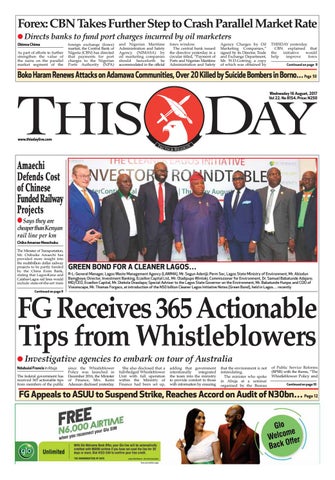
GREEN BOND FOR A CLEANER LAGOS… R-L: General Manager, Lagos Waste Management Agency (LAWMA), Mr. Segun Adeniji; Perm Sec, Lagos State Ministry of Environment, Mr. Abiodun Bamgboye; Director, Investment Banking, Eczellon Capital Ltd., Mr. Oladipupo Wintoki; Commissioner for Environment, Dr. Samuel Babatunde Adajare; MD/CEO, Eczellon Capital, Mr. Diekola Onaolapo; Special Adviser to the Lagos State Governor on the Environment, Mr. Babatunde Hunpe; and COO of Visionscape, Mr. Thomas Forgacs, at introduction of the N50 billion Cleaner Lagos Initiative Notes (Green Bond), held in Lagos… recently
Continued on page 9
FG Receives 365 Actionable Tips from Whistleblowers Investigative agencies to embark on tour of Australia Ndubuisi Francis in Abuja The federal government has received 365 actionable tips from members of the public
since the Whistleblower Policy was launched in December 2016, the Minister of Finance, Mrs. Kemi Adeosun disclosed yesterday.
She also disclosed that a full-fledged Whistleblower Unit with full operation within the Ministry of Finance had been set up,
adding that government intentionally integrated the team into the ministry to provide comfort to those with information by ensuring
that the environment is not intimidating. The minister who spoke in Abuja at a seminar organised by the Bureau
of Public Service Reforms (BPSR) with the theme, “The
Whistleblower Policy and Continued on page 10
FG Appeals to ASUU to Suspend Strike, Reaches Accord on Audit of N30bn… Page 12
2
T H I S D AY WEDNESDAY AUGUST 16, 2017
T H I S D AY WEDNESDAY AUGUST 16, 2017
3
4
T H I S D AY WEDNESDAY AUGUST 16, 2017
T H I S D AY WEDNESDAY AUGUST 16, 2017
5
6
T H I S D AY WEDNESDAY AUGUST 16, 2017
T H I S D AY WEDNESDAY AUGUST 16, 2017
7
8
T H I S D AY WEDNESDAY AUGUST 16, 2017
9
˾ WEDNESDAY, AUGUST 16, 2017
PAGE NINE
Clash over Anti-Buhari Protest Leads to Closure of Abuja Market Olawale Ajimotokan in Abuja An inter-ethnic clash involving northern and Igbo traders broke out yesterday in the popular Wuse market in Abuja, following the attempt by the exponents of the ‘Our Mumu Do Do’ movement, led by Nigerian musician Charles Oputa, to hold an anti-Buhari protest in the largest market in the capital city. The clash, which was promptly nipped in the bud by the police and led to the closure of the market, however, did not stop it from spilling over into neighbouring streets where hoodlums took advantage of the melee and began to hurl stones and other projectiles at passersby. Trouble started when Oputa, better known as Charly Boy, led some protesters to the market to demand for President Muhammadu Buhari’s return
to the country or resignation. Buhari has been in the United Kingdom for more than three months where he is receiving treatment for an undisclosed ailment. His prolonged absence has led to pro- and anti-Buhari protests in the last few days. However, Charly Boy’s attempt to take the protest to the market, which has several traders of northern extraction, almost led to his and his supporters’ lynching by an irate mob yesterday. They were stoned and chased out of the market, resulting in injuries sustained by members of his entourage and journalists. According to an eyewitness, when Charlie Boy and his entourage arrived the market in the morning on motorbikes, he and his supporters overpowered the private security men who had tried to stop them from gaining entry into the market.
This drew the ire of some traders of northern stock, who did not take kindly to Charlie Boy’s protest against the ailing president, which they said had political undertones. The traders, chanting “Sai Baba, Sai Baba”, then attacked and chased Charlie Boy and his group from the market. They were attacked with sticks, stones and other projectiles, forcing Charlie Boy to beat a retreat and abandon his BMW motorbike in the process. Some hoodlums, said the eyewitness, also took advantage of the situation and started attacking Igbo traders in the market, who retaliated in kind. Owing to the crisis, policemen were deployed in the market and fired rubber bullets and teargas to disperse the riotous situation, thus preventing the clash from getting out of hand. But even after the traders
full disclosure regarding the health of the president. “We reiterate our commitment to remain resolute in demanding full disclosure regarding the health of the president. It is the right of the Nigerian people to know the true health of the man they voted into power and for whose healthcare they are paying,” Adeyanju said. He said the groups would continue to remain law abiding in the face of provocation. In his reaction, the former governor of Abia State, Orji Uzor Kalu condemned the altercation between traders and demonstrators at Wuse market, saying that the action that resulted in clash of interests was ill-conceived and inconsiderate. He said Nigerians should be a little more sensitive and should accord respect to Buhari who has battling with his health.
Speaking in a statement signed by his aide, Mr. Peter Eze, Kalu called for calm and greater understanding of the dynamics that hold the country together as different groups express their support for the president. He said the call for Buhari to resume or resign might have become insensitive considering his ill-health. According to him, while it is the democratic right of Nigerians to demonstrate over any cause the strongly believe in, Buhari’s health ought to be taken into consideration in the demonstrations. Kalu also frowned at the altercation between the traders and demonstrators at the market and urged all groups to show their respect for the president and allow him to conclude his treatment before returning to the country, adding that the president would be saddened by the altercation.
naira. While the naira closed at N365/$ on the parallel market yesterday, it closed at N363/$ on the BDC segment and N362.38/$1 on the Investors’ and Exporters’ (I&E) forex window. However, the official exchange rate stood at N305.65/$1 yesterday, while Nigeria’s external reserves was put at $31.222 billion as of August 8. The I& E forex window has traded over $4 billion since it was established, with the naira making gains in the market. The window, where
buyers and sellers are free to agree an exchange rate, was introduced in April to attract foreign investors into the country and boost the supply of dollars.
allocation of $264,192,252.95. The CBN also offered the sum of $100,000,000 to authorised dealers in the wholesale window. Confirming the figures, CBN sources said the Bank also received requests from authorised forex dealers on behalf of their customers, for which results will be released. The central bank reiterated its resolve to converge rates in the market. The CBN last week had intervened in the wholesale, SMEs and invisibles windows to the tune of $195 million.
contracting for the projects, saying the China Exim Bank had assured the federal government that there will be competitive tenders for the jobs, but they must go to Chinese firms that have bid for them. When reminded that the foreign loans Nigeria was taking for the projects were certain to add to the country’s external debt burden and if the railway lines would be viable to repay the loans, the minister explained that rail projects the world over can hardly repay foreign loans. “Railway projects that are funded through loans can hardly repay for the loans. But what the government is looking at is increased economic activities through major infrastructure projects that would enable it to generate more revenue to repay the loans. “Lest you forget, the Lagos-Kano line will start from the Apapa ports; that is why a major station is being built in the port city and another one at Ebute Metta to replace the old Iddo Terminus. Now you can imagine what this can do for economic activities once the project is executed. “We have made some
progress in terms of negotiations and the Lagos-Ibadan line has started, so hopefully the National Assembly would approve the other aspects of the external borrowing plan so we can make progress with the Ibadan-Kano and Calabar-Lagos rail lines,” he said. Amaechi further disclosed that the railway lines would ultimately be concessioned to private sector operators to ensure that they are properly managed over a long period. On the Abuja-Kaduna railway line, which was inaugurated by the Muhammadu Buhari administration last year, the minister said new locomotives had arrived for the line, while new coaches were expected in October. Also speaking on the Itakpe-Ajaokuta-WarriAladja line, Amaechi recalled that the railway project was initiated by the Ibrahim Babangida administration to move iron-ore between the two steel plants in Ajaokuta in Kogi State and Aladja in Delta State, but it was never completed. “We have now awarded the contract to complete
were ordered to leave the market, the clash spilled over into the streets where hoodlums threw stones and other projectiles at passersby, forcing them to scamper for safety. Later, the Our Mumu Don Do group reassembled along Sani Abacha Road and moved towards the Mabuchi axis to continue their rally calling on Buhari to return or resign from office. Reacting to the incident, the co-convener of the movement, Deji Adeyanju said the attack on Charly Boy was completely unprovoked. “This is the third in a series of attacks carried out against us using a combination of policemen and paid hoodlums. It is saddening that the administration of President Muhammadu Buhari would rather commit scarce national resources to such underhand tactics than giving
FOREX: CBN TAKES FURTHER STEP TO CRASH PARALLEL MARKET RATE availability in the market, as well as address the challenges encountered by stakeholders in the maritime sector. The two-paragraph circular stated: “In the continued effort to improve forex availability in the Nigerian forex market and ameliorate challenges encountered by critical stakeholders, payment for port charges to the NPA, NIMASA, etc, by oil marketing companies can now be accommodated by the CBN using Form ‘A’. “Therefore, authorised dealers are directed to accept the request for payment
of port charges from oil marketing companies and forward same to the CBN forex window.” Throwing more light on the rationale for the policy, a reliable central bank source said it was expected to lead to a further appreciation of the naira against the dollar on both the BDC and parallel markets. “Before the central bank unveiled the latest circular, when oil marketers imported petroleum products, they were expected to clear these products. The NPA and NIMASA charge dollars to clear these products and most times the importers
resorted to either the BDC or black market. “But with what the CBN has done, the importers can now access dollars from the official market through their respective banks. “So they are expected to fill the Form ‘A’ and submit to their banks. The banks would then submit the forms to the CBN for settlement,” the source explained. He said by taking that huge amount of demand out of the BDC and parallel segments of the market, it was expected to further ease demand pressure and lead to the appreciation of the
CBN Intervenes with $364m Meanwhile, the CBN yesterday intervened in the interbank forex market to the tune of $364 million, in a bid to sustain liquidity in the market. A breakdown of the intervention indicated that the retail Secondary Market Intervention Sales (SMIS) received the largest
AMAECHI DEFENDS COST OF CHINESE FUNDED RAILWAY PROJECTS stations, digital signalling and communications systems and high-speed trains that would cut the number of hours spent by commuters travelling around the country by more than 50 per cent. Speaking to THISDAY on the Lagos-Kano and Calabar-Lagos lines, which would respectively cost an estimated $6 billion and $11.1 billion to construct, the minister also allayed concerns that the cost of the projects were inflated. He equally dismissed the comparison with Kenya’s new Madaraka express railway, which was equally funded by the Chinese at the cost of $3.2 billion. “What we negotiating with the China Exim Bank is to build railway projects that are much bigger and this includes the stations, signals, electricity and generators, dual locomotive engines as well as coaches. “I have seen heard criticism saying that the cost of the projects are inflated, however, the Kenyan project is only 472km long between Nairabi and the port city of Mombasa costing $3.2 billion. “This comes to $7.5 million per km. Meanwhile,
the Ibadan-Kano line is 1,500km long while the Calabar-Lagos railway line is 1,550km, but will cost us $5.2 million per km to construct,” he said. Amaechi added that construction of the Lagos-Ibadan leg of the railway line, which will be extended to Kano, had already started and was scheduled for completion by December 2018. “As you know, the National Assembly approved the external borrowing component for the commencement of the Lagos-Ibadan standard gauge line, so the project has been started and is scheduled for completion in December 2018, so that by January 2019, we can commence modern trains services between Lagos and Ibadan,” Amaechi explained. The minister said all the standard gauge projects would be accompanied by modern train stations that would have shopping arcades like international airports and train stations overseas. In this regard, he said four such stations are to be constructed between Lagos and Ibadan, while smaller ones would be constructed
on the route to Abuja and other cities. “We are building four large modern stations that will have shops and facilities for commuters to buy their tickets through e-channels. Two will be in Lagos – one in Apapa and the other at Ebute Metta – then one in Abeokuta and another one in Ibadan. Then we will have smaller stations en route to Abuja and other cities,” Amaechi said. The minister explained that the modern rail projects would come with dual locomotive engines so that they can run on electricity but switch to diesel in the event of power failure, noting that Nigeria’s share of the counterpart funding for the Lagos-Kano and Calabar-Lagos lines was 15 per cent, while the Chinese would fund the balance of 85 per cent. On the number of jobs that would be handled by Nigerians during the construction of the projects, he said the federal government, in its negotiations, had insisted that 90 per cent of the jobs must go to Nigerians. He also allayed concerns over single source
and upgrade the narrow gauge line to include commuter services, so we are building 12 stations and 92 flyovers and bypasses. This is costing N80 billion to N100 billion and is about 310km long,” he said. He added that the rehabilitation of the old Port Harcourt-Maiduguri narrow gauge line was also in the pipeline, but would be handled by U.S. engineering conglomerate, General Electric (GE), under a concession agreement.
TOP GAINERS NGN NGN % GSK 1.00 21.00 5.00 BERGPAINTS 0.34 7.14 5.0 GOLDENBREW 0.04 0.89 4.7 CONOIL 1.30 33.89 3.9 LEARNAFRICA 0.03 0.82 3.8 TOP LOSERS NGN NGN % MORISON 0.08 0.90 8.1 PZ 1.35 25.65 5.0 STANBIC IBTC 2.05 38.95 5.0 NASCON 0.61 11.69 4.9 CCNN 0.53 10.15 4.9 HPE Nestle Nig Plc ₦1,208.10 Volume: 391.625 million shares Value: N5.436 billion Deals: 5,285 As at 15/08/17 See details on Page 40
WEDNESDAY, ͯʹ˜ ͺ͵ ˾ T H I S D AY
10
PAGE TEN
Suspected Target of Ozubulu Church Attack, ‘Bishop’, Visits Injured Victims David-Chyddy Eleke in Awka Anambra “businessman” Aloysius Ikegwuonu, who was said to have been the target of the recent attack on St. Philip’s Catholic Church, Ozubulu in Anambra State, has visited the Nnamdi Azikiwe University Teaching Hospital, Nnewi, to sympathise with victims of the attack. Ikegwuonu, aka Bishop, who was accompanied by a few of his friends, went round the wards of the hospital greeting the victims and asking questions on how the incident that led to the deaths of 13 persons and many injured, happened. THISDAY observed
that the victims, who had been traumatised since the violent attack by unknown gunmen, were visibly happy over his visit. One of the victims, a lady, on seeing Ikegwuonu, sat up with joy splashed across her face to greet him for coming to check on them. Ikegwuonu, a South African-based “businessman”, has been described by members of the community as a source of happiness to the indigenes Ozubulu. Besides building three catholic churches in the community, Ikegwuonu through his Ebubechukwuzo Foundation, has awarded scholarships to several
indigent students of the community, and has tarred a major road in the town. A source also stated that the high attendance at St. Philip's Catholic Church on the day of the incident was because Ikegwuonu was expected to be at the church on the fateful day. Meanwhile, the Anambra State Police Command have said that they have invited Ikegwuonu to meet with the police commissioner in Awka, the Anambra State capital. The police public relations officer, Mrs. Nkiruka Nwode said he has been invited and they were looking forward to his coming. She further said that the police have no need to arrest him if Aloysius Ikegwuonu, aka Bishop, sympathising with victims of the Ozubulu church he complies. killings at the hospital in Nnewi
Why More Expensive Wine Tastes Better Researchers in Germany and France have discovered why more expensive wine tastes better and relates to the reward areas of the brain. “The reward system is activated in a significantly stronger fashion with higher prices and in this way apparently also the
taste experience,” said Bernd Weber, of Germany’s Bonn University, which conducted the research with France’s INSEAD Business School. The research was published in the journal, Scientific Reports yesterday. “The fascinating question
is now whether we can train the reward system so that it is less susceptible to such ‘placebo marketing’ effects,” Weber said. The researchers placed 15 men and 15 women in a magnetic resonance imaging (MRI) scanner for a wine tasting. They were told how
much each wine cost before they were given a millilitre of it to drink through a hose. They then pressed a button to evaluate the taste of the wine on a nine-point scale. The wine was always the same wine, but the price was given as 3.50,
7 or 21.15 dollars for a bottle. “As expected, the test subjects claimed that the wine with the higher price tasted better than the cheaper wine,” INSEAD researcher Hilke Plassmann said. The MRI scanner showed that the frontal lobes
and the ventral striatum thought to be involved in reward processing and motivation were more active with the higher prices. “In the end, it seems like the reward and motivation system is playing a trick on us,” INSEAD researcher Liane Schmidt said.
you provide will be reviewed, analysed and referred to be treated either administratively or criminally, through the investigative agencies. “If for any reason after you have made a disclosure, you feel that you are being treated badly because of your report, you can file a formal complaint through the same confidential channels and the matter will be dealt with immediately with the seriousness it deserves. “Also, where you have suffered harassment, intimidation or victimisation for sharing your concerns, the whistleblower policy makes provision for restitution for any loss suffered. “The risk of corruption is significantly heightened where the reporting of wrongdoing is not supported or where those who report wrongdoing may be subject to retaliation such as intimidation, harassment, transfer, dismissal or violence by their fellow colleagues or superiors. “The protection of public sector whistleblowers from retaliation for reporting in good faith is therefore integral to our effort to combat corruption, safeguard
integrity, and enhance accountability. “These are not just words, as you must have heard, the Senate recently passed the Whistleblower Protection Bill which gives a whistleblower, protection under the laws of Nigeria. “This is a great step in the right direction in our fight against corruption and I must thank the legislature for supporting the executive. “Our whistleblower policy is consistent with many other countries such as Australia, Canada, Japan, New Zealand, United Kingdom and the United States which have passed comprehensive and dedicated legislations to protect whistleblowers and particularly, public sector whistleblowers. “In line with ensuring that we continue to build the right capacity and follow best practice, the Whistleblower Unit consisting of representatives from the various investigative agencies, is expected to go on a study tour to Australia to understand how they have been able to successfully implement the policy. “We will continue to evolve and improve on the programme based on our
experiences and learning from other jurisdictions,” she added. Adeosun noted that the reward scheme under the policy has also served as an incentive for disclosures, as a whistleblower is entitled to between 2.5 per cent and 5 per cent of the amount recovered, if the information provided is original and directly leads to the recovery of stolen or concealed funds or assets. “Even in the payment process, we have built in protection to ensure that whistleblowers identities remain confidential and that bank and other details cannot be used to trace information providers,” she said. In his remarks, the Director-General of BPSR, Dr. Joe Abah said that the agency organised the seminar to provide the needed platform to educate public servants on what the policy is about and the roles public servants were expected to play to ensure its successful implementation. He noted the Whistleblower Policy was in accordance with the tenets of reforming the public service and urged public servants to expose corruption where it exists.
FG RECEIVES 365 ACTIONABLE TIPS FROM WHISTLEBLOWERS Its Implication for Public Servants,” also disclosed that investigative agencies were billed to embark on study tour of Australia due to that country’s pedigree in whistleblowing. According to her, much of the success of the policy had relied on the decision of the whistleblower to do the right thing, adding that of the 365 actionable tips received, over half of them came from public servants touching on issues such as contract inflation, ghost workers, illegal recruitments, misappropriation of funds, illegal sale of government assets, diversion of revenues, and violation of Treasury Single Account (TSA) regulations, among others. Adeosun disclosed that in reviewing the information received, the government noticed that certain types of tips were recurring. “For example, 39 per cent (144) of the actionable tips relate to misappropriation and diversion of funds/ revenue, 16 per cent (60) relate to ghost workers, illegal recruitments and embezzlement of funds meant for personnel emolument, 15 per cent (56) relate to violation of TSA regulation, 13 per cent (49)
relate to contract inflation/ violation of the Procurement Act and failure to carry out projects for which funds have been released, and 9 per cent (34) relate to non-remittance of pension & NHIS deductions. “Others include concealed bailout funds and embezzlement of funds from donor agencies,” the minister added. Adeosun noted that overall, the volume of tips received had been greater and of higher quality than expected when the programme was first adopted. “We continue to receive information everyday with total communication reaching above 5,000 in July through our various reporting channels.” However, she pointed out there was still a long way to go, stressing that “part of our work is to analyse trends and take corrective actions”. “For example, many of the salary, tax and pensions under remittance cases shared a common thread. Several cases where institutions were found to have insufficient funds to meet their obligations often had illegal recruitments,
which bloated the wage bill and agencies responded by part paying or short paying salaries, whilst applying to the federal government for salary shortfall payments. “We are revisiting our procedures for approval of recruitment, which will improve our budgeting and control. Equally, in many cases where revenue has been diverted to accounts outside the TSA, we have reviewed our reconciliation and receipting processes. “So the information being provided is useful in driving process improvements,” she stated. She urged civil servants with information on possible misconduct or violations to come forward. She said: “If as a civil servant, you have information about a possible misconduct or violation that has occurred, is ongoing, or is about to occur, we implore you to come forward and report it. “You can submit your information anonymously and confidentially through the online portal, by email or by phone, and if you choose to disclose your identity, I assure you that it will be fully protected. “All information
T H I S D AY WEDNESDAY AUGUST 16, 2017
11
WEDNESDAY, AUGUST 16, 2017Ëž T H I S D AY
12
NEWS
Ă?ĂĄĂ? ĂŽĂ“ĂžĂ™Ăœ Davidson Iriekpen Ă—Ă‹Ă“Ă– davidson.iriekpen@thisdaylive.com, 08111813081
FG Appeals to ASUU to Suspend Strike, Reaches Accord on Audit of N30bn Meeting with union continues tomorrow Senator Iroegbu Ă“Ă˜ ĂŒĂ&#x;ÔË The federal government yesterday reached an agreement with the Academic Staff Union of Universities (ASUU) aimed at resolving the indefinite strike by the union. The meeting came as the government urged the university lecturers to suspend their ongoing strike in the interest of the nation. ASUU had Monday embarked on strike following the failure to implement the agreement it reached with the federal government in 2009. The meeting between leadership of the union and the Minister of Labour and Employment, Senator Chris Ngige, ended with an agreement to audit the N30 billion earlier given to the union in 2010. After the meeting, which lasted for more than four hours, both sides took significant steps towards resolving the issues
raised by the union. Confirming the development, the Deputy Director, Press Ministry of Labour and Employment, Samuel Olowookere, in a statement, assured Nigerians that efforts were being made to resolve the outstanding differences with the union. “Particularly, the meeting agreed on the forensic audit of the sum of N30 billion earlier given to ASUU in 2010 and further agreed on monthly remittances to ASUU while the audit lasts. “The minister hence wishes to assure members of ASUU and indeed Nigerians that government is already at work to resolve all outstanding issues in line with the resolve of the present administration to cast any form of disruption of universities’ academic calendar into the dust bin of history,� Olowookere stated. He said the meeting would
continue tomorrow. Earlier yesterday, Ngige had promised that the Babalakin Committee which the federal government set up on February 13, 2017, was already addressing the issues raised by lecturers and urged them to suspend their ongoing strike in the interest of the nation. The minister said though the federal government did not wish to apportion blame, “it is important to note that ASUU did not follow due process in the declaration of the industrial action as it did not give the federal government, the mandatory 15 days notice as contained in the Section 41 of Trade Disputes Act, Cap T8, 2004. “In fact, it was on August
14, 2017 that the Office of the Minister received a letter dated August 13, 2017 from ASUU, that is, one full day after it commenced the strike.� He further noted that the letter was to inform the federal government that ASUU has started strike and not a declaration of intention to go on strike as contained in the Trade Dispute Act, 2004. The minister said since the case was being conciliated, it was against the spirit of Social Dialogue and Collective Bargaining Agreement (CBA) for ASUU to embark on strike as enunciated in the ILO Convention. He said: “The federal government therefore wishes to appeal to ASUU to consider
students who are currently writing degree and promotion examinations, call off the strike and return to the negotiation table,� adding that “the Ministry of Labour and Employment will ensure that a time frame will be tied to negotiation this time around.� Ngige stressed that “Babalakin Committee was ever ready to continue the negotiation, indeed, has all the necessary ingredients for fruitful social dialogue as well as adequate powers to negotiate and make recommendations to the federal government.� Meanwhile, the strike paralysed academic activities yesterday at the Federal University of Technology,
Akure (FUTA) and the Ondo State-owned Adekunle Ajasin University, Akungba Akoko (AAUA). This development made students of the institution to vacate their hostels, while those living outside the school were seen leaving their houses. It also led to the hike in prices of transportation especially Akure to Ibadan and Lagos. As at the time of filing this report, the school has been deserted by students while offices of the lecturers were under lock and key. The Chairman of FUTA branch of ASUU, Dr. Oniya Mobolanle Oladipo, said after a congress held at the university campus, the union decided to join the current action.
Suicide Bombers Kill 27, Wound 83 in Borno A Boko Haram suicide bomber yesterday killed at least 27 people and wounded 83 in Borno State, local sources told AFP. A female bomber blew herself up and killed 27 others at a market in the village of Konduga near Maiduguri, the epicentre of the conflict between government forces and
the Islamist Boko Haram insurgents, according to a village head and an official from a regional militia. Two suicide bombers also blew themselves up at the gates to a nearby refugee camp, with no others killed but many injured, said an emergency service official.
Local Rice Production Hits 15m Tonnes NEW RULES TO STEM EPILEPTIC POWER SUPPLY‌ Local rice production in cancer to consumers. L-R: Minister of Power, Works & Housing, Mr. Babatunde Fashola (SAN); Minister of State, Hon. Mustapha Baba Shehuri; and Managing Nigeria has now reached 15 million metric tonnes annually, the government has claimed. It said the development means the country will now be saving about N300 billion it used to spend annually on importation of the commodity. The Director of Agriculture at the Kano office of the Federal Ministry of Agriculture, Muhammad Adamu, made the claim yesterday while inaugurating the Rice Millers Association of Nigeria, (RIMAN) in the state. He said in Kano alone, 1.2 million metric tonnes of rice was produced in 2016. He said with the significant increase in local productions and the efforts to make the local variety qualitative and more attractive to Nigerians, the country expects to begin exporting rice to West African countries by 2018/2019. Adamu, according to Premium Times, said about 34 states in Nigeria are producing rice, with many now producing three times in a year. He disclosed that investigation carried out by the federal government revealed that rice imported to Nigeria are 10-15 years old and are preserved with chemicals which can cause
In his remarks, the Chairman of the Board of Directors of Rice Miller’s Association, Peter Dama, said, the association was established to promote local milling of rice that is fresh, healthy and nutritious. He said the association is willing to collaborate with the Nigeria Customs Service to stem smuggling of expired rice into Nigeria. Dama added that the association intended to work closely with regulatory agencies and policymakers to ensure standard in local rice milling. The customs officer in charge of rice enforcement, Ado Hassan, warned that officers caught conniving with rice smugglers would have themselves to blame. He said in less than one year, the zonal command of the agency confiscated 800,000 bags of rice in Kano and Jigawa States. He said about 9,000 bags of the rice are still in the stores of the agency, adding that most of the rice were being given to internally displaced persons after been certified fit for consumption by the National Agency for Food and Drugs Administration and Control (NAFDAC).
Director, Kano Electricity Distribution Company, Dr. Jamil Isyaku Gwamna, when Fashola presented the mini-grid regulations at the 18th monthly meeting with sectoral participants in the power sector at the Kombotso transmission station, Kano‌ Monday
Apapa Gridlock: Council, NPA, Others Endorse Prosecution of TrafďŹ c Violators Gboyega Akinsanmi The Apapa Local Government Area, Nigerian Ports Authority (NPA) and other stakeholders yesterday agreed that owners of articulated vehicles that violated Lagos Road Traffic Law, 2012, should be prosecuted. The stakeholders, including the Road Transport Employers Association of Nigeria (RTEAN), Residents’ Association of Government Reserve Areas, banks and law enforcement agencies, agreed to a 24-hour monitoring and enforcement of one-lane policy as a measure to ease gridlock in Apapa. These positions were held yesterday at a stakeholders’ meeting which the Chairman of Apapa council, Mr. Owolabi Adele, addressed on the need to end diverse challenges which the stakeholders said had been undermining socio-economic activities in Apapa and its environs. After exhaustive deliberation at the meeting that lasted almost
three hours, the stakeholders agreed that for sanity, law and order to return to Apapa and its environs, owners of articulated vehicles parked indiscriminately in the area should be prosecuted.� Also, the stakeholders agreed to a 24-hour enforcement and monitoring initiative of one-lane policy, which the Apapa council unfolded to reduce the hardship the residents and owners of businesses daily undergo in Apapa and its environs. Earlier at the meeting, the council chairman proposed a 24-hour monitoring and enforcement initiative of one-lane policy which he argued would stem the hardship the people “are experiencing in Apapa’s gridlocks on a daily basis.� Adele, therefore, lamented that the traffic situation had crippled the socio-economic activities in the town, noting that it would deploy enforcement teams “on strategic areas to ease the flow of traffic in and out of Apapa. “Our presence here marks a
turning point in our collective attempt to resolve permanently and move forward in our onerous task. As it has been repeatedly re-echoed, the damage done to our economy and the suffering of our people as a result of the traffic menace cannot be over-emphasised.� He assured stakeholders that the council would begin repairing all roads, calling for intensive training for all tanker drivers to stem overloading and reckless driving that have resulted in avoidable road accidents. Also at the meeting, the NPA General Manager, Mr. Biodun Gbadamosi, blamed the worrisome situation in Apapa on non-adherence to its original master plan and years of neglect by successive governments in the country. He, however, commended the Apapa council for the stakeholders’ meeting to brainstorm on way forward and suggested inter-modal transport system that will reduce pressure
on the road as the way out. Gbadamosi noted that several meetings had been held on how to provide a long term solution to the traffic in Apapa for the return of socio-economic activities to the area as since Managing Director of NPA, Ms. Hadiza Bala-Usman, assumed office, nothing much had been achieved. On behalf of Apapa GRA Residents Association, Brigadier-General Ayo Vaughan suggested the erection of barriers on Liverpool Road to regulate the use of the road by the articulated vehicles while also calling for action to end the menace of commercial motorcyclists and bus drivers in the area. Vaughan regretted that lack of measures “to check the manner commercial motorcycle operators and bus drivers operate in Apapa and environs had made security in the area porous and inimical to residents and businesses there.�
T H I S D AY WEDNESDAY AUGUST 16, 2017
13
14
T H I S D AY Ëž Ëœ ÍŻÍ´Ëœ Í°ÍŽÍŻÍľ
COMMENT
Editor, Editorial Page PETER ISHAKA Email peter.ishaka@thisdaylive.com
THE NBA CONFERENCE IN LAGOS
Sonnie Ekwowusi argues that lawyers are not doing enough to shape events in the society
T
he 2017 General Conference of the Nigerian Bar Association (NBA) commences in Lagos on Friday, August 18 and will end on August 25, 2017. Considering the great moral crisis holding our country hostage at the moment accentuated by the unspeakable passivity and silence of those whose positions of authority oblige them to speak out in the areas in which they assume personal responsibility, I cannot think of a more appropriate or apt theme for the 2017 annual general conference of the NBA than the following theme: The Lawyer, Conscience, Truth and Justice. I don’t know why but I call tell you that these days John F. Kennedy’s favourite quotation from Dante Alighieri’s epic poem “The Divine Comedy� has ceaselessly been flooding my memory. In illustrating the imperative of speaking truth to power, Dante had in the first part of the “Inferno� stated viva voce that the hottest place in hell should be reserved for those who keep quiet or who remain neutral in times of great moral crisis. Paraphrasing Dante, Theodore Roosevelt had in 1915 written that Dante had “reserved a special place of infamy� for neutral angels or angels who keep quiet in times of great moral crisis. Only a superficial person with a cauterised conscience will not be alarmed by the harvest of secessionist declarations that constantly depicts Nigeria as one hellish place to live in. Any serious reflection on the political developments in Nigeria could be saddening. Why? Because they hardly square up with any logic or simple political theorem. We have been forced to live sheepishly from hand to mouth like people without hope. Only a thoughtless person with a lax conscience will not be moved to team up with others in seeking remedy to the myriads of anomalies, oddities and social injustices that now define Nigeria. It is said that lawyers are leaders. They are not members of the crowd who reduce themselves to the level of acquiescent “yes-men�. Lawyers ought to be shapers of democratic values whether or not they wield any political power or subscribe to any political partisanship. Lawyers, if you like, are the purveyors of the fundamental principles of social life one of which is the principle of the rule of law. In his keynote address on the theme, “Crisis in the Rule of Law� at the 1989 Annual General Conference of the NBA on August 28, 1989 Justice Chukwudifu Chukwudifu Oputa (of the blessed memory) said that the rule of law was a pre-requisite not only for the sustenance of democracy but for good governance. Justice Oputa also felt able to say: “If we are not ruled by law we are ruled by men and man is extremely an unpredictable animal�. How can we be ruled by creatures of appetite, imbeciles and unpredictable animals? When lawyers who ought to be the guardians and consciences of our democratic experiment shirk their responsibility and instead become overnight Abuja pseudopoliticians and Abuja loot dissipaters In the past, the NBA was synonymous with integrity, propriety, progress and proper ordering of a drifting society. The NBA was a populist voice ringing out in the wilderness in relentless search for constitutionalism, in search of propriety and in search for the truth and justice. The NBA had for many years served as the societal
LAWYERS OUGHT TO BE SHAPERS OF DEMOCRATIC VALUES WHETHER OR NOT THEY WIELD ANY POLITICAL POWER OR SUBSCRIBE TO ANY POLITICAL PARTISANSHIP
moral clearing-house. Any thoughtful person who wanted some clear perspectives on the goings on in Nigeria looked up to the NBA and lawyers for far-reaching insights. Unfortunately we are witnessing the era in which individualism, narcissism, egoism and elitism are robbing the NBA and lawyers in Nigeria of vital strength. The individualist, whose ideal society is totally at the service of his own egoism, his titles, honour, good standing, material success, public applause and so forth revels under a deformed conscience that is impervious to the values of truth and justice. He canonises acquiescent “yes man�, turns self-satisfied narcissism (which is equivalent to empty self-conceit) into the equivalent of self-fulfilment, and puts a halt to any achievement or promotion of the common good. Truth is the foremost common good. Man is constantly searching for the truth. Unexamined life, said Socrates, is not worth living. A serious harm can be done to social life when the truth is denied or scuttled. Openness to the truth paves way for the reign of justice. Justice is the vital thread that kneads society together. Without justice it is impossible for society aims to be fulfilled. Patron of lawyers Sir Thomas More allowed his conscience, truth and justice to govern his attitudes and dispositions at the bar, bench and as the Lord Chancellor of England. You may recall how Sir Thomas tendered his resignation as the Lord Chancellor of England because he refused to accede to the demands of King Henry V111 which he considered violated his good conscience. Coming home, the late Chief Gani Fawehinmi, SAN, fits into the mould of lawyers who refused to compromise fundamental principles. If Gani were alive and kicking amid today’s degenerating social and democratic values he probably would have staged a one-man demonstration. ‘Charlie boy’ Oputa is the new leading light. I certainly have nothing against ‘Charlie boy’ Oputa. When everything seems to be failing ‘Charlie boy’ and his followers are now the conscience of the nation, reminiscent of the saying that in a country of the blind, one eyed-man is king. How do they say it again? Nature abhors a vacuum. When the learned and the wise shirk their responsibilities, ‘Charlie boy’ Oputa and his followers are coming out to prove their mettle. Thus what is considered wise before men have become foolish, and, conversely, what is considered foolish have turned out to be sheer wisdom. The world is governed by its ideals, and seldom or never has there been an ideal which has exercised a more salutary influence on humanity than truth and justice. No abstract democracy in which the political leaders intentionally commit wrongs against the country can save the country. If you take away truth and justice all that remains in a country are open robberies. We must begin to move away from the statist mentality that once we establish democratic institutions and enact laws to ‘solve’ all our human problems then we have accomplished everything. In principle, functional democratic institutions and laws are good, but we need outspoken conscientious leaders and citizens for proper ordering of society.
HISTORY BECKONS NATIONAL ASSEMBLY The National Assembly should call off its vacation and attend to some urgent national issues, writes Francis Dazang
T
he National Assembly has been on recess from July 27, 2017. The recess will last till September 19. Going on recess from time to time is the prerogative of the National Assembly. No organisation or institution can work without its members taking a rest periodically. Otherwise, the consequences will be calamitous. However, neither the Senate nor the House of Representatives should have gone on recess when it did this time. Even now that the National Assembly is on vacation, it should terminate it right now. Unknown to most Nigerians, the country is in an emergency situation and only the federal legislature can save it. Before the National Assembly went on vacation, the Acting President of the Federal Republic of Nigeria, Professor Yemi Osinbajo, SAN, wrote a letter to the President of the Senate, Dr. Bukola Saraki, and the Speaker of the House of Representatives, Yakubu Dogara, requesting for approval to adjust the 2017 national budget here and there. The letter was read in both the Senate and the House of Representatives, but nothing was done. Members were in a hurry to proceed on recess. Most actually travelled out of the country almost immediately with their families and friends. This should not have been the case. The legislators ought to have treated the letter from the acting president exhaustively before going on vacation. There are fundamental challenges with the implementation of the 2017 budget the way it is. Implementing it in its present form will create very serious problems that will end up worsening the ongoing national economic crisis, thus making it difficult for Nigeria to exit from the present recession any time soon. In other words, the
budget needs to be adjusted in a couple of places in the overriding national interest. Adjustments in budgets when they have been signed into law are technically referred to as virement. I would like to refer to the budget of the Ministry of Power, Works and Housing as an example of a place where virement is urgently needed. This is a ministry whose activity affects every Nigerian directly every minute of the day; and I have had the privilege of working there in the directorate cadre. In the last one year, there has been tremendous activity on the reconstruction of such critical highways as the Kano-Maiduguri Highway, Onitsha-Enugu-Port Harcourt Expressway, Enugu-Port Harcourt Expressway and, of course, the Lagos-Ibadan Expressway. However, the reconstruction has, in the last few months, slowed down owing to the rainy season and, more importantly, declining funds made available to the contractors executing these vital national projects. The funds have declined very significantly because the 2017 budget stayed for a whole five months in the National Assembly which not only scrutinised the proposals critically but went ahead to make fundamental adjustments to the original proposal from the executive arm of government. For example, the amounts proposed for critical national roads, including the ones mentioned above, were slashed considerably. Even the additional 10% of the entire sum proposed for the Ministry of Power, Works and Housing was slashed badly. It is standard accounting and budgeting practice all over the world that at least 10% of the sum of any budget—whether in the public or private sector—be set aside as miscellaneous, otherwise called emergency or contingency. There are emergencies which must be tackled immediately
they occur, whether there is a specific provision for them in the budget or not. For instance, two critical bridges in Mokwa, Niger State, collapsed last June as a result of sustained torrential rainfall. One of them, the Mokwa-Jebba Bridge, links the northern and southern parts of Nigeria. Resources had to be mobilised from all kinds of sources to start reconstruction at once. But given the way the National Assembly has cut the contingency provision in the 2017 budget of the Ministry of Power, Works and Housing, it will be very tough to handle emergencies of the Mokwa magnitude if they should occur again this year in any part of Nigeria. Providing reasonably for critical national infrastructure and emergencies is in the greater interest of all of us than diverting resources from, say, the Kano-Maiduguri Expressway or the Calabar-Odukpani Road or the Onitsha-Enugu Highway or the Enugu Port Harcourt Highway or the Lagos-Ibadan Expressway to constituency projects of legislators like provision of borehole and distribution transformers or street lights in communities. I make this statement with due respect to the National Assembly members who got to their legislative positions by winning elections, and they frequently go to their people to show how they have fulfilled their electoral promises. The country is now in August, that is, in the eight month of the financial year. Yet, the implementation of the 2017 budget has not started in earnest. One of the reasons is the inherent fundamental flaws in the budget which need rectification through virement. Since virement can take place only when the National Assembly has approved the request from the executive arm of government, the National Assembly ought to have
treated the letter from acting president Osinbajo requesting for virement prior to proceeding on recess. Since it did not do the right thing early enough, it can still cure the defects from its action by calling off its current vacation which is scheduled to end on September 19. This is a long way. Admittedly, most Nigerians believe that our legislators enjoy too many holidays. For example, they work only from Tuesday to Thursday. And they often proceed on long holidays on special occasions. They went on a three-week vacation last June to celebrate the Id-el- fitri feast. Worse, there are many legislators who are delinquent in business attendance. Even among those who attend rather often, there are a lot who scarcely make contributions either on the floor of the legislature or in committee meetings. Their constituencies have long given up on them. To conclude, Senate President Saraki and Speaker Dogara as well as other principal officers of the National Assembly are hereby called upon to demonstrate an acute sense of responsibility by immediately ending or suspending the two-month recess which National Assembly members granted themselves in order to enjoy summer holidays. The country is passing through a particularly difficult period in history, and our legislators must show that they really understand the onerous task before them. Immediate consideration of the letter from the acting president requesting for adjustments to the 2017 budget law is of paramount importance. No effort should be spared to ensure that this year’s budget does not fail. History beckons National Assembly. Nazang is a retired deputy director in the Federal Ministry of Works & Housing
15
T H I S D AY Ëž Ëœ ÍŻÍ´Ëœ Í°ÍŽÍŻÍľ
EDITORIAL THE CHALLENGE OF MAINTAINING IDPS
The government must ensure that resources meant for soothing the pains of the displaced are not misappropriated
T
he enormity of the burden the internally displaced persons (IDPs) has placed on the country became more manifest a couple of weeks ago. Speaking while receiving a delegation of the African Union Peace and Security Council in Abuja Acting President Yemi Osinbajo lamented the “huge and enormousâ€? cost of maintaining about 2.4 million IDPs scattered in camps across Adamawa, Borno and Yobe States as well as Abuja, the Federal Capital Territory. Although the acting president did not mention any speciďŹ c ďŹ gure, the cost could be gleaned from the account of the Chairman of the Borno State Emergency Management Agency, Mallam Grema Terab. In a recent media interview, Terab said the state was spending about N3.5million daily to provide for the IDPs, warning, however, that the daily provision might be cut due to cash crunch. It is signiďŹ cant that the reference to the cost of the humanitarian needs of IDPs and the rehabilitation and reconstruction of their homesteads is coming against the background of mountBY DIVERTING SCARCE ing revelations about RESOURCES MEANT FOR their squalid conditions of living in several of THE MOST VULNERABLE such camps across the OF OUR PEOPLE, LIVES country. In spite of the ARE BEING MADE INCREASINGLY DIFFICULT humongous amounts government, multiFOR THEM. THIS lateral international CHALLENGE MUST BE and local aid agencies ADDRESSED as well as the international community have deployed in the North-east, the displaced persons continue to lack the basic necessities of life. That poverty has become an ever-present situation, especially in the North-east should be of great concern to our leaders. With schools shut, markets burnt, homes and communities razed and all forms of economic activities crippled, the need for intervention can hardly be over emphasised. Unfortunately, there has been a high level of corruption which has exacerbated the poverty of majority of the people. By diverting scarce resources meant for
Letters to the Editor
the most vulnerable of our people, lives are being made increasingly difďŹ cult for them. This challenge must be addressed. Hunger is all pervasive in the IDPs camps, medicare is in short supply even as shelter, clothing and water are essential commodities. The dire situation of the displaced persons is amply captured in a recent report by the United Nations OfďŹ ce for the Coordination of Humanitarian Affairs, which stated that “The vulnerable host populations are in critical need of humanitarian interventions that include food, water, sanitation, protection, education, shelter and health services.â€? The UN ofďŹ ce added: “More than 4.8 million people are now in urgent need of food assistance and 5.1 million are predicted to be food insecure if not supported by the humanitarian community in 2017. An estimated 300,000 children in Borno State alone will suffer from severe acute malnutrition over the next 12 months and up to 450,000 in total across Adamawa, Borno and Yobe, if adequate assistance is not received.â€?
T H I S DAY
EDITOR DEPUTY EDITORS ˜ MANAGING DIRECTOR DEPUTY MANAGING DIRECTOR CHAIRMAN EDITORIAL BOARD
EDITOR NATION’S CAPITAL
T H I S DAY N E W S PA P E R S L I M I T E D
EDITOR-IN-CHIEF/CHAIRMAN GROUP EXECUTIVE DIRECTORS ˜ ˜
˜ GROUP FINANCE DIRECTOR DIVISIONAL DIRECTORS ˜ ˜ DEPUTY DIVISIONAL DIRECTOR
SNR. ASSOCIATE DIRECTOR ASSOCIATE DIRECTORS ˜ CONTROLLERS ˜ ˜
GENERAL MANAGER
GROUP HEAD DIRECTOR, PRINTING PRODUCTION TO SEND EMAIL: ďŹ rst name.surname@thisdaylive.com
T
he question, therefore, is: Why, in spite of the “huge and enormousâ€? cost to the federal government, Nigeria, according to the UN agency, is facing “the biggest humanitarian crisis in Africa todayâ€?? The challenges are probably the ineffectiveness of the several agencies of government saddled with the responsibility of soothing the pains of the IDPs, and massive corruption. After all, it is known that relief materials meant for the IDPs have been diverted to the open markets for sale to the general public by ofďŹ cials of government. Also notorious is the fact of misappropriation of funds meant for the relief of the displaced persons. While the investigation into the case involving the suspended Secretary to Government of the Federation (SGF), Mr Babachir Lawal, remains pending, the federal government needs to to ensure that resources being deployed in this regard yield the desired results. For it would be inappropriate to, in these times of economic recession, deploy scarce resources without receiving value. Nigerians must be rest assured that monies meant for the distressed are not being misappropriated by a few persons in position of authority.
TO OUR READERS Letters in response to speciďŹ c publications in THISDAY should be brief (150-200 words) and straight to the point. Interested readers may send such letters along with their contact details to opinion@thisdaylive.com. We also welcome comments and opinions on topical local, national and international issues provided they are well-written and should also not be longer than (9501000 words). They should be sent to opinion@thisdaylive.com along with the email address and phone numbers of the writer.
KIDNAPPING AND WEAK VALUE SYSTEM
P
rior to its reaching an escalating height, kidnapping did not rank among the most ardent security concerns or crimes in the country. But then, all that seems to have changed as it has not only become a high-ranking crime in the country but a lucrative one for that matter. According to a Freedom House report, Nigeria recorded one of the highest rates of kidnapping in the world in 2013. Similarly, the US Department of State’s Country Reports on Human Rights Practices for 2013 indicates that kidnapping and related violence were “serious� problems in Nigeria. Initially, kidnapping was ‘invented’ in the creeks of the Niger Delta by militants as a way of calling the attention of government and multi-national companies who are involved in the oil industry to their environmental and infrastructure challenges. Later on, kidnapping was to transform from a social crusading art to a well-oiled commercial enterprise. Today, without a doubt, the crime has become a top money-spinning industry being used to acquire wealth by crooked criminals who kidnap for ransom across the nation. Recent arrest of billionaire kidnapper, Chukwudebem Onwuamadike, alias Evans, in Lagos clearly shows that kidnapping has become a huge source of livelihood for some who desire to live big through criminal means. Before his arrest, Evans lived like an emperor courtesy the booties from his heinous crime. He lived in a delightful mansion in the highbrow Magodo GRA, Lagos. He had some of the most fascinating automobiles in his garage while also
having unhindered access to choice drinks. Evans reportedly wears a wristwatch valued at $170,000 and he is also a proud owner of two mobile phones valued at $600 each. He has properties in Lagos as well as in neigbouring Ghana. Being a kidnapping dude, Evans had in his possession a wide range of ammunition with which he carried out his dastardly act. For instance, upon his arrest, four AK47 rifles, other kinds of assault rifles and 50 magazines were reportedly found in his house. Money was not an issue for Evans as his well-oiled kidnapping venture was bringing in loads of cash in various currencies. According to police source, Evans had collected billions of naira as ransom from his victims including expatriates, business moguls and public officials. The self-styled kidnapping genius preferred to collect his ransom in dollars or other alluring foreign currencies. But then, how did kidnapping suddenly rise to become a top rated crime in the country? The rise of kidnapping to prominence in our country could be linked to the steady disintegration of moral values in our society. Since the early 90s especially, moral value in the country has nose-dived. Today, crooks and individuals with warped moral code are being celebrated across the country. Only God knows how many ‘Evans’ that currently serve as elected or appointed political officers in the country! What we need to redress the situation is a complete re-orientation that cuts across all spectrums of the society. A process that is all encompassing in the sense of a fusion between the physical and the spiritual. As a prelude to setting this process on course, we need to
change our value system as a people. We need to re-appraise our undue obsession to materialism and wealth accumulation. It is such mania that is partly responsible for the rot in our socio-political system. How come men of questionable characters and unproven integrity are calling the shot in nearly every sector? The answer is simple. Money has become our god. Sadly, religious centres are not excluded from this craze! Neither are traditional institutions. Today, respected monarchs, who occupy sacred ancestral thrones, dole out chieftaincy titles to the highest bidders .These days, we have chiefs, who are actually thieves, dining and wining with kings. Nowadays, people place curses on their relations for upholding integrity and honesty while holding public offices. Until we re-order our priority as a people, we will continue to get it wrong. In the days of our founding fathers, men of ideas and principles were widely respected and honoured. Our national heroes such as Herbert Macaulay, Obafemi Awolowo, Nnamdi Azikiwe, Tafawa Balewa, Ahmadu Bello, and Aminu Kano, among others, did not rise to national prominence as a result of the fatness of their bank accounts. Rather, they won the hearts of men of their generation because of the strength and depth of their ideas and principles as well as their total commitment to those ideals which they hold in high esteem. Ken Saro Wiwa put his life on the line not for pecuniary gains or benefits. No! He died because of his commitment to the emancipation of his people. Tayo Ogunbiyi, Alausa, Lagos
16
T H I S D AY WEDNESDAY AUGUST 16, 2017
T H I S D AY WEDNESDAY AUGUST 16, 2017
17
T H I S D AY ˾ WEDNESDAY, AUGUST 16, 2017
18
MIDWEEKPOLITICS
Group Politics Editor Tobi Soniyi Email tobi.soniyi@thisdaylive.com 08033146139 SMS ONLY
THE NEWSMAKER
Makarfi, the Survivalist To the consternation of many, the Chairman of the Peoples Democratic Party’s Caretaker Committee, Ahmed Makarfi has survived many battles and is waxing stronger, writes Segun James
I
In politics goes a proverb: “politics is a game riddled with a circle of men holding a gun to each other’s heads ready to pull the trigger at the first opportunity.” For Senator Ahmed Mohammed Makarfi, the scenario is all too familiar. He has survived many political adversaries, prosecutions and betrayals more especially in the last one year, leaving most pundits to wonder: how did he do it? Makarfi did not only survive the tortuous Nigerian political minefield which has left quite a number of politicians scorched but has emerged with the potential to take on the most coveted position in the Nigerian political scene – the presidency. How did he do it? How did he get to this point? The events that led to this began soon after the PDP lost the presidential election in 2015. The unexpected situation left the party in disarray as the national chairman Alhaji Adamu Muazu, unable to control the situation in the party threw in the towel. It was at this point that Senator Ali Modu Sheriff, an outsider from the now ruling All Progressives Congress (APC) was brought in to lead the party at its most critical period. But situation soon emerged that Sheriff had his own agenda different from that which those who invited him had in mind. And the crisis began. The botched national convention of the party in Port Harcourt was an attempt to rescue the party from Sheriff. It was at this point that Makarfi was persuaded to take over the reins of the party. At that critical time, the party had been divided with some members supporting Makarfi and others backing Sheriff. In the midst of these, the reconciliation committee of the party headed by Bayelsa State governor, Henry Seriake Dickson recommended that Sheriff be recognised as the leader of the party to move the party out of the quagmire it has found itself. Situation became even more tense when the Court of Appeal ruled that Sheriff was the authentic leader of the party. Many, including Makarfi could not understand how Dickson could come up with such a recommendation. Yet Makarfi remained undaunted as he rallied the party members to appeal the ruling. The situation became so protracted that most members, including serving senators, House of Representatives members, former governors and other political leaders left the party for the All Progressives Congress (APC) in droves. It was the worst time for the former largest party in Africa. Yet it was this time that the leader in Makarfi emerged and became strongest. In spite of the onslaught from the APC and the distraction from the Sheriff faction, he was able to rally loyal members behind him even as they waited for the Supreme Court to deliver its verdict on who between him and Sheriff was the authentic national chairman of the party. The wait was long and laborious, but he remained resolute till the end and he was finally proclaimed the leader. But what led to this? That the PDP needed a new leadership selection system is no longer news. But surely not the one that threw in Sheriff, an outsider in the political chess game of the party as chairman. He was said to have been imposed on the party’s hierarchy by a select few of overtly ambitious governors with personal sinister motives to the detriment of the party. Now that he has taken control of the party from Sheriff, the main task before the new chairman is to give effective direction for the factionalised party. Within the four months that he will be holding forth, he would be expected to bring the various camps together and at the same time conduct
Makarfi...magnanimous in victory
due diligence on the quality of those aspiring to the leadership position and ensure that only the best and most credible are elected to steer the ship of the party towards 2019 elections when the party hopes to wrest power from the APC. There is no doubting the fact that PDP needs to eliminate all those factors that are making leadership selection system chaotic, considering all the leadership tussles that led to the circumstances that followed the last national convention. Before and after the 2015 elections which the party lost at the federal level, state level and at the National Assembly, the once “largest party in Africa” had faced the threat of extinction, not only because the party was beaten blue and black, but more because the stakeholders in the party were at loggerheads over who should lead the leader. Now that the Supreme Court had decided, the responsibility on Makarfi is onerous. Party loyalists are looking up to him pull the party
At the party’s convention held in Abuja last Saturday, Makarfi did not miss the opportunity to wish Buhari, who is receiving treatment in London, a quick recovery
from the wreckage of defeat, restore peace and harmony to the party. If he fails to deliver, he would have set the party up for failure come 2019. Makarfi belongs to the group of a rare breed of Nigerian politicians who will accept the results of an election they lose. He conceded victory to his opponent in the last National Assembly election immediately the result was announced and Alhaji Suleiman Hunkuyi of the APC was declared the winner. Given his antecedents, his choice as the person to lead the PDP did not come as a surprise to many party loyalists. Obviously, a man with a big heart, he also congratulated the President- elect, General Mohammed Buhari when he defeated his own party leader, Dr Goodluck Jonathan. At the party’s convention held in Abuja last Saturday, Makarfi did not miss the opportunity to wish Buhari, who is receiving treatment in London a quick recovery. He said: “We wish well for our president and will continue to pray for his full recovery. We want him to be fit and well when we will defeat the APC in the next general election. We will continue to pray for him, but that does not mean we will go to sleep. We will work hard to replace the APC government come 2019 election”. That came from Makarfi at a time when some high ranking members of his party, have pronouned the president dead! Ahmed Mohammed Makarfi was born on August 8, 1956. He was the governor of Kaduna State
from May 29, 1999 to May 29, 2007, and was later elected a Senator representing Kaduna North District in April 2007. He is a native of Makarfi, Makarfi Local Government Area of Kaduna State. When Ahmed concluded his primary school which he did from 1965 to 1973, he moved to the Federal Government College, Enugu from 1973 to 1978. In 1979, he gained admission into the School of Basic Studies, Ahmadu Bello University, Zaria where he obtained a Bachelor of Science degree in Accounting. After he graduated from the university, Ahmed became a part-time lecturer in the Department of Accounting from 1987 to 1993. At the same period, he enrolled for a postgraduate study and received a Master of Science degree in Accounting and Finance. Makarfi started his working career at the Nigeria Universal Bank, where he rose to the rank of Assistant General Manager. He held many ad-hoc responsibilities during this period. In 1994, he was appointed Kaduna State’s Commissioner of Finance and Economic Planning before returning to the private sector. He was a member of the Board of Trustees at the Institute for Peace and Conflict Resolution in Abuja as well as its Director of Finance and Administration. Makarfi is an inspiration to the PDP. While many in PDP trust him, others in opposition respect him. He is the leader the PDP needed at this critical period.
T H I S D AY ˾ WEDNESDAY, AUGUST 16, 2017
19
THE NEWSMAKER
MIDWEEKPOLITICS
PDP: Back from the Brink The Peoples Democratic Party put up quite a show in Abuja last Saturday that sent a powerful message to the ruling All Progressives Congress. Onyebuchi Ezigbo was there and reports
T
he Peoples Democratic Party (PDP) may have kickstarted its campaign for the 2019 general election. The party, which lost the 2015 presidential polls, has not given up hope of returning back to power. Still basking in the euphoria of the victory secured at the Supreme Court, the party’s National Caretaker Committee (NCC) organized what looked like a carnival convention in Abuja to re-enforce its move to reclaim power at the centre in 2019. After the judgment of the Supreme Court, the PDP NCC was faced with the daunting challenge of picking up the pieces from the rubble. The challenges were as real as the options were limited. The Senator Ahmed Makarfi-led committee took the first step by summoning a meeting of the party’s National Executive Committee (NEC) to chat the way forward. At the end of the meeting, the party resolved among others, to hold a non-elective national convention on August 12 and to disband all state caretaker executives set up by the former national chairman, Senator Alimodu Sheriff after the May 21 botched national convention. It also decided to set up two standing committees, the disciplinary committee and reconciliation committee expected to handle wrong doings of the Sheriff-led executive. Before the NEC meeting, a meeting of the national caucus and the Board of Trustees was held in which all the issues presented were endorsed. While speaking to newsmen on the out come of the NEC meeting, the spokesman of the NCC, Prince Dayo Adeyeye said the party also approved the removal of state caretaker committees in Jigawa and Benue states. Adeyeye said: “You will recall that immediately after the Court of Appeal judgment on the 17th of February and March in Port Harcourt, which gave our victory to Ali Modu-Sheriff, he set about installing caretaker committees in some states of the federation, particularly in Jigawa and Benue states”. He explained that the affected states’ caretaker committees were the ones set by Sheriff during the crisis. “So, we brought a motion before NEC today and the motion was duly passed. NEC declared and affirmed the leadership of the party in the two states of Jigawa and Benue that emerged after the April/May 2016 congresses. “All state caretaker committees and state parallel executives set up after the Court of Appeal judgment of February 17, 2017 at Port Harcourt to be dissolved and the duly elected officers returned to the office forthwith. That is to bring normalcy back to the party, installing legality and constitutionality.” Since the mandate given to the NCC at the August 17, 2016 Port Harcourt convention was for it to continue in office for 12 months, which lapsed on August 16, 2017, it became apparent that something needed to be done to renew that mandate. The alternative was to conduct fresh election to pick new national officers. But the party’s NEC in its wisdom chose to hold a non-elective convention so as to extend the tenure of the NCC for at least another three months to enable it put things in order and conduct an elective national convention. The position of the party was justifiable considering that the NCC faced a prolonged litigation for most of the 12 months, which did not allow it to actualise its mandate. While defending the decision to extend the committee’s tenure, Adeyeye said: “Practically, it is going to be impossible to have an elective national convention before August 16 because we need to give certain statutory notices to INEC. And our own has some special provisions that we have to meet and there is no time to meet up with those provisions. Therefore, NEC took a decision that in the circumstances, NEC invoking the powers conferred on it under Section 31 (2a), decided to convene non-elective national convention on August 12, 2017.” In order to finally resolve some of the issues that cropped up during the leadership crisis, the party set up two standing committees: the disciplinary an the reconciliation committees. It also constituted a 262-member national
At the convention
convention planning committee headed by the Delta state governor, Ifeanyi Okowa. The reconciliation committee is co-chaired by Gombe State governor, Ibrahim Dankwambo and his Rivers State counterpart, Nyesom Wike. Another stalwart of the party and former Minister of Foreign Affairs, Chief Tom Ikimi is heading the disciplinary committee. While inaugurating the committees, Makarfi advised them to carry out their assignment diligently so as to reconcile all aggrieved members and to even woo all those that left the party back to its fold. Before Saturday’s non-elective national convention, fears were rife that some members of the party who were still dissatisfied with the position of things might approach the court to stop the exercise. Indeed the fears were justified because by Friday no fewer than four attempts were made to secure injunctions to stop the NCC from proceeding with the convention. Although the origin of the court actions was not immediately known but credible party sources traced it to some aggrieved stakeholders from the South-west zone of the party who lost their hold on the party structures as a result of the decision of the Supreme Court. Also before the convention, an elder statesman and Ijaw leader, Chief Edwin Clark fore warned the party on the issue of extension of tenure of the NCC leadership, saying such decision should be in line with the provisions of the party’s constitution which stipulates not more than three months. He also advised against undue reliance on the governors for patronage and bankrolling of the convention budget. However, while addressing a pre-convention NEC meeting at the national secretariat of the PDP, late Friday night, Makarfi said he could not but acknowledge the special contributions made by the governors to defray the budget for the convention even though some of them have chosen to remain anonymous. The chairman of the planning committee of
By the sheer number of notable personalities and powerful politicians that turned up for the convention, it is clear that the party will give the ruling party a tough fight in 2019
the non-elective national convention Okowa was full of optimism about the success of the event when he said that the party was set to take over power at the national level in 2019. Okowa saw the convention as an acid test for PDP’s readiness for the election. He said the party had realised areas it failed to meet up with the expectations of Nigerians and is now determined to make corrections and provide Nigerians with good governance, anchored on accountability, rule of law and improved welfare of the citizenry. The convention, held at Eagle Square in Abuja attracted a record crowd of party supporters. Most of the prominent leaders of the PDP who spoke said that the party was on its way back to power. The speeches were greeted with loud ovation from an enthusiastic crowd made up of delegates and party stakeholders. Foormer president Goodluck Jonathan told the crowd that PDP administration was comparatively better than the present administration led by the All Progressives Congress (APC). He went to recount most of the key milestones recorded in the last four years of PDP administration in the country. He accused the present federal government of mismanaging the economy which he said accounted for the hardship, poverty,inflation and rising insecurity in the land. An obviously elated Jonathan told the party faithful and delegates to brace up to do battle to reclaim power and not to be intimidated anymore. “Let it be known, in all nooks and crannies of our country, that the PDP is back to claim its rightful place in the affairs of the nation. As we have always done, we are ready to return Nigeria to the path of unity, peace and prosperity”.. Jonathan who spoke for about 20 minutes, said his administration made a lot of impact in various sectors including economy, agriculture and employment and wealth creation. On the economic front, he said the PDP administration provided focused leadership, through institutional and sectoral reforms which impacted positively on the fundamentals for growth. According to him, the result was that “the administration was able to keep inflation at a single digit, maintained price stability, grew the economy to become the largest in Africa with a GDP of over half a trillion US dollars, and the number one foreign direct investment destination on the continent”. Jonathan also responded to claims by APC that the country’s economy would have been worse if PDP had remained in office, saying that this couldn’t have been the case. He said rather than blame the PDP for the present economic
woos, Jonathan said the APC administration should accept the fact that it lacked the capacity and creative thinking to successfully navigate the country out of the recession with minimal impact on ordinary Nigerians. “We had a sound economic team in place, managing the economy. Let us not forget that the great floods of 2012 was a major calamity that damaged homes and farmlands on the plains of River Niger and Benue. “But despite the devastating effect of this natural disaster, there was no food shortages or arbitrary increase in prices, because of what we were able to accomplish with our Agriculture Transformation Agenda, which considerably boosted food production. “If we say that we rekindled hope in our people and regained international goodwill, it is because we pursued a number of policies and programmes that were not only richly rewarding for our people, but were also being copied by many countries across the globe, a few of which I will mention here.” In his speech, Makarfi said the party would work hard to replace the APC government come 2019 election. “We wish well for our president and will continue to pray for his full recovery. We want him to be fit and well when we will defeat the APC in the next general election. We will continue to pray for him, but that does not mean we will go to sleep. We will work hard to replace the APC government come 2019 election”. For the outspoken Chairman of the PDP Governors Forum, Mr. Peter Ayo Fayose, Aso Rock Villa is within the grasp of the PDP because the current occupants have failed to utilise the opportunity offered them to lift Nigerians out of suffering. Ikimi was even more forceful in criticising his former party when he said “APC has no Board of Trustees, and cannot hold NEC meeting nor convention.” Apart from extending the tenure of its National Caretaker Committee by four months, the convention also ratified the dissolution of its executive committees’ in Anambra, Adamawa, Borno, Kebbi, Kwara, Lagos, Ogun and Osun states. The convention provided a signpost of what is likely to happen in 2019. Political gladiators, especially those nursing political ambition, all used the opportunity of the convention to fly their kites and showcase their interests. By the sheer number of notable personalities and powerful politicians that turned up for the convention, it is clear that the party will give the ruling party a tough fight in 2019.
T H I S D AY Ëž Ëœ ÍŻÍ´Ëœ Í°ÍŽÍŻÍľ
20
FEATURES
Acting Features Editor Charles Ajunwa Email charles.ajunwa@thisdaylive.com
Revisiting Ambode's Waste Mgt, Infrastructure Targets Lagos State governor, Akinwunmi Ambode, at the 2017 third quarter town hall meeting in the state, reiterated his government’s resolve to tackle the problem of waste and ensure rapid development in all parts of Lagos, writes Peter Uzoho
Ambode (2nd left), his deputy, Mrs. Oluranti Adebule (left), Majority Leader, House of Representatives, Hon. Femi Gbajabiamila (2nd right), and Oba of Lagos, Oba Rilwan Akiolu I (right), during the third quarter 2017 Town Hall meeting held at the Badore Ferry Terminal, Lagos‌recently
L
agos State, with a population of over 22 million, has in recent times had cause to grapple with the resurgence of waste in major parts of the state which became increasing manifest during the heavy rains leading to flooding in major parts of the mega city. The development was attributed to the new waste management policy of the state government encapsulated in the Cleaner Lagos Initiative (CLI). Yet more than casual observers noted that the sudden appearance of waste in some parts of the city, was the handiwork of those who are not comfortable with the policy and have vowed to stand against its implementation. Whatever the speculations were, Governor Akinwunmi Ambode recently decided to take on this menace head-on at a town hall meeting where he told Lagosians that the new policy, when fully implemented from next month, would indeed transform the waste management subsector and bequeath a functional, healthier and liveable environment to the people of the State. For the governor, the ultimate goal of the initiative is to make the mass of the people healthy, and when the people are healthy, they are likely to be more productive and productivity, according to him, is about services and goods, which in turn will translate to the growth of the Gross Domestic Product (GDP) of the state. The assurances of the true intention of the new policy came to the fore at the
2017 Third Quarter Town Hall meeting, the 8th in the series, held at the Badore Ferry Terminal in Ajah. Addressing a large gathering of politicians, artisans, concerned Lagosians and residents at the meeting, which was specifically convened by his administration to intimate people about the policies and programmes of government and as well get the necessary feedback, Ambode said he deliberately asked that the meeting be held at Ajah, taking into account the flooding recently witnessed in the area, and to assure the people that government was working round the clock
If we say we want to be a smart city and globally competitive, we must use the approach that allows you to collect waste in a globally competitive way and that is what we have done with the Cleaner Lagos Initiative without me punishing tax payers
to comprehensively address the challenges once and for all. He specifically urged residents of the state to be patient with government on the Cleaner Lagos Initiative billed to commence next month, saying that the policy which is a holistic and comprehensive waste management plan was currently in its gestation period. He said once fully operational, waste would be collected in line with international best practices, while all parts of the state would always be kept clean. Ambode, however, urged residents to adopt a new attitude of disposing waste and desist from dumping them in drainages and canals, assuring that the government would provide adequate bins to discourage indiscriminate dumping. While giving further explanation, the governor said: “The question to ask is why are people putting their waste in the drains and canals hoping that somehow the water will flush it away? The answer comes back to government because we have not been able to provide the people with enough bins or places where they can put the dirt. “They cannot leave the dirt in the house so they must have a channel to get it out. Another question is, has government been able to provide enough locations, bins, bags and so on? Now, do we have enough equipment to clean Lagos? Are we having enough bins, plastic bags, compactors that can go round the population of 22 million people? The answer before now is no. We are the largest
waste producer in the world, more than New York. New York produces 10,000 tonnes of waste every day; the waste accounted for in Lagos is 13,000 tonnes per day, not to talk of areas that are not documented. “Do we have enough equipment and compactors? We don't have, but how do we get it? We have not increased the taxes you are paying. The population is increasing and by that fact the waste is increasing and we have not increased revenue. But we need new equipment. Some people were doing it for us before but we all saw the equipment they have been using to clean up the state and the truth is they can never do it right. “If we say we want to be a smart city and globally competitive, we must use the approach that allows you to collect waste in a globally competitive way and that is what we have done with the Cleaner Lagos Initiative without me punishing tax payers. We have a partnership that provides 600 brand new compactors without me paying one naira yet and with the partnership, we will provide 27,500 sanitation workers in all our wards across the state, who will be uniformed and clean Ikorodu, Ayobo the same way they clean Victoria Island and then they will provide bins where our people can now have the culture and attitude to put their dirt in the bins instead of putting it in the canals and drains,� Ambode said. In the meantime, Ambode said all the 20 Local Government Areas and 37 Local Council Development Areas chairmen have
T H I S D AY Ëž Ëœ ÍŻÍ´Ëœ Í°ÍŽÍŻÍľ
21
FEATURES
Ambode (right), with APC chieftains, Omooba Murphy Adetoro (2nd left) and Otunba Adetayo Oyemade (left), during the third quarter 2017 Town Hall meeting held at the Badore Ferry Terminal, Lagos
been mandated to ensure 24/7 cleaning of the environment, while officials of the state government would be moving round to evacuate waste. Under the CLI, apart from the 600 brand new compactors that would be used to collect waste, 900,000 electronically tracked bins would be provided in homes across the state, while wastes generated by the commercial sector would be handled by licensed private sector participants waste managers otherwise known as PSP operators. The dump sites in Olusosun, Igando and other areas which had been major eyesore would be closed for Engineered Sanitary and Engineered Hazardous Landfills which are currently being constructed by the new partners, Visionscape Sanitation Solutions Limited. For efficient collection and disposal operations, the state government has also concessioned three Transfer Loading Stations/Material Recovery Facilities at Agege, Oshodi and Simpson and three Waste Depots at Mushin, Ogudu and Simpson with the aim of rehabilitating and retrofitting the facilities to world class standard. In addition, while the 27,500 sweepers would be deployed to all the political wards in the state to keep the inner streets clean, mechanised sweeping equipment would be deployed to all the highways to prevent the incidence of sweepers being hit by oncoming vehicles. Speaking on other issues at the Town Hall meeting, Ambode said work on the proposed expansion and reconstruction of the Oshodi-International Airport Road would commence next month, while plans are already underway to commence the construction of 181 local government roads also next month.
On the Oshodi-International Airport Road, Ambode said the construction, which has already been awarded, would see the transformation of the road from four lanes to 10 lanes, from Oshodi to the International
Speaking on other issues at the Town Hall meeting, Ambode said work on the proposed expansion and reconstruction of the Oshodi-International Airport Road would commence next month, while plans are already underway to commence the construction of 181 local government roads also next month
Airport with interchange and flyover that would drop commuters to the Local Airport. It would be recalled that in May 2017, Acting President, Professor Yemi Osinbajo approved that the road be handed over to the Lagos State Government for total reconstruction. Ambode, who had described the current state of the road as a national disgrace, said that work would begin in earnest next September. On the delay in the commencement of rehabilitation of 181 inner roads, Ambode said the development was due to the fluctuation in dollar rate at the time the bid was last opened, but that a new bid would be opened in the next two weeks, while work would commence in September. "By the next two to three weeks, I will reopen the advert to get a new cost and all things being equal, the job would start on the roads by end of September," he said. Ambode also assured residents that the State Public Works would seize the period of the break of the rainy season to fix all potholes across the state in order to improve drive time for motorists. As part of the initiatives to enhance commuting within the state, Ambode said new modern bus terminals would be constructed commencing from this quarter in Marina, Ajah, Ojota, Agege, Iju Ishaga and Iyana Ipaja, while as part of the integrated transport system, a Bus Rapid Transit (BRT) would be constructed to connect Badore Jetty to Ajah. Ambode also said that his administration has earned the trust of Lagosians in the last 26 months, adding that taxes paid have been judiciously utilised to make life more comfortable for residents in the state. He therefore thanked Lagosians for coop-
erating and helping his administration to translate its visions and plans for the State to reality, noting that without their taxes, it would have been impossible. “I urge all other taxable individuals yet to join the tax net, to go to the nearest Lagos State Inland Revenue office to register. Feel free to honour your civic obligations. We believe we have earned your trust. Every kobo paid as tax will be judiciously used for the good of Lagosians. “Our government feels emboldened by the tremendous support and cooperation you have continued to give us. This was also evident in your action of July 22nd when you voted massively for the All Progressives Congress (APC) during the just concluded Local Government elections,� Ambode said. He added that the Badore Road would be expanded at its entrance from Ajah Roundabout, while plans are afoot to construct Oke-Ira Nla Road as an alternative to totally eliminate traffic along the axis. Responding to complaints by a resident of the axis, Mrs. Abiodun Dina, on the activities of dredgers who are fond of destroying the road and parking indiscriminately thereby subjecting people to avoidable traffic snarl, Ambode said in as much as government was not interested in shutting down businesses, he said the government would have to wield the big stick if the dredgers fail to comply with rules of engagement. The town hall meeting had in attendance the Majority Leader of the House of Representatives, Hon. Femi Gbajabiamila, Oba of Lagos, Rilwan Akiolu I, members of the State Executive Council, members of the State House of Assembly, top government functionaries, party chieftains, traditional rulers, among others.
22
IMAGES
T H I S D AY Ëž Ëœ ÍŻÍ´Ëœ Í°ÍŽÍŻÍľ
Photo Editor ĂŒĂ“Ă™ĂŽĂ&#x;Ă˜ ÔËÖË Email Ă‹ĂŒĂ“Ă™ĂŽĂ&#x;Ă˜Ë›Ă‹Ă”Ă‹Ă–Ă‹ĚśĂžĂ’Ă“Ă?ĂŽĂ‹ĂŁĂ–Ă“Ă Ă?Ë›Ă?Ù×
L-R: Chairman, Oyo State Local Government Service Commission, Chief George Akintola; Governor Abiola Ajimobi; members of the commission, Dr. Abidoun Ayandele and Dr. Mutiu Ayankojo, during the inauguration of the commission, at the Governor’s Office, Ibadan...recently Photo: Governor’s Office
L-R; Representative of World Health Organisation (WHO), Dr Rex Mpazanje; Minister of Health Prof Isaac Adewole and Executive Secretary PMGMAN, Dr Obi Adigwe at a Healthcaaare Conference in Abuja.... recently
Oba of Lagos, His Roal Highness, Rilwanu Akiolu 1(right) and MD/CEO PAN Nigeria Limited, Ibrahim Boyi inspecting/ test driving Peugeot 508 during the visit of the PAN Nigeria Limited management team to Oba Rilwanu in Lagos.. recently kola alli
L-R: Guest Speaker, Prof. Chris Onalo; Convener, National Character Parenting Summit (NCPS), Mrs. Bosede OlusolaObasa; Representative of the Lagos State Commissiner for Information, Mrs. Olugbemi Ozojiofor; and Volunteer, NCPS, Mr. David Mayowa, at the NCPS 2017 conference in Lagos... recently etop ukutt
Choristers singing at the Gospel Faith Mission International (GOFAMINT) 61st Anniversary and 52nd Annual International Convention. Theme: A New Beginning, at the GOFAMINT Gospel City Ibadan -Lagos Expressway, Ogunmakin, Ogun State...recently
L-R: Public Relations Executive, MultiChoice Nigeria, Jennifer Ukoh; GOtv Marketing Manager, Johnson Ivase and , Brand Manager, MultiChoice Nigeria, Bisi Animashaun during 2017 EPL New Football Season Activation held in Lagos...recently
L-R: Founder, AsoEbiBella, Ink Eze; Assistant Brand Manager, Heineken, NB Plc, Aminah Jagun,; Fashion Designer, Tsemaye Binitie,; Media Personality, Eku Edewor and Project Manager, Fashion Focus, Londe Thompson; speakers at the Heineken Lagos Fashion and Design Week Fashion Focus Talks in Lagos...recently
L-R: Former President, Chief Olusegun Obasanjo; President, Christ The Redeemer’s International (CRFI), Lagos Chapter, Mr. Omahi Ob and former Chairman, Nigerian Breweries, Mr. Felix Ohiewerei, during the Non Denominational dinner in honour of Obasanjo by CRFI in Lagos...recently . kolawole alli
23
T H I S D AY Ëž Ëœ ÍŻÍ´Ëœ Í°ÍŽÍŻÍľ
BUSINESSWORLD
Group Business Editor Chika Amanze-Nwachuku Email chika.amanzenwachukwu@thisdaylive.com 08033294157
ÍŻ Íś Í° ÍŽ ÍŻ Íľ NIBOR OVERNIGHT 1-MONTH
NIBOR Ͱͯ˛͹;ͳ͎Ϲ Ͱͯ˛͎͎͹͜ Ϲ
3-MONTH 6-MONTH
ͰͰ˛ͳ͹͹ͯϹ ͰͲ˛ʹ͜ͳʹϹ
NITTY 1-MONTH 3-MONTH
Ͱ͎˛ͯ͜Ͱ;Ϲ ͯ͡˛͹͜ͳͳϹ
6-MONTH 9-MONTH
Ͱͯ˛͹͜ʹͯϹ Ͱͯ˛ͳ͎ͳ͜Ϲ
EXCHANGE RATE ͹͎ͳ˛͹ͳ˚˚ͯ ̊ ̊
Quick Takes Lafarge Africa Partners Coren, Others
Lafarge Africa Plc is set to partner Council for the Regulation of Engineering in Nigeria (COREN) in the research and development of Nigeria’s ďŹ rst concrete mix design manual. Speaking at the launch recently in Abuja, the Director of Marketing, Lafarge Africa Plc, Mr. Vipul Agrawal commended COREN for ensuring that the country owns a credible concrete mix design manual which will be used for concretebuildingsandinfrastructureprojectsinthecountry.Hecalled on stakeholder in the manufacturing and concrete infrastructure development in Nigeria to use the manual to improve the quality of concrete in building in durable structures. The President of COREN Engr. Kashim Ali, expressed delight over the concrete manual which he noted is built on based on local environmental conditions, raw materials and does not have to depend on reference manuals of other countries. Ali added that the manual would be constantly upgraded in line with improvements in building technology. On his part, the Deputy Governor of Bayelsa Rear Admiral, John Jonah, (Rtd) said the development was a big plus for engineering practice in Nigeria.
Consumers to Win N100m in Malta Promo
WE ARE OPEN FOR BUSINESS
LR: Chairman Hubmart Stores Ltd, Dr. Chris Ogbeche; MD Guaranty Trust Bank, Mr Segun Agbaje; MD/CEO, Hubmart Stores Ltd, Mr. Murat Bektaslar and Senior Adviser, Homeland Real Estate Company , Mr. Francis Atuche at the oďŹƒcial launch of Hubmart Store Isaac John Street Ikeja G.R.A...recently
Market Experts Explain Low Patronage of FGN Savings Bonds Goddy Egene Capital market operators have advised the Debt Management Office (DMO) to embark on more aggressive awareness creation in order to attract more patronage for the Federal Government of Nigeria Savings Bonds (FSB). The DMO had last March introduced the FSB on behalf of the federal government as part of its efforts to promote savings culture in Nigeria and improve financial inclusion, particularly amongst retail investors. The bond is expected to also provide additional funding for the government. However, investors’ participation in the FSB has remained poor despite the
CAPITAL MARKET increase in the coupon rate (interest rate) on the bond. For instance, the amount allotted dropped consistently from N2.07billion in March 2017 to N400.57million in July 2017, while the total number of investors also dropped from 2,575 in March 2017 to 779 in July 2017. The coupon rate on the 2-year Bond, which was 13.01 per cent in March 2017 stood at 13.39 per cent in July 2017 while the coupon rate on the 3-year Bond which was 13.79 per cent in April, the first time a 3-year bond was issued, stood at 14.39 per cent in July 2017. The coupon rates for the
August 2017 offer are 13.535 per cent and 14.535 per cent for the 2-year bond and 3-year bond respectively. This means that the August bond issues carried higher coupon rates than the July issues and represent the highest coupon rates since inception. But the persistent increase in the coupon rates, have not attracted enough subscription to the bond despite the steady decrease in the inflation rate in the country since January 2017. Commenting on the development, analysts at FSDH Research said one of the factors responsible for the poor patronage of FSB is we can attribute is the rally that dominated the equity market in Nigeria.
“The Nigerian Stock Exchange All Share Index (NSE ASI) appreciated by 51.47% between March 01, 2017 and August 9, 2017. Many retail investors diverted funds to the equity market to take advantage of capital appreciation. Other factors are: the low awareness of the benefits and characteristics of the Bond; the low liquidity of the Bond at the secondary market and the high yield on the Nigerian Treasury Bill (NTB),� they said. Speaking on how to increase investors’ patronage, they said the DMO and the stockbrokers can organise investors’ road shows in various cities and Continued on page 24
Fate of Nigeria’s Infrastructure Master Plan Worries NESG Obinna Chima The Nigerian Economic Summit Group (NESG) has expressed concern about the fate of the federal government’s National Integrated Infrastructure Master Plan (NIIMP) as the current administration’s willingness to review and implement the plan remains bleak. The group was also worried about the lack of clear strategic direction regarding infrastructure investment in Nigeria. To this end, the NESG urged the government to review the NIIMP so that it would be “in line with current realities and future targets for infrastructure.� The NESG made this recommendation in its policy brief
ECONOMY for August 2017, obtained on Monday. “As it stands, Nigeria’s overall plan on infrastructure, which is littered in different isolated and often unrelated policy documents, remains unclear,� it stressed. Therefore, the NESG advised the federal government to develop a clear and coordinated policy direction for infrastructure development in order to demonstrate commitment to transforming the country. According to the group, not only would the review provide a sense of direction for the government in terms
of spending priorities, it would also enhance the confidence level of potential investors in future Public-Private Partnership (PPP) arrangements. As done in some countries, the master plan provides the basis upon which PPP projects are selected. But the group argued that ideally, Nigeria’s National PPP Policy should be situated on the country’s infrastructure master plan, which defines the long-term commitment of the government to develop the country’s infrastructure and identifies the required investments in infrastructure in line with the country’s aspiration. They cited the situation in Ghana, where the PPP policy
states that a project to be executed by the government must be in a sector identified by the National Infrastructure Plan. “Also, Senegal has a solid legal and regulatory framework that ensures strict adherence to the provision of the national infrastructure plan as a guide to PPP project execution. Nigeria could also adopt similar act. Nigeria needs a PPP law and PPP specific legislations. “Based on countries’ experiences, although a PPP legislation is not necessary for successful PPPs, its relevance cannot be undermined due to the need to control the PPP structure within government and demonstrate Continued on page 24
In a bid to deepen the inuence of the Malta Guinness brand in the market place, the promoters of the brand has rolled out a national promo, through which consumers will win over 100 million naira. According to the management Guinness Nigeria, the promotion, tagged; “Go Get It,â€? will help loyal consumers of the brand turn Malta Goodness into Greatness. Over the last week, alongside brand ambassador Basketmouth, Malta Guinness has been looking for those individuals who thrive and smile, asking them to say what they would do with NGN 1 million using #ifIhadamillion. Over 3,000 people were said to have sent in their ideas and the best one was selected. At a press conference, held in Lagos to ag o the promotion, one Babayemi Ibrahim was awarded with a cheque of NGN 1million. Babayemi Ibrahim- A young small scale farmer who exhibited the Can do spirit by sharing an inspiring video of how he plans to use the money to boost his animal farm and expand into crop farming in order to take his project to the next level and contribute to sustaining food security in Nigeria. Over the coming weeks, Malta Guinness is set to make another Thirteen (13) people Millionaires, but now the only way to win is to enter the “Go Get Itâ€? National Consumer Promo. The promo which will run for ninety (90) days, will give over 100 Million Naira to consumers of Malta Guinness. Speaking at the press conference Ifeoma Agu, Brand Manager, Malta Guinness& Non Alcoholic drinks, said the great taste, natural goodness, energy and vitality of Malta Guinness has been fuelling the greatness of Nigeria since 1990.
CarnivalPromotesMade-in-NigeriaProducts
Nigerian Brands Carnival, a trademark platform of Brands Carnival Project Development Nigeria Limited and the Minister of Industry, Trade and Investment are promoting entrepreneurship among Nigerians, towards the patronage of Made-in-Nigeria products. A delegation led by the Project Coordinator, Adegboyega Ojuolape, to the Minister of State for Industry, Trade and Investment, Aisha Abubakar,saidthecollaborationwouldenhancethecommercialisation of Made in Nigerian products.Ojuolape said that they were exploring opportunitiesforNigerianmanufacturerstoreachouttogovernment, opinionleaders,theprivatesectorleadersandbuddingentrepreneurs to project and protect Made in Nigeria products.He described the Nigerian brand carnival as the integrated platform that gives corporations and entrepreneurs the opportunity to tell their stories, share experience and collaborate to support Nigerian products and services. The seven-day event is targeted at 774 brands from across the 774 local government areas in the country. The daily exhibition will consist of exhibition, Made in Nigeria Conference, musical performances, award presentations, comedy show, dinner and the launching of Face of Made in Nigeria competition. “We are here to see how we can leverage on what you are doing to develop the economy and also how the SMEs can key into the beneďŹ ts and help in developing the economy generally.â€?
“We are consuming more cows than we are calving. Lagos State alone consumes 6,000 cows per day. Add the figure from Rivers, Abia, Imo, Oyo, Kano States and FCT, it might not be long before we run out of beef
Minister of Agriculture Audu Ogbeh
24
T H I S D AY Ëž Ëœ ÍŻÍ´Ëœ Í°ÍŽÍŻÍľ
BUSINESSWORLD MARKET EXPERTS EXPLAIN LOW PATRONAGE OF FGN SAVINGS BONDS schools across the country. “This will be an avenue to directly engage retail investors on the need for them to hold the bonds in their investment portfolio. The DMO can work with some identified large corporate organisations that have large number of employees to encourage their employees to invest in the Bonds on a monthly basis. The DMO can also work with government agencies to encourage civil servants to invest in the bond,� the analysts stated. According to them, these strategies should be able to attract a minimum of one million subscribers on a monthly basis. “If this is achieved and the monthly subscription amount increases, the overall weighted average interest rate on the FGN debt will drop,� they said. FATE OF NIGERIA’S INFRASTRUCTURE MASTER PLAN WORRIES NESG government’s commitment to PPPs,� the report added. According to the NIIMP approved in 2015, Nigeria requires a total investment of US$3 trillion over the next 30 years to build and maintain infrastructure across the country. This stands at US$100 billion (N38 trillion) annually. This is almost three times larger than the combined overall budget expenditure of both the federal and state governments. “With such a huge deficit, it is no doubt that Nigeria needs alternative and innovative methods of financing infrastructure development. PPPs are one of such models, which have been explored by many countries across the world,� it added. Furthermore, the NESG stated the Nigeria’s economic crisis of 2016, which resulted in lower federal and state government revenues, points to the obvious that the government alone cannot fund the country’s infrastructure deficit. They noted that more than ever was the need to explore private capital.
NEWS
Senate Committee Expresses Delight with Lagos-Ibadan Railway Modernisation Project Sunday Okobi and Solomon Elusoji Members of the Senate Committee on Land Transport and Foreign and Local Debt have expressed delight with the progress of the Lagos-Ibadan railway modernisation project. They stated this during their recent oversight visit to the Agege, Lagos section of the rail line. The National Assembly recently approved the federal government’s request of a $1.4 billion loan to complete railway projects in the country. In his remark, the Chairman, Senate Committee on Land Transport, Senator Gbenga Ashafa, said: “We have been mandated by the Senate to go to the site and look at how far the work has gone. We are here today and we have seen for ourselves that indeed there is progress. “We’ve been given a deadline of which to report back to the Senate so that other conclusive parts of the foreign loan agreement can be sealed. And that is taking our own report to the Federal Executive Council for them to prepare the signing of the loan agreement with the China Exim Bank.� Ashafa also observed that
the contractors- China Civil Engineering Construction Corporation (CCECC), are complying with the local content clauses in their contract with the Nigerian government. According to him, “We have also confirmed that on ground, the local content factor of the
loan agreement is being adhered to strictly; that is, the purchase of some of the raw materials needed from local sources. We confirmed that they are getting their sand locally, from the riverine areas in Lagos, Ogun States and sometimes Oyo State, for the gravel.
“Again, they’ve confirmed to us that labour, which forms part of the dividends of having this kind of project on ground will be sourced locally; at least about 70per cent will be Nigerians. At the end of day, when this project is about to be completed, we will have about 7,000 fresh employed
Nigerians. If you marry that to the infrastructure development and the essence of having a modern rail project, you will see that we are moving forward in ensuring that the promise of the President Muhammadu Buhari administration is being achieved gradually.�
GLOBACOM FREE ACCESS SCHEME
L-R: Acting Head, Public Sector Sales, Mr. Mansur Opakunle; Executive Secretary, Federal Sta Housing Loan Board, Dr.(Mrs) Hannatu Fika and Head of Service of the Federation, Mrs. Winifred Ekanem Oyo-Ita at the presentation of the Globacom Free Access Scheme to the Federal Civil Service recently in Abuja‌recently
Stakeholders Want Micro Finance Banks Included in Kerosene Distribution Bassey Inyang in Calabar Disturbed by the persistent scarcity of kerosene due to distribution problems, major stakeholders in the downstream sector of the petroleum sector are making a case for the micro finance banks in the country to be involved in the distribution of the product. The stakeholders, among them independent marketers, small scale distributors, tank farm owners, agreed that the involvement of micro finance banks would eliminate the activities of middlemen, who are responsible for the high cost, and artificial scarcity of the product. At an interactive session with members of House of Representatives Committee on Petroleum
Resources (Downstream), at Calabar Free Trade Zone, during the weekend, they were of the view that the involvement of micro finance banks would act as a bridge between the suppliers and the end users, as well as ensure that kerosene gets to the final consumer at right price. Speaking on the issue, the Managing Director of Fyn field Fynefield, Petroleum, Mr. Akshay Saxena, said that since House Committee visited to ensure that good quality kerosene was sold to the consumer for the right price, it was also important to understand the workings of kerosene distribution system. Saxena explained that price differentials occur the movement kerosene leaves the depot to other markets such as filling stations and surface tank sellers.
He said people who retail this product, DPK, were mostly surface tanks owners, who sometimes sell in large quantity than filling stations operators. Furthermore, he said that most of retailers of kerosene including house wives, little business women and men who can sell between 5, 000 and 10, 000 litres of kerosene, cannot stock up their tanks as they don’t have sufficient money to get bulk supply. “But the middlemen, who have money to pay, and buy large quantity would end up getting some discounts from depots. They then go back to these retailers and charge huge credit from these surface tanks owners; and they end up hiking the price enormously. So, because the surface tanks owners are
getting it from bulk buyers/ middlemen on credit, they have no option than to accept it. “So, you find a situation whereby a depot sells a litre of kerosene for instance at N135 to middlemen, who would end up selling it N200 to these surface tanks owners who also, in turn, would add addition N5 or N10 to make profit, thereby selling to end user at N210. So, as government price increases, this has been the case in the last two years, so also do retailers increase to remain in the market. Also this is because of supply and demand theory�, he stressed. On what should be done to ensure that the end users get kerosene at a cheaper rate, Saxena said: “I, therefore, suggest that government should create a platform whereby the
microfinance banks come into the picture and take the position of these middlemen, who buys product and supply on credit at exorbitant rate to surface tanks owners. “By empowering micro finance banks to fill up the gap, they would have ended up doing one of their lines businesses, which is to provide opportunity for people at micro level to do business. “Besides, they would act as bridge between the supplier and the end user, thereby ensuring that the right pricing gets to them; the price that would not be transferred from the depot to the end user. Probably only transport cost, and a little interest the micro finance banks would charge the surface tanks owners, since the banks would be giving them some credit for some time.�
NIA: Financial Sector Loans to Housing Development Yet to Pick up Group Business Editor
Ă’Ă“Ă•Ă‹ Ă—Ă‹Ă˜Ă¤Ă?Ě‹ ĂĄĂ‹Ă?Ă’Ă&#x;Ă•Ă&#x; AgriBusiness/Industry Editor
Ă™Ă˜Ă‹ĂžĂ’Ă‹Ă˜ äĂ? Comms/e-Business Editor
Ă—Ă—Ă‹ Ă•Ă™Ă˜Ă”Ă“ Capital Market Editor
ÙÎÎã Ă‘Ă?Ă˜Ă? Senior Correspondent
Ă‹Ă’Ă?Ă?Ă— Ă•Ă“Ă˜Ă‘ĂŒĂ™Ă–Ă&#x; (Advertising) Correspondents
Ă’Ă“Ă˜Ă?ĂŽĂ&#x; äĂ? (Aviation) Ă“Ă˜ĂŽĂ‹ ĂœĂ™Ă•Ă? (Labour) ĂœĂ™Ă—Ă™Ă?Ă?Ă–Ă? ĂŒĂ“Ă™ĂŽĂ&#x;Ă˜ (Cap Mkt) ÔÓÙĂ?Ă™Ăœ Ă–Ă“Ă•Ă? (Energy) Ă‹Ă—Ă?Ă? Ă—Ă?ÔÙ (Nation’s Capital) ĂŒĂ“Ă˜Ă˜Ă‹ Ă’Ă“Ă—Ă‹ (Money Mkt) Chineme Okafor (Energy ) Reporters
Ă&#x;Ă—Ă? Ă•Ă?Ă‘Ă’Ă? (Money Market) Ă™Ă?Ă‹ Ă–Ă?Ă•Ă’Ă&#x;ÙÑÓĂ? (Maritime)
Chineme Okafor in Abuja The volume of financial packages in the forms of loans and mortgage finances, which Nigerian banks traditionally provide to the country’s housing industry remain very low and yet to pick up from the country’s decent into an economic recession, the Nigerian Institute of Architects (NIA) has indicated. According to NIA, though the federal government had insisted that Nigeria was on her way out recession, the impact of the recession on the country’s housing industry, have rather remained extremely harsh, and could cut down the sector’s
contributions to the country’s Gross Domestic Product (GDP). Speaking at a press briefing on Monday, to intimate journalists of the programme of events for its forthcoming annual ‘Archibuilt’ conference and exhibition in Abuja, the NIA explained that activities in Nigeria’s housing sector have remained stagnant while banks’ financial services to operators and consumers have also slowed down. The Secretary of Archibuilt Development Services Limited (ADSL), an arm of the NIA responsible for the conference, Mr. Sani Saulawa, explained that like other sectors of
the Nigerian economy, the country’s recession affected the housing sector, which he noted has had a lot of its projects suspended by promoters. Saulawa, equally noted that the situation was the same with governments’ projects at all levels in the country, while private individuals have been denied loans to finance their acquisition of houses. He stated that the housing sector was traditionally an immense contributor to the national GDP, with the last been about 12 per cent. He however noted that the development could cut down the sector’s percentage to the
national GDP for a while. “When your income starts dwindling, the first thing you do is to suspend all capital projects. On personal level, if you intend to buy car or build houses, you suspend it. This is exactly what is happening even at the national level,� said Saulawa. He further stated: “While there is recession, the government whether national or state or local level or even corporate organisations will start shedding or suspend capital projects that were ongoing. This is exactly what has being happening in the last two years. This industry
has being undergoing a lot of experiences and of course, construction processes in some buildings have already stopped, and those projects on the drawing boards are stagnant because there is no money.� “The building and construction industry activities are almost at standstill and that is what is happening. Nevertheless, we haven’t given up while this is going on because we have to find a way to contribute our quota to the nation because the industry contribute up to 12 per cent of the national GDP, unfortunately the industry has not being doing very well.
T H I S D AY Ëž Ëœ ÍŻÍ´Ëœ Í°ÍŽÍŻÍľ
25
BUSINESSWORLD
NEWS
Nigeria, Morocco Collaborate on Agricultural Insurance Ugochukwu Aliogo Nigeria and Morocco have set up a steering committee to develop a sustainable crop insurance scheme for the country. The Committee, comprising representatives of the Nigerian Agricultural Insurance Corporation (NAIC), Bank of Agriculture, the Moroccan Agricultural Insurance Company (MAMDA) and MAMDA RE. In developing the insurance scheme, the committee is expected to use parametric products and leverage on the Moroccan model for crops covering selected areas of between 5000 and 10,000 hectares of land. The Managing Director of NAIC, Mrs. Folashade Joseph made this known in Abuja at the inauguration of the committee. Joseph said the establishment of the committee was another step by government towards boosting agriculture as an alternative revenue earner for the country given the volatile nature and uncertain future of oil which was until now the mainstay of the economy. With the growing challenges
posed to agriculture by climate change, she said there was need for Nigerian farmers to accept climate smart agriculture and embrace agricultural risk management. According to Joseph, NAIC would continue to develop partnership agreements and collaborate with international partners to develop and deploy insurance products that will help in managing emerging risks. The NAIC Chief Executive traced the new initiative to the visit of King Mohammed VI of Morocco to Nigeria in December 2016, during which he and President Muhammadu Buhari initiated 15 bilateral agreements on trade, agriculture as well as the oil and gas sector between the two countries. As a follow up to that, she said that NAIC last month paid a working visit to MAMDA RE in Morocco to further activate the terms of the agreement and to understudy the Moroccan experience in the development and deployment of Area Yield Index Insurance products. Joseph said the Bank of Agriculture (BOA) had been NAIC’s strongest partner for over 30 years and assured the
bank of NAIC’s continued support in the provision of risk management services to agricultural investors and farmers financed by BOA. She also assured BOA of prompt payment of claims to farmers on its insurance platform as well as the development of new insurance products and services to manage the peculiar risks of the agricultural sector. In his remarks, the Managing Director, Bank of Agriculture, Alhaji Kabiru Mohammed said although his bank and NAIC had enjoyed a good relationship over a long time, there were new developments that made it important for them to strengthen the partnership to facilitate the realisation of the objections of the federal government in repositioning agriculture. Mohammed said emerging realities in the country had made it an imperative to change the mindset of farmers from the thinking that farming was no more than a traditional occupation. He said there was big money in agriculture but that those engaged in it must do it properly and strategically if they want to make profit.
NASCO Sponsors Loyal Muslim Customers to 2017 Hajj Seriki Adinoyi in Jos NASCO Group of companies has rewarded three of its loyal customers by sponsoring them to this year’s hajj. Each of the customers also got a cash donation of $1,000 each. Presenting some of the awards to the winners at the weekend, Executive Director, Operations of NASCO, Mr. Idris Nasreddin thanked the customers for their patronage, adding that it was only good to appreciate customers that have contributed in terms of patronage and partnership with the companies. Speaking at the event, Plateau State Governor, Mr. Simon Lalong commended NASCO for its immense contribution to the economic development of the state, especially in terms of giving employments to the youths.
Lalong, who was represented by his Commissioner in Charge of Commerce and Industries, Mr. Ezekiel Daju, added that aside from providing employment for the youths, NASCO has been engaged in several social and corporate responsibilities in the state. He urged other companies to emulate the frirm’s gesture. The customers that got the Hajj tickets were Alhaji Ibrahim Danlami of Hayat Integrated, Minna, Niger State; Alhaji Sidi and Sons from Kaduna; and Alhaji Aminu Mohammed Achida, also from Minna. The company also presented other awards to various deserving customers, including two 60’ UH750 television, two 55’ UH654 TA television, eight 49’ UB850T television, three Freezers, four Refrigerators, three Washing Machines, and two 32’LF510A to other deserving
customers across the country. Speaking at the presention, Head of Supply Chain, Mr. Nasir Khan said that the gesture was to reward and appreciate the customers for keeping faith with NASCO, adding, “the unique event is to thank customers and partners, including transporters, who performed exceedingly well in the last one year.� He said that the customers, who were categorised into gold, silver and bronze groups, were selected from among the best in the six-geopolitical zones. Customers that won other prices include; Chudac Brothers Nig (Onitsha), J.J Nnoli and Sons (Jos), Grace Business Ventures (Lagos), Abdullahi Maisolar (Kano), Don Ekesino Investment (Aba), Ogonna Uche (Benin), Basharu and Sons (Yola), Ibrahim Usman Achida (Sokoto) and Sunday Ofoegbu (Makurdi).
Peterside Calls for Gender Equality in Maritime Sector Eromosele Abiodun The Director-General, Nigerian Maritime Administration and Safety Agency (NIMASA), Dr. Dakuku Peterside, has urged women to refocus their agenda to achieve gender equality in the maritime sector. Peterside stated this when members of the Women International Maritime Africa (WIMAFRICA) visited him at NIMASA’s headquarters in Lagos. He said there is need to recognise efforts being made by women and their participation in African maritime sector. “Presently, people acknowledged that the responsibility also lies with women to entrench and
assert themselves as deserving role-players and to ensure an increase in women participation in the sector,’’ he said. Peterside, who was represented by Executive Director, Finance and Administration, NIMASA, Mr. Bashir Jamoh said that there was no doubt that many women had been performing brilliantly in NIMASA. “We have a lot of women who are heading various departments in NIMASA and they are performing diligently even better than some of their male counterparts. I will urge your association to encourage more women to choose career in maritime because if we have intelligent women, then we can talk of gender equality.
“The agency is working on sea-time training and as soon as we finalise it, qualified cadets will be given the opportunity to enable them to get jobs and compete with their counterparts from other countries,� he said. He said that he would look into the proposal of the association and determine what the organisation could do to assist and encourage more women in maritime industry. In her speech, the President of WIMAFRICA, Nigerian Chapter, Mrs. Jean Chiazor-Anishere, pleaded with the agency to support the association to achieve its mandate of empowering women in the riverine areas.
ELEVATING TO THE NEXT LEVEL Marie-Therese Phido
Get a Mentor! I have never really been mentored and I believe it was detrimental to my growth as an individual and a professional. When I got into the university for example, I did not know the difference between a first class, second upper or second class degree until my final year. Some would say it was getting in too early, which I disagree with because I got in at seventeen. My strong belief is that I was not mentored and counseled at the right age by the right person(s). I also remember leaving university Ă‹Ă? Ă‹ ĂŁĂ™Ă&#x;Ă˜Ă‘ Í°ÍŻ ĂŁĂ?Ă‹Ăœ ÙÖÎ Ă‘ĂœĂ‹ĂŽĂ&#x;Ă‹ĂžĂ? Ă‹Ă˜ĂŽ coming to Lagos to attend Speedwriting because I heard that after being trained ÞÒĂ?ĂœĂ? Ă?Ă™Ăœ Í´ Ă—Ă™Ă˜ĂžĂ’Ă? ĂŁĂ™Ă&#x; ÑÙÞ Ă‹ Ă”Ă™ĂŒ Ă‹Ă? Ă‹Ă˜ Ă?âĂ?Ă?Ă&#x;ÞÓà Ă? Ă‹Ă?Ă?Ă“Ă?ĂžĂ‹Ă˜Ăž Ă“Ă˜ Ă‹ ĂŒĂ–Ă&#x;Ă? Ă?Ă’Ă“Ăš Ă?Ă™Ă—ĂšĂ‹Ă˜ĂŁË› Ă’Ă‹Ăž ĂĄĂ‹Ă? Ă—ĂŁ ÑÙËÖ Ă‹Ăž ÞÒËÞ ÞÓ×Ă? Ă‹Ă˜ĂŽ Ă‹Ă?Ă’Ă“Ă?Ă Ă?ĂŽ Ă“ĂžËœ ĂŽĂ?Ă?ÚÓÞĂ? ÒÙå Ă?âÚĂ?Ă˜Ă?Ă“Ă Ă? the school was. Ă‘Ă‹Ă“Ă˜ åÓÞÒ ÞÒĂ? ĂŒĂ?Ă˜Ă?Ă?Ă“Ăž Ă™Ă? Ă’Ă“Ă˜ĂŽĂ?Ă“Ă‘Ă’Ăž that was not the best career move to make at that time. Why did I not think Ă‹ĂŒĂ™Ă&#x;Ăž Ă‘Ă?ĂžĂžĂ“Ă˜Ă‘ Ă‹Ă˜ Ă™Ăœ Ă‹Ă˜ Ă“Ă—ĂšĂœĂ?Ă?Ă?Ă“Ă Ă? professional certification in another Ă?Ă“Ă?Ă–ĂŽ Ă“Ă—Ă—Ă?ĂŽĂ“Ă‹ĂžĂ?Ă–ĂŁ Ă–Ă?Ă?Ăž Ă&#x;Ă˜Ă“Ă Ă?ĂœĂ?ÓÞãˣ now ask myself. Ă&#x;Ă?Ă•Ă“Ă–ĂŁËœ ĂĄĂ‹Ă? Ă‹ĂŒĂ–Ă? ÞÙ Ùà Ă?ĂœĂ?Ù×Ă? ÞÒĂ?Ă?Ă? handicaps because I worked in a learning organisation and they were able to recognise my potential and push me in the right direction. I was also able to work with two leaders who were pivotal to making me who I am today. One is
Ă?Ă&#x;Ă?Ă•Ă™ ×ÙÓÑĂ&#x;Ă“Ëœ ĂĄĂ’Ă™ ĂŽĂœĂ“Ă–Ă–Ă?ĂŽ Ă—Ă? Ă‹Ă˜ĂŽ ÞÙÙÕ Ă—Ă? Ă™Ă&#x;Ăž Ă™Ă? Ă—ĂŁ Ă?Ù×Ă?Ă™ĂœĂž Ă¤Ă™Ă˜Ă?Ë› Ăž ÞÒËÞ ÞÓ×Ă?Ëœ Ă—ĂŁ ĂŁĂ™Ă&#x;Ă˜Ă‘ Ă—Ă“Ă˜ĂŽ ĂŽĂ“ĂŽ Ă˜Ă™Ăž Ă‹ĂšĂšĂœĂ?Ă?Ă“Ă‹ĂžĂ? the benefits of the rigours she was putting me through. It was rigorous and challenging but ended up being very rewarding. I always tell my protĂŠgĂŠes to apply rigour in everything that they do and to appreciate the bosses who give them the toughest time because these are the bosses who mould you and make you better. Ă’Ă? Ă?Ă?Ă?Ă™Ă˜ĂŽ ĂŒĂ™Ă?Ă? ĂĄĂ‹Ă? Ă&#x;Ă˜Ă–Ă? Ă–Ă?ĂŒĂ&#x;ĂžĂ?Ë› Ă? believed in me and gave me challenging ĂĄĂ™ĂœĂ•Ë› Ă‹Ă˜ĂŁ ÞÓ×Ă?Ă?Ëœ Ă’Ă‹ĂŽ Ă˜Ă™ Ă?Ă–Ă&#x;Ă? Ă‹ĂŒĂ™Ă&#x;Ăž ĂĄĂ’Ă‹Ăž Ă’Ă? ĂĄĂ‹Ă˜ĂžĂ?ĂŽ Ă—Ă? ÞÙ ĂŽĂ™Ëœ ĂŒĂ&#x;Ăž ĂŒĂ?Ă?Ă‹Ă&#x;Ă?Ă? Ă’Ă? ĂŒĂ?Ă–Ă“Ă?Ă Ă?ĂŽ Ă?Ă™Ă&#x;Ă–ĂŽ ĂŽĂ™ Ă“ĂžËœ Ă‹Ă–ĂĄĂ‹ĂŁĂ? Ă?Ă™Ă&#x;Ă˜ĂŽ Ă‹ ĂĄĂ‹ĂŁË› Ă‘Ă‹Ă“Ă˜Ëœ Ă“Ăž ĂĄĂ‹Ă? Ă‹Ă–ĂĄĂ‹ĂŁĂ? Ă’Ă‹ĂœĂŽĂĄĂ™ĂœĂ• åÓÞÒ long hours but because I did not want to disappoint the person who believed Ă“Ă˜ Ă—Ă?Ëœ Ă‹Ă–ĂĄĂ‹ĂŁĂ? Ă?ĂžĂœĂ“Ă Ă?ĂŽ ÞÙ ĂšĂ&#x;Ăž Ă“Ă˜ Ă—ĂŁ ĂŒĂ?Ă?Ăž in order not to disappoint him. Ă’Ă?Ă?Ă? ÞåÙ Ă–Ă?Ă‹ĂŽĂ?ĂœĂ?Ëœ ĂĄĂ’Ă™ Ó×ÚËĂ?ĂžĂ?ĂŽ Ă—ĂŁ Ă–Ă“Ă?Ă? Ă?Ă™ Ă—Ă&#x;Ă?Ă’Ëœ ĂŽĂ“ĂŽ Ă?Ă™ Ă‹Ă? ĂšĂ‹ĂœĂž Ă™Ă? ÞÒĂ? Ă”Ă™ĂŒËœ with the resultant benefit of producing a much improved person professionally. Ă’Ă™Ă&#x;Ă‘Ă’ ÞÒĂ?ĂŁ ĂŽĂ“ĂŽ Ă˜Ă™Ăž ÚÖËã ÞÒĂ? ĂœĂ™Ă–Ă? Ă™Ă? Ă—Ă?Ă˜ĂžĂ™ĂœĂ? ĂŽĂ“ĂœĂ?Ă?ÞÖã ĂŒĂ&#x;Ăž ÞÒĂ?ĂŁ ĂŽĂ“ĂŽ Ă‹ ÑÙÙÎ Ă”Ă™ĂŒË› ÙåĂ?Ă Ă?ĂœËœ Ă?ĂžĂœĂ™Ă˜Ă‘Ă–ĂŁ ĂŒĂ?Ă–Ă“Ă?Ă Ă? ÞÒËÞ Ă—ĂŁ career could have been a lot more structured and strategic had I had ÞÒĂ? ĂœĂ“Ă‘Ă’Ăž Ă—Ă?Ă˜ĂžĂ™ĂœË› Ă—Ă?Ă˜ĂžĂ™Ăœ Ă?Ă˜Ă‹ĂŒĂ–Ă?Ă? Ă‹ mentee to form clear goals and helps him or her set out to achieve them. Ă—Ă?Ă˜ĂžĂ™Ăœ Ă?ĂœĂ?Ă‹ĂžĂ?Ă? ÞÒĂ? Ă™ĂšĂšĂ™ĂœĂžĂ&#x;Ă˜Ă“ĂžĂŁ Ă?Ă™Ăœ Ă‹ mentee to leverage their most valuable Ă?âÚĂ?ĂœĂ“Ă?Ă˜Ă?Ă?Ă?Ë› Ă˜ Ă?Ă‹Ă?ĂžËœ ÞÒĂ? Ă–Ă?Ă‹ĂŽĂ?ĂœĂ? ĂĄĂ’Ă™ Ă“Ă˜Ă Ă?Ă?ĂžĂ?ĂŽ Ă“Ă˜ Ă—Ă?Ëœ ÞÒÙĂ&#x;Ă‘Ă’ ÞÒĂ?ĂŁ ĂĄĂ?ĂœĂ? Ă˜Ă™Ăž mentors in the strictest sense they significantly impacted my career. With time I have come to realise that it’s even more imperative that apart Ă?ĂœĂ™Ă— Ă’Ă‹Ă Ă“Ă˜Ă‘ Ă‹ Ă—Ă?Ă˜ĂžĂ™Ăœ Ă‹Ă? Ă‹ ĂĄĂ™Ă—Ă‹Ă˜Ëœ should also have had a sponsor. Some of you may be wondering what a sponsor ĂŽĂ™Ă?Ă?ËŁ ËŤ Ă?ĂšĂ™Ă˜Ă?Ă™Ăœ Ă“Ă? Ă?Ù×Ă?Ă™Ă˜Ă? åÓÞÒ ÚÙåĂ?Ăœ ĂĄĂ’Ă™ Ă•Ă˜Ă™ĂĄĂ? ĂŁĂ™Ă&#x; Ă‹Ă˜ĂŽ ĂŁĂ™Ă&#x;Ăœ ÚÙÞĂ?Ă˜ĂžĂ“Ă‹Ă–Ëœ who advocates for your success on ÞÒĂ? Ă?Ă™ĂœĂšĂ™ĂœĂ‹ĂžĂ? Ă–Ă‹ĂŽĂŽĂ?ĂœËœ Ă‹Ă˜ĂŽ ĂĄĂ’Ă™ Ă’Ă?Ă–ĂšĂ? remove obstacles to your progress. Ă?ĂšĂ™Ă˜Ă?Ă™Ăœ Ă?Ă’Ă‹Ă—ĂšĂ“Ă™Ă˜Ă? ĂŁĂ™Ă&#x;Ăœ ĂšĂœĂ™Ă‘ĂœĂ?Ă?Ă?Ë› Ă?ĂšĂ™Ă˜Ă?Ă™Ăœ Ă‹Ă–Ă?Ă™ Ă’Ă‹Ă? Ă?ËÓÞÒ Ă“Ă˜ ĂŁĂ™Ă&#x;Ăœ
ultimate success to protect you so that you can take risks and make occasional mistakes and missteps without those setting your career back.â€? Ă™Ëœ ÒÙå ĂŽĂ™ ĂŁĂ™Ă&#x; Ă?ÒÙÙĂ?Ă? Ă‹ Ă—Ă?Ă˜ĂžĂ™ĂœËŁ Ă“Ă–Ă– ĂœĂ“Ă?Ă?Ă™Ă–Ă–Ëœ Ă‹ ĂŽĂ“Ă?ĂžĂœĂ“Ă?Ăž ĂšĂœĂ?Ă?Ă“ĂŽĂ?Ă˜Ăž Ă?Ă™Ăœ Ă?Ă?Ă™Ă&#x;Ă˜ĂžĂ?Ă—ĂšĂ? Ă?Ă‹Ă“ĂŽËœ ËŤ Ă&#x;Ă?Ă?Ă?Ă?Ă?Ă?Ă&#x;Ă– mentoring relationships happen when the mentor and mentee are the right match. Reach out to someone you think ĂŁĂ™Ă&#x; Ă‹ĂœĂ? Ă?Ù×Ă?Ă™ĂœĂžĂ‹ĂŒĂ–Ă? ĂĄĂ“ĂžĂ’Ëœ ĂĄĂ’Ă™ Ă?Ă‹Ă˜ ĂŒĂ? Ă‹ Ă˜Ă?Ă&#x;ĂžĂœĂ‹Ă– Ă?Ă™Ă&#x;Ă˜ĂŽĂ“Ă˜Ă‘ ĂŒĂ™Ă‹ĂœĂŽËœ Ă‹Ă˜ĂŽ ̙åÒÙ̚ ĂĄĂ“Ă–Ă– also provide great advice.â€? Ă‹Ă—Ă“Ă–Ă–Ă? ĂœĂ?Ă?ĂžĂ™Ă˜Ëœ Ă‹Ă˜ Ă?âÚĂ?ĂœĂž Ă“Ă˜ ÞÒÓĂ? Ă?Ă“Ă?Ă–ĂŽ Ă?Ă‹Ă“ĂŽËœ ĂĄĂ? Ă?Ă’Ă™Ă&#x;Ă–ĂŽ Ă?Ă™Ă˜Ă?Ă“ĂŽĂ?Ăœ ÞÒĂ?Ă?Ă? Ă?Ă™Ă&#x;Ăœ attributes when looking for a mentor: Look for clues of success Successful people are successful for a reason. People who have achieved greatness in an area of their lives are ÞãÚÓĂ?Ă‹Ă–Ă–ĂŁ Ă&#x;Ă?Ă“Ă˜Ă‘ Ă‘ĂœĂ?Ă‹Ăž Ă?ĂžĂœĂ‹ĂžĂ?Ă‘Ă“Ă?Ă?Ë› Ă˜ĂŽ ÞÒĂ?Ă?Ă? ĂšĂ?ÙÚÖĂ? ĂžĂ?Ă˜ĂŽ ÞÙ Ă—Ă‹Ă•Ă? Ă?âĂ?Ă?Ă–Ă–Ă?Ă˜Ăž Ă—Ă?Ă˜ĂžĂ™ĂœĂ?Ëž Ă?Ă™ ĂĄĂ’Ă?Ă˜ Ă–Ă™Ă™Ă•Ă“Ă˜Ă‘ Ă?Ă™Ăœ Ă‹ Ă—Ă?Ă˜ĂžĂ™ĂœËœ ÖÙÙÕ Ă?Ă™Ăœ ÞÒĂ? Ă?Ă–Ă&#x;Ă?Ă? Ă™Ă? Ă?Ă&#x;Ă?Ă?Ă?Ă?Ă?Ë› Ă’Ă“Ă˜Ă• about what is important to you and the things you want to achieve personally and professionally. What do you want to achieve. Do you want to be a better career person or Ă‹ ĂŒĂ?ÞÞĂ?Ăœ Ă?Ă˜ĂžĂœĂ?ĂšĂœĂ?Ă˜Ă?Ă&#x;ĂœËŁ ĂžĂ‹ĂœĂž ÞÙ ÖÙÙÕ Ă?Ă™Ăœ ĂšĂ?ÙÚÖĂ? Ă‹ĂœĂ™Ă&#x;Ă˜ĂŽ ĂŁĂ™Ă&#x; ĂĄĂ’Ă™ Ă?âĂ?×ÚÖÓĂ?ĂŁ the skills you want to acquire. Mentoring goes both ways Ă™ ĂŒĂ? Ă?Ă&#x;Ă?ĂžĂ‹Ă“Ă˜Ă‹ĂŒĂ–Ă? Ă‹Ă˜ĂŽ Ă’Ă?Ă‹Ă–ĂžĂ’ĂŁËœ mentoring must be a two-way street. ÙÞÒ ĂšĂ‹ĂœĂžĂ“Ă?Ă? Ă˜Ă?Ă?ĂŽ ÞÙ Ă‘Ă“Ă Ă? ÍŻÍŻÍŽĎą ÞÙ ÞÒĂ? ĂœĂ?Ă–Ă‹ĂžĂ“Ă™Ă˜Ă?ÒÓÚ˛ Ă’Ă“Ă? Ă?Ă˜Ă?Ă&#x;ĂœĂ?Ă? ÞÒËÞ ÞÒĂ? mentor and mentee continually learn Ă?ĂœĂ™Ă— Ă?Ă‹Ă?Ă’ ÙÞÒĂ?ĂœË› Ă“Ă Ă? Ă‹Ă? Ă—Ă&#x;Ă?Ă’ ÞÙ ĂŁĂ™Ă&#x;Ăœ Ă—Ă?Ă˜ĂžĂ™Ăœ Ě™Ă™Ăœ Ă—Ă?Ă˜ĂžĂ?Ă?Ěš Ă‹Ă? Ă’Ă? Ă™Ăœ Ă?Ă’Ă? Ă‘Ă“Ă Ă?Ă? ÞÙ ĂŁĂ™Ă&#x;Ë› Ă˜ĂŽ Ă“Ă? ĂŁĂ™Ă&#x; Ă‹ĂœĂ? Ă–Ă™Ă™Ă•Ă“Ă˜Ă‘ Ă?Ă™Ăœ Ă‹ Ă—Ă?Ă˜ĂžĂ™ĂœËœ actively seek out ways to add value to their life as well. Understand what matters most to them and find ways to contribute. No matter how much you ĂžĂ’Ă“Ă˜Ă• Ă‹ ĂšĂ?ĂœĂ?Ă™Ă˜ Ă‹Ă–ĂœĂ?Ă‹ĂŽĂŁ Ă’Ă‹Ă?Ëœ ÞÒĂ?ĂœĂ? ĂĄĂ“Ă–Ă– always be a way for you the mentee to also be useful in your mentor’s life. Find that thing and offer it. There is no one-size-fits-all Ă™ Ă™Ă˜Ă? Ă?Ă‹Ă˜ Ě™Ă™Ăœ Ă?Ă’Ă™Ă&#x;Ă–ĂŽĚš Ă‘Ă&#x;Ă“ĂŽĂ? ĂŁĂ™Ă&#x; Ă“Ă˜ Ă‹Ă–Ă– Ă?Ă‹Ă?Ă?ĂžĂ? Ă™Ă? ĂŁĂ™Ă&#x;Ăœ Ă–Ă“Ă?Ă?Ë› Ă?ÞÓà Ă?Ă–ĂŁ Ă?Ă?Ă?Ă• out different mentors in different Ă‹ĂœĂ?Ă‹Ă? Ă™Ă? ĂŁĂ™Ă&#x;Ăœ Ă–Ă“Ă?Ă? Ă?Ă&#x;Ă?Ă’ Ă‹Ă? Ă?Ă‹ĂœĂ?Ă?ĂœËœ Ă?Ă˜ĂžĂœĂ?ĂšĂœĂ?Ă˜Ă?Ă&#x;ĂœĂ?Ă’Ă“ĂšËœ Ă?Ă“Ă˜Ă‹Ă˜Ă?Ă?Ëœ ĂšĂ&#x;ĂŒĂ–Ă“Ă? Ă?ĂšĂ?Ă‹Ă•Ă“Ă˜Ă‘Ëœ Ă?ĂžĂ?Ë› ĂŽĂ?Ă˜ĂžĂ“Ă?ĂŁ Ă‘ĂœĂ™ĂĄĂžĂ’ opportunities in your life and think Ă™Ă&#x;ĂžĂ?Ă“ĂŽĂ? ÞÒĂ? ĂŒĂ™Ă˘Ë› Change your definition Ă—Ă?Ă˜ĂžĂ™Ăœ Ă“Ă? Ă?Ù×Ă?Ă™Ă˜Ă? ĂĄĂ’Ă™Ă?Ă? Ă–Ă“Ă?Ă? Ă™Ăœ ĂĄĂ™ĂœĂ• ĂŁĂ™Ă&#x; Ă Ă‹Ă–Ă&#x;Ă? Ă‹Ă˜ĂŽ Ă‹ĂŽĂ—Ă“ĂœĂ?Ëœ Ă‹Ă˜ĂŽ åÒÙ× ĂŁĂ™Ă&#x; ĂžĂ’Ă“Ă˜Ă• Ă—Ă“Ă‘Ă’Ăž ĂŒĂ? Ă‹ ÑÙÙÎ Ă‘Ă&#x;Ă“ĂŽĂ?Ë› Ă’Ă?Ă?Ă? ĂŽĂ‹ĂŁĂ?Ëœ Ă‹ Ă—Ă?Ă˜ĂžĂ™Ăœ Ă?Ă‹Ă˜ ĂŒĂ? Ă‹Ă˜ĂŁ Ă‹Ă‘Ă?Ëœ Ă“Ă˜ Ă‹Ă˜ĂŁ Ă?Ă“Ă?Ă–ĂŽËœ Ă?Ă™ Ă?ÞÙÚ ĂžĂ’Ă“Ă˜Ă•Ă“Ă˜Ă‘ Ă™Ă? Ă‹ Ă—Ă?Ă˜ĂžĂ™Ăœ Ă“Ă˜ ĂžĂœĂ‹ĂŽĂ“ĂžĂ“Ă™Ă˜Ă‹Ă– ĂžĂ?ĂœĂ—Ă?Ë› ÙÙ Ă™Ă?ĂžĂ?Ă˜ ĂĄĂ? Ă–Ă“Ă—Ă“Ăž Ă™Ă&#x;Ăœ Ă—Ă?Ă˜ĂžĂ™ĂœĂ? ÞÙ ÞÒÙĂ?Ă? ËŤĂ‹ĂŒĂ™Ă Ă? Ă&#x;Ă?˛ˏ Ă™Ă˜ËŞĂž Ă–Ă?Ăž Ă‹ ĂšĂ?ĂœĂ?Ă™Ă˜ËŞĂ? Ă‹Ă‘Ă?Ëœ ÞÓÞÖĂ?Ëœ Ă™Ăœ Ă?âÚĂ?ĂœĂ“Ă?Ă˜Ă?Ă? pigeonhole your thinking a lot of young people are doing great stuff and they can also become our mentors. I cannot overemphasise the need to have a mentor or a sponsor and if you Ă?Ă‹Ă˜ Ă‹Ă?Ă?Ă™ĂœĂŽ Ă“Ăž Ă‘Ă?Ăž Ă‹ Ă?ÙËĂ?Ă’Ë› Ă™Ă&#x;Ăœ Ă?Ă‹ĂœĂ?Ă?Ăœ will thank you. . – Marie-Therese Phido is Sales & Market Strategist and Business Coach Email: mphido@elevato.com.ng tweeter handle @osat2012 TeL: 08090158156 (text only)
T H I S D AY Ëž Ëœ ÍŻÍ´Ëœ Í°ÍŽÍŻÍľ
26
Nestle Raises Investors’ Hopes Having cut its dividend by 67 per cent last year, the half year results of Nestle Nigeria are a pointer that shareholders should expect higher returns at the end of the year, writes Goddy Egene
The year 2016 was a tough one for many companies due to the naira devaluation and high inflation. Many of the companies ended that year with lower profitability and lower dividend payment to shareholders. Leading food and beverages firm, Nestle Nigeria Plc was one of the companies that posted reduced bottom-line and consequently reduced dividend payment. Specifically, Nestle Nigeria’s profit after tax (PAT) fell to N7.92 billion in 2016, from N23.7 billion in 2015. The reduction in profit made the directors to cut the dividend per share from N29.00 in 2015 to N10.00 in 2016. Chairman of Nestle Nigeria, Mr. David Ifezulike, had explained to shareholders during the company’s annual general meeting (AGM) last May that 2016 was a challenging year due to scarcity of foreign exchange , devaluation of the naira and unfriendly economic policies, among others. According to him, the scarcity of foreign exchange and devaluation of the nation’s currency led to increase in the company’s foreign loans portfolio. “The fact that our sales increased by 20 per cent in 2016 is a confirmation that our brands continue to enjoy strong patronage from consumers in spite of inflationary pressures, weak purchasing power and the challenging operating environment. This is possible due to their nutritional benefits and contributions to the health and wellness of our consumers,â€? Ifezulike said. However, things are already looking up as the company has reported improved performance for the half year (H1) ended June 30, 2017, thus raising the hopes of shareholders for high dividend at the end of year. Half year ďŹ nancial performance Nestle Nigeria recorded a revenue of N121.919 billion, up 51 per cent from N80.442 billion in
2016. Cost of sales rose from N47.712 billion to N73.576 billion, while gross profit grew by 47 per cent to N48.343 billion, compared with N32.731 billion. Marketing and distribution expenses trended upwards, standing at N16.863 billion, from N12.731 billion in 2016. Administrative expenses declined marginally to N4.780 billion, from N4.9177 billion. Nestle Nigeria recorded a finance income of N5.145 billion in 2016, showing an increase of 529 per cent from N817 million in 2016, while finance cost fell by 50 per cent from N14.891 billion to N7.385billion in 2017. As a result, net finance cost dipped by 84 per cent from N14.074 billion in 2016 to N2.239 billion in 2017. A further analysis of the net finance cost show that net foreign exchange loss improved from N13.1 billion to N5.175 billion, while finance cost expenses improved from N14.891 billion to N7.385 billion. Hence, net finance cost stood at N2.239 billion in 2017, as against N14.074 billion in 2016. Consequently, Nestle Nigeria ended the H1 of 2017 with a profit before tax of N24.459 billion, up by 2,629 per cent from N896 million in 2016, while Pat grew faster by 2,987 per cent to N16.547 billion, from N535 million in 2016. Speaking on the results, Managing Director/ Chief Executive Officer of Nestle Nigeria, Mr. Mauricio Alarcon said: “We are particularly pleased with the growth which is an affirmation of the loyalty and trust of our consumers in our brands. The result is also due to the hard work of our people, and our distribution network.� “The board and the management remain confident that our strategic roadmap will continue to leverage on the potential of the business and the Company will further increase investments behind brand and route-to-market activities while proactively managing input cost pressures.�
Analysts’ comments According to analysts at WSTC Financial Services, Nestle Nigeria’s wide economic moat and strategic position in the food and beverage industry continued to support top-line growth in H1 2017 as top-line surged by 52 per cent to N121.9 billion during the period. The analysts explained that the impressive revenue growth was contributed by double digits increases in both price and volume sold. “Notably, the growth in revenue was broad based across business lines as the Food business grew remarkably by 63 per cent to N78.2 billion ( N48.5 billion in 2016, while the beverage business also grew by 39 per cent to N43.8 billion ( N31.9 billion in 2016). However, cost of sales grew faster by 54 per cent to N73.6 billion in H1 of 201717 (N47.7 billion in 2016) as a result of higher inputs costs as international raw milk and commodity prices soared relative to the corresponding period in 2016. Accordingly, gross profit margin declined by 100bps to 40 per cent compared with 41 per cent in 2016. “Nevertheless, despite the elevated general price level in the period, Nestle was able to achieve significant efficiency gains which more than compensated for the reduction in gross profit margin as operating margin increased to 22 per cent (19 per cent in 2016). Finance income climbed significantly higher by 530 to N5.1 billion (N817.0 million in 2016) while finance cost declined by 50 per cent to N7.4 billion (N14.9 billion in 2016) as FX loss declined to N5.2 billion from N13.1 billion in H1 of 2016. As a result, profit before tax spiked to N24.4 billion in 2017 from N896 million in 2016,� they said. In their assessment, analyst at FBN Quest looked at the second quarter (Q2) and said sales were up 37 per cent y/y to N60.8 billion. PBT and PAT for the Q2 came in at N10.2 billion and N8.2 billion , compared with losses
before and after tax of N7.8 billion and N6.2 billion respectively in the corresponding of the previous year. “Top-line y/y growth was boosted by doubledigit price increases which mainly occurred in Q4 2016. We estimate prices across board were raised by around 35-40 per cent on average over the last year. Q2 profitability was boosted by a gross margin expansion of 717bps y/y to 40.9 per cent, which we primarily attribute to relatively cheaper access to fx for imports. Surprisingly, Nestle reported an fx loss of N4.1 billion in Q2 which compares with an fx-related loss of N13.1 billion in Q2 2016. Sales for both Nestle’s food and beverage categories were up by around 40 per cent to N37.9 billion and N22.9 billion respectively. Sequentially, while sales were flattish q/q, PBT declined by 29 per cent q/q. The FX-related loss of N4.1 billion was the primary driver behind the PBT decline on a q/q basis,� they said. FBN Quest said compared with its forecasts, Q2 sales beat its N57.6 billion estimate by 5.5 per cent. “However, PBT was broadly in line. A positive surprise on the gross margin line was offset by negatives on both opex and net finance expense lines. PAT beat by 30.5 per cent due to a lower effective tax rate of 19.5 per cent compared with 38.0 per cent that we had modelled. On an annualised basis, Nestle’s H1 2017 sales and PBT are tracking ahead of consensus sales and PBT estimates of N238.7bn and N43.2bn respectively,� they said. According to the analysts, looking ahead, they expect Nestle, like its peers, to continue to contend with the macroeconomic headwinds in 2017. “In our view, sector leaders like Nestle are likely to fare better compared with competition. Given recent FX interventions by the central bank, we believe imported competition will ultimately start to stage a comeback, possibly in H2,� they said.
T H I S D AY Ëž Ëœ ÍŻÍ´Ëœ Í°ÍŽÍŻÍľ
27
BUSINESSWORLD
ANALYSIS
Nigeria’s Domestic Debt Refinancing Strategy Obinna Chima examines the federal government’s public debt restructuring plan by way of refinancing maturing treasury bills with cheaper and longer term external debt Badly weighed down by the debilitating effect of Nigeria’s huge debts and rising debt servicing cost brought about by high domestic interest rate, the federal government last week sought a way out by approving the issuance of dollar-backed treasury bills as it extended the maturity period from between 91 and 364 days to two and three years respectively. Clearly, since the 2006 debt forgiveness by the Paris Club, successive administrations have deliberately pursued a strategy of financing more than 50 per cent of annual fiscal deficits from the domestic market. Hence, Nigeria’s debt profile has in the recent past largely favoured local sources of borrowing which in the first quarter of 2017 constituted 80.8 per cent of the federal government’s total debt with 24.3 per cent of these in form of treasury bills. Debt refinancing is a term used for the process of converting original debt into new debt. This is often done for the purpose of consolidating debts and allowing easier and more efficient payment. One of the main objectives of debt refinancing is the overall lowering of interest rates, which becomes possible once debts have been consolidated. By having debt refinanced, the country would change its short-term loans into long-term loans. This therefore extends the period of time during which the country would have to service its debt. Extending such payment terms, businesspundit.com, explained, lowers the amount due per month. This lessens the amount that goes to debt servicing, improves cash flow and enables smooth operations. Throwing more light on the policy initiative, Minister of Finance, Mrs. Kemi Adeosun, said the council approved a memo restructuring the issuance of treasury bills using dollar instruments subject to the approval of the National Assembly. According to her, the extension of the tenor of Treasury bill from the current 91 and 364 days to two and three year period would provide the government with relief from the pressure to repay the debt. She also said the new initiative would reduce government borrowing to $3 billion, create more room for banks to lend money to private investors and consequently force down interest rates. She explained that issuing the Treasury bills in dollar instrument was not synonymous with paying interest in dollars but would instead, provide the government with the opportunity to obtain a bond in the international capital market and pay the debt in a cheaper way. She insisted that it should not be construed as transacting the Treasury bill in dollars. Adeosun explained: “We are not issuing dollar denominating treasury bills. No, we are not. What we are doing is that the naira treasury bill, when it matures, we will then issue bonds in the capital market, international capital market. We are not issuing dollars’ TB at all – erratic dollar bonds. “You will recall that when we went to the capital market about three times this year, our average cost of borrowing was longer than 7 per cent. But with Treasury bills, we are paying up to 18 per cent. So, what we are doing is simply substituting the maturing naira debt with cheaper dollar denominating debt. We are not dollarising the economy. “In terms of the impact on naira, it’s going to be positive because it means that $3 billion will be coming into our foreign reserve. It will actually increase our foreign reserves. “We are not issuing Treasury bills in dollars. Nigerian government doesn’t transact in dollars at all. We are not paying anybody in dollars. What we are simply doing is that as the Nigerian government treasury bills mature, we are now going to pay off by proceeds of dollar denominating bond, a three year-bond. “What we are saying is that in the long run because we are coming into recovery, we need a little bit more time to repay. Instead of
Adeosun saying we are paying back in 91 days, we say, ‘let’s be realistic, we need two to three years to pay off this money.’ So, we are taking dollar denominating long term bonds. It is cheaper than the naira loans and we refer them to the Treasury bill. We are not dollarising our economy in any way. “Also, if you look at the debt profile, 80 per cent of them is in naira. That stretches a challenge to the economy. Because government borrows heavily, there is no room for the private sector to get loans. Also, there is no incentive for the bank to lend to the private sector. “What we think we need to do to create jobs and get the economy moving is for private sector lending to be commenced from this $3 billion dollars but we will not take from the domestic market. Our strategy is to restructure our debt in the international market. “When the National Assembly resumes, we need a resolution to do this. We borrow less because it is cheaper to pay back. It makes it cheaper and we refer them to the economy. “So, we are taking dollar denominating bond which is cheaper and we refer them to the Treasury bills.� Analysts’ Position To analysts at Afrinvest West Africa Limited, the move by the federal government is positive, but stressed that the jury was still out on its likely impact on yields and lending rates They further explained that the initiative, if approved, would be positive for the economy given the prevailing high servicing cost of debt – estimated at 66.6 per cent of revenue in the first half of 2017 – which has raised debt sustainability questions. “Notwithstanding the recent monetary policy tightening course of most advanced central banks, interest rates still remain at very low level in most developed markets and the FGN could take advantage of the huge demand for high yield emerging market bonds to raise capital at relatively cheaper rate. “For instance, Nigeria’s recently issued $300 million 5-year diaspora bond was priced at an effective yield of 5.6% while a similar local currency (LCY) bond with same tenor was
Osinbajo issued at a yield of 16.2%. “Apparently, debt servicing burden could ease by reducing LCY leverage for FCY borrowings but this also comes with a downside risk of increased fiscal balance exposure to Naira volatility. “We note that Nigeria’s $13.8 billion external debt as of first quarter 2017 is mostly comprised of concessionary multilateral and bilateral loans (up to 78.3%); there is still scope for more commercial FCY borrowings.� Furthermore, Afrinvest pointed out that increasing fiscal deficit over the years had crowded out private sector borrowers with local commercial banks shunning risk assets for high yield and risk free treasury securities. This, they said reflected in the 3-year average private sector credit growth which was estimated to have fallen below three per cent in real terms (ex-naira devaluation impact). “However, whilst we are convinced the proposed plan by the FEC will lower government borrowing cost, the jury is still out on likely impact on domestic interest rate, the yield curve and private sector credit expansion,� they added. Nevertheless, the pessimism was based on the fact that: “The CBN’s policy instruments – open market operations (OMO) and discount window rates – are more potent drivers of yield curve movement and lending rates than the FGN’s borrowing cost. “Risk assessment of the real economy, to a large extent, determines credit policies of banks. Hence, our view is that the FGN’s debt refinancing will at best achieve a lower borrowing cost in the interim without necessarily moderating domestic interest rate environment or buoying loans to private sector. “More importantly, the monetary policy authority will necessarily need to signal a departure from its current hawkish stance by guiding OMO rates downward before interest rate environment normalises and becomes attractive for corporate issuers. “Finally, domestic and external macroeconomic conditions have to sufficiently improve for the CBN to ease monetary policy while structural reforms must be deepened to de-risk real sector lending.�
Also, the Chief Executive Officer, Financial Derivatives Company Limited, Mr. Bismarck Rewane, described it as a good policy initiative that would help to lower interest rate and take the economy out of recession. Rewane explained: “Take the $3 billion and convert to naira and pay off the treasury bills. In all, it will give you about N1trillion. N1trillion is about 20 per cent of our outstanding debt stock. If you retire N1trillion of treasury bills, the demand for treasury bills will go down and interest will go down. “And when the interest rate of treasury bills goes down, the interest rate on public debt would also go down and that would help reduce the cost of borrowing, for even the private sector.� Responding to the question on the implication of the initiative of the FEC on the country’s total debt stock, the economist clarified: “You are not increasing your debt. You are using $3 billion debt to pay off. So, the total debt stock will not increase. The structure is going to change. So, you are using debt, which is of lower cost and longer maturities to take out the short term debt. That is the best thing that can happen to Nigeria.� In addition, Ecobank Nigeria’s analyst, Mr. Kunle Ezun, expects that if the policy is implemented in no distant time, interest rate on treasury bills would crash. But he argued that the policy divergence between the fiscal and monetary policy authorities might be an impediment. “The fiscal policy authorities are focused on how quickly they can crash interest rate, but if the central bank continues to hold monetary policy tight and keeps things the way they are now, then it will be difficult for the fiscal authorities to achieve that result. But over time, this might force the CBN to tweak its monetary policy. “For the exchange rate, this initiative will be good because when the dollar comes in; it will be converted and used to augment our reserves. So, that will be a plus to the reserves. So, if you have enough buffers, it means that the CBN can keep doing what they are doing,� Ezun added.
28
T H I S D AY WEDNESDAY AUGUST 16, 2017
T H I S D AY WEDNESDAY AUGUST 16, 2017
29
T H I S D AY Ëž Ëœ ÍŻÍ´Ëœ Í°ÍŽÍŻÍľ
30
BUSINESSWORLD
INSURANCE
CPS: Stakeholders Fault Proposed Bill on Exemption of Paramilitary Agencies Stories by Ebere Nwoji As a bill seeking the exemption of six paramilitary agencies of federal government from the contributory Pension Scheme (CPS) awaits the action of the relevant committees of the House of Representatives, stakeholders in the CPS, have highlighted the implications of its passage, saying it will truncate the achievement recorded in the Nigerian pension system in the past twelve years. They also noted that the bill sponsored by Hon. Oluwolu Oke, would among other things, place additional financial burden on the federal government. Oke, had in May this year, sponsored a bill seeking the exemption of the following six paramilitary agencies of government namely members of Nigerian police, the Nigerian Security and Civil Defence corpse, Nigerian Customs
Service, Nigerian Prisons service, Nigerian Immigration service and the Economic and Financial crimes Commission from the CPS. His pointed out that the identities, data, addresses and family ties of security personnel are best handled internally by the relevant services and not kept in civilian custody which may be easily compromised . He also argued that the nature of the services provided by the paramilitary are unique and hazardous and the burden of paying their pensions therefore should be borne by government so also is the reason for the delay in the payment of their entitlements among others. The bill, which is similar in context to that of the armed forces and intelligent agencies, had been put up in 2011, but was not passed by the sixth National Assembly. It has passed
its second reading before the current national assembly. But in a swift reaction, both the pension sector regulatory agency, the National Pension Commission (PenCom) and Pension Fund Operators Association of Nigeria (PenOp), have highlighted the negative implications of passing the bill. According to PenOp, the reasons for its non-passage by sixth National Assembly,despite the argument and reasons adduced for such action are still valid and are currently further reinforced by many more economic, fiscal, social and public policy reasons. PenOp Chairman, Longe Eguarekhide speaking to this effect at a media gathering in Abeokuta, Ogun State, at the weekend, said the argument against the exemption of the above paramilitary government agencies is today, further reinforced by many other economic,
fiscal, social and public policy reasons such as constituting additional financial burden on federal government by way of unsustainable pension obligations, exposing government to high allocation of resources to fund their retirement benefits, dismantling of the institutions, systems and processes put in place by government, amounting to unsettling of government’s fiscal policy and financial system stability as well as resulting in erosion of pool of long term investible funds accumulated under the CPS among others. “In the last 10 years, the number of FGN employees that retired under the CPS from the six paramilitary agencies sought to be exempted are 50,730 the total accrued benefits of these personnel amounted to N208.22 billion which had been redeemed by the federal government paid into their respective Retire-
ment Savings Accounts and consolidated with their monthly pension contributions to fund their retirement benefits. “These retirees are currently receiving their retirement benefits promptly as and when due. Exempting them from the CPS, would imply that government would shoulder the huge financial obligation of payment of their pensions as well as that of future retirees through budgetary provisions with no guarantee of availability of funding and timeliness of payment�, Longe warned. He argued further that the federal government is already overburdened with the payment of pensions as illustrated by the 2016 Appropriation Act which made a provision under service wide vote for the use of N2.170billion as total pension and gratuities allocation adding that the allocation is still insufficient
to fund the pension liabilities of the federal government. Citing the 2016 pension transitional arrangement directorate ( PTAD)’s budget proposal which indicated a total annual pension liability of the sum of N388,320,580,231.64, Longe, said out of that amount, the sum of N255,896,017.38 constituted unfounded liability which was inherited by PTAD mostly due to outstanding payments for 33 percent pension arrears to pensioners under the Defined Benefit scheme. He observed that the Federal government’s pension liability burden under the Defined Benefit Scheme is much higher than the PTAD proposals in view of the provisioning of about N74.53billion for the military Pension Board, N7.64 billion for the state’s security service and N3.71 billion for the National Intelligence Agency.
IEI-Abchor Boss Opposes 75% Lump Sum Withdrawal by Retirees Expert in Pension Fund management and Managing Director IEI-Anchor Pensions Managers, Glory Etaduovie has kicked against the ongoing agitation for 75 percent lump sum withdrawal by contributors into the Contributory Pension Scheme (CPS) from their Retirement Savings Account (RSA) as against the 25percent minimum or 50percent maximum stated by the 2014 Pension Reform Act (PRA). Etaduovie said the 75 percent lump sum withdrawal, if allowed, would destroy the very essence of pension, which is to ensure a steady income for retirees at retirement. Etaduovie, who made the remark at a recent media forum organised by the National Association of Insurance and Pension Correspondents in Lagos, said the agitation for 75 percent lump sum withdrawal at this initial stage, looks exciting and interesting but would certainly not be good for the future of the retirees. “This looks exciting on hearing same but not futuristic. Steady pension payment is to both re-settle a retiree into a new life without creating a radical difference, retaining income consistency and considering the length of time one may live, up to 30 years of life after retirement. Children are less dependable as insurance when unemployment and under employment is high� he stressed. Explaining further the implications he said: “But, many who may agitate for the 75 percent lump sum in the name of business investment or building a house, may lose their money for not being skilled in business. Some may be duped of it. Managing bulk sum is not an easy skill - especially if it looks like your last chance for income at old age. We will all get there. Aging is the alternative
to dying. We must not forget. Building a house should really not be with pen.� Recently, there have been agitations from contributors into the CPS as well sponsorship of bill by Senator Aliyu Wamako from Sokoto North constituency for the amendment of the PRA 2014 to increase the amount collectable by contributors into the CPS at retirement from the current 25 percent minimum or 50 percent maximum to 75percent. This has raised arguments from different quarters especially from experts in pension fund management who argued that the 25 percent balance after 75 percent lump sum withdrawal, cannot guarantee steady income for the retiree for the rest of his or her life which is the main essence of pension system. The National Pension Commission (PenCom), also argues in this direction insisting that the bill should not be passed for future interest of the retirees. Lending his voice in this regard, the IEI-Anchor Pensions boss, who was represented at the event by the Head, Business Development and Strategy of the company, Jolaade Oduntan, said the argument on the 75 percent withdrawal was as a result of total ignorance of pension system. He said in other parts of the world where contributory Pension System is practiced, none of the countries approved 75 percent lump sum withdrawal. Furthermore, he explained that recent complaints on delayed payments of retirees’ entitlements are not from the PFAs but the effects of transition from the old scheme to the new one. According to him, government is making efforts to pay up the accumulation of the old scheme to update the individual retiree accounts, hence, a lot of emphasis on using the Paris club fund for Pensions and salaries arrears.
CAPACITY BUILDING
L-R: CEO Vanguard Pharmacy Ltd, Ladi Odukoya; Social Media Strategist, Subomi Plumptre, Lagos Coordinator, SMEDAN, Yinka Fisher, Senior Manager, Enterprise Business Unit, MTN Nigeria, Sharafadeen Mohammed and Executive Director, TricomXPL, Habeeb Adeleye at the MTN SME Motivation Series organised by Tricomxpl in Ibadan, Oyo State...recently
Staco Insurance Promises Shareholders Better Returns Staco Insurance Plc, has assured its shareholders of better returns on their investments in the current business year. The company, at its 21st annual general meeting (AGM) held in Lagos recently, expressed optimism that with the ongoing efforts to enhance insurance awareness in the country, it would be on better sand to give better returns on investment to its shareholders for the current year. At the meeting, the company’s shareman, Samuel Turoti said the company’s shareholders’ fund has grown by 10.33 percent at the close of business in 2016. According to him, shareholders fund of the company rose from N3.4 billion in 2015 to
N3.8 billion as at December 31st, 2016. He said the growth represent a positive solvency margin for the company. According to him, the company, at the end of 2016 financial year, recorded a decline in profit to the tune of N1.8billion. This, according to him was as a result of foreign exchange fluctuations arising from unfavourable exchange rate of the naira to the dollar on the company’s dollar denominated liabilities – both contractual and operational. Furthermore, he said the company, in the year Nader review, paid total claims of N1.99billion, disclosing that substantial part of this was paid in dollar denomination.
He assured the shareholders that the board and management are reviewing the company’s circumstances with a view to make it profitable as soon as possible notwithstanding the current economic saturation of the country.Speaking, Managing Director of the company Sakiru Oyefeso, said the consequences of the recession being experienced in the country during the year under report, have generally resulted in low market confidence and reduction in the disposable income of individuals and body corporates. Oyefeso said that marketing of insurance in Nigeria, became more intense in the year under review, adding, coupled with this, “is insecurity and high cost of operations
which remained a source of apprehension and agony to the nation and the business community in particular.� He said that notwithstanding these c hallenges, Staco Insurance has remained steadfast in delivering values to stakeholders. “In spite of the challenging, uncertain, complex and ambiguous operating business environment, your company has remained steadfast and committed to delivering shareholder values. We are looking beyond the past, present and imagining possible great future for our company. This review will accordingly attempt to highlight major developments of interest in the company in the reporting year�, Oyefeso said.
31
T H I S D AY Ëž Ëœ ÍŻÍ´Ëœ Í°ÍŽÍŻÍľ
BUSINESSWORLD
ANALYSIS
Oando Exhibits Resilience amid Tough Times Although the prevailing economic crisis adversely affected its results in the 2015 financial year, Oando Plc has returned to profitability going by its 2016 results. Kunle Aderinokun reports
Oando rig workers
Boom and bust mark the trajectory of economies the world over. Through the crests and troughs, businesses fail or succumb to mergers or acquisitions. But resilient companies, often the best run ones, survive and then rebound to profitability over time. The journey is rarely smooth and due to its peculiarities, navigating the Nigerian business environment is even more precarious requiring out-of-the box thinking, courage and foresight. 2015 saw the entry of a new government whilst the economy was already showing danger signs. A global oil crisis was brewing; oil prices had begun a steady descent and the country’s foreign reserves began to shrink. Strain on the oil and gas industry in Nigeria was apparent. But not many could see the depth to which the economy would sink, especially considering the goodwill the Muhammadu Buhari Presidency began with. Looking back, with several economic indices still in the red, it’s obvious that Oando Plc was one of the few businesses operating in Nigeria that saw the 2016 recession coming and strategised effectively to ride the storm. Oando’s 2015 full year end results left much to be desired. The company, which is the first Nigerian company to have a dual listing on both the Nigerian and Johannesburg Stock Exchanges, announced a 10 per cent decrease in turnover, having posted N381.7 billion compared to N425.7 billion in 2014, and a marginal increase in gross profit, N77.7 billion compared to N72.3 billion (2014). However, some wins were recorded. The group’s upstream business, spearheaded by Oando Energy Resources (OER), saw a 118 per cent increase in total production to 19.9 million barrel of oil equivalent (boe) in 2015 compared to 9.1 million boe in 2014, and growth in average production from 24,945 boe/day in 2014 to 54,520 boe/day in 2015. That year, it also celebrated five years of continuous operations without a Lost Time Incident (LTI) on its “OES Teamwork� swamp drilling rig and 3 years of continuous operations without a Lost Time Incident (LTI) on its “OES Passion� swamp drilling rig. In the midstream, Oando Gas & Power (OGP) commenced an 8.5km pipeline expansion for the Central Horizon Gas Company (CHGC), and signed a Sales and Purchase Agreement (SPA) to sell the Akute Independent Power Plant. While in the downstream, Oando signed an agreement for recapitalisation via the injection of USD210 million from a Helios / Vitol JV; it
increased its global footprint by incorporating a trading business in Dubai; and completed the construction of a 14.4 million litre PMS tank in Apapa terminal. Overall, despite the global turbulence that pushed industry players to re-engineer their business models to focus on cost optimisation, increasing operational efficiency and downscaling capital expenditure, Oando could still have considered 2015 a decent year. But for Oando’s Group Chief Executive Officer, Wale Tinubu, this was not enough - it was time for change! With the audacity that he is known for, Tinubu declared early 2016 that with the reevaluation of the business, Oando was primed to return to profitability by the end of the year. The new business strategy was clear, growth was projected to come from the group’s dollar-earning upstream business; de-leverage through recapitalisation and asset divestments, and profitability would be hinged on its dollar earning oil trading business. Months before Nigeria’s economic recession set in, Oando had set sail on its path to recovery. The group’s executive management had examined its business model and introduced a six-step corporate strategy to restore the business to profitability. First, it began to de-leverage the business and optimise its balance sheet through debt restructuring, asset divestments and the injection of $350 million of capital. By June 2016, it had successfully restructured its debt through a N94.6 billion Medium Term Note with lower capital costs circa 15 per cent and a renewed five-year tenor, and was clearly on its way to achieving its re-capitalisation target. When the first quarter results were published, Tinubu insisted that the target to return the business to profitability by the end of 2016 was still achievable. Despite fluctuating oil prices and a volatile exchange rate, Oando’s focus on growing its dollar-earning upstream higher margin and export trading businesses, was paying off. As part of its strategy to ensure financial efficiency, Oando took a number of prudent steps in Q1 2016, one of which included delisting Oando Energy Resources from the Toronto Stock Exchange (TSX). The reason was simple: it had not realised any aggregate returns or fresh capital from the cost of listing the business and running its operations in Canada. As a result, it succeeded in improving its general and administrative
costs from $3.70/boe in Q1 2015 to $3.19/ boe in Q1 2016. Also in that quarter, Oando Gas & Power successfully divested from the Akute Independent Power Plant, a 12.15MW power station servicing the Lagos State Water Corporation. The end of the year saw the completion of two key corporate actions that would change the structure of Oando’s business. The first was the $210million recapitalisation for a 60 per cent share of its downstream operations to Helios Investment Partners a premier Africa-focused private investment firm and the Vitol Group, the world’s largest independent trader of energy commodities. As a result a new company was formed – OVH Energy. The second was the partial divestment of its midstream business subsidiary, Oando Gas & Power Limited to Helios Investment Partners. The year 2016 was a busy year for the Group, a year of changes but more importantly ended in the green as Wale Tinubu had projected. The final year-end result, showed that Oando’s turnover increased by 49 per cent, N569.0 billion compared to N382.0 billion (FYE 2015); Profit after tax increased by 107 per cent, N3.5 billion compared to a loss of (N47.6 billion) (FYE 2015); and net debt reduced by 35% N230.6 billion compared to N355.4 billion (FYE 2015). This is in spite of the fact that during that year, Oando Energy Resources recorded a 20 per cent decrease in total production to 15.9MMboe (average 43,503 boe/day) from 19.9MMboe (average 54,520 boe/day) in comparative period of 2015. Some other significant achievements Oando recorded in 2016 include the sale of its interests in OMLs 125 and 134 to the operators for cash proceeds of USD5.5m and assumption of USD88.5m in cash call liabilities due to joint ventures. Oando Trading witnessed continued growth resulting in a 106 per cent increase in traded volumes of Crude Oil and Refined Petroleum Products. It transacted physical volumes of 13 million barrels of crude oil and 3 million MT of refined petroleum products, and its trading revenues hit USD1.4 billion. At the dawn of 2017, it was obvious that Oando had rebounded. Riding on the stability it had achieved at the end of 2016, the group cruised to even better results in Q1 2017. By March 31, the group’s turnover stood at N138.4 billion, a 116 per cent increase compared to N63.9 billion (Q1 2016). Its gross
profit increased by 53 per cent, 13.4 billion compared to N8.7 billion (Q1 2016), and its net debt reduced by 29 per cent, N225.9 billion compared to N316.6 billion (Q1 2016). Its trading business continued upward trajectory with 150 per cent growth in crude and refined product volumes compared to Q1 2016, and increase in turnover to N115.6 billion compared to N4.3 billion in Q1 2016 Though the sector and business environment was not faring well – continued security challenges, economic headwinds and a fluctuation in crude prices – the numbers reflected a return to normalcy for Oando. “Our resilience is evident in our capacity to grow via a diversified model, and as we continue to chart our deliberate path in this challenging business environment, we look forward to better performance in the quarters to come,� Tinubu said in April 2017 when the Q1 results were published. By June, the clouds were clearing for the industry. The country’s production levels were recovering and activities had resumed on the Trans Forcados Pipeline. Also, the Petroleum Industry Governance and Institutional Framework Bill was passed with the expectation that it would improve regulatory efficiency and establish long-term policy certainty in the sector, and optimism was on the rise. As some other players in the industry began their journey to profitability, Oando posted a H1 turnover of N267.1 billion, a 26 per cent increase compared to N212.3 billion (H1 2016). It also posted gross profit of N33.4 billion, a 76 per cent increase compared to N19 billion (H1 2016), and its Profit after tax increased by 117 per cent, N4.6 billion compared to a loss of N26.9 billion (H1 2016). Announcing the H1 results, Tinubu said “Oando remains committed to optimising its overall production base, seeking unique profit-driven opportunities to further partner with IOCs, while firming up its balance sheet to provide greater shareholder value.� Clearly, Oando’s two-year journey from 2015 to 2017 provides a case study for business students and financial analysts seeking to understand how great companies through history have braved economic headwinds and emerged stronger each time. As of today, all indices seem to be looking up for Oando. This is a compelling case study. It is not just a story of rebound to profitability, it is also a story of resilience worthy of emulation by other Nigerian businesses.
T H I S D AY Ëž Ëœ ÍŻÍ´Ëœ Í°ÍŽÍŻÍľ
32
EDUCATION Grooming Entrepreneurs, Equipping Engineering Professionals for Global Practice Ensuring that the engineering sector develops through nurturing of expertise and students to become entrepreneurs; providing sustainable solution in infrastructure development; and equipping professionals with requisite skills and ethics to measure up with global standard were the focus of the Council for the Regulation of Engineering in Nigeria assembly held recently in Abuja. Funmi Ogundare reports
A cross-section of ďŹ rst class engineering students of some universities in the country after receiving their prize for their participation in the Council for the Regulation of Engineering in Nigeria (COREN) competition at the council’s 26th assembly in Abuja... recently
Engineering technologist, technicians and craftsmen for two days converged on the International Conference Centre (ICC), Abuja for the 26th Council for the Regulation of Engineering in Nigeria (COREN) assembly with the theme, ‘Entrepreneurship and Manufacturing in Nigeria: Challenges and Opportunities for a Better Future’. The programme, aside providing an opportunity for members and stakeholders to network and reflect on topical issues impacting and challenging the practice; and the contribution of engineering personnel to national development, was also aimed at informing members of the need to ensure that only registered engineers can head engineering departments and units in higher institutions in the country and even undertake engineering jobs, among others. In his welcome remarks, the President of the council, Mr. Kashim Abdul Ali said it has reviewed the Benchmark Academic Standard (BMAS) to make it outcome-based in conformity with the global trend in engineering education. “Our accreditation will now be based on Outcome Based Engineering Education (OBE) criteria and the protocols have become more robust,� he said, adding that admitting too many students with inadequate existing facilities must not be done at the expense of quality education. “COREN will not hesitate to apply necessary sanctions on institutions found to have flouted recommended carrying capacities for these programmes. This is particularly important since we are on the verge of being admitted into the highest competence class of engineering practice and our processes would be subjected to the group oversight.� Ali stressed that for the country to realise its full potential technologically, the capacity of technicians and craftsmen must be fully developed, adding that the council will continue to advocate for the revival of technical education as a panacea to technical manpower shortage in Nigeria. “The council hosted a stakeholders meeting in May this year on the ‘Dearth of Indigenous Technical Education in Nigeria’, where all stakeholders agreed that an efficient national educational programme on technical professional training is indispensable to the promotion of the economy and overall development,� he said, while highlighting the importance of engineering in nurturing local expertise. The Governor of Nasarawa State, Umaru Tanko Al-makura appealed to the council to be flexible in evolving mechanisms for short-term training, orientation on the job, enlightenment,
workshops and seminars, which may provide certification, trade placement for artisans, this he said would ensure that they are recognised as certain category of members. “There are important role played by the artisans such as mechanics, electricians, plumbers, masons, among others who will not want to be called quacks, but populate the nooks and crannies of our towns and cities, providing the necessary gap of engineering services to the people. Their activities could be integrated and regulated in line with best practices at that level.� He said the effort will help in ensuring that the country does not become a dumping ground for all kinds of engineers as expatriate engineers, as well as address the critical challenges affecting the sector. As a way of preventing capital flight of indigenous engineers in search of greener pastures, the governor said the council should develop a stringent regulatory framework and evolve more attractive conditions of service to retain Nigerian engineers for diligent services. Al-makura opined that attachment of academic qualification of engineers and others should be subjected to rigorous professional examination before registration, noting that it would address the lingering trends of irregular certification and deficiency in ICT which have continued to affect best practice in the profession. “This is the only way we can boast of engineers that will be reliable and self-sufficient entrepreneurs.� The Executive Secretary of Nigerian Content Development and Monitoring Board (NCDMB), Mr. Simbi Wabote, emphasised on entrepreneurship development, which plays a prominent role in creating employment and prosperity for Nigerians and as a prime mover of the economy. The Registrar of COREN, Mr. Kamila Malik, who harped on the Benchmark Academic Standard, said the council is in charge of quality control of its engineering personnel, adding that before universities are accredited, they need to do a self-study of themselves by drawing up a benchmark minimum standard for requirements. “In 2014 when we came in, we noticed that the benchmark minimum academic standard was just a document that was discretional, so we brought all the deans who are in charge of all engineering faculties to draw up a minimum standard for all the requirements so that by the time we come to accredit them, they will have an idea of what to do in having such benchmarked minimum, including having a
scoring criteria.� He said with this, the council is able to keep track of quality engineers produced in the country and also issue license and permit. “It is the benchmarking that we did with other international bodies including UNESCO that earned us a member of the Federation of Engineering Institutions in Asia and Pacific. “You can only do a professional job with a license and permit. Every year, an engineer is supposed to submit himself for licensing, a license expires within one year and after which you must tell us what you have done to improve your practice. That is why we monitor.� Asked how the council guards the profession against quacks, Malik said: “We require that any engineering professional who wants to practice must endeavour to practice within the region of his permit and license. If you are a mechanical engineer and you practice as chemical engineer, you are a quack. In COREN, we issue license within a particular programme and if anybody says he is an engineer, you can ask him what type of engineering he studied. If he does anything outside that, he is a quack and there are some who are not even registered.� The Chief Executive Officer of Nenis Engineering, Mrs. Oduwa Agboneni, who delivered a paper titled ‘Women Entrepreneurship: Setting Agenda for the Future’, said there is need to have more mentorship from COREN, adding that entrepreneurship should be emphasised in schools. She told THISDAY that schools are not armed with enough information concerning entrepreneurship, noting that it is more than inventing. “You need to know how to manage a business and finance. We are looking at how to invent in the university, but we noticed that after our invention, it ends in the laboratory. We should be able to take it from the laboratory to the market place. “So with courses like mechanical engineering taught in the university, entrepreneurship should be embedded in all engineering disciplines, not just mechanical engineering because as an engineer, you are an inventor. Engineers are born entrepreneurs, but we have to really utilise our capacity and make our products and services commercial.� Agboneni, who has been training graduates of mechanical engineering for the past three years, expressed delight in training women who are ready to learn and know more about cars in
the field. “Most of them are passionate about it because they realise that there are few mentors to guide them. That tends to kill their dream and so if they see someone like me doing well in that field that will drive their dreams. I am not just bringing them up as my staff but as entrepreneurs so that they can set up their own businesses tomorrow.� The programme witnessed the launch of Produce, Buy and Use Certified Nigerian Engineering Products and Services; as well as Committee of Deans of Engineering and Technology of Nigerian Universities (CODET) awards for first class engineering students of various institutions who had participated in and won COREN’s competition designed to use the knowledge they have gained to solve societal problems. The Chairman of (CODET) and Vice-President of COREN, Professor Emmanuel Ajav, expressed concern that the country lacks enough industries to accommodate engineering graduates who want to go into practice, while stressing the need for the government to enact a policy that would make it mandatory for industries to work with universities. “The students know the engineering principles very well and they are top of their class anywhere they find themselves even abroad, no one of them is looked down upon. For the industry, many of them don’t allow students to come in for training because they are looking for workers. They don’t know that these workers are not made overnight. “The government can made it mandatory for industries to work with universities which will open up a whole lot of things. It will ease the flow of students and staff to them and also the curriculum will be tailored to suit it.� Highlighting the role of the industry in engineering training, he said, “it is to provide funding for the faculties which would expose and encourage both staff and students to solve their problems. It is for the graduates to have hands-on experience in the industries and get supervised engineering training.� On certification policy for COREN, Ajav said once a student graduates, the council insists that one must go through four years of practice and afterwards one becomes registered. “What COREN expects to see is certificate of practice from where you have worked. It is on this basis that you are registered; your certificate and the certificate of experience where an engineering firm will attest to that.�
T H I S D AY Ëž Ëœ ÍŻÍ´Ëœ Í°ÍŽÍŻÍľ
33
EDUCATION
Groups Partner Bayelsa to End Cultism in Schools Emmanuel Addeh in Yenagoa To discourage the rising trend of cultism among youths, the Robert Sunday Iworiso Foundation (RSIF), in collaboration with the Association of Nigerian Authors (ANA) Bayelsa State and the state Ministry of Education, said it has concluded plans to organise an essay competition for senior secondary schools in the state. Speaking during the launch of the competition in Yenagoa
recently, the Chairman of the Organising Committee, Mr. Michael Afenfia, the immediate past ANA Chairman in the state, who was accompanied by the current chairperson, Mrs. Bina Nengi-Ilagha, announced that the star prize for the competition would be N1 million. He said the programme would promote and reward intellectual prowess, rather than the celebration of people with questionable character. “The Robert Sunday Iworiso Foundation prize would be
awarded the boy or girl with the winning essay on August 23, 2017. The winner will be rewarded and celebrated openly because we want to reverse the horrendous poetry that celebrates cultists and criminals above those that are studious and focused on changing the perception of the state.� Afenfia added that the competition is another means to tell the world that in Bayelsa, there are abundant talents and not the frequent negative narrative being ascribed to
the people. The foundation was founded over a year ago by Daniel Iworiso-Markson, the Chief Press Secretary to the Bayelsa State Governor and it is named after his late father. A Director of the foundation, Chief John Iworiso explained that the essay competition was part of a series of activities to engender meaningful change and development in the society. He stressed that the aim is to discover talented pupils from the state with untapped
potential that would replace the likes of Prof. Wole Soyinka, Prof. Pepper Clark and Dr. Gabriel Okara, three renowned writers. He thanked Governor Seriake Dickson for the “huge investment� he has made in education, human capacity and critical infrastructure, stressing that in a few years, the state will benefit from the current investment. According to him, the foundation would soon commence book clubs in all secondary schools in the state with the aim of impressing on students
the need to develop a culture of reading. “As you all know, readers are ultimately leaders and as such, in our quest to raise a new generation of leaders for our region, the concept of a book club will go a long way to instil in our students the importance of reading.� He added that the competition which would attract 100 contestants for the first round and 10 essayists for the second round, would take place on August 22 and 23 at the Ijaw National Academy in Kaiama.
‘17% of Bauchi Students Now Pass WAEC, NECO Exams’ Segun Awofadeji in Bauchi The Bauchi State Governor, Mohammed Abubakar, has stated that about 17.6 per cent of students in the state obtained more than five credits in the West African Examinations Council (WAEC) and National Examinations Council (NECO) examinations conducted last year. Speaking while receiving members of the National Union of Bauchi State Students (NUBASS), led by his Special Assistant on Students’ Matters, Najimuddeen Garba, who paid him a solidarity visit, the governor claimed that before the inception of his administration, only 3.5 per cent of the students used to pass their senior school certificate examinations (SSCE). He said the improved performance was as a result of government’s ‘favourable’ education policies and programmes and reiterated his
administration’s commitment to continue to make matters concerning students and youths its priority. In his remarks, Najimuddeen told the governor that the visit was to thank him for regular payment of students’ annual scholarship, despite paucity of funds. He particularly commended the government for facilitating the accreditation of all courses and the introduction of degree programmes at the Abubakar Tatari Ali Polytechnic, Bauchi, which had only three of its courses accredited by the National Board for Technical Education (NBTE). ‘’We also commend the governor for upgrading the former Adult and Non-formal Education Institute, Kangere to a college of education and the allocation of 26 per cent of the state’s budget to the education sector as requested by UNESCO.’’
Miss Ameze Evbuomwan (middle) with her father, Mr. Jude Evbuomwan and sister Iyobosa, when she graduated with ďŹ rst class in Computer Engineering at Covenant University, Ota, Ogun State‌ recently
WAEC Partners NNPC on Quiz Competition As details of results of the state leg of NNPC yearly quiz competition conducted on July 22 in all the 36 states and the Federal Capital Territory (FCT) began to emerge, the Nigerian National Petroleum Corporation (NNPC) Group Managing Director, Dr. Maikanti Baru, has expressed satisfaction with the innovation introduced in the conduct of this year’s competition. Receiving briefs on the status of the 15th edition of the competition in Abuja, Baru said the engagement of the West African Examinations Council (WAEC), the Junior Engineering Technical Society (JETS), as well as the Science Teachers Association of Nigeria (STAN) for the exercise promised to enhance the integrity of the competition. He described as catalytic, the one-off grant of N100,000 for state winners and the scholarship of N300,000 per session for the overall winner at the grand finale, redeemable upon presentation of evidence of admission into tertiary institutions, saying that it would enhance the competitiveness
of the yearly event. “As a corporate entity, we are passionate about impacting lives positively through our Corporate Social Responsibility (CSR) projects. The annual quiz competition is a flagship project for NNPC that was designed to encourage science and technology education among the youth for the purpose of lending a hand in building future manpower for the Oil and Gas Industry.� Emerging details of the just concluded state level event indicated that of the 36 states and FCT winners, 15 came from public schools, while 22 were from private colleges. The data from the yearly competition which started exclusively for participants from the Niger Delta in 2000, but morphed into a nationwide exercise in 2001, also indicated a gender mix among the winners, with eight and 29 female and male state winners respectively The NNPC Group General Manager, Group Public Affairs, Mr. Ndu Ughamadu, who spoke at the briefing, described
the overall performance of the exercise as excellent. Explaining the details of the results, Ughamadu said 19 winners scored 80 per cent and above in the exercise, adding that 13 of them had scores that ranged between 60 per cent and 79 per cent, with the five others emerging with marks below 60 per cent. The Group Public Affairs Division, which coordinates the yearly event sent its personnel who are members of the quiz committee to observe the exercise in some selected states, including Kogi, Plateau, Enugu, Rivers, Oyo, Zamfara and the FCT. Designed mainly for students in secondary schools, the competition has impacted positively on the intellectual attainment of young Nigerians. It has provided financial succour for successful contestants who have been placed on bursary throughout their university education. Many of the awardees have moved on to achieve academic laurels in tertiary institutions locally and internationally.
UNICEF, FMOE Train Media Chiefs on Enrolment Drive Segun Awofadeji in Bauchi The Federal Ministry of Education (FMOE), Universal Basic Education Commission (UBEC), in collaboration with UNICEF has conducted a one-day planning meeting with media chiefs on the 2017 National Enrolment Campaign to map out strategies for effective engagement of the media for reaching out to out-of-school children in the country. THISDAY reports that participants at the meeting include among others media chiefs from Bauchi, Bornu, Ebonyi, Yobe, Sokoto, Kebbi, Zamfara, Niger, Adamawa, FCT, FMOE and UNICEF. The UNICEF Education Specialist, Azuka Menkiti, who spoke at the meeting held in Kaduna recently, said it was aimed at accelerating media participation for increased demand for education for children, especially girls. While calling on the media to create the needed awareness and build momentum for collective responsibility
towards the success of the programme, she highlighted the modalities for collaboration with the media in the joint 2017 enrolment/birth registration campaign activities. The education specialist noted that in the country, about 10.5 million children are not in school with more girls out of school than boys particularly in the northern part of the country. She stressed that Nigeria has the highest number of out of school children in the world. “Socio-cultural norms and practices deny children the right to education in some parts of the country,â€? she said, adding, “Nigeria, Afghanistan and Pakistan are unlikely to meet the target for education for all children by 2020- the target of the SDGs.â€? A communiquĂŠ issued at the end of the meeting, stressed the need for closer collaboration with the media and other stakeholders to achieve the set target. It called on radio and television stations in the participating states to collaborate with
UNICEF in the production and airing of jingles, discussion programmes, drama, talk shows, special reports and documentary programmes. The communiquÊ said the funding for producing the contents should be reported by UNICEF while the airing would be done by media houses. According to the communiquÊ, UNICEF should embark on high level advocacy to public and private media establishments, while the print media should generate and publish features, articles and write-ups on enrolment and birth registration drive. It further called on the print media to cover enrolment and with birth registration campaign and the News Agency of Nigeria to post messages online. The communiquÊ commended the federal ministry of education and UNICEF for organising the interactive session to build strong partnership to create awareness on this year’s enrolment drive and birth registration activities.
T H I S D AY Ëž Ëœ ÍŻÍ´Ëœ Í°ÍŽÍŻÍľ
34
Kaduna Quality Assurance Board Evaluates 1,710 Schools John Shiklam in Kaduna The Kaduna State Quality Assurance Board has evaluated 1,710 public and private primary and secondary schools in the state in the past three years. The Executive Director of the board, Mrs. Mureen Wyom, who disclosed this to journalists in Kaduna, said the evaluation of schools was geared towards ensuring quality teaching, learning and management of schools in the state. According to her, 674 schools were evaluated in 2014, 602 in 2015 and 434 in 2016, with the goal of improving the quality of education delivery in the state. Wyom explained that school evaluation is an annual exercise designed to assess
the performance of schools with respect to quality to enable the state plan for a better outcome the following year. She said after the evaluation, the board issues a report called the ‘State of Education Report’ indicating the quality of education delivery system and management in each school within a year and it is submitted to the office of the governor and other relevant agencies for appropriate action and interventions where necessary. She added that the evaluation focused on three components - the quality of provisions, the impact of leadership and the learning outcome. Wyom said after considering everything in schools, the questions asked
are whether the students are acquiring any skill that will make them useful citizens. “That is why our major concern is whether the students are learning when we go out on evaluation. Are they acquiring skills? If they are not, then something is wrong. Is the curriculum meeting their needs? “We also ask if the learning environment is conducive and if the learners are being supported and encouraged. We also ask if the leadership of the schools are working with relevant stakeholders. “Our desire is to ensure that students acquire the necessary skills in primary and secondary schools that will prepare them for advanced studies,� she said.
Plausible Ways of Eradicating Teacher Stress Stressorsthatraiseeveryteacher,lecturer,tutor,instructor(orwhatever pedagogical title you’d like to be known by)’s tension derive from governmental, national, zonal, as well as from personal sources. What causes teacher these strains, anxieties, diďŹƒculties, worry, tension and troubles includes: Irregularsalarypayments,inadequatesalaries,excessiveworkoverload, excessive teaching hours, poor students’ behaviour, large class sizes, non-computerised teaching resources, pressure of assessments and examination deadlines, lack of professional opportunities, lack of life opportunities, lack of promotion, lack of career progression, parents’ aggression, conict with head of school, head-of-department or colleagues, role ambiguity, role conicts generating all manner of dissatisfaction among colleagues and role over-load In every profession, teaching not being the least, whenever we get stressed out, we all make poor choices that actually exacerbate our stress levels and cause other problems like: high blood pressure, insomnia, low-self-esteem, poor concentration, cancer, digestive disorders,infectionsandsoon.Togetthemostoutofyourjobtherefore, you must cultivate certain habits that would help you manage your dissatisfactions. These habits are simple, aordable and accessible. Healthy eating is one of such habits. It’s magical in the way that it helps you lower or treats your stress levels. Tips to manage teacher-stress Always eat breakfast. Even though you may think you aren’t hungry, you need to eat breakfast. Skipping breakfast makes it harder to maintain the proper blood and sugar levels during the day, so you should always eat something in the morning. Carry a snack Keeping some protein rich snacks in your car, oďŹƒce, or pocket book will help you avoid blood sugar level dips, accompanying moods swings, and the fatigue. Nuts, fruits and energy bars all have the nutrients you need. Healthy munchies If you like to munch when you’re stressed out, you can replace chips or other un healthy foods with carrots, cucumber, bananas, yoghurts or even nuts. Bring your lunch Although a lot of people prefer to eat fast food for lunch, you can save a lot of money and actually eat healthier if you take a few minutes and pack a lunch at home. Even if you only do this a few time a week, you’ll see a much better improvement over eating out.
L-R: Adeyemi-Hastrup and Balogun in one of the classrooms
Hampton School Berths in Lagos, Seeks Parents’ Collaboration Uchechukwu Nnaike Following their over 20 years success in the United Kingdom, where they run 18 schools and a teacher training centre, two Nigerian women, Mrs. Kemi Balogun and Mrs. Linda Adeyemi-Hastrup have set up the Hampton Preparatory School in Lekki, Lagos to give back to the society and replicate the success in Nigeria. According to the co-owners, their idea of running only primary schools is to focus on the foundation and get it right, adding that the school enrols children from as young as three months old and following the Early Years Foundation Stage curriculum, they move through the nursery classes to lower, middle and upper school (primary years), where the British National curriculum for primary is introduced and followed. Speaking during a media tour of the facilities recently, Balogun, who is the Director of The Alphabet House group of schools and Alpha Training School, UK, said: “Our focus is the same at Hampton, to create a happy place, an inspirational environment which fosters a passion for learning, creativity, investigation and achievement, where teachers are
nurturing and every child is encouraged to excel following our carefully prepared educational programmes based on the British Curriculum.� She said the school’s aim is to build confidence and independence in children, to empower them both for the next stages of their education and for life beyond the classroom. “At Hampton, every child is encouraged to imagine and have big dreams, believe in those dreams and achieve them.� For, Adeyemi-Hastrup, who is the Proprietor of KiddieCare Group of Nursery Schools, UK, “everyone is challenged and encouraged to thrive and achieve as individuals, preparing them for their role as caring and active citizens within a global environment.� She said the curriculum focuses on the core skills of literacy, numeracy, science and humanities, adding, “it also includes specialist teaching in French, Spanish and Mandarin. In addition, a strong emphasis is placed on music and the arts.� Asked why a Nigerian language is not included in the list of languages to be taught at the school, which will commence academic activities this September, the
founders said: “We are looking at the global community, it is becoming more competitive for our children to enter the job market, so we are looking for skills that will that will enable them to compete with the best of this world. “Nigerian languages are picked up at home, though it is important to teach Nigerian languages, what we want to do first is to pick up the global economy languages that will enable them to stir well and then we are going to have a list of questionnaires for parents who are joining the school to know what additional things they will like for us to teach their children. Nigerian languages will be part of it. It is important to let parents work in partnership with us on what else to put in the curriculum.� To enable children reach their full potential, they stressed the need to look at them as individuals, adding that classes at the school are small to ensure that the children receive individual attention so that their learning needs can be met. They also sought the support and cooperation of parents to get the best out of their children.
Stock your home As important as it is to get the bad food out of your house, it’s even more important to get the good food in! The best way to do this is to plan a menu of healthy meals and snacks at the beginning of the week, list the ingredients you need, then go shop for it. This way, you’ll know what you want when you need it and you won’t have to stress over what to eat. Omoru writes from the UK
School Director Vows to Develop Total Child Ugo Aliogo The Director, Multivariate Nursery and Primary School, Ogun State, Mrs. Roseline Nduka, has expressed the school’s desire to focus on the total development of its pupils from academic to co-curricular training. Nduka, who made this known recently at the inauguration of the school, said it plans to bridge the gap that has been noticed in the education system, adding that it will be committed to instilling values in the pupils, apart from academics. She said it would also focus on the Montessori method of teaching, particularly for children in the nursery school, adding that through that process they would be taught how to be disciplined and independent. According to her, the school
would combine the British and Nigeria curriculum, adding, “it is not going to be limited to Nigeria, the pupils would also be taught languages such as French for foreign and Yoruba Language as indigenous. “At every point, our children should be able to cope at any international examination because they will cover the British curriculum. The school is very affordable considering the values we want to impart in the children.�The Chairman, Dr. Buno Nduka, said the management decided to establish the school to serve public good for those living within the estate and the community where it is located, adding that a child requires total education beyond just academics. “There is need for cocurricular activities that will guide the children’s mental and skill development.�
35
T H I S D AY Ëž Ëœ ÍŻÍ´Ëœ Í°ÍŽÍŻÍľ
Alvan Strike: Unions Dissociate Selves, as Council Insists on Provost’s Tenure Completion Amby Uneze in Owerri The Non-Academic Staff Union (NASU) and the Colleges of Education Academic Staff Union (COEASU) of the Alvan Ikoku Federal College of Education (AIFCE), Owerri have disssociated themselves from the seven-day warning strike declared by some unions of the institution over the provost’s tenure completion, even as the governing council has insisted that the provost must complete her tenure by next year. In a statement, the Secretary of NASU, Eze Maduakor and Chairman of COEASU, Dr. Nkechi Wachuku, said their members were not part of the warning strike as they were directed by their national body not to be part of the strike because it had nothing to do with their members’ welfare. “The national headquarters
have directed us to keep off from the politics of provost’s completion of tenure. Be warned that NASU never declared any strike. Any NASU member that joins in the illegally declared strike in the college does that at his/her own risk. Remember the federal government policy of no work, no pay.� Meanwhile, the Chairman of the Governing Council, Hon. Alex-Hart insisted on the decision of the council that the provost should complete her tenure by June 15, 2018, adding that council will not rescind its earlier decision to allow the Provost, Prof. Blessing Ijioma complete her tenure, despite the warning strike embarked by a section of the house unions of the college. Hart said the decision of the council to allow the provost complete her tenure was in line with the extant laws of the
college and the Federal Republic of Nigeria. He stressed that the council will not go back on its decision, adding that the representatives of the Federal Ministry of Education and all the relevant education bodies were part of the decision to allow the provost serve out her second tenure in office, which he said will terminate by June 2018. “Every decision we took was in line with the extent laws of the college and that of the Federal Republic of Nigeria. All the documents we laid our hands on proved that the provost has a running tenure that will expire in 2018 and it was only lawful that she finishes her constitutional tenure of office.� Asked if the council would rescind its decision over the action of the workers, he said: “The decision of the governing
council is final. We acted based on law. I hope the striking workers also acted based on law.� But the coalition of the four House Unions had declared a one week warning strike to protest the decision of the council to elongate the tenure of the provost. Briefing journalists on the campus, the spokesperson of the unions, Dr. Bede Onwuagboke said the warning strike was to compel the council to direct the provost to proceed on compulsory retirement having reached the age of retirement. “We demand among other things that the provost should proceed on retirement immediately in accordance with the scheme of service of the college of education system and someone should be appointed from the abundant and ably qualified academic staff in the college as acting provost.�
Coventry Varsity Holds Open Day for Admission Seekers Funmi Ogundare The Coventry University, UK recently held its Open Day session for prospective students to highlight the benefits of studying there and steps to take in pursuing admission; making enquiries about courses of study and scholarship opportunities. The programme held in Lagos, Abuja and Port Harcourt. A senior lecturer in the Petroleum and Environmental Technology programme, Dr. Babatunde Anifowoshe, who briefed journalists on why the institution remains top choice for students seeking university education in the UK, described its teaching style as dynamic. “We have courses in specific areas, which are geared towards ensuring that the graduates will be able to adapt to the everchanging dynamics of both local and global economies. We also have a programme called Faculty on the Factory Floor (FFF), which enables students studying specific courses to have a first-hand experience of putting what they are learning in the classrooms to test, in real-life working scenarios. “With this practical experience, they are more enlightened. For a small fee, the undergradu-
ates also have the opportunity of learning a foreign language.� He said the institution is investing 100 million pounds in research and another one million pound scholarship grant for prospective Nigerian students if they meet the set criteria for access to the funds. Reacting to the issue of human capital flight where professionals preferred to stay abroad rather than come home to make an impact, Anifowoshe said, “in those days, the rules in the UK was that when you finish, you can stay behind but it has changed now. I have a number of my students who I taught and graduated from my course who currently work in Shell, Chevron and ExxonMobil. “I also did a reference for one who got a job in Dangote refinery, so people who come to study on our programme, return to contribute to the society. Rather than look for jobs, they create jobs and set up companies in the oil and gas industry as well.� On academic excellence, he said the institution received a Teaching Excellence Framework (TEF) Gold Award from the UK government for outstanding teaching and learning, adding that Coventry University students have a high job placement rate upon graduation.
Stakeholders Commend Global Interns for Career Connect Series
A cross-section of pupils of Adelans International Schools, Ogun State, during their valedictory service/prize giving day‌ recently
Nigeria Academy of Letters Honours Rasheed, Oyeweso, Others Funmi Ogundare The Nigeria Academy of Letters (NAL) recently inducted five eminent professors, who have distinguished themselves in academics and quality of research into its college of fellows. The induction ceremony, which held at the University of Lagos, also witnessed the admission of 50 new members into the fold. The inductees included the Executive Secretary, National Universities Commission (NUC), Professor Abubakar Rasheed; Professor of History, Osun State University, Osogbo, Siyan Oyeweso; Professor of African and African-American Studies, Joseph Inikori; as well as a Professor of French, Unionmwan Edebiri. Delivering the 19th convocation lecture of the academy with the theme ‘Patriotism: The Patriot and the Nationalist in an Emergent Democracy’, a lecturer at the Institute of African Studies, University of Ibadan, Professor Dele Layiwola, called for genuine mental decolonisation to remove inferiority
complex deeply ingrained in the psyche of the African people, adding that there is need to take confident, definitive and bold steps to resolve the conflict between indigenous values and the foreign values that modernity has foisted on Africans. “There must also be a transformational process of cultural education and re-orientation so that the teaching of our indigenous languages, traditional African medicine, our flora, fauna and ecosphere take pre-eminence in our value and material formations. “We must as a matter of urgency too, imbibe a pan-African orientation which believes in the integral transformation of our public and institutional moral order. “We must now passionately invest in our formal and informal educational and research institutions for without these parameters, no nation on earth would expect to take any significant developmental strides, no matter her demographic or geographical value,� Layiwola said. Rasheed had in his acceptance speech, which he delivered on behalf of other
recipients, promised of his ideal of partnering with the academy in attaining excellence and high standards in the country’s education sector, while pledging openness to guidance and cooperation from the academy in the NUC’s task of raising the standards of university education in the country to meet contemporary trends globally. Briefing journalists after the ceremony, Oyeweso described the induction as a call to duty and renewal of faith in academic discipline and the need for those in the field of humanities to show greater relevance to the society. “For you to become a fellow is a tall order, not every professor can become a fellow or a member. There are few guidelines and criteria for these. You must have been a professor for a minimum of five years and served as a dean, but the minimum criteria is that you must have been a professor for a minimum of 10 years, for you to be a fellow. It is the academic in you; the quality of your teaching and research, as well as currency of your publications.�
Stakeholders from various professions have commended Global Interns Company for its career connect series workshop. They described the initiative as apt for students and would help to bridge the career knowledge gap experienced before or after a chosen career path. The workshop with the theme ‘Career Planning and Internship Opportunities’ is open to students in senior secondary, fresh high school graduates, as well as undergraduates. It will hold on August 22, 2017 in Lagos. The Chief Executive Officer, Ideasvibe Media, Mr. Caesar Keluro explained that the career connect series is an ample platform to discuss new paradigms, technologies, cultures that are altering the workplace and the society. He said with the everevolving and competitive job market, career path is more about being adaptive in this digital age and understanding the skills in high demand, and those facing potential extinction. “Kudos to Global Interns for bringing this up in this age of disruption.� A legal practitioner and parent, Mrs. GeraldineBello said the workshop is a welcome development as many students do not know what they are doing. She added that the initiative should be taken to the grassroots where career choice mistakes are mostly made. She maintained that making wrong choices and being stereotyped have to do with their parents that should be educated. “They are the best people to be educated as children follow their dictates.� The Chief Executive Officer
of Onestopmotivate, Mr Femi Adetayo said the workshop is a good initiative that students need in this era. He described it as unique, saying that the company should be commended for the initiative. Registered intending participants also expressed delight about the workshop, describing it as an appropriate forum to get feedback on career related questions as their studies progress. The Chief Executive Officer of Global Interns, Mrs. Olufunmilayo Modupe, said the overall objective is providing guidance on career choices while creating opportunities that will grow the career through work experiences. “We are making possible ‘the transition of knowledge from the professionals back to the students’ with an intention to nurture.� She said the general students and parents’ excitement towards the upcoming workshop is an indicator of its relevance, adding that it would help participants to understand the know-how of career planning through engaging sessions that would offer feedback on career frequently asked questions. Modupe said the workshop will feature experts’ viewpoints on ‘Technology in Diverse Career Choices’ and ‘Career of this Age’, adding that her organisation through the workshop is focussed at helping students better understand how internship can build and enlarge their career aspirations. Global Interns Company is a student-centred organisation connecting college and high school interns to rewarding internship jobs and volunteering programmes in Nigeria and Ghana.
T H I S D AY Ëž Ëœ ÍŻÍ´Ëœ Í°ÍŽÍŻÍľ
36
CITYSTRINGS
Ă?ĂžĂ“Ă˜Ă‘ Ă?Ă‹ĂžĂ&#x;ĂœĂ?Ă? ĂŽĂ“ĂžĂ™ĂœË? Ă’Ă‹ĂœĂ–Ă?Ă? Ă”Ă&#x;Ă˜ĂĄĂ‹ Ă—Ă‹Ă“Ă– Ă?Ă’Ă‹ĂœĂ–Ă?Ă?˛ËÔĂ&#x;Ă˜ĂĄĂ‹ĚśĂžĂ’Ă“Ă?ĂŽĂ‹ĂŁĂ–Ă“Ă Ă?Ë›Ă?Ù×
Aminu Dabo: Bridging Health Gap in the North Iyobosa Uwugiaren examines how the Aminu Dabo College of Health Science and Technology is helping to uplift the standards of healthcare delivery in the North
A medical laboratory at the Aminu Dabo College of Health Science and Technology, Kano
I
s near impossible to pass through the Civic Centre Road, Kano, without noticing the good-looking and outstanding structures situated at Plot 9C: the Aminu Dabo College of Health Sciences and Technology. Established in 2015, the founder of the institution, Arch. Aminu Dabo told THISDAY that the challenges of providing trained manpower in health education and technology informed his aspiration to contribute towards the positive development of health education in Kano State and Nigeria at large. A well-known technocrat, the former Managing Director of the Nigerian Port Authority (NPA), said that the spirit behind establishing the institution- the first private health institution in the entire northern part of Nigeria, is to fill the health workers gap in Kano, the North and Nigeria at large. “This metamorphosed to the decision to establish the Aminu Dabo College of Health Sciences and Technology in Kano in liaison with the National Board for Technical Education (NBTE), Kaduna and other recognised medical Professional bodies,� he stated. A product of Kano Polytechnic and Ahmadu Bello University, the founder is known to have a passion for education, and consequently his move to explore areas he could contribute his own quota to education, especially in health in the North. “Initially my choice was to go for a polytechnic because I felt it is good to help in my own training. Along the line, when we met with stakeholders, we realised that the health sector is for now on high demand. It was advised that we should start with the health sector; then eventually we can expand it to polytechnic,� he told THISDAY. “I'm happy we have achieved so much in this little time. We have got all the accreditations
I am impressed by the quality of structures, equipment and staff members. I commend the proprietor for his vision and commitment to the provision of quality higher education in health and related areas of the best private health institutions in the provision of health education and training at affordable costs in Nigeria and beyond, Dabo added that he has a mission to promote and avail the youths with learning and development opportunities in health education and technology in order to uplift the standards of healthcare delivery and support the principles of public private partnership in health education. For many wealthy businessmen from Northern origin who have refused or failed to invest in the educationally disadvantage region, the institution is already generating huge positive debate. To be sure, lots of people from the academic and other sectors, have spoken well about the equipments, the teaching staff members, and the structures that have been put in place within a short period of time. Former Vice-Chancellor of Bayero University, Professor Dandatti Abdulkadir, has described the institute as a “great blessing� to Kano State and the North in general. “This is the kind of project that people mostly need to enhance their living standard,� he said. Dabo...providing a sustainable healthcare institution in the North A renowned scholar from Kano State, Professor necessary for the take-off of the institution. We they are going into second semester.� R.A. Shehu said he was highly impressed with have already finished the first semester, and With a vision to be a trend-setter and one the effort made so far by the founder of the
T H I S D AY Ëž Ëœ ÍŻÍ´Ëœ Í°ÍŽÍŻÍľ
37
CITYSTRINGS
college, advising the government and individuals to support the venture for public good. Professor Abubakar Rasheed of Northwest University, Kano, also shares his colleague’s view: “I am impressed by the quality of structures, equipment and staff members. I commend the proprietor for his vision and commitment to the provision of quality higher education in health and related areas.� The Emir of Kano, Alhaji Mohammed Sanusi and the former Minister of Education, Professor Jibril Aminu, have also commended the quality of the college during their recent visit to the school campus. For the proprietor, the several commendations from highly respected people, mostly from the North, are understandable. The school has seven departments: Community Health, Dental Health, Medical Record/Laboratory, Pharmacy Technician, Health Information Technician, Environmental Health and General Studies. According to the Founder of the school, it is being run in line with the best global practices and partnering with professional bodies in offering programmes that are designed to meet the yearning needs of Nigerians such as community health, medical laboratory, pharmacy, dental health, health information management A section of the Science Laboratory at the Aminu Dabo College of Health Science and Technology, Kano and environmental health, in accordance with the requirement and standards of the Nigeria Medical Council and The National Board for Technical Education. “In addition to the above, our institution is collaborating with other professional bodies in providing consultancy services in all sectors; furthermore our doors remain open for international and local collaborations,� Dabo added. Apart from the well-furnished structures in the main campus of the College, it also has hostel facilities of over 400 students’ capacity at Hotoro, Maiduguri Road, Kano. The institute provides transportation for the students from the hostel to the academic area on a daily basis. Apart from a block of the necessary library facilities, where students can carry out their reading and researches, the college also encourages extra-curricular activities like football, volley ball, badminton, tennis and others, but frowns at the formation, patronage and the existence of secret societies or secret cult. Apparently to maintain a high level of academic performance, THISDAY gathered that continuous assessment in the form of weekly test and other assignments during the period of training, are used to determine the student’s progress. In this respect, it carries 20 per cent of the overall progress examination such as preliminary/ A modern e-library at Aminu Dabo College of Health Science and Technology, Kano introductory, sectional and pre-final examination, which carries 80 per cent and this determines the student’s progress, demotion and/or withdrawal. THISDAY investigation revealed any student that obtains above 40 per cent but below 50 per cent total aggregate is given only one chance to reseat the subjects referred or failed, while any student that obtains 40 per cent or below aggregate in examination, including his continuous assessment (C.A.) is asked to withdraw from the training. But, a student must obtain 80 per cent attendance before he/she could be allowed to sit for any examination. “In line with our guiding principle of health is wealth, it becomes highly desirable to have a health training institution that will cater for the health needs of the society in both urban and rural; our objective is to train our youth to
In line with our guiding principle of health is wealth, it becomes highly desirable to have a health training institution that will cater for the health needs of the society in both urban and rural; our objective is to train our youth to learn the basic and advanced technologies to provide standard healthcare services to all and sundry
A modern medical laboratory at Aminu Dabo College of Health Science and Technology, Kano
learn the basic and advanced technologies to provide standard healthcare services to all and sundry,� Dabo told THISDAY in an interview. Already, Dabo is being encouraged; with just few months old, the school has over 300 students, with almost 80 per cent females. “This is very much encouraging; maybe in the second year, we can partner with external universities to have degree programmes. Gradually, our target is to make this school a medical university; our ultimate ambition is to have a
medical university,� the founder added. “Recently, Sudan University of Medical Sciences visited us; we are trying to strengthen our areas of training and research and partner with the school. They are even helping us with some staff,� he added. Aminu Dabo College of Health Sciences and Technology is the first private health school in North-west to have accreditation by NABTECH. The school is two-fold: it has the NABTECH section, which is taking National Diploma and Higher National Diploma; people get admitted
through JAMB. It also has the professional courses, which are being monitored and supervised by different councils of professional bodies. With different laboratory equipment, it can accommodate over 100 students at a time. Like the founder said, “You can even run courses in the night because, it is a safe area. This is unique, and we want to try to maintain standards both in the area of teaching staff and the area of equipment.� The proprietor said the school can compete with any school within or outside the country.
T H I S D AY Ëž , AUGUST 16, 2017
38
BUSINESS/MONEYGUIDE
Nigeria-India Trade Volume Hits $10billion Alex Enumah Ă“Ă˜ ĂŒĂ&#x;ÔË The Indian High Commissioner to Nigeria, Nagabushana Reddy has disclosed plans by his country to organise an international expo on Information Communication Technology in Nigeria as part of efforts at deepening bilateral relations with Nigeria, even as trade relations between Nigeria and India increased to $10 billion in 2016. The two-day event which is billed for September is expected to attract over 200 companies from India as well as companies from 14 countries across the globe. Reddy, who disclosed this yesterday in Abuja, at an event organised to commemorate the 70th Independence Anniversary of India, said the gesture apart from strengthening bilateral relations between Nigeria and
India was aimed at further supporting the penetration of ICT as a major component of economic development. “We have taken Nigeria as the bases to hold this event and also 14 other countries are been invited and we are expecting their participation which will only show that Nigeria and India are working together with a view to not only bilaterally engage themselves but also finally invite other countries to come into Nigeria to see how they can all benefit from advances in the ICT�, he said. “We are also looking at how we can contribute to Nigeria’s effort to implement the green evolution, a major initiative launched by the President of Nigeria, which is to make Nigeria self-sufficient in agriculture and at the same time also produce for export to other countries so as to lessen
the dependence on oil export,� he said. He stated that India’s relation with Nigeria which will be 60 years next year was still very robust with about 35,000 Indian nationals and a vast majority of Indian companies operating in various sectors of the Nigerian economy. Areas of current collaboration between the two countries he said include, agriculture, defense, healthcare infrastructure as well as sociocultural amongst others. “We are quite happy with the current state of engagement between India and Nigeria and there is more to be done. India Nigeria engagement will complete 60 years in 2018 and we are working to see how this engagement can be further enhanced. Engagement at higher levels have provided sufficient platforms for enhancing India Nigeria relationships.
Ikpeazor: With TSA, Pension Funds Abuse Over Obinna Chima Executive Secretary, Pension Transitional Arrangement Directorate (PTAD), Mrs. Sharon Ikeazor yesterday said the implementation of the Treasury Single Account (TSA) by the federal government has brought to an end, all forms of abuses and misappropriation of pension funds in the civil service. She added that the ongoing verification exercise for federal service pensioners across the country will be the last time it would be conducted as the agency seeks to rely on biometric data to make payments henceforth. The verification exercise is ongoing in South West states including Ekiti, Ondo and Osun States. Speaking to journalists in
Ado-Ekiti, the state capital, Ikeazor said it would be the last time a physical verification is conducted for pensioners- most of whom are now too weak and aged to withstand the rigours of the exercise. Rather, she said the federal government will now rely on biometrics, the bank verification number (BVN) and individual attestation with an innovative ‘I’m Alive’ platform created by the agency to credit pensioners’ accounts. She hopes the secure platforms to verify payment will outlive her tenure and wipe out corruption in pension administration. However, she promised that verified pensioners with receive their payments within the next four months. Ikeazor said: “PTAD does not keep money in commercial banks, we are a treasury funded
agency- so all the money that is budgetted for and given to PTAD is in the TSA account; what we do is to raise the electronic vouchers in PTAD and the pensioners get their payment directly into their accounts; there’s no more paying of cheques, there’s no more handling of physical cash for payment of pensions. So all the pensioners wait for is the alert which they call they melody and that’s why they said PTAD is a melody.� She said PTAD had inherited a data system which “we cannot verify that data because you had a lot of people either on over payments or under payments.� “Again, last year December, we had to look through our data base to sanitise it and we found 15,600 bank accounts without BVN and that presupposes that they are ghost pensioners.�
FirstBank Promotes 3000 Staff First Bank of Nigeria Limited has promoted over 3000 of its workforce in its recent promotion exercise targeted at rewarding staff for strong performance in driving the bank’s business. A statement explained that the promotion was in recognition of the hard work and contributions of its members of staff. The bank stated that in the bid to constantly improve employee welfare, career development and progress, it continuously develops its staff and invests in its talent
pool. It further explained that this year’s promotions was targeted more towards lower and middle management cadres within the bank in recognition of their pivotal role in customer service delivery and the bank’s transformational programme. The performance review is an annual exercise in the bank tailored to recognise and reward members of staff who have excelled as well as disengage members of staff who performed poorly in the last financial year.
According to the MD/CEO, First Bank of Nigeria Limited, Adesola Adeduntan, “with the 2017 promotions, the bank has delivered on its commitment to always reward staff performance and build a motivated workforce. Our priority as an institution is to empower and build the capacity of our people as they are our best assets. Our people are also our surest path to achieving our strategic goals and accelerating business performance across all key business indices.
Ecobank Unveils Premier Banking Lounge Ecobank Nigeria has unveiled a lounge in Port Harcourt for its Premier Banking customers in the South-south region of the country. The Port Harcourt Premier Banking lounge boasts of self-service digital booths and private meeting rooms where customers can meet with their relationship managers or hold private meetings. All these, according to a statement, were to create an ambience that provides for a truly personalised banking experience. Speaking at the launch,
Group Head, Personal Banking, Ecobank, Olukorede Demola – Adeniyi, said the banks’ initiative to open Lounges for this segment of customers was in line with its conscious and deliberate efforts to redefine excellence in banking service delivery. Demola – Adeniyi added: “This Lounge is specifically targeted at our premier banking customers, who constitute the high net worth individuals within our customer base. We recognise that our premier banking customers are busy individuals with peculiar
lifestyle needs, and therefore decided to tailor our offering to suit them. This lounge offers our customers world-class standards, which is what they deserve to have.� In her presentation on the segment offerings for Premier Banking customers, the bank’s Head, Premier Banking, Ecobank, Mrs. Rita Etomi Ademola, took the guests through the various offerings for Premier customers. One of these is the Premier current account which comes with a Platinum MasterCard.
MARKET INDICATORS MONEY AND CREDIT STATISTICS
(MILLION NAIRA)
DECEMBER 2016 Broad Money (M2)
23,840,392.42
-- Narrow Money (M1)
11,520,166.67
---- Currency Outside Banks
1,820,415.90
---- Demand Deposits
9,699,750.76
-- Quasi Money
12,320,225.75
Net Foreign Assets (NFA)
9,353,504.03
Net Domestic Assets(NDA)
14,486,888.39
-- Net Domestic Credit (NDC)
26,970,297.97
---- Credit to Government (Net)
4,595,579.89
---- Memo: Credit to Govt. (Net) less FMA
7,436,917.79
---- Memo: Fed. and Mirror Accounts (FMA)
-2,841,337.90
---- Credit to Private Sector (CPS)
22,374,718.08
--Other Assets Net
-12,483,409.58
Reserve Money (Base Money)
5,837,322.41
--Currency in Circulation
2,179,174.28
--Banks Reserves
3,318,344.71 Ëž Ă™Ă&#x;ĂœĂ?Ă? Ě‹
MANAGED FUNDS Month
December 2016
Inter-Bank Call Rate
10.39
Minimum Rediscount Rate (MRR) Monetary Policy Rate (MPR)
14.00
Treasury Bill Rate
13.96
Savings Deposit Rate
4.18
1 Month Deposit Rate
8.53
3 Months Deposit Rate
8.80
6 Months Deposit Rate
10.23
12 Months Deposit Rate
10.76
Prime Lending rate
17.09
Maximum Lending Rate
28.55 Ëž Ă™Ă˜Ă?ĂžĂ‹ĂœĂŁ ÙÖÓĂ?ĂŁ Ă‹ĂžĂ? Ě‹ ͯ͹Ϲ
OPEC DAILY BASKET PRICE AS AT, FRI, 11 AUGUST 2017 The price of OPEC basket of fourteen crudes stood at $49.37 a barrel on Friday, compared with $50.70 the previous day, according to OPEC Secretariat calculation. The OPEC Reference Basket of Crudes (ORB) is made up of the following: Saharan Blend (Algeria), Girassol (Angola), Oriente (Ecuador), ZaďŹ ro (Equatorial Guinea), Rabi Light (Gabon), Iran Heavy (Islamic Republic of Iran), Basra Light (Iraq), Kuwait Export (Kuwait), Es Sider (Libya), Bonny Light (Nigeria), Qatar Marine (Qatar), Arab Light (Saudi Arabia), Murban (UAE) and Merey (Venezuela). SOURCE: OPEC headquarters, Vienna
39
˾ WEDNESDAY, AUGUST 16, 2017
Nigeria’s top 50 stocks based on market fundamentals
15-Aug-17 14-Aug-17
% Change
Capitalisation
EPS
P/E
P/S
Div. Yld
Price/ Book Value
Table 1 Market Statistics Mkt Indicators
01 Dangote Cement Plc
225.00
235.00
-4.26%
3,834,114,166,125.00
10.95
21.91
6.65
3.33%
5.13
02 Nigerian Breweries Plc
190.00
193.00
-1.55%
1,506,529,168,720.00
3.58
53.02
4.80
1.89%
9.08
03 Guaranty Trust Bank Plc
38.92
39.50
-1.47%
1,145,461,495,398.08
4.49
8.91
2.84
4.42%
2.34
1,208.10
1,208.00
0.01%
957,608,018,041.20
10.00
121.63
5.30
2.38%
31.22
Thisday BGL 50 Index Thisday BGL 50 Market Cap (N'Trillion)
05 Zenith Bank Plc
23.26
23.50
-1.02%
730,282,445,462.36
4.13
5.81
1.48
7.50%
1.07
Table 3 Top 5 Gainers
06 Stanbic IBTC Holdings Plc
38.95
41.00
-5.00%
389,500,000,000.00
2.85
14.03
2.56
0.25%
2.84
Stock
07 United Bank for Africa Plc
9.41
9.60
-1.98%
341,390,342,690.02
1.99
4.77
0.90
6.31%
0.77
08 Ecobank Transnational Incorporated
18.00
18.00
0.00%
330,291,921,870.00
0.68
25.55
0.54
3.59%
0.51
09 Access Bank Plc
10.45
10.49
-0.38%
302,297,303,543.95
13.18
0.78
0.78
5.37%
0.65
10 Presco Plc
71.98
71.98
0.00%
285,794,937,699.10
0.03
2,461.71
4.01
1.81%
6.83
11 Lafarge Africa Plc
60.01
63.00
-4.75%
273,339,657,618.10
3.71
16.17
1.24
5.00%
1.10
Glaxo Smithkline Consumer Nig. Plc AIICO Insurance Plc Wema Bank Plc Continental Reinsurance Plc Seplat Petroleum Dev. Co. Ltd
482.00
480.00
0.42%
266,695,570,866.00 -82.02
-5.73
4.10
3.39%
0.69
Table 4 Top 5 Losers
6.01
6.20
-3.06%
215,730,709,679.92
0.21
29.40
0.41
2.46%
0.35
14 Unilever Nigeria Plc
45.63
45.50
0.29%
172,631,807,887.50
0.81
53.02
2.33
0.12%
13.93
15 Dangote Sugar Refinery Plc
12.67
12.80
-1.02%
152,040,000,000.00
1.20
11.30
0.96
3.69%
2.46
16 Guinness Nig Plc
89.89
90.00
-0.12%
135,364,289,219.32
-3.06
-29.76
1.33
3.52%
3.48
17 International Breweries Plc
34.00
34.00
0.00%
112,004,475,520.00
0.02
1,508.97
4.21
0.74%
10.21
7.20
7.30
-1.37%
86,649,256,036.80
0.29
24.87
0.19
10.39%
0.45
19 Mobil Oil Nig Plc
236.90
236.90
0.00%
85,425,017,567.80
22.61
10.48
0.91
3.04%
3.98
20 Total Nigeria Plc
236.55
236.55
0.00%
80,313,890,542.35
43.58
5.71
0.29
5.62%
3.59
21 Flour Mills Nig. Plc
27.60
27.60
0.00%
72,428,946,361.20
-1.19
-24.31
0.18
6.90%
0.76
22 Okomu Oil Palm Plc
72.72
72.72
0.00%
69,368,335,200.00
5.15
14.13
4.83
0.14%
4.08
23 Forte Oil Plc.
51.50
54.00
-4.63%
67,077,776,804.50
2.22
24.23
0.47
6.42%
1.62
24 7-Up Bottling Comp. Plc
96.96
96.96
0.00%
62,111,641,596.48
-0.05 -2,145.59
0.67
2.24%
2.83
1.35
1.42
-4.93%
52,273,346,523.75
-0.03
-49.48
0.94
0.00%
0.64
35.99
35.99
0.00%
47,506,800,000.00
-2.89
-12.45
0.34
4.17%
0.68
1.26
1.31
-3.82%
36,492,857,971.92
0.39
3.49
0.26
11.85%
0.21
28 U A C N Plc
16.85
17.00
-0.88%
32,366,564,920.95
3.37
5.04
0.43
5.89%
0.43
29 National Salt Co. Nig. Plc
11.69
12.30
-4.96%
30,971,934,638.82
0.91
13.79
1.82
4.38%
4.14
30 Sterling Bank Plc
1.05
1.05
0.00%
30,229,939,032.30
0.18
5.74
0.27
8.74%
0.35
31 Diamond Bank Plc
1.24
1.30
-4.62%
28,718,882,320.32
-0.29
-4.46
0.14
0.00%
0.13
32 PZ Cussons Nigeria Plc
25.65
27.00
-5.00%
25,650,000,000.00
5.69
4.75
1.88
0.37%
0.73
33 Glaxo Smithkline Consumer Nig. Plc
21.00
20.00
5.00%
25,113,406,248.00
3.51
5.69
1.66
1.50%
1.40
34 Cap Plc
34.40
34.40
0.00%
24,080,000,000.00
2.29
15.28
3.59
3.29%
10.73
1.21
1.21
0.00%
23,961,280,045.01
0.72
1.68
0.14
8.20%
0.14
12.70
12.70
0.00%
23,853,165,908.00
-0.16
-80.48
0.80
10.24%
2.16
37 Custodian And Allied Insurance Plc
3.75
3.75
0.00%
22,056,990,731.25
0.91
3.92
0.54
3.94%
0.69
38 Mansard Insurance Plc
2.05
2.15
-4.65%
21,525,000,000.00
0.25
8.37
1.06
2.38%
1.09
39 Wema Bank Plc
0.53
0.52
1.92%
20,444,467,022.93
0.07
7.89
0.38
0.00%
0.42
40 Honeywell Flour Mill Plc
2.02
2.09
-3.35%
16,018,999,269.16
-0.40
-5.44
0.36
7.27%
0.53
41 Continental Reinsurance Plc
1.24
1.22
1.64%
12,862,202,946.88
0.42
3.02
0.59
9.45%
0.70
42 Cement Co. Of North.Nig. Plc
10.15
10.68
-4.96%
12,755,279,324.90
0.22
48.92
1.21
0.93%
1.25
43 Skye Bank Plc
0.69
0.69
0.00%
9,577,407,972.90
-2.93
-0.24
0.06
43.48%
0.09
44 Unity Bank Plc
0.59
0.60
-1.67%
6,896,709,385.78
0.19
3.27
0.08
0.00%
0.09
45 Wapic Insurance Plc
0.50
0.50
0.00%
6,691,369,126.00
0.18
2.89
0.89
5.77%
0.42
46 Resort Savings & Loans Plc
0.50
0.50
0.00%
5,664,866,202.00
0.03
17.71
3.72
0.00%
1.94
47 Nigerian Aviation Handling Company Plc
3.40
3.40
0.00%
5,522,343,750.00
0.36
10.46
0.76
5.35%
0.94
48 UACN Property Development Co. Limited
2.90
2.97
-2.36%
4,984,374,985.50
-0.90
-3.29
0.80
23.57%
0.15
49 Fidson Healthcare Plc
3.00
3.13
-4.15%
4,500,000,000.00
0.21
14.68
0.61
1.61%
0.71
50 AIICO Insurance Plc
0.57
0.55
3.64%
3,950,216,553.60
1.48
0.39
0.15
8.62%
0.46
04 Nestle Nigeria Plc
12 Seplat Petroleum Dev. Co. Ltd 13 FBN Holdings Plc
18 Oando Plc
25 Transnational Corporation Of Nigeria Plc 26 Julius Berger Nig. Plc 27 Fidelity Bank Plc
35 FCMB Group Plc 36 Cadbury Nigeria Plc
TOTAL
12,209,119,579,329.70
TOTAL MARKET CAP
12,786,186,982,538.40
% OF MARKET CAP Annotation - MA* = Simple Moving Average
95.49%
NSE All Share Index NSE Market Cap (N'Trillion)
Open 14-Aug-17
Close Change % 15-Aug-17
37,950.96 13.08
37,096.60 12.79
-2.25% -2.25%
160.42 12.49
156.80 12.21
-2.26% -2.26%
Open Close Change 14-Aug-17 15-Aug-17 %
Stock
20.00
21.00
5.00%
0.55 0.52 1.22 480.00
0.57 0.53 1.24 482.00
3.64% 1.92% 1.64% 0.42%
Open Close Change 14-Aug-17 15-Aug-17 %
PZ Cussons Nigeria Plc Stanbic IBTC Holdings Plc Cement Co. Of North.Nig. Plc National Salt Co. Nig. Plc Transnational Corporation Of Nigeria Plc
27.00 41.00 10.68 12.30 1.42
25.65 38.95 10.15 11.69 1.35
-5.00% -5.00% -4.96% -4.96% -4.93%
Equities Market ends south with 2.25% depreciation Market pulse on the Nigerian Stock Exchange (NSE) today - Monday, August 14th, 2017 ended negative as the market closed red. This was further highlighted by negative performance from the NSE Subsectors: Banking, Consumer Goods and Oil & Gas (Save Insurance). However, trading activities increased in volume as 391.63 million shares worth N5.44 billion in 5,285 deals exchanged hands today. This is an increase from the 316.12 million shares worth N4.22 billion in 4,113 trades carried out on Monday. Topping in volume terms are: Access Bank Plc, Zenith Bank Plc and United Bank for Africa Plc; while Access Bank Plc and Zenith Bank Plc ended trading as the most active stocks in value terms. Brent crude oil price today currently sells at US$50.69 per barrel while it dropped to $50.73 per barrel against Monday’s closing. The All Share Index (NSEASI) closed negative with 2.25% (-854.36) decrease to close at 37,096.60 from 37,950.96 the previous trading day. Market capitalization depreciated in tandem to N13.08 trillion from N13.17 trillion of prior trading day. Similarly, the Thisday BGL 50 Index closes with an decrease of 0.70% to 160.42 from 161.55 recorded at the end of the previous trading day, while its market capitalization stood at N12.49 trillion from N12.58 trillion of the previous trading day. A total number of 11 stocks gained on the bourse today while 35 stocks declined, leaving 53 stocks unchanged. Leading the pack was GlaxoSmithKline Consumer Nig. Plc with a gain of 5.00% to close at N21.00 per share. It was followed by Berger Paints Plc with a gain of 5.00% to close at N7.14 per share. Others on the gainers’ list include: Golden Guinea Brew. Plc, Conoil Plc and Learn Africa Plc. On the decliners’ list, Morrison Plc again led with a loss of 8.16% to close at N0.90 share. It was followed by PZ Cussons Nigeria Plc with a loss of 5.00% to close at N25.65 per share. Others on the decliners list include: Stanbic IBTC Holdings Plc, CCNN Plc and National Salt Co. Nig. Plc. GlaxoSmithKline Consumer Nig. Plc emerged the toast of investors as it topped the Thisday BGL 50 Index gainers’ list with a gain of 5.00% to close at N21.00 per share. It was again followed by AIICO Insurance Plc with a gain of 3.64% to close at N0.57 per share. Others on the gainers chart include: Wema Bank Plc, Continental Reinsurance Plc and Seplat Petroleum Dev. Co. Ltd. On the decliners’ list, PZ Cussons Nigeria Plc led with a loss of 5.00% to close at N25.65 per share. It was followed by Stanbic IBTC Holdings Plc with a loss of 5.00% to close at N38.95 per share. Others on the decliners’ list are: CCNN Plc, National Salt Co. Nig. Plc and Transnational Corporation Of Nigeria Plc. REQUIRED DISCLOSURE This report has been prepared by BGL Plc. BGL Plc does and seeks to do business with companies covered in its research reports. As a result, the firm may have a conflict of interest that could affect the objectivity of this report. Investors should use this report as one of many other factors in making their investment decisions.
For more details go to www.thisdaylive.com
T H I S D AY Ëž , AUGUST 16, 2017
40
MARKET NEWS
Shareholders Receive 30k Interim Dividend as GTBank Posts N84bn Profit Goddy Egene and Nosa Alekhuogie Guaranty Trust Bank Plc has put a smile on the faces of its shareholders as it declared an interim dividend of 30 kobo per share for the half year ended June 30, 2017, showing an increase from 25 kobo paid in the corresponding period of 2016.
According to the audited H1 results, GTBank posted positive growth across all key financial metrics and improved strategic positioning of the brand. Gross earnings for the period grew by two per cent to N214.1 billion, from N209.9 billion in 2016, driven primarily by growth in investment securities income as well as income from risk assets.
T H E MAIN BOARD
DEALS
MARKET PRICE
Net interest income rose from N79.1billion to N129.5 billion. Loans impairment charges fell from N37.5 billion to N7.2 billion, while net fee and commission income fell from N34.8 billion to N27 billion in 2017. GTBank ended the H1 of 2017 with profit before tax (PBT) of N101 billion, up representing a growth of 18 per cent over
N I G E R I A N QUANTITY TRADED
S T O C K
VALUE TRADED ( N )
Daily Summary as of 22/02/2016 Printed 22/02/2016 14:36:10.010
Daily Summary (Bonds) No Debt Trading Activity Daily Summary (Equities) Activity Summary on Board EQTY AGRICULTURE Crop Production OKOMU OIL PALM PLC. PRESCO PLC Crop Production Totals Livestock/Animal Specialties LIVESTOCK FEEDS PLC. Livestock/Animal Specialties Totals AGRICULTURE Totals CONGLOMERATES DiversiďŹ ed Industries A.G. LEVENTIS NIGERIA PLC. TRANSNATIONAL CORPORATION OF NIGERIA PLC U A C N PLC. DiversiďŹ ed Industries Totals CONGLOMERATES Totals CONSTRUCTION/REAL ESTATE Infrastructure/Heavy Construction JULIUS BERGER NIG. PLC. Infrastructure/Heavy Construction Totals Real Estate Development UACN PROPERTY DEVELOPMENT CO. LIMITED Real Estate Development Totals CONSTRUCTION/REAL ESTATE Totals CONSUMER GOODS Beverages--Brewers/Distillers CHAMPION BREW. PLC. GUINNESS NIG PLC INTERNATIONAL BREWERIES PLC. NIGERIAN BREW. PLC. Beverages--Brewers/Distillers Totals Beverages--Non-Alcoholic 7-UP BOTTLING COMP. PLC. Beverages--Non-Alcoholic Totals Food Products DANGOTE SUGAR REFINERY PLC FLOUR MILLS NIG. PLC. HONEYWELL FLOUR MILL PLC NASCON ALLIED INDUSTRIES PLC N NIG. FLOUR MILLS PLC. TIGER BRANDED CONSUMER GOODS PLC Food Products Totals Food Products--DiversiďŹ ed CADBURY NIGERIA PLC. NESTLE NIGERIA PLC. Food Products--DiversiďŹ ed Totals Household Durables VITAFOAM NIG PLC. Household Durables Totals Personal/Household Products P Z CUSSONS NIGERIA PLC. UNILEVER NIGERIA PLC. Personal/Household Products Totals CONSUMER GOODS Totals FINANCIAL SERVICES Banking ACCESS BANK PLC. DIAMOND BANK PLC ECOBANK TRANSNATIONAL INCORPORATED FIDELITY BANK PLC GUARANTY TRUST BANK PLC. SKYE BANK PLC STERLING BANK PLC. UNITED BANK FOR AFRICA PLC UNION BANK NIG.PLC. UNITY BANK PLC WEMA BANK PLC. Banking Totals Insurance Carriers, Brokers and Services AIICO INSURANCE PLC. CONTINENTAL REINSURANCE PLC CONSOLIDATED HALLMARK INSURANCE PLC LASACO ASSURANCE PLC. AXAMANSARD INSURANCE PLC N.E.M INSURANCE CO (NIG) PLC. UNITY KAPITAL ASSURANCE PLC WAPIC INSURANCE PLC Insurance Carriers, Brokers and Services Totals Micro-Finance Banks NPF MICROFINANCE BANK PLC Micro-Finance Banks Totals Other Financial Institutions AFRICA PRUDENTIAL REGISTRARS PLC CUSTODIAN AND ALLIED PLC FCMB GROUP PLC. STANBIC IBTC HOLDINGS PLC UNITED CAPITAL PLC Other Financial Institutions Totals FINANCIAL SERVICES Totals HEALTHCARE Pharmaceuticals FIDSON HEALTHCARE PLC
6 6 12
30.00 34.00
19 19 31
N85.69billion recorded in the corresponding period of June 2016. Profit after tax stood at N83.6 billion compared with N71.7 billion in 2016. The bank’s loan book dipped by six per cent from N1.590trillion recorded as at December 2016 to N1.491trillion in June 2017 while customer deposits decreased by one to N1.966trillion from
12,629 11,640 24,269
374,530.15 421,345.20 795,875.35
1.25
1,078,511 1,078,511 1,102,780
1,358,964.30 1,358,964.30 2,154,839.65
5 68 13 86 86
0.77 1.13 20.47
33,500 6,740,423 65,995 6,839,918 6,839,918
25,070.00 7,635,453.96 1,344,425.15 9,004,949.11 9,004,949.11
13 13
41.50
31,970 31,970
1,409,214.78 1,409,214.78
5 5 18
5.20
28,901 28,901 60,871
154,716.48 154,716.48 1,563,931.26
6 24 7 98 135
2.85 118.85 20.00 99.00
190,900 53,000 15,200 429,541 688,641
528,079.00 6,201,924.95 293,757.00 42,728,789.84 49,752,550.79
9 9
168.50
166,476 166,476
28,285,937.95 28,285,937.95
54 38 6 12 1 29 140
5.61 19.00 1.37 6.86 6.65 1.27
2,120,306 314,421 40,000 119,863 433 3,285,739,119 3,288,334,142
11,610,520.13 5,953,792.96 55,716.00 842,442.48 2,736.56 4,074,348,894.07 4,092,814,102.20
11 54 65
17.86 700.00
18,825 98,360 117,185
329,518.50 68,567,962.00 68,897,480.50
11 11
4.46
99,050 99,050
420,455.00 420,455.00
13 21 34 394
21.90 28.00
36,887 133,117 170,004 3,289,575,498
820,034.75 3,737,067.92 4,557,102.67 4,244,727,629.11
82 51 21 25 200 41 16 147 11 15 67 676
4.10 1.49 15.60 1.21 16.70 1.07 1.76 2.95 5.30 0.63 0.98
3,962,506 2,163,396 278,470 790,900 4,847,312 1,969,858 1,204,932 8,586,418 39,752 501,617 5,920,564 30,265,725
16,210,255.82 3,314,106.88 4,136,459.40 958,864.34 80,963,793.44 2,115,552.11 2,087,767.85 25,302,954.71 205,645.40 316,018.71 5,813,502.17 141,424,920.83
14 8 2 3 7 10 1 1 46
0.80 0.90 0.50 0.50 2.06 0.76 0.50 0.50
200,107 276,500 5,004,000 1,000,000 351,540 327,285 37,708,135 10 44,867,577
160,838.67 251,350.00 2,502,000.00 500,000.00 720,728.80 245,325.31 18,854,067.50 5.00 23,234,315.28
1 1
1.08
4,760 4,760
4,950.40 4,950.40
31 7 105 7 20 170 893
2.46 4.00 0.85 14.15 1.31
1,149,464 27,041 31,257,120 38,035 708,255 33,179,915 108,317,977
2,830,722.84 104,002.06 26,613,309.20 537,985.34 931,556.31 31,017,575.75 195,681,762.26
27
2.69
614,065
1,572,223.05
N1.986trillion in December 2016. Also, the bank closed the half year ended June 2017 with total assets and contingents of N3.75trillion and shareholders’ funds of N538 billion. GTBank’s Return on Equity (ROAE) and Return on Assets (ROAA) stood at 38.8 per cent and 6.4 per cent respectively. Hence, the directors have recommended an interim of 30 kobo per share.
Commenting on the results, the Managing Director/CEO of GTBank Plc, Mr. Segun Agbaje, said: “Our strong performance in the first half of 2017 reflects the strength of our businesses, the quality of our past decisions and the success of our efforts towards becoming a digital-first customer-centric Bank that offers simple and easily accessible products and services.�
E X C H A N G E
MAIN BOARD GLAXO SMITHKLINE CONSUMER NIG. PLC. MAY & BAKER NIGERIA PLC. NEIMETH INTERNATIONAL PHARMACEUTICALS PLC Pharmaceuticals Totals HEALTHCARE Totals ICT IT Services TRIPPLE GEE AND COMPANY PLC. IT Services Totals ICT Totals INDUSTRIAL GOODS Building Materials ASHAKA CEM PLC BERGER PAINTS PLC CAP PLC CEMENT CO. OF NORTH.NIG. PLC PORTLAND PAINTS & PRODUCTS NIGERIA PLC LAFARGE AFRICA PLC. Building Materials Totals Electronic and Electrical Products CUTIX PLC. Electronic and Electrical Products Totals Packaging/Containers BETA GLASS CO PLC. Packaging/Containers Totals INDUSTRIAL GOODS Totals OIL AND GAS Energy Equipment and Services JAPAUL OIL & MARITIME SERVICES PLC Energy Equipment and Services Totals Integrated Oil and Gas Services OANDO PLC Integrated Oil and Gas Services Totals Petroleum and Petroleum Products Distributors CONOIL PLC ETERNA PLC. FORTE OIL PLC. MOBIL OIL NIG PLC. TOTAL NIGERIA PLC. Petroleum and Petroleum Products Distributors Totals Exploration and Production SEPLAT PETROLEUM DEVELOPMENT COMPANY LTD Exploration and Production Totals OIL AND GAS Totals SERVICES Automobile/Auto Part Retailers R T BRISCOE PLC. Automobile/Auto Part Retailers Totals Courier/Freight/Delivery RED STAR EXPRESS PLC Courier/Freight/Delivery Totals Printing/Publishing LEARN AFRICA PLC Printing/Publishing Totals Transport-Related Services AIRLINE SERVICES AND LOGISTICS PLC NIGERIAN AVIATION HANDLING COMPANY PLC Transport-Related Services Totals Support and Logistics CAVERTON OFFSHORE SUPPORT GRP PLC Support and Logistics Totals SERVICES Totals EQTY Board Totals Daily Summary (Equities) Activity Summary on Board ASeM CONSUMER GOODS Food Products MCNICHOLS PLC Food Products Totals CONSUMER GOODS Totals ASeM Board Totals Daily Summary (Equities) Activity Summary on Board PREMIUM FINANCIAL SERVICES Banking ZENITH INTERNATIONAL BANK PLC Banking Totals Other Financial Institutions FBN HOLDINGS PLC Other Financial Institutions Totals FINANCIAL SERVICES Totals INDUSTRIAL GOODS Building Materials DANGOTE CEMENT PLC Building Materials Totals INDUSTRIAL GOODS Totals PREMIUM Board Totals Equity Activity Totals
DEALS
MARKET PRICE
QUANTITY TRADED
VALUE TRADED ( N)
32 4 6 69 69
25.33 0.94 0.69
551,998 16,020 597,000 1,779,083 1,779,083
13,903,164.18 15,299.40 412,110.00 15,902,796.63 15,902,796.63
1 1 1
1.69
500 500 500
805.00 805.00 805.00
16 9 4 6 10 31 76
24.00 9.30 35.78 8.62 3.36 80.50
110,727 40,229 26,700 142,300 299,900 14,373,223 14,993,079
2,707,053.97 362,501.29 992,680.00 1,227,076.00 966,480.00 1,157,057,077.16 1,163,312,868.42
6 6
1.51
134,500 134,500
204,240.00 204,240.00
5 5 87
50.00
24,529 24,529 15,152,108
1,165,135.50 1,165,135.50 1,164,682,243.92
2 2
0.50
24,262 24,262
12,131.00 12,131.00
90 90
3.47
3,827,573 3,827,573
13,288,632.05 13,288,632.05
21 7 8 21 7 64
18.34 1.84 342.00 150.00 145.00
81,125 100,300 20,300 16,295 13,699 231,719
1,505,034.50 182,832.00 6,595,470.00 2,396,080.60 1,959,692.96 12,639,110.06
33 33 189
318.00
389,934 389,934 4,473,488
124,037,602.56 124,037,602.56 149,977,475.67
1 1
0.50
941 941
470.50 470.50
5 5
3.80
32,870 32,870
127,756.40 127,756.40
13 13
0.89
624,500 624,500
538,430.00 538,430.00
1 22 23
2.29 4.00
4,588 251,094 255,682
10,001.84 1,001,583.80 1,011,585.64
1 1 43 1,811
1.68
10,000 10,000 923,993 3,428,226,216
16,000.00 16,000.00 1,694,242.54 5,785,390,675.15
2 2 2 2
1.21
270,464 270,464 270,464 270,464
327,261.44 327,261.44 327,261.44 327,261.44
306 306
11.45
13,929,679 13,929,679
159,605,439.23 159,605,439.23
278 278 584
3.74
10,438,552 10,438,552 24,368,231
39,515,087.18 39,515,087.18 199,120,526.41
35 35 35 619 2,432
139.83
38,770 38,770 38,770 24,407,001 3,452,903,681
5,304,666.00 5,304,666.00 5,304,666.00 204,425,192.41 5,990,143,129.00
2 2 2 2 2 10 10 10
2,330.00 2.33 6.02 11.09 18.07
3,000 20 20 20 15 3,075 3,075 3,075
6,986,000.00 46.70 120.20 221.80 270.65 6,986,659.35 6,986,659.35 6,986,659.35
Daily Summary (ETP) Exchange Traded Fund Name NEWGOLD EXCHANGE TRADED FUND (ETF) VETIVA BANKING ETF VETIVA CONSUMER GOODS ETF VETIVA GRIFFIN 30 ETF VETIVA INDUSTRIAL ETF Exchange Traded Fund Totals ETF Board Totals ETP Activity Totals
41
˾ WEDNESDAY, AUGUST 16, 2017
MARKET NEWS
Custodian and Allied Restates Commitment, Receives LCCI Award Goddy Egene Custodian and Allied Plc has restated its commitment to develop, package and deliver innovative insurance products that best satisfy customer needs while operating a highly profitable, efficient, resourceful and ethical organisation. The Managing Director, Custodian Life Assurance Limited, a subsidiary of Custodian and Allied Group, Mr. Larry Ademeso, restated the commitment while receiving the ‘Insurance
Company of the Year’ award. The award was given by the Lagos Chamber of Commerce & Industry (LCCI) at its recent annual award ceremony in Lagos. Ademeso thanked the council and management of LCCI for considering them worthy of the award, saying the award would further propel them to improve their services to their various clients in a bid to enhance their financial performance for the benefit of their shareholders and other stakeholders in the insurance
A Mutual fund (Unit Trust) is an investment vehicle managed by a SEC (Securities and Exchange Commission) registered Fund Manager. Investors with similar objectives buy units of the Fund so that the Fund Manager can buy securities that willl generate their desired return. An ETF (Exchange Traded Fund) is a type of fund which owns the assets (shares of stock, bonds, oil futures, gold bars, foreign currency, etc.) and divides ownership of those assets into shares. Investors can buy these ‘shares’ on the
industry. The MD, who gave a brief profile of the company said: “Custodian and Allied is a holding company with leading specialist companies and brands including Custodian and Allied Insurance Limited, Custodian Life Assurance Limited, Custodian Trustees Limited and Crusader Sterling Pensions Limited; all rendering best in class services in its versatile fold.” “The company is managed by a board of directors comprising thorough bred
floor of the Nigerian Stock Exchange. A REIT (Real Estate Investment Trust) is an investment vehicle that allows both small and large investors to part-own real estate ventures (eg. Offices, Houses, Hospitals) in proportion to their investments. The assets are divided into shares that are traded on the Nigerian Stock Exchange. GUIDE TO DATA: Date: All fund prices are quoted in Naira as at 14-Aug-2017, unless otherwise stated.
professionals with proven track records in their various fields of endeavours, who bring broad and deep insights derived from several years of fruitful and eventful years of experience to bear,” he added. According to him, the Custodian and Allied Group’s current asset base is in excess of N69.8 billion, adding that with a gross written premium of more than N25.7 billion, the group sits comfortably within the top bracket of eminent players in Nigeria’s other financial services sector
of the Nigerian Stock Exchange (NSE). “The company’s vision is to become the African insurer of choice while its mission is to develop, and deliver innovative insurance products that best satisfy customer needs, whilst operating a highly profitable, efficient, resourceful and ethical organisation. Its goals are to position itself strategically in the market and are perceived as a modern, dynamic and resourceful underwriter as well as to strike a fine balance between the businesses of
sound underwriting, cost control and service on one hand and investment on the other among others,” he said. Ademeso was accompanied by other senior executives of the company, which included CEO, Custodian Social Responsibility Foundation, Mrs. ‘Bunmi Aderemi, and Executive Director/ Chief Underwriting Officer, Custodian and Allied Insurance Limited, Mr. Edeki Isujeh, and Executive Director, Custodian Life Assurance Limited, Mr. Ngozi Nlebemuo.
Offer price: The price at which units of a trust or ETF are bought by investors. Bid Price: The price at which Investors redeem (sell) units of a trust or ETF. Yield/Total Return: Denotes the total return an investor would have earned on his investment. Money Market Funds report Yield while others report Year- to-date Total Return. NAV: Is value per share of the real estate assets held by a REIT on a specific date.
DAILY PRICE LIST FOR MUTUAL FUNDS, REITS and ETFS MUTUAL FUNDS / UNIT TRUSTS AFRINVEST ASSET MANAGEMENT LTD aaml@afrinvest.com Web: www.afrinvest.com; Tel: +234 1 270 1680 Fund Name Bid Price Offer Price Yield / T-Rtn Afrinvest Equity Fund 173.63 173.63 173.63 Nigeria International Debt Fund 232.11 232.11 232.11 ALTERNATIVE CAPITAL PARTNERS LTD info@acapng.com Web: www.acapng.com, Tel: +234 1 291 2406, +234 1 291 2868 Fund Name Bid Price Offer Price Yield / T-Rtn ACAP Canary Growth Fund 0.80 0.81 14.38% AIICO CAPITAL LTD ammf@aiicocapital.com Web: www.aiicocapital.com, Tel: +234-1-2792974 Fund Name Bid Price Offer Price Yield / T-Rtn AIICO Money Market Fund 100.00 100.00 18.73% ARM INVESTMENT MANAGERS LTD enquiries@arminvestmentcenter.com Web: www.arm.com.ng; Tel: 0700 CALLARM (0700 225 5276) Fund Name Bid Price Offer Price Yield / T-Rtn ARM Aggressive Growth Fund 17.67 18.20 43.12% ARM Discovery Fund 369.03 380.15 28.50% ARM Ethical Fund 26.22 27.04 17.44% ARM Money Market Fund 1.00 1.00 18.16% AXA MANSARD INVESTMENTS LIMITED investmentcare@axamansard.com Web: www.axamansard.com; Tel: +2341-4488482 Fund Name Bid Price Offer Price Yield / T-Rtn AXA Mansard Equity Income Fund 145.45 146.47 38.28% AXA Mansard Money Market Fund 1.00 1.00 18.63% CHAPELHILL DENHAM MANAGEMENT LTD investmentmanagement@chapelhilldenham.com Web: www.chapelhilldenham.com, Tel: +234 461 0691 Fund Name Bid Price Offer Price Yield / T-Rtn Chapelhill Denham Money Market Fund 100.00 100.00 19.60% Paramount Equity Fund 11.50 11.80 22.89% Women's Investment Fund 93.23 95.62 10.21% CORDROS ASSET MANAGEMENT LIMITED assetmgtteam@cordros.com Web: www.cordros.com, Tel: 019036947 Fund Name Bid Price Offer Price Yield / T-Rtn Cordros Money Market Fund 100.00 100.00 18.86% FBN CAPITAL ASSET MANAGEMENT LTD invest@fbnquest.com Web: www.fbnquest.com; Tel: +234-81 0082 0082 Fund Name Bid Price Offer Price Yield / T-Rtn FBN Fixed Income Fund 1,108.30 1,109.40 9.42% FBN Heritage Fund 142.51 143.78 27.85% FBN Money Market Fund 100.00 100.00 18.18% FBN Nigeria Eurobond (USD) Fund - Institutional $109.66 $110.59 6.61% FBN Nigeria Eurobond (USD) Fund - Retail $109.04 $109.97 6.75% FBN Nigeria Smart Beta Equity Fund 156.43 158.70 38.93% FIRST CITY ASSET MANAGEMENT LTD fcamhelpdesk@fcmb.com Web: www.fcamltd.com; Tel: +234 1 462 2596 Fund Name Bid Price Offer Price Yield / T-Rtn Legacy Equity Fund 1.37 1.39 46.81% Legacy Short Maturity (NGN) Fund 2.83 2.83 9.98% FSDH ASSET MANAGEMENT LTD coralfunds@fsdhgroup.com Web: www.fsdhaml.com; Tel: 01-270 4884-5; 01-280 9740-1 Fund Name Bid Price Offer Price Yield / T-Rtn Coral Growth Fund 2,905.32 2,958.54 31.94% Coral Income Fund 2,321.06 2,321.06 10.30% GREENWICH ASSET MANAGEMENT LIMITED assetmanagement@gtlgroup.com Web: www.gtlgroup.com ; Tel: +234 1 4619261-2 Fund Name Bid Price Offer Price Yield / T-Rtn Greenwich Plus Money Market Fund 100.00 100.00 14.39% INVESTMENT ONE FUNDS MANAGEMENT LTD enquiries@investment-one.com Web: www.investment-one.com; Tel: +234 812 992 1045,+234 1 448 8888 Fund Name Bid Price Offer Price Yield / T-Rtn Abacus Money Market Fund 1.00 1.00 18.31% Vantage Balanced Fund 2.09 2.11 24.36% Vantage Guaranteed Income Fund 1.00 1.00 17.55%
LOTUS CAPITAL LTD fincon@lotuscapitallimited.com Web: www.lotuscapitallimited.com; Tel: +234 1-291 4626 / +234 1-291 4624 Fund Name Bid Price Offer Price Yield / T-Rtn Lotus Halal Investment Fund 1.12 1.14 13.33% Lotus Halal Fixed Income Fund 1,030.88 1,030.88 7.27% MERISTEM WEALTH MANAGEMENT LTD info@meristemwealth.com Web: http://www.meristemwealth.com/funds/ ; Tel: +234 1-4488260 Fund Name Bid Price Offer Price Yield / T-Rtn Meristem Equity Market Fund 13.29 13.39 37.47% Meristem Money Market Fund 10.00 10.00 19.10% PAC ASSET MANAGEMENT LTD info@pacassetmanagement.com Web: www.pacassetmanagement.com/mutualfunds; Tel: +234 1 271 8632 Fund Name Bid Price Offer Price Yield / T-Rtn PACAM Balanced Fund 1.13 1.15 14.00% PACAM Fixed Income Fund 10.71 10.76 3.03% PACAM Money Market Fund 10.00 10.00 14.83% SCM CAPITAL LIMITED info@scmcapitalng.com Web: www.scmcapitalng.com; Tel: +234 1-280 2226,+234 1- 280 2227 Fund Name Bid Price Offer Price Yield / T-Rtn SCM Capital Frontier Fund 124.44 130.09 24.49% SFS CAPITAL NIGERIA LTD investments@sfsnigeria.com Web: www.sfsnigeria.com, Tel: +234 (01) 2801400 Fund Name Bid Price Offer Price Yield / T-Rtn SFS Fixed Income Fund 1.35 1.35 8.33% STANBIC IBTC ASSET MANAGEMENT LTD assetmanagement@stanbicibtc.com Web: www.stanbicibtcassetmanagement.com; Tel: +234 1 280 1266; 0700 MUTUALFUNDS Fund Name Bid Price Offer Price Yield / T-Rtn Stanbic IBTC Balanced Fund 2,172.03 2,184.23 18.61% Stanbic IBTC Bond Fund 161.94 161.94 5.18% Stanbic IBTC Ethical Fund 0.99 1.00 29.22% Stanbic IBTC Guaranteed Investment Fund 206.15 206.15 10.31% Stanbic IBTC Iman Fund 177.01 179.37 36.37% Stanbic IBTC Money Market Fund 100.00 100.00 18.56% Stanbic IBTC Nigerian Equity Fund 9,588.54 9,697.23 26.42% UNITED CAPITAL ASSET MANAGEMENT LTD unitedcapitalplcgroup.com Web: www.unitedcapitalplcgroup.com; Tel: +234 803 306 2887 Fund Name Bid Price Offer Price Yield / T-Rtn United Capital Balanced Fund 1.30 1.31 16.14% United Capital Bond Fund 1.38 1.38 12.83% United Capital Equity Fund 0.86 0.88 27.77% United Capital Money Market Fund 1.10 1.10 3.63% ZENITH ASSETS MANAGEMENT LTD info@zenith-funds.com Web: www.zenith-funds.com; Tel: +234 1-2784219 Fund Name Bid Price Offer Price Yield / T-Rtn Zenith Equity Fund 12.58 12.78 29.50% Zenith Ethical Fund 13.19 13.34 20.48% Zenith Income Fund 18.48 18.48 11.79%
REITS NAV Per Share
Yield / T-Rtn
11.41 129.51
1.01% 4.47%
Bid Price
Offer Price
Yield / T-Rtn
11.32 109.32
11.42 111.39
31.03% 44.27%
Fund Name FSDH UPDC Real Estate Investment Fund SFS Skye Shelter Fund
EXCHANGE TRADED FUNDS Fund Name Lotus Halal Equity Exchange Traded Fund Stanbic IBTC ETF 30 Fund
VETIVA FUND MANAGERS LTD Web: www.vetiva.com; Tel: +234 1 453 0697 Fund Name Vetiva Banking Exchange Traded Fund Vetiva Consumer Goods Exchange Traded Fund Vetiva Griffin 30 Exchange Traded Fund Vetiva Industrial Goods Exchange Traded Fund Vetiva S&P Nigeria Sovereign Bond Exchange Traded Fund
funds@vetiva.com Bid Price
Offer Price
Yield / T-Rtn
4.41 9.49 17.85 22.76 131.87
4.45 9.57 17.95 22.96 133.87
59.29% 34.79% 49.18% 42.43% 2.28%
The value of investments and the income from them may fall as well as rise. Past performance is a guide and not an indication of future returns. Fund prices published in this edition are also available on each fund manager’s website and FMAN’s website at www.fman.com.ng. Fund prices are supplied by the operator of the relevant fund and are published for information purposes only.
42
T H I S D AY WEDNESDAY AUGUST 16, 2017
T H I S D AY WEDNESDAY AUGUST 16, 2017
43
44
T H I S D AY WEDNESDAY AUGUST 16, 2017
T H I S D AY WEDNESDAY AUGUST 16, 2017
45
46
T H I S D AY WEDNESDAY AUGUST 16, 2017
T H I S D AY WEDNESDAY AUGUST 16, 2017
47
WEDNESDAY, AUGUST 16, 2017 ˾ T H I S D AY
48
INTERNATIONAL
email:foreigndesk@thisdaylive.com
Sierra Leone Mudslides: Over 600 Still Missing Okechukwu Uwaezuoke with agency reports The Red Cross said about 600 people were still missing, as the death toll from massive mudslides in Sierra Leone’s capital rose on Tuesday. According to the local authorities, more than 300 people were killed in and around Freetown on Monday following heavy rains. Many were trapped under tons of mud as they slept. Bodies were reportedly washed up on a beach as workers searched for an untold number of people buried in their homes. Also, more than 300 bodies – many of which were spread on the floor – had been brought to the central Freetown-based The Connaught Hospital’s mortuary on Tuesday. A mass burial of victims is being planned to free up space in mortuaries. Meanwhile, the West African country’s president, Ernest Bai Koroma, has solicited “urgent support”for thousands of people affected by the mudslides and massive flooding. According to him, entire communities had been wiped out the incident, which he said “was overwhelming us”.
Rescue efforts aimed at recovering more people from the muddy rubble that swept through the Regent area are on-going. The Red Cross, according to a BBC report, said it was struggling to get equipment in to extricate bodies that were buried deep in the mud. Following a heavy downpour that occurred early on Monday morning, several homes in the Freetown were engulfed after part of Sugar Loaf mountain caved in. Several of the victims were reported to have still been asleep in their beds when the disaster struck. Fears that the death toll would rise further were fuelled by the report of another estimated 3,000 people losing their homes. The BBC quoted a charity worker for the Healey Relief Foundation and Caritas Freetown, Ishmael Charles, as saying that words could not do justice to the scale of the tragedy. “You will see a huge number of people crying with those who have lost their family members,” Charles said. “It’s very difficult to paint what the reality looks like, because it’s more scary and very sad and disastrous than anyone can be able to describe.” Dozens of houses were sub-
North Korea Leader Holds off on Guam Missile Plan North Korean leader Kim Jong-Un said Tuesday he would hold off on a planned missile strike near Guam, but warned the highly provocative move would go ahead in the event of further “reckless actions” by Washington. Some analysts suggested Kim’s comments opened a possible path to de-escalating a growing crisis fuelled by bellicose words between US President Donald Trump and the North Korean leadership. Their recent exchanges were focused on a North Korean threat to fire a volley of four missiles over Japan towards the US territory of Guam, which hosts a number of strategic military bases. The North’s official KCNA news agency said Kim was briefed on the “plan for an enveloping fire at Guam” during an inspection on Monday of the Strategic Force command in charge of the nuclear-armed state’s missile units. But Kim said he would “watch a little more the foolish and stupid conduct of the Yankees” before executing any order. If they“persist in their extremely dangerous reckless actions on the Korean peninsula,” then North Korea would take action “as already declared,” he was quoted as saying. “In order to defuse the tensions and prevent the dangerous military conflict on the Korean peninsula, it is necessary for the US to make a proper option first,” he added. China said Tuesday that the North Korean nuclear crisis had reached a “turning point” and it was time to enter peace talks. Beijing, which is Pyongyang’s main diplomatic ally, has repeatedly called on the United States and North Korea to tone down their rhetoric in recent days. “We now hope that all the concerned parties, in what they say and what they do, can contribute
to extinguishing the fire (of the tense situation), rather than adding fuel to the fire,”foreign ministry spokeswoman Hua Chunying said.
merged in the Regent district, which had been described as the worst hit area, when the hillside collapsed at about 06:00 GMT. Survivors spoke of the family members they had lost – or still hoped to find alive. “My wife is dead. My children are all dead. This morning my children and I talked before I left for work. One of them even chose the socks I should put on,”a man called Malikie told the BBC. Another woman, called Adama, said she was still searching for her baby. “We were inside. We heard the mudslide approaching. We were trying to flee. I attempted to grab my baby but the mud was too fast. She was covered, alive. “I have not seen my husband, Alhaji. My baby was just seven weeks old.” The BBC also quoted the international aid agency Save the Children as saying that one of its staff members, along with his children, had disappeared. According to the report, his colleague Ramatu Jalloh was driving past Regent at the same time that the wall of mud and debris hit the area. “A lady ran on to the road and started gesticulating wildly,”he said. “She called out to another lady who had been riding a bike in front of us who, after a brief conversation, started crying and looked very upset,” she said. “It was clear from their reactions that something terrible had happened. Soon afterwards, another man ran towards our car. He was crying about the number of lives that had been lost.”
49
WEDNESDAY, AUGUST 16, 2017Ëž T H I S D AY
NEWSXTRA
Ribadu: People in Government Undermine Fight against Corruption Oghenevwede Ohwovoriole Ă“Ă˜ ĂŒĂ&#x;ÔË The pioneer Chairman of the Economic and Financial Crimes Commission (EFCC), Mallam Nuhu Ribadu, has stated that people in government and the high in the society have captured the state, using it to undermine government policies and serve their selfish interest. He stated this in Abuja at the
fifth anniversary of Connected Development (CODE), an organisation that was started in 2012 to track government spending on capital projects around education, health and environment. The organisation has 1,289 members and it has impacted on 158,000 people in different communities in Nigeria, according to the promoters of the group.
Nigeria Air Force Sends Killer Airman to Death by Hanging George Okoh Ă“Ă˜ Ă‹Ă•Ă&#x;ĂœĂŽĂ“ The 10-man General Court Martial of the Nigerian Air Force (NAF) yesterday sentenced Air Craftman Benard Kalu to death by hanging for the killing of his colleague, Corporal Oladipupo, alleged to be his girlfriend. Kalu had on March 12 this year shot and killed Oladipupo at her Corporal and Below Quarters, Compound 9, Air Force Base, Makurdi on the allegation that she was having an affair with another man. Kalu, 21, was said to have, after breaking into Oladipupo’s home in the early hours of the fateful Sunday, shot her on the neck at close range, and also attempted to kill the other man whom he had suspected she was having an affair with. But as fate would have it, his rifle got hooked, giving the other man the opportunity to fight for his life by struggling the rifle with him until he was able to disarm him. Kalu was later arrested and detained. Reading out the almost 70-page court findings which lasted for over two hours, the Judge Advocate, Flight Lieutenant MA Umoh, listed the eight-count charge against
Kalu to include murder, house breaking, attempted murder, failure to perform military duty, loss of service property, disobedience of service order as well as prejudice of service discipline. Umoh noted that the accused pleaded not guilty to all the eight-count charge, adding that the prosecution brought 13 witnesses, while three witnesses including the accused were called by the defence counsel. He maintained further that even though the prosecution found him guilty on all the eight-count charge, the defence, in closing their case, said the prosecution did not prove the case beyond reasonable doubt. The defence counsel, Abimiku Ewuga, urged the court to temper justice with mercy in their sentence especially as the accused was a first time offender and the bread winner of his family. Delivering judgment, President of the court, Gp. Capt. Elisha Bindul, who found the accused guilty on six out of the eight-count charge preferred against him, sentenced him to death by hanging subject to the confirmation of the conveying authority.
UPP Suspends Chidoka, Ofodile, Two Others David-Chyddy Eleke Ă“Ă˜ ĂĄĂ•Ă‹ The United Peoples Party (UPP) has suspended the former Minister of Aviation, Osita Chidoka; Hon Chudi Ofodile, the National Treasurer of the party, Flint Obiekwe and Nwabueze Anyichie, its Deputy National Secretary. The quartets were suspended for allegedly indulging in antiparty activities said to aim at undermining the authority of the state executive. A statement read to journalists at the party’s secretariat in Awka, Anambra State, by its Publicity Secretary, Chief Uche Amaku, stated that those involved were suspended indefinitely. Chidoka and Ofodile are frontline governorship aspirants of the party out of the four aspirants on the list of the party. Handing out the indefinite suspension in the state office, the state Chairman of the party, Dr. Sylvester Igwilo, said the
grounds include, breach of article 7 paragraph (B) of the UPP constitution, nonproduction and submission of any documentary evidence that he resigned his membership of the PDP. The aspirants were also accused of “introducing money politics by inducing members with cash donation which they said tends to bring the image of the party into disrepute and ridicule. “Going to Abuja to deposit illegal sum of N5million without the constant and approval of the state executive committee. “Appearing for a purported screening without the approval and authority of the state executive committee, outside the provision in the party’s constitution (Article 16 d).� The state executive also accused the two aspirants of flouting the Electoral Act, 2010 as amended by using their personal picture to brand their car instead of using the party logo.
“Nigerians must take a stand between those who are working diligently to get back our stolen money and those who are poised to scuttle such efforts. “We are witnessing essentially a classical case of state capture in which individuals, including those in high public office, use their position to undermine the state and its policies because of their personal interest,� Ribadu said. He also stated that those who are supposed to help the anticorruption fight are colluding with those who have stolen the common wealth of the nation to frustrate the efforts of those who are genuinely committed to reversing the ugly trend. Ribadu added: “Unfortunately, some people who are supposed to be part of efforts at restitution are colluding with those who have stolen our commonwealth to frustrate the work of those who are genuinely committed in reversing the ugly trend. “And as this unholy alliance of corrupt people in and out of government takes root, it is us, the ordinary Nigerians, that are the victims.� The former EFCC boss said he followed the good work of the organisation and its grassroots tracking of development projects, budget tracking and ensuring
that gaps between policies and what is on the ground are very well underlined, saying he admires the group’s resolve, courage and commitment to positive change. He stated that the service citizens can render to the Nigerian society is the grassroots mobilisation for social accountability, adding that such will make democracy evolve for citizens to get the benefits of good governance. “Citizens must not sit behind but take the lead; set an agenda for the government and also monitor its implementation,� Ribadu further advised the citizens “This grassroots mobilisation for social accountability, which CODE and a few other groups in the country are engaged in is probably the best thing citizens can do for their country. For democracy to evolve, for citizens to yield the full benefit of good governance, citizens involvement at the grassroots is essential. “In modern governance, citizens are not meant to take the back seat. Indeed, citizens must take the lead, set the agenda and monitor implementation of government programmes, if they are to witness the kind society they aspire to. “And it is within this context
that one can properly appreciate what CODE is doing, the act of mobilising Nigerians at the lowest level of society to understand their role, the power they have as citizens and how they can use those inherent tools for the advancement of their respective communities,� Ribadu noted. He argued that social accountability is a bottom up thing, which must be driven by the people to guarantee transparency and accountability in the society, saying this will go a long way in tasking those in positions of responsibility to get value for their money. According to Ribadu, “Mobilisation for social accountability is a bottom-up approach to development that can guarantee transparency and accountability in the society by ensuring that those who are in positions of responsibility are put to task and people get value for money. “We should all get involved as citizens. This is the least we can do as responsible citizens, and with the availability of modern technology tools, such advocacies have been simplified and could make far-reaching impact in terms of policy and decision-making. “Beyond this, we as
Nigerians must also stand to be counted on the intractable issue which poses a bigger challenge-the corruption malaise. Importantly, at a time like this, when a clear line is remerging, demarcating agents of progress and those of bent on stopping them, as citizens, we have a duty not to be on the fence but make a clear choice between these contending forces.’ Nuhu stated that the present government is not doing badly and that those involved in corruption do not feel the bitting impacts of corruption. He said if they do, they would not be putting up the kind of resistance we are currently witnessing. “There is no doubt that the current anticorruption regime in the country is working. We have seen the feat attained in recent past and the ongoing effort to stall it,� he stated. “However, those who have been a stumbling block to the war against corruption clearly do not understand or feel the biting impact of corruption. If they do, they would not put up the kind of resistance we are currently witnessing in the efforts to make a success of the anti-corruption war.�
TALKING AGRICULTURE
L-R: Director, Starter Point, Mr. Wole Adebayo; Chairman, Starter-Point Integrated Services, Mr. Yuval Levy; Minister of State for Agriculture, Senator Heineken Lokpobiri; Minister for Agriculture and Rural Development, Chief Audu Ogbeh; and Acting President Yemi Osinbajo, during the meeting between the federal government and Israeli farmers at the State House, Abuja....yesterday
Buhari, Ekweremadu Sympathise with Sierra Leonean Leader over Mudslide Tragedy Omololu Ogunmade Ă“Ă˜ ĂŒĂ&#x;ÔË President Muhammadu Buhari and former Speaker of the Parliament of the Economic Community of West African States (ECOWAS) Parliament, Senator Ike Ekweremadu, yesterday expressed sympathy with President Ernest Koroma of Sierra Leone over the huge loss of lives and massive devastation caused by mudslide in the West African country. A statement by his Special Adviser, Media and Publicity, Mr. Femi Adesina, said Buhari called Koroma from London, saying the hearts of Nigerians are with the people of Sierra Leone
at this tragic and painful period in the history of the country. He also said Buhari prayed that the Almighty God would comfort those who are mourning their loved ones and those who suffered other losses. “President Koroma thanked President Buhari for his show of concern and wished him good health,� Adesina added.  Also, Ekweremadu described as a monumental regional disaster the floods and mudslide that killed hundreds of persons in the outskirts of Freetown, the nation’s capital. Ekweremadu, who is also the Deputy President of the Nigerian Senate, called for immediate
regional and international action to boost rescue efforts and alleviate the sufferings of the victims. He said: “The personal account by the Vice President of Sierra Leone, His Excellency, Victor Foh, confirming the death of at least 300 persons as a result of the tragic mudslide is heartbreaking. “It is a natural disaster of monumental proportions not only for Sierra Leoneans, but also the entire Economic Community of West African States (ECOWAS) family. My heart goes out to the people and government of Sierra Leone as well as the
serving and former members of the Sierra Leonean National Delegation to the Community Parliament. “This calls for immediate intervention by the ECOWAS and the international community to boost rescue efforts and provide robust humanitarian support to both the injured and the displaced.� While praying for the peaceful repose of the souls of the deceased, the former regional Speaker also prayed God to grant the sub-region, especially the affected families and the people of Sierra Leone the fortitude to bear the irreversible loss.
50
WEDNESDAY, AUGUST 16, 2017Ëž T H I S D AY
NEWSXTRA
Count Your Days in Office, PDP Tells APC Says ruling party’s policies lack coherence Onyebuchi Ezigbo Ă“Ă˜ ĂŒĂ&#x;ÔË The Peoples Democratic Party (PDP) has said  Nigerians have suffered more under the weight of the anti-people policies of the All Progressives Congress (APC) than in the 16 years of its reign. While reacting to the criticism by APC over former President Goodluck Jonathan’s claim that his administration performed well in office, PDP said there are no basis for comparison between its regime and the current one in terms of performance. For instance, PDP said while Nigeria was adjudged the largest economy in Africa valued at over $500billion during the Jonathan-led administration,
the ruling party has through a combination of the incoherent policies and incompetence, significantly shrunk the size of the Nigerian economy. In a statement by the National Publicity Secretary of the party, Dayo Adeyeye, PDP said the list of achievements of the Jonathan administration, and indeed past PDP administrations, were too numerous to mention and completely dwarf the wasted years of APC’s governance. “It is necessary to inform the ruling party that Nigerians are suffering under the weight of the anti-people policies they have been forced to live and do business under. As a result, the ruling party’s days at the helm of affairs are numbered,�
APC Postpones Anambra Guber Primary
he said. APC leadership and senior members of the ruling party have responded to former President Jonathan’s claim that his administration was better than the present one, describing it as a fallacy. However, the PDP said the position taken by the APC leadership and President Muhammadu Buhari’s spokesman, Garba Shehu as “one borne out of ignorance, lacking in depth and devoid of the sort of critical thinking.� The party said despite being in charge of the executive and possessing a majority in both houses of the National Assembly, the APC has failed to add anything to or strengthen the anti-corruption framework and infrastructure of the country. It also said the Jonathan administration had maintained
a single digit inflation rate for several years, adding that inflation stood at 9.6 per cent at the inception of the Buhari administration. “The incompetence of the current economic management team has resulted in inflation rising as high as 18.72 per cent in January 2017 before settling at 16.1 per cent in July 2017. This had led to the skyrocketing of the price of goods, services and food items thereby making staples unaffordable to millions of Nigerians. “It is shameful and embarrassing that having been in power for two and a half years, the ruling party is unable to point to cogent, convincing and data driven achievements. “Instead, it has spent the bulk of its time designing and implementing a communication strategy around massive
propaganda, half truths and outright falsehood in an attempt to continually deceive the Nigerian people. “For the sake of emphasis, we reiterate our position that the administration of former President Goodluck Jonathan performed well during its term in office. There are no indices anywhere in Nigeria, or indeed in the world, by which the administration of President Buhari can be measured as performing better than any PDP administration since 1999. “As at May 29, 2015, Nigeria was the No. 1 destination for Foreign Direct Investment (FDI) in Africa. Up to that point, investors responded to the policies designed and implemented by the Jonathan administration by investing billions of dollars in the Nigerian economy.
“However, since the inauguration of the Buhari administration, investors have voted with their feet having been discouraged by the inchoate and incoherent policies being implemented by the APC-led federal government.� On the fight against corruption, PDP accused the APC of taken a pedestrian approach to fighting corruption by engaging in media trials rather than actively prosecuting cases in court, According to PDP, the approach has had an adverse effect on the country with the Egmont Group, an international financial intelligence sharing anti-corruption body, using the Nigerian prosecution agencies’ penchant for sharing sensitive information with the media as a basis for Nigeria’s suspension from the group.
Ngige c’ttee submits report on Bauchi crisis APGA elects Obiano flag bearer Onyebuchi Ezigbo Ă“Ă˜ ĂŒĂ&#x;ÔË Ă‹Ă˜ĂŽ David-Chyddy Eleke Ă“Ă˜ ĂĄĂ•Ă‹ The All Progressives Congress (APC) has shifted the primary election for its Anambra State governorship ticket to August 26. The primary election was earlier fixed for August 19, but the party said yesterday that it would no longer hold on that date. According to the National Publicity Secretary of APC, Malam Bolaji Abdulahi, the postponement was necessitated by logistic issues. The party had cleared 12 governorship aspirants to participate in the primary election. However, THISDAY gathered that the decision to shift the primary might not be unconnected with the disagreement of the party’s delegates’ list which ought to have been given to each of the aspirants on their return of nomination forms but was not ready. A top party source told THISDAY yesterday that the shift is also due to the desire of the party to prone the number of aspirants through consensus building process. Meanwhile, the Senator Chris Ngige-led fact-finding committee of the APC on crisis in the Bauchi State has submitted its report to the party’s leadership. Speaking with journalists shortly after submitting the report yesterday, Ngige said the dispute has since polarised the party. He also said the matter affected the unity of the party members thereby putting the ability of the party to win elections in serious jeopardy. “Mainly, we found out that Speaker of the House of Representatives, Hon. Yakubu Dogara, and members of National Assembly were on one side of the divide and on the other side, we have the state Governor, Mohammed Abubakar, and members of the state assembly, his commissioners and a large
chunk of the party structure,,� Ngige said. He listed some of the findings of the committee to include disagreement over the APC primary conducted in the state in 2014. Other issues were the unpaid workers salaries, alleged lack of transparent use of Paris Club and power sharing arrangement. Meanwhile, the All Progressives Grand Alliance (APGA) has elected Anambra State Governor, Chief Willie Obiano, at its candidate for the November 18, 2017 governorship election. Obiano was elected at a special congress/primary election in Awka yesterday by delegates of the party who voted through a ‘yes’ or ‘no’ vote. The Returning Officer of the primary election, Alhaji Sani Shinkafi, who announced Obiano’s victory, the governor polled a total of 1,070 to win the election. He said: “The total accredited delegates for the election was 1092, consisting of statutory and ad hoc delegates, while a total of 1,092 votes was cast. “Yes’ votes were 1,070, while ‘No’ votes cast were 11. Invalid votes cast were 11 too, while five persons did not cast their votes. With this, Obiano stands elected as the candidate of our party.� The governor expressed thanks to the delegates for electing him, promising to continue to work hard for the party. Obiano is the second major candidate for the election to be elected, with Chief Godwin Ezeemo having been elected two weeks ago as the candidate of the Progressive Peoples Alliance (PPA) Director General of Obiano Campaign Organisation, Chief Victor Umeh, while speaking with journalists, charged other political parties to elect candidates that would adhere to the rules of the game. He said Obiano has met all the conditions and stood elected as the candidate of APGA.
RESEARCH CONFERENCE
L-R: Vice-Chancellor, University of Lagos, Prof. Rahamon Bello; Chairman, Independent Corrupt Practices and Other Related Offences Commission (ICPC), Prof. Bolaji Owasanoye; and Deputy Vice-Chancellor, Academics and Research, Prof. Oluwatoyin Ogundipe and Senator Oluremi Tinubu, at the University of Lagos 12th Annual Research Conference and Fair held in the institution in Akoka, Lagos .... yesterday...
Boko Haram Renews Attacks on Adamawa Communities, over 20 Killed by Suicide Bombers in Borno Michael Olugbode Ă“Ă˜ Ă‹Ă“ĂŽĂ&#x;Ă‘Ă&#x;ĂœĂ“ Ă‹Ă˜ĂŽ Daji Sani Ă“Ă˜ ÙÖË Boko Haram terrorists yesterday invaded a weekly market in Mandarari village, Konduga Local Government Area of Borno State, killing over 20 persons and injuring many others. It was gathered from a local vigilante that the insurgents planted Improvised Explosive Devices (IEDs) at strategic locations across the market. He also claimed that the IEDs were planted near an internally displaced persons’ (IDPs) camp in the area. Though details of the attacks were sketchy as at press time, residents of Maiduguri claimed that strong explosions were heard from the direction of Konduga at about 6p.m. The local vigilante, who spoke with THISDAY in Maiduguri, said: “This evening (Tuesday) three IEDs planted in Konduga exploded, killing many people
and injuring many others including IDPs. As at the time of filing this report last night, there was no official report as all security agencies and humanitarian organisations contacted kept mum not responding to text message enquiries. Mandarari village is about 25 kilometres from Maiduguri, and 15 kilometres from Amarwa village where the terrorists had last Saturday attacked and killed four persons and injuring many others. Meanwhile, the terrorists have renewed their attacks on villages in Madagali Local Government Area of Adamawa State. Reports from the area yesterday confirmed that the sect attacked two villages at about 9p.m. to 10 p.m., setting ablaze shops, houses and properties worth millions of naira. The reports indicated that the insurgents have recruited more youths, and were making frantic
effort to capture the entire local government area to be under their control. Within two weeks, the areas have experienced series of attacks, calling for the quick intervention of the federal government and the military to re-strategise its mode of operations in order to overwhelm the terrorists in the areas. Confirming the attacks, the Madagali Local Government Area Chairman, Hon. Yusuf Muhammad, said the sect launched another fresh attack on Nyibango and Mudubu villages in Belbel ward at about 9p.m. last Monday, burning down several houses, shops and properties worth millions of naira. He lamented that his council area has been under attack, adding that about other five communities have been attacked in the past two weeks, as he called on the
federal government to send more troops to Madagali. Muhammad further explained that the villagers had escaped to a near-by bush before the terrorists arrived in the two villages to perpetrate their acts. According to him, the casualties figure was yet to be ascertained, adding that no life has been reportedly lost so far at the time of filing this report. Meanwhile, the Theatre Commander of Operation Lafiya Dole, Major General Ibrahim Attahiru, has launched Mobile Strike Teams (MSTs) at the Military Command and Control Centre, Maimalari Military Cantonment, Maiduguri, Borno State. The theatre commander in his address, said the teams are specially selected forces with mixed equipment and platforms to achieve the conduct of long range patrols and ambushes deep into the hinterland.
51
WEDNESDAY, AUGUST 16, 2017˾ T H I S D AY
NEWSXTRA
W’Bank, AfDB, Others Give TCN $1.6bn Lifeline to Restart Key Projects Fashola blames Discos for poor power supply, says generation has increased to 6,863MW Chineme Okafor ÓØ ÌßÔË The Transmission Company of Nigeria (TCN) has disclosed that it has secured about $1.55 billion from five multilateral agencies to revive works on some of its key transmission projects, as well as expand the transmission grid. This is just as the Minister of Power, Works, and Housing, Mr. Babatunde Fashola, has said Nigeria currently has up to 6,863 megawatts (MW) of electricity that can be sent to homes and industries in the country, but cannot send all of it to consumers because the distribution facilities of the 11 electricity distribution companies (Discos) were poor and unable to take up all of the generated power. The interim Managing Director of TCN, Mr. Usman Gur Mohammed, spoke on the $1.55 billion facility at the 18th edition of the monthly power sector operators’ meeting in Kumboso, Kano State last Monday. Mohammed explained that the intervention came from the World Bank, African Development Bank (AfDB), Islamic Development Bank, European Union (EU) and Japan International Cooperation Agency (JICA). “The strategy is that we have approached the multilateral donors and have been able to raise some significant money. We have also resuscitated some projects that have not been doing well, like the Abuja transmission
project, which is supposed to provide three sub-stations and provide another avenue for supply through Abuja from Lafia. “We have also resuscitated the JICA project that has been on the drawing board for a long some time now, those two projects, plus the projects is about $1.55 billion which is coming from the World Bank; African Development Bank (AfDB); Islamic Development Bank; JICA of Japan. And the European Union (EU) is also giving us a grant,” Mohammed said. He also noted: “We have a stranded load generation of about 2,000 megawatts (MW), this is not healthy for the development of the sector. “On growing the load and avoid load rejection, we are working with Discos to see how to improve their capacity and we have appointed interface focal officers to help them pick more load,” Mohammed added. The managing director, who assumed office in January this year amid opposition from the union of workers of the TCN, said the TCN has initiated efforts to upgrade the country’s power transmission capacity to 20,000MW in a few years. Meanwhile, Fashola has explained that due to improvements in gas supply to thermal power plants in the South and adequate rains in the reservoirs of the hydro plants in the North, the country could
conveniently generate 6,863MW and transmit 6,700MW of it, but the entire power would not get to consumers because the 33KV infrastructure of the 11 Discos is constrained. The minister stated this in his opening remarks at the monthly meeting. He added that poor distribution infrastructure was primarily the bane of the country’s power industry. “We have made some progress with generation. I have previously reported that unlike in 2016, damage to gas pipelines and assets have reduced in 2017 as a result of government’s effort and significant progress is being made with repairs and supply of gas. “Although this does not mean that we have enough gas for all our power plants, we are at least getting closer to where we
were in February 2016 when we hit 5074MW mainly by the gas plants before the attack on pipelines started. “Today’s improved gas supply also coincides with the onset of the rains which gives us added power from the hydros. The available power that can go on the grid as at August 10, 2017, is 6,863MW. The transmission capacity is at 6,700MW. The primary constraint at the moment is the inability of the distribution companies’ 33kV infrastructure to collect all the power that can be delivered at the 750 33kV delivery points at transmission substations and distribute the energy to paying customers,” Fashola explained. Speaking further on the development, the minister said: “But I regret to inform you that this progress creates a new
problem. The Discos are unable to take and sell the power. This is the first time we have more power than the Discos can distribute. It shows that some problems in generation and transmission are being solved, while there are still challenges in the value chain. “As you know, the assets that Discos inherited were largely aging, investment by them has not been sufficient, foreign exchange volatilities have affected their asset value base and their ability to access credit. We need every part of the value chain, from gas to generation, transmission to distribution to operate efficiently,” he added. Reacting to Fashola’s claims, however, an energy expert, Mr. Dan Kunle, informed THISDAY on phone that the minister’s claims about the Discos’
inefficiencies were true, but that a good amount of power sold to consumers by the Discos were still unpaid for. Kunle, equally blamed the government’s reluctance to allow for cost-effective tariff regime in the market as another reason why the Discos have failed to invest in network upgrades within their franchise zones. “It is true that Discos cannot take up all the powers generated by the Gencos, but the minister should also tell Nigerians that Discos sell power to consumers at tariff regimes that are not cost reflective, and consumers still refuse to pay for the power they get. So, there is no how Discos would take more power when they are not being paid fully for the volume they send to consumers,” Kunle said.
PSC Suspends Police Special Promotion Exercise Paul Obi ÓØ ÌßÔË Following the controversy that engulfed police promotions in recent times, the Police Service Commission (PSC) yesterday suspended all forms of special promotions in the Nigerian Police pending investigation on the matter. PSC Chairman, Mr. Mike Okiro stated this yesterday in Abuja at a parley with journalists. According to him, this is to ensure that the procedures for such promotions are strictly adhered to and the extant laws followed as well. Okiro said: “The commission ensures that promotions are given to only deserving officers based on merit and through a procedure that is open, transparent and accountable. “In order to encourage hard work and healthy competition, pursuant to that, the commission has developed and issued guidelines on its core mandate.” He listed: “Confirmation of appointment, seniority, maturity, level of performance, clean records of service, promotion course and passing of the prescribed examination or interview as appropriate and availability of vacancy” as the channels upon which promotion could be effected. Okiro stated: “However, given the recent avalanche of
disparaging reports, comments and allegations revolving around special promotions. “Albeit most of which which are baseless, unfounded and malicious, the commission has taken a decision to put on hold, all recommendations for special promotions until further notice. “Meanwhile, the already processed promotions shall be reappraised and released at the appropriate time, or shall be referred back to the Inspector General of Police to furnish the commission with details of each recommended individual officer’s superlative performance to qualify for special promotions. Notwithstanding, Okiro explained that “the commission must receive such advocacies or recommendations and take the most appropriate action on each according to its merit. He promised that “the commission does not, unilaterally award special promotion. The major source of advocacy or recommendations for special promotion is the Inspector General of Police, being the Chief Operation Officer of the Nigerian Police Force.” The PSC chairman warned that henceforth, no police officer doing a normal duty would be promoted again under the special promotions programme.
DEVELOPMENT PARTNER
L-R: Zonal Manager, North-Central, Bank of Agriculture (BOA), Alhaji Ibrahim Alamba; Executive Director, Retail Banking, BOA, Emmanuel Ameh; Representative of the Managing Director/ CEO, BOA, Prince Niyi Akenzua; and Kwara State Governor, Dr. Abdulfatah Ahmed, during courtesy visit to the governor at Government House, Ilorin...yesterday.
Fracas in Sokoto Assembly as 10 Lawmakers Attempt to Impeach Speaker Mohammed Aminu ÓØ ÙÕÙÞÙ There was pandemonium in the Sokoto State House of Assembly yesterday when 10 members of the assembly from the All Progressives Congress (APC) attempted to impeach the Speaker, Alhaji Salihu Maidaji. Trouble started when the Speaker arrived the chamber and ordered the House Leader to commence the proceedings. Thus, in a counter move, the Deputy Assembly Leader, Hon. Ibrahim Kabiru Kware, representing Kware constituency, led other aggrieved lawmakers by chanting “barawo barawo” in Hausa language meaning a “thief”. However, this caused serious commotion as members engaged the Speaker in free for all fight which caused the assembly mace to be broken. The Speaker was immediately whisked away by security operatives as he escaped with
the broken mace. Addressing journalists shortly after the fracas, the spokesman of the aggrieved l0 lawmakers, Hon. Sani Yakubu, representing Gudu constituency, accused the Speaker of being a stooge of the executive. He also accused the Speaker of misappropriation of the funds allotted to the assembly and diverting it for his personal use. Yakubu lamented that the assembly had so far approved loan of over N100 billion for the state government, which according to him may plunge the state into massive debt that it would not be able to pay for a very long time. “The Speaker has been spending money recklessly without the approval of the assembly. We have so far approved over N100 billion loan to the state government and from now to next year, if nothing is done, Sokoto will not be able to pay salary by next
year. “He has made himself a stooge of the executive arm of government and equally put Sokoto in financial mess because by the time they start servicing the loan, the government may not be able to pay salary of its workers. “I have been in the assembly since 2007 and I have never seen a corrupt leader like the present speaker. He is the most corrupt Speaker we have seen. Yakubu disclosed that the 10 members had already concluded plans to impeach the Speaker in the next sitting. Responding, the Speaker of the assembly, Alhaji Salihu Maidaji, described the allegation as false, saying there was no iota of truth in it. He also denied the allegation that the money allotted to the assembly was used for the purchase of houses in Abuja. The Speaker, who spoke through the House Leader, Bello Garba
Yabo, said it was normal for the assembly to approve loan for the executive to execute projects for the benefit of the people of the state. “I don’t think there is any thing unusual about the House approving loan for the executive to carry out projects for the people. “Let them confirm if the loan received was not used in executing specific projects. So, this is not an issue that we can respond to,” he averred. Meanwhile, 21 members of the assembly sympathetic to the speaker had passed no-vote-ofconfidence on the Deputy House Leader Hon. Kabiru Ibrahim Kware representing Kware constituency. They also replaced him with Hon.Ibrahim Arzika Sarki representing Sokoto North 11 constituency as the new Deputy Assembly Leader. All the 30 members of the assembly belong to the APC.
WEDNESDAY, AUGUST 16, 2017˾ T H I S D AY
52
NEWSXTRA
Flights to Lagos Slump as Cairo, Nairobi Jump There will be 16 per cent fewer airline seats on domestic routes and nine per cent fewer on international routes to and from Lagos for the rest of 2017, an analysis of seat capacity for travel to the top 10 international airports in Africa, produced by ForwardKeys has revealed. The slump is blamed on Arik Air, which is cutting 53 per cent of its seats for the rest of 2017 and some foreign airlines, which have reduced their flights to Nigeria and some that have stopped coming. Jon Howell, Managing Director of AviaDev, Africa’s leading airline route development conference, said: “One of the major reasons for falling arrivals by air to Nigeria, is the fact that many airlines could not repatriate funds after the currency crisis in 2016. “As a result, Iberia and United Airlines have ceased operations to Nigeria, whilst Emirates and the other foreign carriers have scaled back services. The Nigerian airlines have suffered too and so this void has been filled by the ever-opportunistic Ethiopian Airlines, who began serving their fifth Nigerian destination, Kaduna on August 1, 2017 and are now the largest carrier in the Nigerian market.” Most of the other airports in Africa’s top 10 are seeing a healthy growth in capacity, which is more international than it is domestic. However, the most notable exception to this trend is Nairobi, which is seeing a 22 per cent boost in domestic capacity. These findings are part of a wider report on travel to Africa,
produced by ForwardKeys, which predicts future travel patterns by analysing 17 million booking transactions a day. It shows double digit growth in flight arrivals for the first half of this year and little indication that the pace of growth will slow down soon. The wider report will make encouraging reading for airlines, governments and hoteliers planning to discuss possible new aviation routes at AviaDev in Kigali in October. AviaDev is organised by Bench Global Business Events. The report reveals that in the first seven months of the year, January 1 to 31st July 31, 2017, total international flight arrivals grew by 14 per cent over the same period in 2016. Most significantly, growth was stronger for travel to and from the continent than within the continent. Arrivals from Europe, which make up 46 per cent of the market, were up 13.2 per cent. From the Americas, arrivals were up 17.6 per cent; from the Middle East, they were up 14.0 per cent and from Asia Pacific, they were up 18.4 per cent. By comparison, intra-African air travel, which makes up 26 per cent of the market, was up 12.6 per cent. Looking at Africa’s top 10 destination countries, there have been stand-out performances from Tunisia and Egypt, which are recovering from notorious terrorist attacks two years ago, up 33.5 per cent and 24.8 per cent respectively. In addition, Morocco and Tunisia received a huge boost in arrivals from China, up 450 per cent and 250 per
Elemah: Richer Nigerians Should Pay Taxes Shola Oyeyipo ËØÎ Segun James Nigeria’s current indirect tax system is targeted at those engaged in luxurious lifestyles and capacity to pay the relevant taxes attracted by their expenditures. Making the assertion yesterday on ARISE Television, a THISDAY Newspaper sister broadcast network, a former Chairman of the Edo State Board of Internal Revenue, Chief Oseno Elemah, said since some Nigerians are living more comfortably than others, it was ideal that they pay commensurate taxes. According to him, “For the kinds of expenditure that we see in this country and if you look at the lifestyles of an average Nigerian, you tend to believe that there is one form of economic activity or source of income that can sustain these kinds of lifestyles out there. “Just take an example of somebody riding a vehicle of about N10million. What are the taxes that are collected on that vehicle? At best about N5, 000 around the licence and that is what percentage? 00001 per cent. I think if one has the capacity of those expenditures, he should also have the capacity to contribute to national development by way of paying reasonable taxes,” he said. On the possibility for tax fatigue
due to the much complained about multiple taxation in the country, the tax expert said the board of internal revenue is already working with various levels of government in trying to streamline taxes that are collectable by the various levels of government. He also hinted that government is moving more towards indirect tax regime as way to ensure that those with the potential to pay are mostly captured under the tax net. “You see that there is a massive shift from direct tax to indirect tax. Direct taxes are more difficult to collect but indirect taxes are collected from those who have the capacity or are able to pay because you see that the shift to indirect taxes creates more opportunity for government to get more revenue into the system because it targets those who have the capacity to pay,” Elemah noted. He justify the indirect tax system further by explaining that “The wealth of this country is concentrated in the hands of four per cent of Nigerians. So why would they not pay for it. So, if you must engage in luxurious lifestyle, ride the big cars and drink Champaign, they should pay for us to provide the socio infrastructure to sustain the majority of Nigerians who do not have the kinds of means.”
cent respectively, after they relaxed visa restrictions. The one disappointment is Nigeria, which has seen a 0.8 per cent drop, in the wake of recession in 2016, caused by a collapse in the oil price to a 13-year low. Looking forward to the end of the calendar year, bookings for flights to Africa are currently 16.8 per cent ahead of where they were on July 31, 2016. Bookings from Europe are currently 17.5 per cent ahead, from the Americas 26.6 per cent ahead, from Asia Pacific 11.5 per cent ahead, from the Middle East 8.2 per cent ahead and
bookings for intra-African air travel are 11.0 per cent ahead. A specific look at East Africa shows very similar trends in year to date performance and outlook to the end of the year. However, it has stronger forward bookings from Europe, 22.9 per cent ahead and less strong forward bookings from elsewhere; the Americas are 15.5 per cent ahead and intra-African air travel 7.6 per cent ahead. However, bookings from the Middle East and Asia Pacific are 6.0 per cent and 3.8 per cent behind respectively. On an individual airport
level, the most significant capacity increase in East Africa is at Kigali, with new routes to Brussels, London and Mumbai. Other notable new capacity includes Kilimanjaro to Dubai and Nairobi to Muscat and to Yemen. Olivier Jager, CEO, ForwardKeys, said: “The growth in air travel to Africa is impressive. However, it is notable that consumer demand and airline investment is greater in travel to African countries from outside the continent than it is between African countries.” Jon Howell, Aviation
and Tourism Development Manager, Bench Events (www. BenchEvents.com), who is responsible for AviaDev, concluded: “As an international executive who has travelled around Africa for many years, I am longing for the day when it is easier to fly directly between African cities, as is possible on other continents. I am sure I’m not alone in that desire and I’m equally sure, it will happen eventually. That’s why I’m determined that the discussions that will take place at AviaDev will help bring that vision closer.”
CONFUSION AT WUSE MARKET
A scene from the clash between Igbo Traders and Hausa boys after popular musician, Charlie Boy and group, led the ‘Resume or Resign’ protest against President Muhammadu Buhari to the Wuse Market in Abuja...yesterday
Nigeria Heading the Way of Rwanda, DRC, Warns Ezekwesili Soludo canvasses citizens’ unity Christopher Isiguzo ËØÎ Gideon Arinze ÓØ ØßÑß Former Minister of Education and Convener of the Bring Back Our Girls Group, Dr. Oby Ezekwesili, yesterday said Nigeria would go the way of Rwanda or Democratic Republic of Congo if nothing urgent was done to address the lingering political and economic crisis facing the nation. She said the country needs policies to address the economic inequalities in the country insisting that the problem with the country was not technical but “governance failure” Speaking at the Big Ideas Podium organised by the African Heritage Institution, Enugu with the theme ‘Nigeria: The Economics of Failure’, Ezekwesili said the fundamental problem facing the country is not as a result of its political structure but the failure of the ruling elite to deliver good governance to the people. “The obsession with politics is a divisionary strategy of the ruling class every time which favours the rapacious elite to distract the suffering mass with politics” she said. According to Ezekwesili, the country stands precarious and uncertain of the future that
awaits her which is why many Nigerians have continued to consider her a failure. “Nigeria presently is not sustainable. Something radically different must happen. Political restructuring will not solve our problems because the content will remain the same and the outcome this time around will be disastrous. We need economic governance as the basis for any political grouping the country may need,” she said. Continuing she said: “For Nigeria to survive, it must overthrow the existing order especially the 57-year-old political class and entrenched pattern. We need world class human capital not a nation of global trolls. “We can’t continue to allow a few people who have hijacked our government to decide our fate, the citizens must rise to disrupt the status quo. A well constituted non-partisan group of intellectuals must help Nigeria fight this war because it cannot be a war fought without knowledge. “We need a conversation of economic structure, inequality and governance that comes from the people. Its time to interrogate the dreams of the founding fathers, we must think differently.
“How long will it take for Nigeria to lift 100 million out of poverty when China used only 30 years to lift 700 million out of poverty. Its time for the citizens to organise a collective action that can produce results. Today, our literacy level is still 59 per cent while Rwanda has progressed to 72 per cent within two decades since the genocide,” she said. According to her, Nigeria is the second country with the second highest maternal mortality rate and has a total of 10.5 children of school age out of school. She expressed dissatisfaction that the government have failed to place the economic well-being of the citizens at the centre of governance. On measures to be taken, Ezekwesili said that a war that pitches the citizens against those that have held them down for too long is all the country needs at this time. “It is time for the long suffering citizens to awake to the productivity they have and take their proper place in governance.” Speaking further, she said we must have a rebalancing of the weight of power between those that rule and those they govern because the disparity between those who have and
those who don’t have is worse than poverty. “Redirecting the resources that are being invested on political discourse to addressing economy and economic strictures and inequality must be considered. She continued: “We therefore either fight the economic war now and win it or our people will perish in large numbers regardless of their ethnicity and politics.” The Big Ideas Podium is a harvest of intellectual discourse organised by the African Heritage Institution that brings together great minds to engender national economic prosperity. Also speaking, former governor of the Central Bank of Nigeria (CBN), Prof. Charles Soludo, said it had become imperative for the citizens to unite and rise against oppression. “There has to be a radical change. The situation in Nigeria now, is either you get involved or you stop complaining. Good governance is not given, it is demanded and taken,” he said. One of the discussants and INEC National Commissioner, Prof Okey Ibeanu said Nigeria and ordinary Nigerians have not failed insisting that it is rather the political class that has failed Nigerians.
53
WEDNESDAY, AUGUST 16, 2017˾ T H I S D AY
NEWSXTRA
PDP Campaign Funds: EFCC Recovers N553m from S’East Christopher Isiguzo ÓØ ØßÑß The Economic and Financial Crimes Commission (EFCC) has said it has recovered N553.777 million from leaders of the Peoples Democratic Party (PDP) in the South-east zone in its ongoing efforts to recover government money used to fund the party’s presidential campaign in 2015. The Zonal Head of Operations of the commission, Mr. Johnson Babalola, briefed journalists on the activities of the commission in the past seven months. He said the commission recovered N300 million, N82.5 million, and N60 million from chieftains of the party in Ebonyi, Abia and Enugu States respectively. “We have recovered N300 million out of N400 million in Ebonyi. In Abia, we recovered N82.5 million out of N450 million while we got N60 million in Enugu out of N450 million. “However, we are facing some challenges in Anambra and Imo but the commission is working on them,” he said.
Babalola said the commission had resolved to prosecute all staff of the Independent National Electoral Commission (INEC) in Imo, Anambra and Enugu found culpable as soon as the courts resumes from vacation. “Within the period, we received a total of 503 petitions from Nigerians out of which 333 were approved for investigation while others not under our purview were referred to sister agencies. “We charged 88 of such cases to court and have so far obtained five convictions,” he said. Babalola said the judiciary had been of immense help in line with its constitutional mandate in spite of the antics of the suspects. He said the then executive members of the PDP in Abia were under investigation for their complicity in the 2015 campaign fund fraud. “Recovering stolen funds from politically exposed persons is not easy. The people we are dealing with take painstaking efforts to perfect the fraud. Some of the money have left the shores
of this country and we have written the foreign countries from here,” he said. Babalola said the stolen funds must be returned to the federal government
coffers. “We have discovered some of the bogus projects used by the corrupt politicians to corner the stolen funds and very soon we shall come out
with our findings,” Babalola said. He further disclosed that the commission has initiated investigations into failed federal road contracts in
the South-east, noting that already all contractors that got various road contracts from the federal government have been invited for questioning.
Police Raise the Alarm over Increasing Rape, Car Theft Cases in Plateau Say 40-year-old man impregnated daughter three times in Kano Seriki Adinoyi ÓØ ÙÝ ËØÎ Ibrahim Shuaibu ÓØ ËØÙ The Plateau State Police Command yesterday raised the alarm over the increasing cases of rape and car theft in the state, cautioning residents to be more careful. The alarm came as the Kano State Police Command disclosed that a 40-year-old Nuruddeen Abubakar of Unguwa Uku quarters in Kano was found to have allegedly raped his 14-year-old daughter. In a statement signed by the state Police Public Relation Officer (PPRO), Mr. Tyopev Terna, the command advised the public to get pedal and steering locks for their vehicles. “Also, they should also inscribe their vehicle numbers on their windscreen, side mirror and
other vital parts of their vehicles to reduce incessant removal of vehicles from where they are packed.” The command further appealed to religious leaders to enjoin their security men to extend their security checks beyond the entrance of worship places. “They should extend vigilance to vehicles parked with the vicinity to deter criminals from removing them and valuables kept in the vehicles.” While advising parents and guidance to keep watch over their children and wards because of the worrisome rise in the cases of rape in the state, adding that they must be vigilant against “randy men and men of the underworld taking advantage of them.” The command advised the
public to leave in peace with one another and desist from taking the laws into their hands, and should always report their grievances to the nearest police station for appropriate action. Meanwhile, in Kano, the sate police spokesman, Magaji Musa Majia, in a statement noted that the daughter also survived three different abortions after the father raped her. According to him, the situation has become alarming as cases of rape, incest and unnatural offences have gone up to an unprecedented level .Majia added that within just two weeks, the command has recorded 34 cases which in essence are translating to an alarming situation if efforts are not set out to curb them. He stated that 15 pending cases of sexual assault would
be transferred to SCIID for discreet investigation from various divisions. The statement revealed that one Pastor Samuel John of No. 26 Whether-head, Sabongari in Kano, was also arrested for raping 13-year-old twin sisters and their sister, 11. According to him, also, Dahiru Haruna and Hamza Lawan all of Sheka quarters in Kano conspired and “acted in an unnatural manner against their 9-year-old male victim.” The police spokesman vowed that all the suspects who confessed to the commission of the crime would be prosecuted. He added that one Musbahu Ibrahim, 25, of Zangon Marikita quarters in the city was arrested for severally raping his cousin’s sister.
WEDNESDAY, ;˜ ͺͿ ˾ T H I S D AY
54
WEDNESDAYSPORTS
Group Sports Editor Duro Ikhazuagbe Email duro.ikhazuagbe@thisdaylive.com
WORLD CUP 2018 QUALIFIER…
Udom Assures NFF of Maximum Support for Eagles against Cameroon Thanks Pinnick for retaining Uyo as home for Eagles Duro Ikhazuagbe As Super Eagles, three-time African champions, welcome reigning African champions Cameroon to the ‘Nest of Champions’ in Uyo on September 1 in what could prove one of the deciding games of the World Cup 2018 Qualifying Series’ Group B, Akwa Ibom State Governor, Udom Emmanuel, has assured the team of maximum support against the Indomitable Lions. Eagles presently perch at the top of the pool with six maximum points from two matches, after edging Zambia 2-1 in Ndola in October 2016 and defeating Algeria 3-1 in Uyo the following month. The Lions are second with only two points, after 1-1 draws with Algeria away and Zambia at home. Speaking at the Government House in Uyo yesterday when NFF President, Amaju Pinnick and his team paid him a courtesy visit, Governor Emmanuel assured Super Eagles of his maximum support despite the team’s slip against South Africa in an AFCON 2019 qualifier at the same Nest of Champions last month. The governor said the importance of the Nigeria versus Cameroon World Cup tie made him to shelve an official international assignment to ensure that he is on ground to mobilise adequate support for Eagles as their Number One supporter in Akwa Ibom State. He thanked the NFF for retaining Uyo as home of the Eagles, noting that such confidence will be justified with support and motivation for the Super Eagles to soar through the hurdle and hoist the nation’s flag at the World Cup in Russia next year. Emmanuel pledged to support the team with the involvement of the chief psychologist at the University of Uyo to assist the team’s psychologists in preparing the players for victory. His words: “Coming back to Akwa Ibom is always a motivation. Self-confidence is necessary when you are in the battlefront. After the last match, there were a lots of comments
about moving the team to another city. I thank the NFF for believing in the players. That is what we need at this time to boost the morale of the Super Eagles. ” The governor used the opportunity to highlight his administration’s strides in sports development, infrastructure and talent hunt. He said it was not an error that the match day coincides with a statewide prayer meeting in preparatory to the 30thAnniversary of Akwa Ibom State. According to him, this spiritual exercise would yield positive result not just for Akwa Ibom State but the Super Eagles. In his response, Pinnick thanked the governor for his significant role in football development in the country, through the support for the hosting of the national soccer team in Uyo. The NFF chief re-affirmed that Uyo will remain the home of the Super Eagles because of the extra-ordinary support from the fans in the state. “Whatever friendly that we need to play we will still come to Akwa Ibom. On October 9, Nigeria will be playing Zambia in another World Cup qualifier here again in Uyo,” he said. Pinnick announced an invitation to the governor to lead the Nigerian delegation to Algeria for Eagles last qualifying game against the Fennecs. He congratulated the state chief executive for the vigour he brought to Akwa United FC, stressing that this has resulted in the team’s emergence as Federation Cup champions two years ago and currently contending for the NPFL title in the elite division of the league. “When you hear stories that we want to move, no, that’s not true. Uyo is home for the Super Eagles. I am the president of NFF, we are not moving an inch from this place,” he assured the governor. Nigeria won the last encounter with Cameroon at senior level, when the Eagles lashed the Lions 3-0 in a friendly in Brussels, Belgium on 11th October 2015.
Chelsea Sets Tough Conditions for Costa’s Return Diego Costa has been given four conditions to urgently meet for the Spaniard to repair his strained relationship with his club, Chelsea. According to UK’S The Guardian, the player who has been on AWOL must return to the club. Costa allegedly took the French leave after claiming that Antonio Conte sent him a text message that he was not part of the manager’s plans for Chelsea this season. Costa was absent in Saturday’s home loss to
Burnley in Chelsea’s opening title defence. The former Atletico Madrid player is also expected to resume training with Chelsea and thirdly to get himself to be match-fit. On the training pitch, he was also asked to train well to be in contention for starting line-up position. Costa has been at odds with Conte since January, when he was dropped from Chelsea’s starting XI following a dispute with a fitness coach and reports of a potential move to the Chinese Super League.
Governor Udom Emmanuel (right) explaining some points to the President of the Nigeria Football Federation (NFF), Amaju Pinnick, during the courtesy call of the NFF chief on the governor at the Government House in Uyo…. yesterday
AfroBasket: D’Tigress Departs for Mali The national senior women basketball team, D’Tigress, will depart Lagos today for Bamako, Mali for the 2017 AfroBasket Championship aboard an Air Cote d’Ivoire flight. The delegation which will be led by the Vice President of the Nigeria Basketball Federation (NBBF), Babatunde Ogunade, will include 12 registered players, three members of the technical crew led by Sam Vincent and four other backroom staff. The playing staff made up of 14 players will be led by captain, Aisha Mohammed (University of Virginia) and 3rd overall pick
in the 2017 WNBA Draft, Evelyn Akhator (Dallas Wings) who stormed the team’s camp on Monday evening. Others players include Ezinne Kalu (Savannah State University), Sarah Ogoke (RC Celta Vigo, Spain), Adaora Elonu (Perfumeria Avenda, Spain), Chioma Udeaja (First Bank Basketball club), Nkechi Akashili (First Bank Basketball club) and Upe Atosu (First Bank Basketball club). The 12-man list was selected from the pool of 29 players initially invited for the weeklong camping exercise will also have Ndidi Madu (University
of Florida), Cecelia Okoye (McNeese State University), Ugo Nwaigwe (Temple University, Wanger College) and Nyingifa Atonye Jennifer (Elitzur Holon, Israel) The Technical crew will consist of two assistant coaches, Peter Ahmedu and Ochuko Okworogun while Mfon Udoka (General Manager) and Amachree Mactaben (Player Development Manager) will form part of the delegation for this year’s apex women’s basketball tournament in Africa. North West zonal representative on the NBBF
board, Suraju Yusuff, Larai Garba (Team Doctor) and Bakare Umulkuthum (Physio) and Oni Afolabi (Media Officer) will complete the Nigerian team who will be gunning for their third AfroBasket trophy. Meanwhile, in line with the NBBF’s long term plan, Adaeze Alaeze (Virginia Commonwealth University) and Elawure Tina Odion (First Bank) who have been identified as future prospects have been added to the 12-man rooster as they continue their developmental programme with the national team.
Irabor to Deliver Lagos SWAN Week Lecture Today Amidst the mounting excitement of the Merrybet-Lagos SWAN Cup, Lagos sports journalists will take time off today to brainstorm on solutions toward achieving a revival of the nation’s sports. The special lecture which is part of the Lagos SWAN Week has as guest speaker, Hon Nduka Irabor, pioneer chairman and CEO of the League Management Company who will be speaking on the topic: Nigeria Sports: Strategies for Revival and Growth. Chairing the occasion is Mr
Dan Ngerem, former President of the Athletics Federation (AFN) and patron of Lagos SWAN while the Secretary General of the Nigeria Olympic Committee (NOC), Tunde Popoola, Chairman of Lagos State Sports Commission, Deji Tinubu, and the Director of the National Institute of Sports are special guests of honour. Speaking on the event which holds at the Lagos SWAN Secretariat by 11am, Chairman of the association, Fred Edoreh, said while journalists engage in
the competition and fun of the SWAN Cup, it is necessary not to lose sight of the current challenges in the nation’s sports. “We have come to the point where we must collectively put hands together to save our sports. There is no doubt that the Nigeria sports sector is not at its possible best presently. We cannot only continue to despair and blame one another. “We have to put heads together to proffer solutions and take responsibility to re-invent and reposition our sports. It starts with
building and sharing knowledge and intelligence. “This is why the lecture is of great importance and we are delighted that Hon Irabor who pioneered the progressing reforms of the Nigeria Professional Football League has committed to sitting with us to reason together.” Edoreh said the forum is not only for journalists but all stakeholders in Nigerian sports especially sports administrators, managers, coaches and staff of various federal and state sports institutions who have been invited to participate.
Venus Williams Brings Activewear ‘EleVen’ to Africa Venus Williams’ renowned activewear brand, EleVen By Venus Williams, is collaborating with leading West Africa-based creative talent agency, Temple Management Company to expand its retail business to the continent.
Head of Sports for The Temple Management Company, Koye Sowemimo, said in a press statement yesterday in Lagos that the partnership was a natural fit. “We are delighted to bring a global quality brand such as EleVen by Venus Williams
to Nigeria,” he said. “Venus needs very little introduction to the Nigerian market not only as a global icon in the sport of tennis, but from her last visit in 2012. We look forward to growing the brand in Nigeria and
across Africa.” The body, founded in 2012 by the American-born global tennis icon, has grown to become one of the most widely accepted among female activewear fashion brands around the world.
T H I S D AY WEDNESDAY AUGUST 16, 2017
55
TR
Wednesday August 16, 2017
UT H
& RE A SO
N
Price: N250
MISSILE
Obasanjo to federal Lawmakers
“You and I know what constituency projects mean, it is simply corruption” - former President Olusegun Obasanjo in another war of words with members of the National Assembly.
KAYODEKOMOLAFE On the Structure of the Debate T THE HORIZON
he eminent proponents of restructuring should at least be suggestible on one point: it would be helpful to first determine the structure the debate on restructuring. It might be more difficult to achieve the restructuring of the federation if there is no harmony among the voices in favour of making the Nigerian federalism more workable. There is no clear structure to the debate, which is in dire need of conceptual clarification. Perhaps, nothing has brought the dissonance in the restructuring debate to the fore more than the rejection of the devolution of powers by the senate. For quite a while, the National Assembly has been working on the amendments of the constitution. Without using the exact words, the outcome of the exercise by the lawmakers is expected to move the constitution nearer the restructuring of the federation. Meanwhile, the senators represent the ethnic groups, zones and regions for which some exponents of restructuring are speaking with utmost enthusiasm. The members of the National Assembly belong to political parties, which have taken positions on the structure of the federation. But none of the parties has demonstrated fidelity to principle on this issue. When the Peoples Democratic Party (PDP) was in power, the 2014 National Conference was staged and its enthusiasts are still convinced that the recommendations of the conference would be the answer to the question of restructuring. President Goodluck Jonathan did nothing about the report of the conference, which he inaugurated. The current PDP members in the National Assembly are not known to be enthusiastic about the conference report. The All Progressives Congress (APC) promised to work towards ‘true federalism’’ during the 2015 campaigns for political power. It is, therefore, absurd that the same party is still talking about how to define “restructuring” after two years in power. The APC members in the National Assembly are not on record to have fought for their party’s position in the course of the constitutional amendment. Besides, at least one of the parties that merged to form the APC, the defunct Action Congress, had a pedigree in the struggle for “true federalism”. To put the matter simply, the political elite is not sincere in this business of restructuring the federation even when they claim to be speaking for the people. How come there is no coordination in the debates? The answer has been probably provided by Bishop Hassan Mathew Kukah who once likened national conversations in Nigeria to the corporate culture of an organisation, which holds its board meetings without reference to the minutes of the last meeting. As a matter of fact, the debates on Nigerian federalism began in the colonial days and have been conducted continually ever since in various ways. If reference were made to the “minutes of the previous minutes,” it would be discovered that the debates were conducted in a more rigorous fashion in the past. The lack of structure in the present debate has left a lacuna in the political landscape, which has been turned into a virile incubator of merchants of hate speech and separatists. The whole atmosphere of the debate is polluted by these purveyors of hate and lies especially the warriors on the Internet largely defined by their shallowness and ignorance of the elementary facts of Nigerian history.
kayode.komolafe@thisdaylive.com
President Muhammadu Buhari As a result, at every stage of the debate participants speak as if they are the ones initiating the debate on federalism in the nation’s history. A lot of myths are being peddled. The most prominent is the myth of “true federalism.” Is there any federalism in which the negotiation and interplay of forces between the centre and the federating units have vanished? Different camps have different mental pictures of the political map
0805 500 1974
of Nigeria when “true federalism” will have been accomplished. To some, it is even a confederation. Some are calling for merging of existing states into “viable regions” while others are clamouring for creation of more states “to ensure equity and justice” among the ethnic groups. Another myth is that the terms the union of Nigeria have never been discussed. So what were Nigerians in discussing in the conferences leading to the various colonial constitutions if not the terms of the union? What were on the agenda of the various conferences of Nigerians preceding the constitutions proclaimed since 1960? From the ex-cathedra tone of some participants in the debate you would think that nothing happened before the current voices joined the debate. In a way, 1979 was a constitutional turning point for the nation. The essentials of the constitution that came into being that year have informed subsequent attempts at constitution making. The process of making the 1979 Constitution was rigorous beginning with the drafting by the 49 wise men (who, by the way, were Nigerians and not foreigners!) led by the late Chief Rotimi Williams. They were appointed by the military regime of General Murtala Mohammed. This was followed by a vigorous debate by an elected Constituent Assembly of Nigerians in 1977/78 during the military regime of General Olusegun Obasanjo. In fact, the old Daily Times came
up with a historically important publication entitled The Great Debate on the proceedings of the Assembly. Ten years later, the military government of President Ibrahim Babangida inaugurated the Constituent Assembly headed by Justice Anthony Aniagolu. During the inauguration of the Assembly on May 11, 1988, Babangida said inter alia: “I should also state categorically that the Assembly should not indulge itself in the fruitless exercise of trying to alter the agreed ingredients of Nigeria’s political order such as federalism, presidentialism, non-adoption of any religion as state religion and the respect and observance of fundamental human rights”. Almost 20 years after Babangida made that statement, no one seems to remember any settled issue in the Nigeria’s political order. Significantly, there was a socio-economic content to the conversations which led to the inclusion of Chapter II of the Constitution. In the current debate, not much weight is given to this aspect of constitution making. This is a matter to be further explored. Meanwhile, a step towards devising a structure for the debate could, therefore, be a rigorous review of all the previous debates. These would include constitutions, conferences, panel reports and landmark studies. The nation would need to make a distillation of all these in order to properly define the moment and make realistic projections into the future.
Of Tribes, Radicals and Mantras
I
n his work entitled Keywords: A Vocabulary of Culture and Society, the Marxist Literary Critic, Raymond Williams, observes as follows: “ Every word I have included (in the volume) has at some time, in the course of some argument, virtually forced itself on my attention because of the problems of its meaning seemed inextricably bound up with the problems it was being used to discuss.” In the book, the Welch scholar illuminates on the origins of over 100 words while he takes the reader through the trajectories of their meanings over time within the context of culture and society. Although the approach of Williams was essentially cultural, it is worth noting that the changes in the meanings are politically and ideologically loaded. If Williams were to conduct his research in today’s Nigeria, he would probably be interested in how the meanings of some words are changing almost imperceptibly. These words which could be veritable candidates for Williams’ Keywords include “tribe,” “radical” and “mantra.” The cultural, political and sociological implications of the meanings of these words ought to interest our cultural theorists and social scientists. Doubtless, these problematic words are used to discuss serious problems of the Nigerian politics, economy and society. Perhaps the most sociologically problematic word used in everyday conversation in Nigeria is the word “tribe.” It is often assumed to be complimentary when you openly acknowledge a Nigerian as “detribalised.” Meanwhile, no one bothers to tell us if the person being praised was ever “tribalised” before the process of “detribalisation” allegedly began. In official documents, provisions are still made in 2017 for Nigerians to indicate their “tribes.” When you make statements to the police, you are asked to indicate your ‘tribe.” People proudly introduce themselves as belonging to the tribes of Ijaw, Igbo, Tiv or Fulani
tribes. Here we are sometimes talking of nationalities of tens of millions of people! Commentators seem united in proclaiming “tribalism” as a major problem of Nigeria. So to achieve national integration, our leaders should be “detribalised” in exercising powers, so goes the advocacy. The word “tribe” is used by people who are seemingly oblivious of the derogatory import of that sociological category. Yet, eminent political scientist, Okwudiba Nnoli, has thoroughly dealt with the misnomer that is called “tribe” in the Nigeria’s political language in his seminal book entitled Ethnic Politics in Nigeria. According to Nnoli, it is utter misuse of words to be talking of “tribes” in modern Nigeria. What we have in Nigeria are ethnic groups, nationalities (and some even now talk of nations!) and certainly not tribes. The colonialists pejoratively refer to the “natives” as belonging to numerous tribes. And 57 years after independence, members of the elite have uncritically adopted this insulting label fit only for those who lived in primitive societies. Members of a tribe might not even be aware of the existence of other tribes a few kilometres away in the primitive society. Indubitably, none of the over 250 ethnic groups in Nigeria should be referred to as a tribe. On another note, it has almost become a dangerous thing to do in some quarters for one to introduce himself or herself as a “radical.” In the ideological dimension of the “war against terrorism,” the West has almost equated radicalism with the religious claims of terrorists. So we hear of “radical Islamists” and the attempts to “de-radicalise” those of them in custody in places such as the American detention camp in Guantanamo Bay in Cuba. The word radical originated from the Latin word radicalis meaning “root,” hence, the botanical word for the root of a plant is “radicle.” So a radical is a thinker who goes to the “root” of the problem in his analysis. A radical believes that you cannot solve a problem without going the fundaments of
the issues. The radical criticism of the conservative and liberals is that they avoid these fundaments in philosophical terms. There was a time when an economist could be introduced as radical, without anyone raising eyebrows, to distinguish him from his professional colleague who holds conservative or liberal views about policies. It was common place to introduce the late Dr. Bala Usman, in his days, the media as the “radical historian of the the Ahamadu Bello University.” That could be an etymologically correct thing to say years ago, but today it might be a politically dangerously thing to do because of the meaning now associated with the word “radical.” You might unwittingly be provoking the authorities to arrest the scholar and “de-radicalise” him. The third word in this instalment on changing meanings of words is “mantra.” Its origins are traced to Hinduism and Buddhism. The Oxford English Dictionary defines “mantra” as “a word or sound repeated to aid concentration in meditation.” The dictionary also defines it as “a statement or slogan repeated frequently.” However, when used in political polemics, the word “mantra” is hardly complimentary. It is often used to dismiss the arguments of the other party in a heated debate. That is when mantra is used to mean a statement often repeated without deep thoughts attached to it or sincerity of purpose for that matter. In Nigeria, the meaning seems to be quite different. Stalwarts of the All Progressives Congress (APC), the party in power and chieftains Peoples Democratic party (PDP), the main party in opposition, refer to the policies of the federal government as “mantras.” For instance, it is understandable if Governor Ayodele Fayose of Ekiti State dismisses the anti-corruption policy of the Buhari administration as a mere “mantra.” But there is something problematic when Information Minister Lai Mohammed talks gleefully of “the anti-corruption mantra of this government.”
Printed and Published in Lagos by THISDAY Newspapers Limited. Lagos: 35 Creek Road, Apapa, Lagos. Abuja: Plot 1, Sector Centre B, Jabi Business District, Solomon Lar Way, Jabi North East, Abuja . All Correspondence to POBox 54749, Ikoyi, Lagos. EMAIL: editor@thisdaylive.com, info@thisdaylive.com. TELEPHONE Lagos: 0802 2924721-2, 08022924485. Abuja: Tel: 08155555292, 08155555929 24/7 ADVERTISING HOT LINES: 0811 181 3086, 0811 181 3087, 0811 181 3088, 0811 181 3089, 0811 181 3090. ENQUIRIES & BOOKING: adsbooking@thisdaylive.com