WELCOME
'YlZSS THE WILDLIFE
CONSERVATION
CHARITY
This is the official publication for members of the Royal Zoological Society of Scotland (RZSS).the wildlife conservation charity (Scottish registered charity SC004064). Your membership magazine and its envelope are made using paper from sustainably managed forests and are recyclable. For more information about RZSS.including details of our patrons. board and staff, visit rzss.org.uk All content in this magazine is ©RZSSunless stated otherwise. The publisher and RZSSaccept no responsibility for advertisements appearing in this publication or for any claims made therein. For any editorial enquiries. please write to Membership, RZSS, 134 Corstorphine Road, Edinburgh EH12 6TS Or email us at: mem bership@rzss.org.uk
CARBON BALANCED PAPER -.c:orbonbatoncedpoper.eom C8POl8930
RZSSEditorial Team Annette Aitken-Drummond, Will Austin-Lobley, Debbi Jennings-Oviatt. Rhiordan Langan-Fortune, Lisa Robshaw, Hollie Watson
Editor-in-chief/Client Engagement Manager Emily Radway Editor Ciaran Sneddon Contributing Editor Jonathan McIntosh Art Director George Walker Photographers Laurie Campbell and the RZSScommunications team
Managing Editor Andrew Littlefield Production Director Justin Masters Executive Director John Innes Commercial Partnerships Manager Alison Fraser d: 0141 946 8708 e: alison.fraser@thinkpublishing.co.uk Published by
TH I N K
w: thinkpublishing.co.uk
W
ith autumn almost upon us it might be easy simply to imagine darker nights and colder weather but let me tell you this: things are looking very bright down at Edinburgh Zoo and Highland Wildlife Park. As you'll find for yourself as you read these pages - or as you'll see when you next take a trip to either Corstorphine Hill or the Cairngorms - there's a whole lot going on right now. We've been so lucky to welcome a number of new arrivals this summer, including Piper the pygmy hippo, Indra and Tama the snow leopards, Snoot the giant anteater and Atty, Scotland's first ever baby sloth. These 2026 young'uns have captivated us through their first few months of growth. It's been a joy to watch them develop from their first wobbly steps onward, and if you visited in the summer and come again this autumn you'll notice just how much they've changed. As I'm sure you already know, we are just around the corner from one of our biggest celebrations at Edinburgh Zoo: Giant Lanterns. Our outdoor trail of out-of-thisworld illuminations returns in November and will light up the zoo until February.
This year, we're entering a universe of cosmic creatures - a proper space safari, where you'll explore the stars and meet interstellar animals. When I say it's a magical experience, I really do mean it. At Highland Wildlife Park, meanwhile, the cold weather just adds to the atmosphere. So many of our animal inhabitants thrive in chilly conditions, from our bushy-tailed red pandas to our everfestive reindeer. Find out what Solen the reindeer gets up to on page 24. Before I go, let me quickly mention our Saving Wildcats project. Since it began in 2019 the programme has released 50 wildcats into the wild. Now we're entering a new phase, which will see increased wild releases across Badenoch and Strathspey while the team lays the groundwork for even more future success. You can read all about this brilliant work on page 30, and as you do, please remember it is your support that allows us to deliver such critical conservation work. We really do appreciate your continuing loyalty to us, and it does make all the difference.
David Field, Chief Executive Officer
CONTRIBUTORS Writer Laura Brown finds out all about the future of our Saving Wildcats project and discovers some of its recent successes.
Contributing editor Jonathan McIntosh
hangs out with Atty, our youngest sloth, and meets the team caring for him.
Specialistgardening journalist Helen Cross digs into seasonal specialities including pumpkins, leaf litter and next year's blooms.
RZSS.ORG.UKI WINTER 2026 3
'RZSS THE WILDLIFE
CONSERVATION
CHARITY
Atty the Linne's two-toed sloth at Edinburgh Zoo
Make the most of your visit as an RZSS member Seethe animalsat EdinburghZoo and HighlandWildlife Parkas often asyou like,plus...
Free parking at Edinburgh Zoo. Remember to get your ticket validated at the members gate or admissions on arrival.
4 WINTER 2026
I RZSS.ORG.UK
Reduced price tickets
Treat up to six people
for our brilliant events turn to page 39 for details of what's coming up, and head to our website for tickets.
to 25% off the cost of entry when they visit Edinburgh Zoo or Highland Wildlife Park with you.
Discounts in all of our cafes, restaurants and gift shops across both parks, perfect for mementoes, lunches and snacks.
6
Giant Lanterns Take a first peek at our festive bonanza
8
The big picture Lots of fun facts about wolveririles
11
Ournews All the latest from our parks
14
Conservation updates Stories from our projects here and abroad
16
Open wide! Giant jaws and nibbly gnashers
18
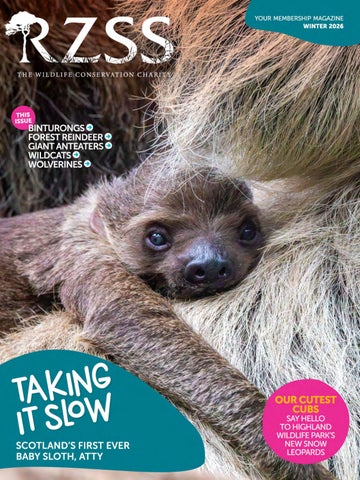
It's all about Atty Meet Scotland's first baby sloth
24
A day in the life of Solen Hang out with our chill reindeer
26
Cuddly cubs Highland Wildlife Park's snow leopard twins
30
Saving Scotland's wildcats Inside our breeding for release project
34
Seven facts about binturongs Everything you need to know
36
Babyboom Introducing our youngest arrivals
39
Explore and discover Great events and workshops for autumn and winter
42
Celebrating our community Memories Week and winter support
44
Gardening Top tips for the colder months
46
In our shops Our full festive range
49
Puzzle page Animal quizzes for our younger readers
50
Moment I'll never forget Going live on ITV's This Morning
RZSS.ORG.UK I WINTER 2026 5
6 WINTER 2026
I RZSS.ORG.UK
SLEEPINGANIMALS
Last year we took you beneath the waves for an undersea odyssey. This year we're blasting off beyond the stars in search of cosmic creatures. As you travel across the zoo solar system, you'll find hand-crafted lanterns depicting some familiar species like you've never seen them before!
Because our lanterns only light up at night and we don't want to disturb our sleeping animals, we've designed the trail to avoid any of our inhabitants who might be ready for bed during the nightly trail. However, many of our members and visitors choose to come during the day to explore the zoo and then return again that same evening to see it all in a new light.
RZSS.ORG.UK I WINTER 2026 7
DO YOU LOVEWOLVERINES?
Adopt with RZSS You can help care for Highland Wildlife Park's wolverines: rzss.org.uk/adopt
Sponsora
ildcat Are you looking for the pu rrfect gift? From £5 a month, or a one-off donation of £60, you could help save the Highland tiger and give a truly unique and memorable gift.
([;{J Saving \f'~
. ..
Wildcats
.. ·. #SWAforUFE
Your gift will include a welcome pack and exclusive updates. Visit our website for gift options and more information about the cats you can sponsor!
Find out more at savingwildcats.org.uk/gift
EDINBURGH NEWS GET TO KNOW OUR HIGHLAND COWS Guests can now enjoy an unforgettable 30-minute experience with our Highland cows Nessie and Thistle as part of a new Magic Moment. During the half hour visit, you'll get to give the hairy duo a brush and feed them a snack. You'll be joined by our expert keepers in the cows' hilltop habitat to learn all about this iconic Scottish breed and discover how we look after Nessie and Thistle. Tickets for individual experiences are on sale now via the website, and you can also book a session for a group of up to 15 participants. • edinburghzoo.org.uk/experiences
GOING DIGITAL Work is underway to add digital membership cards to the Edinburgh Zoo app, making it easier than ever before to quickly enter the zoo and use your benefits within our cafes, restaurants and gift shops. Keep an eye out for forthcoming emails setting out how to use the digital cards when they've been launched. We'd like to thank all the members who got in touch to suggest adding these new virtual cards into the app, and reassure those who prefer to use their physical member cards that these will still be welcomed across Edinburgh Zoo and Highland Wildlife Park.
This year we've launched a free Wills writing service for members in partnership with two trusted providers. You can create your Will online, over the phone or in person. There is no obligation to do so, but you may choose to remember RZSSin your Will as a way to let your love of animals live on. For more information and to get started, simply call our team on 0131 314 0391 or visit rzss.org.uk/gifts-in-wills RZSS.ORG.UK I WINTER 2026 11
Discover a World of Chocolate in Edinburgh
If you head down to Highland Wildlife Park this October, you'll be in for a big surprise: Brodie is heading back home. Five-year-old Brodie has been enjoying a gap year in Yorkshire Wildlife Park since late 2025, enabling building works to be carried out on his Highland habitat. While on his holiday he was able to see his brother Hamish, who also moved to Yorkshire from Scotland five years ago, and the team there have kept his Highland keepers updated on how he's doing. Now it's time to come home. With the work completed on the ha6itat Brodie is due to arrive back in the Cairngorms ahead of the October school break - and he'll be joined by a fellow polar bear on the journey north. Visitors can a so see Arktos and Walker, the park's other male polar bears, who re fast friends.
Magic:;Moment wit riya the re panda, offering a unique chance to get up close with a very special furry friend. During the half hour experience you'll be guided by one of our expert keepersas you meet Priya,give her a tasty treat and discover all about her behaviour, lifestyle and habitat. Booking is open now via the website, with opportunities availableon Mondays and weekends. • highlandwildlifepark.org.uk/ keeper-experiences
This summer, the Caimgorms were badly affected by wildfires. While Highland Wildlife Park wasn't directly impacted, the full consequences of the wildfires on local wildlife and habitats have yet to be assessed. Certainly the visible impact of the wildfires is likely to last for many years to come, but we remain hopeful that nature will prove resilient and be able to regenerate. Forestry and Land Scotland (FLS) have already noted the emergence of a bright orange 'fire fungus' (shown right) in fire-damaged areas of the Caimgorms National Park. Working alongside our partners, we will do all we can to help the region recover and rebuild from the damage. As an organisation, RZSSis hugely grateful to the firefighters, landowners and managers, gamekeepers, farmers and dedicated partners for their efforts in dealing with the fires. We also thank the local community for their compassion and cooperation during a difficult time and we look forward to working with them to continue supporting key wildlife species during the recovery process.
A brand new self-service dog kennel block has opened at Highland Wildlife Park, offering your pet pooches a safe place to stay while you visit the park. Each kennel is 4ft by 10ft, giving enough room for medium to large breeds and, depending on the individual dogs, multiple pets within one space. Arranged in blocks of four, each kennel has a concrete outdoor run and an indoor area. Water bowls are available too, and you're welcome to leave toys, food and bedding for your dogs to use during the day. Kennels should be booked in advance at highlandwildlifepark.org.uk/dog-kennels
RZSS.ORG.UK I WINTER 2026 13
WILDCATS CAIRNGORMS, SCOTLAND A video recorded by Saving Wildcats at Highland Wildlife Park has captured the first ever footage of a wildcat giving birth on camera. Skye became a mum to two healthy little ones, bringing the total number of wildcat kittens born at the conservation breeding for release centre in 2026 to seven. Saving Wildcats team leader Estelle Morgan said: "Having a birth captured on camera is an incredible resource for wildcat conservation. For the first time we can closely study the behaviour of a wildcat during labour and immediately after birth." When they're ready, the kittens will move into pre-release enclosures to continue preparing for life in the wild. They could then be eligible for release in 2027, potentially joining the growing population of wildcats in the Cairngorms National Park. Discover more about Saving Wildcats on page 30.
GIANT ANTEATERS BRAZIL A wild giant anteater sponsored by an RZSSsupporter has established a new home range in Brazil, setting the scene for her to hopefully become a mother. Known as Sandy, the anteater is tracked by a GPS collar to monitor her movements and allow conservationists to check that she remains healthy. Unlike with many other mammals, it is female giant anteaters who leave their birthplace and set up a new home territory elsewhere. Over the summer, Sandy's GPScollar showed that she moved around 12 miles from where she was first seen, settling in an area with a range of native trees, open fields and water sources. Veterinary and field teams from ICAS,our local partners, located Sandy in June to carry out some health checks and replace her GPS collar. They found her to be in excellent health and condition and will continue to monitor her. We are hugely grateful to all those who support the work done with giant anteaters, including individual supporters and our members.
14 WINTER 2026
I RZSS.ORG.UK
POND MUD SNAILS PENTLAND HILLS, SCOTLAND The release of almost 4,000 pond mud snails into the Pentland Hills last year has proven to be a success, with the molluscs re-discovered by the RZSS team and RSPBecologist Clive Walton in all three new release sites. That means that these small but mighty aquatic snails, which are each around the size of a fingernail, survived through the winter and are settling into their new homes. The conservation team leading the project continue to survey the relevant ponds regularly and monitor the progress of the released pond mud snails in the hope that they will see them grow and thrive.
SAND CATS UZBEKISTAN
SCIMITAR-HORNED ORYX
An image capturing two individual sand cats in the same frame is the latest cause for celebration among conservationists working to support these rare and elusive felines. The photograph is one of three recent images of the cats - a remarkable feat given that only 15 confirmed records have been made in the last 16 years in the country as a whole. One of the records shows a juvenile, suggesting that sand cats are actively reproducing in the Kyzylkum Desert of Uzbekistan. These successes happened just two months into a new camera trap project, which it is hoped will capture further records in the future. Local expert Mariya Gritsina is leading the conservation efforts on the ground, with support from a coalition of international organisations including RZSS,Nordens Ark, the Institute of Zoology, Academy of Sciences of the Republic of Uzbekistan and the German GIZ ILUCA.
CHAD There are an estimated 650 scimitar-horned oryx living in the wild in Chad, just 26 years after the IUCN Red List of Threatened Species declared them Extinct in the Wild. Huge efforts made by governments, NGOs and zoos have turned things around for this antelope, which is now back in the wild and listed as Endangered. Since 2012, RZSShas been involved in this international initiative through our genetics lab, RZSSWildGenes. Currently led by conservation programme manager Dr Alex Ball, the team at Edinburgh Zoo have provided crucial analyses of genetic diversity within the captive global population and helped select the most suitable individuals for release into Chad. This has been due to strong partnerships, especially with the Environment Agency Abu Dhabi, and has included groundbreaking work to trial new genomic techniques.
RZSS.ORG.UK I WINTER 2026 15
A European grey wolf has 42 powerful teeth, each with an important job. Sharp front teeth grip prey, while long canine teeth help hold it still. Strong back teeth slice through flesh, letting the wolf eat quickly before other animals arrive. These amazing jaws help wolves work together to hunt and survive in the wild.
16 WINTER 2026 I RZSS.ORG.UK
An Eastern white pelican's enormous beak is like a built-in fishing net. Its stretchy throat pouch scoops up fish along with lots of water, which is then tipped out before it swallows its catch. On hot days, the pelican can even turn its throat pouch inside out and flutter it to help cool itself down.
A Sumatran tiger's mouth is built for hunting. Long, sharp canine teeth help it grip prey securely and its rough tongue, covered with tiny, backwardpointing spines, called papillae, can scrape flesh from bones. The papillae give its tongue a rough texture that the tigers use to keep their beautiful coats clean.
ANIMALFACTS
Nubian giraffes love eating acacia leaves, even though the branches are covered in sharp thorns. Their long, dark tongue and tough lips carefully wrap around the leaves while avoiding the prickles. Thick saliva also helps protect their mouths, making it easier to enjoy a thorny meal that many other animals would avoid.
A giant anteater doesn"t need teeth to enjoy dinner. Instead, it uses its long, narrow snout to reach deep inside ant and termite nests. Its big sticky tongue flicks in and out many times each minute, gathering thousands of tiny insects before they even have a chance to escape.
A vicuna spends much of the day grazing on tough grasses, so healthy teeth are essential. Keepers regularly check their mouths to make sure teeth are wearing down evenly and causing no problems, which is vital as their teeth never stop growing. Good dental care helps these gentle animals chew in peace and stay healthy.
A gentoo penguin's mouth is lined with tiny backward-pointing barbs on its tongue and the roof of its mouth. These aren't teeth, but they work like hooks to grip slippery fish and squid. Once prey is caught, the barbs help guide it straight down the penguin's throat without letting it wriggle free.
RZSS.ORG.UK I WINTER 2026 17
hether it's tartan, television or Robert Burns, Scotland has many instantly recognisable icons. A recent addition to this remarkable roster is Edinburgh Zoo's Atty, who, at just a few months old, holds the impressive title of being the first-ever sloth born in Scotland. The first little one for six-year-old parents Feira (Fe) and Nico, this tiny Linne's two-toed sloth (Cho/oepus didactylus) made his way into the world on 11 May 2026. The baby boy was named in honour of veteran broadcaster and environmentalist, Sir David Attenborough, who turned 100 years old just days before Atty's arrival, and who notably once said he'd be a sloth if he could be any animal for a day. For team leader Jess Brown and her team, Atty's arrival marks a significant milestone for the zoo's five-year journey of looking after its snuggle of sloths. Tve worked with Fe since she arrived at Edinburgh Zoo in December 2020, when she was ten months old.
We've watched her grow into a majestic 12kg queen sloth. This is big for adult females, who typically weigh 7-Skgs," says Jess, who's worked at the zoo since 2012. "Everything's done at Fe's pace but she's great to work with and really enjoys the training we do with her."
In the Nico time Fe arrived at Edinburgh Zoo with a male called Moana. It was hoped the two would mate but this pairing proved not to be a perfect match. While Mo went to find love at another zoo, the Edinburgh team got to work in the hopes of pairing Fe up with another partner. In June 2023, Nico entered the picture.
~tty is such a cool, tenacious little guy and is already showing plenty of personali~ 1 1
JessBrown,Team Leader
"Nico is different to Fe. He's a goofball and much more energetic. At roughly 6-7kg, Nico's also tiny compared to her," explains Jess. "It'sbeen good having a sweeter, smaller male to build Fe's confidence up again. Although Fe makes sure he firmly knows his place!" Linne's two-toed sloths are found in South America's rainforests. The characteristically glacial pace of these laidback creatures helps them conserve energy. They spend most of their time living up in trees and love sleeping for up to 15 hours each day. "Sloths live solitary lives and only interact during breeding season. If a pair of sloths exist in a habitat with no signs of aggression or stress, it shows that they're calm and happy living together," says Jess. "So,although Fe and Nico have successfully parented a cub, you're not going to see any loveydovey behaviours when visiting them." Readers of a romantic disposition, however, will be happy to know that these sloths do share a love language ... of sorts. "Sloths share poo spots. In the wild, they climb down to the ground once a week to spend up to half an hour RZSS.ORG.UK I WINTER 2026 19
0
pooing and peeing, which makes them vulnerable to predators," says Jess. "AtEdinburgh Zoo, Fe and Nico tended to poo separately every five days but then began using the same spot on the same day," she adds. "Fe started going to the toilet more often, with research suggesting this is her way of communicating with Nico via pheromones and scent. It's not exactly love at first sight, but it's romantic communication the sloth way!" The clue is in the poo Sloths don't show any visible signs of pregnancy and using ultrasound to find out is difficult due to their thick hair and large bladders which hide the uterus. However, changes in Fe's toilet etiquette was just one indicator that made Jess and the team wonder if she may be expecting. "About two months before Atty arrived, we thought Fe was looking quite pear shaped, so we kept a close eye on any other subtle behavioural changes. When you work as closely with animals like Fe as we do, you get a clear picture of their moods and behaviours. This makes it easy to spot when something is going on for them," details Jess.
"Febecame increasingly active, especially in the weeks before Atty's arrival. She was pooing every day and eating more dirt to boost her mineral intake," Jess adds. "About 3 days before Atty was born, Nico became really subdued. We didn't know what was causing it, but after Atty was born we realised she was giving him signals demanding space." Atty's unexpected arrival on the morning of 11 May was a pleasant surprise. "Our keeper, Megan, and volunteer, Freya, came into the enclosure to check Fe and Nico as usual. Fe started walking along the rope above them and they both noticed a tiny furry bundle on her," says Jess.
Watching Fe grow into motherhood feels like a nice fullcircle moment. We're all so proud of her" 11
JessBrown,Team Leader
"Fe really wanted Megan to see the baby because she was dangling down in front of her, chest exposed, holding Atty. I like to think she was like: 'Look, my baby!"' Seeing Fe handling motherhood so well has been a real source of pride for Jess and colleagues. Atty's happy and healthy disposition is also testament to the team's dedication in caring for Edinburgh Zoo's sloths. "Pregnancy lasts 10 months for Linne's two-toed sloths. We worked hard during this time to keep Fe healthy and her stress levels low. Atty's arrival is a sign we're doing things right," says Jess. "Fe'san amazing mum to Atty. Watching her grow into motherhood feels like a nice full-circle moment. We're all so proud of her," Jess smiles. "Although Nico has no role to play in bringing up Atty, he hasn't been interfering and is showing no signs of aggression, which is exactly what we need from him." Seeing Fe be a mum has also offered the team glimpses into sloth behaviours they've never witnessed before. "AfterFe had Atty, we watched her pass the placenta and eat it all,"says Jess. "These herbivores usually feed on
RZSS.ORG.UKI WINTER 2026 21
e
leaves and vegetables, so it was amazing to see her deep-rooted instinct kick in to help her replace the nutrients she'd lost during pregnancy in this way." Working with a baby sloth has been another enviable first-time experience. "Caring for Atty has been so special. He's such a cool, tenacious little guy and is already showing plenty of personality," says Jess. "For the first 6-7 months, he'll spend most of his time gripping tightly to Fe's stomach before venturing on his own. He's only going to get cuter the more independent he becomes!" Sloths require intricate care. They're extremely sensitive to temperature, which is why the humidity of their Edinburgh Zoo habitat is always kept above 70%. A sloth's diet also needs to be extremely specific. Their digestive system features a large, multichambered stomach which it can take up to a month for food to pass through. This helps sloths extract as much goodness as possible as from the leaves, twigs and fruits they munch on.
Linne's two-toed sloths are surprisingly strong swimmers - moving up to three times faster in
Gut instinct "Sloths can starve with a full stomach if their gut bacteria can't break down food given to them. Oftentimes, they're brought out of the wild and don't survive because of this," says Jess. "During his first hours, Atty was taking food from around Fe's mouth. This sharing of bacteria helps develop Atty's gut cultures and teaches him what's safe to eat," she adds. "Because we hand feed our sloths during Animal Experiences and Keeper
talks, I didn't want Atty eating anything that might upset his digestive system. But he quickly showed that he wanted more food, so we've been gradually giving him pak choi and chicory leaves, as well as browse collected here by our Gardens Team. He's got a good appetite and is still drinking mum's milk too. "The bigger range of things we feed Atty at this age, the more varied his diet will be when he's older." With feeding spaces, shelters, big ropes and branches mimicking those found in wild forests to help keep their feet, muscles and claws healthy, Fe, Nico and Atty's walkthrough habitat is designed to meet every sloth's need while allowing visitors to view these animals going about their day. Atty has taken to his new environment with ease. "Weopened the sloth enclosure two days after Atty was born. This is the environment Fe knows, so it wasn't strange to Atty either. He senses when mum's relaxed and happy," says Jess. "This experience has reinforced in us to trust that Fe is doing what's best for her and Atty.Us keepers are lucky to have such a brilliant relationship with Fe. She's become so comfortable with us working in proximity with her. Atty will continue to pick up on this as we work with him." Although Linne's numbers are classified as Least Concern by the IUCN,other sloth species throughout Central and South America are under threat from habitat loss caused by deforestation, the illegal wildlife and pet trade and infrastructure expansion. Atty's arrival is doubly significant. Not only is he the first ever sloth born in Scotland, but he's also an ambassador for his relatives in the wild. "RZSShas been supporting conservation partners in South America for over a decade. This includes the Giant Armadillo Conservation Project, which established the first long-term ecological study of endangered giant armadillos, and the Anteaters and Highways initiative, which tracks giant anteaters to understand how they're responding to increasing roads crossing their habitats," says Jess. "Attywill connect people more closely to nature while raising awareness of how we can help create a world where nature is protected, valued and loved." ■ RZSS.ORG.UK I WINTER 2026 23
8:30am Breakfast time with sugar beet, pellets and fresh boughs. 9:30am A time to relax and ruminate after breakfast. 11:30am Morning snack of boughs. 12pm Afternoon zoomies to burn off breakfast. 1:30pm Lunchtime of boughs and pellets. 2:30pm Skiddling in the water trough to cool off. 4pm Afternoon snack time. 5:30pm Dinner and a quick check-in from the keepers. 8pm Bedtime and all the reindeer settle in for the night.
0 PEAN Tl-IE. EUR. fORE.ST E.INDE. From his impressiveantlers to his calm personality,Solen has become a familiar favourite at Highland Wildlife Park
V
isitors may remember Solen as one of two European forest reindeer calves born at Highland Wildlife Park in 2020 alongside his brother, Regnar. After spending three years at ZSL Whipsnade Zoo as part of the European breeding programme, Solen returned home to the Cairngorms earlier this year. His arrival comes at an important time. Following the sad loss of both his father, Sven, and brother, Regnar, Solen is now the only male European forest reindeer in the UK. For hoofstock keeper Rob O'Brien, every day with Solen usually starts the same way - with a big, warm welcome. "By the time we reach the reindeer habitat around 8:30am, he's usually waiting for us," Rob says. "Breakfast is always the first priority." Solen enjoys a hearty morning meal of sugar beet and specially prepared pellets before browsing branches, known as boughs, hung around the habitat. Willow is his favourite, while lichen is an
24 WINTER 2026
I RZSS.ORG.UK
irresistible treat during ranger talks. Then after breakfast, it's time for a well-earned rest. As with other members of the deer family, reindeer spend part of their day ruminating, chewing their food again to help digest it properly. Yet while many reindeer would be happy to laze the whole day away, Solen often gets the lunchtime zoomies. "When we go into the habitat with fresh food or boughs, he'll often come charging over," Rob laughs. "He makes these loud slapping sounds with his hooves as he runs. It can look quite intimidating but it's actually a really good sign that he's feeling happy and confident." And during the hot summer, Solen has a favourite afternoon pastime skiddling about in the water! "Whenever I put water in, he's straight over," Rob said. " He loves fresh water and he will put his front feet into the water, which makes it instantly mucky again - which as a keeper I just love."
Solen is now six years old and Rob says he has a wonderfully placid nature. "He's very easy-going and he's gentle with the females. He doesn't bother them, he's consistent and calm." One of Rob's favourite parts of caring for Solen is watching his antlers grow. Reindeer antlers are the fastest-growing bones of any mammal, sometimes getting larger by as much as an inch every day. Remarkably, both male and female reindeer grow antlers, making them unique among deer species. As the seasons change, so does Solen. His sleek brown summer coat will soon become a much thicker winter one, to help him cope with freezing temperatures. Even his wide hooves change through the year - harder in winter for digging through snow to find food, softer in summer for walking across muddy ground. Life with Solen is never quite the same from one season to the next. "One week I'll come back after my days off and his antlers have changed completely," Rob says. "That's what I love most about working with reindeer. Every season brings something new." ■
Rob O'Brien, Hoofstock Keeper, Highland Wildlife Park
T
here are few moments that bring quite as much excitement to Highland Wildlife Park as the arrival of a new baby animal. But when those arrivals happen to be two rare snow leopard cubs - the first born at the park in four years - the celebrations are even bigger. Born on 25 May to first-time mum Pari and dad Koshi, the fluffy twins boy Indra and girl Tama - are already capturing hearts. For the dedicated team who care for them every day, these cubs represent far more than an irresistible dose of cuteness. They are an important milestone for a Vulnerable species whose numbers continue to decline in the wild.
Livingstone. "I think visitors will have a much higher chance of seeing them because they'll be spending more time exploring. They'll be playful, climbing on the logs and structures, hiding from each other and pouncing out. They'll really be starting to come into their own." For the keepers, the cubs' arrival was the culmination of months of careful planning, not to mention a fair amount of nervous anticipation. Pari only arrived at Highland Wildlife Park in April 2025, and introducing two adult snow leopards is never something to rush. The team first allowed Pari and Koshi to see and smell one another before gradually building up
the amount of time they spent together. Fortunately, their personalities proved to be a perfect match. "Koshiis such a lovely individual," Michael explains. "He's got a really gentle personality, so the introductions went really smoothly. They got along so well that we gradually increased the time they spent together until they were staying together overnight." When the pair successfully mated, Michael admits he was convinced cubs were on the way. "Iremember writing it down in my notes thinking, 'That's it - we're having cubs!' Looking back, there were still so many things that could have gone wrong, but I was determined to stay positive." GET READY FOR CUBS
PLAY, CLIMB AND POUNCE By the time you read this, Indra and Tama will have changed dramatically from the tiny, blind newborns first seen curled up beside their mum. If you're planning an autumn visit to Highland WildlifePark, you're in for a treat. "They'll be much bigger and much more confident," says carnivore team leader at Highland WildlifePark, Michael
As the expected due date approached, the
team prepared the habitat, making sure Pari had the peaceful surroundings she would need if she was pregnant. "We wanted to make sure she felt completely comfortable," Michael says. "We kept things quieter around the habitat and adjusted our routine so she could settle." Even then, there were moments when uncertainty crept in.
0
"Because we couldn't confirm the pregnancy, there was always that little bit of doubt. We'd seen weight gain and other signs, but you start wondering whether it's really going to happen." Then one morning, everything changed. Using cameras installed inside the den, the keepers first heard tiny squeaks before catching their first glimpse of the newborn cubs. "It was incredibly exciting," Michael remembers. "Atfirst we didn't even know how many cubs there were. We just knew that Pari had given birth and everything seemed to have gone well. That was such a relief." FAST GROWERS Snow leopard cubs are born completely helpless. As with domestic kittens, they arrive with their eyes closed and rely entirely on their mother for warmth, protection and milk during their first weeks of life. Watching them growing up so quickly has become one of the highlights of every keeper's day. "When they were born they hardly moved around at all,"Michael says. "Now every week you can see them changing. They're exploring more, wrestling with each other and becoming much more inquisitive." Although they're still young, Indra
and Tama's personalities are already beginning to show. Even in their first few weeks the duo were visibly different from each other. "When they were young, there was one cub that was bolder than the other," Michael laughs. "One would come right over to us to see what we're doing, while the other hung back a bit more. It was still interested, but more, Tm quite happy staying over here, thank you!"' Like many siblings, Indra and Tama also spend much of their day practising the important skills they'll need later in life through play. "Atthe moment it's lots of play fighting and little wrestling matches. By autumn, I think that will become much more intentional. They'll be hiding from each other, pouncing, chasing and climbing around the habitat."
Who doesn t love watching kittens playing? Then you add the fact theyre fluffy snow leopards and it becomes even better 11
1
11
Michael Livingstone,CarnivoreTeam Leader
For visitors, these playful moments are likely to become some of the highlights of a trip to the park. "They're really not that different from domestic kittens at this age," Michael smiles. "Who doesn't love watching kittens playing? Then you add the fact they're fluffy snow leopards and it somehow becomes even better." While the cubs are stealing the spotlight, Michael is just as delighted with how Pari has embraced motherhood. "There is always that little bit of worry," he says. "Firstlitters aren't always successful, so we were very cautious at the beginning." Instead, Pari has exceeded every expectation. "Honestly, if I'd imagined the perfect outcome, it's gone pretty much exactly that way." The cubs are thriving - something Michael jokes is obvious just by looking at them. "They're wee fat things now," he says with a grin. 'That's exactly what you want to see." Just as importantly, Pari has remained calm and confident throughout. "She's incredibly attentive without being overprotective. She keeps an eye on the cubs, but she doesn't become stressed when we're nearby." The keepers already had a strong relationship with Pari before she became a mum, thanks to regular positive reinforcement training that helps make veterinary care less stressful. "That trust has really helped," Michael explains. "She's still comfortable with us being around, which has made the gradual return to our normal routine much easier." Some of his favourite moments are the simplest ones. "Seeing Pari lying on her back while the cubs climb all over her, or watching them all curled up together asleep they're just lovely little moments." FAMILY MATTERS Unlike lions, snow leopards are naturally solitary animals. In the wild, mothers raise cubs alone, while fathers play no part in bringing them up. That means dad Koshi is currently living separately. "He can still see and smell them from his habitat, but he doesn't have
28 WINTER 2026
I RZSS.ORG.UK
a role in rearing the cubs, which is exactly what we'd expect in the wild," Michael says. Instead, Pari is teaching the twins all they need to know. Something as simple as the cubs chasing her swishing tail becomes a lesson in coordination, balance and hunting behaviour. As they grow, they'll continue developing through exploration and play, gradually becoming stronger, more agile and more independent. Michael says that by autumn, "They'll still be playful but they will be much more confident. They'll spend more time outside, climbing, investigating new things and interacting with each other." For the keepers, the first weeks after the birth involved an unusual amount of patience. Rather than rushing in, they deliberately stayed away to give Pari the quiet environment she needed. "For those first couple of weeks we didn't even go into the habitat," Michael explains. "We put food and water in through the bars and monitored everything on the cameras." Only once Pari completely relaxed did they begin increasing their presence. "We started with once a week, then twice a week, gradually building back up. If she'd shown any signs of being uncomfortable, we'd have stepped back immediately."
THE BIGGER PICTURE Thankfully, Pari accepted each stage with remarkable confidence. "Now we're almost back to our normal routine. It's become one of the highlights of every day, going up to see how everyone is doing." As impossible as it may be to look at the cubs without smiling, Michael hopes visitors also remember the bigger picture. Snow leopards are found across the mountains of Central Asia, where habitat loss, climate change, declining prey populations and illegal hunting continue to threaten their survival.
By autumn theyll spend more time outside, climbing, investigating new things and interacting with each 11
11
Michael Livingstone,CarnivoreTeam Leader
Every cub born within the international conservation breeding programme helps safeguard the future of the species and inspires people to care about the wellbeing of snow leopards living in the wild. Pari and Koshi's youngsters will grow up as ambassadors, helping thousands of visitors connect with an animal they might otherwise never encounter. That connection is something Michael sees every day. Some visitors already spend hours waiting patiently for a glimpse of the cubs emerging from the den. By autumn, those magical encounters should become even more common. If you're lucky enough to see them, Michael has one piece of advice. 'Watch them playing together," he says. "Andwatch the moments between the cubs and Pari. Seeing them chase her tail or tumble around with each other is just so lovely." Those playful scenes may look carefree, but they tell an important story. Every leap, every pounce and every curious exploration is part of two young snow leopards learning the skills they'll carry into adulthood. And for the keepers who have watched them grow from tiny squeaks on a camera to confident young cubs, it's a privilege to witness. ■ RZSS.ORG.UK I WINTER 2026 29
cotland's national animal is the unicorn, but the wildcat is certainly a contender to become second-in-command. Not only are wildcats actually real (even the brilliant scientists at the Royal Zoological Society of Scotland would have a hard time trying to breed a mythical creature), they have also been an important part of our heritage for thousands of years. Now on the edge of extinction in this country, a vital partnership project led by RZSSis helping to secure a future for this feisty feline, nicknamed the 'Highland tiger'. Dr Helen Senn, head of conservation and science programmes at RZSS,is the project lead for Saving Wildcats. She and the team have celebrated several major achievements over the past few years. It all kicked off in 2023, with the first cohort of 19 wildcats that were bred in the conservation breeding for release centre at Highland WildlifePark being released into various locations around the Badenoch and Strathspey area of the Caimgorms National Park ·That was obviously a significant milestone,· reflects Helen. ·The earliest evidence of wildcats in Scotland dates back to about 7,000 years ago, and as far as we know, 2023 was the first time the trend of population decline had been reversed since then, so that's exciting.·
Wildcats have endured persecution, habitat loss and hybridisation (interbreeding) with domestic cats, and by 2019, there was no longer a viable, self-sustaining population living in the wild in Scotland. ·rn the Cairngorms there would have once been thousands of wildcats, with hundreds of thousands across Scotland, and they were present all over Britain as well,· says Helen. ·we've now released 50 wildcats into the wild,· she continues. In 2024, the patter of tiny paws heralded the arrival of wild-born kittens, with more bundles of fluffy joy and hope in 2025 and 2026. ·we are still at a very vulnerable point for this species," Helen adds. ·conservation work is not finished once you put a few animals out there. It's going to be a decades-long commitment to support the wildcat's recovery." Back in the landscape The next phase of the project, running from October 2026 to March 2028, is backed by a grant of over £400,000 awarded by the Scottish Government's Nature Restoration Fund, managed by NatureScot. "Our plan is to release more cats at more sites in Badenoch and Strathspey, and to continue our work with the local community to really make sure that they get the benefits from wildcats being back in the landscape," Helen reveals.
For now, the main focus is creating resilience. ·oiseases emerge - we know that domestic cats carry a lot, and there are also diseases like bird flu that can potentially affect cats," says Helen, ·plus we live in a world where we have climate change." This summer's devastating fire in the Caimgorms was particularly worrying for the Saving Wildcats team. "It's too early to tell what the impacts of that fire will be on the wildcat population, but it's probably destroyed a large amount of habitat," she explains. "Cats might have moved away from established territories, and breaking up that structure could increase the risk of hybridisation with domestic cats. They might be more likely to cross roads, and roadkill is one of the biggest causes of mortality. "We'vegot a changing environment that's managed by humans, and for a species to be resistant over decades and centuries you need to have larger numbers in the population, and they need to be unrelated. We call that genetic diversity.We've got to keep releasing more cats to boost the population." A marker of success will be having a sufficient number of female territories in the wild. ·The absolute minimum for that is probably 30 territories, and we're about halfway there," says Helen.
0
Introducing genes from Spanish wildcats, which are closely related to those in Scotland, will also help improve that diversity and adaptability. New monitoring techniques will be trialled to keep track of the cats, such as using audio recorders to identify them by their mating calls. So far,the wildcats have proved delightfully surprising, and they've even been spotted swimming across the RiverSpey! "One of the great things about projects like this is that we learn by doing," says Helen. "When a species is close to extinction, often you can't study it scientificallyanymore because you can't find it in the wild, and even if you can find it, you know you don't have the sample size to say anything meaningful. As soon as you start reversing that, if you monitor the animals that you release carefully, you really start to learn a lot." Members of the public can play a role in piecing together the wildcats' comings and goings by reporting any sightings, and those living in the area can help by neutering pet cats to avoid crossbreeding. There have been instances of hybridisation already, and Trap-Neuter-Vaccinate-Return work with the Strathspey branch of Cats
We're monitoring the wildcats, but they don't belong to us. They belong to Scotland" 11
Dr Helen Senn, Head of Conservation and ScienceProgrammes
Protection is ongoing. "We've formalised our very good relationship with them, and they will have their own dedicated staff focusing on the management of feral domestic cats to support our wildcat releases," explains Helen. Harmonious coexistence Most locals welcome the return of wildcats, though there have been some understandable tensions caused by the cats predating poultry and game birds. The project team will carry on working with residents and businesses to find solutions and ensure a harmonious human-carnivore coexistence. The independent, courageous wildcat is symbolic of the wild spirit of the Highlands, and features on various clan crests. "We do a lot in
the community to strengthen their connection with wildcats," Helen notes. Earlier this year, Saving Wildcats and the Aviemore and Glenmore Community Trust commissioned artist Michael Corr to paint a beautiful wildcat mural at Glenmore Visitor Centre, introducing tourists to this iconic species; fun outreach activities with schools help pupils learn about (and love) their new furry neighbours; and individuals and groups have been hosting screenings of Clinging by a Claw, a film that invites viewers to join the wildcats on their journey back from the brink. Fostering a collective sense of pride in the wildcats and a shared responsibility for their wellbeing will remain an essential aim of this second phase. The wildcat's cultural roots run deep, and preserving and promoting that rich historic relationship is as important as the science itself."Wehave to get the science right," says Helen, "and the high survival rates that we've had among released wildcats is testament to the level of attention to detail we've put into that side of things. "Once they're in the wild, however, we want them to be seen as everybody's cats. We're monitoring them, but they don't belong to us. They belong to Scotland."■ RZSS.ORG.UK I WINTER 2025 33
Meet Tenzin and Teshi at Edinburgh Zoo, our wise tree-dwelling duo who are often mistaken for either bears or cats. Hailing from South and Southeast Asia, their shaggy coats and gentle demeanours make them a furry favourite.
WHO AM I?
WILD WANDERERS
NOT TOO FUSSY
On first glance, it's not easy to tell exactly what sort of animal a binturong is. Their nickname bearcats - is misleading: they are neither cats nor bears. Even their scientific name doesn't help much, as it translates to bear-weasel.
Binturongs are forest-dwellers and spend most of their time in the trees. They are found in many different countries across Asia, including India, Nepal, Thailand and Vietnam. One of the biggest challenges
In the wild, binturongs enjoy a wide diet, chomping away on everything from fruit and berries to small animals, including worms, insects, birds, rodents and fish.
Binturongs are actually part of the family Viverridae, which includes civets and fossas.
they face in the wild is deforestation and wild populations have been decreasing.
34 WINTER 2026
I RZSS.ORG.UK
These furry omnivores have even been seen scavenging on other animals' already-caught prey, as well as their eggs.
DID YOU KNOW?
SPREADING THE SEEDS
CHATTY CLIMBERS
Binturong poop plays an important role in forest life. The mammals love eating fresh figs, especially a type called strangler figs, but the seeds don't get digested fully. That means that when binturongs poo, the seeds are still able to grow. This cycle helps to spread new fig trees throughout the forest and, years later, more binturongs get to enjoy fresh figs as a result.
When it comes to communicating, binturongs have a few different options to choose from. They make a whole range of noises, including purrs, chuckles, snorts, grunts and howls. When walking around, they often make a short hissing sound. Binturongs have also been seen using their strong tails to communicate, as well as to balance.
SWEET SMELL
TIGER, TIGER
Binturongs can release a very special smell to ward off predators and mark their territory. While other animals, such as skunks, use a horrible stink as a defence, the binturong produces a scent best described as like buttered popcorn. The smell comes from chemicals in their pee and they drag their feet and tails through the urine to help spread it behind them as they move around.
While most at home above the forest floor, binturongs do have to occasionally drop down to scamper across to the next tree. This is when they are most at risk of crossing paths with one of their only predators: tigers. If their popcorn-scented defence doesn't work, binturongs are known to use poo, pee and their sharp teeth to try and fight off any attackers.
RZSS.ORG.UK I WINTER 2026 35
SNOOT THE GIANT ANTEATER Though not yet as giant as his species name suggests, Snoot has grown massively since he was born in April.For the first few months he enjoyed getting piggybacks from his mum, Gizmo, who carried him around as she explored their hilltop habitat together. More recently Snoot has been spending short periods of time away from Gizmo, which in August allowed keepers to safely examine him and discover he was a boy. However, expect to mostly see him on piggyback again this autumn as he cuddles up to his mum.
PIPER THE PYGMY HIPPO Mum and dad Otto and Gloria welcomed their newest baby, Piper, in July. The young pygmy hippo, the first to be born to the couple since social media sensation Haggis in October 2024, is doing exceptionally well in Gloria's care. Named in honour of the bagpipes - senior hoofstock keeper Jade Robertson describes her as "a little bagpipe always making cute little huffs and puffs" - she will quickly grow this autumn thanks to her mum's nutritious milk.
BRU THE CAPYBARA Another young one named in honour of something iconically Scottish, Bru the capybara has seen a growth spurt this summer. As with many other rodent species, capybaras quickly mature into adults and Bru is no exception - although that's not to say he's any less cute now than he was when he was born in May. It is hoped that our resident capybaras might breed again, which could mean more baby-baras in 2027 and beyond.
This summer, we captured the first ever footage of a wildcat being born. In fact, two kittens arrived at the Saving Wildcats breeding for release centre in Highland Wildlife Park, born to mum Skye. Head to page 14 and page 30 for more on this
KANTUTATHE RED-FRONTED MACAW A colourful new hatchling arrived this summer! Our young red-fronted macaw is named Kantuta after the national flower of Bolivia,the native home of these beautiful birds. Parents Frederic and Zaelia are working together to raise their chick and will remain as partners for life.We are proud to manage the European breeding programme for this Critically Endangered species, which has been badly affected by habitat loss.
PENGUIN CHICKS If you've ever visited Edinburgh Zoo
during penguin breeding season, you'll know just how brilliant it is. In April and May we welcome both gentoo and Northern rockhopper chicks to Penguins Rock, and these fluffyhatchlings keep their parents busy all summer. Weighing between 60-100g when they hatch, this year's arrivals have been great additions to our penguin colonies. In August, Scotland's first king penguin egg in 17 years was laid at the zoo, and we can't wait to welcome the hatchling.
MORE ARRIVALS Don't miss our full features on our other very special arrivals, Atty the Linne's two-toed sloth on page 18 and Indra and Tama the snow leopard cubs on page 26.
RZSS.ORG.UKWINTER2026 37
0 GRAPJ-IY NATURE Pt-Pr W0 RKsl-lOP ■ Highland Wildlife Park Sunday 4 October
There are still spaces left on our much-loved full-day workshop at Highland Wildlife Park. Grab your camera and book your spot. Member discount applies • highlandwildlifepark.org.uk/ nature-photography-workshops
WILDD1SCoVERY DAYS ■ Edinburgh Zoo On selected dates between October 2026 and February 2027, we're hosting celebration days with themed talks, pop-up engagement activities and crafts relating to different zoo topics. Why not come along and find out something new on your next day out at the zoo? Free with your RZSSmembership • edinburghzoo.org.uk/wild-discovery-days
EDINBURG~ CONSERVATION FILMFESTIVAL ■ Highland Wildlife Park Saturday10 October lpm-3:30pm Lights, camera, conservation! The Edinburgh Conservation Film Festival is back at Highland Wildlife Park for its third year - and it's bigger, bolder and more inspiring than ever. Enjoy a 90-minute :b --'-' J programme of ~~n,.-ff·~ uplifting, familyfriendly short films celebratin~ incredible conservation success stories from around the world. Discover the people and projects helping wildlife to thrive and see how positive action is making a real difference for our planet. Member discount applies
ECFF
e highlandwildlifepark.org.uk/ECFF
0 RERS AUTUMNEXPL ■ Edinburgh Zoo
Looking for a fun way to keep curious minds busy this October break? Explorers is a three-hour adventure designed for children in P3-P7, packed with wildlife, discovery and outdoor fun. Young explorers will get up close to some of Edinburgh Zoo's amazing animals, enjoy themed games, tackle exciting activities and uncover fascinating facts about the natural world as they explore our beautiful hillside zoo. It's the perfect opportunity for children to learn, play and develop a lifelong love of wildlife. Member discount applies
■ Highland Wildlife Park 13, 14 and 15 October 10:30am-4pm Give the kids a day to remember this October holiday - a full-day adventure for explorers aged 7-11, packed with wildlife, creativity and outdoor fun. From discovering the amazing animals of Highland Wildlife Park to getting hands-on with autumn-inspired crafts, exciting games and interactive activities, every session is designed to spark curiosity and inspire a love of nature. Along the way your child will make some great memories while learning all about Scotland's wildlife and beyond. Member discount applies
• edinburghzoo.org.uk/ autumn-explorers
• highlandwildlifepark.org.uk/ autumn-explorers
13, 14 and 15 October lOam-lpm
RZSS.ORG.UK I WINTER 2026 39
zoo DONE IT? ■ Edinburgh Zoo Saturday 31 October 6pm-7:30pm
TEAANDTALKS ■ Edinburgh Zoo Our popular talk series continues at the earlier time of 11am for winter. Join us to enjoy a morning talk and brew at the zoo. Tuesday 13 October Baby boom!
This Halloween, step into Edinburgh Zoo after dark for a spine-tingling murder mystery unlike any other. As you sip on hauntingly crafted cocktails and canapes, you'll follow a trail of clues through the zoo to solve a shocking wildlife crime. Expect mystery, intrigue and plenty of surprises in this adults-only evening. Member discount applies • edinburghzoo.org.uk/zoo-done-it
WREATJ-1 MAKING 0 Ps W0 RKSl-l
FESTIVE GROTTO
■ Highland Wildlife Park
■ Edinburgh Zoo
Wednesday 18 November
28 and 29 November 12:30-3pm
5-24 December
Enrichment in action
■ Edinburgh Zoo
Make magical memories this festive season with a visit to Santa's Grotto at Edinburgh Zoo. Little ones can meet Santa himself in his enchanted grotto, located this year inside our Budongo Trail building, and enjoy a truly unforgettable 'wild' Christmas experience . .-:/' Member discount applies
Tuesday 15 December Penguins Thursday 21 January 2027
Pallas'scats and wildcats Monday 15 February2027 Hippos and hogs Member discount applies • edinburghzoo.org.uk/tea-and-talks
5 and 6 December 12:30-3pm
Get festive and craft your own beautiful 14-inch Christmas wreath using sustainably sourced natural materials. With seasonal foliage, seed heads, dried fruit and festive decorations all provided, you'll create a unique wreath that's perfect for bringing a touch of handmade Christmas magic to your home. Member discount applies
JUN1°R I-IIGI-ILAND KEEPER ■ Highland Wildlife Park
l~Wt4•t4ffl@ 13, 15 and 16 Februa 2027 1pm-3pm
Children aged 8-11 have the opportunity to go behind-the-scenes with the Junior Highland Keeper Experience. Member discount applies • highlandwildlifepark.org.uk/ junior-highland-keeper
EARLY ACCESS TOURS ■ Edinburgh Zoo 9am-10am
Join us for an exclusive 60-minute guided tour before we open to the public. Led by one of our Discovery Rangers, you'll hear exciting stories and the latest updates about our iconic animals. Sunday 25 October Myths and legends Saturda 7 November Sloths and friends Sunda 20 December
Penguins and festive fun 1 and 2 January 2027 Capy(bara)New Year Sunday 14 February 2027 Lions and love Member discount applies • edinburghzoo.org.uk/early-access-tours
40 WINTER 2026
I RZSS.ORG.UK
• edinburghzoo.org.uk/ wreath-making
• edinburghzoo.org.uk/ festive-grotto
EVENTS
discovery, adventure and hands-on fun.
BREAKFAST WITI-I SANTAChildren will meet some of Edinburgh ■ Edinburgh Zoo 19-24 December 9am-11am Treat the family to a magical morning at Edinburgh Zoo with Breakfast with Santa. Tuck into festive snowman pancakes, enjoy Christmas crafts and gather round as Santa shares a special festive story. Every child will also receive a gift to take home, before spending the rest of the day exploring the zoo. It's the perfect way to kick off the festive season and make some magical family memories. Member discount applies
Zoo's incredible animals, enjoy themed games and exciting activities and explore our beautiful hillside zoo. Along the way, they'll uncover fascinating wildlife facts and develop a deeper appreciation for the natural world. It's the perfect winter activity for curious minds and budding conservationists. Member discount applies
• edinburghzoo.org.uk/breakfast-with-santa
■ Highland Wildlife Park
FESTIVE GROTTO ATTl-IEPARK ■ Highland Wildlife Park 19 and 20 December
Add a little festive magic to your visit with a trip to Santa's Grotto at Highland Wildlife Park. Meet Santa at the Gateway, where every child will have the chance to share their Christmas wishes and receive a special festive gift. A magical experience that's sure to delight the whole family. Member discount applies • highlandwildlifepark.org.uk/festive-grotto
• edinburghzoo.org.uk/winter-explorers
0 RERS WINTER EXPL Wednesda 30 December 10:30am-3:30pm Keep young explorers entertained this Christmas holiday with Winter Explorers - a full-day wildlife adventure for children aged 7-11. They'll get to know the incredible animals that call Highland Wildlife Park home, enjoy hands-on winter crafts, take part in exciting games and activities and explore our spectacular setting in the heart of the Cairngorms National Park. From wildlife discoveries to festive fun, it's the perfect way to inspire curiosity, build confidence and create unforgettable winter memories. Member discount applies • highlandwildlifepark.org.uk/
0 RERS WINTER EXPL ■ Edinburgh Zoo 29, 30 and 31 December 10am-1pm Looking for a fun way to keep young adventurers entertained during the Christmas holidays? Winter Explorers is a three-hour wildlife experience for children in P3-P7, filled with
winter-explorers
for our penguin nests. If one of our penguins chooses your masterpiece, you'll be in with the chance of naming a chick. Pebbles are available on a first-come, first-served basis. Member discount applies • edinburghzoo.org.uk/ penguin-love-pebbles
MINIJ-IIGI-ILAND KEEPER ■ Highland Wildlife Park Sunday 14 February 2027 1pm-2:30pm New this year, we're offering children aged 5-7 the chance to get a taste of what it's like to be a zookeeper with our exciting 1.5-hour Mini Highland Keeper experience. Member discount applies • highlandwildlifepark.org.uk/ mini-keeper-experience
BEAUTY ANDTl-IE BEASTIES: VALENTINES EVENING ANDTl-IEzoo ■ Edinburgh Zoo Sunday 14 February 2027 5:30pm-9pm Be our guest this Valentine's Day for a truly ZOOnique date night! Discover how animals flirt, court and find love during a fun and fascinating wildlife talk, before getting up close in an exclusive animal encounter. Then, enjoy a romantic candlelit three-course dinner, before ending the evening with a magical stroll through Giant Lanterns. Member discount applies
PENGUIN LO\/E PEBBLES ■ Edinburgh Zoo
13-17 February 2027 10am-2pm Get creative this half term and help our penguins prepare for nesting season. Head to Lemur Lodge to paint a pebble
• edinburghzoo.org.uk/beauty-and-beasties
RZSS.ORG.UK I WINTER 2026 41
Sharing memories of the zoo This summer, we celebrated a week of nostalgia by inviting members and visitors to explore archival materials from Edinburgh Zoo's past. The display coincided with our newly digitised and documented archive being made available for research through our partnership with the University of Edinburgh's Heritage Collections. The response was touching and varied, with many longstanding RZSSsupporters revealing their own memories to our team. Among our favourite stories was that of Brian Emslie, who was born within the zoo's grounds 75 years ago. You can read some of his recollections below. Whether you have fond memories of visiting Edinburgh Zoo and Highland Wildlife Park or care passionately about endangered species, you can help to create a world where nature is protected, valued and loved. Leaving a gift in your Will helps ensure this work is continued into the future. Find out more online by visiting rzss.org.uk/gifts-in-wills
A grand day out More than 200 Brownies, Rainbows and leaders from across Inverness-shire enjoyed a special day at Highland Wildlife Park this summer. RZSSworked with local Girlguiding groups to arrange an event with subsidised entry, curated tours, animal talks and bus tours through the drive-through reserve.
Brian's reflections Self-described as the "oldest thing to be born at the zoo", Brian Emslie spent the first three years of his life living in a flat inside the mansion house while his dad worked within the zoo. He shared some favourite memories with us. "[My father] was the master of works at the zoo and supervised a lot of the building. I was born at home and my birth certificate says the Royal Zoological Gardens, Edinburgh. "I've always had an affiliation with the elephant because Sally [an elephant who lived at the zoo during Brian's childhood] was very much part of my youth. I also always loved the sea lions - I'd throw a fish off a rock and the big sea lion, he was called Philip which is my father's name, would catch them every time."
42 WINTER 2022
I RZSS.ORG.UK
Cyrenians celebration We're proud to mark three years since our partnership with homelessness charity Cyrenians was launched. In that time, we've offered free entry to individuals and families who are supported by Cyrenians, as well as their staff, giving a chance for respite and connection with the natural world. We've also created opportunities to attend community events and other special occasions, and shared careers and development skills to help build knowledge, expand resilience and increase academic gains for young people.
BECOME A PATRON GIFT A MEMBERSHIP This Christmas, you can share the joy of Edinburgh Zoo and Highland Wildlife Park with a loved one. A gift membership offers free entry to both parks plus eight other UK zoos, a subscription to this magazine, reduced price tickets for friends and family members and a 10% discount across our catering outlets and gift shops. • rzss.org.uk/support/membership
BOOKAN EXPERIENCE Join us for a Keeper Experience to enjoy a full or half day alongside our keepers. Or, if you have a favourite animal, try a
Magic Moment to make memories with an otter, capybara, meerkat, armadillo, highland cow or other animal. • edinburghzoo.org.uk/ events-experiences
VISIT OUR ONLINE SHOP Get your Christmas shopping done early - and easily - with our online shop. You'll get 10% off all purchases, from stocking fillers to clothing, using code MEMBER10. Turn to page 42 for some inspiration or head online, where you can also buy a gift voucher for someone special. • shop.rzss.org.uk
Becoming a Patron unlocks an even closer relationship with RZSS.You'll enjoy exclusive events and tours, visits to conservation projects, meetings with our specialist staff and unlimited access to Edinburgh Zoo and Highland Wildlife Park for you and three family members. • rzss.org.uk/patrons
THROW A PARTY Our Edinburgh Zoo event spaces can accommodate between 10-180 guests, and with our seasonal menus they are perfect for an unforgettable festive party. • edinburghzoo.org.uk/christmas-parties
Edinburgh Zoo is home to over 120 different species of trees, including pine, sycamore, cedar and apple trees, some with a history predating the zoo. In fact, it's worth making a trip to the zoo just to see the trees in their autumnal glory. As summer draws to a close the trees and grounds take on an enchanting and sometimes haunting atmosphere. From vibrant shades of red, dazzling oranges and mellow yellows, visitors at this time of year are in for a stunning kaleidoscope of autumnal colours to help lift the spirits when temperatures begin to drop .
FROM PATCH TO ENCLOSURE Everyone loves getting creative with pumpkins at this time of year, but at the zoo pumpkins are more than seasonal decorations: they are a tasty source of enrichment. Many of our animals enjoy tucking away on them and as nutritious sources of vitamins, keepers are all too happy to oblige. You might notice similar seasonal produce being used at different times of year depending on what's available and what our animals most love playing with or snacking upon. With the pumpkins, food is usually hidden inside them, encouraging the animals to be inquisitive, explore and of course nibble. If you're lucky enough to have pumpkins in your own home patch or have some left over from your Halloween celebrations, you'll find that British wildlife is as partial to pumpkins as our tigers are. Tum them into food for visiting birds by cutting the pumpkin in half to form a shallow bowl. Then push two sticks through the base, ensuring they cross in the middle and stick out the side, and tie string around the sticks to allow for suspension from a tree before filling it with bird seed. Keep them off the ground: pumpkins are poisonous to dogs and hedgehogs.
Mulch ado While the days are getting shorter the workload in the garden doesn't slow down. As temperatures drop, we turn a lot of our attention to creating natural habitats that will protect wildlife and insulate our exotic plants. We don't clear away leaves and logs but instead use them to create habitats for native wildlife and insects. Branches are strategically stacked in quiet areas, perfect for hibernating hedgehogs, and leaf litter is left to create a natural blanket that insulates the topsoil and maintains the ground for birds and mammals. One of the most common questions we get asked at this time of year is why our banana trees and ferns are wrapped up in straw. Simply put, they can't survive our cold winters alone so the dry straw around their trunks and their crown acts as insulation. It's held in place by hessian fabric that gets wrapped around to prevent cold air reaching the moisture-rich plant.
44 WINTER 2026
I RZSS.ORG.UK
• • • • • • • • • • • • • • • • • • • • • • • • • • • • • • • • • • • • • • • • • • • • • • •
For more about these and more of our holidays, please visit our website.
We look forward to travelling with you!
Snuggle up Edinburgh
RZSS meowy Christmas wildcat jumper G green £26.96 (*£29.95) E
Unleash your wild side this Christmas with the exclusive RZSS'Meowy Christmas' Wildcat Jumper. In festive green, this cozy top is perfect for your next Christmas party. After all, who could resist snuggling up with a Highland tiger? Slip it on, get comfortable and prepare to start feline festive!
e Park
Highland Wildlife Park and Edinburgh Zoo Christmas decorations £13.50 (*£15) E G
Bring a touch of RZSSto your tree this Christmas. Our beautiful layered ornaments feature a choice of the iconic Scottish wildcat or our historic Edinburgh Zoo Mansion House. Each piece is proudly made in the UK using sustainably sourced wood.
RZSS Christmas card (pack of six)
£6.26 C*£6.95l
G
Brighten up the holiday season with our RZSS Christmas card pack. Showcasing some of the most iconic residents from Edinburgh Zoo and Highland Wildlife Park, these cards bring a touch of wild charm to your festive celebrations.
VISIT shop.rzss.org.uk 46 WINTER 2026
I RZSS.ORG.UK
RZSS calendar 2027 £9 (*£10) E @I
Our all-new RZSScalendar for 2027 is here, showcasing beautiful photographs of our stunning animals from both Edinburgh Zoo and Highland Wildlife Park. From red pandas to snow leopards, penguins to polar bears, see the animals you love all year round.
Sloth £31.50 (*£35) E@l
Socktopus socks £8.96 (*£9.95) E @l
Fahlo bracelets £13.46 (*£14.95)
--•Of-M•-
§:..§.f-=:g:~~§§.:::-.g-
- ----~---~ -~ .... ----....
... ...
.....
-
Bestie bottles £27 (*£30)
@l
. . Scottish goats milk soap gift boxes £22.50 (*£25) E @l AVAILABILITY:
E Edinburgh Zoo shop Highland Wildlife Park shop @l Online shop (*) Indicates full price for non-members
RZSS.ORG.UK I WINTER 2026 47
scan the QR code to find out more\
4RZSS
KIDS PAGE
TEST YOUR KNOWLEDGE 0 ANIMALS YOU CAN SEE~
1:11--~-'GIIIIIIIIIIII:>
rm.,..._,.,.-___.
l:0--~-------
1!111111111111:>'tll ........ CIIIIIIIO
rm.,..._'M~
.:1= 8!SS8N
:g :)
= e!JO'ID :s V = SOl>tJ'f
:t, :1= e.(!Jd
:£ 0
= apnew
:z 8
= )19SJd!:>
:1 UBMSuy
RZSS.ORG.UK I WINTER 2026 49
Above: Morna during and after her appearnce with Dr Scott Below: Getting upstaged by Major General Sir Nils Olav
A
golden rule of television is to never work with animals on live TV. Carnivore keeper Morna Coghlan thankfully proved this advice wrong with her live appearance on This /Vlorning earlier this year, when she placed the spotlight on Edinburgh Zoo's brand-new penguin chicks. Morna got to present alongside TV vet, animal welfare advocate and This /Vlorning star Dr Scott Miller who visited Edinburgh Zoo's full collective of cute new arrivals, including Atty the sloth and Bru the capybara. Getting ready to appear on live television is no easy feat but Morna - who has worked at Edinburgh Zoo for four years - handled the pressure with signature calm. Morna only had a short window of time to prepare with Dr Scott, but, as she explains, "I worked as a ranger in a previous role and was once part of the presentations experience team here at Edinburgh Zoo, so I've spent a lot of time speaking to audiences about our animals, which proved useful for live TV." Prior to going live, Morna shot B-roll clips of her weighing gentoo chicks and other content for Dr Scott's YouTube channel.
I really struggled with public speaking when I was younger, so to be educating people on live national telly about the penguins we help protect was incredibly special' 11
1
SO WINTER 2026
I RZSS.ORG.UK
"Any videos I've recorded previously were shot on someone's phone, so it was cool seeing how the live TV set-up works," says Morna. "Getting insight to the ways Dr Scott planned the segment to ensure we covered everything we needed to hit within the four minutes we had was super interesting too." Before Morna knew it, lights! camera! action! time had arrived at Edinburgh Zoo's penguin nest site. "We focused on Kevin the gentoo penguin and his twin chicks," says Morna. "I talked about their diet, their favourite fish, how we care for them and what their personalities are like." Little did Morna realise that she'd have to battle for the spotlight. "Our king penguin Nils - whose official title is Major General Sir Nils Olav, Baron of the Bouvet Islands of Norway - stole the show," says Morna. "He had been hanging out underneath the camera and ever so slowly made his way into the centre of the frame. He wouldn't eat fish from Dr Scott, but he took it from me. "Nils was born for the camera and wasn't bothered by the filming crew. I really love Dermot O'Leary and Alison Hammond, who were presenting from the main This /Vlorning studio, so I was trying to keep my cool!" Morna took this starring role in her stride, and her expertise did not go unnoticed. "Dr Scott and his team were very complimentary to me," she says. "Plus, my parents, friends and co-workers have all been really sweet and sent lovely messages congratulating me on my This /Vlorning appearance. "I really struggled with public speaking when I was younger, so to be educating people on live national telly about the penguins we help protect was incredibly special. "I watched a lot of Steve Irwin growing up, which inspired my career today. It was a full circle moment to have been on TV helping to connect viewers more closely to nature." ■
Where will you find a lion, a camel, an elephant, some monkeys, a kangaroo - and the odd dragon or two?
Dating from 1446, Rosslyn Chapel
Open daily
took over 40 years to complete.
Free admission for
The beauty of its setting and the
children in family group.
mysterious symbolism of its ornate stonework have inspired, intrigued and attracted visitors ever since.
Please book your visit in advance on our website
rosslynchapel.com
Orangeries
!Sun Lounges !Conservatories !Garden Studios !Windows & Doors
To find out more call us on
0345 050 5440 • Visit our design centre l!l...-~ : •. or request a brochure.
Design Centre 57 Comiston Road Edinburgh EH10 6AG Open Monday to Saturday 10am to 4pm.
www.mozmurray.co.uk