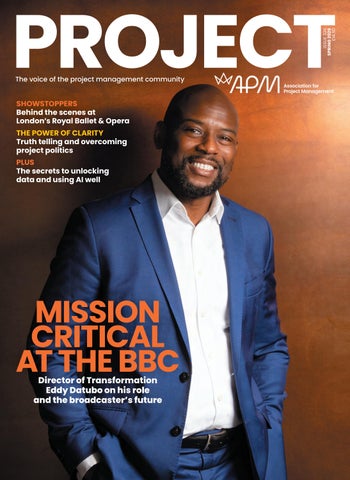
Cover ISSUE 326 SPRING 2026 £14.50
VERSION
PROJECT
REPRO OP
The voice of the project management community
SUBS
SHOWSTOPPERS Behind the scenes at London’s Royal Ballet & Opera THE POWER OF CLARITY Truth telling and overcoming project politics
ART PRODUCTION CLIENT
The voice of the project management community
PLUS The secrets to unlocking data and using AI well
MISSION CRITICAL AT THE BBC Director of Transformation Eddy Datubo on his role and the broadcaster’s future
SPRING 2026 / ISSUE 326
BLACK YELLOW MAGENTA CYAN
91APMMAR26108.pgs 09.03.2026 11:03
VERSION
PROJECT REPRO OP SUBS
The holy grail of clarity
ART CLIENT
COVER PHOTOGRAPHY: BEN WRIGHT
PRODUCTION
I hope you’re reading this issue of Project as you head to the annual APM Project Management Conference in Manchester, or maybe you’ve picked up a copy there. The theme of the biggest annual gathering of project professionals this year is clarity, and let’s be clear: it’s not clarity alone that is important – but the power it wields for both you and your projects. To be honest, who doesn’t want more clarity – more simplicity – in their lives? But achieving both is hard; it’s far easier and lazier to let the complications pile up, never making strong decisions, asking hard questions or pinning stakeholders – and the facts – down. It’s much easier to obfuscate and pass the buck. So, in this issue, you’ll find some great advice and real‑life examples (as well as acknowledgement and discussion of the obstacles and challenges) of running projects where clarity is the name of the game. From our Big Interview with the BBC’s Director of Transformation Eddy Datubo FAPM to our in‑depth look at the problems politics (both at
the macro and micro level) presents to project professionals, we consider how transparency and openness, truth‑telling and collaboration, and the best use of data and artificial intelligence can make your projects more successful. I’d like to quote Emma Birkett, Project Director for the renewal of Rochdale Town Hall, which was named Social Project of the Year at the 2025 APM Project Management Awards. Speaking about running this highly successful project, she said: “A culture of respect was established very early in the project, and adversarial behaviour was not accepted.” Maybe you work on a project team where this expectation is commonplace, but I’m guessing many of you work in environments where playing the blame game or spinning the right line is what’s expected. If it’s the latter, I hope you find much inspiration both in this issue and at the APM Conference on how you can change things for the better. Emma De Vita is Editor of Project
Editor Emma De Vita emma.devita @thinkpublishing.co.uk Senior Content Manager Mike Hine
Group Art Director
Jes Stanfield Commercial Partnerships Executive Cara Termine 020 3771 7214 cara.termine @thinkpublishing.co.uk Client Engagement Director Kieran Paul The views expressed in Project are not necessarily those of APM, the publisher or its agents, and they do not accept responsibility for any solicited material, or for the views of contributors, or for actions arising from any claims made in any advertisements or inserts appearing in this journal. This publication (or any part thereof) may not be reproduced in any form without express and written permission from the Editor. © APM 2026 APM, Ibis House, Regent Park, Summerleys Road, Princes Risborough, Buckinghamshire HP27 9LE, United Kingdom apm.org.uk Tel (UK): 0845 458 1944 Tel (Int): +44 1844 271 640 Cover price: £14.50 Annual subscription fee: £58 (UK); £68.20 (Europe); £79 (international) PROJECT (ISSN 0957-7033)
is published by the Association for Project Management in association with Think, 65 Riding House Street, London W1W 7EH Tel: 020 3771 7200 thinkpublishing.co.uk
In this issue, you’ll find some great advice and real-life examples of running projects where clarity is the name of the game
CARBON BALANCED PAPER
-.corbonboloneedpoper.eom CBP016930
Orecycle When you have finished with
this magazine please recycle it.
IJ,
MIX
FSC
Paper I Supporting responsible forestry
www1rn,
FSC• C017177
*APM Association for Project Management
PROJECT / SPRING 2026 3
BLACK YELLOW MAGENTA CYAN
91APMMAR26109.pgs 11.03.2026 11:56
Welcome
From the Editor
VERSION REPRO OP
Contents
From tunnels to town halls, this issue of Project at a glance
SUBS
Perspectives 9 Top tips How to be a great project manager, according to our recent podcast guests 11 Simplicity in projects
ART
Five ways to cut down on complexity and achieve better outcomes
12 Five lessons learned
Quick-fire tips from this issue’s Big Interviewee, Eddy Datubo FAPM
13 Comment
15 15 Benefits-led project
PRODUCTION
Better project data is on the horizon, writes NISTA’s Ben Salisbury
management Sylvi Kerr ChPP on the Newton Tree Nursery project
14 Psychological safety
16 Professor Adam Boddison
The ‘soft skill’ that quietly decides whether projects succeed
CLIENT
“Strategy is about the choices we make – transformation is about how we get there”
APM’s CEO on the importance of kicking off projects the right way
28 Features 6 In the Picture The 2026 Winter Olympics’ Cortina Sliding Centre 18 The power of clarity
How to navigate (inevitable) project politics successfully
24 The Big Interview
With the BBC’s Director of Transformation, Eddy Datubo FAPM
BEN WRIGHT; WILL AMLOT; GEMMA DAY; ALAMY
28 Royal Ballet and Opera
Project goes behind the scenes of a high-pressure renewals programme
35 Data and AI
How better data literacy and AI can boost visibility of project performance
40 Silvertown Tunnel
The project to build London’s first cross-Thames road traffic tunnel since the 1960s
24
4 SPRING 2026 / PROJECT
BLACK YELLOW MAGENTA CYAN
74 A Day in the Life
With Tamsin Alli-Balogun ChPP of AtkinsRéalis
Contents, 1
74 Peer to Peer 45 How to measure anything
Why inadequate measurement is at the heart of many project problems
48 Lost Shore
The £60m project to convert a disused quarry into a top surf destination
52 Social change and transformation Inside the award-winning Rochdale Town Hall Quarter regeneration project
56 Project culture
Why you influence your team’s culture more than you might think
60 Rising Star
48
With Callum McGregor, a finalist at the APM Project Management Awards 2025
63 Susanne Madsen
Q&A: how to push back against unreasonable deadlines
64 ChPPs
The latest cohort of APM’s Chartered Project Professionals
66 Beyond the Job
How Vicky Bodman ChPP uses her project management skills outside work
Offline 68 Ferris Bueller’s Day Off What the 1980s teen comedy teaches us about project management
72 Books and
68
podcasts Reading and listening material to brighten your spring
PROJECT / SPRING 2026 5
91APMMAR26110.pgs 10.03.2026 09:36
VERSION REPRO OP SUBS ART PRODUCTION CLIENT
6
SPRING 2026 / PROJECT
BLACK YELLOW MAGENTA CYAN
Big pic, 1
In the picture
ALAMY
Milano Cortina 2026 Winter Olympic Games There’s a constant drive for the Olympic Games to reuse existing sports infrastructure in the name of sustainability (and to keep costs down). Cortina d’Ampezzo was co-host of the Winter Olympic Games earlier this year, having previously hosted the event in 1956, when Italian bobsleigher Eugenio Monti won several medals for his country. The bobsleigh course was later named after him. Originally built in the 1920s, the course was redeveloped as the Cortina Sliding Centre in 300 days, with a track of 1,730m partially following the original 16 curves. Olympian (and Cortina native) Mattia Gaspari became the first to take a run on the reconstructed track in March 2025. “It was emotional, especially seeing the faces of all the people that worked day and night to accomplish this result. I have to thank them a lot for making this possible,” he said. Other fans include Fabio Saldini, CEO of government infrastructure company Società Infrastrutture Milano Cortina 2026, who hoped the track would be called “the most beautiful in the world”.
PROJECT / SPRING 2026
7
91APMMAR26111.pgs 09.03.2026 17:11
Perspectives, 1
VERSION
Perspectives
• Government project data standard • Simplicity in projects • Why psychological safety matters • How to deal with stress
REPRO OP
Advice
SUBS
How to be a great project manager
ART
Tamsin Alli-Balogun ChPP, Paul Chapman OBE, Andy Alder ChPP and Anne Marie Purcell shared their tips with the APM Podcast
PRODUCTION
Tamsin Alli-Balogun
Paul Chapman
CLIENT
Andy Alder
Anne Marie Purcell
GEMMA DAY; SHUTTERSTOCK
1
9
Ask yourself what you are trying to do with this project Tamsin Alli‑Balogun ChPP, APM’s Chartered Project Professional of the Year and Associate Director at AtkinsRéalis, argues that the most important thing is to keep your focus on your project’s mission – day in, day out. Ask yourself what you need to do as a project manager to get the project towards that aim. What makes an exceptional project manager is someone who never loses sight of what they are trying to achieve. “Keep asking yourself: what are we trying to do with this project?” she says. “What are we aiming at and what do I need to do to set this team in the right direction?”
2
Prioritise, prioritise, prioritise Accept that you won’t be able to achieve everything that you need to do, because time is constrained, says
AUTUMN 2024 / PROJECT
BLACK YELLOW MAGENTA CYAN
Alli‑Balogun. Instead, work out what your project’s biggest risks are. What are the issues that you as a team need to deal with urgently? What are your stakeholders’ expectations? What do you need to make sure other people know? “Stay really focused on the priorities and don’t get distracted by the things that you might enjoy as a project manager,” she says.
“To apply the skills and methods, and to make them effective, we need to bring people with us”
3
Ask yourself where you excel “You come with your own strengths,” says Alli‑Balogun. So, once you’ve built your expertise and got your qualifications, you need to work out what you’re brilliant at, because you can’t be excellent at everything and in every context, she says. Once you figure this out, you’ll be able to thrive. “There’s space for all of us, but sometimes when you feel perhaps you’re not as good as you thought you were, you’ve probably just found yourself in the wrong context for your particular kind of skill set.”
4
You’re doing something you love Paul Chapman OBE, Academy Director of the UK government’s Major Projects Leadership Academy at Oxford’s Saïd Business School, says that what makes a project manager stand out is that they are doing something they love. “You can see they really shine when it’s something they feel passionate about and they can bring all their talents to bear. As professionals, we’re at our best when it’s something we love doing.” Being good at project management comes through practice and technique, but really great project managers, he believes, are doing something more than getting the project done; they’re thinking way beyond it – up and down their organisation – and thinking ahead.
5
You get the people element of projects right The people element of projects is really important, says Chapman. On a bad day on a project, you can get stuff done by squeezing the assets – by bleeding the resource. A great project manager will use the project to enhance the capability of their
PROJECT / SPRING 2026
9
91APMMAR26112.pgs 09.03.2026 17:15
VERSION SUBS
6
ART
A great project manager is also a great project leader “I haven’t come across one who isn’t the other,” says Andy Alder ChPP, Managing Director for Major Infrastructure Delivery at Anglian Water. The skills that come with being a great project manager give you the foundation, but in practice, you will bring management and leadership together. “To apply the skills and the methods of project management, and to make them effective, we need to bring people with us,” he argues.
PRODUCTION
7
CLIENT
Have a positive mindset A positive mindset will help you understand and be focused on what you’re trying to achieve. It will enable you to navigate the inevitable challenges and give you the resilience to deal with setbacks, argues Alder. But optimism must be tempered by a kind of pessimism that allows for a healthy dose of thinking about what could go wrong and what you are going to do to avoid that happening.
8
Have a passion for hitting deadlines and delivering outcomes What makes a project manager great, rather than good, is that meeting deadlines and achieving outcomes really matters to them. “It’s someone who has grit and determination and who doesn’t take no for an answer; someone who comes up with solutions to problems consistently,” says Anne Marie Purcell of Purcell Advisory. “They’re constantly whacking a mole and getting rid of a problem in order to hit the deadline. That steely focus is what really matters.” Listen to the APM Podcast episode ‘What makes a great project manager? (Part 2)’ on Apple Podcasts, Spotify and more
10 SPRING 2026 / PROJECT
BLACK YELLOW MAGENTA CYAN
Five lessons learned
Eddy Datubo FAPM The APM Conference keynote speaker and BBC Director of Transformation shares his leadership lessons. “Projects succeed when leaders add value – not noise, control or ego, but rather through clarity, coherence and collaboration. Projects don’t succeed just because we manage tasks well; they succeed because we lead change well,” he says. 1 Lead with your head, heart and hands. The best leaders balance analytical skills (head), emotional intelligence (heart) and practical experience (hands). Projects succeed when leadership is multidimensional.
4 Surface risk early. Early visibility creates options; late visibility creates blame and consequences. Bad news received early is a gift. Create an environment where people are never afraid to speak up.
2 Stakeholders determine outcomes. Projects succeed or fail largely through people, not plans. Understand interests, listen deeply and engage continuously.
5 Build the right team. Excellence comes from trust, clarity and accountability. You are only as good as the team you have.
3 Guard scope relentlessly. Unprotected scope erodes and kills value. Clarity on what is out of scope is as powerful as clarity on what is within it. Projects succeed not by doing more, but by doing what is required well.
Read our Big Interview with Eddy Datubo FAPM on page 24. For more information on the APM Project Management Conference 2026, where Datubo will be a keynote speaker, visit apm.org.uk/ apm-conference
BEN WRIGHT
REPRO OP
team, not deplete it. They want to get the project done, but they also want to leave a legacy for the team that makes them better. “They’ve had exposure. They’ve had experience. They’ve come on because of the project,” he says.
Comment
NISTA: better project data starts here Ben Salisbury spells out how the government’s new programme and project data standard can support better project outcomes
of data quality. Broadly speaking, there are six: validity, timeliness, completeness, uniqueness, accuracy and consistency. Without a common standard that helps us create project data with these dimensions of data quality in mind, the value of that data and the accuracy of our insights would remain limited.
SHUTTERSTOCK
A new data standard Many of us are already creating and using project data to monitor and control our projects. The problem is inconsistency in how we create and use that data. Within our own teams and organisations, we’re less likely to encounter differences in how we define and format our project data. We all speak the same language. If we enter data into a project management tool or platform, we rely on the way the platform is set up (configured) to help ensure that our data is created in the right way – a valid way. But when we want to collaborate beyond our organisation or to aggregate data to compare project performance across a system, we’re held back by inconsistent practice. This isn’t limited to how we define or format project data; it also affects how often we update it. Depending on team capacity, ways of working or reporting requirements, some projects refresh their data weekly; others do so monthly, quarterly, annually or only when something changes. This creates a wide variation in the timeliness of the information used across the sector. When updates are irregular or delayed, the gap between data entry, analysis, reporting and decision‑making widens. Decisions end up being based on information that may no longer reflect the current reality of the project. But validity and timeliness are just two dimensions
In response to this challenge, UK Government Project Delivery has published its programme and project data standard (GovS 1002) for a 12‑month trial period. The standard provides a common framework for how project data should be defined, structured and maintained. Through clear definitions, common formatting requirements and update frequency guidance, the standard helps make sure that fundamental elements of project data mean the same thing and look the same wherever they are used across the sector. The standard also sets out how to look for and gather metadata (data about our data), such as when records were created, modified or closed. It provides validation rules that help users and systems understand the relationships within project data, preventing common errors – such as entering an end date before a start date – from going unnoticed. Alongside the standard, Government Project Delivery published an Adoption Handbook to help organisations (currently government departments) across the UK prepare to implement the standard ahead of it becoming mandatory from January 2027.
Impact on project delivery Many project professionals already invest considerable effort in maintaining good‑quality data. The new data standard is designed not to add complexity, but to make that effort more consistent and the data more comparable, so that it is ultimately more valuable – and not just within government organisations. For organisations working with
government to deliver programmes and projects, or supplying project management solutions to central government clients, the new standard will become increasingly valuable. By aligning definitions, formats and update cycles with the expectations set by the standard, non‑government organisations will be able to share data more easily with government partners and contribute to a clearer, more coherent picture of project performance across the UK. But the real opportunity goes beyond efficiency: if adopted at scale, a common programme and project data standard could change the way the UK plans, delivers and learns from its major projects. It opens the door to more reliable benchmarking, better estimates, stronger portfolio insights, more confident use of AI tools and a more confident project profession. The trial of GovS 1002 is an important first step in a longer journey to realise the value of project data as a strategic asset. We are laying the foundation now for a future where better data underpins better delivery across government. Ben Salisbury is Lead Business Analyst for Government Project Delivery at the National Infrastructure and Service Transformation Authority (NISTA). Access Government Project Delivery’s programme and project data standard at projectdelivery.gov.uk
PROJECT / SPRING 2026 11
91APMMAR26113.pgs 09.03.2026 17:16
Perspectives, 2
Perspectives
VERSION
Comment
How to keep things simple REPRO OP
Steve Jobs once said: “Simple can be harder than complex; you have to work hard to get your thinking clean… but it’s worth it in the end because once you get there, you can move mountains.” Nathan Hellebrand ChPP and Mike Hudson ChPP agree. Here is their advice.
SUBS
they’re doing and why. If you get a whole variety of answers, then it starts to tell you that you’re not getting the level of cut‑through you would want to. You need to home in on the objectives.” Create an elevator pitch that everyone can understand.
ART
1
PRODUCTION
The more complex a project gets, the greater the need for simplicity This is for many reasons, not least for the people who are in involved in delivering projects. The more senior you become, the more that simplicity is part of what you can bring, says Mike Hudson ChPP, Interim Strategy Management Director at the National Trust.
3
2
4
ALAMY
CLIENT
Start with the vision and the project’s objectives Simplifying a project’s vision and objectives is key, particularly for turnarounds, says Hudson. “That’s always the starting point for me,” he explains. “You can ask some quite simple and straightforward questions about what people think
12 SPRING 2026 / PROJECT
BLACK YELLOW MAGENTA CYAN
Don’t be tempted to overcomplicate Simplicity is undervalued but can be learned, says Nathan Hellebrand ChPP, Global Delivery Director at Babcock International Group. “Sometimes we think that complexity is a way of justifying a contribution or making it seem like we know what we’re talking about, but complexity is the enemy of execution.” Use the expertise at hand Use your stakeholders’ breadth of experience and listen to different ways of thinking to help you clarify complexity. Manage stakeholders’ expectations – not everyone is
going to get their way, and it is counterproductive for them to believe that they will. Cut through in a polite and helpful way.
5
Simplify decision rights Be explicit about who makes which decisions, and empower people with the responsibility to make as many as they are capable and trusted to make. “Simplify the decision rights across the programme so that people have clarity on specifics,” advises Hellebrand. Clarify the decision chain and allow people to go faster with a simpler approach.
6
Focus on culture early Focus on the culture and the behaviour for simplicity as soon as possible, and get it to flow through everything you do, whether it’s processes or tools, urges Hellebrand. Think about everything you do and whether or not it’s adding clarity or value.
Listen to the APM Podcast episode ‘Why simplicity matters in project management’ on Apple Podcasts, Spotify and more
Comment
Why psychological safety matters It is the so-called soft skill that quietly decides whether projects succeed, writes James Evans
Psychological safety has a strange reputation in projects. Most people agree it matters. They’ll nod when it comes up. Some will say it’s something they value. But then it often gets parked as a cultural nice‑to‑have – something that sits alongside wellbeing initiatives rather than alongside risk management, assurance or decision‑making. In my experience, that’s a mistake. The projects I’ve seen struggle rarely fail because people don’t care or don’t know what they’re doing. They struggle because the environment makes it harder to say the uncomfortable things early enough – the doubts, the risks, that gut feeling that something isn’t quite right. This isn’t because people are dishonest. It’s because they’re careful about what they say and to whom. People learn quickly what feels safe to say in a project and what doesn’t. They learn which questions are welcomed, which earn awkward silences, which concerns get explored and which get brushed off with a ‘Let’s take that offline’. Over time, teams’ behaviour shifts. Language softens. Concerns are held back until there’s more certainty, or more cover. What starts as caution slowly becomes habit. Silence doesn’t mean alignment. It usually means risk.
No one wants a watermelon By the time information reaches a report, it has already travelled through layers of judgement and self‑censorship. If challenge doesn’t feel safe lower down, what surfaces at the top is only part of the picture. That’s how projects end up looking green on the outside while quietly turning red underneath, often surprising the very people
meant to have oversight. This is the watermelon effect. It is often described as a reporting problem when it isn’t. Most reporting frameworks do exactly what they were designed to do. The issue is upstream. Psychological safety determines what information moves early, what gets delayed and what never makes it into the room at all. That’s why I struggle when psychological safety is framed as a soft skill. In practice, it has very real consequences. It affects decision quality, how early risks surface and whether governance genuinely helps teams navigate complexity or simply reassures people that things are under control.
Don’t make honesty selective I’ve sat in many meetings where everyone knew the risks and no one named them – not because people didn’t care, but because raising them felt political or personal. In those environments, reassurance feels safer than doubt. Silence starts to look like professionalism until it doesn’t, and the consequences become unavoidable. As projects become more visible and more pressured, tolerance for challenge can quietly fall. Leaders may want openness, but everyday reactions send powerful signals. People watch what happens when bad news is raised, and they adjust accordingly. Over time, honesty becomes selective, not because people disengage, but because they’re trying to survive. The usual response is to add more control – more checkpoints, more reporting – all with good intent. But control without candour doesn’t improve outcomes; it just produces cleaner paperwork. What kills projects isn’t bad news – it’s late news. This matters particularly for project or programme management office and assurance roles. We rely
on early signals to support good decisions. If those signals are filtered, even strong governance becomes reactive, rather than preventative. By the time action is taken, options are already limited. Psychological safety cuts through that. It allows uncertainty to be voiced while it’s still useful. It makes challenge normal rather than awkward. It turns escalation into responsible action, not personal failure. Teams that feel safe don’t lower standards – they raise them, addressing issues earlier and learning while delivery is still live. So maybe the question isn’t whether teams feel comfortable. Comfort isn’t the goal. A better question is whether it’s safe to say, ‘I’m not convinced’, before it’s too late. Psychological safety isn’t a nice extra. It’s core delivery infrastructure. Until we start treating it that way, we’ll keep being surprised by outcomes that, deep down, people saw coming. James Evans is a Programme Manager at NHS Wales Joint Commissioning Committee. He is a speaker at the APM Project Management Conference 2026 and has helped to create a new APM Learning module on psychological safety, set for release in April 2026. Find out more at apm.org.uk/ resources/apm-learning
PROJECT / SPRING 2026 13
91APMMAR26114.pgs 09.03.2026 17:16
Perspectives, 3
Perspectives
VERSION
Comment
REPRO OP
Five years of benefits-led project management at Newton Tree Nursery Sylvi Kerr ChPP spills the beans on this slow-grow but innovative project
SUBS ART PRODUCTION CLIENT
The Newton Tree Nursery redevelopment in north‑eastern Scotland, which was delivered on time and on budget, was the culmination of a five‑year journey. Its success lies not only in what was delivered, but in how a great multidisciplinary team worked to clearly define benefits and maintain disciplined oversight throughout a long and complex life cycle. Forestry and Land Scotland (FLS) faced a clear national challenge. Scotland’s climate and biodiversity ambitions for woodland creation required far greater volumes of healthy, resilient trees, which existing tree nursery operations across the UK could not meet. Transplanting capacity was limited, and reliance on chemical treatments was increasingly unsustainable. The strategic outline case set an ambitious response to produce more trees, more sustainably and at scale. Four key benefit measures were agreed: 1 Increase quantity of trees grown 2 Increase productivity of seeds 3 Improve working conditions 4 Reduce environmental impact While the building itself had measurable specifications, these benefits guided decision‑making, ensuring the design, procurement and operational choices reinforced outcomes that mattered most.
Cost certainty, value engineering and the right team Cost certainty was a key driver, championed by a strong senior responsible owner who held the line without stifling innovation. Value engineering ensured decisions
14 SPRING 2026 / PROJECT
BLACK YELLOW MAGENTA CYAN
did not compromise benefits. Items initially removed could be reinstated using confidence gained from disciplined budget and risk management. When the main contractor was appointed, a collaborative ‘one team’ approach enabled problems to be overcome, and value‑engineered elements could be restored, all while remaining on budget. Delivering these benefits required the FLS team to recognise this project was not a routine construction
project nor a standard procurement exercise. It involved complex technology integration and multiple contracts across the UK and Europe. Specialist commercial, technical, legal and construction expertise was embedded in the team, strengthening FLS’s role as an intelligent client and enabling confident navigation of procurement and risk.
Innovation, governance and assurance In parallel, a CivTech challenge (a Scottish government programme connecting public‑sector problems with tech innovators) developed a new mechanised tree‑growing system that accelerated seed germination, reduced chemical use and increased transplanting rates from 60,000 to one million trees per day. The business case was built around this technology, which
would triple germination rates. Procurement of Swedish machinery and artificial intelligence technology further automated the process of growing trees within the new glasshouse and ensured that the system was production‑ready within construction timescales. Sustaining momentum over five years required strong and consistent leadership and project management with robust but adaptable governance. Scottish government independent assurance gateway reviews, aligned with RIBA work stages, tested delivery against rigorous criteria, provided independent insight and highlighted improvements. The leadership team valued these reviews highly to make the project team stronger and guide decisions that kept the focus on benefits and outcomes. Sustainability was embedded throughout. Advanced facilities included solar power, bio beds and boreholes, while local contractors and off‑site manufacture minimised transport emissions. Workforce wellbeing was actively monitored, reducing reported stress from 42% to 25%.
Impact and lessons Annual production has risen from seven million to nineteen million trees, creating a resilient supply for decades to come. The project shows that, through project discipline, the ambition to transform decades‑old operational practices can be translated into operational reality, on time, on budget and with lasting impact. Sylvi Kerr ChPP is a Senior Project Manager at Forestry and Land Scotland. She was a finalist for APM’s 2025 Chartered Project Professional of the Year Award
Comment
Three simple routes to less stress
The Un-Stressing Method IMPORTANT
Amy Leneker gives her hard-won advice on dealing with too much stress the right way By the time stress and burnout took over my life, I couldn’t remember a time when I wasn’t stressed – when there wasn’t a deadline looming, a problem to solve or a decision that couldn’t wait. Turns out, I’m in good company. APM research from both 2021 and 2025 found that three‑quarters of project managers reported being under significant stress. But how did we all get so stressed? Stress is often disguised as drive, rewarded as resilience and praised as passion. And as I dived into research on stress and burnout, I realised I’d bought into the myth that had been sabotaging me all along: stress is the price we pay for success. But here’s the truth: stress isn’t the price you pay for success – it’s the thief that steals it.
The Un-Stressing Method Chronic, unmanaged stress leads to burnout, so by learning to manage stress, we can prevent burnout from taking control of our lives. This is why I created The Un‑Stressing Method. As a former C‑suite executive and now a leadership consultant and trainer to organisations – including Fortune 100 companies – I’ve shared this method in boardrooms, training rooms and at conferences. On a recent work trip, I shared it with a barista, a waiter, a flight attendant, a hotel receptionist and a rideshare driver. If someone says ‘stressed’ when I ask how they’re doing, I’ve been known to sketch the whole thing out on the spot (see above). It takes less than 10 seconds. It’s simple, it’s practical and
ASK
ACT
FOR WHAT YOU NEED
ON THE NEXT RIGHT THING
NO CONTROL
s •--------
CONTROL
ACKNOWLEDGE
ACCEPT
THEN MOVE ON
WITHOUT FIXING
NOT IMPORTANT
it works. The power is in its simplicity – it’s a clear, doable way to stop spiralling and start feeling like yourself again. Here’s how it works.
Three simple steps l Step 1: See stress differently. You
can’t manage what you can’t see. This step is all about identifying your stressors, clarifying what’s important and getting clear on what’s within your control. When you get your work stressors out of your head and heart and onto paper, you can start to see them differently. So, grab a pen and some sticky notes and write down your stressors (one per sticky note). Then, for each stressor, ask yourself two questions. Is this important right now? Do I have control? Based on your answers, place each sticky note in the correct quadrant on the matrix. l Step 2: Sort stress into actionable categories. When you can name the kind of stress you’re experiencing, you can start taking meaningful action. There are five types of work stress: (1) schedule (not enough time), (2) suspense
(uncertainty), (3) social (tension), (4) sudden (surprises) and (5) system (power dynamics). Write the number(s) of the type(s) of stress on each sticky note. l Step 3: Solve stress without spinning. Now that you’ve identified and sorted your stressors, you can use the matrix to inform your next move: acknowledge the stressor and move on, accept it without fixing it, ask for help or act. One last thing: now that you’ve gone through the three steps, don’t forget to celebrate the shift. Yes, stress is part of work and part of life. But staying stuck in it? Suffering through it? That part’s optional – and a lot more fixable than we’ve been led to believe. Remember, every time you say no to the myth that stress is the price of success, you’re saying yes to yourself – and to success on your own terms. And that is worth celebrating. Amy Leneker is a C-suite adviser and host of the Less Stress, More Joy podcast. Her new book, Cheers to Monday, is available now
PROJECT / SPRING 2026 15
91APMMAR26115.pgs 09.03.2026 17:16
Perspectives, 4
Perspectives
Perspectives, 5
VERSION
Professor Adam Boddison OBE
REPRO OP
Why clarity matters for effective project delivery APM’s CEO provides three suggestions you can implement to improve clarity on your projects
SUBS ART PRODUCTION
An APM volunteer once told me: “Projects don’t go wrong; they start wrong.” When I asked why they start wrong, the response was: “Not enough clarity.” Clarity goes beyond having a well‑written project plan and a detailed schedule. True clarity is about having a shared understanding of purpose, priorities, roles, risks and what success looks like. When clarity is present, teams are aligned, decisions become easier and project momentum is sustained.
Not a ‘nice to have’
CLIENT
It becomes increasingly difficult to deliver successful projects if there are unclear objectives, ambiguous responsibilities, conflicting stakeholder expectations or poorly understood constraints. This is why clarity is so important. For practising project professionals, I want to make the point that clarity is not a ‘nice to have’; it is a strategic imperative. Clarity provides three critical benefits. First, it enables focused decision‑making. When project goals and priorities are well understood, teams can make more informed choices without the need for constant escalation. This accelerates delivery and reduces dependency on senior intervention. Second, clarity builds trust. Stakeholders are more likely to support a project when they really understand its purpose and its challenges. Transparent communication fosters credibility and strengthens relationships. Third, clarity enhances resilience. Projects rarely proceed exactly as planned. When disruption occurs, teams with a shared understanding
of ‘what really matters’ can adapt without losing direction. In essence, clarity turns complexity into something manageable. It has the power to transform uncertainty into purposeful action. In a practical sense, project professionals can become ‘clarity champions’ by asking probing questions, challenging vague statements and encouraging open dialogue. They recognise that clarity is not established once, but reinforced regularly throughout the life cycle. Here are my three suggestions for improving clarity on a project:
1
Establish a compelling and shared project narrative Every successful project has a clear story about why it exists, what it will achieve and why it matters. Going beyond formal documents such as business cases, project professionals should craft and communicate a concise narrative that connects a project’s objectives to organisational priorities and stakeholder needs. Making sure team members can explain the project’s purpose in similar terms, and that stakeholders understand the value it will deliver, is key. Project professionals should reinforce this narrative in meetings and even in informal conversations, because when people understand the ‘why’, they are likely to engage more deeply with the ‘how’.
2
Make ownership explicit Ambiguity around ownership is one of the most common sources of delay and conflict. When it is unclear who is responsible for what, progress slows and accountability weakens. Of course, tools such as RACI matrices can be helpful, but
only if they are actively used and understood. It is most important that ownership is reinforced through behaviour. When decisions need to be made, ensure they are made by the right people and communicated clearly. By removing uncertainty around ownership, you enable faster execution and stronger collaboration.
3
Create ‘clarity checkpoints’ Assumptions on a project can easily drift over time. Without deliberate intervention, the shared understanding agreed at the outset can gradually erode. This is why building structured clarity checkpoints into your project rhythm can really help. These are moments dedicated not just to status reporting, but to ensuring alignment. As a project professional, try to draw out what feels unclear to people or misaligned. Treat uncertainty as valuable information that can be acted upon, rather than as a weakness. By normalising these conversations, you prevent small misunderstandings from growing into major risks. Delivering successful projects goes beyond managing schedules, budgets and risks. It is about creating an environment where people have a shared understanding of what they are working towards, how they contribute and how success will be measured. Clarity is the foundation of that environment. By following the three suggestions above, project professionals can transform uncertainty into confidence, and complexity into coordinated action. For today’s project professionals, mastering clarity is not just a professional skill; it is a leadership advantage.
16 SPRING 2026 / PROJECT
BLACK YELLOW MAGENTA CYAN
91APMMAR26116.pgs 09.03.2026 17:16
Qu\c¼ quest\on \ne\\o 'O'I tne wo'I) ,ot tnose wno oten't ,u\\-t\rne students or se\\- ••• • '3 \.\\:.es · " cof('IC-nents ~
VERSION REPRO OP SUBS ART PRODUCTION CLIENT
18 SPRING 2026 / PROJECT
BLACK YELLOW MAGENTA CYAN
Clarity, 1
Shining a clear light Politics, whether at a national or a team level, has an impact on every project, especially major government ones, but if infighting and manoeuvring are polluting yours, remember: sunlight is the best disinfectant, writes Richard Young ore than 30 years ago, Jeffrey Pinto, Professor of Management at The Pennsylvania State University, wrote a paper about the value of politics to project managers. Value? Surely politics is the stuff that gets in the way of successful project management – it’s to be avoided, not embraced. But Pinto argued that politics is simply a question of perspective. You can choose to be “naive” and see politics as fundamentally unappealing; be a “shark”, who readily embraces political behaviour with loyalty to your own objectives; or be “sensible” – neutral and realistic about project politics (see table, page 23). Sensible project managers “run their projects with few illusions about how decisions are made”, Pinto explained. “They understand, often through their own past experiences and mistakes, that politics is simply another side, albeit an unattractive one, of the behaviour in which one must engage in order for their
SHUTTERSTOCK
M
projects to succeed… they use politics as a way of making contacts, cutting deals, and gaining power and resources for their departments in order to further project, rather than personal, ends.” As this 30‑year‑old paper proves, politics and its tendency to obfuscate and frustrate the path of smooth project delivery have always been a fact of life. In a new APM report, The Impact of Politics on Project Success in Multi‑Agent Projects, Professor Amos Haniff of Heriot‑Watt University takes a fresh look at the issue, covering politicking at every level.
Clarity is key
Haniff has drawn on interviews with senior civil servants and parliamentarians to explore both failed and successful projects. His findings show that government projects often fail due to adversarialism, fragmented power structures, unclear accountability and shifting priorities driven by election cycles. Deficiencies in project management capability – particularly
PROJECT / SPRING 2026 19
91APMMAR26117.pgs 09.03.2026 12:27
VERSION REPRO OP
poor planning, unclear objectives, scope creep and limited access to formal training – further undermine delivery. Successful projects are characterised by strong, politically astute leadership, cohesive cross‑departmental teams and the effective use of legitimate authority to align stakeholders. Projects, the report concludes, perform better when consensus is achieved, delivery is insulated from partisan conflict, and teams operate as collaborative communities with shared goals and centrally managed resources.
SUBS ART
People power
CLIENT
SHUTTERSTOCK
PRODUCTION
“We can create schedules, we’re good at engineering – the more operational pieces are generally fine,” says Tim Banfield, who now runs his own project consultancy, but was Director at the National Audit Office for many years and served in the Major Projects Authority as well as in the private sector. “The bit that either enables it or gets in the way is people. So the real question is around how and why people interact. How should we understand their different motivations?” Haniff is clear: many of the same things that drive project politicking in government are present across different
“The incentives for candour are stronger in a commercial environment than they are in the public sector” sectors. “If it’s a departmental project with a single client, there will still be personal tensions and conflicts,” he says. “At an organisational level, there’ll be tensions and politics between departments, which are probably vying for attention or resources. Multi‑organisational projects have tensions at the personal, departmental and organisational levels – and between the project and the organisations.” Jonathan Simcock has also spent years in both the private and public sectors (including at Shell, Transport for London, the Ministry of Defence and Sellafield) looking at project performance. His book, The Delivery Gap – Why government projects really fail and what can be done about it, was published last year. He reckons that it’s precisely that organisational dynamic that causes problems. Even in government, ‘big P’ political infighting is rarely the root cause of failure.
1 FIVE TIPS ON HANDLING POLITICS 20 SPRING 2026 / PROJECT
BLACK YELLOW MAGENTA CYAN
“Take a step back and analyse the parties involved. Challenge your team and organisation. Who is the best‑placed person to take whatever action is required to resolve the impasse? Analysis like this can reduce effort and more swiftly steer you to the best outcome,” advises Nukey Proctor, Project Director at Methods and author of the APM short guide How to Manage Project Politics.
2
“Use the executive sponsor and the steering committee much more. You should not be afraid to bring them in and demand they take ownership. We don’t involve the sponsor too much because we’re afraid that we will disturb them. But make it clear: it’s your responsibility, boss,” advises Professor Antonio Nieto‑Rodriguez.
Clarity, 2
“Most government projects are just not that sexy politically,” he says. “What could be less politically contentious than providing digital communication technology for the blue‑light services? It’s very unlikely to generate a political argument about the purpose of the project, at least. And yet, we’ve managed to comprehensively foul it up in the UK over the last decade or more.” The issue, then, is political agendas that are fuelled by lack of clarity. “The thing that is true of almost all public‑sector projects is that they’re not driven by clear and simple commercial goals in the way that, say, a deep‑sea oil platform is,” Simcock explains. “Yes, the private sector has plenty of dreadful stories about projects failing. But the incentives for candour are stronger in a commercial environment than they are in the public sector.”
Radical candour
That’s about project professionals having enough (political) cover that they feel able not just to be honest, but also to exhibit what Simcock calls ‘radical candour’. “There’s a risk to a professional of being punished for telling the truth,” he says. “I’m not talking about being fired; but people do fear the negative
3
“Bring clarity to the project benefits. What is its purpose? A project creates a platform to deliver benefits. What are they? If we focus on headlines, it’s just about being popular and telling the public that something is being done. What the public needs is clarity on how the benefits will be realised,” urges Professor Amos Haniff.
4
“Look more broadly at the incentive structures causing people to behave the way they do. If the reality of the problem is suppressed, if issues in it are not bubbling up to people who can do something about them, then people will fall back on political infighting,” explains Jonathan Simcock.
5
“In Industrial Mega Projects, Ed Merrow talks about the way major projects focus on ‘shaping’ – understanding what needs to be done. Who do I need to work with? What are their motivations? How do I design a delivery plan that fits that circumstance? How do I incentivise them? Get that right and the path is clearer,” points out Tim Banfield.
PROJECT / SPRING 2026 21
91APMMAR26118.pgs 09.03.2026 12:27
VERSION REPRO OP SUBS ART PRODUCTION CLIENT
consequences of insisting people take account of bad news.” He cites Crossrail as a perfect example: plenty of people knew in August 2018 that the line was never going to open in December. “In too many projects, the most important thing is making sure that it is ‘not our fault’,” Simcock continues. “And the more complex the environment, the more ambiguous and difficult the relationships are, the easier it is for people to get into that mode.” In other words, it becomes compelling to play politics. The trick, according to the experts, isn’t to deny politics, but to understand them. “Everybody on a project has an agenda,” says Haniff. “It might be personal, such as to earn more money, get a promotion or make the boss happy. Then we all represent a department or an organisation, and they have those agendas. So there’s always going to be motivations that sit outside the project itself; to say that there won’t be is naive.” And in government projects, you have to focus on private partners’ commercial interests, too, he says, otherwise they won’t survive. And driving the party political agendas – which are also inevitable – you’ve also got the public, who tend to focus very much on the budget, looking for value for money. Again, those political drivers are a fact of life.
Safe and sound?
The aim, then, is to bring clarity to all those motivations so they can be managed. Professor Antonio Nieto‑Rodriguez, Vice President of APM, has led project functions at GSK and BNP Paribas. He brings the politics problem back into familiar territory: it’s all about culture. “As a project leader, you can establish the culture that you think will fit the best for your project,” he says. “Sometimes, you think that you need to embrace the culture of the company – but not necessarily. You should shape the project culture so that you can openly talk about politics, about personal agendas.” When Project debriefed project professionals on the successful Tideway Tunnel, they all agreed: the unique
22 SPRING 2026 / PROJECT
BLACK YELLOW MAGENTA CYAN
“If people are afraid of taking risks because they’re going to be blamed for that, they will not do it” culture of the project itself over‑rode any political considerations from the different organisations involved. Having a strong, outcomes‑driven CEO was central to that. As a champion of psychological safety (“You want people to speak up when they see strange behaviour!”), Nieto‑Rodriguez reckons that it’s the tone that project managers set which makes all the difference. Crucially, that’s not just about feeling free to shout bad news. People become political just as often because they’re playing safe on the upside. “If people always tell you that everything is on track, there’s something wrong,” he says. “Projects should be going wrong – no plan goes perfectly, so we should say, ‘Stop being fake and be more realistic; when the problems are there,
we’re here to solve them’. But projects are about risk‑taking as well. If people are afraid of taking risks because they’re going to be blamed for that, they will not do it.” Simcock goes a stage further: “The ideal situation is where you feel psychologically safe to present your genuine professional opinion; but you should also feel psychologically at risk if you don’t. It’s carrot and stick.” When that happens, he argues, issues get aired quickly enough to prevent them becoming political footballs.
Football crazy
In a government setting, unfortunately, there are agents with a motive for creating political footballs: ‘the party opposite’. “Obviously you have people whose agenda is to undermine anything that their opposition does,” says Haniff. “A party will implement a project as part of the manifesto because that’s what the electorate wants. The opposition is there to criticise that investment and scrutinise it. So projects often get used as political
Clarity, 3
“Even if it’s the CEO who’s playing games, you should be able to have that talk without being afraid” footballs – which is hugely stressful for any project manager.” This can be particularly poisonous to the most important projects of all: large infrastructure. “One issue is project scoping, where things take a long time to kick off,” explains Haniff. When politicians have a commitment to do a project – usually in their manifesto – it would take a strong character to say, ‘It no longer makes sense’. And he thinks the big barrier here is political commitment to the project, rather than the benefits the project is designed to deliver. “An MP or a minister wants to demonstrate they’re making a difference,” adds Banfield. “And they have a relatively short time to do that. With the scrutiny they face, there is an imperative to keep on responding. But that’s at odds with the majority of big projects, where the time
scales are huge. You’re trying to manage the short‑term priorities of some groups against the longer‑term activity of others.” Accepting that can help you manage political stress – that applies as much to a project manager in a commercial setting facing off against their own stakeholder pressures (whether that’s from shareholders, non‑execs or the finance function). “Ask, ‘How do I create a trickle of good news in a variety of ways, constantly?’” Banfield suggests. And don’t be afraid to play (positive) politics yourself. “Demanding that something change is [the sponsor’s] responsibility, not yours,” says Nieto‑Rodriguez. “You often don’t have the power to make these changes, so talk to your leader or your CEO.” And, he adds, “as soon as you find out about a political agenda in play, bring it to the table. Don’t be afraid. Have a one‑on‑one with that person. ‘What’s your agenda? I noticed that you are playing against others. Why?’ Be more confrontational, more confident. Even if it’s the CEO who’s playing games, you should be able to have that talk without being afraid.”
(Although, Haniff warns, “One of the things that project managers hate is political machinations between sponsors. Where senior people perhaps don’t agree quite on how the project should progress, knowing where the buck really stops for a project manager is crucial. Those political fights above you need to be resolved.”)
Playing the game
Pinto’s decades‑old conclusion could be summed up as: politics is inevitable; it’s how you play the game that matters. And that needn’t conflict with your own values. In Haniff’s study for APM, the importance of project management professionalism comes through loud and clear. Being transparent, outcomes‑focused and showing radical candour can all help prevent poisonous politics. And as one parliamentarian admitted to him about their project management expertise: “We need to upskill.” Get the project management disciplines right, and the people and politics will follow.
WHAT’S YOUR STYLE?
SHUTTERSTOCK
Different approaches approaches to to project project politics, politics, by by Professor Professor Jeffrey Jeffrey Pinto Pinto Different Type
Naive
Sensible
Shark Shark
“Politics is...”
“… unpleasant”
“… necessary”
ìÖ an an opportunity” opportunityî “…
Intent
Avoid at all costs
Use to further department’s goals
Self-serving and predatory
Techniques
Tell it like it is
Network, expand connections, use system to give and receive favours
Manipulation, use of fraud and deceit when necessary
Favourite tactics
None, the truth will win out
Negotiation, bargaining
Bullying, misuse of information, cultivating and using ‘friends’ and other contacts
PROJECT / SPRING 2026 23
91APMMAR26119.pgs 09.03.2026 12:27
VERSION
The Big Interview
REPRO OP SUBS
Eddy Datubo
ART
Emma De Vita meets the BBC’s Director of Transformation, who is also a 2026 APM Conference keynote speaker. It’s a pivotal time for the broadcaster – so what might the future hold?
PRODUCTION
BEN WRIGHT
CLIENT
The BBC is entering a defining moment of its 103‑year history, and Eddy Datubo FAPM, its Director of Transformation, is enjoying the challenge. Preferring a life beyond the limelight, he is quietly focused and a little cautious when we first meet at the BBC’s Portland Place HQ. He had zero hesitation in going for the role in 2022, when it came up. “I thought: of course!” he says, revealing his enthusiasm. “The BBC is a global, iconic brand. It’s one of the main bastions of our culture, but also the degree of change and transformation the organisation is going through is quite significant – and who wouldn’t want to be part of that?” It takes a strong and resilient person to help lead this transformation, and Datubo is both these things (more on that later). His favourite movie is The Godfather, but patriarch Don Vito Corleone is Datubo’s antithesis. He admires a different kind of leadership, one based on integrity and empathy. He’s a “very big fan” of Nelson Mandela and admires President Barack Obama for his “simplicity, truthfulness, transparency, honesty and integrity”. One of the programmes that falls within Datubo’s transformation remit
24 SPRING 2026 / PROJECT
BLACK YELLOW MAGENTA CYAN
is to deliver cultural change to improve behaviour and increase inclusivity. Another piece is making the BBC less London‑centric to reflect the different UK regions and nations. Beyond those, there’s generative artificial intelligence (AI) to tackle – running pilots and thinking about how the BBC can use AI ethically and responsibly in its pursuit of developing better content. The BBC’s umbrella of transformation is huge, yet the overarching purpose for Datubo, like all BBC staff, is responding to the review of its Royal Charter, which began this year. The focus is on developing an operating model and organisational design that’s fit for the future: “How can we ensure we have a BBC that is around for the next 100 years?” he posits. The BBC is at a defining moment, where trust in news has fragmented and public‑service media organisations face unprecedented scrutiny. What’s more, there’s the rise of streaming organisations to contend with, and the trend among younger audiences to choose short‑form and digital media over watching live TV. Datubo cites the BBC’s recent content partnership with YouTube as a good example of “meeting our audiences
Big Interview, 1 91APMMAR26120.pgs 09.03.2026 12:28
VERSION
The Big Interview
REPRO OP SUBS ART
where they are”. Building on social media and doing more on its digital iPlayer platform will help drive the BBC’s ambition to “become the world’s first public‑service digital media organisation”, he explains. Transformation programmes are how the BBC delivers its strategy. Datubo says the different strands of strategy and transformation have been brought together at the BBC, which is a construct he says he has worked under previously during his broad‑ranging career. “Strategy is about the choices we make, what we want to do – transformation is about how we get there,” he says (which is one of the neatest explanations I’ve heard).
PRODUCTION CLIENT
Prior to joining the BBC, Datubo was Head of Strategy and Transformation for Neptune Energy (which was later acquired by Eni) and had also held senior leadership roles across Tullow Oil, BP, Lloyds Banking Group and Reuters. He straddles the worlds of project management, change and strategy. “To the core, I’m a project manager, but I have built skills along the way that enhance me as a business professional.” Five years into his career, he took a year out to study for an MBA at Cranfield School of Management. “Project management is a discipline that can get you far up the ladder, but build other skills that take you into different areas. Don’t be afraid to take a sideways move that gives you broad exposure,” he advises. Project management is a critical skill for transformation, he says. “Transformation is about execution and delivering outcomes, and sometimes that is through big bang change, but most organisations do that through step change and evolution, which is incremental. Having that ability to build a plan, to understand the direction and to get a team, organisation, function or company from A to B, very much aligns with all the project skills that you have – governance, stakeholder engagement, managing the risks and issues, and understanding the outcomes you’re trying to go for and the benefits you’re trying to achieve.”
26 SPRING 2026 / PROJECT
BLACK YELLOW MAGENTA CYAN
CV: EDDY DATUBO 2022– Director of Transformation, BBC; Director of Operations & Transformation, BBC 2025– Non-executive/External Member, Audit and Risk Committee, St Paul’s Cathedral 2020–2022 Head of Strategy & Transformation, Neptune Energy 2015–2020 Group Planning & Performance Manager, Tullow Oil 2010–2015 Senior Programme Manager, BP 2009–2010 Programme Manager, Lloyds Banking Group 2009 Project Management Consultant, Ecobank Transnational Inc 2007–2008 Head of Transformation, C Hoares & Co 2002–2007 Programme Delivery Manager, Reuters 2007–2020 Executive Director, Crystek Consulting 2001–2002 MBA, Cranfield School of Management
One of the jobs of transformation, he says, is “to unravel the complexities of an organisation to get it to perform better, more efficiently and more effectively, and to enable better experiences”. He explains that he once worked under a former CEO who was a fan of ‘radical simplification’. “You make it so simple that it feels uncomfortable,” he says, because people start thinking that it’s all “too elementary”. Once you have simplicity, clarity emerges, which then builds success. “Clarity is key to everything I do,” he says. “George Orwell said the greatest enemy of clear language is insincerity. If everything is clear and simple, it helps you get to the real issue.” Datubo joined BP in 2010 and was part of a team that delivered its corporate simplification programme at a critical point in its history. They uncovered a reluctance for people to speak up – and that’s when things go wrong. Everyone in a team needs to be given the confidence to speak up, he says. “That’s critical for anyone leading project change and transformation.” But how do you do this in real life? “As a leader, you have to listen, and you have to create environments that are
“Strategy is about the choices we make – transformation is about how we get there”
inclusive, where people feel safe to speak up,” he explains, because one of the first things he learned as a project manager was that projects go wrong. Giving bad news isn’t a problem in itself, he says, but it becomes an issue when it isn’t given early enough so that it can be reacted to. “The worst thing to happen on any project is to give people bad news when they are not able to do anything about it. Escalate early; don’t wait for the crisis to erupt or the issue to blow up. Projects are reported as either red, amber or green, and some people see red as this big flag, but it’s not a stick to hit people over the head with. Red is saying a project needs help. It says: can you give me some attention? It’s not about blame. The focus should be on what needs to be done to bring it back on track.” He shares a truth he has learnt about successful professionals: “For project managers, one of the things we say is: let’s understand the real issues. Let’s find a way to communicate those. And you must always be able to share that with people. That’s where roles like the sponsor become critical. And you may not need to feed all of that formally – you can have very informal discussions.” All of this requires bravery and the ability to credibly lay out the facts, allowing them to speak for themselves. What’s the biggest lesson he’s learnt about successful transformation? “No matter how high up you go, you can’t be too removed from the rest of the
Big Interview, 2 BEN WRIGHT
improve it and pass on the baton. You’ve got to make sure you leave it better than you found it where possible.” He is a big fan of the growth mindset. “Mindset is key, really making sure that you grow up seeing that the world is a place of endless learning and opportunities.”
organisation. You’ve got to understand the realities of the people on the ground who will be impacted by the changes you deliver.” Datubo is one of the BBC’s senior executive group and leads its project management discipline or job family. Since joining in 2022, he has introduced a project management methodology, which is a hybrid approach that flexes with each project. His ambition is to take a broad, enterprise‑wide approach to project management, using tools to interlink dependencies and risks across all projects. What’s it like to run projects with a bunch of creatives? “Creatives don’t like to be boxed in. They see a world
“My faith is a key part of who I am, and that strengthens and anchors me” of endless possibilities, and sometimes to deliver change, you’ve got to get to a place where you agree that you have enough that is good enough to move forward.” Datubo describes himself as a servant leader. “I see every leadership responsibility as an opportunity to serve,” he says, describing leadership as a continuum where “you come in, you take what’s been given to you and you really make sure you carry it along,
He learnt this the hard way. Born in Leeds to Nigerian parents, Datubo moved to Nigeria with them when he was seven years old, describing the experience as a culture shock. As one of six siblings, he says growing up was fun – until tragedy struck when he was in his early teens. His mother died, and soon after, so did his father. “I grew up having to find my own way,” he reflects. He put himself through university while supporting his younger siblings with the strong support of his extended family. “All of that experience has helped me become bigger, stronger, better,” he says. He is involved with the church and is a Non‑executive/External Member, Audit and Risk Committee, at St Paul’s Cathedral. “My faith is a key part of who I am, and that strengthens and anchors me. I would say I’m a very resilient person and I’ve worked in very tough environments. It’s not easy, but it’s also taught me about what’s more important. I have a family. I have kids. That’s what is important to me,” he says. Datubo is married with children, the youngest being 17, and he enjoys a connected family across continents. “Living in Nigeria taught me resilience; it gives you quiet self‑confidence.” When he has free time, he wants to spend it with his family or doing sport. “With my family, I know that no matter how good or bad a job I do, I walk through the door and I’ll always be loved.” As Don Corleone says: “A man who doesn’t spend time with his family can never be a real man.” Perhaps there are similarities after all? Eddy Datubo FAPM will be a keynote speaker at the APM Project Management Conference 2026, which will take place on 29–30 April at Manchester Central. For more information, visit apm.org.uk/apm-conference
PROJECT / SPRING 2026 27
91APMMAR26121.pgs 09.03.2026 12:28
VERSION REPRO OP SUBS ART PRODUCTION CLIENT
o t p s p w e o r s h S Project Editor Emma De Vita goes backstage at the Royal Ballet and Opera in London to find out what it takes to run a programme of renewal projects that will return London’s prestigious cultural institution to the top of its technical game
ront of house and back of house present a world of contrasts. I stand at the back of the stage looking out at the empty auditorium of the Royal Ballet and Opera (RBO) – all red velvet, gilt and candelabras – surrounded by staff in hard hats who are busy changing over the scenery for one opera in anticipation for another – La Traviata – which is this evening’s performance. RBO has embarked on a £40m renewal programme covering everything from lighting and machinery to the comms system that keeps everyone and everything where
F
28 SPRING 2026 / PROJECT
BLACK YELLOW MAGENTA CYAN
they should be. This critical upgrade of 25‑year‑old infrastructure is designed to keep ballet dancers leaping and opera stars singing to ever greater heights.
Incorrigible project junkies As an APM Corporate Partner, RBO takes project management seriously, despite being an unexpected enclave of expertise. After all, it’s not tunnels or railways. The story of RBO’s renewals programme is one of collaboration, open communication and the art of delivering projects to immovable deadlines.
“In a sense, we are the ultimate project junkies,” explains Heather Walker, Chief Operating Officer (COO), likening every production the Royal Ballet Company or Royal Opera Company has put on for hundreds of years to a project: planning years in advance, hiring a creative team, creating the set. “They go through many stages – called gates – from when something is first conceived all the way through to its first night, and indeed last night, to when it’s being packed onto pallets and then onto a truck to our store in Wales,”
RBO, 1
Walker explains. The RBO is a repertory theatre, which means productions run concurrently, with around 30 different ballets and operas staged every year. Walker became involved in RBO with its Open Up project to refurbish and refresh its front‑of‑house areas, which was completed in 2018. It has since turned its attention to back‑of‑house infrastructure. “We decided that if we didn’t start by fixing things on the stage that we could see were beginning to fail, then that was the fastest route to us actually having a problem of continuing our operation,” she says. The five‑year, £40m programme is not just about replacing like‑for‑like, but about future‑proofing its tech, building resilience, pushing creative boundaries by giving choreographers and directors new tools, and improving environmental sustainability.
WILL AMLOT
Taking a bird’s‑eye view
Walker knows a thing or two about leading programmes at cultural institutions, having spent her career working on them around the world,
most recently at London’s Roundhouse. She says that a great programme leader is someone who can “maintain an overview at 30,000 feet of what’s going on; who can absolutely get into the detail and be on‑site in a hard hat, looking at a particular issue; and who can communicate to stakeholders. You’ve got to be able to do the macro and the micro.” To lead means to trust your team – and to be calm and collaborative when an issue arises. Walker says: “I often use this phrase: ‘If it’s a success, it’s their success. If it’s a problem, it’s our problem.’ It’s
really important that they feel totally confident in coming to me and going: ‘Can we just have a chat?’ If I have to go to companies, to the Chief Executive, to the board and say something’s happened, they know I will front that – and that I’ve got their back.” Musa Halimeh is the Technical Estate Renewal Programme Lead, reporting to Walker, and is responsible for everything that contributes to the stage operation, meaning oversight across stage
PROJECT / SPRING 2026
29
91APMMAR26122.pgs 09.03.2026 12:48
VERSION
The show must go on
SUBS ART PRODUCTION CLIENT
Halimeh was brought in to manage the upgrade of the power fly system (the motorised bars above the stage used to hang lighting, cloths and elements of the show set). They hang 37m above the stage, and work had to be phased over two‑and‑a‑half years, working around the RBO’s gruelling performance programme. This means containing work to overnight sessions and a three‑week block during August when the stage closes for performances. There is zero room for manoeuvre – the show must always go on. What matters more than anything is business continuity. “We don’t want the stage to stop,” says Halimeh. It’s a lot of pressure to contend with, but as he explains, “The challenge of knowing that, when we take a project on, even when we’re just in the concept phase, we’re going to deliver something new for next season, is exciting. The journey between now and then is going to be tough, but it’s achievable.” The job, he says, requires flexibility and the ability to learn quickly about different aspects of theatre: “understanding what’s important to people, why you can’t interrupt their operation and the impact projects have”. It means, as a project manager, creating open and collaborative communication
with everyone involved – often people who have worked there for a long time and feel a sense of ownership over the place. With such a short window for access to the stage over the summer, aside from achieving extreme clarity on every aspect of a programme, it makes for projects that are heavily front‑loaded (“It’s also called derisking, right?” Halimeh quips). The earlier you get rid of the risk, the better. “That’s literally the only way we can work here.” He says it’s about investing the time and being brave enough to call something off if it isn’t right: “Yes, we’ve got deadlines, but our main objective is to keep the show going.” Project schedules align with the stage schedule. It calls for a very good risk register, he says, and getting the end users involved in the mitigation: “It’s really helpful, because it calms them down.”
Clear communication
The step up from project manager to programme manager has meant Halimeh has learnt to “try not to deliver the project yourself. I found that quite difficult.” It’s about oversight, not ownership, of a project and seeing the bigger picture. Clear communication is critical, not only with stakeholders, but with the project team itself, where weekly kick‑off meetings are
George Townsend
30 SPRING 2026 / PROJECT
BLACK YELLOW MAGENTA CYAN
“Yes, we’ve got deadlines, but our main objective is to keep the show going”
PAMELA RAITH PHOTOGRAPHY
REPRO OP
machinery, sound and video broadcast, and stage and auditorium lighting, and coordinating the work of each of the three project managers responsible for these strands of the renewal programme. The technical estate has been in heavy use since its installation in 1999 and had become unreliable. The stage elevators kept getting stuck and the stage lights kept failing. The aim of the renewals programme is to “leave the opera in a better place”, giving it back the state‑of‑the‑art technology it once enjoyed, and taking it further, not least integrating systems so that there is tracking between machinery, lights, video and sound. “With these upgrades, we could potentially move towards a virtual stage where we could plot anything with a creative, and once they’re happy, that can happen on stage because it’s just transferring files at that stage,” explains Halimeh.
RBO, 2 WILL AMLOT
Musa Halimeh
a useful catchup and collaboration opportunity. He says he benefits from reporting to a COO who has a strong project background herself. “She’s very understanding,” he says. “As a programme manager, you want to have that support.” It’s evident that Halimeh enjoys his job, despite the evenings, nights and weekends he needs to work. “Once you put a show on, and the audience are loving it, you get such a buzz.” He reads the daily show reports religiously. “It’s really important to know that anything we’ve upgraded is working and there haven’t been any problems, and that it’s given the audience what they’ve come to see. That’s your motivation when you are doing the late nights, trying to get everything up and running. If the stage elevators don’t work, there’s no show. If the lighting rig doesn’t work, there’s no show. If the comms go down, there’s no show. They’re all showstoppers. I think what we really need to be proud of is the methodology and that we’ve delivered it without interruption – we’ve gone from old to new.”
“If the stage elevators don’t work, there’s no show. If the lighting rig doesn’t work, there’s no show. If the comms go down, there’s no show”
Shining a light
George Townsend is in charge of the renewal of the stage and auditorium lighting. The first project was to upgrade the 960 downlights and candelabras (which are on for 14 hours a day) in the Grade I‑listed auditorium from tungsten to LED. High power consumption and the quality of tungsten lamps, in decline since the pandemic, led the team to make the switch. After extensive investigation and design, a couple of the downlights and candelabras were switched to LED without anyone being told. “There were lots of collaborative meetings and prototype sessions, and then we fed that back to the stakeholders
here. We had sessions where we said, ‘One of these candles is LED; can you tell me which one it is?’” Townsend says with a smile. No one could. Change can be hard. “If you’ve got someone who’s been working in the organisation for 20 years and they know how something works, and then you say, ‘I’m going to bring in a new thing,’ some people can be a bit fearful of that. So we have to put in lots of sessions where we’re explaining what we’re going to be doing and why, but also training them on the new systems before they come in. That was really important for us,” he says. Townsend’s second project has been to upgrade the permanent lighting rig above the stage, with around 1,000 lights utilised across productions. The old tungsten‑lit rig had surpassed its lifespan. For every ballet or opera, visualising lighting in a virtual space was de rigueur – in 2023, RBO had created a new lighting control visualisation space, where the lighting designer and directors can see a 3D rendering of the opera house on a screen (the stage area had been scanned by LiDAR to make it dimensionally perfect).
PROJECT / SPRING 2026 31
91APMMAR26123.pgs 09.03.2026 12:48
VERSION REPRO OP SUBS ART
“We do all the backbone work in the virtual space, and then when we come to the stage, it’s finessing stuff,” says Townsend. Replacing the production lighting with the latest technology means that what’s on stage will accurately replicate what is created in the 3D space. To date, the stage lighting battens – the big metal structures that house the permanent rig – have been replaced to cope with the far heavier modern lights. RBO worked with German manufacturer HOF to design custom structures that could be wheeled into the building and installed in four weeks over the summer, ready to go straight into the next season.
PRODUCTION CLIENT
Karl Erickson
32 SPRING 2026 / PROJECT
BLACK YELLOW MAGENTA CYAN
“Ultimately, when the show is ready to go on, everything needs to be in the right place and happening at the right time” “When the first show hits, the stage has to work,” says Townsend. So far, so good.
Speaking the lingo
Adam Lindsay is a career project manager, having started out as a graduate trainee at the BBC, then moving to Siemens before taking the job at RBO 18 months ago – he is the first professional project manager the team has hired. He is responsible for replacing the production communication system, which is used by up to 150 people on stage to communicate, whether that’s the teams for lighting, sound, stage (who move scenery around) or the flies (who look after anything that’s raised in the air – scenery, curtains or even performers).
The old radio system was starting to fail, so it was Lindsay’s job to design, build and migrate the entire system over five weeks in the summer of 2025. “That was the burning platform, because it absolutely had to be done urgently,” he says. “It was a significant technical installation with a lot of network signal processing communications equipment needing to be installed. It affected a huge number of people,” he says, from stage teams and lighting operatives to the costumes department and wigs and make‑up. “Ultimately, when the show is ready to go on, everything needs to be in the right place and happening at the right time.”
Bringing professional rigour
As an experienced project professional, Lindsay sees that there is an awareness and acceptance at RBO that project management is an important discipline and that it brings benefits. “At the very senior level, that’s quite well understood, and it is great to see that project managers are brought in to bring that discipline
RBO, 3
and experience. But as is often the case, as a project manager, unless you can speak the same language as the people you are delivering projects to, they don’t necessarily see the benefits of it.” It’s a particular kind of culture. “People here tend to be risk‑averse. The schedule is so intense that people need to be able to turn up on time, and get on with their job, with no delay. Keeping those stakeholders happy is really important,” says Lindsay. “With project management, the theory, the discipline and the training are great, but ultimately it’s about getting people to effect change and achieve things. The people skills are so important here.” Telling people what’s going on in their own language is critical, Lindsay explains: “If I’d gone into meetings and started talking about dependencies, value analysis and project mandates, and all those sorts of things, I would’ve very quickly found people glazing over, but I tried to deliver things in a way that they understood. It was actually a challenge for me, because I had to learn a new language to work here – even simple things like stage direction.” Understanding the nature of the projects you’re delivering is important, says Lindsay, but you don’t need to be an expert. “I knew very little about opera before I started and I sometimes wonder if that can be a benefit because it can give you that detachment from being overwhelmed by everything you see because you’re such a fan of it. But I still get a buzz from coming into the building every morning and walking into that auditorium.”
The only way is up
Karl Erickson is project manager for the renewal of the stage machinery at RBO. “It’s a venue that’s not like any other place – it’s got an outrageous amount of machinery in it,” he says with glee. “It’s important for our shows, but it’s even more important for our changeovers because we usually have to do a changeover [between sets] twice a day, and then they do a show that evening. And that’s most days of the year, usually six days a week.” The first project he worked on was updating the stage elevators. The stage
Adam Lindsay
“It’s a venue that’s not like any other place – it’s got an outrageous amount of machinery in it” floor comprises six elevators next to each other. It’s a moving floor and has a mezzanine level underneath, which you can walk in at the level below, that travels up and down with the elevator. They are used for stage effects – performers coming up from below stage. Most of the elevators can drop down by four to six metres. With La Traviata, they are used for a staircase and people coming up from below; in The Nutcracker, the huge Christmas tree magically ‘grows’ through the stage floor. “The biggest problem with the stage elevators versus any of the other projects we’re doing is that they are the floor of the theatre, so if you’re doing stuff with it, nobody can be stood there – if you put them all down, that’s a giant hole,” he says. “There was no way to not impact other people.” Erickson is a big fan of
RAID (risks, assumptions, issues and decisions) as a project management tool: “I really like that a lot, especially when you’re talking to your stakeholders because the thing that you’re really trying to do on a frequent basis is to solve issues; you’re always trying to mitigate risks.” With the project mostly complete, directors are once again considering using the (now reliable) elevators for live moves during a production. Erickson gets a kick from knowing the new technology will help push the creative boundaries of what’s shown on stage. Largely due to complete in 2027, the stage renewals programme will showcase not only what directors, choreographers, ballet dancers and opera singers can really achieve on stage if they are given the right tools, but how professional project management is integral to helping them reach these heady heights while keeping the show on the road. l Listen to Emma’s behind-thescenes trip on the APM Podcast, where you’ll also find an interview with RBO COO Heather Walker – available on Spotify, Apple Podcasts and more
PROJECT / SPRING 2026 33
91APMMAR26124.pgs 09.03.2026 12:48
Advertorial VERSION
Advertisement feature
REPRO OP
WHY PROJECT PROFESSIONALS SHOULD BLOCK OUT 21 APRIL 2026 FOR PROJECT FORUM, LONDON Words / Nicola Whiteley, Co-founder, Project Forum
SUBS
Project management isn’t getting
ART PRODUCTION CLIENT
any simpler. Organisations are juggling hybrid delivery, strategic change, benefits realisation, tooling shifts and the pressures of digital transformation. Amid all that, most events still lean on slides and stage time, not real discussion. Project Forum flips that approach. On 21 April 2026 at the Business Design Centre, London, this free, one‑day event gives people working in project, programme, portfolio and change delivery something a bit more useful: genuine learning and meaningful conversations that you can take straight back to the office. At the heart of Project Forum are two things that matter most right now: practical seminar sessions and Birds of a Feather roundtables. Seminars built for practical takeaways Across the day, two seminar zones host a programme of 45‑minute sessions that are all about insight you can actually use. You don’t need to pre‑book – just turn up, grab a seat and dig into talks from real practitioners and thinkers from across the profession. Topics already on the agenda include: l Project Portfolio Management – What, Why & How? l Why Project Teams are Critical to Business Change l The Five Essential Services of the Enterprise PMO
l Understanding and Overcoming
l Portfolio and Business Focus –
strategy, prioritisation and value
l Tech and Tools Focus – AI, data,
dashboards and tooling
Birds of a Feather: where real conversations happen If seminars give you insight, Birds of a Feather roundtables give you voice. These aren’t polished presentations. They’re small, facilitator‑led conversations where attendees sit down around a shared topic and swap experiences, challenges and approaches. Across the day, there are multiple sessions at each of nine tables covering themes such as: l PPM Delivery Focus – project management techniques,
READY TO JOIN?
Register for free at: www.projectforum.co.uk 21 April 2026, 9am to 4.30pm Business Design Centre, London
BLACK YELLOW MAGENTA CYAN
frameworks, methods and skills
Imposter Syndrome These sessions mix case studies, fresh thinking and honest lessons from the world of delivery – with ideas that work across delivery roles.
What else you’ll find Alongside seminars and roundtables, there’s an open exhibition floor where solution providers, tool vendors and service partners are ready to chat. The idea isn’t stand‑and‑pitch – it’s talk‑and‑listen, so you’re getting real insight into what might work for your context. There’s also a relaxed networking café space built into the day, so you can keep conversations going with friends, peers and speakers alike. Best of all? The whole thing is free to attend, although spaces are limited.
p~JECT
di=bRUM
91APMMAR26138.pgs 10.03.2026 10:09
Data, 1 VERSION REPRO OP SUBS ART PRODUCTION
SHUTTERSTOCK
CLIENT
An orchestrated approach Andrew Saunders investigates how better data and AI literacy can help you see more clearly what’s happening on the ground – and get the bigger strategic view on your projects PROJECT / SPRING 2026 35
BLACK YELLOW MAGENTA CYAN
91APMMAR26125.pgs 09.03.2026 12:56
VERSION REPRO OP
T
SUBS ART PRODUCTION CLIENT
he key to success, some say, is to ‘work smarter, not harder’. It seems particularly apt to the discipline of project management in the age of data and artificial intelligence (AI). Most projects, whether they succeed or fail, are peopled by dedicated project professionals who work hard to achieve their goals. But one of the characteristics that may increasingly mark the winners from the also‑rans is how effectively they can apply AI tools to work smart. Thankfully many project professionals seem to have grasped this fundamental shift, at least in principle. A survey of 1,000 UK‑based project professionals by APM and research company Censuswide found that use of AI doubled between 2023 and 2025, to 70% of organisations. In addition, 49% of those surveyed said they were already using AI to work smarter by reducing their admin workload and freeing up time for more strategic thinking. However, there is still a way to go before we approach the vision presented by Peter Taylor in his book The Invisible Project Manager. It’s a vision of a world where, thanks to predictive analytics and AI‑powered workflows and resource allocation, projects are no longer managed by humans, but rather orchestrated by them.
Tuning up
The reality of 2026 for most organisations is that their AI orchestras remain firmly in rehearsal mode, and getting them ready for a full boardroom performance of Mahler’s Seventh Symphony means first recognising and tackling the challenges around data. “The importance of good data is broadly under‑appreciated [by organisations] right up to the point when they say, ‘Oh, I really wish we had better data; we should have sorted this out a long time ago,’” says Paul Chapman OBE,
“Analytics has its biggest impact in the planning phase, when there are still a lot of unknowns” 36 SPRING 2026 / PROJECT
BLACK YELLOW MAGENTA CYAN
BT International: precise and predictive as possible Rob Lord, Director of Major Programmes for BT International, clearly has a vested interest in the exploiting data’s potential to enhance project predictability and deliverability. His organisation has a portfolio of some 10,000 programmes to manage, delivering connectivity packages to business customers both large and small around the globe. Of those 10,000, 30 or so are classed as major projects, which might, for example, involve rolling out complex solutions across multiple countries with widely varying levels of technology maturity. Projects on that scale come with a lot of opportunity, but inevitably a big chunk of risk.
“I want to make my delivery experience as precise and predictable as possible,” he says. “If I look across the performance of those 30 major projects, more than 90% of the time, we do a good and very predictable job of delivering against time, cost and quality. But there are the outliers where our delivery triangle is compromised,” he says. The goal of cutting down those outliers by using data to improve predictability and reliability was why he engaged predictive data analytics specialist greyfly.ai. The first stage of the process, explains its CEO Lloyd Skinner, is discovery – what data is already held? How good is it? And how mature are the project processes it informs? “What we did with BT was not just data maturity; it was also process maturity – a capability assessment,” he says. This identifies not only the areas
Data, 2
Five key data literacy skills
1
Managing project information: the ability to organise, store, retrieve and utilise information throughout the entire project life cycle.
2
SHUTTERSTOCK
Foundations of data: the ability to develop a strong foundation in core data concepts, empowering individuals to navigate the world of data with confidence.
where data – and processes – could be better, but also the low-hanging fruit where the first wins can be made. Lord’s goal is to reach the stage where he can use predictive analytics to provide an unbiased sense-check for project plans devised by human teams. “Analytics has its biggest impact in the planning phase, when there are still a lot of unknowns. The way I see this evolving is that planning will still be human led, but that at the point you have formulated your plan, the predictive analytics will interject with a confidence rating.” So, by mining all the project data that sits within the organisation – not just the bits that reside in a project manager’s head – a plan can be tested against prior experience, reducing the risk of over-optimism, for example, or ‘sales bias’ (the commercial pressure to compress timescales
and budgets unrealistically). Project teams will still be free to make their own decisions, but if a plan receives a low confidence rating of, say, 10%, it should be pretty clear that it needs revisiting. Lord’s proposed application of predictive analytics is also in competition for resources from other parts of BT with their own ideas, so building a business case is also crucial. “The kind of benefits we are researching include a 20% increase in project success rates, 15% better adherence to budget and up to 25% reduction in risk.” With the initial phase now complete, what lessons have been learned? “It’s definitely an input/output relationship,” says Lord. “Good data is a prerequisite to predictive analytics. If your data is lurking in spreadsheets across the organisation, the bad news is that this is probably not going to work for you.”
3
Interpreting and influencing with data: the ability to extract meaning and derive insight from data that leads to action.
4
Data visualisation and storytelling: the ability to leverage data visualisation tools that transform complex data sets into clear and impactful narratives that drive informed decision-making.
5
Decision making with data: the ability to integrate data analytics and AI into the decision-making process.
PROJECT / SPRING 2026 37
91APMMAR26126.pgs 09.03.2026 12:56
VERSION REPRO OP SUBS ART PRODUCTION
Senior Fellow in Operations Management at Saïd Business School and Academy Director of the UK government’s Major Projects Leadership Academy. And yet, as the newly published APM report Managing Data Quality in Projects finds, data quality and data literacy are the two key roadblocks when it comes to unlocking the potential of tools such as predictive data analytics (PDA). This powerful AI‑fuelled technology promises to enable an estimated £23bn in annual savings across the project sector as a whole by using machine learning to identify patterns in historic data and predict the performance of future projects. Imagine the benefits this would bring. “The idea [of PDA] is to predict the most likely outcome of a project, to identify the reasons for that particular outcome and – the most exciting bit for project managers – what you can do about it,” says Lloyd Skinner, CEO of predictive analytics specialist – and 2024 APM Award winner – greyfly.ai. This would mean far
CLIENT
“For too long, projects have just been about the execution piece, rather than the value or the outcomes”
greater clarity on the path a project should be steered towards.
Good enough, not perfect
It’s no secret that such tools require reliable, consistent data as their raw material, but that data does not have to be perfect across the board for a useful result to be obtained. Rather, it’s about identifying what project data you hold that is good enough, and where you might need to improve, says Skinner. “We look across 22 different project controls – including scheduling, budget management – to create a direction of travel with our clients, establishing a baseline and identifying where the data is good enough to get results.” So while it is tempting to strive for total data perfection, doing so is unlikely to be a good use of resources. As the APM report notes, it causes delays and, in any case, not all bad data is worth fixing, only that which brings benefits greater than the costs involved in remediating it. Data quality also tends naturally to improve with use, because once an organisation starts to use its data to inform decisions, flaws, errors and inconsistencies become more readily apparent and can be addressed – a virtuous circle. While most of Skinner’s clients currently look to PDA to deliver more
Is your organisation a data hoarder, a spectator or an experimenter? Estimates suggest that, by 2035, up to 40% of vehicles on UK roads could have self‑driving features. But if the promises of less traffic, greater road safety and wider access to personal transport are to be realised, there is much background work to be done – including new data infrastructure to support the autonomous revolution. Data is required not only for improving the technology, but also for investigating incidents, ensuring regulatory and legal compliance, and building and
38 SPRING 2026 / PROJECT
BLACK YELLOW MAGENTA CYAN
maintaining public trust in novel and unfamiliar technology. A project undertaken by Local Partnerships and commissioned by the Centre for Connected and Autonomous Vehicles – a specialist unit within the Department for Transport (DfT) – had a clear rationale. This was to understand what data infrastructure is needed, how it compares to what is currently available and any gaps in data quantity or quality. Led by Wayne George, Strategy Director, Place and Assurance, at Local
consistent project performance across the traditional iron triangle measures, some are now extending their ambitions to try to predict, for example, the revenues and profit margins a project might be expected to generate. These developments could help to raise project professionals further up the value chain. “For too many years, projects have just been about the execution piece, rather than the value or the outcomes. Data and AI allow you to tie those different dimensions together,” he says. Chapman argues that the public sector may get a lot of flak for the poor performance of some if its high‑profile projects, but it can teach the private sector a thing or two about data transparency and quality. Take the programme and project data standard published late last year by Government Project Delivery. This initiative aims to improve the quality, consistency and accuracy of the data collected on government projects, with the aim of making it more shareable and also AI‑ready, so that insights can be drawn across a wide range of public projects to drive better performance in future. “If I am working with banks in the City, for example, everything is confidential,” Chapman says. “But governments generally publish [their project data].”
Partnerships (and winner of APM’s 2025 Project Professional of the Year Award), the project aimed to provide a ‘data gap map’ for the DfT to help guide thinking on data collection and sharing, and on areas where secondary legislation might be required. “It could be safety data, it could be data that the vehicle itself is collecting or it could be wider information about the street environment,” he says. Some 45 in‑depth interviews with stakeholders were conducted, as well as a number of systems thinking workshops. Some of the main questions, adds George, were around data flows. Which
Data, 3
“The ultimate differentiator will be the soft skills. How well can you articulate the challenge?” What can you do about it?
In terms of the impact on project professionals, there is a need for upskilling, and in particular a more structured approach to data literacy, as the APM Data Literacy Skills Framework identifies. In the longer term, while it will be important for project professionals to keep abreast of technical developments in AI, Skinner believes that the real secret will be to focus on the human element. “The ultimate differentiator will be the soft skills,” he says. “How well can you articulate the challenge that needs to be addressed to your management team, for example? I think that’s where project professionals should be preparing themselves.”
SHUTTERSTOCK
An abridged version of the APM Data Literacy Skills Framework is available at apm.org.uk/resources/ what-is-project-management/ what-is-project-data-analytics
organisations collect and hold what data? How willing are they to share it with other organisations? How, for example, would an insurance company gain access to the data collected by any autonomous vehicles involved in an accident? What they found were variations in the quantity and quality of information held, and also in the readiness to share it. “To help illustrate this, we came up with a two‑by‑two matrix based on the willingness [of stakeholders] to share information, and the quality of data held,” says George. The categories vary from data
hoarders at one end of the spectrum – organisations with a lot of data who are not always willing to share it (e.g. some car makers) – to data experimenters at the other. Experimenters are those with little data of their own who are nevertheless keen to make use of any data they can find – e.g. academics and research institutions. In between are the data spectators, who for the time being remain on the sidelines, and data supporters – those with plenty of data and a willingness to share it. The latter, adds George, tend to be in the public sector, where the culture of data sharing is better established.
He has two key lessons for other project professionals who are thinking about the data infrastructure their own industry or organisation might require. “First, look more broadly at how data is used and shared – both within your sector and outside it, and on an international level.” And second: incorporate data early in the planning phase for projects. “In stakeholder mapping, for example, we often focus on how supportive stakeholders might be. You could add a measure of data willingness – what data do they hold that might benefit the wider project and how willing are they to share it?”
PROJECT / SPRING 2026 39
91APMMAR26127.pgs 09.03.2026 12:56
VERSION REPRO OP SUBS
SLEEPLESS IN SILVERTOWN
ART PRODUCTION
A HIGHLY INNOVATIVE PROJECT LEANED HEAVILY ON TRUST AND PROFESSIONAL VULNERABILITY TO DELIVER EAST LONDON’S SILVERTOWN TUNNEL ON TIME AND TO BUDGET. DAVE WALLER UNCOVERS THE CLARITY OF VISION AND COLLABORATION THAT WERE THE SECRETS TO ITS SUCCESS
CLIENT
t was an afternoon in October 2024, and beneath the River Thames it seemed the unimaginable had happened. Monitors in the control room at Transport for London’s (TfL’s) new Silvertown Tunnel showed that a car had apparently collided with a bus, and the tunnel was rapidly filling with thick smoke. As passengers began to stumble from the vehicles, emergency teams rushed to the scene. Thankfully, this was merely a live exercise. The obfuscating plumes came from a smoke machine; the accident victims were paid actors. But the 70 members of the fire and ambulance services on hand were real. Also very real was the pressure on Ana Mendez Civieta, Operations Manager for the Silvertown Tunnel. She was staging the simulation while construction of the 1.4km tunnel was still incomplete. “The first challenge was convincing the construction team that we needed to do the exercise in October,” says Mendez Civieta. “They said it was too early. But the tunnel was due to open in April, and we wouldn’t have had time to engage that many different stakeholders. That live exercise was one of my proudest
I
40 SPRING 2026 / PROJECT
BLACK YELLOW MAGENTA CYAN
moments. It was crazy, but it worked so well.” Mendez Civieta joined the Silvertown Tunnel project in 2017. She works for Riverlinx, the consortium comprising Ferrovial, Aberdeen Investments, Invesis and SK ecoplant that won the TfL contract to design, construct, finance and maintain Silvertown in 2019. It raised the vast majority of the funding to build the new crossing, one of London’s most complex infrastructure projects, using private finance. “The public‑private partnership [PPP] contract was very important, because it told us the goal we needed to achieve,” says Mendez Civieta. “How you achieve it is your own business, but it’s there for everyone to aim towards.”
Jill takes charge
Silvertown, the twin‑bore tunnel built to connect the eponymous area in Newham with the Greenwich Peninsula, is the first new road traffic tunnel to cross the Thames in London since the Blackwall Tunnel’s second bore, which opened in 1967. It was conceived to reduce congestion, improve resilience and enable an increase in the cross‑river bus network in that part of London – taking the load
The southbound tunnel after being bored. Top: the main control building at the north portal of the tunnel
~tr~~ r~r
l~ I I I
I I I I
I !
I
I I I I I I I
I I I ➔
I I
PROJECT / SPRING 2026 41
91APMMAR26128.pgs 09.03.2026 14:58
Silvertown, 1
~f
VERSION REPRO OP SUBS ART
off Blackwall, while supporting jobs and improving overall air quality. After construction work began on Silvertown in 2020, engineers were able to call on the services of Jill, an 82m‑long mechanical mole with a massive rotating cutter head. It weighed 2,300 tonnes and spanned 11.9m across. Having sent Jill from Newham to Greenwich to complete the first bore, the Riverlinx CJV team used an innovative method for the second: instead of dismantling the giant machine and transporting the pieces back to Newham to be rebuilt, they dug a giant chamber beneath Greenwich and ‘floated’ it around on nitrogen‑filled cushions. This enabled them to complete the work in less than a year. By that time, in July 2023, Jill had lined the tunnel with 1,120 ring segments weighing more than 70 tonnes.
PRODUCTION
Intense times
CLIENT
The project team also had to build a new highway. The site was on old industrial land, which meant engaging a huge number of stakeholders to get buy‑in or navigate land purchases. Add in a large number of unexploded WWII‑era bombs, plus the COVID‑19 pandemic, the war in Ukraine and soaring inflation, and they could have been digging a deep hole for themselves. Yet despite the scale of the challenge, the project came in bang on time and to budget. Nick Boot‑Handford, Senior Programme Manager at TfL and the organisation’s representative on the Silvertown PPP, credits the strength of the TfL‑Riverlinx collaboration. “We didn’t have a textbook for how a contracting authority should manage a PPP to do this,” he says. “Before awarding the contract, we had to state clearly how we’d operate it, which drove us to a far better understanding than we’d ordinarily have. But the formal structures we put in place were only as good as the informal
“It was incredibly intense. We had 40 key stakeholders who all needed to sign off that it was ready to open” 42 SPRING 2026 / PROJECT
BLACK YELLOW MAGENTA CYAN
Top to bottom: aerial view of the construction compound; the cutting face of Jill being lifted into place; the completed north portal and control building; a bus heading northbound during route familiarisation
Silvertown, 2
relationships we built to make it work. It became less about strict contractual roles and more about how we worked together to achieve the best outcome.” For Boot‑Handford, the project team also proved adept at risk management: “At the outset, we understood what the key risks to the project were, and we officially gave each to the best party to manage it. No one was holding massive risks they weren’t able to mitigate. We also built a high level of trust, where we could be professionally vulnerable, ask for other perspectives and work out solutions together. We could navigate tricky points without it all falling apart.”
Living and breathing it
The Silvertown Tunnel was due to open on 7 April 2025. Mendez Civieta lives near the Silvertown site. She recalls returning home late after one long day on the project and opening her postbox to find a leaflet that read: “Silvertown Tunnel: Opens 7 April”. “I thought: ‘Please leave me alone,’” she laughs. Boot‑Handford recalls how he used to see dot matrix road signs on his running route, flashing up that due date to remind motorists to pre‑register for the new tunnel charges. “There were plenty of sleepless nights for me in the latter stages,” he recalls. “It was incredibly intense. We had 40 key stakeholders who all needed to sign off that the tunnel was ready to open, and they saw my team as the way to drive it all. We ended up having to collate 2,600 pieces of assurance. Was it going to open on 7 April, or would it be a week later? In my world, the latter would have been an absolute catastrophe.” As the months were crossed off the calendar through late 2024, the team began meeting every morning to establish the key areas of focus and what needed to happen. Once again, success came down to having planned properly from the start.
“The magnitude of it was the overwhelming thing,” says Larry Mackey, the Silvertown Tunnel’s Quality Director, who worked closely with Boot‑Handford and Mendez Civieta. “The list of things on the schedule for completion was absolutely massive. But once we had that schedule, we knew what we had to do and when we had to do it by. Those were really the only two variables. We got them under control and the pile kept reducing. We met at nine every morning, and by half 10, more items had been taken off that list.” When 7 April finally rolled around, all that stress vanished. The Silvertown Tunnel opened without fanfare at about one o’clock in the morning. Boot‑Handford jumped in his car and drove through it, beaming with pride. The next morning, Mackey drove up the A102 to work early, just to take it all in. “I was so absolutely in awe of the tunnel I nearly crashed,” he says. The response to Silvertown hasn’t always been so positive. Despite public engagement throughout the process, the tunnel has been criticised, whether for its lack of provision for cyclists (it has been called “a 20th century solution to a 21st century problem”), the charges facing drivers or the total cost, which is reported to be around £2bn over 25 years, taking in construction, operation, maintenance and financing. But the benefits speak for themselves: early monitoring shows reduced congestion around Blackwall and a 70% decrease in journey times for some in the area; an increase in the average speed from 9mph to the maximum of 30mph; and after six months an estimated 292% increase in cross‑river bus trips, with new zero‑emission double‑decker buses running through the tunnel. The list goes on. Reckoning with public criticism, Boot‑ Handford says: “My advice to anyone delivering projects that are not universally supported is threefold. First, personally believe in the project and the benefits
Left to right: Ana Mendez Civieta, Nick Boot‑Handford, Larry Mackey
“‘Why aren’t you looking at the tunnel?’ I thought. ‘You’re missing it!’” it is intended to deliver. Second, listen carefully and respectfully, recognising that opposition often comes from valid concerns that can either be addressed or, at the very least, used to strengthen the delivery. Even where this is not possible, people still deserve to be heard. Finally, remember that it is not personal. No matter how all‑consuming a project like this can feel at times, the sense of achievement when it is completed is worth it.”
Sticking with it
And while the PPP has come in for its share of criticism over the years, too, the Silvertown team insist it’s been key to the project’s success. Instead of contractors simply driving away from the project once it’s done, Riverlinx is contracted to operate the tunnel for the next 25 years. That continuity means all members of the consortium have been able to keep the eventual operation of the tunnel, its long‑term safety and efficiency goals front of mind from the very start. “The tunnel has some systems that have never been used in the UK before,” says Mackey, “like a fixed fire‑fighting system that works in combination with the ventilation. There was no example that you could just copy and paste, so that was developed along with the designers. It was about making sure they understood the final outcome, because they were the ones finding the solutions.” On 7 April, the first day of 25 years of Riverlinx operations, Mendez Civieta chose to take the bus home from work. She may have seen that tunnel forming slowly over the previous five years, but as she traversed it for the first time as a passenger, she couldn’t help behaving like a tourist who’d finally found herself in a place she’d spent her life dreaming of visiting. “I did cry a little bit,” she says. “People on the bus may have thought I was crazy, but they were all staring at their screens. ‘Why aren’t you looking at the tunnel?’ I thought. ‘You’re missing it!’”
PROJECT / SPRING 2026 43
91APMMAR26129.pgs 09.03.2026 15:17
How to…, 1
VERSION REPRO OP SUBS
HOW TO MEASURE YOUR PROJECTS MORE EFFECTIVELY
ART PRODUCTION
ANDREAS BANG LEED GIVES FIVE TOP TIPS FOR GETTING MEASUREMENT RIGHT AND AVOIDING THE TRAPS THAT DERAIL MOST PROJECTS
CLIENT
SHUTTERSTOCK
A
ccording to Oxford Global Projects’ database of more than 20,000 projects, only 0.4% of projects meet all three criteria of delivering on budget, on time and with the promised benefits. Less than one in 200 projects meets its own targets. The other 99.6% fall short on at least one dimension. So why do the vast majority fall short? And why, despite decades of new standards, certifications and software solutions, do we see no meaningful improvement in project outcomes across the decades? In researching our new book, How to Measure Anything
in Project Management (which I co‑authored with Douglas W Hubbard and Alexander Budzier), we found that inadequate measurement is at the heart of the problem – not too little measurement. Many organisations are drowning in KPIs and dashboards. The problem is the wrong measurement, applied in the wrong way. Here are five practical tips for measuring projects more effectively:
1
Start with decisions not dashboards
Most project measurement is
what we call ‘discovery‑driven’. You collect data because it seems useful, hoping it might inform a decision later, but no specific decision has been identified. Dashboards fill up with metrics we glance at without knowing what action they should trigger. The alternative is ‘decision‑driven’ measurement. Before measuring anything, ask: what decision could this change? If a metric would not alter any choice you might make, its information value is zero, no matter how impressive the chart looks. One project leader on a UK defence project told us: “We
PROJECT / SPRING 2026 45
BLACK YELLOW MAGENTA CYAN
91APMMAR26130.pgs 09.03.2026 15:01
VERSION REPRO OP
When someone says, ‘We cannot measure that; there is too much uncertainty’, they have got it backwards
SUBS ART
measure this KPI because someone from the House of Lords once requested this information. To this day, all our projects measure this KPI.” This is measurement for its own sake, not measurement that drives better outcomes. Before adding any new metric, identify the specific decision it would inform. What would you do differently if the number were high versus low? If you cannot answer that question clearly, reconsider whether to measure it at all.
PRODUCTION
2
Beware the analysis placebo
CLIENT
In clinical drug trials, patients sometimes feel better simply because they believe they are being treated. This is the placebo effect. We have found something similar in project management: the ‘analysis placebo’. This is the feeling that some analytical method has improved your estimates and decisions, even when it has not. Research across multiple fields, from sports betting to clinical psychology to investment analysis, consistently shows that more information and more collaboration can increase confidence without improving actual accuracy. It might seem that experience would guard against being fooled by an analysis placebo. As decision psychologist Paul Schoemaker put it: “Experience is inevitable. Learning is not.” Learning requires not just experience, but experience with feedback. In projects, feedback is often delayed by years, outcomes are ambiguous, and signals are filtered through organisational politics. Under those conditions, confidence can increase without accuracy improving.
46 SPRING 2026 / PROJECT
BLACK YELLOW MAGENTA CYAN
That new risk scoring method, that elaborate estimation template, that sophisticated dashboard – how do you know they actually work? The fact that your team feels more confident does not prove anything. The only reliable test is to compare predicted outcomes with actual outcomes over many projects. If your organisation is not tracking this systematically, you may be spending considerable effort on methods that provide only the illusion of rigour.
3
Uncertainty is the reason to measure, not an obstacle to it When someone says, ‘We cannot measure that because there is too much uncertainty’, they have got it backwards. We use probability because we lack perfect information, not in spite of it.
Consider this: if you are 90% confident in a forecast but have no idea whether you are actually right 90% of the time, your confidence is meaningless. Research consistently shows that most experts are overconfident. When they say they are 90% certain, they are often right only 40–50% of the time. The good news is that this can be fixed. Calibration training, which involves practising probability estimates with feedback, dramatically improves accuracy. After a few hours of training, most people become statistically indistinguishable from perfectly calibrated estimators. Instead of asking, ‘What will this cost?’, ask, ‘What is the range where I am 90% confident the true cost will fall?’ Then track your estimates over time. If your 90% ranges only contain the actual values 50% of the time, you are being overconfident and you need wider ranges.
The evidence on risk matrices in particular is overwhelming. Yet they remain ubiquitous down, so they get ignored. Yet uncertainty about them poses the greatest risk to decisions. List every measurement you currently make, then for each one, estimate: how uncertain is this? How much could it affect our key decisions? If something scores high on both counts, that is where measurement effort should be concentrated. If it scores low, you may be wasting resources.
5
SHUTTERSTOCK
4
Measure what matters, not what is easy/familiar
A persistent problem in project decisions is what we call the ‘measurement inversion’. Organisations consistently spend the most time measuring variables with the lowest value to decisions, while neglecting the high‑value measurements. In IT projects, teams spend more time measuring initial development costs than benefits, even though benefits typically have higher uncertainty and therefore higher information value. The single highest‑value measurement, the overall chance of project cancellation, is rarely measured at all. Here is why this happens: easy‑to‑measure or familiar things get measured. Development costs are tangible. User adoption rates, technology regret or the chance of scope creep are harder to pin
Test your methods, including this advice
The most important measurement of all may be the meta‑measurement: how well do your project management methods actually perform? Our research found that factors related to using historical data in quantitative models correlated with reduced cost and schedule overruns. Popular certifications, standard methodologies and risk matrices showed no detectable benefit. This should not be surprising. Decades of research across many fields consistently shows that evidence‑based algorithms outperform human intuition. As decision psychologist Philip Tetlock concluded after tracking 82,000 forecasts over 20 years: “It is impossible to find any domain in which humans clearly outperformed crude extrapolation algorithms, less still sophisticated statistical ones.” Broadly speaking, methods that consistently outperform intuition share a few characteristics: they are explicit about uncertainty, grounded in empirical data and testable against reality. Reference class forecasting, Monte Carlo simulations anchored in
historical data and calibrated expert judgment all fall into this category. Methods that rely on ordinal scoring, unaided intuition or deterministic estimates tend to underperform. The evidence on risk matrices in particular is overwhelming. Multiple empirical studies conclude they reduce information, distort probabilities and perform poorly in decision contexts. Yet they remain ubiquitous. Why does this pattern persist? Researchers call it ‘algorithm aversion’, a preference for human judgement even when one is shown evidence that structured methods perform better. The antidote is genuine scepticism, applied consistently to both quantitative methods and to the intuition we would otherwise rely on.
The path forward Better measurement is not about measuring more. It is about smarter measuring. It means asking what decisions your metrics actually inform, testing whether your methods really work, acknowledging uncertainty honestly and directing measurement effort where it can make a genuine difference. Remember: anything that matters to your project is measurable. If something seems impossible to quantify, the issue is usually that you have not defined what you mean by it clearly enough. Ask yourself: ‘What would I observe if there were more of this?’ The answer often reveals how to measure it. If a method really works, it should survive measurement. Andreas Bang Leed is Head of Data Science at Oxford Global Projects and co‑author of How to Measure Anything in Project Management (Wiley) with Douglas W Hubbard and Alexander Budzier. Listen to the APM Podcast’s interview with Leed and Hubbard on Spotify or Apple Podcasts
PROJECT / SPRING 2026 47
91APMMAR26131.pgs 09.03.2026 15:01
How to…, 2
PEERTOPEER
VERSION REPRO OP
SURF’S UP!
SUBS
LOST SHORE’S FOUNDER AND MANAGING DIRECTOR ANDY HADDEN RECOUNTS THE STORY OF HIS £60M PROJECT TO CONVERT A DISUSED QUARRY NEAR EDINBURGH INTO ONE OF THE WORLD’S TOP SURF DESTINATIONS
ART PRODUCTION CLIENT
When I sat in my living room in 2012 with no land, no funds and only the spark of an idea, two thoughts kept circling in my mind. Either I was completely mad or I had stumbled upon an opportunity so compelling that I’d regret it forever if I didn’t try. Fourteen years later, I’m delighted I followed the dream, although I’d be lying if I said I didn’t feel ‘mad’ for long stretches along the way. Looking back, I now realise how fortunate I was to come from a RICS‑qualified property background. The core skills required to get a £60m development off the ground are fundamentally property‑driven. Only once we opened in November 2024 did the centre of gravity shift toward business operations, and for years, it was just me and a small group of people who believed in the vision. Creating a project like this can be broken down into six stages: 1 Early feasibility 2 Land acquisition and planning 3 Fundraising 4 Construction 5 Operating toward stabilisation 6 Growth
48 SPRING 2026 / PROJECT
BLACK YELLOW MAGENTA CYAN
As a project professional (especially if you are working on construction projects), I’m guessing you are most likely to be interested in the land acquisition, planning and construction aspects to getting Lost Shore off the ground.
The search for the perfect site My strategy was simple in theory, but demanding in practice: find a large, well‑located site for significantly less than market value. The land needed to support multiple business components – surfing, accommodation, and food and beverage/wellness. Each would be capable of standing alone but together would form a destination greater than the sum of its parts. Only with all three at scale could we create one of Scotland’s great leisure and tourism assets. The surfing element was the obvious anchor. The technology we use has transformed not only the inland surf movement, but the sport itself. With the best wave system in the world, I knew surfers would come. You’d be hard pushed to find better waves in Europe on any given
day, and importantly, you could set your watch by them. This technology for surfing is having the same effect as chairlifts had almost 100 years ago for the snow‑sports industry. It creates consistent and easy access to arguably the world’s most appealing and marketable lifestyle sport. Like ski‑resorts, we are at the onset of a multibillion‑pound surf resort industry boom that’s now here to stay. But Scotland’s surfing community, while growing, is still small, and we couldn’t rely on domestic and global surf tourism from day one. So while there are multiple global parks now, they only started to open in 2019, which meant, back in the early days, there was some convincing to be done.
Seizing the opportunity To mitigate against this perceived risk of the unknown, our accommodation had to work in its own right, potentially even without the surfing. Edinburgh welcomes around five million tourists annually, yet lacks enough high‑quality places to stay, especially outside the city
Lost Shore, 1 Lost Shore, the world’s first inland surf resort, uses cutting-edge tech that generates up to 1,000 waves an hour in a space the size of three Wembley pitches. The £60m, 25-hectare site uses 52 motors to create the perfect wave
91APMMAR26132.pgs 09.03.2026 15:18
VERSION REPRO OP SUBS ART PRODUCTION CLIENT
centre. With the council encouraging more development on the outskirts, the logic aligned. Add to that the rise of the staycation market since 2009 (think Center Parcs), and the opportunity became clear. With Europe’s largest climbing arena next door, sculpture garden Jupiter Artland nearby, and Edinburgh itself on our doorstep, we could create a compelling destination – one so big and ambitious it would also be defendable should we pull it off. First mover advantage would be key. The third component, food and beverage, and wellness, needed to be exceptional – not just ‘somewhere to eat’, but a vibrant, multi‑kitchen, atmosphere‑rich environment with activities and retail woven in. With over 500,000 people nearby and two million within 90 minutes, the demand for high‑quality, family‑friendly places to spend time was obvious. People want somewhere with great food, a unique spectacle and space to dwell. We could provide that. So, the mission was clear: find land that was big enough, cheap enough and strategically positioned to make all three components viable.
Mission impossible? I searched for sites that were either problematic for developers or sites unsuitable for housing, logistics or retail, or sites that were surplus to requirement. Eventually, I found the latter: 60 acres on the edge of Edinburgh for £500,000. Why so little? Because the neighbouring land had been sold for millions to a housing developer on the condition that they turned their disused quarry into a public amenity. It was allocated as a country park, perfect for us. This was offset by a significant planning challenge, as the land was not zoned for a facility of our scale or nature. It was an against‑the‑odds challenge, but as the old phrase goes, ‘If it was easy we’d all be doing it’. If we could convince the landowners that the land held
50 SPRING 2026 / PROJECT
BLACK YELLOW MAGENTA CYAN
On-site accommodation at Lost Shore
limited value, and convince the council that our privately run facility would deliver a far superior public amenity, we had a path forward. We could offer free‑to‑use public spaces, much‑needed places to eat and gather, and inject around £18m annually into the local economy. We could improve health and wellbeing, create opportunities for young people and transform a brownfield site into a destination with national impact. We bought the land and spent years canvassing local communities, stakeholders and politicians. The response was overwhelmingly positive. We ultimately became the most supported planning application in Edinburgh City Council’s history. Through listening and canvassing, it became clear to all that we would be a significant benefit to the community around us, the city and even the country. Once planning was secured, I could leverage Red Book land values (formal assessments by RICS‑registered surveyors), raise the funds and begin building. We purchased the land for £500,000 and pre‑sold it on a 150‑year sale‑and‑leaseback to a pension fund for £28m. I’d learnt two major lessons. First, to search relentlessly for the right site – you only get one
You have to get ahead of every challenge by meeting the people who can help or hinder you
shot. Second, to unlock the true value uplift of planning approval, you have to get ahead of every challenge by meeting the people who can help or hinder you long before submitting anything. It’s exhausting, but essential.
Science meets art At its core, this project is a major civils undertaking. Finding an investable contract structure and sticking to budget were significant challenges. But what made it more complex than a typical development was the need for a builder capable of delivering an institutional‑grade asset – something robust enough for pension funds and national banks. We explored traditional bill of quantities contracts and tendered accordingly. While this helped us understand budgets and contractor margins, it became clear that stitching together multiple specialist contractors would create both real and perceived risks for investors. We needed something more robust. We needed a company with: l a strong track record
Lost Shore, 2 l l l l
a solid covenant the ability to absorb civils risk genuine engineering capability a willingness to collaborate.
Large national firms often operate as management companies, being heavily reliant on subcontractors. That creates layers of margin, slower decision‑making and a higher likelihood of disputes – all of which are unacceptable for a project of this nature.
Enter the project manager We instructed an excellent project manager in Doig+Smith (see box), and it pointed us to the type of firms that could work for us. And then Malcolm Construction stepped forward. The firm is a rare combination: a reputable, family‑owned builder with major project experience (including the Commonwealth Games) that is streamlined in its decision‑making. It was also genuinely excited by the challenge. It had several stand‑out strengths:
1
We also made a decision that might seem counterintuitive: we appointed a client representative, Chris Bain, whose superpower is dispute resolution. Even with strong project managers, a fantastic and commercial legal counsel in DCS, and a capable builder, the reality is that successful construction requires goodwill. Contracts matter, but
people deliver projects. Chris rarely intervened, but when tensions rose, he brought everyone together, reset the tone and ensured we left meetings with solutions, not stalemates. Construction may be a science, but denying that it’s also an art misses the point entirely. A good tender price and a robust contract mean little if the real‑time construction environment is dysfunctional. My advice for projects like these is to think holistically when appointing your build team. It’s people – not paperwork – who build the world around us. We opened in November 2024, and as a young business, we still have work to do before reaching full stabilisation. But the early indicators are strong. We’re delivering more than £18m annually into the local economy, redefining what a private company can contribute to community wellbeing, and partnering with schools and universities to inspire the next generation of athletes, innovators and economic drivers.
procurement approach was decided on: to find a contractor who had expertise in major civil engineering projects and who favoured a collaborative way of doing things. A retender was done based on the initial piled design that had a high degree of risk, if it were based on a traditional procurement route. WH Malcolm won the tender, proposing an alternative design solution that was a stressed solution that included dewatering the site over an eight‑month period. “Crucially their proposal included converting the procurement route to Design & Build, including any risk in the ground. This significantly moved the dial on risk to the contractor and reduced the major risk to the client, which was a significant
benefit,” says McLintock. “To think this was procured during COVID with the client seeking funding in stages was truly a demonstration of collaborative working. It very much required a team spirit.” In fact, the biggest lesson learned was this collaborative team spirit married to strong and diligent project management, says McLintock. “It can deliver despite significant and, in some cases, what looked like impossible challenges. He describes the people side of things as “absolutely key and meant that when we all needed to go above and beyond our ‘normal’, everyone on the team – including the client – was focused to deliver this. This was an exemplar of team working overcoming many obstacles.”
A trusted civil engineering partner in Ramage Young, enabling it to take on the riskiest elements of the build and allow for a cost‑certain/investable Design & Build contract. The foresight to see that if it managed the risk well, it could make a profit. Ownership of its own machinery, making it a true builder, rather than a coordinator. A direct line from site to boardroom, allowing real‑time problem‑solving. A genuine belief in the project – and in us.
2 3 4 5
The human factor
Avoiding a wipeout! Doig+Smith first met Andy Hadden, founder of the Lost Shore development, in March 2020. “It was clear that there was a client with an enormous amount of passion for his development, but he was needing significant design and construction expertise support to help him achieve his goal,” explains Gordon McLintock, a Director at Doig+Smith. The biggest challenge he faced? “Probably managing a contract where we all knew that all the funding was not always in place. However, there was a lot of trust that funds would be delivered – and this happened through the various stages.” There was a construction partner involved before Doig+Smith joined the project, but in autumn 2020 a new
PROJECT / SPRING 2026
51
91APMMAR26133.pgs 09.03.2026 15:18
VERSION REPRO OP SUBS
POWER TO THE PEOPLE!
ART
THE WINNER OF APM’S 2025 SOCIAL PROJECT OF THE YEAR AWARD, THE ROCHDALE TOWN HALL QUARTER REGENERATION PROJECT, IS A POWERFUL EXAMPLE OF HOW TRANSFORMATIONAL PROJECT MANAGEMENT CAN DRIVE LASTING SOCIAL CHANGE THROUGH CLARITY OF VISION, PROCESS AND COLLABORATION. HERE’S HOW THEY DID IT
PRODUCTION
“A culture of respect was established very early in the project”
CLIENT
Emma Birkett, Project Director, Rochdale Town Hall Quarter By the early 2010s, the historic town centre of Rochdale, Greater Manchester, had degraded, leading to a loss of civic pride and relevance. In 2016, Rochdale Borough Council commissioned a small specialist team of conservation architects and cost managers, led by me as the heritage project manager and funding expert. The team explored options with local communities and defined a new vision for the town centre through an extensive programme of consultation. By 2018, a programme of works had been defined and agreed, and a funding strategy confirmed. I was appointed as Project Director. This was true heritage‑led regeneration as an instrument of social and urban change. The consultation process established need, demand and expectation, and from this brief, a provisional cost structure was developed. The team set out
52 SPRING 2026 / PROJECT
BLACK YELLOW MAGENTA CYAN
the business case, outcomes, outputs and benefits that this significant work in the town centre required to justify the large‑scale, multimillion‑pound investment. Having worked with the council for two years as a consultant, I knew that, as Project Director, I had an almost unique opportunity to build the right team, but just as importantly, a bespoke project management toolbox that understood and worked with the needs of the funders, the historic building and the capacity of our client. Key to success, as defined by our client, was cost and time predictability, combined with a requirement to establish a highly skilled team that could undertake all aspects of the development and delivery programme. The project finished as predicted in December 2025 with a final account just under budget.
My methodology was built around five key pillars:
1
Effective governance
I knew that agile, informed, bespoke and responsive governance structures needed building, and that poor governance is frequently a cause of project failure. Good governance gave us intelligent decision‑making capability and significant time efficiencies. As both client‑side and technical Project Director, I was able to make this happen. The team worked hard at RIBA 1 (the preparation and briefing stage) to develop lean and productive structures that built trust with our client and enabled high levels of delegation, which are key to maintaining momentum on site. A culture of respect was established early in the project and contractual/adversarial behaviour was not accepted.
Rochdale, 1
2
Intelligent sequencing, phasing and meeting dates
In heritage projects, certainty in timescales is challenging. We had to set and hold our end dates very early in the process, at RIBA 1, around 2017. A number of challenges could have impacted the programme. We knew that our project had a high risk profile and would therefore benefit from being disaggregated into a number of quasi‑independent phases to incorporate a high degree of flexibility and to accommodate change. This was our key strategic decision that enabled the spreading of risk to the phases most able to carry it, widening market appeal and expanding the range of contractors that could engage, including Tier 2s. We recognised the labour limitations of the conservation sector and mitigated these with capacity and
capability development, which took place throughout the phases, and we built on lessons learned from previous phases. Phasing assisted in mitigating the impact of Extension of Time requests and helped with the accommodation of change post‑contract. This flexibility enabled us to hold to our forecast dates, despite COVID‑19, significant additional client works, new and emerging funding streams, and National Lottery Heritage Fund grant constraints.
3
Procurement and contractual structures
Public sector procurement is complex, and the market challenging for heritage projects. We knew we had to make the project as accessible as possible to the market. We did this by understanding in detail the risk capacity of our client and
providing as much clarity as possible as to the nature of the risks to the main contractors. Undertaking intrusive surveys and enabling works, supported by early contractor engagement, assisted in the market’s perception of our risk profile. In terms of the procurement route used, we re‑drafted all the public procurement documentation with specific project drivers in mind and negotiated the relevant amendments. We considered contract options such as frameworks, Management Contracting, Construction Management and Traditional, finding that a JCT Standard Form with Bills of Quantity and elements of Contractor’s Designed Portion (CDP) was most suitable. Key elements in our contract that contributed to our success were naming specialists in the contract, bespoke social value requirements,
PROJECT / SPRING 2026 53
91APMMAR26134.pgs 09.03.2026 15:42
VERSION REPRO OP SUBS ART
“From the start, we wanted people at the heart of the project”
The regeneration included an accessible public realm. Above: Rochdale Town Hall welcome gallery.
PRODUCTION
Emma Robinson, Senior Project Manager, Rochdale Development Agency
CLIENT
additional management controls and robust details on preliminaries.
4
Dynamic risk management
Heritage buildings carry a distinct risk profile during construction. Despite numerous surveys and phasing of the works, the team knew that the level of disclosure during the construction period is always elevated in historic buildings, and therefore we understood that the design could not be 100% complete at tender stage, despite the architect’s best endeavours. We therefore built appropriate contingency levels from a priced risk register, based on the individual risk profiles of each work package. We worked up the details of all defined provisional sums and paid particular attention to CDP timescales and details. We had to identify areas where these unknowns were likely, and we identified where
54 SPRING 2026 / PROJECT
BLACK YELLOW MAGENTA CYAN
further design work was required post‑contract. Most importantly, we created agile change control procedures with high levels of delegated authority.
5
Integrated cost management/budgets
As with our dates, the funding process required us to set our budgets at RIBA 1 and then hold to them. This was challenging. We established financial reporting that was transparent, accurate and gave certainty. To set the right budget, we used data on current market costs for all key work packages, entered early partnerships to fix costs down prior to going out to tender for specialist packages, understood the capabilities and constraints of heritage contractors, and created innovative mechanisms for developing a robust contingency strategy built up by work package.
I felt privileged to work on one of the most significant heritage projects in the UK and to see people’s passion for the building. From the start, we wanted to make sure people were at the heart of the project. However, given that the project started through COVID‑19, this proved to be a challenge. I was in charge of delivering the social value requirements and thoroughly enjoyed involving people in every aspect of the project. The main aim was to give Rochdale Town Hall back to the people of Rochdale – not just physically, but through meaningful community involvement. We created opportunities that meant local people were able to contribute through paid employment, volunteering and training, which created a strong sense of ownership and pride. The volunteer programme aimed for 164 volunteers and 360 participants, but this number was far exceeded, and there is still a waiting list. Volunteers were able to help maintain the building, as well as serve as Town Hall Ambassadors, inviting people inside for the first
time in its history. It’s amazing to see the number of people visiting the building every day and how enthralled they are by its architecture. Through a partnership with Lancashire Conservation Studio, the project was able to offer introductory training to museum collection care practices under the supervision of qualified conservators. With this unique training, we aimed to tackle challenges of low aspiration in the borough and offer work placements in the heritage sector. We also introduced people to the world of heritage who may never have considered it as a career option. Feedback was incredibly positive, and I saw first hand how this training changed people’s lives. We were also ambitious in our plans and created a dedicated Heritage Conservation Skills Studio (HCSS) in the basement to support ongoing training and maintenance. We also persuaded the council to embed permanent conservator roles into the business model. This will help to avoid past mistakes of improper maintenance taking place again. Sustainability is top of the government’s agenda, and the project received funding through its decarbonisation programme, which enabled the installation of roof insulation, a new substation and air‑source heat pumps. This helped to reduce carbon emissions by 90 tonnes, making the town hall one of the UK’s only predominantly electric Grade I‑listed buildings. Another aspect of the project where the community could make a meaningful contribution was through interpretation across the building. An array of different artists were appointed to reflect the diversity of Rochdale. The artists’ commissions were split up and offered to a range of artists in different disciplines. This resulted in 10 co‑created artworks across ceramics, film, photography, glass and textiles. These pieces allow local people to really see themselves represented in the building’s fabric.
U
To meet Lottery requirements, it was decided to define exactly what the social value outputs should be to ensure they were real, meaningful and quantifiable. The contractors also preferred this approach, as it was targeted to where social value was most needed. The two main conservation studios were included as named subcontractors, which guaranteed social value was embedded into the contract and linked directly to design and delivery milestones. All the social value outputs were exceeded; they included opportunities such as formal qualifications and
~~ii(•] ~~ii-----U
training, paid apprenticeships, working with local schools and colleges, conducting community archaeology, research projects and harnessing in‑kind contributions from a variety of sources, such as the contractor. The project finished on time in challenging conditions and was seen as an exemplary project by the Lottery. The numbers engaged far exceeded expectations. The town hall is now a fully accessible building and is a model for community‑led restoration, skills development and sustainable heritage care.
“The challenges brought theory to life” Natalie Oldham, Project Management Apprentice, Rochdale Town Hall Starting my career as an apprentice on the restoration project was an exciting opportunity and a valuable learning experience. Joining the project team straight from school, with no prior project management or construction experience, I could not have imagined the scale, complexity or impact of the journey ahead. Working on the restoration of a Grade I‑listed building not far from where I grew up has proven to be a defining experience, shaping my future career path and supporting my professional development. As an apprentice, I was given responsibility and ownership from an early stage, leading the restoration of Broadfield Park Slopes, which formed the historic setting of the town hall. Being trusted to contribute on such a high‑profile project helped me develop confidence, professionalism and a strong sense of purpose. I learned that effective
project management is not only about programmes, budgets and risk registers, but about communication, teamwork and an environment where people feel valued and supported. I also worked towards my APM Project Management Qualification. It was the challenges on site and within the project team that brought theory to life – managing stakeholders, adapting to change and understanding the importance of governance. One of the most rewarding aspects has been witnessing its tangible outcomes: thousands of people engaged, meaningful social value contributions, new jobs created, and a restored town hall that is open to the public.
PROJECT / SPRING 2026 55
91APMMAR26135.pgs 09.03.2026 15:41
Rochdale, 2
--------------------------------------1
PEERTOPEER VERSION REPRO OP
CULTURAL INFLUENCERS
SUBS
PROJECT MANAGERS INFLUENCE THEIR TEAMS’ CULTURE MORE THAN YOU MIGHT THINK. HERE, LUCY HARRISON PROVIDES ADVICE ON THE PRACTICAL STEPS YOU CAN TAKE TO USE THAT INFLUENCE MORE PURPOSEFULLY, AND COMMON PITFALLS TO AVOID
ART
Who sets the tone for culture on your project? Culture may feel like something that should be handled by HR or senior leadership (or even the collaboration team) – somewhere else, by someone else. But culture is about ‘how we get work done around here’ on a daily basis – the conditions that make great work possible. It is often intensely local, and it’s always critical to success. In today’s major projects, collaboration is often called for across multiple, complex stakeholders. But building a collaborative culture doesn’t just happen naturally.
PRODUCTION CLIENT
SHUTTERSTOCK
Everything centres on you Your project’s culture is shaped in the day‑to‑day: how you run meetings, how you respond under pressure, how you talk about risk, etc. Whether you intend it or not, your behaviour sets the tone and your actions flow through the team, influencing trust, collaboration, pace, openness and psychological safety. When culture goes wrong, the symptoms show up in familiar places – delays, rework, firefighting and people disengaging or leaving. Often, project managers are so busy, they don’t have time for culture. Busy dealing with crises that have emerged because people didn’t raise issues early enough. Busy dealing with operational or tactical issues that people were too afraid or disempowered to solve for
56 SPRING 2026 / PROJECT
BLACK YELLOW MAGENTA CYAN
themselves. Technical issues often get the airtime, but people issues shape the outcome. Here’s the uncomfortable truth: project managers are cultural leaders by default. The good news? Because culture is shaped through everyday behaviours, you can shift it through everyday behaviours too. You don’t need a grand transformation programme, just awareness, consistency and a willingness to self‑reflect.
Culture isn’t what you say – it’s what you do Most project managers don’t walk around thinking, ‘I’m shaping culture today’. We think about dependencies, approvals and the next stakeholder meeting. But teams watch what project managers do, not just what they say. A project manager who says, ‘Raise risks early’, but reacts with irritation when someone does, teaches the team to stay quiet. A project manager who says, ‘We’re one team’, but allows side conversations and cliques to form, teaches the team that silos are acceptable. A project manager who says, ‘We value learning’, but rushes past mistakes without
Because culture is shaped through everyday behaviours, you can shift it through everyday behaviours
reflection, teaches the team that speed matters more than improvement. Real scenario: The ‘open door’ that wasn’t A project manager repeatedly told their team, ‘If you’re stuck, come to me early’. But in meetings, whenever someone raised a risk, they’d sigh, speed up or say, ‘Let’s not get bogged down’. The result? People stopped raising issues, so risks surfaced late. l Lesson: Your micro‑behaviours speak louder than your stated values. If you want openness, you must reward it – especially when it’s inconvenient.
Your language sets the emotional temperature Teams take emotional cues from the project manager’s tone. Someone who says, ‘We’re behind again’, creates a different atmosphere from someone who says, ‘Let’s understand what the barrier is and work through it together’. Language shapes whether people feel safe, defensive, energised or defeated. Under pressure, people default to self‑protection unless the project manager creates a safe climate. Real scenario: The accidental blame culture A project manager used phrases like ‘Who dropped the ball?’ and ‘We can’t afford mistakes like this’. They didn’t mean to shame anyone –
Cultural leader, 1
••• A simple self-check for culture shaping Use this quick reflection tool weekly to assess how you are shaping culture today. It takes five minutes and will keep you honest.
WEEKLY SELFASSESSMENT I actively model the behaviours I want from my team
11111 1
2
3
4 5
I respond constructively when people raise risks or concerns
SHUTTERSTOCK
I explain decisions clearly and transparently
they were stressed. The team had become defensive, stopped sharing early warnings and started working in silos. l Lesson: Language either builds psychological safety or erodes it. Under pressure, people listen even more closely.
(and blame them if it failed) than to try themselves. The project manager became so stressed that the project was at risk. l Lesson: Give clear instruction and outcomes, then let people find their own way. It helps them learn.
Being a problem solver or a solution enabler
Consistency builds trust – inconsistency breaks it
Many project managers are promoted because they solve problems and get things done. But enabling others to solve their own problems is more effective long term and prevents you becoming a bottleneck. It may feel quicker to do it yourself, but people grow dependent and stop thinking for themselves.
Teams thrive when expectations are clear and stable. They wobble when the project manager’s behaviour is inconsistent.
Real scenario: The desk queue A project manager had a daily queue at their desk. They solved everyone’s problems, but people learned it was easier to ask them
Real scenario: The unpredictable project manager A project manager was warm and collaborative one week, abrupt and unavailable the next. The team spent more time ‘reading the room’ than doing the work. l Lesson: Consistency isn’t about being perfect – it’s about being predictable enough that people feel safe to focus on delivery.
I create space for quieter voices I stay consistent, even under pressure I address tensions early, rather than hoping they disappear I make time for self-reflection, not just delivery I avoid being a bottleneck I balance kindness with clarity I consider the system behind issues, rather than blaming an individual Rate yourself 1 (poor) to 5 (excellent) – on each. Anything scoring 3 or below is a signal to take action.
PROJECT / SPRING 2026 57
91APMMAR26136.pgs 09.03.2026 15:49
VERSION REPRO OP
When good intentions go wrong
SUBS
Even well‑meaning project managers fall into predictable traps that unintentionally damage culture:
ART
Trap 1 The ‘helpful’ project manager who becomes a bottleneck. Trying to protect the team, they take on too much. The message becomes: ‘Only I can fix this’. People stop taking ownership.
PRODUCTION
Trap 2 The project manager who avoids conflict to keep the peace. Tensions simmer and passive‑ aggressive behaviours emerge. Small issues become big ones. The team stops speaking up with questions, concerns and issues.
Trap 3 The project manager who tries to be everyone’s friend. Boundaries blur. Feedback becomes inconsistent. The team becomes confused about expectations. Trap 4 The project manager who focuses only on delivery. People feel like cogs. Engagement drops. Safety and quality suffer. These traps are common because they come from good intentions – wanting to help, wanting to be kind, wanting to deliver. But without awareness, they slowly shape a culture that works against you.
CLIENT
Culture isn’t a side‑task
How to reset culture mid‑project (without causing panic) Sometimes you inherit a struggling team. Sometimes culture drifts. Sometimes you realise halfway through that things aren’t working. You can reset culture without drama – but it requires honesty and clarity.
3
1
4
Acknowledge what you see Not in a blame‑heavy way, but in a factual, grounded way: l ‘I’ve noticed we’re avoiding difficult conversations.’ l ‘I’ve noticed decisions are getting stuck.’ l ‘I’ve noticed we’re firefighting more than planning.’
2
Share why it matters Link it to delivery, not emotions: l ‘This is slowing us down.’ l ‘This is creating rework.’ l ‘This is increasing risk.’
58 SPRING 2026 / PROJECT
BLACK YELLOW MAGENTA CYAN
Co‑design the reset Ask the team: l ‘What would help us work better together?’ l ‘What do we need from each other?’ l ‘What do you need from me?’
Change one or two behaviours first Culture shifts through small, visible actions. Identify your must‑win battles. For example: l running shorter, clearer meetings l addressing tensions early l asking, not telling or laying blame.
5
Follow through consistently Teams trust what they see, not what they hear. Actions speak louder than words.
Projects succeed when people work well together. They fail when culture gets in the way. You don’t need to become a psychologist or a counsellor; you simply need to recognise the influence you already have – and use it deliberately. Every meeting you run, every decision you make, every reaction you show under pressure is a cultural signal. Those signals accumulate, and either create clarity, trust and momentum, or confusion, fear and delay. The most effective project managers aren’t the ones who shout the loudest or push the hardest. They’re the ones who
Signals accumulate, and either create clarity, trust and momentum, or confusion, fear and delay
Cultural leader, 2
~
• I
Five ways to build a positive project culture
1
Be clear about ‘why we’re here’ and ‘how we work’, not just ‘what we deliver’. Establish the purpose, principles and structures to bind the project.
create an environment where people can think clearly, speak honestly and do their best work without fear. They understand that culture isn’t a ‘soft’ add‑on – it’s the foundation that makes delivery possible. Small, consistent shifts
in behaviour create big shifts in culture. And when culture improves, delivery follows. That’s the real opportunity for you as a project manager: not just to manage the work, but to shape the conditions that make great work possible.
SHUTTERSTOCK
Practical advice for first‑time team leaders First‑time project managers often underestimate their influence. New project managers often think, ‘I’m not a line manager; I’m just coordinating’. But the team sees them as the person who sets the tone, runs the room and decides what gets attention. A first‑time project manager avoided giving feedback because she ‘didn’t want to act like a boss’. The team interpreted this as indifference. Performance dipped and tensions grew. The lesson is that leadership isn’t about hierarchy; it’s about clarity, fairness and consistency.
l Be clear, early and kind.
Ambiguity creates more stress than directness. l Don’t try to be everyone’s friend. Respect beats likeability every time. l Ask more questions than you think you need. ‘What do you need from me?’ is a powerful start. l Narrate your decisions. It builds trust and reduces confusion. l Get comfortable with discomfort. Difficult conversations are part of the job. Avoiding them makes things worse.
2
Make expectations explicit and decide them together. Agree norms for communication, decision‑making and escalation.
3
Surface risks early, including people risks. Ask: what could trip us up in how we work together?
4
Agree how you’ll handle pressure moments. Decide in advance how you’ll behave when deadlines tighten.
5
Build in short, regular reflection points. A timely, 10‑minute ‘darn good listening to’ saves weeks of pain later.
Lucy Harrison of Harrison Network helps project teams align, engage and deliver – especially in high‑stakes environments
PROJECT / SPRING 2026 59
91APMMAR26137.pgs 09.03.2026 15:50
PEERTOPEER VERSION REPRO OP
HOW TO MAKE YOUR MARK
RISING STAR
(AND ENJOY A SENSE OF PRIDE) SUBS
CHARLES ORTON‑JONES MEETS CALLUM McGREGOR, A FINALIST AT THE APM PROJECT MANAGEMENT AWARDS 2025 AND A PMO ANALYST AT GIST, MARKS & SPENCER’S LOGISTICS DIVISION
ART
Warehouses keep the country running. Every next‑day delivery promise, every neatly stacked supermarket shelf, every ready meal – all of them depend on a network of logistics: racking, conveyors, safety systems and an army of people making thousands of small decisions. Callum McGregor likes warehouses for exactly that reason. They are tangible, with a physical, measurable impact. “I love seeing the buildings go up,” he says. “When I’m driving down the M1 with my fiancée and my daughter, I can point at the Daventry DIRFT warehousing estate and say, ‘That’s the one. That’s what we’re doing.’ And I can feel a sense of pride and passion in what we’ve built.” McGregor is a PMO Analyst at Gist, the logistics division of Marks & Spencer, which has 6,000 staff working across 20 sites to keep the high‑street retail giant stocked up. Aged only 26, he’s building a stellar reputation, which earned him a place as a finalist in the Emerging Project Professional of the Year category at the APM Project Management Awards 2025.
PRODUCTION CLIENT
LOUISE HAYWOOD‑SCHIEFER
Enjoying a bird’s‑eye view His current role is in Daventry, Northamptonshire, at the heart of the UK’s warehouse epicentre, sometimes known as the Golden Triangle. “One of my projects is the new one million square foot depot in Daventry with robotic automation,”
60 SPRING 2026 / PROJECT
BLACK YELLOW MAGENTA CYAN
says McGregor. “Another is the site at Avonmouth near Bristol, with circa 400,000 square feet.” Working in the PMO as part of the transformation team, he has a bird’s‑eye view of the entire operation. “Being the PMO, we are the central project management function. We deal with workstream leads for engineering, health and safety, the automation tech and everything else, and bring it all together in a central plan with a central risk view.” It’s critical work. The Daventry facility will create 2,000 jobs in the
“It was chaotic – I think everyone who worked on that programme would agree” short term and is set to open in 2029 at a cost of £340m to “future proof” M&S, according to Alex Freudmann, Managing Director of M&S Food. The scale of the expansion means McGregor is under pressure not merely to deliver on existing projects, but also to upgrade the skills of the department. “Gist’s project management team is growing to the challenge of large‑scale transformation projects, and a key role of mine is providing and inputting tools and techniques to contribute to a successful delivery. It’s not training; it’s bringing our experience and working together to deliver complex projects.”
Building a wedding cake McGregor’s career in project management prepared him for precisely this kind of role. He studied Project Management at Leeds Beckett University, and the course resonated so much that he abandoned his initial plans to follow in his grandfather’s footsteps by joining the armed forces. “I wanted to go down the Sandhurst route, but had an agreement with my mum to live a little first.” By the time he graduated, he knew project management was the ideal path for him. His first steps in the industry were at consultancy PL Projects, where he was thrust into one of the most complex and time‑sensitive missions in the retail industry. “After university, I immediately landed on the ASDA separation from Walmart. It was chaotic – I think everyone who worked on that programme would agree. The timeline was unrealistic. I recall a consultancy calculated the amount of time needed, and we got given half that time.” The split was due to the Issa brothers buying ASDA from the American retail giant. Splitting the two entities was a huge undertaking. For young project managers, a grand challenge is the perfect way to get noticed. McGregor took his opportunity. He found a natural facility for mapping out the interconnected network of projects. “I designed a wedding cake style programme planning framework. This facilitated seamless
Rising Star, 1 GEMMA DAY
CV: Callum McGregor Current role: 2025– PMO Analyst, Gist, M&S Previous roles: l 2021–2025 Project Support Officer, PL Projects l 2019 Assistant Project Manager, DMA Group Education: Project Management, Leeds Beckett University
PROJECT / SPRING 2026
61
91APMMAR26139.pgs 09.03.2026 17:28
VERSION
coordination between programmes and stakeholders.” REPRO OP
A real-time approach
SUBS
By any standards, it was a vast model. “We had the best part of 100 projects. All the sub‑programmes had their own plan. So, we needed a way to roll that up into a portfolio.” He used Microsoft Project Online, with Power BI. “This meant all the detail and data were inputted at a project level, and then populated the programme level, which then fed up to the portfolio level.” McGregor and his team also included automated
ART
milestone tracking, data‑driven decision‑making and analytics to identify inefficiencies and overlaps. In an industry devilled by static Gantt charts and isolated Excel spreadsheets, this kind of real‑time, fully integrated approach is much sought after. It was this work that caught the eye of the judges at the APM Project Management Awards. When the split was almost complete, McGregor found himself searching for something even more demanding. “The programme began to wind down. Depots and stores were going live. I needed something
new.” He made the move to Gist, and is delighted. “I absolutely love my new role,” he says. McGregor says he sees his long‑term future in project management, turning ambitious concepts into a reality and boosting the national economy. Just so long as it’s something physical. “I would take construction over tech any day,” he enthuses. “I relish it, because of the projects and the way we deliver them. It’s what I’ve been wanting for a very long time.”
Callum McGregor’s top tips
1
PRODUCTION
Back yourself One piece of advice given to me by Kev Bird, my Programme Manager at ASDA, is that, just because you are fresh into the game doesn’t mean you shouldn’t be taken seriously. You are there because you have something to offer. You should be curious and brave. And there’s no shame in aspiring to a higher station. Don’t get boxed into your comfort zone. This doesn’t mean you always have to express an opinion. Sometimes it’s best just to listen and learn from people more senior than you.
CLIENT
LOUISE HAYWOOD‑SCHIEFER
2
Treat feedback as fuel If you want to improve, you have to welcome all feedback, including the uncomfortable kind. Bad feedback isn’t an insult; it’s information. You learn more from failure than success. So keep that in the back of your mind. It’s good to actively ask for feedback, rather than waiting. This is also true when there’s a new process in a project. Don’t just launch it; conduct a consultation to see what people think. I am a fan of holding a live session. People are more engaged when they are there in person and when there are no distractions.
3
Find the projects that make you proud Work out what kinds of projects make you want to wake up in the morning, then aim your career there. Then you’ll bring passion to your job. For me, this means construction over tech any day of the week. There can be a feeling that project managers are trapped in their niche. But project management skills travel well. APM principles can be applied to projects of all shapes and sizes. It’s possible to transfer to the sector and the roles which excite you. And if you are missing a few things, identify them and work on them. If you want something enough, you’ll find a way to get there.
4
Learn Microsoft Project I massively recommend learning Microsoft Project. It’s a planning tool which is really easy to learn quickly. There are so many jobs that list Microsoft Project proficiency as a requirement. It will help you progress in your career. How best to learn? There are YouTube videos, but the quality isn’t always there. I stumbled across using artificial intelligence (AI) to improve my skills. Microsoft Copilot is the AI I prefer. For example, if I
want to create a custom field or formula, I ask Copilot to help me. It’s such a great way to develop my understanding.
5
Build people skills like a system I would not be where I am today without my people skills. There are huge benefits. It’s all down to asking questions. In a meeting, take time to ask people how they are, whether they enjoyed the holidays or how their hobby is going. Learn what they do for fun. Then they don’t feel like they are talking to a corporate robot. It’s not manipulative; it’s about getting the best out of people. The payoff is practical: you understand how different people respond to pressure, feedback and change. There is no one‑size‑fits‑all management style. The more you understand someone’s style, the better you can adapt, and the more you’ll bring out their best work.
62 SPRING 2026 / PROJECT
BLACK YELLOW MAGENTA CYAN
91APMMAR26140.pgs 09.03.2026 17:27
Rising Star, 2
-------11-U ~~;it· 1U~~;I-.__ ________________________________ _
i:·
VERSION REPRO OP
DEAR SUSANNE
My stakeholder keeps pushing for more and wants everything urgently. I struggle to push back. How can I negotiate confidently without damaging the relationship?
SUBS ART PRODUCTION CLIENT
Many project managers feel caught between wanting to be helpful to their stakeholders and needing to protect their team, their plan and ultimately the integrity of the project. As a result of that tension, two unhelpful patterns often emerge. Either we give in and quietly absorb the extra work, or we push back too hard and shut the conversation down with a categorical ‘no’. In negotiation terms, both approaches create a win‑lose dynamic, where one party gets what they want at the expense of the other. This kind of either/or thinking often stems from a transactional view of stakeholder management.
It’s not a fight
The good news is that negotiation doesn’t have to be confrontational. Nor does it have to be about winning or losing. With the right mindset, it is entirely possible to negotiate confidently while maintaining strong relationships. Successful project negotiation starts with how you think about the relationship. If you genuinely value your stakeholder as a long‑term partner, you’ll approach the conversation very differently. Valuing the relationship doesn’t mean giving in to every request. It means building enough trust that you can challenge each other openly. Think of a good friend or a close colleague – you’re less afraid to push back, because you know the relationship can handle it.
Build trust incrementally
This kind of trust doesn’t appear overnight. It’s built by investing time from day one – showing
interest in your stakeholder’s world, understanding their pressures and being curious about what really matters to them. When a request comes in around scope, timelines, budget or priorities, don’t just focus on what they’re asking for. Explore why it’s needed. Once you understand the underlying interests, you can start co‑creating solutions that work for both of you.
How to do negotiation well
Negotiating with confidence is also about how you see yourself in relation to your stakeholder. Many project managers hold back because they assume the other person has more power. But no matter how senior your stakeholder
You don’t serve your client by playing small or agreeing with everything they say is, effective negotiation requires you to meet them as an equal. You don’t serve your client by playing small or agreeing with everything they say. You’re far more likely to add value by clearly expressing your concerns and advocating for what the project needs. Think of negotiation as a form of boundary setting. It protects your team and the outcomes you’re accountable for. And it’s only when both sides openly share their interests – and genuinely listen to one another – that better agreements become possible. If you know you’re about to enter a negotiation, prepare as much as you can. In particular, be clear on:
Susanne Madsen is an internationally recognised project leadership coach, trainer, consultant and author
l Your non‑negotiables: What must be protected for the project to succeed? l Your flexibilities: Where do you have room to move? And what alternatives could work? l Your value trades: What matters deeply to the stakeholder that may cost you relatively little? But just as important is emotional preparation. What kind of climate do you want to create during the conversation? And how do you want your stakeholder to feel afterwards? If you want them to feel positive and reassured, how do you need to show up? Then, turn the table. How is your stakeholder likely to show up, and what might they need from you at an emotional level? Good preparation is essential to negotiating confidently and strengthening the relationship. Some say 70% of the effort should be spent on preparing, and only 30% in the actual dialogue. If you think you don’t have time to prepare, remember: preparation saves time! Do you have a question for Susanne? Email mail@susannemadsen.com
READER OFFER
Use the code PROJ25 for a 25% discount on Susanne’s book The Power of Project Leadership at koganpage.com
PROJECT / SPRING 2026 63
BLACK YELLOW MAGENTA CYAN
91APMMAR26141.pgs 09.03.2026 17:28
Madsen
;I 1U33 ;I------
------------------------------------1U33
-------11-U
~~;it·) ~ ~ U
;1----------------------------------------
VERSION REPRO OP
THE LATEST COHORT OF ChPPS
Chartered Project Professional
SUBS
The following individuals make up the latest cohort to achieve Chartered Project Professional status with APM. Congratulations to you all, from those based in the UK and US to Azerbaijan and Malaysia! Full details of the criteria for achieving chartered status and the routes to get there can be found at apm.org.uk/chartered-standard, where you can also view the full Register of Chartered Project Professionals.
ART PRODUCTION CLIENT
Name Jade Ackers Alexander Adams Adeoluwa Adewale Rudra Adhvaryu Sarah Adler Zaur Aghamoghlanov Zahir Ahmed Oghenetejiri Akpofure James Alexander Bahaa Alkarowf Agustin Alvarez Penelope Ambler David Amlot Owen Anthony Darren Astall Sofi-Jayne Badman Pritpal Bahra Matthew Baker Kate Ball Joseph Barnes Hannah Barnett Courtney Bartlett Gareth Batchelor Luke Beecroft Joshua Benn Ahmad Nazarene Bin Kadri David Black Mollie Blower Jason Blythe Tom Bodger Victoria Bodman Carl Bolton Sophie Bowen Gavin Bowyer Alex Boyce Geoffrey Braithwaite Grace Brindle Katie Britton Mark Broadbent Emma Broome Paul Broome Samuel Brough Gavin Bryce Claire Buckley Richard Burge Elle Burns Joseph Cairns Amy Callaghan Hester Cameron Brodie Campbell-McRae
64 SPRING 2026 / PROJECT
BLACK YELLOW MAGENTA CYAN
Country UK UK UK UK UK AZE UK UK US UK UK UK UK UK UK UK UK UK UK UK UK UK UK UK UK MYS UK UK UK UK UK UK UK UK UK UK UK UK UK UK UK UK UK UK UK UK UK UK UK UK
Name Aaron Canham Toni Casamenti Amanda Cashion Graeme Chapman Archana Choudhary Lazina Chowdhury Simon Clark Jonathan Clarke Alfredo Clemente Jacob Clutterbuck Elaine Cockroft Louise Cole Iain Coleman Thomas Collier Oliver Coltman Alex Cook Sarah Cook Grant Cooke David Corner David Cowell Robert Cox Tom Crampin Harry Crawford Ian Cribbes Vicki Crwys-Williams Tony Cueto Nazim Dadashov Claire Dartington Debasish Das Liam Davies Alex Dawson Jan de Waal Andrew Digby Don Dilger Suzanne Dixon Charles Dresen Matthew Dufty Padraic Dunne Thomas Eckersall Nicholas Ellis Shirley Eseigbe Jordan Eveleigh Joshua Farmer Melanie Fecker Andrew Ferguson Joo Foo Sebastiaan Frankenmolen Darren Franklin Clare Frater Kevin Frew
Country UK UK UK UK US UK UK UK NLD UK UK UK UK UK UK UK UK UK UK UK UK UK UK UK UK UK AZE UK UK UK UK NLD UK UK UK NLD UK UK UK UK UK UK UK UK UK UK NLD UK UK UK
Name Country Aimara Fuenmayor US Leon Fussell UK Robert Garbutt UK Krishna Gaurav QAT Daniel Gay UK Sotira Georgiou UK Tayeb Giani UK Oliver Gibson UK Georgina Giles UK Rhys Giles UK Richard Gill UK Tom Gillett UK Nick Goodchild UK Paul Grady UK Hattie Grant UK Samuel Grant UK Benjamin Green UK Harshit Gupta UK Gemma Haddon UK Hamid Reza Haider UK Mark Hake UK Maryam Hamid UK Michael Hamid UK Robert Hampson UK Ashleigh Hargrave UK Steven Hart UK Jonathan Hartwright UK Andrew Hatfield UK Pieter Hendriks NLD Alex Herd UK Gina Herd UK Alice Herniman UK Promode Hemantha Hewagamage UK James Higgins UK Sharon Hillman US Ronald Hogenbirk NLD Connie Hoi Ying Yau UK Joseph Holden UK Elizabeth Holt UK David Hoodless UK Rob Hornby UK Rohan Hornsby UK Daniel Houghton UK Ben Howard UK Fraser Howden UK Paul Hurden UK Yahia Imam UK Zamil Imam UK Terje Bertin Iversen NLD Emmanuel Jack UK
Name Christopher Jacks Richard Jackson Sarah Jaffier Sharad Sajan Jain Thomas Jaques Stephney Jary Ashish Jha Martyn Jones Trevor Jones Jose Rodrigo Juarez Cornelio Sherif Kahky Chris Kelly-Rutherford Sarvar Khan Bridget King Tom King Michael Knight Paul Knott Paul Kyte Roseanna Laing Alistair Lambert Daniel Lewis Macauley Lewis Gary Lindhofer Max Linney Daniel Lizarbe Marco Steven Local Raphael Lorgere Karl Lowe George Lymn-Collins Graeme Mallows Consuelo Manna Laura-Anne Markopouliotis Sabrina Marnham Victor Martin Virginia Martin Sarah Masoom Melanie Massie Matthew Mayo Duncan McCann OBE Samuel McDonough Cameron McGlennon Jennifer McKay Andrew McKenzie Milap Mehta Carly Merner Thomas Middleditch Kishor Kumar Mishra Qatar Natalie Mitchell Charles Mitton Avinash Mohan Joe Montey Luke Moran Chelsea Morison Danni Morley James Morris Ben Moser Osam Mudhesh Mohammad Saif Mulla Richard Murray Paul Myers Phuong Linh Nguyen Paul Nicholson Alex Noble Patrick Nolan
i:·
Country UK UK UK NLD UK UK IND UK UK UK UK UK SAU UK UK UK UK UK UK UK UK UK UK UK UK UK UK UK UK UK UK UK UK UK UK UK UK UK JPN UK CAN UK UK UK UK UK QAT AUS UK UK UK UK UK UK UK UK UK UAE UK UK UK UK UK UK
Name Thomas Norris Sandra Ochuba Anthony Ogundile Zaid Omar Mary Omotara Ezinne Onuorah Iulian Oprea Rongxiu Pan Henesh Pancholi Damien Parker Fiona Parker John Parker Maunik Bharatbhai Patel Wendy Patton Simon Paul Megan Payne William James Pearson Kimberley Peeke-Vout Stephanos Perikleous Pieter Pesie Nairn Petrie Anil Pillai James Pollock Priyanka Pore Andrew Potter Lucy Power Hannah Preston Helen Price Alys Proniewicz Jessica Quansah Esther Quayson Khawar Raees Ian Ramsey Scott Rapson Basel Razouk Andrew Reed Charlie Reed Yvaana Reid Rebecca Revill Lydia Reyes Glynn Reynolds Thomas Reynolds Sophie Richards Tom Roberts Farah Robinson Keith Rogers Antoon Roovers Lorena Rosas Ruiz Shelley Roston-Lister Tom Rowlands Christopher Ruthven Bryan Ryan Steven Ryan Michael Ryding Mark Saddler Arif Salimov Jack Salmon Josephine Samani Tim Samways Alesyr Noel Sastrillo Anurag Satpathy Catherine Sawley Holly Scurr Becky Silk
Country UK UK UK UK UK UK UK UK UK UK UK UK QAT UK NLD UK UK UK UK NLD UK UK UK IND UK UK UK UK UK UK UK UK TTO UK UK UK UK UK UK UK UK UK UK UK UK UK NLD UK UK UK US UK SGP UK UK AZE UK UK UK PHL UK UK UK UK
Name Arron Silva Raphael Silva Eric Sims Abigail Smith Ailie Smith Andrew Smith Jason Smith Russell Smith Ian Smithwhite Robert Sneesby Hussain Ahmed Soomro Sebastian Elías Sosa López Tom Stanley Hannah Stennings Kathy Stevenson Ian Stewart Jason Stewart David Stockwell Simran Sunner Chris Sutcliffe Kayode Victor Taiwo Angela Tanner Waleed Tariq Lauren Tatham-Welsh Matthew Taylor Lisa Tems Satish Thamire Neil Thompson Emily Thornton Shwas Tikoo Charlotte Took Luke Tuthill Raffaella Urbani Anthon van Dongen Saurabh Varier Neethu Susan Varughese Paul Vooght Wenyue Phoenix Wang Xikang Wang Miles Ward Christopher Watkins John Waugh Harry Weaver Rosie Weddle Phoebe Weller Karen Whelan Samuel Whitear Steven Wilby Louise Wilding Antony Williams Ian Williams Mark Willis John Wilson Michael Wood Matthew Wright Lenka Wright Petros Ximerakis Ka Man Yau Nicolas Yiallourides Jamie Young Phil Young Changlong Zhu Mark Zurowski
Country UK US US UK UK UK NZL UK UK UK UK PER UK UK UK UK UK UK UK UK UK AFG UK UK UK UK UK UAE UK IND UK UK UK NLD IND UK UK HKG CHN UK UK UK UK UK UK UK UK UK UK UK UK UK UK UK UK UK UK HKG UK UK UK CHN UK
PROJECT / SPRING 2026 65
91APMMAR26142.pgs 09.03.2026 16:04
ChPP, 1
;I 1U33 ;I------
--------------------------------------1U33
PEERTOPEER VERSION REPRO OP SUBS
PROJECT: TO RACE DIRECT A HALF MARATHON VICKY BODMAN ChPP USES HER PROJECT MANAGEMENT SKILLS IN HER ROLE AS CHAIR OF AVON VALLEY RUNNERS AND RACE DIRECTOR FOR THE AVR WILTSHIRE HALF MARATHON. ON YOUR MARKS…
ART PRODUCTION CLIENT
Some of the most rewarding project work I’ve ever done has happened far beyond my day job, including in my role as Chair of Avon Valley Runners and as Race Director for the AVR Wiltshire Half Marathon. Like many volunteer journeys, mine didn’t begin with a masterplan – it began with running. Then helping. Then helping a bit more. Then finding myself in a leadership role with a committee, a calendar of events and a half marathon that needed to be delivered safely, professionally and with a smile, to raise essential funds for the club.
Feeling at home What surprised me was how similar my volunteer role felt to my professional life. Yes, the language changed slightly – ‘stakeholders’ became ‘runners, landowners and councils’, ‘resources’ became ‘signs, high vis and people’ and ‘risk’ became ‘weather, traffic and injuries’ – but the bones of it were unmistakably project management. The AVR Wiltshire Half Marathon is a textbook project. It has a defined objective, a fixed deadline, a complex stakeholder environment, significant risk exposure, limited resources and absolutely no tolerance for failure on delivery day. You cannot push the race back by a week if you forget to order enough cups and realise on race day. (Yes, this one is a true story!) As Chair of Avon Valley Runners, a running club that is celebrating
66 SPRING 2026 / PROJECT
BLACK YELLOW MAGENTA CYAN
its 40th anniversary this year, my focus is on governance, direction and sustainability. And as Race Director, my focus is on delivery, detail and execution. The dual role gives me a fascinating perspective on how leadership and project management intersect in real life, not just in theory.
Familiar tools in disguise In committee meetings, I lean on my project management skills: agenda setting, structured discussion, decision tracking and clarity of ownership. In race planning, I use familiar tools in slightly different
Project management is not about bureaucracy. It is about care
BEYOND THE JOB
clothes: work breakdown structures disguised as task lists, risk registers hiding inside safety plans, stakeholder maps living in my head. The difference is the emotional context. In paid work, success is often measured in metrics, outputs and outcomes. In a volunteer environment, success is also measured in smiles, pride and a sense of belonging. That changes how you lead. You still need structure, but you must deliver it with empathy, flexibility and a genuine appreciation that everyone is giving their time because they want to, not because they have to. One of the biggest lessons that volunteering reinforces is that good project management is not about bureaucracy. It is about care. When I plan the AVR Wiltshire Half Marathon, I am not just planning an event; I am planning hundreds of individual experiences. Someone’s first half marathon. Someone’s comeback after injury. A volunteer’s first time marshalling. A local resident’s disrupted Sunday morning. That perspective sharpens decision‑making, and it makes risk management feel very real. A missed sign is not a minor issue; it means a confused runner and a dent in trust. A poorly briefed volunteer is not a small oversight; it is someone feeling unsupported. So, I plan carefully with my race team, who are essential to the event. I document. I communicate early and often. I test assumptions. I ask awkward questions. I build contingencies. I close feedback loops. Not because APM says I should, but because people deserve it.
BtJ, 1
Clarity trumps control In my professional life, leadership comes with job titles and organisational structures. In volunteering, leadership is mostly based on trust. Nobody in Avon Valley Runners has to listen to me; they choose to. This was something I was unsure would happen when I first took on the role, which was a sign of impostor syndrome creeping in, even when I’d been voted in. That reality has transformed my leadership style. Influence matters more than instruction. Clarity matters more than control. Appreciation matters more than authority. I have learned to explain the ‘why’ behind decisions, not just the ‘what’. I have learned to listen more carefully, especially when someone disagrees. I have learned that energy is contagious, both good and bad. Project management gives me the framework. Volunteering gives me the humanity.
Measuring outcomes The AVR Wiltshire Half Marathon was established in 2012, and each year after the event we collect feedback. For 2025, my fourth year of running the event, we received the best feedback to date, including comments such as: “Friendly volunteers”, “Clear signage”, “Felt safe” and “Really well organised”. Those are project management outcomes expressed in human language. They tell me
that the scope was clear, risks were controlled, quality was consistent and stakeholders were satisfied. They also tell me that our volunteers felt confident and our runners felt cared for. That combination is everything. Enthusiasm can be contagious and, each year, a number of people from my team at Turner & Townsend run the event. This year even saw others volunteering, as they too wanted to be involved. People often ask why I do it. The honest answer is that I get far more out than I give:
stop being separate. They meet in a place that feels honest and useful. I believe project managers are uniquely equipped to make a meaningful impact beyond their job descriptions. We understand complexity. We bring calm to chaos. We see connections. We care about outcomes. Community organisations, charities, sports clubs and volunteer groups desperately need those skills. Often, they do not need more passion. They need structure that respects their passion.
A career enhancer
Clarity matters more than control. Appreciation matters more than authority l I get perspective. When you are standing in a field at 7am in drizzle, arguing with a stubborn banner, corporate frustrations suddenly shrink. l I get growth. Volunteering has stretched my leadership more than any formal role ever has. You cannot rely on hierarchy; you must rely on connection. l I get joy. There is nothing quite like watching the first runner cross the finish line, then the last, knowing you helped create the space for that moment to exist. l I get alignment. My professional values and my personal values
When project managers step into these spaces, something powerful happens. Good ideas become deliverable, enthusiasm becomes sustainable and people feel supported rather than overwhelmed. At the same time, project managers gain something that no training course can offer: real‑world leadership in emotionally rich environments. For me, volunteering has not just been a side activity; it has been a parallel career in applied leadership, stakeholder management and delivery under pressure. It has made me a better project manager, a better leader and, I hope, a better person. Vicky Bodman ChPP is a Project Director at Turner & Townsend. The AVR Wiltshire Half Marathon is on 29 November 2026
PROJECT / SPRING 2026 67
91APMMAR26143.pgs 09.03.2026 16:14
VERSION REPRO OP
OFF
WHERE PROJECT MANAGEMENT MEETS POPULAR CULTURE
SUBS ART
S S í ’ R R E E L L L L E E U U B B S S I I R R R R E E F F F F O Y A D
PRODUCTION
eans fessional m ro P t c je ro P ell. rtered ght things w Being a Cha ri e th g in o in d t at taking pride t being grea a th k s ri a s ile alway t of worthwh But there’s h ig s e s lo u s yo ‘stuff’ mean hard Young ic R rs e id s n o outcomes, c
CLIENT
It’s been 40 years since the release of John Hughes’s instant classic Ferris Bueller’s Day Off, a teen comedy with the tagline “One man’s struggle to take it easy”. It’s an eminently memeable movie about a high-school senior who decides to, well, take a day off. On the surface, then, it looks like Ferris (Matthew Broderick) is the anti-project manager – he’s avoiding getting something, anything, done. But we don’t have to wait long to find out: this isn’t just goofing around. This is a meticulously planned project deploying high-tech tools, intimate knowledge of the project landscape, clear interim objectives – Anyone? Anyone? – and refined teamwork. Like we always say: you have to work really hard to be this lazy. A PROJECT WORTH GETTING OUT OF BED FOR? The kick-off is Ferris faking an illness to persuade his parents to let him stay home from school. His sister Jeanie (Jennifer
68 SPRING 2026 / PROJECT
BLACK YELLOW MAGENTA CYAN
Grey, who one year later played Baby in Dirty Dancing) isn’t buying it; her own project is getting Ferris in trouble without directly dobbing him in. But once the ruse works and he’s alone, Ferris addresses us directly: he’s fed up of school and lays out his project: “Life moves pretty fast. If you don’t stop and look around once in a while, you could miss it.” Ferris’s justification for cutting school is captured in a scene when his economics teacher (Ben Stein, who by 1985 had already been a speechwriter and economics adviser for presidents Nixon and Ford) drones through a now very topical lesson on the Smoot-Hawley Tariff Act of 1930, intercut with the bored and resentful faces of Ferris’s classmates. ‘Business as usual’ looks pretty dull, and we all know projects are more fun. Meanwhile, Ferris’s best mate Cameron Frye (a then 30-year-old Alan Ruck) is also in bed – he’s a hypochondriac. Ferris shows his project leadership skills by motivating him out of his torpor and into his plan for the
Offline, 1 With the right shades and a convertible at your disposal, any project immediately feels more achievable
ALAMY
day off. But the team isn’t complete. For Ferris’s project to really pay off, he needs his girlfriend Sloane (Mia Sara) along for the ride. Cameron impersonates her father on the phone to convince school principal Ed Rooney (Jeffrey Jones), who’s on the hunt to nab truant Ferris, that she has to be excused from school. Then Ferris ‘borrows’ the vintage Ferrari 250 GT belonging to Cameron’s father so the pair can pick up Sloane and head into Chicago. Good project professionals anticipate obstacles and challenges. Top of Ferris’s risk register is someone coming home to find him absent from his sickbed. So obviously there’s a plan for that – a carefully rigged mannequin, alongside a very 1980s synth, set up to play snores and coughs. It’s enough to fool his mother, and is a reminder that any project
Top of Ferris’s risk register is someone coming home to find him absent from his sickbed
should deploy the latest technology – so long as it’s reliable and serves the project aims clearly. His sister? Not so much. Fed up with all her fawning classmates raising money for Ferris (his ‘illness’ has taken on a life of its own as school gossip), Jeanie heads home to catch her brother out. Unfortunately, so does principal Rooney, who ends up unconscious after high-kicking Jeanie mistakes him for a burglar. Well, if there’s one thing every manager needs, it’s infighting among the people who oppose their project. LIFE IN THE FAST LANE Meanwhile, in Chicago, the project trio are making the most of their day off. And this is where Ferris really shines as a project professional. Setting up the project scope, recruiting the team and deploying the tools to make it happen are all critical (director John Hughes would have endorsed that – see box). But knowing how to optimise your time
through meticulous planning and then executing flawlessly? That’s the stuff. Ferris, Cameron and Sloane take in the Sears Tower observatory, eat a fancy lunch, visit the Art Institute of Chicago, go to a Chicago Cubs baseball game, and attend the Von Steuben Day Parade. Ferris lip-syncs on one of the floats to ‘Danke Schoen’ by Wayne Newton and ‘Twist and Shout’ by The Beatles. He’s delivering hard on the project’s promise to live life to the full. What we have, then, is an elite project manager who seems to do everything right – he’s creative, industrious, has great foresight, understands the value of teamwork and has the discipline to ensure zero mistakes. Every stage gate is hit, every resource is exploited to the full, every stakeholder deftly managed (whether they know it or not). Although… the one problem Ferris does not anticipate up-front – the glaring omission from his risk register – is the fact that Cameron’s father is obsessive about the vintage Ferrari. And it’s here
PROJECT / SPRING 2026 69
91APMMAR26144.pgs 09.03.2026 16:57
Offline, 2
OFF VERSION
Ferris may run his project effectively, but he plays fast and loose with the truth
REPRO OP SUBS
What we have, then, is an elite project manager who seems to do everything right
ART
we see perhaps the dark side of Ferris. He has dragged his friends into his legendary project to live a little, but when his best friend panics about what might happen when his dad sees the car’s odometer, frankly he’s cruel. Putting the car into reverse on an axle stand doesn’t work – a rare misstep in planning? Or does our project professional just ignore the inconveniences that might slow his project? Cameron’s depression turns to anger at his overbearing father; long story short, the classic car and its garage end up smashed. Ferris offers to take the blame for the wreck, but the movie justifies what happens as a spin‑off benefit from the ‘live life to the full’ project – Cameron gets to stand up to his father. Racing home, Ferris even manages to win over his sister, who relents and helps him outsmart principal Rooney and his parents again.
“YOU’RE STILL HERE?”
PRODUCTION CLIENT
Ferris, in other words, is Teflon. Just the kind of manager you’d want on your project? Well, maybe. He works incredibly hard to have that (actually rather manic) day off, and who doesn’t want their project manager to be engaging, convincing, technically proficient, forward‑thinking, calm under pressure… and unbelievably lucky? But when one imagines Ferris as an adult, what comes to mind? What does a 20th‑century Huckleberry Finn
like Ferris look like when he’s got a mortgage and a couple of kids? When he’s bound by solid project governance and data protection rules? It’s hard not to envisage a rather boorish hedonist, looking down on the little people doing their silly chores and taking everyone for a ride. You might love to be on his project team – but you know you’ll end up doing most of the work and taking most of the blame if things go wrong. So would you really like to have Ferris Bueller on your project team? Anyone? Anyone?
ALAMY
A lesson on crafting projects from John Hughes Writer/director John Hughes’s creative process provides intriguing project management insights. “I know how the movie begins, I know how it ends,” Hughes explained in a 2007 interview. “I don’t ever know the rest, but that doesn’t seem to matter. It’s not the events that are important; it’s the characters going through the event.” It’s agile in a nutshell: when the prep, the team and the goal are clear, you can adapt on the way. Although accustomed to frenzied and concentrated writing
at the outset of a production – a great lesson in the value of detailed project scoping – Hughes had to work particularly quickly on Ferris Bueller because he needed to get the film written before a writers’ strike halted production. The lesson? Agile is good, but you need a strong and detailed sense of direction, and that often means capturing the essence of the project in a concentrated burst of creativity. Then, when you look at his best films, you realise: they’re all set on a single day. When the characters
wear the same clothes in every scene, when the lighting is all the same, it means Hughes can overwrite the movie and experiment with filming lots of scenes, then construct an ideal narrative in the editing room. For projects, the lesson is that standardising processes, tools and methodologies might seem to introduce rigidity, but in fact it gives you flexibility for the critical creative components on your project. A final point: Chicago native Hughes wrote Ferris Bueller as a love letter to his hometown. There’s nothing wrong with crafting a project in a way that lets you enjoy yourself!
70 SPRING 2026 / PROJECT
BLACK YELLOW MAGENTA CYAN
91APMMAR26145.pgs 09.03.2026 16:57
VERSION
OFF
REPRO OP SUBS
NEW BOOKS, RECOMMENDED FAVOURITES AND PODCASTS TO KEEP YOU ENTERTAINED
ART PRODUCTION
ARE PROJECTS THE FUTURE OF ORGANISATIONS? PLUS, HOW TO STOP WORK LEAKING INTO YOUR PERSONAL LIFE
CLIENT
Powered by Projects Antonio Nieto‑Rodriguez (HBR Press) POWERED BY
This book reframes how organisations create value in a world defined by disruption, digital acceleration and relentless change. It argues that projects – not operations – have become the primary engine of strategic advantage, innovation and growth. One of the most innovative ideas is the articulation of the project‑driven organisation (PDO) as the next evolution beyond both traditional, operations‑focused companies and team‑level agile structures. Building on his earlier ‘project economy’ concept, Antonio Nieto‑Rodriguez shows that, in the transformation age, projects are no longer side initiatives, but the operating system of the enterprise. The PDO is presented as a fundamental redesign of how strategy, structure, culture and leadership interlock around projects as the primary unit of value creation. PROJECTS
72
SPRING 2026 / PROJECT
BLACK YELLOW MAGENTA CYAN
Nieto‑Rodriguez notes that organisations adopting project‑based approaches during digital transformations achieved around a 30% increase in market share. In parallel, he points to the trillions of dollars destroyed annually through failed or underperforming projects, arguing that PDOs directly attack this value leakage by improving selection, sponsorship and execution discipline. Strikingly, he estimates that up to 50% of a project’s potential value is often lost before execution even starts, due to weak prioritisation, misaligned leadership, and outdated organisational models. The book situates PDOs as a systemic upgrade over agile organisations, rather than a competing fashion, tracing the historical progression from efficiency‑ driven hierarchies to agile teams and finally to project‑driven enterprises where cross‑functional teams become the central organising principle. PDOs embed the spirit of agility – empowerment, adaptability, speed, focus on value – into every layer of the organisation, from strategic planning to frontline execution.
The book delivers a practical blueprint of eight interdependent elements spanning culture, structure, governance, leadership and value generation. This framework helps leaders recover front‑end value by tightening strategic prioritisation, clarifying measurable benefits, enforcing the ‘habit of stopping projects’ that no longer justify scarce capital and talent. In practice, this means fewer but higher‑yielding initiatives, higher benefits realisation rates and significantly better capital efficiency across the portfolio. Exemplars such as Haier, Bayer and W. L. Gore illustrate how project‑based structures can underpin billions in cost savings, faster innovation cycles and competitive advantage when fully implemented. The book succeeds as both a conceptual reframing and a hard‑nosed value thesis, making a compelling case that organisations that fail to become truly powered by projects risk strategic irrelevance, while those that embrace PDO principles unlock disproportionate value in the transformation age. Review by Tim Banfield, Director, Banfield Advisory
★★★★★ Mind Over Grind Guy Winch (Simon & Schuster)
Most people know what work stress feels like. OVER Fewer understand how GIIHID quietly and thoroughly it takes over their lives. • In Mind Over Grind, SUYWINCH,psychologist Guy Winch explains this takeover with clarity, insight and an uncomfortable level of accuracy. His main message is simple but powerful: work doesn’t just tire us out – it changes how we think, feel and behave. The book begins on Sunday evening. From there, Winch structures the book around the working week, showing how
MIND
.... ,
How toB,•o~Fr•• Wh•n Worli Hijo"b Your Llf•
Books / podcasts, 1
My bedside books Karina Singh, Director, Function, Insight and Profession, NISTA
Review by Clara Cheung, Reader in Engineering Management, University of Manchester
★★★★
The Checklist Manifesto Atul Gawande As teams form and shift, maintaining consistent best practice is tough. Gawande shows how smart, well-designed checklists turn expert knowledge into clear, repeatable steps that strengthen coordination, cut avoidable errors and improve risk management. In project delivery, where the unexpected is routine, checklists provide structure without constraining judgement. This book inspired me to champion The Teal Book, created to support consistent, high-quality delivery in the public sector. The Coaching Habit Michael Bungay Stanier There are no hero leaders, only great teams. The superpower of today’s project leader is the ability to bring together diverse, skilled people and create the conditions for them to flourish. Bungay Stanier shows how curiosity enables this
We’re all ears – podcasts to listen to
APM Podcast – What the project economy means for your career Antonio Nieto-Rodriguez talks about his new book Powered by Projects (see our review, left). He argues that CEOs must put projects, not operations, at the centre of how their companies create value. But where does that leave the project professionals in that organisation? And how can every project professional future-proof themselves? This is a podcast every project leader
far more effectively than direction. His seven simple questions give leaders a practical way to slow down, listen and help others think through risks, options and trade-offs. Bungay Stanier’s approach is refreshingly human and immediately applicable. An essential read for anyone leading projects through ambiguity. The Glassmaker Tracy Chevalier This book follows the fortunes and evolution of a glassmaking family whose craft and business rise and fall alongside the shifting power and prosperity of Venice. At the heart of the story is Orsola, whose life threads through centuries of change. Through Orsola and the women who follow, we see innovation, frustration, shifting family expectations and subtle power struggles. It’s a reminder that great work – whether glassmaking or project delivery – is built through steady practice, collective effort and the willingness to evolve.
or senior project manager must listen to if they’re interested in the future of project management and organisational strategy. APM Podcast – Why simplicity matters in project management Nathan Hellebrand of Babcock International Group and Mike Hudson of the National Trust discuss simplicity in projects. How do you keep things as simple as possible across your projects? And what benefits does it bring? (Spoiler alert: it makes them more successful.) Simplicity is not something that is necessarily taught or shared in practice, so take advantage of their wise words and reflections.
BEN WRIGHT
stress builds day by day. This mirrors real life. Stress rarely arrives all at once; it accumulates slowly, until exhaustion, irritability and burnout feel normal. Winch’s key idea is that, under constant pressure, our minds switch to ‘autopilot’. This mode helps us get through demanding days, but it comes at a cost. We start avoiding difficult tasks, misreading other people’s emotions, snapping at loved ones and making poor decisions. The more stressed we are, the more we rely on these shortcuts – and the more stressed we become as a result. Winch combines psychology with real‑life stories from his clinical practice. He follows several clients dealing with office politics, overwork, guilt and moral conflict, showing how stress spills out of the workplace and into sleep, health and relationships. High achievers, in particular, may recognise themselves in the clients who love their jobs yet feel drained, detached or emotionally blunt by the end of the day. Mind Over Grind is honest about its limits. Winch does not claim to fix broken workplaces or offer advice on fighting employers or changing systems. Instead, he focuses on what individuals can realistically do: noticing when stress takes over, interrupting unhelpful habits, recovering properly, setting mental boundaries and deciding when a job is no longer worth the personal cost. This individual focus may feel incomplete for readers looking for broader workplace reform. Still, within its scope, the book is practical, thoughtful and reassuring. Mind Over Grind doesn’t tell readers to care less about work. It shows them how to protect their minds, relationships and sense of self in a world where work too often demands more than it should.
PROJECT / SPRING 2026 73
91APMMAR26146.pgs 09.03.2026 16:30
Day in the Life
VERSION
A DAY IN THE LIFE...
REPRO OP
Tamsin Alli-Balogun ChPP
SUBS
Associate Director at AtkinsRéalis, Tamsin was named APM’s Chartered Project Professional of the Year in 2025. She works from home in Surrey most days, accompanied by a piano, her APM trophy and always a bar of chocolate. “There’s a perception that when you’re a home worker, you’re less productive, when I think a lot of people will say that it’s the opposite,” she says. “For me, it’s harder to be productive when I’m in the office, simply because of the temptation of seeing lots of people.”
ART
What did you do yesterday?
PRODUCTION
I was in London for a global town hall. I love going in to meet new people and hear them talk about the project profession. A lot of the hot topics in business generally are on the edge of project management – it’s such a broad profession that there’s a lot of edge to grow into.
CLIENT
What projects are you working on?
The main one is looking at workforce planning and how the skills we need might change in the future. It’s one of those very open starting points, which I love, where there’s no fixed idea of what we might get out of the project. The start of a project is so important in determining how that project will go, because once you’re up and running, routine kicks in. It’s when you’ve got the opportunity to really apply the lessons of the past. How do you organise your day?
My core hours are 9.30am till 6pm. I do the morning school run, which I love. I don’t take a lunch break, because I have such a lull if I eat a lot of food, so I have snack breaks and then my
Tamsin was photographed in her home office by Gemma Day
energy level carries on and I don’t crash. I like to keep that momentum of concentration through the day. I try to keep calls to the morning, because my energy is highest then. As the day goes on, I’m much better at doing research and kind of getting into my own head. Then usually at least twice a week there will be something to do with one of my volunteering roles. I often come back online
If you don’t know what to bring to a meeting, bring enthusiasm
from 7.30pm till 9pm, because there’s usually quite a lot that I want to get done that doesn’t relate to my core role, whether it’s reading papers or planning volunteering events. What career advice would you give?
Do more of what you enjoy in your career. And related to that is: don’t knock it till you’ve tried it. I used to think
I hated networking. It turned out I just wasn’t going into it with the right mindset. Also, if you don’t know what to bring to a meeting, bring enthusiasm, this can be really valuable in building a positive team culture.
74 SPRING 2026 / PROJECT
BLACK YELLOW MAGENTA CYAN
91APMMAR26147.pgs 09.03.2026 11:42
Body of Knowledge 8th edition
Written for the profession, by the profession New additions in the 8th edition include:
•
Extended investigations into sustainability, reviews and leadership.
•
Discussion on the emergent topic of Al and project data analytics.
•
New topics include gate reviews, vision creation, inclusivity and bias, and opportunity management.
Association for Project Management
Visibility for the Portfolio Flexibility for Project Managers
Beautifully Uncomplicated ti~
C)TteAnywheftAatfom;
GJ p
~
=
My Task Board v
UpdotedTrair.,gslldes
lmplemontNewFalu'e
0
0
Toxt~loldfllw
0 U..-Dalall-TablolJpd-
0
0
New,._Fa-Reo<,un:ePl1m1
IJ.0
!!ugfllc
0 Aa-~esi:lrl'leCllw
00
BHIP,-Dopt,,)<nortC)dN
_....,F_.R_
0
0
Al Native