VERSION
VOICES Summer 2022
REPRO OP SUBS
Beaches back in time
Discover the ancient history of five stunning shorelines
The true cost of country life ART
How the cost-of-living crisis is impacting rural England
Changing estates PRODUCTION
The country houses that are evolving with the times
CLIENT
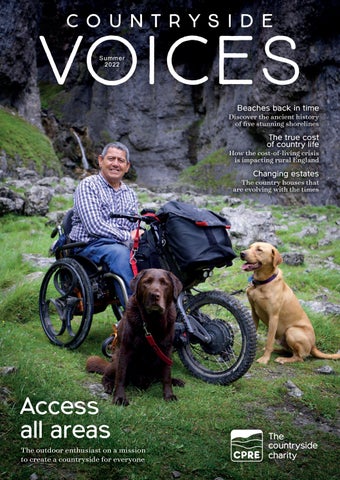
Access all areas The outdoor enthusiast on a mission to create a countryside for everyone
BLACK YELLOW MAGENTA CYAN
91CPRAUG22100.pgs 25.07.2022 10:16
Cover
CO U N T R YS I D E
VERSION
Cover photo: countryside lover and access champion Peter Lau, photographed by Deborah Lau REPRO OP SUBS
Time for change ART PRODUCTION CLIENT
As I write this, our policy team is scratching its collective head, trying to work out what the changes at the heart of government will mean for planning and the countryside. Using land wisely is always a core CPRE concern, so I’m pleased that we have just published new research into the use of our agricultural land and what needs to be done to ensure we make best use of it. Paying close attention to the impact of farming on local and national economies will stand us in good stead as we all look at the challenge of rising costs, and we take
a particular look at how that affects those living and working in the countryside in this issue. Before we know it, the harvest will be gathered in and the scent of autumn will be in the air – and I will also have moved on to new pastures as I’ve decided that it’s time for change. I have thoroughly enjoyed being CPRE chief executive for the past five years and am happy that in that time CPRE has been transformed into a positive, forward-looking countryside charity that will attract more people, from different backgrounds, to our vital cause. I wish you all the very best as that vision continues to develop. Enjoy the summer and I hope you can take some time to explore our wonderful countryside.
The nation’s future food security is being undermined unnecessarily, according to CPRE’s latest research. Our analysis found that almost 14,500ha of the country’s best agricultural land – enough to feed two million people their ‘five a day’ in fruit and veg – has been lost to development since 2010. Alarmingly, there has been a hundredfold increase in the amount of the ‘best and most versatile’ (BMV) land being given over to housing or industry. Nearly 300,000 houses have been built on prime farmland in the period,
Crispin Truman OBE Chief Executive
In this issue…
8 YOUR VOICES
2 NEWS
9 PHOTO STORY
Updates on our work and campaigns
England’s lost farmland
12 BIG READ
Readers write in
21 OPINION
The cost of country living
Wyl Menmuir on sound
22 DISCOVER
England’s next AONB?
16 INSPIRATION
Dr Anjana Khatwa’s favourite beaches
Access all areas
10 MY ENGLAND 6 LOCAL VOICES The latest on our groups nationwide
Olympian, author and countryside lover Helen Glover MBE
CPRE The countryside charity 15-21 Provost Street, London N1 7NH 020 7981 2800 | cpre.org.uk Editorial enquiries: Jane Seymour, janes@cpre.org.uk Membership enquiries: 020 7981 2870
2 S UMMER 2 02 2 | C P R E . OR G . UK
BLACK YELLOW MAGENTA CYAN
18 PEOPLE AND PLACES
24 VIEW FROM HERE
A place in the country
Published by Think cpre@thinkpublishing.co.uk thinkpublishing.co.uk Campaign to Protect Rural England is a company limited by guarantee, registered in England, number 04302973. Registered charity number: 1089685
Harvest tea with Sarah Langford
CPRE holds and manages data in strict accordance with the General Data Protection Regulation (2018) to keep our supporters informed of our activities. Our Privacy Policy may be found at cpre.org.uk/privacypolicy and you can change how we communicate with you or ask to stop hearing from us at any time via the contact details above. Views of contributors and advertisers do not necessarily reflect the policy of CPRE nor those of the publishers. © 2022 CPRE. All rights reserved. ISSN 1742-8777 For terms and conditions and details of winners related to promotions in Countryside Voices, email cpre@thinkpublishing.co.uk.
while 1,400ha of this land have been taken for renewable energy projects. That’s despite there being enough previously developed brownfield land available across the country to provide space for 1.3 million homes. Much of that brownfield consists of disused and derelict urban sites in the midlands and north that are ripe for regeneration. This loss of highly productive land is unsustainable if we want the country to reduce its reliance on imports and continue to grow plenty of our own food. CPRE is continuing to push for the government to bring forward brownfield development rather than allowing valuable green fields to disappear. We also believe that it is entirely possible for the government to balance food and energy security without resorting to building solar farms on our most productive farmland.
EMPOWERING COMMUNITIES How our nationwide network of groups is supporting local people
Planning better energy CPRE’s Future Energy Landscapes methodology, created in partnership with the Centre for Sustainable Energy, is designed to help neighbourhood planning groups, parish councils and local authorities deliver meaningful community engagement in the energy planning process. It has been put to good use by communities nationwide, including a recent workshop in Settle, North Yorkshire, held by the area’s climate action group, which will feed into the draft local area energy plan.
Poultry farm victory
In numbers: Investing in Green Belt
28% of Green Belt agricultural land is covered by agrienvironment schemes, compared to 42% of land nationwide
11%
of England’s farmland lies in Green Belt yet it receives only 7% from funding schemes
34%
of our nature reserves and 22% of historic parks and gardens lie in Green Belt
The Green Belt land buffering our biggest towns and cities covers 12.5% of England, and its wealth of public footpaths, bridleways, cycle routes, nature reserves, parks, gardens and other green spaces are the ‘countryside next door’ for 30 million people. Yet our latest research shows that government spending on Green Belt is lagging behind its investment in the rest of the countryside. Our analysis found that the Green Belt is not getting its fair share of funding from national ‘agri-environment’ schemes to plant trees, improve soil health, boost biodiversity and restore historic parks and buildings. We’re calling on the government to honour its commitment to protect and enhance Green Belt, for the good of all those of us who depend on it for health, wellbeing and recreation. Download our full report on The countryside next door from the Resources section at cpre.org.uk
With advice from the local CPRE group, the small parishes of Hungarton, Beeby and Keyham in Leicestershire crowdfunded a judicial review against plans for an intensive poultry farm and anaerobic digester in their neighbourhood, and won at the High Court. Local people contacted CPRE Leicestershire after the county council approved the application, feeling there had been a lack of transparency around the decision, and were emboldened to appeal. They were also advised by CPRE Herefordshire, veterans of tackling poultry megafarms. Happily, their appeal was upheld and the decision quashed, while the land has been sold to a local landowner who intends to farm it traditionally.
Defending greenfield CPRE Dorset has been assisting an action group in Poole that is campaigning to protect local greenfield from a development of 550 houses. Our group is calling for a sounder local plan for Poole, with more realistic housing targets – the current 1,000 yearly target is not justified by local growth, but is leading to such large-scale applications. With some local councillors supporting the scheme and others opposing it, the local campaigners have now referred the matter to the secretary of state.
C P RE .O RG .U K | S U MMER 20 22
3
91CPRAUG22101.pgs 25.07.2022 11:04
News, 1
NEWS
REPRO OP SUBS ART PRODUCTION
As Voices went to press, the government’s long-awaited Levelling Up and Regeneration Bill was still making its way through parliament. This piece of legislation has major implications for planning and the countryside, and our policy experts believe the draft bill falls short of what both require in two important respects. Firstly, the bill as initially published was unaccountably silent on the biggest priority facing our times: the climate emergency. As our research has shown, most local plans are not setting out strategic targets for reaching net-zero carbon, paving the way for yet more car-dependent, climate-unfriendly developments. We want the bill to lay out a ‘net-zero test’ to ensure that all future planning, nationally and locally, adheres to the UK’s carbon-reduction goals.
Secondly, we fear the bill as it stands still won’t give local authorities enough control over the volume and type of new housing being built in their areas. Indeed, the draft bill would give centralised ‘national development management policies’ the priority over democratically agreed local plans. Campaigning by CPRE and our allies in the Better Planning Coalition has already secured a number of improvements to the government’s early levelling-up proposals. For example, the controversial plans for outline planning permission to be automatically waved through in certain areas, and for mandatory housing targets imposed from above, have both been dropped. But we’re continuing to campaign for further amendments to the legislation that will foreground both climate action and local democracy.
WHAT TO DO THIS SUMMER
ROUSHAM.ORG
VERSION
Levelling up or losing local democracy?
Gardens with star quality
CLIENT
Don’t forget to make the most of your CPRE membership discount on days out this summer. You’ll find beautiful visitor attractions in our 2022 Members’ Guide, including several that have starred on the big or small screen. Iford Manor Gardens in Wiltshire was used as a location for the 2020 film The Secret Garden, and Rousham House and Gardens in Oxfordshire (above) featured in last year’s BBC adaptation The Pursuit of Love. Elsewhere, the grounds at Painshill in Surrey provided an elegant setting for Netflix’s Bridgerton. All these gardens are offering 2-for-1 standard entry tickets for CPRE members – see cpre.org. uk/membersguide for details and Ts&Cs.
Be a greener traveller
The government’s Levelling Up and Regeneration Bill needs further changes
Starrier skies Many thanks to the more than 2,500 of you who joined in this year’s CPRE Star Count to report on light pollution levels where you live. The results showed that star lovers are enjoying their best views of the night sky since our Star Count began over a decade ago. In 2020, 61% of participants reported severe light pollution – yet just two years later, this figure has fallen to 49%. The ‘lockdown legacy’ of increased homeworking, along with rising energy costs and greater awareness of the need to reduce energy wastage, may all have contributed to the starrier skies. We can all play our part in continuing the positive trend by switching off home, garden and business lighting if not in use, and encouraging councils to dim street lights and take action against light pollution. Discover more about our Star Count results at cpre.org.uk/starcount
4 SUMMER 2 02 2 | C PR E . OR G . UK
BLACK YELLOW MAGENTA CYAN
These days we’re all thinking more about the impacts of our travel on the planet. Holidaying nearer home is one way to reduce our carbon footprint, but it’s not always easy to balance our desire to enjoy the UK’s landscapes with, say, the unsustainable boom in holiday lets in rural communities. Says eco-travel journalist Richard Hammond: ‘The most effective way to lower your impact of travelling in the UK is to look for car-free options. Thankfully, there are plenty of resources to help you plan a trip, such as the website goodjourney.org.uk. You can also find car-free walks at carfreewalks.org, and walking routes that connect Britain’s towns and villages at slowways.org.’ We have five copies of Richard’s new book The Green Traveller (Pavilion Books), packed with tips on travelling responsibly, to give away. To enter the prize draw, email your name and address to cpre@ thinkpublishing.co.uk with ‘Green Travel’ as the subject heading by 31 October 2022.
WIN
News, 2
NEWS
IN FOCUS
National Volunteers’ Week 2022 was a chance to salute some of our hardest-working volunteers, as nominated by local CPRE groups. This year’s award winners include CPRE London volunteer coordinator Sarah Aherne, who has overseen the recruitment and induction of 15 new volunteers; archaeologist Kate Fielden, who has lent her invaluable expertise to CPRE Wiltshire’s campaigns for 36 years; and Colin Adsley, long-standing CPRE Northumberland volunteer and the group’s current chair (pictured above right). They are joined by CPRE Norfolk’s David Hook, who has led national work on light pollution, alongside many local campaigns; Northamptonshire campaigner Andrew Powles, who has successfully re-engaged a number of local parish councils with CPRE; Margaret Cockbill, member and chair of CPRE East Yorkshire for many years, who initiated our bid to make the Yorkshire Wolds an Area of Outstanding Natural Beauty; and CPRE Hertfordshire trustee Terry Over, who has got stuck into everything from spearheading a countywide children’s art competition to managing the installation of a solar panel on the office roof.
CAMPAIGNS AT A GLANCE
Mine decision on hold The government was due to make a final decision on the Cumbrian coal mine by 7 July. But given what else was going on in politics that
week, we weren’t surprised to learn that the decision has now been delayed until 17 August. Burning coal is disastrous for our countryside, communities and the ever-growing climate emergency, which is why we’ve continued to campaign against it. In July, we asked supporters to tweet Boris Johnson to protest against the coal mine and more than 1,600 tweets were sent, including one from none other than Queen rocker Brian May. We’ll continue to apply the pressure in the run-up to the ruling in August.
SARAH JAMESON
DEAN NICHOLSON
Our amazing volunteers
We’re delighted to be doing our bit towards increasing England’s hedgerows by 40% by 2050, through our replanting and restoration initiatives around the country. This year we have secured funding for seven ‘hedgerow heroes’ projects covering the Lancashire, Liverpool and Greater Manchester area; the Nottinghamshire, Lincolnshire, Derbyshire and Leicestershire area; Northamptonshire; Shropshire; Avon and Bristol; Suffolk and Hampshire. Between them, these projects will plant 11km of hedgerows in areas ranging from inner-city green spaces to farmers’ fields. The groups will also restore 6km of degraded hedgerow through coppicing or hedgelaying, and seek to reduce the intensive management of hedgerows across many more kilometres, encouraging hedges to thrive and support more wildlife. Much of this work will be done by volunteers, with training courses on hedgelaying and planting taking place up and down the country, along with hedgerow survey work and plenty of talks, walks and workshops. Local communities are encouraged to get involved, with some schools participating, while CPRE groups will also be working with parish and local councils to improve the management of their hedges.
A previous CPRE hedgerow workshop held in Shropshire
Hedgerow Week Do make a note to keep an eye on local and national CPRE social media and your group’s website for events associated with our hedgerow work (see above) in and around National Hedgerow Week running 17-25 September. Events include workshops, walks and, later in the autumn, coppicing and hedgelaying. We will also be calling on the new government to commit to a 40% increase in hedgerows by 2050, so please sign our petition on our website if you’re not one of the nearly 40,000 people who have already done so.
C P RE .O RG .U K | S UMMER 20 22
JESS HURD
ROUSHAM.ORG
More help for hedgerows
5
91CPRAUG22102.pgs 26.07.2022 09:43
VERSION
Dame Fiona Reynolds unveils the blue plaque to Ethel Haythornthwaite REPRO OP SUBS ART PRODUCTION
Happy hedgerows
Carbis Bay victory
BUCKINGHAMSHIRE
CORNWALL
The team at CPRE Buckinghamshire was recently delighted to take part in a visit to a local nursery in High Wycombe to educate the children about hedgerows. As well as talking to the youngsters about how hedgerows shelter wildlife and ‘look after the earth’, they also read from Elena Mannion’s inspiring children’s book, The Happy Hedgerow, and gifted a copy to the nursery. The kids were also provided with some countryside crafts, such as hedgerow templates for finger painting. Our group hopes that the visit will help encourage a lasting love of the countryside in the younger generation.
There was good news for our campaigners in Cornwall this summer, when the Carbis Bay Hotel (pictured) was ordered to demolish meeting lodges it had built without planning permission in the run-up to the 2021 G7 summit. The enforcement order taken out by Cornwall Council against the hotel was upheld by the government’s own planning inspector, who noted that he had found ‘very significant harm to the character and appearance of the landscape’. As a result, the hotel was ordered to ‘demolish the three buildings and to reinstate the land to its former level, gradient and condition before the development was undertaken’ – a victory for our Cornwall group and all those who campaigned against the illegal and damaging beach-front development.
6 S UMMER 2 02 2 | C PR E . OR G . UK
BLACK YELLOW MAGENTA CYAN
PAUL BUCKLEY/CPRE KENT
NEWS AND CAMPAIGNS FROM ACROSS THE COUNTRY
ALAMY
CLIENT
Local Voices
Ethel honoured PEAK DISTRICT AND SOUTH YORKSHIRE
Relief in the south east
ALAMY
PAUL BUCKLEY/CPRE KENT
ESSEX/KENT There was much relief in the south east this spring, with the news that controversial plans for a ‘London Resort’ theme park on Swanscombe Peninsula (pictured) have been withdrawn, for the time being at least. Debate over the future of this rapidly rewilding post-industrial landscape, now a designated Site of Special Scientific Interest, has continued for more than a decade. Our local CPRE groups in Kent and Essex, along with allies within the community and
The CPRE stand at the Love Local event
Loving local NORTH EAST GEMMA THORPE PHOTOGRAPHY
CPRE Peak District and South Yorkshire recently unveiled a blue heritage plaque in honour of its founder, the pioneering environmentalist Ethel Haythornthwaite MBE (1894-1986). The plaque was placed in Sheffield University’s Endcliffe student village, on what was once the site of Ethel’s home, and where she set up the charity in May 1924. Our local group’s president, Dame Fiona Reynolds, uncovered the plaque, telling the audience how she fondly recalled meeting Ethel and her husband Gerald in the 1980s. As Dame Fiona noted, Ethel’s dedicated campaigning had paved the way for the Sheffield Green Belt and the creation of England’s first national park, the Peak District, as well as preserving many countryside estates, like Longshaw and Blacka Moor.
Members of CPRE North and East Yorkshire and CPRE Durham joined forces for the first time to take part in the Love Local Day at Ormesby Hall in Middlesbrough this summer. The annual event, which celebrates all things produced locally, attracts hundreds of members of the public, and the two groups made sure they were on hand to bang the CPRE drum, securing an exhibition stand in the main marquee. Jan Arger, chair of CPRE North and East Yorkshire, said: ‘When we heard that CPRE Durham had a stand, we were only too delighted to accept their invitation to be part of an event which is right on the border between the two groups.’ With sunny weather helping draw crowds to the National Trust property, our groups worked hard to spread the CPRE message to a wider audience and raise our profile.
environmental NGOs, will continue to stand firm to protect this remarkable area from future threats. Meanwhile our Essex group is celebrating the 50th birthday of the Essex Way, a route from Epping to Harwich. CPRE Essex played a leading role in the 81-mile walk’s creation, and has launched an Essex Way photography competition to mark its anniversary, with small cash prizes for different age groups. Visit cpressex.org.uk to find out more and enter by Monday 19 September.
Marking the way STAFFORDSHIRE The Staffordshire Way links Mow Cop Castle in the north of the county to Kinver Edge in the south. On Staffordshire Day on 1 May, our county group and local running clubs held a relay run along the route, which volunteers completed in just under 18.5 hours. The way has become a little neglected, and the run aimed to put it firmly back on the map. CPRE Staffordshire volunteers have also been surveying the route and conferring with the county council about path, gate and stile maintenance, as well as refreshing the Staffordshire Way guide in order to breathe new life into this long-distance footpath.
C P RE .O RG .U K | S UMMER 20 22
7
91CPRAUG22103.pgs 25.07.2022 16:45
Local Voices, 1
LOCAL VOICES
Mailbox, 1
MAILBOX LETTERS AND EMAILS VERSION REPRO OP
Your Voices
As reported last issue, coastal communities like this one in Clovelly, Devon, are facing huge pressures
Letters and emails from our members, and how to get in touch
SUBS
Star letter DISAPPEARING HOMES
ART PRODUCTION
Thank you for an interesting magazine, with heart-warming examples of ordinary folk safeguarding their local green spaces, and succeeding, sometimes against the odds. However, the pressures on coastal house prices (‘Coastal
towns under pressure’) mean many who were born in these areas have simply nowhere to rent or buy any more. The real sadness for me is to hear of good tenants being asked to leave their homes so these can be swallowed up by holiday lets. We, who are fortunate to be safely housed, must stand up for those who need our help, and not gain by these thoughtless, greedy actions ourselves. Trish Cardy, via email
CLIENT
Our star letter writer Trish wins a compact, waterproof PACMAT picnic blanket. Made in the UK out of durable, 50% recycled fabric, it’s ideal for picnics, walks or the park. See the full range of colourful designs at rubbastuff.com
Print progress
Congratulations on the restyled Countryside Voices magazine, which I found much easier to read. I am partially colour blind and have found articles in the past too difficult to read because they have been printed on a coloured background. This is a complaint that I have with several publications, with the result that I do not bother to read them. I can identify with the comments made by Joe Winkelman in the spring 2022 letters page, especially regarding print on photographs. I cannot fault the design of your latest magazine, which I have been able to read from cover to cover. Thank you. Paul Jarrett, via email
Community buy-in
In response to articles in the magazine on ‘Stepping up for green spaces’, I wanted to put another side to this call for neighbourhoods to get their green spaces formally recognised as such. I am a landowner and live in a village that I love, and for 40 years up until 2019, we have given permission for various fundraising activities to take place on our field. This has given immense pleasure to us as a family and the community, as well as raising many thousands of pounds for local charities over the years.
However, despite the land being privately owned, there is a plan by our parish council and other interested parties to get it designated as a Local Green Space. While communities should work together in this area, they need buy-in from the main stakeholders; it shouldn’t be allowed that any area they feel they want to preserve is automatically made a Local Green Space. Penny Clayden, via email
Coking challenges
I read your piece about the proposed new coal mine in Cumbria. I fully support all efforts to produce green, sustainable energy and have signed an early petition against this proposal. Apparently, however, there is a problem finding a new fuel to replace the coal that heats the furnaces for the making of steel, which is a very important industry. With the Russia/Ukraine crisis, perhaps we’re better being self-sufficient. One fuel cannot just be dropped without another to step into its place. Fiona Roat, Norfolk
Editor says: CPRE believes that opening more fossil fuel mines (left) during the climate crisis is the wrong thing to do. We want to see investment in cleaner energy production, and countries ditching coal-powered
steel-making processes and adopting cleaner, less polluting technologies for manufacturing steel, which are already available.
Night blight
Having read the article by Anita Sethi (‘In praise of the night’), I have to say we are in danger of further light pollution via planning laws. A cul-de-sac development in my village requires nine light poles for 19 houses, while the whole village of around 460 properties has but 63. Admittedly the wattage per light will be reduced, thanks to modern fittings, but when challenged, we were told it would be the parish council that would have to stand any claim for injury should it be caused by a reduction in the recommended poles. The more industrialised we become, the harder it will be to find a dark starry sky for us, and nocturnal equilibrium for the wildlife around us. Maggie Down, Northamptonshire We’d love to know what you think of the magazine and the issues we’ve covered. email us at cpre@thinkpublishing.co.uk Twitter via @CPRE write to us at Countryside Voices, Think Media Group, 20 Mortimer Street, London W1T 3JW We are unable to respond to all letters, and those published may be edited for length and clarity.
8 SUMMER 202 2 | C P R E . OR G . UK
BLACK YELLOW MAGENTA CYAN
91CPRAUG22104.pgs 26.07.2022 09:46
VERSION REPRO OP SUBS ART PRODUCTION
BECCA NELSON
CLIENT
England’s next AONB? Rising dramatically from the Cheshire plain, the Sandstone Ridge is a range of low hills and rugged outcrops stretching from the north to the south of the county, set in a mosaic of landscapes including woodland, heaths, meres, mosses and hedgerow-rich farmland. Its 368km network of footpaths, including the
popular Sandstone Trail, provides a green escape for many living in populous cities in the north west. Along with the Yorkshire Wolds, it is one of the key areas that is currently under consideration as a new Area of Outstanding Natural Beauty (AONB); something CPRE has long called for. ‘The Sandstone Ridge was
considered for designation when AONBs were first created in 1949, but sadly it was not included in the final Act,’ says Peter Raynes, chair of CPRE Cheshire, who recently organised a group walk on the Ridge. ‘With Natural England now reconsidering that decision, it’s high time that its natural beauty was recognised.’ C P RE .O RG .U K | S U MMER 20 22
BLACK YELLOW MAGENTA CYAN
9
91CPRAUG22105.pgs 25.07.2022 17:16
Photo Story, 1
EVERY PICTURE TELLS A STORY
MY ENGLAND HELEN GLOVER VERSION REPRO OP
‘I was definitely a wildling’ One of Britain’s greatest Olympians, Helen Glover MBE, tells us about her lifelong love of the countryside, why she’s passionate about getting children outside, and how the most chaotic outdoor trips can also be the best
SUBS ART PRODUCTION CLIENT
I was definitely a wildling as a child; always outdoors, and rarely in shoes. I grew up in Cornwall, and my brothers and sisters and I would spend hours on the beach or in the woods. That passion for the outdoors definitely started with my parents. They loved it, too; plus the outdoors was the ideal place to tire out five energetic young kids, for free! One of my earliest memories is of family trips to the beach. We’d park really far away to avoid paying car parking fees, then everyone had to help carry something down there: buckets, spades, the picnic. I remember us dragging our loads right down to the far end of the beach that nobody else had walked to yet, and feeling like it was all ours; like we had discovered it. My first real sense of independence was on a bike. It was the first time my parents had let me and my brothers go off on our own, and it probably wasn’t more than a couple of miles, but it felt like the most complete freedom you can imagine. It was also a little bit scary, because we had to keep looking at the map to find our way. That little bit of uncertainty was thrilling.
10 S UMMER 2 02 2 | C P R E . OR G . UK
BLACK YELLOW MAGENTA CYAN
Spending a lot of time outdoors kept us free-spirited and inquisitive. I’m sure it was fundamental in my becoming an athlete and Olympian later in life. It makes you understand, appreciate and observe the environment around you. It helps you communicate. It makes you a good leader. All skills that you need in the world of sport. I’ve always loved sport, whether that’s in a sports hall, up a mountain, or on the sea. I love going to the gym and working out, but if I want some real headspace, I usually head outside. Being outdoors isn’t the one and only answer to improving our physical and mental health, but for me, it’s an important piece of the puzzle. There aren’t many people it doesn’t help in some way. After growing up by the sea, I’ve always been drawn to water, so rowing felt like a natural fit. We’re about to go on a kayaking trip to Dorset, and I look forward to the endless possibilities and
the changing environment: might we see a dolphin? Could a seal pop up? In summer, the river where I train is full of ducklings and cygnets, while in the winter, it’s quiet and beautiful, and you can be the only person out there in the mists on the water. Sharing your enthusiasms with your kids makes a big difference. Our three, Logan, Kit and Bo, feel very at home around water, because we’ll take them out on paddleboards or kayaks or canoes, and they’ve seen our genuine enthusiasm for all that. Steve might have been away on a remote trip to discover a new species, but he’ll come home and see a toad in the garden, and get overwhelmingly excited about showing that to the kids. It’s so important for kids to get to spend time in the countryside. No child should ever think ‘that’s not for me’, because it’s there for everyone. I know we’re
My England, 1
Above: making happy memories on the beach with husband Steve, eldest son Logan and twins Kit and Bo Below: Helen’s beloved River Thames, pictured at Cookham, Berkshire
extremely lucky to live right next to the River Thames, with hills to go walking and tonnes of environments to explore. But both Steve and I have lived in towns and cities as well as by rivers and coasts, and every area has its unique opportunities to get out there. I hate to think anyone ever felt excluded from spending time outdoors based on where they live, or by a lack of prior knowledge. One of the most rewarding outdoor experiences for me and Steve was taking a group of 14- to 16-year-olds wild camping in the Lake District. About an hour in, it started raining torrentially, and didn’t stop for the remaining 23 hours. We were all soggy and cold; I don’t think anyone slept a wink! But the next morning, the kids were buzzing. They were so proud of themselves for putting up shelters to sleep in, and cooking their own dinner under a tarpaulin. They got more from that experience than they would if everything had been sunny and easy. As a parent, I know it’s not always easy to get children outside. Quite the opposite – some days it seems impossible to get out of the door! But every time you get out there, you’re armouring them better for the rest of their life; whether that’s in terms of practical skills or simply creating an emotional connection with the environment. It could be a big camping adventure in the woods, but equally it could be a five-minute activity, like turning over stones to see what insects you can find.
One of our favourite places to visit is the Isles of Scilly, particularly St Martin’s. We’ve had some special times there when the kids were very small, getting away from our busy routines and just living a simple, outdoor life. We’ll go kayaking for hours, ending up on empty beaches, and Steve and I will turn to each other and say ‘Yes! This is the childhood we want for them.’ We definitely try to be aware of our environmental impacts. We live in an eco-house we built. But we also try to do smaller things, like litter-picking with the kids. A global problem like climate change feels so huge that it’s difficult to explain it to them. But if you distil it down to something practical, like picking up and recycling litter from their local park, they feel empowered and excited to help. The pockets of every coat I own are full of old packets and wrappers we’ve picked up on walks. When our eldest, Logan, was three and a half, the only Christmas present he wanted was a litter picker. As Steve said at the time: ‘We’ve done our job right!’ I do feel optimistic about the future of the natural world. We’re seeing a generation of children coming through who are informed, inspired and excited about changing the planet. What concerns me is that we need to adapt far more quickly than we are doing. We need to be as proactive as our kids would be, if they were in charge. Helen and Steve’s new book Wildlings: how to raise your family in nature (Two Roads) is out now.
Helen Glover MBE is a former number-one British rower who has twice won Olympic gold. She lives on the borders of Berkshire and Buckinghamshire with her husband, naturalist Steve Backshall MBE, and their three children. C P RE .O RG .U K | S UMMER 20 22
11
91CPRAUG22109.pgs 25.07.2022 11:29
VERSION REPRO OP
The cost of country living From soaring energy bills to a dearth of affordable housing, our rural communities are at the sharp end of the cost-of-living crisis – and they deserve a fairer deal to help unlock their huge potential, writes Andrew McCloy
SUBS ART
F
PRODUCTION CLIENT
ifty-year-old Matt Culley stares out across the fields of his Hampshire farm with a rueful shake of the head. ‘Farming is a risky business where you have to make daily calculations,’ he says, ‘but I’ve never known so many challenges on so many fronts. I really worry about the future.’ Matt manages 650 hectares of owned and contract arable farmland near Andover, and says the current economic uncertainty is causing him sleepless nights: ‘Within the past year, the price of fertiliser has more than doubled, and the supply remains highly unpredictable. Then, add to that rocketing costs of fuel and energy, feed prices and ongoing labour shortages. For farmers, the cost of making a living in the countryside has never been harder. I know farmers who are thinking of getting out altogether.’ The problems facing farmers like Matt reflect a wider economic crisis that, while felt across all parts of
England’s seemingly idyllic rural towns and villages, as seen here at Hawkshead in the Lake District, can face huge economic pressures
12 S UMMER 2 02 2 | C PR E . OR G . UK
BLACK YELLOW MAGENTA CYAN
society, is having a disproportional impact on rural communities. Spiralling prices, the legacy of coronavirus and chronic underfunding in rural services has meant that the countryside is in danger of being left behind. Analysis of the local government finance settlement for 2022-23 by the Rural Services Network has revealed the gulf in central support between rural and urban areas. Rural authorities are set to receive 37% (or £105) per head less than their urban counterparts, but on average will pay 21% (or £104) per head more in council tax, due to receiving less in government grants. Quite apart from the fundamental unfairness of this, the disparity matters – not only because it costs more to deliver the same services in rural areas, but because for all sorts of socio-economic reasons, there is greater overall need in the countryside. Even the very mechanisms intended to offer support are often weighted against rural communities. For instance, the state’s welfare systems
are poorly adapted to rural circumstances, failing to appreciate the volatility and irregularity of rural incomes. Nor do these systems tend to take into account obstacles like lengthy rural travel times, or problems with rural broadband and mobile coverage, leading to lower overall rates of benefit take-up in rural areas.
Levelling up or letting us down? So, will the government’s muchheralded ‘levelling up’ agenda really address this systemic inequality? ‘For many years, successive administrations have failed rural communities by simply not investing in basic infrastructure and services
‘Policy needs to be rural-proofed, and government has to set out a clear vision for the future’
and letting the gulf between rural and urban widen,’ says Jeremy Leggett, policy adviser for Action with Communities in Rural England (ACRE). ‘If they are serious about levelling up, it’s crucial that they measure the impact within, and not just between, regions. It shouldn’t simply be about north and south, but evaluating urban and rural areas at a micro scale within regions.’ Despite the urgency of the current situation, what is really needed is longer-term, lasting change, says Jeremy. ‘We must be careful not to conflate the short-term cost-of-living crisis with the need to make long-term structural changes,’ he notes. ‘Policy needs to be ruralproofed, and government has to set out a clear vision for the future of rural England.’
Fuel and transport poverty In terms of levelling up, perhaps nowhere is the imbalance so stark for rural communities than around energy and fuel, where two deep-rooted problems have created what has been described as ‘dual energy vulnerability’ for rural households. First, countryside dwellers have some of the hardest-to-heat homes. Take Cornwall, where a staggering 47% of homes are not connected to mains gas. Instead, they often rely on LPG (liquefied petroleum gas) or
heating oil, which are volatile in price and not covered by the Ofgem price cap. Houses in rural areas tend to be older, and retrofitting insulation can be difficult and costly. Meanwhile, poorer households in rural areas are more likely to live in privately rented houses than those in urban areas, where social housing is more plentiful. Domestic energy and heating issues are compounded by a second challenge: transport. Rural communities face higher travel costs, whether for work or for simply accessing day-to-day services; and where public transport is limited or non-existent, there is little alternative to the car. As Jeremy puts it, ‘Without further financial aid, these people will increasingly face difficult choices between turning their heating on or putting fuel in their car to get to work.’ Energy bills jumped in April this year, and are set to do the same again in the autumn. Data projections from the End Fuel Poverty Coalition have highlighted the vulnerability of many rural areas, with a third of households predicted to experience fuel poverty across rural west Norfolk, north east Lincolnshire, Herefordshire and Shropshire.
Andrew McCloy is a writer and journalist specialising in countryside and recreation issues, and also the chair of the Peak District National Park. Home truths Statistics like these lay bare the myth that poverty is an urban phenomenon, and that somehow rural areas are less prone to economic hardship. Indeed, successive surveys and reports suggest that the situation for many living in the countryside is actually getting worse. CPRE’s research has underlined that building more affordable homes in rural areas makes sense financially, socially and fiscally, and would provide a much-needed boost to the local communities most seriously impacted by the pandemic. But as CPRE analysis earlier this year showed, the supply of affordable homes in the countryside has
C P RE .O RG .U K | S UMMER 20 22
13
91CPRAUG22110.pgs 25.07.2022 11:25
Big Read, 1
THE COST-OF-LIVING CRISIS BIG READ
VERSION REPRO OP SUBS ART
Affordable rural housing, like this development in Yorkshire, remains in very short supply
Despite everything, rural communities have enormous potential to contribute
14 SUMMER 2 02 2 | C P R E . OR G . UK
BLACK YELLOW MAGENTA CYAN
The countryside should be at the heart of a green economy to the economic health of the nation. As CPRE has argued, the countryside should be at the heart of a green economy built around sustainable food production, nature restoration, rural homeworking and carbon-saving staycations that don’t impact unsustainably on rural communities.
Properly supported and rewarded, our beleaguered farming industry will not only continue to support hundreds of thousands of jobs, increase national food security and provide stewardship of our most valued landscapes, but it will also play an important role in addressing the biggest crisis of them all: the climate emergency. CPRE believes that empowering farmers to adopt a more sustainable approach can increase both environmental and economic resilience – a view echoed by Martin Lines, chair of the Nature
MATT CULLEY; ALAMY
CLIENT
Unlocking rural potential
Many rural dwellers rely on heating oil deliveries to heat their homes
ALAMY
PRODUCTION
markedly declined in the past few years – in part due to the 1,000% increase in short-term and holiday lets in rural areas between 2015 and 2021. The problem is exacerbated by developers claiming they will make insufficient profits as an excuse to get out of meeting affordable housing quotas in new developments. It seems that at the very moment when the countryside needs more affordable and energy-efficient homes to help young people and families withstand the economic crunch, there are in fact fewer social housing projects being completed, rural housing supply is shrinking and waiting lists are getting longer. ‘There has to be a government response to the fact that our rural housing supply is disappearing into an unregulated short-term rentals market that simply didn’t exist six years ago,’ says CPRE chief executive Crispin Truman. ‘We already know we have to build more social housing to meet communities’ needs – preferably on brownfield land and village infills – but such measures as planning permission for short-term lets are desperately needed if the problem isn’t to be made even worse.’
Friendly Farming Network: ‘Adopting nature-friendly farming practices can help reduce input costs and increase the diversity of outputs. Building soil health, having diverse crop rotations and delivering habitats for nature that pollinate your crops and predate your pests will offer multiple financial benefits.’ As Martin points out, farming faces huge challenges in the future as our climate changes. ‘Working to build resilience in our businesses through mixed systems and landscape recovery not only gives farmers a buffer against economic or natural shocks like extreme weather, but also helps reduce our reliance on costly inputs,’ he adds.
Matt Culley worries about the future of his arable farm in Hampshire
MATT CULLEY; ALAMY
ALAMY
Community self-help When rural industries and communityled initiatives are able to prosper, the wider rural economy and society also benefit. We’ve seen this with community renewable energy enterprises, such as the Schools’ Energy Co-operative, which has worked with local communities to install rooftop solar arrays at 90 schools, children’s centres and other sites, bringing down their energy bills and channelling any profits back into its member schools. Many community-owned renewables are using their increased incomes from high energy prices to plough back funds into the very communities that are experiencing social hardships. During the early stages of the pandemic, for example, locally run Ferry Farm Community Solar was able to direct £40,000 into a coronavirus hardship fund for residents of Selsey and Sidlesham in West Sussex. Elsewhere, community-led fuel poverty schemes are providing practical help, such as the
‘Bee Warm’ initiative set up by the Gawcott Fields Community Solar group in Buckinghamshire, which is advising on (and in some cases helping to implement) energyefficiency improvements around peoples’ homes. Jake Burnyeat of Communities for Renewables, which has supported many of these not-forprofit energy enterprises, says that in these instances, it has been rural communities, not lenders or shareholders, who have benefited the most from the current dividend. ‘In a way, this is achieving what an energy windfall tax at a national scale should, but at a local community level.’ He believes community-owned renewable energy can and should be a key part of the rural economy, like food production, with the benefits shared locally. ‘If rural communities can better keep the surplus funds these schemes are generating within
their own areas, quite apart from promoting energy efficiency and becoming low carbon, they can help shape a more equitable future for those that live and work in the countryside.’
Driving change If there’s any silver lining to the storm clouds facing the countryside, it’s that the current crises are sometimes driving positive change – whether that’s communities coming together to help themselves, or rural industries diversifying to become more resilient. But ultimately, to make sure that already disadvantaged communities don’t fall further behind, the government needs to invest more strategically in a greener economy. Community self-help is essential, but true levelling up in the countryside requires more fundamental and sweeping action to rebalance housing, transport, broadband and other essential services. ‘I’m the fourth generation of my family to farm, and I want to continue and see agriculture thrive,’ says Matt Culley, ‘but rural England simply needs a fair deal.’
Find all the latest on CPRE’s campaigning for a fairer deal for the country at cpre.org.uk – and share your views on the rural cost-of-living crisis with us at cpre@thinkpublishing.co.uk
C P RE .O RG .U K | S UM MER 20 22
15
91CPRAUG22111.pgs 25.07.2022 16:26
Big Read, 2
THE COST-OF-LIVING CRISIS BIG READ
VERSION REPRO OP SUBS
Access all areas
ART PRODUCTION CLIENT
Peter Lau has always loved the outdoors, and a life-changing biking accident wasn’t about to alter that. Here, he explains why he’s on a mission to make the countryside more inclusive for everyone
16 S UMMER 2 02 2 | C PR E . OR G . UK
BLACK YELLOW MAGENTA CYAN
were our available free time, or the weather. Suddenly and without warning, all of this changed. On that April day, I suffered horrendous injuries in a serious mountain bike crash, paralysing me from the chest level down. After a long while in recovery, I commenced the slow journey back to being ‘the old me’, and getting the wonderful outdoors back into my life. Little did I realise how hard this would be, though, once I became dependent on a wheelchair. The countryside now seemed full of obstacles. Stiles, gates, steps, bridges, narrow gaps and the steepness or camber of terrain can all
Peter has discovered a passion for photography, capturing stunning shots like this bittern (above) and gannets at Bempton Cliffs (opposite)
block the progress of those who rely on wheels. Researching a route with the help of an Ordnance Survey map used to be a fun and easy process; but maps and apps do not give you the
DEBORAH AND PETER LAU
efore 5 April 2014, life was very different. My wife and I both worked in the emergency sector; Deb is a senior nurse in A&E, and I was an officer in the fire service. In our free time, we immersed ourselves in the outdoors to reboot and escape from our hectic, often pressured professional lives. In the peace and calmness of the natural world, we could debrief together and reflect on everything we were exposed to each week as frontline emergency service providers. The countryside was always a place to explore, ramble, climb, run and adventure. The only restrictions on our movements and spontaneity
detail you need to plan a successful outing if you’re differently able. Often, the only way I can tell if I can complete a route is by experiencing it for myself.
Wildlife and wellbeing It’s worth all the effort, however, because having access to the countryside is so important to my mental health. This was a real issue, especially during the period after my accident, when I was trying to accept the changes in my own and my family’s life. The fitness activities I used to achieve outdoors may no longer be possible, but the benefits to my mental wellbeing have only increased. Reconnecting with the outdoors also led me to take up landscape and wildlife photography. When you manage to produce a photograph of a location or subject that truly captures its mood or character, it’s incredibly rewarding. I find that being outdoors even lessens my need for pain-relieving medication, because I’m totally engrossed in working on getting that perfect picture of a bittern, or similar subject. This allows me to mentally escape, which has become my most effective pain relief. While rediscovering the countryside as a wheelchair user, it struck me that it would be a wasted opportunity if I didn’t record and share my findings with other people who use mobility equipment. I learnt website-building skills (not bad for someone who’s had to relearn how to talk and move their fingers!), and set up a blog called accessiblenatureuk.com, to help others decide if any of the routes I’ve covered might be suitable for them. Every individual knows best what they, and their equipment, are capable of.
DEBORAH AND PETER LAU
A countryside for all Disabled people are increasingly choosing to visit the countryside in their leisure time, and I know of many people like me who travel and explore on their own, independently of others. This is partly due to a general rise in disabled people’s growing expectations of being able to participate in the same activities as, and with, everyone else. A countryside for all does not mean that every country park, nature reserve or pathway must be capable of accommodating all disabled people
Rural obstacles like this metal A-frame, often installed to deter quad bikes, can block wheelchair access
at all times. This would be unrealistic economically, and probably undesirable environmentally. I’ve had the pleasure of climbing many of the UK’s highest peaks, and while I’d love to return to the summit of Ben Nevis, I don’t expect a fully accessible path with an easy 1-in-12 gradient to be installed. This would not only be hugely expensive, but detract from the beauty and wildness of it all. In simple terms, a countryside for all means that where good access can be provided, it is; and where it can’t, everything possible is done to avoid restricting people unnecessarily. Everyone working to provide public access to the countryside has a responsibility to do so without discriminating against disabled people, and some great work has been done on this front. Many RSPB reserves, for example, aim to be as inclusive as possible; one of my favourites is Bempton Cliffs on the east coast of Yorkshire, which attracts thousands of breeding seabirds, including gannets, puffins, razorbills, guillemots and recently a black-browed
albatross. The path along the top of the cliff has been made fully accessible, with level paths and viewing points. Forestry England also has a number of inclusive sites; my nearest is Dalby Forest in the North York Moors, which has miles of accessible paths to explore with my family and friends (who use bicycles to keep up with my motorised wheelchair). Often, however, much more could be done to improve the accessibility of the countryside, with a little consideration. In my experience, many public bodies and NGOs are not familiar with the access needs of people who use mobility equipment, or the capabilities of the equipment that is now readily available. I’d urge all countryside organisations, landowners and land managers to talk to their visitors, stakeholders and local community groups about how improvements might be made to create a more inclusive environment. There are a great many situations where access for all could, and should, be provided, with a little bit of research – to the benefit of all concerned.
Peter Lau works in the conservation sector and blogs at accessiblenatureuk.com. He lives with his wife and dogs in West Yorkshire. C P RE .O RG .U K | S UMMER 20 22
17
91CPRAUG22108.pgs 25.07.2022 16:24
Inspiration
COUNTRYSIDE FOR ALL INSPIRATION
VERSION REPRO OP
Wentworth Woodhouse is a traditional country house with a renewed purpose
SUBS ART CLIENT
England’s country estates are a varied bunch, and many are diversifying, refocusing and reaching out to new audiences to survive and thrive in changing times, says Eleanor Doughty
T
o look at, Wentworth Woodhouse doesn’t seem like the sort of place that you could miss. The former home of the Fitzwilliam family, coal magnates and landowners, it is – depending on who you ask – either the largest or the second largest house in England. And yet, until 2017, it was almost totally unknown to the local community of Rotherham; closed to the public, and hidden in plain sight from the town just five miles away. Once a palatial residence devoted to one family, with an army of staff that included a bear keeper, today the estate is in the hands of a community trust, the Wentworth Woodhouse Preservation Trust, which acquired the building and 87 acres of its gardens in 2017. The trust’s goal is to regenerate the site as a catalyst for positive change in South Yorkshire. Its chief executive, Sarah McLeod, is not only at the helm of a
18 S UMMER 2 02 2 | C PR E . OR G . UK
BLACK YELLOW MAGENTA CYAN
One of the approaches the trust is taking is to explain how the culture of Wentworth ran alongside that of other cultures, exploring ‘what was happening here in this house in the 1930s, and what was happening in Rotherham in the 1930s’, says Sarah. ‘If you look at these things in parallel, then you can look at them together.’
building restoration project that could cost up to £200m, but she is also on a mission to make Wentworth welcoming to the local community and beyond. This Connecting with communities not only involves opening the private Audience development might not always gardens as a visitor attraction, and new be easy at Wentworth, but it is extremely interpretation of the house’s spectacular rewarding. Sarah’s team are not just state rooms, but extends to reaching inviting local groups to the house, but parts of the community that can feel excluded from estates of this kind. ‘When you’ve got a house like Families explore the Wentworth, which is a bastion grounds at the Wentworth of white aristocratic Britain, Woodhouse WE Wonder Festival there is an obvious challenge in dealing with the global majority,’ she says. ‘White British visitors, whatever their background, might feel some thread of connection with the house. That is much more difficult when you are dealing with groups from Somalia, or Poland, or Pakistan.’
ALAMY
PRODUCTION
A place in the country
Windsor-based journalist Eleanor Doughty writes for The Daily Telegraph, The Times and Country Life among others. She is currently writing her first book about the British aristocracy from 1945.
Soulton Hall is a working no-till farm as well as a historic estate
ALAMY
ALAMY
Mariam Shah, Zanib Rasool MBE and Shaheen Shah, participants in Wentworth’s exhibition The Suitcase
going out to visit them too. Next year, they hope to open the restored 18thcentury Camellia House in the gardens as a global tea house. Six days a week it will form part of the regular visitor attraction, and on Mondays ‘we will do dedicated work with community groups, taking tea with them, because we believe tea is a great leveller’, says Sarah, who plans to incorporate the pink tea drunk by the local Bengali community into the Camellia House’s menu. The idea, she adds, is to get people ‘to be comfortable coming to us and knowing us, so that they feel they are part of the audience here’. Inclusion is at the heart of Sarah’s vision for Wentworth in the 21st century. Last year, Wentworth’s chapel hosted The Suitcase exhibition by a Pakistani women’s art collective, the Zanib Collective, to mark the first generation of Pakistani women who came to Rotherham in the 1960s. ‘The trust’s engagement work has been
The English country houses that have continued to thrive have often looked for ways to diversify outstanding,’ says participating artist Zanib Rasool MBE. ‘It has opened the mansion’s doors to all and helped break down barriers and engage diverse communities.’ Sarah accepts that Wentworth, in all its (slightly run-down) finery, might sometimes be a difficult sell, and that this mission might take time – but, she says cheerfully, ‘it’s about going one step at a time’.
Estate of change Sarah’s team are not alone in wanting to approach new audiences. The English country houses that have continued to
thrive in the modern world have often looked for ways to diversify and do things differently. After World War II, many stately home owners opened their houses to the public, as the world around them changed and ready cash was required, or brokered deals to hand them over to the National Trust or other bodies. Yet other families have held on to their estates, diversifying into new areas, new revenue streams and new projects. Off the B5065 in Shropshire, 14 miles from Shrewsbury, stands the charming, brick-built Soulton Hall, home of the Ashton family for 450 years. Today’s Ashtons – John and Ann, and their son Tim – farm over 500 acres in a traditional ‘no-till’ style, that avoids disturbing the soil as far as possible to reduce erosion and retain nutrients. Having begun welcoming overnight guests to the house in the 1980s, like many estates they have also diversified into hosting weddings, serving candle-lit dinners and running a pair of holiday cottages. More unusual is their Long Barrow, a memorial site inspired by England’s Neolithic barrows, which opened in 2018. Only the second of its kind in the UK, this recreation, constructed according to historical practices with the help of Cambridge University, was partly inspired by Ashton family trips to other barrows across the British Isles. ‘I’m very proud to live in north Shropshire – the people are great,’ says Tim Ashton. ‘We are lucky to have this architectural statement here, which people trust us to
C P RE .O RG .U K | S UM MER 20 22
19
91CPRAUG22113.pgs 25.07.2022 12:07
People and Places, 1
COUNTRY HOUSES PEOPLE AND PLACES
People and Places, 2
PEOPLE AND PLACES COUNTRY HOUSES VERSION REPRO OP
Landowners Hugh Somerleyton (left), Oliver Birkbeck and Argus Hardy are championing rewilding
SUBS
The National Youth Theatre performs Animal Farm at Soulton ART PRODUCTION
To bring people together safely during the pandemic, an amphitheatre was built at Soulton
CLIENT
the large Victorian stately home was look after, and is respected as part of ‘tired and unmodernised’, and the estate their landscape.’ run in a traditional way, with most jobs The Ashtons’ dedication to keeping done by the agent. The late Lord their local community close was proven Somerleyton had opened the house to again during the first summer of the public in the 1950s, but times were coronavirus restrictions. To bring people still tough. With a business model based together safely, the family decided to on two fluctuating markets – farming and build an amphitheatre at Soulton in which visitors – things often had to be sold off. to stage performances in the open air. rewilding team on jeep, foot and boat Hugh ‘cannot imagine the pain it must The project was, Tim explains, inspired safaris to understand more about the have been for my father to see asset by a tour made by Shakespeare’s work being done, take the opportunity disposal as a necessary part of theatre company, the Lord to forage for their suppers, and eat running his business’. Chamberlain’s Men, during outside among free-roaming Exmoor Today, Somerleyton is the plague of 1606. ‘The ponies, deer, pigs and Highland cattle. run rather differently, with first place on the tour was Hugh’s ambition is to reunite people the business divided into Shrewsbury, and they and nature. That can sometimes involve farming, tourism and played outside – it was balancing the needs of both – he is keen property. Attracting about people’s welfare, to work out an arrangement between visitors remains important even then.’ those who enjoy paddleboarding on – the house is open to the He decided to follow Fritton Lake and the estate’s water public on a limited basis, and suit, building the theatre in buffalo, which like to swim there. He the estate’s two-mile-long about five weeks, and giving The free-ranging laughs: ‘Is that a bridge too far? It’s a Fritton Lake offers a holiday much-needed work to local cattle on the Somerleyton estate club with woodland cabins, restoration project of the human mind people. The Ashtons went as much as the land itself.’ a floating sauna and plenty on to welcome around 5,000 Landowners have always taken of sporting activities to enjoy. people to Soulton, with plays every the long view. Today, says Hugh, this Fritton is, however, also an important weekend. The amphitheatre was not long view is about ‘how we can build part of WildEast, the rewilding and nature the most commercial of projects, but it ecological resilience and restoration into restoration project set up by Hugh and wasn’t supposed to be: ‘The point of our land, and how we can attract carbon his fellow East Anglian farmers Oliver doing it is not to make money; it’s about and biodiversity credits. We’re doing it Birkbeck and Argus Hardy. Its aim is the cultural weight that it gave us.’ with the same zeal that our fathers had to restore 20% of East Anglia to natural after the war, when they were hell-bent habitat, with Fritton at the heart of Hugh’s Sustainable land management on ploughing up every single inch to parcel of land – a mosaic of heath, alder On the Somerleyton Hall estate in produce food, because that was the carr, woodland and former farmland that Suffolk, Hugh Crossley, 4th Baron mission of the day. Now, the mission has been set aside for nature. Its visitors Somerleyton, is – like an increasing is to save the planet.’ are encouraged to engage with the number of landowners – embracing more sustainable land practices in terms of farming and nature, taking a similar route to the celebrated rewilded If you know of a country estate that is doing great work, estate at Knepp Castle in West Sussex. we’d love to hear about it at cpre@thinkpublishing.co.uk When he took over about 15 years ago, 20 S UMMER 2 02 2 | C P R E . OR G . UK
BLACK YELLOW MAGENTA CYAN
91CPRAUG22114.pgs 25.07.2022 11:52
VERSION REPRO OP
Listening to a landscape Wyl Menmuir on why he relishes the wild and soothing music of the Cornish countryside near his home
SUBS
I
ART PRODUCTION
OLI UDY
CLIENT
which I am drawn; and particularly those ’m naturally quite an anxious person. whose lives, lived mostly out on the I overthink, overanalyse, lose nights of ocean, intersect with mine only briefly sleep over things that shouldn’t really and from a distance, on the clifftops. bother me at all. I’ve tried everything for it: talking therapies, medication and I love that I only ever see these birds meditation. Unexpectedly, though, the in glimpses; it makes mysteries of them. thing that has worked best for me is an app I downloaded onto my phone that Seabird songs listens to birdsong, analyses it, and tells My favourite of all the birds I find here me the names of the birds I can hear in are the northern fulmars. I can happily the wooded valley where I live, just shy lose hours watching them soar against of a mile from the sea. the backdrop of the sheer cliffs among Using it on my walks, I’ve started to the black-backed and herring gulls, become familiar with the birds in the moody jackdaws and the this particular place. Not just occasional brown flashes the ones I could already of hunting kestrels. I seek Wyl’s favourite seabird, the fulmar recognise – the buzzard, them out on the cliffs blackbird and barn owl where they nest on – but blackcaps, ledges, including chaffinches, Hell’s Mouth and chiffchaffs and around Deadman’s woodpeckers, which Cove – so named, I rarely see, but are in all likelihood, for the there among the trees. terror they inspired in The app has encouraged sailors on this most rugged me to listen in a way I never of Atlantic coasts. have before. From what was, at first, I sit among the clifftop sea pinks with an indistinguishable mass of bird noise, my eyes closed and try to pick out the seabirds’ cries from within the mordros, I can now make out individual calls to the word the Cornish give to the which I can put a name. As a result, the sound of the sea. I don’t often hear valley takes on a new meaning for me. the fulmars – they are quiet birds, Once I have checked on the birds in serious, snub-headed things that the valley, I head towards the sea, to the appear, gliding, in one’s periphery beautiful North Cliffs between Portreath rather than in plain sight – though that and Godrevy, with the app and a pair of doesn’t stop me listening for them. binoculars. Most of all, it is seabirds to
As I do, it occurs to me that, aside from the occasional motorbike in the distance, the only sounds I can hear are those of the birds, the wind and the waves. Signs on the field boundaries and along the coast path announce that much of the land here is part of a conservation area, allowing rare butterflies to flourish, and seabirds to go about their lives without us impeding on them too much. They need as much space as we can give them; like most seabird populations, fulmars are in decline. We lose this wild landscape at their peril, and ours too. Listening and watching these birds calms my mind and my almost ever-present anxieties. It is a meditation in itself, a balm for the overstimulation of modern life. Even on a day in midsummer, it still feels wild here, with the sea crashing against the foot of the cliffs and the birds wheeling and calling to one another in the vertiginous drop. I feel my heart soar with them out from the cliffs and over the deeps and the shallows.
Wyl Menmuir is a Man Bookernominated novelist. His first non-fiction book, The Draw of the Sea (Aurum), is out now.
Cornwall’s North Cliffs are a spectacular place to soak up the mordros (sound of the sea)
C P RE .O RG .U K | S UM MER 20 22
BLACK YELLOW MAGENTA CYAN
21
91CPRAUG22107.pgs 25.07.2022 12:07
Opinion
SOUNDSCAPES OPINION
DISCOVER BEACHES VERSION REPRO OP SUBS ART
Beaches uncovered
Earth scientist Dr Anjana Khatwa takes us back in time to discover the ancient history of some of England’s most amazing beaches
PRODUCTION
Coverack Beach CORNWALL
CLIENT
This is no ordinary beach, for this is one of the few places in the world where you can literally take a journey into the centre of the Earth. The rocks that are stretched out along Coverack Beach were forced up to the Earth’s surface almost 300 million years ago during a period of intense tectonic activity. I get goosebumps when I walk from north to south on this beach, as each footstep takes you deeper into what was once the Earth’s centre. The rocks you walk across represent the oceanic crust, the mantle beneath, and the boundary where they meet (known as the ‘Moho’). It’s quite something to ponder as you enjoy your delicious Cornish ice cream.
Lyme Regis A statue of Mary Anning, the celebrated Victorian palaeontologist, now stands frozen in motion as she strides towards the beaches of Lyme Regis on the Jurassic Coast. Now a major attraction in this lovely small coastal town in Dorset, she represents a fascination that people have had for centuries with this coastline. You, too, can walk in their footsteps, combing the beaches in search of fossils; rocky remains of extinct life dating back to almost 200 million years ago. The beaches, which are only safely accessible at low tide, are packed full of Jurassic treasures that include belemnites, fool’s gold ammonites and perhaps (if it is your lucky day!) even an ichthyosaur vertebra.
22 S UMMER 2 02 2 | C P R E . OR G . UK
BLACK YELLOW MAGENTA CYAN
ALAMY
DORSET
Discover, 1 ROB COOMBE
St Bees Beach CUMBRIA A mile-long sand and shingle beach stretches along the seafront at the quiet town of St Bees. The northern end is marked by the red sandstone cliffs of St Bees Head. Formed in ancient deserts around 250 million years ago, they are home to one of England’s largest seabird colonies. At the southern end, the rocks tell a different story, of how an ice sheet advanced from Scotland across northern England some 19,000 years ago, leaving deposits known as glacial moraines. The soft cliffs gently tumble down onto the beach, creating an expanse of pebbles and sand to amble along at low tide.
West Runton Beach NORFOLK The flat, expansive sands at low tide on West Runton Beach are utterly idyllic to stroll along on a hot, sunny day. You have to time-travel in your mind to imagine that only 750,000 years ago, herds of large mammoths were grazing on the grasslands of this ice age landscape. In 1990, one of the oldest and best-preserved examples of a fossilised mammoth skeleton, known as the West Runton elephant, was found in these cliffs. Today, the beach is a joyous outdoor playground with plenty of soft sand, rockpools and fossils to look out for. You can have fun filling your pockets with the Cretaceous sea urchins that fall out of the chalk while you search for that elusive mammoth bone.
Runswick Bay NORTH YORKSHIRE
PHIL SILVERMAN/SHUTTERSTOCK
CKTRAVELS.COM/SHUTTERSTOCK
ALAMY
Dr Anjana Khatwa is an awardwinning Earth scientist, TV presenter and writer. She lives in Dorset, close to the Jurassic Coast, in a house filled with rocks and fossils.
Nestled on Yorkshire’s beautiful coast, just 10 miles north of Whitby, is the pretty little village of Runswick. Although Runswick Bay is quieter than some of the other beaches around Whitby, it offers an adventurous day out that will take you back to the Jurassic Period. The rocks here formed about 200 million years ago in an underwater wonderland populated with amazing sea creatures, like ichthyosaurs, that no longer exist. A hard tap with a geological hammer on an egg-shaped ball of grey limestone may even yield a perfect ammonite. At low tide, the broad, sandy beach is a perfect destination for bodyboarding, making sandcastles or a gentle stroll.
C P RE .O RG .U K | S UM MER 20 22
23
91CPRAUG22112.pgs 25.07.2022 17:39
View From Here, 1
VIEW FROM HERE SARAH LANGFORD VERSION REPRO OP SUBS
F
ART PRODUCTION
catastrophe. But then I discovered a quiet revolution or harvest tea this year, I shall pack the food spreading across the countryside: a shift to of my childhood. I shall tell my two young regenerative farming that placed restoration of the sons how I also once stood on a chair in a soil at its heart. As I learned what it was to be a farmer farmhouse kitchen in the heat of late summer, from those growing food in this way, I realised they had as I remember my grandmother, a veteran of harvest found something many in the city were searching for: teas. She and my grandfather began their tenancy on a a sense of connection, purpose, place and meaning. Hampshire farm in 1959. During harvest she would take I grew to love the rituals which marked the farming food to him and the 11 others who worked in the field, calendar, each one tied to natural cycles. They made so they wouldn’t waste precious time coming up to me feel something I had not felt for a long the house. The men would drink sweet tea time: rooted. So this summer, my family from glass bottles that had cooled by and I shall mark the most important the time it reached them. On blankets of rituals: harvest. We shall watch laid over the stubble she would for the harvest moon, huge and set out rock cakes, shortbread orange, its glow bright enough and egg sandwiches with that farmers once used it to butter as thick as the filling. work late into the night. We It became a kind of ceremony. shall twist a corn dolly out of Even after my mother and Sarah Langford swapped the last stalks of our wheat her siblings had left for new and hang it on a nail until lives, they would still come a legal career for a family spring. I shall try and imprint back to help with harvest. farm in Suffolk – and into my children’s memories By the time I was born, reconnected with her some of my own: the feeling most of the men had been own rural roots of bare ankles grazed by stubble; replaced by machines. the itch of chaff in your nose; the Until five years ago, I had not fully specific taste of sweet tea drunk from understood the imprint these memories the plastic lid of a thermos. had made upon me. I left country life long I’ve come to believe that the old ways ago, qualifying as a barrister and starting must not be forgotten, for they have much my own family in London. But then, to teach us about how we might repair unexpectedly, our circumstances changed. some of the unintended consequences of We left our urban life and moved to Suffolk, farming’s intensification. And in a world that where my husband grew up, and took on seems increasingly restless, they teach us the running of his small family farm. patience, humility and what it means to be I soon realised we had become of service. They show us how we are connected to the farmers during one of the biggest periods natural world, and it to us. And through these rituals, of industry change for generations, and at a time when they show us how our communities are stitched those who produced our food were no longer seen as together with a thread that goes back hundreds of heroes feeding a nation made hungry by war, but often years, sewing our future to our past. perceived as villains charged with causing ecological
RICHARD ALLENBY-PRATT
CLIENT
Harvest tea
WIN! ROOTED: STORIES OF LIFE, LAND AND A FARMING REVOLUTION Bestselling author Sarah Langford’s new book Rooted: Stories of Life, Land and a Farming Revolution (Viking), an authentic,
beautifully written portrait of 21st-century farming, is out now. We have five copies to give away – to enter the prize draw, send
your name and address to cpre@thinkpublishing.co.uk with ‘Rooted’ as the subject heading by 31 October 2022.
24 S UMMER 2 02 2 | C PR E . OR G . UK
BLACK YELLOW MAGENTA CYAN
91CPRAUG22106.pgs 25.07.2022 10:47