ZAMANI CONCEPTS
41 COMING TO TERMS WITH GRIEF
54 THERAPY
58 NAVIGATING
IN FOOTBALL
INTERNALISED RACISM
THER APY TODAY
VERSION
OCTOBER 2026 | VOLUME 37 | ISSUE 8
REPRO OP SUBS ART PRODUCTION CLIENT
OCTOBER 2026 | VOLUME 37 | ISSUE 8
Reclaiming the blue BLACK HISTORY, HEALING AND THE SEA
BLACK YELLOW MAGENTA CYAN
91BAPSEP26100.pgs 03.09.2026 11:03
Cover
36 EXPLORING SASA AND
Everywhen is a trading name of Advisory Insurance Brokers Limited, which is authorised and regulated by the Financial Conduct Authority (Firm Reference Numbe~ 313250). Registered in England and Wales, Comriany No. 4043759. Registered address: 2 Minster Court, Mincing Lane, London, EC3R 7P.D.
VERSION
Contents
Contents ← 24
REPRO OP
‘For slave owners it was imperative that we feared the water so that they had control over the Middle Passage, and this has led to hundreds of years of cultural conditioning for those from the African diaspora’
Greta Solomon (‘Seafaring’, pages 24-29) SUBS
IN THE KNOW
News • Research • Events
ART
5 From the Editor 7 Noticeboard
PRODUCTION
ROY SCOTT/IKON IMAGES
News and events from BACP and beyond
8 From the CEO 1 3 From the President 1 5 Policy updates 1 7 Research digest 1 8 What’s on 2 0 Bookshelf
Black History in focus An exploration and celebration of Black identity
24 The big issue Unpacking the Black community’s complex relationship with open water
3 1 Ethics BACP’s Head of Diversity, Equity, Inclusion and Belonging explains what lies at the heart of culturally responsive therapy
-
IN PRACTICE
IN PROGRESS
Ethics • Good practice
Training • CPD • Careers
4 2 Dilemmas
5 4 My practice
Is it ethical to continue couples counselling if one partner is alcohol and drug dependent?
5 0 Clinical concepts Defining cultural humility in therapy practice
Integrating therapy into football
5 8 Professional
development
Working with internalised racism
50
BBC COUNTRY SIDE
CLIENT
36 IN THE ROOM
Client issues • Case studies
3 2 Reflections On gatekeeping decolonisation
OPPORTUNITIES
3 6 Experience Where Kenyan philosophy and personcentred practice meet
4 1 It changed my life Learning to accept the pain of grief
-
OVER TO YOU
Courses • Practice services
Feedback • Opinion • Profiles
6 2 Classified, mini ads,
7 2 Letters
recruitment, CPD, training and service support
Your feedback on Therapy Today articles
74 What I’ve learned Kim Loliya
74 THERAPY TODAY
BLACK YELLOW MAGENTA CYAN
91BAPSEP26101.pgs 01.09.2026 14:40
3
OUR NEW SEO TOOLBOX - EMPOWERING YOU TO PERFORM ON SEARCH ENGINES! ARE YOU DUAA COMPLIANT? THE ICO DEADLINE WAS JUNE 19TH!FIND OUT MORE AT WWW.POLICYDIARY.CO.UK
SCAM THE CODE TO SET UP AM APPOIMTMEMT.
The number of new clients you'll need before your WebHealer website pays for itselfWhat are you waiting for? Speak to Web Healer today and see how we can help you win more clients and manage your practice more effectively. GET YOUR WEBSITE BUILT· FAST RANK ON SEARCH ENGINES
FIND NEW CLIENTS
COMMUNICATE PROFESSIONALLY & SECURELY
GET FOUND ON GOOGLE BUSINESS PROFILE
All for~
ENJOY FULL SUPPORT FROM WEBHEALER
I
REPRO OP
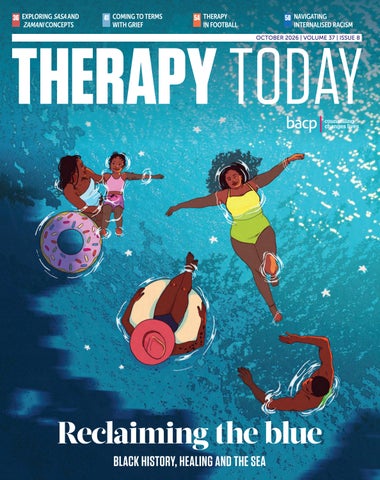
n memory of Jane Adetoro, Christina Walters and Rebecca Walters, three Black women who were found drowned in the sea in Brighton earlier this year, journalist Greta Solomon explores the Black community’s complex relationship with water in our cover story this month (page 24), with our beautiful cover design by biracial illustrator Bex Glendining. Bringing concerted attention to stories like this isn’t just about the news; the stories are reminders of how we continue to develop trauma-informed practice in our profession to factor in cultural nuance. This isn’t an attempt to virtue signal but to remember why we’re doing it. As I write, the country is still reeling from the shocking death of Professor Jason Arday, who some of you knew personally. This case has highlighted the ongoing need to mark Black History Month, because Black people still face systemic inequity in the way they experience life, sometimes with tragic consequences. With the new Ethical Framework, mandatory from November, it feels important that Therapy Today continues to embody the ethical values that BACP membership expects of us as therapists: that we commit to culturally responsive practice. This issue therefore tackles what cultural humility looks like (page 50) and the paradox around attempts to decolonise (page 32). These pages grapple with the complexity around what we really mean when we talk about
SUBS ART PRODUCTION
working ethically, and how we actually carry it out in practice beyond words. Student member William Njoki helpfully points out that reflecting on Black history is not simply a focus on oppression but a lens through which to understand different ways of knowing therapy (page 36). Far from simply ‘teaching’, my hope is that these pages honour the network of Black practitioners at the forefront of this profession. With this, Dwight Turner navigates working with internalised racism (page 58), Kim Loliya describes the power behind developing community (page 74) and Anthony Bedward shows what a difference representation can make to a person’s future (page 54). For Sarah Allen, October marks the anniversary of her mother passing and a moment of reflection around grief (page 41). Katerina Georgiou MBACP (Snr Accred) Editor
CLIENT
Please email d bacp@bacp.co.uk to: ● Opt out of receiving paper copies of Therapy Today ● Inform us of a change of address ● Report a missing issue
BACP Executive Team Chief Executive Officer Dr Phil James Chief Regulation and Standards Officer Dr Lisa Morrison Chief Operating Officer Philippa Foster Chief Experience Officer Ben Kay
BACP Board of Trustees Governors Bumi Akinmutande, Josephine Bey, David Chenery, Matt Cormack, Emma Farrell, Emily Garvie, Ewan Irvine, William LLorel-Antoine, Erin Stevens, Dr Paul Taylor
Client Engagement Director Melissa Michael Production Director Justin Masters Executive Director John Innes Senior Commercial Partnerships Executive Cara Termine M 020 3771 7214 d cara.termine@ thinkpublishing.co.uk
Sustainability Therapy Today is printed on FSC® certified paper supporting sustainable forestry and produced using suppliers who conform to ISO14001, an industrial, environmental standard that ensures commitment to low carbon emissions and environmentally sensitive waste management. Both the cover and inner pages can be widely recycled.
CARBON BALANCED PAPER
-
www.carbonbalancedpaper.com CBP016930
D
FSC
www.fsc.org
MIX Paper I Supporting responsible forestry
FSC® C017177
For information about advertising in Therapy Today, please contact d cara.termine@thinkpublishing.co.uk
THINK
Therapy Today is published on behalf of the British Association for Counselling and Psychotherapy by Think, 65 Riding House Street, London W1W 7EH thinkpublishing.co.uk
Printed by: Warners Midlands Plc ISSN: 1748-7846 Subscriptions Annual UK subscription £76; overseas subscription £95 (for 10 issues). Single issues £8.50 (UK) or £13.50 (overseas). All BACP members receive a hard copy free of charge as part of their membership. M 01455 883300 d bacp@bacp.co.uk BACP BACP House, 15 St John’s Business Park, Lutterworth, Leicestershire LE17 4HB M 01455 883300 d bacp@bacp.co.uk bacp.co.uk
Disclaimer Views expressed in the journal and signed by a writer are the views of the writer, not necessarily those of Think, BACP or the contributor’s employer, unless specifically stated. Publication in this journal does not imply endorsement of the writer’s views by Think or BACP. Similarly, publication of advertisements and advertising material does not constitute endorsement by Think or BACP. Reasonable care has been taken to avoid errors, but no liability will be accepted for any errors that may occur. If you visit a website from a link in the journal, the BACP privacy policy does not apply. We recommend that you examine privacy statements of any third-party websites to understand their privacy procedures. Case studies All case studies in this journal, unless otherwise stated, are permissioned, disguised, adapted or composites, to protect confidentiality.
Copyright Apart from fair dealing for the purposes of research or private study, or criticism or review, as permitted under the UK Copyright, Designs and Patents Act 1998, no part of this publication may be reproduced, stored or transmitted in any form by any means without the prior permission in writing of the publisher, or in accordance with the terms of licences issued by the Copyright Clearance Centre (CCC), the Copyright Licensing Agency (CLA), and other organisations authorised by the publisher to administer reprographic reproduction rights. Individual and organisational members of BACP may make photocopies for teaching purposes free of charge, provided these copies are not for resale. © British Association for Counselling and Psychotherapy
baCp I
counselling changes lives
Company limited by guarantee 2175320 Registered in England & Wales. Registered Charity 298361 BACP and the BACP logo are registered trade marks of BACP
OCTOBER 2026 SEPTEMBER 2024
BLACK YELLOW MAGENTA CYAN
I
‘These pages grapple with the complexity around what we really mean when we talk about working ethically, and how we actually carry it out in practice’
Contributing to Therapy Today Therapy Today includes submissions from members and other practitioners, and we very much welcome your contributions. For Therapy Today-specific guidelines on the types of articles we are looking for, please email d therapytoday@thinkpublishing.co.uk. Please note, we do not publish poetry, blogs or dissertations.
Editor Katerina Georgiou Art Director George Walker Managing Editor Marion Thompson Consultant Editor Sally Brown Contributors Ellie Broughton, Sally Brown, Jeanine Connor, Natalie Marchant, George Salaminios Project Manager Adele Payne FRONT COVER: BEX GLENDINING (LGIONS.COM)
From the Editor
| THERAPY TODAY
91BAPSEP26102.pgs 02.09.2026 15:50
5
From the Editor
VERSION
THERAPY TODAY
__
professional'" • .....-~standards 'Y authority accredited register GlobolA<adomy (or h)"<hoooual &lldo1lo11,MpThrnpy
Advanced Diploma in Psychosexual and Relationship Therapy 2027-2028 A globally informed, culturally inclusive training programme for professionals seeking to deepen their expertise in psychosexual and relationship therapy. The NAOS Institute builds on over 35 years of international training excellence in psychosexual and relationship psychotherapy. Founded by leading figures in the field, the programme has contributed to shaping professional standards and training practitioners across more than 40 countries. Now entering a new phase of development, NAOS continues this legacy with an international faculty and a renewed commitment to culturally informed, globally relevant practice.
Format: • Monthly one Sunday and Monday • Year 1: In-person (London) • Year 2: In-person (London) + live online This flexible structure supports both UK-based and international participants.
The programme is open to: • Psychotherapists and counsellors, psychologists and related healthcare professionals In exceptional circumstances these may be waived.
Duration: 2 years ( part-time) Start Date: January 2027
For full course details: https://www.naos-institute.com/trainingA,aos-advanced-diploma-in-psychosexual-and-relationship-psychotherapy/ The course is accredited by COSRT, level 7 and in part fulfilment, via NCPS, of the Accredited Register (PSA)
• Enquiries: info@naos-institute.com
Noticeboard, 1
VERSION
Noticeboard
REPRO OP
NEWS REPORT
SUBS
The suicide rate among Black youth has been increasing faster than any other ethnic group*
IN THE KNOW
Our monthly digest of news, updates and events
CLIENT *NAMIWLA.ORG/UNCATEGORIZED/BLACK-HISTORY-MONTH-2026
Introducing the new Ethical Framework for the Counselling Professions 2026 The Ethical Framework for the Counselling Professions 2026 will become mandatory from midday on Tuesday 3 November 2026. With implementation now just weeks away, we’re encouraging members to make sure they’re familiar with the new framework and the resources available to support the transition. The framework was developed through a four-year review and informed by extensive consultation and feedback. It has been updated to reflect new ways of working, emerging ethical challenges, and current legislation and evolving issues. The framework is structured around three key sections: A – Working ethically within relationships; B – Ethical principles; and C – Core responsibilities. These sections should be used together to support ethical decision-making and safe, effective practice. A series of new Ethics Essentials video resources is also available to help members prepare for the transition. Find out more at bacp.co.uk/ preparingforthe2026ethical framework
Ii-'
PRODUCTION
Over three-quarters (76%) of ethnic minority communities in the UK say that their mental health has been impacted at an early age, according to new research from the Mental Health Foundation. The findings come as the UK marks Black History Month, the 2026 theme of which is ‘Honouring Our Communities’. While October is a time to celebrate Black achievement, Black History Month also provides a platform for discussing and seeking to address deep structural inequalities – both in societal and health terms. ‘The thing with the sort of racism that people are encountering is it starts at a really early age, so you know if people are experiencing racism in their childhood, that is a traumatic event for many, and it builds up over time,’ says Alexa Knight, Director of Policy and Influencing at the Mental Health Foundation. ‘It leads to feelings of uncertainty, of not feeling safe, but also of shame, which is itself really undermining of people's mental health, so it sort of builds up over time.’ Structural inequalities include poverty, housing insecurity, unemployment, incarceration and school exclusion, with Black communities ‘disproportionately exposed, with impacts felt across the entire life course,’ explains Nisa Chisipochinyi, Head of Equity and Racial Justice at Rethink Mental Illness, another charity that campaigns to address disparities in access to mental health care. ‘Many people face stigma, mistrust of services, a lack of culturally responsive care and unequal treatment when seeking help. As a result, Black communities often experience poor outcomes and are less likely to benefit from early intervention and preventative support.’ Black History Month therefore offers an opportunity to reflect on how to tackle the underlying inequalities behind higher rates of mental illness in the Black community through the provision of culturally appropriate health care alongside legislation such as the Patient and Carer Race Equality Framework, launched in 2023. The Mental Health Foundation’s Impact of Racism on Mental Health report* demonstrates that racism is a persistent public mental health issue and how repeated exposure to discrimination and unequal treatment can contribute to stress, anxiety and poorer mental health outcomes. *The report and findings will be available later in the year at mentalhealth.org.uk Words by Natalie Marchant
Ii-'
ART
New research outlines racism’s early toll on mental health
ARTEM ONOPRIENKO/SHUTTERSTOCK
BACP UPDATE
OCTOBER 2026
BLACK YELLOW MAGENTA CYAN
| THERAPY TODAY
91BAPSEP26103.pgs 02.09.2026 15:55
7
VERSION
Noticeboard
20%
Black adults are more likely to report serious psychological distress than white adults* BACP NEWS
SUBS ART PRODUCTION *NAMIWLA.ORG/UNCATEGORIZED/BLACK-HISTORY-MONTH-2026
CLIENT
DIARY DATES bacp.co.uk/events
8
THERAPY TODAY
7
OCTOBER
ONLINE
Artificial intelligence and the human connection Professional development day
| OCTOBER 2026
BLACK YELLOW MAGENTA CYAN
FRAME STOCK/SHUTTERSTOCK
CEO
Therapy Today shortlisted for Memcom Excellence Awards 2026 Therapy Today magazine has been nominated for the Memcom Excellence Awards 2026. The Memcom Excellence Awards are high-profile UK industry accolades that celebrate the achievements and transformative work of professional bodies, trade associations, membership charities and the wider not-for-profit sector. Therapy Today was shortlisted for ‘Best Magazine’ on account of the strength and quality of its editorial and design. As well as this, BACP has been nominated for ‘Best Non-Celebratory Event’ for its Supervisors event last year, and ‘Best Membership Strategy, Support and Campaign’ for SCoPEd. The Memcom Awards ceremony will take place on 24 September, when the winners will be announced. Find out more at bacp.co.uk/news/ news-from-bacp/2026/24-july-scopedsupervisors-event-and-therapy-todayshortlisted-for-awards
10
-
OCTOBER
LONDON
BACP member event 2026 and awards Networking event and celebration of members
PEOPLEIMAGES/SHUTTERSTOCK
MIKE SEWELL
REPRO OP
One of the things I’ve learned throughout my career is that meaningful progress rarely comes from having all the answers. It comes from creating opportunities for people to share their experiences, challenge assumptions and help shape better decisions. For counsellors and psychotherapists, conversation lies at the heart of professional practice. Through Dr Phil James, dialogue, practitioners help people explore new Chief Executive perspectives, make sense of complexity and move Officer forward. There is something powerful in that idea, and I believe the same principle applies to organisations. That thinking sits at the heart of BACP’s Member Engagement Programme. It is built on a simple belief: our Association is strongest when members play an active role in shaping its future. Through surveys, focus groups, workshops and conversations, members have shared their experiences, aspirations and concerns, helping us better understand the challenges facing both the profession and BACP itself. The value of this engagement doesn’t just help us gather feedback but also builds richer dialogue with members and between members, which enables us to test ideas, explore different perspectives and make better-informed decisions about our priorities and future direction. Of course, dialogue does not always produce simple answers. Members hold diverse views, bring different experiences and often highlight competing priorities. That is entirely healthy. Our role is not to act on every suggestion but to listen carefully, weigh different perspectives and ensure that members’ insights genuinely inform the decisions we make. This autumn provides two further opportunities to strengthen those connections. In October our Member Event on World Mental Health Day will bring members together to explore issues affecting the profession and celebrate achievement through our awards programme. Shortly afterwards, our AGM will provide an opportunity to hear about our progress, hold us to account and exercise the democratic rights that sit at the heart of membership. While these events serve different purposes, both form part of a wider commitment to dialogue, participation and engagement throughout the year. Together they help ensure that members are not simply recipients of services but active partners in shaping the future of their professional association. Every conversation contributes to that journey. Thank you to everyone who continues to share. I hope you’ll join us in October and play your part in shaping the future of BACP.
FROM THE
BACP EVENTS
Noticeboard, 2
1 in 3
Only
Black adults in need of mental health support receive it*
BACP member event and awards Join us in London at the BACP member event on Saturday 10 October 2026 and take part in open discussions on the issues that matter most to you.
Spreading the word
The event aims to encourage meaningful dialogue, enabling you to share your insights, experiences and aspirations. It will also serve as a space where we can present a summary of organisational progress and our impact on the wider profession. The dynamic platform will feature an engaging programme with sessions including:
13
OCTOBER
ONLINE
How to succeed in private practice Professional development day
AMANDA MACDONALD
16
-
OCTOBER
MANCHESTER
BHAVNA RAITHATHA
Effective supervision on erotic transference Professional development day
ROYA ROYLE
TIMOTHY WRIGHT
ANTONIO DIAZ/SHUTTERSTOCK
View the programme and book your place at bacp.co.uk/events/me101026-memberevent-2026
SHUTTERSTOCK
Please also join us after the event for an award ceremony to celebrate the success of our members.
Amanda Macdonald and Susie Masterson featured in HuffPost exploring loneliness, AI and the importance of human connection, alongside findings from our 2026 Public Perceptions Survey. • In Stylist Bhavna Raithatha explained how comparing yourself with friends on social media can contribute to feelings of inadequacy, and alongside Stefan Walters shared advice on healthier communication styles in HuffPost. • Debbie Keenan and Nicola Vanlint talked about coping with sporting disappointment in a Press Association article. • Nicola Ball spoke to HuffPost about the invisible mental load and resentment experienced by many mothers. • Stylist explored the impact of PMDD on relationships, with insights from Hannah Jackson-McCamley, Brieanne Doyle and Kamalyn Kaur. • Roya Royle highlighted the signs of grandparent childcare burnout in an interview with the Press Association, syndicated to The Independent, MSN UK, Yahoo! News and The Irish News. • Georgina Sturmer outlined ways to cope with climate anxiety in The Independent. • Timothy Wright examined the benefits of optimism for mental health and wellbeing in Apple News. • Hilda Burke offered advice on managing phone addiction in BBC News Online. • Stephen Westcott spoke to Cosmopolitan about the challenges therapists face when supporting clients in unhealthy relationships.
*NAMIWLA.ORG/UNCATEGORIZED/BLACK-HISTORY-MONTH-2026
• Keynote: Mental health and the value of therapeutic support with Louis Smith MBE. • Keynote: Artificial intelligence (AI) and the future of the counselling profession. • BACP in action – our year of impact. • World café workshops – share your voice on themes focusing on ‘the future of the profession’, ‘Diversity, equity, inclusion and belonging’, ‘Sustainability and self-care’ and ‘Collaboration, influence and public engagement’. • Divisions connect: shaping practice and priorities – meet the members behind our divisions and hear from them on their key priorities, challenges and what’s coming up.
Promoting our members and our profession through the media
OCTOBER 2026
| THERAPY TODAY
91BAPSEP26104.pgs 02.09.2026 15:55
9
COUNSELLING TUTOR
Clinical Supervision li aining Gainthe competence and confidenceto offer clinical supervisionto counsellors, both online and face-to-face
SCANME!
*Trustpilot Enrichingtraining
Thisis a fabuloustraining
Can'trecommendenough!
The training was fantastic from start to finish. Thorough, insightful, enriching and fun! The tutors are so supportive in every way. I have grown with their guidance and must say it is one of my best training course experiences. They adapt to all styles of learning, it's extremely inclusive, and it's managed professionally from start to finish.
Very well structured with a mixture of self-study and live elements. With warm, knowledgeable and supportive tutors and great support. I would highly recommend it.
I recently completed all my modules for the clinical supervision qualification with Counselling Tutor. and honestly cannot recommend them enough! Clearly set out and well delivered with a mix of both theory and practical which I really
- BeverleyHanley.Dip.Couns,CCS Counsellor and ClinicalSupervisor
- EllieFinch,MA, MBACP(Accred)
enjoyed.
- ClaireKennaby,MSc,MBACP
VERSION
Noticeboard, 3
2x
Black adults living below the poverty line are more likely to report psychological distress than those with more financial security*
Noticeboard
YOUR QUESTIONS ANSWERED REPRO OP
Kenya Association of Professional Counsellors (KAPC) Elias Gikundi,
SEVENTYFOUR/SHUTTERSTOCK
SUBS
BACP and KAPC have joined forces to explore how CEO and Executive therapy is understood and practised across different Director of KAPC contexts in the UK and Kenya. This matters for accessibility and inclusion because different therapies make it more likely that someone will find an approach that works for them. Read on to find out more about our collaborative project collating personal stories from members of both Associations.
ART
Student Conference 2027 Support and insight for the pathway to practice Our flagship student event is back. Taking place on Saturday 20 February 2027, this hybrid conference is designed to support student members transitioning from training to professional practice. This popular event takes place every two years and plays a key role in supporting students on their pathway to practice through shared learning, lived experience and practical insight. The programme will explore current challenges facing the profession and provide you with the tools and perspectives to help you to build confidence. BACP Trustee Josephine Bey will be joining us as a keynote speaker with a session on ‘Ticking all the boxes: race, neurodivergence and finding your place in a profession that wasn’t built for you’. This session will aim to challenge you to think critically about representation, access and belonging, and inspire you to become a practitioner who doesn’t just enter the profession but changes it. Book your place at bacp.co.uk/events/sc2027students-conference-2027
How have you worked together? We have chatted, laughed and ultimately will share a body of work that aims to strengthen the mental health support network and encourage more people to seek diverse therapies without fear or stigma. The storytelling approach helps us see people, communities and the world from a different perspective, build understanding, strengthen relationships and open up ways in which therapy is received and communicated.
3
-
NOVEMBER
ONLINE
~
Professional development day
DRAZEN DIGIC/SHUTTERSTOCK
What lessons have been learned so far from it? Bringing Kenyan and UK voices together showed that honesty crosses borders even where context and language differ. Our weekly rhythm built the trust that made real disclosure possible. Patience did as much work as any single conversation. Working across two cultures taught us to hold both the universality of the therapeutic relationship and the specific barriers, such as stigma, access and understanding, that shape it differently in each country. Neither view was more correct; each sharpened the other. We plan to continue working across borders in this way.
SEVENTYFOUR/SHUTTERSTOCK
CLIENT
*NAMIWLA.ORG/UNCATEGORIZED/BLACK-HISTORY-MONTH-2026
PRODUCTION
Tell us more about the project. There has been an atmosphere of excitement and curiosity among Kenyan participants, who met once a week, strongly committing to advocating for counselling to be better understood and more culturally responsive. There was a palpable sense of emotion emerging through many of the stories. It is hoped that these stories will illuminate the experiences of those accessing counselling services in Kenya and the UK, enabling us to learn from them, challenge existing barriers and create ‘wide open’ doors to mental health services.
Working with context, identity, diversity and universal equity
BACP EVENTS
10
-
NOVEMBER
NEWCASTLE
OCTOBER 2026
BLACK YELLOW MAGENTA CYAN
Making Connections Professional development day
| THERAPY TODAY
91BAPSEP26105.pgs 02.09.2026 17:23
11
Vouradmin? Already done.
Zanda is practice managementsoftware with Al inside. More time for clients. More time for you. ~ zanda
Ci. sean:h
@ (.W, s:oo
All Practitioners
I
v ) ( All Locations
•
v ) ( Today v)
( Day
Ill
I
II 0
4D Week Month ) 0 0
f~t V
BizzyAI
SOAP Note Draft
Subjective
JohnSmith "'00-•"5
IEI
3:30
Objective
Assessment
Scooter Gradley
Please summarize the treatment plan.
ents include session attendance, tion of ...
Plan
Noticeboard, 4
VERSION
MEMBER SPOTLIGHT
Noticeboard
REPRO OP SUBS ART PRODUCTION CLIENT
I moved from a career in media to study counselling and psychotherapy at the University of East London, qualifying in 2017. Lorna Cole-Partridge I then joined the Grenfell Counselling Team MBACP, psychotherapist working alongside an amazing multicultural, multidisciplinary team. We provided emotional support to survivors and bereaved families living in hotels after the fire in a setting that demanded flexibility, humanity and community over convention. It was a formative experience that shaped my practice and understanding of trauma, collective healing and the importance of culturally responsive, representative mental health care. As part of the same team I have supported vulnerable participants at the Grenfell, COVID-19, Post Office and Lampard national inquiries. Those experiences reinforced my belief that while being clinically effective, therapy must also be culturally relevant, socially aware and accessible to marginalised and minoritised people. I also established my private practice, Good Soul Therapy, where I support people through soul-led transformation, helping them understand the impact of trauma, identity and generational patterns. My MA research explored intergenerational trauma within Black communities in the UK, and as a Black Caribbean therapist I have seen time and again that we cannot separate mental health from the historical and ongoing wider contexts of racism and inequality. Over the past four years, through my social enterprise Therapy Rebels, I have partnered with Hackney Quest charity to develop Talking Quest, a community service for young people that offers culturally relevant counselling through outreach, taster sessions, drop-ins and flexible approaches delivered by a predominantly Black and Global Majority team. We have seen attitudes shift in the different community spaces we work with, helping to reduce stigma and normalise seeking mental health support. The project has been recognised through funding from BACP and the local Integrated Care Board via East London NHS Foundation Trust to reach African and Caribbean heritage young people who may never otherwise have accessed counselling due to a lack of trust in the system. Talking Quest has also enabled good-quality in-person placements for trainee counsellors within a supportive majority Black team. This is especially important given the discourse around inequalities and isolation experienced by many Global Majority counselling trainees. Increasing representation within the profession is essential if we are to address the persistent inequalities in mental health outcomes for Black communities in the UK. As a member of the Black, African and Asian Therapy Network I have mentored students and championed culturally affirming spaces within the profession. This year I also founded Black Therapists Having Fun, a social community built on the belief that joy, connection and belonging are just as important as professional development. Today Therapy Rebels brings together community partnerships through For The Culture Counselling, low-cost online counselling, workplace wellbeing, trainee placements and a collective of culturally informed, socially aware therapists. At its heart is one simple belief: therapy should reflect the communities it serves – making support more representative, relatable, adaptable and accessible so that everyone can find therapy that fits their vibe. goodsoultherapy.co.uk; therapyrebels.uk
At the time of writing I’m in the immediate aftermath of Professor Jason Arday’s death. A shocking loss played Professor Lynne out in the context of Gabriel OBE his being hounded, overwhelmed and essentially drowned in toxic bullying behaviour from fellow academics and the media. Whatever transpires, nothing sanctions the brutalising and soul-destroying bullying meted out by people who should know better. I despaired at how Jason was treated. For me this contemporary cruelty and its traumatising impact resonates with historic transgenerational transatlantic trauma experienced by millions of African slaves from the 16th to 19th century. This forms part of our October edition theme of Therapy Today. The Africa to Europe slave trade involved crossing oceans for business driven by traders responsible for dehumanising and destroying a people’s soul and spirit, and ultimately for engendering terror of the ocean. It is so profoundly sad that some African people have a deep-rooted fear of the open sea. This fear is associated with historical and intergenerational trauma of transatlantic slavery. Marcus Rediker described the ocean as a site of terror, where enslaved Africans were confined, brutalised and transported under horrific conditions.1 The transatlantic journey symbolically destroyed identity, kinship, freedom and ultimately the human spirit. Paul Gilroy argues that the ocean is geographically symbolic of suffering and displacement while oral histories collected by researchers like Stephanie Smallwood showed many believed they were being taken to a realm of spirits or death; a belief reinforced by onboard violence and the impossibility of return.2,3 Such cultural memories and historical trauma can imprint itself on collective consciousness. Psychological research on intergenerational trauma such as studies by Rachel Yehuda and colleagues can help to explain how catastrophic events echo across centuries and influence our cultural and social narratives.4 And it is in this context that the ocean becomes more than a physical environment – it morphs into symbolising soul and spirit ruptures and inhumane violence. Through scholarship and storytelling, heritage meaning making can continue to be remembered, reconfigured and reclaimed. My heart reaches out to all those souls lost, to contemporary struggling souls and to the beautiful soul Jason Arday.
1. Rediker M. The slave ship: a human history. London: John Murray; 2007. 2. Gilroy P. The Black Atlantic (2nd ed). London, Brooklyn: Verso; 2022. 3. Smallwood SE. Saltwater slavery: a middle passage from Africa to American diaspora. Cambridge: Harvard University Press; 2007. 4. Shalev AY, McFarlane AC, Yehuda R. International handbook of human response to trauma. Princeton: Springer; 1999.
Community outreach
| THERAPY TODAY
13
FROM THE PRESIDENT
OCTOBER 2026
BLACK YELLOW MAGENTA CYAN
91BAPSEP26106.pgs 02.09.2026 15:56
Noticeboard, 5
VERSION
Black adults are infrequently included in research*
Noticeboard
WORKING FOR YOU REPRO OP
Updates from BACP’s Policy team
SUBS
REPIC/SHUTTERSTOCK
Our response to the Government’s mental health strategy consultation
ART
Our call to the new Prime Minister Andy Burnham
PRODUCTION *NAMIWLA.ORG/UNCATEGORIZED/BLACK-HISTORY-MONTH-2026
CLIENT
Congratulations to Andy Burnham on becoming Prime Minister. Over the years we’ve enjoyed and welcomed opportunities to discuss with him directly the vital role counselling can play in improving people’s mental health and wellbeing. He’s spoken about the importance of counselling within Manchester’s Live Well model, championed better access to mental health support and highlighted the need to tackle inequalities in provision across the country. We’re united in our views on the importance of mental health, early intervention and community-based support. As he begins his tenure as Prime Minister there is a strong foundation on which to build. Many of the issues Andy Burnham has consistently championed are priorities we share along with our members and the wider mental health sector. We’ve identified eight priorities for improving the nation’s mental health: 1. Appoint a dedicated Minister for Mental Health and Wellbeing 2. Strengthen access to counselling and psychotherapy 3. Stop children and young people falling through gaps in support 4. Address young people’s unemployment crisis 5. Improve access through community mental health services 6. Create a safer digital environment for children and young people 7. Ban abusive conversion practices 8. Act on the social factors that can influence poor mental health. As the UK’s largest professional body for counselling and psychotherapy we’re ready to work with Government, policy makers, partners and our members to help improve the nation’s mental health. Read about each of our priorities in detail at bacp.co.uk/news/ news-from-bacp/2026/20-july-our-offer-to-the-newprime-minister-andy-burnham
The Department of Health and Social Care’s call for evidence was launched in May to help inform the upcoming crossgovernment 10-year strategy. The strategy will cover NHS and Government-funded mental health services in England. Our responses to the call for evidence’s questions have been informed by research, member surveys, and experience and insight from across the profession. Martin Bell, Head of Policy and Public Affairs, said: ‘This strategy must ensure that counselling makes a difference in more people’s lives – increasing access to therapy, expanding choice and addressing the other barriers and challenges people currently face when they’re in need of mental health support. ‘The call for evidence is an important opportunity for us to highlight the need for a greater focus on early intervention, and shares the evidence that counselling changes lives. It’s drawn on research and our members’ experiences and expertise. ‘We’ve stressed how the skills, capacity and expertise of our members are woefully underutilised by many services and settings – and how counsellors and psychotherapists have the capacity to take on more work within the NHS and other settings to help improve the mental health of the nation. ‘We’ll continue to work with policy makers, respond to consultations, and put our points across to the Government to increase access to therapy, improved support for those in need, and for more paid employment opportunities for our members.’ Read more at bacp.co.uk/news/news-frombacp/2026/16-july-government-s-mental-healthstrategy-consultation-our-response
PROFESSIONAL CONDUCT ¢ BACP’s Public Protection Committee holds delegated responsibility for the public protection processes of the Register. You can find out more about the Committee and its work at bacp.co.uk/about-us/protectingthe-public/ bacp-register/governanceof-the-bacp-register ¢ BACP’s Professional Conduct Notices can be found at bacp.co.uk/professionalconduct-notices
OCTOBER 2026
BLACK YELLOW MAGENTA CYAN
| THERAPY TODAY
91BAPSEP26107.pgs 02.09.2026 15:55
15
BALENS IJ'\Surance for
Counsellors and Psychotherapists The Professional Liability & Malpractice Insurance Policy offered and arranged by Balens has been specifically designed to protect you as a practitioner in the event of an injury or loss alleged to have been caused by you to your clients, patients or other parties. £6m* Professional Liability cover £6m* Public Liability cover included as standard * Higher limits of indemnity are available upon request, please contact us for details
Exclusiue premiums for BACPmembers of: £57.35 (for a full member) £23.70 (for a student) Both prices include Insurance Premium Tax and fees *Prices are subject to change
Caring for our Clients "'<r,..("-,'y
/
since 1950
Noticeboard, 6
VERSION
Noticeboard RESEARCH DIGEST
REPRO OP
To mark World Mental Health Day (10 October) this issue presents counselling and psychotherapy research focusing on global issues.
1
MY RESEARCH
Training as a non-native counsellor in post-Brexit UK
SUBS
If·'
ART
THE STUDY: This qualitative study used interpretative phenomenological analysis to explore how six foreign and non-native counselling and psychotherapy trainees experienced living in the UK and working with native-speaking clients in the time of Brexit. THE FINDINGS: Four themes were identified, capturing trainees’ experience of disruption in their sense of belonging in the UK, uncertainties around personal and professional safety, fears of being exposed to racism and ‘othering’ as well as feelings of inadequacy when working with native clients post-Brexit. THE TAKEAWAY: The study highlights the importance for training institutions and professional bodies to seriously consider the emotional and professional impact that significant socio-political shifts may have on practitioners and their therapeutic work with clients, in order to support trainees and qualified counsellors in navigating such challenges. READ MORE: Bucci G et al. Navigating foreignness and non-nativeness in post-Brexit UK: the lived experience of European counselling psychology and psychotherapy trainees. openjournals.ljmu.ac.uk/ejqrp/article/view/2980/1839
3
Working with climate-related concerns
THE STUDY: It explored the professional challenges of school counsellors affected by an earthquake and experiencing collective trauma similar to that of their clients. THE FINDINGS: Interviews revealed three primary themes: ‘Empathy-sympathy cycle’, showing the oscillation between empathy and sympathy when working with clients around collective trauma; ‘Self-disclosure continuum impacts the collective healing process’, describing how counsellors’ own traumatic experiences may lead to increased self-disclosure, resulting in blurred professional boundaries; and ‘Wounded healers increasing need for professional support’, emphasising the heightened need for professional support. THE TAKEAWAY: The findings provide important implications for policy development and institutional support mechanisms aimed at addressing the challenges of counsellors working in settings characterised by shared and collective trauma. READ MORE: Atli A, Çitil Akyol C. School counselors’ challenges with shared earthquake trauma during the counseling process: the wounded healer. link.springer.com/article/10.1007/s12310-026-09850-w
THE STUDY: An online survey of 573 German psychotherapists examined whether patients raise climate change-related concerns in therapy, what these concerns look like and how therapists manage them. THE FINDINGS: Around 72% of therapists had treated patients with climate-related concerns and 41% reported at least one patient sought therapy because of them. These patients were typically younger, highly educated adults. Common diagnoses included depression, adjustment disorder and generalised anxiety disorder. While 79% of therapists felt their existing skills were adequate, 50% wanted more guidance. THE TAKEAWAY: Climate change-related concerns are now a common issue in psychotherapy, highlighting the need for better training, resources and tailored approaches to support affected clients and patients. READ MORE: Trost K, Ertl V, König J et al. Climate change-related concerns in psychotherapy: therapists’ experiences and views on addressing this topic in therapy. link.springer.com/article/10.1186/s40359-024-01677-x
If·'
CLIENT
Counsellors’ experiences of navigating shared and collective trauma
If·'
PRODUCTION
2
Panos Vostanis Professor of Child Mental Health and former editor of Counselling and Psychotherapy Research
Professor Vostanis speaks to us about his work focusing on trauma-informed interventions for marginalised children and young people in resource-constrained settings. During my early training in child psychiatry and psychodynamic psychotherapy I was struck by the small number of vulnerable and marginalised children and young people who would access mainstream mental health services, as well as the lack of contextualised interventions for their complex needs, and consequently how few would eventually benefit from available support. This was the main driver for my clinical and research interests that followed: how to design, implement and evaluate trauma-focused interventions and services that would be integrated within wider psychosocial support. In the first phase of my research I tried to address these questions in the UK through developing interventions, collaborative services and interdisciplinary training for children in foster and residential care, refugees and asylum seekers, homeless people, victims of gender-based violence, and young offenders. I was intrigued how these policy, practice and research gaps could be tackled in resource-constrained settings in the Global South, with limited, if any, access to specialist skills and provision. Serving as Editor for Counselling and Psychotherapy Research was helpful in understanding how different interventions were understood and practised across the world – crucially their potential to improve children’s and young people’s lives. The second phase has taken me to Africa, Asia and Latin America through World Awareness for Children in Trauma (wacit.org), in partnership with communitybased and research organisations operating in contexts of war conflict, extreme socio-economic disadvantage, and refugee and care homes. The research evolved from scoping children’s needs and stakeholders’ views to co-producing training programmes and trauma-informed interventions that were integrated to different cultures and roles. It evolved further into developing and implementing service models that could inform policy, practice and end users in the most challenging environments.
OCTOBER 2026
BLACK YELLOW MAGENTA CYAN
| THERAPY TODAY
91BAPSEP26108.pgs 02.09.2026 15:55
17
VERSION
What’s on
Mental wellbeing in the arts and media
EXHIBITION
REPRO OP
POETRY
ART PRODUCTION
The exhibition Intimacies of Care – Spaces of Grief and Possibility imagines a fairer and more supportive mental healthcare system through newly commissioned work from artist Rudy Loewe. Covering painting as well as text-based work, sound and sculpture, the centre of the exhibition is Loewe’s Activation Sculpture, filled with sound installations and built with plants and herbs associated with healing and recovery. As well as envisioning new futures, Loewe memorialises the losses and failures that put Black patients at disproportionate risk of harm in health services and policing; two artworks captured lived experience to look at how NHS commissioners could create equity in the system. Loewe’s work inspires dialogue and invites all of us to act on the systems at work around us. Until 7 February 2027 at Wellcome Collection, London.
CLIENT
For 10 years Lemn Sissay shared four-line poems on social media and watched as they caught the attention of the public. After being quoted, tattooed on fans and turned into murals, the poems were collected as a book in 2024, and this month are brought to life on a tour that gives audiences a chance to hear the work in person. Although Sissay has spoken and written in depth about his difficult experiences growing up in transracial fostering and care homes, the poems of this collection turn to the humour and hope that keeps him going in adulthood: stories of turbulent weather, sunlight and well-earned happiness promise to move audiences, wherever they are. Let the Light Pour In is on until 9 November in Canterbury, London, Bristol, Leicester, Salford, Belfast and Dublin.
BOOKS
Threads of lineage
18
In Sigmund and Anna Freud’s Vienna, its Jewish population is changed forever by fascism. In The City Without Jews, Douglas Smith’s history captures a moment that shaped psychoanalysis and its influence on how therapists understand racism in the present day. (Out now, Picador)
THERAPY TODAY
| OCTOBER 2026
BLACK YELLOW MAGENTA CYAN
Toni Tone already had a hit with I Wish I Knew This Earlier; now she redefines the 2020 lifestyle trend ‘soft life’ in her book 10 STEPS TO A GENTlf, of the same name. With self-help Toni Tone publishing often focused on anxiety and fears of scarcity, Tone’s emphasis on peace and abundance feels refreshingly calm. (Out now, Bloomsbury Tonic)
Soft Life
AIUNDANT
AND USHUl
LlfE
In Restoring Childhood Dr Peter Gray argues that social media is just another factor in the erosion of childhood as a time for growth and play. This new non-fiction account explores the global mental health crisis facing children and young people. (Out now, Piatkus)
LEMN SISSAY
RUDY LOEWE
SUBS
LET THE LIGHT POUR IN
Intimacies of Care
PODCASTS
ART
The Mothership Collective 2:0 Ghanaian-born artist Harold Offeh has long been fascinated by Afrofuturism and sci-fi. Back in 2006 he took over the South London Gallery with a highly influential month-long exploration of Black consciousness and the figure of the ‘alien’. This autumn and winter he brings his show (first seen in 2025 at the Baltic Centre for Contemporary Art in Newcastle) to Glasgow. The Mothership Collective 2:0 takes us on a wild imaginative ride through Offeh’s own colours, visions and references to some of his most beloved spacefacing jazz musicians. Until 7 February 2027 at Tramway, Glasgow.
In an episode from May of The Marvyn Harrison Podcast, guest Dr Amos Ogunkoya shares the barriers that prevent Black men, particularly those aged 30 to 50, from seeking therapy, while Tyler West shares what it was like to become a client. bit.ly/MarvynHarrison
Now in its third series, Texture Talks has covered everything from barbershop therapy to transracial adoption in its discussion of Black hair. It’s a masterclass in exploring a universe of lived realities from a single starting point. bit.ly/texturetalks
Beverley Knight, Emma Grede and Meera Syal are just a few of the guests on Sisters of Defiance who talk about mental health challenges during their rise to success. Whether it’s crisis, loss or loneliness, host Anita Rani never shies away from tough subjects. bit.ly/SistersofDefiance
MUSIC
PHOTOGRAPH: OLIVIA AHMADI
HR BOLD TENDENCIES 2021. ARCADIA PROGRAMME. HAROLD OFFEH, HAIL THE NEW PROPHETS © BOLD TENDENCIES, COURTESY BOLD TENDENCIES PHOTO: DAMIAN GRIFFITHS
Cultural significance
Remember Us Tomorrow The final chapter in composer Renell Shaw’s acclaimed trilogy The Windrush Suite, Remember Us Tomorrow asks timely questions about the future of Afro-Caribbean culture in the UK. What do the children of that generation feel about belonging and purpose three generations on from the immigration of the 1940s and 1950s? As the grandchild of a Jamaican woman who made the journey, Shaw is wondering aloud. The hour-long work blends orchestral jazz with song and spoken word, performed and conducted by Shaw, followed by a Q&A session to provide access to more information about the family history that informed this project. From £20 on 9 October at Kings Place, London.
OCTOBER 2026
| THERAPY TODAY
91BAPSEP26109.pgs 01.09.2026 15:53
19
What's On, 1
IN THE KNOW
Compiled by Ellie Broughton Email details of events to therapytoday@thinkpublishing.co.uk
VERSION
Bookshelf Edited by Jeanine Connor. Please note, we do not accept unsolicited reviews.
REPRO OP
WILL THE FUTURE LIKE YOU?
Co-creator 0£ the
EMMA Podcast
Mixed Up
SLADE EDMONDSON
SUBS ART
Will The Future Like You?: reflections on the age of hyper-reinvention Patricia Martin (Karnac)
PRODUCTION
‘In a world that is too much, too fast, and too foggy, much of what we believe about personal identity has not kept up with the speed of change and the influences of technology,’ writes Martin in the opening of this compelling little book. The author is not a therapist but an academic who has studied Jungian theory and has a good grasp of psychological concepts. She examines three aspects of personhood – how we see ourselves, how we present and how we define who we are. She also explores the three forces she sees as disrupting these: ‘persona fog’, which obscures the sense of self in a world dominated by online interactions; chronic self-doubt arising from the confusion between online and offline identities; and the persistent flux created by role ambiguity and the drive to symbolise a life well lived. To understand these forces – or furies as she calls them, drawing on Greek mythology – Martin interviewed people who ‘witness the yearnings of others’: a radical priest, a game developer, a dominatrix, a shaman and a tattooist. I found this book fascinating, with plenty of takeaways for considering the interface between self, relationships and digital technology. Martin is not criticising modern tech but trying to understand its complexities, and asserts that it only has the power we grant it. She provides plenty of food for thought.
CLIENT
Jeanine Connor MBACP, psychodynamic psychotherapist and supervisor
20
THERAPY TODAY
| OCTOBER 2026
BLACK YELLOW MAGENTA CYAN
Mixed: explore and celebrate your mixed identity Emma Slade Edmondson (Rocket Fox Publishers) As both a mother of mixed-heritage children and a school counsellor I was delighted to see this book released, one of only a few support books about the mixed experience written for children. The author, who is of mixed heritage herself, has called it the book she needed as a child. Written from lived experience, this is an accessible, empowering and engaging book about the unique mixed-heritage experience of growing up. Each chapter starts with a letter from a member of the mixed-heritage community to inspire, give a sense of belonging and show visibility. I love the practical sections of the book, such as giving young people (and adults) the language and confidence to answer the uncomfortable question, ‘But where are you really from?’ Quick dictionary pull-outs are helpful for definitions of relevant key terms such as cultural appropriation. The book’s useful exercises could be used in counselling sessions. Although the book is written for children I highly recommend it to counsellors to use in sessions with clients of all ages or as a resource to signpost them to. I believe this is a much-needed book in terms of understanding, exploring and celebrating the mixed-heritage experience. There is much to learn from it for all of us.
Heather Ndaji MBACP (Accred), school counsellor
‘Just reading the words without doing the work feels somewhat akin to reading a recipe instead of making the meal’ Nick Campion
Dependency and Denial: the stories that divide us Joseph Pawson (Karnac) THE
MIXED MULTIRACIAL
GUIDE
TOWELLBEING . I> r:;~,t;; (Vp:ft,t/:J/,,fs,;;
NAMALEE
BOLLE
The Mixed + Multiracial Guide to Wellbeing: navigating family, identity + healing Namalee Bolle (Jessica Kingsley Publishers) Bolle provides a positive, balanced exploration of the challenges biracial and multiracial people navigate, such as racial ambiguity, belonging, family dynamics and the ongoing negotiation of identity, with lots of relatable celebrity examples. The tribute in the preface to Sara Sharif, the 10-yearold biracial girl murdered by her father and stepmother in 2023, was particularly moving. Bolle explores how mixed identity can mean being perceived differently by different people. As a multiracial woman myself I recognised this immediately. She clearly captures the external shaping of mixed identity and the questioning that can undermine a person’s self-defined identity. She highlights how these pressures may lead some to conform to monoracial categories, particularly within Western society, as well as unintentional and intentional fetishisation when others express curiosity about a person’s ethnic make-up. The chapters on the importance of culture in creating pride about being multiracial and how to reframe experiences of being multiracial into a ‘superpower’ were both inspiring and affirming. Both chapters made me reflect on how growing up with a strong cultural foundation served as a protective anchor for my identity, which helped to buffer my experiences of discrimination. This book will appeal to anyone seeking a deeper understanding of biracial and multiracial identities personally, relationally or for therapeutic practice.
Dr Angelina Archer MBACP, counselling psychologist
Drawing on Pawson’s practice as an integrative therapist, this publication creatively uses transcripts from therapy sessions to illustrate a broad range of emotional circumstances presented by clients: addiction, relationship breakdown, denial, interdependency and ultimately an exploration of the phenomenology of the human condition. These vignettes offer carefully formulated observations that function almost as a reportage of the sessions. Many of the sessions appear to work from a position of ‘cause and effect’, suggesting that present anxiety is rooted in past events. While there is certainly enquiry into the client’s history I found aspects of the therapeutic processing somewhat formulaic, as though only part of the process is being explored. The sessions are framed largely through the author’s perspective, offering conclusions rather than illuminating the therapeutic process itself, which is likely informed by extensive theory and phenomenological understanding rather than subjective assumption. My curiosity remains around who this book is intended for, as there is little indication of Pawson’s intended audience. There is a paucity of references, generally presented as notes at the back of the book, which disrupts the flow of reading. The text may have benefitted from more succinct referencing, critique and a bibliography at the end of each chapter. However, this stylistic choice perhaps reflects an intention to reach a broader lay audience who may identify with the circumstances presented.
Cailin Edwards MBACP, counsellor in private practice
A New Introduction to Counselling and Psychotherapy: embedding context, diversity, and equity into practice Mamood Ahmad (Routledge) Ahmad isn’t shy about the extent of his ambition for this book. He wants to change the way counselling and psychotherapy are taught and thereby change the way counsellors and therapists practise. The client-in-context is all. The book’s density, complexity and comprehensiveness suggest it is anything but an ‘introduction’: it is a sophisticated and novel approach to understanding psychotherapeutic practice. Yet its ambition is to be a fundamental resource that informs every moment of a trainee’s learning from day one – so an introduction it must be. The book is an incredible resource to teaching staff, not only reaching into granular detail but also full of ways for trainees to consider, reflect and discuss scenarios and concepts. My tip is don’t start with the ‘Introduction’, it’s an immediate bombardment with daunting levels of complexity, acronyms, multiple new frames of reference and ideas. What the ‘Introduction’ does do, however, is serve as a comprehensive ongoing reference point as you read. Chapter one is an excellent introduction to the overall landscape. It’s a remarkably thorough, ambitious and multilayered piece of work. Just reading the words without doing the work feels somewhat akin to reading a recipe instead of making the meal. The importance of this book will not be in its reading but in the action it provokes.
Nick Campion MBACP, integrative psychotherapist
OCTOBER 2026
| THERAPY TODAY
91BAPSEP26110.pgs 02.09.2026 15:59
21
Bookshelf, 1
IN THE KNOW
For exclusive publisher discount codes, see bacp.co.uk/membership/ book-discounts
Softwarefor peoplewho careaboutlife balance However you like to spend your time outside of work, Cliniko can help you find your balance. When your ad min is sorted, you'll have more room for the other things that you love.
Try it today with a 90-day free trial: cliniko.com/BACP-member
I I
Cliniko4'
Software for people who care
REPRO OP
BHM Opener
IN THE KNOW
VERSION
In focus: BLACK HISTORY MONTH
SUBS
Exploring therapeutic life for Black therapists, teachers and clients
CONTRIBUTORS ART PRODUCTION
LORNA COLE-PARTRIDGE MBACP
WILLIAM NJOKI MBACP STUDENT MEMBER
ANTHONY BEDWARD MBACP (ACCRED)
1 3 Member spotlight
3 6 Experience
5 4 My practice
Where Kenyan philosophy and person-centred practice meet
Integrating therapy into football
CLIENT
GRETA SOLOMON
SARAH ALLEN
DR DWIGHT TURNER MBACP
24 The big issue
4 1 It changed my life
5 8 Professional development
Unpacking the Black community’s complex relationship with open water
Learning to accept the pain of grief
Working with internalised racism
BANJO AROMOLARAN MBACP
DR ADAKU THELMA OLATISE
KIM LOLIYA MBACP
3 2 Reflections
5 0 Clinical concepts
74 What I’ve learned
On gatekeeping decolonisation
Defining cultural humility in therapy practice
Developing Black Psychotherapy
OCTOBER 2026
BLACK YELLOW MAGENTA CYAN
| THERAPY TODAY
91BAPSEP26111.pgs 02.09.2026 17:25
23
VERSION REPRO OP SUBS ART PRODUCTION
Seafaring
BEX GLENDINING
CLIENT
Greta Solomon explores the Black community’s complex relationship with open water
24
THERAPY TODAY
| OCTOBER 2026
BLACK YELLOW MAGENTA CYAN
The Big Issue, 1
O
n 13 May at 5.45am emergency services responded to a call from someone concerned about a person in the sea near Madeira Drive in Brighton. Shortly after, the bodies of three Black women – Jane Adetoro, 36, Christina Walters, 32, and Rebecca Walters, 31 – were found. Jane and Christina were brought to shore by the Royal National Lifeboat Institution (RNLI). Rebecca was found washed ashore near Black Rock. Police stated that no crime took place, and no one else was involved. According to a BBC report, the women, who were sisters, were ‘dragged into danger suddenly after misjudging the shingle shelf’ close to the water’s edge.1 On a cobbled beach, like the one in Brighton, the flat, pebbled shore can halt and the stones give way so that you enter deep water, sharply and suddenly. In fact, of the 400 or so people in the UK who accidentally drown each year, around half never intended to enter the water. And while a further 200 take their own lives in the water,2 we don’t know why the sisters travelled from their shared home in London to the south coast. But as the story unfolded we discovered that the sisters’ mother Janice was found drowned in Birmingham 16 years ago. This tragic collective drowning has sent shockwaves through much of my community. Not least because in recent years five Black women in the UK were reported missing before their bodies were found in or near bodies of water. Each time it was ruled that there was no foul play. What’s been left is dis-ease, mistrust and a feeling
95% Up to 95% of Black adults and 80% of Black children do not regularly take part in swimming activities3 that the gravelly ground of Black communal safety can give way at a moment’s notice.
Water’s edge ‘People were suspicious, confused and upset. It unlocked a collective trauma,’ says Nicola Harvey, an inclusive wellbeing consultant and therapist based just along the coast from Brighton, in Hove. And in the aftermath many clients raised the story in their therapy sessions. For London-based BACP accredited psychotherapist Karen Hartley the theme that arose from the story was trust. She says, ‘It raised the question of trust in the water but also trust in the police and certain systems.’ But the cultural and historical factors were also clear. ‘There’s a generational trauma that has been passed down from slavery times, of a deep-seated fear of open water within the Black community. Many people don’t have the confidence
or knowledge in terms of how to swim, and we see that time and time again,’ says Hartley. A Sport England study found that up to 95% of Black adults and 80% of Black children do not regularly take part in swimming activities.3 What’s more, the National Child Mortality Database shows that children of African, Caribbean and Asian heritage in England are 3.5 times more likely to drown.4 Harvey says, ‘There’s an intergenerational path that lies within, from slavery and oppression and colonisation, which often presents today – even though we’re decades or centuries beyond that. And water is at the heart of a lot of what we have experienced as trauma.’ For slave owners it was imperative that we feared the water so that they had control over the Middle Passage, and this has led to hundreds of years of cultural conditioning for those from the African diaspora. ‘Dating back to colonial times, water was seen as a passage, or pathway to escape, and survive, and get away and hide,’ explains Harvey. But it took on a darker meaning when Black people were just thrown overboard during the transatlantic crossing. ‘We were disposed of – a lot of Black people drowned,’ says psychotherapist Jacqueline I Samuda, who emigrated to the US from Jamaica aged 12. Of the nearly 12.5 million Africans who were transported to the Americas between 1500 and 1866, roughly 1.8 million died in the Middle Passage.5 Samuda, who runs a private practice in Silver Spring, Maryland, says, ‘I was reading something recently where it said that the ship owners and companies were insured so they got money whether an African person made it here or not. We were just treated as chattel.’
IN THE KNOW
The BIG issue
‘Water is at the heart of a lot of what we have ‘West Africans were known as master before the taint of experienced as trauma. Dating back to colonial swimmers colonialism hit our shores and turned into a site of death,’ says BACP times, water was seen as a passage, or pathway itregistered psychotherapist, writer and to escape, and survive’ social commentator Dawn Estefan. Aquatic ancestors
Nicola Harvey, wellbeing consultant
OCTOBER 2026
| THERAPY TODAY
91BAPSEP26112.pgs 03.09.2026 10:46
→
25
VERSION REPRO OP
‘In Jamaica we go to the beach and dip our feet in, and that’s as much as we do because we’re terrified. You just hear, “So and so just drowned”’ Jacqueline I Samuda, psychotherapist
SUBS
‘I love the book Undercurrents of Power: aquatic culture in the African Diaspora by Kevin Dawson (University of Pennsylvania Press),’ says Samuda. ‘Dawson writes about Africans in some of the countries that border the ocean and water. Women were canoeists, merchants selling their wares on the sea, and some of us were divers. We had that connection with water, and then it got broken.’ In the Caribbean islands, open water is often viewed with two extremes – something to solely paddle in, or a vast beast you need to face all at once, and this is the message that has trickled
ART PRODUCTION
down to second-, third- and fourthgeneration Brits. ‘In the Caribbean you hear of people who at a young age are just thrown into the sea. They just have to sink or swim,’ adds Hartley. There’s a photo of me on Pinney’s Beach on the tiny Caribbean island of Nevis aged five, which is my father’s homeland. The sun is slowly setting, and as my father walked another path, only my footsteps are visible in the sand behind me. That day he’d asked if I wanted to learn to swim, but his method was just as Hartley described – being thrown in, bobbing up, and somehow finding the inner alchemy to float,
thrust, glide and propel through the waves. Naturally I declined. And as my childhood went on I found that I could go on water slides, where I was plopped into shallow water. I could splash and play with inflatable water toys but swimming was an entirely different matter. I hated it. And despite my school-run swimming lessons I didn’t learn how. Jet-skiing with friends on holiday in Spain in my late teens I was suddenly panicked, acutely aware that the ocean could swallow me up, despite an instructor close by and my heavy-duty life jacket. He graciously escorted me back to shore, but open water has always been difficult for me. Perhaps it was never meant to be an easy relationship – it was supposed to be textured and complicated before trauma seeped in. ‘I’m half-Haitian, half-Cuban and in both places there are lots of myths and legends around water deities,’ says Estefan. ‘It’s not all
CLIENT
Aqua psychotherapy, which combines talk therapy with swimming, floating or water immersion, is still an emerging field in the UK. Some psychotherapists, such as US-based Sandra Moenssens, combine water with EMDR and mindfulness practices. Many more use water for physiological healing (and its associated mental health benefits) rather than directly addressing water-based fears. Black practitioners tend to work either in the therapy room or in the swimming pool rather than being licensed or accredited to combine the two. This may be a growth area to provide the kind of holistic healing that can positively impact future generations. Meanwhile organisations such as Black Psychotherapy offer trainings on anti-oppressive practice (blackpsychotherapy.org), and Harvey Heals teaches cultural sensitivity to deal with implications around not having the right training (harveyheals.com). Engage with other organisations such as The Black African and Asian Therapy Network (baatn.org.uk) and Black Minds Matter UK (blackmindsmatteruk.com) for resources and support.
26
THERAPY TODAY
| OCTOBER 2026
BLACK YELLOW MAGENTA CYAN
BEX GLENDINING
WORKING WITH WATER
The Big Issue, 2
The BIG issue
about fear – some of it is about reverence, and some of it is about respect. In my tradition you don’t throw things into a body of water because that is a deity’s home – that’s where she lives. To flatten it just to fear is sad because then you miss all the magic of who we are.’ Estefan continues, ‘What comes up quite a lot in my clinic for Black and Brown women, interestingly, is the relationship to water. There have been moments where people have expressed their love of water and how calming they find it – everything from playing sounds of the sea at night to being immersed in a bath. And my own relationship with water is a very positive one.’ In many respects I too am drawn to water, and so after further holiday mishaps I took on board the urging of friends and signed up for swimming lessons in my mid-20s. By the end of the course I could doggy paddle a bit but I still didn’t learn to swim. And it was two decades later that I began to see that my lack of swimming ability wasn’t solely about skill (or lack of it) but about sensory discomfort, fear and finding it difficult to relax in deeper water.
Seeking safety Alongside her therapy practice Samuda works as a swimming instructor and teaches a free beginner’s class for immigrant women. She says, ‘I have a trauma background as a psychotherapist, and when someone comes into the water and I see that they’re clinging to the wall and they’re very, very tense, then what I know is that trauma is first registered in the body. We orient to danger until we’re told that it’s safe. So a lot of times I invite them to
‘There’s a generational trauma that has been passed down from slavery times, of a deep-seated fear of open water within the Black community’
Karen Hartley, psychotherapist
3.5x Children of African, Caribbean and Asian heritage in England are 3.5 times more likely to drown4 look around, update their brain and reorient to the present moment. They’re terrified at the beginning, and then sometimes – even at the end of the first class – they find they love the water and don’t want to leave the pool.’ Samuda’s story is that the first time she went to the beach in Jamaica aged 10 she nearly died. ‘But I always wanted to learn to swim,’ she says. ‘I tried several times and never really learned, but I continued until I was able to. In Jamaica we go to the beach and dip our feet in, and that’s as much as we do because we’re terrified. You just hear, “So and so just drowned, and so and so
‘What comes up quite a lot in my clinic for Black and Brown women is the relationship to water. People have expressed their love of water’ Dawn Estefan, psychotherapist and writer
just drowned”, and I wanted to change that. So I started speaking to Black women about their swim stories, and as soon as I mentioned the topic they had a lot to say. ‘In the 1960s in the US, in some communities you could be killed if you went to try and swim. Some people would rather close the pool and pave it over than allow Black people to get into the water. A lot of Black people were left with the idea of “I don’t know how to swim because I don’t want to get my hair wet”. And they disconnected from the part that white people didn’t want you in the water because they considered you dirty.’ In the UK the barriers for Black people to swim have historically been more subtle, but they remain nonetheless. ‘One of my biggest realisations is that there are still racist tropes in the way people are teaching other people to swim,’ says Nigerian-born Ayo Akinwolere, an awardwinning broadcaster and world record swimmer. The biggest one is that Black people find it hard to swim because we have heavy bones, or pigments in our skin that prevent buoyancy. And although a study by University of Portsmouth’s School of Psychology, Sport and Health Sciences has debunked this,6 the belief remains. Akinwolere had a fear of water and didn’t learn to swim until he was 28 years old. Yet he became the first person to swim across the Palau Trench, which is the deepest stretch of the ocean. He did it as a challenge for the BBC TV show Blue Peter, where he was the first Black male presenter. ‘After Blue Peter I created The Swim Challenge where we took various people from different ethnicities in London – mainly Black Caribbean and African – and taught them to swim in 10 weeks.’
OCTOBER 2026
| THERAPY TODAY
91BAPSEP26113.pgs 03.09.2026 10:45
→
27
VERSION REPRO OP
He continues, ‘I learned that people have this arbitrary idea of what different people bring to the water, and it’s based on European supremacy. Many people don’t have the cultural intelligence of how to deal with different cultural groups. In the West African community there’s a stoic-ness [sic] and a lack of willingness to say, “I’m afraid”, or “This is really scary for me”.’ Someone can present as confident and capable and then find it hard to show vulnerability. This mismatch can mean their needs are not met – in the water and beyond.
‘Multidisciplinary artist Phoebe Boswell produced a largescale photographic work for the London Underground called we move through scales of blue. Unveiled in March 2026 it features stunning images of Black swimmers’
SUBS
95%
Finding reconnection ART PRODUCTION
For award-winning filmmaker, author, actor and UN gender equality expert Catherine Joy White open water is about freedom. She directed the documentary Swim Sistas, which follows the journeys of four Black British women and girls reclaiming their relationship with water. The film features Olympic swimmer Alice Dearing, who co-founded the Black Swimming Association to promote inclusion and teach practical water safety. White says, ‘I realised that so many stories about Black people and swimming focus on exclusion or trauma. Those histories matter, but I wanted to tell a different story: a poetic love letter to water, sisterhood and the quiet radicalism of joy. Open water is total freedom for me. It is a place of joy, a place where I return to myself. Water strips everything back. All I can focus on is my breathing. I feel connected to all who have walked before me and those who will exist long after I have gone. There is a liberation in that.’ And in response to the statistic that up to 95% of Black British adults don’t
Up to 95% of Black British adults don’t swim3
CLIENT
swim,3 multidisciplinary artist Phoebe Boswell produced a large-scale photographic work for the London Underground called we move through scales of blue. Unveiled in March 2026 it features stunning images of Black swimmers and will be on view at Bethnal Green and Notting Hill Gate for two years.
In therapy Imagine that a client comes in with worries and fears about swimming on holiday or going on a mandatory work-organised boat trip. At first glance these fears might seem minor. On deeper probing you may learn of context-specific trauma. But if it’s
a Black client there will be complex cultural implications behind what they’re feeling, and it’s up to the therapist to understand this. ‘Everyone’s story is different. My version of safety and my version of danger will be very different due to my lived experiences and my window of the world. The most important thing is to not rush ahead. We need to be culturally sensitive because often there are assumptions made, or misconceptions or confusion,’ says Harvey. She continues, ‘An Afro-Caribbean lady in her mid-30s recently came to me. She was planning to go on holiday with her new partner and she was worried about being around water because she couldn’t swim. We tracked it back to a childhood memory of her parents being fearful of the water.’ Using Emotional Freedom Technique tapping over the course of a few sessions Harvey acknowledged her fears, explored it in detail and helped her successfully face the water. ‘We needed to make sure that she felt safe and that the nervous system had the capacity to work on this deeply held belief. We also looked at situations where she was fearful of the unknown and what she did to overcome that, and then we placed that into the holiday situation to give her some somatic and self-talk coping strategies.’
Avoiding assumption
‘One of my biggest realisations is that there are still racist tropes in the way people are teaching other people to swim’ Ayo Akinwolere, broadcaster
28
THERAPY TODAY
|
OCTOBER 2026
BLACK YELLOW MAGENTA CYAN
Harvey cautions that Black people are not a monolith. Despite our shared histories we are still a unique blend of our personalities, values, identities, experiences, upbringing and whether we’re first-, second-, third- or fourthgeneration immigrants. ‘We come in
The Big Issue, 3
The BIG issue
Catherine Joy White
all shapes and sizes, and not all Black people are poor. There is an increasing level of middle-class individuals who are perceived as not being able to afford therapy. Or the person in front of them will be surprised they have been able to pay for it,’ says Harvey. Returning to the impact of the news, Estefan adds: ‘With some of the stories that come into our news there’s a feeling of a lack of care and a lack of safety, and just the fear of being harmed – I think that’s the louder narrative. So I feel that what happened with the sisters has been blended into this feeling of not being safe.’ She suggests that establishing true safety and trust in the therapy room is key, and that therapists may need to get creative in how they do this.
‘Do your own work and question your beliefs. Be curious and know that when and where I enter is not the whole of the human experience,’ says Samuda. Open and wild swimming is having a resurgence but not everyone equates that with expansion and freedom. As for me, I’m still unable to swim properly but I hold onto a moment, on holiday in Australia, on an almost deserted beach. The sea was bright azure and I was just floating. It’s the only time I’ve felt completely held by water and at one with nature. It’s a transcendent moment of possibility that I return to again and again. There can be safety in water, in therapy and in life, but it’s only when the entirety of a person’s being can rest.
‘Open water is total freedom for me. I feel connected to all who have walked before me and those who will exist long after I have gone. There is a liberation in that’ Catherine Joy White, author
REFERENCES 1. Fuller C. Dad describes sisters’ deaths as ‘unbearable’ as family gather for funeral. BBC 2026; 29 June. bbc.co.uk/news/articles/c6210qd5zeeo 2. National Water Safety Forum 2016. A future without drowning: The UK National Drowning Prevention Strategy 2016-2026. nationalwatersafety.org.uk/media/1005/ uk-drowning-prevention-strategy.pdf 3. Sport England. Sport for all? Why ethnicity and culture matters in sport and physical activity 2020; January. sportenglandproduction-files.s3.eu-west-2.amazonaws.com/ s3fs-public/2020-02/Sportforallreport.pdf 4. National Child Mortality Database. Child drowning deaths – 1 April 2019 to 31 March 2025. ncmd.info/publications/ child-drowning-deaths-2019-2025 5. Wolfe B. Slave ships. Encyclopedia Virginia 2020; 7 December. encyclopediavirginia.org/entries/slave-ships-andthe-middle-passage 6. Black Swimming Association. New study shatters ‘heavy bones’ myth: people of African, Caribbean and Asian heritage can float 2025; 11 December. thebsa.co.uk/news/new-study-shattersheavy-bones-myth-people-of-african-caribbean-andasian-heritage-can-float
ABOUT THE AUTHOR Greta Solomon is the author of Heart, Sass and Soul (Mango) and a freelance journalist specialising in mental health and emotional wellbeing. '1, She is a highly experienced writing trainer and coach for companies and individuals.
HEART, ASS&
sou JournalYourW>yt<I
lnsplrallonandH>pplnes,
OCTOBER 2026
| THERAPY TODAY
91BAPSEP26114.pgs 03.09.2026 10:46
29
.arCOMPASSION
12-15
FOCUSED THERAPY
OCTOBER
INTERNATIONAL CONFERENCE
2026
THE
Compassionate Mind FOUNDATION
-BOOKNOW
_,,,.;-,;:.:-,::,_;• compassionatemind .co.uk
Celebrating
20 Years
Ethics
Ethics
IN THE KNOW
REPRO OP
ANGELINA BAMBINA/SHUTTERSTOCK
VERSION
their therapist but are met by therapists who remain curious, reflective and open to each client’s unique experience. By ensuring that we reflect on and understand our biases so that we are not favouring some people over others, AOP means that harm to clients is lessened.
In practice
SUBS
Anti-oppressive practice
ART
BACP’s Head of Diversity, Equity, Inclusion and Belonging, Aseia Rafique, describes the purpose of anti-oppressive practice and why it matters
PRODUCTION
A
An anti-oppressive therapist might ask a client about aspects of their identity that are important to them. They might actively voice the barriers facing clients – such as financial hardship, disability or cultural differences – when planning therapy as a way of acknowledging the impact of discrimination and marginalisation on their lives. Therapists can acknowledge systemic oppressions and not frame them as politics, belief systems or perceptions. And they can explore individual choice and selfresponsibility alongside awareness that many clients experience a lack of choice or control as result of being marginalised. Through this, clients feel more understood within the context of their lived experiences and less blamed for difficulties rooted in systemic inequality.
CLIENT
nti-oppressive practice (AOP) in counselling and psychotherapy is an approach that recognises structural and systemic inequalities as well as how systems of power, inequality and discrimination directly affect access to therapy and care. It takes into account the wider social, cultural, political and economic structures that shape people’s life experiences, and aims to reduce the likelihood of oppression being re-enacted in a therapy setting. AOP understands how people are shaped by the society they live in, and how power and structural privilege influence how we interact with one another. Our work at BACP underpins AOP: it is embedded in our Ethical Framework (EF) and in our diversity, equity, inclusion and belonging (DEIB) strategy. We want to make sure that anyone who needs counselling is able to access equitable, ethical and effective practice. We also want to make sure that our members feel supported and have all the information, resources and guidance they need to support them in their practice of AOP.
discrimination, for example, this will have a profound impact on their wellbeing. Working within AOP addresses multiple and intersectional differences because it acknowledges that we cannot overlook the dynamics of power and social context that shape so many people’s experiences of distress. This does not mean that every difficulty faced in life is caused by oppression, nor does AOP replace evidence-based, relational or other therapeutic techniques. Ultimately the AOP lens supports culturally responsive therapy that acknowledges how social inequalities can shape the therapeutic relationship. It supports a way of being in relationship, where we pay conscious attention to who has power in the room and how that power is being used; to listen deeply, no matter who the client is; and to live with respect and integrity in the spaces we share with them. One of the purposes of BACP’s EF is to ensure clients feel seen, respected and safe, and that people of marginalised identities are not compelled to educate
In theory
‘By ensuring that we reflect on and understand our biases so that we are not favouring some people over others, AOP means that harm to clients is lessened’
AOP is a process that factors in all aspects of a person and their experiences, including their cultural differences. If someone has been harmed by
•
Founded in 2018, the Coalition for Inclusion and Anti-Oppressive Practice, of which BACP is a member, unites UK counselling and psychotherapy bodies and training providers to promote diversity. Its 10 guiding principles support ethical practice and training. Read more about the Coalition at bacp.co.uk/ about-us/edi/edi-coalition-toolkit
ABOUT THE AUTHOR Aseia Rafique is the Head of Diversity, Equity, Inclusion and Belonging at BACP.
OCTOBER 2026
BLACK YELLOW MAGENTA CYAN
| THERAPY TODAY
91BAPSEP26115.pgs 02.09.2026 16:07
31
VERSION REPRO OP
Eating the elephant
SUBS ART
Banjo Aromolaran describes the pressure faced by Black academics to take charge of decolonising the curriculum
PRODUCTION
STUART KINLOUGH/IKON IMAGES
CLIENT
D 32
ecolonisation has become a hotly debated, highly contentious topic in recent years. We have seen modern discourse extend the debate to assess the cultural, psychological and systemic impacts of colonialism across multiple domains, including medicine, education, entertainment, sport, fashion, research and mental health care. As an academic I have found that there are as many definitions and points of view on decolonisation as there are respondents, yet little or no consensus as to what decolonisation actually is or how its gatekeepers should address it. As a Black academic I find myself inadvertently co-opted into the role of gatekeeper and often feel expected, both by students from the Global South and colleagues from the Global West, to have ready answers as to what decolonisation is and how it should be addressed in my fields. When I have baulked at the idea of taking this on I have been accused of ‘selling out’ or of complicity with the patriarchy of colonialism.
THERAPY TODAY
| OCTOBER 2026
BLACK YELLOW MAGENTA CYAN
Colonial mentality After a period of self-reflection I came to realise that by virtue of being born and raised in the UK, my upbringing, education, socialisation and everything else were rooted in a Eurocentric, colonial epistemological framework based on two major beliefs: first, that the nature, origin, scope and sources of knowledge and truth are limited to the West; and second, that by maintaining the first, this trivialises and minimises any knowledge that falls outside Western recognition or acceptance. It is against the backdrop of the battle between these two supposed truths that the whole decolonisation debate is being had. And my initial reluctance to engage with it stemmed from how colonial my mentality was when it came to decolonisation, and that surprised me.
The paradox When I take a step back from this epistemic mess two key points emerge for me: first, it’s the awareness that decolonisation is essential for achieving true equality, repairing historical injustices and producing more objective, well-rounded and inclusive frameworks to counter the colonial, Eurocentric standard of knowledge.1 Second, that while necessary, decolonising seems an impossible task. It requires a disruption of the ‘natural’ order of things in a manner so fundamental that it would
‘While I believe and accept that we must throw out the bathwater, my concern is that if we do not exercise caution in our passion to decolonise, we might throw out the baby with it’
consciously or unconsciously) influences the call for decolonisation. So where do we go from there?
Definition
require an ‘insatiable reparatory demand that is insurrectionary, leading to the potential fracturing of the world order colonialism created’, and because power concedes nothing without a demand, achieving decolonisation might just be dependent on whether or not there is an appetite for a fight with the current status quo.2,3 Within this dyadic position between the Global West and the Global South, wherever I have encountered decolonisation I have noticed an emerging, troubling pattern. Those often tasked with leading decolonisation tend to inadvertently reproduce the very colonial hierarchies they claim to dismantle, thereby preserving the status quo; or there is a recolonising that seeks to delete the ethnocentricity of the
Global West, leaving no space for the critical comparativism of ethnorelativity.4 For all intents and purposes I find myself caught between these two positions, invariably finding purpose in occupying the space between them, not because I lack the courage of my convictions about the function and purpose of decolonisation but because of the lack of consensus among people occupying both stances. Also, while I believe and accept that we must throw out the bathwater, my concern is that if we do not exercise caution in our passion to decolonise, we might throw out the baby with it.
Influence Before going further I want to pose a question that comes to mind whenever the issue of decolonisation arises in any domain I am in: how can I actively engage in decolonisation if I have not decolonised my own colonial mentality? It’s my belief that the colonial mentality of gatekeepers (whether
Perhaps a definition would be a helpful start, but even the search for one is fraught with challenges. As a guiding principle, two African proverbs come to mind: the first is that ‘he who must catch a monkey must act and think like it’; the second declares that ‘until the lion learns to write, every story will glorify the hunter’. I find a sense of purpose in these proverbs: firstly, my colonial mentality serves me well as a gatekeeper of decolonisation because I already think like the colonial master whose colonisation I sought to decolonise; and secondly, I accept that the status quo will maintain its sense of superior exclusivity if nothing is done to demand change. However, a definition that seems apt to me is by Waziyatawin and Michael Yellow Bird in their text For indigenous minds only: a decolonization handbook, which I first heard quoted at Black Psychotherapy’s fifth annual conference by Dr Musharrat Ahmed-Landeryou, Associate Professor of Occupational Therapy at London South Bank University: ‘Decolonisation is the intelligent, calculated and active resistance to the forces of colonialism that perpetuate the subjugation and/or exploitation of our minds, bodies and lands, and it is engaged for the ultimate purpose of overturning the colonisation structure and realising indigenous liberation.’5 This definition resonates best because it calls for any attempt at decolonisation to be intelligent and calculated while remaining active in resisting the forces of Eurocentric assumptions about the superiority of Western knowledge. The rationalist in me feels that this definition has utility and purpose within the decolonisation movement.
What next? As Senior Lecturer for the Counselling and Psychotherapy Postgraduate Diploma and Master’s programmes
OCTOBER 2026
| THERAPY TODAY
91BAPSEP26116.pgs 01.09.2026 16:13
→
33
Reflections, 1
Ill IN THE ROOM
Reflections
VERSION REPRO OP
at the University of East London I’m regarded as a gatekeeper of decolonisation, and my decolonisation efforts centre around addressing ethnocentric theory and its application to clinical practice. I think of decolonisation as ‘an elephant that must be eaten’, but this can only be achieved bite by bite, not least because of colonial mentality but because of the epistemic hierarchies that masquerade as rigour, institutional resistance cloaked in pragmatism, and the tendency to treat voices of Global South students and academics as consultative rather than constitutive, all of which means that if we aren’t careful, decolonisation may never get further than an act of good intention.6-8
SUBS ART
Recognition PRODUCTION
In my experience there is a tendency to prioritise comfort of rhetoric over restructuring, where those charged with decolonisation speak about epistemic justice while courses continue to privilege Western theory, and to co-opt decolonial terminology while emptying it of the radical content required for meaningful change. There is a frequent need to distinguish between decolonisation that is viewed as acceptable or academically sound versus that which is labelled as too political or lacking in rigour.9-11 I have had to contend with these issues as I explored my own colonial mentality vis-à-vis the curriculum I am involved in shaping within the parameters of its professional accreditation and its application to clinical practice.
CLIENT YANGVNS/SHUTTERSTOCK
Eating the elephant
34
Most people fail to recognise how unconsciously embedded colonial ideas remain in our psyche.12 The process of decolonising a colonial mentality begins with accepting that we have a colonial mentality requiring constant revision. As a Black academic I have found it useful to question everything rather than simply accept it as I used to.
THERAPY TODAY
| OCTOBER 2026
BLACK YELLOW MAGENTA CYAN
TAKING ACTION Here are some examples of changes I’ve made as a lecturer that others may wish to share:
A reading club. This introduces publications by scholars and thinkers from the Global South on key topics taught on the programme from a Global West perspective. At postgraduate level students need to engage critically and comparatively with theory. The outcome is that student engagement in scholarly discourse is centred on understanding the plethora of alternative perspectives.
1
Scaffolding learning. This is where topics covered on the programme are scaffolded with pre-class reading of original texts and post-class reading drawn from diverse perspectives, mostly from the Global South. This enriches teaching and learning, creating debates centred on confident dialogue with theoretical perspectives that may have been excluded.
2
Stand-alone modules. In my case I called this ‘Personhood’, which takes students on a two-year, self-reflective journey. The rationale is to weave the social justice aspect of decolonisation into the preparation to work clinically with others and to engage with otherness, where theories from the Global West may not be a fit. This equips students with curiosity about gaps in the curriculum, which we can question, and cultural humility that accepts that multiple truths can coexist.
3
External speakers. This includes Global South speakers for symposia and workshops, which helps to expose students to diverse voices, leadership and epistemologies of those who have always known what genuine decolonisation requires but whose knowledge has been gatekept.
4
This is by no means an exhaustive list but offers insight into what those of us responsible for decolonisation could do within our sphere of influence.
One thing I know for sure is that decolonising is such a contentious area that waiting for professional development and institutional support, in the face of the invisible yet very present pressure to conform to red tape that ultimately reinforces the Eurocentric status quo, means that nothing will get done. So, in my sphere of influence, I have committed to a framework for decolonisation that seeks to eat the proverbial elephant, bite by bite.
Outlook One point on which there is consensus is that current decolonisation debates rage between two polar parallel lines that may never meet. Frantz Fanon argued that decolonisation requires a total, violent restructuring of society to replace the colonial order. This is because true liberation requires the colonised to reclaim their humanity through revolutionary action.13 While I agree with aspects of Fanon’s radical stance, my concern is with the requirement for a wholesale replacement of the colonial order to achieve decolonisation. I believe that a purist stance might result in recolonisation, which is as unacceptable as the original colonial dominance. For me, perhaps common ground might be found within the vast grey area between the two polarities and an acceptance that we cannot cross this sea just by standing and staring at it. So whatever we do we need to ask ourselves: how can we begin to contend with decolonisation if we haven’t decolonised our own colonial mentality? I submit that it all starts with the personhood of those tasked with decolonisation. And to those charged with the task of decolonising, the words of Yuri
Kochiyama feel fitting: ‘So transform yourself first. In doing so, you will begin transforming your little part of the world… Keep expanding your horizon, decolonise your mind and cross over borders.’14 The power we have can only be measured by the inordinate restraint with which it is deployed.15 ●
Additional resources Achieng GF, Kabasa M, Onyango J. Decolonizing the mind to change the narrative. African Centre for Technology Studies. 10 December 2024. acts-net. org/decolonizing-the-mind-to-changethe-narrative Alali T. Decolonised minds: when radical becomes rational – a framework for decolonising psychotherapy. Dublin: Decolonised Minds Press; 2025. Brown JD. Anti-oppressive counseling and psychotherapy: action for personal and social change. London: Routledge; 2019. Duvenage A. Roads to decolonisation: an introduction to thought from the Global South. London: Routledge; 2024. Mungwini P. Decolonisation as selfrecovery: the path to intellectual independence. In: Dennis M (ed). Knowledge production and the search for epistemic liberation in Africa. Princeton: Springer; 2022 (pp37-47). Tribe R. Bhugra D (eds). Social justice, social discrimination, and mental health: theory, practice, and professional issues. London: Routledge; 2025. Turner D. Decolonising counselling and psychotherapy: depoliticised pathways towards intersectional practice. London: Routledge; 2025. Turner D. Intersections of privilege and otherness in counselling and psychotherapy: mockingbird. London: Routledge; 2021.
Ill
REFERENCES 1. Broadbent A. It will take critical, thorough scrutiny to truly decolonise knowledge. The Conversation. 1 June 2017. theconversation.com/it-will-takecritical-thorough-scrutiny-to-truly-decoloniseknowledge-78477 2. Adebisi F. Why I say ‘decolonisation is impossible’. African Skies. 17 December 2019. folukeafrica.com/ why-i-say-decolonisation-is-impossible 3. Douglass F. ‘If there is no struggle, there is no progress’. Speech at Canandaigua, New York. 3 August 1857. 4. Bennett MJ. The developmental model of intercultural sensitivity for experiencing otherness. In: Liu S, Komisarof A, Hua Z, Obijiofor L (eds). The Sage handbook of intercultural communication. Sage; 2025 (pp3-17). 5. Waziyatawin, Yellow Bird M. For indigenous minds only: a decolonization handbook. Santa Fe: School of American Research Press; 2012. 6. Gamage KAA, Dehideniya SCP, Jayasinghe S. From access to epistemology: a critical review of decolonising STEM education through equity and inclusion practices. Education Sciences 2026; 16(4): 559. 7. Grinsted L, Murgatroyd C, Burkett J. Exploring attitudes to decolonising the science curriculum – a UK higher education case study. PLOS ONE 2024; 19(11): e0312586. 8. Tamimi N, Khalawi H, Jallow MA, Valencia OGT, Jumbo E. Towards decolonising higher education: a case study from a UK university. Higher Education 2023; 88: 815-837. 9. Byrd J, Stothard J. A reflection on the teacher education curriculum and the decolonizing agenda in England. Journal of Philosophy of Education 2023; 58(2-3): 280-288. 10. Nomnganga P. Decolonising legal education: a reflective journey from expert blindness to transformative teaching in South African higher education. Scholarship of Teaching and Learning in the South 2025; 9(2): 157-164. 11. Irabor J, Olawade DB, Aluko HA. Decolonising psychology and its allies: a scoping review of Black racial minority perspectives from UK higher education. Equity in Education and Society 2026; 0(0): 1-25. 12. Turner D. Unravelling the coloniser’s grip. Therapy Today 2025; 36(2): 30-32. 13. Ndayisenga Z. Frantz Fanon’s conception of decolonisation: violence, tabula rasa, and new humanism. [Thesis.] University of South Africa 2021. researchgate.net/publication/364387708_Frantz_ Fanon’s_Conception_of_Decolonisation_Violence_ Tabula_Rasa_and_New_Humanism 14. Kochiyama Y. Expand our horizons: decolonize our minds, cross our borders. Duke, Princeton and Boston University; 4 April 1996. 15. Tzu S. The art of war: complete edition. 2025. [Place unknown]: independently published.
ABOUT THE AUTHOR
‘Frantz Fanon argued that decolonisation requires a total, violent restructuring of society to replace the colonial order. This is because true liberation requires the colonised to reclaim their humanity through revolutionary action’
Banjo Aromolaran MBACP, BERA is a senior lecturer and Co-chair of the LGBTQ+ Network at the University of East London, where he teaches on the Postgraduate Diploma and MA in Integrative Counselling and Psychotherapy.
OCTOBER 2026
| THERAPY TODAY
91BAPSEP26117.pgs 02.09.2026 16:07
35
Reflections, 2
Reflections
VERSION REPRO OP
~
~~ \"
SUBS
. ~., ....
Ii~~~~·::··,··· . ((lj'
\"
,""'\
>
+
.
...
,J] ti~ '•1"
•-
....... _· • .
..
I
TI
~
• --~ . •
~.: ,.
l
. ,.
J
'
~
~
.
ART
.. ~
PRODUCTION CLIENT
/W~ ..1.t:-W
36
THERAPY TODAY
| OCTOBER 2026
BLACK YELLOW MAGENTA CYAN
,
Zamani William Njoki reflects on African thinkers not simply as commentators on oppression but as philosophers of human experience
‘Everyone keeps telling me to take some time off, but I literally can’t.’
‘I don’t know... but yeah, maybe there’s something there… I can see it a bit more clearly. It’s still heavy though.’
‘What makes it difficult to do that?’ ‘I don’t know... maybe it’s because I’m needed.’ ‘And if you did stop?’ ‘I’d let everyone down. I just always think I’ll let everyone down.’ ‘As you hear yourself say that now, what do you notice?’ He placed a hand against his chest. ‘It’s here. Like a weight.’ ‘Would it be OK if we stayed with that feeling for a little while, rather than trying to understand it straight away?’ After a short silence, he said, ‘My mum always said, “People like us have to work twice as hard.”’ ‘People like us?’
CHRISTOPHER CORR/IKON IMAGES
‘Black people, I suppose. She worked constantly. Even when she was unwell, she just kept going.’ ‘Would it be useful for us to become curious about where that responsibility might have taken shape, perhaps in your family or experiences before you? We don’t have to go there if it doesn’t feel useful.’
In My Grandmother’s Hands Resmaa Menakem approaches racialised trauma as something experienced not only through thought and narrative but through the body.¹ His work encouraged me to attend to what may be felt before it can be put into words, and wonder how experiences of survival might reverberate across generations.
Reverberations That question ‘What do we carry?’ is not just professional for me but deeply personal. My grandfather was detained for three years during the Mau Mau Emergency in Kenya, around the period of Operation Anvil in 1954. The mass detention, violence and displacement experienced by Kikuyu communities during the Emergency have since been extensively documented by historians, including Caroline Elkins.² But for me this history does not exist only in books. My mother was one when her father was detained. She was eventually separated from her family, spending part of her childhood in a Salvation Army
orphanage. Decades later I grew up in Britain carrying fragments of these stories. I knew what had happened, but knowing the history and understanding its place in my emotional life felt like different things. During my counselling training and my own personal therapy I became curious about that distance. What, if anything, had travelled between those experiences and me? How might separation, survival and loss echo through a family long after the original events have ended? I was also becoming conscious of the intellectual traditions through which I had learned to understand myself. Much of the psychology and counselling literature I encountered was Western, while Black scholarship often reached me through the lens of race and racism. I wanted something else too – to encounter African thinkers not simply as commentators on oppression but as philosophers of human experience. That search led me to John S Mbiti.
Human experience The idea that the effects of collective trauma may reverberate beyond the generation that directly experienced it is not new. Maria Yellow Horse Brave Heart’s work with Lakota communities offered an influential account of historical trauma: cumulative emotional and psychological wounding associated with collective experiences of colonisation, loss and oppression that may affect subsequent generations.3 Recent research identifies psychological and physiological differences among some second-generation descendants of collective trauma while emphasising methodological limitations and the complexity of how such effects arise.4 Intergenerational trauma is more complex than something simply being passed from one generation to the next.
→
‘The idea that the effects of collective trauma may reverberate beyond the generation that directly experienced it is not new’ OCTOBER 2026
| THERAPY TODAY
91BAPSEP26118.pgs 01.09.2026 16:16
37
Experience, 1
Ill IN THE ROOM
Experience
VERSION REPRO OP
Brave Heart gave me a way of naming the question. But it was the Kenyan philosopher and theologian Mbiti who gave me a different way of imagining it.
Micro-time, macro-time
SUBS ART PRODUCTION CHRISTOPHER CORR/IKON IMAGES
CLIENT
38
In African Religions and Philosophy, Mbiti uses the Swahili terms Sasa and Zamani to describe two dimensions of experienced time.5 Sasa, or ‘micro-time’, centres on what is being experienced now while also reaching into the recent past and immediately foreseeable future. Zamani, or ‘macro-time’, extends backwards into the vast past, receiving events as they move beyond immediate lived experience. Mbiti’s broader account of ‘African time’ has been influential but also contested, particularly where it generalises across the diversity of African cultures. I do not take Sasa and Zamani as a universal African psychology. What interested me was more personal: as a Kenyan thinker drawing on Swahili concepts Mbiti offered me a language for imagining my own questions differently. Reading him I began to picture Sasa as the centre of an experiential field, surrounded by the wider horizon of Zamani. We meet our clients in Sasa: in what they are feeling, sensing and making meaning of now. Yet perhaps their present experience sometimes carries echoes of a Zamani extending beyond their individual biography. This was not a model of intergenerational trauma proposed by Mbiti, nor do I want to retrofit contemporary psychotherapy onto his philosophy. Could therapy remain firmly rooted in present experience while also making room, when meaningful to the client, for the family, cultural and historical past surrounding it?
Integration Perhaps the past does not need to be excavated. Perhaps sometimes it only needs to be allowed into the conversation.
THERAPY TODAY
| OCTOBER 2026
BLACK YELLOW MAGENTA CYAN
‘Could therapy remain firmly rooted in present experience while also making room for the family, cultural and historical past surrounding it?’ As a person-centred trainee this question brought me back to Rogers. Person-centred practice asks us to enter the client’s phenomenological world rather than impose our own explanation on it. Rogers understood experience as something continually available to awareness, and trusted the individual’s capacity to move towards
greater integration when the relational conditions allow.6 I wondered whether the therapeutic relationship might hold Sasa: remaining alongside what is present now, with empathy, congruence and unconditional positive regard, even when it appears connected to something much older. If I decide that a client’s perfectionism, anxiety or difficulty belonging is
Ill
and emphasising working in ‘When inviting clients towards family, cultural or historical principle partnership to agree how we work together. When inviting clients meanings, collaboration is not simply a therapeutic towards family, cultural or historical meanings, collaboration is not simply technique; perhaps it is also an ethical safeguard’ 10
evidence of their family history, I risk replacing their frame of reference with mine. But if historical experience is never considered, I may also individualise suffering whose meaning could extend beyond the individual. For me the person-centred conditions offer somewhere between these positions. I can stay curious about it without needing the client to be curious too.
becomes one possible direction we can explore together, rather than an interpretation placed upon them. I think of this movement simply as noticing, holding and collaboratively exploring: noticing what is emerging in Sasa; holding it within the therapeutic relationship rather than rushing towards explanation; and, with consent, exploring whether a wider familial, cultural or historical context offers meaning.
Choosing interventions
Collaboration
If the client wishes to explore beyond their immediate experience, how do we decide together where to go? Dwight Turner’s writing on privilege and otherness challenged me to ask whether remaining person-centred necessarily requires remaining culturally or historically silent.⁷ Pluralistic practice offered me a possible answer. Mick Cooper and John McLeod describe therapy as a collaborative endeavour in which therapist and client work together to identify what the client wants from therapy and the ways of working that may be helpful.8 Nicola Blunden’s description of a ‘meta-therapeutic current’ within person-centred pluralistic practice helped me think more specifically about how this collaboration might happen.9 She describes a reflexive space in which therapist and client can step back and consider together how they are working. I can stay with the client’s present experience while briefly stepping into this collaborative space to make my curiosity transparent, for example, by asking: ‘I find myself wondering whether there might be a longer story here. Does that feel relevant to you?’ A client can say yes, no, not yet, or take the conversation somewhere I had not imagined. Zamani therefore
A different client brought me another way of thinking about what we inherit. A postgraduate student, she described feeling like an imposter despite doing well academically. Praise rarely reassured her; instead, success intensified an expectation that eventually somebody would discover she did not really belong. She began noticing something similar in her intimate relationships. ‘I know my partner loves me,’ she told me, ‘but somehow I’m always waiting for that to change.’ She described pulling away when she felt most cared for, as though accepting love required trusting that her place in somebody else’s life was secure. As we stayed with that feeling of being an outsider, stories from her family began to emerge: separation, sacrifice and people learning to adapt when circumstances changed around them. I wondered whether it might be useful to explore if this feeling had a longer history, not as an explanation but as another place we could look together. ‘I’ve never thought about it as something that might have a history.’ These reflections have also changed how I think about collaboration ethically. Collaboration is already embedded within BACP’s Ethical Framework, but it goes further, naming collaboration explicitly as an ethical
a therapeutic technique; perhaps it is also an ethical safeguard. This leaves the meaning of that history with the client, protecting their autonomy and capacity to make sense of their own story. The task is to stay open to that possibility, without ever claiming to know what it means. Perhaps, then, the question is not whether history enters the therapy room, but how we might notice it, hold it and explore it collaboratively without ever taking ownership of its meaning. ● REFERENCES 1. Menakem R. My grandmother’s hands: racialized trauma and the pathway to mending our hearts and bodies. Las Vegas (NV): Central Recovery Press; 2017. 2. Elkins C. Britain’s gulag: the brutal end of empire in Kenya. London: Jonathan Cape; 2005. 3. Brave Heart MYH. The historical trauma response among natives and its relationship with substance abuse: a Lakota illustration. Journal of Psychoactive Drugs 2003; 35(1): 7-13. 4. El-Khalil C, Tudor DC, Nedelcea C. Impact of intergenerational trauma on second-generation descendants: a systematic review. BMC Psychology 2025; 13: 668. 5. Mbiti JS. African religions and philosophy (2nd ed). Oxford: Heinemann; 1990. 6. Rogers CR. On becoming a person: a therapist’s view of psychotherapy. London: Constable; 1961. 7. Turner D. Intersections of privilege and otherness in counselling and psychotherapy: mockingbird. Abingdon: Routledge; 2021. 8. Cooper M, McLeod J. Pluralistic counselling and psychotherapy. London: SAGE Publications; 2011. 9. Blunden N. The metatherapeutic current in pluralism. Pluralistic Practice; 2022; 31 March. 10. BACP. Ethical framework for the counselling professions. 2018. bacp.co.uk/events-and-resources/ethicsand-standards/ethical-framework-for-thecounselling-professions* *Replaced by Ethical Framework for the Counselling Professions (2026) from November 2026.
ABOUT THE AUTHOR William Njoki MBACP student member has 20 years’ experience working with young people in referral units and SEN education. Recently trained as a person-centred pluralistic counsellor, his developing practice explores culture, decolonisation, empowerment and creative therapeutic approaches.
OCTOBER 2026
| THERAPY TODAY
91BAPSEP26119.pgs 02.09.2026 16:07
39
Experience, 2
Experience
•Marsh Commercial
Breathe easy with award winning Oxygen™ Business insurance that offers peace of mind*1 Are you in need of comprehensive business insurance including professional liability and indemnity insurance protection? Look no further than Oxygen™. British Association for Counselling and Psychotherapy (BACP)members receive 20% or more discount* 2 •
Get your free, no obligation quote and buy online at marshcommercial.co.uk/probodies or call 03301 739 534.
'
SUBS ART PRODUCTION
AZAD’S/SHUTTERSTOCK
CLIENT
ver since I was a child my biggest fear was losing my mum. I mean no disrespect to my dad who was and still is a phenomenal father. I was seven when I had my first panic attack. In class at my desk, amid a cacophony of squeals from my peers, my sole focus was the realisation that one day my brilliant, beautiful mum, Christine – my first love – will die. In an attempt to calm me down my teacher got me to rest my head on my desk and shut my eyes for a bit. Just over a decade later, when I was 19, the fear threatened to become a reality when Mum was diagnosed with breast cancer. That was around the time I started seeing Dee,* a holistic and integrative psychotherapist. Mum underwent extensive treatment and went into remission for a decade. By the time the cancer came back it was aggressive, and its objective was undeniable. It had spread to too many organs to list. The shock was insidious. Over time, drops became a stream, which became a wave greater than any masterpiece Hokusai could conceive. The thing I had feared the most was actually happening. The oncologist told us it was anyone’s guess how long Mum would last. And so began three years of watching my favourite person in the world slowly fade away. I couldn’t fathom it. Mum was smart, vibrant, hilarious. She was always immaculately dressed, whether she was going to a party or Sainsbury’s. And no matter how sick she got she never slacked. And she loved music, from her native Nigerian artists to country classics to Drake. One of her favourite songs of his was ‘Digital Dash’. She’d always tweak a particular line: ‘It is what it is what it is.’ Mum’s prognosis became a regular topic of discussion in therapy. I spent an inordinate amount of time expressing fury at her fate. Words like ‘why’ and ‘unfair’ and ‘she doesn’t deserve this’ were popular fixtures. I mourned all the milestones she would miss: helping me pick a wedding dress for my hypothetical big day; advising me with my future children. I knew I’d miss her everyday guidance especially. She always seemed to know exactly what to do.
One response from Dee silenced the angst and the anguish: ‘acceptance’. As the treatments stopped working and Mum’s health rapidly declined, Dee helped me face the fact that nothing I said could stop the inevitable. There was no sense to be made of Mum’s prognosis. In her final months Mum was able to find acceptance around her own fate. I had befriended Kim** at a City Lit class and she revealed that she worked with the grieving and dying. ‘There’s no such thing as death,’ Kim said. A couple of years later Mum said she wanted to meet her, having become increasingly fearful of dying. After we’d spent a couple of hours talking with Kim, back in the car Mum seemed quiet. I asked her what she thought. ‘D’you know what, Sarah? I’m not scared anymore.’ The significance of the word ‘acceptance’ didn’t sink in for me until after Mum died, in October 2016 – a few weeks shy of her 58th birthday. Despite the years spent mentally preparing myself, the grief felt like nothing I’d ever experienced. But my sessions with Dee gently enabled my thinking to shift. She taught me that instead of focusing on the pain of my loss, I had the power to hold on to Mum’s love for me and the love I have for her. I must admit, once I allowed the message to get through it was an enormous relief. I realised how exhausting it was fighting something that could not be defeated; how draining it was to focus on the injustice of it all. Now I honour Mum’s life through small gestures that remind me of her. Her favourite colour was purple and she loved getting manicures. So every October I paint my nails a different shade of purple each week. This month marks 10 years since I heard my mum utter my name, and I still miss her desperately. I know I always will. But today my grief is more like a jagged scar. I can function normally with it most of the time, and it doesn’t cause the same excruciating pain as the original wound, but it’s a permanent reminder of the tectonic shift. And it’s fine. It has to be. Because, as Mum would say: ‘It is what it is what it is.’
Sarah Allen is a freelance writer and copy editor who has written for various titles including The Telegraph, The Guardian, Harrods magazine and Livingetc.
*Real name not used. **Consent has been given to use real name and details.
OCTOBER 2026
BLACK YELLOW MAGENTA CYAN
ABOUT THE AUTHOR
| THERAPY TODAY
91BAPSEP26120.pgs 01.09.2026 16:19
41
It Changed My Life
Ji'_:;
REPRO OP
‘Therapy helped me face my biggest fear’
•
VERSION
E
IN THE ROOM
It changed my life
VERSION
Alcohol in relationships
SUBS
I’m a couples therapist and have just discovered that one partner in a couple I have seen for three sessions is an ‘occasional’ cocaine user as well as being a frequent and heavy drinker. Both partners insist this is ‘recreational use’ only and that the partner in question is ‘not an addict’. I suspect he may have a problem as recently his work contract was terminated, and he was banned from driving when he was breathalysed the morning after a night out. However, I am not a specialist in substance misuse – is it OK to raise this as an issue and to continue working with this couple, or should I refer on?
ART
Q
PRODUCTION CLIENT
A
One purpose of an assessment session is to gather enough information to make a professional judgment about whether to take the client – or in this case clients – on. This includes judging whether you have the skills and experience to work effectively with what they are bringing. Yet, as many of us have experienced, it is often only once the work is established that people feel able to disclose the full extent of what is happening for them – or sometimes the real reason they sought therapy in the first place. It’s also often the case that these ‘new’
42
THERAPY TODAY
| OCTOBER 2026
BLACK YELLOW MAGENTA CYAN
issues contribute in some way to the originally discussed presenting issue, so not addressing them is rarely an option. You don’t give details about what the original issue was for these clients, but three sessions in you have discovered that one partner is a ‘frequent heavy drinker’ and occasionally uses cocaine. The couple may have made a conscious or unspoken decision not to disclose it earlier, or it may simply not have arisen until now. Either way you are right to pause and consider how this new information may shape the work you originally agreed to undertake. You ask two questions – first, is it OK to raise this as an issue, and second, is it OK to carry on working with this couple without a specialist substance misuse qualification? Let’s start by looking at the question about raising the issue.
The opening response to this dilemma reflects typical points, questions and issues that may be raised if the dilemma was brought to the BACP Ethics team. This includes highlighting all the potential implications of a dilemma, including those that the practitioner may not have considered or asked for specific advice on. Following this response, Therapy Today readers share insights based on their own experiences.
→
NEIL WEBB/IKON IMAGES
REPRO OP
IS IT ETHICAL TO CONTINUE COUPLES COUNSELLING IF ONE PARTNER IS MISUSING ALCOHOL AND DRUGS?
The couple have described the partner’s use as ‘recreational’ rather than driven by addiction. However, as pointed out in BACP’s Addictions Competence Framework, ‘addiction cannot solely be defined according to substance use, or behaviour, but should be considered in terms of the function of use and its impact on the person and those around them’. The couple have revealed one clear example of that impact – a driving ban following a morning breathalyser test. This suggests a significant amount of alcohol was consumed in the hours before the test. It may be that the cocaine use is linked, as it’s often used as a way of staving off sleepiness so drinking can continue. You also know a work contract has been lost although you don’t include any information about the reason for this and whether it is linked to the substance misuse. It may be that the loss of the work contract has led to anxiety and depression that has contributed to the excessive alcohol use. As pointed out in the Addictions Competence Framework, addiction can act as a coping mechanism, to selfmedicate or to self-soothe. However, ‘frequent and heavy’ drinking can affect a relationship even when the person drinking does not identify as dependent or alcoholic. Intoxication may alter mood, judgment and behaviour, increasing irritability, emotional volatility, withdrawal or conflict. Over time, the other partner
Dilemmas, 1
IN PRACTICE
Dilemmas
→
OCTOBER 2026
| THERAPY TODAY
91BAPSEP26121.pgs 01.09.2026 16:21
43
VERSION REPRO OP
may become watchful and anxious, unsure which version of their partner they will encounter or whether plans and responsibilities can be relied on. They may compensate by managing practical responsibilities and covering up consequences while building up resentment at not getting their own needs met. Trust can be eroded by broken promises, minimisation, secrecy or disagreement about the seriousness of the drinking. Intimacy may suffer too, as alcohol may interfere with sexual connection, emotional availability and the couple’s ability to resolve disagreements. It is therefore reasonable for you as a couples therapist to be interested in the role drinking/drug use plays in the lives of both partners, and the influence it may have on the original presenting issue/s the couple brought to therapy. Exploring this may include looking at any factors relating to their families of origin and wider cultural contexts, how this usage has changed in one or both partners since they met,
‘Alcohol should not automatically be assumed to cause every difficulty in the relationship, and it is important to avoid shaming the person who drinks’
SUBS
and what happens before, during and after drinking/drug use and how both partners adapt to it.
Exploring the impact
ART PRODUCTION
As the couple have brought their ‘shared agreement’ about one partner’s drinking to your attention, you can be curious about how it affects them, and how it is communicated between the couple. You say that both partners ‘insist’ there isn’t a problem, but are concerns mainly shut down by one partner? If both are minimising the impact of the drinking/drug use, what do each of them gain from this? It is these relationship dynamics that as a couples therapist you are here to explore, and you can do this without
CLIENT
SUPPORT AND RESOURCES The following Ethics essentials videos, created as part of the new Ethical Framework review, are available at: bacp.co.uk/events-andresources/ethics-and-standards/ethical-framework-for-thecounselling-professions/ethics-essentials ● How to use the Ethical Framework ● Forming a rationale for ethical decision-making ● Keeping ourselves and our colleagues safe ● Delivering services to high professional standards Other resources: ● Addictions Competence Framework and Addictions Competence Framework user guide: bacp.co.uk/events-and-resources/ethics-andstandards/competences-and-curricula/addictions-curriculum ● Ethical Framework for the Counselling Professions 2026 (mandatory from November 2026): bacp.co.uk/events-and-resources/ethics-andstandards/ethical-framework-for-the-counselling-professions/ preparing-for-the-2026-ethical-framework
44
THERAPY TODAY
| OCTOBER 2026
BLACK YELLOW MAGENTA CYAN
attempting a ‘diagnosis’ of someone’s drink/drug problem. One of the ‘Ethical principles’ we aim to underpin our work is to ‘act in the best interest of those using our services by promoting their wellbeing and taking positive steps to help them and prioritising their needs’ (Ethical Framework for the Counselling Professions 2026) (EF 2026). By helping the couple feel safe and not judged, they may be more likely to acknowledge (to themselves as well as you) how their situation is affecting them. Alcohol should not automatically be assumed to cause every difficulty in the relationship, and it is important to avoid shaming the person who drinks. However, not addressing its impact may also leave important relational patterns – and risks – unexplored. You might begin by making it clear that you are not attempting to diagnose or label. Instead you are trying to understand anything that may affect the couple’s relationship and their capacity to engage safely and effectively in couples therapy. For example: ‘I hear that you both understand this as recreational use rather than addiction. At the same time you have described it as resulting in a driving ban. I think we need to explore whether alcohol or cocaine is contributing to the difficulties between you, and whether any additional support might be useful.’ Another reason for exploring this issue is to assess whether there are safeguarding risks involved, in line with one of our commitments to ‘act appropriately to protect people from harm’ (Core responsibilities, 2.4). In this instance you may need to consider whether there are risks extending beyond the adult couple. The driving incident suggests that judgment and safety may already have been affected.
Risk in this instance may involve assessing whether any dependent children are impacted by the drinking and drug use.
Deciding whether to refer on Your second question asks whether it is OK to work with this couple without a specialist qualification or whether you should refer on. Your question may be driven by concern that your clients get the best service, and awareness that we commit to working within our competence (Core responsibilities, 4.1a-e). In addition to potentially causing clients harm, working beyond our competence can be undermining for our personal wellbeing as well as impacting client confidence. However, we also know that referring clients on once they feel safe enough to share important concerns risks them feeling rejected or assuming their problems are ‘too much’ for you, potentially doing them harm – something that we commit to avoid (Ethical principles: Do no harm). It might also influence their future decisions to have therapy. Having said that, we don’t have to prioritise our clients’ welfare over our own – we are not under any obligation to continue working work with clients whose behaviour threatens our own safety, either during sessions or in our personal lives. An alternative to referring on is exploring in supervision what you might need to support you to continue to do this work. This might be increasing the frequency of your supervision, adding in a consultation with a supervisor who specialises in this area (if this is not a specialism of your current supervisor), and undertaking some relevant CPD.
Although you will not be engaging in addictions counselling with this couple, reviewing the Addictions Competence Framework in supervision may provide a structure against which to map your skills and experience, and highlight any specific areas of learning that you may benefit from. It’s worth noting that in terms of necessary qualifications for undertaking addictions work, the framework only specifies that practitioners must ‘meet the minimum professional competence standards set out in column A of the SCoPEd framework’. We need to be able to ‘give a rationale that explains our reasoning’ in all ethical decision-making (EF 2026; A rationale for decision-making) so it’s important to keep notes of the process you worked through with your supervisor, and of the steps you take in response.
Continuing the work In all our work we need to ‘respect the right of those using our services to make their own decisions and support their ability to act independently’ (EF 2026; Ethical principles), but a driving ban is serious and should be treated as such by you. That might mean discussing with the couple why it’s important that ongoing sessions include the impact of the partner’s drinking/ drug use as well as suggesting the partner seeks help from his GP or a substance misuse service in parallel with your work together. Informed signposting includes doing some research into what services are available locally. Even if the partner initially seems reluctant or refuses, being advised by a professional (you) that he needs to seek support may help the couple wake up to the seriousness of the situation. It may also be useful to verbally revisit your original contract with the couple
Ill
in relation to your safeguarding duties, and the conditions under which you may break confidentiality (if you feel the client/s or any dependent children are in danger of being harmed). You may want to include a clause about sessions not taking place if one or both clients are under the influence of intoxicating substances (if you haven’t already).
Self-care Staying well is an ethical commitment for us, ensuring we are ‘sufficiently resilient to undertake work with the people using our services’ (Core responsibilities, 2.3). Working with ethical dilemmas can place pressure on practitioners so it’s wise to pay attention to your own self-care during this time. Part of this could be ensuring you feel supported by supervision and whether you need to add in an extra session with a supervisor who specialises in substance abuse. Extra support might be especially important for practitioners whose family history has included substance misuse.
In summary You are right to give this issue serious consideration but you do not need to make an immediate ‘either/or’ decision between continuing and referring. A proportionate response would be to explore the impact and risks collaboratively, consult your supervisor and (if possible) a substance-use specialist, document your reasoning for any actions you decide to take, and those you decide against, and use ongoing supervision to review whether the therapy remains safe, effective and within your competence.
SALLY BROWN MBACP is a therapist and coach in private practice, and a freelance journalist and editor.
‘You may want to include a clause in your contract about sessions not taking place if one or both clients are under the This column is reviewed by an ethics influence of intoxicating substances (if you haven’t already)’ panel of experienced practitioners. OCTOBER 2026
| THERAPY TODAY
91BAPSEP26122.pgs 01.09.2026 16:22
→
45
Dilemmas, 2
Dilemmas
VERSION
READER RESPONSES
A
REPRO OP
An active addiction represents a third party that will likely sabotage the work
SUBS
My heart sank when I read this dilemma. That’s not to say that couples with this presentation can’t do very well, but it reflects the experience I have had of being a bearer of bad news. The clues we have been given suggest that the work ahead may be heavier than the couple had hoped. In my experience this is quite a common presentation – a midlife couple who used to enjoy drinking and perhaps using drugs together but one has moved on more than the other. They come for sessions because they find themselves fighting too often. They really want to believe their problem is simple – such as just needing some tools to help them communicate better – but at a less conscious level they may fear there is a question of addiction. They probably know that could mean a long hard road ahead. The user is facing the painful recognition of dependency and finding the courage to let go of a false friend. They’ll need to build a new relationship with the self in which they develop ways of self-regulating. Of course they would rather the problem lay elsewhere – if they had the stomach for those tasks they wouldn’t need to be using. The sober partner may be no less scared and may doubt that their partner would be able to do the work of recovery. They may be quite attached to the social life that comes with the drinking and don’t like the idea of a partner who abstains. They may also know how dysregulated their partner can become without it and fear that becoming a constant.
ART PRODUCTION CLIENT
On the plus side for the couple, this minimising of the dependency does leave more space for the using partner to wake up to the reality. When a sober partner is critical and monitoring their partner – for example, always aware of how many drinks have been drunk, giving looks from across the room, commenting before and after an event – then the drinking partner is much more likely to dig in and deny their use. What is the therapist to do? When I first trained in couple work this question was taken on a case-by-case basis. One important question would be whether the partner was using before the two got together. Did the sober partner choose to be with someone who would ‘carry’ the chaos for them both? If the substance misuse has developed since they got together, has this been influenced by the couple dynamic? These days I take a starker view. I won’t be able to help the couple if there is an active affair or addiction because either of these represent a third party and will likely sabotage the work we are trying to do in the therapy room. If I learn of an addiction or active affair I will explain my view to the couple and advise them where they can go to first work on this issue. Most often, as with this dilemma, the issue is not clear cut. If we agree to proceed with the caveat that we may have to reconsider if the drinking continues to be an issue, we are almost inviting the problem to go underground. My choice is to lean towards caution, but as with so many dilemmas, our way through will reflect how we navigate our own lives. ANNE POWER MBACP (ACCRED) is a psychotherapist and supervisor in private practice (Instagram: @and_attachment), and the author of Contented Couples: magic, logic or luck? (Karnac) and Forced Endings in Psychotherapy and Psychoanalysis: attachment and loss in retirement (Routledge).
‘They want to believe their problem is simple – such as just needing tools to help them communicate better – but at a less conscious level they may fear there is an addiction’
46
THERAPY TODAY
| OCTOBER 2026
BLACK YELLOW MAGENTA CYAN
There’s still real couple work to be done here The word ‘addict’ can become a distraction – something for the couple to argue about instead of looking at what’s actually going on. What matters is the effect on the individual’s life, the relationship and the work you’re doing together. A driving ban is a sign this isn’t just occasional recreational use. I wouldn’t let the couple’s reassurance close the conversation down just because neither of them wants to look at it too closely. The driving ban matters for another reason too – it’s a safety issue, not just an ‘is he an addict’ one. Ask more about the drinking – how often, how much, has it gone up, has he ever tried to cut back and what happened when he did. Ask about money, work, arguments and trust. And notice how the couple talk about it together. Sometimes both partners end up protecting the substance use, keeping it outside the therapy room, almost as a shared project. None of this means you have to refer them elsewhere. You’re not a substance misuse specialist but there’s still real couple work to be done here. Be honest with them about where your limits are, and push for him to get a separate assessment with someone who works in alcohol and drug use. That can run alongside the couple therapy, not instead of it. And be clear – no sessions if either of them turns up intoxicated. If things escalate, or the risk gets serious, stop the joint sessions. Make the specialist assessment a condition of picking the work back up, not something that happens eventually, if he gets around to it. ANNA KINGSLEY MBACP is a couples counsellor and supervisor with a specialist interest in substance misuse. kingsleycounselling.com
A drink-driving ban is a significant warning sign In my professional experience as a substance misuse practitioner in the probation service I would use an alcohol screening tool such as AUDIT (Alcohol Use Disorders Identification Test) to help
Ill
NEIL WEBB/IKON IMAGES
‘If the therapist is concerned that the work lies beyond their competence I would encourage them to trust that concern’
assess the person’s drinking. This involves asking a standard set of questions and calculating a score that indicates the likely level of risk and the most appropriate response. Depending on the outcome, this might involve alcohol-awareness work or referral to a specialist substance misuse service. Binge drinking can be particularly easy to minimise because the person may not drink every day. However,
consuming large amounts over a weekend can still cause serious harm and have significant consequences for work, health, driving and relationships. Couples minimising the extent of substance use, either consciously or unconsciously, is not uncommon – shame may play a part as may fear about the possible consequences of disclosure, particularly where children are involved.
People often seek help only once the consequences of their drinking become difficult to ignore. In this case a drink-driving ban is a significant warning sign. Someone convicted of drink-driving may, in some circumstances, receive an alcohol treatment requirement as part of their sentence. If not I would explore patterns of binge drinking, triggers, the impact of alcohol and the use of drinks diaries. I would also be interested in the person’s understanding of what it means to be an ‘addict’ or ‘alcoholic’. There are still many unhelpful stereotypes, such as the belief that alcohol dependence only affects people who drink first thing in the morning or who visibly appear unable to function. A free version of AUDIT is widely available on the internet – the therapist could consider working through the questions in a session to help the couple open up a more honest conversation, consider the discrepancy between how they describe their drinking and its actual consequences, and take greater responsibility for what is happening. Developing greater honesty with themselves could provide an important foundation for change and recovery. If the therapist is concerned that the work lies beyond their competence I would encourage them to trust that concern, seek supervision and consider referral. Taking the substance use seriously could protect not only the individual but also their partner and others around them. RICHARD TURNER MBACP is a specialist in addiction working in private practice in London. rtaddictiontherapy.co.uk
OCTOBER 2026
| THERAPY TODAY
91BAPSEP26123.pgs 01.09.2026 16:22
→
47
Dilemmas, 3
Dilemmas
Dilemmas, 4
Ill
Dilemmas
VERSION REPRO OP
?
HOW WOULD YOU RESPOND?
SUBS
If you have experience or a view on the issues raised in any of the following dilemmas we would love to hear from you. The ‘Reader responses’ section is for peer-to-peer sharing – you don’t have to discuss all the ethical implications as these are covered in the main response. The maximum word count is 350 but responses can also be shorter.
ART
Please email your response or any questions to therapytoday@thinkpublishing.co.uk. All emails will be answered and we will let you know if your response will be published.
Is it OK to use AI to edit my client notes?
PRODUCTION
I’ve always struggled to keep on top of client notes because I’m dyslexic and find written work particularly timeconsuming. Recently I’ve started verbally inputting my reflections on sessions into ChatGPT, which then turns them into concise therapy notes using a template I’ve created. It has transformed my record-keeping. The notes are clearer and more consistent, and the process often helps me reflect on the work. I don’t use client names or obvious identifying details such as workplaces or locations, and I delete the original recording and the AI-generated material afterwards. For the first time I feel properly on top of my notes. But am I overlooking confidentiality, data protection or other ethical issues? Is it acceptable if I remove identifying information, or should client material never be entered into a tool such as ChatGPT? Issue: December 2026/January 2027 Deadline: 12 October
CLIENT
Is it OK for me to support a client’s workplace grievance?
A current client coming for support with workplace stress describes working in what sounds like a highly dysfunctional department within a large organisation and reports behaviour from their line manager that they experience as bullying. Their mental and physical wellbeing appears to have deteriorated significantly during this period. In our last session they told me they intend to raise a formal grievance against their manager and asked whether I would write a letter supporting their case. From what the client has told me I can understand why they want to take action, but I’m conscious that I have heard only their
48
THERAPY TODAY
account and that my role is as their therapist, not as an investigator or expert witness. What do I need to consider before agreeing to write anything? Can I appropriately confirm the impact the situation appears to have had on my client without offering an opinion on whether bullying has occurred? I also wonder whether becoming involved in the grievance procedure may compromise the therapeutic relationship. Issue: February 2027 Deadline: 20 November
Do I need training to work short-term?
I work in private practice, mainly with young adults aged 20 to 30, and an increasing number tell me they only want to come for a few sessions. My training and usual way of working are longer term, and I don’t see myself as a short-term therapist. I’m reluctant to turn away clients I feel I could help, and I also know that people sometimes begin therapy expecting to come for only a few sessions and then decide they want to continue. But is it ethical to take on someone hoping they may stay longer when they have clearly asked for brief therapy? Should I undertake specific training in short-term work, or is it enough to be transparent about how I usually practise and agree together what might realistically be achieved in a limited number of sessions? Issue: March 2027 Deadline: 6 December
The dilemmas reported here are typical of those worked with by BACP’s Ethics consultants. BACP members are entitled to access this consultation service free of charge. Appointments can be booked via the Ethics hub on the BACP website.
| OCTOBER 2026
BLACK YELLOW MAGENTA CYAN
91BAPSEP26124.pgs 01.09.2026 16:21
iNEW 1CREDENTIAL
Certified Adult ADHD+ Practitioner Status A recognised specialist credential for qualified therapists ready to deepen their adult ADHD practice - integrating cognitive, emotional
and body-informed
approaches.
Demand for adult ADHD support has never been higher, but not all training on offer is as rigorous as your clients deserve. Our brand-new certified status recognises qualified, established therapists who have completed a defined training pathway, and submitted assessed written work demonstrating how they apply The Grove's integrative, body-informed model in clinical practice.
£250+VAT
Certification and assessment fee for 2 year status
The status supports therapists to integrate their learning into practice and develop an effective toolkit for supporting this client group. It is endorsed by our Medical Director, Dr James Kustow.
,..
Certified Practitioner Pathway
0
Complete the training elements
Why practitioners choose this status Submit your written work & fee
.. ,..
Scan to view the full pathway
ADHD+ 3-day course, Integrative EFT to Level L2, and our Solo-Soma Retreat.
Three pieces demonstrating integration into your practice, and pay the certification fee .
Get certified Receive your title, digital badge, and directory listing for two years.
Trainings are undertaken at separate cost to the status. Payment for the status is taken after courses are completed when you submit your assignments.
thegrovepractice.com
info@thegrovepractice.com
Credibility. A recognised mark of specialist ADHD+ practice grounded in real clinical application. Visibility. Get discovered by clients actively searching for informed ADHD support. Community. Join a growing network of Grove-trained practitioners raising the bar together.
020 7637 7760
th~ ,, grov~
VERSION REPRO OP
Is cultural humility enough?
SUBS ART PRODUCTION MELITAS/SHUTTERSTOCK
CLIENT
A 50
Adaku Thelma Olatise explores what culturally responsive practice looks like in the therapy room
deola* had come to therapy because of persistent anxiety. She described feeling that she had not only let herself down but had disappointed God and failed her family. What had initially appeared to be a familiar clinical presentation of anxious thinking was becoming something far more layered. Over several sessions it became clear that her anxiety could not be considered in isolation from her cultural identity, family expectations and faith. Was her belief of disappointing God to be challenged? A spiritual world view to be explored? A culturally meaningful way of understanding distress? Or was the first task to remain curious, slow down and understand what these experiences meant to Adeola before anything else? Most therapists will recognise moments like these; moments of uncertainty where we find ourselves navigating culture, identity and spirituality while keeping one eye on our clinical responsibility.
THERAPY TODAY
| OCTOBER 2026
BLACK YELLOW MAGENTA CYAN
I am currently a doctoral researcher in multicultural psychology in the UK, with a focus on how therapists define, develop and deliver culturally responsive, integrative practice in real-world settings. In both research and practice I encounter a recurring tension: therapists want to preserve the integrity of their core therapeutic modalities while also needing to adapt them meaningfully to clients’ cultural, spiritual and relational worlds. Through this I started thinking about what we mean when we talk about cultural humility, and how we can offer a clear, ethically grounded way to practise it.
Making the call The term ‘cultural humility’ has grown in usage in preference to ‘cultural competence’. Instead of encouraging therapists to become ‘experts’ in another person’s culture, cultural humility allows for a softer, lifelong commitment to staying curious, open, self-reflective and aware of our own power within the therapeutic relationship, recognising that
clients remain the experts in their own lived experiences rather than therapists becoming an expert in their culture.¹,² This shift has been important: instead of encouraging therapists to simply acquire a checklist of cultural knowledge, it invites an ongoing willingness to question assumptions, acknowledge the limits of understanding and remain responsive to the evolving contexts that shape each individual’s experience. In doing so it reframes multicultural practice as a way of being and not simply a way of doing.2 Evidence tells us that this orientation is associated with stronger therapeutic alliances, improved client engagement and better psychotherapy outcomes, particularly for clients from historically marginalised communities.3-5 Increasingly it is also recognised as a core component of ethical psychotherapy, clinical supervision and therapist development because it encourages practitioners to engage critically with where they are socially
located, the power they hold and the biases they bring.5-7 However, when it comes to what goes on in the therapy room, humility must be translated into relational practice. While the shift from cultural competence to cultural humility has navigated important distinctions, it still does not necessarily offer sufficient guidance for those moment-by-moment ethical decisions that therapists face in practice. So how do therapists respond to difference when it enters the therapeutic relationship? Moreover, what does cultural humility look like when therapists are required to make complex clinical decisions in the therapy room?4,5,8
like when translated into therapeutic action. How does humility influence what the therapist notices, how they respond, what they prioritise and the decisions they make in the room? These questions formed the starting point for my doctoral research. What is emerging through my interviews with therapists who have navigated culturally complex therapeutic encounters is that when cultural humility is present it is never in isolation. It operates alongside a broader set of relational and ethical practices that enable therapists to respond to complexity while maintaining both cultural responsiveness and clinical integrity.
Responsive practice
Therapists’ descriptions
Remaining curious without becoming passive, acknowledging uncertainty and negotiating power without relinquishing professional responsibility are qualities that make cultural humility a practice rather than a theory we read about. Therapeutic encounters are rarely straightforward. In these moments therapists are required to make decisions that extend beyond maintaining a stance of humility. They must decide whether, when and how to adapt an intervention, how to work with multiple explanatory frameworks without privileging one over another, and how to remain faithful to the integrity of evidence-based practice while responding to the client’s cultural and relational reality.5,8 These are ethical and relational decisions that require therapists to exercise reflexive clinical judgment while remaining responsive to clients’ lived experiences.4,5 The literature increasingly recognises that culturally responsive practice involves more than cultural awareness or humility. It requires ongoing reflexivity, ethical reasoning and responsiveness to the therapeutic relationship as it unfolds.4,8 Therapists are therefore continually balancing uncertainty with clinical judgment, adapting without abandoning therapeutic coherence, and remaining attentive to power, context and meaning within each encounter. The question then is how to understand what cultural humility looks
To explore how therapists navigate these questions in everyday practice my research examined how practising therapists adapted established therapeutic approaches when working across culturally, spiritually and relationally complex contexts. Using reflexive thematic analysis, in-depth qualitative interviews were conducted with practising therapists working in England and Nigeria.9,10 These participants represented a range of diverse ethnicities, therapeutic orientations, professional backgrounds and levels of experience, providing a diverse picture of multicultural therapeutic practice across two distinct sociocultural settings. The study sought to understand how therapists made sense of complexity when clients’ lived experiences extended beyond the assumptions of a single therapeutic framework. Participants described working with clients whose presentations were shaped by intersecting influences, including culture, spirituality, migration, race, family systems, language, socioeconomic realities and historical experiences of power and marginalisation. These realities
frequently required therapists to think beyond their core modality while remaining ethically accountable and clinically coherent. What was particularly striking was that despite considerable differences in theoretical orientation, professional identity and geographical context, participants consistently described remarkably similar ways of approaching these moments of complexity. Whether they were trained primarily in cognitive behavioural, psychodynamic, personcentred, systemic, integrative or pluralistic approaches, therapists repeatedly returned to comparable relational and ethical processes when explaining how they adapted their work. Participants consistently described the therapeutic relationship as the foundation on which culturally responsive practice was built. They spoke about intentionally slowing the therapeutic process, remaining open to multiple ways of making meaning, examining their own assumptions and cultural positioning, attending carefully to clients’ world views and continually reflecting on the ethical implications of their clinical decisions. These relational processes reflected the enactment of cultural humility in practice. Hence, rather than presenting cultural humility as a standalone attitude or professional value, participants described it as something that permeated the therapeutic relationship, shaping how they listened, understood, formulated and responded to clients’ experiences. Adaptation was understood as a careful process of preserving therapeutic integrity while ensuring that interventions remained meaningful, culturally responsive and ethically attuned to each client’s lived reality. Across the interviews it became apparent that these practices represented recurring patterns of ethical and relational reasoning. They enabled therapists to
→
‘Participants consistently described the therapeutic relationship as the foundation on which culturally responsive practice was built’ OCTOBER 2026
| THERAPY TODAY
91BAPSEP26125.pgs 01.09.2026 16:24
51
Clinical Concepts, 1
II IN PRACTICE
Clinical concepts
VERSION REPRO OP
hold complexity without becoming either rigidly attached to a modality or uncritically accommodating every cultural explanation. Collectively these recurring patterns pointed towards a coherent way of understanding how culturally responsive practice is enacted in the therapy room. It is these interconnected practices that are explored in the remainder of this article.
SUBS
In therapy
ART
The therapists interviewed rarely described cultural humility as a single skill or professional competence. Instead they spoke about it as the beginning of a broader relational process that unfolded throughout therapy. Across the interviews five relational practice domains consistently emerged (interview participants’ quotes are in italics):
PRODUCTION
1
Cultural humility
CLIENT
This begins with recognising that therapists can never fully know another person’s lived experience. Not assuming expertise, participants described intentionally approaching each client with curiosity, openness and a willingness to have their own assumptions challenged.1,2 When a client explained depression through both psychological distress and spiritual struggle, the therapist resisted prematurely interpreting either explanation as more valid. Instead the conversation remained open long enough for a shared understanding to emerge. ‘Cultural humility, in practice, means slowing certainty, letting understanding emerge before intervention.’
2
Holding space
This was described as remaining emotionally present without rushing to resolve uncertainty or relieve discomfort (’sitting in the wobble’). Participants talked about resisting the urge to immediately make sense of clients’ experiences when emotions appeared fragmented, contradictory or difficult to articulate. One therapist described working with a client who repeatedly moved between anger, grief and moments of complete silence following the death of a parent.
52
THERAPY TODAY
| OCTOBER 2026
BLACK YELLOW MAGENTA CYAN
Questions for reflexive practice The following questions may support ongoing reflexive practice, supervision and continuing professional development around cultural humility: ● What cultural lenses am I bringing into this therapeutic relationship? ● How might my own identity, professional authority or theoretical orientation be shaping what I notice and what I might be overlooking? ● Have I created sufficient space for the client’s cultural, spiritual and relational understanding of their experience to inform the therapeutic process? ● Am I listening for meaning, or searching too quickly for intervention? ● How am I balancing loyalty to my therapeutic modality with responsiveness to the client’s lived reality? ● Whose knowledge is being privileged in this conversation and whose voice may still need to be heard? ● What would culturally, relationally and ethically responsive practice look like for this client at this moment?
Perhaps the most important question is whether our humility has meaningfully shaped the way we listened, related and responded.
Instead of filling the silence with questions or interpretations the therapist remained present, allowing the client to gradually give language to emotions that had long remained unspoken. Holding space was understood as an active relational process that communicated: ‘You do not have to make sense of everything before you are heard.’
3
Attunement
This extended beyond empathic responding as therapists described continuously adjusting to each client’s emotional, cultural and relational world, recognising that meaning is always situated within context.4 One participant reflected on working with a young woman whose silence initially appeared resistant. Through careful attention
‘CHARE encourages therapists to ask different questions about relationships, meaning, power, culture and ethics before deciding how best to intervene’
to her family dynamics and cultural expectations around respect and emotional expression, the therapist recognised that the silence communicated protection, not disengagement. Attunement required responding to the client’s lived reality rather than to assumptions about how engagement should look. Attunement is about ‘meeting the client where meaning lives, not where assumptions begin’.
4
Relational reflexivity
This involves turning attention towards the therapeutic relationship itself because participants described continually asking themselves how their identities, professional authority, cultural positioning and assumptions might be influencing the conversation.5 Rather than viewing reflexivity as something undertaken only during supervision, therapists described it as a clinical discipline that shaped moment-tomoment decision-making. One therapist reflected that changing an intervention was not prompted by uncertainty about the model but by recognising that their own interpretation had begun to dominate the client’s meaning-making because ‘the therapist is always part of the therapeutic process’.
5
Ethics and epistemic justice
These were described not as separate considerations but as the thread connecting every therapeutic decision. Participants consistently questioned whose knowledge was being privileged, whose voice was being heard and whether established psychological explanations were unintentionally overshadowing clients’ cultural, spiritual or community understandings of distress. When a client’s explanatory framework differed from the therapist’s, participants spoke about negotiating meaning collaboratively and not positioning one perspective as inherently superior. Ethical practice became not only about avoiding harm but about ensuring that clients’ ways of knowing were treated with equal dignity and respect because ‘whose knowledge counts determines whose healing is made possible’.
Reflexive structure As I reflected on the recurring patterns across therapists’ accounts, it became apparent that these practices represented an interconnected way of thinking within culturally complex therapeutic encounters. The underlying relational and ethical principles remained remarkably consistent across therapeutic orientations, professional backgrounds and practice contexts. To organise these recurring domains into a coherent and usable structure for practice, I synthesised my findings into a framework: Cultural humility, Holding space, Attunement, Relational reflexivity, and Ethics and epistemic justice (CHARE). My aim in creating this framework is to underpin how multicultural psychotherapy is practised in a relational and ethically responsive manner. It encourages therapists to ask different questions about relationships, meaning, power, culture and ethics before deciding how best to intervene. In this sense it is intended not as another model to learn but as a way of strengthening reflexive clinical judgment within the modalities therapists already use.
Is it enough? We can never fully know our clients’ lived experiences but we can hold uncertainty and examine our influence on them. Cultural humility comes alive through attuned, reflexive, ethical therapeutic relationships. Relational processes are what transform cultural humility from an admirable professional value into everyday therapeutic practice. The therapists I interviewed did not describe culturally responsive practice as abandoning evidencebased modalities. Instead they demonstrated how therapeutic integrity can be preserved while remaining responsive to the complexity of culture, spirituality, identity and context. Their accounts remind us that culturally responsive practice is not about having all the answers: it is about asking better questions. In all, the question is how we embody cultural humility in ways that
II
enable our clients to feel understood, respected and ethically held. It is within that reflexive journey that culturally responsive psychotherapy continues to grow. ● *Real name not used.
REFERENCES 1. Tervalon M, Murray-García J. Cultural humility versus cultural competence: a critical distinction in defining physician training outcomes in multicultural education. Journal of Health Care for the Poor and Underserved 1998; 9(2): 117-125. 2. Hook JN et al. Cultural humility: measuring openness to culturally diverse clients. Journal of Counselling Psychology 2013; 60(3): 353-366. 3. Orlowski EW et al. The effects of cultural humility on therapeutic alliance and psychotherapy outcomes: a systematic review and meta-analysis. Counselling and Psychotherapy Research 2024; 25(2): e12835. 4. Mehra LM et al. Therapist cultural humility in early psychotherapy: a catalyst for improved client functioning at treatment termination. Psychotherapeutic Research 2026; 36(2): 287-307. 5. Bauer AG, Balaraman A, Gilmore A. Mental health providers’ attitudes, norms, and beliefs about cultural humility in service delivery. Journal of Behavioural Health Service Research 2025; 52(4): 663-680. 6. Agner JL. Enacting cultural humility. Canadian Journal of Occupational Therapy 2025; Nov 18: 84174251395545. 7. Mosher DK et al. Cultural humility: a therapeutic framework for engaging diverse clients. Practice Innovations 2017; 2(4): 221-233. 8. Konidaris M, Petrakis M. Cultural humility training in mental health service provision: a scoping review of the foundational and conceptual literature. Healthcare (Basel) 2025; 13(11): 1342. 9. Braun V, Clarke V. Thematic analysis: a practical guide. London: SAGE Publications; 2021. 10. Braun V, Clarke V. One size fits all? What counts as quality practice in (reflexive) thematic analysis? Qualitative Research in Psychology 2021; 18(3): 328-352.
ABOUT THE AUTHOR Dr Adaku Thelma Olatise is a medical doctor, psychologist, public health physician and integrative therapist whose work spans clinical practice, academia and research. She brings more than 15 years of professional experience across Nigeria, Ghana, Kenya and South Africa, complemented by her academic work in the UK, where she teaches psychology and counselling within higher education. She is also a doctoral researcher whose work explores culture, identity and relational processes in multicultural psychotherapy.
OCTOBER 2026
| THERAPY TODAY
91BAPSEP26126.pgs 01.09.2026 16:24
53
Clinical Concepts, 2
Clinical concepts
VERSION REPRO OP SUBS ART
The person
PRODUCTION
behind the player
CLIENT
Anthony Bedward looks back on how his love of football shaped his professional niche
T
here can be assumptions about what a therapist looks or sounds like. I don’t fit some of those stereotypes. I’m a Black man with tattoos, dreadlocks and a gold tooth. I come from an inner-city community and speak in a way that reflects where I have come from. I’m simply myself. I have had to face challenges and knockbacks in my journey to get here but I’m thriving in this profession now. As Player Care Manager at Swansea City AFC
54
THERAPY TODAY
| OCTOBER 2026
BLACK YELLOW MAGENTA CYAN
I made my two worlds of football and therapy align.
The kick-off I have always loved football. But it was never just about the game. It gave me structure, friendships, confidence and belonging. I was around 10 when I remember kicking a ball against the wall of our driveway. My neighbour saw me and asked whether I would like to join his son’s team. I had never played organised football before. I had
MD SOUROV MIA/SHUTTERSTOCK
Digging in I always felt that something wasn’t quite right when it came to schoolwork. I struggled academically and often needed extra work and support. There had even been conversations about the possibility of dyslexia before I went to secondary school, but I was never formally assessed. Football remained my outlet. I believed it might even become my career. I had trials up to age 18 and continued playing at semi-professional level. Eventually though I had to accept that becoming a professional player was probably not going to happen. There were things I could have done differently: I probably thought I was better than I was, and I didn’t always have the attitude, fitness or consistency required to progress. When I tried to push myself further, injuries often followed. I had to change direction. I started working on the production line at the Boots factory and later worked in nightclubs, initially collecting glasses and eventually becoming bar staff. I enjoyed earning money but those jobs didn’t feel like where I wanted my life to go. For a period of time I became focused on
earning money and maintaining a lifestyle rather than thinking about my future. I made choices during that period that I am not proud of. I don’t want to hide that part of my story because it is part of my journey. But in time I found a path. I became drawn towards youth work. Volunteering with Unity – a charity empowering youth through hip-hop arts – gave me opportunities to work with young people and develop my mentoring skills while continuing to play football. And then my dad’s friend suggested I apply for a role as a care worker supporting young people.
including being promoted and developing professionally, but also extremely challenging situations involving verbal and physical altercations and times when the building itself became a place of high conflict. As a team we had to learn how to stay together and support each other. Then I was made redundant again. And despite my extensive experience in mentoring, teaching and management, when I applied for other roles I kept encountering the same barrier: qualifications. Experience alone wasn’t going to take me where I wanted to go.
Tipping point
Game changing
That experience changed me. Suddenly I was working with young people who had experienced things far beyond anything I had encountered personally. Nneoma,* who I supported, had experienced significant trauma and exploitation and presented with complex needs and challenging behaviour. This taught me something that no textbook could have taught me: you can read about trauma, behaviour and vulnerability but sitting alongside a young person who is living through those experiences is entirely another matter. There were difficult moments. I experienced aggression while lone working, and situations that tested me personally and professionally. But I started to reflect on an important question that has remained central to my therapy practice: what has happened to this person? Rather than simply asking what was wrong with someone’s behaviour I became interested in what might sit underneath it. I was made redundant a year later and moved into providing alternative support for young people who had been excluded from mainstream education. I stayed there for seven years, beginning as a mentor and eventually becoming Deputy Manager. Those years were an extraordinary education in themselves. There were highs,
After hours with a careers adviser counselling and psychotherapy seemed an obvious next step: bringing together my skills of listening, understanding behaviour, supporting people and helping them navigate difficult circumstances. I found a 10-week introductory counselling course and gave it a try. I loved it. This time, psychotherapy training gave me another way of understanding people, including myself. At the end of the course I was able to interview for the degree programme. I remember meeting my course co-ordinator who became hugely influential. She told me that she believed I could make a significant difference to the counselling profession and to the Black community. It felt like a lot of pressure. I couldn’t see what she saw in me. The training itself was difficult. I struggled financially and lost jobs while studying. Academically I found things challenging and eventually I was challenged over plagiarism. I was so overwhelmed that I considered quitting. I didn’t believe I had the academic ability to become a psychotherapist. Then I was formally diagnosed with dyslexia.
IN PROGRESS
watched it on TV and always wanted to get involved, so I went along to play for the local team, Basford United. I loved it. Soon I was scoring goals and being offered trials with Notts County and Nottingham Forest. At 12 I moved on to Notts County, and football became a huge part of my life. I had tried different sports growing up but nothing really stuck like football did. I was good at it, and at a time when education could leave me feeling that I wasn’t quite measuring up, football gave me somewhere I could experience success. My parents did everything they could within their means to support me, whether that meant helping me join teams or buying football boots. I was quiet and shy but always willing to try something new. I was very much my dad’s shadow and would go wherever he went whenever I could. I also made friendships that have lasted to this day. School, however, was a different story.
→
‘Despite my extensive experience in mentoring, teaching and management, when I applied for other roles I kept encountering the same barrier: qualifications’ OCTOBER 2026
| THERAPY TODAY
91BAPSEP26127.pgs 02.09.2026 17:37
55
My Practice, 1
I
My practice
VERSION REPRO OP
Suddenly some of the difficulties I had experienced throughout education began to make more sense. I still faced challenges, particularly with dense academic reading and written work, but understanding how I learned helped me find ways around them. I used audiobooks extensively because listening often allowed me to understand material without becoming so focused on individual words that I lost the meaning. Most importantly I had people around me who refused to let me give up. My tutors, classmates and family supported me. It became clear that although training to become a therapist is an individual journey we don’t get there alone.
SUBS ART
Keeping on
PRODUCTION
During my placement I began to realise that I was underestimating myself. My previous experiences had already given me skills that I hadn’t recognised as valuable. I was also patient and empathetic and had more capacity to support others than I had given myself credit for. Working in different environments had taught me how to communicate with different types of people, adapt my approach and remain calm in difficult situations. The humanistic integrative approach of my training also felt natural. It fitted in with my belief in relationships, authenticity and understanding the individual rather than trying to fit somebody into a predetermined idea of what they should be. By my final year I knew this was where I belonged. Most importantly I had stopped quitting.
CLIENT SMARTCARE/SHUTTERSTOCK
Building something
56
I quietly started developing a community interest company (CIC). I designed the logo, developed the ethos and thought carefully about what I wanted it to stand for. After experiencing redundancy several times I wanted to build something that belonged to me. I didn’t want my future to depend entirely on whether an organisation continued to employ me. One of my proudest moments was having a DBS certificate in my own business name. It might sound small but
THERAPY TODAY
| OCTOBER 2026
BLACK YELLOW MAGENTA CYAN
‘I never became the professional footballer I once imagined I would be. But football brought me somewhere I never expected: into a role where I can help young people navigate their own journeys’ for me it represented the transition from having an idea to building something real. My first client came through a care home. I quickly discovered that I was one of the few people he felt he could sit down and have a meaningful conversation with. That led to work in other care homes and schools. Over time my company opened other doors. I was invited to publish articles, appear on podcasts and speak publicly about mental health, my experiences and being a Black male therapist. I became a co-host of The Mindful Men Podcast, took part in a monthly radio slot and began writing a book aimed at supporting young people with emotional awareness and regulation. The more I put myself out there, the more I realised that my own story could potentially help somebody else.
Home goal There were times when hearing what people had experienced made me want to become a vigilante. Having spent several years supporting survivors of sexual abuse, that work taught me a great deal about managing my own emotional responses. But I had to learn to put my own reactions to one side and become the person my clients needed me to be. That is part of reflective practice for me. It isn’t about pretending that we don’t have our own responses. It’s about recognising them, taking them to supervision or personal therapy and ensuring that they don’t get in the way of supporting somebody else.
Around the same time I was dealing with an unexpected death that had deeply affected me. I found myself questioning where I wanted to go next. I took those feelings into supervision and my own therapy and reflected on what was happening for me. The truth is I still wanted to work in football. I hadn’t let that part of me go. I wanted to bring together my passion for psychotherapy and communication with the love of football that had been with me since I was 10 years old. I knew that evidence had increasingly shown the power that psychological support can bring to football.1-3 Football can be an incredible environment but it can also be unforgiving. Young players experience rejection, injury, competition, selection and the possibility that the dream they’ve worked towards might not happen. They shouldn’t have to navigate those experiences alone, and psychological support makes a difference. With my qualifications and experiences behind me I knew this was a space I could step into. It was then that a friend introduced me to the concept of player care. There were several opportunities available and I applied for Swansea City AFC without expecting much. But things started to move quickly. Within an hour of finishing the first interview I was offered a second. Eventually Swansea City AFC offered me the role of Player Care Manager for the academy. This felt like more than a career opportunity. It felt like the beginning of a new chapter.
Person, not player My first day at Swansea City AFC was memorable. I went to the training ground to collect my kit and almost immediately found myself travelling with the academy
manager and staff members to watch the under-18s play Leeds United in the FA Youth Cup in York: a 10-hour round trip. The game went beyond 90 minutes and eventually lasted 120. We watched the players dig in, experience the highs and lows of the match and ultimately win. It was an incredible first day. I remember thinking: this is what I’ve wanted. This is where I want to be.
Integration My role isn’t to provide psychotherapy or counselling to players. Player care is different. I am available to players throughout their academy journey, supporting the person around their football. I spend time watching training, sitting with players who are rehabilitating from injuries, attending meetings and simply being around. Sometimes being available is enough. A player may need help communicating something to a coach. They may be frustrated about not being selected. They may need support around an injury or simply need somebody outside the coaching structure to listen. The needs of a nine-year-old are different from those of a 21-year-old. Younger players might be dealing with friendships, school, behaviour or difficulties at home. As they get older, conversations can become more focused on scholarships, contracts, playing opportunities, identity and their future. Likewise injuries can have a significant emotional impact. A player can go from training every day and feeling part of the team to spending months in rehabilitation. The physical injury is visible but the psychological impact isn’t always as obvious. It’s my hope that player care and psychological support become a normal part of football development. And if a young person doesn’t make it as a footballer I want them to understand that it doesn’t mean they haven’t made something of themselves. Alongside individual support I deliver life-skills workshops, bring in external guest speakers to deliver sessions, and have developed an aftercare programme for players who leave the academy, providing tailored support around what comes next. Being released is a major transition and isn’t
simply the end of a football contract. For some young people it can feel like losing an identity and a future they have imagined for years. For me player care is about helping players develop as whole people, not simply preparing them to become better footballers. I want players to know that leaving the academy doesn’t mean losing access to support. One of the things I value most is that I’m not a coach. I don’t select the starting 11, decide who is in the squad or determine playing time. A player who isn’t being selected may feel frustrated, rejected or confused but might not feel comfortable saying everything to their coach because they fear it could affect their opportunities. Player care can provide that space. For me the principle is simple: the better we understand the person, the better we can support the player.
Full time As I said at the start I’m a Black man with tattoos, dreadlocks and a gold tooth. I come from an inner-city community. I speak and carry myself in a certain way. There aren’t many people like me in the profession. When I began my psychotherapy journey I looked around and didn’t see many people who looked like me. That has made me think about the importance of visibility. If I don’t put myself forward and show people from the same background as me that they can achieve things they might not have imagined, then who will? Maybe there is a young Black trainee reading this who thinks: I could do that. If that happens for even one person then I’ve helped. In football when young Black players see Black members of staff, it can provide familiarity and comfort. That extends to the therapy profession. Representation isn’t about assuming that sharing someone’s skin colour means you automatically understand their experience. Every player is an individual. For me representation is about opening the door and showing young people that there are different ways to be a Black man.
I
You can be strong and vulnerable. You can play football and talk about your feelings. You can come from a community where emotional conversations aren’t always encouraged and decide that you want to change that.
Final whistle I’ve learned that I have much more resolve than I ever gave myself credit for. I’m not a quitter. I’ve also learned that life is to be lived rather than spent standing on the sidelines waiting. There was a time when I would wait and hope that something might change. Now I want to be part of making things happen. That doesn’t mean everything works. I’ve got things wrong. But trying matters. You’ve got to try. I started football by kicking a ball against a wall. I never became the professional footballer I once imagined I would be. But football brought me somewhere I never expected: into a role where I can help young people navigate their own journeys. Perhaps that is what my practice has taught me most: we are more than the roles we play. A footballer is more than a player, a therapist is more than their qualification, and a person is always more than the most difficult chapter of their story. Our role is to see the person. And, where we can, help them see themselves too. ● *Real name not used. REFERENCES 1. Twizell OW, Hanley H. Mental fitness in elite sport: the role of therapy in football academies. Acta Psychologica 2026; 267: 107119. 2. McGrane A, Bird N, Arten C, O’Sullivan K. ‘All my problems go away for 90 minutes’: how football and psychotherapy improves young men’s mental health. American Journal of Men’s Health 2020; 14(5): 1557988320959992. 3. James IA, Turner MJ. Mental health support within professional soccer academies: clarifying the roles of psychologists, player care staff and clinicians. Frontiers in Psychology 2025; 16: 1633397.
ABOUT THE AUTHOR Anthony Bedward MBACP (Accred) is a humanistic integrative psychotherapist, founder of CIC A2btherapy and Player Care Manager for Swansea City AFC. a2btherapy.co.uk
OCTOBER 2026
| THERAPY TODAY
91BAPSEP26128.pgs 03.09.2026 11:03
57
My Practice, 2
My practice
VERSION REPRO OP SUBS ART PRODUCTION CLIENT
58
THERAPY TODAY
| OCTOBER 2026
BLACK YELLOW MAGENTA CYAN
Dwight Turner describes creative techniques for working with internalised racism
OIVIND HOVLAND/IKON IMAGES
This is a scene where I am an escaped slave alongside some other slaves. We are all trying to cross a swamp but being hunted by white and Black men with guns. As some of my friends are caught, I back away again through a layer of netting in the swamp, and I hide. One of the men though sees me hiding in the netting, fires a gun and misses. I escape but not before one of the overseers says something about a slave being raised in Perth, Australia. I say, ‘I know’ and then I decide that I want to fly there, my idea being that I want to be the first Black escaped slave to travel to Australia. I then find myself going down a series of floors as I try to escape.
T
his is one of the many dreams I have had that, among many different areas of consideration, speaks to the internalisation of privilege and otherness that resides within me. It also mirrors the experiences of a good number of clients of difference that I work with. Exploring the dream, we see in its beginning the other – the slaves trying to free themselves; the internalised oppressors who are both Black and white with guns and netting. What we also have is a direction of travel, where
the dream is telling me that I need to travel downwards, which I interpret as further down into the body, in order to explore and understand, and search for freedom.
Internalised hate The obvious power of this dream is in its simplicity. This dream recognises that so much of our identity is made up of parts that want to oppress us and parts that crave freedom. It is a dream that bridges my work with that of Brewster, who looked in a lot of depth at the
‘Intersectional psychotherapy is not a modality in itself. It is a means of seeing the other or recognising which parts of their identity hold privilege and/or otherness’
IN PROGRESS
Moving past the mind
internalisation of racial hate in the dreamscape.1 But how deep do internalised experiences of hate actually go into the psyche? How does the unconscious house these often unhelpful internalisations, and how in this instance is working with the dream a means for a client to start to explore and uncover the parts of them that self-marginalise?
Otherness Earlier this year I held a pair of workshops hosted by Onlinevents to mark the fifth anniversary of Intersections of Privilege and Otherness in Counselling and Psychotherapy.2 The book, for which I used the #Mockingbird, came out in the spring of 2021 during a period when much of the globe was under varying lockdowns because of COVID-19. Millions had died across the world, and vaccines were being rolled out at record speed to those who most needed and wanted them. Since then I have worked with universities and counselling services that have, in their own ways, attempted to adapt and incorporate ideas of intersectionality into their trainings and modalities. I did not just want to revisit the themes of the book. What I felt most driven to do was to use some of the techniques presented in the book, like drawing and dreamwork, to give a live demonstration of how these could be used in the therapy room to explore the internalised impact on our intersectional identities of oppression and privilege. Building from the ideas of Crenshaw, Hills Collins, hooks, Lorde and many other Black feminists – ideas that created a framework for how we might better build a more inclusive understanding of oppression and identity – helped me to define just what intersectional psychotherapy could look like.3-6
Intersectional psychotherapy Intersectional psychotherapy is not a modality in itself. It is a means of seeing the other or recognising which parts of
OCTOBER 2026
| THERAPY TODAY
91BAPSEP26129.pgs 02.09.2026 17:31
→
59
Professional Development, 1
I
Professional development
VERSION REPRO OP
‘The beauty of working creatively is that we are not just working with the client but also with an inner world that wants to grow and individuate’
SUBS
their identity hold privilege and/or otherness. The intersectional approach is adapted as per the modalities that explore it. For example, while the existential approach may see the other through the political visions of de Beauvoir, the transpersonal might use creative techniques to explore the internalised experience of being the other, as these are skills that are a part of their core curriculum.7 Each modality is therefore challenged to approach this differently.
ART PRODUCTION REBECCA HENDIN/IKON IMAGES
CLIENT
60
Calvin* was a student of colour on a counselling course. He was my client and he once came to me with a story. He was struggling with the idea that he had to write an essay about early life attachment patterns, with the underlying issue being that as a man of colour from Ghana he wanted to write something which was more Afrocentric. His fear was that if he did this he would be labelled as a troublemaker and excluded from the course. We spent several weeks working creatively with this dichotomous split within him. We used sandplay to explore these two positions, and he drew them in turn at other points. We did a lot of work moving beyond the cognitive, until Calvin decided that he was going to do what he wanted to and to hell with the consequences. So he did. Then a strange thing happened. He got an excellent grade for the essay, which surprised him as he was sure he would be in trouble. This is where our work actually began. Calvin and I realised that there was an unhelpful projection onto the course that was attempting to silence him. We spent a good amount of time exploring where this internalisation might have come from (family, culture, the wider society, or all three) before helping him to reconnect with the part of him that
THERAPY TODAY
| OCTOBER 2026
BLACK YELLOW MAGENTA CYAN
was authentically driven to give him back his voice; his Black voice. Working creatively in this way was helpful for him so that he could literally see the parts of him that were at war. Externalised, they were no longer in his head, and he began to stop doubting if these parts were real or not. Calvin started to recognise just how much power he had given to the symbols that represented the internalisation of whiteness – a superegoistic force that would often pull him away from what was more authentic within him. The more we worked with this force, the more we took away its power, the freer Calvin expressed feeling over time. Calvin later admitted to me that purely talking about his problems was part of his experience when working with previous therapists. He described these sessions being only useful in part, but he could not fully understand why. When we talked about play in our work, the thing that resonated most for Calvin was that we engaged on a more
cultural level. We recognised that creativity and play are things that bring many cultures together. Be it the dominoes our parents would regularly play with relatives or friends, or the dances or raves we would attend with friends and partners, this play and creativity, via the means of music, dance and spoken word, is a core aspect of all our experiences – a fact erased more often than not when we enter the therapy room.
Internal world So many counsellors and psychotherapists work creatively in the modern era. From the sandplay techniques promoted by the Jungian Dora Kalff to the visualisation and drawing techniques used within the transpersonal, we have developed myriad means of working with the unconscious internalisations we all hold within us.8,9 The brilliance of so many of these ways of working is that they help clients to access aspects of their unconscious that they may previously have been unaware of. This movement away from Aeolian logic helps clients not to transgress their defences but to see beyond them into a world within that may hold within it ways of being that could be of use to said clients.10
It is this moving past the mind that is important here because often the mind constricts us into believing a certain narrative about ourselves or the other. It needs certainty in these instances, relying on absolutes, often binary ones, to define itself against. In these instances we know who we are because we have been told who we are by culture, class, gender, race, etc. We are built out of pseudo certainty of the mind. While hate exists in the wider world these constructs do not need hate to keep on going, to keep on moulding us. What they need to do is to have implanted enough self-hatred within us that we oppress our own inner selves accordingly. We all have these internalisations, both of privilege and of otherness, and it is important to be able to use the undoubted skills and techniques that we have as counsellors and psychotherapists to assist our clients in uncovering these aspects that often leave them stuck. The beauty of working creatively is that we are not just working with the client but also with an inner world that wants to grow and individuate. Whether it is exploring the symbols in trays of sand or considering our clients’ drawings, when we work with the creative we work with a depth of experience that may help certain clients shift away from the fear they have of the other as they look at their own other and finally see their stranger within. Working this way can help us to see just how painful experiences of marginalisation or hate have been for the client, moving us away from the minimisation of terms like microaggressions, as we understand that these experiences actually activate Thanatos (the death drive) within us.2 It is by working with these internalised symbols and metaphors therefore that we start to free clients from the scripts that bind them, and like Calvin we help them to see that much of what they project on the world, while originally real, now doesn’t need to hold as much power over them as it did in its cultural conception.
Freedom I am on my way to the centre and I get off a bus in the centre of town. I am being followed by a white guy who tries to steal my wallet but I notice, and as he gropes for my wallet I take off my jacket, shrugging him and it off and away because I am hot. I turn right into a station on the other side of the road and I try and take a shortcut but a boxer dog is there. The dog speaks to me and says that I cannot come down that way. A burly white man with a shaved head tries to tackle me but I get away from him and I trick him by flying into the air as he falls off the road and into the river. I fly across the river, singing ‘You Can’t See What I Can See’ by Heavy D and the Boyz. As I do so, a number of people who are still on the bank of the river give me a thumbs up as I fly towards the centre. This is another of my dreams. The beauty of it, especially in relation to the dream I referred to earlier, is that there is freedom here. The internalisations of systemic whiteness, which will always be there, have now been challenged and they are in no way as powerful as they were before. Secondly, the instinctual is alive and working well, directing me with the right direction to go in order to remain myself. An experience not driven by the need for captivity of the superego but by the need for freedom of the self. But it is the creativity in the dream, the music of Heavy D, that is also of relevance here as these were words uttered by the artist Flavor Flav of the group Public Enemy – words sampled on the Heavy D track and taken from a song, ‘You Can’t See What I Can See’, on the album Peaceful Journey, which is a song critiquing the society he lived in for not recognising the trials and tribulations of those in the inner cities.11 These examples, in their richness and in their simplicity and safety, show how easy and yet also how powerful it is for our clients when we work on these internalisations. They also open a door to colleges and university courses doing more to explore these aspects of us as
I
trainees as we look to understand and get to know the machinations, especially as we need to better research these parts if we are to better work with the parts of our clients where they have been through similar. No matter the gender, race, sexuality, ability, age or religion, explore creatively in your own therapy the systemic internalisations we have all imbibed as a cost of living in the Global North. This is what we need to do to work more successfully with clients, and also what we need to do to set ourselves free. ● *Real name not used. REFERENCES 1. Brewster F. Race and the unconscious: an Africanist depth psychology perspective on dreaming. London: Routledge; 2023. 2. Turner D. Intersections of privilege and otherness in counselling and psychotherapy: mockingbird. London: Routledge; 2021. 3. Hills Collins P, Bilge S. Intersectionality. Cambridge: Polity Press; 2016. 4. Crenshaw K. Demarginalizing the intersection of race and sex: a Black feminist critique of antidiscrimination doctrine, feminist theory and antiracist politics. University of Chicago Legal Forum 1989; 1: Article 8. 5. hooks b. Feminism is for everybody. In: Ball T, Dagger R, O’Neill DI, Kirkpatrick J (eds). Ideals and ideologies: a reader (12th ed). New York: Routledge; 2024 (pp422-426). 6. Lorde A. Age, race, class and sex: women redefining difference. In: Lorde A. Sister Outsider. New York: The Crossing Press. 1984 (pp114-123). 7. Beauvoir S de. The second sex. New York: Alfred A Knopf Inc; 2010. 8. Hamilton N. Awakening through dreams: the journey through the inner landscape. London: Karnac Books; 2014. 9. Kalff DM. Introduction to sandplay therapy. Journal of Sandplay Therapy 1991; 1(1): 1-4. 10. Cox M, Theilgaard A. Mutative metaphors in psychotherapy: the Aeolian mode. London: Routledge; 1987. 11. Heavy D & the Boyz. You can’t see what I can see. In: Heavy D & the Boyz. Peaceful Journey. New York: Uptown Records; 1992.
ABOUT THE AUTHOR Dr Dwight Turner MBACP is an intersectional psychotherapist and supervisor working in private practice. He is the author of numerous papers and the book Black Men, Trauma and Therapy: revolutionising therapeutic thought and practice (with co-editor Helen P George), which is published by PCCS Books. His other books are Decolonising Counselling and Psychotherapy: depoliticised pathways towards intersectional practice, The Psychology of Supremacy: imperium and Intersections of Privilege and Otherness in Counselling and Psychotherapy: mockingbird published by Routledge. dwightturnercounselling.co.uk
OCTOBER 2026
| THERAPY TODAY
91BAPSEP26130.pgs 01.09.2026 16:31
61
Professional Development, 2
Professional development
THERAPY WEBSITE DESIGN &BUSINESS CONSULTANC I'm Simon - web designer, marketing pro, and business advisor focusing on healthcare and wellness. My wife runs a thriving therapy practice, so I understand your needs. Whether you're seeking a stylish new website or just need to upgrade, I'm here to help.
Insurance for Counsellors
& Psychotherapists
...,
·-en '>.. en ..., ··Cl)
INSURANCE
c
Are you paying too much for your insurance?
::J
t:=
Malpractice, professional indemnity, public & products liabilitycover on a losses-occurring basis, with full retroactive cover from £63.50 for an indemnity limit of £5,000,000 .
0
a. a. 0
.c
·-0
Find out more -
www.holisticinsurance.co.uk
:i...
0
LL
Q) 0345 222 2236 Quote reference Therapy Today Holistic Insurance Servicesis a trading name of Gins Ud authorised and regulated by the Financial Conduct Authority
62
THERAPY TODAY
I
OCTOBER 2026
CHANGE YOUR LIFE BECOMEA COUNSELLOR
The Hub THE COMPLEX TRAUMA TRAINING HUB
by Carolyn Spring with Sally Atkinson
j CPD WOIIICSHOPS l Continuing Professional Development (CPD) is vital for maintaining high standards
Becomethe somebodywho is there.
in counselling. It ensures practitioners stay up to date with new research, emerging approaches, and ethical best practice. CPD also supports reflective practice,
helping counsellors to grow both professionallyand personally.
[Ul'COMINGDATES l '111' 20 th Sep 2026
Chrysalis Certificate In Managing Panic Attacks
'111' 24 Sep 2026
Chrysalis Certificate in Shame & Narcissism
"tlif' 4th Oct 2026
Chrysalis Certificate In Self Hypnosis
'\it
Chrysalis Certificate in Working with Self-Harm
1h
11th Oct 2026
The Hub is Carolyn Spring's online training platform and community for counsellors and psychotherapists working with complex trauma, attachment and dissociation.
I
£65 per month
HUB LIVE
Designedfor qualified and registered counsellors or psychotherapists,
theseshort coursesoffer an accessible introduction to working in specialist areas of practice. While not full qualifications, they provide valuable CPD by eqLipping practitioners with up-to-date knowledge and practical skills relevant to specific client groups.
111B·t:iiMIIJ.iifi
counselling expertise with every course. Eachqualification enhaoces your skills, empowering you to make a greater impact. Continue your studies with confidence, curiosity, and a passion for growth.
l'IB·J'il{[i·t-iiiW 't~
12., Sep 2026 - Level 5 Diploma in Advanced Counselling Practice
HUB ON DEMAND
't~
5 th March 2027 - Level 5 Diploma in Counselling Chrildren and Young People
'tit
Jun 2027 - Level 6 Diploma In Psychotherapeutic Counselling (Research in Counselling)
11courses (including the new training series 'Becoming a Sensitive Attachment Figure'), 4 webinars and an extensive resource library, available on demand Open to all
•tut Working with Sexual and Gender Diverse Clients
•tut Working Online and by Telephone
'tit
14.,Jan 2027 - Certificate in Solution Focused Brief Therapy
•tut 13"" May 2027- Certificate
in
Working with Children and Young People 13"" May 2027- Certificate in Working with Neurodiverse Clients
Everything in the library, plus weekly live training with Carolyn and a monthly process/supervision group with Sally. For psychotherapists and counsellors. Students £40 per month.
0
Chrysalls Membership Meet your CPD requirements,costeffectively CPD Membership from £80 per year OngoN1gCPD workshops and exclusive course discounts Full Membership from £180 per year All CPD benefits, enhanced discounts, access to ChrysalisTalklng Therapies and Chrysalis Workplace
@
£30 per month
Carolyn Spring
Sally Atkinson
Author, trainer
UKCP psychotherapist
& consultant
& supervisor
FINDOUT MOREAND JOIN AT
•
www.carolynspring.com/hub
W
National Centre to, Eating Disorders
• '
• •
ie,"
NUTRITIONAL C/i THERAPY EDUCATION (:!_j COMMISSION
CERTIFIED
BPSApproved training for therapists working with Eating Disorders & Obesity with mentorship & support via zoom Master Practitioner Eating Disorders & Obesity
Excellence in Practitioner Skills tor Eating Disorders 9 days
15 days
This world-renowned Diploma Course which teaches integrative skills from a wide range of up-to-the-minute therapies for the treatment of binge eating, bulimia and anorexia. You will also get to transform your own relationship with food. Autumn 2026: Zoom 1-3, 8-10 & 15-17 October
Each course is stand-alone; with experiential content to transform your own relationship with food. I~
Working with Autism & Eating Disorders/Disordered Eating (including ARFID) - 3 days Recorded Online Learning Platform A 3 day on line course to gain essential skills for understanding & supporting autistic people experiencing Eating Disorders or Disordered Eating Patterns, including ARFID
the british psychological society
CPDQUALITY MARK 2026
Essential Obesity: Psychological Approaches 4 Days Help people who want weight change, without dieting, compassionately & effectively with state-of-the-art skills from counselling, clinical & health psychology. Summer 2027: Zoom 10-11 +17-18 June
Nutritional Interventions tor Eating Disorders 2 days A superlative, unique course to teach nutrition-related aspects of eating disorders & obesity for psychotherapists. Autumn 2026: Zoom 19 + 26 November Receivea big discount 1fall 3 course are booked together, pleasecall for details
View a prospectus for each course & book on line at www.eating-disorders.org.uk/training
...,
·en ·s;
... en Cl)
..., ··-c :J
t= 0 a. a. 0
.c
·-0... 0 LL
Call 01372 439184
OCTOBER 2026
THERAPY TODAY
63
Supervision Course Diploma in Child, Adolescent and Adult Psychotherapy and Counselling Supervision Open to practitioners with experience in therapeuti work with clients from all age groups with an intere child and adolescent work.
n
Fully approved by the UKCP. Duration: i::::ightweekends, starting in October until JunJ! Location: Finchley Central, London N3 ,_
APPLY NOW
Inpartnership with
"
f~
(41
•
"Middlesex University London
C .._
·c:",,,,,
)
Cour
Associate Member
,•,.
KNEELING ONDRIEDPEAS DrArnfridBeier
AnAuthor'sReflections onthe Therapeutic Valueof Writing .
...,
·-en '>.. en ..., ··-
Weall havea storyin us.Thisis mypersonal storyfromcounsellor to authorandhowit hasbeen healingfor me.
Cl)
c
::J
t:= 0
a. a.
All ourclientshavestoriesto tell. Whynotuse"Kneeling on Dried Peas"in yourworkto helpyour clientsandgroups?
0
.c 0
·-
:i...
0
LL
64
THERAPY TODAY
AVAILABLE ASPAPERBACK ORKINDLE EDITION ONAMAZON NOW
I
OCTOBER 2026
Centrefor StressManagement
decnucfo,
~i~=,
promotingthe cognitive behaviouralapproachfor over 35 years
TheCentre hasbeenproviding training based onthecognitive behavioural approach tostress management andtherapy since1987. Ourtraining programmes areBPSLeaming Centre Approved forthepurposes ofCPD. TheCentre's Director isProfStephen Palmer PhD.
Courses delivered using Zoom virtual training plattorm CertificatedCourses
Stress Management• & Training Problem Focused Counselling, Coaching Assertion andCommunication Skills Training Psychological Resilience - a coaching pe11peclive t Developmental andTransitions Coaching t Positive Psychology Coaching t Acceptance andCommitment Coaching Training
19-20 Nov 17-18Nov 2027 datestbc 1-2 Oct 2027 datestbc 29-30 Oct
Discover powerful, easy-to-achieve adaptations you can make to improve treatment outcomes and make accessing help easier and less stressful for neuro-
10-11 Dec
"thiscourse fulfils thetraining componentf□ r Professional Level Membership oftheInternational Stress Mariagement Associalion(ISMA) Coaching tthesethreecoursesfarmthe Certificate inPositive Psychology
OurTrainers areChartered Psychologists andAccredtted CBTandREBT therapists
d;~cgeat d;eats, ;,d"d;og those w;th
Other Courses
ADHD. And much more...
Foundation Certificate in CBTandREBT (4 days) Modular Foundation Certificate in Cognitive Behavioural Therapies (4days) Modular Diploma in StressManagement (15days) Modular Certificate inCoaching (5 days) 15-21 Oct,3-9 Dec
__• ~
Spaces are limited. Bookyours today.
HurnanGivens
CPD - ONLINE & IN-PERSON
"""'''"' '•'"~"'"''' ~.oo""
humang1vens.com/all-courses
College
~
We offer excellence in short courses and professional development workshops for therapists, practitioners and mental health professionals
I!]
Upcoming Dates in: London • Bristol • Leeds
•
IS~P
J
visit: humangivens.com/neurodiverse
156Westcomba Hill,London SE3 /DH Tai:+44(0)20BB534171 otfiCB@iafpd.one www.managingstrnss.com Email: Academy f□ r ProfB&'li □ nal Development Ltd www.iafpd.com Partofthelnternatiorial thebritish psychol.ogkalsociety CPDQUALITY MARK2026
•
sciiV\, for full oletiiLls
Thiscourse ispartoftheAssociation forCoaching's CPD Hours scheme andalso fulfils thetraining for ourlnsTilute ofLeadership approved Coaching Development Programme
l
-··
-
.
~
NORTHSIDE TRAINING
Dreaming in the Consulting Room: Contemporary Approaches to Dreams in Psychotherapy Series of 90 min online workshops from Brad McLean bringing together some of the most compelling theoretical frameworks for working with dreams in therapy. Combines current research with experiential work. £20 per workshop
Introduction to Transactional Analysis (TAlOl) Sat/Sun 10 & 11 Oct 2026, 17 & 18 Apr 2027 Leeds £220 Develop your therapeutic skills to include TA on the official 2-day intro course. And the starting point for further training.
Getting Started in Couples Work Mon/Tues 16 & 17 November 2026, Leeds £280 The Imago Foundations course is a 2-day training course for therapists who are looking to train in Couples Therapy.
Key Perspectives for Efficient Psychotherapy What makes therapy efficient isn't more technique - it's the quality of the therapist's attention. Across 9 months, Dr Elvin Aydin Keles brings together frameworks including TA, Psychodynamic Psychotherapy, Mentalization-Based Treatment and more into a single developmental year.
To see our full training programme visit www.northsidetraining.co.uk, email us on info@northsidetraining.co.uk or call 0 l 13 2583399 NORTHSIDE TRAINING For quality, up to dote and outward looking training in Leeds & online On-site training takes place in North West Leeds. Prices listed are VAT not applicable.
ON-LINE BPS APPROVED AUTISM AND MENTAL HEALTH TRAINING COURSES Are you looking to Increase your knowledge and skills when supporting autistic people with co-occurring mental health support needs?
TRAINING COURSESFOR 2026-7 (NEXT STARTDATE 12TH OCTOBER2026) • •
BPSApproved Certificate In Autism and Mental Health (14 Days online) BPSApproved Diploma in Autism and Mental Health (26 days online/wlth bi-weekly one hour live zoom sessions}
STAND ALONE ONLINE MODULES/SHORTCOURSESFOR 2026-7 (STARTANYTI M EJ •
Understanding Autism and Mental Health • Autism and Eating Disorders/Disordered Eating (including ARFID) • Autism, Sensory Awareness & Regulation • Cores skills, assessment & adjustments to practice.
• Autism, Alexithymia, Masking/Camouflaging • Autism and Anxiety • Autism and Demand Avoidance. • Autism and OCD • Autism and BPD • Autism and Suicide • Autism and ADHD
...,
·en ·s;
...
en
..., ··-c Cl)
:J
t= 0 a. a. 0
.c 0
Complete training on line at your own pace/time.
·-
Individual modular route also available for completing both the Cert/Dip. Start anytime.
I,,
0
View the full course at: www.ncamh.co.uk
LL
National Centre
for Autism & Mental Health
OCTOBER 2026
THERAPY TODAY
65
0
Somatic Trauma Therapy London
Get trained by
Babette Rothschild in
Is your supervision ... Uninspiring? Boring? Not working? Same old?
Somatic Trauma Therapy We should meet!
/ , , Let's chat on a free, informal, no commitment Zoom call.
Sta A live Online course for all Mental Health Professionals Booking now open at www.somatictraumatherapy-london.com or e-mail
HEADSTRONG
hri
uffer.co.uk
ACADEMY
SUPERVISION THAT TRANSFORMS. Supervision that honours identity & inclusion
...,
·-en '>.. en ..., ··Cl)
c
::J
t:= 0
a. a. 0
.c
SUPERVISION
COURSES
OFFERED
Clinic London and the British
CPCAB ACCREDITED
Certificate in Counselling Supervision NCPS RECOGNISED
Thisnew onlinecoursemarksthe publication,in November,of a two volume
Diploma in Clinical Supervision
work "Knowledge and its Pretenders: perspectives on Freud and Klein" . WHAT
WE
FOCUS
ON
e ANTI-OPPRESSIVE PRACTICE e IDENTITY & INCLUSION e LGBTQIA+ AFFIRMATIVE SUPERVISION e DISABILITY JUSTICE IN PRACTICE e WORKING WITH NEURODIVERGENCE
*
SUPERVISION PLACEMENT INCLUDED
•
The lectures will provide an opportunity to study psychoanalysis from a broader perspective. Like previous courses, these lectures are aimed at two kinds of student: those who have limited prior knowledge of psychoanalysis and those who have studied psychoanalysis (including those who have completed trainings) but would like to engage in interdisciplinary study.
CourseOutline The course will begin by situating psychoanalysis broadly in the history of ideas. After consideration of some broad epistemological issues, we will move on to discuss some key Freud and Klein texts/concepts. The relation of psychoanalysis to culture, literature and socio-political theory will remain a theme throughout the lectures.
~1/M!R
~ Htod1trong
0
·-
CourseFee
A,cOMmy,
APPLICATIONS
NOW
Entire course: £150 Individual lectures: £20
OPEN
SEPT/ OCT COHORTS
:i...
Subsidised placesavailableuponapplication
15, 22, 29 Oct, 5, 12, 19,26 Nov, 3, 10 Oec 2026
0
LL
Further Details ♦
17
PLACES 1
tr I
I
FILLING I
l
The series consists of 9 lectures held weekly on Thursdays at 6:00pm (GMT/BST). Each lecture will be SOmin followed by a 30 min discussion.
FAST k
For more info or to register, please see the link below:
Cl 11,
tra1n1ngcourses(cilheadstrongcounsell1ng
co uk
https:l/londonlectures7.event~-------~
66
THERAPY TODAY
OCTOBER 2026
I•
I•
I•
.1.
I
MASTER TRAINER
IMAGO FOUNDER
MASTER OF CEREMONY
MAYA KOLLMAN
HARVILLE HENDRIX
CAROL-ANN DIXON
A WORKSHOP WITH MIHAELA BERCEA
From Fusion to Freedom: A Relational Way of Living
ceBetween n & Differentiation SATURDAY 10TH OCTOBER 2026
I•
A WORKSHOP WITH LOHANI NOOR
The Erotic Third: Navigating the Space Between Connection and Differentiation
A WORKSHOP WITH IAN TOMLINSON & JOANNA GROVES
I• I••
Queer as Folk: A Guide to Working with LGBTQIA+ Couples NEW TO IMAGO? OR KALANIT BEN•ARl'S 2 DAY INTRODUCTION TO IMAGO ON THE 8TH AND 9TH OF OCTOBER WILL ALSO INCLUDE A TICKET TO THE CONFERENCE.
Special rate insurance policy available for BACP members, provided by Balens
...,
·en ·s;
Members have access to a special rate on a £6m professional, public and product liability policy.
...
en Cl)
• Full practitioner cover starts from £57.35* • Student cover starts from £23.70* *Including insurance premium tax and fees.
Included in the policy:
Cover for loss of reputation and client confidentiality protection.
The policy is also on a claims occurring basis with a difference. It'll cover claims that occurred during the policy period irrespective of when the claim is made, meaning that you're protected for claims that may arise, providing the work was carried out during the period of insurance.
Legal and taxation policy with a limit of £100,000 per claim.
Terms and conditions, limitations and exclusions apply.
Cover for temporary work abroad (excluding cover for work in the USAand Canada).
To find out more visit: www.bacp.eo.uk/insurance
..., ··-c :J
t= 0
a. a. 0
.c
·-0 1,,
'It's your responsibility to assessthe suitability of any insurance policy to meet your individual requirements. We're not responsible or liable for any loss or damages of any nature whether direct or indirect including any loss of profits or any consequential damages suffered or incurred as a result of you using a product or service. BACPand the BACPlogo are registered trade marksof BACP.
bacpl
counselling changes lives
OCTOBER 2026
0
LL
I THERAPY TODAY 87
UPCOMING CPD COURSES (ONLINE): •
CERTIFICATE IN COUNSELLING CHILDREN AND YOUNG PEOPLE • 23 September- 9 December2026
Anintroductorytrainingfortraineeand qualifiedcounsellors whoare preparingto go intoplacementwithclientsaged4-18yearsold Itis designedto be an enjoyablefirststep intoworkingwithchildrenand youngpeople •
•
Developpracticalskillsanda deeperunderstandingof the psychological, socialand neurobiological aspectsof addiction to supportclientswithconfidenceand compassion. •
CERTIFICATE IN WORKING WITH COUPLES AND RELATIONSHIPS
•
NEUROAFFIRMING ADHD RELATIONSHIP AND COUPLES THERAPY: THERAPEUTIC THEMES AND INTERVENTIONS • 13October-15 December2026
Designedfor qualifiedcounsellors and psychotherapists, thisonline seriesexploresneuroaffirming, evidence-based approachesto workingwithcoupleswhereone or bothpartnersidentifywiththe ADHDneurotype. •
MENTAL HEALTH FAMILIARISATION WORKSHOP • 30 October2026 - 5 February2027
A four-partonlineworkshopseriessupportingtraineeand qualified counsellors and psychotherapists to developtheirunderstanding of mentalhealthcaresystemswhilemeetingUKCPMentalHealth Familiarisation Placementrequirements . •
CORE TRAINING
EXAM PREPARATION GROUP
• 10 October 2026 - 26 June 2027 Designedto helpyou maintainmomentumandfocusduringthe exampreparationperiod,whetheryou'reworkingtowardsyour Diploma, Accreditation or CTA
CERTIFICATE IN WORKING WITH FAMILY DYNAMICS
• 9 November-14 December2026 Developconfidenceand practicalskillsinworkingtherapeutically with families. Suitablefor traineesand qualifiedcounsellors.
CERTIFICATE IN NEUROAFFIRMING PRACTICE • 20 February-17 April2027
Designedfor counsellors, psychotherapists, coachesand mentalhealthpractitionerswhoarecommittedto creating inclusive, respectfuland empoweringtherapeuticspacesfor neurodivergent clients.
• 2 October -11 December2026 Exploredifferentwaysof lovingand relatingthrougha relationallens, helpingclientsbuildauthenticandfulfilling relationships . •
CERTIFICATE IN WORKING WITH ADDICTION • 8 January- 20 February2027
•
PROGRAMMES:
ADVANCED DIPLOMA IN INTEGRATIVEPSYCHOTHERAPY
• 17 October 2026 -18 July2027 Flexible routeswhetheryou'realreadyqualifiedorjust startingout AccreditedPriorLearning(APL)mayapply. •
CERTIFICATEIN APPLIEDTRANSACTIONAL ANALYSIS(ONLINE)
• 21 October 2026 -14 April2027 ExpandyourTAknowledgeand integrateit confidentlyinto yourclinical work. •
DIPLOMA IN SUPERVISION(ONLINE) e 2 April- 2 October2027
Developsupervision skillsto workwithstudents and qualifiedprofessionals acrossmodalities.
·&
the Link • Centre
G @ThelinkCentreUK O www.facebook.com/TheLinkCentreC www.linkedin.com/company/thelinkcentreuk @)@ThelinkCentre VISIT WWW. THELINKCENTRE.CO.UK OR CALL 01273 646 712 OR EMAIL ENQUIRIES@THELINKCENTRE.CO.UK
bacpl
counselling changes lives
BACPmember event 2026 Together we listen, learn and grow
We're pleased to introduce a new member engagement event designed to strengthen the connection between the organisation and you, our members.
Book your place and take part in a programme that will support meaningful dialogue, enabling you and other members to share insights, experiences, and aspirations.
This event will provide a dynamic platform to reflect on the evolving landscape of our profession, celebrate achievements, and amplify member voices.
This in-person event will take place in London. 10 October 2026
Scanto register BACPand the BACP logo are registered trademarks of BACP
"7
Join Janina Fisher for this FREEessential on line CPD course on how to heal trauma in clients who are struggling with feelings of shame and self-loathing. PART 1: Parts, ego states and fragmented selves in shame and self-loathing Pre-recorded Q&A
Trauma treatment expert Janina Fisher and UKCP psychotherapist Tracy Jarvis share their insights into the root causes of shame and self-loathing and how to work with the spectrum of parts to help bring about relief in this pre-recorded Q&Asession. PART 2: Trauma and the role of shame
Janina offers a practical exploration of how to approach shame and self-loathing in the treatment of trauma. Examining the role of shame, the purpose of shame as well as how it implicates the fight and flight response.
PART3: The meaning of shame in the treatment of trauma
An in-depth discussion between Janina and Tracy Jarvis, PESI UK Director, in which they explore shame and its relation to gender, why this can be so difficult to overcome and essential strategies to do so. PART 4: Essential Sensorimotor skills and resources for healing shame
This session will teach you important Sensorimotor Psychotherapy skills, allowing you to interrupt your clients' learned behaviours and heal shame through rewiring key neurobiological networks.
VERSION
Letters
REPRO OP
Your feedback on Therapy Today articles
Social media and self-disclosure SUBS ART
The ‘Dilemmas’ feature on therapists’ use of self-disclosure on social media felt timely and relevant (Therapy Today, July/August 2026). In a world where social media has become the primary marketing tool for many businesses, therapists are finding that they’re more likely to increase their visibility through these platforms than through traditional directory listings. But how do we use them ethically and judiciously?
The algorithm is known to favour vulnerability, with public figures and ‘influencers’ constantly oversharing personal information, seemingly the more emotionally engaging the better. But we are not influencers, and performative adversity should be left to those chasing clicks and likes. It’s not appropriate for us to share sensitive personal experiences with potential and current clients, primarily because this fundamentally alters the core dynamics of the therapeutic
PRODUCTION CLIENT
72
THERAPY TODAY
| OCTOBER 2026
BLACK YELLOW MAGENTA CYAN
relationship. Of course, the therapistclient relationship should have genuine warmth, affection, humour, trust and understanding. The difference is that these qualities exist within a professional relationship designed entirely around the client’s needs and experience rather than a friendship built around two people’s shared lives, where personal details are traded in conversation. Our clients don’t come to us to hear about what we may have been through or be going through, in the
---- .._ ~==~~--==
Therapist safety online Thank you for publishing Susie Masterson’s ‘Therapist safety online’ (Therapy Today, September 2026). I appreciated the guidance and tips around our vulnerability as therapists to increasingly sophisticated AI scams. While we naturally consider how AI affects our clients and our work with them, it felt validating to consider the impacts for us as practitioners. Born in the late 1960s, keeping abreast of rapidly changing technology feels like a second job, so I appreciate information that’s relevant, practical and trustworthy. The concept of trust here immediately drew my attention. At a time when it is difficult to know whether we can trust what we see, hear and read, the source matters. Susie writes as a therapist and as someone with 20 years’ experience in technology. There is immense value in learning from a peer who understands both worlds. I also found myself reflecting on vulnerability. We hope clients may risk vulnerability with us, yet acknowledging our own can be uncomfortable. It takes courage to admit what we do not know, not recognising scams and that knowledge in our own field does not make us knowledgable in others. Kindness, compassion and trust are qualities we aim to offer others, so it reinforces a sense of injustice and pain for me that scammers use them as weaknesses to exploit. It’s not a surprise; we‘re always working alongside power but the answer cannot be to become less trusting or human.
Email your views on Therapy Today articles to therapytoday@ thinkpublishing.co.uk *Views expressed here are views of contributors, not necessarily those of BACP or Therapy Today’s editorial team
---=-'<:::;"'-
---·--
-·---·--·
::..-=:....,, ...= ::::::-:=.-:-..:::..-=:::.".:=:.-=: .. =.._ ..._.....
-==:.:.:::"'..: .,...:----:..
~:::.-
-··=-----==--...=· ;:;;:;;~:--~-~-.-~ E~~~~~ ·-..,._, _,.- ...__ _ """""""---.... ____ ..... _,_ .. __ _ ---....... -
-
___ __
__ ,
===EE::=·
==~=--==-.~.: ...... ~~:!;i-
32--1--•-
·-•-1--33
Maybe protecting ourselves means recognising the limits of our knowledge and valuing those generous enough to share theirs. Another word that stood out was ‘hunch’, perhaps because it feels so intrinsically human. A hunch is not certainty but maybe invites us to pause, notice and consider. Importantly Masterson encourages us to talk these hunches through with colleagues and in supervision, reminding us that scammers succeed through isolating us. For me this is the most interesting reflection: AI scams can isolate and deceive us but one of our strongest protections is being vulnerable to being profoundly human – observing, reflecting and talking together. As therapists I like to think we have a good grounding in this. Sass Boucher MBACP (Accred), counsellor and psychotherapist
Letters, 1
’
same way that when I see a physical health professional I don’t want to hear about their health issues during my consultation. Of course we therapists are human, and we will all have experienced times when a client’s story resonates hugely with our own, and vice versa. But I wouldn’t want my clients to feel like they may have to consider my feelings, in a space specifically designed to be different from a conventional relationship. Occasionally if a client directly asks, and it’s clinically appropriate, I may use minimal circumspect self-disclosure in the service of the therapy. It is, however, entirely possible to use social media appropriately as a marketing tool. I do this by posting content that speaks to potential clients – how therapy can help, my practice and area of expertise, psychoeducation, infographics and so on. There is of course a place for us to acknowledge and speak about our own vulnerabilities and challenges. That’s in our personal relationships, our own therapy and in clinical supervision. And naturally we can draw on our own personal experience to enhance our clinical practice, which it almost always does. Louise Tyler MBACP (Accred), counsellor and psychotherapist
I was interested to read the ‘Dilemmas’ article about therapist self-disclosure on social media (Therapy Today, July/August 2026). I personally believe very strongly in the power of disclosing my own mental health issue, which is OCD. I understand this condition very well and have lived with it for most of my life. I have also managed it successfully for a number of years, and this is what has led me into my work, first as a helpline volunteer with the charity OCD Action and now as a therapist. I have found that my experiences with OCD have provided me with an unexpected niche in the world of therapy. I’m very open about my OCD on my website, directories and on social media as well as in the articles I have written for Counselling Directory. Prospective clients who enquire about my service invariably mention my own experiences with OCD as the reason they feel I am somebody who will ‘get them’ and who won’t judge what they tell me about themselves. Since being diagnosed autistic, I have been similarly open about my autism diagnosis. This has led to an increase in new enquiries mentioning that they are neurodivergent. I believe it feels more comfortable for prospective clients to disclose this fact now than it did previously. There is a strong connection between OCD and neurodivergence. In my sessions with clients I can feel a definite strengthening of the bond I develop with them over time as a result of talking through specific personal aspects of OCD and autism that reflect their own. To me this normalises what my clients are going through, which helps them to feel less ‘strange’ or ‘faulty’ as humans. I would definitely recommend disclosing personal life experiences that help our clients feel more seen and more courageous in opening up about their struggles. Carina Palmer MBACP, therapist in private practice
We very much welcome your letters – the maximum word count is 350 and letters may need to be edited. NB these pages are dedicated to responses to recent Therapy Today articles only.
OVER TO YOU
‘
We are not influencers, and performative adversity should be left to those chasing clicks and likes
Not just a buzz I’d like to wholeheartedly thank Rachael Martin for her piece on ADHD in midlife women (‘Women, ADHD and the missing years’, Therapy Today, July/August 2026). So many friends of mine now in later age missed the boat in receiving any diagnosis in midlife and were written off long ago. What a difference it would have made to my generation if we’d have had access to support for our health, and people speaking up for us like Rachael is doing now. Thank you to the doctors, therapists and researchers in Rachael’s piece who are bringing this topic much needed attention. It’s illuminating to discover that there is such a correlation between hormonal change and the impact of ADHD. It has put so much into context looking back. All those years of hearing about PMS, PMDD and menopause as if these are things ‘over there’ and not crucial pieces of the puzzle to be paid attention to in therapy makes me angry when I think about it. I’m glad to see a wave of change taking place, and hope that future generations of therapists will continue to bring justice to the way so many women of my generation were failed. Name supplied but withheld on request
OCTOBER 2026
73
| THERAPY TODAY 10
91BAPSEP26131.pgs 02.09.2026 16:12
What I've Learned
What I’ve learned
REPRO OP
OVER TO YOU
VERSION
Kim Loliya
SUBS
I often feel like I don’t belong in this profession. Black Psychotherapy began as my private practice, providing trauma therapy for Black and Global Majority communities whose experiences of trauma were shaped by racism and other intersecting forms of oppression. Doing this work led me to question not only the role of therapy but also what I defined as therapeutic. If those I supported still had to return to the very conditions that continued to harm them, was I simply helping them become more resilient to unjust systems? That felt intolerable, and gradually my practice became more politicised. That shift has shaped everything I’ve done since.
ART PRODUCTION
My clients often told me that they had to choose which parts of themselves they could bring to therapy: their Blackness or their queerness, their culture or their faith, their politics or their vulnerability. I recognised that experience because I was living it too. There were professional spaces where I didn’t feel safe bringing all of my identities and lived experiences into the room, and I learned that sharing one identity, such as ethnicity or culture, doesn’t necessarily guarantee an alignment of values. Working in private practice also felt incredibly lonely, and I longed for a community of practitioners who had a similar politicised outlook.
CLIENT MAYBEALICE/SHUTTERSTOCK
Out of that grief and rage, Black Psychotherapy was born. Initially a small group of therapists, I never imagined we would become a refuge for more than 40 Black and Global Majority practitioners and trainees, working with clients who specifically seek us out because they are looking for a decolonial, intersectional and anti-oppressive approach. From there the work organically expanded beyond therapy into training, research, advocacy and our Justice in Therapy conferences.
74
Building Black Psychotherapy has taught me that while the pain of not belonging is a common thread running through marginalisation, it can also become the spark for beautiful worlds. I’ve learned that it’s important for marginalised communities to create their own spaces rather than waiting to be included by existing institutions. I’m reminded of a saying I often hear in Black communities: if we don’t have a seat at the table, we build our own table and bring our own chairs.
THERAPY TODAY
In the grief and disorientation of complexity and uncertainty, the guidance of others has helped me hold myself accountable, continue learning and remember that no one can do this work alone. Part of existing within a tight-knit community, both within the service and within our network of collaborators, partners and allies, is realising the importance of building professional relationships where we can be vulnerable, disagree, make mistakes, repair and build stronger bonds while navigating our power and positionality with care. These relationships have been essential during complex and uncertain moments, and in situations where I’ve felt that I’ve fallen short of living my values. Running a grassroots organisation has taught me to think creatively. There have been countless moments where resources have been limited, but thinking outside the box and in collaboration with others has led to solutions appearing to seemingly impossible problems. Rejecting narratives of scarcity, competition and fear has become a practice and a guiding principle that spans my work and life. Leaning into generosity whenever I can has transformed both the quality of my relationships and the work that has become possible as a result. I feel immense gratitude towards everyone who has shown me, or Black Psychotherapy, kindness, trust and generosity over the years. When I think about the future I find myself wanting to archive the work I’m involved in within the wider movement of therapists, organisers and community builders who are reimagining how to heal under oppression. I hope future generations of therapists inherit as much of this learning as possible so that they can continue to question the harmful systems that give rise to mental and physical ill health. Alongside this I dream of a time when marginalised communities no longer have to fight for the basics of dignity and representation, and can instead focus on creating richer, more expansive lives.
ABOUT THE AUTHOR Kim Loliya MBACP is a psychotherapist, supervisor and Director of Black Psychotherapy, leading decolonial education, research and mental health practice that cultivates justice, collective wellbeing and radical imagination across clinical, workplace and community settings. blackpsychotherapy. org
•
‘I’ve learned that it’s important for marginalised communities to create their own spaces rather than waiting to be included by existing institutions’
| OCTOBER 2026
BLACK YELLOW MAGENTA CYAN
91BAPSEP26132.pgs 02.09.2026 16:14
Live CPD Training on Zoom at SDSSeminars
September 2026 - January 2027 25 September2026 SolutionFocusedTherapy(SFT)for Workingwith Autistic Clients With PaulGrantham 6 - 7 October2026 EssentialSupervisionSkills(BPSApprovedCertificatein Clinical Supervision)with PaulGrantham 9 - 16October2026 MasterclassIACTandChronicIllness:BeyondSymptomManagement with NunoFerreira 13October2026 Dealingwith ImpostorSyndrome:A PracticalGuideI Masterclasswith PaulGrantham 23 October2026 Introductionto Chairworkin Therapy With MatthewPugh 13November2026 SolutionFocusedClinicalSupervision(SFT)with PaulGrantham 20 November2026 PrivateCounsellingin theAge of Al: Hopesand Horrors With RichardMiller 24- 26 November2026 CBT:IntroductoryCourse(BPSApprovedCertificate) With PaulGrantham 22January2027 WorkingWith ProlongedGriefwith SarahGoff skillsdevelopment.co.uk info@sds-seminars.com
- the british psychological society
CPDQUALITY MARK2026
SDS Since 1990
I) BOOK LIVE
On-Demand Learning for Mental Health Professionals from the APT, the experts in mental health training. • The UK's most successful online courses for mental health professionals. • The only training that includes APT's acclaimed post-course resources and APT's evidence-based accreditation, the most transparent and valid accreditation available. • Trusted by the NHS and all the major independent healthcare providers.
See: www.apt.ac/anytime For APT's live courses, see: www.apt.ac
''
See why APT training is so good! The APT, The Dower House, Thurnby, Leicestershire LE7 9PH I e: office@apt.ac I t: 0116 241 8331 0 Copyright The Association for Psydlolosical Therapies
The Association for Psychological Therapies