E N G A G I N G
M A R K E T I N G
M I N D S
VOL. 16, ISSUE 4, 2026
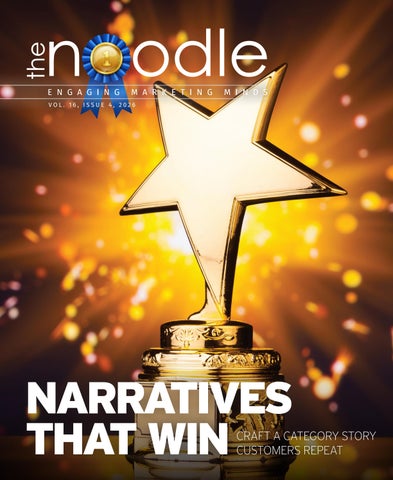
NARRATIVES THAT WIN
CRAFT A CATEGORY STORY CUSTOMERS REPEAT
Think Patented Is Growing!
Two experienced teams. More ways to support you. We’re proud to welcome Clark & Riggs to the Think Patented team. Based in Louisville, Kentucky, Clark & Riggs brings more than 30 years of experience and a shared commitment to quality, service, and strong customer relationships.
Together, we’re expanding our capabilities, resources, and reach to better serve customers throughout the Midwest and across the country.
Scan to learn more about the partnership!
MAKE THE BEST OF IT arketing has always been an exercise in uncertainty. With budgets changing, markets shifting, new competition cropping up, and technology always pushing boundaries, it can get kind of overwhelming. Add in the fact that consumer behavior evolves faster than we can sometimes keep up. All in all, marketers have plenty of reasons to complain. Or, we can make the best of it. "Making the best of it" is a phrase that reflects a mindset that separates leaders from spectators. The best marketers don't wait for ideal conditions. They don't spend their energy lamenting what used to work or wishing things would slow down. They take an honest look at reality and ask a simple question: "Given where we are, how do we create value?" The truth is that every era presents challenges and opportunities. Today, AI can generate content faster than ever before. That doesn't mean marketers have become less valuable. It means the work that creates real value is shifting back to listening, building relationships, understanding customers, crafting meaningful stories, and creating trust. These are the things that still matter. The marketers who thrive will not be the ones who complain about change. They'll be the ones who embrace it, learn from it, and use it to deepen their connection with customers. Making the best of it means focusing on what you can control. It means seeing disruption as an opportunity rather than a threat. It means asking better questions, listening more closely, and continuing to serve your audience regardless of the circumstances. Most importantly, it means moving forward. We think we made the best of this issue with some very compelling features. Our cover story, "Narratives That Win," shows marketers how to define a sharp point of view and cascade it through campaigns, sales decks, packaging, and print. And our second feature, "The Test–Learn Ladder," discusses a practical framework for sequencing tests. Because while the tools will continue to change, the mission remains the same: understand people, solve problems, and make the best of it.
04
Where Customer Stories Begin
02 Cover Story............................ Narratives That Win 06 Feature................................ The Test–Learn Ladder 10 Tactics................................ Strategies You Can Use 12 On the Record with.......................Elton Mayfield
Publisher Taylor Capriotti
Best,
The Noodle is published bimonthly by Think Patented, ©26. All rights reserved.
Taylor Capriotti Marketing Manager
For more information, contact ThinkPatented.com 937.353.2299 The 826 lbs of paper used for this project were offset by reforesting 10.35 standard trees.
AUTHORIZED PARTNER
Think Patented is an Authorized Reforestation Partner of PrintReleaf.
ThinkPatented.com
Production Notes
This issue features our reticulated strike through varnish on the front and back covers. Printed on the Heidelberg XL 106 with process UV inks, using Genuine Gloss 100 lb Cover and Genuine Gloss 80 lb Text. The insert is printed on Accent® Opaque 80 lb Cover.
ClarkAndRiggs.com
The Noodle
1
2
The Noodle
Vol. 16, Issue 4, 2026
Narratives
That Win
CRAFTING CATEGORY STORIES CUSTOMERS CAN'T HELP BUT REPEAT ARIA BRYAN believes the brands people remember aren't those with the biggest marketing budgets. They're the ones that give customers a different way to see the world. While advertising can put a brand in front of more people, it's the story behind the brand that gives customers something worth remembering and repeating. "A category story has a point of view," says Bryan, President and CMO of The Harkey Group. "A brand should be rooted in something unique about your product, but a great story finds its way into the consumer's life." The distinction changes everything. Many brands spend months refining positioning statements, value propositions and messaging frameworks. They become experts at describing themselves instead of giving customers a new way to see the category. This is where memorable brands separate themselves. "The best stories are simple," Bryan says. "I like to say they give more than they take. Before the audience encounters a call to action, the message should have brought some value." This mindset starts by identifying what genuinely makes a brand different—not what brands want people to notice, but what customers actually experience. "It all starts with the product," Bryan says. "And product can really be anything. What is unique about your brand? Start A
A CATEGORY STORY HAS A POINT OF VIEW. A BRAND SHOULD BE ROOTED IN SOMETHING UNIQUE ABOUT YOUR PRODUCT, BUT A GREAT STORY FINDS ITS WAY INTO THE CONSUMER'S LIFE." — ARIA BRYAN, PRESIDENT/CMO, THE HARKEY GROUP
ThinkPatented.com
ClarkAndRiggs.com
The Noodle
3
there and then put it in a way that makes people care. Ask yourself: How does this fit into my audience's daily life? If it makes sense, you have a good story to tell." But finding that narrative is only the beginning. Bryan says the best brands start with something that's internally true about that brand. “People must buy in before the new stationery goes to print. If you build from a place of truth and bring people along, you'll have internal advocates creating things that embody the brand." It is why Bryan rejects the idea that branding belongs solely to marketing. "Selling the story to those who create the brand is where the job starts. Listen
to what people are saying. Look at how they use the product in ways you wouldn't expect. And then, let them own it. Support your advocates or fans if you have them, and let them create the message for you." To see this strategy in action, take PETERMAYER's Brand Joy Lab, an ongoing research initiative that has surveyed more than 13,000 Americans about what brings them joy. While most agencies would have treated three years of proprietary research as a competitive advantage, PETERMAYER made it open source. "We're all about bringing more joy to consumers," Bryan says. “The more brands and agencies that have this data to work with, the more our industry can deliver that experience."
WHERE CUSTOMER STORIES BEGIN or Courtney Henry, every great brand story begins with one question: Who is the story really about? Too often, the founder and Principal Strategist of GrowthMinded says, the answer is the brand itself. "The biggest mistake I see brands making is that they still believe their brand message or value proposition should be about them," Henry says. "Your brand isn't actually about you at all; neither is your marketing. It's about the person you solve the problem for and what story they form about you." For Henry, memorable messaging starts with empathy, not features. "A compelling brand story meets your ideal audience where they are, in the emotional state and thought process they are in, and guides them to a solution. The customer is the hero. The brand is the guide." Henry is quick to dismiss the idea that bigger budgets solve weak messaging. "Budget gets you seen, but it's your message that determines if someone who sees your brand forms a positive or negative association with it. If your message doesn't resonate with your audience, no amount of money can mask that. In fact, the bigger budget just exacerbates the problem and makes the disconnect worse." Before spending another marketing dollar, Henry says brands should spend more time listening. That means customer interviews, surveys, focus groups—even Reddit threads where people often reveal what they really think about brands and their competitors. "I cannot overstate the
4
The Noodle
Vol. 16, Issue 4, 2026
5
WAYS TO BUILD A STORY CUSTOMERS REPEAT
01 Lead with a point of view Don't describe your product. Reshape how customers see the category. 02 Make the customer the hero Focus on their problem, not your features. 03 Build from what's true Ground your story in authentic strengths, not marketing slogans. 04 Listen first Interviews, surveys and customer conversations reveal the story worth telling. 05 Make it everyone's job Every employee should understand and reinforce the brand narrative.
importance of listening and then repeating what they want to hear. It's about figuring out where there is synergy between what they want and what you deliver." A recent client showed just how transformative that approach can be. A Vancouver-based laneway construction company believed it was marketing to empty nesters seeking rental income, but the research revealed a different audience. "The people initiating the conversations, doing the Googling at 11 p.m. and showing up to discovery calls were adult children,” Henry says. “They weren't building a laneway for rental income; they were solving a family problem." Henry says that was the point. When brands truly understand their audience, the impact extends far beyond marketing. "Marketing is a mindset, not a department. Every single department within a business is doing some form of marketing—customer service, delivery, packaging, scheduling, billing. When both teams understand the problem their customer is trying to solve and the emotional arc they travel, alignment becomes a natural byproduct." In the end, customers don't repeat marketing messages, they repeat stories that feel true to their own lives.
BUDGET GETS YOU SEEN, BUT IT'S YOUR MESSAGE THAT DETERMINES IF SOMEONE WHO SEES YOUR BRAND FORMS A POSITIVE OR NEGATIVE ASSOCIATION WITH IT." — COURTNEY HENRY, FOUNDER/PRINCIPAL STRATEGIST, GROWTHMINDED
ThinkPatented.com
ClarkAndRiggs.com
The Noodle
5
6
The Noodle
Vol. 16, Issue 4, 2026
TEAMS THAT TEST CONSISTENTLY HAVE REPORTING SETUPS WHERE THE RESULTS ARE EASY TO FIND, EASY TO COMPARE AND EASY TO SHARE. IF SURFACING A TEST RESULT TAKES MORE THAN A FEW CLICKS, PEOPLE STOP SURFACING TEST RESULTS." — FLYNN ZAIGER, CEO, ONLINE OPTIMISM
PULKIT KHURANA doesn't think the future of marketing belongs to the
companies willing to take the biggest risks. It belongs to the ones willing to take the smartest small ones. For years, experimentation has carried an aura of disruption. ❱ New pricing models. ❱ New channels. ❱ Sweeping creative overhauls. Too many brands chased breakthrough moments, hoping one bold move would unlock outsized growth. Too often, they skipped over the smaller decisions that make bigger ones possible. Khurana, CEO of SproutMe, believes the marketers creating sustainable growth aren't searching for silver bullets. They're building systems that allow every campaign, every headline and every audience test to make the next decision a little smarter. "The Test-Learn strategy isn't just a tactic; it is the foundational cornerstone of modern marketing," Khurana says. "With the advent of AI, we're going to see a massive shift where even the smallest businesses can leverage this exact strategy to ruthlessly optimize their marketing spend. The time to invest in this infrastructure is right now. If you build it today, you secure a lasting competitive advantage because your institutional knowledge will simply compound over time." That philosophy sits at the heart of what marketers are calling the Test–Learn Ladder, a disciplined approach that replaces random A/B testing with a sequence
THE TEST–LEARN LADDER RUN SMART EXPERIMENTS ACROSS CHANNELS
ThinkPatented.com
ClarkAndRiggs.com
The Noodle
7
of experiments designed to build on one another. Instead of swinging for the fences, marketers begin with low-risk decisions like messaging, offers, creative and calls to action before moving toward higher-impact decisions involving pricing, formats and channel strategy. It's a shift in mindset as much as methodology. Too often, brands treat testing as a series of disconnected experiments. A landing page performs well. An email subject line boosts open rates. A social campaign exceeds expectations. The win gets celebrated, then everyone moves on. The Test–Learn Ladder takes a different approach. Every experiment builds toward the next, creating the confidence to make bigger decisions later. For Khurana, that work begins long before marketers start discussing pricing or media allocation. It begins by understanding exactly who they're trying to reach and what message resonates most with that audience. "Most SMB brands lack the analytical maturity and sophisticated tracking required to measure these microadjustments," Khurana says. "Because they can't easily measure the small things, they tend to overcompensate by leaning on highly disruptive, sweeping changes like drastic pricing shifts or heavy discounting. The Ladder approach shifts the focus away from these risky, disruptive moves and instead builds a foundation of compounding, measurable wins." The foundation starts with the fundamentals, using early tests to sharpen targeting, messaging and offers before moving on to higher-stakes decisions. "The highest immediate return on investment comes from personalizing your offer, messaging and channels to a highly specific target persona," Khurana says. "The early wins come when you accurately identify the right persona and then meticulously optimize the creatives, the headlines, the specific offers and the channel delivery. When you match the
exact right message to the exact right person, the ROI follows naturally." Only after those fundamentals have been validated should marketers begin testing the decisions that carry greater financial consequences. "You shouldn't touch consequential levers like pricing until you have the analytics in place to confidently measure the true impact," Khurana says. "The clearest signal is that you've successfully optimized your foundational messaging and persona targeting, and you now have the data volume required to reach statistical significance on larger bets." Discipline extends beyond choosing what to test. It also determines how organizations capture what they learn. "It all starts with a clearly defined hypothesis for each experiment," Khurana says. "But the most critical practical step is ensuring that all learnings are meticulously captured and mapped back to the specific target customer the test ran against. That discipline ensures you are constantly learning and compounding your understanding of your ideal customer profile over time."
THE TEST-LEARN STRATEGY ISN'T JUST A TACTIC; IT IS THE FOUNDATIONAL CORNERSTONE OF MODERN MARKETING."
8
The Noodle
— PULKIT KHURANA, CEO, SPROUTME
Vol. 16, Issue 4, 2026
LEARNING IS THE REAL COMPETITIVE ADVANTAGE Flynn Zaiger believes the hardest part of experimentation isn't running tests. It's building a culture where every result becomes a better decision. For many organizations, testing ends when the campaign does. Results get archived in dashboards and presentations instead of becoming part of the team's playbook. "We always start with CTA and offer testing because the blast radius is small," says Zaiger, CEO of Online Optimism. "If you're wrong, you've lost a percentage point of conversion rate on one campaign, not a quarter's worth of budget. Getting a few wins at that level builds the internal trust you need to greenlight bigger bets later." Those early experiments accomplish something larger than improving performance metrics. They teach teams how to evaluate evidence, challenge assumptions and become comfortable letting data lead the conversation. "The sequencing instinct matters more than the sequence itself," Zaiger says. "Low-risk tests teach your team how to read results, argue about statistical significance and build consensus around data. By the time you're running a pricing test or a major format change, you've already built the muscle memory—and more importantly, you've built the
organizational culture that knows what to do when the data surprises you." That culture also depends on making insights easy to access rather than difficult to uncover. "Teams that test consistently have reporting setups where the results are easy to find, easy to compare and easy to share," Zaiger says. "If surfacing a test result takes more than a few clicks, people stop surfacing test results." One of the most overlooked opportunities, he says, is documenting the moments when predictions miss the mark. "The insight document almost no one writes is the 'we were wrong' postmortem," Zaiger says. "Not a loss, not a
miss—a specific record of what the team predicted, what actually happened and why the gap existed. That document is worth more than any dashboard." The same discipline applies across channels, including direct mail, where holdout groups remain one of the clearest ways to measure true incremental impact. "Holdouts are one of the cleanest ways to measure true incrementality, and not enough marketing teams use them because they feel counterintuitive," Zaiger says. "If you never hold anything out, you never actually know if the mail is doing the work or if those customers were going to buy anyway."
ThinkPatented.com
Perhaps more importantly, the methodology doesn't stop with direct mail. "A holdout methodology that works in direct mail translates surprisingly well to paid social, email and even SEO experiments," Zaiger says. "Once your team understands what they're actually measuring, the channel almost becomes secondary." The companies that pull ahead won't necessarily have the biggest budgets or the boldest ideas. They'll have the best learning system. While campaigns come and go, every hypothesis tested and every insight captured makes the next decision smarter.
ClarkAndRiggs.com
The Noodle
9
INBOX INFLUENCE WHY EMAIL CONTINUES TO BE ONE OF MARKETING'S MOST VALUABLE CHANNELS Despite the rise of new platforms and artificial intelligence (AI)-powered marketing, email continues to deliver where it counts. According to Omnisend's "Email Marketing for Business," 59% of B2B marketers say email is their highest revenue-generating channel, while 80% of buyers are more likely to engage with content tailored to their role and needs. For today's marketers, relevance over reach remains the key to stronger customer relationships.
BEYOND THE SUBJECT LINE BEHAVIOR AND RELEVANCE ARE RESHAPING B2B EMAIL MARKETING Today's best-performing email campaigns are becoming less about volume and more about delivering the right message at the right time. The "TargetNXT Email Pulse 2026" report shows marketers increasingly relying on behavioral signals, targeted segmentation and meaningful personalization to improve engagement. Rather than blasting the same message to every contact, successful teams are building campaigns around audience actions and intent. HERE'S WHERE B2B EMAIL MARKETING IS HEADED: ❱ 50% use behavioral or engagement-based
segmentation ❱ 45% personalize emails using recipients' first
names ❱ 35% personalize by company name ❱ 30% tailor messaging around customer pain
points ❱ 20% use behavioral dynamic content ❱ 68% consistently monitor email deliverability
10
The Noodle
Vol. 16, Issue 4, 2026
IN A WORLD WHERE MOST COMPANIES ARE SCALING REACH THROUGH AUTOMATION AND ARTIFICIAL INTELLIGENCE (AI), THE SCARCEST THING IS DEPTH—THE KIND OF UNDERSTANDING THAT COMES FROM A CONVERSATION WHERE SOMEONE SAYS SOMETHING THEY'VE NEVER SAID OUT LOUD BEFORE. LEADING ORGANIZATIONS INTENTIONALLY CREATE SPACE FOR THAT AS A STRATEGIC CAPABILITY." — JONAS BARCK, DIRECTOR OF CUSTOMER MARKETING AT MENTIMETER, ON WHY CANDID INSIGHTS ARE MORE LIKELY TO COME FROM HUMAN INTERACTION THAN SURVEYS AND AI ANSWERS.
THE HUMAN EDGE MARKETERS SAY BRAND AND AUTHENTICITY MATTER MORE THAN EVER Artificial intelligence (AI) has changed how marketers work, but it hasn't changed what customers value. According to the "HubSpot 2026 State of Marketing Report," the most successful brands are combining AI with strong positioning, authentic storytelling and a distinct point of view. As AI-generated content floods the market, marketers say human creativity, trust and brand identity are becoming even greater competitive advantages. HERE'S A SNAPSHOT OF WHERE MARKETING IS HEADED: 61% say AI has created the biggest disruption in marketing in 20 years 68% say AI has significantly increased productivity 67% save 10 or more hours each week using AI 63% say brands need more unique, humancentered content to stand out 61% believe brand voice and point of view are more important than ever
THE DIRECT DIFFERENCE DIRECT MAIL CONTINUES TO DELIVER MEASURABLE MARKETING RESULTS Despite growing investment in digital channels, direct mail remains one of marketing's most dependable performers. According to Franklin Madison Direct's "2026 Direct Mail Marketing Benchmark Report," marketers are seeing stronger results through smarter targeting, relevant content and consistent execution. Consumers continue to engage with mail, making it a valuable part of today's omnichannel strategy. DIRECT MAIL BY THE NUMBERS: ❱ 79% of consumers engage with the mail they receive ❱ 56% of marketers say direct mail performance
improved over the past year ❱ 42% report performance remained steady ❱ 37% rank direct mail among the most influential
advertising channels ❱ 20% made a purchase after receiving relevant mail
ThinkPatented.com
ClarkAndRiggs.com
The Noodle
11
BUILD BEFORE YOU BROADCAST ER MARKETING'S ELTON MAYFIELD ON WHAT TODAY'S BEST B2B BRANDS GET RIGHT
How should B2B leaders measure brand perception today? Where do they most often get it wrong? One of the biggest mistakes B2B companies make is believing their brand is what they say it is. In reality, the market defines the brand. Customers, employees, distributors, sales reps, vendors, and even former clients shape perception every single day through thousands of interactions. Today, surveying a brand goes far beyond a customer satisfaction survey or annual strategy session. Leaders need to evaluate the entire experience ecosystem. That includes search results, online reviews, social conversations, CRM feedback, sales calls, trade show interactions, onboarding experiences, email communication, customer service response times, distributor relationships, and internal employee sentiment. The biggest blind spots are usually operational. Companies obsess over logos, websites, and messaging while ignoring the experience of actually doing business with them. Late shipments, confusing communication, poor follow-up, disconnected sales and marketing teams, inconsistent pricing, and lack of accountability destroy brand trust faster than almost any marketing campaign can repair it. Another major blind spot is internal alignment. Leadership may believe the company stands for innovation or service, but frontline employees may not understand the mission well enough to deliver that experience consistently. If employees cannot clearly explain the company’s value proposition, customers certainly will not experience it consistently.
12
The Noodle
Vol. 16, Issue 4, 2026
A
strong brand isn't built by what a company says about itself—it's built by what customers experience every day. ER Marketing founding partner Elton Mayfield explains why trust, operational consistency and listening to the market have become the real foundation of successful B2B brands and why marketing alone can't carry the load.
Why does your "Survey, Blueprint and Build" framework work for every B2B brand? What's the one construction lesson marketers can't afford to ignore? The reason the framework works across all B2B industries is because every business faces the same core challenge: aligning perception, strategy, and execution. Survey is about understanding reality. Blueprint is about creating alignment and direction. Build is about consistently delivering the experience. Too many B2B companies invest heavily in surface-level marketing while neglecting operational experience, customer service, sales alignment, and long-term trust. They want demand generation without investing in reputation generation. The lesson many marketers ignore is that trust compounds slower than visibility, but it lasts far longer. The companies that will win over the next decade are not necessarily the loudest brands. They are the brands that become easiest to trust. What makes a Blueprint a living strategy rather than a static document? How can leaders tell the difference? A living Blueprint is operational, not theoretical. If a brand strategy only exists in a PowerPoint presentation or executive retreat binder, it is probably
corporate window dressing. A real Blueprint influences hiring decisions, customer communication, sales conversations, product development, pricing strategy, partnerships, and even internal accountability. One of the clearest indicators is whether employees can explain the strategy in simple language. If frontline teams cannot articulate what the company stands for and how it differentiates itself, the Blueprint is not alive. Another sign is consistency under pressure. It is easy to follow a strategy when the market is strong. The real test comes during rapid growth, economic downturns, staffing shortages, or competitive pressure. Living brands maintain their identity even when challenged. The strongest Blueprints also evolve. A Blueprint should provide direction without becoming rigid. It should function more like a strategic operating system than a static instruction manual. Most importantly, a living Blueprint creates alignment across departments. Marketing, sales, operations, leadership, and customer service should all reinforce the same core promise. When departments operate independently with conflicting priorities, the customer experiences fragmentation instead of trust. You describe "curb appeal" as part
aggressively, overpromise capabilities, or compromise customer experience to keep up with demand. Strong brands understand that not every piece of revenue is good revenue. Maintaining integrity starts with having clear standards. Companies need to know what they will and will not compromise. That includes pricing philosophy, customer experience expectations, communication standards, product quality, and cultural values. One of the biggest risks during growth is inconsistency. Customers can tolerate mistakes more than unpredictability. Rapid scaling often introduces disconnected systems, uneven service levels, and communication breakdowns. That fragmentation damages trust.
of the Build phase. What does that look like for B2B brands with long sales cycles? In B2B, curb appeal is really about confidence. It is the immediate feeling people get when they encounter your brand for the first time. That may happen through a website, trade show booth, LinkedIn profile, proposal, sales presentation, case study, referral, or even how quickly someone responds to an email. Visual identity matters, but curb appeal goes much deeper than aesthetics. In B2B, credibility is the real currency. Strong curb appeal comes from clarity, professionalism, consistency, expertise, and responsiveness. Buyers want reassurance that a company is competent, stable, easy to work with,
and capable of solving problems. Thought leadership plays a major role because B2B buyers often spend months researching before engaging sales teams. Companies that educate the market effectively create trust long before a formal sales conversation begins. How can leaders maintain brand integrity and consistency when they are pressured to scale rapidly or lower prices to win bids? This is where many companies unintentionally damage their long-term value. When growth pressure increases, leaders often start making reactive decisions that dilute positioning. They chase every opportunity, lower prices too
ThinkPatented.com
What's the one thing you advise leaders to stop doing immediately, and what is the one thing they should double down on to remain competitive over the next three to five years? The one thing leaders should stop doing immediately is chasing shortterm visibility at the expense of long-term trust. Too many companies are caught in constant reaction mode. They chase trends, flood channels with generic content, obsess over vanity metrics, or invest in marketing tactics disconnected from actual business strategy. Visibility without clarity creates noise, not growth. And the one thing leaders should double down on is building authority through expertise and customer experience. Over the next three to five years, AI will dramatically increase the amount of mediocre content and automated communication in the market. As that happens, trust, credibility, and authentic expertise become even more valuable. Companies that deeply understand their customers, educate effectively, communicate clearly, and consistently deliver exceptional experiences will separate themselves quickly.
ClarkAndRiggs.com
The Noodle
13
2490 CrossPointe Dr. Miamisburg, Ohio 45342
Beyond the Print Job You may know Think Patented. You may know Clark & Riggs. And you may know us for print. But that's never been all we do.
Now as one company, we're bringing our expanded capabilities together through one team, one workflow to help you get even more from a single trusted partner.
How Many of These Services Are You Using? (check all that apply) Commercial Printing (offset & digital)
Fulfillment & Kit Packing
Direct Mail
Design Services
Promotional Products
Signs & Graphics
Portals (print-on-demand & storefronts)
Folding Cartons
There's more we can do together. Let's talk!
Scan to connect with our team!
all un der 1 ro of