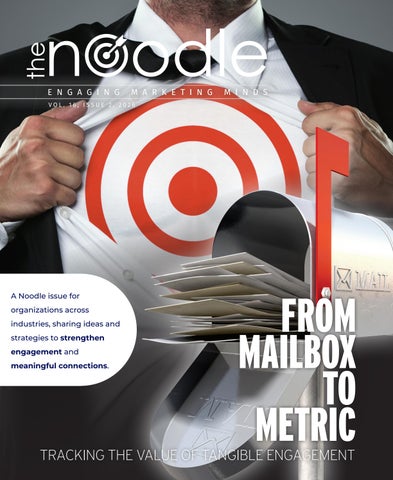
A Noodle issue for organizations across industries, sharing ideas and strategies to strengthen engagement and meaningful connections. TRACKING
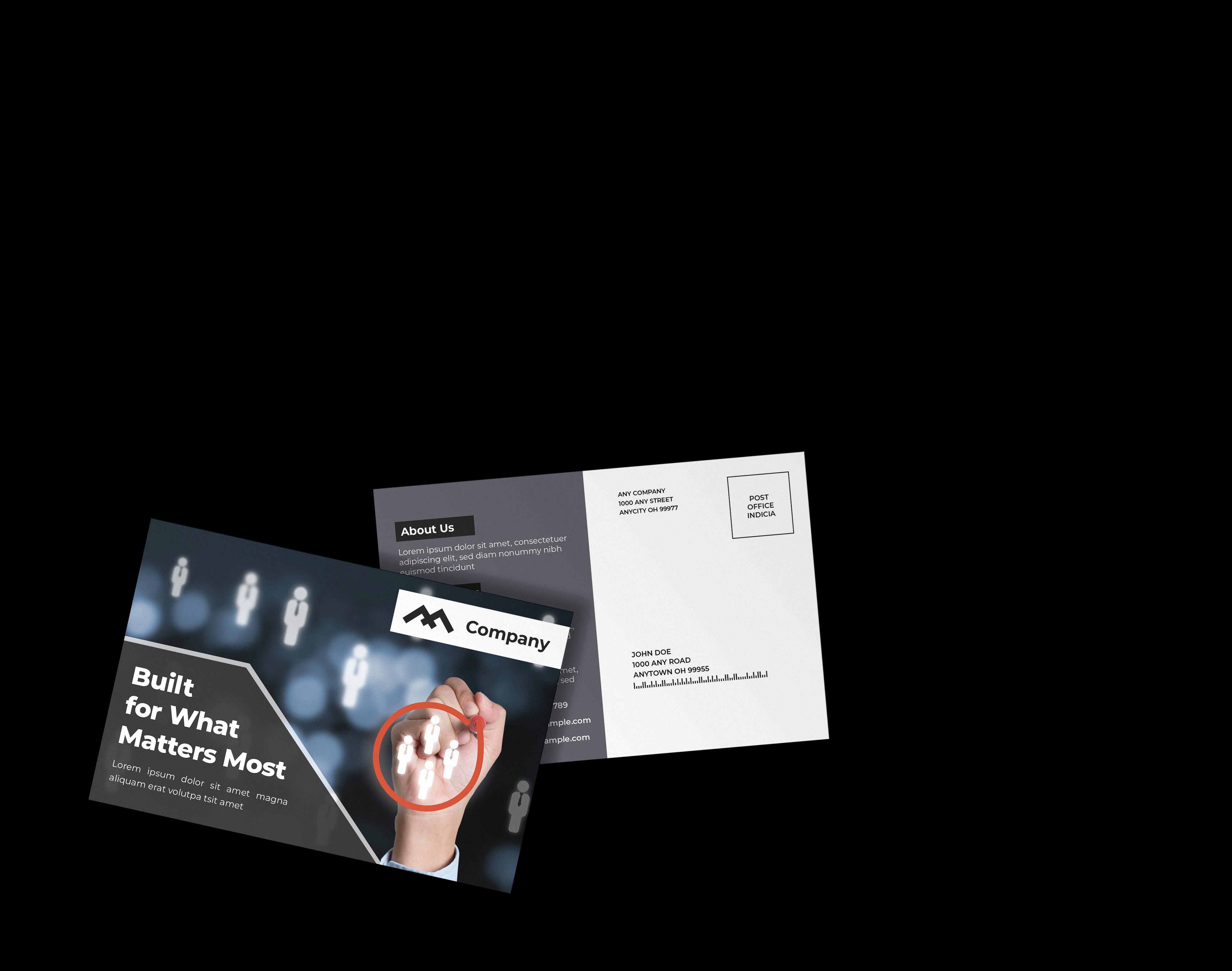
From the cover treatment to the ads, this publication demonstrates a practical approach to personalized marketing: keep the brand consistent, then adapt the message to the audience.
Because the more relevant the experience, the more measurable the response.
PERSONALIZATION is more
than a name...
How Personalization Could Work For Your Company
Personalization works best when the message reflects what matters most to your audience.
Personalized messaging helps make outreach more relevant by aligning communication to audience need, interest, or buying stage.
That could mean tailoring message, imagery, offers, or outreach by audience segment while keeping your brand consistent from mailbox to metric.
This edition of the Noodle was tailored by audience segment to show how relevant messaging, visuals, and content can work together.
WHY CONNECTION IS OUR NEW LUXURY
ommon Sense Media recently dropped a startling statistic: 31% of teenagers find AI conversations as satisfying as talking to real friends. In the marketing world, we spend a lot of time discussing keeping humans in the loop as a means of efficiency. But are we inadvertently engineering a future where the brand-to-consumer relationship is just two algorithms chatting in a void?
If AI can provide perfectly objective information about a product instantly, what becomes the new “premium” value of a human brand voice? We may be entering an era where correctness is a commodity, while opinion and perspective are luxuries.
The Surgeon General has already declared loneliness a public health epidemic. AI risks accelerating this by making us “efficiently” self-sufficient. As brand owners, we may soon face a moral and strategic obligation to design
experiences that drive community rather than isolation. AI offers immediate gratification on steroids, but when we use it to bypass the work of interaction, we deprive ourselves of education, accomplishment, and each other.
We cannot delegate our humanness to a large language model. There is a dangerous premise in a world where someone asks an AI about their future rather than seeking the wisdom and messy, beautiful opinions of a friend.
So, as marketers, we need to stop focusing solely on getting through the tasks of the day and start figuring out how to connect real people with real people. We often call that “magic,” but it really isn’t magic at all. It is simply the enrichment that comes from human interaction. And why would we try to automate that away?
In this edition of the magazine, we are diving deep into the art of connection. In our cover story, “From Mailbox to Metrics,” we are reminded of the impact of using promotional materials not just for “reach,” but to engage on a more
human, tactile level. In our second feature, “Human-in-the-Loop,” we explore how to keep the human in the loop, ensuring AI serves our humanness rather than replacing it. And finally, our Q&A with Brian Sullivan demonstrates why the ability to connect deeply with another person is more critical now than ever.
Enjoy the issue. I hope it inspires new ideas, but more importantly, I hope it inspires a deeper, more intimate connection between you and the humans you serve.
All the best,
Diana Renner Publisher
AUTHORIZED PARTNER
The Strategy Layer AI Can’t Replace
02 Cover Story ................... From Mailbox to Metric 06 Feature Human-in-the-Loop 10 Tactics Strategies You Can Use 12 On the Record with Brian Sullivan
For more information, contact ThinkPatented.com 937.353.2299
Production Notes
This issue features industry-specific covers and ad variations tailored to each audience. Printed on the HP Indigo 100K digital press, using EuroArt Digital Silk 100 lb Cover and EuroArt Digital Silk 80 lb Text. The insert is printed on Accent Opaque 80 lb Cover.
WE REALLY TRY TO NAIL OUR OFFER WHEN WE SEND DIRECT MAIL. WE BREAK DOWN THE NICHE WE ARE TARGETING AND DESIGN THE FLYER TO ATTRACT THAT SPECIFIC CUSTOMER.”
— ERIC TURNEY, SALES & MARKETING DIRECTOR, THE MONTEREY COMPANY
FROM MAILBOX TO METRIC
TRACKING THE VALUE OF TANGIBLE ENGAGEMENT
HE POSTCARD LOOKED SIMPLE ENOUGH. A short headline. A small graphic. A QR code tucked neatly into the corner. For Eric Turney, the square of ink and paper wasn’t just another marketing piece heading out the door, it was a handshake. In an era where marketers can no longer quietly harvest signals from third-party cookies or sprawling data marketplaces, every interaction matters more. Brands must ask customers for their information— and earn the right to receive it.
Direct mail—once viewed primarily as an acquisition tool or promotional blast—is quietly evolving into something far more strategic: a consent engine.
The most forward-thinking marketers like
Turney, Sales & Marketing Director at The Monterey Company, use print triggers—QR codes, personalized landing pages, gated offers and value-driven experiences—to invite customers into voluntary engagement. Instead of chasing anonymous traffic, they’re building house files filled with clean, durable first-party data that fuels personalization, improves match rates and strengthens lifetime value.
“We really try to nail our offer when we send direct mail,” Turney says. “We break down the niche we are targeting and design the flyer to attract that specific customer. For example, we did a direct mail campaign to mechanics that pushed inexpensive branded keychains. Our offer
was 50% off with a QR code to scan and a direct link to a form on our website.”
The campaign's goal wasn’t just a sale, but engagement. When a recipient scans a code or types in a link from a physical piece of mail, something meaningful has already happened.
That action becomes a signal—one that marketers can connect to digital behavior, sales outcomes and long-term customer profiles. Turney recommends taking your Ideal Customer Profile (ICP), building a list around it, and then marketing to them with direct mail you think will grab their attention. When you start getting success from that campaign, scale up.
“In my experience, when a customer makes the effort to scan the QR code or
PRINT AS A BRIDGE TO TRUST
visit the custom landing page, that is half the battle—and your closing percentage increases,” Turney says. “That signal alone is powerful. But signals that the offer is strong are, of course, sales. Before that, it's landing page clicks, form submissions and sent quotes from those submissions. We then compare that to the number of items sent, and tweak from there.”
The Monterey Company team tries to keep each campaign simple. "The best form of attribution in our experience is having unique landing pages, which is non-negotiable, and we can build them quickly, too," Turney says. "Typically, less than one day. Without the unique landing page, attribution is trickier."
or Mariia Golitsyna, the moment a recipient chooses to scan a QR code or visit a personalized link represents something larger than engagement—it represents trust. In a marketing environment where consumers are increasingly protective of their data, that voluntary interaction signals a willingness to exchange information—attention for value, relevance for insight.
“In today’s privacy-first environment, brands can no longer rely on third-party data or passive tracking,” says Golitsyna, an international B2B growth strategist who advises brands on corporate sales, brand building, growth strategy and customer-centric innovation. “Direct mail, when combined with QR codes or personalized URLs, becomes a powerful mechanism for earning first-party data through voluntary engagement.”
Golitsyna says the key continues to be relevance. “In a privacy-first environment, print works best when it creates a clear value exchange. When direct mail includes a QR code or personalized URL that leads to something useful—such as a tailored offer or relevant content—people are far more willing to engage and share accurate information.”
That dynamic changes the role of print. Instead of pushing a message outward, it creates a bridge between physical attention and measurable digital signals. And when that bridge works, it produces data that is cleaner and more meaningful than most third-party alternatives.
Golitsyna says she has seen this dynamic play out not only in marketing campaigns, but also in real-world business development settings. When meeting with corporate clients at conferences or in person, she often provides a short printed summary outlining the services discussed during the conversation. “Many decision-makers appreciated having a concise reference instead of searching through long email threads later.”
Those printed materials sometimes include personalized incentives—such as a tailored offer or discount addressed specifically to the recipient. “That simple personalization often encouraged recipients to revisit the materials and engage more deeply with the services after the meeting,” Golitsyna says.
The lesson for today’s marketers is clear: Print works best when it enhances the customer experience rather than interrupting it. “The biggest mistake marketers make is treating direct mail as a one-way promotion instead of a data exchange,” Golitsyna says. “When the follow-up experience doesn’t clearly communicate value or asks for too much information too quickly, customers disengage and the opportunity to build meaningful customer insight is lost.”
In a privacy-first world, the brands that win won’t be the ones collecting the most data, but the ones earning it. And sometimes that process begins with something as simple—and as intentional—as a postcard that invites the customer to respond.
IN A PRIVACY-FIRST ENVIRONMENT, PRINT WORKS BEST WHEN IT CREATES A CLEAR VALUE EXCHANGE. WHEN DIRECT MAIL INCLUDES A QR CODE OR PERSONALIZED URL THAT LEADS TO SOMETHING USEFUL.”
— MARIIA GOLITSYNA, INTERNATIONAL B2B GROWTH STRATEGIST
CREATIVE WORK, BY NATURE, IS PERSONAL AND SUBJECTIVE. GOOD TASTE, CULTURAL AWARENESS AND GOOD JUDGMENT CANNOT BE AUTOMATED.”
— LORI GILBERT-MOSLEY, SENIOR DIRECTOR OF CREATIVE SERVICES, CONTINUUM MARKETING SERVICES
HUMANINTHELOOP
YEARS BEFORE ARTIFICIAL INTELLIGENCE (AI) entered the creative workflow, Lori Gilbert-Mosley saw what happens when technology moves faster than judgment. Across the industry, heavily retouched imagery began appearing in campaigns for major global brands. While the work was technically flawless, people started to notice things no longer felt real.
“People notice small details and can tell when something feels off,” says GilbertMosley, Senior Director of Creative Services at Continuum Marketing Services.
The moment, as Gilbert-Mosely recalls, became an important lesson about perception, authenticity and trust. Today, as AI becomes deeply embedded in marketing operations, marketers like Gilbert-Mosley say the same principle still applies: Technology can accelerate the work, but people must remain responsible for what ultimately reaches the public.
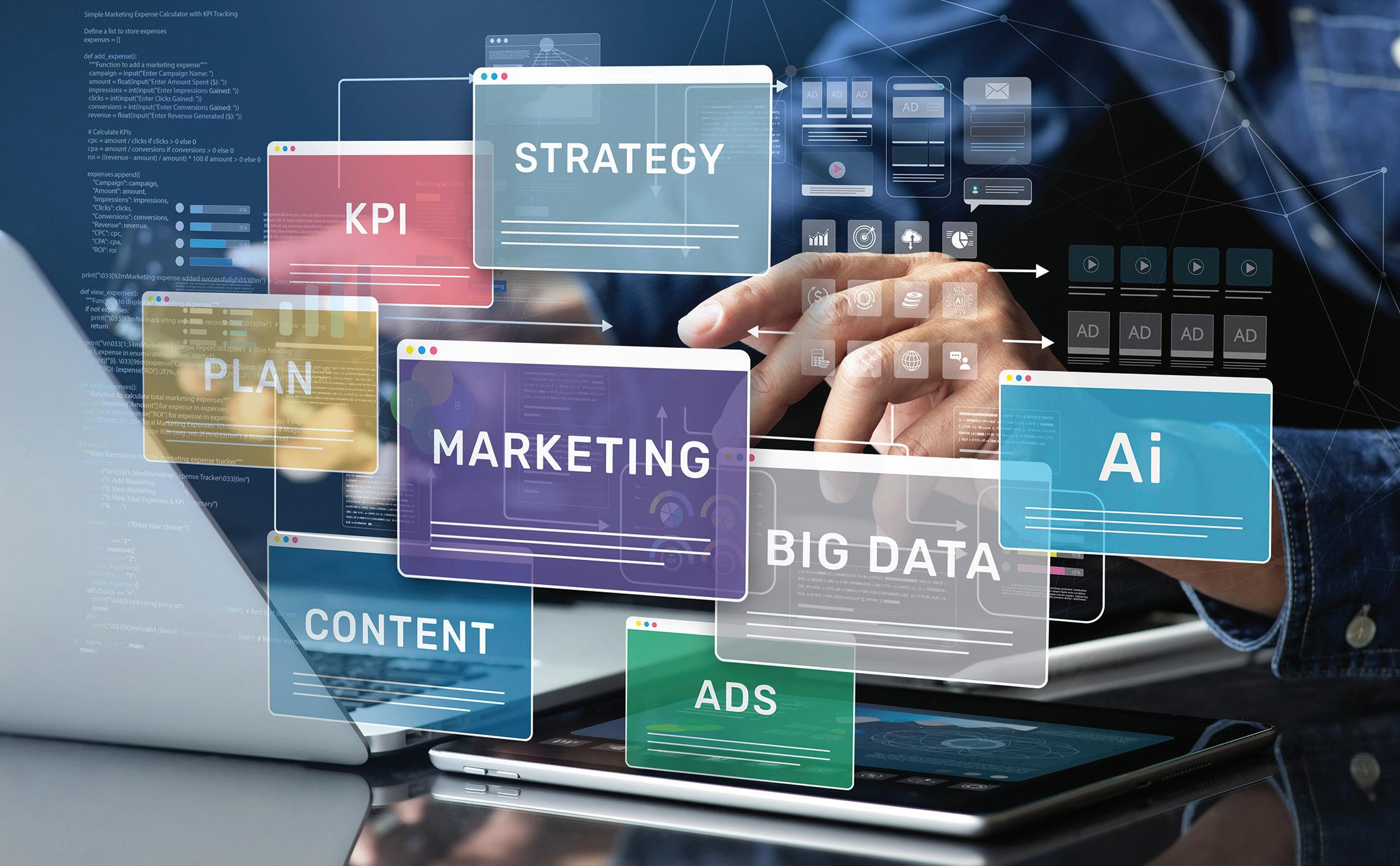
Today, AI touches nearly every stage of marketing operations—from campaign planning to creative production to performance analysis.
AI FOR MARKETING OPERATIONS
The technology can move faster than most teams ever could. But speed alone does not equal strategy. “Right now, AI works best when the job is repetitive or time-consuming,” Gilbert-Mosley says. “It is very good at tasks that follow clear rules, like accounting, finance and other operational tasks.”
Marketing production offers similar opportunities. AI can schedule content, resize images for different channels, create versions of existing work and transform assets into new formats. Those
WE MAKE SURE A HUMAN IS IN THE LOOP TO CONTINUE COACHING AND NURTURING THE AI WHILE IMPROVING THE BRAND RULES AND GUIDELINES AS EDGE CASES GET DISCOVERED.”
— JOE SCHAEPPI, CO-FOUNDER & CEO, SOLSTEN
efficiencies free creative teams to focus on the work that still requires human judgment. But the moment work touches the brand—or the customer—the equation changes. “Creative work, by nature, is personal and subjective,” Gilbert-Mosley says. “Good taste, cultural awareness and good judgment cannot be automated.”
This philosophy sits at the center of what many marketers now call a human-in-the-loop operating model. AI accelerates production, but people remain accountable for the final output. One of the biggest questions marketing leaders face when deploying AI is how much error is acceptable.
The answer depends on how the work will be used. Take Continuum, which uses AI-assisted renderings to help global beauty brands imagine what permanent visual merchandising displays could look like in-store. “This allows teams to react,
align and refine ideas early,” GilbertMosley says.
Because those materials remain internal, they give teams room to experiment and align without the cost of physical prototypes or high-end renderings. But when the work moves into the marketplace, the margin for error tightens considerably. “Once AI is used for customer-facing work, the rules change,” Gilbert-Mosley says. “There is very little room for error.”
Issues like copyright, ethics, authenticity and brand integrity become critical, with the guardrails surrounding AI often centering on transparency and usage rights. That makes human review essential in production environments where mistakes carry real consequences. “A wrong sign isn’t just a creative mistake,” Gilbert-Mosley says. “It can become a safety or legal issue. The first step is to clearly assign responsibility. Everyone should know who approves AI-assisted work and who owns the final result. Moving fast without oversight creates risk and confusion.”
THE STRATEGY LAYER AI CAN’T REPLACE
While Joe Schaeppi has spent years building AI systems designed specifically for marketing, he is quick to point out that automation still struggles with understanding people.
AI can generate creative variations, test messaging combinations and analyze campaign performance at a scale that would be impossible for most marketing teams, but when it comes to generating original ideas or understanding deeper motivations behind customer behavior, technology still falls short.
“AI is phenomenal at scaling content, experimentation and analysis,” says Schaeppi, co-founder and CEO of Solsten. “Where it still struggles is understanding the deeper motivations that drive human behavior like personality, values and intrinsic motivations.”
That gap explains why strategy remains firmly human territory. Schaeppi believes the next generation of marketing AI will integrate behavioral psychology with automation, combining data with insights from real human behavior. “The strategic
side of marketing, where marketers are deeply in touch with their buyer’s needs like an anthropologist doing an ethnography or psychologist working with a client, is going to be a high-growth employment area for marketers in the age of AI.”
Human oversight also plays a role in defining acceptable error. “If you’re a Fortune 500 with a brand that you need to protect, there always needs to be a human in the loop,” Schaeppi says. “Your opportunity cost of risking brand misrepresentation is too high.”
Smaller companies may tolerate slightly higher experimentation thresholds, but the benchmark should remain consistent. “Real people make mistakes, too,” Schaeppi says. “If AI produces better results at or below the current level of human error, it makes sense.”
Organizations deploying AI must also implement guardrails that protect brand alignment and audience relevance. At Solsten, that framework begins with a system called Elaris, which builds a comprehensive brand foundation to guide AI decision-making. “Elaris generates a best-in-class agency-style brand book
that acts as the brain for your AI,” Schaeppi says.
Even then, Schaeppi emphasizes that humans remain responsible for refining and directing the system. “We make sure a human is in the loop to continue coaching and nurturing the AI while improving the brand rules and guidelines as edge cases get discovered. You will also likely notice that there were very important areas where it’s not just a human in the loop, but a human driving and composing the loop.”
For companies rushing to adopt generative AI tools, Schaeppi cautions that not every system is designed for marketing. Brands should focus instead on building AI frameworks grounded in brand rules, audience insight and human oversight. “I would immediately stop leveraging large models like ChatGPT or Gemini for cross-company marketing. They don’t remember your brand.”
While technology will continue to move faster, trust still moves at human speed. The real advantage of human-in-theloop marketing is not just efficiency—it is protecting the judgment that keeps brands credible.
THE COST OF DISCONNECT: MARKETING & SALES ALIGNMENT
NEW RESEARCH FROM UNBOUNCE & ASCEND2 (MARCH 2026)
THE STATE OF PLAY
One of the biggest “silent killers” in business: misalignment. In a survey of 500 GTM professionals (manager level and above), the verdict is clear: When Marketing and Sales aren’t on the same page, the entire organization feels the friction.
WHAT IS EXPERIENCED AS A RESULT OF POOR SALES-MARKETING ALIGNMENT AT YOUR ORGANIZATION:
❱ 29% ... Employee frustration or lower morale
❱ 28% ... Lost opportunities or lower win rates
❱ 28% ... Delayed or inconsistent lead follow-up
❱ 26%.... Duplicated work and wasted resources
❱ 23% Inefficient or disconnected tools and workflows
❱ 23% Lack of clarity on target customers (ICP, personas)
❱ 22% Poor prospect experience or inconsistent messaging
❱ 20% Misaligned goals or KPIs
❱ 20% ... Slower deal cycles or stalled pipeline progress
❱ 18% .... Limited visibility into cross-team activities
❱ 6% ...... Other
WHERE ALIGNMENT CHALLENGES BETWEEN SALES AND MARKETING STEM FROM:
The percentage of Chief Data Officers reporting directly to the CEO increased by 6%, showing companies elevating data strategy to the highest levels of leadership.
SOURCE: FORRESTER RESEARCH SURVEY ANALYSIS (2025)
Event Marketing Is Getting Harder
Event satisfaction dropped by 8% from 2024 to 2025 as marketers struggle to adapt to changing audience expectations and hybrid experiences.
SOURCE: FORRESTER STATE OF B2B EVENTS SURVEY 2025
CONTENT MARKETING IS THE ACT OF CREATING AND SHARING INFORMATION THAT MAKES YOUR CUSTOMERS SMARTER."
— Seth Godin
What are some of the most effective modern sales strategies you've seen in B2B , and how have they impacted revenue growth?
Sully’s Take: The smartest businesses I see are no longer just selling wares—they’re selling business outcomes. Reps who understand that their clients care more about increased foot traffic, campaign lift, or brand consistency are turning simple projects into multi-line revenue streams. When you shift from “What do you need?” to “What business result are you after?”—you not only sell more, you become part of the client’s strategic planning. That’s how you go from vendor to revenue partner. And yes, revenue follows.
How can sales teams transition from product-focused selling to value-driven solutions that address specific client needs?
Sully’s Take: By shutting up and listening. The best transition starts with better discovery: asking strategic questions like, “What’s the biggest marketing challenge you’re trying to solve this quarter?” or “Where are you investing but not seeing ROI?” Suddenly, you're not selling a product or solution—you’re solving a problem. It’s a mindset shift: Sell outcomes, not outputs. And when you do that, your value becomes crystal clear, and pricing pressure magically disappears.
In what ways can data analytics and technology enhance sales efforts, from lead generation to client retention?
Sully’s Take: Today’s top salespeople are actually part marketer and part
PRECISELY
BEST SELLING AUTHOR BRIAN SULLIVAN SHARES THE FUTURE OF SELLING
Sales and marketing are joined at the hip. They are invested in building relationships and moving the revenue needle. And despite technology reshaping how businesses connect with customers, the fundamentals of selling still matter. Prospecting, clear communication, and the ability to build trust remain at the heart of every successful sales organization. Few people have spent more time refining those fundamentals than Brian Sullivan, CEO of PRECISE Selling (www. PRECISEselling.com) and author of the bestselling book "20 Days to the Top."
Through the PRECISE Selling Formula, Sullivan has built a reputation for helping companies strengthen their B2B sales performance—whether by training teams to prospect more effectively, present with confidence, and negotiate strategically, or by deploying highly trained PRECISE Performers who can step in and immediately begin filling the sales pipeline. In this conversation, Sullivan shares his perspective on what separates strong sales teams from struggling ones, why disciplined prospecting is still the backbone of growth, and how organizations can build a culture of sales excellence in a competitive marketplace.
analyst. The right data tells you who to call, when to call, and what to say. Smart reps are using campaign performance data, CRM intelligence, and even basic automation to follow up faster, personalize better, and close sooner. And once a job’s delivered, they’re showing the measurable lift it generated, which makes reorders a no-brainer. Data doesn’t replace hustle—it directs it.
How can sales teams adopt a consultative approach to selling, positioning themselves as trusted advisors rather than just suppliers?
Sully’s Take: Consultants ask questions. Suppliers pitch products. Trusted advisors don’t show up with a price sheet—they show up with a pen, a legal pad, and curiosity. They want to understand your growth goals, your bottlenecks, your blind spots. When sales teams start thinking like marketing strategists—not job takers—
they earn a seat at the budget table. And once you’re at that table, you’re no longer negotiating nickels—you’re co-planning six-figure campaigns.
What skills or training do you believe are essential for modern sales professionals to stay competitive and drive revenue?
Sully’s Take: Sales teams need a sales gym. Prospecting, value presentation, objection handling, account expansion—it’s not stuff you learn once. It’s muscle you build. Add to that a working fluency in CRM systems, AI tools, marketing automation, and data storytelling. Today’s reps must be part communicator, part consultant, part tech-savvy operator. The ordertaker is extinct. Good riddance!
What trends or innovations do you foresee shaping the future of sales and how can sales teams prepare to adapt?
Sully’s Take: The future is hybrid, integrated, and insight-driven. Sales is not a standalone entity—it’s part of a larger marketing ecosystem. That means sales teams must understand how they complement the brand experiences. I also see AI and automation playing a bigger role in
WHEN SALES TEAMS START THINKING LIKE MARKETING STRATEGISTS—NOT JOB TAKERS— THEY EARN A SEAT AT THE BUDGET TABLE.
targeting, lead scoring, and follow-up. But let’s be clear: Nothing replaces the human ability to build trust and diagnose pain. The reps who stay
curious, sharpen their tech chops, and keep tying print to business outcomes? They’ll lead the next decade.