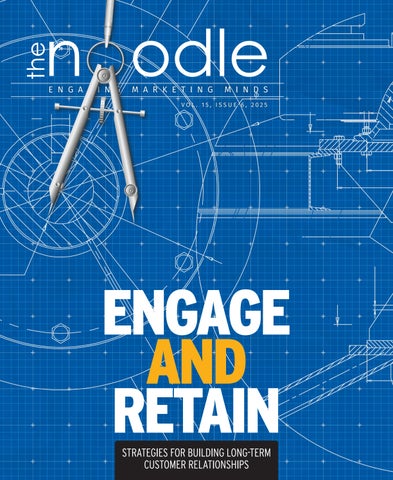
E N G A G I N G
M A R K E T I N G
M I N D S
VOL. 15, ISSUE 6, 2025
ENGAGE AND RETAIN STRATEGIES FOR BUILDING LONG-TERM CUSTOMER RELATIONSHIPS
Dayton’s Trusted Printing Partner All the marketing support you need, from the printer you trust, all in one place.
ThinkPatented.com • 937.353.2299
LISTENER-IN-CHIEF igital fatigue has given marketers back the extraordinary power to connect. Not through screens, not through analytics dashboards or digital impressions, but through actual, human, in-person engagement. The power to sit across from someone, shake a hand, read a room, and truly listen. For too long, marketers—especially in the B2B world— have been boxed into roles of “sales support,” buried behind cubicle walls and email chains. But the truth is, the greatest marketers have always had the pulse of the market. And you can’t have that pulse unless you have a relationship with the actual market. The bottom line is that relationships aren’t built through clicks. They’re built through conversations.
“THE BOTTOM LINE IS THAT RELATIONSHIPS AREN’T BUILT THROUGH CLICKS. THEY’RE BUILT THROUGH CONVERSATIONS.” Don’t get us wrong, data matters. Analytics can guide decisions and illuminate opportunities. But they’ll never replace the raw emotion of an in-person exchange. In fact, we don’t believe you can totally understand the customer experience until you’ve seen it, heard it, and felt it. Until you’ve looked someone in the eye and asked a genuine question and then really listened to the answer, true empathy is lacking. Today, every marketer has to reclaim that role as listener-in-chief. Get out from behind the screen. Go to the events. Set up the meetings. Ask the questions. Be curious. Because when you show up not to sell, but to understand, people open up. They share what they care about. They let you see the truth behind the metrics. That’s where real marketing happens—at the intersection of curiosity and humanness. It’s harder than ever to earn that kind of access, but it’s also more powerful than ever when you do. Because in a world drowning in digital noise, the most disruptive thing you can do is show up in person, and ready to listen. Enjoy the issue and warmest wishes for a wonderful holiday season.
05
5 habits that keep customers for life
02 Cover Story............................... Engage and Retain 06 Feature....................................................... Roots of Trust 10 Tactics................................ Strategies You Can Use 12 On the Record with.............................Gearl Loden
Publisher Diana Renner The Noodle is published bimonthly by Think Patented, ©25. All rights reserved. For more information, contact ThinkPatented.com 937.353.2299 Production Notes
This issue features a multi-level emboss provided by CustomFormed Products and is printed on the HP Indigo 18K Digital Press, using Accent® Opaque 80 lb Cover and 100 lb Text. The insert is printed on Accent® Opaque 80 lb Cover.
Diana Renner Publisher The 644 lbs of paper used for this project were offset by reforesting 7.74 standard trees. AUTHORIZED PARTNER
Think Patented is an Authorized Reforestation Partner of PrintReleaf.
This publication was printed on FSC® Certified paper.
ThinkPatented.com
The Noodle
1
2
The Noodle
Vol. 15, Issue 6, 2025
ENGAGE AND RETAIN STRATEGIES FOR BUILDING LONG-TERM CUSTOMER RELATIONSHIPS
ulika Mehrotra still remembers the moment a loyal client told her why they stayed through years of product pivots, market changes and leadership transitions. It wasn’t her team’s pricing or pitch, but the fact they always did what they said they’d do. For Mehrotra, the conversation became a careerdefining lesson. Today, in a time when consumers are inundated with messages from every direction, the formula for loyalty hasn’t really changed. It’s still about listening, showing up and delivering on promises. The hard part is doing it authentically, at scale and without losing the human touch. “Trust isn’t built through campaigns; it’s built through follow-through—every time, with no exceptions,” says Mehrotra, former Chief Digital Officer at Peterson Technology Partners and founder of Altitude One.
LOYALTY ISN’T A METRIC. IT’S A RELATIONSHIP EARNED ONE DAY AT A TIME.”
— TULIKA MEHROTRA, FOUNDER, ALTITUDE ONE
ThinkPatented.com
The Noodle
3
For brands trying too hard to find a magic bullet, strong customer relationships still come down to three things: clarity, credibility and consistency. The problem, as Mehrotra sees it, is that most brands overcomplicate all three. “Customers have infinite choices and zero patience for mixed messages or corporate theater. What sets a brand apart isn’t another slogan—it’s how it makes people feel.” While personalization has become one of marketing’s most overused buzzwords, Mehrotra argues that most organizations mistake automation for personalization. “Everyone talks about personalization, but most brands are just automating politeness. True personalization is about intent—not inserting someone’s first name into an email.” At Altitude One, Mehrotra helps brands bridge the gap between data and humanity. And while tools like HubSpot and Salesforce (or whatever’s trending at the moment) are fine, without strategy, they’re all just noise. “Real connection happens when communication feels honest, timely and earned.” That authenticity cannot be faked.
Customers are quick to spot inauthentic gestures or opportunistic outreach. The real opportunity lies in using insights to add value—anticipating needs, remembering preferences and treating each interaction as part of a larger relationship, not a single transaction. If personalization builds connection, consistency builds comfort—and comfort drives loyalty. “If your brand disappears between transactions, don’t be surprised when customers do, too,” Mehrotra says. “The best organizations don’t engage out of obligation; they do it out of respect. They listen, share value and show up even when there’s nothing to sell.” That steady presence reinforces trust over time. Customers come to expect not just products or services, but dependability—a brand that listens, learns and grows with them. “Loyalty isn’t a metric,” Mehrotra says. “It’s a relationship earned one day at a time.” Customer satisfaction data often gets reduced to dashboards and KPIs. But Mehrotra reminds marketers that the story behind the numbers matters more than the numbers themselves. “Measurement is critical—but let’s be honest, numbers only tell half the story. A glowing NPS means nothing if you don’t understand why people feel the way they do.” That’s why her team pairs analytics with the “messy, human stuff”—conversations, social sentiment, direct outreach. “The biggest mistake anyone can make is asking for feedback and doing nothing with it,” Mehrotra says. “That teaches your audience not to bother next time. Listening only counts when it leads to action.”
THE TRUST EQUATION Jacquelyn Berney takes a similar view. Trust— the currency of modern business—starts with clear expectations. “It’s amazing how often we skip the most important step: setting expectations at the beginning,” says Berney, President of VI Marketing. “If you don’t start there, you’re already on the fastest path to losing trust.” Berney has seen too many brands overpromise in their rush to win a customer. “When you’re trying to close a deal, it’s
TRUE PERSONALIZATION ISN’T JUST DATA-DRIVEN, IT’S EMPATHY-DRIVEN.”
4
The Noodle
— JACQUELYN BERNEY, PRESIDENT, VI MARKETING
Vol. 15, Issue 6, 2025
tempting to tell people what they want to hear. “But that’s not leadership. If you’re not aligned on expectations, you’re left with customers who feel misled—and once that happens, it’s hard for them to believe anything you say.” Her advice is to always keep promises, even the small ones. If your customers believe in your brand and see you consistently deliver real value, they’ll give you something far more valuable than a single transaction—they’ll give you their trust for life. Berney believes the heart of engagement is empathy. “True personalization isn’t just datadriven, it’s empathy-driven. We have incredible tools—CRM systems, analytics, automation—but those tools are only as powerful as the intent behind them.” At VI, that means designing experiences that feel one-to-one, even at scale. “We use customer history not just to push offers, but to anticipate needs,” Berney says. “When you do that, you move from ‘campaigns’ to conversations, and customers feel seen, not targeted.” Berney also believes in the power of human connection—real, in-person interaction. “Creating spaces where people can engage, connect, and feel valued has a lasting impact. In a world where so many interactions feel isolated or transactional, a thoughtful, positive, face-to-face experience can forge some of the strongest, most loyal relationships.” In the end, consistency is what transforms trust into loyalty. “It’s just like friendship,” Berney says. “If you disappear for months at a time, people stop believing they can count on you. The same is true for customers.” That doesn’t mean brands should bombard inboxes or post endlessly on social media. It means showing up with purpose. “Engagement isn’t about constantly pumping out content—it’s about building community,” Berney says. “That could be an interactive event, a newsletter that actually adds value or joining conversations instead of trying to dominate them.” When it comes to customer feedback, Berney believes the emphasis is on action. “Feedback is one of the most underutilized growth engines in business. Too many organizations collect it and
HABITS THAT KEEP CUSTOMERS FOR LIFE 1. Lead with clarity Start with a clear purpose and communicate it honestly. Confusion kills credibility. 2. Personalize with empathy Use data to understand—not manipulate—your audience. Make every interaction feel earned. 3. Stay consistent Don’t vanish between transactions. Show up regularly with something valuable to say.
then file it away. We treat feedback as both a mirror and a compass: a mirror that shows us how customers experience us today, and a compass that directs where we need to go. When customers see their input transformed into tangible action, you don’t just solve a problem— you deepen trust.” In a marketplace filled with noise, most brand leaders agree that the brands earning true loyalty aren’t necessarily
4. Listen, then act Feedback is only powerful when it drives visible change. Let customers see that you’ve heard them. 5. Build community, not campaigns Focus on experiences that make people feel connected—to your brand and to each other. SOURCES: TULIKA MEHROTRA, FOUNDER, ALTITUDE ONE; JACQUELYN BERNEY, PRESIDENT, VI MARKETING
the flashiest. Focus on connection over perfection. Get closer to your customers than your competitors are. Listen actively, respond authentically and make them feel genuinely valued. The brands that endure are the ones that know who they are and communicate with purpose. In other words, loyalty is less about technology and more about trust—the kind that’s built slowly, deliberately and with care.
ThinkPatented.com
The Noodle
5
6
The Noodle
Vol. 15, Issue 6, 2025
Roots of Trust HOW SUSTAINABLE MARKETING GROWS BRAND LOYALTY USTIN GOLDSBERRY REMEMBERS A CLIENT WHO THOUGHT IT HAD
J
cracked the code on sustainability. Out went the glossy annual reports and in came sleek digital dashboards. The strategy made the leadership team proudly proclaim they had gone “all green.” For a while, the story stuck. With great optics and fresh messaging, the client leaned into solving their sustainability problem. But then came the questions. What about the massive energy draw of cloud data centers? What about the environmental cost of e-waste from outdated devices? Suddenly, the story didn’t feel so clean. “That’s when it hit them,” says Goldsberry, founder and CEO of Goldsberry Management Group LLC and Goldsberry Equity Partners. “Sustainability isn’t about one big switch or a marketing tagline—it’s about transparency, integrity and an ongoing commitment to improvement.” The lesson is that one more brand is learning the hard way. In a time where greenwashing is easy to spot and call out, companies can no longer afford to treat sustainability as window dressing. Today, the brands thriving are ones that integrate eco-friendly marketing practices that are authentic, measurable and, most importantly, believable. For Goldsberry, the danger lies not just in overstating progress, but in underestimating how savvy audiences have become. In the B2B world, buyers and stakeholders often know more about sustainability than the
SUSTAINABILITY ISN’T ABOUT ONE BIG SWITCH OR A MARKETING TAGLINE—IT’S ABOUT TRANSPARENCY, INTEGRITY AND AN ONGOING COMMITMENT TO IMPROVEMENT.” — JUSTIN GOLDSBERRY, FOUNDER/CEO, GOLDSBERRY MANAGEMENT GROUP
ThinkPatented.com
The Noodle
7
brands selling to them. “It’s not enough to talk the talk or appeal to emotions. The most effective approach is to create thought leadership that’s educational but also demonstrates authenticity. That could be blogs, white papers, case studies—anything that shows
measurable progress rather than vague sustainability promises.” He recalls how quickly reputational damage spreads when buyers uncover fabrications. “The worst outcome is when someone realizes you’ve overstated your sustainability story. It only takes one
LinkedIn post or industry whisper, and suddenly that damage is everywhere. Credibility is hard to win back once you’ve lost it.” The antidote is transparency. Even when progress is incremental, honesty wins. “B2B consumers respect a brand
INTENTIONAL PRINT AND DIGITAL CHOICES t Grow Law in Elk Grove Village, Illinois, Sasha Berson sees the same shift playing out. Sustainability has gone from a nice-to-have to a core expectation. From where Berson, Chief Growth Officer, sits, sustainability has definitely become a more prominent factor in how they approach marketing. “We’ve reduced printed materials, prioritized digital formats, and partnered with vendors who share our values,” Berson says. “The goal is to align operations with the expectations of today’s more conscious audience—without compromising quality or results.” When print is used, Berson believes in making it count. That means recycled stock, non-toxic inks and efficient production. “Eco-friendly printing is one piece of a broader effort to operate responsibly. It’s a branding consideration, but it’s also a practical way to reduce impact.” Berson believes steady, integrated communication rather than grandstanding is key to any strategy. “We take a low-key but consistent approach. Instead of leading with sustainability, we weave it into our updates and project summaries—especially when it has a direct impact on the client experience. That’s where we’ve seen the strongest trust and appreciation.” For Ivan Vislavskiy, co-founder and CEO of Comrade Digital Marketing Agency in Chicago, the challenge is often economic. For example, one of the main hurdles is cost. Sustainable options—whether printing, packaging or vendor selection—can be more expensive up front. Another challenge is finding suppliers who can meet both sustainability standards and production requirements. The solution lies in prioritizing high-impact areas and building long-term partnerships with committed vendors. “We’ve chosen to focus on areas where we can make an immediate difference and where sustainability aligns with client needs,” Vislavskiy says. One example came in a recent event series. Instead of printing programs and handing out single-use items, Comrade Digital went fully digital, offering reusable attendee materials and offsetting part of the event’s carbon footprint. The payoff resulted in stronger engagement and positive feedback from attendees who valued the effort. “Pick one or two areas where you can make visible changes,” Vislavskiy says. “Be transparent about what you’re doing, even if it’s incremental. Over time, those small steps build credibility and brand strength.”
8
The Noodle
Vol. 15, Issue 6, 2025
Most marketers say sustainability in marketing isn’t about perfection, but progress. And when that progress is communicated with honesty and backed by proof, it carries real weight. The trap many brands fall into is chasing optics. Bold campaigns or sweeping changes might look good at first glance, but if the story doesn’t hold up under scrutiny, the damage can be lasting. What endures is authenticity. “Start with one or two areas where changes can be implemented quickly—packaging, printing or digital alternatives are good examples,” Vislavskiy says. “Be transparent about what you’re doing, even if the changes are incremental. Over time, those small improvements can build credibility and contribute to a stronger brand position.” Transparency is what keeps a brand resilient. Verified certifications, third-party data and honest reporting strengthen credibility. Small steps also matter. Choosing recycled materials, rethinking event strategies or cutting back on single-use items may not sound like headlinemaking moves, but they send a message that your commitment is real. “Sustainable options can carry a higher upfront investment, so we’ve focused on areas with the most immediate impact,” Vislavskiy says. “Over time, building long-term relationships with vendors who share our standards has strengthened both our credibility and commitment.” Sustainability has become the new credibility test. Audiences no longer want lofty promises—they want proof. The brands that win are ones that nurture trust and grow loyalty.
that says, ‘We’re working toward sustainability’ and shows a roadmap for improvement,” Goldsberry says. “They’d rather see small but verifiable steps than bold claims that don’t hold up.” That philosophy shaped one of his most successful campaigns. During a recent “Earth Month,” Goldsberry led a project highlighting how travel and expense policies could reduce carbon footprints. The campaign combined data, storytelling and third-party validation, generating nearly 35,000 impressions on LinkedIn and 700-plus article views. More importantly, it sparked conversations about what “essential travel” really means. “It resonated because it was authentic,” Goldsberry recalls. “The story was rooted in lived experience, reinforced with trusted data, and shared as practical advice. That’s the kind of sustainability marketing that sticks.”
PICK ONE OR TWO AREAS WHERE YOU CAN MAKE VISIBLE CHANGES. BE TRANSPARENT ABOUT WHAT YOU’RE DOING, EVEN IF IT’S INCREMENTAL.” — IVAN VISLAVSKIY, CO-FOUNDER/CEO COMRADE DIGITAL MARKETING AGENCY
5 INSTANT SUSTAINABLE MARKETING WINS 01 Print with purpose Use recycled stock, soy or non-toxic inks, and only print what’s necessary.
02 Go digital—mindfully Remember that “all digital” isn’t automatically green. Optimize storage, reduce e-waste, and track energy use.
03 Start small, show progress Pick one area—packaging, events, or collateral—and be transparent about incremental changes.
04 Choose better partners Work with vendors and suppliers who share your sustainability standards.
05 Lead with honesty Avoid lofty promises. Share what you’re doing today and your roadmap for tomorrow. SOURCES: JUSTIN GOLDSBERRY, GOLDSBERRY MANAGEMENT GROUP; SASHA BERSON, GROW LAW; IVAN VISLAVSKIY, COMRADE DIGITAL MARKETING AGENCY
ThinkPatented.com
The Noodle
9
BOLD MOVES A SNAPSHOT OF THE MOST CONSEQUENTIAL SHIFTS SHAPING MARKETING.
OPENAI TARGETS FULLY AUTOMATED AI RESEARCHER BY 2028 In a bold new roadmap, OpenAI revealed internal plans to: ❱ Release an AI research intern
by 2026 ❱ Launch a fully autonomous AI researcher by 2028 (OPENAI ANNOUNCEMENT, OCTOBER 2025)
❱ 83% of sales teams using AI saw revenue growth, compared to 66% of sales teams not using AI. (SALESFORCE.COM) ❱ 63% of marketers are currently using generative AI. (SALESFORCE.COM) ❱ The average click‑through rate (CTR) in search ads in 2025 is 6.66%, with cost per click (CPC) increasing in 87% of industries. (WORDSTREAM) ❱ 60% of Americans describe themselves as cautious or worse about the economy — driving increased deal‑hunting and brand‑switching. (WUNDERKIND OCTOBER 2025 TARIFF CONSUMER IMPACT SURVEY)
❱ 47% of U.S. consumers say they’re seeking discounts more often than earlier this year. (WUNDERKIND OCTOBER 2025 TARIFF CONSUMER IMPACT SURVEY)
❱ 94.6 The Conference Board Consumer Confidence Index slipped to 94.6 in October 2025 (from 95.6 in September). (THE CONFERENCE BOARD, OCTOBER 2025)
10
The Noodle
Vol. 15, Issue 6, 2025
“BRANDING DOESN’T BEGIN ON A SCREEN. IT BEGINS WITH THE SMALLEST FRICTION A CUSTOMER FEELS, AND THE MOMENT YOU CHOOSE TO FIX IT. YOUR BRAND ISN’T YOUR STORY. IT’S YOUR CUSTOMER’S EXPERIENCE OF THAT STORY.” - MARTIN LINDSTROM, NEW YORK TIMES BEST SELLING AUTHOR
MARKETING SUPPLY CHAIN [ mahr-ki-ting suh-plahy cheyn ] noun 1. The chain of suppliers that an organization relies on to produce marketing materials (print, promotional products, point of sales) to market their products and services. 2. A collection of partners inside and outside of the organization—such as brand managers, marketing services, agencies, direct sales teams, buyers, printers, fulfillment houses and many others. 3. The acquisition, management and distribution of items such as product brochures, promotional flyers, point-of-sale systems and store signage to sales teams, branch offices, retail outlets, dealers, distributors and other key audiences around the world.
Lead marketing strategies for the new normal
Account-Based Marketing
Retargeting Campaigns
Podcast & Livestreaming
Nobody knows what the post-COVID landscape will look like. Marketers will need to lead with fresh ideas and strategies to stay ahead of the game. Take a look at the marketing strategies they plan to use:
Influencer Marketing
Personalization/ Gifting
Conversational Landing Pages
Artificial Intelligence
Inbound Marketing
Custom Packaging
OVER TIME, most supply chains can grow cumbersome and unwieldy as new partners, new products and new technologies are added, resulting in increased cost, decreased service levels and an overall loss of control. Some of the world’s largest consulting firms estimate that up to 60% of marketing costs are related to nonproduct ancillary areas (distribution, people, freight, storage, obsolescence, technology, inventory management). By taking a complete marketing supply chain approach, identifying inefficiencies and developing best business practices, companies can improve their marketing supply chain process. Outsourcing the process can help manage total marketing supply chain cost, and can provide an opportunity for measurement in marketing, one of the major challenges in the profession.
FLOW [ floh ] verb 1. A process, similar to manufacturing environments, that typically involves creation and production of marketing materials to meet customer needs.
Mobile-First Strategy
Programmatic Advertising
Source: SageFrog's "2021 B2B Marketing Mix Report"
Voice Optimization
2. Production, warehousing and fulfillment of marketing materials in their final form. 3. Feedback that includes gathering information for continuous refinement.
ThinkPatented.com
The Noodle
11
BUILDING A CULTURE OF INNOVATION A CONVERSATION WITH EXECUTIVE COACH GEARL LODEN
Why is having the right culture of innovation important for today’s marketing teams? A culture of innovation means creating an environment where new ideas are welcomed, tested and refined without fear of failure. In marketing, this is essential because consumer behavior, technology and competitive landscapes evolve rapidly—what worked yesterday may be obsolete tomorrow. Organizations that prioritize innovation stay agile, relevant and ahead of the curve, while those that resist change risk stagnation and decline. What specific strategies have you implemented to encourage risk-taking within your marketing team while managing potential setbacks? Our approach to encouraging risktaking within the marketing team centers on creating a culture that values experimentation, learning and accountability. We follow a “fail fast, learn faster” mindset—starting with small-scale experiments before committing to large-scale rollouts so that risks remain manageable. Every decision is rooted in data; we base our actions on research, insights and clear hypotheses. When something doesn’t work, we analyze the results, extract key learnings and refine our strategy. Equally important, we foster psychological safety so team members know they won’t be punished for bold ideas or unsuccessful tests. The focus is always on what we learned, not who made the mistake. We make it a point to celebrate calculated risks, spotlighting moments
12
The Noodle
Vol. 15, Issue 6, 2025
W
hen it comes to inspiring leaders and organizations to think differently, few voices carry the depth of experience and insight Gearl Loden brings to the table. An award-winning executive coach and former State Superintendent of the Year, Loden has spent more than three decades helping leaders navigate complexity, build high-performing teams and drive meaningful change. As founder of Loden Leadership and Consulting Group, he works with C-suite executives, school superintendents and nonprofit leaders to strengthen strategy, resolve conflict and cultivate influence. Loden shares his perspective on what it takes to build a true culture of innovation—one where curiosity is encouraged, collaboration is celebrated and leadership sets the tone for continuous learning and growth.
when bold steps led to breakthroughs. This reinforces that thoughtful risktaking isn’t something to fear—it’s something to embrace. How do you foster creativity among your team members, and what practices or tools have you found most effective in sparking innovative ideas? Creativity thrives when diverse perspectives come together, so we make a point to bring in voices from beyond the marketing team—customer service, product development and even external industry experts—to spark fresh thinking. Our brainstorming sessions are structured but playful; we often use techniques like the “Worst Idea” exercise, where we intentionally generate bad ideas and then reverseengineer them into innovative, workable strategies. We also run short, focused innovation sprints that bring crossfunctional teams together for rapid ideation and collaboration. Interestingly, we’ve found that creative constraints can be just as powerful
as freedom. Asking questions like, “How would we market this with zero budget?” often pushes the team to think more resourcefully and uncover unexpected solutions. What role does continuous learning play in building an innovative culture, and how do you ensure your team stays curious and up to date with industry trends? Innovation thrives on curiosity and curiosity has to be intentionally nurtured. We’ve built continuous learning into the fabric of our culture by encouraging exploration beyond traditional marketing boundaries. Great ideas often come from unexpected places, so we study trends in technology, psychology, entertainment and consumer behavior to keep our perspective fresh. To make learning collaborative, we hold weekly knowledge-sharing sessions so new insights never stay siloed. We also invest in upskilling through courses, conferences, and certifications that align with where
marketing is headed next. Reverse mentoring plays a key role, too—junior team members often bring fresh digital perspectives that spark new thinking among senior leaders. And finally, we stay hands-on with emerging technologies, testing and integrating new tools to ensure we remain at the forefront of innovation. How do you balance the need for structured processes with the flexibility required to nurture creative thinking and experimentation? The key is to structure for creativity, not stifle it. We approach this by using guardrails rather than rigid rules— setting clear objectives, timelines, and budgets while allowing flexibility in how those goals are achieved. Our “50/50 approach” ensures balance: Half of our campaigns follow proven playbooks, while the other half leave room for creative experimentation. We also apply agile marketing principles, using short feedback loops, iterative testing, and quick pivots to stay adaptable without losing focus. To keep ideas flowing, we dedicate
AT ITS CORE, MARKETING INNOVATION ISN’T ABOUT ONE BIG BREAKTHROUGH—IT’S ABOUT CONSISTENTLY EVOLVING, TESTING AND REFINING. ORGANIZATIONS THAT EMBRACE THIS MINDSET DON’T JUST SURVIVE, THEY LEAD. time for innovation—similar to Google’s 20% rule—so team members can explore passion projects that may spark new breakthroughs. We embrace a “sharpen the vision” mentality, recognizing when something isn’t working and pivoting quickly, no matter how much effort has already gone into it. What advice would you give to marketing leaders seeking to transform their organization into a hub of innovation? To transform an organization into a hub of innovation, marketing leaders must start by creating a culture where ideas flow freely. Innovation should be an expectation, not a luxury, and every team member— not just senior leaders—should feel empowered to contribute. Rewarding smart risks is equally important; celebrate lessons learned
from failed experiments as much as the big wins. Leading with curiosity sets the tone—when leaders actively explore new ideas and model a growth mindset, the team naturally follows. We also emphasize rapid prototyping, launching ideas quickly and refining them through iteration rather than waiting for perfection. Data plays a crucial role in de-risking creativity, helping turn bold concepts into strategic, measurable outcomes. Breaking down silos is essential. True innovation thrives when teams collaborate across departments, leveraging diverse perspectives to uncover insights that no single group could discover on its own. At its core, marketing innovation isn’t about one big breakthrough—it’s about consistently evolving, testing and refining. Organizations that embrace this mindset don’t just survive, they lead.
ThinkPatented.com
The Noodle
13
2490 CrossPointe Dr. Miamisburg, Ohio 45342
Happy New Year! Think Patented is here to help you turn possibilities into results and achieve your goals in the year ahead.
YEAR OF THE HORSE
ThinkPatented.com • 937.353.2299
“We overcome challenges and perform with a heightened level of energy, superior service, and a can do attitude.”