T H E B A R
Journal of The Bar of Ireland
Not

T H E B A R
Not
Thomas B. Courtney
The Companies Act 2014 makes the most far-reaching and fundamental changes to Irish company law in two generations, putting forward a radically di erent approach whereby the private company limited by shares will become the new model company. The structure of the fourth edition of this highly regarded title mirrors this new Act.
ISBN: 9781780438405
Format: Hardback
Price: €275.00
Pub date: Oct 2016
Brian Hutchinson
Keane on Company Law, Fifth Edition (previous edition: Company Law by Justice Ronan Keane) covers the Companies Act 2014 and is essential reading for students, solicitors and barristers alike. All the changes to Irish company legislation are covered in a practical and userfriendly structure.
ISBN: 9781780435428
Format: Hardback
Price: €195.00
Pub date: Nov 2016
Robert Clark, Shane Smyth, Niamh Hall
A detailed guide to patents, copyright and trademark law. It covers all relevant European legislation and traces its weaving into Irish law. It details European case law together with relevant case law from commonwealth countries, as well as detailing any Irish cases on the three areas and also covers design law.
ISBN: 9781780435411
Format: Hardback
Price: €245.00
Pub date: Oct 2016
Consultant editor, Maeve Regan; General editor: Ailbhe Murphy
This practical guide brings together the knowledge and expertise of Ireland’s leading employment, tax and pensions law practitioners. This new edition includes the workings of the Workplace Relations Commission, whistleblowing, health and safety, mediation, agency workers, restraint of trade and injunctions.
ISBN: 9781847663764
Format: Hardback
Price: €245.00
Pub date: Nov 2016
Denis Kelleher, Karen Murray
EU Privacy and Data Protection Law contains extensive annotations and acts as a guide to the EU’s proposed General Data Protection Regulation. EU Privacy and Data Protection Law covers: An analysis of privacy law; an analysis of the GDPR; and discussion of sectoral rules.

ISBN: 9781784515539
Format: Paperback
Price: €175.00
Pub date: Jan 2017

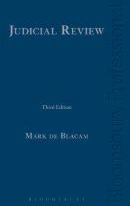
Mark de Blacam
Covers the grounds for review, defences to an application, the remedies and procedures involved and covers the Rules of the Superior Courts 2011, SI 691/2011. It is the de nitive text on judicial review available in Ireland and also of important reference in the United Kingdom.
ISBN: 9781780437026
Format: Hardback
Price: €265.00
Pub date: Dec 2016
The Bar Review
The Bar of Ireland
Distillery Building
145-151 Church Street
Dublin DO7 WDX8
Direct: +353 (0)1 817 5166
Fax: +353 (0)1 817 5150
Email: rfisher@lawlibrary ie
Web: www lawlibrary ie
Editor
Eilis Brennan BL
Eileen Barrington SC
Gerard Durcan SC
Eoghan Fitzsimons SC
Niamh Hyland SC
Brian Kennedy SC
Patrick Leonard SC
Paul Anthony McDermott SC
Sara Moorhead SC
Brian R Murray SC
James O'Reilly SC
Mary O'Toole SC
Mark Sanfey SC
Claire Bruton BL
Diane Duggan BL
Claire Hogan BL
Grainne Larkin BL
Mark O'Connell BL
Thomas O'Malley BL
Ciara Murphy, Director
Shirley Coulter, Director, Comms and Policy
Vanessa Curley, Law Library
Deirdre Lambe Law Library
Rose Fisher, Events and Administration Manager
Tom Cullen, Publisher
Paul O Grady Publisher
Published on behalf of The Bar of Ireland by Think Media Ltd
Editorial: Ann-Marie Hardiman
Paul O’Grady
Colm Quinn
Design: Tony Byrne Tom Cullen Niamh Short
Advertising: Paul O’Grady

Tel:
Fax:
Email:
(0)1 856 1169
The Council of The Bar of Ireland is already busy acting on members' behalf.
We are now into the swing of the Michaelmas term and the vacation is a distant memory I wish all members of the Library a rewarding and enjoyable legal year I also wish to pay tribute to my predecessor, David Barniville SC, for the extraordinary time and energy that he put into the role of chairman over the past two years I am under no illusion about the fact that his is a difficult act to follow The new Council has had a busy start, with full meetings at the end of August and on October 17 As will be seen, we continue to face many challenges over the coming year
Parts 1 and 2 of the Legal Services Regulation Act, 2015 came into operation on October 1, 2016 In addition, the Minister designated October 1, 2016, as the “establishment day” for the new Authority, in accordance with Section 7 of the Act At the time of writing, the balance of the legislation has not been commenced This creates an anomalous position, given that uncommenced provisions of the Act require statutory consultation and reporting within fixed periods commencing from the establishment day The Authority has neither a Chief Executive nor offices, and no staff have been assigned to it Nonetheless, the Council of The Bar of Ireland has established a non-permanent committee, with Tony McGillicuddy as chair, to prepare for its implementation on a number of levels A great deal of work has already been undertaken by this committee
During September, the Oireachtas Finance Committee held hearings into the reported escalation in motor insurance costs This followed public statements by industry representatives about further premium increases Sara Moorhead SC and I (together with Stuart Gilhooly and Ken Murphy from the Law Society) attended one hearing on behalf of the Bar On the same day, the Competition and Consumer Protection Commission announced an investigation into alleged anti-competitive behaviour by insurance companies That investigation is to be welcomed
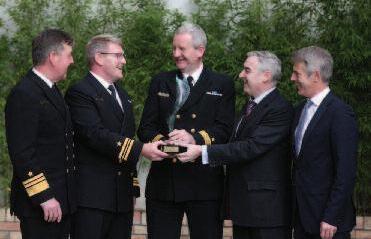
On October 13, the Bar presented its inaugural Human Rights Award to the men and women of the Irish Naval Service for the extraordinary work carried out by them in the Mediterranean Sea The bravery shown by them in the course of their work and their contribution during this humanitarian crisis is a genuine source of pride for all Irish citizens None of us will forget the powerful and moving comments made by Lt Cmdr Manning and his colleague at the presentation ceremony
Members will have seen press reports suggesting that the Government may refrain from filling any judicial vacancies until such time as legislative amendments
providing for a new appointments system are in place The Council of The Bar of Ireland is alarmed by the suggestion that vacancies will be permitted to remain unfilled for an indeterminate period While it is arguable that the manner by which judges are appointed needs to be modified, there is no evidence to suggest that any judge appointed under the existing system does not fulfil the declaration required to be made under the Constitution Studies frequently indicate that Irish judges are held in the very highest regard At the same time, pressure on the judicial system is very intense In 2014, Ireland had the lowest number of judges of 47 countries examined by the European Commission The Court of Appeal requires a significant number of additional judges to meet its obligations There are currently statutory vacancies on the District Court, Circuit Court and the Supreme Court More judges will retire in the coming months The suggestion that these positions will not be filled raises the possibility that one arm of the State might appear to be reducing the capacity of another There are legitimate concerns that such a course would not respect the constitutional right of access to the courts and the obligation to ensure that justice is administered efficiently It is always legitimate to seek to improve the system for appointments, but there is no connection between that objective and the need to ensure that statutory judicial positions are filled in the interim
The new CPD space is on the first floor of the Sheds and is ready for use as and from the beginning of November At its meeting on October 17, the Council resolved to name this space after our much loved colleague Maurice Gaffney SC, who celebrated his 100th birthday on October 11 last We look forward to hosting CPD and social events in the Gaffney Room (or ‘The Gaff’, as I am sure it will become known) in the months and years to come
Finally, I wish to extend a very special welcome to the 89 new pupils who joined the Library at the beginning of October I look forward to having the opportunity to meet with each of them over the course of the next year and I’m sure all members will join with me in wishing them the very best for their career at the Bar

Paul McGarry SC Chairman, Council of The Bar of Ireland

As we settle into the new legal year, this is a time of great change for barristers in legal practice.
The recent Cour t of Appeal ruling in Sheehan v Corr is expected to have far-reaching implications for the assessment of costs on taxation If upheld by the Supreme Court, this decision will have a major impact on the manner in which bills of costs are prepared into the future Meanwhile, the appointment of a Legal Costs Adjudicator is awaited under provisions of the Legal Services Regulation Act 2015
Practitioners also have to grapple with new conduct of trial and case management rules in civil cases These new rules contain some radical innovations relating to the speed of trials, witness statements and the regulation of exper t evidence
In this edition of the Bar Review, we explain the new High Cour t rules and reflect on how they will work in practice It is hoped that the implementation of these rules will not hamper or undermine the fundamental principles of trial litigation, such as the right to cross-examine We also analyse the Sheehan judgment and evaluate its impact on how bills of costs are presented At a time when An Garda Síochána are rarely out of the news because of issues regarding pay and whistleblowers, we explore a different issue – the extent to which the Gardaí enjoy immunity from suit in relation to the prevention and investigation of crime
Happy reading and every best wish for the new legal year


Eilis Brennan BL Editor ebrennan@lawlibrar y ie
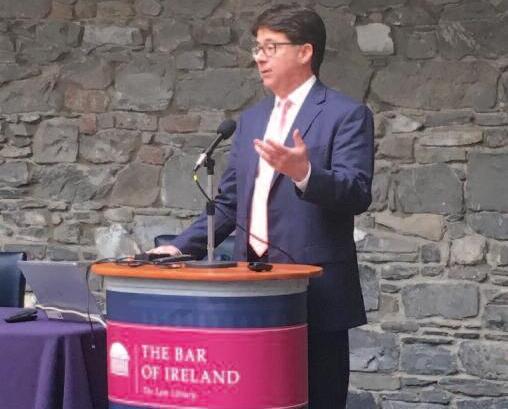
On Wednesday, September 28, The Bar of Ireland welcomed 89 new members Chairman of the Council of The Bar of Ireland, Paul McGarry SC, opened the day ’s proceedings with a warm welcome to this year’s new entrants Throughout the day members heard a range of talks from The Bar of Ireland’s executive management team and guest speakers, including: The Hon Mr Justice Raymond Groarke, President of the Circuit Cour t; Claire Hogan BL; Libby Charlton BL; Mary Rose Gearty SC; Mícheál P O'Higgins SC; Patrick Leonard SC; Seamus Woulfe SC; and, the Hon Mrs Justice Susan Denham This year’s new members were also treated to a special appearance from hit series Making a Murderer' s defence lawyer, Dean Strang
In order to increase awareness of The Bar of Ireland’s TY Programme, 'Look into Law', we exhibited at the 2016 Transition Year Expo, which took place at Punchestown Racecourse Event Centre on September 12 and 13 Over the two days, 7,200 students, 350 teachers and parents from 196 schools were introduced to the 'Look Into Law' programme, which is an exciting initiative aimed at increasing students' awareness of the work of The Bar of Ireland and to encourage students to consider a career as a barrister To fur ther increase awareness we were delighted to have the full details of the programme included in a double page spread in Bell Time magazine, which is delivered to all secondary schools across Ireland The application process for the 2017 programme which will run from February 6-10, opened on Monday October 24, and will close at 5 00pm on Monday, November 21, 2016 More information on the TY Programme can be found at www lawlibrary ie/TYProgramme



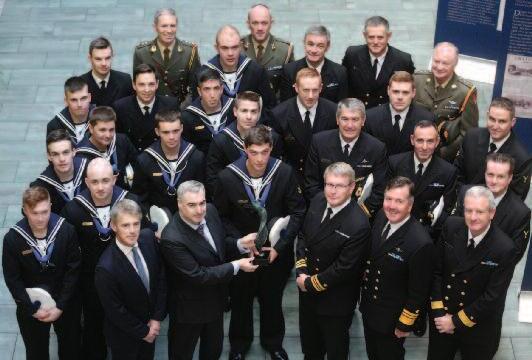
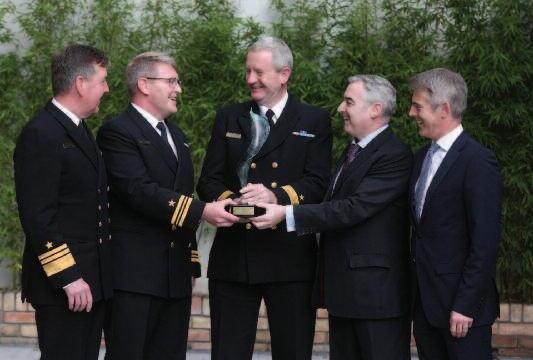
At a ceremony on Thursday, October 13, 2016, The Bar of Ireland presented its inaugural Human Rights Award to the Irish Naval Service in appreciation of its exceptional contribution to human rights in saving thousands of lives in the Mediterranean Sea during the current migration crisis More than 11,500 migrants have been rescued by Irish Naval Service vessels since May 2015 as par t of its humanitarian response to the ongoing crisis Chief of Staff of the Defence Forces, Vice Admiral Mark Mellett, and some 35 members of the Irish Naval Ser vice were among the special guests who attended the award presentation ceremony at the Law Library
Presenting the award, Paul McGarr y SC , Chairman of the Council of The Bar of Ireland, acknowledged the bravery shown by members of the Irish Naval Ser vice through the course of their work in the Mediterranean Sea and said that their contribution during what is the worst humanitarian crisis in
Donal Coyne, Director of Pensions for JLT Financial Ser vices Ltd, which operates The Bar of Ireland Retirement Trust Scheme, has reminded barristers of their last chance to reduce their 2015 income tax liability by making a pension contribution now:
“Self-employed professionals such as barristers can claim tax relief against 2015 earnings by making pension contributions within Revenue deadlines Generally, barristers must elect to pay that contribution prior to October 31, 2016, in order to obtain tax relief against 2015 income However, for those using the Revenue On-Line Service, there is a payment extension to November 10
It’s impor tant to know that Revenue will not permit tax relief to be granted in the preceding tax year if the barrister has not elected to claim the tax relief in the final tax return, or has not filed a tax return This applies even if the pension contribution has been paid well before the tax deadline Pension documentation does not have to be submitted with the final tax return, but Revenue may request sight of the documents at any stage in the future”
living memory should be a source of enormous pride for every Irish person Conor Dignam SC , Chair of The Bar of Ireland’s Human Rights Committee, outlined that in selecting the recipient of the first Human Rights Award the aim was to recognise service that went above and beyond the call of duty to protect and preser ve fundamental human rights, commending the honourable assistance provided by the members of the Irish Naval Service in search and rescue operations over the last number of months Speaking on behalf of the Naval Ser vice, Flag Officer Commanding Naval Ser vice, Commodore Hugh Tully, said that they were honoured to receive this award on behalf of all of the members of the Naval Ser vice who ser ved and are serving in the various search and rescue operations in the Mediterranean Sea, and proud to be able to provide this assistance on behalf of Ireland and the Irish people
Tax relief limits for pension contributions are subject to an earnings cap of ¤115,000 and are calculated on an age related percentage of earnings as follows:
Table: Maximum tax relief on a pension contribution


David Barniville SC, Chairman, IRLI; Chief State Advocate Primrose Chimwaza; and, Senior State Advocate Tione-Atate Namanja Middle row (from
Paddy McGrath SC; Liz Howlin, DPP; Brian Storan BL; Vanina Trojan; Helena Kiely, Chief Prosecution Solicitor, DPP; and, Shirley Coulter, Director of Communications and Policy,
of
Michael Irvine, Director, IRLI; Cillian MacDomhnaill, Law Society; Paula Jennings; and, Orla Crowe BL
PLACE YOUR ORDER TODAY
info.legalsolutions.thomsonreuters.co.uk/CriminalLaw TRLUKI.orders@thomsonreuters.com or Pauline.ward@thomsonreuters.com 1800937982 (Ireland) +44 (0)1264 388560 (Int’l) Quote reference 2522303A
Dermot P.J.
Walsh
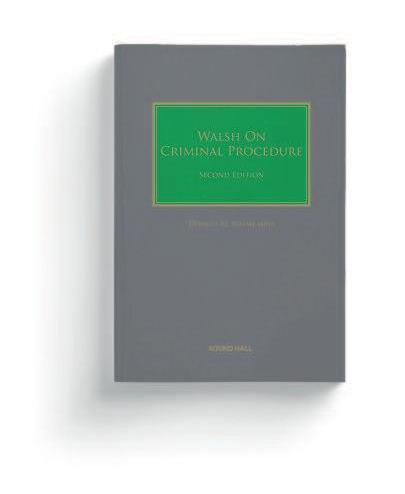
Walsh on Criminal Procedure is a comprehensive treatment of all aspects of criminal procedure from police powers of investigation right through to postsentencing processes. The second edition responds to recent developments by offering an expert and accessible analysis of all aspects of Irish criminal procedure. A consistent theme throughout is an emphasis on comprehensive detail and clarity with the needs of both prosecution and defence in mind.
Publication: September 2016 • 9780414035041 €395
Also available on Westlaw IE and as an eBook on ProViewTM
ISBN: 9780414060500 | ProView eBook price: €395
ISBN: 9780414060517 | Print & ProView price: €514
One of Ireland’s longest running looseleaf services, Irish Planning Law and Practice marked its 25th anniversary this October The title released its 48th update last month The service is published by Bloomsbury Professional and updates are produced by a research team at corporate law firm A&L Goodbody, led by consultant Alison Fanagan
Bloomsbury Professional states that the looseleaf service combines authoritative commentary and lucid analysis of the law with a practical guide to planning
We are delighted that each member should by now have received their personalised copy of The Bar of Ireland Directory of Membership Services and Benefits This Directory is a comprehensive guide setting out the full range of services and benefits available to members of the Law Library The collective, shared structure of the Law Library aims to ensure that each member has access to a range of services, facilities, s and benefits that represent va money Membership of the Law provides all essential facilities much more, the details of whic set out in the Directory A di copy of the Directory is a available online in the Membe section of www lawlibrary ie

regulations and procedure The publica includes a digest of cases summarising al key decisions under the appropriate headi as well as an Annotated Statutes sec setting out the text of all the relevant Plan and Environmental Law Acts and impor regulations, as amended

Paul McGarry SC, Chairman, Council of The Bar of Ireland, and Sara Moorhead SC presented to the Joint Committee on Finance, Public Expenditure and Reform and Taoiseach on September 13, 2016, on the rising costs of motor insurance Chaired by John McGuinness TD, contributions were invited from The Bar of Ireland and The Law Society on the factors surrounding recent increases in motor insurance premiums Lengthy discussion ensued, with representatives of The Bar of Ireland seeking to counteract the widely broadcast misinformation that ising insurance costs are attributable to a higher number of claims, excessive nd inconsistent award levels, and legal costs Representatives of The Bar of reland also proposed a number of solutions, such as: the need for better ransparency and sharing of data; a revised book of quantum; and, the prompt stablishment of the new legal costs adjudication system, provided for by he Legal Services Regulation Act, which will provide greater transparency nd visibility for clients of the costs of litigation in advance of proceedings, nd a facility for par ties to challenge costs The full submission is available on www lawlibrary ie




Although a number of rulings have found that the police are immune from suit when performing their investigative or prosecutorial functions, the situation is still not entirely clear.

Introduction
The issue of whether a police force should enjoy an immunity from suit in relation to its crime prevention, investigative and prosecutorial functions has been the subject of a number of recent decisions in Ireland Some of these suggested Ireland has followed the line set by the House of Lords in Hill v Chief Constable for West Yorkshire 2 However, a recent Irish Supreme Court decision appears to suggest that the existence or non-existence of any such ‘immunity’ in Irish law may still be an open question Another recent Irish decision indicates that even if such an immunity exists, it is unlikely to be extended
Hill
In Hill, the mother of the last victim of the Yorkshire Ripper sued the police for damages, claiming the Ripper would have been caught before he murdered her daughter had the police investigation not been negligent The House of Lords struck out the plaintiff’s claim for public policy reasons, holding that the police should not owe a duty of care to protect victims from the criminal acts of a third par ty (This may have been obiter: the action had already failed for lack of proximity between the police and the victim )
The mother of the last victim of the Yorkshire Ripper sued the police for damages, claiming the Ripper would have been caught before he murdered her daughter had the police investigation not been negligent
The court queried whether a claim for damages for negligence would ever be an appropriate vehicle to challenge the investigative deficiencies of the police Templeman L J noted potential difficulties that would arise if police investigations were conducted in the shadow of a threatened negligence action: how could the conduct of individual members be compared with the standard of care expected of a ‘hypothetical’ policeman? He suggested that the threat of litigation against the police would not improve efficiency, but would distract police from their duties He also contended that a policeman who felt compelled to concentrate on one crime may be accused of neglecting others 3
The policy issues identified in Hill – the prospect of ‘defensive’ policing, the time and resources required to defend claims – are not new Such issues arise in any action for damages for what is sometimes described as “professional negligence” One might also think Templeman L J ’s observation that any finding of negligence against members of the police “would not help anybody or punish anybody” is facile and erroneous However, some of these themes were subsequently adopted by the Irish courts
Ireland: immunity for the Attorney General: W
In W, 4 the victim of a convicted paedophile unsuccessfully sued the Attorney General for damages for shock and distress arising from delays in extraditing the paedophile from the Republic of Ireland to Northern Ireland Costello P held that when considering the paedophile’s extradition, the Attorney General was not in a relationship of such proximity to prospective victims of the paedophile as to generate a duty of care towards those victims
The cour t also held that even if there was a sufficient proximate relationship and the injury was reasonably foreseeable, it would be contrary to public policy to impose a duty of care on the Attorney General While acknowledging the hardship to individuals that such an immunity could produce, the cour t held that the Attorney General was obliged to perform certain statutory functions in the public interest If the duty of care contended for was imposed, this could give rise to a conflict between the exercise of his/her statutory and international obligations, and the common law duty of care to potential victims The imposition of such a duty of care could compromise the exercise of the Attorney General’s statutorilyconferred functions
Insofar as W accepted that an immunity from suit for negligence could be conferred on a public law officer on public policy grounds, the law in Ireland appeared to reflect the law in England and Wales set out in Hill It is, however, wor th noting that in some subsequent English cases, it was suggested that the principle stated so trenchantly in Hill should be reformulated in terms of the absence of a duty of care rather than immunity from suit
The issue may indeed be one of linguistic confusion One commentator5 has suggested that the so-called ‘immunity ’ is no more than the absence of the third ingredient of the test formulated in Caparo Industries v Dickman6 as to whether or not a duty of care exists The European Cour t of Human Rights held in Osman 7 that an ‘immunity ’ from suit afforded to the police in such circumstances was dispropor tionate and breached a plaintiff ’s implied right of access to the domestic cour ts guaranteed under Ar ticle 6(1) of the European Convention on Human Rights (‘the Convention’) So ‘immunity ’ may be a misnomer: it is not that a plaintiff cannot commence proceedings, but rather that any such claim will almost inevitably fail because the three Caparo requirements will not be met Prospects of success may improve if, for example, there is a ‘special relationship’ (such as arguably exists between the police and an informer),8 though in the absence of such a relationship, the English cour ts have been reluctant to extend the duty of care 9 Significantly, however, other so-called ‘immunities’ (e g , the immunity from suit of a barrister for the conduct by him/her during a case in court) have been abolished 10 But whether described as an ‘immunity ’ or otherwise, the police in Ireland have not been held liable for negligence when carrying out their investigative/prosecutorial functions, as the following three cases make clear
In Lockwood v Ireland, 11 a rape trial collapsed because the defendant who made admissions in Garda custody had been unlawfully detained The rape victim sued the Gardaí for negligence The question of whether the police could be held liable for damages for the per formance of their investigative and prosecutorial functions was tried as a preliminary issue Kearns P held that in the absence of mala fides no liability could arise, since no duty of care arose in respect of bona fide actions carried out by Gardaí during a criminal investigation and/or prosecution
In LM v The Commissioner of An Garda Síochána, 12 a conviction for rape was set aside and a retrial prevented on grounds of delay The rape victim sued the Gardaí Again the defendants raised a preliminar y issue: did they owe a duty of care to the plaintiff in respect of their investigation of her complaint? In dismissing the plaintiff ’s claim, Hedigan J endorsed Kearns P ’s previous ruling in Lockwood and affirmed the non-existence of a duty of care on Gardaí and prosecuting authorities in the investigation and prosecution of crime
In G v Minister for Justice, Equalit y and Law Reform, 13 the plaintiff claimed she had been raped in her house by a ‘friend’, whom she had accommodated to facilitate the Gardaí while the perpetrator’s own house was the scene of a Garda investigation into his wife’s death The Gardaí did not tell the plaintiff that the perpetrator was a suspect for his wife’s murder The plaintiff ’s claim for damages for negligence was dismissed after a plenary hearing Hedigan J said:
“It is now clearly established in Irish law that the Gardaí owe no duty of care in respect of actions taken in the course of their duty to investigate and prosecute crimes The absence of this duty situation arises from considerations of public policy”
The validity of the policy considerations underpinning the decisions
As has been noted,14 these cases differ from Hill, where the police were sued for failing to protect a plaintiff from injury inflicted by a third party Perhaps G comes close: arguably the Gardaí took responsibility for relocating the perpetrator in order to facilitate their investigation, and brought him to a situation where he presented a reasonably foreseeable risk of injury to the victim 15
However, in each of the judgments, Hill-type public policy arguments were deployed to justify the exclusion of any duty of care by the police With warnings of ‘defensive’ policing, and the trouble and expense to which the police would be put in defending themselves against negligence claims, the judgments paint a bleak picture of the dire consequences were such a duty of care to be imposed 16
Arguably such policy considerations are not unanswerable The suggestion that some medical practitioners practise ‘defensive medicine’ for fear of being sued is not a reason to outlaw medical malpractice suits Fur ther, any person sued for negligence in the course of their employment will necessarily devote time and expense to defending such a claim Concerns about the range of potential plaintiffs – the ‘floodgates’ argument – could surely be circumvented by formulating a “proximity” test as between a plaintiff and the police in the relevant circumstances of each case, in line with the principles referred to in Glencar Exploration plc v Mayo Count y Council 17
The plaintiffs in LM and Lockwood successfully appealed to the Supreme Court 18 In allowing the appeals, the Supreme Cour t19 noted that both claims were dependent upon a contention that public bodies carrying on impor tant public functions of investigation and prosecution of crime, owed a duty of care to individual members of the public and were obliged to compensate them in the event of any failure to perform those functions adequately 20
O’Donnell J ’s judgement is a comprehensive analysis of the development of the law in England since Hill, observing how this development has occurred in parallel with, and has been influenced by, cases such as Osman and Z, and exploring the impact of the Convention on domestic law It also notes the impact of the
decision of the European Court of Human Rights in O’Keeffe v Ireland 21 He notes – despite its shocking facts22 – that in Michael v Chief Constable of South Wales, 23 the UK Supreme Cour t – by a majority – affirmed Hill, noting that Australian cour ts and cer tain state cour ts in the US had taken a similar approach 24 Observing that the issue has involved considerable legal debate in other common law countries, O’Donnell J said the decision in Michael had been described as “arguably the third most impor tant case after Donoghue v Stephenson and Hedley Byrne v Heller on the English law of negligence” 25
O’Donnell J also noted that in C v Chief Constable PSNI, 26 an application to strike out an action seeking damages for the failure to investigate a rape allegation was refused, the court observing that developments in the law of negligence may be affected by developments in the field of the Convention, a Member State’s obligations being, inter alia, to provide access to the courts (Article 6), to protect life (Article 2) and to provide an effective remedy (Article 3)
In LM, the Supreme Court held that a court hearing a preliminary issue is entitled to consider if the par ticular issue is appropriate for determination by this procedure A cour t is also entitled to conclude in the light of the arguments advanced that it was not possible to give the sort of clear and unequivocal answer to the issue which would dispose of the case or any issues in the case:27 this was par ticularly so when the point raised was a major legal issue likely to affect many other cases The Supreme Cour t noted that separate and impor tant considerations which did not arise in Hill or Michael, would be involved in LM and Lockwood: what would happen, for example, if the alleged perpetrator was never charged in the first place, or if the alleged perpetrator was acquitted? Observing that “ very large questions of public policy could arise”, O’Donnell J indicated that any consideration and refinement of the issues illustrated the complexity and impor tance of these cases In allowing the appeals, the Supreme Cour t therefore directed that the plaintiffs should be allowed to bring their cases to trial in the High Cour t
The Supreme Court did not go as far as declaring that the police should not enjoy ‘immunity ’ from suit in respect of the conduct of their investigative and prosecutorial actions O’Donnell J noted that the possibility of claiming damages against criminal investigative or prosecution services was a “difficult issue” It has been suggested, however, that the fact that O’Donnell J did not reaffirm the Hill principle suggests a possible future reconsideration of – or perhaps development of an exception to – the principle in question 28
The Supreme Cour t did not go as far as declaring that the police should not enjoy immunit y from suit in respect of the conduct of their investigative and prosecutorial actions
The growing influence of the Convention has also been the subject of scrutiny 29 There was some confusion in LM as to whether the ‘Convention claims’ remained live, irrespective of what happened to the claim in negligence: if the Convention claims remained ‘live’, then affording the police immunity from a negligence claim
would not necessarily be dispositive The consideration of possible breaches under the Convention was a fur ther reason not to determine as a preliminary issue the question of whether or not a duty of care in negligence was owed The judgement suggests that human rights law may conceivably have a degree of influence on domestic tor t law; cer tainly similar issues can arise in both areas of law The judgement also notes the potentially dependent relationship between Convention law and the law of negligence, especially where a judgment in human rights law directly impacts on negligence claims
Public order policing: Fagan v Commissioner of An Garda Síochána30
During Queen Elizabeth’s Dublin visit in May 2011, the Garda Public Order Unit was called to respond to a riot on Dorset Street The plaintiff was making a phone call on the footpath when he was knocked down by a running Garda, and subsequently sued the Gardaí for damages
The defendants contended that Gardaí should be afforded immunity in respect of injuries that might have been negligently inflicted because they were exercising their function to maintain public order However, the cour t held that, whatever about an immunity in relation to the carr ying out of their criminal investigative/ prosecutorial obligations, there was no authority to suggest such an immunity should extend to Gardaí involved in public order duties No statutory provision conferred any special protection on the Gardaí exercising such functions Nor did the Glencar principles provide an immunity for Gardaí in such a situation, since the Gardaí were not, when carrying out public order functions, acting in pursuit of any statutory obligation
Irvine J held that the imposition of a reasonable duty of care on Gardaí would not paralyse them in their capacity to achieve public order or render them ineffective when carrying out their functions To afford a blanket immunity in respect of the actions of all Gardaí when exercising any public order function would be to give the Gardaí “ a latitude extremely disproportionate to their needs”
The court also concluded that permitting Gardaí to be sued in such circumstances would not give rise to any par ticular evidential difficulties, nor would the ability of the Gardaí to perform their public order duties be brought to a standstill Irvine
J was of the view that the time available to Gardaí to deal with other duties would not be significantly adversely affected if members of the public were allowed to sue for negligence, nor would their involvement in such litigation inter fere with their efficiency in the conduct of their duties She noted that drivers of emergency vehicles, who may be exempted from speed limits, are not exempted from liability for negligence They are not given car te blanche to drive without due care, although when determining whether ‘due care’ was taken, the cour t could give the object of the journey due weight Ir vine J also held that there was no higher threshold (e g , malice or recklessness), which a plaintiff had to establish in order to establish liability:
“ [T]he defendants’ concerns as to the ability of Gardaí to carry out their public order functions without the fear of unreasonable claims for damages being brought against them are more than adequately catered for by the application of the standard principles of the law of torts Those principles which have at their core, the concept of reasonableness are sufficiently flexible to take into account the interests of the Gardaí and the public alike”
Relevant factors include the facts of any given case, the probability of an accident
if reasonable care is not used, the gravity of the threatened injury and the social utility of the defendant’s conduct at the time
In the par ticular circumstances, the very significant public order function being carried out by the Gardaí at the time the plaintiff was injured was held to be a factor that weighed heavily when considering whether the defendants acted with reasonable care Irvine J held that the Gardaí were reasonably entitled to assume that anyone who stayed in the street during this period of danger would notice the advancing Garda riot squad and be able to take evasive action To hold the Gardaí culpable for failing to carr y out the manoeuvre without accidentally knocking into somebody while attempting to clear the rioters would be “to set the standard of care required of them unreasonably high” The plaintiff had been injured accidentally, she concluded; there was no negligence or breach of duty by the defendants
To af ford a blanket immunit y in respect of the actions of all Gardaí when exercising any public order function would be to give the Gardaí “ a latitude extremely dispropor tionate to their needs”.
Are policy justifications for a police ‘immunity ’ justified?
Fagan does not decide that there can never be a police ‘immunity’ from suit for negligence It is authority for the proposition that there is no justification for granting such an immunity to the Gardaí in respect of their public order duties and functions, the principles of negligence being more than adequate to deal with same However, it is interesting that the rationale for providing such an immunity was comprehensively rejected by the cour t One wonders whether the same rationale offered for the granting of a wider immunity to the police is justified either The test formulated by Irvine J to assess whether the Gardaí have discharged their duty of care when carrying out public order functions could arguably be adopted so as to be applied to the exercise by the Gardaí of their investigative/ prosecutorial functions in respect of crime Cer tainly such a scenario would in principle be more attractive than the ‘blanket’ immunity from suit envisaged in Hill
The outcry following the Hillsborough Inquest has reignited the debate about police immunity from suit After evidence that members of the police had altered statements to divert blame for what had happened onto the fans, numerous new claims were recently lodged against the South Yorkshire Police Authority These latest claims are for misfeasance in public office,31 and so are quite different in nature to claims in negligence Proceedings seeking compensation for negligence for injuries sustained at Hillsborough had already been issued against South Yorkshire Police Authority and Sheffield Wednesday Football Club within days of the disaster in April 1989 Many claims were settled without admission of liability,32 though two test cases proceeded to hearing, relating to (a) the proximity required to claim ‘ nervous shock’,33 and (b) the extent to which compensation was payable for the pre-death pain and suffering of those who had died 34 Were a tragedy such as Hillsborough to occur in Ireland, Fagan makes it clear that the Gardaí could not rely on any claimed ‘immunity’ in respect of their public order functions 35
n The Supreme Cour t’s refusal in LM to state unequivocally that a Hill-type immunity from suit protects the police means that the existence of such an immunity here remains an open question
n Given its complexity and far-reaching effects, it is preferable that the question, when it next arises, is determined at a full plenary hearing rather than as a preliminary issue (although G was decided following a plenary hearing, its precedential value may be reduced given its ratio’s reliance on the High Cour t decisions in LM and Lockwood, which decisions have been reversed by the Supreme Cour t)
n Any future consideration of the so-called ‘immunity ’ is likely to involve not only consideration of negligence principles but also consideration of
1 This is an edited version of a paper presented at the Tort Law Update Conference on Saturday, May 28, 2016 at the Law Library, Distillery Building, Dublin 7 The longer version is available at www lawlibrary ie/johnodonnell-paper I wish to thank David Leonard BL and Niamh Barry BL for their assistance I am grateful also to Conor Gearty, Professor of Human Rights Law and Director of the Institute of Public Affairs, LSE, for his help and encouragement All errors herein are my own
2 [1988] 2 All E R 238
3 See also in this regard the opinion of Lord Keith of Kinkel
4 W v Ireland (no 2) [1997] 2 IR 141
5 See C A Gearty, ‘Osman Unravels’ (2002) MLR 87
6 [1990] 2 AC 605 The three ingredients are: (i) is the damage to the plaintiff foreseeable; (ii) is the relationship between the plaintiff and the defendant sufficiently proximate; and, (iii) is it fair, just and equitable to impose liability on the defendant?
7 Osman v United Kingdom (1998) 29 EHRR 245 Gearty notes that this conclusion was greeted with much hostility in the United Kingdom, and was effectively jettisoned in Z v United Kingdom 29392/95, May 10, 2001, which held that case law establishing there was no duty of care in negligence in certain situations was (in principle, anyway) compatible with the Convention
8 Swinney v Chief Constable of West Cumbria Police [1996] 3 AER 449
9 Brookes v Metropolitan Police Commissioner and Others [2005] 2 AER 48
10 Rondel v Worsley [1969] 1 AC, 191; Paul v Simons [2002] 1 AC, 615
11 [2011] 1 IR 374
12 [2012] 1 ILRM 132
13 [2011] IEHC 65
14 See Dermot Walsh’s excellent ar ticle ‘Liability for Garda Negligence in the Prevention and Investigation of Crime’ (2013) Ir Jur 1, the inspiration and assistance of which is gratefully acknowledged
15 See Home Office v Dorset Yacht Company Limited [1970] AC 1004
16 Walsh (op cit ) described some of the language used as “dramatic”, “colourful” and “heavily charged”
17 [2002] 1 IR 84, the test being: (i) the reasonable foreseeability of injury or damage; (ii) the proximity of relationship – (the neighbour principle); (iii) whether there are countervailing public policy considerations suggesting no duty of care should be imposed; and, (iv) whether in all the circumstances, it is just and reasonable that a duty of care should be imposed
the impact of the Convention
n W is authority for the imposition of an ‘immunity ’ from suit, but only in respect of the exercise of the Attorney General’s statutorily-conferred functions concerning extradition
n The approach in Fagan is preferable to the somewhat crude imposition of a blanket-type immunity based on public policy considerations The principles in Glencar should make it possible to formulate circumstances in which a duty of care might be imposed on the police in exercising their preventive, investigative and prosecutorial functions Indeed, having regard to the provisions of the Convention and the Constitution, such an approach appears desirable
18 G is also under appeal
19 [2015] IESC 81 (O’Donnell J )
20 Paragraph 8 of the judgement
21 [2014] 59 EHRR 15
22 Ms Michael contacted the emergency 999 number because her ex-boyfriend had assaulted her and threatened to kill her Because of inadequacies in handling the call, the police service was not mobilised sufficiently quickly, and Ms Michael was killed
23 [2015] 2 WLR 343
24 However, there are decisions the other way in New Zealand, Canada and South Africa
25 Paragraph 24
26 [2014] NIQB 63
27 See paragraphs 34 and 35
28 Case comment: LM v Commissioner of An Garda Síochána, Trinity College Law Review Online (Julia Launders), 2016
29 Launders, op cit
30 [2014] IEHC 128
31 To succeed in such a claim, a plaintiff must show that the conduct complained of is actuated by malice, and/or that the public officer is guilty of knowing – or reckless – disregard of the lack of power to do the act complained of The requirement to prove ‘subjective’ reckless disregard undoubtedly presents challenges to plaintiffs: see McMahon and Binchy, Law of Tor ts (4th Edition), Bloomsbury 2013, paragraph 19 84 et seq
32 One memo to the Chief Constable stated: “ by opening the emergency gates and failing to protect the tunnel under the West Stand thereby allowing spectator access to pens three and four when they were already full, we allowed a dangerous situation to develop I was advised that we are liable and our position is absolutely indefensible”
33 See Alcock and others v Chief Constable of South Yorkshire Police [1992] 1 A C 310
34 See Hicks v Chief Constable of South Yorkshire Police [1992] 2 All E R 65
35 An inquiry into rioting at a ‘friendly’ football match between the Republic of Ireland and England in Lansdowne Road in February 1995 concluded that the rioting could have been avoided if the Gardaí had acted on prior intelligence received Segregation of the fans was also found to be insufficient
A directory of legislation, articles and acquisitions received in the Law Library from June 21, 2016, to September 28, 2016 Judgment information supplied by Justis Publishing Ltd
Edited by Deirdre Lambe and Vanessa Curley, Law Library, Four Courts
Administrative and constitutional law –Judicial review – Employment –Considered Blanchfield v Harnett [2002] 3 IR 207 Considered John Stirling v District Cour t Judge Collins and Anor [2014] 1 IR 602 –(McKechnie J , MacMenamin J , O'Malley J – 13/07/2016) – [2016] IESC 40 – [2016] 7 JIC 1301 Count y Louth Vocational Educational Committee v Equalit y Tribunal
Administrative and constitutional law –Prisoners – Detention – Distinguished The State (Brien) v Kelly [1970] IR 69 Distinguished The State (Dillon) v Kelly [1970] IR 174 Considered Sweeney v Governor of Loughan House Open Centre [2014] IESC 42 – (Denham C J , O'Donnell Donal J , McKechnie J , Clarke J , MacMenamin J , Laffoy J , O'Malley J – 12/07/2016) – [2016]
IESC 37 – [2016] 7 JIC 1202
O'Farrell v Governor of Por tlaoise Prison
Negligence – Wrongful death –Statute-barred – Not applied Farrell v Coffey [2009] IEHC 537 Considered Pickett v British Rail Engineering Ltd [1980] AC 136 – (Irvine J , Hogan J , Mahon J – 28/06/2016) – [2016] IECA 194 – [2016] 6 JIC 2803 Hewitt v Health Service Executive
Legitimate expectation – Damages –Liability – Referred to Cromane Foods
Ltd v Minister for Agriculture [2016] 2 JIC 2201 Referred to Glencar Exploration p l c v Mayo County Council (No 2) [2002] 1 IR 84 Referred
to Lett & Company Limited v Wexford Borough Council and Ors [Supreme Cour t] [2012] 2 JIC 0301 – (Denham C J , O'Donnell Donal J , McKechnie J , MacMenamin J , Laffoy J , Dunne J , O'Malley J – 19/07/2016) – [2016] IESC 43 – [2016] 7 JIC 1902
Atlantic Marine Supplies Ltd v Minister for Transpor t
Legislative authority – Unconstitutional usurpation – Criminal possession of a drug – Appellant seeking a declaration of unconstitutionality – Whether subsidiar y legislative action was unconstitutional usurpation – Applied Maher v Minister for Agriculture [2001] 2 IR 139 – (Denham C J , O'Donnell
Donal J , McKechnie J , Clarke J , MacMenamin J , Dunne J , Charleton J – 22/06/2016) – [2016] IESC 34 –[2016] 6 JIC 2203
Bederev v Ireland, Attorney General
Library acquisitions
Bell, J , Elliott, M , Varuhas, J N E
Public Law Adjudication in Common Law Systems: Process and Substance Oxford: Har t Publishing, 2015 – M300
Library acquisitions
Walsh, K Farming and the Law Dublin: Clarus Press, 2016 – N98 C5
Library acquisitions
Walsh, K Farming and the Law Dublin: Clarus Press, 2016 – N98 C5
Library acquisitions
Blake, S , Browne, J , Sime, S The Jackson ADR Handbook (2nd ed ) Oxford: Oxford University Press, 2016 – N398 6
Ar ticles
Hughes, P Adjudicator nominations under the construction contract act 2013 Irish Law Times 2016; (34) (13): 194
Banking and finance – Summar y judgment – Default in repayment of loan – Applied Aer Rianta cpt v Ryanair Ltd (No 1) [2001] 4 IR 607 Applied First National Commercial Bank plc v Anglin [1996] 1 IR 75 Applied Harrisrange Ltd v Duncan [2003] 4 IR 1 – (Twomey J 20/06/2016) – [2016] IEHC 346 – [2016] 6 JIC 2004 Allied Irish Bank PLC v Moloney
Banking and finance – Summar y judgment – Default in repayment of borrowed funds – Applied Aer Rianta cpt v Ryanair Ltd (No 1) [2001] 4 IR 607 Applied First National Commercial Bank plc v Anglin [1996] 1 IR 75 Applied Harrisrange Ltd v Duncan [2003] 4 IR 1 – (Twomey J –20/06/2016) – [2016] IEHC 347 –[2016] 6 JIC 2005–KBC Ireland PLC v McNamee
Civil appeal – Banking – Debt – Applied Intermetal Group Ltd v Worslade Trading Ltd [1998] 2 IR 1 Cited Quinn and Ors v Quinn and Ors [2013] IEHC 1 Applied Spiliada Maritime Corporation v Cansulex Ltd [1987] AC 460 – (O'Donnell Donal J , Clarke J , MacMenamin J – 28/07/2016) – [2016] IESC 50 – [2016] 7 JIC 2808 Irish Bank Resolution Corporation Ltd v Quinn
Possession – Unrateable proper ties –Case stated – Not applied Bank of Ireland Mor tgage Bank v Hanley and Giblin [2015] IEHC 738 Applied Bank of Ireland Mor tgage Bank v Laura Finnegan and Anor [2015] IEHC 304 –(Ryan P , Ir vine J , Hogan J –28/07/2016) – [2016] IECA 229 –[2016] 7 JIC 2802 Permanent TSB Plc v Langan
Library acquisitions
Moloney, N EU Securities and Financial Markets Regulation (3rd ed ) Oxford: Oxford University Press, 2014 – W107
Acts
Commission of Investigation (Irish Bank Resolution Corporation) Act 2016 –
Act No 10 of 2016 – Signed on July 27, 2016
Library acquisitions
Ramsey, V , Furst, S , Keating, D Keating on construction contracts (10th ed ) London: Sweet & Maxwell, 2016 – N83 8
Library acquisitions
Hershman, D , McFarlane, A Hershman and McFarlane Children Act Handbook 2016/17 (2016/17 ed ) Haywards Heath: Bloomsbury Professional, 2016 –N176
Articles
Moloney, Dr C Mental Health Act 2001: A child rights assessment of the current legal framework and its proposed reform Irish Journal of Family Law 2016; (19) (2): 8 – part 1; Irish Journal of Family Law 2016; (19) (3): 43 – part 2
Statutory instruments
Child care (amendment) act 2015 (commencement) order 2016 – SI 203/2016
Children act 2001 (amalgamation of children detention schools) order 2016 –SI 273/2016
Children act 2001 (designation of remand centre) order 2016 – SI 274/2016
Children act 2001 (section 160 designation) order 2016 – SI 28/2016
Statutory instruments
Broadcasting Act 2009 (section 130(1)(a)(iv) designation) order 2016 –SI 328/2016
Valuation – Remedy – Shareholding –Not applied Horgan v Murray [1997] 3 IR 23 Considered Re Tobian Properties Ltd Maidment v Attwood and others [2012] EWCA Civ 998 – (Finlay Geoghegan J , Hogan J , Cregan J – 08/06/2016) –
[2016] IECA 193 – [2016] 6 JIC 0806
Donegal Investment Group Plc v Danbywiske
Summary judgment – Application to set aside – Error in law – Appellant seeking to set aside High Court Central Office summary judgment – Whether High Court judge erred in law in including within his consideration the likely cost to be incurred by the plaintiff on a plenary hearing – Applied Allied Irish Banks plc v Robert Lyons and Josephine Lyons [2004] 7 JIC 2102 – (Peart J , Irvine J , Mahon J – 06/07/2016) – [2016] IECA 200 – [2016] 7 JIC 0601
Emo Oil Ltd v Willowrock Ltd t/a McCormack Fuels
Library acquisitions
Bruce, M Rights and Duties of Directors 2016 (15th ed ) Haywards Heath: Bloomsbury Professional Ltd, 2016 –N264
Davies, P L , Worthington, S , Micheler, E Gower Principles of Modern Company Law (10th ed ) London: Sweet & Maxwell, 2016 – N261
French, D , Mayson, S , Ryan, C Mayson, French and Ryan on Company Law (33rd ed ) Oxford: Oxford University Press, 2016 – N261
Library acquisitions
Ezrachi, A EU Competition Law: An Analytical Guide to the Leading Cases (5th ed ) Oxford: Hart Publishing, 2016 – W110
MacNab, A Bellamy and Child: Materials on European Union Law of Competition (2016 ed ) (9th ed ) Oxford: Oxford University Press, 2016 – W110
Articles
Power, V J G Competition law post-Brexit? Commercial Law Practitioner 2016; 23 (7): 193
Statutory instruments
European Union (market abuse) regulations 2016 – SI 349/2016
Criminal Law – Application for stay of proceedings – Appeal – N/A – (Denham C J , O'Donnell Donal J , Clarke J –12/07/2016) – [2016] IESC 39 – [2016] 7 JIC 1204
Burke v Ireland and the Attorney General
Summary judgment – Loan facilities –Bona fide defence – Applied Aer Rianta cpt v Ryanair Ltd (No 1) [2001] 4 IR
607 – (Ryan P , Finlay Geoghegan J , Pear t J – 24/06/2016) – [2016] IECA
188 – [2016] 6 JIC 2411
National Asset Loan Management Ltd v Crosbie
Statutory instruments
European Union (consumer information, cancellation and other rights) (amendment) regulations 2016 – SI 336/2016
Proper ty development – Breach of contract – Security for costs – Applied
Lismore Homes Ltd (in receivership) v Bank of Ireland Finance Ltd [1992] 2 IR
57 Distinguished Nor ta Wallpapers v John Sisk Ltd [1978] IR 114
Distinguished Oltech (Systems) Limited v Olivetti UKI Limited [2012] 3 IR 396 – (Finlay Geoghegan J , Peart J , Hogan J – 08/06/2016) – [2016] IECA 169 –[2016] 6 JIC 0801
Paulson Investments Ltd v Jons Civil Engineering Ltd
Contract – Specific per formance –
Appeal – Applied Duffy v Ridley
Proper ties Ltd [2008] 4 IR 282
Distinguished Duggan v Allied Irish
Building Society [1975] WJSC – HC 894
Distinguished Holohan and Anor v Ardmayle Estates [1965] WJSC – SC 4010 – (O'Donnell Donal J , Laffoy J , O Malley J – 29/07/2016) – [2016]
IESC 52 – [2016] 7 JIC 2902
McGrath v Stewar t
Library acquisitions
Davies, G , Harbottle, G , Caddick, N Copinger and Skone James on Copyright (17th ed ) London: Sweet & Maxwell, 2016 – N112
Costs – European arrest warrants –Travel documents – Followed Godsil v Ireland [2015] 2 JIC 2403 Referred to Nearing v Minister for Justice [2010] 4 IR 211 – (Finlay Geoghegan J , Peart J , Hogan J – 13/06/2016) – [2016] IECA
181 – [2016] 6 JIC 1304
Benloulou v Minister for Justice and Equalit y
Library acquisitions
Blackhall Publishing Blackhall's Circuit
Cour t Rules: updated to 1 Januar y 2016 Dublin: Lonsdale Law Publishing, 2016 – N363 1 C5
Blackhall Publishing Blackhall's District
Cour t Rules: updated to 1 Januar y 2016 Dublin: Lonsdale Law Publishing, 2016 – N363 2 C5
Blackhall Publishing Blackhall s Superior Cour t Rules: updated to 1 Januar y 2016 (2016 ed ) Dublin: Lonsdale Law Publishing, 2016 –N361 C5
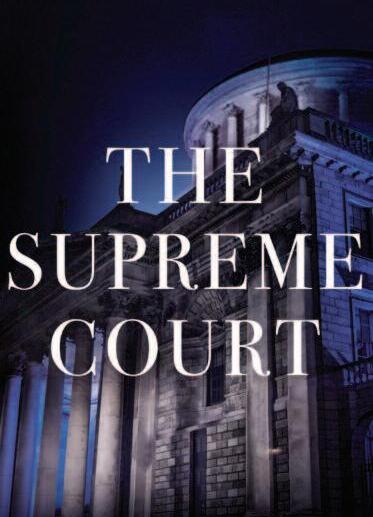
Mac Cormaic , R The Supreme Cour t Dublin: Penguin Books, 2016 –L220 C5
Ar ticles
Carey, G New rules represent significant changes to litigation practices Commercial Law Practitioner 2016; 23 (7): 87
Statutory instruments
Circuit Cour t rules (judges robes) 2016 – SI 433/2016
Circuit Cour t rules (jurisdiction and the recognition and enforcement of judgments in civil or commercial matters) 2016 – SI 432/2016
Cour ts (supplemental provisions) act 1961 (judicial remuneration) (section 46 (9)) – SI 400/2016
Cour ts (supplemental provisions) act 1961 (judicial remuneration) (section 46(9A)) order 2016 – SI 401/2016
Rules of the Superior Cour ts (construction contracts act 2013) 2016 – SI 450/2016
Rules of the Superior Cour ts (order 122) 2016 – SI 471/2016
Rules of the Superior Cour ts (chancery and non–jur y actions: pre–trial procedures) 2016 – SI 255/2016
Sentencing – Making a threat to injure another with a syringe – Severity of sentence – Applied DPP v Flynn [2015] 12 JIC 0405 (Birmingham J , Mahon J , Edwards J – 02/06/2016) – [2016] IECA 164 – [2016] 6 JIC 0203
DPP v O'Brien
Crime and sentencing – Sexual offences – Multiple serious offences against children – Considered S M v Ireland (No 2) [2007] 4 IR 369 – (Denham C J , O'Donnell Donal J , Clarke J , MacMenamin J , Laffoy J , Charleton J – 09/06/2016) – [2016] IESC 31 –[2016] 6 JIC 0901
DPP v Maher
Sentencing – Theft – Undue leniency –Applied DPP v (Christopher) Byrne [1995] 1 ILRM 279 Applied DPP v WC [1994] 1 ILRM 321 – (Sheehan J , Mahon J , Edwards J – 09/06/2016) –[2016] IECA 173 – [2016] 6 JIC 0905 DPP v McAuley
Criminal Law – Assault – Appeal against sentence – N/A – (Birmingham J , Sheehan J , Mahon J – 13/06/2016) – [2016] IECA 176 – [2016] 6 JIC 1301
DPP v Keogh
Criminal Law – Assault – Appeal against sentence – N/A – (Birmingham J , Sheehan J , Mahon J – 13/06/2016) – [2016] IECA 179 – [2016] 6 JIC 1302
DPP v Sherlock
Criminal Law – Criminal damage –Appeal against sentence – N/A –(Sheehan J , Mahon J , Edwards J –09/06/2016) – [2016] IECA 174 –[2016] 6 JIC 0906
DPP v Foody
Conviction – Murder – Error in law –Distinguished R v Lynch [2009] IECCA 31 Referred to DPP v O'Reilly [2009] IECCA 18 Referred to R v Voisin [1918] 1 KB 531 – (Birmingham J , Mahon J , Edwards J – 14/06/2016) – [2016] IECA 180 – [2016] 6 JIC 1402
DPP v Flanagan
Unlawful detention – Committal warrant – Drug offences – Applied Michael Farrell aka Regan v Governor of Saint Patrick's Institution [2014] 1 IR 699 Applied Paul Moore v Governor of Wheatfield Prison and Ors [2015] IEHC 147 Applied State (McDonagh) v Frawley [1978] IR 131 – (Ir vine J , Sheehan J , Mahon J – 15/06/2016) – [2016] IECA 177 – [2016] 6 JIC 1501 Freeman v Governor of Wheat field Prison
Criminal Law – Failure to comply with residence notification under Sex Offenders Act 2001 – Appeal against sentence – N/A – (Birmingham J , Mahon J , Edwards J – 07/06/2016) –[2016] IECA 175 – [2016] 6 JIC 0703
DPP v Bissett
Conviction – Assault – Recusal –Applied Tracey t/a Engineering Design & Management v Bur ton [2016] 4 JIC 2501 – (Sheehan J , Mahon J , Edwards J – 17/06/2016) – [2016] IECA 185 –[2016] 6 JIC 1705
Towey v DPP
Crime and sentencing – Sexual offences – Sexual assault – Applied DPP v Flynn [2015] 12 JIC 0405 – (Sheehan J , Mahon J , Edwards J – 17/06/2016) –[2016] IECA 187 – [2016] 6 JIC 1706
DPP v F P
Crime and sentencing – Sexual assault – Member of Defence Forces alleged to have assaulted fellow member –Considered DPP v Michael McKevitt
[2009] 1 IR 525 – (Sheehan J , Mahon J , Edwards J – 17/06/2016) – [2016] IECA 191– [2016] 6 JIC 1709 Director of Militar y Prosecutions v Donaghy
Sentencing – Drug offences – Severity of sentence – Applied DPP v Flynn [2015] 12 JIC 0405 – (Sheehan J , Mahon J , Edwards J – 17/06/2016) –[2016] IECA 189 – 2016] 6 JIC 1708 DPP v Scanlon
Criminal Law – Burglar y – Appeal against sentence – N/A – (Birmingham J , Sheehan J , Mahon J –24/06/2016) – [2016] IECA 197 –[2016] 6 JIC 2404 DPP v Lennon
Criminal Law – Assault causing harm –Appeal against sentence – Considered R v New ton (Rober t John) (1982) 77 CrAppR 13 – (Sheehan J , Mahon J , Edwards J – 05/07/2016) – [2016] IECA 199 – [2016] 7 JIC 0501 DPP v Smith
Conviction – Conspiracy – Empanelling juries – Considered De Burca v Attorney General [1976] IR 38 Considered O'Callaghan v Attorney General [1993] 2 IR 17 Considered Todd v Judge Murphy [1999] 2 IR 1 – (Birmingham J , Sheehan J , Mahon J –04/07/2016) – [2016] IECA 198 –[2016] 7 JIC 0401
DPP v Warren
Prosecution – Sexual assault –Disclosure – Applied G (P) v DPP [2006] IESC 19 – (Finlay Geoghegan J , Hogan J , Clarke J – 07/07/2016) –[2016] IECA 205 – [2016] 7 JIC 0704 Vattekaden v DPP
Committal warrants – Reissue of warrants – Road traffic offences –Distinguished A v Governor of Arbour Hill Prison [2006] 4 IR 88 Applied Brennan v Windle [2003] 3 IR 494, Distinguished The King (Shields) v The Justices of Tyrone [1914] 2 IR 89 –(MacMenamin J , Laffoy J , O'Malley J – 19/07/2016) – [2016] IESC 42 –[2016] 7 JIC 1901 Buckley v DJ Hamill
Sentencing – Fraud – Position of trust – Referred to DPP v Farrell [2010] IECCA 116 Referred to DPP v Flynn [2015] 12 JIC 0405 – (Birmingham J , Sheehan J , Mahon J – 08/07/2016) – [2016] IECA 216 – [2016] 7 JIC 0806
DPP v Shanny
Sentencing – Rape – Severity of sentence – Considered DPP v Kieran
Ryan [2014] IECCA 11 – (Birmingham J , Sheehan J , Edwards J –07/07/2016) – [2016] IECA 208 –[2016] 7 JIC 0702
DPP v R K
Sentencing – Burglar y – Severity of sentence – Appellant seeking to appeal against sentence – Whether sentence was unduly severe – Applied DPP v Flynn [2015] 12 JIC 0405 – (Sheehan J , Mahon J , Edwards J –05/07/2016) – [2016] IECA 204 –[2016] 7 JIC 0502
DPP v Kelly
Sentencing – Thef t – Suspended sentences – Considered DPP v Walsh [2016] 2 JIC 2613 –(Birmingham J , Sheehan J , Mahon J – 08/07/2016) – [2016] IECA 215 –[2016] 7 JIC 0805
DPP v Moran
Library acquisitions
Card, R , Molloy, J Card, Cross and Jones: Criminal Law (22nd ed ) Oxford: Oxford University Press, 2016 – M500
O Malley, T Sentencing Law and Practice (3rd ed ) Dublin: Round Hall, 2016 – M587 C5
Rook, P , Ward, R Rook and Ward on Sexual Offences Law and Practice (5th ed ) London: Sweet & Maxwell, 2016 – M544
Zagaris, B International White Collar Crime: Cases and Materials (2nd ed ) Cambridge: Cambridge University Press, 2015 – M540 3
Ar ticles
Berr y, J Criminal Elements of Civil Contempt The Bar Review 2016; (21) (4): 118
Acts
Misuse of Drugs (Amendment) Act
2016 – Act No 9 of 2016 – Signed on July 27, 2016
Proceeds of Crime (Amendment) Act
2016 – Act No 8 of 2016 – Signed on July 27, 2016
Statutory instruments
Criminal justice act 1994 (section 44) regulations 2016 – SI 436/2016
Criminal justice (terrorist offences) act 2005 (section 42) (restrictive measures concerning cer tain persons and entities associated with the ISIL (Da’esh) and Al-Qaida organisations) regulations
2016 – SI 413/2016
Criminal justice (terrorist offences) act 2005 (section 42) regulations 2016 – SI 414/2016
Proceeds of crime (amendment) act 2016 (commencement) order 2016 – SI 437/2016
Damages – Negligence – Compensation
– Applied Rober ts v Johnstone [1989] QB 878 Applied Todorovic v Waller 150 CLR 402 – (Denham C J , O'Donnell Donal J , Clarke J , MacMenamin J –13/07/2016) – [2016] IESC 41 –[2016] 7 JIC 1308
Barr y (A Minor) v National Maternit y Hospital
Library acquisitions
Cahillane, L Draf ting the Irish Free State Constitution Manchester: Manchester University Press, 2016 –L431 C5
Acts
Electoral (Amendment) Act 2016 – Act No 5 of 2016 – Signed on July 25, 2016
Suspension – Termination of appointment – Contractual liability –Applied Delaney v Central Bank of Ireland [2011] IEHC 212 Applied Georgopoulus v Beaumont Hospital Board [1998] 3 IR 132 Applied Somers v Minister for Defence [2012] IEHC 447 – (Hogan J , Dunne J , Murphy J –28/06/2016) – [2016] IECA 195 –[2016] 6 JIC 2801
Kelleher v An Post
Library acquisitions
Kirchner, J , Morgenroth, S , Marshall, T Transfer of Business and Acquired Employee Rights: A Practical Guide for Europe and Across the Globe Berlin Heidelberg: Springer–Verlag, 2016 –W130
Savage, A Leaks, Whistleblowing and the Public Interest: The Law of Unauthorised Disclosures Cheltenham: Edward Elgar Publishing Limited, 2016 – N192 29
Ar ticles
de Paor, Dr A , O'Mahony, Dr C Genetic testing of employees for mental illness in Ireland: law, policy and reform Irish Employment Law Journal 2016; (13) (3): 64 Halpin, B How the EU char ter of fundamental rights impacts on workers in Ireland Irish Employment Law Journal 2016; (13) (3): 72
Statutory instruments European Union (collective rights management) (directive 2014/26/EU)
regulations 2016 – SI 156/2016
Safety, health and welfare (general application) (amendment) (no 3) regulations 2016 – SI 370/2016
Safety, health and welfare at work (electromagnetic fields) regulations 2016 – SI 337/2016
Library acquisitions
Roggenkamp, M M , Redgwell, C , Ronne, A Energy Law in Europe: National, EU and International Regulation (3rd ed ) Oxford: Oxford University Press, 2016 – W122
Acts
Energy Act 2016 – Act No 12 of 2016 – Signed on July 30, 2016
Statutory instruments
Electricity Regulation Act 1999 (LPG safety licence) lev y order 2016 – SI 283/2016
Ar ticles
Fitzgerald, G Should I stay or should I go? Law Societ y Gazet te 2016 (July): 28
Kennedy, R New ideas or false hopes?: International, European and Irish climate change law and policy after the Paris Agreement Irish Planning and Environmental Law Journal 2016; (23) (3): 75
Sammon, G Resolving environmental disputes in Ireland: the challenge and promise of a "non-adversarial" approach Irish Planning and Environmental Law Journal 2016; (23) (3): 88
Acts
Water Services (Amendment) Act 2016 – Act No 7 of 2016 – Signed on July 26, 2016
Statutory instruments
European Union (waste directive) (amendment) regulations 2016 – SI 315/2016
European Union (waste directive) (amendment) regulations 2016 – SI 317/2016
European Union (waste directive) (recovery operations) regulations 2016 – SI 372/2016
Waste management (fixed payment notice) (producer responsibility) regulations 2016 – SI 373/2016
Ar ticles
Keating, A A re-formulated proprietary
estoppel and remedial constructive trusts Irish Law Times 2016; (34) (12): 174
Library acquisitions
Barnard, C The Substantive Law of the EU: The Four Freedoms (5th ed ) Oxford: Oxford University Press, 2016 – W86 Office for Official Publications of the European Communities European Union consolidated versions of the Treaty on European Union and the Treaty on the functioning of the European Union and the Charter of Fundamental Rights of the European Union 2016 Luxembourg: Publications Office of the European Union, 2016 – W1
Statutory instruments
European Union (award of contract by utility under takings) regulations 2016 – SI 286/2016
European Union (award of public authority contracts) regulations 2016 –SI 284/2016
European Union (European market infrastructure) (amendment) regulations 2016 – SI 418/2016
European Union (making available on the market and super vision of explosives for civil uses) regulations 2016 – SI 423/2016
European Union (statutor y audits) (directive 2006/43/EC, as amended by directive 2014/56/EU, and regulation (EU) no 537/2014) regulations 2016 –SI 312/2016
Library acquisitions
Shannon, G Children and Family Relationships Law in Ireland: Practice and Procedure Dublin: Clarus Press, 2016 – N170 C5
Ar ticles
Keating, A Applications by sur viving cohabitants under section 194 of the Civil Partnership and Certain Rights and Obligations of Cohabitants Act 2010 Conveyancing and Proper t y Law Journal 2016; (21) (3): 46 McGowan, D Impeding free movement with marriage law: The Civil Registration (Amendment) Act 2014 Irish Journal of Family Law 2016; (19) (2): 3 O'Toole, M , MacMahon, M Guardianship and the family The Bar Review 2016; (21) (4): 126 Walsh, K The odd couple Law Societ y Gazette 2016; (July): 36
Acts
Paternity Leave and Benefit Act 2016 –Act No 11 of 2016 – Signed on July 27, 2016
Statutory instruments
Civil par tnership (recognition of registered foreign relationships) order 2016 – SI 132/2016
Statutory instruments
Financial emergency measures in the public interest act 2015 (commencement) order 2016 – SI 406/2016
Vehicle registration tax (permanent reliefs) (amendment) regulations 2016 – SI 313/2016
Statutory instruments
European Communities (cer tain contaminants in foodstuffs) (amendment) regulations 2016 – SI 329/2016
European Union (provision of food information to consumers) (amendment) regulations 2016 – SI 389/2016
European Union (special conditions governing the impor t of cer tain food from cer tain third countries due to contamination risk by aflatoxins) (amendment) regulations 2016 – SI 449/2016
Statutory instruments
Freedom of Information Act 2014 (amendment of schedule 3) regulations 2016 – SI 330/2016 Freedom of information act 2014 (section 34(6)(b)) regulations 2016 –SI 452/2016
Statutory instruments
Garda Síochána (policing authority and miscellaneous provisions) act 2015 (section 17) (commencement) order 2016 – SI 285/2016
Statutory instruments
Commission of investigation (Irish Bank Resolution Corporation) (amendment) order 2016 – SI 417/2016
Commission of investigation (Irish Bank Resolution Corporation) act 2016 (commencement) order 2016 – SI 438/2016
Regulation of lobbying act 2015 (commencement) order 2016 – SI 360/2016
Regulation of lobbying act 2015
(designated public officials) regulations 2016 – SI 362/2016
Regulation of lobbying act 2015 (fixed payment notice) regulations 2016 – SI 361/2016
Personal guarantees – Costs –Repayment obligations – Applied Allied Irish Banks plc v Rober t Lyons and Josephine Lyons [2004] 7 JIC 2102
Applied O'Tuama and Ors v Casey and Casey [2008] IEHC 49 – (Ir vine J , Hogan J , Mahon J – 15/06/2016) –[2016] IECA 178 – [2016] 6 JIC 1502 McGrath v Godfrey
Acts
Health (Amendment) Act 2016 – Act No 6 of 2016 – Signed on July 26, 2016
Statutory instruments
Health (amendment) act 2013 (cer tain provisions) (commencement) order 2016 – SI 466/2016
Health (residential suppor t ser vices maintenance and accommodation contributions) regulations 2016 – SI 467/2016
Ar ticles
Cross, M Another casualty Law Society Gazette 2016 (July): 44
Malicious prosecution – Breach of human rights – False imprisonment –Applied Dullaghan v Hillen and King [1957] Ir Jur Rep 10 Applied Hicks v Faulkner 8 QBD 167 – (Clarke J , Dunne J , Charleton J – 02/06/2016) – [2016] IESC 27 – [2016] 6 JIC 0201
Murphy v Attorney General
Library acquisitions
Fawcett, J J , Ní Shúilleabháin, M , Shah, S Human Rights and Private International Law Oxford: Oxford University Press, 2016 – C200
Immigration – Residency – Costs –Applied Cunningham v The President of the Circuit Cour t [2012] 3 IR 222 Applied Godsil v Ireland [2015] 2 JIC 2403 – (MacMenamin J , Dunne J , O'Malley J – 26/07/2016) – [2016] IESC 45 – [2016] 7 JIC 2602
Mat ta v Minister for Justice, Equalit y and Law Reform
Immigration and asylum – Depor tation order – Injunction – Applied Okunade v Min for Justice and Ors [2012] 3 IR 152 – (Denham C J , O Donnell Donal J , Clarke J , MacMenamin J , Dunne J , Charleton J , O'Malley J –28/07/2016) – [2016] IESC 48 –[2016] 7 JIC 2806
Charles v Minister for Justice and Equalit y
Library acquisitions
Riordan, J The Liability of Internet Intermediaries Oxford: Oxford University Press, 2016 – N347 4
Injunction – Planning – Nuisance –Considered Cork County Council and Froggat and Ors v Slatter y Pre-Cast Concrete Ltd and Ors [2008] IEHC 291 Applied Hay v O'Grady [1992] 1 IR 210 – (Denham C J , Clarke J , Dunne J –27/07/2016) – [2016] IESC 46 –[2016] 7 JIC 2701 Lanigan t/a Tullamaine Castle Stud v Barry t/a Tipperary Raceway
Library acquisitions
Gee, S Commercial Injunctions (6th ed ) London: Sweet & Maxwell, 2016 – N232
Library acquisitions
Ho, L C Cross-Border Insolvency: Principles and Practice London: Sweet & Maxwell, 2016 – N312
Insurance – Serious illness cover –Findings of fact – Applied Hay v O'Grady [1992] 1 IR 210 Applied Paul Doyle v Catherine Banville [2012] IESC 25 Applied Ulster Bank Investment Funds Limited v Financial Ser vices Ombudsman [2006] IEHC 323 – (Pear t J , Hogan J , Murphy J – 07/06/2016) – [2016] IECA 165 – [2016] 6 JIC 0701 O'Regan v Financial Ser vices Ombudsman
Library acquisitions
Merkin, R , Summer, J P , Hodgson, L Colinvaux's Law of Insurance (11th ed ) London: Sweet & Maxwell, 2016 – N290
Rober ts, H , Riley, D Riley on Business Interruption Insurance (10th ed ) London: Sweet & Maxwell, 2016 –N294 C6
Ar ticles
Barniville, D Insurance premiums and legal costs The Bar Review 2016; (21) (3): 83
Ar ticles
Hallissey, B Copyright injunctions, web-blocking and graduated response systems Irish Law Times 2016; (34) (12): 177
Statutory instruments
European Communities (trade mark agents) regulations 2016 – SI 47/2016 Trade marks (amendment) rules 2016 –SI 46/2016
Library acquisitions
Schabas, W A The International Criminal Cour t: A Commentary on the Rome Statute (2nd ed ) Oxford: Oxford University Press, 2016 – C219
Ar ticles
Carroll MacNeill, J How to become a judge Law Society Gazette 2016 (July): 32
Due diligence – Judicial review –Absolute liability – Applied CC v Ireland [2006] 4 IR 1 Applied R v City of Sault Ste Marie 1978 2 SCR 1299 Distinguished The Employment Equality Bill, 1996 [1997] 2 IR 321– (McKechnie J , Clarke J , MacMenamin J , Laffoy J , Dunne J – 08/06/2016) – [2016] IESC 30 – [2016] 6 JIC 0802 Waxy O'Connors Ltd v Judge Riordan
Judicial review – Right to fair trial –Indecent assault – Applied G v DPP [1994] 1 IR 374 Referred to M S v DPP [2015] 12 JIC 2201 Referred to Sirbu v DPP [2015] IECA 238 – (Sheehan J , Mahon J , Edwards J – 16/06/2016) –[2016] IECA 183 – [2016] 6 JIC 1601 J C v DPP
Administrative – Judicial review –Ser vice of Fines Notice – N/A –(Denham C J , O'Donnell Donal J , Clarke J 12/07/2016) – [2016] IESC 38 – [2016] 7 JIC 1203 Burke v Lynch
Administrative and constitutional law –Tribunals – Evidence before Tribunal –Applied Dellway Investment Ltd and
Ors v National Asset Management
Agency (NAMA) and Ors [2011] 4 IR 1
Applied Ir win (applicant/appellant) v Deasy (respondent) [2010] 5 JIC 1402, Applied Okunade v Minister for Justice and Ors [2012] 3 IR 152 – (Denham C J , McKechnie J , Dunne J , Charleton J , O'Malley J – 12/07/2016) – [2016] IESC 36 – [2016] 7 JIC 1201
O'Brien v Tribunal of Enquir y into payments to Messr s Charles Haughey and Ors
Ar ticles
Biehler, H The statement of grounds in judicial review proceedings – recent developments Irish Law Times 2016; (34) (13): 187
Ar ticles
Keating, A Procedural naturalist theory Irish Law Times 2016; (34) (11): 165
Land law – Adverse possession – Title –Applied Convey v Regan [1952] IR 56
Applied Hay v O'Grady [1992] 1 IR 210 – (Laffoy J , Charleton J , O'Malley J –28/07/2016) – [2016] IESC 47 –[2016] 7 JIC 2805
Dunne v Irish Rail
Library acquisitions
Dray, M , Rosenthal, A , Groves, C Barnsley's Land Options (6th ed )
London: Sweet & Maxwell, 2016 – N74
Brennan, G , Casey, N Law Society of Ireland – Conveyancing (8th ed )
Oxford: Oxford University Press, 2016 – N74 C5
Library acquisitions
Mohr, T Guardian of the Treaty: The Priv y Council Appeal and Irish Sovereignty Dublin: Four Cour ts Press, 2016 and Dublin: Irish Legal Histor y Society, 2016 – L403
Ní Mhuir thile, T , O Sullivan, C , Thornton, L Fundamentals of the Irish Legal System: Law, Policy and Politics
Dublin: Round Hall, 2016 – L13
Library acquisitions
Cahillane, L , Schweppe, J Legal Research Methods: Principles and Practicalities Dublin: Clarus Press, 2016 – L155
Hunt, B Murdoch and Hunt's Dictionary of Irish Law (6th ed ) Dublin: Bloomsbury Professional, 2016 – REF
Hollander, C , Salzedo, S Conflicts of
Interest (5th ed ) London: Sweet & Maxwell, 2016 – L82 9
Ar ticles
Glynn, B Key themes addressed in the new directives Irish Law Times 2016; (34) (11): 158
Hardiman, A M Always a barrister –inter view with Peter Sutherland The Bar Review 2016; (21) (3): 87
Statutory instruments
Legal ser vices regulation act 2015 (commencement of cer tain provisions) order 2016 – SI 383/2016
Statutory instruments
Constituency Commission (establishment) order 2016 – SI 374/2016
Dublin Docklands Development Authority (Dissolution) Act 2015 (commencement) order 2016 – SI 113/2016
Dublin Docklands Development Authority (Dissolution) Act 2015 (dissolution day) order 2016 – SI 114/2016
Social housing assessment (amendment) regulations 2016 – SI 288/2016
Social housing assessments (summary) regulations 2016 – SI 287/2016
Library acquisitions
Cook, T Cook: Pharmaceuticals Biotechnology and the Law (3rd ed ) London: LexisNexis, 2016 – N185 545
Negligence – Inordinate delay – Breach of contract – Plaintiff seeking declaration that in failing to assign an independent solicitor to process her application the defendant was acting contrar y to the principles of constitutional justice – Whether the balance of justice favoured the continuance of the proceedings –Applied Cassidy v The Provincialate [2015] IECA 74 Applied O Domhnaill v Merrick [1984] IR 151 Applied Primor plc v Stokes Kennedy Crowley [1996] 2 IR 459 – (Irvine J , Mahon J , Edwards J – 01/06/2016) – [2016] IECA 163 –[2016] 6 JIC 0107
Mannion v Brennan
Negligence – Damages – Taxation–Applied Cafolla v Kilkenny and Others [2010] IEHC 24 Applied D(C) (appellant) v Minister for Health and Children (respondent) [2008] 7 JIC
2303 Applied Superquinn Ltd v Bray U D C (No 2) [2001] 1 IR 459 – (Pear t J , Irvine J , Cregan J –10/06/2016) –[2016] IECA 168 – [2016] 6 JIC 1001
Sheehan v Corr
Balance of justice – Inordinate delay –Abuse of process – Applied Anglo Irish Beef Processors Ltd v Montgomer y [2002] 3 IR 510 Applied Primor plc v Stokes Kennedy Crowley [1996] 2 IR 459 Applied Quinn v Faulkner t/a Faulkners Garage and Ors [2011] IEHC 103 – (Ryan P , Pear t J , Ir vine J –11/07/2016) – [2016] IECA 206 –[2016] 7 JIC 1101 Millerick v Minister for Finance
Library acquisitions
Jennings, C , Scannell, B , Sheehan, D F The Law of Personal Injuries (2nd ed ) Dublin: Round Hall, 2016 – N38 1 C5
Ar ticles
Fox, F Assessment of damages for personal injuries in the Court of Appeal The Bar Review 2016; (21) (4): 122 Moorhead, S Periodic payment orders and structured settlements The Bar Review 2016; (21) (4): 130
Bankruptcy – S 85A of the Bankruptcy Act 1988 – Extension of period of bankruptcy – Applied Killally (a bankrupt) v The Official Assignee [2014] 12 JIC 1901 Applied The Official Receiver v Tillbrook [2008] EWHC 2732 (Ch) – (Costello J – 1/06/2016) –[2016] IEHC 299 – [2016] 6 JIC 0106 McFeely, a Bankrupt
Statutory instruments
European Union (framework for Maritime Spatial Planning) regulations 2016 – SI 352/2016
Delay – Propor tionality – Conspiracy –Referred to Lismore Homes Ltd (In receivership) v Bank of Ireland Finance Ltd (No 2) [1999] 1 IR 501 Referred to Tracey t/a Engineering Design & Management v Bur ton [2016] 4 JIC 2501 – (Clarke J , MacMenamin J , Charleton J – 26/07/2016) – [2016]
IESC 44 – [2016] 7 JIC 2601
Tracey v McDowell
Practice and procedure – Judiciary –Bias – Applied Bula Ltd v Tara Mines Ltd (No 6) [2000] 4 IR 412 Applied Goode Concrete v CRH [2015] 7 JIC 3105 Applied Lawal v Nor thern Spirit Ltd [2004] 1 All ER 187 –(Denham C J , O'Donnell Donal J , MacMenamin J , Laffoy J , Dunne J , Charleton J , O Malley J –14/06/2016) – [2016] IESC 32 –[2016] 6 JIC 1401
O'Driscoll v Hurley and Health Service Executive
Practice and procedure – Judicial review – Leave to seek – Referred to Shortt v Commissioner of An Garda Síochána [2007] 4 IR 587 – (McKechnie J , MacMenamin J , Charleton J –12/06/2016) – [2016] IESC 35 –[2016] 6 JIC 2102 Kershaw v Ireland
Summary judgment – Application to set aside – Error in law – Appellant seeking to set aside High Cour t Central Office summary judgment –Whether High Cour t judge erred in law in including within his consideration the likely cost to be incurred by the plaintiff on a plenary hearing –Applied Allied Irish Banks plc v Rober t Lyons and Josephine Lyons [2004] 7 JIC 2102 – (Pear t J , Irvine J , Mahon J 06/07/2016) –[2016] IECA 200 – [2016] 7 JIC 0601
Emo Oil Ltd v Willowrock Ltd t/a McCormack Fuels
Library acquisitions
Jackson, R The Reform of Civil Litigation London: Sweet & Maxwell, 2016 – N350
Articles
Heslin, M Dismissing legal proceedings by reason of delay Commercial Law Practitioner 2016; 23 (7): 171
Statutory instruments Civil legal aid regulations 2016 – SI 272/2016
Wills and probate – Administration of estate – Intestacy – Applied Behan v McGinley [2011] 1 IR 47 Referred to Re Lang Michener et al and Fabian et al 37 DLR (4TH) 685 (Clarke J , MacMenamin J , Dunne J –02/06/2016) – [2016] IESC 29 –[2016] 6 JIC 0204
Dolan v Culloo
Library acquisitions
Cour tney, P , Casey, N , O'Connell, A Wills, Probate and Estates (5th ed )
Oxford: Oxford University Press, 2016 –N125 C5
Professional negligence – Factual causation – Mitigation of loss – Applied
Hay v O'Grady [1992] 1 IR 210 Applied
Payzu Ltd v Saunders [1919] 2 KB 581
Applied Sotiros Shipping Inc v Sameiet
Solholt [1983] 1 Lloyd's Rep 605 –
(Finlay Geoghegan J , Irvine J , MacMenamin J – 1/06/2016) [2016]
IECA 161 – [2016] 6 JIC 0102
Rosbeg Par tners Ltd v L K Shields (A Firm)
Articles
Coyne, O , Devine, W Fair and square
Law Society Gazette 2016 (July): 40
Munro, C An introduction to the history of how land could be transferred, abandoned and recovered at common law Conveyancing and Proper t y Law
Journal 2016; (21) (3): 51
Crime and sentencing – Road traffic –
Dangerous driving causing death –
Considered DPP v Kieran Ryan [2014]
IECCA 11 – (Birmingham J , Mahon J , Edwards J – 24/06/2016) – [2016]
IECA 192 – [2016] 6 JIC 2412
DPP v O'Donovan
Library acquisitions
Road Safety Authority Rules of the Road: March 2015 Ballina: Road Safety Authority, 2015 – N323 7 C5
Statutory instruments
Road traffic (licencing of drivers) (amendment) regulations 2016 – SI 447/2016
Road traffic (traffic and parking) (amendment) regulations 2016 – SI 460/2016
Sale of lands – Par tition –Cross-examination – Applied In re Bartlett Newman v Hook 16 ChD 561 –(Pear t J , Irvine J , Sheehan J –01/06/2016) [2016] IECA 158 [2016] – 6 JIC 0101
Rickard v Rickard
Library acquisitions
Fuchs, M , Cornelissen, R EU Social
Security Law: A Commentary on EU Regulations 883/2004 and 987/ 2009 Oxford: Hart Publishing, 2015 –W128
Statutory instruments
Civil registration (amendment) act 2014 (commencement) order 2016 – SI 359/2016
Civil registration (births, deaths, marriages and civil partnerships) (fees) regulations 2016 – SI 331/2016
Paternity Leave and Benefit Act 2016 (sections 30 and 31) (commencement) order 2016 – SI 434/2016
Social welfare (consolidated claims, payments and control) (amendment) (no 2) (paternity benefit) regulations 2016 –SI 442/2016
Social welfare (consolidated contributions and insurability) (amendment) (no 1) (paternity benefit) regulations 2016 – SI 443/2016
Social welfare (consolidated supplementary welfare allowance) (amendment) (no 1) (rent supplement) regulations 2016 – SI 340/2016
Roll of Solicitors – Misconduct –Legal profession – Applied Hay v O'Grady [1992] 1 IR 210 Considered Bolton v The Law Society [1994] 1 WLR 512 – (McKechnie J , MacMenamin J , O'Malley J –28/07/2016) – [2016] IESC 49 –[2016] 7 JIC 2807 –Carroll v Law Society of Ireland
Library acquisitions
Lewis, A , Taylor, J , de Marco, N Segan, J Challenging Sports Governing Bodies Haywards Heath: Bloomsbury Professional Limited, 2016 – N186 6
Preliminary issues – Damages –Unlawful arrest – Respondents seeking
Library acquisitions
Canny, M Limitation of Actions (2nd ed ) Dublin: Round Hall, 2016 –N355 C5
Library acquisitions
Kerridge, R , Parr y, Sir D H , Brierley, A H R Parry and Kerridge: The Law of Succession (13th ed ) London: Sweet & Maxwell, 2016 – N120
Income tax – Rights of appeal –Taxpayers – Applied Keogh v Criminal Assets Bureau [2004] 2 IR 159 – (Clarke J , Dunne J , Charleton J –02/06/2016) – [2016] IESC 28 –[2016] 6 JIC 0202
O'Rourke v The Appeal Commissioners
Capital Gains Tax – Constitutional justice – Statutory duty – Appellant seeking an order of certiorari quashing a notice of opinion – Whether there was a breach of constitutional justice – Considered Gammell v Dublin Co Council [1983] ILRM 413 Considered Hay v O'Grady 1992 [1992] 1 IR 210 – (Clarke J , MacMenamin J , Laffoy J , Dunne J , Charleton J – 22/06/2016) – [2016] IESC 33 – [2016] 6 JIC 2204
McNamee v The Revenue Commissioners
Tor t – Damages and restitution –Personal injur y – Applied Byrne v An Taoiseach and Ors [2011] 1 IR 190 Applied O'Connell v Building and Allied Trades Union and Ors [2012] 2 IR 371 Distinguished O'Keeffe v Hickey and Ors [2009] 2 IR 302 – (Noonan J –01/06/2016) [2016] IEHC 290 –[2016] 6 JIC 0103
Naughton v Drummond
Tor t – Damages and restitution –Personal injur y – Applied Byrne v An Taoiseach and Ors [2011] 1 IR 190 Applied O Connell v Building and Allied Trades Union and Ors [2012] 2 IR 371 Distinguished O'Keeffe v Hickey and Ors [2009] 2 IR 302 (Noonan J –01/06/2016) – [2016] IEHC 294 –[2016] 6 JIC 0105
Wallace v Creevey
Justice, Equality and Law Reform and O
Builders Ltd (in receivership) v Bank of I
3 ]
IESC 6 – (Pear t J , Ir vine J , Mahon J – 06/07/2016) – [2016] IECA 203 –[2016] 7 JIC 0602
Thomas v Commissioner of An Garda Síochána
Tor t – Personal injuries – Road traffic accident – Applied Nolan v Wirenski [2016] 2 JIC 2502 Applied Shannon v O'Sullivan [2016] 3 JIC 1805 – (Ryan P , Hogan J , Edwards J –22/06/2016) – [2016] IECA 186 –[2016] 6 JIC 2201
Cronin v Stevenson
Statutory instruments
European Union (train drivers cer tification) regulations 2010 (amendment) regulations 2016 – SI 390/2016
European Union (vessel traffic monitoring and information system) (amendment) regulations 2016 – SI 367/2016
Railway safety act 2005 (section 26) levy order 2016 – SI 122/2016
Taxi regulation (small public ser vice vehicle) regulation 2016 – SI 236/2016
Library acquisitions
Jones, M D Children: The Inherent Jurisdiction and Wardship: A Family Practitioner's Handbook Bristol: Jordan Publishing, 2016 – N176 23
Bills initiated in Dáil Éireann during the period June 20, 2016, to September 20, 2016 [pmb]: Private Members’ Bills are proposals for legislation in Ireland initiated by members of the Dáil or Seanad Other Bills are initiated by the Government
Au Pair Placement Bill 2016 – Bill 54/2016 [pmb] – Deputy Anne Rabbitte
Broadcasting (Amendment) Bill 2016 –Bill 68/2016 [pmb] – Deputy Willie Penrose
Cannabis for Medicinal Use Regulation
Bill 2016 – Bill 76/2016 [pmb] –Deputies Gino Kenny and Bríd Smith Commission of Investigation (Irish Bank Resolution Corporation) Bill 2016 – Bill 53/2016
Companies (Accounting) Bill 2016 – Bill 79/2016
Companies (Amendment) Bill 2016 –Bill 40/2016 [pmb] – Deputy David Cullinane
Criminal Justice (Aggravation by Prejudice) Bill 2016 – Bill 75/2016 [pmb] – Deputies Fiona O Loughlin and Margaret Murphy O'Mahony
Education (Admission to Schools) Bill 2016 – Bill 58/2016
Electoral (Amendment) (No 2) Bill 2016 – Bill 59/2016
Equal Par ticipation in Schools Bill 2016 – Bill 70/2016 [pmb] – Deputies Ruth Coppinger, Paul Murphy and Mick Barry
Equal Status (Admission to Schools) Bill 2016 – Bill 48/2016 [pmb] – Deputies
Brendan Howlin and Joan Bur ton
Garda Síochána (Appointment of Senior Officers) Bill 2016 – Bill 51/2016 [pmb] – Deputy Gerry Adams
Industrial Relations (Right to Access)
(Amendment) Bill 2016 – Bill 47/2016 [pmb] – Deputy David Cullinane
Nursing Home Suppor t Scheme (Amendment) Bill 2016 – Bill 65/2016 [pmb] – Deputy Willie O'Dea
Paternity Leave and Benefit Bill 2016 –Bill 43/2016
Planning and Development
(Amendment) (No 2) Bill 2016 – Bill 71/2016 [pmb] – Deputy Eoin Ó Broin
Public Holidays (Lá na Poblachta) Bill
2016 – Bill 45/2016 [pmb] – Deputy
Aengus Ó Snodaigh
Social Housing Bill 2016 – Bill 66/2016 [pmb] – Deputy Eoin Ó Broin
Thir ty-fif th Amendment of the Constitution (Common Ownership of Water Resources) Bill 2016 – Bill 46/2016 [pmb] – Deputies Eamon
Mar tin and Catherine Ryan
Thir ty-fif th Amendment of the Constitution (Divorce) Bill 2016 – Bill 57/2016 [pmb] – Deputy Josepha Madigan
Thir ty-fif th Amendment of the Constitution (Public Ownership of Certain Assets) Bill 2016 – Bill 61/2016 [pmb] – Deputy Willie Penrose
Thir ty-fif th Amendment of the Constitution (Repeal of the Eighth Amendment) Bill 2016 – Bill 56/2016 [pmb] – Deputies Mick Barr y, Paul Murphy, Bríd Smith, Richard Boyd-Barrett and Gino Kenny
Water Services (Amendment) Bill 2016 – Bill 42/2016
Wildlife (Amendment) Bill 2016 – Bill 77/2016
Wind Turbine Regulation Bill 2016 – Bill 69/2016 [pmb] – Deputy Brian Stanley
Bills initiated in Seanad Éireann during the period June 20, 2016, to September 20, 2016
Civil Law (Missing Persons) Bill 2016 –Bill 67/2016 [pmb] – Senator Colm Burke
Coroners (Amendment) Bill 2016 – Bill 72/2016 [pmb] – Senators Padraig Mac Lochlainn, Paul Gavin and Fintan Warfield
Corporate Manslaughter (No 2) Bill 2016 – Bill 64/2016 [pmb] – Senators Mark Daly, Robbie Gallagher and Lorraine Clifford-Lee
Criminal Justice (Suspended Sentences of Imprisonment) Bill 2016 – Bill 74/2016
Electoral (Amendment) (Voting at 16) Bill 2016 – Bill 63/2016 [pmb] –Senators Fintan Warfield, Pádraig Mac Lochlainn and Lynn Ruane
Health (Amendment) Bill 2016 – Bill 60/2016
Immigration (Reform) (Regularisation of Residency Status) Bill 2016 – Bill 49/2016 [pmb] – Senators David Norris, Gerard P Craughwell and Victor Boyhan
Misuse of Drugs (Amendment) Bill 2016 – Bill 44/2016
National Anthem Protection of Copyright and Related Rights (Amendment) (No 2) Bill 2016 – Bill 62/2016 [pmb] – Senators Mark Daly, Gerry Horkan and Diarmuid Wilson Proceeds of Crime (Amendment) Bill 2016 – Bill 52/2016 [pmb] – Senator Jerry Buttimer
Protection of Cultural Proper ty in the Event of Armed Conflict (Hague Convention) Bill 2016 – Bill 73/2016
Registration of Wills Bill 2011 – Bill 22/2011 [pmb] – Senator Terry Leyden (initiated in Seanad)
Seanad Bill 2016 – Bill 41/2016 [pmb] – Senators Michael McDowell, Frances Black, Victor Boyhan, Gerard P Craughwell, John Dolan, Joan Freeman, Alice-Mar y Higgins, Colette Kelleher, Rónán Mullen, Grace O'Sullivan, Pádraig Ó Céidigh and Lynn Ruane
Progress of Bill and Bills amended during the period June 20, 2016, to September 20, 2016 Commission of Investigation (Irish Bank Resolution Corporation) Bill 2016 – Bill 53/2016 – Passed by Dáil Éireann Energy Bill 2016 – Bill 11/2016 –Committee Stage Finance (Cer tain European Union and Intergovernmental Obligations) Bill 2016 (changed from Single Resolution Board (Loan Facility Agreement) Bill 2016) – Bill 15/2016 – Committee Stage
Paternity Leave and Benefit Bill 2016 –Bill 43/2016 – Committee Stage –Passed by Dáil Éireann Vulnerable Persons Bill 2015 – Bill 101/2015 – Committee Stage Proceeds of Crime (Amendment) Bill 2016 – Bill 52/2016 – Passed by Seanad
For up-to-date information please check the following websites: Bills and legislation –http://www oireachtas ie/parliament/
Government Legislation Programme updated June 8, 2016 –http://www taoiseach gov ie/eng/Taoi seach and Government/Government Legislation Programme/
The Supreme Cour t by The Irish Times journalist Ruadhán Mac Cormaic is a fascinating account of the Cour t's history, through the lenses of its big cases and bigger personalities.

Ann-Marie Hardiman Journalist and sub-editor at Think Media Ltd
When Ruadhán Mac Cormaic took up the role of Legal Affairs Correspondent for The Irish Times in 2013, he says that he came to the post with " no preconceptions" However, after four years as Paris Correspondent for the paper, he was interested in the job for that very reason: "I didn't know the legal world at all, and I thought that if you wanted to have a serious understanding of how the State works, you needed to understand the legal system"
While reading his way into the brief, he was surprised to find that there had never been a book published on the Supreme Court for the general reader He praises the groundbreaking journalism by Vincent Browne and Colm Toibín for Magill magazine in the 1980s, but says the fact that this work is still mentioned 30 years later speaks for itself: "I felt there was a gap I wanted to pull back the curtain on this closed world, to look at the judges as people, and how they worked together in this extraordinary environment But secondly I wanted to take the Supreme Court as a lens through which to look at political and social change over the last 100 years "
And therein lay the challenge: to distil almost a century of history into an accessible story without losing the essence of that story One option that Ruadhán considered was to start with the 1960s, a period when, arguably, the Court's interrogation of the 1937 Constitution began to have a significant impact However, in order to do that period justice, he would have to explain what came before – the destruction of the Four Courts in 1922, the hugely influential role of first Chief Justice Hugh Kennedy, the foundations laid in the aftermath of conflict to create a modern justice system As Ruadhán admits: "That made the book a much more daunting challenge"

Although he is keen to point out that the book is not exhaustive, the process of researching it was an arduous one that took him from newspaper archives to the National Archives, the National Library, the UCD and TCD libraries, and hundreds of old judgments It even took him on a memorable trip to the Library of Congress in Washington to read the private correspondence between Irish Supreme Court Justice Brian Walsh and William Brennan, his US counterpart (see panel)
This was followed by over 150 interviews with people in the legal profession, politics, academia, the media and, significantly, with the litigants in several of the Court's more high-profile cases (of which more later) He says it wasn't difficult to persuade people to talk to him, once he had explained the nature of the project He offered each interviewee anonymity and almost everyone spoke off the record: "Some people were reluctant to speak about certain things, for example about people who were still alive Others asked that I didn’t use material until they themselves were dead The longest interview took 15 hours over three sessions, and the shortest was about 15 minutes I have five times more material than is in the book, which I couldn't use for a variety of reasons: it was not relevant, difficult to corroborate or not usable for legal reasons "
Arguably the most fascinating period covered by the book is the 1960s and early 1970s, when the Court began, as Ruadhán puts it, to realise the potential of the 1937 Constitution, and to interpret it in ways that made enormous changes to Irish society in the longer term Key to this process were the judges on the Court at this time, in particular Chief Justice Cearbhall Ó Dálaigh (appointed to the Supreme Court in 1953 and as Chief Justice in 1961) and Brian Walsh (who served on the Court from 1961 to 1990) Ruadhán elaborates: "We tend to overestimate the influence that any one individual can have in the Supreme Court – you can be a very strong personality, expert in an aspect of the law that the Court is working on, but unless there is agreement, or unless you can bring others round to your view, it doesn't really matter In the 1960s there was a group of broadly like-minded judges, with broadly similar views on the importance of the Constitution and its role in the work of the Supreme Court and Irish society"
The key date is 1961, which saw Ó Dálaigh's appointment as Chief Justice and Walsh's to the Supreme Court: "We can see now that this was very significant They had a good relationship and similar views on the Constitution and the role it should have, and they ushered in this era of judicial activism, judicial expansionism, that in many ways created the Supreme Court we have today They signal to barristers that they should start to bring Constitutional points – that they'd be pushing at an open door And you also have a generation of barristers who take these signals and start to press these points It's important to remember that [the judges] can only explore the cases they are presented with" And some of the cases were extraordinary The decision to allow fluoridation of the water supply in Dublin might not seem very momentous to modern ears, but Gladys Ryan's case had far-reaching consequences, as it established the concept of implied or "unenumerated" rights in the Constitution, a decision that had a significant impact on how the Court operated in subsequent years
When I star ted the book, I thought that the strongest per sonalities would be the judges but as I went on I found that some of the most interesting people are the litigants themselves.
Unsung hero(ines)
Of course, there is one more essential element to making these extraordinary cases happen – the litigants For Ruadhán, these ordinary citizens are crucial to the story "When I started the book, I thought that the strongest personalities would be the judges and that's true to the extent that the judges are the Court and the Court at any time is to a large extent a reflection of them, but as I went on I found that some of the most interesting people are the litigants themselves Obviously, you wouldn't have had a McGee case on contraception were it not for May and Seamus McGee You couldn't tell these stories without telling the stories of those who took the cases "
Ruadhán sought out many of these litigants and others affected by landmark cases of the Court, including May and Seamus McGee, and a woman named Mary Carmel, whose story is one of the more moving featured in the book (see panel) "In many ways these people are the heroes of the book And many of them were women; that's worth pointing out It was very brave of May McGee to put herself out there in that way She was photographed as she went into the High Court every morning Newspapers were outside the mobile home where she lived in Skerries It was a very difficult thing to do"
One of the most fascinating elements of The Supreme Court is the correspondence between Irish Supreme Court Justice Brian Walsh and his US counterpart William Brennan The two men met during Brennan's visit to Ireland in the early 1960s and began a lifelong friendship Ruadhán was anxious to find out if any documentary evidence of this friendship existed Brennan's papers had been donated to the Library of Congress in Washington, but the material was not due to be made available to the public until 2017 Not to be deterred, he contacted the Brennan family and received their permission to access the archive He travelled to Washington
Two years covering the courts, while also researching the book, was an immersion in the Irish legal system that few non-legally trained people experience, and I ask Ruadhán how this has shaped his views of the judiciary:
"I was really impressed by some of the earlier judges, who created this system, taking what they believed to be the best of the old regime and fashioning something new I was impressed drafters of the 1937 Constitution produced a really innovative docume a lot of features that were radical time I was struck by how in tim judges were able to appreciate significance of that and grasp what had at their disposal I was also impre by the ethic of public service that m judges have, and their sense of wh the Supreme Court fits into t structure of the Irish State At the sam time it’s not an unblemished histor There have been false steps – think o the Norris case, for example”

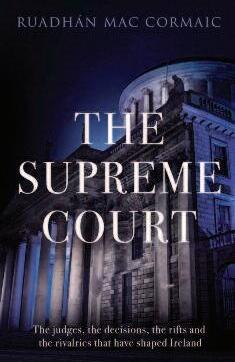
Public perception of the judiciary, pa y y p pay and pensions have been widely reported, has been problematic at times, and Ruadhán is, unsurprisingly, wary of generalisations:
"Often the portrayal of judges is binary – they're either accorded too much deference, or seen as out of touch I was keen not to fall into the trap of thinking 'they're all terrible', or 'they're all great' There's no question but that when you speak to people who've been on the Court, you gain a better understanding of what it is to be a judge of the Supreme Court, something few people will ever experience
"In terms of the 2009-2013 disputes over pay and pensions, I covered the latter part of them for The Times and the relationship between the judiciary and the State deteriorated, but it was not known in public how it divided the judiciary as a group It's difficult to ascribe traits to the judiciary Yes they are by social background relatively homogenous, but they hold very different views on what a judge should be/how a judge should act Some were in favour of more public confrontation, while others wanted a quieter, more diplomatic approach The debate got quite bitter I can see the problems that they were facing, particularly that they had no way of speaking as a group, but it was remarkable how badly they handled it at times"
more in hope than anticipation, and was delighted with what he found:
"Within hours, I knew I'd struck gold There were hundreds of letters, going from the early 1960s to the 1990s You can trace how the relationship develops because they start off addressing each other as 'Dear Mr Justice Walsh', and as the years pass it becomes 'Dear Brian' and 'Dear Bill' They start to talk about the cases they're working on so you get interesting insights into some of the major cases that I was writing about at the time It allowed me to do something that is difficult when you ' re writing about that period, which is to introduce the voice of the judge outside of the judgments It was by far the most satisfying moment I had writing the book"
He feels that the establishment of the Association of Judges of Ireland in 2011 led to an improvement in this situation
Judges have been in the news again in recent weeks, with discussions at Cabinet level on judicial reform and comments from Chief Justice Denham criticising the lack of action on a long-awaited judicial council Ruadhán agrees that reform is needed: "I think there is a need to change the appointments system We don't even know the criteria through which judges are appointed There's a lot that's good about the current system In theory, if it was properly resourced, a structure like the Judicial Appointments Advisory Board (JAAB) could work very effectively The problem is that it's not resourced It's not beyond the wit of the State to come up with a system that more closely resembles the system by which we appoint senior civil servants – a system that involves assessing ability, that elevates merit, that seeks to ensure diversity"
As to taking the politics out of appointments, he acknowledges that this is a complex issue: "I agree that judges should not be appointed because they happen to know a Minister or to have a connection with a political party – that goes without saying However, I think that at a certain stage it's important that an appointment is signed off on by Cabinet The important point is that you limit the choice Cabinet has, so that you don't have a situation like we have now, where the Government can be presented with a list of more than 50 people Transparency is key, and if the
system was transparent people would have more respect for the judiciary"
When it comes to the need for a judicial council, he says it's a " no brainer": "Clearly you need training for judges, and ongoing training throughout a judge's career
And there should be some system through which disciplinary matters are dealt with I think most people agree on this now and I don't think there's any excuse for not enacting a judicial council bill"
The Supreme Court has had a very positive reception since its publication Ruadhán hopes it will lead to further work on the Court: "The book is an attempt to begin to write the Supreme Court into a story from which it has been largely absent, but there's so much more to be said, and I hope others will take it on It would be great if judges would say more about how the courts operate No judge has written a book about being a judge I think they have more room for manoeuvre there than they think they do, and I think they can do it without drawing themselves into controversy or turning the Court into a more overtly political institution, which I think is what a lot of them fear"
Now that the book is out, it's business as usual for the Foreign Correspondent
When we spoke, Ruadhán was preparing to head to Washington with the enviable task of covering the final stages of the US Presidential election, and he will travel to the Middle East in December He's looking forward to both trips, particularly as this time the flights won't be spent trying to decode Supreme Court judgments!
The State (Nicolaou) v An Bord Uchtála in 1965 concerned an unmarried father seeking (and failing) to prevent the adoption of his daughter, Mar y C a r m e l I t w a s a co m p l
together many elements of the stor y he was tr ying to tell, and also lef t a lasting impression on him: "If you read cour t judgments, the judges of ten s e e m a v e r s e to a l
g to
and it's a loss, I think It struck me that there must be a fascinating stor y behind this one So I star ted off speaking to some of the people who were involved, some of the law yers, and the search led me eventually to Mar y C a
af termath of that case She has lived with the fallout all her life She did f
never been able to find her father " It was a very moving conversation: "Lawyers know that case because it’s the case that laid down the fact that, in law, a family is founded on marriage People talk about that Cour t in the 1960s being very liberal and pioneering but it was only liberal in cer tain senses The Cour t generally was a conservative place as regards social and moral questions – it reflected the State at the time in many ways and that was a point I was keen to get across "
An appeal currently being heard by the Supreme Court has potentially far-reaching consequences in terms of how barristers prepare costs for taxation purposes.

Padraig D. Lyons BL
In June of this year, the Court of Appeal delivered a most significant decision in the area of legal costs in the matter of Isabelle Sheehan (A Minor) v David Corr [2016]
IECA 168 The decision is under appeal to the Supreme Court, but if the findings are upheld, it appears inevitable that the case will result in an overhaul, not only of the manner in which costs are assessed on a taxation, but also upon the basis on which legal professionals will be expected to present their fees, whether in counsel’s fee notes or in a bill of costs reciting a solicitor’s general instruction fee
Whilst the judgement focuses principally on the presentation of bills of costs, as well as the rationale for the computation and presentation of a solicitor’s instruction fee, it is undoubtedly the case that going forward (and subject to review by the Supreme Court), the dicta of the case will apply equally to counsel
The practical import of the decision is set out in greater detail below but it appears clear that barristers will, in preparing fee notes, be required to provide significantly more detail (particularly in relation to brief fees) as to the work actually undertaken, to include preparatory work
This article will review the key elements of the judgement in Sheehan that impact on the issue of counsels’ costs and on the current taxation process
Before doing so, it is necessary to briefly set out the criteria to be considered by a taxing master in assessing a bill of costs This is set out in Order 99 Rule 37 (22) (ii) of the Rules of the Superior Courts, which provides that:
“(ii) In exercising his discretion in relation to any item, the Taxing Master shall have regard to all relevant circumstances, and in particular to-
(a) the complexity of the item or of the cause or matter in which it arises and the difficulty or novelty of the questions involved;
(b) the skill, specialised knowledge and responsibility required of, and the time and labour expended by, the solicitor;
(c) the number and importance of the documents (however brief) prepared or perused;
(d) the place and circumstances in which the business involved is transacted;
(e) the importance of the cause or matter to the client;
(f) where money or property is involved, its amount or value;
(g) any other fees and allowances payable to the solicitor in respect of other items in the same cause or matter but only where work done in relation to those items has reduced the work which would otherwise have been necessary in relation to the item in question”
Prior to Sheehan, the time actually expended was always a matter to which the High Court had regard in determining a motion to review a taxation of costs
For instance, in Cafolla v Kilkenny and Ors [2010] IEHC 24, a case relating to a review application brought by the defendants, Ryan J concluded that, in applying his or her statutory discretion, a taxing master:
“must establish in detail the amount of work done and obviously the type of work done and then go on to put a value or cost on that by applying rational principles with sufficient transparency to enable them to be examined on review”
Up to the Sheehan decision, the amount of time expended on work carried out, whilst always a matter to which a taxing master was obliged to have regard, was just one of the criteria to be considered by a taxing master in performing his statutory function (as prescribed by Section 27 of the Court and Court Officers Act 1995) of conducting a full assessment of the nature and extent of the work under taken However, the decision in Sheehan quite clearly places the time expended at the forefront of any assessment of costs
It appears clear that barristers will, in preparing fee notes, be required to provide significantly more detail (particularly in relation to brief fees) as to the work actually undertaken, to include preparatory work
The decision in Sheehan came before the Court of Appeal by way of an appeal from a High Cour t Order of Kearns P , on the plaintiff ’s motion to review the taxation of costs The proceedings in Sheehan were medical negligence proceedings relating to a plaintiff minor who suffered catastrophic injuries arising out of the defendant’s admitted negligence resulting in the plaintiff minor ultimately developing cerebral palsy The plaintiff/appellant was awarded costs of the action The appellant solicitor caused a summons to tax to issue and the costs were taxed Thereafter objections were taken by the solicitor with regard to the costs, in respect of the general instructions fees and counsels’ brief fee, pursuant to Order 99 Rule 38
The objections were not upheld and when the ruling on taxation was affirmed, the plaintiff’s solicitors, by notice of motion, brought a motion to review the ruling, pursuant to Section 27 (3) of the Court and Court Officers Act 1995 The section essentially permits the Court to review a decision of a taxing master to allow or disallow items in the bill, provided that the Court is satisfied that the taxing master has erred, and that the error has led to an injustice
What equates to an "injustice" was not a test that was altered by the Court in Sheehan In Superquinn v Bray UDC (No 2) [2001] 1 IR 459, Kearns P found that the standard to be adopted by the High Court in determining when an error as to amount became "unjust", should be that the High Court should not intervene to alter a finding of amount made by the taxing master unless an error of the order of 25% or more had been established in relation to an item under challenge However, subsequent case law (Peart J in Quinn v South Eastern Health Board [2005] IEHC 399 and Hedigan J in Revenue Commissioners v Wen Plast Research and Development Limited [2009] IEHC 383) has moved away from assessing whether an injustice had arisen by reference to a strict percentage application, and expressed the view that what is just or unjust should be viewed on a case by case basis since different factors may be at play The Cour t of Appeal did not disturb that test
There were in total seven grounds of appeal in Sheehan The decision, which was delivered by Cregan J , is a wide-ranging one and for the purposes of this ar ticle it is proposed to focus on two matters addressed in the ruling, namely the importance of recording time expended, and the applicability of "comparator" cases Both are likely to impact the preparation and delivery of counsels’ fee notes
The decision of Cregan J is critical of the manner in which bills of costs generally are presented for review The Court concluded that the bill of costs, the subject of the review (which bill it is accepted was delivered in what was essentially the usual format), did not comply with the Rules of the Superior Courts, and in particular with Order 99 Rule 29 (5)
The Court found that the reference to "time and labour" in Order 99 Rule 37 (22) (ii) meant that a specific record of hours worked should be kept and set out in the bill of costs It held that since a bill of costs was obliged to include the number of "items" being charged for and the professional charge for each, a bill of costs must contain the specific professional charge for each item The Court also found that in order to ensure that an appropriate professional charge is marked for the particular professional service rendered, the hourly rate of the person undertaking the work should be given
The judgement contains a number of critical observations as to the manner in which bills of costs are presented, including a finding that they are unnecessarily prolix and repetitious However, the Court is particularly critical of the method of calculation of the solicitor’s instructions fee At page 13 of the judgement, Cregan J states that:
“One would have thought that a bill of costs would set out the date of the activity, the nature of the activity, the number of hours engaged on that activity and the charge for that activity This would have resulted in a ‘running account ’ ”
It is impor tant to note that the judgement refers to the solicitor’s instructions fee However it is of course the case that a bill of costs includes counsels’ fee, and it appears by implication that the principles identified apply equally to counsel
The Court makes clear that time and labour should now form the starting point in an assessment of a bill of costs At page 25 of the judgement the Cour t concludes that:
“The foundation stone of a proper assessment of a bill of costs is an assessment of time and labour and charges of each solicitor for each professional service rendered”
The tenor of the decision is such that it appears that it will not be sufficient, going forward, to include a fee without a more detailed narrative as to the work undertaken, the time expended, and the proposed rate to be charged It appears that in order to properly comply with the dicta of the Court, counsel will need to break down the work actually expended, whether that is preparatory work, research, etc
Of note also is the rejection by the Court of Appeal of the use of comparators Historically it was probably the case that, particularly in certain types of litigation, counsels’ brief fee would often have been determined by reference to the range of brief fees that would have been recoverable on taxation in similar cases Whilst the Court and Court Officers Act 1995 obliged a taxing master to look at the nature and extent of the work under taken, comparators were still used to inform the assessment of a fee
Cregan J in Sheehan makes the point that Order 99 Rule 37 (22) (ii) does not include any reference to comparators Historically, comparators have been taken into account in the assessment of costs For example, in Best v Welcome Foundation Limited [1993] 3 IR421, Barron J concluded it was appropriate in assessing the level of an instruction fee to compare it with other cases of a similar nature and complexity
In Mahony v KCR Heating Supplies [2007] 3 IR 633, Charleton J indicated that the proper approach for a taxing master was to first assess the nature and extent of the work (as he is statutorily obliged to do) and thereafter to seek assistance from comparator cases where it was considered that a similar amount of work was required The approach was subsequently endorsed by Kearns J in the case of Bourbon v Ward [2012] IEHC 30
However, the Cour t of Appeal has severely limited, if not entirely removed, the applicability of comparators to the assessment of fees The Cour t found that, looking at similar medical negligence cases, with similar injuries and awards, in order to determine an appropriate instruction fee was, in effect, simply “ a rule of thumb analysis whereby instruction fees were linked to the size of the award”
The Court of Appeal expressly stated that such an approach was wrong in principle and in law, and could not withstand scrutiny in light of the statutory provisions of
Section 27 of the 1995 Act The Court of Appeal emphasised that a taxing master must be sparing in the use of comparators, as such use could lead them to draw an incorrect conclusion from the comparison The Court concluded, at page 68 of its judgement, that:
“ comparators should rarely be used in future taxations, except in exceptional circumstances”
Again the findings are directed to the solicitor’s instruction fees but must apply equally to the calculation of counsels’ brief fees
In the short term, the impact of the decision on the operation of the office of the Taxing Master has been significant, particularly in respect of cases that are in the taxation process, and in respect of which bills of costs in the old format have been delivered
No practice direction has been issued by the Office of the Taxing Master in respect of cases which are in the system, i e , in respect of which a summons to tax has issued and a date for hearing has been allocated Anecdotally, it appears that in certain instances the relevant taxing master has taken the view that if the bill as presented complies substantially with the dicta in Sheehan, the costs of the action are capable of being taxed However, in other instances, it appears that a stricter approach is being taken and legal cost accountants are being requested to reformulate bills of costs in a manner consistent with the dicta in Sheehan
The foregoing has obviously impacted on the throughput of cases, with a consequential impact on legal professionals, and par ties who have successfully obtained a costs order
The defendant in Sheehan sought leave to appeal the judgement to the Supreme Court, which necessitated the defendant satisfying the Supreme Court that the issues arising involved matters of general public importance, or that it was otherwise necessary in the interests of justice that the appeal be permitted In seeking leave to appeal, the defendant/applicant stated that the judgement represents a complete departure from the existing law and practice on taxation, and that it has had a seismic effect on the taxation process The applicant has argued that the findings of the Court are such as to conclude that all bills of costs have been erroneously drawn up for years, and that all taxations have proceeded
on an incorrect basis The defendant/applicant has further alleged that the effect of the judgement extends far beyond the existing dispute and that it has a universal effect on legal and costs practitioners, and that it may result in a voluminous number of existing bills of costs having to be redrawn Also of note is the contention that the significance placed on the need to examine time records is a matter that should more appropriately be addressed by the Oireachtas
In reply, the plaintiff/respondent has alleged, inter alia, that the effect of the judgement has been overstated, and that it does not elevate time to the status contended for by the defendant/applicant The plaintiff/respondent also submitted that, in any event, any impact of the judgement will likely be short lived given the establishment of a Legal Costs Adjudicator pursuant to the Legal Services Regulation Act 2015
On September 26, the Supreme Court, in a short written determination, granted leave to the defendant/applicant to prosecute its appeal, on the basis that issues of general public importance had been raised The specific issues to be determined are not specified as yet, and the Supreme Court has listed the matter to hear counsel for the parties on the delineation of the precise issue(s) the Supreme Court will adjudicate on
In respect of the reference to the Legal Ser vices Regulation Act 2015, the position is that Par t 10 of that Act has not yet been commenced Of note is the fact that within that par t of the Act, Section 152 provides for the par ticulars which a practitioner is statutorily obliged to include in a bill and which shall “be in such form as may be specified in Rules of Cour t ” Section 152(8) deals with the obligation on a barrister to provide a bill of costs Such is satisfied once he or she has furnished his or her bill to the solicitor concerned It cannot be the case that the ruling in Sheehan would be over taken entirely by Par t 10 of the Act Section 152 sets out minimum par ticulars in a bill but expressly states that the bill shall be in such form as may be specified in the Rules of Cour t The existing Order 99 Rule 29 (5) of the Rules of the Superior Cour ts has been interpreted now by the Cour t of Appeal As such, even when the costs provisions of the Act are commenced, the Sheehan judgement will carry the same impor t, since it will represent the proper interpretation of the Rules of the Superior Cour ts as to what format a bill should take, albeit that it will be read in tandem with the new Act
In the meantime, the Cour t of Appeal ruling represents the applicable law, meaning that the current uncer tainty that has permeated the taxation process appears likely to persist at least until the Supreme Cour t has delivered judgement on the matter
The implementation of new rules on case management is currently dependent on the assignment of list judges.


Introduction
On October 1, 2016, two sets of significant amendments to the Rules of the Superior Cour ts came into force
One set of changes (S I No 255 of 2016) (“Order 63C”) extends pre-trial preparation of the type used in the Commercial Cour t to the chancery and non-jury lists1 by the insertion of a new Order 63C 2 The second set of changes (S I No 254 of 2016) (“Conduct of Trial Rules”) affects the conduct of trials of civil actions generally and includes innovative (and arguably radical) developments concerning time management and regulation of expert evidence Order 63C envisages that designated “list judges”, assisted by specifically assigned registrars, will preside over the case management of the chancery and non-jury lists However, on September 22, 2016, just before Order 63C was due to come into force, the Principal Registrar of the High Court published a notice stating that:
“ pending the provision of appropriate necessary resources the President does not intend to appoint either a list judge or registrar within the meaning of the above rules Consequently, these rules shall have no practical effect pending such assignments being made
When these assignments come to be made at least two months’ advance notice of them will be provided to practitioners”
However, it should be noted that concurrently with this notice a reminder was published that the Conduct of Trial Rules were coming into operation
This article aims to identify and explain those rule changes that have already come into force and those that will be rendered inoperable pending the assignment of list judges
Order 63C – case management of non-jury and chancery actions
In essence, Order 63C sets down a regime for the management of non-jury and chancery proceedings, or any other proceedings so designated by the President
The regime mirrors in large part (albeit with some important distinctions) the provisions applicable to the commercial list in Order 63A In broad terms, Order 63C creates a case management system that comprises three distinct aspects:
n pre-trial directions;
n case management conferences; and, n pre-trial conferences
Order 63C expressly provides that the latter two (case management and pre-trial conferences) shall be conducted under the auspices of a “list judge” (supported by a specially appointed “registrar”) Therefore, there is no doubt that these case management mechanisms will remain in abeyance until such time as those appointments are made
Rules 4 and 5 of Order 63C provide for directions similar to the existing Order 63A, rules 5 and 6, which govern the commercial list These include directions from setting timetables for completion of pleadings to more innovative steps relating to directing preliminary or modular trials,
expert meetings, discovery and evidence to be adduced
One significant difference is that in the commercial list, a directions hearing is automatically triggered by the bringing of an application to have a case entered into that list Fur thermore, directions hearings are then adjourned from time to time, thus enabling the cour t to monitor compliance and to advance the progress of proceedings There is no similar gateway provision in Order 63C
This means that “pre-trial directions” hearings are not mandatory and will (in most circumstances) only be held in any non-jury or chancery case if sought by one of the par ties pursuant to a motion Fur thermore, without a dedicated judicial resource, it is not clear how compliance with those directions could be adequately supervised
No doubt, considerations of this type informed the issuance of the notice of September 22, 2016 However, whilst it is clear that no “list judge” will be appointed in the near future, it is wor th noting that rules 4 and 5 specifically state that pre-trial directions can be given by “ a judge” as opposed to the “list judge” In truth, however, this issue may be somewhat academic given that the High Cour t arguably has an inherent jurisdiction to give these directions in any event In fact, it is of ten the case that when chancery and non-jury matters come before the cour t prior to the trial by way of a substantive interlocutor y application (e g , for an injunction or summar y judgment), directions are given for expedited pleadings or discovery on those occasions
However, in the shor t term, there is unlikely to be any significant expansion of this existing practice (whether pursuant to rules 4 and 5 of Order 63C or otherwise) until sufficient resources are in place
"Enhanced" case management of complex cases
Order 63C, rule 6 provides for case management of par ticularly complex cases
This differs from a mere pre-trial directions hearing in that it involves more intensive oversight of all pre-trial preparation by a specially-assigned judge
This type of case management must be ordered by the list judge either of his or her own motion or on the application of one of the par ties Therefore, this rule cannot come into effect until list judges are assigned by the President
Order 63C, rule 9 provides for pre-trial conferences and, unlike rules 5 and 6, this provision is mandatory All chancery and non-jury matters will be listed for a pre-trial conference as soon as they are set down for trial The objective is to ensure that any outstanding matters are completed so that a judge can cer tify the matter as ready and to fix a hearing date This is a very significant change to the existing practice where practitioners are entrusted with the responsibility of advising the cour t as to the readiness and likely duration of the case There is no doubt that if the judiciar y are to be tasked with this responsibility, they will need to be provided with sufficient resources Given the absence of these resources, it is not surprising that a decision has been made to postpone the appointment of list judges, which is required for pre-trial conferences to operate
The business of the pre-trial conference will include applying some of the new conduct of trial rules provided for in S I 254 of 2016, described below Fur thermore, rule 14(3) suggests that, in ordinary course, the judge chairing the pre-trial conference shall also be the trial judge Thus, the identity of the judge assigned to hear a trial will be known to the par ties from or shor tly after the date of the pre-trial conference In addition, the trial judge will have access to the pleadings, exper t repor ts and written submissions in advance of the trial, which is likely to substantially reduce the time taken up by the hearing itself
As already alluded to, Order 63C, rule 14 provides that chancery and non-jury matters will usually be given a date for trial once the list judge (or a different judge who chaired the pre-trial conference) issues a cer tificate of readiness
Pending the appointment of list judges, it seems likely that the practice that was in place heretofore will continue, whereby practitioners apply to the registrar of the chancery or the non-jury lists for a date for hearing It also seems likely that in the absence of pre-trial conferences and in the absence of an appointed registrar, the provisions in rule 15 for papers to be furnished to the registrar two weeks before a trial and the provisions in rule 16 for a trial judge to ask the parties in advance to agree a list of questions to be determined at the trial, will not come into practical operation for the time being
Rule 17(1) is probably the most radical rule change in terms of the way chancery and non-jury trials will be conducted It provides that unless the list judge orders otherwise, witnesses as to fact must provide a written statement summarising their evidence not later than 30 days before trial Expert reports must be exchanged in similar fashion Significantly, the rule (on a strict reading) appears to envisage a simultaneous exchange of statements between the parties as opposed to the sequential exchange that is provided for in the commercial list Rule 17(3) provides that in exceptional circumstances a judge may order a witness statement to be treated as the evidence in chief of the witness concerned, but only after it has been verified on oath by such witness This provision is almost identical to Order 63A, rule 22(2) Such a practice can offer significant time savings but requires considerably more pre-trial preparatory work from the litigants and their legal teams
It should be noted that the obligation to exchange statements applies in the absence of a direction to the contrary from a list judge and thus, on one view, it could be argued that this obligation applies notwithstanding the notice of September 22, 2016 However, it is submitted that the better view is that the absence of a list judge means that the exchange of witness statements is incapable of being managed and thus the corresponding obligation to furnish same pursuant to rule 17 cannot become operable until that time
The second package of reformed rules that came into force is the Conduct of Trial Rules, and the notice of September 22, 2016 is not directed towards these reforms That said, some of the new Conduct of Trial Rules are envisaged to be exercised through mechanisms such as case management conferences and pre-trial conferences and, as a result, there will be a practical knock-on delay in the full-scale implementation of these rules too
New rules3 now require that where par ties intend to rely at trial on exper t evidence, they must plead that intention in their statement of claim or defence
This applies in any proceedings which require delivery of a statement of claim or defence (but the rules do not apply to personal injuries proceedings) The plea must state the field of expertise concerned and the matters on which expert evidence will be offered It is noteworthy that neither rule expressly precludes the calling of expert evidence where the intention to do so has not been pleaded It remains to be seen whether the cour ts develop a test that balances the prejudice to one party of disallowing such evidence against the prejudice to the other party of not being forewarned of the need for expert evidence Order 39 (evidence) is amended, inter alia, 4 by the inser tion of new rules 56
to 61 concerning exper t evidence Impor tantly, these new provisions are expressed to apply to commercial list proceedings, competition list proceedings and proceedings “in which an order may be made under Order 63C, rule 4”, the latter comprising non-jury and chancery cases and any other list designated by the President pursuant to Order 63C
For the first time, the duty of exper t witnesses to assist the cour t as to matters within their field of exper tise is expressly stated Fur thermore, exper t repor ts must now include a statement expressly acknowledging that duty, and disclosing any financial or economic interest such as sponsorship or funding of an institution with which the expert is connected Experts must also disclose their fees and expenses for par ticipating in proceedings
Rule 58 allows the cour t to regulate the use of exper t evidence by means of directions The overarching principle is set out in rule 58(1), which states that: “Exper t evidence shall be restricted to that which is reasonably required to enable the court to determine the proceedings” This is a far-reaching provision that effectively adds a test of propor tionality to the question of admissibility of evidence This rule is supplemented by rule 58(2), which allows " a judge" either of his own motion or on an application, to give a wide range of directions relating to exper t evidence For example, a judge can direct the par ties to identify their exper ts and the fields in which exper t evidence is intended to be given Timelines can be fixed for the delivery of exper t repor ts Furthermore, and of potentially far-reaching significance, parties are no longer allowed to call more than one expert in any particular field of expertise, except where the cour t thinks this is “unavoidable” in order to do justice What constitutes a “field of exper tise” will no doubt be the cause of much debate if this rule is strictly enforced In addition to this restriction, the rules now, for the first time, provide for the appointment of a “single joint exper t” – a procedure which gives rise to interesting procedural questions yet to be explored in this jurisdiction 5
Rule 58 does not specify when these directions would be given, although it would seem appropriate (and is perhaps implicit) that it would be before the commencement of the trial itself That said, rule 58 specifically says that directions in this regard can be applied for by way of motion and therefore there is nothing expressly precluding any par ty from making this application at any time, whether in the chancer y, non-jur y, commercial or competition lists
Parties are no longer allowed to call more than one expert in any particular field of expertise, except where the court thinks this is “unavoidable” in order to do justice
Another significant change is that rule 59 allows par ties to submit written questions to an opposing par ty ’s exper t witness or to a single joint exper t Save by agreement, or where expressly permitted by the cour t, such questions can only be for the purpose of clarification of the exper t’s repor t An exper t who refuses to answer the question faces the prospect of not being entitled to give evidence unless the questions are deemed dispropor tionate or unnecessary A failure can also give rise to cost consequences
Rules 60 and 61 deal with expert meetings These rules provide that where

Colm O’Briain came to the Bar in the Michaelmas term of 1991 He had already had a distinguished academic career in both school and college, and had completed a master’s degree in the London School of Economics in the area of equitable remedies and, in par ticular, unjust enrichment He had a significant knowledge of the world of business from his study of company law and also from experience in his father’s stockbroking business where he had worked
Despite this academic and business background, he chose to gain experience in the area of criminal law and subsequently expressed a preference for it It became clear from an early stage that his personality suited adversarial conflict rather than a life of imprisonment at his desk drafting affidavits
The fact that he chose to specialise in the area of criminal law and not in the more lucrative area of business law, in which he was also accomplished, was an indication that he was without avarice He was never guilty of self-promotion and expressed no desire to take on cases in areas where he would have had significant understanding and knowledge Colm took silk in October 2015, but well before this he was sought out by both his junior and senior colleagues for his views on various areas of the law His ability to understand and construe statute law was exceptional and recognised He was generous with this knowledge to his devils and colleagues but could be acerbic if of the view that there had been foolish or loose thinking in relation to the question that was being asked of him In his shor t career as a senior counsel, he made an impression and was in demand as a leader
I had the privilege to have him as a devil and subsequently as a friend, and have ver y fond memories of cases done together and moments of high humour in the Four Cour ts, both before and after cases The relationship was not without its tense moments and one in par ticular stands out I had been hugely impressed by his knowledge of the law and also by his knowledge of business, in which I was definitely lacking Having been given a tip for a somewhat dodgy share on the American stock market and never having purchased a share before, I asked Colm to arrange the purchase of a small block of these shares through the family firm He told me he had arranged this and that I would have to settle within seven days Later that evening he came to my room and after some hesitation indicated that he had “made an error with a decimal point” It appeared that he had, in error, bought ten times
the amount of shares which I had indicated and the purchase price was well beyond any capital I then possessed He indicated that the New York Stock Exchange was then closed but said that he would apply himself to it when it reopened the following day This was little comfor t in view of the nature of the share, which I had been told could either take off or collapse He sold the shares at a small profit and celebrations followed This became known as “the decimal point issue”, which could be applied to various different situations that might arise in the giving and taking of instructions
His engagement with the law did not prevent him from enjoying traditional forms of spor t and recreation Apar t from being a competent tennis and rugby player, he was known to enjoy the occasional evening in Michael Hughes’ bar on Chancery Street
He coached his local GAA team and those who attended his funeral will remember the story told of how he had been seen exhor ting the team of 14 year olds to increase their level of fitness as he pulled heavily on a Marlboro cigarette on the sidelines
Colm married Bernadette Kirby, his colleague and co-devil, in 2002 This was a marriage that brought him great happiness, as did the company of both Conor and young Colm
Colm is buried in the churchyard at Ballycroy in Co Mayo This is close to the house at Shanamanragh which his grandfather, Barra O’Briain, had bought in the 1950s and where he had spent all of his childhood holidays and subsequently his holidays with Bernadette and the children
He had a deep love for the area and its beautiful but bleak scenery, and was much respected and liked locally He was a generous host in that house to his friends and colleagues who travelled there to fish and socialise
His life and career at the Bar should be a pointer for others He was not avaricious His concern and anxiety in a case was always for his client He was always conscious of the impor tance of the case to the client and was scrupulous in his sense of obligation to anybody whom he advised His generosity in advising and helping both his devils and other colleagues was notable He will be missed not only for his legal acumen and example, but also for his conversation, whether it involved matters of law, business, politics or just general good humour

Eileen Finn died in the early hours of July 30 in Blackrock Hospice She had spent the previous few days surrounded by family and friends Eileen suffered from motor neurone disease (MND), a cruel and debilitating condition in which muscles atrophy to the point where the body can no longer function
In June last year, Eileen wrote a graphic piece in The Irish Times on what it was like to live with MND She also noted, with characteristic good cheer and a lack of sentimentality, that as 95% of people were dead within 1,000 days of diagnosis, she was already past her sell-by date By then Eileen was confined to a wheelchair
The same week she took part in the women’s mini marathon, pushed along by friends and family, and raised over ¤72,000 on behalf of the Irish Motor Neurone Disease Association The people who did it with her all spoke of how much fun the day had been Eileen was an exceptionally modest person but she was extremely proud of this achievement
I first met Eileen in the King’s Inns in 1983 We were in the same diploma class together She was bristling with intelligence and was possessed of a fierce intellectual rigour that she never compromised She was never out of the top four in examination results She was extremely well read and politically aware, and held strong views, always cogently expressed, on all the live issues of the day Eileen was called to the Bar in 1987 She remained working for the Revenue Commissioners while she reared her four boys Later she joined the tax section of A&L Goodbody solicitors, followed by a period with Arthur Cox, and then commenced practice at the Bar Her expertise in Revenue matters ensured that she got many tax briefs and the Criminal Assets Bureau also regularly instructed her She was also a member of the State bail panel
Eileen was an astute lawyer, who loved ideas and argument She worked her briefs hard and enjoyed the stimulation that went with the cut and thrust of court She openly dreaded reaching a point when she could no longer work It was a testament to her enormous strength of character and courage of the true grit variety that Eileen worked in court until a week before she died Eileen came from a large family in Fairymount in Co Roscommon They all put their shoulder to the wheel and devised a roster (which was multi-generational) to ensure that help of a practical nature was close at hand Ronan, her son who lived at home, provided invaluable back-up and company
A very large network of friends also supported Eileen Every evening, people gathered in her kitchen to chat until Ronan came home from work You could not but be struck by how calm and inviting the atmosphere always was Eileen was unwavering in her loyalty as a friend and a confidante, something from which I and everyone else around the table benefitted many times Eileen’s innate intelligence meant that she was always acutely aware of how the disease was progressing I never once heard her complain She could see the deterioration and was very alive to the consequences She had no fear of death and only lamented the people she was leaving behind Eileen is survived by her four sons Nigel, Ercus, Ronan, and Eliott She was a good colleague and friend, and we miss her a lot
M L O’H

When I was called to the Bar in 1979 and joined the Midland Circuit, the legendary practitioners at the time included Eamon Walsh, Kevin Lynch, Hugh Geoghegan and Garrett Cooney My master, Harry Whelehan, would occasionally visit the Western Circuit, where I first encountered that other legend, Marcus Daly
Marcus was one of the leaders of the Western Bar along with Séamus Egan, Brian Fahy and David Butler Marcus was a striking, daunting and formidable man It was fascinating to observe his inimitable court style One cough or clearing of the magisterial throat, and the tossing of his fine bewigged mane, made it quite clear to the bench that he would brook no reprimand and cer tainly no curtailment of his penetrating cross-examination
Marcus enjoyed a remarkably extensive practice throughout the country, which included prominent rateable valuation cases where the stakes were high: he more latterly focused on personal injury cases
Marcus’ great rival (and friend) in Sligo was the late Diarmuid O’Donovan and it was a pleasure to witness the two titans spark off each other in court
Both then repaired to Reveries Restaurant in Rosses Point and Marcus would hold forth on the relative merits of wines, the prices of which few juniors could contemplate
By the time I took silk in 1997, Marcus was already the father of the Connacht Bar, which position he held for a remarkable 21 years He took his responsibility as father with the utmost seriousness and it was only in more recent times that non-Circuit barristers were permitted to attend formal Circuit dinners
Marcus was a tour de force in court – you always had to be two steps ahead of him He was capable of exploding bombshells which could change the entire complexion of a case Marcus served his clients with exemplary dedication, energy and application The folding of a tent was never an option for Marcus
In negotiation, his standard riposte was “well it’s a star t” to even the most generous offer
He ran the Galway Sessions with ruthless efficiency Marcus would inform the judge on a daily basis that he had taken “soundings” (all of which were his own) He was a sociable colleague, with a wide range of interests His organisation of Circuit dinners was meticulous, as was his attention to detail and observation of protocol He brooked no dilution or relaxation of these protocols even when his great friend Conor Maguire sprang a surprise celebration to mark his 50 years in practice He was having none of it
He was enormously proud of his family and took great satisfaction in the flourishing careers at the Bar of his sons, Marcus and Ivan Marcus was a genuine custodian of the best traditions of the Bar He was an exemplar He was a wonderful colleague and friend who will be sorely missed I will end by reciting the words of his friend Henry O’Bourke SC, who now succeeds him as father of the Connacht Bar:
“I stand on the shoulders of greatness”
Edward Walsh SC
Adversarial litigation and the right to cross-examine must be maintained.

Adversarial litigation was not always the way disputes were resolved Older methods of trial existed such as, for example, trial by ordeal, which involved the party with the burden of proof wrapping his hand in leaves and then holding a hot iron for a set period of time If he emerged unscathed, his cause was considered just and he had successfully proved his case If he burned, he lost Then there was trial by combat – although the protagonists did not need to be particularly courageous as they could engage others to fight on their behalf! Ultimately, the resolution of disputes evolved to favour a system of adversarial trial, which for the last century and a half has been regarded as the best way to come to a just result in a disputed legal matter
The right to cross-examine has been regarded as central to that adversarial process John Henry Wigmore described cross-examination as “the greatest legal engine ever invented for the discovery of truth” Hardiman J in Maguire v Ardagh said:
“Where a person is accused on the basis of false statements of fact, or denied his civil or constitutional rights on the same basis, cross-examination of the perpetrators of these falsehoods is the great weapon available to him for his own vindication”
Hamilton C J in Donnelly v Ireland said:
“The central concern of the requirements of due process and fair procedures is the same, that is to ensure that fairness of the trial of an accused person This undoubtedly involves the rigorous testing by cross-examination of the evidence against him or her”
Declan McGrath in Evidence (2nd Edition) opines that given the importance and constitutional basis of the right to cross-examine, the discretion of trial judges to disallow questions or otherwise curtail cross-examination is somewhat circumscribed and a trial judge should not rule out a line of questioning unless it is clearly irrelevant or otherwise objectionable, perhaps by reason of its length or repetitive nature
The role of the trial judge was described by McCarthy J in Donnelly v Timber Factors, in a manner which seems to recognise the importance of cross-examination, where he said:
“The role of the judge of trial in maintaining an even balance will require that on occasion he must intervene in the questioning of witnesses with questions of his
own – the purpose being to clarify the unclear, to complete the incomplete, to elaborate the inadequate and to truncate the long winded It is not to embellish, to emphasise or, save rarely, to criticise That is the function of counsel”
McCarthy J went on to explain why the role of the trial judge should be so circumscribed as follows:
“The casual bystander on seeing and hearing repeated judicial intervention may well conclude that issues in the case or the case itself are being decided before the evidence and the submissions are complete If the casual bystander may do so, how much more so the interested party, the litigant? This division of role between judge and advocate was always important in civil trials by jury; it is more important now that claims for damages for personal injuries are no longer tried by juries”
The application of the new Rules of the Superior Courts, considered in Stephen Dowling and Eoin Martin’s article in this Review, has the capacity to entirely erode the foregoing principles by emasculating the right to cross-examine and by putting the trial judge at the centre of the evidential stage of the trial, and indeed before the trial even commences
This evolution in the manner of the resolution of disputed legal matters appears to involve the supplanting of the role of counsel and legal advisers to the parties We have come to this juncture, it seems, by the success of the Commercial Court and the rules that were established specifically for the management of business in that Court However, those rules provide for judge-led administration of the litigation process and do not trench significantly upon the adversarial nature of the litigation disposed of in that Court, because while the judge in charge of the list managed the process of the litigation, the running of the trial is left to the parties
In contrast, the new rules significantly alter the balance between the litigant and his/her adviser and the role of the judge They place litigants and their advisers in an invidious position should the judge choose to exercise the power now given to him/her by the rules in respect of the trial process, as opposed to the litigation process One might posit how is counsel to object to a judge truncating cross-examination not because it is repetitive or irrelevant or otherwise objectionable, but simply because time has run out for it How is counsel to argue with a judge who requires counsel for the defendant to call a witness that counsel for the defendant did not intend to necessarily call until the plaintiff had met the burden upon the plaintiff in presenting his case? Equally, how is counsel for the plaintiff to react if the judge says that he or she does not require to hear some of the plaintiff’s witnesses?
Why is the judge given this power at all?
Are we to do away with the jurisprudence that has recognised the role of the judge as entirely different to the role which he/she is now to fulfil?



Deadline: November 10*.